What is a Quilt? – 52 Ancestors #268

Morning Star Medicine.jpg

A few weeks ago, someone from Scandinavia asked me the question, “What is a quilt?”

First, I was a bit stunned because of all the locations in the world, people in the far north need quilts more than people in warmer latitudes – so the question itself surprised me. However, when I visited Scandinavia, I realized that quilts are not nearly as popular there as in the US. There are few if any quilt shops – and apparently, judging from that question, few quilts.

Then, I began to answer the question technically. A quilt is three layers of textiles, sandwiched together.

  • The bottom layer is typically utilitarian, one piece of fabric that you won’t see became it’s face down, or against you.
  • The middle layer is something called quilt batting which is most often cotton or wool, warm and insulating, which also serves to give the top a kind of puffy effect – filling out the wrinkles a bit.
  • The top is often multiple coordinating fabrics pieced in a pattern, or artistic.

A quilt is not only warm and wonderful, but it’s beautiful too.

You can see the 3-layer sandwich and the quilting in the example below of a quilt edge waiting to be trimmed and a binding applied to secure the three layers together so it looks attractive and the layers don’t ravel.

Quilt 3 layers

The back is larger than the front and waiting to be trimmed. The batting is the white middle layer.

The quilt top itself is generally smaller pieces of fabric sewn together to create either a pattern or some type of art work as illustrated by the same quilt’s corner, shown below.

Quilt pattern.jpg

All three layers are then quilted, sewn together in a pattern which serves to hold the quilt together and is decorative at the same time. You can see the swirl pattern on this quilt which is the quilting.

Quilts serve as blankets on beds, personal napping companions, as art, or as utilitarian items like table runners, clothes and much more. I keep one in my car for picnics, emergencies and naps. My quilts have been used for almost everything over the years including animal rescue.

Quilts can be self-expressive clothing too.

Quilt DNA vest

In this photo, I’m wearing a quilted vest with a matching laptop bag. Actually, that bag’s large enough to carry half of what I own! I might have been a little bit overexuberant when I made the bag.

I dug around on my phone and showed this next example of a quilt to the person who asked. I’m particularly fond of this quilt, made out of scraps of fabric, most of which I hand-dyed myself using a marbling technique. Translated, this means I made both the fabric, except the solid red and dark grey, designed the pattern and then made the quilt. I love it because it’s bright and cheery and holds many good memories.

Losing my Marbles.jpg

This is what happens when life gives you scraps and you are losing your marbles.

My friend told me it made him dizzy. Well, this quilt, named “Losing Your Marbles,” was quite complex and kind of made me dizzy in a different way too.

Sigh. I think I failed to convert or even convince him.

A Quilt is Not About Fabric

Later, as I thought more about the question, I realized that while I gave my friend a technically accurate answer, quilts are really much more and I failed to convey the beauty behind quilts which has little to do with the fabric or pattern.

Quilts are love. Pure and simple. You don’t make a quilt for someone you don’t love.

Full stop.

Yes, there are different kinds of love, but quilts are the quintessential expression of love and caring for others.

Quilters Create Quilts, and Quilts Define Quilters

As with our ancestors, what we do defines who we are. Who we are also determines what we do. My great-grandmother who died in 1949, more than anything else, is remembered for being a quilter who graced everyone in the family with one or more lovingly hand-made quilts that have now been passed on for 3 going on 4 generations.

I just might have picked up the quilting bug from my great-grandmother, Nora Kirsch Lore (1866-1949).

Climbing vine family photo2

Nora was a quilter extraordinaire, representing the State of Indiana in the 1933 Chicago World’s Fair with her Climbing Vine quilt, above. Long after her death, Mom, me and my daughter posed in front of her quilt at a quilt show.

Nora's pink and green quilt

Nora created stunning quilts that took years to complete as well as utilitarian quilts, like the pink and green hand-quilted Depression Era quilt that graced Mom’s bed for years.

Handkerchief quilt

Nora made what is now known as “The Handerchief Quilt.” This old blue “Drunkard’s Path” quilt was so loved and worn that I had to find a way to salvage it. There were literally holes, in several places, but my kids loved it so much they cried at the prospect of using it to make something else.

“You can’t cut Mawmaw’s quilt, ” they sobbed. They had know it their entire lives as their grandmother’s quilt that they used to snuggle underneath with her. Little did they know it was her grandmother, Nora, that made the quilt they so loved.

Regardless, I certainly couldn’t cut sometime that priceless to my children so a solution had to be found. I dug around in Mom’s “heritage drawer” and took some of my grandmother, Edith’s handkerchiefs to repair her mother, Nora’s quilt.

Now this quilt embodies 5 generations – Nora, the original quilter, her daugher Edith’s handkerchiefs,  then Barbara, my mother snuggled under it with her grandchildren, and I restoring the quilt to something useable. Of course, then my kids insisted I immediately put it away for safekeeping! Someday it will belong to one of them.

And so it goes, quilts embody love, being a virtual hug from the quilter every time you wrap the quilt around you. Quilts are a method of passing love on generation after generation.

Quilts are wonderful family heirlooms, even tattered old ones – but that’s not all. They are also for family-of-heart.

Louise

Louise-Larsen-with-quilt.jpg

I was reminded of that, in spades, the day my second-mother of sorts passed away. I don’t remember ever not knowing Mrs. Larsen – Louise as I came to call her as an adult. She was our neighbor before I started school, my friends’ mother, my Girl Scout leader and then my friend. She inspired me, she disciplined me when I needed it, and sometimes when I didn’t – she was my mentor and cheerleader. She wasn’t always right, but she always cared. She was sometimes at odds with my quite conservative and strict mother, so the Larsen household was a safehaven of sorts for the neighborhood kids.

After high school, I moved away but kept in touch with Louise for decades through her family and sporadic visits. I attended her daughter’s funeral, a horribly sad day when we buried one of my best friends. Years later, I went home for another daughter’s wedding and visited with Louise when I managed to get back home, which wasn’t often. My mother moved, then died, so there was no reason to go back anymore, but I manage a last visit about a decade ago and spent time with Louise.

A few years later, Louise began to slip into dementia and moved, albeit reluctantly, in with her daughter in a distant state. Nothing was familiar and Louise was not happy.

I made a quilt for her, quickly so she could have it immediately. I included fabrics I thought she would enjoy and wrote a letter tucked into the box with the quilt saying that the floral fabrics represented the lives of the girls in her scout troop. We had bloomed from the seeds she had planted. Her daughters told me that she couldn’t remember much from the present, but she could name each of “her girls” from the Scout troop. She would reminisce and wonder what happened to each of us.

Eventually, Louise entered hospice. I knew the end was near and wished her GodSpeed through this final trial.

Louise passed over, released from the terrible burden of dementia, comforted by her quilt over these increasingly difficult four+ years as dementia consumed her.

I hope when she could no longer remember who I was, or who family was, that the flowers in the quilt still brought her solace in some deeply visceral way – even though she could not remember why. I hope she felt love when someone tucked her in or covered her with the quilt.

I hope the quilt enveloped her and helped her feel safe when no one was present. I hope the quilt served its purpose, embraced her and shepherded her to the next world.

A few hours after her passing, her daughter sent this:

She was covered with the quilt you made for her for the past week. You were with her the entire time.

I sobbed. The quilt, send on a mission of comfort and love had worked its magic.

That is what a quilt is.

And then:

I took the quilt home. It’s a family heirloom now. Thank you.

This, my friends, is why we quilt.

And now, I hope the quilt brings comfort and warm memories to her family members for many years to come.

Quilts Document Lives

As a genealogist, I’ve come to realize that quilts often document life’s journey – both for recipients as well as the quilter. You might want to read about Sarah’s Quilt, found in her estate inventory, as an example. In fact, throughout this article, all of the links tell stories that are important parts of the lives of quilters and the people who received those gifts of love.

Quilt Google Hangout Studio.jpg

I recently did a Google Hangout for WikiTree about using quilts and other forms of personal handwork as documentation, which you can watch here. As you can see, my producer, Chai, was making sure everything is in order before the hangout started. She, along with her rescue cat-sisters, help me quilt.

Why Quilt?

Quilters make quilts for many reasons – as varied as there are people and quilts. Almost any opportunity suffices!

quilt-baby-quilt.jpg

Because a new baby is on the way.

quilt-with-baby-1849777841-1576724008267.jpg

Or has just arrived!

Then they start growing up.

quilt-flannel.jpg

You might make a quilt because you’re a grandma and your granddaughter mentions that she likes warm, fuzzy flannel.

quilt dialysis.jpg

Or to comfort a man who suffered through dialysis as single parent and unable to work while he waited for a kidney transplant that he did eventually receive, but it was touch and go for a long time. Whew!

quilt cousin husband death.jpg

Because your cousin and genealogy buddy’s husband passed away, so you take some scraps from a quilt you made for yourself, assemble it into a quilt overnight, quilt it and have it to her in another state within a week. Who needs sleep? It’s overrated!

quilt castle 2.jpg

When your granddaughter wants a “princess castle.” Note this is a card table cover with an adult doing something on top of the table.

quilt Netherlands.jpg

As a gift to celebrate a trip to the Netherlands with, and the retirement of my cousin, Cheryl, with whom I share the Dutch Ferwerda (Ferverda, Fervida) ancestral line and a lot of Frisian DNA. This quilt is so full of symbolism. Delft blue, Netherlands orange, tulips, windmills and more.

Ferverda windmill.jpg

Cheryl and I visiting “our” family windmill, above, discovered by ace Dutch genealogist Yvette Hoitink.

Quilt Dutch Yvette.jpg

And yes, Yvette received a quilt too during my next visit. We’ve become fast friends. I keep waiting for Yvette to discover that we’re related. Hurry up, Yvette!

quilt friendship.jpg

You might make a quilt as a going away gift (sniffle) for a dear friend who moved (too) far away. This friendship quilt was made by several people, each adding a row with personal meaning for our dear friend. The cats helped!

Quilt Friendship center.jpg

The center of the friendship quilt is embroidered with “You never really leave a place you love. Part of it you will take with you and part of you will be left behind.”

The bordering row is photos of our quilt group and memories that we shared. This quilt has been passed on to the next generation now, as a healing care quilt gifted with love.

Quilt Dave.jpg

I made this quilt for my long-haul truck-driver brother to use in his rig. Yes, that’s Dave, my brother who wasn’t my brother, but I couldn’t have loved him more. DNA isn’t everything. (Did that really come out of my mouth???)

crane quilt 2.JPG

After my brother who was my brother, John, and my brother who wasn’t my brother, Dave, both passed away (a few months apart no less), I adopted another brother, John. So yes, I really do have my brother John and my other brother John, who has now survived cancer! John lived in Japan and sent me Japanese kimono fabric, part of which I turned into his care quilt during his chemo. Cranes have a special healing significance in Japanese culture, believed to live for a thousand years and referred to as the “bird of happiness.”

Quilt-shoes.jpg

My daughter loves shoes and handbags! This one is titled “Diva’s Dreams.” You should see what’s on the back. No, I’m not showing.

Presentatoin-2.jpg

Lifetime achievement awards honoring the lifework of Max Blankfeld and Bennett Greenspan establishing the genetic genealogy industry.

Quilt DNA me.jpg

Of course, then I wanted a DNA quilt for myself too. And before you ask, sorry, this is not a published pattern but is similar to a free pattern published by “In The Beginning” fabrics. Unfortunately, since the DNA/science fabric is no longer available, neither is the pattern…but you can always try and ask them for a copy.

Quilt England.jpg

This quilt was made for cousin to celebrate a trip together to the homeland of our Speak and Bowling ancestors in Lancashire, England, spending time in London on the way, of course. What fun we had and memories we made!

Quilt Eagle veteran.jpg

Thank you to a veteran for their service. Again, no pattern. I charted this out on graph paper. I’d like to make another one for myself. So many quilts needing to be made, so little time.

Quilt English tea.jpg

One might make a quilt to relive wonderful memories of a trip to England, represented by lovely English flowers. Never mind that my spouse left me stranded in London. I found a quilt shop to self-medicate with fabric and make myself feel better. I also learned a few new words in the process.

In Gisburn, the village of my Speak family ancestors, we found a lovely tea shop, represented in the four corners by teapots, of course.

Quilt-firefighter.jpg

For the unborn child of a woman whose firefighter husband was intentionally targeted, run down and killed while participating in the volunteer “Fill-the-Boot” program for Muscular Dystrophy – as she was pregnant with their first child. Worse yet, she was the nurse on duty in the emergency room where her husband was taken after he was hit.

Talk about your worst nightmare. I still shudder to think about this. Many of the care quilts I make are for people who need hope or comfort – or maybe just a hug and reminder that there is love in this world.

Quilt frozen.jpg

Because somebody’s doll needed a “Frozen” quilt. How could I resist this face?

Quilt floral window.jpg

When you need to make a “ garden window” for a friend’s mother who was diagnosed with cancer in the fall and was afraid that she wouldn’t live to see the next spring. She lived to greet several more springtimes.

Quilt-bows-rotated.jpg

To say thank you to a wonderful benefactor for funding an archaeological dig.

I absolutely love this quilt! It’s a good thing I made it “for” someone specific or it would never have left my house.

Quilt Pink Panther.jpg

Because your granddaughter loves the Pink Panther and wants to live in Paris.

Always support the dreams of young people! They will be the ones to bring you fabric in your elder years. Someday I’ll explain to her how difficult this multicolor sawtooth block border was to design and construct.

Oh yes, and her doll needed a matching Paris quilt too.

Quilt-officer.jpg

For a police officer shot and nearly killed in the line of duty while responding a domestic dispute in process. His partner was killed that night, in cold blood, by the same perpetrator, a felon previously convicted of murder. I met this quilt’s recipient quite by accident a few years later. A friend and the granddaughters helped.

Quilt sunflower wedding.jpg

As a wedding gift for a lovely couple where sunflowers were the theme.

Quilt Nativity.jpg

This amazing quilt was a thank you to a wonderful friend whose generosity I could never repay. This is one of my all-time favorite quilts and if I didn’t love him so much, I would have kept it and sent him something else.

I believe that when you make something “for” someone, it must go to them. I create with “intention” and thoughtful focused positive energy – so it would not be right for the quilt to go elsewhere. In essence, it would be “quilt cheating.”

In rare cases where the person passes over before I can finish a care quilt that I was making for them, I ask the family if they would like to have the quilt or would like for me to pass it on to another special person who needs a care quilt.

Quilt ocean sunrise.jpg

This cheery quilt hopefully eased the ravages of chemo by allowing the recipient to take his mind elsewhere – to the ocean. The amazing center seascape fabric was painted by Mickey Lawler. Another quilt I loved.

Quilt purple.jpg

Just because you love purple is a great reason to make a quilt. I originally created this for myself, but then…someone else needed it more than me, so it’s on a journey of its own. I birthed it, but it was not mine to steward. Maybe I’ll make another one and see if I can manage to keep the next one😊

Quilt retirement.jpg

To celebrate a public safety officer’s retirement, where he can finally be safe. Thank God!

That officer is my son, and I sewed patches from his uniforms in the 4 blue corners after I gave him the quilt. It was a very long career for a police officer’s mother to endure. I tried not to worry, but there was just no helping myself. Now he’s on to act two and I hope to live long enough to make him a retirement quilt from his second career!

Quilt-celebrate.jpg

A cheerful quilt for a family member to celebrate life’s fun moments. The recipient participates in triathlons and the family takes the quilt along for picnics.

Quilt Outside the Box.jpg

Feeling creative with scraps and “thinking outside the box.” This wall hanging is about 5 feet tall.

Quilt One Block Wonder.jpg

As a housewarming gift for my daughter. I love her a lot, because I made this quilt for me!😊 Now I get to enjoy it at her house where it was obviously meant to live because it’s absolutely perfect there.

Quilt rose.jpg

A rose quilt for my son-in-law’s grandmother when she became ill. She loved pink and roses.

Quilt Grandma apron.jpg

After Grandma passed over, I made this memory quilt featuring spare fabric from her rose quilt, other fabrics to commemorate her interests, a couple sweatshirt fronts including a turkey at the top made by her grandchildren along with Grandma’s apron that she made and wore every Christmas holiday to make special cookies – for as long as my son-in-law can remember. The brown border fabric is St. Louis arch fabric to celebrate good memories.

Not all quilts are made for humans, however.

Quilt Ellie.jpg

Ellie, my grandpuppy had a “baby quilt” that I made the week my daughter rescued her and she was living with me because my daughter then left for vacation. We bonded.

A year or so later, Ellie rescued another fur-family member.

Quilt couch cover.jpg

One might make a quilt as a couch cover. (Ok, truth – I gave this to my grandpuppies who loved it…to death.)

Quilt girls.jpg

Then, they received their own “dog quilts.” They love them, especially when grandma comes over to babysit when they don’t feel well and snuggle with them. (What do you mean by, “are they spoiled?”)

Quilt-Eddie-father.jpg

As a memory quilt for a father whose son died a tragic, long, painful death, the result of a drunk driver who hit his car head on. I officiated at the funeral of this young man. Heartbreaking is an understatement. So many lives destroyed and others indelibly changed.

Quilt-Eddie-mother.jpg

And another quilt for the mother of that same son. I hope these quilts brought them more peace than sadness. Each parent chose the items they wanted in their individual quilts. All of the fabric in the front of both quilts is from the son’s clothing. Knowing the family well, these quilts were extremely difficult for me as the quiltmaker.

This next quilt, on the other hand, was a lot of fun! You might recognize this as the Texas state flag.

Quilt Texas.jpg

I made this quilt for my good friend, Janine, who is a proud 5th generation Texan, loves Texas, and we have such wonderful memories together.

Quilt Texas icons.jpg

Quilted with boots and other Texas symbols.

Quilt-Nascar.jpg

With NASCAR fabric on the back, because Janine is an awesome reporter on the NASCAR circuit.

Quilt-Texas-gifting-rotated.jpg

Gifted to her as a surprise alongside a Texas road one spring day taking photographs together when the bluebonnets were blooming. What wonderful memories we’ve made and continue to make!

I kept hoping Janine and I would discover that we are cousins! It finally happened along with a DNA match. Viva genealogy!!!

Quilt-Stars-Over-Broadway.jpg

A wall-hanging made for my mother to celebrate her dancing career, titled “Stars Over Broadway,” made from ribbons Mom won for crocheting and other handwork at various state and county fairs. Mom was an incredible multi-talented lady.

This quilt is also nicknamed, “Never Again” as it fought me every step of the way and was much more difficult than it looks due to the intertwined custom “dancing” design and the unforgiving nature of the ribbons.

Quilt-radio-table-cover.jpg

This is what happens when your husband mentions that he wants a table cover for his ham radio work. Yes, that is printed circuit board fabric! Electronics is his passion and he loves his geeky quilt!

Quilt Apollo.png

Said husband and I made this quilt together on the 50th anniversary of the Moon landing to celebrate that historic day that inspired Jim to enter the world of electronics. One day that choice would allow him to contribute to the Mars Insight project – 50 years later.

And look, they found the cat that jumped over the moon. Who knew?
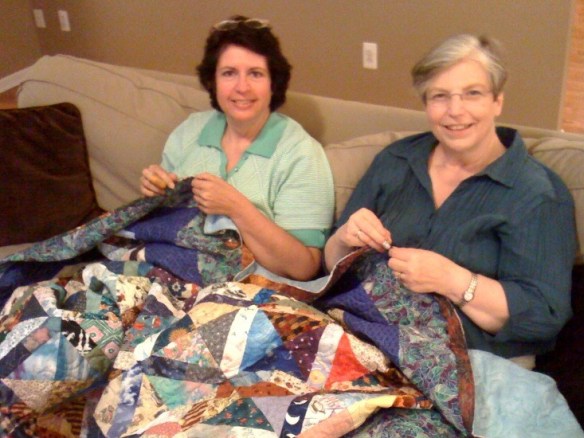
Quilt-with-Mary.jpg

When your quilt-sister helps you finish the quilt (at her son’s house) because your brother (John) had just been diagnosed with cancer and you need to have the quilt done by, literally, tomorrow morning. Yes, you might say that Mary and my families are intertwined now. Families of heart for decades, that’s for sure. Weddings, births, deaths, surgeries, Christmas Eves, memories, love. May we have many more years.

Quilt Mom's for John.jpg

A memory quilt for my brother, John, after my mother passed away. The blocks in the quilt are Mom’s clothes and linen calendar towels that she collected every year. She also gave them as gifts every year too.

Every. Single. Year.

I selected calendar towel years in which something significant happened in John’s life. There are more towels on the back too.

Quilt Mom for me.jpg

I made a quilt commemorating Mom’s life for myself too, and one for all 5 of her grandchildren. I even included a piece of my Dad’s tie that he wore walking me down the aisle – blue diagonal striped material in the right border, beside the pig towel. Yes, I grew up on a hog farm and wouldn’t trade it for the world. This quilt graces “Mom’s” bed in the spare bedroom, so keeps her grandson and family warm when they visit.

Quilt Christmas for Ronnie.jpg

A fun I-spy quilt for a senior citizen who lives in a group care facility and still loves Santa. His communication is limited but the smile on his face was a mile wide and he wants to keep this quilt on his bed year-round!

Ronnie says of his quilt, “Heaven might be like this.” I hope so Ronnie!

Quilt blue flower.jpg

Flowers for my close friend who is now cancer-free. This quilt accompanied her through the rough times, and now will see her through many wonderful years too.

Quilt-Y2K.jpg

To celebrate the new millennium and that I survived Y2K in a technology field. LHM!!!

My husband and I selected these fabrics and made this quilt before we were married. Don’t tell him, but that just might have had something to do with why I said “yes.”

Quilt-Elizabeth.jpg

When your young rescue cat, Elizabeth, at left, only 18 months old, has cancer and isn’t going to be with you very long. Elizabeth loved her soft quilt.

Both of these fur children came to live with me after abuse and starvation at the hands of a monster. Kitters, at right, still loves the quilts, now hers via right of inheritance.

Quilt Tabitha.jpg

Some quilts get loved so much they have to be patched. The original owner of this quilt, an amazing cat named Tabitha, has passed on now, but the family is still loving her quilt (and her.)

Sometimes quilts receive a Second Act that is more important, and sometimes more appreciated than the first one. Ellie and Libby, my grandpuppies, had possession of this quilt for awhile, but Kitters, Chai and Mandy, cats who are infinitely disgusted by dogs have taken possession now, when Jim isn’t napping under it. And sometimes when he is. The battle continues.

Film at 11.

Quilt Loren.jpg

This quilt went to the family of a young man who tragically perished in a housefire, along with everything in the house including their fur-family.

Another two quilts went to his mother and sister as well. I’m very negligent about taking pictures before the quilts leave for their intended homes.

Literally hundreds of these “care quilts” have been created over the years by the quilt-sisters, sometimes alone, but often working together on the spur of the moment, between jobs and families, to create a healing gift for someone in need.

Quilt-cats-help.jpg

Sometimes fur-family members get into the act too. I needed all the help I could get with the blocks of a wedding quilt!

Quilt Code Talker.jpg

This Navajo Code Talker quilt of love was made for Code Talker, USMC William Brown. Sadly, he passed over as the quilt was on its way, but it served him at his funeral in a place of honor, and now comforts his daughter.

Quilt Anniversary.jpg

A surprise by the quilt-sisters to celebrate Mary’s 50th anniversary.

Quilt Mary baby.jpg

Indeed, quilts are expressions of love to celebrate births, anniversaries and everything in-between. To commemorate lives well-lived and lost too soon. For people we know and love and “care quilts” for people we’ve never met but need a helping hand or a lift of their spirits.

Quilt Love Heart.jpg

So to answer my friend who, by now, is probably extremely sorry he asked and dozed off long ago. Quilts are the spirit of humanity, pedestrian scraps of life joined together to create beauty, but most of all, quilts are simply expressions of love.

______________________________________________________________

Disclosure

I receive a small contribution when you click on some of the links to vendors in my articles. This does NOT increase the price you pay but helps me to keep the lights on and this informational blog free for everyone. Please click on the links in the articles or to the vendors below if you are purchasing products or DNA testing.

Thank you so much.

DNA Purchases and Free Transfers

Genealogy Products and Services

Genealogy Research

Fun DNA Stuff

  • Celebrate DNA – customized DNA themed t-shirts, bags and other items

Triangulation in Action at 23andMe

Recently, I published the article, Hitting a Genealogy Home Run Using Your Double-Sided Two-Faced Chromosomes While Avoiding Imposters. The “Home Run” article explains why you want to use a chromosome browser, what you’re seeing and what it means to you.

This article, and the rest in the “Triangulation in Action” series introduces triangulation at FamilyTreeDNA, MyHeritage, 23andMe, GedMatch and DNAPainter, explaining how to use triangulation to confirm descent from a common ancestor. You may want to read the introductory article first.

This first section, “What is Triangulation” is a generic tutorial. If you don’t need the tutorial, skip to the “Triangulation at 23andMe” section.

What is Triangulation?

Think of triangulation as a three-legged stool – a triangle. Triangulation requires three things:

  1. At least three (not closely related) people must match
  2. On the same reasonably sized segment of DNA and
  3. Descend from a common ancestor

Triangulation is the foundation of confirming descent from a common ancestor, and thereby assigning a specific segment to that ancestor. Without triangulation, you might just have a match to someone else by chance. You can confirm mathematical triangulation, numbers 1 and 2, above, without knowing the identity of the common ancestor.

Reasonably sized segments are generally considered to be 7cM or above on chromosomes 1-22 and 15cM or above for the X chromosome.

Boundaries

Triangulation means that all three, or more, people much match on a common segment. However, what you’re likely to see is that some people don’t match on the entire segment, meaning more or less than others as demonstrated in the following examples.

FTDNA Triangulation boundaries

You can see that I match 5 different cousins who I know descend from my father’s side on chromosome 15 above. “I” am the grey background against which everyone else is being compared.

I triangulate with these matches in different ways, forming multiple triangulation groups that I’ve discussed individually, below.

Triangulation Group 1

FTDNA triangulation 1

Group 1 – On the left group of matches, above, I triangulate with the blue, red and orange person on the amount of DNA that is common between all of them, shown in the black box. This is triangulation group 1.

Triangulation Group 2

FTDNA triangulation 2

Group 2 – However, if you look just at the blue and orange triangulated matches bracketed in green, I triangulate on slightly more. This group excludes the red person because their beginning point is not the same, or even close. This is triangulation group 2.

Triangulation Group 3 and 4

FTDNA triang 3

Group 3 – In the right group of matches, there are two large triangulation groups. Triangulation group 3 includes the common portions of blue, red, teal and orange matches.

Group 4 – Triangulation group 4 is the skinny group at right and includes the common portion of the blue, teal and dark blue matches.

Triangulation Groups 5 and 6

FTDNA triang 5

Group 5 – There are also two more triangulation groups. The larger green bracketed group includes only the blue and teal people because their end locations are to the right of the end locations of the red and orange matches. This is triangulation group 5.

Group 6 – The smaller green bracketed group includes only the blue and teal person because their start locations are before the dark blue person. This is triangulation group 6.

There’s actually one more triangulation group. Can you see it?

Triangulation Group 7

FTDNA triang 7

Group 7 – The tan group includes the red, teal and orange matches but only the areas where they all overlap. This excludes the top blue match because their start location is different. Triangulation group 7 only extends to the end of the red and orange matches, because those are the same locations, while the teal match extends further to the right. That extension is excluded, of course.

Slight Variations

Matches with only slight start and end differences are probably descended from the same ancestor, but we can’t say that for sure (at this point) so we only include actual mathematically matching segments in a triangulation group.

You can see that triangulation groups often overlap because group members share more or less DNA with each other. Normally we don’t bother to number the groups – we just look at the alignment. I numbered them for illustration purposes.

Shared or In-Common-With Matching

Triangulation is not the same thing as a 3-way shared “in-common-with” match. You may share DNA with those two people, but on entirely different segments from entirely different ancestors. If those other two people match each other, it can be on a segment where you don’t match either of them, and thanks to an ancestor that they share who isn’t in your line at all. Shared matches are a great hint, especially in addition to other information, but shared matches don’t necessarily mean triangulation although it’s a great place to start looking.

I have shared matches where I match one person on my maternal side, one on my paternal side, and they match each other through a completely different ancestor on an entirely different segment. However, we don’t triangulate because we don’t all match each other on the SAME segment of DNA. Yes, it can be confusing.

Just remember, each of your segments, and matches, has its own individual history.

Imputation Can Affect Matching

Over the years the chips on which our DNA is processed at the vendors have changed. Each new generation of chips tests a different number of markers, and sometimes different markers – with the overlaps between the entire suite of chips being less than optimal.

I can verify that most vendors use imputation to level the playing field, and even though two vendors have never verified that fact, I’m relatively certain that they all do. That’s the only way they could match to their own prior “only somewhat compatible” chip versions.

The net-net of this is that you may see some differences in matching segments at different vendors, even when you’re comparing the same people. Imputation generally “fills in the blanks,” but doesn’t create large swatches of non-existent DNA. I wrote about the concept of imputation here.

What I’d like for you to take away from this discussion is to be focused on the big picture – if and how people triangulate which is the function important to genealogy. Not if the start and end segments are exactly the same.

Triangulation Solutions

Each of the major vendors, except Ancestry who does not have a chromosome browser, offers some type of triangulation solution, so let’s look at what each vendor offers. If you and your Ancestry matches have uploaded to GedMatch, Family Tree DNA or MyHeritage, you can triangulate with them there. Otherwise, you can’t triangulate Ancestry results, so encourage your Ancestry matches to transfer.

I wrote more specifically about triangulation here and here.

Let’s look at triangulation at 23andMe.

Triangulation at 23andMe

At 23andMe, click on “DNA Relatives” in the Ancestry dropdown at the top of your page.

Triangulation 23andMe DNA Relatives.png

You will then see your list of matches.

23andMe does offer a Mom’s side and Dad’s side option, but only if at least one of your parents has tested AND you and that parent BOTH elect to share with each other. It’s not automatic.

To view your relationship with someone on your match list, click on that person’s name. I selected a known relative on my father’s side, Stacy.

Scroll down to the “Relatives in Common” section where you will see your matches in common with the person you selected. Stacy and I have 284 matches in common.

Triangulation 23andMe shared DNA.png

You can view the relationships of the match to you, and also to the person you’ve selected.

“Yes,” in the shared DNA column indicates that you, the person you selected (Stacy) and this match share DNA on a common segment. In other words, you triangulate.

In this example, Stacy and I share a triangulated segment with my own V4 kit (of course), and with both James and Diana, but not with George or Everett. We both match James and Everett, just not on the same segment, so we don’t triangulate.

Let’s look at James. By clicking on “Yes,” I can view the chromosome browser.

Scrolling down, I see that Stacy (purple), me (background grey) and James (orange) share DNA on only one segment, on chromosome 17.

Triangulation 23andMe chromosome 17.png

That segment triangulates between the three of us. I know how I am related to Stacy, but not how I am related to James. I can tell via my matches and triangulation with James that our common segment descends to me through my Vannoy line.

Unfortunately, 23andMe does not support trees in the traditional way, but some people enter surnames and locations, and you can download some Family Search ancestors to 23andMe or place a link to a tree elsewhere. I wrote about that here.

Check your 23andMe matches for surnames, common locations and links to trees.

You can also download your 23andMe segment matches and their information by clicking on Download Aggregate Data at the bottom of your matches page. Segment matches tell you exactly where on each chromosome you match other people.

Triangulation 23andMe download.png

Segment matches is NOT the same thing as downloading your raw DNA data file to upload to another vendor. See the Transfer section for those instructions.

Other 23andMe Resources to Identify Common Ancestors

23andMe provides additional tools, noted below, with the links to instructional articles I’ve written.

Transfers

Have you tested family members, especially everyone in the older generations? You can transfer their kits from Ancestry or 23andMe if they have already tested there to MyHeritage, FamilyTreeDNA or GedMatch.

Here’s how to transfer:

I wrote recently about how to work with triangulation at FamilyTreeDNA. and MyHeritage. Join me soon for similar articles about how to work with triangulation at GedMatch and DNAPainter.

Most of all – have fun!

______________________________________________________________

Disclosure

I receive a small contribution when you click on some of the links to vendors in my articles. This does NOT increase the price you pay but helps me to keep the lights on and this informational blog free for everyone. Please click on the links in the articles or to the vendors below if you are purchasing products or DNA testing.

Thank you so much.

DNA Purchases and Free Transfers

Genealogy Products and Services

Genealogy Research

Fun DNA Stuff

  • Celebrate DNA – customized DNA themed t-shirts, bags and other items

Top 10 All-Time Favorite DNA Articles

Top 10

I’ve been writing about DNA is every shape and form for approaching 8 years now, offering more than 1200 free (key word seachable) articles.

First, thank you for being loyal subscribers or finding my articles and using them to boost your genealogy research with the power of DNA.

You may not know this, but many of my articles stem from questions that blog readers ask, plus my own genealogical research stumbling-blocks, of course.

DNAeXplain articles have accumulated literally millions and millions of page views, generating more than 38,000 approved comments. Yes, I read and approve (or not) every single comment. No, I do not have “staff” to assist. Staff consists of some very helpful felines who would approve any comment with the word catnip😊

More than twice that number of comments were relegated to spam. That’s exactly why I approve each one personally.

Old Faithful

Looking at your favorites, I’ve discovered that some of these articles have incredible staying power, meaning that people access them again and again. Given their popularity and usefulness, please feel free to share by linking or forwarding to your friends and genealogy groups.

Subscribe for FREE

Don’t forget, you can subscribe for free by clicking on the little grey “follow” box on the upper right hand side of the blog margin.

Top 10 subscribe

Just enter your e-mail address and click on follow. I don’t sell or share your e-mail, ever. I’ve never done a mass e-mailing either – so I’ll not be spamming you😊

You will receive each and every article, about 2 per week, in a nice handy e-mail, or RSS feed if you prefer.

Your Favorites

You didn’t realize it, but every time you click, you’re voting.

So, which articles are reader favorites? Remember that older articles have had more time to accumulate views.

I’ve noted the all-time ranking along with the 2019 ranking.

Starting with number 10, you chose:

  • Number 10 all-time, did not place in top 10 in 2019: Ethnicity Testing – A Conundrum – Published in 2016 – How ethnicity testing works – and why sometimes it doesn’t work like people expect it will.

Ethnicity results from DNA testing. Fascinating. Intriguing. Frustrating. Exciting. Fun. Challenging. Mysterious. Enlightening. And sometimes wrong. These descriptions all fit. Welcome to your personal conundrum! The riddle of you! If you’d like to understand why your ethnicity results might not have … Continue reading →

  • Number 9 all time and number 4 in 2019: How Much Indian Do I Have in Me? – Published in 2015 – This article explains how to convert that family story into an expected percentage.

I can’t believe how often I receive this question. Here’s today’s version from Patrick. “My mother had 1/8 Indian and my grandmother on my father’s side was 3/4, and my grandfather on my father’s side had 2/3. How much would … Continue reading →

  • Number 8 all-time, did not place in top 10 in 2019: 4 Kinds of DNA for Genetic Genealogy – Published in 2012 – Short, basic and THE article I refer people to most often to understand DNA for genealogy.

Let’s talk about the different “kinds” of DNA and how they can be used for genetic genealogy. It used to be simple. When this “industry” first started, in the year 2000, you could test two kinds of DNA and it was … Continue reading →

Yep, there’s a gene for these traits, and more. The same gene, named EDAR (short for Ectodysplasin receptor EDARV370A), it turns out, also confers more sweat glands and distinctive teeth and is found in the majority of East Asian people. This is one … Continue reading →

  • Number 6 all-time, did not place in top 10 in 2019: What is a Haplogroup? – Published in 2013 – One of the first questions people ask about Y and mitochondrial DNA is about haplogroups.

Sometimes we’ve been doing genetic genealogy for so long we forget what it’s like to be new. I’m reminded, sometimes humorously, by some of the questions I receive. When I do DNA Reports for clients, each person receives a form to … Continue reading

  • Number 5 all-time and number 10 in 2019: X Marks the Spot – Published in 2012 – This article explains how to use the X chromosome for genealogy and its unique inheritance path.

When using autosomal DNA, the X chromosome is a powerful tool with special inheritance properties. Many people think that mitochondrial DNA is the same as the X chromosome. It’s not. Mitochondrial DNA is inherited maternally, only. This means that mothers … Continue reading →

  • Number 4 all-time, did not place in top 10 in 2019: Ethnicity Results – True or Not? – Published in 2013 – Are your ethnicity results accurate? How can you know, and why might your percentages reflect something different than you expect?

I can’t even begin to tell you how many questions I receive that go something like this: “I received my ethnicity results from XYZ. I’m confused. The results don’t seem to align with my research and I don’t know what … Continue reading →

  • Number 3 all-time and number 1 in 2019: Concepts – Calculating Ethnicity Percentages – Published in 2017 – With the huge number of ethnicity testers, it’s no surprise that the most popular article discussed how those percentages are calculated.

There has been a lot of discussion about ethnicity percentages within the genetic genealogy community recently, probably because of the number of people who have recently purchased DNA tests to discover “who they are.” Testers want to know specifically if ethnicity percentages are right … Continue reading →

  • Number 2 all-time, did not place in top 10 in 2019: Which DNA Test is Best? – Published in 2017 – A comprehensive review of the tests and major vendors in the genetic genealogy testing space. The answer is that your testing goals determine which test is best. This article aligns goals with tests.

If you’re reading this article, congratulations. You’re a savvy shopper and you’re doing some research before purchasing a DNA test. You’ve come to the right place. The most common question I receive is asking which test is best to purchase. There is … Continue reading →

Every day, I receive e-mails very similar to this one. “My family has always said that we were part Native American.  I want to prove this so that I can receive help with money for college.” The reasons vary, and … Continue reading →

2019 Only

Five articles ranked in the top 10 in 2019 that aren’t in the top all-time 10 articles. Two were just published in 2019.

  • Number 8 for 2019: Migration Pedigree Chart – Published in 2016 – This fun article illustrates how to create a pedigree charting focused on the locations of your ancestors.

Paul Hawthorne started a bit of a phenomenon, whether he meant to or not, earlier this week on Facebook, when he created a migration map of his own ancestors using Excel to reflect his pedigree chart. You can view … Continue reading →

Just as they promised, and right on schedule, Family Tree DNA today announced X chromosome matching. They have fully integrated X matching into their autosomal Family Finder product matching. This will be rolling live today. Happy New Year from Family … Continue reading →

  • Number 6 for 2019: Full or Half Siblings – Published in April 2019 – Want to know how to determine the difference between full and half siblings? This is it.

Many people are receiving unexpected sibling matches. Every day on social media, “surprises” are being reported so often that they are no longer surprising – unless of course you’re the people directly involved and then it’s very personal, life-altering and you’re … Continue reading →

Ancestry’s new tool, ThruLines has some good features and a lot of potential, but right now, there are a crop of ‘gators in the swimmin’ hole – just waiting for the unwary. Here’s help to safely navigate the waters and … Continue reading →

One of the most common questions I receive, especially in light of the interest in ethnicity testing, is how much of an ancestor’s DNA someone “should” share. The chart above shows how much of a particular generation of ancestors’ DNA … Continue reading →

In Summary

Taking a look at a summary chart is interesting. From my perspective, I never expected the “Thick Hair, Small Boobs” article to be so popular.

“Which DNA Test is Best?” ranked #2 all time, but not in the 2019 top 10. I wonder if that is a function of the market softening a bit, or of fewer people researching before purchasing.

I was surprised that 5 of the top 10 all-time were not in the top 10 of 2019.

Conversely, I’m equally as surprised that 3 of the older 2019 articles not in the all-time top 10.

I’m very glad these older articles continue to be useful, and I do update them periodically, especially if I notice they are accessed often.

Article All-time Top 10 2019 Top 10
Ethnicity Testing – A Conundrum 10 0
How Much Indian Do I Have in Me? 9 4
4 Kinds of DNA for Genetic Genealogy 8 0
Thick Hair, Small Boobs, Shovel Shaped Teeth, and More 7 9
What is a Haplogroup? 6 0
X Marks the Spot 5 10
Ethnicity Results – True or Not? 4 0
Concepts – Calculating Ethnicity Percentages 3 1
Which DNA Test is Best? 2 0
Proving Native American Ancestry Using DNA 1 2
Migration Pedigree Chart 0 8
X Chromosome Matching at Family Tree DNA 0 7
Full or Half Siblings Published in 2019 6
Ancestry’s ThruLines Dissected: How to Use and Not get Bit by the ‘Gators Published in 2019 5
Ancestral DNA Percentages – How Much of Them is in You? 0 3

What Would You Like to See in 2020?

Given that your questions are often my inspiration, what articles would you like to see in 2020?

Are there topics you’d like to see covered? (Sorry, I don’t know the name of your great-great-grandfather’s goat.)

Burning questions you’d like to have answered? (No, I don’t know why there is air.)

Something you’ve been wishing for? (Except maybe for the 1890 census.)

Leave a comment and let me know. (Seriously😊)

I’m looking forward to a wonderful 2020 and hope you’ll come along!

_____________________________________________________________

Disclosure

I receive a small contribution when you click on some (but not all) of the links to vendors in my articles. This does NOT increase the price you pay but helps me to keep the lights on and this informational blog free for everyone. Please click on the links in the articles or to the vendors below if you are purchasing products or DNA testing.

Thank you so much.

DNA Purchases and Free Transfers

Genealogy Services

Genealogy Research

Michael McDowell (c1747-1840): Elusive Death Record – 52 Ancestors #267

While an ancestor’s death record might not seem like much to write about – Michael’s is – at least to this descendant.

We’ve looked for informatoin about his death for what seems like forever.

Michael was a Revolutionary War pensioner, so you’d think his death would be recorded in his pension records.

Nope.

Maybe on the Tennessee roster of pensioners and payments?

Nope.

Well, then was he listed in the 1840 census in someone’s household as having been a pensioner?

Nope.

1839 and 1840

I knew that Michael was taxed in Claiborne County, Tennessee in 1839 for 40 acres of land total, and that on June 20th, 1840, Michael sold 2 of those 40 acres to his granddaughter Margaret Herrell and her husband, Anson Martin.

Michael would have been 93 or 94 years years old. He was not listed individually in the 1840 census, but that’s not surprising. If he was alive, he would probably have been living with one of his children – at least one would presume, especially if his wife was deceased or equally as elderly too.

Michael doesn’t appear in his sons’ households, but in 1840, Rev. Nathan S. McDowell, not a son but possibly a grandson, has a male of age 80-90 that could be Michael living with him.

I would have thought that were the man living with Nathan, Michael, he would have been listed as a pensioner, but there was no such listing on the second census page.

Therefore, I initially figured that Michael gone by the census enumeration date of June 1st until I realized he sold land on June 20th, so he was very clearly alive then. Not only that, but he was healthy enough to sign the deed, possibly going to town to do so.

Given that information, Michael’s military service had probably simply been overlooked in the census. After all, he was a quite elderly man.

Obviously, the census can’t be taken everyplace on the same day, so the census is taken as of a specific date. At the end of the Claiborne County census, it’s signed as being completed as of October 1.

Maybe Michael had died between June 20th and October 1st? If that was the case, then who was that man living with Nathan and if it was Michael, why was his military service overlooked? Something doesn’t add up.

Speaking of adding up, even more confounding is the fact that Michael apparently died owning 38 acres of land.

Why was there no will or probate in the Will and Probate books? Why was there no deed recorded? One or the other had to have happened. You can’t just die owning land and have it flopping around in a the state of limbo. SOMEONE had to own it which means that the disposition of Michael’s estate had to be managed by an executor or administrator unless Michael sold the land before his death. But there’s no record of that either.

Surely, at his age, Michael had prepared a will? One would think.

Ummm, nope.

Michael was obviously an optimist.

Court Notes

The Claiborne County Court Notes are not indexed and published, at least not completely. I decided to read them page by page because I had at least three ancestors who died in the span of a decade or so, and I wanted to obtain as much information as possible.

In Michael’s case, I was hoping that I would find some evidence of at least a year, and maybe a month that he died.

I found quite a few McDowell references.

Michael’s son John was assigned as a road hand or was responsible for overseeing road maintenance. He was allowed to purchase a sledge hammer to break up unyielding rocks in the road. Backbreaking work, and Michael would have done that as a younger man. But that’s not what I was looking for.

I discovered that Nathan McDowell had a “sugar camp.” Interesting, but that’s not what I was looking for.

John, Michael’s son, and Nathan were assigned as jurors in court several times, commissioners and even guardians. That’s not what I was looking for either.

John P. McDowell, also related and probably a grandson, not to be confused with John McDowell was assigned as a Justice of the Peace. Still not finding what I was looking for.

But then…there it was.

The Death Record

On Monday, September 7, 1840, William McDowell, in his first court record ever, appeared in court at Tazewell, gone to do a son’s sad duty.

Michael McDowell death.png

Satisfactorily evidence was produced in open court to prove that Michael McDowell a pensioner departed this life on the 6th day of July 1840 and there upon came William McDowell and took upon himself the administration of said estate who gave bond and security that was accepted by the court after taking the oath requested by law.

Wow, that’s wonderful – not that Michael died of course – but that we found evidence of when. Happy dancing a little jig.

Hmm, I wonder was constituted “satisfactory evidence.” If Michael had a will, it would have stated that a will was produced, so there was none.

William McDowell was administrator, so that would mean an inventory would be filed. We’ll be able to see what Michael owned. We’ll discover what happened to his land, and we’d know if Isabel outlived Michael. It’s possible since a female of the same age was living with daughter Mary McDowell who was married to William Herrell.

Dead Silence (Pardon the Pun) and Unresolved Questions

I read the court notes through 1842 and nothing at all.

Nothing.

Nada.

How is that even possible when an administrator WAS appointed. There had to be assets or an administrator would not have been required, nor would bond and security.

I discovered that the court records through 1850 had been at least semi-indexed by WPA back in the 1930s, but nothing there either.

One question answered, and several left twisting in the wind, like fall’s final leaves.

Michael died only 17 days after selling 2 acres to his granddaughter and that deed was recorded. Furthermore, Michael clearly had $50, a substantial sum in addition to his pension payments. That cash would surely need to be accounted for. Michael was no pauper.

Isabel could have still been alive and they had at least 6 living children, and possibly more, to share an estate. I had hoped to obtain a full list of Michael’s legatees in an estate settlement, but that didn’t happen either☹

Rats!

Perhaps Michael had already given all his possessions away?

Buried on Slanting Misery

Standing at the top of the hill on Michael’s land, aptly named Slanting Misery, you’d never know you were overlooking the cemetery where Michael is assuredly buried.

Claxton land from Slanting Misery

The family stood in Michael’s field under that cedar tree, directly between me and the barn, on July 6th, or 7th at the latest, in the mid-summer heat of 1840, dug a grave and said their final farewells. Reverend Nathan S. McDowell likely preached Michael’s funeral sermon about everlasting life with a final Amen.

The heat was likely oppressive in the heavy clothing of the time, and the funeral probably correspondingly short.

Michael’s granddaughter, Margaret Herrell Martin who bought land just days before was probably pregnant for a child who would soon be laid to rest beside her beloved grandfather.

Margaret would have sheltered her 6 stair-step children as they ceremonially dropped their single handfuls of dirt onto the planks of their great-grandfather’s coffin after the wooden box was lowered into his grave – as was the custom.

Ashes to ashes, dust to dust.

No stone marked Michael’s final resting place, or if one did, it was a wooden cross or a fieldstone. Perhaps that Cedar tree was planted in Michael’s honor or memory, to shade family members who came to visit.

Michael’s remaining acreage, along with his human remains, simply melted back into the remote, achingly beautiful, mysterious, Slanting Misery.

______________________________________________________________

Disclosure

I receive a small contribution when you click on some of the links to vendors in my articles. This does NOT increase the price you pay but helps me to keep the lights on and this informational blog free for everyone. Please click on the links in the articles or to the vendors below if you are purchasing products or DNA testing.

Thank you so much.

DNA Purchases and Free Transfers

Genealogy Products and Services

Genealogy Research

Fun DNA Stuff

  • Celebrate DNA – customized DNA themed t-shirts, bags and other items

Y DNA: Part 1 – Overview

This is Part 1 of a series about Y DNA and how to use it successfully for genealogy.

If you’re in need of a brief DNA testing overview, please read 4 Kinds of DNA for Genetic Genealogy.

Y DNA testing has so much to offer. In this overview article, I’m touching briefly on each of the major functions and features of Y DNA testing. Following articles in this series will focus on how to utilize each tool for genealogy and harvesting every snippet of information available.

If you have Y DNA results, you can sign on to your account at Family Tree DNA and follow along. Throughout these articles, we’ll step through every tab and function, how to use them, and what they mean to you.

What is Y DNA and Why Do I Care?

Y DNA is what makes males, well, male.

The 23rd pair of human chromosomes consists of an X and a Y chromosome.

Female children inherit an X from both parents.

Male children inherit an X chromosome from their mother, but a Y from their father.

Generally, the Y chromosome follows the male surname line, so Estes males pass their Estes Y chromosome to their sons.

When adoptions occur, of course the surname of record does not match the biological surname associated with the Y chromosome – which is exactly why male adoptees take Y DNA tests.

Inheritance Path

In the example below, you can see that the light blue Y chromosome is passed from father to son to son to son to the male child in the current generation.

Y overview inheritance path

Click to enlarge

The dark blue maternal great-grandfather in this example also passes his Y chromosome to his son, but it stops there since the next generation in this tree is a female.

The light blue son at the bottom inherits a Y chromosome from his father, from ancestors all the way up that light blue line – along with his surname. The daughter doesn’t receive a Y chromosome nor do any females.

If you’re a male, you can test your own Y DNA of course.

If you’re a female, like the daughter, above, you must find a male in the line you seek to test. In this case, the brother, father, grandfather, paternal uncles and so forth represent her father’s Y DNA.

If you want information from any of the Y chromosome lineages in this chart that you don’t personally carry, you must find a male descended directly patrilineally from that line to test. It’s generally fairly easy to identify those people, because they will also carry the relevant surname. There are several examples in the article, Concepts – Who to Test for Your Father’s DNA.

Every Y DNA line has its own unique story for genealogists to harvest – assuming we can find an appropriate candidate for testing or find someone who has already tested. We’ll talk about how to see if your line may have already tested in the Projects section later in this article.

Why Y DNA Works

Y DNA is inherited from the patrilineal line directly. Unlike autosomal DNA, there is no genetic contribution from any females.

This uniquely male inheritance path allows us to use Y DNA for matching to other males beginning with the first generation, the father, then reaching back many generations providing a way to view our ancestral heritage beyond the line-in-the-sand boundary of surnames.

In other words, because Y DNA is not mixed with any DNA from the mothers, it’s very nearly identical to our patrilineal ancestors’ Y DNA – meaning it matches that of the father, and grandfather, reaching back many generations.

Some people, especially new autosomal testers, believe that Y DNA is ONLY useful for deep ancestry and not for genealogy. That’s ENTIRELY mistaken. Y DNA is extremely important in confirming descent from known ancestors. In fact, without Y DNA, you can’t tell the difference with autosomal testing between a child born to a male and a child born to the female of a couple. I wrote about that hereNo one wants to spend years barking up the wrong tree.

Y DNA testing is also the single best way to push the Y DNA genealogy back further in time. It can and does identify the geographic source, overseas, of the DNA lineage, through matches to other testers as well as haplogroup matches. These are things autosomal DNA simply cannot accomplish.

In fact, Y DNA did exactly that for my own Speak(es) line, connecting us genetically to the Speak family from Downham, Lancashire, England which then facilitated discovering the actual baptism document of our immigrant ancestor. Finding our English geographic source had eluded researchers for decades. A year later, a group of 20+ descendants visited Downham and stood in that very church.

Speak Family at St Mary Whalley

There simply is no better success story.

Migration Path Identified

Not only can Y DNA confirm recent ancestors and find ones more distant, by tracing a series of mutations, we can track our ancestor over time beginning with Y Line Adam, born in Africa tens of thousands of years ago to that church in an ancestral country and then to where we are today.

Y overview migration path.png

Mutations Happen

If mutations never occurred, the Y DNA of all males would be identical and therefore not useful for us to use for genealogy or to peer back in time beyond the advent of surnames.

Mutations do occur, just not on any schedule. This means that it’s difficult to predict how long ago we shared a common ancestor with someone else based solely on Y DNA mutations – although some types of mutations are better predictors than others.

A mutation might occur between a male and his father, or there might be no mutations for hundreds or even, potentially, thousands of years – depending on the marker type.

For example, in the Estes DNA project, one group of men have no STR (short tandem repeat) mutations in 8 generations. Others have several in the same number of generations.

Part of the success of matching genealogically with Y DNA testing has to do with:

  • The type of markers tested
  • The number of markers tested – testing fewer marker locations results in matches that are much less specific and therefore less relevant.
  • The luck of whether anyone else from your line has tested

The best results are between men who have taken the Big Y-700 test which provides for the largest number of STR markers and all SNPs (single nucleotide polymorphisms) , both previously known and discovered individually during that person’s Big Y test result.

Let’s take a look at the two different kinds of Y DNA markers and their mutations.

Two Kinds of Mutations

Y DNA can be tested for two different kinds of mutations, STR (short tandem repeat) markers and SNPs (single nucleotide polymorphisms.)

All DNA is comprised of four different nucleotides, abbreviated by A, C, G and T.

  1. A=adenine
  2. C=cytosine
  3. G=guanine
  4. T=thymine

When mutations take place, they can take the form of three types of mutations:

  • A deletion occurs when a nucleotide, or multiple nucleotides, fail to copy during reproduction. Therefore, that location or locations are then blank, with no DNA at that location permanently.
  • A replacement occurs when a nucleotide is replaced or swapped out with a different nucleotide. For example, an A could be replaced with one of the other nucleotides, and so forth.
  • An insertion occurs when a nucleotide or a group of nucleotides is duplicated and inserted between existing nucleotides.

Let’s look at how this actually works.

Indel example 1

Here’s an example segment of DNA.

A deletion would occur if the leading A (or a series of nucleotides) were simply gone.

Indel example 3

A replacement would occur if the first A above were to change to T or G or C as in the example below:

Indel example 2

A replacement is a SNP mutation.

An insertion would be where DNA is inserted between existing nucleotide locations.

STR example

Note the extra red CTs that have been inserted. Specifically, 4 extra CTs, for a total of 5 sets of CT. This is the definition of a STR, a short tandem repeat mutation.

STR markers, known as short tandem repeats, accrue what are similar to copy machine errors. This occurs when a specific segment of Y DNA gets repeated several times in a row. In other words, the copy machine gets stuck.

STR Markers

We purchase STR Y DNA tests from Family Tree DNA grouped into panels that include a specific number of markers.

Y overview STR results

Example of 37 marker results – click to enlarge

These panels consist of the following number of marker locations:

  • 12 markers (now obsolete)
  • 25 markers (now obsolete)
  • 37 markers
  • 67 markers (replaced by 111)
  • 111 markers
  • 500 markers bundled as part of the now-obsolete Big Y-500
  • 700 markers bundled with the Big Y-700

The more markers purchased, the more data points to be compared, and the more relevant and convincing the results.

What Matches See

The STR matches and SNP matches look different on the tester’s results page.

Y overview matches

Click to enlarge

People whom you match on STR panels can see that you do match, if you’ve opted-in to matching, but they can’t see specific differences or mutations. They see the name you’ve entered for yourself, your earliest known ancestor and your match can send e-mail to you. Aside from that, they can’t see your results or mutations unless you’ve joined a public project.

Y overview project

Click to enlarge

Within projects, participant names cannot be listed publicly. In other words, your matches can’t tell that it’s you unless you tell them your kit number or they recognize your earliest known ancestor on the project page and you are the only person with that ancestor.

The Big Y-700 test tests all STR markers in addition to scanning the entire Y chromosome for all SNP (haplogroup defining) mutations. They have the STR matches page like everyone else, but they also have an additional Big Ypage.

People who have taken the Big Y test see a different view of matches on their Big Y matches tab. This is true for either the original Big Y, Big Y-500 which includes a minimum of 500 STR markers or the current Big Y-700 test which includes a minimum of 700 STR markers. (You can always upgrade to the Big Y-700 from earlier tests.)

Y overview Big Y.png

For SNP markers only, above, Big Y matches can see who they match and the SNPs they do and don’t match with that person in common.

For STR markers available only under the Big Y umbrella, meaning above 111 markers, results are displayed under the Y DNA Matches tab in the Big Y STR Differences column, below.

Y overview Big Y STRs

Click to enlarge

You can easily see that only one man on this match list has also taken the Big Y test, and he had 2 differences out of 440 markers. That’s in addition to 2 differences in the first 111 markers, for a total of 4 differences (mutations) in 551 markers.

Researching Without Testing

The great news is that even if you’ve just ordered your test and are waiting for results, you can research and join projects now.

For that matter, you can research using public projects without testing by going to the main Family Tree DNA webpage, scroll down and simply entering the surname of interest into the search box.

New dashboard surname search

You’ll be directed to surname projects where you can view ancestors and results of anonymized project members.

Give it a try to see what comes up for your surnames of interest.

Project Results

Projects at Family Tree DNA provide testers with access to volunteer administrators who help users with various types of information. Administrators also cluster users in projects that are meaningful to their research.

Most Y DNA testers immediately join their surname project.

Using the Estes surname project as an example, you can see that I’ve grouped the project members in ways I feel will be helpful to their genealogy.

Y overview Estes project.png

The Paternal Ancestor Names are particularly helpful to testers as well as people who are interested in testing in order to determine whether or not they are descended from a specific line.

It’s very useful to be able to discern if someone from your line has already tested – because it provides someone for you to match against, or not, as the case may be.

Y overview hap C project.png

The haplogroup C-P39 Y DNA project is shown above with the Paternal Ancestor Name as provided by testers that reflects Native American and First Nations ancestors.

Another important project feature is the project map function, allowing testers in a specific haplogroup (C-P39 below) to view the locations of the earliest known ancestors of other members of the same haplogroup – whether project members match each other or not. Your Native ancestors traveled with theirs and descended from a common ancestor. Cool, huh!

Y overview C map.png

What’s the story associated with the pin distribution of the C-P39 project, above? I wish we knew, and we may someday as research progresses. Whatever it is, it’s probably important genealogically.

Another type of project to join is a geographical or interest group project.

The Acadian AmerIndian Project welcomes descendants who have tested the Y, autosomal and/or mitochondrial DNA of the various Acadian families which includes French and English settlers along with First Nations indigenous ancestors.

Y overview Acadian.png

The map below shows the distribution of Y DNA members of the Acadian Amerindian project diaspora before and after Le Grand Dérangement” that scattered their descendants to the winds.

Y overview Acadian map.png

The pins on the Acadian Amerindian project map above are color coded by haplogroup.

Projects such as this facilitate genealogists discovering the haplogroup and related information about their direct line ancestor without personally testing.

Y overview Doucet.png

For example, if Germain Doucet born about 1641, part of the mustard-colored group above, is my ancestor, by viewing and/or joining this project, I can obtain this information about my ancestor. Project members can see more than casual browsers, because some testers only choose to display results to other project members and some projects are private, with results only displayed to project members. Many surname projects accept descendants who don’t carry the surname itself.

I obviously can’t personally test for Germain Doucet’s Y DNA myself, but thankfully, others who do descend patrilineally from Germain Doucet have been generous enough to test and share by joining this project.

Furthermore, I can contact the tester through the project administrator(s) and gain a great cousin with potentially LOTS of information.

Just think how useful Y DNA would be to genealogists if everyone tested!

Finding Projects to Join

I encourage all testers to join appropriate haplogroup projects. Often, more than one haplogroup project exists for each Y DNA letter, such as C or R. Generally, there are many subgroups for each core haplogroup and you may want to join more than one depending on your results.

I encourage testers to browse the selections and join other interest projects. For example, there are projects such as the Anabaptist Project which focuses on an endogamous religious sect, French-Swiss which is regional, or the American Indian project for people researching Native ancestry, in addition to relevant surname and haplogroup project(s). There are more than 10,000 total (well-organized) projects to choose from.

Your project selections may be a huge benefit to someone else as well as to your own research. Y DNA testing and matching is your best bet for jumping the pond and finding connections overseas.

How to Join Projects

Sign on to your personal page at Family Tree DNA and click on myProjects at the top, then on “Join A Project.”

Mitochondrial DNA join a project

Next, you’ll see a list of projects in which your surname appears. These may or may not be relevant for you.

Y overview project list

Click to enlarge

You can search by surname.

Y overview surname search.png

More importantly, you can browse in any number of sections.

Y-overview-project-categories.png

For Y DNA, I would suggest specifically surnames, of course, Y DNA haplogroups along with Y DNA Geographical Projects, and Dual Geographical Projects.

Y overview haplogroup alpha

Click to enlarge

When you find a project of interest, click to read the description written by the volunteer administrators to see if it’s a good fit for you, then click through to join.

Next Article in the Series

Of course, you’re probably wondering what all of those numbers in your results and shown in projects mean. The next article in a couple weeks will address the meaning of STR marker results.

Testing

If you haven’t yet Y DNA tested and you want to know what secrets your Y DNA holds, you can order your Y DNA test here.

_____________________________________________________________

Disclosure

I receive a small contribution when you click on some (but not all) of the links to vendors in my articles. This does NOT increase the price you pay but helps me to keep the lights on and this informational blog free for everyone. Please click on the links in the articles or to the vendors below if you are purchasing products or DNA testing.

Thank you so much.

DNA Purchases and Free Transfers

Genealogy Services

Genealogy Research

Y2K Twenty Years On

Y2K

Just looking at those 3 characters, 2 letters and 1 number, probably caused you to do one of three things:

  • Cringe reflexively (that’s me)
  • Roll your eyes, thinking, “what a nothingburger”
  • Wonder, what’s Y2K?

Twenty years ago last evening, I spent the day, and night, fully awake and worrying. Probably obsessing is more like it.

I was responsible for the smooth transition of several governmental clients into the new millennium – and that meant, specifically, making sure we had found and addressed all of the potential Y2K bugs and issues both apparent and inherent.

Y2K, for those of you young whippersnappers in category three, was a computer issue in which the date did not roll correctly from the last day of 1999 to the first say of the year 2000 – the new millennium. Specifically, the date incremented to 1900 (best case,) not 2000. Computers failed and came crashing to a halt with all types of unexpected issues, a combination of both hardware and software – operating systems and applications both.

If you’re thinking to yourself, “how stupid,” there were actually good historical reasons that happened, given the few bytes of memory that programmers had to work with in the decades before the year 2000. Ah, the law of unintended consequences. No one thought about or imagined that foundation code would still be in use decades later. But, it worked and it was.

The biggest issues turned out to be in buried or embedded systems – like systems used in wastewater treatment plants. Systems that literally no one thought about until they stopped working for some reason.

If you’re in category two and think that absolutely nothing happened, that’s not quite accurate either. Lots of things either didn’t work or didn’t work correctly – especially interconnected dependent systems.

More to the point, the very REASON that nothing catastrophic happened is exactly because of the thousands of people who did obsess, who did prepare and who, like me, sat watch just in case. Fortunately, few had to spring into action.

Y2K was a nothingburger because we were successful.

You can read more about Y2K, what did and didn’t work, here.

I Almost Forgot

It’s somehow ironic that I almost forgot about this significant anniversary. Not only did Y2K consume about 2 years of my professional life, ramping up to what we surely hoped was literally nothing at all, Y2K also culminated the literal “decade from Hell” for me personally.

I was incredibly glad to see the new millennium arrive, shepherding out the old and welcoming new opportunity. A transition I desperately needed.

Here’s my Y2K story. What’s yours?

Where were you and what were you doing?

The 1990s

The 1990s began with so much promise. I was living the dream; all-American kids who danced and played football, white picket fence home with a few cats and 2 rescue dogs, along with my husband as my business partner in a high-tech consulting firm. However, tragedy quickly reared its ugly face.

In 1978, I had found my only sister and become quite close. In June of 1990, Edna, who had survived breast cancer, or so we thought, died of a massive heart attack while on vacation in another state. Her loss struck at the core of my being, a devastating loss. I would stand in the hot summer sun burying her ashes, only having 12 short years with her.

My beloved step-father’s health began declining.

In June of 1993, my husband, young and vibrant, in his 40s, suffered a stroke, but didn’t die. We would find a way to survive, feeling like we escaped a very close call.

A month later, in July, he suffered a second, massive stroke, but still didn’t die. Your reaction might be that was good – but trust me – his quality of life was terribly diminished. He was paralyzed and his brain was approximately half destroyed. There was no recovery. That stroke upended the life of everyone in our family, permanently, in indescribable ways.

In the blink of an eye, I became the only bread-winner, inheriting all of the bills while losing his income, plus his massive medical bills. Oy! I had to figure out how to provide full time care for a severely disabled spouse – and work at the same time.

Not to mention, I had children who suffered immensely and whose needs didn’t abate because their parents had become incredibly challenged.

In September of 1994, my step-father died.

My mother struggled, and a year later, she left the farm and moved to town.

You might guess that I was reeling by this time – and you’re right, I was.

Everyone in my family was struggling mightily.

I was and am incredibly grateful for my high-tech profession and the ability it afforded me to work in a less-structured environment – meaning not 8-5, 5 days a week. I don’t think I would have survived otherwise. My clients were incredibly helpful and understanding, and did not abandon me when I needed them most.

My son and husband both were volunteer firefighters. God bless them all, including the fine people of the Church of Jesus Christ of Latter-day Saints, better known as the Mormons, of which I am not and was not a member. I was, however, a regular weekly visitor to the Family History Center at the local church and they stepped forward to help.

We were in desperate need for so much help. I, we, would not have survived that first year without them, all of our friends. Nothing in my small 1960s ranch home was wheelchair accessible – but a few months later, it was, allowing my husband to come home, at least for awhile.

My life, however, was upside-down and in a constant state of turmoil where it would remain for the next several years.

Y2K

People didn’t think much about Y2K until about 1998 or so. Generally, there was a widespread belief that either nothing would happen because it was nothing but a lot of hype, or software vendors would magically ‘take care of it.” It wasn’t until we began actually testing hardware, specifically specialized governmental hardware and software combinations that we discovered problems that no one even thought about.

For example, a small computer controlled a drawbridge that raised and lowered the bridge for ships to pass beneath. That “computer” didn’t look like a computer, per se, and no one even thought about the fact that it had an embedded clock and/or date. It did, and yes, when testing, we made the discovery that it wouldn’t work. However, that system was so old there was no “fix” and another solution had to be found, and quickly.

I developed a Y2K evaluation process for governmental clients and prayed that we had unearthed all of the potential issues. If not, then my next prayer was that no one got hurt. That the issues weren’t with something like stop lights, railroad crossing signals or anything that could endanger people.

No Vacation

After I thought I had everything Y2K in hand and was attempting to plan a vacation, to Machu Picchu, to welcome in the millennium far away from any computer, my client announced that they had a different idea entirely.

They did not wish me to be absent.

What I had not told my client was that the visit wasn’t just to be a vacation, but potentially a wedding.

That’s kind of when everything began to unravel, like dominoes falling in a row.

I stepped outside at a client’s office to take a “difficult” personal phone call when I turned around to discover the client standing behind me. He didn’t mean to eavesdrop, but given what had just transpired, and the fact that I was in tears, he couldn’t exactly ignore the situation.

Suffice it to say that neither the trip, nor wedding, was going to take place.

Don’t ever say, “what the hell else can go wrong?” because fate always takes that as a challenge.

We began counting down to the great unknown of Y2K.

Thanksgiving 1999

The phone woke me ringing at 4:32 AM. Those calls are never good news.

However, I was on call for clients – but the chances of a client calling me before 5AM on Thanksgiving was virtually slim to none.

I grabbed the phone.

“Hello”.

In response, my mother said one word, my name, like she didn’t know what else to say.

I barely recognized her voice.

I knew something was very, very wrong.

“Mom, what’s wrong?”

“Gary’s dead.”

Gary was my brother.

I got in my car and drove home, immediately.

Investigators were everyplace.

Gary died unexpectedly, in suspicious circumstances.

The events surrounding Gary’s death would ricochet through my family like a deadly, stray, bullet – and never be resolved.

Christmas Cometh

We were literally counting down, day by day then hour by hour to Y2K. What was initially circumspect confidence on the part of my municipal clients had turned to nervous paranoia – and not necessarily without reason.

Other municipalities continued to find previously undiscovered issues, especially with custom code, sending everyone scurrying to check and recheck everything.

Everyone wanted me to be on site at the same time the last few weeks of the year. If I could have cloned myself, I would have made a small fortune.

Mom was driving to my house on the 22nd for Christmas because I had to work the day before and after. In fact, Mom was pretty much in charge of Christmas that year, because I couldn’t be.

On the morning of December 21st, my phone rang again.

Mom called to inform me that her brother, Lore, had died.

Lore’s death wasn’t exactly unexpected, given that he suffered from advanced Alzheimer’s. His death had been approaching for a long time. In many ways, it was a release. However, for numerous reasons, the timing was terrible .

Lore was mother’s only sibling, and his death left mother as the last of her generation.

Mom never got over Dad’s passing in 1994 and Gary’s death was less than a month old when Lore died. I wasn’t with her when this news arrived and Mom was already feeling extremely sad.

I was entirely overwhelmed.

Worse yet, the funeral was to take place on Christmas Eve – in North Carolina – a day and a half drive from where Mom lived – on icy roads. Who schedules a funeral on Christmas Eve anyway??? Mom made it clear that she was going, with or without us.

Thankfully, my only living sibling and his wife stepped up to the plate and drove Mom to North Carolina, over ice covered mountain roads for her brother’s funeral. Mom could do nothing but cry, for days.

In my world, in 1999, Christmas simply didn’t exist.

New Year’s Eve

While the rest of the world was celebrating the arrival of the new millennium, I was preparing to handle a disaster.

I didn’t know what disaster, but given the way my life had been unraveling recently, I was just SURE that I’d be dealing with SOME disaster.

Y2K Best Buy

Thanks to cousin Kelly for this memory:)

We tested and tested and retested in the days before New Year’s Eve. Every governmental and military agency had people on site and on stand-by with backup plans for how to function if necessary. Emergency preparedness fully deployed.

In the days of inter-dependence, no person and no governmental unit is or was an island.

We began by watching municipalities as the international date line began to roll over to January 1. Our major concern was the power grid.

The first large city was Sydney, Australia. I watched the celebrations closely and carefully, not the fireworks, mind you, but the news channels.

I’ve never watched more New Year’s Eve celebrations in my entire life.

Finally, it was time in Europe, then Iceland, then in Maritime Canada, then in the eastern US. The ball dropped.

Nothing major.

Then, it was time for my clients.

I held my breath.

Nothing, absolutely nothing.

What a HUGE relief.

Finally, about 5 AM, I fell asleep – Champagne untouched.

Epilogue

Y2K came to represent much more in my life than a technology issue. The arrival and non-event of Y2K itself heralded a new millennium – and a new beginning.

The 1990s were indescribably brutal, both due to the unexpected illnesses and deaths, and the surrounding circumstances.

I left that behind when 2000 arrived.

I never thought much about where I would be or what I would be doing in another two decades.

Two decades earlier, on New Year’s Eve of 1980, I would celebrate a milestone of a different sort – my first New Year’s Eve after having moved away from Indiana. I don’t recall what I did, exactly, but my life was new, a bit frightening and full of hope. Wonderful career opportunity in a new location – making new friends.

At Y2K, I was ever so grateful to be shed of the 1990s and that 2000 entered sheepishly, with no fanfare of the type I had been fearing. It was almost like we were being mocked for our feverish anxiety, much like millions of ants scurrying from place to place. It’s ironic that “nothing” was the measure of our success.

It was exactly that OCDish preparation that prevented large-scale catastrophe.

Once again, in spite of the 1990 tragedies, I was full of hope for the future.

Uncharted Path

Unbeknownst to me, Family Tree DNA, the company that would establish the genetic genealogy industry was a fledgling startup in Houston, Texas, with two principles and little else on that fateful New Year’s Day. I found them through genealogy, little dreaming of what the next two decades would hold.

Within a few years, my life would realign in many ways. I would remarry and gradually shift my profession, focusing on DNA, genetic genealogy and writing Personalized DNA Reports.

One day at a time, my career morphed from one type of technology to another.

Never in my wildest dreams could I have imagined where I would be, literally and figuratively, twenty years out from Y2K. The technology and science that I depend on today didn’t yet exist in 2000.

Tasmanian sun.jpg

As I sit in the sunshine this beautiful New Year’s Day, looking forward to the future and embracing a journey I never imagined, I can’t help but wonder where I will be and what I will be doing in 2030, and beyond. What wonderful gifts await? What does DNA hold, for me, and for all of us? Which ancestors are just waiting to be discovered? Who will I discover and get to know?

I’m oh so grateful for this uncharted path. Y2K wasn’t just a technology event. For me, the new millennium signified molting the heavy past in order to embrace a promising future. A transition – an exit from a dark tunnel into the light.

And I thought Y2K was just an inopportune catalyst for change in the computer industry.

2019: The Year and Decade of Change

2019 ends both a year and a decade. In the genealogy and genetic genealogy world, the overwhelmingly appropriate word to define both is “change.”

Everything has changed.

Millions more records are online now than ever before, both through the Big 3, being FamilySearch, MyHeritage and Ancestry, but also through multitudes of other sites preserving our history. Everyplace from National Archives to individual blogs celebrating history and ancestors.

All you need to do is google to find more than ever before.

I don’t know about you, but I’ve made more progress in the past decade that in all of the previous ones combined.

Just Beginning?

If you’re just beginning with genetic genealogy, welcome! I wrote this article just for you to see what to expect when your DNA results are returned.

If you’ve been working with genetic genealogy results for some time, or would like a great review of the landscape, let’s take this opportunity to take a look at how far we’ve come in the past year and decade.

It’s been quite a ride!

What Has Changed?

EVERYTHING

Literally.

A decade ago, we had Y and mitochondrial DNA, but just the beginning of the autosomal revolution in the genetic genealogy space.

In 2010, Family Tree DNA had been in business for a decade and offered both Y and mitochondrial DNA testing.

Ancestry offered a similar Y and mtDNA product, but not entirely the same markers, nor full sequence mitochondrial. Ancestry subsequently discontinued that testing and destroyed the matching database. Ancestry bought the Sorenson database that included Y, mitochondrial and autosomal, then destroyed that data base too.

23andMe was founded in 2006 and began autosomal testing in 2007 for health and genealogy. Genealogists piled on that bandwagon.

Family Tree DNA added autosomal to their menu in 2010, but Ancestry didn’t offer an autosomal product until 2012 and MyHeritage not until 2016. Both Ancestry and MyHeritage have launched massive marketing and ad campaigns to help people figure out “who they are,” and who their ancestors were too.

Family Tree DNA

2019 FTDNA

Family Tree DNA had a banner year with the Big Y-700 product, adding over 211,000 Y DNA SNPs in 2019 alone to total more than 438,000 by year end, many of which became newly defined haplogroups. You can read more here. Additionally, Family Tree DNA introduced the Block Tree and public Y and public mitochondrial DNA trees.

Anyone who ignores Y DNA testing does so at their own peril. Information produced by Y DNA testing (and for that matter, mitochondrial too) cannot be obtained any other way. I wrote about utilizing mitochondrial DNA here and a series about how to utilize Y DNA begins in a few days.

Family Tree DNA remains the premier commercial testing company to offer high resolution and full sequence testing and matching, which of course is the key to finding genealogy solutions.

In the autosomal space, Family Tree DNA is the only testing company to provide Phased Family Matching which uses your matches on both sides of your tree, assuming you link 3rd cousins or closer, to assign other testers to specific parental sides of your tree.

Family Tree DNA accepts free uploads from other testing companies with the unlock for advanced features only $19. You can read about that here and here.

MyHeritage

MyHeritage, the DNA testing dark horse, has come from behind from their late entry into the field in 2016 with focused Europeans ads and the purchase of Promethease in 2019. Their database stands at 3.7 million, not as many as either Ancestry or 23andMe, but for many people, including me – MyHeritage is much more useful, especially for my European lines. Not only is MyHeritage a genealogy company, piloted by Gilad Japhet, a passionate genealogist, but they have introduced easy-to-use advanced tools for consumers during 2019 to take the functionality lead in autosomal DNA.

2019 MyHeritage.png

You can read more about MyHeritage and their 2019 accomplishments, here.

As far as I’m concerned, the MyHeritage bases-loaded 4-product “Home Run” makes MyHeritage the best solution for genetic genealogy via either testing or transfer:

  • Triangulation – shows testers where 3 or more people match each other. You can read more, here.
  • Tree Matching – SmartMatching for both DNA testers and those who have not DNA tested
  • Theories of Family Relativity – a wonderful new tool introduced in February. You can read more here.
  • AutoClusters – Integrated cluster technology helps you to visualize which groups of people match each other.

One of their best features, Theories of Family Relativity connects the dots between people you DNA match with disparate trees and other documents, such as census. This helps you and others break down long-standing brick walls. You can read more, here.

MyHeritage encourages uploads from other testing companies with basic functions such as matching for free. Advanced features cost either a one-time unlock fee of $29 or are included with a full subscription which you can try for free, here. You can read about what is free and what isn’t, here.

You can develop a testing and upload strategy along with finding instructions for how to upload here and here.

23andMe

Today, 23andMe is best known for health, having recovered after having had their wings clipped a few years back by the FDA. They were the first to offer Health results, leveraging the genealogy marketspace to attract testers, but have recently been eclipsed by both Family Tree DNA with their high end full Exome Tovana test and MyHeritage with their Health upgrade which provides more information than 23andMe along with free genetic counseling if appropriate. Both the Family Tree DNA and MyHeritage tests are medically supervised, so can deliver more results.

23andMe has never fully embraced genetic genealogy by adding the ability to upload and compare trees. In 2019, they introduced a beta function to attempt to create a genetic tree on your behalf based on how your matches match you and each other.

2019 23andMe.png

These trees aren’t accurate today, nor are they deep, but they are a beginning – especially considering that they are not based on existing trees. You can read more here.

The best 23andMe feature for genealogy, as far as I’m concerned, is their ethnicity along with the fact that they actually provide testers with the locations of their ethnicity segments which can help testers immensely, especially with minority ancestry matching. You can read about how to do this for yourself, here.

23andMe generally does not allow uploads, probably because they need people to test on their custom-designed medical chip. Very rarely, once that I know of in 2018, they do allow uploads – but in the past, uploaders do not receive all of the genealogy features and benefits of testing.

You can however, download your DNA file from 23andMe and upload elsewhere, with instructions here.

Ancestry

Ancestry is widely known for their ethnicity ads which are extremely effective in recruiting new testers. That’s the great news. The results are frustrating to seasoned genealogists who get to deal with the fallout of confused people trying to figure out why their results don’t match their expectations and family stories. That’s the not-so-great news.

However, with more than 15 million testers, many of whom DO have genealogy trees, a serious genealogist can’t *NOT* test at Ancestry. Testers do need to be aware that not all features are available to DNA testers who don’t also subscribe to Ancestry’s genealogy subscriptions. For example, you can’t see your matches’ trees beyond a 5 generation preview without a subscription. You can read more about what you do and don’t receive, here.

Ancestry is the only one of the major companies that doesn’t provide a chromosome browser, despite pleas for years to do so, but they do provide ThruLines that show you other testers who match your DNA and show a common ancestor with you in their trees.

2019 Ancestry.png

ThruLines will also link partial trees – showing you ancestral descendants from the perspective of the ancestor in question, shown above. You can read about ThruLines, here.

Of course, without a chromosome browser, this match is only as good as the associated trees, and there is no way to prove the genealogical connection. It’s possible to all be wrong together, or to be related to some people through a completely different ancestor. Third party tools like Genetic Affairs and cluster technology help resolve these types of issues. You can read more, here.

You can’t upload DNA files from other testing companies to Ancestry, probably due to their custom medical chip. You can download your file from Ancestry and upload to other locations, with instructions here.

Selling Customers’ DNA

Neither Family Tree DNA, MyHeritage nor Gedmatch sell, lease or otherwise share their customers’ DNA, and all three state (minimally) they will not in the future without prior authorization.

All companies utilize their customers’ DNA internally to enhance and improve their products. That’s perfectly normal.

Both Ancestry and 23andMe sell consumers DNA to both known and unknown partners if customers opt-in to additional research. That’s the purpose of all those questions.

If you do agree or opt-in, and for those who tested prior to when the opt-in began, consumers don’t know who their DNA has been sold to, where it is or for what purposes it’s being utilized. Although anonymized (pseudonymized) before sale, autosomal results can easily be identified to the originating tester (if someone were inclined to do so) as demonstrated by adoptees identifying parents and law enforcement identifying both long deceased remains and criminal perpetrators of violent crimes. You can read more about re-identification here, although keep in mind that the re-identification frequency (%) would be much higher now than it was in 2018.

People are widely split on this issue. Whatever you decide, to opt-in or not, just be sure to do your homework first.

Always read the terms and conditions fully and carefully of anything having to do with genetics.

Genealogy

The bottom line to genetic genealogy is the genealogy aspect. Genealogists want to confirm ancestors and discover more about those ancestors. Some information can only be discovered via DNA testing today, distant Native heritage, for example, breaking through brick walls.

This technology, as it has advanced and more people have tested, has been a godsend for genealogists. The same techniques have allowed other people to locate unknown parents, grandparents and close relatives.

Adoptees

Not only are genealogists identifying people long in the past that are their ancestors, but adoptees and those seeking unknown parents are making discoveries much closer to home. MyHeritage has twice provided thousands of free DNA tests via their DNAQuest program to adoptees seeking their biological family with some amazing results.

The difference between genealogy, which looks back in time several generations, and parent or grand-parent searches is that unknown-parent searches use matches to come forward in time to identify parents, not backwards in time to identify distant ancestors in common.

Adoptee matching is about identifying descendants in common. According to Erlich et al in an October 2018 paper, here, about 60% of people with European ancestry could be identified. With the database growth since that time, that percentage has risen, I’m sure.

You can read more about the adoption search technique and how it is used, here.

Adoptee searches have spawned their own subculture of sorts, with researchers and search angels that specialize in making these connections. Do be aware that while many reunions are joyful, not all discoveries are positively received and the revelations can be traumatic for all parties involved.

There’s ying and yang involved, of course, and the exact same techniques used for identifying biological parents are also used to identify cold-case deceased victims of crime as well as violent criminals, meaning rapists and murderers.

Crimes Solved

The use of genetic genealogy and adoptee search techniques for identifying skeletal remains of crime victims, as well as identifying criminals in order that they can be arrested and removed from the population has resulted in a huge chasm and division in the genetic genealogy community.

These same issues have become popular topics in the press, often authored by people who have no experience in this field, don’t understand how these techniques are applied or function and/or are more interested in a sensational story than in the truth. The word click-bait springs to mind although certainly doesn’t apply equally to all.

Some testers are adamantly pro-usage of their DNA in order to identify victims and apprehend violent criminals. Other testers, not so much and some, on the other end of the spectrum are vehemently opposed. This is a highly personal topic with extremely strong emotions on both sides.

The first such case was the Golden State Killer, which has been followed in the past 18 months or so by another 100+ solved cases.

Regardless of whether or not people want their own DNA to be utilized to identify these criminals and victims, providing closure for families, I suspect the one thing we can all agree on is that we are grateful that these violent criminals no longer live among us and are no longer preying on innocent victims.

I wrote about the Golden State Killer, here, as well as other articles here, here, here and here.

In the genealogy community, various vendors have adopted quite different strategies relating to these kinds of searches, as follows:

  • Ancestry, 23andMe and MyHeritage – have committed to fight all access attempts by law enforcement, including court ordered subpoenas.
  • MyHeritage, Family Tree DNA and GedMatch allow uploads, so forensic kits, meaning kits from deceased remains or rape kits could be uploaded to search for matches, the same as any other kit. Law Enforcement uploads violate the MyHeritage terms of service. Both Family Tree DNA and GEDmatch have special law enforcement procedures in place. All three companies have measures in place to attempt to detect unauthorized forensic uploads.
  • Family Tree DNA has provided a specific Law Enforcement protocol and guidelines for forensic uploads, here. All EU customers were opted out earlier in 2019, but all new or existing non-EU customers need to opt out if they do not want their DNA results available for matching to law enforcement kits.
  • GEDmatch was recently sold to Verogen, a DNA forensics company, with information, here. Currently GEDMatch customers are opted-out of matching for law enforcement kits, but can opt-in. Verogen, upon purchase of GEDmatch, required all users to read the terms and conditions and either accept the terms or delete their kits. Users can also delete their kits or turn off/on law enforcement matching at any time.

New Concerns

Concerns in late 2019 have focused on the potential misuse of genetic matching to potentially target subsets of individuals by despotic regimes such as has been done by China to the Uighurs.

You can read about potential risks here, here and here, along with a recent DoD memo here.

Some issues spelled out in the papers can be resolved by vendors agreeing to cryptographically sign their files when customers download. Of course, this would require that everyone, meaning all vendors, play nice in the sandbox. So far, that hasn’t happened although I would expect that the vendors accepting uploads would welcome cryptographic signatures. That pretty much leaves Ancestry and 23andMe. I hope they will step up to the plate for the good of the industry as a whole.

Relative to the concerns voiced in the papers and by the DoD, I do not wish to understate any risks. There ARE certainly risks of family members being identified via DNA testing, which is, after all, the initial purpose even though the current (and future) uses were not foreseen initially.

In most cases, the cow has already left that barn. Even if someone new chooses not to test, the critical threshold is now past to prevent identification of individuals, at least within the US and/or European diaspora communities.

I do have concerns:

  • Websites where the owners are not known in the genealogical community could be collecting uploads for clandestine purposes. “Free” sites are extremely attractive to novices who tend to forget that if you’re not paying for the product, you ARE the product. Please be very cognizant and leery. Actually, just say no unless you’re positive.
  • Fearmongering and click-bait articles in general will prevent and are already causing knee-jerk reactions, causing potential testers to reject DNA testing outright, without doing any research or reading terms and conditions.
  • That Ancestry and 23andMe, the two major vendors who don’t accept uploads will refuse to add crypto-signatures to protect their customers who download files.

Every person needs to carefully make their own decisions about DNA testing and participating in sharing through third party sites.

Health

Not surprisingly, the DNA testing market space has cooled a bit this past year. This slowdown is likely due to a number of factors such as negative press and the fact that perhaps the genealogical market is becoming somewhat saturated. Although, I suspect that when vendors announce major new tools, their DNA kit sales spike accordingly.

Look at it this way, do you know any serious genealogists who haven’t DNA tested? Most are in all of the major databases, meaning Ancestry, 23andMe, FamilyTreeDNA, MyHeritage and GedMatch.

All of the testing companies mentioned above (except GEDmatch who is not a testing company) now have a Health offering, designed to offer existing and new customers additional value for their DNA testing dollar.

23andMe separated their genealogy and health offering years ago. Ancestry and MyHeritage now offer a Health upgrade. For existing customers, FamilyTreeDNA offers the Cadillac of health tests through Tovana.

I would guess it goes without saying here that if you really don’t want to know about potential health issues, don’t purchase these tests. The flip side is, of course, that most of the time, a genetic predisposition is nothing more and not a death sentence.

From my own perspective, I found the health tests to be informative, actionable and in some cases, they have been lifesaving for friends.

Whoever knew genealogy might save your life.

Innovative Third-Party Tools

Tools, and fads, come and go.

In the genetic genealogy space, over the years, tools have burst on the scene to disappear a few months later. However, the last few years have been won by third party tools developed by well-known and respected community members who have created tools to assist other genealogists.

As we close this decade, these are my picks of the tools that I use almost daily, have proven to be the most useful genealogically and that I feel I just “couldn’t live without.”

And yes, before you ask, some of these have a bit of a learning curve, but if you are serious about genealogy, these are all well worthwhile:

  • GedMatch – offers a wife variety of tools including triangulation, half versus fully identical segments and the ability to see who your matches also match. One of the tools I utilize regularly is segment search to see who else matches me on a specific segment, attached to an ancestor I’m researching. GedMatch, started by genealogists, has lasted more than a decade prior to the sale in December 2019.
  • Genetic Affairs – a barn-burning newcomer developed by Evert-Jan Blom in 2018 wins this years’ “Best” award from me, titled appropriately, the “SNiPPY.”.

Genetic Affairs 2019 SNiPPY Award.png

Genetic Affairs offers clustering, tree building between your matches even when YOU don’t have a tree. You can read more here.

2019 genetic affairs.png

Just today, Genetic Affairs released a new cluster interface with DNAPainter, example shown above.

  • DNAPainter – THE chromosome painter created by Jonny Perl just gets better and better, having added pedigree tree construction this year and other abilities. I wrote a composite instructional article, here.
  • DNAGedcom.com and Genetic.Families, affiliated with DNAAdoption.org – Rob Warthen in collaboration with others provides tools like clustering combined with triangulation. My favorite feature is the gathering of all direct ancestors of my matches’ trees at the various vendors where I’ve DNA tested which allows me to search for common surnames and locations, providing invaluable hints not otherwise available.

Promising Newcomer

  • MitoYDNA – a non-profit newcomer by folks affiliated with DNAAdoption and DNAGedcom is designed to replace YSearch and MitoSearch, both felled by the GDPR ax in 2018. This website allows people to upload their Y and mitochondrial DNA results and compare the values to each other, not just for matching, which you can do at Family Tree DNA, but also to see the values that do and don’t match and how they differ. I’ll be taking MitoYDNA for a test drive after the first of the year and will share the results with you.

The Future

What does the future hold? I almost hesitate to guess.

  • Artificial Intelligence Pedigree Chart – I think that in the not-too-distant future we’ll see the ability to provide testers with a “one and done” pedigree chart. In other words, you will test and receive at least some portion of your genealogy all tidily presented, red ribbon untied and scroll rolled out in front of you like you’re the guest on one of those genealogy TV shows.

Except it’s not a show and is a result of DNA testing, segment triangulation, trees and other tools which narrow your ancestors to only a few select possibilities.

Notice I said, “the ability to.” Just because we have the ability doesn’t mean a vendor will implement this functionality. In fact, just think about the massive businesses built upon the fact that we, as genealogists, have to SEARCH incessantly for these elusive answers. Would it be in the best interest of these companies to just GIVE you those answers when you test?

If not, then these types of answers will rest with third parties. However, there’s a hitch. Vendors generally don’t welcome third parties offering advanced tools and therefore block those tools, even though they are being used BY the customer or with their explicit authorization to massage their own data.

On the other hand, as a genealogist, I would welcome this feature with open arms – because as far as I’m concerned, the identification of that ancestor is just the first step. I get to know them by fleshing out their bones by utilizing those research records.

In fact, I’m willing to pony up to the table and I promise, oh-so-faithfully, to maintain my subscription lifelong if one of those vendors will just test me. Please, please, oh pretty-please put me to the test!

I guess you know what my New Year’s Wish is for this and upcoming years now too😊

What About You?

What do you think the high points of 2019 have been?

How about the decade?

What do you think the future holds?

Do you care to make any predictions?

Are you planning to focus on any particular goal or genealogy problem in 2020?

______________________________________________________________

Disclosure

I receive a small contribution when you click on some of the links to vendors in my articles. This does NOT increase the price you pay but helps me to keep the lights on and this informational blog free for everyone. Please click on the links in the articles or to the vendors below if you are purchasing products or DNA testing.

Thank you so much.

DNA Purchases and Free Transfers

Genealogy Products and Services

Genealogy Research

Fun DNA Stuff

  • Celebrate DNA – customized DNA themed t-shirts, bags and other items

May Your Holidays Be Filled with Light and Love

Christmas, Hanukkah, Kwanzaa, Solstice, whatever you celebrate, here’s wishing you the very best.

Christmas lights.jpg

May the joy of the season lift your spirits.

Kwanzaa.jpg

May you find and celebrate your roots.

Hanukkah.jpg

May you illuminate the souls of others.

Stonehenge.jpg

May you rejoice in the timeless beauty of Nature.

Hamsa hand.jpg

May you journey under the hand of Divine protection.

Ramadan.jpg

May you always find light to guide your way home in the darkest hour.

Children at Christmas.jpg

May you be blessed with memories to sustain you all the days of your life.

Light and Love.jpg

May your heart be filled with light, peace and love.

Charting Companion Creates Easy, Quick Last-Minute Gifts

Do you need something quickly for a last-minute gift? One of my blog readers asked about printing quality genealogy charts and I have a super-easy solution. You can literally be printing charts in minutes.

Genealogy charts are perfect gifts because they are both personal and fun. Not to mention the added benefit of being very easy on the budget. I like to give family members unique gifts. 

I’m always looking for ways to integrate genealogy into the lives of my family. Many times, they are interested, just not AS interested as I am😊

Charts make great study guides for my grandkids too. We’ve incorporated ancestors as examples for their history classes many times. Revolutionary war, slavery, Mayflower, Native Americans and much more.

I’ve used Charting Companion for years, so I’d like to show you a handful of cool charts that you can create to give as gifts along with a few tools to utilize for your own genealogy, including DNA. So, you’re giving gifts and getting something helpful for yourself too.

Charting Companion is meant to be utilized “on top of” or in conjunction with genealogy software on your computer such as RootsMagic, Family Tree Maker, Legacy Family Tree, or others. There is also a version for FamilySearch.

Getting Started

When you purchase Charting Companion, there’s a Quick Start Guide that pops right up that explains what you need to know.

Chart quick start.png

You’ll be creating your choice of 17 charts and reports in 3 clicks.

Gift Charts

Let’s take a look at some wonderful charts that make good gift options because you can print them on a standard size paper. I’d recommend higher quality 28-32 pound paper.

Ancestor Fan Chart

One of my all-time favorites is the Ancestor Fan Chart where you (or the gift recipient) is selected as the home person and appears in the middle.

chart ancestor fan.png

The colors are customizable, and you can generate this as a file or print it on your printer. You can even select the option for “embroider.”

This chart is also available as a complete circle.

I’ve done something a bit different. You’ll notice that several of my ancestors in this chart have middle names that look suspiciously like haplogroups. That’s because they are. This is a great way for me to keep track of which lines have and have not been tested.

Ancestor Fan X Chart

You can select the fan chart highlighting the X chromosome path to assist your DNA matching. I have one of these pinned to the wall by my desk.

chart ancestor x fan.png

You can read more about using these charts and the unique X inheritance path here. The fact that men only inherit an X chromosome from their mother means that your X matches only descend from a subset of your ancestors. This is EXTREMELY USEFUL information genealogically and this tool makes the common ancestor possibilities immediately visible.

This probably isn’t colorful enough to be a good gift, but it’s a great tool. I love the X fan chart!

Descendant Fan Chart

Another great gift is the Descendant Fan Chart.

chart descendant fan 2.png

In a Descendant Fan Chart, the ancestor is in the center, and all of the various descendants are displayed in the radiating circles. If I was giving this as a gift, I would make sure to select the correct number of generations for the recipient to be shown in the outer band.

There’s a handy preview option for all charts.

For both the ancestor and descendant fan charts, there’s an option to create embroidery instructions so you can have your chart embroidered on a shirt, bag or something else. I think the circle option would be absolutely stunning in the center of a quilt. (Hmmm…)

Dandelion Chart

Did you know there was such a thing as a Dandelion Chart? I didn’t.

Chart dandelion.png

I like this Dandelion chart because it shows the ancestors AND descendants of the selected ancestor in one attractive chart. It fits itself to size and it’s fun to watch the ancestors and descendants “slide” into place. I don’t know how to explain this – you’ll just have to watch.

Ancestor Chart

The Ancestor Chart allows you to select the colors, number of generations and so forth. This is what I typically think of as a pedigree chart, but this version is much more colorful. You can select which information to include in the boxes.

Chart ancestor.png

If you were going to give this chart as a gift, you would select the recipient to be the home person in the chart. You can also include photos and more.

Fractal Tree Chart

I didn’t know about Fractal Tree Charts either. This took me a minute to get used to.

chart fractal tree.png

I like this style because you can view many generations at once, with the colors helping to identify generations and who connects to whom. I really like this balanced chart.

Ancestor Book

Another wonderful gift, but one that isn’t frameable, is the Ancestor Book. You can also include your notes which would be invaluable to someone if they decided to become interested one day long in the future after your GEDCOM file is long gone.

Chart ancestor book.png

I’ve given things like this before as gifts in a 3 ring binder with a lovely family photo slid inside the clear sleeve on the front cover.

This prineted report would be wonderful to contribute to relevant libraries and archives for those of us who want to make sure our work outlives us.

Gifts for You

These next two features are gifts for you.

Mitochondrial Descendants

I want a mitochondrial DNA representative test for all of my ancestors. You don’t know what you don’t know and mitochondrial DNA has broken thought several brick walls. Don’t let anyone tell you otherwise or discourage you from testing.

I would like to find a living descendant of Catharina Schaeffer (c1780-c1826) who carries her mitochondrial DNA. Shameless plug – if this is you, I have a testing scholarship with your name on it!

Using the Descendant Chart, you can select for Mitochondrial DNA, and then the number of relevant generations to show. Clearly, I can’t show you all of the generations to current without compromising living people’s privacy, but you can see that all of the people with pink (females) or blue (males) in this descendant chart carry Catharine’s mitochondrial DNA.

chart mitochondrial

Click to enlarge

The males, of course, won’t pass mitochondrial DNA on to their descendants, but the females will – to daughters and sons both – so in the current generation, males and females can both test so long as they descend from Catharina directly through all females.

If you haven’t tested your mitochondrial DNA, or you find someone to test to represent one of your ancestors, you can purchase the full sequence mitochondrial DNA test here.

I LOVE this tool.

DNA Matrix

The DNA Matrix graphically displays relationships between people who have taken DNA tests and share DNA with each other.

Chart DNA Matrix.png

The DNA Matrix only works with Family Tree Maker software, so I can’t show you with my own data because I use a different program. The hypothetical example above is provided by Charting Companion.

In a nutshell, you download your DNA matches with segment informatoin from vendors where you have tested or transferred. Charting Companion then syncs your matches file with your Family Tree Maker (FTM) file and creates a chart showing relationships between you and your matches. You must add a DNA kit event in your FTM file in advance so that the software known to link to that person.

Here’s a description page provided by Progeny Software (developer of Charting Companion) along with an instructional YouTube video here.

To obtain results for the DNA Matrix, you’ll need DNA match files (NOT your raw DNA file) from vendors. Follow the instructions provided by Charting Companion. You must test AT 23andMe and Ancestry because they don’t accept inbound transfers. You can, however, transfer to other vendors who provide additional matches and segment information after testing at either 23andMe or Ancestry.

After downloading your raw data file (not to be confused with your matches file,) you can transfer your DNA for free to FamilyTreeDNA, MyHeritage and GedMatch. The transfer (and matching) is free at all 3 of these vendors, but the advanced tools require an unlock fee or subscription. I’ve written about how to create your own money-saving DNA Testing and Transfer Strategy here.

If you utilize the DNA Matrix, let me know what you think.

And More

There are several more charts available through Charting Companion too, but I think the one-page charts included here would make great frameable gifts. Of course, you’ll enjoy the workhorse charts and tools for your own genealogy.

You can download Charting Companion right now for $39.95 and be printing charts within a few minutes – literally.

Click here to take a look or purchase.

______________________________________________________________

Disclosure

I receive a small contribution when you click on some of the links to vendors in my articles. This does NOT increase the price you pay but helps me to keep the lights on and this informational blog free for everyone. Please click on the links in the articles or to the vendors below if you are purchasing products or DNA testing.

Thank you so much.

DNA Purchases and Free Transfers

Genealogy Products and Services

Genealogy Research

Fun DNA Stuff

  • Celebrate DNA – customized DNA themed t-shirts, bags and other items

Surviving the Holidays

When children are young and lives are vibrant – with Santa visiting, gifts around the tree and family arriving for festive gatherings, the holidays are wonderful.

Surviving child.jpg

But that’s not the case for many people, nor is it necessarily the case for those same people later in life.

As the lights of the people in the photo of that family gathering wink out one by one, the family shrinks, especially if the family does not expand to include new members – not that anyone can be replaced. Lingering sadness often replaces joy.

Surviving table.jpg

Eventually, these people who were once young and eagerly awaiting Santa and grandparents mature into people who have sustained significant loss in their lives.

I know. Not only are my parents gone, but so are my cousins and siblings. Their children are busy with far-away lives of their own, with little connection and even less in common.

Flickering holiday lights become painful reminders of what has been lost, and of the people now absent from the holiday table.

If you’re not one of those people feeling blue, it’s easy to offer well-meaning platitudes such as, “Well, focus on what you do have,” but that’s not always possible nor helpful. On the receiving end, it feels like a rebuke, a criticism and is inevitably the end of the conversation.

Unfortunately, those types of well-meaning comments only make things worse, because they, intentionally or not, infer that the person is somehow substandard, ungrateful or not trying hard enough.

That’s often as far as possible from the truth.

Some pain is hidden, not put on display for others to see. Internal family strife – marriages hanging on by a thread – painful memories of being omitted from or forgotten at the holidays.

There’s little more painful than being the only family member at a gathering to not receive a gift of some type – not because you’re unliked, but because you’re simply inconsequential – irrelevant. Forgotten. My mother always kept an “emergency gift” in the house for the situation or someone showing up with an extra guest.

No wonder people dread holidays where they feel obligated to show up, smiling, all the while making themselves vulnerable for more painful memories in the making.

For some people, these memories stack up like a hay mound, While they push them aside most of the year, unwelcome memories come rushing back in November and it wouldn’t take much to push the person over the edge. The proverbial straw that broke the camel’s back.

The political divisiveness within the US these past few years, and especially recently, regardless of which “side” of it you’re on, is brutal. Families forever divided. Worse yet, what used to be some level of politeness and decorum has pretty much disappeared as can be seen in any social media thread on FaceBook.

Those words and attacks are cumulative and hurt too.

Reading and seeing hatefulness targeted at people, things or principles that you love is further depressing – as is a steady diet served up daily of the same.

Then, there’s the literal coldness, darkness and greyness of the season. No color other than grey and white if you live in the north.

Companies make cutbacks in December, trimming the budget for the upcoming year. It’s very difficult to celebrate not knowing how you’re going to eat or make the house/car payment next year.

With all of this combined, it’s no wonder that depression and suicides increase during the holidays.

People are hurting.

What Can You Do?

How can you help or at least not make things worse for someone? Remember, people are very good at hiding the fact that they are suffering – so you may be entirely unaware of the negative impact of your comments or actions.

Historically, there has been a great deal of shame associated with mental health issues, including depression – having been viewed as a weakness, defect or character flaw. During the past few years, words derisively thrown around like “snowflake” have made things even worse. Since when did name-calling with the intention of making someone feel bad convey any benefit at all?

But guess what? It’s up to every single one of us to make a difference and assure that love wins.

Please reach out to caregivers, the elderly, people who live alone, who are disabled or live in precarious circumstances.

If this is you, and you’re the one sufferring, please read on. There’s help here – for others to be more cognizant and help for you too.

20 Things

Here are 20 things you can to do help yourself and others get through this tough time. Please feel free to share and post this article widely.

Surviving love wins.jpg

  1. Live Love – The number one thing you can do is to say and demonstrate to your family and friends that you love them. And yes, actions speak louder than words.

You never know which time will be the last time you get to do that – but inevitably, one time will be. Don’t lose the opportunity. Share love in your own way.

Surviving love.jpg

If you can’t say those exact words, that’s OK. Tell them by finding a song that represents how you feel about them and send them a link or post on their social media timeline. (Ok, maybe “You’re So Vain” is not a good idea.)

A few years ago a friend told me that this video, Humble and Kind, by Tim McGraw is how they think of me. I cried. Notice that all these years later, I still remember her kindness, what she said, my sister of heart. She will never know how much I needed that on that particular day.

My life is so blessed to have her in it, and when I feel down, I play this song and remind myself that she loves me. And how much I love her. Then, I feel better.

Music touches our souls in ways nothing else can.

2. Soften Your Words and Count to 10 – People are on edge at the holidays and sometimes say things they don’t mean. That means you and other people too. We’re all guilty on this one.

Surviving rose.jpg

Softening your words won’t hurt you one bit, may well help someone else and avoid unintentional hurt feelings.

For example, it’s probably not a good idea to refer to someone as an idiot. Even if that’s your honest opinion, it does not need to exit your mouth. Something in that vein is not going to be well received and you’ll  alienate them along with other family members, probably forever.

Don’t let frustration or anger cause you to say things that aren’t helpful. I count to 10. If that doesn’t work, I count to 10 again, more slowly, breathing deeply with each number. If that still doesn’t work, I probably need to leave, at least long enough to gain perspective. Sometimes that means forever.

Consider alternate ways to convey what you have to say that is loving, more likely to actually be “heard” and unlikely to push the listener away. “You seem really unhappy lately. I’m really concerned about you. What’s going on?” is a much more positive and caring approach than, “What’s wrong with you, you’re acting crazy?”

Can’t do that? Then silence might be a good option and less damaging than toxic words that can’t be recalled. Unfortunately, there is no rewind and it’s even easier to err on social media than in person.

At one time or another, we’ve all been on the receiving end of something like this. Hateful words really hurt.

If someone hurts you, especially repeatedly, consider several of the solutions later in this article.

3. No Manipulation – We’ve all seen it – the passive aggressive manipulator in the family.

bait

That’s bait to draw attention to themselves and to get your goat. Avoid them if possible, and if not possible, don’t bite. If they are making you angry, you’re not in control of you anymore and they are in charge. Learn to recognize this behavior so you can avoid it.

I always think of my Dad’s Hoosier farmer advice. “Never mud-wrestle with a pig ’cause you can’t win. You get muddy, the pig enjoys it and the spectators can’t tell the difference.”

Don’t take the bait.

4. Find Your Happy Place – If you’re feeling stressed, find music that you enjoy and that is calming. Make a playlist. Singing along can be downright joyful.

Surviving chill.jpg

Intentionally find an activity to calm yourself. (This excludes drinking alcohol😊)

Transport yourself to a feel-good place of beauty, even if it’s only in your own mind. The power of the mind is amazing!

5. Make Nice Noises – A customer told me about “nice noises” years ago. At first, I thought she was disingenuous, but then I realized this was actually a brilliant coping strategy in situations that can be awkward but that are NOT personally endangering or violating. Like when you get stuck beside someone you really don’t want to interact with.

Surviving nice noises.jpg

Just smile, nod, take a bite of something and make nice noises. Politics is not a “nice noise,” just in case you were wondering. Generally, neither is religion.

Conversation hint: Ask about something THEY enjoy. They will love you and it gets you off the hook for saying much at all.

6. Draw the Boundary Line – This one can be tough, but you absolutely need to.

Surviving boundary.jpg

If lecherous Uncle So-And-So intentionally grabs your behind (unless you are his wife or partner and behind-grabbing is acceptable in your relationship in that venue), all bets are off. Say what you need to say (NOT nice noises), with dignity and grace, and remove yourself from the situation, and probably the premises. Do not go where Uncle So-And-So will be in the future.

Full stop.

This occurred in my family. My (step)Dad playfully grabbed my Mom’s behind while passing behind her as she was cooking a holiday meal at the stove. She turned around with a cast iron skillet ready to wallop him, thinking it was his brother who was in the house and had inappropriately touched her in that manner in the past. She stopped herself just in time, stammering that she was sorry, she thought it was Uncle So-And-So.

My Dad knew in a heartbeat what was happening and asked my Mom directly. She affirmed. I walked in the door right about then, a teenager. Dad turned and asked me if So-And-So grabbed my behind. Startled, and not knowing what was happening, I shook my head yes.

Uncle So-And-So was in the living room. My Dad retrieved So-And-So and went outside where they had a rather noisy discussion that I desperately wanted to hear. Mom would not let me crack the kitchen window open to listen, and the bathroom window was painted shut.

Uncle So-And-So left, never to return to another family gathering.

Dad asked Mom and me why we didn’t tell him before. We explained that we didn’t realize Uncle So-And-So was doing that to each other too, feared we might not be believed nor did we want to rock the boat and cause family drama. In other words, we just wanted to get through the day. As a teenager, I was terribly embarrassed on several levels too.

If I had that to do over again, I would have dealt with this in an entirely different way, drawing a very firm boundary, and much sooner. Ah, the benefits of age and hindsight.

Mom apparently had drawn that line and thought Uncle So-And-So had violated said boundary. Of course she had no idea that he was inappropriately touching me as well or there would have been hell to pay.

Thank goodness Dad caused the situation never to occur again. HIS boundary worked.

7. Give Yourself a Mental Vacation – If your family is accepting of or makes excuses for Uncle So-And-So’s behavior or is otherwise toxic to your wellbeing, reconsider your relationship with those family members.

Hint: It’s often situations like this that underlie holiday depression surrounding loss. We grieve not only people we love and lose, but also situations and people that turn out to be different than we thought. We grieve what we thought we had along with unfulfilled possibilities. In a way, it’s the death of the living.

The “loss” should be borne by Uncle So-And-So, not you, but that may not be the case. Spend time with the people who are good to and for you.

If you need to terminate relationships, create something new for the holidays – even going someplace different entirely.

Surviving vacation.jpg

The Caribbean is nice this time of year. I could walk on the beach alone on Christmas Day without a second thought. There are much worse things that your own company on your own terms.

8. Start a new Tradition – This year, we began a new tradition and celebrated the feast day of St. Lucia to celebrate light emerging from darkness.

Surviving-labyrinth.png

Of course this speaks to the winter solstice as well. This lovely tradition is practiced in Sweden (you can see a video here) – and now in my family too.

Next year, we’ll sing as we walk the labyrinth with our candles, perhaps with lovely snow.

Surviving labyrinth 2.jpg

The labyrinth won’t always be in our family, but I hope we are creating wonderful memories while it is.

9. No Bullying – Avoid the bully and avoid being the bully. Bullying is not always physical. Learn what constitutes bullying, recognize the signs and commit to avoiding it in relationships.

Surviving bully.png

Many people don’t realize that there is a fine line between teasing someone and bullying them. Be cognizant so your well-meaning behavior doesn’t slide into something you don’t intend. Hurting others, human or animal, isn’t fun.

If you see bullying, intervene in the best way you can.

10. Be a LightWorker – Reach out to others who need assistance or can’t help themselves. Giving back is a wonderful way to elevate your spirits.

Surviving help.jpg

Someone once said, “When times of darkness arise, look for the lightworkers.”

We all have days when we need to seek the lightworkers, and other times when we can be the lightworker.

11. Pitch In – Offer to help with family holiday gatherings.

Surviving cooks.jpg

That might include cleaning in advance, decorating, cooking, having the gathering at your house, hosting the gathering at a restaurant, purchasing food, shopping or anything else to be helpful. Often the best memories aren’t as a “guest” but as an involved family member, laughing and chattering as you do things together.

12. Give of Yourself – Defocus on money and gifts. Think about gifts of time or involvement.

genealogy word grid.png

Give someone a gift of a day helping in the yard, a day helping to downsize, a lunch out together at a favorite place, their favorite meal frozen into lunch portions, a class together – something that says, “I love being with you.” For older people especially, these gifts mean the world.

Consider gifts such as pet supplies, a gift card for prescriptions or a fruit box delivery. If your loved one is a genealogist, maybe a DNA test or a subscription to a service like MyHeritage or Ancestry that can bring them pleasure every day. These types of gifts keep on giving and improve the life of the recipient throughout the year.

13. Gift Heirlooms – As you get older, consider giving heirloom items such as Christmas ornaments, jewelry, mementos and such to the next generation, along with an accompanying story, of course.

Surviving ornaments.jpg

Spread the love.

14. Practice Gratitude – Tell people why you appreciate them.

Surviving Thank you.jpg

“Aunt Susie, you always make the best pie,” or, “You’ve always been such a positive influence in the lives of my children.” You don’t know when your words may lift someone from a dark place.

15. Be a Compassionate Listener – If someone tells you they hate the holidays, there’s a reason (or two or three.)

Surviving listening.jpg

Don’t try to tell them otherwise or why they shouldn’t feel that way. Just listen and be supportive. Sometimes the question, ‘What can I do?” says it all – conveying that you care.

16. Be Kind & Share – All creatures, all the time, not just at the holidays.

Surviving kind.jpg

Need and humanity know no season.

17. Don’t Drink too much. Just look what it did to Kermit!

Surviving don't drink.jpg

Never, ever, drink and drive. Not even “just one.” You can read more here and here

So many regrets are born of celebrations gone awry. Tongues loosen, social filters are lost and reflexes while driving are impaired. Seriously, sometimes you need every second possible behind the wheel. I’ll spare you the convincing photo of my now-deceased friend’s car.

You can help by being a designated driver or calling an Uber.

18. Practice Self-Care – Cry if you need to. We all do. Then go to the gym or engage in a physical activity requiring movement to get the endorphins flowing.

Surviving self-care.jpg

Pamper yourself. Take a walk or a bath. Rub wonderfully scented lotion on your skin. Treat yourself to your favorite meal. Buy flowers, bubble bath or maybe lavender oil.

What do you really enjoy that makes you feel good?

19. Remember the Animals – Pets depend on humans, even those who neglect or abandon them. They have no choice. Animals feel confusion, fear, emotional and physical pain, coldness and hunger.

Surviving pets.jpg

Make a difference in the life of a sentient being that came to depend on someone who betrayed them and can’t help themselves.

Thousands of animals die in shelters and worse every single day. Don’t purchase pets as gifts. When the time is right, save a life – rescue an animal in dire need.

This isn’t entirely altruistic, because while you will literally save your furry friend’s life,  you will also be amply rewarded all their days an this Earth. An animal’s trust, loyalty and love is undying and will lift you up. I promise.

20. HALT Depression and Suicide

The holiday season is a really, really tough time of year. People we think of as strong are fragile. We, as humans, are all more or less fragile all of the time.

Surviving cliff edge.jpg

Depression is the darkest of places, with no light, hope or escape. It’s like descending into the cave of doom entirely alone.

People who commit suicide don’t necessarily want to die, they just want the pain to stop. People who consider suicide feel like there is no other viable way to relieve their pain.

They often feel like no one cares or that people may care, but they are beyond or unworthy of saving. They feel that the situation in which they find themselves is both devoid of hope and irreversible.

If this is you, on the cliff edge – HALT.

Surviving HALT.png

HALT reminds us to take a deep breath, a step back and ask ourselves if we are feeling too:

  • Hungry
  • Angry
  • Lonely
  • Tired

It’s very easy to get spun up and upset about something and these 4 factors cause our emotions to spiral out of control.

Depression is a black, devastating hellhole – but, please, don’t do anything that can’t be undone. Instead:

  • Eat something
  • Walk, run, go to the gym or someplace to release anger or pain in a non-damaging way. (My friend calls me the weed terrorist because I weed the garden when I’m upset.)
  • Talk to a friend, suicide helpline or just go someplace to be among people.
  • Go to bed or take a nap.

Pretty much everything looks better in the morning.

If you’re considering harming yourself, or you know someone who is, please reach out and seek help. You and they are not alone.

It’s better to be “nosey” and wrong than right and too late.

Suicide Prevention Resources

Suicide Prevention Helpline – 800-273-8255 (veterans press 1)

Text – 741741

1-800-SUICIDE or 1-800-784-2433

LGBTQ Suicide Hotline (Trevor Project) – 1-866-488-7386

National Suicide Prevention Lifeline

International Association for Suicide Prevention (IASP) lists resources, lifelines and crisis centers worldwide

Deaf Hotline – 1-800-799-4TTY

Facebook groups:

Surviving Facebook help.png

Please share this article widely. You just never know who could use a little help.

______________________________________________________________

Disclosure

I receive a small contribution when you click on some of the links to vendors in my articles. This does NOT increase the price you pay but helps me to keep the lights on and this informational blog free for everyone. Please click on the links in the articles or to the vendors below if you are purchasing products or DNA testing.

Thank you so much.

DNA Purchases and Free Transfers

Genealogy Products and Services

Genealogy Research

Fun DNA Stuff

  • Celebrate DNA – customized DNA themed t-shirts, bags and other items