Triangulation in Action at MyHeritage

Recently, I published the article, Hitting a Genealogy Home Run Using Your Double-Sided Two-Faced Chromosomes While Avoiding Imposters. The “Home Run” article explains why you want to use a chromosome browser, what you’re seeing and what it means to you.

This article, and the rest in the “Triangulation in Action” series introduces triangulation at FamilyTreeDNA, MyHeritage, 23andMe, GedMatch and DNAPainter, explaining how to use triangulation to confirm descent from a common ancestor. You may want to read the introductory article first.

This first section, “What is Triangulation” is a generic tutorial. If you don’t need the tutorial, skip to the “Triangulation at MyHeritage” section.

What is Triangulation?

Think of triangulation as a three-legged stool – a triangle. Triangulation requires three things:

  1. At least three (not closely related) people must match
  2. On the same reasonably sized segment of DNA and
  3. Descend from a common ancestor

Triangulation is the foundation of confirming descent from a common ancestor, and thereby assigning a specific segment to that ancestor. Without triangulation, you might just have a match to someone else by chance. You can confirm mathematical triangulation, numbers 1 and 2, above, without knowing the identity of the common ancestor.

Reasonably sized segments are generally considered to be 7cM or above on chromosomes 1-22 and 15cM or above for the X chromosome.

Boundaries

Triangulation means that all three, or more, people much match on a common segment. However, what you’re likely to see is that some people don’t match on the entire segment, meaning more or less than others as demonstrated in the following examples.

FTDNA Triangulation boundaries

You can see that I match 5 different cousins who I know descend from my father’s side on chromosome 15 above. “I” am the grey background against which everyone else is being compared.

I triangulate with these matches in different ways, forming multiple triangulation groups that I’ve discussed individually, below.

Triangulation Group 1

FTDNA triangulation 1

Group 1 – On the left group of matches, above, I triangulate with the blue, red and orange person on the amount of DNA that is common between all of them, shown in the black box. This is triangulation group 1.

Triangulation Group 2

FTDNA triangulation 2

Group 2 – However, if you look just at the blue and orange triangulated matches bracketed in green, I triangulate on slightly more. This group excludes the red person because their beginning point is not the same, or even close. This is triangulation group 2.

Triangulation Group 3 and 4

FTDNA triang 3

Group 3 – In the right group of matches, there are two large triangulation groups. Triangulation group 3 includes the common portions of blue, red, teal and orange matches.

Group 4 – Triangulation group 4 is the skinny group at right and includes the common portion of the blue, teal and dark blue matches.

Triangulation Groups 5 and 6

FTDNA triang 5

Group 5 – There are also two more triangulation groups. The larger green bracketed group includes only the blue and teal people because their end locations are to the right of the end locations of the red and orange matches. This is triangulation group 5.

Group 6 – The smaller green bracketed group includes only the blue and teal person because their start locations are before the dark blue person. This is triangulation group 6.

There’s actually one more triangulation group. Can you see it?

Triangulation Group 7

FTDNA triang 7

Group 7 – The tan group includes the red, teal and orange matches but only the areas where they all overlap. This excludes the top blue match because their start location is different. Triangulation group 7 only extends to the end of the red and orange matches, because those are the same locations, while the teal match extends further to the right. That extension is excluded, of course.

Slight Variations

Matches with only slight start and end differences are probably descended from the same ancestor, but we can’t say that for sure (at this point) so we only include actual mathematically matching segments in a triangulation group.

You can see that triangulation groups often overlap because group members share more or less DNA with each other. Normally we don’t bother to number the groups – we just look at the alignment. I numbered them for illustration purposes.

Shared or In-Common-With Matching

Triangulation is not the same thing as a 3-way shared “in-common-with” match. You may share DNA with those two people, but on entirely different segments from entirely different ancestors. If those other two people match each other, it can be on a segment where you don’t match either of them, and thanks to an ancestor that they share who isn’t in your line at all. Shared matches are a great hint, especially in addition to other information, but shared matches don’t necessarily mean triangulation although it’s a great place to start looking.

I have shared matches where I match one person on my maternal side, one on my paternal side, and they match each other through a completely different ancestor on an entirely different segment. However, we don’t triangulate because we don’t all match each other on the SAME segment of DNA. Yes, it can be confusing.

Just remember, each of your segments, and matches, has its own individual history.

Imputation Can Affect Matching

Over the years the chips on which our DNA is processed at the vendors have changed. Each new generation of chips tests a different number of markers, and sometimes different markers – with the overlaps between the entire suite of chips being less than optimal.

I can verify that most vendors use imputation to level the playing field, and even though two vendors have never verified that fact, I’m relatively certain that they all do. That’s the only way they could match to their own prior “only somewhat compatible” chip versions.

The net-net of this is that you may see some differences in matching segments at different vendors, even when you’re comparing the same people. Imputation generally “fills in the blanks,” but doesn’t create large swatches of non-existent DNA. I wrote about the concept of imputation here.

What I’d like for you to take away from this discussion is to be focused on the big picture – if and how people triangulate which is the function important to genealogy. Not if the start and end segments are exactly the same.

Triangulation Solutions

Each of the major vendors, except Ancestry who does not have a chromosome browser, offers some type of triangulation solution, so let’s look at what each vendor offers. If your Ancestry matches have uploaded to GedMatch, Family Tree DNA or MyHeritage, you can triangulate with them there. Otherwise, you can’t triangulate Ancestry results, so encourage your Ancestry matches to transfer.

I wrote more specifically about triangulation here and here.

Let’s start by looking at triangulation at MyHeritage.

Triangulation at MyHeritage

MyHeritage offers triangulation integrated into their chromosome browser.

Triangulation MyHeritage matches.png

At MyHeritage, select DNA Matches from the DNA dropdown menu, then click on the purple “Review DNA Match” of the person you want to compare. We re looking at my cousin, Cheryl F.

Triangulation MyHeritage review.png

When reviewing my DNA match with Cheryl, I can see the list of people that Cheryl and I both match, including my mother, first on the list. In addition to my mother’s relationship to me, I can also see an estimate of how closely my mother matches the other person – in this case, Cheryl. Cheryl is my mother’s first cousin (1C) and my first cousin, once removed (1C1R.)

Triangulation MyHeritage icon

Click to enlarge

For triangulation, the important image is the little purple icon at right, above.

Clicking on the purple triangulation icon shows the segments where Cheryl, my mother and I all three match and triangulate.

Finding my mother among Cheryl’s close matches tells me immediately which parent I share with Cheryl.

The areas on the chromosome browser below in the rounded squares are triangulated, meaning that I match Cheryl and the other person (who just happens to be my mother) on that same segment.

Triangulation MyHeritage browser.png

Showing triangulation with Cheryl and my mother provides a great example, because of course I triangulate with Cheryl and my mother on every segment where I match Cheryl – because I inherited all of those segments through my mother.

However, as far as triangulation goes, the fact that two of those people are closely related, me and my mother, makes it the same as only two people matching – Mom and Cheryl. Still, since Mom and Cheryl are first cousins, that match confirms my great-grandparents.

Cheryl carries pieces of my great-grandparent’s DNA that my mother doesn’t though, so matches in common with Cheryl may prove very genealogically useful.

At the top right of this chromosome browser page, I can “add or remove DNA matches” from my match list. I can look through my match list to find another close relative to see if they triangulate or I can download my match list to see who else matches me on that same segment. Instructions for the file download are at the end of this section.

Same Segment Matches

To illustrate that people will match you on the same segment, but don’t match each other because they descend from different sides of your family, I’ll add some cousins from my father’s side of the family.

I’m going to select cousins Charlene and David, and remove my mother.

Below, we show chromosome 3 again, but the triangulation bracket is gone. This tells us that this segment does NOT triangulate between me and ALL three people.

Please note that I may triangulate with some of the people. The absence of the bracket only means that I don’t triangulate with ALL of them.

I already know that while I match Cheryl, Charlene and David on this segment, only David and Charlene match each other because they are both from my father’s side, and Cheryl doesn’t match either of them because she is on my mother’s side.

Triangulation MyHeritage segments

Click to enlarge

To prove this, and to determine triangulation groups, I can compare the people two by two and continue adding people to see if they continue to triangulate.

Below, I’ve removed Cheryl, and I triangulate on chromosome 3 with both Charlene and David. The triangulation bracket appears.

Triangulation MyHeritage chromosome 3

Click to enlarge

Therefore, I know that Charlene and David descend through one of my parents, and Cheryl through the other – even if I didn’t know anything else at this point.

To reiterate, triangulation at MyHeritage means triangulation with everyone showing at the same time on the chromosome browser.

Other Resources to Identify Common Ancestors

For additional information, I can check the match information with each person to see if our trees, surnames or locations intersect.

SmartMatches and Theories of Family Relativity each provide clues and help to explain why we might triangulate.

SmartMatches tell you that you and another person share an ancestor in your and their tree, BUT, that common person may not be a direct ancestor of one or both of you. You also may or may not be DNA matches, and if so, your DNA match may or may not be through that ancestor.

Theories of Family Relativity (TOFR,) on the other hand, tell you that not only do you have a DNA match with this person, but that you have a common ancestor, and who that ancestor is. Sometimes the connection is made for you, even if one or both of you don’t show that ancestor in your tree simply because you have not extended your tree back far enough in time.

I wrote about how to use Theories of Family Relativity here.

Downloading Matches

You can request to download your matches list and also your shared DNA segments at MyHeritage by clicking on the three dots to the right at the top of your match list, then click on the option you wish. The resulting files will be e-mailed to you a few minutes later. If they don’t arrive, be sure to check your spam filter.

Triangulation MyHeritage export.png

Downloading your match list and/or shared DNA segments is NOT the same thing as downloading your raw data file to upload elsewhere. You’ll find those instructions in the Transfer section later in this article.

What About You?

Do you have a tree at MyHeritage?

Triangulation MyHeritage tree tab.png

If not, click on Family Tree to create or upload one including not only direct line ancestors, but their children and grandchildren which facilitates and encourages the formation of Theories of Family Relativity.

Connecting Your DNA to Your Tree

Assigning your kit and those of family members to the proper profile card in your tree is very important, especially for the formation of Theories of Family Relativity

To suggest a theory, MyHeritage searches through all the possible links in the MyHeritage database meaning SmartMatches between trees, Record matches, record to record matches, etc.

If a DNA kit is not associated with an individual that is connected to ancestors, this reduces the probability that MyHeritage will be able to find a theory.

For example, if I took a DNA test but only have myself in the tree, not connected to my father and mother, but my father appears in another user’s tree (and there are more ancestors in that tree) MyHeritage won’t be able to find the information to generate a theory.

If I add my father, then the system has a common ancestor to work with.

When the TOFR algorithm runs, it’s trying to find any possible route to connect the two individuals (you and your DNA Match). If you are associated with individuals in multiple sites or trees, MyHeritage will try all of them and generate multiple paths for you to evaluate.

Have you assigned the kits of family members you manage to the proper place in your tree?

Triangulation MyHeritage tree.png

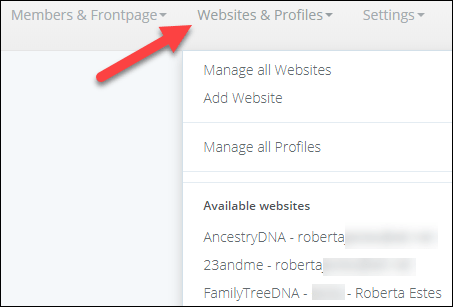
You can do this easily under the Manage DNA Kits option, under the DNA tab. Click on the three little dots to the right of the kit.

Triangulation MyHeritage assign dots.png

Then click assign the kit.

Triangulation MyHeritage assign kit.png

You’ll be prompted

Triangulation MyHeritage kit name.png

If you start typing, you’ll be prompted with the names of people in your tree.

Other Resources to Identify Common Ancestors

MyHeritage includes other tools to help you identify common ancestors as well, including:

  • SmartMatches where MyHeritage matches individuals in trees
  • AutoClusters showing groups of people that match you and each other
  • Shared Matches indicating common DNA matches between you and another DNA match
  • Shared Ancestral Surnames show common surnames, even if a common ancestor does not show in a tree
  • Shared Ancestral Places indicating common locations in trees
  • Shared Ethnicities comparing ethnicity between matches, a feature typically only beneficial if looking for a minority (to you) ancestry match
  • Genealogical Records including matches from other databases such as Geni.com and FamilySearch
  • Trees

Transfers

Have you tested family members, especially everyone in the older generations? You can transfer their kits from Ancestry, 23andMe or FamilyTreeDNA if they’ve already tested there to MyHeritage.

The article, Are You DNA Testing the Right People? explains how to determine who to test. Make sure you aren’t missing anyone that you need.

Here’s how to transfer:

I wrote recently about how to work with triangulation at FamilyTreeDNA. Join me soon for similar articles about how to work with triangulation at 23andMe, GedMatch and DNAPainter.

Most of all – have fun!

______________________________________________________________

Disclosure

I receive a small contribution when you click on some of the links to vendors in my articles. This does NOT increase the price you pay but helps me to keep the lights on and this informational blog free for everyone. Please click on the links in the articles or to the vendors below if you are purchasing products or DNA testing.

Thank you so much.

DNA Purchases and Free Transfers

Genealogy Services

Genealogy Research

GeneaCreations – Unique Genealogy & DNA Products: Shirts, Fabric, Jewelry & More

These beautiful, unique genealogy gift ideas by GeneaCreations will be a big hit with the creative crowd.

GeneaCreations logo.png

I met Jeanette, founder of GeneaCreations, two years ago at Rootstech. Jeanette loves to design, create and sell wonderful genealogy themed items and suffice it to say, I cannot get out of her booth without purchasing several things. I’m serious.

Meet Jeanette, holding my “What’s Your Haplogroup?” t-shirt. Her love for her creations just shines through, doesn’t it!

Geneacreations shirt

I also bought a DNA ribbon bow for my hair.

Geneacreations ribbon

DNA ribbon, along with other ribbon is available by the yard.

GeneaCreations ribbon.jpg

I can think of all kinds of ideas for using this ribbon, including making Christmas ornaments or for hanging ornaments on the tree. What a great way to help kids learn about ancestors. I try to slip that in wherever I can (wink.)

Geneacreations jewelry

I bought a DNA necklace at Rootstech too. How could I not? Love that subtle double helix tree.

I’m really REALLY excited about the double helix charm zipper pulls that Jeanette is making for me for my purse, backpack and luggage. (Oops, did I let that slip???) She would probably make some for you too.

GeneaCreatiosn jewelry.png

Jeanette has added lots of new styles to the GeneaCreations line over the past couple of years,  including double helix stud earrings, not pictured, if you prefer that style.

GeneaCreations state.png

Another great idea would be to purchase a charm for every state where your ancestors were from, or states you’ve visited hunting for ancestors. It would make a wonderful gift for a daughter, sister, aunt or granddaughter too.

Jeannette also does custom work, like her “Genealogy Bling” shirts. I just adore these.

GeneaCreations haplogroup shirt.png

You’ll be seeing me sporting one of these lovelies one day at Rootstech 2020 in Salt Lake City, but of course customized for my mitochondrial haplogroup, J1c2f. Merry Christmas to me.

If you’re not comfortable buying a gift for yourself, just think of it as being from your matrilineal ancestors, because that’s the mitochondrial DNA inheritance path. Or paternal ancestors for Y DNA. Repeat after me, “My ancestors want me to have this.”😊

You can obtain your full mitochondrial or Y DNA haplogroup (Y chromosome for males only) at Family Tree DNA.  Those tests are also on sale now, here.

Jeanette will customize this Mayflower shirt with your Mayflower ancestor’s name.

GeneaCreations Mayflower.png

Shirts are available in a wide variety of styles and colors.

GeneaCreations offers printed shirt styles if bling isn’t your thing. These are wonderful for family reunions.

GeneaCreations pedigree fabric.png

For quilters and crafty genealogists, you can purchase pedigree chart fabric which can be made into quilts, vests and wearable art.

GeneaCreations tote.png

Don’t want to make something? How about a ready-made tote – just use a quilter’s fabric pen to fill in your ancestors’ names. (I’d use a pencil first, lightly, and retrace with the pen.) What a great gift idea for a genealogy buddy. Genealogists never have enough canvas bags. Trust me.

GeneaCreations denim shirt.png

This year at Rootstech, I bought a denim shirt from GeneaCreations. I love these for when you need something lighter than a sweater or want something that washes up easily. They’re durable and travel wonderfully. I wear these on planes all the time.

GeneaCreations designs.png

There are lots of genealogy embroidery designs to choose from – more than are shown here.

Here’s just a sampling of the design categories that Jeanette offers:

  • Animals
  • Birds
  • Cartoon
  • Civil War
  • Genealogy
  • Organizations
  • Religious
  • Vehicles
  • Winter

There is literally something for everyone.

DNA Fabric

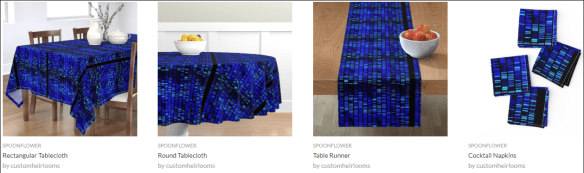
I saved the best for last, because Jeanette JUST ADDED her brand-new DNA electrophoresis fabric through Spoonflower, here. This geeky-cool fabric is what your DNA looks like as it’s processing in the lab.

GeneaCreations fabric.png

You can order this lovely cotton fabric for quilting or sewing, or you can purchase it in different kinds of fabric or as wallpaper, wrapping paper or ready-made home décor items.

GeneaCreations DNA fabric home.png

This DNA fabric must be purchased directly through Spoonflower, but I received an unlock code discount for signing up at Spoonflower in addition to free shipping because it’s December.

I’m not going to spill any beans, but you might, just might see this fabric again😊

Free Shipping

GeneaCreations is a small business and her website shopping cart doesn’t have the ability to process coupons or discount codes, but, if you e-mail your order to Jeanette directly and tell her that you ordered because of this article, she will either not charge shipping, or refund shipping if you order through the website.

You can reach Jeannette at customheirlooms@yahoo.com

Enjoy!

______________________________________________________________

Disclosure

I receive a small contribution when you click on some of the links to vendors in my articles. This does NOT increase the price you pay but helps me to keep the lights on and this informational blog free for everyone. Please click on the links in the articles or to the vendors below if you are purchasing products or DNA testing.

Thank you so much.

DNA Purchases and Free Transfers

Genealogy Products and Services

Genealogy Research

Fun DNA Stuff

  • Celebrate DNA – customized DNA themed t-shirts, bags and other items

John Estes Goes to Jail – 52 Ancestors #265

Estes jail Claiborne.png

I wasn’t even looking for John Estes – either one of them. There were two, of course, living in Claiborne County at the same time, both my ancestors. This couldn’t be simple, could it?

I was reading the unindexed court notes page by page, from 1829-1842, 13 long and miserable years, looking for the deaths of or details about 3 ancestors who, it turns out, died between 1833 and 1840. As luck would have it, they are all twisted into this story kind of like a kudzu vine – because these families were all near neighbors in Claiborne County, Tennessee and intermarried.

And there was drama…so much drama.

John Campbell died in September of 1838. About 1795, he had married Jane Dobkins, the daughter of Jacob Dobkins who died in March of 1833.

I actually started reading the Claiborne County court notes searching for information about John Campbell and Jane Dobkins’s other daughter, Jane Campbell, who married Johnson Freeman – then got divorced – unheard of in that day and time. Whoo doggies, that’s some story and will get an article all to itself.

John Campbell and Jane Dobkins’ daughter, Elizabeth Campbell, had married Lazarus Dodson about 1820, but predeceased her father, John Campbell, sometime before 1830.

When John Campbell died in 1838, a guardian was appointed for Elizabeth Campbell Dodson’s children because they had an inheritance from their grandfather. Yes, their father Lazarus Dodson was still living. I thought for years that he had died, but he hadn’t. The court records never say “deceased” after his name and I found him later, remarried and living elsewhere. Subsequent court records indicate specifically that the Dodson children inherited through “Elizabeth Campbell, deceased.”

No, I don’t know why Lazarus Dodson wasn’t appointed guardian, but I’d wager it had something to do with the ever-present drama in this extended family. I suspect because those children were being raised by their grandmother, Jane Dobkins Campbell. Several of Elizabeth Campbell Dodson’s children married spouses who lived near the Campbells on Little Sycamore, adjacent the Liberty Church today. You can’t marry who you don’t see to court.

Estes jail Liberty to Cumberland.png

Their father, Lazarus Dodson lived several miles north near Cumberland Gap.

The Receipt

John Y. Estes, born in 1818, married Rutha (Ruthy) Dodson, daughter of Lazarus Dodson and Elizabeth Campbell on March 1st, 1841 in Claiborne County, Tennessee. Rutha was also a legatee of her grandfather’s estate and in fact, on September 5, 1842, John Estes signed a receipt for $54.35 for receiving money from her guardian. He signed at the same time that he received $1.50 rent from that estate for 1841, and also acknowledged the balance still owed was $56.61.

Back then, that was a LOT, LOT, LOT of money. Enough to purchase a farm – but John didn’t. In the 1850 census John and Rutha are listed as living beside William Devenport and in 1851 a deed is conveyed between land owners noting that William Devenport and John Estes live on that land – but neither were owners.

There’s something else odd about that 1850 census. John and Rutha were married for 9 years and had only one child, Lazarus, age 2. There should have been roughly 4 children by this time. Yes, death was a constant companion, but there might have been something more.

This receipt is important, but I’m getting ahead of my own story.

Let’s step back in time.

Two John Esteses

John R. Estes (1787-1885) and wife, Nancy Ann Moore left Halifax County, Virginia about 1820 when their son, John Y. Estes, was about 2 years old. John R. Estes had served in the War of 1812.

In Claiborne County, in 1826, John R. Estes made a land entry, but appeared to sell the entry after it was surveyed but before it was completed.

In 1850, John R. Estes is listed as a shoemaker with no land, and in 1860, a miller with no land.

John applied for bounty land from his 1812 service in 1850, but apparently sold that land claim to his son George who moved to Missouri. He sold a second claim some years later too.

To the best of my knowledge, John R. Estes never owned land. He lived very near or perhaps even beside John Campbell along Little Sycamore Creek.

John appeared to live a pretty quiet life. He’s never in the court records as a juror, because jurors are required, among other things, to own land. But of note, he’s also never found in the court records for anything else either – although the Claiborne County notes are incomplete.

John, like his father, George Estes, lived to be a very, very old man. John died in 1885 at approximately 98 years of age.

In 1842, John R. Estes would have been about 55 years old. His son, John Y. Estes would have been 23, turning 24 that December.

Court Minutes

When I read court notes at FamilySearch, which I try NOT to do very often, I read for any of my family names of course.

I thought that I had already told the story of both John Esteses and frankly, I didn’t expect to find anything more than a footnote to add to their existing articles, if that.

Sometimes I peruse court notes late at night. They are calming, so calming, in fact that often they put me to sleep.

With the political drama the past few months in our own lives, sometimes I need that. I was well into year 13, thousands of pages already read, nodding off that evening, trying to keep my eyelids open.

Suddenly, I glimpsed something that woke me right up.

John Estes’ name in the court notes.

I shook sleep off and started back at the beginning of that page again. It wasn’t a typical entry which formed a predictable pattern.

No, this was something different.

October 3, 1842

Estes jail 1842.png

Alexander Fullington jailor for Claiborne County be allowed the following sums for the following purposes to wit: the State vs John Hodge $32.50 for 76 days board and 4 turn key. The State versus Thomas Ursery(?) $32.87/2 for 85 days board and 2 turn keys. Also the State vs John Estes for $36 for board and turn keys and that he have ticket to the county trustee for the same.

What? John Estes in jail?

If Alexander Fullington is being paid for these prisoners, where was the trial in the court notes? Had I missed it?

These court notes seem to be mostly civil suits and domestic things like road orders and maintenance combined with sporadic estate settlements. Although some trials are mentioned, that only seems to happen when a jury was called.

Noticeably absent are criminal prosecutions. But something had obviously occurred, because the jailor obviously petitioned for reimbursement. So did other county officials, regularly, in this court.

Not all “state” (versus civil) cases say why the person is being tried, but the few I’ve found that do during this timeframe are mostly for lewdness and one for usery. Lewdness, by definition in the legal documentation of the day pertains, for lack of a better description, to sexual relations between a man and woman outside of marriage.

My next thought was maybe that John wasn’t actually IN jail. The record states the number of days for the other men, but given that John’s amount is MORE than the other 2 men, that’s unlikely. Why else would the jailor be petitioning for reimbursement if John wasn’t IN jail. So much for that idea.

How long was John Estes in the clink for? John Hodge’s cost per day was 43 cents and Thomas Ursery was 39 cents. But Hodge had more turnkeys than did Ursery. Did turnkeys cost extra, and what was a turnkey anyway?

Research into other cases about this time tells us that Fullington was allowed 50 cents per turnkey, so we need to reduce the total by that amount to obtain the daily board rate per prisoner.

I googled for turnkeys, but the best I could find was that a turnkey was the person, or guard, who literally turned the key to release prisoners. Reading other Claiborne County records, I determined that the number of turnkeys related to the number of times the person was removed to be taken to court. I’m unclear whether the final turnkey is the last time the door was opened, meaning the time they were released.

Using the 38.5 cents average amount per day for lodging, minus turnkeys, John Estes probably served about 94 days.

The Margin Note

But then, there’s a pesky margin note that says the following:

“ticket 2nd for Estes amt $36 6 Octr 1842”

Three days later, the court added the second ticket to this same note. Oh boy.

Which suggests that there is ANOTHER ticket for John Estes – for ANOTHER 94 days.

Was that two of the same offense, or two separate offenses?

This means that John spent roughly 6 months in jail during 1842. But was John’s jail time actually during 1842?

I looked back at the other entries for Alexander Fullington in the court minutes and discovered that he submitted tickets for payment regularly: April 1841, July 1841, October 1841, January 1842, April 1842 and July 1842.

If John Estes had completed his sentence by July 1842, probably either of them, Fullington would have submitted his claim by then. This tells us that very likely, John Estes was in jail from about April 1842 until about October 1842. If I’ve misunderstood this note and there was only one sentence for 94 days, it still tells us that John got out of jail sometime between July and October 1842, given that Alexander apparently submitted his bills every 3 months.

Jail Time

What was jail like during that time? In some cases, jails were actually enclosed areas, or yards, in which prisoners were confined and trusted not to step over the line.

Was that the kind of jail John was in?

Nope – this was John’s jail.

Estes jail Claiborne distance

By Brian Stansberry – Own work, CC BY 3.0, https://commons.wikimedia.org/w/index.php?curid=40340005

The old Claiborne County jail, built in 1819 was in use until 1931. Yep, it’s this building where John Estes spent roughly six months of his life.

The National Register of Historic places provides the following information:

Built in 1819 the jail is composed of stone on the first story and brick on the second story. The jail also features metal grating over the window and door openings.

The two-story jail is rectangular in shape, with a front gable roof. The entrance faces west towards the highway. The gable ends of the jail are twenty-six feet across. The sides of the building (north and south) are thirty-two feet long. The first level is constructed of cut limestone rocks and mortar. The walls are eighteen inches thick, with the length of individual stones measuring up to five feet. The roof is covered with metal and a brick chimney rises from the peak on the west half of the building.

The west façade features a central entrance to the building that measures two feet wide and six and one-half feet tall. The door on this entrance is of a grate design, consisting of two-and-one-half inch bands of metal running horizontally and vertically within a metal frame. A rounded bolt head protrudes at each juncture of metal bands. This metal grate is an original feature. The second story of the jail is brick laid in common bond. In the center of the second story is a door-sized opening, enclosed with vertical board shutters. A circular vent opening with a metal “X” grate is located in the peak of the gable.

The north and the south elevations of the jail each have four window openings, two on each floor. Each opening is covered with a framed metal grate matching the front door, and vertical board shutters. Some of the grates are original, and some are (historic) replacements. These openings measure two feet wide and between four and six feet tall. A couple of the shutter boards have become detached and currently lean against the building. Large metal bolts protrude from the brick walls in the back two-thirds of the second story. The east (or back) elevation of the jail is solid stone across the lower level; the brick second level has one window with an original metal grate covering and vertical shutter boards. A circular vent, matching the design of that in the front gable, is located at the top of the east gable. A short, brick chimney rises from the metal roof at approximately one-third of the distance from the front of the jail.

At the jail’s entrance, one step leads down into the front portion on the first floor, with a stairway on the south wall. This portion of the building is ten and one-half feet deep, or approximately one-third of the building’s depth. The floor of this section is brick, and the walls of this room are of mortared, cut limestone.

A door-less opening leads to a larger back room. To the north of this doorway, a fireplace has been removed, but its flue is still intact. The back room historically consisted of a central hall flanked by smaller units to each side. Local historian Mary A. Hansard wrote in 1979 that the jail had “a large stack chimney in the center, with two fireplaces on the lower floor and two on the upper floor. There were two rooms on the first floor. One was used as a kitchen and dining room, and the other as a dungeon in which to confine criminals.

Hansard wrote that “[t]here were three apartments on the second floor, all nicely plastered.”

As on ground level, the individual rooms of the second floor have been removed. The back, larger portion of the second floor is open. Local historian Alexander Moore Cloud noted that the jail was built with double walls. “The inside walls were of wood while the outer walls were made of stone.”

Some of the original interior wood siding remains; vertical slats of wood still hang on the east and west walls of the rear section on the second floor. The metal bolts visible on the exterior, protruding from the north and south elevations, can be seen on the interior walls. These bolts were installed for reinforcement of the jail’s security; as explained by a descendant of Josiah Ramsey, a member of the committee that undertook the building of the jail, the bolts held wood siding to the interior of the brick walls, preventing prisoners from chipping out the mortar. As noted previously, the north and south walls have two windows with original metal grid coverings. The original wood floor remains. The ceiling is open, revealing exposed rafters and the under side of the metal roof.

According to early records of the Claiborne County Court, debt was one of the most common offenses. Debt, and other non-violent offenses, drew the punishment of lashing at the county whipping post, which was located between the jail and the courthouse and consisted of a yoke, similar to an oxen harness.

The county jail contained a room, eighteen square feet in size, specifically for debtors; it was one of the units on the second floor. There, the sheriff held people who made no attempt to resolve their indebtedness. It was the sheriff’s responsibility to take debtors, two at a time, from the jail to the post for whipping until they promised to find work that would pay off their debts. Crimes of assault and battery also appeared frequently; legal disputes between individuals were also common. Trespass, libel, and murder were rare charges. A more serious crime, such as horse theft, was punishable by branding (“H.T.” on the thumb), practiced as late as 1822. The court frequently listened to cases of “bastardy,” an offense, assumingly by a male, of fathering a child and refusing to support that child.

During the period between from the 1830s to the Civil War, very little specific reference to the county jail exists other than that it was, of course, in use.

Estes jail Claiborne side.png

The court records a page or so after John’s mention give us a rare glimpse when the jailer asked for repairs including an iron door’s hinges to be fixed, handcuffs, etc.

Estes jail 1842 jailer.png

Report of the ail commissioners to with: We the commissioners of the jail of the town of Tazewell report to your worships now in session do say that the jailer so far as he is concerned has done his duty for we have examined the jail from time to time when the prisoners were in jail and making great complaints against the jaelor but when we examined into the matter we always found that the prisoners got a plenty to eat and drink as the law directs.

Estes jail 1842 jailer 2.png

And further we report that the jail ought in our opinion to be repaired as follows to wit:

First the meddle door ought to be hung and made sufficiently strong so that when any of them transgress to put them back into the dungen and keep them there till they do better.

Estes jail door.png

Here’s that metal door that clanged shut behind John Estes.

Further we believe it would be better to have the inside bord seasoned oak plank one inch thick and tong and groved together this ought to be done on the floore as well as the wall and furthermore we wish the court to appoint 5 commissioners to superintend? the work and let it out to ? able persons that will have the work done in proper manner so that the jail will be secure this 4th day of October 1842.

Jail would be glum in the best of circumstances. Obviously, it’s meant to be punitive, a place to be avoided.

Estes jail Claiborne inside.png

Jimmy Emmerson took these two photos of the inside of the Claiborne County jail, making them available, here. Thanks Jimmy.

This would have been John’s view of the world, every day for 6 months – and that’s IF he wasn’t in the dungeon.

Estes jail Claiborne inside 2.png

I wonder if John was one of those “residents” complaining about the jailor and conditions. It makes me wonder since this entry in the court record occurred immediately after the request for reimbursement for board for John and two other prisoners.

Estes jail front.png

The local newspaper reports that at least some hangings were carried out from the upper window, here, although I have my doubts.

Joe Payne writes about the jail here, with some interesting old photos.

Fullington’s Records

I read Alexander Fullington’s submissions for payment to the court with the hope of obtaining enlightenment into cases during that timeframe.

Monday April 5, 1841 – ordered by the court that Claiborne County pay to Alexander Fullington the following state claims for turnkey and board as jailer to wit:

  • State vs Benjamin Young $13.36
  • State vs Edward Slavens $5.50
  • State vs Obediah Norris $15.37/5
  • State vs Jas Asberry $24.87/5
  • State vs Thomas Cox and wife $7.62/5

July 5, 1841 voted that Fullington be allowed:

  • Sum of $1 for 2 turn keys receiving to jail Ruth Collins

October 1, 1841 Alexander Fullington allowed for keeping:

  • Azariah Watson in jail 83 days and two turn keys the sum of $33.12/5
  • John Hodge in jail 7 days two turn keys/holter chain and steeple the sum of $5.62/5

I could not determine what a holter chain and steeple was, but I’m wagering it was a restraint.

January 3, 1842 Fullington allowed the following fees:

  • Jessie Lyndsey in jail 36 days and turn key $17.50
  • Ruth Collins ditto and turn keys $19.75
  • Ditto Zachariah Hicks 7 days and 2 turn keys $3.62/5

April 4, 1842 – Fullington allowed:

  • Ruth Collins, 2 turnkeys – $1

Ruth seems to have been a frequent flyer.

July 4, 1842 – Fullington allowed:

  • Azariah Watson – ludeness
  • Steven Ouseley – usery
  • Burdren Bussell and Sarah Baltrip – ludeness – 41 days in jail $53.79 and 6 turn keys
  • Jacob Pike and Elizabeth David in jail 9 days $3.57/5 and 8 turn keys 4.00 – acquitted

October 4, 1842 Fullington allowed:

  • 103 days boarding Sarah Nunn in jail @ 2/3 2 turnkeys @3 – $39.62
  • Bartley (or Barthey) Nunn in jail 60 days at 2/3 and 2 turn key @3 – $23.50
  • Veyena (or Verena) Nunn 67 days at 2/3 2 turn key at $3 – $26.12/5

This tells us that Fullington is allowed 50 cents per turnkey.

I sure wish they had recorded their crimes.

Why was John in Jail for 180+ days?

I wish I knew.

Most of the cases, above, don’t have a corresponding trial record, nor do we have a crime listed with Fullington’s report. The very best I can do is to note that during this timeframe, there are only two crimes found.

Usery, which is an illegal form of lending. John clearly wasn’t doing that.

The only other specific crime is lewdness which, as I understand it, requires two people.

It’s unlikely, especially given that John was married, that he was engaged in lewdness with a woman not his wife. Furthermore, there is no corresponding female being prosecuted.

If couples married in a situation where the female became pregnant, it doesn’t appear that they were prosecuted for lewdness.

These court notes are more concerned with running the county – in other words, paying the jailer. I have to wonder if there is another set of court records someplace, then or now, that we’re missing.

Which Doggone John?

Do we have ANY clues at all as to which John might have been in jail?

It’s possible.

Let’s look at their history. John R. Estes was older, 55 years of age, and had never, to the best of my knowledge, been in trouble before.

John Y. Estes was young and his life seems to have been somewhat troubled.

Unlike other young men, John never bought land.

In the 1860s, John volunteered for the Confederacy. It’s unclear how he wound up in the hands of the north, but he did after being reported as a deserter.

Most of the soldiers from Claiborne County fought for the North, but John didn’t. This would likely have driven a wedge between John and his wife’s family along with neighbors. Having said that, this region was clearly split over allegiances.

After his release from the Northern prison camp, John walked from Illinois back to Tennessee, only to subsequently deed all of his property to his son, Lazarus, only 17 years old and living at home with his parents. Given John’s absence, it’s quite likely that Lazarus has been shouldering the brunt of the work. John did not own land, but deeded his sheep, horse, hogs, cow, etc. to his son.

What happened next isn’t quite clear, because in 1870, John is still living with his wife and they have another baby, and another would be born 1871.

In 1879, John Y. Estes signed a deed granting two men access to create a road across his land to access the land they had just purchased from Lazarus Estes, John Y.’s son. This is the first hint that John owned land, and there are no deeds to back that up.

However, in 1880, Rutha is living with her 5 children and is noted as divorced in the census. John has walked to Texas on a bum leg, is boarding with someone, and lives the rest of his life there, dying in 1895.

John’s life seemed troubled beginning in 1842. That’s sad because it includes his entire married life to Rutha Dodson. She became disabled with arthritis the last 22 years of her life, dating to about the time John Estes left for Texas.

We find potential hints about this situation with John in the court notes having to do with the settlement of Charles Campbell’s estate relative to the Dodson children.

On July 5, 1841, Wiley Huffaker made settlement with the heirs of Lazarus Dodson and reported to the court. Generally, settlement was made once a year until the child was no longer a minor, or all of the minor children were of age.

However, the next year, we find something different.

July 6, 1842 – “That Wiley Huffaker have until next term to make settlement as guardian.”

August 1, 1842 – “Ordered that Wiley Huffaker guardian to the minor heirs of Lazarus Dodson have until the next turn of this court to make settlement as guardian.”

Was this because John Y. Estes, as Rutha’s husband was legally the recipient of her portion and was in jail?

September 5, 1842 – “For satisfactory reasons appearing it is ordered by the court that Wiley Huffaker guardian to the minor heirs of Elizabeth Dodson decd have the further time until the next term of this court to make settlement as guardian aforesaid.”

Note that John Y. Estes signed the receipt that he received a portion of his wife’s inheritance on this same day, September 5th, stating additionally that he was paid for the land rent for 1841, along with how much was outstanding.

October 3, 1842 – “A second settlement made by the clerk of this court with William Fugate one of the administrators of the estate of John Campbell decd which was examined by the court and ordered to be filed and recorded.”

October 4, 1842 – “This day came on the settlement of Wiley Huffaker guardian to the minor heirs of Elizabeth Dodson decd which settlement was by the court examined and ordered to be filed and recorded.”

The actual detail of the filing is recorded in the Probate book, but does not add any previously unknown information.

If John Y. Estes was the John in jail in 1842, he would have still been incarcerated in July, or Fullington would have submitted his receipt for payment at that time.

We know that John was out by September 5, 1842. If he was in jail for 94 days, twice, and got out the first part of September, he would have gone to jail the last part of February or the first part of March.

He was roughly in jail from either January through June, or from March through August, or sometime in-between those dates.

John and Rutha were married on March 1, 1841. If Rutha got pregnant immediately, their first child would have been born in the end of November. If she got pregnant shortly after their marriage, their first child could have been born while John was in jail.

Rutha was likely pregnant before the end of 1841, so gave birth to the child while John was in the clink. Regardless, this would have left a wife and newborn child during planting season in unknown and precarious circumstances.

That child did not survive to the 1850 census, so could have died at birth or maybe shortly thereafter.

Not a good way to start a marriage. No wonder the marriage eventually ended in what she noted as divorce on the census – although no divorce records exist.

John volunteered for the Civil War as well, probably in August of 1862, leaving Rutha to farm and raise their children for 3 long years. Given what appeared to be an icy reception upon his return by signing his worldly goods over to his son, they appeared to have a rocky relationship. The ice apparently thawed for a least some time, because the next child was born in February 1867.

Perhaps tied into that somehow was that Rutha started life with a bonus, meaning her inheritance from her grandfather. Yet, they didn’t own land on any census. At that time, men made those types of decisions and woman had little if any input. Where did that money go, and why?

Sadly, they never seemed to be happy, as best I can tell from what I can see peering through a keyhole from a distance of 150+ years.

Of course, after all of this tying the breadcrumbs together, I could still be quite wrong about which John was in jail. I only have a combination of coincidence, this circumstantial evidence and speculation.

It’s unlikely that I will ever unravel this knot. The only thing I know for sure is that John Estes was, indeed, in jail, probably for more than 6 months, and the only two John Esteses in Claiborne County at that time were both my ancestors.

If only those jailhouse walls could talk.

______________________________________________________________

Disclosure

I receive a small contribution when you click on some of the links to vendors in my articles. This does NOT increase the price you pay but helps me to keep the lights on and this informational blog free for everyone. Please click on the links in the articles or to the vendors below if you are purchasing products or DNA testing.

Thank you so much.

DNA Purchases and Free Transfers

Genealogy Products and Services

Genealogy Research

Fun DNA Stuff

  • Celebrate DNA – customized DNA themed t-shirts, bags and other items

Gift Yourself a Trip to MyHeritage LIVE 2020 in Tel Aviv, Israel

MyHeritage LIVE 2020.png

You’ll excuse my exuberance if I say this would be the BEST GIFT EVER!!!

And the great thing is that you can gift yourself if Santa doesn’t do it for you. Early bird registration is only $100. At previous conferences, lunches were included too, as were  breaks with snacks and a generous goodie bag.

I attended the first and second MyHeritage LIVE conferences, in Oslo and Amsterdam, and they were absolutely AMAZING! I mean everything – the event itself, the people and companionship, the MyHeritage staff, Gilad’s opening sessions, the speakers and sessions, the food, the venue – everything.

MyHeritage 2019 Gilad keynote

Gilad Japhet, Founder and CEO of MyHeritage opening the conference in Amsterdam.

Oh, and the party, how could I possibly forget to mention the party.

MyHeritage Live Geoff Rasmussen and Daniel Horowitz

I think we found 2 of the Beatles at the party!

One of my favorite aspects of conferences is that we get to meet people in person that we’ve only met online, AND, we get to reconnect with old friends, strengthening bonds.

MyHeritage Live 4 musketeers

The 4 musketeers having a wonderful adventure in Amsterdam!

I will also say that MyHeritage does conferences right too. Nothing second class about these. Based on the conference price, they are heavily subsidized by MyHeritage – so take advantage of this wonderful opportunity.

The Announcement

Here’s the e-mail I received from MyHeritage:

Following the success of MyHeritage LIVE 2018 and 2019, I am delighted to announce that our third annual MyHeritage LIVE conference will take place from 25–26 October 2020 at the Hilton Tel Aviv in Israel! As one of the most celebrated genealogy events of the year, MyHeritage LIVE brings together family history enthusiasts, top international experts, and MyHeritage staff for two days of fascinating lectures covering the latest topics in genealogy and DNA. Each year, hundreds of MyHeritage users from around the world attend.

The venue is situated right on the Tel Aviv coastline with breathtaking views of the Mediterranean Sea. This year’s conference presents you with a wonderful opportunity to connect with fellow genealogy enthusiasts and tour a unique and beautiful country steeped in ancient history.

In addition to a plenary session from MyHeritage Founder and CEO Gilad Japhet, there will be multiple lectures, panels, and workshops covering genealogy and DNA, as well as sessions from local speakers covering Israeli resources and Jewish genealogy.

The Venue

In case you haven’t noticed yet, this conference hotel is literally on the beach, on the waters of the Mediterranean Sea.

MyHeritage LIVE 2020 beach.png

This is the miserable view out back.

MyHeritage LIVE 2020 hotel.png

View of the hotel from the nearby breakwater.

MyHeritage LIVE 2020 aerial.png

And look, there’s a beautiful walkway and bikeway along the beach, with a seaside park right next door.

MyHeritage LIVE 2020 ballroom you.png

And the hotel ballroom where I suspect the conference will be held. Just mentally photoshop yourself into these pictures!

Am I tempting you yet? Well, read on…

Who’s Speaking?

The all-star lineup of speakers on the website includes many names you know, I’m sure.

MyHeritage LIVE speakers

Click to enlarge

Yes, I’ll be there along with many world-class speakers. Sometimes additional speakers are added over time.

MyHeritage LIVE speakers 2

Click to enlarge

I’m really looking forward to hearing these speakers. In particular, I want to learn more about Jewish genealogy. I have one ancestor who is reflected in records as being a Jewish merchant. My husband’s lines are lost in the Poland/Hungary (now Croatia) region during the war. He has great-great-grandparents who were Jewish, also reflected in his ethnicity results.

My own mitochondrial haplogroup J was born in this part of the world, and I want to visit a place so very central to the birth of humanity as we migrated out of Africa. Israel is “home” to all of us and we are related to her people, both ancient and modern.

I want to walk on that soil and touch those sacred places.

One of my cousins has already registered. Let’s have a reunion!

Registration

You can read about the conference, here and here.

Take a look at the fun video from the Amsterdam conference this fall.

You can register here.

Let me know, will I see you in Tel Aviv???

Get the Most for Your $$$

MyHeritage LIVE results.png

It goes without saying that the way to get the most for your money from the MyHeritage conference is to be a MyHeritage user.

If you haven’t tested, now’s a great time because DNA tests are on sale.

If you have tested elsewhere, click here to transfer your DNA file.

If you would like a free trial records subscription, click here.

______________________________________________________________

Disclosure

I receive a small contribution when you click on some of the links to vendors in my articles. This does NOT increase the price you pay but helps me to keep the lights on and this informational blog free for everyone. Please click on the links in the articles or to the vendors below if you are purchasing products or DNA testing.

Thank you so much.

DNA Purchases and Free Transfers

Genealogy Products and Services

Genealogy Research

Fun DNA Stuff

  • Celebrate DNA – customized DNA themed t-shirts, bags and other items

MyHeritage Offers Free Transfers + No Unlock Fee – Available 1 Week Only

The news this week is arriving faster than I can write articles!

MyHeritage Unlock Free.png

Today, I received an e-mail from MyHeritage stating that for one week only, from December 11th through 18th, they are offering free DNA file transfers from other vendors, PLUS, no unlock fee for advanced DNA features – ever.

This means you’re grandfathered into all of the DNA tools for the file you transfer during this time, forever, regardless of whether you have a subscription plan or not.

Last year, I checked with family members, then uploaded almost all of the DNA files I’ve tested for people elsewhere. Transferring files to MyHeritage is super useful and has cost me absolutely nothing!

Until today, you either needed to have a subscription (which you can try for free here) or pay the $29 one-time per kit unlock fee for advanced DNA features.

Free DNA Tools

What are the free tools you’ll enjoy in addition to matching?

  • Ethnicity Estimates
  • Chromosome Browser
  • Triangulation
  • Viewing family trees and pedigree charts of matches
  • Shared in common DNA matches between you and your match
  • Shared ethnicities between you and your DNA match
  • Shared ancestral places
  • AutoClusters
  • Theories of Family Relativity which I wrote about here

This timing couldn’t be better, because I have an article scheduled to publish in a few days titled “Triangulation in Action at MyHeritage.” If you transfer now, your results will be ready to follow along by then!

How to Transfer

I’ve written about how to upload TO MyHeritage, here.

MyHeritage accepts DNA transfer files from the following vendors:

Click here to begin your free transfer!

______________________________________________________________

Disclosure

I receive a small contribution when you click on some of the links to vendors in my articles. This does NOT increase the price you pay but helps me to keep the lights on and this informational blog free for everyone. Please click on the links in the articles or to the vendors below if you are purchasing products or DNA testing.

Thank you so much.

DNA Purchases and Free Transfers

Genealogy Products and Services

Genealogy Research

Fun DNA Stuff

  • Celebrate DNA – customized DNA themed t-shirts, bags and other items

Are You DNA Testing the Right People?

We often want to purchase DNA kits for relatives, especially during the holidays when there are so many sales. (There are links for free shipping on tests in addition to sale prices at the end of this article. If you already know who to test, pop on down to the Sales section, now.)

Everyone is on a budget, so who should we test to obtain results that are relevant to our genealogy?

We tell people to test as many family members as possible – but what does that really mean?

Testing everyone may not be financially viable, nor necessary for genealogy, so let’s take a look at how to decide where to spend YOUR testing dollars to derive the most benefit.

It’s All Relative😊

When your ancestors had children, those children inherited different pieces of your ancestors’ DNA.

Therefore, it’s in your best interest to test all of the direct descendants generationally closest to the ancestor that you can find.

It’s especially useful to test descendants of your own close ancestors – great-great-grandparents or closer – where there is a significant possibility that you will match your cousins.

All second cousins match, and roughly 90% (or more) of third cousins match.

Percent of cousins match.png

This nifty chart compiled by ISOGG shows the probability statistics produced by the major testing companies regarding cousin matching relationships.

My policy is to test 4th cousins or closer. The more, the merrier.

Identifying Cousins

  • First cousins share grandparents.
  • Second cousins share great-grandparents.
  • Third cousins share great-great-grandparents.

The easiest way for me to see who these cousins might be is to open my genealogy software on my computer, select my great-great-grandparent, and click on descendants. Pretty much all software has a similar function.

The resulting list shows all of the descendants of that ancestor that I’ve entered in my software. Most genealogists already have or could construct this information with relative ease. These are the cousins you need to be talking to anyway, because they will have photos and stories that you don’t. If you don’t know them, there’s never been a better time to reach out and introduce yourself.

Who to test descendants software

Click to enlarge

People You Already Know

Sometimes it’s easier to start with the family you already know and may see from time to time. Those are the people who will likely be the most beneficial to your genealogy.

Who to test 1C.png

Checking my tree at FamilyTreeDNA, Hiram Ferverda and Evaline MIller are my great-grandparents. All of their children are deceased, but I have a relationship with the children born to their son, Roscoe. Both Cheryl and her brother carry parts of Hiram and Eva’s DNA their son John Ferverda (my grandfather) didn’t inherit, and therefore that I can’t carry.

Therefore, it’s in my best interest to gift my cousin, Cheryl and her brother, both, with DNA kits. Turns out that I already have and my common matches with both Cheryl and her brother are invaluable because I know that people who match me plus either one of them descend from the Ferverda or Miller lines. This relationship and linking them on my tree, shown above, allows Family Tree DNA to perform phased Family Matching which is their form of triangulation.

It’s important to test both siblings, because some people will match me plus one but not the other sibling.

Who’s Relevant?

Trying to convey the concept of who to test and not to test, and why, is sometimes confusing.

Many family members may want to test, but you may only be willing to pay for those tests that can help your own genealogy. We need to know who can best benefit our genealogy in order to make informed decisions.

Let’s look at example scenarios – two focused on grandparents and two on parents.

In our example family, a now-deceased grandmother and grandfather have 3 children and multiple grandchildren. Let’s look at when we test which people, and why.

Example 1: Grandparents – 2 children deceased, 1 living

In our first example, Jane and Barbara, my mother, are deceased, but their sibling Harold is living. Jane has a living daughter and my mother had 3 children, 2 of which are living. Who should we test to discover the most about my maternal grandparents?

Please note that before making this type of a decision, it’s important to state the goal, because the answer will be different depending on your goal at hand. If I wanted to learn about my father’s family, for example, instead of my maternal grandparents, this would be an entirely different question, answer, and tree.

Descendant test

Click to enlarge

The people who are “married in” but irrelevant to the analysis are greyed out. In this case, all of the spouses of Jane, Barbara and Harold are irrelevant to the grandmother and grandfather shown. We are not seeking information about those spouses or their families.

The people I’ve designated with the red stars should be tested. This is the “oldest” generation available. Harold can be tested, so his son, my first cousin, does not need to test because the only part of the grandparent’s DNA that Harold’s son can inherit is a portion of what his father, Harold, carries and gave to him.

Unfortunately, Jane is deceased but her daughter, Liz, is available to test, so Liz’s son does not need to.

I need to test, as does my living brother and the children of my deceased brother in order to recover as much as possible of my mother’s DNA. They will all carry pieces of her DNA that I don’t.

The children of anyone who has a red star do NOT need to test for our stated genealogical purpose because they only carry a portion of thier parent’s DNA, and that parent is already testing.

Those children may want to test for their own genealogy given that they also have a parent who is not relevant to the grandfather and grandmother shown. In my case, I’m perfectly happy to facilitate those tests, but not willing to pay for the children’s tests if the relevant parent is living. I’m only willing to pay for tests that are relevant to my genealogical goals – in this case, my grandparents’ heritage.

In this scenario, I’m providing 5 tests.

Of course, you may have other family factors in play that influence your decision about how many tests to purchase for whom. Family dynamics might include things like hurt feelings and living people who are unwilling or unable to test. I’ve been known to purchase kits for non-biologically related family members so that people could learn how DNA works.

Example 2: Grandparents – 2 children living, one deceased

For our second example, let’s change this scenario slightly.

Descendant test 2

Click to enlarge

From the perspective of only my grandparents’ genealogy, if my mother is alive, there’s no reason to test her children.

Barbara and Harold can test. Since Jane is deceased, and she had only one child, Liz is the closest generationally and can test to represent Jane’s line. Liz’s son does not need to test since his mother, the closest relative generationally to the grandparents is available to test.

In this scenario, I’m providing 3 tests.

Example 3: My Immediate Family – both parents living

In this third example, I’m looking from strictly MY perspective viewing my maternal grandparents (as shown above) AND my immediate family meaning the genealogical lines of both of my parents. In other words, I’ve combined two goals. This makes sense, especially if I’m going to be seeing a group of people at a family gathering. We can have a swab party!

Descendants - parents alive

Click to enlarge

In the situation where my parents are both living, I’m going to test them in addition to Harold and Liz.

I’m testing myself because I want to work using my own DNA, but that’s not really necessary. My parents will both have twice as many matches to other people as I do – because I only inherited half of each parent’s DNA.

In this scenario, I’m providing 5 tests.

Example 4: My Immediate Family – one parent living, one deceased

Descendants - father deceased

Click to enlarge

In our last example, my mother is living but my father is deceased. In addition to Harold and Liz who reflect the DNA of my maternal grandparents, I will test myself, my mother my living brother and my deceased brother’s child.

Because my father is deceased, testing as many of my father’s descendants as possible, in addition to myself, is the only way for me to obtain some portion of his DNA. My siblings will have pieces of my parent’s DNA that I don’t.

I’m not showing my father’s tree in this view, but looking at his tree and who is available to test to provide information about his side of the family would be the next logical step. He may have siblings and cousins that are every bit as valuable as the people on my mother’s side.

Applying this methodology to your own family, who is available to test?

Multiple Databases

Now that you know WHO to test, the next step is to make sure your close family members test at each of the major providers where your DNA is as well.

I test everyone at Family Tree DNA because I have been testing family members there for 19 years and many of the original testers are deceased now. The only way new people can compare to those people is to be in the FamilyTreeDNA data base.

Then, with permission of course, I transfer all kits, for free, to MyHeritage. Matching is free, but if you don’t have a subscription, there’s an unlock fee of $29 to access advanced tools. I have a full subscription, so all tools are entirely free for the kits I transfer and manage in my account.

Transferring to Family Tree DNA and matching there is free too. There’s an unlock fee of $19 for advanced tools, but that’s a good deal because it’s substantially less than a new test.

Neither 23andMe nor Ancestry accept transfers, so you have to test at each of those companies.

The great news is that both Ancestry and 23andMe tests can be transferred to  MyHeritage and FamilyTreeDNA.

Before purchasing tests, check first by asking your relatives or testing there yourself to be sure they aren’t already in those databases. If they took a “spit in a vial” test, they are either at 23andMe or Ancestry. If they took a swab test, it’s MyHeritage or FamilyTreeDNA.

I wrote about creating a testing and transfer strategy in the article, DNA Testing and Transfers – What’s Your Strategy? That article includes a handy dandy chart about who accepts which versions of whose files.

Sales

Of course, everything is on sale since it’s the holidays.

Who are you planning to test?

______________________________________________________________

Disclosure

I receive a small contribution when you click on some of the links to vendors in my articles. This does NOT increase the price you pay but helps me to keep the lights on and this informational blog free for everyone. Please click on the links in the articles or to the vendors below if you are purchasing products or DNA testing.

Thank you so much.

DNA Purchases and Free Transfers

Genealogy Products and Services

Genealogy Research

Fun DNA Stuff

  • Celebrate DNA – customized DNA themed t-shirts, bags and other items

GEDmatch Acquired by Verogen

Verogen GedMatch logo.pngVerogen logo.png

Until this afternoon, I had never heard of Verogen. Today Verogen “joined forces with” GedMatch. Based on reading the details, while the GEDmatch personnel are staying involved, the ownership and management appears to have passed to Verogen.

I didn’t know about this in advance, but I’m not surprised. Curtis Rogers, one of the GEDmatch owners is in his early 80s and already retired once in his life. GEDmatch needs modernization and Verogen has committed to breathe new life into GedMatch which provides tools not available elsewhere and much loved by many genealogists.

The press release is here.

Verogen

Verogen is a forensic genomics firm founded in 2017 to focus on the challenges of human identification and improve public safety and global justice for all, according to their website.

Verogen 1.png

The graphic above and below, from their website, explain their focus.

Verogen 2.png

According to this 2017 article, DNA equipment supplier Illumina is a Verogen partner and this May 2019 article states that the FBI has approved Verogen’s forensic DNA sequencing system and underlying technology.

I have been and remain supportive of investigative genealogy in order to identify deceased bodies and to bring violent criminals to justice. Another benefit of this technology is the ability to exonerate those wrongfully convicted.

The question for today, though, is how this affects genealogists as GEDmatch users.

Upcoming Changes

The press release states that GEDmatch users will see improvements in the future, such as:

  • Increased stability
  • Optimal searchability
  • Enhanced homepage
  • Increased functionality

With regard to the GEDmatch vision and terms of service, that won’t change “with respect to the use, purposes of processing and disclosure of data.”

In other words, the way GEDmatch works now is the way it will continue to work, at least for the time being. Companies change thier terms and conditions routinely, are bought and sold, just as this is a change from previous terms.

The press release goes on to say that as many as 70 violent crimes have been solved to date using genealogy searches, although they don’t say through GEDmatch specifically. Family Tree DNA also allows uploading forensic kits after a verification process for law enforcement (LE) matching. That’s roughly 1 case per week solved which means closure brought to families and villans being identified and taken off the streets, making everyone safer.

I’d wager that there are many more cold cases in the process of being solved given that multiple companies have now announced forensic genealogy research services.

“Never before have we as a society had the opportunity to serve as a molecular eyewitness, enabling law enforcement to solve violent crimes efficiently and with certainty,” Verogen CEO Brett Williams said.

“Still, our users have the absolute right to choose whether they want to share their information with law enforcement by opting in,” Williams said. “We are steadfast in our commitment to protecting users’ privacy and will fight any future attempts to access data of those who have not opted in.”

One interesting aspect of this announcement is that GEDmatch has 1.3 million users and as many as 1000 people are uploading daily. That’s great news for those of us who utilize their tools as genealogists, and law enforcement too, assuming that at least some of those people opt-in.

The press release goes on to say that Curtis Rogers, one of the founders will continue to be involved with GEDmatch as this partnership moves forward.

How does this affect you today?

GEDmatch

Users when signing on to GEDmatch must read the updated terms and conditions that state that GEDmatch is “operated by Verogen, following the acquisition by Verogen of the website.”

Whether people *actually* read, or not, they must then choose one of the following 3 options:

Verogen options.png

There can be no question whatsoever that users didn’t have the opportunity to make a choice, because you cannot enter the GEDmatch/Verogen site if you don’t make a selection.

If you choose Option 2, Reject, your entire account along with all of the kits and GEDCOM files are deleted permanently.

Verogen delete.png

I did not delete my account.

For the record, “Decide Later” does not mean that you can use the site until you decide. It simply returns you to the login page.

To access the GEDmatch site, meaning your account and tools, you MUST accept Option 1, indicating that you agree to all of the terms of service.

This also applies to any other kits you have uploaded that you manage, so be sure that the kits fit the criteria as set forth by GEDmatch, and that you have obtained permission of living individuals and discussed their LE opt-in preferences.

You can of course delete any individual kits after agreeing and signing in or change options.

GEDmatch/Verogen Terms of Service

I read the terms of service several times and found nothing unexpected or alarming, given that I was already aware that my kits that I have opted-in for LE are being utilized in forensic and law enforcement matching for identification of remains and violent criminals.

If you aren’t aware of that and how the site works in that general, this is a needed review anyway.

Every person needs to read the terms of service and decide how to proceed for themselves.

You can read the updated terms of service below which actually serves as a great overview of the GEDmatch options and services, or if you are a user, sign on to your account and you will see the same verbiage.

Verogen tos.pngVerogen tos 1.pngVerogen tos 2.pngVerogen tos 3.pngVerogen tos 4.pngVerogen tos 5.pngVerogen tos 6.pngVerogen tos 7.pngVerogen tos 8.pngVerogen tos 9.pngVerogen tos 10.pngVerogen tos 11.png

______________________________________________________________

Disclosure

I receive a small contribution when you click on some of the links to vendors in my articles. This does NOT increase the price you pay but helps me to keep the lights on and this informational blog free for everyone. Please click on the links in the articles or to the vendors below if you are purchasing products or DNA testing.

Thank you so much.

DNA Purchases and Free Transfers

Genealogy Products and Services

Genealogy Research

Fun DNA Stuff

  • Celebrate DNA – customized DNA themed t-shirts, bags and other items

The Farewell Tour: The Morning After – 52 Ancestors #265

This is part two of a two part series. You can read part 1, The Farewell Tour, here.

In the summer of 2018, I returned to my home town for a high school class reunion, not really realizing at the time I was embarking upon a personal Farewell Tour. What was supposed to be a simple event became more – a combination of an emotional reunion with the past and ripping a bandage off of a wound.

Highs and lows – tears shed, both happy and sad.

Reflection is a knife that cuts both ways, and deep.

I left the class reunion early the night before. That’s the beauty of having an informal event. You can leave when you want to and it’s not awkward.

Sunday morning in the hotel, I woke to see the mist hanging over the field in the sunrise and remembered where I was. I was anxious to leave, given that I was facing hours looking through a windshield on the road.

But I had unfinished business beckoning first.

I decided that I wanted to, no, needed to, drive by the old places I knew.

Correction – had known. Because I no longer knew them.

Change happens slowly, but after decades of cumulative change, a great deal is different. Eventually, nothing even looks familiar.

I also knew, in my heart, that this was my last trip. This was goodbye.

Forever.

That’s why I had to take this final drive.

Chapters

My life in Kokomo was broken into chapters.

I am omitting the chapter that actually caused my departure. Suffice it to say that it involved intimidation, abuse, violence, blood, guns, police and courts. A monster, pure evil incarnate. That location, individual and events are not reflected in this narrative at all. I have no desire to relive those terrible memories or to allow them the power of any space in my psyche. 

I fully understand people who won’t, or can’t, talk about traumatic events or wartime atrocities.

What I will say is that I’m incredibly grateful for my mile-wide spit-fire stubborn streak.

It saved my life, and that of my children.

I knew I had to leave for safer realms, regardless of the cost – and I did.

I proudly view my wounds as battle scars. Witness to survival.

HE.  DID.  NOT.  BREAK.  ME.

My entire life in Kokomo up to that time had been preparing me for that life-altering day. That fork in the road moment.

I was being molded, shaped into what I would become.

Strong.

Steel.

Resilient.

Survivor.

Home

Mom moved to Kokomo with Dad when I was quite young, before my first birthday.

Kokomo Mom me.jpg

Chief Kokomo

Kokomo was named for an Indian, some say a chief, named Co Co Mo. The old Indian cemetery was known to have been located on the north side of Wildcat Creek between Washington and Union, right where the railroad tracks have been embedded for decades, extending from the old railroad bridge down the center of what is now Buckeye Street.

Chief Kokomo was reburied a few blocks further east within a decade of his death when a sawmill was being constructed where the old Indian cemetery once stood. We don’t actually know for sure that Kokomo was moved, but he was reported to tower above other Indians, being 7 feet tall, and a body of that description was first marveled at, then reburied in a cemetery now behind Memorial Gym.

Kokomo 1868 train tracks.png

By 1868, the train tracks had already replaced the sawmill, apparently, where the old Indian Cemetery once stood. At that time, Buckeye was aptly called Railroad Street.

Kokomo 1868 Pioneer Cemetery.png

This 1868 map of Kokomo shows the old Normal School where Central School would be build in 1898, standing tall and new between Sycamore, High (now Superior), Market and LaFountain (now Apperson Way.)

Part of the Old Pioneer cemetery shown at the bend of the Wildcat Creek subsequently washed away in floods and another portion was encroached upon by the football field. According to Kokomo history, the graves in the Old Pioneer Cemetery were reburied in Crown Point Cemetery in the 1870s. Who knows where Chief Kokomo, Kokomo’s namesake, really is.

Like so many other Indian villages, the Miamis were gone shortly after the settlers arrived and overtook their lands.

David Foster, Kokomo’s founder, when asked why he named Kokomo, Kokomo, said, “It was the orneriest town on earth, so I named it for the orneriest man I knew – – called it Kokomo.”

Well, now, that explains a LOT!

Legends of Chief Kokomo, assuming he actually existed, range from being a kind chief to a shiftless, lazy, alcoholic wifebeater. You can read about him, here.

Today, a monument honoring Kokomo is located in the Old Pioneer Cemetery, on a dead-end street behind the gym, in one of the oldest parts of town where his remains were ostensibly reburied.

It’s there that my history in Kokomo begins.

Kokomo chief statue me mom.jpg

I found a picture of Mom holding me, standing at the monument to Chief Kokomo, dated June of 1957. Mom is wearing a winter coat, so this photo was clearly developed in June, but taken earlier.

I can’t believe Mom is carrying me and wearing heels. My feet hurt just looking at her.

This photo makes me wonder if this was when Mom and Dad first moved to Kokomo and they were out seeing the sights, becoming familiar with their new hometown. They rented an apartment on Apperson Way, just 3 or 4 blocks away.

Kokomo Chief statue today.jpg

Dad was always connected to his Native heritage. He attended and participated in powwows, even though they were illegal at the time, prohibited by law. In fact, powwows were illegal until the American Indian Religious Freedom Act took effect in 1978.

I remember attending powwows held along Wildcat Creek west of town with Dad when I was quite young. Dad gravitated to any essence of Nativeness. Mom had a picture of him in Native regalia someplace in the south when they were dating, apparently having danced. I’m not surprised that he found this monument, although it isn’t well-known or visible without actually knowing where to look.

Kokomo pioneer cemetery 2.jpg

Given that this was the first place in Kokomo documented in my life, I felt I needed to include it on my Farewell Tour. Somehow that seemed fitting. I was glad to see that it, along with other settlers’ graves have been preserved and cared for more appropriately than in earlier times.

Kokomo pioneer cemetery marker.jpg

Apperson Way

Mom and I lived in two apartments in Kokomo before we bought a house after my grandfather’s death in 1962.

Kokomo Apperson Way.png

Our first apartment was located just a few blocks from the Pioneer Cemetery.

I have vague memories of living on the first floor of a 2-story house that stood across the alley from this vacant lot on Apperson Way between Mulberry and Walnut Streets.

Kokomo Apperson map.png

I remember climbing into the bathtub with my shoes on, standing in about 3 inches of water, and not knowing what to do. That’s my first memory.

Mom looked amused and laughed, so I knew I wasn’t in trouble.

I remember waking up and standing in my crib, holding on to the wooden sides, looking at Mom and Dad sleeping. They didn’t sleep much longer:)

The train tracks ran nearby, and we heard the “choo-choo” often, with clock-like regularity.

I recall hearing the sirens the day Dad was in an accident, too. Mom somehow knew something was wrong. I remember that she was afraid and then being held awfully tight as we were driven to the hospital in the police car.

It was at the hospital that day, as my father lay unconscious in an oxygen tent, teetering on the edge of death, that another woman with a child walked into the hospital room looking for her husband too.

Then, those two women discovered that my father was the husband of both women, and the father of both children, born 5 months apart.

It’s nothing short of a miracle that they didn’t kill him on the spot.

His heart was evidently in pretty good shape, because he didn’t die of heart failure either.

Kokomo Dad David Ellen.jpg

Dad with Ellen and David either in late 1955 or 1956.

me and dad crop.jpg

Dad with me in about 1956.

Not only was my father out of work for months due to being badly injured, my father and mother’s relationship abruptly ended at this point.

Dad was a passenger in the automobile accident, according to the newspaper, sailing through the windshield. Seat belts didn’t yet exist. Afterwards, and after Mom booted him, his life-long drinking problem got worse. He went home to Ellen in Chicago.

It’s somehow ironic that Mom rode to the hospital in the police car fearful of losing her husband to death, and she lost him alright, but not at all in a way she could ever have imagined. If the accident was a surprise, I’m betting the “other” woman was an even bigger shock. At the end of that life-changing day, I’m guessing Mom had no idea what had just hit her and rolled over her life like a run-away freight-train.

Somehow life moved on. It had to. She had me to take care of.

Mom found a job as a bookkeeper at Mid-States Electric and soon, we moved to a new apartment.

Apartment at Mulberry and Webster

Just Mom and I moved a few blocks away to an apartment in a large house owned by Mrs. Crume.

Divorce at that time, as well as being a single mother carried its own level of stigma. As a single mother, I think Mom felt safe there. Privacy, but someone in the same house and close by, if needed. A door connected our apartments and was always unlocked. Renting from an attentive, watchful widow lady reduced the chances of wagging tongues about an attractive single woman.

Mrs. Crume became a second grandmother, of sorts, especially after my grandmother died in January of 1960.

My poor Mom, when it rains, it pours.

First losing her husband in a terribly humiliating way, rife with betrayal, and then her mother died.

Kokomo Crume grandkids.jpg

Mrs. Crume had grandchildren my age and I loved living there with built-in playmates.

Kokomo house Taylor and Webster.jpg

This yellow house stands on the corner of Taylor and Webster. Our entrance was the covered porch on the side, looking much the same then as it does today, except painted white.

Today, the street is paved, but at that time, Webster Street, on the side of the house, was brick and one way going to the right.

Kokomo me skating.jpg

I can’t tell you how many skinned knees I had from roller-skating.

Kokomo me skates.jpg

There used to be hedges along the sidewalk. I played house with my dolls in the gaps between the bushes.

I must have been about 3.

Kokomo me dolls.jpg

I pushed my dolls up and down the sidewalk in the baby carriage that I received for my 4th birthday.

Kokomo me doll.jpg

I remember this particular doll. She may still reside in the attic, having taken up residence in the grandkids toy box at Mom’s for decades. My kids played with her. Someone used an ink pen to give her eye liner.

I particularly like these pictures because while Dad isn’t in the photo itself, his shadow as the photographer is clearly visible. That mirrored my life with him after he and mother split. A shadowy never-there but never-entirely-gone either presence.

They both loved me, but their relationship was clearly in the past, although it wasn’t for lack of my father trying. He would occasionally arrive late in the day, hoping to spend the night. Sometimes he did – on the couch. I don’t think that’s at all what he had in mind.

Kokomo me carriage.jpg

Four years later, in August 1963, Dad would be gone from this earth forever.

Kokomo Crume house.jpg

I stirred up mud pies with my doll dishes in the tiny hidden space between the steps and the house.

I also had a little halter for my pet chameleon. The halter and leash got pinned to a chameleon-sized pillow and I took the chameleon with his pillow outside to keep me company while I made mud pies.

My life was NOT dull!

Nosiree.

I was crushed when my chameleon died.

Kokomo me mom camping on couch.jpg

Sometimes Mom and I “camped out” on the couch in the living room and had picnics on the floor. My son now owns that comforter. Mom and I recovered and retied the comforter when I was a teen. Mom complained about having to stay home from a date to recover it with her mother when SHE was a teen.

Kokomo me mom matching dresses.jpg

Mom made many of our clothes. I was so proud of this matching mother-daughter outfit. We made them together. I’m sure I was a BIG help.

Mom and I shared a bedroom which was above the porch roof and I was ABSOLUTELY POSITIVE I heard Santa and his reindeer on the roof!

Kokomo me Christmas tree.jpg

With my discovery of the tree the next morning, decorated with ornaments and colorful lights, I had sure and certain EVIDENCE that Santa indeed HAD in fact been on the roof😊

Not only did Santa deliver and decorate our Christmas tree, he found us again on Christmas Eve night.

Kokomo me Christmas morning.jpg

Me after running downstairs on Christmas morning in my too-big Native bathrobe with mother’s bathrobe belt. Yep, Santa had been there all right!

Segregation

This was the house where we lived when I started elementary school – 1st grade at Lincoln School. Kindergarten was only available in private schools. We certainly didn’t have the money for that.

Kokomo Lincoln School map.png

By this time, Dad and I had been attending powwows on the riverbanks, far from prying eyes, for several years. There, my hair was braided and tied with leather braid-ties, and I learned to “dance” in the Native way. I wore a beaded belt and a fringed, hand-made leather jacket of sorts.

Powwows were special because it meant I got to spend time exclusively with Dad during times when he visited. Mom stayed home. Dad nipped on a flask slipped into his pocket much of the time.

I didn’t know what was in that flask, and I didn’t care. I loved powwows – the music, singing and drums along the riverbank – and loved going to them with Dad! Those secret powwows spoke to a secret life, unknown elsewhere. The people at the powwow knew things that other people didn’t. I was at home among my people – no questions, no judgement, always welcomed with open arms.

I proudly proclaimed to my teacher at school that I was part Indian. Keep in mind that this was before the 1964 Civil Rights Act that prohibited segregation. Separate was not equal, and never was.

Concerned, the teacher called my mother and told her that she needed to stop me from telling people that I was mixed-race. Indian was not “white” and there were laws about such things.

Mom took me outside and showed me the sign planted in the grass between the sidewalk and curb beside our apartment. She asked me if I knew what it said. Thinking I was quite smart, I said yes, “No parking.”

She read me the words, slowly, one at a time, and they said, “Colored people not allowed.”

She explained that if I continued to tell people that I was part Indian, that we would have to move and I would not be able to go to Lincoln School anymore.

I could tell from Mom’s demeanor that this was very serious.

I didn’t understand.

I remember asking why, and how Mom struggled to answer.

I also remember crying and being told I couldn’t talk about going to powwows with Dad either, because powwows were “against the rules.” So was dancing.

I was devastated and terribly confused. Why was Dad doing something “against the rules?” I had to mind the rules. Why did Mom let me go to something against the rules? And why were powwows against the rules anyway? No one answered my questions.

Mom didn’t think I should go to powwows after that. Dad insisted.

I didn’t talk about that anymore – for many years.

I was old enough to know something was wrong, but not exactly what that something was, or how.

The Neighborhood

While the yellow house was rather traditional, some of the other houses in the neighborhood were anything but.

Kokomo house on corner.jpg

I loved this house cattycorner across the street then, and still do.

Kokomo house on corner 2.jpg

It’s not in great shape anymore. I always thought the top looked like a witch’s hat, but I wasn’t frightened. I think I began my love affair with architecture and turrets right here.

Kokomo old folks' home.jpg

This building across the street and down a few doors was the “old folks’ home” at the time. Note the slide fire escape, still in existence from the upper level in the rear.

I used to cross the street by myself, looking both way first, of course, and visit with the residents. They loved that. Now I realize that not many had family and I never saw visitors. These elderly people were being “warehoused until death.”

I often colored pictures in my coloring book and took them as gifts. I would go back to discover my artwork taped to the walls beside the residents’ beds. I was thrilled!

One day I told the nurse that I had no more pages in my coloring book, and the next time I visited, she miraculously had found a HUGE new coloring book, plus new crayons too. At that time, I didn’t understand the depth of her kindness.

With what seemed an unlimited supply of crayons and pages to be colored, I became a coloring-machine, mixing my own colors and being mindful of the lines! Sometimes I colored the backgrounds too and experimented with layers of color, scratching through the top layer.

Then one day the inevitable happened. I went to visit one of my favorite grandpas, and the bed was empty…

Moving

My grandmother had died in January of 1960 and my grandfather in June of 1962. At Christmas, Mom became a homeowner and we moved on Christmas Eve! No pressure that year for Santa😊

Mom assured me that he would find us, but I wasn’t convinced.

Somehow, he came through!

Merry Christmas, Sycamore Street

We only moved about three and a half blocks away, but then, it seemed quite distant.
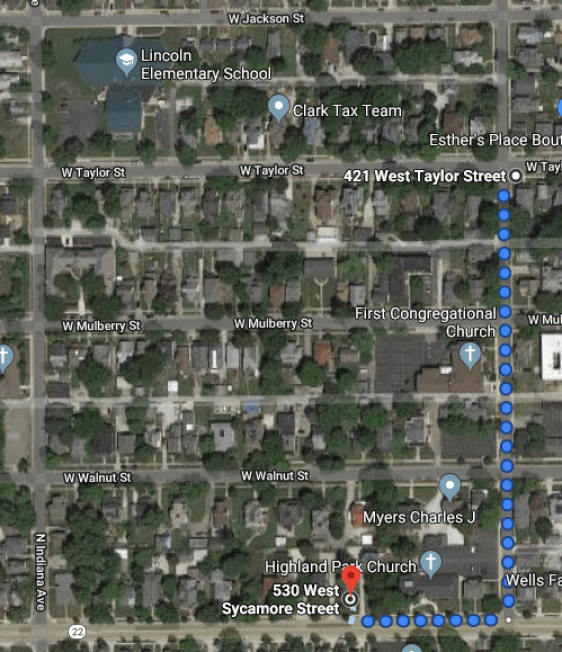
Kokomo Sycamore map.png

The house on Sycamore Street, originally built in 1925, looks amazingly like it did then.

The house was divided into two apartments. Part of the reason Mom bought this particular property was so we would have income from one apartment to help pay the mortgage. Our entrance was on the side and we lived upstairs.

Kokomo house on Sycamore.jpg

The best part? I had my own bedroom!

Our house shared a driveway with the huge brick house next door that had a ballroom on the third floor. I’ve always wondered if our house was the gardener or servants’ quarters, but it was too nice for that, and too close too.

Kokomo 1868 Sycamore.png

Digging around in the photo collection as well as at the County Assessor’s office and at Newspapers.com, I pieced together events that formed our neighborhood.

In either 1865 (newspaper) or 1875 (assessor’s office,) Robert Haskett, a bootmaker and businessman in Kokomo build the stunning 3 story house next door to the east. The map, above, shows this portion of Kokomo on a map dated 1868, and the house on Sycamore doesn’t yet exist.

Kokomo 1877 Sycamore.png

This 1877 map shows the Haskett land, outlot 12. It’s interesting to note that David Foster still owned a substantial amount of land on the larger map, and that “New London and Kokomo Pike” was a tollroad with a bridge someplace in what is today Foster Park. Kokomo Pike became Park Avenue that intersects with Defenbaugh.

Apparently at one time people tried to build and live on land that eventually became Foster Park. Kokomo had a devastating flood in March of 1913 where Wildcat Creek came within 10 feet of the railroad bridge, threatening to wash it away, and expanded to nearly a mile wide. I’d wager that if homes were built in Lowe’s Addition, on Fremont and Rose Streets, they were permanently abandoned at that time.

The old Haskett mansion at 524 West Sycamore has two floors that total 3390 square feet, and the third floor ballroom, now considered attic apparently, would have been half of that again. When I lived next door, the ballroom had been abandoned for years, looking like guests just walked out after the last New Year’s Eve gala, shut the door and it wasn’t opened again for half a century.

Today, the mansion, as I used to think of it, is taxed at a value of almost a quarter million dollars, where our old house next door is taxed at $82,000. Of course, our house is half the size and not nearly as fancy. I’m not sure I’ve seen actual curved glass windows since. The Haskett home was truly magnificent.

Robert Haskett and his heirs died, and the mansion along with its property was sold out of the family, then subdivided. Orchards covered most of the land between Sycamore and Walnut and on west where our house and others would eventually be built.

Property tax records indicate that our house today has a total of 1566 square feet, 1 fireplace, 4 bedrooms and 2 baths. It was built in 1926, has 8 rooms total and stands on .129 acres. Apparently, the upstairs fireplace has been walled up, because there were two fireplaces when we lived there.

According to the Historical Society and home assessment records, this was the first house built when the Haskett property was initially subdivided.

Ironically, currently our house and the Haskett house next door are once again owned by the same people.

Kokomo Sycamore.jpg

My bedroom was the window on the second floor to the right of the front porch roof. There were functional fireplaces in the front of the house, both upper and lower – clearly before central heat.

There used to be stately maple trees in the front and side yards.

Kokomo Sycamore side.jpg

Today, the pine tree in the rear, probably about roof height when I lived there, soars above the house, and the maple trees are gone.

The maple tree on the left side came crashing down on top of the house in the devastating 1965 Palm Sunday Tornado. I remember Mom grabbing me by the hair, which was the closest thing she could get ahold of, and literally dragging me down two flights of steps to the basement.

Kokomo Sycamore pine tree.jpg

I walked up the hill in the driveway to knock on the door and see if anyone was home. I didn’t know what I was going to say, but it didn’t matter, because they weren’t.

Kokomo Sycamore garage.jpg

There used to be a garage in the rear where a concrete parking area is today, at left, with another unsheltered parking space at right.

My freshman home-room class constructed our homecoming float on a farm wagon for the parade made from colored Kleenex stuck into chicken wire in that garage. I can’t remember what it was, but we had a lot of fun making it.

We were terrified that it would rain.

Where the white lattice fence stands today at the rear of the property used to be a concrete block wall separating our driveway from the neighbors to the rear.

Kokomo Sycamore house back.jpg

The concrete block chimney was added at some point for the furnace, a boiler when we lived there. Our radiators clanked and Mom was always afraid the boiler would explode.

Kokomo Sycamore side 2.jpg

The door, arched roof and trellises look exactly the same today. And I do mean exactly. It’s difficult to believe they haven’t been replaced since we bought this property 56 years ago. I’m not positive they’ve been painted since Mom sold it 47 years ago.

Lilly’s of the Valley grew in the flower bed below the trellises along with the rose bushes I bought Mom at Woolworths one Mother’s Day. I wonder if any of those plants remain.

Even the unusual lock appears to be the same on the door. Where’s my old key???

I wonder how many people have lived here since Mom sold the house in 1972.

Kokomo Sycamore side 3.jpg

The little window above the inaccessible decorative balcony was my closet, which also housed the door to the attic.

Kokomo Sycamore 530.jpg

Today, this home is in the Old Silk Stocking historic district, as it should be.

In 1972, when Mom married my stepfather, she sold this house and we moved to the farm.

Kokomo Sycamore from across street.jpg

Across the street. Saying goodbye. Forever this time.

The Sieberling Mansion

Kokomo Sieberling map.png

Down the street a few blocks the old Siebering Mansion, build in 1887, is now the Howard County Historical Museum.

Kokomo Sieberling.jpg

The stately Sieberling Mansion declined for years due in part to exorbitant maintenance costs. Now, it’s beautiful again and is stunningly decorated for the holidays. I can’t find a copyright-free photo, but just google “Sieberling Mansion Kokomo Christmas decorations.”

Mom and I used to drive the old mansion neighborhood during the holidays, enjoying the display every Christmas season. It seemed like the residents had an implied competition to see whose home could be decorated the most beautifully.

As a child, looking out from behind frosty car windows into the inky night as we slowly inched along the crunchy snow-crusted streets, the colored lights outlining these mansions took on a magical other-worldly quality.

Best of all, that entertainment was free and something I looked forward to every year.

Oh, the innocent joys of childhood.

Lincoln School Years

I spent my elementary years at stately Lincoln School.

LIncoln School 1950

Each year, we would graduate to the next grade, and move from one room to another. By third grade, we graduated to “upstairs” classrooms.

There was no room for a cafeteria in that old building, so we all walked home, ate lunch, then back again. Occasionally we would have lunch with our friends at their houses. That was a special treat.

Sometimes we would hold hands with our friends, swinging our arms, as we walked each other home.

Kokomo Lincoln School today.jpg

Today, the new Lincoln School looks very different. You’ll excuse me if I say it lacks character😊

Every student looked forward to 4th grade where the entire school was caught up in the spring-time spelling bee competition and festivities which crowned the royal court of the best spellers.

Lincoln spelling bee court

Yep, that’s me bottom right, wearing white dress gloves, looking extremely self-conscious and not exactly knowing what to do with myself. I was in the spelling court. I still remember the word that was my downfall. I forgot to say “capital I” when spelling the easy word, I’ll.

The court members were all my friends of course, but my special, brilliant friend, Marianne was crowned the queen – in the center behind me.

Marianne is the friend buried in the Crown Point Cemetery. She passed away on my birthday. Unaware, I dropped into her Mom’s house the morning of her death, and directly into a scenario straight out of hell.

Marianne and her sister, Linda, were my best friends for many years growing up. I don’t ever remember not knowing them.

Kokomo Marianne.jpg

We neighborhood girls used to have slumber parties. This is Marianne putting on makeup and drying her hair (yes, that’s what that thing is) sitting at Mom’s vanity.

Kokomo Larsen's.jpg

The Larsen’s lived just over on Walnut street. The area above the garage in the rear was a “playhouse” for the kids. That was our favorite place for slumber parties because it was so spacious.

Kokomo neighborhood map.png

The neighborhood seemed huge at the time, but in reality, it was only a block or so wide and 3 or 4 block long.

I was too young to walk home from Lincoln School and stay after school by myself, so I had a babysitter, “Mrs. Cooksey” aka “Cookie,” a widow who lived across the street from the school in the house below.

Kokomo Cookie's.jpg

I loved Cookie. We had fun and she let me push the old lawn mower from time to time, probably because if I was behind it pushing, there was no possibility that I could get my appendages into the blades and hurt myself. It made a fun whirring noise. She didn’t think mowing was nearly as much fun as I did.

Kokomo lawn mower.png

We picked dandelion greens, cleaned, cooked and ate them.

Cookie also had a wringer washer in the basement and I was allowed to help turn the crank too. What fun!

That machine looked a lot like this one, below, except her tub was white metal.

Kokomo wash tub

By Etan J. Tal – Own work, CC BY-SA 4.0, https://commons.wikimedia.org/w/index.php?curid=78348153

The water drained onto the concrete floor, discolored from years of washwater, and we used a straw broom to sweep the hot, soapy bubbling water into the drain. I made a game of that, seeing if I could sweep all of the bubbles into the drain😊

How do you make chores alluring to a child? Make them fun, of course.

I was terribly sad when Cookie eventually went to work at the hospital. I stopped by to see her for years. She came to see me when I nearly died of meningitis at that hospital when I was 10.

As I got a little older, I did stay alone after school, but Mom wasn’t cracked up about that all day in the summer.

For some reason, the older I got, the more she didn’t want me staying alone. Imagine that!

Kokomo Mrs. Jones.jpg

Mrs. Jones lived in this house. She had a son a couple years older than me, Jimmy, and Jimmy had a friend, Tony. And well….you get the idea. Tony was my boyfriend for quite some time in high school. He left to become a preacher. I went to Europe. Sound like a country song? Tony wrote and sang country songs too.

Jimmy had a band, The Barons, who practiced in Mrs. Jones’ basement. That woman had the patience of a saint.

Suffice it to say that I absolutely LOVED going to Mrs. Jones’ house. The entertainment there was infinitesimally more interesting than lawn mowers and washing machines.

Walking from home to either Lincoln School, or later Pettit Park or Lafayette Park Schools in middle school, I had to walk past a little neighborhood convenience store called Chuck’s Pantry.

It was owned by…Chuck…of course.

I loved that little neighborhood store. Sometimes Mom would send me on an errand there – usually to buy a loaf of bread or a gallon of milk. Chuck knew all the neighborhood kids, and we all knew exactly how much each and every candy bar cost.

Amazingly though, whatever pennies we had in our change was always enough for a candy bar!

Kokomo Chuck's.jpg

Chuck’s never seemed large, but it looks even tinier today. The grey addition to the left, behind the truck, didn’t exist originally.

The Reservoir

Kokomo had a public swimming pool, but an entrance fee was required.

Kokomo Reservoir map.png

The Reservoir, located 4 or 5 miles east of town, was free.

Kokomo reservoir.jpg

On hot summer evenings, Mom and drove to the Reservoir, parked along the road and with lots of other overheated folks, splashed and played in the water. There were no lifeguards. That’s Mom in the black suit and me with the pigtails.

Kokomo reservoir mom me.jpg

There’s little resemblance today. No swimming is allowed now.

Kokomo reservoir today.png

There weren’t guard rails then either.

The Reservoir is the Kokomo water supply, created by a dam across Wildcat Creek which also helps to control the worst of the flooding.

Kokomo reservoir dam.jpg

My Dad used to take me fishing along the dam.

Kokomo reservoir dam me.jpg

I’m actually amazed that my mother allowed playing on the rocks in front of the dam. Given that she didn’t fish, I’d wager she didn’t know until afterwards when the photos were developed. Fishing was an activity I got to do with Dad alone – cherished memories today.

Kokomo reservoir dam today.jpg

I drove past the dam site and it bears little resemblance to yesteryear.

Kokomo reservoir dam from bridge.jpg

The only place I can actually see the dam itself is through the trees from the bridge.

I might also mention that various locations at the Reservoir were favorite parking places for teenage couples. And for patrolling police. It wasn’t unusual to find yourself staring into a blinding flashlight, not that I’d know from personal experience of course😊

I’m guessing some things never change.

Walking to School

In 7th and 8th grades, I attended Pettit Park and Lafayette Park Schools, respectively, for one year each. Both were long walks from home.

Kokomo walk to school.png

Given that the kids who had attended those schools during elementary school had already established relationships and a social hierarchy, those of us transferring in from Lincoln School (to Petit Park) and Petit Park (to Lafayette Park) were landing in uncharted waters.

I didn’t attend either school long enough to establish much of a connection, but the next 4 years would be spent downtown at Kokomo High School. All students who went to KHS transferred from another school, and there were several, so high school was the great equalizer. The playing field was once again level, which is another way of saying that everything was in flux and opportunities were everyplace just for the plucking. At least, that was my perspective.

A new crop of both friends, and boys.

New friends, classes that could be selected, clubs, special interests, sports – you name it. Middle school was in many ways an extension of elementary school where there was little choice for personal expansion. High school by comparison was a smorgasbord – the last stop on our journey to becoming adults.

Of course, that was the whole reason for the class reunion – we left walking across a stage and carrying diplomas.

I passed the same landmarks every day for those 4 formative years.

There were no school buses. We walked to and from school, about half a mile for me, regardless of the weather. Heat, snow, rain; it didn’t matter.

Kokomo Sycamore to KHS.png

There were two ways to walk, either through the center of town along Sycamore Street, past the courthouse, shown below, or one block to the south, along Superior Street.

Kokomo courthouse.png

The courthouse build in 1937 and many of the same buildings are still there, with new businesses as residents of course.

Kokomo Buckeye.png

The Woolsworths store is gone, but I loved that place. The grey building above at right bears no resemblance to the Woolsworths of yesteryear, with its huge plate glass windows that were painted jovially with Christmas and holiday scenes by high school students each winter.

Woolworths stocked items I could actually afford. Many of Mom’s gifts came from there, including a parakeet that “she” wanted. At least according to me, she wanted a parakeet.

Looking south along Buckeye, above, the old train tracks ran down the center of the street, crossing Wildcat Creek in the distance.

We always had to be careful not to turn our ankles crossing the tracks. They were still in use back then.

Kokomo Buckeye looking south.jpg

Walking a block south along Buckeye, to Superior Street, where Buckeye ends today, we can see the bridge. These train tracks were laid where a sawmill once stood, and that was constructed over the old Indian cemetery.

Kokomo Buckeye looking north.jpg

Looking north from the intersection of Superior and Buckeye, above, the tracks run through downtown a few blocks to the depot where the class reunion was held.

Kokomo Superior east.png

The buildings along Superior walking east toward the high school are mostly gone now, morphed into parking lots. Absolutely nothing, other than the train tracks, looks familiar.

As students, we ate lunch in the mom and pop places that used to line the storefronts along Superior.

Around the corner on Union, Finn’s Camera and Drug Shop, of all places, was a favorite offering grilled sandwiches, flavored Cokes and frozen candy bars. Amazingly, Bob Fenn, the proprietor could do math in his head.

Coneys and grills that couldn’t accommodate very many students at once dotted the downtown landscape, but somehow dealt with the noon rush. Two separate lunch “hours” in which students had to leave, eat and be back for the next class within 55 minutes.

The high school did have a cafeteria, but not many students ate there. Those with cars drove elsewhere, along restaurant row on Markland mostly. Burger King, home of the then-new Whopper and Whaler sandwiches was always a favorite. The guys loved the, “It takes two hands to handle a whopper,” jingle, smiling smugly at their private joke, while the girls collectively rolled their eyes and laughed nervously, if at all.

Kokomo Armstrong Landon.jpg

The old Armstrong Landon Building, rebuilt in 1923 after a fire burned the original, still sports its exterior fire escape. At 6 stories, it remains the tallest building in Kokomo. The building occupies the full quarter block of Main and Sycamore. Until the building was demolished where the parking lot is today, the back of the Armstrong Landon Building wasn’t visible from Superior.

Looking at an aerial photo, I think about half of downtown Kokomo is now parking lots. I don’t know if that’s a bad thing or a good thing, but it’s definitely different.

Kokomo Superior.jpg

In many places, new buildings have sprung up with lovely art and murals documenting Kokomo’s history.

As we walk down Sycamore, in another block, we’ll be in front of Kokomo High School.

Kokomo KHS corner.png

The approach only looks slightly familiar, like a long-ago vague reminder of someplace I once was.

On the right, a newer building has been added, with the original technical education building (woodworking and shop) set back further to the rear, near Wildcat Creek.

Slightly further on the right, the main building stands, but from this persepective, it’s hidden behind the trees.

I created this layout of the campus of both yesterday and today.

Kokomo Kokomo High School layout.png

The old Central School which had been repurposed for the high school is gone, replaced by a parking lot, as you can see above.

Kokomo Katz Korner.png

Perhaps the greatest of ironies is this photo though. Across from the school, off of school property but as close as humanly possible, used to be a row of buildings. I have no idea what was IN those buildings, because that was pretty much irrelevant. One might have been a pool hall. The sign swinging from the brick building on the corner from rusty hinges read Katz Korner, I think.

It was on that corner that the rebel boys hung out. Think James Dean and Fonzie. Yep, rebels all, they stood there and SMOKED. Cigarettes of course, nothing else. Those boys were often referred to as “hoods,” although I’m not sure why. It was supposed to be a disparaging moniker, but it didn’t keep the girls who walked by in clusters, on the OTHER side of the street of course, a respectable distance away, from glancing furtively across the street, pretending they weren’t in the LEAST interested.

Those unruly bad-boy males on the “tough” corner struttin’ their stuff were both very interesting and tantalizingly dangerous. It’s like they had gone over to the dark side, but the dark side was very much a curiosity.

Cigarettes were only “naughty” but anything else would have been illegal. Which brings me to the ironic part – the parking lot that has replaced those buildings belongs to the KPD, Kokomo Police Department, whose headquarters are in the brick building.

I got a good chuckle out of this.

Karma strikes again!

Kokomo High School

Kokomo KHS.jpg

The front of the original KHS building looks much the same, although this building was obsoleted as a high school years ago. It’s now named Central Middle School, but make no mistake, this is not the original Central School that stood across the street.

Kokomo KHS stairs.jpg

Inside, the stairs were wood, and we ran up and down the 3 stories like they were nothing. Lockers lined the hallways. Students had 8 minutes between classes to get to their locker, switch out their books and be seated in the next class before the bell.

And we made it, too, almost every time.

Otherwise, you got sent to the office for being tardy.

These were also the stairs where we girls made a stand in order to be allowed to wear pants, as in slacks, especially in the winter. Before that was allowed, we had to wear skirts or dresses and hose. Who remembers garter belts?

Kokomo garter belt.jpg

Sorry guys, these were miserable.

Keep in mind that we walked to and from school every day, often a mile or more and this was before the days of pantyhose which would at least have helped a little with warmth.

Bottom line, the old-school school administrators felt that dresses were more respectable than pants. I mean, only rabble-rousing females would EVER wear pants – right??? But we were cold and miserable – and I was very proudly a rabble rouser.

I’m sure this confession stuns all of my readers.

“Someone” started a rumor that the girls weren’t going to be wearing panties on a specific day, which of course means garter belts, hose and nothing else. The boys clustered excitedly around the bottom of all of the stairs, waiting for, then twisting their their necks nearly in a knot to watch the females climb the steps.

I remember by boyfriend, Don, saying to me, “You’re REALLY NOT going to do that, are you?”

I gave his class ring back.

Whether we did, or didn’t, wear panties that day, is irrelevant. We clutched our skirts close to us so that the boys couldn’t see (as if they could have anyway,) which had the intended effect.

It worked.

In an amazing change of policy, that has nothing to do with the protest, of course, the girls were quickly allowed to wear pants, but only in bad weather…and NOT jeans. Of course, that was a slippery slope and by the time I was a senior, pants, especially bell bottoms were VERY COOL!!! Skirts and dresses were a thing of the past.

However, my name with school administration from that day forth was officially “mud.” It’s probably in my “permanent record” along with a list of my further transgressions, most of which make me extremely proud.

If I had a graduation picture, I would proudly photoshop “mud” on my forehead and post it here.

Memorial Gym

Across Apperson Way from the main building stood the gymnasium.

Kokomo Memorial Gym.jpg

Standing on what remains of the old Central School steps, I spy Memorial Gym across the street beckoning like an old inviting friend.

Kokomo Memorial Gym 2.jpg

It was here that graduation took place.

Kokomo Graduation 2.jpg

Let’s just say that graduation was a battle for me as were activities leading up to graduation.

I was an (ahem) unconventional, noncompliant student😊

Among other things, I wanted to take an advanced placement college prep course. My male counselor whose approval I needed declined the request, saying, “We’re not going to waste a perfectly good AP seat on a girl. You’re just going to graduate, get married and go to work at Delco. We’re saving those seats for boys who are going to actually do something with their lives.”

He might as well have waved a red flag in front of a bull.

Hell hath no fury…

The dean wouldn’t listed to reason. My mother wouldn’t take me, so I walked to the school board meeting…and spoke.

The board was patronizing and said they would “see about things.”

I stood firm and said I was not going away until they decided, and I refused to sit down.

I was shaking and alone, but stood absolutely still, firmly rooted, unflinching, at the podium. I had to hold the sides to keep them from seeing that I was shaking and terrified. I was on the verge of tears, from nerves, and I was afraid I was going to be permanently expelled.

I was beginning to wonder what I had done. What was I thinking? More to the point, what was I to do next?

No one blinked.

I knew my goose was cooked. But since that goose was already in the oven, no need to stop now…

I noticed that a reporter from the Tribune newspaper was sitting nearby, taking notes, and seemed interested. I ever-so-slightly waved at them with 2 fingers, not letting go of the podium, and smiled just a bit.

She was the only even slightly friendly face.

The reporter moved a few seats closer, watching intently.

The board members glanced up and noticed.

I got my seat in that class, I’m sure because that path was much easier than dealing with a female malcontent who refused to leave or sit down. Still, I can’t help but wonder how many females didn’t and became discouraged.

That condescending, discriminatory attitude and resulting restrictions became a self-fulfilling prophecy for generations of females and minorities.

Females were SUPPOSED to, expected to, graduate and get married and go to work in the factory at Delco. We were NOT supposed to want to pursue a college education unless we wanted to be teachers, or nurses. Those traditional female occupations were OK, but NOT engineers or anything that competed with males. Heaven forbid.

Furthermore, I missed part of a semester due to health issues but completed all of my requirements with outstanding grades. In fact, I graduated near the top of my class.

The administration did NOT want me to “walk” with my graduation class because of my absence, suggesting instead that I attend the “night graduation” for those who had been disgraced into going to night school. Like, you know, girls who had gotten pregnant and were not allowed to attend school with the rest of us because they might pollute us with their lack of morality. (Sarcasm.)

I flat out refused.

I was not allowed to order a cap and gown. That was fine, I said, because I would simply walk in my street clothes – specifically, blue jeans and a rather tight-fitting tank top. I was good with that.

Another battle was brewing.

Apparently, Indiana University had an entirely different opinion of my worthiness – because as if a magic wand had been waved, when the high school was notified by letter that I was receiving an academic scholarship from Indiana University, one of only two awarded – I was suddenly allowed to participate in the graduation ceremony.

Kokomo Scholarship.jpg

As the graduates names were called, their scholarships were announced. It might have been my imagination, but there was a pregnant pause just before my name.

Then it was my turn to walk.

All I can say is that I proudly strutted across that stage, head held very high, waved to my family in the stands, accepted my diploma from officials who were absolutely NOT smiling, reached out to shake each of their hands whether they wanted to or not, including the school board members who assuredly remembered me, smiled by best, brightest smile at them, said “thank you,” and proudly walked off the stage holding my diploma in the air.

Like I said, I’m absolutely positive “mud” is my official name.

Suffice it to say, I not only won the battle, I won the war.

Kokomo IUK.jpg

These weren’t my only battles with the administration at KHS, but the ones of which I’m proudest. I hope in some small way they paved the path for others who followed.

Literally, no one, not even my mother supported me, and I was utterly terrified.

My mother’s favorite saying to me was always, “If you would just behave.”

I didn’t and couldn’t. Thank goodness.

I doubt she thinks that any more😊

Roberta well behaved

Of course, while graduation was the pinnacle of our years at KHS, most of our time spent in Memorial Gym was for sports or gym class.

Basketball games were played inside, with football outside, behind and to the right on the old Kautz field.

Kokomo gym.jpg

The student cheer block, also known as yell block, consisted of coordinated dressing in red and blue with white gloves, cheering and yelling. We practiced in the gym and executed our synchronized “yells,” directed by the cheerleaders, during games when we cheered wildly for our hometown team, the Kokomo WildKats.

Kokomo Wildcats.jpg

The football field was located by Wildcat Creek that ran behind the school and is gone now – only the track and one set of bleachers remaining. The official high school is now Haworth, the “new school” built south of town back in the 1970s.

Kokomo High School, as we knew it, is no more.

Central School

Kokomo Central school.jpg

The old Central School building, built in 1898 stood across from the main KHS building and housed fun classes, like art and debate, for example.

I loved art, although I wasn’t fond of my overly-attentive teacher. I still have one of my leaf pencil drawings.

Kokomo leaf drawing.jpg

The Central School floors were well worn wooden planks, as were the stairs and everything had an echo quality.

Kokomo Central steps.jpg

Only steps to a parking lot where the school used to stand remain today.

Kokomo Central location.jpg

I walked into the parking lot, and noticed something VERY interesting through the trees.

What is that?

Why, it looks like a Fairy House???

The Fairy Houses

We did NOT have Fairy Houses when I lived in Kokomo. Two exist today and they look like they emerged directly from a storybook. They are amazing!!!

Kokomo Storeybook Express front.jpg

Believe it or not, this is a convenience store named Storybook Express with a drive-thru and it’s stunningly beautiful. Can you believe those words together in one sentence?

Kokomo Storybrook Express front.jpg

I want to live in this version of a hobbit house!

Kokomo Storybook Express corner.jpg

Standing in the parking lot, a lovely garden and statue grace the corner.

Kokomo Manetoowa.jpg

Manetoowa, honoring the spirit of the Native Miami people.

Kokomo Manetoowa statue.jpg

The perennial garden surrounding the statue is luscious. A time capsule rests beneath the statue itself.

Kokomo Manetoowa garden.jpg

This is amazing!

Kokomo wildflowers.jpg

Oh gosh, look at the cute little chimney, behind the statue.

Kokomo Storybook Express fence.jpg

Even the “fence” by the street is incredible!

Kokomo Storybook Express glass.jpg

I bet that’s Kokomo Opalescent Glass, too.

Kokomo YWCA.jpg

Looking across the street, I notice the old YWCA building where I spent many Saturday mornings as a child. In elementary school, I “helped out,” checking skates in and out so that I could attend the Saturday morning activities for a reduced rate. The Y had trampolines and crafts and best of all, swimming. Not to mention a pop machine with cream soda. Soft drinks were something we couldn’t afford, but part of my “pay” was one soft drink every Saturday.

The high school didn’t have a pool, so students swam at the Y – walking, or rather, running the block back and forth with wet hair that froze stiff in the winter, and YES, we still made our 8-minute class switch!

There’s one more Fairy House in Kokomo as well.

Kokomo Markland Fairy House.jpg

This one on Markland was for sale and I’m not even going to show you what they did to it.

Kokomo Fairy House side.jpg

Kokomo fairy house front.jpg

Tying Up Loose Ends

About the time I graduated from high school, Mom married my wonderful stepfather, sold our house in Kokomo and moved to the farm. I adored both him and the farm, writing about him here and here, and my wonderful memories of the farm, here.

I did not visit the farm during my Farewell Tour. I said my goodbyes there years ago. The house burned after Dad died and Mom moved to town. Like with this journey to Kokomo, I knew that my last trip to the farm was indeed my last visit ever. “Home” is not there anymore.

Having driven the length and breadth of Kokomo for two days, I had visited just about every place that held poignant memories for me, other than the chapter I omitted – except one.

The house on Mulberry Street at the corner of Indiana.

I didn’t want to, but I needed to return one last time.

My heart started pounding the inside of my chest as I drove down those streets lost in memory.

The House on Mulberry Street

Perhaps I should say where the house on Mulberry Street once stood.

If I close my eyes, I can still see it – standing in its stately grandeur. Stained glass windows restored after being found long-buried beneath the attic floor. A beautiful wooden spiral staircase climbing gracefully inside the front entryway bathed in rainbow light from the colorful windows. The wooden banister rubbed smooth from thousands of hands over a century.

Kokomo Mulberry Indiana.jpg

Today, this is the view.

The townhouse apartments across the street look almost exactly like they did back then.

Kokomo Mulberry Indiana apartments.jpg

I remember the old woman who had lived there seemingly forever warning me just before we bought the property about the rumor that the house was jinxed. “Haunted actually,” she said. “Cursed.”

Finally, taking me into her confidence, wide-eyed, she revealed the dark secret. That no one ever left there married. Ever.

We shouldn’t buy it, she warned, or we wouldn’t either.

Her story revealed that one man, long in the past, had locked his supposedly insane wife away in the attic, a hostage, and she cursed both him and marriage.

I smiled, and while I appreciated her grandmotherly concern, I thought those stories were amusing. I was glad my house, which was approaching her century birthday, had character.

I wondered about the attic though, especially when we were working on the restoration.

The elderly neighbor died shortly thereafter, but I thought of her words often as I found odd things buried there – and in the basement, under the floors, slid in-between the walls and under the insulation that was added decades later.

Kokomo Mulberry memorial garden.jpg

“Our” corner stands vacant now, memorialized only by the garden where the tree and sidewalk to the front door once stood.

Kokomo key.jpg

Today, these keys, found in the walls, resurrected into ornaments, are all that’s left.

Kokomo key 2.jpg

This grand lady was the first house I ever owned. My husband and I bought it because it had so much potential. Translated – it needed a whole lot of work and we could afford the property.

We were convinced that we could do anything.

We were was young and starry-eyed in love. We had vision and a plan for the future.

We would restore our house, raise our family and finish law school.

We would live happily-ever-after.

We worked towards our dreams which were slowly becoming reality. Long hours at work and school along with laboring on the house were paying off.

We could see the finished product through the hours, days and long weeks of back-aching work as we transformed this neglected gem into a much-loved beauty.

We found old newspapers and packages secreted in the walls, along with a very steep hidden stairway secreted in the rear of the house – barely wide enough for one person. Is it possible that those stories were true after all? Something wasn’t “normal,” that’s for sure.

But walls weren’t talking. And our friend was dead.

We kept on working, and working, and working. Restorations of old houses are never “finished.” Take my word for this.

I turned the corner and pulled my Jeep up in front of the property which looks very different today.

Kokomo Mulberry sidewalk.png

I can’t see where the house once stood. Thankfully, it’s shielded from my eyes by the newly planted trees between the sidewalk and Mulberry Street.

However, this small walkway from the street used to lead to the steps that led to the house on the other side of the sidewalk that’s no longer there.

Now, I just see a chilling reminder of a life and hope snuffed out – the walk that leads to no place.

And nothing.

Or maybe to another time.

To the days of wooden banisters and falling asleep in his arms in front the fire crackling in the winter fireplace.

Those long-lost days.

Before…

Kokomo Mulberry rear.jpg

I pulled down the alley to see if I could get a better view from the back. The neighbors bought the lot after the house was no longer there and built a garage. Today a flag waves over children’s playground equipment.

My husband would have been proud that the American flag flies on this land – he was a veteran – a special ops Green Beret in Vietnam.

Kokomo Mulberry aerial.png

After I returned home, I brought myself to look at Google maps where I can still see the footprint of the foundation of the house that once stood there. Of course, eventually the basement was filled in and the rubble removed, but the scar upon the earth and seared into my soul still remains.

I wish I hadn’t looked.

I want to remember the beautiful memory garden instead.

Kokomo Mulberry garden.jpg

I cannot tell you more about this chapter of my life – because I simply cannot.

I will write about this one day, if I can, but that day is not today.

The pain is still palpable and raw. In all these years, I’ve never been back. Never stood here. Never weeped.

When mother and I drove to town, we went out of our way to avoid not only this street, but the surrounding blocks as well. No words were ever spoken – sometimes just silence and tears as we glanced in this direction, then away quickly again, pretending like we hadn’t.

One of us would bite our lip. Neither of us would say anything. We didn’t look at each other, because that would have been to acknowledge something we both were trying desperately not to.

Just look in the other direction and drive straight away.

“I think it might rain,” someone muttered.

I must admit, she and I both wondered if that story about haunting and being cursed was true. If so, that spell was broken, because now all that’s left of that house and that life is a void.

It was all I could do to muster the courage to drive by after all these years – because it meant reliving that devastatingly heartbreaking chapter of my life. Pulling the bandage off the still-bleeding wound. Allowing myself to feel. Praying I wasn’t sucked into the vortex.

I knew this was my last visit, forever, and I needed closure. I needed to say goodbye. I never really got to say that before.

Kokomo Indiana garden.jpg

Finding phlox growing along the fence in a beautiful perennial garden that looks exactly like the phlox my Dad grew on the farm is soothing to me. I’m glad the current owners restored beauty, albeit differently.

Kokomo Mulberry phlox.jpg

It was like my Dad was reaching out to me over the years to comfort me – yet again.

Kokomo Mulberry phlox 2.jpg

It was my Dad’s quiet, steady voice that was able to reach me through the horrible fog all those years ago when my life was scorched to the bare earth and the husband I loved was ripped from my life.

I tried to rebuild my life in Kokomo, but it became increasingly obvious that I needed to leave. I was going to say, “for better opportunities elsewhere,” but the simple truth is I just needed put the past behind me so that I, we, my children and I, could build a future without ghosts that could not live and would not rest.

Kokomo kids.jpg

Goodbye

US 31 connects Kokomo, known for years as “Stop Light City,” to the outside world. What was once a bypass became a congested road lined by factories, businesses and malls. Those of us who lived there didn’t think much of it.

Today, there’s a bypass around the bypass, but I elected to drive 31 once again. After I moved away, it was 31 that brought me home again – and now, it would be 31 with its no-longer-familiar businesses upon which I would take my final exit.

Kokomo stop light city.jpg

My life had changed. I slowly morphed into a new creature. I think of an injured caterpillar that spun itself into a protective cocoon, then eventually hatched into a new creature, a butterfly.

Kokomo garden butterfly.jpg

I spread my wings and flew away.

Kokomo too has changed. Now that my folks are gone and I have no relatives there, there’s nothing in Kokomo to lure me back again. Nothing remains for me now.

For my family, Kokomo was a stop along life’s bumpy road where I lived for a quarter century and Mom for twice that long.

I wasn’t born there, but spent many years unconsciously honing the strength and skills I would need to survive, and then to leave. The strongest steel is forged from the hottest fire.

The best part for Mom and me, both, was the peaceful time on the farm with my stepfather. For her, a salvation. For me, a hiatus. God only graced me with Dad for a few years, but his quiet strength and peaceful presence remains with me wherever on this earth I journey.

Neither Mom nor I left family in Kokomo, so it’s not a place that will be cherished as a “heritage” location by our descendants. There’s no reason for them to return either.

Kokomo aerial.png

As far as descendants are concerned, that’s the very best part of what I took with me.

Them.

Together, we crafted our future.

Farewell, Kokomo.

Celebrate Your DNA

One of the challenges I have with conferences is that I spend so much time in the vendor area. Books, maps and DNA baubles are bright shiny objects to me.

I ran across Alex Coss in his role as “Chief DNA Celebrator” in his booth. Yes, that’s really what his business card says. I’m sure it won’t surprise you now when I tell you the name of his company is “Celebrate DNA.”

I ordered two items from Celebrate DNA to celebrate my own genetic heritage. I love wearing DNA-themed items. People ask questions and I get to explain how much fun DNA is and how critical to genealogy.

The great thing about Alex’s items is that many (most) of Alex’s products are customized for you based on your own DNA results.

Celebrate DNA shirt.jpg

I particularly like my double helix t-shirt. I know, that’s the geeky side of me showing through.

Celebrate DNA options.png

Celebrate DNA has are a lot more styles to select from in both t-shirts and sweatshirts.

I think these would be great to wear to family reunions and are sure to be conversation starters.

Celebrate DNA roots.png

Now, I want a canvas bag with my heritage splashed across the world. I don’t care if the percentages align with my genealogy or not, because my ancestors are from those locations. My history lives there.

Celebrate DNA day of the dead.png

I *need* this shirt for research trips, but perhaps in a different background color! There are lots of colors to choose from.

Celebrate DNA offers many other items too; mugs, bags, posters, hats and more.

These would make great genealogy holiday gifts for yourself or others.

Celebrate DNA is having a sale and offering an additional discount if you order by clicking here, then enter ESTES10 to receive a 10% discount on top of the sale prices.

Enjoy!

______________________________________________________________

Disclosure

I receive a small contribution when you click on some of the links to vendors in my articles. This does NOT increase the price you pay but helps me to keep the lights on and this informational blog free for everyone. Please click on the links in the articles or to the vendors below if you are purchasing products or DNA testing.

Thank you so much.

DNA Purchases and Free Transfers

Genealogy Products and Services

Genealogy Research

Fun DNA Stuff

  • Celebrate DNA – customized DNA themed t-shirts, bags and other items

Genetic Affairs Reconstructs Trees from Genetic Clusters – Even Without Your Tree or Common Ancestors

Since Genetic Affairs launched in 2018, they’ve added a LOT of new functionality. I initially wrote about their clustering functionality here.

Genetic Affairs AutoClustering, SuperClusters and brand-new AutoTree tree reconstruction are to-die-for features for traditional genealogists. For adoptees or people seeking unknown parentage, they are the best thing since sliced bread, automating tasks previously peformed manually over labor-filled hours, days and months.

Why Genetic Affairs?

Genetic Affairs works with matches from three vendors; Ancestry, FamilyTreeDNA’s Family Finder test and 23andMe.

MyHeritage has integrated a version of Genetic Affairs directly into their product offering on the MyHeritage website so every MyHeritage DNA customer receives clustering functionality, free, through MyHeritage, but not tree reconstruction.

GedMatch has also implemented an autocluster version for Tier 1 users, but GedMatch’s version only works at GedMatch, of course, and does not include the new tree reconstruction feature.

This article pertains to the functionality of the features available directly through Genetic Affairs, including:

  • Clustering your matches visually to identify ancestral lines of people that match you and each other
  • Reports by cluster including common surnames and locations
  • Analysis of trees within each cluster to identify common ancestors
  • Partially reconstructs trees with your known ancestors for each cluster
  • Partially reconstructs trees between your matches even if you don’t have a tree or don’t share the common ancestor

Genetic Affairs provides visualization for linked DNA matches along with critically important clues to help you figure out just how you are related to these people, and these clusters of interrelated people. The Genetic Affairs user manual can be found here.

Analysis

Each time you run Genetic Affairs is called an analysis. Each analysis scans your kit at the selected vendor(s) for all current matches. A few minutes later, you receive a zip file via e-mail with two or three files depending on your selections at Genetic Affairs and the tree availabilty of the vendor:

  • Autocluster file including the visual clusters plus additional information
  • Excel spreadsheet of cluster members and relevant information such as common ancestors and common locations
  • Tree file containing reconstructed trees (23andMe does not support trees, so no trees are available for 23andMe clusters)

Let’s look at each feature. Grab a cup of coffee and head for the computer.

Selecting Analysis Options

I encourage you to experiment. Selecting a wider range of cM (centimorgans) results in a larger file, but may also mean that the analysis times out.

For this report, I’m utilizing my matches at FamilyTreeDNA and selected a cM range of 50 minimum and 250 maximum. I wanted a minimum cluster size of 2 people, meaning 2 in addition to me. This resulted in 249 total matches that met that criteria and 20 people who met the cM criteria but did not have another person with whom to cluster.

I tried a second analysis using 20 cM – 300 cM resulting in a much larger file with 499 people in the cluster group. Currently, 499 is the maximum that will be processed.

Genetic Affairs profiles.png

On the Genetic Affairs Profiles page, I can view all of the profiles I manage. Users can schedule updates where Genetic Affairs automatically scans for matches and produces reports.

Genetic Affairs my profiles

Click to enlarge

By clicking on the Autoscan button, you can schedule automated recurring scans with e-mail notification.

Genetic Affairs autoscan

Click to enlarge

You can scan daily, weekly, monthly or never – whatever interval you select.

You can select both the minimum level of DNA match and the minimum cM. The lowest you can select is 9cM.

You can view any e-mails that have been sent to you by Genetic Affairs. The green envelope means that there’s something in your e-mail box. This answers the question about whether the report was completed and sent. If the report has been sent, but is not in your e-mail, check your spam filter.

Starting the Scan

Back on the Genetic Affairs profiles page, you can initiate an autocluster by clicking on the AutoCluster button where you’ll see the options based on which vendor you’ve selected.

Genetic Affairs autocluster.png

For example, at Ancestry, you can include only people in a particular group or only starred matches.

Genetic Affairs Ancestry autocluster

Click to enlarge

23andMe includes surname enrichment and triangulated groups options.

Genetic Affairs 23andme autocluster.png

FamilyTreeDNA and Ancestry both include the “AutoTree – identify common ancestors from trees” option. It’s very important that you click this box if you select the “Default AutoCluster” option – or you won’t get the reconstructed trees.

Genetic Affairs default autocluster.png

Of course, you can always run the analysis again.

Genetic Affairs autotree.png

If you click on the “AutoTree AutoCluster” function, the AutoTree box is already checked for you.

Genetic Affairs autotree autocluster.png

Rule Based AutoCluster

The “Rule based AutoCluster” is a dream-come-true for people seeking unknown parents or ancestors in a relatively recent timeframe.

Genetic Affairs Rule Based Autocluster.png

The “Rule based AutoCluster” provides you with options that allow you to do three things:

  • NOT – Exclude your matches with someone else. For example, your mother has tested. You can use the NOT rule to exclude anyone you might match through your mother’s side, providing you with clusters from your father’s side.
  • AND – Combine your results with someone else’s. If you have identified a half-sibling, you can view only clusters of only people who match you AND your half sibling.
  • OR – Combined rules. You can request a cluster of everyone in clusters with person A but not in a cluster with person B. In this case, if you match a number of half siblings, you can include all of their matches, except people who match them through their “other” parent, if that parent has tested.

Genetic Affairs has provided some graphics and examples here, but you may have to be a member of the site to access this page because the options are customized for you. So I’ll include the non-customized information, below. You can click these to open in a separate window and enlarge.

Genetic Affairs rule based 1.pngGenetic Affairs rule based 2.png

The “Rule based AutoCluster” explanations provided by Genetic Affairs.

Genetic Affairs rule based 3.png

Read the details of how these tools work. They are powerful, so don’t assume you understand without reading carefully.

Now let’s cluster!

Clustering Your Matches

Genetic Affairs autocluster order.png

At Genetic Affairs, if you initiate clustering by clicking on the AutoCluster button, you’ll need to put a checkmark in the AutoTree function box. If you began by clicking the AutoTree button, the box is automatically checked for you.

A few minutes later, you’ll receive an email with a zipped file. Save this file to someplace on your computer where you can find it, and open the zipped file by clicking.

Genetic Affairs zip file.png

You’ll see the files, above.

Click on the chrome AutoCluster HTML file which will display in your browser.

The first thing you will see is your visual autocluster. It’s so much fun to watch your matches “fly” into place!

Each of the people in this cluster are somehow related to the other people in the custer who have cells of the same color. The people with grey cells are included in two clusters – meaning the one to the right and the one above, both.

Genetic Affairs cluster.png

The names of the matches are listed to the left and above the display.

The legend is to the right.

Genetic Affairs cluster legend.png

I have a total of 41 clusters.

Scrolling down the page, each cluster has additional information, and each column is searchable or selectable, including comments I’ve entered at the vendor.

Genetic Affairs autocluster info

Click to enlarge

Just by looking at these first 3 matches, I know immediately which side of the family and which ancestors are involved with this cluster. I can look at my notes, to the right, which indicate whether I’ve identified our common ancestor. I paint identified matches at DNAPainter which I’ve entered into the notes field at the vendor.

If I’m signed in to my account at the vendor, I can click on my match’s tree link, above, and take a look. Keep in mind that these people can be related to you, and each other, through multiple ancestors.

Genetic Affairs autocluster members.png

You can hover over any person in the grid, above, to view additional information. For each person whose square is grey, indicating membership in (at least) two clusters, you can hover over the grey square and view the members of both clusters. In this case, I’m hovered over the grey square of Brooke and E.H and the black box shows me who is in both people’s clusters.

Note that while a match could be related to you through several ancestors, and hence be in more than 2 clusters, because of the grid nature of clustering, a match can only be displayed in a maximum of 2 different clusters.

Looking at the auto-generated table below, I see the common surnames in cluster 1. Keep in mind that many of these people maybe related to each other through a spouse that you aren’t. Your ancestor’s brother’s children, for example, are also related to each other through your ancestor’s brother’s wife.

Genetic Affairs surnames.png

I know that Vannoy is the common line, but Upton isn’t my ancestor – at least not that I know of. However, a surname with 20 people in a cluster needs to be investigated and evaluated. Do I have any missing wives in this line? Here’s a really great place to start digging.

In this case, it turns out that one of my ancestor’s children married an Upton, and several of his descendants have tested.

Let’s see what other tools we have.

The Ancestor Spreadsheet

Opening the spreadsheet file, I see several rows and columns.

Genetic Affairs common ancestor

Click to enlarge

The common ancestor between the people in the rows is listed at left. The green cells are from my tree.

Two example ancestors are shown above, Mary McDowell and William Harrell, who just happen to have been married to each other.

Scrolling on down, I see rows without green cells.

Genetic Affairs ancestors

Click to enlarge

These people share a common ancestor in their trees, an ancestor that isn’t in my tree. Presumably this is an ancestor I don’t share with them – or one I haven’t identified.

For example, “Bev” and “van” share William Grubb. “Vicki” and “Mark” share Martha Helen Smith. I don’t share either of these ancestors, but Martha Smith married Alvis Winster Bolton, the son of my ancestor – so I know why Martha Helen Smith appears as a common person in the trees of my matches, but not me.

Further down in the same cluster, I notice that one match shares multiple lines in our trees. Therefore, our DNA match could be on either line, or some segments from one line and some from the other.

Scrolling to the bottom of each cluster’s sheet, common locations are provided.

Genetic Affairs locations

Click to enlarge

While the designation of “Tennessee” isn’t terribly exciting, scrolling further down provides a list by county, and that IS exciting, especially if you’re chasing a brick wall. Sometimes a group of ancestors in a location where you’re seeking a female’s family is very suggestive especially when combined with ancestral names and surnames.

Let’s move on to the third group of files, Trees.

The Tree File

Click on the tree file and you’ll see the following.

Genetic Affairs tree file.png

Reconstructed Trees

For each cluster where trees can be reconstructed, you’ll see two files for cluster 1:

  • Ancestors 1
  • Tree 1

Opening the file labeled Ancestors 1, I see the following information for the first ancestor, meaning a common ancestor between the two people listed below that ancestor. You can click to enlarge these images.

Genetic Affairs ancestors by cluster.png

Opening the corresponding Tree 1 file, I see that Genetic Affairs has reconstructed the tree between me and the other testers as best it can based on the provided trees.

Genetic Affairs reconstructed trees.png

Looking at the tree for cluster 3, below, I see this line in cluster 1, above, has been extended because Sarah, the pink match and me all share a common ancestor, Elizabeth Shepherd.

Genetic Affairs reconstructed tree 2.png

Looking at another cluster, below, while I don’t share an ancestor in a tree, three people that I match at a relatively high level do.

Genetic Affairs reconstructed tree no common ancestor.png

As you can see, their common ancestor is Anne Adelaide Chiasson. This is my Acadian line, so our common ancestor or ancestors must be someplace on up that tree, or the result of an undocumented adoption, or a missing ancestor in our trees.

Constructing the trees of your matches to each other, even when you don’t have a common ancestor in your tree, is the best feature of all.

Clustering plus tree reconstruction, especially in combination with the other clues, is the key to breaking through those unyielding  brick walls.

Super AutoClusters

Just as I was getting ready to publish this article, Genetic Affairs released a new feature called Super AutoCluster.

I absolutely love this, because it combines your clusters from multiple vendors – today Ancestry, who does not provide segment information, along with Family Tree DNA, who  provides invaluable segment information.

This combination can be extremely powerful.

To begin a Super AutoCluster, click on that option under an AncestryDNA kit that also has a kit at Family Tree DNA. Both kits need to have a profile at Genetic Affairs.

Genetic Affairs supercluster.png

Next, you’ll see the screen confirming the kits to use. The combined autocluster tool is limited to a total of 500 matches, or 250 at each account. However, that’s more than enough to make some great progress.

Press “Perform Analysis.”

Drum roll please…

Voila, your combined cluster.

Genetic Affairs supercluster cluster

Click to enlarge

In this example, you can see the large peach and purple Ancestry clusters. The green red, brown and pink smaller clusters are Family Tree DNA clusters. The Family Tree DNA clusters have tiny little Fs in their cells. If you click the above graphic to enlarge, you can see the Fs.

However, the grey cells that intersect the two clusters, meaning an Ancestry and a Family Tree DNA cluster, are found in both of those clusters, connecting the clusters for you logically.

If you look closely at the cells labeled here with “common names,” you’ll see “N” in the cells indicating a common names for you to check out within that cluster.

The “Common Ancestors” box shows the people who connect to both clusters.

There are also a number of people that span the green and red Family Tree DNA clusters too.

Genetic Affairs then proceeds to combine the clustered DNA matches and trees for you from both vendors.

Genetic Affairs supercluster tree

Click to enlarge

In addition to the cluster graph and spreadsheet information that now includes combined information, you’ll see a much larger clustered tree.

And again, the best part is that even if you don’t know how you connect to people through trees, their tree and ancestors will be connected, even if you’re absent. You’ll be present in the genetic cluster itself, so you can work the combined tree cluster to see where you might fit in that branch of the family. Because trust me, you do fit – somehow, someplace.

Cost

Genetic Affairs uses a “credit” payment system. Your first 200 credits are free so you can learn. These may last you for weeks or months, depending on how often you run the clusters. If you manage multiple kits, you’ll use credits more quickly, but it’s worth every last dollar. Genetic Affairs is very inexpensive. I manage multiple accounts and I spend around $5 per month. You can read about Genetic Affairs’ payment plans and see sample calculations here.

My recommendation is simply to dive in and use your free credits. By the way, I’m gifting myself with a “credit purchase” for Christmas😊

Genetic Affairs is a wonderful genealogy gift idea for serious genealogists, adoptees or people seeking unknown parents or ancestors in recent generations.

Have You Tested or Transferred With All 4 Vendors?

If you haven’t yet tested at or transferred to each of the main 4 vendors, clustering, reconstructed trees and SuperClusters is yet another reason to do so. Additionally, every close relative’s DNA holds hints that yours doesn’t, so be sure to test them too.

You can purchase kits, below, or read about how to transfer your DNA to vendors who accept uploads – FamilyTreeDNA, MyHeritage and GedMatch, all for free, here.

Enjoy!

______________________________________________________________

Disclosure

I receive a small contribution when you click on some of the links to vendors in my articles. This does NOT increase the price you pay but helps me to keep the lights on and this informational blog free for everyone. Please click on the links in the articles or to the vendors below if you are purchasing products or DNA testing.

Thank you so much.

DNA Purchases and Free Transfers

Genealogy Services

Genealogy Research