Y-DNA Highways of History: Fleshing Out Your Ancestors Using Discover Case Studies – Webinar Free for 7 Days!!

I’m so very pleased to announce with Legacy Family Tree Webinars, that we are offering a special midsummer surprise webinar – and it’s FREE through August 1st, here.

Thank you, Legacy Family Tree Webinars, for making this webinar free!

We are using FamilyTreeDNA’s free Discover tool to reveal our ancestors’ past and their path through history.

This webinar features fun ”how-to” case studies. Who doesn’t love a good story – especially ones that you can put to use in your own genealogy right away?

We begin with an overview.

  • What are reasonable testing goals for Y-DNA?
  • Why do we want to take Y-DNA tests anyway?
  • What can we discover when we test, and when we encourage our cousins to test?
  • Where and how do we find those cousins?

If you ladies are thinking, I WISH I had a Y chromosome to test, cheer up, because one of the topics I cover is how to find relevant family members, even distant members, who can test for your male ancestral lines.

History Revealed

Genealogists always want every piece of available information. Y-DNA testing does just that and reaches beyond the barrier of surnames. In fact, it reaches beyond the possibility of genealogical research with only one test.

There’s so much to learn.

Who were my ancestors, and where did they come from? How are they related to other people, including ancient burials and notable people who lived more recently?

I’m sharing several case studies from my own genealogy. Come join me on my journey.

  • I discovered that my ancestor is related to a burial along the old Roman Road in France. He lived there before the Romans arrived. What does that mean to me today, and how can I find out?
  • I’ll also share with you how I solved an adoption case within a generation with JUST Y-DNA, and then how I used autosomal DNA matches to augment and refine that information.
  • In another case, we learned something VERY interesting and quite unexpected, revealing either a secret or information that was never passed to contemporary family researchers. Y-DNA testing is the only way this would EVER have been revealed.
  • Another ancestor appears to have been a retired Roman soldier in England. How did I figure this out? I’ll show you.
  • My Jewish friend famously said “My ancestors are in my soul. I can’t get them out of my mind.” Can you relate? The Big Y-700 test proved that his ancestors settled in Spain and exactly when they migrated to Eastern Europe using a very unconventional approach that you can utilize too.
  • Another tester discovered that he and a famous lineage match. You’ll probably recognize this historical person and you might even be related yourself. Their ancestors are found in the baptismal records of the same church in England, but their common ancestor reaches back to the people buried beneath the Saxon tombstones outside.

How did we discover all of this???

Big Y-700 testing at FamilyTreeDNA, combined with the Discover tool, sprinkled from time to time with some old-fashioned genealogy.

Once you engage in Y-DNA testing, you’ll have fascinating success stories of your own to share too.

Collect the Full Set

There’s so much to be learned about our ancestors.

I “collect” Y-DNA haplogroups from testers in each of my ancestral lines to reveal their history that has been obscured by time – and to assure my recent genealogy is accurate.

Every one of these haplogroups on my family tree, such as R-ZS3700, looks like just letters and numbers, but they aren’t. They are the keys that easily unlock that ancestor’s paternal family story, previously hidden behind history’s misty curtains. Now, they’ve been revealed! You can do exactly the same thing!

All you need to do is enter your Y-DNA haplogroup into Discover or just click through directly from your results page at FamilyTreeDNA.

Which ancestors are waiting for you?

Please enjoy this webinar. Don’t forget it’s only free for a week, so check it out now.

There’s More

Take a look at the other webinars I’ve recorded for Legacy Family Tree Webinars. (Hint – there are more coming very soon!!)

You can always access this and any of more than 2200 webinars in the library by subscribing to Legacy Family Tree Webinars, here.

_____________________________________________________________

Follow DNAexplain on Facebook, here.

Share the Love!

You’re always welcome to forward articles or links to friends and share on social media.

If you haven’t already subscribed (it’s free,) you can receive an e-mail whenever I publish by clicking the “follow” button on the main blog page, here.

You Can Help Keep This Blog Free

I receive a small contribution when you click on some of the links to vendors in my articles. This does NOT increase your price but helps me keep the lights on and this informational blog free for everyone. Please click on the links in the articles or to the vendors below if you are purchasing products or DNA testing.

Thank you so much.

DNA Purchases and Free Uploads

Genealogy Products and Services

My Books

Genealogy Books

Genealogy Research

FamilyTreeDNA Tree Integration with MyHeritage – Step by Step Instructions

Great news! FamilyTreeDNA has partnered with MyHeritage for tree integration. The purpose is to obsolete the FamilyTreeDNA tree and integrate it as a tree that resides on MyHeritage for FamilyTreeDNA customers.

MyHeritage’s tree-building software is much more robust and functional than the FamilyTreeDNA trees, which makes sense because MyHeritage is a “tree” company. No one maintains their primary tree at FamilyTreeDNA, and FamilyTreeDNA never intended their tree to be a “research tree.” The tree at FamilyTreeDNA has always served three primary purposes:

  • So you can view your matches trees and vice versa.
  • So that you can link your known relatives to enable Family Matching (bucketing), an awesome feature that deposits your matches in either maternal or paternal buckets based on triangulated segments.
  • To provide resources for internal feature development, such as information for MyOrigins.

How Does This Integration Affect Me?

Let me explain what this new integration means in bulleted format. Then, we will review the specifics, and I’ll walk you through each step.

  • You can/should/need to transfer your tree from FamilyTreeDNA to MyHeritage.
  • You can no longer start a new tree on the FamilyTreeDNA platform. New trees will be started on the MyHeritage platform. This also means that if you delete your tree at FamilyTreeDNA, you cannot upload a new one to FamilyTreeDNA before transferring to MyHeritage.
  • As of September 9, 2024, all trees at FamilyTreeDNA will become read-only, meaning that your matches can see your tree, and you can see theirs if they have not migrated to MyHeritage, but you can no longer modify or add to the tree at FamilyTreeDNA.
  • After you transfer your tree, or link to a tree at MyHeritage, your matches at FamilyTreeDNA will simply see your tree on the MyHeritage platform when they click on your tree icon.
  • Trees that have not migrated to MyHeritage are being left in place in read-only format so that the “legacy” trees of people who may have passed away or don’t transfer their trees will not be lost to their matches.
  • If you don’t transfer your tree to MyHeritage by September 9th, you’ll still be able to transfer it later (for free) – you just won’t be able to modify it at FamilyTreeDNA as their tree-building function is being retired.
  • After you have completed transferring your tree to MyHeritage, your tree is no longer available at FamilyTreeDNA. After the transfer, your tree is on the MyHeritage platform.
  • ONLY your tree is transferred/uploaded to MyHeritage, NOT your DNA or DNA matches.
  • Hopefully, you’ve already linked your Y-DNA, mitochondrial DNA, and autosomal matches to their place on your tree at FamilyTreeDNA. If so, those matches will be automatically relinked for you at MyHeritage.
  • After you transfer your tree, you can link new matches at FamilyTreeDNA to your tree residing on the MyHeritage platform. Linking is actually MUCH easier now.
  • If you ALREADY have a tree at MyHeritage, you can select to link your FamilyTreeDNA test kit to “yourself” on that tree. Momentarily, I will discuss why you might want to transfer your FTDNA tree anyway.
  • If you DO NOT have a tree at MyHeritage already, you can transfer your tree for free, no matter how large, from FamilyTreeDNA. You will be able to add to that tree for free for 90 days. After that, if you want to add to a tree with more than 250 people in the tree, you will need a MyHeritage data/records subscription.
  • You will immediately receive MyHeritage‘s tree benefits for the people in the tree that you transfer from FamilyTreeDNA.
  • You can also start a tree at MyHeritage. New trees with 250 or fewer people do not require a subscription to MyHeritage.
  • This tree integration between FamilyTreeDNA and MyHeritage does NOT in any way intermix your DNA results or matches at FamilyTreeDNA with DNA results or matches at MyHeritage.
  • The ONLY “joining” is that FamilyTreeDNA now uses MyHeritage trees instead of their own tree. In other words, your FamilyTreeDNA tree is HOSTED by MyHeritage, or you can use an existing MyHeritage tree.

Beginning the Transfer Process

Now, when you sign on to your FamilyTreeDNA account, you’ll see the following popup.

You will also see this blue banner at the top of your signin page at FamilyTreeDNA.

Click on “Learn More” to continue.

You may notice the “Get started now” button in several locations in the educational verbiage.

MyHeritage offers a lot of features and conveniences for building and maintaining trees that FamilyTreeDNA did not, such as:

  • A tree Consistency Checker
  • Smart Matches to people in other trees with the same ancestors
  • Record Matches from their 20 billion historical records that include newspapers and out-of-print books
  • Various tree views, such as a fan chart and timeline
  • Maps
  • Wonderful photo tools to repair and enhance your family photos
  • The ability to add marriage and other life events with dates
  • The ability to have the same ancestor in your tree multiple times in various lines, including double cousins
  • Non-case-sensitive searches
  • Relationship of each person in the tree to the home individual

At the bottom of the information page, you can view frequently asked questions.

Transferring Your Tree is Easy.

After clicking “Get started now” from any of the places it appears, you’ll see information about connecting with MyHeritage during the tree transfer process.

This page grants FamilyTreeDNA permission to share this specific information with MyHeritage.

There are actually two steps.

  1. Connecting your FamilyTreeDNA account to MyHeritage, which occurs by signing on to or creating a new account at MyHeritage through your FamilyTreeDNA account.
  2. Transferring your tree from FamilyTreeDNA to MyHeritage.

MyHeritage User

If you are an existing MyHeritage user and already have an account, you’ll be prompted to sign in to MyHeritage at this point.

You will then be sent a verification code to be sure it’s actually you trying to sign in.

After completing this step, if you are already a MyHeritage user, you’ll see your tree choice options.

New MyHeritage User

If you are NOT yet a MyHeritage user, you’ll be prompted to set up a free account and then you’ll continue with the account link and tree transfer.

Tree Selection

After signing in, you’ll see a menu of trees that you can link your FamilyTreeDNA account to.

Please DO NOT make a selection yet. Read through the rest of these instructions first.

As soon as I signed into my MyHeritage account after linking my FamilyTreeDNA account to MyHeritage, I saw a list of possible trees that I can link my account to. The top tree is the tree that I’m in the process of transferring from FamilyTreeDNA.

Below that tree, if I have other trees at MyHeritage or I’ve been given access to other trees at MyHeritage, I can link to “me” in those trees instead of using a transferred tree from FamilyTreeDNA. I would suggest only linking to a tree that you own and control, not one you’ve been invited to view.

Linking Means Two Different Things

Not to be confusing, but we are talking about linking in two contexts:

  1. Linking your FamilyTreeDNA account to a tree at MyHeritage.
  2. Linking matches to their profile card in your tree at FamilyTreeDNA to enable Family Matching (bucketing). You’ll perform the same match-linking process in your new tree at MyHeritage.

To ensure linked matches at FamilyTreeDNA link correctly at MyHeritage, count and record the names of your linked matches at FamilyTreeDNA.

Click on the “Tree” tab at the top of your personal page at FamilyTreeDNA. At left, select “Link Matches” which displays matches that you’ve already linked and matches available to link. at least not without undoing and reversing everything.

It’s essential to do two things at this point because after you select and link to a tree at MyHeritage, you will no longer be able to view your old tree at FamilyTreeDNA, at least not without undoing and reversing the entire process.

  • Count and make a list of your linked matches so that you know who is linked and can verify those people automatically relinked correctly after your tree moved to MyHeritage.
  • Assure that the names of the people who are linked are SPELLED EXACTLY THE SAME in the tree you’re going to link to at MyHeritage, including any prefixes such as “Mr.”, shown above. This is one of the reasons I suggest transferring your tree from FamilyTreeDNA and using that tree at MyHeritage, even if you already have a tree at MyHeritage.

Linking Your FamilyTreeDNA Account to a Tree at MyHeritage

If your FamilyTreeDNA tree consists of more than 8 or 10 people, your tree will be listed at the top and you will be given the option to transfer. If you have a small tree, it will not transfer and the tree will not be shown as an option.

The tree shown at the top of the list is the tree that you will transfer from FamilyTreeDNA to MyHeritage.

Checking this box selects the tree to transfer to MyHeritage which begins after scrolling to the bottom and pressing “Continue.”

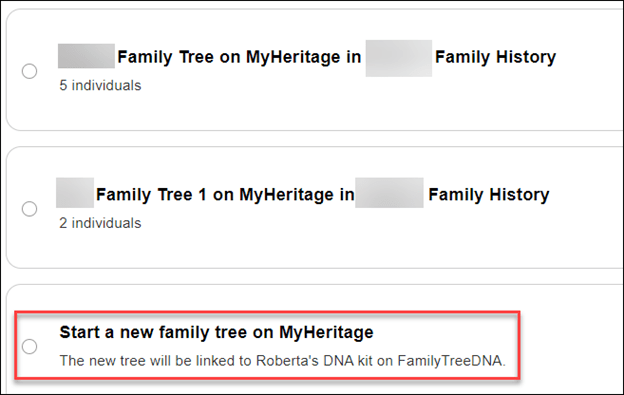
If your tree is very small, or you don’t have a tree and want to begin one at MyHeritage, scroll to the very bottom of the trees available on your MyHeritage account if you have access to more than one tree. You’ll see the option to start a new tree at MyHeritage.

Consent is Critical

In either of the two scenarios above, transferring a tree or starting a new tree, you’ll see a consent notification below the tree options.

I’m not sure you can see this clearly in this screen shot, so I’ll transcribe it below.

I consent for MyHeritage to share my updated family tree information With FamilyTreeDNA from time to time, and I understand and consent that, upon sharing, such information will be subject to the FamilyTreeDNA privacy policy and terms of service, independently of MyHeritage.

It’s critically important for you to CONSENT to this transfer of information back to FamilyTreeDNA. This allows FamilyTreeDNA to use your tree data to improve their products and services for you – the same way they’ve always utilized customer information. For example, where your ancestors are from is critically important to improving MyOrigins and other geographically related tools.

If you transfer a tree, the consent box is already checked, but if you start a new tree after arriving through the FamilyTreeDNA platform, the consent is there, but it’s unchecked – so you have to check it.

I very strongly encourage you to transfer an existing tree or start a new one if you don’t have one, because that’s the ONLY WAY your tree information can benefit your results at FamilyTreeDNA.

Now for the bad news – if you link your FamilyTreeDNA account to an existing tree at MyHeritage, there is no option to consent for MyHeritage to send your tree information back to FamilyTreeDNA.

I really hope this policy is revised. It isn’t fair that FamilyTreeDNA can’t receive information from the trees of its customers, nor is it fair to their customers. Hopefully, this is just an oversight and will be remedied shortly.

If You Link to an Existing Tree at MyHeritage

If you link to an already existing tree at MyHeritage, you do NOT see a option to consent for your information to be provided periodically to FamilyTreeDNA.

There’s literally nothing below the trees where the consent verbiage is found with other options.

In my case, I’m an active user at MyHeritage, always growing my tree, so I was going to link my FTDNA account to myself in my tree at MyHeritage.

That is, until I discovered that MyHeritage DOES NOT PROVIDE THE CONSENT OPTION.

So, instead, I’ve transferred my existing tree to MyHeritage. This option has no disadvantages.

You can transfer any size tree to MyHeritage from FamilyTreeDNA, no matter how large. After initiating a transfer, you will receive a message that MyHeritage will email you when the transfer is complete.

My tree was finished transferring by the time I got something to drink and came back to my desk.

If you’re already a MyHeritage customer, you can have any number of trees of any size and there’s no additional cost to add to or modify trees if you’re a subscriber.

If you’re not a subscriber, you can still transfer a tree of any size from FamilyTreeDNA, but after 90 days, you will need a MyHeritage subscription if you want to add to that tree if it has more than 250 people.

For FamilyTreeDNA purposes, I’ll use the tree that I transferred from FamilyTreeDNA and keep my FamilyTreeDNA test linked to “me” in that tree and my cousins linked to “them” in that tree.

The best aspect of transferring your current tree from FamilyTreeDNA is that your linked relatives all stay linked automatically!

Of course, I’ll continue to use my MyHeritage tree for genealogy research and for my MyHeritage DNA kits.

I love my MyHeritage subscription. Transferring my FamilyTreeDNA tree and using my MyHeritage tree for genealogy research gets me the best of both worlds.

Your FamilyTreeDNA Tree at MyHeritage

After my tree transferred to MyHeritage, I clicked on the “View Tree” link in the email to verify that the tree had transferred accurately.

Indeed, all 634 people were transferred – but the tree was assigned a strange name. I need to change that.

If you want to change the tree name on MyHeritage, and trust me, I do – just navigate to “Family Tree,” then “Manage family trees,” then select that tree, then click on “Edit tree settings at far right.

Change the name to whatever you want. It’s crucial to rename it immediately if you are going to transfer multiple trees so you don’t forget which is which. Pay attention to the rest of the settings below the tree name to be sure you don’t accidentally select something you don’t want, then save the new name.

Modifying Tree Privacy, Functions and Sharing

You can change your mind about sharing with FamilyTreeDNA in either direction – meaning either enabling or disabling sharing – by clicking on “My Privacy” in the dropdown by your name at MyHeritage.

Then click on “Content.”

This is probably a good time to make sure you have enabled everything you want.

Next, you’ll see a list of every tree that you own on your MyHeritage site.

In this example, three trees are shown. The first tree is my regular MyHeritage Estes Family Tree. This is NOT a transferred FamilyTreeDNA tree, and no account from FamilyTreeDNA is linked to it.

There’s somewhat of a glitch going on here that I want to make you aware of.

As you can see, the option to “Allow sharing of my updated family tree information with FamilyTreeDNA” is available to check. In fact, I checked it. But it’s not valid and is misleading because it causes people to believe they can link to an existing tree at MyHeritage and share data back with FamilyTreeDNA, which is not the case.

If you click on the little “i” for information, you’ll see the above text that clearly says this setting “is only relevant for family trees that originated from FamilyTreeDNA and that you chose to transfer to MyHeritage to have the family tree linked to your FamilyTreeDNA account.”

Unfortunately, this option appearing here is causing people to simply link their FamilyTreeDNA account to their MyHeritage tree, believing that they will be sharing back with FamilyTreeDNA.

I really encourage MyHeritage to allow this data exchange because I think it would encourage people to maintain one tree at MyHeritage. This approach would benefit everyone and is not confusing.

On the second tree, which is also NOT a transferred tree, there is no option for sharing. This is not consistent with the first tree and causes confusion.

The third tree is my transferred tree. It does have the sharing option selected. This is a valid selection for this tree.

This is also a good time to review the features for each tree and make sure you have enabled or disabled the ones you want.

Back at FamilyTreeDNA

You can verify that you transferred your tree by checking your FamilyTreeDNA account. If you click on your tree, you’ll see a notification that you moved your tree.

Ok, now that the tree is moved, how do I know who’s linked?

How Do I Know Who’s Linked?

I can’t tell by looking at my FamilyTreeDNA tree on MyHeritage who is linked and who isn’t.

However, it’s easier than EVER at FamilyTreeDNA.

Just open your match list.

Prior to transferring my tree to MyHeritage, I had linked 15 people to their profile card on my tree at FamilyTreeDNA. Those 15 people triangulated with enough other matches to allow FamilyTreeDNA to bucket a total of 3601 paternal matches and 1602 maternal matches.

Before I transferred my tree, I made a list of all the people who were linked.

Now, you can see under each match whether they are linked on your tree at MyHeritage and, if so, the relationship you’ve chosen for them.

My parents are both linked.

However, my Ancestry V4 test that I’ve uploaded as my twin for illustration purposes for my blog is not linked, so let’s link it.

Just click on “Link on Family Tree” where you’ll be prompted to sign in to MyHeritage. I have a secure password keeper, so for me, signing in happens immediately when I click on the link.

Look what happened next, automatically.

My matches name at FamilyTreeDNA populated the search bar, and since my tree at MyHeritage is the same tree I transferred from FamilyTreeDNA, the names automatically match. Easy peasy.

If you’re using a different tree, meaning one you did NOT transfer from FamilyTreeDNA to MyHeritage, you’ll need to enter either the accurate spelling of the person’s name you want to link to or a name generic enough that MyHeritage can find a group to offer you.

For example, Estes returned 23 results and I can browse through them to select the tester at FamilyTreeDNA. Alternatively, I can add the tester’s name to the MyHeritage tree I’m using as my FamilyTreeDNA tree.

Troubleshooting Section

If You Stop After Linking Your Account but Before Selecting the Tree

I got distracted by something during this process – after I had linked my FamilyTreeDNA account and signed into MyHeritage, but BEFORE I had linked my tree.

I received this email.

Don’t be confused by this email.

  • If you don’t link to a tree at MyHeritage, you will still receive matches at FamilyTreeDNA.
  • Nothing you do or don’t do in terms of transferring or linking to a tree at MyHeritage affects your ability to receive DNA matches at FamilyTreeDNA.
  • If you don’t transfer your tree or link to one at MyHeritage, you won’t be able to link new matches at FamilyTreeDNA to their profile in your tree, and you won’t receive new bucketed Family Matches.

Clicking on “Link Family Tree” in the email returns me to where I left off at MyHeritage. I then linked my FamilyTreeDNA account to the tree that I transferred from FamilyTreeDNA.

Account Settings

After signing on to FamilyTreeDNA, you may close the popup to transfer your tree and then not be able to figure out how to transfer your tree.

Another place where you can initiate transferring your tree is through Account Settings on your FamilyTreeDNA page, which is found under the gear by your name in the upper right-hand corner of your personal page.

More importantly, though, if you somehow make a mistake or get confused, this is where you go in your FamilyTreeDNA account to:

  • Link to a home person in your tree
  • Unlink your account from MyHeritage and start over
  • Once your tree is transferred, you cannot automatically “untransfer” your tree, although you can sever the link via a disconnect, delete that tree at MyHeritage or update your privacy settings
  • Disconnecting from MyHeritage restores your tree at FamilyTreeDNA

I clicked on “Link to Home Person.”

The four closest people are shown in the tree I had selected. If none of these are the person you seek as your home person in a tree, type the name of the person you want to link in the search box. If you’re linking a relative’s kit that you maintain for them, you’ll probably need to type their name if you’re linking them to an existing tree.

Or, if you selected the wrong tree, you can disconnect from your MyHeritage account altogether, start over, and select a different tree.

Unfortunately, you’re not going to recognize that name of the tree (unless you changed it), so you’ll have to click to view the tree if you don’t remember which one you selected.

By clicking on the results you wish, you can either view the tree or select that person to link to as the primary person in your tree.

Summary & More Resources

I know this has been a lot for one article. I’ve been testing for several days and have tried to help you better understand so that you don’t say later, “I sure wish I had known that…”

I’m incredibly grateful that FamilyTreeDNA and MyHeritage have made this process seamless, even maintaining our linked relationships with our matches.

To summarize what you need to do:

I recommend using your FamilyTreeDNA tree at MyHeritage for FamilyTreeDNA purposes because:

  • The names are all spelled correctly, and your linked matches won’t be broken
  • Consent for MyHeritage to allow FamilyTreeDNA to periodically receive updated information from your transferred FamilyTreeDNA tree

Additional Resources

  1. FamilyTreeDNA wrote an article about the new features, here.
  2. FamilyTreeDNA provides a FAQ here, including information for Group Projects and Group Administrators.
  3. MyHeritage wrote an article, here.

Now, transfer your tree and go enjoy the new tree features at MyHeritage!

_________________________________________________________

Share the Love!

You’re always welcome to forward articles or links to friends and share on social media.

If you haven’t already subscribed (it’s free,) you can receive an e-mail whenever I publish by clicking the “follow” button on the main blog page, here.

You Can Help Keep This Blog Free

I receive a small contribution when you click on some of the links to vendors in my articles. This does NOT increase your price but helps me keep the lights on and this informational blog free for everyone. Please click on the links in the articles or to the vendors below if you are purchasing products or DNA testing.

Thank you so much.

DNA Purchases and Free Uploads

Genealogy Products and Services

My Books

Genealogy Books

Genealogy Research

The Big Y-700 Test Marries Science to Genealogy

Recently, one of my long-time friends and project co-administrators asked me a simple question.

  • What do the FamilyTreeDNA Big Y-700 test and the Time Tree tell us when we have genealogy trees provided by testers?
  • What does the Discover Time Tree tell us that’s different, and how do we reconcile the Time Tree and genealogy?

Those are great questions.

Sometimes, I get so buried in the details of genetic genealogy that I neglect the obvious, so I’m writing this article for my co-admin and anyone else with the same questions.

Time Tree Versus Genealogy Question

Of course, as a genealogist, my first answer would be that we always need to be cautious about user-provided trees. Even when the genealogy is accurate, that’s no guarantee there wasn’t a biological disruption that caused the genetic line not to be the same as the surname line.

Almost every lineage has examples of people whose genealogy was “off” or misattributed paternity occurred someplace upstream, meaning that someone carries the surname but does not descend from that biological lineage.

However, relative to DNA projects, the Big Y-700 tests provide one very important feature that STR testing does not and cannot do.

The Big Y-700 test creates a genetic tree, in conjunction with other testers, which provides scientifically calculated dates when branches of the genetic tree were formed.

The genetic tree should align, at least closely, with testers’ genealogical trees.

In other words, if their genealogy is accurate, testers “should” fit in (or at least near) the appropriate places on the branches of the genetic tree.

Furthermore, for people trying to sort out their actual branch in the tree, the Big Y-700 test is MUCH MORE reliable than the earlier STR (short tandem repeat) tests that are prone to random and back mutations. At one time, STR tests were all that was available, but now,  SNPs have been added to our arsenal. SNPs (single nucleotide polymorphisms) are extremely stable and reliable mutations.

I’m getting ready to record a new Y-DNA webinar, and I’m giving you a sneak peek of a couple of my slides here. I’ll publish an announcement when the webinar is available.

STRs Versus SNPs

Historic Y-DNA testing tested only a limited number of STR locations. That test reported the number of repeats at a specific genetic location on the Y chromosome. Today, the 37, 67, and 111 marker STR tests are still available to purchase.

What are the major differences between the two types of tests, and why would someone purchase one over the other?

If you purchase one of the STR tests, you purchase testing at a specific number of locations, such as 37, 67, and 111. The Big Y-700 test includes at least 700 STR locations, but the specificity of the Big Y-700 SNP testing replaces most of the STR test results in terms of lineage definition.

SNP mutations, when discovered in more than one man in a particular haplogroup lineage, are then named as haplogroups. That mutation is then found in each directly descended male in that line.

STR – 37, 67, 111 Big Y-700 (STRs & SNPs)
Tests A limited number of repeat STR markers – Big Y guarantees 700+ NGS scan targets ~ 25 million locations
Focus Comparatively short genealogy timeframe All-inclusive – recent genealogy plus older to ancient
Includes Can upgrade to Big Y-700 Includes STR tests, separate matching, Globetrekker, Discover, and more
Tree Genealogy, customer provided Genetic Tree – Group Time Tree coordinates with genealogy if provided
Tools STR tools STR tools plus SNP tools & robust Discover
Haplogroup Estimated based on STR values Confirmed to the most granular level possible – evergreen
Useful When Exclusion testing, less costly, entry-level Discover provides lineage, ancient DNA, TMRCA, and more
Matching STRs only STR plus Big Y – both can be useful
Trees Customer provided genealogy Time Tree, Group Time Tree, Block Tree, Classic Tree + 1 more soon

Put simply, the STR tests are now entry-level. Once you see what the Big Y-700 provides, you’ll absolutely want to upgrade to that test. Most of the time, if I know I’m testing someone from the correct line, I just purchase the Big Y-700 out the gate. If I’m not sure I’m testing the correct lineage, I’ll purchase the STR test first to make sure they match the correct lineage before upgrading to the Big Y-700.

Discover

The Discover tool was introduced to provide additional information to Big Y testers and others seeking haplogroup information. STR results can only predict a relatively high-level haplogroup, usually a few thousand years ago, while the Big Y-700 provides testers with an extremely granular haplogroup – usually decades to a few hundred years ago. Often, living men that span 2 or 3 descendant generations (grandfather, father, sons) discover that they have their own haplogroup branch on the tree of mankind!

However, if no one else from your line has tested in hundreds of years, Discover can only work with available information.

Let’s take a quick look at the Estes Group Time Tree.

Estes Project Group Time Trees

Group projects have Group Time Trees. You can view the Estes surname project, here. You can find a project for any surname by either googling “<surname> DNA Project” or scrolling to the VERY bottom of the FamilyTreeDNA main page.

If you’re signed into FamilyTreeDNA, you can also find projects in the top banner.

Once you’re on the project page, you’ll see an option for DNA Results (assuming the administrators have not made the project entirely private.)

Click on the DNA Results link and select Y-DNA.

Next, you’ll see “Group Time Tree.”

Group Time Tree Display

What appears next depends on how the project administrators have grouped the project participants.

I’ve grouped the Estes project by genealogical line, with the exception of a couple of people who carry the Estes surname but have experienced an adoption or other unknown parental event in their Estes lineage.

In some cases, there are simply two same-name lineages that were never from the same biological line. Unfortunately, occasionally they settle in the same place, making the genealogy difficult. Even worse, until Y-DNA testing came along, there was often no way to know they were two different families.

This situation is actually where the Big Y-700 test shines.


The Group Time Tree shows the genetic tree scientifically constructed from the SNP results of the Big Y-test results of the testers, at left. At right you’ll see the surnames of the testers along with their Earliest Known Ancestor (EKA) if they have entered that information.

Initially, you don’t even realize you’re actually looking at two types of information merged together. This display allows testers to see the genetic branching tree structure, at left, which is reflective of their actual genealogy, at right.

You can see that the birth year of Sylvester Estes, entered by a tester with haplogroup R-BY482, is 1622. Please note, there’s a typo. Sylvester was born in 1522, NOT 1622. This is a perfect example of what I meant by tree information sometimes being inaccurate and it’s very important when trying to correlate the genetic tree and the user-provided genealogy.

We discovered that R-BY482 (red profile above, at left) is an Estes “signature” haplogroup for the Estes line originating in Deal, England, with three other haplogroups that formed in descendant generations. We know this because every descendant from this line has this mutation.

R-BY490 was formed between Sylvester’s son Robert Estes, born about 1555, and his son, born about 1600, also named Sylvester. We know this because all of the descendants of Sylvester (born circa 1600) carry this mutation, but Robert’s son, Robert, born in 1603, does not.

The genealogy portion of the Group Time Tree, above, doesn’t reveal that information because testers either don’t know their genealogy that far back or perhaps listed an earlier known ancestor, such as Nicholas, born in 1495.

Click to enlarge

I created a spreadsheet tracking the Big Y-700 testers of the descendants of Nicholas Estes, along with their descendant haplogroups.

We know that Robert, born in 1555, carries R-BY490 because both of his sons, Abraham and Richard, inherited that mutation, seen with green arrows.

However, this calls into question the associated genealogy because if Robert, born in 1603, descended from Robert, born in 1555, he too would have the mutation R-BY490 since Robert’s other two sons do. Note that the user-provided birth year typo of 1622 which should be 1522 is a century off – enough to be within the genetic band haplogroup birth band – but impossible for the genealogy table.

There is one other possibility: kit 166011, the descendant of Robert born in 1603, could have taken the earlier Big Y-500 test and never upgraded to the more powerful Big Y-700. That’s too much detail for this article, but the discrepancy between the genetic tree and the genealogy tree alerts us that additional research is warranted. The genealogy submitted for tester 166011 confirms that, indeed, 1622 is a typo.

There are no other descendants of known sons of Nicholas or Sylvester born in 1522 to test, but perhaps another will surface one day.

You can see that the more testers in any particular line, the more granularity we can achieve.

The Genetic Tree

How close is the genetic tree to the genealogical tree that has been confirmed?

We know that Sylvester was born in 1522, and his father Nicholas in about 1496. The scientifically calculated creation date of R-BY482 is 1493, just 3 years before the birth of Nicholas. Based on this, there’s a good chance that this mutation occurred between Nicholas’s unknown father and him, or perhaps between Nicholas and Sylvester.

You can view the scientific details of any haplogroup in Discover.

Discover’s BY-482 scientific details page shows its creation date range.

Marriage

You can see that the scientifically created tree and the genealogy information are both important.

In fact, the combination of both allowed us to identify the correct branch of a Wilbur man who matches Estes men but doesn’t know where he fits in the tree.

His haplogroup placed him definitively on the more recent R-BY154784 branch, and his autosomal results then confirmed his specific path of descent because he matches descendants of three generations of Estes men’s wives, showing that his branch descends from Joseph Estes and his wife Ritty Lee, through son Chism, on down to our tester. In this case, autosomal DNA results provided a boost-assist to the genealogy, which helped identify the generation that the Y-DNA haplogroup R-BY154784 actually formed.

This also informs us that Joseph Estes, born in 1780, carried haplogroup R-BY154784 because both of his sons have it. If Joseph hadn’t had that mutation, then both of his sons couldn’t have inherited it.

Therefore, the mutation that formed haplogroup R-BY154784 had to occur between Moses, born in 1711, and John, born in 1732. We know that because Moses’s other son’s descendants do not have that haplogroup.

The more descendants of any ancestor that test, the more specific and accurate the descendant haplogroup formation dates will be.

The marriage of genetic trees and genealogy is powerful indeed.

More Information

For those seeking more information, 70 pages of my new book, The Complete Guide to FamilyTreeDNA – Y-DNA, Mitochondrial, Autosomal and X-DNA is devoted to Y-DNA results.

_____________________________________________________________

Follow DNAexplain on Facebook, here.

Share the Love!

You’re always welcome to forward articles or links to friends and share on social media.

If you haven’t already subscribed (it’s free,) you can receive an e-mail whenever I publish by clicking the “follow” button on the main blog page, here.

You Can Help Keep This Blog Free

I receive a small contribution when you click on some of the links to vendors in my articles. This does NOT increase your price but helps me keep the lights on and this informational blog free for everyone. Please click on the links in the articles or to the vendors below if you are purchasing products or DNA testing.

Thank you so much.

DNA Purchases and Free Uploads

Genealogy Products and Services

My Books

Genealogy Books

Genealogy Research

Genealogy Proof Series: Surname Searching

This is the third article in the Genealogy Proof series, in addition to the introduction.

In the article titled Gathering Location Resources, we focused on locations where you know your ancestor lived – but what if you’re looking for books or information about a particular family or surname?

Maybe you’d like to know if an article or book has been written about that family, either generally or maybe a branch more specifically. Many early books are no longer in print.

Maybe you can find information about your family in resources not typically checked by genealogists.

Of course, there are lots of resources, but I’m including several here that you can use and might otherwise miss. Feel free to add more in the comments.

Recording Your Findings

Don’t forget to record your search results and which resources you used on the spreadsheet we created in the Extracting and Recording Data article.

If you find that the information in the book or resource is too long for the text field in your spreadsheet, record and index the item anyway. Then, transcribe or copy/paste the entire text version in one of two places, but don’t forget to note in your spreadsheet where you put it.

  • Your genealogy software under that person’s name
  • A Word document under that person’s name

When I write my 52 Ancestors articles, everything I know about that person is gathered into a Word document and then organized and arranged into a cohesive story. The pieces have been gathered over the years in various locations and I have to be able to find them to be able to use them.

Book List

I have also created a list of books that I own.

This list needs to be updated because I moved and I would like to more accurately detail the locations of books I still have. It’s nice to know what you already have and where to find it. Tell me I’m not the only person who has purchased the same book twice!

Ok, now for surname resources where you just might find your ancestor!

Cyndi’s List

Cyndi’s list has a HUGE number of resources generally, but it also includes a surname category.

Under each letter of the alphabet, available resources are listed.

Be sure to check out everything for your surnames of interest.

BookFinder

At Bookfinder.com, you can enter a name in the title field.

That query produced a significant list. Remember that this list changes often, based on availability.

I now have another book on the way!

Higginson Book Company

The Higginson Book Company has long been known for carrying heritage books – both by location and for genealogy.

You can search by surname or any keyword.

Higginson reprints copies of original books out of print in addition to maps and a few other things. Note that sometimes you can find the text version of copyright-free books free at other locations.

State Archives

Check the website of every state’s archive where your ancestors lived.

If in doubt about what might be available, call the State Archives and ask a librarian. You might not believe what’s there.

In Tennesee, for example, there’s an index of Supreme Court cases that can be searched for the entire state, or by county, or year.

Cases that appear in the Supreme Court Index will not be recorded in the county records, because the case was appealed from there to the Supreme Court. It’s worth noting that the Hancock County, Tennessee courthouse burned (twice), so the Supreme Court records in the archives reflect lawsuits that we don’t even know existed today.

In many cases, local courts no longer retain case packets, if they ever did. They often only have the names of plaintiffs and defendants in an index book – not even an outcome. However, the county clerks faithfully copied the case packets when the case was appealed and sent to the Supreme Court, where this valuable information resides today – including depositions and receipts.

I’m entering the surname of every ancestor that was found in Hancock County. Sometimes, I search for their in-laws and neighbors too, just in case my ancestor is mentioned.

Look – paydirt! In an estate dispute – you know there are relationships explained and maybe also the source of the dispute.

When utilizing archives, be sure to search the archives of parent-states and parent-counties, meaning states and counties your state/county was formed from. The same goes for descendant states/counties formed from your state/county.

But wait, there are more resources.

Librarians

In addition to resources shown at the Tennessee Archives website, you can also click to chat with a librarian.

Librarians are an encyclopedia of knowledge.

Thanks to a librarian, I recently discovered that the Michigan State Archives holds an obscure collection – prison newspapers published by the inmates over the years, reaching back into the 1800s and early 1900s. It’s not evident from the collection information, but a call to the archives and a lovely discussion with a research librarian revealed that those publications have recently been scanned and OCR indexed, which makes it possible to search by surname or topic.

I love librarians. They have saved my bacon so many times over the years, as have volunteers at local museums, and historical and genealogy societies.

Chronicling America

Chronicling American is provided by the Library of Congress. This link is for the newspaper collection which spans 1756-1963, but there are also other collections

In the photo collection, you can search generally or very specifically.

I had always wondered why my grandparents chose to move to a tiny out-of-the-way farming community outside very rural Fowler, Indiana. I found my answer in the Library of Congress. My grandfather’s cousin, who lived up the road in Tennessee, had moved to Indiana, was running a farm for an absentee owner and needed assistance.

The rest, as they say, is history.

FamilySearch

FamilySearch has an extremely robust and easy-to-use search functionality.

Select “Search,” then “Books.”

I entered the word “Estes” under the Books search and found this:

Notice that full text results are available, which means that either the book is out from under copyright, or they have obtained permission to image. It’s also worth noting that this is one of the books available for print-on-demand from Higginson Books.

Another option, the “Images” search, searches for information by historical location.

Searching “Genealogies” and “Family Trees” is obvious.

I find the “Catalog” search particularly productive.

You can filter your Catalog search in any number of ways, but, as luck would have it, the very first entry is where my Estes family lived.

Oh, look, it’s my lucky day…

If a desired book or article isn’t available for viewing, start a list and look to see if it’s available through your local Family History Center or check elsewhere.

FamilySearch New Full Text Search

I just love this new full text feature that automatically transcribes and indexes entire handwritten collections, such as the will or deed books in a particular county.

On the search page, scroll down until you see the FamilySearch Labs image and click on “View Experiments.”

Click on “Go to Experiment”

I detailed how to use FamilySearch full-text search in this article, but I want to remind you here that you can search by surname.

One of my huge brick walls is identifying the parents of James Lee Claxton (Clarkson/Clarkston) 1775-1815.

All of our Y-DNA matches are spelled Claxton and are found in North Carolina, but that group of Claxton researchers and my line are both stuck at about the same time in history. It’s very likely that the common ancestor of both groups came from Virginia, but where? And who?

I’m searching for Claxton with the hope that there is some mention of a Claxton we don’t already know about – or something connecting my ancestor to Lee County, VA in about 1795.

There are thousands of entries in this database, but I can filter to restrict my search to Virginia.

Remember that FamilySearch is adding to the collection of books and records that are digitized and indexed daily, so if you don’t find what you’re looking for today, check back often.

Google

A general Google search for “Estes genealogy” produced a list. I’m not showing their generative AI result here, because it’s half right and half wrong. It’s fine to use AI for hints, but verify absolutely everything. AI is not ready to be relied on and may never be.

Here is a list of Estes resources from Google.

Always beware of internet links. “Fly” over them first. If the link address even looks questionable, just don’t click.

That said, there are a HUGE number of legitimate resources here.

Google Books

Google books can help you locate books that may not be found elsewhere.

Some are available as an eBook at Google Books, but if not, you can use these as leads to search elsewhere, including AbeBooks and sometimes, Amazon. I usually use Bookfinder after finding a book I’m interested in through Google, because they include other sites such as AbeBooks, Amazon and many more. Bookfinder is an aggregator, not a reseller.

You can also request to “Find in a library,” which might be useful if your local library participates in interlibrary loans, although often heritage books are not eligible for loan.

Internet Archive

I love the Internet Archive, the same company that provides the Wayback Machine, which also allows you to search by surname. The two sites provide different results, so be sure to try both.

You’ll find all kinds of information at the Internet Archive.

Under eBooks and Texts, I often enter “<surname> genealogy” so that their metadata will use both terms to narrow the search. Metadata is data about data, and in this case, it means which keywords they used to index these entries.

Many records aren’t relevant, but some assuredly are.

You can also narrow the results by many features – including the Allen County Public Library which has one of the largest genealogy holdings in the US.

Keep in mind that I’ve selected only items with text, meaning that I can read or download for free. There are certainly other items available that aren’t free.

I sometimes struggle with their search feature, so I often just search at Google using the term “Estes books at internet archive.”

Allen County Public Library

At the Allen County Public Library website, you want to search in the research collection

Please note that you can filter your results in many ways.

One of the wonderful features is that they actively collect newsletters. Estes Trails has been published for decades.

These newsletters are in their physical holdings, but if you know they exist, you can track them down in other ways. In this case, the publisher’s name is included in the full display.

Many newsletters are no longer published, so, fortunately, there’s another way to obtain an article.

PERSI

PERSI, an index for periodicals, such as Estes Trails, above, is also hosted by the Allen County Public Library.

At PERSI, you can search by surname

I searched for Estes, and look what I received. I absolutely must read these Civil War letters.

This is a GOLDMINE. No, Aaron Estes isn’t my ancestor, but again, he’s related, and I just have to read these.

Scroll to the very bottom to order the items.

WikiTree

WikiTree is one of my favorite resources. You can enter your ancestor’s name, or a surname.

WikiTree is a collaborative tree where different individuals add information and sources to the profiles of ancestors. They have a small army of helpful volunteers that are willing to help too.

As with all shared resources, some information can be incorrect. Treat all trees as information to be verified and sources to be checked.

One of the great things about WikiTree is that individuals who descend from ancestors in a specific way can connect themselves and their Y-DNA or mitochondrial DNA test information.

Descendants who have taken an autosomal test can list the testing company and information. While testing companies use the DNA of the tester to connect to other testers – it’s up to those two people to determine their common ancestor.

WikiTree works the other way and is ancestor-driven, meaning that you see who descends from the ancestor, and you can go to the testing company indicated to see if you’re an autosomal DNA match.

Furthermore, if you’re working on your genetic tree, you’ll want the Y-DNA and mitochondrial DNA information for each of your ancestors. If other testers have entered the information, you can find it here. Please enter yours as well.

Be sure to check the sources for each ancestor. There may be information and resources not found elsewhere. Add sources if you can. Collaboration is a good thing, and a rising tide lifts all ships.

Newspapers

After you’ve wrung out the more traditional records, such as deeds and wills and census schedules, you’ll want to turn to newspapers. Not all local newspapers have been scanned, OCRed, and indexed yet, and some quality is better than others.

Licensing and processing old newspapers is ongoing, so just because the location where your ancestor lived doesn’t have an indexed newspaper available today doesn’t mean they won’t soon.

Newspaper articles put meat on the bones of our ancestors as they reveal their everyday lives. Who visited whom after church for Sunday dinner, who hit someone’s cow, who had company from out of town, who was having a family reunion, who moved and to where, who caught a big fish, who went on vacation, who was “visited by the stork,” and much more. Some make you say “awww,” and some are downright juicy and scandalous!

News about neighboring counties and even neighboring states can be found in locations where you may not have thought to look for your ancestor.

Virginia Chronicle

The Virginia Chronicle is a historic newspaper collection curated by the Library of Virginia that produces amazing results.

What? A murder? You know, I just HAVE to go down this rabbit hole and read these stories.

Ok, so, here’s the skinny for those who are curious.

Theodore Estes was dating Miss Loving, the daughter of a judge who shot and murdered Theodore. As it turns out, Theodore’s father was the sheriff, so this story is particularly rich and full of intrigue.

It seems that Miss Loving, the judge’s daughter, drank whiskey, and one thing allegedly led to another, which Theodore, his family, and friends denied. However, the young woman’s father didn’t believe them and sought revenge. Some reports said that she only drank “one swig” of whiskey, and nothing happened. Others said that the whiskey was drugged, and “something” did happen. A third group said she asked for the whiskey and drank a whole lot more than a swig. Theodore took her home (to her house) in his buggy, to her parents, but clearly intoxicated.

It gets even more complex because it appears the families were related. I had to draw a chart to get this straight.

Theodore’s brother had married the Judge’s wife’s sister. I’m telling you, this trial was a humdinger. Whoo boy! Eventually, the charges against the judge were changed to something less severe than murder. This high-profile case was covered by several regional newspapers like the latest soap opera.

As I read through these articles, I noticed that some Estes family members had arrived from Danville, VA, which is in close proximity to where my Estes family was from. So, while this is not my ancestor, it involves my ancestor’s descendants.

Ok, enough of this rabbit hole, but you get the drift. You may never get anything resembling chores done ever again!

The National Genealogical Society membership now provides access to NewspaperArchive as a benefit of membership. As far as I’m concerned, this alone makes the membership worthwhile.

NewspaperArchive offers a notification service for subscribers, or did when I subscribed separately, so you’ll receive an email when the name of a saved search is found in a newly indexed newspaper.

I keep discovering previously unknown things!

Ancestry owns Newspapers.com for accessing newspapers and Fold3 for military records. I discussed the nuances of using Newspapers.com at Ancestry in this article. You’ll need to search in the Historical Newspapers Collection at Ancestry and/or in Newspapers.com. Ancestry is reimaging the newspapers and using AI to create associations between people – for example family members mentioned in a wedding announcement. The results will not all be found in one place. The newspaper itself will be found at Newspapers.com but the associated family grouping will be found at Ancestry itself in their collections.

You can now reference the Birth Index, Marriage Index and Auctions of Enslaved People and Bounties on Freedom Seekers Index, here. The larger Newspapers and Publications category can be found here, and the Historical Newspapers Collection can be found here.

MyHeritage includes a large newspaper collection for their subscribers, much of which is unique and not found elsewhere.

This collection is where I found hundreds of items about my mother’s family in rural Northern Indiana. I found previously unknown photos of my grandfather, and that he attended the “Normal School” to become a teacher. He never taught, instead going to work for the railroad, moving away, and meeting the woman who would become my grandmother.

MyHeritage actually has newspapers in two places. This search is on the MyHeritage site itself, available with a subscription. MyHeritage has a second, independent site too – OldNews.

OldNews is big news!

At RootsTech 2024, MyHeritage announced a separate subscription site called OldNews, which essentially doubles the number of newspapers that they’ve digitized and made available. Take a look!

I found information about my mother, such as when she had her tonsils removed, when and where she danced in plays as a child, and the amount of my grandparents’ estate. Newspapers reported things back then that would be considered privacy violations today. Check OldNews to see what’s there for you.

Colonial Williamsburg has made the earliest Newspapers in the colonies available, here. Some are through a subscription site, and others aren’t. It was through these old newspapers years ago that I discovered the name of my ancestor’s indentured servant who ran away. Now, DNA seems to point to a potential relationship. There are no records other than that “runaway” notice to connect these people together, anyplace.

Check Cyndi’s list for more Newspaper services

MyHeritage Surnames

MyHeritage offers many ways to search, but you can start by entering the name of your ancestor or even just a surname.

I could have simply entered the surname, but I entered James Lee Claxton.

I can filter by any of the collections, at left.

I check them all, but I particularly like the Books and Publications, and the Newspapers category. You just never know what you’ll find, and many of the books are digitized and free.

You can also just enter a surname. I entered “Estes.”

I checked every one of these categories and, among other things, found some fascinating historic maps.

I love my MyHeritage subscription. If you don’t have one, you can try one free for 14 days.

Ancestry Message Boards

Ancestry discontinued the RootsWeb-hosted websites, WorldConnect Trees, and RootsWeb mailing lists last year, but the message boards are still functional.

After signing in to Ancestry, scroll down until you see Tools and Resources in the right margin.

Click on “Message boards.”

These boards reach back at least 20 years and many of the original posters are deceased now. I know that I often posted information as I found it while traveling.

There’s an advanced search function, too.

I was shocked to discover that you can still initiate a thread, but I’m not at all sure that other people on that board are notified today. I had no idea these boards even still existed.

Another feature that’s helpful at Ancestry is the Card Catalog, one of their Special Record Collections.

You can enter a surname in either the Title or Keyword box.

Of course, you’ll get different results, but both are certainly worth checking.

Genealogy.com

GenForum was the message board for Genealogy.com. Ancestry purchased it years ago, and while you can no longer post messages, you can still search for messages that were previously posted, here.

American Ancestors

American Ancestors holds a large database that includes periodicals such as the New England Historical and Genealogical Register and the Virginia Genealogist, which you can search by name, here.

Additionally, they have a number of immigration and naturalization records not available elsewhere.

HathiTrust

HathiTrust has indexed millions of documents, including many governmental records and publications.

Select any publication or narrow by categories. Then you can search within the text and also view the text on the relevant pages.

DNA Projects

FamilyTreeDNA offers surname projects, along with geographic, haplogroup, lineage, and regional DNA projects.

You can find surname projects in one of two ways.

The first way is to Google “Estes DNA Project.”

You’ll see two links, either of which will take you to the project.

I administer this project and welcome everyone who has an Estes ancestor, regardless of whether their surname is Estes or something else.

By clicking on “DNA Results,” you’ll see multiple options.

Clicking on the “Classic Chart” shows groupings of males who have taken the Y-DNA test, along with additional information, including their Earliest Known Ancestor (EKA) and, in the final column at right, their haplogroup.

If you take a DNA test and match other people, you can contact them to collaborate through matches on your personal page. Not everyone can test for every ancestor – and women can’t test for Y-DNA lineages (because they don’t have a Y chromosome,) so we depend on being able to check for our ancestors in Y-DNA projects.

If your ancestral line is shown, you can use the confirmed haplogroup (green) in the free Discover tool, here, to learn more about your ancestor’s heritage.

Here’s the “Haplogroup Story” tab for R-BY490 that represents a number of Estes lineages. There are 11 other tabs in the left sidebar just waiting for you to read about your ancestry.

Note that “Suggested Projects” is one tab. The suggestions are based on projects other men with this haplogroup have joined.

Y-DNA information through Discover, and soon, mitochondrial DNA information through MitoDiscover, is the ONLY place you can find this kind of information. Be sure to check out all of the tabs at left, including Ancient Connections.

If you click on the Group Time Tree, you’ll see a different view of the results of the project members who have taken the advanced Big Y-700 test.

By selecting the relevant groups, you can see the surname of the testers, their earliest known ancestor (if known and entered), at right, along with the haplogroup genetic tree at left.

The genetic tree shown at left confirms the genealogy of these testers, at least as far as the genetic tree is able to distinguish. I wrote about the Estes Group Time Tree, here, as an example,

If you are a male and have not taken the Big Y-700 test, please do. It unlocks your history in a way nothing else can.

A second way to find DNA projects that might be relevant to your surname is to navigate to the very bottom of the FamilyTreeDNA main page in the footer.

Click on “Group Projects.”

You can enter any surname and see the projects in which the project administrator listed Estes (or your surname of choice) as a surname that might be interested in their project.

If you’re a customer and signed on to your account at FamilyTreeDNA, you can find this same information at the top of your personal page under “Group Projects.” You can also join projects from there.

Social Media

I often overlook Facebook or other social media as a surname resource, but it is.

Today, many, if not most, genealogy and historical societies have pages, and so do many genealogists with an interest in a particular surname line.

Searching for “Estes” on Facebook shows several individual people, PLUS, two groups that might be very interesting.

Once you’re a member of a group, you can search within the group for a keyword.

This search gave me everything with either Moses or Estes, so I narrowed it by just using “Moses” or just searching for “Halifax” which is the county in Virginia where Moses Estes lived.

Facebook, especially groups with a genealogical focus, is a wonderful way to find men for Y-DNA testing.

I often ask if someone has already DNA tested, and if so, where.

If they have already tested at Ancestry, or 23andMe, but not at MyHeritage or FamilyTreeDNA, they can upload to both companies for free. Matching is free after uploading, and so are other basic tools. Advanced tools require an inexpensive unlock, which costs far less than retesting. The unlock at FamilyTreeDNA for advanced tools costs $19, and it’s $29 at MyHeritage.

Next Topic – The Proof Table

Our next topic in this series will be the Genealogy Proof Table.

What is a Proof Table, how do you construct one, and why?

We will assemble a Genealogy Proof Table for one of my lines as an example. You’ll need one for every ancestral lineage.

After that, we have four more articles in this series.

  • Genealogy Proof Standard
  • DNA
  • Leveling up
  • Writing it Up

_____________________________________________________________

Follow DNAexplain on Facebook, here.

Share the Love!

You’re always welcome to forward articles or links to friends and share on social media.

If you haven’t already subscribed (it’s free,) you can receive an e-mail whenever I publish by clicking the “follow” button on the main blog page, here.

You Can Help Keep This Blog Free

I receive a small contribution when you click on some of the links to vendors in my articles. This does NOT increase your price but helps me keep the lights on and this informational blog free for everyone. Please click on the links in the articles or to the vendors below if you are purchasing products or DNA testing.

Thank you so much.

DNA Purchases and Free Uploads

Genealogy Products and Services

My Books

Genealogy Books

Genealogy Research

Great News – Both e-Pub and Print Version of “The Complete Guide to FamilyTreeDNA” Now Available Worldwide  

  • Anyone, anyplace, can order the full-color, searchable, e-pub version of The Complete Guide to FamilyTreeDNA – Y-DNA, Mitochondrial, Autosomal and X-DNA from the publisher, Genealogical.com, here.
  • Customers within the US can order the black and white print book from the publisher, here.
  • Customers outside the US can order the print book from their country’s Amazon website. The publisher does not ship print books outside the US due to customs, shipping costs, and associated delays. They arranged to have the book printed by an international printer so that it can be shipped directly to Amazon for order fulfillment without international customers incurring additional expenses and delays. If you ordered the book previously from Amazon and a long delivery time was projected, that should be resolved now and your book should be arriving soon.

Comprehensive

This book is truly comprehensive and includes:

  • 247 pages
  • More than 267 images
  • 288 footnotes
  • 12 charts
  • 68 tips
  • Plus, an 18-page glossary

To view the table of contents, click here. To order, click here.

Thank you, everyone, for your patience and your support.

_____________________________________________________________

Follow DNAexplain on Facebook, here.

Share the Love!

You’re always welcome to forward articles or links to friends and share on social media.

If you haven’t already subscribed (it’s free,) you can receive an e-mail whenever I publish by clicking the “follow” button on the main blog page, here.

You Can Help Keep This Blog Free

I receive a small contribution when you click on some of the links to vendors in my articles. This does NOT increase your price but helps me keep the lights on and this informational blog free for everyone. Please click on the links in the articles or to the vendors below if you are purchasing products or DNA testing.

Thank you so much.

DNA Purchases and Free Uploads

Genealogy Products and Services

My Books

Genealogy Books

Genealogy Research

Complete Guide to FamilyTreeDNA Released in Hardcopy

Just what many of you have been waiting for! The hardcopy print version of the Complete Guide to FamilyTreeDNA has just been released.

As shown in the table of contents below, The Complete Guide to FamilyTreeDNA contains lots of logically organized information! It includes basic education about genetic genealogy and how it works, instructions on using the FamilyTreeDNA tests and tools, plus an extensive glossary.

Enjoy!

_____________________________________________________________

Follow DNAexplain on Facebook, here.

Share the Love!

You’re always welcome to forward articles or links to friends and share on social media.

If you haven’t already subscribed (it’s free,) you can receive an e-mail whenever I publish by clicking the “follow” button on the main blog page, here.

You Can Help Keep This Blog Free

I receive a small contribution when you click on some of the links to vendors in my articles. This does NOT increase your price but helps me keep the lights on and this informational blog free for everyone. Please click on the links in the articles or to the vendors below if you are purchasing products or DNA testing.

Thank you so much.

DNA Purchases and Free Uploads

Genealogy Products and Services

My Books

Genealogy Books

Genealogy Research

Announcing: The Complete Guide to FamilyTreeDNA; Y-DNA, Mitochondrial, Autosomal and X-DNA

I’m so very pleased to announce the publication of my new book, The Complete Guide to FamilyTreeDNA – Y-DNA, Mitochondrial, Autosomal and X-DNA.

For the first time, the publisher, Genealogical.com, is making the full-color, searchable e-book version available before the hardcopy print version, here. The e-book version can be read using your favorite e-book reader such as Kindle or iBooks.

Update: The hardcopy version was released at the end of May and is available from the publisher in the US and from Amazon internationally.

This book is about more than how to use the FamilyTreeDNA products and interpreting their genealogical meaning, it’s also a primer on the four different types of DNA used for genealogy and how they work:

  • Autosomal DNA
  • Mitochondrial DNA
  • Y-DNA
  • X-DNA

There’s a LOT here, as shown by the table of contents, below

This book is chocked full of great information in one place. As an added bonus, the DNA glossary is 18 pages long.

I really hope you enjoy my new book, in whatever format you prefer.

_____________________________________________________________

Follow DNAexplain on Facebook, here.

Share the Love!

You’re always welcome to forward articles or links to friends and share on social media.

If you haven’t already subscribed (it’s free,) you can receive an e-mail whenever I publish by clicking the “follow” button on the main blog page, here.

You Can Help Keep This Blog Free

I receive a small contribution when you click on some of the links to vendors in my articles. This does NOT increase your price but helps me keep the lights on and this informational blog free for everyone. Please click on the links in the articles or to the vendors below if you are purchasing products or DNA testing.

Thank you so much.

DNA Purchases and Free Uploads

Genealogy Products and Services

My Books

Genealogy Books

Genealogy Research

Why Don’t Our Y-DNA Haplogroups Match?

I’ve been asked this question several times recently, and the answer is resoundingly, “it depends.” There are several reasons why Y-DNA haplogroups might not match and most of them aren’t “bad.”

How Haplogroups Work

Haplogroups are the 79,000+ branches of the Y-DNA phylogenetic tree which you can view here, along with countries where those haplogroups are found. You can think of haplogroups as genetic clans of either closely or distantly related men. Major haplogroup branches have unique letters assigned. Downstream or younger haplogroups are designated by a letter-number sequence that is always preceded by the main haplogroup letter.

Image courtesy FamilyTreeDNA

Major haplogroups were formed tens of thousands of years ago, with more recent haplogroups added as they’ve been discovered. Haplogroups are discovered and added every day thanks to the Big Y-700 test. You can read more about that process, here.

As you look at the pie chart above, you’ll notice that haplogroup R represents about half the men who have tested and has several major subbranches. Every haplogroup R man belongs to all of the branches above his own that lead back to the root of haplogroup R.

Using haplogroup R, which is R-M207, its identifying SNP, as an example, it immediately splits into two branches: R-M173, which has 37,000+ more branches, and R-M479, which has 313 branches. My Estes men fall into a haplogroup several steps beneath R-M173, but they are still members of haplogroups R-M173 and R-M207, even though their descendant haplogroup is R-BY490, which was formed by a mutation that occurred 20,000 years later.

Haplogroup R-M173, then, in turn, leads back to Y-Adam, the first man to have lived and has descendants today.

As we approach the question of why haplogroups of two men might differ, we will review tools to use and how to interpret your findings to reach the appropriate answer for your situation.

What is Your Goal?

You may be looking for a very specific answer, or this may be a more general question.

  • If you’re evaluating closely related men who have different haplogroup assignments, not matching can be very disconcerting. Breathe. There are several perfectly legitimate reasons why they may not match, and we have easy, free analysis tools.
  • If you’re looking at your Y-DNA match list at FamilyTreeDNA, you may or may not match other men closely, but you do “match” at some level if they are on your match list. You may see several different haplogroups in your match list. How closely you match those men is a different question.
  • If you’re looking at autosomal results at FamilyTreeDNA, you may see haplogroups listed for males. You may or may not “match” the haplogroup of men with the same surname. What does this mean, and why don’t you match? Your autosomal match may have nothing to do with your paternal line, or it may be because of your paternal line.

We will cover all of these scenarios.

Where Did You Both Test?

  • Are you comparing apples and apples?
  • Did you both test at the same company?
  • Did you both take the same type or level of test?

These factors all make a difference.

Which Test Did You Take?

There are four types of tests that will provide males with some level of Y-DNA haplogroup.

Autosomal Tests – Some companies include a few Y-DNA location probes in their autosomal test, meaning that they test a few haplogroup-specific Y-DNA locations. LivingDNA, 23andMe, and FamilyTreeDNA’s Family Finder test provide a mid-level Y-DNA haplogroup to customers. The haplogroup that can be determined from these tests depends on a variety of factors, including the vendor, the probes they selected for their chip, the test version, and if that location is successfully read in the test.

Note that FamilyTreeDNA supports autosomal uploads from MyHeritage and Ancestry who do not provide Y-DNA haplogroups to customers, but who do test some Y-DNA locations. Therefore you can upload your autosomal test from those companies to FamilyTreeDNA for free and receive at least a cursory Y-DNA haplogroup.

FamilyTreeDNA is currently processing all of its Family Finder tests, followed by tests uploaded from other vendors, to provide all genetic male testers with a Y-DNA haplogroup at some level. Different vendors and test versions test different Y-DNA SNPs, so your mileage may vary. Y-DNA haplogroups are a free benefit at FamilyTreeDNA.

STR Tests – At FamilyTreeDNA, you can purchase both Y-37 and Y-111 STR (short tandem repeat) Y-DNA tests that provide matching at the number of locations you purchased, plus a predicted haplogroup based on those results. These haplogroup predictions are accurate but are often relatively far back in time.

If you match someone on STR tests, your match may be very recent or before the advent of surnames. For a more specific haplogroup, you need to purchase the Big Y-700 test, which provides at least 700 STR match locations but, more importantly, sequences the entire gold-standard region of the Y-chromosome for the most precise haplogroup and matching possible.

  • When viewing matches of two men who ONLY took STR tests, STR marker matches are more important for genealogy than haplogroups because the haplogroups were formed thousands of years ago.
  • When viewing matches on the Big Y-700 test, haplogroup matching is much more specific and reliable than STR matches because the mutations (SNPs – single nucleotide polymorphisms) that form haplogroups are much more stable than STRs which mutate unpredictably, including back mutations.

SNP Confirmation Tests – Historically, FamilyTreeDNA customers could purchase individual SNPs to confirm a haplogroup, or SNP packs or bundles to do the same for a group of SNPs. With the advent of both the Family Finder haplogroup assignments, and the Big Y-700, these individual tests are no longer necessary or advantageous and are being discontinued.

Big Y-700 Test – At FamilyTreeDNA, the Big Y-700 test provides the most granular and specific haplogroup possible, most often well within a genealogical timeframe. You may be able to tell, based on previously undiscovered mutations, that two people are brothers or father and son, or, depending on who else has tested and when mutations formed, testers may match further back in time. Here’s an example of using the results from multiple testers in the Estes DNA Surname Project.

You can also match men who took the Big Y-500 test which is less specific than the Big Y-700. In the now-obsolete Big Y-500 test, a smaller portion of the Y chromosome was sequenced and testers only received about 500 STR locations. The Big Y-700 test has been enriched to provide a wider range of more specific information. Men who originally took the Big Y-500, then upgraded to the Big Y-700, will very probably have a new haplogroup assignment based on the expanded coverage and increased resolution of the Big Y-700 test. The Big Y-700 ferrets out lineages that the Big Y-500 simply could not, and continues to provide additional value as more men test, which facilitates the formation of new haplogroups.

What Do You Mean by Match?

Matching doesn’t mean you have to have the exact same haplogroup. A perfectly valid match can have a different haplogroup because one haplogroup is more specific or refined than the other. Matching exactly as a result of a predicted STR haplogroup is much less useful than matching closely on a much more recent Big Y-700 haplogroup.

Not all haplogroups are created equal.

I know this is a bit confusing, so let’s look at real-life examples to clarify.

STR to STR or Autosomal to Autosomal Haplogroup Match

Two males might match exactly on a mid-range Family Finder autosomal haplogroup or on a STR-predicted haplogroup like R-M269, which is about 6350 years old.

This haplogroup “match,” even though it might be exact, does not confirm a close match and really only serves to eliminate some other haplogroups and confirm that a closer match is possible. For example, R-M269 men don’t match someone in haplogroup J or E. You may or may not share a surname. You may or may not still “match” if you both upgrade to the Big Y-700.

In this case, a father/son pair would match exactly, as would two men with different surnames whose common ancestor lived 6000 years ago.

Note that if you’re comparing autosomal-derived haplogroups across different vendor platforms, or even different DNA testing chip versions on the same platform, you may see two different haplogroups. Different vendors test different locations. Please note that second cousins and closer will always match on autosomal DNA, but relationships further back than that may not. Y-DNA very reliably reaches far beyond the capabilities of autosomal DNA due to the fact that it is never mixed with the DNA of the other parent – so it never divides or is watered down in time. When comparing two autosomally-generated haplogroups of men who are supposed to be closely related, always check their autosomal match results too.

Use the free Discover Tool to find various categories of information about any haplogroup, including its age. Take a look at R-M269 here.

Using Discover to Compare Haplogroups

You can always use the Discover tool to compare two haplogroups.

Go to Discover (or click through if you’re signed on to your FamilyTreeDNA Y-DNA page), then enter the first haplogroup you’d like to compare.

Click search to view information about that haplogroup.

On the menu bar, at left, click on Compare.

Add the second haplogroup.

I’m selecting E-M35, a completely different branch of the phylogenetic tree.

R-M269 was formed about 6350 years ago, while E-M35 was formed about 25,000 years ago. Their common ancestor was formed about 65,000 years ago. Clearly, these two paternal lineages are not related in anything close to a genealogical timeframe.

These two men would never match on an STR test, but could easily match on an autosomal test on any line OTHER than their direct paternal line.

Now let’s compare two haplogroups that are more closely related.

Haplogroup R-M222 is very common in Ireland, so let’s see how closely related it is to R-M269 which is very common in western Europe.

We see that R-M222 descends from R-M269, so there is no “other haplogroup” involved.

R-M222 was formed about 2100 years ago, around 4250 years after R-M269 was formed.

There are 17 steps between R-M222 and R-M269.

The bottom block shows the lineage from R-M269 back to Y-Adam.

How cool is this??!!

Big Y-700 to Autosomal or STR Haplogroup Comparison

Joe took the Big Y-700 test and discovered that he’s haplogroup R-BY177080.

Joe noticed that his son, who had initially taken an STR test, had been assigned haplogroup R-M269. Then, his son took a Family Finder test and his haplogroup changed to R-FGC8601.

Joe was confused about why he and his son’s haplogroups didn’t match.

First, let’s check Family Finder to confirm the parent/child relationship. Joe’s son is clearly his son.

So why doesn’t Joe’s son’s haplogroup match Joe’s haplogroup? And why did Joe’s son’s haplogroup change?

Joe’s son had not taken a Big Y-700 DNA test, so Joe’s son’s R-M269 haplogroup was initially predicted from his STR test.

Joe’s son’s updated haplogroup, R-FGC8601 was generated by the Family Finder test. Think of this as a bonus. If you’re a male and haven’t yet, you’ll soon receive an email telling you that you’ve received a Family Finder Y-DNA haplogroup. It’s your lucky day!

Family Finder haplogroups always replace STR predicted haplogroups since they are always more specific than predicted STR haplogroups. Big Y-700 haplogroups always replace STR-generated haplogroup predictions and Family Finder haplogroups because they are the most specific.

Let’s compare these results using Discover.

Joe’s son’s original predicted haplogroup was R-M269.

Discover Compare shows us that Joe’s Big Y-700 Haplogroup, R-BY177080, is a descendant of R-M269.

So, they actually do “match,” just several branches further up the tree

Joe’s son’s more precise Family Finder haplogroup was assigned as R-FGC8601.

Discover Compare shows us that Joe’s Big Y-700 haplogroup also descends from R-FGC8601.

You can see that the haplogroup generated by Family Finder is more precise by about 4700 years and improves that comparison.

R-M269 was formed about 6350 years ago, but R-FGC8601 was formed about 1700 years ago.

Joe’s Big Y-700 haplogroup, R-BY177080 was formed about the year 1900, improving the family haplogroup by another 1600 years or so.

Joe’s son’s Family Finder haplogroup moved down the haplotree 21 branches and 4650 years, for free! If Joe’s son were to upgrade to the Big Y-700, they might very well be assigned a new haplogroup that, for the time being, only they share.

Of course, Family Finder doesn’t provide Y-DNA matching so you still need the Y-DNA tests for that important aspect of genealogy.

Big Y to Big Y Comparison

In our next example, a group of men, including a father and son or other very close relative may take the Big Y-700 test and have different haplogroups. If you’re saying, “Whoa Nelly,” hear me out.

George took a Big Y-700 test and discovered that he is haplogroup R-FGC43597. His son and grandsons tested, and they are haplogroup R-FTC50269. What happened? Shouldn’t they all match George?

On George’s Big Y-700 block tree, you can see that a mutation, R-FTC50269, occurred between George and his son. George doesn’t have it, but his son does.

A haplogroup isn’t “named” until there are two men with the same mutation in the same lineage. Therefore, when George’s son initially tested, he would have been assigned to the same haplogroup as George, R-FGC43697, but with one extra variant, or mutation.

Of course, that extra mutation was passed from George’s son to both of his grandsons, so when the first grandson tested, the new haplogroup, R-FTC50269 was assigned as a result of that mutation. Now, George has one haplogroup and his son and grandsons have a different haplogroup, one branch downstream.

Using Discover to check the haplogroup ages and path, we find that indeed, these haplogroups are only one step apart.

Checking Family Finder results can always verify that the match is close or as close as you expected.

Haplogroup Assignments

Haplogroup assignments range from good to better to best.

Good Better Best
STR predicted Yes – but further back in time
SNP Packs (now obsolete) Between good and better
Family Finder autosomal Yes – generally midrange between STR predicted and the Big Y-700
Big Y-500 (need to upgrade) Usually between better and best
Big Y-700 The best – usually within a genealogically relevant timeframe unless your DNA is rare

Where Are You?

Older haplogroups, such as the STR-predicted haplogroups are useful for:

  • Eliminating some potential matches
  • Identifying where that haplogroup originated at that specific point in time. In other words, where your ancestor lived when that haplogroup was born.

If your Y-DNA matches another Y-DNA tester at FamilyTreeDNA, your haplogroups will fall someplace on the same haplogroup branch, although they may be thousands of years apart. STR-predicted haplogroups are “older,” meaning they range in age from about 6500 years to tens of thousands of years ago. They can tell you where the haplogroup originated at that time.

Autosomal haplogroups will be newer, or more recent, than STR-predicted haplogroups, but still (sometimes significantly) older than the Big Y-700 haplogroups..

FamilyTreeDNA provides Y-DNA haplogroups for free for every biological male who either takes the FamilyTreeDNA Family Finder test or uploads an autosomal result from either Ancestry or MyHeritage. Soon, 23andMe uploads will be resumed as well. This means that you will be able to view other men with a similar surname in your Family Finder results and:

  • Rule them out as a paternal line match.
  • Check your STR matches if they have taken a Y-DNA test
  • Check your Big Y-700 test for matches if both men have taken a Big Y test.
  • Encourage your matches to take a Big Y-700 test so you can see how closely you match on your paternal line.
  • Use the Discover Compare and other tools to reveal more information.

Family Finder haplogroups are relatively new, so currently, all new Family Finder testers are receiving haplogroups. Older Family Finder tests are being processed and will be followed by autosomal tests uploaded from other vendors. Haplogroups from autosomal tests are confirmed and will be newer, or more recent, than STR-predicted haplogroups.

The only test that can bring your haplogroup to current, meaning the most refined, recent, personal haplogroup, is the Big Y-700 test. Without taking the Big Y-700 test, you’ll forever be stuck with an older, less informative haplogroup branch. The Big Y-700 allows us to reliably sort families into lineages based on branching mutations.

The Big Y-700 haplogroup is:

  • The most detailed and granular possible.
  • Determined by sequencing the Y chromosome.
  • A test of discovery that continues to provide additional value as more men test and new haplogroups are formed.

Big Y-700 haplogroups generally fall into a genealogically useful timeframe and can be very recent.

The Discover tool and Time Tree provide a wealth of information about your ancestors, including locations, migration paths, ancient DNA, and more.

You Don’t Know What You Don’t Know

Now that you understand how to compare and interpret haplogroup matches, what additional information can you learn?

I always encourage Y-DNA matches to upgrade to the Big Y-700. Why? You don’t know what you don’t know. The article, Bennett Greenspan: Meet My Extended Family & Discover Extraordinary Deep Heritage illustrates the benefits of the Big Y-700 for all matches. Upgrading 12-marker matches is exactly how he made his big breakthrough.

The Big Y-700 test answers many questions beyond simply matching by using Discover and the Group Time Tree.

  • Where were your ancestors?
  • Who do you match, and who were their ancestors?
  • Genetically and genealogically, how do your surname matches fit together?
  • Where were your matches’ ancestors, and when?
  • Which ancient DNA results do you match, and where were they located?
  • What is the history of locations where your ancestors were found along their journey?
  • How closely or distantly are you related to other Big Y-700 matches?
  • Can your matches’ information break down your paternal line brick wall, or at least move it back a few generations?

Where are your Y-DNA results along the spectrum of useful haplogroup information? Do you or your matches need to upgrade? Click here to upgrade or order a Big Y-700 test.

______________________________________________________________

Sign Up Now – It’s Free!

If you appreciate this article, subscribe to DNAeXplain for free, to automatically receive new articles by e-mail each week.

Here’s the link. Look for the black “follow” button on the right side of your computer screen below the black title bar, enter your e-mail address, and you’re good to go!

In case you were wondering, I never have nor ever will share or use your e-mail outside of the intended purpose.

_____________________________________________________________

Follow DNAexplain on Facebook, here.

Share the Love!

You’re always welcome to forward articles or links to friends and share on social media.

If you haven’t already subscribed (it’s free,) you can receive an e-mail whenever I publish by clicking the “follow” button on the main blog page, here.

You Can Help Keep This Blog Free

I receive a small contribution when you click on some of the links to vendors in my articles. This does NOT increase your price but helps me keep the lights on and this informational blog free for everyone. Please click on the links in the articles or to the vendors below if you are purchasing products or DNA testing.

Thank you so much.

DNA Purchases and Free Uploads

Genealogy Products and Services

My Book

Genealogy Books

Genealogy Research

Acadian Ancestors and Their DNA

Recently, I’ve been focused on writing about my Acadian ancestors, and I’ve come across new, never-before-published information. When writing my ancestor articles, it’s always easiest to work my way up the tree, from child to parents. This article includes a summary of each Acadian line, with informational links.

My mother’s grandfather was half-Acadian, so I have a LOT of Acadian ancestors. That’s also why I’m one of the volunteer administrators for the Acadian AmerIndian DNA Project at FamilyTreeDNA. Many Acadian families have intermixed European and Mi’kmaq lineages. Our project celebrates both and welcomes all.

We are working hard to obtain at least two Big Y-700 tests for each paternal surname line and each maternal mitochondrial DNA line.

Why is that important?

Different DNA Tests Tell Us Different Things

Y-DNA descends through all males to only males, so men have their father’s and grandfather’s Y-DNA, on up that line. The Y chromosome is what makes males male. In the Western world, it’s the paternal surname line. You can view the Acadian AmerIndian project’s Y-DNA test results here.

Everyone has mitochondrial DNA, which is passed from female ancestors to both sexes of their children, but only females pass it on. If your direct matrilineal ancestor (you to mother to mother, etc., on up the tree) is Acadian, then you have Acadian mitochondrial DNA. You can view the project’s mitochondrial DNA test results here.

Additionally, we welcome all Acadian descendants who have taken an autosomal DNA test, meaning the Family Finder test at FamilyTreeDNA, or who have uploaded a DNA file from either Ancestry or MyHeritage. (23andMe DNA file uploads have been paused following the 23andMe data compromise, but will resume soon.) You can find upload/download instructions, here.

I encourage anyone who descends from any Acadian, Mi’kmaq, or Atlantic Maritime Native ancestor to join the Acadian AmerIndian DNA Project. We’ve been working on our genealogy together for 18 years, and we love to welcome new cousins!

Acadian Descendants are “All” Related

When I first discovered my Acadian heritage, my now-deceased cousin Paul LeBlanc told me that if you’re related to one Acadian, you’re related to all Acadians. I thought he was being facetious, but when he sent me a list of 137 ways we were related, I quickly realized how intermarried this isolated group of people had been.

The Acadians were French settlers who established homes in Nova Scotia beginning in the early 1600s and stayed until their forced removal by the English in 1755.

Click to enlarge any image.

Shiploads of people, after being stripped of all their belongings, were forcibly relocated elsewhere – locations that included various English colonies along the eastern seaboard, Caribbean islands, the Falkland Islands, South America, and France.

Some managed to return to Nova Scotia years later, but many either stayed where they wound up or made their way to Quebec sometime after 1766. A large number eventually relocated to the Louisiana area, where they are known as Cajuns today.

After deportation, all the Acadians had, literally, was each other, so they tried to stick together as best they could. Families were split as people were herded onto ships that were intentionally sent to different destinations. Most Acadians didn’t speak the language where they were exiled. They were also Catholics in an English world where Catholicism was often illegal. This meant that they remained in communities and intermarried with whatever other Acadians happened to have been herded into the same ship when the deportation occurred.

After at least a decade in exile, some Acadian families reunited in Louisiana, Quebec, or Nova Scotia, where they established communities.

It’s no wonder that today’s Acadian family trees are interwoven, and their DNA shows a significant amount of pedigree collapse and endogamy.  So, not only are all Acadians related on paper, but many share some DNA with each other, too.

DNA Testing – You Don’t Know What You Don’t Know

Almost everyone is familiar with the benefits of autosomal DNA testing. You match lots of cousins with whom you can collaborate and confirm ancestors across multiple lines in a variety of ways. It’s like a big jigsaw puzzle.

Not everyone understands why we need to do Y-DNA and mitochondrial DNA testing for each of our Acadian ancestors and ancestral lines.

Put simply, you don’t know what you don’t know. Y-DNA and mitochondrial DNA provide additional tools, and you know exactly which line they pertain to. Unlike with autosomal DNA, you’re not limited to “maybe” matching someone with whom you shared an ancestor just a few generations ago. Y-DNA and mitochondrial DNA are direct, targeted lineage tests that break through barriers.

Ideally, we need to test the following:

  • Males directly descended through all males for each line to confirm there is no biological break in the line. Preferably a Big Y-700 test.
  • At least one Big Y-700 tester from each of two sons of the original ancestor to confirm that ancestor’s Y-DNA signature.
  • At least two people who descend from each female ancestor through all females to the current generation, which can be male, to confirm that ancestor’s mitochondrial signature
  • At least one mitochondrial tester from each of the original ancestor’s female children to confirm that all of the children attributed to her are her children.

Big Y-700 tests and mtFull (full sequence mitochondrial DNA tests) provide a smorgasbord of information, including:

  • Continental-level ethnicities for that ancestral line including European, African, Asian, Native American, and Jewish.
  • Highly detailed migration paths with Globetrekker and the Discover tools.
  • Time ranges when the various mutations occurred forming lineages which can be critical for determining relationships and timelines.
  • Matching with ancient DNA samples, which informs us of history beyond surnames.
  • Sometimes literally a village or a very specific location in a country where other testers’ ancestors are from.

I can’t tell you how many brick walls have fallen, including several Acadian lineages that, without Y-DNA and mitochondrial DNA testing, we would never have been able to unravel.

The more people who test, the more refined the results, and the more information that becomes available for all of us. Since DNA testing is illegal in France, it’s up to the descendants of those who emigrated elsewhere to step up and fill the void.

Acadian Genealogy Trees

As with any genealogy, sometimes it’s challenging to sort the wheat from the chaff when it comes to genealogical information. Often, DNA testing and other resources add to the library of knowledge that we have, correcting and refining what was previously believed.

Genealogy is a team sport, and future research, both for us and new researchers to follow, is built on the foundation of those who have come before us and continue to contribute.

I encourage Acadian researchers to utilize two of my favorite sources in addition to DNA testing.

  • Karen Theriot Reader is a professional genealogist whose family is Acadian. You can access her free tree with sources, here. Thank you, Karen.
  • WikiTree is a free one-world tree that utilizes specialized volunteer teams that focus on accuracy and, when needed, dispute resolution. You can find the WikiTree Acadian project here, and I encourage you to add your lineage.

My Trees

I’ve uploaded trees everywhere I’ve DNA tested, and I also have public trees available for viewing.

Ancestors

It’s difficult to decide how best to organize these ancestors, so I’ve chosen alphabetical groupings with explanations.

Please note that I haven’t yet written a comprehensive article about each ancestor. I’ll be updating this page as I add articles. Right now, I’m adding articles every week or so in anticipation of a trip to Nova Scotia to visit where they lived.

You’re going to see some new Acadian surnames here. That’s because we recently discovered records that were previously buried in France.

Aucoin Family

Last First Birth Death Spouse mtDNA Y-DNA
Aucoin Jeanne 1630 1718 Francois Girouard H
Aucoin Martin c 1595 Bef 1671 Barbe Minguet I-FTC21121

Origins

The Aucoin family originated in LaRochelle, France, where Martin Aucoin was married in 1632. Jeanne Aucoin was baptized there on November 26, 1630.

Roberta’s Articles

I have not written any articles about these ancestors yet, although they may be mentioned in others. You can search for the surname by entering the surname in the search box at my blog.

The Project

You can purchase an autosomal Family Finder DNA test here or upload a DNA file from another testing company. Then, join the Acadian AmerIndian project by clicking on “Group Projects” at the top of the page after you sign in.

In addition to the autosomal test:

Aucoin Links

Blanchard Family

Click to enlarge trees.

Last First Birth Death Spouse mtDNA Y-DNA
Blanchard Jeanne c 1675 Jean LePrince HV4a1a4
Blanchard Guillaume c 1650 1715/1717 Huguette Gougeon X2b4 I-M253 need Big Y-700 test
Blanchard Madelaine c 1643 Michael Richard X2b4
Blanchard Jean c 1611 Radegonde Lambert I-M253 need Big Y-700 test

Roberta’s Articles

I have not written any articles about these ancestors yet, although they may be mentioned in others. You can search for the surname by entering the surname in the search box at my blog.

The Project

You can purchase an autosomal Family Finder DNA test here or upload a DNA file from another testing company. Then, join the Acadian AmerIndian project by clicking on “Group Projects” at the top of the page after you sign in.

In addition to the autosomal test:

Blanchard DNA Needed – Can You Help?

  • We need at least two Blanchard males from both Guillaume Blanchard and Jeanne Blanchard’s lines to take or upgrade to the Big Y-700 test. We don’t actually know if those two men are related.

Blanchard Links

 Bonnevie Family

Last First Birth Death Spouse mtDNA Y-DNA
Bonnevie Marie Charlotte c 1703 After 1742 Jacques Lore/Lord X2a2
Bonnevie Jacques c 1660 1733 Francoise Mius I-Y21507

 Origins

Jacques Bonnevie was reported by Father Clarence d’Entremont to have been a conscripted soldier born in Paris, France.

Roberta’s Articles

The Project

You can purchase an autosomal Family Finder DNA test here or upload a DNA file from another testing company. Then, join the Acadian AmerIndian project by clicking on “Group Projects” at the top of the page after you sign in.

In addition to the autosomal test:

Bonnevie DNA Needed – Can You Help?

  • We need at least two Bonnevie males to take or upgrade to the Big Y-700 test.
  • We need mitochondrial DNA testers that descend from each of Marie Charlotte Bonnevie’s sisters to prove beyond a doubt that they share a mother. If you descend from Marie Charlotte or her female siblings through all females to the current generation, please take a mitochondrial DNA test.

Bonnevie Links

Bourg Family

Last First Birth Death Spouse mtDNA Y-DNA
Bourg Perrine c 1626 After 1693 Simon Pelletret H14b1

Roberta’s Articles

I have not written any articles about these ancestors yet, although they may be mentioned in others. You can search for the surname by entering the surname in the search box at my blog.

The Project

You can purchase an autosomal Family Finder DNA test here or upload a DNA file from another testing company. Then, join the Acadian AmerIndian project by clicking on “Group Projects” at the top of the page after you sign in.

In addition to the autosomal test:

Bourg DNA Needed – Can You Help?

Bourg Links

Bourgeois Family

Last First Birth Death Spouse mtDNA Y-DNA
Bourgeois Marie Francoise 1659 Before 1697 Claude Dugas H1ag1
Bourgeois Jacques dit Jacob 1618/1621 1698/1700 Jeanne Trahan R-FTC6661

Roberta’s Articles

I have not written any articles about these ancestors yet, although they may be mentioned in others. You can search for the surname by entering the surname in the search box at my blog.

The Project

You can purchase an autosomal Family Finder DNA test here or upload a DNA file from another testing company. Then, join the Acadian AmerIndian project by clicking on “Group Projects” at the top of the page after you sign in.

In addition to the autosomal test:

Bourgeois DNA Needed – Can You Help?

Bourgeois Links

 Broussard Family

Last First Birth Death Spouse mtDNA Y-DNA
Broussard Marie Anne 1686 Rene Doucet X2b4
Broussard Francois c 1653 1716 Catherine Richard R-FT282415

Roberta’s Articles

I have not written any articles about these ancestors yet, although they may be mentioned in others. You can search for the surname by entering the surname in the search box at my blog.

The Project

You can purchase an autosomal Family Finder DNA test here or upload a DNA file from another testing company. Then, join the Acadian AmerIndian project by clicking on “Group Projects” at the top of the page after you sign in.

In addition to the autosomal test:

Broussard Links

 Chaumoret Family

Last First Birth Death Spouse mtDNA Y-DNA
Chaumoret Francoise c 1605 Before 1650 Antoine Chebrat HV4a1a4
Chaumoret Vincent Before 1585 Need Big Y-700 test

Origins

Francoise Chaumoret’s husband, Antoine Chebrat, is found operating a mill in La Chaussee, Poitou, France, in 1650.

Roberta’s Articles

I have not written any articles about these ancestors yet, although they may be mentioned in others. You can search for the surname by entering the surname in the search box at my blog.

The Project

You can purchase an autosomal Family Finder DNA test here or upload a DNA file from another testing company. Then, join the Acadian AmerIndian project by clicking on “Group Projects” at the top of the page after you sign in.

In addition to the autosomal test:

Chaumoret DNA Needed – Can You Help?

Chaumoret Links

Chebrat Family

Last First Birth Death Spouse mtDNA Y-DNA
Chebrat Jeanne c 1626 After 1677 Antoine Gougeon HV4a1a4
Chebrat Antoine Before 1662 Need Big Y-700 test

Origins

Antoine Chebrat is found operating a mill in La Chaussee, Poitou, France in 1650.

Roberta’s Articles

I have not written any articles about these ancestors yet, although they may be mentioned in others. You can search for the surname by entering the surname in the search box at my blog.

The Project

You can purchase an autosomal Family Finder DNA test here or upload a DNA file from another testing company. Then, join the Acadian AmerIndian project by clicking on “Group Projects” at the top of the page after you sign in.

In addition to the autosomal test:

Chebrat DNA Needed – Can You Help?

Chebrat Links

Corbineau or Charbonneau Family

Last First Birth Death Spouse mtDNA Y-DNA
Corbineau, Charbonneau Francoise C 1605 Before 1666 Guillaume Trahan H1ag1

Origins

Francoise Corbineau was born in St. Etienne Parish in Chinon, Indre-et-Loire, Touraine, France, and was of de la Paroisse St-Etienne when she married Guillaume Trahan in 1627.

Francoise Charbonnier, born in 1599, may be this person, but additional research is needed.

Roberta’s Articles

I have not written any articles about these ancestors yet, although they may be mentioned in others. You can search for the surname by entering the surname in the search box at my blog.

The Project

You can purchase an autosomal Family Finder DNA test here or upload a DNA file from another testing company. Then, join the Acadian AmerIndian project by clicking on “Group Projects” at the top of the page after you sign in.

In addition to the autosomal test:

Corbineau or Charbonneau DNA Needed – Can You Help?

Corbineau Links

Cousin Family

Last First Birth Death Spouse mtDNA Y-DNA
Cousin Marie c 1667 After 1710 Nicholas Goicheau Need mitochondrial DNA

Origins

Jacquette Soulard was married on July 2, 1685 to Pierre Garceau in Saint-Marsault, Deux-Sèvres, France, about 55 miles northwest of La Rochelle. From Filae, “Pierre Goicheau, age 33, laboureur, père Nicolas Goicheau, mère Marie Cousin; Jacquette Soulard, age 18, père Jacque Soulard, mère Perrine Estancheau.” Hat tip to cousin Mark for deep–diving and finding this extremely elusive record.

Roberta’s Articles

I have not written any articles about these ancestors yet, although they may be mentioned in others. You can search for the surname by entering the surname in the search box at my blog.

The Project

You can purchase an autosomal Family Finder DNA test here or upload a DNA file from another testing company. Then, join the Acadian AmerIndian project by clicking on “Group Projects” at the top of the page after you sign in.

In addition to the autosomal test:

Cousin DNA Needed – Can You Help?

  • We need any Cousin male or similarly spelled surname from this line or this region to take or upgrade to the Big Y-700 test.
  • Additional children would certainly have been born to this couple. If you descend from Marie Cousin through all females to the current generation, which can be male, please purchase a mitochondrial DNA test.

d’Azy Family – see Mius

d’Entremont Family – see Mius

DeForest, Forest, de Forest, Foret or La Foret Family

Last First Birth Death Spouse mtDNA Y-DNA
DeForest Marguerite 1747 1819 Francois Lafalle HV41a14
DeForest Jacques 1707 Marie Josephe LePrince H1ag1 R-FT146490
DeForest Rene 1670 1751 Francoise Dugas J1b2 R-FT146490
DeForest Michel Before 1691 Marie Hebert R-FT146490

Origins

Please note that Y-DNA testing has proven that this is NOT the Gereyt deForest line from Leyden, Holland.

Roberta’s Articles

The Project

You can purchase an autosomal Family Finder DNA test here or upload a DNA file from another testing company. Then, join the Acadian AmerIndian project by clicking on “Group Projects” at the top of the page after you sign in.

In addition to the autosomal test:

DeForest Links

Desloges or Deloges Family

Last First Birth Death Spouse mtDNA Y-DNA
Desloges Renee c 1570 Before 1632 Nicholas Trahan Need mitochondrial DNA

Origins

Two of Renee Desloges’s children were baptized at Montreuil-Bellay, France in 1601 and 1614.

Roberta’s Articles

I have not written any articles about these ancestors yet, although they may be mentioned in others. You can search for the surname by entering the surname in the search box at my blog.

The Project

You can purchase an autosomal Family Finder DNA test here or upload a DNA file from another testing company. Then, join the Acadian AmerIndian project by clicking on “Group Projects” at the top of the page after you sign in.

In addition to the autosomal test:

Desloges or Deloges DNA Needed – Can You Help?

Desloges Links

Doucet Family

Last First Birth Death Spouse mtDNA Y-DNA
Doucet Anne 1713 1791 Daniel Garceau X2b4
Doucet Rene C 1678 After 1701 Marie Anne Broussard H14b1 R-FT413594
Doucet Pierre C 1621 1713 Henriette Pelletret T2b7a2 R-FT413594
Doucet Marguerite aka Marie Judith? 1625 1732 Abraham Dugas T2b7a2

Marguerite’s parents are unknown. She is the sister of Pierre.

Origins

Germaine Doucet, the uncle of Pierre and Marguerite, was born in Couperoue en Brye (or Coupri en Brie), today Coupru in the department of Haunts-de-France region, Picardie, France, about 20 miles northeast of Paris.

Roberta’s Articles

I have not written any articles about these ancestors yet, although they may be mentioned in others. You can search for the surname by entering the surname in the search box at my blog.

The Project

You can purchase an autosomal Family Finder DNA test here or upload a DNA file from another testing company. Then, join the Acadian AmerIndian project by clicking on “Group Projects” at the top of the page after you sign in.

In addition to the autosomal test:

Doucet DNA Needed – Can You Help?

Doucet Links

Dugas Family

Last First Birth Death Spouse mtDNA Y-DNA
Dugas Francoise 1678 After 1723 Rene DeForest H1ag1
Dugas Claude 1652 1732 Francoise Bourgeois T2b7a2 J-FT168292
Dugas Abraham 1616 1693/1700 Marguerite Doucet J-FT168292

Roberta’s Articles

I have not written any articles about these ancestors yet, although they may be mentioned in others. You can search for the surname by entering the surname in the search box at my blog.

The Project

You can purchase an autosomal Family Finder DNA test here or upload a DNA file from another testing company. Then, join the Acadian AmerIndian project by clicking on “Group Projects” at the top of the page after you sign in.

In addition to the autosomal test:

Dugas Links

Estancheau Family

Last First Birth Death Spouse mtDNA Y-DNA
Estancheau Perrine Before 1647 Jacque Soulard Need mitochondrial DNA

Origins

Jacquette was married on July 2, 1685, to Pierre Garceau in Saint-Marsault, Deux-Sèvres, France, about 55 miles northwest of La Rochelle. From Filae, “Pierre Goicheau, age 33, laboureur, père Nicolas Goicheau, mère Marie Cousin; Jacquette Soulard, age 18, père Jacque Soulard, mère Perrine Estancheau.” Hat tip to cousin Mark for deep-diving and finding this extremely elusive record.

Roberta’s Articles

I have not written any articles about these ancestors yet, although they may be mentioned in others. You can search for the surname by entering the surname in the search box at my blog.

The Project

You can purchase an autosomal Family Finder DNA test here or upload a DNA file from another testing company. Then, join the Acadian AmerIndian project by clicking on “Group Projects” at the top of the page after you sign in.

In addition to the autosomal test:

Estancheau DNA Needed – Can You Help?

  • We need any Estancheau male or similarly spelled surname from this line or this region to take or upgrade to the Big Y-700 test.
  • Additional children would certainly have been born to this couple. If you descend from Perrine Estancheau through all females to the current generation, which can be male, please purchase a mitochondrial DNA test.

Garceau, Garsseault or Goicheau Family

Last First Birth Death Spouse mtDNA Y-DNA
Garceau Appoline 1742 1788 Honore Lore X2b4
Garceau Daniel 1707 1772 Anne Doucet U6a7a1a Need Big Y-700 test
Garceau Jean c 1675 1707 Marie Levron Need Big Y-700 test
Garceau Pierre c 1652 Jacquette Soulard Need Big Y-700 test
Garceau Nicolas Before 1632 Marie Cousin Need Big Y-700 test

Origins

Pierre Garceau married Jacquette Soulard in 1685 in Saint-Marsault, part of La Foret-sur-Sevres, about 55 miles northwest of La Rochelle. From Filae, “Pierre Goicheau, age 33, laboureur, père Nicolas Goicheau, mère Marie Cousin; Jacquette Soulard, age 18, père Jacque Soulard, mère Perrine Estancheau.” Hat tip to cousin Mark for deep-diving and finding this extremely elusive record.

Roberta’s Articles

I have not written any articles about these ancestors yet, although they may be mentioned in others. You can search for the surname by entering the surname in the search box at my blog.

The Project

You can purchase an autosomal Family Finder DNA test here or upload a DNA file from another testing company. Then, join the Acadian AmerIndian project by clicking on “Group Projects” at the top of the page after you sign in.

In addition to the autosomal test:

Garceau, Garsseault or Goicheau DNA Needed – Can You Help?

  • We need any Garceau or Goicheau male or similarly spelled surname from this line or this region to take or upgrade to the Big Y-700 test.
  • We need anyone who descends from Jacquette Soulard through all females to the current generation to test for her mitochondrial DNA. At this point, we know of no female children born to Pierre and Jacquette. If you discover those records, please reach out.

Garceau Links

Gaudet Family

Last First Birth Death Spouse mtDNA Y-DNA
Gaudet Marie c 1633 1710 Etienne Hebert J1b2
Gaudet Jean C 1575 1671/1678 G-YP786

Origins

Historian Geneviève Massignon believed that the Acadian Gaudet, Hebert, and LeBlanc families were already allied in France. Jean Gaudet, was censistaire (paid quit-rent to a feudal Lord) in 1634 on land at Martaizé (Vienne) in the Seigneurie d’Aulnay. D’Aulnay arranged for some of the people from this region to settle in Acadia. Massignon did not find baptismal or marriage records, although I’m unclear how much research was done.

Roberta’s Articles

The Project

You can purchase an autosomal Family Finder DNA test here or upload a DNA file from another testing company. Then, join the Acadian AmerIndian project by clicking on “Group Projects” at the top of the page after you sign in.

In addition to the autosomal test:

Gaudet DNA Needed – Can You Help?

Gaudet Links

Girouard or Gerard Family

Last First Birth Death Spouse mtDNA Y-DNA
Girouard Charlotte Anne 1659 1742 Jullien Lord/Lore H
Girouard Francois 1640/1651 1686/1690 Jeanne Aucoin Need Big Y-700 test

Roberta’s Articles

The Project

You can purchase an autosomal Family Finder DNA test here or upload a DNA file from another testing company. Then, join the Acadian AmerIndian project by clicking on “Group Projects” at the top of the page after you sign in.

In addition to the autosomal test:

Girouard DNA Needed – Can You Help?

Girouard Links

Gougeon Family

Last First Birth Death Spouse mtDNA Y-DNA
Gougeon Huguette 1647/1655 1717 Guillaume Blanchard HV4a1a4
Gougeon Antoine c 1626 Before 1679 Jeanne Chebrat Need Big Y-700 test

Huguette Gougeon’s mother’s first husband was Jean Poirier, so there is some confusion that Huguette was a Poirier, but she was the child of her mother’s second husband, Antoine Gougeon.

Roberta’s Articles

I have not written any articles about these ancestors yet, although they may be mentioned in others. You can search for the surname by entering the surname in the search box at my blog.

The Project

You can purchase an autosomal Family Finder DNA test here or upload a DNA file from another testing company. Then, join the Acadian AmerIndian project by clicking on “Group Projects” at the top of the page after you sign in.

In addition to the autosomal test:

Gougeon DNA Needed – Can You Help?

Gougeon Links

Hebert Family

Last First Birth Death Spouse mtDNA Y-DNA
Hebert Marie c 1651 1677 Michel DeForest J1b2
Hebert Marguerite c 1652 After 1715 Jacques LePrince J1b2
Hebert Etienne c 1625 1669/1671 Marie Gaudet R-BY31006

Marie and Marguerite Hebert are sisters.

Roberta’s Articles

The Project

You can purchase an autosomal Family Finder DNA test here or upload a DNA file from another testing company. Then, join the Acadian AmerIndian project by clicking on “Group Projects” at the top of the page after you sign in.

In addition to the autosomal test:

Hebert Links

Helie Family

Last First Birth Death Spouse mtDNA Y-DNA
Helie Madeleine C 1626 Before 1678 Philippe Mius I J – partial haplogroup – need mtFull test

Madeleine Helie’s parents are unknown. Her surname is spelled variably as Elie, Ellie, d’Elie, and E’Lie

Roberta’s Articles

I have not written any articles about these ancestors yet, although they may be mentioned in others. You can search for the surname by entering the surname in the search box at my blog.

The Project

You can purchase an autosomal Family Finder DNA test here or upload a DNA file from another testing company. Then, join the Acadian AmerIndian project by clicking on “Group Projects” at the top of the page after you sign in.

In addition to the autosomal test:

Helie DNA Needed – Can You Help?

Helie Links

LaFaille, Lafay, or Lafaye Family

Last First Birth Death Spouse mtDNA Y-DNA
Lafay, Lafaille Marie 1767 1836 Honore Lore HV4a1a4
Lafay, Lafaille Francois 1744 1824 Marguerite DeForest Need Big Y-700 test

Origins

Francois Lafaye, Lafay or Lafaille, was a French sailor whose parents may have been Joseph Lafay and Francoise Germon from Bordeaux, France.

Roberta’s Articles

The Project

You can purchase an autosomal Family Finder DNA test here or upload a DNA file from another testing company. Then, join the Acadian AmerIndian project by clicking on “Group Projects” at the top of the page after you sign in.

In addition to the autosomal test:

Lafaille, Lafay, or Lafaye DNA Needed – Can You Help?

  • We need any Lafaille, Lafaye or Lafay male or similarly spelled surname from this line or whose ancestors descend from from Bordeaux to take the Big Y-700 test.

LaFailly or Lafay Links

Lambert Family

Last First Birth Death Spouse mtDNA Y-DNA
Lambert Radegonde c 1621 1686/1693 Jean Blanchard X2b4

Origins

Radegonde’s parents are unknown, but there has been speculation for years that Jean Lambert, the only male in Acadia at that time with the Lambert surname was her father. It’s currently believed that she married and arrived with Jean Blanchard. Her mitochondrial DNA proves beyond a doubt that she is not Native.

Roberta’s Articles

The Project

You can purchase an autosomal Family Finder DNA test here or upload a DNA file from another testing company. Then, join the Acadian AmerIndian project by clicking on “Group Projects” at the top of the page after you sign in.

In addition to the autosomal test:

Lambert DNA Needed – Can You Help?

Lambert Links

LeJeune Family

Last First Birth Death Spouse mtDNA Y-DNA
LeJeune Catherine 1633 c 1678 Francois Savoie U6a7a1a

There may have been three LeJeune siblings in early Acadia, but no definitive information or consensus has been reached. At this point, Catherine LeJeune’s parents are unknown.

Roberta’s Articles

I have not written any articles about these ancestors yet, although they may be mentioned in others. You can search for the surname by entering the surname in the search box at my blog.

The Project

You can purchase an autosomal Family Finder DNA test here or upload a DNA file from another testing company. Then, join the Acadian AmerIndian project by clicking on “Group Projects” at the top of the page after you sign in..

In addition to the autosomal test:

LeJeune DNA Needed – Can You Help?

LeJeune Links

LePrince or Le Prince Family

Last First Birth Death Spouse mtDNA Y-DNA
LePrince Marie Josephe 1715 After 1748 Jacques DeForest HV4a1a4
LePrince Jean c 1692 After 1752 Jeanne Blanchard J1b2 Need Big Y-700 test
LePrince Jacques c 1646 1692/1693 Marguerite Hebert Need Big Y-700 test

Roberta’s Articles

I have not written any articles about these ancestors yet, although they may be mentioned in others. You can search for the surname by entering the surname in the search box at my blog.

The Project

You can purchase an autosomal Family Finder DNA test here or upload a DNA file from another testing company. Then, join the Acadian AmerIndian project by clicking on “Group Projects” at the top of the page after you sign in.

In addition to the autosomal test:

LePrince DNA Needed – Can You Help?

LePrince Links

Levron Family

Last First Birth Death Spouse mtDNA Y-DNA
Levron Marie c 1686 1727 Jean Garceau U6a7a1a
Levron Francois c 1651 1714 Catherine Savoie Need Big Y-700 test

Origins

Francois Levron’s dit name is Nantois, which may be the source of his origins being placed in Nantes. Additionally, other Acadians came from there as well. To date, we need confirmation.

Roberta’s Articles

I have not written any articles about these ancestors yet, although they may be mentioned in others. You can search for the surname by entering the surname in the search box at my blog.

The Project

You can purchase an autosomal Family Finder DNA test here or upload a DNA file from another testing company. Then, join the Acadian AmerIndian project by clicking on “Group Projects” at the top of the page after you sign in.

In addition to the autosomal test:

Levron DNA Needed – Can You Help?

Levron Links

Lord, Lore, Lor, L’Or, Laur, or Laure Family

Last First Birth Death Spouse mtDNA Y-DNA
Lore Antoine 1805 1862/1868 Rachel Hill HV4a1a4 R-BY93943
Lore Honore 1768 1834 Marie Lafay X2b4 R-BY93943
Lore Honore 1742 1818 Appoline Garceau X2a2 R-BY93943
Lor/Lord/Lore Jacques 1679 1786 Marie Charlotte Bonnevie H R-BY93943
LorLord/Lore Julien 1653 1724 Anne Charlotte Girouard R-BY93943

Julien’s dit name is LaMontagne, which was used as a surname at least once.

Roberta’s Articles

The Project

You can purchase an autosomal Family Finder DNA test here or upload a DNA file from another testing company. Then, join the Acadian AmerIndian project by clicking on “Group Projects” at the top of the page after you sign in.

In addition to the autosomal test:

Lord/Lore Links

Minguet Family

Last First Birth Death Spouse mtDNA Y-DNA
Minguet Barbe C 1600 After 1630 Martin Aucoin H

Origins

The Aucoin family was from LaRochelle, France, so it stands to reason that the Minguet family was also from that area.

Roberta’s Articles

I have not written any articles about these ancestors yet, although they may be mentioned in others. You can search for the surname by entering the surname in the search box at my blog.

The Project

You can purchase an autosomal Family Finder DNA test here or upload a DNA file from another testing company. Then, join the Acadian AmerIndian project by clicking on “Group Projects” at the top of the page after you sign in.

In addition to the autosomal test:

Minguet DNA Needed – Can You Help?

Minguet Links

Mius, Muis, Miuse, Muise, Mews, d’Azy, or d’Entremont Family

Last First Birth Death Spouse mtDNA Y-DNA
Mius Francoise c 1683 1515/1517 Jacques Bonnevie X2a2
Mius Philippe II 1660/1662 After 1726 Unknown Mi’kmaq J E-V13, need Big Y tester
Mius Philippe I c 1609 1700 Madelaine Helie E-V13, need Big Y tester

Roberta’s Articles

The Project

You can purchase an autosomal Family Finder DNA test here or upload a DNA file from another testing company. Then, join the Acadian AmerIndian project by clicking on “Group Projects” at the top of the page after you sign in.

In addition to the autosomal test:

Mius, d’Azy, or d’Entremont DNA Needed – Can You Help?

  • We need any Mius, d’Azy, or d’Entremont male or similarly spelled surname from this line to take or upgrade to the Big Y-700 test.
  • We need at least one person who descends through all females from each one of Francoise Mius’s sisters to the current generation, which can be male, to take a mitochondrial DNA test. We need to verify which siblings share the same mother. Her father, Philippe Mius, is known to have had one Native wife, is believed to have had two, and could have had more.

Mius Links

Pelletret, Pelletrot, or Peltret Family

Last First Birth Death Spouse mtDNA Y-DNA
Pelletret Henriette c 1541 1686/1693 Pierre Doucet H14b1
Pelletret Simon c 1616 1643/1645 Perrine Bourg Need Y-DNA tester

Roberta’s Articles

I have not written any articles about these ancestors yet, although they may be mentioned in others. You can search for the surname by entering the surname in the search box at my blog.

The Project

You can purchase an autosomal Family Finder DNA test here or upload a DNA file from another testing company. Then, join the Acadian AmerIndian project by clicking on “Group Projects” at the top of the page after you sign in.

In addition to the autosomal test:

Pelletret DNA Needed – Can You Help?

Pelletret Links

Richard Family

Last First Birth Death Spouse mtDNA Y-DNA
Richard Catherine 1663 1716 Francois Broussard X2b4
Richard Michel c 1630 1686/1689 Madeleine Blanchard R-FT137222

Roberta’s Articles

I have not written any articles about these ancestors yet, although they may be mentioned in others. You can search for the surname by entering the surname in the search box at my blog.

The Project

You can purchase an autosomal Family Finder DNA test here or upload a DNA file from another testing company. Then, join the Acadian AmerIndian project by clicking on “Group Projects” at the top of the page after you sign in.

In addition to the autosomal test:

Richard DNA Needed – Can You Help?

  • We need any Richard male from this line or this region to take or upgrade to the Big Y-700 test. Please note that several men with the surname Robichaud match the Richard line. These men are also invited to upgrade.

Richard Links

Savoie Family

Last First Birth Death Spouse mtDNA Y-DNA
Savoie Catherine c 1659 1701/1703 Francois Levron U6a7a1a
Savoie Francois c 1621 Before 1679 Catherine LeJeune R-FT397291

Origins

The Savoie family origins are uncertain, but Bona Arsenault cites Massignon and states that they are, “Doubtlessly originally from Martaize, department of Vienne, France.” Additional research is needed.

Roberta’s Articles

I have not written any articles about these ancestors yet, although they may be mentioned in others. You can search for the surname by entering the surname in the search box at my blog.

The Project

You can purchase an autosomal Family Finder DNA test here or upload a DNA file from another testing company. Then, join the Acadian AmerIndian project by clicking on “Group Projects” at the top of the page after you sign in.

In addition to the autosomal test:

Savoie DNA Needed – Can You Help?

Savoie Links

Soulard Family

Last First Birth Death Spouse mtDNA Y-DNA
Soulard Jacquette c 1667 After 1710 Pierre Garceau Need mitochondrial DNA
Soulard Jacque Before 1647 Perrine Estancheau Need Big Y-700 test

Origins

Jacquette married Pierre Garceau on July 2, 1685, in Saint-Marsault, Deux-Sèvres, France, about 55 miles northwest of La Rochelle. From Filae, “Pierre Goicheau, age 33, laboureur, père Nicolas Goicheau, mère Marie Cousin; Jacquette Soulard, age 18, père Jacque Soulard, mère Perrine Estancheau.” Hat tip to my cousin Mark who did the deep-diving and found this extremely elusive record.

Roberta’s Articles

I have not written any articles about these ancestors yet, although they may be mentioned in others. You can search for the surname by entering the surname in the search box at my blog.

The Project

You can purchase an autosomal Family Finder DNA test here or upload a DNA file from another testing company. Then, join the Acadian AmerIndian project by clicking on “Group Projects” at the top of the page after you sign in.

In addition to the autosomal test:

Soulard DNA Needed – Can You Help?

  • We need any Soulard or Foulard male or similarly spelled surname from this line or this region to take or upgrade to the Big Y-700 test.
  • Additional children would certainly have been born to this couple. If you descend from Jacquette Soulard or Perrine Estancheau through all females to the current generation, which can be male, please purchase a mitochondrial DNA test.

Soulard Links

 Trahan Family

Last First Birth Death Spouse mtDNA Y-DNA
Trahan Jeanne c 1629 1698-1700 Jacques Bourgeois H1ag1
Trahan Guillaume c 1601 1684 Francoise Corbineau R-BY34988
Trahan Nicolas 1570/1580 After 1627 Renee Desloges R-BY34988

Origins

Guillaume Trahan was born in Montreuil-Bellay, Maine-et-Loire, Anjou, France.

Roberta’s Articles

I have not written any articles about these ancestors yet, although they may be mentioned in others. You can search for the surname by entering the surname in the search box at my blog.

The Project

You can purchase an autosomal Family Finder DNA test here or upload a DNA file from another testing company. Then, join the Acadian AmerIndian project by clicking on “Group Projects” at the top of the page after you sign in.

In addition to the autosomal test:

Trahan Links

______________________________________________________

Follow DNAexplain on Facebook, here.

Share the Love!

You’re always welcome to forward articles or links to friends and share on social media.

If you haven’t already subscribed (it’s free,) you can receive an e-mail whenever I publish by clicking the “follow” button on the main blog page, here.

You Can Help Keep This Blog Free

I receive a small contribution when you click on some of the links to vendors in my articles. This does NOT increase your price but helps me keep the lights on and this informational blog free for everyone. Please click on the links in the articles or to the vendors below if you are purchasing products or DNA testing.

Thank you so much.

DNA Purchases and Free Uploads

Genealogy Products and Services

My Book

Genealogy Books

Genealogy Research

Washington Family Lineage Revealed from Family Burials & Opens the Door for More

I’m excited to share the paper, “Unearthing Who and Y at Harewood Cemetery and inference of George Washington’s Y-chromosomal haplotype” by Cavagnino et al. 2024, and published in iScience, on which I’m a co-author.

When Goran Runfeldt, Head of R&D at FamilyTreeDNA called me last year and asked if I wanted to work on something fun, I had no idea of the significance of the journey I was about to undertake. I was privileged to join the team working on the Washington family story, as told through DNA via excavated family burials.

I’ll tell you upfront that this project is very close to my heart in a very personal way.

Let’s talk about the science first, then I’ll share my exciting personal connection.

The Washington Project

By the time I joined this study, Courtney Cavagnino and the team at Armed Forces DNA Identification Laboratory, a division of the Armed Forces Medical Examiner System (AFMES-AFDIL), had already been hard at work sequencing burials from the Harewood Cemetery in West Virginia for some time.

By Acroterion – Own work, CC BY-SA 3.0, https://commons.wikimedia.org/w/index.php?curid=5598643

The Harewood Cemetery is located on a plantation owned by the Washington family where two grandsons of President George Washington’s brother, and their mother, Lucy Payne, are buried in unmarked graves.

George Washington’s brother, Samuel Washington (1734-1781), had the home designed in 1770 and had moved there before his death in 1781 at the age of 46, from tuberculosis. George Washington (1732-1799) visited his brother there several times.

Samuel Washington’s son, George Steptoe Washington (1771-1809), eventually inherited the property and married Lucy Payne (1769-1846). With Lucy, he had sons Dr. Samuel Walter Washington (1797-1831) and George Steptoe Washington II (1806-1831).

Lucy Payne’s younger sister, Dolley, married James Madison, the future President, in the parlor at Harewood in 1794.

This graphic from the paper shows Samuel Walter Washington’s ancestors. Note that he is related to Augustine Washington and Mary Ball through three different paths.

The FamilyTreeDNA research team redrew the relationships in a more traditional genealogical view.

Image courtesy FamilyTreeDNA. Click to enlarge.

Complicating the analysis, and making it more interesting was the fact that present-day tester, Samuel Walter Washington (SWW) is descended from Augustine Washington, the patriarch of the colonial Washington Family, and his wife, Mary Ball, through three different paths.

The Burials

According to the 1882 last will and testament of Dr. Samuel Walter Washington’s wife, the graves at Harewood were relocated to the Zion Episcopal Churchyard in Charles Town, West Virginia, where gravestones were placed for the Washington males. Therefore, only fragments and small bones were left in the Harewood plantation graves.

The Harewood property still remains in the Washington family, so they had ready access to the cemetery location. The original excavation took place in May of 1999, after using ground-penetrating radar to identify the likely burial locations based on soil disturbances. The original goal was to locate the grave of Samuel Washington, George Washington’s younger brother.

As would be expected, bacteria had contaminated already degraded DNA. This precluded traditional as well as some forensic sequencing methods. DNA capture technology has improved significantly since 1999, so the AFMES-AFDIL team was using a combination of revolutionary technologies to process the remains.

A technique known as hybridization capture using bait panels was combined with NGS sequencing to attempt to obtain about 95,000 nuclear SNPs, similar to those used in traditional autosomal testing. Additionally, the capture was primed for mitochondrial and Y-DNA SNPs for haplogroup determination. Some Y STRs were captured as well. The paper, published today, provides more technical details for those who are interested.

Three Kinds of DNA

We were fortunate to be able to utilize three types of DNA in the analysis.

Each type of DNA, with its specific inheritance characteristics, was critically important for establishing relationships between the burials. The connection to SWW identified the male burials.

  • Y-DNA is passed only from male to male and is not mixed with the DNA of the mother, making it uniquely qualified for male lineage matching.
  • Mitochondrial DNA is passed only from women to both sexes of their offspring, not mixed with the DNA of the father, making mitochondrial DNA uniquely qualified for matrilineal lineage matching.
  • Autosomal DNA is inherited from all ancestral lineages and is divided in each generation. Half is inherited from one’s mother and half from one’s father. Based on both random inheritance and recombination, people, on average, inherit half the amount of autosomal DNA of each ancestor that their parents did.

Y-DNA

Y-DNA is passed from father to son intact, meaning that it is not mixed with the DNA of the mother. Small mutations accrue over time, forming branches of the Y-DNA phylogenetic tree. Those branches have names assigned, called haplogroups. The higher up the tree, the more descendant branches have occurred over time. The further down the tree, the more unique and refined the haplogroup. Haplogroups are formed when two or more men have the same group of unique mutations.

Additionally, a second type of Y-DNA, STRs, or short tandem repeats, is also used for comparison. These mutate much more quickly than SNPs, single-nucleotide polymorphisms, used to determine haplogroups. Both types of Y-DNA are utilized together.

The bait panels were constructed to recover at least some information about the Y-DNA of the male individuals buried in the graves. For comparison purposes, Samuel Walter Washington, the living descendant, took the highly refined Big Y-700 test at FamilyTreeDNA  which tests millions of locations on the Y chromosome – including all of the locations on the bait panels..

Some Y-DNA of the two male burials was recovered and reconstructed. The DNA results matched each other, as would be expected of brothers, and also the Y-DNA of SWW.

This provided a relatively high-level haplogroup designation, R-U152, which was formed about 4500 years ago.

A matching haplogroup at this level does not confirm a close family relationship, but it also doesn’t preclude it.

Fortunately, the Big Y-700 test of SWW was able to reveal significantly more information, including his refined haplogroup of R-FTE201 which was formed about 2000 years ago.

George Washington didn’t have any known children, so we can’t compare his Y-DNA or autosomal DNA directly to either the Harewood burials or SWW.

Barring an unknown paternity event, George Washington’s Y-DNA haplogroup would be the same as that of his brother’s grandsons and the same as present-day tester SWW.

Of course, it’s possible that small mutational differences would have occurred in the past three centuries, since Augustine Washington, the common ancestor of George Washington and SWW, lived, but if so, their haplogroups would be nearly identical.

The Washington family has graciously permitted the Washington lineage to be included in Discover, so if you are haplogroup R, please check to see if the presidential Washington family shows up in your Notable Discover connections in the next few days.

Mitochondrial DNA

Mitochondrial DNA is passed from mothers to all of their children without being admixed with the father’s mitochondrial DNA. Only females pass it on. Therefore, to obtain the mitochondrial DNA of any ancestor, one must descend from that female ancestor through all females. In the current generation, the tester can be a male.

Mitochondrial DNA has been the chosen methodology for the identification and repatriation of military remains for at least two decades. The reason is simple. Mitochondrial DNA is easier to retrieve since thousands of copies live in the cytoplasm of each cell. Only one copy of the 23 pairs of autosomes lives in the nucleus of a cell.

The mitochondria are comprised of 16,569 locations, while the autosomes contain 3 billion pairs, for a total of 6 billion locations across both the maternal and paternal chromosomes. As you can imagine, degraded autosomal DNA is broken into small pieces and mixed together. Think of a blender. Recovering that DNA and then piecing it back together is a massive undertaking.

Furthermore, with military repatriations, the mother or sibling or other relative who shares the mitochondrial DNA of the soldier contributes their mitochondrial DNA to the military for comparison against remains as they are recovered.

One of the ways that the graves of Dr. Samuel Walter Washington and his brother, George Steptoe Washington, were confirmed is that the mitochondrial DNA recovered from those burials matches the mitochondrial DNA of another burial, which was determined to be their mother, Lucy Payne.

While mitochondrial DNA alone is generally not adequate to definitively prove identity, it can be utilized along with other evidence, such as extra mutations in addition to haplogroup-defining mutations, and the geographical location where the remains were recovered.

The AFMES-AFDIL team recovered the full sequence of Lucy Payne’s and her sons’ mitochondrial DNA, which was identified as haplogroup J1c1b1a1 based on unique haplogroup-defining mutations.

Why the AFMES-AFDIL Team?

You may recall that the US government agency involved in this project is the Armed Forces DNA Identification Laboratory. Why, you might wonder, are they involved in the identification of the people interred in the Washington family cemetery?

Did you notice that I said, “mitochondrial DNA has been the chosen methodology” for identification?

The AFMES-AFDIL team is developing and refining multiple techniques that can be utilized to identify badly degraded remains of servicemen.

For example, in this case, there were only small bones, the DNA was severely degraded, and there was significant contamination.

If the mitochondrial DNA was a very common haplogroup, and was perhaps only partially recovered, they could eliminate several possible soldiers as matches, but they could not make a positive ID.

This case was just “problematic” enough to be useful, without being an unknown or unresolvable situation.

The family was involved and supportive. They knew who the candidate burials were in the cemetery and SWW contributed his own DNA for comparison.

SWW’s involvement provided two very important genetic benefits.

  • First, SWW descended from Augustine Washington through the direct paternal line, so his Y-DNA should match that of the two Washington men in the burials.
  • Secondly, SWW was related to the male burials in a short enough time period that he should match them both – one as his direct ancestor – his great-great-grandfather. The second burial was his great-great-grandfather’s brother. He should match his great-great-grandfather more closely than his great-great-grandfather’s brother.
Individual Relationship to SWW Expected percent of DNA Expected cMs of DNA Relationship Degree with Dr. Samuel
Dr. Samuel Walter Washington Great-great-grandfather 100 3500
Christian Marie Washington married Richard Scott Blackburn Washington Great-grandmother 50 1750 First
Samuel Walter Washington Grandfather 25 875 Second
John Augustine Washington Father 12.5 437.5 Third
SWW Present-day tester 6.25 218.75 Fourth

Lucy Payne would be SWW’s Fifth Degree relative, as would Dr. Samuel Walter Washington’s brother.

Full siblings share approximately 50% of the same DNA, so SWW would be expected to match the burial to whom he was more closely related with approximately twice as much autosomal DNA.

Therefore, using pairwise comparisons and kinship predictions, the team was able to discern which burial belonged to Dr. Samuel Walter Washington, because SWW matched that burial more closely.

But it turned out to be not quite that simple.

The Monkey Wrench

Relationships are classified as degree levels, as shown above. For example, children are first-degree relatives of their parents, siblings, and children. Genetic relationship levels are determined by comparing the DNA of two people and result in kinship predictions.

Normally, genealogists don’t think much about relationship degrees because we use the number of shared or overlapping centimorgans (cMs), and DNA testing companies provide kinship predictions.

However, because the AFMES-AFDIL team wasn’t working with the normal autosomal chip, they were only able to utilize a portion of the 95,000 locations, and they needed to “convert” SWWs results to compare to Dr. Samuel Washington and George Steptoe Washington Jr. They also needed to compensate for the fact that they were not able to obtain 100% of the 95,000 SNP locations on any of the burials. Recovered DNA ranged from 50%-85%

However, the burials matched SWW at one relationship degree level higher than expected.

Initially, Goran had asked me to review and work on expanding the genealogy of the Washington family, but now we had a new, very-interesting, wrinkle.

On a call, the team mentioned the disparity in the expected relationship level. I realized that the probable answer was that SWW was descended from Augustine Washington not just once, not twice, but three times, and we were seeing the genetic effects of pedigree collapse.

Those multiple relationships are beneficial when they provide one path to the Washington Y-DNA through a direct line to Augustine through his son, John Augustine, and another shorter path to Dr. Samuel Walter Washington for autosomal matching.

However, multiple relationship paths added complexity to autosomal relationship determination

There was yet a third avenue of descent to SWW through the father of Richard Scott Blackburn Washington, John Augustine Washington II.

In other words, there are three ways that SWW can and did inherit autosomal DNA from the Washington lineage, beginning with Augustine. Carrying extra autosomal DNA would affect the expected degree of relationship, potentially for SWW with both of the male Washington burials.

We needed a methodology to account for that.

Pedigree Collapse

I’m sure that the AFMES-AFDIL team didn’t view pedigree collapse as a benefit, at least not initially. They aren’t genealogists, so they really weren’t thinking about pedigree collapse in the same way genealogists do.

I’ve worked with pedigree collapse many times, but three separate events in the same line within a few generations was challenging in terms of getting the math right. It’s not obvious, and it’s not easy.

With pedigree collapse, it’s not just a simple matter of figuring out the expected percentage of DNA for all three relationships and adding them together because some of that DNA can be expected to be shared, which reduces the matching amount of DNA from the “add-three-together” number. So, the actual expected amount of shared DNA is someplace between the closest relationship, in this case, Dr. Samuel Walter Washington, and the additive result of all three relationships.

Plus, I couldn’t use cMs, so one hand was tied behind my back.

Therefore, we worked together to solve this puzzle.

My article, Pedigree Collapse and DNA – Plus an Easy-Peasy Shortcut is the result of my pedigree collapse calculations for this project – and how to make pedigree collapse easier for you to understand and account for.

It’s also the foundation of what I provided for the AFMES-AFDIL team, which integrated it into their protocol. Of course, when I published my Pedigree Collapse article, I had to remove anything that might have given anything away before the study and resulting paper was ready for publication.

Why the Monkey Wrench is Important

When dealing with unknown remains, we don’t have the luxury of already knowing who the family is and their potential position in the family.

The AFMES-AFDIL team wants to be able to utilize the techniques they are perfecting for the identification and repatriation of military remains as far back as WWII, 80 years ago. That means that those men would have been born nearly a century ago, and if a generation is roughly 20-25 years, the people available today to test may be as many generations removed from WWII veterans as SWW is from Dr. Samuel Walter Washington.

The repatriation team also won’t know if they are dealing with pedigree collapse until they see it. If a potential relationship comes back slightly differently than expected, they will know to consider either endogamy or pedigree collapse. Furthermore, tools that measure runs of homozygosity (ROH) can help inform them of either condition.

I’m glad this monkey wrench crept into the equation, and I was in the right place at the right time to help.

The Conversation

I joined this team someplace midway in the process, so I didn’t initially have the benefit of understanding why Courtney’s team was involved – that they hoped to refine their processes to begin utilizing autosomal DNA for repatriation.

I opined at one point that I was incredibly frustrated that this many years following the use of autosomal DNA for genealogy, the military was just now beginning to consider its use for repatriation, AND that they were not and had not been collecting autosomal DNA from family members of MIA/POW service members.

Courtney hopes this study will open that door sooner rather than later. As far as I’m concerned, next week would be great!

I was shocked that I had fallen into this opportunity, given that I have a POW/MIA family. member.

I’m a Gold Star Family Member

My first cousin, Robert Vernon Estes, Bobby, served in the Army in the Korean conflict. He was captured on November 30, 1950 in the horrific battle later known as “The Gauntlet.” He died on approximately January 31, 1951 in a POW camp someplace near Pugwon, Korea. He was only 19.

I am his namesake, and I also represent him as a Gold Star family member.

I’ve written about Bobby’s story, obtaining and unraveling his military records.

Bobby probably starved to death, as other members of his battalion did.

His mother died shortly after his capture, and he had no sisters to contribute mitochondrial DNA.

I’m the closest family member left now. We shared grandparents.

In July 2021, Bobby was honored by the State of Indiana. He served from White County. I was incredibly proud to be his representative family member.

When I accepted the invitation to assist the AFMES-AFDIL team with the Washington family burials, I had absolutely NO IDEA that their goal was to validate and extend this technology and these techniques to service member repatriation.

Bobby’s mother was adopted, so I have absolutely no ability to locate someone with Bobby’s mitochondrial DNA, which has frustrated me greatly for years. Therefore, if Bobby’s body were returned from North Korea today, his remains would remain unidentified and unclaimed. That possibility breaks my heart.

North Korea, “isn’t even answering the phone right now,” so the hope that Bobby will be returned to us in my lifetime fades a little with each passing day. That’s EXACTLY why it’s so important for the military to adopt and accept autosomal DNA from family members, even if they can’t utilize it today. My DNA and others can be archived for the future. Someday, Bobby and other servicemen may come back home.

Mitochondrial DNA alone couldn’t have solved the Washington mystery. There will be service members like Bobby who have no mitochondrial DNA sample waiting to be matched to them.

Just a few months before Goran asked me if I wanted to assist with a fun project, I had spoken with Bobby’s military representative, begging them to accept my autosomal DNA. No dice – at least not then.

Hopefully soon – very soon, so that we can begin to build the bank.

These men deserve to be identified. They gave their lives, their futures – that’s the least we can do for them.

The very least.

I’m so proud to be a part of this fantastic project. I’m incredibly grateful that Fate decided to put me in the right place at the right time, with the right combination of skills. I hope Courtney succeeds in pushing this door all the way open. It’s past time, and our team has proven beyond a doubt what can be accomplished. Our POW/MIA servicemen, servicewomen, and their families deserve it.

Thank you to my colleagues, Michael Sager and Goran Runfeldt at FamilyTreeDNA,  Courtney Cavagnino, and the AFMES-AFDIL team.

_____________________________________________________________

Follow DNAexplain on Facebook, here.

Share the Love!

You’re always welcome to forward articles or links to friends and share on social media.

If you haven’t already subscribed (it’s free,) you can receive an e-mail whenever I publish by clicking the “follow” button on the main blog page, here.

You Can Help Keep This Blog Free

I receive a small contribution when you click on some of the links to vendors in my articles. This does NOT increase your price but helps me keep the lights on and this informational blog free for everyone. Please click on the links in the articles or to the vendors below if you are purchasing products or DNA testing.

Thank you so much.

DNA Purchases and Free Uploads

Genealogy Products and Services

My Book

Genealogy Books

Genealogy Research