Renée Desloges (c1570-1627/1632), Fragments of Life in Montreuil-Bellay – 52 Ancestors #454

Renée Desloges lived in or near Montreuil-Bellay from about 1600 through at least 1614, and probably for most, if not all, of her life.

Renée’s life story, as we know it, is told entirely through local history in conjunction with her children’s parish records. Some when they were born, and some when they married. We have to piece her life together from these few fragments.

So let’s do just that!

According to Cousin Mark, who tenaciously tracked these original records down, the parish records for the Saint-Pierre church in Montreuil-Bellay, where the children’s baptisms took place, date back to the early 1580s. However, there is a gap beginning about page 62, where there are no records between October 1588 and 1602, when the size of the record book had changed.

Therefore, it stands to reason that two things happened during those 14 years of missing records. Renée Desloges and Nicolas Trahan were married, and at least one child, Guillaume Trahan, was born.

Here’s a very rough timeline:

  • Son Guillaume Trahan was born sometime around 1601, presumably in Montreuil-Bellay, based on their next child’s baptism. Guillaume could also have been born significantly earlier. It’s almost certain that he was born something during that 14 year gap..
  • Space for at least one child born about 1603.
  • Presumed daughter Anne Trahan was reportedly born on February 4, 1605 and baptized in the Saint-Pierre Church in Montreuil-Bellay. This event was reported by Genevieve Massignon, and Stephen White provided the date, but both have occasionally made errors. Mark was unable to locate the baptismal record by reading page by page from December 1604 through March 1605. It’s possible that the date is accurate, but the church is not, or vice versa. We know that some Anne Trahan, presumed to be their daughter, married Pierre Molay because they baptized four children in the same church between 1624 and 1633.
  • Presumed son Nicolas Trahan was born about 1607. At some point, one Nicolas Trahan apparently married Lorraine Belliard, because they had a daughter baptized in the same church in 1633. Since Renée was reported to be deceased in son Francois’s 1632 marriage record, it’s possible that this Nicolas is the widower who remarried, and this child did not belong to a presumed son.

Cousin Mark’s research:

As for Nicolas Trahan and Lorande Belliard, I reviewed every baptism for 1633 beginning on page 87 and found on page 93, the 28th of May 1633, the baptism of Mathurine Trahan, daughter of Nicolas Trahan and Lorand Belliar, or Lorande Belliard, or close to that spelling. Many of the following words I’m unable to decipher, but I see another Trahan, (François?), probably godfather, and a (damoiselle?) Mathurine Belliar.

The father is clearly Nicolas Trahan; I’ve noticed that in Old French the “h” has a tail to it. And I’ve seen Thrahan with an “h” as in Anthoine and Anthoinette, but not in this record.

I wish Massignon had provided more details on names and dates; it would have made for a cleaner pedigree.

  • Son Francois Trahan was born about 1609 based on his marriage to Renée Pineau or Pinsonneau on the 14th Sunday after Pentecost in 1632 in Bourgeuil. His marriage document states the names of his parents, that they lived in Montreuil-Bellay, and his brother Guillaume was a witness.
  • Daughter Renée Trahan was born on February 28, 1612 and baptized in Montreuil-Bellay.

Cousin Mark:

I found the baptismal record of daughter Renée Trahan, on 28 Feb 1612, split between pages 313 and 314 of 345. Filae did NOT help in this endeavor as they did not list the record. The godparents are shown on page 314. It’s interesting that the priest used Roman numerals for the date – CCVIII e’eme, which at first threw me off as I go page by page to locate the records and find the dates. I can’t quite make out the godfather, but the godmother appears to be a Jehanne Duboys. It also appears that Trahan was spelled Thrahan, with an “h” as the letter matches other h’s. The priest also spells Nicolas as Nycolas which was common as many times i’s are found as y’s, as he did in Duboys, not the later Dubois.

I’ve attached screenshots of both pages. The citation should be – Archives départmental de Maine-et-Loire, État civil et registres paroissiaux, Montreuil-Bellay-SaintPierre, Baptêmes, 1581-1613, cote de microfilm 5 mi 1066, pp. 313, 314 of 345

  • Daughter Lucrece Trahan was born November 13, 1614 and baptized in Montreuil-Bellay.

Mark:

I found the other daughter, Lucrèce, although I can’t make out her name in Latin, unless hers is the name near the bottom, Lucretia.

This was somewhat harder to find, as most all records from this priest were in Latin with a few in French. Hers is in Latin, but at least Nicolai is close to Nicolas and Renée close to Renata.  The priest starts by naming himself and his title, which was rare in this book. Who knows why? I can’t make out the names of the godparents, but a Lucretia does appear near the bottom, and he uniquely puts the date at the very bottom.

Four children, Guillaume, Francois, Renée and Lucrece have records that confirm Renée as their mother, but the rest need to be evaluated with the understanding that there is another Trahan couple in Montreuil-Bellay that is baptizing children between 1610-1616.

In addition to Cousin Mark’s comments, I also see the name Maturina, or something similar, then another word, then Catarina, a name I can’t read, “daughters of”, then more I can’t read.

If we have any paleographers among our ranks, please have at these records.

Renée’s Time of Death

Unfortunately, we really don’t know much about when Renée died.

There are two possibilities, and one bracketing date.

Let’s establish the bracketing date first.

Son Francoise’s marriage record in Bourgueil on the 14th Sunday after Pentecost, which calculates to about September 7th in the fall of 1632, states that his parents are Nicolas Trahan and the late Renée Desloges of Montreuil-Bellay. Therefore, we know Renée was gone by this time.

On July 13, 1627, son Guillaume married Francoise Corbineau in Chinon where his parents’ names are given as Nicolas Trahan and Renée Desloges. Nothing is mentioned about the “late” Renée. If this is accurate and nothing was omitted, especially since the priest probably didn’t know the Trahan family, given that the marriage occurred about 25 miles from their home parish in Montreuil-Bellay, then Renée died between July 1627 and September 1632.

It’s also possible that Renée had already died by the 1627 marriage, and a crucial word was simply omitted in the Chinon parish register.

If that’s the case, then, working backwards from 1627, the next previous record is the baptism of Renée’s daughter on November 13, 1614.

So, Renée was unquestionably alive in November of 1614, probably alive in July of 1627, but deceased by September of 1632.

Renée’s Birth

Using these records, if we assume that the child born in 1614 was the last child born to Renée’s due to her age, then Renée could be assumed to have been born roughly about 1572. 1614-42=1572, but of course that could vary a couple of years in either direction.

If Renée was born about 1572, she would have married in the later 1580s, probably when she was between 16 and 20 years old, so maybe between 1588 and 1592 – exactly when those Montreuil-Bellay records are missing.

If Renée married during those years, it’s clear that Guillaume was not the only child born between her marriage and the first reported birth of Anne in 1605. With the exception of Guillaume, those children clearly did not survive – or at least they aren’t found in later records.

At the other end of the spectrum, if Guillaume was Renée’s first child, born about 1601, then she would have married about 1600. If Renée was about 17 when she married, she would have been born about 1683 and could have been expected to have children until about 1627, about the time when Guillaume married. However, the fly in that ointment is that there are no baptism records after 1614 for Nicolas and Renée in Montreuil-Bellay. We know they lived there in 1614 and as late as 1632 when Francois married.

Another Trahan couple, Anthoyne Trahan and Barbe Barault baptized three children in Montreuil-Bellay between 1610 and 1616, so we know there were records, although it’s certainly possible that they aren’t complete.

So, either Renée was born between 1570 and 1572 and married between 1588 and 1592, or, she was born as late as 1585 and married about 1600, but probably died not long after 1614 because there are no more children baptized.

If Renee was born about 1572, she would have been baptizing babies until 1614, or so.

If Renée was born in 1585, she would have been having children until about 1627.

The only thing we can confidently say is that she was likely born no later than 1585 and was assuredly alive in 1614, so she lived to be at least 29. If she died between 1627 and 1632, she would have been between 42 and 47 if she was born in 1585, and between 57 and 62 if she was born as early as 1570.

Life in Montreuil-Bellay

Regardless of Renée’s life span, we can surmise that she probably lived most, if not all, of her life in Montreuil-Bellay, and assuredly from about 1600 through 1614.

She is most likely buried someplace nearby, with the best candidate location being greenspace adjacent to and behind the Saint-Pierre church.

This is where Renée’s children who died young would have been buried, and where at least some of her adult children and grandchildren are probably buried too. This is where her family lived, was baptized, attended church, and went about their daily lives before Renée’s final mass was delivered, and her family took their final walk with her – beside her coffin.

Nicolas would have eventually been laid to rest here as well.

What was medieval life in Montreuil-Bellay like?

Life in Montreuil-Bellay

So glad you asked. Not terribly peaceful – Montreuil-Bellay has a rather storied history.

Beginning with events that would have directly affected Renée’s family, the town was burned by the Huguenots in 1568. The well-fortified castle was little affected, but homes in the rest of the town went up in flames.

Renée wouldn’t have been born yet, but her parents assuredly were, and she may have had siblings that remembered the Huguenots ransacking residences and torching the town. I wonder how people protected themselves and if they sheltered in the castle.

It’s also possible that Renée family didn’t live here then, or at least not actually in the town.

The homes that appear ancient today were rebuilt as new back then. I wonder how much was able to be salvaged of the original structures.

Were the walls of the buildings, which appear to be stone, able to be saved, with new interiors and roofs? Many of the original roofs were slate.

The castle’s tithe barn, shown above, dates to the days of Joan of Arc (c1412-1431), during reign of Charles VII from 1422-1461, and was used to house 10% of the residents’ agriculatural produce, generally collected for the church or monastery.

Apparently, not all of the town had to rebuild entirely from scratch.

How old are these arches that clearly outlived their original purpose? Were they ovens, perhaps?

Montreuil-Bellay was not a large town or city, and there were only a few streets. We assuredly walked past by their home – the home where Renée lived with her parents, and then the home where she lived with Nicolas Trahan.

The soaring castle is visible from almost every angle in the town. All roads and streets led to the castle, or at least the moat, and life revolved around the castle as well.

The ancient street, just west of and adjacent the castle grounds, descends the hill near l’Eglise Saint-Pierre. The towers are visible behind the medieval homes.

Did Renée’s family live in the upper part of the town, or below, along the river, closer to the Saint-Pierre church?

Defensive walls line the side of the street away from the castle, too steep for houses. What’s left of the church and priory come into view at the base of the hill as it rises slightly from the Thouet River.

By Romain Bréget – Own work, CC BY-SA 3.0, https://commons.wikimedia.org/w/index.php?curid=16785031

The church and priory were abandoned about 1850, but the stunning, sacred ruins remain today.

By Romain Bréget – Own work, CC BY-SA 3.0, https://commons.wikimedia.org/w/index.php?curid=16785034

Renée walked here when the church still stood in its glory, filled with the comforting chanting of monks.

Did their soothing voices bring tranquility when she needed it most?

By Romain Bréget – Own work, CC BY-SA 3.0, https://commons.wikimedia.org/w/index.php?curid=16785033

Where did these curved, carved steps lead?

How much of this church had to be rebuilt after the fire consumed the town?

How long did that take? Was it “new” once again by the time Renée attended here?

By Romain Bréget – Own work, CC BY-SA 3.0, https://commons.wikimedia.org/w/index.php?curid=16785090

The church itself has collapsed, but parts of the priory remain intact.

By Romain Bréget – Own work, CC BY-SA 3.0, https://commons.wikimedia.org/w/index.php?curid=16785093

These columns stood before whatever happened that caused the church to be rebuilt in the mid-1400s. It was reconsecrated on January 31, 1485, just 83 years before the town burned.

By Romain Bréget – Own work, CC BY-SA 3.0, https://commons.wikimedia.org/w/index.php?curid=16785095

Some portions of the former priory are used today, but not as a religious institution.

The nave of the attached Saint-Pierre church was destroyed in 1850.

Was Renée baptized in the chancel here, at the head of the nave? She stood here as she pledged her children to God.

The original church and priory entrusted to the monks of the Saint-Nicolas d’Angers Abbey were built around the year 1100, and the church was then reconstructed a number of years later. Many columns remain from that time period, the capitals on top decoratively carved by master stonemasons and stone carvers.

Renée would have gazed upon these beautiful stoneworks when those columns supported the vaulted roof of the church.

Perhaps Renée sat to the side during mass so she could slip out the door, should her infant cry.

Perhaps she stared up, absentmindedly, as the priest’s voice droned, in Latin, in the distance.

Did the “monsters” on the cluster of columns frighten Renée as a child? Or frighten her children?

Or did the carvings fascinate Renée? This one looks like a gentle kitten.

Did she want to touch them, running her finger inside the swirls, tracing their ridges and folds?

Did Biblical stories inspire these carvings, and did the parishioners know the story represented by each column’s capital?

Did the nuns teach those stories in school, or did the priests extol them from the pulpit?

Did Renée tell her children those Bible stories? Perhaps as homilies – examples of good and evil and how children should, and should not, behave?

Did Renée sit beneath these stone-faced witnesses, burying her own parents, and later, thinking about the day that her own children would do the same?

What tales would these capitals tell us if they could speak? They saw Renée and her family at least once every week – and chronicled their lives from cradle to grave.

The circle of life in a French village.

Did Renée stroll through the unfinished cloister when she sought solitude?

Was the cemetery nearby?

She would have visited often. There were probably as many funerals as baptisms – and many were for family members. Some were probably for her babies. How many?.

Was the cemetery here, beside the priory, near the cloister, or located on higher ground?

I’d wager that the cemetery lies in this greenspace beside the church and priory, but we don’t know.

Below the castle, the road by the church, which stood in the grass, at right, leads along the river which runs beside the road, at left. The road along the most exposed part of the castle is walled and gated.

Renée would have walked here, looking up at the massive castle above the walls.

Did Renée wonder about the people who lived there, high upon the hill? What their life, inside those towers was like?

This location was chosen because the castle fortified the river crossing, which served as a trade crossroads, and the elevation made it easy to fortify the castle. Intruders would have been intimidated and discouraged by the castle’s imposing appearance and impregnable fortifications.

However, the church and the original village were established at river level.

The street beside the church was quite steep, so villagers climbed steps to the upper town and the entrance level of the castle.

Renée probably ascended these stairs, first with one, then two, then an entire brood of children.

On good days, they would have been laughing and perhaps racing up the stairs to the upper streets in town.

On other days, funeral days, well…no one would have been smiling. Most of the village probably attended, because everyone assuredly knew, and was probably related to, everyone else.

The stories these exquisite steps and stones could tell if they could only speak.

Did Renée descend these steps as a bride on her way to be married?

Did she ascend them with Nicolas after their wedding?

Did Renée stop here to rest and catch her breath as she returned home after mass, heavily pregnant?

Did Nicolas and Renée rest here after having their baby baptized a few hours after delivery?

If you don’t take the stairs, you can walk up the steep Rue du Tertre. Of course it probably had a different name then.

The buildings along the Rue du Tertre are quite ancient as the top of the street approaches the Rue du Marche.

Did Renée live in this part of town? It would have been the old quarter, the remnants of the original town beside the castle, even then. Was this part burned and rebuilt after the fire?

Even the wisteria is old and wizened, perhaps harkening back to Renée’s lifetime!

When we reach the Rue du Marche at the top of the hill, we turn towards the castle.

Today, the buildings lining the modern street retain their original shape with structural support from the cross irons installed hundreds of years ago when they were built. The spires of the castle and church peek up from behind, and just a few feet further is the bridge across the castle moat.

This scene just outside the castle made me smile. The castle spires are visible above a “little red library,” which stands in front of buildings probably built between the 1200s and 1400s. Of course, Renée, as a woman who was born in the 16th century, would not have been taught to read. The priests, who were literate, explained what the townspeople needed to know.

Nicolas may have learned to read and write in a school at the priory, and Renée’s son, Guillaume, had a beautiful, flowing, artistic signature – so he was clearly educated!

The castle was actually a massive complex terraced above the river with rumors of underground tunnels providing an escape into the castle for the monks, nuns and priests living in the neighboring priory. and conversely, out of the castle in case of seige.

The castle complex spans the center of Montreuil-Bellay for blocks in several directions.

Above the Saint-Pierre church, the stunningly beautiful fairy-tale-like castle stands at the center of town, rising high above the countryside.

This stone stands at the crossroads in front of the castle as a silent sentry, a witness to centuries of travelers, pilgrims, residents, invaders, and royalty.

Probably every child since this stone was put in place climbed on it as their mother admonished them to get down before they get hurt.

In 1850, when the Saint-Pierre nave collapsed, this entrance was crafted through the castle wall, which enabled the townspeople to worship in the castle chapel that had previously served only the nobles who lived there.

The castle was actually a small city within a city, adjacent the church and priory, with its own kitchens, hospital which was similar to a hostel, tithe barn, church, living quarters, and guard towers. Many of the villagers would have provided labor and services to the castle’s residents.

The moat stands empty today, but at one time, it was filled with water and guarded the castle, deterring invaders.

In 1337, this moat, along with the monastery, sheltered the local population when battles of the Hundred Years’ War caused the local population to starve.

Why were they not brought into the safety of the castle?

Were Renée’s ancestors in Montreuil-Bellay then? Did they seek refuge here?

Renée, I came to find you, Nicolas and Guillaume.

Did Renée ever dream that she would have descendants a dozen generations and 400 years into the future who would return to Montreuil-Bellay?

She could never have imagined that just a few years after her passing, her son Guillaume would board a ship with her grandchildren, cross the sea, and become a French founder in a new land called Acadia.

Au Revoir, Renée

As we said goodbye to Montreuil-Bellay and turned to leave, knowing I would never return, the emotion of the moment washed over me – as abbreviated as our reunion had been.

Tears streamed down my face as I watched Montreuil-Bellay disappear into the distance.

Tears for the pieces of your life I’ll never know, but ache to.

Tears for the woman you were and your personality – none of which I can uncover.

What did you look like?

How did your laugh sound?

What color was your hair? Your eyes?

Tears for the babies you buried, and the grief you bore.

Tears for what befell your descendants, some 5 generations and 150 years later, in 1755, as they were rounded up in Acadia, forced onto ships, and expelled into lands unknown. Did you visit them, shelter them, and comfort them on their unwilling journeys?

Tears because I can only partially reconstruct the descendants of one of your children – Guillaume.

You have more than 22,657 known descendants, according to WikiTree, which is more than six times the population of Montreuil-Bellay today. But if the entire truth were known, you probably have many times that.

Tears because you likely never knew your grandchildren. If you did, it would have been Jeanne born to Guillaume about 1628 or 1629, and possibly her siblings, who would have been born every 18-24 months thereafter until Guillaume’s family boarded that ship in 1636. Of course, we know you probably died between 1627 and 1632, and we think that Guillaume lived near Bourgueil, some 20 miles away – too far for you to hold and rock your grandbabies.

Tears because distance and death cheated you of that joy.

And now, tears because I was so close to the church where the most sacred events of your life transpired – and I didn’t even know it when I was there.

The ruins of the church that anchored your faith, since reduced to rubble and ruins, hidden below the castle, at the foot of the stairs, beside the river – probably just a stone’s throw from your grave.

I didn’t know.

I didn’t know.

I’m so sad that I didn’t know.

I can only unearth and reconstruct the tiniest fragments of your life, Renée, yet your ancient beauty, deeply rooted in Montreuil-Bellay, blossoms forth yet today.

The rest lies forever in silence, like wisteria in the winter, waiting eternally for spring’s warming hand.

I wish I could do you justice.

_____________________________________________________________

Share the Love!

You’re always welcome to forward articles or links to friends and share on social media.

If you haven’t already subscribed (it’s free,) you can receive an e-mail whenever I publish by clicking the “follow” button on the main blog page, here.

You Can Help Keep This Blog Free

I receive a small contribution when you click on some of the links to vendors in my articles. This does NOT increase your price but helps me keep the lights on and this informational blog free for everyone. Please click on the affiliate links in the articles or to the vendors below if you are purchasing products or DNA testing.

Thank you so much.

DNA Purchases and Free Uploads

Genealogy Products and Services

My Books

Genealogy Books

Genealogy Research

Mitochondrial DNA A–Z: A Step-by-Step Guide to Matches, Mitotree, and mtDNA Discover

People have been asking for a step-by-step guide for mitochondrial DNA, and here it is!

This article steps testers through all their results, page by page, including a dozen Discover reports, explaining what the information in each tool means. There’s SO MUCH great content provided, and you’ll want to absorb every tidbit.

This is meant to be a roadmap for you – a recipe card to follow to get the most out of your results.

You can either read through this article once, then sign on to your own account, or sign on now and follow along. Yes, this article is long, but it’s also a one-stop shop when you want information about any page or feature. Refer back to this article as needed, and feel free to forward it to others when they receive their results.

I’ve also provided additional resources for you at each step of the way, along with many tips and suggestions to help you help yourself.

I’m using the LeJeune sisters of Acadia as my example – in part because there were several questions about their heritage – including whether they were actually sisters, whether they were Native American, and if a third woman was also a sister.

Think about why you tested, and what you hope to learn so you know where to focus.

Everyone has their own motivation for testing, and we all want to extract as much information as possible. Some answers are genetic – thanks to mitochondrial, Y-DNA, and autosomal testing. Some answers are historical and genealogical. All of them need to mesh nicely together and confirm each other.

When they don’t, if they don’t, we need to understand how to discern the truth.

Every Ancestor Has a Mitochondrial DNA Story to Tell You

Sometimes it’s not our own results we’re analyzing, but the results of another tester – a cousin whose mitochondrial DNA represents a particular shared ancestor. We aren’t restricted to just our own mitochondrial DNA to decipher our ancestors’ stories.

What messages and secrets do those ancestors have to tell us? Our results read like the very best mystery novel ever – except it’s not a novel – it’s fact. And it’s ours!
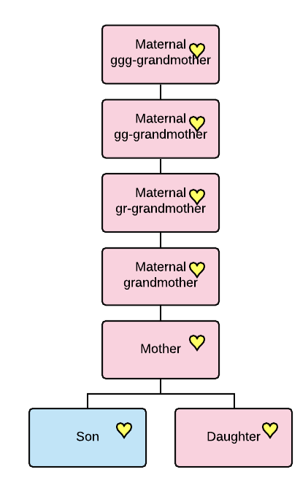
Mitochondrial DNA is only passed from mothers to their children, never admixed or combined with the DNA of the father, so your mitochondrial DNA today is either exactly the same as that of your ancestors a few generations ago, or very close if a mutation has occurred between when they lived and today’s tester.

One of mitochondrial DNA’s strengths is that it can reach far back in time, it’s message undiluted and uninterrupted by recombination.

The messages from our ancestors are very clear. We just need to understand how to hear what they are telling us.

Step-by-Step Soup to Nuts

We will analyze the mitochondrial DNA results of multiple testers who descend from the LeJeune sisters, Edmee and Catherine, born in 1624 and 1633, respectively, to see what they have to tell their descendants. For a very long time, rumors abounded that their mother was Native American, so we will keep that in mind as we review all matching, Mitotree and mtDNA Discover tools provided by FamilyTreeDNA.

We will also learn how to evaluate seemingly conflicting information.

Soup to nuts – we will incorporate every sliver of information along the way and extract every morsel that can help you. Think of this article as your recipe and the reports and information as ingredients!

To be clear, you don’t HAVE to read all of this or decipher anything if you don’t want to. You can just glance at the matches and be on your way – but if you do – you’re leaving an incredible amount of useful information on the table, along with MANY hints that you can’t find elsewhere.

If there was an out-of-print book about this ancestral line in a rare book collection someplace, as a genealogist, you would drive half-way across the country to access that information. This is your rare book, that updates itself, and you don’t have to do anything other than take a mitochondrial DNA test, or find a cousin to take one for lines you don’t carry..

Come along and join the fun! Your ancestors are waiting!

The LeJeune Question

Recently, I wrote about my ancestor Catherine LeJeune, who was born about 1633, probably in France before her family settled in Acadia, present-day Nova Scotia.

The identity of her parents has been hotly contested and widely debated for a long time.

I intentionally did not address her DNA results in that article because I wanted to establish the historical facts about her life and address her mitochondrial DNA separately. The process we are following to analyze her DNA results is the same process everyone should follow, which is why we are taking this step-by-step approach, complete with detailed explanations.

Often, when people hit a brick wall with an ancestor, especially during European colonization of the Americas, someone suggests that the person surely “must be” Native American. Lack of records is interpreted to add layers of evidence, when, in fact, absence of evidence is not evidence of absence.

For example, for many of the earliest French Acadians, birth and baptism records have NOT been located in France, where massive record loss has been experienced.

Additionally, not all records that do exist have been indexed, transcribed, or digitized. Many are damaged and/or nearly impossible to read. Lack of records does NOT mean that those settlers weren’t French, or in this case, it does NOT indicate that they were Native American. It simply means we are lacking that piece of evidence.

Enter mitochondrial DNA.

This article is focused on how to use mitochondrial DNA to decode these messages from our ancestors. I’m providing a very short summary of the relevant historical factors about the LeJeune sisters so readers can keep this in mind as we review the 17+ tools waiting for us when mitochondrial DNA results are ready.

The First Acadian Settlers

The Acadians were French settlers in what is today Nova Scotia. The first Acadians arrived in LaHeve (LaHave), on the southern coast of Acadia, in 1632 after Acadia was returned to France from English control. There may or may not have been any French families in the original group, but if so, very few. In 1636, another group of settlers arrived, but no LeJeune is on the roster.

At the end of 1636, the fledgling Acadian colony was moved from LaHeve, on the southern coast, to Port Royal, a more protected environment.

While we don’t know exactly when the family of Catherine and Edmee LeJeune arrived, we can bracket the dates. We know that Catherine’s sister, Edmee LeJeune, born about 1624, married another settler, Francois Gautrot, about 1644 in Port Royal, so they had arrived by that time.

Edmee’s 1624 birth year is important for two reasons. First, there were no French settlers in the part of Acadia that became Nova Scotia in 1624, so that clearly demonstrates that Edmee was born in France.

It’s unlikely that Catherine was born in Acadia in 1633 given that the first known families arrived in 1636, and we have their names from the ship roster. Pierre Martin was on the 1636 ship, and Acadian history tells us that his son, Mathieu Martin, was the first French child born in Acadia, about 1636, based on the 1671 census.

We also know that there was an early Acadian man, Jean LeJeune, who was granted land at BelleIsle, near Port Royal, among other Acadian families, but he was deceased before the first Acadian census in 1671. Acadia was under English control again from 1654 to 1670, so Jean LeJeune’s land grant had to have occurred after 1636 and prior to 1654, and is where Catherine LeJeune is found as an adult.

Another source of confusion is that there is a third LeJeune woman, Jeanne LeJeune dit Briard, born about 1659. Her daughter, Catherine Joseph’s 1720 marriage record in Port Royal refers to her mother, Jeanne, as being “d’un nation sauvagé”, giving her parents’ names as Francois Joseph and Jeanne LeJeune “of the Indian Nation.” Jeanne LeJeune dit Briard lived with her first husband in Port Royal, but had relocated to LaHeve by 1708.

You can see why this led to confusion about LeJeune females.

Another male, Pierre LeJeune was associated with LaHeve, which suggests he may have been awarded land there, possibly before the colony moved to Port Royal. One of the reasons that the rumor that Catherine LeJeune had a Native mother is so persistent is the belief that Pierre came over early, as a laborer or soldier, and married a Native woman because there weren’t any European women available.

Pierre may well have arrived as a single man, but there is no shred of evidence to suggest Pierre is the father of the sisters, Catherine LeJeune and Edmee LeJeune. In fact, given that Jeanne was born about 1659, Pierre, if he was her father, may have been born as late as 1627, which makes it impossible for him to have been Catherine and Edmee’s father.

That speculation was before the advent of DNA testing, and before Stephen White discovered that there was also a Jean LeJeune who was awarded land exactly where Catherine is known to have been living a few years later.

While it would be nice to unravel this entire cat’s cradle of confusion, the questions we are seeking to answer definitively here are:

  • Are Catherine LeJeune (born 1633) and Edmee LeJeune (born 1624) actually sisters?
  • Is the mother of Catherine LeJeune and her sister, Edmee LeJeune, Native American or European?
  • Is Jeanne LeJeune dit Briard, born about 1659, “d’un nation sauvagé” another sister of the LeJeune sisters?
  • What else is revealed about the LeJeune sisters and their ancestors? Is there something else we should know?

I’ll provide a summary of the combined evidence after our step-by-step mitochondrial analysis.

Testing for Sisters

Mitochondrial DNA is passed from mothers to all of their children, but only females pass it on.

Since we have two LeJeune females, believed to be sisters, we need mitochondrial DNA from direct matrilineal testers for each woman. This is particularly important because we know unquestionably that Edmee was born in France in 1624, prior to Acadian settlement in New France, so her DNA should be European. If they match, it means that Catherine was born to the same mother who was not Native. If they don’t match, there’s a different message.

In some cases, a match might mean that they were born to females related on the matrilineal line, like first cousins, for example. But in the early days of Acadia, there were no European females other than the handful, less than a dozen, who arrived on the Saint-Jehan in 1636.

Fortunately, we have multiple testers for each woman in two DNA projects at FamilyTreeDNA, the only DNA testing company that provides mitochondrial DNA testing and matching. Testers can join special interest projects, and both the Mothers of Acadia Project, and the Acadian AmerIndian Project have testers who descend from the LeJeune sisters.

I’ve identified 28 descendants of Catherine, and 25 from Edmee, giving us a total of 53 known matrilineal descendants to work with. Not all are shown publicly, in projects. Catherine has a known total of 14 testers, and Edmee has 17 that are shown publicly. All testers are members of haplogroup U6a7a1a.

The fact that the descendants of these women match each other, often exactly, combined with Catholic parish register dispensations for their descendants, when taken together, prove conclusively that Catherine and Edmee were sisters, not paternal half-sisters.

Let’s look at each piece of evidence.

Mitochondrial DNA Results

When the lab finishes processing the mtFull test, the results are posted to the account of the test taker.

Click on any image to enlarge

You’ll see the Maternal Line Ancestry section which displays your mitochondrial mtDNA Results.

The three tabs we will be primarily working with are:

  • mtDNA Matches
  • Matches Maps
  • Discover Haplogroup Reports, which includes another dozen+ reports and an updated Migration Map
  • Advanced Matching

At the bottom right of your page, you’ll see two haplogroup badges.

The one at right is called the “Legacy” haplogroup, which means the haplogroup you were assigned prior to the release of the new Mitotree.

The Mitotree mtDNA Haplogroup, with the green “Beta” at the bottom, is the new Mitotree haplogroup, which I wrote about in a series of articles:

Your old Legacy haplogroup will never change, because it’s the 2016 version that was not updated by the previous tree-keepers. That’s why the FamilyTreeDNA R&D team, me included, developed and birthed the new Mitotree. There were thousands of new haplogroups that could be defined to kick-start our genealogy, so we did.

The mitochondrial tree went from about 5000 branches to over 40,000 in the new Mitotree, each providing additional information to testers.

Not everyone received a new haplogroup, but about 75% of testers did, and another new Mitotree version will be released soon. In order to receive a new haplogroup, testers needed to:

  • Have at least one qualifying, stable mutation that had not been previously used to define a haplogroup
  • Match at least one other person in the same haplogroup branch with the same mutation(s)

In the case of the LeJeune sisters, there were no mutations that met all of the qualifications, so their known descendants did not receive a new haplogroup. That’s fine, though, because it’s not the name but the messages held by the information that’s important – and there’s a LOT to work with.

Let’s start with matches.

Matches

Of course, the first thing everyone does is click to see their matches.

The default is Detail View, but I prefer Table View (top left) because you can see more matches on the same page.

Catherine’s descendant whose matches are shown here has 108 Full Sequence matches, which are labeled as the “Coding Region.” The Coding Regions is the mtFULL test and includes both the HVR1 and HVR2 regions. Viewing Coding Region matches means they have taken the mtFull test, which sequences all 16,569 locations of the mitochondria.

When you click on the “Coding Region”, you are seeing matches to people who took all three test levels, not just the first one or two.

There are three test levels to view:

  1. HVR1
  2. HVR1+HVR2 both
  3. Coding Region, which is in addition to the HVR1+HVR2 regions

You can no longer order three different test levels today, although at one time you could. As costs decreased, it no longer made sense to offer multiple testing levels, and often the HVR1 or HVR1+HVR2 results, which only tested about 500 locations each, would confuse people.

People at the lower HVR1 or HVR1+HVR2 levels, known as mtPlus, can upgrade to the complete mtFull level, and should.

However, because some people only tested at those lower levels, matches are still shown at three levels, with different match thresholds for each level.

Matches at the HVR1 or HVR1+HVR2 levels *might* be entirely irrelevant, reaching back thousands of years. They could also be much more current, and critical to your genealogy, so don’t assume. Just one unstable mutation can cause a mismatch though, and at lower levels, cause you not to match someone with the same ancestor, which is why the full sequence test is so critically important.

For some testers, matches at lower levels sometimes provide the ONLY match to your known ancestor. So don’t skip over them. If you find a critical match there, you can email the tester to see if they will upgrade to the mtFull test.

People who test only at the HVR1 or HVR1+HVR2 level receive a more refined haplogroup after they upgrade, so the haplogroups between the HVR1/HVR2 testers and the full sequence test won’t match exactly. For the LeJeune sisters, the haplogroup for HVR1/HVR2-only testers is U6a and for full sequence testers, it’s U6a7a1a.

While full sequence matches are wonderful, if you’re searching for a particular ancestor and the ONLY place they appear is the HVR1 or HVR1+HVR2 testing levels, you’ll want to pursue the match. You may also want to evaluate lower level matches if their ancestors are from a specific location – like France – even if their earliest known ancestor (EKA) is not your ancestor.

To view your  HVR1 or HVR1+HVR2 matches, just click on either of those links. You’ll see ALL of the results, including everyone who took the full sequence test. In this case, that means that the 217 HVR1 (hypervariable region 1) results will include the 120 coding region (full sequence) tests. I’ve already looked through the full sequence matches, so that’s not what I want.

If you ONLY want to see testers who did NOT take the Full Sequence test, use the Filter option. Select Filter, then the features you seek.

Fortunately, the LeJeune sisters have lots of known descendants at the mtFull level to work with, so we will focus on their full sequence matches.

Your Focus

On the matches page, you’ll be immediately interested in two fields:

  • Maternal Earliest Known Ancestor (EKA) – the direct matrilineal ancestor of your match – unless they got confused and entered someone else
  • Their Tree

Viewing the first several matches only produced one match to someone whose earliest known ancestor (EKA) is listed as Catherine or Edmee LeJeune, but perhaps the next group will be more productive. Note that females’ EKAs, earliest known ancestors, are sometimes challenging, given surname changes. So unfamiliar EKAs could represent generational differences and sometimes offer other hints based on their information.

Shifting to the detail view for a minute, you’ll want to review the genetic distance,  meaning whether you’re an exact match or not.

If you’re not an exact match, a genetic distance of “1 step” means that you match except for one mutation at a specific location.

If you have a genetic distance greater than 3, meaning 4 mutations or more, you won’t be shown as a match on this match list. However, you can still be a haplogroup match, which we’ll discuss in the Discover section.

Essentially, with more than 3 mutations difference, it’s unlikely (but not impossible) that your match is genealogically relevant – meaning you probably won’t be able to identify your most recent common ancestor (MRCA).

However, that doesn’t mean that haplogroup-only matches can’t provide important clues, and we will look under every rock!

A Slight Detour – Confirmation Bias

This is a good place to mention that both ancestors and their location (country) of origin are provided by (some) testers to the best of their ability and understanding.

This tester selected “United States Native American” as the location for their earliest known ancestor. We don’t know why they entered that information. It could be that:

  • The tester did not understand that the maternal country of origin means the direct MATRILINEAL line, not just someplace on the maternal side
  • Selina Sinott was Native on her father’s side, or any line OTHER than her direct matrilineal line.
  • They relied on oral history or made a guess
  • They found the information in someone else’s tree
  • They found all of the LeJeune information confusing (because it is)

The tester has provided no tree, so we can’t do any sleuthing here, but an Ancestry search shows a woman by that name born in 1855 in Starksboro, VT to Louis Senott and Victoria Reya. A further search on Victoria leads me to Marie Lussier who leads me to Marguerite Michel who leads me to Marie Anne Lord (Lore, Laure), who lived in Acadia, whose ancestor is…drum roll…Catherine LeJeune. You get the idea.

Yes, you may need to extend other people’s trees.

The Point

However, and this is the point – if you’re looking for confirmation that the LeJeune sisters were Native American, this ONE tester who entered Native American for an unknown reason is NOT the confirmation you’re looking for. Don’t get sucked into confirmation bias, or into categorically believing what someone else entered without additional information.

You need haplogroup confirmation, but, in this case, you don’t have it. However, if you’re new to genetic genealogy, you don’t know that yet, so hold on. We’re still getting there. This is why we need to review all of the reports.

And trust me, I’m not being critical because there isn’t a single seasoned genealogist who has NOT fallen down the rathole of excited confirmation bias or accepting information without further analysis – me included. We all need to actively guard against it, all the time. Confirm and weigh all of the evidence we do have, and seek missing evidence.

Let’s go back to the match results.

Matches – Haplogroups and Haplotypes

Scrolling down the Table View, the next group of matches shows many more matches to descendants of both Catherine and Edmee LeJeune.

Next, you’ll notice that there’s a Mitotree haplogroup, U6a7a1a, AND an F number. In this case, they are both checked in blue, which means you share the exact same haplogroup with that tester, and the exact same haplotype cluster, which is the F number.

I wrote about haplotype clusters, here.

If NEITHER box is checked, you don’t share either the haplogroup nor the haplotype cluster.

You can match the haplogroup, but not the haplotype cluster, which means the haplogroup box will be checked, but the haplotype cluster will not. If you share the same haplotype cluster, you WILL share the same haplogroup, but the reverse is not true.

What is a Haplotype Cluster, and why do they matter?

Haplotype Clusters

We need to talk about exact matches and what they mean. Yes, I know it seems intuitive, but it isn’t.

There are three types of matches

  • Matching and Genetic Distance on your Match List
  • Haplotype matching
  • Haplogroup matching

Without getting (too much) into the weeds, an Exact Match in the Genetic Distance column on your match list excludes locations 309 and 315 because they are too unstable to be considered reliable for matching. So, 309 and 315 are EXCLUDED from this type of matching. In other words, you may or may not match at either or both of those locations. They are ignored for matching on your match list.

Locations 309 and 315 are also EXCLUDED from haplogroup definitions.

A haplotype F cluster match indicates that everyone in that cluster is an exact match, taking into consideration EVERY mutation, INCLUDING 309 and 315.

309 and 315 Why
Matching and Genetic Distance Excluded Unstable, probably not genealogically relevant and may be deceptive, leading you down a rathole
Haplogroup Definition Excluded Too unstable for tree branching and definition
Haplotype F Clusters Included Might be genealogically useful, so everyone can evaluate the rathole for themselves

Some people think that if they don’t match someone exactly, they can’t have the same ancestor as people who do match exactly, but that’s not true. “Mutations happen” whenever they darned well please. Downstream mutations in stable locations that match between two or more testers will form their own haplogroup branch.

The most distant matches are shown on the last match page, and as you can see below, some descendants of Catherine and Edmee LeJeune have a 1-step difference with our tester, meaning a genetic distance of one, or one mutation (disregarding 309 and 315). One match has a 2-step mutation.

The fact that their F numbers are not the same tells you that their mutations are different from each other, too. If two of those people also matched each other, their F# would be identical.

The mutations that do not (yet) form a haplogroup, and are included in your haplotype cluster, are called Private Variants, and you cannot see the private variants of other people. Clearly, you and anyone in your haplotype cluster share all of the same mutations, including Private Variants.

Evaluating Trees and EKAs

By reviewing the matches, their EKAs, and the trees for the matches of Catherine’s descendants, I was able to create a little mini-tree of sorts. Keep in mind that not everyone with an EKA has a tree, and certainly not everyone who uploaded a tree listed an EKA. So be sure to check both resources. Here’s how to add your EKA, and a one-minute video, here.

The good news is that if your match has a WikiTree link when you click on their tree icon, you know their tree actually reaches back to either Edmee or Catherine if that’s their ancestor, and you’re not dealing with a frustrating, truncated two or three-generation tree, or a private tree. You can add your WikiTree link at FamilyTreeDNA here, in addition to any other tree you’ve linked.

Takeaways from Matches

  • You can identify your common ancestor with other testers. By viewing people’s trees and emailing other testers, you can often reconstruct the trees from the tester back through either Catherine or Edmee LeJeune.
  • Your primary focus should be on the people in your haplotype cluster, but don’t neglect other clusters where you may find descendants of your ancestor.
  • If you see a male EKA name, or something other than a female name in the EKA field, like a location, the tester was confused. Only females pass their mitochondrial DNA to their descendants.
  • If you’re searching for an ancestor whose mitochondrial DNA you don’t carry, use projects and WikiTree to see if you can determine if someone has tested from that line. From viewing the project results, I already knew that the LeJeune sisters had several descendants who had tested.
  • If you’re searching for your ancestor on your match list, and you don’t find them in the full sequence results, use the filter to view people who ONLY took the HVR1 and HVR1+HVR2 tests to see if the results you seek are there. They won’t be on your full sequence match list because they didn’t test at that level. Testers at the lower levels will only have a partial, estimated haplogroup – in this case, U6a.
  • For Edmee and Catherine LeJeune, we have enough testers to ensure that we don’t have just one or two people with the same erroneous genealogy. If you do find someone in a project or at WikiTree claiming descent from the same ancestor, but with a different haplogroup, you’ll need to focus on additional research to verify each step for all testers.

Resources:

Matches Maps

The Matches Map is a great visual resource. That “picture is worth 1000 words” tidbit of wisdom definitely applies here.

Clicking on the Matches Maps displays the locations that your matches entered for their EKA.

In the upper left-hand corner, select “Full Sequence,” and only the full sequence matches will be displayed on the map. All full sequence testers also have HVR1/HVR2 results, so those results will be displayed under that selection, along with people who ONLY took the HVR1 or HVR1/HVR2 tests.

We know that the Acadians originally came from France, and their descendants were forcibly expelled from Nova Scotia in 1755. Families found themselves scattered to various locations along the eastern seaboard, culminating with settlements in Louisiana, Quebec, and in some cases, back in France, so this match distribution makes sense in that context.

Be sure to enlarge the map in case pins are on top of or obscuring each other.

Some people from other locations may be a match, too. Reviewing their information may assist with breaking down the next brick wall. Sometimes, additional analysis reveals that the tester providing the information was confused about what to complete, e.g., male names, and you should disregard that pin.

Takeaways from the Matches Map

  • These results make sense for the LeJeune sisters. I would specifically look for testers with other French EKAs, just in case their information can provide a (desperately needed) clue as to where the LeJeune family was from in France.

  • Reviewing other matches in unexpected locations may provide clues about where ancestors of your ancestor came from, or in this case, where descendants of the LeJeune sisters wound up – such as Marie Josephe Surette in Salem, Massachusetts, Catherine LeJeune’s great-granddaughter.
  • Finding large clusters of pins in an unexpected location suggests a story waiting to be uncovered. My matrilineal ancestor was confirmed in church records in Wirbenz, Germany, in 1647 when she married, but the fact that almost all of my full sequence matches are in Scandinavia, clustered in Sweden and Norway, suggests an untold story, probably involving the 30 Years War in Germany that saw Swedish troop movement in the area where my ancestor lived.
  • For my own mitochondrial DNA test, by viewing trees, EKAs, and other hints, including email addresses, I was able to identify at least a country for 30 of 36 full sequence matches and created my own Google map.
  • You can often add to the locations by creating your own map and including everyone’s results.

Resources:

Mitochondrial DNA Part 4 – Techniques for Doubling Your Useful Matches

Mitochondrial DNA Myth – Mitochondrial DNA is not Useful because the Haplogroups are “Too Old”

Before we move to the Discover Reports, I’m going to dispel a myth about haplogroups, ages, genealogical usefulness, and most recent common ancestors known as MRCAs.

Let me start by saying this out loud. YES, MITOCHONDRIAL DNA IS USEFUL FOR GENEALOGY and NO, OLDER HAPLOGROUPS DO NOT PREVENT MITOCHONDRIAL DNA FROM BEING USEFUL.

Here’s why.

The most recent common ancestor (MRCA) is the person who is the closest common ancestor of any two people.

For example, the mitochondrial DNA MRCA of you and your sibling is your mother.

For your mother and her first cousin, the mitochondrial MRCA is their grandmother on the same side, assuming they both descend from a different daughter. Both daughters carry their mother’s undiluted mitochondrial DNA.

A common complaint about mitochondrial DNA is that “it’s not genealogically useful because the haplogroups are so old” – which is absolutely untrue.

Let’s unravel this a bit more.

The MRCA of a GROUP of people is the first common ancestor of EVERY person in the group with each other.

So, if you’re looking at your tree, the MRCA of you, your sibling, and your mother’s 1C in the example above is also your mother’s grandmother, because your mother’s grandmother is the first person in your tree that ALL of the people in the comparison group descend from.

Taking this even further back in time, your mother’s GGG-grandmother is the MRCA for these five people bolded, and maybe a lot more descendants, too.

At that distance in your tree, you may or may not know the name of the GGG-grandmother and you probably don’t know all of her descendants either.

Eventually, you will hit a genealogical brick wall, but the descendants of that unknown “grandmother” will still match. You have NOT hit a genetic brick wall.

A haplogroup name is assigned to the woman who had a mutation that forms a new haplogroup branch, and she is the MRCA of every person in that haplogroup and all descendant haplogroups.

However, and this is important, the MRCA of any two people, or a group of people may very well be downstream, in your tree, of that haplogroup mother.

As you can clearly see from our example, there are four different MRCAs, depending on who you are comparing with each other.

  • Mom – MRCA of you and your sibling
  • Grandmother – MRCA of you, your sibling, your mom and your mom’s 1C
  • GGG-Grandmother – MRCA of all five bolded descendants
  • Haplogroup formation – MRCA of ALL tested descendants, and all downstream haplogroups, many of whom are not pictured

Many of the testers may, and probably do, form haplotype clusters beneath this haplogroup.

When you are seeking a common ancestor, you really don’t care when everyone in that haplogroup was related, what you seek is the common ancestor between you and another person, or group of people.

If the haplogroup is formed more recently in time, it may define a specific lineage, and in that case, you will care because that haplogroup equates to a woman you can identify genealogically. For example, let’s say that one of Catherine LeJeune’s children formed a specific haplogroup. That would be important because it would be easy to assign testers with that haplogroup to their appropriate lineage. That may well be the case for the two people in haplogroup U6a7a1a2, but lack of a more recent haplogroup for the other testers does not hinder our analysis or reduce mitochondrial DNA’s benefits.

That said, the more people who test, the more possibilities for downstream haplogroup formation. Currently, haplogroup U6a7a1a has 34 unnamed lineages, just waiting for more testers.

Haplogroup ages are useful in a number of ways, but haplogroup usefulness is IN NO WAY DEPRICATED BY THEIR AGE. The haplogroup age is when every single person in that haplogroup shares a common ancestor. That might be useful to know, but it’s not a barrier to genealogy. Unfortunately, hearing that persistent myth causes people to become discouraged, give up and not even bother to test, which is clearly self-defeating behavior. You’ll never know what you don’t know, and you won’t know if you don’t test. That’s my mantra!

The LeJeune sisters provide a clear example.

OK, now on to Discover.

mtDNA Discover

Next, we are going to click through from the mtDNA Results and Tools area on your personal page to Discover Haplogroup Reports. These reports are chapters in your own personal book, handed down from your ancestors.

Discover is also a freely available public tool, but you’ll receive additional and personalized information by clicking through when you are signed into your page at FamilyTreeDNA. Only a subset is available publicly.

mtDNA Discover was released with the new Mitotree and provides fresh information weekly.

Think of Discover as a set of a dozen reports just for your results, with one more, Globetrekker, an interactive haplogroup map, coming soon.

Resources:

When you click through to Discover from your results, Discover defaults to your haplogroup. In this case, that’s U6a7a1a for the LeJeune sisters.

Let’s begin with the first report, Haplogroup Story.

Haplogroup Story

The Haplogroup Story is a landing page that summarizes information about your ancestor’s haplogroup relevant to understanding your ancestor’s history. Please take the time to actually READ the Discover reports, including the information buttons, not just skim them.

Think of Discover as your own personalized book about your ancestors – so you don’t want to miss a word.

You’ll see facts on the left, each one with a little “i” button. Click there or mouse over for more information about how that fact was determined.

When we’re talking about haplogroup U6a7a1a, it sounds impersonal, but we’re really talking about an actual person whose name, in this case, we will never know. We can determine the ancestor of some haplogroups that formed within a genealogical timeframe. The LeJeune ancestor in question is the person in whose generation the final mutation in a long string of mutations created the final “a” in haplogroup U6a7a1a.

Think of these as a long line of breadcrumbs. By following them backwards in time and determining when and where those breadcrumbs were dropped, meaning when and where the mutation occurred, we begin to understand the history of our ancestor – where she was, when, and which cultures and events shaped her life.

U6a7a1a was formed, meaning this ancestor was born, about 50 CE, so about 1950 years ago. This means that the ancestor of ANY ONE PERSON with this haplogroup could have lived anytime between the year 50 CE and the year of their mother’s birth.

This is VERY important, because there is an incredible amount of  misunderstanding about haplogroup ages and what they mean to you.

The year 50 CE is the year that the common ancestor of EVERY PERSON in the haplogroup was born, NOT the year that the common ancestor of any two or more people was born.

By way of illustration, the LeJeune sisters were born in about 1624 and 1633, respectively, not 50 CE, and their most recent common ancestor (MRCA) is their mother, who would have been born between about 1590 and 1608, based on their birth years.

For reference, I’ve created this genealogical tree from individuals who took the mitochondrial DNA test and have identified their mitochondrial lineage on the LeJeune mother’s profile at Wikitree

You can see that both Edmee and Catherine have mitochondrial DNA testers through multiple daughters. I’ve color coded the MRCA individuals within each group, and of course their mother is the MRCA between any two people who each descend from Edmee and Catherine.

Mitochondrial DNA matches to the LeJeune sisters’ descendants could be related to each other anywhere from the current generation (parent/child) to when the haplogroup formed, about 50 CE.

You can easily see that all of these testers, even compared with their most distant relatives in the group, share a common ancestor born between 1590 and about 1608. Other people when compared within the group share MCRAs born about 1717 (blue), 1778 (peach), 1752 (green), 1684 (pink), 1658 (mustard), and 1633 (red).

Soooooo…a haplogroup born in 50 CE does NOT mean that you won’t be able to find any genealogical connection because your common ancestor with another tester was born more than 1900 years ago. It means that the common ancestor of EVERYONE who is a member of haplogroup U6a7a1a (and downstream haplogroups) was born about 50 CE.

The parent haplogroup of U6a7a1a is haplogroup U6a7a1, which was born about 1450 BCE, or about 3450 years ago.

In the graphic, I’ve shown other unknown genealogical lineages from U6a7a1 and also downstream haplogroups.

Haplogroup U6a7a1 is the MRCA, or most recent common ancestor of haplogroup U6a7a1a, and anyone who descends from haplogroup U6a7a1 or any of the 23 downstream lineages from U6a7a1, including 5 descendant haplogroups and 18 unnamed lineages.

The LeJeune haplogroup, U6a7a1a, has 35 descendant lineages. One downstream haplogroup has already been identified – U6a7a1a2 – which means two or more people share at least one common, stable, mutation, in addition to the mutations that form U6a7a1a. Thirty-four other lineages are as yet unnamed.

The fact that there are 34 unnamed lineages means that people with one or more private variants, or unique mutations, are candidates for a new branch to form when someone else tests and matches them, including those variants.

You’re a candidate for a new haplogroup in the future if no one else matches your haplotype cluster number, or, potentially, as the tree splits and branches upstream.

When a second person in a lineage tests, those two people will not only share a common haplotype cluster F#, they will share a new haplogroup too if their common mutation is not excluded because it’s unstable and therefore unreliable.

There are 127 members of haplogroup U6a7a1a today, and their EKAs are noted as being from France, Canada, the US, and other countries that we’ll view on other pages.

Haplogroup U6a7a1a has been assigned two Discover badges:

  • Imperial Age – “an age noted for the formation and global impact of expansive empires in many parts of the world.” In other words, colonization, which is certainly true of the French who battled with the English to colonize New England, Acadia, and New France.
  • mtFull Confirmed (for testers only)

Additionally, the LeJeune sisters have one Rare Notable Connection, and three Rare Ancient Connections, all of which may shed light on their history.

Takeaways from the Haplogroup Story

  • The Haplogroup Story provides an overview of the haplogroup
  • You can easily see how many testers fall into this haplogroup and where they have indicated as the origin of their matrilineal line.
  • The haplogroup may have several new haplogroup seeds – 34 in this case – the number of unnamed lineages
  • You can share this or other Discover pages with others by using the “share page” link in the upper right-hand corner.
  • Don’t be discouraged by the age of the haplogroup, whether it’s recent or older.

Next, let’s look at Country Frequency.

Country Frequency

Country Frequency shows the locations where testers in haplogroup U6a7a1a indicate that their EKA, or earliest known matrilineal ancestor, is found. The Country Frequency information is NOT limited to just your matches, but all testers in haplogroup U6a7a1a, some of whom may not be on your match list. Remember, only people with 3 mutations difference, or fewer, are on your match list.

Haplogroup distribution around the world is very informative as to where your ancestors came from.

There are two tabs under Country Frequency, and I’d like to start with the second one – Table View.

Table View displays all of the user-provided country locations. Note that the Haplogroup Frequency is the percentage of total testers in which this haplogroup is found in this particular country. These frequencies are almost always quite small and are location-based, NOT haplogroup based.

There are now 40,000 haplogroups, and in haplogroup U, the LeJeune sisters are 6 branches down the tree with U6a7a1a.

In total, 127 testers are members of haplogroup U6a7a1a, and 42 of those claim that their ancestor is from France, which comprises 1% of the people who have taken the full sequence mitochondrial DNA test whose ancestor is from that location.

Let’s do the math so you can see how this is calculated and why it’s typically so small. For our example, let’s say that 8000 people in the database have said their matrilineal ancestor is from France. Of the 127 haplogroup U6a7a1a members, 42 say their ancestor is from France. Divide 42 by 8,000, which is 0.00525, and round to the nearest percentage – which is 1%.

The best aspect of this page is that you can see a nice summary of the locations where people indicate that their earliest known U6a7a1a ancestor was found.

Please note that the last entry, “Unknown Origins,” is the bucket that everyone who doesn’t provide a location falls into. That row is not a total but includes everyone who didn’t provide location information.

These location results make sense for the LeJeune sisters – maybe except for Ireland and Belgium. Some people don’t understand the directions, meaning that a matrilineal ancestor or direct maternal ancestor is NOT your literal “oldest” ancestor on your mother’s side of the tree who lived to be 105, but your mother-to-mother-to-mother-to-mother ancestor, so check to see if these people with unusual locations are in your match list and view their tree or reach out to them.

We don’t know why the person who selected Native American made that choice, but I’d bet it has to do with confusion about the “other” LeJeune female, Jeanne LeJeune dit Briard. Based on Catherine and her sister, Edmee LeJeune’s haplogroup through more than 50 testers, U6a7a1a, Native is incorrect.

Of course, that tester wouldn’t have known that if they completed their EKA information before they tested. Perhaps they entered information based on the stories they had heard, or flawed genealogy, and didn’t think to go back and correct it when their results were ready, indicating that Native was mistaken.

On the “Map View” tab, the locations are shown using a heat map, where the highest percentages are the darkest. Here, both France and Canada are the darkest because that’s the most common selection for this haplogroup with 1% each, while the rest of the countries registered with less <1%.

These colors are comparative to each other, meaning that there is no hard and fast line in the sand that says some percentage or greater is always red.

To summarize these two tables, because this is important:

  • The Table View shows you how many people selected a specific country for their ancestor’s location, but the frequency is almost always very low because it’s based on the total number of testers in the entire database, comprised of all haplogroups, with ancestors from that country.
  • The Map View shows you a heat map for how frequently a particular location was selected, as compared to other locations, for this haplogroup.

To view the difference between adjacent haplogroups, I always compare at least one haplogroup upstream. In this case, that’s the parent haplogroup, U6a7a1.

The Parent Haplogroup

If you look at haplogroup U6a7a1, just one haplogroup upstream, you’ll see that for Mauritania, the total number of U6a7a1 descendants tested is only “1”, but the haplogroup frequency in Mauritania is 10% which means that there are only 10 people who have been tested in the database altogether from Mauritania – and one person is haplogroup U6a7a1.

However, due to substantial under-sampling of the Mauritania population, the frequency for Mauritania, 10%, is higher than any other location.

Also, remember, these are user-reported ancestor locations, and we have no idea if or how these people determined that their ancestor is actually from Mauritania.

Please only enter actual known locations. For example, we don’t want haplogroup U6a7a1 members to look at this informatoin, then add Mauritania as their location because now they “know” that their ancestor is from Mauritania.

On the Map View, Mauritania is dark red because the percentage is so high – never mind that there are only 10 testers who report matrilineal ancestors from there, and only one was U6a7a1.

This map illustrates one reason why taking the full sequence test is important. Viewing partial haplogroups can be deceiving.

Catherine and Edmee LeJeune’s matrilineal descendants who only tested at the HVR1 or HVR1+HVR2 level receive a predicted haplogroup of U6a, born about 21,000 years ago. That’s because the full 16,569 locations of the mitochondria need to be tested in order to obtain a full haplogroup, as opposed to about 500 locations in the HVR1 and HVR1/2, each, respectively.

U6a – The Result for HVR1/HVR2-Only Testers

So, let’s look at what haplogroup U6a reveals, given that it’s what early LeJeune descendants who ordered the lower-level tests will see.

In the Table View for U6a, below, you see that the top 5 counties listed by haplogroup frequency are five North African countries.

A total of 801 people are assigned to haplogroup U6a, meaning the majority, 757, report their ancestors to be from someplace else. If two people from the Western Sahara (Sahrawi) comprise 67% of the people who tested, we know there are only three people who have tested and selected that location for their ancestors.

If you didn’t understand how the display works, you’d look at this report and see that the “top 5” countries are North African, and it would be easy to interpret this to mean that’s where Catherine and Edmee’s ancestors are from. That’s exactly how some people have interpreted their results.

Scrolling on down the Table View, 50 testers report France, and 10 report the US, respectively, with France showing a Haplogroup Frequency of 1% and the US <1%.

The balance of U6a testers’ ancestors are from a total of 57 other countries, plus another 366 who did not select a location. Not to mention that U6a was born 21,000 years ago, and a lot has happened between then and the 1620/1630s when Catherine and Edmee were born to a French mother.

The real “problem” of course is that haplogroup U6a is only a partial haplogroup.

The U6a map shows the highest frequency based on the number of testers per country, which is why it’s dark red, but the Table View reports that the actual number of U6a testers reporting any specific country. France has 50. Next is the US, also with 50, which often means people are brick-walled here. You can view the U6a table for yourself, here.

Why is this relevant for Catherine and Edmee LeJeune? It’s very easy to misinterpret the map, and for anyone viewing U6a results instead of U6a7a1a results, it’s potentially genealogically misleading.

Use Country Frequency with discretion and a full understanding of what you’re viewing, especially for partial haplogroups from HVR1/HVR2 results or autosomal results from any vendor.

If someone tells you that the LeJeune sisters are from someplace other than France, ask where they found the information. If they mention Africa, Morocco or Portugal, you’ll know precisely where they derived the information.

This information is also available on your Maternal Line Ancestry page, under “See More,” just beneath the Matches tab. Haplogroup Origins and Ancestral Origins present the same information in a different format.

Discover is a significant improvement over those reports, but you’ll still need to read carefully, understand the message, and digest the information.

Takeaways from Country Frequency

  • Evaluate the results carefully and be sure to understand how the reports work.
  • Use complete, not partial haplogroups when possible.
  • The Haplogroup Frequency is the number of people assigned to this haplogroup divided by the entire number of people in the database who report that country location for their matrilineal ancestor. It is NOT the percentage of people in ONLY haplogroup U6a7a1a from a specific country.
  • Table view shows the number of testers with this haplogroup, with the percentage calculated per the number of people who have tested in that country location.
  • The Map shows the highest frequency based on the number of testers per country.
  • Use the map in conjunction with the haplogroup age to better understand the context of the message.

Globetrekker, which has not yet been released, will help by tracking your ancestors’ paths from their genesis in Africa to where you initially find that lineage.

Before we move on to the Mitotree, let’s take a minute to understand genetic trees.

About Genetic Trees

The Mitotree is a genetic tree, also called a phylogenetic tree, that generally correlates relatively closely with a genealogical tree. The more testers in a particular haplogroup, the more accurate the tree.

FamilyTreeDNA provides this disclaimer information about the genetic tree. The Mitotree you see is a nice and neat published tree. The process of building the tree is somewhat like making sausage – messy. In this case, the more ingredients, the better the result.

The more people that test, the more genetic information is available to build and expand the tree, and the more accurate it becomes.

The recent Mitotree releases have moved the haplogroup “dates” for the LeJeune sisters from about 21,000 years ago for HVR1/HVR2 U6a testers to 50 CE for full sequence testers, and this may well be refined in future tree releases.

Mutations

Mutations and how to interpret them can be tricky – and this short section is meant to be general, not specific.

Sometimes mutations occur, then reverse themselves, forming a “back mutation”, which is usually counted as a branch defining a new haplogroup. If a back mutation happens repeatedly in the same haplogroup, like a drunken sailor staggering back and forth, that mutation is then omitted from haplogroup branch formation, but is still counted as a mismatch between two testers.

A heteroplasmy is the presence of two or more distinct results for a specific location in different mitochondria in our bodies. Heteroplasmy readings often “come and go” in results for different family members, because they are found at varying threshold levels in different family members, causing mismatches. Heteroplasmies are currently counted only if any person has 20% or greater of two different nucleotides. So, if you have a 19% heteroplasmy read for a particular location, and your sister has 21%, you will “not” have a heteroplasmic condition reported, but she will, and the location will be reported as a mismatch.

If you have a heteroplasmy and another family member does not, or vice versa, it’s counted as as a “mismatch,” meaning you and that family member will find yourselves in different haplotype clusters. Hetroplasmies do not presently define new tree branches. I wrote about heteroplasmies, here.

Takeaways from the Genetic Tree Disclaimer

  • DNA is fluid, mutations happen, and all mutations are not created equal.
  • Thankfully, you really don’t need to understand the nitty-gritty underpinnings of this because the scientists at FamilyTreeDNA have translated your results into reports and features that take all of this into consideration.
  • Testing more people helps refine the tree, which fills in the genetic blanks, refining the dates, and expanding branches of the tree.

Resources:

Ok, now let’s look at the Time Tree

Time Tree

The Time Tree displays your haplogroup on the Mitotree timeline. In other words, it shows us how old the haplogroup is in relation to other haplogroups, and testers.

The Time Tree displays the country locations of the ancestors of testers who are members of that and descendant or nearby haplogroups. You can view the haplogroup U6a7a1a Time Tree, here, and follow along if you wish. Of course, keep in mind that the tree is a living, evolving entity and will change and evolve over time as updated tree versions are released.

Mousing over the little black profile image, which is the person in whom this haplogroup was born, pops up information about the haplogroup. Additionally, you’ll see black bars with a hashed line between them. This is the range of the haplogroup formation date. Additional details about the range can be found on the Scientific Details tab, which we’ll visit shortly.

On your Matches tab, remember that each match has both a haplogroup and a haplogroup cluster F# listed.

On the Time Tree, individual testers are shown at right, with their selected country of origin. In this case, you’ll see the person who selected “Native American” at the top, followed by France, Canada, the US, and other flags.

Haplogroup U6a7a1a includes several haplotype clusters, designated by the rounded red brackets. In this view, we can see several people who have haplotype cluster matches. Everyone has a haplotype assignment, but a haplotype cluster is not formed until two people match exactly.

In the Time Tree view, above, you can see two clusters with two members each, and the top of a third cluster at the bottom.

In case you’re wondering why some of the globes are offset a bit, they positionally reflect the birth era of the tester, rounded to the closest 25 years, if the birth year is provided under Account Settings. If not, the current tester position defaults to 1950.

Scrolling down to the next portion of the window shows that the third cluster is VERY large. Inside the cluster, we see Belgium, Canada, and France, but we aren’t even halfway through the cluster yet.

Continuing to scroll, we see the cluster number, F7753329, in the middle of the cluster, along with the French flag, two from Ireland, four from the US, and the beginning of the large unknown group.

In this fourth screenshot, at the bottom of the display, we see the balance of haplotype cluster #F7753329, along with eight more people who are not members of that haplotype cluster, nor any other haplotype cluster.

Finally, at the bottom, we find haplogroup U6a7a1a2, a descendant haplogroup of U6a7a1a. Are they descendants of the LeJeune sisters?

Looking back at our tester’s match list, the two people who belong to the new haplogroup U6a7a1a2 haven’t provided any genealogical information. No EKA or tree, unfortunately. The haplogroup formation date is estimated as about 1483, but the range extends from about 1244-1679 at the 95th percentile. In other words, these two people could be descendants of:

  • Either Catherine or Edmee LeJeune, but not both, since all of their descendants would be in U6a7a1a2.
  • An unknown sister to Catherine and Edmee.
  • A descendant line of an ancestor upstream of Catherine and Edmee.

Takeaways from the Time Tree

  • The visualization of the matches and haplotype clusters illustrates that the majority of the haplogroup members are in the same haplogroup cluster.
  • Given that two women, sisters, are involved, we can infer that all of the mutations in this haplotype cluster were common to their mother as well.
  • Haplotype cluster #F7753329 includes 19 testers from Catherine and 17 from Edmee.
  • Downstream haplogroup U6a7a1a2 was born in a daughter of haplogroup U6a7a1a, as early as 1244 or as late as 1679. Genealogy information from the two testers could potentially tell us who the mutation arose in, and when.
  • As more haplogroup U6a7a1a2 testers provide information, the better the information about the haplogroup will become, and the formation date can be further refined.

Smaller haplotype clusters have a story to tell too, but for those, we’ll move to the Match Time Tree.

Match Time Tree

The Match Time Tree is one of my favorite reports and displays your matches on the Time Tree. This feature is only available for testers, and you must be signed in to view your Match Time Tree.

By selecting “Share Mode”, the system obfuscates first names and photos so you can share without revealing the identity of your matches. I wrote about using “Share Mode” here. I have further blurred surnames for this article.

The Match Time Tree incorporates the tree view, with time, the names of your matches PLUS their EKA name and country, assuming they have entered that information. This is one of the reasons why the EKA information is so important.

This display is slightly different than the Time Tree, because it’s one of the features you only receive if you’ve taken the mtFull test and click through to Discover from your account.

The Time Tree view is the same for everyone, but the Match Time Tree is customized for each tester.

Your result is shown first, along with your haplotype cluster if you are a member of one.

You can easily see the names of the EKAs below the obfuscated testers’ names.

While we immediately know that descendants of both Catherine and Edmee are found in the large cluster #F7753329, we don’t yet know which ancestors are included in other haplotype clusters.

Haplogroup U6a7a1a includes two smaller haplotype clusters with 2 people each.

We know a few things about each of these clusters:

  • The people in each cluster have mutations that separate them from everyone else except the other person in their cluster
  • The results are identical matches to the other person in the cluster, including less reliable locations such as 309 and 315
  • There are other locations that are excluded from haplogroup formation, but are included in matching, unlike 309 and 315.
  • Given that they match only each other exactly, AND they did not form a new haplogroup, we know that their common unique mutation that causes them to match only each other exactly is unreliable or unstable, regardless of whether it’s 309, 315, a heteroplasmy, or another marker on the list of filtered or excluded variants.

Only the tester can see their own mutations. By inference, they know the mutations of the people in their haplotype cluster, because they match exactly.

If you’re a member of a cluster and you’re seeking to determine your common ancestor, you’ll want to analyze each cluster. I’ve provided two examples, below, one each for the red and purple clusters.

Red Haplotype Cluster #F3714849

Only one person in the red cluster has included their EKA, and the tree of the second person only reaches to three generations. Tracking that line backwards was not straightforward due to the 1755 expulsion of the Acadians from Nova Scotia.

The second person listed their EKA as Edmee LeJeune, but they have a private tree at MyHeritage, so their matches can’t see anything. I wonder if they realize that their matches can’t view their tree.

We are left to wonder if both people descend from Edmee LeJeune, and more specifically, a common ancestor more recently – or if the unstable mutation that they share with each other is simply happenstance.

E-mailing these testers would be a good idea.

Purple Haplotype Cluster #F2149611

Evaluating the purple cluster reveals that the common ancestor is Catherine LeJeune. The question is twofold – how are these two people related downstream from Catherine, and how unstable is their common mutation or mutations.

Fortunately, both people have nice trees that track all the way back to Catherine.

Unfortunately, their MRCA is Francoise, the daughter of Catherine. I say unfortunately, because two additional testers also descend from Francoise, and they don’t have the haplotype cluster mutation. This tells us that the cluster mutation is unreliable and probably not genealogically relevant because it occurred in two of Francoise’s children’s lines independently, but not all four.

In other words, that specific mutation just happened to occur in those two people.

This is exactly why some mutations are not relied upon for haplogroup definition.

Takeaways from the Match Time Tree

  • The time tree is a wonderful visualization tool that shows all of your matches, their EKAs and countries, if provided, in haplotype clusters, on the Time Tree. This makes it easy to see how closely people are related and groups them together.
  • On your match page, you can easily click through to view your matches’ trees.
  • You can use both haplotype clusters (sometimes reliable) and downstream haplogroups (reliable) to identify and define lineages on your family tree. For example, if a third person matches the two in haplogroup U6a7a1a2, the child haplogroup of U6a7a1a, and you could determine the common ancestor of any two of the three, you have a good idea of the genealogical placement of the third person as well.
  • You know that if people form a haplotype cluster, but not a new haplogroup, that their common haplotype cluster-defining mutation is less reliable and may not be genealogically relevant.
  • On the other hand, those less reliable mutations may not be reliable enough for haplogroup definition, but may be relevant to your genealogy and could possibly define lineage splits. Notice all my weasel words like “may,” “may not” and “possibly.” Also, remember our purple cluster example where we know that the mutation in question probably formed independently and is simply chance.
  • I can’t unravel the ancestors of the red cluster – and if I were one of those two people, especially if I didn’t know who my ancestor was, I’d care a lot that the other person didn’t provide a useful tree. Don’t forget that you can always reach out via email, offer to collaborate, and ask nicely for information.
  • We need EKAs, so please encourage your matches to enter their EKA, upload a tree or link to a MyHeritage tree, and enter a Wikitree ID in their FamilyTreeDNA profile, all of which help to identify common ancestors.

Resources:

Classic Tree

FamilyTreeDNA invented the Time Tree and Match Time Tree to display your results in a genealogically friendly way, but there is important information to be gleaned from other tree formats as well.

The Classic Tree presents the Mitotree, haplogroup and haplotype information in the more traditional format of viewing phylogenetic trees, combining their beneficial features. There’s a lot packed in here.

In this default view, all of the Display Options are enabled. We are viewing the LeJeune haplogroup, U6a7a1a, with additional information that lots of people miss.

The countries identified as the location of testers’ earliest known ancestors (EKA) are shown.

Listed just beneath the haplogroup name, five people are members of this haplogroup and are NOT in a haplotype cluster with anyone else, meaning they have unique mutations. When someone else tests and matches them, depending on their mutation(s), a new haplogroup may be formed. If they match exactly, then at least a new haplotype cluster will be formed.

Portions of three haplotype clusters are shown in this screenshot, designated by the F numbers in the little boxes.

Additional information is available by mousing over the images to the right of the haplogroup name.

Mousing over the badge explains the era in which the haplogroup was born. Rapid expansion was taking place, meaning that people were moving into new areas.

Mousing over the date explains that the scientists behind the Mitotree are 95% certain about the date range of the birth of this haplogroup, rounded to 50 CE. Remember, your common ancestor with ALL haplogroup members reaches back to this approximate date, but your common ancestor with any one, or a group, of testers is sometime between the haplogroup formation date, 50 CE, and the present day.

Mousing over the year shows the confidence level, and the date range at that level. These dates will probably be refined somewhat in the future.

If haplogroup members have private variants, it’s likely or at least possible that a new branch will split from this one as more people test

Mousing over the star displays the confidence level of the structure of this portion of the Mitotree based on what could be either confusing or conflicting mutations in the tree. For haplogroup U6a7a1a, there’s no question about the topology, because it has a 10 of 10 confidence rating. In other words, this branch is very stable and not going to fall off the tree.

Every haplogroup is defined by at least one mutation that is absent in upstream branches of the tree. Mutations are called variants, because they define how this sample, or branch, varies from the rest of the branches in the Mitotree.

These two mutations, A2672G and T11929C, are the haplogroup-defining mutations for U6a7a1a. Everyone in haplogroup U6a7a1a will have these two mutations in addition to all of the mutations that define directly upstream haplogroups (with extremely rare exceptions). Haplogroup-defining mutations are additive.

There may be more haplogroup-defining mutations than are displayed, so click on the little paper icons to copy to your clipboard.

You can view upstream haplogroups and downstream haplogroups, if there are any, by following the back arrows to upstream haplogroups, and lines to downstream haplogroups.

For example, I clicked on the arrow beside haplogroup U6a7a1a to view its parent haplogroup, U6a7a1, and a second time to view its parent, haplogroup U6a7a. If I click on the back arrow for U6a7a, I’ll continue to climb up the tree.

Beneath U6a7a, you can see the haplogroup branches, U6a7a1a and U6a7a2.

Beneath U6a7a1, you’ll notice:

  • People who don’t share haplotype clusters with anyone
  • Three haplotype clusters
  • Five descendant haplogroups from U6a7a1, including the LeJeune sister’s haplogroup U6a7a1a.

To expand any haplogroup, just click on the “+”.

You may see icons that are unfamiliar. Mouse over the image or click on the “Show Legend” slider at upper right to reveal the decoder ring, I mean, legend.

You can read more about the symbols and how haplogroups are named, here, and see more about types of mutations in the Scientific Details section.

Takeaways from the Classic Tree

  • The Classic Tree provides a quick summary that includes important aspects of a haplogroup, including when it was formed, which mutations caused it’s formation, and each branch’s confidence level.
  • It’s easy to back your way up the tree to see where your ancestor’s founding haplogroups were located, which speaks to your ancestor’s history. Patterns, paths, and consistency are the key.
  • Ancient DNA locations in your tree can provide a very specific location where a haplogroup was found at a given point in time, but that doesn’t necessarily mean that’s where the haplogroup was born, or that they are your ancestor. We will get to that shortly.
  • You can share this page with others using the “Share Page” function at the top right.

Ancestral Path

The Ancestral Path is a stepping-stone chart where you can view essential information about each haplogroup in one row, including:

  • Age and era
  • Number of years between haplogroups
  • Number of subclades
  • Number of modern-day testers who belong to this haplogroup
  • Number of Ancient Connections that belong to this haplogroup, including all downstream haplogroups

This “at a glance” history of your haplogroup is the “at a glance” history of your ancestors.

The number in the column titled “Immediate Descendants”, which is the number of descendant haplogroups, tells a story.

If you see a large, or “larger” number there, that indicates that several “child” haplogroups have been identified. Translated, this means that nothing universally terrible has occurred to wipe most of the line out, like a volcano erupting, or a famine or plague that would constitute a constraining bottleneck event. Your ancestors’ children survived and apparently thrived, creating many descendant downstream haplogroups, known as an expansion event.

If you see a smaller number, such as rows 5, 7, 8, 9, and 13, each of which have only two surviving branches, yours and another, several branches probably didn’t survive to the present day. This may reflect a bottleneck where only a few people survived or the lines became extinct over time, having no descendants today. Either that, or the right people haven’t yet tested. Perhaps they are living in a particularly undersampled region of the world, a tiny village someplace, or there aren’t many left.

The two most recent haplogroups have the most subclades, indicating that your ancestors were successfully reproducing in the not-too-distant past. Mutations occurred because they randomly do, creating new haplogroups, and several haplogroup members have tested today. Hopefully, genealogy can connect us further.

The next column, “Tested Modern Descendants,” tallies the total number of testers as it rolls up the tree. So, each haplogroup includes the testers in its downstream (child) haplogroups. The 127 people in haplogroup U6a7a1a include the two people in haplogroup U6a7a1a2, and the 226 people in haplogroup U6a7a1 include the 127 people in haplogroup U6a7a1a.

Looking at other types of trees and resources for each haplogroup can suggest where our ancestors were at that time, perhaps correlating with world or regional history that pertains to the lives of those ancestors.

In our case, the LeJeune sisters’ ancestors did well between 3450 years ago through the formation of U6a7a1a, about 1950 years ago. 3500 years ago, in Europe, settlements were being fortified, leadership was emerging as complex social patterns formed, and trade networks developed that spanned the continent and beyond.

Between 20,000 and 3,450 years ago, not so much. This correlates to the time when early European farmers were moving from Anatolia, bringing agriculture to Europe en masse. However, they were not the first people in Europe. Early modern humans arrived and lived in small groups about 50,000 years ago.

And they very nearly didn’t survive. Many lines perished.

Takeaways from the Ancestral Path

  • The Ancestral Path shows the stepping stones back to Mitochondrial Eve, dropping hints along the way where expansions occurred, meaning that your ancestors were particularly successful, or conversely, where a bottleneck occurred and the lineage was in jeopardy of extinction.
  • In some cases, where a lot of time has passed between haplogroups, such as 8,000 years between U and U6, we’re seeing the effect of lineages dying out. However, with each new tester, there’s the possibility of a previously undiscovered branch split being discovered. That’s precisely what happened with haplogroup L7.

Migration Map

The Discover Migration Map shows the path that your ancestor took out of Africa, and where your base ancestral haplogroup was formed.

Mousing over the little red circle displays the haplogroup, and the area where it originated. Based on this location where U6 was found some 31,000 years ago, we would expect to find U6 and subgroups scattered across North Africa, the Levant, and of course, parts of Eurasia and Europe.

It’s interesting that, based on what we know using multiple tools, it appears that haplogroup U initially crossed between the Horn of Africa and the Arabian Peninsula, at the present-day Strait of Bab-el-Mandeb. Today, that crossing is about 15 nautical miles, but the sea level was much lower during earlier times in history, including the last glacial maximum. Humans would have seen land across the water, and could potentially have swum, drifted, or perhaps used early boats.

Over the next 10,000+ years, haplogroup U trekked across the Arabian peninsula into what is present-day Iran, probably moving slowly, generation by generation, then turning back westward, likely in a small group of hunter-gatherers, crossing the Nile Delta into North Africa, present-day Egypt.

They probably fished along the Nile. Food would have been plentiful along rivers and the sea.

It’s exciting to know that the ancestors of the LeJeune sisters lived right here, perhaps for millennia.

There’s more, however.

The Migration Map shows the location of the genetically closest Ancient DNA results to your haplogroup, obtained from archaeological excavations. This mapped information essentially anchors haplogroup branches in locations in both space and time.

Ancient DNA samples are represented by tiny brown trowels. Clicking on each trowel provides summary information about the associated sample(s) in that location.

Takeaways from the Migration Map

  • Scientists have estimated the location where your base haplogroup originated. For the LeJeune sisters, that’s haplogroup U6 in North Africa along the Mediterranean Sea.
  • The trowels show the locations of the genetically closest archaeological samples, aka Ancient Connections, in the FamilyTreeDNA data base.
  • These Ancient Connections displayed on the map may change. New samples are added regularly, so your older samples, except for the oldest two, which remain in place for each tester, will roll off your list when genetically closer Ancient Connections become available.
  • There are no Ancient Connections for the LeJeune sisters in France today, but keep in mind that Europe is closely connected. Today’s French border is only about 25 miles as the crow flies from Goyet, Belgium. France, sea to sea, is only about 500 miles across, and at its closest two points, less than 250 miles.
  • Samples found at these locations span a large timeframe.

There’s a LOT more information to be found in the Ancient Connections.

Ancient Connections

Ancient Connections is one of my favorite Discover features. This information would never have been available, nor synthesized into a usable format, prior to the introduction of Mitotree and mtDNA Discover. Ancient Connections unite archaeology with genealogy.

  • The first thing I need to say about Ancient Connections is that it’s unlikely that these individuals are YOUR direct ancestors. Unlikely does not mean impossible, but several factors, such as location and timeframe need to be considered.
  • What is certain is that, based on their mitochondrial haplogroup, you SHARE a common ancestor at some point in time.
  • Ancient samples can be degraded, with missing genetic location coverage. That means that not every mutation or variant may be able to be read.
  • Different labs maintain different quality criteria, and location alignments may vary, at least somewhat, lab to lab. While this is always true, it’s particularly relevant when comparing ancient DNA results which are already degraded.
  • Samples are dated by archaeologists using a variety of methodologies. FamilyTreeDNA relies on the dates and historical eras provided in the academic papers, but those dates may be a range, or contain errors.
  • Obtaining information from ancient DNA samples isn’t as easy or straightforward as testing living people.

However, the resulting information is still VERY useful and incredibly interesting – filling in blanks with data that could never be discerned otherwise.

Many people mistakenly assume that these Ancient Connections are their ancestors, and most of the time, not only is that not the case, it’s also impossible. For example, a woman who lived in 1725 cannot be the ancestor of two sisters who were born in 1624 and 1633, respectively.

When you click on Ancient Connections, you see a maximum of about 30 Ancient Connections. Information about the genetically closest burial is displayed first, with the most distant last on the list.

Please note that the final two are the oldest and will (likely) never change, or “roll off” your list, unless an even older sample is discovered. When new samples become available and are genetically closer, the oldest other samples, other than the oldest two, do roll off to make space for the closer haplogroups and their corresponding samples.

Obviously, you’ll want to read every word about these burials, because nuggets are buried there. I strongly encourage you to read the associated papers, because these publications reveal snippets of the lives of your haplogroup ancestors and their descendants.

The small pedigree at right illustrates the relationship between the ancient sample and the haplogroup of the tester. Three things are listed:

  1. El Agujero 8, the name assigned by the authors of the paper that published the information about this ancient sample
  2. The haplogroup of the LeJeune descendant who tested
  3. The haplogroup of their common ancestor.

If no haplogroup is specifically stated for the ancient sample, the sample is the same haplogroup as the common shared ancestor (MRCA), meaning the tester and the ancient sample share the same haplogroup.

The Time Tree beneath the description shows the tester’s haplogroup, (or the haplogroup being queried), the ancient sample, and their common ancestral haplogroup.

Let’s analyze this first sample, El Agujero 8.

  • The person whose remains were sampled lived about 1375 years ago (I’ve averaged the range), in the Canary Islands, and is part of the Guanche culture.
  • The Guanche are the indigenous people of the Canary Islands, already established there before the arrival of Europeans and the Spanish conquest of the 1400s.
  • The Guanche people are believed to have arrived in the Canaries sometime in the first millennium BCE (2000-3000 years ago) and were related to the Berbers of North Africa.
  • This makes sense if you consider the Migration map and geographic proximity.
  • Haplogroup U6a7a1, the haplogroup of El Agujero 8, is the shared ancestral haplogroup with the LeJeune sisters.
  • That woman, U6a7a1, lived around 1450 BCE, or 3450 years ago, probably someplace in North Africa, the Mediterranean basin, or even in the Nile Delta region, given the correlation between the Canary Islands settlement, the Berbers, and the Migration Map.
  • This does NOT mean that the ancestor of the LeJeune sisters lived in the Canary Islands. It means that a descendant of their MRCA, haplogroup U6a6a1, the shared common ancestor with the LeJeune sisters, lived in the Canary Islands.

Ancient Connections Chart Analysis Methodology

I create an Ancient Connection chart for each haplogroup I’m dealing with. We’re analyzing the LeJeune sisters today, but I track and analyze the haplogroup for every ancestor whose haplogroup I can find, or for whom I can find a descendant to test.

In this chart, YA=years ago and is based on the year 2000. KYA=thousand years ago, so 10 KYA is 10,000 years ago.

Name Person Lived Location & Culture Haplogroup, Date & Age Shared (MRCA) Haplogroup, Date & Age Note
LeJeune Sisters Born 1624 & 1633 French Acadian U6a7a1a,

50 CE,

1950 YA

U6a7a1a,

50 CE,

1950 YA

In Acadia by 1643/44
El Agujero 8 1375 CE Canary Islands, Guanche U6a7a1

1450 BCE, 3450 YA

U6a7a1 1450 BCE, 3450 YA Guanche arrived in Canaries in 1st millennium BCE, related to Berbers
Djebba 20824 6000 BCE Jebba, Bājah, Tunisia, Neolithic U6a3f3’4’5

c 5000 BCE, 7000 YA

U6a1”9

19,000 BCE, 21,000 YA

This archaeology site is on the northernmost point of North Africa
Djebba 20825 5900 BCE Djebba, Bājah, Tunisia, Neolithic U6a1”9

19,000 BCE, 21,000 YA

U6a1”9

19,000 BCE, 21,000 YA

This archaeology site is on the northernmost point of North Africa
Egyptian Mummy 2973 200 BCE Abusir el-Meleq, Giza, Egypt, Ptolemaic Kingdom U6a3h^,

1450 BCE,

3450 YA

U6a1”9

19,000 BCE, 21,000 YA

Nile Delta probably, paper says they share ancestry with near easterners
Egyptian Mummy 2888 100 BCE Abusir el-Meleq, Giza, Egypt, Ptolemaic Kingdom U6a2a’c,

11,000 BCE,

13,000 YA

U6a1”9

19,000 BCE, 21,000 YA

Nile Delta probably, paper says they share ancestry with near easterners
Segorbe Giant (6’3”) 1050 CE Plaza del Almudín, Valencia, Spain, Islamic necropolis burial U6a1a1, 14,000 BCE, 16,000 YA


U6a1”9

19,000 BCE, 21,000 YA

Paper says his genetic makeup is Berber and Islamic Spain, buried in Islamic style on right side facing Mecca.
Sweden Skara 1050 CE Varnhem, Skara, Sweden, Viking Swedish culture U6a1a3a, 7350 BCE, 9350 YA, U6a1”9

19,000 BCE, 21,000 YA

Viking burial


Chapelfield 696 1180 CE Chapelfield, Norwich, England, Ashkenazi Jewish Medieval age U6a1b1b. 400 BCE,

2400 YA


U6a1”9

19,000 BCE, 21,000KYA

Possibly the 1190 antisemitic Norwich massacre
Montana Mina 38 1200 CE Montana Mina, Lanzarote, Spain (Canary Islands), Guanche culture U6a1a1b1 U6a1”9

19,000 BCE, 21,000 YA

Guanche arrived in Canaries in 1st millennium BCE, related to Berbers
Amina 1725 CE Gaillard Center, Charleston, South Carolina, Enslaved African American burials U6a5b’f’g,

9550 BCE, 11,550 YA,

U6a1”9

19,000 BCE, 21,000 YA

Remains of pre-Civil War enslaved Africans unearthed in Charleston, SC
Doukanet el Khoutifa 22577 4400 BCE Doukanet el Khoutifa, Mars, Tunisia, Maghrebi cultural group U6b,

6500 BCE, 8500 YA


U6a’b’d’e, 23,000 BCE, 25,000 YA Late Stone Age, shows some admixture with European Hunter-Gatherers, possibly back and forth from Sicily
Guanche 12 625 CE Tenerife, Spain (Canary Islands), Guanche, Medieval U6b1a1’6’8’9, 1 BCE,

2100 YA

U6a’b’d’e, 23,000 BCE, 25,000 YA Guanche arrived in the Canaries in 1st millennium BCE, related to Berbers
Guanche 14 775 CE Tenerife, Spain (Canary Islands), Guanche, Medieval U6b1a1’6’8’9, 1 BCE,

2100 YA

U6a’b’d’e, 23,000 BCE, 25,000 YA Ditto above
Antocojo 27 875 CE Antocojo, La Gomera, Spain (Canary Islands) U6b1a1’6’8’9, 1 BCE,

2100 YA

U6a’b’d’e, 23,000 BCE, 25,000 YA Ditto above
Guanche 13 900 CE Cave, Tenerife, Spain (Canary Islands), Medieval U6b1a1’6’8’9, 1 BCE,

2100 YA

U6a’b’d’e, 23,000 BCE, 25,000 YA Ditto above
Guanche 1 1090 CE Cave, Tenerife, Spain (Canary Islands), Medieval U6b1a1’6’8’9, 1 BCE,

2100 YA

U6a’b’d’e, 23,000 BCE, 25,000 YA Ditto above
Barranco Majona 30 1325 CE Barranco Majona, La Gomera, Spain (Canary Islands), Guanche late Medieval U6b1a1’6’8’9, 1 BCE,

2100 YA

U6a’b’d’e, 23,000 BCE, 25,000 YA Ditto above
Kostenki 14 36,000 BCE Markina Gora, Kostyonki, Voronezh Oblast, Russia U2,

43,000 BCE, 45,000 YA


U,

43,000 BCE, 45,000 YA

European/Asian steppe earliest hunter-gatherers. Farming didn’t arrive until 10 KYA. Admixture from Asia as well.
Kostenki 12 31,000 BCE Volkovskaya, Voronezh region, Russian Federation. U2c’e,

43,000 BCE, 45,000 YA


U,

43,000 BCE, 45,000 YA

Early hunter-gatherer
Krems 3 29,000 BCE Wachtberg in Krems, Lower Austria, Austria, Gravettian culture U5,

32,000 BCE,

34,000 YA

U,

43,000 BCE, 45,000 YA

Endured the ice age, sophisticated toolmaking, Venus figures, mobile lifestyle, mammoth hunters
Krems Twin 1 28,800 BCE Left bank of the Danube, Krems-Wachtberg, Austria, Gravettian culture U5,

32,000 BCE,

34,000 YA

U,

43,000 BCE, 45,000 YA

Double grave for twins, 1 newborn, one age about 50 days
Krems Twin 2 28,800 BCE Left bank of the Danube, Krems-Wachtberg, Austria, Gravettian culture U5,

32,000 BCE,

34,000 YA

U,

43,000 BCE, 45,000 YA

Ditto above
Vestonice 13 28,900 BCE Pavlovské Hills, South Moravia, Czech Republic, Grevettian culture U8b^,

37,000 BCE, 39,000 YA


U,

43,000 BCE, 45,000 YA

Ice Age Europe, few samples before farming introduced. Believe these Gravettian individuals are from a single founder population before being displaced across a wide European region.
Vestonice 14 28,900 BCE Dolni Vestonice, Brezi, Czech Republic, Gravettian culture U5,

32,000 BCE,

34,000 YA

U,

43,000 BCE, 45,000 YA

Ditto above
Vestonice 16 28,900 BCE Dolni Vestonice, Brezi, Czech Republic, Gravettian culture U5,

32,000 BCE,

34,000 YA

U,

43,000 BCE, 45,000 YA

Ditto above
Grotta delle Mura child 15,100 BCE Grotta delle Mura, Bari, Italy, Paleolithic Italian culture U2”10,

43,000 BCE, 45,000 YA

U,

43,000 BCE, 45,000 YA

This baby, interred in a small shoreline cave, was less than 9 months old and had blue eyes
Goyette Q2 13,100 BCE Troisième Caverne, Goyet, Belgium, Magdaleian culture named after the La Madeleine rock shelter in France U8a,

10,000 BCE,

12,000 YA


U,

43,000 BCE, 45,000 YA

These hunter-gatherer people may have been responsible for the repopulation of Northern Europe. Cave art, such as that at Altamira, in Northern Spain is attributed to the Magdalenian culture.
Villabruna 1 12,000 BCE Villabruna, Italy, Paleolithic culture U5b2b,

9700 BCE,

11,700 YA


U,

43,000 BCE, 45,000 YA

Rock shelter in northern Italy where this man was buried with grave goods typical of a hunter and covered in painted stones with drawings. The walls were painted in red ochre.
Oberkasel 998 12,000 BCE Oberkassel , Bonn, Germany, Western Hunter-Gatherer culture U5b1 U,

43,000 BCE, 45,000 YA

Double burial found in a quarry with 2 domesticated dogs and grave goods. Genis classification was uncertain initially as they were deemed, “close to Neanderthals.”

Creating a chart serves multiple functions.

  1. First, it allows you to track connections methodically. As more become available, older ones fall off the list, but not off your chart.
  2. Second, it allows you to analyze the results more carefully.
  3. Third, it “encourages” you to spend enough time with these ancient humans to understand and absorb information about their lives, travels, and migrations – all of which relate in some way to your ancestors.

When creating this chart, I looked up every shared haplogroup to determine their location and what could be discerned about each one, because their story is the history of the LeJeune sisters, and my history too.

Ok, so I can’t help myself for a minute here. Bear with me while we go on a little Ancient Connections tour. After all, history dovetails with genetics.

How cool is it that the LeJeune sisters’ ancestor, around 20,000 years ago, who lived someplace in the Nile Delta, gave birth to the next 1000 (or so) generations?

Of course, the Great Pyramids weren’t there yet. They were built abotu 4600 years ago.

Those women gave birth to two women about 2200 years ago whose mummified remains were found in the Pyramids at Giza. The associated paper described Egypt in this timeframe as a cultural crossroads which both suffered and benefitted from foreign trade, conquest and immigration from both the Greeks and Romans.

You can read more about burials from this timeframe in The Beautiful Burial in Roman Egypt, here. A crossroads is not exactly what I was expecting, but reading the papers is critically important in understanding the context of the remains. This book is but one of 70 references provided in the paper.

Some burials have already been excavated, and work continues in the expansive pyramid complex.

The Egyptian sun is unforgiving, but Giza eventually gives up her secrets. Will more distant cousins of the LeJeune sisters be discovered as burial chambers continue to be excavated?

We know little about the lives of the women interred at Giza, but the life of another Ancient Connection, Amina, strikes chords much closer to home.

Amina, an enslaved woman, is another descendant of that woman who lived 20,000 years ago. She too is related to the Giza mummies.

Amina was discovered in a previously unknown burial ground in downtown Charleston, SC, that held the remains of enslaved people who had been brought, shackled, from Africa to be sold. Amina’s remains convey her story – that she was kidnapped, forced into the Middle Passage, and miraculously survived. She succumbed around 1725 in Charleston, SC, near the wharf, probably where her prison ship docked.

Charleston was a seaport where more than a quarter million enslaved people disembarked at Gadsden’s Wharf, awaiting their fate on the auction block. The location where Amina’s burial was found is only about 1000 feet from the wharf and is now, appropriately, considered sacred ground. Ohhh, how I’d like to share this information with Amina.

A hundred years earlier, a different ancestor of that women who lived 20,000 years ago gave birth to the mother of the LeJeune sisters, someplace in France.

Moving further back in time, another distant cousin was unearthed at the Kostyonki–Borshchyovo archaeological complex near the Don River in Russia.

Photographed by Andreas Franzkowiak (User:Bullenwächter) – Archäologisches Museum Hamburg und Stadtmuseum Harburg, CC BY-SA 3.0, https://commons.wikimedia.org/w/index.php?curid=58260865

Markina Gora is an incredibly famous location yielding both specimens included here, as well as this famous Venus figurine from the Gravettian culture, dating from about 27,000 years ago.

Bust of Kostenki 14 reconstructed from the burial.

The earliest of these hunter-gatherers in Europe, believed to be a small group of humans, interbred with Neanderthals. Kostenki 14 carried Neanderthal introgression dating back to about 54,000 years ago.

A layer of volcanic ash, thought to be from a volcano near Naples that erupted about 39,000 years ago, is found above the remains, speaking to events that our ancestors survived after this man lived.

I know we’ve traveled far back in history from the LeJeune sisters, but these ancient humans, the MRCA of each upstream haplogroup, are our ancestors, too.

What does all this mean?

At first glance, it’s easy to assume that all of the locations are relevant to our direct ancestors. Not only that, many people assume that all of these people ARE our ancestors. They aren’t.

Creating the Ancient Conenctions Chart should help you gain perspective about how these people are related to you, your ancestors, and each other.

Each individual person is connected to you and your ancestors in various ways – and their stories weave into yours.

Discover provides everyone has a mini-Timeline for each Ancient Connection. It’s easy to see that the tester, who tested in the modern era, since the year 1950, is not descended from El Agujaro 8, who lived in the 1300s and whose common (shared) haplogroup with the tester, U6a7a1, was born between 2100 BCE and 900 BCE, or between 4100 and 2900 years ago. The most probable date is about 3450 years ago.

The Timeline for each ancient sample includes:

  1. Your haplogroup’s mean birth year
  2. Ancient Connection’s birth year
  3. Ancient Connection’s haplogroup mean birth year, if different from the common haplogroup (in the example above, 3 and 4 are the same)
  4. Birth year of your common ancestor (MRCA), which is your common haplogroup

It’s easy to see the relevant information for each sample, but it’s not easy to visualize the trees together, so I’m creating a “rough” tree in Excel to help visualize the “big picture”, meaning all of the Ancient Connections.

How Do I Know Which Ancient Connections Even MIGHT Be My Ancestors and How We Are All Related?

That’s a great question and is exactly why I created this chart in an ancient haplogroup spreadsheet.

Click on any image to enlarge

In this chart, you can see the LeJeune sisters, in red, at the bottom, and their direct line hereditary haplogroups, in purple, descending from haplogroup U at the top.

Branching to the left and right from intersections with their purple hereditary haplogroups are other branches that the LeJeune sisters don’t share directly. However, the ancient remains that carry those haplogroups are “haplocousins” at a distant point in time, with our LeJeune sisters.

There only two burials that carry the same ancestral haplogroup as the LeJeune sisters:

  1. El Agujero 8, haplogroup U6a7a1 who lived in the Canary Islands in the year 1275
  2. Djebba 20825, who lived in Tunisia about 6,100 years ago

Clearly, Djebba, with a common haplogroup that lived about 21,000 years ago cannot be the ancestor of the LeJeune sisters, but they share a common ancestor. If Djebba was an ancestor of the LeJeune sisters, then Djebba would also descend from haplogroup U6a7, born about 20,600 years ago, like the LeJeune sisters do.

A cursory glance might suggest that since the sample, El Agujero 8 lived in the Canary Islands about 1275, haplogroup U6a7a1 was born there. However, if you read the papers associated with all of the samples found in the Canaries, Tunisia, Spain and other locations, you’ll discover that these populations moved back and forth across the Mediterranean. You’ll also discover that the earliest European haplogroup U samples found in Europe are believed to be the founders of haplogroup U in Europe. It’s possible that U6 dispersed into Italy and Spain, regions with significant exchange with North Africa.

It’s extremely unlikely that El Agujero 8, who lived about the year 1275 CE, was the ancestor of the LeJeune sisters, but it’s not entirely impossible. What’s more likely is that they descended from a common population that moved between Spain, the Canaries, and North Africa where other similar burials are found, like Tunisia. We know that Rome largely conquered France during the Gallic Wars (56-50 BCE), so it’s not terribly surprising that we find haplogroup U6a7a1 and descendants scattered throughout Europe, the Iberian peninsula, the Roman empire, and North Africa.

Sometime between the birth of haplogroup U6a7a1, about 3450 years ago, the descendants of that woman found their way both to France before the 1600s and also to the Canaries before 1275.

Takeaways from Ancient Connections

  • I recommend that you read the associated academic papers and publications that provide the Ancient Connections mitochondrial haplogroups. Those publications are chock full of important cultural information.
  • Globetrekker, which won’t be released until some time after the next release of the Mitotree, will help with tracking the path of your ancestors, especially where it’s complex and uncertain.
  • The “haplosisters” and “haplocousins” of the French LeJeune sisters are quite diverse, including Egyptian pyramid burials in Giza, a Muslim necropolis burial in Spain, a Viking in Sweden, indigenous Canary Islanders, a Tunisian site on the Northern-most tip of Africa, a Jewish burial in England, an enslaved woman in South Carolina, the Markina Gora site in Russia, caves in Austria, the Czech Republic, Belgium, Germany and Italy.
  • Ancient Connections are more than just interesting. On another genealogical line, I found a necropolis burial with my ancestor’s haplogroup located about 9 km from where my ancestor is believed to have lived, dating from just a few hundred years earlier.
  • FamilyTreeDNA adds more Ancient Connections weekly.

Resources

Notable Connections

Notable Connections are similar to Ancient Connections, except they are generally based on modern-day or relatively contemporary testers and associated genealogy. Some samples are included in both categories.

Three Notable Connections are included with the public version of Discover, and additional Notable Connections are provided, when available, for testers who click through from their account.

Some Notable Connections may be close enough in time to be useful for genealogy based on their haplogroup, their haplogroup history, and the tester’s history as well.

In this case, the closest two Notable Connections are both included in Ancient Connections, so we know that the rest won’t be closer in time.

The common ancestor, meaning common haplogroup, of Cheddar Man and the rest, reaches all the way back to haplogroup U, born about 45,000 years ago, so these particular Notable Connections can be considered “fun facts.”

However, if the first (closest) notable connection was a famous person who lived in France in the 1600s, and was the same or a close haplogroup, that could be VERY beneficial information.

Takeaways from Notable Connections

  • Mostly, Notable Connections are just for fun – a way to meet your haplocousins.
  • Notable Connections are a nice way to emphasize that we are all connected – it’s only a matter of how far back in time.
  • That said, based on the haplogroup, location and date, you may find Notable Connections that hold hints relevant to your ancestry.

Scientific Details

Scientific Details includes two pages: Age Estimates and Variants.

Scientific Details Age Estimates

Haplogroup ages are calculated using a molecular clock that estimates when the mutation defining a particular haplogroup first arose in a woman.

Since we can’t go back in time, test everyone, and count every single generation between then and now – scientists have to reconstruct the phylogenetic tree.

The more people who test, the more actual samples available to use to construct and refine the Mitotree.

The “mean” is the date calculated as the most likely haplogroup formation date.

The next most likely haplogroup formation range is the 68% band. As you can see, it’s closest to the center.

The 95% and 99% likelihood bands are most distant.

I know that 99% sounds “better” than 68%, but in this case, it isn’t. In fact, it’s just the opposite – 99% takes in the widest range, so it includes nearly all possibile dates, but the center of the range is the location most likely to be accurate.

The full certainty range is the entire 100% range, but is extremely broad. The mean is  the date I normally use, UNLESS WE ARE DEALING WITH CONTEMPORARY DATES.

For example, if the LeJeune sisters’ haplogroup was formed in 1550 CE at the mean, I’d be looking at the entire range. Do their approximate birth years of 1624 and 1633 fall into the 68% range, or the 95% range, and what are the years that define those ranges?

Scientific Details Variants

Next, click on the Variants tab.

To view your haplotype cluster, the F#, and your private variants, slide “Show private variants” at upper right above the black bar to “on.” This feature is only available for testers who sign in and click through to mtDNA Discover from their page.

The Variants tab provides lots of information, beginning with a summary of your:

  • Haplotype cluster F number, which I’ve blurred
  • Private variants, if any
  • End-of-branch haplogroup information

The most granular information is shown first.

Your haplotype cluster number is listed along with any private variants available to form a new haplogroup. In this case, there are no private variants for these haplotype cluster members. Every cluster is different.

Just beneath that, listed individually, are the variants, aka SNPs, aka mutations that identify each haplogroup. The haplogroup with the red square is yours.

Everyone in this haplogroup shares these two mutations: A2672G and T11929C. Because two variants define this haplogroup, it’s possible that one day it will split if future testers have one but not the other variant.

Information in the following columns provides details about each mutation. For example, the first mutation shown for haplogroup U6a7a1a is a transition type SNP mutation in the coding region, meaning it’s only reported in the full sequence test, where the A (Adenine) nucleotide, which is ancestral, mutated to a G (Guanine) nucleotide which is derived. This is essentially before (reference) and after (derived).

If you mouse over the Weight column, you’ll see a brief explanation of how each mutation is ranked. Essentially, rarer mutation types and locations are given more weight than common or less stable mutation types and/or locations.

Mutations with orange and red colors are less stable than green mutations.

Following this list from top to bottom essentially moves you back in time from the most recently born haplogroup, yours, to haplogroup L1”7, the first haplogroup in this line to branch from Mitochondrial Eve, our common ancestor who lived about 143,000 years ago in Africa.

View More

Clicking on the “View More” dropdown exposes additional information about the various types of mutations and Filtered Variants. Filtered Variants, in the current version of the Mitotree, are locations combined with specific mutation types that are excluded from branch formation.

Please note that this list may change from time to time as the tree is updated.

Takeaways from Scientific Details

  • Based on the Age Estimate for haplogroup U6a7a1a, it’s most likely to have formed about the year 29, but could have formed anytime between about 186 BCE and 230 CE. While this range may not be terribly relevant for older haplogroups, ranges are very important for haplogroups formed in a genealogical era.
  • People who are members of this example haplotype cluster do not have any private variants, so they are not candidates to receive a new haplogroup unless the upstream tree structure itself changes, which is always possible.
  • A significant amount of additional scientific information is available on these two tabs.
  • A list of locations currently excluded from haplogroup formation is displayed by clicking on the “View more” dropdown, along with information about various types of mutations. This list will probably change from time to time as the tree is refined.

Compare

Compare is a feature that allows you to compare two haplogroups side by side.

Let’s say we have an additional woman named LeJeune in Acadia, aside from Catherine and Edmee. As it happens, we do, and for a very long time, assumptions were made that these three women were all sisters.

Jeanne LeJeune dit Briard was born about 1659 and died after 1708. She is the daughter of unknown parents, but her father is purported to be Pierre LeJeune born about 1656, but there’s no conclusive evidence about any of that.

Jeanne LeJeune dit Briard married twice, first to Francois Joseph. Their daughter, Catherine Joseph’s marriage record in 1720 lists Jeanne, Catherine’s mother, as “of the Indian Nation.”

Several direct matrilineal descendants of Jeanne LeJeune dit Briard have joined the Acadian AmerIndian DNA Project, revealing her new Mitotree haplogroup as haplogroup A2f1a4+12092, which is Native American.

If Jeanne LeJeune dit Briard born about 1659, and Edmee and Catherine LeJeune, born about 1624 and 1633, respectively, are full or matrilineal half-siblings, their mitochondrial DNA haplogroups would match, or very closely if a new branch had formed in a descendant since they lived.

Let’s use the Compare feature to see if these two haplogroups are even remotely close to each other.

Click on “Compare.”

The first haplogroup is the one you’re searching from, and you’ll choose the one to compare to.

Click on “Search a haplogroup” and either select or type a haplogroup.

The two haplogroups are shown in the little pedigree chart. The origin dates of both haplogroups are shown, with their common shared ancestor (MRCA) positioned at the top. The most recent common, or shared, ancestor between Jeanne LeJeune dit Briard, who was “of the Indian Nation” and Catherine and Edmee LeJeune is haplogroup N+8701, a woman born about 53,000 years ago.

There is absolutely NO QUESTION that these three women DO NOT share the same mother.

Jeanne LeJeune dit Briard is matrilineally Native, and sisters Caterine and Edmee LeJeune are matrilineally European.

Takeaways from Compare

  • The MRCA between Jeanne LeJeune dit Briard and sisters, Edmee and Catherine LeJeune is about 53,000 years ago.
  • Jeanne was clearly not their full or maternal sister.
  • Compare provides an easy way to compare two haplogroups.

Suggested Projects

Projects at FamilyTreeDNA are run by volunteer project administrators. Some projects are publicly viewable, and some are not. Some project results pages are only visible to project members or are completely private, based on settings selected by the administrator.

When testers join projects, they can elect to include or exclude their results from the public project display pages, along with other options.

The “Suggested Projects” report in Discover provides a compilation of projects that others with the haplogroup you’re viewing have joined. Keep in mind that they might NOT have joined due to their mitochondrial DNA. They may have joined because of other genealogical lines.

While these projects aren’t actually “suggested”, per se, for you to join, they may be quite relevant. Viewing projects that other people with this haplogroup have joined can sometimes provide clues about the history of the haplogroup, or their ancestors, and therefore, your ancestors’ journey.

Remember, you (probably) won’t match everyone in your haplogroup on your matches page, or the Match Time Tree, so projects are another avenue to view information about the ancestors and locations of other people in this haplogroup. The projects themselves may provide clues. The haplogroup projects will be relevant to either your haplogroup, or a partial upstream haplogroup.

The haplogroup U6 project includes multiple U6 daughter haplogroups, not just U6a7a1a, and includes testers whose ancestors are from many locations.

The U6 project has labeled one group of 38 members the “Acadian cluster.” Of course, we find many descendants of Catherine and Edmee LeJeune here, along with testers who list their earliest known ancestor (EKA) as a non-Acadian woman from a different location.

The ancestors of Martha Hughes, who lived in Lynn, Massachusetts, and Mary Grant from Bathhurst, New Brunswick may well be descendants of Edmee or Catherine.

Or, perhaps they are a descendant of another person who might be a connection back to France. If you’re the Hughes or Grant tester, you may just have tested your way through a brick wall – and found your way to your LeJeune ancestors. If you’re a LeJeune descendant, you might have found a link through one of those women to France. Clearly, in either case, additional research is warranted.

For descendants of Catherine and Edmee, you’re looking for other testers, probably from France, whose ancestors are unknown or different from Edmee and Catherine. That doesn’t mean their genealogy is accurate, but it does merit investigation.

Check to see if someone with that EKA is on your match list, then check their tree.

For Catherine and Edmee LeJeune, other than Martha and Mary, above, there was only one EKA name of interest – a name of royalty born in 1606. However, research on Marie Bourbon shows that she was not the mother of the LeJeune sisters, so that tester is either incorrect, or confused about what was supposed to be entered in the EKA field – the earliest known direct matrilineal ancestor.

You may also find people in these projects who share your ancestor, but have not upgraded to the full sequence test. They will have a shorter version of the haplogroup – in this case, just U6a. If they are on your match list and their results are important to your research, you can reach out to them and ask if they will upgrade.

If you’re working on an ancestor whose mitochondrial DNA you don’t carry, you can contact the project administrator and ask them to contact that person, offering an upgrade.

Takeaways from Suggested Projects

  • Suggested Projects is a compilation of projects that other people with this haplogroup have joined. Haplogroup-specific projects will be relevant, but others may or may not be.
  • Testers may have joined other projects based on different lineages that are not related to their mitochondrial line.

We’re finished reviewing the 12 Discover reports, but we aren’t finished yet with the LeJeune analysis.

Another wonderful feature offered by FamilyTreeDNA is Advanced Matching, which allows you to search using combinations of tests and criteria. You’ll find Advanced Matching on your dashboard.

Advanced Matching

Advanced Matching, found under “Additional Tests and Tools,” is a matching tool for mitochondrial DNA and other tests that is often overlooked.

You select any combination of tests to view people who match you on ALL of the combined tests or criteria.

Be sure to select “yes” for “show only people I match in all selected tests,” which means BOTH tests. Let’s say you match 10 people on both the mitochondrial DNA and Family Finder tests. By selecting “Yes,” you’ll see only those 10 people. Otherwise you’ll get the list of everyone who matches you on both tests individually. If you have 100 mitochondrial matches, and 2000 autosomal matches, you’ll see all 2100 people – which is not at all what you want. You wanted ONLY the people who match you on both tests – so be sure to select “yes.”

The combination of the FMS, full sequence test, plus Family Finder displays just the people you match on both tests – but keep in mind that it’s certainly possible that you match those people because of different ancestors. This does NOT mean you match on both tests thanks to the LeJeune sisters. You could match another tester because of a different Acadian, or other, ancestor.

This is especially true in endogamous populations, or groups, like the Acadians, with a significant degree of pedigree collapse.

Advanced Matching Tip

You can also select to match within specific projects. This may be especially useful for people who don’t carry the mitochondrial DNA of the LeJeune sisters, but descend from them.

Switching to my own test, I’ve selected Family Finder, and the Acadian AmerIndian Project, which means I’ll see everyone who matches me on the Family Finder test AND is a member of that project.

Given that I’ve already identified the haplogroup of Catherine LeJeune, I can use known haplogroups to filter autosomal matches, especially in focused projects such as the Acadian AmerIndian Project. This helps immensely to identify at least one way you’re related to other testers.

By clicking on the match’s name, I can see their EKA information. By clicking on their trees, I can verify the ancestral line of descent.

Of course, in Acadian genealogy, I’m probably related to these cousins through more than one ancestor, but using Advanced Matching, then sorting by haplogroup is a great way to identify at least one common ancestor!

Takeaways from Advanced Matching

  • Advanced Matching is a wonderful tool, but make sure you’re using it correctly. Click “Yes” to “Show only people I match in all selected tests.” Please note that if you select all three levels of mtDNA test, and you don’t match at the HVR1 level due to a mutation, that person won’t be shown as a match because you don’t match them on all test levels selected. I only select “FMS” and then my second test.
  • You may match someone on either Y-DNA or mitochondrial DNA and the autosomal Family Finder through different ancestral lines.
  • Advanced Matching is a great way to see who you match within a project of specific interest – like the Acadian AmerIndian Project for the LeJeune sisters.
  • You will match people outside of projects, so don’t limit your analysis.

Drum Roll – LeJeune Analysis

It’s finally time to wrap up our analysis.

The original questions we wanted to answer were:

  • Were Edmee and Catherine LeJeune actually sisters?
  • Was their mother Native American?
  • Was the third woman, Jeanne LeJeune dit Briard, also their sister?
  • Are there any other surprises we need to know about?

We now have answers, so let’s review our evidence.

  • Based on the haplogroup of Edmee and Catherine LeJeune both, U6a7a1a, which is clearly NOT of Native American origin, we can conclude that they are NOT Native American through their matrilineal side.
  • Native American haplogroups are subsets of five base haplogroups, and U is not one of them.

There’s other information to be gleaned as well.

  • Based on the haplogroup of Jeanne LeJeune dit Briard, A2f1a4+12092, plus her daughter’s marriage record, we can conclude that (at least) her mother was Native American.
  • Based on Jeanne’s Native American haplogroup alone, we can conclude that she is not the full sister of the Catherine and Edmee LeJeune.
  • Based on Jeanne’s birth date, about 1659, it’s clear that she cannot be the full sibling of Catherine born about 1633, and Edmee LeJeune, born about 1624, and was probably a generation too late to be their paternal half sister. Later lack of dispensations also suggests that they were not half-siblings.
  • Based on the known Acadian history, confirmed by contemporaneous records, we can state conclusively that Edmee LeJeune was born in France and Catherine probably was as well. The first Acadian settlement did not occur until 1632, and the first known families arrived in 1636.
  • Based on the fact that Catherine and Edmee’s haplogroups match, and many of their descendants’ mitochondrial DNA matches exactly, combined with later dispensations, we can conclude that Catherine and Edmee were sisters.
  • We can conclusively determine that Catherine and Edmee were NOT Native on their matrilineal side, and given that they were born in France, their father would have been European as well. However, we cannot determine whether their descendants married someone who was either Native or partially Native.
  • We know that information for partial haplogroup U6a, provided for HVR1 and HVR1+HVR2-only testers is not necessarily relevant for full sequence haplogroup U6a7a1a.
  • The recent Mitotree release has moved the haplogroup “dates” for the LeJeune sisters from about 21,000 years ago for HVR1/HVR2 U6a testers to 50 CE for full sequence testers,. These dates may well be refined in future tree releases.
  • Having multiple testers has provided us with an avenue to garner a massive amount of information about the LeJeune sisters, in spite of the fact that their haplogroup was born about 50 CE.
  • The LeJeune sisters are related to, but not descended from many very interesting Ancient Connections. Using our Ancient Connections spreadsheet, we can rule out all but one Ancient Connection as being a direct ancestor of the LeJeune sisters, but they are all “haplocousins,” and share common ancestors with the sisters.
  • While we cannot rule out the genetically closest Ancient Connection, El Agujero 8, who lived about 1275 CE in the Canary Islands as their direct ancestor, it’s very unlikely. It’s more probable that they share a common ancestor in haplogroup U6a7a1 who lived about 3450 years ago, whose descendants spread both into France by the 1600s and the Canary Islands by the 1200s.

By now, you’re probably thinking to yourself that you know more about my ancestors than your own. The good news is that mitochodnrial DNA testing and mtDNA Discover is available for everyone – so you can learn as much or more about your own ancestors.

Spread Encouragement – Be a Positive Nellie!

Unfortunately, sometimes people are discouraged from mitochondrial DNA testing because they are told that mitochondrial haplogroups are “too old,” and matches “are too distant.” Remember that the MRCA of any two people, or groups of people is sometime between the haplogroup formation date, and the current generation – and that’s the information we seek for genealogy.

Furthermore, it’s those distant matches, beyond the reach of autosomal matching, that we need to break down many brick walls – especially for female ancstors. I offer testing scholarships for ancestors whose mitochondrial DNA is not yet represented. It’s information I can’t obtain any other way, and I’ve broken through many brick walls!

We don’t know what we don’t know, and we’ll never know unless we take the test.

Imagine how much could be gained and how many brick walls would fall if everyone who has tested their autosomal DNA would also take a mitochondrial DNA test.

Which ancestors mitochodrial DNA do you need? The best place to start is with your own, plus your father’s, which gives you both grandmother’s mtDNA and directly up those lines until you hit that brick wall that needs to fall.

Additional Resources

Roberta’s Books:

_____________________________________________________________

Share the Love!

You’re always welcome to forward articles or links to friends and share on social media.

If you haven’t already subscribed (it’s free,) you can receive an e-mail whenever I publish by clicking the “follow” button on the main blog page, here.

You Can Help Keep This Blog Free

I receive a small contribution when you click on some of the links to vendors in my articles. This does NOT increase your price but helps me keep the lights on and this informational blog free for everyone. Please click on the affiliate links in the articles or to the vendors below if you are purchasing products or DNA testing.

Thank you so much.

DNA Purchases and Free Uploads

Genealogy Products and Services

My Books

Genealogy Books

Genealogy Research

Nicolas Trahan (c1570->1632), Life in the Heart of French Wine Country – 52 Ancestors #454

We find the first record of Nicolas Trahan in Montreuil-Bellay, France, with the baptism of his daughter, Anne, on February 4th, 1605, as reported by both Genevieve Massignon and Stephen White, but Nicolas was assuredly in Montreuil-Bellay before that.

By Père Igor – Own work, CC BY-SA 3.0, https://commons.wikimedia.org/w/index.php?curid=4447291

Montreuil-Bellay

Montreuil-Bellay began as a Gallo-Roman fortified town built on the hill beside the Thouet River, a tributary of the Loire, at a crossing as old as humans inhabiting the area. The name, Thouet, is derived from the ancient Gallic word for tranquil.

Around the year 1000, Foulques Nerra (987-1040), Count of Anjou, known as the Black Falcon, built a citadel on the foundation of the Roman village.

Why did the Foulques, a fearsome warrior, fortify this particular location? We don’t know for sure, but it was likely part of his consolidation of power. Clearly, he wanted to fortify the village itself, probably to protect the river ford.

But to protect it from whom or what? At that time, the location that would one day become Montreuil-Bellay was the boundary of the Count Angevin’s possessions facing the Poitou, at the crossroads of Anjou, Tourraine and Poitou. Nearby Saumur belonged to “the enemy,” Gelduin the Dane and was eventually taken from the Count of Blois. The Black Falcon’s lifelong arch-rival Odo II, Count of Blois controlled other nearby regions, including Tours. Foulques strategy seemed to have been surround and conquer. If this all sounds quite messy, it was.

A devout Catholic, Foulques also built or endowed several abbeys and may have been the benefactor of the Saint-Nicolas d’Angers Abbey at Montreuil-Bellay, which was established between 1097 and 1103. The adjacent Saint-Pierre church reconstruction was completed between 1140-1150.

In 1205, due to the strategic importance of Montreuil-Bellay, the King of France undertook a major fortification, building 11 towers, a gate, digging ditches, erecting walls and defensive military platforms.

Montreuil-Bellay became a nearly impregnable fortress on the front lines of the battles between England and France, eventually falling to the Plantagenet family. King Louis VIII held court there in 1224.

History records that the keep and fief were given not long after by Count Angevin to his vassal, Berlay the First – and for the next two centuries, the Berlays succeeded one another until in the 1400s when the castle passed to the Harcourts, a strong Norman family, then fell to the Orleans-Longueville family. The Bellay part of Montreuil-Bellay originated with Berlay.

The Thouet was once the head of navigation. In 1430, a group of merchants in Saumur suggested creating a navigation over the stretch of river that included Montreuil-Bellay, requiring passages through three mill weirs, which were small dams. King Charles II authorized the project, probably through the construction of flash locks. The project was to be financed by allowing the Lords to impose a tax on wine, an important commodity, that would pass through Montreuil-Bellay.

This 1896 etching by Octave de Rochebrune of 15th century Montreuil-Bellay depicts the castle, church, medieval mill and the lower town gates.

During the Hundred Years’ War (1337-1453), the English captured the castle and used as a military stronghold, but the French took it back in 1443.

In the 1500s, the castle was rebuilt in the Renaissance style and French nobility resided there.

FIRE!

In 1568, which would have been in the lifetime of Nicolas’s parents, and perhaps Nicolas himself as a child, the Huguenots ransacked and burned the old part of the city.

Widespread intense fighting occurred in this region and throughout France during the second French War of Religion. The castle was well fortified and suffered little lasting damage, but the same could not be said for the homes in Montreuil-Bellay. While I can find no record that specifically details the fate of the church, Catholic churches were often targets, even when homes and towns weren’t burned, so assuredly the Saint-Pierre church did not escape without substantial damage.

As the flames consumed their town, the residents lost their livelihood, livestock if they had any, homes, and all of their possessions. We don’t know how many lost their lives. These violent and brutal depredations were often not inflicted by the military, but by fellow citizens, sowing widespread distrust and perpetual fear among once-peaceful neighbors. The result was that many people were displaced and fled the affected areas, disrupting commerce and trade, which in turn led to poverty.

Given the records of Nicolas Trahan and his wife, beginning in 1605 and continuing through the 1614 birth of their child, and the records of Anthoyne Trahan, who also baptized children between 1610 and 1616, it’s reasonable to at least tentatively surmise that they were related, and probably siblings – although no living child of Nicolas is named Anthoyne. Unfortunately, Massignon did not record the names of Anthoyne’s children.

We don’t know if the Trahan family lived in Montreuil-Bellay before or during this time of great upheaval, or if they perhaps relocated here after the town was destroyed, and peace had been secured.

The parish church, Saint-Pierre was assuredly an integral part of life in Montreuil-Bellay, but it also has its own history.

L’Eglise Saint-Pierre 

The parish church, Saint-Pierre, would have been the functional center of the lives of the Catholic families that lived in Montreuil-Bellay, beginning about the year 1100. Let’s take a walk and stroll through the ruins.

By Lestrange, Henry de (comte) – Base Mémoire, CC BY-SA 4.0, https://commons.wikimedia.org/w/index.php?curid=66151749

The Saint-Pierre church was abandoned in 1850 after the nave was destroyed and the parish was transferred to the castle chapel. This 1905 photo shows sheep grazing among the peaceful ruins.

By Romain Bréget – Own work, CC BY-SA 3.0, https://commons.wikimedia.org/w/index.php?curid=16785029

This church existed in one form or another, and through at least three separate “rebuildings,” if not more, for about 750 years. That’s roughly 25 or 30 generations, give or take.

By Romain Bréget – Own work, CC BY-SA 3.0, https://commons.wikimedia.org/w/index.php?curid=16785091

The first records describe a priory entrusted to the monks of the Saint-Nicolas d’Angers Abbey established between 1097 and 1103, part of which still stands today.

By Romain Bréget – Own work, CC BY-SA 3.0, https://commons.wikimedia.org/w/index.php?curid=16785094

A reconstruction was completed around 1140-1150, although we don’t know why the church needed to be reconstructed.

Perhaps the church was older than we know or had been damaged in local warfare. France was not a peaceful place during this era.  

The ruins of the choir include a group of capitals from this period, which are the beautiful decorative carvings that rest on the top of columns.

When Nicolas was a boy, these would have been intact, and he may have daydreamed during services by staring at these carvings. What was coming out of their mouths, and why?

Was this an angel?

OK, this guy is scary. He looks like he’s wondering what is happening, too. 

Were there long-forgotten Bible stories to go along with these “things” – whatever they are?

During the Hundred Years’ War, the English castle and used as a military stronghold, but that didn’t last long, as the French reclaimed Montreuil-Bellay in 1443.

Were these damaged during that occupation? What happened to the church?

By Romain Bréget – Own work, CC BY-SA 3.0, https://commons.wikimedia.org/w/index.php?curid=16785030

Probably related to that war, part of Saint-Pierre collapsed, leading to the restoration and construction of the north aisle.

After being rebuilt, the church was reconsecrated on January 31, 1485, as both the parish and priory church – an event that must have been joyfully celebrated by all the townspeople. That’s only about 100 years before Nicolas was born, so maybe his great-grandparents joined the chorus, raising their voices in thanksgiving. 

In 1568, the Huguenots burned the town, and probably the church. It assuredly sustained damage as it was not fortified like the castle.

We know, based on both earlier and later records, that Nicolas Trahan had a son, Guillaume, who was born before records remain for the Saint-Pierre parish. According to the Maine-et-Loire Archives, and thanks to Cousin Mark, we learn that some records for this parish reach back as far as the early 1580s, but there’s a very large gap between October 1588 and 1602, when the size of the record book changes.

Today, the Saint-Pierre church lies in ruins, but was fully active when the Trahan family lived in Montreuil-Bellay.

Based on Nicolas’s son Guillaume’s marriage in 1627, and subsequent baptisms at Saint-Pierre, we know that Guillaume’s baptism took place during those missing years.

We are incredibly fortunate that Guillaume’s marriage record, as well as that of Nicolas’s son, Francois, both provide the names of both parents. Francois’s 1632 parish marriage entry in Bourgueil provides the location of their residence in Montreuil-Bellay, too.

This means that we know positively that Nicolas Trahan and Rene Desloges lived in Montreuil-Bellay from at least 1605 through 1632, and probably until his death. Renee had died sometime between 1627 and 1632.

By Romain Bréget – Own work, CC BY-SA 3.0, https://commons.wikimedia.org/w/index.php?curid=16785032

Nicolas Trahan was probably married in this church sometime between 1588 and 1590 based on the birth dates of both his oldest and youngest children.

We can calculate Nicolas’s approximate birth year, roughly, by subtracting about 30 from about 1590, so about 1560. Nicolas could certainly have been born either slightly earlier, or later. It’s possible that this was not his or Renee’s first marriage.

We’re assuming that their last child born in 1614 was due to Renee reaching the end of her fertility. If that was the case, then 1614-42=1572 for her birth. Often French men were older than their wives – so maybe Nicolas was born between 1560-1570, roughly. That would put their marriage in about 1590 or shortly thereafter, so that makes sense.  Of course, if Nicolas and Renee had additional children after 1614 whose births are not recorded in the church records, they could both have been born later.

Given Guillaume’s birth about 1600, it’s safe to say that Nicolas probably wan’t born much after 1570, and could have been born significantly earlier.

Genevieve Massignon viewed the original records and found another male Trahan, living at the time in Montreuil-Bellay. Anthoyne Trahan and Barbe Barault, with children baptized between 1610 and 1616, is likely related and probably a brother or cousin. .

Both Nicolas and Anthoyne Trahan, were probably born before the records are extant in the early 1580s. Of course, that fire consumed Montreuil-Bellay along with any records in 1568. The Trahan family may not have been living there then, or Nicolas may have remembered the devastation and wild trauma from the perspective of a small child. Whether he was alive or not, he certainly would have heard the stories from his parents who would have been unfortunate witnesses.

Massignon:

Parish records from Montreuil-Bellay reveal more about the family. Nicolas Trahan and Renée Desloges had at least two daughters, Renée (baptized February 25, 1612) and Lucrèce (baptized November 14, 1614). Baptisms for their sons Guillaume and François are missing, but another son, Nicolas, married to Lorraine Belliard, had a daughter baptized in 1633. Another relative, Anne Trahan, married Pierre Molay and baptized four children between 1624 and 1633.

Someplace nearby, probably adjacent the church, Nicolas lies in repose today, but that location is lost to history.

The history of the church does not end here, but it does end. The beloved Saint-Pierre sustained significant damage during the French Revolution in the late 1700s, probably leading to its literall downfall in 1850.

The Trahan Surname

These records mark the beginning of the known, documented Trahan family in Montreaul-Bellay.

Do we have any idea whatsoever where they might have come from?

FamilySearch reports that the surname, Trahan, is an occupational word associated with silkmaking.

French: variant of Trahant or Trahand (and, in North America, an altered form of the former), a metonymic occupational name for a silkworker who drew out the thread from the cocoons, from a derivative of the verb traire ‘to draw or stretch’.

How does this relate to the local or regional history?

Silkmaking was initially established in Lyon in 1466, although the city was hesitant to proceed with establishing the industry because they did not want to interrupt and jeopardize their relationships with Italian merchants who supplied silk.

In 1470, the silkworkers were sent to Tours and to the Château de Plessis-lez-Tours.

Tours was only about 45 miles from Montreuil-Bellay, and we know that in the 1500s, the French nobility was living in the castle at Montreuil-Bellay. This might be a clue.

By 1540, Lyon, 285 miles away, was embracing silk production, but it was interrupted by the Wars of Religion.

Is this at all relevant to the Trahan family? We have no idea, but the genesis of the name itself can’t be entirely disregarded.

Here’s what we do know.

Silkmaking was a complex process requiring a community of workers with multiple specialized skills that included mulberry tree cultivation and maintenance, silkworm keepers, reelers who boiled the silk cocoons and extracted the silk filaments, spinners who made it into thread, weavers, dyers, and of course, merchants. None of this is reported in Montreuil-Bellay, but there was nothing to prevent a man with the Trahan surname, perhaps an itinerant male reeler, from settling in Montreuil-Bellay, especially after one of their depopulating events when workers would have been needed.

I sure wish we had Trahan Y-DNA testers from France so that we could track their locations and tie them to timeframes.

The Trahan Winery

We have good reason to believe that the Trahan family remained in or near Montereuil-Bellay.

Montreuil-Bellay was known for its wines then, and still is today.

The Trahan name lives on just a few miles away at the Trahan Winery.

Today, only 13 miles from Montreuil-Ballay, we find the Domaiin des Trahan.

The drive from Montreuil-Bellay to the winery is simply quintessential French countryside.

It doesn’t look a lot different today than it did when Nicolas lived here. While we think of French peasants as not traveling more than a mile or two in any direction, we know from church records that Nicolas’s sons make those trips regularly, with both sons marrying some 20 miles away in different directions.

It appears from the parish record in Chinon that Nicolas was in attendance in 1627 when Guillaume married Francois Corbineau, so he obviously traveled too.

Travelers along the road would catch glimpses of the castle spires through the trees as they approached.

The walls were built to withstand the onslaught of the enemy army.

Watchtowers still stand and look like they could still fend off an enemy today. Nicolas probably stood watch here at some point, gazing over the countrside.

The castle’s church, which is not the same as the village church for the townspeople, peeks out over the castle wall. This church was not for peasants, but for nobles who lived in the castle.

Arrow slits in the towers were for firing on anyone approaching from the hill leading to the mote below – a foolhardy act that would have led to certain death.

In 1850, after Saint-Pierre was abandoned, and the parish was transferred to the castle chapel, an entrance bridge and opening in the wall was constructed for the parishioners to cross the mote and enter the church for worship.

In 1337, when the Hundred Years War began, the local population was starving and took refuge in the castle moat surrounding the castle, and monastery. No water fills the moat today.

A beautiful view of the castle from the modern bridge crossing just above the river ford.

The mill is visible from this position on the road. Initially, the navigation locks would have been located at the mill dam crossing the river.

The road running parallel across the river affords a distant view of the castle and upper level of the town, high above the river, viewed between sweetly-scented blossoming trees in the orchard.

Springtime in France is glorious! It’s no wonder that Acadians brought seeds for fruit trees with them.

Descendants of the earlier inhabitants of Montreuil-Bellay, including Nicolas Trahan, lovingly care for the fields today, still within the castle’s shadow.

But not with oxen anymore. Modern oxen are green and named Deere.

Fields and old bridges made of stone were probably standing when Nicolas walked here or traveled this road by cart, perhaps, tending to business.

One can always find their way home – just locate the castle or church spires on the horizon.

Another mile or two and the fields give way vineyards.

Modern roads weave their way between ancient farms and terraced villages with grapevines growing wherever they can gain a foothold.

A modern sign points the way to our destination.

We’ve arrived.

In the nearly 400 years since the church records at Saint-Pierre, the Trahan family has only migrated a few miles down the road. The Trahans have been vintners for at least four generations.

The Trahan winery is still a family affair. The entire family turned out to greet us. I think you’re looking at generation 5 and 6, if I’m not mistaken.

I desperately want to know how many generations distant I am from them. I’m guessing about a dozen or perhaps slightly more.

Of course, we don’t know positively that this Trahan lineage is the same as the Trahans up the road a few miles in Montreuil-Bellay 400 years ago – but I’m willing to bet that it’s the same family. They could be Nicolas’s descendants through either Francois or Nicolas, or the descendants of Anthoyne, or maybe unknown brothers or uncles of those men, or even further back in time.

A Y-DNA test would answer that question.

The award winning winery blends both the old and new.

The inside is beautiful. I would have brought that carved wooden platter home with me in a heartbeat – but it’s a family heirloom. I’m grateful for their hospitality and sharing their history, and wine, with us.

Casks with stainless steel in the background and a message for the ages. “I prefer the wine from here to the water from there.” Almost every French person would enthusiastically agree.

You can like their Facebook page, here.

Beautiful hand-painted labels. I want quilt fabric like this. I think they could sell those as prints or even as cards. Maybe wine-label cards!

It’s not just the labels that win awards!

The Trahans were kind enough to give us a tour and educate our Acadian group about winemaking.

While the public-facing areas are quaint and beautiful, the Trahan winery employs science and technology to produce the best wines possible. Each wine has its own “recipe,” for lack of a better description, so you’ll see huge stainless steel vats beside traditional casks. Every wine receives what it needs.

I love the oak casks, because they remind me of life in Nicolas’s time.

Each type of wine ages differently.

After the tour, they kindly provided samples with cheese, of course. It’s France!

Even the glasses are beautiful, and the wine was exquisite.

I’m not a huge wine drinker, although I must say that this wine experience was exciting, in part, because it was “family” wine.

I chose to take a walk outside while everyone else tried each kind of wine. Besides that, Jim was more than happy to drink mine! I was so grateful for his magnanimous sacrifice.

This is the production work area out back – the “farming” area.

I immediately noticed the age of the building, at right.

The X-shaped iron crossbars give it away. You see these all over Europe, and they are hallmarks of medieval buildings.

These are tie rods or anchor plates that, in essence, hold the building together and provide structural integrity. Throughout Europe, many medieval structures with these irons in towns and across the countryside have a carved façade with a date, some dating to the 14th century which tells us when the structure was built.

The French are masters of blending the old with the new, incorporating history and heritage into their everyday lives.

Standing here, I wondered how long ago one of Nicolas’s descendants or relatives made the trip down that road and became the steward of the vineyards – and if that barn was already old even then.

Or, maybe it worked the other way around, and the Trahans were winemakers long before Nicolas lived in Montreuil-Bellay.

_____________________________________________________________

Share the Love!

You’re always welcome to forward articles or links to friends and share on social media.

If you haven’t already subscribed (it’s free,) you can receive an e-mail whenever I publish by clicking the “follow” button on the main blog page, here.

You Can Help Keep This Blog Free

I receive a small contribution when you click on some of the links to vendors in my articles. This does NOT increase your price but helps me keep the lights on and this informational blog free for everyone. Please click on the affiliate links in the articles or to the vendors below if you are purchasing products or DNA testing.

Thank you so much.

DNA Purchases and Free Uploads

Genealogy Products and Services

My Books

Genealogy Books

Genealogy Research

Francoise Corbineau (c1609-c1665), Bride in Chinon, Founder of Acadia – 52 Ancestors #453

Francoise Corbineau was probably born between 1607 and 1611, given her marriage in 1627. It’s likely that she was born in Chinon, the same town where she was married, based on typical French family birth and marriage patterns.

One thing we know for sure is that the couple would have been married in the bride’s church, St. Etienne, on that mid-July day in the summer of 1627.

By Benjamin Smith – Own work, CC BY-SA 4.0, https://commons.wikimedia.org/w/index.php?curid=170463493

The average temperature in July lingers in the mid to high 70s. Chinon is built on the side of a hill that rises above the Vienne River, so there was probably a breeze.

Furthermore, the thick stone walls of the Saint-Etienne church would have held the cooler nighttime temperatures, ranging from 55-60.

Hot or chilled, sunny or raining, as a radiant bride looking forward to life as a wife and mother, Francoise wouldn’t have cared one bit.

On their way to the church, Francoise and her family would have made their way through the cobblestone streets, walking together, probably passing La Maison Rouge, the “Red House,” and other medieval buildings located in the center of Chinon. Today, the Red House is a Vrbo and you can stay there, or just look at the pictures, imagining what it was like to peer out these same windows four hundred years ago.

These ancient streets, alleys, byways, and walled gardens echo yet today with their voices, harkening to times gone by.

Now, residents, some of whom may well be descendants of Francoise’s family, visit the library and bookstore, and eat at “La Maison Rouge” across the street.

By Benjamin Smith – Own work, CC BY-SA 4.0, https://commons.wikimedia.org/w/index.php?curid=170611525

The heart of Chinon remains medieval, with buildings that stood when Francoise’s footsteps echoed there as she walked to the church that July day, if her parents were living.

Francoise’s siblings and extended family would have joined them on their procession to church. Francoise might even have had grandparents still living to bless her union with Guillaume Trahan.

Had Francoise and Guillaume been legally betrothed, a contract between families, when they were children, or did they meet and fall in love? Guillaume’s brother had been betrothed some 11 years before he wed, so Guillaume and Francoise may have been too.

Perhaps Francoise’s family lived in a medieval home like one of these. Many remain standing and in use today.

By Benjamin Smith – Own work, CC BY-SA 4.0, https://commons.wikimedia.org/w/index.php?curid=170613813

The wedding party would have probably walked along the Rue Jean-Jacques Rousseau, one of the main streets through Chinon, greeting other villagers as they approached the church. Or maybe all of the parishoners attended the nuptials and walked with them. 

How I long to visit and traverse these streets, sit in the outside cafés, sipping on something decadent in the French sunshine. Soaking up the ambiance, thinking about Francoise walking past with her family, chattering excitedly on her wedding day, 398 years ago. Such is life in France.

Perhaps if I squint a bit, I can see her.

What would the lovely Francoise have been wearing?

Unlike the white dresses of contemporary brides, French medieval brides wore their finest colorful tapestry gowns reflective of their family’s social status – often decorated with needlework and lace, and accented with lavish headpieces.

Famous painter Peter Paul Rubens painted a portrait of his bride, Helena Fourment, in her wedding dress in 1630.

Regardless of what Francoise wore, I’m sure she was radiant and Guillaume thought she was the most beautiful bride ever!

At St. Etienne, Francoise, Guillaume, and their families would have entered the church through the beautiful wooden doors, beneath the ornate stone carvings that had welcomed countless brides.

By Benjamin Smith – Own work, CC BY-SA 4.0, https://commons.wikimedia.org/w/index.php?curid=170699771

After entering, their voices would have dropped respectfully.

The solemn nave awaited, the priest prepared to marry the joyful couple who likely exchanged nervous, expectant glances.

Family members assembled in the pews, jostling for the “good seats.”

Guillaume was probably about 30 when they married, and we know that he was described as a Marshall in records just a few years later.

He may well have been a military man and also a tradesman. Francoise would be marrying well – although she could have never dreamed where her life with Guillaume would take her.

To an entirely new world.

Thankfully, the priest scribed their marriage entry into the parish register for posterity.

The 13th day of July 1627 were married Guillaume Trahan, son of Master Nicolas Trahan and of Renée Desloges, and Françoise Corbineau, daughter of the late Corbineau and of Françoise Poret, the said Trahan and Corbineau assisted by Pierre Ligné, Pierre Aubry, Suzanne Ligné, daughter of Master Guillaume Ligné, and other witnesses, this I have signed.

Piget, priest

Well, that was one interpretation of this document, but there’s also another, posted by Karen Theriot Reader, that Cousin Mark reviewed painstakingly, and seems to be more likely the case.

I am leaving this original version here, just in case – in part because some people may have used it and I don’t believe in just “disappearing” something without stating why it was changed.

The 13th of July 1627 was married Guillaume Trahan, son of Nicolas Trahan and Renée Deslonges with Françoise Corbineau, of this parish St. Etienne. Present Nicolas Trahan, father of G. Trahan, Pierre Ligier, Pierre Baudry, dame Anne Ligier, wife of M. Gilloire, attest, and declare they do not sign.

ChatGPT and Transcribus gave me multiple different translations of the names involved, which made the situation even more confusing. Hint – don’t use AI for documents you can’t verify.

Acadian researcher and now-deceased historian Stephen White stated that her parents were not named, so I weigh that heavily as well.

The sad news is that while we thought we knew her father was deceased, and her mother’s name, we don’t unless an analysis by a French paleographer tells us otherwise. 

We don’t know if or how the witnesses were related to the bride and groom, but it’s likely that they were. Families had lived in these towns for hundreds to thousands of years.

By Benjamin Smith – Own work, CC BY-SA 4.0, https://commons.wikimedia.org/w/index.php?curid=170463474

While Chinon was popular with nobles in the 15th and 16th centuries, the town, located on the Vienne River just upriver from the Loire, dates from prehistoric times when rivers served as highways and connected the fertile plains of the Poitou to the rest of France.

A thousand years before Francoise and her family lived here, a Gallo-Roman fort stood, followed by a hermitage and monastery.

A thousand years before that, the Celtic tribe known as the Turones inhabited this region, backing the Gallic coalition against Rome in 52 BCE, some 2000 years ago.

Far from being primitive, the Turones were organized and minted coins, such as these from the 5th through 1st century BCE, or between 2000 and 2500 years ago.

After their wedding, the newlyweds probably lived in one of the timeworn quarters that lined the quaint streets in Chinon, at least initially. Chinon was not large, and these narrow lanes were already ancient by the 1600s, the houses having already witnessed hundreds of years of history.

Early records are spotty, and unfortunately, no further records for the couple have surfaced in Chinon churches.

Guillaume grew up in Montreuil-Bellay, but the couple is not found there either.

An exhaustive, indexed search might reveal more, but these records have not been transcribed and they are not indexed. .

Where Did Francoise and Guillaume Live?

Truth be told, we don’t know exactly where Francoise and Guillaume lived for the next 9 years, but we do have hints.

Based on later records, we know that Guillaume was married to Francoise during the remainder of the time they lived in France, so we can presume that wherever we find Guillaume, Francoise isn’t far away.

In January of 1629, less than two years after their marriage, Guillaume witnessed the marriage of fellow Acadians Pierre Martin and Catherine Vigneau in the town of Bourgueil, a medieval crossroads village in the wine region.

In addition to the Saint-Germain church where the couple was married, Bourgueil had a significant Abbey, monastery, gardens and vineyards, and oversaw several nearby priories. Five hundred years before Francoise and Guillaume lived in the area, the Abbot had introduced vineyards and winegrowing into the region.

Saint-Germain, the local church attended by the townspeople is located on the market square, in the center of the town.

In the fall of 1632, Guillaume once again witnessed a wedding at the Saint-Germaine church in Bourgueil for his own brother, Nicolas Trahan, son of Nicolas Trahan and Renee Desloges of Montreuil-Bellay, to Renée Pineau of Bourgueil.

Montreuil-Bellay, Chinon, and Bourgueil are not far apart, but they also aren’t exactly close, either. It’s about 10 miles from Chinon to Bourgueil, about 21 miles from Bourgueil to Montreuil-Bellay, and about the same distance from Chinon to Montreuil-Bellay.

Were Guillaume and Francoise members of the parish at Bourgueil after their marriage?

If so, then where are their children’s baptisms?

A Rough Patch

I don’t want to project stereotypes onto Guillaume and Francoise, but they may have encountered a “rough patch” in 1634, or maybe one that began in 1634.

Put bluntly, Guillaume got himself into trouble, and worse yet, in trouble with the Cardinal, the Abbey, and most likely, his wife.

Acadian researcher, Genevieve Massignon located the following records:

While leafing through the Report of the Departmental Archives of Indre-et-Loire, in the name of the parish of Bourgueil, I found a record reporting in 1634 “a certain number of inhabitants of Bourgueil.” The list of their names includes those of François Dubreil (another witness to the marriage of Pierre Martin) and of Guillaume Trahan.

Now François Dubreil already appears in the List of Fines for feudal dues made by Messire Léonard d’Estampes de Valençay, commendatory abbot of the royal abbey of Saint Pierre de Bourgueil, for a piece of land adjoining that of Nicolas Simon, in October 1618.

The sentence, rendered by the court of Chinon in 1634, cites as plaintiffs “the inhabitants of the parishes of Saint Germain and Saint Nicolas of Bourgueil [church within the Abbey], the joined prosecutor” and “further Messire Leonor d’Estampes,” [Abbott of the Royal Abbey of St. Pierre of Bourgueil], and as defendants, three religious, two squires, a “warden of the forest of Bourgueil,” François Dubreil, Guillaume Trahan, and a few other persons. This sentence orders that “everything which has been undertaken usurped and cleared by the said defendants from the appurtenances and dependencies of the said forest of Bourgueil during forty years in the said conserved land by the proceedings of visitation and surveying and alleged leases for rent, which we declare null and of no effect — shall in the future belong to the body of the said forest of Bourgueil… making express prohibition to the said defendants and all others to in future cut or fell any wood in the said forest, nor change the nature of it on pain of a fine of five hundred livres.”

The sentence then lists the fines incurred by the defendants: “The said Dubreil, in fifty livres of fine for having had the said pieces containing twelve arpents cleared to go there to take the wood which was there in the last forty-eight years and a half, in two hundred livres for half the damages and interest and restitution of the fruits…”

“The said Trahan, in twenty livres of fine and in sixty livres for the value and estimation of a young ox and for the expenses of two arpents which he had torn from the forest and which were found at his house and in forty livres for damages and interest…”

Whoo boy.

I bet Francoise was furious. French wives of that era were either pregnant or nursing a newborn and gave birth every year or two.

So, when this took place, let’s say that they had children, as follows:

  • Their first baby born in the summer of 1628, a year after their wedding
  • The second child born around Christmas of 1629
  • The third child born in the summer of 1631
  • The fourth child born near Christmas of 1632
  • The fifth child born in the summer of 1634
  • The sixth child born around Christmas of 1635.

Clearly, if babies died at birth, some would be born more closely together, and if every child lived, they could be born more than 18 months apart, but generally not more than 24 months apart.

Given this estimated timeline, in 1634, Francoise was probably pregnant for and gave birth to their fifth child. So picture Guillaume having to come home and tell his wife, either cooking, gardening or cleaning something, surrounded by 4 or 5 young children, possibly pregnant again, how much trouble he was in.

I can hear her asking, and probably not in a pleasant voice, “À quoi pensais-tu?” What were you thinking???

French wives worked every day from sunup to sundown, but they weren’t paid, so they were entirely dependent on their husbands’ income.

Based on known wages for various trades and occupations of the time, it appears that not only was Guillaume prosecuted, made an example of, and heavily fined, but Francoise was in essence tarred with the same brush. Punished equally by the fines, even though she had nothing to do with the infraction.

If I have to guess, and I do, I’d say she was utterly furious with Guillaume and was trying to figure out how to retain some shred of dignity, not to mention figuring out how she was going to feed her family. Maybe they didn’t have a baby the next year and he got to sleep in the barn for a while.

If Francoise’s parents were still living, or her siblings, she could probably have obtained food from them, but no adult wants to be reduced to begging – not to mention WHY.

The good news, if there is any, is that this map shows the Bourgueil Forest, which provides a clue as to where they might have lived. Guillaume’s fine was probably so severe because forests were essential to the climate required for winemaking.

Guillaume wasn’t completely ostracized because he once again witnessed a marriage in Bourgueil on October 29, 1635.

Given Guillaume’s continued appearances in the church records, it makes sense that Francoise and Guillaume lived near Bourgueil, someplace along the roads where a type of oilseed, now known as canola, was sewn and harvested for oil lamps and lubrication.

Five months after Guillaume witnessed that final wedding, the couple was no place near Bourgueil.

Francoise bid her family, her parents, her siblings, everyone she loved goodbye for the very last time.

If she was already angry with Guillaume for the 1634 “incident”, being ripped away from her family certainly didn’t make the situation any better.

I can feel her crying so hard she couldn’t even breathe.

Sailing for Acadia

On April 1st, 1636, the ship Saint-Jehan set sail from La Rochelle for Acadia, transporting the first families to settle in the fledgling colony. Guillaume, Francoise and their two children were on board.

To say this was a high-stakes risky move is an understatement.

Why did Guillaume decide to do this?

Notice, I didn’t say Guillaume and Francoise, because at that time, women were expected to simply comply with and obey their husbands’ decisions.

That does NOT mean they didn’t have opinions, though. They just didn’t have many options and no agency.

So, if Guillaume was going to Acadia, Francoise and their children were going too.

They sailed from the beautiful harbour in La Rochelle on April 1st, arriving at Fort Sainte Marie de Grace in La Hève on May 6th, 35 days later. For that time, it was a quick trip.

Isaac de Razilly and then Charles d’Aulnay, after Razilly’s untimely death in 1635, had likely been recruiting in the Bourgueil region. Several families from both Chinon and Bourgueil were listed on the ship’s roster, including Guillaume.

“Guillaume Trahan, officer of the cavalry, with his wife and two children and a servant, also from Bourgueil”

If you’re wondering how they managed to afford a servant following that hefty fine, I wonder too. It doesn’t make sense, unless one or the other of their families were at least minor nobility – but there’s no evidence of that. Was declaring someone as a servant a way to take a family member along? Or, maybe one of the other people who were fined in 1634?

We’ll never know.

Passengers

Who else was aboard the Saint-Jehan?

If there were families, there would be babies arriving soon. Was there even a midwife?

The list of passengers included four women in the Motin family, a family of lesser nobility. Anne and Jehanne Motin were siblings. In Acadian, Jehanne, also called Jeanne, married Charles d’Aulnay, the Lieutenant in charge of Acadia and who owned the Saint-Jehan ship. A female cousin and one female servant accompanied the Motin family.

The rest of the roster consisted of crew members or passengers headed to Acadia to establish a settlement in the remote outpost.

There were some young couples. One laborer and his wife, with no children, plus a saltmaker and his wife.

From Bourgueil, there were 4 wives and 7 children, plus Guillaume, Francoise and their two children.

There was also a widow and her two children, one male and one female, all designated as laborers.

In total, there were 12 other females, counting the widow’s daughter who may have been a young adult.

There were 7 children in addition to Francoise’s children, excluding the widow’s children.

That’s it. That’s the entire female and family support system that these women would have in Acadia. And trust me when I say that men did not deliver babies, and childbirth was dangerous. Every married female could be expected to deliver a child within the following 18 months, so surely SOMEONE had experience delivering babies. Perhaps the widow.

Culture Shock

This map shows three homes in the habitation at La Hève. These families had gone from multi-storied half-timbered homes snugged up side by side in cozy medieval towns to a few isolated buildings with the Atlantic wind whistling between them. The freshwater pond by the fort may have been their only nearby watersource.

There were no other French women or families within thousands of miles, not to mention across an ocean.

The laborers and single men would have lived in the garrison inside the fort, but the families built tiny one-room houses and planted gardens as best they could with seeds they had brought along.

Not houses like in France, but small cabins that shared a single outdoor oven, and eventually, a common well. There was no boulangerie in the market square, no baker, no butcher – the settlers and soldiers had to do it all. I’m sure they quickly learned to fish.

Talk about culture shock!

Standing on the beach where the fort once stood, the habitation was built on the outcropping at far right in the distance.

The settlers planted apple trees with seeds brought from France. A winemaker was on board, too, so they probably transplanted vines, cuttings or planted seeds as well.

By the end of the year, d’Aulnay had moved the seat of Acadia to Port Royal, a much less harsh environment, not exposed directly to the Atlantic Ocean.

While we know the names of the Saint-Jehan passengers, we have mostly blank pages about what happened to them.

  • Pierre Martin and his wife survived. He is credited with planting apple orchards in the Annapolis Valley near Port Royal. Their child, Mathieu was reportedly the first French child born in Acadia.
  • Jeanne Motin survived, but her story is long and difficult. She first married d’Aulnay not long after arrival, followed a few years later by his arch-rival, Charles La Tour in 1653, eventually moving south to Cape Sable with La Tour and dying there around 1663 with a newborn.
  • Of course, Guillaume Trahan, Francoise, and at least one daughter survived.

Otherwise, every single person on the Saint-Jehan either perished with no record and no descendants surviving to 1671 when the first census was taken, or returned to France at some point.

Perhaps Acadia was too different from France and not what the passengers had hoped or expected. Or, perhaps they died in the intervening years. Acadia was a harsh mistress.

What About Francoise in Port Royal?

We know that Francoise was alive in 1639, because her daughter, Jeanne Trahan was the godmother for Jeanne Motin and Charles D’Aulnay’s infant daughter, and Francoise is mentioned, but not noted as deceased.

Francoise is also mentioned in 1649 in d’Aulnay’s first will, although not by name, where he mentions that his wife, Jeanne Motin, who he had described as a “devout and modest little servant of God”, “Will not forget the wife of Guillaume Trahan.”

Guillaume Trahan became an influential leader in Port Royal. He, and other early settlers were given land along the river beside the fort and garrison where ships docked, trading transpired, and the moving and shaking occurred.

In addition to being the heart of commerce, Port Royal endured multiple attacks, some quite severe, from d’Aulnay’s arch-rival, Charles La Tour, in the 1640s. Port Royal subsequently fell to the English in 1654, then was ransacked and pillaged.

Unfortunately, there are few records during this timeframe.

Port Royal, the river and countryside were post-card beautiful, and when not under attack, exquisitely peaceful.

Francoise witnessed and survived those terrifying episodes and also basked in the beauty of Acadia. The photo above was taken on Hogg Island, where her daughter and son-in-law lived – so she surely enjoyed this scene often.

Death and Grief

The next indirect evidence we have of Francoise is when Guillaume remarries.

According to the 1671 census, Guillaume has remarried and has a family with his second wife. Their oldest child is Guillaume, age 4. So, if Guillaume remarried five years earlier, about 1666, then we can estimate Francoise’s death occurred in or about 1665 in Port Royal, nearly 30 years after she and Guillaume settled there.

Francoise would have been buried in the churchyard, beside the fort, and within sight of their home.

The Acadian’s Catholic cemetery was destroyed in 1755 when the Acadians were expelled by the English, and it has always been believed that the graves were marked with white wooden crosses that deteriorated with time.

The one and only stone recovered just happens to be for Joseph de Menou, apparently a son of Jeanne Motin and Charles Menou d’Aulnay, with a clearly inscribed date of 1651.

The Canadian National Park Service states that:

During the summer of 1989, archaeologists working at Fort Anne uncovered a stone bearing the name, Joseph de Menov Sievr Dones and the date of 1651. The eldest son of Charles de Menou d’Aulnay Sieur de Charnisay, Joseph had inherited his father’s titles after Charles’ death the previous year. The purpose of the stone is not known.

Please note that at that time, V is equivalent to U in script.

This relic is confusing, because Joseph, born about 1640 is supposed to be the eldest son of Joanne Motin and d’Aulnay, who, along with their other children, was sent back to France to be raised by their grandparents after d’Aulnay’s 1650 death left his wife riddled with debt.

If that’s the case, then either this is not a gravestone, or they had a second child by that same name that died in 1651. If they had a second child, he would not have the title “Sieur”, but other than a gravestone, what else could this possibly be?

Either way, this stone assuredly speaks silently of grief and tragedy within the close-knit Acadian community. Jeanne Motin was Francoise’s close friend, as attested in d’Aulnay’s will, and Jeanne’s husband had died tragically in 1650.

Then Jeanne had to send her eight children back to France, where she would never see them again. Oh, my aching mother’s heart. Jeanne also married La Tour, a man she probably secretly despised and whose wife her husband had murdered, as a matter of survival and expediency. It’s unclear whether her children were shipped back to France before or after this 1653 marriage.

Jeanne’s heart must have been broken, over and over, and the heart of Francoise, as one of her closest friends, would have ached right along with Jeanne.

The two best friends and sisters-of-heart probably stood together on the shoreline, watching the ship with all eight of Jeanne’s children pull away from the dock, and sail away. Grief times 8.

Perhaps the two women stood here, Francoise holding Jeanne as she sobbed, until either the ship was entirely out of sight, or the daylight sank beyond the horizon and night overtook them. Jeanne would never see her children again, including the baby. How the children must have wept and cried for theri mother, too. They had already lost their father.

The two close friends eventually died about the same time, although after Jeanne Motin remarried in 1653, she lived across the bay in Saint-Jean for three years, then retired to Cape Sable in 1656 until her death in 1663. When Jeanne died, she had five children by LaTour, aged from about 9 to a newborn

I’m sure the two women missed each other terribly, and their reunion, on the other side, was glorious.

Francoise’s Children

We have a few facts about Francoise’s children.

In 1636, on the Saint-Jehan, Francoise and Guillaume had two children. One of those children was Jeanne Trahan, born about 1629.

Francoise would have witnessed Jeanne’s marriage in about 1643 to Jacques Bourgeois. Jacques was a surgeon and the most prosperous settler in Port Royal, so that marriage would have been considered a very good match. Jacques worked for d’Aulnay, who probably arranged the marriage. It’s evident that those couples were close.

We know that Francoise had a second living child when they sailed in 1636, but we don’t know if that child was male or female. If male, he died before 1671 and before having children who survived to 1671 when the first census was taken.

If that child was a female, she would have been between newborn and 8 years old. If she was the first child born after their marriage, in 1628, she would have been marriage age about the same time as her sister. If she was between that age and newborn, so born between about 1630 and 1636, she would have been eligible to marry between 1644 and about 1651.

A Trahan daughter married Germain Doucet sometime before 1650 when Germain Doucet and his wife were mentioned in d’Aulnay’s will, although Doucet’s wife is not mentioned by name.

The reason that Germain Doucet’s wife is believed to be Francoise and Guillaume Trahan’s daughter is because in 1654, Jacques Bourgeois, who we know was married to Jeanne Trahan, is described as Germain Doucet’s brother-in-law in the Articles of Capitulation.

That can only mean one of two things. Germain Doucet was either married to:

  • Jacques’s sister, but Jacques came alone in 1642, and there is no known sister
  • The sister of Jeanne Trahan, Jacques’ wife. Jeanne arrived with her parents and with another known sibling. Francoise would also have had time to have another daughter after their 1636 arrival who would have been marriage age before 1654.

Of those two options, it’s MUCH more likely that Germain Doucet married a daughter of Francoise Corbineau and Guillaume Trahan.

Germain Doucet was also a powerful man in Port Royal, so he, too, would have been considered a good marriage partner by Guillaume Trahan for his daughter.

Unfortunately, as Commander of the Fort when Port Royal fell in 1654, Germain Doucet was shipped back to France iwith his wife and children, if they had any. No records of Germain or his family after the fall of Port Royal are known.

In 1654, Francoise would have said goodbye to one of her only two children, much as she had said a painful goodbye back in 1636 to her own family in France. This turn of events must have seemed horrifically unfair.

To the best of our knowledge, Francoise only had two children who survived to adulthood, or more specifically, to adulthood and to the 1671 census, or who had descendants who survived to the 1671 census with the Trahan surname. No unknown Trahans are recorded or noted in parish records after 1702, no dispensations that would suggest that Francoise had another surviving child, and no Belle-Ile-en-Mer declarations after the deportation.

Francoise would have brought several more children into this world. She would have spent most of her adult life pregnant, praying for children destined not to survive.

Unfortunately, infant mortality was high, and less than half of the children born made it to adulthood. In her case, it was far more than half.

If Francoise married at 16, and had children through age 42:

  • She would have had 12 children if she gave birth to a child every 24 months and that child lived long enough to be weaned.
  • We know that often babies were born 18 months after the prior birth, so if she had a baby every 18 months, she would have borne 16 children.
  • If every other child died at or shortly after birth, meaning that she had every other child 12 months after the previous birth, she would have had around 20 children.

This means that Francoise buried at least 10 children, probably more like 15 or 16, and possibly as many as 18. I can’t even begin to imagine her pain. She must have both looked forward to each birth with hope, but also with a sense of dread.

Additionally, she had to say a forced goodbye to her adult daughter in 1654, never knowing what happened to her.

Francoise suffered an immense amount of grief.

Some of those tiny bodies would have rested in graves in the parish churchyard in France, beside whatever parish church they attended. Possibly Chinon or Bourgueil or perhaps someplace inbetween.

One might have been a burial at sea, or in an unmarked grave in the cemetery at Le Have.

The rest would have perished in Port Royal and been buried beside the church, within sight of where Francoise lived. Perhaps that’s how she held them close, even in death.

Francoise’s Grandchildren

The ray of sunshine in all of this is that Francoise DID have grandchildren that she knew and could enjoy. Jeanne Trahan, who married Jacques Bourgeois, had eight living children before Francoise’s death.

Jeanne also had at least five children who died during that timeframe.

If Francoise Corbineau was born in 1607, she would have had her last child sometime about 1649 or 1650.

Her daughter, Jeanne gave birth to her first child about 1644, so for the next six years or so, both mother and daughter would have been bringing children into the world together. The difference is that most of Jeanne’s children born during that timeframe lived, and none of Francoise’s did. While pregnant herself, Jeanne would have stood beside yet another tiny grave, holding her mother as she grieved each baby’s passing, – probably at least four times. We don’t know how many times Jeanne, as a child, stood beside her mother at the cemetrey before that.

I’m sure Francoise never lost track of each child, or their names, or when they were born and died. Their tiny images would have been permanently seared in her mind, and on her heart. She probably thought of them often, wondering what they would have been like as they grew up, married, and had children of their own.

Her daughter, Jeanne lost a child born in about 1650. We don’t know if that child died as an infant or older, but we do know the child died before 1671. Francoise likely stood graveside with her daughter, burying grandchildren born about 1648, 1650, 1654, 1656, and 1663. She may also have stood with her daughter whose name we don’t know, who married Germain Doucet, in a similar capacity – and that daughter assuredly stood with Francoise and her sister, Jeanne, too.

How did Francoise bear that level of grief? Perhaps this small cross, excavated on the fort grounds, provides a clue. Part of the land where the fort is located belonged to Guillaume and Francoise during their lifetime.

This tiny cross that speaks so profoundly of faith could have been part of Francoise’s rosary. Maybe her well-worn rosary was placed in her hands in her coffin.

In 1665 or so, Francoise’s daughter, Jeanne, and her 8 living children, along with Guillaume, all stood around another grave, saying their final goodbyes, as they buried Francoise, who would have been in her 50s. Not at all old by today’s standards.

Both of the other original female Acadian settlers who sailed aboard the Saint-Jehan in 1636 and remained in Acadia were still living. Along with Francoise’s family and the other residents of Port Royal, Marie Catherine Vigneau, who had married Pierre Martin would have been standing graveside, but Jeanne Motin was living in Cape Sable and would have been unaware of her old friend’s passing until long after she was buried.

Such was life in Port Royal.

Francoise’s Legacy

What an incredible life Francoise lived and legacy she left.

Francoise was probably born in Chinon, lived someplace between there and Bourgueil, then sailed for Acadia in her mid-twenties with her husband and two small children. She settled in the remote outpost of Le Have for several months, and then became one of the founding Acadian mothers in Port Royal.

She must have been an extraordinarily strong woman.

Francoise probably never dreamed of, desired, or wanted a life of adventure – but the dice rolled differently and fate had other plans. Francoise sailed thousands of miles across that Atlantic, becoming an original French settler in Acadia. She helped to forge a new “Acadian” culture in a foreign land that her descendants would always think of as home.

_____________________________________________________________

Share the Love!

You’re always welcome to forward articles or links to friends and share on social media.

If you haven’t already subscribed (it’s free,) you can receive an e-mail whenever I publish by clicking the “follow” button on the main blog page, here.

You Can Help Keep This Blog Free

I receive a small contribution when you click on some of the links to vendors in my articles. This does NOT increase your price but helps me keep the lights on and this informational blog free for everyone. Please click on the affiliate links in the articles or to the vendors below if you are purchasing products or DNA testing.

Thank you so much.

DNA Purchases and Free Uploads

Genealogy Products and Services

My Books

Genealogy Books

Genealogy Research

Schelly Talalay Dardashti – May Her Memory Be a Blessing

Long-time Jewish genealogist and genetic genealogy pioneer, Schelly Talalay Dardashti, Hebrew name, Riva Chana bat Mordechai v’Mirrell, has passed over and is now visiting with the ancestors. Actually, she is probably questioning them from a long prepared list😊

Schelly, at left, and me at a conference someplace, sometime, looking at something interesting.

Here’s Schelly’s public speaker biography:

Schelly Talalay Dardashti, MyHeritage’s US Genealogy Advisor, was the Jerusalem Post Jewish genealogy columnist (“It’s All Relative,” 1999-2005), an award-winning blog creator (Tracing the Tribe – The Jewish Genealogy Blog), and founded “Tracing the Tribe – Jewish Genealogy on Facebook” with nearly 82,000 members in 101+ countries.

Her articles have appeared in Avotaynu, NGS Quarterly, The Forward, and Hadassah, among others. Affiliations: co-admin, Iberian Ashkenazi DNA Project, FTDNA; board member, Society for Crypto- Judaic Studies; founding member, Sephardic Heritage Institute NM; and a Persian community liason, Avotaynu Jewish Heritage DNA Project.

While that’s all true, Schelly was so much more.

It was almost impossible to not know Schelly in the genealogy community. I met her about 20 years ago at the FamilyTreeDNA administrators conference, and we’ve been friends ever since. Lifetime friendships and unbreakable bonds are formed in this community. Jim Brewster wrote an article about Building Friendships in the Genealogy Conference Circuit, and of course, Schelly’s included.

I found out yesterday that Schelly had passed, following a brave battle with cancer – a battle she did not share with us. I wish she had for a multitude of reasons, but that wasn’t Schelly. Schelly was all about helping other people.

The Schelly I knew was everyone’s “other Mom”, conference Mom, aunt, cousin, sister, friend – whatever you needed her to be in the moment.

Daniel Horowitz joyfully photobombing Schelly Dardashti, Janna Helstein, and me

Almost everyone has photos with Schelly – and many of them are of her hugging someone. All of them are joyful. In the photo above, Schelly, Janna Helstein and me all knew that Daniel Horowitz was photobombing us and we were trying to take a semi-serious picture. Now, I’m so glad we all had that good laugh. You should have seen the rest of that series. We were cracking up!

I know Schelly would want us to laugh a bit, even through our tears of sadness, so I’m going to tell you about Schelly educating me about chocolate. It’s just “so Schelly.”

Schelly and I shared this curse, I mean addiction to chocolate. Schelly knew that I have a Jewish ancestor, and when she discovered my love for chocolate, as I was sharing with her from my conference stash, Schelly pronounced us as “unrepentant chocoholics” and proclaimed, “Well, that’s just the Jewish coming out in you.” Then she proceeded to school me about the Jews and chocolate.

It seems that Spanish merchants, many of whom were either Jews or conversos who had been forced to convert during the Spanish Inquisition, had imported cocoa beans and learned how to make chocolate. They then took their chocolate-making skills and know-how with them into Europe. She told me that Bayonne, France was the center of chocolate in Europe, eventually evolving into a chocolate industry, and that the Jews took their chocolate-making equipment into the city center each day, and lugged it back home into the Jewish ghetto every evening.

Who knew. Just one more bond!

Wide Reaching Influence

What many people don’t know is how much Schelly influenced people – their research, and even their life choices. She had a special sense of who needed to be uplifted, and did exactly that.

Schelly inspired people to try and achieve, and she took special efforts to connect with young people, because they are the future of not just genealogy, but humanity as a whole.

She also encouraged them to be kind, but not shy. Schelly spoke her mind and would set you straight in half a minute. That was a necessary skill, given her role as the founder and long-time administrator of the “Tracing the Tribe – Jewish Genealogy on Facebook,” group on Facebook. Right there are more than 82,000 people whose lives she touched. Schelly was everyone’s advocate.

Schelly was a mensch.

Left to right Schelly Dardashti, Jennifer Zinck, Jim Brewster. Photo by Juniper Zinck.

This lovely photo of Schelly with Jennifer Zinck, standing and Jim Brewster was taken by one of the young people, Juniper Zinck, who counted Schelly among her friends. Schelly and Juniper had long conversations – the one that came to mind today for Juniper was their shared love of Persian food, and Schelly’s “can do” attitude. Jennifer describes Schelly as a “genealogy rockstar” and Jim, as “my conference Mom who made sure I took care of myself.”

Another testimonial: “Schelly called me on Monday from the hospital to let me know she was in the hospital and her prognosis wasn’t good. I was bawling, trying not to let her know. I’m grateful I got to talk to her one more time to tell her I love her. I’m heartbroken. There’s a space in my heart where she’ll live forever.”

Schelly has legions of friends around the world.

The Too-Late Quilt

About a month ago, I “retired” after more decades than I care to admit of making care quilts. But earlier this week, when I discovered that Schelly was ill, I immediately unretired and started one for her that I had planned to finish this weekend. This quilt isn’t just made of fabric, it’s made of love, and also with pieces from other quilts I’ve made for other people I love. Quilts are like a chain of caring and loving, connecting us all.

I did not plan to be sitting here on Sunday morning, writing this, with my eyes leaking. I planned to be finishing her quilt.

I had heard through the conference grapevine that Schelly wasn’t well, but I didn’t realize how unwell she was. I messaged her, and was asking where I could send something for her. I was going to call her today if I hadn’t heard back.

Too late.

Yesterday, when the news broke that Schelly had passed in a posting by Rabbi Dr. Jordan Gendra-Molina in Schelly’s Facebook group, I knew my quilt was too late to bring Schelly comfort. I didn’t have to hurry anymore. Trust me, I’d rather be hurrying and obsessing about whether she’ll like the colors and everything else I obsess about when I quilt.

This news hit me like a freight train.

I simply took my glasses off and sobbed, sitting right there at the sewing machine. For my loss, for our loss, for her family’s loss, for the missed opportunities, for the conferences that won’t be complete without Schelly.

For the huge, massive, hole she leaves.

In Rabbi Gendra-Molina’s posting, he says, “It is fitting to mention that, according to Jewish tradition, when a soul passes away on Shabbat, it is considered an especially significant blessing. May her name be for a blessing.”

Schelly blessed everyone with her presence.

May Their Memory Be a Blessing

In the Jewish faith, there’s an especially wonderful saying that is offered at the passing of a loved one.

“May their memory be a blessing.”

That phrase offers more than condolences. It’s an uplifting way of saying that the memories created by and with that person will outlive them, will bring us comfort and strength – and that while we grieve their passing, we also celebrate their life and legacy.

So, for all that is Schelly, I will finish her quilt. It’s still in pieces right now, but then so am I.

I’m not sure where the quilt will go, in Schelly’s honor, but I’m sure she’ll guide me from “over there.” She’s not gone, but just in a different space now.

Services update: Schelly will be buried this Wednesday, August 20th at 4:00 pm at La Puerta Natural Burial Ground, 9 Ingreso Dr, Belen, New Mexico, 87002 (one hour southwest of Albuquerque). Rabbi Jordi Gendra Molina will officiate. Shiva services will occur at 7:00 pm MDT on Wednesday, August 20th and Thursday, August 21st at the Hillel House of the University of New Mexico, 1701 Sigma Chi Rd NE, Albuquerque, NM 87106. (You may park in the lot to the east of the house.) I will be sitting shiva privately here, but joining with the rest spiritually.

Shiva update: I just spoke with Schelly’s daughter and explained that a group of genealogists, including those of varying faiths, are sitting Shiva with Schelly’s family on both Wednesday the 20th and Thursday, the 21st, at 7 PM MDT.

Light a candle for Schelly to honor her life and in support of her family. Any candle will be fine. It’s the intention that counts.

Here’s additional information about Shiva. https://guttermansinc.com/the-customs-associated-with-sitting-shiva/

May her memory be a blessing.

The East Coast Genetic Genealogy Conference – ECGGC – Register Now for the Best of the Best

The East Coast Genetic Genealogy Conference, ECGGC, focuses entirely on genetic genealogy, an indispensable tool for all genealogists.

The 3-day conference with 32 speakers and 35 sessions takes place on September 12-14, and is open for registration now. Sessions are available for viewing through 2025, so if you miss something or have other plans, you can catch them later.

While I love in-person conferences, I also love virtual ones because they provide the opportunity to view presentations and see speakers’ sessions that I wouldn’t otherwise be able to attend.

ECGGC is virtual and streams live this year. Take a look at the 2025 program here and speakers, here.

Who is Speaking?

I’m looking forward to binge-watching every session. The speakers are all top-notch experts in their field. There is something for everyone here, no matter your experience level or focus!

Because it’s virtual, you don’t have to make choices between sessions.

Mitochondrial DNA 

I’m sure it won’t surprise anyone to learn that I’m speaking about mitochondrial DNA this year, given the release of Mitotree. Being a member of the Million Mito Project Team has been a dream come true.

Come learn about Mitotree: What It Is, How We Did It, and What It Means to You.

Not only is Mitotree groundbreaking, rewriting the tree of humankind, and a huge leap forward for matrilineal genealogy, it’s also an amazing scientific achievement. The team coupled Mitotree with mtDNA Discover to provide genealogists with a dozen custom reports – and now brick walls are falling.

The Mitotree Science Team and DNA Academy

After dinner on Saturday evening, ECGGC hosts DNA Academy, which, this year, focuses on Mitotree with Mitotree science team members. An ECGGC excluside,  Mitotree scientists assemble in a panel format, giving short presentations in their area of expertise and revealing the backstory of how Mitotree happened.

Hosted by Mags Gaulden, I’ll be there, along with Dr. Paul Maier, who will discuss how Mitotree was developed and constructed, and Dr. Miguel Vilar, who will discuss his focus on genetic anthropology and the development of the Mitotree.

Come share our joy and hear about our struggles, too. We have a fantastic team that loves to educate, and there will be plenty of time for Q&A.

I suppose it would appear biased were I to suggest that DNA Academy, alone, is well worth the conference registration fee😊

But Wait, There’s Even More

In addition to the speakers, ECGGC offers time for online socializing along with a virtual Exhibit Hall. I really encourage everyone to check out the vendors, because their exhibitor fees help fund the conference.

I’m excited and look forward to seeing all of you in September. Don’t forget to register here for either online attendance or viewing the sessions later.

_____________________________________________________________

Share the Love!

You’re always welcome to forward articles or links to friends and share on social media.

If you haven’t already subscribed (it’s free,) you can receive an e-mail whenever I publish by clicking the “follow” button on the main blog page, here.

You Can Help Keep This Blog Free

I receive a small contribution when you click on some of the links to vendors in my articles. This does NOT increase your price but helps me keep the lights on and this informational blog free for everyone. Please click on the affiliate links in the articles or to the vendors below if you are purchasing products or DNA testing.

Thank you so much.

DNA Purchases and Free Uploads

Genealogy Products and Services

My Books

Genealogy Books

Genealogy Research

Guillaume Trahan (c1601-c1684), More Than Meets the Eye – 52 Ancestor #452

Guillaume, oh Guillaume! Wherefore art thou, Guillaume? Or more to the point, where were you born, where did you grow up, where the heck did you live – and what about that forest thing? What was going on there?

Let’s begin by summarizing what we know about Guillaume Trahan’s life in France, and then we’ll discuss what we think, or think we know. And what we don’t know. That list is a little longer.

  • We know that Guillaume Trahan wed Francoise Corbineau in Chinon, on July 13, 1627. We have those original records, and that’s fact.
  • Guillaume’s marriage record provides the names of his parents as Nicolas Trahan and Renee Desloges. That’s fact too.

  • We know that on April 1, 1636, Guillaume, his wife, and two children set sail from La Rochelle on Charles Menou d’Aulnay’s ship, the Saint-Jehan, for Acadia. The roster, held in the archives at La Rochelle, is somewhat confusing, but he’s listed after six other men and his servant as being from Bourgueil. The following six were from Chinon. Guillaume was listed as an “officer of the cavalry.” That’s all fact.

But where was Guilluame Trahan from?

It Takes a Village or Maybe a Small Army

Apparently it takes a small army, because that’s who has provided the necessary puzzle pieces.

Before I go any further, let me thank several people. Unknown and unnamed contributors at WikiTree, especially the one who included a link to Guillaume’s marriage record in Chinon, contributors at WeRelate, historian Genevieve Massignon (1921-1986 to whom I’ve been indebted over and over for her research, Karen Theroit reader’s wonderful notes in her tree, Lucie LeBlanc Consentino’s website, my friend Maree from down under who located and fed me several resources, and Stephen White who included at least some information in his book.

It’s important to note that with actual records, it’s possible to correct earlier postings or information that was either incomplete or in error. We are all humans. It happens.

A very special thank you needs to go to my Cousin Mark who so generously ran MANY hints to ground and surfaced the actual parish documents in Montreuil-Bellay, Bourgueil, and elsewhere.

If I’m on a wild goose chase, Mark is the wild goose herder – and Heaven knows I needed one. He’s probably infinitely tired of hearing me say, “I’m confused,” and providing him with conflicting information that can only be resolved in records held in French archives that I can’t find, navigate, or read.

Not all of the information from various sources is or was accurate. To begin with, I was searching for specific source references because that’s where to start. In one case, two reliable sources provided conflicting information, one citing the other. It’s no wonder I was confused. I’m glad I didn’t take either at face value and incredibly grateful that Mark was able to sort it out – and this isn’t even his family line

Early records, when they exist, are challenging in multiple ways, and there’s so much erroneous information out there.

As genealogists, it’s our obligation to seek records, verify everything, then make sure the narrative really fits the rest of the story and makes sense. Yes, it’s exhausting, BUT THEN THERE’S THAT NEW DISCOVERY! And we’re ready to stay up all night all over again!

Here’s another discrepancy we had to sift through. Guillaume Trahan clearly was not born in 1611, then married at age 16 in 1627, and certainly not as an officer in the military. At age 16, neither thing happened, let alone both. Let’s get on with the rest of our story, now that I’m pretty sure we know where Guillaume was born.

And thank you, Cousin Mark, for helping to preserve what smidgen is left of my sanity!

Acadian Players Map

Speaking of villages, each of these locations play a vital role in the Trahan and wider Acadian history.

  • Charles Menou d’Aulnay’s mother, Nicole Jousserand held the seigneury in Martaize.
  • Both Aulnay and La Chaussee were just a couple of miles, if that, from Martaize, where many Acadian families originated.
  • Montreuil-Bellay was where Guillaume Trahan’s parents lived.
  • Chinon is where Guillaume was married and some Saint-Jehan passengers were from..
  • Richelieu is the town Cardinal Richelieu built after pilfering some of the stone from Chinon’s castle, which he controlled.
  • Bourgueil is the location of the Acadian Pierre Martin family, and also where some passengers on the 1636 Saint-Jehan hailed from. It’s also were Guillaume’s brother lived, and where Guillaume witnessed several events.
  • The Razilly family estate is located about 10 miles north of Loudun. Isaac de Razilly founded La Hève in 1632 at the behest of Cardinal Richelieu, his cousin. Charles d’Aulnay was Razilly’s cousin, too, as well as his right-hand man in Acadia.

Razilly’s father, Francois (1545-1600), was the Governor of Loudun, and his grandfather, Gabriel, probably born about 1520 and died in 1579, was the Governor of Chinon, so this entire area was very interconnected and intertwined.

Loudun

The beautiful medieval city of Loudun, with its hills, churches, towers, and ancient carved walls, functioned as the heart of this region. But beneath the surface, a darker history lingers, weighted in heavy silence – long buried but not entirely forgotten.

In 1632, plague struck the city, followed by allegations that demons had possessed several nuns in the local convent.

That spawned, for lack of a better word, witchcraft hysteria, including public exorcisms, torture, and burning a priest, Urbain Grandier, at the stake in August of 1634.

Grandier was quite popular with his parishioners but did not support Cardinal Richelieu’s policies and favored retaining the town’s wall, which Richelieu opposed. Considered a handsome man, there was also gossip about Grandier having fathered a child.

Many believed that this entire episode, known as the Loudun Possessions, was spurred by political rivalry and jealousy, and that Cardinal Richelieu was heavily involved.

Guillaume Trahan would have known about this. Everyone knew about this for miles in every direction. And the message was unequivocal in the end. Do NOT mess around with Cardinal Richelieu. He’s a powerful, dangerous man. You’ll see why this matters in Guillaume’s story later. Just tuck it away for now.

You’d never guess any of its sordid past by walking through Loudun today, although the ivy-covered walls of the Crossroads of the Sorcerers remain for those who know where to look.

Secrets still carved into knowing stones that witnessed it all.

I just happened to be passing by this house wall when I realized that it held numerous interesting carvings. Zoom in. There are several stars, one that might be masonic, some that look like roman numerals, horseshoes perhaps, plus a clear date of 1666 with a man.

I desperately want to understand this history and the message, or messages, that the drawings were meant to convey.

Who carved them?

When?

And why?

Was it simply medieval graffiti, or something more?

I wonder how many other carvings are secreted in the alleys and byways, their stories lost to time as the ancient walls, patched up with mortar, blending with the new.

Me, touching the stones, wearing my mother’s ring from the Acadian side of the family, trying to absorb whatever history those stones on the side of this medieval house have to tell.

Loudun was also the location of the first newspaper, or “gazette,” in France, published by Theophraste Renaudot, who is honored by a statue in the center of town, and financed by Cardinal Richelieu.

On July 16, 1632, Renaudot’s article reported:

The sorrow that there is to solve the difficulties which are in the large companies made differ two months, and opiniatreté of the wind of downstream two other months later than I had not told you the loading for the Company of New France. But finally the loaded vessel from La Rochelle arrived to join two others from Morbihan that Commander de Razilly having the commission of the King to control in the extent of the country in the absence of the Cardinal Duke de Richelieu, brought there at the beginning of this month, charged with all things and three hundred elite men. It carries the assent of the King of Great Britain to remove the Scots out of Port Royal and take of it possession in the name of the Company, which sends to it three Capuchins for the conversion of the people of Acadie, in addition to five Jesuits that it already sent in the other dwellings of Cap Breton, the Gulf and the St. Lawrence River. The embarkment of this noble force returning there illustrates the beginning of colony which will make an easy passage to all the French, for the honor of their nation and their peace, that it will be from now on easy for them to comply with the King, that the great businesses of its kingdom do not prevent it from going across the seas the concepts to increase the Catholic faith, by a procedure quite distant from that which was practiced until now in the discovery of the Indies, where one was satisfied with spoils and to captivate the people.

And with that, Acadia as we know it, was born.

Montreuil-Bellay

Cousin Mark followed Karen Reader’s citation and found Genevieve Massignon’s article for me, in “Les Trahan d’Acadie,” in Cahier de la Society Historique Acadienne; no. 4 (1964); p. 16, which I had translated.

From Cousin Mark:

I can see why Massignon references the records of parish Saint-Pierre at Montreuil-Bellay as “anciens mais incomplets,” ancient but incomplete.

Attached is the screenshot from the Maine-et-Loire Archives showing what records are available. They date back to the early 1580s, but there is indeed a gap, about page 62, where there are none between October 1588 and 1602, and where the size of the record book changes. Obviously, there is one or more missing books. And thus, it is likely that Guillaume’s baptism is from the missing books.

Mark located the unindexed baptisms of Guillaume’s sisters, Renee born in 1612 and Lucrece in 1614, by searching page by page through the mixed Latin and old French records, trying to decipher 400-year-old script. (Bless his patient heart!)

French men typically married when they were between 25 and 30, so about 30ish.

Given that Guillaume Trahan married in 1627, a birth year between 1597-1602 is reasonable. “About 1601” has been used by others, so I’ll certainly not quibble about that. Based on the record availability, we know his birth was probably after October 1588 and before 1602. He could have been born substantially earlier than 1601, but probably not much before 1590 given his mother’s age when his youngest sister was born.

Thanks to other researchers, we know that Guillaume’s parents, Nicolas Trahan and Renee Desloges, baptized children in the now-defunct church of Saint-Pierre in Montreuil-Bellay, then located in Anjou, but now in Maine-et-Loire, in France.

  • Guillaume Trahan, born when records no longer exist, between 1588 and 1602.
  • Daughter Anne Trahan was baptized on February 4, 1605. (Event by Massignon, date by White, original record unable to be confirmed by Mark after reading all records from December 1604-March 1605.) Massignon reports that she married Pierre Molay and they baptized four children between 1624 and 1633.
  • Son Nicolas was reportedly born about 1608 and married Lorande Billiard around 1633, but I have not seen records or sources other than “church record” for either event. Massignon reports the baptism of their child in 1633.
  • Son Francois Trahan was born somewhere in this timeframe. His engagement contract was dated the 14th Sunday of Pentecost in 1621 (in Montreuil-Bellay, according to White), and he married on the 14th Sunday after Pentecost in 1632 in Bourgueil, (according to Massignon, confirmed by Mark). Engagement contracts often occurred between ages 8 and 12, or sometimes older. The minimum age for both children was 7. So, Francois was born in 1610 or before, based on the other children’s births.
  • Daughter Renee Trahan was baptized on February 28, 1612 (confirmed by Mark).
  • Daughter Lucrece Trahan was born on November 14, 1614 (confirmed by Mark).

Guillaume’s parents were probably married in the same place, or at least nearby. In a feudal society, people were generally restricted to living within the domain or seigneury of the feudal Lord.

While we will probably never know exactly, it’s nearly certain that Guillaume was born in Montreuil-Bellay where his siblings were born.

Furthermore, per Massignon, who very clearly viewed the original records in person:

A second branch [in Montreuil-Bellay], likely related, includes Anthoyne Trahan and Barbe Barault, with three children baptized between 1610 and 1616.

I’d wager this was a brother of our Nicolas Trahan, or maybe a cousin.

The Trahan family was very clearly active in the Saint-Pierre Parish church, adjacent the Prieure des Nobis, tucked just beneath the castle.

The great irony is that I visited this location, quite by accident, a roadside stop at a beautiful castle along the Thouet River, completely unaware. We knew that the Trahan family was from “someplace near here” because the Trahan winery, our destination, was a few miles on down the road – assuming it’s the same Trahan family. (A Y-DNA test would answer this question.)

Montreuil-Bellay is a historic French town surrounding a fairytale-like castle, so it was the perfect and logical place to stop for a quick walk and travel break.

I had no idea how close I was, literally feet from where Guillaume was baptized and where he lived. As I walked through the ancient village, I trod the same streets and cobblestones as Guillaume, his brothers and sisters, and his parents before him.

Who knows how long the Trahan family had inhabited this location and this region? For all we know, they may have lived here before the castle and the churches were built. People didn’t tend to move far. Their ancestors may have labored to construct the holy structures in which their descendants worshipped.

Montreuil-Bellay began as a Gallo-Roman fortified town built on the hill beside the Thouet River. Around the year 1000, Foulques Nerra, Count of Anjou, known as the Black Falcon, built a citadel on the foundation of the Roman village. What would become Montreuil-Bellay was an impregnable fortress on the front lines of the battles between England and France, eventually falling to the Plantagenet family. King Louis VIII held court there in 1224.

Were our ancestors there too?

Montreuil-Bellay was surrounded by immense forests and hosted lavish festivals for hunting and falconry.

The Camino de Santiago

Not only is Montreuil-Bellay significant to the Trahan family, it’s also a pilgrim’s stop on the Camino de Santiago. Pilgrims then and now typically walk the entire distance of the Camino as a spiritual journey, an expression of devotion, or other personal reasons, especially today.

By Manfred Zentgraf, Volkach, Germany – Manfred Zentgraf, Volkach, Germany, CC BY-SA 3.0, https://commons.wikimedia.org/w/index.php?curid=748316

Known as the Way of St. James, in English, the Pilgrim’s Path begins from several European starting points, traverses through France, and ultimately ends in the Cathedral of Santiago de Compostela in Galicia, Spain, where St. James is supposed to be buried.

Scallop shells serve as waymarkers for the Camino de Santiago, placed were pilgrims can see them to navigate the path, and also on buildings indicating places of shelter. Historically, pilgrims wore shells attached to their clothing, fostering a sense of community. After completing the pilgrimage, pilgrims picked up a scallop shell along the Galician coast, serving as proof of completion of the arduous and hazardous journey.

Pilgrimages to Galicia began in the 800s when Saint James’s bones were discovered, and Montreuil-Bellay is on one of the four major pilgrimage routes. The old l’hopital Saint-Jean, within the castle walls, served as an overnight for pilgrims and probably other travelers.

While I will never finish trekking the entire Way of St. James, I have walked many portions, and didn’t realize until I saw the clamshell markers that I, once again, had found my way or been guided to the Pilgrim’s Path while also a pilgrim on the path of my Acadian heritage. This only seems fitting.

The stylized shell’s rays represent the diverse paths pilgrims take from start to finish, both on the physical path, and in their lives. The sun or convergence of the lines represents the spirit, the universal center of all life forms, and our own sacred path that unfolds into our life journey.

Now, a year later, I discover that my ancestors lived on the St. James Way in Montreuil-Bellay. For all I know, they sheltered pilgrims and listened to their stories, hopes, and dreams as they made their way on the next leg of their great pilgrimage.

And maybe, just maybe, some of them were moved to join the pilgrim’s trek.

Let’s unravel more about the history of Montreuil-Bellay.

History of Saint-Pierre in Montreuil-Bellay – It’s Complicated

The Church of Saint-Pierre in Montreuil-Bellay, also known as the Saint-Pierre-des-Nobis church, lies in ruins today, shown by the red arrow, below.

By Lieven Smits – Own work, CC BY-SA 3.0, https://commons.wikimedia.org/w/index.php?curid=8543404

The L’Église Saint-Pierre should not be confused with the castle chapel, shown in the forefront of the photo, built between 1472 and 1484 by Guillaume d’Harcourt, Lord of Montreuil-Bellay. The castle’s chapel became a collegiate church served by canons and was named the Collégiale Notre-Dame.

While Guillaume and his parents probably visited the castle church from time to time, it was not their home church.

Their church, Saint-Pierre, now in ruins, was located just on the far side of the castle, at the foot of the keep, where the earliest portion of the village was located.

The remains of L’Église Saint-Pierre are located beneath the castle on the river, accessible by descending the Saint-Pierre staircase from the Place du Marché, and was known to exist here in the 10th century.

I can just see young Guillaume taking these steps two at a time, running on his way to church, or perhaps on his way back if his mother made him walk and stay clean on the way “to” church.

A priory entrusted to the monks of the Saint-Nicolas d’Angers Abbey was established between 1097 and 1103, and church reconstruction was completed around 1140-1150. The ruins of the choir include a group of capitals from this period.

During the Hundred Years’ War (1337-1453), the castle was captured by the English and used as a military stronghold, but the French took it back again in 1443.

Probably related to that war, part of Saint-Pierre collapsed, leading to the restoration and construction of the north aisle. After being rebuilt, the church was reconsecrated on January 31, 1485, as both the parish and priory church – an event that must have been joyfully celebrated by all the townspeople.

In the 1500s, the castle was rebuilt in the style of the Renaissance and became the residence of French nobility.

Saint-Pierre was just over a century old and still in full use in the early 1600s when Guillaume was baptized there. The church later declined, especially during the French Revolution.

In 1850, when the nave was destroyed, parish worship was transferred to the castle chapel. The church of Saint-Pierre was entirely abandoned and has continued to deteriorate. What was once the church floor is now carpeted with grass inside the ruins.

Descending the Saint-Pierre staircase from the upper portion of the town, you can see the roof of the Maurist Benedictine Priory, known as the Nobis, hidden somewhat behind the ruins of the Church of Saint-Pierre. You’ll find beautiful photos and even a video, here.

The walls of the choir, the transept, and the north wall of the side aisle still stand. Romanesque sculptures and painted walls are tucked within, hailing from the past.

The road along the church runs behind the castle, past the castle church along the Thouet River to the medieval mill.

The castle church, towering over the mill, would have been reserved for the nobility and aristocrats, and Saint-Pierre, the neighborhood church, served the townspeople.

Rumors exist about tunnels between the castle, the former priory, and Saint Pierre, but as far as I know, they are just rumors. Tunnels might have been as much for escape from the castle during a siege as protection for clerics inside the castle. Tunnels do exist within the castle complex, but their paths and full extent remain mysteries. Some may have collapsed, but others can be toured.

Saint-Pierre has never revealed all of her secrets, including the location of the medieval cemetery. Normally, it would be located beside the church, so it must be very close.

I’ve been eyeing a greenspace behind the church ruins and nobis suspiciously, but it would take cadastral maps between then and now to see if houses at one time occupied that greenspace, or if it could be the cemetery.

We don’t know how large Montreuil-Bellay was, but in the 14th century, when the Hundred Years’ War began (1337), the population was starving and took refuge in the castle mote and the neighboring monastery.

The Castle on the Hill

Guillaume Trahan grew up in Montreuil-Bellay in the shadow of the castle on the hill.

The castle dominated the landscape from near and far.

Tradesmen lived in the village, and vineyards surrounded the castle along the fertile river valley.

Thanks to Mark, we know that the church records before the early 1580s no longer exist, and the records after that are substantially incomplete, at least through 1602.

However, we also know that Guillaume’s siblings were baptized in 1605, 1612 and 1614, and additional records for Guillaume’s siblings are found in the 1620s and 1630s, after Guillaume had already departed for Acadia.

Let’s take a walk through the village.

The old and new are woven seamlessly in Montreuil-Bellay.

The Wisteria was in full bloom, climbing ancient walls in narrow streets.

Stepping out from the medieval streets into the plaza reveals the castle unexpectedly.

The Montreuil-Bellay castle is breathtaking, as in catch-your-breath-in-your-throat breathtaking. I can only imagine how impressive it was in the 1500s and 1600s when we know our ancestors lived here.

I involuntarily drew in my breath sharply – as if I had inadvertently stepped back in time into a Disney fairy tale.

The bridge across the mote was constructed in the 1800s to allow the townspeople to worship in the chapel after Saint-Pierre was abandoned. The castle stood to the left.

The church stood straight ahead – but our ancestors probably never worshipped here.

A passage in the wall to the left beckoned, but the gates were closed.

Was there a gate here when Guillaume frequented these streets? Was the castle gate closed to the Trahan ancestors, or did they freely come and go, providing some type of service to the nobility?

While Guillaume’s siblings were being married and living in Montreuil-Bellay, Guillaume had moved on, in one way or another, to Chinon.

Chinon

How did Guillaume manage to leave Montreuil-Bellay and find himself in Chinon?

This 1649 map shows both locations, about 21 miles apart.

We know, unquestionably, that Guillaume was in Chinon on July 13, 1627, when he married Francoise Corbineau, in the beautiful Saint-Etienne church. This assuredly would have been where the bride lived, but if Guillaume wasn’t living there, how did he meet and come to know Francoise?

Between ChatGPT and Cousin Mark, we finally obtained a reasonable translation of their marriage document.

The 13th day of July 1627 were married Guillaume Trahan, son of Nicolas Trahan and of Renée Desloges (or Deslonges), and Françoise Corbineau, daughter of the late Corbineau and of Françoise Poret, the said Trahan and Corbineau assisted by Pierre Ligné, Pierre Aubry, Suzanne Ligné, daughter of Master Guillaume Ligné, and other witnesses, this I have signed.

Piget, priest

Well, that was one interpretation of this document, but there’s also another, posted by Karen Theriot Reader, that Cousin Mark reviewed painstakingly, and seems to be more likely the case.

I am leaving this original version here, just in case – in part because some people may have used it, and I don’t believe in just “disappearing” something without stating why it was changed.

The 13th of July 1627 was married Guillaume Trahan, son of Nicolas Trahan and Renée Deslonges with Françoise Corbineau, of this parish St. Etienne. Present Nicolas Trahan, father of G. Trahan, Pierre Ligier, Pierre Baudry, dame Anne Ligier, wife of M. Gilloire, attest, and declare they do not sign.

ChatGPT and Transcribus gave me multiple different translations of the names involved, which made the situation even more confusing. Hint – don’t use AI for documents you can’t verify.

Acadian researcher and now-deceased historian Stephen White stated that Francoise’s parents were not named, so I weigh that heavily as well.

Given that Guillaume was later noted to be both a toolmaker and a Captain in the military, he may have been in Chinon on business or errands related to his occupation when he met the lovely Francoise. He may also have been an apprentice.

It’s unlikely that the couple moved away from where she lived, although it’s possible.

They traditionally would have married in the bride’s church and would have lived nearby in the parish – probably within a block or two, at least at first.

Many of Chinon’s medieval homes still stand and are residences and businesses –  and sometimes both, with families living above their shops – probably a lot like 400 years ago.

Between their marriage and the departure of the Saint-Jehan on April 1, 1636, from LaRochelle, Guillaume and Francoise probably had at least five children, given that they were married for 9 years, but only two survived, one of whom was Jeanne Trahan, born about 1629.

Where was Guillaume between 1627 and 1636, and why did he decide to leave with his young family for New France – L’Acadie?

Bourgueil, It Appears

Guillaume was in Bourgeuil, but we don’t know if he lived in Bourgeuil, or nearby, or visited often. We do, however, have hints – and a mystery.

In this 1699 drawing, you can see the Saint Germain church, at far right, the village, and the Abbey at left, with the Loire river on the horizon above the town.

In April 2024, I visited Bourgueil while on an Acadian tour. While I appreciated the history, I really didn’t think this stop pertained to me.

I was dead wrong.

The local volunteers from the Saint Germain church greeted us warmly. Claude Boudrot, one of othe tour operators (and owner) is at left.

Sales of and donations towards these black slates are being used to raise money for desperately needed repairs to the roof of this ancient church, parts of which are over 900 years old. These are the actual slate pieces that will be used.

At the time of the visit, I had absolutely no idea that one of my ancestors had walked and worshipped here. But that has all changed now.

Let’s get some help from a historian

Excerpts taken from the book by R. Ranjard: “La Touraine archéologique” (1975) and modified slightly, photography mine:

Bourgueil like Chinon was located on the Roman road between Tours and Angers and dates to at least 977. Later, Bourgueil became a domain of the Count of Anjou, due to the château at Chinon. The town was destroyed and rebuilt several times and suffered greatly during the wars between 1482 and 1586.

The parish church, dedicated to Saint Germain was consecrated in 1115 and cited in a papal bull by Pope Innocent III in 1208.

The front door of the church opens into the center marketplace of the old town. Directly across from the church stands a winery, now occupying one of the town’s historic buildings that probably stood when Guillaume walked there.

The western portion, with its latticework construction, is visible from the outside and stands out from the rest of the church, which has been more frequently modified.

Gargoyles grace the front and a pump and watering trough stand on cobblestones beside the entrance.

They would have been here when Guillaume graced these doors.

Life-sustaining water for both man and beast.

The structure is composed of three naves forming a single main nave. The outer walls bear heavy buttresses.

The choir, in line with the central nave but set slightly off-axis, is a fine example of late 12th-century Angevin style. Built on a square plan, it consists of three bays, each with three vault compartments.

The ribbed vaults are supported by crossed ogives (ribs) and tiercerons (intermediate ribs). Four elegant columns, with foliated capitals, support the inward-falling arches.

The keystones of the vaults are especially elaborate and richly decorated with figures, allegorical characters, and scenes from the Holy Scriptures.

The stained-glass windows in the chevet (east end of the choir) beautifully color the choir. The windows of the apse are topped by pointed arches.

The bell tower rises to the north, flanked by a stair turret topped with a small dome shaped like turtle scales. The upper floor was converted into a prison, as noted by local tradition. On the second floor, four squinches support four small vaults, the remnants of an earlier structure [that probably supported a dome]. The floor below contains the bells and was rebuilt in 1888. The octagonal spire, capped with a crown of small triangular openings, is characteristic of 12th-century design. It does not rest on the choir as is often the case, but on a tower. This design is rare and contributes to the distinct silhouette of the church.

As luck would have it, the Bourgueil churchbells rang when I visited. Guillaume would have heard these very bells, but of course, I didn’t realize that then.

In the alley to the right, you can see some of the original foundation stone, plus one of the additions, part of the roof, and a few windows.

Given that we find records of Guilluame and his family in Montreuil-Bellay, Chinon and Bourgueil, he may not have lived in Bourgueil itself.

The nearby countryside blossoms with vineyards and farms.

Scattered farmhouses dot the landscape.

Some more prosperous than others.

The French idea of “old” vastly differs from the US. People live in medieval homes everyplace, and this farmhouse along the road isn’t even “old” yet.

This medieval barn is still in fine shape.

It may be in one of these locations with the ancient farmhouses and barns, church steeple more distant but within walking distance, beckoning like a beacon, that Guillaume Trahan and Francoise Corbineau lived with their children.

Nearly every event in the life of a Catholic is tied to a ritual within the church, in addition to regular church services. Birth, baptism, first communion, marriage, holidays, last rites, and burials.

Wherever Guillaume lived, and whichever church he attended, his faith and religious practices would have been a guiding force.

Services Inside Saint-Germain Church

Pierre Martin, one of Acadia’s founding settlers, and his wife, were married in Saint-Germain church in Bourgueil. It would have been here, at this altar, that Pierre and his beloved took their nuptials that bound them for life.

Text from Massignon, image from Mark:

The parish registers of Saint-Germain de Bourgueil, which survive back to the 15th century, help trace the origins of both Pierre Martin and Guillaume Trahan.

One of the earliest relevant entries is from January 6, 1629 (written as 1630), recording the marriage of Pierre Martin and Catherine Vigneau. Witnesses included François Dubreil, “nobleman” and captain of the Château of Monseigneur de Chartres, who later became godfather to the couple’s first son, Pierre, in 1630.

The elegant and complicated signature of “Guillaume Trahan, marshal” appears, a few lines further along, on these same registers, on April 11, 1632, as a witness to a marriage.

On December 14, 1632, he signed as witness to the betrothal of his brother François Trahan, son of Nicolas Trahan and the late Renée Desloges of Montreuil-Bellay, to Renée Pineau of Bourgueil.

Guillaume witnessed another marriage on October 29, 1635—just months before departing for Acadia.

I think the date was actually September 7th, not December. Massignon’s right, though, that Guillaume’s signature is incredibly beautiful, which tells us that the clergy at Saint-Pierre in Montreuil-Bellay taught him to read and write – and to scribe his name with great flourish, as an artist.

This document also reveals that Guillaume’s mother died sometime between his marriage in July 1627, when she is not noted as deceased, and September 1632, when Francois married, and she is listed as deceased.

Now that we know Guillaume was in Bourgueil, often, even if he didn’t live there the entire time, let’s take a closer look at the Bourgueil that Guillaume, his brother, and fellow Acadian Pierre Martin, knew.

Every Catholic church has chapels tucked away that are dedicated to saints or the Mother Mary. Saint Germain is no different.

Pilgrims, parish members and visitors light candles and offer prayers. My husband is Catholic. I am not. So, our own ritual is always that he lights a candle for both of us.

This simple act of faith is incredibly meaningful and beautiful, bringing me closer to my ancestors by allowing me to share this devotional act.

This giant clamshell, which probably originally functioned as a holy water font, is mounted beneath a sign detailing the history of the church restorations.

Rimmed and mounted in brass today, with the holy water held in the bowl stabilized by pebbles, this massive shell may or may not have been in the church when Guillaume attended.

While the church is not directly on the St. James Way, which is associated with the scallop or clamshell, this shell could certainly be associated with pilgrimage or a prized relic from the Age of Exploration, given that the shells of this size typically originated in Asia and the Pacific.

I really wanted one of those pebbles as a memento, although I didn’t understand why at the time. I wasn’t sure it was appropriate and didn’t see anyone to ask, as we had stepped away from the group into the side chapel, so I left all of the pebbles there.

When I visited Bourgueil, I was unaware of the Trahan connection to that location. Now I recognize the allure of those pebbles.

I may not have “known” about that connection, but I assuredly felt it. I think my ancestors were shepherding me around.

Somehow, I was transported back in time, or maybe into a timeless realm would be a more apt description.

What else happened here, in this ancient church?

Did Guillaume visit because he lived nearby, or were his daughters baptized here?

What about his children who didn’t survive?

Guillaume and Francoise were married for 9 years before setting sail for Acadia with two children. They would have brought forth probably 5, and possibly more.

Are those children buried here?

Were their funerals held here, their mother sobbing her eyes out?

We don’t know where Guillaume’s two surviving children who sailed on the Saint-Jehan to Acadia were born and baptized – nor do we know where the children who were surely born and died are buried.

We know Guillaume was active in this church, so those events would either have taken place here, in Chinon, or in a small church or chapel someplace in between. Perhaps near the woods of Bourgueil.

I followed in Guillaume’s footsteps, treading on stone steps worn smooth by centuries of worshipers, and stepped out into the sunlit plaza. Just like he had.

Was this the final place he prayed before leaving everything behind to set forth for Acadia? What, and how much was he leaving behind? What did the future promise?

Did he ask himself those questions here?

Did he pray for guidance in this holy building?

Perhaps in the chapel where we lit those candles?

Did he turn around and look back, wondering if he was making the right decision?

Maybe he needed a pebble too.

Bourgueil, Chinon and Montreuil-Bellay were not the only churches in the area, as shown by this poster at Bourgueil.

The St. Pierre de Bourgueil Abbey with its beautiful gardens, was only a few blocks from Saint-Germain. This drawing reflects the layout circa 1600, before the fire of 1612, although the entire abbey was not destroyed.

Guillaume would have walked these grounds in reflection, perhaps, or visited to purchase anise, coriander or liquorice cultivated by the monks and especially prized when candied in sugar. The daughters would have loved that!

The front of the Abbey today.

The Abbey is quite large and includes several buildings.

Portions of the oldest part of the Abbey lie in ruins, but some buildings are in use as community resources.

This beautiful wall encloses something, but what?

I desperately wanted to open this door and find out.

And this one too.

Guillaume’s time in Bourgueil is marked by three church records, indicating that he was a Catholic in good standing or he would not have been allowed to sign as a witness. From all appearances, everything seemed to be going well for him.

However, appearances can be deceiving, and that’s not all of the story…

Trouble in the Forest

As it turns out, Guillaume might have gotten in a bit of trouble, or maybe quite a bit.

Massignon reveals a crucial secret:

While leafing through the Report of the Departmental Archives of Indre-et-Loire, in the name of the parish of Bourgueil, I found a record reporting in 1634 “a certain number of inhabitants of Bourgueil.” The list of their names includes those of François Dubreil (friend, as we have seen above, of Pierre Martin) and of Guillaume Trahan.

Now François Dubreil already appears in the List of Fines for feudal dues made by Messire Léonard d’Estampes de Valençay, commendatory abbot of the royal abbey of Saint Pierre de Bourgueil, for a piece of land adjoining that of Nicolas Simon, in October 1618.

The sentence, rendered by the court of Chinon in 1634, cites as plaintiffs “the inhabitants of the parishes of Saint Germain and Saint Nicolas of Bourgueil [church within the Abbey], the joined prosecutor” and “further Messire Leonor d’Estampes,” [Abbott of the Royal Abbey of St. Pierre of Bourgueil], and as defendants, three religious, two squires, a “warden of the forest of Bourgueil,” François Dubreil, Guillaume Trahan, and a few other persons. This sentence orders that “everything which has been undertaken usurped and cleared by the said defendants from the appurtenances and dependencies of the said forest of Bourgueil during forty years in the said conserved land by the proceedings of visitation and surveying and alleged leases for rent, which we declare null and of no effect — shall in the future belong to the body of the said forest of Bourgueil… making express prohibition to the said defendants and all others to in future cut or fell any wood in the said forest, nor change the nature of it on pain of a fine of five hundred livres.”

The sentence then lists the fines incurred by the defendants: “The said Dubreil, in fifty livres of fine for having had the said pieces containing twelve arpents cleared to go there to take the wood which was there in the last forty-eight years and a half, in two hundred livres for half the damages and interest and restitution of the fruits…”

“The said Trahan, in twenty livres of fine and in sixty livres for the value and estimation of a young ox and for the expenses of two arpents which he had torn from the forest and which were found at his house and in forty livres for damages and interest…”

It is observed that this sentence struck as defendants men of various occupations: religious, squires, captain of guards… and simple inhabitants.

The heavy fines may have influenced some of those involved to leave the region. By April 1636, Guillaume Trahan’s name was on the Saint-Jehan passenger list bound for Acadia.

Moreover, Guillaume Trahan was still in Bourgueil the following year (1635), since he appears there as a witness to a marriage; in which disposition of spirit did this “feller of forest” — excessively judged, perhaps — find himself, when emissaries (perhaps Claude de Launay-Razilly himself?) came to him charged with recruiting volunteers to go to Acadia, Chinon and in Bourgueil? Did they envision before them a country with a freer system, with intact forests where one could be able to cut wood as and when it seemed good?

For Guillaume, fined so heaving in 1634, the promise of a new life in a land of free forests may have been quite appealing.

Note the year here – 1634. The same year that the priest in Loudun was burned at the stake. The message was clear. Richelieu, who ruled Chinon where this court was located, was rich, powerful, and not someone to be crossed.

Forests played a vital role in the region’s climate, landscape, and economy, particularly in relation to winemaking. Wine was an important commodity.

From this, we know that Guillaume was living at least near Bourgueil, probably in one of those two parishes, and perhaps in or near the forest. Was the land he cleared to build his house? If so, was he allowed to remain on the forest land. Given the nature of the sentence rendered at Chinon, it would appear not, but it’s difficult to interpret these ancient documents. I’m also curious about how the young ox was involved in the situation.

There are also challenges with this information. The Bourgueil forest was near Bourgueil, especially given the connection with the Abbey and two churches, and this event clearly occurred someplace between Chinon and Bourgueil. Chinon was part of the Richelieu family landholdings, but neither Bourgueil itself, nor Montreuil-Bellay were directly controlled by Richelieu. But let’s face it, Richelieu was the Cardinal, and perhaps he did not need to “directly” control anything.

I wish we could pinpoint the area of the infraction more closely, because it’s probably an important clue as to where Guillaume lived.

There were other small churches sprinkled along the road South of Bourgueil that Guillaume and Francoise may have attended. Regardless, this is the path Guillaume and his fellow forest conspirators would have traveled as they made their way to court in Chinon. Today, a 10 mile walk that would have taken about 4 hours, assuming a bridge or available boat across the Loire.

Guillaume was levied a hefty fine, 120 livres in total. I can only imagine what his wife, Francoise, had to say to him. Or maybe it’s best if I don’t imagine that. Wives probably haven’t changed much when their husbands do boneheaded things.

This infraction clearly wasn’t an accident, and it didn’t just happen once. What were Guillaume and the others thinking? This was serious.

If Guillaume was clearing land to build a house, he clearly knew that activity would not go unnoticed. This had to be more than a misunderstanding. What were the others doing?

I’d bet there’s more to this story too, but regardless, Guillaume paid dearly.

In 1642, the monthly salaries were listed for the passengers on the Saint Francois, -another of d’Aulnay’s ships that transported families to Acadia. That list showed that laborers earned between 6 and 15 livres a month. Other than the surgeon, Jacques Bourgeois, the highest paid person was the baker who made 200 livres a year, a carpenter made 16 livres per month, the gunner, 15, the ship’s pilot, 12, and soldiers, 10. So, if the wages were comparable with 1634, that wood harvesting adventure in Richelieu’s forest cost Guillaume about a year’s worth of income. How would he ever have paid that much?

How would he feed his family?

Where would they live?

Not only was Guillaume shamed, publicly humiliated, fined, and probably broke, he would also have been hurt, angry, and embarrassed. Everyone in all the nearby farms and towns knew, and I’m sure he saw the looks people gave him, eyes averted, or muted whispers behind hands. And those were the nice people. There were assuredly others. Not to mention that his wife’s family lived in Chinon.

Indeed, Acadia might have seemed like the perfect doorway to a fresh start.

Recruitment

By HRDarr – Own work, CC BY-SA 4.0, https://commons.wikimedia.org/w/index.php?curid=46137362

Isaac de Razilly, a member of the French nobility, pictured above, at right, was appointed a Knight of the Order of St. John of Jerusalem. An explorer and member of the French Navy, he founded La Hève in Acadia in 1632 with 300 men and 3 monks at the request of Cardinal Richelieu. The Razilly estate in France was located at Roiffé, about 10 miles north of Loudon. The Razilly fief was part of the castle of Loudun.

After Razilly’s untimely 1635 death in La Hève, his cousin, Cardinal Richelieu, reached out to Charles Menou d’Aulnay, Razilly’s right-hand man, to continue expansion efforts in Acadia.

We don’t know if Guillaume Trahan paid his fine and was in good standing once again, or if Richelieu suggested he would be a good fit in Acadia and maybe waived part or all of the fine if Guillaume sailed for the New World. Or maybe Guillaume didn’t have much choice. Richelieu needed settlers, and Guillaume needed a graceful exit from his predicament.

We also don’t actually know what Guillaume did for a living. Several people have interpreted his occupation differently: a captain in the military, an edge-tool-maker, a knifemaker, a ferrier, a marshall (listed both in 1632 and 1671), and a blacksmith. One thing seems certain – his occupation had something to do with metals and was a skill that would have been needed in Acadia. There were no other men on the Saint-Jehan listed with this type of trade.

We just don’t know what happened, and probably never will, but it does seem like his departure is probably more than just a coincidence. I’d love to compare the other names on the list of residents fined, the amount of their fines, and the passenger list of the Saint-Jehan – although Massignon says they were not on the list.

But once again, things may not have been exactly what they seemed.

La Rochelle

Regardless of why, Guillaume and Francoise, along with young Jeanne and her unnamed sibling, (probably a daughter who later married Germain Doucet in Acadia), boarded the Saint-Jehan along with their servant, who was “also from Bourgueil.” The roster is unclear whether the entire family group, or just the servant was from Bourgueil.

“Guillaume Trahan, officer of the cavalry, with his wife and two children and a servant, also from Bourgueil”

Wait?

What?

Servant?

How could a man who was just fined a full year’s worth of wages possibly manage to have a servant?

If you’re looking for an answer – I don’t have one. I have no idea. Part of me wonders if the “servant” was perhaps one of the laborers fined in the forest incident who also wanted a way out.

The only other servant is with the six members of the noble Motin family.

Another family is noted as being from “the parish of Bourgueil near Chinon.”

Pierre Martin, laborer, his wife and one child are listed from Bourgueil.

Nine other passengers or families are listed as being from Bourgeuil, and six others are from Chinon. It doesn’t actually say if Guillaume is from Bourgueil or Chinon. His name is placed exactly between the two groups, and the words “also from Bourgueil” are after the unnamed servant.

The people from Bourgueil all seem to be laborers, but some of the passengers from Chinon are craftsmen – a cooper, two tailors, and a cobbler, in addition to two laborers.

This entire group from this area probably traveled together to La Rochelle. Perhaps Razilly or Richelieu bought their possessions and livestock in France, providing them with an incentive and cash for the journey.

La Rochelle

In La Rochelle, passengers preparing to board ships for New France often camped in the grass beside the quay.

Did Guillaume, Francoise and their children walk into town, near the harbour, to attend mass one last time?

To pray for safe passage?

Was Francoise happy to be leaving, or was she already grieving having to leave her family?

Whose idea was this journey to a new land?

It would still have been chilly on April 1st when the Trahan family sailed through the twin towers of the La Rochelle harbour.

The family would have stood on deck, watching the horizon until the shores of France shrank to a spec and finally disappeared. Then, there was no place to look except forward.

Had Guillaume gone back home, to Montreuil-Bellay, to see his siblings, nieces, nephews, and elderly father? Did he visit his mother’s grave one last time before packing up and setting out for La Rochelle?

Did he have the opportunity to say one final goodbye?

Soon, very soon, he would be an entire world away.

La Hève – Fort Sainte Marie de Grace

La Hève, now LaHave, was established by Isaac Razilly in 1632, but we really don’t know if there were any families or only soldiers and traders at the fort’s garrison. We believe that there were only “300 men” and 3 priests before the arrival of the Saint-Jehan in 1636.

Razilly died in 1635 and was buried in the cemetery beside the fort, but the dream of Acadia did not perish with Razilly. It was carried full-steam-ahead by Charles Menou d’Aulnay.

Thirty-five days after leaving La Rochelle, the Saint-Jehan delivered her passengers in their new home, the tiny outpost settlement of La Hève on the southern Atlantic coast of what we know today as Nova Scotia.

Did the Trahan family have any idea what to expect?

Cobblestone streets in French villages, stunning churches with stained-glass windows that echoed with the chants of monks, and medieval houses gave way to mud, a community well, and an outdoor oven for everyone to share.

Before embarking on this journey, they had never seen the ocean, or beaches before.

The La Hève beaches were rocky and the shoreline battered by wind, rain, and storms. Nor’easters, hurricanes, and biting, driving blizzards. It seemed like the Atlantic was always angry about something.

The tiny settlement planted apple trees fertilized with hope, some of which remain today.

Today’s museum stands where the lighthouse stood, which stood where the original fort was built by Razilly’s men.

One wonders why Razilly named his Le Havre de Grace after a location of the same name at Cap del La Heve in Normandy, France

The settlers constructed their tiny village of a few homes above the fort, clustered on the next outcropping, pictured above and at right, below.

LaHave is starkly beautiful today.

The fort’s remains could still be seen eroding into the sea in the early 1900s, but the only remnants today are in the museum, and these two pieces from La Hève, found in the Acadian Museum in La Chaussee.

Guillaume and his family wouldn’t be in La Hève long, because d’Aulnay moved the seat of Acadia from La Hève to Port Royal at the end of 1636.

They probably barely had their house built, then they were packing up and boarding a ship once again. Ironically, no one cared how much timber you cut here.

Still, they were probably glad to be heading for a more sheltered, forgiving location.

Port Royal

When Guillaume and family arrived in Port Royal, he would have been about 36 years old, maybe 37.

While La Hève is on the fully-exposed Atlantic coast, Port Royal is in the more-protected Rivière du Dauphin, now the Annapolis River.

Not only is the location easier to defend, but it’s also much less exposed to the elements.

The first several years at Port Royal are marked by a lack of records.

Some survive in governors’ and administrative notes, some as records of war, some in England, and eventually, in 1671, more than three decades later, a census which helps us piece the families together.

Unfortunately, no parish records exist until 1702. Based on the fact that no one arriving on the Saint-Jehan except for Pierre Martin, Guillaume Trahan, and their families was later found on the census, nor descendants with their surname, it appears that either most people died or returned to France.

Buried in various Port Royal records are tidbits about Guillaume’s life.

Massignon tells us that on September 21, 1639, Guillaume’s daughter, Jeanne Trahan, is noted as being the godmother to the child of Charles d’Aulnay and Jeanne Motin, a fellow passenger on the 1636 ship. Furthermore, the record states that Jeanne’s parents were Guillaume Trahan, a blacksmith (others interpret this as toolsmith), and Francoise Charbonneau, his wife. Massignon consistently reported Francoise’s surname as Charbonneau, not Corbineau. More important to this record is that Guillaume was noted as Jeanne’s father, and with an occupation.

Life Was Not Peaceful

Life was not peaceful in Port Royal. Charles d’Aulnay and Charles La Tour were dueling governors of different parts of Acadia. In reality, much of the confusion rested at the feet of the officials in France, but nonetheless, the animosity grew into what has been termed an “Acadian Civil War” lasting from 1635 when Razilly died until 1653 when La Tour married d’Aulnay’s widow.

Guillaume wasn’t just a witness or bystander, but was involved, one way or another, with all of this. There were no disinterested parties.

In 1640, La Tour sailed across the bay from Saint John, now the Fort Howe National Historic Site, and attacked d’Aulnay at Port Royal, killing one of his Captains. La Tour surrendered, but unhappy with that, d’Aulnay sailed back across the bay to blockade La Tour’s fort.

On July 14, 1640, Guillaume represented the residents of Acadia, inhabitants at Pentagouet (in Maine), La Hève and Port Royal, alongside Germain Doucet and Isaac Peseley who testified at an inquiry against Governor Charles La Tour.

In 1642, d’Aulnay blockaded the river at Saint John for five months while La Tour was gone. In July, La Tour returned from Boston with four ships and 270 men to retake his Fort Sainte-Marie, chasing d’Aulnay back to Port Royal, but not actually catching him.

The next year, still angry about d’Aulnay’s blockade of his fort, La Tour chased d’Aulnay to Penobscot Bay where d’Aulnay was forced to run two of his ships aground. In the resulting skirmish, d’Aulnay lost another smaller ship, and three men from each side died. Satisfied with his damage, La Tour proceeded on to Boston to trade. D’Aulnay was left licking his wounds and fuming.

Later in 1643, La Tour, on his way back from Boston, attacked Port Royal again, killing three men and injuring seven, while La Tour only lost one man. La Tour’s men rampaged through Port Royal, burned the mill, stole furs and gunpowder, killed livestock and pillaged homes. For some reason, La Tour did not attack the fort directly, which was only defended by 20 men.

Guillaume’s home was unquestionably affected. Pillaged – but if he was lucky – not burned. His family must have been terrified. I’d wager that he was furious.

About 1643, Guillaume’s daughter, Jeanne Trahan, married Jacques Bourgeois, the local surgeon, merchant, and trader. This was a very good marriage for Jeanne and Jacques, both. In 1643, there were few eligible partners.

Port Royal was quite small, with only a few homes along the waterfront. In 1654, there were only about 270 people in total, but most had moved up the river to the BelleIsle area. Nicolas Denys noted of Port Royal that “all the inhabitants there are the ones whome Razilly brought from France to La Hève.” In other words, the original founding families. Later arrives settled upriver or across the river

In the 1671 census, families averaged about 5.5 people per family, so if that holds true in 1654, there were about 50 families total, most of whom did not live in Port Royal proper. In 1643, there were many fewer.

This 1686 map, more than 40 years later, shows the general layout of Port Royal, with Jacques Bourgeois living at Hogg Island, a few homes along the waterfront, the mill, the (then-ruined) fort, and the church shown. Even in 1686, there were few homes along the river.

On Easter Sunday, 1645, d’Aulnay gathered every man possible, 200 in total, and attacked La Tour’s fort across the bay at the mouth of the St. John’s River. La Tour was in Boston again, but his young wife valiantly commanded the soldiers who defended the fort for five long days.

Outnumbered and outgunned, she agreed to surrender terms that specified giving quarter to and not harming the soldiers. D’Aulnay agreed to those terms, but immediately broke them by hanging every soldier in La Tour’s garrison while his wife was forced to watch with a rope tied around her neck. Taken hostage, then “punished” for trying to send a letter through a Mi’kmaq trader to her husband, she died in captivity three weeks later.

Given their status in the community and military experience, Guillaume Trahan,  Germain Doucet and Jacques Bourgeois would clearly have been involved in this unfortunate chapter in history.

Charles d’Aulnay, penning his will in 1649, writes of his wife that “She will not forget the wife of Guillaume Trahan.” This version of his will was replaced in 1650 wherein he mentions how kindly Germain Doucet has cared for his nieces and nephews and leaves to him and his wife both money and free rent for the rest of their lives. Doucet’s wife was Guillaume’s other daughter, whose name is not known.

D’Aulnay unexpectedly died in 1650 in a boating accident, leaving a power vacuum in Acadia – and an opening for La Tour. Acadia had been at war internally, with La Tour on one side and d’Aulnay on the other, essentially since the beginning of Acadia – by this time nearly 20 years. The warfare and warring factions were siphoning the resources and sapping the energy of the Acadian people. It had gone on for too long.

Acadia needed to heal.

In 1653, La Tour returned – and are you sitting down – married d’Aulnay’s widow. La Tour’s brave spouse and d’Aulnay were both probably turning in their graves.

Everyone was probably shocked, but this union offered the healing Acadia needed – and just in time. A united Acadia was much stronger than a divided Acadia. And the English were coming.

Acadia Falls

On July 14, 1654, the English unexpectedly attacked Port Royal. English Colonel, Robert Sedgewick was prepared to attack New Netherlands when peace was unexpectedly reached. “All dressed up with no place to go,” Sedgewick decided to attack Acadia instead.

He first reached La Tour’s fort at Saint John on the 13th and took that, capturing La Tour in the process. He then sailed across the bay where Port Royal’s governor, Emmanuel Le Borgne, was known to be quite friendly with the English and had been accused by La Tour of conspiring with them.

Entirely unprepared for an attack, especially of this magnitude. Sedgewick had 533 New England militia members, plus 200 professional soldiers sent by Oliver Cromwell. About 130 soldiers at Port Royal attempted to defend the fort, but the English killed 5 and forced the rest to retreat into the fort.

The resulting siege lasted until August 8th when Le Borgne surrendered with conditions very generous to the English – perhaps “too generous”. By this time, 113 Acadians were being held by the English, along with 23 cannons, 500 weapons, 50 barrels of gunpowder, and Le Borgne’s own ship, the Chateaufort, that was loaded to capacity with alcohol.

In the surrender conditions, Le Borgne was allowed to keep his ship, and the alcohol, which was quite valuable, and return to France. His sons were allowed to remain at Port Royal “as hostages” to watch over his property in Port Royal and elsewhere in Acadia, which he was allowed to retain. Many Acadians accused him of treason and blamed him for the capture of Port Royal and the savagry that followed.

Sedgewicks men tore through Port Royal, defaced the church, smashed windows, floors and paneling before burning the church and killing the settlers’ livestock.

Sedgewick and Le Bourgne’s handiwork would not be undone for another 16 years.

Guillaume signed the Act of Capitulation as “Mr. Guillaume Trouin, syndic of the inhabitants” in the “opposed” column. Given that Germain Doucet was the Commander of the Garrison at Port Royal, he and his wife, Guillaume’s daughter, and their children, if they had any, would have been shipped back to France along with the French soldiers and any Acadians who wanted to leave.

It must have pained Guillaume greatly to sign that agreement, understanding that it meant he would never see his daughter, or grandchildren if there were any, again. Doucet’s wife was one of only two children that Guillaume had with Francoise known to survive to adulthood.

The English had no plan to govern Acadia, because they had no plans to take Acadia in the first place, so they formed a council of Acadians to govern on their behalf, with Guillaume Trahan at its head.

A Second Family

We don’t know exactly when Guillaume’s wife, Francoise, died, other than she was alive in 1639 and was deceased by about 1666 when he remarried.

Given his position within the community, and that most widowers remarried fairly quickly, it’s likely that Francoise died about 1665, because Guillaume remarried about 1666, based on the ages of his children with his new wife, in the 1671 census.

Guillaume married 21-year-old Madeleine Brun, daughter of Vincent Brun and Renée Breau of La Chaussée, south of Loudun, not far from Chinon.

Forty-five years, give or take – that’s a BIG difference in age, but Guillaume was a “good catch”, a respected man of power and influence, and they began a second family.

In 1667, Acadia was returned to the French by treaty, but not effectively until 1670. In 1671, the first census was taken, which reflects Guillaume with his new wife and family.

In the 1671 census, Guillaume’s occupation is listed as “Marshal”, the meaning of which is questionable, but Karen Reader suggests it may be a farrier. We saw that same word back in the 1632 Bourgueil record too, so it’s at least consistent.

Guillaume might have been a bit sensitive about the 45-year age gap, because he is listed as 60 “or thereabouts”, when he was approximately 70. He’s listed with his wife,  Madeleine Brun, 25, son Guillaume, 4, clearly his namesake, Jehan-Charles, 3, and Alexandre, 1. They were living on 5 arpents of land with 8 cattle and 10 sheep.

Three sons. Guillaume must have been thrilled. We have no idea how many children Guillaume and Francoise lost, but given that we know of only two who survived to adulthood, and women were of childbearing age for about 24 years – they would have had at least 12 children, if not several more.

Perhaps this second family, even if he was the age of grandparents or even great-grandparents, was just what he needed.

In the 1678 census, Guillaume is listed with 3 boys and 3 girls, although children’s names and ages aren’t given.

One unknown Trahan child who was born about 1673 was reflected in the 1678 census, but had died by the 1686 census.

In the 1686 census, Guillaume has died, because his widow, Magdelaine Brun, age 47 (actually 41), has remarried to Pierre Bezier, and her children with Guillaume are listed as:

  • Guillaume, 19
  • Jean, 17
  • Jean-Charles, 15
  • Marie, 14
  • Jeanne, 12
  • Magdelaine, 9

The next child is Susanne Joan, 2 months, who is her child with her new husband, Pierre.

Guillaume’s last child, Magdelaine, was born about 1678, and his wife had remarried by 1686, so Guillaume died sometime between 1678 and 1685 when Magdelaine became pregnant for Susanne Joan.

As is typical, it’s more likely that Guillaume died closer to her remarriage, so perhaps he died about 1684. He may have been ill between 1678 and his death in his mid-80s, if not older.

Guillaume lived a very long life for someone born around the year 1600, or perhaps earlier, when medical care as we know it was entirely nonexistent.

Guillaume would have been buried in the Garrison Cemetery after his funeral service in the church, just a short walk from where he lived in Port Royal. Every single person in Port Royal would have attended. Guillaume wasn’t the oldest resident in Acadia, but only two or three men, one of whom may have been his old friend, Pierre Martin, were older. Today, the Acadian graves are unmarked, and their beloved church is long gone.

This humble marker commemorates the location of the Catholic church, with the fort’s bastions and the river in the background. “Mother” and I visited and stood on this hallowed ground, exactly a year ago, today.

Where did Guillaume Live in Port Royal?

It’s somehow ironic that for all the things we don’t know about Guillaume, we do know approximately where he lived in Port Royal.

The Simon Pelletret profile in WikiTree provides the following information:

On the list of expropriations of 1705 appear the names of François Gautrot, Guillaume Trahan, Jean Blanchard, Simon Pelletret and Michel Boudrot, as owners of the locations “joining the side of the old fort”. Four of these five names are those of the first settlers of Port-Royal. Trahan for example having arrived on board the Saint-Jehan in 1636 and Boudrot having been trustee at Port-Royal in 1639. In 1705, all four had long since died and it must be assumed that their heirs were the current owners of these locations at the time of the expropriations. We believe that it was the same with Simon Pelletret. Given that there was no male of this name on the censuses of Acadia from 1671, we think that this Simon must have been the first husband of Perrine Bourg. Simon Pelletret would therefore have received, like François Gautrot, Guillaume Trahan, Jean Blanchard, and Michel Boudrot, one of the first concessions at Port-Royal, very close to the fort.

This makes perfect sense because these were the first settlers, and many of the descendants of these men were assigned compensatory land just across Allain’s River, side by side.

Cousin Mark sent me a map that shows the land of the men whose land was  expropriated when Fort Anne was expanded in 1705.

You can see the familiar landmarks of the fort, the river, today’s Rue Saint-Antoine, and the long, skinny strips of land that would provide everyone a tiny bit of waterfront.

You can see the various properties, overlaid with the dimensions of the larger 1705 fort extension. The Trahan land (79) falls inside and outside of the upper star point.

I was able to use contemporary landmarks to “true” this map and my location when I visited. The approximate location of Guillaume Trahan’s land is marked with the red broken arrow.

Once again, when I was there, I had no idea I was standing on his land.

I am either standing on or right beside Guillaume Trahan’s five arpents of land in this photo. You can see the fort’s bastions and the Edge of the Queen’s Wharf where the Acadians were forced to board the expulsion ships in 1755.

I wonder if Guillaume’s descendants, generations later, knew that they were actually being forced to leave from the ground that their original Acadian settler ancestors were given after arrival.

Guillaume would have surveyed the Rivière du Dauphin towards the sea to watch for approaching ships, and to determine whether they were friend or foe. Here, in 1654, he watched the English warships approach. Here, in 1670, he watched a French ship approach with a French governor, once again. Guillaume probably wondered if he would live long enough to see this day.

Acadia would fall to the English again, but not in his lifetime.

Cannons eventually stood on Guillaume’s land, defending Port Royal, or at least trying.

The portion of the Rue Saint Antoine that became part of the fort runs beneath this culvert today.

Guillaume Trahan’s land abutted the street and was located between where I’m standing and about where that white statue stands.

It was here, overlooking the river, fort, and town, that Guillaume spent nearly half a century, raised his families, attended church, saw his daughters married, fought wars, waved goodbye to one daughter forever, buried his wife and a few grandchildren, remarried, and added a second family to his legacy.

All he had to do was turn around to visit the church and parish cemetery where he would join Francoise and rest for all eternity.

A Final Wink

Guillaume lived an incredible life. While he must have been frightened from time to time, none of that is evident in his legacy of leadership.

He was, after all, human, though.

I have felt throughout the process of walking with my Acadian ancestors that I have been guided, or perhaps shepherded, or maybe dragged kicking and screaming by some.

Sometimes, I felt like they were trying so hard to communicate something to me, and I was strolling along obliviously as they were SCREAMING, “Over here, look over here!”

Guillaume has, perhaps, one of the more persistent voices. Thankfully, I finally heard him, even if he did have to drag me across an ocean, two other countries and several provinces for me to hear him clearly.

Guillaume, I’m listening if you have something else to say. Please, please whisper in my ear.

And right on queue, Guillaume spoke up.

Last year, when I was in Bourgueil, I was disappointed that Pierre Martin wasn’t my ancestor, and he was the only Acadian ancestor with roots there.

Nonetheless, I felt an incredibly strong “pull.” I don’t know how to explain it, other than I felt I belonged there, to that place. Part of me was there and had returned home. I kept asking if there were other Acadians from there, and of course, the answer was “no.”

I very much wanted to help preserve the Saint-Germain church, even though it wasn’t “mine.”

The tour guides, Claude and Anne-Christine always donate on behalf of their tour groups to the places that so generously make themselves available so that we can appreciate the history first-hand.

Anne-Christine, shown above, holds the roof slate that the folks from Bourgueil had created to commemorate our group’s visit.

We all donate to the “pot” to be divided among the various locations, but I felt the need to contribute something more. I have no idea why.

Jim and I were digging around in our billfolds to see how many Euros we had between us.

I don’t remember how much we came up with, but after the tour, I handed it quietly and privately to the very kind lady, in the center, above, who had explained about the urgent need for the roof restoration.

This lady clearly loves this church, and facilitated the tour inside. Now, I wonder if she, too, is a cousin.

A few weeks later, I received a text on my phone from Anne-Christine.

It made me cry.

Thanks to that very kind lady, Jim and I now have our own roof slate, waiting for its moment to be anchored in place, an unbroken thread from the day Guillaume last worshipped here 11 generations ago.

A piece of me will forever remain in Bourgueil, held fast under the sky, while centuries of clouds turn above it. Long after we are gone, the names will still whisper — perhaps puzzling those who will one day look up and wonder about those white marks on the roof – some 300 or 400 years into the future.

I hope Guillaume will explain.

Guillaume spoke. He called to me, and even though I had no idea at the time, his voice clearly reached me across the centuries. Three times I had stood exactly where he had – without knowing it until months later. Three times, he had guided me.

I had some catching up with Guillaume to do, but now, everything makes sense.

_____________________________________________________________

Share the Love!

You’re always welcome to forward articles or links to friends and share on social media.

If you haven’t already subscribed (it’s free,) you can receive an e-mail whenever I publish by clicking the “follow” button on the main blog page, here.

You Can Help Keep This Blog Free

I receive a small contribution when you click on some of the links to vendors in my articles. This does NOT increase your price but helps me keep the lights on and this informational blog free for everyone. Please click on the affiliate links in the articles or to the vendors below if you are purchasing products or DNA testing.

Thank you so much.

DNA Purchases and Free Uploads

Genealogy Products and Services

My Books

Genealogy Books

Genealogy Research

Wherefore Art Thou, Oh Ancestor? – New Generation Tree Chart Suggests Where to Look in Your Matches’ Trees

When you see a DNA match, do you wonder how far back in your trees your common ancestors live? How do you know where to search?

I’ve been working through my DNA match list person by person, reviewing the information and trees for each match, searching for common ancestors.

Whether you’re looking at individual matches, shared matches, clusters or triangulation groups, trees are essential for finding common ancestors.

My favorite vendor-provided tree is my MyHeritage tree. They’ve done a great job, so I’m using their tree for my examples today.

Here’s the question I’m trying to answer – based on how much DNA I share with someone, how far up that person’s tree, roughly, do I need to look for our most recent common ancestor? And, is there something else I can tell?

Tree Size Matters aka How Far Up the Tree Do I Need to Look?

So, if you click on your matches’ trees, how far up their tree do you need to look for a common ancestor? How many times will you need to click to expand their tree beyond the 4 (Ancestry) or 5 (MyHeritage) generations initially displayed, assuming your match has a tree that size? How far out, meaning how many generations do you need to hope and pray they have extended their tree?

Conversely, how many generations do YOU need to include for your tree to be useful for:

  • Other testers to find common ancestors with you
  • Theories of Family Relativity provided by MyHeritage, suggesting common ancestors with other testers
  • ThruLines at Ancestry
  • Family Matching (bucketing) at FamilyTreeDNA which assigns your matches either maternally or paternally. (Note – FamilyTreeDNA is transitioning their trees to the MyHeritage platform.)

If you’re thinking that the size of YOUR tree doesn’t matter, think again.

Not only can the vendors not help you effectively without a tree – genealogy is a collaborative sport. Other people NEED the generations in your tree to locate your common ancestors, just like you NEED to see as many generations in their tree as possible. The vendors NEED as complete a tree as you can provide to help you further.

DNA+Trees Bulldoze Brick Walls

But maybe the most important aspect is that you NEED trees to break through brick walls – especially in conjunction with DNA and tools like clustering that show you visual images of genetic commonality.

We all need to be team players when we have that option – meaning we know who are ancestors are. Our brick walls can be solved, and you can be a puzzle piece of solving brick walls for others too.

Some of my closest friends and cousins are a direct result of DNA matches and genealogy collaboration over the years. (You know who you are!) I’ve even discovered that several friends are cousins too – which I would never have happened without DNA and trees.

Guidelines for What’s Reasonable

What is a reasonable number of generations to peruse for common ancestors?

The answer is – it depends! (I’m sorry…)

Let’s sort through this.

Given that, on AVERAGE, inherited autosomal DNA from a particular ancestor is halved in each successive generation during recombination between the parents, we can calculate the expected average. However, in reality – DNA isn’t always halved. Sometimes segments are passed intact, divided but not in half, or not inherited at all. That’s why you may not match some third cousins, but match some 7th cousins. Random recombination is, in fact, random.

Every segment has its own individual history.

That’s part of the reason we use triangulation, to confirm that a specific segment originated with a particular couple or ancestral line.

Here are a few rules of thumb, with links to articles that explain the various terms and concepts:

  • There are no known instances of second cousins or closer NOT matching.
  • Some (but not all) people find their common ancestor in the first 5 or 6 generations.
  • Many people have proven, triangulated matches to the 10th generation, but those are more difficult to prove, often due to incomplete trees (brick walls) at that distance on either your side, your match’s side, or both. I have no brick walls at 5 generations, counting my parents as generation 1, but I have 6 female brick walls in the 6th generation.
  • If you’re lucky, you can spot your common ancestral surname on the first page of your match’s tree – and follow that line back. Note that there may be additional common ancestors, so view each of their lines to the end. The MyHeritage tree makes this super easy!
  • Pedigree collapse, where you, and/or the other person share multiple lines, known or unknown, is a complicating factor. Pedigree collapse often means you share more DNA than would be expected for a specific relationship.
  • Endogamy, which is pedigree collapse on steroids, is real and will cause many smaller matches.
  • Based on the number of distant versus close cousins you have, you will have MANY more smaller matches than larger ones.
  • And last, but not least, some matches, especially smaller ones, are identical by chance (IBC), not identical by descent (IBD).

All of that said, we can estimate the number of generations back in our matches’ trees where we might need to look for that common ancestor.

As I’ve been reviewing all of my matches, I realized that I can look at the match cM size and mentally size up just about where in their tree I will find our common ancestor. In essence, I’ve “bottled that” for you, here.

Using Trees Effectively

One of the reasons I love the MyHeritage tree is that as you need to click further back in trees beyond the generations initially displayed, which occurs often – the next generations open to the right, the earlier generations just shift left and they all remain visible.

I know that might not sound important, but it is – incredibly – especially when you’re evaluating several matches. Otherwise, it’s easy to lose track of where you are in someone’s tree. I have 9 generations open, above, and I can just keep going – with the more recent generations just shifting left.

But there’s more!

When viewing matches’ trees, I can also click on anyone in their tree, and a profile box opens to the left with additional information about that person, leaving the tree open so I don’t lose my place and have to click around to find it again. I can’t even begin to tell you how wonderful this is, and it’s unique to MyHeritage. You can tell the MyHeritage tree was designed by actual genealogists.

This feature is incredibly useful because many, if not most, of the common ancestors with your matches will be beyond the first page displayed.

Thank you, thank you, MyHeritage!!!

Estimating the Number of Generations by the Amount of Shared DNA

How far up the tree you’ll need to look can be estimated by the amount of DNA that you share with a particular match.

Vendors estimate the relationship of DNA matches by either the percentage of shared DNA or the number of shared centimorgans (cMs), but there’s no quick reference to show you, generationally, where to focus in you and your matches’ trees for your common ancestor.

That’s the handy reference Generation Tree Chart that I’ve created here.

In the article, Shared cM Project 2020 Analysis, Comparison and Handy Reference Charts, I compiled information from multiple sources into one chart detailing HOW MUCH DNA can be expected to be shared at various relationship levels. Shared cM Project information is also visualized at DNAPainter

What I need to know now, though, isn’t an estimate of how closely we are related, but how many generations back to look for our common ancestor in my and their trees.

As I’m clicking through my matches, the majority, by far, are smaller than larger. That makes sense, of course, because we have many more distant relatives than close relatives.

At FamilyTreeDNA, I have 8758 matches who are not immediate or close family.

Number of Matches Relationship Range cM Range
10 Half-1C and 1C1R 318-637 cM
4 2C and equivalent 159-318 cM
7 Between 2C-3C, such as half-2C 80-159 cM
79 3C and equivalent 40-80 cM
814 3C-4C and equivalent 20-40 cM
7548 4C and equivalent 9-20 cM
293 Below 4C and equivalent 7-9 cM

I know the people in the first two categories and some of the people in the third category, but the genetic/ancestral scavenger hunt begins there.

All Cousins Are Not Equivalent

You’re probably wondering about the word “equivalent.” Genetically, people of different relationships carry the same amount of expected DNA. We not only have 5th cousins (5C), for example, we have:

  • Half-fifth-cousins
  • Fifth-cousins-once-removed (5C1R)
  • Fifth-cousins-twice-removed (5C2R)
  • And so forth

I wrote about determining cousin relationships, meaning halves and removed,here.

Genetically speaking, a 5C2R carries the same expected amount of shared DNA as a 6C, so they are functional equivalents. How do we resolve this and where do we look in our trees for our common ancestors?

I’m so glad you asked!

Where Do Various Cousin Levels Fall in My Tree?

We know that first cousins share grandparents, but as we get further back in our tree, it’s difficult to remember or calculate how many generations back a 6th cousin is in our tree.

I’ve used my MyHeritage tree to display 1st through 10th cousins, labeled in red, and the generation number they represent, in black. So, my common ancestors with my second cousins are found 3 generations out in my tree.

Making things more challenging, however, is that unless we know the match already, we’re trying to figure out how closely the match is actually related to us based on their DNA. Not all cousins of any level share the same amount of DNA, so the best vendors can do is provide an estimate or relationship range.

To determine our actual relationship, we need to find our most recent common ancestor.

Where, approximately, in my tree would I look for each category of match, especially that huge group of 7548 people?

Good question!

The Generation Tree Chart is Born

I needed a quick reference for approximately how many generations back in time our common ancestors existed by how much DNA we share, so I know how far back in someone’s tree I need to look.

I’ve reorganized the data from my earlier articles and created a new resource.

The Generation Tree Chart

The Generation Tree Chart:

  • Is not meant to identify parents or close relatives.
  • Does not include parents or grandparents.
  • Counts your parents as generation 1. Some people count themselves as generation 1. If you’re discussing this table, keep in mind that you may be one generation “off” in your discussions with someone who counts differently.
  • This chart clusters the relationships according to color, based on how much DNA people of that relationship are expected to share. For example, a first-cousin-twice-removed (1C2R) shares the same expected amount of DNA with you as a second-cousin (2C).
  • All cousin relationships that are expected to share the same amount of DNA are in the same color band.
  • If you’re using this chart with Ancestry’s numbers, use the unweighted (pre-Timber) amount of DNA.

The colored bands correlate to shared DNA, but the shared ancestor isn’t necessarily the same generation back in time.

This is my “show your work” chart. You’ll notice a few things.

  • The “Avg % Shared” column is the amount of shared DNA expected based on a 50% division (recombination) in each generation, which almost never happens exactly.
  • The “Expected cM” column is the expected cM amount based a 50% division in each generation.
  • I’ve incorporated the DNAPainter mean, low and high range for each relationship.
  • The expected number of shared cMs, in the “Expected cM” column is almost always smaller than the “cM Mean” from DNAPainter. The mean is the midpoint reported in the Shared cM Project for all respondents of that relationship who reported their shared DNA – minus the outliers.

This fact that reported is often significantly higher than expected is particularly interesting. In the closer generations, it doesn’t really matter, but beginning about the 6th blue band and the 7th red band in the chart, the mean is often twice the expected amount.

Remember that DNAPainter numbers are based on the Shared cM Project which relies on user-reported relationships and their associated cM match amounts. You can view Blaine Bettinger’s paper about the most recent Shared cM Project version (2020) and his methodologies here.

My theory is that the more distantly people match, the less likely they are to report the relationship accurately. They may be reporting the relationship they believe to be accurate, life a full versus a half cousin, but that’s not actually the case. It’s also possible that there are multiple unknown relationships or pedigree collapse, or both.

Furthermore, from the red band to the end of the chart, the reported amounts are significantly higher than expected, which is probably a function, in part, of “all or nothing” segment transmission. In other words, if someone’s parent carries a 10 cM segment, you’re probably going to inherit all of it or none of it. If it’s actually divided to 5 and 5 cM, you’re not going to see it on any match list.

In my case, I have several 8 cM triangulated matches who descend from common Dodson ancestors whose descendants intermarried a couple of generations later. Therefore, these matches are, respectively, both my 6C2R and 7C3R from the same line (20 cM total match), two matches at 6C1R (66 cM and 19 cM), and one 6C (51 cM). These people also triangulate on multiple segments. Given the high amount of shared DNA for this relationship level, I suspect additional pedigree collapse someplace. At least one person also matches on an unrelated line that I never realized before doing this match-by-match analysis, which opens up new possibilities.

Next, the meat of this chart.

  • The “Generations Back in Tree” column shows where your common ancestor with someone in that cousin generation would be expected. For example, in the first three bands, all of the first cousin variants are found two generations back, and your grandparents are your common ancestors.

All of the 2C variants descend through great-grandparents, which are 3 generations back in your tree.

Plase note that you can easily find the amount of DNA that you share with a match in the “Expected cM” and “Mean” Columns, and look to the right to see the Generations Back in Tree. 

For example, if I have a match where I share 20 cM of DNA, I’m going to be looking between the red band and the second white band. The generations back in tree range from 4-6, or the common ancestor could potentially be further back. In other words, if I’m lucky, I’ll spot common ancestors on the first tree page displayed, but I may well need to display additional generations.

  • The “Common Ancestors” column displays the common ancestor with anyone in that cousin generation. So, anyone in any variation of 3C shares great-great-grandparents with you.
  • “How Many” shows how many great-great-grandparents you have – 8.

Color Bands and Generations

Color bands represent the same amount of expected DNA, but the various relationships that are included in those bands represent at least two different “Generations Back in Tree.”

For example, looking at the green band, the half 1C3R will be found in the grandparents generation, or generation 2, the 2C2R and half 2C1R are in the great-grandparents, or generation 3, and the 3C is found in the great-great-grandparents, or generation 4.

Where I really needed this chart, though, was in the more distant generations. While we are clearly dealing with a range, if I see a match with 11 or 12 cM, our common ancestor is nearly always at least 6 generations out, and often more.

The Net-Net of This Exercise

The majority of my matches, 7548, fall into the red band of 9-20 cM, which should be the 4th or 5th generation, either great-great or GGG-grandparents, but in reality, common ancestors will often be found more distantly in matches’ trees.

Most of your matches will be 20 cM or below, meaning they are at least 4/5 generations distant, or further – which translates to NOT the first tree page displayed. This why using the MyHeritage tree is so convenient, because when you click to the next generations, they just open and it’s VERY easy to quickly click and expand every generation with no back-clicking needed. Tip – when viewing profile cards for their ancestors, be sure to note locations which are important hints too. You can also click to “research this person.”

If your match doesn’t have a tree developed to at least 5 generations, it’s unlikely that you will be able to find a common ancestor for someone with less than a 20 cM match. However, all is not lost because you may recognize a surname, and if you build out the tree for your match, you may find your common ancestor. I build out my matches’ trees often! (Yes, it’s painful and irritating, but just do it! After all, we’re genealogists. We got this.)

For people with smaller cM matches, you may be looking even further out. I have some solid triangulated matches with multiple people at 6 and 7 generations..

The further out in time, the more triangulated people you need to be confident that your common ancestor who contributed that segment is identified correctly. At that distance, most people will have dead end lines and brick walls, probably yourself included.

However, my research methodology has the potential to break through brick walls.

Brick Walls Breakers

When I’m working on match and triangulation clusters, not only am I looking for MY known ancestors, I’m also looking for common surnames, or more specifically, common ancestors between my matches trees.

In some cases, common ancestors only mean that I’m viewing first cousins to each other, but in other cases, those common ancestors between my matches, but not me, MAY POINT DIRECTLY TO A MISSING BRICK WALL ancestor of mine.

Another hint that this might be the case is when the shared cMs seem high relative to how far back your common identified ancestor is in your tree – which is the case with my Dodson cluster. There may be a second relationship obscured there, especially if they match each other more “normally” and it’s only my matches that are higher than expected with multiple people in this cluster.

Research Methodology

If you’re wondering how I approach this process, I use a spreadsheet organized by triangulation cluster because everyone in a triangulation cluster matches each other on a particular segment. This means that the triangulated segment comes from a common ancestor (or is idencal by chance.) Each match has it’s own row in the cluster on my spreadsheet.

This spreadsheet could also be organized by shared match or matrix cluster, but I prefer smaller triangulation clusters where everyone matches each other and me on the same segment – because it points to ONE shared souce of the DNA – meaning one ancestor or ancestral couple.

I downloaded my match list at FamilyTreeDNA where I can see which matches are assigned either maternally or paternally based on identified, linked relationships, and who matches on the same segments. I used that spreadsheet as the foundation of this spreadsheet, but I could also add people who match on that segment and triangulate from other vendors who provide matching segment information, such as MyHeritage.

Using my Dodson example group, this group of people above, on my father’s side, hence the blue color, also triangulates on other segments. Other clusters are significantly larger, with around 50 cluster members.

One person, JA, descends from Dodson cousins who intermarried, which is pedigree collapse, so they may carry more Dodson/Durham DNA than they would otherwise.

If someone has a small tree, I often use traditional genealogy resources to expand their tree if I recognize a surname.

I track my other ancestors’ surnames that I notice in their trees, which provides a clue for additional ancestors. Of course, common surnames sometimes aren’t useful. However, one match, JC, found in this group is a proven Crumley line cousin who has colonial Virginia ancestors, but no prior knowledge of a Dodson/Durham line – so this could be a HUGE hint for one of JC’s brick walls.

This example cluster from my mother’s side includes my mother, who I haven’t listed, and also RM, a known second cousin who I tested. Based on his known common ancestors with me, I know immediately that these segment matches all track to John David Miller and Margaret Elizabeth Lentz, or beyond. Sure enough DW has a tree where our common ancestor is David Miller, father of John David Miller, and TK is related to DW based on an obituary. So far, we know this segment originated with David Miller and his wife, Catherine Schaeffer, but we don’t know if the segment originated with the Miller or Schaeffer parent.

One additional cluster member shows a Cyrus Miller out of Pennsylvania and my initial attempt at extending their tree using WikiTree, MyHeritage and Ancestry to find a common ancestor was not fruitful, but a deep dive might well produce more, or the common ancestor could reach back into Europe.

As new people test and match, I can add them to the spreadsheet in the clusters where they fit.

Summary Generation Tree Chart

Here’s a summary version of the Generation Tree Chart for you to use, without the cM high and low ranges, and without the red boxes. This is the one I use the most.

Here’s the full chart, including the ranges, but with no red boxes.

The Bottom Line

To derive the most benefit, we all need to develop our trees as far as possible, and share with others. A rising tide lifts all ships!

It’s impossible to identify common ancestors without trees, which means it’s also impossible to use genetic genealogy to break through brick walls.

Please check your trees at the various vendors, if you have multiple trees, and at WikiTree, to be sure you’ve added your most distant known ancestor in each line.

Link your known relatives to their position in your tree at FamilyTreeDNA, which allows them to triangulate behind the scenes and assign (bucket) your matches either maternally or paternally on your match list.

What new information is waiting for you in your matches? Do you have brick walls that need to fall?

_____________________________________________________________

Share the Love!

You’re always welcome to forward articles or links to friends and share on social media.

If you haven’t already subscribed (it’s free,) you can receive an e-mail whenever I publish by clicking the “follow” button on the main blog page, here.

You Can Help Keep This Blog Free

I receive a small contribution when you click on some of the links to vendors in my articles. This does NOT increase your price but helps me keep the lights on and this informational blog free for everyone. Please click on the affiliate links in the articles or to the vendors below if you are purchasing products or DNA testing.

Thank you so much.

DNA Purchases and Free Uploads

Genealogy Products and Services

My Books

Genealogy Books

Genealogy Research

Jeanne Trahan (c1629-c1699), Life in Chinon, La Hève, Port Royal, and Beaubassin – 52 Ancestors #451

The first glimpse we have of Jeanne Trahan that provides any hint about her age is the 1671 census, where she is listed as 40 years old, living with her husband, Jacob (Jacques) Bourgeois, a surgeon, age 50, in Port Royal with their 12 children, two of whom have married.

This provides her birth year about 1631.

The 1678 census doesn’t state ages, but the 1686 census gives her age as 57, suggesting her birth about 1629. The 1693 census shows her as 64 which tallies to 1629. The 1698 census shows her as 72, which subtracts to 1626.

Censuses give us one 1626, two 1629s, and one 1631.

Jeanne’s first child was born about 1644, so any of the two earlier dates could work. If Jeanne was born in 1631, she would have married at 12, and that’s too young even for Acadian brides.

Her last child was born about 1667, which means that if Jeanne was 42 when this child was born, she would have been born in 1625. If Jeanne was younger than 42, say, 40, she would have been born about 1627, so that works. We know this is the youngest child that lived, but we don’t know if Jeanne had a later child or children that perished.

Further research revealed that Jeanne’s parents had married in July of 1627 in Chinon, France, so it’s very unlikely that she was born before 1628.

Based on this information, I would think that Jeanne was probably born right around 1629, as two of those dates indicate.

Jeanne’s Parents

We know who Jeanne’s parents were through a very unusual resource, at least for that time in Port Royal.

Prior to 1650, Charles Menou d’Aulnay, a very influential figure in Jeanne’s life, was the Governor of Acadia.

In an article by Geneviève Massignon, published in 1963, she reports the baptism of d’Aulnay’s daughter, thus:

Stating that Marie, daughter of Sir Charles de Menou, squire, Sieur d’Aulnay, Lieutenant General for the King on the coast of Acadia, land of New France, was baptized around 4 o’clock in the evening on the same day she was born—at about 1 o’clock in the afternoon, Wednesday, September 21—and that she was consecrated to the Holy Virgin by Claude Petitpas and Mr. Boudrot, first syndics of Port Royal. Her godfather was Pierre, son of Pierre Cachet, and her godmother was Jeanne Trahan, daughter of Guillaume Trahan, a blacksmith, and Françoise Charbonneau.

Marie d’Aulnay was born in 1639, in Port Royal.

Not only does this provide us with the name of Jeanne’s parents, it also confirms that they were both living in 1639, or they would have been noted as deceased.

So far, we know positively that Jeanne’s parents were very early arrivals to Acadia.

As it turns out, we are very fortunate that the arrival of Jeanne Trahan, with her parents, is documented on the passenger list of the Saint Jehan, d’Aulnay’s ship.

The Saint Jehan left La Rochelle on April 1, 1636, with 78 passengers and 18 crew aboard, although few stayed in Acadia. On board were Guillaume Trahan, “officer of the cavalry”, his wife, two children, and a servant, from Bourgueil. Many of the laborers, with whom he is listed, are from Bourgeueil or Chinon. A translated list can be found, here and here.

I wonder about the identity of the servant. Who were they, and why were they were chosen for this journey?

Jeanne’s Birth

In a feudal society, people married where they lived, and they didn’t have children far from that area.

Chinon is located about two miles from the Loire River, as the crow flies, on the banks of the Vienne River, just upstream, 5 or 6 miles from where it joins the Loire. The old town was much smaller than it is today, with the medieval village below the castle on the north side of the river.

By Graphisme_Agnes_Dahan.jpg: Agnès Dahanderivative work: Nev1 (talk) – This file was derived from: Graphisme Agnes Dahan.jpg:, FAL, https://commons.wikimedia.org/w/index.php?curid=18585582

A strategic location, given that rivers were trade routes, Chinon was fortified by the 5th century. Fortresses and castles servicing both English and French Kings were added and expanded in later centuries.

By Neige19 – Own work, CC BY-SA 3.0, https://commons.wikimedia.org/w/index.php?curid=16671278

The castle, once home to King Henry II and Eleanor of Aquitaine, passed to Richard the Lionheart in 1189, who was childless, and then to their youngest son, who would become King John of England, He lost the castle in 1205 to the French King Philip II Augustus.

No machine-readable source provided. Own work assumed (based on copyright claims)., CC BY-SA 2.5, https://commons.wikimedia.org/w/index.php?curid=335359

In 1307, French King Philip “The Fair” ordered the Knights Templar arrested. Jacques de Molay, the Grand Master, along with others were held in the castle tower above the keep, as a prison, before they were tried and executed.

In 1429, Joan of Arc, then just 17, climbed the path up the hill and met with the future King Charles VII of France and, as an emissary of God, acknowledged him the rightful heir to the throne.

Louis XII, waited in the castle at Chinon for the papal legate to deliver his annulment papers that would allow him to marry Anne of Brittany in 1498.

No machine-readable source provided. Own work assumed (based on copyright claims)., CC BY-SA 2.5, https://commons.wikimedia.org/w/index.php?curid=335335

Although steeped in history, Chinon fell out of favor as the royal residence, and in 1631, Chinon became part of the estate of the Duke of Richelieu. Cardinal Richelieu not only neglected both the city and the fortress – he partially dismantled the castle, using the stone to construct the nearby town of Richelieu.

Cardinal Richelieu, along with his cousin, Isaac de Razilly before his 1635 death, and Razilly’s cousin, Charles d’Aulnay recruited Acadians from within their family territories, which very probably explains the connection between Jeanne Trahan’s parents, d’Aulnay, and their decision to leave Chinon for Acadia.

The Medieval City

Given that Jeanne’s parents were married at Saint Etienne in Chinon, I’d wager she too was born in Chinon, although she may have been baptized in a different church.

We know that Jeanne was born approximately two years later, so her birth could have taken place anytime in 1628 or 1629, and anyplace in Chinon.

Chinon was not a small town, even then. Located on the river Vienne, not far from the Loire, Chinon borders the Poitou and was an important Medieval transportation gateway. By the time Jeanne’s family lived there, Chinon had been in existence for more than a thousand years.

The stately Chateau Chinon and her fortress stand on the hill in the perfect defensive position. The Riviere Vienne in front, with white limestone bluffs rising behind the city.

As a child, would Jeanne have been allowed to climb the hill to overlook the old city from the castle gate, following the path that Joan of Arc walked in 1479?

Jeanne’s home probably still stands in one of Chinon’s ancient, medieval streets, yet today. Many of these buildings date from the 14th, 15th, and 16th centuries.

The front of Saint Etienne church which is much deeper than it is wide. This church was reconstructed in the 1400s, except for the bell tower. By the time Joanne’s parents were married here, the remodeled church was already 200 years old.

Little Jeanne would have held her parents’ hands as they walked to church, stepped inside, and took their seats to pray.

You can view an absolute treasure trove of photos, both interior and exterior, here. Turn the lights down, listen to some Gregorian chants which would have been the music echoing in the church in the 1600s, and slowly transport yourself into the pictures.

Become Jeanne. Become her parents. Worship with them in their church.

The medieval streets with their half-timbered homes were wagon cart width then, and there’s no way to widen them without tearing out entire streets of historical homes. Thankfully, that hasn’t happened. Small cars can thread their way through, carefully.

The old city is woven into the new, and medieval homes aren’t torn down, but incorporated into life in Chinon today. The bricks of the church show wear, but this is the same stone that little Jeanne passed, and probably touched, tracing outlines of centuries past, on her way to worship.

Jeanne’s family would have lived within a few blocks of the church which was located in the eastern part of Chinon. The entire town wasn’t very large, and each of the four historic churches would have had its designated parish surrounding the church itself.

By the time Jeanne and her parents sailed to Acadia, they had a second child, which tells us that Jeanne had lost at least one, if not two, siblings.

The cemetery in Chinon would probably have been someplace close to the church, initially in the churchyard, but there’s no trace today. Maybe it was in what was undeveloped, open space between these two closely located churches.

At some point Jeanne’s parents had a difficult decision to make. Were they going to take their two children and set out for New France?

Given that they lived in a city, Jeanne’s father would have been a craftsman or tradesman of some type, and not a farmer, so he would have found that the new world offered opportunities not present in France. The roster of the Saint Jehan listed him as a military officer, so perhaps he was doubly useful on the voyage.

La Rochelle was the gateway to the New World then, at least from France. First, they had to travel from Chinon to La Rochelle.

La Rochelle

In 1636, Jeanne would have been 6 or 7 years old, certainly old enough to remember a grand adventure. Chinon must have been buzzing about this new opportunity, because six other men on the Saint Jehan were from Chinon. Six families are listed as being from Bourgueil, including Jeanne’s parents, along with another five men.

I can’t help but wonder if they were related.

It’s only about 100 miles to La Rochelle, today, but then, the path was much less straightforward. The group that was preparing to depart may have taken the Vienne or Loire River partway, then switched to an overland route – or perhaps it was overland all the way.

By Jack ma – Own work, CC BY-SA 3.0, https://commons.wikimedia.org/w/index.php?curid=6931687

There was really no good way to get there from Chinon. Perhaps they took the old Roman road network. They main street through the oldest part of Chinon had originally been a Roman road.

Jeanne must have been wide-eyed. An entire world opened up for the little girl who had probably never ventured more than a few blocks away from home.

Was she excited, or frightened, or maybe a little bit of both?

Once in La Rochelle, the Acadia-bound group would have gathered near the wharf before departure.

Would-be passengers camped on the grass together, sometimes for several days, before boarding the ships bound for New France

Jeanne’s mother probably didn’t let her play along the waterfront, both for fear of losing her in the busy port, and for fear of her falling into the ocean. Jeanne might have been excited about their adventure, but her mother was probably much more reserved in her enthusiasm.

It would still have been chilly on April 1st when they boarded the Saint Jehan, someplace between 45 and 55 degrees, not to mention the strong, biting Atlantic winds that chilled their bones. Maybe it wasn’t just the wind sending a shiver up their spines.

Jeanne’s parents probably went to church one last time.

Once on board, there really was no going back. At least not easily.

Getting settled below deck, where it was more comfortable, was probably a relief, although they would have heard the unfamiliar creaking of the ship and it rocked to and fro as they sailed between the twin towers, past the church’s steeple, into forever. .

The trip would normally have taken someplace between 6 weeks and 3 months, depending on the weather, the design of the ship, and the experience of the crew. For comparison, the Mayflower took 66 days in 1620.

La Hève

However, the Saint Jehan was speedy. Nicolas Denys, agent for the Saint Jehan, was responsible for the passenger list and recorded that they arrived in La Hève on May 6th, just 35 days after their departure.

Compared to either Chinon or La Rochelle, La Hève must have seemed like an incredibly foreign world. Maybe another world altogether.

There were no streets, castles, or churches. There might have been one small chapel, perhaps in the fort, but we aren’t sure.

They were one of only seven families at La Hève, a harsh, windswept peninsula protruding into the Atlantic. There were no other Europeans, and the Native Mi’kmaq must have seemed very strange to Jeanne.

Instead of stone castles and ancient buildings lining medieval streets, they had a small fort where the museum now stands, on the end of the cape.

The families lived down the beach, on the next point, in the distance, where they would have built their own homes.

Jeanne probably was allowed to play along the beach here, collecting shells and rocks. Perhaps. At least eventually.

What child doesn’t love pretty rocks?

The sea must have seemed endless to a little girl. If she remembered much about France, it was fading into the distance.

They didn’t stay long at La Hève, as d’Aulnay was in the process of moving the families and workers from La Hève to Port Royal, where they would be settled by the end of the year.

Port Royal

Port Royal was yet different again.

The next glimpse we have of Jeanne was in 1639 when she was allowed to stand as godmother for Charles d’Aulnay’s daughter.

This is somewhat unusual, because normally a godparent would need to be 16, because their role is to support the child’s spiritual development, which a child as young as 10 would not be prepared to do. An exception would have to be made by the local priest, which might have been done if there was an urgent need – but with at least a few Acadian women available, why would the exception have been made to allow a 10 or even 11-year-old child to act in that capacity? The oldest she could have been, if she were born the same year (1627) that her parents married, was 12.

The identity of the other godparent, Pierre, son of Pierre Cachet, is a mystery. Perhaps Pierre Choiseau from the Saint Jehan roster, who arrived with a wife and two children from Bourgueil?

And why were two children selected? Did the fact that the baby was baptized at 3 hours of age, at 4 in the afternoon, have something to do with the selection of the godparents? Was it because that’s who was available? Was the baby distressed?

Probably so, because there was no priest present, and the baptism was performed by two Acadian men.

Marriage

We know that Jeanne Trahan married Jacques Bourgeois about 1643 in Port Royal, so she was considered an adult by then, or at least adult enough to marry. Her first child in the 1671 census is shown as having been born in 1644.

Catholic church law allowed girls as young as 12 to marry. That and the fact that she had a baby the following year suggests that she was at least 13 or perhaps even 14 when she married, and 15 when the first baby arrived. This correlates with the 1629 birth year.

In 1643, there probably weren’t many marriage candidates in Acadia, so the pool was limited. Perhaps the family focused on finding a good match and not so much on the couple “falling in love.”

Or maybe you fell in love with whomever opportunity placed in front of you – maybe in the literal pew in front of you in church. Or the neighbor next door.

Jacques Bourgeois, the surgeon and also d’Aulnay’s right-hand man would have been considered not only a good marriage candidate, but the best possible candidate in all of Acadia for young Jeanne.

It’s probably not a coincidence that Jeanne married early. No one was really secure on the frontier. Life was short – sometimes much shorter than expected. Live it while you can!

Needles and Pins

In 1643, 1644, and 1645, there’s no question that Jeanne’s father, as a military officer, was involved in both the raids on LaTour’s forts, and the defense of Port Royal. Both of the men Jeanne loved were at risk.

The most harrowing episode was in July of 1643 when Port Royal was attacked, three of d’Aulnay’s men were killed, and seven injured. La Tour rampaged through Port Royal, burning the mill and pillaging homes.

In the midst of all of this, Jeanne had her first baby, a little girl. Daughter Jeanne Bourgeois was born sometime in 1644. She never married, at least not that we know of, and died in her late 20s or early 30s sometime after the 1671 census, but before the 1678 census.

In 1646, Jeanne’s second child, Charles Bourgeois, arrived. He married Anne Dugas around 1668 and would eventually settle in Beaubassin, where he died sometime around the birth of his last child in 1678. His widow remarried the following year.

Given the four-year gap between Charles’ birth and Jeanne’s next child, she assuredly brought a baby into this world in 1648 who died before the 1671 census.

Jeanne’s children who passed from this world too soon in Port Royal are buried someplace in the Garrison Cemetery, in what are today unmarked graves

Hogg Island

We don’t know exactly where Jeanne’s parents lived in Port Royal, but the early settlers were given land near the fort.

When the fort was extended in 1705, Guillaume Trahan’s descendants were expropriated. Jeanne was living on what is today Annapolis Royal’s main street.

Sometime in this timeframe, and before 1650, d’Aulnay awarded Hogg Island to Jacques Bourgeois and Jeanne Trahan, a prime piece of real estate adjacent the fledgling outpost, fort, and village of Port Royal.

This 1686 map shows two structures on Hogg Island. Jeanne’s parents would have lived in one of the houses along Main Street, very close to the fort, before she married Jacques and set up housekeeping on Hogg Island.

This 1753 map shows Hogg Island more clearly.

Not only was Hogg Island large and well-positioned along the river, it was much larger, 20 arpents, than the typical land grant of around 6 arpents – and was surrounded by the river on three sides. Perfect for a merchant trader like Jacques.

Jeanne would live on Hogg Island most of the rest of her life – probably at least 50 years. In the above photo, I’m standing on a part of Hogg Island on the causeway crossing the river, photographing the river towards the ocean, which shows another portion of Hogg Island, along with Port Royal, to the left.

Mom’s ring that descended from her Acadian line traveled with me to find her ancestors.

Today, Hogg Island looks very different and is the home of Canada’s first tidal power generation station. Ironic that the Bourgeois land here, and in Beaubassin, would eventually both be involved in different types of natural alternative energy production.

As a businessman, Jacques would have loved that idea! Making money from the tide!

Hogg Island would be unrecognizable to Jacques and Jeanne, today, but it’s still the land where she lived and loved and grieved.

I didn’t realize when I was having this little picnic on the pulloff on the bridge that I was actually on the end of Hogg Island. Jeanne was welcoming me home with a seagull chorus, and I didn’t even realize it.

Community

We know that Charles d’Aulnay had confidence in Jeanne, because she became his daughter’s godmother at a very early age, so when d’Aulnay unexpectedly died in 1650, it may have affected Jeanne deeply.

Port Royal parish registers from this timeframe don’t exist, but I’d wager that Charles d’Aulnay was the godparent for Jeanne’s second child and first son, Charles Bourgeois, born in 1646.

By 1650, Jeanne and Jacques had a daughter, a son, and either a baby born in 1648, or a baby born in 1648 who had died. Because there was never a male child named after her husband, Jacques, I’d bet this baby that died before 1671 was named Jacques.

Jeanne’s fourth child, Germain Bourgeois, joined the family in 1650. Again, without parish registers, we’ll never know, but I’d wager that the Germain Doucet de la Verdure, who was married to Jeanne’s unidentified Trahan sister, stood as Godfather to Germain Bourgeois.

Germain would marry twice, first to Madeleine Belliveau in 1673 and then to Madeleine Dugas in 1682, both in Port Royal. Germain was involved in the founding of Beaubassin with his father, but died in 1711 in Port Royal

In 1652, the family expanded again, and Marie Bourgeois joined her siblings. She married Pierre Cyr in 1670. The couple founded Baubassin, along with her father. She married a second time in 1680 and died in in Beaubassin in 1741.

The Unexpected Wedding

Charles d’Aulnay and his rival, Charles LaTour had been engaged in skirmishes and outright battles for years in Acadia, attacking each other’s ships and holdings, laying seige to each other’s forts and villages, and attempting to run the other out of Acadia.

D’Aulnay’s unexpected death in 1650 opened a power vacuum in Acadia and set the stage for Charles La Tour to return. In 1653, to everyone’s surprise, he married d’Aulnay’s widow, which assuredly had to be quite the scandal since the two men were mortal enemies, and d’Aulnay certainly had a hand in the death of La Tour’s wife in 1645.

Acadia needed to heal its internal wounds, and that’s what their marriage served to do. It’s a good thing, because just a year later, Acadia would be attacked from the outside.

The 1654 English Attack

The attacks just kept coming, except this time, the English were the aggressors, not a rival French faction. And, Jeanne was either heavily pregnant, or had a newborn baby. Either way, both Jeanne and the child were extremely vulnerable.

The Acadians had been trading with the English out of Boston, so the last thing they expected was an attack.

Yet, that’s exactly what happened.

Robert Sedgewick had been ordered to attack New Holland (New York), but after a peace agreement was unexpectedly signed, he decided to attack someone else. The Acadians – yea – what about the Acadians? Let’s go there and attack them!! Tally ho!!!

Because it was peacetime, the Acadians were not expecting the English ships sailing up the Riviere Dauphin to be “enemies,” bent on doing them harm.

Sedgewick, with 300 armed men, sailed up the river to Port Royal in July 1654, facing about 130 Acadian men and soldiers who were caught entirely by surprise and valiantly attempted to defend the fort. Not only were the brave Acadians outnumbered, more than two to one, but the 200 English soldiers were professionals.

Once again, Jeanne’s father and her husband would both have been involved in defending Port Royal, as much as was possible.

The Acadians did their best and holed up in the fort, but the English held them and Port Royal under siege.

This is where things get really ugly.

On August 16thGermain Doucet de La Verdure, Jeanne’s brother-in-law, surrendered to the English, having negotiated what the Acadians felt were reasonable surrender terms under the circumstances. Acadians were provided at least some protection. The settlers were to keep their land and belongings, the French soldiers in the fort were to be paid in pelts and transported back to France, not killed, and the Acadians could worship as they saw fit – meaning as Catholics – without interference.

The French officials would also be sent back to France, and an Acadian council was put in place to function on behalf of the English during their absence. “French officials,” in this case, probably included Germain Doucet and his Trahan wife and children, if they had any.

Those terms could have been much worse since both the English and the French knew very well that the Acadians stood no prayer of winning a battle against the English who outnumbered them, were far more experienced, and who had not been caught by surprise.

The Articles of Capitulation:

It was concluded on board the Admiral’s ship, the Augustia, anchored in the river and before the fort of Port Royal, “and for the greater security of the contents of the above articles the said Sieur de la Verdure has left for hostage Jacques Bourgeois, his brother-in-law and lieutenant of the place, bearer of his procuration for the present treaty, and the Sieur Emanuel le Borgne, the son, until the completion of the present agreement which was begun at the first sitting held yesterday and concluded today, August 16th, 1654.

The reference to Jacques as Doucet’s brother-in-law means he was married to either Jacques’ sister, or Jeanne’s sister. Jacques was not known to have any siblings in Acadia and immigrated alone. On the other hand, we know that Jeanne Trahan had a sister who was listed on the ship’s roster. Germain Doucet and his wife were not known to have had any children themselves, and we never hear from them again – so it’s presumed that they returned to France.

While this capitulation agreement spared the Acadians’ lives, it would have pained Jeanne greatly to watch her sister climb aboard that ship destined for France, knowing she would never see her again. Her sister would have probably been between 20 and 25.

During this time, it must have been a bit touch-and-go, an emotional roller-coaster. Jeanne’s father, Guillaume Trahan, was a syndic at Port Royal, meaning an official of some sort, and signed the capitulation agreement on behalf of the Acadians. Would Jeanne’s parents be forced to leave too?

Apparently not.

Following the signing of the agreement, the English soldiers immediately broke the agreement, burned and pillaged Port Royal and the surrounding homes. They torched the church and the priest’s home, ransacking the area for days. There’s no way that Hogg Island, nor Jeanne’s parents’ home near the fort, were spared. In fact, being some of the more well-to-do families of Port Royal, they were probably targets.

The settlers were offered passage back to France, if they wished. It’s unknown how many, if any, went.

In addition to all of this, Jeanne had either four or five young children at home between the ages of 2 and 10. Given that her youngest child would have been about 2, Jeanne would have been expecting in 1654 – or newly delivered.

Jeanne and Jacque have another “blank space” in the 1671 census, where a child’s name should have been.

This baby probably died at or shortly after birth in 1654, because their next child was born a year later in 1655.

Was the death of their child in 1654 connected in any way to the August attack?

While Hogg Island was prime real estate, an island separated from Port Royal only by a small stream, it could also have been a death trap. Where were they to go? How could they stay safe? There was river on three sides.

What did Jeanne do?

Guillaume Bourgeois was born the following year, probably named after Jeanne’s father, who was most likely his godfather. The church had burned, so this child would have been baptized wherever the priest happened to be that day, with whomever could stand as godparents. Jeanne’s father was a good choice.

Guillaume Bourgeois eventually left Port Royal for Beaubassin where he married in 1686, having only one child before his death between 1690 and the 1693 census.

Another child would have been born to Jeanne about 1657, with that child passing as an infant, because Jeanne’s next child was born the following year.

Daughter Marguerite Bourgeois was born in 1658, first married in 1676, and settled in Beaubassin where she remarried in 1679. She remarried again in Port Royal in 1707, but returned to Beaubassin where her final child was born. She lived until 1732, passing away in Beaubassin.

Francoise Bourgeois was born about 1659, married Claude Dugas in 1673 in Port Royal, died after the 1693 census but before 1697 when Claude remarried. She probably lived near her mother in Port Royal, and they would have enjoyed one another’s company, especially since so many of Jeanne’s children departed for Beaubassin. Francoise’s husband was in Beaubassin in 1682, but they are listed in Port Royal in the census, so it’s unlikely that Francoise and Claude ever actually settled in Beaubassin.

Anne Bourgeois was born about 1661, married Rene LeBlanc in Port Royal about 1678, and had settled in Grand Pre by 1688. Their children were born there and also in Les Mines (Minas). Anne died in Grand Pre in 1747.

Jeanne would have given birth to another nameless child about 1663 who probably didn’t die immediately, because there’s a full four years between Anne and Marie, born in 1665, suggesting that the unnamed child born in 1663 lived at least long enough to be weaned before Jeanne became pregnant again.

Marie Bourgeois, Jeanne’s second daughter to be named Marie, was born about 1665 and married Antoine LeBlanc about 1680. They lived in Port Royal in 1686, but had made their way to Les Mines by 1693 where she died sometime after 1703 and probably after 1714.

1665 was a year of incredibly mixed emotions for Jeanne. She welcomed a new daughter, but bid farewell to her mother, Francoise Corbineau who was about 56 – certainly not old by today’s standards.

We know that Jeanne’s mother died about 1665 because her father remarried about 1666, at age 65. Of course since Jeanne’s mother’s death date is calculated based on the approximate year that Guillaume remarried, we really don’t know how long between the death and the nuptials.

Perhaps a Scandal

Jeanne’s father was about 65 years old when her mother died.

Jeanne must have been shocked by what transpired soon thereafter.

Around 1666, Guillaume Trahan married Madeleine Brun.

That’s not so unusual, but what is rather surprising is that Madeleine was born on January 25, 1645, in La Chaussee, France. We have an exact birth date from the parish registers, documented by the church in LaChaussee, and yes, Madeleine was 21 years old in 1666.

Since Acadian parish registers don’t exist from that time, the best we can do is to calculate the year of their marriage based upon the year of the birth of their first child as recorded in the 1671 and later censuses.

While many grooms were substantially older than their brides, a gap of 44 years is quite remarkable. It may or may not have been considered a bit scandalous at the time. One reason why I suspect it might have been is because in the 1671 census, Guillaume has reduced his age to 60, from 70, so perhaps the situation was a bit “sensitive”.

This turn of events may have been difficult for Jeanne to wrap her head around. Jeanne’s new step-mother was dead-center in age between Jeanne’s two oldest children.

Madeleine Brun may well have come over to play with Jeanne’s daughter, Jeanne when they were both little. Then not so many years later, Madeleine married Jeanne’s widowed father.

Madeleine would give Guillaume seven more children, beginning in 1667 – Jeanne’s half-siblings.

Both Jeanne’s last child, a second daughter named Marie, and Madeleine’s first child, a boy named Guillaume, were born about 1667.

Jeanne’s daughter, Marie Bourgeois (the younger) married Pierre Comeau about 1689, spent her life in Port Royal, and died in June 1716 there.

Jeanne went from having only one known living sibling who married Germain Doucet and either died or traveled back to France, to having seven half-siblings who were all a generation or more younger than her. Jeanne’s last half-sibling was born about 1678, when her father was about 77 and Jeanne was about 50, so she was half a century older than her youngest sibling. I might have a difficult time wrapping my head around this one, too.

In 1668, the year after Jeanne’s youngest child was born, her children began marrying, which meant that in short order, grandchildren began arriving. She must have been overjoyed. Who doesn’t love babies?

However, many of Jeanne’s children founded the distant colony of Beaubassin, so while Jeanne welcomed her first grandchild in 1670 thanks to son Charles, a little girl named Marie, she wouldn’t know most of her grandchildren, and certainly did not see them on a regular basis, if at all.

It’s possible that Jeanne had one or two additional children who perished before the 1671 census. If Jeanne was born in 1629, she would only have been 38 in 1667 when her last known child was born, and clearly had more time to bring additional children into the world, at least in 1669 and 1671. Many women bore children into their early or even mid-40s, so Jeanne could have buried two or even three more children.

Port Royal Becomes French Again

In 1667, Port Royal was returned to France by treaty between France and England. Functionally, the transfer didn’t happen until 1670 when a new French governor arrived. He immediately ordered a census be taken in the spring of 1671.

THANK GOODNESS!

The 1671 census is incredibly important to genealogists, because it’s the first glimpse of families, complete with ages, occupations, wives surnames, and other critical information.

The 16 years spent under English rule had been good to the Bourgeois family. Jacques and Jeanne were listed first in the census and were the wealthiest, most prosperous family in all of Acadia.

  • Jacques Bourgeois, surgeon, 50 and his wife Jeanne Trahan, 40. One son and one daughter are married. Then the list of children:
    • Jeanne, 27
    • Charles, 25 (also listed as a farmer under his own household with his wife and a daughter who is one and a half)
    • Germain, 21
    • Marie 19 (also listed as gunsmith Pierre Sire’s wife, age 18, with a 3-month-old son)
    • Guillaume, 16
    • Marguerite, 13
    • Francoise, 12
    • Anne, 10
    • Jeanne, 4
  • They have 33 cattle, 24 sheep, and 20 arpents of land in two different locations.

It’s hard enough to lose a baby or young child, but I can only imagine how soul-crushing it must have been for Jeanne to lose her oldest child, a daughter by the same name, sometime after the 1671 census, where she was 27, and before the 1678 census, where she is absent.

I’ve often wondered why daughter Jeanne never married. In a land of scarce marriage partners, it has occurred to me that she may have been disabled in some way. Her birth could have been difficult, or a myriad of other reasons. Regardless, unless she married after 1671 and left no trace, she died as an adult between 27 and 34. She was the first adult child that Jeanne had to bury. I hope Jeanne was able to bury her daughter beside her mother in the cemetery just up the hill.

If daughter Jeanne had married and died in childbirth, then Jeanne would have buried her daughter and grandchild both someplace in the garrison graveyard..

Beaubassin

In 1672, the year after the first census, Jeanne’s husband, Jacques, and some of her adult children founded Beaubassin, the first Acadian colony extension beyond Port Royal.

In addition to being the local doctor-of-all-things, Jacques had been actively trading for decades. Under English rule, trading furs obtained in Acadia with New Englanders, especially out of Boston, was quite profitable. In exchange, the Native people would barter for manufactured items, such as axes, kettles, and guns.

Jacques, a savvy man, had long ago learned the importance of strategic locations.

The Missaguash River connected the Baie Francoise, today’s Bay of Fundy, with the greater Atlantic, 15 miles across the isthmus of Chignecto to the Baye Verte. Jacques recognized that as a strategic location, and that’s where he established the village of Mésagouèche, later Missaguash, eventually renamed Beaubassin in 1676.

Beaubassin was described as “the first swarming of the Acadians to establish their hive,” by one historian, but I’m not so sure that Jeanne was the queen bee of that hive. In fact, I don’t think she was there at all for more than 20 years.

Beaubassin was between 9 and 12 days away by boat, one way, and someone had to maintain the home fires. Raise the rest of the children in Port Royal and keep an eye on Jacques’ business ventures there.

It seems that Jeanne wasn’t only Jacques’ wife, but was also his business partner.

However, that doesn’t mean Jeanne wasn’t heavily invested and involved in Beaubassin. Not only was it an increasingly important aspect of her husband’s life and  trade, her children had set out to become the first settlers in Beaubassin.

More land, less supervision, the ability to trade freely with the English – lots of benefits.

But for Jeanne’s mother’s heart, Beaubassin must have been incredibly bittersweet.

Of Jeanne’s children:

  1. Eldest child Jeanne died at some point between 1671 and 1678, presumably in Port Royal.
  2. Charles married about 1668 and probably helped his father establish the initial colony of Beaubassin.
  3. Germain married in about 1673 in Port Royal and had three children before his wife died. He married a second time in 1682, and the newlyweds made their way to Beaubassin.
  4. Marie married about 1670, and the newlyweds left for Beaubassin.
  5. Guillaume married in Beaubassin in 1686, but seems to have been going back and forth, as there are records of him in Beaubassin and Port Royal, both before and after his marriage. In 1686, he was living in Port Royal, owned land in Beaubassin, and had died before the 1693 census when his only child is found living with Jeanne in Port Royal. This has tragedy written all over it.
  6. Marguerite married about 1686 and made her way to Beaubassin with her new husband. He died there, and she remarried in 1680.
  7. Francoise married Claude Dugas about 1673, and by 1679, they were living in Beaubassin. However, after some intense drama in Beaubassin between 1682 and 1684, Françoise and Claude returned to Port Royal, where they lived the rest of their lives. In the 1686 census, they still owned land in Beaubassin.
  8. Anne married about 1678 and was living in Port Royal in 1686. By 1693, they were living in the Minas Basin, and in Grand Pre by 1701. She had a set of twins among her children, born in 1688, but Jeanne probably never was able to meet them and may never have known.
  9. Marie married about 1680, lived in Port Royal in 1686, but by 1693, they were in Les Mines.
  10. Jeanne’s youngest daughter, Jeanne, married about 1689 and is Jeanne’s only child to spend her entire life in Port Royal.

Yes indeed, Jeanne’s offspring were the life-well of Beaubassin. She essentially lost her first adult child to death, second through fourth children and her sixth to Beaubassin. Her fifth and seventh children went back and forth, apparently, between Beaubassin and Port Royal, but by 1686 were living back at Port Royal.

Jeanne’s eighth and ninth children left Port Royal by 1693, possibly as a result of the horrific 1690 attack, and landed in the Minas Basin someplace, then Grand Pre. Neither place was close to Beaubassin, each other, nor Port Royal.

Only Jeanne’s 10th child stayed in Port Royal, living her entire life there. Francoise died in Port Royal about 1697 after returning from Beaubassin and may have died before her mothre.

Germain returned before his death in 1711, although to the best of our knowledge, he never lived in Port Royal as an adult.

Jeanne’s children not only founded and settled Beaubassin, some died early deaths on that frontier. While Port Royal was somewhat sheltered from the open Atlantic by the surrounding hills and river valley, Beaubassin was not.

Beaubassin’s settlers endured the direct westward Atlantic winds that ushered in brutal storms powerful enough to uproot trees, and horrific Arctic winter blizzard conditions.

For Jeanne, even though she may never have visited Beaubassin until her later years, her heart was clearly split between the two locations. She assuredly thought and wondered about her children and grandchildren living there every single day. Thankfully, she eventually had some grandchildren in Port Royal.

Jeanne’s second child, Charles, died not long after Beaubassin was established. Documents tell us that some sort of plague occurred in Beaubassin in 1678, and perhaps Port Royal as well – possibly accounting for Charles’s death at only about 33.

Jeanne’s father, Guillaume Trahan, died sometime between the 1678 census and 1684 when his widow remarried. His last child was born in 1678 when he was about 77.

The 1678 census is less specific, but shows Jacques and Jeanne living in Port Royal with two girls at home, 15 cattle, and 20 arpents of land. Son Guillaume isn’t shown, but, to the best of our knowledge, he also hasn’t married. I’d wager he was on his way back and forth between Beaubassin and Port Royal when the census was taken.

In the 1686 census, Jacques (called Jacob) Bourgeois and Jeanne Trahan are living in Port Royal. Their son, Guillaume Bourgeois, 31, is living with them on 20 arpents of land. However, at the bottom of the census document, Guillaume is listed as a resident of Port Royal, but owning land in Beaubassin. He has 2 guns, 30 arpents of land, 8 cattle, and 3 sheep. He clearly left shortly after the census and married in Beaubassin.

Guillaume Bourgeois, died about 1690 in Beaubassin, about the time his only child, Jeanne, was born. Something happened to his wife at about the same time, because they only had one child, his wife did not remarry, and their daughter, age 3, is living with her grandparents, Jacques Bourgeois and Jeanne Trahan in 1693 in Port Royal. Let’s hope that Jeanne’s granddaughter brought her comfort and was a ray of exuberant sunshine in the Bourgeois home.

Guillaume would have been the third of the first five of Jeanne’s children who grew to adulthood to pass over to the other side – and those deaths around 1678 and 1690 occurred in Beaubassin, so Jeanne would not have been able to attend their funeral. No closure. No comforting rituals. Just a cold message on the next ship or boat to arrive between the two locations. By the time Jeanne received word, her child had been gone from this realm for at least two weeks, probably more. Maybe somehow she “knew.”

On one of those ships, the return letter would have said that Jeanne’s daughter, Jeanne had died, then her father, Guillaume, the grandfather of many Beaubassin founders, had passed over too.

By 1690, Jeanne would have been about 60 or 61, and Jacques about 70 or 71. Their last child had married in 1689, and their granddaughter, Jeanne Bourgeois, who eventually lived with them, would have been born about this time. She may or may not have already come to live with them in Port Royal. We don’t know exactly when her parents died, but no second child was born in 1692 that lived, so one if not both of granddaughter Jeanne’s parents would have been gone by then. Young Jeanne, her grandmother’s namesake, knew her grandparents for a few years, but she never knew her parents.

I do wonder if Jeanne stood as her granddaughter’s godmother, which is why, or at least part of why, Jeanne was living with her grandparents in 1693.

By now, Jacques and Jeanne should have been enjoying something akin to retirement – looking out over the beautiful tidal river coursing past Hogg Island. Watching sunsets and enjoying the fruits of their labors. Letting someone else do the heavy lifting, as it were.

Perhaps they were. I hope so, for even just a short time. A blink and a minute.

Their life was about to change. Maybe change is too weak a word.

The 1690 attack

In 1690, the English brutally attacked Port Royal. Again.

Even though Jacques founded Beaubassin, he and Jeanne were recorded in Port Royal in every census through 1693. Even if Jacques happened to be on his way back and forth that fateful May day in 1690, Jeanne would assuredly have been at home in Port Royal

The British fleet, consisting of seven ships, with 78 cannons, manned by 736 men, sailed up the river and anchored in front of the Fort Royal. The night before, alerted by a sentry, Governor Meneval had discharged the cannons at the fort, not just to warn the residents, but to call them to assist.

Only three men responded. 42 were reported absent, although we are left to wonder if absent means literally gone from the immediate area, or absent means that they did not respond to the summons.

Would it have made a difference in the end? Probably not.

Meneval attempted to defend the fort and the town of Port Royal, but he only had 90 soldiers, and only 70 were available. Worse yet, between them, they only had 19 muskets.

How did this even happen?

These numbers are a bit baffling in numerous ways, because the 1686 census shows a total of 103 households with a total of 71 guns. A few households, 9, were widows or listed without a spouse, but do not underestimate these women. About half of them had guns, and I’d bet every single one of them knew exactly how to use them.

Nevertheless, Port Royal was outnumbered, outgunned, and overwhelmed. They weren’t just outgunned, their fort was in a complete state of disrepair, and their cannons weren’t even mounted. They couldn’t defend themselves – at all. 19 guns against 78 cannons.

Meneval had been begging for resources from France, but to no avail.

And now the chickens had come home to roost. Well, actually, the English had come to take over – but same thing!

Meneval sent the priest to negotiate surrender terms on the English warships anchored in the river in front of Port Royal. I’m guessing that Jeanne, then about 60 or 61, had already vacated Hogg Island upon seeing the arrival of the fleet, followed by the warning cannon shot.

Mutually acceptable surrender terms were reached, including that:

  • The Acadians could retain their property and continue to worship unmolested
  • The French garrison and officers would be sent back to France unharmed
  • The fort and “King’s property” would become England’s

However, the English commander, Phipps, refused to sign the agreement the next day, although there were multiple witnesses for both sides.

This is a dark, foreboding foreshadowing of what was coming next.

Phipps claimed that he had no idea about the poor condition of the fort, which seems incredulous, given that he had met with Charles Melanson, an Acadian on the north side of the river who was widely regarded as being “too friendly” with the English, to inquire about conditions at the fort. Additionally, Phipps had sent an emissary to the fort to request surrender BEFORE negotiations began AND he could clearly see the fort from the river.

Nope, Phipps was full of hooey!

Phipps found a convenient excuse to unleash his soldiers to do whatever they wanted – and they did – plundering the town, church, and nearby farms, and burning 28 homes.

Where was Jeanne?

We have no idea.

Was the Bourgeois home burned? Most probably, unless for some reason it managed to be spared due to Jacques’ favored trading status with the English.

The Acadian men were rounded up in the church near the fort and forced to sign a loyalty oath to the English crown.

Jacques’ name is absent. Was Jacques even in Port Royal at that time? Some speculate that he actually penned the oath, which is why he didn’t sign. That’s certainly possible, but a comparison of the only signature we have of his to the loyalty oath doesn’t seem to match. I wish we had an additional sample of his handwriting.

One thing is for sure. Port Royal was a mess. Her residents were homeless and distraught – their town having been turned into an inferno.

A few weeks later, English pirates came and finished stealing and burning whatever was left.

Beaubassin, however, was untouched – this time.

1693 – Rinse and Repeat

Two things of note happened in 1693. The census, and another English attack – and we don’t know which occurred first.

In 1693, Port Royal is under the control of the English, and Jacques is listed as “Jacob.” He’s 74 and Jeanne is 64. Their granddaughter, the orphan of their son, Guillaume, is 3 and lives with them. They are more prosperous than ever, with 15 cattle, 20 sheep, 15 hogs, and one gun, living on 40 arpents of land. It’s certainly possible that Jacques’ 40 arpents is his 20 and his son, Guillaume’s 20, or that some is in Beaubassin and some is located in Port Royal.

Jeanne’s daughters, Francoise and Jeanne still live in Port Royal, and one of Jeanne’s grandchildren, Charles Bourgeois, eldest son of her son Charles, had returned to Port Royal and married, although they would return to Beaubassin shortly.

Perhaps Charles took his grandparents with them.

The English, never tiring of attacking Port Royal, apparently, struck again in retaliation for the French assisting and giving quarter to French Privateer Pierre Maisonnat dit Baptiste, a man who fought side-to-side with the Acadians in 1690, was taken prisoner and escaped, and had become a living legend and folk-hero to the Acadians. In the 1693 census, he’s living in Port Royal.

Among other things, Baptiste, as he was called, traded for guns. While the Acadians were very poorly armed in 1690, that wouldn’t happen again. In 1693, almost every Acadian had at least one gun, but Baptiste had 15, far more than anyone else. He was arming Acadia and training the young men right under the noses of the absentee English landlords.

In retaliation, the English sailed up the river, burned a dozen homes, including one with women and children inside, and three barns full of grain.

There’s an odd twist to all of this, because Baptiste remained in Port Royal for some time. He’s there through 1703, but in January of 1706, he was named Port Captain of Beaubassin, and in the middle of January of 1707, he became the third husband of Jeanne’s daughter, Marguerite Bourgeois. She, on the other hand, was at least his third, if not fourth, or more, wives. I’m not sure how to count the bigamy annulment, or how many French wives he had. After all, he was a pirate, and there were rumors…

1793 seemed to be a turning point for Port Royal. Many younger people had had enough. They left and settled in Les Mines, Beaubassin, and Grand Pre. Port Royal had been attacked and burned twice in three years – and was living under the thumb of the despised English.

Apparently, the 1693 attack was the last straw for Jacques and Jeanne too. Perhaps their home was burned, perhaps for the second time in three years, and they were just too old and tired to rebuild again.

1696 – The English “Visit” Beaubassin

Jeanne and Jacques may have thought they were escaping to safer quarters in Beaubassin – away from the English attacks. Apparently the Bourgeois family felt safe in Beaubassin, even without a fort – because they never built one there.

Beaubassin was the only early Acadian settlement without a fortification.

They were wrong.

In 1696, Benjamin Church decided to “visit” Beaubassin to exact revenge for an attack by the French and Indians in New England, and he was seeking scalps for scalp bounty.

Arriving on September 20th, Church had to wait for the tide to rise in order to land at Beaubassin, which provided the Acadians and their Mi’kmaq allies with enough warning and time to hide in the woods.

After disembarking and climbing the path to the homes in the village at Beaubassin, Church met Germain Bourgeois on the path, reportedly carrying a gun and an ammunition box. Church’s account of this encounter, penned a few years later and published by his son, informs us that Jeanne and Jacques are living with Germain, or at least at his house, at that time.

Church’s account says that Germain, after being told to stop or he’d be shot, laid his gun down and expressed “his desire that Church would make haste with him to his house, lest the savages would kill his father and mother, who were upward of fourscore years of age and could not go,” meaning go into the woods to escape.

The next events are very reminiscent of Port Royal in 1690. The village was ransacked and plundered by the English for 9 days, most homes were burned, and the men were rounded up and forced to sign a loyalty oath.

More unbridled terror.

Jeanne had survived the English attacks of 1643, 1654, 1690, 1693, and now 1696 in Beaubassin. Good Lord, was there no end?

How many homes were burned?

Did Jeanne lose family members in those fires?

Had her son and his wife been killed in 1690? Is that why she was raising her granddaughter?

Back in Port Royal, Jeanne’s daughter, Francoise, died sometime between 1692 and 1697, inferred from the fact that her last known child was born in 1692 and her husband, Claude Dugas, remarried about 1697. Based on the number of missing children between those dates, Jeanne was probably burying Francoise’s children before she buried Francoise herself. Given Francoise’s age, I wonder if her death was related to childbirth.

Or worse…

I can’t stop thinking about the report of a woman and her children who were burned to death in a home in 1693.

I hope Jeanne was at least able to say goodbye to Francoise and bury her. So many of Jeanne’s children died where she wasn’t, so she would have experienced no soothing Catholic rituals and had no closure.

1698

In 1698, Jacques and Jeanne are unquestionably living in Beaubassin where he is listed first in the census. Jacques, 82, and Jeanne, 72, are living with their son, Germain, his wife, Madeleine Dugas, 34, and only one child, Agnes, age 12. What had happened to Germain’s other children? Is this related to the 1696 attack?

If their home was burned, they have recovered, at least somewhat, because they have 22 cattle, 15 hogs, 21 arpents of land, 3 guns, and 1 servant.

The Final Frontier

Two years later, in the 1700 census, neither Jacques nor Jeanne are found in the census in Beaubassin or Port Royal.

After more than 72 years, Jeanne has slipped the bonds of Earth, not long before or after Jacques.

They spent their last few years in the incredibly beautiful village that Jacques funded, if not actively founded by moving there himself.

Jeanne may have visited earlier, but with children and livestock to tend at home, that’s unlikely. It’s not that she wasn’t invested, however, because her children and grandchildren’s lives were spent here, and their DNA is mingled with Beaubassin’s soil.

When Jeanne arrived, sometime after the 1693 census and before September of 1696, a beautiful expansive horizon would have greeted her – along with grandchildren and great-grandchildren she had never met or known.

She had a lot of catching up to do.

I’m so glad Jeanne was able to spend her final years among her expansive family – part of the tapestry she had woven but never been able to participate in.

The little church was probably located on the hill where the English built the fort in 1750, with the cemetery just outside. This handdrawn map depicts the foundations of Acadian homes from archaeological research in 1948, 1958 and 1968.

Beaubassin was destroyed in 1750, so we have no records of where homes or the church, or the cemetery were located. However, in 1891, when tracks for the new railroad were being laid, they accidentally disturbed the old Beaubassin cemetery.

Years later, in the mid and late 1900s, additional work was done to locate the foundations of the Acadian homes.

Combining that information together, we know that Jeanne and Jacques would have been buried here, in what is today a beautiful field, with the bay in the distance, just across the bridge from the fort that was built in 1750 by those cursed English, and then abandoned five years later.

Few visit where the Bourgeois village and Acadian homes once stood, now reclaimed by nature.

Beaubassin is remote, her salt-marsh dyked fields today the domain of cows, horses, and a wind-turbine farm.

It’s this very harshness, ruggedness and remoteness that were the hallmarks of the frontier trading post and village that Jacques Bourgeois sought, and where Jeanne spent her sunset days on that final shoreline.

How Jeanne’s world changed in four score years, across two continents and three frontiers.

_____________________________________________________________

Share the Love!

You’re always welcome to forward articles or links to friends and share on social media.

If you haven’t already subscribed (it’s free,) you can receive an e-mail whenever I publish by clicking the “follow” button on the main blog page, here.

You Can Help Keep This Blog Free

I receive a small contribution when you click on some of the links to vendors in my articles. This does NOT increase your price but helps me keep the lights on and this informational blog free for everyone. Please click on the links in the articles or to the vendors below if you are purchasing products or DNA testing.

Thank you so much.

DNA Purchases and Free Uploads

Genealogy Products and Services

My Books

Genealogy Books

Genealogy Research

Walk with Your Ancestors: Peace, Light and Healing in an Abandoned Medieval Village

Today, I invite you to walk in the footsteps of your ancestors, right where they once lived.

Join me in a medieval village—mostly silent now, its stone walls weathered by time—but once humming with life, laughter, and stories.

Even if your European ancestors didn’t call this exact village home, they lived in one very much like it.

Stone by stone, their hands built the houses, barns, and walls that still stand.

They hauled water from the well, baked bread in wood-fired ovens, and gathered by candlelight after a long day’s work.

Children chased chickens through cobblestone streets while elders spoke of saints and sinners, betrothals and births, seasons, harvests, and of course, hardship.

These places weren’t just settlements—they were ancient communities, shaped by shared survival and sacred ritual.

Church bells marked the hours and the holy days.

Bells also tolled for imminent death, a plea to pray for a happy death for whom the bell tolled, and then when they passed, one toll of the bell for each year of their life. The third and final tolling was a summons to the funeral.

Footpaths led to neighbors’ doors and fields tilled for centuries.

The bones of your ancestors now lie beneath the local chapel, in the churchyard or in an unmarked meadow nearby, but their spirit lingers—in the whisper of the wind between crumbling stones, in the lichen-covered gateposts with rusty hinges, in the silence of twilight.

As you wander these ancient lanes—physically or in your mind’s eye—you’re not just visiting a village.

You’re returning home.

The Visit

Let me set the stage a bit, then I’ll let their spirits do the talking.

I’ve always had an unexplainedly strong attraction to abandoned villages. Like the people who once lived there are calling me.

In a way, these villages are living cemeteries, ghostly apparitions in silent streets still echoing with children’s laughter, joyful wedding processions, and the church bells calling the faithful to worship or announcing that someone had died.

That someone was always a family member, because everyone was related here.

Later that day, or the next, the muffled sounds of leather shoes on cobblestones, and the creak of a wagon wheel – if a wagon was available – ushered the dearly departed to the church, then to the cemetery where they rest forever. Even now.

The sounds and stories of their lives saturate the stones, soaking in to whisper in our ears as we pass by – if we can hear them.

Their eyes and mine share the same vistas.

Their spirits can reach us yet today.

They can ease our suffering, because they suffered too.

Years ago, when my daughter died, I was drowning in immeasurable grief. I know I certainly wasn’t the first mother to lose a baby, but the crushing grief of the moment overwhelmed everything.

I could barely breathe, and I wanted to die along with her. I could see no light.

Dad, a man of very few words, arrived alone, wearing his overalls from the farm, to sit by my bedside.

I looked up at him as he entered the room, tears blurring my view. I had cried so much that my skin burned.

He sat down, reached over, and his weathered, calloused hand patted mine. It felt so good. I held on to his hand, clutching it for dear life, hoping, in some way, for a lifeline – or just a sliver of comfort.

I didn’t realize I needed his visit, or his hand, but once he was there, I was incredibly grateful.

More tears.

“Dad, I don’t know what to say.”

He replied, “Sometimes you don’t need to say anything. I just came to sit with you. To share your grief.”

We sat in blessed silence for a while, then he offered such simple, profound words of wisdom.

“Honey, you’ve already survived the worst – utter Hell. Now you need to heal.”

God love that man.

He sat for a while longer, wordlessly, in bonding silence, beside me.

Just sitting.

His mere presence expressed a love that doesn’t need language. Such immense comfort to me. I knew he understood. He, too, had lost a daughter.

At the end of an hour or so, he stood up, leaned over and kissed my forehead, and as his tears mingled with mine, told me he loved me. He turned, looked back and smiled reassuringly through his own silent tears, and left.

Sometimes we need to sit with grief.

Sometimes we need to sit with our ancestors, those who came before us who suffered their own immeasurable loss.

Each birth brought joy.

Each death summoned the entire village to say a final goodbye.

Great grief equal to great love. It’s the universal human condition.

In the days and years in-between, they laughed here, loved here, herded goats here, walked to church here, played here, prayed here, and grieved here. They sought solace here. They held hands to say, “I’m here.”

They sat with each other..

Today, and perhaps on other days when you seek solitude or are watering the earth with your tears, come walk with your ancestors in this medieval village. They are here to welcome you, sit with you, and comfort you.

They will eventually meet you.

They bring light and hope. Gifts from those who came before and experienced what you are feeling now. Human emotions transcend space and time. In both directions.

They offer a sacred call to ancestral connection and healing.

Walk with them, reach out, take their hand.

Look at these photos slowly. Meander through them – just like you were walking in the village. Click on each one – enlarge it. Focus on the details. What is the story being told?

Let your imagination run wild.

Who has come to join you in Perouges?

Perouges

Par Daniel CULSAN — Travail personnel, CC BY-SA 4.0, https://commons.wikimedia.org/w/index.php?curid=88963661

Welcome to the medieval village of Perouges, a walled, fortified village strategically placed on top of a mountain.

Rocky mountaintops were easiest to defend.

Perouges, a mostly abandoned medieval village high in the French Alps lies between Italy and Switzerland and was probably founded by a Gallic colony.

Humans have lived here, or near here, for at least the past 4000 years, and probably longer. Country lines were political and fluid. People moved from place to place as settlement advanced or land disputes were “settled”, and not necessarily amicably.

The fortress around the city was built in the 1100s. When the town, then Italian, was attacked by the French in 1568, they managed to repel the invaders. Ironically, in 1601, Perouges became French, but of course, the people remained the same.

Everything is uphill approaching Perouges.

Perouges was challenging to get to, and as modern conveniences and the industrial revolution intruded into village life, it was difficult to earn a living, and most people left, especially the younger generations. Eventually, the town was all but abandoned, but retaining its beautiful medieval flavor, frozen in time.

Walking Perouges is a literal stroll through history – in the footsteps of those who lived there. Our ancestors, or those like our ancestors who lived in similar medieval villages scattered across the continent.

The residents may have been “simple” tradesmen and craftsmen, but the architecture and Perouges’ resilience tells a different story.

The back side of the fortified church along with one of the city gates. The church serves as one portion of the city wall.

Imagine the stonemasons constructing this nearly impenetrable structure, all without scaffolding, one stone at a time.

Roses always sooth the soul. Now as then.

A secret cave.

Arrow slots carved in the walls to defend the village

The church steps, at left, along with a gated tower.

Who’s that I see?

Welcome, my child. Come, walk with me.

Let me tell you about our life here.

We are your ancestors, you know.

We built this village with our own hands. Well, ours and those of our ancestors, too, and our descendants as well.

We’ve lived here since time immemorial – and our spirits remain.

We laid these cobblestones, all of them, one by one. Over the centuries, the feet of your ancestors have worn them smooth.

Cobblestones prevented the earth from washing away, and people and animals from falling. Sometimes goats and livestock roam the streets as well. Everyone knows whose cow is whose.

Watch your footing, though, because wet cobblestones are slippery and you wouldn’t be the first to trip or slip and fall here.

If you break something, one of our farmers can probably patch you up. Or, the cemetery is right over there, by our beautiful church. You wouldn’t be the first to die of “death by cobblestone” either.

Par Daniel CULSAN — Travail personnel, CC BY-SA 4.0, https://commons.wikimedia.org/w/index.php?curid=88963976

I swear, half of our life is lived in this church. We are probably in here once every day, crossing ourselves with Holy Water as we enter and leave.

We have no medicine, as you know it, so prayer is our only defense against suffering of any kind, and death. So, yes, we pray a lot and seek comfort in the silence here.

Let’s visit the church, through the door under the statue of the Mother Mary and child.

You can hear the Benedictine monks chanting, here, to help set the mood.

Our baptismal font. Ahh, all of our babies are baptized as soon as they are born to protect their souls.

One man and one woman stand with the parents, that is, if the mother can make her way to church. They swear before God and the village to raise the child in the way of the Church and of God if their parents should, God-forbid, perish.

Many a baby was baptized after their mother had already transitioned to the other side – but we, here, in the village, are masters of grief.

Navigating life after grief, actually.

There is life after grief, you know.

Listen! Can you hear the babies cry when the cool sacred water touches their skin?

A font for Holy water. Your ancestors touched the water and blessed themselves. And the Priests, well, they blessed everybody.

A basin with a hole in the bottom is a Piscina, into which left over holy water or consecrated wine was poured so that it drained directly into consecrated ground.

Just touching these sacred relics made your ancestors feel better, so reach out and touch them too.

The church walls, along with the city walls, were thick to protect the villagers.

Although our town of craftsmen and tradespeople was located high above the river plain, we were attacked from time to time.

The women and children took shelter here.

No one would ever get through these walls. Our strongest men guarded the gates.

If they should die in the service of our town, or of the Lord, they were venerated as heroes.

The collective community grief was assuaged by pride and love.

We touched this statue of Mary Magdalene thousands of times. She was our protector, giver of comfort, God’s mother.

Listen!

Can you hear the songs echoing in this vaulted ceiling through time?

The priest, perhaps, speaking in Latin, his voice resonating?

Can you imagine the tradesmen who built this roof, these vaults and gables?

The thick walls kept the church cool even in the summer, and it was always cold in the winter.

Only the outer chapels were bathed in sunlight through beautiful stained-glass windows.

The interior was subdued, cool and somber where we hear echoes of the past.

We lit candles and prayed to the Blessed Virgin and a variety of Saints in chapels dedicated to them.

So did travelers who came our way and stopped in our village for the night.

Saint Anne is venerated as the mother of the Virgin Mary and the grandmother of Jesus.

Our beautiful carved statue of St. Anne in her chapel.

St. Georges, our Patron Saint, was a Roman soldier.

He is said to have slain a dragon, and of course, our lives were full of dragons to slay.

Saint George helps and protects us, and since you are our blood and part of us lives in and through you – he will protect you too.

Come sit, rest, on the hard-carved benches in the chapels.

Leave your sorrows here.

We sit with you.

The Virgin and the cloak. She gathers us all for protection and salves our souls.

After the service, or for whatever reason we visited the church, we enter the heart of the village through the gated tower.

Stones were used for building everything.

Houses abutted one another, forming another circle of protection.

Par Jlpigache — Travail personnel, CC BY-SA 3.0, https://commons.wikimedia.org/w/index.php?curid=21389839

Many weavers and winemakers lived in town.

The streets dipped slightly in the center for drainage.

Par Chabe01 — Travail personnel, CC BY-SA 4.0, https://commons.wikimedia.org/w/index.php?curid=52602871

Many homes were two or three stories high. Spreading out was a luxury we didn’t have.

Gardens inside the village were rare, but not unheard of.

Go ahead, open the gate.

Here is my garden. Can you smell the lavender and ginger?

The lavender smells a LOT better than the streets where chamberpots, livestock, baked goods and the varioius wares of craftsmen all blend together in a unpredictable melody.

Indeed, we share everything here.

News, smells, food, and sometimes, the plague brings grief.

The salt granary.

The Dukes of Savoie lived here beginning in the 1300s when Perouges was Italian. We don’t know for sure who the first residents were, but we think they may have come from the Italian city of Perugia in central Italy.

Whoever they were, we’re still all related to them today, so it doesn’t matter. Just like it doesn’t matter where you live today, or under what flag. You are still ours, and we are yours.

Par BUFO88 — Travail personnel, CC BY-SA 3.0, https://commons.wikimedia.org/w/index.php?curid=35135471

The Savoie Princes were good neighbors, bringing money, craftsmen and tradesmen with them. 

Houses didn’t stand alone, so fire was an ever-present risk.

We knew grief. Lost homes. Lost family. Lost dreams.

We made it though.

Shops and shopkeepers plied their wares on the bottom floor. Families lived upstairs.

Craftsmen’s wares are displayed on the windowsills along the main street.

Well, we only have two streets, and they are both circular so pretty much all streets are main streets here.

Par Daniel CULSAN — Travail personnel, CC BY-SA 4.0, https://commons.wikimedia.org/w/index.php?curid=88963881

Look good?? Galettes – a Perougian delight. A sweet, thin, round pastry made with a rich, buttery dough, topped with sugar and spices, and baked in our brick ovens.

Homes and shops were one and the same.

Our village is walled, for safety, so we use every available inch, and everyone works from before sunup to after sundown.

We grow grapes along vines that line the houses.

Our trades, homes, family and religion define us.

Every town has a market square for trade.

Bring what you have. Take what you need after some good-natured bartering.

Our village was a stop on a major trade route, so we often had overnight travelers.

They needed food, some ale of course, a good bed without bugs, and a place to rest their beasts.

Ay, just keep yer eyes off our daughters!

Villagers and travelers alike gathered in the center of town.

We discussed all sorts of things.

Women came to exchange produce and perhaps a wee bit of gossip.

Who is ill, who is expecting, whose husband drank a bit too much of our fine wine, and might need to go visit the priest and confess.

Par Hynek Moravec — Photographie personnelle, CC BY 2.5, https://commons.wikimedia.org/w/index.php?curid=2419147

We didn’t have clocks, but there’s a sundial in the wall of a house on the market square so you can tell what time it is.

You don’t have to worry about forgetting to go to church, though, because the church bells ring to remind you.

Peasants didn’t know how to read. It wasn’t a problem, though, because the priest could read and told us everything we needed to know.

Our businesses and trades were known by our signs.

This fine establishment was the hostel or inn of the rooster.

Par Daniel CULSAN — Travail personnel, CC BY-SA 4.0, https://commons.wikimedia.org/w/index.php?curid=88964015

You can’t get lost in Perouges. The walls are gated, and the streets all connect via alleyways between houses.

The same house was occupied by the same family for generations.

Fathers taught sons trades, and daughters married boys in the village.

Nothing is flat or level, not even the houses.

Massive timbers were meant to last for centuries. We don’t just build for ourselves, we build a foundation for the next generation, and the next. For others to follow.

Par Chabe01 — Travail personnel, CC BY-SA 4.0, https://commons.wikimedia.org/w/index.php?curid=58041732

Par Aniacra — Travail personnel, CC BY-SA 4.0, https://commons.wikimedia.org/w/index.php?curid=73171899

We used whatever size stones we had available. Sometimes we had to make repairs.

Unexpected curves and blind corners. Move slowly and hold my hand. I know the way.

Par Chabe01 — Travail personnel, CC BY-SA 4.0, https://commons.wikimedia.org/w/index.php?curid=58039556

Every house tells the story of its inhabitants.

Let’s sit a spell. Smell the mountain air.

Drying corn. No space is wasted.

Come on in.

When it cold, we sit close to the fire. Beer, wine and soups are available, plus whatever is roasting on the spit. There’s always someone to sit with here.

Imagine if these floors could talk.

So many boots have trod these floors.

There weren’t a lot of houses in the village, but our families were large. We buried half of our children before they were of age to marry, and a quarter before their first birthday.

We knew grief upclose and personal.

We sat with each other, and we know how to sit with you.

Par Chabe01 — Travail personnel, CC BY-SA 4.0, https://commons.wikimedia.org/w/index.php?curid=58039570

Par Chabe01 — Travail personnel, CC BY-SA 4.0, https://commons.wikimedia.org/w/index.php?curid=58041135

Just to be safe, sometimes we named our houses after saints, too, for extra protection. This is known as Little St. George’s house. It sounds much better in French though – Maison de Petit St. Georges.

Par Chabe01 — Travail personnel, CC BY-SA 4.0, https://commons.wikimedia.org/w/index.php?curid=58038432

Par Chabe01 — Travail personnel, CC BY-SA 4.0, https://commons.wikimedia.org/w/index.php?curid=58042824

Here we are, full circle and back to the home of the Princes of Savoy’s, or where they lived off and on at one time.

You don’t need to stand outside the gate. Come sit with us.

Our light still shines for you.

The love in our hearts for you is as warm as the southern French Sun.

As eternal as the moon and the rain.

Walking down the street we walked up when we arrived.

Par Zairon — Travail personnel, CC BY-SA 4.0, https://commons.wikimedia.org/w/index.php?curid=98375232

The lower city gate in the wall, but this gate holds a message on top.

Hmmm…who is it for? What does it say?

This Latin inscription translates into French as: “Perouges of the Pérougians, an impregnable city, the rascals of Dauphiné wanted to take it but they could not. However, they took the doors, the hinges and the fittings and fell down with them. May the devil take them.”

Who says the French don’t have a sense of humor. Rascals of Dauphiné!

Par Oogstweg — Travail personnel, CC BY-SA 4.0, https://commons.wikimedia.org/w/index.php?curid=42648512

We villagers go about our trades, but the watch towers remind us that someone is always watching.

It’s always someone’s turn.

Someone always has our back.

We have yours.

Par Chabe01 — Travail personnel, CC BY-SA 4.0, https://commons.wikimedia.org/w/index.php?curid=58051770

The path behind the rampart tower is indeed difficult terrain and belies the tranquil beauty of village life inside the protective walls.

Sometimes our lives escape into untamed land from inside our walls, too.

No worry, we got you!

Par Chabe01 — Travail personnel, CC BY-SA 4.0, https://commons.wikimedia.org/w/index.php?curid=58038357

The Barbican high gate, incorporated into the church wall, was designed as a chokepoint, trapping would-be attackers before they reached the actual city gate.

Outside the city gates, we have a wonderful stream. Lifegiver of the community.

Par CHABERT Louis — Travail personnel, CC BY-SA 4.0, https://commons.wikimedia.org/w/index.php?curid=104958603

Outside the city walls, the vistas of the Ain valley open wide, beckoning.

Many of our young people left over time, seeking their fortunes in places they cannot see. Across those mountains.

Our hearts ache for them, with longing to hear their voices.

Yet, we know they went on to become you – and we would not, could not wish them back from across those mountains.

Au revoir, my child!

Not goodbye, never goodbye. We will meet again.

All you have to do is reach out your hand…

Our language of love is you.

Sometimes we’re drawn to places without knowing why—maybe because part of us remembers something we can’t name.

Our ancestors walk with us.

We do not walk alone.

Those who came before also wept, hoped…and healed.

And now they reach out to us, just as their ancestors did for them. Whether the extended hand is on this side, or the other.

Reach out.

Clasp a hand.

_____________________________________________________________

Share the Love!

You’re always welcome to forward articles or links to friends and share on social media.

If you haven’t already subscribed (it’s free,) you can receive an e-mail whenever I publish by clicking the “follow” button on the main blog page, here.

You Can Help Keep This Blog Free

I receive a small contribution when you click on some of the links to vendors in my articles. This does NOT increase your price but helps me keep the lights on and this informational blog free for everyone. Please click on the links in the articles or to the vendors below if you are purchasing products or DNA testing.

Thank you so much.

DNA Purchases and Free Uploads

Genealogy Products and Services

My Books

Genealogy Books

Genealogy Research