William Crumley the Second (c1767-c1839), Methodist, Miller, Pioneer, 52 Ancestors #75

About 20 years ago, when I was really starting to dig into the Crumley line, one of the other researches on either the Crumley rootsweb or Genforum list said something very prophetic.

“Wow, it looks like these William Crumleys need a lot of work.”

I should have stopped right there and given up genealogy.  That was an understatement if I’ve ever heard one.  I had no idea how large an understatement it was.  Today, I fully comprehend.

The man who said that has now gone on to meet his ancestors, and the rest of us are left here with that pile of work.  We’ve done a lot in the past couple decades to unravel the mess, but we could surely use some assistance from the other side….if you’re listening!

Frederick County, Virginia

William Crumley (the second) was born about 1767, four years after the end of the French and Indian War, in what is now Berkley County, West Virginia, but which was then Frederick County, Virginia, on the Lord Fairfax tract, to William Crumley (the first) and his first wife, Hannah Mercer.

The Library of Congress map, shown below, shows the extent of the Fairfax Grant, including the portion in Frederick County, of which Winchester was the county seat, near the top.

Fairfax grant

William (the second’s) mother, Hannah, died when he was a boy of about 6, in about 1773. He must have been devastated.  I can see the small child, standing by his mother’s coffin in the cemetery, perhaps with a handful of flowers to put on her grave, maybe not entirely understanding the finality of death.

In 1774, William (the first) married Sarah Dunn who would be the step-mother to William (the second) and would raise him along with his 4 siblings.

We don’t really know what religion the family would have been.  William (the first) was raised Quaker, but when he married Sarah Dunn in 1774, she was disowned by the Hopewell Friends Church for marrying “contrary to discipline.”  Obviously they weren’t practicing Quakers after that and apparently William (the first) wasn’t before the marriage, but his parents were Quakers.  In 1774, William (the first’s) mother was still living but his father had passed away a decade earlier.  So William, the second, would have known his grandmother, Catherine Gilkey Crumley.  In fact, Catherine lived until after 1790, passing about the same time as the father of William (the second,) so Catherine may well have provided William comfort after his mother’s untimely passing.

Having said that, I don’t think this family was ever too far away from the Quakers.  That could be in persuasion and it could be in geography, or both.  I mention this because William’s grandson, Samuel, through his son Abraham was indeed Quaker too, in Nebraska, albeit a quarrelsome one.

Nebraska Monthly Meeting: Quaker Records:

  • 6-28-1884 Samuel Crumly & w Catherine & ch Mary S , Cynthia A , Wm R, Ida J & Owen M , rocf Richland MM, IA , dtd 6-7-1884
  • 12-26-1885 Samuel Crumly, (Crumley ) relrq
  • 7-30-1887 Samuel M Crumly, recrq
  • 11-26-1892 Samuel M Crumly, Catharine, Wm R, Owen M, & Ida, dismissed for departure from plain teaching of the Gospel by quarreling among themselves.
  • 1-28-1893 Samuel M Crumly, reinstated

William (the second) would have been a teenager in 1781 during the Revolutionary War when his father, in a later Public Service Claim, was “allowed 5 pounds for 8 days in actual service as a received in collecting the cloathing and provisions for the use of the state.”  At about age 14, William (the second) would certainly have been old enough to help his father in this endeavor and he assuredly had a clear memory of the war effort.  He and his father may have talked about the war and what it meant to them in terms of freedom and opportunity as they rode from farm to farm on a wagon pulled by horses to collect supplies.

Although there were no battles or military engagements in Frederick County during the Revolutionary War, the area was very important. General Daniel Morgan, who lived in eastern Frederick County (now Clarke County), and his “Long Rifles” played a prominent role in many battles of the Revolutionary War, including the Battle at Cowpens in South Carolina.  Many citizens furnished troops with goods and supplies, including ammunition.

A decade later, William (the second) lost his father.  He probably looked back and cherished those days riding in the wagon with his father.

William (the first) died sometime between the time he wrote his will on September 30, 1792 and when it was probated on September 17, 1793.  He must have known he was ill.  He was only 57 – certainly not an old man by today’s standards.

William (the second) is shown on the Berkley Co. tax records only once, in 1789.  He likely married about 1788 and moved before 1790.  It appears that William (the second) may have already left Virginia when his father died.

Territory South of the River Ohio

William (the second) migrated with his wife and 2 sons, William (the third) and Samuel, to an area known as “The Territory South of the River Ohio,” organized in 1790, which was the area that would, in 1796, become the state of Tennessee.

Territory south of the Ohio

An undated page torn from a Territorial Circuit Court document headed “Territory of Ye United States South of Ohio, Green County” rescheduled to Ye 2 Monday of August next, a charge of assault by David Veger? (Weger) on Joseph Williams signed by Elisha Baker, JP.  The document was witnessed by William Crumley, placing him in Greene County, in what would become Tennessee, when he was about 30 years old, before Tennessee became a state in 1796.

Crumley South of the Ohio

Greene County, Tennessee

According to Irmal Crumley Haunschild in the book, “The Crumleys of Frederick County, Virginia and Greene County, Tennessee,” published in 1975, William’s grandson wrote that William (the second) had come from Virginia to Tennessee and settled in Browns Town.  Browns Town is not a place today, at least not in Greene County, but it certainly could have been a neighborhood at that time, and might well explain why so many Crumleys married Browns.  The Browns settled in Greene County, TN in 1805.  Irmal included a copy of the original letter, a portion of which I’ve transcribed below, quaint spelling and all.

In a letter written on August 13, 1936, Thomas Atkins Crumley, born November 19, 1852, states the following:

“My great-grandfather with a cabiny of others from across the waters some what probby Scotland Irish decent.  In prospecting for a location tha cam to Lick Creek Greene Co, East Tennessee.  That part was a wilderness in that day.  Tha pitched camp.  Game was plentiful.  Tha hunted and fished.  Tha wer plenty black maple or sugar trees, up and down Lick Creek.  So tha located in that part made their own shugar from the maple trees.  Right in thar is a place called Carter Station.  Right in this old settlement Carters Station is a burial ground where some of the old set of Crumley men wer buried. But further up Lick Creek and a few miles from the creek a place or settlement called Browntown, or guesses shid, an old campground or meeting place.  Thare is whare Father’s Brothers and sister are laid away.  My grandfather and great grandfather names Aron Crumley and Abraham Crumley.  I think my grandmother’s maiden name was Brown on father’s side.  I never saw her, my grandfather Crumley.”

Thomas goes on to say that his father was born May 15, 1823 and his mother on March first, 1824.”

Note the comment about “guesses shid.”  It will be important shortly.  I didn’t understand it when I first read it, but rereading it later…it all makes sense.  Gass’s  Shed was an old campground and meeting place.  John Gass deeded a communal, nondenominational meeting house and he is buried at Cross Anchor.

Thomas was correct.  Aaron Crumley’s wife was Lydia Brown.  Aaron Crumley was the son of William (the second).  Aaron’s son was Abraham who is buried at Cross Anchor Cemetery.

It’s true that this family came to this area quite early, indeed, when it was still a wilderness.

William (the second’s) son Abraham was born on March 10, 1793 and Aaron followed two years later on January 26, 1795.

Which Way is Up?

I was able to visit Greene County in 2007 and was lucky enough to have cousin and fellow researcher, Stevie Hughes, as a guide  She spent years researching and documenting these families, as they settled and spread through this area, and then as their children and grandchildren moved on.  Stevie is not a Crumley descendant, but she is a Johnson, Brown and Cooper descendant.  Johnsons and Browns are mine as well through Lydia Brown who married William Crumley (the third), or through Betsey Johnson, in case she married William (the third) instead of William (the second.)  These families lived adjacent, intermarried and were connected through their land, their children, their churches and their culture.

This map of Greene County, provided by Stevie, shows many of the locations that are important to the Crumley family.  Unfortunately, Carter’s Station is not shown here, but both Cross Anchor and Wesley’s Chapel are on this map, just north of Greeneville, the county seat.

????????????????????????????

On the map above, you can see the Cross Anchor Cemetery near Wesley’s Chapel above Greenville, both places we’ll be visiting.  On the map below, they appear to be about 4 miles apart.

Cross Anchor to Wesley Chapel

Let’s start our visit at Carter’s Station, the first place in Greene County to be settled.

Carter’s Station

Carter's Station sign

Carter’s Station is one of the earliest locations settled in Greene County.  It is located at the intersection of Babb’s Mill Road and Lonesome Pine Trail, current TN 70, the main road through Bull’s Gap to Rogersville in Hawkins County.

The Carter’s Station Cemetery is located at the red arrow.

carter's station cem map

Notice the familiar names, Brown Spring Road, Lick Creek, Grassy Creek, Roaring Fork.  You’ll be hearing those again shortly.

The land here is beautiful and relatively flat, all things considered.

Carter's Station field

One can see why this location was chosen for a settlement.  There is water and land flat enough to farm.

The Carter’s Station Cemetery holds many unmarked graves.

Carter's Station cemetery

I particularly love this grouping, marked by a circle of trees.

Carter's Station cemetery2

My imagination can run wild as to whose grave this was, they the trees are in a circle and the significance of this group of graves.

Carter's Station cemetery3

Another area is stacked with stones, similar to a cairn.

In the distance, to the left of the cairn, you can see a wedge shaped monument.

Carter's Station cemetery4

This monument is just perfect – standing in the middle of the field of unmarked graves, with the mountains in the distance.

Carter's Station cemetery5

Something about this visage reminds me so very much of Scotland.  Of course, the people who erected this stone in 1943 would have had no way of knowing that.

Carter's Station cemtery6

What a lovely tribute to all of those who repose in this meadow.

Across from the cemetery is Carter’s Station UMC Church, established later.  By 1805, however, camp meetings were being held here.

Carter's Station church

If our William Crumley (the second) and his sons did live here, or even close by, he certainly would have participated in Camp Meetings.  Outside of court, these were the only social events in the region.  People came from miles around and stayed for days or weeks to hear the traveling preachers.

We know that William bought land on Lick Creek in both 1797 and 1805.  There is no question about that.  What we don’t know is exactly where this land was located.  Thomas Crumley, who wrote that letter, was born in 1852 and he would certainly have been in a position to know that William was a miller and where his mill was located.

Later documents suggests that at least one of William’s tracts abutted the Carter land, and the Carter land was on Grassy Creek, and Grassy Creek actually circles this church on three sides.  So we’re close, very close.

When Stevie and I visited the Carter’s Station area, very near where the station was located, where Lick Creek crosses under what is now Tennessee 70, and was then the main road, there is still evidence that a mill was once located there.

Carter's Station Lick Creek

This is Lick Creek at Carter Station.

Carter's Station Lick Creek2

In the South, old buildings don’t get torn down, they just get repurposed over and over and patched until none of the original building still remains, but it’s still called “the old shed,” or whatever.

Carter's Station Lick Creek3

This old building stands beside Lick Creek on the land where the mill is said to have been located.

Carter's Station Lick Creek4

From the back side, the white building could well have been the old mill or the miller’s home or store.

Carter's Station Lick Creek5

It was Lick Creek that sustained the settlers here, and all of the springs and branches that fed the creek.

Carter's Station Lick Creek6

Did William look off, across Lick Creek, at the mountains in the distance, in Hawkins County, and long to move, once again?

Carter's Station mountains2

William Crumley was first shown on the tax list of Greene Co in 1797 in Capt. Morris’s Company as an owner of 200 acres of land with 2 white polls, meaning males age 21 and eligible to vote.  However, a deed cannot be found in Greene Co. for more than 50 acres.  This may be explained by the custom of the time for new settlers to stake out a claim 200 acres of unoccupied land, the minimum required as the qualification as “resident” and inclusion on the census that required a minimum of 60,000 residents for statehood.

William purchased 50 acres on the waters of Lick Creek from Jacob Gass on January 20, 1797 for 27#10s Virginia currency.  Jacob Gass is the brother of John Gass, of “Gass Shed”

In 1805, William bought an addition 200 acres of land originally patented to Gass, and then in 1812, either he or his son, William (the third) bought an additional 126 acres.  William Crumley, either the second or the third, also received 2 Tennessee land grants, one on February 9, 1820 for 10 acres on Dry Fork of Lick Creek and a second for 20 acres on Filmore (is this really Tilman?) Creek on the waters of Lick Creek.

According to Greene County researcher Stevie Hughes, the Gass family was well established in Greene County, having arrived in 1783.  The Gass, Babb, Maloney, Brown, Johnson and Crumley families appear to live in close proximity, based on Greene County tax lists and other records, the Babb family also having arrived in 1787 from Frederick Co., VA.

Stevie goes on to say that the “old part” of the Cross Anchor Cemetery, across the road from the church, was originally called the “Gass Shed” and was the old Gass burial ground.  The new part of the cemetery, on the side where the church is located in where several Crumley people are buried reach back to the 1840s or earlier.  This land was deeded to the church in 1842 by Robert Maloney.  The Maloney family would marry into the Johnson family as well.

Cross Anchor Cemetery

The Mount Pleasant Cumberland Presbyterian Church is found at the Cross Anchor Cemetery.

Cross Anchor church

Look at the underside of the top of the bell tower.  I love it.

Cross Anchor crossroads

Looking directly across the road – everyplace I look, I see either Baileyton Road or Babbs Mill Road.  This is Babbs Mill.

Cross Anchor new

There are graves on both sides of the road.

Cross Anchor old

Thomas’s letter was right again, in that there are many Crumleys buried here, including his grandfather at least one of his grandfather’s siblings, just like he said.

In addition to several generations of Crumley’s, there is one that stands out.

Clarissa Marinda Crumley Graham was reported to be the sister of Phebe Crumley, the daughter of William Crumley (the third) and Lydia Brown.  By process of elimination, she really cannot be the child of anyone else, although it begs the question of why she lived and married in Greene County when her father and grandparents moved to Lee County, VA on the Hawkins County, TN border.  The mitochondrial DNA of Clarissa’s descendant matches that of Phebe’s descendant, which matches that of a descendant of Jotham Brown’s wife, Phebe, the mother of Lydia Brown who married William Crumley (the third) in 1807 in Greene County.

OLYMPUS DIGITAL CAMERA

I love the way they spelled her name on her marker.  You know that’s exactly what they called her…Clerrissee.

Sometimes trying to piece families together requires piecing the neighborhood together.  Clarissa was born in Greene County in 1817, but there are no Clarissa’s in the known family.  Who was she named after?  And is that even relevant?  The answer is…maybe.  In the Kidwell Cemetery near Hardin’s Chapel Methodist Church, which we’ll visit later in this article, we find a burial for Clarissa Hardin.  After the Kidwell Meeting House burned, the new church was called Hardin’s Chapel and it is located directly across the road from the Johnson land.  In fact, Zopher Johnson is buried in the Kidwell Cemetery.  Clearly, Clarissa Newman Hardin, born in 1787, was somehow close to Lydia and William Crumley (the third) – close enough for them to name their daughter after her.  Was she related?  We still don’t know the identify of the mother of William Crumley (the third.)

In case there is any confusion regarding the church as Cross Anchor, the Crumley’s were not Presbyterian.  They were Methodist.  So, too, were the Johnsons.  Of that, we have proof.

Wesley’s Chapel Methodist Episcopal Church

William Crumley (the second) was a trustee and co-founder in 1797 of Wesley’s Chapel Methodist Episcopal Church in Greene County and reportedly raised his children in the Methodist faith.  It’s interesting that the first church at Carter’s Station was also Methodist, as were those camp meetings that were taking place in 1805.  John Carter was one of the two Carter men to found Carter’s Station.

Wesley Chapel sign

Notice all of the Babb men.  We don’t know who William Crumley (the second’s) wife was.  It’s certainly possible she was a Babb, or a Johnson, or a Brown.  The Babb family is on the 1782 Frederick County, VA tax list along with Zopher Johnson, Jotham Brown and William Crumley (the first).  These families migrated together and were very likely related before arriving in Greene County.

These men would have lived in relatively close proximity to each other and to the church.  This land is what they would have seen then, as they looked out to the horizon, minus the power infrastructure of course.

Wesley Chapel valley

The history of Wesley’s Chapel UMC says that the church land was granted on a North Carolina land grant and was owned by John Weems in 1792.  Many of the Weems married into the Brown family and are buried in the cemetery here.  The church stands on a hill overlooking several miles of Lick Creek Valley and was known as the church on the waters of Lick Creek.

Wesley Chapel valley2

I’m turning in a circle here, standing at the sign so that we can drink in what William saw in 1797, minus the contemporary houses.  Maybe there were cabins there then, or maybe nothing at all.

Wesley Chapel old site

The original church stood about 500 feet west of where it stands now, about where this house is located.

Wesley Chapel field

The cemetery has no early burials, so either they are all unmarked or the cemetery was established about the time the new church was built.

Wesley Chapel today

The new church and cemetery carry on the legacy of the original Wesley’s Chapel Methodist Church.  William Crumley would be proud and pleased to see the church he helped to found survive for more than 200 years.  This church is a big part of his legacy.

Wesley Chapel front

I love the ancient trees in cemeteries.  If they could speak, they could tell us about our ancestors, about conversations held beneath their branches, and about many funerals – long forgotten.  The trees could tell us when the cemetery was established and whose grave isn’t marked.  They could tell us who brought flowers, and who didn’t.  Whose graves were visited, and whose weren’t.

Wesley Chapel cemetery

Even today, there are Crumleys and Browns buried here.

Wesley Chapel Crumley Brown

Gazebos are very popular in cemeteries in Greene County.  Summers are quite hot here and a gazebo provides a shady respite.

Wesley Chapel gazebo

The Crumley House on Crumley Road

Because things aren’t confusing enough in this family, in addition to the confusion created by the men with the same names, land deeds and tax lists, we also have a Crumley Road, and it’s not far from Wesley’s Chapel Church.

The first land purchased by William Crumley (the second) was in 1797, a 50 acre tract from Jacob Gass on Lick Creek.  The proximity of Lick Creek, the Wesley Church that was also founded in 1797 and Crumley Road certainly make me suspect that William’s 50 acres was in this area.  In 1820, William sells 54 acres to Abraham Crumley, so this land could have been in the Crumley family since 1797.

Crumley road

And guess what…Lick Creek runs right along Crumley Road.  Now isn’t that convenient.

Crumley Road Lick Creek

It’s also rather flat land, perfect for farming.

Crumley Road field

When we drove down Crumley Road and talked to the local folks, they told us that the “old Crumley House” still stands and they took us right to the house.

Crumley Road Crumley House

You can see it up ahead as we pull out from the creek.

Crumley House

We were excited to see just how old this house is.  It’s very old.  I wonder at the windows in the top – if they weren’t once defensive structures in the old “stations” or “forts.”

Below is a picture of the end of an old station house or private fort built by a pioneer in Washington Co., VA about the same time.  Notice those high windows.

Washington Co old station

The owners were extremely gracious letting a couple of crazy women take photos of their house.

Crumley House back

The back of the house.  On the ends, more high windows.

Crumley House end

We know that Monroe Crumley lived here in the 1900s.  We also know that roads were named originally after the early or pioneer families who lived there and settled on this land, so the name “Crumley Road” would have been “original,” even though the roads weren’t officially named until the 911 system was implemented.

We tracked Monroe’s lineage back to William (the second’s) son Aaron who married Lydia Brown.  The deed work needs to be done on this property, but it’s possible that this land was part of the original Crumley land. William sold his land to son Abraham, not Aaron, but we don’t know what happened after that.

This house is old enough to be an original house from that time period.  Brick structures that early were rare, but the original Wesley church was brick as well, built with bricks baked on site, or so the church history tells us.  William was involved with building that church, so maybe he built his own home of brick as well.

William Crumley (the second) appears several times in Greene Co. court records and was appointed a Justice of the Peace, served on juries and grand juries and was overseer of road work.  In other words, he was a normal pioneer citizen.

Which William is Which?

One of our challenges in Greene County is separating the records of William (the second), and his son, William (the third.)  William (the third) was born about 1789 in Virginia.  I don’t use the terms Jr. and Sr., unless I’m transcribing, because those terms change, for the same person, as they age.  In other words, Jr. often becomes Sr., based on whether another man by the same name lives there, and who is older or younger.

William (the third) came of age while living in Greene County, married and apparently owned land as well.  I say apparently, because the two Williams and land ownership becomes very confusing.

Stevie graciously compiled the Crumley entries on the Greene County tax lists from 1797 through 1816, where available.  I have put them in table format.  Some lists are known to be incomplete.

Year Last First Suffix Acres/Polls Location District
1797 Crumley William 100/2 Capt. Morriss
1798 Crumley William 100/1 Edward Tate
1799 Crumley William 100/1 Edward Tate
1800 Crumley William 250/0 Edward Tate
1805 Crumbley William
1809 Crumley William 200/1 Dry Fork Walter Clark
1810 Crumley William 200/1 Walter Clark
1811 Crumley William Jr 0/1 Walter Clark
1811 Crumley William Sr 200/1 Walter Clark
1812 Crumbley Samuel 0/1 Capt Clark
1812 Crumbley William 200/1 Capt Clark
1812 Crumbley William Jr 126/1 Walter Clark
1813 Crumley William 326/1 Walter Clark
1813 Crumley Samuel 0/1 Henry Bowman
1814 Crumbley* Samuel 0/1 Henry Bowman
1814 Crumbley William Sr 326/0 Tillman’s Fork Capt Bowman
1814 Crumbley William Jr. 0/1 Henry Bowman
1815 Crumbley William 0/1 Henry Bowman
1815 Crumbley William Jr 200/1 Tillman’s Fork Henry Bowman
1815 Crumbley Samuel 126/1 Lick Creek Henry Bowman
1816 Crumly Aron 0/1 Isaac Justice
1816 Crumly Samuel 0/1 Isaac Justice
1816 Crumly William Jr 126/1 Lick Creek Isaac Justice
1816 Crumly William Sr 200 Tillman’s Fork Isaac Justice

*Noted as being in the service of the US.

On the 1798 tax list of Capt. Edward Tate’s Company, William (the second) had only one white poll, raising the question of the second adult male and what happened to him after 1797.

William Crumley (the second) was reportedly a miller by trade and built a mill near Carter’s Station after February 9, 1805 when he purchased 200 acres on the branch of Lick Creek from William and Andrew Blackwood.

This Indenture Made this Ninth Day of February in the year of our Lord one thousand eight hundred and five.  Between William Blackwood and Andrew Blackwood of the Counties of Clayburn and Jackson and State of Tennessee of the one part, and William Crumley of the County of Greene and State aforesaid of the other part Witnesseth that the said William and Andrew Blackwoods for and in Consideration of the Sum of One hundred pounds to them the said Blackwoods in hand paid down by said Crumley, the recipts Whereof is hereby acknowledged, hath and by these presents, Doth Grant, Bargain, Sell, alien, enfoeff and Confirm unto the said William Crumley his heirs and assigns forever a Certain tract or parcel of Land Containing two hundred acres situate in Greene County on a Branch of Lick creek.  Beginning at a post Oak in a Conditional line between John Gass and John Waggoner running thence West Sixty three Chains twenty four links to a White Oak, thence North thirty one Chains Sixty two links to a Stake, thence East sixty three Chains twenty four links to a Stake in said Waggoners line, thence South thirty one Chains sixty two links to the Beginning – it being the Same tract of Land that was Conveyed to said Gass from North Carolina by a Grant bearing date the twenty fourth of Septr. one thousand Seven hundred and Eighty Seven, as Reference thereto will more fully appear, together with all houses, orchards, inclosures, waters, ways, and also the Right, interest, property, use, Clame, and Demand, Whatsoever of them the Said William and Andrew Blackwoods, Either in Law or Equity, to have and to hold the Said Described two hundred acres of Land and premises and every part and member thereof to the only use of him the Said William Crumley his heirs and assigns forever, and the said William and Andrew Blackwoods for themselves and their heirs, doth further covenant and agree to and with the said William Crumley that the now at the time of sealing an delivering of these presents seized of a good sure perfect and indefeasible Estate of inheritance of and in the premises and that the(y) have good power and absolute authority to Grant and Convey the same according to the manner aforesaid and the said William and Andrew Blackwoods will warrant and forever defend to William Crumley his heirs and assigns in witness whereof we have hereunto set out hands and affixed out Seal the day and Date above Written

Witnesses                                                                  William Blackwood

John Gass

Jesse Mosley                     Wm. Blackwood impow’d for A. Blackwood  by power of attorney

State of Tennessee                      April Sessions. 1806

Greene County Court

Then was the execution of this Conveyance duly proven in open court by the oath of Jesse Mosley, a subscribing witness, and admited to Record.

Let it be Registered

                                                                                                                                                Val Sevier, Clk

Registered this 26th Day of June 1806.       By George Brown, RGC

(BK 7, p 63, Greene County Land Records)

An earlier researcher indicated that he believed that the Sylvanus Brown land was at the west side of Union Road and Baileyton.  William Crumley’s land was near Sylvanus’s land, which was also located on Tillman’s Branch.  Sylvanus Brown was the older brother of Lydia Brown who would marry William Crumley (the third) in 1807.  William Crumley (the second) had three children who would marry children of Sylvanus Brown.

On the map below, Wesley Chapel is shown at one end of the blue line, and the intersection of Union Road and Baileyton at the south end of that blue route.

Wesley Chapel to Union and Baileyton Road

The 1809 tax list tells us a little more in that William (the second) is noted on Dry Fork.

Based on the Greene County Civil District definition for Civil District 11, we know where Dry Fork was located, roughly.

Beginning at RODGERSVILLE ROAD at POGUES MILL, Thence up LICK CREEK to the mouth of the roaring fork, Thence up said fork to BABBS MILL ROAD, Thence up the road to the DRY FORK, Thence up said fork to the mouth of the branch that comes from WILLIAM MALONEYS SPRING, Thence up said branch to the head near an OLD SCHOOL HOUSE, Thence with the KNOBS that extends up between BABBS MILL and the WATERS OF LICK CREEK to the road that passes between PHILIP BABBS and ISAAC BABBS PLANTATION.

Tracing this pathway, we find the intersection of Roaring Fork and Babb’s Mill Road at approximately 1101 Babbs Mill Road today.  The instructions were to continue down Babb’s Mill Road, which ends when it intersection current day 93, Kingsport Highway, so William’s initial land had to be someplace in this general vicinity.

Roaring Fork and Babb's Mill

Kidwell Cemetery

In 2007, Stevie took me to the Kidwell Cemetery, near the Hardin Chapel Methodist Church located at Baileytown Road and Roaring Fork Road.  On the map below, you can see Hardin Chapel Church.  Just north, the next road is Brown Loop Road.  Less than a mile away, off of White House Road, you can see Gass Memorial Church.  So the Johnsons, Browns, Gasses and Crumleys all lived in this area.

Zopher Johnson’s son, Zopher, is buried in the Kidwell Cemetery.  He is probably the father of Elizabeth “Betsey” Johnson that William Crumley (the second) married in 1817.

Zopher Johnson 1754 cemetery stone

Johnson and Brown Land

This land, across from the church, is Johnson land.  Stevie says that as you proceed north, the Browns owned the property on both sides of Baileyton Road, all the way to Cross Anchor Cemetery.  Sylvanus Brown’s land was supposed to be located near the intersection of Union Road and Baileyton Road, about half way between these two locations.

Hardin Chapel to Cross Anchor

This view below is of the Johnson land right across from the Hardin Chapel Church.

Johnson land

You can see the Roaring Fork, although it’s not roaring today, in the picture below running parallel with the main road.  It just looks like a mild mannered stream, more like it has been subdued into a ditch.

Johnson land2

Clearly, this is the Johnson, Brown, Crumley neighborhood.

The Crumley Stomping Ground

We have several indications that William Crumley (the second) was a miller by trade.  Indeed, there was a mill at Carter’s Station.  Given the apparent close proximity to Sylvanus Brown, I’m not entirely convinced that William’s mill was at Carter’s Station, but clearly, it was someplace in this vicinity.  This seems to be conflicting information, but remember, there were two Williams and more than one piece of land involved.

Paul Nichols, a Crumley researcher, his information no longer online, tells us the following:

The huge stone wheels of a mill had grooves cut into them.  The grooves would need to be maintained to grind grain properly.  This is done by running a tool along the grooves with one hand and smoothing away the stone chips with the other.  Frequently, stone chips would become embedded in a miller’s hand.  To judge how much expertise a miller had, he would proudly show his left palm.  That’s where the term “to show one’s mettle” came from.

Sounds painful to me.

I wonder what William’s left palm looked like.

In 1812, William obtained another 126 acres, according to the tax list, although this is believe to be land purchased by William (the third), designated as Jr. on the tax list, but in 1813, all 326 acres were paid for by one William Crumley, the second William not being mentioned at all.

In the Greene County Court minutes, on page 39 in the book including minutes from 1812-1844, William Crumley petitioned the court that a jury be appointed to view the road…and to establish said road straight to his house…and that two public roads already laid through his plantation to the injury of his tillable land.  If one was a miller, one would certainly want the road to some directly to one’s house.  This tells us that he lived someplace where three roads are found in close proximity.

I asked Nella Myers, who unfortunately passed away before she could publish her Crumley book, if she had any direct evidence that William (the second) was a miller.  She answered me as follows:

“Reading through about 100 pages of Civil War records for Daniel Patton and John Crumley, sons of Wm. Crumley IV and Rebecca Malone, I discovered that in 1912 John stated he was born “July 16, 1844 at Albany, Greene Co. Tennessee” and in 1914 he stated he was born “at what was known as William’s Mill in Greene Co. Tenn.”  On an old surveyor’s map of 1953 we found Albany, which is located approx. 3-4 miles NW of Greeneville on the Old Rogersville Rd. on the southern bank of Lick Creek just before reaching Carter’s Station, often called Carter’s Chapel.  Mosheim is a bit further.  So, it appears that this was the location of the Crumley mill (whether Wm. III or IV).”

Albany is the current name for the area where the old Carter’s Station Cemetery is located.

I don’t particularly follow Nella’s logic that the William’s Mill is the Crumley Mill, because there were always a number of mills and millers.  In the book, “Remembering Greene County Mills,” published in 2013 by Carolyn S. Gregg, there is no reference to a Crumley Mill.  Carolyn went through “every known record” to identify all of the Greene County mills.

Furthermore, Nella obtained the following information from from Carter Cousins, Vol. II, by Marie Thompson Eberle and Margaret Henley, which reads as follows:

“192.  William Crumley II b. c1765 Old Fred. Co., VA m. in VA, name of wife unknown.  The family moved to Greene Co., TN, where they settled at Brown’s Town.  The Jotham BROWN family went from Berkeley Co., VA to Montgomery Co., where Jotham died.  His widow and children moved to Greene Co., TN before 1800, settling on Lick Creek.  William Crumley built a mill on Lick Creek near Carter’s Station sometime after 1805, when he first purchased land of William & Andrew Blackwood (9 Feb. 1805), and his first appearance on Greene Co. Tax Lists is 1805.”

The Carter information is slightly incorrect.  Phebe, with her daughter, Jane Brown Cooper and family moved to Greene County in 1803, followed by her sons in 1805.

We have a bit of a geographic challenge here, because Carter’s Station is on Lick Creek, but it’s about 5-7 miles on west of the Cross Anchor area.  However, looking at the map below, you can clearly see the familiar names nearby – Brown Springs Road, John Graham Road.  Carter Station, very close by Carter’s Station United Methodist Church, is at the crossroads of Rogersville Road, leading to the county seat of Hawkins County, and Union Road leading to Greenville, the County seat of Greene County.

Crumley stomping ground

DNA testing has sorted through part of this confusion.  The Brown family of Brown Springs Road near Carter’s Station and the Brown family of Cross Anchor were not related to each other.  The Y DNA haplogroups are entirely different.  So, finding Browns in both locations is not connecting glue.

Furthermore because of the confusing tax lists, we don’t know for sure which William owned which land.

In 1811, both William Crumley’s are enumerated on the tax list separately, with William Sr. owning the 200 acres of land and William Jr. with no land but one poll.

What happened to the 100 acres in 1797-1799 and the 250 acres in 1800, we have no idea.

In 1812, William (Sr., but not designated as such) is shown with 200 acres, William Jr. with 126 acres and Samuel with no acres and one poll.

In 1812, the US engaged in warfare with Great Britain and her Indian allies. This war was really fought on three fronts – the north, New York area, the Atlantic seaboard and the Gulf area, Louisiana.  In the south, the war included warfare with the Creek Indians.  Tennessee militia were drafted or volunteered for stints lasting about 90 days, although some were longer.  Most men from Tennessee would march to Alabama, on foot, and fight there.  Three of William (the second’s) sons fought in the War of 1812.  William (the third) enlisted, but became ill and returned home.

Sons Aaron and Samuel served as well.  Aaron also become ill and was dismissed, but was eventually awarded bounty land regardless.

However, in 1813 and 1814 all 326 acres on Tillman’s fork were listed as the property of William Sr. (the second) with William (the third) Jr. owning no land.

In 1815, William Jr. (the third) is shown with 200 acres on Tillman’s Fork and William (implied Sr.) with none. Samuel, however, is shown owning the 126 acres on Lick Creek.  What the heck happened that year?

In 1816, Aaron is of age too, but neither Aaron or Samuel have land.  William Jr. (the third) is shown with 126 acres on Lick Creek and William Sr. (the second) with 200 on Tillman’s Fork.

Did these Crumley men play poker and constantly lose their land back and forth to each other?

Of course, Tillman’s Fork was also where Sylvanus Brown lived, and those two families were very busy intermarrying.  I’d bet dollars to donuts their lands were adjacent.

One of Sylvanus’s sisters, Jane, married Christopher Cooper, from whom cousin Stevie descends.  The Old Cooper Cemetery and cabin is located on Spider Stines Road, half way between Hardin Church and Cross Anchor.  Stevie located the previously lost Cooper Cemetery and placed a marker in the midst of the overgrown fieldstones.

Cooper cemetery

None of the original graves are marked with headstones, but they are eternally memorialized today, never to be entirely lost again.

Cooper Cemetery 2

Sylvanus Brown’s other sister, Lydia, married William Crumley (the third) and they are my ancestors.  Stevie and my common ancestors are Jotham Brown and his wife Phebe, 6 generations back from me.  Assuming Stevie is about the same distance removed, we would be about 5th cousins.

I think if you just drew a big circle around this entire area on the map above and labeled it “William Crumley, Brown and Johnson Stomping Ground,” you’d be dead right.

William’s Wife or Wives

It’s time to talk about William’s wife or wives because we don’t know who they were.  William (the second) may have only had one wife, or he may have had two.

It is not known who William (the second’s) first wife was.  She was the mother of William (the third) and for that matter, all of his known children.  The family reports that she may have been an Indian although we have dispelled that myth by mitochondrial DNA testing a descendant who descended from her through all females.  Her haplogroup is H2a1, very clearly European.  However, that does not exclude her from having Native heritage through a different line.  Mitochondrial DNA is inherited from one’s mother, who inherits it from her mother, etc., on up the tree.  The mitochondrial DNA haplogroup only tells us about this one line, but it tells us very clearly that she was not Native on her direct matrilineal line.  It’s odd, we know more about her DNA than we do her name.

In 1817, William Crumley Sr. (as stated on the marriage document, shown below) married Elizabeth “Betsey” Johnson in Greene County.  This marriage has stirred a great deal of controversy within the Crumley researchers.  Betsey was the daughter of either Zopher Johnson, buried in the Kidwell Cemetery, or his brother, Moses, who lived in Hawkins County.  We believe she was Zopher’s daughter, and given where these families lived, near Roaring Fork and Baileytown Roads, that certainly makes the most sense.
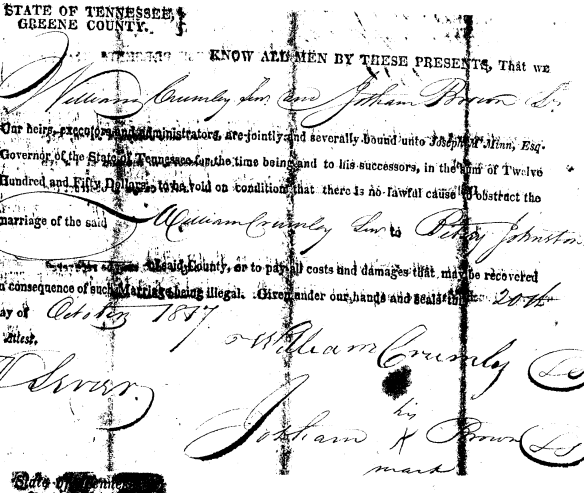
William Crumley Betsey Johnston marriage

It has been debated for years within the Crumley research clan whether the groom was William (the second) or his son, William (the third).

The problem is that the signatures on the two bonds, one from William Jr. (the third’s) 1807 marriage to Lydia Brown and this 1817 signature for William Sr. are for all intents and purposes, identical.  Furthermore, there are two additional signatures in 1814 and 1816, both identified as Jr. in the comparison provided by a Crumley researcher, shown below, which don’t match the 1807 and 1817 bonds.

Crumley signature comparison

These signatures have fueled a lot of speculation, but the most reasonable explanation I can find, with the least amount of stretch, is that if William Jr. – meaning the third, was born in 1788 or 1789 as the 1850 and 1852 censuses indicate, he would have been underage in 1807, only 18 or possibly 19 years of age.  His father would have had to have signed for him.  The William Crumley signature itself doesn’t say Jr. or Sr.  The document only says that William Jr. is getting married.  In 1811, the first year William Jr. (the third) is shown on the Greene County tax list, he would have been age 22,, born in 1789 – so this is very likely the answer.  Otherwise, where was he on earlier tax lists?

One last document, William’s witnessing of his son Abraham’s marriage, may or may not be William’s actual signature.  Looking at the similarity of the writing in this document from the Quaker notes from the New Hope Meeting in Greene County, TN, I have to wonder if the names were copied into the minutes by the clerk and this is not William’s original signature.

Quaker Record for Abraham Crumley son of William Greene County TN

We performed mitochondrial DNA testing, which is detailed in Phebe Crumley’s article, but in summary, descendants of Clarissa, Phebe’s sister born in 1817, Phebe, born in 1818 and Jotham Brown’s wife, Phebe, are matches, meaning that they share a common matrilineal ancestor.  In this case, that can be interpreted to mean that the most likely common ancestor is Phebe Brown, the mother of Lydia Brown, who is the mother of Phebe and Clarissa both.  Of course, Clarissa was born in April of 1817, William (the whichever) married Betsey Johnson in October of 1817 and Phebe was born in March of 1818.  Subsequence census removed William (the second) and his wife as potential parents for Phebe Crumley, so the matching DNA suggests that the women are sisters delivered of the same mother – both daughters of Lydia Brown who was the daughter of Phebe, wife of Jotham Brown.

One last piece of DNA information that is not entirely conclusive but certainly suggestive is that I have several DNA matches with individuals who descend from Jotham Brown through other children, not Lydia, and who aren’t related through any other lines.  Unfortunately, many of these matches are at Ancestry and have not downloaded their results to either Family Tree DNA or GedMatch where we have triangulation tools to prove descent from a common ancestor, so while the results are suggestive, they are not conclusive.

Taking all of this together, based on mitochondrial DNA evidence, the dates of the births of the children of William (the third) and the bond and marriage dates, I believe that the groom in 1817 was William Sr. (the second), not William (the third), but barring that Bible for sale on e-bay, it’s unlikely we’ll ever know for sure.  We discussed the possible options and the DNA evidence at length in the Phebe Crumley article.

I have not given up entirely and was hopeful that existing church records in Hancock (formerly Hawkins) County, TN would provide the answer.  Unfortunately, those records only began in 1852, so we’ve struck out once again.

My only avenue left to find the name of the wife of William (the third) after 1820 is in the Pulaksi County, KY records.  Never before have I ever had a situation where the only way to prove who the father DID marry was to prove who the son DIDN’T marry.  And to think that the identity of Phebe’s mother, my ancestor, depends on this.

Moving to Lee County, VA

The “Early Settlers of Lee County” book says that William Crumley Sr. from Greene Co. bought 250 acres of land from William Sparks on November 11, 1819 for $250, lying on the west fork of Blackwater Creek (Deed book 9 page 6).  It was witnessed by William Crumley Jr.  The William Sr. in this case must be this William (the second) and Jr. must be his son William (the third.)  Therefore, we have now confirmed that William (the second) did in fact move to Lee Co, along with his son, and where he lived.

William (the third) was listed in the 1820 Lee Co., Census as age 26-44 with his family, but William (the second) was not included, probably having returned to Greene County to sell 54 of his 200 acres to his son Abraham on Nov. 25, 1820 and 134 acres to Joshua Royston on March 21, 1821.

November 25, 1820 – William Crumley of Greene Co., to Abraham Crumley of same  for $333.33, 54 acres and 46 poles on Lick Creek, part of 200 acre tract of land granted to John Goss by State of NC Sept, 24, 1787 and conveyed unto Wm and Andrew Blackwood and then conveyed to William Crumley Feb. 9, 1805.

In March of 1821, William Crumley Sr. (the second) sells the 200 acre Lick Creek tract in Greene County to Joshua Royston.

This Indenture, Made the Thirty First day of March in the Year one Thousand and Eight Hundred and Twenty One, between William Crumley Senr. of the County of Greene and State of Tennessee of the one part, and Joshua Royston of the County of Greene and State aforesaid of the other part – Witnesseth, that the said William Crumley for and in Consideration of the Sum of Six Hundred Dollars to him in hand paid the receipt whereof is hereby acknowledged, hath and by these presents doth Grant, Bargain, Sell, Alien, Enfeoff and Confirm unto the said Joshua Royston his Heirs and assigns forever, a Certain Tract or parcel of Land Containing one Hundred and thirty four Acres, more or less, Lying and being in the County of Greene and State aforesaid, on the waters of Lick Creek.  Beginning at the place where a post oak stood – it being the beginning corner of the Original Grant from North Carolina to John Gass Number 399, for Two hundred acres – thence with said original Line West one hundred & seventy two poles to a small Hickory Sapling, a Dogwood, sugar tree and Iron wood pointers, thence off from the Original Line and Conditional Line North one hundred and Twenty six poles to a White Oak on the Original line of the old survey aforesaid, thence with said Line East one hundred and Seventy Two poles to a Stake, thence South one hundred and Twenty Six poles to the Beginning, with all and singular, the woods, waters, water-courses, profits, commodities, hereditaments and appurtenances whatsoever to the said Tract of Land belonging or appertaining, and the reversion and reversions, remainder and remainders, rents and Issues,  thereof, and all the estate, right, Title, Interest, property, claim and Demand, of him the said William Crumley, his Heirs and assigns forever of in and to the same, and every part or parcel thereof, either in Law or Equity:  To Have and to hold the said one hundred and Thirty four acres of Land, more or less, with the appurtenances, unto the said Joshua Royston his Heirs and assigns forever, against the Lawful Title, claim and Demand of him the said William Crumley Senr. and all other persons whatsoever, will Warrant and forever Defend by these presents- In Witness whereof, the said William Crumley Senr. hath hereunto Set his Hand and Seal the Day and Year above written

Signed, Sealed and Delivered

In presence of

William Crumley

George T. Gellaspie,

Carter

Sevier

[BK 12, p 284, Greene County Land Records]

The William Crumley as a witness must be William Crumley (the third.)

Also, in 1821, we find a tidbit that ties William Crumley (the second’s) land to Carter Station.  On March 6th, a land sale between William Luster and Thomas Justice, for $200, 100 acres on Lick Creek adjoining the lands of Hugh Carter and William Crumley.  Witnesses, James Patterson and James Gass.

Notice that H. Carter, likely Hugh, also witnesses the deed where William sells to Royston.

Also, further connecting William to the Carter’s Station area are two 1820 indentures that his son Samuel Crumley witnesses for transactions by Joseph Carter, Sr., the man who established Carter’s Station on his land and hosted those camp meetings, and John Olinger, his neighbor, for land on Lick Creek, on the west side of Grassey Creek.  This is where Carter’s Fort and Station were located, and very near where the Cemetery is located today.

The Hawkins County Lawsuit(s)

If there is a way to make a situation complex, the Crumley men find a way to do it.

There are two suits in Hawkins County, neighbor county to Greene, that involve William Crumley.  One is very short and sweet, and the second is long, drawn-out and juicy.

I am greatly indebted to Jack Goins, Hawkins County archivist, for finding these original documents.

First, let’s look at the 1825 juror signature.  This signature does not look like any of the other William signatures.  Sigh.

Crumley 1825 receipt signature

This signature was a result of William being a witness in the case of the State vs Andrew Coker, Littleton Brooks, James Willis and James P. McCarty tried in October of 1824.

I remember when I was a young married wife, back when we actually picked up a paycheck, signed the check and physically took it to the bank.  Typically I picked hubby’s check up at lunch and took it to the bank in the afternoon, because by the time he got off work, the bank was closed and there would be no money for the weekend.  Yes, this was before the days of ATM machines.  The only “ATM” was writing a check “over” for $20 or so at the grocery store where, of course, everyone knew you.  One week, my husband signed his own check and took it in to be cashed.  The tellers quizzed him mercilessly, and then the branch manager, because his signature did not match any of his other paychecks and they had never seen him before.  I had been signing them on his behalf.  He found no humor in this situation.  So as I look at this signature for William Crumley, in fact, all of them, especially the ones that don’t match and “should,” I wonder if William actually always signed for himself.

The 1822 lawsuit is much more interesting, albeit with no signature from William.

The Hawkins County lawsuit begins in Greene County in 1819 with a legal complaint document, William Crumbly vs Johnston Frazier, as follows:

On the 28th day of October 1821 I promised to pay Thomas G. Brown $50 to be discharged in grain at the market price delivered  (unreadable) this day bought of him it being for value received of him this 27 day of December 1819.  Signed by Johnston Frazier and witnessed by John Scott.

This is followed by a document on March 14, 1820 that says:

I assign my interest of the within note to William Crumbly for value and witness my hand and seal.  Thomas G. Brown, Witness Lettice Self.

William Crumley would come to regret that day.

Both Thomas Brown and Johnson Frazier were summoned to court.  Witnesses were Jesse Self, Christopher Kirby, Jacob Sands and John Scott and the trial lasted for 6 days – or at least that’s how long the longest witness was paid for.  Some were paid for only 5 days.

Summarizing the suit, Frazier says that he measured out the grain (102 bushels of corn, 6 bushels of wheat and 12 bushels of oats) on the day before the note was due but the plaintiff was not at the location.  He left the grain out overnight and “over Sunday” and by Monday the grain was problematic.

Depositions follow from people to whom he offered to sell the grain about the quality and the price.  Some said it looked to be weevil-eaten. Some said the wheat had lumps and was hot if you put your hand in the pile.  From my experience on a farm, that means it was fermenting and had “soured” and couldn’t be used.  That, in fact, was the crux of the lawsuit.  Did Frazier genuinely try to pay his debt to Crumley, or was he trying to scam him all along?

There may have been some previous bad blood between Crumley and Frazier, because the testimony is stricken, but you can still see that Christopher Kirby testified, among other things, that the William Crumley said he “had been used badly the year before by the defendant” and he wanted to take advantage, although the exact wording surrounding “take advantage” is not entirely legible.

On February 19, 1822, William Crumley appeals in Greene County court to transfer the venue of this appeal of this case to Hawkins County “owing to prejudice against him in Greene County and which has been greatly fomented by persons who have greatly injured him” and that he “cannot have a fair and impartial trial of the above case in Greene County.”  He says he also believes the same extends to Washington County where the defendants relatives live.

The next document is dated March 12, 1822 and is styled, William Crumley, appellant, vs Johnson Frazier, so he apparently lost the first case in Greene County.  This document says that attached is a transcript of the proceedings in this case and it is signed by the Greene County Clerk of Court.

William Crumley had a really bad half-decade.  There is a barely legible document written in 1825 that states in essence that the court has found against William.

Crumley 1826 Hawkins suit

One final document, that is very legible and dated April 1826 commands the sheriff of Hawkins County, which tells us that William is living in Hawkins County at this time, to confiscate the goods and chattels of William Crumly to make the sum of $269 and 20 and a half cents which John Frazier recovered against William Crumley.  The sheriff is to have the said money ready to render to the court on the first Monday of October, 1826 in Rogersville.

William would have been a lot better off to simply forget about the $50 debt.  He not only got nothing for the debt he paid a huge difference in costs.

I’m sure of one thing.  William Crumley was not a happy camper.

William’s commentary about how people felt about him in Greene County might well have had something to do with why he moved to Hawkins County.  I was hoping that this suit might give us confirmation as to whether William Crumley (the second) was a miller, as well as his wife’s name, but it does neither.

The timing of this also makes me wonder about whether this suit really is William (the second) and not William (the third) because William (the third) leaves this area between 1820 and 1830 and moves to Pulaksi County, KY.  If he lost his land and/or possessions, he probably doesn’t feel any obligation to stay in Hawkins County.  It might have been a good time to move on.

Let This Be A Lesson

I was so excited when I visited the genealogy library in Knoxville, TN to find a list of deeds out of Hawkins County that included William Crumley.  I greatly imposed on a friend in Hawkins County to copy those deeds and send them to me.

There are several deeds spanning years from 1823 through 1830 and calling him William Crumley of Claiborne County.  Furthermore, this land was on Big War Creek, in Hawkins County, not near where we know William (the second) and (the third) lived.

Even more confusing, we know where both William the second and the third lived in 1830.  One was in Pulaski County, KY and one was in Lee County, VA.  But these deeds all referred to William Crumley of Hawkins County and then of Claiborne County.  Now, granted, Lee, Hawkins, Hancock and Claiborne are all neighbors and closely tied together with a network of mountains, valleys, rivers and creeks.

Another confusing factor was that the one Crumley witness whose name I could read was Hugh Crumley.  There is no Hugh Crumley.

Then, I decided that something clearly wasn’t right.  These deeds are all hand written of course.

I decided to look for Hugh in the Claiborne County census, and what I found was Hugh Crawley, CRAWLEY, not Crumley, and sure enough, there was William Crawley right beside him.  I looked back at those deeds, and I can see why they were indexed as Crumley.  The writing was ambiguous.  But, given that I had found both William and Hugh Crawley, together, where the deeds said they lived – and my William Crumley’s are both accounted for elsewhere – I knew these men were not Crumley men.

If you get that little nagging “something’s not right here” sense, heed it – even if you don’t want to hear it.

Lee County, VA

There is no mention of William the second or third, by any name, after 1821 in Green County following William’s land sales.

We know William (the second) purchased land on the west fork of Blackwater Creek in Lee County in 1819.

Crumley 1824 land grant

Five years later, on June 30, 1824, William Crumley filed for a land grant in Hawkins County for 50 acres on Blackwater near where Walter Sim’s or Sinit’s lives, Rice’s line.  It was surveyed on August 5, 1824.  This part of Tennesee was Hawkins County before it became Hancock County.  My original assumption was that this land was near William’s 1819 Blackwater Creek land, but as it turns out, it wasn’t – not even close.

William (the second) appears on the 1830 Lee Co census age 60-70 when he would have been about 62 years old with 2 females in the household, his wife age 50-60 and a girl age 5-10, possibly a final child after marrying Betsey Johnson in 1817.  Next door to William (the second) we find Isaac, his son, with 2 males under 5, 1 male 5-10, 1 male 30-40 (Isaac), 1 female under 5, 1 female 5-10, 2 females 10-15, 1 female 20-30.  This tells us that Isaac married between 1815 and 1820.

On October 21, 1831, “William Crumley of the county of Lee and the State of Virginia” sold 47 acres on Blackwater Creek in Hawkins Co., Tn. to Peter Livesay of Hawkins Co., signing the deed as “W M Crumley”.  This signature of William (the second) may be an abbreviated version of Wm. as written by the clerk who recorded it, although it may also have stood for the middle name of  Mercer.  Or, it may not have been William (the second) at all, but William (the third.)

Crumley Livesay Road

The land is likely here, on the Blackwater Creek where Livesay Road runs alongside.

Just like men should not be able to name sons the same name, or marry women with the same first name, Creeks, especially in the same county should NOT have the same name either.

Blackwater to Little Mulberry

On this map on the far right, with the red balloon, is the Blackwater Creek along Livesay road.  In the middle is Blackwater Road, which also runs alongside, you’ve guessed it, Blackwater Creek.  The two Blackwater Creeks converge into a larger Blackwater Creek further north in Lee County, VA.  The 1819 deed which says the west branch of Blackwater made me think it was Blackwater Road, but the land sale to Peter Livesay and his land on Livesay Road convinced me that it’s the “other” branch of Blackwater.

Later, as I reevaluated these land purchases and sales, again, I realized that William Crumley had actually owned land on both branches of Blackwater Creek.  The 1819 land, which says the west branch of Blackwater Creek, also says, when the land is sold, that it’s on the south side of Powell Mountain.  Powell Mountain is on the north side of Blackwater Road.  Blackwater Road is the only possible location for this tract of land.

On the far left side of the map, you can see Little Mulberry Baptist church which is about a mile on south on the road where Phebe Crumley, daughter of William Crumley (the third) and some of her siblings would live.  This journey is about 20 miles, from Livesay Road to Phebe Crumley Vannoy’s home.  It just didn’t make sense to me that Phebe, Sarah and John would wind up together, so far from home. It’s very likely that William (the third) actually lived on the west branch of Blackwater – and it’s likely that the entire family lived there as well, meaning William (the second), William (the third) and his brothers, Isaac and possibly Jotham.

William owned the land he would sell to Peter Livesay for 7 years.  It’s certainly possible that one of his sons farmed this land during that time.  In fact, this land could have been owned by William (the third) or if it was owned by William (the second,) he could have sold it because his son, William (the third) moved to Pulaski County, KY sometime before 1830.

Here’s an aerial of the Blackwater Creek area and Livesay Road at the Virginia/Tennessee border where Lee County, VA and Hancock (then Hawkins) County Virginia intersect.

Satellite Livesay

It’s quite ironic that the “Trail of the Lonesome Pine” also runs very near the Carter’s Station location in Greene County.  Or, maybe it’s not ironic at all…maybe it’s meaningful.

In 1836, “William Crumley, Sr.” (the second) was shown in the Hawkins Co. 1836 Civil District tax list, district 5, located South of Powell Mountain and North of the Clinch River.  This fits the description of Blackwater Creek and Road exactly.

In January 1837, William (the second) sold his land on the west branch of Blackwater Creek to his son Isaac, apparently shortly before his death as Isaac had to prove the deed in court when it was recorded on October 18, 1841 by the testimony of James Weston, Thomas Stapleton and Thomas Weston (husband of his sister, Hannah Crumley), the same men who witnessed the 1837 sale.  This is why there are witnesses – in case the seller can’t make his own proof statement in court.

Thomas Stapleton is likely a relative as well.  Mary Brown, Lydia Brown’s sister, married William Stapleton.  They too settled in Lee County and are buried on Blackwater Creek, in the Roberts Cemetery, located at the foot of Powell Mountain.  Their daughter, Elizabeth, born in 1819, married Thomas Testerman Livesay, son of Peter Livesay who bought William Crumley’s land on the “Livesay Road” branch of Blackwater Creek.  Elizabeth is buried in the Testerman Cemetery on Livesay Road, shown below.  Oh, what a tangled web we weave.  However, now the Livesay sale makes much more sense.

Deed book 9, page 7 – William Crumley Senior of Lee County, VA to Isaac Crumley of Lee County, land laying on the west fork of Blackwater Creek, south side of Powell Mountain, for $230…

Based on this, it would appear that William Crumley owned land on both branches of Blackwater Creek, selling one to his son, Isaac, and the other to Peter Livesay.

Unless these references are incorrect, the pages in the deed books are adjacent for the 1819 purchase and the 1837 sale, so it appears that both were filed at the same time.  William (the second) couldn’t sell the land unless he registered the purchase first.  So he physically held that deed for 18 years – and we wonder why we can never find some deeds in the books.

Then William Crumley sold some land that we have no record that he purchased.

1837, Feb 20 – Lee Co, Va – William Crumley of Lee Co. sold 100 acres on the south side of the Clinch River in Hawkins Co to William McCullough of Claiborne County and signed the deed seed as William Crumley.  The metes and bounds indicate that this land is actually on the Clinch River.

This land has to be different land than the Blackwater land because Blackwater is on the north side of the Clinch River.

Livesay Road

Here’s what the deed in Lee County and the Hawkins County land grant tell us – William owned land in both counties in both states.  Here’s the state line on Lonesome Pine trail, likely where William owned the land he sold to Peter Livesay.

The VA-TN border

Since Livesay road runs alongside Blackwater Creek here, and William sold to Peter Livesay, this is assuredly the right place.

Here’s Blackwater Creek where it goes under the road and below, the intersection of Blackwater Creek and Livesay road.

Blackwater Creek at Livesay road

Below, we’ve driven a ways down Livesay Road, which isn’t very long.  This is what William (the second), and his son William (the third), would have seen.

Livesay road drive

While there are certainly hills and mountains all around, the land along Blackwater Creek is flat.  It would have been good ground to select for farming.

Livesay road distance

Here’s the Testerman cemetery, all nicely fenced.  It’s a newer cemetery.

Livesay road Testerman cemetery

Peter Livesay was married to a Susannah Testerman.  The Livesay Cemetery is just a few feet up this side road, Kinsler, on the right.

Livesay Road at Kinsler

The first Livesay buried here was born in the 1812, the son of Peter Livesay.  I have to wonder if this was once the Crumley Cemetery.

Livesay road aerial

This aerial view shows the fenced cemetery with the requisite tree in the middle and the original homestead was likely to the right at the corner.

Livesay cemetery

William bought his land on the west fork of Blackwater Creek first, in 1819, and then acquired this land 5 year later by grant.  We don’t know if William, or any of his children, actually lived on this land.  However, we do know that the daughter (Elizabeth Stapleton Livesay) of the sister (Mary Brown Stapleton) of the wife (Lydia Brown) of William Crumley (the third) lived and is buried here.

The West Fork of Blackwater Creek

Every single thing about the life of William Crumley (the second and third) has been more complex that one would expect.  Often, an ancestor has something that is unusual, but EVERYTHING in both of those Williams’ life is off of the scale.

How many men own land on both branches of a creek in the same county with the same name?  Well, part of it is in the same county.  The rest of both of the creek branches are not only in another county, but in another state.  In most places, two branches of a creek would have two different names, so people could tell them apart.  Even if they didn’t, the chances of one man owning land on both is pretty slim.  Not in the case of William Crumley.

While the two Blackwater Creeks sound like they are close, because of the layout of the land, with the mountain ranges, you can’t just bop from one branch to the other.  It’s a long way around.  On the map below, you can see the Livesay Blackwater land with the red balloon.

Blackwater to Little Mulberry

Look two mountain ranges to the left, and you’ll see Blackwater Creek and Road together.  Look on one more range to the left and you’ll see Mulberry Gap Road where two of William (the second’s) grandchildren, Phebe and Sarah lived with their husbands.  A third child, John, marries a woman named Mahala, last name unknown, and is found in 1850 living dead center in the middle of the Melungeon community between several Gibson and Collins families.  Mahala is a common name in the Melungeon community and much less so otherwise.  Newman Ridge is the heart of the Melungeon Community, and Newman Ridge runs along the right side of Blackwater Creek and Road.

Notice also that a James Gibson signed for the marriage bond of William Crumley (the third) in Greene County in 1807.  This may or may not be relevant, but why would someone that’s not a relative sign a marriage bond?  Signing that bond meant they were on the legal hook if it was discovered that the groom had deceived the bride.  Gibson is a primary Melungeon surname.

This was the first land that William (the second) purchased upon moving to Lee County and he assuredly lived here.  He didn’t sell this land until just before his death, to son Isaac, and he is likely buried here, someplace, in a lost family cemetery.

On this map, at the top, is the confluence of both branches of Blackwater Creek.  At the bottom is Vardy, the heart of the Melungeon homeland.  According to court records, William lived in Hawkins County, but his land was deeded in Lee, so it had to be right on the border.  To give you an idea of the remoteness of this location, the road is “paved,” but about the size of a driveway with no center line or markings.  On the Virginia side, it’s not paved, and it’s more of a one track path.  How did William ever find this place?

blackwater road3

I visited Blackwater in 2007 and the local people told me that there was a mill right on the border of Blackwater Road between TN and VA.  That sounds exactly right.

This is Blackwater Road where it crossed into Virginia.  There were sheep grazing in this field when I visited.

blackwater into Virginia

Such beautiful country.  This is likely where Phebe Crumley, my ancestor, the granddaughter of William (the second) was raised.

Blackwater Road2

The land is beautiful on Blackwater Road, near where William would have lived and where the mill on Blackwater was known to be.  Newman’s Ridge is to the right and Powell Mountain is to the left, outside of the photo, above.

Blackwater road

This cleared area is where Virginia and Tennessee meet, at least according to my GPS.

blackwater va tn

Blackwater Creek runs between the road and the mountain here, at the base of Newman Ridge.  There isn’t a lot of space to farm as the valley is narrow but it’s stunningly beautiful country.  Indeed, it would be a great place for a mill.

Children

In the 1840 census of Lee Co., an older female, believed to be the widow of William (the second) is shown as a female age 60-70 living in the household of her son Isaac.  A woman of the same age is also living with William the third.

In 1840, in addition, we show a Sotha (probably Jotham) Crumley, age 20-30 with a wife the same age and 3 children under 5.

Unfortunately, William (the second’s) wife does not appear on the 1850 census which indicates she died before 1850 – because if she had, we could confirm her name.

We don’t know where William (the second) and his wife are buried, but my guess would be on the land he sold to Isaac on Blackwater Creek, in the valley between Powell Mountain and Newman Ridge.

The children of William (the second) and his unknown wife whose haplogroup is H2a1 are shown below.

  • William Crumley, Jr. – born about 1775, married Lydia Brown in Greene Co., TN in 1807
  • Isaac C. Crumley, Reverend – born between 1787-1797 in Greene County, married Rachel Brown in 1816 in Greene County, TN, died in Greene County, Iowa in 1887.
  • Abraham Crumley – born March 10, 1793 in Greene County, died 1846 Greene County, married Mary Elizabeth Marshall in 1817 and Jane McNeese in 1830.  Buried in the New Hope Cemetery.
  • Aaron Crumley – born Jan 26, 1785 in Frederick Co., VA, married in 1814 to Lydia Brown (cousin to the Lydia Brown who married his brother, William Crumley), died in 1847 in Greene County.
  • Samuel Crumley – born between 1790-1800, married in 1819 to Mary Ritta Pogue in Greene County.
  • Sarah Crumley – born about 1799 in Greene County, married in 1818 to Moses Brown, died after 1880 in Greene County, buried in the Cross Anchor Cemetery.
  • Hannah (or Susannah) Crumley – married Thomas Weston July 1820.
  • Catharine Crumley – born about 1805 in Greene County, married John Brown in 1826.  Her line provided the descendant for obtaining the mitochondrial DNA of the wife of William (the second).

If the child in the 1830 census with William (the second) and wife was his daughter, we don’t know if she lived to adulthood, or who she was.

Update:  The missing daughter in the 1830 census appears to be Mary Brown Crumley, born Oct. 10, 1803 in Greene County  who married William Penn Testerman about 1831, probably in Lee County, VA or Claiborne County, TN.  She had their first child in 1833, in Lee County.  She died in 1881 in Sneedville, Hancock County, TN, having had 8 children.

Epilogue

For a man so difficult to research, we’ve actually found a lot.  William Crumley (the second’s) life was spent first on one frontier, then another.  In some cases, there were documents, and in other cases, not.  Some Frederick County VA records exist, but few do where William moved, in the area being fought over by Virginia and North Carolina known at The Territory South of the River Ohio  before Tennessee became a state in 1796.  Some of the Greene County records exist, and some don’t.  Finding documentation about William was hit and miss.  In this situation, absence of records certainly can’t be construed to mean literal absence.  As they say, absence of evidence is not evidence of absence.

William’s life extended from about 1767, just after the French and Indian War, when the Proclamation Line of 1763 was established, forbidding settlers from crossing the line into Appalachia.  In subsequent treaties of 1768 and 1770, much of Appalachia was opened, and about 20 years later, William would follow this path into the wilderness.

Before that could happen, William saw the Revolutionary War as a teenager and may have helped his father to gather supplies.  The British had discouraged settlement in the mountains, across the divide, as stipulated in the 1763 Proclamation agreement.  After the Revolution, the Wilderness Road became the superhighway of migration.

William would have seen settlers by the thousands pass through Winchester, Virginia, considered the gateway to the Shenandoah Valley, leading to Tennessee and all points west.  Along with wagons, people walked, animals were herded, the lure of the unknown adventure beckoned.  As a child he must have dreamed about joining them, until, one day, as a young married man, he did.

This was not a short trip and certainly not one to be taken lightly or without advance planning.  The route, known as the Great Valley Road (below, courtesy of Family Search) took weeks to traverse.

Great Valley Road

Today, this route parallels I81 closely and is about 400 miles.  It would take about 8 hours today, but then, if they made 10 miles a day, it took 40 days, living in a wagon, on the trail to make the journey.  These are rough lands.  Mountains.  This journey is not a walk in the park.

Great Valley Road today

There were surely a group of families from Frederick County who migrated together, because we find their names establishing the Wesley’s Church in Greene County in 1797, one year after Tennessee became a state.

William then suffered through three of his sons fighting in the War of 1812, two returning home quite ill.  As a parent, that had to be torturous – to have three of your children in danger at the same time.  As sad as he was to have ill sons return, how grateful he must have been to have sons return at all.  Many men didn’t.

William endured a 6 year lawsuit, which he lost, and lost in spades.  How much he lost – we know in dollars, but we don’t know if he lost his property in the process.

William (the second) lived for nearly another 15 or 20 years, moving to Lee County, VA, on the border of Hawkins County, TN, and started the homesteading process all over again in about 1820.  He was no spring chicken when he moved from Greene Co., TN to Lee County, VA.  At age 52, now an older man, he likely built yet another mill.  William spent his life bouncing from frontier to frontier – a true pioneer.  How I wish he had kept a journal.  I would surely like to ask him about those experiences, not to mention his wife’s and mother’s names, and yes, to take a look at his left hand.

Work to be Done

Unfortunately, William Crumley (the second) isn’t tied up as neatly as I would like.  There is no gift wrap or bow.  I’ve made progress, with the help of others, but there is still work to be done on those pesky William Crumleys.

While I’m relatively confident of William’s land location in present day Hancock County, on Livesay and Blackwater Roads, I’m much less confident about the location of his land in Greene County.  We still don’t know what happened to the 126 acres purchased in 1812, or two later grants.  Some of this land may have been purchased by his son, William (the third.)

Further deed research may shed light on whether William was actually a miller, but I have seen no actual evidence of that so far, outside of oral history.

What really needs to be done in Greene County is that the deeds for both William (the second) and (the third) need to be “run forward,” meaning tracked through sales through time to something resembling current when you have either landmarks or addresses that are currently findable.  Sometimes this works, and sometimes it doesn’t.  If the land has ever been sold by someone other than the owner, like an administrator of a will or due to tax sale or bankruptcy, the seller will not be the name of the person who bought that land, so the land is very difficult to track in those situations.  Often, I resort to tracking the neighbors lands forward in order to see who owned the adjacent land, so by process of elimination, I can figure out who bought the land from a tax sale, estate or bankruptcy.  Yes, it is the long way around, but it is often the only way to get there.

Acknowledgements

Other researchers providing information about the Crumley family include Stevie Hughes, Truett Crumley (now deceased), Irmal Crumley Haunschild (deceased), Larry Crumley and Nella Smith Myers (also deceased, sadly, never having published her Crumley book.)

______________________________________________________________

Disclosure

I receive a small contribution when you click on some of the links to vendors in my articles. This does NOT increase the price you pay but helps me to keep the lights on and this informational blog free for everyone. Please click on the links in the articles or to the vendors below if you are purchasing products or DNA testing.

Thank you so much.

DNA Purchases and Free Transfers

Genealogy Services

Genealogy Research

Phebe Crumley (1818-1900), True Grit, 52 Ancestors #74

Phebe Crumley was born on March 24, 1818, according to her tombstone, to William Crumley and his wife, Lydia Brown.

Ok, her mother is probably Lydia Brown.  And there is no solid proof her father was William, except geography and oral history.

We have, ahem, a bit of a problem here.  Welcome to The Crumley Curse.

Doggone these men with the same names.

We know, for sure that William Crumley Jr. (the third), the best candidate for Phebe’s father, married Lydia Brown on October 1, 1807 in Greene Co., TN.

William Crumley Lydia Brown marriage

We also know that William Crumley, Senior, and that word “senior” is important, married Elizabeth “Betsy” Johnston in October 1817 in Greene County, TN.  At that time, William Crumley (the second,) born circa 1767, would have been known as Senior and William Crumley (the third,) his son born circa 1785, would have been known as Jr.  If William Crumley (the third) had a son, William, he would have been age 10 or under, born since the 1807 marriage, and would not yet be referred to as Jr. or Sr. in legal documents.  He was not of age, so he would never be referred to in a legal document, unless he was an orphan.  There were no other William Crumley’s old enough to marry or to sign a document in Greene County, TN at that time.

William Crumley Betsey Johnston marriage

Do you notice anything about these two documents?

William Crumley’s signature looks almost identical.  Ok, it looks exactly identical, except the second one is a bit shakey, like an older person.  But if William (the second, about age 50 in 1817) taught William (the third, about age 30 in 1817) how to write, then it’s not unexpected that their signatures would be very similar.  Or am I just trying to justify this??

Or, did William the second sign for William the third in 1807 because he was underage?  The signature itself does not say Jr. or Sr.  In the 1850 census, William (the third) is shown as being a carpenter born in Virginia in 1789, so in 1807, at age 18, he would have needed someone to sign on his behalf.

And look who else signed both.  Jotham Brown.  Why is he important?  Jotham Brown was the father of William Crumley (the third’s) wife that he married in 1807, Lydia Brown.  Lydia’s father died in 1799, but her brother was also named Jotham Brown and he apparently signed both of these documents with his X.  Jotham could not sign his name.

So let’s do some math here.

If my ancestor, Phebe, was born on March 24, 1818, then her mother got pregnant in about June of 1817, which was 4 months before William Crumley married Elizabeth “Betsy” Johnson.

Certainly, that could have had something to do with why he married, if the groom was in fact William (the third), widower of Lydia Brown, who married Betsy Johnson.

But why would William Jr. style himself was William Sr. when William Sr. was clearly still living, and living in the same county?  That doesn’t make any sense.  And that’s not just a little error, it’s a huge legal faux pas when dealing with bonds, money and several people.

So we have one piece of evidence, meaning the nearly identical signatures that strongly argues FOR the groom being William (the third) and three pieces arguing against it, meaning Phebe’s birth four months after the marriage, the fact that the document says William Sr., and DNA evidence that is compelling but inconclusive.  We also have the possibility that the signature are the same, because William (the second) is signing for William (the third), his son, because he is underage.  I personally think this last option is the most likely explanation.

Ok, enough worrying about the Williams, let’s go back to Phebe.

Phebe had a sister, Clarissa, or at least Clarissa is believed to be Phebe’s sister, born in April of 1817.  So, if Clarissa was born in April and her mother, Lydia, died, William (the third) would have had a newborn and no wife.  So he might have been very inclined to marry quickly.  In this scenario, he would have gotten Betsy Johnson pregnant in June and married her in October of 1817.  No moss growing under that boys feet, if this is the case.

If this is the situation, it means that the mitochondrial DNA of Clarissa and Phebe’s descendants (through all females) would be different, because they had different mothers.

If this is not the situation, then it means that Lydia got pregnant for Phebe two months after Clarissa’s birth – certainly possible but unlikely with a nursing child.

Turning to DNA – Answers and More Questions

It took two years, or more, to find a direct descendant of Clarissa through all females – and we’re just darned lucky to have been able to do that.  It took another year to collect her DNA.

The DNA held a surprise – the DNA of Phebe’s descendant and Clarissa’s descendant matched.  Given the signatures, I really didn’t expect a match.  That means either they had the same mother or their mothers shared a common ancestor.

If this is beginning to sound like Peyton Place to you, it does to me too.  Did I mention that this used to be called the Crumley Conundrum, but it has since graduated to The Crumley Curse???

The most logical explanation, which may not be the correct one, is that Lydia did not die in 1817 and William (the third) was not the William who married Betsey Johnson.  Instead, William (the second,) his father, who would have been William Sr., just like the document says, is the William who married Elizabeth “Betsy” Johnston.  Given that scenario, then Lydia got pregnant for Phebe when Clarissa was just 2 months old, which is rather unusual with a nursing baby but certainly not impossible.

Looking at the women’s pedigree charts, we know that Jotham Brown’s wife was named Phebe – and that is the name of the child born in 1818 to William Crumley and his wife.  We know that Elizabeth “Betsey” Johnson’s father was probably Zopher Johnson, or maybe his brother Moses Johnson if not Zopher, and we don’t even know Elizabeth’s mother’s first or last name – regardless of whether her father was Zopher or Moses.

Elizabeth Johnston pedigree chart

The good news is that we also managed to find a mitochondrial DNA candidate for Phebe, the wife of Jotham Brown.  Phebe Crumley and Phebe, the wife of Jotham Brown and Clarissa Crumley are exact matches.

Now, there is a rumor afoot, or maybe better stated, a strong suspicion, that Phebe, Jotham Brown’s wife, is Zopher Johnson (the Elder’s) daughter – and she could be – they did live in the same place.  These families were heavily intermarried.

Phebe Lydia Phebe DNA

So let’s add the mitochondrial DNA path to the Zopher chart, in yellow, passed from mother to daughter, assuming that Phebe, wife of Jotham is the daughter of Zopher and that Clarissa and Phebe are the daughters of Lydia Brown and William Crumley (the third.)  This is the most likely scenario, but it’s not the only possible one.

Note that on the charts above and below, Zopher’s wife gave her DNA to daughter Phebe (who married Jotham Brown) and her sons Zopher and Moses, whichever was the father to Betsey Johnson – but Zopher’s wife’s mtDNA does not pass on through son Zopher to Betsy.  It stops with son Zopher (or son Moses) because the wife’s mtDNA gets passed to the children.

This also means that if we could find someone who descends from Zopher (the elder) and his wife, name unknown, through all females to the current generation (which can be a male,) we could confirm or refute the theory that Phebe (Jotham’s wife) is the daughter of Zopher (the elder) and his wife.  Actually, if their DNA matches, it would confirm that they share a common female ancestor in a relatively close timeframe.  It can’t confirm that we have a mother daughter relationship – meaning it could also be first cousins, etc.  But still, it would make a compelling case AND it could positively refute the entire thing.  In this case, yes means probably or possibly and no means no.

Zopher wife dna pedigree

We do have one more fly in the ointment with Clarissa who married in Greene County (in 1834), as did her brother William (in 1840), also attributed to William (the third) and Lydia Brown.  If she was the child of William (the third) and Lydia Brown, why was she living in Greene County?  Maybe she was visiting and decided to stay, fell in love, married there and the rest is the history we know.

Or, maybe she wasn’t the child of William Crumley (the third) and his wife.  But if not, whose daughter could she be? All candidates in Greene County are eliminated by virtue of knowing who their children are.

William Crumley (the second) had a son, Isaac, who married in 1816, who also moved with the family to the Lee County/Claiborne County area.  It’s possible that Clarissa or Phebe could have been Isaac’s daughter.  Keep in mind that Clarissa’s DNA matches that of Phebe, thought to be William (the third’s) daughter, so we have to find a way to explain that.  Plus, there is still the question of why Clarissa was living in Greene County and how Phebe and Clarissa could both match the DNA of Jotham Brown’s wife, Phebe.  Isaac’s oldest proven daughter, Lydia, also went back to Greene County to marry, so these families kept in touch.

Isaac’s wife was Rachel Brown, daughter of Sylvanus Brown and Ruth Johnson.  See the chart above and below.

Ruth was the daughter of Moses Johnson and an unknown wife.  Moses Johnson was the son of Zopher Johnson (the Elder) and if in fact Clarissa was the child of Rachel and Isaac, that would mean that Zopher (the elder’s) wife was from the same maternal line as his son, Moses’s wife, because in the chart below, Moses does NOT pass on the mtDNA to Ruth, his wife does.  If Ruth’s mtDNA matches that of Zopher’s wife, it means that those two women share a common ancestor.  While it’s possible, it’s also a huge leap of logic.  Again, the most likely scenario is the one where William (the third) has both Clarissa and Phebe by wife Lydia Brown.

Clarissa Phebe alternate DNA pedigree

Unfortunately, Clarissa did not name any of her children Jotham, Zopher, Isaac, Sylvanus, Rachel, Ruth, Moses or Lydia, so we don’t have any clues?  What was she thinking???

For that matter, Phebe didn’t name a child Lydia either although Mary’s middle initial was L.  However, given that her name was Phebe, it certainly infers that she was named for Jotham Brown’s wife, Lydia Brown’s mother, Phebe.  If a second wife was going to honor a first wife, her cousin, you would have thought she would have named the child Lydia, not Phebe.

It would be wonderful if we could find a mitochondrial candidate for the wife of Moses Johnson and Zopher Johnson (Jr. and Sr.) too – and we could positively confirm whether or not Lydia Brown and Elizabeth Johnson came from a common female – or not.  Worst case, we could eliminate some possibilities.

Unfortunately, I think that all of the research and steps we’ve taken so far have simply created more confusion and made things more complex – if that was possible.

Bottom line to this problem – I think the parents of both girls, Phebe and Clarissa were William (the third) and Lydia Brown.  And even if Clarissa wasn’t, Phebe lived in the Lee County VA/Claiborne Co., TN area, was raised there and the only other person who could have been her father was Isaac.  He was not present in 1820 in Lee County and the Greene Co., TN 1820 census does not exist.  He is in Lee County in 1830 with two females 10-15, but he reportedly had a daughter, Rachel, in that age category as well.  Phebe named a son William, not Isaac.  No grandchildren named Isaac, Rachel or Lydia either.  Phebe’s father’s name as William is handed down orally in the family, but unfortunately, her mother’s name wasn’t.  Makes me want to pull my hair out!!!

Phebe’s Early Life

Since Phebe Crumley was born in 1818, and her parents did not move to Claiborne County until about 1819, it is likely that she was actually born in Greene Co., TN.  She probably has no memory of living there as she was unquestionably raised on the Lee County/Hawkins County borders.  However, there seems to be a lot of interaction between those families, even though they do live about 60 miles apart.

By 1820, William Crumley (the third) was living in Lee County, Virginia with one male under age 10, 1 male age 10-16, one male 26-46 (himself), 3 females under 10, one female 16-26 and one female 26-45.

We don’t know much about Phebe before her marriage to Joel Vannoy on January 18, 1845, in Claiborne County.  This was just before that part of the county became Hancock County.

We know that Phebe’s father, William (the third) may have been a miller, and her grandfather William likely was a miller, and his mill was very near the now Hancock County/Lee County, Virginia line on Blackwater Creek.  In fact, his property straddled the state line.  Blackwater was dead center in the middle of the Melungeon community where William (the third) is living, noted as a carpenter, two doors from the miller, in 1850.

Blackwater road

The last child known to be born to William and his wife, presumably Lydia, Aaron,was born about 1821, just three years after Phebe was born.  He did not name a child Lydia (or Elizabeth or Betsey,) but he did name a child Jotham.

When Phebe was about 10 years old, about 1828, her oldest brother, John, married a woman named Mahala.  The first child to marry must have resulted in quite a celebration.  The next child, Jotham, didn’t marry for another 6 years.

In the 1830 census, William (the third) is living in Pulaski County, KY, about 100 miles west of Lee County, VA.  Why?  Darned if I know.

By 1840, the family is back in Claiborne County.  They could have lived in Pulaski County just briefly, or for as long as nearly 20 years – although it would have been unusual for William not to have taken his sons with him.  Keep in mind that John married in 1828.

In 1834, in Lee County, Phebe’s brother, Jotham Crumley married Ann Robinette, so the family may have been back in the area by that time.  Both families probably celebrated the happy event and Phebe, then age 16, may have dreamed of when she would have her own wedding.

In August 1841, Phebe’s brother, Jotham died in Lee County, VA.  We don’t know the cause of death, but he was married and had 3 children. It must have been a very sad day.

In 1845, Phebe married Joel Vannoy and in the 1850 census, we find Joel and Phebe living in Hancock County.  Phebe is listed as having been born in Virginia, so her parents may have been living in Lee County by 1818.

Vannoy 1850 census

By 1850, Joel and Phebe already had three children, Sarah Jane, Elizabeth and William G.  They lived next door to John Gilbert, a well-known Baptist preacher in Hancock County.  John was the pastor at Mulberry Gap Church, which is not far from the land that Joel Vannoy owned, so we can probably extrapolate that this is the church they attended.  This was also the closest church to where they lived at that time.

Mulberry Gap Baptist Church from Mulberry Gap School (road leads to gap)

This photo, taken by Phillip Walker taken from Mulberry Gap shows the Mulberry Gap Church nestled into the hills on the far right side of the photo.

Mulberry Gap Baptist Church2

The Mulberry Gap church minutes are not known to be in existence, but given that their neighbor was the preacher, Phebe’s membership here is a good bet.

Update:  Well, it seemed like Phebe would have been a member of the Mulberry Gap Church, but she wasn’t.  The minutes have been discovered beginning in 1852, including a list of members, although earlier church minutes and records have been lost.  Between 1852 and 1860, neither Phebe Vannoy, nor any of her family except for her brother John Crumley and her sister Belinda “Melinda” Crumley Davis are members of this church.  Brother John was reported by the family to be a minister, but in the church notes, he was a member excluded for “profane swearing.”

We don’t really know when Phebe’s mother, probably Lydia Brown, died.  We know that in 1840, William is shown living with a woman about his own age, along with two unmarried adult daughters.  Phebe would, of course, have been one of those.

Phebe’s brother, John, was reportedly a Baptist minister, although the above information from the Mulberry Gap Church casts doubt on that.

Did John preach his mother’s funeral or did his uncle Isaac Crumley, who was also a preacher, do those honors?  Did they stand at the graveside in the heat of the summer or the snow in winter and sing Amazing Grace?  Did they each throw a handful of dirt onto the coffin, hearing the hollow thunk that one comes to recognize as a sadly unique sound.

What we do know is that Phebe’s father, William, is shown in the 1850 census as having been married within the last year to a woman named Paa or Pqa, also later noted as Pequa, born in 1797.  Unfortunately, Hancock County records have burned, so we have no way of knowing anything more.  Given this information, it would appear that Phebe’s mother passed away sometime between 1840 and 1849 when her father remarried.

Finding the Land

On the map below, you can see with the bottom left arrow where Joel and Phebe Crumley Vannoy lived, where the church is located in the center, and where Phebe’s father owned land, at the far right.

Crumley land map

Phebe lived about 10 or 12 miles from her parents, so she probably didn’t get to see them often.  Maybe on Sundays at church if they both attended the same church.

Phebe’s sister, Sarah “Sallie” married Edward Walker in 1848.  They lived just a mile or so down the road, in a log cabin that still stands today.

Walker Crumley homesteads

The exact locations of the homesteads are shown on Mulberry Gap Road, also called Brown Town Road.  Sallie Crumley Walker lived at the arrow on the left and Phebe at the arrow on the right.

Walker cabin from road

Sally married and lived with Edward Walker in this cabin.  Certainly, Phebe was here many times to visit.  Edward Walker died in 1860 and Phebe and Joel likely tried to help her sister Sally who had 4 small children to raise.

As luck would have it, on the day we were looking for the Vannoy land, we stumbled on the Walker cabin.  We turned in the driveway to ask directions and for information, and the very gracious owners told us about the cabin, the original owner, and offered to show us around inside.  Against every lick of my better judgement I ever had, and despite teaching my kids about “stranger danger,” my friend and I took them up on their offer.  No murderous crazy people would have taken the time or money to restore an old and very dilapidated log cabin.  (Don’t tell my kids…OK???)

So, while we can’t visit Phebe’s cabin, we can surely visit sister Sallie’s, where Phebe visited, which was surely much like Phebe and Joel’s cabin in that same timeframe.

There is a cemetery above the Walker cabin, and it’s likely where Sallie is buried, but there are no marked graves and no one really knows for sure.

Update:  Phillip Walker discovered that Sallie is not buried at the Walker homestead, but lived beyond 1880, moved to Tazewell (in Claiborne County) then on to Cocke County where she died on January 11, 1898 and is buried in a marked grave in Union Cemetery.

Here is the view of Powell Mountain from the cemetery above the house.  This land is breathtakingly beautiful.

View from Walker Cemetery

Below is the current front of the Walker house.  By the way, the front used to be the back when the road ran between the house and the Creek. Years ago, they changed the location of the road, so the back is now the front.

front of Walker house

The original house ended half way through the upper windows and the at one point, a few feet in height was added all around..

Inside, the cabin is mostly original.

A type of well basin exists and the water one of several springs springing from the hillside behind the house would be diverted into the basin inside the house.  It also drained out, so this was the earliest form of running water.  Rather ingenuous and Sally probably considered herself very lucky indeed.

Walker spring box

You can see the basin at the left with a basket and bowl sitting inside.  It’s quite large, maybe 2 by 4 feet.  The original inhabitants would have used it to keep things like butter and milk cool.  They call it the “spring box.”

There are bullet holes in the upper part of the cabin, and a place for guns to be leveled and shot.  There is even a secret room, or secret compartment, also with gunshot holes.  Wouldn’t you love to know that story!!!

Update:  Phillip Walker, a descendant of Edward Walker, tells us that the secret room was accessibly only through the attic and was actually the space between the two walls and the chimney dividing them.  Ironically, Edward’s great-granddaughter told Phillip about the secret room, and that they hid valuables in that room during the Civil War, but she knew nothing of the house still standing today.  There are bullet holes into that room as well, and holes to shoot, but they might have had pegs at that time as to not give away the location of the shooter.

Walker upstairs

The original fireplace still exists as well with the original masonry, logs and beams.

Walker fireplace

What you can’t see here is that the fireplace is actually a double chimney.  If you walk around to the other side, down that hallway, there is another fireplace on the opposite side of the first.  This was a deluxe cabin in its day.

Mulberry Creek

Mulberry Creek, the lifegiving creek that ran behind the Walker homestead and then on down to the Vannoy lands.

The Vannoy family lived on land on Mulberry Road in Hancock County that had been patented by Joel Vannoy and adjoined his father, Elijah Vannoy’s land.

After leaving the Walker homestead, about a mile further down the road, to the northeast, you come to an area where the creek crosses back under the road to the right.  Originally, the road simply followed the creek, but when they paved the road, they straightened it out a bit.

First, you’ll notice a house with a bridge and a barn very close to the road.

Mulberry Creek at Vannoy bridge

As you pass that first house, Mulberry Creek loops very close to the road and you’ll see that you are between two old houses, the one with the bridge is to the right and the second older home is immediately to the left, on that loop.

Mulberry Creek across from Vannoy property2

Turn around.  Across the road, immediately, you’ll see farm lane and a gate and that is the Vannoy land.  I don’t know if they owned any on the flat side of the road.  This Google maps link should take you right there.

https://www.google.com/maps/@36.550103,-83.333346,3a,75y,339.57h,88.14t/data=!3m4!1e1!3m2!1sOK54QBbbJMeh0De-JistCQ!2e0

Vannoy land Mulberry Gap Road

I wish their home still stood, but nothing remains today.  I suspect there is a graveyard back in there as well, but if so, no one knows the location and it has been committed back to the hands of nature.  We know that Joel’s parents died while living here, so they certainly had to be buried someplace and in these parts, everyone had their own family cemetery.  People were just buried on their own land, generally behind the house on high ground.

Harold on Vannoy land

This picture of cousin Harold was taken while discovering and visiting this land some years back.  Finding this land, again, was no small feat.  None of the people currently living knew where it was.  We lose so much with each generation that passes.

It must have been a devastating blow to Phebe when her mother died, sometime between 1840 and 1849.  Phebe may have still been living at home, as she married in 1845.  But her grief was not to end there.  In 1851, William Crumley, then between the ages of 61 and 66, sold out, pulled up stakes and moved to Appanoose County, Iowa with his new wife.

I suspect that there were discussions among all of the children, all then married, about who would go and who would stay. It appears that only one child, Aaron, married and with a large family, accompanied his father.  So in addition to losing her mother to death and burying a brother in 1841, Phebe also lost her father and a second brother to the frontier.  Brother William and sister Clarissa, assuming they were siblings, lived back in Greene County, so that left only Phebe with siblings Sallie, Belinda and John.

William didn’t live long after the trip to Iowa.  He died sometime between 1852 and the 1860 census.  Phebe must have received notice of his death by letter.  The 1850 and 1860 census tell us that she could not read and write, but according to the 1870 census, Phebe could read but could not write.  Someone may have had to read that letter to her.  If reading was difficult for her, she surely would have had a second person read it to make sure she understood correctly. What a horribly sad letter to receive.  I can see her hands shaking as she read those devastating words.  It would make you hesitant to open letters in the future, uncertain of what they might hold.

By 1860, Joel and Phebe have 6 children.  The original 3 children shown in the 1850 census are all still living.  Mary is age 9 and was born in 1851, but there is a gap between Mary and the next child, K. M., age 4.  It looks like Joel and Phebe lost at least 2 children, whose names we’ll never know.  The last child, only a few months old, Nancy, would be their last child.  It also looks like they lost a child between K.M. and Nancy.  So by 1860, Phebe buried at least one and maybe as many as 3 children, probably in the same lost cemetery, someplace on the Vannoy land.

The census is extremely faint and K. M. it appears becomes James Hurvey Vannoy in later records. It’s also not unheard of in this region for someone to simply change a child’s name.

The UnCivil War

The Civil War was a very difficult time for these families.  Family oral history tells us that Joel Vannoy was a Confederate sympathizer, which means it’s likely Phebe was too – or she was quiet about it if she wasn’t.

There are Confederate records for both William and John Crumley, but it’s impossible to tell from the records currently available online if they are Phebe’s brothers.  There is a William who served out of Greene County and John Crumley, Phebe’s brother, is in the 1860 census in Hancock County, but he is not found thereafter.  Phebe’s daughter, Sarah Jane Vannoy married John Nunn in 1864 and he fought for the Confederacy.

In the 1940s or 1950s, a descendant wrote the story of how the family survived the Civil War, in a letter, telling about when the family took a picnic and went back and visited the old homestead in Hancock County. That was about 1910. She recounts that during the war, they hid everything of value in the caves above their home.

Vannoy Hancock wooded land

The following photo shows James Hurvey Vannoy and Nancy Vannoy Venable in front of the old Vannoy homestead.  Nancy died in August of 1940 so this photo had to have been taken before that time.  The flowers in their hands make me wonder if they were visiting the cemetery that day.

Vannoy cabin visit

The family survived the war intact, as Phebe’s children were all too young to serve.  She must have been exceedingly grateful for that turn of events.  She married a bit late, about age 27.  Had she married and began having children earlier, they would likely have been old enough to serve.  Regardless of how she felt about the war, as a mother, she would have been greatly relieved to have her children home safe with her and not someplace on the battlefield.

The danger wasn’t always from the soldiers either.  Phebe’s niece, Mary Polly Crumly was born in 1829, the daughter of Rev. John Crumley.  Mary Polly married Calvin Ramsey in 1846 and lived in Hancock County.  Calvin was a northern sympathizer, in the midst, it seems, of southern sympathizers.  One night, Calvin, Mary Polly and their baby, also named Calvin were taken out in the middle of the night, disappeared and were never seen again.  One version of this story, told by descendants, indicates that it was southern sympathizing family members who “did the deed.”  Their 8 surviving children were then placed as wards of the court with a guardian being assigned.

The Lawsuit

One of the great things about publishing articles like this is that people get in touch with you, and sometimes have knowledge of new information.

In 1860, Joel Vannoy’s wife’s sister’s husband, Edward Walker, died.  In 1862 an estate sale was held and two items of value were auctioned – a young female slave and Edward’s land, except for his wife’s dower rights.

The Walker family was beginning what would be a very long legal process in which everyone pretty much sued everyone else – and it lasted for decades, including through the Civil War.  For those interested in Edward Walker and his wives, Mahala Tussey and Sarah (Sallie) Crumley, Philip Walker has written a wonderful summary of events.

Phillip was also kind enough to share a chancery suit with me.  In that suit, I discovered that Joel Vannoy, in April 1862, signed as surety, meaning bond, for Robert Woodson who purchased the slave at Edward Walker’s estate sale.  Woodson bid $800 and a note was taken for a period of 2 years, at which time he was to pay the balance.  Obviously, during this time, the Civil War interfered and clearly, Woodson no longer owned Tilda, the slave, because she would have been freed.  Either he couldn’t or wouldn’t pay the debt, but the court ruled that a debt is a debt, regardless.  These court notes are from 1865 after the Union is in control of the government.  The Civil War ended in April of 1865 and for much of this time, the local governments in this region were virtually nonfunctional.  Furthermore, everyone had an allegiance and Hancock County in particular was severely split between the north and south – and everyone felt very strongly about their position.  To make matters worse, marauding bands of soldiers were problematic throughout the county and lawlessness was rampant – as was hunger.  By the end of 1865, these families were only beginning to recover.

In December of 1865, the court ordered the sheriff of both Hancock and Claiborne Counties to confiscate the assets of both Robert Woodson and Joel Vanoy (sic) since Joel was Woodson’s security on the note for Tilda in 1862.  The total owed at that point was $982.94, including costs.

It is unclear in subsequent court proceedings how much they confiscated, if anything, and what happened.

I suspect, strongly, that the reason the Claiborne County sheriff was involved is because Joel Vannoy had already sold his land and was living in Claiborne County.

This also sheds more light on the possible reason that Joel’s land in Claiborne in 1872 was deeded to his wife and children, not to Joel directly.

The documents pertaining to just this lawsuit, excluding subsequent suits, totaled about 220 pages.  There were many depositions, but never was Joel Vannoy deposed in this process, which I found odd.  To serve as the bond for Woodson, Joel was most likely at the sale itself and he clearly signed subsequent documents.

This is highly suggestive that by this time, Joel Vannoy’s mental condition had deteriorated to the point that both sides knew his testimony would be useless if it could even be obtained.

From Phebe’s perspective, this additional drama must have been both troublesome and weighed heavily upon her heart.  Her brother John, and his daughter were both dead, along with the daughter’s husband and child, and her sister was embroiled in what could be termed a life-long feud between her children and their half-siblings.  Eventually, it appears that one of Sarah’s children turned against her as well.  And Phebe’s own family assets were being sought and perhaps confiscated for the Woodson debt – on top of which her husband wasn’t doing well.

We don’t know why Joel was involved in the sale of Tilda to Woodson.  Was he making a political statement within the family, supporting someone’s position – or was he simply trying to help facilitate a sale?

Was the anxiety produced by knowing that note would come due and likely be unpaid part of what made Joel snap?  With the social and economic changes produced by the Civil War, Woodson was likely to default – meaning Joel would be on the hook.  Was this, combined with the wartime generated necessary paranoia part of the equation that would lead to the decline in Joel’s mental health?

Joel seemed to be well enough to sign as a surety in 1862, although there were allegations that adequate security was not taken on the Woodson note.  By the end of the Civil War, Joel is no longer in any court documents until the 1886 record of his commitment to the hospital in Knoxville.

Movin’ On Up

By 1870, the Phebe Crumley and Joel Vannoy family had moved from Hancock County, down little Sycamore Road into the Little Sycamore community.  They bought land and built a house in what is today known as Vannoy Hollow, pronounced Vannoy Holler in Claiborne County.

Joel Vannoy home

If their house in Hancock County was a log cabin, this new, bigger, house was an upgrade.

The 1870 census tells us that Phebe was born in Tennessee, although the earlier census schedules said Virginia.  Their children are starting to marry.

Vannoy 1870

Elizabeth Vannoy married Lazarus Estes in 1867, son of confederate soldier, John Y. Estes, and they lived next door to Joel and Phebe Vannoy.  Elizabeth has two daughters in1870 and the oldest is named after her mother, Phebe, although she wouldn’t live to adulthood.  One of the “old widows” in Claiborne County once told me that it’s extra difficult when the child you name after one of your parents dies.

Just a few months after the census, Phebe’s son, George Vannoy would marry Elizabeth Estes, daughter of John Y. Estes.

The family seems to be doing well, as they purchased a significant amount of land in 1872 – 465 acres – far more than they could ever farm themselves, assuming at least some of it was flat.

Estes-Vannoy Holler

Estes and Vannoy Hollers are separated by a smaller ridge called both Middle Ridge and Little Ridge, depending on who you are talking to.  In this photo, taken on the Estes Holler side, which looks amazing like the Vannoy Holler side, you can see Middle Ridge on the right.  As you can see, almost nothing is flat.  It doesn’t have to be flat, just flat enough to plow a little or graze something.

In 1877, Phebe’s daughter, Mary, died at age 26, having never married.  I wonder if Mary had a life-long medical condition.  She was buried in the Venable Cemetery, now called the Pleasant View Cemetery, located behind the Pleasant View Baptist Church.

Vannoy 1880

The 1880 census again tells us that Phebe was born in Virginia and that she can read but not write. Phebe tells us that her father was born in Tennessee, but that her mother was born in Virginia.  This is interesting because William Crumley was definitely born in Virginia in about 1785 and Lydia was born in Virginia as well in about 1787.  Isaac Crumley, however, was born in Tennessee and his wife Rachel Brown, was born in Virginia.  Unfortunately, the census is an unreliable source, but still…

Phebe had two living sisters, or at least we believe them to be sisters, Clarissa and Melinda (Belinda) and both of them reported that their parents were born in Tennessee.  Melinda, by the way, was born in 1820 and did name a child Lydia.

We also know that Phebe had the flux, which is a historic term for severe diarrhea.  Generally, it means bloody flux which was dysentery and often fatal – but if this is what she had, she recovered and survived, but likely had one miserable summer.

Phebe’s children are all married by 1880 except for Nancy who is still living at home and wouldn’t marry for another 4 years.   William George Vannoy and his wife, Elizabeth Estes live next door.  James H. is living with Phebe and Joel along with his wife and children.  I’m sure the original reason for James living in the household was to help his parents, but as it turns out, Phebe helped raise James’ children from his first marriage since his first wife, Matilda Venable, died in 1885.

The Storm Clouds Burst

There had been a storm brewing for some time.  It’s nothing we can see from the census records, and we only get hints that something is “odd” from the Claiborne County land transactions.  However, an 1886 court records spells it out in black and white.

On Oct. 4, 1886, Lazarus Estes was granted $26 by the court for “conveying Joel Vannoy to the hospital for the insane.”  I had to read that entry several times before I fully grasped the magnitude what it said – and what it didn’t.  That hospital was opened in Knoxville in May of that year.

Joel would have been 74 and Phebe would have been 68 and caring for her grandchildren.

Joel’s condition may well have had something to do with why he did not serve in the Civil War, perhaps why they moved to Little Sycamore and certainly why the land was not in his name, but in his wife and children’s names.  These mental health issues do not tend to simply appear overnight – but build up over time, gradually worsening.  His diagnosis was “preachin’, swearin’ and threatin’ to fight.”  Based on descriptions of his behavior, he was clearly deranged, at least part of the time, and aggressive towards other people.  Today, he would likely have been diagnosed as manic depressive (bi-polar) and possibly schizophrenic.

And yes, mental illness has been known to occur in that family line.  The Vannoy side claims it’s from the McNiel line, Joel’s mother’s family, and the McNiel’s of course claim it’s from the Vannoy side.  Some people just look at you, shake their heads and say, “I’m not going to get involved in THAT.”  It’s obviously not an unfamiliar subject.

Per Lakeshore Mental Health Institute, formerly Eastern State Mental Hospital, Joel Vannoy, age 74, was admitted July 22, 1886.  He had 5 living children and 2 dead.  He was a Baptist and was a farmer.  He was discharged May 16, 1888.

It must have been terribly difficult for Phebe to watch her husband decline in to the abyss of mental illness.  At first, she would have simply thought, “that’s odd” when he did something borderline inappropriate or abnormal.  As time went on, she wouldn’t have “thought” it was odd, but known it was.  However, one just accepted things, chalked them up to the hand of Providence, and went on.  What choice did she have?

Eventually, everyone else would have known that Joel had a problem – to the point that when land was purchased, there was no question about putting it in his name.

At some point, Joel was given the room on one side of the house with a fireplace and family members took turns supervising him all of the time to prevent him from burning the house down and hurting himself or someone else.  I don’t know if this was before he was committed, or after his release.  For the family to place him in Eastern State Mental Hospital, he must have been extremely, exceedingly difficult to manage.

For Phebe, this must have been a living hell.  Without knowing her, we don’t know if she was the kind of person that welcomed the relief that his 2 years at Eastern State provided her, or if she was the kind of person that wanted him home no matter what.  Phebe spent the entire time that Joel was at Eastern State caring for her grandchildren.  James Hurvey remarried in April of 1888, just a month before Joel returned home.

People thought differently at that time than we do today.  I have seen many death records from the early 1900s when death records were first kept where parents refused a doctor’s treatment for children or refused to take the child to the hospital because “they did not want the family split up.”  And the child died – and I don’t mean families living miles away or in another area – but in this very holler.  For this decision to be made, the parent’s feelings had to be very strong and that decision had to be socially accepted, supported and considered “normal” in their environment.  These mountain people were very, VERY resistant to outside influence or “interference” of any kind and were suspicious for the most part of anyone not a member of their community.

So for a family member to be sent to Knoxville to be committed for a period of years was an extremely dire circumstance and likely simply could not have been handled in any other way.

Two years later, Joel would return home.  Without the medication we have today, it’s unlikely that there was much change, except that Phebe had fewer people to help.  Joel was a little older and maybe not quite so physically strong.  Fortunately, Phebe’s children still lived nearby and James Hurvey may have continued to live with Phebe after his second marriage.  The family reported that he eventually inherited the “home place,” so it is likely he lived there.

There is no 1890 census, so that window into the past is closed.

In the fall of 1893, Phebe’s son, William “George” Vannoy who had married Elizabeth Estes, would join his father-in-law, John Y. Estes, in Montague County, Texas.  George wouldn’t survive long.  He died on September 12, 1895.  This clearly was not expected, and this would have been the second “death letter” that Phebe received in her lifetime.

Joel also died in January of 1895.  It had to be a relief to Phebe in some sense.  There was obviously more afoot, because I found a subsequent newspaper article that said Phebe had Joel dug up and his remains moved to the cemetery where she wanted him to be buried.  Clearly, she cared about him no matter what his condition had been.  He was ultimately buried in the Venable Cemetery and Phebe is buried beside him.  I surely wish I knew the story of why Joel was buried in that first location (wherever it was), and clearly where Phebe did not want.  You know it’s a juicy tale!

Venable Vannoy stones

In the photo above, Joel and Phebe’s stones are both clearly visible from the road, having a front row seat to see who is passing by.

Vannoy markers Venable Cem

Phebe, the consummate caregiver, the glue who held everything together, the woman who was supposed to be an Indian, but wasn’t, died on January 17, 1900.  Of the 7 children we know of for sure, and the more likely 9 or 10 she bore, only 4 were living to attend her funeral.  She had a total of 46 grandchildren, some of whom she never knew because they had not yet been born and some of whom were Texans.  Surprisingly, the female grandchild born 10 days after Phebe’s death was not named for her.  The only grandchild named for her died in her teens.  Phebe’s name, now spelled as Phoebe, does still exist in our family today.  Phebe Crumley is the 4 times great-grandmother of the current Phoebe.  Such a beautiful name.

Phebe was an amazing woman, surviving the slow dissipation of her family, followed by the Civil War, including the brutal murder of her niece, her niece’s husband and baby, and then facing a personal war even more devastating, one that could never be won – only outlasted.  I hope she was the kind of person to find peace, comfort and happiness where she could, perhaps in her 5 grandchildren, ages newborn to 8, who she raised when their mother died less than a month after the birth of the youngest.  Hats off to you Phebe.  I think the phrase “true grit” applies to you.

Phebe Vannoy stone

Phebe Crumley and Joel Vannoy had the following known children.  In addition, we know there was at least one additional child whose name we don’t have, probably born between 1851 and 1856, and possibly more.

  • Sarah Jane Vannoy born Dec. 1, 1845, died Aril 24, 1926 and married John Nunn.  They had 12 children.
  • Elizabeth “Betty” Ann Vannoy born June 23, 1847 and died October 25, 1918, married Lazarus Estes.  They had 10 children.
  • William George Vannoy born March 31, 1849 and died on September 12, 1895 in Nocona, Texas.  Married Elizabeth Ann Estes and had 7 children.
  • Mary L. Vannoy born May 4, 1851, died May 18, 1877 and is buried in the Pleasant View Cemetery with her parents.  She never married.  Was her middle name Lydia?
  • James Hurvey Vannoy born February 4, 1856 and died November 11, 1948.  Married three times.  First to Matilda Venable having 5 children.  Second to Martha Lewis having 4 children.  Third to Minnie Sanders having 3 children.
  • Nancy E. Vannoy born September 5, 1859, died August 1940, married James Nelson “Net” Venable and had 5 children.

This article appeared in the Claiborne Progress newspaper and was found in an old scrapbook in the 1980s in the Tazewell library.

“Death rides on every passing breeze and lurks in every flower.” In the evening of life the angel of death has visited earth an plucked another flower to transplant in the kingdom of our Lord.

Sister Phoebe Vannoy was born March 24, 1818, married January 19, 1845, died January 13, 1900. She was a devoted member of the Baptist church about 45 years.

Though Mrs. Vannoy had numbered 4 score and two years, she was, until recently, very active. Seldom missing attending her church meetings.  She rejoiced in doing good and seeing the cause of God prosper.  It was her delight to talk of the great love God has for His children and of the home prepared for all who love Him.  Often during her recent illness she called her relatives and friends to her bedside and asked them to meet her in heaven.

Her husband, Joel Vannoy, preceded her 5 years and 5 days. He also had numbered his 4 score and two years and was a member of the Baptist church about 60 years and a deacon of his church 45 years.

Seven children composed this family. Four are living and were with their mother during her last illness.  We would say to them: Follow the example of your father and mother.

Mrs. Vannoy, not being satisfied with where her husband was buried requested that at her death his remains should be removed to what is known as the Venable graveyard and the funeral services of both be conducted by Rev. D. L. Manis.

Bereaved ones, you will miss that dear old face, her chair is vacant, but weep not for her, your loss is her eternal gain. It will be sweet to meet her in that better land –

“Beyond that vale of tears,
There is a life above:
Unmarred by the flight of years
And that life is love.”

______________________________________________________________

Disclosure

I receive a small contribution when you click on some of the links to vendors in my articles. This does NOT increase the price you pay but helps me to keep the lights on and this informational blog free for everyone. Please click on the links in the articles or to the vendors below if you are purchasing products or DNA testing.

Thank you so much.

DNA Purchases and Free Transfers

Genealogy Services

Genealogy Research

Are You Native? – Native American Haplogroup Origins and Ancestral Origins

At Family Tree DNA, having Haplogroup Origins and Ancestral Origins indicating Native American ancestry does not necessarily mean you are Native American or have Native American heritage.

This is a very pervasive myth that needs to be dispelled – although it’s easy to see how people draw that erroneous conclusion.  Let’s look at why – and how to draw a correct conclusion.

The good news is that more and more people are DNA testing.  The bad news is that errors in the system are tending to become more problematic, or said another way, GIGO – Garbage in, Garbage Out.

I want to address this problem in particular having to do with Native American ancestry – or the perception thereof.

At Family Tree DNA, everyone who tests their Y DNA or their mitochondrial DNA have both Haplogroup Origins and Ancestral Origins tabs as two of your 7 information tabs detailing your results.

haplogroup and ancestral orgins tab

The goals of these two pages are to provide the testers with locations around the world where their haplogroup is found, and locations where their matches’ ancestors are found – according to their matches.

Did a little neon danger sign start flashing?  It should have.

Haplogroup Origins

Haplogroup Origins provides testers with information about the origins of other individuals who match your haplogroup both exactly and nearly.  This data base uses the location information from both the Family Tree DNA participant data base and other academic or private databases.

haplogroup origins 2

Ancestral Origins

Ancestral Origins is comprised primarily of the results of the “most distant ancestor” country of your matches at Family Tree DNA.  This tab is designed to provide you a view into the locations where your closest matches are found at each of the testing levels.  After all, that’s where your ancestors are most likely to be from, as well.

ancestral origins 2

Most of the time this works really well, providing valuable information to testers, assuming two things:

1. Participants who are entering the information for their “most distant ancestor” understand that in the case of the Y line DNA – this is the most distant direct MALE ancestor who carries that paternal surname. Not his wife or someone else in that line.

Sometimes, people enter the name of the person in that line, in general, who lived to be the oldest – but that’s not what this field is requesting – the most distant – meaning further back in that direct line.

For mitochondrial DNA, this is the most distant FEMALE in your mother’s mother’s mother’s mother’s direct line – directly on up that maternal tree until you run out of mothers who have been identified. I can’t tell you how many male names I see listed as the “most distant ancestor” when I do DNA reports for people – and I know immediately that information is incorrect – along with their associated geographic locations.

mtdna matches

In this mitochondrial example, the third match shows a male Indian Chief.  The first problem is that this is a mitochondrial DNA test, so the mitochondrial DNA could not have descended from a male.  If you don’t understand how Y and mitochondrial DNA descends from ancestors, click here.

Secondly, there is no known genealogical descent from this chief – but that really doesn’t matter because the mtDNA cannot descend from a male and the batter is out with the first problem, before you ever get to the second issue.  However, if you are someone who is “looking for” Native American ancestry, this information is very welcome and even seems to be confirming – but it isn’t.  It’s a red herring.

Unfortunately, this may now have perpetuated itself in some fashion, because look at the first and last lines of this next entry – again – another male chief.  The second entry with a name is another male too, Domenico.  Hmmm….maybe information entered by other participants isn’t always reliable and shouldn’t be taken at face value….

mtdna matches 2

2. This approach works well if people enter only known, verified, proven information, not speculation. Herein lies the problem with Native American heritage. Let’s say that the family oral history says that my mother’s mother’s line is Native American. I decide to DNA test, so for the “Most Distant Ancestor” location I select “United States – Native American.”

united states selection

The DNA test comes back and shows heritage other than Native, but that previous information that I entered is never changed in the system.  Now, we have a non-Native haplogroup showing as a Native American result.

Unfortunately, I see this on an increasingly frequent basis – Native American “location” associated with non-Native haplogroups.

non native hap

This scenario has been occurring for some time now.  Family Tree DNA at one point attempted to help this situation by implementing a system in which you can select “United States” meaning you are brick walled here, and “United States Native American” which means your most distant ancestor in that line is Native American.

Native American Haplogroups

There are a very limited number of major haplogroups that include Native American results.  For mitochondrial DNA, they are A, B, C, D, X and possibly M.  I maintain a research list of the subgroups which are Native.  Each of these base haplogroups also have subgroups which are European and/or Asian.  The same holds true for Native American Y haplogroups Q and C.

In the Haplogroup Origins and Ancestral Origins, there are many examples where Non-Native haplogroups are assigned as Native American, such as haplogroup H1a below.  Haplogroup H is European..

non native hap 2

A big hint as to an incorrect “Native” designation is when most or many of the other exact haplogroups, especially full sequence haplogroups, are not Native.  As Bennett Greenspan says, haplogroups and ethnicity are “guilt by genetic association.”  You aren’t going to find the same subhaplogroup in Czechoslovakia, Serbia or England and as a Native American too.

non native hap 3

Haplogroup J is European.

non native hap 4

Haplogroup K is European, and so is U2e1, below.

non native hap 5

Unfortunately, what is happening is that someone tests and see that out of several matches, one is Native American.  People don’t even notice the rest of their matches, they only see the Native match, like the example above.  They then decide that they too must be Native, because they have a Native match, so they change their own “most distant ancestor” location to reflect Native heritage.  This happens most often when someone is brick walled in the US.

non native hap 6

Another issue is that people see haplogroup X and realize that haplogroup X is one of the 5 mitochondrial haplogroups, A, B, C, D and X. that define Native American DNA.  However, those haplogroups have many subgroups and only a few of those subgroups are Native American.  Many are Asian or European.  Regardless, participants see the main haplogroup designation of X and assume that means their ancestor was Native.  They then enter Native American.

In the example above, haplogroup X1c has never been found in a Native American individual or population, although we are still actively looking.  Haplogroup X2a is a Native American subgroup.

In some cases, we are finding new subgroups of known Native haplogroups that are Native.  I recently wrote about this for haplogroup A4 where different subgroups are Asian, Jewish, Native and European.  This is, however, within an already known base haplogroup that includes a Native American subgroup – haplogroup A4.

When testers see these “Native American” results under Haplogroup and Ancestral Origins, they become very encouraged and excited.  Unfortunately, there is no way to verify which of your matches entered “Native American,” nor why, unless you have only a few matches and you can contact all of them.

When someone has tested at the full sequence level, remember that their results will show on these pages in the HVR1 section, the HVR2 section and the full sequence section.  So while it may look like there are three Native American results, there is only one, listed once in all three locations where it “counts.”  In the example below, there are two V3a1 full sequence matches that claim Native American.  Those were the chiefs shown above.  There are those two, plus one more HVR1+HVR2 individuals who has entered Native American as well.  However, if the match total was one for the HVR1, HVR2 and coding regions, that would mean there is one person who tested and matched in all 3 categories, not that 3 people tested.  In other words, you don’t add the match totals together.

non native hap 7

What Does A Native Match Look Like?

Of course, not all matches that indicate Native heritage are incorrect.  It’s a matter of looking at all of the available evidence and finding that guilt by genetic association.

In this first confirmed Native example, we see that the haplogroup is a known Native haplogroup, and all of the matches from outside the US are from areas known to have a preponderance of Native Americans in their population.  For example, about 80% of the people from Mexico carry Native American mitochondrial DNA.

Native 1

In this second example, we see Native American indicated, plus Mexico and Canada, which it typical.  In addition we see Spain.  Just like some people assume Native American, some people from Mexico, Central and South America presume that their ancestors are from Spain, so I always take these with a grain of salt.  Japan is a legitimate location for haplogroup B as well, especially given that this result is listed at the HVR1 level. If this individual tested at the HVR2 or full sequence level, they might be assigned to a different subgroup, and therefore would no longer be considered a match.

native 2

It’s not just what is present that’s important, but what is absent as well.  There is no long list of full sequence matches to people whose ancestors come from European countries like the U2 example above.  Spain is understandable, given the history of the settlement of the Americas, and that can be overlooked or considered and set aside.  Japan makes sense too.  But a European haplogroup combined with a long list of primarily European high level matches with only one or two “Native” matches is impossible to justify away.

What Does Native American Mean?

This discussion begs the question of what Native American means.

It’s certainly possible for someone with a European or African haplogroup to descend from someone who was a proven member of the a tribe.  How is that possible?  Adoption, slavery and kidnapping.  All three were very prevalent practices in the Native culture.

For example, Mary Jemison is a very well-known frontierswoman adopted by the Seneca with many descendants today.  Was she Native?  Yes, she was adopted by the tribe.  Is her DNA Native?  No.  Were her ancestors Native?  No, they were European.  So, are her descendants Native, through her?  She married a Native man, so her descendants are clearly Native through him.  Whether you consider her descendants Native through her depends on how you define Native.  I think the answer would be both yes and no, and both should be a part of the history of Mary Jemison and her descendants.

If a European or African women was kidnapped, enslaved or adopted into the tribe, and bore children, her children were full tribal members.  Of course, today her descendants might have be unaware of her European or African roots, prior to her tribal membership.  Her mtDNA would, of course, come back as European or African, not Native.

This is a case where the culture of the tribe involved may overshadow the DNA in terms of definition of “Indian.”  However, genetically, that ancestor’s roots are still in either Europe or African, not in the Americas.

How Do We Know Which Haplogroups Are Native?

One of the problems we have today is that because there are so many people who carry the oral history of grandmother being “Cherokee,” it has become common to “self-assign” oneself as Native.  That’s all fine and good, until one begins to “self-assign” those haplogroups as Native as well – by virtue of that “Native” assignment in the Family Tree DNA data base.  That’s a horse of a different color.

Because having a Native American ancestor has become so popular, there are now entities who collect “self-assigned” Native descendants and ancestors and, if you match one of those “self-assigned” Native descendants and their haplogroups, voila, you too are magically Native.

I can tell you, being an administrator for the American Indian, Cherokee, Tuscarora, Lumbee and other Native American DNA projects – that list of “self-assigned” Native haplogroups would include every European and African haplogroup in existence – so we would one and all be Native – using that yardstick for comparison.  How about that!

Bottom line – no matter how unhappy it makes people – that’s just not true.

A great deal of research has been undertaken over the past two decades into Native American genetic heritage – and continues today.  The reason I started my Native American Mitochondrial DNA Haplogroup list is because it’s difficult to track and keep track of legitimate developments.  Any time someone tells me they have “heard” that haplogroup H, for example, is Native, I ask them for a credible source.  I’ve yet to see one.

How do we determine whether a haplogroup is Native, or not?

The litmus paper test is whether or not the haplogroup has been found in pre-contact burials.  If yes, then it can be considered that the ancestor was living on this continent prior to European contact.  Native people arrived from Asia, across Beringia into what is now Alaska, and then scattered over thousands of years across all of North and South America.  We see subgroups of these same haplogroups across this entire space.

In some locations, the Native people are much less admixed than, for example, the tribes that came into the earliest and closest contact Europeans.  These tribes were decimated and many are now extinct.  I wrote about this in my paper titled, “Where Have All the Indians Gone.”

The tribes that are less admixed are probably the best barometers of Native heritage today.

We are hoping for new discoveries every day, but for today, we must rely on the information we have that is known and proven.

Interpreting Results Today

Native American haplogroup results today are subsets of Y DNA haplogroups Q and C.  If you find a haplogroup O result that might potentially be Native, PLEASE let me know.  This is also a possibility, but as yet unproven.

Mitochondrial Native American haplogroups include subgroups of A, B, C, D, X and possibly M.

If anyone tells you otherwise, personally or indirectly via Haplogroup or Ancestral Origins – keep in mind that extraordinary claims require extraordinary proof and data is only as good as its source.  Look at all of the information – what is present, what is absent, the testing level and what kind of documentation your matches have to share.

Finding your haplogroup listed as Native American in the Haplogroup or Ancestral Origins doesn’t make you Native American any more than it would make you an elephant if someone else listed “purple elephant.”

purple elephant

The only things that make you Native American are either a confirmed Native haplogroup subgroup, preferably with proven Native matches, or a confirmed genealogical paper trail.  Best of all scenarios is a combination of a Native haplogroup, matches that suggest or confirm your tribe and a proven paper trail.  That combination removes all doubt.

Evidence

Of the various kinds of evidence, some can stand alone, and some cannot.

Evidence Type Evidence Results Comments
DNA Y or mitochondrial Confirmed Native American subgroup – can stand alone sometimes With deep level testing, this can be enough to prove Native ancestry.  For Y  this generally means advanced SNP testing or matching to other proven Native participants.  For mitochondrial DNA, it means full sequence testing.
Proven paper trail Proven Native tribal membership, but does not prove ancestral origins Needs DNA evidence to prove whether the tribal member was admixed.
Matches to Haplogroup or Ancestral Origins If Native is indicated, need to evaluate the rest of the information. Level of testing, haplogroup, locations of most distant ancestors of other matches need to be evaluated, plus any paper trail evidence.
Autosomal DNA matches To people with Native ancestry Unless you can prove a common ancestor through triangulation, those individuals with Native ancestry could be related to you through any ancestor.  Matches to several people with Native ancestry does not indicate or suggest that you have Native ancestry.
Native DNA ethnicity through autosomal testing Native American results You can generally rely on these results, especially if they are over 5%.  Unless you have reason to believe that other regions could be providing some interfering results, this is probably a legitimate indication of Native heritage.  Locations that sometimes give Native results are Asia and eastern European countries that absorbed Asian invaders, such as the Slavic countries and Germany.  I wrote about this here.

If you don’t test, you can’t play.  If you think you have Native American ancestry, you can take the Y DNA test (at least to 37 markers) if you are a male, the full sequence test if you are testing mitochondrial DNA, or Family Finder to match family members from all ancestral lines and discover if you show any Native American in your ethnicity estimate provided in myOrigins.  Men can take all 3 tests and women can take the mitochondrial DNA and Family Finder tests.  Family Tree DNA is the only testing company providing this comprehensive level of testing.

______________________________________________________________

Disclosure

I receive a small contribution when you click on some of the links to vendors in my articles. This does NOT increase the price you pay but helps me to keep the lights on and this informational blog free for everyone. Please click on the links in the articles or to the vendors below if you are purchasing products or DNA testing.

Thank you so much.

DNA Purchases and Free Transfers

Genealogy Services

Genealogy Research

RIP Sorenson – A Crushing Loss

The genetic genealogy community suffered a crushing loss this week.

The Sorenson Molecular Genealogy Foundation data base of Y and mitochondrial results, complete with pedigree charts, owned by Ancestry.com, has been removed.  Here is the statement by Ancestry currently appearing on the www.smgf.org website.

smgf rip

This is a grievous loss for the genetic genealogy community.  The site was rich with information and since Ancestry took their own Y and mtDNA data base offline in the fall of 2014, was one of only two remaining Y and mitochondrial comparison sources.

YSearch and MitoSearch remain, today, funded by Family Tree DNA.  Outside of Family Tree DNA itself, these are now the only publicly available comparison data base.

Sorenson held over 100,000 samples of DNA and was linked to pedigree charts of those who contributed their DNA for processing.  One of the earliest data bases, many contributors to Sorenson have passed away today, and their Y and mtDNA information was only available at Sorenson.

While Ancestry did not say specifically, the public relations nightmare surrounding a police case recently has obviously spurred Ancestry to take this action.

Unfortunately, the tabloid reporting in this horribly biased and intentionally inflammatory article was posted and repeated within the genealogy community, even by some well-known individuals, without vetting for facts.  The sky was not falling, until this happened, and well….now we know that the sky falling actually does look like…because it has.

For the truth of the matter, please see Judy Russell’s articles here and here.  Judy Russell, who writes as The Legal Genealogist, is a genealogist with a law degree.  I can’t add anything to what Judy had to say about the facts and circumstances in this case.

What I can say is that the combination of shoddy journalism and rumor-mongering, for lack of any other term, has put Ancestry in a no-win position.  The only way for them to make this situation “go away” is to do exactly what they have done.  Now there is no data base, no way to compare DNA, for anyone, and therefore, nothing to talk about.  This will never happen to them again.  There will be no more negative publicity, at least not about this.  Their problem is solved.  Ours is not.

We are the losers in all of this.  And it’s a grievous loss.  One that cannot be replaced.

And as angry as I was, and still am, at Ancestry for destroying their own data base in October of 2014, I can hardly blame them for this move – as much as I don’t like it.  They don’t sell the Y and mitochondrial DNA testing products anymore – and there is no upside to them as a corporation to continue to support a philanthropic data base that was at the root of the public relations nightmare they have recently endured.

Having said that, I am hopeful that other arrangements can be made.  There is a group of individuals speaking with the folks at Ancestry this week to determine if there are any other options available and to discuss alternatives.

______________________________________________________________

Disclosure

I receive a small contribution when you click on some of the links to vendors in my articles. This does NOT increase the price you pay but helps me to keep the lights on and this informational blog free for everyone. Please click on the links in the articles or to the vendors below if you are purchasing products or DNA testing.

Thank you so much.

DNA Purchases and Free Transfers

Genealogy Services

Genealogy Research

Mother’s Day – Tracking the Mitochondrial DNA Line

Just for fun, for Mother’s Day, here is the visual history of my mitochondrial DNA line.  It’s fun, quick to do and a great way to share DNA information with your family!

daughter

My daughter.

son

My son.

me at 5

Me

mom toddler

My mother – Barbara Jean Ferverda (1922-2006)

Edith as a child cropped

My grandmother – Edith Barbara Lore (1888-1960) married John Whitney Ferverda

Nora Kirsch wedding

My great-grandmother – Ellenore “Nora” Kirsch (1866-1949) married Curtis Benjamin Lore

barbara drechsel cropped

Barbara Drechsel – German immigrant – (1848-1930) married Jacob Kirsch

I wish we had photos of Barbara’s mother, Barbara Mehlheimer (1823-1906) who married George Drechsel and immigrated to Aurora, Indiana.  Her mother was Elisabetha Mehlheimer.

Thank you to all of the mothers who came before and contributed their mitochondrial DNA, along with everything else, to their children…and ultimately to my children!

______________________________________________________________

Disclosure

I receive a small contribution when you click on some of the links to vendors in my articles. This does NOT increase the price you pay but helps me to keep the lights on and this informational blog free for everyone. Please click on the links in the articles or to the vendors below if you are purchasing products or DNA testing.

Thank you so much.

DNA Purchases and Free Transfers

Genealogy Services

Genealogy Research

Proving Your Tree

With all the recent discussion about Ancestry’s new “New Ancestor Discovery” feature rollout, and some wrong individuals being assigned as my ancestors, some people have been asking the question, “How do you know your tree is right?”  In other words, how do I know those ancestors are not my genetic ancestors?  As they correctly pointed out, NPEs and adoptions do occur.

And they are right, absolutely right.  It’s a legitimate question, one that every one of us needs to answer for our own trees.

I answered their question briefly by saying that I have a combination of both paper genealogy and DNA for all ancestors through the 6th generation, which is true, but I want to share more than that.  Plus, I wanted to take the time to really evaluate every single line individually to be absolutely positive of what I was saying, and to weigh the evidence.  All too often, it’s not a handy-dandy yes or no, it’s shades of grey.

It’s important for all of us to treat this, the study of our ancestors, like a big mystery with clues for us to find and decipher.

In some cases, there isn’t much mystery.  For example, unless you’re an adoptee, you probably know your grandparents and their birth and death information is relatively easy to obtain.  First, you’re a family member, and second, relatively complete records exist in the past century.  There are lots of sources – birth and death certificates, obituaries, tombstones still remain, hopefully houses with Bibles haven’t all burned, etc.

But as you move back in time, there are fewer sources available, fewer records, if any, exist and eventually, you’re so far back that there is no “institutional memory” in the form of Aunt Marybelle’s or Uncle Jehosiphat’s stories.

Before DNA, we spent a lot of time compiling information about our families, fitting the pieces together, assembling old wills and estate distributions to figure out who the children were, and so forth.  But we had no avenue to verify for example, that William Jr. was really the biological son of William Sr.  Nor did we have the tools to figure out that William Sr. and his wife had taken a child to raise on a wagon train whose parents had died, and that child really wasn’t the biological child of either William or his wife.  None of that existed before, but does now, at least in certain circumstances.

One of the things people, for some reason, believe is that they are going to take a DNA test and somehow, with the wave of a magic wand, or maybe the click of a leaf, their ancestry is going to be revealed to them.  Needless to say, that’s not how it works.

What we do is continue to use a variety of types of DNA testing to prove various lines of our ancestry – and sometimes disprove them – in conjunction with other types of traditional records.  By now, you’ve probably all heard the story of my brother, who I searched for, for years, only to discover he was not my biological brother.  For me, there is peace in knowing and I love my brother regardless.  I’m so glad I found him before he passed away – regardless of the DNA results.  But before DNA, we would never have been able to know, for sure.  What we believed with all of our hearts was not the truth.  The DNA results were undeniable.

When I started working with DNA for genealogy, I was simply curious.  I did not set forth a goal to “prove my lines,” nor, for a long time, did I really think about that.  I was always just excited when someone from one of my ancestral lines would test, because their mitochondrial or Y results were relevant to my ancestors too – assuming we connected in the correct fashion.  I cherished the ability to discover that my ancestors in that line were from the British Isles, Africa, Scandinavia or were Native American, for example.  Mitochondrial and Y results allow us to extend what we know about that ancestral line back in time, beyond the time of surnames.  These tests help us to answer the question, for each ancestral line, “where did I come from?”  Because, after all, “I” am the combination of all of my ancestors.

In my article, The DNA Pedigree Chart – Mining for Ancestors, I talk about how to create pedigree charts that include Y and mtDNA for each ancestral line.  Obviously, I can’t test for all of these myself.

DNA Pedigree

This is part of the answer to how I know that some parts of my tree are correct.

For example, let’s say my Estes cousin, Buster, tests to represent my Estes Y line, and he matches many Estes men, all the way back to Abraham Estes, the immigrant into Virginia.  That unquestionably proves the Estes line he carries is the ancestral Estes line.  However, since I don’t carry the Estes Y chromosome, I have to utilize autosomal DNA to prove that I am related to Buster and other Estes descendants on the Estes side.  Those two pieces of information combined prove that my Estes line is confirmed back beyond the 6th generation – even though I don’t carry the Estes Y chromosome and I have no one  in my immediate family to “sit proxy” for me.

Why am I focused on the 6th generation?

When Ancestry rolled their new feature that gives people “New Ancestors,” they graciously gave me two that were not only wrong – I can’t figure out any connection at all.

I wrote about this in the article, “Ancestry DNA Gave Me A New DNA Ancestor – And It’s Wrong.”

In order for Diedamia Lyon and John Curnutte, spouses, to be my ancestors, they would have been born in about the 6th generation, given their birth dates, and reproduced in the 5th generation.  The problem is that I have my tree documented solidly back through both of those generations, and John and Diedamia are not my ancestors.

This caused someone to ask how I knew that an NPE hadn’t happened and that one of my ancestral couples, who I believe are my ancestors, aren’t really – and Diedamia Lyon and John Curnutte are instead – or at least John.  Like, perhaps a baby swap, or a wagon train parental death/child adoption or some other form of NPE (nonparental event.)

Good questions.  I want to know the answer too, for my own benefit.

In order to begin to address this, I looked at the years John and Diedamia were born and the locations where they are found.  Diedamia Lyon was born in Wilkes County in 1804 and she and John Curnutte married in 1822 in Lawrence County, KY, according to the Ancestry story attached to this couple, and she died there in 1866.  I can’t vouch for any of this, because it’s taken from Ancestry’s compiled trees.  What I can tell you is that I have no family at all in or near Lawrence County Kentucky, not in this or any other timeframe.

I do have family in Wilkes County, however, which is where I began the comparative search.  Both John Curnutte and Diedamia’s parents came from Virginia and I have lots of ancestry there, including several unknown lines – but not in any generation where John and Diedamia could be my ancestors.  However, these common locations would be the most likely places for an adoption, in whatever form, to have occurred – if one did.

So, let’s take this one parent’s side at a time and look at the proofs I have and how I know, beyond a doubt, that these two people are not my ancestors.

new ancestor mother tree

I’ve divided my ancestors into my mother’s side and my father’s side and created a proof table for each one in the 6th generation.  The Proof column, in this case, means proof that Diedamia Lyon and John Curnutte cannot replace these ancestors in my tree, confirming that these are my ancestors and John and Diedamia are not.

Let’s look at my mother’s side first.  It’s easy.  Hendrick Jans Ferverda, born in the Netherlands about 1806, so about the same time as John and Diedamia, was not in this country at that time.  We have documentary proof from the Netherlands.  We have further evidence of when his son did immigrate in the 1860s.  So, Diedamia and John cannot be clandestine ancestors, replacing Hendrick Jans Ferverda and his wife, Lijsbert Baukes Camstra in my tree.  They weren’t even on the same continent when the begetting would have occurred.

As we assemble the proof for each ancestor, we consider birth and death years and locations, whatever documentation we have, and DNA evidence.

Ancestor Birth/Death Location Facts Proof
Hendrick Jans Ferverda 1806-1874 Born and died in the Netherlands Proof from documents in Leeuwarden and Blija, Netherlands Not in the US at the time
Lijsbert Baukes Camstra 1806-1856 Born and died in the Netherlands Proof from documents in Leeuwarden and Blija, Netherlands Not in the US at the time
Harmen Gerrits de Jong 1803-1866 Born and died in the Netherlands Proof from documents from Oosterlittens and Leeuwarden, Netherlands Not in the US at the time
Angenietje Houtsma 1802-1866 Born and died in the Netherlands Proof from documents from Leeuwarden, Netherlands Not in the US at this time
David Miller 1781-1851 Born Washington Co., MD, died Elkhart Co., Indiana Marriage documents in Warren Co., Ohio, estate in  Elkhart Co., Indiana Miller Y DNA from this line matches to other sons’ descendants of Johann Michael Miller b 1692, autosomal matches to several Miller descendants including mother’s first and second cousins.
Catharina Schaeffer Circa 1775 – 1826 Born Berks Co, PA, died Montgomery Co., PA Marriage document 1799 Berks Co., Marriage document 1805 Warren Co., Ohio Schaeffer males have tested Y and autosomal.  They match the Schaeffer Y upstream of Catharina’s father and match cousins autosomally.
Jacob Lentz 1783-1870 Born in Germany, died in Montgomery Co., Ohio Citizenship papers and census show birth, tombstone and estate papers show death Multiple males have tested Y DNA and they match each other.  They also match other Lentz men, but we can’t figure the common ancestor in Germany.  The Y testers and other cousins match mother autosomally.  Ancestry DNA Circle.
Frederica Moselman 1788-1863 Born in Wurttemburg, Germany, died Montgomery Co., Indiana Was married before immigration Born in Germany, not in US at the time.  Ancestry DNA Circle.
Honore Lore 1766 – 1834 Born in New England during Acadian removal, died Quebec, Canada in Acadian community Church records Y DNA of descendant matches Y DNA of other Lore males upstream of Honore, autosomal DNA matches mother.
Marie Lafaille 1767-1836 Born in New England during Acadian removal, died in Quebec Canada in Acadian community Church records including marriage to Honore Lore in 1789 in Canada Not in right place, married to Honore, autosomal DNA of descendants matches both Lafaille and Lore family members.
Joseph Hill 1790-1871 Born Barrington, NH, died 1871, Lake Co., Ill Hill family from NH and Vermont where he is first found in records, death records in Illinois Autosomal DNA matches with other descendant of Joseph and his parents.  His father is Ancestry DNA Circle.
Nabby Hall 1792-1874 Birth record in Mansfield City, CT town records, death record in Lake Co., Illinois Family moved to Addison Co., VT where children were born and where they are in the records, ancestor daughter’s birth Autosomal DNA matches with other descendants of Nabby and her parents, Gershom Hall and Dorcas Richardson.
Phillip Jacob Kirsch 1806-1880 Born Fussgoenheim, Germany died Ripley Co., Indiana Church birth records, death recorded in cemetery records Not in US at the time
Katharina Lemmert 1807-1889 Born Mutterstadt, Germany, died Aurora, Indiana Church birth records and death recorded in cemetery records Not in US at the time
George Drechsel 1823-1908 Born Speichersdorf, Germany, died Aurora, Indiana German church birth records, death recorded in cemetery records Not in US at the time
Barbara Mehlheimer 1823-1906 Born Goppmansbuhl, Germany, died Aurora, Indiana Germany church birth records, death recorded in cemetery records Not in US at the time

I don’t think there is any doubt whatsoever in any of my mother’s lines that Diedamia Lyons and John Curnutte whose families were from from VA, NC and KY can possibly be substituted for any of these ancestors.

Now let’s move to my father’s side of the family, who were indeed from VA and NC.

new ancestor father tree

In the chart below, I’ve starred the ancestors who I feel have a weak or unknown parental connection, meaning with their parents, based on the facts.  In many cases, this is an unknown mother or unknown mother’s surname or lack of solid DNA proof.  My goal for each ancestor is to have both the genealogical and the DNA proof, supporting each other.

For example, let’s look at Nancy Ann Moore.  Nancy is starred because her mother’s surname is unknown.  This means I can’t prove or disprove any ancestral line through her mother, Lucy.  In other words, while it’s clear that John and Diedamia cannot replace John R. Estes and Nancy Ann Moore as ancestors, one of them might be related to Nancy’s mother.  Therefore, based on the evidence, we do have proof that John and Diedamia are not clandestine ancestors in place of John and Nancy, but what we can’t know is if they are related upstream to Nancy’s mother.

Ancestor Birth/Death Location Facts Proof
John R. Estes 1787-1885 Born Halifax Co., Va, died Claiborne Co., TN Birth and death from War of 1812 pension app Estes Y DNA proven beyond John R. Estes, autosomal DNA from descendants and other Estes descendants triangulate.  Ancestry DNA Circle.
Nancy Ann Moore* Circs 1785-1860/1870 Born Halifax Co., VA, died Claiborne Co. TN Marriage doc in Halifax Co in 1811, husband’s War of 1812 pension app Moore DNA tested to Nancy’s grandfather’s generation, descendants match other Moore testers autosomally, Nancy’s mother’s surname unknown.  Ancestry DNA Circle.
Lazarus Dodson* 1795-1861 Parents living in Hawkins Co in 1795, Pulaski Co., KY death records Father-in-law John Campbell estate records for marriage to Elizabeth Dodson Y DNA beyond Lazarus, many Dodson autosomal matches, Lazarus’s mother’s surname unknown.
Elizabeth Campbell C1802-1827/1830 Parents living in Claiborne County TN per tax and court records, death in Claiborne per her children’s guardian records Her father, John Campbell’s estate records regarding her children, guardianship settlement Campbell DNA from this line matches Campbell clan DNA, autosomal matches to many Campbell cousins.  Her parents are Ancestry DNA Circles.
Elijah Vannoy 1784-c1850 Parents lives Wilkes Co at that time, death from Hancock Co. TN census Elijah found in Wilkes Co deed records in 1807, in Claiborne court records by 1812 Vannoy Y DNA from his line matches lines earlier than Elijah, autosomal DNA matches cousins.  Son is Ancestry DNA Circle.
Lois McNiel c1786-c1839 Parents living in Wilkes at time of her birth per tax and deed records, died before census in Claiborne Co., TN Parents also moved to Claiborne Co., TN, family history records Elijah’s wife as Lois McNiel Y DNA matches back to Rev. George, 2 generations beyond Lois, autosomal matches Lois’ descendants as well.  Son is Ancestry DNA Circle.
William Crumley III* 1785/1789 – 1852/1860 Born where parents lived Frederick Co., VA proven by 1789 tax list, death in Appanoose Co., Iowa by census Was in Lee Co by 1820 census, marriage documents in 1807 in Greene Co., TN Crumley DNA from this line proves back to James, 3 gen earlier, autosomal matches to cousins, William’s mother unknown.  Daughter is Ancestry DNA Circle.
Lydia Brown* 1787/1790-1830/1849 Born where parents lived in Montgomery Co., VA, death by census in Lee Co., VA and husband’s remarriage Married in 1807 in Greene Co., TN, in Lee Co. Va by 1820, in 1830 census, 1850 census shows husband has been married within the year to new wife Brown Y DNA confirms Jotham and matches other Browns without common ancestor identified, autosomal DNA matches to cousins, Lydia’s mother surname unknown.
Henry Bolton* 1759-1846 Born England, died Giles Co., VA Birth location unproven except by family stories, marriage records, death by local documents and census Bolton DNA confirms Henry and there are other matches but common ancestor unproven.  No Y matches to Curnutte or Lyons. Many descendants autosomal match but cannot go beyond Henry with proofs.  Ancestry DNA Circle.
Nancy Mann* c 1780/1783 – 1841 Born where family lived, Botetourt Co., VA, died Giles Co, VA Birth from census and inferred from marriage document 1799, death from family Bible Parents are unconfirmed but believed to be James Mann and Mary Cantrell.  Not Y DNA confirmed to Mann line.  No known Manns from this direct line have tested.  Autosomal matches to James Mann’s brother Moses.  Ancestry DNA Circle.
William Herrell* 1789/1790 – 1859 Born in NC, probably Wilkes Co, died in Hancock Co., TN Birth from War of 1812 pension and bounty land apps, death from his wife on pension app Herrell confirmed back to John, William’s father on Y, match Y cousins autosomally, mother’s surname unknown.
Mary McDowell* 1785- after 1872 Born where in Wilkes Co., NC where parents lived at the time per tax records, died Hancock Co., TN Marriage in 1809 in Wilkes Co., lived in Claiborne & Hancock, death per pension docs and census McDowell Y DNA proven to Michael, her father, via multiple lines, autosomal matches to cousins, mother’s surname unknown.
Fairwick Claxton 1799/1800 – 1874 Birth in Russell Co., VA by census in location where parents lived, death Hancock Co., TN according to his mother’s War of 1812 pension app after his father’s death, death by chancery suit Born in Russell Co., VA, lived in Claiborne which became Hancock Co., TN entire life, chancery suit provides significant info, plus census. Claxton/Clarkson DNA proven to James via Y with additional matches from NC with earlier unidentified common ancestor, autosomal matches between entire group of cousins.  Ancestry DNA Circle.
Agnes Muncy* 1803 – after 1880 Born where Lee Co., VA parents lived according to tax and deed records, dead via census Hancock Co., TN Census and chancery suit show family in Hancock Co., TN Muncy Y DNA confirmed beyond Agnes, cousins matching autosomally.  Would like additional triangulated matches.  Ancestry DNA Circle.
Charles Speak 1804 – 1840/1850 Born Washington Co., VA where parents lived according to tax and deed records, death by census Lee Co., VA Marriage in 1823 in Washington Co., VA, later records in Lee Co., VA having to do with Speaks church Speak Y DNA confirmed back to Gisburn, England, many autosomal matches in this line.  Parents are Ancestry DNA Circles.
Ann McKee* 1804/1805 – 1840/1850 Birth in Washington Co., VA where parents lived according to father’s will, death from census Lee Co., VA Married in 1823 Montgomery Co., VA, moved to Lee Co., VA, her father’s will names her as daughter Have not found McKee Y to test, but match several McKee descendants on autosomal.  Ann’s mother’s surname is unknown.  Father Andrew was Ancestry DNA Circle, but disappeared.

As you can clearly see, there is no question that Diedamia Lyon and John Curnutte aren’t my ancestors.  There is no place for them to be born in 1801/1804, replacing two people here.  Plus there is no Canutte Y DNA matching downstream anyplace, nor any Lyon or Canutte matching at all that I can discover at Family Tree DNA where I can search for ancestral surnames among my matches.  At Ancestry, the only Curnutte surname DNA matches I have are the two individuals that are in the Curnutte “New Ancestor” circle.  Lyon is a more common surname, but nothing connecting matching people, the Lyon surname and any common ancestor or location – other than the two people who also match Curnutte.

I am 100% positive, bet on it and take it to the bank positive, that Diedamia Lyon and John Curnutte are not my ancestors.  And anyone who knows me knows that I never, ever, bet unless I know it’s a sure thing.  So, if I ever say to you, “wanna bet,” think twice.  I wound up with a nice piece of jewelry because my husband hadn’t learned that yet.  Not once, but twice.  Unfortunately, he has learned now:)

However, that doesn’t mean that I don’t share DNA with the descendants of Diedamia Lyon and John Curnutte.  One of two scenarios can be happening.

1. I do share DNA with two of the Lyon/Canutte descendants, but that DNA could be from two different, unidentified, lines, neither of which are John Curnutte and Diedamia Lyon. It just so happens that the two people I share DNA with happen to share the Lyon/Curnutte line between them. Therefore, the leap of faith has been made that I too share those ancestors. A triangulation tool would answer this question, because if I don’t match my two matches on the same segment, there is no proof of the same ancestor.  Lack of a triangulated match doesn’t mean that I don’t share those ancestors either. In other words, it’s not negative proof.  Lack of a triangulated match wouldn’t mean I don’t want to see this information.  I do. I just want to know how strong the evidence is, or isn’t. Without analysis tools, we’re left to flop around in the dark.

2. I share DNA with two of the Lyon/Canutte descendants because there is a common ancestor upstream of EITHER John Canutte or Diedamia Lyon whose DNA comes through that couple to their children who match me. If this is the case, then the common ancestor is most likely in one of the lines that are starred above where the parents are unknown.  If Ancestry provided chromosome matching and triangulation tools, I could see who else I match on that segment and perhaps find some common genealogy between others who match me (and my matches) on that same segment.

Summary

So, the answer to the question, “How do you know your tree is right?” is threefold.

First, genealogically, I’m a terribly anal, er, I mean thorough, researcher.  If you have any doubt, please feel free to read my 52 ancestor series and you can see for yourself the kind of in-depth research I do.

This isn’t to say everything is perfect or that I can’t make mistakes.  I clearly can, do and have.  But for the most part, my trees are solid and I know when they aren’t, where and why.  Plus, I’ve been doing this now for 37 years.  Experience is a wonderful teacher, so long as you learn and don’t just make the same mistakes over and over again.

And, yes, thank you, I did start when I was quite young – barely of age.

Secondly, I have been triangulating my autosomal DNA for several years now, proving segments through both known and previously unknown cousins to specific ancestral lines, and specific common ancestors.  But, I have to be able to see where we match to utilize those tools, and we can’t do that at Ancestry where it’s genetic genealogy wearing blinders.  I’m very thankful for GedMatch so I can compare DNA with the Ancestry cousins who will download their results.  If my two matches who descend from John and Diedamia downloaded their results to GedMatch, then I could see WHERE I match them and I might have that segment already mapped to a specific family line.  That would help immensely tracking backwards and finding the common link with my matches.

Third, I have been utilizing Y and mtDNA where possible and appropriate to learn about, prove and confirm various lines for nearly 15 years.

Often, I use combinations of these tools, like in my Buster example where Buster proved the Estes Y in my line, and I proved my relationship to Buster through autosomal DNA.

These combinations are powerful tools to prove, or disprove, family lines.

And now that you know how to do this, you can prove each one of your ancestral lines too!

______________________________________________________________

Disclosure

I receive a small contribution when you click on some of the links to vendors in my articles. This does NOT increase the price you pay but helps me to keep the lights on and this informational blog free for everyone. Please click on the links in the articles or to the vendors below if you are purchasing products or DNA testing.

Thank you so much.

DNA Purchases and Free Transfers

Genealogy Services

Genealogy Research

Barbara “Not Brock” Estes (c1670-1721), Abraham’s Wife, 52 Ancestors #70

1676 Virginia Map

Francis Lamb, Virginia and Maryland, in The Theatre of the Empire of Great Britain, 1676. Huntingfield Collection, MSA SC 1399-1-197.

Barbara was at least the second wife of Abraham Estes who was born about 1647 in Kent, England and immigrated to Virginia in October of 1673, a recent widower.  Abraham’s first wife, the widow Ann Burton, whom he married in December of 1672 had apparently died by the time he immigrated less than a year after his marriage.

Abraham probably settled in New Kent County, which, in 1691, part became King and Queen County, Virginia, where we first find records of Abraham.  You can see New Kent, above, between the N and I in Virginia, and in the closeup below.

1676 Virginia Map New Kent

On the map above, you can also see the three Indian towns and Dragon Swamp, which is today in both Essex and King and Queen Counties.  This is the area where Abraham Estes lived.

Both New Kent and King and Queen Counties are burned counties, meaning the county records went up in flames at one point or another.  The New Kent records were intentionally burned, set afire in 1787 by one John Price Posey who was hanged for his dastardly deed.  Certainly, Barbara and Abraham’s marriage license was among those records that burned.

Sadly, few early records of any type remain for this part of early Virginia since New Kent was the founding county for much of this region.

What we do know about Barbara, Abraham’s (at least) second wife, is mostly due to Abraham’s will which was revealed in a 1769 chancery suite from the Amelia County, filed by Moses Estes, the youngest son of Abraham and Barbara, against his brother Elisha as executor, regarding the distribution of their father’s estate some 40 years earlier.  One can’t say that Moses was not a patient man.

Sometimes it’s just hard to grasp how early these people settled in the colonies.  Jamestown was settled in 1609 and wasn’t stable until after 1622.  Jamestown became the capital until it was burned for the third time during Bacon’s Rebellion, really our first Civil War, in 1674.  Barbara would have lived through this insurgency and her father likely fought for one side or the other – and maybe not by choice.  She may have been too young to remember.

1687 marked the 100 year anniversary of the first experimental colony established on Roanoke Island by Sir Walter Raleigh, which eventually came to be known as the Lost Colony.

In 1699, the capital was Jamestown and burned for the 4th time.  Williamsburg was then established as the capital.  George Washington wouldn’t be born for another 33 years nor the infamous Patrick Henry for another 37.  This nation was still in its infancy.  All of the colonies had a total population in 1660 of 75,000 people, in 1670 of 112,000 and by 1700, just slightly over a quarter million European people lived in what would become America.

In 1700, King and Queen County had a population of 4,206 people, was the most populous and based on its tobacco production, also the wealthiest.  Barbara’s parents had selected a good place to settle.

Most Virginians loved their horses and rode them proudly to church, court and horse races where much business as well as gambling, was transacted.  Drinking was also a part of that culture.  In another generation, gambling, horse racing and drinking would be the undoing of more than one Estes man.

Early agriculture in Virginia was primarily tobacco farming, with the tobacco being shipped back to England.

Slavery in Virginia was not yet institutionalized.  It wasn’t until 1720, about the time Abraham and Barbara died, that Virginia passed a law relegating slaves to “personal property” status, meaning they could be bought and sold and were never free.

Abraham died on November 21, 1720 or 1721.  There is a discrepancy in the year within the documents themselves.  At that time, Abraham’s wife, Barbara, was living, and made her will as well, apparently 4 days later.  We don’t know if she made her will at that time because she too was ill, which was the typical reason or if other forces were at play.  For example, she could have made her will simply because there was a lawyer available and she was already involved in settling her husband’s estate, or she could have made her will because someone was afraid if she didn’t, they wouldn’t get their fair share.  She could also have made her will because she wanted to be positive that her youngest children would be taken care of, especially Barbara who was clearly a very dependent “special needs” child. The only clue we have is that Abraham’s wife, Barbara, apparently died very shortly thereafter.  This must have been exceedingly difficult for their children, especially those who were still at home, Moses and Barbara (the daughter) who may not have had the capacity to understand – to lose both parents, possibly in a matter of days.

From the chancery suit:

Your orator Moses Eastis that in the year of our lord 1721 on the 21st day of Nov your orator’s late father Abraham Eastes departed this life after making and constituting in writing his last will and testament and thereby after specifically leaving? part of his estate did give or further lend his who personal estate to his wife Barbara during her natural life and to be disposed of amongst his children then living as she might think proper.

Note that it says two things.  First, “his children” and second, “as she might think proper.”

Here’s what Barbara’s will said, again, from the chancery suit:

He further stated? that the said Barbara Eastes agreeable to the trust and in the presence aforesaid reposed in her by your orator’s father on the 25th day of Nov. 1720 she made in writing her last will and testament in writing and surety? after giving an inconsiderable part of her aforesaid husband’s estate to several of her children therein mentioned directly that the remainder should remain in the hands of her executor Elisha Eastes, Thomas Poor and Susana his wife for the sole benefit of your orator and Barbara Eastes your orator’s sister whom she concluded were incapable of getting their living. But with a precise that they should become an ? in their leave? or either of them should die then the same to be equally divided amongst Sylvester, Thomas, Elisha, Robert, Richard, John, Moses Eastes, Martha Watkins, Susana Poor and Sarah Eastes or the survivors of them as by the said last will and testament will more fully appear reference being that there to and to which your orator for greater certainty refer and on the day of <blank> departed this life without altering or revoking the will.

It’s hard to know why Barbara made her will, but what we do know is that Moses and Barbara, her two youngest children began living with Thomas Poor and his wife, Susanna, in 1721, per the depositions in the chancery suit.

This tells us that Barbara died not long after Abraham, perhaps within a few days.  She was only about 50.  She may have had the same illness as Abraham.  We do know that there was a severe smallpox epidemic in Boston in 1721, killing upwards of 6000 and causing the entire population of the city to flee, bringing smallpox to the rest of the thirteen colonies.

This lawsuit also gives us hints as to Barbara’s age.  Her youngest child was Barbara who was born about 1713.  She was disabled and epileptic – perhaps a Downs child – very commonly found in the youngest child to older mothers.  Barbara was the last child born, so if we presume Barbara, the mother, was about age 43, that puts her birth at about 1670, and her marriage to Abraham about 1690, give or take a couple of years.

Several children were mentioned in Barbara’s will, which is referenced in the lawsuit.  Unfortunately, her will is missing and has been for years, along with Abraham’s from the Amelia County lawsuit.  It was referenced in the 1940s by researchers, and fortunately, the pleadings in the suit summarize the contents of the will.

Barbara lists the following 11 children in her will.  I’ve included a summary of what we know about each one.

  • Sylvester – wife unknown, by 1722 owned land in King and Queen County, moved to Bertie Co., NC by 1734 and was in Granville Co., NC by 1744, Northampton Co., NC by 1754.
  • Thomas – married Ann Rogers, died in Caroline County, VA in1745.
  • Elisha – married Mary Ann Mumford, was the executor of his father’s estate in 1720, lived in Amelia County as late as 1770, died in Henry County, VA in 1782.
  • Robert – married Mary “Millie” Smith, moved to Lunenburg County where he died in 1775.
  • Richard – married Mary Yancy, died in 1741/1742 in Hanover County.
  • John – married Elizabeth “Nutty” Pickett, died in 1765/1770 in Louisa County, VA.
  • Moses – born 1711, was one of two minor children upon the death of Abraham, married Elizabeth, surname unknown by whom he had children, and died in 1787 in Halifax County, VA.
  • Sarah – married James Young sometime after her mother’s death in 1721 – no further information.
  • Barbara – died as a child.
  • Martha Watkins – Also noted as Mary by some, husband Thomas Watkins. No further information.
  • Susana Poor – husband Thomas Poore, had daughter Elizabeth, born about 1710, who married a Harris and Mary who married Zachariah Williams

The bolded children are females who may have had daughters that could have descendants today, through all females, who would be candidates for mitochondrial DNA testing.

The Estes family was very fortunate.  According to the Virginia History series, if a child lived past 20, their life expectancy was about 40 years, but half of the children didn’t survive.  This is one reason why the colonies were so dependent on immigration.

If Barbara married Abraham in 1690 and had a child every other year, this would be just about perfect, although the only two children appearing to be underage in 1721 were Moses and Barbara, which suggest the other 9 were age 18 by 1721, or born before 1703.  Nine children born every two years suggests births beginning about 1785.

There are two other children believed to be Abraham’s, a son, Abraham, and a son Samuel.  Evidence for Samuel being a son is somewhat sketchy, but evidence that Abraham was Abraham’s son is rather convincing, including the same first name and the fact that it appears that Abraham may have wound up with Abraham Sr.’s land. It was not unusual in that time and place for the eldest son to inherit all of the land, sometimes by conveyance prior to the parent’s death, and then not be mentioned in the will.

Regardless of why, neither Abraham nor Samuel were mentioned in Barbara’s will.

If Abraham and Samuel were Barbara’s children, they were probably the oldest males.

Given that Abraham immigrated in 1673, and was not married to Barbara until about 1690, it’s certainly possible that he was married in Virginia prior to marrying Barbara.  In fact, it would be unlikely that Abraham remained single this entire time, even if he did serve an indentured servitude for 7 years, a possibility that has been debated within the Estes family for years.

What we don’t know from the lawsuit or any other documentation of any kind about Barbara, the wife who died in 1721 and the mother of most of Abraham’s children, is her surname.

Given that New Kent and  King and Queen are burned counties, and there is absolutely no evidence that Abraham and Barbara ever lived in any other location, there is nothing, absolutely nothing, indicating Barbara’s surname or parents.

However, when you look on Ancestry.com, her surname is listed in all the trees as Brock, and that is absolutely incorrect.  Or maybe better stated, there is not one shred of evidence anyplace that her surname is Brock.  Nada – not one.  If you find one, please, PLEASE send it to me!  By the way, evidence is not someone else’s tree or contributed family information.  Evidence is a Bible, a tax list, a deed, a will, a lawsuit – something of that nature.  Personally, I’m still hoping for that Bible on e-bay:)

The Brock surname seems to have attached itself to Barbara in the 1980s when a historical fiction book that included the Estes family was published and assigned Brock as Barbara’s surname.  It also doesn’t help any that Abraham’s probable son, Abraham, had a daughter, Barbara, who married Henry Brock, so indeed there was a Barbara Brock in the family, although she was Barbara Estes Brock, not Barbara Brock Estes – and two generations later.  Those pesky details!!!

DNA evidence isn’t going to help us find Barbara’s surname, unfortunately.

However, there is one other possible DNA avenue to learn more about Barbara Not Brock Estes.  She did have daughters, although we have no information about two of those daughters after they married. If they survived, they surely had children – and possibly daughters.

Anyone who descends through all females from Barbara carries her mitochondrial DNA.  Her mitochondrial DNA will tell us about her heritage – where her people came from – England perhaps?  Native American?  If we can find  her mitochondrial DNA, we will have that answer.  Barbara had three daughters.  Of those, we know little about 2, but the third daughter had at least 2 daughters, so there is hope that some descendant today descends from Barbara through all females.  I have a DNA testing scholarship for the first person with proof of their descent from Barbara through all females!!!

______________________________________________________________

Disclosure

I receive a small contribution when you click on some of the links to vendors in my articles. This does NOT increase the price you pay but helps me to keep the lights on and this informational blog free for everyone. Please click on the links in the articles or to the vendors below if you are purchasing products or DNA testing.

Thank you so much.

DNA Purchases and Free Transfers

Genealogy Services

Genealogy Research

Luremia Combs (c1740-c1820) and the Revolution on Her Doorstep, 52 Ancestors #67

Luremia Combs was born about 1740, probably in Amelia County, to John Combes and his first wife whose identity is unknown.  John’s wife at the time of his death was Frances Elam who he married in Amelia County on Sept. 11, 1750.

Francis would become embattled with her step-children after John’s death, although she assuredly raised at least some of those children.  Luremia would have been about 10 or 12 when her father remarried, which means, of course, that Luremia lost her mother when she was a young child.  Based on a subsequent lawsuit, and the fact that Luremia did not name a child Frances, I would hypothesize that Luremia did not enjoy a positive relationship with Frances, at least not as an adult.

Luremia was married to Moses Estes, probably in 1762, because their first child, George, was born in Amelia County on February 3, 1763 according to his Revolutionary War pension application..

In February 1767 in Lunenburg County, VA, we find a transaction where George Combs sells land to Moses Estis for £25, 300A adjoining John Combs.  Pheby, wife of George, relinquishes her dower.

It was from this land sale that previous researchers had surmised that Moses’s wife was the daughter of George Combes and Phebe, last name unknown.

On March 30, 1768, this tract of land is processioned and described as lying between “Reedy Creek, Reedy Creek old road, Coxes road and the North Meherrin River.”

Processioning of land is when, in colonial America, you got together with your neighbors once a year and everyone walked the boundaries, agreeing between themselves where the property boundaries lie.  The results of that event, and who was present, was recorded in the church vestry book.  I’d guess this became a social event of sorts as well – including spirits to stay warm of course.  Fortunately, the processioning of this area was very specific, as are some of the deeds, which allowed me to pinpoint the location of Moses’s land.

On the map below, relevant landmarks pertaining to the Estes family in Lunenburg County are shown.

Luremia Estes Lunenburg map

X identifies the location of Moses Estes land in Lunenburg County – between the North Meherrin and Reedy Creek.  According to the local farmers, this area is where the old Meherrin Indian village stood.  They find artifacts and relics regularly.

Given that I could find this specific location, I had to visit.  My ancestral lands call to me like a moth to the flame.  And in this case, 5 of my ancestors lived here, both Moses Sr. and Moses Jr., along with their wives.  This would also have been where George Estes was born in 1763, probably on this same land when still owned by Luremia’s family.

Luremia Lunenburg Trinity Courthouse road sign

Trinity Road appears to have been the original road through that area, forms a loop, and both begins and ends at Courthouse Road, where, of course, you find the courthouse.

Luremia lunenburg courthouse

The courthouse, which does not have a town around it, is shown by the upper purple arrow, on land originally owned by Robert Estes, brother of Moses Estes Sr.

Luremia Lunenburg trinity church

The old church is also on Trinity Road, and the Estes land is just off Trinity Road.  When they lived here, they were right on the main drag, although that’s certainly not apparent today.

Luremia Lunenburg field

There is only one possible location for Moses Estes land in Lunenburg County, given the geography in question, and during my 2004 trip, I found the land.  To this day, there is only one cleared area on both sides of the road, and a very old house in the clearing.  The land is beautiful.

Luremia Lunenburg estes land

This house, above, is located on the east side of Reedy Creek Road.

Luremia Lunenburg small house

This is the older house on the west side of Reedy Creek Road on the land that Moses Estes owned in Lunenburg County.  This could well be the house where Moses lived.  A newer house is located to the rear of the property.

Luremia lunenburg estes

This photo is of both the older house and the newer home in the background.

So this area, and maybe even this house, is where Luremia set up housekeeping and welcomed her first babies into the world.  The first of those babies, George, would one day take his father’s place in the Revolutionary War so his father didn’t have to serve.  Instead, Moses gave food, fodder and other goods to the cause.

On December 2, 1768, Moses Estes of Lunenburg County sells to Francis Combes of Amelia County, for £75, the tract that Moses Estes purchased of George Combes on February 12, 1767.  Witnesses to this transaction were Moses Estes, Sr., Elizabeth Estes and Thomas Munford.

Moses’s wife, “Susanna” Estes relinquishes dower, per one source.  June Banks Evans in her Lunenburg County Deed Books transcribed and interprets her name as Lurania.

July 13, 1769 – Susanna (or Lurania), wife of Moses Estis, came into court and relinquished dower in land conveyed to Richard Jones.  Relinquishing dower meant that the wife indicated that she understood that her husband sold that property and she gave up her right to her one third interest by law, were he to die.

It was from this record that Luremia’s name was ordained to be Susannah and is still shown that way in many trees.  Some trees have merged the two and given her two names, Susanna Luremia or vice versa.  And some have given Moses two wives, Susannah Combes and Luremia Combes, and a nice story that they were sisters to go along with the two wives.  For the record, this isn’t true.

How do we know it isn’t true?  Because there is juicy gossip – in the form of a chancery suit filed in Amelia County, VA.  I just love chancery suits.  They focus on divisions of equity, not on a determination of guilt or innocence and for the most part, in Virginia, unless the courthouse has burned, the depositions, complaints and responses in the case still exist.

Amelia Co. Va. Chancery Causes 1764 – 001

Estis et us vs Combs

Agreeable to the order here unto annexed we the subscribers have laid off and do assign unto the said Frances Combs widow of John Combs decd her dower in the lands and slaves one third part of the personal estate of said John Combs decd and have also divided the residue of the estate of the said John Combs decd in equal portions among the children of the said John Combs decd and do lay off and assign each their part in manner following viz”

To Frances Combs for her dower in the lands of the said John one hundred and fifety acres beginning in William Eggleston line on the upper side of the same Combs plantation thence down the said Eggleston’s line to his corner at the branch and from thence along Joseph Eggeleston’s line to a new dividing line and then with the said line to the beginning in William Eggleston’s line which includes the houses and plantation whereon the said Frances Combs now lives and for the said Frances dower in the slaves of the said John decd assign unto her one negro fellow named Harry and we do further assign unto the said Frances for her third part of the personal estate the sum of 52 pounds ten shillings 9 pence three farthings.

To Moses Eastis and Lurany his wife for his part of the personal estate of the said John Coombs decd the sum of 14 pounds and 17 shillings and 7 pence farthing. 

To James Bowls (could be a slightly different name) and Martha his wife for his part of the personal estate of the said John Combs decd also the sum of 14 pounds 17 and 7 pence parthing.

To George Combs for his part of the personal estate of the said John Combs decd the sum of 14 pounds 17 shillings and 7 pence farthing and being his part equal with the other children.

We also assign and allot unto Samuel Combs, Mary Combs, Clarissa Combs, John Combs each of them the sum of 14 pounds and 17 shillings and 7 pence farthing current money for their part of the personal estate of the said John Combs, decd given under our hand this 25th day of ? 1762.

Next document

Amelia court held July 22, 1762

Moses Estes, Lorana his wife vs Frances Combs wife of John Combs decd

This cause heard and answered this day and ordered that John Booker, William Eggleston and John Cooke do assign to the defendant her dower in the lands and slaves of one third part of the estate of her late husband John Combs and that they divide the residue of the estate of the said John Combs among the complainant, children of the said John in equal proportions and assign unto each of them his or her share according to law.

Next document – the legal complaint.

Humble complaining Moses Estes and Luranna his wife, James Bowlen and Martha his wife, Samuel, George, Mary, Clarissa and John Combs that one John Combs, your orators father, being in his lifetime seized and possessed of a considerable estate and on the (blank) day departed this life intestate.  Soon after the deceased on the motion of Frances Combs, the widow and relict of the said John admin. of all singular the goods and chattels rights and credits which were of the said John Combs at the time of his death.  And that said Frances then took into her possession all the estate, that by a certain act of assembly made in the year of our Lord 1705? and in the 4th year of the reign of her ?.   The orators have appealed to the said Frances Combs for their proportional part aforesaid but the said Frances refuses unless she may be ordered by the court.  Your orators show that they are in some distress in being detained form their rights above contrary to equity… beg for consideration…ask that she be compelled to deliver (writing very faint).

Last document is a summons

Summon Frances Combs, admin of John Combs decd, Samuel, Mary, Clarissa and John Combs children of the said John Combs decd to appear… to answer a bill in chancery filed by Moses Estis and Loranna his wife.

The last record of the Moses Estes family in Lunenburg County is Luremia relinquishing her dower in 1769.  Maybe the family is cleaning up loose ends before they leave.  Moses is not on the Lunenburg tax list that year, but is on a list of road hands in Halifax County, although we can’t tell which Moses, father or son.

On June 20, 1771 in Halifax County, Moses Estes Jr. buys 256 acres from John and Elizabeth Owen that abuts the William Younger land.  The transaction does not say Junior, but Moses Sr. never shows this land on the tax records and Moses Jr. still owns this land after Moses Sr. dies.  Moses Jr.’s estate shows this land after his death as well.  This is the land on present day Estes Street in South Boston, VA.  This is where Luremia would spend the rest of her life – the next 40 years.

Today, Moses and Luremia’s land is the landfill, but I was able to obtain some images from the back side of land that had not yet been disturbed – thanks to the magic of Google maps street view.

Luremia estes halifax

Part of the old Estes land is now the Oak Ridge Cemetery, where it’s likely that Luremia is buried.

Luremia oak ridge

The Estes family land lay on the main road in South Boston.  The world passed by on their way north or south, on their way to the courthouse, on their way to Boyd’s or Irwin’s Ferry, the only way to cross the Dan River.  In fact, the city of South Boston was formed at and as a result of Boyd’s Ferry.  If the Estes family had anything to sell, they certainly had a captive audience, living on the main road.  Judging from the family stories, I’m betting they sold fruit brandy.

By this time, in 1771, Luremia is about 30 and probably has 3 or 4 small children.  Before their family was complete, Luremia would have about 11 living children.

For the next decade, in Halifax County, life hummed along normally.  Men worked on the roads, went to court for the drama of court day and farmed.  Women tended to the kids, preserved food, made clothes and cooked.  And everybody went to church.  It was required and you were fined for not attending.

But life as they knew it would change in 1780 with the beginning of the Revolutionary War.  Halifax County was in the wrong place, and the war came to them.

To make matters worse, Luremia’s oldest son, George, was gone – serving in that War.  He would serve one term for his father, a second one for himself, and a third as a volunteer.  This family clearly believed in independence.

In the winter of 1780, it looked like the Americans were losing in the South after a severe defeat at Camden, SC.  General Nathaniel Greene, George Washington’s right hand man, was sent to NC to see what could be salvaged.  What greeted him was bleak.  His troops were severely outnumbered and what was left of his army was starving, poorly clothed and barely equipped.

Greene managed through what have been framed as “Hurclean efforts” to rebuild the army, and then undertook a brilliant military strategy.  Knowing he was outnumbered, he divided his army in half and sent half south as a decoy.  General Daniel Morgan allowed himself to be pursued by the British, specifically Cornwallis’s Lt. Col. Banastre Tarleton, known as “Bloody Ban” because he massacred surrendering American soldiers.

On January 17, 1781, Morgan turned on Tarleton and engaged at the Battle of Cowpens, decisively winning the battle, taking prisoners, weapons and supplies, and headed back for North Carolina.  The race to Carolina was on, with Cornwallis’s troops furious and in hot pursuit in an event that would become known as the “Race to the Dan,” meaning the Dan River which divided NC and VA.  Greene knew if he could cross the Dan, that he could defend that position and keep Cornwallis from crossing.  So did Cornwallis – and he was behind – but determined to recover.

Morgan advanced northward through North Carolina, pushing his prisoners as fast as possible and burning bridges, boats and ferries behind him in an attempt to slow Cornwallis.  Cornwallis was so desperate that he burned his own supply train to increase the speed of his chase.  Cornwallis was close, very close, within hours of Morgan’s men, with Morgan’s unit often just barely avoiding his clutches.  Morgan fell ill and was relieved by Col. Williams.  The two halves of the Army attempted to rendezvous for strength.  They skirmished with Cornwallis, but Greene knew that to turn and fight would be a sure loss, so he continued to race for the Dan, a location that formed a natural barrier that he could take and hold.  Cornwallis surely knew that too.

Greene’s re-united army only numbered two thousand and thirty-six men, including fourteen hundred and twenty-six regulars. Col. Edward Carrington joined the command, with the report that boats had been secured, and secreted along the Dan River in Virginia, so as to be collected on a few hours’ warning. The British army was at Salem, only twenty-five miles from Guilford. This was on the tenth of February.  The next 4 days were brutal.

To guard against Cornwallis making a detour and getting between the light troops and Greene’s army, as well as to protect his own force from surprise, Williams had to send out such numerous patrols and establish such strong pickets that half of his force was always on night duty. He halted for only six hours each night; each man got only six hours rest in every forty-eight. They never set up a tent. “The heat of the fires was the only protection from rain and sometimes snow.” They started each day at three in the morning and hastened forward to gain a distance ahead of their pursuers that would give them time for breakfast.  Breakfast, dinner, and supper in one, because this was their only meal for the day. Cornwallis came on with equal speed.  Both sides knew this was a critical juncture – a turning point – and both were desperate.

Four days later, Greene reached Boyd’s Ferry in South Boston, VA.  On this map from 1884 when South Boston was actually formed, you can see Ferry street (upper left corner) still descends to the river where Boyd’s ferry was originally located.  On this map, a railroad bridge has replaced Boyd’s ferry.

Luremia Boyd's ferry

On Valentine’s Day, 1781, Greene’s troops built defensive works, and used every possible vessel to move his men and equipment, including cannons, across the Dan River at Boyd’s ferry, located at present day South Boston, and Irvine’s ferriy located just three or four miles west of Boyd’s ferry.  Boats had been gathered from Boyd’s and Dix’s ferries (In Pittsylvania County), and represented all of the boats on the river.

Cornwallis received the news in the course of the evening. The river was too high to cross without boats, and every boat for miles in either direction was on the farther shore. Greene had won the race.  Cornwallis was stuck.  An exceptional detailed and breath-holding description of this event can be found here.

Not only did Greene hold Virginia, and therefore the north, a month later he would regroup and recross the Dan to face Cornwallis again at the Battle of Guilford Courthouse, and the British of course would march on to ultimate defeat at the Battle of Yorktown.  However, had the race to the Dan not been won by Greene and his men, we might well be British citizens today.

Oh, did I mention that the Estes home was between a mile and two miles from Boyd’s Ferry, on that main road, now called Main Street, where the Estes land and homestead was found?  On the south end of Main Street, the name changes and this same street is called…Ferry Street.  In fact, two of Luremia’s children would marry spouses from the Boyd family.

On the map below, you can see Estes Street, marked with the red balloon, Oak Ridge Cemetery in green, and Boyd’s Ferry is marked with the red arrow.  At that time, the main road was current day 129, also called Main Street.  As luck would have it, Moses Estes had been appointed surveyor of the road from Boyd’s ferry to the Banister River – so he was responsible for the upkeep and maintenance of that dirt road – which of course meant keeping it passable.  The notes from the commanders of the army talk about how the roads turned to icy cold rivers of mud with the passing of the troops, horses, wagons and supplies.  Keep in mind that the city of South Boston, nor the town of Halifax, existed at that time.

I’d say that Moses Estes had his hands full in more ways than one.

Luremia estes land boyd's ferry

So, whichever Army won the race and crossed the Dan River, they were headed straight for the Estes land.  Hungry, maybe bent on destruction, depending on which side crossed first.  By this time, Luremia was about 40 years old and probably had most of her children.  She could easily have been pregnant or had a newborn at the time.  She surely had a houseful of children to worry about.  What was she going to do?  Would anyplace have been safe?  A war was coming, one way or another – and there was nothing to assure it wouldn’t be fought right there, on her doorstep, literally.

It’s no wonder that her husband, Moses, after the war, submitted a receipt for supplies for the troops.  They contributed 6 bushels of Indian corn, 100 sheaves of oats, 100 pounds of fodder and 11 pounds of bacon.  This makes me wonder if they quartered some of the men at their home or on their land.  I’m sure they were EXTREMELY glad to see Greene and not Cornwallis.

We know, positively, that the entire army passed right by the Estes land, because they lived on the only road north.  On February 17th, Greene’s troops crossed the Banister River, which would be just north of the town of Halifax today.  The only road from the Dan River to the Banister was straight through the Estes land.  Additional troops were called into Halifax County to help and reinforce Greene, including Virginia militia, North Carolina militia and a number of Catawba Indians.  Pleas for food, hundreds of cloth sacks for horse feed, 1000 of the best stallions and other supplies were sent out to local residents who provided Greene’s army with what they needed to continue to fight and ultimately win the war.  I envision the women of Halifax County, Luremia included, gathered together making sacks and clothes for soldiers. Luremia probably prayed that someone was taking care of her son, George, who was serving elsewhere, as she was taking care of these men.

There was other wartime activity in Halifax County as well, but nothing quite so stressful as Valentine’s Day in 1781.  I can see Luremia’s children clustered around her, the younger ones perhaps hiding behind her skirts, watching in awe as the soldiers  marched past and perhaps stopping to camp at the Estes plantation.  Little did they know they were seeing history unfold at a pivotal juncture in a conflict, the outcome of which formed the foundation of the country we live in today.

In 1786, three of Luremia’s children would marry, beginning the exodus of her children, leaving the nest for lives of their own.  Her first child to marry, Clarissa, married Francis Boyd in August, followed by both George marrying Mary Younger and Bartlett marrying Rachel Pounds on the same day in December.  In that time and place, married children often didn’t go far, like next door – unless they left the area entirely.  So at least initially, both George and Bartlett were living on the same land with Luremia and Moses, and Clarissa was certainly living close by, as the Boyd’s lived just down the road in South Boston.

The next we know of Luremia, she was paid to testify in a suit in 1791, Moody vs Armstrong.  Her name is in the court records, but we know nothing more than that.

Luremia’s husband, Moses, seems to get a bit rowdy as his name appears several times in the court records in the 1790s.  He was presented for a misdemeanor in 1791, seemed to be feuding with the Douglas family, and wound up in jail in 1796, although probably not for long.

In 1799, Moses Estes wrote his will and in it names Luremia as his wife and as his executor:

I, Moses Estes of the county of Halifax in the Commonwealth of Virginia being of perfect sense and memory and in good health thanks to God for the same but calling to mind the mortality of my body and knowing that it is appropriate for all men once to die and not knowing when that period will arrive to me have thought it necessary and expedient to make and publish my last will and testament in manner to wit:…to George Estes my oldest son I have given a horse, saddle, bed and furniture and a cow value 40 pounds, to my daughter Clarissa who intermarried with Francis Boyd – to Bartlett Estes my son one mare and saddle, a bed and furniture and a cow value 40 pounds, – to my daughter Patience who intermarried with Peter Holt one bed and furniture value 8 pounds – to my son Laban property to the value of 30 pounds, to Winston Estis my son property to the same value, 30 pounds, – it is my will that whatsoever I may die possessed of that at the death of my beloved wife Luremia Estis and not before be equally divided amongst all my children viz George, Bartlet, Patience, Laban, Winstone, Judith, Josiah, Moses and Patsey (the said Patsey now intermarried with Robert Jackson) equally and fairly counting in the sums respectively advanced as part of their shares so that in the end the share shall be equal…Luremia Estes remain in possession of my land and plantation.  Executor Luremia, son George and friend Berryman Green, signed by Moses Estes (his mark) – pronounced by Moses to be his last will and testament in the presence of Arm. Watlington Jr, John Barksdale and H. David Greene.

I have often wondered if Moses became ill in 1799, even though his will says he is in good health, because in earlier (and later) documents he could very clearly sign his name, yet his will bears his mark.

Moses didn’t die until 1813, more than a dozen years later.  Luremia would have been about 70 at that time, maybe a bit older.  Her last child would likely have married a decade or so before.

Luremia did not accept executorship of his estate, and neither did Berryman Green.  Moses’s estate would be contested and would not be settled until 1834 and then not divided for another several years.

We know Luremia was alive in both 1815 and 1816 because there were supplies set aside for her from the estate in 1815 and she was at Moses’s estate sale in 1816.

We believe Luremia was still living in 1820, because George Estes, living on the family land, has a female in that age bracket living with him.  We know she is gone by the 1830s when she is not present in any census and George is living alone.

Luremia is either buried in the Oak Ridge Cemetery, which is on the original Estes land, or she was buried in the second cemetery on the Estes land between two of the houses, and was later reburied in the Oak Ridge Cemetery on the Estes plot, shown below, when the city took the land for a landfill.  So, one way or another, all or part of her remains are, today, in the Oak Ridge Cemetery.

Luremia oak ridge unmarked graves

The Estes family graves that were moved are probably reburied in this area of unmarked graves.

Graves moved would include Moses Jr., Luremia, their son George and probably his wife, Mary Younger – in addition to any children they had that died.  And you know they probably had children that died – everyone then did.  It seems the death of children was a very sad rite of passage.

Luremia oak ridge fieldstone

This small fieldstone and clump of flowers is all that remain in this area today.  Surely those flowers were planted by someone to mark the grave of someone they loved.

Luremia oak ridge flower

How can we learn more about Luremia?

Luremia did have several daughters, and through those daughters, if they had daughters to the current generation, we could test their DNA and in doing so, find Luremia’s mitochondrial DNA.

Mitochondrial DNA is passed from mothers to all of their children, but only females pass it on.  So in the current generation, testing males is fine, but they have to descend through all females back to Luremia.

Luremia’s DNA will tell us something really important – what part of the world were her matrilineal ancestors from.  We do have Native American ancestry someplace in this family line – and it’s not from any of the lines we have already tested.  Remember, Moses and Luremia bought land that the Meherrin Indians had lived on and that the Combs family owned.  Is there a connection?  We don’t know – and I’d surely like to.

Luremia’s daughters were:

  • Patience Estes born before 1780, married Peter Holt, died before 1837, lived in Smith County, TN, and had at least one daughter, Cointhiana (or Cintha) Holt who married Johnson Moorefield.
  • Clarissa Combs Estes born in the 1760s, married Frances Boyd in Halifax County in 1786, lived in Georgia in 1837, and had daughters May Isabel Irving Boyd, Lorany Combs Boyd, Clarice Combs Boyd and Nancy Lawson Boyd.
  • Judith Estes born before 1787, married Andrew Juniel in Halifax County in 1806, died before 1837 in Henderson County, KY.  She had daughters Sally, Nancy, Luraney and Jane.
  • Patsy Martha Estes, married before 1799 to Robert Jackson (also spelled Hackson) and was married in 1837 to a Lax, children unknown.
  • Maga Estes married in 1792 in Halifax County to William Patrick Boyd, children unknown.  Not mentioned as a child in 1837 suit.  Either she was dead with no heirs, or perhaps she was not a child of Moses and Luremia.

If you descend from any of these daughters, please get in touch.  There is a DNA scholarship for the first person from this line willing to test.  You may be the key to solving one last mystery about Luremia.

______________________________________________________________

Disclosure

I receive a small contribution when you click on some of the links to vendors in my articles. This does NOT increase the price you pay but helps me to keep the lights on and this informational blog free for everyone. Please click on the links in the articles or to the vendors below if you are purchasing products or DNA testing.

Thank you so much.

DNA Purchases and Free Transfers

Genealogy Services

Genealogy Research

Finding Your American Indian Tribe Using DNA

If I had a dollar for every time I get asked a flavor of this question, I’d be on a cruise someplace warm instead of writing this in the still-blustery cold winter weather of the northlands!

So, I’m going to write the recipe of how to do this.  The process is basically the same whether you’re utilizing Y DNA or mitochondrial DNA, but the details differ just a bit.

So, to answer the first question.  Can you find your Indian tribe utilizing DNA?  Yes, it can sometimes be done – but not for everyone, not all the time and not even for most people.  And it takes work on your part.  Furthermore, you may wind up disproving the Indian heritage in a particular line, not proving it.  If you’re still in, keep reading.

I want you to think of this as a scavenger hunt.  No one is going to give you the prize.  You have to hunt and search for it, but I’m going to give you the treasure map.

Treasure mapI’m going to tell you, up front, I’m cheating and using an example case that I know works.  Most people aren’t this lucky.  Just so you know.  I don’t want to misset your expectations.  But you’ll never know if you don’t do the footwork to find out, so you’ve got nothing to lose and knowledge to gain, one way or another.  If you aren’t interested in the truth, regardless of what it is, then just stop reading here.

DNA testing isn’t the be-all and end-all.  I know, you’re shocked to hear me say this.  But, it’s not.  In fact, it’s generally just a beginning.  Your DNA test is not a surefire answer to much of anything.  It’s more like a door opening or closing.  If you’re looking for tribal membership or benefits of any kind, it’s extremely unlikely that DNA testing is going to help you.  All tribes have different rules, including blood quantum and often other insurmountable rules to join, so you’ll need to contact the tribe in question. Furthermore, you’ll need to utilize other types of records in addition to any DNA test results.

You’re going to have some homework from time to time in this article, and to understand the next portion, it’s really critical that you read the link to an article that explains about the 4 kinds of DNA that can be utilized in DNA testing for genealogy and how they work for Native testing.  It’s essential that you understand the difference between Y DNA, mitochondrial and autosomal DNA testing, who can take each kind of test, and why.

Proving Native American Ancestry Using DNA

For this article, I’m utilizing a mitochondrial DNA example, mostly because everyone has mitochondrial DNA and secondly, because it’s often more difficult to use genealogically, because the surnames change.  Plus, I have a great case study to use.  For those who think mito DNA is useless, well all I can say is keep reading.

Y and mito

You’ll know from the article you just read that mitochondrial DNA is contributed to you, intact, from your direct line maternal ancestors, ONLY.  In other words, from your mother’s mother’s mother’s mother and on up that line.

In the above chart, you can see that this test only provides information about that one red line, and nothing at all about any of your other 15 great-great grandparents, or anyone else on that pedigree chart other than the red circles.  But oh what a story it can tell about the ancestors of those people in the red circles.

If this example was using Y DNA, then the process would be the same, but only for males – the blue squares.  If you’re a male, the Y DNA is passed unrecombined from your direct paternal, or surname, ancestor, only and does not tell you anything at all about any of your other ancestors except the line represented by the little blue squares.  Females don’t have a Y chromosome, which is what makes males male, so this doesn’t apply to females.

First, you’ll need to test your DNA at Family Tree DNA.  This is the only testing company that offers either the Y (blue line) marker panel tests (37, 67 or 111), or the (red line) mitochondrial DNA full sequence tests.

For Y DNA testing, order minimally the 37 marker test, but more is always better, so 67 or 111 is best.  For mitochondrial DNA, order the full sequence.  You’ll need your full mitochondrial haplogroup designation and this is the only way to obtain it.

I’m also going to be talking about how to incorporate your autosomal results into your search.  If you remember from the article, autosomal results give you a list of cousins that you are related to, and they can be from any and all of your ancestral lines.  In addition, you will receive your ethnicity result estimate expressed as a percentage.  It’s important to know that you are 25% Native, for example.  So, you also need to order the Family Finder test while you’re ordering.

You can click here to order your tests.

After you order, you’ll receive a kit number and password and you’ll have your own user page to display your results.

Fast forward a month or so now…and you have your results back.

A GEDCOM File

I hope you’ve been using that time to document as much about your ancestors as you can in a software program of some sort.  If so, upload your GEDCOM file to your personal page.  The program at Family Tree DNA utilizes your ancestral surnames to assist you in identifying matches to people in Family Finder.

It’s easy to upload, just click on the Family Tree icon in the middle of your personal page.

Family Tree icon

Don’t have a Gedcom file?  You can build your tree online. Just click on the myFamilyTree to start.

Having a file online is an important tool for you and others for ancestor matching.

Your Personal Page

Take a little bit of time to familiarize yourself with how your personal page works.  For example, all of your options we’re going to be discussing are found under the “My DNA” link at the top left hand side of the page.

My dna tab

If you want to join projects, click on “My Projects,” to the right of “My DNA” on the top left bar, then click on “join.”  If you want to familiarize yourself with your security or other options, click on the orange “Manage Personal Information” on the left side of the page to the right of your image.

Personal info

Preparing Your Account

You need to be sure your account is prepared to give you the best return on your research efforts and investment.  You are going to be utilizing three tabs, Ancestral Origins, Haplogroup Origins and various projects, and you need to be sure your results are displayed accurately.  You need to do two things.

The first thing you need to do is to update your most distant ancestor information on your Matches Map page.  You’ll find this page under either the mtDNA or the Y DNA tabs and if you’ve tested for both, you need to update both.

matches map

Here’s my page, for example. At the bottom, click on “Update Ancestor’s Location” and follow the prompts to the end.  When you are finished, your page should like mine – except of course, your balloon will be where your last know matrilineal ancestor lived – and that means for mitochondrial DNA, your mother’s mother’s mother’s line, on up the tree until you run out of mothers.  I can’t tell you how many men’s names I see in this field…and I know immediately someone is confused.  Remember, men can’t contribute mtDNA.

For men, if this is for your paternal Y line, this is your paternal surname line – because the Y DNA is passed in the same way that surnames are typically passed in the US – father to son.

It’s important to have your balloon in the correct location, because you’re going to see where your matches ancestors are found in relationship to your ancestor.  Your most distant ancestor’s location is represented by the white balloon.  However, you will only see your matches balloons that have entered the geographic information for their most distant ancestor. Now do you see why entering this information is important?  The more balloons, the more informative for everyone.

The second thing is that you need to make sure that the information about the location of your most distant ancestor is accurate.  Most Distant Ancestor information is NOT taken from the matches map page, but from the Most Distant Ancestors tab in your orange “Manage Personal Information” link on your main page.  Then click on to the Genealogy tab and then Most Distant Ancestors, shown below.

genealogy tab

If your ancestral brick wall in in the US, you can select 2 options, “United States” and “United States (Native American).”  Please Note – Please do not, let me repeat, DO NOT, enter the Native American option unless you have documented proof that your ancestor in this specific line is positively Native American.  Why?  Because people who match you will ASSUME you have proof and will then deduce they are Native because you are.

This is particularly problematic when someone sees they are a member of a haplogroup that includes a Native subgroup.  Haplogroup X1, which is not Native, is a prime example.  Haplogroup X2 is Native, but people in X1 see that X is Native, don’t look further or don’t understand that ALL of X is not Native – so they list their ancestry as United States (Native American) based on an erroneous assumption.  Then when other people see they match people who are X1 who are Native, they assume they are Native as well.  It’s like those horrible copied and copied again incorrect Ancestry trees.

distant ancestor US optionsIt’s important to update both the location and your most distant ancestors name. This is the information that will show in the various projects that you might join in both the “Ancestor Name” and the “Country” field.  As an example, the Estes Y project page is shown below.  You can see for yourself how useless those blank fields are under “Paternal Ancestor Name” and “Unknown Origin” under Country when no one has entered their information.

estes project tab

While you are working on these housekeeping tasks, this would be a good time to enter your ancestral surnames as well.  You can find this, also under the Genealogy Tab, under Surnames.  Surnames are used to show you other people who have taken the Family Finder test and who share the same surname, so this is really quite important.  These are surnames from both sides of your tree, from all of your direct ancestors.

surnames tab

Working With Results

Working with mitochondrial DNA genetic results is much easier than Y DNA.  To begin with, the full sequence test reads all of your mitochondrial DNA, and your haplogroup is fully determined by this test.  So once you receive those results, that’s all you need to purchase.

When working with Y DNA, there are the normal STR panels of 12, 25, 37, 67 and 111 markers which is where everyone interested in genealogy begins.  Then there are individual SNP tests you can take to confirm a specific haplogroup, panels of SNPs you can purchase and the Big Y test that reads the entire relevant portion of the Y chromosome.  You receive a haplogroup estimate that tends to be quite accurate with STR panel tests, but to confirm your actual haplogroup, or delve deeper, which is often necessary, you’ll need to work with project administrators to figure out which of the additional tests to purchase.  Your haplogroup estimate will reflect your main haplogroup of Q or C, if you are Native on that line, but to refine Q or C enough to confirm whether it is Native, European or Asian will require additional SNP testing  unless you can tell based on close or exact STR panel matches to others who are proven Native or who have taken those SNP tests.. 

Y Native DNA

In the Y DNA lines, both haplogroups Q and C have specific SNP mutations that confirm Native heritage.  SNPs are the special mutations that define haplogroups and their branches.   With the new in-depth SNP testing available with the introduction of the Big Y test in 2013, new discoveries abound, but suffice it to say that by joining the appropriate haplogroup project, and the American Indian project, which I co-administer, you can work with the project administrators to determine whether your version of Q or C is Native or not.

Haplogroups Q and C are not evenly distributed.  For example, we often see haplogroup C in the Algonquian people of Eastern Canada and seldom in South America, where we see Q throughout the Americas.  This wiki page does a relatively good job of breaking this down by tribe.  Please note that haplogroup R1 has NEVER been proven to be Native – meaning that it has never been found in a pre-contact burial – and is not considered Native, although speculation abounds.

This page discusses haplogroup Q and this page, haplogroup C.

Haplogroup C in the Native population is defined by SNP C-P39 and now C-M217 as well.

Haplogroup Q is not as straightforward.  It was believed for some time that SNP Q-M3 defined the Native American population, but advanced testing has shown that is not entirely correct.  Not all Native Q men carry M3.  Some do not.  Therefore, Native people include those with SNPs M3, M346, L54, Z780 and one ancient burial with MEH2.  Recently, a newly defined SNP, Y4273 has been identified in haplogroup Q as possibly defining a group of Algonquian speakers.  Little by little, we are beginning to more clearly define the Native American genetic landscape although there is a very long way to go.

With or without the SNP tests, you can still tell a great deal based on who you match.

For Y DNA and mitochondrial DNA (not autosomal), at the highest levels of testing, if you are matching only or primarily Jewish individuals, you’re not Native.  If you’re matching people in Scandinavia, or Asia, or Russia, nope, not Native.  If you’re matching individuals with known (proven) Native heritage in Oklahoma or New Mexico, then yep….you’re probably Native

We’ll look at tools to do this in just a few minutes.                              

Mitochondrial Native DNA

There are several Native founder mitochondrial DNA lineages meaning those that are believed to have developed during the time about 15,000 years ago (plus or minus) that the Native people spent living on Beringia, after leaving continental Asia and before dispersing in the Americas.

Those haplogroups (along with the Native Y haplogroups) are shown in this graphic from a paper by Tamm, et al, 2007, titled “Beringian Standstill and the Spread of Native American Founders.”

beringia map

The founder mitochondrial haplogroups and latecomers, based on this paper, are:

  • A2
  • B2
  • C1b
  • C1c
  • C1d
  • C4c
  • C1
  • D2
  • D2a
  • D4h3
  • X2a

Subsequent subgroups have been found, and another haplogroup, M, may also be Native.  I compiled a comprehensive list of all suspects.  This list is meant as a research tool, which is why it gives links to where you can find additional information and the source of each reference.  In some cases, you’ll discover that the haplogroup is found in both Asia and the Americas.  Oh boy, fun fun….just like the Y.

Be aware that because of the desire to “be Native” that some individuals have “identified” European haplogroups as Native.  I’ll be writing about this soon, but for now, suffice it to say that if you “self-identify” yourself as Native (like my family did) and then you turn up with a European haplogroup – that does NOT make that European haplogroup Native.  So, when the next person in that haplogroup tests, and you tell them they match “Native” people with European haplogroups – it’s misleading to say the least.

When working to identify your Native heritage, some of your best tools will be the offerings of Family Tree DNA on your personal page.  The same tools exist for both Y DNA and mitochondrial DNA results, so let’s take a look.

Your Results

If your ancestor was Native on your direct matrilineal line, then her haplogroup will fall within one of 5 or 6 haplogroups.  The confirmed Native American mitochondrial haplogroups fall into major haplogroups A, B, C, D and X, with haplogroup M a possibility, but extremely rare and as yet, unconfirmed.  Known Y DNA haplogroups are C and Q with O as an additional possibility.

Now, just because you find yourself with one of these haplogroups doesn’t mean automatically that it’s Native, or that your ancestors in this line were Native.  If your haplogroup isn’t one of these, then you aren’t Native on this line.  For example, we find male haplogroup C around the world, including in Europe.

Here is the list of known and possible Native mitochondrial DNA haplogroups and subgroups.

If your results don’t fall into these haplogroups, then your matrilineal ancestor was not Native on this particular line.  If your ancestor does fall into these base groups, then you need to look at the subgroup to confirm that they are indeed Native and not in one of the non-Native sister clades.  Does this happen often?  Yes, it does, and there are a whole lot of people who see Q or C for the Y DNA and immediately assume they are Native, as they do when they see A, B, C, D or X for mitochondrial.  Just remember about assume.

Scenario 1: 

Oh No! My Haplogroup is NOT Native???

Let’s say your mitochondrial ancestor is not in haplogroup A, B, C, D, X or M.

About now, many people choke, because they are just sure that their matrilineal ancestor was Native, for a variety of reasons, so let’s talk about that.

  1. Family history says so. Mine did too. It was wrong. Or more precisely, wrong about which line.  Test other contributing lineages to the ancestor who was identified as Native.
  2. The Native ancestor is on the maternal line, but not in the direct matrilineal line. There’s a difference. Remember, mitochondrial DNA only tests the direct matrilineal line. What this means is that, for example, if your grandmother’s father was Native, your grandmother is still Native, or half Native, but not through her mother’s side so IT WON’T SHOW ON A MITOCHONDRIAL DNA TEST. In times past, stories like “grandma was Indian” was what was passed down. Not, grandmother’s father’s father’s mother was Waccamaw. Any Indian heritage got conveyed in the message about that ancestor, without giving the source, which leads to a lot of incorrect assumptions – and a lot of DNA tests that don’t produce the expected results. This is exactly what happened in my family line.
  3. Your ancestor is “Native” but her genetic ancestor was not – meaning she may have been adopted into the tribe, or kidnapped or was for some other reason a tribal member, but not originally genetically Native on the direct matrilineal line.  Mary Jemison is the perfect example.
  4. My ancestor’s picture looks Native. Great! That could have come from any of her other ancestors on her pedigree chart. Let’s see what other eividence we can find.

At this point, you’re disappointed, but you are not dead in the water and there are ways to move forward to search for your Native heritage on other lines.  What I would suggest are the following three action items.

1. Look at your family pedigree chart and see who else can be tested to determine a haplogroup for other lineages. For example, let’s say, your grandmother’s father. He would not have passed on any of his mother’s mitochondrial DNA, but his sisters would have passed their mother’s mitochondrial DNA to their children, and their daughters would pass it on as well. So dig your pedigree chart out. and see who is alive today that can test to represent other contributing ancestral lines.

2. Take a look at your Family Finder ethnicity chart under myOrigins and see how much Native DNA you have.

FF no Native

If your ethnicity chart looks like this one, with no New World showing, it means that if you have Native heritage, it’s probably more than 5 or 6 generations back in time and the current technology can’t measurably read those small amounts.  However, this is only measuring admixed or recombined DNA, meaning the DNA you received from both your mother and father.  Recombination in essence halves the DNA of each of your ancestors in each generation, so it’s not long until it’s so small that it’s unmeasurable today.

You can also download your raw autosomal data file to http://www.gedmatch.com and utilize their admixture tools to look for small amounts of Native heritage.  However, beware that small amounts of Native admixture can also be found in people with Asian ancestors, like Slavic Europeans.

The person whose results are shown above does have proven Native Ancestry, both via paper documentation and mitochondrial DNA results – but her Native ancestor is back in French Canada in the 1600s.  Too much admixture has occurred between then and now for the Native to be found on the autosomal test, but mtDNA is forever.

If your Y or mtDNA haplogroup is Native, there is no division in each generation, so nothing washes out. If Y or mtDNA is Native, it stays fully Native forever, even if the rest of your autosomal Native DNA has washed out with succeeding generations.  That is the blessing of both Y and mtDNA testing!

FF native

If your myOrigins ethnicity chart looks like this one, which shows a significant amount of New World and other areas that typically, in conjunction with New World, are interpreted as additional Native contribution, such as the Asian groups, and your Y and/or mtDNA is not Native, then you’re looking at the wrong ancestor in your tree.  Your mtDNA or Y DNA test has just eliminated this specific line – but none of the lines that “married in.”

You can do a couple of things – find more people to test for Y and mtDNA in other lines.  In this case, 18% Native is significant.  In this person’s case, she could eliminate her father’s line, because he was known not to be Native.  Her mother was Hispanic – a prime candidate for Native ancestry.  The next thing for this person to do is to test her mother’s brother’s Y DNA to determine her mother’s father’s Y haplogroup.  He could be the source of the Native heritage in her family.

3. The third thing to do is to utilize Family Finder matching to see who you match that also carries Native heritage. In the chart below, you can see which of your Family Finder matches also carry a percentage of Native ancestry. This only shows their Native match percent if you have Native. In other words, it doesn’t’ show a category for your matches that you don’t also have.

ff native matches

Please note – just because you match someone who also carries Native American heritage does NOT mean that your Native line is how you match.

For example, in one person’s case, their Native heritage is on their mother’s side.  They also match their father’s cousin, who also carries Native heritage but he got his Native heritage from his mother’s line.  So they both carry Native heritage, but their matching DNA and ancestry are on their non-Native lines.

Lots of people send me e-mails that say things like this, “I match many people with Cherokee heritage.”  But what they don’t realize is that unless you share common proven ancestors, that doesn’t matter.  It’s circumstantial.  Think about it this way.

When measuring back 6 generations, which is generally (but not always) the last generation at which autosomal can reliably find matches between people, you have 64 ancestors.  So does the other person.  You match on at least one of those ancestors (or ancestral lines), and maybe more.  If one of your ancestors and one of your match’s ancestors are both Native, then the chances of you randomly matching that ancestor is 1 in 64.  So you’re actually much more likely to share a different ancestor.  Occasionally, you will actually match the same Native ancestor.  Just don’t assume, because you know what assume does – and you’ll be wrong 63 out of 64 times.

Sharing Native ancestry with one or several of your matches is a possible clue, but nothing more.

Scenario 2:

Yippee!!  My Haplogroup IS Native!!!

Ok, take a few minutes to do the happy dance – because when you’re done – we still have work to do!!!

happy dance frog

Many people actually find out about their Native American heritage by a surprise Native American haplogroup result.  But now, it’s time to figure out if your haplogroup really IS Native.

As I mentioned before, many of the major haplogroups have some members who are from Europe, Asia and the America.  Fortunately, the New World lines have been separated from the Old World lines long enough to develop specific and separate mutations, that enable us to tell the difference – most of the time.  If you’re interested, I recently wrote a paper about the various European, Jewish, Asian and Native American groups within subgroups of haplogroup A4.  If you’re curious about how haplogroups can have subgroups on different continents, then read this article about Haplogroups and The Three Brothers.  This is also an article that is helpful when trying to understand what your matches do, and don’t, mean.

So, before going any further, check your haplogroup subgroup and make sure your results really do fall into the Native subgroups.  If they don’t, then go back to the “Not Native” section.  If you aren’t sure, which typically means you’re a male with an estimated haplogroup of C or Q, then keep reading because we have some tools available that may help clarify the situation.

Utilizing Personal Page Y and Mito Tools to Find Your Tribe

Much of Y DNA and mitochondrial DNA genetic genealogy matching is “guilt by genetic association,” to quote Bennett Greenspan.  In other words we can tell a great deal about your heritage by who you match – and who you don’t match.

Let’s say you are haplogroup B2a2 – that’s a really nice Native American haplogroup, a subgroup of B2a, a known Beringian founder.  B2a2 developed in the Americas and has never been found outside of the Native population in the Americas.  In other words, there is no controversy or drama surrounding this haplogroup.

It just so happens that our “finding your tribe” example is a haplogroup B2a2 individual, Cindy, so let’s take a look at how we work through this process.

Taking a look at Cindy’s Matches Map tab, which shows the location of Cindy’s matches most distant ancestor on their matrilineal line (hopefully that’s what they entered.)  Only one of Cindy’s full sequence matches has entered their ancestor’s geographic information.  However, it’s not far from Cindy’s ancestor which is shown by the white balloon.

Cindy full seq match

Please note that Cindy, who is haplogroup B2a2, has NO European matching individuals.  In fact, no matches outside of North and South America.  Being Native, we would not expect her to have matches elsewhere, but since the match location field is self-entered and depends on the understanding of the person entering the information, sometimes information provided seems confusing.  Occasionally information found here has to be taken with a grain of salt, or confirmed with the individual who entered the information.

For example, I have one instance of someone with all Native matches having one Spanish match.  When asked about this, the person entering the information said, “Oh, our family was Spanish.”  And of course, if you see a male name entered in the most distant ancestor field for mtDNA, or a female for Y DNA, you know there is a problem.

While the full sequence test is by far the best, don’t neglect to look at the HVR1 and HVR2 results, because not everyone tests at higher levels and there may be hints waiting there for you.  There certainly was for Cindy.

Cindy HVR1 match

Look at Cindy’s cluster of HVR1 matches.  Let’s look at the New Mexico group more closely.

Cindy HVR1 NM matches

Look how tightly these are clustered.  One is so close to Cindy’s ancestor that the red balloon almost obscures her white balloon.  By clicking on the red balloons, that person’s information pops up.

You will also want to utilize the Haplogroup and Ancestral Origins tabs.  The Haplogroup Origins provides you with academic and research data with some participant data included.  The Ancestral Origins tab provides you with the locations where your matches say their most distant ancestor is from.

Cindy’s Haplogroup Origins page looks like this.

Cindy haplogroup origins

Keep  in mind that your closest matches are generally the most precise – for mitochondrial DNA meaning the group at the bottom titled “HVR1, HVR2 and Coding Region Matches.”  In Cindy’s case, above, at both the HVR1 and HVR2 levels, she also matches individuals in haplogroup B4’5, but at the highest level, she will only match her own haplogroup.

Next Cindy’s Ancestral Origins tab shows us the locations where her matches indicate their most distant ancestor is found.

Cindy ancestral origins

These people, at least some of them, identified themselves as Native American and their DNA along with genealogy research confirmed their accuracy.

Now, it’s time to look at your matches.

Cindy fs matches

If you’re lucky, now that you know positively that your results are Native (because you carry an exclusive Native haplogroup), and so do your matches, one of them will not only list their most distant ancestor, they will also put a nice little heartwarming note like (Apache) or (Navajo) or (Pueblo).  Now that one word would just make your day.

Another word of caution.  Even though that would make your day, that’s not always YOUR answer.  Why not?  Because Native people intermarried with other tribes, sometimes willingly, and sometimes not by choice.  Willingly or not, their DNA went along with them and sometimes you will find someone among the Apache that is really a Plains Indian, for example.  So you can get excited, but don’t get too excited until you find a few matches who know positively what tribe their ancestor was from.

Proof

So let’s talk about what positive means.  When someone tells me they are a member of the Cherokee Tribe for example, I ask which Cherokee tribe, because there are many that are not the federally recognized tribes and accept a wide variety of people based on their family stories and little more except an enrollment fee.  I’m not saying that’s bad, I’m saying you don’t want to base the identity of your ancestor’s tribe, unwittingly, on a situation like that.

If the answer is the official Cherokee Nation in Oklahoma, for example, whose enrollment criteria I understand, then I ask them based on which ancestral line.  It could well be that they are a tribal member based on one relative and their mitochondrial DNA goes to an entirely different tribe.  In fact, I had this exact situation recently.  Their mitochondrial DNA was Seminole and they were a member of a different tribe based on a different lineage.

If the match is not a tribal member or descended from a tribal member, then I try, tactfully, to ask what proof they have that they are descended from that particular tribe.  It’s important to ask this in a nonconfrontional way, but you do need to know because if their claim to Native heritage is based on a family story, that’s entirely different than if it is based on the fact that their direct mitochondrial ancestor was listed on one of the government rolls on which tribal citizenship was predicated.

So, in essence, by your matches proving their mitochondrial lineage as Native and affiliated with a particular tribe, they are, in part, proving yours, or at least giving you a really big hint, because at some point you do share a common matrilineal ancestor.

You may find that two of your matches track their lineage to different tribes.  At that point, fall back to languages.  Are the tribes from the same language group?  If so, then your ancestor may be further back in time.  If not, then most likely someone married, was kidnapped, adopted or sold into slavery from one tribe to the other.  Take a look at the history and geography of the two tribes involved

Advanced Matching

It’s difficult to tell with any reasonable accuracy how long ago you share a common ancestor with someone that you match on either Y or mtDNA.  Family Tree DNA does provide guidelines, but those are based on statistical probabilities, and while they are certainly better than nothing, one size does not fit all and doesn’t tend to fit anyone very well.  I don’t mean this to be a criticism of Family Tree DNA – it’s just the nature of the beast.

For Y DNA, you can utilize the TIP tool, shown as the orange icon on your match bar, and the learning center provides information about mitochondrial time estimates to a common ancestor.  Let me say that I find the 5 generation estimate at the 50th percentile for a full sequence match extremely optimistic.  This version is a bit older but more detailed.

mtdna mrca chart

However, you can utilize another tool to see if you match anyone autosomally that you also match on your mitochondrial or Y DNA.  Before you do this, take a look at your closest matches and make note of whether they took the Family Finder test.  That will be listed by their name on the match table, by the FF, at right, below.

mtdna matches plus ff

If they didn’t take the Family Finder test, then you obviously won’t match them on that test.

On your mtDNA or Y DNA options panel, select Advanced Matching.

advanced matching

You’ll see the following screen.  Select both Family Finder and ONE Of the mtDNA selections  Why just one?  Because you’re going to select “show only people I match on selected tests” which means all the tests that you select.  Not everyone takes all the tests or matches on all three levels, so search one level of mtDNA plus Family Finder, at a time.  This means if you have matches on all 3 mitochondrial levels, you’ll run this query 3 times.  If you’re working with Y DNA, then you’ll do the same thing, selecting the 12-111 panels one at a time in combination with Family Finder.

The results show you who matches you on BOTH the Family Finder and the mtDNA test, one level at a time.  Here are the results for Cindy comparing her B2a2 HVR1 region mitochondrial DNA (where she had the most matches) and Family Finder.

advanced matches results

Remember those clusters of people that we saw near Cindy’s oldest ancestor on the map?  It’s Cindy’s lucky day.  She is extremely lucky to match three of her HVR1 matches on Family Finder.  And yes, that red balloon overlapping her own balloon is one of the matches here as well.  Cindy just won the Native American “find my tribe” lottery!!!!  Before testing, Cindy had no idea and now she has 3 new autosomal cousins AND she know that her ancestor was Native and has a very good idea of which tribe.  Several of the people Cindy matches knew their ancestor’s tribal affiliation.

So, now we know that not only does Cindy share a direct matrilineal ancestor with these people, but that ancestor is likely to be within 5 or 6 generations, which is the typical reach for the Family Finder matching, with one caveat…and that’s endogamous populations.  And yes, Native American people are an endogamous group.  They didn’t have anyone else to marry except for other Native people for thousands of years.  In recent times, and especially east of the Mississippi, significant admixture has occurred, but not so much in New Mexico at least not across the board.  The message here is that with endogamous populations, autosomal relationships can look closer than they really are because there is so much common DNA within the population as a whole.  That said, Cindy did find a common ancestor with some of her matches – and because they matched on their mitochondrial DNA, they knew exactly where in their trees to look.

Identifying your Tribe

Being able to utilize DNA to find your tribe is much like a puzzle.  It’s a little bit science, meaning the DNA testing itself, a dose of elbow grease, meaning the genealogy and research work, and a dash of luck mixed with some magic to match someone (or ones) who actually know their tribal affiliation.  And if you’re really REALLY lucky, you’ll find your common ancestor while you’re at it!  Cindy did!

In essence, all of these pieces of information are evidence in your story.  In the end, you have to evaluate all of the cumulative pieces of evidence as to quality, accuracy and relevance.  These pieces of evidence are also breadcrumbs and clues for you to follow – to find your own personal answer.  After all, your story and that of your ancestors isn’t exactly like anyone else’s.  Yes, it’s work, but it’s possible and it happens.

In case you think Cindy’s case is a one time occurrence, it’s not.  Lenny Trujillo did the same thing and wrote about his experience.  Here’s hoping you’re the next person to make the same kind of breakthrough.

______________________________________________________________

Disclosure

I receive a small contribution when you click on some of the links to vendors in my articles. This does NOT increase the price you pay but helps me to keep the lights on and this informational blog free for everyone. Please click on the links in the articles or to the vendors below if you are purchasing products or DNA testing.

Thank you so much.

DNA Purchases and Free Transfers

Genealogy Services

Genealogy Research

Mary Younger (c 1766-1820/1830), A Really Rough Decade, 52 Ancestors #65

Mary Younger was born about 1766, give or take a few years, to Marcus Younger and his wife, probably Susanne, whose last name is believed to be Hart, but is not confirmed.  Mary was probably born in Essex or King and Queen County, VA where Marcus lived before arriving in Halifax County, VA, where he is listed on the tax list for the first time in 1785.

It wasn’t long before Mary Younger married George Estes, in 1786.  There has been some suspicion for years that there is an earlier connection between these two families in King and Queen and Essex Counties, because they were near neighbors there.  At the least, they would have known each other.  They also could have been related, because we have unknown ancestors in both family lines and a seeming familiarity with each other upon arrival in Halifax County.  Or, a really big coincidence.

In Halifax County, George Estes lived next door to a William Younger who owned the land adjacent George’s father, Moses’s, land.  Did Marcus come to visit William Younger and maybe stay with that family long enough for his daughter, Mary Younger, to meet George Estes?  Perhaps.  We’ll likely never know.  We do know that the land that Marcus purchased is not close to the Estes land, roughly ten miles distant.

Estes Younger map

William Younger had no male children, so there is no Y DNA to test to see if that line connects with the Marcus or Thomas Younger line.

The first time we actually find Mary Younger in a record is when she married George Estes on December 19, 1786, six days before Christmas.  She married George on the same day his brother, Bartlett Estes married Rachel Pounds, so that Christmas at the Estes household was one full of celebration and the richness and hope of new love.  Maybe they received gifts to help them set up housekeeping.

estes younger marriage

Younger marcus signature

Like couples of that timeframe, the first baby arrived the next year and then every couple years thereafter, like clockwork.

Given that Mary’s father, Marcus Younger didn’t buy land until 1788, it’s very likely that Mary and George spent their first few years of married life on Moses Estes’s land in what is now South Boston, across from the Oak Ridge Cemetery, shown below.

Estes land blue tank crop

In the google image above, Estes Street is the street to the left that runs beside the water plant and today, down to the landfill, behind those trees.

Below, the Estes land from the east at the recycling center today.

Estes land recycle

Below, overlooking the Estes land from the back side.

Estes land rear landfill

There is no 1790, 1800 or 1810 census for Halifax County, so we can’t tell anything about Mary and George’s children until the 1820 census.  By this time, Mary and George have been married 34 years and several of their children would have been born, grown up and left the nest, with families of their own.  Mary probably stopped having children about 1810 or so, when she would have been about 44 years old.  We’ve had to piece their family together from other documents.  Mary Younger and George Estes had the following children:

  • John R. Estes born in 1787 who married Ann Moore in 1812 and removed to Claiborne County, TN. about 1820.
  • Marcus Estes born about 1788, died 1815, married Quintenny, surname unknown, and may have had one child, Marcus.
  • William Y. Estes born 1785/1786 and died 1860/1870, married Rebecca Miller in 1815.
  • Susannah Y. Estes born in 1800, died in 1870, never married but had 5 children.
  • Polly Estes born 1801/1808, died after 1880, married James Smith.
  • Sally Estes married Thomas Estes, her first cousin, about 1819.

There may have been other children, but based on the 1842 estate settlement of Mary Younger’s sister, Susannah, to Mary’s heirs, these are the children who survive or had died but had heirs.

In 1805, Mary’s father, Marcus must have become quite ill, because he wrote his will.  That’s not something people did in that place and time in advance, which is why so many people actually died without wills.

However, Marcus Younger recovered from whatever ailed him and did not die until ten years later, in 1815.  Marcus’s wife, whose name we think was Susannah, was not mentioned in his 1805 will, which tells us that she had already died.  So, in 1815, when Marcus died, that would have been the last of Mary’s parents.  She would have been just about age 50.

Given that Mary Younger married George Estes in 1786, and Marcus Younger didn’t purchase his land on the Banister River until 1788, we don’t know if Mary actually ever lived on this land before she married.  Marcus could have been renting it before he purchased the land.

However, in the 1790s, we find George Estes along with John Younger, Mary’s brother, who owned land adjacent Marcus, assigned as road hands together among the Younger family group – so at one time it appears that George and Mary lived on Marcus’s lands, or nearby.

Given that George Estes is not individually taxed as late at 1810, and Marcus Younger is taxed with two white males, it’s certainly likely that George and Mary lived on the Younger land for several years.  This means that their children born from about 1788 through about 1815 were likely born on the Younger land on the Banister River, and not in South Boston.

We know that there were several houses on Marcus’s land.  One house would have stood by the original well, near Yellow Bank Creek.  All that is left today, are some daffodils, a stone that was either the cornerstone or the step, and the well, both shown below.

Younger step

younger well

Another house on the property still stands today, or did a few years ago.

younger house

Mary’s life was probably pretty rough about that time.  In 1813, Mary’s father-in-law, Moses Estes, died and it’s very likely that the care of Luremia, her mother-in-law fell to Mary and George which may ultimately have been part of the reason they moved back to South Boston – that plus they would be inheriting part of George’s father’s land there.  In 1814, Mary’s 14 year old daughter had a baby without being married, and in 1815, Mary’s father died. Mary probably wondered what would strike next.  Sadly, it would be her son, Marcus’s, death as well.

Mary’s mother and father would be buried in the Younger Cemetery, on Marcus Younger’s land.  All of the graves are in a wooded area on private land that Marcus owned at the time, and all marked only by fieldstones.  If you didn’t know where this cemetery was, you would never, ever, find it.  It took 3 tries and I nearly didn’t – and I never would have found it had it not been for the generosity of the current landowner.

younger cem

Mary may also have some children buried in this cemetery as well, including son Marcus who died in 1814 or 1815 who may be buried near his grandfather, for whom he was named.  This land may well have been very close to Mary’s heart.  In fact, it may have been Mary who lovingly planted the flowers that bloom in the spring here, in the heart of the forest wilderness, today.  The periwinkle, below, wasn’t in bloom a the time, but it covered the entire cemetery – obviously planted intentionally by someone.

younger cem 4

By the 1820 census, the Mary Younger/George Estes household is back in South Boston and is shown with 1 male over 45 and one male under 10, which would be Mary’s grandson, Ezekiel through daughter Susannah.  There is one female under 10, 2 females 16-26 and 2 over the age of 45.  One of those older women would be Mary.  The female under 10 would be Sarah, Susannah’s second child born in 1818.  Susannah herself would be one of the females age 16-26 (although she was age 30) and the second would likely be her sister, Polly.

The other woman over the age of 45 is likely George’s mother, Luremia.  If so, that would mean 4 generations under one roof.  Depending on how well people got along, that could be a very good thing…or not.  I’m guessing that the events of 1813, 1814 and 1815 were extremely stressful for this family, and for Mary, in particular.

After Mary’s father’s death, the family moved from her father’s land to South Boston, among the Estes family.  Things didn’t calm down much either, because Susannah continued to remain unmarried and have children – a second child born in 1818.  Mary’s son, John R. Estes and Marcus would marry and then in 1814, march off to serve in the War of 1812.  John R. Estes came back.  Marcus died either during that time, or shortly thereafter, as his estate was probated in 1815.

By 1820, Mary was saying goodbye to John R. Estes, forever, as he and Ann Moore packed a wagon with what belongings they could and set out with their young family for the frontier.  I wonder if Mary’s grandchildren waved to her from the back of the wagon until they were out sight.  Did they know they would never see their grandmother again?Mary surely knew.

John R. and Ann’s house on the Estes land would have been vacant, at least for awhile, a silent reminder of the family Mary would never see again.  Perhaps it was their house that Susannah moved into before the 1830 census.

John R. wasn’t the only child who left.  Sally who married Thomas Estes moved to Tennessee as well about the same time.  Another wagon to wave goodbye to…and cry.

And then there is the mystery child – the one we know was dead by 1842 and left a son named Mark.  Given that there is only one heir mentioned, one child, Mark, it’s likely that the Estes parent died young and Mary would have buried that child as well.  Mary’s son, Marcus’s estate mentions nothing about a child, but the 1842 documents suggest that perhaps Marcus, the grandson, was the son of Marcus Estes who died in 1814/1815 after all.  I wonder if Mary raised grandson Mark after her child died.

By 1830, George Estes is shown as living alone, and Susannah is shown living in her own household, so it’s very likely that Mary and Luremia have both died.  I wonder if George is enjoying the silence or if he is lonely.  Maybe it depends on when you ask him.

There is a bit of confusion about when Mary Younger Estes actually died.  Mary’s sister, Susannah Younger had a will dated 1831; Halifax Co., Va. pg. 25–Will Bk. 15, pg. 422, which, among other things, states that she leaves her clothes to her sister, Mary Estes.  Another version says to Susannah Estes, which would be Mary’s daughter.  If Mary was dead by 1831, these clothes would not have helped her and might explain the second version, mentioning Susannah. Of course, we don’t actually know when this will was physically written, but it suggests that Mary died closer to 1830 than 1820 and perhaps not until after 1831 – although she is not accounted for in the 1830 census.  Mary is assuredly dead by 1833 when George deeds land to daughter Susannah without Mary’s signature to release her dower rights.

We don’t know if Mary Younger Estes is buried in the Younger Cemetery on her father’s land, then owned by her brother John’s heirs, or if she is buried in the Estes Cemetery in South Boston.  If she is buried in the Estes Cemetery, she could have been originally buried in what is believed to be the Estes family cemetery,  now Oak Ridge Cemetery which was originally part of the Estes land, shown below.

Estes Oak Ridge cleaned stones

Or, depending on who was feuding with whom at the time, Mary could have been buried in the “new” Estes cemetery in what is now under the landfill.  If Mary was buried there, the graves were moved to the Estes plot in the Oak Ridge Cemetery.  So, you could say she might have a migrating grave.

I know that there were some terribly stressful times in Mary’s life, and that once they began, never ended.  Her daughter Susannah had to be a constant, lifelong concern for Mary.  How would Susannah ever support those children?  It became evident that Susannah was going to continue having children and wasn’t going to marry.  There is more to this story that we’ll never know.  Many women had their first child out of wedlock and went on to marry and have a family.  Why didn’t Susannah?

I hope that the difficult times did not overshadow the good times for Mary.  And surely, there were good times.  Mary did have 5 grandchildren through Susannah, 11 through William Y., at least 4 through Polly, plus the mystery grandchild Mark who may have lived in close proximity.  That’s 21 grandchildren that she got to love and interact with, at least the ones born before her passing.  She lived with some of these grandkids for many years so you know she had a special bond with them.

Mary’s other 17 or 18 grandchildren lived in Tennessee, but she did get to be with John R’s oldest children for the first few years of their lives.  The older children likely carried warm and loving memories of their grandmother, Mary, in their hearts forever.  There is just no one like a grandmother to make you feel loved and special.

Thankfully, Mary had some daughters who had some daughters.  If we can find someone who descends from Mary Younger Estes through all daughters today, we will be able to test them for Mary’s mitochondrial DNA.  From that, we may be able to tell where in the world, in a general sense, her mother’s family originated.

Women contribute their mitochondrial DNA to both genders of their children, but only females pass it on.  So, we’re looking for someone, male or female, who descends from Mary through all females to the current generation.

Mary’s daughters and their daughters who had daughters were:

1. Susannah Y. Estes born about 1800 who had two daughters who had daughters:

  • Sarah Estes born in 1818 who married John Mountcastle and had at least 4 daughters, Sally, Martha, Harriett and Sallie Mountcastle

Sarah Estes Mountcastle

Sarah Estes Mountcastle, at left, with daughter Sarah.

  • Mary Mildred Estes born in 1828 who married William Greenwood and had daughters Nannie Elizabeth and Mary Jane Greenwood.  After William Greenwood died, she remarried to Jessie Jacobs and had daughter Susan E. Jacobs.  Nannie married John Thomas Murray, Mary married James Nathaniel Murray and Susan married Samuel Carroll Miller.  All 3 daughters had daughters.

Mary Mildred Ested Greenwood

Back of photo: Mother Mary Mildred Estes Greenwood after she remarried to a Jacobs with daughters Mary Jane Greenwood Murray and Nannie Elizabeth Greenwood Murray.

2. Polly Estes born between 1801-1808 who married James Smith in 1824 and had 2 daughters:

  • Elizabeth Y. Smith born 1824
  • Sarah Smith born about 1839

3. Sally Estes married Thomas Estes and moved to Giles and Montgomery County, TN, having 4 daughters:

  • Rachel W. Estes born about 1825
  • Eliza A. Estes born about 1830
  • Julia A. Estes born about 1842
  • Sarah W. Estes born about 1847

If you descend from this family, please get in touch.  We’re kin.  If you descend from all women, maybe we can unravel a bit more of Mary’s life.

The lives of these pioneer women were difficult, which probably meant they appreciated their brief respites of beauty more profoundly than we do today.  You can always tell where a homestead stood, and the cemetery, by the spring wildflowers growing nearby.  This daffodil was growing in the Younger cemetery in Halifax County, and I like to think it symbolizes my family buried there – never entirely gone – not as long as we remember them.  For all we know, Mary may have planted this herself on her parents’ or her child’s grave.

Younger daffodil

______________________________________________________________

Disclosure

I receive a small contribution when you click on some of the links to vendors in my articles. This does NOT increase the price you pay but helps me to keep the lights on and this informational blog free for everyone. Please click on the links in the articles or to the vendors below if you are purchasing products or DNA testing.

Thank you so much.

DNA Purchases and Free Transfers

Genealogy Services

Genealogy Research