Fredericka (Not) Moselman, But Ruhle/Reuhle (1788-1863) and The Voyage From Hell, 52 Ancestors #123

Fortune cookie

Fredericka Lentz is one of the women we only knew through her husband and children, as of two weeks ago. Last week, we expanded Fredericka’s life through German church records, and this week…well…you won’t believe what we found.  I don’t want to spoil this absolutely incredible, almost unbelievable story, so you’ll just have to follow along.  Consider this your “get a cup of tea” warning:)

Not one story remains about Fredericka individually, and were it not for stories about her husband, written by their grandson as a tribute to her husband Jacob, we would have known almost nothing about Fredericka, nor would we have had tidbits to take our research further. I was incredibly grateful that her surname, Mosselman, was provided in that document.

The tribute written about Jacob Lentz, Fredericka’s husband, includes the following sentence about Fredericka, and that was it:

“He married Frederica Mosselman who was born in Wuertemburg, Germany March 8, 1788. She died March 22, 1863.”

Of course, the story of Jacob’s tribute applies to Fredericka too, by proxy. You can read the tribute letter in full here, in Jacob’s first article.

Not Mosselman

As grateful as I was for the tribute letter, recent research by a retired genealogist specializing in German records (thanks Thomas) has revealed that Fredericka’s surname wasn’t Mosselman, Moselman, Musselman or anything similar. In fact, her surname was Ruhle, also spelled Reuhle.

Of course, researchers searched for a Lentz – Mosselman marriage for decades – all to no avail – because it never happened. In the meantime, the marriage of Jacob, also spelled Jakob, and Fredericka, also spelled Fridrica, along with the births of their children had been indexed in the Buetelsbach church records where both of their families lived for centuries.  Jacob’s last name there was spelled Lenz.  You can read the article about how the brick wall fell here. While it’s an article about Jacob, it certainly applies equally to Fredericka too.

Thomas, who broke through that brick wall, sent this information:

Jacob Lenz, bapt 15 March 1783 in Beutelsbach, Schorndorf, Wuerttemberg, son of Jacob Lenz & Maria Margaretha Grubler. Jacob was a vinedresser.

Fridrica Ruhler, bapt 14 March 1788 in Beutelsbach, d/o Johann Adam Ruhler, vinedresser & Dorothea Katharina ?

 Had the following children together without the benefit of marriage:

  1. Jacob Friedrich Lenz, born 28 Nov 1806 in Beutelsbach.
  2. Johannes, born 9 Dec 1811 in Beutelsbach; died 9 May 1814 in Beutelsbach.
  3. Elisabetha Katharina born 28 March 1813 in Beutelsbach.
  4. Maria Barbara, born 22 August 1816.

This information, while not yet complete, certainly was very compelling and got the proverbial ball rolling.

Of course, the surname Reuhle is spelled Ruhle, Ruhler and other variant ways. Spelling was not standardized and neither was penmanship.

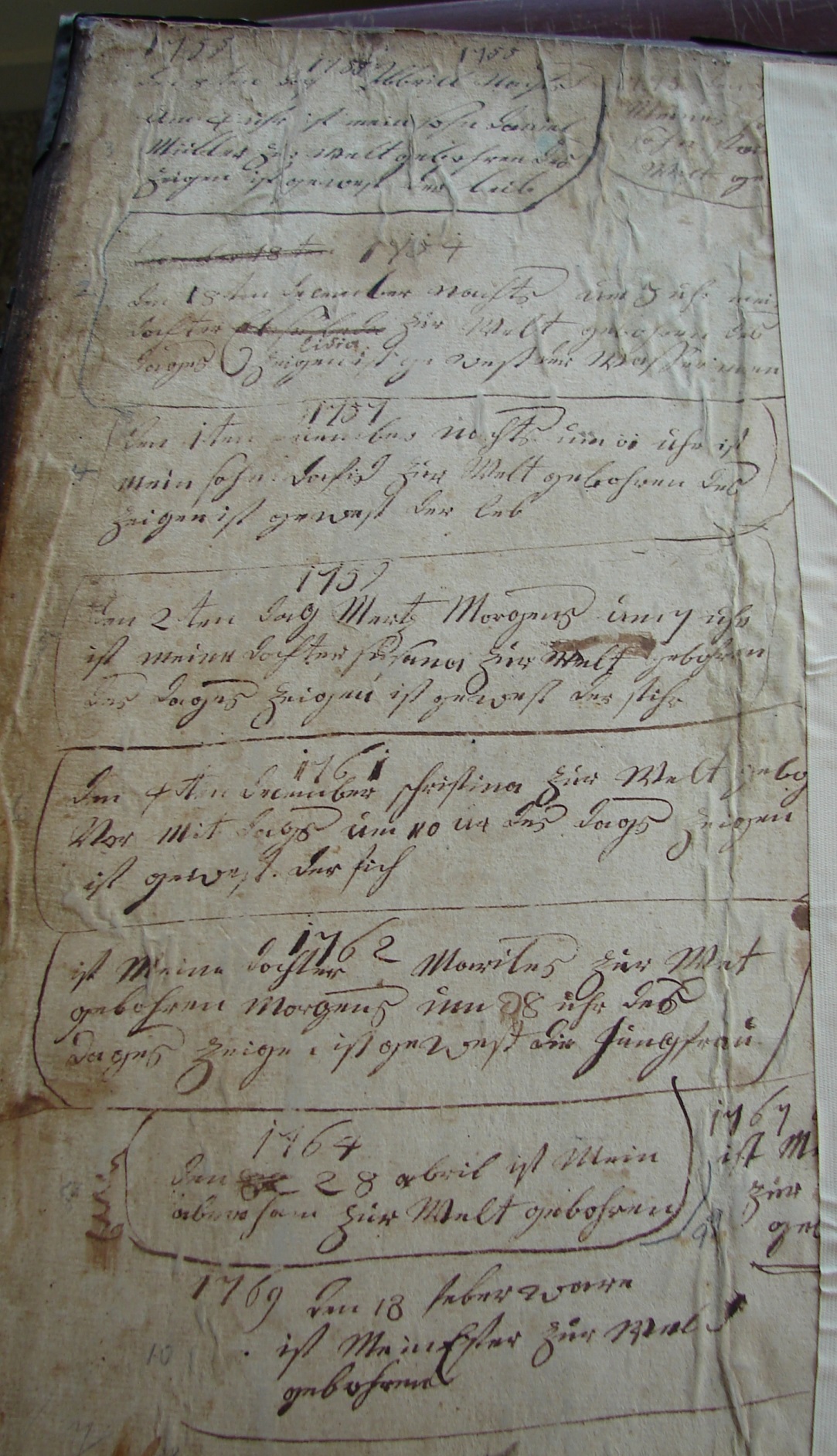
Our Fredericka was born and baptized a Lutheran. Below, her baptism record.  Her entry is the last one on the second page.

Fredericka 1788 birth

Here’s a closeup.

Fredericka Ruhle 1788 baptism

Can you read that German script?  Me either.  Thank goodness for people like Thomas who can and do for those of us who cannot.

According to the church records, Fredericka, as her name was spelled in America and how I’m spelling it for consistency, was listed in one church record as Johanna Fredericka, which probably accounts for why the 1850 census in Montgomery County, Ohio lists her first name as Hannah. Obviously the census taker wasn’t German and didn’t understand German naming conventions where the middle name is used as the given name.

We next find Fredericka in the church records in 1806.

A Bit of Scandal

Last week’s 52 Ancestor’s story was part two of Jacob’s story, which it so happens needed to be told before Fredericka’s story.

German church records revealed a great deal – who stood up with the child being baptized, sometimes the birth date along with the baptismal date, sometimes the father’s profession and always if the parents were or were not married.

Jacob and Fredericka were not married when their first child was born on November 28, 1806, and the church dutifully recorded that detail. Jacob, however, claimed the child, named after himself, and he and Fredericka were subsequently married on May 25, 1808.

Lentz Jacob and Fredericka marriage

According to “Understanding Your Ancestors” by Leslie Albrecht Huber in an article which first appeared in the Germanic Genealogy Journal:

Illegitimacy in the 1700 and 1800s took on a much different appearance than illegitimacy today. Although it was common for couples who weren’t married to have children, it was uncommon for these couples not to marry eventually. In essence, many illegitimate children were born into family units, although their families lacked the official blessing of the state church. These couples often lived together and considered themselves families at the time of the child’s birth.

Couples delayed marriages for several reasons. Sometimes, they didn’t have the money to pay the marriage fee. Other times, the church was far away or the pastor wasn’t easily accessible. Some German states, in an effort to control the booming population, placed legal restrictions on marriage, making it more difficult. And sometimes, the couple simply didn’t feel that much concern about whether marriage or children came first. Peasant society had its own marriage customs apart from the customs of the state church. In earlier times, the community had viewed living together, making a commitment to one another, and especially having children as basically equivalent to getting married. Despite valiant efforts by churches, stamping out traditions and convincing people to first perform the ceremony in a church proved difficult.

At that time in Germany, a male had to prove he could support a family before the couple was allowed to marry, so a good many children were born before their parents married. Jacob was a vinedresser in a vineyard, so he clearly wasn’t wealthy.  Like most of the other people who lived there, he was a peasant.  Their second child, named after Fredericka, came along in1809, a little over a year after their marriage.

A second son, Johannes, arrived in December 1811 and died on March 9, 1814, probably buried in the churchyard in Buetelsbach, shown in the vintage postcard below.

Fredericka Beutelsbach postcard

Just 19 days after her son’s death, Fredericka gave birth to Elizabeth Katharina who would die on the way to America and was buried at sea.

Two years later, their last child to be born in Germany, Barbara, arrived in August of 1816 and was reported in the tribute letter to be a baby when Jacob and Fredericka left for America in 1817.

The church records tell us that Jacob and Fredericka obtained permission to immigrate on February 12, 1817. They probably left shortly thereafter, because they had to travel from Beutelbach to a port city where they would board a ship destined for America.

I have to wonder if Fredericka made one last trip to the cemetery, perhaps to say goodbye to her grandparents, siblings who had perished, and her child. It’s very difficult for a mother to leave a child behind, even one who is buried.  I’m sure leaving was a mixture of sorrow and anticipation mixed with a touch of fear, dread and excited expectation for what the future held.  I wonder if Fredericka had any type of foreboding about the trip.

Jacob and Fredericka probably sold most of whatever they had. Peasants didn’t own land, so their holdings might have been a cow, furniture and some tools.  They turned whatever they had into money to pay their passage, probably took one trunk of belongings for the entire family, or maybe two, and set out with in essence what they could carry for the new world sometime in the spring of 1817.

Of course, they couldn’t have anticipated the extreme danger and high seas adventure they would endure for the next 2 years. Their lives turned into an episode of “Survivor” with no “out” for them.  Their lives not only took a tragic turn, it also took one that had the potential to change the permanent course of their future, derailing their dreams, and along with them, the lives of everyone in America who descends from them today.  They almost didn’t make it to America.  One of their children, Elizabeth, didn’t.

However, Jacob and Fredericka didn’t set sail alone.

Fredericka’s Parents

Fredericka’s parents are shown on the Family Search site, along with her siblings, based on church records.

Fredericka parents Family Search

Furthermore, it looks like Fredericka’s grandmother was also a Lenz. According to church records these same families lived in Beutelsbach and the neighboring village, Schnait, for as long as memory served, beyond the reach of church records, and they were inter-related over and over again.  The very definition of endogamy.

Fredericka’s siblings were:

  • Johann Ludwig who was born June 3, 1790 and died in the same village where he was born on April, 17, 1847. He married Sabine Mayerle in 1830 and then Maria Magdalena Vollmer in 1846. They had one male child, Johann Ludwig Ruhle, born in October 22, 1846 and died in Stuttgart on August 13, 1893.

Fredericka Johanna Ludwig Reuhl

  • Johanna Dorothea born March 18, 1793, below.

Fredericka Johanna Dorothea Reuhl

  • Johann George born April 25, 1794

Fredericka Johann George Reuhl

Catharine Margarethe born March 20, 1797, her birth recorded below, marked with the cross which means that she died as an infant, perhaps not long after her birth.  The Beutelsbach heritage site shows her death as October 23, 1797.

Fredericka Catherine Margarethe Reuhl

  • Johanna Margarethe born January 20, 1800, her birth recorded in the church records below.

Fredericka Johanna Margarethe Reuhl

There’s one more piece of information here for us. According to the tribute to Jacob, one of Fredericka’s sisters immigrated with the couple.  Johanna Margaretha is the sister who immigrated with Fredericka.  The word immigrated, in German of course, auswandern, is written under Johanna Margaretha’s name.  She would have been just 17 when they left.

Fredericka Family Search

According to church records utilized to create a tree and assemble families at Family Search, Fredericka’s parents were married on June 5, 1787, with Fredericka being the oldest child born the following March.

Beutelsbach has assembled a wonderful heritage book and put the family information online. This is a very rare and blessed event.

According to this information, Fredericka’s father, Johann Adam Ruhle was born January 30, 1764 in Schnait and left for America. Her mother, Dorothea Katherina Wolfin was born August 10, 1755 in Beutelsbach and left for America as well.  At least now we know that Fredericka wasn’t also saying goodbye to her parents in the graveyard on that cold late-winter day in 1817.

Fredericka’s parents were married on June 5, 1787 in Beutelsbach.

Fredericka Beutelsbach parents marriage

The church record, shown below, is somewhat unusual because the date of the event is shown below the records, not above the record.

Fredericka parents marriage

When I first saw the birth records of Fredericka’s siblings, I wondered why there were only children born from 1788 to 1800, a span of 12 years. I wondered Fredericka’s mother had died young.  At that time, I didn’t yet have her mother’s birth record, so I didn’t know her age at marriage.  The fact that her mother didn’t marry until she was 32 years old reduced her reproductive years to about 12.  Few children doesn’t always mean the wife died young.  I do wonder why she waited until age 32 to marry.  There must surely be a story there that we’ll never know.

The most surprising piece of information in these records is that Fredericka’s parents also immigrated to America. In addition to Fredericka’s youngest sister, her brother Johann George Ruhle born in 1794 immigrated as well, but her brother Johann Ludwig who was born in 1790 did not.  He died in 1847, a “weingartner” in Beutelsbach at age 57 of a brain injury.  I wonder how he felt being the only family member left behind?

In Germany, you didn’t just pack your bags and set off for America. You had to apply for permission to leave.

Permission to Leave

This book, “Königlich-Württembergisches Staats- und Regierungsblatt: vom Jahr … 1817,” in English, the “Royal Württemberg State and Official Gazette: by the year… 1817,” copied at Google, has the actual German records of who was authorized to leave.

Fredericka permission to leave

On page 199, you’ll note in the text (9 lines from the bottom) that Jacob Lenz and Johann Adam Ruhle are listed one after the other. The date of the publication of this group is on the following page, given as March 1718.

I asked Thomas about this list, and he indicated that it wasn’t at all a social listing, but official legal notices of people about to depart so that their debtors, if they had any, were aware they were about to emigrate and could settle up outstanding accounts. Those practical Germans.

I utilized one of the online translators to translate this and it says:

“Young Jakob Lenz under representation of old Jakob Lenz. Johann Adam Ruhle under representation of the shoemaker, Wilhelm Schweizer.”

How the heck did Thomas find this? He Googled in German.  In this case, “Jacob Lenz auswandern 1817.”  Practical Thomas!

Thanks again to Thomas, we have the published list of who applied and was granted permission to leave in Wurttemberg between 1816 and 1822.

On this list, we find the following Lenz men. The first date is the date of application and the second is the date of approval to leave.  Keep in mind that this includes their family, wife and children, even adult children if they are still living at home.

    • Lenz, Daniel Beutelsbach Schorndorf November 14, 1816 November 18, 1816 Weingaertner
    • Lenz, Daniel Schnait Schorn Dorf 19 Apr 1817 1 May 1817
    • Lenz, Gottfried Beutelsbach Schorndorf 29 Mar 1817 April 7, 1817 single
    • Lenz, Jakob Lenz young Beutelsbach Schorndorf 19 Mar 1817 28 Mar 1817

All of these Lenz men were from either Beutelsbach or Schnait, so they would be family members of some description. Those two towns are about two miles apart.

The Reuhle men were listed as follows:

    • Ruehl (in), Katharina Plieningen Stuttgart February 24, 1817 2 Mar 1817 to America or to Russia
    • Ruehle, Johann Adam Beutelsbach Schorndorf 19 Mar 1817 28 Mar 1817
    • Ruehle, Matthaeus Calw April 10, 1817 April 14, 1817 Nadler to Russia

The only Reuhle from Beutelsbach is Johann Adam, Fredericka’s father.

Their application date and their approval dates for the Lentz and Reuhle families are the same. These people emigrated as a family group.  So it wasn’t just Fredericka’s sister who came to America, but her parents and brother as well.

It must have been very difficult for Fredericka and her family to say goodbye to her one sibling left behind. Her brother Johann George was 27 when they left, but he wasn’t married, so there was nothing really to hold him to Beutelsbach.  I wonder why he stayed. Maybe he was the one with the foreboding.

The Journey

The tribute to Jacob tells us a somewhat incredulous story of the journey to America. While this story is very unusual, it’s so unusual that there must surely be a grain of truth someplace. No one would just make this up.  Here is what the tribute says:

Finally all arrangements were completed and bidding farewell to all their relations he and his family with his wife’s sister began their journey in 1817 (the words “in 1817” are omitted in the second version) to the land of his dreams. Thus they left Wuertemburg, Germany to return no more.

Ships were very different then than what they are now, and as their finances were limited. They did not have the best accommodations that were furnished to the more favored, even in that early day.  But they were willing to endure the hardships of an ocean voyage that they might come to the land about which they had heard so much.  Strange as it may seem to us now, they were to spend about 3 months on the ocean before landing on American soil (the words “on American soil” are omitted from the second version).  But now comes a very strange and trying part of their experience.

They experienced much of the ocean storm and the time seemed long. As the time came that they could reasonably expect to end their journey and set foot on the new world, everyone was making preparation to quit their ocean home.

But many days passed by and no land came in sight. Everyone became restless and there were many misgivings.  They sought explanations from the captain of the ship but his explanations were not satisfactory.  One part of their diet was a large kettle of soup or hash of which they all partook.  Some actions on the part of the captain as he was about where this food was being prepared at a certain time aroused suspicions of those in charge of preparing the food and instead of serving this food it caused the arrest of the captain of the ship.

A sample of the food was preserved and found to contain poison enough to kill many more than were on board this vessel. The captain’s purpose was to poison the crew and turn the ship over to pirates. He was later executed for this.

The ship without a captain wandered around in the northern waters for some time and finally landed (shipwrecked) way up on (the western coast of) Norway where they have six months of day and six months of night; thus were your (my) early ancestors brought to a disappointment in life that they were never able to find words to express. Landing in Norway where conditions were very unfavorable and where but few people live, instead of in America.  Their money all gone, strangers in a strange land, unable to speak the language, without (a) home (and) friends or prospects (“or prospects” omitted from second copy), a sad condition.

Fishing and weaving were the only things in sight and this they did, thus managing to get along for a few months. It was not possible for them to save anything out of the meager rewards for their work, but they still kept their steadfast purpose, to finally in some way reach America.  (Second copy says “It was not possible for them to kept their steadfast purpose, to finally in someway, reach America.”)

After 6 months of weary waiting in that northern climate, an opportunity came their way. A certain ship was to leave their port for the new world and proposed to enter (so they entered) into a contract, stipulating that they should be bound out to services to anyone that would pay their passage and food expense.  The time of service was to be determined by the bidding of interested employers after landing in America.  They would be indentured servants. (Previous sentence not in second copy.)  It was stipulated that the family was not to be separated.

With this contract they set sail the second time for the land beyond the sea, not knowing what would befall them or how they would be dealt with in the future (rest of sentence not in second copy) that was veiled with clouds that seemed to be very dark. All they knew was to commit their all into the hands of the overruling Providence “That doeth all things well, patiently labor, and wait for the future to unroll whatever was in store for them.”

(The passage was $30 each for mother and father and $15 each for Jacob and Fredericka. Elizabeth died on the ocean and Barberry was a baby.)

They landed in New York on the 1st day of January 1819 (rest of sentence omitted in second copy) some 18 months or more after leaving Germany.

Additionally, another family line said that Jacob and family wound up in Bergen, Norway and that they were in the hospital there for several weeks.

Truthfully, I discounted the hospital part, figuring there were no such things at that time, and I questioned the Bergen information. However, who would just pull the town of Bergen, Norway out of their hat?  That too was so specific that it seemed their might be grains of truth there too.

Thomas and I discussed this scenario and both of us agreed, and Thomas set about googling and searching once more.

Start Writing Part 3

A few hours later, I received an e-mail from Thomas, quite late one night, that was titled, “You may have to start writing part 3.”  I laughed when I saw that, figuring he was pulling my leg since I had to write two stories about Jacob, but I stopped laughing very quickly when I saw the contents of that e-mail.

Thomas had found confirmation that at least the shipwreck had happened, at the Norwegian archives along with a translated, a list of people who had been on the ship and who had died after arrival in Bergen.  Holy chimloda!

“Emigrants from the Zee Plough who died before, during or after arrival in Bergen and was buried from Korskirken.”

Kirskirken translates as “The Church of the Cross,” shown below.

Fredericka Church of the Cross

By Thomasg74 – Own work, CC BY-SA 3.0 no, https://commons.wikimedia.org/w/index.php?curid=21771328

The list of burials includes their age and location of birth, in addition to their death date and burial date.

There were 3 individuals from Beutelsbach and 4 from Schneit, spelled Schnejdt.

This strongly suggests that indeed, this was the ship that Jacob’s tribute recants. None of our family members are among the list of those who died while in Bergen, but there is a Ruhl child born after arrival in Bergen who died.  However, that doesn’t mean our family members didn’t die on the way, and we know that Elizabeth, Fredericka’s daughter, died at some time during the voyage.

Furthermore, based on this record, we now have the name of the ship, the Zee Plough which is Dutch and translates to Sea Plow.

For me, and I think for Thomas too, this was like throwing gasoline on a fire and resulted in frantic Googling on both his part and mine. E-mails were flying back and forth like a house afire very late into the night, or more accurately stated, into the early morning.  At one point, Thomas said, “I feel like I’m in the Twilight Zone” and I knew exactly what he meant.  The best description I can give of this experience is “intensely surreal.”  I have never experienced anything like this in my 35+ years of genealogy research and neither had Thomas.

The question remained, though, whether this just happened to be ship with German passengers that shipwrecked near Bergen, or whether this was the ship Jacob and Fredericka were on. Were her parents on this ship too?  Did they survive?  Her siblings?

This scrap of information introduced so many questions.

Fredericka Zee Plough

This is a drawing of the Zee Plough.

Now, googling in both German and Norwegian, Thomas found the Norwedian Wikipedia page about the Zee Plough.

The Sea Plow

The Zee Ploeg was a Dutch emigrant ship which sank off Bergen in the autumn 1817 on its way from Amsterdam to Philadelphia with around 560 emigrants from Württemberg onboard. The passengers were farmers and craftsmen who were members of a religious movement (separatists) inspired by Württembergeren Johann George Rapp (1757-1847).  He had established the society “Harmony” in Pennsylvania in 1805.

Even though the Wikipedia page says that the ship sank, it didn’t, but was disabled when its masts broke.

The year 1816 had been difficult, with poor harvests and a very cold winter.  At this time over seventeen thousand emigrated from Wurttemberg.

The Zee Plough was 136 feet long, 32 feet wide and almost 16 feet tall, with 3 masts. In September 1815 conducted a trial voyage to Suriname with Jan Poul Manzelmann as captain and they returned on July 4, 1816. On behalf of the Handelshuis Zwichler & Comp, the ship now carrying 560 emigrants to the United States.

The boarding was scheduled for 30 March 1817, but was first carried out a month later. Not until late in August, the captaincy from Amsterdam with Hendrich Christopher Manzelmann from Lübeck as Captain with his 21-man crew.  The ship had to return after 11 to 12 days due to the storm in the English Channel , and a minor casualty.  At the next attempt the Captain went up North and High North Scotland, but fell again in a storm.  This time the masts broke and the ship ended after a time by Skjellanger, northwest of Bergen, on September 25.  The ship was towed to the port of Bergen on September 29, and was anchored.

Before the accident 100 passengers died of famine and disease, including all of the thirty who were born aboard. The passengers did not disembark, and while the ship lay at anchor at Sandvik Flaket (a marine channel, shown below) an additional sixteen died.

Fredericka shipwreck

This channel is truly far north in Norway.

Fredericka Shipwreck Norway

Possibly due to these deaths Lars Monrad (1762-1836) believed that the ship had to be quarantined because of the outbreak.

Fredericka Elsesro

The ship was towed to Elsesro, just north of Bergen, shown on the map above.

The painting of Elsesro, below, from about 1807, would have been much like Fredericka would have seen.

Fredericka Elsesro painting

Fredericka must have been extremely grateful to see terra firma and to know that they weren’t all going to die on that ship, floundering in the sea. It was a long way from Sandvik Flaket to Elsesro.

Fredericka shipwreck to Bergen

A few days later, the ship was towed to Bergen and anchored and the survivors were allowed to debark. I’m sure they couldn’t get off that ship quickly enough.  Food, any food, was most welcome I’m sure, as was solid ground.

Bishop Claus Pavels (1769-1822) expressed concern about how the penniless town of Bergen should be able to accept these refugees. Many of the sick were eventually lodged in a farm in Kong Oscars gate 22 (St. Jorgen’s Hospital, now the Leprosy Museum, shown below), which was at that time a military hospital.

Fredericka hospital

Ironically, there is mention in the Lentz oral history of the group staying in a hospital in Norway for several weeks. The oral history seems to have been accurate.  This hospital is where Fredericka and her family would have lived for some time.

In Bergen an additional 40 passengers died and were buried in peace at the Church of the Cross in Bergen.

Fredericka church

By Thomasg74 – Own work, CC BY-SA 3.0 no, https://commons.wikimedia.org/w/index.php?curid=21771343

Fredericka would have seen this tower of the ancient church as she attended those 40 or so burials.

By Thomasg74 - Own work, CC BY-SA 3.0 no, https://commons.wikimedia.org/w/index.php?curid=21771343

By Thomasg74 – Own work, CC BY-SA 3.0 no, https://commons.wikimedia.org/w/index.php?curid=21771343

Were some of her distant family among those who died?  Had her family members been buried at sea?  Her daughter?  Her parents, brother and sister?

Graveyards in Europe are not treated with the same reverence as they are in the US. Graves are routinely reused in Europe. The graveyard beside the church is now a park, but still referred to as “Grave.”

Fredericka chapel

The interior of the church,  where I’m sure Fredericka prayed fervently for deliverance of her family.  They couldn’t stay in Bergen, they couldn’t go back, so they had to go on.  More danger lay in front of them.

The ship Sea Plow could not be repaired and was sold at auction in December 1817.

In October 1817, the Norwegian government compiled one of two lists of the names of the surviving passengers. This list was published in an article by Dr. W. Weintraud.  I’m attempting to obtain a copy of this list, hoping that it will confirm that Jacob and Fredericka were on this ship, and that perhaps her parents survived as well.

Weintraud reference

Oh, and just as an aside, the Western Reserve Historical Society claims the journal is not in the Ward collection, although I wonder if they looked elsewhere.  The Allen County Public library lists this document in their catalog and you can order the film from the Mormon Church, so I haven’t struck out yet!

During this time, while the German families were stranded in Bergen, some Norwegian families of a similar religious persuasion (Rappites) began to consider emigration as well, and were soundly discouraged from that line of thinking. A Norwegian government official said about a visit when they came to speak with him about the possibility: “I advised them against the thought. I recounted the misfortunes the Germany emigrants had been exposed to and explained that the easy and inactive life the emigrants were leading at the moment – it was perhaps this which had misled these peasants – would come to an end as soon as the season allowed us to send them back to their homeland.”  The Norwegians did immigrate beginning in the 1820s, despite being soundly discouraged from doing so.

The Germans, however, from Wurttemberg could not go back. That was one of the stipulations of leaving.  The Duke of Wurttemberg had officially warned his subjects that the door operated only in one direction.  Other parts of Germany did allow a return, but only after posting a bond, something none of these people could do.

They also couldn’t stay in Bergen where they were unable to support themselves and unwelcome, so finding a way to America was their only option. Life must have seemed very bleak at that time for the Jacob and Fredericka, with no good options.  I wonder if they second-guessed their decision to leave.

After a few months most of the passengers departed for Philadelphia. Around 80 of them rented sailing ship “Susanne Cathrine” which sailed August 13, 1818.

The rest (273) went on the ship “Prima” of Larvik, owned by H. Falkenberg and Captained by Jacob Woxvold. Prima was hired by the Norwegian government, and arrived after a redirect to Baltimore in January 1819. Around 100 Germans returned to Germany. Some of the passengers filed afterwards lawsuit against Captain Mantzelmann to recover freight and other costs.

Who Was Johann George Rapp?

Have we discovered perhaps the reason behind Jacob and Fredericka’s emigration? Was religion behind this exodus, rather than weather or economic opportunity?

In the article titled, “George Rapp’s Harmonists and the beginnings of Norwegian Migration to America,” Karl Arndt tells us more about George Rapp, his son Frederick and his religious sect called the Harmonists and also known as Rappites. At the time of the sailing, George and Frederick Rapp had established the town of New Harmony, Indiana, land on the frontier of a newly formed state. The Rapps recruited heavily in Wurttemberg, holding out the lure of free land from the government and paid passage for those who would come and settle.

For Germans who spent their entire lives, for generations, tending vines on someone else’s lands, the allure of land was irresistible. In addition, the Rapps ordered a large selection of grape vines and fruit trees.  The families who came along knew just how to tend those vines.  In one of the letters to Germany, the Rapps stated:

“There are no poor people here who must suffer need or who could not feed themselves.  Much less would they have to worry that their sons would be taken away as soldiers, the laws of the land here are exactly the opposite of a monarchy.  Everyone has the freedom to express himself freely.  Also complete freedom of conscience is introduced in all America so that every person according to the conviction of his own conscience can perform unhindered his Divine service.”

Those are powerful words to families who have just suffered famine in Germany in 1816.

In order to encourage immigration and migration to New Harmony, Indiana, the Harmonites invested in money to pay passage for many Germans, several of whom disappeared after they disembarked here in the US after their passage was paid. The Harmonites continued to try.  Initially, about 150 people of the nearly 600 who embarked on the Sea Plow were believed to be Harmonites.  About 60 wanted to take them up on their offer of paid passage from Norway after the shipwreck.  In the end, about 15 wound up in New Harmony, Indiana.  Not a very good investment for the Harmonites. The supreme irony is that the Harmonites eventually said of these Germans that “they are too wild for our community.”  Of course, “wild” is very much a matter of perspective.

There was one detrimental factor that many people just couldn’t get past, relative to the Harmonites or Rappites as they were known. As Arndt stated, “George Rapp’s most effective substitute of self-disciplined celibacy lacked the essential mass appeal.”  I do wonder, if George was celibate, how was his son Frederick was born.  But, I digress.

The Harmonites had trouble recruiting and keeping people. Few want to commit to a life of celibacy.  Eventually they were so successful with the recruits that stayed that there was no one left in future generations to perpetuate their cause.  Recruiting for a celibate religion is a difficult task indeed.

It’s very doubtful that Jacob Lenz and Fredericka here Harmonites. It’s very clear from looking at the births of their children that they were not celibate.  They are also not noted by name, nor are her parents or siblings, in any Harmonite correspondence.

Fortunately, some of the Harmonite letters still exist, and contain valuable information about what happened.

On February 24, 1818 Christian Friedrich Schnable wrote from Bergen stating that the emigrants had already sacrificed their worldly estate and they found themselves in a land where they could not remain. He states:

“On September 5th, we lost all masts, also we were very badly treated by our disloyal captain.  He did not give us the food which he was obligated to give us according to contract.  This brought about great sickness so that over 200 souls died.”

We know that a total of 353 Germans sailed for America in 1818, and we know that between 560 and 600 people sailed initially in 1817 on the Sea Plow, so the difference would indeed be between 207 and 247 people. Starving yourself and watching others die of starvation intentionally at the hands of the cruel captain must have been a horrific ordeal.

Bergen

After floundering at sea for weeks, starving, being towed to Elsesro and finally to Bergen where the surviving passengers were allowed to disembark, I wouldn’t blame Fredericka if she dropped to her knees, kissed the ground and gave praise. Surely, as she watched fellow passengers die, she knew that she and her family may have been next.  Did her daughter die during the voyage?  Her parents, brother and sister?

By Gerd A.T. Mueller - User:Gatm - Own work, CC BY-SA 3.0, https://commons.wikimedia.org/w/index.php?curid=318458

By Gerd A.T. Mueller – User:Gatm – Own work, CC BY-SA 3.0, https://commons.wikimedia.org/w/index.php?curid=318458

These reconstructed buildings on the Bergen waterfront are very similar to what Fredericka would have seen. Norwegian cities cling to the waterfront as the mountains rise behind them, as you can see in the photo of Bergen, below.

By Espt123 - Own work, CC BY-SA 3.0, https://commons.wikimedia.org/w/index.php?curid=9776642

By Espt123 – Own work, CC BY-SA 3.0, https://commons.wikimedia.org/w/index.php?curid=9776642

In Norway Jacob and Fredericka worked, fishing and weaving fishing nets, until they could arrange passage again, except the second time, they had no funds and had to agree to become indentured servants upon arrival to pay for their passage.

According to the tribute letter, their daughter, Elizabeth died at sea, although it is unclear whether it was during their first unsuccessful attempt to arrive in America or the second, successful, attempt.

Regardless, that must have been a very, very sad time for Fredericka. I can only imagine the agony of dealing with a child growing ever-increasingly ill, then realizing they were going to die, then watching them die, probably while holding them.  The mother, I’m sure, prepared the child’s body for burial, such as it was, at sea.

Bodies buried at sea were typically wrapped in some type of cloth and weighted so they didn’t float. The only thing worse, I think, than watching your child disappear beneath the waves would be to watch it float as the ship sailed away  in the distance – or worse yet, floating alongside for days.

Elizabeth would only have been 4 or 5 years old when she died.

Fredericka must have asked herself if the seemingly cursed voyages to America were really worth all of this trouble and heartache. After all, coming to America was Jacob’s dream, not Fredericka’s.

On To America

In the summer of 1818, 80 of the more well-to-do passengers chartered the ship Susannah Catharina and arrived in Philadelphia two months later, on October 23rd.

Arndt tells us that once in port, the Germans were not allowed to go ashore unless they could prove they would not be a public burden. “Since most of them could not show proof, they were sold or had to permit themselves to be sold at public auction.”  The Harmonite offer of redemption was only valid of course for those who would follow their ways and join them in New Harmony.  Even so, the Harmonites had problems converting “Indiana” money and debts into something a ship captain from Europe docked in Philadelphia would accept as payment to allow the passengers with unpaid passage to depart.

Arndt reports that Rapp had suggested that the passengers with unpaid passage be indentured with a special clause stating that the liberated person should be free again within 6 to 9 months in return for the repayment of the money for their passage. This would buy Rapp time to deal with his monetary conversion issues and not obligate the passengers after their debt was paid. Typical indentures lasted roughly 5-7 years.  The Jacob tribute story indicates their indenture was for 3+ years.

Clearly Jacob and Fredericka were not on this ship, as they didn’t have any money and they report their arrival in January of 1819, but Rapp’s suggestion for the October passengers, still on board that ship in mid-November, may well have applied to the next group that arrived in January as well. It’s known that the ship Susanna Catharina was still anchored in the harbor will into the spring of 1819, likely with Germans still aboard who could not pay their passage and who were waiting for Rapp to redeem them.

Furthermore, the information above regarding a reduced period of indenture correlates with another part of the Jacob Lentz tribute story, as follows:

A certain ship was to leave their port for the new world and proposed to enter (so they entered) into a contract, stipulating that they should be bound out to services to anyone that would pay their passage and food expense. The time of service was to be determined by the bidding of interested employers after landing in America.  They would be indentured servants. (Previous sentence not in second copy.)  It was stipulated that the family was not to be separated.

With this contract they set sail the second time for the land beyond the sea, not knowing what would befall them or how they would be dealt with in the future (rest of sentence not in second copy) that was veiled with clouds that seemed to be very dark. All they knew was to commit their all into the hands of the overruling Providence “That doeth all things well, patiently labor, and wait for the future to unroll whatever was in store for them.”

(The passage was $30 each for mother and father and $15 each for Jacob and Fredericka. Elizabeth died on the ocean and Barbery was a baby.)

They landed in New York on the 1st day of January 1819 (rest of sentence omitted in second copy) some 18 months or more after leaving Germany. Very soon after landing advertisements were sent out giving contract notice,  description of the family, amount of money to be paid and setting the date when they would be bound out to the one that would pay the money for the least period of service.

The momentous day soon came. They were placed on a platform before the crowd, the contract read, the amount of money to be paid was stated and the bidding began.  Of course anyone had the privilege to talk with them beforehand.  The bidding was in time of service.  One bidder would offer to pay their fare for 10 years services, another for nine, another for 8, another for 7, and so the bidding continued until finally their service was declared to the successful bidder for 3 years and 6 months.  They went with him to his home at Shippensburg, Pennsylvania, wondering, wondering, wondering what it all meant to them.

They worked with a will and did their best to please their employer so he would have no just cause to hold them for service longer than the specified time.

They soon found that their employer and his wife were very good people asking reasonable work and supplying them with a comfortable home and an abundance of food. Contrasting this kindness with what they had to meet in the two preceding years, they were content and the future looked brighter to them, as they were now sure that in a few years of time they would be free to start life over again in this land where they had longed (long hoped) to be.

After they had worked about 8 months their employer invited them into his parlor one morning and kindly explained to them that according to customary wages, they had earned enough to pay their fare across the ocean and that was all he wanted, that he appreciated very much their faithful service. There were at the liberty to do for themselves and to work for who or where they would and their wages would be theirs to do with as they wished.

Freeing them of over two and a half years of service was so unthought-of on their part that they could never thank those people enough for their great kindness. So he often told it to his children and asked them to tell it to their children – that they might know and appreciate this kindness that was shown to them at the time it meant so much.

The Ship Prima

The last ship to leave Norway with the shipwrecked Germans was the Prima. On May 4th, 1819, a few months after the Prima’s arrival earlier that year in January, another Harmonite letter tells of the near catastrophy.  These ships carrying Jacob and Fredericka seem jinxed.  I can only imagine their horrific fear as they once again were endangered on the sea, seemingly sure to perish.

This letter reports that the group passed through a violent hurricane that threatened to capsize their ship.

We find additional information about this journey in a paper written by Ingrid Semmingsen titled “Haugeans, Rappites and the Immigration of 1825,” published in “Norwegian-American Studies, Volume 29” in 1983. This immigration is referring to the Norwegian immigration to the US.

Semmingsen states that aboard the Zee Plough were:

“About 500 emigrants – all from Wurttemberg, petty farmers and craftsmen who had resolved after the unusually severe winter of 1816 to leave for America. 1816 was the year “when summer never came.” Some of the immigrants, probably about 150, called themselves separatists.  They were religious dissenters and political malcontents who stoutly resisted any attempts by the Norwegian authorities to induce them to return to Germany.  They maintained they would be subject to persecution there.  They were followers of Johann George Rapp, gone to America in 1803.

Some of the Germans had paid all or part of the passage due the Dutch shipping company and they brought legal action against the skipper in an attempt to regain their money. Several of the emigrants still had some funds left, but most of them were poor.  A certain percentage were “nonpaying passengers” who had entered into an agreement with the skipper that they would raise the necessary funds on arrival in America by enlisting as indentured servants or laborers.

The whole group of emigrants was in miserable condition after floundering in the North Sea storm for nearly 2 months, during which time a number of them had perished. As a result, there were orphans among them and some 40 of the passenger were so feeble that they were sent to a hospital.

Fortunately the Norwegian doctor who was put in charge of them found nothing contagious. Nevertheless some deaths did occur after arrival in Bergen.

As events would have it, the entire group had to spend the whole winter in Bergen. The sailing season was past and the city authorities in cooperation with the Norwegian government had to take measures to provide them with housing and other necessities.  The years 1817-1818 were the worst Norway had to endure after gaining independence in 1814.  Crown Prince Carl Johann who would become king in 1818 even gave assistance from his own private funds.  Finances were desperate and political unrest was smoldering.

Even under more normal circumstances, it would have been a formidable task for a city with fewer than 15,000 inhabitants to improvise charitable organizations to assume responsibility for 500 practically helpless foreigners, many of them political refugees. In 1817 it must have seemed an event of catastrophic proportions.  Not until the summer and fall of 1818 did the immigrants leave Bergen.  The first group left  in August and docked in Philadelphia in late October and the second on the vessel Prima did not arrive in Baltimore until shortly after New Year’s, 1819.

Semmingsen goes on to say a few pages later that:

The Norwegian government had advanced 1,300 pounds toward their transportation which it hoped would be refunded when the ship reached an American port. The full cost of transportation ran to 2,200 pounds and the difference was arranged for by a naturalized German in Kristiana named Grunning.  More is known about this second crossing.

One of the crew of the Prima, presumably one of the officers if not the captain himself, wrote an account of the journey which was published in a Norwegian newspaper in 1826. He reported that there were 2 Catholic families among the passengers and the rest were Lutherans.

The people were described as religiously-minded, virtuous, and, considering their social class, well-bred. All of them had prayer books. Every morning and evening they prayed to God in a solemn and touching manner and sang hymns in clear, pure voices.

Before retiring they entertained themselves with song, dance, music, and games. On occasion they also passed the cup of friendship among themselves.

Skipper Woxland chose the southern route. This was undoubtedly wise considering the lateness of the season when he set sail. He took the Prima south to the coast of Portugal so as to utilize the trade winds, and it paid off “With the never-failing dominance of this wind” they reached the West Indies, but there they ran into trouble. They had to fight a raging storm, the shipowner reported to the government, and they had to dock in Baltimore instead of in Philadelphia, which was their real destination.

But according to the report the ship, crew, and passengers were well received. A committee was appointed by the citizens, which consisted partly of fellow-countrymen of the newcomers. They brought food aboard the ship and also raised money to help defray travel expenses.

Furthermore, arrangements were made to secure employment or land for the emigrants. Everything was managed “in the best of order” to everyone’s satisfaction.

Only the leave-taking with the skipper and the crew was a sad experience for the emigrants. Many of them had learned to speak Norwegian during the long stay in Bergen, and they promised that they would never forget dear Norway or “the kindly disposed citizens of Bergen.”

Not all the passengers were as favorably impressed by their reception in America as this report would imply — at least not four persons who were bound for Harmony and who, a few months later, sent a letter from Philadelphia to “Dearly beloved brothers and sisters in God’s congregation in Bergen.”

To be sure, they praised the skipper and crew who, with God’s help, exerted themselves to the uttermost in order to save ship and passengers when a “terrible storm” almost caused the ship to capsize; but they were dissatisfied with Harmony, which had not “given orders to redeem us.” They also had encountered trouble with getting their passage paid for, and they were forced to seek release from paying the big bill “charged against us for the care we received in Bergen.” Clearly, the emigrants also had to work as indentured servants. “Then we were sold for the passage money: one down south, another up north; only four of us are here together, the others are scattered.”

However, they continue, “America is a good country. Poor people live better here than the wealthy ones in Bergen and Germany. Wages are good. While we are in service, we are given good food and clothing and we have many free periods. We hope that we will soon earn our freedom and then be gathered together as one congregation.”

The Lawsuit

Apparently, there was indeed a lawsuit, although the outcome is questionable. The Jacob Lentz tribute says that the Captain was hung.

According to this information from the Norwegian archives website, and auto-translated, it looks like the Captain may have been in jail and the suit may have been dismissed. However, look who filed the suit.

Carl O Gram Gjesdal mention proceedings against Zee Plogs captain in jail in the new year 1818. The occasion will, according to Gjesdal, have been that two passengers, Jacob Lentz and John Fiedler, had appealed to the authorities and received a licence to ‘ on ustemplet paper for the person in question under the law that let make the cases that they find themselves occasioned that grow toward the bemeldte captain, kapt. Poul Jan Manzelmann ‘.  Do you know where this thing is located? It should have been accusations of drunkenness, poor seamanship, embezzlement, brutality, abuse, and murderer tampering attempts.  He was also of some of the responsibility for that small children died during the crossing due to malnutrition. It was difficult with the evidence, and DOM’s formulation, according to have been Gjesdal,: ‘ the captain should replace them to citanterne for erholdt forlite provisions after unwilling men’s discretion … By the way he should as far as compensation is concerned, is considered to be free.  Iøvrig rejected the case. ‘ Mvh Arnfrid

This tells us a couple very interesting things. First, Jacob, according to the earlier discussion, would have been one of the passengers that originally paid his way and that of his family.

Second, this begs the question of why Jacob would have been the one to file the suit. Was it burning anger over his daughter’s death?  His in-laws perhaps?  Or had Jacob assumed something of a leadership position among the immigrants?  Why Jacob?

Indenture

After arrival, Jacob, Fredericka and the remaining three children were indentured to a kind family living in Shippensburg, Pennsylvania. In addition, the tribute letter says that Fredericka’s sister also immigrated with them, but her sister’s name is not given, nor is any additional information.  The fact that Fredericka’s sister was mentioned, but her parents and brother were not begs the question of whether the rest of her family perished, or perhaps the oral history has lost those pieces of information.

I have never been able to find any information about the sister, but given that we didn’t have a name, and I was looking for a Mosselman female, I would never find her of course.

One thing I do know is that the sister does not seem to be living with Jacob and Fredericka in the 1840 census, which is the first census we have enumerating the family.

To date, I have not had any success finding Fredericka’s parents or brother in America. Her father, Johann Adam Ruhle would have been 56 years old in 1820, the first possible census where he could have appeared.  Her brother, Johann George, would have been 26 and would only have been individually recorded in the census if he were a head of household.  They could have been indentured at that time as well.  There is so much we just don’t know.

Freedom in America

The Jacob Lentz tribute letter reports that the family was not split apart when they were indentured to a couple who lived in Shippensburg, PA. Even more remarkable, this very kind couple released them from their indenture after only 8 months for “service rendered.”  Finally, they were free in America to make their own way, but what a price they had paid.

Adam Lentz, Fredericka’s first child born in America, was born August 30, 1819 in Pennsylvania and named after her father. This suggests that Fredericka got pregnant while at sea, in the first couple weeks of December 1818.  She probably did not realize she was pregnant when they were auctioned, which makes the fact that they were released 8 months into their indenture even more remarkable.

Perhaps, the family simply felt sorry for the very pregnant Fredericka who was working desperately hard so that their indenture would not be extended, in addition to caring for her own family. Typically, a pregnancy during an indenture extended the time the individual had to remain indentured, because the owning family did not get full service from that individual during the pregnancy or while the woman was caring for a newborn.  Often, the indenture was extended for up to 2 years.

The tribute letter tells us that Jacob and Fredericka stayed in Pennsylvania for nearly the next decade, moving to Montgomery County, Ohio in 1828 or 1829. Unfortunately, we don’t find the family on the 1820 or 1830 census in either Pennsylvania or in Ohio, so those two decades are still blank slates.

Montgomery County, Ohio

Fredericka had daughter Mary, on May 9, 1829. In the 1850 census, when Mary and her new husband were living with Jacob and Fredericka, Mary’s birth state was recorded as Ohio.

Lentz, Jacob 1850 census

In 1860, Mary’s birth location is also recorded as Ohio. In 1910, in Bartlesville, Washington County, Oklahoma, she gives her birth location as Pennsylvania as she does in the 1885 Kansas census where she is listed as M. A. Overlees.  Based on the birth locations of her children, Mary seems to have moved to Indiana between 1852 and 1854, to Illinois between 1866 and 1870, to Kansas before 1885, to Oklahoma before 1910 where she died in 1916.

Based on the varying information, we don’t know if Mary was born in Pennsylvania before Fredericka came to Ohio, if Mary was born in Ohio, and if so, if Fredericka was pregnant in a covered wagon at 41 years of age. For her sake, I hope not.  I strongly suspect that the earlier 1850 census where Mary was living with her parents would have been more accurate than a later census.  Fredericka, after all, knew unquestionably where her daughter was born.

It’s likely that Jacob and Fredericka were in Montgomery County in or by 1829, and were somehow missed in the 1830 census.

We also don’t find Jacob Lentz on tax lists in Montgomery County until the mid-1830s. In 1841, they purchased land from their son, Jacob F. Lentz, who seemed to be somewhat of an early realtor.

This would be the only land that Jacob and Fredericka owned, their homestead, and where they spent their final years. By 1841, Jacob was 58 years old and Fredericka was 53 – old to begin farming, but very grateful I’m sure that the past quarter century of turbulence and turmoil were over.  Jacob left when he was 34 years old to establish a more stable life – and it wouldn’t be until 24 years later that he finally owned his own land.  I’m sure this was really not what he and Fredericka had anticipated.  It had been a long, hard journey.

Fredericka and Jacob lived their lives on a farm just north of the intersection of Olive and Shiloh Springs Roads from at least 1841 through Fredericka’s death in 1863.  Today, a church stands on the front part by the road, plus two houses, but the rest is farmland just like it was when Jacob and Fredericka lived there.

Lentz Jacob land satellite close

This house, one of the two standing on the land they owned may have been the original farmhouse. If so, this was the only home Fredericka had that was “hers.”

Lentz Jacob house closeup

Jacob and Fredericka sold their land to son George in 1855. Jacob would have been 72 and Fredericka 67.  A year later, George sold it back to them as a life estate.  This deed was not registered until 1865, but since Fredericka signed to release her dower rights, we know that it was indeed executed in 1855, as her portion of the deed says, since she had been dead two years by 1865.  As far as I know, dead people can’t sign deeds, although apparently at one time dead people could vote in Chicago.

The deed does not show that they signed with an X, so apparently they could both sign their names, but probably in German script. Unfortunately, deeds recorded in deed books don’t hold original signatures.

We don’t know if Fredericka ever learned to speak or write English. They lived among a group of Germans in Ohio, attending the Brethren church whose services were in German as well.  If Jacob and Fredericka did learn English, it was probably very rudimentary. Ironically, Fredericka likely had at least a passing knowledge of Norwegian.

Religion and Life in Ohio

Jacob and Fredericka both started life as Lutherans, but ended their journeys on this earth as a part of the pietest movement. Even though they traveled on the ship with a group of Rappites, and one of their Lenz kinsmen seems to have been of that persuasion, there is nothing to indicate that Jacob and Fredericka embraced that religious leaning.

At some point in their lifetime, Jacob and Fredericka became Brethren.  Fredericka lived in the time when the wife followed her husband’s direction, so we’ll never know if Fredericka actively converted, or converted because her husband thought it was a good idea.

What we do know is that their two oldest children were not Brethren, but the rest seemed to be except for the youngest, Mary, who removed to Oklahoma. Mary’s husband was a Baptist, so perhaps she too was being a good and dutiful wife – not to mention there were no Brethren churches on the Oklahoma frontier.

Jacob and Fredericka attended the Happy Corner Brethren Church in Montgomery County. This church was established in a log cabin about 17 years before they arrived in Ohio.  It was a small church and would have provided a close, family-like atmosphere of other German families, something very welcoming to Fredericka, I’m sure.  Other than her husband and children, Fredericka had no known family in America, no sisters to talk to, no cousins, no one of her own blood on this entire continent, except perhaps for that elusive sister who was likely back in Pennsylvania, if alive at all.  Her brother may have survived as well, but if he did, he wasn’t living near Fredericka in Ohio.

The church stood at the intersection of Old Salem and North Union Road, about two and a half miles from where Fredericka lived. This would have meant that unless they had a buggy, which was very unlikely, they would have hitched the horses to the farm wagon and the family would have ridden to church in the wagon.  I’m not sure what they would have done in the rain.

Lentz Jacob church to home

The white church building at that location today was built not long after Jacob and Fredericka began residing in the cemetery down the road.

Lentz Happy Corner

One of the things that church woman have done forever is to quilt. They made quilts for their families, for newlyweds, for new babies and for missionary and charity work.  I quilted at my home church with my mother and she quilted with her grandmother.  Often, when a minister left a church for a “calling” elsewhere, the congregation women made him a quilt to say goodbye.

Several years ago, I became aware of a Happy Corner quilt for sale. I was extremely excited, until I realized it was made in about 1945, 80+ years after Fredericka died.  None of these women would have even known Fredericka.  Nonetheless, in an odd way, I felt that this quilt stitched the past and present together.  I know that Fredericka likely participated in a similar activity, 100 years earlier.

Fredericka happy corner quilt

Fredericka’s Death

Thankfully, the tribute letter also tells us when Fredericka died. Her gravestone was too badly deteriorated by the time cousin Steve Lentz took photographs, so if dates were ever there, we can’t read them now.

The Brethren newsletter was called the Gospel Visitor, and while Jacob’s death in 1870 was submitted by the local minister, Fredericka’s was not. It’s sad, because in many ways it seems that Fredericka spent her entire life being unrecognized and later, forgotten.

The cemetery is not directly adjacent, beside or behind the church, which is somewhat unusual.

Lentz Happy Corner cemetery satellite

The church is on the southwest corner of the intersection of Old Salem Road and North Union Road, and the cemetery is located a few hundred feet east on Old Salem Road, marked by the small grey pin above.

It’s a beautiful cemetery, punctuated by mostly older burials.

Lentz Happy Corner cemetery

Cousin Steve visited years ago and took photos of both Jacob and Fredericka’s stones.

Lentz, Jacob-Fredericka graves from Steve-a

In the photo above, Jacob’s stone is the white stone with his name showing. In front of his stone and to the left in the photo is a small stone with no visible name.  That stone belongs to Fredericka.

Lentz, Fredericka Lentz grave from Steve

You can see at one time that it said Fredericka wife of Jacob Lentz.

By the time I visited in 2004, you couldn’t even see the stone because it was obscured by a very healthy yucca plant, as seen below..

Lentz Happy Corner cem

Jacob joined Fredericka 7 years later. Unfortunately, it appears that there was no space beside Fredericka for Jacob, so their graves are slightly offset.  At least they are buried in earth and not in the Atlantic Ocean someplace.

The Children

Wives were helpmates to their husbands and mothers to their children, and not necessarily in that order.

I’m sure Fredericka’s children were near and dear to her heart.  If she was like other mothers, there is nothing more important.

Let’s look at what we know about each of the children. Unfortunately, Jacob did not leave a will when he died, and no probate was filed, so I’ve used alternative information to assemble the names and lives of the children.

Beginning with the 1840 census, I correlated known or suspected children against the census entry. Jacob Lints is shown in Madison Township with several family members. I’ve noted Jacob’s children where they would fit according to their known birth dates and the census categories.

  • Male 50-60 (born 1780-1790) Jacob
  • Female 50-60 (born 1780-1790) Fredericka
  • Male 5-10 (born 1830-1835) unknown, possibly Lewis
  • Male 10-15 (born 1825-1830) Benjamin born 1826
  • Male 15-20 (born 1820-1825) George born 1824 married in 1846
  • Male 20-30 (born 1810-1820) Adam born 1819 married 1843 to Margaret Whitehead
  • Female 10-15 (born 1825-1830) Mary born 1829, married 1848
  • Female 15-20 (born 1820-1825) Margaret born 1822, married December 1840 to Valentine Whitehead

The children of Jacob and Fredericka as I know them today::

  • Jacob Freidrich Lentz (spelled Lenz on his baptismal record) born Nov. 28, 1806 in Beutelsbach, Germany and married Sophia Schweitzer on May 6, 1830. In the 1880 census he is listed as a real estate agent census and shows parents born in Baden. He is identified as Jacob’s son in a local Dayton history book. His children are listed as Harriett born 1836 and married Jacob Shumaker, Margaret “Mary” born 1839/1840 married Cincinnatus Stimson, Jacob Franklin born 1840 and married Sarah “Sallie” Quimby Pierce, Cyrus Lentz born 1834 and married Mary Elizabeth Whitehead in Elkhart County, Indiana in 1855 and Charlotte Elizabeth Lentz born 1831/1833 married Daniel Donson. Jacob died on March 23, 1887 in Dayton, Ohio and is buried in the Woodland Cemetery. Jacob’s first name, at least, was for his father and his grandfather as well.

Lentz Jacob Friedrich baptism

  • Johannes Lenz was born on December 9, 1811 and died in Germany on March 9, 1814, just 2 years and 3 months of age.

Fredericka Johannes Lenz 1811.png

  • Fredericka (Freidrica) Lentz born in Beutelsbach, Germany July 3, 1809, married Daniel Brusman in Pennsylvania, identified by her son Lafayette’s death certificate as Fredericka Lentz.  According to the 1850 census, she had daughter Adaline born 1832 in Ohio, Margaret born 1835, died 1874, Ann born 1838 married James Gallagher and had daughters May and Effie, Lafayette born 1841 married Sarah Coffman, Jacob born 1844 and married Margaret Covery and Lorenzo born in 1848 and married Nancy Jane Harmon. Daniel Brusman died before the 1860 census and at some point, Fredericka remarried to Harry Gallagher. She died October 8, 1897 and is buried in Polk Grove Cemetery, Montgomery County, Ohio. Fredericka was named for her mother.

Fredericka Friedrica 1809

  • Elizabeth Katharina Lenz was born in Beutelsbach, Germany, on March 18, 1814 and died at sea on the way to America.  Katharina was Fredericka’s mother’s middle name, by which most German women were called.

Fredericka Elizabeth Catharina Lenz 1814

  • Barbery Lentz, baptized Maria Barbara Lenz in Germany on August 22, 1816, was a baby when her parents sailed for their new home. Sister Yost is mentioned in Jacob’s obituary. Barbara married Henry Yost and her death certificate in Elkhart County, Indiana gives Jacob’s name as her father. Based on her death certificate, she was born August 21, 1816. The 1850 census shows her children as Jane born 1841, Harrison born 1846 and William born in 1849 but dead before 1860. The 1860 Montgomery County census shows Lucretia age 7 and Lucy E. age 3. The 1870 census shows them in Montgomery County, but by 1880 they were in Elkhart County, Indiana. Barbara died on November 9, 1899. Her father’s name was given correctly, but her mother’s was listed as “don’t know” then scratched out. The informant was Jane Pollock, probably her daughter, who would clearly have known her grandmother before Fredericka died in 1863 when Jane would have been 22 years old. Many German babies were given the first “saint’s name” of Maria. Jacob’s mother was Maria Margaretha and his sister was Maria Magdalena.

Fredericka Lenz, Maria Barbara 1816

Maria Barbara’s birth record in the church book in Beutelsbach, Germany and her death certificate in Elkhart County, Indiana, below.

Lentz Barbara death cert

  • Adam Lentz born August 30, 1819 in Pennsylvania, married first in 1843 in Montgomery County, Ohio to Margaret Whitehead who died in 1844 in Elkhart Co. He then married Elizabeth Neff in 1845 in Elkhart County, then left and went to Montgomery Co., Illinois where he was listed the 1880 census with his parents having been born in Wurttemberg. By 1900 he was in Bates County, Missouri. The tribute letter states he was the son of Jacob. Adam died August 4, 1906 in Adrian, Bates County, Missouri. Adam had children Mary born 1848, Henry born 1850, Warren born 1853, Aaron born 857, Samuel born 1860, Marven born 1860, Clara Ellen born 1864, George William born 1867, John Adam born 1867, Charles Alfred born 1873.  Missouri did not maintain death records until about 1910. Adam was named for Fredericka’s father.  One of the two tribute copies came from Adam’s grandson.
  • Margaret Elizabeth Lentz was born December 31,1822 in Pennsylvania and married Valentine Whitehead December 31, 1840 in Montgomery County, Ohio. He died in 1851 in Elkhart County, Indiana. She remarried to John David Miller on March 30, 1856 and died July 4, 1903. She identifies her parents as being born in Wurttemberg in the 1880 census.  Her death certificate names her father as Adam Lentz, who was actually her brother. Margaret had children by Valentine Whitehead; Emmanual born 1849 married Elizabeth Ulery, Mary Jane married John Ulery, Jacob Franklin married Eva Bowser, Lucinda married Joseph Haney, Samuel married Henrietta, Sarah born 1864 died 1867, Ida born 1867 died 1893. By John David Miller Margaret had children: Evaline Louise born 1857 and married Hiram B. Ferverda, Ira Miller born 1859 and married Rebecca Rodibaugh and Perry Miller born 1862. Margaret Elizabeth was named for Jacob’s mother, Maria Margaretha and his sister, Catharine Margaretha. Fredericka’s sister was also named Catharina Margaretha and of course, Elizabeth was the name of the child who died on the way to the US.

Fredericka Margaret Lentz Miller death cert

On her death certificate, Margaret’s father is listed as Adam, who was her brother, and her mother is unknown. Her son-in-law was the informant, which explains why the names were incorrect.

john david miller family

Margaret is shown here with her grown Miller family.

  • George W. Lentz born Feb. 11, 1824 in Pennsylvania, married Sarah Spitler or Spitzler about 1845. She died in 1853 and he married Catherine Blessing in 1855 in Montgomery County, Ohio, and gives his parents as having been born in Wurttemberg in the 1880 census. Jacob Lentz is living with George in 1880. George has children with Sarah Spitzler; Mary Ann born 1846, Susanna born 1848, Sarah born 1851, Lucinda born 1853, Jane born 1849. With Catherine Blessing he had Amos born 1855, Martha born 1857, Isaac born 1859, Lydia born 1861, Aaron born 1862, Emma born 1865, Amanda born 1867, Ida born 1868, Jesse born 1870, Ira born 1872, Anna Belle born 1875, Warren George born 1877 and Effie born 1880. George died Oct. 19, 1887 and is buried in the Bear Creek Cemetery in Montgomery County. George was named for Fredericka’s brother Johann George.

Fredericka George Lentz Catherine Blessing

George Lentz and Catherine Blessing

  • Benjamin Lentz born May 7, 1826, married first Sarah Overlease (Overlees) in Montgomery Co, remarried to Catherine Halderman in 1859 in Elkhart Co., Indiana. In the 1880 census, gives his parents birth location as Wurttemberg.       His death certificate gives Jacob as his father, but his mother is listed as unknown. With Sarah he had children: Adam J. born 1850, Henry born 1853, Lewis born 1856. With Catherine he had children: Whitney James born 1879, Ira born 1860, Alice born 1864, Milton James born 1869, Matilda born 1862, Josephus born 1866 and Hulda Margaret burn 1874. Benjamin died October 17, 1903 in Kosciusko County, Indiana. We don’t know who Benjamin was named for, but all Germans were named “for someone,” often the person who stood up with them when they were baptized as their Godparents. Godparents were expected to take the child who was their namesake to raise in the event of the death of the parents.

Fredericka Benjamin Lentz crop

Benjamin Lentz

Lentz Benjamin death cert

  • Mary Lentz born May 9, 1829 in Pennsylvania, married Henry Overlease on December 1, 1848 in Montgomery Co., Ohio and in the 1850 census, the couple was living with Jacob and Fredericka (listed as Hannah) Lentz. Mary died on May 18, 1918 in Bartlesville, Washington Co., Oklahoma and is buried in the White Rose Cemetery. In 1860, they too were living in Elkhart County, Indiana. In 1880, in Neosho Co., Kansas, Mary gives her parents’ birth location as Wurttemberg. Mary had George born 1850, died 1871, Warren born 1852, Sarah born 1854, Mary Ann born 1857 married a Forrester, Milo born 1860, Francis born 1866, William born 1870, Perry, Laura Frances died 1916, Jesse L born 1877 and Effie born 1875 married a Wylie and moved to Portland Oregon. Mary and her husband were Baptists. Mary would have been named for Jacob’s sister Maria Magdalena, perhaps, or his mother, Maria Margaretha.
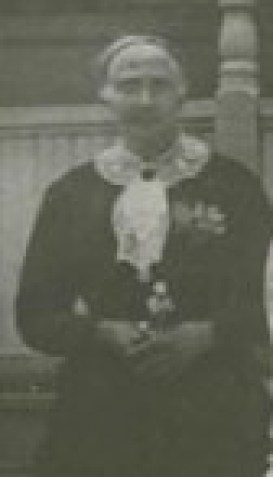
Fredericka Mary Lentz Overlease

Mary Lentz Overlease

  • Possibly Lewis Lentz born in 1832. Lewis Lentz may or may not be the son of Jacob and Fredericka. He is living with Barbara Yost, Jacob and Fredericka’s daughter, in 1850 and there is a male in Jacob and Fredericka’s household in 1840 of this age. Lewis’s death certificate says his father’s name is George, but Lewis moved to Indiana when young with and his children would never have known his parents in Ohio. If Lewis was the child of Jacob and Fredericka, we don’t know who he was named for.  It would be very interesting if Lewis’s descendants participated in DNA testing.

Fredericka Lewis Lentz death cert

We have the death certificates for 3 of Fredericka’s children, and on all three, her name is unknown. I find that incredibly sad.  The woman who sacrificed so much forgotten so quickly.

DNA

Fredericka’s mitochondrial DNA would have been contributed to all of her children, but only passed on by her daughters. Only females pass mitochondrial DNA to their children.  Therefore, anyone today who carries her mitochondrial DNA must be related to Fredericka though all females, although in the current generation, males can test, so long as they connect to Fredericka though an all female line. 

In the section above, candidate grandchildren are noted in bold, and I am listing them individually below.

The 3 surviving daughters of Fredericka Ruhle Lentz with female descendants:

1. Fredericka Lentz Brusman married Daniel Brusman

  • Adaline Brusman born 1832 in Ohio
  • Margaret Brusman born 1835, died 1874
  • Ann Brusman Gallagher born 1838 married James Gallagher
    • May Gallagher
    • Effie Gallagher

2. Barbara Lentz Yost married Henry Yost

  • Jane Yost born 1841
  • Lucretia Yost born 1853
  • Lucy E. Yost Pollock born 1857 married a Pollock in Indiana

3. Margaret Elizabeth Lentz Whitehead Miller married Valentine Whitehead, then John David Miller

  • Mary Jane Whitehead Ulery born 1851, married John Ulery
    • Margaret Elizabeth “Lizzie” Ulery Mutschler married Albert Mutschler
  • Lucinda Whitehead Haney born 1842 married Joseph Haney
  • Evaline Louise Miller Ferverda born 1857 and married Hiram B. Ferverda
    • Edith Estella Ferverda Dye married Tom Dye
      • Ruth Dye
    • Elizabeth Gertrude Ferverda Hartman born 1884 married Louis Hartman
      • Louisa Hartman Tenney married Ora Tenney
        • Helen Tenney Nine married Norman Nine
          • Lisa Nine
      • Roberta Hartman Frush married Rulo Frush
        • Carol Frush Slaymaker married William Slaymaker
          • Nadine Slaymaker
          • Nancy Slaymaker
    • Chloe Evaline Ferverda Robinson born 1886 married Rolland Robinson
      • Charlotte Robinson Howard married Bruce Howard
        • Susan Howard Higg married Richard Higg   
        • Mary Carol Howard Bryan married David Bryan
          • Kerrie Bryan
          • Julie Bryan
        • Sally Howard         
    • Margaret Ferverda Glant born 1902 married Chester Glant
      • Mary Glant Wigner married Varrill Wigner
        • Kari Anne Wigner
      • Joyce Ann Glant Zimmerman married Delferd Zimmerman
        • Nancy Zimmerman
        • Beth Zimmerman

I have a DNA testing scholarship for anyone who descends from Fredericka Lentz and carries her mitochondrial DNA.

Autosomal DNA

One of the issues we have with autosomal DNA is that so many of the people who have tested today descend from the marriage between Margaret Lentz and John David Miller.  We can’t tell which DNA is Lentz DNA and which is Miller DNA.  If you have tested or want to test and descend from the Lentz (or Lenz) line through any child, please contact me and let’s see if we can discover which DNA belongs to Jacob and Fredericka.

Summary

Fredericka’s life initially seemed to be rather mundane, the unexciting routine line of a pietist Brethren wife in the early 1800s. Nothing could have been further from the truth.

Fredericka was born in 1788 Beutelsbach, Germany as a Lutheran. She married in 1808 to Jacob Lenz, later spelled Lentz, after having their first child in 1806.

Fredericka and Jacob suffered through the famine year of 1816 when crops didn’t develop, which may have helped them decide to emigrate in 1817. They applied for emigration permission in early 1817, not waiting to see if another devastating agricultural year would follow.  Crop failures in 1816 had caused a sharp increase in food prices followed by demonstrations in front of grain markets and bakeries which escalated into riots, arson and looting.  The summer of 1817 in Germany would have been similar, had they waited, but their summer of 1817 was infinitely worse.

The Dutch ship, Sea Plow, was scheduled to board on March 30, 1817, but didn’t board until a month later. They sailed, but after 10-12 days, they had to return to port after they encountered problems and a casualty of some sort.

They left again, apparently sometime in late July or August, and Captain Manzelmann attempted to sail north of Scotland. The story is never fully told, but apparently the Captain attempted to poison the passengers and then starved many of them.  Roughly 200 died, including all babies born.

On September 5th, the ship lost all of her masts and was floundering.  They finally shipwrecked on the northern coast of Norway which sounds terrible, but in actuality, saved their lives. The ship was towed towards Bergen, where they were apparently quarantined for a time, probably in Elsesro, on September 25th.  Finally, on September 29th, 1817 the ship was towed to Bergen and anchored.

Bergen was less than happy with this situation. People were hospitalized and dying.  More than 40 additional passengers, of the roughly 560 immigrants died in Bergen and were buried, bringing the death count to over 200.  The Bergen population was trying to figure out how to feed and care for everyone while the Bergen politicians were trying to figure out how to send them all back to Germany.  Nothing could be done during the winter months, as the season was over and sailing was unsafe – and these folks had certainly had enough of unsafe sailing.

We do know that Jacob and Fredericka were on this ship, because Jacob filed suit against the Captain, although it appears the suit may have been dismissed. According to the note at the Norwegian National Archives, Captain Monzelmann was everything Jacob had described, and perhaps more.  Negligent, drunk, scheming and a cold-hearted murdered, starving his passengers.  He’s lucky they didn’t out right kill him.  I don’t know why they didn’t.

In the late summer of 1818, out of desperation, Norway commissioned a boat to sail for America with the Germans aboard. The second journey was also fraught with peril, sailing into a hurricane someplace between the Caribbean and Baltimore, Maryland, where they put into port because they had to.  The journey was over, the crew saved the ship and passengers, even though they never made it to Philadelphia, their original destination.  At least they arrived alive.  I’d wager there wasn’t enough money on earth to get those passengers on another ship of any description.  Baltimore it was!

Fredericka, I’m sure, vowed to never set foot on a ship again. We don’t know if her parents survived or if her brother or sister survived, although I suspect if anyone survived, it would have been her sister since she was mentioned in the tribute to Jacob Lentz.

The Norwegians hoped to recoup their costs when the ship arrived in America by having the passengers indenture themselves to pay for their transportation. The costs were more than just transportation and included the costs of caring for them for the year while they were in Bergen as well.

Given that many of the passengers had originally paid their own way, found themselves in a life-threatening predicament through no fault of their own, shipwrecked in a foreign land and had to indenture themselves and their family members to buy their freedom after arriving in America – indenture must have been a bitter pill to swallow. What else could go wrong?  Or, perhaps they were just grateful to be alive.

For Fredericka, pregnant and having suffered the death of her daughter, Elizabetha, if not additional family members en route, she had suffered enough.

We know from the story that Fredericka and her family were indentured, but not for as long as they could have been – only 8 months or so. This seems to be the first stroke of good luck they encountered.  Perhaps a good omen!

Fredericka may have lost additional children. There are two somewhat suspicious blank spaces between her children’s births. There is a 4 year gap between Adam’s birth in 1819 and George in 1824, and a three year gap between Benjamin born in 1826 and Mary born in 3 years and 2 days later in 1829.

Jacob and Fredericka reportedly stayed in the Shippensburg area for roughly a decade before they headed to Montgomery County, Ohio about 1829. They are not in the 1830 census, but we do find them in the mid-1830s on tax lists, in the 1840 census and in 1841, purchasing land from their son.

They had finally achieved the American dream, although it had been a very long time coming. They were in their 50s, quickly approaching their golden years.

It wasn’t until recently that we were able to piece Fredericka’s family back together – and it was quite challenging.

The fact that Fredericka and Jacob had become Brethren didn’t help. Brethren are known for their lack of record keeping within the church.  Brethren also don’t like government or anything having to do with filings documents at court houses and only did the bare minimum necessary.  So it should not surprise us that Jacob had no will nor was a probate filed upon his death.  His children, if he had anything left, simply took care of things themselves and apparently without legal bickering, as no lawsuits followed.

Fredericka was alone in Montgomery County except for her husband and children. There was no extended family, no village full of cousins, aunts and uncles like where she grew up in Germany.  Given the heartache and loss Fredericka endured getting here, she likely clung to her family closely.  But alas, some of her children were drawn by the same bright shiny allure that drew Fredericka and Jacob to America – affordable land on the newest frontier.

Before her death in 1863, several of her children would have already packed up the wagon and left for the next frontier, where land was available cheaply – following the same path into the unknown that Jacob and Fredericka has themselves followed a few decades before. The frontier at that time was Elkhart County, Indiana.  At least her children had each other there, along with cousins and other German Brethren church members.  That’s more than Fredericka had.  Her offspring was beginning to build a new extended group of family members in new villages dotted across the American landscape near Brethren churches.

Of Fredericka’s living children, the following left for Elkhart County, Indiana before her death:

  • Margaret Lentz Whitehead
  • Benjamin Lentz
  • Adam Lentz
  • Mary Lentz Overlease
  • Lewis Lentz (if he was her son)

It must have been excruciating for Fredericka to realize she was seeing those children, and her grandchildren, for the last time in her life as she waved goodbye, watching them disappear into the distance until they were no larger than a dot…and then they were gone…forever.  She repeated this scene, not once or twice, but either 4 or 5 times.  That poor woman.  Bless her heart.

Four children remained near their parents in Montgomery County, Ohio, and it’s likely that Fredericka lived with son George and his family from 1855 until her death in 1863.

  • Jacob Lentz
  • Fredericka Brusman Gallagher
  • Barbara Lentz Yost
  • George Lentz

Barbara Lentz Yost and her husband also went to Elkhart County, but not until after Fredericka and Jacob had passed on.

I find it incredibly unfortunate that not one of her children who had a death certificate, which means the 3 or 4 children who died in Indiana, had Fredericka listed as the mother. She was always listed as “unknown.”

However, Thomas may finally have solved the mystery of where her Mosselman surname came from, although it’s actually rather disconcerting.

Captain Manzelmann was a very important figure in the lives of Jacob and Fredericka in a less than positive way. Jacob sued him.  Manzelmann may well have been directly responsible for the death of their daughter and perhaps other family members.  Manzelmann would have been a name repeated in Jacob’s stories as the epitome of evil.

Two generations later, writing Jacob’s tribute and trying to remember his grandmother’s surname, the name Mosselman may have come to mind and sounded very familiar. It may have gotten attached to Fredericka as her surname.  If this is in fact the case, posthumously, I’m sure it was very distressing to Fredericka, for multiple reasons.  It would have been most distressing to have been given the name of her daughter’s murderer, if in fact Elizabetha died on the first part of the journey.  Even if Elizabetha didn’t die until the second journey, it still stands to reason that Fredericka could well have blamed the evil Captain, because had he not starved them and shipwrecked them, there would have been no second voyage.  Either way, Manzelmann was clearly a villain and Fredericka would not want to be mistakenly attributed his surname.

As I look back as these past two weeks when the information just seems to flow in buckets with an unreal sense of urgency – perhaps I can now better understand.

Not only is Fredericka no longer unknown to us, her life was not quiet or boring. It was probably far more “exciting” than she ever wanted.  She may always have regretted leaving Germany, given the cost of passage was a quarter century of her life and at least one child.  It seems like she and Jacob were caught in a “damned if you do and damned if you don’t” situation.  Famine was a possibility either way.  If they were hungry in 1816 in Beutelsbach, they nearly starved in 1817 and 1818 didn’t promise to be much better.  As indentured servants, at least they ate and nobody died, at least not that we know of.

Now we know the story of her unspoken bravery, her stamina, and her silence. Sometimes silence isn’t quiet, it’s just that we didn’t know the rest of the story.  Even though we have nothing in her own voice, I can hear her across the years speaking to us – and can feel the fire-forged iron that enabled her to survive.

Fredericka, we hear you, and we now know that your surname was not, absolutely was not Mosselman, but was Ruhle or Ruehle. We know your story, how you suffered and survived, in spite of everything.  We know who you were and we know who the Manzelmann monster was, the two never to be confused again.  Thank you for helping Thomas and I make that discovery and set the record straight.  Now, you can truly rest in peace!

Fredericka RIP

______________________________________________________________

Disclosure

I receive a small contribution when you click on some of the links to vendors in my articles. This does NOT increase the price you pay but helps me to keep the lights on and this informational blog free for everyone. Please click on the links in the articles or to the vendors below if you are purchasing products or DNA testing.

Thank you so much.

DNA Purchases and Free Transfers

Genealogy Services

Genealogy Research

Family Finder Update Update

Family-Tree-DNA logo

Recently, I shared with you an announcement by Family Tree DNA about the expected update to their Family Finder autosomal DNA product.

Family Tree DNA sent an e-mail to their project administrators yesterday evening providing additional information about their update that will be following shortly.

Their verbiage follows, but this additional information removed some question about how matches will occur. Some people, me among them, were concerned that the new matching algorithm would remove all matches below 9cM.  This would happen if the new algorithm replaced the old one.  I’m very pleased to report that’s NOT the case.  This new algorithm has been implemented in addition to the old one that required 20cM and 7.69 cM or greater longest single segment.

If you don’t match utilizing the old algorithm, you get second chance now with the new one that has no total cM requirement and a minimum segment length of 9cM. If you match either way, that person will be on your match list.  Blaine Bettinger created a handy-dandy flow chart showing this process.

The good news is that the old threshold will preserve your old matches and the new threshold will allow new matches that do have a 9cM segment or longer but don’t happen to have 20cM total. I think this is win/win – and a very welcome change

Family Tree DNA has refined their matching algorithm somewhat, but the net effect of this should be that people will have more matches, but no new matches under 9cM and few losses, unless it’s from the algorithm tweaking.

As you look at your new matches, also keep in mind that some of your new matches may simply be because people tested and their results just happened to come back during this time – so if you do see a match under 9cM that’s new – this could be why. It may not be a result of the change, just a function of timing.

Those of you with Jewish heritage that were worried about being overwhelmed with matches, you can worry a little less. Family Tree DNA has maintained their proprietary routines that attempt to minimize the noise in Jewish matches.

Here’s the meat of what Family Tree DNA sent to the group administrators:

After months of research and testing, we’re implementing those changes as soon as the quality assurance process is complete, which should be within the next few days.

Until now the amount of shared DNA required for two people to show as a match was a minimum of 20 total centiMorgans of shared DNA with a minimum longest block of at least 7.69 cM for 99% of testers,  5.5 cM for the other one percent. With the adjustment, if two people share a segment of 9 cM or more, they will show as a match regardless of the number of total shared cM. However, if there’s not a block that’s 9 cM or greater, the minimum of 20 shared cM with a longest block of 7.69 cM applies.

We also slightly altered other proprietary portions of the matching algorithm that will, to a small degree, affect block sizes and total shared centiMorgans. These changes should have only marginal effects, if any, on relationships, generally in the distant to remote ranges.

There’s a separate proprietary formula that is also applied to those with Ashkenazi heritage, but you can, of course, expect to have more new matches than those not of Ashkenazi heritage.

The entire existing database has been rerun using the new matching criteria, and all new matches have been calculated with the new thresholds.

Please keep in mind this change will not affect close matches, only distant and speculative ones. Some matches will fall off, others will be added. Most people will likely have a net gain of matches.

Your myOrigins results may change slightly with the rerun, but we have not updated or changed myOrigins yet. We’ll let you know when that happens.

And that’s not the only good news we have!

Some of you may have dealt with mtDNA results that had some issues with genetic distance. The fix for the root cause of that problem was released awhile back, but we had to wait until all the hardware installations were complete and integrated before re-running those kits affected prior to that fix. We’re in the process of deploying that update now!

Over the next few days, those affected will likely see differences in genetic distance of some matches as the corrections are implemented. Those who have tested after the fix whose mutations were correct may see an increase in matches to existing testers. That’s to be expected.

Thank you for your patience through the process.

______________________________________________________________

Disclosure

I receive a small contribution when you click on some of the links to vendors in my articles. This does NOT increase the price you pay but helps me to keep the lights on and this informational blog free for everyone. Please click on the links in the articles or to the vendors below if you are purchasing products or DNA testing.

Thank you so much.

DNA Purchases and Free Transfers

Genealogy Services

Genealogy Research

Preserving Family Information Forever?

mom and me matching dresses

Given that today is Mother’s Day, and those who have mothers still with us are hopefully visiting and feeling very grateful for their presence in our lives – I want to take this opportunity to talk about preserving as much about our mothers’ lives as possible for future generations.

Those whose mothers have already passed over know the huge hole their passing creates, in so many ways – unfathomable until they’ve crossed that bridge.

Not only do our mothers take their own memories with them, but the memories of their parents, who we may or may not have known, and the memories of their grandparents, who we probably didn’t know. Their grandmother may have told our mother stories about her parents and grandparents and what happened in their lifetimes – and all of that is lost too.

If you’re counting, that’s a link to 5 generations back in time we’re losing when we lose a parent. In my case, that 5th generation reached back to a woman born in 1823 in Germany.

I asked my Mom questions before she passed away, but not enough. I wish I had asked sooner.  Older people do forget.  I wish I had asked my grandmother’s sister more questions too. I wish, I wish….

There isn’t anything I can do about that now, except document and research based on their recollections – which really has been very productive.

The Memory Book or Journal

In the last few years before my mother passed, I asked her to complete a memory book and when she should no longer write legibly, she dictated the answers and I transcribed in her own words – although I love the answers in her own handwriting.

There are several flavors of memory books available, for Mom, Dad and grandparents.

Here are links to two, but if you look at the “frequently bought together,” books, you’ll see the others too.

And if you are the mother, father or grandparent, do your descendants a favor and just order one for yourself!

What’s Next?

But the next question is how to preserve this information forever.

And by forever, I do mean after I’m gone, and after my children, who are not currently interested in genealogy are gone – hopefully into the indefinite future.

We used to think that Rootsweb was forever, but given that Ancestry purchased Rootsweb and has a history of suddenly obsoleting products and services, we certainly can’t depend on that anymore.

WordPress, which is the platform I used for my blog, has a free option.  Of course, there really is no such thing as a free lunch, so there will be ads on the site from time to time.  And it’s free “forever,” as long as forever is in this technoworld.  How long is that?  I don’t know.  Weebly has the same type of arrangement.  Of course, some functions and options aren’t free, like a domain name, and if you exceed a certain space limit, fees apply.  You can’t pay fees if you’re dead.

Any entrepreneur want to start a “legacy” business, pay now, die later, your information stays forever?  I think it would be a wonderful idea!!!

I have several articles on my blog that I’d really like to be archived “forever,” in particular, my 52 Week of Ancestors articles, which has now grown to over 120 (from the originally anticipated 52) and will continue to grow until I’m, well, done.  Now I don’t know what “done” actually means in a genealogists world, so I can’t tell you when that might be.

I would also like to preserve family stories, the kind I hope you’re collecting from Mom this Mother’s Day.

Let’s Have Fun!

Be sure to have fun. Tell Mom you love her.  You really never know when it might be your last opportunity.  Laugh.  Let the conversation flow, and ask Mom questions that will result in interesting conversations.  You never know what you might find out!  And she’ll be very pleased that you are interested in her and her family!

Here are some ideas of questions you might ask Mom, just for fun:

  • Tell me about your first bicycle ride.
  • What were your chores as a child?
  • Who was your first boyfriend?
  • What was your favorite candy bar as a kid?
  • What food did you hate as a child? Do you still hate it?
  • Tell me about your first day at school?
  • Did anyone ever play a trick or prank on you?
  • Did you play a trick or prank on someone else?
  • Did you know your grandparents? What are your fondest memories of them?
  • Tell me about a family vacation.
  • Did your family have picnics?  Who came?
  • Did your parents have any special family traditions surrounding the holidays, like Christmas, Easter, Hanukah or other times of the year?
  • What television programs did you watch as a child?
  • Did your parents or grandparents have a hobby?
  • What games did you play for fun?
  • What is the biggest change you’ve seen in your lifetime?

Avoid topics that might make Mom sad, like funerals and pets. I made the mistake of asking about Mom’s pets as a child and let’s just say I immediately wished that I hadn’t.

Do yourself a favor. Don’t think you’ll remember the answers, because, regardless of your best intentions, you won’t.  Write them down, or better yet, record them and later transcribe the recording.

Don’t you wish you had this kind of information about your great-great-grandparents? I do. This is your opportunity to provide that gift to future generations.

Now, it’s up to you to preserve these stories. If you don’t do it, no one else is going to.

Archival and Preservation

First, commit the stories to paper. You can then utilize those documents to publish the stories online, on a free “forever” site like Weebly or WordPress.  Of course, you’ll need to take into consideration any privacy issues, living people and such.  I mean, announcing uncle Joe is gay online when he hasn’t announced that publicly himself, and without his permission, is maybe not such a good idea.

In my case, by family, I’ve also combined several stories into a “book” and donated an electronic copy to the Allen County Public Library, who printed the book and added it to their collection.

The Allen County Public Library is one of the largest genealogy libraries in the US and has partnered with both FamilySearch and the Internet Archive.  They also have taken a leadership role in preserving oral history and have other suggestions at this link.

Not all libraries are interested in genealogy.  Gasp – I know – hard to believe.  Libraries that are local to your family would be most interested, although I’ve donated family books and visited the library later to find that they have “no record” of the book being donated – and it surely was not on the shelf.  While you might want to donate to local libraries, I wouldn’t depend on them for posterity.

Donating your book to the Family History Library has specific guidelines, including “if they have space.”  If your family history and stories fit this criteria, the Mormon Family History Library has as good a chance at “forever” as anyplace.  They want genealogical information, and your stories should include a pedigree chart, minimally, so that future generations have some idea of who is recanting about whom.

There’s nothing worse than an old photo of someone that you know you’re related to, with no names on the back – so you have no idea who it is. The same goes for your family stories and recollections as well.

And as for those old pictures, add those to the stories as well. People love pictures and stories.

Leave it up to one of my wonderful subscribers (thanks Karen) to identify another source for archiving books.  The Internet Archive accepts donations of one or more books at a time, digitized (hopefully) or hardcopy, and this nonprofit whose goal is to “create universal access to all knowledge” makes the books available to everyone, by key word search and by title search, forever.

Personally, I would utilize all of these options to assure the widest coverage possible.

Honoring Mothers Who Have Passed Over

Enjoy your Mother’s Day, hopefully with Mom, but if she has passed over, maybe you can memorialize her today by recording something special about her life. Here are some suggestions:

  • Her favorite or most memorable food.  Do you remember her preparing or family meals eating that dish together?
  • Her favorite scent.  Do you think of her when you get a whiff?
  • Her favorite flower.  Did you plant or tend the garden with her?
  • Something silly that she did.  Do  you have a photo to go along with this?
  • Something embarrassing that she did – maybe embarrassing to you, not her:)
  • Her favorite recipe, and your memories of her making that recipe.  I know whatever that was came immediately to mind and maybe you can even smell it now.  My Mom’s was fudge!
  • Your favorite memory of her.
  • A typical day in her life.
  • A memory of your mother with her parents.
  • Her hobby.  What did she love to do, and why.  Do you have anything she made?
  • What gave her life meaning?  What was her motivation?
  • Her most memorable moment.
  • What is her legacy?

Preserve Mom’s DNA

If your Mom is still with us, and for that matter, your Dad too, please, PLEASE test their DNA. Family Tree DNA archives the DNA for 25 years, and presuming it has not degraded during that time, you can order upgrades for new tests not yet available (and maybe not even dreamed of) today.  I ordered my mother’s Family Finder test several years after she was gone and I thank that woman every day of my life for that gift that she gave me.

For your mother, you can order the Family Finder autosomal test and the mitochondrial DNA full sequence which directly tests her mother’s mother’s maternal line. If you’re ordering for Mom, the tests are on sale for a significant savings until midnight (Central Time) on Mother’s Day night.

Your father can order both of those plus the Y DNA test. I recommend at least the 37 marker panel, and 67 if you’re feeling particularly generous.  It would make a great Father’s Day present, and you can order now while the Family Finder and mitochondrial are on sale.

If your Mom has passed over, you can still test her mitochondrial DNA, which she gave to all of her children, by testing your own mitochondrial DNA.

You can learn a lot about the legacy of your matrilineal ancestors, meaning your mother’s matrilineal line, with the mitochondrial test – things so far back in time that no oral history could possibly remember.

My mother’s mitochondrial DNA line dies in my generation, as none of my children will be passing it along, so don’t let the information in your mother’s mtDNA be lost to posterity.

You can click here to order a DNA test, on sale.

Happy Mother’s Day!!!

______________________________________________________________

Disclosure

I receive a small contribution when you click on some of the links to vendors in my articles. This does NOT increase the price you pay but helps me to keep the lights on and this informational blog free for everyone. Please click on the links in the articles or to the vendors below if you are purchasing products or DNA testing.

Thank you so much.

DNA Purchases and Free Transfers

Genealogy Services

Genealogy Research

Magdalena Miller, Probably Not Rochette (c1730-1800/1808), Grandmother to 97, 52 Ancestors #120

Magdalena, such a beautiful name. Biblical of course, but then her family was Brethren, so a Biblical name isn’t the least bit surprising.

It’s somehow a bit ironic that the only mention, anyplace of Magdalena’s name is in her husband’s estate records. And the name may be Magdalen, with no trailing a or e.  Spelling was far from standardized at that time.

Philip Jacob Miller died in early 1799 in Campbell County, KY. His estate was inventoried and probated, and sometime between 1800 and 1808 when the estate was settled, Magdalena became ill, was treated by a doctor and died.  Philip Jacob’s estate paid money at various undated times to Magdalena, then paid for her doctor bill; “pail cash to the amount of 3 pounds 3 shillings for necessaries during the illness of Magdalen Miller, widow of Jacob Miller, dec’d, which illness carried her off.”

The next entry shows her funeral expenses at 10 shillings. How did that equate in the money of the day?  Well, a small log chain in the estate was appraised at 10 shillings, so perhaps the only expense was the wooden box in which she was buried.  Vastly different from today.

Were it not for these notations, we would have no idea of Magdalena’s name. For more than 70 years, there was no record – and only with the death of her husband do we learn her name.  Had she died first, her name would forever be unknown to us.

The rest of what we know about Magdalena is by inference. For example, she had a daughter, also named Magdalena who is referenced in Philip Jacob’s estate settlement.  Magdalena, the daughter, shown by the family as having been born April 25, 1770, married Daniel Ullery and is unquestionably identified as the daughter of Philip Jacob Miller – but Magdalena’s birth is not recorded in Philip Jacob’s Bible.  She would have been born right about the time be obtained that Bible, so how could he forget the newest baby?  But, he did.  She’s not the only missing child in that Bible either.

Because some of the children are missing from the Bible record, and they appear to be the youngest 4 children, we have to make inferences about when Magdalena, the mother, was born. If her last child was born about 1774 or 1775, she would have been about age 45, so born about 1730, which makes sense.  Philip Jacob Miller was born no later than 1727, so they would have been about the same age.

We don’t know where Magdalena was born, or who her parents were. We don’t even know if she was born in the US or abroad.  What we do know is that she had to be in the same location as Philip Jacob Miller in order to meet and marry.  In roughly 1750, that would have been York County, PA living in the Brethren settlement there.

York County, Pennsylvania

The History of York Co, PA, written in 1907 tells us that the first Brethren congregation in York (now Adams) County was the Conewago Church which was established in 1738, “20 miles west from the town of York, on the Little Conewago,” which was in the vicinity of Hanover.

Surnames of the families who were among the early church members were Eldrick, Dierdorff, Bigler, Gripe (Cripe), Studsman (Stutzman) and others. Prominent members include Jacob Moyer James Henrick, preachers; Hans Adam Snyder, George Wine, Daniel Woods, Henry Geing, Joseph Moyer, Nicholas Hostetter, Christian Hostetter, Rudy Brown, Dobis Brother, Jacob Miller, Michael Koutz, Stephen Peter, Henry Tanner, Michael Tanner, John Moyer, Jacob Souder, Henry Hoff, John Swartz.  The wives of these persons named were also members of the church.  Unmarried members were Barbara Snyder John Geing, Maud Bowser, George Peter, Hester Wise, Christian Etter, John Peter Weaver, Barbara Bear, Elizabeth Boering, Grace Hymen.  Their first preacher was Daniel Leatherman, Sr, followed by Nicholas Martin, Jacob Moyer (Meyers), James Hendrich (Henry.)

In 1741, a new church was founded “on the Great Conewago, about 14 miles west from the new town of York.”  Founding members there include John Neagley, Adam Sower, Jacob Sweigard, Peter Neiper and Joseph Latshaw.  The first elder was George Adam Martin followed by Daniel Leatherman Jr. and Nicholas Martin.  In 1770 members included George Brown, John Heiner, Peter Fox, Anthony Dierdorff, Nicholas Moyer, Manasseh Brough, Michael Bosserman, David Ehrhard, Daniel Baker, Abraham Stauffer, Henry Dierdorff, John Burkholder, Andrew Trimmer, Eastace Rensel, Peter Dierdorff, Barnett Augenbaugh, John Neagley, Michael Brissel, Welty Brissel, Matthias Bouser, Laurence Baker, Philip Snell, Nicholas Baker Jr., Adam Sower, Adam Dick, Henry Brissel, David Brissel, Henry Radibush, George Wagner and George Reeson.  Unmarried members were Peter Wertz, Ann Mummert, Christian Fray, Samuel Arnold, Mary Latshaw, Catharine Studabaker, Nicholas Baker, Marillas Baker, Sarah Brissel, Jacob Miller, Rudolph Brown.

As you can see, these were not small churches and the population of Brethren in this region was fairly extensive. Of course, the 1770 membership list would have swollen since some families moved south to Frederick County, Maryland in 1751.  Nicholas Martin who was involved in the establishment of both York County frontier Brethren churches was the first preacher in Frederick County, MD on that new frontier as well, and it’s through his letter that we learn of the death of Michael Miller in 1771, Magdalena’s father-in-law.

Seldom did the entire family remove from an area – often leaving a married child or siblings behind who would establish the family in various areas – like seeds spread by the wind.  Some of these families did not remove and the surname is not found in the Maryland congregations.  Magdalena’s birth family may not have settled in Maryland.

Notably absent on the York County list is Michael Miller, who we know unquestionably lived there from 1744 to roughly 1751 or 1752 along with the entire Berchtol clan, who could well have been Mennonite. The Garber or Garver group is absent as well, and they were Brethren.  Michael Miller owned land with Nicholas Garber and Samuel Bechtol (Berchtol) near Hanover.  Also settled near Hanover was Stephen Ullery, a surname also missing from these lists. So while these are not complete, many of these names are also found among the Brethren in Frederick County, Maryland after 1750 – so it’s very likely that Magdalena’s family is found among this list.

Magdalena had to live in the same general area as Philip Jacob Miller. The Miller/Garber/Berchtol land was either the same as or near the York Road Cemetery and Bair’s Mennonite Church today.

York Co church

The church is set at the bottom of a hill. This photo overlooks the church, cemetery and hills in the distance and across the road, below, the newer portion of the cemetery on the hill.

York Co cem

We don’t know where, but Magdalena assuredly lived here someplace. This land would have been familiar to her.

Rochette, or Not?

There is a persistent rumor that Magdalena’s surname is Rochette, but for the life of me, I can’t find even one snippet of documentation relative to that surname – or any similar surname. Unfortunately, that has reproduced itself like a wild virus and nearly every tree in any public space shows Magdalena’s surname as Rochette – but to date we can find no evidence.  None.  Nada.

Merle Rummel, Brethren historian, says he had a note in his records and believes that he may have obtained the information when he was the minister in southern Ohio, around the year 2000, not far from where the Miller children inherited their land. It was their descendants who told him the surname was Rochette.  But where did they obtain that information?

Two other published sources have cross referenced other people, who both say they have no idea where the surname came from.

Gale Honeyman at the Brethren Heritage Center doesn’t know either. So, at this point, I think we’re going to have to chalk her surname up to a persistent rumor, for now.

I would still like to know if the information arose from older generations of the family, or if it took root from something otherwise published.  Rochette is such an unusual name – hardly seems likely to have pulled it out of a hat. If you have or find anything, please do let me know.

Here’s what I do know. There is not one single mention of the surname Rochette in Frederick County, Maryland, nor in the York Co., PA deeds from 1749 forward, nor in any Lancaster County, PA records that I could find, nor in any Brethren church records that I could find either, or in the county histories prior to 1850.

Furthermore, Rochette is very clearly a French name, not German, and it would be extremely unlikely for a French family to be found among the German pietist families of the Brethren (or Mennonite or Amish) church – not to mention that the German families by and large did not speak English and probably didn’t speak French either.

Had Philip Jacob married a non-Brethren, he would not have been welcome in the church at that time. The German pietist sects, meaning Brethren, Amish, Moravian and Mennonite, traded members back and forth, but their common link, aside from their pietist faith, was the German language which was spoken exclusively, not only in the church, but in their homes and communities.  Many of these families did not speak or understand English. As late as 1805, when later generations of these families were migrating to Ohio, they had to bring at least one man along who spoke both German and English to serve as their translator.

York County also had and has a pronounced Mennonite population as well. The Berchtol family was Mennonite. Clearly this did not cause a huge social rift if the Berchtel, Miller and Garber families owned land jointly.  If a Brethren male married a Mennonite woman, one or the other switched, because families were not “split” as they can be today.  The Mennonites and Brethren were far more alike than different.

So Magdalena was clearly of the Brethren faith too, at least after marriage, meaning her family was very likely found in the group of Brethren or even Mennonite families in York County, PA in the late 1740s, around 1750. The question remains, of course, which family?

A Brethren Bride

Based on the birth of their first child in 1752, or at least the first one in the Bible, it appears that Magdalena and Philip Jacob Miller were probably married in about 1751 – just about the time the Brethren moved from York Co., PA to Frederick County, MD.

What was life like during this time for a young Brethren bride? According to the “History of the Church of the Brethren in southern district of Pennsylvania” published in 1941:

Meetings were held in rotation over the district at private places — in barns or dwelling houses which were often built with an idea to throw two or more rooms together by large folding doors to accommodate a place for the meeting. A goodly number of brethren would come the evening before and a social time would be spent in Scriptural discussions and song and worship before retiring. Next morning breakfast was furnished by the host, assisted by guests, with the greatest delight to all present. The crowd began to swell to such a size that our attendance of today would be surprised.

The hospitality of the host was specially fine. Dinner was furnished, free to all, at meeting. Their horses were cared for during the night and all well fed at meal time. A number of hostlers were always engaged prior to meeting to help to care for horses. The greatest respect was shown to everyone present, members, as well as neighbors. Sometimes these rotations would come around every sixteen weeks; later ten to eight weeks, finally the church houses were built. The old brethren were afraid when churches were built “Something might be lost”.

These rotations of meeting places were scattered over a distance of 50 miles between Westminster, Carroll County, Maryland, and York, York County, Pennsylvania. Christian Royer, John Myers, and Samuel Miller in Manchester district,

The home of Christian Royer was built with moving partitions. Four rooms in one for meetings.

Another source said that church buildings weren’t actually built until about 1810, and even then it was with some reluctance.

Life was probably much the same, except more remote, in Frederick County. It’s likely that Magdalena, as a newlywed, left her family behind, whoever they were – unless they too were one of the families who migrated to Frederick County.  How I wish we knew.

New Life in Frederick County, Maryland

On October 26, 1751, Philip Jacob Miller obtained the land warrant from his father for Ash Swamp in Frederick County, Maryland.   It’s likely that he had just recently married and was “settling down.”  In October, Magdalena would have been 3 months pregnant, just enough to suspect strongly, before the days of pregnancy tests, so that would have been a good time to move, giving her time to set up housekeeping in the new location before the arrival of their first child.

This land had never been settled or cleared, so there was a lot of work to be done. Magdalena may have stayed back in York County while Philip Jacob felled trees and constructed at least a rudimentary home for his bride and soon-to-be family.

On March 7, 1752, Philip Jacob Miller’s father, Michael, sold the last of his land in York County, so the family is assuredly in Frederick County by this time.

This beautiful farm sits today on the land that Philip Jacob and Magdalena carved from the wilderness.

Miller farm sky 2

According to Philip Jacob Miller’s Bible, in April 1752, daughter Lizbeth is born at 3 o’clock at night.

On June 18, 1754, daughter Lidia was born. We don’t know what happened to Lidia, because she is never mentioned in the estate settlement, so the presumption would have to be that she died before her parents.

On April 8, 1755, son Daniel was born at 4 o’clock at night.

A month later, in May of 1755, Magdalena and Philip Jacob’s land was being resurveyed.

This was about the time history in Frederick County was unfolding. General Washington and Benjamin Franklin met with General Braddock in Frederick County, coaching him on military fighting styles in the colonies.  Red coated soldiers marching in a line appear as sitting ducks to Indians.  Braddock poo-pooed the warnings, and sure enough, on July 9th, general Braddock was not only defeated, but slain along with his men, opening the entire frontier to warfare from the French and Indians.  Braddock should have heeded sound advice.

Magdalena would have watched as the red-coated soldiers drilled and prepared for their death march westward. If she happened to visit her father-in-law, Michael Miller, she could have seen the encampment of the soldiers, likely within half a mile or so of his homestead on Antietam Creek.

Of course, Magdalena had a newborn baby, a 13 month old baby and a 3 year old, so she may not have gone visiting much. I suspect she had her hands full.

After Braddock’s defeat in the summer of 1755, the French and Indians began attacking the farms and settlements. The farmers in the region began to abandon their farms.  We don’t know where the Miller family went, but they assuredly went someplace for safety, because the Brethren religion staunchly opposed fighting, taking the life of another, even for protection, and the entire area was abandoned, so staying behind was not an option.  The only way to remain safe was to stay out of harm’s way.

Magdalena must have been terrified, not for her own safety, but that of her small children. I can only imagine belonging to a religion where you would choose to allow your children to be killed before defending them and taking the life of their aggressor and soon-to-become murdered.  But, that was a scenario played out over and over again on the Pennsylvania and Maryland frontier in Pietist families.

From 1755 to 1757, Alfred James writes, “Raid after raid from Fort Duquesne hit pioneer settlements along the Susquehanna and the Potomac.” It was unending and relentless. Another reports that “Frederick, Winchester and Carlisle became the new frontiers of the colony” and “Many even fled to Baltimore,” and “some to Virginia.” Arthur Quinn writes that families went as far east as Bethlehem “where there was no more room in the inns, or the shops or even the cellars.”  Nead writes, “Terror and desolation reigned everywhere.” Repogle 106

It didn’t end there, in October 1756, 20 people, including Jacob Miller and his wife and 6 children were scalped in Conococheague, the area where our Miller family lived. I don’t know if Jacob Miller was Brethren, or related to our family, but it certainly sounds like either he did not defend himself, or he was surprised and could not.  Whether he was our Miller family or not, rest assured, absolutely everyone knew what happened and it clearly struck widespread terror into the hearts of the settlers.  The Indians and French were both hopeful of driving the Europeans back from whence they came, but for slightly different reasons.

Son David was born December 1, 1757 at 3 o’clock at night.

We don’t know where David was born, because Frederick County was abandoned during both 1757 and 1758, so Magdalena gave birth to David elsewhere, wherever elsewhere was. The refugee family was growing.

Daughter Susannah was born March 2, 1759 at 7 o’clock in the morning.

The war officially ended in November 1758 and the attacks diminished, but didn’t end. It’s likely that daughter Susannah was born elsewhere too.  We know that Magdalena’s father-in-law, Michael Miller, was back in Frederick County by 1761, so it’s likely the entire family sought refuge together and returned together as well.

Daughter Christine was born December 4, 1761 at 10 o’clock in the forenoon.

Christine was very likely born in Frederick County.

Daughter Mariles was born ??? 1762 at 8 o’clock in the morning. A child by the name of Mariles is not mentioned again either, so I initially assumed this child is actually Mary – whose birth is not recorded in the Bible but whose existence is confirmed through the estate settlement.  After working with the various records, I don’t think Mariles is Mary.  I believe Mariles died.  Mariles is a very unusual name.  I don’t think I’ve ever seen it before, but I did notice Marillas Baker on the 1741 Great Conewago church membership.  That could be a clue.  There are also unexplained DNA matches to individuals with Baker heritage.

In 1763, Pontiac’s War began and once again, Frederick County was abandoned for the balance of 1763 and at least 1764.

This time, instead of taking 3 children when Magdalena and Philip Jacob evacuated, or ran for their lives, whichever scenario evolved, Magdalena had 7 children ranging in age from the baby born in 1762 to Lizbeth who celebrated her 10th birthday about the time that Mariles was born.  Her children were aged approximately 1, 2, 4 , 6, 8, 9 and 10 – truly stair-steps.  It’s hard enough handling a couple of children in difficult circumstances, but they had to find someplace to shelter with 7 children, and Magdalena was pregnant again.

All I can say is that this woman must have been extremely weary and somehow found the strength of Job.

Son Abraham was born April 28, 1764, someplace, but not likely in Frederick County.

By 1765, Michael Miller has returned to Frederick County once again, so it’s very likely that Philip Jacob and family returned as well.

Was there any home left to return to? The reports were that all of the homesteads and farms were burned.  Did they live in their wagon while the men constructed a quick home?  It surely would have been small because there would have been so many in need at the same time.  By this time, Magdalena had 8 children.

Magdalena may have lost a child between Abraham and Solomon, as there is a 3 year gap between children. If so, that child is probably buried in the now-lost Miller cemetery which was believed to be originally on John Miller’s portion of Ash Swamp.

Son Solomon was born March 20, 1767, most likely in Frederick County.

In April, 1767, Magdalena’s husband was naturalized in Philadelphia, PA, along with her father-in-law. Does this suggest that Philip Jacob was absent when Solomon came into the world?  Sadly, it appears that Solomon exited the world as well, as he is never heard of again either.  Did he die as an infant?  Were it not for the Bible entry, we would never have known he existed.

Pontiac’s War ends in 1768 and the western frontier opens.

Daughter Ester was born February 13, 1769, probably in Frederick County. Life had settled down once again by this time.

And then, there’s daughter Magdalene whose name is not recorded in the Bible but whose birth within the family is recorded as being April 25, 1770 and whose existence is confirmed in the 1799 agreement between siblings regarding Philip Joseph’s estate.

Magdalena’s father-in-law, Michael Miller, died in 1771. It’s unusual that Magdalena had no child named Michael, although an infant Michael could surely have died.  It’s also remarkable that they had no son named Philip Jacob either.  Perhaps another death.

Two daughters, Mary and Hannah were born sometime in this timeframe.  Based on the birth of Mary’s children with John Creamer, she looks to have been born sometime between 1770 and 1772.  Sarah is noted as deceased in 1799, but also noted as having “children” which would put her birth sometime before 1775.

Daughter Hannah’s birth is not recorded in the Bible, but is recorded elsewhere as June 7, 1774.  Hannah’s name is shown on Philip Jacob’s state settlement.

About 1774, son Daniel married Elizabeth Ulrich and on March 1, 1775, Magdalena welcomed her first grandchild, Stephen.  Philip Jacob penned in the Bible, “my son’s son is born,” along with his name and date.  That must have been a joyful day for Magdalena.  Everyone loves their grandchildren, and the first grandchild is not only special, they also carry the special significance of being the first of a new generation.  They get to carry the torch, but they just don’t know it yet.

The Next New Frontier Opens

Just west of where Philip Jacob and Magdalena lived in Frederick County, but within view, were the Appalachian chain of mountains, representing a physical barrier, as well as a realistic one. The unsettled and unprotected frontier was on the other side.  Safety, or at least relative safety was on this side.  This picture was taken from the northern boundary of the land owned by Philip Jacob and Magdalena Miller, looking towards those forbidding mountains.  Eventually, the land on the other side of the mountains would become inviting.

Beginning in 1775, events began to ramp up that would culminate in the Revolutionary War. The residents of Frederick County, after what they had already been through in the previous decades, must have been getting increasingly uneasy and nervous.

In 1776, Washington County was taken from Frederick County, and the Miller lands fell into the new county.

In about 1778, Magdalena’s sons, Daniel and David would set out and join the Brethren migration to Bedford, PA, in the Juniata Valley. I wonder how Magdalena felt as she watched the wagons pull away, carrying her 2 children and at least 5 grandchildren as well.

The Brethren, who would not participate in wartime activities, including voluntarily paying increased taxes because they would not serve in the militia were subject to having their lands confiscated. Oral history in the Miller family preserves the tradition that Magdalena’s brother-in-law, Lodowick, who owned the land adjacent to Philip Jacob on the south, did lose his land to confiscation.  I don’t know, but I do know that Lodowick left in 1782 or 1783 for the Shenandoah Valley.

We also know that Philip Jacob Miller was on the non-Associator’s list, telling us he was either a pietist or a Tory. The locals didn’t much care which – both were viewed by locals who supported the Revolution as traitors.  Pietists, who refused to take up arms were suspected of being Tory sympathizers.  To those defending the colony, it didn’t much matter.  What mattered was that you weren’t helping to defend the land you lived on and the responsibility fell to others.  Resentment and suspicion festered towards those of Pietist faith.

Life within the family and within the Brethren community went on.

Daughter Susannah married Daniel Ulrich about 1781.

By 1782, Daniel and David Miller may have been back in Washington County, seeking shelter as the Indians were raiding in Bedford County, PA. If so, they returned to Bedford County.

Abraham Miller married Catherine Maugans in 1783. Catherine was the sister of David Miller’s wife, Magdalena Maugans.  Brothers married sisters.

The cabin of their father, Conrad Maugans, found just north of the land where Magdalena Miller lived, in present-day Maugansville, is preserved.  Magdalena’s cabin probably looked much the same.

maugans cabin

The Revolutionary War ends in 1783. People began to heal, as best they could.  How do you ever heal after being suspected of what amounts to treason by your neighbors?  It’s no wonder that the Brethren community was so withdrawn into itself.

Magdalena’s son, David Miller married Magdalena Abigail Maugans about the same time, and their first child was born on May 10, 1784. It’s unclear whether part of the Maugans family also migrated to Bedford County, or perhaps David was smitten and either did not go to Bedford County as early as thought, or he came back and married within the Brethren community in formerly Frederick, now Washington County.

Magdalena’s daughter Christine Miller married Henry Snell sometime before 1786.

Daughter Sarah Miller married Henry Andrew Neyfong (Nifong), probably before 1795, given that she was dead by 1799 and Philip Jacob’s estate refers to her “children,” plural.

Based on when we know daughters Magdalena, Hannah and Ester married, we know that in 1790, Philip Jacob had at least 4 females living in the household.

What we can’t tell for sure is which whether Philip Jacob Miller is listed in the census as Jacob Miller or Philip Miller, nor can I tell by his neighbors. There were 7 John Millers, so finding his brother John isn’t helpful.  However, given that we know Philip Jacob had at least 4 females living in the household, that narrows the candidates to 1 Philip and 1 Jacob in Washington County.

None of them fit the bill exactly.

Daughter Mary married John Creamer or Cramer about 1792.

Daughter Elizabeth married Jacob Shutt in 1793. This is the only one of Magdalena’s children to obtain a marriage license in Washington County, Maryland, if this is the correct Elizabeth Miller and Jacob Shutt.

In 1794, Magdalena’s brother-in-law, John Miller died. Now this might not sound like a life changing event – but it surely was for Philip Jacob Miller, who had farmed the land beside his brother’s for the past 40+ years.  And in that time, if your husband experienced a life-changing event, your life changed too.

On April 6, 1795, Philip Jacob Miller, as administrator, sold the land of his brother John to Dr. John Schnebley. On September 25, 1795, Philip Jacob sold his adjacent land to the same man.

Daughter Magdalena Miller married Daniel Cripe about 1796.

Daughter Hannah Miller married Arnold Snider about 1796.

I wonder if these last two marriages occurred because the family was getting ready to set off for the new frontier and it was now or never.

On to Kentucky!

Talk about an amazing class last act.

Magdalena and Philip Jacob were getting ready to set out for their final frontier, and the fact that they were roughly 70 years old didn’t stop them. I wonder if that gave them pause for reflection.  I wonder if they were both anxious to move on, or if one person held back, needing to be convinced.  I would love to be a fly on the wall and hear that conversation, translated to English of course.

Miller farm west

The land they left looked vastly different than the uncleared, forest-covered land they settled in 1751.

Did they travel in the fall of 1795 or the spring of 1796? We can eliminate winter due to snow and ice on the roads and ice on the Ohio river.  Did they travel entirely by wagon, or did they go part way by wagon and then transfer to river raft, floating down the Ohio River to the area just upstream of Cincinnati?  That’s the most likely scenario.  If that was their path, then fall would have been much safer, as the Ohio floods often in the later winter and spring.  Did they take their wagon on the raft, or did they leave it behind, perhaps trading wagon for raft? What about their horse or horses?  When they arrived in Ohio, did they disassemble the raft and use the wood to build a shelter, or begin a house?

By August 16, 1796, Magdalena and Philip Jacob had arrived in Campbell County because he paid tax that day on 1 male over 16 (probably himself), 1 horse and 1 head of cattle. They probably also had hogs and chickens, neither of which were taxed.

Daughter Ester Miller married Gabriel Maugans about 1799, based on the birth dates of their children. Gabriel was a brother to both Magdalena and Catherine Maugans who had married David and Abraham Miller.  By this time, Magdalena had been in Campbell County for 3 years.  We don’t know where Ester and Gabriel got married, or if they actually married earlier, before the Miller family left Washington County.

Philip Jacob Miller’s Death and Estate

We don’t know exactly where in Campbell County, KY Magdalena and Philip Jacob Miller lived, but we do know that there is a persistent rumor that he was buried on an island at the mouth of 12 Mile Creek. Campbell County extends from just beneath Cincinnati upriver about 25 miles.

Campbell Co Ky map

Twelve Mile Creek is about half way, just above New Richmond on the Kentucky side of the river about half a mile.

If the 12 Mile Creek location is even remotely accurate, this is a picture from Google Maps of the 12 Mile Creek area from the Ohio side of the river, looking across to Campbell County. As you can see, the area is quite hilly. In many ways, it reminds me of Washington County, Maryland.  Magdalena and Philip Jacob would have been comfortable there.

Ohio River looking to Campbell co

In 1799, Magdalena’s husband, Philip Jacob, died. We don’t know if he was ill, if the death was unexpected, or what happened.  His estate was probated on April 8, 1799 in Campbell County, KY. There was no will.  He was at least 73 years old and possibly as old as 83.

Based on the tax lists and on Philip Jacob’s estate, it surely looks like he was actively farming. In 1797 and 1798, he had increased his holdings from 1 to 3 horses.  Philip Jacob is not listed in 1799, but David Miller is noted. This makes sense, because we know that Philip Jacob’s will was probated in April of 1799 and tax time was August, and David Miller was one of his father’s executors, explaining why David was suddenly on the tax list in 1799 when he had not been previously.

At least two of Magdalena’s daughters were living in Campbell County, KY in 1797 and 1798, Hannah who was married to Daniel Snider and Magdalena who was married to Daniel Cripe. In 1800, Hannah lived in Campbell County, as did Stephen Miller, Magdalena’s grandson through Daniel.  I wonder if Stephen came to live with his grandmother to help her.

At that time, when a man died, the entire household was inventoried and appraised, except for the wife’s clothing. And literally, that was it – all that was “hers.”  The wife was entitled by law to 30% of the value of the estate, but her 30% generally had to be bought at auction after bidding against anyone else who was interested.  I hope most people had the common decency to not bid against the widow.

Generally, the wife had to buy her kitchen utensils back, her pots and pans, her coffee mill and teapot, her silverware and plates and any furniture she wanted.

Hardly seems fair by today’s standards, but it was the way things were at that time.  Life wasn’t fair, especially not for women – and life was harsh.

Looking at Philip Jacob’s estate inventory tells us a lot about Magdalena’s life.

Much of the estate speaks to farming, but since everything was inventoried, except Magdalena’s clothes, we can also catch a glimpse of Magdalena’s life too by the items typically associated with females.

  • One full box of glass
  • One box part of the glass taken out

We know that Magdalena has glass, and quite a bit, not just pottery or wooden trenchers.  Glass was a luxury, especially on the frontier.

  • One large copper kettle
  • One iron kettle
  • Six boiler plated, 2 dishes and 2 basins
  • One small iron pot, some tin and wood ware
  • One bake oven, one frying pann, some pewter dishware

The kettles would have been hung over the fire in the fireplace (or outside) to cook their food. I would bet that Magdalena brought these two kettles with her from Pennsylvania, as copper and iron kettles were probably very scarce on the frontier.  Plus, you could pack things inside them.

Kettles and pots were used both inside and outside. They were used for cooking food, boiling water for washing clothes, making commodities like lye soap, making animal mash and for scalding the hair off of butchered pigs.

Not only was the food to be eaten daily prepared in these kettles, but so were the foods to be “put up,” like apple butter and in the later winter, maple syrup was boiled down in the kettles, generally in an “outside” kitchen or “sugar shack.”

  • One small copper tea kettle

Does this mean Magdalena drank tea? It couldn’t have been tea as we know it today, which wasn’t available on the frontier, but perhaps sassafras tea or willow bark or others, perhaps with medicinal qualities.

  • One coffee mill

Maybe this is where I got my coffee affliction. I asked Merle Rummel about coffee and he suggested that their coffee then wasn’t like our coffee today.  Coffee beans would have had to be imported, probably from New Orleans, and ground in the mill.  Merle said coffee then was likely toast toasted very crisp and then ground.  Maybe coffee beans were a true luxury.

  • One old broken iron skillet with sundry other little things

Did this iron skillet break after they arrived in Kentucky? How does an iron skillet break?  The handle maybe?  It’s Magdalena’s only skillet, but she does have a frying pann.  Even broken, it still had a value.

  • One side saddle with two girths

Women of that time rode side saddle, so this would have been Magdalena’s saddle. I’m amazed at her age that she was still riding a horse.  They did not have a buggy, so maybe that explains why she rode the horse.  Shye had to be an accomplished horse-woman because at her age, one fall would do her in.

  • One pocket looking glass

I’m really curious about this item. Looking glasses, meaning mirrors, where considered vain by the Brethren.  Merle suggests that perhaps this was a monocle, used instead of glasses – a single ground glass lens held up to the eye to see and kept in the vest or pocket.  That’s as good an explanation as any.  It could have been either Philip Jacob’s or Magdalena’s.  I can see him using it to read and her using it to thread needles.

  • One pair of hand mill stones and one grind stone

These items are fascinating. The hand mill stones would have been used for grinding things in small quantities.  The grind stones were probably similar to what the Native people used to grind corn.  But why would the Brethren, who took their corn and wheat to mills, have these kinds of implements?  Were the mills too far away?

  • Five low bags

I have no idea what this is.  If you know, please share.

  • One flax wheel an sifter

A flax wheel is a type of spinning wheel that was used to spin flax into linen threads to be woven into cloth. Interestingly enough there was no loom, so perhaps Magdalena spun and another woman wove.  A loom would have been very difficult to transport downriver, even disassembled.

  • Two old trunks

These two old trunks probably held everything of value to Magdalena as she and Philip Jacob undertook their last journey from Maryland through Pennsylvania to Ohio, some 450 miles, past age 70. The Bible probably rode from Maryland in one of these trunks. How I would love to take a day and look through the items in those two old trunks and talk to Magdalena about why she packed and took what she did – and why she left the rest behind.

Philip Jacob’s estate executors distributed money to Magdalena from the estate several times for a total of about 70 pounds. The only dated receipt was in January of 1800, but there were 4 in total.

They also paid Magdalena’s medical expenses of 3 pounds 3 shillings, but the “illness carried her off.” The estate then paid her funeral expenses which cost all of 10 shillings.  Unfortunately, these entries weren’t dated.

The only other dated information was the settling and closing of Philip Jacob’s estate on October 19, 1808.

So we know that Magdalena died sometimes between January of 1800 and October of 1808. My suspicion would be that she did not die for several years, since several payments were made to her.  If one payment per year was made, then her death would have been perhaps around 1805, but that’s pure speculation.

The Question About Magdalena’s Children

I’m still bothered by the fact that not all of the children reflected in the 1799 estate agreement are recorded in Philip Jacob Miller’s Bible. How could Philip Jacob have left four children out of the family Bible?  All four missing children were daughters, and if you look at the original Bible entry, there was obviously confusion about Lidia’s entry, as it was overstruck, like he was confused between two children’s births.

It begs the question of whether they were his children. However, the 1799 agreement clearly says that the people involved are the “sons and daughters of” Philip Jacob Miller. Since Philip Jacob did not have a will, the only clear record is the estate distribution and the sibling agreement.  The Bible omissions simply don’t make sense, unless Philip Jacob was tired of having daughters, or figured he would do the recording later – and never did.  However, he recoded the birth of his first grandson in 1775.  Maybe there was a loose page that is missing today.

I have always taken a family Bible to be the best possible record, but this situation very clearly shows that cannot be presumed as fact.

We’re also assuming (how I hate that word) that all of Philip Jacob’s children were from one wife, Magdalena, his wife at his death. We are assuming that because we have nothing to indicate otherwise.

Her name may actually have been Magdalene or Magdalen, not Magdalena – although spelling at that time was not standardized and was very inconsistent.  I will always think of her as Magdalena – the name is beautiful and lyrical and just sort of rolls of your tongue.

In the following chart, I have summarized the children listed in Philip Jacob’s Bible, the 1799 agreement where his children (and spouses if female) agree how to divide his 2000 aces and the later distribution of that land by deed.

Child Bible Entry 1799 Agreement with Spouse Estate Distribution Property Deed
Elizabeth Miller April 1752 Jacob Shott ?
Lidia Miller June 18, 1754 Apparently deceased
Daniel Miller April 8, 1755 Daniel Miller to Daniel Eltzroth
David Miller December 1, 1757 Executor of estate ?
Susannah Miller March 2, 1759 Daniel Ullery Daniel and Susannah Ullery
Christina Miller December 4, 1761 Henry Snell Henry and Christina Snell
Mariles Miller 1762 Apparently deceased
Abraham Miller April 28, 1764 Executor of estate Abraham Miller to William Spence
Solomon Miller March 20, 1767 Apparently deceased
Ester Miller February 13,1769 Husband Gabriel Maugans Gabriel and Esther Morgan (Maugans
Magdalen Miller Missing (date April 25, 1770 from other sources) Daniel Cripe Took Cash
Mary Miller Missing but born circa 1770-1772 John Cramer John and Mary Creamer (Cramer)
Sarah Miller Missing, but before 1775 because she had “children” and was deceased in 1799 Andrew Nifong (Sarah is deceased) Andrew Nifong
Hannah Miller Missing but June 7, 1774 from other sources Arnold Snider Arnold and Hannah Snider
Estate to Jacob Wise and Jacob Creamer
Estate to Gabriel and Esther Morgan

It’s worth noting in the 1799 sibling agreement that the male Miller children can all sign their names and all of the female children sign with an “X,” so they cannot write.

Here’s what we do know about the children listed in the Bible and the estate records, all presumed to be Magdalena’s children.

1. Daughter Elizabeth Miller was born in April 1752 and married Jacob Shott, according to the way he signed his name on the sibling agreement. Elizabeth and Jacob both signed the sibling agreement in December 1799 relative to the estate of Philip Jacob Miller.  There is a Jacob Shutt and Elisabeth Miller marriage record in Washington County, Maryland on January 4, 1793 shown in “Maryland Marriages, 1655-1850,” although Elizabeth would have been 41 at this time, if it is the same Elizabeth Miller.

2. Son Daniel Miller was born April 8, 1755 and died August 26, 1822, as stated in Philip Jacob’s Bible, later owned by Daniel. Daniel married Elizabeth Ulrich, daughter of Stephen Ulrich Jr. and Elizabeth, surname unknown.

Daniel Miller’s grave stone is in Sugar Hill Cemetery in Preble County, Ohio, but I’ll be telling you “the rest of the story” in Daniel’s article, shortly.

Daniel Miller stone

Daniel had the following children as recorded in the Bible:

  • Stephen Miller born March 7, 1775, married first to Anna Barbara Coleman and second to Anna Lesh.
  • Jacob Miller born November 20, 1776, died October 20, 1858 in Montgomery County, Ohio and married Elizabeth Metzger about 1799 in Bedford County, PA.
  • Daniel Miller Jr. born March 30, 1779 in Washington County, PA, died June 25, 1812, as given in the Bible.
  • David Miller born July 30, 1781.
  • Samuel Miller born March 17, 1785, died November 27,1867 in Elkhart County, Indiana.
  • John Miller born December 15, 1787 in Bedford County, PA, died June 11, 1856 in Harrison Twp, Elkhart County, IN, married in 1807 to first cousin Esther Miller, daughter of David Miller and Magdalena Maugans. This is the John who obtained Philip Jacob’s Bible from his father’s estate.
  • Isaac Miller born December 8, 1789 in Bedford County, PA, died August 1822 in Ohio, married July 2, 1812 to Elizabeth Miller, his first cousin, daughter of David Miller and Magdalena Maugans.
  • Abraham Miller born March 16, 1794 in Bedford County, PA, died May 19, 1855 in Marshall County, Indiana, married in 1827 to Elizabeth Lasure in Montgomery County, Ohio.
  • Elizabeth Miller born April 2, 1796 in Bedford County, PA, died November 8, 1871 in Miami County, Ohio, married in 1815 in Montgomery County, Ohio to Johannes Boogher.

3. Son David Miller was born December 1, 1757 in Pennsylvania and died August 18, 1845 in Montgomery County, Ohio where he is buried on a cemetery on the land he owned.

David Miller stone

David married Magdalena Maugans about 1783, probably in Washington County, PA. It’s believed by some researchers that he was married previously as well.

  • David Miller Jr. born circa 1780 to David and the unknown first wife.
  • Michael Miller born May 10, 1784 in Washington County, MD, died December 18, 1856, Montgomery County, Ohio, married Salome (Sarah) Cramer first and second in 1837 to Elizabeth Brumbaugh.
  • Catherine Miller born circa 1791, died after 1860, married in 1811 to Abraham Overholser.
  • Esther Miller born May 30, 1787, died April 21, 1861 in Elkhart County, IN, married John Miller, her first cousin, son of Daniel Miller.
  • Elizabeth Miller born 1793 in Bedford County, PA, died April 4, 1865 in Johnson County, Iowa, married July 2, 1812 to Isaac Miller, her first cousin, son of Daniel Miller.
  • Jacob Miller born March 17, 1796 in Kentucky, died October 8, 1861, married Mary Michael in 1816 and second to Mary Rohrer after 1842.
  • Nancy Miller born in 1800, died in 1823, married in 1818 to Joseph Martin who married her sister Susannah after Nancy’s death.
  • Susannah Miller born circa 1800, died circa 1851, married July 5, 1823 to Joseph Martin, her sister’s widower.
  • Lydia Miller married David Shively.

4. Daughter Susannah Miller, probably named for her grandmother, Susannah Berchtol Miller, was born March 2, 1759 and died before January 2, 1826. She married Daniel Ulrey, probably around 1790, the son of Stephen Ulrey and Christine Kunkle, and he died in Warren County, Ohio in June of 1823.  Their children are identified through deeds and marriage records.

  • John Ulrey died April 15, 1844 in Shelby County, Indiana, married in 1812 in Warren County to Jane Drake.
  • David Ulrey born about 1794 in Kentucky died July 9, 1879 in Rising Sun, Ohio County, Indiana. He married Phebe Post in 1816 in Warren County, Ohio.
  • Joanna Ulrey born Nov. 22, 1798 in Ohio, died March 27, 1875 in Hamilton County, Ohio, married David Buxton.
  • Sarah Ulrey born September 19, 1799 in Ohio, died November 15, 1883 in Davis County, Iowa, married David Hutchison in 1816 in Warren County, Ohio. He drown in the Ohio River in 1824 and she married a second time in 1836 to James Keith Sleeth in Shelby County, Indiana.
  • Jacob Ulrey died around 1840 in Shelby County, Indiana. He may have married Mary Shaver in 1818 in Warren County, but he did marry in 1825 to Phebe Pope.
  • Elizabeth Ulrey born May 6, 1803 in Ohio, died August 13, 1884 in Cass County, Indiana, married in 1822 in Warren County, Ohio to Israel Phillips.
  • Rhoda Ulrey died prior to 1850, married in 1818 in Warren County, Ohio to Daniel Babb. In 1850 he has remarried and is living in Shelby County, Indiana.
  • Hannah Ulrey born 1799-1803, married Benjamin Cripe, her first cousin.
  • Margaret Ulrey born about 1804 in Ohio, died between 1860-1870 in Shelby County, Indiana, married in 1818 in Warren County, Ohio to John S. Pope.
  • Susanna Ulrey, signed a deed in 1826, unmarried.
  • Daniel Ulrey Jr., signed a deed in 1827, single.
  • Isaac Ulrey married in 1829 in Warren County, Ohio to Rebecca Foster.

5. Daughter Christina Miller was born December 4, 1761 and died on March 7, 1815 in Warren County, Ohio. She married Johannes Heinrich Snell who inherited his parent’s farm near Hagerstown which he sold on December 5, 1796 before moving with Philip Jacob Miller to Kentucky, so they must have been close to her parents.  Henry remarried after Christina’s death to Permelia Aikens.  Christina’s children were:

  • Catherine Snell born March 4, 1781, Washington County, MD, died after 1850, married in 1803 in Fleming County, KY to Joseph Ford.
  • John Snell born January 7, 1782 in Washington County, MD, died 1840-1845 in St. Clair Co., MO, married in 1807 in Warren Co., Ohio to Mary Shively and second in 1829 to Margaret Wintermute in Darke County, Ohio.
  • Jacob Snell born December 6, 1783 and before 1832. He married in 1806 in Fleming Co., KY to Christiana Myers.
  • Adam R. Snell born July 21, 1786 in Washington County, MD, died in 1861 in Stark County, Illinois and married his first cousin, Susannah Creamer , daughter of John Creamer (Cramer) Sr. and Mary Miller.
  • Daniel Snell born March 22, 1788 in Washington County, MD and died November 18, 1869 in Warren County, Ohio, married in 1812 to Sarah Peckinpaugh.
  • George Snell born Mary 4, 1790 in Washington County, MD, died 1850-1860 in Montgomery County, Ohio, married in 1813 in Warren County, Ohio to Catharine Swank.
  • Henry Snell born April 12, 1792 in Washington County, MD, died September 28, 1876 in Warren County, Ohio, married in 1819 to Mary Runyan.
  • Elizabeth Snell born October 28, 1797 in Kentucky, married in 1818 in Warren County, Ohio to Levi Collins.
  • Samuel Snell born February 28, 1800 in Kentucky, married in 1818 in Warren County to Rachel Collins.
  • William Snell born November 5, 1801 in Kentucky, died July 29, 1886 in Warren County, Ohio, married in 1822 to Anna Cramer and second in 1863 to Christinia Tiger.
  • Sarah “Sally” Snell born March 17, 1803 in Kentucky, died March 17, 1829 in Warren County, Ohio, married in 1818 in Warren County to Peter Smith.

6. Daughter Mary married John Creamer.  Their children were born beginning in 1793 and continued to about 1812.  If Mary was daughter Mariles who was born in 1762, that means that she had her last child at age 50.  Possible, but not likely.  I suspect that Mary is not Mariles and Mary’s birth was not recorded in the Bible.  Mary’s children were:

  • Susannah Creamer born June 23, 1793, Washington County, Maryland and died March 11, 1872 in Stark County, Illinois, married in 1811 to Adam R. Snell, her first cousin, son of Henry Snell and Christine Miller.
  • Mary Creamer born about 1795 in Washington County, MD, died sometime after 1880 when they were living in Brown County, Ohio, and married John Morgan (Maugans), her first cousin in 1816 in Warren County. John was the son of Esther Miller and Gabriel Maugans.  The surname was Morgan from this generation forward.
  • Catherine Creamer was born December 23, 1798, died December 9, 1835 and married in 1819 in Warren County to John Fulks.
  • Elizabeth Creamer was born May 29, 1800 in Kentucky, died July 31, 1831 in Warren County, Ohio, and married her first cousin, Felix Morgan (Maugans) in 1812 in Warren County. He was the son of Esther Miller and Gabriel Maugans. The surname was Morgan from this generation forward.
  • John Creamer, Jr. was born in 1802 in Ohio, married in 1831 in Warren County, Ohio to Mary Jane Burger and again in 1843 to Jane Irwin.
  • Hannah Creamer born in 1804 in Ohio married John McMullen in 1834 in Warren County, Ohio. She died after 1880, probably in Brown County, Ohio where they were found in the 1880 census.
  • Daniel Creamer born about 1805 in Warren County, Ohio married in 1832 in Warren County to Rebeca McMullen.
  • Sarah Creamer was born in 1806 in Warren County Ohio and apparently never married as she was listed in the 1880 census, living near her sisters Nancy and Esther.
  • Nancy Creamer born June 11, 1808 in Warren County, Ohio, died September 18, 1883 in Warren County.
  • David Creamer born May 27, 1810 in Warren County, Ohio and died on October 7, 1872 in the same place. He never married.
  • Esther Creamer was born about 1812 in Warren County. She too was single and shared a home with her sister Nancy in 1880.

7. Son Abraham Miller was born April 28, 1764, according to the Bible, and died April 29, 1859 in Hamilton County, Ohio. Some reported that he died on his 95th birthday.  He married Catherine Maugans, daughter of Conrad and Rebecca Maugans about 1786, according to “The Gospel Visitor” published in April of 1860, page 128.  Unfortunately, Abraham did not have a detailed will, even though he was 95 when he died, but a simple directive given as a nuncupative will just before his death where he leaves everything to his wife and then to be divided according to law.

  • Abraham’s children are difficult to identify, but there appear to be 12. You can view an attempted list here.

8. Daughter Esther Miller was born February 13, 1769, according to the Bible, and married Gabriel Maugans sometime around 1788. Gabriel was the son of Conrad and Rebecca Maugans.  Gabriel died in 1815 in Warren County, Ohio, leaving several minor children.  An E. Morgan is listed in Hamilton Township of Warren County in 1830, with the proper number of children and ages, but I cannot find her in 1840.

  • Jacob Maugans married Mary. Interestingly, in the 1830 census, Jacob had 3 “deaf and dumb” individuals living in his household.
  • Daniel Maugans known as Morgan married Mary Ann Harkrader in 1821 in Warren County, Ohio and died in Darke County, Ohio December 19, 1835.
  • Esther Maugans married Daniel Swank in 1814 in Warren County, Ohio and died in October 1832 in the same location.
  • Elizabeth Maugans was born November 7, 1794 in Bedford County, PA and died January 12, 1863 in Clinton County, Ohio. She married in 1814 in Warren County, Ohio to Frederick Pobst.
  • John Maugans known as Morgan born about 1796 in Bedford County, PA died June 24, 1886 in Clermont County, Ohio. He married his first cousin, Mary “Polly” Creamer in 1816 in Warren County, daughter of John Creamer and Mary Miller. In 1880 they are found in the census in Brown County, Ohio.
  • Abraham Maugans known as Morgan, born August 9, 1798 in Bedford County, PA and died June 24, 1886 in Clermont County, Ohio. He married Nancy Evans.
  • Felix Maugans known as Morgan was born about 179 in Bedford County, PA and died between 1860-1870 in Warren County Ohio. He married his first cousin, Elizabeth Cramer in 1820 in Warren County, the daughter of John Creamer and Mary Miller.
  • David Maugans known as Morgan was born about 1801.
  • Joseph Maugans known as Morgan was born about 1804 and married in 1824 to Mary Ann Miller.

9. Daughter Magdalena was born April 25, 1770, married Daniel Cripe (son of Jacob Cripe Jr. and Barbara Shideler) about 1796 and died in Elkhart County, Indiana on May 25, 1842, according to the stones on FindaGrave. Daniel and Magdalena were among the first to move to Montgomery County, Ohio, near Dayton in May of 1807, and then were among the first to move on to Goshen, Indiana, in Elkhart County, in 1829.  Magdalena was originally buried in the Dierdorff Cemetery but in 1961 Magdalena’s and Daniel’s remains were moved to the West Goshen Cemetery, but the original headstones were preserved flat in front of new stones.

Magdalena Cripe stone

Submitted by Melanie Wheeler Popple

Magdalena Cripe original stones

Madgalena had the following children:

  • Mary Cripe born January 8, 1797 in Campbell County, KY, died April 11, 1868 in Elkhart County, IN and married June 17, 1821 in Montgomery County, Ohio to John B. Pippinger.
  • Samuel Cripe born Oct. 16, 1799 in Campbell County, KY and died June 22, 1862 in Elkhart County, Indiana. Married first to Esther Cripe, daughter of Jacob Cripe Jr. and Magdalena Bostetter.
  • Benjamin Cripe born August 6, 1801 in either Clermont of Hamilton County, Ohio and died November 9, 1955 in Elkhart County, Indiana. He married Hannah Ulrich, daughter of Daniel Ulrich Jr. and Susannah Miller. Susanna Miller was Magdalena Miller’s sister, so Benjamin and Hannah were first cousins.
  • John Cripe born October 11, 1802 in either Clermont or Hamilton County, Ohio, died November 4, 1886 in Elkhart County, Indiana, married Dec. 8, 1822 to Mary Cripe, daughter of Jacob Cripe Jr. and Magdalena Bostetter.
  • Daniel Cripe Jr. born May 29, 1805 in Montgomery County, Ohio and died Dec. 17, 1885 in Elkhart County. Married to Sarah Ulrich, daughter of Daniel Ulrich Jr. and Susannah Miller. Sarah died on November 26, 1868 in Elkhart County. Daniel and Sarah were first cousins.
  • Emanuel F. Cripe born October 7, 1806 in Montgomery County, Ohio and died June 11, 1893 in Elkhart County, Indiana. Married to Catherine Mikesell, daughter of Joseph Mikesell and Catherine Cripe in 1827 in Montgomery County, Ohio.
  • Elizabeth Cripe born 1808 in Montgomery County, Onio and died February 8, 1841 in Elkhart County, Indiana, married in about 1825 to Christian Stouder.
  • Susannah Cripe born Feb. 5, 1810 in Montgomery County, Ohio and died Feb. 3, 1876 in Elkhart County IN. Married to Joseph Stouder in 1827 in Montgomery County, Ohio. Married second to John Baker in Dec. 23, 1845 in Elkhart County.
  • Catharine Cripe born May 6, 1812 in Montgomery County, Ohio, died January 13, 1888 in Noedesha, Kansas and married in 1827 to David Mikesell, son of Joseph Mikesell and Catharine Cripe in Montgomery County, Ohio.

10. Daughter Sarah Miller is missing from the Bible, but married Henry Nyphong and died before the 1799 sibling agreement. The executors sign for the “children of Sarah Miller,” so we know she had children, we just don’t know how many, who they were or where they lived.  Henry Nifong did take the land in Warren County.  In the 1820 census, there is an Andrew Nifong in Clermont County, Ohio with one male age 26-44.  What happened to her children?  Are they grown, living elsewhere or did they die?

11. Daughter Hannah Miller was born June 7, 1774 in Frederick County, MD and died August 22, 1840 in Warren County, Ohio. She married Arnold Snider who died in 1813 at Fort Meigs, Ohio and married secondly to Samuel Shepley in 1815 in Warren County.  Hannah is buried in the Murdoch Cemetery in Warren County.

Hannah Shepley stone

Given that Arnold enlisted as a volunteer in the War of 1812, he was not likely Brethren. Hannah’s children are:

  • Jacob Snider born 1796 in Kentucky, probably married in 1834 in Warren County, Ohio to Catharine Roate.
  • Susannah Snider born November 28, 1798 in Kentucky, died January 1, 1841 in Auglaize County, Ohio and married in 1817 in Warren County, Ohio to James Hill Coleman.
  • Daniel Snider born December 9, 1800 and died January 23, 1889 in Brown County, Ohio. He married Susannah Bickmore.
  • Abraham Snider born August 10, 1802 in Warren County, Ohio and died August 27, 1849 in Clermont County, Ohio. He married in 1825 in Clermont County to Elizabeth Myers.
  • John Snider married Mary.
  • Mary Snider born in 1805 in Warren County, Ohio, died on December 30, 1849, married in 1822 in Warren County to Jacob Myers Jr.
  • Elizabeth Snider born June 5, 1808 in Warren County, died April 19, 1874 in Warren County and married there in 1826 to Benjamin Eltzroth.
  • Esther Snider born in 1810 in Warren County and married there in 1826 to Solomon Beach.
  • David Snider born December 9, 1811 in Warren County, Ohio and died May 5, 1841 in Clermont Count, Ohio. He married in 1833 in Clermont County to Sarah Wilson.
  • William Snider born October 23, 1812 in Warren County, Ohio and died October 25, 1869 in Clermont County. He married Elizabeth.
  • Hannah Shepley born October 11, 1816 in Warren County, Ohio, died June 18, 1849 in the same location. She married in Warren County in 1840 to Daniel Eltzroth, son of Jonas Eltzroth and Catherine Morgan.

Magdalena’s DNA

Magdalena Miller gave her mitochondrial DNA to all of her children, but only female children pass it on to their offspring. By looking at her mitochondrial DNA, we may be able to connect her to her family of origin, but even if we can’t do that, we can learn about her deeper ancestry. One thing I’d love to know is if her line has either French or German matches.  There’s a very big hint right there relative to the surname Rochette.

In order to find Magdalena’s mitochondrial DNA, we need to test someone, male or female, that descends from Magdalena through all females to the current generation, where the tester can be either male or female.

All of the grandchildren bolded above are females who married, so presumable had children themselves. If you descend from Magdalena through all females and have DNA tested, please, please let me know.  If you descend from Magdalena through all females and have not yet DNA tested, I have a DNA scholarship for the first person who can prove that descent genealogically and contacts me.

Here’s a list of the 25 grandchildren whose descendants may qualify if descended through all females, with their husband in parenthesis.

  1. Joanna Ulrey (David Buxton)
  2. Sarah Ulrey (David Hutchinson and James Keith Sleeth)
  3. Elizabeth Ulrey (Israel Phillips)
  4. Rhoda Ulrey (Daniel Babb)
  5. Margaret Ulrey (John Pope)
  6. Hannah Ulrey (Benjamin Cripe)
  7. Catherine Snell (Joseph Ford)
  8. Elizabeth Snell (Levi Collins)
  9. Sarah “Sally” Snell (Peter Smith)
  10. Susannah Snider (James Hill Coleman)
  11. Mary Snider (Jacob Myers Jr.)
  12. Elizabeth Snider (Benjamin Eltzroth)
  13. Esther Snider (Solomon Beach)
  14. Hannah Shepley (Daniel Eltzroth)
  15. Susannah Creamer (Adam Snell)
  16. Mary Creamer (John Morgan previously Maugans)
  17. Catherine Creamer (John Fulks)
  18. Elizabeth Creamer (Feliz Morgan previously Maugans)
  19. Hannah Creamer (John McMullan)
  20. Esther Maugans (Daniel Swank)
  21. Elizabeth Maugans (Frederick Pobst)
  22. Mary Cripe (John Pippinger)
  23. Elizabeth Cripe (Christian Stouder)
  24. Susannah Cripe (Joseph Stouder and John Baker)
  25. Catherine Cripe (David Mikesell)

Surely with this many candidates, there has to be someone out there who has tested or is available to test! Is that person you?  Do you carry Magdalena’s mitochondrial DNA?

The Life and Times of Magdalena Miller

If all of these combined resources are accurate, Magdalena had a total of 14 children, that we know of, plus any that were stillborn or died young and not recorded in the Bible, for whatever reason. There is a 3 year gap between children between 1764 and 1767 that look suspiciously like they lost a baby.

We know that Lidia, Mariles and Solomon never grew to adulthood. Did they die as infants, young children, or maybe in Indian raids?  Did Lidia and Mariles marry and succumb during childbirth perhaps?  How long did Magdalena get to know and love those children before they passed from this life.

We know that the Miller family had to evacuate in 1755, a year after Lidia was born and the again when Mariles was born in 1762. Did the difficult times contribute to their deaths, or, God forbid, were they lost in the warfare?  The gap in children between 1764 and 1767 may also reflect another uncounted casualty.

Solomon was born in 1767, after the family returned to the homestead, so things were quieter. Solomon is likely buried in the now-lost Miller Cemetery on Ash Swamp in Maryland.  Lidia and Mariles may have been buried near wherever they died, if the family was evacuated.  Were they buried someplace beside the wagon trail? I suspect many bodies line those early roads, marked with nothing except loose soil and perhaps a makeshift cross of twigs lashed together.

If Magdalena had to lose children, I only pray that she got to bury them in a respectful way in a place where she could at least visit their graves.

In addition to the children who died young, Magdalena’s daughter Sarah died after marrying, leaving children. Was Magdalena involved in the raising of those children, perhaps?

When Philip Jacob and Magdalena made the decision to remove from Maryland to Kentucky, at least three of their children were living in Bedford County, PA – David Miller, Daniel Miller and Esther Maugans. The rest most likely accompanied their parents from Maryland.  One couple, Christine and Henry Snell sold a farm in Maryland to join the wagon train.

While the trip initially sounds lonely, I don’t think it was. If they stopped to “pick up” the Bedford County families on the way, that means that a total of 11 families traveled together.  We don’t know when daughter Sarah Nifong died, other than before December of 1799, but we do know that her husband took his share of the Warren County land, so he was very likely living there with the rest of the family.

Magdalena had a total of at least 97 grandchildren. I said “at least 97” because some are uncertain and assuredly some are unknown, especially babies who died young.  Magdalena assuredly stood graveside while her grandchildren were buried, weeping with and for her children.  A grandmother’s heart is twice broken, once for the grandchild that died, and once for the pain of her child that she can’t salve.

Before they left for Kentucky, arriving in 1796, Magdalena had a total of 34 grandchildren….and those are the ones we know about. Her first grandchild was born in March 1775 to son Daniel.  Magdalena had just had her own final child in June of 1774, exactly 9 months earlier, so the generations formed a continuum, with one blending into the next.

That wagon train in 1796 would have included those 34 grandchildren ranging in age from newborn to about 20 years old.

These children born so closely together in 1774 and 1775 could have grown up as siblings were it not for the fact that Magdalena’s two oldest children, Daniel and David, removed to Bedford County about 1778 – taking their children, and at that time, all of Magdalena’s grandchildren, with them.

Daniel and David may have returned to Washington County, Maryland around 1782 for a reprieve from Indian problems, but returned to Bedford County, PA as soon as possible. In essence, Daniel and David didn’t see much of their parents – nor did Magdalena see much if any of her grandchildren from Bedford County until they moved to Kentucky in 1795 or 1796.  By that time, many of those grandchildren were grown or quickly approaching that age.  In fact, her great-grandchildren probably started being born around this time too.

By 1799, when Philip Jacob died, Magdalena had about 30 MORE grandchildren, for a total of 75 or so. We know Magdalena died sometime between 1800 and 1808 and by 1808, there were another 15 grandchildren – for a total of about 90 that she knew.  An additional 8 were born after her death.

It’s impossible for me to fathom 97 grandchildren, many of about the same age. How could you even tell them apart or remember their names?  Maybe you just claimed “old age” and didn’t even try!  Of course, you could always say grandmotherly things like, “Oh goodness, you’ve grown so much and become such a big girl that I didn’t recognize you.”

But one thing is for sure. As I ponder Magdalena, the widow, I really don’t have to think about her living alone, or being lonely – because I suspect that if she were alone, it was because she wanted to and chose to be.  Some days, maybe she craved time alone to cherish the silence.  Maybe she rode that horse with the side-saddle or walked in the woods for solitude.  Magdalena probably lived with a family member, most likely one of her children, in a bustling household with cousins and siblings and neighbors in and out all the time.  A constant beehive of activity.  Indeed, life was good, surrounded by family, on this, the final frontier.

As far as Magdalena was concerned, the late-in-life move to Kentucky, even though it meant leaving behind everything familiar, was probably well worthwhile.  It reunited her family on the frontier of opportunity – a gift, the benefits of which lasted many generations into posterity and assuredly changed the life and future of every child and grandchild who rode that wagon train to Kentucky.

Magdalena’s move and the sacrifices she made were truly one very classy and generous “last act” that defined her legacy.  Many of us would never have found ourselves born in Indiana or Ohio were it not for Magdalena’s move to Kentucky.  Thank you Magdalena!

References and Acknowledgements

Lots of researchers have written about and compiled information about the Miller family, and I have drawn liberally from their work. Suffice it to say that they don’t all agree – and in fact some contradict each other. So I’ve gone through each and compiled the information I found credible by evaluating the sources, where possible.  Where doubt remains or work needs to be done, I have said so.

Replogle – “Ancestors on the Frontier: Miller, Cripe, Ulrich, Replogle, Shively, Metzger” by Justin Replogle, self-published in 1998

Mason – “The Michael Miller and Susanna Bechtol Family Record” compiled in 1993 by Floyd R. and Catherine Mason, now deceased

Miller – “A History and Genealogy of David Y. Miller 1809-1898” by Gene Edwin Miller, self-published

Goss, Troy – The Miller Family History

Stutesman – “Jacob Stutzman (?-1775); His Children and Grandchildren” by John Hale Stutesman, Jr.

Tom and Kathleen Miller’s Johann Michael Miller Family History

I want to offer a special thank you to Reverend Merle Rummel for his numerous and ongoing contributions, not just to me personally, and there have been many, but to the Brethren research community at large. His insight and knowledge of the Brethren history and families is one of a kind.  He is a living tribute to the spirit of our ancestors.

______________________________________________________________

Disclosure

I receive a small contribution when you click on some of the links to vendors in my articles. This does NOT increase the price you pay but helps me to keep the lights on and this informational blog free for everyone. Please click on the links in the articles or to the vendors below if you are purchasing products or DNA testing.

Thank you so much.

DNA Purchases and Free Transfers

Genealogy Services

Genealogy Research

Abigail “Nabby” Hall (1792-1874), Pioneer Settler in “Little Fort,” 52 Ancestors #117

Finding Nabby’s first name, at least her nickname, was easy, deceptively easy as it turns out.  Her nickname was recorded on her daughter’s birth record in 1815 in Bristol, Vermont.  However, at that time, we didn’t know for sure that it was a nickname, although I suspected.

Rachel Hill birth

Finding Nabby’s real name and her surname was anything but easy. What’s even worse is that I had a hunch about the surname, followed it, and was entirely wrong.  Yep, so I sent myself on a wild goose chase right down a rat hole.  Let me explain…

My ancestor, Curtis Benjamin Lore, known as “C.B.” Lore, was born in 1856 to Nabby’s daughter, Rachel Levina Hill Lore. He named a daughter by his second wife Curtis Lore, and he named a son by his first wife John Curtis Lore.  Given the repeat nature of this name in the family, and given that Curtis’s father was Antoine Lore, an Acadian Canadian with no Curtis in that line, my reasoning was that the name “Curtis” had to originate with Curtis’s mother, Rachel Hill, and given his attachment to a name he never used, it had to be a family name, perhaps Rachel’s mother’s surname.  Rachel’s mother was Nabby. This all made sense.

Given that I had checked all of the normal resources for Nabby (also spelled Naby) Hill’s surname, and had come up entirely empty handed, I figured that the search for Curtis families in Addison County, Vermont seemed reasonable. It was reasonable, it’s just that it was also wrong.  I still think it’s a family name, but it was not Nabby’s surname, as I later discovered.

On the other hand, a cousin, William, had a theory about Nabby’s surname, that I thought was very far-reaching – but as it turned out, he was right.  I’m just glad one of us was right, and truthfully, I didn’t care which one.  More about that later.

I did know a few more things about Nabby that helped track her family.

She was born in Connecticut, according to the 1850, 1860 and the 1870 census. That’s three confirmations of her birth in a state where she was not living, so mistaken ditto marks are not a factor.

We know from those same census records as well as her obituary that Nabby was born in the early 1790s. As it turns out, 1792.

This means that Nabby was probably not married to Joseph HIll before 1812 or so, and perhaps slightly later, and Rachel may have been her first child, or maybe her second.

We know that Nabby and Joseph Hill were still living in Addison County in 1831 when daughter Rachel married Antoine Lord/Lore who in the US became known as Anthony Lore.

Joseph Hill was shown in the 1820 census records living in Starksboro, VT with his wife, plus 1 young male and one young female under the age of 10. In addition, there is an unknown male age 16-26 who is too old to be the child of Joseph and Nabby.

By 1830, we have two additional Joseph Hills in Addison County of about the same age, so I reconstructed the various families, and by process of elimination of the other families, in 1830, Nabby had the following children according to the census:

  • Rachel Levina b 1814/1815
  • Female born 1821-1824
  • Lucia born 1827
  • Female born 1826-1830
  • Male born 1821-1824
  • Male born 1821-1824
  • Male born 1816-1820

Shifting this to a chronological view, and adding additional information, we have the following:

1814-1815 – Rachel Levina HIll

  • 1816-1820 – male child
  • 1821-1824 – female child
  • 1821-1824 – male child
  • 1821-1824 – male child
  • 1827 – Lucia P. Hill
  • 1826-1830 – female child
  • 1831 – ?
  • 1833 – ?
  • 1835 – ?
  • 1836-1837 – Rollin C. Hill

We also know from the 1850 census that Nabby had a son, Rollin, born in about 1837, so I’ve added him to the list above.

Given that Nabby had Rollin in about 1837, she very likely had other children between 1830 and 1837, probably 2 or 3.

I can’t find Nabby and Joseph in 1840, so by 1850, it’s likely that most of their children born before 1830 are on their own. Only Lucia and Rollin are living with them in the 1850 census.  This means that other than my ancestor Rachel, their other children remain “lost,” at least for now.  Perhaps several died, in particular, any children born after 1830 and before Rollin, given that they aren’t shown in the 1850 census, although some could have been 18 or 20 so technically old enough to be on their own.  I have tracked the parents for all Hill marriages pre-1850 in Lake County – and they don’t track to Joseph and Nabby Hill as parents.

The process of finding, identifying and tracking Nabby and Joseph was not trivial, and involved at least one “gift” of extremely good luck that sent me from Addison County, Vermont to Waukegan, Illinois, a leap I would never had otherwise made. I detailed this process and journey in Joseph Hill’s article.

At this point though, in my search for Nabby and the identity of her parents, I had data, but I still didn’t really know much about her and what her life was like. I still don’t even know the names of half of her children.  I know she had at least 8, probably more like 11, but I can only identify 3.

Let’s see if we can get to know Nabby a bit better.

Starksboro, Vermont

We know that Nabby was born in Connecticut, but we didn’t initially know where. Our first record of Nabby is found in Addison County, and we know from the town historian, Bertha Hanson that the Hill families lived in an area called Hillsboro, just to the east of the main village of Starksboro.

Often you can verify information like this via where early people with that surname are buried using Find-A-Grave and sometimes you can also find a cemetery associated with a particular surname. In this case, there were two cemeteries with Hill burials, both near Hillsboro, one named the Mason-Hill Cemetery.

First of all, Starksboro isn’t a village like I think of villages. Addison County is mountainous and the roads snake one at a time through the valleys that are passable.

The village of Starksboro where Nabby’s daughter Rachel was married is really only a location in a valley on the road where a few houses were built.  Bristol where Rachel was born is a little larger, but not a lot.  Where I grew up, we would have classified them as “wide spots in the road.”  The surrounding area that would normally be called a township elsewhere is still part of the “town” in Vermont, so the towns include a lot of undeveloped and originally unsettled land.

Here’s a satellite view of Bristol today. Bristol grew up on the banks of the New Haven River, harnessing river power for saw mills.

Bristol, VT

Route 116 connects Bristol with Starksboro. The Green Mountains lie to the east and farmland lies between Bristol and Lake Champlain about 15 miles to the west.

Bristol and Starksboro

I found a goldmine of old photos at the University of Vermont, among them this topographical map of Bristol and Starksboro. The history of Bristol tells us that it was settled mainly with families from Connecticut and among them we find Nabby’s father – after we figured out who he was of course.  By the year 1800, Nabby, then age 8, was living in Bristol among 97 families totaling 665 people.  Her own family consisted of 2 males under the age of 10, 4 females under the age of 10, plus her parents.  I bet that was one noisy household.

Bristol 1910 topo

Date:

1910

Description:

Topographical map of Bristol done about 1910 showing all the streets in the village and town with locations of buildings existing at the time.

Road 116 is considered the border between Starksboro and Bristol, although it actually connects them.

Starksboro map

The picture below is of the actual village of Starksboro itself in 1950 or 1960 and as you can see, the village itself is very small. You can imagine how much smaller it was in the early 1800s. The Meeting House, with the cupola, built in 1840, in shown in the lower right area.

Starksboro 1950 aerial

Date:

1950 – 1960

Description:

The historic image shows a dirt road with electric lines traveling through town. Gardens are visible between houses and a school building (or church) in the lower, right corner of the photograph. There are more gardens, a barn, a silo, houses, a two-story industrial or commercial building (lumber mill?) and several stacks of lumber in the lower left corner. There is a church in the center of the photograph. There is a set of farm buildings and farm machinery just past the church. The landscape on the left side of the photograph has been cleared and is used for field crops and pastures. There are more farm buildings, houses, and gardens at the top of the image. It looks like summer. Esther Munroe Swift writes on 2005-4-12: Despite minor damage to this image, it is by far one of the best aerial views in the collection. Not only do the buildings show clearly, the terrain, trees and crop plantings also are clearly defined.

Hillsboro road

Thanks to cousin Rick Norton, we have a photo of Hillsboro Road, today, in a location where he says it’s in good condition as compared to the rest of the road.  Samuel Hill, a brother to Nabby’s husband Joseph, built a mill another mile and a half on up this road at Twin Bridges in about 1805.

Addison County was founded upon the lumber industry. People cut lumber, worked lumber and sold lumber.  There wasn’t much else you could do, because there was little flat area and it couldn’t be farmed until it was logged, if then.

Starksboro was first settled in 1787 and by 1800 there was a sawmill, 71 residences and 359 people, according to the census. Lumber was the big industry and probably the only industry for a very long time.

Starksboro lumber

There were several lumber mills in Starksboro and surrounding area. Starksboro had a shingle factory in 1840 which produced shingles from Hemlock. Nabby’s husband, Joseph listed himself in 1850 in Waukegan, Illinois as a shinglemaker.

According to the Town Report, Starksboro had 40 residents in 1791, about the time Nabby was born, and 1263 in 1840 by the time she and Joseph had already climbed into their wagon and set out for the wide open west. I guess the town must have gotten too crowded!  It’s not much larger today.  In 2010 the population was 1777 and 5.3 miles of road are paved, with 42 remaining unpaved.  Nabby would probably recognize it.

What did Starksboro look like? The camera was not in used until about the time of the Civil War, and not in wide use until the 1880s.  However, it doesn’t seem like Starksboro changed rapidly, so let’s see what we can find.

One of the old photos I found was the Hill farm. There were several Hill males that settled in this area, so this is most likely not Joseph’s farm, but we really don’t know, and it was assuredly the farm of a relative.

Starksboro Hill farm

Date:

1890 – 1950

Description:

A caption at the bottom of the historic image reads, “Elmwood Farm, Starksboro, VT — Hill and Miles Prop.” The image shows silos and barns near a farmhouse. A small stream passes through the lower, left corner of the image. There are scrap piles near the silos and a stonewall uphill of the scrap piles. There is a forested hill in the background of the image. Esther Munroe Swift writes on 2005-4-12: Hamilton Childs Gazetteer & Business Directory for Addison County c.1882 lists 19 members

Starksboro, Hill store on left

Cousin Rick tells us that this picture of Starksboro in 2012 includes an old store that was run by a Hill family member at one time, on the left.

I think Rick’s picture below looks like a Normal Rockwell type of painting.  Thank you to cousin John Burbank for photoshopping out the poles and wires.

Starksboro look toward village 116 and Hillsboro rd crop

Moving on down the road a bit to the south, Rick took this picture of Starksboro from the intersection of 116 and Hillsboro Road.  Nabby would have been very familiar with this land and with Lewis Creek, below.

Starksboro covered bridge

Date:

1887

Description:

This black and white photograph depicts an elderly gentleman fishing in Lewis Creek just below a covered bridge. The covered bridge is set on a stone foundation. The man fishing is standing on a rock outcrop along the water. Both banks of the creek are grassy and dotted with deciduous trees. On either side of the frame, the edges of wooden framed buildings are visible.

Lewis Creek runs through Starksboro and alongside Hillsboro Road.

Hillsboro road looking at hill where Hills settled

Cousin Rick turned the corner and took a picture of the Hill hill overlooking Starksboro where the Hills first settled.  Say that 10 times fast.

I was putting myself in Nabby’s shoes, looking back at these black and white photos of yesteryear, trying to put myself in her place back in a black and white existence when she married, just over 200 years ago. I was happily browsing photos, when I got extremely lucky.  I noticed that a property was for sale on Brown Hill Road.  Yes, that’s the location of one of the Hill Cemeteries, in the area where the Hill family lived, so I had to google the location.

Here’s what the realtor has to say:

Highland Farm is the classic Vermont Hill Farm on 256 acres of ponds, streams, fields, woodlands and highlights some of the best views of the Green Mountains. Full-on views of Camels Hump and the Appalachian Gap with a swimming pond in the foreground, a 10,000 tap sugar bush, a mobile home and a separate apartment in the large Post and Beam barn. Highland Farm is the ideal in Vermont Hill Farm retreats.

  •     256 +/- Acres of Classic Vermont Hill Farm
  •     End-of-the-road privacy
  •     Full-on views of Camels Hump, the Green Mountains and the Appalachian Gap
  •     10,000 tap sugarbush (possibly more)
  •     Over 175 acres of managed woodlands and approximately 60 acres of open fields
  •     A nice combination of open, sloping southeasterly facing fields fenced for livestock
  •     Two swimming ponds, one with covered deck
  •     Post & Beam barn with a one bedroom apartment
  •     Two 4-bay storage barns and two ponds
  •     An active brook with waterfalls runs through the property

See more at: http://www.landvest.com/property/22275752/75-brown-hill-east-road-starksboro-vt-05462#sthash.WeHFDZMU.dpuf

So, let’s see what the countryside Nabby would have seen outside her window everyday looks like.

Mason Hill 13 Mason Hill 12 Mason HIll 11 Mason Hill 10 Mason Hill 9 Mason Hill 8 Mason Hill 7 Mason Hill 6 Mason Hill 5 Mason Hill 4 Mason Hill 3 Mason Hill 2 Mason Hill 1

I’m telling you what, I don’t want to buy the place, but I assuredly want to rent it for a couple of weeks.  I wonder if it’s vacant???

There are just no words to describe some levels of majesty and beauty. The only thing I can think of to say is “breathtaking.”

I truly look at this and wonder how one could ever leave. Then I remember the backbreaking physical work of the lumbermen, and perhaps that is why Nabby and Joseph left.  Maybe its remoteness only looks enticing today because it’s a quick car ride to town, to obtain food, and one doesn’t have to hunt the food, kill it, skin it, cook it, or go hungry.  Neighbors, and assistance, are a phone call away and not miles through deep snow.  Maybe flat land would have been preferable because it’s farmable and those beautiful mountains only represented obstacles and challenges to our ancestors.  Maybe by 1840, when Joseph would have been about 50 years old, he was old and tired and wasn’t able to do lumbering anymore.  Maybe he had hurt himself, or just worn himself out over the years.  Maybe the westward bug was catching.  Maybe they knew it was now or never, and decided it was now.

How Nabby must have cried as they left, leaving everything and everyone that she knew behind, including her aged father whom she knew she would never see again.

And what about Nabby’s children? By 1840, her children had been marrying since 1831.  How many living children did Nabby leave behind?  How many are buried in small unmarked graves in a clearing in one of the two Hill cemeteries?  Did she visit them all one last time?

We don’t know exactly when they left, but Rollin consistently gives his birth location as New York in 1836/1837 from 1860-1910, 5 different census enumerations. The only one that is different is the 1850 census, where his parents would have provided the information, and they say Rollin was born in Vermont.

Oswego, NY to Little Fort, Illinois

Nabby spent a few years in Oswego, New York after leaving Vermont and before moving on to Little Fort, Illinois, later renamed Waukegan.  Nabby’s obituary says they arrived in 1842, which seems likely to be accurate.  They arrived sometime before her daughter, Lucia, married Henry Weaver in Waukegan on November 8, 1844, which, ironically is the same day Joseph and Nabby purchased a lot in Little Fort.  There must have been some celebrating going on that day!  Everyone would have been happy!

We don’t know how Joseph and Nabby arrived in either Oswego or Little Fort, but there is at least a possibility that they took the Erie Canal, completed in 1825, and joiner canals at least as far as Lake Erie and from there steamers around Michigan to Little Fort, Illinois. That would have been the long way, but it might have been preferable to going by wagon.

The map below shows the canal system in New York and connecting the regions around lakes Ontario and Erie.

NY Erie Canal

It’s also possible that they took a steamer the entire distance from Oswego to Little Fort. On the other hand, perhaps they took water as far as Toledo and switched to wagon to cross across the top of Ohio and Indiana to Chicago where they rounded the southernmost tip of Lake Michigan.  I wish we knew and if they had a steamer trunk for their trip, I surely wish I had that today.  I can’t imagine packing all of my family’s worldly belongings in trunks or a wagon and heading west.  The only good news by that time would have been that Nabby wasn’t pregnant like so many pioneer women who bounced around in those old wagons.

I can’t imagine that Nabby was looking forward to this trip, or setting up housekeeping all over again at age 50 or so. I wonder if she was fearful or resigned, or maybe a different mix of emotions.

When Nabby and Joseph with however many children they had in tow arrived in Waukegan, it was named Little Fort, and it was little, about 150 people. I don’t know if that number included children or not, but if it did not, that’s still only 75 couples or roughly 75 houses.  It that number included children, there were maybe 15 or 20 households.

Little Fort was a trading post, initially with the Potawatomie Indians – in fact it was the Indians who originally lived where “Little Fort” was established until 1829 when they ceded the land. Little Fort remained a trading town however, first fur trading, then shipping products to Chicago and other locations.  Little Fort was growing rapidly, however, with many new settlers and by 1849 it boasted 2500 residents. Not being “little” anymore, it was renamed Waukegan, the Potawatomie word for “fort” or “trading post.”  So, ironically, Waukenan went from an English word to a Native word for the same thing signifying “progress.”

Nabby and Joseph purchased land in the original town of Little Fort in November 8, 1844, lot 2 on block 39 from Elmsley and Sarah Sunderlin recorded in Deed Book C page 233.

Joseph Hill Little Fort Deed

When I visited in 2009, I obtained a plat map of the City of Waukegan created in 1861. This has been an extremely useful tool, several times.

Little Fort 1861

My 1861 plat map saved me once again, because the original blocks were numbered. On the section of the map below, the original Little Fort is to the right of the dotted line, and block 39 is shown below with the red arrow.  You can see 38 above it and 40 below.  The left half, on the other side of the dotted line is an addition to “Little Fort” at a later time and numbered within that addition.  Of course, since the lot was lot 2 block 39 and sold to them by Sunderlin, now I’m wondering if Joseph and Nabby owned the second “half” of this lot in the Sunderlin addition on the left side of the dotted line.

Little Fort 1861 Lot 39

Today, this property would be on the south side of Lake Street between County and Genessee. I doubt that either of these homes are original to the 1840s.

Little Fort Lot 39 Lake Street

Below is the view today from the Belvidere side.

Little Fort Lot 39 Belvidere side

And the County Street side.

Little fort lot 39 County street side

I’m sure this block probably looks nothing like it looked initially.  I wonder if anything is original to that timeframe.

Little Fort block 39

Regardless of exactly where they lived on this block, it’s fun to see it in context with the rest of the area.

Little Fort block 39 larger

Their “block” is marked with the grey pin above. In essence they were about 2 blocks from the public square and a couple blocks from the waterfront, the perfect location for everything in the small 1840s trading post town.

This drawing of Little Fort isn’t wonderful, but it’s all we have of that timeframe.  Those are pretty substantial docks.

Little Fort, Illinois

Nabby and Joseph lived in this area the rest of their lives. We know very little about Nabby except through Joseph and the census, with only one exception.

In the fall of 1846, Joseph and Nabby took what I believe is a mortgage on this property. Perhaps they were building a house.  The document is in poor condition, but the County Registrar’s office has this transaction labeled as a mortgage, not a sale.  Truthfully, I don’t care what it is because it tells me that Nabby’s name is Abigail, something I had long suspected but never been able to prove.

Little Fort lot 39 mortgage

It also tells me one other thing, both Nabby and Joseph can write. These are not their actual signatures, they are versions “sealed” by the clerk, but the fact that Nabby’s doesn’t have an “X” with “her mark” tells me she knows how to write so, someplace, she had some education.

Little Fort Lot 39 mortgage 2

We’re fortunate that Nabby had an obituary when she died in 1874. Joseph, three years earlier in 1871 only had a death announcement.

Nabby HIll obit

I was still disappointed to discover that there was no birth name for Nabby, but now I know she was Methodist. Better yet, because of the 1861 map once again, I know where the Methodist Church was located.

Little Fort Methodist church

The First United Methodist Church stills stands there today, at the intersection of Martin Luther King, formerly Utica Street, and Clayton Street. Obviously this building has been expanded over the years, but this is where Nabby attended church.

Little Fort Methodist church today

If any of the old church remains, it’s likely this center section on the Clayton side, based on the map and the building itself.  The “Bazaar” banner hangs under the window in the old part of the church.

Little Fort Methodist church original

This Christmas Eve service inside the historic part of the church today is different, I’m sure than when Nabby attended, but this was the very same place she prayed and likely where her funeral was held, 142 years ago. I wonder if she sang in the choir.

Little Fort Methodist church inside

Nabby’s history gets a little fuzzy between the year of the mortgage in 1846 and her death. In 1850, the census shows Joseph and Nabby as owning $200 of property.  That’s less than some, more than others.  Interestingly enough, they live beside the “brewer” who owns $1000 worth of property, which was a lot by comparison.

1850 Waukegan census

The 1850s would have been a time of change for Nabby. Rollin, her last child at home married in about 1853 or 1854.  Nabby had already buried her daughter, Lucia’s, first child in 1846 when he was just a few days over 4 months old.  Lucia’s husband died on August 13, 1854 and just 2 months later, on October 12th, Lucia’s youngest son died as well.  Without a husband and with 3 children under the age of 6, you know that Nabby was surely quite involved with helping Lucia and her grandchildren.

Given that daughter Rachel was in Pennsylvania, Nabby would have been unaware of her trials and tribulations, unless she was kept informed by letter. Regardless, there was nothing Nabby could do to help Rachel, so far away.

The 1860 census shows Joseph and Nabby with no property, which begs the question of whether the census was incorrect or if they had somehow lost or sold their property – neither of which is reflected in the deeds.

Waukegan 1860 census

The 1870 census, if this is the right couple, shows them living about 35 miles away in neighboring Cook County, with Joseph at age 79 still working as a laborer.

1870 joseph hill

I could have found the wrong couple in 1870, as the surname is spelled unusually, but it seems unlikely to have two Joseph and Nabby’s of the same age with her being from Connecticut, living in Illinois. There is no sign of them in Waukegan in 1870.

Nabby was probably unaware of the Hell that daughter Rachel was living in Pennsylvania. Several of Rachel’s children died, along with her husband, Anthony Lore in the 1860s, followed by more children’s deaths and then her own between 1870 and 1880.  We don’t know if Rachel died before Nabby or after.

Joseph Hill died less than a year after the 1870 census, on March 16th, 1871 with the local paper saying he was 80 years and 6 months old, which would correlate exactly with age 79 in the census the year before.

I have to wonder, what happened to the land-owing American dream that Joseph and Nabby obviously held at one time. What happened to their property?  Where did Nabby live when she died?

The Lake County Historical Society has been extremely helpful. They have an 1874 City Directory that listed Mrs. L. W. Weaver, widow, who would be Lucia Weaver, Nabby’s daughter.  Her address was given as “living the south side of Julian, two doors east of Utica.”  Houses didn’t have numbers yet at that time.  It’s amazing that we’ve gone from houses without numbers in the 1870s to seeing the location “virtually” today, both by satellite and via Google Street View.

That location tidbit was all I needed and off I flew to Google Maps, the genealogists friend – except there were a couple minor snafus this time.

I knew where Julian Street was located, but Utica was on the south side of the city running parallel with Julian. Those two streets don’t, didn’t and never had intersected.  What was going on?

I referred back to my 1861 map of Waukegan, and sure enough, the street names have changed.  Some streets that used to be through streets aren’t any longer.

On the map below, you can see the area today on the left and that section from the 1861 map on the right. Utica has been changed to Martin Luther King Jr. Avenue.

Little Fort Lucia street change

The location of Lucia Weaver’s house where Nabby lived her last few years is shown with the top red arrow in both.

Waukegan Lucia Weaver

On this enlarged version of this map (north is right), I can easily see the actual house location, which means I can then go to Google Maps and see if the house is still standing. We’re in luck, it is.  You can see all 5 houses in this photo on Julian between Martin Luther King (Utica) and County Street.

You might notice that this looks a bit different than the hand drawing. Hmmmm…..

Waukegan Lucia WEaver today

Is the second house then the second house from the right, today?

According to realtor records, discovered by googling, house number 315, the second house from the right, was built in 1901. House number 313 was, next door, was built in 1900.  The yellow house, 311, is also a possibility, but I could not determine when it was built.  However, looking at the 1861 map, I’m not all sure the yellow house is in the correct location on the lots, so while this IS the location, none of the houses may be original to the time when Nabby would have been living here with daughter Lucia.  I wonder if prior to 1900/1901 there was one house where there are now two, 313 and 315, today.

According to Peterson Funeral Home records, we know the following about Nabby’s death:

  • Age 82
  • Died of old age
  • Died Sept 30, 1874
  • Buried at Oakwood, nothing more listed
  • Book A Sept 30 1874

Nabby is buried in an unmarked grave in Section 23, Lot 10 of the Oakwood Cemetery, likely beside Joseph, probably beside the Weaver plot where Lucia, her husband Henry, and son Wallace are buried. The local Historical Society volunteer, Ann, was extremely helpful to me both before the visit and in terms of helping me find the graves.

Waukegan Oakwood

Volunteers are wonderful. What would we do without them and their giving spirit.  Ann met me at the cemetery to be sure I found the graves and brought me some historical goodies too…like Nabby’s obituary!

Oakwood Waukegan Ann and me

Stuck in the Mud

Now, it’s 2009. I’ve been searching for Nabby’s surname for years and I’ve overturned every rock I can think of to overturn.  There are just no records left, or at least I don’t think there are – and I’m stuck.  Seriously stuck, mired in the mud and never going to get out stuck.

I know all about that. I did it to a tractor once, Ok, twice…but that’s another story entirely.  After that, every time there was any mud anyplace near me my mother had to point it out – for years – actually for the rest of her life.

“Watch that mud over there.”

“Mom, it’s a mud puddle an inch deep on pavement in a parking lot.”

“Well, Ok, but I just wanted to be sure you saw it.”

Thank you so much mother:)

Desperation Sets In

I really didn’t think anyone knew Nabby’s surname, but then again, Nabby died in 1874, not so long ago that a descendant might not have a Bible, a paper, something. I was actually hoping for one of those unknown children to pop up with an obituary, a death certificate, a Bible, something to identify Nabby’s parents.

I set about to salt and pepper with breadcrumbs everyplace – rootsweb lists, boards, checking GenForum and last of all, as much as it pains me to say, I checked Ancestry for Nabby’s surname. Now, in my defense, I didn’t want to just adopt a surname and hook it on my tree, I was searching for information, hints, anything of use.

I did find something quite interesting. Here’s what I posted on the rootsweb lists:

“I recently found a tree at Ancestry, with no documents, that says that Nabby’s parents were Gershom Hall and Dorcas Richardson of Addison County, Vermont. I tried to contact the tree owner with no luck.  Does anyone have any information about the Hall family and if they had a daughter, Nabby (or Abigail) who married a Joseph Hill?  Did Gershom Hall have a will of any sort that might name his children?  Any help is gratefully appreciated.”

Truthfully, I didn’t think there was a snowball’s chance in hades that this was accurate, but it was the one and only lead I had.

William Wheeler, a cousin who descends from Lucia that I didn’t know previously, answered me and he said that he felt there was evidence to support this Hall connection, provided as follows:

  • Gershom Hall Jr. & Dorcas Richardson Hall have a daughter Nabby, born CT 10/7/1792; Mansfield, Tolland, CT records.
  • Gershom Hall, Jr. is in Bristol, VT 1799/1800; 1800 census as Gershom Noll, Bristol town records is a freeholder 9/5/1809, lived in Bristol through 1840 census.
  • Gershom’s son Edmund moved to Lake Co. IL in the 1840’s the same period as Joseph and Nabby.

The 1850 census does confirm an Edmund Hall born in 1791 in Connecticut , wife Hannah, living in Lake County, Illinois.

That’s good information, but nothing to draw conclusions from. It is, however, something to work with.

From the book, “The Halls of New England” by David B. Hall, 1883, on page 237, I found:

(Family 81.) Gershom Halls(5) Gershom(4), James(3), William(2), John(1) b. Sept. 6, 177O; m., May 9, 1791, Dorcas Richardson of Wellington, Conn. Residence Mansfield. Children were :

  1. Edmund, b. Sept. 6. 1791.
  2. Nabby, b. Oct. 7, 1792.
  3. Joel, b. Feb. 13, 1794.
  4. Orilla, b. Sept. 30, 1795.
  5. Polly b. Oct. 13, 1797.

Well, that’s a Nabby alright, with a brother Edmund, but is this our Nabby?

Then I discovered that Polly Hall, the daughter of Gershom married David Gates and had a son named Rollin Cone Gates. Ok, this is now too much coincidence, given that the name Rollin and Rollin C. repeats in Nabby’s children as well.

Not only that, but Polly’s first daughter’s name was Alvira, a name also found in Nabby’s daughter Rachel’s line.

I contacted the historical society in Addison County, Vermont and they were unable to find any burial, will, estate or other information for Gershom, although they did find one tidbit that made me quite sad, actually.

“Rachel, dau. of Gershon and Dorcas Hall died April 21, 1809, age 11.”

Rachel Hall would have been born in about 1798 and the 1800 census does support 4 daughters, instead of the three shown for Gershom above in the Hall book. Rachel would have been Nabby’s little sister, younger than Nabby by maybe 5 or 6 years or so.  In 1809, when Rachel died, Nabby would have been 17 and it probably broke her heart to bury her baby sister.  I can see her standing beside the grave and promising to Rachel that she would indeed live on, and then just 5 years later, in 1814, Nabby naming her first daughter Rachel Levina.

This information falls into the “preponderance of evidence category,” but it isn’t proof.  I turned to DNA.

Autosomal DNA

In order to obtain DNA+tree matches at Ancestry.com, I needed to add Gershom Hall and Dorcas Richardson and as much of their Ancestry as is documented in the books I had found onto my Ancestry tree. If you are cringing a bit, so was I, because I hate to add anything speculative.  However, I needed to know if the DNA evidence also supports Nabby being the child of Gershom Hall and Dorcas Richardson and the only way to do that was to add Gershom and Dorcas to my tree.  In other words, I needed to know if my “ancestor trap” would provide any shakey leaf DNA matches.  It did, so Gershom and Dorcas are still branches on my tree.

Today I have 4 matches to the Gershom Hall line other than through Nabby – three through Gershom’s sister, Rachel’s line and one through Gershom’s other daughter Amelia Orilla. I have two additional matches through Gershom’s grandfather, James Hall and wife Mehitable.  I have yet another match through James’ parents William Hall and wife Hester Matthews.

Unfortunately, most of these folks have not uploaded their results to GedMatch, so I’ve been unable to triangulate, but I’m willing to call provisionally “safe” on this one with the non-DNA evidence backed up by 7 different DNA matches to multiple lines other than my own through the Hall family.  It’s still not proof.

Maybe someday I’ll get to triangulate and call this absolutely, positively, a home run.

Nabby’s Children and Mitochondrial DNA

While we are using autosomal DNA to confirm Nabby as a member of the Hall family, we can also utilize Nabby’s mitochondrial DNA to learn more about Nabby’s direct maternal line.

Mitochondrial DNA tells a story hundreds to thousands of years old, but of just one line, the direct matrilineall line. Women pass mitochondrial DNA directly to their children, but men don’t pass theirs on.  So anyone, male or female, descended from Nabby or her sisters through all females can test their mitochondrial DNA, which is the same mitochondrial DNA as Nabby carried.  From that, we can learn about Nabby’s ancient origins, before the advent of surnames.

We can still only identify 3 of Nabby’s children, although through those three children she had 28 or 29 grandchildren, several of whom, the ones in Pennsylvania, she probably never knew, and may not have known of:

  • Rachel Levina Hill, born in April 10, 1814 or 1815 in Bristol, Addison County, Vermont, married Anthony Lore October 13, 1831 in Starksboro, VT, moved to New York, then to Warren County, PA by 1850 where she died between 1870 and 1880. She had a total of 12 children that we know of, with daughters as follows:

Maria Lore born 1844 who married Elisha Stephen Farnham and had daughter Jennie Farnham who married a Goss and had one daughter Ethel Goss.

Mary or Minerva Lore (or both) may have married Henry Ward and had daughters Lillie Ward, Myrtle Ward, Daisy Ward and another daughter whose name is unknown

  • Rollin C. Hill born April 16, 1836, probably in Vermont, married Louisa Jane Wright about 1853, died December 24, 1918 during the flu epidemic in Waukegan, Illinois. He had 9 children who lived, of 11 born: Rollin Cullin (1869-1944), Alice May (1872-1953), Leroy Frank (1877-1923), Harry Wright (1855-1949), Charles Oliver (1873-947), Herbert B. (1872-1942), Joseph (1869-before 1880), Ellen Louisa (1857-1940), Cornelia (1865 and (1865-1937) Lewis (1860-before 1880).  Rollin’s children do not carry Nabby’s mitochondrial DNA since males do not pass mitochondrial DNA to their offspring.
  • Lucia P. Hill born October 27, 1827 in Addison County, Vermont, married Henry Weaver November 8, 1844 in Waukegan, Illinois. He died in 1854.  Lucia never remarried, worked as a seamstress and died on January 13, 1917 in Chicago, Illinois.  She is buried in the Oakwood Cemetery in Waukegan.  Her children, based on the Bible pages shown below which are known as the “Weaver-Norton Bible,” in combination with census records, are Edwin Alonzo born and died in 1846, Wallace born in 1848 who lived and died in Waukegan, Sarah born in 1850, Adella “Della” born in 1852 and Charles Cullin born in 1853 and died two months after his father in 1854.  1854 was a terrible year for this family.

Lucia’s daughters who would carry her mitochondrial DNA are:

Sarah Prince Weaver born May 14, 1850 in Waukegon, Illinois, moved to Hunters, Stevens County, Oregon where she died on October 29, 1929.  Her second husband was William George Simpson who she married in 1872 in Michigan.  She had children Adolph born in 1872, Edward born in 1875 and died in 1877, Guy born 1879, died 1899, Gary born 1881, died 1884, and Lillie born in 1883. Lillie Simpson carries Sarah’s and Nabby’s mitochondrial DNA.  She married William Wheeler had a daughter Stella Wheeler who died in 1972 and daughter Claire Wheeler who died in 2003.  If Stella or Claire had children, they would also carry Nabby’s mitochondrial DNA.

Sarah Prince WEaver

Nabby’s granddaughter, Sarah Prince Weaver.

Adella “Della” N. Weaver born March 30, 1852, married Duncan Kier about 1880 and had daughter Edna A. Kier born in July of 1880.  Della moved to Independence, Missouri where she died in 1935.  Edna carries Nabby’s mitochondrial DNA as do her children.  If Edna had female children, anyone descended from those female children through females carries Nabby’s mitochondrial DNA too.

Lucia Hill Weaver Bible

Lucia Hill Weaver Bible 2

We do have an opportunity to test individuals who carry Nabby’s DNA today. I will provide a testing scholarship to anyone who descends from Nabby (or her sisters) through all females to the current generation where the individual can be male or female.

A special thank you to the Waukegan Historical Society volunteers, Beverly and Ann for going that special distance, both when I visited and after I left.

Furthermore, Google Maps has opened a huge door of opportunity for genealogists.  I hope you’ve seen some different ways to use this tool, especially in conjunction with old maps.

I could not have written this article without the help of cousins Rick Norton and John Burbank who provided Vermont information and cousin William Wheeler who researched and speculated correctly about Gershom Hall.  It’s because of the collaborative efforts of all of us that we know Nabby Hall Hill just a little bit better today and got to peek into her life through the magic of records and pictures, both old and new.

And Nabby, if you’d like to tell us who the rest of your children are, we’re all ears…

______________________________________________________________

Disclosure

I receive a small contribution when you click on some of the links to vendors in my articles. This does NOT increase the price you pay but helps me to keep the lights on and this informational blog free for everyone. Please click on the links in the articles or to the vendors below if you are purchasing products or DNA testing.

Thank you so much.

DNA Purchases and Free Transfers

Genealogy Services

Genealogy Research

Native American Haplogroup B2c Discovered in the Eastern US and Canada

Haplogroup B2 and subgroups are found among Native Americans and First Nations people in North, Central and South America.

However, occurrances of B2c, without a subgroup, are quite rare. In fact, outside of academic publications, I have only been able to find 4 individuals who are designed as haplogroup B2c that have been full sequence tested.  There are a few other candidates (at least two of which hail from the Chaco Canyon region,) but to confirm this haplogroup, one must test at the full sequence level at Family Tree DNA, the only testing company that tests the full mitochondria.

Haplogroup B2c

The second interesting part of this equation is that nearly all of haplogroup B2c with subgroups is found in the Southwest US or Mexico. However, three of the four instances of B2c (without subgroups) are NOT found in that region, but in the eastern US and Canada, as shown on the map above, where B2c (including subgroups) has never been previously found.

Individuals who will be designated as B2c at the full sequence level will be estimated as haplogroup B4’5 at the HVR1 or HVR1+HVR2 levels. The mutations that indicate B2c and other haplogroups downstream of B4’5 are found in the coding region, which is only tested by the full sequence test.

If you have only tested to the HVR1 or HVR2 level, and you match anyone with haplogroup B2c, please consider upgrading to the full sequence test. Your results could be both quite unique and very important to understanding the migration and settlement pattern of Native American ancestors.

I’ll be adding these findings to the haplogroup B2c group in the article, Native American Mitochondrial Haplogroups.

You can view more about haplogroup B2 at the Haplogroup B2 Project page here.

______________________________________________________________

Disclosure

I receive a small contribution when you click on some of the links to vendors in my articles. This does NOT increase the price you pay but helps me to keep the lights on and this informational blog free for everyone. Please click on the links in the articles or to the vendors below if you are purchasing products or DNA testing.

Thank you so much.

DNA Purchases and Free Transfers

Genealogy Services

Genealogy Research

Rachel Levina Hill (1814/1815-1870/1880), No Light at the End of the Tunnel, 52 Ancestors #115

Rachel Levina Hill began as one of those borderline ancestors. What is a borderline ancestor?  Some ancestors, like probably your grandparents, have surnames attached in your family records.  Whether they are accurate or not is another matter but they were handed down within your family from someone who personally knew the people who came before who are now dead – so they had a closer connection that we do today.

Then there are the generations of ancestors whose surnames are lost to time and it’s up to us to find them.

Borderline ancestors are those who have surnames in one line of the family, but not in others. It’s not quite the same as going out to shop on Ancestry to see who has a surname for your ancestor, because in this case, the surname was actually handed down in a descendant’s line – in other words, it stands a chance of being true.  It’s a great starting point for research.

In my line of the family, all my great-aunt knew was that the wife of Benjamin Lore (whose name was really Antoine Lord, Americanized to Anthony Lore) was Elvira or Elvina. There was no surname attached, but there was a heartwrenching story.

Benjamin aka Anthony died young, drown in the Allegheny River. The wife and a daughter died shortly thereafter, leaving her son, Curtis, as a child of maybe 10 or 12 “to raise himself.”  Another comment was that “the children raised themselves” which implied multiple children.

That was it, all I knew about Rachel Levina Hill in the beginning. Not much to go on.

Of course, I had a worse problem to solve first, before I could get to Rachel. Rachel’s son was Curtis Benjamin Lore, but we didn’t know that in the beginning either.  Proving that Curtis Benjamin Lore of Indiana was the same Curtis Lore of Warren County, Pennsylvania was no small feat.  Neither was proving that he was the child of Anthony Lore/Lord and wife Rachel, especially when you start out looking for parents with the names of Benjamin and Elvira or Elvina.

As cousin Denny Lore and I turned over every rock we could find researching Anthony Lore, we found his descendants in Wisconsin, descended from his son Frank. That family had Rachel’s name recorded as Rachel, along with a surname having been passed down in the family as Hill – Rachel Levina Hill.

The census told us that she was from Vermont.

Since there was no other location to start, that’s where I began.

Vermont Records

Vermont records are not organized in a way I’m used to for states and counties. Records like births are not kept at a central county location but kept in each village and township.  So if you KNOW that Rachel was born in a certain county, which I didn’t, you would still have to know which town, city, village or township to look in to find her birth record – if one existed.  In Addison County, there are 24 separate record locations in which to search.

No, there is no centralized resource, and no, I don’t know why. But I can tell you this, it makes research almost impossible.

That’s why finding Rachel’s birth records was nothing short of a miracle – and I still don’t have an actual copy from the town of Bristol, but I’m hoping to remedy that this summer.

In Addison County, Vermont, Rachel Hill is listed in the town of Bristol birth records which shows her birth as 1814 but the compiled index records for the State of Vermont show the year as 1815.

Rachel Hill birth

This record gives us the name of her parents, Joseph Hill and Naby. Naby’s surname would evade me for the longest time, many years, and it would take DNA to confirm what I considered to be no more than rumors.  In this case, those rumors were accurate and Naby’s surname is Hall, but finding that tidbit of information is an entirely different story!

Rachel’s birth record at least gave me a location to begin looking, assuming it was the same Rachel. Eventually, I was able to find the marriage record for Rachel as well, to Anthony, but that was quite difficult because not only it is in a different location in Addison County, Starksboro, Anthony’s surname is indexed as Love, not Lore, but it does confirm Rachel’s birth location as Bristol.

Rachel Hill marriage

If these records are accurate, Rachel was only 16 or 17 when she married Anthony Lore, the Acadian from Canada who was born in 1805, so about 10 years her senior.

Was her family pleased with this? Probably not.  On top of a 10 year age difference, and the fact that Anthony was not “from here,” he was Catholic while they were protestant.  Notice there was no church wedding.  Rachel and Anthony were married by the Justice of the Peace.  I wonder if her parents were even in attendance, or if this was a form of elopement.  Given her age, I suspect that her father would have had to give his approval, so elopement was probably out of the question.

This JP marriage might have a couple of meanings, or maybe even all of these meanings combined.

One possible reason that there was no church wedding is because it was a “mixed” Catholic/Protestant marriage. A second possibility is that there was no church wedding because her parents did not approve of the marriage for any number of reasons including his age and/or “profession.”  Third is that there was no church wedding because she was pregnant, which would have given her parents yet another reason to “not approve” of the older Anthony.  Having said that, the oldest child with them in 1850 was born in 1835, so if they had an older child, they either died or had left home by 1850.

Later information and family stories cause me to wonder if maybe Rachel’s parents might have not approved of this marriage for other reasons of well, if Anthony truly was a river pirate – he may have begun these illicit activities earlier on Lake Champlain, also known for pirate activity, which is Addison County’s border to the west. As far as Rachel’s parents would have been concerned, that might have been just one more nail in his coffin.  Of course, if he was a “pirate,” he would have been very exciting to young Rachel, especially if he looked anything like his son, Curtis Benjamin Lore, who was exceptionally handsome.  Those same qualities would have served as a dire warning to her parents – and the quintessential battle of forbidden love may have ensued.  If that’s the case, and at this point, this is all speculation, it would explain a wedge being driven between Rachel and her family, and might also explain why she would have been all too willing to leave Vermont with her new exciting husband on the adventure of a lifetime for points unknown.  Ahhh, young love.

Rachel was born in Bristol, which encompasses more area than the actual town of Bristol, and was married in Starksboro, which is not far distant.

Bristol is shown on the map below, with Starksboro just north

Bristol, addison Co VT

It’s 8 miles from Bristol to Starksboro. Keep in mind that Bristol means that entire area, which in other states would constitute a township.  Starksboro means the same, shown below.

Starksboro, Addison Co VT

It’s not far between Bristol and Starkesboro, the towns, assuming that they lived in the towns, which may not have been a valid assumption at all. Depending on where you lived in relation to the line between Bristol and Starkesboro, you could be neighbors, yet live in different towns.

Bristol to Starksboro VT

Regardless, this is where Rachel was born and grew up, someplace in this 9 mile range.

New York

After their marriage in 1831, the stage goes dark on Rachel and Anthony. In fact, it’s not until 1850 that we find them again, and can piece some of their earlier lives together based on the census, which is consistent, and the information from their children’s lives.

The 1850 census tells us that their oldest child was born in 1835, in New York.

Now I don’t for one minute believe that their first child was born four years after their marriage. A 16 year old female is a as fertile as a guppy and most brides were pregnant and had delivered their first child well before their first wedding anniversary, even those who weren’t already pregnant when they married.

William Henry Lore was born in December of 1835. This tell us the sad tale that Rachel lost at least her first two children, and possibly her first 3 or even 4, depending on how rapidly she got pregnant after the birth of a child, and if the child died immediately following birth or later.  Typically, nursing mothers did not get pregnant again right away, not until they stopped nursing at about 9 months.  Children during that time were spaced between 18 months and 2 years, assuming the child lived.  If the child did not live, babies often arrived within a year of each other.

If Rachel got pregnant immediately after marrying, the first child would have been born in roughly August of 1832, the second child 2 years later in August 1834 and the next child, William Henry, 16 month later in December 1835. If either of those two children born in 1832 or 1834 died as infants, then there is room for another one or two children.

Losing any child is devastating. But thinking about Rachel being so young, probably in a distant area without family and certainly without her mother, and losing at least two children just makes my heart ache for her.  Believe me, when a crisis like that happens, it doesn’t matter how big a tiff you had with your mother over your marriage, you just want your mother.

By December of 1835, Anthony and Rachel were living someplace in New York.

Only one of Rachel’s older children, meaning the ones born in New York, told us where they were born, and that was Frank, aka Francis, aka Franklin. His family indicated that he was born in Jamestown, New York.  Looking at a map, Jamestown is almost directly north of Warren County, PA, just 20 miles or so, and is located on Chautauqua Lake, which in turn is near Lake Erie.

Jamestown NY 2

This is the only hint we have. Franklin was born in 1843, so I was hopeful that we could find the family in the 1840 census.  I read each page of the Chautauqua county census and Anthony Lore, by any spelling, is not there.  So they might have been living in or near Jamestown in 1840, or they could have been living elsewhere.  Regardless, the 1840 census index does not show them in any location.

Warren County, PA

By 1850, Rachel and Anthony were living in Warren County. The 1850 census shows the family together.  If they had children born before 1850 that lived, they could potentially have already left home, but there are no other Lore candidates in Warren County.

1850 Warren co census

In the 1850 census, they are living in Columbus Township, which is north of Spring Creek, where we know they lived later. Anthony lists himself as a laborer.

Columbus Township reaches all the way to the state line and borders Chautauqua County on the north. So they may not have so much moved from New York to Pennsylvania, as in a big more, as much as they just moved down the road which may have just happened to be into the next state.

Columbus Twp Warren Co PA

The 1850 census shows the family living among lumbermen, a mill operator, a merchant, a carpenter, a blacksmith, a cabinet maker, a wagon maker, a shoemaker, a physician, an innkeeper, a stage driver, a tailor, a miller, a couple of farmers and several laborers. In other words, this does not appear to be the remote boondocks, but a village or area wherein commerce is taking place.

Rachel is now 39 years old and Anthony is 40. A bit of revisionist history perhaps.  Rachel is actually 36 or maybe 37 and Anthony was actually 45.

All of their children were born in New York including the youngest who is 2 years old.

Based on the spacing of these children, Rachel lost more than the children born before William Henry in 1835. There is a 10 year gap between William and Francis.

Then there are two 5 year olds, one 4 year old, and two 2 year olds.

Were there really 2 sets of twins, or did Rachel have two sets of children less than a year apart?

Given this spacing, it looks like Rachel bore the following children.

  • 1832 – died
  • 1834 – died
  • 1834 – William Henry – lived
  • 1836 – died
  • 1838 – died
  • 1840 – died
  • 1842 – died
  • 1844 – died
  • 1845 – twins Francis and Nathaniel lived to 1850
  • 1846 – Mariah – died in 1892
  • 1848 – twins Mary and Minerva, lived to 1850

That’s a lot of heartache and burying babies in a dozen years. I would think it would be very difficult to move away from those little graves.

I checked for land transactions for Anthony Lore in Warren County and he never owned land, which is consistent with the census data.

The 1860 census shows the family maturing. They have moved to a different area, Spring Creek where their neighbors on the adjoining two census pages are now a grocer, a cooper, several laborers, farmers, a mason, lumbermen and 3 labeled as “Sawyer” which I thought at first said “Lawyer.”

1860 census Warren Co

Anthony lists himself as a farmer, but owns no land.

Rachel’s children are now accounted for as follows:

  • William – born 1839 – lives to 1914
  • Franklin – born 1843 – male – lies to 1913
  • Francis – born 1845 – female in1850, male in 1860 – dies before 1870
  • Maria – born 1846 – NY – died 1892
  • Mary – gone
  • Minerva – gone
  • Tunis – born 1849 or 1850 – Pennsylvania – probably dies before 1870
  • Adin – born 1852 – lives to 1913
  • Simon (Solomon) – born 1854 – lives to 1914
  • Curtis – born 1856 – lives to 1909
  • Marilla – born 1859 – dies before 1880

There could have been another child born between Curtis and Marilla, given that Curtis is born in April.

Notice I didn’t label Mary and Minerva as “dead,” although it certainly appears by their absence in the census when they should have been about age 12 that they died. The names of Minerva and Mary show up later as a wife to Henry Ward and the wife is shown as Minerva or Mary Lore.  I have no idea if this information is sourced, or if someone simply looked in the census for a Minerva born at the right time and “gifted” the surname of Lore.  Some people even show Henry married to both Mary and Minerva Lore, because one census gives his wife’s name as Minerva and one as Mary.  So the fates of Mary and Minerva Lore are uncertain.

Rachel has likely had a total of 16 children, if not 18 by 1860 and 19 before she was done.

The Decade From Hell

Between 1860 and 1870, Rachel’s life fell apart. Not a little bit, not a time of trials and tribulations, but fell entirely, completely apart.  Sadly, we don’t know any details, but the snippets we do have tell of a devastating time.

Rachel would have her last child, Alonzo, probably in 1860 after the census or maybe in 1861. We only know this by other family records and inference.  For example, Alonzo appears in the 1880 census as age 18.  Curtis reports having a brother that his children called “Uncle Lawn.”  If Rachel was born in 1814 and Alonzo was born in 1862, Rachel was 48 years old when she had her last child.

On June 2, 1862, Rachel’s husband, Anthony, would apply for citizenship in Warren County, so we know he is living in 1862.

On August 12, 1862, Rachel’s daughter married Elisha Stephen Farnham. Their first child in the 1870 census is shown as being born in 1867, so it stands to reason that Rachel’s daughter lost her first couple of children as well during this time.

Rachel’s son, Franklin Lore as well as her son-in-law, Elisha Farnham served in the Civil War in Company C, 16th Regiment, PA Cavalry. This unit was organized between September and November of 1862 at Harrisburg, PA and mustered out August 11, 1865.

The Civil War would have been a time of great concern to Rachel, both for her daughter, son-in-law and her son.  Not to mention, you had no assurances that battles would not come to be fought where you lived or that roaming troops would not devastate and terrorize the region as well.  At best, the Civil War was a time of turmoil,  and at worse, a time of terror.

Anthony would have been eligible for his naturalization to be complete and his citizenship to be effective in June of 1867, 5 years after his original application date, but Anthony never returned to complete his paperwork.

He had died sometime between June of 1862 and June of 1867.

Curtis Benjamin Lore tells us that his father drown on the river, that the family was in dire straits, that his mother and younger sister subsequently died, and that the children, in essence, raised themselves.

Adin’s daughter, Georgia, wrote a letter stating that her grandparents, meaning Anthony and Rachel, had died young, that relatives raised the children, and that the children seemed to be strangers to each other.

Let’s say that Anthony died in 1864 or 1865, half way through the 5 year waiting period. What would Rachel’s life have looked like at that point in time, in the middle of the Civil War?

Rachel and Anthony owned no land, and as best we can tell, Anthony’s livelihood was somehow attached to the River, perhaps as a lumberman, a trader, a rafter, or perhaps as a pirate, as one of the family stories reveals. Regardless of whichever of these is accurate, Rachel had no capacity to take up where he left off.  Had they owned land, she could have worked the ground with her children, or hired it done, or rented the land out, or raised livestock, or sold the property, but it looks like Rachel was left with no resources and several hungry mouths to feed.

Based on what we do know about Anthony Lore, the land where they lived was not cleared for farming, so that wasn’t how they were earning a living. In fact, it was extremely remote and remains so even today.

Jackson Farm satellite 2

The area in this satellite shot, above Punkey Hollow, is likely where they lived. Today, the cleared area is an abandoned farm, shown below in 2004.

End of Jackson Hill road

In 1865, Rachel would have had the following children in varying circumstances:

Married or Gone From Home

  • William Henry Lore – married before 1865
  • Franklin – serving in the Civil War
  • Maria – married in 1862 – probably living with her parents while her husband served in the Civil War

Uncertain or Dead

  • Francis born 1845 probably dies between 1860 and 1870, in 1865 he or she would have been about 15 or perhaps already dead
  • Mary born 1846 – uncertain, may have died
  • Minerva born 1846 – uncertain, may have died
  • Tunis – born 1850, died between 1860 and 1870, so in 1865 either age 15 or dead

Living

  • Adin – age 13
  • Solomon – age 11
  • Curtis – age 9
  • Marella – age 7 or 8, died after 1870
  • Alonzo – age 3 or 4

Rachel’s oldest two male children, who could have helped her the most were either married or serving in the military. On top of the seven children Rachel had already buried, she loses at least two more and possibly four more.

Rachel is now responsible for taking care of and providing for five children age 13 or under, and possibly a few more depending on death dates. She has no husband, no family, no land and no resources.

I’d say Rachel was probably pretty much a wreck.  The future simply held no hope, and neither did the present.

The 1870 census shows us that Rachel is living with her daughter’s mother and father-in-law, keeping house for them. The Farnhams did own land.  Rachel’s daughter Margaret, called Marilla in the 1860 census, is living with her.  However, the rest of the children are all missing.

1870 Warren Co RL Lore

Curtis is the only child I can find, and he, at age 14 is hired out as farm labor, in the same county.

However, that leaves 4 other children, under the age of 15. Where were they, including the baby, Alonzo?  We know at least 3 of them lived into the 1900s, so they aren’t dead.

When Anthony died, did Maria’s in-laws feel sorry for Rachel and take her in?

I simply can’t imagine Rachel not keeping her children with her, at all costs – especially the youngest ones. In 1865, Alonzo would only have been age 3 or maybe 4.  This situation had to be beyond Rachel’s control and was probably further devastating for her.

This rather suggests to me that perhaps Rachel was unable to care for those children, and I mean beyond money and food. Perhaps with the cumulative deaths of her children and probably her first grandchildren by Maria, followed by the death of her husband in such traumatic circumstances, Rachel herself had some sort of breakdown.  Or, conversely, at roughly age 45+, it’s not beyond the realm of possibility that Rachel had some sort of physical disability or illness, especially after bearing at least 16 children, if not more.

We will never know what, but I suspect that something was wrong with Rachel or she would have been living in some fashion with her children.

This situation also begs the question of why she didn’t just pack those kids up and head for her parents who were still living and where she had at least two adult siblings. Indeed, that’s not something one wants to do at age 45-50, but it’s better than starving, which, from the description given by Curtis may have indeed been, literally, what happened.  Had Rachel severed all ties with her parents?  Granted, Rachel’s parents were elderly in 1865, roughly 75 years old, but still, living with her parents, Rachel could have fed her children and kept them together.  This makes me wonder if Rachel simply wasn’t capable at that point of doing any more than she was doing which was keeping house for the Farnham family.  And “keeping house” may have been their way of attempting to gain some compensation for Rachel and her daughter living with them.  Keeping house in exchange for room and board.  Or maybe the Farnham’s were simply kind-hearted people, extending charity to their son’s wife’s mother and sister in a time of extreme need.

By 1880, both Rachel and Marilla/Margaret are gone.

We don’t know where Rachel is buried, and here are no markers for any Lore family members, but the cemetery where the Farnham’s and other local residents are buried is called Spring Creek. It’s the only cemetery in the area.

I’m sure that this is where Rachel and her children who died after arriving in Warren County are buried. I found these three unmarked graves in the cemetery when I visited, so I think of these as Rachel’s and two of her children.  There are a lot of graves there with no stones as all.  In reality, Rachel and her children who died in Warren County are probably among those with only green grass marking their final resting place.

Spring Creek cemetery

Anthony’s body was never recovered, so his grave is the river.

Rachel’s DNA

Rachel’s mitochondrial DNA would have been passed to her daughters who in turn would have passed it to their daughters as well. Women pass their mitochondrial to children of both sexes, unmixed with any DNA from the father.  However, only females pass it on, so to carry Rachel’s mitochondrial DNA, you have to be descended from Rachel through all females to the current generation.  In the current generation, males can test too because they received their mitochondrial DNA from their mother who descends from Rachel through all females.  Only two of Rachel’s daughters are known to have survived and had female children.  And of those two, one is iffy.

  1. Rachel’s daughter Maria married Elisha Stephen Farnham and had one daughter, Jennie Mae Farnham who married a Goss and had one daughter, Ethel Goss, born in 1894. Ethel Goss married Earl Wickwire and had daughter Ethel, born in 1916, Elizabeth born in 1917 and Virginia born in 1925. Ancestry accounts indicate Virginia married James Roden had female children that may well be living today.
  2. It’s possible that Mary or Minerva survived childhood and did marry Henry Ward. I’m not sure that Minerva/Mary Ward was indeed Mary or Minerva Lore, because if the Lore girls were living, they would have been age 12 in 1860 and should have been living with their parents in the census.  However, if Henry Ward’s wife was indeed one of the Lore women, their daughters would carry her mitochondrial DNA. They had Lillie Ward born in 1874 who married a Hilden, Myrtle Ward about whom nothing further is known, so possibly died and Daisy Ward born in 1883 who married Amos Snyder and had two daughters, Altheta and Leora.  Lastly was another daughter whose name is unknown but who married Jessie Clemm.

If a descendant of Mary/Minerva and Henry Ward were found, I’d like to do an autosomal DNA test to be sure that Mary/Minerva was indeed a Lore. Unfortunately, the census is confusing about Henry’s wife’s name, calling her Minerva in one census and Mary in another, which is why someone may simply have found Mary and Minerva Lore and decided that was a good fit.  Mary/Minerva’s death certificate or an obituary might hold the key to the mystery.

Out of all of the children Rachel brought into this world, it’s hard to believe that there are only 2 potential females who survived to adulthood and produced offspring.

I have a DNA testing scholarship for the first person directly maternally descended from Rachel Lore.

No Light at the End of the Tunnel

As humans, those of us who tend to see the glass half full tell ourselves over and over that “things will be alright.”  But you know what?  Sometimes they just aren’t alright, and never will be.  You can either adjust to the “new” or you’re going to be miserable.

The problem is, of course, that it appears that Rachel couldn’t adapt or adjust. She was a the end of her resources with no one else to ask.  She lived with her daughter’s in-laws, and then a decade later she and her daughter were both gone.  According to family members her unfortunate circumstances and ultimate death left the children to raise themselves or be raised by others.  Perhaps Rachel was ill on top of everything else.

The death of her youngest daughter, Marilla, seems such a cruel and unnecessary blow on top of everything else Rachel had endured. Maybe Rachel died before Marilla and didn’t have to witness her daughter’s death, but then it would have been Marilla who suffered watching her last parent pass away under terrible circumstances, before succumbing herself.

I wonder, why did Rachel keep Marilla with her and not Alonzo and the other younger children? Perhaps Marilla had something wrong with her too – with Downs Syndrome coming to mind immediately, given Rachel’s age.

So, I have to ask myself, what did you do in a day without welfare and public assistance programs when your husband died, your older sons are grown and gone, you have no family in the area and you still have small children to raise and no resources with which to do it?  If your husband had been a pirate, no one would be reaching out to help you, that’s for sure.

Of course, we’ll never know exactly what happened or why Rachel made the choices and decisions that she did.  Perhaps she had very few options, if any, and her choices were very limited.  She simply had to live the best she could under the circumstances. It’s unlikely that a lost diary will come to light now and even if one did, I’m sure there would be no happy ending.  Perhaps just a better understanding of what happened.

All I can say is that I hope that whatever concept of Heaven that Rachel believed in is true – at least in her world. Hopefully life on the other side is better than the hellish one she had here, where there simply was no light at the end of the tunnel.

______________________________________________________________

Disclosure

I receive a small contribution when you click on some of the links to vendors in my articles. This does NOT increase the price you pay but helps me to keep the lights on and this informational blog free for everyone. Please click on the links in the articles or to the vendors below if you are purchasing products or DNA testing.

Thank you so much.

DNA Purchases and Free Transfers

Genealogy Services

Genealogy Research

Barbara Mehlheimer (1823-1906), Floods, Flames and Celebrations, 52 Ancestors #112

As I work with the information I have for each of my ancestors when I write these articles, something profound, remarkable or defining seems to emerge for each person. Something that is representative of their life.  I don’t “name the article” until the end, often, because until I’ve really assembled the entire story, mulled it over and worked with it, I don’t really know that ancestor very well – regardless of how well I thought I knew them when I began.

Barbara was no exception in that vein, but she was an exception in another way.  Her life was not defined by sorrow and death as many women’s lives were, continually burying children and family members.  Barbara’s life was defined differently, by floods and flames and celebrations.  I know those things don’t seem to go together, but they do.  Let’s meet Barbara and hear her incredible story.  From an impossibly difficult beginning, she had an amazingly rich life.

Goppmannsbuhl, Germany – A Crossroads

Goppmannsbuhl is, quite literally, a wide place in the road. Using Google Earth, it looks to be about 1000 feet across, and was probably smaller when Barbara Mehlheimer was born there in 1823.  There are two Goppmannsbuhl’s, one designated “a bach,” for a brook, and one as “a berg,” for a mountain.  Barbara’s emigration papers specified Goppmannsbuhl am berg, shown below, which literally butts up against Goppmannsuhl a bach, but on the north side of the brook.

Goppmannsbuhl 1

Goppmannsbuhl am berg, above, where Barbara lived.  The two villages literally divide at the brook.  I’m sure there is an old story about why buried there someplace.

Goppmannsbuhl 2

Goppmannsbuhl am bach, above, south of where Barbara lived.

Goppmannsbuhl 3

A satellite view of this combined area today.

This area of Goppmannsbuhl am berg is less than a quarter mile from end to end. Barbara lived in one of these houses, north and east of the stream called the Tauritzbach.

Goppmannsbuhl4

I wish there was a way to identify which house Barbara lived in, and with whom.

Wirbenz

Speichersdorf to Wirbenz

Wirbenz and Goppmannsbuhl are both small villages located near Speichersdorf.  Barbara was born and lived in Goppmannsbuhl, but was baptized in Speichersdorf, probably the closest church to where she was born.  Goppmannsbuhl was then and is still too small to have a church. Wirbenz has a Protestant but no Catholic church.  It’s only a couple miles from Goppmannsbuhl to either Speichersdorf or Wirbenz.  The church in Wirbenz is where Barbara had both of her daughter’s baptized.  Wirbenz is also where other Mehlheimers were found in church records.

Records for both Speichersdorf and Wirbenz reach back into antiquity, and the three villages, today combined into the municipality of Speichersdorf, are tied together historically.

Speichersdorf was first found mentioned in a protective letter of Pope Celestine Ii on May 15, 1195. In 1802/1803, Speichersdorf and area fell to Bayern. These three municipalities were then incorporated into the Upper Palatinate while the western portion of Speichersdorf fell under Upper Franconia.

There is a Carolingian cemetery at Wirbenz. The presence of this cemetery gives us an important clue as to the history of Wirbenz and this general area.

The Carolingian dynasty (known variously as the Carlovingians or Karlings) was a Frankish noble family. The name “Carolingian,” an altered form of an unattested Old High German meaning “descendant of Charles.” The family consolidated its power in the late 7th century, eventually making the offices of mayor of the palace and dux et princeps Francorum hereditary and becoming the de facto rulers of the Franks as the real powers behind the throne. By 751, the Merovingian dynasty which until then had ruled the Franks by right was deprived of this right with the consent of the Papacy and the aristocracy and a Carolingian, Pepin the Short, was crowned King of the Franks.

The greatest Carolingian monarch was Charlemagne, also one of my ancestors through a different line, who was crowned Emperor by Pope Leo III at Rome in 800. His empire, ostensibly a continuation of the Roman Empire, is referred to historically as the Carolingian Empire, incorporating all of this part of Germany as shown on the map below depicting the Empire from 800-924.

Carolingian empire

The Carolingians were displaced in most of the Empire in 888. They ruled on in East Francia until 911 and they held the throne of West Francia intermittently until 987. So a Carolingian cemetery in Wirbenz would predate the year 1000.

If Barbara’s ancestors lived in this area during the 800s and 900s, they would have been part of Charlemagne’s empire. There may be family members buried in that ancient cemetery.

Unfortunately, we can’t reach further back in time beyond Barbara’s mother who was born sometime around 1800.

Barbara’s Birth

Barbara Mehlheimer was born in Goppmannsbuhl on December 12, 1823 and christened the same day in Speichersdorf, probably the closest church to where she was born, just a couple of miles away. The same day christening suggests that perhaps there were complications and her life may have been feared for.  Catholic children were often baptized shortly after birth, but protestants, not so much, based on a differing belief about what happened to the souls of children who die.

We know very little about Barbara’s mother and even less, as in nothing, about Barbara’s father.

Barbara was born to Elisabetha Mehlheimer who was not married and the baptismal record did not list Barbara’s father’s name. Perhaps the church clerk or minister didn’t note the father’s name.  Regardless, to put this succinctly, we don’t know who Barbara’s father is.  Because females don’t have a Y chromosome from their father to DNA test, it’s unlikely we will ever know the identity of Barbara’s father unless some additional church records turn up someplace, which is always possible.

The Reverend Greininger retrieved the records I have back in the 1980s, and I don’t know whether he meticulously went through all the records hunting for additional children of Elisabetha Mehlheimer or not. It would certainly be very interesting to reconstruct this family from the available church records.

In the christening record for Barbara’s second child born in 1851, Barbara’s mother, Elisabetha Mehlheimerin is listed as “the former day laborer in Goppmannsbuhl,” which indicates she is deceased. The fact that she is also listed as Mehlheimerin, the final “in” typically designating an unmarried woman, indicates Elisabetha never married and she bestowed upon her daughter her maiden name.  At least, that’s what is typically found.  Every region and church clerk has their own customs and quirks and the relevance of a particular record can really only be judged in relationship to other records from the same place and time.

By the time Barbara is an adult and having children herself, she is listed as a servant, which is a notch up the social scale from a day laborer.

On the social ladder, the day laborer is on the bottom rung and often led a brutally difficult life.

From FamilySearch, we learn the following:

The social hierarchy of a village was determined by the size of farmland and personal property. People with little or no property found themselves at the bottom on the social ranking. These were the sons and daughters of farmers who were not entitled to inherit the farm. The number of people in such predicament grew steadily after the Thirty Years War (1618-1648). They had to work as day laborers or seasonal workers and had to be very creative to make ends meet.

Priests during that timeframe wrote of the deplorable conditions in which day laborers lived. Often, they slept on hay in the corner or loft of a peasant’s home.  They have few or no belongings, and lived at only a subsistence level.  If they did live in a separate “house,” it was often a poorly made shack on the periphery of the village.  Their children left home as quickly as possible to work for themselves or to marry.

There was an entire underclass of day laborers, a significant social notch below peasants who tended to live on and work the same homestead generation after generation. Sometimes day laborers were younger children who stood to inherit nothing. Day laborers often moved from place to place, so can be especially difficult to track genealogically.

They were right about this. Other than Barbara’s birth to Elisabetha, we have no record of Elisabetha at all except that she was dead by 1851, but there is no death record in the local church.  We know Elisabetha was probably born about 1800, or maybe somewhat earlier to be having Barbara in 1823.  Certainly Elisabeth was born sometime between 1778 (would have been 45 in 1823) and 1805 ( would have been 18 in 1823) to be of childbearing age in 1823.

The fact that Elisabetha stayed in one area suggests that perhaps there was family or a tie of some sort in the area. In other words, she wasn’t effectively a gypsy.  But if she had family, then why was she a day laborer?

Rev. Greininger found the following four records in the death register in Wirbenz:

  • Page 50, house 28:
    1851, death of Barbara Melhleimer wife of the master weaver Johann Mehlheimer, died April 6 of a disease of the lower abdomen. 65 years 6 months.

This means that she was born in October 1785.

  • Page 128, house 28:
    1868, Johann Mehlheimer, master weaver and pensioner, widower, died March 29. 75 years 10 months old.

This means he was born May 1792.

  • Page 114, house 29:
    1865, Anna Elisabetha Mehlheimerin, wife of a weaver, died of stomach hardening on Sept. 4. 68 years 3 months old.

This means she was born December 1796.

  • Page 134, house 29:
    1868, Marie Henriette Mehlheimer, second child of the weaver and farmer Lorenz Mehlheimer died Nov 26th of diphtheria.  2 years 6 months old.

This means she was born in May 1866.

Note that the first two are in the same house, as are the last two, and the houses are adjacent.

This looks to be at least three generations of this family, so they are clearly established in the region. Elisabetha could be the sister of Johann Mehlheimer born in 1785.

It’s also interesting that the wives in these church records are noted by their husband’s names, not their maiden names as is typically found in German church records.

Elisabetha may have been a day laborer, but she was a day laborer her entire life in this one area, which strongly suggests family. This almost makes me wonder if this person wasn’t in some way impaired and was a “day laborer” but in a protected family environment.

I wish the good Reverend had copied the records and sent them to me, but alas, I’m not at all sure that the churches he was visiting at that time would have had copy machines. He was lucky to even be allowed to look at the records.

In the church records in Aurora, Indiana, Barbara is also recorded in one place as her name being Maria, so perhaps she is actually Maria Barbara.

Now that we know when and where Barbara got her start in life, let’s look at the rest of her life as a timeline.

Why A Timeline?

Sometimes a timeline allows us to see things differently, with continuity, as they happened. When I create timelines, I include events that were going on around the person that also affected their lives.  I think it helps to understand what their life was actually like to see events together.  It’s different to say a child was born in a particular year, and to see that the child was born between the deaths of someone’s parents and sibling.  Gives their life, and that event, an entirely different perspective.

Women’s lives, especially, were often heavily defined by their family, meaning their siblings, their parents, of course, their husband and the choices he made, and their children. Family generally consisted of many children, one being born about every 18 months to two years during childbearing years.  This means that one likely had a lot of siblings, scads of nieces and nephews and hopefully, lots of children and then grandchildren as well.  Often the eldest daughter was marrying and producing grandchildren while the mother still had very small children at home, or was still having children herself.  In other words, there was no generational break, one flowed into and overlapped the next, and the women simply took care of and fed whoever was around at the time, be it their own children, their siblings children, their grandchildren or great-grandchildren.  Same thing happened when parents died.  The children were just “absorbed” by other family members, typically those who were godparents at the children’s baptisms, and without skipping a beat, life just went on.

Pride was taken in the number of children and grandchildren one had and it was often mentioned in church records and obituaries. Frustratingly, for us, in Barbara’s case the number was mentioned, but the names were not so we have a “count” to attempt to reach, but few hints.

All of these different events aren’t separate stories, but an interwoven tapestry of Barbara’s life.

So, let’s take a look at Barbara’s life in timeline fashion, telling Barbara’s story as we go. Buckle up, we’re starting in Germany and this ride is full of rather unexpected twists and turns and rolling seas!

Humble German Beginnings

1823, December 12 – Barbara is born to Elisabetha Mehlheimer in Goppmannsbuhl and was christened the same day in Speichersdorf in the protestant church. No father is listed in the church records.

Speichersdorf distance

Photo by Stefan Steininger

The Speichersdorf church steeple is visible and we are looking in the general direction of Goppmannsbuhl.

1848, October 8 – Barbara Mehlheimer, now almost 25 years old, gives birth to daughter Barbara Mehlheimer (but who would always be known as Barbara Drechsel) in Goppmannsbuhl. The father is George Drechsel, but Barbara and George are not married.

1851, May 13 – Barbara Mehlheimer gives birth to daughter Margaretha Mehlheimer (but who would always be known as Margaretha Drechsel) in Goppmannsbuhl. The father is again George Drechsel, and the parents are still not married.

wirbenz church distance

1851, June 17 – Both of Barbara’s daughters were christened in the protestant church Wirbenz (above) on the same day. Godparents were Barbara Krauss of Windeschenlaiback and Margaretha Kunnath of Berneck.  These woman must surely be relatives, but further searching for both of these individuals came up empty-handed.  Godparents were the people responsible for the religious upbringing of the children and who would raise them in the event that the parents died.  We also don’t know if the surnames of these women are maiden or married names.

Windischenlaibach

Windischenlaibach is just slightly south of Speichersdorf, but the only Berneck I could find is Bad Berneck, and I’m not at all convinced this is the correct location, but it is feasible.

The 1851 records are the ones that tell us that Barbara’s mother is deceased. Typically, if a female has a child without being married, she is still living with her parents.  But we don’t know who Barbara’s father was, and her mother was dead, and for all we know, could have been dead for a long time.  Was Barbara simply living with the family to whom she was a servant?

Permission to Leave

1852, April 18 – Barbara was granted permission, along with her two illegitimate daughters and George Drechsel to leave Germany and emigrate.

The State archives in Amberg, Germany, said in a record for the administration of the upper Palatinate they find that “Barbara Mehlheimer of Goppmansbuhl am Berg received permission to emigrate with her two illegitimate children, as well as Georg Drechsel from Speichersdorf, on April 18, 1852.  We were not able to find any record for Georg Hering or Drechsel regarding paternity, but the two records for the two daughters, Barbara and Margaretha are still available.”

This event is actually much more important than it would seem at first glance.

George Drechsel and Barbara Mehlheimer were married immediately upon arrival in the US.  According to the Reverend who found these records for me in the church in Germany, they probably had to immigrate to be allowed to marry.  He commented on how brave this young couple must have been.  In Germany, a young man had to prove he could support his family before he was allowed to marry.  Immigrating to America at that time was the social equivalent of eloping and was very unacceptable.  George would have had to work long and hard to save enough for both his and Barbara’s passage, and those of their two children.  This was likely their only opportunity for marriage, and they seized it.  Marriage is a right we take for granted today, but one Barbara and George risked their lives and fortunes to obtain.

The fact that they were unmarried when their first two children were born was not a matter of choice, and was not at all what they wanted, but a state forced upon them by the social class into which they were born combined with societal rules. Barbara and George were willing to stand up to society and tradition and do what they needed to do to remedy that situation.  They were brave young social rebels.  I had no idea of the hidden message in these records and am forever grateful to Reverend Greininger for revealing the truth.

Reading what the Reverend wrote about this couple changed my entire perspective of them, their lives and their choices. In this case, illegitimacy was not a sign of irresponsibility or carelessness, but was a situation forced upon Barbara, George and their children by the culture and laws of the time and place where they lived.  Instead of meekly accepting their fate, apparently the same fate as their own parents, they gathered their resolve and changed their future and that of their children and descendants, forever.

Barbara was one extremely courageous young woman, to set out for a new world with no known family and two small infants with a man not her husband – crossing an ocean known for storms and death in order to reach the new shores of life. She didn’t have to leave.  She made that choice.  I can’t even imagine.  How I would love to sit and chat with Barbara.

Arrival

1852, July 20 or 24 – Barbara, George and their two young daughters arrive in Baltimore from Bremen upon the ship, “The Harvest.”

Drechsel passenger list 2

Baby Margaret was listed separately from her parents as an infant .01 months (years?) old. George’s emigration papers say they left from Bremen, his age was 28 when they arrived and 29 when he applied for citizenship, and they arrived in Baltimore July 24, 1852.

This “View of Baltimore” by William Henry Bartlett is probably similar to the sight that greeted Barbara and George upon their arrival.  It must have been a great relief to arrive and a bit overwhelming at the same time.

View of Baltimore

1853, January 7 – George Drechsel applies for citizenship in Dearborn County, Indiana which covers the naturalization of Barbara and his children as well.

Drechsel naturalization

Dearborn County is a long way from Baltimore.  Surely there must be a reason for selecting this area, but I have yet to discover what that reason might have been.  It’s not near the coast or a port city.  Normally, people join family already settled.  If Barbara and George did that, we don’t know who those relatives were.

Despite looking, I have never found any indication, with one exception, of anyone they might be related to in this region. That exception is when their daughter, Caroline (Lena) is living as a maid to a Heinke widower in Cincinnati in the 1880 census and is listed as his cousin.

Putting Down Roots In Aurora, Indiana

1853, January 10 – Barbara and George are married in Dearborn County, Indiana, where they will spend the rest of their lives.

This was a big day for this couple, as they obtained their marriage license the same day as they applied for naturalization. They were married 3 or 4 days later, on the 10th or 11th, by the Justice of the Peace.  This was indeed the American dream for this couple.  They embraced their new life immediately and wholeheartedly.

Drechsel marriage license crop

Above, the Drechsel-Melheimer marriage license in Dearborn Co Marriage Records, book 8 page 491, marriage performed by W. Stark, JP.

Sometime after their arrival the name was at least intermittently changed to Drexler, which was probably the English phonetic pronunciation.

1854, January 8 – Almost exactly a year after their arrival in Indiana, Barbara’s daughter Caroline, known as “Lina” and “Lena” is born in Aurora, Indiana.

1856 – Barbara’s husband, George, is reported to be among the founders of St. John’s Lutheran Church. Of course, by implication, that means that Barbara was an active church member too.

“The History of Dearborn County” tells us: “The church was formed in 1856 by a small number of settlers who were convinced that it was a necessity, as well as their Christian duty, to assemble on the Lord’s Day for divine worship. In May 1878, after renting a church from the Baptists, they began to build their own church on Mechanic Street.”

Drechsel St. John

1856, August 16 – Barbara’s only son, Johann Edward, is born in Aurora, Indiana.

Property – The American Dream

1856, November 1 – George Drechsel buys lot 254 in Aurora (book 11 page 597) from Christian Riedel, the same person who witnesses their application for citizenship. Is Christian related to them?  I can find nothing more on Christian Riedel.

I don’t know if the lot they purchased had a house, or if they built the house, but this would be the only property they ever owned, located at present day 510 4th Street in Aurora.

510 4th Street Aurora

I’m sure, with four children, that Barbara was very glad to have a house of her own.

Floods!

1859, February 22 – The Ohio River flooded, and Aurora is located at a bend in the Ohio River, just downstream from Cincinnati. The water at Cincinnati was 55 feet 5 inches and is typically 3-4 (or more) feet higher in Aurora.

If Barbara and George lived in Aurora for 7 years before the river flooded, they were lucky indeed. Floods were a quintessential part of life in Aurora, although they had to be frightening.  The Ohio River is wide in that location, and when it floods, it becomes much wider, often half a mile to a mile, dirty brown, very swift and overpowering.  In other words, it’s terrifying.  The good news is that it typically rises relatively slowly, so it’s not like a tornado where you receive no warning.  The bad news is that floods last for days and you don’t know when the waters are going to crest.  I read while researching this article that the average flood in Aurora lasts for 12 days.  That would be 12 VERY LONG days.

Recently, on the Lost Aurora Facebook page, someone posted an old newspaper article with a summary of what happened in Aurora when the river floods.

To help put things in perspective, here’s a regional view of the Ohio River including Cincinnati, Lawrenceburg, upstream in Dearborn County, and Aurora on the bend of the river.  In case you didn’t realize it, that’s Kentucky right across the river.

Aurora Cincy

The part of Aurora that floods is the peninsula part, the downtown area, that lies between Hogan Creek, South Hogan Creek and the Ohio River – right at the bend in the river where all of that water is supposed to be turning. There is just too much water and it rushes into Aurora and Hogan Creek.

Aurora flood area

This satellite view shows that the area to the south/southwest of Aurora is actually hilly, meaning that the area prone to flood is the city itself.

Aurora flood area satellite

  • 50 feet at Aurora is considered flood stage. At that point the water is over Water Street at the foot of 3rd.
  • 50 feet closes Water Street at the foot of 3rd
  • 53 feet closes Route 56 at 3rd
  • 56 feet floods Importing at George Street
  • 60 feet closes the bridge over South Hogan Creek
  • 61 feet floods behind Acapulco restaurant on 2nd
  • 61 feet floods in front of the IGA on 3rd
  • 61 feet covers 4th and Judiciary
  • 61.5 feet covers 2nd and Main
  • 65 feet floods 3rd and Main
  • 66 feet floods behind the Kirsch House from the 1883 picture
  • 68 feet floods 2nd and Mechanic
  • 69 feet closes traffic on 50 (now Eads Parkway) to Lawrenceburg

Of course, water level isn’t the entire story with Ohio floods. If the river is also carrying ice, it turns into battering rams and shreds everything in its path.  Wind makes a difference too.

The map below depicts the various water levels described, although I found a few more later, one being at Bridgeway and 2nd.

Aurora flood map

All told, it looks like, with the exception of a massive flood, the Drechsel home on 4th Street (bottom arrow on map below) was relatively high and escaped flooding.  The Kirsch house on Second Street between Exporting and Bridgeway (top arrow on map below) seems to be out of harm’s way too, most of the time, although we know it flooded at least twice (probably 1884 and 1913 when the river crested above 70 feet) when Barbara Drechsel and Jacob Kirsch owned it, and likely in 1937 (80 feet) and 1945 (69.2 feet) as well.

Aurora flood map family

1859, July 18 – Barbara’s daughter, Emma Louise, known as “Lou” is born in Aurora.

1860 – The census shows Barbara’s family in Aurora. George is a laborer.  Aurora is a bustling waterfront town on the busy Ohio River with lots of people coming and going.  The census from one decade to the next has a lot of “missing” people and a lot of “new” people as well.

Drechsel 1860 census Aurora

The 1860 census tells us that Barbara can read and write, although I’m not sure that would mean English.  We have no example of her handwriting or signature.

1862, January 24 – Another flood. The water at Cincinnati was 57 feet 4 inches and is typically 3-4 (or more) feet higher in Aurora which is downstream of Cincinnati.

1862, December 28 – Barbara’s daughter Theresa Maria, known as “Mary,” is born in Aurora.

The Civil War

1861-1865 – The Civil War intruded into the lives of the people in Aurora. No battles are fought here, but every man between the ages of 20 and 45 had to make themselves available for service.  George is on the upper end of that range, and he apparently does not serve, or at least I’ve found no record of military service, although he was on the draft list.  This must have kept everyone on edge.  War, the thought of war, war on your own land – something the Germans were painfully familiar with – and the fear of your family member leaving, fighting and dying was ever-present for a few years.

Barbara’s daughter, Barbara, would marry Jacob Kirsch who served in the Civil War.

1864 marks the half way point of Barbara’s life – but of course she doesn’t know that.

1865, March 7 – Another Flood. Water level at Cincinnati was 56 feet 3 inches and is typically 3-4 (or more) feet higher in Aurora which is downstream of Cincinnati.

The Marriages and Grandchildren Begin

1866, May 27 – Barbara’s eldest daughter, Barbara, marries Jacob Kirsch.

This photo below was taken many years later, probably about 1906-1908, but it’s one of only two with Barbara and Jacob together, and they were taken the same day.

Barbara Drechsel and Jacob Kirsch

1866, December 24 – Barbara’s first grandchild, Ellenore “Nora” Kirsch, born to Barbara Drechsel and Jacob Kirsch. Our family always celebrated Christmas on the 24th, except for “Santa” gifts.  This must have been a wonderful Christmas for Barbara.

1867, March 14 – Another flood. Water at Cincinnati was 55 feet, 8 inches and is typically 3-4 (or more) feet higher in Aurora which is downstream of Cincinnati.

1868, March 18 – Barbara’s second grandchild, George Martin Kirsch, born to Barbara Drechsel and Jacob Kirsch. George Dechsel was the witness for his christening and the child’s middle name of “Martin” was likely in honor of Jacob’s brother, probably deceased, who served in the Civil War and was never found in any records thereafter.

1868, July 5 – Barbara’s granddaughter, Ellenore “Nora” Kirsch is baptized at St. John’s Church in Aurora. This is a special day, because not only is this Barbara’s first grandchild, but she and George stood up as the godparents as well.  Now for the mystery.  Every other grandchild seems to be named “for someone,” except Ellenore.  There are no Ellenore’s on either the Kirsch or Drechsel side, that we know of – so who was Ellenore?  Is this somehow a clue to the identity of a family member back in Germany?

1870, January 19 – Another flood. Water at Cincinnati was 55 feet 3 inches and is typically 3-4 (or more) feet higher in Aurora which is downstream of Cincinnati.

1870, February 18 – Barbara’s third grandchild Johann Edward Kirsch born to Barbara Drechsel and Jacob Kirsch. Johann Edward Drexler, Barbara’s son, is listed as a witness to his christening in either May of 1870 or 1871.  The year was unclear in the church records.

1870 – The 1870 census shows Barbara’s family has continued to grow, and that the older children are beginning to leave the nest. Barbara’s oldest daughter, Barbara married Jacob Kirsch in 1866 when Barbara’s youngest daughter, Mary was only 3 years old. Barbara Drechsel Kirsch’s first child was born 4 days before her youngest sister turned 4.  That must have thrilled young Mary!  What a great birthday present.

Drechsel 1870 census

I would think that in 1870 Barbara was very comfortably happy. The threat of war was past and Barbara’s family was growing and healthy.  The todays gently turned into tomorrows and the flow of life was sunny and comfortably routine.  Life as a servant in Germany was but a distant memory of another place and time.

1871, February 18 – Barbara’s fourth grandchild, Caroline “Carrie” Kirsch was born to Barbara Drechsel and Jacob Kirsch. She was probably named after Barbara’s sister, Caroline Drechsel.

1871, September 9 – Barbara’s daughter, Barbara and her husband, Jacob Kirsch, purchase property just a few blocks away in Aurora. This must have brought Barbara some peace of mind because it meant that they weren’t moving away and were putting down roots nearby in Aurora.  Jacob Kirsch was a cooper, as was his brother and George Drechsel.  Aurora supplied a huge number of barrels for whiskey and shipping to the boats on the Ohio, more than 600 barrels per day with about 100 local coopers filling that need.

1873, September 21 – Barbara’s daughter Margaretha Drechsel marries Herm Rabe in Aurora.

1873, October 26 – Barbara’s fifth grandchild, Margaret Louise “Lou” Kirsch is born in Aurora to Barbara Drechsel and Jacob Kirsch. Note the names are now becoming less German. In the German church, she would have been named Margaretha Louisa.  Louise Drexler is noted as the Godmother.  She would have been 14 at that time and was probably thrilled!

The New Church Begun

1874 – The new window for the St. John’s church where Barbara is a member was constructed. It will be another 4 years before the new church is completed according to “The History of Dearborn County.”

Jacob Kirsch st John Aurora

1876, August 6 – A summer flood, which is quite unusual. Water at Cincinnati 55 feet 5 inches and is typically 3-4 (or more) feet higher in Aurora which is downstream of Cincinnati.

1875, August – Barbara’s sixth grandchild, Mary “Mayme” Rabe, is born to Margaretha Drechsel and Herm Rabe.

The Kirsch House Era Begins

1875 – Barbara’s daughter, Barbara Drechsel and her husband Jacob Kirsch purchase The French House, renaming it The Kirsch House. It was a fine establishment, located beside the railroad depot and served the local people as well as travelers with overnight and boarding accommodations, a pub, food and fine cigars.  Barbara Drechsel Kirsch makes Mock-Turtle Soup at the Kirsch House every Tuesday, which may well have been a family recipe handed down from her mother, Barbara, brought from Germany.  I’ll be having some of Barbara’s Turtle Soup for lunch today!  That recipe has become a family tradition.

Kirsch House postcard

The depot is to the left and the Kirsch House to the right in this old postcard that mother and I discovered decoupaged to the top of the bar in the old Kirsch House, then Perrone’s, during our visit in 1990.  Given that the Kirsch House was only a couple blocks away, Barbara assuredly visited often, probably helping with the grandchildren or maybe making turtle soup!

Kirsch house 1990s

1876, September 29 – Barbara’s seventh grandchild, Frederich George Rabe was born to Margaretha Drechsel and Herm Rabe in Cincinnati, Ohio.

1876, December 12 – Barbara’s eighth grandchild, Ida Caroline Kirsch was born to Barbara Drechsel and Jacob Kirsch in Aurora. Caroline Drexler was her godmother.  I wonder where the name Ida came from?

1877 – Barbara’s son John Edward Drechsel is noted in the church records as living in Cincinnati.

June 10, 1877 – One Lena Drexler is noted as having obtained a marriage license in Cincinnati to John Vester.  I don’t know if this is our Caroline, known as Lena, or not, but since we find Caroline in the 1880 census, I’m thinking it’s not.  However, she could have obtained the license and never married, or been widowed very shortly thereafter.  I could find no further information on John Vester.

St. John’s Evangelical Church Completed

1878 – St. John Evangelical Lutheran Church is completed and members make a procession out of moving into the new church.

Aurora st John postcard

Thanks so much to Jenny Awad for the postcard, above, that includes St. John’s Church on the right. The same view today, below.  The hill has reforested.

Aurora St. John today

Sorrow

It’s actually rather amazing that Barbara had no deaths in her immediate known family from the time of her arrival in 1852 until 1879, a span of 6 children, 7 grandchildren and 25 years. Of course, we don’t know what happened back in Germany.  A quarter of a century with no fatalities in the days before antibiotics was not only remarkable, it spoke of very good genes and probably some amount of good luck as well.  But that was coming to an end.

1879, June 24 – Barbara’s grandson, Freidrich George Rabe died in Cincinnati and was brought home to Aurora for burial in the Riverview Cemetery. St. John’s Lutheran church records in Aurora show his cause of death as lung disease due to cough.  Age 2 years 8 months and 25 days.  The verse read at the funeral is Isaiah. 40:11.

He will tend his flock like a shepherd;
he will gather the lambs in his arms;
he will carry them in his bosom,
and gently lead those that are with young.

It must have been a terribly difficult funeral. His mother was 6 months pregnant for a another child.

1879, September – Barbara’s ninth grandchild, Louisa B. Rabe, is born in Aurora.

Fire!

1879 – A fire burned the Wymond cooperage company, causing one of the two owners to retire. The remaining owner purchased the company and merged with the Gibson cooperage company, rebuilt and began producing barrels again at the rate of over 600 per day.  They employed over 100 men in Aurora.  It’s interesting that simple math tells us that coopers at that time were able to make at least 6 barrels each, per day.  Barbara’s husband was a cooper, so this fire surely affected him one way or another.  In the 1880 census, George Drechsel reports that he is a cooper but has been out of work 2 months in the current census year, perhaps as a result of that fire.

1880 – In the 1800 census, the family is down to Barbara and George and their youngest daughter, Louisa, now 21, who is a seamstress.

Drechsel 1880 census

1880 – We may have a census record for Barbara’s son, listed as John Drexler, in Cincinnati, but after this, if it’s him, there is no further information about John. He is not listed in the 1890 Cincinnati Directory.

May 6, 1880 – The Cincinnati Daily Star, on Thursday, May 6, 1880, reports that Jacob Kirsch and his wife, who is Barbara, attended the funeral the day before for one John Dreckler.  This answers the question of what happened to Barbara’s son, John.  However, it does beg the question of why Barbara and George Drechsel weren’t also mentioned as having attended their son’s funeral, along with his other sisters.

jacob-kirsch-john-dreckler

1880 – Barbara’s daughter Mary is living at the Kirsch House with her sister, Barbara.

1880 – Barbara’s daughter Caroline (Lena) is living in Cincinnati with the Heinke family as a housekeeper, where she is listed as a cousin. She later marries Gottleib Heinke, but according to census records, not for another 15 years.  What she does or where she is from 1880 to 1895 is completely unknown.  She is not listed in the 1890 City Directory, but females are not listed unless they are heads of households.  Gottfried, a salesman, and Jacob Heinke are listed as living at 13 Magnolia.

1880, December 3 – Barbara’s 10th grandchild, Caroline Louise Rabe is born in Aurora.

1881, August 30 – Barbara’s daughter, Emma Louise Drechsel, married Johann Georg Giegoldt in Aurora.

1881 – Barbara’s daughter Mary is noted in the church records as having married and moved to Cincinnati.

1880-1882 – Photo of Barbara’s daughter, Barbara Drechsel Kirsch taken about this time.

Barbara Drechsel

1882, February 9 – Barbara’s eleventh grandchild, Barbara Margaretha Josephine “Nettie” Giegoldt, is born to Louise Drechsel and John Giegoldt. Barbara, now 59 years old, and daughter Margaretha stand up at her christening.

1882, February 12 – A rather severe flood. Water at Cincinnati was 58 feet 7 inches and is typically 3-4 (or more) feet higher in Aurora which is downstream of Cincinnati.

“The Great Fire”

It seems that every city and town has one, and Aurora was no exception. You’d think that with all the floods Aurora residents had to endure, they might be excused from fires, but that wasn’t the case.  A fire during a flood might have doused itself, but that wasn’t the case either!

1882, September 4 – Aurora experienced what was known as “The Great Fire,” being the worse fire the city had ever experienced. I can’t tell for sure whether Barbara and George’s home burned or not, but if not, the neighbor’s surely did.

1875 Aurora Map color

This map from 1875 shows Barbara and George’s home on lot 254, on Fourth Street, right beside the Indiana House. Here is what “The History of Dearborn County” tells us about the fire.

September 4, 1882 occurred the greatest fire at Aurora that the city ever experienced, by which was consumed nearly a whole block of buildings. The fire originated in the chair factory of John Cobb and company on Bridgeway Street, nearly opposite the Indiana House.  The wind was blowing a sweeping gale from the burning building right into the heart of the city and most of the surrounding buildings were wooden structures.  The fire extended in every direction except to the north.  The Indiana House burned, everything east of it on Fourth Street, John Siemantel’s buildings on Third Street, also Adolph Man’s saloon and all the out-houses between Third and Fourth Street and the first alley east of Bridgeway, burned.  On the west side of Bridgeway Street the chair factory, engine house, dry house and warehouse, a carpenter shop and brick dwellings and all buildings there between Third and Fourth and First were burned.

Here’s a current map with north at the top. I have noted the Drechsel home with the arrow, and based on the description and the photo, I have “drawn” the area that burned.  Unfortunately, Aurora is on the diagonal so sometimes when they talk about directions, it’s unclear what they actually mean.  Sometimes their directions seem to conflict with each other – and this is one of those times.  The description said the fire went every direction except north, but the detailed descriptions of what burned were in fact, north of the building where the fire started.  It also mentions First and I’m unclear where First was located at the time, so I’ve simply omitted that information.  I’m not very talented drawing with a mouse.

Aurora fire map

Based on this map and the 1875 map, the Drechsel land would have been on the east side of 4th Street between Bridgeway and Exporting.

Jenny Awad with the Dearborn County Historical Society was kind enough to share this photo with me, taken after the fire.

Aurora after fire Drechsel house

The right bottom is 5th and Bridgeway.  Next street towards center is 4th and Bridgeway with the burned out building which would be where the fire started.  The Indiana House is on the corner of 4th and Bridgeway, beside the Drechsel home, according to the 1875 map.

The house with the arrow must be Barbara and George’s home. Now, the question is, did it burn, partly burn or was it spared?  The reports said the Indiana House burned and that was literally right next door.  The roof of the Indiana House is still intact, but it looks like it’s doors are all black.  Today’s Drechsel home is two stories, with the door offset to the left.  In other words, today it doesn’t look like this house in the photo. Did the Drechsel’s have to rebuild due to the fire, or was the original house rebuilt later or enlarged?

Did Barbara and George escape a second time in their lives with the clothes on their backs? Even if their house did not burn, it must have been utterly terrifying to watch the fire consume the property next to yours, and the next entire block, knowing well that fate and luck and a change of winds were all that stood between you and disaster.  Where were they huddled watching?  Were they trying to get as much out of the house as they could, just in case?  Did they have any time at all?  Did any of their children’s homes burn?  There is so much we don’t know.

1883, January 10 – Barbara’s twelfth grandchild, Wilhelm J. Rabe, is born in Aurora to Margaretha Dechsel and Herm Rabe.

Devastating Floods Three Years in a Row

In the 1880s, a photographer named James Walton had a portrait studio in Aurora. Barbara Drechsel Kirsch had her picture taken there.  In 1882, 1883 and  1884, Aurora experienced increasingly devastating floods.

1883 Aurora Flood

The photo above is labeled 1883, and the 1884 flood was worse. The 84 flood was said to have been to the second level of the Kirsch House and to the roof of the train depot.  I’m exceedingly grateful to James Walton for this photo, and to Jenny Awad for sharing it with me, because it’s the only one of the town in the 1800s that I’ve seen that includes our family properties, plus it gives us some perspective on the floods in general, and how terrible it must have been a year later, in 1884.

This photo was taken from Langley Hill, so we are looking straight down Exporting Street.

1883 Aurora flood family properties

The top right arrow off to the right side of the picture is pointing to 3rd Street. The arrow below 3rd street is pointing to 4th Street, which is the first street running parallel with the bottom of the photo, closest to us. The arrow on the corner of 4th Street and Exporting is the house that Barbara Drechsel Kirsch, Barbara’s daughter, would purchase in 1921 when she sold the Kirsch House.

Barbara and George Drechsel’s house would have been on 4th street, two lots to the right of the 4th street arrow, so just outside the picture. Fourth Street appears to be somewhat higher in elevation than the areas nearer to Hogan Creek and downtown Aurora.

The top left arrow is pointing to the train depot, and the right arrow at the top is pointing to the Kirsch House, which fronts 2nd Street. You can see its portico over the sidewalk appearing below the white front of the building. At the time this picture was taken, Barbara’s daughter, Barbara, had been married to Jacob Kirsch for 17 years and they had been the proprietors of the Kirsch house for 8 years. According to family oral history, the Kirsch House flooded at least once to the second level, in other words the portico, and I believe twice.

1883, November 6 – Barbara’s thirteenth grandchild, Caroline Louise Lillian “Lilly” Giegoldt is born to Louise Drechsel and John Giegoldt in Aurora. Her christening records show the godparents as Karoline Drexler and Lilly Louise Drexler.  Could Lilly Louise have been another name for Emma Louise or could it possibly be Johann Drechsler’s wife name? Or an unknown person?

1884, February 6-15 – One of the most devastating floods ever recorded in the Ohio Valley with the water level at Cincinnati being recorded at 71 feet 1 inch. The water level is typically 3-4 (or more) feet higher in Aurora which is downstream of Cincinnati..  “The History of Dearborn County” tells us:

The water rose to such height that the force of its lifting power alone was sufficient to upturn buildings and break them in two; but to this force was added a boisterous windstorm that shook the buildings to their bases and lashed them with the furious waves until hundreds of buildings of various kinds left their foundations to be tossed upon the waters, broken to pieces or carried bodily into the river and lost forever to their owners. On the 15th, the waters reached their highest point, being two feet 8 inches higher than ever before known.

Jacob Kirsch 1884 flood

Above, 2nd Street in the 1884 flood.  People are standing on their second floor balconies looking over the flood waters.  The records indicate that when a flood was imminent, people would take their things “upstairs” to protect them.  Floods lasted an average of 12 days.  I wonder how one managed to live on the second floor of a building with no heat, no refrigeration in the middle of the winter for days on end.  I think not knowing how high the water would get would be terribly anxiety producing.  In essence, going to the second floor as a refuge made you an isolated sitting duck for the duration – or at least until someone came by with a boat, assuming they could.

One of the interesting aspects of this flood is that even though it was worse, the fact that people actually prepared for it eliminated some of the actual losses. Based on “The History of Dearborn County,” we know the following:

As a result of their precautions, the citizens of Aurora will not suffer nearly as much as they did in 1882 or in 1883, and the destruction of property will not be one-third as much as in either of those years. Warning came over the wires: ‘Prepare for seventy feet.’ That would be three feet and six inches more than we had in 1883, and the people lost no time in preparing. All the people living in houses likely to be submerged moved into their second stories, where they were high enough, and where this was not the case they abandoned the houses and moved to higher ground. All of our merchants moved their goods and perishable property beyond the possible reach of the water, and thus saved everything, many of them working night and day to accomplish their object. Of course Cobb’s Iron & Nail Company, the Sutton Mill Company, Aurora Distilling Company, and the Aurora Valley Furniture Company were drowned out and stopped operations, but, aside from loss of time, trouble and inconvenience, their losses will not amount to much. With the river already bank full (and over its banks in many places), the rain commenced Monday night, February 4, and poured down almost incessantly till Thursday morning, February 7. Tuesday, February 5, the water was over the sidewalk from the Eagle Hotel to the Crescent Brewery, and in all that portion of town north of Hogan Creek, and between George Street and the river. Then the rise was rapid, and the water extended up Second Street to Mechanic Street, up Third to Main, up Mill Street to the office of the Aurora Distilling Company, and up Main Street to its intersection with Third.

The above part of this article was written Monday morning, when we had the faintest hope that there would not be much more to tell, but the rains kept coming up till last night, when they finished early in the night with a heavy climax, and then the wind changed, and the most welcome cold snap that ever visited any community fell upon us and put a check to the rain, and gave us hope that the river would not overflow the hilltops, at least. But the rainfall had been general through the-whole valley of the Ohio, and the greatest of all floods was inevitable. Up and up and up it climbed, driving people from one refuge to another, until 4 o’clock this Thursday afternoon, February 14, 1884, it had reached a point six feet above the once legendary flood of 1832. It stood at this height for some time, as if meditating whether to burst itself in one final effort to do yet greater things, and then it began very slowly to recede.

In order that those of our readers who are away from Aurora may understand the height of the flood, we will give them a few old landmarks to go by. The water was just to the top of the door of the old yellow brick house on Cobb’s corner, which house has stood in all the great floods since 1832. It was eight feet and ten inches deep on the floor in Cobb’s store; it stood in the gutter in front of Dr. Sutton’s office, on Third Street; it was about eight inches deep on the inside corner of the pavement at the Catholic Church, on Fourth Street; it went up Second Street as far as the front door of Tuck’s building, at the corner of Bridgeway; it backed up Broadway nearly to Hogan Creek, six inches more would have sent it through the whole length of Broadway; it stood. several inches deep in Stedman & Co. ‘s foundry; it backed up Main. Street beyond Third, so that by stepping across the pavement from the front door of the old Asa Shattuck residence, one would step into the river; it was over the door knob of Dr. Bond’s residence, on George Street, and was up into the yard at John Cobb’s residence; it was in some places over the Ohio & Mississippi Railroad, between Aurora and Lawrenceburgh; over the tops of the telegraph poles, and was over the roofs of freight cars loaded with stone that were placed on the Wilson Creek bridge. Those of you who have only seen the high water of 1832 and 1847, in Aurora, have no idea of what a real high water in the Ohio is.

In other words, we don’t believe Aurora’s loss will foot up more than $20,000, unless you count the loss of time to factories being idle; and how often are they shut down to reduce stock, or by reason of a strike, for a longer period than the flood closed them? True, Aurora has lost more houses than she did last year, and more are off of their foundations, but the loss of household goods is not nearly so great this year, and the loss of mercantile stock is actually nothing worth naming, while last year it was very great, because people would not then believe that the flood would surpass every previous one, and did not get out of the way. * * * * Taking all things into consideration, we cannot help but believe that Aurora has suffered less loss this year than she did last, although this flood has been with us, and upon us, more than twice as long as that of 1883. “—Independent, February 21, 1884.

In essence, the people of Aurora suffered devastating and disruptive floods three years in a row.

1883-1885 – Sometime between 1883 and 1885, Margaretha Drechsel and Herm Rabe move their young family to Cincinnati.

1884 – Cincinnati’s records are burned, so any marriage or legal records before 1884 are lost. This would include any marriage record for John Drexler/Drechsel and Lizzie Theisinger as well as for Mary Drechsel if she married in Cincinnati before 1884, as the church records indicate.

The Lynching

1886, August 19 – Barbara’s son-in-law, Jacob Kirsch was involved with the lynching of one William Watkins after seeing him kill another man in Aurora.

1886, October 23 – Barbara’s grandson, Wilhelm Rabe, died in Cincinnati and is buried in the Wesleyan Cemetery there. He was three and a half years old.  The entire Aurora contingent likely went by train from Aurora to Cincinnati for this sad event.

1886 – Barbara’s daughter Mary sometimes comes home and goes to church with her mother, because she is occasionally listed as taking communion in the Aurora church records.

1887 – Jacob transferred the deed for The Kirsch House to Barbara, given that the administrator of Watkins estate had filed a lawsuit. The suit came to naught, although I’m sure it caused this family a great deal of anxiety, but Barbara Drechsel Kirsch continued to own the Kirsch House in severalty, even though she was married, until 1921 when she sold the property after Jacob’s death in 1917.  Jacob apparently felt he stood a better chance with Barbara than the lawsuit, and he was apparently right since she never kicked him out!

The Third Generation Begins

1888, January 18 – Barbara’s oldest granddaughter, Nora Kirsch, married Curtis Benjamin Lore at the Kirsch House. I don’t think anyone in the family knew about the scuttlebutt that would ensue…and I don’t mean their first child’s birth a few months “early.”  To read about the scuttlebutt, you’ll need to read the article about Curtis Benjamin Lore!  He was one handsome rogue!

Nora Kirsch wedding

1888, July 18th – Barbara’s grandson, George Martin Kirsch, married Maude Powers in the rectory of the St. John’s Lutheran Church.

1888, August 2 –Barbara’s first great-grandchild, Edith Barbara Lore, below, is born in Indianapolis, the child of granddaughter Nora Kirsch Lore.

Edith as a child cropped

1889, February 21 – Barbara’s second great-grandchild, Edgar Kirsch, is born to grandson George Martin Kirsch.

1889, August – Barbara’s daughter Margaretha Drechsel Rabe dies and is buried in the Wesleyan Cemetery in Hamilton County, Ohio. She leaves behind her husband and 4 living children, ages 4-14.  The family lived in Cincinnati, so Barbara was probably unable to help with the children much unless she went by train.

1891, March – Barbara’s third great-granddaughter is born, Curtis Lore, to granddaughter Nora Kirsch Lore, probably in Rushville, Indiana.

1891, March 12 – George Drecksel transfers a part of his property to Louise Giegoldt, Book 47 page 411, lot 254 the north half. It’s rather odd that he didn’t transfer the property to Louisa AND her husband.  Perhaps this was his way of insuring his daughter’s future, but it is a bit odd for the time and might be suggestive of a story we don’t know.  “Odd” things often are.

Giegoldt Drechsel crop

The closest white house is the house Louise and George Giegoldt built on lot 254 and the second white house is where Barbara and George Drechsel lived.

1891, April 6 – Barbara’s grandson, Johann “Edward” Kirsch married Emma Miller.

1891, April 30 – Barbara’s fourth great-grandchild, Hazel Kirsch, is born to grandson Edward Kirsch.

1891, July 2 – Barbara’s fourth great-grandchild, Hazel Kirsch, died and was buried in Riverview Cemetery. She was just over 2 months old.  This must have been a terribly sad day for the family.

1892 – Barbara’s daughter, Mary, is no longer listed in the church records. Either she stopped coming home, she died or she moved away.

1892, April 28 – Barbara’s granddaughter, Mary “Mayme” Rabe marries Albert Weatherby in Cincinnati, Ohio.

1892, June – Barbara’s fifth great-grandchild, Juanita Kirsch, is born to grandson Edward Kirsch. I don’t have much information about Juanita, but I do know she lived to adulthood.

1892, September 9 – Barbara’s sixth great-granddaughter, Cecile Kirsch, is born to grandson, George Martin Kirsch.

1892, October 27 – Barbara’s son-in-law, Jacob Kirsch is involved in a hunting accident so severe that his eye is blown out of his head and the side of his face absorbed a shotgun blast.  Due to the proximity to the jugular vein and the extent of his injuries, he is not expected to live, but somehow, miraculously, he does.

1893, July 15 – Barbara’s seventh great-granddaughter, Lorine E. Weatherby, is born to granddaughter Mary Rabe Weatherby.

1895 – According to the 1900 census, Barbara’s daughter Lena (Caroline) marries Gottleib Heinke about this time, probably in Cincinnati.

1895-1900 – The 1900 census indicates that Lena Heinke has one child that has died. Assuming the child was born after Lena’s marriage to Gottleib, it would have had to be between 1895 and 1900.  Linda would have been 41 years old in 1895.

1896, February 3 – Barbara’s eighth great-granddaughter, Juanita A. Weatherby, was born to granddaughter Mary “Mayme” Rabe Weatherby.

1896, July 1 – Barbara’s ninth great-granddaughter, Pauline Kirsch, was born to grandson Edward Kirsch.

1896, July 3 – Baby Pauline Kirsch dies, just two days old, and is buried at the Riverview Cemetery.

1899, April 8 – Barbara’s tenth grandchild, Mildred Elvira Lore, was born to granddaughter Nora Kirsch Lore in Rushville, Indiana.

Copy of Mildred Lore

1899, August 6 – Barbara’s eleventh greatgrandchild, Deveraux “Devero” Hoffer Kirsch, is born to grandson Edward Kirsch in Aurora.

1899, October 15 – Barbara’s granddaughter Margaret Louise “Lou” Kirsch married Charles “Todd” Fiske in Aurora. They never have children, and Todd tragically takes his own life at the Kirsch House October 31, 1908, Halloween night, in the garden, by shooting himself.  If someplace was ever going to be haunted, it would have been the garden of the Kirsch House.

Drechsel 1900 census

1900 – The census for George and Barbara shows their daughter, Lou, living next door with her husband and two daughters. Barbara must have realty enjoyed having these two granddaughters next door as well as the Kirsch grandchildren just a couple blocks away.  The rest of Barbara’s grandchildren lived in the Cincinnati area, or perhaps further.  While that isn’t a huge distance, it’s not conducive to being a part of everyday life either.

1900 – The 1900 census shows that Barbara’s daughter, Caroline, known as Lena, is married to Gottfried Heinke, with the census showing that she had one child, but none are living. It saddens me that her only child died.  The census also shows that Lena and Gottfried have been married 5 years, but Lena has been living with the Heinke family since before the 1880 census.  The 1910 census shows that Lena and Gottlieb have been married 15 years and she has had one child, and one child is living.  Unless she had that child immediately after the 1880 census, and that child left home before the 1900 census, there was no living child in 1900.  So either the 1900 or 1910 census is incorrect.

1902, April 22 – Barbara’s granddaughter, Caroline “Carrie” Kirsch marries Joseph Smithfield Wymond, of the Wymond Cooperage company family. They did not have children.  He gives Carrie syphilis which would ultimately take both their lives.  He shot himself on July 3, 1910 and Carrie died in an institution on July 24, 1926.  I’m glad Barbara didn’t live to suffer through that.  It’s unlikely that she knew about the syphilis before her death, although not impossible.  Wymond’s illness apparently became public knowledge in about 1907, so he may have had it for some years before that.

1903, October 8 – Barbara’s twelfth great-grandchild is born, Eloise Lore, to granddaughter Nora Kirsch Lore in Rushville, Indiana.

Aurora 1907

In the photo above, Eloise (at left) and sister Mildred at right, at the depot by the Kirsch House in Aurora.  Aren’t these little girls just adorable!  I wonder how they managed to keep that white dress white.

Eloise and Mildred in Florida

Eloise and Mildred in Florida a few years later in Florida!  The sisters were very close their entire lives.

1904, November 11 – Barbara’s thirteenth great-grandchild, Margaret L. Weatherby, is born in Cincinnati to granddaughter Mary “Mayne” Rabe Weatherby.

1905 – George and Barbara deeded the east half of their property to daughter, Barbara Drechsel Kirsch.

Barbara Kirsch from George Drecksel, book 66 pg 19, Dec. 15, 1905 section E ½, lot 254.  This is an example of the words north and east being confusing in Aurora.  They previously deeded the north half to Louisa Giegoldt, and there are only two halves of the lot.

Barbara’s mother died within a month of this transaction, so I suspect that it was connected with her death and the parents’ wishes for their property.

1906, January 3 – Barbara Mehlheimer Drechsel passes away. The Board of Health shows her age as 83 years and 12 days, born in Germany, died Jan. 3 1906, sick for 5 months, died in Aurora of “Cardiac arthma” probably cardiac arrhythmia, an irregular heartbeat.  I’m glad she wasn’t ill long.

I surely wish we had a photo of Barbara and George. I am still hoping that perhaps another family member does and it will appear someday!

This photo of Barbara Drechsel Kirsch’s family was taken about the time of Barbara Mehlheimer Drechsel’s funeral. We know it wasn’t taken at the time of her funeral, because she died mid-winter and this is clearly taken in warmer weather.  Based on the age of the child, Eloise, who was born in 1903, this photo was likely taken in 1907 or so.

Jacob Kirsch family photo crop

This is the only photo where all of the Barbara Drechsel and Jacob Kirsch children appear to be present with their parents.  Left to right, I can identify people as follows:

  • Seated left – one of the Kirsch sisters – possibly Carrie.
  • Standing male left behind chair – C. B. Lore – which places this photo before November 1909 when he died
  • Seated in chair in front of CB Lore in white dress, his wife – Nora Kirsch Lore
  • Male with bow tie standing beside CB Lore – probably Edward Kirsch
  • Male standing beside him with no tie – probably Martin Kirsch
  • Woman standing in rear row – Kirsch sister, possibly Lula.
  • Standing right rear – Jacob Kirsch.
  • Front adult beside Nora – Kirsch sister, possibly Ida.
  • Child beside Nora –Eloise born 1903
  • Adult woman, seated, with black skirt – Barbara Drechsel Kirsch
  • Young woman beside Barbara to her left with large white bow – probably Curtis Lore, Nora’s daughter

Grateful

I hate to say this, but maybe it’s a good thing Barbara passed over when she did, because the next handful of years were devastating for her children and grandchildren.

1907 – Another devastating flood. River at Aurora at 66 feet.  The levee broke at Lawrenceburg.  I wonder if Barbara’s grave was underwater.

1908, February 26 – George Drechsel dies and joins Barbara at Riverview.

1908, September 4 – Barbara’s granddaughter, “Nettie” Giegoldt died of Tuberculosis after suffering for 2 years.

1908, October 31 – Barbara’s granddaughter’s husband, Todd Fiske, commits suicide at the Kirsch House.

1909, November 24 – Barbara’s granddaughter’s husband, Curtis Benjamin Lore dies of tuberculosis.

1910, July 3 – Barbara’s granddaughter’s husband, Joseph Wymond reportedly kills himself before syphilis can take him.  Unfortunately, he has infected his wife, Carrie, with syphilis, which, before antibiotics, is incurable.

1912, February 12 – Barbara’s great-granddaughter, Curtis Lore, dies of tuberculosis contracted caring for her father.

1912, November 28 – Theodore Bosse, the second husband of Barbara’s daughter, Louise, dies.

Barbara was spared all of that heartache but her daughters Lou and Barbara probably ached desperately for her presence.

Missing Grandchildren

I know that I’m missing several grandchildren. Both George’s and Barbara’s church death records tell how many grandchildren they have.  Hers says 19 and his, a couple years later, says 17.  I have accounted for 15 in total, but of those only 12 are living when either Barbara or George died, so I’m not sure how they are counting. Maybe someone simply miscounted, or maybe the discrepancy lies with the missing children and grandchildren.

Regardless, I’m short at least 2 if not 4 or more grandchildren, if they have excluded grandchildren who have passed away. I’ve accounted for all children  except John and Mary, and one of those two is dead, but certainly could have had children before their death.

I have listed all of the known grandchildren and great-grandchildren in the table below.

  Grandchild Birth Death Parents Comments
1 Nora Kirsch Dec. 24, 1866 Aurora Sept. 13, 1949, Lockport, NY Barbara and Jacob Kirsch Married C.B. Lore 1888, 4 children 1888, 1891, 1899, 1903
2 George Martin Kirsch March 18, 1868 Aurora Jan 5, 1949 Shelbyville, IN Barbara and Jacob Kirsch Married Maude Powers 1888, 2 children 1889, 1892
3 Johann Edward Kirsch Feb. 18, 1870 Aurora July 2, 1924 Edwardsport, IN Barbara and Jacob Kirsch Married Emma Miller 1891, 2 children deceased 1891, 1896, 2 living children 1892, 1899
4 Caroline “Carrie” Kirsch February 18, 1871 Aurora July 24, 1926, Madison, IN Barbara and Jacob Kirsch Married Joseph S. Wymond 1902, no children
5 Margaret Louise “Lou” Kirsch October 26, 1873 Aurora June 1, 1940 Cincinnati, Ohio Barbara and Jacob Kirsch Married Charles “Todd” Fiske 1899, no children
6 Mary “Mayme” Rabe 1875, Aurora 1961 Margaretha Drechsel and Herm Rabe Married Albert Weatherby 1892 Cincy, 3 children 1894, 1896, 1904
7 Freidrich George Rabe Sept. 29, 1876, Cincinnati, Ohio June 24, 1879, Aurora, Indiana Margaretha Drechsel and Herm Rabe Buried at Riverview
8 Ida Caroline Kirsch Dec. 12, 1876 Aurora March 5, 1966 Cincinnati, Ohio Barbara and Jacob Kirsch Married William Galbreath 1921, no children
9 Louisa B. “Lou” Rabe September 1879, Aurora Jan 30, 1963 Whiteside County, IL Margaretha Drechsel and Herm Rabe Married Irvin Isaac Denison, no children
10 Caroline Louise Engel Rabe Dec. 3, 1880, Aurora June 27, 1951 Cincinnati, Ohio Margaretha Drechsel and Herm Rabe Buried in the Wesleyan Cemetery, never married
11 Barbara Margaretha Josephine “Nettie” Giegoldt Feb. 9, 1882 Cincinnati, Ohio September 4, 1908, Aurora Emma Louise Drechsel and Johann Georg Giegoldt Buried Riverview, never married, no children
12 Wilhelm J. Rabe Jan. 10, 1883 Aurora Oct. 23, 1886, Cincinnati, Ohio Margaretha Drechsel and Herm Rabe Buried in the Wesleyan Cemetery
13 Caroline Louise Lillian “Lilly” Giegoldt Nov. 6, 1883, Aurora Dec. 3, 1951 Cincinnati, Ohio Emma Louise Drechsel and Johann Georg Giegoldt Married Theorodre Ludwig “Louis” Bosse 1907, 2 children 1911, 1915
14 Eleanor Rabe March 1885 Jan. 24, 1961 Cincinnati, Ohio Margaretha Drechsel and Herm Rabe Married Guy Nicholas Young, 4 children 1908, 1910, 1915, 1929
15 Unknown, probably a Henke Before 1900 Before 1900 Caroline Drechsel and probably Gottfried Heinke Deceased per the 1900 census

There is a total of 15 grandchildren born with 12 living at George and Barbara’s deaths, none died or were born in-between George and Barbara’s deaths – at least not of the group we know about.

Great grandchildren – 13 total before Barbara and George’s deaths, 11 living at their deaths, 19 total after their deaths, 17 lived beyond infancy.  Barbara’s church record says there were 12 great-grandchildren.

It’s inconceivable to me that my grandmother knew Barbara Mehlheimer Drechsel personally and now I’ve lost two of Barbara’s children and their children. If I could just ask my grandmother some questions!

Barbara’s DNA

Barbara carried special DNA that is inherited from one’s mother, but only passed on by females. This mitochondrial DNA is not mixed with the DNA of any of the fathers, so it is the same exact DNA that her direct matrilineal females ancestors carried.  In other words, Barbara’s mitochondrial DNA was passed to her from her mother, Elisabetha Mehlheimer and then to her from her mother who is unknown. By analyzing this DNA we can tell some of the story about this line long before we can identify the names of the ancestors, because mitochondrial DNA reaches back into ancient times.  In this case, we see a lot of Scandinavian matches, so there must be a story there someplace aching to be told.

All of Barbara’s children carried her mitochondrial DNA, but only her daughters passed it on. Only her granddaughters through daughters would inherit Barbara’s mitochondrial DNA and pass it on for another generation.

Unfortunately, a lot of the females in these lines did not have children, so Barbara’s mitochondrial DNA is only passed on by four of her grandchildren, bolded above: Nora Kirsch, Mary “Mayme” Rabe, Eleanor Rabe and Caroline Giegoldt, although Caroline had only two sons, so Barbara’s mitochondrial line died with them in that line.

Mehlheimer mtdna

Of course, if Barbara’s daughter Mary had daughters who had daughters, we could potentially have another line carrying Barbara’s mitochondrial DNA. I hope so.

However, in the known lines, it’s dead in my generation. The only possibilities for passing it on are through Nita, Linda, Erin, Marian and Nancy if they had daughters who have daughters.

I don’t know of anyone from Barbara Mehlheimer’s line who has tested their autosomal DNA. Maybe I should say this another way – I don’t know anyone from Barbara Mehlheimer’s line, at all.  If this is your family, please give me a shout!  Inside of 4 or 5 generations, sadly, the family has become entirely disconnected.

Barbara’s Passing

Barbara died of “cardiac arthmia” which I’m sure was actually arrhythmia, meaning an irregular heartbeat. Ironically, today, a pacemaker installed in an outpatient procedure would likely have bought her many more years of life.

George Drechsel purchased a lot for himself and Barbara at Riverview Cemetery when she died. They are buried on an Indian Mound in the cemetery, just a couple miles south of Aurora on the Ohio River at the mouth of Laughery Creek.

Beside Barbara’s burial record in the cemetery books is the note “charged one single grave to George Drexler credit to him on ____”. Section Q, lot #56-tier 1, Gr 3 Plot: permit # 3489.  George was later buried beside her in grave 2.

Drechsel St, John postcard crop

The St. John’s church record shows Barbara’s remaining family as “husband, 4 married children, 19 grandchildren, and 12 great-grandchildren.”

The Funeral and Procession to the Cemetery

The verse read at Barbara’s funeral as noted in the church records was Hebrew 4.9-11 in German and Rev. 14.13 in English.

I found it interesting that one verse was read in German and one in English – and for some reason, which one was read in which language was worth noting.

Hebrews 4:9-11 Authorized (King James) Version

9 There remaineth therefore a rest to the people of God. 10 For he that is entered into his rest, he also hath ceased from his own works, as God did from his.  11 Let us labour therefore to enter into that rest, lest any man fall after the same example of unbelief.

Revelation 14:13

13 And I heard a voice from heaven saying unto me, Write, Blessed are the dead which die in the Lord from henceforth: Yea, saith the Spirit, that they may rest from their labours; and their works do follow them.

Mom church window

When Mother and I visited Aurora 1990, we took photos outside of the Lutheran Church, but it never occurred to me at the time to take pictures inside. I think we were just so excited to be able to see the records that we forgot about everything else.

Many thanks to Becki Nocks, a very kind lady for sharing the card and photos inside the church. I’m sure the church has been updated since, but the basic layout and structure would still have been the same as when Barbara and George were involved with the founding and design of the church.

St. John Card

This photo above was in the form of a Christmas card. The church is beautiful and looks very “German” to me.

St. John inside

Barbara’s casket would have laid in the front of the church.

St. John's Aurora interior c

When I’m having trouble getting through a funeral service (without blubbering), I tend to look at something and attempt to focus. Stained glass windows make a wonderful focus point.  These would have been part of the original church.  Barbara would have seen them every Sunday and probably many weekdays too, judging from how much went on at a church, the social center of the community.  I expect that everyone knew everyone and so the entire community attended funerals – and there was probably at least one a week. I wonder if Barbara focused on these windows to get through difficult funerals, like those of her grandchildren.

St. John inside window

It was cold right after New Years when Barbara died. In the summer, the attendees might cluster in the church yard while the casket was loaded onto either the horse drawn hearse or the wagon, whichever they used.

Aurora St. John Church

Those windows are beautiful from the outside too. Barbara probably gazed upon them many times and thought so as well.

I don’t know if it was the case then, but now, the undertaker is just across the street from the church. This Aurora business has existed for a very long time.

Funeral St John

The funeral procession would have left the church and headed down Mechanic Street, towards the final destination, Riverview Cemetery, just a couple miles south of Aurora along the Ohio River.

Riverview map

Most of the people who attended the service would have climbed in buggies and on wagons and gone to the cemetery for the burial. Our family did not feel they had “closure” unless they attended the actual burial itself.

Let’s go along.

Leaving the church, we travel along Mechanic Street.  Can you hear the steady clip-clop of the horses hooves?

Funeral 3rd Mechanic

Passing 3rd Street. Many of these houses were probably build after “The Great Fire.”

Funeral 4th Mechanic

Mechanic approaching 4th Street.  Where you see a car today, just replace it in your mind with a horse and buggy.

I don’t know if the German Lutherans in southern Indiana did this, but the Germans in northern Indiana always make one last pass by the home of the deceased with the body on the way to the cemetery after the funeral. If they did, the Drechsel home is a block and a half up on the right on 4th Street from the intersection of Mechanic and 4th.

Funeral 4th

Turning right on 4th, to visit the Drechsel home one more time, we pass the homes Barbara knew so well.  These houses all burned during the fire too, so Barbara would have watched many of these being rebuilt.

Funeral Drechsel house goodbye

One last look at Barbara’s home, above, behind the picket fence, where she lived for 50 years, just a few months shy of half a century. Of course, in January, there would have been no leaves on the trees and this tree has probably been planted since.  Generally, a black wreath hung on the door, signifying that this house had experienced a recent death.

Funeral 4th and bridgeway

Turning around and looking down 4th Street now, towards the River from in front of Barbara’s house, we see that the brick building on the immediate left has been at least twice rebuilt, because that was the location of the Indiana House Hotel that burned in “The Great Fire,” and the 2 story white building across the road, I believe, was the Cobb building where that devastating fire began.

Funeral 4th and Mechanic

Back now to the intersection of 4th and Mechanic, we look left one last time down Mechanic at the Lutheran Church that played such a central role in Barbara’s life.  One final glimpse and goodbye.  Looking right, we can see the Ohio River in the distance at the bottom of the 4th Steet hill.  A slight flick of the reins and the horses are off to the cemetery.

Funeral 4th Main

Descending the hill on 4th from Main.  I’m sure Barbara was extremely grateful for this hill, as it protected her family from the devastating floods.

Funeral 5th hill

On our Google Street view, 3rd and 4th were both closed for construction, so we moved over to 5th Street to reach the road along the Ohio River.  Horses pull differently going downhill, using their body weight to prevent the carriage from “running away.”  You can feel the horses change their stride to a purposeful braking plod.

Funeral Ohio at 5th

From this location at the foot of 5th Street, we see a beautiful view of the Ohio, looking across the river and upstream.  Barbara would have seen this many times, for the past 54 years.  She and George may have arrived via riverboat and docked just a few feet upstream when they first arrived in late 1852.  So this location may have been both a comforting hello and goodbye.

Funeral Ohio on 56

Barbara’s procession would have turned right and followed along the river. These two miles or so between Aurora and the cemetery would have been a peaceful ride.  And it’s a journey Barbara had made several times herself, although never before riding inside the box.  That’s generally a one ticket, one way ride, just one time.

Funeral Ohio 2

The clip-clop of the horses hooves and swaying of the carriage would have been rhythmic and soothing.  Did George’s thoughts drift back to his lovely Barbara as a young woman as they embarked upon their journey along the Rhine River more than half a century earlier when they left Germany, as he looked at the Ohio that day? Rivers had played such a central role in their lives.

Funeral Laughery Creek Road

The entrance to the Riverview Cemetery is off of Laughery Creek Road.   Turning right on Laughery Creek Road, then left immediately on the private road, the procession would have entered the cemetery.

Funeral Riverview from 56

You can see the Indian mound where Barbara is buried from 56, the main road. She is actually buried very near the brick structure in this photo.

Funeral satellite Riverview

In this satellite view, you can see both the brick structure and the main road, 56, to the right. Barbara’s burial location is shown on this diagram of Riverview.

Riverview flyer 2

The entrance then would probably have looked much like the entrance shown on the Riverview flyer we were given in 1990.

Riverview flyer

The  entrance looks a bit different today.

riverview entrance

Barbara is buried within view of the entrance.

Funeral Barbara Drechsel cemetery

In this photo, Barbara Mehlheimer and George Drechsel’s matching stones are in the front, but you can see the entrance archway to the right rear of the photo.

Funeral Barbara Drechsel stone

George would pass away two years later, in February 1908, but Barbara wasn’t alone. A son-in-law and some of her grandchildren were already buried here, and more of her children, in time, would be.

The Children of Georg and Barbara Mehlheimer Drechsel

Two of Georg and Barbara’s children were born in Germany and the rest after arriving in the United States.

  • Barbara Drechsel was born October 8, 1848 in Goppmannsbuhl, Germany and baptized in Wirbenz, the closest village, on October 22, 1851. She was also christened in June 1857 in St. John’s Lutheran Church in Aurora. Her godmother in Germany was Barbara Krauss of Windischenlaiback, likely a relative and possibly a sister, aunt or other relative to one of her parents. Barbara married Jacob Kirsch on May 27, 1866, lived most of her life in Aurora, and died on June 12, 1930 in Wabash, Indiana. She is buried at Riverview, not far from her parents.  Barbara had 6 children, all of whom survived to adulthood and married, although only 3 had children.

Jacob Kirsch stone with mother

  • Margaretha Drechsel was born May 13, 1851 in Germany, baptized on October 22, 1851 in Wirbenz and probably christened on September 1857 in Aurora with her sister. She married Herm Rabe Sept. 21, 1873 and they had a total of 6 children before Margaretha died in 1889. For a long time, I could find nothing more on Margaretha, then I discovered someone had entered her burial on Find-A-Grave, along with her children.  Thank you to that volunteer.

Drechsel Margaretha stone

Margaretha’s marker has been destroyed and only the base remains today. It is located beside that of her husband, Herb Rabe, in the Wesleyan Cemetery in Cincinnati, Ohio.

Herm Rabe stone

I would suspect that Barbara was not happy that Margaretha wasn’t brought home for burial. Being “brought back” seemed to be very important to these families, judging from later letters and hurt feelings about other deaths.  Margaretha was probably Barbara’s first child to die, although either John or Mary died before Barbara’s death as well.

Margaretha Drechsel Rabe’s children were:

  1. Freidrich George Rabe was born in 1876 and died in 1879 due to “lung disease due to cough. He is buried at Riverview.
  2. Caroline Louise Engel Rabe born December 3, 1880 and died in 1951, buried in the Wesleyan Cemetery in Cincinnati, Ohio.
  3. Mary “Mayne” Rabe born 1875 and died in 1961, married to Albert Weatherby and had three daughters, Lorine, Juanita and Margaret.
  4. Louisa “Lou” Rabe born 1879 in Aurora and died in 1963 in Whiteside County, Illinois, married to Irvin Isaac Denison in 1919. No children per the 1920 (she was 41) and 1940 census.
  5. Wilhelm Rabe born in 1883 in Aurora, died in 1886 in Cincinnati, buried in the Wesleyan Cemetery.
  6. Eleanor Rabe born in 1885 in Cincinnati, died in 1961, same location, buried in the Wesleyan Cemetery, married to Guy Nicholas Young and had 4 children, Marian, Eleanor, Donald and Guy.
  • Carolina “Lina” Drechsel was born January 8, 1854 and baptized in May of that year. Little is known about this daughter. In 1876 she was the godmother for her sister Barbara’s daughter Caroline.  In 1881 in the church records she is listed as married and moved to Cincinnati, but as late as 1886 she is still taking communion part of the time in Aurora.  By 1892 she is no longer listed in the church records.

Drechsel Lina 1880

I believe I found Lina in the 1880 census in Cincinnati listed as a cousin to Jacob Heinke. This is the only hint of family in the US for the Drechsel family.  Jacob’s wife Emilie was a Gotsch.  She is buried in the Walnut Hills Cemetery in Cincinnati, Ohio. Her family seems to be from Muhlau and Ziegelheim, Saxony, according to the birth locations listed in her siblings burials.  Her father was a doctor.  There is no indication of a relationship to Lina Drechsel through Emilie.

Jacob Heinke’s father was Johann Jacob Henke born in Hanover and Louisa Maria Schafstall, also born in Hanover.

Was Lena truly a cousin? If so, first cousins share grandparents.

In 1878 and 1879, Gottfried Heinke is listed as an upholsterer at the address of 17 Adams Street, and Lena Heine is listed as a tailoress at 610 Race, so perhaps not the same person.

In 1900, I found Lena Heinke and her husband Gottfried, married for 5 years, living at 1612 Pleasant Street in Cincinnati. This census shows that she has had 1 child, but no children are living.  Of course, Gottleib could have been her second husband.

Drechsel, Lina 1900

Gottleib and Lena are still living in 1910 and 1920 where he is a polisher in a private factory.

I found Gotfried Heinke buried in the Riverview Cemetery, born March 1, 1854 and died Feb. 23, 1926. He has no stone, but buried next to him is Lena Heinke, close to George and Barbara Drechsel in section Q, lot #57, Tier 1, Grave 23.

The 1930 census confirms Lena Heinke’s identity. She is shown living with her niece, Leah Rabe at 1568 Hobart in Cincinnati.

Drechsel Lena stone

Lena’s burial information shows that she died January 24, 1938 and is buried at Riverview. She was 84 years old when she died.

  • Barbara Mehlheimer and George Drechsel’s fourth child was Johann Edward Drechsel born on August 16, 1856. In 1871 he was the godfather of Johann Edward Kirsch, his sister’s child. By 1877, he was living in Cincinnati.  In his father’s obituary in 1908 he is listed as living along with 3 daughters, but in Georg Drechsel’s church death record, it states there are 4 daughters living.  I may have found John in the 1880 census, but I cannot find him later.  He could also be listed under Edward, and Drexler could be spelled any number of ways.  I could find no burial for him either.

The John Drexler in Cincinnati, Ohio in the 1880 census is married to Lizzie Theisinger. They are living with her parents.  He is a tailor and was born in 1856 in Indiana and his parents were born in Prussia.

Drechsel John 1880

Philip Theisinger, who would have been John’s father-in-law, died in 1884 with no will or probate apparently. However, the Cincinnati court house did burn in 1884.

Probably the most frustrating part of not being able to find John Drechsel or Drexler is that he is the only male candidate for Y DNA testing. He has no male siblings and his father has no known siblings either, although there could certainly be a sibling in Germany for his father that I’m unaware of.  However, without a male Drechsel to test, we’ll never know anything about George’s Y line DNA which means I’ll never know anything about his ancient history, before the advent of surnames.  Searching for him has been like searching for a needle in a haystack, being uncertain of which first name he used and unsure of how his last name was going to be spelled at that minute in time.

Does anyone know anything about John Drexler and Lizzie Theisinger?

  • Barbara Mehlheimer and George Drechsel’s fifth child was Emma Louise “Lou” Drechsel born on July 18, 1859 and died in Aurora June 8, 1949. She was known as “Great Aunt Giegoldt”. She married Johann George Giegoldt on March 30, 1881 and had two children.
  1. Barbara Margaretha Josephine Giegoldt was born on Feb. 9, 1882 and was baptized on April 9th. Her godparents were Barbara Kirsch and Margaretha Rabe, her mother’s sisters.  In her confirmation, Margaretha is underlined and next to it the name Nettie is penned.  She never married, died in 1908 at age 26 and is buried at Riverview.
  2. Their second child was Caroline Louise “Lily” Giegoldt born November 6, 1883 and baptized on Christmas Day. Her godparents are Karoline Drechsel and Lilly Louise Drechsel. Is Lilly another name for her mother’s sister Emma Louise, or perhaps is Lilly John Drechsel’s wife?  Caroline married Theodore “Louis” Bosse, a watchmaker, moved to Cincinnati, and had sons Raymond and Wilbur.  The 1910 census shows them in Cincinnatti.

Johann George Giegoldt

After Johann George Giegoldt died in 1901 of Tuberculosis, Lou married Theodore Busse or Bosse on May 3, 1908. Yes, if you’re scratching your head wondering if Caroline Louise Giegoldt (the daughter) actually did marriy Theodore Bosse and her mother, Louise Giegoldt, also married a Theodore Bosse in the same town 11 months later.  The answer is yes, they did.  This should not be allowed.  How to confuse a genealogist!!!

Theodore Bosse (the elder) died in 1912 of kidney failure and Louise Drechsel Giegoldt Bosse then married Valentine Dietz.

I show Louise and Valentine Deitz in 1920, 1930 and 1940 in Madison, Indiana. He died in 1941.  “Great Aunt Lou,” as mother called her, was actually married to Dietz longer than she was to either of her first two husbands, combined.

Pictured here is the Giegoldt family monument in the cemetery in Aurora.

Giegoldt monument

  • Teresa Maria “Mary” Drechsel born December 28, 1862. In the 1875 she was baptized and by 1880 she was living at the Kirsch House with her sister. By 1881, church records note her as living in Cincinnati.  Nothing more is known about Mary.

Flood, Fire and Celebrations

Barbara’s life was truly remarkable. She seemed to skirt or somehow make the best of every possible tragedy.  Although starting out with a significant social handicap, she and George risked everything and left for America, which offered them the freedom to become what they would, and could, based on their own work, not on their birth circumstances and customs beyond their control.

The city lot that Barbara and George purchased seemed to have escaped most if not all of the major floods. If they did flood, it was probably only once.  Some of that may have been luck, but some may also have been their foresight living near large rivers in Germany.  4th Street was on a hill and that proved to be an excellent choice.

However, hill or no hill, fire still threatened. The major fire of 1882 burned the building next to their home and all of the buildings down the block in two directions.  Fortunately, it seems like the Drechsel family was in luck.  If the house did burn, that’s not a story we ever heard.  And most importantly, no lives were lost.

But even more remarkable is that Barbara seems to have avoided death in her family for more than 27 years. That’s more than a quarter of a century.

Of course, we don’t know when her mother died in Germany, but we do know it was before Barbara’s second daughter was born in 1851. We don’t know if Barbara had siblings or other family members she was close to.

What we do know is that from the time Barbara immigrated, in 1852, there were no deaths until her grandchild died in 1879. At the time of Barbara’s death in 1906, she had lost 2 children, a son-in-law, 3 grandchildren and 2 great-grandchildren.

Let’s look at the flip side of that though. Barbara had 6 children born, all of whom lived, meaning 6 baptisms and 6 confirmations, all days for celebration.  She attended at least 13 weddings of immediate family members.

Barbara had 15 grandchildren and 13 great-grandchildren, which means baptisms and christenings for them as well. And that’s not counting birthday celebrations, Easter and Christmas, all opportunities for family celebrations and a home filled with people, laughter, children and cheer.

While Barbara did have some grief in her life, and I don’t want to diminish those events, her life was remarkable because of the number of celebrations she enjoyed – well over 100 not counting birthdays and holidays. That’s not bad for a woman who arrived with just the man not yet her husband and 2 small daughters with nothing more than the clothes on their backs, and no family.

Barbara’s life was shaped by her remarkable bravery and being willing to take risks and act beyond her fear.  Her family and the joyous celebrations she would enjoy for more  than half a century were her reward.

Barbara’s life was also defined by rivers and water.  First the Rhine, as an escape route, then the Atlantic, and finally the Ohio which carved the landscape and shaped the lives of those in living in Aurora, and beside which, on an Indian mound, Barbara reposes today.

Ohio hill

______________________________________________________________

Disclosure

I receive a small contribution when you click on some of the links to vendors in my articles. This does NOT increase the price you pay but helps me to keep the lights on and this informational blog free for everyone. Please click on the links in the articles or to the vendors below if you are purchasing products or DNA testing.

Thank you so much.

DNA Purchases and Free Transfers

Genealogy Services

Genealogy Research

Barbara Drechsel (1848-1930), The Kirsch House, Turtle Soup and Lace, 52 Ancestors #110

Barbara Drechsel’s story begins with a mystery. Who is this beautiful young woman?  Is it Barbara?

Let this be a lesson – write on the back of every photograph you own, preferably in pencil – but do it one way or the other. Crayon would be better than nothing.  Oh, and then don’t stack the pictures together either so the writing on the back of one leaches or rubs off on to the one below it.  It just kills me seeing unidentified photos that I know are someone’s ancestors, someone’s family members – and especially when they are mine!

mystery photo probably Nora

This unidentified female in the Kirsch family documents was originally believed to be Barbara Drechsel as a teen, based on comparisons to other photos that are identified as Barbara, like the ones below. Of course, we don’t know what Barbara’s sisters looked like.  However, there was a fly in this ointment.  Barbara Drechsel was born in 1848, so she would have been a teen in the 1860s, smack dab in the middle of the Civil War and before the camera was really in use.

Given that information, this is more likely to be a photograph that was taken about the same time as the known ones of Barbara Drechsel, below, and is likely one of Barbara’s daughters. Her oldest daughter, Nora, would have been about 14 or 15 at this time, and this person looks to be about that age and resembles Nora, so perhaps we have a photo of Nora here.  Nora’s next younger sister was born in 1871, so would only have been about 10, and this young lady looks to be older than 10.

I know Barbara is my relative, so I might be a tiche biased, but I think she is a beautiful woman. I wonder if her hair was naturally curly or if this was artificial for the photos.  Photography at that time was very much a “dress up” affair.

Barbara Drechsel

This photo was unlabeled, but based on the photo below where the clothes are the same, it is Barbara Drechsel Kirsch.

Barbara Drechsel 2

This photo is labeled Barbara Drechsel Kirsch. I found this necklace, now broken, in Mom’s jewelry box after she passed away.  The photo frame says Brownell’s formerly Kelly’s Photo Gallery No. 196 W. 5th St, Cincinnati, Ohio.

Research on Fold3.com in the Cincinnati City Directory tells me that Kelly, a photographer, did business at that location from 1876-1880 and Brownell, another photographer, took over at that location in 1881, so this was probably from the 1881-1882 timeframe. Brownell would not have had the “formerly Kelly’s” tag for long especially since Kelly was only in business since 1876.  So, this photo of Barbara was from when she was about 33 or 34 years old.

Let’s Meet Barbara

Barbara Drechsel was born on October 8, 1848 in Goppmansbuhl, Germany to George Drechsel and Barbara Mehlheimer. She was the oldest of their 6 children, two of whom would be born in Germany before they immigrated to the US.

wirbenz church

Barbara was baptized in the protestant church in Wirbenz, above, the closest village, on October 22, 1851. She was also christened in June 1857, according to the Aurora church records. Her godmother in Germany was Barbara Krauss of Windischenlaiback, likely a relative and possibly a sister, aunt or other relative to one of her parents, probably her mother, since Barbara’s mother was, well, ahem, not married to Barbara’s father.  However, it was not because her parents were uncommitted to each other.  In fact, that couldn’t have been further from the truth.

The records pertaining to Barbara and her parents were exceedingly difficult to obtain. Back in the late 1980s and early 1990s, I was fortunate enough to find a retired Reverend in that area who was interested and willing to drive from little village to little village and look through the old church books.  Because he was a Reverend, the churches would allow him access not otherwise granted, and he knew what to look for and transcribe.  Plus, he still read Latin, because the German of that time was interspersed with Latin and written in German script. If I recall correctly, Reverend Grieninger was in his 80s or 90s at that time, but his many years of working with the churches gave him a wonderful perspective of what life was like in Germany especially pertaining to records during the time that Barbara’s parents would have been living there, and leaving there.  He was also a very kind man and very non-judgmental.

George Drechsel’s emigration papers say they left from Bremen, his age was 29, and they arrived in Baltimore July 24, 1852 on the ship, “The Harvest.” Barbara wasn’t quite four years old.  She probably had no memory of the trip or of Germany.  Her earliest memories would have been of Aurora, Indiana.

We don’t know how the family traveled from Baltimore to Aurora, nor why they selected Aurora, but they did. They arrived sometime before the end of 1852, because George Drechsel applied for citizenship January 7, 1853 in Dearborn County, Indiana.  His citizenship application would have covered his wife and two children as well.  Barbara’s parents, George Drechsel and Barbara Mehlheimer were married three days later, a right we take for granted here, but a luxury they were not allowed in Germany.

Sometime after their arrival the name was changed to Drexler, which was probably the English phonetic pronunciation. It is also misspelled in other ways such as Drechsler and Drexel making it very difficult to find family members in records.

The Family Home

When Mom and I visited in the early 1990s, we found what we believed was the location where the Drechsel family lived according to the deeds we found and an 1875 map.

We discovered that Georg Drechsel had several entries in the Grantee and Grantor Deed Indexes 1826-1982.

Drechsel, Georg – (from) Riedel, Christian book 11 page 597, Nov. 1, 1856, Aurora lot 254. Note that Christian Riedel is the same person who witnessed for Georg’s naturalization.  I was hopeful of finding Christian in the census, but had no such luck.

George Drecksel to Louise Giegoldt Book 47 page 411, March 12, 1891, lot 254 the north half.

George Drecksel to Barbara Kirsch, book 66 page 19, lot 254 the East half lot 254, Dec. 15, 1905.

Except, there was a fly in the ointment. The 1875 map I was using was a black and white copy of an original.  I thought I could read it, then and now, but fate played a really cruel trick on me.

Mom and I went and found these properties in 1990. They have been “mine” ever since, until tonight when Jenny Awad from the Dearborn County Historical Society sent me a color scan of the original map.  I looked at it, realized it wasn’t the original map, but a better one with additional landmarks noted, and immediately thought, “wow, how clear.”

Then, I looked at the lot numbers and thought something looked odd.  Yep, you’ve probably guessed it by now.  Mom and I had the wrong lot number.  For 25 years now, I’ve been coveting the WRONG property.  But it does make the 1900 census confusion go away.  The reason George Drechsel lives on 4th Street in 1900 is because his lot IS on 4th Street and his house IS on 4th Street – and HAS BEEN on 4th Street ever since he bought it in 1856.  So all those lovely photos of the wrong houses….bye bye.

Oh, and yes, I get to go back and “fix” a couple of other articles too. Well, all I can say is better late than never, but am I ever, ever mad at myself.

So, here’s the really good “new” map where I can see the lot numbers clearly.

1875 Aurora Map color

The map above, from 1875, shows the Drechsel House on the Aurora map.

George Drechsel owned lot 254, on 4th Street between Bridge and Exporting.  It was a block away from the barrel factory where he probably worked.  He was a cooper.

If the original house still stands, it’s this house, at 510 4th street today.

510 4th Street Aurora

The Church

Drechsel St. John

The 1885 Dearborn Co. History for the City of Aurora says that George Drexler was a founder of St. John’s Evangelical Lutheran Church. “The church was formed in 1856 by a small number of settlers who were convinced that it was a necessity, as well as their Christian duty, to assemble on the Lord’s Day for divine worship.”

In May 1878, after renting a church from the Baptists, they began to build their own church on Mechanic Street, pictured above.  According to the local history, the church members made a procession out of leaving their old church and “moving into” the new one.  I of course don’t know what the procession actually looked like, but I view it probably as somewhat of a pious and somber parade with maybe everyone carrying a Bible, a hymnal and a candle.

It was a short walk from the Drechsel home to the new church, located at present day 222 Mechanic Street. The Drechsel family likely walked this path every Sunday together.

Drechsel to church map

In 1992, Mom and I visited Aurora, including the church of course, and took photos.

Every now and again you take a photo that is far more profound than anticipated. I feel like Mom is reaching across the generations in this photo.

Mom church window

The stained glass windows appeared to be original, and mother though they were beautiful. We took several photos, including the one above that shows the reflection of mother pointing to the windows.  Now she too has gone to join her ancestors who lived and worshiped here, and we are left with only the reflections of their lives on earth.

Religion played an important part in the lives of the German immigrants. Most of the German families were Protestant, but a few were Catholic.  Churches delivered their sermons in German until the advent of the First World War.  Eloise, Barbara’s granddaughter, remembers hearing German spoken at the Kirsch House, but she recalls that the adult children of Jacob and Barbara Kirsch told them that they needed to speak English, not German, when WWI broke out, and they “never spoke German again.”  They were afraid that people in America would think they were not loyal.

The Jacob and Barbara Drechsel Kirsch family attended the church that Barbara’s parents helped to found, as did their children who were educated in St. John’s Lutheran School held in the church. Free schools did not exist in Aurora at that time, so everyone who educated their children paid tuition in some location for their children to attend school.  Mother and I perused the records when we visited and found several “interesting” records that conflicted with dates in the family Bible – mostly marriage dates or birth dates that appeared in the Bible to have been “arranged” so that births occurred more than 9 months after marriages.  So much for the family Bible being the most accurate source available.

Aurora St. John Church

The side of the Lutheran church in 1992 and the front entryway, below. Note this window says 1874 where the history book says this church was completed in 1878.  Maybe it was begun in 1874 and not finished until 1878.

Jacob Kirsch st John Aurora

We do know that Barbara was involved in some way with the Fifth Street German Church, as the Cincinnati Enquirer newspaper carried as a social announcement on November 3, 1910 that “Mrs. Jacob Kirsch and Mrs. Fred Kappel entertained the ladies of the Fifth Street German Church Wednesday afternoon in the church parlors with a coffee social.”

Babbit

The 1860 census shows us that George Drexler, age 37 is a laborer in Aurora. He doesn’t have much of a personal estate, and it doesn’t show him owning property, although the deed records show differently.

Drechsel 1860 census Aurora

Perhaps the most interesting piece of information on this census is Barbara’s name, or nickname – Babbit. What a sweet name.

Married Life

Barbara Drechsel married Jacob Kirsch on May 27, 1866. He hadn’t been back from the Civil War long. I wonder if they courted before he left.  Did she write him letters while he was gone?  Their marriage probably wasn’t planned for long, because their first child arrived on Christmas Eve of that same year.  Many of these marriages that were originally a bit hurried lasted for a lifetime.  Theirs did.

By the time the census was taken in 1870, Barbara Drechsel and Jacob Kirsch had three children, Nora 3, Martin 2 and three month old Edward. Jacob is listed as being a cooper, probably working for the cooperage houses in Aurora – maybe the one behind the property that would one day become the Kirsch House.  They did not own a home, but they did live in Aurora.

Barbara and Jacob bought a house (or a lot and then built a house) in 1871, just down the road from the Drechsel home. They spent the first several years of married life in this location.  This life-event must have been a huge achievement for the young couple – to purchase and own their own home.  The land was described thus:  Dearborn County a certain lot or parcel of land known and designated as lot number six in David H. Walker’s sub-division of out lot number 49 in the City of Aurora, Dearborn Co., Indiana.

Jacob Kirsch Aurora map crop 3

That location is shown by the lowest red arrow, the Drechsel home at the middle red arrow, and the location of the Kirsch House which Jacob and Barbara would purchase in 1875 at the upper red arrow.

Jacob and Barbara didn’t live in Walker’s subdivision long, because by August of 1875, they bought the French House from James and Ellen French, renamed it the Kirsch House, of course, and moved on up the street to town, right beside the depot.

Thus would begin the legacy of the Kirsch House, an Aurora and family institution that stood as a landmark beside the train depot for the next 46 years, nearly half a century. Oh my, the stories those walls could tell if they could only talk!

The Kirsch House Legacy

In the 1880 census, Jacob is shown as a saloon keeper and having a boarding house. In fact, they have 3 boarders and Barbara’s sister, Mary Drexler, age 17, is living with them as a servant.

Barbara is “keeping house.”  Indeed, she is – and what an understatement.  Barbara has her husband, 6 children between the ages of 4 and 13, her sister who I’m sure is there to help, plus three boarders that live there – and that’s not counting overnight lodgers that come and go.  In addition, they maintain a pub and restaurant and you can rest assured it’s not Jacob who is cooking and washing dishes.

1880 census Aurora

Prior to Jacob and Barbara’s purchase in 1875, the establishment was called the French House. An ad in the 1876 business directory shows Jacob Kirsch as the proprietor, still gives the name as the French House and says, “The house is pleasantly situated near the railroad depot and will be found the most desirable place in the city of Aurora at which to stop.  Good wines, liquors and cigars.”

Kirsch House 2008

When I was able to tour the building in 2008, I recall that it seemed quite large.  There were several hotel type rooms in the annex area that reached towards the rear of the property, visible at left below.  I seem to recall that there were about 20.  The family sleeping area seemed to be on the second story above the front area, parallel with Second Street, as seen above.  All of the rooms on the second level were very small, as was the hallway and the only access to the upper level was the stairway in the parlor.

The public spaces, including the pub (accessed through the door at left, above), dining area (behind the pub) and parlor (accessed through the door at right, above) were located in the front part of the building on ground level, facing the street.  In the photo below, second street is to the right and Mom is standing in the parking lot of the depot.  The annex area where the boarders would have slept was in the extended area to the left.

Jacob Kirsch House side

This photo shows the property from the rear.  The private garden would have been the area that is growing in weeds today.  Mother said it was bricked in at the time and the well was located there.

Jacob Kirsch house rear

Surprisingly, even though the building spans 3 or 4 city lots, it is only about 2100 square feet.  That’s not a lot of space for the public spaces, the family area and the boarders areas.  I doubt the family had a lot of privacy and I suspect everyone shared a bathroom, such as it was at the time.

Not only was the Kirsch House a landmark establishment in Aurora, it was the hub of Kirsch family activity for nearly half a century. Memories of the Kirsch House, references to it and stories about it filled the 1900s and live into the 21st century, firmly planting the Kirsch House as an icon of the Kirsch family shortly after their immigration and representing the Kirsch family version of the realization of the American dream.  It seemed larger than life, especially to a child hearing all of those interesting stories from a time and mythical place “long ago.”

Mom and I found the original Kirsch House in 1992 when it was still being used as a restaurant. We were lucky enough to discover the bar that was there when Jacob and Barbara were proprietors still graced the front room of the building where the pub part of the building was located.

Jacob Kirsch bar

The Kirsch House was located beside the depot on Second Street. This allowed them the opportunity to provide service to any hungry or thirsty travelers departing or arriving on the train, and they were only a couple of blocks from the Ohio River where passengers arriving by steamer would disembark as well.  Because of the proximity to the train depot, the hobos would come to the back door of the Kirsch House and Barbara would feed them all.  The Kirsch’s were looked upon, according to Eloise, as elite shop and property owners.  Photos above and below were from our late 1980s or early 1990s visit.

Jacob Kirsch house by depot

Laminated onto the top of the bar in Aurora, we found original postcards, shown below, featuring the depot and the Kirsch House next door.

Jacob Kirsch house and depot

The Kirsch house at that time had a roof covering the sidewalk.  In 1992, the sidewalk roof, which I think they referred to as a portico, was gone.

Kirsch House postcard

It’s difficult to imagine the Kirsch house in its heyday, although having seen that bar, I can close my eyes and give it a pretty good shot!  Just look at those swinging saloon doors!  I doubt that the Kirsch girls were allowed in the pub area.

Unfortunately, over the past quarter century, the Kirsch House property has continued to deteriorate. The bar was removed and in essence ”disappeared” among legal wrangling.  The City owned the property for a while, but just today, literally, Jenny Awad with the Historical Society notified me that the property had been donated to an organization called Indiana Landmarks that is refurbishing the property and will put it on the market this spring, giving it in essence, another life as the gateway building to the City of Aurora, beside the historic depot, now functioning as the library annex.

Interestingly enough, during WWII, the former Kirsch House building served as a repository for the caskets of soldiers awaiting family.  That made sense, given that it was located beside the depot.  I wonder if they put each casket in a private room so that the family could have some privacy when they came to claim their loved one.  Finally, in the 1950s, when train travel declined and the trains from Cincinnati to St. Louis ceased operation, the establishment fell onto hard times. Hopefully this facelift will give it a new life.

It seems that the Kirsch House as an establish has always been quite unique in unexpected ways.

Barbara was an unusual woman in her own right too. She owned the Kirsch house, outright, free and clear, beginning in 1887.  Indeed something very unusual happened.  Jacob conveyed the Kirsch House to his wife Barbara Kirsch.  Now that’s something that just didn’t happen – ever.  Mom and I knew this was “odd” when we found that deed, we just didn’t know why.

In the 1960s, my mother, with down-payment money from her parent’s estate in hand and a job she had held for years, still couldn’t obtain a mortgage without a co-signer. Women simply did not own property as a “femme sole”, meaning a woman not subordinate to a husband, even some 80 years later – let alone owning land as a married woman but without your husband.  And to make things even stranger, Jacob conveyed the property to Barbara.  And no, they did not get divorced.  What was going on?  Women just simply did not own property under these circumstances.  But Barbara did.

But then again, men generally didn’t lynch people either. That’s right, Jacob was embroiled in a legal suit filed by the widow of a man who murdered another man, but was then immediately lynched by a mob, of which Jacob was apparently a member, perhaps a ringleader.  Apparently, in order to protect the Kirsch House, Jacob conveyed the property to Barbara and it remained in her name until she sold it in 1921, 35 years later, three years after Jacob’s death.

However, the years between 1885 and 1920 were simply brutal. One strange occurrence after another beset this family.  In 1886, when Jacob was involved with the lynching, Barbara was 38 years old and had six young children, all 6 born within a decade.  Then, Barbara had no more, even though her last child was born in 1876 when she was only 28 years old.  How would Barbara ever have raised those children and maintained the Kirsch House without Jacob, had he gone to prison for murder?  Why did Barbara have no more children?

By the 1870s, contraception was available, albeit underground due to the intolerant “Comstock Act” which made the trade of or mailing of anything to prevent contraception, to procure an abortion or any contraceptive information illegal. Some states went so far as to pass laws preventing contraception.  In any event, condoms were still sold as “rubber goods” and cervical caps as “womb supporters.”  I don’t know what Barbara did or how, but it was effective because she was evidently done having children.

Given the work load Barbara had with the Kirsch house, meaning the daily housework, laundry for family and guests and all of the daily cooking for the restaurant portion of the Kirsch House, in addition to taking care of and looking after her children, it’s possible that Barbara was simply, literally and figuratively, “too tired.”

Barbara maintained this pace for almost 50 years. Had her husband gone to prison in 1886, she would somehow have carried on.  When her brother-in-law, disabled by the Civil War, came to live with them, she simply carried on.  When her 80 year old mother-in-law came to live with them in August of 1887, Barbara carried on.  I’m sure Barbara cared for her mother-in-law in the final 18 months that she lived at the Kirsch house, before her death on February 1, 1889.

When Barbara’s daughters began marrying in 1888, some leaving, and some adding another family member, she carried on.  I think Barbara just got up every day and put one foot in front of the other, treading that oh-so familiar path from one end of the day from dawn to dusk, up and down the stairs a million times…and carried on regardless of what life deposited on her doorstep.

Kirsch house staircase

One thing we do know about Barbara, and that’s what she did every Tuesday at the Kirsch House.

Turtle Soup aka Mock Turtle Soup

In fine German tradition, one could purchase a mug of beer and a bowl of turtle soup at the Kirsch House for ten cents.  You could probably pull a stool up to the bar and engage in some fine conversation to go along with it too, along with a cigar.

Barbara Drechsel Kirsch made turtle soup every Tuesday, and she took orders for home delivery.  Buckets of soup were delivered by the young Kirsch daughters using a wagon, up and down the streets of Aurora, probably to other German families.  Perhaps this was the first form of take-out and delivery.

The original recipe for Barbara’s Turtle Soup is below, probably in the handwriting of Nora Kirsch Lore. Note the Kirsch House stationery and the note that says Mama’s recipe. Also, the word Kirsch on the second page still retains a bit of high German script.  Nora was educated at the German Lutheran Church School, so that would not be unexpected.  The second image is the back of the page.  The third image is the Turtle Soup recipe again, this time in the handwriting of Edith Lore Ferverda, and noted as her Grandmother’s recipe. Notice the changes and modernization of the recipe.

Given the location in Germany so near to the Rhine River, I have always wondered if the recipe came from Germany with this family, and they simply substituted veal for turtle because turtle was not readily available here. This is probably not be the case, because in Germany, Mockturtlesuppe, mock turtle soup, is a staple. Clearly, at some historical time, a real turtle was involved.  Turtle populations though cannot recover quickly when a breeding adult is killed, so it’s possible that mock turtle soup has been without turtle for hundreds of years, hence the name.  Mom always called it mock turtle soup, which I assumed was to preventatively eliminate the “ewww” that would have resulted if someone got focused on the turtle part.  I didn’t realize that “mock” was actually part of the original German name of the soup.

Although I assumed that this recipe descended originally from the Kirsch family because of their proximity to the Rhine River in Germany, it may have instead originated in the Drechsel family. It was Barbara Drechsel Kirsch who made the soup at the Kirsch house.

Mother made this soup once a year, generally in the winter at or near Christmas-time. One either loved this soup or hated it.  My brother and I both loved it, as did mother, but I suspect this heritage recipe will die with me, as neither his children nor mine care for it and it takes a long afternoon  to make.

As a child of about 5, I have vivid memories of standing on a chair in front of the stove with a wooden spoon stirring the flour in the cast iron skillet as it browned.  Unbrowned flour will not work, and the flour was easy to scorch, so browning the flour was a VERY important job, especially if you were five.

Kirsch House stationery turtle soup

Kirsch House turtle soup 2

Kirsch house turtle soup 3

I still make this family recipe today, and of course, I’ve modernized the process even more.

meat grinder

Instead of the old bolt-on-the-table meat grinder, which took two people to operate, today I use a food processor – and I feel guilty, like I’m cheating, every time. However, I still stand and brown the flower in Mom’s cast iron skillet.  What memories that brings back.

Turtle soup pot 2

There is no way to make a small batch of turtle soup, so making it once each year and freezing portions for lunches is always a memorable way to spend a Sunday, and a bright spot every time I have lunch and think of the generations of my ancestors who enjoyed this same lunch, every Tuesday at the Kirsch House. I may not be sitting at the bar, visiting with Barbara and Jacob, but I’m with them just the same.

Turtle soup bowl

I’ve modernized the recipe once again, and I hope that one of you will continue this wonderful family recipe.  If your family was German, try it and see what you think of this legacy heritage dish.

Now the contemporary version of Barbara Kirsch’s Turtle Soup:

  • 1 veal or beef shank (knee down, bone in) – have butcher slice into several pieces
  • 1 stalk celery
  • 1 large onion
  • 5 large carrots
  • 1 32 oz bottle of V8
  • 1 8 oz bottle of catsup
  • 5 or 6 hard boiled eggs
  • 6 cloves
  • 4 bay leaves
  • 1 or 2 lemons peeled and sliced thin
  • 4 or 4.5 cups of flour
  • 1/2 cup of good sherry

Also, the amounts of anything don’t have to be exact. I think this was made when they put in what they had, if you know what I mean.

Instructions:

  1. Place shank, chunked onion, carrots, and celery in a large soup kettle, and cover with water. Add cloves and bay leaves.
  2. I put the bay leaves and cloves in a little muslin baggie that I tie with a string and just throw it away afterwards. I don’t like the spices to stay in the soup.  If the bay leaves are whole, it’s less of a problem.
  3. Cook under medium heat until tender (about 2 hours or so – maybe 3)
  4. Remove meat from bone and set aside to cool, return bones back to pot, and continue to cook for at least another hour, or more, until you’ve extracted all the possible flavor out of the vegetables and bones. The vegetables should pretty much just be mush.
  5. Let cool. Strain broth removing vegetables and spices.  You will throw away what you strain out.
  6. Put the broth back on the stove. Add V8 juice, catsup, and sherry.
  7. Grind meat and hard boiled eggs (I used a food processor, it works great).
  8. Add meat and eggs to broth.
  9. Brown about 4 cups of flour over low to medium heat in a cast iron skillet until light toasty brown. Sift into warm soup, stirring to mix thoroughly.  I have my helper shake it slowly through a colander while I stir to keep it from clumping.
  10. Cut rind off of lemon and slice lemon into slices. Add to soup and heat thoroughly.  The lemon really does add something to the soup, but I don’t eat the lemon slices.  I just push them aside in the bowl if I’m served one.
  11. Taste and finish seasoning with salt if desired.
  12. Enjoy and think of the Kirsch House or your own German ancestors.

Apparently Barbara maintained the Kirsch House for a few years before she sold it after Jacob’s death. Jacob died in 1917 and the above stationery with the recipe is preprinted for the 1920s.  B. Kirsch is listed as proprietor.  She was 72 years old in 1920 when this stationery was printed. She was one ambitious lady and in none of her pictures does she look any worse for the wear.  In fact, she looks like an incredibly well put-together Victorian lady.

Jacob Kirsch and Barbara Drechsel

This photo shows Barbara Drechsel and Jacob Kirsch. It was probably taken the same day as the one below, as Barbara is wearing the same clothes.

We can date the photo somewhat by the age of Eloise who is in the photo and looks to be about 3 or 4 years old, so the photo must have been taken about 1906 or 1907 but before 1909 when C. B. Lore died and after 1905 when Philip Kirsch died, or he would have been included in the picture.  Barbara would have been 59 or 60.

Jacob Kirsch family photo crop

This is the only photo where all of the Kirsch children appear to be present with their parents.  Left to right, I can identify people as follows:

  • Seated left – one of the Kirsch sisters – possibly Carrie.
  • Standing male left behind chair – CB Lore – which places this photo before November 1909
  • Seated in chair in front of CB Lore in white dress, his wife – Nora Kirsch Lore
  • Male with bow tie standing beside CB Lore – probably Edward Kirsch
  • Male standing beside him with no tie – probably Martin Kirsch
  • Woman standing in rear row – Kirsch sister, possibly Lula.
  • Standing right rear – Jacob Kirsch.
  • Front adult beside Nora – Kirsch sister, possibly Ida.
  • Child beside Nora – Mildred or Eloise Lore, probably Eloise
  • Adult woman, seated, with black skirt – Barbara Drechsel Kirsch
  • Young woman beside Barbara to her left with large white bow – probably Curtis Lore, Nora’s daughter

The Decade(s) from Hell

I didn’t know Barbara personally. My mother knew her as a young child.  Barbara died when Mom was 8.  Mom said that Barbara encouraged her to come and sit on the porch swing beside her, but she was afraid which made Barbara sad.

My grandmother clearly knew Barbara well as she had lived at the Kirsch House as a late teenager.  Barbara seemed to be a woman who simply handled whatever she needed to at the moment and rolled exceedingly well with any punches.  She had a lot of experience.  She was dealt far more than her share of work and grief in her lifetime, and the years of her life beginning about 1905 had to be just living hell.  If she thought 1886 and 1887 were difficult, those were just training wheels.

In October 1892, Jacob was shot in the face in a hunting accident.  This devastating accident literally blew his eye out and he wasn’t expected to live.  He did, but rest assured that Barbara, now 44, not only cared for Jacob while he recovered, but also ran the Kirsch House and took care of the needs of the rest of the family.

jacob-kirsch-shot-in-face

Barbara’s brother-in-law, Philip Jacob Kirsch, who had lived with them since Jacob’s mother’s death in 1889 died on September 5, 1905. From his will and other family oral history, Barbara and her family were very close to Philip who had lived with them for about 15 years.  Barbara ran a boarding house, so it probably mattered little who was occupying a room.  She had to do the same amount of work regardless.  The difficult part was that Philip was ill and Barbara likely administered whatever medical and palliative care was available to him.  His intestinal problems that developed during the Civil War plagued him for the rest of his life and caused him a great deal of pain and suffering.  Philip’s mother, then Barbara cared for him.  He clearly knew he was very ill because he made a will in July 1905, leaving what little he had to his siblings and their children and saying very kind and grateful words about Jacob and Barbara.

“The balance that is left after all my legal debts are paid, this includes all of which is left, I want my dear brother Jacob Kirsch to have this being for the kind treatment which has always been given me by him and all of his family.”

Four months after Philip’s death, Barbara’s mother died on the third day of January 1906. Her official cause of death was listed as “cardiac arthmia” (probably cardiac arrhythmia, an irregular heartbeat), but given that she was born in 1823,  at 79 years of age, “old age” played a large part, I’m sure. However, that doesn’t make losing your mother any easier.  Not at all.  Losing your mother is losing your mother.  Losing parents is a natural progression of life, and you can take at least some comfort in that they had a long life, a good life and that they had the opportunity to live a full life.  But none of that makes burying your mother less painful.

However, losing her mother presented Barbara with the problem of what to do with her father, George, who was the same age as her mother and either was or was becoming senile. Perhaps Barbara’s sister, Lou, helped.  Lou’s husband had died in 1901 and she lived next door to her parents with her two daughters.  George had sold Lou half of the lot in 1891 and they had built a house next door.  In the photo below, George’s house is on the right and Lou’s is on the left.

510 4th Street both houses

Nora’s daughter, Edith, lived at the Kirsch House about this time. She would have graduated from high school in Rushville about 1906 and she attended business school in Cincinnati while living at the Kirsch House – taking the train back and forth to commute.  I don’t know long Edith lived with her grandmother at the Kirsch House, but Edith married John Ferverda in Rushville in November of 1908, so she was back in Rushville by then. Learning that Edith spent this time under Barbara’s tutelage perhaps explains a lot about Edith’s independent spirit that was frustrated by the social restrictions placed on women of her generation, especially in the highly conservative Brethren/Mennonite/Amish community of northern Indiana.

The other, unspoken reason that Edith may have gone to live at the Kirsch House was to help Barbara with her father or to perhaps help with duties at the Kirsch House so Barbara could attend to her father.

Barbara’s father died two years and a month after his wife, so in February 1908, Barbara found herself once again standing in the Riverview cemetery beside the Ohio River in the dead of winter, burying a parent. Barbara probably expected this at some level, even though I’m sure she dreaded it terribly.  What she could not have expected was what was lurking in the shadows.

On October 23rd, Barbara’s niece, Nettie Giegoldt died of tuberculosis, the same disease that took her father in 1901.  Nettie was one of Louisa’s two daughters.  Louisa had been living beside George before he died, married to Theodore Bosse in May after her father’s death, then was stricken by her daughter’s death in October.  But seven days later, something even more unthinkable happened.

Three of Barbara’s daughters had married; Nora in 1888 to C. B. Lore, Lou in 1899 to Charles “Todd” Fiske and Caroline in 1902 to Joseph Wymond. Barbara’s two sons had married and moved away.  Daughter Ida was living at home, unmarried.

Lou’s husband, Todd Fiske lost his job as a civil engineer and depression set in. Lou and Todd moved back to the Kirsch House.  On October 31, 1908, a Saturday night, Halloween night, Todd stepped outside behind the Kirsch House in the garden, took a gun and ended his life with a gunshot to the head.  On Saturday night, the Kirsch House would have been full of guests.  Were they hosting a Halloween party?  Did the guests hear the gunshot?  Did they think it was an act, just part of the festivities?  Did Barbara know in her heart what had happened before she got there?  Was Lou at home?  Did she see him in that condition?  Who found him in the garden?  Todd’s death had to be something that haunted everyone involved for the rest of their lives.  And poor Todd, to be so heartbroken and despondent to end any opportunity for the future.  His anguish must have been awful.  I can only imagine the chaos and heartache in the Kirsch House.  As a mother, it’s bad enough to suffer through something yourself, but it’s even worse to witness your child’s suffering and be able to do nothing about it.

It was about this same time that Barbara’s eldest daughter, Nora, would have come home to have a talk with her mother too.

Nora’s husband, C. B. Lore contracted tuberculosis. He died on the 24th November of 1909, the day before Thanksgiving and just a year and a month after Todd’s untimely death.  I don’t know if the family would have been thankful that C. B. was no longer suffering or grieving his death, or both.  I am under the impression that he was seriously ill for at least a couple of years before his death.  Finances were difficult.  I don’t know how they survived.  I know Nora began to do alterations and sewing for people.

Google tells me that 50% of untreated TB patients die within 5 years. Nora and the girls took care of C.B. at their home in Rushville.  So, during this time when Todd was out of work and subsequently killed himself, Barbara also knew that her other daughter’s husband was dying as well, that Nora was suffering trying to care for him, and there was nothing she could do to help that daughter either.

But there was even worse news waiting. I told you it was the decade from hell.

Barbara’s daughter, Carrie, had married Joseph Wymond in 1902, the son of a wealthy Aurora family. However, in 1910, Joseph too reportedly killed himself… before syphilis could take him, at least the newspaper tells us the story of his despondency over being ill and his suicide.  Of course, the newspaper said nothing about syphilis.  Yes, syphilis.  Yes, incurable.  Yes, Carrie had it too and yes, it would eventually kill her as well.  In spite of what the newspaper said, Joseph’s death certificate says that he died in the Wabash Valley Sanatorium, in Lafayette, Tippecanoe County, Indiana, of Bright’s disease…the exact same thing that Carrie’s death certificate would say 16 years later.  Perhaps Joseph’s family had friends at the newspaper?

We don’t know if Barbara knew about Carrie’s situation in 1908 or 1909. If not, she would surely learn of it sometime before July 3rd, 1910 when Joseph Wymond supposedly shot himself in the chest and the coroner determined it was suicide due to despondency over his illness.  It’s odd that a coroner’s report says one thing and his death certificate says something entirely different.  If Joseph did shoot himself, I don’t know if what he did was cowardly or brave.  I do know that he was not living with his wife at the time, and Carrie was living with her parents at the Kirsch House – so clearly Carrie knew and understood how he had contracted the disease.

That may sound like an odd comment, but I knew someone in the 1970s whose husband “gave” them a similar gift and the physicians even then were less than frank, instead asking questions like, “Have you been with someone other than your husband?”  “No.”  “Well, then…..”

That was the end of the conversation with absolutely no explanation of what “well then” meant or that the diagnoses was indeed something that could only be sexually transmitted.  People were and are extremely uncomfortable with these topics.  In the Kirsch family, what “really” killed Carrie was a topic reserved for only the closest family members and then only when adults and only conveyed in muffled whispers of modesty and embarrassment.

That must have been some conversation between Joseph and Carrie.  “Well honey, I have syphilis and guess what, so do you!  Yes, we’re going to die, but we’ll still be together.”  Disbelief, betrayal and shock must have followed.  Poor Carrie.  I wonder how long she waited before telling her mother and sisters and I wonder if anyone ever told her father.  Being the proprietor of a bar it’s unlikely that Jacob was in the dark.

How do you tell your mother that your handsome husband from the “right side of town,” from the upstanding family, whom you trusted and promised to love for better or worse…has given you syphilis? In the Victorian era, how do you even talk to your mother about a sexually transmitted disease?  Because if you have an STD, it means you had S part of STD.  OMG!   However, at some point, you have to say something.  Your mother is neither blind, deaf nor stupid – and Aurora was a small town with an active grapevine.  You know syphilis is a death sentence, a slow, horrible, torturous, death sentence.  And you know the day you tell your mother you are laying a burden on her heart that can and will never be removed.  Not to mention that your father, who lynched a man in 1886, might just go and kill said husband when he finds out.

Wymond’s 1910 obituary suggests that he had been ill for about 3 years. If that is correct, then Carrie probably had that talk with her mother sometime between 1907 and 1910.  So Barbara knew what Carrie was facing, but she didn’t know how soon or when.  Barbara didn’t know if she would live long enough to care for Carrie, or if she would be able.  All Barbara knew was that her child was going to suffer horribly and eventually die through no fault of her own, and due to the betrayal of the man she trusted to be faithful…and wasn’t.  I think Wymond is lucky Barbara didn’t kill him.

Based on what we know, Nora would have known C.B. was in trouble maybe as early as 1905, Carrie knew about Joseph’s disease about 1907 and Lou’s husband lost his job and killed himself in 1908. Those things, combined with her parent’s deaths surely made Barbara’s heart very, very heavy.

But that wasn’t all. Nora’s daughter, Curtis, had contracted tuberculosis caring for her father.  They surely knew this for several years before Curtis died, so while Barbara was dealing with Carrie’s situation, not to mention Todd’s death and that of C.B. Lore, she also knew that her granddaughter would succumb too.  In the one photo of Nora during this timeframe, she looks like a walking zombie.  I’m glad there aren’t more.

They tried everything to save Curtis, including remedies that were extremely painful to Nora, like having Curtis live on the front porch in the winter cold, with the belief that the cold air would cure tuberculosis. Nora was desperate and I believe she would have tried anything.  Fate was not to smile on the family, and Curtis died on February 12, 1912, at age 21, 2 years and 2 months after her father, leaving Nora and the rest of her daughters utterly devastated.  My grandmother, Edith, said that when Curtis died, she lost her best friend.

Nora blamed herself for Curtis’s death, unnecessarily.  Curtis wanted to go to the Southwest, either Arizona or New Mexico with her boyfriend’s family for “better air” when she was sick and her mother didn’t want her to go.  Nora wanted Curtis to be where she could help her.  In retrospect, Nora felt she should have let Curtis go because she might have been cured and lived.  In reality, at that time, nothing could have saved her, except antibiotics which had not yet been discovered.

Ironic that the same antibiotics that would have saved Carrie and her good-for-nothing husband would also have saved C.B. Lore and Curtis.

By 1912, Barbara, now 64 years old was living with 2 widowed daughters who had no children, meaning there would be no one to care for them in their old age. Not long thereafter, Carrie would move to Indianapolis until after Jacob’s death in 1917.  Syphilis is known to behave as if it has remitted, outward symptoms abating, while in reality it is wreaking havoc and destroying your internal organs.

Barbara’s third widowed daughter, Nora, was struggling to make ends meet in Rushville, Indiana by being a seamstress while taking care of her daughter who was critically, then terminally, ill. The amazing thing is that Nora did not contract tuberculosis herself, despite caring for two family members who died of the disease over a period of several years, maybe as long as a decade.

This strain of tuberculosis was not done with the family however. Nora’s daughter, Edith, married John Ferverda in 1908, before C.B. Lore passed away.  John caught TB, but it lay dormant in his lungs until the late 1950s when it reactivated, causing him to have to be admitted to a tuberculosis sanitarium.  Tuberculosis did not kill him, because liver cancer claimed him first.  Mom and I had to have chest x-rays for years afterwards to check for TB.

In 1913, the Ohio River flooded, twice, once in January and once in April, flooding Aurora so badly that it was called “the greatest disaster of modern times.”  The water was to the roof of the train depot next door, which was about the second story of the Kirsch House.

In 1916, Jacob Kirsch became ill. He had stomach cancer, according to his obituary.  He lived about a year and died on July 23, 1917.  Barbara assuredly cared for Jacob during his illness.

While all of these things were going on in Barbara’s life she still continued, every day, to do what needed to be done for and at the Kirsch House. After all, that was her living too and she had a lot of people to support.

Barbara had endured an incredible amount in a relatively short time. Deaths are terrible, but they are also an end where healing begins.  Carrie’s sickness could only end in death and the suffering on that path was daily and unremitting.  Yet, it was Carrie who moved back home to help her mother after Jacob’s death.

In the winter of 1917/1918, the Ohio flooded and caused ice dams to form and break, again flooding Aurora. What else could go wrong for Barbara?

I’m sure there were bright spots too. In 1915 and 1922, Edith Lore Ferverda would give Barbara two great-grandchildren, but unless Edith visited Barbara from Silver Lake, in northern Indiana, Barbara was in no situation to leave the Kirsch House and visit Edith.

Son Edward had 4 children, two of whom died shortly after birth in 1891 and 1896, but the other two born in 1892 and 1899 lived. He had moved away by 1910.

Martin had two children as well, in 1889 and 1892 but had moved away by 1900.

Barbara didn’t get to spend much time with her grandchildren.

In many ways, selling the Kirsch House in 1921, although I’m sure Barbara hated to do it, was liberating for her. She could go someplace.  She could stay someplace.  She was no longer tied to sheets and toilets and cooking for other people every minute of every day of every week of the year.  I hope she enjoyed her new-found freedom.

Now, the absolutely amazing thing is that when you look at this photo, below, of Barbara, at right, and Nora, at left, you would never, ever imagine the level of grief and devastation both women had survived.

Nora 4 gen 1922

A four generation picture with Barbara Drechsel Kirsch (far right), Nora Kirsch Lore (far left), Mildred Lore Martin (center) and Jim Martin, infant, born in 1922.

This picture would have been taken about a year after Barbara sold the Kirsch House. She may have been 73 years old at the time, but she does not look haggard or worn out after being an innkeeper for half of a century.  Innkeeper in this case I’m sure means cook, maid, washer-woman and not just for her family, but for however many people were staying at the Kirsch House, 7 days a week, 365 days a years, every single day of every single year.  And given that the Kirsch House catered to traveling men by advertising fine wines and liquors, you know that Barbara got to clean up after way more than her share of overly-inebriated customers.

After selling the Kirsch House in 1921, Barbara and Carrie reportedly moved to Indianapolis, although I could find no record of them living there. It is inconceivable to me that Barbara left Aurora after all those years. What I did find was a record of Barbara purchasing property in Aurora, at the corner of 4th and Exporting, lot number 247, right across the street from where she grew up.

1875 Aurora Map color

Today, this property is 516 4th Street, according to Google maps..

516 4th Street front

Mother said the property where Barbara lived with Carrie was described as “the house on the hill” and this house certainly fits that description.

516 4th Street side

516 4th Street rear

It’s interesting that we also have proof that this house is original, through the photograph taken in 1883 that included just the side of this house, but we can see enough to tell that the doors and windows are in the same location – so this is the original house that Barbara and Carrie lived in for a few years.

1883 Aurora flood family properties

The top right arrow off to the side of the picture is pointing to Third Street. The arrows below third street is pointing to Fourth Street, which is the first street running parallel with the bottom of the photo, closest to us.  The arrow on the corner of 4th Street and Exporting is the house that Barbara Drechsel Kirsch, George’s daughter, would purchase in 1921 when she sold the Kirsch House.

The top left arrow is pointing to the train depot, and the right arrow at the top is pointing to the Kirsch House, which fronts Second Street, further away. You can see its portico over the sidewalk appearing below the white front of the building.

There was no one left in Aurora to help Barbara as she aged and she eventually moved to where her family was.  But that situation may not have been exactly as it appeared outwardly either, meaning that at least initially, it wasn’t about someone caring for Barbara.

Barbara had another problem, a heartbreaking, gut-wrenching problem. Her daughter, Carrie, was getting worse and Carrie’s illness was likely part of Barbara’s decision to sell the Kirsch House when she did.

If there was any way Barbara could have cared for Carrie at home, she would have.  Between 1921 and 1924, Carrie deteriorated badly. In early 1924, Carrie was institutionalized from the effects of syphilis and finally died one very long 2 years, 5 months and 3 days later, on July 24, 1926 in the Institute for the Insane, in Madison, Indiana, about 45 miles from Aurora.  The neurological effects of Syphilis cause insanity and seizures and then it destroys your organs.

Fortunately for Barbara, and Carrie, there was train service from Aurora to North Vernon, and then from North Vernon to Madison.  Barbara could have visited Carrie easily, although every visit must have been heartbreaking in its own right.

I can’t even begin to imagine Barbara’s pain watching Carrie endure this for roughly 20 years, growing increasingly ill as the disease progressed, or how much she much she must have disliked the man who visited this horrible fate upon her daughter. Dislike is probably not nearly a strong enough word.

I can’t imagine why she actually allowed Carrie to be buried by Wymond in the Riverview Cemetery, especially when there were spaces available in the Kirsch plot. In other words, it probably wasn’t a matter of money, although we’ll never know.

Wabash, Indiana

Barbara lived the final chapter of her life in Wabash, Indiana with daughter Nora.  She probably moved there after Carrie’s death in 1926.

We know that in June of 1924, according to a notice in the Cincinnati Enquirer newspaper, Mr. and Mrs. Ed Kirsch of Edwardsport, Indiana were guests of Mrs. Jacob Kirschof Aurora.

In 1929 when Barbara applied for Jacob’s Civil War pension, she lived at 279 E. Main (shown below) in Wabash. Eloise said Barbara had no money and they applied for the pension as a final way to try to help her.  I suspect that Barbara may have used the money from the Kirsch house sale to pay for Carrie’s stay in the institution where she died.  As a final insult, her widow’s pension application was denied, as they could not find Jacob’s service record. No problem, I found it, some 87 years later, far too late, of course, to help Barbara, but not too late to vindicate her honor and his service.  I’ve got your back, Barbara!

Barbara Wabash 1929

Barbara went to Wabash, of all places, because her daughter, Nora lived there. Nora remarried after the death of C.B. Lore to a man who was a superintendent in manufacturing plants.  Nora and her husband lived in Chicago in 1920, but by 1930 Nora was living with her mother in Wabash.  Nora and her husband didn’t legally divorce, but they also didn’t live together, so it’s likely that Barbara joined her daughter whose children were raised and gone.  I hope those two women enriched each other’s lives.  I hope that after all of the pain and suffering, that these were good years of peaceful, relaxing companionship, joy and warming rays of sunshine.  Truly the golden years.  If anyone ever earned them, Barbara did.

In the 1930 census, taken April 11th, Nora McCormick is listed as renting property at 123 Sinclair in Wabash, 63 years old, no occupation, with her mother, Barbara, age 83 who arrived in in the US 1849 and is naturalized.  The census doesn’t say whether it’s east or west Sinclair and I can’t tell from other clues.  That area looks similar to the area above and is only a few blocks away.  They apparently moved between 1929 and 1930.

Barbara Joins the Family at Riverview

Barbara died on June 12, 1930 in Wabash, Indiana. Her cause of death at the Wabash Health Department is listed as cerebral hemorrhage and intestated (interstitial) nephritis, also known as acute kidney failure.  In other words, she either had kidney failure and then had a stroke and died, or she had a stroke and lingered until kidney failure finished her off.  I hope the stroke simply took Barbara quickly, in her sleep, with no pain.  Barbara’s body was returned to Aurora for burial.

Surprisingly, my mother had never been to visit Barbara’s grave, at least not that she remembered. My grandmother, Edith, tended to protect Mother from things like death and funerals under the premise that she was too young to understand.

Mother and I found the Kirsch stone in Riverview Cemetery shared by Barbara Drechsel and Jacob Kirsch.

Jacob Kirsch stone

Here, mother stands beside Jacob and Barbara, or at least as close as one can get on this side of the great divide!

Jacob Kirsch stone with mother

Several of Barbara’s children and their husbands are buried on the same plot. Charles “Todd” Fiske and Lou Kirsch Fiske Wellesley, Ida Kirsch Galbreath with her husband William J. Galbreath and Barbara’s son, Edward Kirsch.  Carrie is buried in the same cemetery beside Joseph Wymond, a location that mystifies me and causes me to ask all kinds of questions, for which there are no answers.

Barbara’s parents are buried nearby in the same cemetery as well.

DNA

It’s somewhat ironic that I’m normally begging for mitochondrial DNA lines, but in this case, I carry that line myself, so that test was easy. If you think for one minute that mitochondrial DNA isn’t interesting or useful, read about what we discovered here.

mito line

What isn’t easy is finding anyone else descended from this line to test autosomally. I can’t believe that no one has tested to date, but they apparently haven’t, or I’m incredibly unlucky and don’t match them.  We do have matches from C.B. Lore’s line.  If you descend from the Kirsch, Drechsel or Koehler lines from either Dearborn or Ripley County, Indiana, or the home locations in Germany for these family lines, please consider taking an autosomal Family Finder test at Family Tree DNA.

The Needlework

No discussion of the Kirsch women would be complete without mentioning their absolutely stunning needlework. Barbara Drechsel Kirsch was a lacemaker, and her daughters likely learned the craft from the time they were young, at home as well as in the German schools.

I have no idea how Barbara got all the tasks done she had to do, let alone have time for needlework of any kind. Aside from mock turtle soup, and the Kirsch House, Barbara Drechsel’s legacy was her handwork.  Perhaps it was her sanity.  Of course, at that time, handwork was not considered “anything special,” it was just one of the many things women were supposed to learn how to do.

Drechsel lace collar

Above, a beautiful lace collar. At that time, collars were detachable so that you could preserve the piece of lace and reuse it after the underlying dress was no longer usable.  This was also a good way to change your wardrobe, creating something “new.”

Drechsel lace handkerchief

In our family, every woman who marries receives a beautiful lace handkerchief to carry at her wedding. I guess this is our own family version of “something old, something new.”  It includes and incorporates our ancestors as well in that special day.  I don’t know whether the handkerchiefs will run out or the descendants will run out first.  The one above is mine and was later mounted and framed.

Drechsel lace collar2

In 1994, mother and I were asked to create an exhibit for the Allen County Public Library in Fort Wayne, Indiana that included both the needlework and a genealogical aspect of the history of the family.  Mother was particularly thrilled as so much of her family and her own personal history centered in and near Fort Wayne, about half an hour from where she grew up.

We titled the exhibit “Six Generations of Hoosier Needlewomen” and included works from Barbara Drechsel Kirsch, her daughters and their descendants.

Drechsel lace collar 3

In addition to Barbara’s beautiful lacework, her daughter, Nora’s Climbing Vine quilt was featured in the 1933 Chicago World’s Fair. Unfortunately, we have no photographs of it at the fair, but Mother told the story of their visit to the fair to see Nora’s quilt.  Nora had entered the quilt in the local Sears competition, then it went to the regional and then the state competitions, finally winning and going to the World’s Fair, being exhibited in the Sears Pavilion.

climbing vine quilt

Here’s a close up of Nora’s Climbing Vine quilt. This work is all hand appliqué with fine hand quilting.

The depression was in full swing, and money was scarce. The family could not afford to go for an overnight to Chicago, so they got up very early and left from Silver Lake with Nora and the entire family.  They drove to the World’s Fair, took their food and picnicked, and the entire family saw the quilt hanging in its splendor in the exhibition hall.  Then they drove the entire way back home, arriving in the middle of the night.  All in all, the trip was about 24 hours in duration.

Sadly, Barbara missed this momentous event by just three years, but she was surely involved with Nora’s quilting while the two of them lived together in Wabash. I’m sure as Nora bumped along that road in the darkness of the night on the way to and from Chicago, she wished her mother could be along to share that day.  For an Indiana woman, a quilt at the World’s Fair was about as much validation and infamy as one could ever hope to achieve.  Barbara would have been so proud of her daughter and somehow, I know she was with them!

Mother would visit Nora, her grandmother, in “the little house” in Wabash, after Barbara’s death and she told about how Nora had a quilt frame that was lowered from the ceiling so that people could sit around it and quilt in the middle of the living room. When finished for the day, the quilt frame was just pulleyed up towards the ceiling and life went on just like in any normal room.  You know that Barbara and Nora spent many hours around that frame in the 1920s.  Those must have been peaceful, beautiful years for those women, a few years of calm after decades of storm.

The photo below is from the Six Generations exhibit and it shows my lace in a tray, center, Mom’s crocheted afghan and baby booties, rear, a table runner made by the Kirsch sisters that mother displayed on the piano under the beer stein and some lace in the far right corner.

When I first began making lace, many years ago, I didn’t realize that Barbara Drechsel had been a lacemaker too, nor that lacemaking was all but a deceased art. Neither my mother nor grandmother made lace, nor quilted for that matter, so I have to wonder about genetics.  I’d be happy as a clam to find a quilting gene!

6 gen Hoosier Needlewomen case

The quilt below is called Picket Fence. Mom also referred to it as Flower Garden.  I always particularly liked this quilt, as it reminds me of the perfect family that everyone wants, and doesn’t exist anyplace.  But the beauty within our family is nurtured and grows within the white picket fence.  That is both prophetic and appropriate for the Kirsch family, especially the sisters.

This quilt is dated 1931. The fence is hand pieced, the flowers are appliquéd and the entire quilt is hand quilted with small, fine stitches.  Perhaps Nora finished this quilt to ease the grief of her mother’s passing.  These quilts took months if not years to create.

Picket fence quilt

The yellow and white quilt below reminds me of sunshine. This nine patch and snowball block quilt was never used.  Before Eloise passed away, she sent this to Mother, along with some other needlework and quilted family items.  This quilt was made in 1927 or 1928, before Barbara’s passing.

Given that Barbara didn’t pass away until 1930, I’d wager that Barbara quilted on these and if she didn’t quilt on them, she surely sat with Nora and visited as Nora quilted. Mom and I did the same thing, some 50, 60 and 70 years later.  I so wish there could have been a time for us all to quilt together.

Nora's snowball quilt

All of these quilts are hand quilted and considering the timeframe, I’d say they are also hand pieced.

The crazy quilt in the photo below was made at least in part by Barbara Drechsel Kirsch’s daughter, Carrie Kirsch, who embroidered her name and “age 11.” The quilt is shown hanging on Mom’s quilt rack adjacent Mom’s climbing vine afghan she made in honor of Nora’s award winning World’s Fair Climbing Vine quilt.  Carrie Kirsch was 11 in 1884, so this quilt is more than 130 years old.  Unfortunately, the quilt is now in very poor condition.  To me, when I look at this cheerful quilt, it speaks to me of happier times at the Kirsch House before the tsunami of devastation rolled over the family.

Kirsch crazy quilt

This quilt would have been made at the Kirsch House, probably out of scraps left over after making their clothing. Barbara surely put a few stitches in this quilt with her daughters and may have taught them how to do the embroidery work found on several of the blocks.  I can see the four Kirsch sisters and their Mom, Barbara Drechsel sitting in the parlor at the Kirsch House after all of the dishes were done in the evening, the quilt spread between them, as they all worked on some part and chatted and laughed.  Maybe they confided in each other as well and talked over any problems too.  That’s what we do today.  We’ve certainly solved all the world problems around the quilt frame!

This last quilt is actually one of my favorites because of how it spans six generations of our family and all of the “character” it has accumulated over the decades.

Handkerchief quilt

Nora made this quilt. It was probably one that Barbara witnessed or was involved with.  The heyday of Nora’s quiltmaking seemed to be in the 1920s and very early 1930s which makes sense given that her children were grown, her husbands out of the picture and her mother lived with her.  Of course, the part of the quilt that Nora would have made is the blue drunkard’s path, the original part of the quilt.

Edith, Nora’s daughter, my grandmother, owned this quilt and she used it on the beds.  I remember it.  Mom said that this quilt came to them because no one else wanted it because it was utilitarian and not showy and beautiful like the show-stopping applique quilts.  So we really used it.  Every day.  When my kids when to visit my parents when they were little, they cuddled up in this quilt.

Mom washed it, in a washing machine, which, in retrospect, she should not have done, and the fabric began to deteriorate.  Eventually, there were several rather large holes in the quilt, and Mom gave it to me to make bears or salvage what could be salvaged in some way.  I brought it home and laid it out to cut for bears.  My daughter came into the room and asked what I was doing with “Mawmaw’s quilt.”  I told her and she was heartbroken, started sobbing, and blurted out between sobs, “You can’t cut up Mawmaw’s quilt.”  So much for bears.  Thankfully, I hadn’t cut yet.  Little did my daughter know that it wasn’t Mawmaw’s quilt, but it was Mawmaw’s Mawmaw’s quilt.

At a loss as to what to do, I went and found the box of handkerchiefs, accumulated by the Drechsel/Kirsch/Lore/Ferverda women and combined into a single box over the years. We don’t carry “hankies” anymore, so we no longer crochet edges on them, embroider them or purchase them for souvenirs or gifts anymore either.  But those women did.  So, my daughter and I selected handkerchiefs that were in decent shape that we thought were probably owned and used by these women.  Some had been washed so many times they looked as old as the quilt.  I used the handkerchiefs to construct “patches” and the Kirsch family women’s handkerchief’s saved the life of Nora’s quilt.  Karmic indeed. Yes, I still have the quilt today, of course and someday, so will my daughter.

Quilts wrap you in a blanket of love but the process of quilting, and apparently repairing quilts too, is bonding like no other. That bond is never broken or compromised, not across years or generations.  If anything, it is solidified by surviving heartache together, and the deeper the heartache, the firmer the bond – creating a legacy that even survives death.  Barbara lives on.

barbara drechsel cropped

______________________________________________________________

Disclosure

I receive a small contribution when you click on some of the links to vendors in my articles. This does NOT increase the price you pay but helps me to keep the lights on and this informational blog free for everyone. Please click on the links in the articles or to the vendors below if you are purchasing products or DNA testing.

Thank you so much.

DNA Purchases and Free Transfers

Genealogy Services

Genealogy Research

What is a DNA Scholarship and How Do I Get One?

I mention DNA scholarships from time to time in my 52 Ancestor articles and sometimes in conjunction with other projects as well.

What, exactly, is a DNA scholarship? Who gets one?  How and why?

First, let’s talk a bit about the basics of how DNA works, because understanding that is fundamental to understanding why we have DNA scholarships in the first place, who qualifies and why. Not everyone has the DNA they need for testing specific genealogical lines – and scholarships are a way to obtain that information from others.  I think of it as a testing incentive to someone who is already interested at some level.

Every person can test their DNA, but each person carries a unique and very important type of DNA from just one or two very specific ancestors.

DNA for Genealogy – Y and Mitochondrial

There are three kinds of DNA we can use for genealogy.

Mitochondrial DNA, carried by both males and females, is your mother’s mother’s mother’s line all the way up your tree until you run out of direct line mothers.

Y DNA, which only males carry, is inherited from the father’s father’s father’s direct paternal line which typically follows the surname.

The pedigree chart path of both Y (blue) and mitochondrial DNA (red) is shown on the pedigree chart below

Y and mito

You’ve probably noticed that the brother, or males, carry both blue Y DNA and red mitochondrial DNA, but the sister, or females, carry only red mitochondrial DNA.

Sisters, or females, pass mitochondrial DNA on to their offspring, but males don’t.

So, males can test for Y and mitochondrial DNA and females can only test for mitochondrial DNA. In either case, the mitochondrial DNA reflects the oldest direct matrilineal ancestor in that line.

Most (but not all) of the DNA scholarships that I offer are for Y and mitochondrial DNA lineages and Family Tree DNA is the only company that offers these types of genealogical tests.

Autosomal DNA

The third kind of DNA for genetic genealogy is autosomal DNA which allows testing for all of your ancestral lines and provides matching to others who carry the same DNA. The trick is, of course, that you have to look at your common genealogy to figure out why your DNA matches, meaning which ancestor you share.  Sometimes that quest is successful, and sometimes it isn’t.

Autosomal path

The reason autosomal DNA matching works is because you and the person you match have inherited a piece of the same DNA from a common ancestor. In the above chart, the DNA of the ancestors is colored blue, yellow, green, etc.  When you match someone else with a common segment, your goal is to determine which ancestor it came from.

Your autosomal DNA segments from any given ancestor become smaller and smaller over time with each generation, until eventually, they either become so small they don’t show up as matches, or you lose them altogether as more and more generations accrue between you and that ancestor. Ancestral DNA is “diluted” in a sense in every generation when the offspring receives half of each parent’s DNA.  The chances of carrying a particular distant ancestor’s DNA become less in each generation.

However, the Y and mitochondrial DNA are never diluted, because they are never admixed with the DNA of the other parent. They are passed intact, and therefore they provide a periscope back into the very distant past, but ONLY for that particular line.  In many cases, the haplogroup, or “clan” tells you a great deal about that ancestor, such as where they were from ancestrally.  There are African, Native American, Asian, Jewish and European haplogroups, and yes of course there is some overlap between some of those, but we have advanced tools to deal with that too.

Combining Autosomal DNA with Y and Mitochondrial

If you can discover the Y and mitochondrial DNA haplogroup of each of the ancestors on your tree, you can tell a great deal about them that may well have washed out in the autosomal DNA. For example, in the colored graph above, let’s say that the blue male line is unquestionably Native American and carries a distinctive Native American Y haplogroup, C-P39.

Using this example, if the blue male great-grandfather is 100% Native, which is very unlikely today, the “son’s” and “daughter’s” autosomal DNA would reflect something like 12.5% Native heritage.

However, if the blue great grandfather was himself only one eighth Native, he would have carried roughly 6.25% total Native autosomal DNA and his children would carry roughly 3.25%. The father in this chart would carry roughly 1.63% Native autosomal DNA and the children in the chart, only .81 or less than 1%, an amount which is generally not recognizable on autosomal ethnicity tests today.  It’s also possible that the Native autosomal DNA has “washed out” entirely by this time.

The good news is that the Y DNA is still 100% Native. So even though Native heritage may not be detectable today in the autosomal tests, it’s 100% confirmed in the Y DNA test for that line.  This makes Y DNA a very powerful tool.  Mitochondrial DNA works the very same way on the matrilineal line – it never gets diluted either.

But, what if your Native ancestor is not in either the Y (blue) or mitochondrial (red) lines that you can directly test for?  What if your Native ancestor is in the yellow, green, pink, grey, gold or aqua lines.  You won’t know what the DNA of those direct Y or mitochondrial lines tells you until you find someone appropriately descended from those lines to test.

DNA Beggars

You’ve now become a DNA beggar – begging for people who do descend from those lines through Y or mitochondrial DNA to test. If you’re a female, it can become immediately evident if you have no male siblings and your father is deceased.  In this case, you can’t test your Y DNA directly (because you don’t have a Y chromosome,) but you desperately need those results to flesh out your genealogy.

The good news is that this same information is important to other people too and they DO carry the Y or mitochondrial DNA of the lineage you need.

I call this process creating your DNA pedigree chart.  Here’s an example of mine with haplogroups, where known.

DNA Pedigree

The good news is that sometimes people from those lineages have already tested and you may be able to find them through either surname projects, Ysearch or Mitosearch. When I can’t find someone who has already tested, I try various methods to recruit a suitable candidate and sweeten the pie by offering a DNA scholarship.

DNA Scholarships

Given that you want other people to test their DNA to provide information for your common ancestor – the best way to obtain that is to offer to pay for the test. Hence, the DNA scholarship.  Some people don’t feel comfortable if I say I’m paying for a test.  Sometimes, in surname and haplogroup projects, people join forces to pay for tests for someone with a particular lineage.  Regardless of who pays, or how, the result is that a DNA scholarship is available for someone of a particular lineage.

Looking for a DNA Scholarship?

You’d actually be surprised how many scholarships, or free DNA tests, are available. The ISOGG Wiki holds a list under the title of “Free DNA Tests” at this link.

The scholarships I offer, listed below, are for one person, and when someone has taken that one test, the scholarship is no longer available. I’ll update this list as I add scholarships and as they are (hopefully) redeemed.

Mitochondrial DNA Testing Scholarship for anyone who descends through any from the following people (or their female siblings) through all females only. In the current generation, meaning you, males can test so long as there are only females between the male and the ancestor.

Y DNA Testing Scholarship for any male who descends from the following people through all males, meaning you carry the surname today:

  • Berchtol, Hans (1641/53-1711) Konken/Krottelbach, Germany, wife Anna Christina or Hans Simon Berchtol/Bechtel, wife Catherine, living in Steinwenden, Germany in the same timeframe
  • Bonnevie, Jacque dit “Beaumont” (c1660 Paris -1783 Port Royal, Acadia)
  • Combs, John (c1705-1762) Amelia County, VA or brother George Combs (b 1701/05-c1765) lived in Charlotte County, VA
  • Dorfler, Johann George (1732-1790), Speichersdorf and Wirbenz, Germany, married Anna Magdalena Buntzman, Johann Dorfler (1699-1779) Wirbenz married Anna Gerlin, Johann Dorfler (born c 1660) Wirbenz married Barbara Ehl
  • Drechsel, George (1823-1908), born in Speichersdorf, Germany, died Aurora, Indiana in 1908, married Barbara Mehlheimer, son John Edward Drexler lived in Cincinnati married to Lizzie Theisinger
  • Mann, John (1725 Ulster, Ireland-1774 Botetourt Co., VA) married Frances Carpenter
  • Martin, Thomas (b 1577 Ringwould, Kent), father William Martin (died 1614)
  • Mercer, Edward (c1704-1763) married Ann, lived in Frederick County, VA
  • Woodrow/Woodward, Matthew born about 1550 probably Northborne, Kent

______________________________________________________________

Disclosure

I receive a small contribution when you click on some of the links to vendors in my articles. This does NOT increase the price you pay but helps me to keep the lights on and this informational blog free for everyone. Please click on the links in the articles or to the vendors below if you are purchasing products or DNA testing.

Thank you so much.

DNA Purchases and Free Transfers

Genealogy Services

Genealogy Research