Acadian Refugee Households at Camp d’Esperance 1756-1761 – 52 Ancestors #338

Anyone with Acadian ancestors knows that the Acadian families were forcibly deported from Nova Scotia beginning in 1755 by the English military in retaliation for refusing to sign a loyalty oath to the British king. This event was known as the Grand Derangement or Expulsion, along with other terms, I’m sure. You can read more about the expulsion, here, and view an Acadian timeline, here.

The expulsion began with the destruction of farms, burning of homes, and murder or “arrest” and deportment of the Acadian residents. Families were intentionally and cruelly separated, often permanently with no idea where other family members had been taken, or even if they were still alive. Questions about what happened to their family members and where they were taken haunted the survivors for the rest of their lives. It’s only through combing through historical records, and DNA of course, that we can post-humously reunite some of them today.

What Did Happen to the Acadians?

Many of the roughly 13,500 Catholic Acadians whose families had lived in this region for almost 150 years were simply killed outright.

Ships with captive Acadians were sent to the 13 American colonies, Britain, France, and the Caribbean. People were deposited a few at a time in unfamiliar places – broken and left at the mercy of people who didn’t want the burden of refugees who had nothing and couldn’t support themselves.

Other families hid in Quebec, where about one-fifth of those refugees died during a smallpox outbreak in the winter of 1757-1758.

Some found at least a temporary reprieve in New Brunswick or on Prince Edward Island.

Some hid in the woods among the Native Mi’kmaq people with whom they had a good relationship and in many cases, were related.

Another group found their way to little-known Camp d’Esperance where roughly one-third would perish from starvation.

A decade later, some families made their way to what is now Louisiana, founding the Cajun culture. Others melded into the communities where they found themselves or somehow, miraculously made their way to Quebec. 

The Ancestor Hunt

For descendants, figuring out what happened to our ancestors during this period of upheaval is quite challenging.

  • In some cases, we can trace our genealogical lines back to our ancestors were where they resettled a decade later. That’s how we discover we have Acadian ancestors.
  • Sometimes we know who their parents were in Acadia – but we have no idea what happened to the rest of their family, or where they lived during the decade or so between 1755 and 1765.
  • In other cases, we know who their parents were, but have no idea what happened to the ancestors found in Acadia. The trail simply goes cold which suggests they may have been killed or died during the 10+ years they were in exile.
  • In yet other instances, we can only find one or a few of their children. Families were often scattered, so finding their children might not tell us where those ancestors were, assuming they lived past the original depredations. However, it might also be a breadcrumb.

It would be another decade before the Acadian families could resettle in other locations. Some returned to different portions of Canada. Some stayed where they were, and yet others set sail for new horizons like Louisiana.

If you’re thinking to yourself that Acadian genealogy is complex and confusing – you’d be right! Plus, there’s that same name thing going on along with those “dit” nicknames.

Let’s look at an example of tracing our way backward.

Resettlement

In one of my Acadian families, the parents were “remarried” by the priest after they eventually made their way to Ste. Marguerite de Blairfindie, a small village known as L’Acadie in Quebec.

Acadians were Catholic and didn’t have had access to a priest in “New England” where various records state that this family was living before arriving back in Canada.

The good news is that combing through the children’s records tells us that they were born in “New England.” The bad news is that not one record tells us where.

The parents’ records often tell us when they were born and sometimes identify their parents – allowing us to find their baptism records back in the Acadian homeland.

The Forgotten Refugees

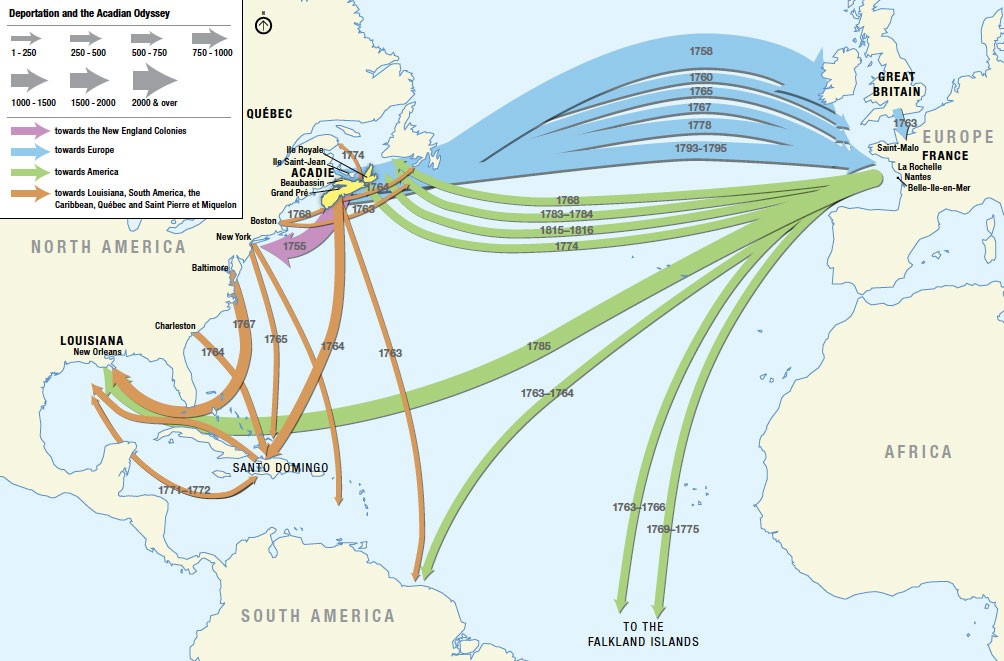
One group of Acadian families left Nova Scotia, but settled, at least for a while, on the Miramichi River, north about 250 miles overland but much further by water. On the map below, today’s Annapolis Royal was Port Royal during the expulsion.

Recently, the blog of the Association des Acadiens-Metis Souriquois published an article accompanied by a list of known refugees who sought shelter to the north.

  • The Acadian Refugee Camp on the Miramichi, 1756-1761” by Ronnie-Gilles LeBlanc (January, 2018)
  • “List of Refugee Acadian Households at Camp Espérance on the Miramichi, 1756-1757,” appendix to “The Acadian Refugee Camp on the Miramichi, 1756-1761” by Ronnie-Gilles LeBlanc English translation & glossary of place names by John Estano DeRoche, published with the author’s permission.

Please click here to view the article, list, and blog.

The first link is the historical article authored by Ronnie-Gilles LeBlanc. I strongly recommend reading this well-written and heavily sourced paper if you have history anyplace in this region.

The second document lists households in index format for easy access. They are in alphabetical order, but searching with your browser search finds spouses surnames and such.

By Lesfreck (talk) (Uploads) – Own work, CC BY 2.5, https://en.wikipedia.org/w/index.php?curid=12559991

The group of Acadians who spent the winter, hungry and cold at Camp d’Esperance (Camp Hope) numbered about 1,700. About 400-500, including “all the (nursing) children,” perished due to the grim challenges they faced – the primary of which was food and shelter, followed by the scourge of smallpox that ravaged the survivors again the following year.

The Acadians and their Native allies ate moccasins, hides of deer, cattle, beaver, and dogs. The meat had already been consumed months earlier. They were down to anything that could be digested. Many still succumbed to starvation.

The winter of 1759-1760 ushered in another food shortage as severe as the winter of 1756-1757 had been.

This bay where the camp was located sure looks peaceful today. It was much different during those horrific winters.

Acadian Ancestors

In Acadian research, we have a saying, “If you’re related to one Acadian, you’re related to all Acadians.” The Acadian community was founded by a small group of French families who settled on the Island of Nova Scotia beginning in 1603. They intermarried for the next 150 years, with each other, the local Native population, French families and soldiers who arrived later, and probably with a few English soldiers stationed at the fort.

Fortunately, for the most part, the Acadian families have been successfully reconstructed, thanks to Catholic church records, tax lists and some very dedicated researchers.

Karen Theriot Reader, a professional genealogist, has compiled an extensive genealogy, complete with sources, and made it free to all researchers on Geneanet, here.

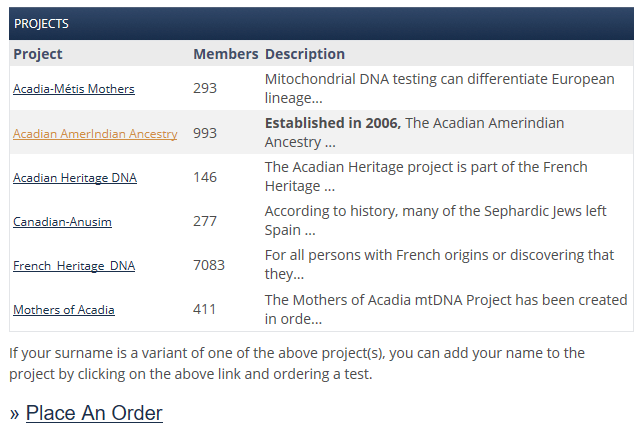
You can find Y DNA and mitochondrial information about Acadian ancestors at the Acadian Amerindian project at FamilyTreeDNA, here. One of our goals is to document each Acadian paternal Y DNA and mitochondrial DNA line. Both of those are critical to identifying which ancestors are Native American. For European ancestors, these tests help track the lines back to their origins overseas. 

If you don’t carry the Y DNA or mitochondrial DNA of Acadian ancestors, that’s fine. We want to reunite all Acadian descendants. Everyone, males and females, can take the Family Finder test or transfer an autosomal test from another vendor and join the project. Please do! You probably have lots of cousin matches waiting!

Creating a Chart

I created a chart of my known Acadian ancestors who would have been alive in 1755 when the expulsion began or born during the shadow decade or two following the expulsion. I completed as much as I know about where they lived in Nova Scotia, during the deportation purgatory decade (or so), and where they resettled later.

The deported Acadians would not have traveled directly to L’Acadie up the St. Lawrence River as drawn on the map above. They were first deported to Connecticut, Massachusetts, New York, and other places further south. I added reference locations on the map that are mentioned in the chart, below.

Please note that my research is not extensive, so I recommend confirming this information if these are your ancestors too.

After completing the chart, I then checked to see if they are on the Camp d’Esperance list.

Note that Acadia means someplace in the Acadian region on or near Nova Scotia, but the exact location is unknown. L’Acadie, noted as a resettlement area, is slightly southeast of Montreal and about 25 miles north of the Vermont border.

Name Birth-Death Comment Nova Scotia Deportation Location Resettlement Location
Jacques dit LaMontagne Lord (Lore, Laure, L’Or) 1678-1786 Born Port Royal, NS, died Nicolet, Quebec Port Royal New York in 1755 Quebec about 1766
Marie Charlotte Bonnevie 1706-1758 Born Port Royal, died at sea, married to Jacques Lord Port Royal Died at sea (I can’t help but wonder where they were taken from and to in 1758.)
Francoise dit d’Azy Mius Circa 1683-? Born Acadia, mother Native, death unknown, mother of Marie Bonnevie Port Royal Unknown, death not shown before 1755
Honore Lord 1742-1818 Born Port Royal, died St. Luc Parish, Quebec, father of Honore Lord born 1766 Port Royal Married c 1765 in New England, possibly New York St. Our, Quebec before 1771
Appoline dit Hippolyte Garceau 1742-1788 Born Port Royal, died L’Acadie, married to Honore Lord born 1742 Port Royal Married c 1765 New England St. Our Quebec before 1771
Daniel Garceau 1707-1772 Born Port Royal, died Yamachiche, Quebec, father of Appoline Garceau Port Royal Apparently, New England where Lore family was living Yamachiche, Quebec, probably before 1768
Anne dit Jeanne Doucet 1713-1791 Born Port Royal, died Sorel, Quebec, married to Daniel Garceau Port Royal Apparently New England St. Our, Quebec before 1771
Rene dit Laverdure Doucet Circa 1678-? Born Port Royal, death unknown, father to Anne Doucet Port Royal Unknown death not shown before 1755
Marie Anne Broussard Jan 1686 – ? Born Port Royal, death unknown, married to Rene Doucet Port Royal Unknown death not shown before 1755
Honore Lord 1766-1834 Born New England, died L’Acadie, father of Antoine Lord (Lore) New England New England St. Ours by 1771, then L’Acadie by 1777
Marie Lafaille 1767-1836 Born New England, died L’Acadie, married 1789 L’Acadie, to Honore Lord born 1766 New England New England L’Acadie by 1788


Francois Lafaille (Lafaye, Lafay) 1744-1824 Born Acadia, died L’Acadie, father of Marie Lafaille Acadia?, parents unknown Pledged their troth on Nov. 10, 1767, in the colonies L’Acadie by 1788 when children baptized by a priest
Marguerite Forest (LaForest, DeForet, Foret, Forais) 1748-1819 Married to Francois Lafaille 1767, remarried in 1792 in L’Acadie by a priest, died in L’Acadie, married to Francois Lafaille Port Royal Pledged their troth on Nov. 10, 1767, in the colonies L’Acadie by 1788 when children baptized by a priest
Jacques Forest 1707-? Born Port Royal, death unknown, father to Marguerite Forest Port Royal In 1763 on Connecticut census
Marie Joseph LePrince 1715-? Born Port Royal, married in 1734, death unknown, married to Jacques Forest Port Royal Husband on 1763 Connecticut census
Jean LePrince Circa 1692-after 1752 Born in Acadia, died after July 3, 1752, father of Marie Joseph LePrince Acadia Unknown, died after July 3, 1752
Jeanne Blanchard Circa 1681-? Born Port Royal, possibly deceased Port Royal, married to Jean Leprince Port Royal Unknown, may have died in Port Royal

Please note that the people listed as born in “Port Royal” were baptized there. They could have been born elsewhere. I know the priests did travel, but I don’t know how extensively, or how often.

Well, crumb, none of my ancestors are on the Camp d’Esperance list. However, I should check their children or siblings who aren’t my ancestors – especially if their siblings/children were old enough to be married.

Clearly, my ancestors might have been separated from the rest of their family, but then again, maybe not. Gathering every shred of evidence is always a good thing and the effort is never wasted – even negative evidence. Now I at least know where they weren’t.

What about you? Do you have Acadian ancestors? Where were your ancestors during and after Le Grand Derangement? Are they found at Camp d’Esperance?

_____________________________________________________________

Disclosure

I receive a small contribution when you click on some of the links to vendors in my articles. This does NOT increase the price you pay but helps me to keep the lights on and this informational blog free for everyone. Please click on the links in the articles or to the vendors below if you are purchasing products or DNA testing.

Thank you so much.

DNA Purchases and Free Transfers

Genealogy Products and Services

Books

Genealogy Research

Notre Dame and Me – 52 Ancestors #235

Not only is the week preceding Easter a religiously significant week for Christianity, it is as well for Jews who celebrate Passover, the root of Christendom’s Good Friday. The Sunni sect of Islam also fasts in observance of Passover. These religions all have their roots in the same place, just as we are all related to each other.

If Easter, Passover and their associated rites in the various religions that mark these days as Holy are emotion-filled in their own right, this past week has been exponentially so.

Notre Dame fire

By LeLaisserPasserA38 – Own work, CC BY-SA 4.0, https://commons.wikimedia.org/w/index.php?curid=78064310

A few days ago, on April 15th, Notre Dame Cathedral in Paris burned, not quite to the ground, but was extremely damaged in the inferno. The attic of the cathedral, known as “the forest” because of the extremely long old-growth oak trees that were harvested about the year 1160 for beams went up like tinder. The walls and towers remain, along with the famous medieval rose stained-glass windows.

Notre Dame rose windows

By Julie Anne Workman – Own work, CC BY-SA 3.0, https://commons.wikimedia.org/w/index.php?curid=11590000

As fate would have it, many of the statues on the roof and spire had been removed due to ongoing renovation. The treasures inside were passed, hand to hand, through a human chain to remove them as the fire burned through the roof and before the flames engulfed the upper reaches of the cathedral.

A stunned world watched Notre Dame burn for hours, staring breathlessly as night fell and the fire moved along the roofline, consuming everything in its path, like a hungry monster. The spire flamed dramatically, like a torch, then toppled, falling through the roof into the church, leaving skeletal scaffolding surrounding a black hole.

The fire photo above is the only one that I’m sure is copyright-free, being found on Wikipedia, but the images below are the result of a Google search.

Notre Dame google fire.png

One of the images, the third row from the top, third photo from the left, is horribly beautiful. God, Mother Nature or whatever name you call the Deity, created fire, and man created Notre Dame. The fire illuminated the cathedral and backlit the oldest Rose Window, the one without stained glass. Later images show the fire burning through the round window, licking the stones above.

Je Suis Dévastée

I spent the summer of 1970 traveling and living in Switzerland, studying French and culminating with a trip to Paris where we took up residence in a youth hostel for a week or two. We enjoyed a combination of student and tourist activities.

The midwestern city where I grew up supported a large Catholic church and school along with many smaller Protestant churches, but I never realized the differences between Catholicism and the Methodist and Baptist churches that I attended. The extent of my consciousness was that every church had their own “rules.” My perception was that “God” was entirely the same regardless and only man’s “church rules” varied. Therefore, I paid little mind to those differences.

I mention this because it sets the stage for my visit to Notre Dame.

Paris

Paris in August is stiflingly hot. Air conditioning in Europe is rare and was nonexistent in 1970. That didn’t matter, because nothing was air-conditioned in Indiana either.

As students, we noticed the heat, but it didn’t slow us down.

We spent our days on foot, exploring beautiful Paris and her architectural wonders. I distinctly remember feeling immediately at home in Paris, as if I had been there before – long before. I seemed to remember my way along streets that hadn’t changed much since Medieval times to places I’d never been.

I had no way of knowing that my ancestor, Jacques de Bonnevie, was born in Paris about 1660 and was probably baptized in Notre Dame.

I made my way to the Eiffel Tower, the L’Eglise de Sacre Coeur, Montmartre, the Church at Les Invalides and many parks and historic buildings.

As had been my practice during my trip, I found a local church of some description and slipped into the back row on Sunday mornings. Generally, I managed to slip out again, unnoticed, just as the services ended. My interest was as much cultural as religious, but I enjoyed the wide variety of experiences that were beyond what could be found at home.

My time in Paris was drawing to a close. I had one day left. I decided to go on one final walk-about in the city, knowing with certainty that some wonderful adventure awaited. Not one student in my group was interested in accompanying me, but another young man also staying in the hostel, Jon, wanted to go.

Jon and I set out, walking the streets of Paris in the early morning mist, before the city was quite awake. We marveled at wrought iron gates and old limestone buildings with their guardian gargoyles. If there had been selfies back then, we would have taken several as we laughed, talked and walked.

Eventually, we held hands, not as lovers but as fast friends, enjoying a once-in-a-lifetime bonding experience that no one else in the world would ever have. Just the two of us on that last, wonderful, day in Paris.

We walked towards the oldest, most historic part of town with the intention of strolling along the Seine River, land of artists, students, peace, love and happiness. The next day, we would forever be parted, so today would be filled with nothing but joy.

Mesmerized

As Jon and I approached the Seine and began to cross the bridge, Pont de la Tournelle, I stopped dead in my tracks. There was Notre Dame, “Our Lady,” standing sentry on Île de la Cité, an island in the middle of the Seine which is also the middle of both historical and contemporary Paris.

1970 Paris Notre Dame

As we stood on the bridge, I took this photo. I didn’t realize at that point in time that the building I was staring at intently was indeed the famous Notre Dame. Jon knew.

What I did know beyond a doubt was that I absolutely HAD to go inside that building. Jon mentioned that it probably wasn’t free, so he and I began counting our money to see how much we had between us.

My status as a student meant that anything requiring an entrance fee was beyond my means. Furthermore, I had spent every last dime of discretionary funds, given that it was my last day in Europe and the money I brought had been rationed across months, day by day.

Jon and I enjoyed our walk along the Seine, from the bridge to Notre Dame, drinking in the ambiance of the lovely day. The sun was high in the sky and the heat was oppressive, but we didn’t care. We found shade along the banks of the river, sitting and talking about our dreams for the future amid the background chatter of others.

Notre Dame is massive and has the effect of making one feel minuscule and inconsequential. I hadn’t yet learned that the cathedral was 800 years old, give or take a few years, but it was obviously enormous, exquisite in every detail and wonderfully historic.

Notre Dame buttresses.jpg

The flying buttresses were fascinating and incredible. I knew nothing of architecture or engineering, but I knew enough to appreciate the uniqueness of Notre Dame. At that time, I had no idea just how extraordinary the cathedral actually was.

I had developed an affinity for gargoyles during my stay in Europe, which I retain to this day.

Notre Dame strix.jpg

Jon and I enjoyed spying the gargoyles and other stone carved figures, making up stories about what they were thinking or doing, then laughing at our silliness.

Notre Dame gargoyles.jpg

That day could have lasted forever.

Finally, we approached the gargantuan doors of the cathedral, our tone becoming a bit more somber.

Notre Dame cathedral

By GuidoR – Own work, CC BY-SA 3.0, https://commons.wikimedia.org/w/index.php?curid=5284809

We were relieved to discover that admission to the cathedral itself was free although access to some features required payment.

Grateful, we crossed the threshold, leaving the hubbub of the city behind as we entered a cool, tranquil sanctum. The stone walls absorbed any noise and the cavernous interior transported us back in time before the era of cars and horns. We left 1970 behind.

Our eyes needed time to adjust to the darkness. It seemed that in those moments, we had entered another world and found ourselves transported to the past when our vision cleared.

I remember the opulence of the interior, and that Notre Dame was unquestionably the largest church I’d ever seen or been inside of – staggering in its enormity.

I didn’t understand the significance of the Catholic symbols, icons or relics, but I certainly understood the historical importance and unparalleled beauty of the building.

I understood, felt in my bones, the deep silence and peace – the respite within those ancient sheltering walls.

As my vision adapted to the darkness, the light entering through the rose window at the end of the nave was what my eye was immediately drawn towards.

Notre Dame nave.jpg

The people here did not seem like tourists, or at least not like the tourists I was used to. They were quiet, subdued and respectful, and I think of them as my co-pilgrims on a journey of discovery and enlightenment.

It’s just that many of us had no idea we were on any such journey.

While the rose windows were not the only stained-glass windows, their position, centered in the distance meant that your eye, and in my case, my body was drawn intensely towards them.

Like a moth to a flame.

As I walked towards the windows, I passed a small table where pilgrims could purchase a candle. Not the votive candles of today, but a tall, thin hand-dipped imperfect candle, maybe 10 or 12 inches long.

The candles weren’t free. I purchased one for a few coins and started to walk, with my unlit candle, towards the rose window, entirely mesmerized. A priest who was selling the candles and helping the pilgrims light them with another candle motioned me to do the same.

I looked confused, and then the Priest looked confused too. Not being Catholic, I didn’t understand the meaning of prayer candles. I did, however, comprehend the fact that a ritual was taking place, and I very much wanted to be a part of the community of ritual in this sacred space.

It didn’t seem as much religious as it did spiritual and inclusive. A human experience.

I lit my candle, but I didn’t cross myself which also served to confuse the Priest. Apparently, he wasn’t used to unschooled non-Catholic teenagers purchasing and lighting candles.

However, even though I lit my candle, I still wanted a candle as my souvenir, so I purchased a second one. Now the Priest was thoroughly confused, especially as I left the group surrounding the candle altars and began walking, alone, carrying my candle, transfixed, towards the rose window.

Notre Dame rose window.jpg

There are no words to describe what I felt.

The window transported my spirit to another time and place, not of this world. I was entranced, hypnotically drawn into the surreal beauty that seemed ethereal.

The darkness of the church seemed to allow the window, the light and the color to illuminate my soul, opening it like a flower, a rose, to the wonder of beauty, contrast and color that would endure for the rest of my life. A divine seed was being sewn in fertile soil that I didn’t understand existed.

Even today, this window has a trance-like spellbinding effect on me, as do other mandalas, including the labyrinth I constructed in my yard.

This life-defining experience initiated a chain reaction of events that won’t end until I “walk on” at the end of my life.

I don’t know how long I spent in Notre Dame that day. I have very little recollection of anything inside except for the transformative experience with the candle and the window. I kept looking for and at the rose window, from every angle, as if it were an ever-present peaceful anchor beckoning in a sea of turmoil.

If you’re lost, just look for the orienting window to find your way. It’s always there.

Jon and I left when the cathedral closed and they shooed us out.

That candle remained among my possessions for many years and life-chapters, even though it broke and cracked. Eventually, life’s events consumed the candle itself, but never the effects of Notre Dame on my life. Notre Dame infused me with my love of history, and more, much more.

Far beyond a building or a church and having nothing to do with a specific religion, Notre Dame was, to me, a place of transition or metamorphosis, a portal from this world finding passage into the infinite beauty of the eternal soul.

My experience in Notre Dame was more a nearly-invisible signal than an epiphany. I had no idea at the time what was so subtly occurring and would only connect the dots, slowly, decades later – in part as I watched Notre Dame burn. Many times a well-placed pebble sets us on our life-path.

So yes, as I sat, horrified, watching the flames consume Notre Dame, I truly was devastated. A little part of me died too as I desperately sought to see my beloved rose window in the footage as the fire burned.

I, along with the rest of the digitally-connected world watched helplessly, and to some extent, hopelessly.

Torn

I was torn between the stark contrast of devastating loss and the surreal beauty of the fire itself. Torn between agonizing loss and hope that not all would be lost. Torn between knowing that Notre Dame is just a building, and that it’s much more.

These are the thoughts that, in no particular order, raced through my mind at various times as I watched throughout the day, and night:

Icon

Coronation

Sanctuary

Witness to history

Survivor

Pope

Grief

National symbol

Accident

Disaster

Ave Maria

Mystical

Catastrophic

Jon

What happened to Jon?

Rose windows

Shared sorrow

World history

Beauty

Ancient

Hymns

Monument

Prayer

Mourn

Slow agony

Renovation

Burn

Church

Hope

Fire

Heartbreak

Museum

Aflame

Can’t rebuild the past

Unity

Reconstruction

Medieval

Respite

Devastation

Emblem

Salvation

Epic

Treasure

Tragic

Holy Week

Revolution

Peace

Crown of Thorns

Relics

Catholic

Beyond Catholic

Religious

Beyond Religious

800 years

32 lifetimes

Ancestor

Baptism

Loss

Anguish

Bonding

Rebuild

Respite

Disbelief

Paris

Agony

Transformation

Human chain

Stab in our collective hearts

Building

Metaphor

Everyone’s past

Permanent

Not permanent

World heritage

UNESCO

Cherish

Cross

Candles

Transcendent

Vessel

Passover

This too shall pass

And there I stopped, because I realized that yes, this too shall pass. Just like Passover in the Jewish faith and Good Friday with the story of the Resurrection in the Christian faith. The end is not necessarily the end. There can be hope, resurrection and salvation even after torturous trials. Notre Dame is metaphorical for all of humanities’ struggles.

Notre Dame is but a building, albeit an incredibly iconic historic one. Buildings can be restored and rebuilt. The heart and soul of Notre Dame is the heights that she inspires people to achieve, the good that she invests in the human condition and the light she shines on the future. Her value is not the building itself, but what she represents, the values she embodies and the inspiration she provides.

Indeed, this dark chapter too shall pass, perhaps uniting and unifying disparate people. Maybe there is a larger lesson in her destruction and rebirth – one for all of humanity. Perhaps this too is a seed of renewal. I hope we comprehend and internalize the message in our current generation and ones that follow.

If so, the hope, inspiration and beauty that Notre Dame infused in me and the seeds she yet holds to plant will live on immortally to guide others and cradle them eternally in her rose-colored, transcendent, illuminating light.

______________________________________________________________

Disclosure

I receive a small contribution when you click on some (but not all) of the links to vendors in my articles. This does NOT increase the price you pay but helps me to keep the lights on and this informational blog free for everyone. Please click on the links in the articles or to the vendors below if you are purchasing products or DNA testing.

Thank you so much.

DNA Purchases and Free Transfers

Genealogy Services

Genealogy Research

Acadian AmerIndian Ancestry Project

The Acadians – settlers, pioneers in a new land allied with and intermarried into the Native population of seaboard Nova Scotia beginning in 1603. They lived in harmony, developing their farms and then, roughly 150 years or 6 generations later, in 1755, they found themselves evicted, ruthlessly and forcibly deported, losing absolutely everything. They became landless refugees, living off of the benevolence of strangers…or dying. The Acadian diaspora was born. You can view a timeline here.

Marie Rundquist, Acadian and Native descendant, genetic genealogist, researcher and founder of the original AmerIndian project visited the Acadian homeland this past summer and is graciously sharing her experience through some of her photography and narrative.

Courtesy Marie Rundquist

Marie Rundquist:

This cross, located on the beach near Grand Pre where the Acadians were herded onto ships, is a priceless icon of our Acadian ancestry and represents all of our ancestors who were forcibly removed from their lands – marched on to the awaiting boats at gunpoint – and who left their footprints on this beach. Their last footprints in the land into which their effort and blood had been poured for 150 years.  This cross is very symbolic and meaningful to all who look at it.

Courtesy Marie Rundquist

This photo was taken at Waterfront Park in the town of Wolfville which borders the Minas Basin and the historic Acadian dykelands our ancestors once farmed. The area is known for the spectacular tides that rush into the basin bordering the park, totally changing its landscape.

Courtesy Marie Rundquist

Sabots, the wooden shoes pictured above were worn by Acadian ancestors who farmed the wet, marshy dykelands and were also worn on boats.  Wolfville is within a short distance of the Grand Pre UNESCO Historic Site where my husband and I stayed while attending the 2017 Acadian Mi’kmaq Celebration of Peace and Reconciliation this past August.

If you have Acadian ancestors, these pictures probably caused you to catch your breath.  Your ancestors walked here, stood here and the blood in their veins ran thick with fear, here, as they boarded the ships that would disrupt their lives forever, destroying what they had built over a century and a half.

Focus on the Homeland

Marie has recently begun a new chapter in her life which allows her to focus more directly on the Acadian and AmerIndian homelands and communities. She has been preparing for this transition for years, and all Acadian and AmerIndian researchers will be beneficiaries.

Marie initially founded the AmerIndian out of Acadia project in 2006 to sort out the relationships between the various Acadian and Native families both in Nova Scotia, and wherever their descendants have dispersed since “Le Grand Derangement,” their forced removal in 1755. The story of the Acadians didn’t end in 1755, it began anew in different locations throughout the world, the Acadian diaspora.

Through traditional genealogy research paired with genetic genealogy, we are breathing life into those ancestors once again, honoring their memory and sacrifices, and along the way, getting to know them better and finding unexpected surprises as well.

This is an exciting time in genetic genealogy for descendants of Acadians and those with American Indian roots in eastern Canada and the northeastern portion of the US.

The Acadian homeland is located in the easternmost portion of Canada, Nova Scotia.

By Mikmaq – Own work, CC BY-SA 3.0, https://commons.wikimedia.org/w/index.php?curid=1351882

Many, if not most, Acadians were admixed with the Native population in the 150 years that the French colonists lived in harmony with the Native Mi’kmaq (also referenced as Micmac) people on the Atlantic coastline of Nova Scotia. It’s impossible to study one without studying the other. Their fates, genealogies and DNA are inextricably interwoven.

Having Acadian and Native ancestors as well, and after several years of working together on other projects, I joined Marie as a co-administrator of this project in early 2017.

Today, Marie and I have several exciting announcements to make, the first of which is the renaming of the project to more accurately reflect a new, expanded, focus.

The Acadian AmerIndian Ancestry Project

You might have noticed that the AmerIndian project was renamed a few months ago as the Acadian AmerIndian Ancestry Project to reflect our expanded goals. Specifically, our goal is to create a one-stop location in which to discover Acadian genetic roots. While the Acadia – Metis Mothers and Mothers of Acadian DNA projects have existed for several years to document proven matrilineal Acadian lines, nothing of the same nature existed for Y DNA for paternal surname lineages, or for those who want to connect with their Acadian roots through autosomal DNA.

After weighing various options, Marie and I, in conjunction with Family Tree DNA, decided that the best option was to expand the existing AmerIndian project to include Y, mitochondrial and autosomal DNA of the entire Acadian population into our existing project which already has over 1000 members.

In a word, our new project focus is FAMILY!

In Marie’s words:

Primary project goal: Through genetic genealogy research techniques combined with advanced Y DNA testing, it is our goal to add to and develop Y DNA signatures for male descendants of our legacy Acadian ancestors that may be referenced by others in verifying genealogies.

We want to assure that in our surname studies we are informed by Y DNA results primarily but take into account the mtDNA Full Mitochondrial Sequence results when considering the spouse, and Family Finder (autosomal) DNA results when researching all who may share ancestry.

Surname variants and dit names are of particular interest and factor into our development of a database of surname signatures as related to Acadian genealogies.

We encourage all who have tested and have the surname lineages listed in our project profile to join our project as their combined DNA results help us see through the genealogy brick walls and help us find answers to our genealogy questions.

We want to let new and existing members know how their results have contributed to our ability to develop and verify Acadian genealogies – and for the men in particular, the attainment of Y DNA “signatures” for surname lineages against which all may compare their own Y DNA results – and reference in genealogy research. Adoptees with matching Y DNA results for Acadian surnames (as we already have a number of these) are welcome to join and participate. Our team is expert in the areas of Y DNA testing and analysis, including the latest Big Y DNA tests only through years of practical experience with geographical and haplogroup-related DNA projects.  Both Marie and Roberta have extensive project administration experience and both are affiliate researchers with The Genographic Project.

Introducing Deadre Doucet Bourke

Marie and I realized that we needed assistance, so we are very pleased to welcome our new co-administrator, Deadre Doucet Bourke. Many Acadian researchers already know Deadre, a long-time genealogist and contributor from within the project, so adding her expertise as a project administrator is a natural progression. Deadre will be focused on communicating with people regarding their genealogy and utilizing social media.

You can read the bios of our administrators here.

Welcome Deadre!!!

The DNA Focus

The Acadian AmerIndian Ancestry Project is primarily focused on Y DNA and autosomal DNA. While we aren’t competing with the two mitochondrial DNA projects, we certainly welcome those with direct mitochondrial lineages to join this project as well. We encourage researchers to combine all of the DNA that makes us family to confirm our Acadian heritage and connect to our ancestors.

Acadian researchers struggle with the inability to find their Acadian ancestor’s Y DNA signatures gathered together in one place. Marie and I decided to fix that problem, hence, the redesign of the project.

The Acadian AmerIndian Ancestry Project welcomes everyone with Acadian heritage!

If you descend from a particular line, but aren’t male or don’t carry the surname today, you’ll be able to discover information about your ancestors from the Y DNA, mitochondrial and autosomal DNA carried by other project members. Genetic genealogy is all about collaboration and sharing and finding all types of results in one project location makes that search much easier!

Who Should Join the Acadian AmerIndian Ancestry Project?

  • If you have an ACADIAN SURNAME in your family lines, as listed in the project profile or on the surname list later in this article, and you’ve had the Y DNA, mtDNA or Family Finder test, you are qualified to join this project.
  • If you are a MALE with an ACADIAN SURNAME, please join the Acadian AmerIndian Ancestry Project by ordering (minimally) a Y Chromosome 37 marker test.
  • If you are either male or female and have Acadian MATRILINEAL ANCESTRY (your mother’s mother’s mother’s line) that leads to a Native and/or an Acadian grandmother through all females, please join the Acadian AmerIndian Ancestry Project by ordering the mtFull Sequence mitochondrial DNA test.
  • If you have Acadian or Native American ancestors from the Acadian region of Canada or diaspora regions where Acadian families settled after the 1755 deportation, and would like to discover new leads for ancestry research and close, immediate and distant cousins, please join the project by ordering a Family Finder test.
  • If you have Acadian ancestry and have already taken the Y or mitochondrial DNA test at Family Tree DNA, please click here to sign in to your account and order a Family Finder test by clicking on the “Upgrade” button on the top right of your personal page.
  • If you have already tested and have Y DNA, mtDNA, or Family Finder matches with members of the Acadian Amerindian Ancestry project and are researching your ancestry, you are welcome to join this project.
  • If you have already tested your DNA at Family Tree DNA, but are not yet a project member, please click on the Project tab at the top left of your personal page to select a project to join. If the Acadian AmerIndian Ancestors project is not showing on your list, just type “Acadian” into the search box and click on the “Acadian AmerIndian Ancestry” link to join the project.
  • If you have tested your autosomal DNA at either Ancestry or 23andMe, but not at Family Tree DNA, you can download your autosomal results into the Family Tree DNA data base and use many tools for free – including the ability to join projects. You can read more about this here.

Not sure which kinds of DNA you can test for, and the difference between the different tests, please read 4 Kinds of DNA for Genetic Genealogy.

Questions? Just ask!

Saving Money by Joining the Acadian AmerIndian Project

Please note that DNA testing discounts are available through our project site for people who have never ordered a test from Family Tree DNA previously.

First, click here to go to the Family Tree DNA webpage. Scroll down, then, type the word Acadian into the search box, as shown below. This search process works for surnames as well.

Then, when the results are returned, select the Acadian AmerIndian Ancestry Project and click that link, shown below, to see DNA testing prices available to project members, example shown below.

You’ll need to scroll down to see test prices. The screen shot below only shows a portion of what is available.

DNA testing prices through the project are less than ordering the same test without joining a project.

As A Project Member

Of course, the point of DNA testing and projects is to share.  Family Tree DNA has provided several tools to help genealogists do just that.  We would ask that project members complete the following four easy steps, unless for some reason, you can’t.  For example, adoptees may not have this information.  Just do the best you can.

First, please upload a tree of at least your direct line ancestors at Family Tree DNA.

Just sign in to your personal page and click on “My Family Tree” to get started.

DNA and family trees are extremely powerful tools together – the genetic and genealogy parts of genetic genealogy.

Second, please complete the name and location of your earliest known direct matrilineal ancestor (your mother’s mother’s mother’s line) and your direct patrilineal line (your father’s father’s father’s line) by clicking on the orange “Manage Personal Information” link below your profile photo on the left side of your personal page.

Then, click on the Genealogy Tab, and then click on Earliest Known Ancestors. Please note that you can click on any image to enlarge.

You’ll need to complete:

  • Both Earliest Known Ancestor fields on the left side of the page.
  • Both Ancestral Locations by clicking on the orange “update location” for the patrilineal AND matrilineal ancestor on the right side.

Be sure to click “Save” at the bottom of the page when you’re finished.

Third, under the Privacy and Sharing tab, please consider allowing your Y and mitochondrial DNA results to show on the public page of the project.

When Acadian descendants are searching for projects to join, or information about their ancestral lines, the public project display is often what they find and how they decide if participation or DNA testing is worth their time.

Here is what our public Y DNA project page displays and here is what our mtDNA project page displays.  There is also an option for administrators to display the participants surname, but we do not have this field enabled at this time.  Other projects that you may have joined probably do have this field enabled, and your selection affects all projects of which you are a member.

Under “My Profile,” you’ll see an option to “Share my Earliest Known Ancestor with other people in the projects I’ve joined.”  If you don’t have this option enabled, only a blank space will appear, which doesn’t help anyone determine if you share a common ancestor.

A second option on this page under “My DNA Results is “Make my mtDNA and Y DNA public” which allows your results to show on the public project page.  If you select “project only” then only project members will be able to see your results when logged in to their account. Your results will no show on the public project page unless you select the public option.

Remember to click “save.”

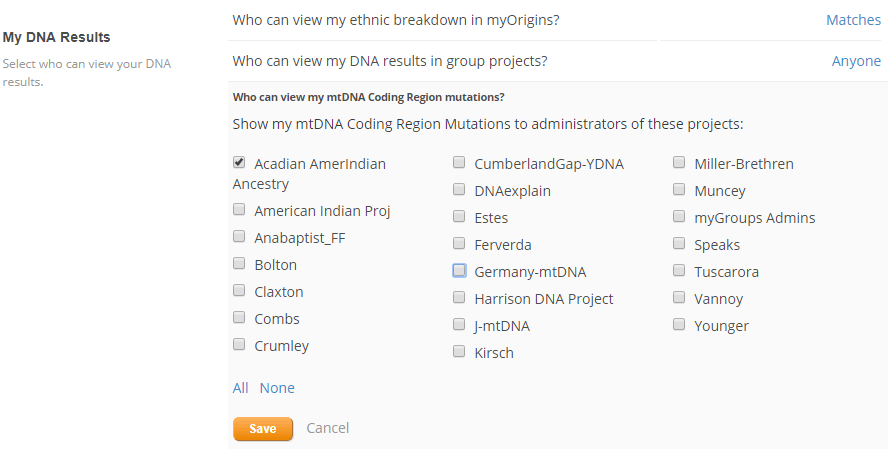
Fourth, if your mitochondrial line (mother’s mother’s mother’s line) is Acadian or Native, you’ll need to provide the project administrators with the ability to see the coding region of your mitochondrial DNA so that your mitochondrial DNA can be properly grouped within the project.  If your direct matrilineal line does NOT pertain to Acadian or Native ancestry, then you’re done.

If your matrilineal line is Native or Acadian, on the Privacy and Sharing page, under “Account Access,” please click on the “Only You” answer to “Who can view my mtDNA Coding Region mutations.”

You will then see a drop down list of the projects you have joined.  You can select any of the projects by clicking the box beside the project.  Only the administrators of the projects you’ve selected can see your coding region results, and you can change this at any time. In my personal account, I’ve selected all of the projects that my mtDNA is relevant to.

Your coding region results are NEVER displayed publicly and no one other than project administrators can see those results.  Family Tree DNA does not offer the option of displaying coding regions in any project.

Again, don’t forget to click “save,” or you haven’t.

Need Help?

Need help? Just ask. We’re here to help.

Project administrators can help you by completing some fields, like most distant ancestor, with your permission, but Privacy and Sharing fields can’t be changed or edited by administrators for everyone’s security.  However, we’d be glad to step you through the process, as would Family Tree DNA customer support.  You can call or contact customer support by scrolling down to the very bottom of your personal page.

Acadian Surnames

Courtesy Marie Rundquist

I compiled the following list of Acadian surnames along with dit names (surname nicknames) from the following Acadian website where you can view which ancestral families were recorded in various census documents including 1671, 1686, 1714 and a deportation list from 1755.

Brenda Dunn’s list was prepared for the Canadian National Parks Service for the Grand Pre National Historic site.

Variant spellings were retrieved from this site and may not be inclusive.

Surname Various Spellings Source
Abbadie, de Saint-Castin d’ Brenda Dunn
Allain Alain, Alin, Allain, Halain, Halin Brenda Dunn
Allard Alard, Allard, Allart, Halard, Hallard Acadian-Cajun.com
Amirault dit Tourangeau Amireau, Amireault, Mero, Miraud, Mirau, Miraux, Mireau, Mireault, Moreau Brenda Dunn
Angou dit Choisy Brenda Dunn
Apart Brenda Dunn
Arcement Brenda Dunn
Arnaud Arnaud, Arnault Brenda Dunn
Arosteguy Brenda Dunn
Arseneau Brenda Dunn
Aubin Aubain, Aubin, Obin Acadian-Cajun.com
Aubois Brenda Dunn
Aucoin Aucoin, Coin, Ocoin Brenda Dunn
Ayor Brenda Dunn
Babin Babain, Babin Brenda Dunn
Babineau dit Deslauriers Babinau, Babineau, Babineaux, Babino, Babinot Brenda Dunn
Barillot Brenda Dunn
Barnabe Acadian-Cajun.com
Barriault Bariau, Bariault, Barieau, Barillault, Barrillaut, Barillon, Barillot, Bario, Barrio Acadian-Cajun.com
Bastarache dit (Le) Basque Brenda Dunn
Bastien Baptien, Basquien, Bastien, Vasquais Brenda Dunn
Beaulieu Baulieu, Baulieux, Beaulieu, Beaulieux Acadian-Cajun.com
Beaumont Beaumon, Beaumont Acadian-Cajun.com
Belisle Belisle, Bellisle, de Bellisle Acadian-Cajun.com
Bellefontaine Bellefontaine, Bellefontenne Acadian-Cajun.com
Belleville Beliveau Brenda Dunn
Belliveau dit Bideau Beliveau Brenda Dunn
Belliveau dit Blondin Brenda Dunn
Belou Brenda Dunn
Benoit dit Labriere Benois, Benoist, Benoit Brenda Dunn
Bergereau Brenda Dunn
Bergeron d’Amboise Brenda Dunn
Bergeron dit Nantes Bargeron, Bergeon, Bergeron, Berjeron Brenda Dunn
Bernard Bernar, Bernard Brenda Dunn
Berrier dit Machefer Brenda Dunn
Bertaud dit Montaury Brenda Dunn
Bertrand Bartrand, Berterand, Bertran, Bertrand, Bertrant Brenda Dunn
Bezier dit Lariviere Brenda Dunn
Bezier dit Touin Brenda Dunn
Bideau Acadian-Cajun.com
Blanchard dit Gentilhomme Blanchar, Blanchard, Blanchart Brenda Dunn
Blondin Blondain, Blondin Acadian-Cajun.com
Blou Acadian-Cajun.com
Bodard Brenda Dunn
Boisseau dit Blondin Boissau, Boisseau, Boisseaux Brenda Dunn
Bonnevie dit Beaumont Brenda Dunn
Borel Brenda Dunn
Boucher dit Desroches Bouché, Boucher, Bouchez Brenda Dunn
Boudreau Boudrau, Boudraut, Boudreau, Boudro, Boudrot Acadian-Cajun.com
Boudrot Brenda Dunn
Bourg Bourc, Bourg, Bourgue, Bourk, Bourque Brenda Dunn
Bourgeois Bourgeois, Bourgois, Bourjois Brenda Dunn
Boutin Boudin, Boutain, Boutin, Bouttain, Bouttin Brenda Dunn
Brassaud Brenda Dunn
Brasseur dit Mathieu Brasseur, Brasseux Brenda Dunn
Breau Brenda Dunn
Breton Berton, Breton, Lebreton Acadian-Cajun.com
Brossard Brosard, Brossar, Brossard, Brossart, Broussard Brenda Dunn
Brun Brun, Lebrun Brenda Dunn
Bugaret Brenda Dunn
Bugeaud Brenda Dunn
Buisson Buisson, Busson, Dubuisson Brenda Dunn
Buote Brenda Dunn
Buteau Butau, Butaud, Buteau, Buteux, Buto, Butteau Brenda Dunn
Cadet Caddé, Cadet, Cadette Acadian-Cajun.com
Caissy dit Roger Brenda Dunn
Calve dit Laforge Brenda Dunn
Carre Caray, Caré, Caret, Carr, Carré, Carret Brenda Dunn
Cassy dit Roger Brenda Dunn
Celestin dit Bellemere Brenda Dunn
Cellier dit Normand Brenda Dunn
Champagne Champagne, Champaigne Acadian-Cajun.com
Chauvert Acadian-Cajun.com
Chauvet Chauvet, Chauvette, Chovet Brenda Dunn
Chenet dit Dubreuil Chenay, Chenet, Chenette, Chesnay Brenda Dunn
Chesnay dit Lagarene Brenda Dunn
Chiasson dit La Vallee Chiasson, Giasson Brenda Dunn
Chouteau dit Manseau Brenda Dunn
Clemenceau Brenda Dunn
Cloustre Brenda Dunn
Cochu Cochu, Cochus Acadian-Cajun.com
Cognac Cognac, Coignac Brenda Dunn
Comeau Brenda Dunn
Cormier dit Bossigaol Cormié, Cormier, Cornier Brenda Dunn
Cormier dit Thierry Brenda Dunn
Cornelier Brenda Dunn
Corporon Brenda Dunn
Cosse Acadian-Cajun.com
Cosset Cosset, Cossette Brenda Dunn
Coste Brenda Dunn
Cottard Brenda Dunn
Cousineau Brenda Dunn
Crepeau Crepau, Crepaux, Crepeau, Crepeaux, Crepos, Crespau, Crespeau, Crespel Brenda Dunn
Creysac dit Toulouse Brenda Dunn
Cyr Cir, Cire, Cyr, Cyre, Sir, Sire, Siree, Syr, Syre Brenda Dunn
Daigle Daigle. Daigles, Dehegue Acadian-Cajun.com
Daigre Brenda Dunn
Damboue Acadian-Cajun.com
D’Amours de Chauffours Brenda Dunn
D’Amours de Clignancour Brenda Dunn
D’Amours de Freneuse Brenda Dunn
D’Amours de Louviere Brenda Dunn
D’Amours de Plaine Brenda Dunn
Daniel Daniel, Daniele, Danielle, Deniel Brenda Dunn
Darois Brenda Dunn
David dit Pontif Davi, David, Davit, Davy Brenda Dunn
Debreuil Acadian-Cajun.com
Delatour Delatour, Latour Acadian-Cajun.com
Delisle Delile, Delille, Delisle, Delisles, Brenda Dunn
Denis Deni, Denis, Dennis, Denys Brenda Dunn
D’Entremont Acadian-Cajun.com
Denys de Fronsac Brenda Dunn
Depeux Acadian-Cajun.com
Derayer Brenda Dunn
Desaulniers Desaulnier, Desaulniers, Desaunié, Desaunier, Desauniers Acadian-Cajun.com
Deschamps dit Cloche Dechamp, Dechamps, Dechant, Deschamps Brenda Dunn
Desgoutins Brenda Dunn
Desmoulins Demoulin, Desmoulin, Desmoulins, Dumoulin Brenda Dunn
Desorcis Acadian-Cajun.com
Després Depre, Depres, Despre, Despres, Desprez Brenda Dunn
Devaux Acadian-Cajun.com
Deveau dit Dauphine Devau, Devaux, Deveau, Deveaux, Devot, Devots Brenda Dunn
Dingle Brenda Dunn
Doiron Doiron, Douairon, Doueron Brenda Dunn
Domine dit Saint-Sauveur Brenda Dunn
Donat Acadian-Cajun.com
Douaron Acadian-Cajun.com
Doucet dit Laverdure Doucet, Doucette Brenda Dunn
Doucet dit Lirlandois Brenda Dunn
Doucet dit Mayard Brenda Dunn
Druce Brenda Dunn
Dubois dit Dumont Debois, Desbois, Dubois, Duboy Brenda Dunn
Dufault Dufau, Dufault, Dufaut, Dufaux, Duffault, Duffaut, Duffaux, Dufo, Dufos, Duphaut Brenda Dunn
Dugas Duga, Dugas, Dugast, Dugat Brenda Dunn
Duguay Dugai, Dugaie, Dugay, Duguay, Dugué Brenda Dunn
Dumont Dumon, Dumond, Dumont Acadian-Cajun.com
Duon dit Lyonnais Brenda Dunn
Dupeux Acadian-Cajun.com
Duplessis Duplaissy, Duplassis, Duplassy, Duplecy, Duplesis, Duplessis, Duplessy, Placy Brenda Dunn
Dupuis Dupui, Dupuis, Dupuit, Dupuits, Dupuy, Dupuys Brenda Dunn
Egan Brenda Dunn
Emmanuel Acadian-Cajun.com
Esperance Lespérance, Lesperence Acadian-Cajun.com
Fardel Acadian-Cajun.com
Flan Brenda Dunn
Fontaine dit Beaulieu Delafontaine, Fonteine, Lafontaine, Lafonteine, Lafonteinne Brenda Dunn
Forest Fores, Forêt, Laforêt, Laforest Brenda Dunn
Foret Forest Acadian-Cajun.com
Forton Brenda Dunn
Fougere Brenda Dunn
Fournier Fournié, Lefournier Brenda Dunn
Froiquingont Brenda Dunn
Gadrau Brenda Dunn
Galerne Brenda Dunn
Galle Brenda Dunn
Garceau dit Boutin Garco, Garso, Garsot Brenda Dunn
Garceau dit Richard Brenda Dunn
Garceau dit Tranchemontagne Brenda Dunn
Gardet Gardai, Garday, Gardé Brenda Dunn
Gareau Garau, Garaud Brenda Dunn
Gaudet Gaudais, Gaudé, Gaudette, Godé, Godet, Godete, Godette Acadian-Cajun.com
Gauterot Brenda Dunn
Gauthier Gaultier, Gautier, Gotier Brenda Dunn
Gentil Brenda Dunn
Giboire Duverge dit Lamotte Brenda Dunn
Girouard Geroir, Gerroir, Giouard, Giroir, Girroir, Jirouard Brenda Dunn
Gise Brenda Dunn
Godin Boisjoli Brenda Dunn
Godin dit Beausejour Gaudain, Gauden, Gaudin, Godain, Goddin, Godin Brenda Dunn
Godin dit Bellefeuille Brenda Dunn
Godin dit Bellefontaine Brenda Dunn
Godin dit Catalogne Brenda Dunn
Godin dit Chatillon Brenda Dunn
Godin dit Lincour Brenda Dunn
Godin dit Preville Brenda Dunn
Godin dit Valcour Brenda Dunn
Godon Gandon, Gaudon, Godon Brenda Dunn
Gosselin Gaucelin, Gauscelin, Gausselin, Goscelin, Gosselain Brenda Dunn
Goudreau Gaudrau, Gaudrault, Gaudreau, Gaudreault, Gaudro, Godereau, Godrault, Godreault, Godro, Godrot, Goodrow Brenda Dunn
Gougeon Gougeon, Gougon, Goujon, Goujou Acadian-Cajun.com
Gourdeau Acadian-Cajun.com
Gousille Acadian-Cajun.com
Gousman Brenda Dunn
Gouzille Brenda Dunn
Grandmaison Degrandmaison Brenda Dunn
Granger Brenda Dunn
Gravois Brenda Dunn
Grosvalet Brenda Dunn
Guedry dit Labine Brenda Dunn
Guedry dit Labrador Brenda Dunn
Guedry dit Laverdure Brenda Dunn
Guedry Grivois Guidry, Guildry Brenda Dunn
Gueguen Brenda Dunn
Guenard Brenda Dunn
Guerin dit LaForge Guerrin Brenda Dunn
Guilbault Guibau, Guibaut, Guibeau, Guibo, Guilbau, Guilbaud, Guilbaux, Guilbeau, Guillebault, Guillbeau, Guilbaut Acadian-Cajun.com
Guilbeau Brenda Dunn
Guillot Brenda Dunn
Guy dit Tintamarre Degui, Deguy, Gui Brenda Dunn
Guyon Dion, Dionne, Gion, Guillon, Guion, Gyon, Yon Brenda Dunn
Hache dit Gallant Brenda Dunn
Hamel Amel, Amell, Emmel, Hamell, Hamelle, Hornel Brenda Dunn
Hamet Brenda Dunn
Hamon Brenda Dunn
Hébert dit Manuel Abaire, Abare, Abbot, Ebart, Éber, Ébert, Heber, Heberd, Hébere, Herber, Herbert, Hesbert, Hibbart, Hubert Brenda Dunn
Helys dit Nouvelle Brenda Dunn
Henry dit Robert Henri Brenda Dunn
Hensaule Brenda Dunn
Heon Brenda Dunn
Herpin Arpin, Guertin, Harpin, Hertin Acadian-Cajun.com
Heuse Brenda Dunn
Hugon Brenda Dunn
Jasmin Jassemin Acadian-Cajun.com
Jeanson Jeansonne Brenda Dunn
Joseph Brenda Dunn
Kimine Brenda Dunn
Labarre Delabarre, Labar, Labard Brenda Dunn
Labat, dit Le Marguis, de Labatte Brenda Dunn
LaBauve Brenda Dunn
Lachaume Delachaume Brenda Dunn
Lacroix Delacroix Brenda Dunn
Lafond Lafon, Lafont Acadian-Cajun.com
Lafont Acadian-Cajun.com
Lagasse Lagace, Lagacee, Lagassee, Lagassees, Lagasset Acadian-Cajun.com
Lalande dit Bonnappetit Delalande, Lalande Brenda Dunn
Laliberte Laliberte, Liberte Acadian-Cajun.com
Lambert Lamber, Lembert Brenda Dunn
Lambourt Brenda Dunn
Lamontagne Delamontagne, Montagne Acadian-Cajun.com
Landrom Brenda Dunn
Landry Landri, Landrie, Landril, Landrille, Lendry Brenda Dunn
Langlois Anglais, Anglois, Langlais, Langloi, Langlouois Brenda Dunn
Lanoue Brenda Dunn
Lapierre dit LaRoche Delapierre, Lapeer, Pierre Brenda Dunn
Latour Acadian-Cajun.com
Laurier Lauriere,Lorier Acadian-Cajun.com
LaVache Brenda Dunn
Lavallée Lavale, Lavalee, Vale, Valee, Valle, Vallee Acadian-Cajun.com
Lavergne Laverne Brenda Dunn
Lavigne Delavigne Brenda Dunn
Lebasque Acadian-Cajun.com
Lebert dit Jolycoeur Abare, Hébert, Labare, LeBear, Leber, Leberre, Libest Brenda Dunn
Leblanc dit Jasmin Blanc, Leblan, Lebland, Leblant Brenda Dunn
LeBorgne dit Belisle Brenda Dunn
Lebreton Berton, Beurton Acadian-Cajun.com
Leclerc dit Laverdure Clair, Claire, Clerc, Leclair, Leclaire, Lecler, Leclerq Brenda Dunn
Lecul Brenda Dunn
Lefebvre Febur, Febvre, Lefaivre, Lefebre, Lefebur, Lefeuvre, Lefevre Acadian-Cajun.com
Leger dit La Rozette Legere, Legey, St-Leger Brenda Dunn
Lejeune dit Briard Jeune, Lejeunne Brenda Dunn
LeJuge Brenda Dunn
Lemaistre Acadian-Cajun.com
LeMarquis dit Clermont Brenda Dunn
Lemire Lemir, Lemirre, Lemyre, Lemyrre, Mire Brenda Dunn
LeNeuf de Beaubassin Lenef, Leneuf Brenda Dunn
LeNeuf de Boisneuf Brenda Dunn
LeNeuf de LaValliere Brenda Dunn
L’Enfant Brenda Dunn
LePoupet de Saint-Aubin Brenda Dunn
LePrieur dit Dubois Brenda Dunn
LePrince Brenda Dunn
Leroy Leroi, Roi, Roy Brenda Dunn
L’Eschevin dit Billy Brenda Dunn
Lespérance Delesperance, Lesperence Acadian-Cajun.com
Lessoile Acadian-Cajun.com
LeVanier dit Langevin Brenda Dunn
LeVasseur dit Chamberlange Brenda Dunn
Leveille Leveiller, Leveillez, Leveillie, Leveillier Brenda Dunn
Levron dit Nantois Leveron Brenda Dunn
Loiseau Laiseau, Laizeau, Loisau, Loisseau, Loizeau, Loseau, Loyseau, Lozeau Brenda Dunn
Long Brenda Dunn
Longuepee Brenda Dunn
Loppinot Brenda Dunn
Lord dit Montagne Lore Brenda Dunn
Lort Acadian-Cajun.com
Lucas Luca Brenda Dunn
Lyonnais Acadian-Cajun.com
Maffier Brenda Dunn
Maillard Acadian-Cajun.com
Maillet Brenda Dunn
Maisonnat dit Baptiste Brenda Dunn
Malboeuf Malbeuf Brenda Dunn
Mangeant dit Saint Germain Brenda Dunn
Manseau Manceau, Mansau Acadian-Cajun.com
Marcadet Brenda Dunn
Marchand dit Poitiers Marchan, Marchant Brenda Dunn
Marres dit LaSonde Brenda Dunn
Martel Martelle Brenda Dunn
Martil Acadian-Cajun.com
Martin dit Barnabe Martain Brenda Dunn
Massé Macé, Macés, Masset, Massey Brenda Dunn
Massie Brenda Dunn
Mathieu Mathieux, Matthieux Brenda Dunn
Maucaire Brenda Dunn
Mazerolle dit Saint Louis Brenda Dunn
Melanson dit LaRamee
Melanson dit Laverdure Melanson, Melençon, Melenson, Menançon Brenda Dunn
Mercier dit Caudebec Lemercier, Mersier Brenda Dunn
Messaguay Brenda Dunn
Meunier Megné, Menié, Mesnier, Meusnier, Munier, Musnier Brenda Dunn
Michaud Michau, Michault, Michaut, Michaux, Micheau Acadian-Cajun.com
Michel dit LaRuine Bichel, Miché, Michelle, Micher Brenda Dunn
Migneau dit Aubin Mignau, Mignaud, Mignault, Mignaux, Migneaux, Mignot, Migneau Brenda Dunn
Mignier dit Lagasse Brenda Dunn
Mignot Mignau, Mignaud, Mignault, Mignaux, Migneaux, Mignot Brenda Dunn
Mirande Brenda Dunn
Mius d’Azit Miusse, Mousse Brenda Dunn
Mius de Entremont de Plemarais Miusse, Mousse Brenda Dunn
Monmellian dit Saint Germain Brenda Dunn
Mordant Brenda Dunn
Morin dit Boucher Maurain, Maurin, Morrin Brenda Dunn
Morpain Brenda Dunn
Moulaison dit Recontre Brenda Dunn
Mouton Brenda Dunn
Moyse dit Latreille Brenda Dunn
Muis de Entremont de Pobomcoup Miusse, Mousse Brenda Dunn
NaQuin dit L’Etoile Brenda Dunn
Nogues Brenda Dunn
Nuirat Brenda Dunn
Olivier Oliver, Olivie, Ollivier Brenda Dunn
Ondy Acadian-Cajun.com
Onel O’Neale Brenda Dunn
Orillon dit Champagne Aurillon, Aurion, Orion, Oriont Brenda Dunn
Oudy Brenda Dunn
Ozelet Brenda Dunn
Paris Deparis, Parisis, Parisse, Pary Acadian-Cajun.com
Parisien Leparisien, Parisiens, Parizien Acadian-Cajun.com
Part Brenda Dunn
Pellerin Pelerin, Pelrin Brenda Dunn
Pesseley Acadian-Cajun.com
Petitot dit Saint Sceine Brenda Dunn
Petitpas Brenda Dunn
Pichot Brenda Dunn
Picot Brenda Dunn
Pincer Brenda Dunn
Pinet Brenda Dunn
Pitre dit Marc Lepitre, Pistre, Piter, Pittre Brenda Dunn
Poirier Poerier, Poirie, Poiriers, Poirrier, Porier, Poyrie, Poyrier Brenda Dunn
Poitevin dit Cadieux Lapoitevin, Paudevin, Poidevin, Poitvin, Potdevin, Potevin, Potvin Brenda Dunn
Poitevin dit Parisien Lapoitevin, Paudevin, Poidevin, Poitvin, Potdevin, Potevin, Potvin Brenda Dunn
Poitier Brenda Dunn
Porlier Brenda Dunn
Pothier Pauthier, Pautier, Poitié, Poitier, Poitiers, Potier, Potiers, Pottier Acadian-Cajun.com
Poujet dit Lapierre Brenda Dunn
Poulet Acadian-Cajun.com
Poupard Poupar, Poupare, Poupart Brenda Dunn
Prejean dit LeBreton Pregeant, Pregent, Prejan Brenda Dunn
Pretieux Brenda Dunn
Pugnant dit Destouches Brenda Dunn
Racois dit Desrosiers Brenda Dunn
Raymond Raimon, Raimond, Raymont, Raymon, Remond, Remont Brenda Dunn
Renaud dit Provencal Rainaud, Raynaud, Raynalt, Regnault, Regneault, Renau, Renauld, Renault, Renaut, Renaux, Reneau, Reneault, Renaux, Renod Brenda Dunn
Richard dit Beaupri Richar, Richart Brenda Dunn
Richard dit Boutin Richar, Richart Brenda Dunn
Richard dit Lafont Richar, Richart Brenda Dunn
Richard dit Sancoucy Richar, Richart Brenda Dunn
Rimbeau Rimbaut Brenda Dunn
Rivet Rivais, Rive, Rivest, Rivette, Rivez Brenda Dunn
Robichaud dit Cades Robichau Brenda Dunn
Robichaud dit Niganne Robichau Brenda Dunn
Robichaud dit Prudent Robichau Brenda Dunn
Rodoham Brenda Dunn
Rodrigue dit DeFonds Rodrigues, Rodriguez Brenda Dunn
Rossette Roucet, Roucette, Rouset, Rousette Acadian-Cajun.com
Rousse dit Languedoc Leroux, Rousse, Roux Brenda Dunn
Roy dit Laliberte Leroi, Roi, Roy Brenda Dunn
Rullier Brenda Dunn
Saindon Brenda Dunn
Saint Etienne de La Tour, de Brenda Dunn
Saint Julien de La Chaussee, de Brenda Dunn
Saint Scene Acadian-Cajun.com
Samson Sanson Brenda Dunn
Saulnier Saunier Brenda Dunn
Sauvage dit Chrystophe Sauvages, Sauvagesse, Sauvaget, Savage Brenda Dunn
Sauvage dit Forgeron Sauvages, Sauvagesse, Sauvaget, Savage Brenda Dunn
Savary Brenda Dunn
Savoie Brenda Dunn
Semer Brenda Dunn
Sereau Serot, Serreau Brenda Dunn
Serreau de Saint-Aubin Brenda Dunn
Simon dit Boucher Cimon Acadian-Cajun.com
Simoneau Simonau,   Simonaud, Simoneaux, Simonneau, Simono, Acadian-Cajun.com
Soulard Soular, Soulard, Soulart, Soullard Brenda Dunn
Soulevent Brenda Dunn
Surette Brenda Dunn
Tandau Brenda Dunn
Teriot Teriau, Teriaut, Teriot, Terriau, Terriaux, Terriau, Terriaux, Terriot, Theriault, Theriaux, Therieau Brenda Dunn
Testard dit Parish Testar, Testard, Tetard, Tetart Brenda Dunn
Thebeau Brenda Dunn
Thibault Brenda Dunn
Thibeau Acadian-Cajun.com
Thibodeau Brenda Dunn
Tillard Brenda Dunn
Tourangeau Tourangeau, Tourangeaux Acadian-Cajun.com
Tourneur Brenda Dunn
Toussaint dit Lajeunesse Tousain, Toussain, Toussaint, Toussin, Touzin Brenda Dunn
Trahan Brenda Dunn
Triel dit LaPerriere Brenda Dunn
Turcot Brenda Dunn
Turpin dit LaGiroflee Brenda Dunn
Vallois Brenda Dunn
Veco Acadian-Cajun.com
Vescot Brenda Dunn
Viger Brenda Dunn
Vigneau dit Maurice Vignau, Vignault, Vignaux, Vigneau, Vigneaux Brenda Dunn
Villatte Vilatte Brenda Dunn
Vincent dit Clement Vincant, Vincent Brenda Dunn
Voyer Brenda Dunn
Yvon Acadian-Cajun.com

 Additional Resources

In addition to the resources utilized to compile the Acadian surnames listed above, we recommend the following resources for genealogical research:

  • View the Acadian family tree contributed and maintained by genealogist Karen Theriot Reader at this link.
  • The Acadian Rootsweb list hosted by Paul LeBlanc provides an invaluable resource for sharing information.  To subscribe to the list, please send an email to ACADIAN-request@rootsweb.com with the word ‘subscribe’ without the quotes in the subject and the body of the message.  If you are not already a member, you can browse the archives here or you can search the Acadian list archives for keywords like surnames by utilizing the search engine here.
  • Please visit the Family Heritage Research Community to read exciting articles about how real people like you discovered their roots by way of DNA testing.

Additional projects administered by Roberta Estes and Marie Rundquist that may be relevant to Acadian descendants include:

Thank You

We want to extend a big thank you to the incredible members of the Acadian AmerIndian Ancestry Project for recruiting new members, for their individual research, and for sharing so willingly. A project is only as strong as the members!

We hope you’ll be joining us soon!

Photography Credit

The location photos used in this article were taken this summer at the Annapolis Royal Historic Site, Annapolis Royal Historic Gardens and the Grand Pre UNESCO World Heritage Site by Marie Rundquist. Thanks to Marie for being our project ambassador, for permission to use her photography here and on the Acadian AmerIndian Ancestry Project page as well.

______________________________________________________________

Disclosure

I receive a small contribution when you click on some of the links to vendors in my articles. This does NOT increase the price you pay but helps me to keep the lights on and this informational blog free for everyone. Please click on the links in the articles or to the vendors below if you are purchasing products or DNA testing.

Thank you so much.

DNA Purchases and Free Transfers

Genealogy Services

Genealogy Research

What is a DNA Scholarship and How Do I Get One?

I mention DNA scholarships from time to time in my 52 Ancestor articles and sometimes in conjunction with other projects as well.

What, exactly, is a DNA scholarship? Who gets one?  How and why?

First, let’s talk a bit about the basics of how DNA works, because understanding that is fundamental to understanding why we have DNA scholarships in the first place, who qualifies and why. Not everyone has the DNA they need for testing specific genealogical lines – and scholarships are a way to obtain that information from others.  I think of it as a testing incentive to someone who is already interested at some level.

Every person can test their DNA, but each person carries a unique and very important type of DNA from just one or two very specific ancestors.

DNA for Genealogy – Y and Mitochondrial

There are three kinds of DNA we can use for genealogy.

Mitochondrial DNA, carried by both males and females, is your mother’s mother’s mother’s line all the way up your tree until you run out of direct line mothers.

Y DNA, which only males carry, is inherited from the father’s father’s father’s direct paternal line which typically follows the surname.

The pedigree chart path of both Y (blue) and mitochondrial DNA (red) is shown on the pedigree chart below

Y and mito

You’ve probably noticed that the brother, or males, carry both blue Y DNA and red mitochondrial DNA, but the sister, or females, carry only red mitochondrial DNA.

Sisters, or females, pass mitochondrial DNA on to their offspring, but males don’t.

So, males can test for Y and mitochondrial DNA and females can only test for mitochondrial DNA. In either case, the mitochondrial DNA reflects the oldest direct matrilineal ancestor in that line.

Most (but not all) of the DNA scholarships that I offer are for Y and mitochondrial DNA lineages and Family Tree DNA is the only company that offers these types of genealogical tests.

Autosomal DNA

The third kind of DNA for genetic genealogy is autosomal DNA which allows testing for all of your ancestral lines and provides matching to others who carry the same DNA. The trick is, of course, that you have to look at your common genealogy to figure out why your DNA matches, meaning which ancestor you share.  Sometimes that quest is successful, and sometimes it isn’t.

Autosomal path

The reason autosomal DNA matching works is because you and the person you match have inherited a piece of the same DNA from a common ancestor. In the above chart, the DNA of the ancestors is colored blue, yellow, green, etc.  When you match someone else with a common segment, your goal is to determine which ancestor it came from.

Your autosomal DNA segments from any given ancestor become smaller and smaller over time with each generation, until eventually, they either become so small they don’t show up as matches, or you lose them altogether as more and more generations accrue between you and that ancestor. Ancestral DNA is “diluted” in a sense in every generation when the offspring receives half of each parent’s DNA.  The chances of carrying a particular distant ancestor’s DNA become less in each generation.

However, the Y and mitochondrial DNA are never diluted, because they are never admixed with the DNA of the other parent. They are passed intact, and therefore they provide a periscope back into the very distant past, but ONLY for that particular line.  In many cases, the haplogroup, or “clan” tells you a great deal about that ancestor, such as where they were from ancestrally.  There are African, Native American, Asian, Jewish and European haplogroups, and yes of course there is some overlap between some of those, but we have advanced tools to deal with that too.

Combining Autosomal DNA with Y and Mitochondrial

If you can discover the Y and mitochondrial DNA haplogroup of each of the ancestors on your tree, you can tell a great deal about them that may well have washed out in the autosomal DNA. For example, in the colored graph above, let’s say that the blue male line is unquestionably Native American and carries a distinctive Native American Y haplogroup, C-P39.

Using this example, if the blue male great-grandfather is 100% Native, which is very unlikely today, the “son’s” and “daughter’s” autosomal DNA would reflect something like 12.5% Native heritage.

However, if the blue great grandfather was himself only one eighth Native, he would have carried roughly 6.25% total Native autosomal DNA and his children would carry roughly 3.25%. The father in this chart would carry roughly 1.63% Native autosomal DNA and the children in the chart, only .81 or less than 1%, an amount which is generally not recognizable on autosomal ethnicity tests today.  It’s also possible that the Native autosomal DNA has “washed out” entirely by this time.

The good news is that the Y DNA is still 100% Native. So even though Native heritage may not be detectable today in the autosomal tests, it’s 100% confirmed in the Y DNA test for that line.  This makes Y DNA a very powerful tool.  Mitochondrial DNA works the very same way on the matrilineal line – it never gets diluted either.

But, what if your Native ancestor is not in either the Y (blue) or mitochondrial (red) lines that you can directly test for?  What if your Native ancestor is in the yellow, green, pink, grey, gold or aqua lines.  You won’t know what the DNA of those direct Y or mitochondrial lines tells you until you find someone appropriately descended from those lines to test.

DNA Beggars

You’ve now become a DNA beggar – begging for people who do descend from those lines through Y or mitochondrial DNA to test. If you’re a female, it can become immediately evident if you have no male siblings and your father is deceased.  In this case, you can’t test your Y DNA directly (because you don’t have a Y chromosome,) but you desperately need those results to flesh out your genealogy.

The good news is that this same information is important to other people too and they DO carry the Y or mitochondrial DNA of the lineage you need.

I call this process creating your DNA pedigree chart.  Here’s an example of mine with haplogroups, where known.

DNA Pedigree

The good news is that sometimes people from those lineages have already tested and you may be able to find them through either surname projects, Ysearch or Mitosearch. When I can’t find someone who has already tested, I try various methods to recruit a suitable candidate and sweeten the pie by offering a DNA scholarship.

DNA Scholarships

Given that you want other people to test their DNA to provide information for your common ancestor – the best way to obtain that is to offer to pay for the test. Hence, the DNA scholarship.  Some people don’t feel comfortable if I say I’m paying for a test.  Sometimes, in surname and haplogroup projects, people join forces to pay for tests for someone with a particular lineage.  Regardless of who pays, or how, the result is that a DNA scholarship is available for someone of a particular lineage.

Looking for a DNA Scholarship?

You’d actually be surprised how many scholarships, or free DNA tests, are available. The ISOGG Wiki holds a list under the title of “Free DNA Tests” at this link.

The scholarships I offer, listed below, are for one person, and when someone has taken that one test, the scholarship is no longer available. I’ll update this list as I add scholarships and as they are (hopefully) redeemed.

Mitochondrial DNA Testing Scholarship for anyone who descends through any from the following people (or their female siblings) through all females only. In the current generation, meaning you, males can test so long as there are only females between the male and the ancestor.

Y DNA Testing Scholarship for any male who descends from the following people through all males, meaning you carry the surname today:

  • Berchtol, Hans (1641/53-1711) Konken/Krottelbach, Germany, wife Anna Christina or Hans Simon Berchtol/Bechtel, wife Catherine, living in Steinwenden, Germany in the same timeframe
  • Bonnevie, Jacque dit “Beaumont” (c1660 Paris -1783 Port Royal, Acadia)
  • Combs, John (c1705-1762) Amelia County, VA or brother George Combs (b 1701/05-c1765) lived in Charlotte County, VA
  • Dorfler, Johann George (1732-1790), Speichersdorf and Wirbenz, Germany, married Anna Magdalena Buntzman, Johann Dorfler (1699-1779) Wirbenz married Anna Gerlin, Johann Dorfler (born c 1660) Wirbenz married Barbara Ehl
  • Drechsel, George (1823-1908), born in Speichersdorf, Germany, died Aurora, Indiana in 1908, married Barbara Mehlheimer, son John Edward Drexler lived in Cincinnati married to Lizzie Theisinger
  • Mann, John (1725 Ulster, Ireland-1774 Botetourt Co., VA) married Frances Carpenter
  • Martin, Thomas (b 1577 Ringwould, Kent), father William Martin (died 1614)
  • Mercer, Edward (c1704-1763) married Ann, lived in Frederick County, VA
  • Woodrow/Woodward, Matthew born about 1550 probably Northborne, Kent

______________________________________________________________

Disclosure

I receive a small contribution when you click on some of the links to vendors in my articles. This does NOT increase the price you pay but helps me to keep the lights on and this informational blog free for everyone. Please click on the links in the articles or to the vendors below if you are purchasing products or DNA testing.

Thank you so much.

DNA Purchases and Free Transfers

Genealogy Services

Genealogy Research

Jacques “dit Beaumont” de Bonnevie, Acadian from Paris, 52 Ancestors #26

Frère Jacques, Frère Jacques,
Dormez-vous? Dormez-vous?
Sonnez les matines, sonnez les matines
Ding ding dong, ding ding dong.

I always loved that lullaby from childhood.  Brother John, Brother John, are you sleeping, are you sleeping?  Morning Bells are ringing, morning bells are ringing….

I had no idea I had my own French Jacques and that the morning bells were those of Notre Dame in Paris.

river cruise 2

Little did I know on the day I found my first Acadian ancestor what a floodgate was opening.  Now, that’s both a good thing and a bad thing.  Wonderful because so much research has been done on Acadian families, and terribly frustrating because in so many cases, in spite of all of that research, we still can’t get them back to France.

world vine

The families are also, in some cases, hopelessly intertwined….and I don’t even want to talk about what the autosomal DNA of these families looks like.  Let’s just say that it’s not a family tree, but more line a family vine.

Jacques “dit Beaumont” de Bonnevie is an exception in that we know where he was born in France.

Before I tell you about Jacques, what little we know about him, let me thank a few people who’ve helped me immensely.

First, Paul LeBlanc, who tells me we are related in 37 different ways, is the host of the Acadian list at Rootsweb.  To subscribe to this list,  please send an email to ACADIAN-request@rootsweb.com with the word ‘subscribe’ without the quotes in the subject and the body of the message.

I think it was also Paul who told me that if you’re related to one Acadian, you’re related to all Acadians.  I thought it was cute at the time.  Little did I realize he was serious!  I didn’t know, then, just how true that was!

Secondly, the research on Jacque and much of what has been done on my other Acadian ancestors was contributed by Karen Theriot Reader, a librarian and genealogist extraordinaire, focused on Acadian immigrants to Louisiana.  Fortunately for me, those families all originated in Acadia, in far northeastern Canada, shown on the map below.

Acadia 1754

I am also very grateful to the administrators of DNA projects that include or focus on Acadian families.

There is the Mothers of Acadia project as well as the Amerindian Ancestor Out of Acadia project.

There are also various related projects, such as the Louisiana Creole and the French Heritage projects.

Sorting out the families and separating myth from fact has become much easier with the advent of genetic genealogy.  In fact, it’s how I proved my first Acadian connection through the Lore family – but that’s a story for another time.

Dit Names

Oh yes, and there’s one more thing I’d better explain and that’s about “dit” names.  Dit names, often found in French Canadian, specifically Acadian, families are nicknames, for lack of a better term, either attached to a surname or to a particular person.

Dit translates literally as “to say” so a “dit” name means “that is to say.”  Sometimes dit names are location based, military based or something else that doesn’t make much sense today.  For example, if the dit name is LaMontagne, or “the mountain,” does it mean the man was built like a mountain, he was of great social stature, was it that he lived near the mountain, or was it, perhaps, a joke?

As if Acadian genealogy wasn’t complex enough, ancestors can be listed under either name, or both, variously, or at the same time.

When I knew I was going to Paris in the fall of 2013, I searched through my files to see if any of my ancestors had a historical connection to Paris, and sure enough, Jacques was born there.

Jacques “dit Beaumont” de Bonnevie

Jacques was born about 1660, although some references state as late as 1678, in Paris. However, Karen Theriot Reader’s source provides proof that the 1660 date is much more accurate than later dates.

Karen provided me with the following information about Jacques and how we know he was in fact, born in Paris.

The citation from Stephen A. White is from his highly respected genealogical dictionary of Acadians. He does go into detail on the historical document which says Jacques was a “native of Paris.” It is in French in the original citation, but I have the English translation he published somewhat later. Footnote/Endnote Citation: Stephen A. White, English Supplement to the Dictionnaire généalogique des familles acadiennes (Moncton: Centre d’Études Acadiennes, 2000). Published as [vol. 3] of the Dictionnaire Généalogique des Familles Acadiennes.

He is listed as Jacques Bonnavie dit Beaumont.

Another note from Karen provides us with additional information.

Jacques BONNEVIE dit BEAUMONT, Biographical Note: 20 Dec 1732: List of the disabled retired from the French forces at Ile Royale proposed to my Lord the Compte de Maurepas to receive half-pay.

Jacques Bonnevie called Beaumont, aged seventy-two years, native of Paris, former corporal in the troops of Acadia, where he served for seventeen years. He is not in condition to serve, nor to earn his living, because of a wound to his thigh he received in the King’s service.

Document found in Stephen A. White’s Dictionnaire (French ed.):  (ANF, Col, D2C, vol 47, fol 475)   That would be in the Archives of New France (ANF). Also, Isle Royale is now Cape Breton Island in Canada.

Jacques died on April 23, 1733 at the Hospital de Louisbourg, Ile-Royal, Acadia.

Karen also provided from Bona Arsenault, HISTOIRE ET GENEALOGIE DES ACADIENS; 1625-1810; Ottawa, Editions Lemeac, 1978, 6 vols.; p. 438 (Port Royal); own copy:

Entry says name also BEAUMONT. Jacques was born around 1678, married around 1699 to Francoise MIUS, “doubtless” the daughter of Philippe MIUS Jr. of Pobomcoup & a “sauvagesse” Marie, whom he had married.

Karen’s tree shows the six children listed, born from 1701 through 1715.  There were no births listed from 1707-1714, suggesting that at least 4 children perished.

“Sauvagesse” means Native American.  Because she has a Christian name, Marie, we can rest assured that she had been baptized into the Catholic faith.

One of the daughters of Jacques dit Beaumont de Bonnevie was Marie Charlote Bonnevie, born May 12, 1706 in Port Royal, Acadia.  On August 18, 1721, Marie would marry Jacques “dit LaMontagne” Lore/Lord.  They are my 7G-grandparents.

DNA

Unfortunately, I have been unable to find any record that anyone by the name of Bonnevie or deBonnevie has been DNA tested, but at Family Tree DNA there are 15 individuals with the surname Beaumont who have tested.  There is no Beaumont surname project, unfortunately, so I checked the French Heritage project.  Unfortunately, there is only one and they are from England.  At Ancestry.com, there is only one Beaumont who has tested and there is no information attached to their account.  I have sent them a message, but I’m not at all convinced that my message-sending capability at Ancestry isn’t broken, considering that I haven’t received a reply from anyone in over a year.

I have a scholarship for Y DNA testing for any male who descends from this line and carries the surname, whatever it is today, Bonnevie, de Bonnevie, Beaumont, or whatever.

Renaissance Paris

I know what Paris was like in 1970 when I lived there, and what it is like today, but what was Paris like when Jacque de Bonnevie lived there as a child in the 1660s and 1670s?

Like everyplace else in Europe at that time, religion played a very big part of the lives of the populace.  Paris wasn’t immune to the religious turmoil plaguing the rest of Europe after the beginning of Protestantism in 1530. This problem didn’t begin in the 1600s though, but much earlier, in the 1500s,althoug the ramifications reached forward centuries.

An ominous gulf was growing within Paris between the followers of the established Catholic church and Protestant Calvinism and Renaissance humanism. The Sorbonne and University of Paris, the major fortresses of Catholic orthodoxy, forcefully attacked the Protestant and humanist doctrines, and the scholar Etienne Dolet was burned at the stake, along with his books, on Place Maubert in 1532, on the orders of the theology faculty of the Sorbonne; but despite that, the new doctrines continued to grow in popularity, particularly among the French upper classes.

Beginning in 1562, repression and massacres of Protestants in Paris alternated with periods of tolerance and calm, during what became known as the French Wars of Religion. Paris was a stronghold of the Catholic party. On the night of 23–24 August 1572, while many prominent Protestants were in Paris on the occasion of the marriage of Henri of Navarre—the future Henry IV—to Margaret of Valois, sister of Charles IX, the royal council decided to assassinate the leaders of the protestants. The targeted killings quickly turned into a general slaughter of Protestants by Catholic mobs, known as St. Bartholomew’s Day massacre, and continued through August and September, spreading from Paris to the rest of the country. About three thousand Protestants were killed in Paris, and five to ten thousand elsewhere in France.

st bartholomew massacre

This painting by Francois Debois shows the massacre with Admiral Cologny’s body handing out of a window in the rear to the right.  The left rear shows Catherine de’Medici emerging from the Chateau de Louvre to inspect a heap of bodies.  Another drawing, below, by Frans Hogenberg, shows the massacre as well.

st bartholomew massacre 2

People left Paris in droves, about one third of the population, fearing for their safety.  Many houses were destroyed during the Religious Wars and the grand projects of the Louvre, the Hôtel de Ville, and the Tuileries Palace were left unfinished.

This was a very dark time in French history.

By the middle of the 1600s, the city had recovered and new churches were being built, inspired by those of Rome.  By 1650, the population had doubled and reached about 400,000.  Bridges were being built to replace ferries and new construction was everyplace.  The Church of Les Invalides was built between 1671 and 1678 and the College of 4 Nations from 1662-1672.  New theaters were created to entertain people and the first café opened in 1686.  Paris was growing and prospering.  Jacque, born about 1660, would have been witness to this prosperity.

For the poor however, life was very different.  They were crowded into tall, narrow, five or six story high buildings lining the winding streets on the Île de la Cité and other medieval quarters of the city. Crime in the dark streets was a serious problem. Metal lanterns were hung in the streets and the number of archers who acted as night watchmen was increased to four hundred.

Of course, we don’t know Jacque’s social or financial status – but I doubt a wealthy man would serve in the military as an enlisted man, and be shipped to Nova Scotia.

Paris in 1660

We know that Jacques was born in Paris in 1660.  We know that he was in Acadia by 1699 when he married.  He likely did not arrive in Acadia until he was at least age 20, so he was in Paris from at least 1660 to 1680 and possibly another 18 or 19 years.

We know that he was in the military for 17 years, and he know that he had a “dit” name that translates as “beautiful mountain.”  (Thank you for the translation to Marie Rundquist.)  You’ll have to pardon my wondering about how that name was bestowed up on him, and whether it was before or after he arrived in Acadia.

What was happening in Paris when Jacques lived there?

Kings entry 1660

In 1660, all of Paris gathered to see the entry of King Louis the XIV.  Were Jacque’s parents among the crowd?  Was his mother pregnant for Jacques, or perhaps she had a newborn infant and couldn’t attend the festivities.

louvre 1660s

Here’s the Louvre, as Jacque might have seen it as a young boy, in the 1660s.  In fact, he could have been one of those children playing in the street.

If, in fact, Jacques was born anyplace near the city center, he could have been baptized in Notre Dame.

notre dame 1669

Here is a painting of “Choeur de Notre Dame de Paris” from 1669.

ile de la cite 1550

This first map is of Paris in 1550. You can see this map in detail at this link.  The detail is incredible, neighborhoods and even individual houses.  Were Jacques’, and my, ancestors living here then?  Is their house on the map?

The first bridge, The Pont Notre-Dame, shown on the map above, was built in 1512 and held a street and 68 houses.

paris 1607

Here’s a perspective view of Paris from 1607.  Notice that there were many churches.

The island at the city center is quite visible and so are the walls, although it’s evident that there is already some constructions and people living outside the walls.  If Jacques was born in 1660, this would have been the Paris of his grandparents.

paris 1660

This 1660 map shows not only the city, but the dress of Parisians at that time as well.  This would have been what his parents wore or saw people around them wearing.

Paris 1705

In 1670, King Louis ordered the destruction of the city walls, feeling they were no longer necessary.  This 1705 map shows the location of the old walls and the new construction outside the walls.  Did Jacque watch the old walls being torn down?  Might he have helped? He would have been a strapping man of about 20, in his physical prime.

Les Invalides

Jacques would have watched the construction of Les Invalides, above, from 1662-1672.

We don’t know when Jacques left Paris, but we do know he was in “His Majesty’s Service” for 17 years, and it’s very likely that he arrived in the New World as a soldier.  Life would have been dramatically different for Jacques, moving from Paris to, comparatively, a wilderness.

We also know he was wounded in the thigh, but we don’t know how or when that injury occurred although it would have not been before his arrival in Acadia.  It could well have been in 1710 in the Siege of Port Royal when the British took Port Royal, renaming it Annapolis Royal.

His 17 years in service could have ended shortly after his arrival in Nova Scotia.  If he enlisted when he was age 20 in 1680, his 17 years of service would have ended in 1697, for example.  However, the wording in his pension application says specifically that he served as a “former corporal in the troops of Acadia, where he served for seventeen years.”  If he served in Acadia for 17 years, then his retirement was probably about 1715 or so.  It certainly was not after 1716 if he married in Port Royal about 1799.  His retirement could have been earlier than 1716.

It’s likely that Jacques was involved with the building of the fort at Port Royal.  With the outbreak of the War of the Spanish Succession in 1702, colonists on both sides again prepared for conflict. Acadia’s governor, Jacques-François de Monbeton de Brouillan, had, in anticipation of war, already begun construction of a stone and earth fort in 1701, shown below, which was largely completed by 1704.

Fort Royal 1704

Fort Royal was defended by about 300 troops, many of whom were poorly trained recruits from France.  We don’t know when Jacques was injured, but to entirely disable him, it must have been severe.  In 1710, the French lost both Fort Royal and Port Royal.  The painting below shows the evacuation of the fort.  Whether Jacques was still in the military at this time, or not, he surely was involved in many ways during this decade of instability.

Did he and his wife worry constantly about an impending attack?  Did they finally decide that it was never coming, and relax, only to be surprised?  How did they cope with living under constant threat?  Life apparently went on, because several of their children were born during this decade.

Fort Royal 1710

Jacques would have been 50 years old in 1710 when Fort Royal was taken by the British.  He requested a half-pay pension on December 20, 1732, at age 72, and subsequently died on April 23, 1733.

Maybe it’s a good thing he died when he did and didn’t live another 22 years to see his children and their families uprooted and forcibly deported from Acadia in the 1755 event known as “Le Grand Derangement.”

Jacques saw a lot in his lifetime.  The rebuilding and expansion of the City of Paris, the removal of the medieval city walls, a transatlantic crossing, the fort at Port Royal and the loss of Port Royal to the British in 1710 when he had young children to protect.  He was likely involved in battles, or at least one battle, and was severely wounded.  He would have watched his children become adults and marry as the fort area expanded.  Still, his children were close by.  In 1732, probably as he was becoming feeble and unable to care for himself, he asked for a half-pay pension for his 17 years of service, passing away only four months later..

I wonder if he agreed to go to Acadia (Canada) with the expectation that he would never return home to France, or if the company of French/Indian Francoise Mius changed his mind and was the reason he remained.  We have no records from Paris, but his age at the time he married Francoise, nearly 40 years old, suggests that he might have had a family in France at one time as well.  Perhaps they perished and he went to Acadia to begin anew.

We are very fortunate to know as much as we do about Jacques “dit Beaumont” de Bonnevie.  Like all genealogists, I’d love to know more.  I’d also love to test the DNA of a Bonnevie male descendant, if there are any.  If you are a male Bonnevie and descend from this line, I have a DNA scholarship waiting just for you!

______________________________________________________________

Disclosure

I receive a small contribution when you click on some of the links to vendors in my articles. This does NOT increase the price you pay but helps me to keep the lights on and this informational blog free for everyone. Please click on the links in the articles or to the vendors below if you are purchasing products or DNA testing.

Thank you so much.

DNA Purchases and Free Transfers

Genealogy Services

Genealogy Research

Paris and a Trip Down the Seine

I lived in Europe in 1970 for a few months. During that time, I visited Paris for an extended stay, and as a student, loved it. I was so looking forward to going back an visiting, with an adult perspective, and maybe seeing some of my old haunts along the Seine River.

Since then, I have also discovered that one of my ancestors was born in Paris as well – Jacques “dit Beaumont” de Bonnevie. You’ll meet him in a future article. I was connected to Paris ancestrally and couldn’t wait to revisit with that in mind. I had been looking forward to this port since we first booked the trip.

lehavre

The day finally arrived and began before sunrise in the quaint Port of LeHavre, above, the closest port location to Paris for big ships like the Carnival Legend.

paris modern art

Hmmm, not really sure what this is.  A warning to invaders maybe?

Some areas were extremely foggy, creating some very interesting early-morning effects. Perhaps something like this is what my ancestors saw in the French countryside. Difficult to photograph from a moving bus though.

misty french countryside

The ride to Paris was a long one, several hours, so I decided I was going to enjoy the beautiful French countryside.  Except, it wasn’t remarkable.  It looked much like the Midwest in the US – just kind of nondescript.  We didn’t pass through any villages because we were of course on the major road that bypassed villages.  Eventually, I fell asleep, looking forward to arriving in Paris.  And in fact, when I woke up, we were greeted with a view of the iconic Eiffel Tower.  How’s that for a wake-up call!

eiffel tower

Our first stop was not at the Eiffel Tower, per se, but at a location where you could get a photo of the tower. The tower is so large that you can’t take a photo of the tower at the tower. Unfortunately, we only had 15 minutes and no opportunity to visit the tower itself. Disappointing.

From there we went on a driving tour of Paris.

paris street

Having visited Paris for some time in 1970, many of the places looked familiar, but a lot has been updated as well.

One thing unique to Paris is the marquis type of structures on the streets. Movies, plays and sometimes just local or neighborhood events or signs are posted here.  In 1970 – lost dog, need a guitar player on Friday night for a pickup band and beer on sale from 4-7 in the local beer gardens.  On a good day, in 1970, the band and the beers on sale were in the same place and some handsome young man was flirting….but I digress.  Ah, I loved Paris in 1970.  For that matter, I loved all of Europe in 1970, but that’s a story for another time.  And, in case you’re wondering, I was STUDYING there.  Yes, studying.  That’s my story and I’m sticking to it!

marquis

Here’s a more contemporary marquis.

marquis 2

Photos were difficult due to the glass and glare in the bus windows.  The good news is that we did have sun, not rain, but the down side is that it created glare.

arc de troimphe

The Arc de Triomphe celebrates French victories and honors those who fought and died for France in the French Revolutionary and the Napoleonic Wars, with the names of all French victories and generals inscribed on its inner and outer surfaces. Beneath its vault lies the Tomb of the Unknown Soldier from World War I.

french fountain

The Fountain of River Commerce in La Place de la Concorde, a plaza rich with French history, and the Obelisk of Luxor in the distance.

the louvre

The Louvre, with its contemporary pyramid, which wasn’t built yet in 1970. I understand that the entry line for the palace is hours long. It is a fantastic art museum and I would highly recommend a visit if at all possible.

Unfortunately, we didn’t get to stop at any of these locations.

paris traffic

And the traffic, did I mention the traffic??

The Eiffel Tower is ever-present in Paris. The city’s tallest structure, you can orient yourself if you can find this structure on the skyline. We did that a lot in 1970. Paris’s streets are not laid out in a grid, and it’s easy to get lost.

For example, here is a satellite view of the streets radiating from the Arc de Triomphe.

arc de triomphe streets

Erected in 1889 as the entrance arch to the 1889 World’s Fair, the Eiffel Tower was initially criticized by some of France’s leading artists and intellectuals for its design, but has become both a global cultural icon of France and one of the most recognizable structures in the world.

We were told the story of one Parisian man who disliked the tower, felt that it was not warm and charming but cold and ugly. He went and had coffee underneath the tower every day. When asked why he did that, since he hated the tower, he replied that when sitting under it, you can’t see it, but everyplace else in Paris, it’s on the horizon someplace.

eiffel tower 2

One of the things I didn’t get to do as a student in 1970 was to take one of the Seine River boat rides.  It was just out of my financial reach at that time.  But this tour included a river cruise and lunch.  You can see one of the cruise boats plying the waters of the Seine below.  This photo is just so quintessentially Paris – the river which is the heartbeat of Paris, bridges and church spires in the distance.

river cruise 1

We boarded the boat and we were fortunate enough to actually get a seat for the lunch where we had access to a window.  Unfortunately, this boat wasn’t one that you could go upstairs where there was no glass between you and the sights. I couldn’t escape glare on the glass.

When I was in Paris before, I loved Notre Dame – just loved it.  May of the students hung out on the rather bohemian left bank, La Rive Gauche, with its artists, cafes and booksellers, just across from Notre Dame.  The cathedral was open all the time and welcoming of visitors, Catholic and non-Catholic alike.  I suspect it still is, but seeing it again was like seeing an old friend.  I so longed to walk over the bridge to the cathedral and visit again.  But time ashore wasn’t included in the day’s itinerary.

river cruise 2

Above, Notre Dame from the river just below the cathedral. It’s quite in imposing structure and considering that it was built beginning in 1163, amazing indeed.

One thing of note is that the French were extremely, exceedingly rude. We had been warned about this, but I hadn’t experienced it in 1970 and I figured it was probably exaggerated. It wasn’t exaggerated and it was very pronounced.  I was very surprised. This is not something we have experienced on our side trips before and I suspect Carnival strives to avoid anything like that.  But on the boat, the waiters couldn’t be described as anything else.

So basically, we ignored them and had fun anyway.  We were fortunate enough to have a lunch partner couple who were also camera bugs and he took a good photo of Jim and I.  Jim enjoyed the wine.  I didn’t so he sacrificed and drank mine for me!

???????????????????????????????

Paris is a city known for her bridges.  It’s a city bisected by the Seine river so bridges every few blocks are a must.

river cruise 4 cropped

Each bridge is unique and beautiful, and a good photo catches a nesting effect of 3 or 4 on down the river.

river cruise 5 cropped

Art is everyplace, even beneath contemporary bridges. Paris is an incredibly interesting eclectic mixture of old and new with exciting morsels hidden in the most unlikely places – all yours for being observant.

river cruise 6

river cruise 7

river cruise 8

river cruise 9

This bridge is quite interesting. Look at the railings.

river cruise 10

Some of the bridges in Paris have mesh type railings and they have become iconic locations for lovers to visit and then add a padlock as a type of “forever” symbol of their love. You can see the couples above. The lock is often inscribed with their initials and the key thrown away, symbolizing unbreakable love. The river bottom is probably lined with lock keys.

river cruise 11

Here’s a closeup of the Pont des Arts bridge, above, compliments of Wiki.

river cruise 12

Unfortunately, the combined weight of these locks on a structure that wasn’t intended to support it has caused the collapse of part of the structure in some places.

The Seine in Paris has a very social element. There are walkways and stairs all along, and they are regularly used. In 1970, we sat, drank coffee and tea, talked and read by the river.  We strolled and chatted, visiting merchant shops and stalls.  Sometimes we walked alone and people-watched.  Paris is and was extremely cosmopolitan. It looks like people are doing much the same things today.

river cruise 13

You just never know who you’re going to see riding by…maybe an ancestor…

river cruise 14

The perspective from the river is certainly different than anyplace on land. This is much more authentic to what our ancestors would have seen – minus the cars and hubbub that the walls block.

river cruise 15

As we return down the Seine, we see Notre Dame in the distance again.

river cruise 16

In the center of Paris is an island, Île de la Cité, the heart and origin of Paris. You can see the islands on the right and the location of the Eiffel Tower, at left, as well.

river cruise 17

A this point, the river splits and flows on either side of the island. Of course, Notre Dame is on the left.

river cruise 18

I have no idea about the orange building…but it was very interesting and creative, and you can’t miss it.  No question about directions either – “go to the orange building and turn left.”

river cruise 19

Coming full circle now.

river cruise 20

river cruise 21

Back to the Eiffel tower.

river cruise 22

France is culturally different than any of the other countries in Europe.  It feels different.  The people are different. One aspect that stands out, other than their obvious dislike of tourists, are their laws about DNA testing.

Any paternity testing without a court order is banned, due to the official desire to “preserve the peace” within French families, with the French government citing psychologists who state that fatherhood is determined by society rather than biology. French men apparently don’t agree and often circumvent these laws by sending samples of DNA to foreign laboratories, but risk prosecution if caught. The maximum penalty for carrying out secret paternity testing is a whopping one year in prison and a €15,000 fine.

This argument for preserving the peace is in direct conflict with why people undertake paternity testing elsewhere. And not to be undone by the law, there has been a boom in DNA testing on kits from France in adjacent countries.

Of course, DNA testing for genealogy (as does medical testing) certainly has the potential to indicate, quickly and easily, if a father and son are not related, both utilizing the Y tests and the autosomal tests – even if that’s not the intended purpose. Therefore today, in genetic genealogy, we rely on those who have moved away from France or are the descendants of a group like the Acadians to represent French families. For people having French heritage, this is a very frustrating situation.

So if your matches map at Family Tree DNA has a big blank spot with no or few balloons in France – don’t presume that there’s a message about your ancestors. The message could well be a modern one having to do with French laws and not ancestral migrations.

ftdna france map

______________________________________________________________

Disclosure

I receive a small contribution when you click on some of the links to vendors in my articles. This does NOT increase the price you pay but helps me to keep the lights on and this informational blog free for everyone. Please click on the links in the articles or to the vendors below if you are purchasing products or DNA testing.

Thank you so much.

DNA Purchases and Free Transfers

Genealogy Services

Genealogy Research