The Mystery of the Blue Fugates and Smiths: A Study in Blue Genes and Pedigree Collapse

The story of the Blue Fugates, an Appalachian family, is quite interesting, from a genetic perspective, a genealogical perspective, and a genetic genealogy perspective.

Who Are the Blue Fugates?

Martin Fugate, supposedly an orphan from France, and his bride, Elizabeth Smith, who had married by 1840, have long been attributed as the progenitors of the Blue Fugate Family of Troublesome Creek, in and around Perry County, Kentucky.

Their descendants were known as “The Blue Fugates” and also “The Blue People of Kentucky” because some of their children and descendants carried a recessive autosomal genetic trait, Methemoglobinemia.

Methemoglobinemia causes the skin to appear blue due to an oxygen deficiency in the red blood cells. Some people only exhibit this characteristic, or even just blue tinges in their fingernails and lips, when they are cold or agitated, such as when infants cry. Yet others are very, very blue.

Inheritance

In order for someone to exhibit the autosomal recessive trait of blueness due to Methemoglobinemia, they must inherit a copy of the gene from BOTH PARENTS. That’s why this trait is so rare.

  • If the parents have only one copy each, they are carriers and will not have the condition themselves.
  • If one parent carries either one or two copies, and the other parent does NOT carry a copy, their offspring CANNOT carry two copies of the mutation and will not be blue.
  • If both parents carry a copy, and both parents pass their copy on to their offspring, the offspring will probably exhibit some level of blueness – from just a tinge when they are cold, ill or or upset, to very, very blue.

I’m not a physician, so I’m not delving into the medical specifics of Methemoglobinemia, but suffice it to say that levels of 10-20% of methemoglobin in the blood produce blue skin, higher levels can produce more severe medical conditions, and levels beneath that may not be visually detectible.

What’s important for the genealogy aspect of this story is that both parents must carry a copy AND pass their copy on for the condition to express in their offspring.

We’ve learned a lot since the 1800s when this was first observed in various members of the Fugate family in Perry County, KY, and since the 1960s when this phenomenon was first studied in the Fugate family and their descendants. To be clear, there are also references to the blue Combs and blue Ritchies in and around Perry County – but the common factor is that they have ancestors that descend from the Fugate family AND the Smith family ancestors, both.

During my research, I’ve proven some of what was initially accepted as fact was incorrect – and I’d like to correct the record. Bonus points too, because it’s just such a great genealogy story!

My Interest

I’ve been inordinately interested in the Fugate family for a long time – but not because of their famous blueness.

The Fugate family has been found for more than 225 years alongside my Cook, Claxton, Campbell, and Dobkins families. First, in Russell County, VA, where Josiah Fugate was granted land along Sword’s Creek in 1801 that adjoined Harry Smith, Richard Smith, and others, including my brick-wall ancestor, Joel Cook. Keep in mind that we have never discovered the birth surname of Joel’s wife or Joel’s parents.

Joel’s daughter, Sarah, married James Claxton about 1799 or 1800 in Russell County, and in February of 1802, James Claxton and Zachariah Fugate, among others, were ordered to view and lay out a new road. They were clearly neighbors, living on the same road, and knew each other well. We don’t know who James’ parents were either.

The Fugates first lived adjacent to the Cook, Riley, Stephens, and Claxton families on Mockason Creek in Russell County, then later migrated with the same group of families to Claiborne County where they lived along the Powell River near the Lee County, VA line, and are very closely associated with the Dobkins and Campbell lines.

Sometime between 1802 and 1805, several Russell County families moved 110 miles down the mountain range and settled together on the Powell River in Claiborne County, TN.  About the same time, others from the same cluster moved to what would eventually become Perry County, KY.

In 1805, the Fugates were ordered as road hands on the north side of Wallen’s Ridge in Claiborne County, the part that would become Hancock County in the 1840s, along with James Claxton and several Smiths.

In 1808, James Claxton witnessed a deed to Henley Fugate and John Riley.

The unsubstantiated family rumor, repeated as fact but with no source, has always been that William Fugate married the sister of my John Campbell. If that were true, tracking the Fugates would help me track my Campbells – yet another brick wall. Hence, my early interest in the Fugate family. Until now, I’ve never solved any part of that puzzle.

In 1827, in Claiborne County, Henry Cook, road overseer, is assigned John Riley, Henly Fugate, William Fugate, Fairwick Claxton (son of James who had died in 1815), and others. These families continued to be allied, living close to each other.

In 1842, William Fugate (1799-1855), born to William Fugate and Sarah Jane Stephens in Russell County, is involved in the estate of John Campbell, born about 1772, who had died in 1838. John Campbell was the husband of Jane “Jenny” Dobkins, daughter of Jacob Dobkins (1751-1835).

William Fugate of Claiborne County signed a deposition in 1851 saying he came to Claiborne County, TN, in 1826. Claiborne County is rugged terrain, located on the south side of the Cumberland Gap, where Virginia, Tennessee, and Kentucky intersect.

In 1853, both William Fugate and Jehiel Fugate are neck-deep in lawsuits surrounding the estate of Jacob Dobkins, who died in 1835, lived on Powell River, and whose daughters married John Campbell and his brother George Campbell

I recently discovered that this William Fugate was born about 1799 in Russell County, VA, and according to his son’s death certificate, William’s wife was Nancy Riley, which makes a lot of sense, given the proximity of these families. I must admit, I’m glad to solve this, but I’m also disappointed that he wasn’t married to John Campbell’s sister.

So, why does any of this matter in the Blue Fugate story?

In part, because I knew decades ago that Martin Fugate, of the Kentucky Blue Fugates, was not an orphan from France who had somehow made his way to the eastern shores of Maryland, then to Perry County, KY by 1820 when he supposedly received a land grant. That land grant date doesn’t square with Martin’s birth year of 1820 either, nor his marriage about 1840, both of which are substantiated by the census.

You can see from the information gleaned from Russell County that the Fugate family was there well before 1800. In fact, a Martin Fugate is shown on the 1789 tax list and other Fugates were there earlier, as early as 1771, according to extracted Russell County records in the book “The Fugate Family of Russell County, Virginia” by David Faris. The Fugate descendants continued to press on westward from there. Fugate, unlike Smith, Cook, and even Campbell, is not a common surname.

“Orphan” stories are often early ways that people said “I don’t know”, without saying, “I don’t know where he came from”, so they speculated and said “maybe he was an orphan.” Then that speculation was eventually passed on as fact.

That might have been happening in Perry County in the 1960s, but in Claiborne County in the 1980s, family members were telling me, “Martin waren’t no orphan,” and would roll their eyes and sigh with great exasperation. You could tell this was far from the first time they had had to combat that story. To be clear, the Fugate family lived down along Little Sycamore Creek with my Estes, Campbell and other ancestral families. In the 1980s, I was finding the oldest people possible and talking to them.

Some records in Russell County, where the Fugates of Perry County, KY, and the Fugates of Claiborne County, TN, originated, did and do exist, so could have been researched in the 1960s, but you would have had to know where to look. No one back then knew that the Perry County Fugates originated in Russell County, so they wouldn’t have known to look there. Research wasn’t easy. If they had known to look in Russell County, they would have had to travel there in person to review records. Early records exist in Perry County, too, but in the 1960s, not even the census was available, and people simply didn’t remember back to the early to mid-1800s.

Truthfully, no one would ever have doubted those early stories that had been handed down. They were revered, in all families, and treated as gospel. Those stories were the only connection they had to their ancestors – and the generations inbetween who passed them on. Nope, no one was going to question what Grandpa or Uncle Joe said.

So, in the 1960s, when the Blue Fugates in Perry and adjacent Breathitt County, KY were first studied by Dr. Cawein and his nurse, Ruth Pendergrass, they gathered oral family history and constructed a family pedigree from that information. They documented who was blue from first-hand eye-witness accounts – which would only have stretched back into the late 1800s, best case.

It probably never occurred to anyone to validate or verify earlier information that was provided. Plus, it would have been considered rude. After all, they weren’t genealogists, and they were trying to solve a medical mystery. The information they collected did not conflict with what was known about the disease and how it was transmitted, so they had no reason to doubt its historical accuracy.

The Mystery of the Blue Fugates?

The Blue Fugates were a family renowned for their blue skin – at least some of them had blue skin. That’s part of what makes this story so interesting.

Originally, it was believed that only one progenitor couple was involved, Martin Fugate and his wife, Elizabeth Smith, but now we know there were two. Maybe I should say “at least two.”

Martin Fugate and his bride, Elizabeth Smith, whose first known child was born in 1841, according to the 1850 census, are progenitors of the Blue Fugate Family of Troublesome Creek, but they aren’t the only progenitors.

Martin was not shown in the Perry County, KY 1840 census, but two Zachariah Fugates are present, 8 Fugate families are found in neighboring Breathitt County, more than a dozen in Russell County and surrounding counties in Virginia, and four, including two William Fugates, in Claiborne County, TN. The younger of the two lived next door to John Dobkins, son of deceased Jacob Dobkins.

Martin Fugate (c1820-1899) of Perry County and his second cousin, Zachariah Fugate (1816-1864), who each married a Smith sister, are both progenitors of the Blue Fugates through their common ancestor, their great-grandfather, Martin Fugate, who was born in 1725 and died in 1803 in Russell County, VA.

Obviously, if Martin (c1820-1899) had a Fugate second cousin who also lived in Perry County, Martin wasn’t an orphan. That knowledge is due to more recently available information, like census and other data – and that’s part of what I want to correct.

In 1948, Luke Combs, from Perry County, KY, took his sick wife to the hospital, but Luke’s blueness caused the medical staff to focus on him instead, thinking he was experiencing a medical emergency. He wasn’t. His skin was just blue. In 1974, Dr Charles H. Behlen II said, ‘Luke was just as blue as Lake Louise on a cool summer day.’ The Blue Fugates were “discovered” by the rest of the world, thanks to Luke, but they were nothing new to local people, many of whom did not welcome the notoriety.

In the 1960s, hematologist Madison Cawein III, with the assistance of Ruth Pendergrass, studied 189 members of the extended Fugate family, treated their symptoms, and published his findings. He included a pedigree chart, but not everyone was keen on cooperating with Dr. Cawein’s research project.

The Fugate family history collected for the study was based on two things:

  • Personal knowledge of who respondents knew was blue
  • Remembered oral history beyond the reach of personal knowledge.

That remembered oral history reported that Martin Fugate and Elizabeth Smith’s youngest son, Zachariah Fugate (born in 1871), married his mother’s (older) sister, Mary Smith, (born about 1820), and had a family. I’ve added the dates and information in parentheses, or they would have immediately known that marriage was impossible. Or, more directly, even if they married when Zachariah was 14, Mary would have been 70 years old, and they were certainly not going to produce offspring. This is the second piece of information I want to correct. That marriage never happened, although people were accurate that:

  • Martin Fugate and his wife, Elizabeth Smith, did have a son named Zachariah Fugate
  • One Zachariah Fugate did marry Mary Smith, sister of Elizabeth Smith

It’s just that they were two different Zachariah Fugates, born 75 years apart. Same name confusion strikes again.

I constructed this census table of Martin Fugate with Elizabeth Smith, and Zachariah Fugate with Mary Smith. They lived next door to each other in Perry County – and it seemed that every family reused the same “honoring” names for their children – and had been doing such for generations.

In the 1960s, when the information was being compiled for Dr. Cawein, the census and other documents that genealogists rely on today were not readily available.

Furthermore, genetically, for the mystery Dr. Cawein was attempting to solve, it didn’t really matter, because it was still a Smith female marrying a Fugate male. I know that it made no difference today, but he wouldn’t have known that then. To track down the source of the blueness, he needed to identify who was blue and as much about their ancestors as possible.

The Zachariah Fugate (1816-1864) who married Elizabeth Smith’s sister, Mary Smith, was Martin Fugate’s second cousin by the same name, Zachariah. Both Martin (c1820-1899) and his second cousin, Zachariah (c1816-1864), married to Smith sisters, had blue children, which helps cement the fact that the responsible genes were passed down through BOTH the Fugate and Smith lines, and weren’t just random mutations or caused by environmental or other factors.

Proof

In case you’re wondering exactly how I confirmed that Martin and Zachariah did indeed marry Elizabeth and Mary Smith – their children’s birth and death records confirmed it. These records correlate with the census.

Unlike most states, Kentucky has some pre-1900 birth and death records.

Wilson Fugate’s birth in February, 1855 was recorded, naming both of his parents, Martin Fugate and Elizabeth Smith.

Martin Fugate and Elizabeth Smith’s son, Henley or Hendley, died in 1920, and his death certificate gave the names of both parents. Betty is a nickname for Elizabeth.

On the same page with Wilson Fugate’s birth, we find a birth for Zachariah Fugate and Mary Smith, too.

Hannah Fugate was born in December 1855.

Zachariah Fugate and Mary Smith’s son, Zachariah died in 1921, and his death certificate gives his parents as Zach Fugate and Polly Smith, a nickname for Mary.

There are more death records for children of both sets of parents.

Both couples, Martin Fugate and Elizabeth Smith, and Zachariah Fugate and Mary Smith, are progenitors of the Blue Fugate family.

Of Martin’s 10 known children, 4 were noticeably “blue” and lived long, healthy lives. At least two of Zachariah’s children were blue as well.

Some people reported that Martin, himself, had deep blue skin. If so, then both of his parents would have carried that genetic mutation and passed it to him.

Unfortunately, color photography didn’t exist when Martin (c1820-1899), lived, so we don’t know for sure. For Martin’s children to exhibit blue skin, they would have had to inherit a copy of the gene from both parents, so we know that Martin’s wife, Elizabeth, also inherited the mutation from one of her parents. Ditto for Zachariah Fugate and Mary Smith. The chances of two families who both carry such a rare mutation meeting AND having two of their family members marry are infinitesimally small.

Dr. Cawein’s Paper

In 1964, Dr. Cawein published his findings, but only with a pedigree chart with no names. What was included was an explanation about how remote and deep the hills and hollows were, and that out-migration was almost impossible, explaining the propensity to marry cousins.

Legend:

  • Measured – Found to have elevated methemoglobin
  • Measured – Found to have decreased methemoglobin
  • Not measured – Reported to be “blue”
  • Measured – Found to be normal

Cawein further stated that data was collected by interviewing family members who personally knew the individual in question and could say if they were actually blue.

Cawein erroneously reported that “Martin Fugate was an orphan born about 1800, landed in Maryland, obtained a land grant in Perry County, KY in 1820, and married a local gal. From 1820 to about 1930, the population consisted of small, isolated groups living in creek valleys and intermarriage was quite common.” Bless his heart.

Later, geneticist Ricky Lewis wrote about the Blue Fugates, sharing, among other things, the provenance of that “blue” family photo that circulates on the internet, revealing that it is a composite that was assembled and colorized back in 1982. She also erroneously stated that, “after extensive inbreeding in the isolated community—their son married his aunt, for example—a large pedigree of “blue people” of both sexes arose.” Bless her heart too.

Dr. Lewis is incorrect that their son married his aunt – but she’s right that intermarriage between the families is responsible for the blue descendants. In colonial America, and elsewhere, cousin marriages were fairly common – everyplace. You married who you saw and knew. You saw your family and neighbors, who were generally your extended family. No left-handed apology needed.

Pedigree collapse, sharing the same ancestors in multiple places in your tree, is quite common in genealogy, as is endogamy among isolated populations.

Today, things have changed somewhat. People move into and out of an area. The younger generation moves away a lot more and has for the past 100+ years. Most people know their first cousins, but you could easily meet a second or third cousin and never know you were related.

While early stories reported that Martin Fugate (c1820-1899) was an orphan from France, mysteriously appearing in Kentucky around 1820, later genealogical evidence as well as genetic research proves that Martin Fugate was actually born about 1820, in Russell County, VA and his ancestors, over several generations, had followed the typical migration path across Virginia into Kentucky.

We’ve also proven that Martin’s son, Zachariah (born 1871) was not the Zachariah who married Elizabeth Smith’s sister, Mary, who was 50 years old when Zachariah was born.

What else do we know about these families?

The Back Story

Compared to the Smith story, the Fugate story was “easy.”

Don’t laugh, but I spent several days compiling information and charting this in a way I could see and understand in one view.

I hesitate to share this, but I’m going to because it’s how I think. I also put together a very basic Fugate tree at Ancestry, here. Many children and siblings are missing. I was just trying to get this straight in my mind.

Click to enlarge any image

This spreadsheet is color-coded:

  • The text of each lineage has a specific color. For example, Fugates are blue.
  • Some people (or couples) are found in multiple descendants’ lines and are duplicated in the tree. Duplicated people also have a cell background color. For example, Mahala Richey (Ritchey, Ritchie) is highlighted yellow. James and Alexander Richey have green text and apricot background because they are duplicated.
  • The generation of parents who had blue children is marked with black boxes and the label “Blue Kids.”
  • Only the blue kids for this discussion are listed below those couples.
  • The bluest person was Luna Fugate (1886-1964).
  • While Luna’s husband, John Stacey, also descended from the Smith/Combs line, only one of their children expressed the blue trait. That child’s lips turned blue when they cried. John and Luna were actually related in three ways. Yes, my head hurts.
  • The last known “blue” person was Luna Fugate’s great-grandchild, whose name I’ve obfuscated.

Ok, let’s start with the blue Fugates on our spreadsheet. You’ll probably want to follow along on the chart.

Martin Fugate (1725-1803) and wife Sarah, had several children, but only two, the ones whose grandchildren married Smith sisters are known to have had blue children.

On our chart, you can see that Martin (1725-1803) is blue, and so is Son 1, William Fugate and Sarah Stephens, along with Son 2, Benjamin Fugate and Hannah Devers. Both William and Benjamin are mentioned in Martin’s estate in 1803 in Russell County, VA.

Two generations later, Martin Fugate (c1820-1899) and Elizabeth Smith had four blue children, and Zachariah Fugate (c1816-1864) and Mary Smith had at least two blue children. Furthermore, Zachariah Fugate’s sister, Hannah (1811-1877), married James Monroe Richie.

The Richey’s are green, and you can see them on both the left and right of the chart. Hannah’s husband descended from the same Richey line that Elizabeth Smith did. It was no surprise when their child, Mahala Ritchie (1854-1922), married Levi Fugate, to whom she was related three ways, they became the parents of a blue child. Their daughter, Luna Fugate, was known as “the Bluest of the Blue Fugates.”

Mahala Ritchie (1854-1922) could have inherited her blue gene (or genes) from either her mother Hannah Fugate, or her father, James Monroe Ritchie, or both. We don’t know if Hannah was blue or not.

We do know that Mahala married Levi Fugate, her third cousin through the Fugate line, and her third and fourth cousin also through the Richie and Grigsby lines, respectively. This is the perfect example of pedigree collapse.

You can see the purple Grigsby lines in the center and to the right of the pedigree chart too, with Benjamin Grigsby, highlighted in blue, being common to both lineages.

Zachariah Fugate (1816-1864) and Mary Smith had at least two blue sons, but I am not tracking them further. Suffice it to say that Blue John married Letha Smith, his first cousin, the granddaughter of Richard Smith and Nancy Elitia Combs. Lorenzo, “Blue Anze”, married a Fugate cousin, so it’s no surprise that Zachariah and Mary were also progenitor couples of the Blue Fugates.

Martin’s son, Levi Fugate, married Mahala Ritchie, mentioned above, and had Luna Fugate who would have been personally known to Dr. Cawein. Luna, pictured above, at left, was known as the bluest of the Blue Fugates.

Luna married John Stacey who some thought wasn’t related to Luna, so it was confusing why they had one child that was slightly blue. However, John turns out to be Luna’s second cousin, third cousin once removed and first cousin once removed through three different lines. His great-grandparents were Richard Smith and Nancy Combes. Since one of their children had a slight blue tinge, John, while not visibly blue himself, clearly carried the blue gene.

Where Did the Blue Gene Come From?

The parents of Elizabeth Smith and Mary Smith were Richard Smith and Nancy (Eletia) Combs. His Smith ancestors include both the Richeys and Caldwells.

James Richey (1724-1888) married Margaret Caldwell (1729-1802) and his father, Alexander Richey (1690-1749) married Jeanne Caldwell (1689-1785). While the Caldwell females weren’t closely related, Jeanne was the daughter of Joseph Alexander Caldwell (1657-1730) and Jane McGhie, and Margaret Caldwell (1729-1802) was the great-granddaughter of that couple. The Caldwells are shown in magenta, with both Richey/Caldwell couples shown as duplicates. The Richey are highlighted in apricot, and the Caldwell’s with a light grey background. It was difficult to show how these lines connect, so that’s at the very top of the pedigree chart.

When just viewing the Smith-Combs line, it’s easier to view in the Ancestry pedigree.

The Smith, Richey, Combs, Grigsby, and Caldwell lines are all repeated in different locations in the trees, such as with Hannah Fugate’s husband. These repeated ancestors make it almost impossible for us to determine where in the Smith ancestral tree that blue gene originated.

We don’t know which of these ancestral lines actually contributed the blue gene.

Can We Figure Out Where the Blue Gene Came From?

How could we potentially unravel this mystery?

We know for sure that the blue gene in the Fugate side actually descends from Martin Fugate who was born in 1725, or his wife, Sarah, whose surname is unknown, because their two great-grandchildren, Martin (c1820-1899) and Zachariah (1816-1864) who both married Smith sisters had blue children. For those two intervening generations between Martin Fugate (1725-1803) and those two great-grandsons, that blue gene was quietly being passed along, just waiting for a blue Fugate gene carrier to meet another blue gene carrier. They found them in the Smith sisters.

None of Martin (1725-1803) and Sarah’s other children were known to have had any blue children or descendants. So either they didn’t carry the blue gene, or they didn’t marry someone else who did – that we know of.

We can’t tell on the Smith side if the blue gene descends from the Smith, Richey, Grigsby or Caldwell ancestors, or maybe even an unknown ancestor.

How can we narrow this down?

If a Fugate in another geographic location married someone from one of these lineages, say Grigsby, for example, and they had blue offspring, and neither of them shared any of the other lineages, then we could narrow the blue gene in the Smith line to the Grigsby ancestor.

Unfortunately, in Perry and surrounding counties in Kentucky, that would be almost impossible due to intermarriage and pedigree collapse. Even if you “think you know” that there’s no connection through a third line, given the deep history and close proximity of the families, the possibility of unknown ancestry or an unexpected parent is always a possibility.

Discover

While the blue gene is not connected to either Y-DNA or mitochondrial DNA, we do have the Fugate’s Y-DNA haplogroup and the Smith sisters’ mitochondrial DNA.

Y-DNA

The Big Y-700 haplogroup for the Martin Fugate (c1820-1899) line is R-FTA50432, which you can see, here..

You can see the Blue Fugate Family by clicking on Notable Connections.

If you’re a male Fugate descendant who descends from anyone other than Martin Fugate (c1820-c1899), and you take a Big Y test, you may well discover a new haplogroup upstream of Martin (c1820-1899) that represents your common Fugate ancestor.

If you descend from Martin, you may find youself in either of the two haplogroups shown for Martin’s descendants, or you could split the line to form a new haplogroup.

We don’t have the mitochondrial DNA of Martin Fugate (c1820-1899), which would be the mitochondrial DNA of his mother, Nancy Noble. We also don’t have the the mtDNA of Mary (Polly) Wells, the mother of Zachariah Fugate (c1816-1864). If you descend from either of these women in a direct matrilineal line, through all women, please take a mitochondrial DNA test and reach out. FamilyTreeDNA will add it as a Notable Connection.

We do, however, have the mitochondrial DNA of Elizabeth and Mary Smith

Mitochondrial DNA of Elizabeth and Mary Smith

The mitochondrial DNA of both Elizabeth and Mary Smith follows their mother’s line – Nancy Combs through Nancy (Eletia?) Grigsby. Nancy’s mother is unknown, other than the possible first name of Margaret.

Nancy Grigsby’s descendant is haplogroup K1a61a1, which you can see here.

The Blue Fugates show under Notable Connections.

The Smith sisters’ haplogroup, K1a61a1, tells us immediately that their ancestor is European, eliminating other possibilities.

The time tree on Discover is quite interesting

Haplogroup K1a61a1 was formed about the year 1400. Descendants of this haplogroup are found in the UK, Scotland, England, several unknown locations, and one person who selected Native American, which is clearly in error. Haplogroup K is not Native American.

By focusing on the haplotype clusters, identified by the F numbers in the elongated ovals, our tester may be able to identify the mother of Nancy Grigsby, or upstream lineages that they can work back downstream to find someone who married Thomas Grigsby.

This story is far from over. In fact, a new chapter may just be beginning.

If you’re a Fugate, or a Fugate descendant, there’s still lots to learn, even if autosomal DNA is “challenging,” to say the least, thanks to pedigree collapse. Testing known females lineages can help us sort which lines are which, and reveal their hidden stories.

Other resources if you want to read more about the Fugates: The Blue People of Troublesome Creek, Fugates of Kentucky: Skin Bluer than Lake Louise, Those Old Kentucky Blues: An Interrupted Case Study, and Finding the Famous Paintings of the Blue People of Kentucky.

_____________________________________________________________

Share the Love!

You’re always welcome to forward articles or links to friends and share on social media.

If you haven’t already subscribed (it’s free,) you can receive an e-mail whenever I publish by clicking the “follow” button on the main blog page, here.

You Can Help Keep This Blog Free

I receive a small contribution when you click on some of the links to vendors in my articles. This does NOT increase your price but helps me keep the lights on and this informational blog free for everyone. Please click on the links in the articles or to the vendors below if you are purchasing products or DNA testing.

Thank you so much.

DNA Purchases and Free Uploads

Genealogy Products and Services

My Books

Genealogy Books

Genealogy Research

Announcing: The Complete Guide to FamilyTreeDNA; Y-DNA, Mitochondrial, Autosomal and X-DNA

I’m so very pleased to announce the publication of my new book, The Complete Guide to FamilyTreeDNA – Y-DNA, Mitochondrial, Autosomal and X-DNA.

For the first time, the publisher, Genealogical.com, is making the full-color, searchable e-book version available before the hardcopy print version, here. The e-book version can be read using your favorite e-book reader such as Kindle or iBooks.

Update: The hardcopy version was released at the end of May and is available from the publisher in the US and from Amazon internationally.

This book is about more than how to use the FamilyTreeDNA products and interpreting their genealogical meaning, it’s also a primer on the four different types of DNA used for genealogy and how they work:

  • Autosomal DNA
  • Mitochondrial DNA
  • Y-DNA
  • X-DNA

There’s a LOT here, as shown by the table of contents, below

This book is chocked full of great information in one place. As an added bonus, the DNA glossary is 18 pages long.

I really hope you enjoy my new book, in whatever format you prefer.

_____________________________________________________________

Follow DNAexplain on Facebook, here.

Share the Love!

You’re always welcome to forward articles or links to friends and share on social media.

If you haven’t already subscribed (it’s free,) you can receive an e-mail whenever I publish by clicking the “follow” button on the main blog page, here.

You Can Help Keep This Blog Free

I receive a small contribution when you click on some of the links to vendors in my articles. This does NOT increase your price but helps me keep the lights on and this informational blog free for everyone. Please click on the links in the articles or to the vendors below if you are purchasing products or DNA testing.

Thank you so much.

DNA Purchases and Free Uploads

Genealogy Products and Services

My Books

Genealogy Books

Genealogy Research

Top Ten RootsTech 2022 DNA Sessions + All DNA Session Links

The official dates of RootsTech 2022 were March 3-5, but the sessions and content in the vendor booths are still available. I’ve compiled a list of the sessions focused on DNA, with web links on the RootsTech YouTube channel

YouTube reports the number of views, so I was able to compile that information as of March 8, 2022.

I do want to explain a couple of things to add context to the numbers.

Most speakers recorded their sessions, but a few offered live sessions which were recorded, then posted later for participants to view. However, there have been glitches in that process. While the sessions were anticipated to be available an hour or so later, that didn’t quite happen, and a couple still aren’t posted. I’m sure the presenters are distressed by this, so be sure to watch those when they are up and running.

The Zoom rooms where participants gathered for the live sessions were restricted to 500 attendees. The YouTube number of views does not include the number of live viewers, so you’ll need to add an additional number, up to 500.

When you see a number before the session name, whether recorded or live, that means that the session is part of a series. RootsTech required speakers to divide longer sessions into a series of shorter sessions no longer than 15-20 minutes each. The goal was for viewers to be able to watch the sessions one after the other, as one class, or separately, and still make sense of the content. Let’s just say this was the most challenging thing I’ve ever done as a presenter.

For recorded series sessions, these are posted as 1, 2 and 3, as you can see below with Diahan Southard’s sessions. However, with my live session series, that didn’t happen. It looks like my sessions are a series, but when you watch them, parts 1, 2 and 3 are recorded and presented as one session. Personally, I’m fine with this, because I think the information makes a lot more sense this way. However, it makes comparisons difficult.

This was only the second year for RootsTech to be virtual and the conference is absolutely HUGE, so live and learn. Next year will be smoother and hopefully, at least partially in-person too.

When I “arrived” to present my live session, “Associating Autosomal DNA Segments With Ancestors,” my lovely moderator, Rhett, told me that they were going to livestream my session to the RootsTech page on Facebook as well because they realized that the 500 Zoom seat limit had been a problem the day before with some popular sessions. I have about 9000 views for that session and more than 7,400 of them are on the RootsTech Facebook page – and that was WITHOUT any advance notice or advertising. I know that the Zoom room was full in addition. I felt kind of strange about including my results in the top ten because I had that advantage, but I didn’t know quite how to otherwise count my session. As it turns out, all sessions with more than 1000 views made it into the top ten so mine would have been there one way or another. A big thank you to everyone who watched!

I hope that the RootsTech team notices that the most viewed session is the one that was NOT constrained by the 500-seat limited AND was live-streamed on Facebook. Seems like this might be a great way to increase session views for everyone next year. Hint, hint!!!

I also want to say a huge thank you to all of the presenters for producing outstanding content. The sessions were challenging to find, plus RootsTech is always hectic, even virtually. So, I know a LOT of people will want to view these informative sessions, now that you know where to look and have more time. Please remember to “like” the session on YouTube as a way of thanking your presenter.

With 140 DNA-focused sessions available, you can watch a new session, and put it to use, every other day for the next year! How fun is that! You can use this article as your own playlist.

Please feel free to share this article with your friends and genealogy groups so everyone can learn more about using DNA for genealogy.

Ok, let’s look at the top 10. Drum roll please…

Top 10 Most Viewed RootsTech Sessions

Session Title Presenter YouTube Link Views
1 1. Associating Autosomal DNA Segments With Ancestors Roberta Estes (live) https://www.youtube.com/watch?v=_IHSCkNnX48


~9000: 1019 + 500 live viewers + 7,400+ Facebook
2 1. What to Do with Your DNA Test Results in 2022 (part 1 of 3) Diahan Southard https://www.youtube.com/watch?v=FENAKAYLXX4 7428
3 Who Is FamilyTreeDNA? FamilyTreeDNA – Bennett Greenspan https://www.youtube.com/watch?v=MHFtwoatJ-A 2946
4 2. What to Do with Your DNA Test Results in 2022 (part 2 of 3) Diahan Southard https://www.youtube.com/watch?v=mIllhtONhlI 2448
5 Latest DNA Painter Releases DNAPainter Jonny Perl (live) https://www.youtube.com/watch?v=iLBThU8l33o 2230 + live viewers
6 DNA Painter Introduction DNAPainter – Jonny Perl https://www.youtube.com/watch?v=Rpe5LMPNmf0 1983
7 3. What to Do with Your DNA Test Results in 2022 (part 3 of 3) Diahan Southard https://www.youtube.com/watch?v=hemY5TuLmGI 1780
8 The Tree of Mankind Age Estimates Paul Maier https://www.youtube.com/watch?v=jjkL8PWAEwk 1638
9 A Sneak Peek at FamilyTreeDNA Coming Attractions FamilyTreeDNA (live) https://www.youtube.com/watch?v=K9sKqNScvnE 1270 + live viewers


10 Extending Time Horizons with DNA Rob Spencer (live) https://www.youtube.com/watch?v=wppXD1Zz2sQ 1037 + live viewers


All DNA-Focused Sessions

I know you’ll find LOTS of goodies here. Which ones are your favorites?

  Session Presenter YouTube Link Views
1 Estimating Relationships by Combining DNA from Multiple Siblings Amy Williams https://www.youtube.com/watch?v=xs1U0ohpKSA 201
2 Overview of HAPI-DNA.org Amy Williams https://www.youtube.com/watch?v=FjNiJgWaBeQ 126
3 How do AncestryDNA® Communities help tell your story? | Ancestry® Ancestry https://www.youtube.com/watch?v=EQNpUxonQO4 183


4 AncestryDNA® 201 Ancestry – Crista Cowan https://www.youtube.com/watch?v=lbqpnXloM5s


494
5 Genealogy in a Minute: Increase Discoveries by Attaching AncestryDNA® Results to Family Tree Ancestry – Crista Cowan https://www.youtube.com/watch?v=iAqwSCO8Pvw 369
6 AncestryDNA® 101: Beginner’s Guide to AncestryDNA® | Ancestry® Ancestry – Lisa Elzey https://www.youtube.com/watch?v=-N2usCR86sY 909
7 Hidden in Plain Sight: Free People of Color in Your Family Tree Cheri Daniels https://www.youtube.com/watch?v=FUOcdhO3uDM 179
8 Finding Relatives to Prevent Hereditary Cancer ConnectMyVariant – Dr. Brian Shirts https://www.youtube.com/watch?v=LpwLGgEp2IE 63
9 Piling on the chromosomes Debbie Kennett https://www.youtube.com/watch?v=e14lMsS3rcY 465
10 Linking Families With Rare Genetic Condition Using Genealogy Deborah Neklason https://www.youtube.com/watch?v=b94lUfeAw9k 43
11 1. What to Do with Your DNA Test Results in 2022 Diahan Southard https://www.youtube.com/watch?v=FENAKAYLXX4 7428
12 1. What to Do with Your DNA Test Results in 2022 Diahan Southard https://www.youtube.com/watch?v=hemY5TuLmGI 1780
13 2. What to Do with Your DNA Test Results in 2022 Diahan Southard https://www.youtube.com/watch?v=mIllhtONhlI 2448
14 DNA Testing For Family History Diahan Southard https://www.youtube.com/watch?v=kCLuOCC924s 84


15 Understanding Your DNA Ethnicity Estimate at 23andMe Diana Elder


https://www.youtube.com/watch?v=xT1OtyvbVHE 66
16 Understanding Your Ethnicity Estimate at FamilyTreeDNA Diana Elder https://www.youtube.com/watch?v=XosjViloVE0 73
17 DNA Monkey Wrenches Katherine Borges https://www.youtube.com/watch?v=Thv79pmII5M 245
18 Advanced Features in your Ancestral Tree and Fan Chart DNAPainter – Jonny Perl https://www.youtube.com/watch?v=4u5Vf13ZoAc 425
19 DNA Painter Introduction DNAPainter – Jonny Perl https://www.youtube.com/watch?v=Rpe5LMPNmf0 1983
20 Getting Segment Data from 23andMe DNA Matches DNAPainter – Jonny Perl https://www.youtube.com/watch?v=8EBRI85P3KQ 134
21 Getting segment data from FamilyTreeDNA DNA matches DNAPainter – Jonny Perl https://www.youtube.com/watch?v=rWnxK86a12U 169
22 Getting segment data from Gedmatch DNA matches DNAPainter – Jonny Perl https://www.youtube.com/watch?v=WF11HEL8Apk 163
23 Getting segment data from Geneanet DNA Matches DNAPainter – Jonny Perl https://www.youtube.com/watch?v=eclj8Ap0uK4 38
24 Getting segment data from MyHeritage DNA matches DNAPainter – Jonny Perl https://www.youtube.com/watch?v=9rGwOtqbg5E 160
25 Inferred Chromosome Mapping: Maximize your DNA Matches DNAPainter – Jonny Perl https://www.youtube.com/watch?v=tzd5arHkv64 688
26 Keeping track of your genetic family tree in a fan chart DNAPainter – Jonny Perl https://www.youtube.com/watch?v=W3Hcno7en94 806


27 Mapping a DNA Match in a Chromosome Map DNAPainter – Jonny Perl https://www.youtube.com/watch?v=A61zQFBWaiY 423
28 Setting up an Ancestral Tree and Fan Chart and Exploring Tree Completeness DNAPainter – Jonny Perl https://www.youtube.com/watch?v=lkJp5Xk1thg 77
29 Using the Shared cM Project Tool to Evaluate DNA Matches DNAPainter – Jonny Perl https://www.youtube.com/watch?v=vxhn9l3Dxg4 763
30 Your First Chromosome Map: Using your DNA Matches to Link Segments to Ancestors DNAPainter – Jonny Perl https://www.youtube.com/watch?v=tzd5arHkv64 688
31 DNA Painter for absolute beginners DNAPainter (Jonny Perl) https://www.youtube.com/watch?v=JwUWW4WHwhk 1196
32 Latest DNA Painter Releases DNAPainter (live) https://www.youtube.com/watch?v=iLBThU8l33o 2230 + live viewers
33 Unraveling your genealogy with DNA segment networks using AutoSegment from Genetic Affairs Evert-Jan Blom https://www.youtube.com/watch?v=rVpsJSqOJZI


162
34 Unraveling your genealogy with genetic networks using AutoCluster Evert-Jan Blom https://www.youtube.com/watch?v=ZTKSz_X7_zs 201


35 Unraveling your genealogy with reconstructed trees using AutoTree & AutoKinship from Genetic Affairs Evert-Jan Blom https://www.youtube.com/watch?v=OmDQoAn9tVw 143
36 Research Like a Pro with DNA – A Genealogist’s Guide to Finding and Confirming Ancestors with DNA Family Locket Genealogists https://www.youtube.com/watch?v=NYpLscJJQyk 183
37 How to Interpret a DNA Network Graph Family Locket Genealogists – Diana Elder https://www.youtube.com/watch?v=i83WRl1uLWY 393
38 Find and Confirm Ancestors with DNA Evidence Family Locket Genealogists – Nicole Dyer https://www.youtube.com/watch?v=DGLpV3aNuZI 144
39 How To Make A DNA Network Graph Family Locket Genealogists – Nicole Dyer https://www.youtube.com/watch?v=MLm_dVK2kAA 201
40 Create A Family Tree With Your DNA Matches-Use Lucidchart To Create A Picture Worth A Thousand Words Family Locket Genealogists – Robin Wirthlin https://www.youtube.com/watch?v=RlRIzcW-JI4 270
41 Charting Companion 7 – DNA Edition Family Tree Maker https://www.youtube.com/watch?v=k2r9rkk22nU 316


42 Family Finder Chromosome Browser: How to Use FamilyTreeDNA https://www.youtube.com/watch?v=w0_tgopBn_o 750


43 FamilyTreeDNA: 22 Years of Breaking Down Brick Walls FamilyTreeDNA https://www.familysearch.org/rootstech/session/familytreedna-22-years-of-breaking-down-brick-walls Not available
44 Review of Autosomal DNA, Y-DNA, & mtDNA FamilyTreeDNA  – Janine Cloud https://www.youtube.com/watch?v=EJoQVKxgaVY 77
45 Who Is FamilyTreeDNA? FamilyTreeDNA – Bennett Greenspan https://www.youtube.com/watch?v=MHFtwoatJ-A 2946
46 Part 1: How to Interpret Y-DNA Results, A Walk Through the Big Y FamilyTreeDNA – Casimir Roman https://www.youtube.com/watch?v=ra1cjGgvhRw 684


47 Part 2: How to Interpret Y-DNA Results, A Walk Through the Big Y FamilyTreeDNA – Casimir Roman https://www.youtube.com/watch?v=CgqcjBD6N8Y


259
48 Big Y-700: A Brief Overview FamilyTreeDNA – Janine Cloud https://www.youtube.com/watch?v=IefUipZcLCQ 96
49 Mitochondrial DNA & The Million Mito Project FamilyTreeDNA – Janine Cloud https://www.youtube.com/watch?v=5Zppv2uAa6I 179
50 Mitochondrial DNA: What is a Heteroplasmy FamilyTreeDNA – Janine Cloud https://www.youtube.com/watch?v=ZeGTyUDKySk 57
51 Y-DNA Big Y: A Lifetime Analysis FamilyTreeDNA – Janine Cloud https://www.youtube.com/watch?v=E6NEU92rpiM 154
52 Y-DNA: How SNPs Are Added to the Y Haplotree FamilyTreeDNA – Janine Cloud https://www.youtube.com/watch?v=CGQaYcroRwY 220
53 Family Finder myOrigins: Beginner’s Guide FamilyTreeDNA – Katy Rowe https://www.youtube.com/watch?v=VrJNpSv8nlA 88
54 Mitochondrial DNA: Matches Map & Results for mtDNA FamilyTreeDNA – Katy Rowe https://www.youtube.com/watch?v=YtA1j01MOvs 190
55 Mitochondrial DNA: mtDNA Mutations Explained FamilyTreeDNA – Katy Rowe https://www.youtube.com/watch?v=awPs0cmZApE 340


56 Y-DNA: Haplotree and SNPs Page Overview FamilyTreeDNA – Katy Rowe https://www.youtube.com/watch?v=FOuVhoMD-hw 432
57 Y-DNA: Understanding the Y-STR Results Page FamilyTreeDNA – Katy Rowe https://www.youtube.com/watch?v=gCeZz1rQplI 148
58 Y-DNA: What Is Genetic Distance? FamilyTreeDNA – Katy Rowe https://www.youtube.com/watch?v=qJ6wY6ILhfg 149
59 DNA Tools: myOrigins 3.0 Explained, Part 1 FamilyTreeDNA – Paul Maier https://www.youtube.com/watch?v=ACgY3F4-w78 74


60 DNA Tools: myOrigins 3.0 Explained, Part 2 FamilyTreeDNA – Paul Maier https://www.youtube.com/watch?v=h7qU36bIFg0 50
61 DNA Tools: myOrigins 3.0 Explained, Part 3 FamilyTreeDNA – Paul Maier https://www.youtube.com/watch?v=SWlGPm8BGyU 36
62 African American Genealogy Research Tips FamilyTreeDNA – Sherman McRae https://www.youtube.com/watch?v=XdbkM58rXIQ 153


63 Connecting With My Ancestors Through Y-DNA FamilyTreeDNA – Sherman McRae https://www.youtube.com/watch?v=xbo1XnLkuQU 200
64 Join The Million Mito Project FamilyTreeDNA (Join link) https://www.familysearch.org/rootstech/session/join-the-million-mito-project link
65 View the World’s Largest mtDNA Haplotree FamilyTreeDNA (Link to mtDNA tree) https://www.familytreedna.com/public/mt-dna-haplotree/L n/a
66 View the World’s Largest Y Haplotree FamilyTreeDNA (Link to Y tree) https://www.familytreedna.com/public/y-dna-haplotree/A link
67 A Sneak Peek at FamilyTreeDNA Coming Attractions FamilyTreeDNA (live) https://www.youtube.com/watch?v=K9sKqNScvnE 1270 + live viewers


68 DNA Upload: How to Transfer Your Autosomal DNA Data FamilyTreeDNA -Katy Rowe https://www.youtube.com/watch?v=CS-rH_HrGlo 303
69 Family Finder myOrigins: How to Compare Origins With Your DNA Matches FamilyTreeDNA -Katy Rowe https://www.youtube.com/watch?v=7mBmWhM4j9Y 145
70 Join Group Projects at FamilyTreeDNA FamilyTreeDNA link to learning center article) https://www.familysearch.org/rootstech/session/join-group-projects-at-familytreedna link


71 Product Demo – Unraveling your genealogy with reconstructed trees using AutoKinship GEDmatch https://www.youtube.com/watch?v=R7_W0FM5U7c 803
72 Towards a Genetic Genealogy Driven Irish Reference Genome Gerard Corcoran https://www.youtube.com/watch?v=6Kx8qeNiVmo 155


73 Discovering Biological Origins in Chile With DNA: Simple Triangulation Gonzalo Alexis Luengo Orellana https://www.youtube.com/watch?v=WcVby54Uigc 40
74 Cousin Lynne: An Adoption Story International Association of Jewish Genealogical Societies https://www.youtube.com/watch?v=AptMcV4_B4o 111
75 Using DNA Testing to Uncover Native Ancestry Janine Cloud https://www.youtube.com/watch?v=edzebJXepMA 205
76 1. Forensic Genetic Genealogy Jarrett Ross https://www.youtube.com/watch?v=0euIDZTmx5g 58
77 Reunited and it Feels so Good Jennifer Mendelsohn https://www.youtube.com/watch?v=X-hxjm7grBE 57


78 Genealogical Research and DNA Testing: The Perfect Companions Kimberly Brown https://www.youtube.com/watch?v=X82jA3xUVXk 80
79 Finding a Jewish Sperm Donor Kitty Munson Cooper https://www.youtube.com/watch?v=iKRjFfNcpug 164
80 Using DNA in South African Genealogy Linda Farrell https://www.youtube.com/watch?v=HXkbBWmORM0 141
81 Using DNA Group Projects In Your Family History Research Mags Gaulden https://www.youtube.com/watch?v=0tX7QDib4Cw 165
82 2. The Expansion of Genealogy Into Forensics Marybeth Sciaretta https://www.youtube.com/watch?v=HcEO-rMe3Xo 35


83 DNA Interest Groups That Keep ’em Coming Back McKell Keeney (live) https://www.youtube.com/watch?v=HFwpmtA_QbE 180 plus live viewers
84 Searching for Close Relatives with Your DNA Results Mckell Keeney (live) https://www.familysearch.org/rootstech/session/searching-for-close-relatives-with-your-dna-results Not yet available
85 Top Ten Reasons To DNA Test For Family History Michelle Leonard https://www.youtube.com/watch?v=1B9hEeu_dic 181
86 Top Tips For Identifying DNA Matches Michelle Leonard https://www.youtube.com/watch?v=-3Oay_btNAI 306
87 Maximising Messages Michelle Patient https://www.youtube.com/watch?v=4TRmn0qzHik 442
88 How to Filter and Sort Your DNA Matches MyHeritage https://www.youtube.com/watch?v=fmIgamFDvc8 88
89 How to Get Started with Your DNA Matches MyHeritage https://www.youtube.com/watch?v=JPOzhTxhU0E 447


90 How to Track DNA Kits in MyHeritage` MyHeritage https://www.youtube.com/watch?v=2W0zBbkBJ5w 28


91 How to Upload Your DNA Data to MyHeritage MyHeritage https://www.youtube.com/watch?v=nJ4RoZOQafY 82
92 How to Use Genetic Groups MyHeritage https://www.youtube.com/watch?v=PtDAUHN-3-4 62
My Story: Hope MyHeritage https://www.youtube.com/watch?v=qjyggKZEXYA 133
93 MyHeritage Keynote, RootsTech 2022 MyHeritage https://www.familysearch.org/rootstech/session/myheritage-keynote-rootstech-2022 Not available
94 Using Labels to Name Your DNA Match List MyHeritage https://www.youtube.com/watch?v=enJjdw1xlsk 139


95 An Introduction to DNA on MyHeritage MyHeritage – Daniel Horowitz https://www.youtube.com/watch?v=1I6LHezMkgc 60
96 Using MyHeritage’s Advanced DNA Tools to Shed Light on Your DNA Matches MyHeritage – Daniel Horowitz https://www.youtube.com/watch?v=Pez46Xw20b4 110
97 You’ve Got DNA Matches! Now What? MyHeritage – Daniel Horowitz https://www.youtube.com/watch?v=gl3UVksA-2E 260
98 My Story: Lizzie and Ayla MyHeritage – Elizbeth Shaltz https://www.youtube.com/watch?v=NQv6C8G39Kw 147
99 My Story: Fernando and Iwen MyHeritage – Fernando Hermansson https://www.youtube.com/watch?v=98-AR0M7fFE 165


100 Using the Autocluster and the Chromosome Browser to Explore Your DNA Matches MyHeritage – Gal Zruhen https://www.youtube.com/watch?v=a7aQbfP7lWU 115


101 My Story : Kara Ashby Utah Wedding MyHeritage – Kara Ashby https://www.youtube.com/watch?v=Qbr_gg1sDRo 200
102 When Harry Met Dotty – using DNA to break down brick walls Nick David Barratt https://www.youtube.com/watch?v=8SdnLuwWpJs 679
103 How to Add a DNA Match to Airtable Nicole Dyer https://www.youtube.com/watch?v=oKxizWIOKC0 161
104 How to Download DNA Match Lists with DNAGedcom Client Nicole Dyer https://www.youtube.com/watch?v=t9zTWnwl98E 124
105 How to Know if a Matching DNA Segment is Maternal or Paternal Nicole Dyer https://www.youtube.com/watch?v=-zd5iat7pmg 161
106 DNA Basics Part I Centimorgans and Family Relationships Origins International, Inc. dba Origins Genealogy https://www.youtube.com/watch?v=SI1yUdnSpHA 372
107 DNA Basics Part II Clustering and Connecting Your DNA Matches Origins International, Inc. dba Origins Genealogy https://www.youtube.com/watch?v=ECs4a1hwGcs 333
108 DNA Basics Part III Charting Your DNA Matches to Get Answers Origins International, Inc. dba Origins Genealogy https://www.youtube.com/watch?v=qzybjN0JBGY 270
109 2. Using Cluster Auto Painter Patricia Coleman https://www.youtube.com/watch?v=-nfLixwxKN4 691
110 3. Using Online Irish Records Patricia Coleman https://www.youtube.com/watch?v=mZsB0l4z4os 802
111 Exploring Different Types of Clusters Patricia Coleman https://www.youtube.com/watch?v=eEZBFPC8aL4 972


112 The Million Mito Project: Growing the Family Tree of Womankind Paul Maier https://www.youtube.com/watch?v=cpctoeKb0Kw 541
113 The Tree of Mankind Age Estimates Paul Maier https://www.youtube.com/watch?v=jjkL8PWAEwk 1638
114 Y-DNA and Mitochondrial DNA Testing Plans Paul Woodbury https://www.youtube.com/watch?v=akymSm0QKaY 168
115 Finding Biological Family Price Genealogy https://www.youtube.com/watch?v=4xh-r3hZ6Hw 137
116 What Y-DNA Testing Can Do for You Richard Hill https://www.youtube.com/watch?v=a094YhIY4HU 191
117 Extending Time Horizons with DNA Rob Spencer (live) https://www.youtube.com/watch?v=wppXD1Zz2sQ 1037 + live viewers
118 DNA for Native American Ancestry by Roberta Estes Roberta Estes https://www.youtube.com/watch?v=EbNyXCFfp4M 212
119 1. Associating Autosomal DNA Segments With Ancestors Roberta Estes (live) https://www.youtube.com/watch?v=_IHSCkNnX48


~9000: 1019 + 500 live viewers + 7,400+ Facebook
120 1. What Can I Do With Ancestral DNA Segments? Roberta Estes (live) https://www.youtube.com/watch?v=Suv3l4iZYAQ 325 plus live viewers


121 Native American DNA – Ancient and Contemporary Maps Roberta Estes (live) https://www.youtube.com/watch?v=dFTl2vXUz_0 212 plus 483 live viewers


122 How Can DNA Enhance My Family History Research? Robin Wirthlin https://www.youtube.com/watch?v=f3KKW-U2P6w 102
123 How to Analyze a DNA Match Robin Wirthlin https://www.youtube.com/watch?v=LTL8NbpROwM 367
124 1. Jewish Ethnicity & DNA: History, Migration, Genetics Schelly Talalay Dardashti https://www.youtube.com/watch?v=AIJyphGEZTA 82


125 2. Jewish Ethnicity & DNA: History, Migration, Genetics Schelly Talalay Dardashti https://www.youtube.com/watch?v=VM3MCYM0hkI 72
126 Ask us about DNA Talking Family History (live) https://www.youtube.com/watch?v=kv_RfR6OPpU 96 plus live viewers
127 1. An Introduction to Visual Phasing Tanner Blair Tolman https://www.youtube.com/watch?v=WNhErW5UVKU


183
128 2. An Introduction to Visual Phasing Tanner Blair Tolman https://www.youtube.com/watch?v=CRpQ8EVOShI 110


129 Common Problems When Doing Visual Phasing Tanner Blair Tolman https://www.youtube.com/watch?v=hzFxtBS5a8Y 68
130 Cross Visual Phasing to Go Back Another Generation Tanner Blair Tolman https://www.youtube.com/watch?v=MrrMqhfiwbs 64
131 DNA Basics Tanner Blair Tolman https://www.youtube.com/watch?v=OCMUz-kXNZc 155
132 DNA Painter and Visual Phasing Tanner Blair Tolman https://www.youtube.com/watch?v=2-eh1L4wOmQ 155
133 DNA Painter Part 2: Chromosome Mapping Tanner Blair Tolman https://www.youtube.com/watch?v=zgOJDRG7hJc 172
134 DNA Painter Part 3: The Inferred Segment Generator Tanner Blair Tolman https://www.youtube.com/watch?v=96ai8nM4lzo


100
135 DNA Painter Part 4: The Distinct Segment Generator Tanner Blair Tolman https://www.youtube.com/watch?v=Pu-WIEQ_8vc 83
136 DNA Painter Part 5: Ancestral Trees Tanner Blair Tolman https://www.youtube.com/watch?v=dkYDeFLduKA 73
137 Understanding Your DNA Ethnicity Results Tanner Blair Tolman https://www.youtube.com/watch?v=4tAd8jK6Bgw 518
138 What’s New at GEDmatch Tim Janzen https://www.youtube.com/watch?v=AjA59BG_cF4


515
139 What Does it Mean to Have Neanderthal Ancestry? Ugo Perego https://www.youtube.com/watch?v=DshCKDW07so 190
140 Big Y-700 Your DNA Guide https://www.youtube.com/watch?v=rIFC69qswiA 143
141 Next Steps with Your DNA Your DNA Guide – Diahan Southard (live) https://www.familysearch.org/rootstech/session/next-steps-with-your-dna Not yet available

Additions:

142  Adventures of an Amateur Genetic Genealogist – Geoff Nelson https://www.familysearch.org/rootstech/session/adventures-of-an-amateur-genetic-genealogist     291 views

____________________________________________________________

Sign Up Now – It’s Free!

If you enjoyed this article, subscribe to DNAeXplain for free, to automatically receive new articles by email each week.

Here’s the link. Just look for the little grey “follow” button on the right-hand side on your computer screen below the black title bar, enter your e-mail address, and you’re good to go!

In case you were wondering, I never have nor ever will share or use your e-mail outside of the intended purpose.

_____________________________________________________________

Follow DNAexplain on Facebook, here or follow me on Twitter, here.

Share the Love!

You’re always welcome to forward articles or links to friends and share on social media.

If you haven’t already subscribed (it’s free,) you can receive an email whenever I publish by clicking the “follow” button on the main blog page, here.

You Can Help Keep This Blog Free

I receive a small contribution when you click on some of the links to vendors in my articles. This does NOT increase the price you pay but helps me to keep the lights on and this informational blog free for everyone. Please click on the links in the articles or to the vendors below if you are purchasing products or DNA testing.

Thank you so much.

DNA Purchases and Free Uploads

Genealogy Products and Services

My Book

Genealogy Books

Genealogy Research

Free Y DNA Webinar at Legacy Family Tree Webinars

I just finished recording a new, updated Y DNA webinar, “Wringing Every Drop out of Y DNA” for Legacy Family Tree Webinars and it’s available for viewing now.

This webinar is packed full of information about Y DNA testing. We discuss the difference between STR markers, SNPs and the Big Y test. Of course, the goal is to use these tests in the most advantageous way for genealogy, so I walk you through each step. There’s so much available that sometimes people miss critical pieces!

FamilyTreeDNA provides a wide variety of tools for each tester in addition to advanced matching which combines Y DNA along with the Family Finder autosomal test. Seeing who you match on both tests can help identify your most recent common ancestor! You can order or upgrade to either or both tests, here.

During this 90 minute webinar, I covered several topics.

There’s also a syllabus that includes additional resources.

At the end, I summarized all the information and show you what I’ve done with my own tree, illustrating how useful this type of testing can be, even for women.

No, women can’t test directly, but we can certainly recruit appropriate men for each line or utilize projects to see if our lines have already tested. I provide tips and hints about how to successfully accomplish that too.

Free for a Limited Time

Who doesn’t love FREE???

The “Squeezing Every Drop out of Y DNA” webinar is free to watch right now, and will remain free through Wednesday, October 14, 2020. On the main Legacy Family Tree Webinar page, here, just scroll down to the “Webinar Library – New” area to see everything that’s new and free.

If you’re a Legacy Farmily Tree Webinar member, all webinars are included with your membership, of course. I love the great selection of topics, with more webinars being added by people you know every week. This is the perfect time to sign up, with fall having arrived in all its golden glory and people spending more time at home right now.

More than 4000 viewers have enjoyed this webinar since yesterday, and I think you will too. Let’s hope lots of people order Y DNA tests so everyone has more matches! You just never know who’s going to be the right match to break down those brick walls or extend your line back a few generations or across the pond, perhaps.

You can view this webinar after October 14th as part of a $49.95 annual membership. If you’d like to join, click here and use the discount code ydna10 through October 13th.

_____________________________________________________________

Disclosure

I receive a small contribution when you click on some of the links to vendors in my articles. This does NOT increase the price you pay but helps me to keep the lights on and this informational blog free for everyone. Please click on the links in the articles or to the vendors below if you are purchasing products or DNA testing.

Thank you so much.

DNA Purchases and Free Transfers

Genealogy Products and Services

Genealogy Research

Ethnicity and Physical Features are NOT Accurate Predictors of Parentage or Heritage

Let me say that again, ethnicity results are NOT an accurate predictor of heritage, or parentage. This is a great deal of confusion swirling around this topic. The fact that people are doubting parentage, or grandparentage, based on ethnicity results alone is alarming.

This week I receive this inquiry:

  • I recently found my suspected birth father but he says he’s probably not because he has 2 generations of Amerindian in him and my tests came back negative until I did the analysis at GedMatch and found it to show Amerindian in small traces.

And this:

  • I recently took an ethnicity test and it showed less Scandinavian than it should. My father’s grandfather was from Sweden. Since my Scandinavian is less than 25%, is my father really my father, and is his father really his father? Now I’m really confused and frightened.

Last week, I receive this inquiry:

  • My father and I both tested, but my ethnicity doesn’t all seem to be shared with him. Now I’m doubting whether he is really my father.

And this:

  • I received my ethnicity results, which showed no Native ancestry – but I know my ancestor was Native because she looks Indian in her photo.

And these are, by far, not the only inquiries in this vein. Some variation arrives almost every single day.

Be still my heart. Let me say this again

Why?

First, let’s talk about why, and then I’d like to share what I consider to be a perfect example with you.

Why is ethnicity alone not an accurate predictor of parentage or heritage?

  • The field of population genetics, which is the underlying science beneath ethnicity predictions, is in it’s infancy. This means that if you were to test with the various vendors who offer these tests, your results would come back with different readings, sometimes significantly different readings. And this is just for one person – you – not the combination of two people. You can see my results from various vendors in the article, Which Ethnicity Test is Best?
  • Ethnicity results from all vendors can only be considered estimates based on the people they are comparing your results to (reference panels) and their internal software algorithms.
  • Some vendors have more experience than others.
  • I have seen ethnicity results that reflect an ethnicity for a child that is not included in either parents’ ethnicity results, when the parents are unquestionably the biological parents of the child. Clearly, this can’t be accurate. I suggest reading the article, Ethnicity Testing, a Conundrum, to understand more about how ethnicity estimates are generated.
  • You can easily have an ethnicity not found in one parent, if you inherited that portion of your DNA from the other parent.
  • You may not have inherited a portion of DNA from a parent in which a particular ethnicity is found. Your parent may have it, and you may not have inherited that piece of DNA. For examples of how and why this works, please read the article, Ancestral DNA Percentages – How Much of Them is in You?
  • Ethnicity estimates are only considered to be predominantly accurate at the continent level, specifically, Asia, Europe, Africa, Native American and Jewish. Yes, I know that Native American and Jewish are not continents, but their DNA is different enough from the rest that the presence of Jewish or Native DNA is presumed to be, generally, accurate, unless they are very small amounts which could also be noise.
  • Unless you’ve tracked your ancestors back several generations through genealogy, you won’t have an accurate expectation of the percentages of ethnicity. For an article describing how to do this, please read, Concepts – Calculating Ethnicity Percentages and Concepts – Percentage of Ancestors’ DNA.
  • You do inherit exactly 50% of the DNA of your parents, but you do NOT necessarily inherit 50% of each ancestors’ DNA that your parents carried. For example, if your parent carries 6.25% of a particular ancestor’s DNA, which is equivalent to that of a great-grandparent, you may or may not inherit half, or 3.12%, of that ancestor’s DNA. You will inherit someplace between none and 6.25%. Please read the article, Generational Inheritance, for more information about how DNA is inherited in successive generations.
  • You may not inherit a portion of a specific ancestor’s DNA that reflects a particular ethnic admixture, or at least not that the reference panels used by various companies can identify as associated with that ethnicity today. For more on how companies determine ethnicity, please read Determining Ethnicity Percentages.
  • In the case of minority admixture, meaning when you carry a small amount of admixture from one ethnicity – it may or may not be noise. If it’s genuine, it may or may not be found by ethnicity tests.
  • The absence of an ethnicity in your ethnicity results is not evidence that the specific ethnicity was not present in your ancestor, especially back in time several generations.
  • The lack of an ethnicity in your results does NOT equate to the fact that an ancestor of that ethnicity is not your ancestor. In other words, you can have a Native American ancestor, back several generations, and not show Native American ancestry in your ethnicity results. Absence of evidence is not always evidence of absence.
  • In the case of admixture involving both Native and African, and especially in the US, your Native or African ancestor(s) may have been admixed themselves, so you don’t really know what to expect in terms of percentages.
  • How you look, known as your phenotype, may or may not reflect perceived or real heritage at the level you expect.

Can Ethnicity EVER Predict Parentage?

Ok, given the above, is there an example of where an ethnicity test MIGHT cause us to wonder at parentage?

At one time, I would have said yes, if you “look white” but your presumed parent was considered to be black, or vice versa. I’m using black and white here as examples because in the US, we have a lot of admixture and “white” and “black” are different enough from each other that one would expect to be able to visually tell the difference, especially in relatively recent generations.

However, that’s not always true. Remember the story about the black twin and white twin from the same parents?  Here’s the Snopes confirmation, along with photos.

My Friend, Rosario

Rosario has been most gracious in allowing me to share his story in advance of a book he is currently penning. His journey is particularly poignant, considering the discussion above.

Rosario studied at Harvard and then became…are you ready…an opera singer. Rosario was raised as an Italian man, specifically Sicilian. Fitting, as in Luciano Pavarotti. Those good Italian operatic genes.

Except…Rosario discovered that he isn’t Italian.

What he is, however, is a genealogist.

Rosario’s mother was taken from her parents and raised in foster care. She had a brother who was shipped off elsewhere, to other states, bouncing from one terrible situation to another until his untimely death. Separated as a child, she had little contact with her brother until they were adults, and then only on two occasions. Her brother and her parents were hushed-up secrets.

Rosario’s mother told him that her heritage was Sicilian, and Rosario became, culturally, a Sicilian man.

Interested in the challenge of his mother’s past, and as genealogists are inclined to do, Rosario started digging in like a dog after a bone. He wanted to share his proud Sicilian heritage with his children.

What he found would amaze him, shock him and leave him reeling – all at the same time.

The Truth Surfaces

First, Rosario found inconsistencies.

For example, he found three different birth certificates for his mother. No one has three birth certificates, but his mother did. One without a father’s race, one with the father’s race redacted and then a third one with all information present. The father was identified as “black” but given that Rosario was raised as Sicilian, an area in Europe where people are darker and could be identified as black, that was Rosario’s assumption. Made sense and might also explain the confusion and the three different birth certificate versions.

Maybe.

Rosario’s first real clue came when his DNA results were returned showing the following ethnicity mixture:

  • 18% Sub Saharan African
  • 2% Malagasy
  • 2% Native American
  • 78% European

Rosario didn’t exactly know what to do with these startling results. They couldn’t be true, because his father was white, his father’s parents were white and his mother’s parents were Sicilian.

Years would pass before additional inroads would be made, hindered by the legal system, his mother’s failing health, young children of his own and the lack of relatives. Rosario had no one to ask.

Eventually, Rosario would discover that his grandparents, his mother’s parents, one white and one black, were prosecuted for engaging in sexual activity with each other – in Vermont.

In fact, they were not allowed to marry due to their different races, and their children, Rosario’s mother and her brother, were removed from their parents when the parents were sent to prison for the crime of having sex with someone not of their race.

Rosario’s grandfather was black. And yes, he was sent to prison, for having sex with a white woman – in the northeast – not in the deep south. Rosario’s white grandmother was sent to prison as well, which is when Rosario’s mother was placed in a foster home and her “darker brother” was sent away – far away – to another state where he was caught up in a horrific maze of institutional abuse.

The photo above is from one of only two times as an adult that Rosario’s mother saw her brother.

Given what had already happened to Rosario’s mother, yanked from her parents and brother and placed in a foster home by the age of 9, it’s easy to see why she fabricated the story of her family being Sicilian. Dark-skinned Sicilian was much safer than “half black” in a place and time when people were sent to prison and children ripped from their families. Her brother would eventually commit suicide as the result of the abuses he suffered as a child – and not at the hands of his parents but as a result of horrible system in which he was systematically and repeatedly abused by adults who were supposedly “better” than his law-breaking parents.

For those of you who have never suffered the horrors of a family story in which your parent or grandparents were abused or mistreated, either by people they trusted or a system that was put in place to help them – good for you. But trust me, these revelations change the entire picture of who you think you are, your self-identity – and they will, guaranteed, rock your world to the point of physical nausea and literal nightmares.

The Photo

After adjusting for a bit, trying to absorb his new reality and attempting to come to grips with the abuses suffered by his grandfather, grandmother, mother and uncle, Rosario was beset by a new drive to get to know his until-then-missing grandparents.

Who were these people, as people? What were their lives like, before and after prison? Did they love each other? What did they look like? Were there any pictures?

Rosario looked high and low, and then finally, finally…through a hint planted in his mind in the middle of the night – Rosario woke up knowing the answer.

Earlier this year, Rosario was able to obtain his grandfather, Jerome Barber’s picture – a mugshot, the only photo he, or his mother, has ever seen of this man.

Jerome Barber’s Heritage

If Jerome Barber was entirely “black,” then his child, Rosario’s mother, would have been half black, or 50%, and Rosario would be 25% IF Rosario received exactly 25% of this grandfather’s DNA.

Looking at an expected DNA contribution of 25% African, given a black grandfather, compared to Rosario’s reported rate of 18% sub-Saharan African shows that expectation and reality can vary widely. In this case, there is a 7% difference with only one generation between Rosario and his “black” ancestor. It’s probable that Rosario’s 2% Malagasy and 2% Native also descend from this line based on testing of other family members including his mother and newly discovered relatives on his father’s side.

However, even with Rosario’s 18% sub-Saharan African and a black grandfather, until I told you, one would never look at Rosario and expect him to carry African heritage.

In photos of Rosario’s mother, you’d never guess that she is half black and half white, which is why she was “kept” and placed with a white foster family, while her brother, who was darker, was sent elsewhere. Unfortunately, Rosario’s uncle passed away before DNA testing was available.

So, in this case, Rosario’s phenotype, meaning how he looks, as compared to his genotype, his DNA contents, is deceiving and so is his mother’s.

Rosarios’s mother has DNA tested, and her results show only 28% sub-Saharan African where 50% would have been expected with a 100% black father.

Rosario’s expected amount of sub-Saharan African DNA would be 14% or half of his mother’s 28%, if you are calculating from his mother, but if you are calculating from a fully African grandfather, Rosario’s amount of African DNA would be expected to be 25%. Clearly, Jerome Barber wasn’t entirely black.

Expected percentages of DNA if Rosario’s grandfather was 100% African are shown below for each generation.

Expected Actual Difference
Grandfather 100 unknown unknown
Mother 50 28 -22%
Rosario 25 18 -7%
Rosario’s child 12.5 8 -4.5%

As you can see in the above calculations, based only on Rosario’s grandfather being entirely African, there is a significant difference, especially in his mother’s generation.

Looking at these DNA amounts differently, the next chart shows the expected amount of DNA calculated on the percentage of DNA the parent actually carries. Again, we begin with Rosario’s grandfather at 100%.

Expected Actual Difference
Grandfather 100 presumed unknown unknown
Mother 50 28 -22%
Rosario 14 18 +4%
Rosario’s child 7 8 +1%

Working backwards, given the amount of African DNA that Rosario’s mother has, 28%, Rosario’s grandfather may have only been about 56% African himself.

An awful irony.

Now that you know, you can look at Rosario and his grandfather’s photo together, and you can see the resemblance.

This same scenario works in reverse too. I cannot, tell you how many times people have sent me photographs with the idea that their ancestor “looks Native” but the DNA shows none or a small amount of Native admixture. In those cases, the DNA may show less than expected or no Native admixture because the DNA has washed out in the subsequent generations, the testing panels aren’t picking it up, or the ancestor wasn’t Native to begin with. It’s extremely easy to see a resemblance, especially if it’s something you are looking “for” or expect to see.

Identifying Parentage

If ethnicity isn’t a good predictor and is highly variable, then how does one identify a parent?

As I mentioned previously, every child inherits half of each parent’s DNA. Therefore, if any child and parent both take an autosomal DNA test from a vendor that provides matching and centimorgan (cM) amounts, in addition to ethnicity, you will know for sure if those two people are parent and child.

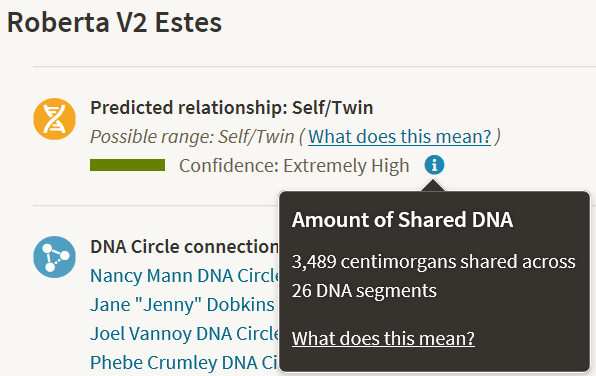
In the graphic below, I’m showing my mother’s DNA test which shows me as a match at Family Tree DNA.

You can see that the relationship is identified as parent/child, which means, genetically, the software can’t tell which one of us is the parent and which one of us is the child, but only a parent and child will share this amount of DNA.

By the way, the only reason I have my mother’s autosomal results to utilize, above, is because Family Tree DNA archives the DNA of their customers for 25 years, which allowed me to run the autosomal Family Finder test on her DNA years after her death.

You can also see in the chromosome browser, above, that I match my mother on the full length of every chromosome. The gray areas are not measured by the testing companies. Anyone who is not part of a parent/child relationship will not share all of all 22 chromosomes with someone who is not their parent or their child, except for identical twins. Said another way, if you are a parent or child, the entire portion of every chromosome 1-22 will match and be fully colored, as above.

Identical twins will match the full length of every chromosome too, but instead of the child matching 50% of the parent’s DNA, identical twins match exactly – 100% – not 50% – so the software vendors can tell the difference.

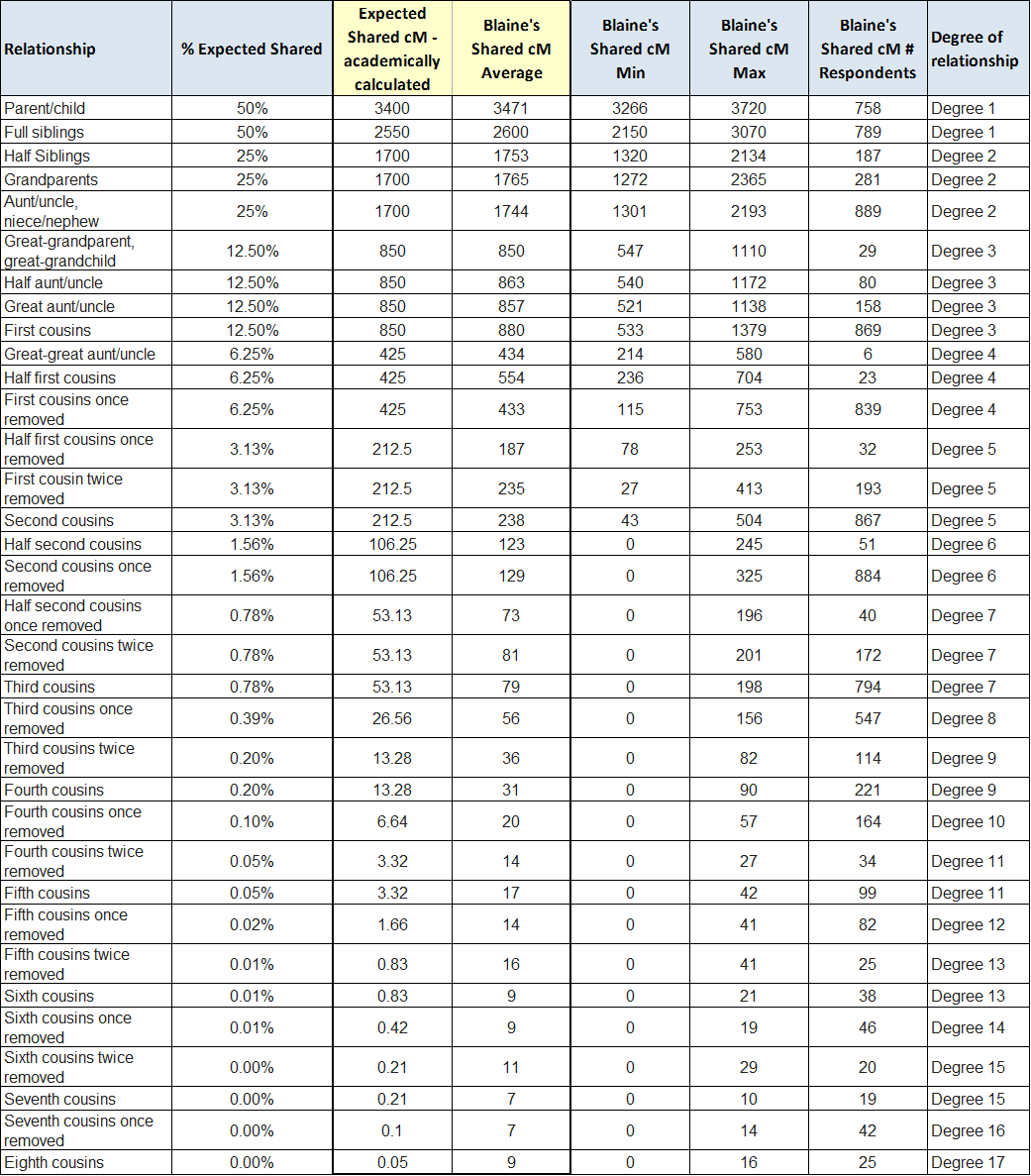
You can view the expected amount of DNA sharing for various relationships on this chart from the article, Concepts – Relationship Predictions.

Therefore, if you want to know whether or not someone is a parent, both parties must take an autosomal test at a vendor who provides matching between participants along with the amount of matching DNA and relationship predictions. Ironically, the test that provides the matching is the exact same test that provides ethnicity results – so if you tested at one of these vendors, you don’t have to take another test. You just have to look at matching results, assuming both people tested. Even if both parties aren’t available to test, such as the parent, if you can test a close relative of the purported parent, such as a sibling and still obtain probable confirmation, because close relatives tend to match within prescribed ranges.

Please, don’t just look at ethnicity results and begin questioning, or presuming.

The vendors who provide autosomal tests along with chromosome browsers are Family Tree DNA, used in the examples above, and 23andMe.

Ancestry also reports parent/child relationships and total matching DNA in centiMorgans (cMs), minus some amount of DNA removed by their Timber process, but does not provide a chromosome browser. MyHeritage reports relationships and cM amounts, but their cM matching amounts are problematic today and they do not provide a chromosome browser. Still, one should be able to discern a parent/child relationship from either Ancestry or MyHeritage.

You can read about the various vendor offerings in the article, Which DNA Test is Best?

Genetic Genealogy Tests are Not Legally Binding

Lastly, none of the genetic genealogy tests are legally binding relative to paternity, even though they can and do clearly inform of parentage.

These tests aren’t binding because the testers’ DNA samples lack “chain of custody,” meaning the DNA sample was not given in an environment where the identities of both testers can be legally proven. It would be very easy to return a negative paternity result by having your neighbor or buddy swab or spit for you. In other words, if you are looking for legal proof, to be used in legal proceedings, you need to consult with an attorney, follow their advice and utilize the methodologies, laboratories and procedures in your state or country to achieve your legal goals.

However, if what you are looking for is simply an answer, do NOT, NOT, NOT rely on any ethnicity results or appearances as hints.  Instead look at chromosome matching between the potential child and parent or close relative in the absence of a parent.

Summary

Rosario’s comments relative to ethnicity results and testing are very profound, especially given his recent experiences:

In your published articles, you astutely state the extremely variable nature of the companies’ platforms and methodologies. This begs the question, “is admixture variable or are the companies’ platforms?”

I think that this is the more appropriate question to ask.

People are taking their admixture results literally and that is a dangerous game to play. Families break up over this potent issue. We should tread lightly until we can demonstrate a more scientific conclusion than what is currently being offered.

I agree with Rosario, and would hazard an answer to his question as well.

How much DNA we inherit from any ancestor other than our parents is variable. Which DNA we inherit from any ancestor is variable.

The vendors test results, the reference populations and their internal algorithms are all variable.

Therefore, everything about ethnicity testing is at least somewhat variable – and is exactly why ethnicity testing should NEVER be interpreted as an indicator of parentage.

Chromosome matching is not variable relative to a biological parent/child relationship. Children always inherit half of the autosomal DNA of each parent on chromosomes 1-22.

Correction note:  Jerome’s surname corrected to read Barber.  Jackson was Jerome’s mother’s surname.

______________________________________________________________

Disclosure

I receive a small contribution when you click on some of the links to vendors in my articles. This does NOT increase the price you pay but helps me to keep the lights on and this informational blog free for everyone. Please click on the links in the articles or to the vendors below if you are purchasing products or DNA testing.

Thank you so much.

DNA Purchases and Free Transfers

Genealogy Services

Genealogy Research