I didn’t know much about my great-grandmother, Nora Kirsch when I was growing up, or when I first started researching my genealogy. She passed away in 1949, long before I was born.

I knew that Nora was an amazingly talented quilter, representing the State of Indiana at the Chicago World’s Fair in 1933, as described in my first article featuring Nora. That’s her legacy within the family. I think creating beauty and warmth for generations to follow is an absolutely WONDERFUL way to be remembered. But there was a LOT more, just waiting to be discovered.
I came to learn that Nora was born to German immigrant parents and had grown up at the Kirsch House in Aurora, Indiana. Mom and I eventually went to find the Kirsch House.
Genealogy is sort of like begetting where one thing just seems to beget another.
I was told that Nora made her own wedding dress and married incredibly handsome Curtis Benjamin Lore in 1888, descending the stairs at the Kirsch House into the parlor. That’s swoonworthy.
I knew Nora was eventually widowed and that C. B. Lore had died of Tuberculosis. That was a tale of lost love within the family.
I learned that tragically, Nora’s daughter, Curtis, had died of the same disease not long after. Life is simply not fair.
Then Nora’s life just sort of became a blur until, “and she died.” I didn’t know when, of what, or where.
Thankfully, newspaper articles from various locations have helped to remedy that and let me peek into her everyday life. Not just when she’s specifically mentioned, but also based on what is going on where she lived. Even the ads are amazing!
While your first reaction may be that some of these news snippets are very mundane and boring – simply reporting who visited whom – when assembled as the pieces of a puzzle, they tell the day-to-day story of Nora’s life.
It’s like sitting at her kitchen table.
And there are clues buried everyplace!
I had already scoured the Rushville newspapers, but now I’ve added Aurora, the town where Nora grew up, Greensburg where she lived when first married, and Wabash, Indiana, where she moved after Rushville. The story of how she got to Wabash…well…that’s the unexpected secret revealed here.
Photos and Newspapers
One note about photos before we embark on Nora’s spellbinding journey.
MyHeritage has dramatically improved their photo enhancement, which clarifies and brings photos into focus, photo colorization and photo repair over the last year or so. I decided to use that technology on my old photos in order to bring Nora to life as much as possible. It made a HUGE difference.
I do feel compelled to tell you that these photos aren’t the original black and whites – so I’m explaining that here instead of interrupting Nora’s story.
If you like what you see, you can try it for yourself.
Everyone can enhance or repair several photos at MyHeritage for free, but you can do as many as you want and connect them to the appropriate people in your tree with a full subscription. Other subscribers may have atached photos that you don’t have so you may get lucky there too.
Some of the newspaper articles used for this article are from MyHeritage too. You can sign up for a MyHeritage subscription with a free trial, here.
The Journey Began
Yes, this part of the journey to find Nora did actually begin in the cemetery. Odd, I know.

Mom and I traveled to Rushville, Indiana in the 1980s and located Nora and Curt’s graves. Before Mom said we needed to go there, I had never heard of Rushville, let alone know that we had any connection. It was just nice to be road-tripping with Mom and my daughter.

Mom had been to this cemetery at the time of and shortly after her grandmother Nora’s burial, in 1949, but hadn’t returned since. Rushville wasn’t exactly on the way to anyplace. Here’s Mom, looking quite sad, standing by Nora’s grave, not long after burial because no grass had yet grown where she was buried.
In the 1980s, I never thought about what Nora did after Curt’s death and before her own. I was only a fledgling genealogist back then and like all genealogists, wish desperately I had asked more questions when I had the chance.
Nora’s youngest child, Eloise, was still living and didn’t pass away until 1996. Eloise was in her 90s and had become quite frail, not to mention blind. It was Aunt Eloise who had provided most of what we knew. Eloise, thankfully, also sent Nora’s lovely quilts to Mom.
Eloise revealed a few additional pieces in the puzzle of Nora’s life, but not everything by any stretch. I’d wager that Eloise knew some things that she held close to her vest and that there were yet other secrets that Nora took to her grave – never sharing those with anyone.
As time elapsed and I began researching Nora’s parents, Jacob Kirsch and Barbara Drechsel, as well as Nora’s husband, Curt Lore, I began to piece together at least some of the rest of Nora’s story. The shadowy twilight decades of the 1930s and 1940s.
Perhaps Nora didn’t want them to be too clear.
A Letter from Nora
Ironically, it was at RootsTech in 2019, as I sat in the audience listening to Steve Rockwood deliver the keynote that important documents arrived, unsolicited, on my phone. Silent buzzing alerted me that a message had arrived.
A cousin had sent a handwritten letter from Nora herself.
What?
Seriously?
I couldn’t help but look, given what it was, as Steve’s voice drifted into the background. (Sorry Steve.)
It would be that very letter and accompanying receipt that led me to learn more about Nora’s twilight years.
The newspaper digitization projects have allowed me to fill in so many gaps for Nora and Curt, both, in the past year or so.
Like, for example, Curt was involved in quite the scandal involving thoroughbred horse racing at the turn of the century – meaning 1899/1900 – THAT century. Lordy, Lordy that had to have been incredibly embarrassing and humiliating for Nora. It was never discussed and, truthfully, I doubt Nora’s daughters ever knew about it.
The Lore couple had become socialites in Rushville, Indiana among the families with “horse money,” although Curt and Nora never owned their own home which I found very odd. Curt did, however, own several racehorses and associated with the moneyed movers and shakers.
Curt was truly a jack-of-all-trades. He had his hand in anything and everything that might make money – an early entrepreneur. I think most of it was legal and aboveboard – but nothing would surprise me at this point. He often seemed to be treading on marginal ground.
Curt, orphaned at a very young age in Pennsylvania had become a wildcat oil driller. He learned how to do just about everything and translated that skill set into opportunity at every turn. In essence, Curt, warts and all, succeeded in spite of everything, including an exceedingly difficult beginning that would have doomed lesser men.
He was also benevolent, a member of various lodges, a comedian, and tough as nails. Curt, in many ways, seemed to be a walking contradiction. I’m sure Nora loved him, although some days she probably wondered why.
Before we reveal Nora’s final chapter, let’s go back to Aurora where she grew up and fill in pieces of her early life.
What made Nora the person she became?
Aurora Growing Up
Nora, the firstborn child, arrived on December 24, 1866. She was the perfect Christmas gift to her mother, a traditional German woman who clearly celebrated Christmas on Christmas Eve that year, as was the German tradition.
Nora grew up with her three sisters and two brothers at the Kirsch House, a hotel, tavern, and restaurant in Aurora, Indiana.

In 2008, the Kirsch House didn’t look much like it looked in an earlier era, but it was recognizable.

The Kirsch House wasn’t always the Kirsch House. Proprietors named establishments after themselves. In August of 1875, Jacob Kirsch bought the French House and the Kirsch family moved in. As luck would have it, the Dearborn County Atlas was published the same year.

It’s easy to spot the L-shaped building beside the train depot.
The business directory referred to the establishment alternatively as a hotel, hotel and saloon, and as “fine accommodations for travelers.” The Kirsch House was located right beside the B&O train depot and just a few blocks north of the pier on the Ohio River. The foundry, barrel factory, carriage factory and warehouses were located either adjacent or nearby. Clearly, this was prime real estate for traveling businessmen.
We don’t know much about those years, but the local newspapers provide some information.
School Days
Nora’s earliest years would have been spent helping her parents at the Kirsch house, delivering orders with her sisters in their wagon, and playing with her first cousins who lived nearby. She would have attended weddings and funerals, even burying a few of her cousins and playmates because someone was always being born and dying – especially before the days on antibiotics. Thankfully, none of Nora’s siblings passed away, at least not that we know about.
Every Sunday, the family attended the German Lutheran church and Nora went to school on weekdays.
Nora was an excellent student, as was reflected in the newspaper.
- November 15, 1877 – Honor Roll, Aurora Public Schools for the month ending November 2, 1877 and had a grade of 90 and above in attendance, deportment, and scholarship: Nora Kirsch in Room 4, with a grade of 91.
I thought that Nora attended the Lutheran School, but apparently not. The Lutheran Church was nearby, but perhaps the church didn’t include a school at that time, or tuition was charged.
The 1875 Atlas of Dearborn County shows us the location of the Public School at the lower right.

The school was quite a distance from the Kirsch House, at upper left. The Kirsch children would have walked to and from school.

This building, eventually known as the Southside School in Aurora opened in 1867 and stood until 1974, more than 100 years.
High School commencement was initially held at the Methodist Episcopal Church, but by 1879, it was held at the Opera House on Second Street, newly built in 1878. Admission was 10 cents.
Nora would have attended this school and probably graduated about 1884 or 1885 on the Opera House stage. The Opera House was located just a block or so from the Kirsch House on Second Street. The excited family would have walked together to the joyful event.

The first floor housed commercial businesses, but the second and third floors of the opera house seated 950 people. You can read more about the Opera House and the history of Aurora, here.

Nora’s parents ran the Kirsch House and her father, Jacob, dabbled more than a little in local politics. He was also a crack shot. The Aurora newspaper is full of stories about the pigeon shooting (hopefully clay) matches and Jacob’s winnings as he traveled far and wide.

I’d wager there was some betting, back-slapping, and celebratory drinking going on as well.
- Lawrenceburg Register, October 16, 1879

Nora’s mother, Barbara, was surprised with a 31st birthday party when the establishment was still known as the French Hotel. What kind of gifts did she receive? Who attended?
The family lived at the Kirsch House, which meant, of course, that Barbara Kirsch and her daughters cooked incessantly, probably from before sunup to after sundown, washed never-ending dishes, changed beds, and did laundry – not just for the family – but for everyone staying at the Kirsch House.
Think bed and breakfast on steroids. I can’t imagine.
One newspaper article informed us that Jacob Kirsch did hire a bartender. That, of course, was the one job that would have been deemed “improper” for the women and he could unquestionably have done himself.
- Lawrenceburg Register, July 15, 1880

In 1880 there was an accident at the Kirsch House. Children were playing outside, but thankfully, none were injured when a horse and runaway wagon tore the awning posts and awning off the front of the building. I would wager that Nora and her siblings were some of those children. Life could have changed in the blink of an eye. My entire family line might not be here.
That 1875 map shows that the Kirsch House was L-shaped, with a garden in back. The Kirsch children would have played in the garden area and out front on the sidewalk. There wasn’t anyplace else.
Aunt Eloise told me that Jacob Kirsch was extremely proud of his paved, covered sidewalk. He apparently felt that was the mark of a high-class establishment, differentiating his hotel from others.

You can see a later awning above, as unknown children play next door at the depot, probably in the early 1900s. The freight and ticket office was the red awning and bumpout behind the child dressed in white.

This early parade photo shows the Kirsch House with its awning in the background and the depot, at left.
Nora was on the honor roll again in 1880 and would turn 14 on Christmas Eve.
- November 11, 1880 – Public school honor roll for students with 90 or above in attendance, deportment, and scholarship. Norah Kirsch with a grade of 91, Carrie with a grade of 90.
- January 6, 1881 – George Phillips, Jake Kirsch and Ed. Mulbarger of this city were out on a hunting expedition near Poston, Indiana last week. Kirsch froze his ears during the hunt.
Jacob’s ears were frostbitten. OUCH!
- Also, same day, under the heading of “Ida Londen’s Concert” we find that Ida’s pupils performed at the Opera House on Tuesday evening. Ida was a pianist and music teacher. “Nora Kirsch gave us a piano solo entitled La Balliena.”
So, Nora performed in the Opera House as well. That’s interesting to know. How fun! I can close my eyes and see her strolling across the stage, sitting down at the piano and commencing to play.
- Lawrenceburg Register, February 2, 1882 – Jacob Kirsch signed a petition to organize a Public Library Association as an incorporated body for general circulation in the city.

While the original Aurora library consisted of books gathered in a local jewelry store (smart move on the part of the jeweler), Jacob was instrumental in founding and funding the library which was eventually moved into the City Building, shown above today. Nora assuredly utilized those services.
Nora’s parents spoke German, but Nora clearly read and spoke English quite well. Perhaps the library helped Nora become fluent in English, as German was the native language of her parents and was spoken at home. Although as hosts at the Kirsch House, Jacob and Barbara clearly spoke at least some English, and Jacob spoke English well. My grandmother, Nora’s daughter, understood German, but I’m not sure if she could speak the language.
- Lawrenceburg Register, May 4, 1882

While the family lived at the “hotel,” probably in private living quarters, they certainly did normal family things – like have birthday parties. Nora’s dad, Jacob Kirsch turned 42.
I don’t know for sure, but I suspect that there was no private eating area. The family probably ate in the dining room with everyone else. I could not discern an internal “apartment” area when I visited.
Socializing
- Lawrenceburg Register, August 30, 1883

True to the identity that Jacob Kirsch established for the Kirsch House as the best accommodations in Aurora, the newspaper covered this “gala reception” hosted at the Kirsch House – complete with band. How I would have loved to attend, just to see the Kirsch House in all its splendor!
There’s another tidbit buried in this article. Jacob’s nickname was Jake.

My mother, daughter, and I visited the Kirsch House in the 1980s and I have no idea how they managed to fit 50 people, a band, and dancing in the public areas of the building – but they clearly did. The entire building, both floors, is 4256 square feet, so the downstairs that includes the tavern where we are standing, kitchen and restaurant areas, plus a parlor would have been about 2100 square feet.
Nora would have been 16 on the night of the party, and if she didn’t have to work that evening, which she probably did, she surely enjoyed herself as well. Maybe there were some young men present. 😉
- September 10, 1885 – Miss Josie Young, an accomplished young lady of Osgood is the guest of Miss Nora Kirsch of this city.
I don’t know when Nora graduated from high school, exactly, but I’d wager it was in 1885. I base that opinion in part because she would have been 18 – and also because she was hosting a friend in September of that year when students would have been back in school.
- June 3, 1886 – Miss Nora Kirsch is visiting Covington, KY.
By 1886, Nora has spread her wings somewhat and began to travel. She apparently went to Covington alone – likely on the train. I sure wish the paper had told us what Nora did in Covington. I suspect she had a friend that lived there.
Just a few weeks later, however, life for the Kirsch family would change, in an instant, and dramatically.
Two Deaths in 30 Minutes
August 19, 1886, was a dark day indeed. The news was reported in the Jeffersonville newspaper, and newspapers across the country, but the event took place right in Aurora.
- Jeffersonville (Indiana) Daily News – August 19, 1886

What? A stabbing.
Followed by a lynching?
You might be wondering what this has to do with Nora or the Kirsch family. This article certainly provides no clue. Nor does the coroner’s inquest a few weeks later.

William Watkins stabbed Louis Hilbert to death and was then hung by a group of “excited men.”
There’s more to the story of course.
Hilbert had employed Watkins, an itinerant bricklayer who had a chronic habit of drinking too much. Hilbert paid Watkins and dismissed him for being drunk on the job, but Watkins returned – even more intoxicated and angry.
Warm words let to hot tempers and Watkins stabbed Hilbert to death. The surrounding men on the job site restrained Watkins. The local Farmer’s Fair was taking place, so the streets were full of people. A crowd gathered, becoming enraged when they realized what had just occurred.
The local constable arrived almost immediately and attempted to remove Watkins to the next town for his own safety, realizing Watkins would not be safe in the local town hall jail – but to no avail. The now enraged crowd swarmed the Constable’s buggy, removed Watkins to the nearby distillery yard, and immediately hung him.
How was the Kirsch family involved?
Jacob Kirsch was among the men who hung William Watkins shortly after Watkins had murdered Louis Hilbert. I do want to be very clear, Watkins was white. This incident was not connected to race.
Although the local papers didn’t name names, every single soul within a hundred miles knew who was involved and in what capacity.
For the most part, the sentiment seemed to be that Watkins certainly deserved what he got. But that sentiment was not universal, by any means, based on the fact that Watkins was afforded no trial and vigilante justice is a dangerous precedent.
While this seems like it might have been all-consuming for the Kirsch family, it apparently was not.
In 1917, the local paper printed a memory from February 1887 that gives us a peek into Nora’s life six months after the murders.
- February 1, 1917 – Thirty Years Ago (dating to February 1, 1887) – Miss Norah Kirsch is entertaining Mrs. Lou Riddell and sister of Covington, KY.
This probably explains why Nora had been traveling to Covington, as well.
I would think that this incident would have caused Jacob to become somewhat of a pariah in Aurora, perhaps ending his career and the Kirsch House, but it didn’t.
Federal court records and the Indianapolis newspaper tell us that Jacob was subsequently, unsurprisingly, embroiled in a lawsuit.
- March 3, 1887, Indianapolis News
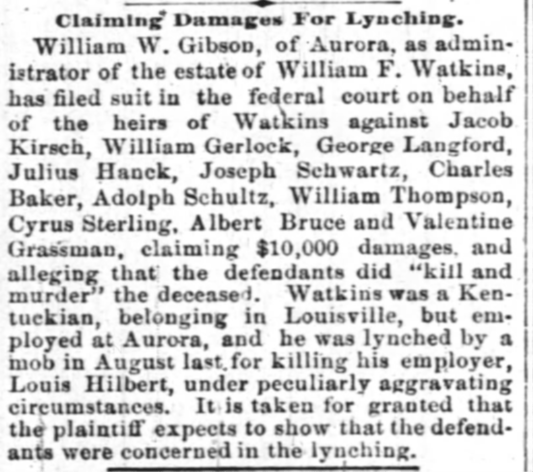
Watkin’s estate administrator filed a lawsuit where we find the list of men involved in the lynching.

Although Jacob isn’t named in the Aurora newspaper, he was in the lawsuit that put both Jacob Kirsch, and the Kirsch House in jeopardy. $10,000 was a massive amount of money at that time – more than Jacob and the Kirsch House were worth.
This is a civil suit, and I’m actually quite surprised that criminal charges were never brought, but they weren’t filed against any of the men involved.
In 1887, Jacob Kirsch transferred the deed to the Kirsch House to his wife, Barbara. In essence, Barbara owned the property in fee simple, without Jacob, for the rest of her life.
I’d wager that the entire family was suffering under the weight of Jacob’s actions, including the six children who ranged in age from 10 to 20. Not only were they now reviled by at least some people, I’m sure this affected the family income given that they ran a tavern, restaurant, and hotel – not to mention that the entire family now stood to lose everything thanks to Jacob’s hot head.
- October 7, 1887 – Greensburg, Indiana newspaper

It’s important to remember when reading political commentary from long ago that both political particles have changed dramatically since that time. Still, politics was utilized as an interpretation tool then too.
This connection to Greensburg may be relevant because Greensburg is where Curt Lore was living or at least transacting business about this time.
I don’t know how much of a social outcast the Kirsch family became. I’d wager that at least some number of Aurora families, even if they didn’t openly condemn Jacob’s actions certainly shied away.
Nora’s paternal grandmother, Barbara Lemmert Kirsch, then an 80-year-old widow was living with the family, along with Nora’s uncle Philip who was disabled during the Civil War.
Did Nora lose friends over this? Was she shunned? This would be particularly difficult for a young woman of marriage age.
Perhaps Nora could confide in her grandmother. Perhaps her grandmother Kirsch helped all of the children cope. I hope so. She wouldn’t be around much longer.
Curt Checked In and Never Checked Out
We know that Curt Lore, Nora’s eventual husband, was living in Warren County Pennsylvania in 1884 and 1885.
- Warren County (Pennsylvania) Mail – November 21, 1884, January 13, 1885, April 21, 1885, and several other dates. – Set for Trial Curt Lore vs Jacob Davis
- October 11, 1885 – There was a verdict for $159.38 for Plaintiff.

During this time, Curtis Benjamin Lore, a well-driller, checked in at the Kirsch House and never checked out of the family. We don’t know exactly when Curt arrived in Aurora, but by May 1887, there was a letter in the dead letter office for him.
- Aurora Spectator – May 19, 1887 – The following is a list of letters remaining in the Aurora post office not called for: Mr. Curt Lore.

This suggests that Curt was actually living in or at least visiting Aurora for long stretches at or before this time. Curt would have known that Jacob Kirsch was a crack shot AND that he had been a member of the mob who hung Watkins. Everyone knew both of those things.
Note Jacob Kirsch’s competitive shooting scores just below Curt Lore’s letter notification. The irony is not lost on me. Might not have been lost on Curt either.
Whether Nora confided in her grandmother or not, she fell hard for Curt, an extremely handsome somewhat older man – ten years Nora’s senior.

Curt accidentally discovered the Blue Lick (artesian) Well in Aurora when drilling for gas, and he also discovered the beautiful daughter of the proprietor of the Kirsch House.
One of the attractive aspects of Curt might have been that he was not from Aurora, seemed a bit mysterious and he perhaps offered a ticket out.
Curt, as it turned out, wasn’t entirely honest, either about his age or his marital status. He failed to mention that pesky detail of a wife and 4 children back in Pennsylvania, the youngest still a baby – born in June of 1886.
Marriage
The next piece of information we have about Nora is an unusual announcement in the neighboring city’s newspaper the day AFTER Nora and Curt were married.
- Lawrenceburg Register, January 19, 1888 – Invitations are out for the marriage of Miss Nora Kirsch, eldest daughter of Mr. Jacob Kirsch of Aurora to Mr. Curtis B. Lore of Findlay, Ohio.
Their engagement was not reported in the Aurora newspaper, nor was the wedding.
Nora, by then a couple months pregnant, probably desperately wanted to leave Aurora for more than one reason.
Curt desperately wanted to leave too, before his soon-to-be father-in-law who just happened to be a marksman AND apparently had no qualms meting out justice discovered that pre-existing wife and four children issue.
Nosiree – Curt wanted to get the hell out of Dodge, well, er, Aurora before those beans somehow got spilled.
Nora and Curt’s first child, Edith, was born someplace in Marion County, near Indianapolis, on August 2, 1888.
New Beginnings
By October, Nora and Curt were living in Greensburg where no one knew about Nora’s connection to Jacob or the fact that Edith arrived a bit early. No one knew about Curt’s past either, not even Nora.
Greensburg was a great place to start over.
Two and a half months after Edith was born, Nora’s mother and sister came to visit.

The sisters took a bonding trip as well, although this surprises me given that Nora would have been nursing Edith who wasn’t three months old yet.

Nora and Carrie, her 17-year-old sister, traveled to Cincinnati to attend the Centennial Exhibition. Maybe their mother, Barbara, stayed in Greensburg with baby Edith. What grandmother wouldn’t love that!

In 1888, Cincinnati hosted the Centennial Exposition of the Ohio Valley and Central States. You can view the exhibit catalog, here. Those young women would have enjoyed the Exposition immensely, along with each other’s company.

One of the major attractions was the “Electric Light Plant.” A few years later, Curt Lore would be one of the investors in the first electric light plant in Rushville, Indiana.
We don’t know, but I imagine that Nora went home to Aurora over the holidays and again when her grandmother, Katharina Barbara Lemmert Kirsch passed away at the Kirsch House on February 1, 1889.
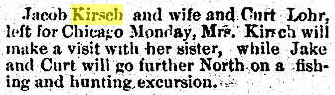
Barbara Drechsel Kirsch’s sister, Mary had married, moved to Chicago, and was expecting her third child in July.
The Aurora newspaper reported that Nora’s parents came to visit in June of 1889. Jacob and Curt were apparently bonding – and that’s not all. According to Aurora articles later, Jacob bought a racehorse that Curt was training for him.
- December 5, 1889 – Mr. and Mrs. Lohr are the guests of the Kirsch House, from Greensburg.
- January 9, 1890 – Miss Carrie Kirsch was visiting her sister, Mrs. Curt Lore, at Greensburg several days last week.
- January 23, 1890 – Jake Kirsch was visiting his daughter, Mrs. Curt Lore, at Greensburg, several days last week.
- April 10, 1890 – Mrs. Curt Lore of Greensburg is visiting her parents, Mr. and Mrs. Jacob Kirsch.
- June 12, 1890 – Jake Kirsch was on the sick list several days last week. Miss Lulu Kirsch is visiting her sister, Mrs. Curt Lohr, at Greensburg.
While most of these snippets came from the Aurora newspaper, some were found in Greensburg.
- Greensburg Standard – August 6, 1890 – Curt Lore, Charles Belser, and Charles Evans and wives picnicked at Banta’s Thursday and reported a delightful time.
- August 14, 1890 – Mrs. Curt Lohr of Greensburg visited her parents, Mr. and Mrs. Jacob Kirsch several days this week.
Nora may have gone home to attend the funeral of her mother’s sister, Margaretha Drechsel Rabe who died in Cincinnati, probably related to childbirth. Margaretha was only 38, yet had already buried two sons and a third would pass away in 1893.
- September 25, 1890 – Mrs. Curt Lore of Greensburg is visiting her parents, Mr. and Mrs. Jacob Kirsch this week.
- November 27, 1890 – Miss Carrie Kirsch is visiting her sister, Mrs. Curt Lore at Greensburg, this week.
- Miss Carrie Kirsch has been visiting relatives in Greensburg the past week.
- December 25, 1890 – Ed. Kirsch and sister Lulu are spending this week with their sister, Mrs. Curt Lore at Greensburg.
Obviously, Nora’s siblings visited her often. The railroad depot being located adjacent the Kirsch House was very convenient.
Nora probably wasn’t going much of anyplace because she was “in a family way” again.
- Greensburg, March 14, 1891

- Nora gave birth to another daughter, baby Curtis, clearly named after Curt, in March of 1891.
The Greensburg newspapers provide details about their life.
- May 16, 1891 – A valuable mare belonging to Curt Lore was dangerously hurt Monday morning by coming in contact with a barb wire fence on Charles Evans’ farm. She is recovering.
- September 2, 1891

Curt doesn’t seem to have the best of luck with horses. Seems that once again, Curt narrowly avoided disaster.
Also, under “Fair Notes” we discover more about their Curt’s racehorses.

For some reason, this just cracked me up. “Fancy goers.” It’s interesting that Curt owned at least 7 horses, and possibly more including Almont. It’s ironic. I can’t confirm when either of his parents died, but I know Curt’s horses’ names.
All might not have been well at home though.

In October of 1891, this notice appeared in the Greenburg newspaper saying that Curt and Nora were breaking up housekeeping. But apparently, at the end of the year, they were still living in Greensburg. “Breaking up” could have been interpreted a couple of different ways.
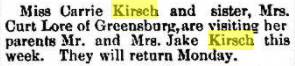
I had no idea that Carrie lived with Nora at any time. This close relationship between the sisters might explain why Carrie was married a few years later at Nora’s home. Well, that and the fact that Carrie’s parents didn’t care AT ALL for her husband. Turned out that they were right!
Sometime in early 1892, Nora and family moved to Rushville, about 20 miles north of Greensburg, which in turn was about 40 miles northwest of Aurora. I wondered when I found the original mention in the Greenburg newspaper whether their marriage was on the rocks based on the commentary that Nora would stay with her parents. But the December newspaper article suggests otherwise and tells us that Carrie was living with Nora there in Greensburg.
Curt was traveling a lot – drilling wells in other locations in both Indiana and Kentucky. This might explain the unexpected visitor some 20 years later, one that would haunt Nora.
Rushville
Sometime before June of 1892, Curt and Nora rented a house in Rushville where they would live for the rest of their married life.

Curt was very clearly becoming more and more involved in horse racing. Now we know two of his horses’ names!
- Aurora, September 8, 1892 – Mrs. Curt Lohr and children, from Rushville, are visiting her parents here at the Kirsch House.
A few days later, Jacob Kirsch’s life would change forever. In fact, Nora nearly lost her father.
Shot!
- Cincinnati Enquirer Friday Morning, October 28, 1892 (Warning – graphic description in article.)

Jacob was gravely wounded and was not expected to live. Nora was likely notified by telegram and probably returned home at once. It’s odd that neither the Rushville nor Aurora newspapers covered this news, although technology-based scanning and indexing is far from perfect.
The family believed that Jacob Kirsch fought in the Civil War, but there is little evidence to support this. Furthermore, Barbara knew him at the time and applied for his pension after he died. There were multiple Jacob Kirschs in southern Indiana who were likely confused and, I believe, conflated with their military files intermixed. However, the reference to Jacob as Captain Kirsch surely makes me wonder why he would be referred to as such otherwise.
All newspapers are very quiet for the rest of 1892. I suspect that Jacob’s recovery was slow, painful, and far from certain.
Life Returns to Normal
Life seemed to have returned to normal. Articles from the Rushville paper were published in Curt’s story, here. The Lore family maintained ties to Greensburg, and those articles add more meat to the bones.
- Greensburg – August 18, 1893 – Curt Lore of Rushville was circulating among friends here on Saturday.
- March 22, 1894 – Miss Carrie Kirsch is the guest of friends at Rushville, Indiana.
- Aurora Dearborn Independent – July 5, 1894 – Mrs. Curt Lore and children, of Rushville, are visiting her parents, Mr. and Mrs. Jake Kirsch.
1894 saw Curt become an entrepreneur, building an ice plant and electric power plant in Rushville. Of course, he continued horse-trading and well-drilling too. It seems Curt never stopped doing anything – he just added more.
The Rushville paper reported that Nora and the girls spent most of the month of December 1894 in Aurora.
- Aurora, November 28, 1895 – Miss Lida Ruese left Wednesday afternoon for Rushville to spend Thanksgiving with her friend, Miss Carrie Kirsch, who has been the guest of her sister, Mrs. C. B. Lore for the past two months.
Carrie was obviously spending a lot of time in Rushville. Carrie and Nora were very close, born just over 4 years apart.
- Greensburg, January 10, 1895 – Miss Carrie Kirsch is visiting her sister, Mrs. Curt Lore at Rushville.
- August 2, 1895 – Curt Lore of Rushville spent Sunday here with friends.
- October 25, 1895 – Curt Lore, of Rushville, spent the latter part of last week with friends here.
- October 30, 1895 – Curt Lore of Rushville is here attending the gun shoot.
- April 1, 1896 – Mrs. Curt Lore entertained a company with euchre last Saturday afternoon.
- May 17, 1895 – Curt Lore and Wood Study rode down here Sunday evening from Rushville in one hour and 27 minutes, at a rate of over 13 miles an hour. Good. They made the trip on their wheels.
I’m not exactly sure what “on their wheels” means. Had Curt purchased an early automobile? Motorcycle?
In June 1896, Curt and Nora, including Nora by name, were both sued for a debt of $4,768 in connection with the ice house endeavor. Published in the paper, a sheriff’s sale was ordered to confiscate the lot where the ice house was located. A separate contract for $12,000 existed as well. Nora must have been worried sick.
Suits involving the ice house, the land the ice house was built on, and the equipment inside the ice house bounced back and forth in the courts for years. It’s difficult if not impossible to figure out who did what, or didn’t do what, to whom.
Life seemed to go on as normal for Curt. These setbacks seem like water off of a duck’s back for him. Nora, on the other hand, often went for “an extended visit” with her parents.
- July 10, 1896 – Curt Lore of Rushville was here attending the ball games this week.
- September 9, 1896 – Mrs. Curt Lore and daughters, Edith and Curt, of Rushville, returned home Saturday afternoon having spent the week with R. N. Wise and family.
- December 23, 1896

Satin suspenders. I wonder if Curt wore satin suspenders.
I can’t help it, I just love the period ads in newspapers. They put the lives of our ancestors in perspective.
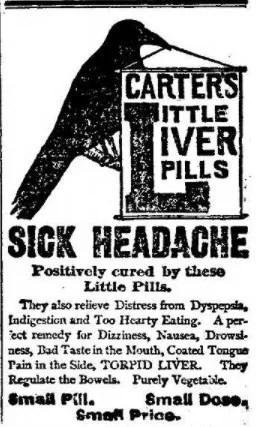
Carter’s Little Liver Pills will, apparently, cure anything that ails you😊

Oh wait, if an enemy vagrant current of air stole into your house last week, well, maybe this salt cure will undam your blood.
- Connersville Times, July 16, 1897

In 1897, Curt took on a rather unusual “job,” assuming this was paid – baseball team manager. Who knew?
I suspect that the solicitation of subscriptions might have something to do with how Curt was paid. Curt certainly excelled at talking to people.
I wonder what Nora thought about all of Curt’s activities.
- Greensburg Standard, September 8, 1897 – Mrs. Curt Lore and daughter, Miss Edith, returned to their home at Rushville Thursday after a pleasant visit here with Miss Stella Wise. They were accompanied by Miss Wise.
- December 25, 1897 – Mrs. Curt Lore and charming daughters Curtis and Edith, of Rushville, are spending the holidays with Mr. and Mrs. Jacob Kirsch.
Where was Curt Lore during the holidays?
Turn out, Curt might actually have already been at the Kirsch House. In mid-November, the Rushville paper reported that Curt had contracted to “fit up an Aurora Hotel with a hot water heating apparatus.”

In 2008, when I last visited Aurora, the Kirsch House was undergoing a structural evaluation. The old “hot water heating apparatus” pipes that heated the structure were still in evidence in the hallway beside the stairway into the parlor, as you can see above. Curt’s handiwork, more than a century later.
- May 13, 1898 – Curt Lore and daughters of Rushville spent Monday here.
In 1898 and 1899, Nora and Curt’s social status star seemed to be rising. According to the Rushville paper, they were increasingly engaged in social functions and Curt was a delegate to the Congressional Convention.
On April 8, 1899, Nora gave birth to their third child, another daughter, Mildred Elvira Lore in Rushville although it was never mentioned in the Rushville paper.
- October 5, 1899 – C. B. Lore of Rushville is here attending the street fair this week.

Curt Lore had purchased a Warograph machine, which in essence showed early movies. He then formed the Cineograph Electric Advertising Company and then The Warograph Company.
He began taking his “show on the road” (pardon the pun) to carnivals and street fairs. I wrote about Curt’s many endeavors in this article. Let’s just say that his life was never dull or without drama. Within a month, he had started two new businesses, in addition to the ones he already had and lost one business partner.
I need a dance card to keep up with this man. Nora probably did too. When he did come home, she was probably just waiting for the next chapter in the “Drama of Curt.”
Of course, this is only the drama we are aware of because it made it into the newspaper.
- Greensburg – December 26, 1899 – Curt Lore of Rushville was here this morning en route home from a visit with relatives at Aurora.
At least this year we know Curt was with Nora in Aurora, although he may have returned early.
1900 – A New Millennium
The new millennium dawned with Nora and Curt still living in a rented home in Rushville, moving in the horse-racing social circles. According to the census, two female servants lived with them. Their neighbor was Nora’s best friend, Ethel Coverston, wife of the railroad agent. Except for some bumpy patches, life seemed good – at least from this perspective.
In August, Nora’s paternal aunt, Katharina Barbara Kirsch who had married Johann Martin Koehler died. She had outlived at least three of her four children.
- September 26, 1900 – Curt Lore and family, of Rushville, drove down last night and after spending the night here with friends, left this morning for Aurora for a few day’s visit.
“Drove down” – does that mean a buggy or a car? Surely not a buggy – all the way to Aurora? In 1900, wealthy people purchased some of the early automobiles for comfort and prestige. Few cars existed and the ones that did were hand-assembled and cost about $1000 each. I would think if Curt purchased an automobile, that might have been newsworthy in and of itself.
On August 2, 1900, Nora’s paternal aunt, Katharina Barbara Kirsch Schnell, 67, died in Aurora. Katharina had outlived her first husband, who was also her first cousin, Johann Martin Koehler, by decades, at least three of her four children, and at least one grandchild. Life was tough.
- October 23, 1900 – Curt Lore of Rushville is visiting friends here today.
- October 24, 1900 – Judge Frank Hall and Curt Lore of Rushville are attending court here today.
- October 27, 1900 – Curt Lore and Frank Hall who have been attending court here for several days returned to Rushville this morning.
In November of 1900, news broke that Curt was embroiled in the granddaddy of all horse-racing scandals, noted as “the greatest fraud ever perpetrated” when it hit the national news. In September of 1899, an entire day’s race tickets that affected the standing of various horses were submitted to the national racing association for races that never occurred. The Rushville and national papers covered the scandal, but Greensburg and Aurora where several people lived who were involved did not.
Nora must have wanted to bury her head in the sand.
It was about this time that Curt’s focus shifted from horse racing to obtaining local construction contracts for bridge repairs and street sprinkling. The horse-racing scandal seems to have ended or at least dramatically reduced that part of Curt’s career, but he was still drilling for wells in Kentucky and elsewhere.

We know from this article that Curt worked with his brother and owned a motorcycle which at that time was pretty much a bicycle with a motor. I wonder if Nora rode his motorcycle too. Nora was no shrinking violet.
I love this picture of her some years later.

Nora with her three daughters; Eloise, Mildred, Nora, Edith (white hair), probably between 1930 and 1940.
Curt continued to travel a great deal with his oil drilling and to some extent, horse racing. It was on one of these trips that Nora suspected that he contracted Tuberculosis.
In July of 1903, Curt formed the C. B. Lore Drilling Company with two other men.
Nora was otherwise occupied.
On October 8, 1903, Nora gave birth to their fourth and last child, Eloise Lore. Curt had only returned from his trip a few days earlier. Perhaps now I understand why Nora had 2 servants in the 1900 census.
Less than three weeks later, Curt’s well-drilling paid off. He hit paydirt – one of the strongest and best wells ever sunk in that region. On land owned by the local liveryman.
Curt was back on the road soon, while Nora cared for their four children at home in Rushville.
By 1904, Curt’s well-drilling expertise was in much demand for both gas and water wells.
- Versailles (Indiana) Republican, April 6, 1904

- Versailles Republican, June 8, 1904 – Curt Lore, the gas driller, entertained a part of Aurora relatives at the Niebrugge home one day last week.
Apparently, Curt was at least temporarily living in Versailles while drilling this well. Nora and the girls were living in Rushville.
- Greensburg, June 24, 1904 – Curt Lore of Rushville was here Wednesday on his way home from Dillsboro where he has been drilling gas wells.
- Versailles Republican – September 7, 1904 – Frank Johnson, President of the Dillsboro Oil and Gas Company gives the Republican a statement that work will be resumed on the wells soon. No new well will be drilled, as has been reported, but drilling will begin at the depth which had been reached by Curt Lore when he claimed he struck saltwater.
Does this mean Curt was done drilling in Versailles? Does that mean he spent more time at home with Nora and the girls? If so, did he have an income? The newspapers often tell us just enough to spawn many more questions.
- Greensburg, August 25, 1905 – Curt Lore, of Rushville, was here yesterday.
Nora’s uncle, Philip Kirsch, the disabled Civil War veteran who never married and lived at the Kirsch House with her family passed away on September 9, 1905. It was thanks to his will that we identified several of Nora’s aunts and uncles, especially the ones who had moved away, and their children. Philip tells us, among other things, that his brother John is deceased and has two children whose names he can’t remember.

Other than money left to his siblings and their children, Philip (left, above) bequeathed everything to “my dear brother Jacob Kirsch being for the kind treatment which has always been given me by him and all of his family.”
Unraveling
Beginning in 1906, Nora’s life was coming progressively more unraveled. It’s obvious that Curt is gone more than he is at home.
Someplace along the way, Curt contracted Typhoid, was ill for weeks on end, and nearly died. He did at least somewhat recover.
Nora’s maternal grandmother, Barbara Mehlheimer Drechsel, died on January 3, 1906. Nora and the girls spend the holidays in Aurora and returned home the following day, apparently before her grandmother’s funeral.
By 1906, their eldest daughter, Edith Lore, was graduating from High School and received a scholarship, even at that day and time. Edith was scheduled to attend Business School in the state capital in Indianapolis when Typhoid struck the family in Rushville.
Nora did her best to protect her family. She sent three daughters to her mother’s in Aurora. One child, Curtis, remained at home to help Nora care for Curt. Curt survived Typhoid but remained ill, perhaps unknown to the family, with TB.
His behavior changed or maybe he simply had less patience and restraint. He managed to get himself arrested for “provoking the Marshall.”
Not to be deterred, Curt bid on and was awarded bridge repair and other contracts in and arround Rushville. He tried desperately to support his family, although according to Eloise, he was unable to fulfill those contracts and Nora had to somehow settle those affairs after his death. Eloise also said that at some point, Nora quietly approached the “powers that be,” or were, and asked that Curt not be awarded any additional contracts. Nora had clearly seen the writing on the wall, even if Curt hadn’t or didn’t want to believe the message.
On September 4, 1906, Nettie Giegoldt, Nora’s first cousin, her aunt’s daughter, died of Tuberculosis in Aurora at 26 years of age. The family had been caring for her for two years.
Nora’s mother and family were devastated, but this string of deaths wasn’t over.
- December 5, 1906 – Curt Lore who has been working in the contracting business on the southern extension of the I. C. & S. traction line has returned from Scottsburg.
Wait? What? Curt’s working on the train line? What happened to well-drilling? When did this shift take place?
- January 4, 1907 – Curt Lore of Rushville visited friends here Tuesday.
- September 6, 1907 – Curt Lore of Rushville spent Wednesday here.

Nora’s maternal grandfather, George Drechsel, died in February of 1908 at 85 years of age.
Nora did receive a small respite in the summer of 1908 when she visited the new amusement parks in Indianapolis – although in those long skirts she must have roasted to death.
Nora’s sister, Louise, and her husband Todd Fiske had come to live at the Kirsch House with Nora’s parents after Todd lost his job as a civil engineer. On Halloween night, 1908, Todd took his own life in the garden at the Kirsch House by shooting himself as a party was taking place inside.
A couple of days later, the politician that Edith Lore worked for in Rushville, attempting to get him elected, was defeated. Edith who had planned to work for him in Washington was devastated.
A week later, on November 9th, Edith traveled by train to visit her grandmother at the Kirsch House. The entire family was devastated by Todd’s death and the manner in which it occurred. Edith stayed about a week and returned home to Rushville.
Whatever happened in Aurora profoundly changed the trajectory of Edith’s life.

None days later, on November 18th, Edith, Nora’s oldest child, unexpectedly married John Ferverda, at the minister’s house in Rushville.

It’s unknown whether Nora or Curt were in attendance, although if Nora had any inkling, she would have been at that wedding, come hell or high water. What we do know is that Curt was ill again and Nora was probably exhausted after months of illness, death, and uncertainty – on top of 4 children to care for.
Clearly, Nora and Curt both knew something was very wrong. Curt deeded his portion of Lot 5 to Nora for $1 on April 15, 1909. That must have been one very sad day for Nora. No more pretending.
Nora went about her activities, taking the girls to church and trying to make things as normal as possible for her children.
In June of 1909, Nora’s sister, Carrie came to visit, bringing devastating news. Carrie had married Joseph Wymond after eloping to Rushville in 1902, probably against the wishes of her parents. But Joe had a horrible secret. He had either before their marriage or shortly thereafter contracted syphilis – in turn giving it to Carrie. Wymond died in an institution in July of 1910, but Carrie would suffer until 1926 when she passed away of the same disease.
Truthfully, I’m surprised Jacob Kirsch didn’t kill Wymond.
Curt was ill for at least a year before his death in November 1909, meaning throughout all of 1909 as well as the end of 1908. He tried desperately to work, oiling the streets in June. This was probably their only source of income by this time.
The newspapers reveal that family members are somehow all deciding to come and visit. They too know what’s in the offing.
Another source tells us that Curt was actually ill for three years – which would include the Typhoid outbreak. I suspect that he was ill with both Typhoid and TB, concurrently. It’s nothing short of a miracle that he recovered at all, even if not completely.
It’s possible that both Curt and Nettie, Nora’s great-niece who died of TB in September of 1908 contracted TB during the family’s Christmas gathering in Aurora at Christmas 1906. Tuberculosis was quite contagious and far more widespread than we realize today, so that could simply have been an unfortunate coincidence.
Life continued to unravel. Nora and the girls had no income when Curt became ill and then died, and they would be slowly descending into both depression and poverty.
Two months before Curt’s death, Nora’s sister Carrie’s husband, Joe Wymond, was committed to a sanitorium where he would eventually die.
Nora and her sister were both devastated, and Nora knew what her sister’s fate would follow that same horrific path.
The end of 1909 was the bleakest of times.
1910 – A Downsized Life
Immediately after Curt’s death and prior to the 1910 census, Nora moved to a much smaller house and found a job.
I heaved a huge sigh of relief – especially about the job.
Now Nora could begin healing. Right?
Begin the next chapter of her life. Right?
No.
Curtis, Nora’s daughter that helped care for Curt had also contracted TB. The young people in the community, Curtis’s friends, embraced the family and began holding fundraisers.
In January 1910, John Ferverda, Edith Lore’s new husband, the local railroad station agent was transferred from Rushville to Silver Lake, Indiana. Nora lost another cog in her support system when her daughter and son-in-law moved away.
Nora, despite everything that had transpired, still needed to raise two younger daughters, Mildred who turned 11 in 1910, and Eloise who turned 8.
In July of 1910, Joseph Smithfield Wymond, Carrie’s scoundrel husband died. I don’t know if Nora was furious or relieved, or maybe some of both. Mostly, she would have been very concerned about her sister, Carrie, who had the same disease. Carrie and Wymond were still legally married, but Carrie lost most of his estate to his family.
However, in August, Nora enjoyed a much-deserved respite. Along with her sisters, Nora visited her daughter and best friend who had also moved to Northern Indiana. Three of Nora’s sisters had been widowed within 18 months. They needed to smile and laugh together.

It’s a good thing Nora took this opportunity because it was likely the last time the Kirsch sisters and their daughters were all together. I hope this was a joyful, carefree time. It sure looks like they were enjoying themselves. Curtis is Nora’s daughter, of course. Aunt Cad is Carrie. I don’t know but suspect Nora’s sister Ida is obscured behind her sister, Lula. I don’t know the identity of the woman in the water, but it could have been John Ferverda’s sister – Edith’s sister-in-law. It doesn’t look like Nora to me. Nora probably took the picture. Oh, and by the way, these aren’t dresses, they are bathing suits.
In November 1911, Nora’s daughter, Curtis, entered a TB sanitarium, hoping for improvement.
By January 1912, the young people in the community, Carrie’s friends, were frantically fundraising.
On February 7, 1912, Curtis died, a month before her 21st birthday. Two years and three months after Curt had died.
The newspaper tells us that Nora’s best friend returned home for Curtis’s funeral. God knows Nora would have needed that.

A few days later, Curtis, so young and full of promise was laid to rest beside Curt.

Will this tale of tragedy and grief NEVER END for Nora? How much can one woman take?
You know it’s bad when you look backwards in time, and the “bad old days,” retrospectively, look great.
Picking Herself Up – AGAIN!
Nora had to pick up and put herself back together. Again. She had no choice. Nora STILL had two daughters at home who were both grieving too.
Nora’s life had been anything but easy. Curt’s past and his hellish death would haunt Nora, as well as the knock that would come on the door one day.
Nora had been through unremitting, utter living Hell.
That woman was made of iron forged in the hottest of fires.
I Need a Breath
I truly cannot even begin to imagine what Nora was going through. She was now positioned at the proverbial fork in the road and there was no turning back.
There was also little opportunity for widows in the workplace. Women were supposed to get married and stay that way.
Had Nora tried to make the best of a marginal marriage – one based on a foundation of dishonesty? Truthfully, I don’t know. She truly seemed to love Curt and wanted to be buried beside him, with his surname. Not being buried with her “current” surname was a huge social departure at that time. I’m proud of her spunk. She had already faced down the most horrible situations possible – a triviling thing like a nonconformist surname was like, “pppssshaw.”
Regardless of what transpired within their marriage, she and Curt put smiles on their faces, raised their lovely daughters, and played their roles in polite society.
They never owned a home, so Nora had no assets to sell. The racehorses were probably gone years before – back when Curt was ill for so many months and couldn’t work.
Nora was only 46 years old, but she probably felt like she had lived a long century. Her husband who had been absent so much was now truly gone and never coming back – leaving her entirely alone.
Curt suffered terribly for about three years before his death. Nora and her girls had to bear witness.
Nora tried desperately to protect herself and her children from those dread diseases – both Typhoid and TB.
Nora’s oldest daughter, Edith, had married and moved away.
Nora’s best friend had moved away.
Her sisters had been tragically widowed.
Daughter Curtis had caught TB and passed away too.
Nora still had two daughters to raise and no form of income.
What were her options?
The Fork in The Road
Nora could probably have gone back to the Kirsch House, except her parents were aging by this time too. Nora knew that their time at the Kirsch House was limited.

This family photo taken about 1908, before Curt’s death, with Jacob in the white beard at upper right and Barbara in the black skirt shows that they are aging. Hotel work is neverending and exhausting – and the family had to do everything. They must surely have been chronically tired.
In 1912, when Nora’s daughter, Curtis, died, Nora’s father and mother were 71 and 64, respectively. Both at or beyond “retirement age” and both still working in a labor-intensive occupation.
Nora’s entire life for the past quarter-century had unfolded in Rushville. She didn’t want to leave what little stability and social support structure she had. She certainly didn’t want to move back to Aurora to a situation that would be dissolving sooner rather than later.
Nora picked herself up, dusted herself off, and managed to find a job.
The Way Forward

By spring, Nora had taken a position as a sales lady in the local department store selling hats in their new millinery shop. Life had to go on and Nora was one determined, resilient lady!
“Hats, why yes. Of course I can sell hats!”
These ads don’t tell us, but the Rushville 100th Anniversary edition newspaper published on October 22, 1940 reveals that the Mauzy’s Department Store after 1910 was a three-story brick building at the northeast corner of Third and Main.

While this is not the building, the photo on this postcard was taken half way between 2nd 3rd on Main. One of the tall buildings on the right at the next intersection would be the Mauzy’s Building. Nora would have walked up and down this sidewalk daily, wearing a stylish hat of course!

This 1913 postcard shows the business section of Rushville on North Main. One of those three-story buildings has to be Mauzy’s.

Just look at that hat!
Trust me, the British with their Fascinators have nothing on 1912 women in the US. I’d wager these hats weren’t cheap, either.
This Rushville building is labeled the “Bliss Bros” and is located on the north part of Main Street.

- April 12, 1912 – Nora Lore to Jas. C. Clore part lot 5 in the original plat of Rushville, $300.
Nora sold the lot that Curt deeded to her before his death. I originally thought it had probably represented their dream together of building a home, but that wasn’t the case at all. This was the deed to Curt’s portion of the icehouse property. He had also been drilling for gas wells there.
This seems to have been Curt’s last-ditch effort to do what he could to provide Nora with an ace in the hole. Regardless, she surely could use that $300.
This lot is located at Morgan and Water today and looks to be unbuildable due to its proximity to the river. It was probably unbuildable then too – but more valuable for what you could potentially DO with it..
This 1879 Rushville map shows the lot number.

The lot to the left of Curt’s lot, now Nora’s, seems to be the old mill, although I can’t read it entirely. Notice the church in the block behind.

This postcard from 1912 shows the frozen mill race in about 1912, with the church steeple in sight. The old mill location is abandoned today, but I think Lot 5 would have been on the right-hand side of the photo, perhaps outside the picture.
Below, the lot at Morgan and Water today.

Riverside Park, the original horse racing track, is right next door, on the left and lot 5 is the parking lot with the red star. Nora and Curt lived at the red star in the upper right hand corner, and after Curt’s death, Nora moved to the green star on First Street.

Always on the lookout for an opportunity, maybe Curt hoped to build a tavern or an establishment that would leverage the racetrack traffic.
- October 17, 1912 – Mrs. John Ferverda of Silver Lake is the guest of her mother, Mrs. Curt Lore.
- November 20, 1912 – Mrs. John Ferveda of Silver Lake is the guest of her mother Mrs. C. B. Lore and family.
Fortunately, as Nora readjusted to her new normal, Edith came home often.
However, another challenge was soon to follow.
Flood!
1913 didn’t start out well, at all.

Rushville was located along Flat Rock Creek which didn’t just look to be flood prone, it was. Although this beautiful stream looks deceptively gentle.
Just how badly Flat Rock could flood was something that Nora and everyone else in Rushville would soon come to understand very well, just two days after Easter in the spring of 1913.

This photo, courtesy of the Indiana Historical Society, shows downtown Rushville, much further from the river than Nora’s lot. Late March of 1913 ushered in what would become known as the Great Flood of 1913 when rivers throughout Indiana and the central US flooded due to a combination of snow runoff and rainfall. Areas closer to the river in Rushville saw loss of life.
Whooboy!
The 100th anniversary issue of the Rushville Republican Newspaper in October 1940 called the March 25, 1913 event the “worst flood ever.”


I’m sure beyond a doubt based on this description that Nora was anything but high and dry, although if she was lucky, maybe the flood waters only reach her door, not inside. Maybe it depended on how many steps into the house. Perhaps Nora’s years in Aurora weathering the Ohio River floods had prepared her. Maybe this flood wasn’t nearly as difficult for Nora as others.
Maybe after all Nora had been through, this was “only a flood,” said in my most dismissive voice😊
It’s not like Nora didn’t already have enough to deal with. I’m sure Nora couldn’t help but think about the East Hill Cemetery where Curt and Curtis rested being inundated with floodwater too.

In this photo of Nora, taken in 1913, she does not look happy.

Nora may well have been modeling a hat and coat for her millinery position, but she looks intractably sad to me.
Fortunately, Edith came to visit again soon after the flood.
- May 2, 1913 – Mrs. John Ferverda visiting with her mother, Mrs. C. B. Lore and family.
Somehow, in 1913, according to the date on this photo, Nora and her sister Ida went to Florida.

Was that Nora’s favorite necklace. She’s wearing it in later 1920-era Chicago photos too. Nora apparently likes hats – maybe that’s why she got that millinery position.
Nora looks sad, but then again, she had just buried her daughter after burying her husband a couple years earlier. She has a right to be sad.
For a long time, I discounted this photo and didn’t think more about it – but Florida comes up again in 1940. Somehow, the Kirsch girls had a long association with Florida.
1914
- February 12, 1914 – Birth of Lincoln is Remembered – A girls quartet sang a medley composed of national airs. The girls who composed the quarter were <names omitted> and Mildred Lore.
Mildred is now 11.
- February 24, 1914 – High School Observes Washington’s Birthday – …The next number scored a big hit with the audience. It was a girls quartet composed of Mary Louise Bliss, Mary Louise Poe, Esther Anderson and Mildred Lore. They sang a selection, “The First History Lesson” which contained historical facts, in a confused form – all of the great events taking place in the year of 1492. This number caused a roar of laughter. As an encore the girls sang, “They put Rushville upon the map in 1492, The boys quartet was singing yet, in 1492, Our team was playing basketball and winning games, but not quite all, The faculty was teaching then, in 1492.”
- February 27. 1914 – The Misses Mildred Lore and Freda Hiner went to Milroy this morning to visit the schools of that place. They will remain over tonight to see the Rushville-Milroy basketball game.
- March 11, 1914 – Mrs. John Ferverda has returned home to Silver Lake after spending a few days here with her mother Mrs. Curt Lore.
- March 25, 1914 – Mrs. J. W. Ferverda has returned home to Silver Lake after spending time with her mother Mrs. Curt Lore.
- May 2, 1914 – Mildred Lore sang in a comic opera.
- June 1, 1914 – Mrs. Nora Lore and daughters Eloise and Mildred left this morning to spend the summer in Winona Lake, Indiana.
What happened to Nora’s millinery job? And how is Nora affording to spend the summer in Winona Lake? I’d wager, she is spending time with friends or maybe with Edith, but she still has to eat and pay rent on her home in Rushville.
- September 19, 1914 – Mildred Lore (and others) gave a wiener wrist roast at the dam, north of this city, last evening and was followed by a theater party at the Princess.
- October 2, 1914 – Mrs. Carrie Wymond returned this morning to her home in Aurora after spending a few days here with Mrs. Nora Lore.
- October 15, 1914 – Mrs. Theodore Reed and…entertained at bid euchre yesterday afternoon at the home of Mrs. Reed in North Main street. There were 7 tables. An elegant dinner was served late in the afternoon. Mrs. C. B. Lore (and 2 others) served. In the evening, the husbands of some of the guests were entertained at dinner.
This is one of the few examples of Nora being involved with her former friends. I hope she was able to play cards too, and wasn’t just relegated to being a server. Was it difficult for Nora when the other husbands joined, emphasizing Curt’s absence?
It’s challenging to exist as a single person in a world made for couples.
- October 17, 1914 – Miss Mildred Lore entertained last evening with an oyster stew, the following guests…(list omitted.)
- October 20, 1914 – Mr. and Mrs. Will Coverston of Goshen arrived last night to be the guests of Mr. and Mrs. Curt Lore in west Second street.
Nora now lives on West First. I wonder if the reporter just typed incorrectly. Also included “Mr.” Ouch!
- October 21, 1914 – Mr. and Mrs. Ed. L. Beer entertained at 6 o’clock dinner last evening Mr. and Mrs. Will Coverston of Goshen and Mrs. Curt Lore.
Nora’s best friend came back for a visit again.
- November 25, 1914 – Miss Nora Lore spent the day with friends in Milroy.
- November 26, 1914 – Mrs. Nora Lore spent the day with relatives in Indianapolis.
- November 30, 914 – Miss Nora Lore was among the passengers this morning to Carthage.
- December 12, 1914 – Mrs. Nora Lore was in Milroy on business today.
What was the business that Nora was “attending to” in Milroy? Who lived there. Beginning at this point, she went to Milroy a lot for quite some time. Based on what Eloise said, Nora had a clothing construction and alteration business out of her home.
1915
- February 15, 1915 – Mrs. Nora Lore was a passenger this morning to Milroy.
- February 17, 1915 – Mrs. Nora Lore spent the day in Milroy on business.
- February 24, 1915 – Mrs. Nora Lore spent the day in Milroy on business.
- March 2, 1915 – Mrs. Nora Lore visited friends this morning in Milroy.
- March 4, 1915 – Mrs. J. W. Ferverda returned to her home this morning in Silver Lake after visiting her mother, Mrs. Nora Lore in this city.
- March 8, 1915 – Mrs. Nora Lore spend the day with friends in Milroy.
- March 15, 1915 – Mrs. Nora Lore was in Milroy and Carthage today on business.
- March 29, 1915 – Mrs. Nora Lore was in Carthage this afternoon on business.
- May 4, 1915 – Mrs. J. W. Ferverda returned home this morning in Silver Lake after a visit with her mother, Mrs. Nora Lore of this city.
This would have been a joyful visit, with Edith now pregnant for Nora’s first grandchild and sharing the news. Things are definitely looking up for Nora!
- June 5, 1915 – Mildred Lore performed “O Mother Dear Jerusalem” and “In the Upper Garden There” for a special Presbyterian church performance.
- June 11, 1915 – Mildred Lore sang a duet, “Allegiance to Two Flags” for a Children’s Day church observance.
- June 16, 1915 – Mildred Lore joined a group of girls being entertained.
- June 25, 1915 – Patriotic Service to be Held – Program at First Presbyterian Church Sunday Night Calculated to Arouse Patriotism – No Sermon to be Preached – “Tenting Tonight” by Missed Kathleen Hogstett, Mildred Lore and Male Chorus.
- July 6, 1915 – Mrs. W. R. Coverston of Goshen is spending a few days with Mrs. Nora Lore of this city.
Good, Nora’s best friend is visiting again.
Edith and Eloise were separated by 15 years – nearly a generation. Curtis was Edith’s best friend. After Curtis died, Edith became close lifelong with her sister, Eloise. After Edith’s death, Eloise, who had no children, became a “second mother” to Mom and a second grandmother to me.
- July 9, 1915 – Miss Eloise Lore left today for Silver Lake where she will spend the summer. Miss Nora Lore left today for a visit in Goshen, Indiana. Mrs. W. R. Coverston returned today to her home in Goshen after a week’s visit with Mrs. Nora Lore of this city.
With Nora visiting in northern Indiana, who was taking care of 12-year-old Mildred? Perhaps Mildred was staying alone, or with friends. She seemed to be traveling on the train alone.
- July 22, 1915 – Miss Mildred Lore was the guest of Miss Juanita Massey in Connersville last evening.
- July 29, 1915 – Miss Mildred Lore went to Indianapolis Thursday for a short visit with friends and relatives.
- August 25, 1915 – Miss Mildred Lore has returned from a short visit with friends and relatives in Indianapolis.
Carrie Kirsch Wymond lived in Indianapolis for some time. I suspect that’s who Mildred went to visit.

And here’s the answer. A woman way ahead of her time, Nora, clearly a very talented, resourceful seamstress now owns her own business.
This ad actually ran several times and includes the first mention of a phone which is a bit ironic since Curt, along with others, founded the local phone company.
- November 2, 1915 – Mrs. Nora Lore was a visitor in Milroy today.
- November 4, 1915 – Mrs. Nora Lore was a visitor in Milroy today.
I can’t help but wonder what Nora did in Milroy. Milroy is close by and she visited often.
November 24, 1915 – Edith Lore Ferverda gave birth to her first child, a boy, Harold Lore Ferverda. Nora’s first grandchild. She must have been thrilled.
- December 4, 1915 – Word has been received here that a baby boy has been born to the wife of John Ferverda, formerly Miss Edith Lore of this city, at their home in Silver Lake.
- December 21, 1915 – Miss Mildred Lore was part of the program given by 11 young ladies at the Old Melodies concert to be used for charity at the Graham Annex auditorium.
- December 22, 1915 – Mrs. John Ferverda of Silver Lake, Indiana arrived today for a short visit with her mother, Mrs. Nora Lore of this city.
- December 27, 1915 – Mrs. Nora Lore and her daughters, Mildred and Eloise went to Aurora to spend the holidays.
- December 31, 1915 – John Ferveda of Silver Lake arrived today to make a short visit here.
Bringing the baby home to meet grandma. This would have been pure joy.
What a wonderful way to end the year.
1916
Things seem to have stabilized for Nora and the girls and are looking bright for John and Edith.
- January 8, 1916 – J. W. Ferverda, Big Four agent at Silver Lake and well known here has purchased a hardware store there in partnership with R. M. Frye. He has resigned his position with the railroad company. Mr. Ferverda married Miss Edith Lore of this city.
Before discovering this announcement, I didn’t know when John purchased the hardware store. Sadly, he would eventually lose the store. He was too kind-hearted and granted too much credit that could never be repaid.
- January 10, 1916 – Miss Mildred Lore returned this morning from a visit of several weeks in Aurora.
I’m baffled about how a child in school could spend several weeks during the school year visiting. Mildred would have been 16.
This photo of Mildred was probably taken about this time.

- January 13, 1916 – Mrs. Nora Lore and Mrs. John Ferveda of Silver Lake who have been visiting relatives in Aurora returned this morning.
- January 17, 1916 – John Fervada returned to his home in Silver Lake this morning after spending the weekend in this city with his wife who is visiting her mother, Mrs. Nora Lore.
- January 25, 1916 – Mrs. John Fervada left today for her home in Silver Lake after an extended visit with relatives in this city. She was accompanied by her mother, Mrs. Nora Lore.
Nora went home with Edith to help with the 2-month-old baby. Was Mildred, age 16, watching Eloise?
- January 31, 1916 – A merry group of girls assembled yesterday in response to the invitations given out by Mrs. George Craig who entertained at dinner complimentary to the 18th birthday of her daughter Naomi. The pretty bevy of girls completed an effective picture as they gathered about the bedecked table, the center of which was embellished with a huge floral design of narcissuses banked up with ferns, that twined out upon the white linen. Four courses composed the delicious dinners, the appointments of which were charming. Those participating in the festal occasion were <names omitted> and Mildred Lore.
- February 21, 1916 – Mrs. W. R. Covertson returned to her home in Goshen this morning after a visit with Mrs. Nora Lore of this city.
- February 24, 1916 – Mrs. W. R. Coverston returned to her home in Goshen this morning after a visit with Mrs. Nora Lore of this city.
- 28, 1916 – Mrs. Nora Lore was among the passengers this morning to Milroy.
- March 6, 1916 – Mrs. John Ferveda (sic) of Silver Lake is the guest of her mother, Mrs. Curt Lore on West Second street.
- March 6, 1916 – Mrs. Nora Lore spent the morning in Milroy.
- March 13, 1916 – Mrs. John Ferverda of Silver Lake is the guest of her mother Mrs. Nora Lore.
- March 21, 1916 – Mrs. Nora Lore visited in Milroy today on business.
- March 24, 1916 – Miss Mildred Lore was a visitor in Indianapolis today.
- March 28, 1916 – Mrs. Nora Lore spent Monday in Milroy.
- April 3, 1916 – Mrs. Curt Lore will entertain a small company of friends at her home on West second street honoring Mrs. Will Coverston of Goshen who formerly resided here.
- April 10, 1916

- April 17, 1916 – Mrs. Nora Lore spent the day in Milroy on business.
- April 29, 1916 – Mrs. Nora Lore went to Indianapolis this morning.
- May 1 & 2, 1916 – Mrs. Nora Lore visited in Carthage this morning on business.
- May 12, 1916 – Mrs. Nora Lore visited in Indianapolis today on business.
- May 27, 1916 – Miss Eloise Lore will spend Sunday in Indianapolis.
- June 2, 1916 – Miss Mildred Lore went to Brookville today for a visit of several weeks.
- June 8, 1916 – Miss Mildred Lore has returned from a visit with relatives in Brookville.
Who lived in Brookville, Indiana?
- June 9, 1916 – At the Charity Ball, Miss Mildred Lore and Fred Osborne and Miss Josephine Kennedy and Danning Havens as second couple led the grand march which was beautiful as the figures were made.
- June 12, 1916 – Miss Mildred Lore went to Indianapolis this morning to spend the day.
- June 13, 1916 – Miss Ruth Miller of Milroy is giving a house party for several of her girlfriends this week at the home of her uncle and aunt. Mildred Lore attending.
- June 17, 1916 – Miss Eloise Lore went to Indianapolis today for a visit.
- June 20, 1916 – Miss Mildred Lore has accepted a clerical position at the traction station.
I suspect this means that Mildred graduated from high school in 1916.

The traction station was across from the Presbyterian Church where Nora and the girls attended.
- June 22, 1916 – Miss Eloise Lore is with relatives in Indianapolis for an extended visit.
- Miss Mildred Lore went to Winona Lake this morning to spend the summer.
How did Mildred go to Winona Lake for the summer if she accepted a clerical position at the traction station two days earlier?
- June 22, 1916 – Mrs. Nora Lore of this city and Mrs. W. R. Coverston of Goshen are visiting in Seattle and other points in the state of Washington, where they will stay for the remainder of the summer.
This, I find utterly baffling. How did Nora manage to take a trip to Seattle? How was she living? When one thinks of a poor widow woman, one thinks of someone who works every day. Maybe Nora wasn’t as poor as everyone thought? Maybe her business was doing well, although that’s not exactly the portrait Eloise painted.
Or maybe the train ticket was free because Mrs. Coverston’s husband worked for the railroad, as did Nora’s son-in-law – and they were going to visit someone’s relatives?
When Nora came home, she went to Lake Winona, probably with her sisters.
- August 16, 1916 – Mrs. Nora Lore of this city will be visiting at Lake Winona for several days.
- September 11, 1916 – J. W. Fervada (sic) of Silver Lake, formerly employed at the Big Four railroad station here, who married Miss Edith Lore of this city, sustained a fractured rib while unloading manure spreaders one day recently, according to word received here.
- September 20, 1916 – Miss Mildred Lore has accepted a clerical position at the traction station.
- October 2, 1916 – Miss Mildred Lore spent the weekend with friends in Indianapolis and saw “The Bird of Paradise” Saturday evening.
- October 3, 1916 – Men organizing the Social Club [in 1896] were…C.B. Lore.


I wonder if this article startled Nora as much as it did me.

- Rushville, October 20, 1916 – Phi Delta Kappa Dinner Dance in Newcastle. Members of the fraternity from Anderson, Knightstown, Muncy and Rushville attended. A party motored from this city <names omitted> …and Mildred Lore.
HOLD EVERYTHING!
Life had settled into a rhythmic, rather normal routine again, so what followed was QUITE the shock.
- October 30, 1916 – Mrs. Nora Lore of this city and Thomas H. McCormack of Wabash were quietly married Saturday afternoon by the Rev. D. Ira Lambert. They will make their home in Wabash where Mr. McCormack is a foreman in a machine room.
WHAT???
Where did this come from?
“Quietly married?” What the heck does that mean?
Until I really LOOKED at their marriage license a second time, I never realized something very important. I had always wondered why this marriage was so hush-hush in the family. I presumed it was because it ended, at least functionally, when McCormick or McCormack abandoned Nora. They never officially divorced because you can’t divorce someone you can’t locate. He quite literally ran off.
While that may be partly the case of why this marriage was a taboo subject, that’s likely not the entire story. The fact that this marriage even occurred was so hush-hush that I literally did not know that her legal name was not Lore. That made tracing her 1933 World’s Fair quilt at the Exhibition impossible until someone spilled the beans.
There is more than a hint of scandal surrounding this marriage itself. Thomas McCormack was divorced THE SAME DAY he and Nora were married.
THE. SAME. DAY.
So he did what? Go directly from one courthouse to the other. He was divorced for a total of maybe, what, 6 or 8 hours? Start the day married to one woman and end it married to another? I can think of all kinds of bad jokes but I’ll restrain myself.

The same day. Yep, that’s what their marriage application says.
Furthermore, on the top of the application, it says, “Please do not publish.” You think?
Imagine how unhappy they were when this was published anyway.
Also, and I have no idea if this is significant, but his surname is spelled elsewhere as McCormick, not McCormack. He signed as McCormack here too. Was he trying to cover something? Maybe it’s nothing at all, but now I’m on the lookout for everything.
How did Nora even meet this man who was living and working in Wabash?
It’s 90 miles from Rushville to Wabash. The train does pass through Wabash on the way to Silver Lake where Edith lived, but passengers don’t disembark in Wabash.

How long had Nora known McCormick/McCormack?
I found at least a partial answer to that question. Thomas McCormack and his family are living in Rushville in the 1900 census. His daughter was born in 1890 there, meaning that Nora’s children and his would have been the same age.
McCormack was a machinist in the 1900 census, but this Rushville newspaper entry on December 1, 1896 was quite interesting.
- Arthur B. Irvin has received a letter from Thomas McCormack, who, with Joseph Phillips has located at Monkey River, British Honduras, Central America. They arrived there on the 19th of this month and have commenced raising bananas and coffee on a farm already purchased.
Apparently, he had a bit of the same adventurous spirit that Curt had. He’s also noted as a “wheelman,” going on bicycle excursions with groups of men.
- January 8, 1897 – Thomas McCormack and Joseph Phillips who have been in Central America for the past two months returned home last Wednesday to stay. McCormack went on the Kennard, Henry county where his family are living.
- February 15, 1901 – Thomas McCormick moved his family to Owensboro, Kentucky last Saturday where he is engaged in the manufacturing business.
By 1906, McCormack’s daughter was married in Kentucky where he was in the census in 1910.
What did Mildred and Eloise think of their new step-father?
What did Edith and John think of him?
I have so very many questions, but this is one of those topics where there is no one left to answer. This was the hush-hush taboo topic!
I suspect that Nora was both embarrassed and humiliated by how McCormick or however you spell his name treated her.
NORA, GIRLFRIEND, WHAT WERE YOU THINKING?
Ahem. Nora, girlfriend, what were you thinking?
Maybe Nora was lonely and didn’t want to be alone.
Maybe McCormick wasn’t honest with Nora either. Curt hadn’t been.
Maybe Nora was simply in love or thought she was.
This photo of Nora and Thomas McCormick was taken about 1920 in Chicago.

Nora doesn’t look happy here, either. In fact, she looks outright pained.

According to family members, Nora was anything but happy. It appears, that Nora had gone from bad to worse. Jumping from the frying pan into the fire. I just want to hug this poor woman.
I am sure that Nora’s marriage to McCormack left her friends and family all shaking their heads. One day in the not too distant future, she would be shaking hers as well.
Eventually, McCormick would abandon Nora but she looks miserable in the 3 photos we have that include them both.
In the 1930 census, Nora is living in Wabash, Indiana, listed as a widow, living with her mother, so he was absent by then and apparently, not coming back.
“Widow” was often used to cover the social embarrassment of either divorce or abandonment – both of which, at that time, reflected on the woman far more than the man.
What possessed Nora to get married literally hours after his divorce? Why?
How long was this planned?
Was Nora in a desperate financial situation?
Did Eloise even realize her mother had gotten married on October 28th?
- November 1, 1916 – The surprise arranged last evening by Mrs. Silverton Bebout was in honor of her daughter, Helen, who was greatly surprised to be greeted by a number of her girlfriends. The home was decorated with Halloween ideas carried out in an original manner. After an evening spent playing games, and refreshments were served, the guests went on a serenading party. Guests included <names omitted> and Eloise Lore.
- November 18, 1916 – Miss Mildred Lore went to Wabash today to join her mother, Mrs. Thomas H. McCormack, and make her home there.
What did Mildred and Eloise think about all of this?
I have SO MANY questions!
1917
The Rushville paper continues to cover recent residents, even a year later.
- June 28, 1917 – Miss Eloise Lore of Wabash is visiting friends and relatives here over the weekend.
On July 26th, 1917, Nora’s father, Jacob Kirsch died of stomach cancer in Aurora. She assuredly went home to help her mother and be with her family.
- November 5, 1917 – Marriage of Miss Pauline Coverston of Goshen to Richard D. Wangelin of Indianapolis. Miss Coverston lived here formerly. Nearly a hundred guests were present including Mrs. Thomas McCormick and Miss Mildred Lore of Wabash.
Nora’s best friend’s daughter was married. Nora and Mildred were present, but her husband was not.
- July 20, 1918 – The Misses Mildred and Eloise Lore of Wabash, formerly of this city, are visiting friends here.
By 1918, Eloise would have been 15, probably about the time this picture was taken.

Wabash
Not all of the Wabash Plain Dealer papers are digitized, but many are and we can follow Nora’s life in Wabash through newsprint as well – at least to some extent.
Let’s start with McCormack. What can we discover about him?
- January 15, 1914 – Tom McCormack was arrested by the police last night for public intoxication and locked in the Wabash County jail. He was arraigned in police court this morning on the charge and owing to the fact that this was his first offense, he was given his freedom.
This may not be “our” Thomas McCormack/McCormick. I saw another entry a few years later for a Tom, not a Thomas or T. H. McCormack and that seems to be a different person.
- October 19, 1916 – In the divorce suit of Thomas H. McCormick vs Ellen McCormick, the defendant was called and defaulted and the evidence was heard.
Here’s the divorce action in the paper. We see that Thomas is the plaintiff, meaning he filed, and Ellen is the defendant. At that time, there was no such thing as “no fault” divorce. The actual pleadings, if they still exist, would be more explicit. However, I’ve discovered that normally they either claim adultery or extreme cruelty, because that’s the only grounds upon which one could obtain a divorce.
Divorce was quite rare. McCormick and Ellen had three children, born in 1885, 1887, and 1890. By 1916, they would have all been adults.
Ellen never remarried. McCormick remarried the same day the divorce was final. Was Nora somehow involved in this mess? I’m still baffled.
- May 16 and 17, 1917 – For rent – large furnished rooms. Modern conveniences 279 East Main. Phone 69. Mrs. T. H. McCormack
McCormack and Nora lived on East Main and they were renting out rooms. The house still stands today.

I noticed a realtor sign in the yard and discovered that the home has 2776 square feet with 2 baths (today) and 4 bedrooms, but it’s stated that it could have 5 or 6 bedrooms. I love finding properties that are for sale, with photos!
I don’t know if McCormack owned this property or not, and it really doesn’t matter. This is where Nora lived.
The hardwood floors are original as are the staircase and windows. Nora walked here, slept here, and raised her daughters here, at least for a while. I can stroll through her home.
- May 30, 1918 – T. H. McCormack on the list of subscribers to the Red Cross Fund for $10.
- June 1, 1918 – Mrs. T. H. McCormack will leave Sunday on an extended visit in the southern part of the state.
Nora is clearly going to Aurora and probably Rushville too.
- August 15, 1918 – Mrs. Louis Fisk of Indianapolis is visiting at the T. H. McCormack home.
Nora’s sister has come to visit.
- August 17, 1918 – Mrs. Lou Fisk of Indianapolis is the guest of Mrs. T. H. McCormack on East Main Street for several days.
- October 11, 1918 – Mrs. W. R. Coverston has returned to her home at Goshen after visiting with Mrs. T. H. McCormick.
- October 16, 1918 – Thomas McCormick noted on the master list.
But it doesn’t say what the master list is for.
- December 14, 1918 – Mr. and Mrs. John Ferverda and son, Lore, from Silver Lake will spend Sunday with relatives in this city.
- Miss Mildred Lore, who has been seriously ill with influenza at her home on East Main street is improving.
They are still living on East Main.
- April 17, 1919 – Mrs. John Servad (sic) and son, Lore, of Silver Lake are visiting at the home of T. H. McCormick on east Main Street.

This photo of Nora with her grandson, Harold Lore Ferverda was taken about 1920, based on his apparent age, possibly during this visit. Note the car in the background.
1920-1930 – Wabash, Chicago, Wabash
By the census in 1920, they had moved to Chicago. Nora lived in the house on East Main from late 1916 or early 1917 until sometime in 1919 or early 1920 – so between two and three years.
More baffling still, it appears that Mildred did not leave Wabash.
- June 3, 1920 – The marriage of Miss Mildred Lore of this city, daughter of Mrs. T. H. McCormick of Chicago and C. F. Martin of this city, son of Mr. and Mrs. Elmer Martin of LaFontaine took place this noon at 1 o’clock at the Presbyterian Manse. The young couple will make their future home in Wabash.
In September of 1921, McCormack and Nora moved back to Wabash
- September 29, 1921 – Mr. and Mrs. T. H. McCormack of Chicago will make their future home in this city at 141 West.Hill Street. Mr. McCormack was formerly with the Cardinal Company and has returned to resume his former position.
This home no longer stands.
- October 25, 1921 – Mrs. T. H. McCormack has returned to her home on West Main Street after visiting with friends and relatives in Aurora, Indiana for the past several weeks.
- November 6, 1921 – Mrs. George Aultman who has been the guest of Mrs. T. H. McCormack for the past several days has returned to her home in Rushville.
- November 16, 1921 – Mrs. George Aultman who has been the guest of Mrs. T. H. McCormack for the past several days has returned to her home in Rushville.
Mrs. Aultman is the lady from Rushville that accompanied Nora to see Carrie in the tuberculosis sanitarium all those years ago.
- December 21, 1921 – Miss Eloise Lore of John Marshall High School, Chicago, will spend the holidays with her parents, Mr. and Mrs. T. H. McCormack on West Hill Street.
Now, it looks like Eloise stayed in Chicago! Who was she living with?
- May 17, 1922 – Wabash Daily Plain Dealer – Mr. and Mrs. T. H. McCormack were visitors at Silver Lake yesterday.
- June 21, 1922 – Miss Eloise Lore of Chicago will arrive in the city today to spend the summer with her parents, Mr. and Mrs. T. H. McCormack on West Hill Street.
- June 21, 1922 – Mrs. Barbara Kirsch and Mrs. Carrie Wymond of Aurora, Indiana are visiting at the home of Mr. and Mrs. T. F. McCormick, West Hill Street.
Nora’s mother, Barbara, finally sold the Kirsch House in 1921 and officially retired, freeing her to see her family and enjoy life. She would have been 74 years old and probably quite relieved to be rid of that responsibility and work.

Photo enhanced and colorized at MyHeritage.
This 4 generation photo of, left to right, Nora, Mildred holding her son Jim Martin and Barbara and baby Jim Martin was taken in 1922.
- June 21, 1922 – Mr. and Mrs. George Aultman of Rushville visited here yesterday at the home of Mr. and Mrs. T. H. McCormack on West Hill Street.
- August 12, 1922 – Mrs. T. H. McCormick will go to Chicago, Monday.
Nora had moved with McCormick back to Chicago. They lived in Wabash less than a year the second time.
- August 31, 1922 – Mrs. T. H. McCormick won an auction at the Dry Cleaner in Wabash.
- December 22, 1922 – Mrs. T. H. McCormick will arrive in the city Saturday from Chicago to spend a few days with relatives and friends here. She will go on to Silver Lake for a visit before returning home.
My mother, Nora’s granddaughter was born a few days later. Nora came home for Christmas and to be with her daughter when the baby was born.
- January 2, 1923 – Mrs. T. H. McCormick has returned to her home in Chicago after spending the holidays in the city with relatives and friends.
- February 9, 1923 – Eloise Lore is visiting her mother in Chicago.
I suspect that Eloise was living with Mildred and her husband.
- February 27, 1923 – Miss Eloise Lore returned last evening from a week’s trip to Chicago where she visited her mother. Mrs. T. H. McCormick.
- June 29, 1923 – Mrs. T. H. McCormick of Chicago will arrive in Wabash tomorrow to be the guest of her daughter, Miss Eloise Lore until Sunday. She will go to Silver Lake Sunday afternoon to visit over the Fourth of July.

Nora visited Silver Lake often where her picture was taken with her three grandchildren, Mom as a babe in arms, her brother Lore looking at Mom, and cousin Jim Martin holding the handlebars.
At this point, Eloise, based on the way the newspaper snippet is written, appears to be living on her own in Wabash.
There are a total of 52 entries for Eloise between 1919 and August 1923. Then, silence. Mildred is found in the newspaper until her marriage to Claude Martin on June 3, 1920. Eloise married in 1929.
Mildred and Eloise were both stenographers.
Other than the fact that McCormick deserted her in this timeframe, we know little about Nora’s life between 1923 and 1930 with a few exceptions.
Nora’s brother, Edward, died at 54 of paralysis, likely a stroke, in July of 1924 in Edwardsport, Indiana. Two of his children had died as infants in the 1890s, but he left two children. Ed’s death was unexpected and must have hit Nora hard. He was her younger sibling, and her first sibling to pass away.
Nora’s beloved sister, Carrie, died a horrific death in 1926 of syphilis thanks to her unfortunate marriage, having been institutionalized for two and a half years. Carrie had no children. Only Nora’s two brothers had children, two each, that survived to adulthood.
In 1927, Nora’s parent’s younger siblings would begin to pass away as well, with John Kirsch who lived in Indianapolis dying in 1927. Anna Maria Kirsch Kramer who had moved to Collinsville, Illinois when first married, the last of Nora’s paternal aunts and uncles left this mortal realm in October of 1929. It feels like the end of an era when that last person passes on.
The 1930s – Quilting in the Little House in Wabash
In 1930, Nora is once again found in the census living in Wabash. She is recorded as a widow, although she isn’t. Her elderly mother is living with her.
My mother had fond memories of visiting her grandmother and great-grandmother at “the little house” in Wabash and watching the women hand quilt on a quilt frame extended from the living room ceiling with pulleys.
Years later, Mom showed me the home and indeed, it matches the location on the census and on Barbara Drechsel Kirsch’s death certificate. Mom said she remembered Barbara Drechsel Kirsch sitting on this porch, inviting Mom to come and sit beside her when she was a little girl.

Nora’s mother, Barbara, died of a stroke on June 30, 1930, at home with Nora at 123 West Sinclair. Ironically, even though Barbara lived with Nora after she sold the Kirsch House and left Aurora, Nora said that she regretted that she could not help her mother more “when she needed it.” She meant at the Kirsch House, especially after Jacob died in 1917, I’m sure. Nora had absolutely nothing to regret. She had more on her hands than any human could have been expected to deal with, without factoring in Barbara’s situation.
I know Nora’s sisters helped as much as they could. Carrie lived at the Kirsch House for a long time after her husband’s death but had moved to Indianapolis by 1917. All of the Kirsch children moved away from Aurora, the last one leaving in 1920.
I suspect that like many quilters, Nora salved her grief by quilting.
In 1933, Mom’s family took Nora to the Chicago World’s Fair where her “Climbing Vine” quilt was on display in the Sears Pavillion, representing the state of Indiana. Of course, the country was in the throes of the Great Depression and the family could not afford to spend the night, so they drove round trip in one very long 24 hour day, taking food along for picnics. They would have picked one very excited Nora up at this little house in Wabash where she created award-winning quilts for the world to enjoy.

In the late 1980s, a full half-century later, Nora’s quilts were once again displayed and honored – but this time as a group in a national show hosted at Rockome Gardens in Illinois.
Me, my daughter and Mother celebrated Nora’s accomplishments together at the show. Mother was thrilled. Such an emotional day with Mom sharing her memories of Nora. Now, of course, mother has joined her.
That jacket Mom is wearing, her favorite, hangs on the back of a chair in my sewing area – just so I know she’s close. Kind of an unusual way to get a long-distance hug and reinforcement from Mom, but it works.
 .
.
Nora translated the beauty of flower gardens into her many quilts. This one was named “Picket Fence.” Nora gave many quilts to her daughters, their children, and other family members.
In retrospect, I think that the 1930s in Wabash were, in many ways, Nora’s happiest years. Nora was in her mid-60s, her three living daughters were grown, married and doing well, and McCormick was gone. Nora enjoyed her grandchildren who lived nearby and came into her own as an artist, expressing her creativity through quilting.

Life wasn’t all roses though. I have no idea how Nora earned income and survived the Great Depression, although I suspect she continued to make clothes and other items, probably including quilts, for customers. I know she quilted during this time. This pink and green quilt is from fabric in colors that are now known as “Depression Pink” and “Depression Green” because they were produced during that time. It’s also telling that Nora was able to purchase enough of two fabrics to make a quilt. She wasn’t using just leftovers or scraps.
In 1938, Nora’s maternal Aunt Lina, short for Caroline, passed away in Kendallville. Lina’s life was somewhat of a mystery. What we do know is that she married a man named Johannes Gottfried Heinke in 1895 when she was about 40. She had one child who had died by 1900. Lina herself lived to the ripe old age of 84. Many women in this family lived into their 80s – if they could just get past those treacherous childbearing years.
Aunt Lou and Arthur Wellesley
Nora’s sister, Margaret Louise Kirsch, known as Lou, died of myocarditis in Cincinnati on June 1, 1940. Aunt Lou, the widow of Todd Fisk who had committed suicide at the Kirsch House in 1908 married secondly to Arthur Wellesley on October 27, 1920, in Aurora.
I don’t know where or how she met him, but my guess is at the Kirsch House given that they married in Aurora.
Arthur Wellesley seems to be quite the character. On their marriage license, he lists his home as Chicago, his birth location as Sydney, Australia and his occupation as “orthopedic specialist.” He doesn’t say anything about being a doctor.
However, over time, let’s just say his story evolved. Eloise and Mom said that he “treated people’s feet on Miami Beach,” which I found very odd – but indeed he did. I found that too in the newspapers.

However, there seems to be much, MUCH more to this story.
Arthur Wellesley appears to have been somewhat of a shyster. Over the years, his story seems to “evolved,” with him becoming increasingly “qualified.” He adopted the title of “Doctor” someplace along the way too.
In the 1930 census, the first census where I find any hint of him, he says he was born in Illinois and was first married at age 41, which would have been to Lou in 1920. His parents were from England. He lists himself as a physician and that he is a chiropodist, a profession similar to a podiatrist.
In the 1940 census, his education level is C7, which I believe means college 7 years.
A 1963 article published when he died paints an incredibly heartrending tale of bad luck.
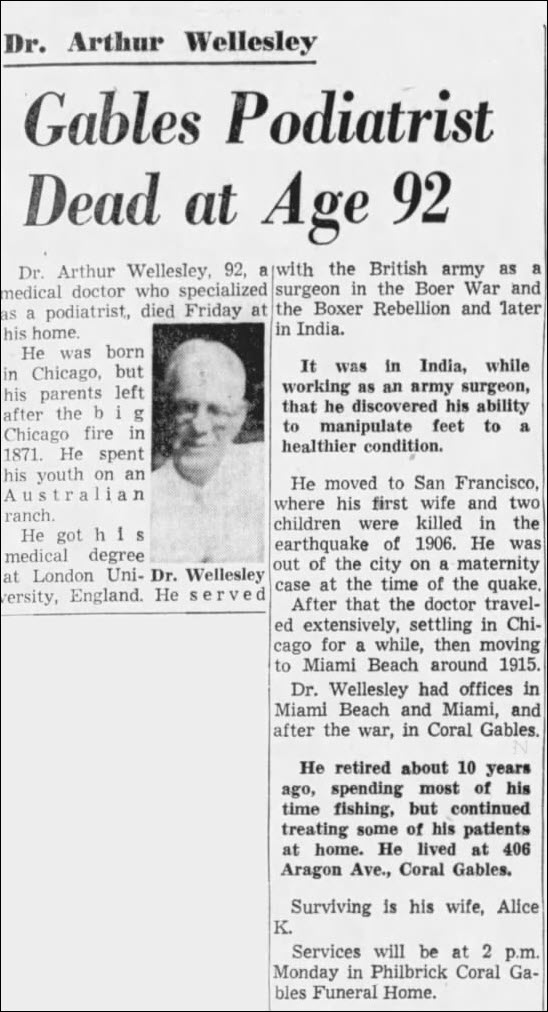
Wait? What?
He was born in Chicago but his parents left in 1871 after the great fire?
But his marriage license to Lou said he was born in Australia.
His parents should be listed on the 1870 census, taken in April, but there are no Wellesleys there or anyplace close.
Ok, maybe a fluke.
Next, the family somehow went to the Australian outback where he grew up on a ranch?
Then he went to London to medical school in the 1890s? Medical school had to be the 1890s, because the Boer War and Boxer Rebellion both started in 1899 and lasted through 1901/1902 and his story places medical school before the wars.
Did he go to England in the 1890s? I did find a record in the UK Lunacy Admission Registers for one Arthur Wellesley who was committed for about 5 weeks in 1892. Arthur Wellesley is not a unique name, but it’s also not crazy common either.
After earning his medical degree and serving in two wars, he was a surgeon in India? The British commander, Sir Arthur Wellesley did indeed serve in India in 1911 and 1912.
Then, Arthur immigrated to San Francisco where his wife and two children died in the earthquake of 1906? Subtracting, that suggests that he had been married for perhaps 4-5 years, minimally, at that time.
How awful. So much loss and devastation for this poor unfortunate man. However, there’s no Wellesley of any kind on the list of people who perished in the 1906 San Francisco earthquake, here. Nor is there any mention of his name in the newspaper there or in the surrounding area in 1906.
Hmmmmmm…….
He’s also not in any census before 1920, anyplace in the US that I can find.
And then, there’s the little matter of the Australian man by the name of Arthur Robert Wellesley who was arrested for theft in 1912 and convicted in February 1913 to two years of hard labor. An earlier conviction by a man with the same name, in 1899, stated that his parents were from England. Australia’s convict records have been published on Ancestry.
And there’s that mental health admission during the decade he was claimed to be in England.
Are these men by the same name the same man as the Arthur Wellesley that Aunt Lou married?
If Arthur did arrive in the US about 1915, that would square with the end of his two years of hard labor. He could easily have “morphed” into a doctor in a location where no one knew anything about his past, and had no avenue to make that discovery. In the early 1900s, there was no standardized testing or licensing for physicians. You didn’t even have to go to medical school. His ads in the Miami papers said that he had come to that area in 1920 and set up shop. That would map to the year he married Lou.
Eloise always seemed suspicious and tight-lipped about Wellesley and “what happened to Aunt Lou.” But she wouldn’t talk about that either – just like she wouldn’t discuss the topic of Nora and McCormack.
Well, what did happen to Aunt Lou?.
In 1940, Lou and Arthur Wellesley had been vacationing in Cincinnati where she was admitted to the hospital with a heart condition. Her death notice in the Miami paper said she was hospitalized for two weeks before she died, but her death certificate stated that she had been suffering from heart issues since the previous fall. Of course, that information was provided by her husband, the doctor.
Lou died in June and was buried in Aurora beside Charles “Todd” Fisk, her first husband, in the Kirsch plot in the Riverside Cemetery. In September, the Miami paper printed a notice that Arthur Wellesley had returned from an extended vacation to Cincinnati and Hendersonville, NC, mentioning absolutely nothing about the fact that his wife had died during that trip. Nothing about his being bereft or grieving, just that he was returning from vacation.
Vacation!!!
His wife’s death didn’t even disrupt that vacation.
How does a doctor take an extended, months-long vacation? What happened to his practice?
In November, announcements in the Miami newspapers stated that Wellesley was reopening his practice in a new location.
I cannot help but wonder about Wellesley’s history, his apparent grandiose “over the top” lies about his former life, a possible conviction and prison sentence, possibly a mental health admission, and mention of a former wife and two children that died. That’s to mention the inconsistencies in his stories about this birth location, the Chicago Fire, and the San Francisco earthquake. Was anything he said the truth?
Today, looking back, I’m very, very uncomfortable with this scenario and can’t help but wonder about the circumstances surrounding Aunt Lou’s death. Was life insurance involved? Was her death more than it appeared?
Apparently, the Kirsch sisters were *at least* uncomfortable too and suspected something.
1940 – Visitations
Nora is shown in the 1940 census in Wabash, but beside her entry is a note that the information was provided by a neighbor. This explains why her age is incorrect. Maybe Nora was traveling.
A newspaper article from Rushville when she returned for a visit in September of 1940 with Mom, Eloise, and Edith provides us with a bit more information about Nora’s life and what she had been up to.

Nora, 74 years old in 1940, about the time this photo was taken with Mildred (left rear) and Eloise (right rear), said she was living in LaFontaine, Indiana where “Eloise is also living at present,” but that Eloise is “of New York.” Nora said all four of her girls were born in Rushville. [Actually, only 2 were.] She said, “Though at present I am living with my daughter. Mrs. Claude Martin, in LaFontaine, I think of returning sometime to Wabash. My husband’s death occurred some years ago and now that my daughters are married and have their own homes, I am more or less free to do some of the things I missed in my younger life.”
That’s probably a massive understatement.

Nora is smiling and looks happy in this photo, in the garden with her daughters, Eloise at left and Mildred at right.
It’s unclear where Nora lived between 1940 and 1944, but she went to live with Eloise in New York about 1944 and passed away in 1949.

I don’t know who this child might have been, but this is Nora sometime in the 1940s.
One thing we do know is that somehow, for some reason, Nora was paying property tax on a small place in Florida in 1940. I bet that after her mother died, she spent time there in the 1930s. There’s also that 1913 photo of Nora and Ida in Florida that remains a mystery, as well as this photo of Eloise and Mildred, also in Florida.

Based on their apparent age, I’d guess that this picture was taken in the 1960s. How the Kirsch girls came to be in possession of this property, and what happened to it, is still unknown. Perhaps I should do some deed research work.
Unraveling Nora’s Death
For many years, I knew little about Nora’s death other than I thought I recalled, generally, that she died in Lockport with Eloise. However, the New York death index showed no surname like McCormack, McCormick, Lore or even Kirsch. I actually had no idea what name she was using at that time.
Also, I didn’t know if her first name was recorded as Nora, Ellenora, Ellenore or something similar. I “kind of” knew what to look for, and where, but the index showed nothing remotely close.
Even if Nora had died in New York “with Eloise,” that doesn’t mean she died in the county where Eloise lived, assuming Eloise lived in Lockport in 1949. She did in the 1960s and 1970s, but I can’t vouch for 1949. The local clerk was less than helpful.
Nora could easily have died in a neighboring county where there was a large hospital. I didn’t know if she died suddenly or not, or the cause, but I suspected she had dementia. If so, she could have been in a nursing home. I had little to go on.
The Rushville paper saved me once again, providing the next breadcrumb.
- Rushville, September 14, 1949

Nora’s funeral was held in Wabash before her remains were shipped to Rushville for burial beside Curt. I didn’t expect that.
The obituary says that Nora was visiting Eloise, not that she was living in New York. Of course, newspaper articles and obituaries are notorious for sending genealogists down the wrong rabbit holes. My own mother’s obit had to be published three times and still wasn’t accurate.
I needed Wabash records and at that point, their newspaper wasn’t yet available online.
Thanks to a friend, I did find a listing of Jones funeral home records in Wabash. Unfortunately, it required a lookup request and we were in the midst of pandemic lockdown. The good news is that the Allen County Public Library had this reference material and very graciously sent it to me as soon as they could. Librarians are boss!

Sure enough, there she was. Nora’s death date is accurate, but her birth location is misspelled, and her birth year is two years later. No matter. I had her.
From Jones Funeral home in Wabash, Nora went to the Todd Funeral home in Rushville, then on to the East Hill Cemetery where she probably had a graveside service of some description.
With the recent addition of New York newspaper articles, I found Nora’s death reported in two publications.
- Niagara Falls Gazette, September 13, 1949

This article says that she died “at the home of her daughter,” which would have been in Niagara County. One more piece.

Apparently, Nora began life as a Lutheran, attended the Presbyterian Church in Rushville, probably in Wabash given that her daughter was married there, and finally, in Lockport as well. Lockport had become her home.
- Lockport New York Union-Sun and Journal

In 1949, Nora’s brother, George “Martin” Kirsch had died on January 15th in Shelbyville, Indiana, also of a stroke. He left two children, Edgar and Cecile who wrote letters back and forth to Mother for years.
Nora survived only one sibling. Ida Kirsch, shown here in 1950 would live until 1966. Nora was close to Ida who you’ll remember from that 1913 photo in Florida.

Actually, I like the (unfortunately blurry) photo of Ida and Mom laughing better. Ida had a really, really rough life, married in her 40s to a “mean drunk” for 25 years before he passed away – but you’d never guess any of that from Aunt Ida’s lovely and cheerful disposition.

Ida had no children and few family members lived anyplace close to Cincinnati. She died in a predatory “widow’s home” where the widow signed over their real estate and other property for the promise that they would be cared for for the duration of their life. Ida became senile, lived in a room in the basement in the “home” and could not advocate for herself, even to ask for food. One of her nieces stopped in to see her once and discovered the inhumane circumstances under which she was forced to live.
Ida lived to be 89 and died on March 5, 1966, in Cincinnati. She’s buried with her family in the Riverside Cemetery in Aurora.
Two of Nora’s maternal aunts outlived her as well.
Nora’s Aunt Lou, short for Emma Louise Drechsel passed away just three months before Nora at 90 years of age She outlived three husbands and one of her two children. With Nora’s dementia, she may have been unaware or Eloise may not have told her.
Nora’s final aunt, Theresa Maria, “Mary” Drechsel who had moved to Chicago when she married lived until 1953.
Nora’s Traveling Funeral
The final question to be answered was Nora’s cause of death.
Nora died of a stroke. Her dementia and stroke were likely caused by atherosclerosis or hardening of the arteries for the preceding decade. Her mother, Barbara, had died of a stroke too.
Nora was 81 years old when she passed over, closing in on 82. We know from that handwritten letter that Nora was experiencing dementia. I don’t know about Nora, but I certainly want to “walk on” if that happens to me.
Nora’s death certificate reflects that the end came quickly, in the middle of the night, at home.
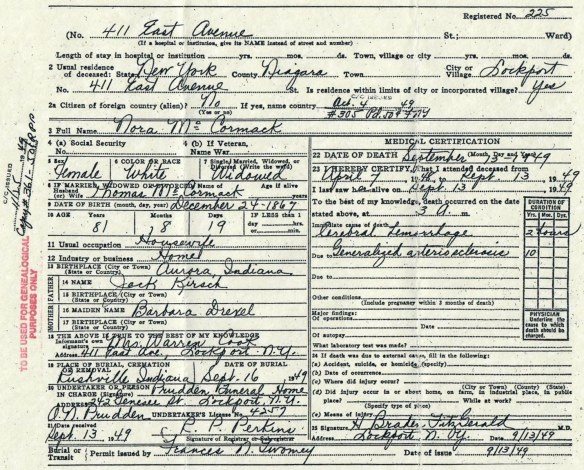
Death certificates are so interesting. Nora’s father’s first name is not Jack, but Jacob, and her mother’s last name was Drechsel. Drexel was spelled phonetically. Her birth year is only one year too late, as compared to the second funeral home’s information that was two years different. Her birth year had possibly “adjusted” years before, maybe by her mother, to not reflect poorly on her parents.
Nora had a traveling funeral – from Lockport to Wabash to Rushville – apparently all in three days, and assuredly by train. It’s somehow ironic that the Kirsch House held coffins of soldiers who were shipped home, having arrived at the depot, as they “rested,” waiting to be collected by their families.
My interpretation of Nora’s traveling funeral would be that Nora felt that Wabash was “home,” which is why her funeral took place there. I do have to wonder how many people were left in Wabash to attend. I’d wager that Eloise rode with her and that Edith joined in Wabash. I don’t know where Mildred was living at the time – Indiana or Texas – but regardless, I’m sure she too came home one way or another.
The family’s final gathering place would have been the graveside in Rushville, completing Nora’s circle of life.
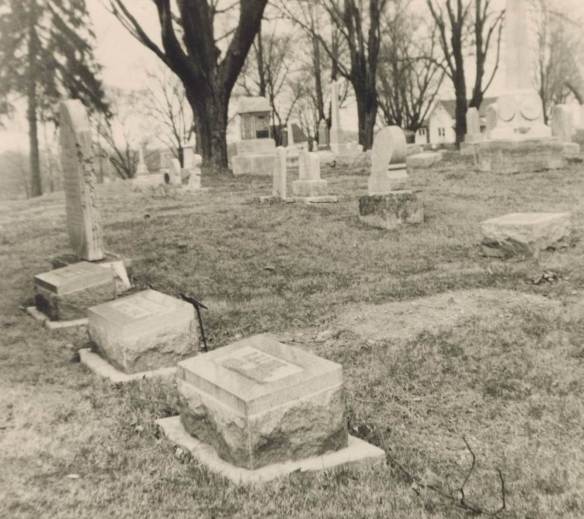
Nora was truly home, resting eternally beside Curt and Curtis. Grass would grow on her grave in the springtime, joining them seamlessly.
Not Forgotten
The threads of Nora’s life that we’ve been able to weave into a tapestry are truly amazing, even though the final chapters are still a bit fuzzy. I doubt we’ll ever be able to bring them into sharper focus.
Nora left Rushville in late 1916, and most of her friends there had either moved or were likely deceased by the time she made her final return 33 years later.
Nora spent most of the years between 1917 and 1940 in Wabash, so more than 20 years of her life.
Between 1940 and 1944, she lived someplace in Indiana, perhaps Wabash for part of that time. Nora clearly thought of Wabash fondly, in spite of McCormick, given her comments in that 1940 article when she returned to Rushville for a visit.

This is the last photo we have of Nora. She went to live with Eloise about 1944, and this may have been the “goodbye to Indiana” bon voyage photo taken with both of her daughters before their journey to New York began. Mildred and her son Jerry are standing beside Nora. Warren, Eloise’s husband is behind the group, and Eloise had her hand protectively through her Mom’s elbow.
Nora apparently still liked hats. She was dressed in high style, but she has the vacant look of dementia confusion in her eyes. Eloise is observing her mother caringly and protectively. I know Eloise faithfully watched over her for the next half-decade as Nora lived out her final years, hopefully among roses in the garden and fond memories of good times.

McCormick was the catalyst for Nora to leave Rushville, but in reality, he wasn’t in her life for long. From late 1916 to sometime after 1923, but gone before 1930 and dead in 1936. He changed Nora’s life but clearly didn’t ruin it. After what Nora had already survived, McCormick/McCormack, whoever and whatever he was, probably wasn’t much more than an embarrassing annoyance.
Nora seemed quite happy with her life in 1940, living with Mildred, pondering returning to Wabash, and talking about finally being able to do things she missed out on before.
I hope Nora was able to do just that – make up for those lost years. Nora survived and apparently chose to be happy, in spite of everything, everyone, and against incredible odds.
But I’d still like to know what she was thinking…
_____________________________________________________________
Disclosure
I receive a small contribution when you click on some of the links to vendors in my articles. This does NOT increase the price you pay but helps me to keep the lights on and this informational blog free for everyone. Please click on the links in the articles or to the vendors below if you are purchasing products or DNA testing.
Thank you so much.
DNA Purchases and Free Transfers
Genealogy Products and Services
Books
Genealogy Research
Like this:
Like Loading...