Finding Ilo’s Son, Lee Devine – 52 Ancestors #3

Twister

Well, this certainly wasn’t at all what I intended to write about for week #3 of 52 Ancestors, but we’ll let synchronicity have a run here and go with the flow.

This amazing mystery has turned from a search for the nameless son of a young lady named Ilo, with no last name, to a search for Ilo E. Bailey, born sometime between 1901 and 1904 in Ohio, who lived in Battle Creek, Michigan by 1920, daughter of John Bailey and Maude Wable.  Then it went one step further and became the search for Leo Thomas Devine, and then Lee Joseph Devine.  Yes, that’s the name of Ilo’s infant son and then what he was called as an adult.

You’re invited…come along…but word of warning…this is a theme park thriller stand-in-line-for-an-hour ride as it unfolds.  Except you don’t have to stand in line and you have a front row seat!  And, at the end, you get to vote….but I’m not going to reveal the question because it would spoil the story.  And what a story it is!  Pull up a chair…

My week #1 ancestor of Amy Johnson Crow’s 52 Ancestors in 52 Weeks challenge was Searching for Ilo’s Son.  Wow – what a mind-boggler this has turned out to be.  Remember the game Twister?  This is a lot the same.  I feel like I’ve been living on an emotional roller coaster for the past two weeks.

A short summary is that my father, William Sterling Estes had a child in 1920 with a woman in the Battle Creek/Kalamazoo area of Michigan, near Camp Custer, where he was stationed.  I had been unable to find either the woman, Ilo, or the male child, but a letter she left, included in the week #1 article, provided several clues.

Many people left comments and several of the commenters hit pay dirt.  I could not have put this puzzle together without all of you.  So let me say a very, VERY, big thank you to readers Carole, Laurie, Phyllis, Donna, Jerry, William and librarian in Louisville, Mark Taflinger.  I hope I didn’t miss anyone.

This exercise just goes to show why you should always obtain the actual record, no matter what the abstract or index says, and why you absolutely must think way, far, outside the box – and check even the unlikely.

This is the third time that viewing an actual record provided critically vital information.  You’d think I would have learned.

I had previously found the marriage record between an Ilo Baily and a Don Caroles in Battle Creek and discarded it because my father’s name was William Estes and an Ilo marriage to a Don Caroles seemed irrelevant.  It was the only Ilo record in that time and place and I felt that Caroles marriage eliminated that Ilo.  As it turns out, that marriage was far from irrelevant.

William Sterling Estes was the son of Ollie Bolton and William George Estes of Claiborne County, Tennessee.  Around 1910, the family came north to live in Indiana and in the late 19-teens, Ollie and William George divorced, with Ollie Bolton Estes moving to Chicago and William George Estes moving to Harlan County, Ky.  My Dad joined the Army.

Ollie Bolton’s mother was Margaret Claxton.  Why is this the least bit relevant, you ask?  Good question, because I certainly never thought it would be to Ilo Baily and Don Caroles.  But, it looks like Don Caroles just might not be who he said he was.

bailey-caroles marriage 1

This is the actual marriage index entry on two pages.  I don’t know why it’s marked through, but it is and 2 others are on the same page are as well.

Bailey-Caroles marriage 2

Ilo Bailey lists her parents as James I. Bailey and Ollie Bolton, but Ollie Bolton was the mother of William Sterling Estes.

Don Caroles says he was born in New Mexico and his parents are George Caroles and Mary Claxton.  Claxton?  Ollie Bolton’s mother’s surname??

Perhaps even more important is the note under their marriage record that says “In War Service Against Germany from Clayborn Co., Tenn.”  Clayborn is a misspelling of Claiborne which is where the Estes family hailed from.

Checking the 1910 census, there is no Don Caroles nor any Caroles born in New Mexico.  Maybe more importantly, there were no Caroles in Claiborne County, Tn., either.  My Estes and Bolton families were from Claiborne County, and I have many reference books.  There were no Caroles.  To be absolutely positive, I checked the Claiborne Pioneer Project too, and nada.  There was Carroll, but no Don.

By now I’m extremely suspicious, so I checked further.  The 1920 census showed Ilo and Don Caroles.  The census date was Jan. 13, 1920, just a month after their marriage, and there is no baby yet, but they are living with Maud E. Bailey.  Maud looks for all the world to be Ilo’s mother.  And notice that Ilo’s age has been reduced by 2 years in the month since she got married.  Hmmm…usually marriage ages people!  Don Caroles’ occupation was “fireman” and then “locomotive” which is what William Sterling Estes did in WWI at Camp Custer.

Bailey 1920 census

Ilo is living in the same house with Maud Bailey, probably her mother.

William Sterling Estes is not listed in Michigan in the 1920 census, but we know positively that he was stationed at Camp Custer at that time.  However, he was also AWOL, from November 1919, before he married Ilo, through April 1920, so maybe this is her family’s attempt to hide him.

Looking back at the 1910 census, we do find Ilo with her family and indeed her mother is Maud and the siblings match.

Bailey 1910 census

Ilo E. Bailey in the 1910 census was age 6, so born in 1904, and living in Belvidere in Montcalm Co., Michigan.  That means in 1919, she was age 15 when she married “Don Caroles.”  Her parents were John Bailey and Maude E., although her father had died before the 1920 census.  Her grandfather John C. Bailey age 78 also living with them in 1910.

Reconstructing her family between the 1900, 1910 and 1920 census, we find the following:

Ilo’s father, John Bailey was born in 1865 in Ohio and his father was John C. Bailey born in 1832 in Ohio.  Ilo’s father, John, died sometime between the 1910 and 1920 census.  Ilo’s mother was Maude E. born in 1881 in Ohio.  We discover Maud’s maiden name in two of her children’s death records.

Ilo’s sibings:

  • Martha E. Bailey born in October 1898 in Ohio, died Aug 3, 1913 in Belvidere Twp, Montcalm Co. Mi., father, John Bailey, mother, Maude Wable.
  • John C. Bailey born in 1901 in Ohio.
  • Mervin E. Bailey born in 1907 in Ohio (Ervin born Jan 24, 1907 in Van Wert, Ohio, according to Ohio births,) Mervin Eugene died March 11, 1921 in Belvidere, Michigan, his death record says that Ervin born was Jan. 24, 1906 in Van Wert, Ohio, child of John C. Bailey and Maude Wable.
  • May E. Bailey born October 1918 in Michigan.

John Bailey married Maude Wable (Or Woble) in Jackson, Jackson Co., Michigan on March 31, 1897 according to Michigan marriage records.  According to the 1900 census, John already had 3 daughters from a first marriage.

Ok, it surely looks like we have the right Ilo, but where is Ilo in the 1930 census, or, for that matter, anytime after the letter she wrote to William Sterling Estes dated March 22, 1921?

The 1930 census shows no Don Caroles or any other that look familiar at all.  Of 5 Caroles listed nationally, 4 are born in Italy and one in Nebraska.

Once Again, We’ve Run Aground.

Here’s my working theory in terms of what happened surrounding Ilo Bailey and “Don Caroles’” marriage.

William Sterling Estes was actually either 17 or 18 in 1919 but his military ID would have said that he was 22 or 23, born in 1898.  He would not have needed his parents to sign.  Ilo, if she was born in 1903 would have been 16 and if born in 1904, 15 when she married in 1919.  She was obviously pregnant, I’m guessing at least 3 months, so the child was born sometime after the census in January and probably before June.  My sister was born May 22nd that year to another woman.  I wonder if he knew my sister’s mother was pregnant when he married Ilo.

When applying for a marriage license, Ilo claimed she was 19, but her youthful appearance might have caused some suspicion.  Her own mother had a young baby at home herself and was a widow by January 1920, so obviously a woman facing hardships.  It would be easy to surmise that she did not want her daughter finding herself in the same kind of situation and might not have been in favor of her marrying so young.  I suspect that Ollie Bolton went along with the young couple to get their marriage license and then to get married, and posed as “her” mother, not his.  Note that Ilo did not give her correct father’s name either.

I checked Ancestry, Family Search and Rootsweb for Ilo’s family, with no luck.  There is one very sketchy record at Ancestry.  I did leave the contributor a note but also noticed they had not signed on in over a year.  Not a good omen.

I was trying to track Ilo’s siblings forward in time, thinking I might be able to find their obituaries which could lead me to Ilo once again, as an adult, with a married surname…but all I found was two of her siblings death records as young people.   Of the two siblings who lived, I was unable to find anything at all about May Bailey, and John C. Bailey was too general.

So, we’re at a dead end again.

The Ridiculous and the Sublime

Do ridiculously silly questions sometimes haunt you?  If not, l’ll gladly share some of mine!

Here’s a mind-twister that might even stump legal eagle Judy Russell.  If you’re Ilo, and you marry “Don Caroles” and have a baby, and then discover that there is “another woman” and “another baby,” and that your marriage is illegal, probably saving you the trouble of getting divorced – what surname do you file under in court?  Bailey, Caroles or Estes?  And given that, who do you file against, Don Caroles or William Sterling Estes?  And what do you file?  And what kind of a court do you file in?  And what do you ask for, exactly, other than having the scoundrel shot?

When the baby is born, what surname do you give your baby?  Caroles?  If you give the baby the name Caroles, do you then ask for it to be changed when you discover that not only were you illegally married, but not to the man Don Caroles at all?  And changed to what, Estes or Bailey?  Is the child then legally illegitimate?  And assuming all of this is filed, is the entire court record and file now sealed because it involves changing the parentage of a minor, similar to an adoption?  In other words, will I ever be able to find this record, wherever it is, whatever it is?

In Ilo’s letter, she tells William Sterling Estes that “it’s in a lawyer’s hands now” and that she doesn’t need his signature at all.  And besides that, even if she did, exactly which signature would he use???  And wouldn’t you think he would get in trouble with the military for getting married under a fake name, I mean, if he wasn’t already in trouble for being AWOL?  Wouldn’t you think he would think about these things?  Just saying….

And if Ilo then went to remarry, or marry, whatever you call it, what surname would she use in that marriage record?  The 1920s was a long time before women petitioned to take their maiden name back.  In the 1980s, judges were reticent to grant the return to maiden names if children were involved – and that’s 60 light-years later.

One of the reasons that I ask all of this is that I know the “father” was changed on my sister’s birth record to reflect my father’s name, after her mother married my father in December of 1922.  He seemed to like December weddings.  My sister’s birth record was then refiled with the later “delayed” or “adopted” records and given that my sister didn’t know about this, she had fits getting her birth certificate because it had been stricken in the original book with no “pointer” to the new entry.  A clerk finally found it on a fluke and with her standing there refusing to leave without a birth certificate.

Am I ever going to be able to find out what happened to Ilo’s son?  I actually wonder if he died.  My sister who was born within months or weeks (or for all we know days) of Ilo’s child was well known to the family, even if her mother and her mother’s family “didn’t care for” my father, to put it mildly.  So if Ilo’s child died, what surname would his death record have reflected?

I may never figure this out, but still, I want to know…

  • Who was that child?
  • What was his name?  No child should be remembered namelessly.  Even my babies who died all have names.
  • Did he live or die?  Is my brother alive?  Did he have children?
  • If he died, when, and how?

And oh, just one more crazy twisted question.  If you were William Sterling Estes, and you had two women pregnant at the same time in the same town, due, it seems, about the same month…wouldn’t you worry that they might meet each other?  Like at the doctor’s office…or worse yet, wind up being roommates giving birth???

Wait a minute!  Maybe that’s what happened.  He was AWOL from November 1919 through April 1920 when he was arrested.  Arrested?  Maybe he turned himself in….maybe it seemed like the safer choice.  Oh what a tangled web we weave…..

Ilo’s Son

Just as I was ready to call this a draw, again, for about the 100th time in the 36 years I’ve been searching for my brother…another reader sent me a vital piece of information.  Ilo Esther Bailey remarried in Ohio using her maiden name.  And yes, it’s the same Ilo because she gave her parents names.  And for once, the names all match.

On June 9, 1928, Ilo Esther Baily, born in Van Wert, Ohio to John Bailey and Maude Wable married Thomas Devine, son of Mathew Devine and Elizabeth Hawkins.  They both listed their marital status as “single” and they were married in Bowling Green, Wood County, Ohio, just south of Toledo.

The image of the actual application shows that they weren’t just single, but that they both state they have never been married before.

Bailey-Devine marriage app

The 1930 census, just two years later shows this couple with several children, including one named Leo Jr, age 10, so born in 1920, in Michigan.  They were living in Lucas County, where Toledo is located.  Ilo is listed as age 27, so born in 1903.

Bailey-Devine 1930 census

Children listed were:

  • Leo Jr. – 10 – born in Michigan
  • Matthew T. – 8 – born in Ohio
  • Robert J. – 6 – born in Ohio
  • William E. – 3/12th – so born in January of 1930

Leo would have been the son of William Sterling Estes.  How then could he be Leo Jr.?  Did she rename the child after her second husband?  This doesn’t make sense, but then nothing about this entire situation makes sense.

About this time, I recalled what my crazy aunts had told me.  That my father was married about 1920 or so to a Laila LaFountain and they had a son Lee, who eventually took his step-father’s name of “Levi or Levy or something like that.”  Lee wound up in Louisville, Ky studying the ministry in a seminary “or something,” they recalled.  All this time, I thought Laila LaFountain was a different person, if she and Lee even existed at all.  Remember, they were the crazy aunts:)

By 1933, Ilo was in Louisville, Ky., with husband  L. Thomas, as listed in the Louisville, Kentucky City Directory.  L. Thomas Devine is listed with Ilo E., r rear 911 Washington in 1933 and in 1934 Leo T. Devine with Ilo is listed at 1056 Washington.

By 1939, Mrs. Ilo E. Devine is listed by herself at 1005 E. Main.

Another reader found ILA (sic); Leo, Jr., student; and Matthew, living at 412 E. Grey in Louisville, in the 1940 city directory. Ilo is listed as widow of Thomas. There is a Thomas listed in 1940, who is a Laborer at Cavehill Cemetery. There is also a William, but there is no way to know if he is Ilo’s son.

The family is missing in the 1940 census.  In 1940, Ilo’s children would have been:

  • Leo – 20
  • Matthew – 18
  • Robert – 16
  • William – 10

According to the Ohio birth registry, another child, James J. Devine was born Oct. 24, 1923.  Would this be Robert James Devine who died in 1975?  The answer is in Robert’s death certificate and obituary.

And I have to ask…why does this family continue to change their names???  Leo Thomas Jr. became Lee Joseph., James J. became Robert James and William E. became William Douglas???

In 1942, Matthew T. and Robert J. are living at 829 Washington Street. There is also a Thomas.

We know that at least Robert James was alive beyond 1942, because he died in Fort Worth, Texas on July 7, 1975.  His mother is listed as Ilo Esther Bailey and his father as Leo Thomas Devine.

Robert James Devine death cert

I ordered Robert’s obituary from the Fort Worth Library.  It did not list his parents, but did list his siblings.

Robert Devine obit cropped

So we now know that in 1975, Lee, Matthew and William were all still living in Louisville.

According to the birth index, Matthew T. was born January 15, 1922 in Lucas County, Ohio to Ilo and Leo.  This means that this child was conceived in April 1921, approximately 1 month after Ilo wrote the letter to William Sterling Estes.  Perhaps this relationship with Leo Devine, is what Ilo was referring to in her letter when she stated that William, upon his return to Battle Creek, would hear “quite a bit about me.”  If indeed she did return to Michigan in June as she indicated was planned, she was then pregnant with her second child.  It’s interesting that the location from where she wrote the letter to William was Louisville, where she and Leo Devine ultimately wound up living.  Maybe Leo is the “very fine people who are wealthy and willing to take care of baby and I.”

If Leo, or Lee, the child, was raised as part of the Leo Devine family, he may never have known that he was not Leo Devine’s biological child.  But was Lee Devine the biological son of Leo Devine?  As it turns out, Leo Devine was living with his brother Douglas in Battle Creek, Michigan in 1920, per the census, and it appears that Douglas was working at the Army Base.

One thing is for sure, Matthew Devine was positively not the child of William Sterling Estes, because he was in the Leavenworth Disciplinary Barracks, in Kansas, at the time Matthew was conceived.

Matthew Devine died August 19, 1997 and his obituary is as follows:

Matthew Thomas Devine, 75, died Sunday at Caritas Medical Center.  He was a retired employee of the old International Harvester Co., an Army veteran of World War II and a member of Veterans of Foreign Wars Post 1181.

Survivors: his wife, the former Norma J. Taylor; sons David and James Harbin; daughters Mary Scott and Esther Choi; a brother, William Devine; six grandchildren; and a great-grandchild.

Funeral: 1 p.m. Tuesday, Resthaven, 4400 Bardstown Road. Burial: Resthaven Memorial. Visitation: 2-9 p.m. Monday.

From the Ohio Birth Index – William Douglas Devine was born December 31, 1929 son of Leo & Ilo.  His birth date in the SSDI (Social Security Death Index) matches this date.

Here is his  obituary From findagrave.

Devine, William Douglas, 77, of Louisville, passed away on Tuesday, March 27, 2007, at Jewish Hospital. Mr. Devine was a retired captain on the Louisville Fire Department, a member of the Fire Fighter’s Union, Retired Fire Fighters, honorary member of the 10th. Mountain Division, and Guardian Angels Catholic Church. He is survived by his wife of 56 years, Mary Lee Devine; a daughter, Dusty Callahan-Hardin (Tim); and two grandchildren, Ryan and Caitlin Callahan. Funeral Mass will be 10 a.m. Saturday at Guardian Angels Catholic Church, 6000 Preston Highway. Burial will follow in Resthaven Memorial Park. Visitation will be 2-8 p.m. Friday and after 8:30 a.m. Saturday at Arch L. Heady at Resthaven, 4400 Bardstown Rd. Expressions to Guardian Angels Catholic Church.  Published in The Courier-Journal on 3/29/2007.

Unfortunately, this obituary doesn’t say anything about his brother, Lee.

Where is Leo Thomas Devine?

In 1939 and 1940, we find a Lee Joseph Devine attending the University of Louisville in the Liberal Arts program.

In the 1956 City Directory, we find Lee J. Devine with wife Ruth who works for the Pan Am Service Station.  Then we find Matthew T. Devine who works in the same place.  That seems just too much of a coincidence and connects Matthew T. with Lee J. who is married to wife Ruth.  To me, this removes most of the doubt as to whether or not Lee. J. Devine is the same person as Leo T. Devine.  Having said that, this family “ball of string” has thrown me so many loops and blindsided me so many times that I’m very hesitant to conclude anything without definitive proof.  It seems that no one behaves or plays by the rules, or even keeps their names!

By the 1960 directory, we find Lee J. Devine who is now a vice president of Thurston Cook Mercury.

In 1989, we find the death record for Lee J. Devine, also listed as Leo Devine in at least one death record index.  He was born February 24, 1920, obtained his SS number in Louisville prior to 1951 and died in St. Petersburg, Pinellas County, FL on January 21, 1989.  He had a death record both there and in Louisville and was buried in Howe Valley, Hardin Co., KY.  Hardin County borders Jefferson County where Louisville is located.

Devine cemetery stone

Photo taken in January, 2012….and Ruth isn’t buried at that time.

This particular Lee Devine married Cordelia Ruth Lyon on June 26, 1943.  But, is this Lee Devine the son of Ilo Esther Bailey or is this a different Lee Devine?

When in doubt, call the library.  I learned this years and years ago, and once again, it didn’t fail me.  Mark Taflinger, the Data Desk Manager provided me with Lee’s obituary which clearly links him with brothers William and Matthew.

Lee J. Devine, 68, died Saturday in St. Petersburg, Fla.

He was a retired president and administrator of St. Matthews Manor and Mount Holly Convalescent Centers, a former president of the Kiwanis Club of Louisville and the Executive Club, and a member of the Pendennis Club, Boys and Girls Council of the Salvation Army, English Speaking Union, Stephensburg Masonic Lodge, Scottish Rite and Kosair Shrine Temple.

Survivors: his wife, the former Ruth Lyon; and two brothers, Matthew T. and William D. Devine.

Funeral: 10 a.m. Wednesday, Christ United Methodist Church, 4614 Brownsboro Road, with burial in Howe Valley Cemetery in Cecilia. Visitation at Pearson’s, 149 Breckinridge Lane, from 1 to 9 p.m. Tuesday.

But there is one more thing….he had no children.  So I don’t have any nieces and nephews, and there is no one to do DNA testing to prove, or disprove, that Lee was my brother.

From Lee’s obituary, I would have been proud to know this man.  It certainly looks like he made a very positive difference in the world.  Ilo, your son would have made you proud.  I’m just so sorry that I never got the chance to meet him.  But now I know.  I no longer have to wonder.  There will be no mysteriously appearing sibling DNA match, at least not from him.  I can stop waiting.

So, now I must pause to reflect.  It has been an extremely long couple of weeks.

Is Lee Devine My Biological Brother?

Is this man my brother?  I’m sure you’ll understand my need to ask after discovering that my brother Dave was not.  Added to this doubt, in this case, is the fact that Leo Devine was also in Battle Creek in the 1920 census and that Ilo named the child, according to the 1930 census, Leo Thomas Jr. – although his name would somehow evolve over time to Lee Joseph.

I’m sure that this Lee Devine is the man that is supposed to be my brother. We have finally walked, crawled and then sprinted to the end of that trail. But was he really my brother?  The only resource left now is photos and once again, Mark, from the Louisville library came through for me.  Libraries have clipping files.  This photo of Lee Devine is from March 2, 1955.  It’s the only photo in his file.

??????????????????????????????????????????????????????????????????

I have no photos of my father from the time of his military service until about 1950 or so.

Bill about 1950

Here is a photo of my father I’d guess about 1945 or 1950.  And no, I have no idea who the child is…which leads to more questions, that, unless someone recognizes this photo, will forever be unanswered.  It was labeled as “one of his girlfriend’s children” by my brother Dave’s mother, so it’s not Dave.

William Sterling Estes circi 1950 crop

My father about 1950, so about 13 years older than Lee was in the photo taken in 1955.

Bill military 2 cropped

Here, above and below, are photos of my father in the military around 1918, so about age 15.

Bill about 1918 cropped

Bill 1960

Here’s William Sterling Estes about 1960 with my step-mother, Virgie.

Edna 1955 cropped

Here is a photo of my genetically proven sister, the one born in 1920 just three months after Lee, taken about 1955.

Sister age 60

Here’s my proven sister at about age 60.

Estes Publicity

Here is a photo of me taken when I was about 5 years older than Lee was in the photo in 1955.

There are a few more family photos in the “Crazy Aunts” story.  I personally think Lee resembled my father’s brother, Joseph, shown in the family photo in that article, and below.

Estes family 1914 joseph cropped

This is the end of the story.  We’re done.  Case solved, thanks to many contributing people.  It stops here because there are no children to DNA test.  There can be no final chapter, so to speak, no definitive conclusion.

Feelings and Coping

I feel that it’s only appropriate to add a quick note about how I feel about this.  These have been an extremely emotion-filled few days.  I have chosen to share not only this experience in total, step by step, but also how I feel about it, for two reasons.

First, many others will go through this same process.  I didn’t quite expect to go through it publicly, but that is how it started with the Ilo story and I felt obliged to share with you “the rest of the story,” especially given that so many of you contributed the key pieces of the puzzle.  It would not have been solved without the reader contributions.

The resolution of this type of search within a few days is actually very unusual.  Often there are weeks or months between pieces of information and you can deal with each one as they arrive.  For me, this process has been extremely compressed these past few days due to the newly available online records such as the Ohio birth, death and marriage indexes. This process and the emotional roller-coaster attached to each new piece of data feels quite lonely and the emotions are extremely raw, especially if you’re searching for the family you don’t have.  These journeys by virtue of what they are often isolated and alone.  Other than giving birth or burying a family member, these types of searches are one of the most personal journeys you can embark upon.  They will change your life forever, the journey itself, if not the outcome.

For many, especially adoptees, there is a sense of desperation that defines these searches.  The clock is always working against you in the sense of finding the person alive, and working for you in terms of new records becoming available that may help your search.  Your feelings are always a conflicted hodgepodge of hope and fear, often wildly swinging between the two.  Fear of what you will find, what you won’t find, that you’ll find nothing, or that it will be too late.

Second, I’ve shared to help those who never experience this understand the process for those of us who have.  Almost all of us will know someone who goes through this.  Many people experience this over and over trying to find parents and then siblings, having no idea what awaits them….what they will find…if anything.  It never becomes easy or even easier, especially after a few choice rejections and setbacks.  Many times, each one becomes more difficult.  The end of these stories aren’t always happy endings in the classic sense of a tearful, joyful reunion.  Trust me – there is another sister I haven’t told you about.

Anyone who searches for a sibling or parent or child knows that the entire search, for however long it takes, often decades, is fueled by hope.  Some hope for a joyful reunion, for love.  Some just want closure.  Some want to know what that person was or is like.  Many want to find some commonality.  Some of us are almost afraid to hope.  Given the dysfunctional state of my father’s life and his history of drinking, I had no idea what to expect in his child.  Lee was a pleasant surprise.

I clearly knew that it was extremely unlikely that I could ever find this brother, and by this time, more than 90 years after his birth, if I did, he would likely be deceased.  I’m far more surprised that I’ve actually found him than I am that he has passed over.

I was extremely blessed to have found my sister Edna in 1978 and my brother Dave in the early 2000s.  I had a few years with both of them before they passed – years I would not trade for anything.  I think we loved each other more intensely and gratefully to make up for the years we didn’t have.  My sister and I were so very much alike in uncanny ways.  I was utterly devastated at her passing – given and so unexpectedly wrenched away again just a dozen years later. It was many years before I stopped picking up the phone on Sunday afternoons to call her.  The second anniversary of Dave’s passing is next week.  And so – another brother lost, and found, and lost again.

When we obtain closure, it allows us to move on, in our own way, in our own time.  In the meantime, we grieve what wasn’t, what might have been, what we hoped would be and never happened.  Sometimes, depending on the circumstances, we grieve what was.

This discovery, as glad and extremely grateful as I am to have made it, is, in it’s own way, a death.  It’s finally over.  The door has shut, as gently as possible, but it is closed, latched, and he is on the other side…and although I’ve found him, given the murky circumstances, I still don’t know if he is actually my brother.

What I wanted, of course, was a brother, and failing that, the truth.  Had he been alive, or had children, the truth would be easy to discern utilizing DNA testing.  It seems ironically fitting somehow that even at the end of this convoluted journey, the truth would still be permanently unreachable.  For the past 36 years, my brother has always seemed to be just beyond my fingertips, and he still is.

So, in keeping with my quilter’s heart, I bought fabric this week to begin a quilt (for me) for him…to celebrate finding him, to be thankful for my many friends who solved the mystery, to mark the end of this part of the journey, and to honor his life well lived.  When life gives you scraps, make quilts.  There is beauty in everything.  I chose beautiful batik snowflakes to represent the steps in the journey that ended “cold,” in the middle of the toughest winter in decades.

Hoffman Bali tiles

As for whether he is my biological brother, I truly don’t know what to think, so I’m asking you.

Let’s Vote

So, what do you think, based on the pictures?  By the way, your votes are anonymous,  so be truthful.

Is Lee Devine my biological brother?

______________________________________________________________

Disclosure

I receive a small contribution when you click on some of the links to vendors in my articles. This does NOT increase the price you pay but helps me to keep the lights on and this informational blog free for everyone. Please click on the links in the articles or to the vendors below if you are purchasing products or DNA testing.

Thank you so much.

DNA Purchases and Free Transfers

Genealogy Services

Genealogy Research

Searching for Ilo’s Son – 52 Ancestors #1

I decided to participate in Amy Johnson Crow’s 2014 challenge, “52 Ancestors in 52 Weeks.”  Of course, I didn’t find out about it until yesterday, so I’m already a week behind, but I can catch up….and so can you.

I think Amy’s challenge is a really great idea for a couple of reasons.  First, it forces us to focus and breakthroughs seldom happen out of the blue.  Focus is the precursor to success.  Second, it gets the information out there – where it can be fishing for us – for cousins, for information, or for people who can DNA test.  Take a look at the week #1 recap.

I’m not sure I can turn out 52 weeks of stories that involve DNA, and this is a DNA blog, but I can certainly do a few.

I’ve always been much better at thinking outside the box than coloring in the lines, so I’m beginning my 52 ancestors by writing about someone I don’t know.  A half-brother I know that I had, at one time, but I don’t know anything more about him, except his approximate age and his mother’s first name, Ilo, and that in 1922 they had been living in the Battle Creek, Michigan area.  According to her letter, her family was from there, but she has suffered humiliation all alone.

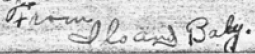
ilo signature

You see, my real father was a bit of a rogue, a “ladies man” as they used to say.  Mom called him a Scallywag and that was one of the nicer things she had to say.

Estes, William Sterling WWI

My father, William Sterling Estes, met Ilo during the first World War.  He was born about 1903.  We’re not sure of his real birth year as he had “adjusted” his birth year to 1898 to join the military after his parents divorced and he found himself on his own.  He joined the Army in May of 1917, at age 14, and in 1919, was in the infirmary at Camp Custer, an Army base where he was stationed, outside Battle Creek, Michigan.  The flu epidemic had run rampant at Camp Custer, and I presume, but don’t know for sure, that that was why he was in the hospital.  He met his first wife there, my sister’s mother, and he also met Ilo.  In reality Ilo might have been his first “wife.”  We just don’t know for sure.

When my step-mother died in 1989, her daughter sent me a lot of my father’s things that she had kept over the years, including a box of letters.  In that box was a letter from Ilo to my father.

The Ilo letter is postmarked March 22, 1921 and it was addressed to Mr. William Estes, Fort Leavenworth, Kansas, Disc. Barracks.  Yes, that’s Fort Leavenworth as in the prison.  Imagine my surprise!  The letter wasn’t exactly “friendly” in tone, not that I can blame Ilo.  She and my mother probably shared a common opinion of my father for many of the same reasons.

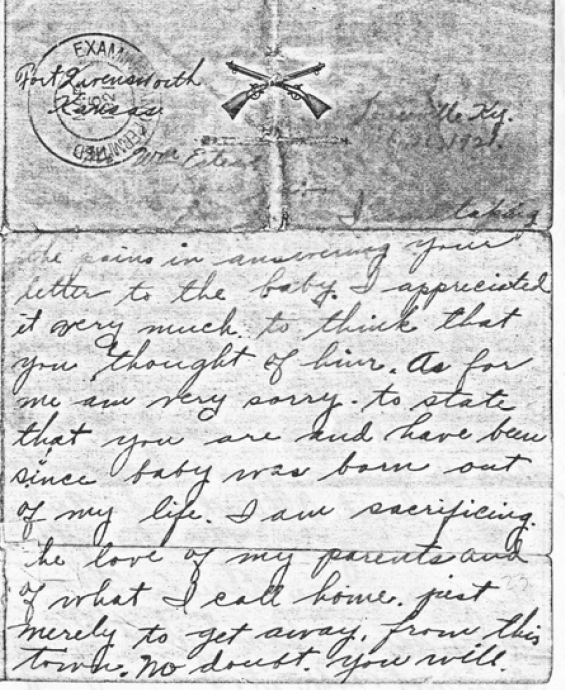
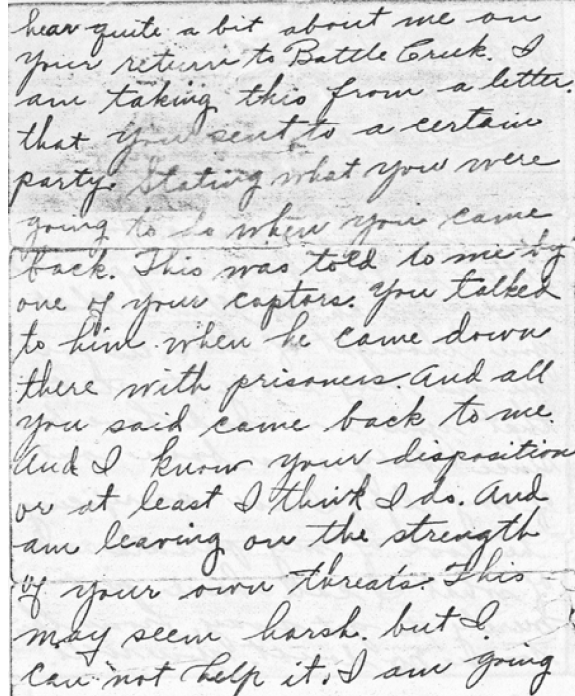
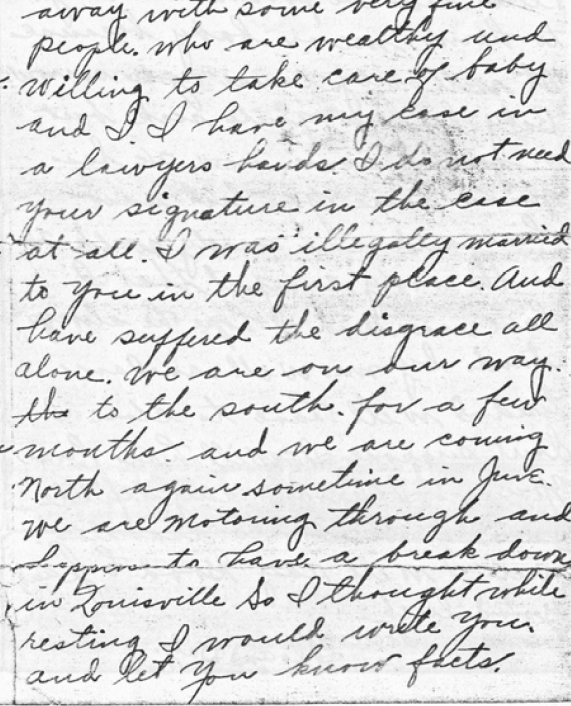
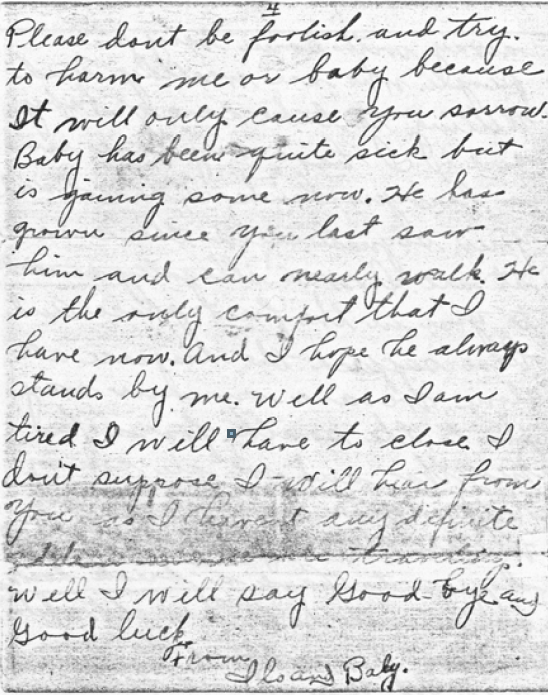
“I was taking the pains in answering your letter to the baby.  I appreciated it very much to think that you thought of him.  As for me am very sorry to state that you are and have been since baby was born out of my life.  I am sacrificing the love of my parents and of what I call home just merely to get away from this town.  No doubt you will hear quite a bit about me on your return to Battle Creek. I am taking this from a letter that you sent to a certain party.  Stating what you were going to do when you came back.  This was told to me by one of your captors.  You talked to him when he came down there with prisoners.  And all you said came back to me.  And I know your disposition, or at least I think I do.  And am leaving on the strength of your own threats.  This may seem harsh but I cannot help it.  I am going away with some very fine people who are wealthy and willing to take care of baby and I.  I have my case in a lawyers hands.  I do not need your signature in the case at all.  I was illegally married to you in the first place and have suffered the disgrace all alone.  We are on our way to the south for a few months and we are coming North again sometime in June.  We are motoring through and happened to have a breakdown in Louisville so I thought while resting I would write you and let you know facts.  Please don’t be foolish and try to harm me or baby because it will only cause you sorrow.  Baby has been quite sick but is gaining some now.  He has grown since you last saw him and can nearly walk.  He is the only comfort that I have now and I hope he always stands by me.  Well as I am tired I will have to close.  I don’t suppose I will hear from you and I haven’t any definite address ???? traveling.  Well I will say goodbye and good luck.  Ilo and Baby.”

Oh, that she had simply written that baby’s name…

It seems that my father was in Fort Leavenworth because he had been AWOL, and it seems that him being AWOL just might have had something to do with having two women, in the same town, pregnant at the same time.  Remember, my father was only 16 at the time, really, a mere child himself.  He deserted in November 1919, after re-enlisting for a second term in May of 1919.  He was gone from the Army through April, 1920 when he was arrested for being AWOL.

My sister was born in May of 1920, so conceived in August of 1919.  This unnamed male child of Ilo’s appears to have been born between December 1919 and July of 1920, assuming he walked at the normal time babies learn to walk.  Therefore, he would have been conceived between March 1919 and October of 1919.  So Dad was busy indeed, with all this begatting going on.

When my father was released from Leavenworth in November of 1921, he traveled back to Michigan and married my sister’s mother 2 weeks later.  On that marriage application, he says he has never been married before.  But in Ilo’s letter, she says they were married, but it was illegal.  Clearly he had himself in a very uncomfortable position and could have been trying to decide which father was more likely to pull the trigger on the shotgun.  He and my sister’s mother divorced a couple of years later and he went on his merry and marrying way, but that is a story for another time.

Here’s a timeline:

  • March to October 1919 – Ilo’s son conceived
  • May 1919 – William Sterling Estes reenlists at Camp Custer in Battle Creek, Michigan
  • August 1919 – my half-sister conceived
  • November 1919 – William Sterling Estes is AWOL
  • December 1919 to July 1920 – Ilo’s son born
  • April 1920 – William Sterling Estes arrested for being AWOL
  • May 1920 – my half-sister born
  • March 22, 1921 – Ilo’s letter to William Sterling Estes saying they had been married but it was illegal
  • November 1921 – William Sterling Estes released from Leavenworth, Kansas
  • December 12, 1921 – William Sterling Estes married my half-sister’s mother

But what happened to Ilo and to her young son?

Megan Smolenyak and I both tried to resolve this situation.  There are no court records to be found in Battle Creek or the neighboring County, at least not that we have been able to find.  I have significant doubts that I’ve seen everything as I was not allowed to review the court index books.  Their protocol was that you have to give the clerk the information and she would tell you whether it was there or not.  Camp Custer is located partly in two counties, so we were dealing with both Calhoun and Kalamazoo Counties.

Megan found an Ilo from that area and then her son.  We contacted this man, and he is too young to be my brother.  He said he had a brother that was about 18 months older that died.  I sent him the letter from Ilo but he said it was not his mother’s handwriting, that she was nearly illiterate.  And there, if that was the trail at all, it went cold.  It stayed cold.  It’s still cold.  Was my brother the child who died?  Ilo said he had been sickly.

We don’t know the male child’s name, first, or last.  We don’t know Ilo’s surname.

There are so many stories about people with surprise half-sibling matches through autosomal testing.  I keep waiting for a half-sibling match, or maybe one slightly more removed.  Ilo’s son is likely deceased now, but he might have had children or grandchildren.  He may never have known who his father was.  Ilo was a young woman, obviously embarrassed by the situation as it was, and likely went on to marry and have a family.  I hope she found happiness.  Assuming she remarried, Ilo’s son’s step father could simply have “adopted” him by giving him his surname and until DNA testing, no one would ever know the difference.

So, if your mother or grandmother’s name was Ilo (or possibly Flo, although the signature looks like Ilo) and she lived in or near Battle Creek or Kalamazoo, Michigan, would have been maybe 18 or 20 or so about 1920, and had a male child, maybe she is the missing Ilo.

I’ve included the letter below, for handwriting comparison.

ilo letter page 1

ilo letter page 2

Ilo letter page 3

ilo letter last page

______________________________________________________________

Disclosure

I receive a small contribution when you click on some of the links to vendors in my articles. This does NOT increase the price you pay but helps me to keep the lights on and this informational blog free for everyone. Please click on the links in the articles or to the vendors below if you are purchasing products or DNA testing.

Thank you so much.

DNA Purchases and Free Transfers

Genealogy Services

Genealogy Research

Introducing the Autosomal DNA Segment Analyzer

We have a brand new toy in our DNA sandbox today, thanks to Don Worth, a retired IT professional.  I just love it when extremely talented people retire and we, in the genetic genealogy community, are the benefactors of their Act 2 evolution.  Our volunteers make such a cumulative difference.

Drum Roll please.

Introducing…..the Autosomal DNA Segment Analyzer, or ADSA.

The name alone doesn’t make your heart skip beats, but the product will.  This tool absolutely proves the adage that a picture is worth 1000 words.

Don described his new tool, which, by the way, is free and being hosted by Rob Warthen at www.dnagedcom.com, thus:

I created this tool in an attempt to put all the relevant information available that was needed to evaluate segment matches on a single, interactive web page. It relies on the three files for a single test kit that DNAgedcom.com collects from FamilyTreeDNA.com. These files include information about your matches, matching segment locations and sizes, and “in common with” (ICW) data. Using these files, the tool will construct a table for each chromosome which includes match and segment information as well as a visual graph of overlapping segments, juxtiposed with a customized, color-coded ICW matrix that will permit you to triangulate matching segments without having to look in multiple spreadsheets or on different screens in FamilyTreeDNA. Additional information, such as ancestral surnames, suggested relationship ranges, and matching segments and ICWs on other chromosomes is provided by hovering over match names or segments on the screen. Emails to persons you match may also be generated from the page. The web page produced by this program does not depend on any other files and may be saved as a stand-alone .html file that will function locally (or offline) in your browser. You can even email it to your matches as an attachment. You can play with a working sample output here.

Who wants to play with sample output?  I wanted to jump right in.  Word of caution…read the instructions FIRST, and pay attention, or you’ll wind up downloading your files twice.  The instructions can be found here.

I can’t tell you how many times, when I’ve been working with matches, that I’ve wondered to myself, “How many other people match us on this segment?”  For quite a while you could only download 5 people at a time, but now you can download the entire data file.  I’m a visual person.  To me, visually seeing is believing and the ADSA makes this process so much easier.  Truly, a picture is worth 1000 words.

I knew right away there were three things I wanted to do, so I’m going to run through each one of the three by way of examples to illustrate what you can do with the power of this wonderfully visual tool.  I’ve also anonymized the matches.

1. Clusters of matches.

I know I’ve told you that I’m mapping my DNA to ancestors.  When I first saw Don’s output, I knew immediately that this tool would be invaluable for grouping people from the same ancestral lines.

Barbara, the second row, is my mother and her DNA in this equation is extremely useful.  It helps me identify right away which side of my family a match comes from.  If you don’t have a parent available, aunts, uncles, cousins, all help, especially cumulatively.

Before we begin working with the results, take a minute and just sit and look at the graphic below.  These two clusters shown on this page, one near the top and the other at the bottom….they represent your ancestors.  Two very different ones in this case. This may be the only way you’ll ever “see” them, by virtue of a group of their descendants DNA clustered together.  A view through the keyhole of time provided by DNA. Isn’t it beautiful?

adsa cluster 1

All of these results in this “cluster of matches” example are my matches.  In other words, the file is mine and these are people who are matching me.  You can see that this tool provides us with start and end segments, total cMs and SNPs, and e-mails, but the true power is in the visual representation of the ICW (in common with) matrix.  The mapped segments are a nice touch too, and Don has listed these in progressive order, meaning from beginning to end of the segment (left to right.)

Look at this initial clustered group, shown enlarged below.  The first individual matches me and mother on one pink segment, but matches me on two segments, a pink and a black.  That means he’s from Mom’s side, or at least through one line, but probably somewhat distant since that one segment is his only match on any chromosome.  Because he also matches me on a segment where he doesn’t match Mom, he could also be related to me on my father’s side, or maybe we had a misread error on the black segment when comparing to Mom’s DNA. It is the adjoining segment.  In essence, there isn’t enough information to do much with this, except ask questions, so let’s move on to something more informative.

Beginning with the third person, the next grouping or cluster is entirely non-matching to mother, so this entire cluster is from my father’s side AND related to each other.

There are 6 solid matches here, and then they start to trail off to matches that aren’t so solid.

ADSA cluster 1 A

By flying over the match names with my cursor, I might be able to tell, based on their surnames, which line is being represented by this cluster of matches.  If I already have a confirmed cousin match in the group, then the rest of the group can be loosely attributed to that line, or a contributing (wife) line. Unfortunately, in this case, I can’t tell other than it looks like it might be through Halifax County, VA.  I do have an NPE there and some wives without surnames.

Let’s look on down this chromosome.  There is another very solid cluster, also on my Dad’s side.  In this second cluster, I have identified a solid cousin and I can tell you that this is a Crumley grouping.  My common ancestor with my Crumley cousin is William Crumley born about 1765 in Frederick Co., Va. and who died about 1840 in Lee Co., Va.  His wife is unknown, but we have her mitochondrial DNA.  Now this doesn’t mean that everyone in this group will all have a Crumley ancestor, they may not.  They may instead have a Mercer, a Brown, a Johnson or a Gilkey, all known wives’ surnames of Crumley men upstream of William Crumley.  But someplace, there is a common ancestor who contributed quite a bit of chromosome 1 to a significant number of descendants, and at least two of them are Crumleys.

ADSA Crumley cluster

At first, I found it really odd that my mother had almost no matches with me on chromosome 1.  Some of my mother’s ancestors came to the States later, from the Netherlands and from Germany.  Many of these groups are under-represented in testing.  However other ancestral groups have been here a long time, Acadians and Brethren Germans.  My father’s Appalachian, meaning colonial, ancestors seem to have more descendants who have tested.

However, looking now at chromosome 9, we see something different.

ADSA Acadian cluster

The second person, Doris, doesn’t match Mom anyplace, so is obviously related through my father, but look at that next grouping.

I can tell you based on hovering over the matches name that this is an Acadian grouping.  The Acadians are a very endogamous French-Canadian group, having passed the same DNA around for hundreds of years.  Therefore, a grouping is likely to share a large amount of common DNA, and this one does.

ADSA Acadian flyover

Based on this, I can then label all of these various matches as “Acadian” if nothing more.

Within a cluster, if I can identify one common ancestor, I can attribute the entire large group to the same lineage.  Be careful with smaller groups or just one or two rectangle matches.  Those aren’t nearly as strong and just because I match 2 people on the same segment doesn’t mean they match each other. However, when you see large segments of people matching each other, you have an ancestral grouping of some sort.  The challenge of course is to identify the group – but a breakthrough with one match means a likely breakthrough with the rest of them too, or at least another step in that direction.

2. Source of DNA

I have several cousins who match me on two or more distinct lines.  This tool makes it easy, in some cases, to see which line the DNA on a particular chromosome comes from.

I have both Claxton (James Lee Claxton/Clarkson born c 1775-1815 and Sarah Cook of Hancock Co., TN)  and Campbell (John Campbell b c 1772-1838 and Jane Dobkins born c 1780-1850/1860 of Claiborne Co., Tn.) ancestry.  My cousins, Joy and William do too.  In this case, you can see that Joy matches a Claxton (proven by Y DNA to be from our line) and so does William on the first green matching segment.  The second green segment is not found in the Claxton match, so it could be Claxton and the Claxton cousin didn’t receive it, or it could be Campbell, but it’s one or the other because Joy, William and I all three carry this segment.

ADSA Claxton Campbell

What this means is that the light green segments are Claxton segments, as are the fuchsia segments.  The source of the darker green segment is unknown.  It could be either Claxton or Campbell or a third common line that we don’t know about.

3.  Untangling Those Darned Moores

I swear, the Moore family is going to be the death of me yet. It’s one of my long-standing, extremely difficult brick walls.  It seems like every road of every county in Virginia and NC had one or more Moore families.  It’s a very common name.  To make thing worse, the early Moores were very prolific and they all named their children the same names, like James and William, generation after generation.

The earliest sign I can find of my particular Moore family is in Prince Edward County, Virginia when James Moore married Mary Rice (daughter of Joseph Rice and wife Rachel) in the early 1740s.  By the 1770s, the family was living in Halifax County, Virginia and their children were marrying and having children of their own of course.  They were some of the early Methodists with their son, the Reverend William Moore being a dissenting minister in Halifax County and his brothers Rice and Mackness Moore doing the same in Hawkins and Grainger County, TN.  Another son, James, went to Surry Co., NC.  We have confirmed this with a DNA descendant match.

We have the DNA of our Moore line proven on the Y side through multiple sons.  At the Moore Worldwide DNA project, we are group 19.  Now there are Moores all over the place in Halifax County.  I know, because I’ve paid for about half of them to DNA test and there are several distinct lines – far more than I expected.  Ironically, the Anderson Moore family who lived across the road from our James and then his son Rev. William, who raised the orphan Raleigh Moore, grandson of the Rev. William Moore, is NOT of the same Moore DNA line.  Based on the interaction of these two families, one would think assuredly that they were, which raises questions.  This Anderson Moore was the son of yet another James Moore, this one from Amelia County, VA., found in the large group 1 of the Moore project.  If this is all just too confusing and too close for comfort for you, well, join the crowd and what we Moore descendants have been dealing with for a decade now.

This raises the question of why there are so few matches to our Moore line.  Was our Moore line a “new Moore line,” born perhaps to a Moore daughter who gave the child her surname.  However, the child of course would pass on the father’s Y chromosome, establishing a “new” Moore genetic line.  I’m not saying that is what happened, just that it’s odd that there are so few matches to a clearly colonial Moore line out of Virginia.  With only one exception, someone genealogically stuck in Kentucky, to date, all DNA matches are all descendants of our James.  We do know that there was a William Moore, wife Margaret, living adjacent to James Moore in Prince Edward County but he and his wife sold out and moved on and are unaccounted for.

I’ve seen this same pattern with the Younger family line too, and sure enough, we did prove that these two different Y chromosome Younger families in fact do share a common ancestor.

So you can see why I get excited when I find anything at all, and I mean anything, about the Moore family line.

A Moore descendant of Raleigh, the orphan, has taken the autosomal Family Finder test, and he matched my cousin Buster, a known Moore descendant, and also another Cumberland Gap region researcher, Larry.  Larry also matches Buster.  I was very excited to see this three way match and I wrote to Larry asking if he had a Moore line.  Yes, he did, two in fact.  The Levi Moore line out of Kentucky and an Alexander Moore line out of Stokes County, NC, after they wandered down from Berks Co., PA. sometime before 1803.

Groan. Two Moores – I can’t even manage to sort one out, how will I ever sort two?

Then Larry told me that he had 4 of his cousins tested too.  Bless you Larry.

And better yet, one of Larry’s Moore lines is on his mother’s side and one on his father’s.  Even better yet.  Things are improving.

Now I’m really excited, right up until I discover that my cousin Buster matches two of Larry’s 3 cousins on his mother’s side and my Moore cousin from Halifax County, Virginia, matches the cousin on Larry’s father’s side.

How could I be THIS unlucky???

So I started out utilizing the ICW and Matrix tools at Family Tree DNA.  Because these people all matched Larry on overlapping segments on the chromosome browser, my first thought was maybe that these two Moore lines were really one and the same.  But then I pushed the ICW matches through to the Family Finder Matrix, and no, Larry’s paternal cousin does not match any of the three maternal cousins, who all match each other.  So the two Moore families are not one and the same.

Crumb.  Thank Heavens though for the Matrix which provides proof positive of whether your matches match each other.  Remember, you have two sides to each chromosome and you will have matches to both sides.  Without the Matrix tool, you have no way of knowing which of your matches are from the same side of your chromosome, meaning Mom’s side or Dad’s side.

Just about this time, as I was beginning to construct matrixes of who matches whom in the ICW compares between all of the ICW match permutations, I received a note from Don that he wanted beta testers for his new ADSA application.  I immediately knew what I was going to test!

I started with my cousin Buster’s kit.  Buster is one generation upstream from me, so one generation closer to the Moore ancestors.

On Larry’s maternal line, descended from the Levi Moore (Ky) line, he tested three cousins.  Buster had the following match results with Larry and his maternal line cousins.

  • Larry – match
  • Janice  – no match
  • Ronald  – match
  • B.J.  – match

I have redacted the e-mails and surnames below, but want to draw your attention to the individuals with the red arrows, as noted above.ADSA1 cropped v2

On the graphic below, I’m showing only the right side, so you can see the matching ICW (in common with) block patterns.  Larry is last, I’m second from last and Larry’s two cousins are the first and second red arrows.  We are all matching to my cousin, Buster.

ADSA2 cropped

You can see that all of these people match Buster.  Larry has blocks that are pink, red, fuchsia, gold, navy blue and lime green.  All of the group above, except me and two other people, one of which is my known cousin on another line, match Larry on these blocks, or at least most of these blocks.  I, however, match none of this group on none of these blocks, nor do my other known cousins who also descend through this same Moore line.  This means that this group matches Buster through Buster’s mother’s line, not through the Estes line, which means that this Moore line is not the James Moore line of Halifax County.  So the Levi Moore group of Kentucky is not descended from the James Moore group of Prince Edward and Halifax County.

Of course, I’m disappointed, but eliminating possibilities is just as important as confirming them.  I keep telling myself that anyway.

The male Moore descendant in Halifax Co., proven via Y line testing, does match with Chloa, Larry’s paternal cousin, and with Larry as well, as shown below.  Let’s see if we can discern any other people who match in a cluster, which would give us other people to contact about their Moore lines.  Keep in mind that we don’t know that the DNA in common here is from the Moore line.  It could come from another common line.  That is part of what we’d like to prove.

ADSA3

Let’s take a closer look at what this is telling us.

First, there’s a much smaller group, and this is the only chromosome where Chloa matches our Moore cousin.

So let’s look at each line.  The first person, John, doesn’t match anyone else, so he’s not in this group.

Larry and his cousin, Chloa are second and third from the bottom, and they form the match group.  You can see that they match exactly except Chloa has one brighter green segment that matches our Moore cousin in a location with no other matches.  However, the match group of navy blue, periwinkle, lime green and burgundy form a distinctive pattern.  In addition to Chloa and Larry, Virginia, and Arlina share the same segments, plus Arlina had a pink segment that Larry and Chloa don’t have.  Donald may be a cousin too, but we don’t know if Donald would also match the rest of the group.  Linda might match Donald, but doesn’t look like she matches the group, but she could.  At this point, we can drop back to Family Tree DNA and the matrix and take a look to see if these folks match each other in the way we’d expect based on the ADSA tool.

ADSA Matrix

Just like we expected, John doesn’t match anyone.  As expected, Larry, Chloa, Arlina, and Virginia all matched each other.  As it turns out, Linda does not match the rest of the group, but she does match Donald, who does match Arlina.  Therefore, our focus needs to be on contacting Arlina, Donald and Virginia and asking them about their Moore lines, or the surnames of known Moore wives, such as Rice in my James Moore line or wives surnames in Larry’s Moore line.  Just on the basis of possibility, I would also contact Linda and ask, but she is the long shot.  However, like the lottery, you can’t win if you don’t play, so just send that one extra e-mail.  You never know.  Life is made up of stories about serendipity and opportunities almost missed.

If Larry’s Moore line is the same as our Moore cousin’s line, genetically, maybe we can make headway by tracking Larry’s line.  Larry was kind enough to provide me with a website, and his Moore line begins with daughter Sarah.  Her father is Alexander Moore born in 1730 who married Elizabeth Wright.  His father was Alexander born in 1710 and who lived in Bucks Co., PA.  The younger Alexander died in Stokes Co., NC in 1803.

Moore website 1 cropped

Moore website 2

Moore website 3

Our next step is to see if this Alexander Moore line has been Y DNA tested.  Checking back at the Moore Worldwide project, this family line is not showing, but I’ve dropped a note to the administrators,  just the same.  Unfortunately, not everyone enters their most distant ancestor information which means that information is blank on the project website.

If this Alexander Moore line has been Y tested, then we already know they don’t match our group paternally.  The connection, in that case, if this genetic connection is a Moore line, could be due to a daughter birth.  If this Moore line has not been Y tested, then it means that I’ll be trying to track down a Moore descendant of one of these Alexander Moores to do the DNA test.  It would be wonderful to finally make some headway on the James Moore family.  We’ve been brick walled for such a long time.

If you descend from either of these Moore family lines, the James Moore (c 1720-c 1798) and Mary Rice line, or the Alexander Moore and Elizabeth Wright or Elizabeth Robinson line, please consider taking the Family Finder autosomal DNA test at Family Tree DNA.  If you know of a male Moore who descends from the Alexander Moore line, let’s see if he would be willing to Y DNA test.

There is a great deal of power in the combined results of descendants, as you can clearly see, thanks to Don Worth and his new Autosomal DNA Segment Analyzer tool.

Give it a test run at: http://www.DNAgedcom.com/adsa

Don wrote documentation and instructions, found here.  Please read them before downloading your files.

And Don, a big, hearty thank you for this new way to “see” our ancestors!  Thank you to Rob Warthen too for hosting this wonderful new tool!

______________________________________________________________

Disclosure

I receive a small contribution when you click on some of the links to vendors in my articles. This does NOT increase the price you pay but helps me to keep the lights on and this informational blog free for everyone. Please click on the links in the articles or to the vendors below if you are purchasing products or DNA testing.

Thank you so much.

DNA Purchases and Free Transfers

Genealogy Services

Genealogy Research

X-Chromosome Matching at Family Tree DNA

Just as they promised, and right on schedule, Family Tree DNA today announced X chromosome matching.  They have fully integrated X matching into their autosomal Family Finder product matching.  This will be rolling live today.  Happy New Year from Family Tree DNA!!!

In the article, X Marks the Spot, I showed the unique inheritance properties of the X chromosome.  In a nutshell, men only inherit one copy from their mother, because they inherit a Y from their father, but women get a copy from both parents.  Still, you don’t inherit parts of your X from all of your ancestors, so knowing your own X inheritance pattern can help immensely to rule out common genealogy lines when you match someone on the X.

In their informational rollout, Family Tree DNA provided the following information about their new features.

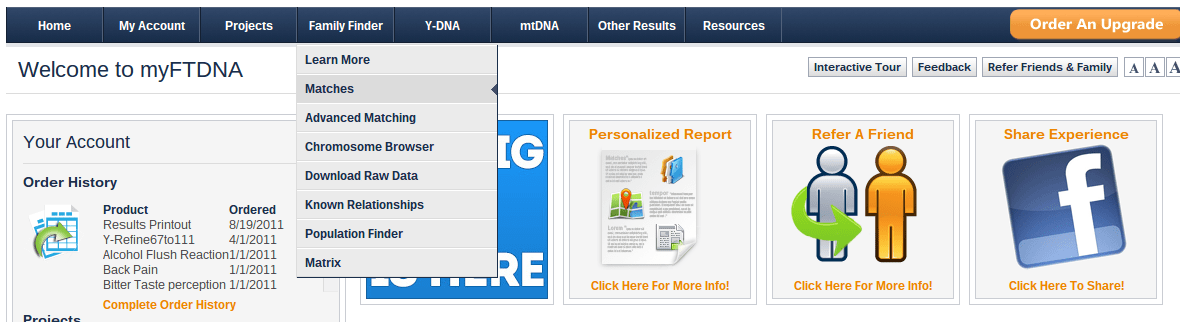
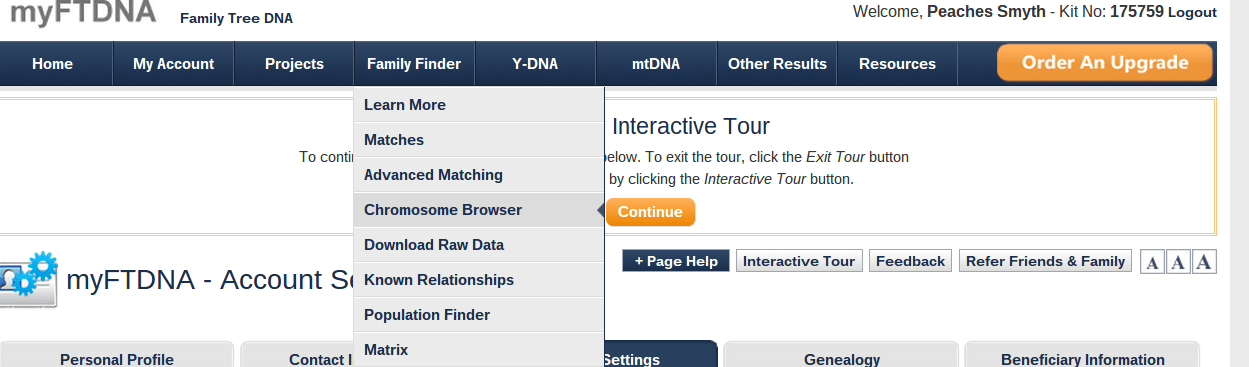
Here is the menu link to the Family Finder Matches menu.

x match 1

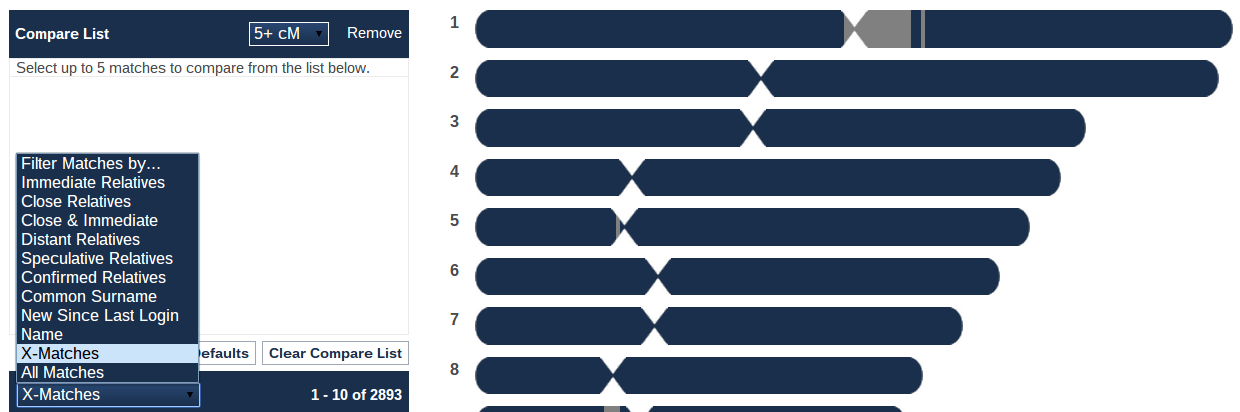
On the Family Finder Matches page, there is a filter to show only X-Matches.

x match 2

When you use the X-Match filter on a male Family Finder kit, you should get only matches from the maternal X-Chromosome.

x match 3

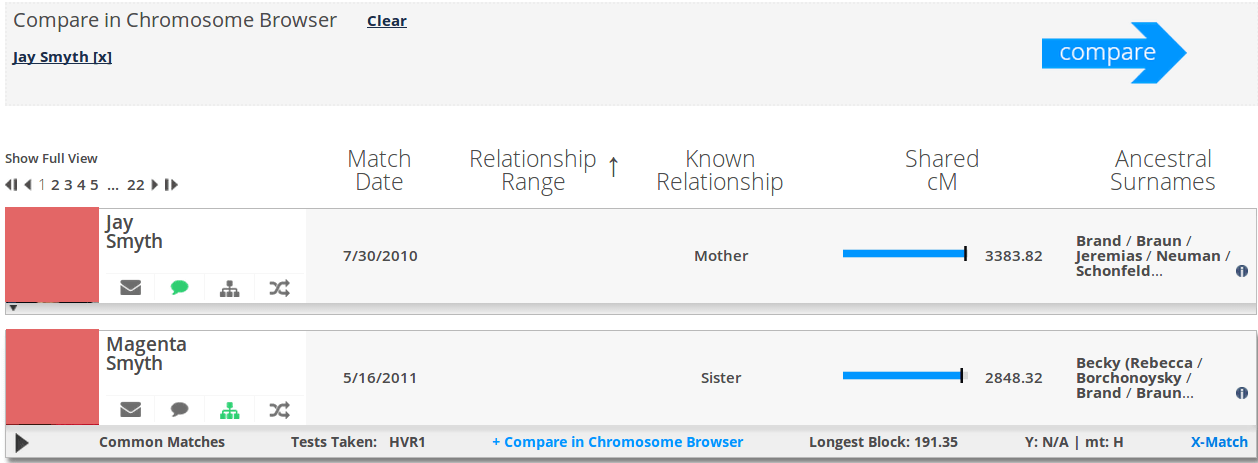
Next, like other Family Finder Matches you can expand the advanced bar for a match and click to add the match to the Compare in Chromosome Browser list.

x match 4

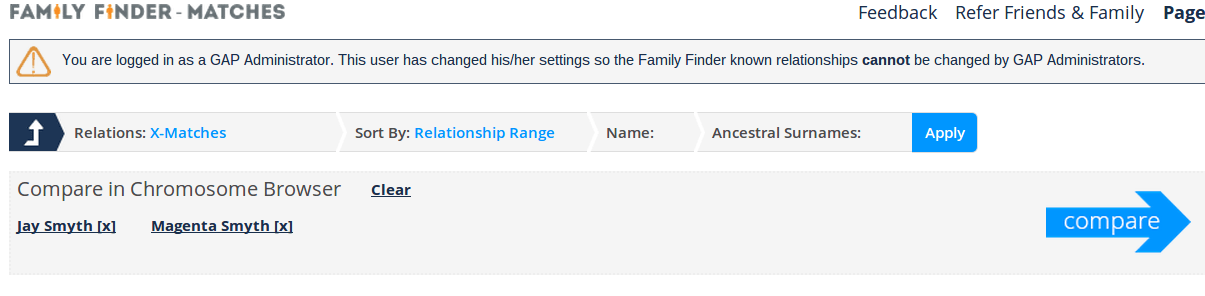
Matches are added to the Compare in Chromosome Browser list. You could go right to the Chromosome Browser by clicking on the compare arrow at this point.

x match 5

Next we can also go right to the Chromosome Browser.

x match 6

The Chromosome Browser also lets you filter the match list by X-Matches.

x match 7

Here are three immediate relatives. The first two share X-Chromosome DNA. The third (green) one does not.

x match 8

When we scroll down to the X at the bottom, we see that X-Matching is displayed for the first two but not the third.

x match 9

Moving to the Advance Matching page, X-Chromosome matches have also been integrated.

x match 10

X-Match is an option that can be checked alongside other types of testing.

x match 11

______________________________________________________________

Disclosure

I receive a small contribution when you click on some of the links to vendors in my articles. This does NOT increase the price you pay but helps me to keep the lights on and this informational blog free for everyone. Please click on the links in the articles or to the vendors below if you are purchasing products or DNA testing.

Thank you so much.

DNA Purchases and Free Transfers

Genealogy Services

Genealogy Research

2013 – DNA-eXplained in Review

The WordPress.com stats helper monkeys prepare annual reports for blogs.  I really like this service, and here’s a summary of what it said.

The Louvre Museum has 8.5 million visitors per year.  This blog was viewed about 460,000 times in 2013. If it were an exhibit at the Louvre Museum, it would take about 20 days for that many people to see it.

In 2013, there were 147 new posts, growing the total archive of this blog to 241 posts. There were 688 pictures uploaded, taking up a total of 268 MB. That’s about 2 pictures per day.

The busiest day of the year was October 1st with 3,681 views. The most popular post that day was Mexican Women’s Mitochondrial DNA Primarily Native American.

These are the posts that received the most views in 2013.

People from 192 countries all over the world joined you in viewing www.dna-explained.com.

2013 blog reach

I started this blog in June 2012, so 2013 was the first complete year.  In 2013, I posted 94 articles and the blog received about 86,000 views, which would translate to about 172,000 on an annualized basis.

These numbers don’t include people who read the blog via RSS feeds or though e-mails.  They would account for another half a million or so a year.

In 2013, I added 147 new articles for a total of 241, and there were 460,000 views, which, on an annual basis, increased 267%.  Between these views and the e-mail and RSS subscriptions, we’re looking at about a million viewers in 2013.  Not bad for a topic I wasn’t sure would be popular!

Thank you one and all.  I know we’re going to have a stellar 2014 together!

______________________________________________________________

Disclosure

I receive a small contribution when you click on some of the links to vendors in my articles. This does NOT increase the price you pay but helps me to keep the lights on and this informational blog free for everyone. Please click on the links in the articles or to the vendors below if you are purchasing products or DNA testing.

Thank you so much.

DNA Purchases and Free Transfers

Genealogy Services

Genealogy Research

Promethease – Genetic Health Information Alternative

People are beginning to ask about how they can obtain some of the health information that they were previously receiving from 23andMe.  For $5, at Promethease,  you can upload any of the autosomal files from either Family Tree DNA, 23andMe or Ancestry.com.  They will process your raw data and provide you with a report that is available to download from their server for 45 days.  They also e-mail you a copy.

At Promethease, your raw data file is deleted within 24 hours of completion of your report, and your report file will be deleted after 45 days, so be sure to download your report for future reference.  Currently they process about 20,000 genotypes, or SNPs.  They do note that they update their data base regularly from SNPedia, fed from PubMed publications.  Therefore your report in the future will include SNPs that won’t be in your report today and what we’ve learned about those SNPs may differ as well.

They have also noted that you receive different items in your report based on which vendor’s full data file you submit.  That’s true.  I uploaded all 3 of my raw data files, from Ancestry, 23andMe and Family Tree DNA and ran Promethease against each of them.  While 23andMe optimized their chip for medical and health results, Family Tree DNA intentionally removed some medically relevant data in order to avoid any FDA type of issues.  It’s unknown how Ancestry treats medically significant SNPs, but I’m running all 3 vendor’s files to view differences.

  • The Promethease report utilizing the 23andMe raw data file reported on 20,080 genotypes.
  • The Promethease report utilizing the Family Tree DNA raw data file reported on 8179 genotypes.
  • The Promethease report utilizing the Ancestry raw data file reported on 10,498 genotypes.

To start the process of uploading your file and running your report, visit:

https://promethease.com/ondemand

Of course, you’ll need to take care of housekeeping, sign up and pay.

You will then be asked to select an ethnicity.  I always hate this question, because I’m more than one and the categories never fit.  If you don’t fit any category well, select the closest.   Promethease says it only affects the sort order.  That was a relief to me, as I always wonder what I’m missing by making one selection over another.

While the report actually runs, which takes about 15-20 minutes, amuse yourself by watching the video about how to download, read and understand your results.  Or you could write a blog, like me!

Promethease instructional video

You can review this video at any time by visiting the original link.  It does make more sense after you have your report in hand.

My report only took 8 minutes to run, and according to the front page of my report, they analyzed over 20,000 SNPs or known mutation locations.  I’m excited to see what my report holds.

One of the reasons I’ve been interested in this type of DNA reporting is that my mother was “diagnosed” with Parkinson’s Disease. I put diagnosed in quotes, because Parkinson’s is a diagnosis of exclusion, for which there is no specific diagnostic test, meaning the diagnosis is one made after other alternative diseases for which there are tests, are excluded.  However, she never had some of the traditional symptoms, like the specific walking gait typical in Parkinson’s patients, nor some of the other symptoms, nor were the Parkinson’s medications effective in controlling her hand tremors. Her father also had the same tremors, which I’ve always suspected was Familial Tremor, not Parkinson’s.  I wanted to see if Mom or I carried elevated risk for Parkinson’s.  Mom’s DNA was archived at Family Tree DNA, so I could run the Family Finder test even though she had passed away by the time autosomal testing was available.  So I uploaded and ran her file at Promethease too, and compared with my own.

So, let’s look at my report based on the 23andMe raw data file.

Promethease report

At this point, you have to choose to click on “Bad News” or “Good News” first.  Someone should do a study about whether you select bad or good is genetically influenced.

In my case, I was interested to see if my “bad news” was the same “bad news” that 23andMe provided.  My top “bad news” item is indeed the same item that is reported at 23andMe.  Having said that, there are a lot more and different items here that were not reported at 23andMe.  After looking at the varied results from Promethease, I suspect that 23andMe was trying to distill data on my behalf.

However, Promethease does not attempt to analyze your results.  Some mutations are known to be connected to multiple conditions, so they simply tell you that.  In some cases, you will have some negative and some positive mutations for the same disease.  Again, they simply inform you, complete with a reference.  It’s worth noting that for one disease I’m particularly interested in, Parkinson’s, I have a lot of conflicting data, pages worth.  This just goes to show how complex interpreting this information really is, and shows that genetic predisposition, positive or negative, with only a few exceptions, is not genetic predetermination.

My good news made me feel really good.  I’m at decreased risk of frontotemporal dementia or Alzheimer’s and Parkinson’s.  I’m optimistic and empathetic.  I wonder if this has anything to do with selecting the bad news option first – I knew I had the good news to look forward to.  Get the bad stuff over with and get on with it…

Ironically, some of my good news items are in direct conflict with some of my bad news items.  And yes, some are Parkinson’s, which has apparently been more heavily studied that some other diseases.  Hopefully, the decreased and elevated risks will cancel each other out and I’ll just be average.

However, when running my Ancestry data file at Promethease, one of my elevated risks was Parkinson’s, based on the SNPs discovered in the 23andMe research, which conflicts directly with the information provided based on the 23andMe raw data file.  Searching further, different SNPs have been reported to either be associated with increased or decreased incidence of the disease – and I carry some of each – but none are extremely elevated.

So where does this leave me in terms of whether Mom had Parkinson’s, or not?  There is nothing to indicate an extremely high risk of Parkinson’s.  Some indicators are for elevated risk, some for reduced risk.  Compared to the one condition I know she had, which has a very highly elevated risk in all 3 reports, the Parkinson’s risk is simply unremarkable and doesn’t stand out.  Bottom line – I still don’t know for sure, but I still don’t think she had Parkinson’s.  Had I found highly elevated risk factors,  I would have rethought my opinion.

Many diseases have multiple genetic components along with other external factors.  Of course, not all studies report the same findings, and this report is based on academic medical studies.

Rarely are genetic predispositions more than just that, a slightly increased or decreased probability.  Few are fatal and some are more of a life sentence than a death sentence.  Having said this, there are notable exceptions, and if you really don’t want to know a worst case scenario, or aren’t prepared to deal with the results, don’t participate in DNA testing or reporting for medical or health information.  If you have reason to suspect your family may carry one of the genetic terminal illnesses, visit your doctor for advice.

And speaking of physicians, much of this information, such as the information about how certain medications are metabolized could be critically important.  In my case, I’m actually taking one of the mediations that is referenced where I have a decreased sensitivity.  Yep, I knew that, but now I can provide this information to my physician.

For those who tend to worry and borrow trouble they don’t yet have, running this type of report might not be a good idea.  It’s certainly not for hypochondriacs – IMHO.  It’s a personal choice, and a very inexpensive one at that, so financially available to everyone.  If what it contains is going to worry you, don’t do it.  I noticed that there are several anxiety categories in these reports – but then you have to run the report to see if you carry them – kind of a catch 22 if you tend to be anxious and worry.

My personal perspective is that there may be information here that is valuable to me, or to my physicians, or to my children.  The worst “bad news” item I already knew about through 23andMe, but I also anticipated that condition, without genetic testing, because my mother had this same disease in old age.  I’m not referring now to the Parkinson’s, but a vision related condition that she definitely did have.  This item was also consistently reported at a high degree of risk utilizing the data files of 23andMe, Family Tree DNA and Ancestry.  Thankfully, it is an old age problem and one that can be treated, if not cured today.  The Promethease reports, along with 23andMe’s report, have simply reinforced that I need to be proactive and vigilant and to eat lots of veggies.  The good news is that many items include preventative measures in the verbiage or associated studies that your Promethease report links to at SNPedia.

How does this report compare to the 23andMe experience, assuming 23andMe was still an option or might be again in the future for health information?  The 23andMe customer interface is much smoother and more user friendly.  It seems to be focused on more “fun” and less “worry.”  The Promethease report is that, a report, although they do a great job making it interactive.  There is no sugar coating – just the facts Ma’am.  And I think it’s actually much easier to use.  You can easily search by disease, by category, and the searches actually work.

Promethease differs in another way too.  Personally I like the idea that my data is mine, I’m in complete control of it, and it’s not being sold by Promethease out the back door for studies or purposes I might not be too thrilled about.  I don’t want my DNA to be used to patent genes that cause the tests for the condition to be restricted to the patentee at dramatically inflated prices.  While the Supreme Court determined that genes can’t be patented in the case of the BRCA breast cancer genes, the fight continues with lawsuits being filed, and 23andMe holds a Parkinson’s patent that was obtained by utilizing customer data.   Nor do I want my data to be used to patent the technology for “designer babies.”  If my DNA is going to be utilized for research, I want the ability to authorize that use, specifically.

Therefore, I feel much better about uploading a raw data file from an autosomal test at a firm like Family Tree DNA, who NEVER sells or otherwise divulges my data without first requesting permission.  I thereby maintain complete control over my genetic results, rather than utilizing companies who either sell (or otherwise utilize) my results or reserve the right to do so.  This is the case with both 23andMe and Ancestry.com, and to be clear, they have never claimed otherwise.?????????????????????????????

And oh, I forgot to mention…I am just so relieved….I have a decreased risk of baldness….

______________________________________________________________

Disclosure

I receive a small contribution when you click on some of the links to vendors in my articles. This does NOT increase the price you pay but helps me to keep the lights on and this informational blog free for everyone. Please click on the links in the articles or to the vendors below if you are purchasing products or DNA testing.

Thank you so much.

DNA Purchases and Free Transfers

Genealogy Services

Genealogy Research

2013’s Dynamic Dozen – Top Genetic Genealogy Happenings

dna 8 ball

Last year I wrote a column at the end of the year titled  “2012 Top 10 Genetic Genealogy Happenings.”  It’s amazing the changes in this industry in just one year.  It certainly makes me wonder what the landscape a year from now will look like.

I’ve done the same thing this year, except we have a dozen.  I couldn’t whittle it down to 10, partly because there has been so much more going on and so much change – or in the case of Ancestry, who is noteworthy because they had so little positive movement.

If I were to characterize this year of genetic genealogy, I would call it The Year of the SNP, because that applies to both Y DNA and autosomal.  Maybe I’d call it The Legal SNP, because it is also the year of law, court decisions, lawsuits and FDA intervention.  To say it has been interesting is like calling the Eiffel Tower an oversized coat hanger.

I’ll say one thing…it has kept those of us who work and play in this industry hopping busy!  I guarantee you, the words “I’m bored” have come out of the mouth of no one in this industry this past year.

I’ve put these events in what I consider to be relatively accurate order.  We could debate all day about whether the SNP Tsunami or the 23andMe mess is more important or relevant – and there would be lots of arguing points and counterpoints…see…I told you lawyers were involved….but in reality, we don’t know yet, and in the end….it doesn’t matter what order they are in on the list:)

Y Chromosome SNP Tsunami Begins

The SNP tsumani began as a ripple a few years ago with the introduction at Family Tree DNA of the Walk the Y program in 2007.  This was an intensively manual process of SNP discovery, but it was effective.

By the time that the Geno 2.0 chip was introduced in 2012, 12,000+ SNPs would be included on that chip, including many that were always presumed to be equivalent and not regularly tested.  However, the Nat Geo chip tested them and indeed, the Y tree became massively shuffled.  The resolution to this tree shuffling hasn’t yet come out in the wash.  Family Tree DNA can’t really update their Y tree until a publication comes out with the new tree defined.  That publication has been discussed and anticipated for some time now, but it has yet to materialize.  In the mean time, the volunteers who maintain the ISOGG tree are swamped, to say the least.

Another similar test is the Chromo2 introduced this year by Britain’s DNA which scans 15,000 SNPs, many of them S SNPs not on the tree nor academically published, adding to the difficulty of figuring out where they fit on the Y tree.  While there are some very happy campers with their Chromo2 results, there is also a great deal of sloppy science, reporting and interpretation of “facts” through this company.  Kind of like Jekyll and Hyde.  See the Sloppy Science section.

But Walk the Y, Chromo2 and Geno 2.0, are only the tip of the iceburg.  The new “full Y” sequencing tests brought into the marketspace quietly in early 2013 by Full Genomes and then with a bang by Family Tree DNA with the their Big Y in November promise to revolutionize what we know about the Y chromosome by discovering thousands of previously unknown SNPs.  This will in effect swamp the Y tree whose branches we thought were already pretty robust, with thousands and thousands of leaves.

In essence, the promise of the “fully” sequenced Y is that what we might term personal or family SNPs will make SNP testing as useful as STR testing and give us yet another genealogy tool with which to separate various lines of one genetic family and to ratchet down on the time that the most common recent ancestor lived.

http://dna-explained.com/2013/03/31/new-y-dna-haplogroup-naming-convention/

http://dna-explained.com/2013/11/10/family-tree-dna-announces-the-big-y/

http://dna-explained.com/2013/11/16/what-about-the-big-y/

http://www.yourgeneticgenealogist.com/2013/11/first-look-at-full-genomes-y-sequencing.html

http://cruwys.blogspot.com/2013/12/a-first-look-at-britainsdna-chromo-2-y.html

http://cruwys.blogspot.com/2013/11/yseqnet-new-company-offering-single-snp.html

http://cruwys.blogspot.com/2013/11/the-y-chromosome-sequence.html

http://cruwys.blogspot.com/2013/11/a-confusion-of-snps.html

http://cruwys.blogspot.com/2013/11/a-simplified-y-tree-and-common-standard.html

23andMe Comes Unraveled

The story of 23andMe began as the consummate American dotcom fairy tale, but sadly, has deteriorated into a saga with all of the components of a soap opera.  A wealthy wife starts what could be viewed as an upscale hobby business, followed by a messy divorce and a mystery run-in with the powerful overlording evil-step-mother FDA.  One of the founders of 23andMe is/was married to the founder of Google, so funding, at least initially wasn’t an issue, giving 23andMe the opportunity to make an unprecedented contribution in the genetic, health care and genetic genealogy world.

Another way of looking at this is that 23andMe is the epitome of the American Dream business, a startup, with altruism and good health, both thrown in for good measure, well intentioned, but poorly managed.  And as customers, be it for health or genealogy or both, we all bought into the altruistic “feel good” culture of helping find cures for dread diseases, like Parkinson’s, Alzheimer’s and cancer by contributing our DNA and responding to surveys.

The genetic genealogy community’s love affair with 23andMe began in 2009 when 23andMe started focusing on genealogy reporting for their tests, meaning cousin matches.  We, as a community, suddenly woke up and started ordering these tests in droves.  A few months later, Family Tree DNA also began offering this type of testing as well.  The defining difference being that 23andMe’s primary focus has always been on health and medical information with Family Tree DNA focused on genetic genealogy.  To 23andMe, the genetic genealogy community was an afterthought and genetic genealogy was just another marketing avenue to obtain more people for their health research data base.  For us, that wasn’t necessarily a bad thing.

For awhile, this love affair went along swimmingly, but then, in 2012, 23andMe obtained a patent for Parkinson’s Disease.  That act caused a lot of people to begin to question the corporate focus of 23andMe in the larger quagmire of the ethics of patenting genes as a whole.  Judy Russell, the Legal Genealogist, discussed this here.  It’s difficult to defend 23andMe’s Parkinson’s patent while flaying alive Myriad for their BRCA patent.  Was 23andMe really as altruistic as they would have us believe?

Personally, this event made me very nervous, but I withheld judgment.  But clearly, that was not the purpose for which I thought my DNA, and others, was being used.

But then came the Designer Baby patent in 2013.  This made me decidedly uncomfortable.  Yes, I know, some people said this really can’t be done, today, while others said that it’s being done anyway in some aspects…but the fact that this has been the corporate focus of 23andMe with their research, using our data, bothered me a great deal.  I have absolutely no issue with using this information to assure or select for healthy offspring – but I have a personal issue with technology to enable parents who would select a “beauty child,” one with blonde hair and blue eyes and who has the correct muscles to be a star athlete, or cheerleader, or whatever their vision of their as-yet-unconceived “perfect” child would be.  And clearly, based on 23andMe’s own patent submission, that is the focus of their patent.

Upon the issuance of the patent, 23andMe then said they have no intention of using it.  They did not say they won’t sell it.  This also makes absolutely no business sense, to focus valuable corporate resources on something you have no intention of using?  So either they weren’t being truthful, they lack effective management or they’ve changed their mind, but didn’t state such.

What came next, in late 2013 certainly points towards a lack of responsible management.

23andMe had been working with the FDA for approval the health and medical aspect of their product (which they were already providing to consumers prior to the November 22nd cease and desist order) for several years.  The FDA wants assurances that what 23andMe is telling consumers is accurate.  Based on the letter issued to 23andMe on November 22nd, and subsequent commentary, it appears that both entities were jointly working towards that common goal…until earlier this year when 23andMe mysteriously “somehow forgot” about the FDA, the information they owed them, their submissions, etc.  They also forgot their phone number and their e-mail addresses apparently as well, because the FDA said they had heard nothing from them in 6 months, which backdates to May of 2013.

It may be relevant that 23andMe added the executive position of President and filled it in June of 2013, and there was a lot of corporate housecleaning that went on at that time.  However, regardless of who got housecleaned, the responsibility for working with the FDA falls squarely on the shoulders of the founders, owners and executives of the company.  Period.  No excuses.  Something that critically important should be on the agenda of every executive management meeting.   Why?  In terms of corporate risk, this was obviously a very high risk item, perhaps the highest risk item, because the FDA can literally shut their doors and destroy them.  There is little they can do to control or affect the FDA situation, except to work with the FDA, meet deadlines and engender goodwill and a spirit of cooperation.  The risk of not doing that is exactly what happened.

It’s unknown at this time if 23andMe is really that corporately arrogant to think they could simply ignore the FDA, or blatantly corporately negligent or maybe simply corporately stupid, but they surely betrayed the trust and confidence of their customers by failing to meet their commitments with and to the FDA, or even communicate with them.  I mean, really, what were they thinking?

There has been an outpouring of sympathy for 23andme and negative backlash towards the FDA for their letter forcing 23andMe to stop selling their offending medical product, meaning the health portion of their testing.  However, in reality, the FDA was only meting out the consequences that 23andMe asked for.  My teenage kids knew this would happen.  If you do what you’re not supposed to….X, Y and Z will, or won’t, happen.  It’s called accountability.  Just ask my son about his prom….he remembers vividly.  Now why my kids, or 23andMe, would push an authority figure to that point, knowing full well the consequences, utterly mystifies me.  It did when my son was a teenager and it does with 23andMe as well.

Some people think that the FDA is trying to stand between consumers and their health information.  I don’t think so, at least not in this case.  Why I think that is because the FDA left the raw data files alone and they left the genetic genealogy aspect alone.  The FDA knows full well you can download your raw data and for $5 process it at a third party site, obtaining health related genetic information.  The difference is that Promethease is not interpreting any data for you, only providing information.

There is some good news in this and that is that from a genetic genealogy perspective, we seem to be safe, at least for now, from government interference with the testing that has been so productive for genetic genealogy.  The FDA had the perfect opportunity to squish us like a bug (thanks to the opening provided by 23andMe,) and they didn’t.

The really frustrating aspect of this is that 23andMe was a company who, with their deep pockets in Silicon Valley and other investors, could actually afford to wage a fight with the FDA, if need be.  The other companies who received the original 2010 FDA letter all went elsewhere and focused on something else.  But 23andMe didn’t, they decided to fight the fight, and we all supported their decision.  But they let us all down.  The fight they are fighting now is not the battle we anticipated, but one brought upon themselves by their own negligence.  This battle didn’t have to happen, and it may impair them financially to such a degree that if they need to fight the big fight, they won’t be able to.

Right now, 23andMe is selling their kits, but only as an ancestry product as they work through whatever process they are working through with the FDA.  Unfortunately, 23andMe is currently having some difficulties where the majority of matches are disappearing from some testers records.  In other cases, segments that previously matched are disappearing.  One would think, with their only revenue stream for now being the genetic genealogy marketspace that they would be wearing kid gloves and being extremely careful, but apparently not.  They might even consider making some of the changes and enhancements we’ve requested for so long that have fallen on deaf ears.

One thing is for sure, it will be extremely interesting to see where 23andMe is this time next year.  The soap opera continues.

I hope for the sake of all of the health consumers, both current and (potentially) future, that this dotcom fairy tale has a happy ending.

Also, see the Autosomal DNA Comes of Age section.

http://dna-explained.com/2013/10/05/23andme-patents-technology-for-designer-babies/

http://www.thegeneticgenealogist.com/2013/10/07/a-new-patent-for-23andme-creates-controversy/

http://dna-explained.com/2013/11/13/genomics-law-review-discusses-designing-children/

http://www.thegeneticgenealogist.com/2013/06/11/andy-page-fills-new-president-position-at-23andme/

http://dna-explained.com/2013/11/25/fda-orders-23andme-to-discontinue-testing/

http://dna-explained.com/2013/11/26/now-what-23andme-and-the-fda/

http://dna-explained.com/2013/12/06/23andme-suspends-health-related-genetic-tests/

http://www.legalgenealogist.com/blog/2013/11/26/fooling-with-fda/

Supreme Court Decision – Genes Can’t Be Patented – Followed by Lawsuits

In a landmark decision, the Supreme Court determined that genes cannot be patented.  Myriad Genetics held patents on two BRCA genes that predisposed people to cancer.  The cost for the tests through Myriad was about $3000.  Six hours after the Supreme Court decision, Gene By Gene announced that same test for $995.  Other firms followed suit, and all were subsequently sued by Myriad for patent infringement.  I was shocked by this, but as one of my lawyer friends clearly pointed out, you can sue anyone for anything.  Making it stick is yet another matter.  Many firms settle to avoid long and very expensive legal battles.  Clearly, this issue is not yet resolved, although one would think a Supreme Court decision would be pretty definitive.  It potentially won’t be settled for a long time.

http://dna-explained.com/2013/06/13/supreme-court-decision-genes-cant-be-patented/

http://www.legalgenealogist.com/blog/2013/06/14/our-dna-cant-be-patented/

http://dna-explained.com/2013/09/07/message-from-bennett-greenspan-free-my-genes/

http://www.thegeneticgenealogist.com/2013/06/13/new-press-release-from-dnatraits-regarding-the-supreme-courts-holding-in-myriad/

http://www.legalgenealogist.com/blog/2013/08/18/testing-firms-land-counterpunch/

http://www.legalgenealogist.com/blog/2013/07/11/myriad-sues-genetic-testing-firms/

Gene By Gene Steps Up, Ramps Up and Produces

As 23andMe comes unraveled and Ancestry languishes in its mediocrity, Gene by Gene, the parent company of Family Tree DNA has stepped up to the plate, committed to do “whatever it takes,” ramped up the staff both through hiring and acquisitions, and is producing results.  This is, indeed, a breath of fresh air for genetic genealogists, as well as a welcome relief.

http://dna-explained.com/2013/08/07/gene-by-gene-acquires-arpeggi/

http://dna-explained.com/2013/12/05/family-tree-dna-listens-and-acts/

http://dna-explained.com/2013/12/10/family-tree-dnas-family-finder-match-matrix-released/

http://www.haplogroup.org/ftdna-family-finder-matches-get-new-look/

http://www.haplogroup.org/ftdna-family-finder-new-look-2/

http://www.haplogroup.org/ftdna-family-finder-matches-new-look-3/

Autosomal DNA Comes of Age

Autosomal DNA testing and analysis has simply exploded this past year.  More and more people are testing, in part, because Ancestry.com has a captive audience in their subscription data base and more than a quarter million of those subscribers have purchased autosomal DNA tests.  That’s a good thing, in general, but there are some negative aspects relative to Ancestry, which are in the Ancestry section.

Another boon to autosomal testing was the 23andMe push to obtain a million records.  Of course, the operative word here is “was” but that may revive when the FDA issue is resolved.  One of the down sides to the 23andMe data base, aside from the fact that it’s not genealogist friendly, is that so many people, about 90%, don’t communicate.  They aren’t interested in genealogy.

A third factor is that Family Tree DNA has provided transfer ability for files from both 23andMe and Ancestry into their data base.

Fourth is the site, GedMatch, at www.gedmatch.com which provides additional matching and admixture tools and the ability to match below thresholds set by the testing companies.  This is sometimes critically important, especially when comparing to known cousins who just don’t happen to match at the higher thresholds, for example.  Unfortunately, not enough people know about GedMatch, or are willing to download their files.  Also unfortunate is that GedMatch has struggled for the past few months to keep up with the demand placed on their site and resources.

A great deal of time this year has been spent by those of us in the education aspect of genetic genealogy, in whatever our capacity, teaching about how to utilize autosomal results. It’s not necessarily straightforward.  For example, I wrote a 9 part series titled “The Autosomal Me” which detailed how to utilize chromosome mapping for finding minority ethnic admixture, which was, in my case, both Native and African American.

As the year ends, we have Family Tree DNA, 23andMe and Ancestry who offer the autosomal test which includes the relative-matching aspect.  Fortunately, we also have third party tools like www.GedMatch.com and www.DNAGedcom.com, without which we would be significantly hamstrung.  In the case of DNAGedcom, we would be unable to perform chromosome segment matching and triangulation with 23andMe data without Rob Warthen’s invaluable tool.

http://dna-explained.com/2013/06/21/triangulation-for-autosomal-dna/

http://dna-explained.com/2013/07/13/combining-tools-autosomal-plus-y-dna-mtdna-and-the-x-chromosome/

http://dna-explained.com/2013/07/26/family-tree-dna-levels-the-playing-field-sort-of/

http://dna-explained.com/2013/08/03/kitty-coopers-chromsome-mapping-tool-released/

http://dna-explained.com/2013/09/29/why-dont-i-match-my-cousin/

http://dna-explained.com/2013/10/03/family-tree-dna-updates-family-finder-and-adds-triangulation/

http://dna-explained.com/2013/10/21/why-are-my-predicted-cousin-relationships-wrong/

http://dna-explained.com/2013/12/05/family-tree-dna-listens-and-acts/

http://dna-explained.com/2013/12/09/chromosome-mapping-aka-ancestor-mapping/

http://dna-explained.com/2013/12/10/family-tree-dnas-family-finder-match-matrix-released/

http://dna-explained.com/2013/12/15/one-chromosome-two-sides-no-zipper-icw-and-the-matrix/

http://dna-explained.com/2013/06/02/the-autosomal-me-summary-and-pdf-file/

DNAGedcom – Indispensable Third Party Tool

While this tool, www.dnagedcom.com, falls into the Autosomal grouping, I have separated it out for individual mention because without this tool, the progress made this year in autosomal DNA ancestor and chromosomal mapping would have been impossible.  Family Tree DNA has always provided segment matching boundaries through their chromosome browser tool, but until recently, you could only download 5 matches at a time.  This is no longer the case, but for most of the year, Rob’s tool saved us massive amounts of time.

23andMe does not provide those chromosome boundaries, but utilizing Rob’s tool, you can obtain each of your matches in one download, and then you can obtain the list of who your matches match that is also on your match list by requesting each of those files separately.  Multiple steps?  Yes, but it’s the only way to obtain this information, and chromosome mapping without the segment data is impossible

A special hats off to Rob.  Please remember that Rob’s site is free, meaning it’s donation based.  So, please donate if you use the tool.

http://www.yourgeneticgenealogist.com/2013/01/brought-to-you-by-adoptiondna.html

I covered www.Gedmatch.com in the “Best of 2012” list, but they have struggled this year, beginning when Ancestry announced that raw data file downloads were available.  GedMatch consists of two individuals, volunteers, who are still struggling to keep up with the required processing and the tools.  They too are donation based, so don’t forget about them if you utilize their tools.

Ancestry – How Great Thou Aren’t

Ancestry is only on this list because of what they haven’t done.  When they initially introduced their autosomal product, they didn’t have any search capability, they didn’t have a chromosome browser and they didn’t have raw data file download capability, all of which their competitors had upon first release.  All they did have was a list of your matches, with their trees listed, with shakey leaves if you shared a common ancestor on your tree.  The implication, was, and is, of course, that if you have a DNA match and a shakey leaf, that IS your link, your genetic link, to each other.  Unfortunately, that is NOT the case, as CeCe Moore documented in her blog from Rootstech (starting just below the pictures) as an illustration of WHY we so desperately need a chromosome browser tool.

In a nutshell, Ancestry showed the wrong shakey leaf as the DNA connection – as proven by the fact that both of CeCe’s parents have tested at Ancestry and the shakey leaf person doesn’t match the requisite parent.  And there wasn’t just one, not two, but three instances of this.  What this means is, of course, that the DNA match and the shakey leaf match are entirely independent of each other.  In fact, you could have several common ancestors, but the DNA at any particular location comes only from one on either Mom or Dad’s side – any maybe not even the shakey leaf person.

So what Ancestry customers are receiving is a list of people they match and possible links, but most of them have no idea that this is the case, and blissfully believe they have found their genetic connection.  They have found a genealogical cousin, and it MIGHT be the genetic connection.  But then again, they could have found that cousin simply by searching for the same ancestor in Ancestry’s data base.  No DNA needed.

Ancestry has added a search feature, allowed raw data file downloads (thank you) and they have updated their ethnicity predictions.  The ethnicity predictions are certainly different, dramatically different, but equally as unrealistic.  See the Ethnicity Makeovers section for more on this.  The search function helps, but what we really need is the chromosome browser, which they have steadfastly avoided promising.  Instead, they have said that they will give us “something better,” but nothing has materialized.

I want to take this opportunity, to say, as loudly as possible, that TRUST ME IS NOT ACCEPTABLE in any way, shape or form when it comes to genetic matching.  I’m not sure what Ancestry has in mind by the way of “better,” but it if it’s anything like the mediocrity with which their existing DNA products have been rolled out, neither I nor any other serious genetic genealogist will be interested, satisfied or placated.

Regardless, it’s been nearly 2 years now.  Ancestry has the funds to do development.  They are not a small company.  This is obviously not a priority because they don’t need to develop this feature.  Why is this?  Because they can continue to sell tests and to give shakey leaves to customers, most of whom don’t understand the subtle “untruth” inherent in that leaf match – so are quite blissfully happy.

In years past, I worked in the computer industry when IBM was the Big Dog against whom everyone else competed.  I’m reminded of an old joke.  The IBM sales rep got married, and on his wedding night, he sat on the edge of the bed all night long regaling his bride in glorious detail with stories about just how good it was going to be….

You can sign a petition asking Ancestry to provide a chromosome browser here, and you can submit your request directly to Ancestry as well, although to date, this has not been effective.

The most frustrating aspect of this situation is that Ancestry, with their plethora of trees, savvy marketing and captive audience testers really was positioned to “do it right,” and hasn’t, at least not yet.  They seem to be more interested in selling kits and providing shakey leaves that are misleading in terms of what they mean than providing true tools.  One wonders if they are afraid that their customers will be “less happy” when they discover the truth and not developing a chromosome browser is a way to keep their customers blissfully in the dark.

http://dna-explained.com/2013/03/21/downloading-ancestrys-autosomal-dna-raw-data-file/

http://dna-explained.com/2013/03/24/ancestry-needs-another-push-chromosome-browser/

http://dna-explained.com/2013/10/17/ancestrys-updated-v2-ethnicity-summary/

http://www.thegeneticgenealogist.com/2013/06/21/new-search-features-at-ancestrydna-and-a-sneak-peek-at-new-ethnicity-estimates/

http://www.yourgeneticgenealogist.com/2013/03/ancestrydna-raw-data-and-rootstech.html

http://www.legalgenealogist.com/blog/2013/09/15/dna-disappointment/

http://www.legalgenealogist.com/blog/2013/09/13/ancestrydna-begins-rollout-of-update/

Ancient DNA

This has been a huge year for advances in sequencing ancient DNA, something once thought unachievable.  We have learned a great deal, and there are many more skeletal remains just begging to be sequenced.  One absolutely fascinating find is that all people not African (and some who are African through backmigration) carry Neanderthal and Denisovan DNA.  Just this week, evidence of yet another archaic hominid line has been found in Neanderthal DNA and on Christmas Day, yet another article stating that type 2 Diabetes found in Native Americans has roots in their Neanderthal ancestors. Wow!

Closer to home, by several thousand years is the suggestion that haplogroup R did not exist in Europe after the ice age, and only later, replaced most of the population which, for males, appears to have been primarily haplogroup G.  It will be very interesting as the data bases of fully sequenced skeletons are built and compared.  The history of our ancestors is held in those precious bones.

http://dna-explained.com/2013/01/10/decoding-and-rethinking-neanderthals/

http://dna-explained.com/2013/07/04/ancient-dna-analysis-from-canada/

http://dna-explained.com/2013/07/10/5500-year-old-grandmother-found-using-dna/

http://dna-explained.com/2013/10/25/ancestor-of-native-americans-in-asia-was-30-western-eurasian/

http://dna-explained.com/2013/11/12/2013-family-tree-dna-conference-day-2/

http://dna-explained.com/2013/11/22/native-american-gene-flow-europe-asia-and-the-americas/

http://dna-explained.com/2013/12/05/400000-year-old-dna-from-spain-sequenced/

http://www.thegeneticgenealogist.com/2013/10/16/identifying-otzi-the-icemans-relatives/

http://cruwys.blogspot.com/2013/12/recordings-of-royal-societys-ancient.html

http://cruwys.blogspot.com/2013/02/richard-iii-king-is-found.html

http://dna-explained.com/2013/12/22/sequencing-of-neanderthal-toe-bone-reveals-unknown-hominin-line/

http://dna-explained.com/2013/12/26/native-americans-neanderthal-and-denisova-admixture/

http://dienekes.blogspot.com/2013/12/ancient-dna-what-2013-has-brought.html

Sloppy Science and Sensationalist Reporting

Unfortunately, as DNA becomes more mainstream, it becomes a target for both sloppy science or intentional misinterpretation, and possibly both.  Unfortunately, without academic publication, we can’t see results or have the sense of security that comes from the peer review process, so we don’t know if the science and conclusions stand up to muster.

The race to the buck in some instances is the catalyst for this. In other cases, and not in the links below, some people intentionally skew interpretations and results in order to either fulfill their own belief agenda or to sell “products and services” that invariably report specific findings.

It’s equally as unfortunate that much of these misconstrued and sensationalized results are coming from a testing company that goes by the names of BritainsDNA, ScotlandsDNA, IrelandsDNA and YorkshiresDNA. It certainly does nothing for their credibility in the eyes of people who are familiar with the topics at hand, but it does garner a lot of press and probably sells a lot of kits to the unwary.

I hope they publish their findings so we can remove the “sloppy science” aspect of this.  Sensationalist reporting, while irritating, can be dealt with if the science is sound.  However, until the results are published in a peer-reviewed academic journal, we have no way of knowing.

Thankfully, Debbie Kennett has been keeping her thumb on this situation, occurring primarily in the British Isles.

http://dna-explained.com/2013/08/24/you-might-be-a-pict-if/

http://cruwys.blogspot.com/2013/12/the-british-genetic-muddle-by-alistair.html

http://cruwys.blogspot.com/2013/12/setting-record-straight-about-sara.html

http://cruwys.blogspot.com/2013/09/private-eye-on-britainsdna.html

http://cruwys.blogspot.com/2013/07/private-eye-on-prince-williams-indian.html

http://cruwys.blogspot.com/2013/06/britainsdna-times-and-prince-william.html

http://cruwys.blogspot.com/2013/03/sense-about-genealogical-dna-testing.html

http://cruwys.blogspot.com/2013/03/sense-about-genetic-ancestry-testing.html

Citizen Science is Coming of Age

Citizen science has been slowing coming of age over the past few years.  By this, I mean when citizen scientists work as part of a team on a significant discovery or paper.  Bill Hurst comes to mind with his work with Dr. Doron Behar on his paper, A Copernican Reassessment of the Human Mitochondrial DNA from its Root or what know as the RSRS model.  As the years have progressed, more and more discoveries have been made or assisted by citizen scientists, sometimes through our projects and other times through individual research.  JOGG, the Journal of Genetic Genealogy, which is currently on hiatus waiting for Dr. Turi King, the new editor, to become available, was a great avenue for peer reviewed publication.  Recently, research projects have been set up by citizen scientists, sometimes crowd-funded, for specific areas of research.  This is a very new aspect to scientific research, and one not before utilized.
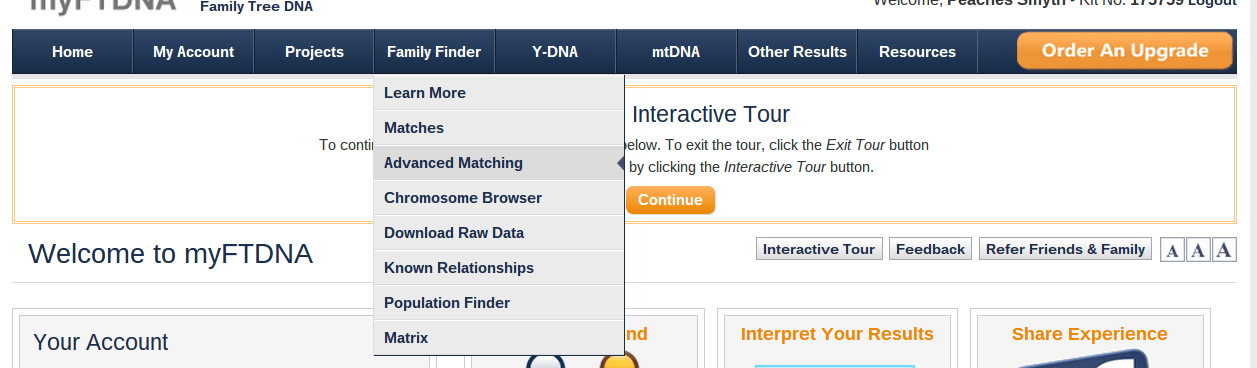
The first paper below includes the Family Tree DNA Lab, Thomas and Astrid Krahn, then with Family Tree DNA and Bonnie Schrack, genetic genealogist and citizen scientist, along with Dr. Michael Hammer from the University of Arizona and others.

http://dna-explained.com/2013/03/26/family-tree-dna-research-center-facilitates-discovery-of-ancient-root-to-y-tree/

http://dna-explained.com/2013/04/10/diy-dna-analysis-genomeweb-and-citizen-scientist-2-0/

http://dna-explained.com/2013/06/27/big-news-probable-native-american-haplogroup-breakthrough/

http://dna-explained.com/2013/07/22/citizen-science-strikes-again-this-time-in-cameroon/

http://dna-explained.com/2013/11/30/native-american-haplogroups-q-c-and-the-big-y-test/

http://www.yourgeneticgenealogist.com/2013/03/citizen-science-helps-to-rewrite-y.html

Ethnicity Makeovers – Still Not Soup

Unfortunately, ethnicity percentages, as provided by the major testing companies still disappoint more than thrill, at least for those who have either tested at more than one lab or who pretty well know their ethnicity via an extensive pedigree chart.

Ancestry.com is by far the worse example, swinging like a pendulum from one extreme to the other.  But I have to hand it to them, their marketing is amazing.  When I signed in, about to discover that my results had literally almost reversed, I was greeted with the banner “a new you.”  Yea, a new me, based on Ancestry’s erroneous interpretation.  And by reversed, I’m serious.  I went from 80% British Isles to 6% and then from 0% Western Europe to 79%. So now, I have an old wrong one and a new wrong one – and indeed they are very different.  Of course, neither one is correct…..but those are just pesky details…

23andMe updated their ethnicity product this year as well, and fine tuned it yet another time.  My results at 23andMe are relatively accurate.  I saw very little change, but others saw more.  Some were pleased, some not.

The bottom line is that ethnicity tools are not well understood by consumers in terms of the timeframe that is being revealed, and it’s not consistent between vendors, nor are the results.  In some cases, they are flat out wrong, as with Ancestry, and can be proven.  This does not engender a great deal of confidence.  I only view these results as “interesting” or utilize them in very specific situations and then only using the individual admixture tools at www.Gedmatch.com on individual chromosome segments.

As Judy Russell says, “it’s not soup yet.”  That doesn’t mean it’s not interesting though, so long as you understand the difference between interesting and gospel.

http://dna-explained.com/2013/08/05/autosomal-dna-ancient-ancestors-ethnicity-and-the-dandelion/

http://dna-explained.com/2013/10/04/ethnicity-results-true-or-not/

http://www.legalgenealogist.com/blog/2013/09/15/dna-disappointment/

http://cruwys.blogspot.com/2013/09/my-updated-ethnicity-results-from.html?utm_source=feedburner&utm_medium=email&utm_campaign=Feed%3A+Cruwysnews+%28Cruwys+news%29

http://dna-explained.com/2013/10/17/ancestrys-updated-v2-ethnicity-summary/

http://dna-explained.com/2013/10/19/determining-ethnicity-percentages/

http://www.thegeneticgenealogist.com/2013/09/12/ancestrydna-launches-new-ethnicity-estimate/

http://cruwys.blogspot.com/2013/12/a-first-look-at-chromo-2-all-my.html

Genetic Genealogy Education Goes Mainstream

With the explosion of genetic genealogy testing, as one might expect, the demand for education, and in particular, basic education has exploded as well.

I’ve written a 101 series, Kelly Wheaton wrote a series of lessons and CeCe Moore did as well.  Recently Family Tree DNA has also sponsored a series of free Webinars.  I know that at least one book is in process and very near publication, hopefully right after the first of the year.  We saw several conferences this year that provided a focus on Genetic Genealogy and I know several are planned for 2014.  Genetic genealogy is going mainstream!!!  Let’s hope that 2014 is equally as successful and that all these folks asking for training and education become avid genetic genealogists.

http://dna-explained.com/2013/08/10/ngs-series-on-dna-basics-all-4-parts/

https://sites.google.com/site/wheatonsurname/home

http://www.yourgeneticgenealogist.com/2012/08/getting-started-in-dna-testing-for.html

http://dna-explained.com/2013/12/17/free-webinars-from-family-tree-dna/

http://www.thegeneticgenealogist.com/2013/06/09/the-first-dna-day-at-the-southern-california-genealogy-society-jamboree/

http://www.yourgeneticgenealogist.com/2013/06/the-first-ever-independent-genetic.html

http://cruwys.blogspot.com/2013/10/genetic-genealogy-comes-to-ireland.html

http://cruwys.blogspot.com/2013/03/wdytya-live-day-3-part-2-new-ancient.html

http://cruwys.blogspot.com/2013/03/who-do-you-think-you-are-live-day-3.html

http://cruwys.blogspot.com/2013/03/who-do-you-think-you-are-live-2013-days.html

http://genealem-geneticgenealogy.blogspot.com/2013/03/the-surnames-handbook-guide-to-family.html

http://www.isogg.org/wiki/Beginners%27_guides_to_genetic_genealogy

A Thank You in Closing

I want to close by taking a minute to thank the thousands of volunteers who make such a difference.  All of the project administrators at Family Tree DNA are volunteers, and according to their website, there are 7829 projects, all of which have at least one administrator, and many have multiple administrators.  In addition, everyone who answers questions on a list or board or on Facebook is a volunteer.  Many donate their time to coordinate events, groups, or moderate online facilities.  Many speak at events or for groups.  Many more write articles for publications from blogs to family newsletters.  Additionally, there are countless websites today that include DNA results…all created and run by volunteers, not the least of which is the ISOGG site with the invaluable ISOGG wiki.  Without our volunteer army, there would be no genetic genealogy community.  Thank you, one and all.

2013 has been a banner year, and 2014 holds a great deal of promise, even without any surprises.  And if there is one thing this industry is well known for….it’s surprises.  I can’t wait to see what 2014 has in store for us!!!  All I can say is hold on tight….

______________________________________________________________

Disclosure

I receive a small contribution when you click on some of the links to vendors in my articles. This does NOT increase the price you pay but helps me to keep the lights on and this informational blog free for everyone. Please click on the links in the articles or to the vendors below if you are purchasing products or DNA testing.

Thank you so much.

DNA Purchases and Free Transfers

Genealogy Services

Genealogy Research

Cherokee Mother of John Red Bank Payne

John Red Bank Payne

There is nothing I love more than a happy ending.  Second to that perhaps is to know that my blog or work helped someone, and in particularly, helped someone document their Native heritage.  In doing so, this confirms and unveils one more of our elusive Native people in early records.

I recently received a lovely thank you note from Shawn Potter.  We had exchanged notes earlier, after I wrote “The Autosomal Me” series, about how to utilize small segments of Native American (and Asian) DNA to identify Native American lines and/or ancestors.  This technique is called Minority Admixture Mapping (MAP) and was set forth in detail in various articles in the series.

Shawn’s note said:  “I’ve been doing more work on this segment and others following your method since we exchanged notes.  I’m pretty sure I’ve found the source of this Native American DNA — an ancestor named John Red Bank Payne who lived in North Georgia in the late 18th and 19th centuries.  Many of his descendants believe on the basis of circumstantial evidence that his mother was Cherokee.  I’ve found 10 descendants from four separate lines that inherited matching Native American DNA, pointing to one of his parents as the source.”

Along with this note, Shawn attached a beautiful 65 page book he had written for his family members which did document the Native DNA, but in the context of his family history.  He included their family story, the tales, the genealogical research, the DNA evidence and finally, a chapter of relevant Cherokee history complete with maps of the area where his ancestors lived. It’s a beautiful example of how to present something like this for non-DNA people to understand.  In addition, it’s also a wonderful roadmap, a “how to” book for how to approach this subject from a DNA/historical/genealogical perspective.  As hard as it is for me to sometimes remember, DNA is just a tool to utilize in the bigger genealogy picture.

Shawn has been gracious enough to allow me to reprint some of his work here, so from this point on, I’ll be extracting from his document.  Furthermore, Elizabeth Shown Mills would be ecstatic, because Shawn has fully documented and sourced his document.  I am not including that information here, but I’m sure he would gladly share the document itself with any interested parties.  You can contact Shawn at shpxlcp@comcast.net.

From the book, “Cherokee Mother of John Red Bank Payne” by Shawn Potter and Lois Carol Potter:

Descendants of John Red Bank Payne describe his mother as Cherokee. Yet, until now, some have questioned the truth of this claim because genealogists have been unable to identify John’s mother in contemporary records. A recent discovery, however, reveals both John Red Bank Payne and his sister Nancy Payne inherited Native American DNA.

Considering information from contemporary records, clues from local tradition, John’s name itself, and now the revelation that John and his sister inherited Native American DNA, there seems to be sufficient evidence to say John Red Bank Payne’s mother truly was Cherokee. The following summary describes what we know about John, his family, and his Native American DNA.

John Red Bank Payne was born perhaps near present-day Canton, Cherokee County, Georgia, on January 24, 1754, married Ann Henslee in Caswell County, North Carolina, on March 5, 1779, and died in Carnesville, Franklin County, Georgia, on December 14, 1831.

John’s father, Thomas Payne, was born in Westmorland County, Virginia, about 1725, and owned property in Halifax and Pittsylvania counties, Virginia, as well as Wilkes County, North Carolina, and Franklin County, Georgia.  Several factors suggest Thomas travelled with his older brother, William, to North Georgia and beyond, engaging in the deerskin trade with the Cherokee Nation during the mid 1700s. Thomas Payne died probably in Franklin County, Georgia, after February 23, 1811.

Contemporary records reveal Thomas had four children (William, John, Nancy, and Abigail) by his first wife, and nine children (Thomas, Nathaniel, Moses, Champness, Shrewsbury, Zebediah, Poindexter, Ruth, and Cleveland) by his second wife Yanaka Ayers.  Thomas married Yanaka probably in Halifax County, Virginia, before September 20, 1760.

Local North Georgia tradition identifies the first wife of Thomas Payne as a Cherokee woman. Anna Belle Little Tabor, in History of Franklin County, Georgia, wrote that “Trader Payne” managed a trading post on Payne’s Creek, and “one of his descendants, an offspring of his Cherokee marriage, later married Moses Ayers whose descendants still live in the county.”

Descendants of John Red Bank Payne also cite his name Red Bank, recorded in his son’s family Bible, as evidence of his Cherokee heritage.  Before the American Revolution, British Americans rarely defied English legal prohibitions against giving a child more than one Christian name.  So, the very existence of John’s name Red Bank suggests non-English ethnicity. On the other hand, many people of mixed English-Cherokee heritage were known by their Cherokee name as well as their English first and last names during this period.

Furthermore, while the form of John’s middle name is unlike normal English names, Red Bank conforms perfectly to standard Cherokee names.  It also is interesting to note, Red Bank was the name of a Cherokee village located on the south side of Etowah River to the southwest of present-day Canton, Cherokee County, Georgia.

While some believe the above information from contemporary records and clues from local tradition, as well as John’s name Red Bank, constitute sufficient proof of John’s Cherokee heritage, recently discovered DNA evidence confirms at least one of John’s parents had Native American ancestry. Ten descendants of John Red Bank Payne and his sister Nancy Payne, representing four separate lineages, inherited six segments of Native American DNA on chromosomes 2, 3, 5, 8, 13, and 18 (see Figure 1 for the relationship between these descendants; Figures 2-7 for images of their shared Native American DNA; and http://dna-explained.com/2013/06/02/the-autosomal-me-summary-and-pdf-file/ for an explanation of this method of identifying Native American chromosomal segments).

Upon careful reflection, there seems sufficient reason to believe John Red Bank Payne’s mother truly was Cherokee.

Roberta’s note:  I have redacted the surnames of current testers.

Payne chart

Chromosome 2, Segment 154-161

In this segment, Bert P, Rosa P, Nataan S, Cynthia S, and Kendall S inherited matching Native American DNA described as Amerindian, Siberian, Southeast Asian, and Oceanian by the Eurogenes V2 K15 admixture tool, and as North Amerind, Mesoamerican, South America Amerind, Arctic Amerind, East Siberian, Paleo Siberian, Samoedic, and East South Asian by the Magnus Ducatus Lituaniae Project World22 admixture tool. Since their common ancestors were Thomas Payne and his wife, the source of this Native American DNA must be either Thomas Payne or his wife. See Figures 2a-2g.

Note: Since Native Americans and East Asians share common ancestors in the pre-historic past, their DNA is similar to each other in many respects. This similarity often causes admixture tools to interpret Native American DNA as various types of East Asian DNA. Therefore, the presence of multiple types of East Asian DNA together with Native American DNA tends to validate the presence of Native American DNA.

Payne graph 1

Payne graph 2

Payne graph 3

Payne graph 4

Payne graph 5

Roberta’s Summary:  Shawn continues to document the other chromosome matches in the same manner.  In total, he has 10 descendants of Thomas Payne and his wife, who it turns out, indeed was Cherokee, as proven by this exercise in combination with historical records.  These people descend through 2 different children.  Cynthia and Kendall descend through daughter Nancy Payne, and the rest of the descendants descend through different children of John Red Bank Payne.  All of the DNA segments that Shawn utilized in his report share Native/Asian segments in both of these family groups, the descendants of both Nancy and John Red Bank Payne.

Shawn’s success in this project hinged on two things.  First, being able to test multiple (in this case, two) descendants of the original couple.  Second, he tested several people and had the tenacity to pursue the existence of Native DNA segments utilizing the Minority Admixture Mapping (MAP) technique set forth in “The Autosomal Me” series.  It certainly paid off.  Shawn confirmed that the wife of Thomas Payne was, indeed Native, most likely Cherokee since he was a Cherokee trader, and that today’s descendants do indeed carry her heritage in their DNA.

Great job Shawn!!  Wouldn’t you love to be his family member and one of the recipients of these lovely books about your ancestor! Someone’s going to have a wonderful Christmas!

______________________________________________________________

Disclosure

I receive a small contribution when you click on some of the links to vendors in my articles. This does NOT increase the price you pay but helps me to keep the lights on and this informational blog free for everyone. Please click on the links in the articles or to the vendors below if you are purchasing products or DNA testing.

Thank you so much.

DNA Purchases and Free Transfers

Genealogy Services

Genealogy Research

Sequencing of Neanderthal Toe Bone Reveals Unknown Hominin Line

This week, in the journal Nature, scientists reported on the full sequencing of a Neanderthal toe bone found in the Denisova Cave in the Altai Mountains, the location where the Denisovan skeleton found in 2008 and sequenced earlier this year was also found.

The abstract of the paper, which is behind a paywall, says:

We present a high-quality genome sequence of a Neanderthal woman from Siberia. We show that her parents were related at the level of half-siblings and that mating among close relatives was common among her recent ancestors. We also sequenced the genome of a Neanderthal from the Caucasus to low coverage. An analysis of the relationships and population history of available archaic genomes and 25 present-day human genomes shows that several gene flow events occurred among Neanderthals, Denisovans and early modern humans, possibly including gene flow into Denisovans from an unknown archaic group. Thus, interbreeding, albeit of low magnitude, occurred among many hominin groups in the Late Pleistocene. In addition, the high-quality Neanderthal genome allows us to establish a definitive list of substitutions that became fixed in modern humans after their separation from the ancestors of Neanderthals and Denisovans.

The abstract also includes this graphic from the paper

Neanderthal 12-22-2013 cropped

This sequence is significant because of a number of unique findings.

  1. The skeleton showed physical traits of both Neanderthals and modern humans and is thought to be about 50,000 years old.
  2. Genetic sequencing revealed that this bone belonged to a Neanderthal woman, not a Denisovan, although other Denisovan remains, including one previously sequenced, have been found in this cave.
  3. The closest genetic relative is found in the Mezmaiskaya Cave in the Caucasus Mountains, some 2000+ miles distant.  Admittedly, we don’t have a lot of sequenced remains for comparison.
  4. Sequencing revealed a heretofore unknown genetic line of archaic humans.  This person obtained from between 2.7 to 5.8 percent of their genome from this unknown line. That percentage is equal to someplace between a great-great-great-grandparent and a great-great-great-great-great-grandparent, assuming only one ancestor was involved.  If this unknown human lineage was admixed into the population in multiple individuals, then the trace amounts could be passed around forever, just like the Neanderthal and Denisovan lineages are in Europeans today.
  5. This unknown line could be homo erectus.
  6. There is no evidence that this unknown human lineage interbred with either modern humans or Neanderthals.  I would presume this means that this unknown line then bred with the Denisovan group which did not manifest itself in contemporary humans.
  7. This individual was inbred with their parents being closely related, possibly half-siblings or an uncle and niece, or an aunt and nephew or a grandfather and granddaughter or grandmother and grandson.  Inbreeding was also common among the woman’s recent ancestors.  Another article headline this week pronounced that “Neanderthals Liked Incest” which I found to be offensive.  Incest is a highly negatively charged cultural word.  In the not so recent past, the practice of inbreeding was perfectly acceptable in European royalty.  Furthermore, we have no idea how these people felt about inbreeding, hence the word “liked” is misleading.  It could well be that they lived in a small nuclear family group and there were no other choices for partners.  There could also be other cultural and selection factors at play here of which we are unaware.  For example, perhaps males were more protective of mothers and children to whom they were related than ones where they had no family or group ties – increasing the likelihood of survival of offspring of women to whom the males were related.
  8. At least half of a percent of the Denisovan genome came from Neanderthals, but none of the Denisovan genome has yet been detected in Neanderthals.  If this holds, it would imply that our ancestors either bred with Neanderthals and Denisovans separately, or with Denisovans who carried Neanderthal DNA.  Given that most Europeans carry more Neanderthal DNA than Denisovan, the second scenario alone is unlikely.  It’s also possible that we simply haven’t found Neanderthal’s who did carry Denisovan DNA.
  9. More than 31,000 differences were found between modern humans and Neanderthals and Denisovans, many having to do with brain development.

Dienekes discussed this research in his blog as well.  Note his “family tree.”

______________________________________________________________

Disclosure

I receive a small contribution when you click on some of the links to vendors in my articles. This does NOT increase the price you pay but helps me to keep the lights on and this informational blog free for everyone. Please click on the links in the articles or to the vendors below if you are purchasing products or DNA testing.

Thank you so much.

DNA Purchases and Free Transfers

Genealogy Services

Genealogy Research


Free Webinars from Family Tree DNA

Recently, one of my cousins told me that she was utterly mystified by her results at Family Tree DNA.  I could tell that she was confused between Y line testing and autosomal testing and what each of them could, would or might do for her.  Because she was confused, she saw no value in testing.  Ouch!

These conversations distress me, greatly, especially when people don’t understand the value they do receive – because they tell other people.  I know that if people really do understand how to utilize these tools, they will only have good things to say about genetic genealogy and testing.  It has broken down so many walls for so many people.  Ironically, it’s how I found that cousin.

Genetic genealogy is a word of mouth field – and the more people who test and participate in the various data bases – the more answers will be found by all of us.

Given this, I am particularly pleased to see that Family Tree DNA has teamed up with Elise Friedman to offer free educational webinars focused on the basics of genetic genealogy and how to understand and use your results.

The live webinars will be recorded and uploaded to any-time format after the live sessions.  I don’t know how long these will be available (in the past, about a month,) so if you are interested, do watch them now.  The first live session took place last week, and it’s available now as a recording.

I also understand that Family Tree DNA will be offering monthly educational Webinars, so stay tuned for more.

*Introduction to Family Tree DNA*

Any Time Recording

FTDNA webinar

This FREE Online Seminar will help you learn the basics about Family Tree DNA’s Y-DNA, mtDNA and Family Finder (autosomal DNA) tests. Elise explains what each of these tests can tell you about your ancestry and how to decide which test to order based on your personal interests and goals. She shows the basics of personal myFTDNA account where all of your results are reported as well as example results from each test. Elise will also gives a brief overview of our group projects and other resources available at Family Tree DNA.

*Family Tree DNA Results Explained, Part 1: Y-DNA*

(Live) Thursday, 12/19/2013, 12pm Central (10am Pacific, 11am Mountain, 1pm  Eastern, 6pm GMT)

FTDNA webinar 2

In this information-packed webinar, Elise focuses on how to read and understand your Y-DNA results. Learn where to find your Y-DNA results in your personal myFTDNA account, how to read your Standard Y-STR Results and what they mean, how to analyze your Y-DNA matches, what your Y-DNA haplogroup means and much more. She also provides tips for making the most of your Family Tree DNA experience

*Family Tree DNA Results Explained, Part 2: mtDNA*

(Live) Monday, 12/23/2013, 12pm Central (10am Pacific, 11am Mountain, 1pm Eastern, 6pm GMT)

ftdna webinar 3

In this webinar, Elise focuses on how to read and understand your mtDNA results. Learn where to find your mtDNA results in your personal myFTDNA account, how to read your mtDNA Results page and what the results mean, how to analyze your mtDNA matches, what your mtDNA haplogroup means and much more.  She also provides tips for making the most of your Family Tree DNA experience.

______________________________________________________________

Disclosure

I receive a small contribution when you click on some of the links to vendors in my articles. This does NOT increase the price you pay but helps me to keep the lights on and this informational blog free for everyone. Please click on the links in the articles or to the vendors below if you are purchasing products or DNA testing.

Thank you so much.

DNA Purchases and Free Transfers

Genealogy Services

Genealogy Research