Haplogroup Comparisons Between Family Tree DNA and 23andMe

Recently, I’ve received a number of questions about comparing people and haplogroups between 23andMe and Family Tree DNA.  I can tell by the questions that a significant amount of confusion exists about the two, so I’d like to talk about both.  In you need a review of “What is a Haplogroup?”, click here.

Haplogroup information and comparisons between Family Tree DNA information and that at 23andMe is not apples and apples.  In essence, the haplogroups are not calculated in the same way, and the data at Family Tree DNA is much more extensive.  Understanding the differences is key to comparing and understanding results. Unfortunately, I think a lot of misinterpretation is happening due to misunderstanding of the essential elements of what each company offers, and what it means.

There are two basic kinds of tests to establish haplogroups, and a third way to estimate.

Let’s talk about mitochondrial DNA first.

Mitochondrial DNA

You have a very large jar of jellybeans.  This jar is your mitochondrial DNA.

jellybeans

In your jar, there are 16,569 mitochondrial DNA locations, or jellybeans, more or less.  Sometimes the jelly bean counter slips up and adds an extra jellybean when filling the jar, called an insertion, and sometimes they omit one, called a deletion.

Your jellybeans come in 4 colors/flavors, coincidentally, the same colors as the 4 DNA nucleotides that make up our double helix segments.  T for tangerine, A for apricot, C for chocolate and G for grape.

Each of the 16,569 jellybeans has its own location in the jar.  So, in the position of address 1, an apricot jellybean is always found there.  If the jellybean jar filler makes a mistake, and puts a grape jellybean there instead, that is called a mutation.  Mistakes do happen – and so do mutations.  In fact, we count on them.  Without mutations, genetic genealogy would be impossible because we would all be exactly the same.

When you purchase a mitochondrial DNA test from Family Tree DNA, you have in the past been able to purchase one of three mitochondrial testing levels.  Today, on the website, I see only the full sequence test for $199, which is a great value.

However, regardless of whether you purchase the full mitochondrial sequence test today, which tests all of your 16,569 locations, or the earlier HVR1 or HVR1+HVR2 tests, which tested a subset of about 10% of those locations called the HyperVariable Region, Family Tree DNA looks at each individual location and sees what kind of a jellybean is lodged there.  In position 1, if they find the normal apricot jellybean, they move on to position 2.  If they find any other kind of jellybean in position 1, other than apricot, which is supposed to be there, they record it as a mutation and record whether the mutation is a T,C or G.  So, Family Tree DNA reads every one of your mitochondrial DNA addresses individually.

Because they do read them individually, they can also discover insertions, where extra DNA is inserted, deletions, where some DNA dropped out of line, and an unusual conditions called a heteroplasmy which is a mutation in process where you carry some of two kinds of jellybean in that location – kind of a half and half 2 flavor jellybean.  We’ll talk about heteroplasmic mutations another time.

So, at Family Tree DNA, the results you see are actually what you carry at each of your individual 16,569 mitochondrial addresses.  Your results, an example shown below, are the mutations that were found.  “Normal” is not shown.  The letter following the location number, 16069T, for example, is the mutation found in that location.  In this case, normal is C.  In the RSRS model of showing mitochondrial DNA mutations, this location/mutation combination would be written as C16069T so that you can immediately see what is normal and then the mutated state.  You can click on the images to enlarge.

ftdna mito results

Family Tree DNA gives you the option to see your results either in the traditional CRS (Cambridge Reference Sequence) model, above, or the more current Reconstructed Sapiens Reference Sequence (RSRS) model.  I am showing the CRS version because that is the version utilized by 23andMe and I want to compare apples and apples.  You can read about the difference between the two versions here.

Defining Haplogroups

Haplogroups are defined by specific mutations at certain addresses.

For example, the following mutations, cumulatively, define haplogroup J1c2f.  Each branch is defined by its own mutation(s).

Haplogroup Required Mutations  
J C295T, T489C, A10398G!,   A12612G, G13708A, C16069T
J1 C462T, G3010A
J1c G185A, G228A,   T14798C
J1c2 A188G
J1c2f G9055A

You can see, below, that these results, shown above, do carry these mutations, which is how this individual was assigned to haplogroup J1c2f. You can read about how haplogroups are defined here.

ftdna J1c2f mutations

At 23andMe, they use chip based technology that scans only specifically programmed locations for specific values.  So, they would look at only the locations that would be haplogroup producing, and only those locations.  Better yet if there is one location that is utilized in haplogroup J1c2f that is predictive of ONLY J1c2f, they would select and use that location.

This same individual at 23andMe is classified as haplogroup J1c2, not J1c2f.  This could be a function of two things.  First, the probes might not cover that final location, 9055, and second, 23andMe may not be utilizing the same version of the mitochondrial haplotree as Family Tree DNA.

By clicking on the 23andMe option for “Ancestry Tools,” then “Haplogroup Tree Mutation Mapper,” you can see which mutations were tested with the probes to determine a haplogroup assignment.  23andMe information for this haplogroup is shown below.  This is not personal information, meaning it is not specific to you, except that you know you have mutations at these locations based on the fact that they have assigned you to the specific haplogroup defined by these mutations.  What 23andMe is showing in their chart is the ancestral value, which is the value you DON’T have.  So your jelly bean is not chocolate at location 295, it’s tangerine, apricot or grape.

Notice that 23andMe does not test for J1c2f.  In addition, 23andMe cannot pick up on insertions, deletions or heteroplasmies.  Normally, since they aren’t reading each one of your locations and providing you with that report, missing insertions and deletions doesn’t affect anything, BUT, if a deletion or insertion is haplogroup defining, they will miss this call.  Haplogroup K comes to mind.

J defining mutations

J1 defining mutations

J1c defining mutations

23andMe never looks at any locations in the jelly bean jar other than the ones to assign a haplogroup, in this case,17 locations.  Family Tree DNA reads every jelly bean in the jelly bean jar, all 16,569.  Different technology, different results.  You also receive your haplogroup at 23andMe as part of a $99 package, but of course the individual reading of your mitochondrial DNA at Family Tree DNA is more accurate.  Which is best for you depends on your personal testing goals, so long as you accurately understand the differences and therefore how to interpret results.  A haplogroup match does not mean you’re a genealogy match.  More than one person has told me that they are haplogroup J1c, for example, at Family Tree DNA and they match someone at 23andMe on the same haplogroup, so they KNOW they have a common ancestor in the past few generations.  That’s an incorrect interpretation.  Let’s take a look at why.

Matches Between the Two

23andMe provides the tester with a list of the people who match them at the haplogroup level.  Most people don’t actually find this information, because it is buried on the “My Results,” then “Maternal Line” page, then scrolling down until your haplogroup is displayed on the right hand side with a box around it.

Those who do find this are confused because they interpret this to mean they are a match, as in a genealogical match, like at Family Tree DNA, or like when you match someone at either company autosomally.  This is NOT the case.

For example, other than known family members, this individual matches two other people classified as haplogroup J1c2.  How close of a match is this really?  How long ago do they share a common ancestor?

Taking a look at Doron Behar’s paper, “A “Copernican” Reassessment of the Human Mitochondrial DNA Tree from its Root,” in the supplemental material we find that haplogroup J1c2 was born about 9762 years ago with a variance of plus or minus about 2010 years, so sometime between 7,752 and 11,772 years ago.  This means that these people are related sometime in the past, roughly, 10,000 years – maybe as little as 7000 years ago.  This is absolutely NOT the same as matching your individual 16,569 markers at Family Tree DNA.  Haplogroup matching only means you share a common ancestor many thousands of years ago.

For people who match each other on their individual mitochondrial DNA location markers, their haplotype, Family Tree DNA provides the following information in their FAQ:

    • Matching on HVR1 means that you have a 50% chance of sharing a common maternal ancestor within the last fifty-two generations. That is about 1,300 years.
    • Matching on HVR1 and HVR2 means that you have a 50% chance of sharing a common maternal ancestor within the last twenty-eight generations. That is about 700 years.
    • Matching exactly on the Mitochondrial DNA Full Sequence test brings your matches into more recent times. It means that you have a 50% chance of sharing a common maternal ancestor within the last 5 generations. That is about 125 years.

I actually think these numbers are a bit generous, especially on the full sequence.  We all know that obtaining mitochondrial DNA matches that we can trace are more difficult than with the Y chromosome matches.  Of course, the surname changing in mitochondrial lines every generation doesn’t help one bit and often causes us to “lose” maternal lines before we “lose” paternal lines.

Autosomal and Haplogroups, Together

As long as we’re mythbusting here – I want to make one other point.  I have heard people say, more than once, that an autosomal match isn’t valid “because the haplogroups don’t match.”  Of course, this tells me immediately that someone doesn’t understand either autosomal matching, which covers all of your ancestral lines, or haplogroups, which cover ONLY either your matrilineal, meaning mitochondrial, or patrilineal, meaning Y DNA, line.  Now, if you match autosomally AND share a common haplogroup as well, at 23andMe, that might be a hint of where to look for a common ancestor.  But it’s only a hint.

At Family Tree DNA, it’s more than a hint.  You can tell for sure by selecting the “Advanced Matching” option under Y-DNA, mtDNA or Family Finder and selecting the options for both Family Finder (autosomal) and the other type of DNA you are inquiring about.  The results of this query tell you if your markers for both of these tests (or whatever tests are selected) match with any individuals on your match list.

Advanced match options

Hint – for mitochondrial DNA, I never select “full sequence” or “all mtDNA” because I don’t want to miss someone who has only tested at the HVR1 level and also matches me autosomally.  I tend to try several combinations to make sure I cover every possibility, especially given that you may match someone at the full sequence level, which allows for mutations, that you don’t match at the HVR1 level.  Same situation for Y DNA as well.  Also note that you need to answer “yes” to “Show only people I match on all selected tests.”

Y-DNA at 23andMe

Y-DNA works pretty much the same at 23andMe as mitochondrial meaning they probe certain haplogroup-defining locations.  They do utilize a different Y tree than Family Tree DNA, so the haplogroup names may be somewhat different, but will still be in the same base haplogroup.  Like mitochondrial DNA, by utilizing the haplogroup mapper, you can see which probes are utilized to determine the haplogroup.  The normal SNP name is given directly after the rs number.  The rs number is the address of the DNA on the chromosome.  Y mutations are a bit different than the display for mitochondrial DNA.  While mitochondrial DNA at 23andMe shows you only the normal value, for Y DNA, they show you both the normal, or ancestral, value and the derived, or current, value as well.  So at SNP P44, grape is normal and you have apricot if you’ve been assigned to haplogroup C3.

C3 defining mutations

As we are all aware, many new haplogroups have been defined in the past several months, and continue to be discovered via the results of the Big Y and Full Y test results which are being returned on a daily basis.  Because 23andMe does not have the ability to change their probes without burning an entirely new chip, updates will not happen often.  In fact, their new V4 chip just introduced in December actually reduced the number of probes from 967,000 to 602,000, although CeCe Moore reported that the number of mtDNA and Y probes increased.

By way of comparison, the ISOGG tree is shown below.  Very recently C3 was renamed to C2, which isn’t really the point here.  You can see just how many haplogroups really exist below C3/C2 defined by SNP M217.  And if you think this is a lot, you should see haplogroup R – it goes on for days and days!

ISOGG C3-C2 cropped

How long ago do you share a common ancestor with that other person at 23andMe who is also assigned to haplogroup C3?  Well, we don’t have a handy dandy reference chart for Y DNA like we do for mitochondrial – partly because it’s a constantly moving target, but haplogroup C3 is about 12,000 years old, plus or minus about 5,000 years, and is found on both sides of the Bering Strait.  It is found in indigenous Native American populations along with Siberians and in some frequency, throughout all of Asia and in low frequencies, into Europe.

How do you find out more about your haplogroup, or if you really do match that other person who is C3?  Test at Family Tree DNA.  23andMe is not in the business of testing individual markers.  Their business focus is autosomal DNA and it’s various applications, medical and genealogical, and that’s it.

Y-DNA at Family Tree DNA

At Family Tree DNA, you can test STR markers at 12, 25, 37, 67 and 111 marker levels.  Most people, today, begin with either 37 or 67 markers.

Of course, you receive your results in several ways at Family Tree DNA, Haplogroup Origins, Ancestral Origins, Matches Maps and Migration Maps, but what most people are most interested in are the individual matches to other people.  These STR markers are great for genealogical matching.  You can read about the difference between STR and SNP markers here.

When you take the Y test, Family Tree DNA also provides you with an estimated haplogroup.  That estimate has proven to be very accurate over the years.  They only estimate your haplogroup if you have a proven match to someone who has been SNP tested. Of course it’s not a deep haplogroup – in haplogroup R1b it will be something like R1b1a2.  So, while it’s not deep, it’s free and it’s accurate.  If they can’t predict your haplogroup using that criteria, they will test you for free.  It’s called their SNP assurance program and it has been in place for many years.  This is normally only necessary for unusual DNA, but, as a project administrator, I still see backbone tests being performed from time to time.

If you want to purchase SNP tests, in various formats, you can confirm your haplogroup and order deeper testing.

You can order individual SNP markers for about $39 each and do selective testing.  On the screen below you can see the SNPs available to purchase for haplogroup C3 a la carte.

FTDNA C3 SNPs

You can order the Geno 2.0 test for $199 and obtain a large number of SNPs tested, over 12,000, for the all-inclusive price.  New SNPs discovered since the release of their chip in July of 2012 won’t be included either, but you can then order those a la carte if you wish.

Or you can go all out and order the new Big Y for $695 where all of your Y jellybeans, all 13.5 million of them in your Y DNA jar are individually looked at and evaluated.  People who choose this new test are compared against a data base of more than 36,000 known SNPs and each person receives a list of “novel variants” which means individual SNPs never before discovered and not documented in the SNP data base of 36,000.

Don’t know which path to take?  I would suggest that you talk to the haplogroup project administrator for the haplogroup you fall into.  Need to know how to determine which project to join, and how to join? Click here.  Haplogroup project administrators are generally very knowledgeable and helpful.  Many of them are spearheading research into their haplogroup of interest and their knowledge of that haplogroup exceeds that of anyone else.  Of course you can also contact Family Tree DNA and ask for assistance, you can purchase a Quick Consult from me, and you can read this article about comparing your options.

______________________________________________________________

Disclosure

I receive a small contribution when you click on some of the links to vendors in my articles. This does NOT increase the price you pay but helps me to keep the lights on and this informational blog free for everyone. Please click on the links in the articles or to the vendors below if you are purchasing products or DNA testing.

Thank you so much.

DNA Purchases and Free Transfers

Genealogy Services

Genealogy Research

The Loo

Bathrooms are a bit of a conundrum in England, as I discovered much to my dismay during the trip in the fall of 2013.

To start with, they aren’t called bathrooms, or toilets.  They are called “the loo” and no, I have absolutely no idea why.  But the differences don’t stop there, that is just the beginning.

First, they don’t have washcloths.  And no, I have no idea what they use instead. Nothing, I suspect.  Washcloths must be an American invention.

Thankfully, we were forewarned (thank you Katherine Borges and ISOGG) and brought some washcloths with us, leaving them sprinkled around hotels in England.  I expected most hotels would have them but they don’t.  I’m sure that’s the final “knife twist” for that pesky little insurrection we called the Revolutionary War.  And what’s worse, when you call the front desk to ask for a washcloth, they pretend like they have absolutely NO IDEA what you are talking about.  And I know, positively, every American who stays there calls the front desk and asks the same question.  I know they are all secretly laughing at us.

They could make a lot of money putting wash clothes in vending machines or offering them as room service.

Most bathrooms are painfully small, which is why they were initially referred to as “water closets.”  They, literally, were.  You can see one here or here in these rather, ahem, irreverent (but very funny) videos.  The first watercloset we experienced, in the Henry the 8th Hotel was literally about 3 feet by 5 feet and the shower was half of that.  We heard of another one where you sit on the toilet to shower.  Seriously!

By the time we got to the Stirk House, we had been in England for several days, and time after time, I was baffled by how some bathroom apparatus worked.  And once I got that one figured out, the next one was different.  There was no standardization.  Now I know how utterly ridiculous this sounds, being confused by a bathroom, so I’ll just share my morning with you.

Keep in mind, this was the morning after the DNA presentation that went to midnight, which was the day we visited Coventry, which was the morning after the fire alarm had gone off in the middle of the night in Cambridge, probably as a result of the drunken wedding party that kept us awake much of that night.  So, um, to say I was a bit tired and grouchy was probably an understatement.

In fact, this was me on the bus the day before.  Well, it was raining and the bus was rocking and we didn’t even get invited to the wedding party that kept us all awake.

 Me sleeping

At the Stirk House, we were in a new wing, so bathrooms were not an afterthought. You know, when many/most houses don’t have central heat, complaining about the size of a bathroom seems kind of, well, trifling.

I was glad to see a normal sized bathroom, but nothing else is normal at all, at least not for us Americans.  First, there is a towel warmer.  Now that’s a good idea!  We used to put towels over the radiator when I was a kid, along with our clothes.  I had never seen one in the US, or when I was in Europe in 1970.  This is the second one I had encountered in England.  I think it has to do with that no central heat thing.  It’s doggone cold when you’re buck nekked…

towel warmer

However, trying to figure out how the towel warmer worked was a challenge.  It seems that every electrical outlet in England also has a switch installed beside it – or sometimes not beside it…hidden elsewhere.  The red “on” light is always burned out, so you can’t tell whether it is off or on, and no, there is no standard position.  That is a ridiculous idea.  And the switches are always hidden behind a door by the baseboard in the lowest position possible, sometimes no place close to the item they control.  And sometimes, there are 2 or 3 switches together that control what?????

Whether the towel warmer works or not is really irrelevant, but other bathroom activities are simply not avoidable.  You have to figure out how those items work.  Thankfully, the toilet flush was always obvious, well, except for once.

The best kept secret, however, is how to make the shower work.  In fact, it seems to be a game.  I’m positive they have secret cameras installed to record what happens and we’re all going to see ourselves on YouTube one day.

Early on, I figured out that there were two knobs, one for temperature and one for water flow.  Ok, got that.  Some places have a button too.  Got that too.  So far, so good.  That’s three things to potentially go wrong.  What is wrong with one knob?

My husband, Jim, is a morning person and he loves breakfast.  Is there a gene for that?  I have absolutely no idea how the two of us managed to connect, because the beginning of my night is just prior to the beginning of his day.  So Jim hops right up at the crack of dawn, an ungodly hour.  I have no idea what he does at that hour, but whatever it is, he does it daily.  He could have an entire second family for all I know, and at 5:30 AM, I would not care.  Before noon, however, both the caffeine and the warrior gene, with a pinch of Scotch-Irish clan temper thrown in would have kicked in, and I’d be livid, so don’t get any bright ideas Jim.  Besides that, you can’t afford jewelry for two wives.

So Jim got out of bed, took a shower, then left for breakfast without waking me up.  While that may sound like he did me a favor, and it would be most days, it wasn’t THAT day.  He was SUPPOSED to wake me up, because we had to be on the bus by 8 AM.  I woke up, mortified to see what time it was, and hurried into the shower, only to discover I could not make it work, no matter what I did.  I turned dials, looked for hidden buttons, all to no avail.  How tough can this be, after all???

shower

I waited for Jim, who I knew would be back shortly since he didn’t wake me up.  I thought maybe he had done something really nice, like went to get me breakfast….but no….he had forgotten entirely about me and was having a leisurely full English breakfast in the restaurant with the family.  My family.

Finally, as the minutes ticked by, I couldn’t wait any longer, so I put on dirty clothes and hurried to the restaurant to find him, complete with bedhead, and asked him how to make the shower work.

Jim, irritated at being interrupted, at first claimed he didn’t know but I KNEW he knew since he HAD showered.

So I asked him again to no avail.  Then I told him in my best “irritated wife” voice that he did SO know – because he HAD showered.  Suddenly, the room went silent.

He finally turned around and actually looked at me, surveyed the situation, looked me up and down, seeing my bedhead cowlick….and then the man first chuckled a bit and then began to outright laugh.  Yes he did!

Had he lost his mind?  Does he not recall that in addition to it being the middle of my personal night and me without coffee, that I have the “Warrior Gene?”  Albeit the female version, which is supposed to be the Happiness Gene, but when a woman’s not happy, it reverts immediately to warrior status.  You know that old saying…if Mama ain’t happy…ain’t nobody happy.  We invented the Warrior Gene.

And Jim supposedly carries the “avoidance of errors” gene….you know….the one that keeps you from making the same mistake twice.  I have proof.  See below – that’s his result on his Family Tree DNA page.  “More likely to avoid errors.”  So much for genetics.

Jim Avoidance of errors cropped

You’d think after leaving his wife in a lurch just 2 days before that he’d been none too eager to do that again.  But then again, genetics is not determinism….and obviously there is some other genetic factor or conditioning or SOMETHING else at play here, because Jim did NOT avoid the error of his ways.  My quilt sisters would call this testosterone poisoning which I guess is genetic because it is connected to the Y chromosome…but I digress.

By now, my cousins eating breakfast with Jim are no longer able to stifle their laughter.  It seemed to be contagious.  Finally someone asked if I pulled the chain.

I asked, “What chain?”  I figured they were pulling MY chain.  I could barely speak civilly at this point.

Some toilets in Europe flush by a chain, but what doesn’t have anything to do with the shower.

“The chain over the toilet.”

“Huh?”

“The one with the red light over the toilet….”

“Isn’t that for handicap assistance or an emergency?”

“No, pull the chain over the toilet, then turn the water knobs.”

“Bloody Hell.”

“You’re not a morning person are you.”

What popped into my mind at just that moment did not come out of my mouth, blessedly.

Oh, and by the way, this gem of information did NOT come from Jim, who obviously HAD figured this out to take a shower, but from a cousin who took sympathy on me.  Or maybe he took sympathy on Jim, but thankfully, he took pity on one of us.

I figured this was actually a plot to make me set the fire alarm off or some such thing.  I knew they were all sitting over there just waiting…and stone cold sober in the morning too.  That kind of practical joke would be much funnier half in the bag around midnight.

However, out of sheer and utter desperation, I cringed and pulled the chain in the ceiling, waiting for the inevitable alarm.  Instead, the shower finally worked…. well, after I switched the water box to “on” too, and twisted the knob.

bathroom

So, yes, I did get my shower.  I did make it to the bus in time.  I did not get any breakfast, nor did Jim bring me any.  I reminded Jim of that all morning.  My cousins snickered and guffawed all morning.  Indeed, it was the beginning of a wonderful day….someone had to provide entertainment and it was obviously my turn.

So, in England, when in doubt, pull the cord over the toilet to take a shower.  Yep, makes perfect sense to me.

Now I know why we revolted!!!  Bloody Hell!

______________________________________________________________

Disclosure

I receive a small contribution when you click on some of the links to vendors in my articles. This does NOT increase the price you pay but helps me to keep the lights on and this informational blog free for everyone. Please click on the links in the articles or to the vendors below if you are purchasing products or DNA testing.

Thank you so much.

DNA Purchases and Free Transfers

Genealogy Services

Genealogy Research

Daughters of Princess Mary Kittamaquund

Daughters book cover

Recently Shawn and Lois Potter utilized the Minority Admixture Mapping technique I developed, utilized and described in the series “The Autosomal Me” to establish that the mother of John Red Bank Payne was Native American.  Shawn and Lois were so encouraged after that positive experience that they set forth to document another Native ancestor.

They produced this report as a beautiful and fully sourced booklet which they have very graciously given permission to reproduce in part here.

Daughters of Princess Mary Kittamaquund

Every student of American history has heard about Pocahontas—the young Indian princess who struggled to establish peace between the Powhatan Indians and Virginia colonists, married Englishman John Rolfe, and left descendants through her son Thomas Rolfe.  But, few have heard about Mary Kittamaquund—another young Indian princess who likewise promoted peace between the Piscataway Indians and Maryland colonists, married Englishman Giles Brent, and, as revealed by archival research combined with DNA analysis, left descendants through her daughters.  Both women lived heroic yet brief lives; and both should be remembered for their devotion to their people in an age of momentous danger and change.  The following sketch introduces Princess Mary Kittamaquund and her daughters.

Mary Kittamaquund, daughter of the Tayac (Paramount Chief) of the Piscataway Indians, was born in Maryland probably about 1631.[i]  Her father ruled over as many as 7,000 people between the Potomac and Patuxent Rivers.[ii]  Following about six months of dialogue and study with Jesuit Missionary Father Andrew White, Mary’s father converted to Christianity and was baptized on July 5, 1640.[iii]  Soon after February 15, 1640/1, Mary too was baptized, and her father sent her to the English settlement called St Mary’s City, near the mouth of the Potomac River, to be educated by Governor Leonard Calvert and his sister-in-law, Margaret Brent.[iv]

Mary married Giles Brent, brother of Margaret Brent, before January 9, 1644/5.[v]  A band of Parliamentarians led by Richard Ingle and William Claiborne attacked St Mary’s City on February 14, 1644/5, and carried Giles Brent, Father Andrew White, and others in chains to England.  Upon his arrival in London, Giles brought suit against his captors and returned to Maryland before June 19, 1647.[vi]  Mary and Giles moved to present day Aquia, Stafford County, Virginia, after November 8, 1648, and before August 20, 1651.[vii]  Mary died probably after April 18, 1654, and before September 4, 1655.[viii]  Giles Brent died in Middlesex County, Virginia, on September 2, 1679.[ix]

Scholars disagree about the number of children born to Mary Kittamaquund and Giles Brent.  Some list only three children named in the 1663 and 1671 wills of sister and brother Margaret and Giles Brent.[x]  Margaret appointed her brother Giles “and his children Giles Brent, Mary Brent, and Richard Brent” executors of her estate.[xi]  Giles left bequests to his son Giles Brent and daughter Mary Fitzherbert.[xii]  Other historians, such as Dr. Lois Green Carr, Maryland Historian at the Maryland State Archives, on the basis of information gleaned from provincial court records, probate records, and quitrent rolls, identify six children of Mary and Giles, including Katherine Brent (who married Richard Marsham), Giles Brent (who married his cousin Mary Brent), Mary Brent (who married John Fitzherbert), Richard Brent (who died after December 26, 1663), Henry Brent (who died young), and Margaret Brent (who also died young).[xiii]

Some researchers further believe daughter Mary Brent divorced John Fitzherbert before April 26, 1672, and married second Charles Beaven.  This belief is supported by (1) a reference to the divorce of Mary and John in a letter of this date from Charles Calvert to his father, (2) a statement regarding “my brother iñ Richard Marsham” in the June 20, 1698 will of Charles Beaven, (3) the appointment of “my well beloved Richard Marsham” by Mary Beaven to be executor of her 1712 will, and (4) other circumstances demonstrating kinship ties between these families.[xiv]  Still others refuse to accept this relationship without further evidence, lamenting the loss of contemporary records which has “confused researchers for a hundred years.”[xv]

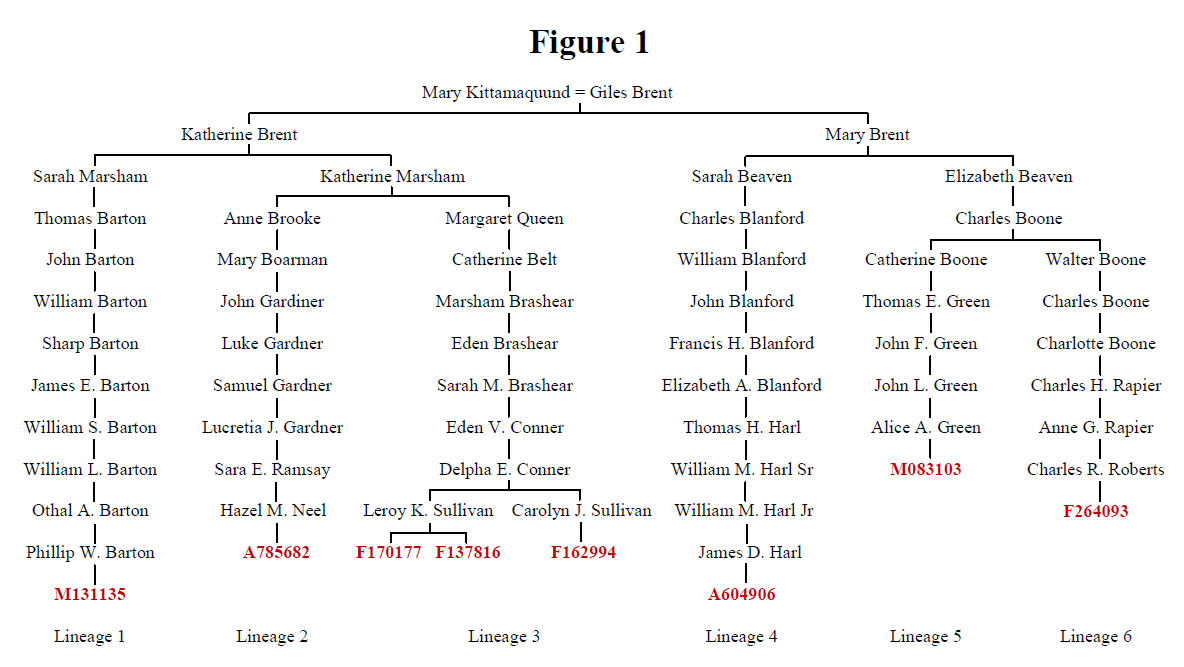
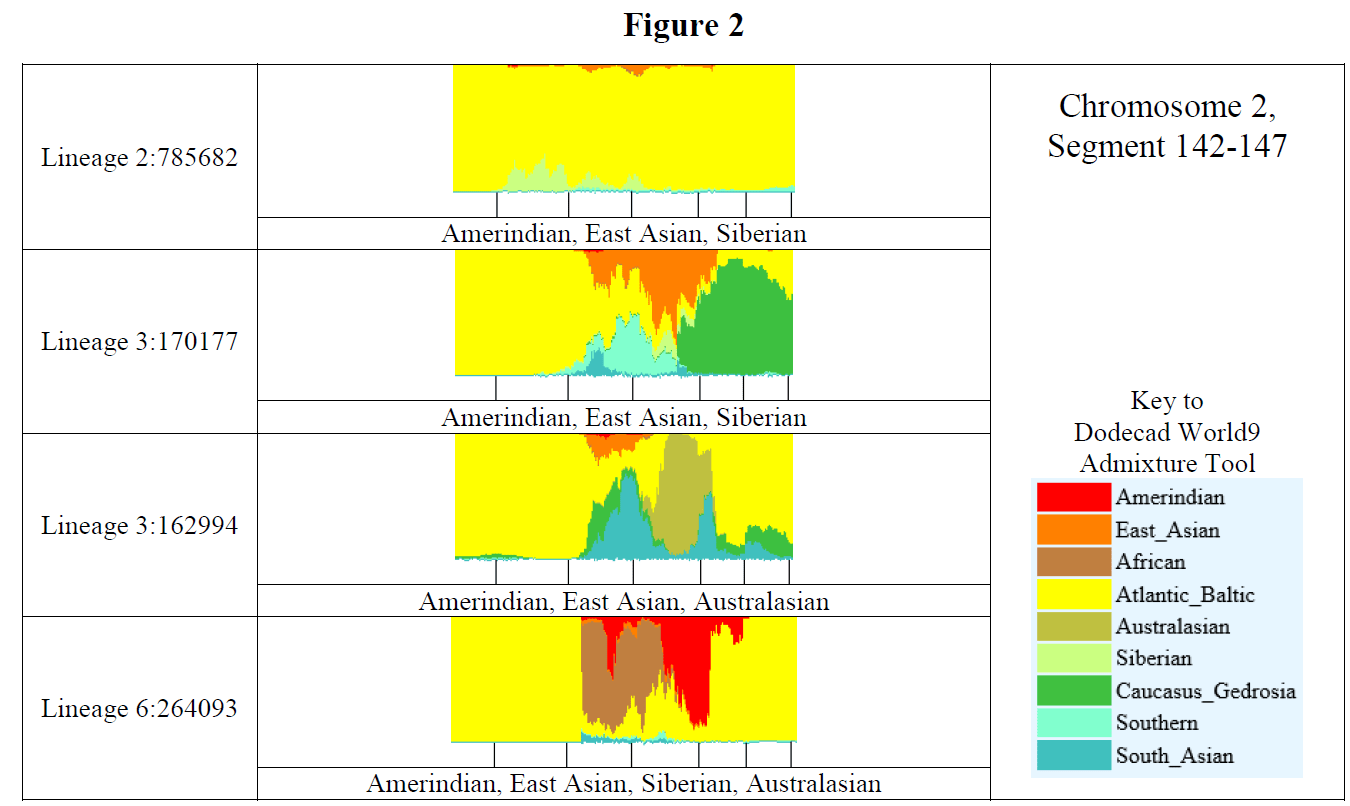
Recent DNA analysis, however, reveals six descendants of Katherine and Richard Marsham and three descendants of Mary and Charles Beaven, representing six separate lineages, inherited at least sixteen matching segments of Native American DNA on chromosomes 2, 3, 4, 5, 6, 7, 8, 13, 15, 16, 20, and 22.  Figure 1 shows the relationships between these descendants; and Figures 2-17 illustrate the sixteen matching Native American chromosomal segments (see Figures 18-33 for additional images of these segments produced by four independent admixture tools; and also see http://dna-explained.com/2013/06/02/the-autosomal-me-summary-and-pdf-file/ for information about Minority Admixture Mapping).  These matching chromosomal segments point to a common Native American ancestor, who, because other possibilities can be eliminated, must have been the mother of Katherine and Mary.[xvi]  Considering this DNA evidence in light of contemporary records, it now seems certain Mary Kittamaquund and Giles Brent were the parents of Katherine, wife of Richard Marsham, and Mary, wife first of John Fitzherbert and second of Charles Beaven.

Genealogical Summary

Katherine Brent was born probably in Aquia, Stafford County, Virginia, say about 1650.  She may have served an unknown period of indentured service to Thomas Brooke, perhaps following the death of her mother, before she married Richard Marsham perhaps before December 26, 1663, and certainly before March 11, 1664/5.[xvii]  Richard immigrated to Maryland in 1658, where he served three-years of indentured service to John Horne for his transatlantic voyage.[xviii]  Katherine died in Calvert County, Maryland, before October 26, 1670.[xix]  Richard married second Anne Calvert, widow first of Baker Brooke Sr., and second of Henry Brent, after April 30, 1695, and before February, 1696.[xx]  Richard died in Prince George’s County, Maryland, between April 14 and 22, 1713.[xxi]  Katherine and Richard were the parents of the following children:

1. Sarah Marsham was born in Calvert County, Maryland, say about 1667, married first Basil Waring say about 1685, married second William Barton after December 29, 1688, married third James Haddock after April 19, 1703, and died in Charles County, Maryland, after January 8, 1733.[xxii]

2.  Katherine Marsham was born in Calvert County, Maryland, say about 1669, married first her future step-brother Baker Brooke Jr. say about 1689, married second Samuel Queen after May 27, 1698, and died in St Mary’s County after March 18, 1712, and before April 14, 1713.[xxiii]

Mary Brent was born probably in Aquia, Stafford County, Virginia, say about 1654.[xxiv]  She married first John Fitzherbert before 1671.[xxv]  Mary and John divorced before April 26, 1672.[xxvi]  Mary married second Charles Beaven say about 1674.  Charles died in Prince George’s County, Maryland, between June 20, 1698, and June 21, 1699.[xxvii]  Mary died in Prince George’s County between April 28, 1712, and June 13, 1713.[xxviii]  Mary and Charles were the parents of the following children:

1. Richard Beaven was born in Calvert County, Maryland, say about 1676, married Jane Blanford before June 11, 1703, and died in Prince Georges County, Maryland, before August 9, 1744.[xxix]

2.  Sarah Beaven was born in Calvert County, Maryland, say about 1678, married Thomas Blanford on June 20, 1698, and died in Prince Georges County, Maryland, after August 7, 1749.[xxx]

3.  Margaret Beaven was born in Calvert County, Maryland, say about 1680, and died in Prince George’s County, Maryland, between April 28, 1712, and June 13, 1713.

4. Elizabeth Beaven was born in Calvert County, Maryland, say about 1682, married John Boone about 1708, and died in Prince Georges County, Maryland, before October 30, 1725.

5. Katherine Beaven was born in Calvert County, Maryland, say about 1684, married Henry Culver about 1711, and died in Prince Georges County, Maryland, before December 20, 1762.[xxxi]

6. Charles Beaven was born in Calvert County, Maryland, say about 1686, married Mary Finch about 1712, and died in Prince Georges County, Maryland, on December 16, 1761.[xxxii]

Daughters pedigree

Following this lineage information, Shawn and Lois included a chromosome by chromosome analysis of the various individuals who tested.  I am including only one example, below.

Daughters DNA

Following the many pages of genetic comparison information, Shawn and Lois included quite a bit for their readers about the Piscataway History and Culture.  After all, DNA without genealogy and history is impersonal science.  Included were early drawings and paintings of Native people and villages, an account of the people by Father Andrew White in 1635 as well as anonymous documents from 1639 and 1640.  Their food, language and vocabulary were discussed as well with historical events being presented in timeline format.

Piscataway Timeline

1550           Piscataway Tayac governed c. 7,000 people between Potomac and Patuxent Rivers

1608           John Smith explored the Potomac River; Piscataway welcomed him with kindness

1622           Powhatan Indians attacked at least 31 Virginia settlements along the James River

1623           Virginia colonists attacked Moyaone, killing many and burning houses and corn

1634           Piscataway Tayac Wannas permitted Leonard Calvert to establish St Mary’s City

1640           Piscataway Tayac Kittamaquund was baptized by Jesuit Father Andrew White

1644           Wahocasso succeeded as Tayac, who was succeeded by Uttapoingassenem in 1658, who was succeeded by Wannasapapin in 1662, who was succeeded by Nattowasso (son of Wahocasso—breaking the tradition of matrilineal succession) in 1663

1666           Facing increasing encroachments by European settlers, the Piscataway petitioned the Maryland council, saying: “We can flee no further.  Let us know where to live, and how to be secured for the future from the hogs and cattle.”

1695           Maryland Governor Francis Nicholson “advised the council to find a way of depriving Indians beyond Mattawoman Creek of their lands, in order to ‘occasion a greater quantity of Tobacco to be made.'”

1697           Piscataway Tayac Ochotomaquath and about 400 others fled to northern Virginia; then they allied with the Iroquois in 1701 and moved to Pennsylvania.

1699           Maryland colonists estimated Piscataway military strength at 80-90 warriors

Although many Piscataway left Maryland by the end of the 17th century in the face of encroaching European settlements, others remained on their homeland, intermarrying with Europeans and Africans, while preserving their cultural traditions.  In 1996, an advisory committee appointed by the Maryland Historical Trust voted unanimously to recommend state recognition of the Piscataway Indian Nation, citing genealogical, linguistic, cultural, and political continuity between the earliest Piscataway people and their modern descendants.  On January 9, 2012, Maryland Governor Martin O’Malley issued two executive orders, granting official state recognition to the Piscataway Indian Nation (about 100 members), and the Piscataway Conoy Tribe—consisting of the Piscataway Conoy Confederacy and Subtribes (about 3,500 members), and the Cedarville Band of Piscataway (about 500 members).

St Mary's City 1634 Indian Village

This drawing of St Mary’s City in 1634 by Cary Carson from the Maryland State Archives Map Collection shows the Native people living outside the city fortifications.

This 262 page book is a wonderful combination of genealogy, genetics and history, and does exactly what genetic genealogy is supposed to do.  It enables us to document and better understand our ancestors, and in this case, to prove they were indeed, Native American.  Shawn and Lois would welcome inquiries about the book or the family lines included and you can contact them at shpxlcp@comcast.net.


               [i] Most scholars estimate her year of birth as 1634, because an unidentified Catholic missionary made the following statement about her.  “On the 15th of February we came to Pascatoe, not without the great gratulation and joy of the inhabitants, who indeed seem well inclined to receive the christian faith.  So that not long after, the king brought his daughter, seven years old, (whom he loves with great affection,) to be educated among the English at St. Mary’s; and when she shall well understand the christian mysteries, to be washed in the sacred font of baptism.”  See “Extracts from Different Letters of Missionaries, from the Year 1635, to the Year 1638,” in E.A. Dalrymple, ed., Relatio Itineris in Marylandiam.  Declaratio Coloniae Domini Baronis de Baltimoro. Excerpta ex Diversis Litteris Missionariorum ab Anno 1635, ad Annum 1638, Narrative of a Voyage to Maryland, by Father Andrew White, S.J.  An Account of the Colony of the Lord Baron Baltimore.  Extracts from Different Letters of Missionaries, from the Year 1635 to the Year 1677 (Baltimore: Maryland Historical Society, 1874), 76.  But, the circumstances of Mary’s life suggest she was born a few years earlier.  So, we suspect the author of this letter underestimated her age.

               [ii] Father Andrew White, “Annual Letter of the English Province of the Society of Jesus, 1639,” in Clayton Colman Hall, ed., Narratives of Early Maryland, 1633-1684 (New York: Barnes & Noble, Inc., 1910), 126.

               [iii] Ibid.

               [iv] Ibid., 131.

               [v] John Lewger to Governor Leonard Calvert, January 9, 1644/5, in Proceedings of the Council of Maryland, 1636-1667, Vol 3, pp. 162-163 (original pages 186-187), Archives of Maryland Online.  “To the horle Governor.  Sir  I doe signify unto you that Mr Giles Brent hath delivered unto me 2. petitions nerewth sent unto you; and I desire you by vertue of the Law in that behalfe, that you wilbe pleased to give him a competent security for his indemnification in the possession of the lands at Kent, mentioned in one of the said petitions, & for iustification of his title in them, according to the said petition, dated 7. January instant: & likewise to satisfy unto him 5700l tob & cask, demanded in the other petition for damage of non pformance of a covenant to his wife Mary touching certaine cattell; or els to shew cause why you refuse to doe either; and to appoint some time when the Counsell shall attend you for it, betweene this & Monday next.  So humbly take leave to rest  Yor servant  S. Johns. 9th Jan: 1644 John Lewger.”  See also Margaret Brent, “Account of the Estate of Governor Leonard Calvert,” June 6, 1648, in Judicial and Testamentary Business of the Provincial Court, 1637-1650, Vol. 4, pp. 388-389 (original pages 159-160).  “By payd to Mrs. Mary Brent Kittamagund 0748.”

               [vi] For information about the arrest and transport of Giles Brent to London during Richard Ingle’s Rebellion, see “Richard Ingle in Maryland” in Maryland Historical Magazine, Vol. 1(1906), 125-140.  For the terminus ad quem (limit to which—latest possible date) Giles Brent returned to Maryland, see Maryland State Archives, Judicial and Testamentary Business of the Provincial Court, 1637-1650, Vol. 4:312-313.  “June 19th This day came Margaret Brent Gent, & desyred the testimony of the prnt Gouernor Mr Tho: Greene concerning the last will & Testamt of the late Gouernor Leonard Calvert Esqr And the sd Gouernor did authorize Giles Brent Esqr one of his Lops Counsell to administer an oath unto him the sd Gouernr concerning the foresd busines.  The sd Gouernor Tho: Greene Esqr answered uppon oath concerning the last will & Testamt of Leo: Calvert Esqr aforesd That the sd Leo: Calvert, lying uppon his death bed, some 6 howres before his death, being in prfect memory, directing his speech to Mrs Margarett Brent sayd in pnce of him the sd Mr Greene & some others I make you my sole Exequutrix, Take all, & pay all.  After wch words hee the sd Leon: Calvert desyred every one to depart the roome & was some space in priuate conference wth Mrs Marg: Brent aforesd Afterwards the Mr Greene comeing into the roome againe, he heard the sd Mr L: Calvert appoint certaine Legacies in manner following.  Viz I doe giue my warring cloaths to James Linsay, & Richard William my servants, specifying his coath suite to Rich. Willan & his black suite to James Linsey. & his waring Linnen to be diuided betweene them.  Aliso I giue a mare Colt to my God sonne Leon: Greene.  Allso hee did desyre tht his exequutrix should giue the first mare Colt tht should fall this yeare, (& if non fall in this yeare, then the first tht shall hereafter fall) unto Mrs Temperance Pippett of Virginea.  And further he deposeth not.  Recognit Teste mc Willm Bretton Clk.”

               [vii] The terminus a quo (limit from which—earliest possible date) for the relocation of Giles Brent from Maryland to Virginia is the date Giles Brent appeared in court at St. Mary’s on November 8, 1648, requesting compensation for destruction of his property on the Isle of Kent by anti-Papists.  See Archives of Maryland, November 8, 1648, Liber A, Folio 205.  The terminus ad quem (limit to which—latest possible date) Giles Brent removed from Maryland to Virginia is the date Giles Brent patented Marlborough in Potomac Neck, Virginia, on August 20, 1651.  See entry from Mercer Land Book cited by W.B. Chilton, ed., “The Brent Family,” The Virginia Magazine of History and Biography, Vol. 16, No. 1 (Jul., 1908), 96-97.

               [viii] Virginia Magazine XVI, 211.  On April 17, 1654, Giles conveyed his personal estate in Virginia and Maryland to his sister Mary, in trust to educate his children and allow maintenance to his wife Mary.  See also Lurene Rose Bivin in “Brent-Marsham-Beaven-Blandford Article: A Closer Look,” Maryland Genealogical Society Bulletin, Vol. 37, No. 3, 328-334.  “In the grant to John Harrison (dated 4 September 1655), he refers to his “sister” as Mrs. Frances Harrison (Nugent, p. 319).”  Giles may have been engaged to marry his second wife, Frances Whitgreaves, widow of Jeremiah Harrison, on this date, because John Harrison made a provision for Giles.

               [ix] W.B. Chilton, ed., “The Brent Family,” The Virginia Magazine of History and Biography, Vol. 16, No. 2 (Oct., 1908), 212.  “‘Register of Christ Church, Middlesex County, Virginia.  Collo Giles Brent of Potomac departed this life 2d of September 1679 and was buried in the Great Church Yard ye next day following.'”

               [x] For example, see Douglas Richardson, Magna Carta Ancestry: A Study in Colonial and Medieval Families (Baltimore: Genealogical Publishing Co., Inc., 2005), 129.  “They had two sons, [Col.] Giles and Richard, and one daughter, Mary (wife of [Capt.] John Fitzherbert).”  See also, Robert W. Barnes, British Roots of Maryland Families (Baltimore: Genealogical Publishing Co., Inc., 1999), 73-74.

               [xi] W.B. Chilton, Vol. 16, No. 1 (Jul., 1908), 98-99.  “The Will of Margaret Brent.  In the name of God Amen.  I Margaret Brent of Peace in the County of Westmoreland in Virginia considering the casualtys of human life do therefore make this my last Will and Testament as followeth my soul I do bequeath to the mercies of my Savior Jesus Christ and my worldly estate to be disposed of by my Executors as followeth to my nephew George Brent I give all my rights to take up land in Maryland except those already assigned to my cousin James Clifton to my niece Clifton I give a cow and to my neece Elizabeth Brent I give a heifer; to Ann Vandan I give a cow calf; to my neece Mary Brent daughter of my Brother Giles Brent I give all my silver spoons which are six; to my nephew Richard Brent son of my brother Giles Brent I give my patent of lands at the Falls of Rappahanock River also my lease of Kent Fort Mannor in Maryland saving yet power to his Father my brother Giles Brent that if he shall like to do so he may sell said lease and satisfye to his son other where as he shall think fitt in lands good or money and in case of my said nephew Richard Brents death under age and without heirs of his body lawfully begotten his legacy thereto to go to his brother Giles Brent or his sister Mary Brent or to the heirs of my brother Giles Brent or otherwise as my said brother shall dispose it by his Deed or last Will to my brother Giles Brent and to his heirs forever I give all my lands goods and chattles and all my estate real and personal and all that is or may be due to me in England Virginia Maryland or elsewhere still excepting the before disposed of in this my last will and Testament and I do appoint him my said Brother Giles Brent and his children Giles Brent Mary Brent and Richard Brent or such of them as are living at the time of my death the Executors of this my last Will and Testament.  In witness whereof I have hereunto set my hand and seal this 26th day of December, Anno Domini, 1663.”

               [xii] W.B. Chilton, Vol. 16, No. 1 (Jul., 1908), 98.  “The Will of Giles Brent.  In the Name of God Amen.  I Giles Brent of the Retirement in Stafford County in Virginia Esquire contemplating the uncertainty of my time of death do ordain this my last Will and Testament in manner and form following my body to the earth and my Soul I bequeath to the mercy of my Savior Christ all my worldly estate I appoint to my Exectors to be disposed of as followeth to my daughter Mary Fitzherbert I give five ewes and a ram to my son and heir Giles Brent and to the heirs of his body lawfully begotten I give for ever all my lands rights unto lands and reversions of lands any ways due to me in either England Virginia or Maryland and for want of such heirs then unto mine own right heirs and for want of such then to the right heirs of my Honored Father Richard Brent, Esquire, deceased Antiently Lord of the mannors of Admington and Lark Stoke in the County of Gloucestershire in England after my debts paid I give all my goods moveable or immoveable whatsoever to be disposed of as followeth three thousand pounds of good tobacco with cask to be given by them my Executors unto pious use where and to whom they shall see fitt for which doing and how and to whom given I Will that to none else but God they shall be accountable.  I also Will that to Mr. Edward Sanders they give four ewes and a ram and to John Howard four ewes and a ram.  Executors of this my last Will and Testament I appoint my son Giles Brent and my Brother Richard Brent and my Brother William Brent both in England and as Attorneys in their Executorship untill my said Brothers shall otherwise order and I do appoint Mr. Edward Sanders and John Howard above mentioned both of Stafford County to be and to act and it is my Will that after my debts and my Legacies paid my said Executors stand possessed of all my goods and personal estate to the sole use of my son Giles Brent then to be delivered into his sole dispose when it shall please God that he hath arrived to the age of one and twenty years.  In witness unto this my within written last Will and Testament I have hereunto set my hand and seal this last day of August, Anno Domini, 1671.”

               [xiii] Image SC4040-0166-1, Dr. Lois Green Carr’s Biographical Files of 17th and 18th Century Marylanders, Maryland State Archives, http://msa.maryland.gov/megafile/msa/speccol/sc4000/sc4040/000001/000166/html/sc4040-0166-1.html.  Note: Dr. Carr lists the children in the following order: Mary, Giles, Richard, Katherine, Henry, Margaret.

               [xiv] See excerpt from Charles Calvert to Cecilius Calvert, April 26, 1672, in William Hand Browne, ed., Proceedings of the Council of Mayland: 1671-1682 (Baltimore: Maryland Historical Society, 1896), xiv.  “Major Fitzherbert’s brother who maryed the Indian Brent, has civilly parted with her, and (as I suppose) will never care to bed with her more; soe that your Lordship needs not to feare any ill consequence from that match, butt what has already happened to the poore man, who unadvisedly threw himself away upon her in hopes of a great portion which now is come to little.”  See also Will of Charles Beaven, signed June 20, 1698, proved June 21, 1699, Prerogative Court (Wills) Vol. 2, pp. 182-183, Liber 6, Folios 285-286.  See also Will of Mary Beaven, signed April 18, 1712, proved June 13, 1713, Prerogative Court (Wills) Vol. 3, p. 240, Liber 13, Folio 513.  See also Maryland Land Patents, BB#37:374.  On March 15, 1696/7, Richard Marsham transferred 600 acre grant called The Hickory Thickett to Charles Beaven by assignment.

               [xv] Lurene Rose Bivin in “Brent-Marsham-Beaven-Blandford Article: A Closer Look,” Maryland Genealogical Society Bulletin, Vol. 37, No. 3, 328-334.

               [xvi] Four potential scenarios explain this matching DNA considered together with Charles Beaven’s reference to Richard Marsham as “my brother iñ Richard Marsham.”  The first scenario is Richard Marsham and Charles Beaven were brothers.  This scenario almost certainly is not true because Richard Marsham and Charles Beaven had different last names and the written reference by Charles Beaven to Richard Marsham as “my brother iñ” appears to have been a standard contraction of “my brother-in-law.”  The second scenario is Richard Marsham and Mary, wife of Charles Beaven, were brother and sister.  This scenario almost certainly is not true because Mary referred to Richard Marsham as “my well beloved Richard Marsham.”  If Richard Marsham and Mary had been brother and sister, Mary surely would have referred to Richard as her brother.  The third scenario is Charles Beaven and Katherine, wife of Richard Marsham, were brother and sister.  This scenario almost certainly is not true because their descendants inherited matching segments of Native American DNA.  Charles Beaven immigrated from England to Maryland in 1666 (Skordas, Liber 9, folio 455), so he surely did not inherit Native American DNA from his parents.  The fourth and most compelling scenario is Katherine, wife of Richard Marsham, and Mary, wife of Charles Beaven, were sisters, and they also were daughters of a parent with Native American ancestry.  This scenario is consistent with other indications that Katherine and Mary were daughters of Mary Kittamaquund and Giles Brent.

               [xvii] Maryland Colonial Land Records, Liber 7, Folio 582, 583, Maryland State Archives.  “March xith 1664.  Came David Bowens and demands land for these rights following John Barnes, Clement Barnes, Margaret Whitthe, Martha Garbett, Catherine Marsham by Assign and Francis Street by Assign as follows–Know all to whom these presents may concern, that I Katherine Marsham doe assigne all my Right and Title of a Right due to mee the said Katherine for fifty acres of land unto David Bowing as witness my hand this Eleventh of March One Thousand six hundred sixty foure.  Katherine Marsham (her K mark).  Witness Richard Marsham, Robert Turner.  Know all men by these presents to whom this may concern that I Francis Streete doe assigne all my Right and Title of a right due to mee the said Francis Streete for fifty acres of Land unto David Bowing as witness my hand this Eleventh of March One Thousand six hundred sixty four.  Francis Streete.  Witness Richard Marsham, Robert Turner.”  See also Maryland Colonial Land Records, Liber 12, Folio 512, Maryland State Archives.  “May 11th 1670.  Came Richard Marsham of Calvert County and proved right to fifty acres of land it being due to him for the time of service of Katherine his wife performed to Major Thomas Brooke, Warrant then issued in the name of the said Richard Marsham for fifty acres of land it being due to him for the causio oraem above.  Certified the 11th of August next.”  Note: Even though these two documents indicate Katherine was due a total of 100 acres, the first 50 acres for an unstated cause and the second 50 acres for service to Thomas Brooke, neither record says Katherine was transported to Maryland, and both records may result from fraudulent claims.  If these records reflect legitimate claims, they do not say or prove Katherine was transported to Maryland, since some claims were granted for people who were born in Maryland.  For example, a patent for 1,644 acres was granted to Mary Brent on November 17, 1652, for the transportation of 33 persons, including “Mrs. Mary Brent, wife to Capt. Brent.”  See Nugent, pp. 266-267.  This Mrs. Mary Brent was Mary Kittamaquund, wife of Giles Brent, who certainly was born in Maryland.  Furthermore, according to Abbott Emerson Smith (“The Indentured Servant and Land Speculation in Seventeenth Century Maryland,” in The American Historical Review, Vol. 40, p. 467), “A great many of the warrants which were granted were for rights proved by the wife of a freedman.  It is not unlikely that some persons managed to get freedom dues in land, although they had never been in indentured service.”  Finally, if Katherine did serve a term of indenture, her service may have resulted from the death of her mother at a time when she was old enough to begin providing for her own maintenance.  It was not unusual during this era for children of deceased well-to-do colonists to serve a term of indenture.

               [xviii] See Maryland Colonial Land Records, Liber 4, Folio 4, Maryland State Archives.  “May the 7th 1659.  John Home demands Land for the transportation of himself and his Servants, Richard Marsham & John Edmondson, in 1658.”  See also Maryland Colonial Land Records, Liber 5, Folio 295, Maryland State Archives.  “Know all men that I Richard Marsham do give and make over to Thomas Pagett my right as is due to me as being a Servant, and now being free in Roberto McJohn Hearen as witness my hand the 16th of September 1661.  Richard Marsham.  Wit: Robert Coberthwail, Michael Coreuly.”

               [xix] See Maryland Colonial Land Records, Liber 12, Folio 512, Maryland State Archives, as cited above.  “May 11th 1670.  Came Richard Marsham of Calvert County and proved right to fifty acres of land it being due to him for the time of service of Katherine his wife performed to Major Thomas Brooke, Warrant then issued in the name of the said Richard Marsham for fifty acres of land it being due to him for the causio oraem above.  Certified the 11th of August next.”  See also Maryland Colonial Land Records, October 26, 1670, Liber 14, Folio 228.  “Patent for 50 acres in St. Mary’s County, originally Calvert County, to Richard Marsham, tract called St. Katherine’s.”  Note: This patent establishes the terminus ad quem (limit to which—latest possible date) for Katherine’s death, because Richard would be unlikely to name this property Saint Katherine’s unless Katherine had died.

               [xx] The terminus a quo (limit from which—earliest possible date) for Richard’s marriage to Anne Calvert is established by the date of a Prerogative Court record concerning the estate of Henry Brent naming Anne Brent executrix.  See Prerogative Court Records, April 30, 1695, Liber 13A, folio 291, Maryland State Archives.  The terminus ad quem (limit to which—latest possible date) for Richard’s marriage to Anne Calvert is the date they were named as husband and wife on a probate record.  See Provincial Court Judgments, February Court 1696, Liber P. L. #3, Folios 556-557, Maryland State Archives.  Richard Marsham with Ann Marsham, administrator of Henry Brent, against Thomas Collier.

               [xxi] Will of Richard Marsham, signed April 14, 1713, probated April 22, 1713, Maryland Prerogative Court (Wills), Liber xiii, Folio 514-520, Maryland State Archives.

               [xxii] The approximate year of Sarah’s marriage to Basil Waring is estimated from the year of Basil’s death preceded by four years to account for the births of two children.  See Will of Basil Waring, signed December 8, 1688, probated December 29, 1688, Maryland Calendar of Wills, Vol. 2, p. 50, and Liber 6, Folio 66.  Basil named his wife Sarah and sons Marsham and Basil.  The terminus a quo (limit from which—earliest possible date) for Sarah’s marriage to William Barton is determined by the probate date of the will of her first husband Basil Waring.  See Will of Basil Waring, signed December 8, 1688, probated December 29, 1688, Maryland Calendar of Wills, Vol. 2, p. 50, and Liber 6, Folio 66.  The terminus a quo (limit from which—earliest possible date) for Sarah’s death is determined by her deed to Robert Mackhorn.  See Deed from Sarah Haddock to Robert Mackhorn, signed January 8, 1733, recorded March 18, 1733/4, Charles County Land Rcords: 1733-1743, Book O #2, page 28.  “Sarah Haddock, widow, of Prince George’s County, formerly wife of William Barton, late of Charles County, Gent., deceased, to Robert Mackhorn of Charles County, planter.  William Barton by his will, divised to his son-in-law, Basil Waring, 300 acres, being part of this tract of land called Hadlow, lying in Charles County, and the rest of Hadlow to his wife, being now the aforementioned Sarah Haddock.  Now this deed witnesses that sd. Sarah Haddock, for 4500 lbs tobacco, has sold to said Robert the rest of Hadlow, lying in Charles County, bounded by Thos. Gerard, the division line made by sd. Sarah Haddock and Basil Waring.  Signed Sarah Haddock.  Wit. Jas. Haddock Waring, Henry Keen.”

               [xxiii] The approximate year of Katherine’s marriage to Baker Brook is estimated from the year of Baker’s death preceded by eight years to account for the births of four children.  See Will of Baker Book, signed February 5, 1698, probated May 27, 1698, Maryland Calendar of Wills, Vol. 2, p. 142, and Liber 6, Folio 83.  Baker named his wife Katherine and four children Baker, Leonard, Richard, and Ann.  The terminus ad quem (limit to which—latest possible date) for Katherine’s marriage to Samuel Queen is determined by the probate date of the will of her first husband Baker Brooke.  See Will of Baker Book, signed February 5, 1698, probated May 27, 1698, Maryland Calendar of Wills, Vol. 2, p. 142, Liber 6, Folio 83.  The terminus a quo (limit from which—earliest possible date) for Katherine’s death is determined by the date her husband’s will was probated.  See Will of Samuel Queen, signed January 10, 1711, probated March 18, 1712, Maryland Prerogative Court (Wills), Vol. 3, p. 222, Liber 13, Folio 389, Maryland State Archives.  The terminus ad quem (limit to which—latest possible date) for Katherine’s death is determined by the date of the will of her father, Richard Marsham, which provides for her children but does not mention her.  See Will of Richard Marsham, signed April 14, 1713, probated April 22, 1713, Maryland Prerogative Court (Wills), Liber 13, Folios 514-520, Maryland State Archives.

               [xxiv] On April 5, 1673, Giles Brent Jr., son of Col. Giles Brent and Mary Kittamaquund, deeded 500 acres, which he had inherited from his father, to his uncle George Brent of Woodstock, Stafford County, Virginia, stating he had reached the age of 21—a condition set in his father’s will for his ability to take possession of the land.  This suggests Giles Brent Jr. was born about 1652.  See W.B. Chilton, Vol. 16, No. 1 (Jul., 1908), 99-100.

               [xxv] Will of Giles Brent, signed August 31, 1671, in W.B. Chilton, Vol. 16, No. 1 (Jul., 1908), 98.

               [xxvi] See excerpt from Charles Calvert to Cecilius Calvert, April 26, 1672, in William Hand Browne, ed., Proceedings of the Council of Mayland: 1671-1682 (Baltimore: Maryland Historical Society, 1896), xiv.  “Major Fitzherbert’s brother who maryed the Indian Brent, has civilly parted with her, and (as I suppose) will never care to bed with her more; soe that your Lordship needs not to feare any ill consequence from that match, butt what has already happened to the poore man, who unadvisedly threw himself away upon her in hopes of a great portion which now is come to little.”

               [xxvii] Will of Charles Beaven, signed January 20, 1698/9, proven June 2, 1699, Prince Georges County Wills, Liber 6, folios 285-286,  Maryland State Archives.

               [xxviii] Will of Mary Beavan, signed April 28, 1712, proven June 13, 1713, Prince Georges County Wills, Liber 13, folio 513, Maryland State Archives.

               [xxix] Will of Richard Bevan Sr., signed February 27, 1738/9, proven May 21, 1739, Maryland Calendar of Wills, Vol. 8, p. 789, Liber 22, folio 58, Maryland State Archives.  For the terminus ad quem (limit to which—latest possible date) of Richard’s marriage to Jane Blandford, see Administration of the Will of William Bayly, June 11, 1703, Liber 24, folio 16a, Prince Georges County, MD.  “Executrix, Mrs. Jane Beven, wife of Richard Beven.”

               [xxx] Will of Thomas Blandford, signed June 17, 1749, proven August 7, 1749, Maryland Calendar of Wills, Maryland State Archives.  Thomas named his wife Sarah executrix.

               [xxxi] Will of Catherine Culver, signed October 6, 1762, proven December 20, 1762, Maryland Calendar of Wills, Vol. 31, pp. 890-891, Maryland State Archives.

               [xxxii] Charles Beaven signed a deposition in 1728, claiming to be 42 years of age.

______________________________________________________________

Disclosure

I receive a small contribution when you click on some of the links to vendors in my articles. This does NOT increase the price you pay but helps me to keep the lights on and this informational blog free for everyone. Please click on the links in the articles or to the vendors below if you are purchasing products or DNA testing.

Thank you so much.

DNA Purchases and Free Transfers

Genealogy Services

Genealogy Research

Generational Inheritance

Autosomal DNA testing has opened up the brave new world for genealogists.  Along with that opportunity comes some amount of frustration and sometimes desperation to wring every possible tidbit of information out of autosomal results, sometimes resulting in pushing the envelope of what the technology and DNA can tell us.

I often have clients who want me to take a look at DNA results from people several generations removed from each other and try to determine if the ancestors are likely to be brothers, for example.  While that’s fairly feasible in the first few generations, the further back in time one goes, the less reliably we can say much of anything about how DNA is transmitted.  Hence, the less we can say, reliably, about relationships between people.

The best we can ever do is to talk in averages.  It’s like a coin flip.  Take a coin out right now and flip it 10 times.  I just did, and did not get 5 heads and 5 tails, which the average would predict.  But averages are comprised of a large number of outcomes divided by the actual number of events.  That isn’t the same thing as saying if one repeats the event 10 times that you will have 5 heads and 5 tails, or the average.  Each of those 10 flips are entirely independent, so you could have any of 11 different outcomes:

  • 0 heads 10 tails
  • 1 head 9 tails
  • 2 heads 8 tails
  • 3 heads 7 tails
  • 4 heads 6 tails
  • 5 heads 5 tails
  • 6 heads 4 tails
  • 7 heads 3 tails
  • 8 heads 2 tails
  • 9 heads 1 tail
  • 10 heads 0 tails

What the average does say is that in the end, you are most likely to have an average of 5 heads and 5 tails – and the larger the series of events, the more likely you are to reach that average.

My 10 single event flips were 4 heads and 6 tails, clearly not the average.  But if I did 10 series of coin flips, I bet my average would be 5 and 5 – and at 100 flips, it’s almost assured to be 50-50 – because the population, or number of events, has increased to the point where the average is almost assured.

You can see above, that while the average does indeed map to 5-5, or the 50-50 rule, the results of the individual flips are no respecter of that rule and are not connected to the final average outcome.  For example, if one set of flips is entirely tails and one set of flips is entirely heads, the average is still 50/50 which is not at all reflective of the actual events.

And so it goes with inheritance too.

However, we have come to expect that the 50% rule applies most of the time.  We knowriffle shuffle that it does, absolutely, with parents.  We do receive 50% of our DNA from each parent, but which 50%?.  From there, it can vary, meaning that we don’t necessarily get 25% of each grandparent’s DNA.  So while we receive 50% in total from each parent, we don’t necessarily receive every other segment or location, so it’s not like a rifle card shuffle where every other card is interspersed.

If one parents DNA sequence is:

TACGTACGTACG

A child cannot be presumed to receive every other allele, shown in red below.

TACGTACGTACG

The child could receive any portion of this particular segment, all of it, or none of it.

So, if you don’t receive every other allele from a parent, then how do you receive your DNA and how does that 50% division happen?  The bottom line is that we don’t know, but we are learning.  This article is the result of a learning experience.

Over time, genetic genealogists have come to expect that we are most likely to receive 25% of our DNA from each grandparent – which is statistically true when there are enough inheritance events.  This reflects our expectation of the standard deviation, where about 2/3rds of the results will be within the closest 25% in either direction of the center.  You can see expected standard deviation here.

This means that I would expect an inheritance frequency chart to look like this.

expected inheritance frequency

In this graph above, about half of the time, we inherit 50% of the DNA of any particular segment, and the rest of the time we inherit some different amount, with the most frequently inherited amounts being closer to the 50% mark and the outliers being increasingly rare as you approach 0% and 100% of a particular segment.

But does this predictability hold when we’re not talking about hundreds of events….when we’re not talking about population genetics….but our own family genetics, meaning one transmission event, from parent to child?  Because if that expected 50% factor doesn’t hold true, then that affects DRAMATICALLY what we can say about how related we are to someone 5 or 6 generations ago and how can we analyze individual chromosome data.

I have been uncomfortable with this situation for some time now, and the increasing incidence of anecdotal evidence has caused me to become increasingly more uncomfortable.

There are repeated anecdotal instances of significant segments that “hold” intact for many generations.  Statistically, this should not happen.  When this does happen, we, as genetic genealogists, consider ourselves lucky to be one of the 1% at the end of spectrum, that genetic karma has smiled upon us.  But is that true?  Are we at the lucky 1% end of the spectrum?

This phenomenon is shown clearly in the Vannoy project where 5 cousins who descend from Elijah Vannoy born in 1786 share a very significant portion of chromosome 15.  These people are all 5 generations or more distantly related from the common ancestor, (approximate 4th cousins) and should share less than 1% of their DNA in total, and certainly no large, unbroken segments.   As you can see, below, that’s not the case.  We don’t know why or how some DNA clumps together like this and is transmitted in complete (or nearly complete) segments, but they obviously are.  We often call these “sticky segments” for lack of a better term.

cousin 1

I downloaded this chromosome 15 information into a spreadsheet where I can sort it by chromosome.  Below you can see the segments on chromosome 15 where these cousins match me.

cousin 2

Chromosome 15 is a total of 141 cM in length and has 17,269 SNPs.  Therefore, at 5 generations removed, we would expect to see these people share a total of 4.4cM and 540 SNPs, or less for those more distantly related.  This would be under the matching threshold at either Family Tree DNA or 23andMe, so they would not be shown as matches at all.  Clearly, this isn’t the case for these 5 cousins.  This DNA held together and was passed intact for a total of 25 different individual inheritance events (5 cousins times 5 events, or  generations, each.)  I wrote about this in the article titles “Why Are My Predicted Cousin Relationships Wrong?”

Finally, I had a client who just would not accept no for an answer, wanted desperately to know the genetically projected relationship between two men who lived in the 1700s, and I felt an obligation to look into generational inheritance further.

About this same time, I had been working with my own matches at 23andMe.  Two of my children have tested there as well, a son and a daughter, so all of my matches at 23andMe obviously match me, and may or may not match my children.  This presented the perfect opportunity to study the amount of DNA transmitted in each inheritance event between me and both children.

Utilizing the reports at www.dnagedcom.com, I was able to download all of my matches into a spreadsheet, but then to also download all of the people on my match list that all of my matches match too.

I know, that was a tongue twister.  Maybe an example will help.

I match John Doe.  My match list looks like this and goes on for 353 lines.

match list

I only match John Doe on one chromosome at one location.  But finding who else on my match list of 353 people that John Doe matches is important because it gives me clues as to who is related to whom and descends from the same ancestor.  This is especially true if you recognize some of the people that your match matches, like your first cousin, for example.  This suggests, below that John Doe is related to me through the same ancestor as my first cousin, especially if John matches me with even more people who share that ancestor.   If my cousin and I both match John Doe on the same segment, that is strongly suggestive that this segment comes from a common ancestor, like in the previous Vannoy example.

Therefore, I methodically went through and downloaded every single one of my matches matches (from my match list) to see who was also on their list, and built myself a large spreadsheet.  That spreadsheet exercise is a topic for another article.  The important thing about this process is that how much DNA each of my children match with John Doe tells me exactly how much of my DNA each of my children inherited from me, versus their father, in that segment of DNA.

match comparison

In the above example, I match John Doe on Chromosome 11 from 37,000,000-63,000,000.  Looking at the expected 50% inheritance, or normal distribution, both of my children should match John Doe at half of that.  But look at what happened.  Both of my children inherited almost exactly all of the same DNA that I had to give.  Both of them inherited just slightly less in terms of genetic distance (cM) and also in terms of the number of SNPs.

It’s this type of information that has made me increasingly skeptical about the 50% bell curve standard deviation rule as applied to individual, not population, genetics.  The bell curve, of course, implies that the 50% percentile is the most likely even to occur, with the 49th being next most likely, etc.

This does not seem to be holding true.  In fact, in this one example alone, we have two examples of nearly 100% of the data being passed, not 50% in each inheritance event.  This is the type of one-off anecdotal evidence that has been making me increasingly uncomfortable.

I wanted something more than anecdotal evidence.  I copied all of the match information for myself and my children with my matches to one spreadsheet.  There are two genetic measures that can be utilized, centimorgans (cM) or total SNPs. I am using cM for these examples unless I state otherwise.

In total, there were 594 inheritance events shown as matches between me and others, and those same others and my children.

Upon further analysis of those inheritance events, 6 of them were actually not inheritance events from me.  In other words, those people matched me and my children on different chromosomes.  This means that the matches to my children were not through me, but from their father’s side or were IBS, Inherited by State.

son daughter comparison

This first chart is extremely interesting.  Including all inheritance events, 55% of the time, my children received none of the DNA I had to give them.  Whoa Nellie.  That is not what I expected to see.  They “should have” received half of my DNA, but instead, half of the time, they received none.

The balance of the time, they received some of my DNA 23% of the time and all of my DNA 21% of the time.  That also is not what I expected to see.

Furthermore, there is only one inheritance event in which one of my children actually inherited exactly half of what I had to offer, so significantly less than 1% at .1%.  In other words, what we expected to see actually happened the least often and was vanishingly rare when not looking at averages but at actual inheritance events.

Let’s talk about that “none” figure for a minute.  In this case, none isn’t really accurate, but I can’t be more accurate.  None means that 23andMe showed no match.  Their threshold for matching is 7cM (genetic distance) and 700 SNPS for the first matching segment, and then 5cM and 700 SNPS for secondary matching segments.  However, if you have over 1000 matches, which I do, matches begin to “fall off,” the smallest ones first, so you can’t tell what the functional match threshold is for you or for the people you match.  We can only guess, based on their published thresholds.

So let’s look at this another way.

Of the 329 times that my children received none of my DNA, 105 of those transmissions would be expected to be under the 700cM threshold, based on a 50% calculation of how many cMs I matched with the individual.  However, not all of those expected events were actually under the threshold, and many transmissions that were not expected to be under that threshold, were.  Therefore, 224, or 68% of those “none” events were not expected if you look at how much of my DNA the child would be expected to inherit at 50%.

Another very interesting anomaly that pops right up is the number of cases where my children inherited more than I had to give them.  In the example below, you can see that I match Jane Doe with 15.2cM and 2859 SNPs, but my daughter matches Jane with 16.3cM and 2960 on the same chromosome.

spreadsheet layout

There are a few possibilities to explain this:

  • My daughter also matches this person on her father’s side at this transition point.
  • My daughter matches this person IBS at this point.
  • The 23andMe matching software is trying to compensate for misreads.
  • There are misreads or no calls in my file.

There of course may be a combination of several of these factors, but the most likely is the fact that she is IBS at this location and the matching software is trying to be generous to compensate for possible no-calls and misreads.  I suggest this because they are almost uniformly very small amounts.

Therefore when my children match me at 100% or greater, I simply counted it as an exact match.  I was surprised at how many of these instances there were.  Most were just slightly over the value of 2 in the “times expected” column.  To explain how this column functions, a value of 1 is the expected amount – or 50% of my DNA.  A value of 2 means that the child inherited all of the DNA I had to offer in that location.  Any value over 2 means that one or more of the bulleted possibilities above occurred.

Between both of my children, there were a total of 75, or 60% with values greater than 2 on cMs and 96, or 80%, on SNPs, meaning that my children matched those people on more DNA at that location than I had to offer.  The range was from 2 to 2.4 with the exception of one match that was at 3.7.  That one could well be a valid transition (other parent) match.

There has been a lot of discussion recently about X chromosome inheritance.  In this case, the X would be like any other chromosome, since I have two Xs to recombine and give to my children, so I did not remove X matches from these calculations.  The X is shown as chromosome 99 here and 23 on the graphs to enable correct column sorting/graphing.

In the chart below, inheritance events are charted by chromosome.  The “Total” columns are the combined events of both my son and daughter.  The blue and pink columns are the inheritance events for both of them, which equal the total, of course.

The “none” column reflects transmissions on that chromosome where my children received none of my DNA.  The “some” column reflects transmission events where my children received some portion of my DNA between 0 (none) and 100% (all).  The “all” column reflects events where my children received all of the DNA that I had to offer.

chromosomal comparison

I graphed these events.

total inheritance graph

The graph shows the total inheritance events between both of my children by chromosome.  Number 23 in these charts is the X chromosome.

son inheritance graph

daughter inheritance graph

These inheritance numbers cause me to wonder what is going on with chromosome 5 in the case of both my daughter and son, and also chromosome 6 with my son.  I wonder if this would be uniform across families relative to chromosome 5, or if it is simply an anomaly within my family inheritance events.  It seems odd that the same anomaly would occur with both children.

son daughter inheritance graph

What this shows is that we are not dealing with a distribution curve where the majority of the events are at the 50% level and those that are not are progressively nearer to the 50% level than either end.  In other words, the Expected Inheritance Frequency is not what was found.

expected inheritance frequency

The actual curve, based on the inheritance events observed here, is shown below, where every event that was over the value of 2, or 100%, was normalized to 2.  This graph is dramatically different than the expected frequency, above.

actual inheritance frequency

Looking at this, it becomes immediately evident that we inherit either all of nothing of our parents DNA segments 85% of the time, and only about 15% of the time we inherit only a portion of our parents DNA segments.  Very, very rarely is the portion we inherit actually 50%, one tenth of one percent of the time.

Now that we understand that individual generational inheritance is not a 50-50 bell curve event, what does this mean to us as genetic genealogists?

I asked fellow genetic genealogist, Dr. David Pike, a mathematician to look this over and he offered the following commentary:

“As relationships get more distant, the number of blocks of DNA that are likely to be shared diminishes greatly.  Once down to one block, then really there are three outcomes for subsequent inheritance:  either the block is passed intact, no part of it is passed on, or recombination happens and a portion of it is passed on.  If we ignore this recombination effect (which should rarely affect a small block) then the block is either passed on in an “all or nothing” manner.  There’s essentially no middle ground with small blocks and even with lots of examples it doesn’t really make sense to expect an average of 50%.  As an analogy, consider the human population:  with about half of us being female and about half of us being male, the “average” person should therefore be androgynous, and yet very few people are indeed androgynous.”

In other words, even if you do have a segment that is 10 cMs in length, it’s not 10 coin flips, it’s one coin flip and it’s going to either be all, nothing or a portion thereof, and it’s more than 6 times more likely to be all or nothing than to be a partial inheritance.

So how do we resolve the fact that when we are looking at the 700,000 or so locations tested at Family Tree DNA and the 600,000 locations tested at 23andMe, that we can in fact use the averages to predict relationships, at least in closely related individuals, but we can’t utilize that same methodology in these types of individual situations?  There are many inheritance events being taken into consideration, 600,000 – 700,000, an amount that is mathematically high enough to over overcome the individual inheritance issues.  In other words, at this level, we can utilize averages.  However, when we move past the larger population model, the individual model simply doesn’t fit anymore for individual event inheritance – in other words, looking at individual segments.

Dr. Pike was kind enough to explain this in mathematical terms, but ones that the rest of us can understand:

“I think that part of what is at stake is the distinction between continuous versus discrete events.  These are mathematical terms, so to illustrate with an example, the number line from 0 to 10 is continuous and includes *all* numbers between them, such 2.55, pi, etc.  A discrete model, however, would involve only a finite number of elements, such as just the eleven integers from 0 to 10 inclusive.  In the discrete model there is nothing “in between” consecutive elements (such as 3 and 4), whereas in the continuous model there are infinitely elements between them.

It’s not unlike comparing a whole spectrum against a finite handful of a few options.  In some cases the distinction is easily blurred, such as if you conduct a survey and ask people to rate a politician on a discrete scale of 0 to 10… in this case it makes intuitive sense to say that the politician’s average rating was 7.32 (for example) even though 7.32 was not one of the options within the discrete scale.

In the realm of DNA, suppose that cousins Alice and Bob share 9 blocks of DNA with each other and we ask how many blocks Alice is likely to share with Bob’s unborn son.  The answer is discrete, and with each block having a roughly 50/50 chance we expect that there will likely be 4 or 5 blocks shared by Alice and Bob Jr., although the randomness of it could result in anywhere from 0 to 9 of the blocks being shared.  Although it doesn’t make practical sense to say that “four and a half” blocks will likely be shared [well, unless we allow recombination to split a block and thereby produce a shared “half block”], there is still some intuitive comfort in saying that 4.5 is the average of what we would expect, but in reality, either 4 or 5 blocks are shared.

But when we get to the extreme situation of there being only 1 block, for which the discrete options are only 0 or 1 block shared, yes or no, our comfortable familiarity with the continuous model fails us.  There are lots of analogies here, such as what is the average of a coin toss, what is the average answer to a True/False question, what the average gender of the population, etc.

Discrete models with lots of options can serve as good approximations of continuous situations, and vice-versa, which is probably part of what’s to blame for confusion here.

Really DNA inheritance is discrete, but with very many possible segments [such as if we divided the genome up into 10 cM segments and asked how many of Alice’s paternal segments will be inherited by one of her children, we can get away with a continuous model and essentially say that the answer is roughly 50%.  Really though, if there are 3000 of these blocks, the actual answer is one of the integers:  0, 1, 2, …, 2999, 3000.  The reality is discrete even though we like the continuous model for predicting it.

However, discrete situations with very few options simply cannot be modelled continuously.”

Back to our situation where we are attempting to determine a relationship of 2 men born in the 1700s whose descendants share fragments of DNA today.  When we see a particularly large fragment of DNA, we can’t make any assumptions about age or how long it has been in existence by “reverse engineering” it’s path to a common ancestor by doubling the amount of DNA in every generation.  In other words, based on the evidence we see above, it has most likely been passed entirely intact, not divided.  In the case of the Vannoy DNA, it looks like the ends have been shaved a few times, but the majority of the segment was passed entirely intact.  In fact, you can’t double the DNA inherited by each individual 5 times, because in at least one case, Buster, doubling his total matching cM, 100, even once would yield a number of cM greater the size of chromosome 15 at 141 cM.

Conversely, when we see no DNA matches, for example, in people who “should be” distant cousins, we can’t draw any conclusions about that either.  If the DNA didn’t get passed in the first generation – and according to the numbers we just saw – 58% doesn’t get passed at all, and 26% gets passed in its entirety, leaving only about 15% to receive some portion of one parent’s DNA, which is uniformly NOT 50% except for one instance in almost 1000 events (.1%) – then all bets for subsequent generations are off – they can’t inherit their half if their half is already gone or wasn’t half to begin with.

Based on mathematical model, Probability of Recombination, Dr. Pike has this to say:

If I’m reading this right, a 10 cM block has a 10% chance of being split into parts during the recombination process of a single conception. Although 10% is not completely negligible, it’s small enough that we can essentially consider “all” or “nothing” as the two dominant outcomes.

This is the fundamental underlying reason why testing companies are hesitant to predict specific relationships – they typically predict ranges of relationships – 1st to 3rd cousin, for example, based on a combination of averages – of the percentages of DNA shared, the number of segments, the size of segments, the number of SNPs etc.  The testing company, of course, can have no knowledge of how our individual DNA is or was actually passed, meaning how much ancestral DNA we do or don’t receive, so they must rely on those averages, which are very reliable as a continuous population model, and apparently, much less so as discrete individual events.

I would suggest that while we certainly have a large enough sample of inheritance events between me and my two children to be statistically relevant, it’s not large enough study to draw any broad sweeping conclusions. It is, after all, only 3 people and we don’t know how this data might hold up compared to a much larger sample of family inheritance events.  I’d like to see 100 or 1000 of these types of studies.

I would be very interested to see how this information holds up for anyone else who would be willing to do the same type of information download of their data for parent/multiple sibling inheritance.  I will gladly make my spreadsheet with the calculations available as a template to anyone who wants to do the same type of study.

I wonder if we would see certain chromosomes that always have higher or lower generational inheritance factors, like the “none” spike we see on chromosome 5.  I wonder if we would see a consistent pattern of male or female children inheriting more or less (all or none) from their parents.  I wonder what other kinds of information would reveal itself in a larger study, and if it would enable us to “weight” match information by chromosome or chromosome/gender, further refining our ability to understand our genetic relationships and to more accurately predict relationships.

I want to thank Dr. David Pike for reviewing and assisting with this article and in particular, for being infinitely patient and making the application of the math to genetics understandable for non-mathematicians.  If you would like to see an example of Dr. Pike’s professional work, here is one of his papers.  You can find his personal web page here and his wonderful DNA analysis tools here.

______________________________________________________________

Disclosure

I receive a small contribution when you click on some of the links to vendors in my articles. This does NOT increase the price you pay but helps me to keep the lights on and this informational blog free for everyone. Please click on the links in the articles or to the vendors below if you are purchasing products or DNA testing.

Thank you so much.

DNA Purchases and Free Transfers

Genealogy Services

Genealogy Research

Coventry and the Ribble Valley

Are you ready for the next leg of our British DNA journey?  Come along.  We’re leaving Cambridge, visiting historic Coventry and arriving in the Ribble Valley, home of our Speak family ancestors, and the Pendle witches, today!

Did I mention that we had some excitement in the hotel in Cambridge the night before we left?  Aside from a very loud and roudy wedding party, the fire alarm went off about 1:30 in the morning.  Jim leaped out of bed, shouting “what is that?”, grabbed his iPad, tore open the cover and frantically started pushing buttons to make the noise stop, thinking it was his alarm, of course.  I started yelling at Jim that it was the fire alarm and to get dressed quickly.  You can’t make someone with a hearing impairment hear over a fire alarm.  So looking something like the keystone cops, we frantically threw clothes on and just as we were about finished and ready to evacuate, the alarm silenced, thankfully.  Indeed, not before we were wide awake though.  I wondered if the alarm had something to do with the wild wedding party.  But justice was served.  Because as we very sleepily boarded the bus the next morning at 8 AM, the alarm went off again, waking up all of those revelers:)  I swear, I was ON the bus and had nothing to do with that.  I have witnesses!  Although I must admit, I did smile a very big smile.  Ahhh, karmic justice!

This trip was arranged in part by a travel agent, and in part by Susan Sills, the president of the Speaks Family Association, with probably too much help and input from members.  The parts that Susan arranged were wonderful.  The parts that the travel agent arranged were, at best, OK.  I think they decided that we had 2 hours and were going past a landmark and we surely needed to stop at that location.  I’m including some of these stops because they really did turn out to be historically interesting, but have omitted others.

Were any of your ancestors skilled tradesmen?  Tilers, bricklayers, stainers, painters, carpenters or merchants perhaps?  If so, they were members of a guild, and guilds had guild halls.  The men spent a lot of time in those halls.  Have you ever wondered about that?  What were they doing?  What did the halls look like?  Well, come with us today, we’re going to visit a pretty amazing one.  Keep your ancestor in mind as we do, because their hall was probably similar to this one!

After leaving Cambridge, we arrived in Coventry, a city very heavily bombed during WW2. It was Churchill’s home town and had lots of manufacturing, so was a very attractive target to the Germans.                       

Coventry guild hall

After arriving in Coventry, we met up with our walking guide and our first stop was the medieval St. Mary’s Guild Hall in quaint Bayley Lane. The Guild Hall is the tall building on the right with the archway entrances.  Built in the 1300s or so, it’s one of the city’s oldest buildings.  It was the wealthy merchants guild, and also the town council chambers for a very long time.  No undue influence there.

Coventry guild hall 1810

This 1810 painting is looking from the street through the archway into the courtyard of the Guild Hall.  It doesn’t look much different today.  One difference is that the staircase on the left is enclosed today.  See the railing end in the photos below.

Coventry guild hall piazza

It’s a beautiful buildings, nothing even or straight in the entire place.  It was obviously not the carpenters guild.

Coventry guild hall door

I love the old doors and archways.

Coventry guild hall stair

Upon entering the doors from the courtyard today you turn right and climb the stairs, which were open in the original Guild Hall.  Here’s the original carved railing.

Coventry guild hall door 2

The relative worth of doors, and those who lived behind then, and their ability to stand up to battering from invading “evil forces” was determined by the number of metal studs embedded in the door.  Who knew?

Coventry guild hall princes chamber

Never let it be said that I have not visited the Prince’s Chamber:)  This is how family legends get started, by the way.  “I saw a picture of grandma in the Princes Chamber in England.”  In 3 or 4 or 7 or 8 generations, this will be a MUCH better story!!!

Coventry guild hall tapestry

Behind the glass, under that beautiful stained glass window, hangs a stunning woven tapestry.

Coventry guild hall tapestry close

The ‘Coventry Tapestry’ is the highlight of the historic collections at St. Mary’s Guild Hall.

Manufactured about 1495 to 1500, its significance lies not just in its age and remarkable state of preservation, but also in the fact that, incredibly, it remains hanging on the very wall for which it was created more than five hundred years ago.

At more than nine metres wide and three metres high, this magnificent artwork dominates the north wall of the Great Hall, and is testament to both the skill of its Flemish weavers, and the wealth of the city of Coventry at the end of the fifteenth century.

The scene portrayed includes 75 individual characters, principally members of a Royal court, angels, saints and apostles, with an image of the Virgin Mary at its center, and incorporates numerous examples of symbolism and hidden meaning, some of which remain unexplained. It has even been observed that light from the west windows specifically illuminates the head of the Virgin Mary at certain times of the year, either a strange co-incidence or an inspired feature of the original design.

Here’s a better photo.

OLYMPUS DIGITAL CAMERA

In this photo, you can actually get an idea of the size of the hall itself.  It certainly doesn’t look this large from the street.  This is the area directly to the rear as you were entering the piazza.

Coventry guild hall gables

And the Guild Hall ceiling.  I just can’t help myself, I love the medieval architecture.

OLYMPUS DIGITAL CAMERA

And the beautiful mosaic file floors.

Coventry guild hall spiral stairs

One really interesting piece of history is that there is a small room upstairs, very crooked and sloping, and only accessible via a very small, very steep circular stairway. I’m amazed they let people go up there in terms of safety and liability.  Mary Queen of Scots was hidden here at one time.

Coventry guild hall windows

Looking outside into the courtyard and on into the street under the archway though the windows in Mary Queen of Scot’s hidden room.

OLYMPUS DIGITAL CAMERA

They do have some beautiful furnishings, like the original council chamber, shown here, and a rich history.  They also have some medieval armor that you can “try on.”

Jim viking

Now you know me by now well enough to know I could not bypass this opportunity.  This Viking style helmet was Jim’s favorite.

Jim helmet

Oh yea, I like this French Troubador one best!!!  I think he should use it as his Facebook profile photo, don’t you???

Jim troubador

I think Jim was saying, “No, you are NOT going to put this on the blog, are you?”

What do you mean, where are the pictures of me in the hats???  There are no pictures of me in the hats:)  None.  Nada.  Not anymore.

??????????????????????

These slot windows were defensive – they were created to shoot arrows through when under siege.

Coventry, like all towns that were once Medieval, has a market space and an open area, usually right in the center of town.

Coventry market square

Lady Godiva rode here.  I wasn’t terribly interested in Lady Godiva, or the statue, but I was extremely interested in the Starbucks on the other side of the square.  So you’ll excuse the fact that I had to go to Wiki to find a Lady Godiva statue photo:)  You know where I was!

Lady Godiva

While I was in Starbucks, I also purchased a salad, because we were running late and I knew that on a Sunday morning trying to find a lunch to eat in half an hour would be impossible.  So Jim and I were about to have another impromptu picnic.  Starbucks coffee and salad in the sunshine under beautiful blue skies on a Sunday morning in a church, or what is left of one.  Truly, what could be better?  How can you improve on that?

Coventry cathedral

Our next stop was the earliest church in Coventry, now in ruins, because the Germans bombed the city so relentlessly.  The bombs burned the church, but the walls still stand. It’s a beautiful skeleton.

Coventry cathedral 2

Our guided tour ended here, and our other family members dispersed to try to find a quick lunch.  Jim and I were left to ourselves, or nearly so, in the beautiful sentry standing mute testimony.  Once again, we began our picnic.  But the church just up the street was letting out and the church bells began to peel.  They were beautiful, and the church bells still function, giving voice to this church we thought was silent.

Coventry cathedral 3

We left Coventry and visited Shugborough Historic Estate.  We did a quick tour, because we were running late, again.

Fake library door

One of the most interesting things I found was all of the secret doors found in all of the old manor houses.  Here’s one example where they took library book ends and made the door look like part of the bookshelves.

Shugborough gardens

I found this house to look more “old” than historic.  Probably because they had restored it to between the 1920s and the 1970s when it was last lived in.  However, from the rear, the formal Victorian gardens were remarkable.  The bush shapes remind me of jelly candies:)  I’m sure that’s not what they had in mind.

Shugborough

From there, we still had about 2 and a half hours to Stirk House, where we are staying in the Ribble Valley.  The Ribble Valley is the land of rolling hills and what I would call moors and low mountains; the land of legends as well.  It’s believed that the Hobbit books, in particular, Middle Earth, was written after the Ribble Valley.  The author spent a great amount of time writing here while his son was in school in the area.  It’s a very distinctive area.  Outside of London it’s very much like Michigan or the US – but when you enter the Ribble Valley, it’s immediately different, remote, otherworldly.  It’s also the land of Robin Hood.  In fact, in the Robin Hood stories, there is a “Guy of Gisburne.” Gisburn is where our Speak ancestors are from.

If you remember, this entire trip to the British Isles all began with DNA testing.  Our Speak(e)(s) family finally connected with the source location of our American family in the British Isles, thanks to our cousin, Doug, from New Zealand.  New Zealand was settled much later than the US and Doug’s family knew where they were from in the UK, exactly, and still had contact with family members there.  The Speak(e)(s) family in the US arrived about 1660 and descendants didn’t know where they were from, in England.  We had been searching for that information for years.  We had suspicions and theories, but no proof.

The Speak(e)(s) Family Association meets yearly, and in 2011, I presented the results of the Y DNA testing to our group, ending my surprise presentation with pictures of Gisburn and the throw-away comment of, “I don’t know about you, but I want to go there.  I want to stand in that churchyard.”  Apparently, I wasn’t the only one, because planning began for the 2013 homecoming in Lancashire, England.

Rainbow

The excitement on the bus grew as we traveled. It was palpable.  You could feel it. After all, we had all traveled thousands of miles from around the globe to step back in time, not only figuratively, but literally as well in the Ribble Valley.  On the way, we were graced with a beautiful rainbow,  Getting a picture of the rainbow was a challenge through the bus windows.  We interpreted this incredible rainbow as a welcome from our ancestors.

Turning off the main roads, we began to see signs for places we had researched.  The names began to look familiar, Whalley, Gisburn, Clitheroe.  We knew we were close.

Pendle hill fog

This photo is of Pendle Hill, a local landmark that you can see from anyplace in the Ribble Valley.  To the right is the east end of Longridge Fell. Mist lies in the Ribble valley between them.

Pendle hill panoramic

This panoramic view of Pendle Hill is not from the Ribble Valley, but from Newchurch on the other side of the hill.

Ribble Valley first view

Here is our first view of the Ribble Valley.  These hills are high enough that they are moors on the hill.  Pendle Hill towers over the entire Ribble Valley, along with a ridge and cliffs.  Below was our first view of Pendle Hill.

Pendle Hill first view

The Pendle Hills are full of legends, and sheep.  One of the legends is of the Pendle Witches.  England did not escape the witchcraft craze and several women were executed here in the Pendle area for witchcraft in 1612.  One test of being a witch was to be held underwater for 30 minutes.  If you were dead, you were innocent.  If you were alive, you were then tortured and killed for being a witch.  Talk about being dead right.

One of the issues we had with the travel agent was where to stay in the Ribble Valley.  There aren’t any Holiday Inns.  In fact, the agent wanted the bus driver to take us back each evening to Manchester, 40 miles distant to a sterile Best Western.  We wanted to stay in the Ribble Valley, to be where our ancestors had been.  Susan found a conference/meeting facility, literally, in the middle of the valley, that was a restored manor house.  We wanted to stay there, but the travel agent didn’t have a “working relationship” with the Stirk House.  The day came when we simply told them to figure it out or we would, without them, because we were staying at the Stirk House.

Our cousin, Steve Speak, could not join us in the Ribble Valley, but he did meet us in Cambridge for dinner.  Steve is from the Gisburn area and told us that the Stirk House was purchased in the 1930s or 40s by a Peter Speak and he took the next 20 years to restore the manor house which had deteriorated into a terrible state.  On the way, in the bus, Susan took a look at the Gisburn Church records, and sure enough, a Speak woman died in the 1940s, is buried in Gisburn at the church and her residence was listed as “Stirkhouse, Gisburne.”  Now how uncanny is that.  So regardless of exactly where in this beautiful valley our original Speak ancestor lived, we are indeed staying on historic Speak land at the Stirk House.

The Tudor manor house known as the Stirk House was built in 1635, using stones from
the former Sawley Abbey which had been dismantled a century earlier under the
orders of Henry VIII.

The Stirk House was everything we could have imagined and more.  Beautiful facility, wonderful gardens and nature area, good food and a spa if you’re interested.

Stirk House

Welcome home!

Stirk House gardens

I love the moss and ferns growing on the rock walls.

Fern on walls

We had planned this event with the intention of meeting any Speak family members who might remain in the area, whether they carried the Speak surname or not.  We ran ads in regional genealogy/historical publications as well as in the local newspaper.  We also had an English contact which we thought might have made local people more comfortable.

Several Speak family members joined us for dinner.  The Stirk House had a private dining room for us, beside a meeting room.

Stirk House dinner

We had dinner together in the dining room here, an English country dinner, and then moved on to the evening’s agenda.

Some of our Speaks relatives joined us for the evening. It was nice to meet some of our cousins, no matter how distant.  Three different male Speaks brought their families, David, Stan and Gary.  David brought photos of his family and shared information about his family history and the area.  And yes, all three did a DNA test.  They felt certain that they were not related to each other.

Speak cousin

We are probably at least 15 generations removed, but still, we are indeed cousins.  It’s interesting that even after all of these generations two of our English cousins do share segments of DNA with some of us.  Not all of the results are back.

Now that I think of it, we’re probably related to all of the Pendle witches too.  That makes sense, because they were convicted of talking to cats and dogs and one was convicted because her children testified that she was a witch.  Heavens, that could have been me:)  I need a Pendle Witches t-shirt!

We moved to the meeting room and two local people gave historic presentations about the area, which were really quite interesting.   We ended the evening, finally, at 11:45 PM following a DNA presentation and update as to how our DNA brought us to the Ribble Valley.

Stirk house DNA

I must say, this all seemed very surreal to me, especially after a long day following a short night interrupted both by that loud wedding party and the fire alarm.  If I have one piece of advice, it’s don’t pack too much into a day, and don’t do a DNA presentation late in the evening.  Ok, that was 2 pieces of advice.  Pick on me about it and I’ll put a spell on you:)

Pendle witch

______________________________________________________________

Disclosure

I receive a small contribution when you click on some of the links to vendors in my articles. This does NOT increase the price you pay but helps me to keep the lights on and this informational blog free for everyone. Please click on the links in the articles or to the vendors below if you are purchasing products or DNA testing.

Thank you so much.

DNA Purchases and Free Transfers

Genealogy Services

Genealogy Research

Clovis People Are Native Americans, and from Asia, not Europe

In a paper published in Nature today, titled “The genome of a Late Pleistocene human from a Clovis burial site in western Montana,” by Rasmussen et al, the authors conclude that the DNA of a Clovis child is ancestral to Native Americans.  Said another way, this Clovis child was a descendant, along with Native people today, of the original migrants from Asia who crossed the Bering Strait.

This paper, over 50 pages including supplemental material, is behind a paywall but it is very worthwhile for anyone who is specifically interested in either Native American or ancient burials.  This paper is full of graphics and extremely interesting for a number of reasons.

First, it marks what I hope is perhaps a spirit of cooperation between genetic research and several Native tribes.

Second, it utilized new techniques to provide details about the individual and who in world populations today they most resemble.

Third, it utilized full genome sequencing and the analysis is extremely thorough.

Let’s talk about these findings in more detail, concentrating on information provided within the paper.

The Clovis are defined as the oldest widespread complex in North America dating fromClovis point about 13,000 to 12,600 calendar years before present.  The Clovis culture is often characterized by the distinctive Clovis style projectile point.  Until this paper, the origins and genetic legacy of the Clovis people have been debated.

These remains were recovered from the only known Clovis site that is both archaeological and funerary, the Anzick site, on private land in western Montana.  Therefore, the NAGPRA Act does not apply to these remains, but the authors of the paper were very careful to work with a number of Native American tribes in the region in the process of the scientific research.  Sarah L. Anzick, a geneticist and one of the authors of the paper, is a member of the Anzick family whose land the remains were found upon.  The tribes did not object to the research but have requested to rebury the bones.

The bones found were those of a male infant child and were located directly below the Clovis materials and covered in red ochre.  They have been dated  to about 12,707-12,556 years of age and are the oldest North or South American remains to be genetically sequenced.

All 4 types of DNA were recovered from bone fragment shavings: mitochondrial, Y chromosome, autosomal and X chromosome.

Mitochondrial DNA

The mitochondrial haplogroup of the child was D4h3a, a rather rare Native American haplogroup.  Today, subgroups exist, but this D4h3a sample has none of those mutations so has been placed at the base of the D4h3a tree branch, as shown below in a grapic from the paper.  Therefore, D4h3a itself must be older than this skeleton, and they estimate the age of D4h3a to be 13,000 plus or minus 2,600 years, or older.

Clovis mtDNA

Today D4h3a is found along the Pacific coast in both North and South America (Chile, Peru, Ecuador, Bolivia, Brazil) and has been found in ancient populations.  The highest percentage of D4h3a is found at 22% of the Cayapa population in Equador.  An ancient sample has been found in British Columbia, along with current members of the Metlakatla First Nation Community near Prince Rupert, BC.

Much younger remains have been found in Tierra del Fuego in South America, dating from 100-400 years ago and from the Klunk Mound cemetery site in West-Central Illinois dating from 1800 years ago.

It’s sister branch, D4h3b consists of only one D4h3 lineage found in Eastern China.

Y Chromosomal DNA

The Y chromosome was determined to be haplogroup Q-L54.  Haplogroup Q and subgroup Q-L54 originated in Asia and two Q-L54 descendants predominate in the Americas: Q-M3 which has been observed exclusively in Native-Americans and Northeastern Siberians and Q-L54.

The tree researchers constructed is shown below.

Clovis Y

They estimate the divergence between haplogroups Q-L54 and Q-M3, the two major haplogroup Q Native lines, to be about 16,900 years ago, or from between 13,000 – 19,700.

The researchers shared with us the methodology they used to determine when their most common recent ancestor (MCRA) lived.

“The modern samples have accumulated an average of 48.7 transversions [basic mutations] since their MCRA lived and we observed 12 in Anzick.  We infer an average of approximately 36.7 (48.7-12) transversions to have accumulated in the past 12.6 thousands years and therefore estimate the divergence time of Q-M3 and Q-L54 to be approximately 16.8 thousands years (12.6ky x 48.7/36.7).”

Autosomal

They termed their autosomal analysis “genome-wide genetic affinity.”  They compared the Anzick individual with 52 Native populations for which known European and African genetic segments have been “masked,” or excluded.  This analysis showed that the Anzick individual showed a closer affinity to all 52 Native American populations than to any extant or ancient Eurasian population using several different, and some innovative and new, analysis techniques.

Surprisingly, the Anzick infant showed less shared genetic history with 7 northern Native American tribes from Canada and the Artic including 3 Northern Amerind-speaking groups.  Those 7 most distant groups are:  Aleutians, East Greenlanders, West Greenlanders, Chipewyan, Algonquin, Cree and Ojibwa.

They were closer to 44 Native populations from Central and South America, shown on the map below by the red dots.  In fact, South American populations all share a closer genetic affinity with the Anzick individual than they do with modern day North American Native American individuals.

Clovis autosomal cropped

The researchers proposed three migration models that might be plausible to support these findings, and utilized different types of analysis to eliminate two of the three.  The resulting analysis suggests that the split between the North and South American lines happened either before or at the time the Anzick individual lived, and the Anzick individual falls into the South American group, not the North American group.  In other words, the structural split pre-dates the Anzick child.  They conclude on this matter that “the North American and South American groups became isolated with little or no gene flow between the two groups following the death of the Anzick individual.”  This model also implies an early divergence between these two groups.

Clovis branch

In Eurasia, genetic affinity with the Anzick individual decreases with distance from the Bering Strait.

The researchers then utilized the genetic sequence of the 24,000 year old MA-1 individual from Mal’ta, Siberia, a 40,000 year old individual “Tianyuan” from China and the 4000 year old Saqqaq Palaeo-Eskimo from Greenland.

Again, the Anzick child showed a closer genetic affinity to all Native groups than to either MA-1 or the Saqqaq individual.  The Saqqaq individual is closest to the Greenland Inuit populations and the Siberian populations close to the Bering Strait.  Compared to MA-1, Anzick is closer to both East Asian and Native American populations, while MA-1 is closer to European populations.  This is consistent with earlier conclusions stating that “the Native American lineage absorbed gene flow from an East Asian lineage as well as a lineage related to the MA-1 individual.”  They also found that Anzick is closer to the Native population and the East Asian population than to the Tianyuan individual who seems equally related to a geographically wide range of Eurasian populations.  For additional information, you can see their charts in figure 5 in their supplementary data file.

I have constructed the table below to summarize who matches who, generally speaking.

who matches who

In addition, a French population was compared and only showed an affiliation with the Mal’ta individual and generically, Tianyuan who matches all Eurasians at some level.

Conclusions

The researchers concluded that the Clovis infant belonged to a meta-population from which many contemporary Native Americans are descended and is closely related to all indigenous American populations.  In essence, contemporary Native Americans are “effectively direct descendants of the people who made and used Clovis tools and buried this child,” covering it with red ochre.

Furthermore, the data refutes the possibility that Clovis originated via a European, Solutrean, migration to the Americas.

I would certainly be interested to see this same type of analysis performed on remains from the eastern Canadian or eastern seaboard United States on the earliest burials.  Pre-contact European admixture has been a hotly contested question, especially in the Hudson Bay region, for a very long time, but we have yet to see any pre-Columbus era contact burials that produce any genetic evidence of such.

Additionally, the Ohio burial suggests that perhaps the mitochondrial DNA haplogroup is or was more widespread geographically in North American than is known today.  A wider comparison to Native American DNA would be beneficial, were it possible. A quick look at various Native DNA and haplogroup projects at Family Tree DNA doesn’t show this haplogroup in locations outside of the ones discussed here.  Haplogroup Q, of course, is ubiquitous in the Native population.

National Geographic article about this revelation including photos of where the remains were found.  They can make a tuft of grass look great!

Another article can be found at Voice of America News.

Science has a bit more.

______________________________________________________________

Disclosure

I receive a small contribution when you click on some of the links to vendors in my articles. This does NOT increase the price you pay but helps me to keep the lights on and this informational blog free for everyone. Please click on the links in the articles or to the vendors below if you are purchasing products or DNA testing.

Thank you so much.

DNA Purchases and Free Transfers

Genealogy Services

Genealogy Research

You’re Invited to Aleda’s Virtual Funeral

Aleda's Virtual Funeral

We’re having a virtual funeral….and you’re invited.  In fact, this might be a first….the first virtual funeral ever – and you can be part of this groundbreaking event.  It’s a testament to how the electronic, internet, Facebook, DNA age has changed our lives.

Aleda passed away more than a week ago, on January 26th.  Sometimes things don’t always go exactly as we would like, and suffice it to say, Aleda is being buried tomorrow, Friday, February 7, at 2:30, alone.  Well, not entirely alone, the man who mowed her yard since he was a child, and his wife, will be there, and the backhoe operator, of course.

She has a world of online friends and cousins who she met through DNA testing, so, we’re giving Aleda a virtual funeral.  Her favorite reading was the 23rd Psalm, so we’re inviting everyone to participate at 2:30 by reading or reciting the 23rd Psalm, for Aleda, to lift her spirit to the Heavens.  Let’s send her off with a chorus of voices.  Aleda won’t be alone.  We’ll all be sending her home.  And that’s it.  Nothing else for you to do, so it’s very easy to participate.

By the way, I’m being a bit vague about her name and location because of her family’s concerns about the security of her property, which is why there has been no obituary, etc.

Genealogy, and in this case, genetic genealogy changes lives.  In my recent article, “Finding Family the New-Fashioned Way,” I included a poll asking three questions:

Have you become close to someone met through traditional genealogy research.

The results?

43% – Yes, somewhat close, we’re friends
42% – Yes, very close, like family.
14% – No

Have you become close to someone you met through DNA?

43% – Yes, somewhat close, we’re friends.
40% – No
16% – Yes, very close, like family.

Have you met in person the people you’ve discovered during genealogy of DNA research?

62% – Yes
23% – No
14% – No, but have plans to.

Well, I can tell you how Aleda answered those questions, and although the polls are anonymous, I’m sure she answered because she was the consummate contributor and participant.  Aleda would have answered yes to all of the above.

Aleda was a joiner.  In High School, she was a member of several clubs, the editor of the newspaper, and she loved science, especially chemistry.  It’s no surprise then, how quickly she embraced DNA testing decades later when it became available as a genealogy tool.  She was a pioneer, one of the first.

Aleda's high school

Aleda's high school 2

Aleda became interested in genealogy early in life and spent 50 years researching her family history.  She became active in the DAR as well and I believe was a 47 year member.

By the time I met Aleda, in 2006, congestive heart failure had already set in, but that Aleda 2006 croppeddidn’t slow her down much, and it certainly didn’t stop her.  Aleda volunteered to help staff a table for the Lost Colony Research Group in Manteo, NC.  She had to walk slowly, due to the oppressive heat and her health, but walk she did, and she stayed with us all day, talking to people interested in the Lost Colony – or more particular, in figuring out if they descend from Lost Colony survivors.  She was a founding member of The Lost Colony Research Group.

Her family, at least part of it, was from the South, the colonial South, the early South, the South that enslaved Indians and Africans, and she was descended from some combination of all of those people.  Aleda’s DNA, you see, held secrets that would only be divulged when her brother took his first DNA test.

To say Aleda was shocked is an understatement.  But she was also thrilled.  The bad news – it would be 5 long years before her brother would have a DNA match.  Five years is a very long time to wait.  But Aleda didn’t just wait, and she never, once, complained.  Instead, she recruited people.  She researched, she found other people she thought might be related.  She told them of their wonderfully interesting and colorful family history.  And she and her brother took every test they could take.  Aleda was determined to learn everything she could learn by embracing this new technology.

Her brother’s Y DNA is very distinctive.  When he has a match, there is no question that it’s a match.  Aleda gathered her brother’s matches into a research group.

When autosomal DNA became available, she was one of the first to embrace that technology as well, and autosomal matches opened up a whole new world of cousins for Aleda.

As her health deteriorated, it seemed that she worked harder and harder, and began teaching others what she knew.  She had apprentices and taught her research group about file organization, about computers, about DNA and how to research.  She knew her time was limited.  She had come to love them all.

She embraced all things new.  Aleda never had children, but she was a born teacher with a Master’s Degree in Education as well as a second Masters in Liberal Arts from John Hopkins.  It’s no wonder that she always thought innovatively, outside of the box.

Her research group told me that when my blog articles were published, they had to hurry and read them right away, because Aleda would be calling shortly to discuss how to apply them to their research.  They told me how much Aleda looked forward to my blogs.  I never knew.

Aleda 2013As Aleda became increasingly homebound, especially following a stroke a couple years ago, her world became her online friends and cousins with whom she communicated daily.  Her last trip was in the fall of 2013, despite her health challenges, to visit Hancock County, Tennessee, tracking down those pesky ancestors.

She never gave up…not until the last day….not even the last day.  The morning of her death, she was working on X chromosome clusters, and teaching, always sharing her knowledge with her research group.

Aleda loved her cousins.  I don’t meant that lightly.  She truly loved them.  They became her family that she had never had.  They spoke with her daily.  She knew them better than anyone else, even if they were scattered to the winds across the US.

Unfortunately, the fact that we are so scattered, and that we are having an epic winter combined with age and health issues makes attending her burial impossible for her research group.  So, a virtual funeral it is.

What would Aleda think of this virtual funeral?

I’ll let one of her research group cousins tell you:

My dear, dear friend would be so thrilled to think she was having a “virtual funeral.”  She did so like “different things.”

Aleda was not just a friend.  We talked most days and usually had a few projects going at the same time.  She taught my little group of kin what little we know about DNA – and much of it by following whatever Roberta happened to be doing on her blogs.  She spent 50 years in searching for her ancestors and jumped in with both feet when DNA became available.  She said you just couldn’t do enough DNA research.

Because our brothers and my other male kin matched, we became Aleda’s project.  Once I hopped on Aleda’s swiftly moving train, I didn’t get off again until her passing.  She always had a project or two or three or more going at a time and was right in the middle of two big ones to do with the X Chromosome Charts.

She was one of a kind: bright, non-judgmental, generous, loving and forgiving. We lost a super friend, cousin and  dedicated genealogist…the world lost a great lady. Roberta, she so loved your teachings and she in turn taught us.”

Rest in peace dear Aleda.  I thank you for sharing so much of your vast knowledge with us and I really enjoyed our ride.  Hopefully I can be as helpful to others as you were with everyone you knew.”

I think Aleda would love her virtual funeral, her “home-going,” and she would forgive us for not being able to attend in person because that’s how Aleda was.  She always found the positive in everything and everyone.

Please join us at 2:30 Eastern time on Friday to repeat the 23rd Psalm for Aleda.  Please “like” this article if you’ll be virtually attending.

And then, let’s all be a little bit Aleda. She made such a difference to so many who she reached out and touched through genetic genealogy.  The science is simply a means to an end…and what matters in the end is family, however you come to define them.

Update – Aleda’s Virtual Funeral

Aleda had a beautiful virtual funeral.  Thank you to all of the virtual attendees for being your sister’s keeper.  Lots of people participated by reading the 23rd Psalm.  This beautiful version was created and contributed by Donna based on the rose wreath foundation created by www.jaguarwoman.com.

23rd Psalm

Aleda’s virtual funeral included a piano, trumpets, bells tolling, songs and Psalms.

One gentleman in Texas played and sang this.

A lady in Kentucky played the piano and sang.

And in North Carolina, the reading was accompanied by this and bells tolling.

A balloon was released.

In West Virginia, a man took his heirloom family Bible and visited his family cemetery to read the 23rd Psalm.

In Tennessee, a man visited the cemetery that held his 4 great and 5 of his great-great-grandparents, walking from grave to grave as he read the 23rd Psalm and the Lord’s Prayer.

One woman was on an airplane, and several were attending the Rootstech conference in Utah and stole a few minutes away from the hustle and bustle.  My husband was going to excuse himself from a meeting and go to the restroom, but instead, recruited his colleagues in the business meeting he was attending – and they all participated.

Another woman, in Maryland, asked for and received a few minutes relief from her job on the “front desk” in a library.

In fact, Aleda probably had more people at her virtual funeral than she would have been able to have in reality – when you consider the complications of distance and weather.  The map below shows the locations of the people I’m aware of, and I know there were many more because the messages about her virtual funeral were shared over and over again.

This map shows the states where people were who participated.  In Kentucky and Tennessee, there were literally hundreds, followed by Texas.

In addition, there were also several people from the UK, Japan, Israel, Finland and some of our military in Fort Apache, Afghanistan.  It was an international event.  Aleda would have been both surprised and pleased.  I guess maybe this could be called the first virtual surprise “come as you are” funeral.

Funeral States

I’ve been surprised by how many people have told me of special blessings they received while participating in Aleda’s funeral.  In my case, after I did the reading, outside in front of a huge drift in 8 degree, blustery, but sunny, weather, I realized that there was a half moon in the middle of the day, and the spring’s first robin had accompanied me.  I’ve cropped the photo below to show both.

Aleda Moon Robin Cropped

Aleda also had flowers.  Three people sent arrangements with messages from the entire genealogy community.  The florist’s husband attended the burial and took this photo for us, given that the florist had recently had knee surgery.

Cemetery cropped

He said that the funeral home that is adjacent to the cemetery learned of our virtual funeral for Aleda and some of the staff attended in person too, so there were 4 people, plus the florist’s husband and the workers who doubled as her pall-bearers who participated as well.  Everyone read the 23rd Psalm aloud for her.

burial

One virtual participant added something to her reading, something that she felt Aleda wanted.

Psalm 30:11 – You have turned my mourning into dancing for me, you have put off my sackcloth and girded me with gladness.

Rest in Peace our dear friend Aleda, we have truly sung you “over-home.”

Find-A-Grave Memorial

bunch dna card

Aleda flowers

______________________________________________________________

Disclosure

I receive a small contribution when you click on some of the links to vendors in my articles. This does NOT increase the price you pay but helps me to keep the lights on and this informational blog free for everyone. Please click on the links in the articles or to the vendors below if you are purchasing products or DNA testing.

Thank you so much.

DNA Purchases and Free Transfers

Genealogy Services

Genealogy Research

William Sterling Estes – The Missing Years – 52 Ancestors #5

William Sterling Estes was my father.  He was commonly called Bill, and sometimes Sterl, by family members.  He was probably born in either 1902 or 1903, or maybe 1901, records vary, and he died, positively, in 1963.  That’s one of the few positive things we know about him.  His life was anything but ordinary, and he was missing for many years.  And that’s just the beginning…

My father was a study in polar opposites.  He was extremely intelligent, helping his step-son with physics in graduate school, yet did incredibly stupid things that landed him in a heap o’ trouble – and I’m not talking just about that Ilo incident where he married under a fictitious name and then went AWOL.  There were more.  Many more….

Moonshine and Rough Beginnings

My father’s issues began when he was young.  This isn’t meant as overtly critical, but my father’s early years were anything but stable.  He was born near the turn of the century in Claiborne County, Tennessee.  That area, deep in Appalachia was both stunningly beautiful and equally as poverty stricken.

cumberland gap panoramic

Land there, what was farmable, was already taken and the “next generation” had to find something else to do.  But there was nothing else there, so many moved on west.  In the case of my grandparents, they tried several avenues, one of which was moonshining.

Moonshining wasn’t anything unusual in the hills, nor among the original settlers. In fact making your own liquor had been a staple on every farm for hundreds of years in the US, until the law made it illegal over taxation.  It was never a moral issue until Prohibition.  Moonshining or bootlegging has been illegal for awhile, actually a long while, in one form or another, but in Appalachia, mostly everyone ignored that.  Moonshining increased during Prohibition and has been a staple of that region ever since.  My family shares stories of painting milk jugs white and having the kids deliver moonshine in milk jugs in the coal camps from their red wagon.  The family survived and ate together, or didn’t.  Everyone was expected to contribute.  There wasn’t any other choice.

The Estes family in Halifax County, Virginia, some 4 generations earlier had been known for their fine brandies distilled from their orchards.  The difference was, I’m guessing, is that they paid taxes, or they greased the right palm.

In any case, my grandfather, William George Estes was a moonshiner, a photographer and a farmer, among other things.  A veritable Appalachian Renaissance man.  He married my grandmother, Ollie Bolton, in September of 1892.  In July of 1893, their first child, was born, and a year later, in August of 1893, that son, Samuel would pass away and was buried in the family cemetery in Estes Holler behind his grandfather, Lazarus Estes’, house.

Estes cem

Three months later, a second child was born, Estel, who lived.  Two years later, another child whose name we don’t even know for sure, and in another 2 years, Robert, who would burn to death.

Life was rough.  The 1900 census gives us a glimpse. William George Estes states that he was out of work for 9 months the previous year.

Sometime between 1900 and 1910, the family moved to Springdale. Arkansas where Ollie took care of the children and ran a boarding house and William George fished off the bridge down the street from the boarding house, and drank.  By this time, they had several children, and it seemed there were always more on the way.  In the 1910 census, Ollie has borne 8 children and only 5 were living.

Ollie 1907

This picture of Ollie and the children was taken in 1907.  The child, Robert, the blond boy on the chair, would perish when their cabin burned, sometime before the 1910 census.  Cousin George Estes, in the 1980s, showed me where that cabin stood and told me he planted a willow tree there in honor of the child.  Estel, the oldest child, standing in the rear in this photo, age 13 in 1907, had been left in charge and tried to save Robert, who hid under the bed, to no avail.  Estle did manage to get my father, standing in front, and Margaret, held by Ollie, out safely.  That memory alone could scar a person for life.  Robert too is probably buried in the family cemetery just a few feet away, but there is no marker.

By 1913, the family had moved to Fowler, Indiana and become tenant farmers.  Ollie and William George’s marriage was coming unraveled too.  It seems that Ollie’s young female cousin was visiting from Tennessee, and Ollie came home and caught William George and her cousin “in the act.”  She grabbed either a bull whip or a horse whip and proceeded to use it on them, specifically on him, with the full intention of killing him.  The family stories are that it took 5 adult men to restrain her long enough for him to escape.  The family story, from the Crazy Aunts, of course, also says she was pregnant with twins which she subsequently had prematurely and died. If so, the Benton County, Indiana death records contain no record of this birth/death.  They could have been too small, or not born alive.

Divorce followed, but according to Aunt Margaret’s letters which she wrote to my step-mother after my father’s death, Ollie went to Chicago, taking the two girls with her, and William George headed back for Tennessee, but no one wanted the two middle boys, my father and Joseph.  Estel by this time, about 20, was old enough to make his own way. My father was about 12 and Joseph, about 10.

Joseph and my father hopped a train in Indiana and found their way back to Tennessee, and when they arrived at their grandparents house in Estes Holler, extremely hungry, dirty and threadbare, having walked a great distance, and with stories to tell…there was hell to pay.  When William George Estes, their father, arrived sometime later, he was literally run out of Estes Holler by his father, Lazarus Estes, under threat of death, for what he had done both to Ollie and to those boys.  William George crossed over the mountains and settled in Harlan County, Kentucky, known as bloody Harlan, where he very successfully moonshined for decades up in the roughest section of Black Mountain, the roughest area in Kentucky, near the coal camps. My Mom visited once with my father and refused to ever return.

Unfortunately, all of William George’s boys learned to drink, and none of them learned to drink in moderation.  I was told that when there was no food to eat, the children were given liquor to drink, to make them feel better, or maybe, to make them go to sleep.  I found that hard to believe…until I found the death certificate of a child from William George’s third marriage, William James, who died at the age of 2 years and 6 months, in 1935, and the coroner indicated that the child had died from “improper feeding.”  I was sick the day I read that, physically ill, because I knew all the things I had heard about my father’s young life and were too horrible to believe, were probably true.

The reason I mention this at all is because while my father certainly had a huge number of issues, perhaps not all of them were entirely his fault.  He was probably an alcoholic while yet still a child.  Alcohol both ruled and ruined his life, and certainly affected the lives of all the people around him, including, and maybe especially those who loved him.  Alcohol certainly affected the lives of his brothers the same way, and his sisters, well, they became the Crazy Aunts.

William Sterling Estes Joins the Military

My father joined the military in 1917 during WWI, “adjusting” his birthdate to be 1898 instead of 1901, 1902 or 1903. So did his even younger brother Joseph, nicknamed “Dode,” after his grandfather, Joseph “Dode” Bolton.  The military was most likely a better option for my father than any of the alternatives.

Bill and Virgie

Sometime about this time, my father met a young gal in Dunkirk, Indiana, named Virgie.  My father was extremely handsome, and he certainly understood how to win a young girl’s heart.  Look at this picture.  He brought Virgie a kitten (see his shoulder) and two baby ducks.

Bill ducks

These photos were sent to me after her death in 1989 by her daughter, along with the flag from my father’s coffin.

Bill kitten

Now the kitten is on her lap.  I wonder who took the photos.

Bill gone

This photo is just heart-wrenching to me.  I suspect this is when he married Ilo or maybe my sister’s mother, or at least during that timeframe.

Why did Virgie still have these photos, some 70 year later?  Because, she did eventually marry my father, in 1961, some 44 years after these pictures were taken.  She was his last wife.  They both claimed they were soulmates, and indeed, perhaps they were.  She was the only woman I ever met that had something good to say about my father.  In fact, she never said one bad thing about him.  She was a truly lovely lady.

As a child, I had no concept of my father’s constant woman problems, the betrayal of trust, his problem drinking, or the fact that he had “another family.”  I didn’t know I had a brother, Dave, who was only 5 months older than I was.  My mother, who was terribly embarrassed about the situation, managed to hide that from me, as did the “other woman,” from her child too.

My Father’s Daughter

I never knew my father as an adult.  I knew him as a child and I loved him, wholly and completely, in my childish way.  My father would come and visit and I would absolutely adore him, much to my mother’s chagrin.  It must have been tough from her perspective.  She did all the work and he got all the glory for simply showing up.  I remember once when he bought me a rocking chair, which I still have to this day, at Krogers.  I was maybe 4 or 5 and it was for my birthday or maybe Christmas.  Mother was so angry with him, because that is what she was going to get me and he “scooped” her.

I remember another time too when she was furious with him.  I understood that she was angry, very angry, and that it wasn’t directed at me, but I didn’t know why.  The phone rang, very late at night.  She got me up and we went for a drive. I was excited as this was a great adventure in my pajamas.  When we got “there,” my Dad was there, which made me very happy.  I got to sit on his lap for a few minutes, but then we had to leave, taking his little dog, Timmy, with us, who I thought was my dog.  Turns out, Dave thought Timmy was his dog too, and we both had photos of us with Timmy.  Here I am in that coveted rocking chair holding Timmy.

Me and Timmy

Years later, I asked Mom about this very foggy recollection.  Turns out, “there” was the jail in the next county. Why?  Because he has been arrested for drunk driving.  That’s what we called it then, no politically correct terms like “impaired operation of a motor vehicle.”  I asked Mom why she went at all and she said, in a semi-growl, “for the dog.”  Yep, she would have done that and she would have been furious with him both for having to go and retrieve the dog that wasn’t even hers, and for doing what he did….again.

His Death

My father’s death in 1963 in an automobile accident, like every other event in his life, was filled with contradictions.  My step-mother told me he was on the way to the preacher’s house to pick him up to go fishing, stone cold sober.  Her daughter told me that my father had been seen at the park earlier in the day, intoxicated.  Regardless, he reportedly had an angina attack while driving, missed the brake, stomping instead on the gas, and hit a telephone pole head on.

As an adult, after talking to my mother and his part-time employer at the time, which happened to be the funeral home, I wonder if he committed suicide.  On Friday, he backed the hearse into the garage, which in that small town doubled as an ambulance (isn’t that creepy – imaging waking up in the hearse and not knowing if you are dead or alive), and telling the funeral director that he would need it over the weekend.  And indeed, he did.  My father rode in it as an ambulance to the hospital on Sunday and a few days later rode in it as a hearse to the cemetery.

As I got older, everything I knew about my father seemed to be contradicted by something or someone else.  I wanted to love the man, but in some ways, he didn’t seem to be very nice – rather unlovable.  I finally came to the conclusion that while my adult woman self would not like him very much at all,  it was just fine for my young child self to continue to love him.  My mother once said to me in a fit of unbridled honesty that the best thing my father probably ever did for me was to die when I was young before I painfully discovered his betrayals personally. She managed to shield me from most of his drinking.

If I couldn’t know him personally, I wanted to know of him, to understand him.  I was insatiably curious about him.  He seemed so mysterious.  After all, I carried part of him in me.  What was that part and what made my Dad tick, aside from alcohol?  Sadly, I came to discover that alcohol and the actions he took under its influence truly did rule his life.

The Timeline

I started creating a timeline trying to make sense of my father’s life.  There were so many disjoint pieces. I wrote for his military records, but most of them were destroyed in a fire in the St. Louis records center in 1973.  The military helped reassemble as much as possible from other sources.

1917 – In a letter from the VA it says that he served in the Army from Aug. 24, 1917 until honorably discharged on May 19, 1919.  His last rank was private.  He was born Oct. 1, 1898 and died on Aug. 27 1963.  He enlisted May 14, 1917 at Fort Benjamin Harrison, Indiana, 18 years 24 days of age, born in Tazewell, Tennessee. Subsequent service – enlisted May 20, 1919.

I have a copy of this discharge, Sergeant first class, honorably discharged on May 19, 1919 at Camp Custer, Michigan.  His second discharge was honorable as well, even given his time spent in the Disciplinary Barracks at Fort Leavenworth, which really surprised me.

1919, May 20 – My father reenlisted in the Army at Camp Custer.

November 1919 – AWOL from the Army.

December 1919 – Married Ilo Bailey in Battle Creek, Michigan, under the name of Don Carlos.  Aunt Margaret remembered her name as Laila LaFountaine and said that “she hooked him to the plow and drove him like a horse.”

February 1920 – Son Lee born, eventually to be called Lee Devine, in Battle Creek to Ilo.

April 1920 – Arrested for being AWOL – sent to Fort Leavenworth Disciplinary Barracks in Kansas.

May 1920 – My sister, Edna born, also in Battle Creek, Michigan, to Martha Dodderer.

November 28, 1921 – Honorably discharged from the military at Fort Leavenworth.

December 12, 1921 – Married Edna’s mother in Battle Creek, Michigan.

1924 – Martha Estes (Edna’s mother) was paying an attorney for her divorce.  His name was Joseph Hooper and he lived in Battle Creek.  The divorce appears to have been final Feb. 26, 1924. Edna stated in a 1960 letter than before 1950, no one had heard from him in 29 years.  We don’t know where William Sterling Estes was in 1924.

1927 – William Sterling Estes enlisted in the military January 8, 1927 at Fort Sheridan in Chicago.  He was AWOL on May 23, 1927.

1924-1930 – William Sterling Estesmarried” again during this time, probably in southwestern Michigan, possibly Benton Harbor, having a daughter named Violet, about whom very little is known.  Violet married a Golliday or Galliday.  Violet later married a Blevins and joined a religious commune in the Ozark Mountains in or near Licking, Missouri.  Given this and some additional information provided by my sister Edna, who knew Violet, I decided not to pursue this relationship.  Violet was still living in the 1980s, to the best of my knowledge.

The Crazy Aunts told me that Violet’s mother may have been underage, because there was a statutory rape allegation, charge or conviction in western Michigan, possibly in the Benton Harbor area, having to do with the age of the pregnant female.  Michigan prison records held in the State Archives don’t reveal any William Estes having been a prisoner during this timeframe.

Apparently, the Crazy Aunts weren’t the only ones who were suspicious, because Ellen, the “other woman” to whom my father was married in the 1950s wrote a letter to the warden at Jackson State Prison in Michigan inquiring about whether or not my father could have been a prisoner there under an alias.

A letter from the warden of Jackson State Prison to Ellen on Feb. 21, 1957 states that inmate number #24884, Paul LeMarr, alias William Estes, sentenced March 2, 1929 to 10-15 years for statutory rape, was discharged on March 20, 1942.  He was sentenced in Benton Harbor, Michigan and he was age 29 in 1929.  The warden believed that from photos submitted by Ellen that Paul LaMarr could have been William Sterling Estes.

1937 – William Sterling Estes filed for his social security card in Chicago, Illinois.  He is working at Printers Finishing Company and gives his birth date as Oct. 1, 1902, which I believe to be correct.  The signature is my father’s.

Estes, William SS 1937

This proves that my father is not Paul LeMarr, because Paul LeMarr was not released from prison until 1942.  Was Paul LeMarr using William Estes as an alias?  Finally, something in Dad’s favor!  But where did that statutory rape rumor come from?  Was it Violet’s mother and did the charge “go away” because he married her?

So if he wasn’t in prison in Michigan, where was he from 1927 to 1937?

The Crazy Aunts said he was in prison or jail in Michigan at one time, and that one of them visited him there.  But then again, they are the Crazy Aunts and he could have been in “jail” for a few days for who knows what.

There is a rumor about him being in prison in Illinois (Joliet) based on a statement he made to my mother about where he had made someone’s acquaintance.  On the way to Florida in the early 1950s, he stopped at the Georgia prison and visited with the prison guards, the very men who had been his guards.  He made friends with everyone everyplace he went and the man did not know a stranger.  I suspect he could have sold ice cubes to Eskimos.

It’s hard to believe that after being married 3 or 4 times in less than 10 years that he became a monk for the next decade.  Maybe he wasn’t as good at getting divorced as he was at getting married.   He had to be someplace doing something.  And I’m betting that there may be children out there someplace lurking that were conceived between the 1920s when Edna, Lee and Violet were born, and the 1950s when Dave and I were born.  I doubt that he discovered how to prevent pregnancy in the late 1920s and suddenly forgot in the 1950s.

The next hint we have about William Sterling Estes is about 1938.

In March 2006, I visited with the daughter of Estel Estes.  My cousin said that my father came to stay with their family in Fleming, Kentucky in 1938 or 1939.  She was a little girl at the time.  They went for walks together and they found a baby duck without a mother, which they rescued and raised.  She said that the duck was old when it finally died.  My father stayed with their family for a month or 6 weeks.  She said that there was talk that he had gotten out of prison.  There was diphtheria wherever he had been.

1938, Oct. 31 – Discharged from Service – “Other than honorable.”  This is maddeningly brief.  Is this the discharge that matches up with the enlistment from 1927?  This makes no sense.  This also doesn’t tell us where he is, just that this action occurred.

The Unbelievable Story – 2 for 1

Now, let me tell you an unbelievable story.  This is one of two, actually, that kind of fit together like two insane puzzle pieces, and you’ll see why I was convinced that my Crazy Aunts were indeed, crazy.  As time went on, it wasn’t just the Crazy Aunts though that told this story, but my step-mother and others who lived in Claiborne County at the time this was happening.

The Doctor

I remember, when I was a child, there was an old doctor who had his Norman Rockwellish office in the front part of his home down the street from where we lived in Indiana.  I went there one time when I was older, maybe a teen, for something, when the old gentleman said that he remembered my father and that my father was a doctor too. I told him that I was sure he had the wrong man, and he repeated his name and told me, no, that he was not mistaken, that he remembered me, and that my father was indeed a doctor.  He dug around in a drawer, pulled out my father’s file, and showed me where it said he was a doctor.

Being raised in a time when one did not contradict your elders, at least not ones that weren’t your mother, I didn’t say anything, but I was sure this man was wrong.  However, I never forgot the story.  It always nagged at me, the feeling that something wasn’t quite right or that there was something that I didn’t know.

I went to visit my step-mother from the time I was a child.  I first went to visit my Dad and Virgie, my step-Mom, when I was young, before Dad passed away.  I loved to visit.  Virgie’s elderly mother lived there too, Grandma, whom I dearly loved.  Grandma would tell me how smart my Dad was.  I found this kind of odd.  He worked on furnaces and had his own furnace shop at that time in Dunkirk, Indiana.  She said not to let that fool me, that he had once been a great man.  Oh, the rantings of an old woman.  I loved her just the same.  We contented ourselves looking at ViewMaster reels and its predecessor, the stereoscope.  My favorite was Niagara Falls.  Grandma would tell me all about the images while I looked and they came to life.  I loved spending time with Grandma.

Niagara stereograph

After my father and Grandma were both gone, I visited Virgie from time to time until her death.  They were always such pleasant visits.  She told me wonderful stories about the loving man she knew as her husband.  Yes, I mean my father.

Before his death, he hid love letters and notes around the house for her to find later.  I’m sure he knew his time was limited.  My mother told me that based on his health, she thought he might have had cancer.  I’m more suspicious of cirrhosis of the liver, but regardless, he was not a healthy man.  One time, Virgie shared with me a note she had just found stuck behind a picture frame.  It was so sweet and personal and it was nice to know him in this lovely way.  She also kept all of his letters he wrote to her when he was in the service.  Her daughter sent those to me after Virgie’s death.  Even though I felt like I was intruding into a personal vignette, I did read them.  They were both sorrowful and beautiful, especially from my perspective, looking backwards in time and knowing what happened.

Virgie told me that my father understood physics and helped her son when he was studying for his PhD.  I questioned this, and she said that she didn’t know how he had come upon that knowledge, but that he had worked at Oak Ridge, Tennessee, and that at some time, in some way, he was a doctor.  Truthfully, I found all of this quite unbelievable.  I knew that Virgie was not one of the Crazy Aunts, and that she would never tell me something she didn’t believe. She told me that he had done those things before he “went into the hospital.”  What she didn’t add was that the hospital stay was the VA hospital to “dry out.”

Apparently, he “dried out” several times, but never was able to stay dry, although he desperately wanted to.  It’s too bad that Alcoholics Anonymous did not exist then. He might have stood a fighting chance.  I discounted all of this, figuring that most of it was fanciful stories he had made up – but that didn’t explain how he could ever help a college student studying for an advanced degree that included physics.

When I started my genealogy search, I contacted people in Claiborne County, Tennessee.  All I started with was the name of a town, from my mother, Tazewell.  I called the telephone operator and told her to connect me to any Estes family there – and she did.  I eventually made my way from person to person to the family historian and my relatives.  They told me stories about my father and grandparents.  They knew them.  Of course, all of those old people are gone now.

I went to visit and met many of these lovely people who opened their hearts, shared their photos albums and family stories with me.  They told me that my father was a doctor and he treated people locally, for years.  In fact, people would find out when he was coming home and line up to see him.  He was a favorite.  And he performed surgery.  Surgery?  More than one person told me this.  They also told me that he practiced at the VA hospital in Knoxville, Tennessee until a patient bit him and he hit the patient.

They told me that at one time, he worked at Oak Ridge, and that he worked on ‘the bomb,” and that he was never “right” after that.  His drinking increased.  At that time, he was living in Claiborne County and these people knew him.  He was their neighbor.  These were family members who had known him their entire life.  They were not all making this up – but where was the kernel of truth in these seemingly conflicting, albeit very interesting, stories?

How could he have been a doctor, as in medical doctor, and also a physicist?  Furthermore, he had no more than a high school education to the best of my knowledge, if that, except that we really don’t know what he did or where he was for that 10 year period.  Was he in the military that entire time doing something “special’ that we don’t know about?  Those records for that time are entirely missing.

He could have learned about medicine while serving in a hospital someplace, but I don’t think you can learn physics that way.  Physics is extremely difficult under the very best of circumstances.

The requirement for a doctor to practice, legitimately, in Tennessee at that time are foggy, but in general, by 1930, nearly all medical schools required a liberal arts degree for admission and provided a 3- to 4-year graded curriculum in medicine and surgery. Many states also required candidates who wanted to get their medical license to complete a 1-year internship in a hospital setting in addition to holding a degree from a recognized medical school.  That presumes that one is doing things legally and by the book.  Of course, in Appalachia, healers had been treating their families and those of their neighbors for decades, and local neighborhood healers were probably trusted much more closely that “outsiders.”  Joseph, my father’s brother, was also a practitioner, a family herbal healer.  Death certificates during that time in Claiborne County are rife with comments like “refused to go to the hospital because did not want to split up the family” and many included reports of people refusing to see a doctor.

My brother, Dave, told me that he thought William Sterling was arrested for performing illegal abortions in or near Chicago in the 1950s or 1960s.

There is obviously some truth in here someplace, because there were too many witnesses….but where…and what was that truth?  Back to the timeline.

Many Wives – Too Many

1944 – I reached out to the Tennessee State Archives who provided me with information that William Sterling Estes began working for the Eastern State Mental Hospital on Dec. 29, 1944 and that he was dismissed March 12, 1945.  He was an attendant.  His legal voting residence was Claiborne Co., Tn. but he lived in Harlan Ky., while he worked at the State Hospital.  He was married, no wife’s name given, but he had relatives in state service – Dortha Estes also at Eastern State.

They could provide me no information about Oak Ridge or the VA Hospital.

1940s – Per Aunt Margaret’s (his sister) letter to Virgie, William Sterling was married to a woman in Oak Ridge, Tn., although she knew of no children by her.  Margaret also states that he got in trouble in the 1940s by “taking a girl over the state line,” perhaps to Kentucky, and spent some time in jail, but Ethel was apparently faithfully waiting for him.  Who was Ethel?

Late 1940s – The next we know of William Sterling was in the (possibly) late1940s when he was married to a woman named Ethel and living with his aunt, Cornie Epperson in Claiborne County, working at Oak Ridge Tennessee, possibly in a hospital there.  We know of no children from this marriage.  Cornie’s daughter says he was a doctor in the VA hospital.  Aunt Dorothy says he operated on her foot.  While this was reported as late 1940s, it sounds to me like it may have occurred before 1945.

1945 – March 15 – William Sterling Estes, now about age 42 or 43, married a 17 year old young female in Walker County, Georgia.  Note that this is only 3 days after his dismissal from Eastern State Mental Hospital in Knoxville, Tennessee, assuming that he was actually present in Knoxville at the time he was dismissed.  He could have been dismissed for not showing up at work. Regardless, the Georgia courtship seems very abbreviated.

I am not including the name of the gal he married in Walker County, because I believe she is still living.  He gives his age as 34, born Oct. 1, 1911 and residence as Chicago.  Shortly after this marriage, her father filed papers against him for bigamy, giving his other wife’s name as Dorothy Kilpatrick.  I surely wonder how her father made that discovery.  Did Dorothy show up?  Maybe right after the wedding, shouting, “I object!”

1945 – 1948 – In the Superior Court of Walker Co. Georgia on June 15, 1945, three months to the day after his marriage, William Sterling Estes was convicted of bigamy and sentenced to 5 years in prison.  According to prison records, he was discharged Dec. 13, 1948.  His wife on arrival at the prison was listed as Dorothy Estes, also listed as Dorothy Kilpatrick in court papers, Trailer Camp, NW 5th St., Richmond, Indiana.  He was in the Georgia State Prison at Reidsville, Georgia.  The specific court records no longer exist, nor do the prison records.

A few years ago, I spoke to the Georgia wife.  She did not have any children by William Sterling and said the marriage was annulled.  She did marry and have one child, about 5 years later.  I verified this child’s age and he was not born at a time when he could have been my father’s child.

So what happened to Dorothy?  And Ethel? And the young gal he “took over the state line.”  Or was that story really the bigamous marriage in Georgia?

Back to Chicago

1949 – Apparently, after William Sterling was released from prison in Georgia, he returned to Chicago where his mother lived.  He lost no time marrying again, this time to an Ellen in Cook. Co., Illinois on Feb. 19, 1949.  This must be some kind of record.  An entire courtship and marriage in less than 2 months.  Quick courtships seemed to be his style.  Apparently Dorothy divorced him while he was in prison?  But then again….um….maybe not.

1950 – William Sterling Estes finds my sister, Edna, in Michigan after a hiatus of almost 30 years.  Edna’s mother has passed away and Edna was none too pleased with her prodigal father.

1952 – His delayed birth certificate issued in Tennessee gives his address as 2210 Broadway, Fort Wayne, Indiana.

The “Other Woman’

1955 – Both my brother David and I were born within 5 months of each other, to different wives.  No, my father was not Mormon.

Mother told me years later that he filed for divorce from Ellen in 1955, in Florida, but somehow the waiting period got “messed up,” as in one day short.  Therefore the divorce didn’t happen, but apparently he thought it had.  My reaction to this?  “Likely story.”

I checked the Florida divorce index and there is nothing for a William, William Sterling or any Estes male involving a woman named Ellen.  That’s assuming that he used his correct name to get divorced.  I did verify the name on his marriage license to Ellen to be sure it was correct.

1956, April 3 – Mom wrote my sister, Edna a letter that includes information about my father.  She says “Bill is working very hard right now and when spring comes his business starts to be pretty heavy.  He wasn’t too well this winter but we hope he will be better when the weather gets nice.  He was out working through in spite of the way he felt.”

The photo below, I believe, is the only photo of me with my father, taken in 1956.  I have no idea who the other child in the photo, beside my father, is.  Makes me wonder…

Me and Dad

1956 – November 3.  My father is a passenger in a head on car accident that nearly kills him.  He flies through the windshield.  This is before the days of seatbelts or safety tempered glass.  I still vividly remember the scar on his forehead and the skin graft they did from his leg to his face and head.  This car accident was his undoing in more than one way though.  You see, it’s how he got caught with 2 wives, in the worst possible soap opera scenario.

Busted

Mom actually heard the sirens that day.  She remembers saying something like “I hope that’s not Bill.”  But it was.  Sometime later, the police came and took us to the hospital.  My father was not expected to live.  He had lost a great deal of blood and was badly injured.

At the hospital, employees had dug through his billfold and other personal information to figure out who to contact.  He was not conscious.

Mother and I were sitting by his bedside.  I remember none of this of course.

A few hours later, another woman, also with a baby walks into the room, looking for her husband.  Mother motioned to the next bed, but the woman came back and said no, that the man in this bed, my father, was her husband.

Both women stared at each other, and their babies, incredulously, as the awful truth slowly sunk in, and then they began to talk, as he lay comatose.  He’s a very lucky man indeed, that they simply did not finish him off.  I think they wanted him to regain consciousness so they could beat him senseless.  Needless to say, they were both furious.

Yes, they were both his wives.  Ellen lived in Chicago (or Fort Wayne) at that time.  My father traveled selling and arranging installations of industrial furnaces and he literally had a wife at both ends of the track, so to speak.   Can you imagine the stories the doctors and nurses had to tell when they went home that day.  “You are not going to believe this…..”  My mother couldn’t believe it either, and neither could Ellen.

There is another family story that has something to do with my father,  my (Brethren) grandfather and a baseball bat…but I never did get that entire story.  I got the general drift though and I’m guessing it might have happened about this time.

Dad Holland car

Above, my father outside one of the Holland Furnace company offices, from my mother’s photos.  Below, my father outside the Holland Furnace company facility from Ellen’s photos.

Dad Holland window cropped

My mother wasn’t as forgiving as Ellen who stayed married to him…at least for awhile.

1960, Oct. 3 – A letter from the Cook Co., Illinois Adult Probation Dept. to my sister saying that William Estes is under the supervision of that office and his whereabouts are no longer known to them.  Unless they are able to locate him, a warrant will be issued for his arrest for probation violation.  William D. Meyering is the person who wrote the letter and he is the chief probation officer.

Edna wrote a letter to the Cook Co. Adult Probation Department, replying to their letter of inquiry.  She said she had not had contact with him for 4 years and had not seen him in 6.  She says in 1956 he was with my mother and working for Holland Furnace Co.  She said she did not believe he would come to her house because she did not know him well, had only seen him about 10 times in her life, and all in the past 10 years.  Before then it had been 29 years since anyone had heard from him.  Doing the math, this means that she corresponded with him from 1950-1956 to some degree, and before that it had been 1921, the year she was born.  She asked why he was on probation, but did not receive a reply.

Mother said that about this time, Bill was working in Wisconsin, near Chicago.  He showed up in Indiana with a small station wagon that was brand new, an electric skillet, a toaster, clothes and toys.  The police arrested him for something to do with fraud.  The title for the car he traded was not clear, or something to that effect.  She said he served several months in the Chicago jail, which ironically would be the same Cook Co. jail where I installed inmate tracking software some 20 years later.

David thought he might have been sent to jail for performing illegal abortions in Wisconsin.

1960 – There is a dated photo of Bill sitting in the living room at Ellen’s house in Fort Wayne.  David remembers him living with them in Fort Wayne.  The city directory confirms that as well.

1960-1962 – This is the timeframe when Mom and I went to pick Timmy up from the jail.  My mother did not bail him out, much to his dismay, but took Timmy and left.  Mom said that when he got out of jail, the time we went to get Timmy, that he came by the house, and then went to Virgie’s in Dunkirk, and was unhappy that no one had come to see him.

Mom said that he spent time in jail in Terre Haute, Indiana, at some time, for repeated drunk driving offences.  I am unclear about when that might have been, but I got the idea it was when she knew him and perhaps after she was no longer romantically involved with him.

Married for the Last Time

1961, April 24 – William Sterling Estes married Virgie, his childhood sweetheart, in Rome, Georgia under the name William S. Este’ (no final s).  I would think that given what happened to him previously in Georgia when he was married to two women, he would have avoided Georgia entirely and would have been as nervous as a long-tailed cat in a room full of rockers just being in the state.  Can you believe he did this again, and in Georgia no less?  He was not divorced from Ellen.

According to mother, she is the one who told Virgie that he was not legally divorced from Ellen so Virgie and my father had to go to Florida and “take care of it.”

Virgie’s daughter says he worked in a heating place in Fort Wayne for about a year before they married.  He was likely living with Ellen during this time, unbeknownst to Virgie.  This man could never pull this off today in the age of cell phones, texting, e-mail and FaceBook.

Despite his “misrepresentation” of things, Virgie loved him dearly.  Apparently, among other things, he told Virgie that my mother was his sister.  My Mom was hopping mad about that one.  Virgie wrote to me after his death “that no matter what people say, there is a lot that goes into human behavior and your father is not ALL bad.”

1961 – There is an envelope from Jopling, Darby and Duncan, Attorneys at Law, People’s Hardware Building, Lake City, (Columbia County) Florida dated October 17, 1961 addressed to William S. Estes at 501 Hickory St., Dunkirk, Indiana.  This may have to do with the divorce from Ellen that somehow went awry.  Someone said that the lawyers filed it a day late.

Dad and Virgie

This is the last known picture of William Sterling Estes, with Virgie, obviously at Christmas time, in the early 1960s.  I would guess this is Christmas 1961 or 1962.

1963, Aug. 27 – William Sterling Estes died.   From funeral home information, it says in WWI he was hit ?? in a??.  Looks like he was hit in the arm with something.  It also says that he had a ruptured right col??.  Right side of page is cut off.

His obituary says he is a member of the Ralph Burgess post 227 of the American Legion “here”, the Williamson-Smiley Post 401 of Redkey, and the DAV post in Portland.

After my step-mother died, her daughter sent me items related to my father.  In fact, one day, I went to the mailbox to discover the flag from my father’s coffin stuffed in the back of the mailbox in one of those heavy Tyvek mailing envelopes.  Thankfully, the envelope held.

Among other things she sent me, unfortunately, attempting to reuse the same envelope some 30 years later, was a condolence card from the White House, to Virgie, “signed” by President Kennedy and postmarked Sept. 10, 1963, just a few weeks before Kennedy’s own untimely death.

White House Envelope

Estes condolence from Kennedy

My Favorite Memories

Although I don’t have a lot of memories of my father, I do have some and a few that stand out.

There are a couple things that have struck me over the years.  Most all of the photos I have ever seen of him show him in either a suit or a dress shirt.  There is maybe one or two in a t-shirt and jacket.  He did not talk, act or look like a “jailbird,” in any way.  He always looked and acted professional and sophisticated, from my perspective and that of many others as well.  He either was as he appeared, or he was a supreme con artist – or maybe both.

Dad against wall

Dad in suit 2

He loved to fish.  Dave and I both share memories of fishing with him.  Here he is with his can of worms and his ever-present coffee cup.  Wherever he was in his lifetime, he found a place to fish. He was drawn to it like a moth to a flame.

Dad fishing

And speaking of coffee, Dad started me drinking coffee.  Actually, today they would be called lattes because they consisted mostly of milk and sugar with a little coffee added in.  I loved them then and still do.

My Dad also rescued critters, animals in need.  Dogs, cats, ducks and even a raccoon.  The mother raccoon got killed.  He scooped the baby up and rescued it off of the road.  It traveled with him for a long time, but I don’t know what ever happened to said raccoon.  I believe Timmy was a rescue of some kind too.

You’re going to laugh when I tell you this, but he loved kids.  I’m not sure he loved the responsibility that went along with them, but he did love them, and I don’t just mean creating them.  Dave and I both have very good memories with him.

I remember going to the VFW post with Virgie and my Dad and he used to let me pull the arm of the slot machine.  I thought watching the spinning dials was great fun, and if I ever won anything, I got to keep it.  I was a very rich 5 or 6 year old with a jarfull of pennies!  My mother was appalled, both about the slots and the coffee drinking!

I remember one Easter when I was maybe 2 or 3 that Mom and Dad hid a little red wagon behind the couch.  I was ecstatic, and I found a purple easter egg too.  I’ve always loved purple and that egg was so richly colored.

And I remember when Dad brought me a small handmade stuffed doll we named Sleepy because her eyes were simply stitches and she appeared to be asleep all of the time.  She was maybe 6 inches long, and we made a bed for her out of a tomato crate that held 3 tomatoes and we made her a blanket for her bed that fit her perfectly.  I had Sleepy until I was an adult when she disintegrated.

I remember when Dad took me to my first Indian Powwow.  I was about 5.  Powwows were illegal then, and mother was utterly furious that he had taken me to something illegal.  I, on the other hand, loved it.  They had braided my hair.  I had danced.  For the first time, I felt like I belonged someplace.  They gave me a beautiful beaded belt and braid ties.  He bought me a fringed leather jacket.  But he did more than that, far more than he knew or anyone could have guessed. He introduced me to my people, to my heritage, to a people and heritage I take great pride in.  He introduced me to my future, that day, at the illegal powwow, and planted a seed that blossoms today.  Thank you Dad.

And then, there is my final memory, and it’s not directly of Dad.  Virgie told me that as he lay dieing in the hospital, that gave her a message for me.  First, he asked her to be sure I graduated…although I’m not sure from what, although I expect he meant college.  Then he told her to tell me that I’m smart and I can do absolutely anything I want to do.  His words would be echoed, almost word for word, a decade later from my step-father, almost like an arrow shot through time.

Neither of those men, I’m sure, had any idea of the power or the inspiration of those words, or the comfort they would bring me.  My faith in difficult times, in the face of a fearful future was rooted, in part, in the knowledge that I knew they both had total confidence in me, even if I didn’t, that they loved me to the depth of their souls, and neither of them would ever steer me wrong.

Just because our family members can’t overcome their personal demons doesn’t mean they don’t love us.

The DNA

You might suspect that with all of this chronic uncertainly swirling around in my father’s life that I had some doubt that any or all of his children were actually his, including me.  I desperately, and I do mean desperately, wanted his DNA.  Initially, I was seeking his Yline, but then I realized he had Ollie’s mtDNA and now of course, I’d love to have his autosomal.

I discovered hairs under his hatband and I attempted to have DNA extracted from them, as well as from an envelope mailed in the 1960s from my grandfather to my father.  No luck with any of those, and we tried three times.  You can read all about that in the article, “Digging Up Dad, Exhumation and Forensic Testing Alternatives.”  And for the record, no, I didn’t.  I do, however, still have a couple of hairs and someday when the technology has improved, I’d still love to have his DNA.  Maybe by then, I can do a full genome sequence.

Fortunately, I was able to go back upstream a couple of generations and find one male Estes descended from Lazarus Estes, my father’s grandfather, left to test.  This gave me the Yline, and it did match the known Estes line, which of course, disproved my brother Dave’s descent from my father.  The grown up me thinks that it’s somehow fitting that the ultimate scammer, in terms of women and drama, got scammed himself.

I upgraded that same cousin’s DNA to autosomal when that test became available, and thankfully, I match him.  I heaved a huge sigh of relief that day, let me tell you.

Fortunately, several cousins were willing to test, along with my sister’s granddaughter, so we’ve proven the rest of the relationships, at least those available to us.  And because my mother tested before she passed over, I in essence have half of my father’s autosomal DNA by subtracting my mother’s half from mine.  Not the same, granted, but certainly not bad for a guy who has been dead now for more than half a century.

What’s Next?

I think it’s possible that people are still living who were involved with or knew William Sterling Estes.  For example, there may be someone out there who knows something about Ethel, last name unknown, but probably Estes at one time, or Dorothy Kilpatrick Estes – the two women he was involved with in the 1940s and probably married to in Tennessee…or maybe Indiana.

I suspect that there may be more wives in the 1930s.  I suspect even more strongly that there may be more children.  It find it hard to believe that he [supposedly] fathered 3 children in the 1920s, 2 in the 1950s and none inbetween.  For all I know, he may have had several more families.  He’d certainly get married in the blink of an eye.  His haunt seemed to be from Michigan to Florida, but my mother met him on a train from Philadelphia to Chicago.

I nearly had a coronary writing this article when I found on Ancestry that someone had attached a wife and several children to him in Harlan County, KY in the 1920s and 1930s.  I don’t think it’s him, mostly because if it was, the Crazy Aunts and the rest of the family would have known about a wife, Addie, and a half dozen kids in that vicinity.  And truthfully, I can’t imagine him being with one woman for more than a decade.  It didn’t seem to be his style.  Plus I know he was in Chicago in 1937, but still…he was a slippery guy.  I’ve sent the woman who owns the tree a note asking how she knows that Addie was married to William Sterling Estes….just in case.  She hasn’t answered, and I don’t expect she will.  I figure she just attached Addie to the closest William Estes and my grandfather, William George Estes, was living nearby and had a son, William Sterling, of about the right age.

If you can fill in any blanks, please let me know.  I hope we can complete the missing chapters to his story, one way or another, or at least add some puzzle pieces.  I’ve love to figure out where he was for a decade.

And yes, I’m still waiting for that DNA match that one day, I just know is going to happen!

Dad stone

______________________________________________________________

Disclosure

I receive a small contribution when you click on some of the links to vendors in my articles. This does NOT increase the price you pay but helps me to keep the lights on and this informational blog free for everyone. Please click on the links in the articles or to the vendors below if you are purchasing products or DNA testing.

Thank you so much.

DNA Purchases and Free Transfers

Genealogy Services

Genealogy Research

Neanderthal Genome Further Defined in Contemporary Eurasians

DNA X

A new study released by Howard Hughes Medical Institute at Harvard Medical School on January 29th titled “When Populations Collide” provides some interesting insights about Neanderthal DNA in modern humans.  This study compared the full Neanderthal genome to that of 1004 living individuals.

In general, people in East Asia carry more Neanderthal than Europeans who carry 1-3%, and Africans carry none or very little.  It appears, according to David Reich, that Neanderthal DNA is not proportionately represented in contemporary humans, meaning that some areas of Neanderthal DNA are commonly found and others not at all.  Some Neanderthal genes are carried by more than 60% of Europeans or Asians, most often associated with skin and hair color, or keratin.  Reich’s thought is that people exiting Africa assimilated with Neanderthals and selected for these genes that gave them an adaptive and survival advantage in the cooler non-African climate.

One particularly big Neanderthal genetic desert is the X chromosome, a phenomenon called hybrid sterility.  Reich suggests that this means that when Neanderthals and humans exiting from Africa interbred, they were on the cusp of being unable to reproduce successfully.  Reich explains that “when two populations are distantly related, genes related to fertility inherited on the X chromosome can interact poorly with genes elsewhere in the genome and that interference can render males, who carry only one X, sterile.”

Given the recent discussions about the X chromosome and the possibility that it may be inherited in an all-or-nothing manner more often than the other chromosomes, I had to wonder how they determined that this was hybrid sterility and not an case of absence of recombination.

Reich’s team apparently had the same question, so they evaluated the genes related to the function of the testes, confirming they too had a particularly low inheritance frequency of Neanderthal DNA.  These, combined, would eventually cause the X to be present in very small quantities in the genome of descendants since the Neanderthal X could only be inherited from women and then would cause the resulting males to be sterile.  So in essence, only females could pass the X on and only their daughters would pass it further.  Males carrying that X not only wouldn’t pass the X, they wouldn’t pass anything at all due to sterility.

If, in addition to this, the X has unusual recombination features, that could exacerbate the situation.  Conversely, if the X is inherited intact more often than not at all, it could increase the likelihood of the X being brought forward in the population.

Reich says his team is now focused on looking at Neanderthal DNA and human disease genes.  He says that his new study revealed that lupus, diabetes and Crohn’s Disease likely originate from Neanderthals.

Another study, published the same day in Science titled “Resurrecting Surviving Neandertal Lineages from Modern Human Genomes,” reaches the same conclusions about the Neanderthal inherited traits related to skin color.  This study compared the full genomes of 379 East Asians and 286 Europeans to Neanderthal genomes and discovered that they could map about 20% of the Neanderthal DNA in those individuals today.  This, conversely, means that 80% of the Neanderthal genome is missing, so either truly missing or simply missing in the people whose DNA they sequenced.  It will be interesting to see what is found as more contemporary genetic sequences are compared against Neanderthal, and as more Neanderthal DNA is found and sequenced.

Fortunately, recent advances in dealing with contaminated ancient DNA hold a great deal of promise in terms of increasing our ability to sequence DNA that was previously thought to be useless.  This report is described in the article “Separating endogenous ancient DNA from modern day contamination in a Siberian Neanderthal” and was used in the sequencing and analysis of the Neanderthal toe bone found in Siberia.

To better understand the legacy of Neanderthals, Dr. Reich and his colleagues are collaborating with the UK Biobank, which collects genetic information from hundreds of thousands of volunteers. The scientists will search for Neanderthal genetic markers, and investigate whether Neanderthal genes cause any noticeable differences in anything from weight to blood pressure to scores on memory tests.

“This experiment of nature has been done,” says Dr. Reich, “and we can study it.”

______________________________________________________________

Disclosure

I receive a small contribution when you click on some of the links to vendors in my articles. This does NOT increase the price you pay but helps me to keep the lights on and this informational blog free for everyone. Please click on the links in the articles or to the vendors below if you are purchasing products or DNA testing.

Thank you so much.

DNA Purchases and Free Transfers

Genealogy Services

Genealogy Research

That Unruly X….Chromosome That Is

Iceberg

Something is wrong with the X chromosome.  More specifically, something is amiss with trying to use it, the way we normally use recombinant chromosomes for genealogy.  In short, there’s a problem.

If you don’t understand how the X chromosome recombines and is passed from generation to generation, now would be a good time to read my article, “X Marks the Spot” about how this works.  You’ll need this basic information to understand what I’m about to discuss.

The first hint of this “problem” is apparent in Jim Owston’s “Phasing the X Chromosome” article.  Jim’s interest in phasing his X, or figuring out where it came from genealogically, was spurred by his lack of X matches with his brothers.  This is noteworthy, because men don’t inherit any X from their father, so Jim’s failure to share much of his X with his brothers meant that he had inherited most of his X from just one of his mother’s parents, and his brothers inherited theirs from the other parent.  Utilizing cousins, Jim was able to further phase his X, meaning to attribute portions to the various grandparents from whence it came.  After doing this work, Jim said the following”

“Since I can only confirm the originating grandparent of 51% my X-DNA, I tend to believe (but cannot confirm at the present) that my X-chromosome may be an exact copy of my mother’s inherited X from her mother. If this is the case, I would not have inherited any X-DNA from my grandfather. This would also indicate that my brother Chuck’s X-DNA is 97% from our grandfather and only 3% from our grandmother. My brother John would then have 77% of his X-DNA from our grandfather and 23% from our grandmother.”

As a genetic genealogist, at the time Jim wrote this piece, I was most interested in the fact that he had phased or attributed the pieces of the X to specific ancestors and the process he used to do that.  I found the very skewed inheritance “interesting” but basically attributed it to an anomaly.  It now appears that this is not an anomaly.  It was, instead the tip of the iceberg and we didn’t recognize it as such.  Let’s look at what we would normally expect.

Recombination

The X chromosome does recombine when it can, or at least has the capacity to do so.  This means that a female who receives an X from both her father and mother receives a recombined X from her mother, but receives an X that is not recombined from her father.  That is because her father only receives one X, from his mother, so he has nothing to recombine with.  In the mother, the X recombines “in the normal way” meaning that parts of both her mother’s and her father’s X are given to her children, or at least that opportunity exists.  If you’re beginning to see some “weasel words” here or “hedge betting,” that’s because we’ve discovered that things aren’t always what they seem or could be.

The 50% Rule

In the statistical world of DNA, on the average, we believe that each generation receives roughly half of the DNA of the generations before them.  We know that each child absolutely receives 50% of the DNA of both parents, but how the grandparents DNA is divided up into that 50% that goes to each offspring differs.  It may not be 50%.  I am in the process of doing a generational inheritance study, which I will publish soon, which discusses this as a whole.

However, let’s use the 50% rule here, because it’s all we have and it’s what we’ve been working with forever.

In a normal autosomal, meaning non-X, situation, every generation provides to the current generation the following approximate % of DNA:

Autosomal % chart

Please note Blaine Bettinger’s X maternal inheritance chart percentages from his “More X-Chromosome Charts” article, and used with his kind permission in the X Marks the Spot article.

Blaine's maternal X %

I’m enlarging the inheritance percentage portion so you can see it better.

Blaine's maternal X % cropped

Taking a look at these percentages, it becomes evident that we cannot utilize the normal predictive methods of saying that if we share a certain percentage of DNA with an individual, then we are most likely a specific relationship.  This is because the percentage of X chromosome inherited varies based on the inheritance path, since men don’t receive an X from their fathers.  Not only does this mean that you receive no X from many ancestors, you receive a different percentage of the X from your maternal grandmother, 25%, because your mother inherited an X from both of her parents, versus from your paternal grandmother, 50%, because your father inherited an X from only his mother.

The Genetic Kinship chart, below, from the ISOGG wiki, is the “Bible” that we use in terms of estimating relationships.  It doesn’t work for the X.

Mapping cousin chart

Let’s look at the normal autosomal inheritance model as compared to the maternal X chart fan chart percentages, above, and similar calculations for the paternal side.  Remember, the Maternal Only column applies only to men, because in the very first generation, men’s and women’s inheritance percentages diverge.  Men receive 100% of their X from their mothers, while women receive 50% from each parent.

Generational X %s

Recombination – The Next Problem

The genetic genealogy community has been hounding Family Tree DNA incessantly to add the X chromosome matching into their Family Finder matching calculations.

On January 2, 2014, they did exactly that.  What’s that old saying, “Be careful what you ask for….”  Well, we got it, but “it” doesn’t seem to be providing us with exactly what we expected.

First, there were many reports of women having many more matches than men.  That’s to be expected at some level because women have so many more ancestors in the “mix,” especially when matching other women.

23andMe takes this unique mixture into consideration, or at least attempts to compensate for it at some level.  I’m not sure if this is a good or bad thing or if it’s useful, truthfully.  While their normal autosomal SNP matching threshold is 7cM and 700 matching SNPs within that segment, for X, their thresholds are:

  • Male matched to male – 1cM/200 SNPs
  • Male matched to female – 6cM/600 SNPs
  • Female matched to female – 6cM/1200 SNPs

Family Tree DNA does not use the X exclusively for matching.  This means that if you match someone utilizing their normal autosomal matching criteria of approximately 7.7cM and 500 SNPs, and you match them on the X chromosome, they will report your X as matching.  If you don’t match someone on any chromosome except the X, you will not be reported as a match.

The X matching criteria at Family Tree DNA is:

  • 1cM/500 SNPs

However, matching isn’t all of the story.

The X appears to not recombine normally.  By normally, I don’t mean something is medically wrong, I mean that it’s not what we are expecting to see in terms of the 50% rule.  In essence, we would expect to see approximately half of the X of each parent, grandfather and grandmother, passed on to the child from the mother in the maternal line where recombination is a possibility.  That appears to not be happening reliably.  Not only is this not happening in the nice neat 50% number, the X chromosome seems to be often not recombining at all.  If you think the percentages in the chart above threw a monkey wrench into genetic genealogy predictions, this information, if it holds up in a much larger test, in essence throws our predictive capability, at least as we know it today, out the window.

The X Doesn’t Recombine as Expected

In my generational study, I noticed that the X seemed not to be recombining.  Then I remembered something that Matt Dexter said at the Family Tree DNA Conference in November 2013 in Houston.  Matt has the benefit of having a full 3 generation pedigree chart where everyone has been tested, and he has 5 children, so he can clearly see who got the DNA from which of their grandparents.

I contacted Matt, and he provided me with his X chromosomal information about his family, giving me permission to share it with you.  I have taken the liberty of reformatting it in a spreadsheet so that we can view various aspects of this data.

Dexter table

First, note that I have sorted these by grandchild.  There are two females, who have the opportunity to inherit from 3 grandparents.  The females inherited one copy of the X from their mother, who had two copies herself, and one copy of the X from her father who only had his mother’s copy.  Therefore, the paternal grandfather is listed above, but with the note “cannot inherit.”  This distinguishes this event from the circumstance with Grandson 1 where he could inherit some part of his maternal grandfather’s X, but did not.

For the three grandsons, I have listed all 4 grandparents and noted the paternal grandmother and grandfather as “cannot inherit.”  This is of course because the grandsons don’t inherit an X from their father.  Instead they inherit the Y, which is what makes them male.

According to the Rule of 50%, each child should receive approximately half of the DNA of each maternal grandparent that they can inherit from.  I added the columns, % Inherited cM and % Inherited SNP to illustrate whether or not this number comes close to the 50% we would expect.  The child MUST have a complete X chromosome which is comprised of 18092 SNPs and is 195.93cM in length, barring anomalies like read errors and such, which do periodically occur.  In these columns, 1=100%, so in the Granddaughter 1 column of % Inherited cM, we see 85% for the maternal grandfather and about 15% for the maternal grandmother.  That is hardly 50-50, and worse yet, it’s no place close to 50%.

Granddaughter 1 and 2 must inherit their paternal grandmother’s X intact, because there is nothing to recombine with.

Granddaughter 2 inherited even more unevenly, with about 90% and 10%, but in favor of the other grandparent.  So, statistically speaking, it’s about 50% for each grandparent between the two grandchildren, but it is widely variant when looking at them individually.

Grandson 1, as mentioned, inherited his entire X from his maternal grandmother with absolutely no recombination.

Grandsons 2 and 3 fall much closer to the expected 50%.

The problem for most of us is that you need 3 or 4 consecutive generations to really see this happening, and most of us simply don’t have data that deep or robust.

A recent discussion on the DNA Genealogy Rootsweb mailing list revealed several more of these documented occurrences, among them, two separate examples where the X chromosome was unrecombined for 4 generations.

Robert Paine, a long-time genetic genealogy contributor and project administrator reported that in his family medical/history project, at 23andMe, 25% of his participants show no recombination on the X chromosome.  That’s a staggering percentage.  His project consists of  21 people in with 2 blood lines tested 5 generations deep and 2 bloodlines tested at 4 generations

One woman’s X matches her great-great-grandmother’s X exactly.  That’s 4 separate inheritance events in a row where the X was not recombined at all.

The graphic below, provided by Robert,  shows the chromosome browser at 23andMe where you can see the X matches exactly for all three participants being compared.

The screen shot is of the gg-granddaughter Evelyn being compared to her gg-grandmother, Shevy, Evelyn’s g-grandfather Rich and Evelyn’s grandmother Cyndi. 23andme only lets you compare 3 individuals at a time so Robert did not include Evelyn’s mother Shay, who is an exact match with Evelyn.

Paine X

Where Are We?

So what does this mean to genetic genealogy?  It certainly does not mean we should throw the baby out with the bath water.  What it is, is an iceberg warning that there is more lurking beneath the surface.  What and how big?  I can’t tell you.  I simply don’t know.

Here’s what I can tell you.

  • The X chromosome matching can tell you that you do share a common ancestor someplace back in time.
  • The amount of DNA shared is not a reliable predictor of how long ago you shared that ancestor.
  • The amount of DNA shared cannot predict your relationship with your match.  In fact, even a very large match can be many generations removed.
  • The absence of an X match, even with someone closely related whom you should match does not disprove a descendant relationship/common ancestor.
  • The X appears to not recombine at a higher rate than previously thought, the previous expectation being that this would almost never happen.
  • The X, when it does recombine appears to do so in a manner not governed by the 50% rule.  In fact, the 50% rule may not apply at all except as an average in large population studies, but may well be entirely irrelevant or even misleading to the understanding of X chromosome inheritance in genetic genealogy.

The X is still useful to genetic genealogists, just not in the same way that other autosomal data is utilized.  The X is more of an auxiliary chromosome that can provide information in addition to your other matches because of its unique inheritance pattern.

Unfortunately, this discovery leaves us with more questions than answers.  I found it incomprehensible that this phenomenon has never been studied in humans, or in animals, for that matter, at least not that I could find.  What few references I did find indicated that the X seems to recombine with the same frequency as the other autosomes, which we are finding to be untrue.

What is needed is a comprehensive study of hundreds of X transmission events at least 3 generations deep.

As it turns out, we’re not the only ones confused by the behavior of the X chromosome.  Just yesterday, the New York Times had an article about Seeing the X Chromosome in a New Light.  It seems that either one copy of the X, or the other, is disabled cell by cell in the human body.  If you are interested in this aspect of science, it’s a very interesting read.  Indeed, our DNA continues to both amaze and amuse us.

A special thank you to Jim Owston, Matt Dexter, Blaine Bettinger and Robert Paine for sharing their information.

Additional sources:

Polymorphic Variation in Human Meiotic
Recombination (2007)
Vivian G. Cheung
University of Pennsylvania
http://repository.upenn.edu/cgi/viewcontent.cgi?article=1102&context=be_papers

A Fine-Scale Map of Recombination Rates and Hotspots Across the Human Genome, Science October 2005, Myers et al
http://www.sciencemag.org/content/310/5746/321.full.pdf
Supplemental Material
http://www.sciencemag.org/content/suppl/2005/10/11/310.5746.321.DC1

______________________________________________________________

Disclosure

I receive a small contribution when you click on some of the links to vendors in my articles. This does NOT increase the price you pay but helps me to keep the lights on and this informational blog free for everyone. Please click on the links in the articles or to the vendors below if you are purchasing products or DNA testing.

Thank you so much.

DNA Purchases and Free Transfers

Genealogy Services

Genealogy Research