James Crumley (c1711–1764), Slave-Owning Quaker Moonshiner, 52 Ancestors #88

In the Beginning…

We don’t know where James Crumley was born, but he was born in or before 1711.  Some early accounts tell us that James was born in County Monaghan, Ireland and some say Yorkshire, England, but to date, there is absolutely no conclusive evidence of either. There isn’t even a preponderance of evidence.  There is only speculation and a few hints that may or may not be red herrings.

Part of me thinks the Yorkshire information might be correct due to James association with the Quaker families who immigrated from England.  Another part of me thinks the Irish origins are more likely correct, given DNA matching and other information.

In “Pioneer Ancestors”, the author suggests that James Crumley could have been among the Quaker families who first emigrated from Yorkshire County to Ulster province in Ireland in the seventeenth and eighteenth centuries and then came to America.  The migration wave from Ulster began about 1717 and a second wave occurred from 1725-1729.  This second wave of immigrants arrived just before James Crumley’s name first appeared in the Chester County, PA tax rolls, so maybe James was actually from both places.

English records indicate that during the 1650s, the Quaker movement swept across England with thousands of farmers and tradespeople becoming Quaker.  Most market towns had Quaker meetings.

In the late 1600s, Ulster, in Ireland became quite prosperous and the north of England had become economically depressed.  That along with the lack of control of a state church in Ireland encouraged migration from England to Ireland, especially from Yorkshire and Durham.

Upon arrive in America, Quaker immigrants distributed themselves according to their places of origin in Britain.  Country Quakers from Cheshire, Lancashire and Yorkshire settled mainly in Chester and Bucks Counties.

The oldest reference found asserting that James Crumley “was born in Yorkshire, England” was the 1957 volume of “Colonial and Revolutionary Lineages of America” in which no supporting documentation was presented.

Much to my chagrin, no Crumley or similar surname male from overseas has Y DNA tested and matches our Crumley DNA. However, we do have a DNA clue.  One of the autosomal DNA matches to our Crumley line in the 1800s in Ohio was born in Ireland, according to the census.  A physician, also named James Crumley, he was reported to have studied in Edinburgh, but that is in Scotland.  I’m hopeful that his descendants will find additional information about this man.

There are other hints that at least some Crumley families were from Ireland.  In the Boston Pilot in 1867 there was an ad under “missing friends” for one Thomas Crumley, a tailor by trade, a native of county Monaghan, Ireland who came to this country over 20 years ago.  Any information will be thankfully received by his brother, Joseph Crumley, Holyoke, Mass.”  Of course, we don’t know if this was “our” Crumley paternal line or not.

A letter is found in the Handley Library Archives, Winchester, Virginia dated  February 27, 1930 written by Father Thomas Crumley said that his father came to the United States from Guard Hill, a small settlement outside of Newbliss, County Monaghan, Ireland. If or how this man is connected is uncertain.

Looking in immigration and naturalization records, we don’t find our James, but we do find a number of Crumleys who did immigrate from Ireland, so Crumley is definitely a name found there.

We also know, from James’ will in 1757, that he has a brother Thomas and a sister, Joan, but he doesn’t say if they live in the US or they are still in the old country, wherever that was.  If they are in this country, in particular, Thomas Crumley who carries the same surname, where is he???  Or was he perhaps disabled and that’s why James was leaving him money?

A cursory search in the early Virginia, Maryland and Pennsylvania records, so far, has turned up nothing about Thomas.

Chester County, Pennsylvania

Chester County PA map

James is first found in the US in 1732 on a tax list in East Nottingham, Chester County, Pennsylvania with a tax amount of 1 shilling.  Only 6 other people had a tax this low, so he, in essence, was one of the 6 poorest people in the township.  The only people poorer were those with nothing at all.  By 1735, James was taxed at 2 pence, 6 shillings, which was about average, so he was moving up in the world.

We know that James was a member of the Quaker church after he moved to Frederick County, VA and East Nottingham in Chester County supported the largest Quaker Meeting House south of Philadelphia, the East Nottingham Friends Meetinghouse, shown below. The brick section was originally built in 1724.

East Nottingham Meeting House

Many of the families in this area were Quaker, seeking refuge from persecution in England.  Not escaping problems, the region of Chester County where James Crumley lived was involved in a border dispute between Maryland and Pennsylvania.

This part of Pennsylvania and Maryland represented the frontier at this time, according to Dr. Robert Warwick Day in his paper, “The Nottingham Lots and the Early Quaker Families.”

Historically, the Nottingham Lots were “ground zero” for a multi-generational land dispute between the several Lords Baltimore and William Penn, his sons and grandsons over border rights. Unlike other English colonies in America, both Maryland and Pennsylvania were originally grants or gifts to Lord Baltimore and William Penn, respectively. Each had autonomy in governing his colony without the direct control of the English government.

It is apparent from the records that Maryland had its toehold in this area before Pennsylvania. The Maryland Charter of 1632 placed that colony’s northern boundary near 40 degrees latitude, closer to Philadelphia. However, this border was never firmly established.

Fifty (50) years later, in 1682, William Penn received a grant of land from James 11 of England on the west side of the Delaware River and Delaware Bay. Penn appointed his cousin, William Markham, governor of Pennsylvania and appointed three commissioners to lay out the city of Philadelphia. Penn continued to amass great land holdings in the new colony, as he had in England.

The primary dispute was over Lord Baltimore’s claim to the northern border of Maryland and William Penn’s claim to the southern border of Pennsylvania. This land dispute continued for another fifty years after Penn’s death in 1718. It was not until the late 1760’s that the boundary was drawn through the work of two eminent English mathematicians and astronomers, Charles Mason and Jeremiah Dixon.

Pa Md Mason Dixon Line

The Nottingham Lots grew out of William Penn’s tenacity in establishing his border rights. The second Lord Baltimore, Cecil Calvert, became more preoccupied with settling his border rights with the colony of Virginia to the south. At the same time, Penn was successful in attracting Quaker families primarily from the Philadelphia area and West Jersey as a means of fortifying his title to it.

In 1701, William Penn granted a warrant for 18,000 acres for the Nottingham Lots as one tract. In 1701, all 18,000 acres lay in Chester County, PA. However, after the settlement of the Mason-Dixon Line in the late 1,760’s, only 1,300 acres of the original Nottingham Lots remained in Chester County and the other 16,700 acres became part of Cecil County, Maryland.

Penn’s original tract was divided into lots running north and south, resulting in 37 lots. Each lot averaged approximately 500 acres and each was numbered between 1 and 37. It is generally believed that prospective owners made selections by the drawing of lots – hence, the use of the term “Lots.”

The name “Nottingham” most likely came from William Penn’s home in Nottinghamshire, England. The local township became known as East Nottingham and the meetinghouse became East Nottingham. Quakers and Scots-Irish Presbyterians settled the area to the west, known as West Nottingham.

Nottingham was a frontier village for its first 30 years, while settlers cleared the land and built roads, shops, dwellings, and the Meetinghouse. The Lots were populated by “simple, frugal, and industrious people” who combined farming with one or more of the occupations of that time including milling, blacksmithing, carpentry, clock making, tanning. They raised extensive crops of wheat, corn, and vegetables. Tobacco was not grown here since the soil would not support it.

The community became highly self-sufficient by the sharing of services, such as home-building, relying very little on outside resources other than perhaps support from the Philadelphia Yearly Meeting of Friends.

The religious and cultural heart of the Nottingham Lots was clearly the East Nottingham Monthly Meeting (or Brick Meetinghouse. In either 1707 or 1709, a log cabin was built to serve as the first Nottingham Meetinghouse.

In 1724, the 2 1/2 story structure was built and in 1730, the East Nottingham Monthly Meeting (or Brick Meetinghouse) was organized as a separate Monthly Meeting. There were two separate sides, one of brick and one of stone, one side for the men and the other side for the women. It is thought to have been the largest Quaker meetinghouse south of Philadelphia, within the Philadelphia Yearly Meeting, for the next few decades.

The social traditions of the early Nottingham founders were closely aligned to their conservative religious beliefs. The Friends addressed themselves as “thee” and “thou.” They dressed very conservatively and were simple in their daily lives. Their household possessions were few, but land ownership appeared to be a high priority.

They were also very human, according to meeting records. Some Friends were “disowned” from Quaker meetings for a variety of reasons, including marrying out of unity, excessive drinking, fornication, taking an oath, assaulting another person, and others. The Quaker faith and moral conscience in this small community was apparently strong, conservative, and rigid.

The first homes in the village, called “bee hives,” were very small, stone houses built on two levels.

Bee Hive houses

As wealth amassed in the community by the 1730’s, somewhat larger, but modest, four-room houses of brick and/or stone were built. They often had a “keeping room” with a cooking fireplace and had very simple, narrow staircases to the second floor. They were occasionally built with the help of neighboring Friends. To this day, several homes built in the 1700’s, such as the Messer Brown home, have the names of the builders inscribed in the exterior brick.

The Nottingham Quakers were very traditional about their rites of burial. The graveyard partially surrounded the Meetinghouse. Initially, there were no grave markers or stones to identify the deceased. Later, there were small stones used with no markings, and then subsequently, small stones with inscriptions were added. The larger headstones were a later addition and seemed to be out of form with Quaker simplicity.

A review of genealogical records reveals that most of these first purchasers were middle-class yeomen born in England during the middle 1600’s and died in the Nottingham area in the early 1700’s. Their roots were mostly in the northern England counties of Cheshire, Durham, Lancashire, and Yorkshire, although some other English counties were represented.

Nearly all of the original Nottingham families came from within a 50-mile radius of Philadelphia before settling here. All were Quakers, and most of them transferred their certificate of membership from other Quaker meetings to the Brick Meetinghouse after its establishment. It can be surmised that William Penn or his agents knew at least some of the families in England or Pennsylvania and encouraged them to relocate to Nottingham.

Many of the families transferred their membership from the Chester Monthly Meeting to the Nottingham Meeting about 1705.

After about 1710, there were other Quakers who came to the Nottingham Lots in search of land and a new life. Most of this second wave of settlers had their early roots throughout England, Ireland, Scotland and Wales.

After 1730, some of the Nottingham descendants began to move to other regions. Cheaper land prices, better economic opportunities, plus overcrowding caused by the influx of settlers who had purchased land near Nottingham, were factors that caused some of the descendant families to migrate south and west.

Some of these families moved to Northern Virginia, the Shenandoah Valley, central and southside Virginia. They were among the first generation of pioneer families of the uplands region of the South. Hopewell Monthly Meeting near Winchester, VA, for example, had a good representation of Nottingham Friends who followed Alexander Ross to the Shenandoah Valley to settle 100,000 acres in the 1730’s.

However, for many of the Friends, who were accustomed to religious freedom in Pennsylvania, the issues of religious persecution and slavery arose in these new lands and were foreign to their beliefs. Some affluent Quakers in both Pennsylvania and the South were slave owners themselves but were often admonished by their own members.

It was from this Quaker environment that James emerged.  It’s doubtful that he was born here, as there is no record of his parents.  Did he immigrate as an adult?  Were his parents Quakers in the Philadelphia region?

Some of the Nottingham records still exist, including births, deaths and marriages.  I ordered the book, and not once is any Crumley surname mentioned.  If James was a member of this church, he was certainly silent.  There were other Quaker meetings in the general vicinity, however, and the meetings seemed to be rather closely connected.

James clearly was not part of the first wave of migration into this area.  He followed in the 1730s and remained on the Chester County tax list until 1740, after which he disappeared.

James’ Wife, Catherine

Before we move on, let’s talk about James’ wife, because while she is widely reported to be Catherine Gilkey, there really isn’t any proof.  In Paul Morton’s book, “The Crumley Family,” he reports that James married a Scottish lass named Catherine Gilkey in 1732 in Chester County.  He also reports that James arrived in Chester County in 1731 from Yorkshire, England, but he provides no documentation for either piece of information.  That’s really unfortunate, because both are really critically important to understanding James’ life.

If James had married a Presbyterian, he would have been dismissed from the Quaker Church, so either she became Quaker or he did not marry a Presbyterian – or he wasn’t yet a Quaker.

Furthermore, we first find James in association with the Gilkey name in Frederick County, not in Chester County.  The Gilkey name does not appear in the Nottingham book, but of course it would not if they were Presbyterians.  I have not researched the Chester County records to see if the Gilkey surname appears in those records, but that task needs to be added to the ‘to do’ list.

Paul Nichols reports in his document, The Crumley Family, that “very old family records from Richard Griffith, a prominent Frederick County genealogist, indicate that the Gilkeys may have been the parents of his wife Catherine, but no marriage documentation has ever been found.”

At the Handley Library and Archives in Winchester, VA, among the papers of Richard Griffin, a local genealogist from the 1930’s is the following dating from 1872:

“NOTES ON MY FAMILY”

Written by Aaron H. Griffith, 1872

“My grandfather John Griffith 2nd married Mary Faulkner daughter of Jesse Faulkner and Mary his wife. Mary Faulkner was the daughter of James Cromley and his wife Catherine. James Cromley lived on Apple Pie Ridge on land he bought from his father-in-law Davie Gilkie. This land was originally granted by the King to our kinsmen James Wright and John Litler in 1734 who sold it to John Cheadle the eminent Friend who lived in eastern Virginia. John Cheadle sold it to David Gilkie who as I have said sold it to his son-in-law James Cromley, who in turn, willed it to his son John Cromley. John Cromley sold it to his brother-in-law Jesse Faulkner who sold it in 1778 to his son-in-law John Griffith. There my father was born, and there I was born on the 11th of the 3rd Mo. 1802.”

Of all the evidence, this seems to be the most reliable, because he was born only 40 years after James Crumley died, and only a couple years after his wife Catherine died.  His parents and family would have known this family first hand.  However, some researchers offer notes of caution about Richard Griffin’s work, stating that it contains known errors.  However, Aaron’s letter is original.

Often a family tiff suffices to prove a relationship, but sometimes, they just add to the mystery.  After David Gilkey’s death, his widow, Barbara, married James Hagen.

In 1758, it seems that James Crumley had a bit of a meltdown in court and it may have had to do with Barbara Gilkey Hagen.  In the court records, the first record, before a proceeding with Barbara Hagen having to do with her bond (probably in conjunction with an estate), states that it was ordered “that the sheriff take James Crumley into custody for behaving indecently before the court.”  In a 1936 letter, J. W. Baker, another Frederick County genealogist interpreted this behavior as evidence of some kind of family row.

However, James could have been in court to testify for Barbara, or it may have been circumstantial.  I do have to wonder what would provoke a Quaker into doing something indecent before the court.  Do you think maybe he swore?

If Catherine was the daughter of David and Barbara Gilkey, why are there no children named David or Barbara, although there are also no children names James or Catherine.

Another rumor having to do with James wife, Catherine, is that she was a Bowen, the daughter of Henry Bowen.  James Crumley and Henry Bowen were neighbors in Frederick County, VA, but James’s marriage took place years before in Pennsylvania.

However, “A.C. Nash, David Williams Cassat and Lillian May Berryhill: their descendants and ancestors,” (1986) has a chapter on the Crumleys. And indicates Catherine may have been a Bowen and not a Gilkey.

Dorothy T. Hennen, “Hennen’s Choice: a compilation of the descendants of Matthew” … (1972)  Page 390 also suggests Catherine was a Bowen.

There is other circumstantial evidence that also hints at this possibility.  In Virginia, at that time, when a man died, three men were assigned to appraise his estate.  Typically, one was the dead man’s largest creditor, one was someone in the wife’s family, and one was a disinterested party.  The three individuals had to agree on the value of the man’s estate, with the exception of his real estate.

The three men who appraised James Crumley’s estate after his death in 1764 included Henry Bowen.  If Catherine was a Bowen, then this Henry was her brother.  Of course, the Bowens were neighbors, so it’s impossible to surmise whether this interaction was a result of living in the same neighborhood or being related to Catherine.

There is a Bowen family in the Nottingham Quakers book referencing the church in Cecil County Maryland, adjoining Chester County, PA, but there is no Henry or Catherine mentioned.

On to Frederick County, Virginia

James apparently followed or moved with the Nottingham Quakers when they moved to Frederick County which was at that time an unsettled frontier.

This undated Quaker map from “Hopewell Friends History” shows the Hopewell Meeting House and its proximity to other meetings as well.

Hopewell Meeting Map

The earliest Hopewell Meeting records burned in 1759 when the clerk’s house burned, but the church itself still stands and is active today.

Hopewell Meeting House

Many of the Nottingham families were establishing families of the Hopewell Friend’s Meeting House, shown above.  James Crumley was among the members.

Hopewell Meeting Sign

On June 3, 1744, James Crumley purchased land in Frederick County, 250 acres at the head of Yorkshireman’s Branch where he was described as a cordwainer, a French derived English term for a man who makes shoes from new leather.  He bought this property from Giles and Sarah Chapman who were among the 70 original Quaker families that settled in the Shenandoah Valley and organized the Hopewell Friends Meeting.

This must have been great cause for celebration.  James would have been about 35 years old, or older, and finally saved enough for his own land.  Perhaps the move to Frederick County had been for this exact opportunity – where land was more affordable – and of course – required a lot more work to make it farmable as well.

In 1748, James purchased land from David and Barbara Gilkey.

Also in 1748, James was appointed an overseer of road maintenance from the court house to Morgan Morgan’s property.  That’s a significant distance, from the center of Winchester to north of the line that is today Virginia and West Virginia on Apple Pie Ridge Road.  Morgan Morgan’s cabin is reconstructed on his land today.

In 1752, according to the Hopewell Friends History, James Crumley, one of three Quakers, was elected to the Vestry of Frederick parish.  This seems odd, because the vestry was the Anglican Church, and local researchers indicate that it was not unusual for Quakers to be members in order to perform political functions.  This is actually quite interesting, because the previous vestry has been dissolved amid charges of persecution of Quakers and failure to build a church with money provided.  By including three Quakers, they assured that the Quakers at least had a voice.  James was a church warden again in 1755 and 1756.

We find the following passage in the Virginia Hopewell Friends History:

“When the new county of Frederick was erected in 1743 Isaac Parkins became very prominent in the conduct of its affairs. He served [p.19] many years as a justice, a captain of militia, and a vestryman. He was elected to the House of Burgesses, representing Frederick County in the sessions of 1754 and 1755. He used his influence to ameliorate the sufferings of Friends caused by the laws governing those dissenting in religious opinions from the Established Church, and the court orders of Frederick County show that he repeatedly secured the release of persons “imprisoned for conscience sake,” and was active in their defence. In 1751 he presented to the Frederick County Court a petition asking that the vestry for Frederick Parish be dissolved, charging misappropriation of funds. In the following February, 1752, the General Assembly passed an act charging the vestry for Frederick Parish with oppressive and corrupt practices, and ordering its dissolution and the election of a new vestry. Along with two other Friends, James Cromley and Lewis Neill, Isaac Parkins was elected to this new vestry, and served for many years.”

On March 20, 1753, James Crumley received a grant for 39 acres from Lord Fairfax.  This land was on Back Creek and abutted Rodary? Rubits and William Dillon.

James VA land grant#3

Also in 1753 James sued one Joseph Beeler, but the suit was dismissed when the summons was not executed.  In other words, the guy may have skipped town.

On February 1, 1754, James received a large land grant for 752 acres on Mill Creek, land which now spans the border of Frederick County, Virginia and Berkeley County, West Virginia.  This land was originally surveyed for James Anderson in 1753 and was sold to James Crumley in 1754.  The final land grant was made to James.

James Crumley land spanning border

This drive from Gerrardstown in Berkeley County, West Virginia to Apple Pie Ridge in Frederick County, Virginia runs along Mill Creek and cuts right through the middle of James Crumley’s land grant.

James Crumley land survey

James 1754 grant abutted Thomas Martin, John Bozioth, Col. Morgan Morgan and Nicholas Hanoshaos or Hanshaw.  It was on Mill Creek, a branch of Obeckon.

James VA land grant#2

In February 1754, Henry Bowen Sr. gave to his son, Henry Jr, a tract of land adjoining Thomas Rees, Nicholas Henshaw and James Crumley.  In April of 1755, Henry Bowen sold James Crumley 53 of 103 acres.

On February 28, 1757, James Cromley (sic) sold to his son John the 219 acres that he purchased from David and Barbara Gilkey.

In February 1757, James Cromley (sic) sold to his son, William, 270 acres at the southern end of the Lord Fairfax tract, in what is now Berkeley County, West Virginia.  This tract was known as the James Wright and John Littler tract on the drafts of Opeckon and the upper end includes the plantation of David Gilkey as conveyed to James Crumley by David Gilkey and his wife, Barbara.  Boo 4, page 220 and 230.

Frederick County Deed Book 4, page 229, recorded on March 1, 1757:

On February 28, 1757, this indenture between James Crumley (spelled Cromley throughout) and William Crumley (spelled Cromley throughout) both of Frederick County, for 2 shillings current money of Virginia, Frederick County tract of 270 acres…Thomas Martin corner…foot of a ridge…along Martin’s line…crossing Mill Creek…part of 742 acres granted to James Crumley by deed from the proprietors office bearing the date of first of February MDCCLIV (1754).  William Crumley to pay the rent of one ear of Indian corn on Lady Day next.  Signed by James Crumley his mark and witnessed by Thomas Wood, Edmond Cullen and William Dillon

This deed is registered with the court and followed by a similar deed which seems to release William from a one year indenture.

March 1, 1757 James Crumley to William Crumley for 22 shillings…release and confirm unto the said William Crumley (in his actual possession now being by virtue of a bargain and sale to him hereof made for one year indenture bearing date the day next before the date of these presents and force of the statute for transferring uses into possessions)…tract or parcel containing 270 acres.

The description is exactly as the first document as are the witnesses and it is filed on the same day, March 1st, 1757

On June 27, 1757, James wrote his will, but he did not pass away until 1764, 7 years later.  Making a will well before you were going to need it was contrary to the typical colonial behavior – so it makes me wonder if he had a lingering illness, or if he simply had a scare in 1757 from which he recovered.  His will states that he is in good health, and he continued to transact business.

On September 14, 1758, James received 5 shillings, 4.5 pence for furnishing provisions to the colonial militia and for “the defense and protection of the colonies along the frontier” in addition to the provisions.

This record is found in Henings Statutes, Volume 7, page 214, and is for Culpeper County.  Interestingly enough, James Crumley’s record is just after a record for Henry Bowen, his neighbor in Frederick County.  One of the candidates to be James Crumley’s wife father is Henry Bowen.

This would have been the beginning of the French and Indian War.  It difficult to reconcile James militia duty with his Quaker religion.  Some Quakers were staunch pacifists and others were not.  There was significant pressure on the frontier and protection was vital.  It was likely defend yourself, and your neighborhood, or die.

Cousin Jerry Crumly in his book, “Pioneer Ancestors: Crumley, Copeland et al” states the following:

At a Court Martial convened in Frederick County, Virginia on October 13, 1760, Captain Lewis Moore returned his muster roll and ordered that John Crumley, of the company commanded by Captain Moore, be fined 40 shillings for absenting from three private and one general muster.i Again, it seems unusual for a Quaker to be a member of a military unit, but here is evidence that John was in the militia during the French and Indian War. Hopewell Friends History, 1734 to 1934, Frederick Co., VA records that “in the years 1754-1755 a determined effort was made by the colonial government to force Friends to bear arms against the French and Indians, and upon their steady refusal some of them were beaten and imprisoned.”ii Perhaps John Crumley and his father, James, both found it preferable to serve in the militia rather than to be beaten and imprisioned. John’s Court Martial would indicate that his heart really wasn’t in it.

On January 19, 1761, James Crumley received another 53 acres from Lord Fairfax which abutted James’ own land and that of Benjamin Barret and Mathias Elmore.  It says it is at the foot of N. Mountain, which I presume means North.

James VA land grant

In August, 1761, John Lindsey sold to James Crumley for 13 pounds several animals and some furniture.

The last living entry we have is from Henings’s Statutes of Virginia and it says “7/1756/1763 James Crumley to Henry Bowen for provisions, 5 pounds, 5.5 pence.”

Historic Homes

Several historic homes exist today on the land once owned by James Crumley, in particular, the 742 acre tract.

We are fortunate that the Berkeley County Historical Society published a wonderful article in Issue 8 of the Berkeley Journal titled “Houses and Historic Sites Locates on the James Crumley Land Grant.”  This journal is still available for purchase through the Historical Society.

One of the Crumley cousins who has visited the site was kind enough to send this map as well.

James Crumley land map

Apple Pie Ridge Road lies right on top of the ridge running north and south between the Crumley and original Morgan Morgan King’s patent.

James Crumley did not live on this 742 acre tract, but he later divided it and his son, William Crumley did live there.  We know that because not only did William Crumley own the land, his will is probated in Berkeley County, West Virginia, not in Frederick County, Virginia, although apparently this land spanned the division between counties and states.

In February 1757, William Crumley acquired from his father, James Crumley, 270 acres at the southern end of the Lord Fairfax tract, in what is now Berkeley County, West Virginia.

James Crumley land divided

James land grant was divided into three parts.  The left most part, which is the most southern tract, was sold to son William before James’s death.  William lived there during his lifetime, and after his wife, Sarah’s death in 1809, David Faulker, William’s executor, then living in Greene Co., Ohio, sold William’s plantation of 270 acres for $6000 to Aaron M. Crumley and Thomas Crumley (Superior Court Deed book 20, page 47).  A year later, the brothers sold the land for $4468.33 to Abraham Waidman of Berk’s County, PA (DB 27, p 241).  It sure makes me wonder why they were willing to take a significant hit of about 1/3 of the land’s value in just a year.  Frances Silver then acquired the land, some before 1820 and some after.  Silver built a large, by the standards of those days, brick house between 1820 and 1821, according to tax records, which was still standing when the journal article was written and is shown below.

James Crumley Francis Silver Houe

According to the journal, today William Crumley’s land is located on Greenspring Road near the Frederick County line on the most southern section of the James Crumley land grant.

On the rightmost portion of James land, which is the northern 200 acres, two cabins were found, including the John Springer cabin built before 1750.  Springer was living on this land when it was surveyed for James Anderson, before it was granted to James Crumley in 1754.  The Springer cabin is shown below.

James Crumley Faulkner cabin

Issue Eight of the Berkeley Journal, published in 1979 includes an article titled “Houses and Historic Sites Located on the James Crumley land Grant,” pages 79-100 and tells us that Thomas Faulkner built a log cabin there in 1775 with a wing added about 1785 that is still standing today.  After James Crumley’s death, his heirs sold this land to Thomas Faulkner who sold it to James Newland who sold part of it to James Hodgson.

This land and cabins were sold twice by 1810 when most of the Quaker families sold out, moved and transferred their church memberships to Short creek Meeting in Jefferson County, Ohio.James Crumley Hodgson cabin

Movers and Shakers

In 1758, James Crumley’s name is found in an unusual place – George Washington’s journal.  George was running for office as a Frederick County delegate to the House of Burgesses.  Although he did not live there, he did buy liquor for the voters.  Sort of gives new meaning to “buying votes.”  At that time, one had to publicly state whom you were voting for, and only white landowners over the age of 21 were allowed to vote.  Even though James was allowed two votes, he only voted for one man, Hugh West, which means he simply threw his second vote away.  Was this a matter or principle and a statement, or was it simply an oversight.  Regardless, George Washington took note of that – and I’m sure James was not on the favored guest list at Mount Vernon.

In a 1932 letter, Richard Griffith wrote that “James Crumley was a man of considerable wealth for his day and time, and his position an important one.  He was a friend of Lord Fairfax, and there is evidence to show that he was a visitor at Greenway Court and was entertained there at least twice, probably oftener.”

Greenway Court, Lord Fairfax’s estate, below, near Winchester, Virginia, was the center of government of the Northern Neck Part of Virginia.  James Crumley lived 7 or 8 miles from Greenway Court.

Greenway Court

Today, the original estate office remains.  If James visited Lord Fairfield, he may well have walked in this very building.

Greenway Court office

James’ Will and Estate

James wrote his will on June 27, 1757 but it wasn’t probated until August 9, 1764 where it is recorded in Frederick County Will Book 3, 1761-1770, page 68.

In the name of God, Amen.  I James Crumley of the County of Frederick and the colony of Virginia cordwainer being at present in perfect health of body and sound and perfect mind and memory praise be therefore given to Almighty God, do make, constitute and ordain this my last will and testament in manner and form following.  First and principally I recommend my soul into the hands of Almighty God who gave it, hopeing through the merits death and passion of Jesus Christ my savior to obtain remission of all my sins and to inherit everlasting life, and my body I commit to the earth whence it came to be decently buried at the discretion of my executors hereafter named and as touching the desposition of all such men such worldly estate as it hath pleased Almighty God to bestow upon me. I leave and bequeath as followeth:

First I will that all my just debts and funeral charges be fully paid and discharged.

Item, I leave until my son John Crumley 219 acres with an addition of a piece more to be divided betwixt Benjamin Barret and me to him his heirs and assigns forever.

Item, I leave unto my two sons William and Henry Crumley 644 acres of land equally to be divided betwixt them in quantity and quality to them their heirs and assigns forever.

Item, I leave unto my granddaughter Ruth Doster 100 acres of land joining the tracts of my sons William and Henry and joining upon John Boisers to her her heirs and assigns forever.

Item, I leave unto my loving wife Catherine Crumley all that present plantation where I now live during her natural life of whilst she continues under the name of Catherine Crumley and upon her decease or upon altering her said name I leave and bequeath the said plantation to my youngest son Samuel Crumley and to his heirs and assigns forever.

Item, I leave and it is my will that all the rest and remainder of my estate both real and personal be equally divided betwixt my five children, Mary, John, William Henry and Samuel upon the decease of my wife of upon altering her present name and not before.  And moreover my will is that if my wife shall see cause to alter her condition that she shall have a like equal divident of my moveable estate with my children.  As also my will is that my wife shall keep the children with her till of age or until they settle their places and my desire and will is that the quit rents yearly and other publick demands be paid out of the product of the plantation, not to diminish any part of the childrens divident in the estate thereby.

Item, I leave unto each of my 4 sons aforesaid out of moveable estate to the value 15 pounds in whatever they shall stand in need of upon their setting by themselves.

Item, I leave unto my brother Thomas Crumley 15 pounds current money and to my sister Joan 5 pounds current money.

Lastly, I leave, constitute ordain and appoint my well beloved friends Robert Cunningham and George Ross together with my well beloved wife Catherine Crumley executors of this my last will and testament hereby revoking disallowing and making void all former wills testaments legacies or executors heretofore by me made ordained or appointed ratifying and confirming this and this only to be my last will and testament in presence of these witnesses this 27th day of June in the year of our Lord 1757.

James Crumley signs and Catherine Crumley signs also with a mark of R

Witnesses:
William Dillon
M. Kean
William Frost

We don’t know where James is buried, but it’s likely at the Hopewell Friends Meeting House Cemetery.  As I look at this stone wall, I wonder if James helped construct or maintain it.

Hopewell Cemetery

James will was probated on August 9th, 1764, so he likely died during the summer of 1764.  Both William Frost and Matthew Keen swear as witnesses and prove the will.  Catherine Crumley, his widow and administratrix of the will, enters into bond with John Neavill, John McMachen and Francis Lilburne as her securities in the penalty of 1000 pounds for her “due and faithful administration of the said estate.”  This tells us that James has a significant estate, as this is a very high bond for that time period.  James had gone from being one of the 6 poorest men in the township in 1732 to a substantial estate thirty two years later in 1764.

James would have been in his 50s, not an old man by any stretch, and he likely had children still at home when he died.  Son Samuel, referenced in the will never appears in any records, so he obviously died before coming of age, and perhaps even before James himself died.  If Catherine was the same age as James, when James wrote his will in 1757, he could have had children at home as young as 2 or 3 years of age.

Frederick Co. Court, Winchester, Va.
Will Book 3, pp. 231-232
Appr. Sept. 1st, 1764

Appraisment Bill of the Estate of James Crumley Deceased to wit

Cash, silver, gold, and paper                                      26-6-3

Washing (wearing?) apparel                                       20-6-6

One negro man                                                         65-0-0

One negro woman and child                                      55-0-0

One negro girl                                                           25-0-0

Beds and furniture                                                     74-4-0

Wheat, rye, and corn                                                 28-12-0

Cows and calves, 13 heads                                       18-10-0

28 hogs and six sheep                                               9-12-0

Six head of horse kind                                               35-10-0

A waggon and gear                                                   9-15-0

Three plows, a harrow and gears, axes & edge tools   8-12-0

One still and utensils cyder mill and cask                    19-17-0

Hides tanned leather and shoe maker tools                10-10-0

Pewter and stove and kitchen iron ware                      13-15-0

Brass scales, stillyards, and money scales                  8-8-6

Home spun cloth linen and woolen                             7-2-7 1/2

Chests, cooper ware and lumber                                7-14-6

Debts due the Estate by bonds and notes                   115-17-4

One note in the Office of Isaac Wright                        4-18-0

Two saddles and 15 gallons of liquor; hives and bees  4-2-6

Total                                                                      508-13-2 1/2

Henry Bowen, William Barret and Azariah Pugh appraisers – returned and ordered recorded Nov. 7, 1764.

James estate inventory, given that he as a Quaker, is quite interesting, and unexpected.  He had 4 slaves who could have been a family, and he had 15 gallons of liquor and a still.  Given the Quaker stance on slavery – and that many Quakers bought slaves with the sole intention of freeing them – he may have been in conflict with the Quaker church over this.  I have seen commentaries that he was reprimanded by the church for this practice, but there are no records supporting this in the Hopewell records.

We know that James’ slaves were not freed, during or after his life, because in 1768, James’ son John Crumley releases his future right in James’ estate after his mother, Katherine, dies, including “all rights to the negroes.”  It makes me very sad to know that my Quaker ancestor owned slaves and didn’t free them. It bothers me that the slaves were not even humanized enough to be referred to by their names – not that it would improve their condition any.  I hope that the slaves were in fact a family and that they were allowed to remain together.  Emancipation wouldn’t occur for another 100 years, probably freeing those slaves great-great-grandchildren.

Given the amount of liquor James had, it’s unlikely that this was only for personal use.  Fifteen gallons, along with the still, is suggestive that he was distilling alcohol for sale – or he had some hellatious parties.  A Quaker slave-owning moonshiner.  Who knew???  Who would ever have guessed?

It has been suggested that perhaps James was distilling alcohol as a medicine.  It has also been postulated that perhaps distillation was an economic necessity because it was much cheaper to transport whiskey than corn or rye to distant markets.  Let’s take a look at that possibility.

According to “Ancestors on the Frontier” by Justin Replogle, a horse could carry 4 bushel of grain, but could carry the equivalent of 24 bushels after it was made into whiskey.  Checking contemporary sources, it’s stated that a bushel of corn makes about 2.75 gallon of whiskey, so James 15 gallons probably took about five and a half bushel of corn.  Most stills of that time made less than 100 gallons.

It was much cheaper to ship grain as whiskey.  In 1790, there were over 500 stills in Washington County, PA, a heavily religious Brethren and Mennonite area also bordering the Allegheny Mountains.

Clearly, given James’ alliance with the church as a vestry member as late as 1756, these apparent “flaws” in his Quakerness didn’t interfere with his church membership.  He was never dismissed.  All of this considered, I wonder if he was buried in the church cemetery after all.  Although, if his fellow Friends didn’t let it bother them during his life, I doubt they suddenly let it bother them in death.  I wonder if his slaves had to dig his grave.  Were they sad or glad?

Judging from the amount of debts due the estate, it looks like he might have been selling liquor on credit.

Shoemaker’s Tools

These shoemaker’s tools might have been those of James Crumley.  Cousin Jerry says the following:

“I have an iron shoe repair tool, pictured here, that was passed to me supposedly from back to my gggranddad, Robert 1800-1883. I’ve often wondered just how far back this thing goes. Robert, of course, was a pioneer, so he could make/repair anything. I have a spinning wheel he made for a new daughter-in-law. This may have originated with him or from his grandfather James.
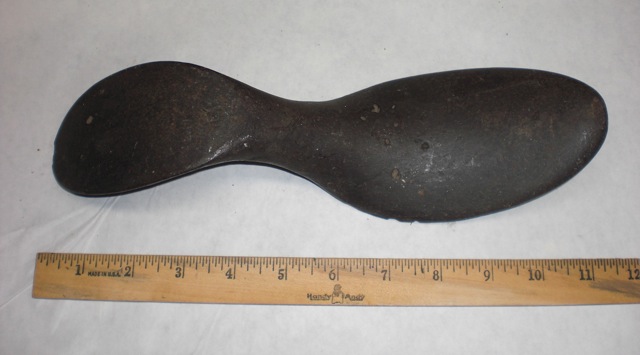
Jerry shoemaker tool

It’s made of heavy iron, and the end parts are different sizes: one for repairing men’s shoes and one for women’s or children’s shoes.
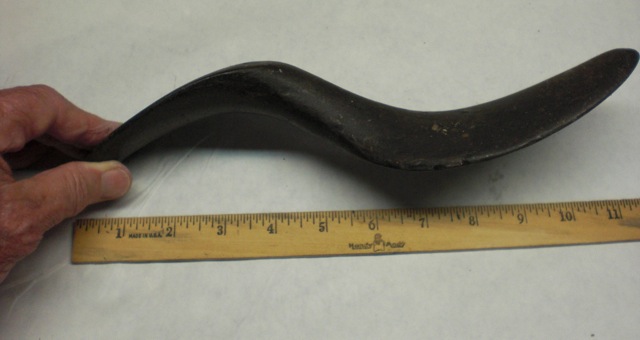
Jerry shoemaker tool2

I have hand tools that belonged to my great granddad, then my granddad, then my own dad. I still use them in my shop. When I pick one up I feel like I’m shaking hands with those old men.”

Quakers and Slaves

When I think of Quaker, I think of peace loving and abolition.  I think of plain, gentle people and plain dress, but not quite as “plain” as the Amish and Mennonite.

However, the history of the Quakers and slavery is not as cut and dried as it seems, and it appears that James Crumley may have been caught up in the early Quaker and slavery conflict.

According to the website, “Quakers and Slavery,” the first slaves arrived in Philadelphia in 1684 and were sold to Quakers.  Between 1682 and 1705, one of 15 families in Philadelphia owned slaves, and many of them were Quakers.  Some Quakers were involved in the slave trade.

In 1688, the first protest was made against slavery in the Germantown Quaker monthly meeting and went without action.  However, conflict continued to build, and in 1693, a Quaker named George Keith published a papers cautioning Quakers not to buy or own slaves.

In 1712, a Quaker petitioned the Pennsylvania Assembly to outlaw slavery and was refused.

In 1713, the Chester monthly meeting called for the banning of slavery and censure of those who did not comply.

In 1731, 20% of Philadelphia Quakers owned slaves and accounted for 30% of all the slaves in the city of Philadelphia.

We don’t know if James Crumley owned slaves in Pennsylvania or not.  It’s probably unlikely since he didn’t own land, but it’s certainly possible.  The first we know positively that James owned slaves was when he died in 1764 and 4 slaves were included in his estate inventory.

What we do know is that while some Quakers were solidly opposed to slavery, many were not and owned slaves.  This did not, at this time, appear to interfere with their church membership, with the possible exception of the Chester Meeting.  Of course, this could have been the meeting that James Crumley attended when he lived in Chester County, Pennsylvania if he was a practicing Quaker there.  Given that he migrated with the Nottingham Meeting House group to Frederick County, he was certainly affiliated with the Quakers in some fashion.

Apple Pie Ridge

James home plantation in Frederick County was located on Apple Pie Ridge, said to have been named for the delicious apple pies baked by the Quakers.  It is still a land of many apple orchards.  I guess now would not be the time for me to fess up that I don’t care for apple pie.  Maybe the problem is that I haven’t had an Apple Pie Ridge apple pie.

Incredibly, the James Crumley home still remains and is today on the register of historic buildings.

James Crumley home

From the application for the Register of Historic Places:

The acreage where the Crumley-Lynn-Lodge house stands encompassed two parcels–one of 250 acres and one of 1,250 acres–granted by patent from Colonial governor William Gooch in 1735 to Giles Chapman. Chapman sold the acreage to James Crumley who is listed in the Rent Rolls of Frederick County in 1759. Crumley appears to have come to Virginia from Chester, Pennsylvania, where at least five of his children had been born.

James Crumley in his will devised to his wife, Catherine, “All that present plantation whereon I now live during her natural life or while she continues under the name of Catherine Crumley and upon her decease or upon altering her said name I bequeath the said plantation to my youngest son Samuel Crumley.” He directs that Catherine “keep the children with her until of age,” indicating that at least one or two of his children were not yet 21 years old (at least in 1757 when he wrote the will.) He expressed concern for her altering her name, which presumably would have implied her remarriage.

Virginia tax records indicate that Catherine lived for at least another 18 years as she is listed as a white female head of household in 1782 and in 1783 with two slaves, two horses, and seven head of cattle. Her name continues to appear in the records until 1787, with an additional 3 slaves.

This data, when coupled with the Crumley will of 1764, indicates that there was a dwelling on the property that likely dates from as early as 1759 when James Crumley moved his large family to Virginia from Pennsylvania. It was not unusual for families to relocate from Pennsylvania to Virginia’s Shenandoah Valley in the eighteenth century.

The property was ultimately sold in 1793 by John Crumley to Robert Bull of Berkeley County, Virginia, now West Virginia. Samuel Crumley, who had been the original devisee for the plantation parcel, appears to have died by this date, and John Crumley, probably son to James, was the grantor to Bull. The acreage is given as 150 acres in the deed, and buildings are specifically mentioned. The parcel is described as part of the patent sold to Giles Chapman and sold to James Crumley. The selling price of 293 pounds is substantial enough to reflect a dwelling on the property.

By 1885, the Crumley-Lynn-Lodge House is recorded on a map of Frederick County published by D. J. Lake, and Co. as the “Wm. Lodge Res[idence],” located on what has been known as Apple Pie Ridge as early as 1816. The dwelling house is shown as standing on the west side of the main road running north from White Hall Post Office to the West Virginia line.

James Crumley land layout

There have been virtually no changes to the essential core elements of this house since 1851, although several rear additions have been made.

James Crumley topographic map

Today, this map shows the location of the original James Crumley home at 3641 Apple Pie Ridge Road.  It was placed on the National Register of Historic places in 2006 as the Crumley-Lynn-Lodge House in Frederick County, VA.

James Crumley Apple Pie Ridge

The earliest section of James Crumley’s home was built about 1759, and was a 1 1/2-story, log section raised to a full two stories about 1850. About 1830, a two-story, Federal style brick section was added. A two-story frame section was added to the original log section in 1987–1994. The front facade features a folk Victorian-style front porch with square columns, sawn brackets and pendants, and plain handrail and balusters. Also on the property are the contributing mid-1800s brick granary, and log meat house, as well as a late-1800s century corn crib, and the stone foundation of a barn.

James Crumley home interior

The oldest portion of this building is to the left in the photo above, submitted with the Application for the Register of Historic Places.

The application for the Register of Historic Places states the following:

Historical and architectural evidence suggests that the earliest 1 ½-story log section was constructed ca. 1759 for James Crumley. The two-story brick section to the north was added in 1830 by William Lynn, who had acquired the property in the early nineteenth century. The last historic addition to the house, which included raising the original 1 ½-story log section to two full stories, was made around 1850, shortly after the property was acquired by the Lodge family. In addition to the main house, the property includes a rare example of a mid-nineteenth-century brick granary, and log meat house, as well as a late-nineteenth-century corn crib, and the stone foundation of a barn. The buildings and the setting retain much of their mid-nineteenth-century appearance and integrity.

The earliest section of the Crumley-Lynn-Lodge House is the three-bay log portion to the south. Originally 1 ½ stories in height, it was raised to two stories ca. 1850, and is clad in weatherboard siding and features a gable roof of standing-seam metal, a random-rubble stone foundation, and six-over-six-sash double-hung wooden windows. The exterior-end limestone chimney located on the south gable end was made taller to accommodate the second story using a brick stack. Also on the south end is a bulkhead entry to the basement, which is excavated about seven feet deep.

The earliest log portion of the house features a two-room plan divided by a wooden paneled partition. The room to the south has a front door leading from the porch and a rear door that originally led to the exterior, and later to a rear lean-to. The room also contains a large fireplace along the south wall with a small window to its left. The plain wooden mantelshelf with brackets is modern, but the oak lintel and at least some of the horizontal wood paneling along that wall appear original. The fireplace surround has been plastered and the hearth is brick.

Although the floors in this room have been covered with more modern pine flooring, the painted architrave door and window trim, plaster walls, exposed unpainted ceiling joists, and batten doors with early hardware and hand-wrought strap and H & L hinges are all intact. The boxed staircase in the southwest corner of this room is enclosed with wide planks and contains a small closet beneath it. This stair would have originally led to the ½-story loft which was enlarged to a full story ca. 1850. Just to the right of this staircase is a three-over-six-sash window that, along with the window to the left of the fireplace, is smaller in size than the ones on the front (east) wall and probably indicates the original size of the windows in this section of the house. A doorway with a batten door, also along this rear wall, lines up with the front door.

James Crumley home door

Also part of the earliest log section of the house is a smaller room north of the larger room (or parlor) that was originally unheated. The two rooms are separated by a wooden paneled partition of vertical yellow pine boards, some of which are tongue and grooved.

This is a wonderful document to have about James Crumley’s home.  I do have a couple of comments to make.  The historian is referencing the fact that James Crumley was on the tax list by 1759, and perhaps they are looking at a jump in value on the tax list that would indicate a home was built on this property, albeit a 2 room log cabin.  However, given that James Crumley purchased this land in 1748 from the Gilkeys, this home could have been another decade (or more) older than originally thought.

A cousin who visited provided me with the photo above of the door and the photo below as well.

James Crumley home fireplace

James and Catherine’s Children

As evidenced by James will, James and Catherine had 5 children who were living in 1757, but apparently only 4 who survived to adulthood.  Samuel is not mentioned in any records after his father’s will in 1757.

  • John Crumley was probably the eldest child. He was probably born about 1733 or 1734 in Chester County, PA.  He was of age by 1757 when James sold him land. John married Hannah Faulkner about 1761 in Frederick County, VA and moved to Newberry County, SC before 1790 where he is found in the 96 District. He died according in 1794 with a will, having 9 children.
  • William Crumley was probably the second eldest son, born around 1735 or 1736, also in Chester County, PA.  He too was of age by 1757 when James sold him land. William married Hannah Mercer about 1761 in Frederick County, VA. William lived his life on the land originally owned by James and died in 1793 in Berkeley County, West Virginia where that land was located after Virginia and West Virginia divided. He married a second time to Sarah Dunn in 1774, having a total of 15 children by his two wives.
  • Mary Crumley was also born early to the marriage, as she was already married to Thomas Doster and had daughter Ruth in 1757 when James wrote his will. It’s unclear, but Mary may have been married a second time to a Jesse Faulkner.
  • Henry Crumley married Sarah whose last name is unknown. Very little is known about Henry.  Henry signed deeds in 1766 and 1768 and in 1770 appointed William Crumley his power of attorney.  He apparently moved from the area and died about 1792.  There are no known children but that doesn’t mean they don’t exist.

James and Catherine likely had additional children…probably 5 or 6, who died as children.  Note that there are no children named James or Catherine.

DNA

Over the years, many Crumley descendants have been interested in genealogy.  With the advent of genetic genealogy, almost 15 years ago now, several Crumley males reached out and tested through the Crumley Y DNA project with the hope of confirming their common ancestry.  And indeed, they did.

As time moved on, autosomal DNA testing became available to supplement the Y DNA results.  Autosomal DNA is the DNA received from both parents which is contributed by ancestors in various amounts.  In each generation, more ancestral DNA is lost and the pieces that remain are often passed in smaller and smaller segments.  However, often, enough DNA remains intact to match to other descendants who also carry that same DNA segment from the same ancestor.

Today, there are almost 50 Crumley descendants who have joined the Crumley DNA project or tested outside of Family Tree DNA at either 23andMe or Ancestry and who have downloaded their results to GedMatch.

I utilized the tools at both Family Tree DNA and at GedMatch to see just how much of James Crumley’s DNA is found in his descendants.  More specifically, if several of James descendants match on a particular segment of DNA, that DNA is very likely descended from James.  To prove this, each segment would need to be triangulated between any 3 descendants.  This is a manual process and with almost 50 individuals involved, would take me from now to next year.  So, I did not triangulate or prove these segments.  These are match groups between 49 of James descendants today who descend through two different sons, John and William.  To eliminate picking up downstream DNA of the son’s wives, the descendants of son John are only matched to the descendants of son William.  I took that resulting match spreadsheet and utilized Kitty Cooper’s overlapping segment mapping tool to see how many of the matched pairs exist on various chromosomes.

Note that in the legend, when you see Carl V, for example, that really means that Carl matches to one of the other participants, so what you see mapped on the chromosome are not single matches, but paired matches.

If there are more than 4 match pairs on any segment, they are “behind” or overlapping each other on the chromosome and you can’t see them.  What I’m saying  is not to pay attention to the names, just the colored segments on the chromosomes.

This wonderful tool gives you a good idea of the segments where James descendants match each other above 3 cM and 300 SNPs.  As more descendants test, more matching segments will appear.

Does this mean that all of these segments come from James or Catherine?  Probably not.  Some of the smallest segments are probably identical by chance, especially segments not found in large groups or clusters.  When you have a large cluster of the same matching segment, it increases the chances significantly that these are not matches by chance and are identical by descent – in other words, they do come directly from James and Catherine..

James Crumley overlapping segments

Kitty also provides a tool where you can look at any single chromosome and how the matches stack up.  Below is James (and Catherine) Crumley’s chromosome 8.  For me,  the fact that I and so many of my Crumley kin still carry part of James and Catherine is absolutely amazing.  I look at the colorful representation of their ancestors on this chromosome map, rebuilt by their descendants and I see the beauty of Nature and the everlasting legacy of the ancestors, in this case, my very own moonshining Quaker, James Crumley.

James Crumley chromosome 8

Looking at these graphics makes me feel like a happy confetti explosion has occurred, except in reverse, and the pieces of confetti are being fit back together again, at least on paper, to recreate at least a small part of our common ancestor, James Crumley and his wife, Catherine.  While part of this DNA is James, Catherine would have contributed an equal amount of DNA to all of their children, so part of this, today, is hers as well.  As more people test and technology improves, maybe one day we’ll knows which pieces of DNA were contributed by James and which by Catherine.  Who knows, it may even be their cumulative DNA found in their descendants that one day that will lead us to their parents.

Acknowledgements:  This article is a combination of the research of several Crumley descendants, both living and dead.  I want to thank each and every one who contributed (and continues to contribute) and all of those who DNA tested as well.  What we can accomplish together is amazing!

______________________________________________________________

Disclosure

I receive a small contribution when you click on some of the links to vendors in my articles. This does NOT increase the price you pay but helps me to keep the lights on and this informational blog free for everyone. Please click on the links in the articles or to the vendors below if you are purchasing products or DNA testing.

Thank you so much.

DNA Purchases and Free Transfers

Genealogy Services

Genealogy Research

Crumley Kinfolk

Just for fun, let’s look at some Crumley folks who are related.  When you work in the genetic genealogy field, people are forever sending photos of someone and saying “doesn’t this person look like that person?  Do you think they are related?”  Or, the most common, “this is my great grandmother – do you think she looks Native American.”

I am forever telling people that phenotypical resemblances are really not good indicators of relatedness, but it’s so difficult to believe when you’re looking for that needle in the haystack and it’s the only tidbit you have.

I did it myself when I found Lee Devine and discovered that not only was he deceased, but he had no children, so my chances of ever finding out definitively if he was my half brother are forever gone.  I reverted to picture comparisons, because it’s the only tool I had at my disposal.

So, let’s have some fun with this.

Take a look at this photo.  These men are unquestionably related.  The question is, how closely?

crumley kin

So, how do you think they are related?

If you said brothers, you’re in good company.  They look like brothers, but they aren’t.

If you said uncle and nephews, you too would be in good company, but nada.

Cousins maybe?

Well, yes.

These are all Crumley men, left to right, John, Ken, Jerry… and Donna, the daughter of one the men whose job it was to keep them in line that day.  Fortunately for Donna, she doesn’t have the signature family beard!

Years ago, the Y DNA tests through the Crumley DNA project confirmed that these men share a common Crumley ancestor, but despite appearances, they are much more distantly related than you might think.

Not first cousins.

Not second.

Not third.

Not fourth.

Not kidding!

The common ancestor of these men is John Crumley, born about 1737.

Yes, I know how much alike they look, but looks can be deceiving – or encouraging – and looks are not an accurate predictor of relatedness.

John and Ken are 4th cousins once removed.

Ken and Jerry are 5th cousins.

John and Jerry are 5th cousins once removed.

Their pedigree chart is shown below.

Crumley kin pedigree

Not quite what you would expect by looking at the picture.  As someone once said to me, “If you look at a picture long enough and hard enough, you can see anything that you want to see.”  Touche!

The Crumley DNA project at Family Tree DNA has embraced autosomal DNA testing, so all three of these gentlemen have taken the Family Finder test.  Knowing that their Y DNA matches (with a mutation or two), and having identified their common ancestor, let’s see if their autosomal DNA matches as well.

At Family Tree DNA, one must meet a 20 cM total DNA matching threshold, and an individual matching segment threshold of 7cM in order to be listed as a match.  Here’s how they matched, or didn’t.

Jerry John Ken
Jerry Self Yes No
John Yes Self No
Ken No No Self

Needless to say, if we didn’t already have the Crumley Y DNA results, this might have given Ken a bit of heartburn – but no need.  It’s not uncommon for distant cousins to not be shown as matches.

Fortunately, all three gentlemen also downloaded their results to GedMatch, where we can adjust the matching threshold.  In some cases, the 20cM total precludes a match, and in some cases, the 7cM segment precludes a match, so let’s see if these gentlemen match at GedMatch using a lower threshold.

At GedMatch, I ran all 3 gentlemen against each other using the threshold of 300 SNPs and 3 cM and then put their results into a common spreadsheet.  I also deleted the duplicate entries, because for every Ken to John match, there is also an identical John to Ken match.

You can see on the spreadsheet below that John and Jerry match each other, just as Family Tree DNA said.  They share not one, but two large matching segments of over 16 cM.  Not bad for 5th cousins once removed.

Crumley kin gedmatch

You can also see that Ken matches both Jerry and John, but not on any segment over 4.9 cM, which precludes matching at Family Tree DNA.  However, Ken exceeded the 20 cM total match threshold with both Jerry, at 51 cM and John at 35.8 cM – but a match has to exceed both thresholds to be counted as such.

Especially within known family groupings, a non-match doesn’t necessarily mean the individuals don’t share any DNA, it may just mean that there isn’t enough cumulatively (>20 cM) or the segments are too small to put them over the threshold (7 cM).  That’s the great thing about GedMatch, you can adjust your own thresholds.

Are all of these segments valid, meaning are they identical by descent?  Most likely not.  Are some valid?  Very probably, especially given that we know that these men unquestionably do share a common ancestor – thanks to their Y DNA.  Could we find out more?  Yes, we can, if we have more cousins to compare against.

And, as luck would have it, we do, another 40 or so….but that story will have to wait until the Crumley DNA Study is ready for publication!

Thanks to Ken, Larry and John, my Crumley kin, for DNA testing and allowing us to tell their story and share their picture.  You can see by the smiles on their faces that they are truly enjoying their kinship – and that is really what matters.  Genealogy and genetic genealogy has the ability to reunite families separated by more than 200 years and 6 or 7 generations – and that’s exactly what has happened with our Crumley kin.

______________________________________________________________

Disclosure

I receive a small contribution when you click on some of the links to vendors in my articles. This does NOT increase the price you pay but helps me to keep the lights on and this informational blog free for everyone. Please click on the links in the articles or to the vendors below if you are purchasing products or DNA testing.

Thank you so much.

DNA Purchases and Free Transfers

Genealogy Services

Genealogy Research

Phasing Yourself

Do you ever have one of those “lightbulb” moments?

I do.

I was wishing there was a way at GedMatch to compare everyone against me and my mother at the same time – to see who we both match.  And then I realized….there is….but not in the way I had been thinking.

Both of my parents are deceased now, but my mother swabbed before she passed over…a gift I thank her for daily.

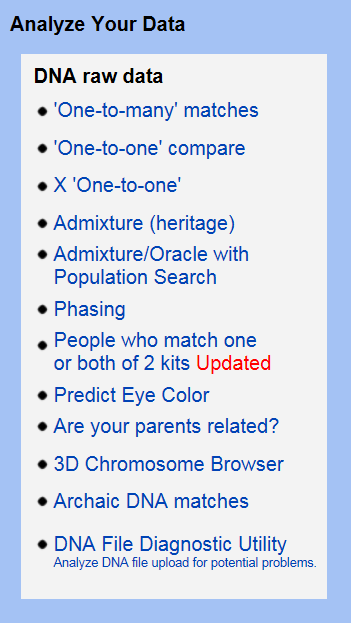
GedMatch provides a Phasing program, under Analyze Your Data.

GedMatch phasing

I used the Phasing program to recreate my father whose DNA hasn’t been available from him since 1963.  I had my DNA and my mother’s autosomal DNA results, so the phasing program compared those two files and split my DNA in half and created a “half” file that is my mother and the remainder “half” file that is my father – or at least the half of him that I received.

I looked at the Mom half file and thought to myself that I should delete it to make space since I have the whole Mom file.

I’m glad I didn’t, although I could certainly have recreated the file, because it’s that phased half Mom file that is the equivalent of running my matches against me and Mom together to see which of my matches match us both.

And the clear benefit, of course, is that I know immediately which side of the family my matches are from.  Plus, if anyone doesn’t match me and a parent, then the results are not IBD, identical by descent.  Phasing against a parent is the gold standard in determining IBD vs IBC or identical by chance.

Let’s take a look at the match results.  Please note that 1500 is the GedMatch display limit, so when you see 1500, it means more than 1500, but you have no idea how many more than 1500.  By running your two (maternal and paternal) half phased kits, you can obtain up to 3000 instead of being constrained by the 1500 limit.  In order to see more than 1500, you can sort several columns in highest to lowest and lowest to highest order, and often you can obtain the entire list by sorting the columns and copy/pasting to Excel, so long as the entire list isn’t over 3000.

10 cM 7 cM 5 cM
Full Kit 825 1500 1500
Mother Half 145 495 1500
Father Half 583 1143 1500
Total 2 Halves 728 1638 3000
Not IBD 97 >138 unknown

Truthfully, I was surprised to lose 97 matches at 10cM by having them match neither parent.  That’s about 12%.

The other tidbit you may find interesting is that I have so many more matches on my father’s side than on my mothers.  My mother’s four grandparents were Dutch (the immigrant off the boat), Brethren (endogamous, German), German (immigrant off the boat) and Acadian/English (here since very early 1600s, endogamous).  My father’s ancestors have been in this country for hundreds of years – all of them.  The German, Dutch and French aren’t nearly as well represented in the DNA data bases as are the traditional colonial Americans who had lots of children and moved west, into Appalachia leaving lots of descendants today trying to sort through their ancestry.

So, if you have one or both of your parents’ DNA, phase yourself at GedMatch.

For those of you who don’t have parents available, but do have other relatives, try the Lazarus tool to reconstruct part of an ancestor’s genome.

______________________________________________________________

Disclosure

I receive a small contribution when you click on some of the links to vendors in my articles. This does NOT increase the price you pay but helps me to keep the lights on and this informational blog free for everyone. Please click on the links in the articles or to the vendors below if you are purchasing products or DNA testing.

Thank you so much.

DNA Purchases and Free Transfers

Genealogy Services

Genealogy Research

Elizabeth “Probably Not Webb” Estes (1715/1720-1772/1782 ), Wife of Moses, 52 Ancestors #86

Moses Estes Sr. did us a huge favor.  Both of his wives were named Elizabeth, so when he was an old man, he didn’t have any “jealous wife” memory type issues when he mistakenly used his first wife’s name in a fit of pique (or a fit of whatever) when talking to his second wife.  That’s a good thing, because indeed, he was an older gentleman when he married the second Elizabeth, Elizabeth Talbot, a widow, and he had a lot of years experience having said “Elizabeth.”  The favor he did was to tell us when, exactly, he married the second Elizabeth.  In 1782, they had a prenuptial agreement which was filed with the court.  How’s that for ahead of your time!

However, it’s the first Elizabeth I’m interested in, the mother of Moses’s children and specifically, my ancestor, Moses Estes Jr.

Was Elizabeth a Webb?

We’re actually fortunate that we know the first Elizabeth’s first name.  It’s her last name that is in question.  However, if you take a quick look at the Ancestry trees for Moses Estes, born in 1711 and who died in 1787, you’ll find that the majority of those trees list Webb as her last name, or mistakenly list Elizabeth Jones Talbot, Moses’s second wife.

Those same trees will list another tree as a source…and so it goes.  Around and around.  For the record – we don’t know the first Elizabeth’s last name.  It’s a myth – but a myth that might have a source.  You see, there was a reference to a record…someplace.

I have to confess here, I’ve never seen the original record, BUT, someplace, I have seen a researcher’s notes referring to a land record that included Moses Estes and a male Webb.  That researcher had made the “connection” that because Moses Estes bought or leased land from the Webb male, that the Webb male was Moses’s wife’s father.

A leap of faith you say?  Yes, a leap of something, that’s for sure.  But, it could be true and it’s a place to begin further research…if I could only find that doggone reference.

But the problem is that I’ve lost the reference and I don’t remember where I saw it…other than it was in someone’s handwritten notes years ago.  I remember thinking to myself “that’s it??!!!”  That’s how someone connected some extremely tenuous dots that Elizabeth’s surname was Webb?  I remember being incredulous and thinking that there was surely more.  Then, in the 1980s, a historical novel was released that included the Estes family, and Elizabeth’s name in that novel was Webb too.  The deck was stacked at that point, and in the annals of mythology, and online trees, Elizabeth’s surname became Webb and took on a life of its own.

I’ve pulled every record I have in this house, and didn’t find that reference.  Now I’m doubting myself.  Did I even see it?  Did I dream it?  Does it exist at all – even the researcher’s note?  And if that researcher’s note exists, does the real record exist?  As many Virginia records as I’ve extracted, I’ve never come across an Estes/Webb transaction and neither has my cousin, the retired lawyer who extracted half of Virginia for Estes names.  OK, that’s an exaggeration, probably not half, just the early counties, but still, she doesn’t have it in her records either.  Of course, not everyone extracts EVERY record by that surname.  Some people are sane humans and only extract their own line’s records.  So, if that happened, maybe Moses’s record was overlooked by other researchers.

So, if you happen to come across any Virginia land record of a Webb and an Estes – or any other record, for that matter, of a Webb and an Estes between about 1730 and 1770 or so, please, PLEASE send it to me complete with the reference and source.  I promise, I will never, ever, lose it again.

Because, you know, Elizabeth’s surname actually might be Webb, but I can’t research it any further until I find that doggone slippery reference that I know I saw at one time or another.

So, if we don’t know Elizabeth’s last name, what do we know about her?

Life in Virginia

We first find Moses Estes as an adult in Hanover County in 1734.  He would have been age 23 at that time, and he was purchasing land jointly with his brother Robert and his other brother John served as a witness.

In 1736, Moses patented land adjoining his brother’s land.

In general, men did not purchase land before they married, so it’s quite likely that Moses was married about 1734 to a local gal from Hanover County, the area that would become Louisa and then Amelia as new counties were formed.

Elizabeth’s son, William was born sometime between 1735 and 1740, so Elizabeth was probably born in 1715-1720 or maybe even slightly earlier.

In 1742 Louisa County was formed and the Estes lands fall into this county.  That’s a very fortunate turn of events, because Louisa County records exist where most of Hanover’s have been destroyed.  Unfortunately, the Hanover records that might include a marriage document, or estate documents for Elizabeth’s parents, are gone.

We know, due to later deeds, that Moses lived in an area between Contrary and Northeast Creeks in Louisa, later Amelia County, between the red arrows.  It was here that Elizabeth had her children and raised her three young boys.

Louisa Northeast Contrary Creeks

1742 is also about the time that Elizabeth’s son John was born.  Son Moses Jr. was born about that time as well. Elizabeth and Moses were probably just like all other pioneer couples and had a child every 18-24 months for as long as the female was fertile, which would have been until about 1755-1760 for Elizabeth.  However, we only know of three sons.

The transaction that tells us Elizabeth’s first name is a land sale in Amelia County in 1751 in which Elizabeth, wife of Moses, relinquished her dower right in the land.  Dower right in Virginia meant that if a man died, his wife was entitled to one third of his estate by right of dower.  The husband could not relinquish his wife’s dower rights, so she had to sign to relinquish those.  Typically, the wife was “examined separately” from her husband, so the husband could not influence her answer.  Of course, she had to go home with her husband, so I’m not sure how effective asking the wife privately if she relinquished her dower actually was.  Can’t you just imagine that ride home, had the wife said, “no” that it wasn’t by her own will that she was signing away her dower rights?  How many ways can you spell ugly??

A great many deeds don’t have this additional signature, and I know of one case where the man sold his land and died a couple years later.  The wife then sued the purchaser for her one third of his land and won.  Not only that, but she got the third with the house in which she was living at the time.  One gets the idea that maybe she didn’t know her husband sold the land they were living on, especially since it was a mortgage that defaulted, which is how the sale came about – through the default to the mortgage holder.  In that place and time, the mortgagee signed a deed that the mortgage holder redeemed if they defaulted.  That kind of situation, is, of course, exactly the reason that the wife had to sign, and woe be unto the buyer that doesn’t see to that detail.

In 1758, Elizabeth and Moses are living in Amelia County and the French and Indian War is in full swing.  The House of Burgesses passed an act for the defense of the frontier and we find Moses, John and William Estes of Amelia County on the roster.  These young men are probably still living at home, as they were late teenagers or in their early 20s and not yet married.

This list suggests that perhaps Moses Jr. was the youngest of the three sons and not quite old enough to serve with his father and older brothers.  He probably felt very left out and I’m sure he did not want to be left at home with his mother as his father and brothers got to ride off to war and do all of those “exciting” grown-up manly things – at lease from Moses Jr.’s perspective.

I’m sure Elizabeth was glad to have a son remain at home.  He may have been too young to ride with the men, but he was certainly old enough to provide some protection, farm labor and partnership to his mother.

Moses Sr. is mentioned in the court minutes and deed books from time to time, but another decade would pass before we hear from Elizabeth again.  In 1768, Moses Jr. sells the land he had purchased from his father-in-law, John Combs’, estate and that sale is witnessed by his father and mother, Moses Estes Sr. and Elizabeth.

By 1768, Elizabeth had attended the weddings of all three of her sons, had gained three daughter-in-laws and had at least half a dozen grandchildren to enjoy.

An Uncomfortable Juncture

In 1769, Moses Sr. filed suit in Amelia County against his brother, Elisha, surrounding his father, Abraham’s, estate distribution – never mind that Moses’s father died more than 48 years earlier.  This may be the worst case of procrastination I’ve ever seen.  Or maybe, a long-festering boil erupted between the brothers.

I suspect that when one person in a household does something that dramatic, it is reflected via the domino effect to the rest of the family members too.  This was probably a highly emotional time, with depositions, threats and high drama.  It’s hurtful to think or know that your sibling betrayed and cheated you.  Whether it was true or not, it surely appears that Moses believed it to be true.  Elisha, in essence, in court documents, called Moses a liar, another upsetting turn of events.  Moses surely paced and swore and cried, if he let Elizabeth see his tears.  It’s hard to be the one betrayed.  And either he was the one betrayed, or he was the betrayer.  Either way – a family ripped apart.  You know Elizabeth’s household was in a state of upheaval as these unpleasant events unfolded like layers of an onion.

Elizabeth’s three sons were married and had families of their own by this time.  They may have been living with Moses and Elizabeth, or on their property, or nearby.  If Elizabeth and Moses had other children, they would still have been at home.  Elizabeth probably tried to function normally, attending church and other normal social functions of the day.  But, assuredly, Elisha’s wife and children were there too.  Not only would this suit have divided the family, it likely divided the community as well.

Maybe this court suit and the level of discomfort it caused had something to do with why Elizabeth and Moses moved to Halifax County, taking all three of their grown sons and their families along.  Maybe they were trying to put the lingering past behind them with a new beginning.

On to Halifax County, VA

By 1771, the family was moving to Halifax County and Moses Sr. bought land just west of South Boston on the Pole Bridge Branch of Miry Creek.

Moses Estes land aerial

In 1771, Moses sells his land in Amelia County and once again, Elizabeth relinquished her dower rights and signs with an X, which tells us that she could not write – and probably could not read since the two tend to go together.

However, they may not have moved right away, because in January of 1772, Moses (of Amelia County) sells to William Estes (of Amelia County) 100 acres of his land in Halifax County.  Elizabeth signs this document as well.

We know that Moses was living in Halifax County by this time or very shortly thereafter, because in March of 1772, the court authorized paying him as a road hand for building a bridge across Burches Creek, near his land.

Later in October of 1772, Moses sells the balance his land in Halifax County to his 3 sons and Elizabeth does not sign, so her death may have occurred between January and October of 1772. Given that we know that Moses owned the land on Pole Branch, and he is buried there himself, it’s very likely that Elizabeth is buried in the Estes Cemetery on that land as well.

Estes cem box elders

Or, did Elizabeth not sign because the deed was to her sons and she (and they) saw no need for her to go to the courthouse to sign?

Given that Elizabeth’s death seems to have occurred after Moses sells his Amelia land, it’s most likely that Elizabeth did make it to Halifax County, but possibly, just barely.  Did she ever get to live in this house that Moses built?

Estes Osborne home

We don’t know for sure that Elizabeth died in 1772, but we do know for sure she had died by 1782.  Elizabeth was not an old woman.  If she was born in 1715, she would have been 57-67 and if she was born in 1720, age 52-62.  She may still have had older children at home.  If there were no other living children, then she had likely buried 6 or 7 of her children, or maybe more – and then left their graves behind when she moved to Halifax County.  I can’t even begin to imagine that heartache.

Elizabeth may have lived long enough to see the Revolutionary War which began in 1775.  In 1778, the focus of the fighting shifted to the south, including Virginia.  She certainly lived through the ramping up process that led to that war which was focused on resistance to taxes imposed by England on the colonies which the colonists felt were unjust.  All men paid taxes and I’m sure it was the hot topic of conversation for months and maybe years before the war actually began.  Halifax County was involved in the fighting by 1780 and 1781, and it’s quite likely that Elizabeth’s son Moses’s land was used as an encampment by soldiers.  Elizabeth’s grandson, George fought in that war.  Did he come to tell his grandmother goodbye before he left, if she was still living at that time, or did he visit her grave one last time?

If Elizabeth didn’t die before 1780, she would have buried her adult son, William, in the family cemetery on Grubby Road in Halifax County.  About that same time in 1780, son John left with his family for the Holston River in what is now Tennessee.  At that time, Tennessee was not yet a state and that area was unsettled and wild frontier, with settlers still skirmishing with the Indians.  Once a family left, it was forever.  No one came back.

I hope that Elizabeth did not have to bury her son.  1780 would have been a year of terrible loss for her.  When a grown child left for parts unknown, not only did they leave, but they took with them the grandchildren and the only form of communication was an occasional letter – if that – assuming people could read and write.

Men, in that timeframe, did not remain single for long – so it’s possible that Elizabeth did live to see 1780 – and it may have broken her heart.  She was assuredly resting in the cemetery, beside son William, by 1782.

In 1782, Moses remarried (with that prenuptial agreement) and 5 years later, Moses was dead, probably buried beside his first wife Elizabeth and his son, William, in the cemetery on his property.  In fact, it appears that Moses second wife predeceased him, so it’s entirely possible that Moses lies between the two Elizabeths. If a man ever had to behave, he does!

I found Moses’ land in the early 2000s when I visited Halifax County several times, working on the various genealogy records in the courthouse.  Based on the land records and following them forward in time, I was able to locate Moses’s original land, with the help of a couple of wonderful cousins, an incredibly patient and generous landowner and some unimaginable good luck.  I think Moses and Elizabeth were helping me!

Moses Estes cemetery

I wonder how long Elizabeth lived on this land.  Did they live in the house Moses built, or did she die while they would have been living in a cabin.  Was the cabin they lived in first the cabin that sat back on the hill where John, Moses and Elizabeth’s son, eventually lived before he headed out for the frontier in 1780?

Estes clearing

There are so many questions and so few answers.

Elizabeth’s Children

Elizabeth had the following known children.  I’ve always suspected that she also had some daughters, but to date, none are known.

Elizabeth’s sons are as follows:

1. The oldest son born to Moses and Elizabeth was probably John, born between their marriage and 1742, or so. We don’t know the year for sure, but what we do know is that John’s eldest son, Abraham, born in 1764, gave the following testimony when applying for a Revolutionary War pension.

“I, Abraham was born in Amelia County, Virginia.  My father moved from there to Halifax, Va. where he lived until the fall of 1779, where he moved to the Holston River until 1780.”  After that they removed to Warren Co., KY.

John Estes married Elizabeth Chism, daughter of John Chism and Elizabeth Gillington.  She was remembered in her grandfather, Nicholas Gillington’s will in Halifax County in 1772.  John Estes died in 1824 in Warren Co., KY.

2. Another son, Moses Jr., was born about 1742 or maybe slightly earlier, married Luremia Combs about 1762, whose father, John Combs also lived in Amelia County. Moses Jr. bought land in Lunenburg County from his brother-in-law after John Combs death, but moved with his father, Moses Sr. to Halifax County about 1770 where they both spent the rest of their lives.  He died in 1813 with a will.

Moses had a son, Moses (the third), who was born between 1775 and 1780 in Halifax County and died in 1875 in Smith County, TN, per the probating of his will in 1875.  And no, those dates are not typos.  He married Selah Palmer.  To the best of my knowledge, this is the only grandchild of Elizabeth whose photo we have.  Most of her grandchildren died before the camera was in wide use, after the Civil War.  Moses (the third) lived to be over 100, as did his brother George Estes as well as George’s son, John R. Estes.  Longevity runs in this family.  I look at this man and wonder if he looks anything like Elizabeth and Moses Sr.

Moses Estes 1779-1875 m Selah Palmer

John R. Estes, my ancestor, below, would have been this man’s nephew.  John R. and his father, George, both also lived to be around 100, as have several of their descendants.

John R. Estes restored

3. The third son of Moses Sr. and Elizabeth, William Estes, was also born in the same 1735-1740 timeframe. William married Mary Harris.  He died in 1780 and his estate was probated in Halifax County, VA.  Family legend says that he was a drover of horses and drove them to the East coast being gone for long periods of time.  He apparently had what was probably an appendicitis attack and became very ill.  His wife was sent for, but she was days away and did arrive, but William had already died.  Mary brought his body home and buried him in the family cemetery.

DNA

Unfortunately, DNA won’t help us with Elizabeth in this circumstance, at least not directly or immediately.

It’s ironic that the one trait that has a huge potential to affect my life, that of longevity, is most likely genetic, yet, we can’t identify that gene (or genes), nor do I know if I carry it.  We do know that several people downstream of Moses and Elizabeth lived to the age of 100, and a few slightly older.  Two of my aunts and my grandfather are in that group – so I potentially could carry the Estes longevity gene.  We also don’t know where it came from – meaning from Moses’s or Elizabeth’s family.  All I do know is that Moses’s father’s line does not seem to be responsible for the longevity gene – but we know nothing about Moses’s mother nor Elizabeth’s family.

Elizabeth’s mitochondrial DNA is dead to us unless she had daughters that we don’t know about – and they turn up “proven” in some fashion.  I do find it hard to believe that only three sons survived from a marriage that would have produced children for more than 20 years – so at least 10 children and quite possibly more.

Of course, another avenue to find Elizabeth’s mitochondrial DNA would be through her sisters, or her mother’s sisters, if they have any descendants through all females – but of course – I’d have to know who her parents were to identify her siblings, or her mother’s siblings.

I have looked at my autosomal DNA results for Webb, but without knowing the name of the man I’m looking for, I can’t pinpoint anything obvious.  Perhaps I should create a “Webb” tree out of my matches trees and see what turns up the most “close” to me since I carry less of the ancestor’s DNA than the generations that are further upstream than I am.

Although since I’m not even sure I have Webb ancestry, those people with Webb in their tree could be solely circumstantial.  Webb is not an uncommon surname and it is a Virginia family in close proximity with all of the other early colonial Virginia families – so possibly and probably intermarried.

Right now, my only hope against hope is for an Ancestry NAD – New Ancestor Discovery.  As upset as I was that Ancestry gave me an ancestor that wasn’t mine who hung around for months before disappearing, and has now reappeared, I’d be very interested in a Webb NAD – because that might be possible and I could then at least attempt to convince my relevant NAD matches to download their result to GedMatch where I can view the matching DNA segments to see if they triangulate.

Having said that, it would be my luck that I’d get a NAD that really looked to be “real” but wasn’t.  However, it I had a NAD, I could at least then attempt to work with the results.

However, regardless of how much I wish for a Webb NAD, it’s probably too far back time.  Initially Ancestry was planning to reach back 10 generations in time.  Elizabeth’s parents would be 9.  However, when the NADs and Circles were released, Ancestry was only reaching back 6 or 7 generations.  In some cases, for DNA Circles, I believe this has been expanded by maybe one generation or two, but not to 9 or 10 – at least not yet.  But I’m still hoping that Ancestry reaches back more generations as they become more confident and refine their new features.  I’m also hoping for a Webb NAD and praying for Ancestry to add a chromosome browser so I don’t have to try to convince my matches (it’s so unbecoming to beg) at Ancestry to transfer to Family Tree DNA and/or download to GedMatch.

While I’m wishing, I’d like for Family Tree DNA to add tree matching as well.  They already have the chromosome browser feature and trees, so tree matching would be a very logical follow-on step.  And from there, maybe ancestor predictions???

We are truly DNA and genealogy junkies aren’t we!  Anything to find those elusive ancestors.  I just want to know if Elizabeth is a Webb, and if not, who is she???

______________________________________________________________

Disclosure

I receive a small contribution when you click on some of the links to vendors in my articles. This does NOT increase the price you pay but helps me to keep the lights on and this informational blog free for everyone. Please click on the links in the articles or to the vendors below if you are purchasing products or DNA testing.

Thank you so much.

DNA Purchases and Free Transfers

Genealogy Services

Genealogy Research

Naughty Bad NADs Sneak Home Under Cover of Darkness

Welcome back to the soap opera!

5 bad nads

Those Bad NADs…they’ve done it AGAIN.  Yep, they’re back.  You remember…it was right after April’s Fool’s Day and Ancestry gifted me with two New Ancestor Discoveries that weren’t – Diedamia Lyon and John David Curnutte.  Then, a couple months later, ungrateful houseguests that they were, they disappeared one night, never to be seen again…well…until now.

But because Ancestry must have thought I was lonely, they assigned me three additional bad NADs to take their place.  Now, the good news was that while these three were indeed Bad NADS and not actual new ancestor discoveries – there was a silver lining to this cloud.  Even though these NADs aren’t my ancestors – at least I was able to document some ways to figure out why and how bad NADs are assigned – so hopefully you can work through your NADS too.

But apparently, John and Diedamia weren’t at all happy with the accommodations where they were residing after disappearing in June, so they snuck back sometime overnight.  Yep, they’re back.  I woke up, and there they were, staring at me, just like they had never been gone.  When I was a kid, on the farm, anything that showed up like this was always pregnant.  Diedamia, do you have something to tell me???

The guest room is getting quite full now…with 5 Bad NADs in residence – all impostors – claiming to be related to me.  Why, you’d think I had won the lottery or something…

I took a look, again, at Diedamia and John, utilizing the same tools that I used to determine that John Larimer and Jean Larimer weren’t my ancestors – nor was Robert Shiflet.  But given that I have only two actual DNA matches with descendants of Diedamia and John, and we don’t show any other common family links that I can discern – I was unable to figure out why I have a DNA link to two of John and Diedamia’s descendants.  Perhaps there is a common ancestor upstream someplace that will become evident one day.  Or, maybe it’s like Robert Shiflet and I’m descended through the wife’s siblings, or like the Larimers where my McKee matches also match the Larimer line.  One thing is for sure, Diedamia Lyons and John Curnutte are not my ancestors.  How I’m related to them, if I’m related to them, is yet to be determined.  Maybe that will be a future episode of the soap opera.  What shall we call this mini-series?  As the NADs Return???

It will be interesting to see how long John and Diedamia, and for that matter, my other bad NADs, hang around this time.  Seems like I have a bit of a NAD revolving door.  One thing is for sure….it’s interesting to see who is waiting for me every day.

So, let’s update the NAD Scoreboard:

  • Ancestry – 0
  • Bad NADs – 7

______________________________________________________________

Disclosure

I receive a small contribution when you click on some of the links to vendors in my articles. This does NOT increase the price you pay but helps me to keep the lights on and this informational blog free for everyone. Please click on the links in the articles or to the vendors below if you are purchasing products or DNA testing.

Thank you so much.

DNA Purchases and Free Transfers

Genealogy Services

Genealogy Research

4 Generation Inheritance Study

I’ve recently had the opportunity to perform two, 4-generation, inheritance studies.

In both of these cases, we have the DNA of 4 generations: grandmother, parent, child and grandchild or grandchildren.  I’ll be using the second study because there are two great-grandchildren to compare.

Let me introduce you to the players.

4 gen pedigree

I wanted, with real data, to address some assertions and assumptions that I see being made periodically in the genetic genealogy community.  We need to know if these hold up to scrutiny, or not.  Besides that, it’s just fun to see what happens to DNA with 4 generations and 5 people to compare.

What kinds of information are we looking to confirm or refute in this study?

1 – That small segments don’t occur within a couple generations, meaning that that DNA can’t be or isn’t broken into small segments that quickly.

2 – That small segments can never be used genealogically and are not useful.

3 – That DNA is most of the time passed in 50% packages.  While this is true in the first generation, meaning a child does receive half of each parent’s DNA, they do not receive 25% of each grandparent’s DNA.

4 – That segments over a certain threshold, like 5 or 7 cM, are all reliable as IBD (identical by descent.)

5 – That segments under a certain threshold, like 5 or 7 cM are all unreliable and should never be used, in fact, cannot ever be used and should be discarded.

6 – That there is a rule that you cannot have more than two crossovers per chromosome.

All individuals tested at Family Tree DNA and we’ll be using the FTDNA chromosome browser for comparisons.

First, let’s look at the amount of expected DNA matching versus the actual amount of DNA matching, per generation.  The entire number of cM being measured is 6766.2, per the ISOGG Autosomal Statistics Wiki page.

Expected vs Actual Inheritance Chart

This chart compares the expected versus actual amount of DNA shared between person 1 and person 2,

Person 1 Person 2 Expected DNA Match cM/% Actual DNA Match
Grandmother Parent (grandmother’s child) 3383.1 / 50% 3384.03 / 50.01%
Grandmother Pink Child (grandmother’s grandchild) 1691.5 / 25% 1670.64 / 24.69%
Grandmother Blue Grandchild (grandmother’s great-grandchild) 845.775 / 12.5% 704.84 / 10.39%
Grandmother Green Grandchild (grandmother’s great-grandchild) 845.775 / 12.5% 842.64 / 12.45%

Chromosome Data

Now, let’s take a look at our chromosome data.  Keep in mind, everyone is being compared to the oldest generation – in this case – the great-grandmother’s DNA.

Legend

  • The background chromosome belongs to the great-grandmother of the youngest generation – meaning everyone is being compared to her.
  • Grandparent = orange – because the child receives 50% of each parent’s DNA, the orange child of the great-grandmother will match her DNA 100%.
  • Grandchild = pink – since the grandchild is being compared to the grandparent, and not their parent, we will see how much of the grandmother’s DNA the pink child received. The dark spaces are the “ghost image” of the grandfather’s DNA – identified by the lack of the grandmother’s DNA in that location.
  • Oldest great grandchild = blue
  • Youngest great grandchild = green

The two great grandchildren are full siblings.  None of the parents involved are related to each other or to other generational spouses.  This has been confirmed both by genealogy pedigree chart and by utilizing the tools at GedMatch for comparisons to each other as well as the “are your parents related” tool.

The first comparison, below, shows the 4 individuals compared to the great grandmother’s DNA at the Family Tree DNA with the match default set at 5cM

4 gen ftdna default

The image below, shows the same individuals after dropping the match criteria to 1cM.  Several small colored segments appear.

4 gen ftdna 1 cm

I downloaded all of the matching data for these individuals into a spreadsheet so that I could work with the actual chromosomal data.  I’m not boring you with that here, but I have used the raw matching data for the actual comparisons.

Crossover

Let’s talk about what a crossover is, because understanding crossovers are important

Crossover example 1 – A crossover is where you start/stop receiving DNA from one grandparent or the other.  This is easy to see if we look at chromosome 1.

4 gen crossover

In this example, the parent is orange and the child is pink but they are both being compared to the grandparent of the pink person, the mother of the orange person.

What this means is that while the orange person will always match the grey background chromosome of their mother, the pink person will only match their grandmother on the portion of the DNA they received from their mother that was from their grandmother.  The pink person received their grandfather’s DNA in some locations, and not their grandmother’s.  Where that transition happens is called a crossover and it is where the colored segment stops, as noted by the arrows above, and the back background begins, indicating no match to the grandmother.

You can see that the matches span the center of the chromosome where the grey area indicates there is no data being read.  There is also a second small grey area to the right of the center.  Ignore these grey areas.  They are in essence DNA deserts where there isn’t enough DNA to be read or useful.  Family Tree DNA (and other vendors) stitch the data on both sides together, so to speak, and matches on both sides of this area are considered to be contiguous matches.

You can see that the pink person has two crossover areas where they stopped receiving DNA from the mother’s mother (background chromosome being compared against) and instead started receiving DNA from the mother’s father.  How do we know that?  There only two people who contributed the orange parent’s DNA that the pink child inherited.  If the pink child did not inherit the orange parent’s Mom’s DNA on this segment, then the pink child had to have inherited the orange parent’s Dad’s DNA.

Crossover example 2 – A second kind of crossover is where you are still receiving DNA from the same parent, but from different ancestors on that parental line

I’ve created a chart to illustrate this phenomenon

The names in the charts at the bottom are the people who tested today.  All of these individuals are known cousins who are from my mother’s side.  The name at the top is the common ancestor of all of the testers.

In the first situation, in locations 1-5, Me, Charlie and David match.  None of the three of us match our cousin, Mary on those locations.  However, moving to locations 6-10, Me, Charlie and Mary match each other, but not David.  Looking at our pedigree charts, we can see that the cousins are matching on different ancestral lines.

4 gen generational crossover

Me, Charlie and David share a wife’s line, Sally (wife of John), that Mary does not share.  Me, Charlie and Mary share common DNA from George, a male further upstream in that line.  George’s son John married Sally.  Mary descends from George through a different child, which is why she does not match any of us on the segments we received from Sally, John’s wife.

Location Me Charlie David Mary
1 Sally Sally Sally No match
2 Sally Sally Sally No match
3 Sally Sally Sally No match
4 Sally Sally Sally No match
5 Sally Sally Sally No match
6 George George No match George
7 George George No match George
8 George George No match George
9 George George No match George
10 George George No match George

If you’re just looking at the question, “do Charlie and I match?” the answer would of course be yes, but until we look at a broader spectrum of cousins, we won’t know that our match is actually from two different people in the same descendancy line and that we have an ancestor crossover between locations 5 and 6.  However, we’re still receiving our DNA from the same parent, but which ancestor of that parent contributed the DNA has switched

How prevalent are crossovers?

Number of Crossover Events

These are all parent/child crossovers where the DNA donor switched.  We can only determine that this happened because we can compare generationally against the grey background great grandmother to the youngest generation

  • Orange parent to Pink child – 49
  • Pink child to Blue child – 47
  • Pink child to Green child – 39

The most segmented chromosome, chromosome 1, has 5 separate matching segments for the blue great grandchild (as compared to the great-grandmother), or 10 crossover events (because neither end was at the beginning or end, although start and end numbers are sometimes “fuzzy”).  You can see where a crossover event occurs when the DNA goes from matching to non-matching.

4 gen chr 1 crossovers

Results

I downloaded all of our matching data into a spreadsheet so that I can work with the segment matches individually.

Looking at the data, there are a few things that jump out immediately:

  • On chromosomes 4 and 14, the pink child received none of the orange grandmother’s DNA. That means that the pink child had to have received the grandfather’s DNA for all of chromosome 15. So, if anyone thinks that the 50% rule really works uniformly across generations – here’s concrete proof that it doesn’t. Furthermore, this occurred for an entire chromosome – twice out of 23 chromosomes, or 8.7% of the time.
  • On chromosome 11, the exact opposite happened. The pink child received all of the grandmother’s chromosome, but barely gave any to their blue child. The blue child received their mother’s DNA in that location. On chromosome 13, the pink child received almost all of the grandmother’s DNA.
  • Please note that while the averages of expected versus inherited DNA work out pretty closely, when averaging across all 23 chromosomes, as shown in the Expected vs Actual Inheritance Chart, the individual chromosomes and how much of which grandparent’s or great-grandparent’s DNA is inherited varies wildly from none to 100%.
  • There are several locations on 10 different chromosomes where the DNA has been passed generationally intact 2 or 3 times, without division.
  • Several small segments have been created within 3 transmission events.There are small green and blue segments on several different chromosomes which reflect very small amounts of the great grandmother’s DNA inherited by the green and blue great-grandchildren. This conclusively dismisses the theory that small segments aren’t ever created within a couple of generations.
  • Chromosome 10 is very choppy, including small blue and green grandchild segments that match the orange grandparent and the great-grandmother without having matches to the pink child. This means that those unconnected blue and green small segments are either identical by chance or there is a read issue with the pink person’s DNA on this chromosome.
  • There are a total of 31 small segments, meaning under 7cM. Of those, a total of 10 do not triangulate, meaning they match the grandmother but they do not match their parent.  The 7 pink segments appear to triangulate, but without another generation of transmission (like the blue and green great-grandchildren), or without the grandfather’s DNA, or without triangulation with a known relative on that segment, it’s impossible to tell for sure. Therefore, 14, or 45% are valid segments and do triangulate.
  • There are a total of 92 chromosomal transmission events that took place, meaning that 23 chromosomes got passed from the background person to their orange child, 23 from the orange child to their pink child, 23 from the pink child to the blue grandchild and 23 from the pink child to the green grandchild.
  • Furthermore, based on this limited study, at least 32.26% of the small segments do not triangulate and are not IBD, but are instead identical by chance.
  • In three instances, the exact DNA (from the great grandmother) was given to both the green and blue great grandchildren. In eight other events, the same DNA, without division, was given from a parent to one child.
  • There are several instances, on chromosomes 3, 4, 9, 14, 15, 16, 20, and 22 where the pink child passed none of their grandmother’s DNA to their child, even though they inherited the grandmother’s DNA.

Individual Chromosomes and Their Messages

I’d like to walk through several chromosomes and chat a little bit about what we’re seeing.

Chromosome 1

4 gen chr 1

First, I’d like to illustrate the difference between chromosome matches at the default level (the first chromosome, above) and at the 1cM level (the lower chromosome.)  At the lower match threshold, you will see additional small segment matches that are not shown at the higher threshold, noted by red arrows.

Let’s take a look at the messages held by our individual chromosomes.

On all of these chromosomes, you’ll see that the orange child matches thier mother, the background person being compared against, exactly, on every location that is measured.  Half of everyone’s DNA comes from their mother, so all of their DNA will match to her on any given chromosome.  Remember, we are only measuring matching DNA (half identical segments) – so the other half of the person’s DNA that matches their father is not shown.

I have left the orange segments in the graphics, even though they all match on the entire chromosome length, so you can see the continuity from generation to generation.  Pink is the orange person’s child, so you can see that the pink child inherited part of the DNA the orange person inherited from their mother, but not all.  The part that is black in the pink row, as compared to the orange segment, means that the pink child inherited that DNA from their grandfather at those locations – and not the grandmother being compared against

In one instance, on chromosome 1, the pink child gave their grandmother’s DNA to both of their children.  You can see that to the far left with the red arrow.

4 gen chr 1 grandmother transmission

You can also see that the blue grandchild only received a small part of their great grandmother’s DNA, but the green grandchild received a much larger segment.

In one area, the pink child clearly received their grandmother’s DNA, but didn’t give any of it to either the blue or green grandchild, shown below at the red arrow.  There is no blue or green matching the great-grandmother’s DNA.

4 gen chr 1 no transmission

To the right of the arrow, top, above, you can see where the pink child contributed their grandmother’s DNA to their blue child, but not to the green child.  The pink child contributed their other parent’s DNA in that instance, bottom, above, because their child does not match their orange mother – so that DNA had to come from the grandfather.

On the chromosome match that includes the smaller segments, below, you can see there are a total of 5 segments not shown with the higher threshold.

4 gen chr 1 small segments

The first two arrows, on the left, point to small segments shared by the blue and green grandchildren with their great-grandmother and their pink parent – so these triangulate and they are fine.

The third arrow, on the right hand side pointing to the green segment that does not match with the pink parent indicates a match that is identical by chance.  We’ll talk more about this in chromosome 3.

The fourth arrow, at the far right, shows a small segment of orange DNA that was passed to their pink child, but the pink child did not pass it on to either of their children.  This segment could be a legitimate segment by descent, but it could also be by chance.  We’ll talk about that more on chromosome 8.

Chromosome 2

4 gen chr 2

Chromosome 2 shows two small segments.  You can see that the pink child gave a significant portion of their grandmother’s DNA to the blue child, but only two small segments to the green child in that region, at the red arrows.  They do triangulate though, because they match their parents.  See how nicely the DNA stacks up between all of the generations.

Chromosome 3

4 gen chr 3

The pink child inherited very little of the grandmother’s DNA in this region.  Of the small amount the pink child did inherit, the pink child gave even less of it to their children.  One small piece to the green grandchild, shown at right, and none to the blue grandchild.

Why, then, is there a lonely blue segment on this comparison chromosome showing that the blue great-grandchild matches their orange grandmother and their great-grandmother, but not their pink parent?  This is the first example of an identical by chance segment (or a read error in the pink parent’s file).

4 gen chr 3 small seg

Three Kinds of DNA Match Segments

There are three kinds of DNA segment matches.

  1. Identical by descent (IBD) where you receive the segment from your ancestors and we can track it as far back up the tree as we have living people. This is the example where the small segment of the great-grandchildren (blue or green) match their parent (pink), their grandparent (orange) and their great-grandmother’s background chromosome being compared against.
  2. Identical by state (IBS) which sometimes is used to mean not identical by descent. What it actually means is that you can still match and receive the DNA from your ancestors, but the segment may be very prevalent in a specific community or ethnic group. An alternative explanation is that the DNA ‘state’ is so common that everyone in that area has it, so it’s virtually useless in identifying ancestors, because you can’t really tell which lines it came from. So IBS does triangulate, because it did come from a common ancestor, but you may match a large number of people at this location. Portions of chromosome 6 are known to fall into this category.  More often than not, I hear IBS used to indicate that there is a match, but the common ancestor isn’t known or hasn’t yet been identified.
  3. Identical by chance (IBC) is where a specific DNA combination is a match, but it’s not a match because it was handed down ancestrally, but simply by the luck of the draw.  Because everyone carries the DNA of both parents, sometimes people can match you by zigzagging back and forth between your father’s and mother’s DNA.  These matches aren’t ancestral, but just by luck or chance.  Shorter matches, meaning small segments, are much more likely to be identical by chance than longer matches. When you have both parents DNA, you can easily eliminate IBC segments because they won’t triangulate – as we have just demonstrated on chromosome 3.

You can read more about this here and here.

Chromosome 4

4 gen chr 4

Chromosome 4 is particularly interesting because the orange person matches their background mother, of course, but apparently their pink child inherited this entire chromosome from the pink person’s grandfather – because the pink person does not match their grandmother – there are no pink matching segments to the background grandmother.

Chromosome 5

On chromosome 5, the pink child matches the grandmother on almost the entire chromosome, except for a small part to the left of center.

4 gen chr 5

You may notice that there is a segment of blue that appears to extend beyond the pink bar at the left arrow – which would mean that the blue area matches the great-grandmother without matching the pink parent.  The segments on the chromosome map are not exactly to scale, and the beginnings and ends are sometimes what is referred to as fuzzy.  This means that they are not exact measurements but that they in essence the absence or presence of DNA in a bucket of a specific size.  If any part of your DNA is in that bucket, then your start or stop segment are the edges of that bucket.  In this case, the entire match is 47.51cM for the pink child and 49.82 for the blue grandchild, so the difference may or may not be relevant.

Although this actually is a small matching segment, or non-matching segment, you would never notice this if you were just looking at the blue grandchild matching to the great grandmother.  It’s only with the introduction of the parent’s pink DNA that you notice that the blue great grandchild’s DNA match with the great grandmother extends beyond that of the parent.

Chromosome 6

4 gen chr 6

Chromosome 6 is rather unremarkable except that the orange person seems to have had a read or file error of some sort.  The orange results are shown in two separate pieces, but we know that the orange person must match their mother 100%.  We know this issue is in the orange person’s file, because their pink child and both of the blue and green grandchildren match the background person, the orange persons’ mother, with no break in their DNA.

Chromosome 7

4 gen chr 7

Chromosome 7 shows another example of 5 generations matching with the stacking of orange, blue, green and pink against the background person’s chromosome, at right.  It also shows another example an identical by chance match, with the blue grandchild showing a match to their great-grandmother but no match to their pink parents, near the center at the red arrow.

Chromosome 8

4 gen chr 8

Chromosome 8 shows another example of the pink child having inherited a small segment of their grandmother’s DNA, but not passing it on to their children.

How do we know if this is a legitimate IBD segment, or if it something else?  Since the pink child will match their mother 100%, and they didn’t pass it on tho their children, how can we prove that the small pink segment where they match their grandmother is  IBD.

How could we prove this one way or the other?

First of all, it probably doesn’t matter, except as a matter of interest – or unless of course this one segment is THE one you need to identify that colonial ancestor.  If this was a normal match, we could just see if the match matched the child and the parent too, which would immediately phase the match against their parent – but we can’t do that when matching to a grandparent because the child will always match their parent 100%.

If you have the grandfather’s DNA at Family Tree DNA, you could compare the pink grandchild to their grandfather. On chromosome 8, the grandfather’s DNA in the pink row is identified by the dark grey – because it’s where the pink grandchild does not match their grandmother – so they must match their grandfather on that segment because their orange parent only had two pieces of DNA to give them, the piece from their mother or the piece from their father.

Therefore, if this is a valid segment, then you won’t see at match in the grandfather’s DNA on same portion of the segment.  If you see a match to both the grandmother and the grandfather, it’s likely that the small segment match to the grandmother is not identical by descent –  you but really don’t know for sure.

How could that be?  I asked David Pike that question and he pointed out that in one case, he discovered that the grandparents both shared the same DNA segment.  The child inherited it from one parent or the other, and passed it on to their child, but since the mother’s and father’s DNA was identical, there is no way to tell which grandparent the segment actually came from.  And in this case, the segment would match both grandparents.  That is a trait of endogamy and of IBS, or identical by population.  If you’re saying, BOO, HISS, about now, I totally understand.

After talking to David, I also realized that if your DNA at those locations just happens to be all homozygous, for example, all Ts, on both sides, for a run of SNPs in a row, and if your parents and grandparents have Ts in either location, you will match them…and anyone else who does too.

So here we have an example of a match that could be IBD if it truly is a small segment by descent and you don’t match the other grandparent at that location.  It could be IBC or IBS (by population) if you match both of your grandparents on this segment – but it might be IBD.  It’s IBD from one and IBC/IBS from the other – but which one is which?

However, since I don’t have the grandfather’s DNA at Family Tree DNA, my only other alternative is to move to GedMatch and create a phased kit for the grandfather by subtracting the grandmother’s DNA from her orange child, which will give me the DNA the orange child received from their father.  Then I can compare the pink grandchild to the grandfather’s phased kit – which is the father’s DNA that the orange child received.  This is fine, even if it is only half of the grandfather’s DNA – it s the half that the pink child’s mother received and passed a portion to the pink child.

I would suggest doing this entire exercise on either Family Tree DNA or on the GedMatch platform, and not jumping back and forth between the two.  The start and stop segments aren’t exactly the same, and sometimes the segments read differently, creating more segments at GedMatch than at FTDNA.  I’m not saying that is wrong, just that it isn’t consistent between the two platforms and when you are dealing with small segments, in particular, you need consistency.

Chromosome 9

4 gen chr 9

On chromosome 9, the pink child received little of the grandmother’s DNA, and gave none of it to their green child.  And yes, if you have a good eye the blue child’s right boundary is slightly beyond the their pink parents – so – you already know what that means.  Either a fuzzy boundary or a slight piece of DNA that happened to match with the great-grandmother identical by chance (IBC.)

Chromosome 10

4 gen chr 10

This chromosome is incredibly interesting because it’s comprised of all small segments.  In fact, this is the exact reason why you NEED to look at the 1cM range.  At the default setting, if there are no matches except the orange person to their mother.  It looks like none of the grandmother’s DNA was passed to the pink child, but in fact, may not be the case.  There are three segments passed to the pink child, although the pink child did not pass these on to either of their children.  See the discussion on segment 8 about how to tell for sure, if you need to.

The blue and green segments, since they do not match their pink parent are not IBD but are instead IBC.  The really interesting part of this is that in one case, the blue and green grandchildren’s DNA matches the orange grandmother on the same segments exactly, but does not match the pink parent.

How can this possible be, you ask, barring a file read issue?  Good question.  Remember, each child inherits half of their parent’s DNA.  In this case, both children apparently inherited the same DNA from both parents, but it wasn’t the orange DNA, but that of the pink child’s father.

It just happened, when the blue and green children’s DNA combined with that of their mother, it just happens to read as a match, for a small segment.  You can read about how this might happen in the article, “How Phasing Works and Determining IBD Versus IBS Matches.”

Unfortunately, all these comparisons can do is to tell us simply what does and does not match – they can’t tell us why.  Sometimes, based on other comparisons, like phasing and triangulation, we can figure out the “why” part of the puzzle – and sometimes, we can’t.

Chromosome 11

4 gen chr 11

On chromosome 11, the pink child inherited all of the grandmother’s DNA through their orange parent, but gave less than half to their green child and a small segment to the blue child.  The pink child gave the exact same segment in the center to both their blue and green children.

Chromosome 12

4 gen chr 12

On chromosome 12, the pink child inherited little of their grandmother’s DNA, but passed every bit of what they inherited to both of their children, shown by the nice stack at right.  The start and stop locations are exact between the three.

However, in addition, we have three small segments where the green and blue grandchildren match their orange grandmother without matching their pink parent – so those are IBC.

Chromosome 13

4 gen chr 13

The pink child inherited almost all of their grandmother’s entire chromosome, except for a very small bit at the far right end.  The pink child passed almost their entire chromosome 13 to their green child, but only a small amount to the blue child.

Chromosome 14

4 gen chr 14

This story is easy.  The pink child inherited their grandfather’s entire chromosome 14 because they do not match their grandmother’s DNA at all.

Chromosome 15

4 gen chr 15

This is a very “normal” chromosome.  The pink child inherited about half of their grandmother’s DNA and gave about half of what they inherited to their green child.  Of course, their blue child got left out altogether – but that looks to be a lot more “normal” than we once thought.

I am skipping chromosome 16-22, because they are more of what you’ve already seen and is, by now, quite familiar  Plus, you can take a look at the full chromosome comparison graphic and do your own analysis.

X Chromosome

The X chromosome is a bit different, and I’d like to take a look at that.

4 gen X

The X chromosome has special inheritance properties that other chromosomes don’t have.  In particular, women inherit an X just like they inherit their other chromosomes from 1-22 – one from Mom and one from Dad.  Men, however, only receive an X from their mother.  Therefore, there are relatives that you cannot inherit any X DNA from.  I wrote about this here and here along with examples and charts.

In this example, the inheritance path is such that it does not affect what can and cannot be inherited since we are comparing to a great-grandmother, but in other situations,  this would not be the case.

One last observation about the X chromosome.  I have found matching on the X to be particularly unreliable, and have found several situations, where, due to those special inheritance properties, we know beyond any doubt that the common ancestor on the X cannot be the same ancestor as has triangulated on the other chromosomes.  So word to the wise – be very vigilant and hesitant to draw conclusions from X matching.  I never utilize the X without corroborating autosomal matches and even then, I’m very reticent.

In Summary

On the average, we do inherit about half of our DNA from in each generation from each ancestral generation.  But the average and the actuality of what happens is two entirely different things.  Averages are made up of all of the outliers, and if you are one of those outliers, the average isn’t really relevant to you.  Kind of reminds me of “one size fits all” which really means “one size fits almost nobody well” and “everyone is some shade of unhappy.”

I wrote about generational inheritance and how it doesn’t always work the way we think, or expect.  It’s very important to pay close attention to your own DNA and not rely on averages unless you have absolutely no other choice – and only then understanding the averages are likely wrong in one direction or the other – but it’s the best we’ve got, under the circumstances.

So what can we apply to our genealogy from this little experiment.

  1. Some of the small segments across 4 generations are valid, meaning identical by descent or IBD.
  2. At least one third of the small segments aren’t valid and are identical by chance, or IBC.
  3. Without some form of triangulation or parental phasing, it’s impossible to tell which small segments are and are not valid, or identical by descent.
  4. Small segments are indeed formed within a 2 or 3 generation span, so they are not always a results of many generations of dividing.
  5. However, the further back in time your ancestor, the more likely that they will only be represented in your DNA by small segments, if any.
  6. Many small segments are valid and are not a result of IBC.  However, most are not and one needs to understand how to recognize signs of an IBC vs an IBD match.
  7. Disregarding small segments uniformly is like throwing away the only clues you may have to your most distant ancestors – which are likely your brick walls.
  8. The largest segment that was not valid was 3.14cM and 600 SNPs.
  9. The smallest valid segment was 1.25cM and 500 SNPs.

Getting the Most Out of Your DNA Experience

There is a lot more information available to us in our DNA results than is first apparent.  It takes a bit of digging and you need to understand how autosomal DNA works in order to ferret out those secrets.  Don’t discount or ignore evidence because it’s more difficult to use – meaning small segments.  The very piece or breadcrumb you need to solve a long-standing mystery may indeed be right there waiting for you.  Learn how to use your DNA information effectively and accurately – including those small segments.

You need to test every cousin you can find and convince to swab or spit.  It’s those cousin matches that help immensely with triangulation and confirming the validity of all DNA segments, matching them back to common ancestors.  You are building walkways or maybe pathways back in time, with your DNA as the steppingstones.  Genetic genealogy is not a one person endeavor.  It takes a village, hopefully of cousins willing to DNA test!

______________________________________________________________

Disclosure

I receive a small contribution when you click on some of the links to vendors in my articles. This does NOT increase the price you pay but helps me to keep the lights on and this informational blog free for everyone. Please click on the links in the articles or to the vendors below if you are purchasing products or DNA testing.

Thank you so much.

DNA Purchases and Free Transfers

Genealogy Services

Genealogy Research

Ethnicity Testing and Results

I have written repeatedly about ethnicity results as part of the autosomal test offerings of the major DNA testing companies, but I still receive lots of questions about which ethnicity test is best, which is the most accurate, etc.  Take a look at “Ethnicity Percentages – Second Generation Report Card” for a detailed analysis and comparison.

First, let’s clarify which testing companies we are talking about.  They are:

Let’s make this answer unmistakable.

  1. Some of the companies are somewhat better than others relative to ethnicity – but not a lot.
  2. These tests are reasonably reliable when it comes to a continent level test – meaning African, European, Asian and sometimes, Native American.
  3. These tests are great at detecting ancestry over 25% – but if you know who your grandparents are – you already have that information.
  4. The usefulness of these tests for accurately providing ethnicity information diminishes as the percentage of that minority admixture declines.  Said another way – as your percentage of a particular ethnicity decreases, so does the testing companies’ ability to find it.
  5. Intra-continental results, meaning within Europe, for example, are speculative, at best.  Do not expect them to align with your known genealogy.  They likely won’t – and if they do at one vendor – they won’t at others.  Which one is “right”?  Who knows – maybe all of them when you consider population movement, migration and assimilation.
  6. As the vendors add to and improve their data bases, reference populations and analysis tools, your results change. I discussed how vendors determine your ethnicity percentages in the article, “Determining Ethnicity Percentages.”
  7. Sometimes unexpected results, especially continent level results, are a factor of ancient population mixing and migrations, not recent admixture – and it’s impossible to tell the difference. For example, the Celts, from the Germanic area of Europe also settled in the British Isles. Attila the Hun and his army, from Asia, invaded and settled in what is today, Germany, as well as other parts of Eastern Europe.
  8. Ethnicity tests are unreliable in consistently detecting minority admixture. Minority in this context means a small amount, generally less than 5%.  It does not refer to any specific ethnicity. Having said that, there are very few reference data base entries for Native American populations.  Most are from from Canada and South America.

In the context of ethnicity, what does unreliable mean?

Unreliable means that the results are not consistent and often not reproducible across platforms, especially in terms of minority admixture.  For example, a German/Hungarian family member shows Native American admixture at low percentages, around 3%, at some, but not all, vendors.  His European family history does not reflect Native heritage and in fact, precludes it.  However, his results likely reflect Native American from a common underlying ancestral population, the Yamnaya, between the Asian people who settled Hungary and parts of Germany and also contributed to the Native American population.

Unreliable can also mean that different vendors, measuring different parts of your DNA, can assign results to different regions.  For example, if you carry Celtic ancestry, would you be surprised to see Germanic results and think they are “wrong?”  Speaking of Celts, they didn’t just stay put in one region within Europe either.  And who were the Celts and where did they ‘come from’ before they were Celts.  All of this current and ancient admixture is carried in your DNA.  Teasing it out and the meaning it carries is the challenge.

Unreliable may also mean that the tests often do not reflect what is “known” in terms of family history.  I put the word “known” in quotes here, because oral history does not constitute “known” and it’s certainly not proof.  For the most part, documented genealogy does constitute “known” but you can never “know” about an undocumented adoption, also referred to as a “nonparental event” or NPE.  Yes, that’s when one or both parents are not who you think they are based on traditional information.  With the advent of DNA testing, NPEs can, in some instances, be discovered.

So, the end result is that you receive very interesting information about your genetic history that often does not correlate with what you expected – and you are left scratching your head.

However, in some cases, if you’re looking for something specific – like a small amount of Native American or African ancestry, you, indeed, can confirm it through your DNA – and can confirm your family history.  One thing is for sure, if you don’t test, you will never know.

Minority Admixture

Let’s take a look at how ethnicity estimates work relative to minority admixture.

In terms of minority admixture, I’m referring to admixture that is several generations back in your tree.  It’s often revealed in oral history, but unproven, and people turn to genetic genealogy to prove those stories.

In my case, I have several documented Native American lines and a few that are not documented.  All of these results are too far back in time, the 1600s and 1700s, to realistically be “found” in autosomal admixture tests consistently.  I also have a small amount of African admixture.  I know which line this comes from, but I don’t know which ancestor, exactly.  I have worked through these small percentages systematically and documented the process in the series titled, “The Autosomal Me.”  This is not an easy or quick process – and if quick and easy is the type of answer you’re seeking – then working further, beyond what the testing companies give you, with small amounts of admixture, is probably not for you.

Let’s look at what you can expect in terms of inheritance admixture.  You receive 50% of your DNA from each parent, and so forth, until eventually you receive very little DNA (or none) from your ancestors from many generations back in your tree.

Ethnicity DNA table

Let’s put this in perspective.  The first US census was taken in 1790, so your ancestors born in 1770 should be included in the 1790 census, probably as a child, and in following censuses as an adult.  You carry less than 1% of this ancestor’s DNA.

The first detailed census listing all family members was taken in 1850, so most of your ancestors that contributed more than 1% of your DNA would be found on that or subsequent detailed census forms.

These are often not the “mysterious” ancestors that we seek.  These ancestors, whose DNA we receive in amounts over 1%, are the ones we can more easily track through traditional means.

The reason the column of DNA percentages is labeled “approximate” is because, other than your parents, you don’t receive exactly half of your ancestor’s DNA.  DNA is not divided exactly in half and passed on to subsequence generations, except for what you receive from your parents.  Therefore, you can have more or less of any one ancestor’s individual DNA that would be predicted by the chart, above.  Eventually, as you continue to move further out in your tree, you may carry none of a specific ancestor’s DNA or it is in such small pieces that it is not detected by autosomal DNA testing.

The Vendors

At least two of the three major vendors have made changes of some sort this year in their calculations or underlying data bases.  Generally, they don’t tell us, and we discover the change by noticing a difference when we look at our results.

Historically, Ancestry has been the worst, with widely diverging estimates, especially within continents.  However, their current version is picking up both my Native and African.  However, with their history of inconsistency and wildly inaccurate results, it’s hard to have much confidence, even when the current results seem more reasonable and in line with other vendors.  I’ve adopted a reserved “wait and see” position with Ancestry relative to ethnicity.

Family Tree DNA’s Family Finder product is in the middle with consistent results, but they don’t report less than 1% admixture which is often where those distant ancestors’ minority ethnicity would be found, if at all.  However, Family Tree DNA does provide Y and mitochondrial mapping comparisons, and ethnicity comparisons to your matches that are not provided by other vendors.

Ethnicity DNA matches

In this view, you can see the matching ethnicity percentages for those whom you match autosomally.

23andMe is currently best in terms of minority ethnicity detection, in part, because they report amounts less than 1%, have a speculative view, which is preferred by most genetic genealogists and because they paint your ethnicity on your chromosomes, shown below.  You can see that both chromosome 1 and 2 show Native segments.

Ethnicity 23andMe chromosome

So, looking at minority admixture only – let’s take a look at today’s vendor results as compared to the same vendors in May 2014.

Ethnicity 2014-2015 compare

The Rest of the Story

Keep in mind, we’re only discussing ethnicity here – and there is a lot more to autosomal DNA testing than ethnicity – for example – matching to cousins, tools, such as a chromosome browser (or lack thereof), trees, ease of use and ability to contact your matches.  Please see “Autosomal DNA 2015 – Which Test is the Best?”  Unless ethnicity is absolutely the ONLY reason you are DNA testing, then you need to consider the rest of the story.

And speaking of the rest of the story, National Geographic has been pretty much omitted from this discussion because they have just announced a new upgrade, “Geno 2.0: Next Generation,” to their offering, which promises to be a better biogeographical tool.  I hope so – as National Geographic is in a unique position to evaluate populations with their focus on sample collection from what is left of unique and sometimes isolated populations.  We don’t have much information on the new product yet, and of course, no results because the new test won’t be released until in September, 2015.  So the jury is out on this one.  Stay tuned.

GedMatch – Not A Vendor, But a Great Toolbox

Finally, most people who are interested in ethnicity test at one (or all) of the companies, utilize the rest of the tools offered by that company, then download their results to www.gedmatch.com, a donation based site, and make use of the numerous contributed admixture tools there.

Ethnicity GedMatch

GedMatch offers lots of options and several tools that provide a wide range of focus.  For example, some tools are specifically written for European, African, Asian or even comparison against ancient DNA results.

Ethnicity ancient admixture

Conclusion

So what is the net-net of this discussion?

  1. There is a lot more to autosomal DNA testing than just ethnicity – so take everything into consideration.
  2. Ethnicity determination is still an infant and emerging field – with all vendors making relatively regular updates and changes. You cannot take minority results to the bank without additional and confirming research, often outside of genetic genealogy. However, mitochondrial or Y DNA testing, available only through Family Tree DNA, can positively confirm Native or minority ancestry in the lines available for testing. You can create a DNA Pedigree Chart to help identify or eliminate Native lines.
  3. If the ancestors you seek are more than a few generations removed, you may not carry enough of their ethnic DNA to be identified.
  4. Your “100% Cherokee” ancestor was likely already admixed – and so their descendants may carry even less Native DNA than anticipated.
  5. You cannot prove a negative using autosomal DNA (but you can with both Y and mitochondrial DNA). In other words, a negative autosomal ethnicity result alone, meaning no Native heritage, does NOT mean your ancestors were not Native. It MIGHT mean they weren’t Native. It also might mean that they were either very admixed or the Native ancestry is too far back in your tree to be found with today’s technology. Again, mitochondrial and Y DNA testing provide confirmed ancestry identification for the lines they represent. Y is the male paternal (surname) line and mitochondrial is the matrilineal line of both males and females – the mother’s, mother’s, mother’s line, on up the tree until you run out of mothers.
  6. It is very unlikely that you will be able to find your tribe, although it is occasionally possible. If a company says they can do this, take that claim with a very big grain of salt. Your internal neon warning sign should be flashing about now.
  7. If you’re considering purchasing an ethnicity test from a company other than the four I mentioned – well, just don’t.  Many use very obsolete technology and oversell what they can reliably provide.  They don’t have any better reference populations available to them than the major companies and Nat Geo, and let’s just say there are ways to “suggest” people are Native when they aren’t. Here are two examples of accidental ways people think they are Native or related – so just imagine what kind of damage could be done by a company that was intentionally providing “marginal” or misleading information to people who don’t have the experience to know that because they “match” someone who has a Native ancestor doesn’t mean they share that same Native ancestor – or any connection to that tribe. So, stay with the known companies if you’re going to engage in ethnicity testing. We may not like everything about the products offered by these companies, but we know and understand them.

My Recommendation

By all means, test.

Test with all three companies, 23andMe, Family Tree DNA and Ancestry – then download your results from either Family Tree DNA or Ancestry (who test more markers than 23andMe) to GedMatch and utilize their ethnicity tools.  When I’m looking for minority admixture, I tend to look for consistent trends – not just at results from any one vendor or source.

If you have already tested at Ancestry, or you tested at 23andMe on the V3 chip, prior to December 2013, you can download your raw data file to Family Tree DNA and pay just $39.  Family Tree DNA will process your raw data within a couple days and you will then see your myOrigins ethnicity results as interpreted by their software.  Of course, that’s in addition to having access to Family Tree DNA‘s other autosomal features, functions and tools.  The transfer price of $39 is significantly less expensive than retesting.

Just understand that what you receive from these companies in terms of ethnicity is reflective of both contemporary and ancient admixture – from all of your ancestral lines.  This field is in its infancy – your results will change from time to time as we learn – and the only part of ethnicity that is cast in concrete is probably your majority ancestry which you can likely discern by looking in the mirror.  The rest – well – it’s a mystery and an adventure.  Welcome aboard to the miraculous mysterious journey of you, as viewed through the DNA of your ancestors!

______________________________________________________________

Disclosure

I receive a small contribution when you click on some of the links to vendors in my articles. This does NOT increase the price you pay but helps me to keep the lights on and this informational blog free for everyone. Please click on the links in the articles or to the vendors below if you are purchasing products or DNA testing.

Thank you so much.

DNA Purchases and Free Transfers

Genealogy Services

Genealogy Research

Autosomal DNA Testing 101 – What Now?

When I first started this blog, my goal was to provide explanations and examples of genetic genealogy topics so that there would be fewer questions and easier answers.

That sounded like a great idea, but the reality of the situation is that the consumer market for autosomal DNA testing has exploded – meaning more and more consumers with more and more questions.  Compounding that situation, the consumers who purchase these tests today, especially on impulse, and mostly I’m referring to Ancestry.com here, often have absolutely no idea what to expect or even what they want except that Ancestry will find their ancestors for them.  That’s because that’s what Ancestry tells them in their advertising.

So, in the big picture, the questions and inquiries that experienced people are currently receiving are becoming less specific and more general and often exhibit a lack of understanding of what DNA testing can do.  It’s frustrating to parties on both sides of the fence, but I’m glad people are asking because it means they are interested and willing to learn.

Rather than approach this topic from a technical perspective of how to work with autosomal DNA, I’d like to talk about what can be done with autosomal DNA testing from a newbie perspective.  The person who just got their results back and are saying to themselves, “OK, now what can I do with this?”

However, there is lots “how to” information in this article for everyone if you click on the links.  If nothing else, this gives you a tool to send to those overly excited newbies who are starry eyed but have no clue how to proceed.  Remember, you were once new too!

This is part 1 of a two part series.  The second part will focus on how to make contact with your matches successfully.  But now, let’s pretend it’s day 1 and you just got your autosomal test results back.

Why Did You Test?

The first question to ask yourself is why did you test in the first place?  If your answer is “because Ancestry had a sale,” that’s fine, but then you’ll need to read all four options to know what you can do with autosomal DNA.

1.  I want to meet other people I’m related to.

Ok, but the first thing here you’re going to have to define is the word “related.”  You are likely related to everyone on your match list.  I said likely, because there may be some people there whose DNA simply matches yours by chance.  For the most part, and especially for those people who are your closest matches, you’re related somehow. The challenge, of course, is to figure out how – meaning through which ancestor.  This is the genealogy jigsaw puzzle of you!

All three of the major vendors, Family Tree DNA, Ancestry and 23andMe show you your closest matches first on your match list.

autosomal 101 FTDNA

Do you want to meet your DNA cousins only if you can identify a common ancestor?  Do you want to work with them on genealogy? The answers to these questions will help sort through the rest of what to do and how.

If your goal is to contact your matches, then Family Tree DNA is the easiest, as they provide you with the e-mail addresses of your matches by clicking on the little envelope for each match on your match page, shown above.

Ancestry is second easiest, but forces you to use their internal message system which often doesn’t deliver the messages.  (Do not send more than 30 in one day or Ancestry will blacklist your messages and block your communications, thinking you are a spammer.)

23andMe is the most difficult as you have to request permission to communicate with each match and also to share DNA and if your match authorizes communication, then you can communicate through 23andMe’s message system.  Sound cumbersome?  It is and the response rate is low.

Confirming Genealogy

Let’s look at another reason for testing.

2.  I want to confirm my genealogy is correct – meaning that my great-grandfather really is my great-grandfather and so forth on up the line.

Well, you’re in luck, especially if some of your cousins, known or otherwise, have tested.  Confirming your genealogy is easier done in closer generations than more distant ones and the more cousins from various lines that have tested, the better.  That’s because you will share more of your DNA with relatives when you have a close common ancestor.

Autosomal DNA is divided approximately in half in each generation, when the child receives half of their DNA from each parent – so the closer your cousin, the more likely you are to share more DNA with them.  The more DNA you share, the more likely you are to be able to identify which ancestor it comes from.  And if a match matches you and your proven cousin both on the same segment, that identifies positively which line that match comes from.  That three way matching is called triangulation.

Let’s talk about the word “confirm.”  Herein lies a challenge, because DNA does have the absolute ability to confirm ancestors, as noted above.  DNA also has the ability to give you hints that go towards a “preponderance of evidence.”  DNA, can also lead you astray if you draw erroneous conclusions – and one vendor provides a tool (or tools) that encourages overstepping conclusions.  Let’s look at each circumstance.

Proof Positive through Triangulation

Just what it says – absolutely unquestionable proof that a particular ancestor is your ancestor.  If you match two other people who also descend from your common ancestors, Joe and Jane Doe, on the same segment of DNA, that is confirmation that you share that ancestor and that segment of your DNA is considered proven to that ancestral line.  This requires two things.  First, that your DNA matches on the same segment AND that you have identified the same ancestors, Joe and Jane Doe, genealogically in your trees.

Now, you probably can’t tell which side of the couple, Jane or Joe, the DNA is from unless you also match two people on just Jane’s side of the family or just Joe’s on that same segment.

One caveat here – counting you and your parent as two of the three people doesn’t work because you and your parents are too close in the tree.  By three people, that would preferably be three people who descend from that couple through three different children.

Here’s an example.

JohnDoe

It would also ideally be more than three people, but three is the minimum to form a triangulation group.  In the real world, these matches might not start and end of the same segments as in the example above, but the overlapping portion should be significant

The example above is proof positive, because the three people descend from the same ancestor, through different children, and match on the same chromosome in the same locations.

This technique is called triangulation.

Now for the bad news – you can’t do this at Ancestry.com, because they don’t provide you with any of the segment information in the last 5 columns.  Ancestry has no chromosome browser, which is the tool that shows you where on your DNA you match your cousins.

Family Tree DNA’s chromosome display tool that is part of their chromosome browser is shown below.

Two cousins browser

On the example above, you can see that Barbara Jean Long, the black background person on the chromosome graphic, is being compared to her two first cousins, the blue and orange on the chromosome graphic.

You can download the information from Family Tree DNA or 23andMe in spreadsheet format, or you can display the information graphically, like in the example above.  You can see the “stacked” locations where both the cousins match the black background person they are being compared to.  You can also see that there are some locations where only one of the cousins matches the background person, like on chromosome 20.  And of course, some locations where neither cousin matches the background person, like on chromosome 21.

If you download that data, the information gives you the locations where the people being compared match the person they are being compared against.

Two cousins combined

The chart above is the download of part of chromosome 1 for Barbara, Cheryl and Donald, siblings who are Barbara’s first cousins.

The areas where the 3 people overlap, or triangulate, are colored in green on the spreadsheet, while the rows entirely in pink or blue do not triangulate – meaning Barbara matches either one cousin or the other, but not both.  Keep in mind that this example only proves their common ancestral couple, which in this case are common grandparents – but the technique is the same no matter which common ancestor you are trying to prove.

This bring us to our next topic, that of close relatives.

Close Relative Matches

I previously said that you can’t use you and a close relative to prove a distant ancestor.  But that’s not necessarily true when the relationship you are trying to prove is closer in time.  The chart below shows the relationships of the example above.

Miller Ferverda chart

In the case shown above, two first cousins who are siblings, Cheryl and Don, are being compared to their common first cousin, Barbara.  Their fathers were siblings and their common ancestors were their grandparents.  This is not 6 generations up a tree where matching is iffy.  You can be expected to match closely with your first cousins where you may not match with more distant cousins, because you simply didn’t inherit any of the same DNA from your distant common ancestor.  You should be sharing about 12.5% of your DNA with first cousins, and if you have first cousins that you’re not matching, that might signal that an undocumented adoption has occurred in one line or the other.

In a case like this, if you and a first cousin match, that suffices to prove a close connection.  If you don’t match, it suffices to raise questions.  A lot of questions.  Big ugly questions.  The next thing to do is to see if any other known cousins have tested and who they match – or don’t match.

For example, if Barbara Ferverda was not the child of John Ferverda, she would not match either Cheryl nor Don, and we’d know there was a problem.  If Cheryl and Don match other Ferverda or Miller relatives and Barbara didn’t, then we’d know the genetic break in the line was on Barbara’s side and not on Cheryl/Don’s side.

This same technique is also how we know which “side” matches are on.  If an unknown match matches both Barbara and Cheryl, for example, it’s a good bet that their common ancestor is someplace in the Miller/Ferverda line.  If they also match another Miller on the same segment, then the common ancestor has been narrowed to the Miller side of the Miller/Ferverda couple.

Unfortunately, not all DNA results are as definitive or easy to prove as these.  Let’s look at some of the more “squishy” results.

Preponderance of Evidence through Aggregated Data

In regular genealogy, there are a range of proofs.  There is direct evidence that someone is the child of an ancestor.  That would be a will, for example, that names a daughter and her husband and maybe even tells where they moved to.  This would be your lucky day!

Think of that will as equivalent to triangulated proof of a common ancestor.  There is just no arguing with the evidence.

If you’re not that lucky, you have to piece the shreds of indirect evidence together to make a story.  In the genealogy world, this is called preponderance of evidence, and I am always, always much less comfortable with this type of evidence than I am with solid proof.

There are various flavors of pieces of evidence in the DNA world. Sometimes we have hints of relationships without proof.

The most common is when you have matches with a group of people who share the same surname, but you can’t get back far enough to find a common ancestor.  Is this a probable match?  Yes?  Guaranteed?  No.  Have I seen them fall apart and the actual match be on another entirely unrelated line?  Yes.  See why I call these squishy?

Ancestry takes this one step further with their DNA Circles.  For a DNA Circle to be created, you must match DNA with someone in the Circle AND everyone in the Circle must match DNA with someone else in the Circle AND everyone in the Circle must have a common ancestor in their tree.  Circles begin with a minimum of three people.  Generally, the more people who match AND have the same ancestor, the stronger the likelihood that you would be able to confirmation the common ancestor of the group as your ancestor too – if you had a chromosome browser type of tool.  Still, Circles alone are not and never will be, proof.  Circles are great hints and along with other research, can confirm genealogical research.  For example, my paper genealogy says I descend from Henry Bolton, and I find myself in Henry Bolton’s tree, matching several other Bolton descendants through Henry’s other children.  Those multiple connections pretty well confirms the paper trail is accurate and no undocumented adoptions have occurred in my line.

Now, the bad news….Circles is predicated upon matching of trees.  If there is a common misconception out there that is replicated in these trees, then people who match will be shown in a Circle predicated on bad information.  And, there is no way to know.  However, people interpret the existence of a DNA Circle as proof positive and that it confirms the tree.  Membership in a DNA Circle is absolutely NOT proof of any kind, let alone proof positive – except that your DNA matches the people who you are connected to by lines and their DNA matches the people they are connected to by lines.  You can see my connections in orange below, and the background connections in light grey.

circle henry bolton matches2

This is an example of my Henry Bolton Circle.  I match 5 different people’s DNA (the orange lines) who also show Henry Bolton as their ancestor.  This does NOT mean the match is on the same segment, so it is NOT triangulated.  This is a grouping of data where multiple people match each other, not a genetic triangulation group where everyone matches on the same segment.  In fact there are cases that I have found where the person I match in a circle is through a different line entirely, so in that case, the presumption of which common ancestor our common DNA is from is incorrect.

I want to be very clear, there is nothing wrong with DNA Circles, so far as they go.  The consumer needs to understand what Circles are really saying – and what they can’t and don’t say.  DNA Circles are another important tool in our arsenal.  We just have to be careful not to assume, or presume, more than is there.  Presuming that we match someone in the Circle because we share Henry Bolton’s DNA may in fact be inaccurate.  We may match on a completely unrelated line – but because we do match and share a common ancestor in our tree – we both find ourselves in the Henry Bolton Circle.

Are you reading those squishy words?  Presume – it’s related to the word assume…right???  And keep in mind that Circles are created based in part on those wonderfully accurate Ancestry trees.  Are you feeling good about this preponderance of evidence yet?

However, in my case, I’ve done due diligence with the genealogy and I have all of my proof ducks in a row.  The fact that I do match so many Bolton descendants confirms my work, along with the fact that at the other vendors and at GedMatch, I  have triangulated my matches and proven the Bolton DNA.  So, this circle is valid but the only proof I have is not found at Ancestry or because I’m a Circle member, but by triangulation and aggregated data using other vendor’s tools.

This next screen shot is of an exact triangulated match using GedMatch’s triangulation tool.  Each line shows me matching two cousins, along with the start and stop segments.  This just happens to be the Ferverda example.  So, I match six people, all on the same segment, all with a known common ancestor.  This is proof positive.  Not all “matching” is nearly so definitive.

Gedmatch triangulation

Sometimes the matches aren’t so neat and tidy. That’s when we move to using aggregated data.

Aggregated Data – What’s That?

Aggregated data is a term I’ve come up with because there isn’t any term to fit in today’s genetic genealogy vocabulary.  In essence, aggregated data is when a group of people (who may or may not know who their common ancestor is) match on common segments of data, but not necessarily on the same segments, or not all of the same segments.  When you have an entire group of these people, they form a stair step “right shift” kind of graph.

The interesting part of this is that by utilizing aggregated data and looking not only at who we match, but who our matches match that share a common ancestor, we can gain insight and hints.  Finding a common ancestor is of course a huge benefit in this type of situation because then you’ve identified at least a DNA “line” for the entire group.

If we were to utilize the triangulation tools at Gedmatch and look at my closest triangulated matches, they would look something like this, where the segments that I match with each person (or in this case, two people) shift some to the right.  What you are seeing is the start and stop match locations, with graphing.  Therefore, I match all of these people that have a common ancestor.

Each match overlaps the one above and below to come extent – and often by a lot.  These are known as triangulation groups (TG).

However, the top match and the bottom match do not overlap, so they don’t triangulate with each other.  They are still valid triangulated matches to me and you can expect to see this kind of matching when using aggregated data.

Understand that when you see your triangulation groups at GedMatch, your mother’s side and your father’s side will be intermixed. In this case, I know the common ancestor and I know many of these testers, so I’m positive that this is a valid grouping (plus, they all match my Mom too – the best test of all.)

gedmatch triang group

Here’s another example only showing three matches.  All three are triangulated to me through the same ancestor, but the locations of the top and bottom matches don’t overlap with each other.  Both overlap the one in the middle in part.

gedmatch overlap

New Ancestor Discoveries – Not Evidence at All

Let’s look at the third reason for DNA testing.

3.  I want to find new ancestors.

Discovering brand new ancestors is a bit tougher.

There are two ways to discover new ancestors.  The first is through triangulation combined with traditional genealogy.  I have done this, but in these cases, I did have a clue as to what I was looking for.  In other words, the new ancestor I discovered was actually confirming a wife’s surname or identifying the parents of an ancestor from several potential candidate couples.

The second way to potentially discover a new ancestor is Ancestry’s New Ancestor Discoveries, NADs, which is really a somewhat misleading name.  What Ancestry has determined is that you match a group of people who share a common ancestor – and Ancestry’s leap of faith is that you share that ancestor do too.  While that may not be correct, what IS very relevant is that you do match this group of people who DO share a common lineage and there is an important hint there for you someplace!  But don’t just accept Ancestry’s discovery as your new ancestor – because there is a good chance it isn’t.  Let’s take a look.

Ancestral Lines Through Triangulation

Let’s go back to the John Doe example.

JohnDoe

Let’s take the worst case scenario.  You’re an adopted and have no information.  But you match an entire group of people in a triangulated group who DO know the identity of their common ancestor.

Does this mean that John Doe is your ancestor?  No.  John Doe could be your ancestor, or he could be the brother of your ancestor, or the uncle of your ancestor.  What this does tell you is that either John Doe is your ancestor, some of John Doe’s ancestors are your ancestors, or you are extremely unlucky and you are matching this entire group by chance.  The larger the segment, the less likely your match will be by chance.  Over 10 cM you’re pretty safe on an individual match and I think you’re safe with triangulated groups well below 10 cM.

Ancestry’s New Ancestor Discoveries

You can make this same type of discovery at Ancestry, but it’s not nearly as easy as Ancestry implies in their ads and you have no segment data to work with, just their match, shown below.

Larimer NAD

“Just take the test and we’ll find your ancestors,” the ad says.  Well, yes and no and “it depends.”

Ancestry went out on a limb a few months ago, right about April Fools Day, and frankly, they fell off the end of the branch by claiming that New Ancestor Discoveries are your missing ancestors found.  While that is clearly an overly optimistic marketing statement, the concept of matching you with people you match who all share a common ancestor is sound – it was the implementation and hyper-marketing that was flawed.

The premise here is that if you match people in a Circle that have a common ancestor, that you too might, please note the word might, share that ancestor – even if that person is not in your tree.  In other words, even if you don’t know who they are.  Just like the John Doe triangulation example above.

Here is my connection to the Larimer DNA Circle, even though I don’t know of a Larimer ancestor.

Larimer NAD circle

Now, the problem is that you might be related to an ancestor on one side upstream several generations, but it’s manifesting itself as a match to that particular couple because several people of that couple’s descendants have tested.  I’ve shown an example of how this might work below.

common unknown ancestor

In this example, you can see that your true common ancestor is unknown to both groups of people, but it’s not Mary Johnson and John Jones, or in my case, not John and Jane Larimer.

However, three descendants of Mary Johnson and John Jones tested, and you match all three.  If you also showed Mary Johnson and John Jones in your tree, then you’d be in a Circle with them at Ancestry.  However, since Mary Johnson and John Jones are NOT your ancestors, they are not in your tree.  Since you match three of their descendants, Ancestry concludes that indeed, Mary Johnson and John Jones must also be your ancestors.

While NADs are inaccurate about half the time, the fact that you do share DNA with the people in this group is important, because someplace, upstream, it’s likely that you share a common ancestor.  It’s also possible that you match these three people through unconnected ancestors upstream and it’s a fluke that they all three also descend from this couple.  And yes, that does happen, especially when all of the people involved have ancestors from the same region.

The first day that Ancestry rolled the New Ancestor Discoveries, I was assigned a couple that could not possibly be my ancestors.  I called them Bad NADs.

In my experience, there are more erroneous NADs out there than good ones.  I knew my original one was bad, as I had proof positive because I have triangulated my other lines.  Then, one day, my bad NAD was gone and now, a few weeks later, I have another assigned NAD couple that I have not been able to prove or disprove – the Larimers.  Truthfully, after the bad NAD fiasco, I haven’t spent a lot of time or effort because without tools, there is no place to go with this unless the people I match will download their results to GedMatch.  I’m hoping that a new tool to be released soon will help.

Here’s how NADs could be useful.  Let’s say that my Larimer matches download to GedMatch and I discover that they also match a triangulated group from my McDowell line.  Well, guess what – my Michael’s McDowell’s wife is unknown.  Might she be a Larimer?  Michael’s mother is also unknown.  Might she be a Larimer?  It gives me a line and a place to begin to work, especially if they share any common geography with my ancestors.

Even if the NADs aren’t my direct ancestors, this is still useful information, because somehow, I probably do connect to these people, even though my hands are somewhat tied.  However, labeling them New Ancestor Discoveries encourages people to jump to highly incorrect conclusions.  This isn’t even in the preponderance of evidence category, let alone proof.  It’s information that you can potentially use with other DNA tools (at GedMatch) and old fashioned genealogy to work on proving a connection to this line.  Nothing more.

So what is the net-net of this? Circles can count in the preponderance of evidence, especially in conjunction with other evidence, but NADs don’t.  Neither are proof.  If we were able to work with the segment data and compare it, we might very well be able to determine more, but Ancestry does not provide a chromosome browser, so we can’t.

Ancestor Chromosome Mapping

4.  I want to map my chromosomes to my ancestors so that I know which of my DNA I inherited from each ancestor.

If this is your DNA testing goal, you certainly did not start by testing with Ancestry.com, because they don’t have any tools to help you do this.  This tends to be a goal that people develop after they really understand what autosomal DNA testing can do for them.  In order to map your genome, you have to have access to segment information and you have to triangulate, or prove, the segments to each ancestor.  So count Ancestry out unless you can talk your matches into downloading their raw data files to either GedMatch or Family Tree DNA.  You’ll be testing with both Family Tree DNA and 23andMe and downloading your match information to a spreadsheet and utilizing the tools at www.gedmatch.com and www.dnagedcom.com.

Just so you get an idea of how much fun this can be, here’s my genome mapped to ancestors a few months ago.  I have more mapped now, but haven’t redone my map utilizing Kitty Cooper’s Tools.

Roberta's ancestor map2

Tips and Tricks for Contact Success

Regardless of which of these goals you had when you tested, or have since developed, now that you know what you can do – most of the options are going to require you to do something – often contacting your matches.

One thing that doesn’t happen is that your new genealogy is not delivered to you gift wrapped and all you have to do is open the box, untie the bow around the scroll, and roll it down the hallway.  That only happens on the genealogy TV shows:)

So join me in a few days for part two of Autosomal DNA Testing 101 – Tips and Tricks for Contact Success.

______________________________________________________________

Disclosure

I receive a small contribution when you click on some of the links to vendors in my articles. This does NOT increase the price you pay but helps me to keep the lights on and this informational blog free for everyone. Please click on the links in the articles or to the vendors below if you are purchasing products or DNA testing.

Thank you so much.

DNA Purchases and Free Transfers

Genealogy Services

Genealogy Research

William McNiel (c1760-c1817), Battle of Brandywine Survivor, 52 Ancestors #83

Before we talk about William McNiel, let’s talk about the name McNiel, McNeil or however it’s actually spelled.  The family story says that it was originally McNeil in Scotland, but that there were three brothers (yes, the three brothers story) and they argued on the way over to the colonies about religion.  Our Reverend George McNiel changed his name from McNeil to McNiel so that his name would not be the same as his brothers.  This sounds doubtful, because one Thomas McNiel is found in Spotsylvania County and is believed to be George’s brother.  Had the three brothers gone their own way after a dispute serious enough to merit name changing upon landing on the colonial shore of Virginia, you wouldn’t think they would both choose to settle in the same county.

There are other versions of the name story in other lines of the family.

The family story goes on to say that Rev. George McNiel was ordained as a Presbyterian minister in Scotland but here in the US, converted to the Baptist faith and was ordained in that church in 1776.  We have not one shred of evidence confirming any of this, and it’s not for lack of trying.  The Reverend George is not mentioned in any of the Virginia Baptist or Presbyterian Church records that I’ve been able to find, and they do exist.  I first find George mentioned as having preached at a Baptist church in Grayson County, VA, and then in Wilkes and surrounding counties.  Note that Grayson was not formed until 1793 from Wythe which was formed in 1790 from Montgomery which was formed in 1777 from Fincastle which was formed in 1772 from Botetourt which was formed in 1770 from Augusta which was formed in 1738 from Orange County.

One story says that Rev. George met his wife, Miss Coates and married her in Grayson County, VA, but if that is accurate, given that they married pre-1760, then how did George’s son William get back to Spotsylvania County to serve in the Revolutionary war in 1777?  Migration was east to west, not west to east.  And Grayson County wasn’t formed until 30 years after they married, although someone could have been referring to a location that was located in Grayson County at the time they were speaking.

So, if the rumor about Miss Coates and Grayson County is true, and they married before William was born, then it would have had to have been in Augusta County prior to 1760, and there is absolutely no record of George McNiel, by any spelling, in Augusta County.

George may have converted to the Baptist faith about this time, and Miss Coates may not have been George’s first wife…  We know George was eventually a Baptist preacher…of that we are sure.  His name appears as helping form the Beaver Creek Church in 1779 and in various church and association records until his death.  His grandson tells of him fighting the regulators in 1771 at Alamance Creek, after which he fled into Grayson County for safety for a short time, before returning to Wilkes County.  However, much of the rest of the story doesn’t add up with the records we do have available.

William McNiel was born about 1760/61 or possibly earlier in Virginia, probably Spotsylvania Co. but we don’t really know for sure.  One researcher gives his birth as Oct. 28, 1757 which could be true, but he doesn’t provide any source. It is about the right time.

We do know that William’s father, the Reverend George McNiel was in Spotsylvania County as early as 1754, according to court records where an apprentice was bound to him, so it’s likely that William was born in Spotsylvania County, especially since he served from there in the Revolutionary War some two decades later.

The Revolutionary War

McNeal, William rev war

The first hint we had the William McNiel served in the Revolutionary War was contained in a letter written in 1898 by George W. McNiel, Sr., son of Thomas McNiel who was a brother to our William McNiel.  In the letter, which was about the Reverend George McNiel, he states, “His son, William McNeil, volunteered in the war of Revolution, and his son, Joseph McNeil said he would volunteer and go with William, but he was not old enough.”  He goes on to say, about William, that he “moved to the State of Tennessee, Clayborn County.”

That confirms unquestionably that we are talking about the same William.

William McNiel’s records from the National Archives tell us the following:

William McNiel/McNeal/McNeil, born in 1760 in Spotsylvania County, served with Captain Thomas Posey’s Company, 7th Virginia Regiment (Company Pay Roll and Company Muster Rolls are dated 1777 and spell his last name McNiel, McNeal, and McNeil), commanded by Col. Alexander McClennahan. His papers say that he is being paid from June 77 through Nov. 1777 and that he is in a rifle regiment. He is paid 6 and 2/3 dollars for one month’s pay. On his November 1777 pay voucher, it says on the bottom that he enlisted in the Light Horse service the last of November, so he may have actually served longer in a different unit.  This does tell us one thing…he had a horse.

On September 11, 1777, William McNiel participated in his first battle of the Revolutionary war at the Battle of Brandywine, PA. Brandywine would become the largest Revolutionary war battle fought in the Northern Campaign. The battlefield is shown below.

Battle of Brandywine battlefield2

“BrandywineFieldToday” by AlbertHerring at en.wikipedia. Licensed under CC BY 3.0 via Wikimedia Commons

William fought for his life in this field.

The Virginia line was located on the right flank with 2 brigades from the Pennsylvania militia line. The Virginia line was to prevent a possible British flanking maneuver from both the North and South. The Virginians were unable to prevent the British from performing the flanking maneuver and were soon forced to retreat to a church on the battlefield named Birmingham Meeting House, shown below, in 1974.

Birmingham Meeting House

At the Birmingham Meeting House, the Virginians put up their greatest stance against the British on a hill nicknamed Battle Hill. The British assaulted the Virginians at Battle Hill five times before the Virginians were forced to retreat.

Battle of Brandywine battlefield

“Brandywine Osborne’s Hill View” by Djmaschek – Own work. Licensed under CC BY-SA 3.0 via Wikimedia Commons

These Virginians had refused to give up an inch without a fight. After the battle the wounded were taken to Bennetts farm located 10 miles from Brandywine.  William McNeil helped escort some of the wounded to Bennetts farm after the battle.

Battle of Germantown

“Germantown” by Christian Schussele – Public Domain. Licensed under Public Domain via Wikimedia Commons

William’s next battle was at the Battle of Germantown, depicted above, on October 4, 1777, less than a month after the Battle of Brandywine.  At Germantown, the Continental army forced the British to barricade themselves into a mansion called Chew House, shown below.

Chew HOuse

“Cliveden-Chew-Front1” by Djmaschek – Own work. Licensed under CC BY-SA 3.0 via Wikimedia Commons

The Americans began firing their cannons. The Cannon fire was so loud that blood began to pour from the cannoners’ ears. The Continental soldiers were winning the battle until General Adam Stephens showed up in a drunken stupor and accidently began firing on the Continental line.

This was William McNeil’s last battle.  He was probably very glad to go home.  Any romantic veneer that warfare holds for an inexperienced young man was assuredly gone by now.

Moving to Wilkes County, NC

The Reverend George McNiel had moved to Wilkes Co. NC by 1778 and William likely accompanied George, given that William was as yet unmarried.  George may have been traveling back and forth between Spotsylvania County and Wilkes County because there is a deed witnessed in Spotsylvania County in 1786 by George McNiel for John Shepherd.  George’s son, William McNiel had married John Shepherd’s niece, Elizabeth Shepherd in 1781/1782 in Wilkes Co. NC.  I’d wager that the Reverend George McNiel was the marrying minister.

The Robert Shepherd Bible states that the Shepherd family moved from Spotsylvania County to Wilkes County in December of 1777. It’s likely that William and the Reverend George McNiel both moved about this same time, perhaps with several families forming a wagon train for help and protection along the way.  Maybe it was during this move that William McNiel and Elizabeth Shepherd began to court.

In 1783, William’s father, The Reverend George McNiel, was one of several families that established the church at Deep Ford Hill in Wilkes County on land owned by John Shepherd, adjoining the land of his brother Robert Shepherd, father of Elizabeth Shepherd, by then the wife of William McNiel.

William McNiel and his wife Elizabeth Shepherd were assuredly a part of this church as well as whatever organization unofficially preceded the official church formation.  Neither the church, about where the gas stations sits today, nor the cemetery, where the trailer sits today in the photo below, still exist.

Deep Ford cemetery

In Wilkes County Deed Book A1, Page 186 – In April of 1785, William McNiel witnessed a deed with Francis Kerby and Stephen Shepherd for a land sale between Owen Hall and John Shepherd Sr.

William McNiel first appears in Wilkes County tax records in 1786, he is living three houses away from his father, George McNiel.  William owns no land until 1792, according to tax lists, by which time William has been married for about a decade.

In 1792-1793 he owns 60 acres, but then we don’t find William again on the Wilkes County tax list until 1797 when he owns 530 acres and he and his family are living beside Nathaniel Vannoy. William McNiel’s daughter, Lois, would marry Elijah Vannoy, Nathaniel’s nephew, around 1807.

It looks like William begins to accrue land about 1778, but he pays no taxes on land until 1792, so what happened to this land is a mystery.  Perhaps he bought and sold it on speculation.

Land Entry Book, Wilkes County, NC 1778-1781, Page 337 – Sept 7, 1778 – Alexander Gilreath enters 100 acres on the north side of New River including Walls improvement.  Alexander Gilreath marked out: Wm. Macniel written in.

Wilkes County Court Minutes Vol II, January 1785-November 1786 – October 24, 1787 – William NcNall serves on a jury.  This entry is quite interesting, because at that time, one had to own land to serve on a jury, but the land and tax records don’t reflect that.  Maybe William McNall is not the same person as William McNiel.

Wilkes County Deed Book D, Page 115 – on February 16, 1790, William McNiel witnesses a deed with Nathaniel Judd and William McQueary from James Sartain and Robert Shepherd for 70 acres on both sides of the south fork of Reddies River.  Robert Shepherd is William McNiel’s father-in-law.

Wilkes County Court Minutes Vol III, April 23, 1792 – Ordered John Robins, Jr, Robert Sheppard, William McNiel, John Sheppart Sr, Rowland Judd Esq, Rowland Judd, Nathaniel Judd, Asel Cross, Stephen Sheppard, John McQuary Sr, John McQuary, James McNiel, David Owen Sr, John Judd, John Trye appointed a jury to view road from Deep Ford on Redes River to Elijah Denneys over said River.

In 1792, William McNiel serves on a jury and is assigned with Francis Vannoy, James McNeil, Robert Sheppard and others to view the road round Samuel Carter’s Mill pond where water overflows on Redies River.

Wilkes County Will Book 1, February 4, 1793 – William McNiel along with John Sheppard Jr. and Stephen Shepherd witnessed a power of attorney from James Brown from the state of Georgia to Robert Shepherd to convey unto John Forester 200 acres of land and 100 ac whereon Fielding Forester and Benjamin Bruce now live.

Wilkes County, Deed Book D, Page 360 – February 17, 1794 William McNiel along with William Colvard and Samuel Robinett witnessed the sale of land between Rowland Judd and James Shepherd, 150 acres above the mouth of Mill Creek.

Wilkes County Court Minutes Vol IV – In November, 1795, William McNeil, Esq., swears an oath relative to a deed from Thomas Robins to John Forester.  Note that now William is referred to as Esquire, a title of rank, respect or office.

Wilkes County Court Minutes Vol IV – On February 4, 1796, William McNiel along with James McNiel, Robert Sheppard, Francis Vannoy, John Sheppard and others is assigned to view the road from oldfields on New River to the Puncheon Camp on the ridge.

Wilkes County Court Minutes Vol IV – On August 2, 1796, William McNeil overseer on the road from Punchen Camp Creek to Oldfields on New River.

Wilkes County Court Minutes Vol IV – On January 31 ,1797, William McNiel serves on a jury.

Wilkes County Court Minutes, January 25, 1797 – Ordered that William McNeil be appointed Collector Capt. Judd’s District instead Samuel Burdine.  That William would be appointed tax collector indicates he is well-respected and trusted.

In 1799 Ashe Co. NC was formed from part of Wilkes and we find William living in that area.

In 1799, William McNeil obtains land grant, and this grant suggests that he has other grants or has purchased other land and his new grant abuts that land.  The New River runs on the north side of the mountains in what is now Ashe County.

Page 734 – June 17, 1799 – NC Grant No 1877 to William McNeil for 73 acres on the South fork of the New River with his other lines.

Abstracts of Wilkes County Land Grant Files – File 1586.5 William McNiel received grant #1877 dated June 7, 1799 for 73 acres of land on the north side of the south fork of New River at his other line. This is based on warrant/entry number 506 dated Sept 2, 1794.  The grant itself is recorded in book #104, page 21.  Chain carriers were James McNiel and Thomas Caloway.

Page 754 – June 7, 1799 – NC Grant # 1878 to William McNeil 100 acres on the north side of the South Fork of New River, conditional line between James Calloway and McNeil.  Notice this grant is consecutively numbered after his first grant.

Abstracts of Wilkes County Land Grant Files – File 1587.5 – William McNiel received grant no #1878 dated June 7, 1799 for 100 acres of land on the north side of the south fork of New River adjoining James Calloway.  Based on warrant/entry number 505 dated Sept. 3, 1794.  Grant is recorded in book 104, page 21.  James McNiel and Thomas Calloway chain carriers.

I don’t know exactly where this land was, but I do have a suspicion.

The New River is in what is now Ashe County, which was formed in 1799.  The Shepherd family lived all along what is the north fork of Lewis Creek which reaches almost the entire way to the top of the mountains where the Blue Ridge Parkway is today.  Calloway Gap is the way through the mountains to descend into the South Fork of the New River on the other side.  The map below shows present day Ashe County with Wilkes directly below.  The Purlear area on 16 is the area where the Shepherd’s lived and where the Deep Ford Hill and Church was located.

Ashe County

The map below shows the South Fork of the New River at the top arrow, Calloway Gap at the middle arrow, and the uppermost part of the North Fork of Lewis Creek at the bottom arrow.  These locations really aren’t terribly far apart – well – if you’re a crow.

Ironically, I have driven this section of the Blue Ridge Parkway, but it was years before I realized the connections I had here.  At that time, the connection that drew me back year after year was purely in my heart.

New River Ashe County

Wilkes County Deed Book F1 – Page 189 – October 13, 1803 – From George Lawreance to William McNiel of Ashe County, NC for $400, 320 acres on the south fork of Lewis Fork…top ridge…Beech Hill.  Signed by George Lawrence and witnessed by Joseph McNiel, Thomas McNiel and George McNiel.

Page 131 – October 8, 1804 – From William McNiel to Isaiah Case for $400, 320 acres on the south fork of Lewis Fork, signed by William and witnessed by Andrew Vannoy and Joel Vannoy.

In 1805, William McNiel lost his father.  Reverend George died on June 7, 1805.  He was likely buried the next day in what is known as the McNiel Burying Ground in Parsonville, NC – on his land on Lewis Creek.  William would have been about 45 years old.  William was lucky to have his father as long as he did, but that doesn’t make the pain of his death any less.

William McNiel serves as the administrator of his father’s estate, as shown in the Wilkes County Will Book 2 Abstracts, entry 245.  At the August court term in 1808, William submits the inventory of the estate of George McNiel and wife, 1 negro man at 35 pounds VA money and 1 negro girl at 40 pounds VA money – signed William NcNiel administrator.  I’m unclear as to the meaning of “and wife” and have asked a historian at the archives in Raleigh to check this original record.

In February 1810, William moved back to Wilkes County from neighboring Ashe County and purchased 150 acres on the North Fork of Lewis Creek, probably not far from where the Reverend George McNiel had lived.

Wilkes Deed book G and H, Page 178 – February 3, 1810 – From James Steward and William McNiel of Ashe County NC for $200, 150 acres on the waters of the North Fork of Lewis Fork, it being the place where William Yates now lives.  Signed by James Steward and witnessed by Alexander Brown and Thomas Brown.

The last record in Wilkes County of William is the land record where he sells the land “where he lives” to his daughter Lois, and son-in-law, Elijah Vannoy.  There is a persistent rumor that Elijah and Lois had eloped.  If that is true, then apparently things had been smoothed over by 1810 – or William was resigned to their marriage since it was a done deal and they had children by then.

Wilkes Deed book G and H, Page 175 – December 31, 1810 between William McNeel and Elijah Vannoy for $250, 150 acres on Boller Creek, a fork of Lewis Fork, place where William McNeel now lives.  Witness John Forrester and John Forrester Jr.  Signed by William McNeel.

Taking a look at a current map today, there is a Boiling Springs Road that runs along a branch that dumps into Lewis Fork – so I’m betting this is where William’s land was located.

Boiling Spring Wilkes Co

Crossroads

William is facing a crossroads.  His father has died.  We believe his mother died in the late 1780s, so there is nothing to hold him in Wilkes County now.  Furthermore, his own children are marrying as well.  Sarah has probably married Joel Fairchild, Lois has married Elijah Vannoy, George has married Nancy Baker.

If William is ever going to move west and settle elsewhere, he has to be doing that pretty soon, or forever lose the opportunity.  I have to ask myself, what would possibly cause a man who is comfortably established at about age 50, a landowner, to up and sell everything to move to the undeveloped frontier to find himself chopping original growth trees down on rough mountainsides – 30 years after he did it the first time.

Was this the pioneer equivalent of a mid-life crisis?  Instead of a new girlfriend and a corvette, you strike out to homestead new land and chop trees to prove your strength and youthful vigor???

Or was it because his children could not afford land in Wilkes County, so the entire family went where land was more affordable?  Was leading the way William’s way of preventing his family from being split as his children would assuredly leave for parts unknown, one by one, being scattered to the wind?  Did he hear his three married children discussing moving westward to settle and decide that he could either lead or get left behind?

One thing is for sure, a large group of Wilkes County families wound up in the same five or 6 mile radius (area of about 6 (NS) x 16 (EW) miles) of northern Claiborne County on both Little Mulberry Creek and Blackwater between Wallen Mountain and Newman’s Ridge about this same timeframe – so it must have been a much discussed destination location.

Wilkes transplants in Claiborne

On To Claiborne County, Tennessee

By about 1811 or so, William McNiel and Elizabeth Shepherd McNiel would leave Wilkes and Ashe County forever, moving to Claiborne County, Tennessee.  Elizabeth, now age 44 or 45 would have her last child about the time they set out on their journey.  The McNeil book by Hayes says that William’s children were all born in Wilkes with the possible exception of William, their 10th child.

All of their married children and spouses accompanied them as well.  No child left behind.

There is a very interesting story about how this caravan of settlers got to Tennessee.  Elijah Vannoy’s daughter said they traveled by flatboat and the journey took two years.  This story is told in detail in the Elijah and Joel Vannoy stories, as Joel Vannoy, Elizabeth and William’s grandson, was reportedly born during this journey to Lois McNiel and Elijah Vannoy.

By 1816, the family was definitely living in the Claiborne/Lee Co. area of Tennessee, purchasing land on the North side of Powell Mountain near Mulberry Gap and then later, in the Pleasant View area. In his only transaction in the new neighborhood, William witnesses a land sale to his son George.

In 1816 Levi Carner sells to George McNiel a tract of land lying on the N side of Powell Mountain near Mulberry Gap containing 69 acres for $525.  Signed in the presence of William McNiel, James Anderson and Burrell G. Sullivant.

In 1817, Levi Keanus sells land to Neal McNeal on Mulberry Creek adjacent Josiah Ramsey.  Joel Fiarchild, William McNiel and John NcNeal all sign as witnesses.  However, in 1823 when this deed was registered, the sale was proven by the oath of Joel Fairchild.

In 1819 George McNiell to John Stokely part of land where McNiel now lives lying in Claiborne on Mulberry which was sold to John McKean, 5 acres to include storehouse.

There is no 1820 Claiborne census and William is not shown in the 1830 census. Elizabeth is shown in 1830 but not in 1840.  Were William or Elizabeth, his widow, alive, they would have surly filed for a Revolutionary War pension based on William’s service when pensions became available by an act of Congress on June 7, 1832.

I’m fairly certain William was gone by May of 1823 when William Inglebarger sells land to Neal McNeal and the transaction is signed by his mother, Elizabeth, his uncle, John McNeil and Joel Fairchild.  None of the witnesses can write and all signed with an X.

By 1834, the McNiel family, William’s children, were selling their land on Mulberry Creek and was buying land on Little Sycamore Creek, about 17 miles away.

McNiel Mulberry to Little Sycamore

Elijah Vannoy and Lois McNiel’s son, Joel Vannoy would follow to Little Sycamore some years later, in the 1860s.  Eventually, the Vannoy and McNiel families would comprise a big part of the Little Sycamore population.

In 1834, Nancy Hill, widow and her children sold the lands of James Hill decd to Neal McNiel, land lying on the waters of Little Sycamore Creek of the Clinch River.

In 1830 John Carmack conveyed the lands on the waters of Little Sycamore to John McNeil.

In 1848 Neal S. McNiel sells to John McNiel Sr. the land in Claiborne County District 8 containing by estimation 820 acres – William Houston’s corner of one of his Joab Hill tracts and near Peter Peck’s corner to the old James Hill line to a stake in John Bartlett’s line.  Witness RC McNiel.

Obviously Neal had accumulated quite a bit of land.

Since we don’t know when William died, we also can’t pinpoint where he was buried.  William is very likely buried on his son Neil’s land or the Elijah Vannoy land in Hancock County.  The Vannoy and McNiel families lived adjacent in what is how Hancock County and in the 1830 census, Elizabeth, William’s widow is living on her son Neil McNiel’s land.

Touring the Neighborhood

In the article about Elizabeth Shepherd, we found the land in Hancock County (formerly Claiborne) where Neal McNiel was living in the 1830s when his mother, Elizabeth, William McNiel’s widow, was living adjacent to him, according to the census.  We know that William was gone by then.  Our last whisper of William McNiel in Claiborne County was in September of 1817 when he witnessed a deed for his sons.  If William died then, he left Elizabeth with son William Jr., probably just a toddler, and children from that age to adulthood.  Her survival at that time probably depended heavily on her adult children and

There are so many questions that remain.  For a man who was quite involved in real estate and owned land in Wilkes County, why did he purchase none in Claiborne?  His sons did.  Did he give his sons or his children money and decide simply to live on their land until his death?  Was he ill or injured?

This location in Turner Hollow is where Niel McNiel’s land was located, and William’s son-in-law, Elijah Vannoy owned land located at the red balloon.  It’s a good bet that William lived with one or the other, or someplace in-between.

McNiel Vannoy land

Recently, my cousin Dolores was kind enough to take pictures of the land in this area when she visited on a genealogy adventure.  Thank you so much cousin Dolores.

To help understand what you are looking at the next few photos, let’s first look at the map of the landowners in the area.  The dot on the map above in Turner Hollow is the land shown on the map below.

Josiah Ramsey land - Niel McNiel

Cousin Dolores took the following photo from Eli Davis’s land looking toward Wallen’s ridge, meaning that she was most likely looking right at and across Niel McNiel’s land.

McNiel Hancock Wallen

This next photo is Back Valley Road near Fortner, which is shown on the following map.

McNiel Hancock Wallen map

This location would have been on Niel McNiel’s land

McNiel Hancock Wallen2

So if William didn’t live on this land, he certainly saw it regularly and it probably looked much the same then as it does now.

McNIel Hancock Wallen 3

I wonder if old William can see us today viewing the same vistas that he looked at as he looked over these fields.

McNiel Hancock Wallen 4

Did he look at these mountains and think about Wilkes County?

McNiel Hancock Wallen 5

I want to drink in what he saw and I’d so like for him to tell me about these fields and lands himself.

McNiel Hancock Wallen 6

The hills in this area are more rolling than the land in Wilkes County.  This could have been part of the allure of moving.

McNIel Hancock Wallen 7

Nothing more American than barns – although William’s barn, if he had one, would have been much smaller.

McNiel Hancock Wallen 8

William is assuredly buried here someplace, but where?  There is a Davis family cemetery on the Eli Davis land.

McNiel Hancock Wallen 9

What a beautiful place to spend your life, not to mention resting eternally.  He is assuredly buried someplace on these lands.

I don’t know, but I suspect that William died about 1817.  He stopped witnessing things and being involved in any way.  He had a long history of public service in Wilkes County and there is no reason to think that would change unless his health changed.  Secondly, his daughter Lois named a son born about 1816 William Vannoy.  William may not have gotten to spend much time living in Claiborne, now Hancock, County at all.

William’s Children

Many of William’s children carried on the tradition of local involvement and public service.

  • Sarah or Sallie McNiel, named after Elizabeth’s mother and possibly William’s mother as well, was born about 1784 and married Joel Fairchild in Wilkes County. They moved to Claiborne County where Sallie died on January 2, 1861 and is buried in the Fairchild Cemetery in Hancock County. She had 5 children.
  • George McNiel, named after William’s father, was born on September 21, 1786 in Wilkes County and died in 1870 in Claiborne County, TN and is buried in the McNiel Cemetery, probably on his own land. He married Nancy Baker in Wilkes County in 1809, having 11 children, and married Matilda Yeary in 1845, having two more children. Where he lived when he died is unknown but the land he purchased in 1816 was near Mulberry Gap on Powell Mountain.
  • Lois McNiel born about 1786 and married Elijah Vannoy about 1807 in Wilkes County. Lois died in the 1830s in Claiborne, now Hancock, County, TN. She had 10 children.
  • Neil McNiel was born about 1792 in Wilkes County and died in 1839 in Claiborne County, TN. He is likely buried on his own land, but whether he is buried in Hancock County or in Claiborne in the Little Sycamore Community is uncertain.   Neil married Elly Ramsey, daughter of Josiah Ramsey, pioneer settler of the Ramsey family and neighbor. They had only three known children, although there were likely more.  Elly is likely buried in the old Josiah Ramsey cemetery, and Niel could be buried there beside her.
  • Mary was born about 1792 in Wilkes County. She married Robert Campbell in 1817 in Claiborne County and died in 1881 in Bradley County, TN. I show only one child for her, Anderson, but I have a very difficult time believing she didn’t have additional children.
  • Nancy McNiel born in 1794 in Wilkes County married Alexander Campbell in 1815 in Claiborne County and is shown with only 3 male children. She died in 1839 in Hancock County.
  • John McNiel was born July 1, 1803 in Ashe County, NC and died in 1882/1883 in Claiborne County. In 1824 he married Elizabeth Campbell, sister to the spouses of two of his siblings. They had 8 children.

John McNeil b 1803

  • Elizabeth McNiel, named after her mother, born between 1800 and 1810 married Andrew McClary. The 1840 census shows them with 2 daughters, but I can’t find the family in 1850.
  • Jesse McNiel born about 1806 in Ashe County, died in 1890 in Claiborne County and married Bettie Campbell in June 1837. I have no information about their children. In the 1850 census, Jesse is living with his brother. I don’t find him in the 1860 census.
  • William McNiel, named after his father, was born about 1812, although where is uncertain. He could have been born in Claiborne County. In 1839 he married Nancy Gilbert and in 1849, he married Nancy Carter. I have no record of children for William and I do not find him in the 1850 census, although in 1860 we do find him in Hancock County with 3 children and he lists his birth location as Tennessee.

Some of William’s children were merchants in the small town of Sneedville, as told in various local history books.

At Greasy Rock, later known as Sneedville, Hancock Co., a store was opened in front the of the dwelling of Mrs. Elizabeth Campbell facing Main St. by Robert and Alexander Campbell and William and John McNeil with William McNeil as manager.  John McNeil eventually settled on Little Sycamore in Claiborne County where he was engaged in farming.

Little Sycamore Baptist Church in Claiborne County was built on land donated by John McNiel in 1840.  John NcNiel was trustee and the leading man in the organization and in the affairs of the church until his death in 1882.  The original church was built of logs and the plaster on the walls was mixed with cow hair to hold it together.  The hair came from John McNiel’s tannery nearby.  Members would come to church in the daylight, but would return home in the dark by the light of pine torches.

The church was used during the Civil War as a hospital for wounded Confederate soldiers.  Local people came to help tend the wounded.  Those who died were buried in the cemetery above the church, but some were removed and taken to their homes after the war.  I would not be the least bit surprised if John weren’t buried in that same cemetery

William’s son, John, seemed to have taken after his father in a number of ways – not the least of which was in the establishment of a Baptist church.

DNA

I was very fortunate that a McNiel cousin was willing to DNA test several years ago.  To date, there is still only one known cousin who has tested.  Ironic given that the Reverend George McNiel had many children and descendants.

However, that known cousin has several matches that are quite interesting and prove that other McNiel families, by other spellings, in other places are indeed from the same original family line.

  • Thomas McNeil married in 1750 Rombout, NY
  • Hugh Neel b 1750 Ireland
  • William McNeill b 1851 Blackbraes, Stirlingshire (a mining location in the central lowlands of Scotland)
  • Shamus O’Neal b 1775 County Mayo
  • Aystin McGreal b 1780 County Mayo
  • Maurice McNeely from County Antrim, Northern Ireland
  • Roger McNally from County Monaghan, Ireland (border between Northern Ireland and Ireland)

There are really two things I’d like to solve utilizing DNA.

First, was Thomas McNiel in Spotsylvania County the brother of Reverend George McNiel?  Maybe better stated, do they share a common paternal ancestor?  Clearly Y DNA testing cannot prove that Thomas was George’s brother, but it can certainly prove that he wasn’t.  Thomas is believed to have migrated to Caswell County, NC where he died before December of 1781.  He had sons, John, Thomas and Benjamin.  Several years ago, I was corresponding with a lady who descended from this line and there were males at that time.

I would very much like to confirm Thomas as a probable brother to George, or put that speculation to rest forever.

Looking at my cousin’s Y matches, I don’t see any evidence that Thomas’s line has tested nor do I see any matches to that line on his Family Finder results.

I then checked the Family Finder results of other McNiel descendants – and found no matches to the Thomas of NC either.  However, there’s nothing to indicate his line has ever tested.

I checked Y search, and no McNiel’s are found by any surname spelling who descend from Thomas.

I checked the MacNeil Y DNA project to see if someone listed Thomas, and so far, nothing, although there are several who list no “most distant ancestor” information, and Thomas could be one of those lines.

I decided to do a search at Family Tree DNA, utilizing their new search function, on Thomas McNiel who married Ann Tolbert to see if anyone has a tree uploaded on Family Tree DNA who descends from this man – and there are at least two – although we can’t tell is this is a Y, mitochondrial or autosomal test.  I sure wish there was a way to contact these people, but as of today, there isn’t, nor is there a way to determine if you match these people aside from going through each and every tree that has a McNiel listed in the matches list under ancestral surnames.

Secondly, I very much want to match a McNiel who knows where their family was from in the British Isles – and I don’t mean a large city.  What I’m looking for is the ancestral village.

When I look at my cousins matches, he has Y DNA matches with several O’neals, some Neils and Neills, a couple McNeills, one McNellis, one McNece, one McNally, one McNeely and a McGreal from County Mayo – but no specific location in County Mayo is listed.

Mayo map

County Mayo is in the western part of Ireland and is not in the English plantation area which is today, Northern Ireland.

Then, we also find County Antrim in Northern Ireland, County Monaghan in Ireland, bordering Northern Ireland and then Stirlingshire in Scotland.  Certainly nothing definitive.

If you look at my McNiel cousin’s 67 marker European matches, you’ll see the following map.

McNIel 67 marker match map

This northern Ireland location is very suggestive of an ancestral location for our McNiel line, but the Mc part of McNiel suggest perhaps Scots-Irish, as does the northern Ireland grouping of matches.  Northern Ireland was the Ulster Plantation region.

We’ve made progress over the years, but we’re just not quite there yet.

Hope springs eternal.

I guess one might say that the paternal McNiel ancestors “got around,” leaving their DNA scattered across Ireland and Scotland and the name spelled just closely enough to be confusing – and intriguing!  Nothing like a good family mystery to peak your curiosity!

Of course, with this line being descended from Niall of the 9 Hostages, it’s possible that some of these various lines simply adopted the surname based on their ancestral heritage and are not actually descended from a common ancestor since the advent of surnames.  Generally, when people of the same surname match, the assumption is that the common ancestor is since the adoption of surnames…otherwise the surnames wouldn’t match.  In this case, with the widespread fame of Niall of the 9 Hostages, I don’t think the common surname can be assumed to mean that the common ancestor occurred after the adoption of surnames.  Leave it up to my family to cast doubt where others find certainty!

______________________________________________________________

Disclosure

I receive a small contribution when you click on some of the links to vendors in my articles. This does NOT increase the price you pay but helps me to keep the lights on and this informational blog free for everyone. Please click on the links in the articles or to the vendors below if you are purchasing products or DNA testing.

Thank you so much.

DNA Purchases and Free Transfers

Genealogy Services

Genealogy Research

John Harrold (c1750-1825), Forger?, 52 Ancestors #82

My earliest identified Harrell ancestor is John Harrold (also spelled Harrald, Harald, Harold, Harrell, Herrell, Herald, Herrald, Herrold and any other way they could think of to confuse me) who died in Wilkes County, NC in about 1825. His wife, Mary died in 1826. His known children were born beginning in 1782 or 1783, so he had to be born before 1760 or even earlier.  The 1800 census shows John to be over the age of 45, so that tells us he was born before 1755.  Given the information I found in his Revolutionary War service records, I’m betting be was born around 1750.

It’s a good thing we have John’s death year and the census information, because much of the other information about his life is quite murky.  It has been quite a journey with more than one very unexpected crook in the road.  Come on along for the ride!

Visiting Wilkes County, NC

I visited Wilkes County in 2004 and asked my cousin, George McNiel, a local historian and avid genealogy researcher, to take me on a tour of all of my family lands.  There is a mountain named Harrold Mountain today.  I would never have put Herrall or Herrell, the surname in Hancock County, Tennessee and Harrold Mountain in Wilkes County together were it not for George and his knowledge of the area and families.

Harrold mountain

Cousin George took me to the grave of old John Harrold only to discover the single grave is gone and a chicken house stands in its place.  I don’t mean a cute little chicken house like grandma had, but a huge factory chicken house that stinks to high heaven.  How sad.  For both my ancestor and the poor chickens.  My cousin said this isn’t unusual because the only flat place large enough for a chicken house (40×100 feet) is often old graveyards, so off go the stones and in goes the chicken house. I wonder what old John Harrold thinks about that.

John Harrold burial

According to cousin George, this is the location where old John Herrell’s (Harrold, Herrald) grave used to be.  The chicken house is on the left, just out of sight.  This is on the top of Harrold Mountain.  John lived here during his lifetime and was probably buried in his own backyard.

This is either the same place or very near where his son John is also buried, known as the Brown Family Cemetery, shown on the map below.

Brown Harrold Cemetery map

FindAGrave has photos of the cemetery, before and after a cleanup effort.

Brown Harold cemetery before

Above, the Brown/Harrold cemetery before, which makes me wonder if the cemetery really did still exist but we missed it.  Although having said that, if anyone would know, it would be George.  He and his late wife spent more than 20 years surveying, inventorying and documenting every grave and graveyard in Wilkes County.

Brown Harold cemetery after

There is a family legend that says that John Harrold died in 1783 and was buried up on Harrold Mountain with all of his money and someone dug him up and robbed the grave. Of course, the speculation was that the culprits were his kids.  I guess that’s one way to take it with you – but I’ve always had these comical visions of several adult children sneaking up the mountain and running into each other at the grave in the dark. After the fight that would surely have ensued – who knows how many are actually buried in that grave:)

The story is interesting, but the 1783 death date is incorrect (because John wasn’t yet in Wilkes County in 1783 and he didn’t die until 1825) and would lead us to believe that maybe it was John’s son, John Harrald (Jr.) who was born in 1783.  We know he was buried on Harrold Mountain.  Regardless of the specifics, which we will never unravel now, the story is charming and there is surely some nugget of truth in there someplace, or the story wouldn’t exist at all.

So, John’s grave may have been twice insulted – once by grave robbers and once by a chicken farmer.  I don’t think John is resting in peace.

The fact of the matter is that the original John Harral (the name in Wilkes County is typically spelled Harrold and Harrald) didn’t die in 1783 and appears on the 1800 census with a male and female over 45, one male under ten which is probably son William, one male 10-16 and one daughter 10-16.  In addition, his presumed son, John Harrold Jr. is also enumerated with one male age 16-26, a female the same age and one female under the age of 10.  John (the elder) also appears in the 1810 census with his wife and only one child, the son who was 10-16 in 1800 in 1810 is listed as age 16-26.

The Church

Zion Baptist Church is a very old “primitive Baptist” church on Harrold Mountain and guess what the names are on probably 80% of the graves – yep – you guessed it – Harrold/Harrald.

Zion Baptist Church

A local cousin is a member of the Primitive Baptist Association, of which Zion Baptist is a member as well.

According to the cousin, this church was established in 1861. The white church above is the second building and the remnants of the original log cabin are found in the woods.  I suspect there was a church here long before 1861 given the remoteness of the area – simply that the church wasn’t a separate building and probably met at someone’s home before the log cabin.  It’s the only church on Harrold Mountain, so it’s a good bet that old John Harrold was a Baptist.  At least one of his children was married by a Baptist preacher.  John’s descendants were and are members of this church, that’s for sure.

The articles of faith upon which this church operates are posted on the wall.

1)       We believe in one only true God, Father Son and Holdy Ghost, and these three are One.  1st Timothy 2:5, Eph 4:6, 1st John 5:7

2)       We believe that the scriptures of the old and new testament are the word of God, and the only rule of Faith and practice. St. John 1:14, 2nd Timothy 3:16, 1st Peter 1:21

3)       We believe in the doctrine of election by Grace.  St. John 1:14, 2nd Timothy 3:16, 1st Peter 1:21

4)       We believe in the doctrine of original sin and in mans importency (sic) to recover himself from the fallen state he is in by nature, by his own free will and ability.  St. John 6:44, Romans 5:12-18

5)       We believe that sinners are called, converted, regenerated and sanctified by the Holy Spirit, and that all who are thus regenerated and are born again by the Spirit of God shall never fall away.  St. John 6:63, 10:28, 2nd Peter 1:10, 2nd Timothy 1:9, 1st John 3:9, Revelation 22:17

6)       We believe that sinners are justified in the sight of God only by the imputed righteousness of Jesus Christ.  Romans 5:1, 10:4, Ph. 3:9

7)       We believe that Baptism, the Lord’s Supper and feet washing are the ordinances of Jesus Christ and that true believers are the only subject of these ordinances, and we believe that the only true mode of Baptism is by immersion. Mark 1:9, 16:16, John 13:8-17, I Cor. 11:23-26

8)       We believe in the Resurrection of the dead and in general judgment, and that the joys of the righteous and the punishing of the wicked will be eternal.   Mat. 25:31:32, John 5:28-29, 1st Timothy 4:16.

9)       We believe that no minister has a right to administer the ordinances of the gospel except such as the regularly called and come under the imposition of hands by the presbytery.  Mark 3:14, 2nd Cor. 3:6, 4:1, 5:18, 1st Timothy 1:12, 4:14.

You can see the location of the church in proximity to the Harrold lands.  In order to help judge distance, it’s about 500 feet from the church to Yellow Banks Road, so less than a mile to John Harrold’s land above Harold Mountain Road.

Zion Baptist map

My cousin George, quite a history buff, said this was the last one of the old local churches to flatten the top of the graves for mowing. Apparently this particular denomination believed in rounding the tops of the graves – and keeping them mounded up. I don’t know why. They also had an outside eating area because they don’t believe in having food inside the church. These are still common practices of this particular sect of Baptists apparently, but most of the churches have modernized a bit.

You can see in the photos below, there were still mounds on a few graves.

Harrald at Zion Baptist

Zion Baptist cemetery

The photo below is standing at the church looking across the road and at the beautiful view of Harrold Mountain.  This is the exact view John Harrald would have seen, well, minus the silo.

Harrold Mountain across from Zion

John Harrold’s wife was named Mary. She is credited with saying that when she died, she wanted to but put up on the bluff on top of Harrold Mountain and to let her fly back to sweet old Ireland. I guess we know where she was from, if the story is true, but we have no idea who she was. Given that my cousin only said something about one stone where old John was buried, I couldn’t help but wonder if they had in fact put her on the bluff. I don’t know how they could find the bluff though, as it is very overgrown.

Harrold Mountain bluff

Above is the bluff of Harrold mountain, pieced from two photos, visible behind the tree and fence rows.

Tracking John Harrold

I will be spelling John’s name in the way it was spelled in the various documents that I’ve found.  Clearly, with a name like Harrold, it was quite likely to be spelled however the clerk decided it was to be spelled at that moment.  There was little consistency.

We first find John Herold in Deed Book C-1 in Wilkes County, on page 334, on July 6, 1794 a transaction between Robert Powers of Rowan County, NC and  John Herold…negro winch and mulatto child called Pink and Rose…property lately purchased in Camden…but if Robert Powers returned 75 pounds of indigo (sample whereof is in Herolds house) to Herald the above obligation to be null and void.  Signed by Robert Powers, witnessed by David Baxter.  Proven in open court February 1802 by comparison of hands writing by oath of Betsy Herald and William Young. Proven in open court July term 1804 hand writing of David Baxter by William Young, Esq.  The fact that this took place in 1794 but wasn’t registered until 1802/1804 suggests that indeed, the indigo was not returned and that Robert Powers either wasn’t cooperating or had died.

This of course begs the question of who was Betsy Herald.  John Herald (born in1782/1783) married a Betsy McKinney and that is likely the Betsy who gave her oath.

I have to wonder what caused John to be in possession of 75 pounds of indigo dye in the first place.

John Harrold appears in the Wilkes County court records on November 3, 1796 with an order from the court for the sheriff to sell 100 acres of property of Thomas Adams taken by execution to satisfy a judgment recovered against him by John Harrold, which judgment obtained by plaintiff in Iredell County execution issued by George Brown, Esq.

This is the first hint we have as to where John was “from” before we find him in Wilkes County.  Am I very grateful for this tie.

Iredell was formed from in 1788, so I checked the Rowan County records which begin in 1753 and found no John, with the exception of tax lists.  There is an early Hugh Herrill there as well, but his Y DNA line is not the same as John’s.  John Harrell is found on a 1785 tax list in James Crawford’s Company with one white poll and no land.

Extracting Iredell County records, specifically the minutes of the Court of Pleas and Quarter Sessions from 1789-1800 transcribed by Shirley Coulter we find a little more information about John.

On page 46, on August 24, 1792, a list of men is given who took the oath of allegiance and Jno Herril is included.  Of course, this might not be our John.  I wonder why he had to take the oath if he was a veteran and why this late.  The Revolutionary War had been over for years.

On February 17, 1796, a jury was ordered to lay open a road on part of Brush Mountain Road to go around a field of Robert Bogles, agreeable to his petition.  John Harrold was one of the men to lay out this road.  The Brushy Mountains are found in the northwest part of Iredell County.

The Deed Book from 1797-1802 shows a sale on October 5, 1798 from John Meadows to George Roberts on the waters of S. Yadkin on which John Harreld and David Roberts are listed at witnesses.  This deed was recorded on January 21, 1802.

An 1802 record from Rowan County Will Abstracts on page 113 shows the probate of the will of Stephen Roberts on January 9, 1802.  His wife is listed as Phebe and he lists children Warren, Joshua, Thomas, William, daughter Polly Harold, daughter Molly Noreton, daughter Judith Egmond, daughter Phebe Richmond, daughter Nancy Roberts and Betsy Roberts daughter of son William.  Polly is a nickname for Mary, but none of the sibling names look familiar, nor did John and Mary Harrold name a child Stephen, so this is likely not our John Herrald’s wife.

The 1800 census of Wilkes County shows Michael McDowell, Jacob McGrady (the minister who married William Herrell and Mary McDowell), and both John Herrell Jr. and Sr. (spelled Harrall) on adjoining pages.  Based on this evidence, pending further investigation, it is presumed that Michael McDowell is the father of both Mary and John McDowell and John Herrell Sr. is likely the father of William Herrell.

John Herral appears on the Wilkes County tax list in Captain Carltons District in 1800 with 1 white poll and no land.

In 1805, J? (smeared) Herrell had 550 acres and no polls, and James Herrell had 180 acres and 1 poll.  It’s interesting that John had no polls in 1805.  This could be because he was elderly, because he was an official, like a sheriff, although there is no evidence of that, a minister, but again, no evidence, or because he was disabled.  We know that by 1790, John had 6 children, so had been married a minimum of 13 years.  If he was 25 when he married, that means he was born about 1752.  He could have been born earlier.  If he was born in 1752, he would have been 53 or older in 1805, so possibly “elderly.”  The age where one didn’t have to pay polls varied by state and time and I’ve seen it range from age 45 to age 70.

In 1802, on page 345 of Deed Book F-1, John is mentioned in a land grant to Reuben A. Carter for 100 acres on Chathis Quemin Branch, the waters of Haymeadow and on John Herold’s line.  This is probably Chinquepin Branch.

This is followed on page 353 of the same book by a transaction on July 31, 180(blank) from Richard Allen, late sheriff and John Fletcher, Sr., land lost by Reuben A. Carter, court action brought by James Fletcher, 100 acres part of 200 acre tract on the waters of Cathinquemin Branch of Haymeadow on John Herold’s line.  Witnessed by John Saintclair and Hugh Brown.

John’s daughter, Elizabeth, married Reuben Carter in February of 1803.  This had to be a very upsetting time for the family, possibly in multiple ways.  Why did Reuben lose his land?  Was he irresponsible or unlucky?  Did he lose his land before or after he married Elizabeth?  Did they move in with her parents whose land abutted Reuben’s?

In 1803, in Deed Book F-1, on page 87, Charlotte Harrold witnesses a deed between Reuben Carter and William Sabastian for $10, 100 acres on Rock Creek, on Henry Carter’s corner and the road.  Also witnessed by William and Nancy Carter.  Charlotte was John Harrold’s daughter and married Coonrod (Koonrod) Dick in 1806.

John’s Land

Land grant entry number 1246, file number 2421 for 200 acres was filed for John Herrold on November 16, 1801 and states that the land is on the Chinquepin Branch of the Hay Meadow Creek on the waters of Mulberry beginning near the head of the said branch and that it is against Michael McDowell’s line.  The survey was entered November 16, 1801 and was actually recorded in February 1802.   Chainers were John Roads and Michael McDowall.  There is a drawing of the survey but it just looks like a square and there are no watercourses noted.  The fact that the land was at the head of the branch tells us it was high up on the mountain.

Note that John Harrold’s son, William, would marry Mary, the daughter of Michael McDowell, in 1809.

John Herrold grant

The grant of land was not actually made until December 5, 1811 and it is grant 2817.  It’s odd that John would not own land until this late in his life.  He was approximate age 50 in 1800.

The name is spelled variously Herrild, Herrald, Herrold.  John paid “4 pounds” for this survey in 1804.  I find it interesting that they are still using the old English money measures and not dollars.

In 1811, in Wilkes County Deed Book G-H we fine a David Harrill of Surry County, NC selling land to Jesse Allen for 200 pounds, 550 acres on Joshua Mizes line, the waters of Hunting Creek, witnessed by Richard Alley and Hugh Riley.  Hunting Creek is not near John Harrold’s land, more than 5 miles distant as the crow flies, southeast of Wilkesboro.

There is no known connection between David and John Harrell, but just because a connection isn’t known doesn’t mean it doesn’t exist.  Furthermore, we don’t know how David obtained this land, because he isn’t listed in the deeds or grants.

Haymeadow2

haymeadow3

John’s land is located on Haymeadow Creek.  You can see Mulberry to the lower left on the map above.

Haymeadow and Harrold

Haymeadow Creek runs right up beside the Zion Church and on up paralleling Harrold Mountain Road until you reach the beginning.  As we know  from the land grant, the beginning or headwaters of Haymeadow is where John’s land was located.

John’s land is very likely where his son, John’s land was located, where the cemetery is, or rather, was located, which is between the Harrrold Mountain Extension and Waddell Drive, above and below.

John's land

John’s land was about as far up as you could go on Harrold Mountain, which of course, wasn’t yet named Harrold Mountain at that time.  200 acres would have been just about all of the land above the Harold road U on the map above, including the central extension.  The original homestead was likely on the left near the cemetery.  Michael McDowell’s land abutted John’s at the southwest corner where they shared a stake and eventually, Reuben Carter’s would abut John’s land too.

John Harrold satellite

If you look at this picture, all of that treed land above John’s land is too mountainous to do anything with.  Very steep and wild.  That one little road you see is a two-track that leads to nothing.

A Willliam Herrell was witness to a will of Benjamin Sebastian in 1818 in Wilkes County.  John Harrold was a witness also.  This is likely not William, John Senior’s son, because John’s son, William, went to Claiborne County, Tennessee about 1810.

By the time John Harrold Sr. died in 1825, his son William had been gone for 15 years.  I wonder if John ever saw William again.  Did he know when William was pulling away in the wagon that it was their final goodbye?

William wasn’t the only one of John’s children to leave.  In fact, the only child we know of that stayed in Wilkes County was son John, who likely lived on John Sr.’s old place.

Harrold goats

These two photos were taken on Harrold Mountain on a beautiful spring day with the goats frolicking to celebrate the fresh spring grass.  It probably looks about the same today as it did when John Harrold lived there.

Harrold goats2

John died sometime in 1825, because in October of that year, in Will Book 3-4, on page 78 is recorded the account of sale of the estate of John Harrold.

In January 1826, an allowance was made to Mary Harrold, widow and in October of 1826, the estate sale of Mary Harrold was held.

John Herrell was born in roughly 1750 or before and died in 1825 in Wilkes County NC.  He is buried someplace on Harrold Mountain, probably on his own land.  Today this mountain remains very rugged and remote.  His grave is either marked with a chicken house or he is buried in the same cemetery as his son John.

John’s Children

What we know about John’s family is somewhat limited, but at least some of his children have been identified.

Of John’s known sons, one, John, stayed in Wilkes County and is the progenitor of the family there today.  William went to Claiborne County, Tennessee and the family surname is generally spelled Herrell or Harrell,  Alexander went to Breathit Co., KY where the name is Harrold and Herald.

  • William Harrell, born 1790 in NC married Mary McDowell, daughter of John’s neighbor Michael McDowell, in 1809 in Wilkes Co.  They were married by the Baptist Preacher, Jacob McGrady. They moved to Claiborne Co. shortly thereafter. They lived for a short time in Lee Co. Va. before purchasing land in Claiborne Co. in 1812. This is my ancestor.
  • John, born 1783, died in 1879 in Wilkes Co.  He married Elizabeth, “Betsy” McKinney about 1797.  Most of the Wilkes Co. Harrold’s seem to be descended from this man. John also lived on Harrold Mountain, probably on his father’s land, and is buried in the Harrold/Brown Cemetery.

Brown Harrold cem

You can see it closup here, the trees in the middle of the field to the right side of the photo.

John Harrold Cemetery closeup

John’s gravestone says he was born in 1782 and died in 1879.

John Herrald b 1783 stone

  • Elizabeth, born in 1785 married Reuben A. Carter in 1803 in Wilkes Co. No more is documented about this couple, but they may have gone to Maury County, TN. by 1815 and then on to Crawford County, Missouri.
  • Alexander Herrell born about 1785 in North Carolina, died about 1860 in Breathit Co, KY, married Elizabeth Turner before 1812 and moved to Breathit County shortly thereafter. The 1850 census where the name is spelled Herrald shows that he was born in North Carolina.
  • Charlotte, born about 1790 married Koonrod Dick in 1806 in Wilkes County. She and Koonrod or Conrad moved to Simpson Co. KY before 1825.
  • James, possibly a son of John, listed here because of his residence in Wilkes in 1805. This is speculative and may be inaccurate. There is no further information about this man and he does not fit on the census.
  • Sarah “Sallie” Herrell born about 1784 and died in 1845, probably Breathit County, KY.  Married Jessie Turner before 1805 and had 9 children.

We are left with a couple of burning questions about John Harrold or however the surname was spelled.

Where was John from?

We know John (the eldest or first’s) son John (Jr., the second) was born in or about 1782 or 1783, that he stayed in Wilkes County.  Because John Jr. (the second) lived past the 1850 census, we can tell something about where John Sr. was living in 1782 when John Jr. was born.

The 1850 Wilkes County census tells us that John Herald was a 67 year old farmer born in Virginia.  His wife was apparently deceased and he had 5 children living at home. This would be John Jr. (the second).

The 1860 census shows us that John Harold Sr. (the second,) who lived beside John Jr. (the third) was a 78 year old farmer born in Virginia. He still had 4 daughters living at home with him, ranging in age from 22 to 31.  The Jr. and Sr. have transitioned.  The John Jr. (the second) became John Sr. when his son John (the third) reached adulthood.  John Sr. (the first) had already died by this time.  John (the second’s) son, John, became John Jr. at that time.  Jr. and Sr. can be very deceptive because of this type of transition, and also because they may not indicate a direct relationship.  Sr. and Jr. can mean “older” and “younger” in two men with the same name who are not related or not father and son, but live in the same location.

John (Jr., the second) is not shown in the 1870 census, although according to his grave marker, he was still living.

In 1880, John Jr. (the third) is still living, age 75 and he shows that both he and his parents were born in North Carolina.  His wife shows that her parents are born in Virginia, so it’s not a matter of unthinking ditto marks.  This would indicate that his father, John (Jr. the second) born in 1782, was born in North Carolina, although we have three census records where John (born in 1782) presumably gave the information himself and said he was born in Virginia – in all 3 records.

According to the census, in 1800 we find John (the eldest) with his children in Wilkes County.  In 1790, we find only a couple of candidates in North Carolina or for that matter, anyplace in the eastern half of the US.  The Virginia 1890 census does not exist and has been replaced by tax lists which I have thoroughly scoured from 1782-1787.

One candidate is John Harrald in Iredell Co NC.  He is not listed in Iredell in 1800, so this could be our John, especially with the 1794 court record referencing Iredell County where John obtained the judgment.  In 1790, this John had enough children to be our John, which is one of the qualifiers to be a candidate.  He had 1 male age 16+ (himself), 3 males under the age of 16 and 4 females.

The second burning question is related to the first, and the question of where John came from is at least somewhat unraveled as we peel the onion of the mystery of the multiple John Harrold’s who served in the Revolutionary War.

Which John Served in the Revolutionary War?

A fellow Harrell researcher sent me the following two scanned pages a couple of years ago.  They found these years ago in a Virginia library.  We don’t know what books they are from, aside from the information at the top of the page, but it does tell us that there are two Johns who served.

One John Harrell applied for a pension from Nansemond County, VA where he was born in 1761.

We know that this is NOT our John because that John applied for a pension in 1833 in Nansemond County, VA and our John lived in Wilkes County and was dead by this time.

John Harrold Rev War

The second page, below, shows a John Harrill from NC, a private, who received or applied for a land grant on July 29, 1820, for 228 acres that went to his heirs.  Unfortunately, this entry raises far more questions than it answers.  Does this mean he served out of North Carolina or only that he lived in NC in 1820 when he applied for land?

John Harrold rev war2

I found this book at the Allen County public library, and it was Revolutionary War Records of Virginia Vol 1.  by Marcus Brumbaugh.  The book explains that these records are of bounty land warrants for the military district of Ohio from the federal and state archives.  This record for John is for a private and for 228 acres.

From the article “Military Bounty Land” by Sandra Hargreaves Luebking, we find the following.

North Carolina was the most generous, giving 640 acres (a square mile) to a private in the Continental line. The tract was in Tennessee; no bounty land warrants were located within the present-day boundaries of North Carolina.

An extraordinary flood of Revolutionary War bounty-land warrants poured from Richmond, partly because Virginia had the largest state population and partly because it granted warrants not only to its Continental line but to its state line as well. The distinction rests on who paid the soldiers—Congress or Virginia.

The first military reserve was created south of Green River in Kentucky and subsequently expanded west of the Tennessee. There were no bounty lands within present-day Virginia or West Virginia. In 1784, Virginia ceded its claim to the area north of the Ohio River, reserving the 4 million acres between the Scioto and Little Miami Rivers for redemption of its bounty-land warrants. This Virginia Military District in Ohio was federal land for which first-title land grants were reserved solely for the Virginia warrants of veterans of the Continental line. A series of ever more liberal acts broadened where warrants could be used and by whom until, in 1852, Congress agreed that all Virginia Revolutionary War warrants could be exchanged for scrip accepted at any GLO land office. Large numbers of these assignable warrants were sold; an estimated one-quarter of the Virginia Military District was acquired by twenty-five men.

The paperwork flow was: (1) warrant application to Richmond; (2) warrant issued to warrantee; (3) selection of desired land in Kentucky or Ohio reserves and survey by official surveyor; (4) paperwork for Kentucky lands to the Virginia Land Office or, from 1792, the Kentucky Land Office, or the federal capital for Ohio lands; and (5) patent for Kentucky land sent to patentee or federal patent sent to Richmond for relay to Ohio patentee.

Fold3.com Records

Next, I checked http://www.fold3.com, finding several service records.

Service Records – Company pay rolls

John Harrold’s (Herrald, Harreld) Revolutionary War pay records.

Served in the late Capt. Williams Company of the 8th Virginia Regiment commanded by Col. James Wood:

  • Pay roll of Capt. John Nevils Company of the ? Virginia commanded by James Wood for the month of June 1777 – John’s pay is noted, along with a note “Deserted July 7th”.  Others who deserted the same day were Travis Chambers, William Hutcherson and John Waters.
  • Deserted July 1778, joined April 17, 1779
  • April 1779 Camp Middlebrook
  • Virginia 8th Regiment – Late Captain Wallace’s Company of the 8th Va Regiment, commanded by Col. James Wood – private June 1779 Camp Smith’s Clove to July 1
  • Same as above but dates June 1, 1779 commence pay at 6 2/3 dollars per month – for one month amount of pay 2 pounds
  • July 1779 Camp Rampo – private – enlisted May 1, 1777 for 3 years – Each one of the pay records shows this he enlisted at this date which is how you can be sure it’s the same man.
  • Aug 1779 – Camp Smith
  • Oct 1779 Camp Ramapough
  • April 1779 – 3 days pay – not drawn for since June 78
  • March 1779 – Capt Smith’s Clove’
  • June 1779 – private, Capt Smith’s Clove, Capt. Wallace’s Company commanded by Col. James Woods
  • John Herrold, Capt Wallaces Company, appears on a list of the absentees of the 12th Virginia Regiment with the sum due each: not dated, 11 48/72 dollars, absen
  • Roll of Captain Wallaces Company of the 8th Virginia for the month of August 1779 – paid for one month as a private.

Smith’s Clove is in Suffern, NY, State Route 17.  Camp Rampo was in Ramapo, New York as well, and both of these locations were headquarters of George Washington during the Revolutionary War.

This is an entirely separate record at Fold3 as follows:

John Harald – private, Capt. Abraham Kirkpatrick’s Co in a detachment of the 2nd Virginia Brigade commanded by Col. Febiger – Dec, Jan, Feb and March 1780, pay is 6 2/3 per month, subsistence is 10 per month, amount of pay and subsistence 50 dollars.

John Harold – Soldier Infantry – appears in a book under the following heading:

“A list of soldiers of the Virginia Line on Continental Establishment who have received certificates for the balance of their full pay agreeable to an act of assembly passed November session 1781.”

Signed by Mr. Hancock, June 4, 1782 for 36 pounds

Pensions

John Harrold – 1 NC Regiment – Capt. John Summer’s Company of the 1st NC Batallion commanded by Colonel Thomas Clark – roll dated Sept. 8, 1778, enlisted April 4, 1776 for 2 and one half years.

There is also a service record for John Harrold who served in the 1 NC Regiment.

John Harrolds of Frederick Co., VA and Botetourt Co. VA

VA State Library, Archives Division, Military and Land Warrants Records for John Harrold show he served 3 yrs as a sergeant in VA Continental Line, 8th VA Regiment from Botetourt Co. He was discharged June 1777 near Valley Forge then served a 2nd time for 18 months in the 8th VA Regiment and was discharged near Salisbury, Feb 1782. In 1819 he lived in Wilkes Co., NC and in 1828 was still there when he received bounty land warrant #6718 for 200 acres.

The above record drove me nuts, because while someone was kind enough to send me the info, and I was very grateful, there is no source or context, so I couldn’t reproduce it nor did I know where to go from here.

Another contributed record tells us the following.

One John Harrold was born circa 1761 in Frederick County, Virginia.  The first record of him is from a Register of Description of Noncommissioned Officers and Privates enrolled at Albermarle Court House dated 23 December 1781 in which he is described as:  “John HARRELL, age 20, born in Frederick Co., VA, 5 ft. 10 in. tall, brown hair, grey eyes, fair complexion, occupation planter, residing in Montgomery Co. VA, engaged as a substitute from Montgomery Co.”

The John Harold of Frederick County born in 1761, so only 20 when he enlisted in 1781, cannot be the John Harrold who was a sergeant when discharged in June of 1777.  That just doesn’t work.  A 16 year old is not going to be a sergeant.  He also cannot be the man whose pay records were found from 1777-1779 at Fold3.com.

Now we know we have at least three John Harrold’s serving out of Virginia, and possibly more:

  • John of Frederick County, age 20 when enlisted in December of 1781, so born 1761
  • John of Nansemond County who served from there and requested a pension from there in 1833
  • John of Botetourt County, reported to be a sergeant who eventually lived in Wilkes County, NC.  Served twice, once discharged near Valley Forge in either 1777 or 1779 and discharged the second time in 1782 from Salisbury NC.  Received a bounty land grant.
  • John who enlisted on May 1, 1777 for 3 years who is probably the same man who deserted in 1778 and rejoined in 1779.  This could be John of Nansemond but the dates seem to eliminate John of Botetourt and does eliminate John of Frederick.  After reading John of Nansemond’s pension application, he is also eliminated.
  • Possibly another John who served under Capt. Abraham Kirkpatrick in the Virginia 2nd from Dec 1779-March 1780 according to pay records – although this could be  John of Nansemond.

I requested the records for John Harrold from Botetourt County from NARA, and they replied that they had no records for him.  How could that possibly be when Fold3 digitized NARA’s records?

I think the genealogy gremlins are out to get me.

Library of Virginia to the Rescue

It pays to recheck earlier sources.  The Library of Virginia continues to digitize their records and to them, a huge, HUGE, THANK YOU!!!  I had written to the National Archives and received nothing, so this information documents three years of John’s life for me.  These records prove, beyond a shadow of a doubt that the Botetourt County John is the John Harrold of Wilkes County.

John Harrold rev war3

Downloading the images, I found the entire packet including John’s discharges and affidavits regarding his service.  A literal goldmine.  The motherlode.

john harrold rev war 4 jpg

This is to certify that the bearer herof John Harreld (or Harrold) formerly a sargent in the 8 Virginia Regiment has duly and faithfully served the term of three years for which he was enlisted for and in and at his own request is her by discharged from any further service in the Army of the Younited Stats and is permitted to pas to his home in Botod County fre and un milisted give under my hand at Camp near the Valley Forge this 12 Day of June in the year 1779.  Signed Charles Scott B G (Brigadier General)

The bearer John Hareld Sergeant is here by entitled to ? akers of land for his three years service in the Army by the Younited Stats to ?? on the ?? waters by a nek ? assembly their troups.  Given under my hand at camp near the Valley Forge these 12 June in the year 1777.  Signed Charles Scot B.G. (Brigadier General)

I originally believed the year would be 1777, not 1779.  This discharge was probably written in the commander’s tent on the battlefield, so it’s amazing that the penmanship is as good as it is

However, based on the last paragraph, for John to have been enlisted for 3 years, the discharge date would have had to have been in 1779, because that dates John’s enlistment to June of 1776.  The war had not yet begun two years earlier, in June of 1774.

Valley Forge in Pennsylvania was the site of the military camp of the American Continental Army over the winter of 1777–1778 during the American Revolutionary War. It is approximately 20 miles northwest of Philadelphia. Starvation, disease, malnutrition, and exposure killed nearly 2,500 American soldiers by the end of February 1778.

John Harrold apparently served through this time and survived

Forgery???

Interestingly enough, Will Graves, a revolutionary war historian, transcribed this document as well, and questions whether it is a forgery based on General Scott’s signature.  Although Scott is described elsewhere as somewhat illiterate.  That’s certainly an interesting conjecture and raises unpleasant questions that need to be answered.  I must admit that the service record dates we have don’t mesh entirely with the discharge papers, nor is there ever a pay record for a John who is a sergeant.  We might shed some light on this if we knew where General Scott was, exactly, on these two different dates in 1777 and 1779, but I have been unable to do so.

Will’s transcription suggests that he believes 1779 date is accurate.

Some Fold3 pay records for John Harrold state that he enlisted on May 1, 1777.  If these are all the pay records for the same John Harrold, the enlistment date of May 1777 and the discharge date of June 1779, given that he was AWOL for part of the time might make sense, although it certainly doesn’t total 3 years.  I hate it in these types of situations when I start using the words might and could, because I know I’ve crossed that speculative line.

If John enlisted for 3 years, in June of 1776, then the May 1, 1777 enlistment date doesn’t work either.

Now, I’m left with even more questions.  If one discharge was a forgery, was the second one too?  If one or both were forged, was it simply because the original was lost, or was there something more sinister and unethical afoot?  Many men stated that their discharges were lost, but then they had to produce witnesses to vouch for their service record.  Was John ever a sergeant?  Did he even serve?

Or maybe those documents aren’t forgeries at all and I’m doubting a 3 year patriot’s service record.

The 8th Virginia

The 8th Virginia Regiment, in which John Harrold reportedly served for 18 months, was raised beginning on January 11, 1776 for service with the Virginia State Troops.

If John was discharged in June of 1779 after serving three years, then it couldn’t have been our John who joined in May of 1777.  Unfortunately, these records don’t fit together perfectly.  Furthermore, the John who joined in May 1777 was a private, not a sergeant.

The Virginia 8th’s first commanding officer was patriot leader and German Lutheran pastor Peter Muhlenberg, who became a militia colonel in 1775 at the request of General Washington. In his last sermon from the pulpit, Muhlenberg read from Ecclesiastes 3:1, “There is a time for all things, a time to preach and a time to pray; but there is also a time to fight, and that time has now come.” He removed his clerical robes to show that he was wearing his uniform as a militia colonel. He quickly enlisted 300 men from his congregation in the unit that became the 8th Virginia.

Muhlenberg was appointed colonel on March 1, 1776. The 8th Virginia organized at Suffolk County Court House between 9 February and 4 April 1776. The unit’s 10 companies came from Augusta, Berkeley, Culpeper, Dunmore, Fincastle, Frederick, and Hampshire Counties, plus the District of West Augusta. On May 25, 1776 the regiment officially became part of the Continental Army.

In 1776, Virginia regiments were typically organized into 10 companies, of which seven carried muskets and three carried rifles. The regiment’s 792-man roster had three field officers, and a staff that included an adjutant, quartermaster, surgeon, surgeon’s mate, chaplain, sergeant major, quartermaster sergeant, and drum major. Each company consisted of one captain, two lieutenants, one ensign, four sergeants, four corporals, one drummer, one fifer, and 64 privates.  John Harrold was one of the sergeants if his discharge is accurate, but he is not listed as a sergeant in this unit or in any unit.

The 8th Virginia marched south to Charleston, South Carolina and was there in time for the Battle of Sullivan’s Island on 28 June 1776, but it was not in action. On 21 January 1777, the regiment received orders to join George Washington’s main army at Valley Forge.

On 11 May 1777, the unit was assigned to the 4th Virginia Brigade, together with the 4th and 12th Virginia Regiments, Grayson’s Additional Continental Regiment, and Patton’s Additional Continental Regiment. Charles Scott, who signed John Harrold’s discharge, above, was appointed to lead the brigade.

It was a long way home for John from Valley Forge regardless of when he was discharged – about 350 miles.

John Harrold valley forge

John may have returned home in June of 1779, but he wasn’t finished with the Revolutionary War.  He enlisted again by August of 1780.

John Harrold Rev War5 jpg

I do here by sertify that the bearer here of John Harrald formerly a seargeon (or sergeant?) in 8 Virginia reagiment has faithfully served the term of 18 months for which he was in listed and is permitted to pass to his home in Bottatot County in Virginia he behaving as a good citizen I fother certify that he has received no pay for his eighteen months service in the Southern states given under my hand at Camp ner Salisbuary this 16th day of February 1782.  Signed Samuel Sned (Snead) MC

If John was discharged on February 16, 1782, by subtraction, this tells us he re-enlisted no later than August of 1780.  The pay records for John Harrold in 1779 are obviously not for this John Harrold.

The 8th Virginia was absorbed into the third Virginia brigade in May of 1779, then became part of the 4th and 12th.  The discharge says he was formerly a sergeant in the Virginia 8th, but it says nothing about the unit he was serving with that was discharging him.

Assuming this service record is legitimate, this may be how John Harrold came to be acquainted with the Wilkes County area.

The Salisbury District of North Carolina, was originally one of several colonial judicial districts established in 1766. Immediately preceding the onset of the American War of Independence, these six regions, in 1775, were broadened into “de facto” militia districts.

The Salisbury District was based in the village of Salisbury, North Carolina, in Rowan County, about 60 miles from present day Wilkesboro.

The Salisbury District originally included Anson, Guilford, Mecklenburg, Rowan, Surry, and Tryon counties. A later addition was the Washington District (also known as the original Washington County, North Carolina) which covered most of the present day State of Tennessee. Eventually, as new settlements were carved out of the wilderness, the Salisbury District encompassed the counties of Lincoln, Montgomery, Richmond, Rutherford, Wilkes (all in present day NC), and Sullivan (in present day TN) as well.

It was almost 200 miles from Salisbury, NC to Botetourt County, VA.  I hope John wasn’t on foot, but I bet he was.  Horses were at a premium.

John Harrold Salisbury

Bounty Land

John appoints a power of attorney to collect his land grant based up on his service record..

John Herrald rev war 6 jpg

Know all men by these presents that I John Harrald of the County of Wilkes and State of N. Carolina have constituted and appointed Alex. ? McKenzie of the county of Wilkes and State aforesaid my true and lawful attorney for me and in my name and stead to procure and receive from such officer person or persons or shall be legally authorized to grant this same a land warrant to which I am entitled for my services rendered the United States during its revolutionary war as my original discharge certified and I hereby further empower my said attorney to give such receipts as shall be required in obtaining said lands. Patent in my name in as full and ample a manner as I myself could do were I personally present and I hereby certify and confirm whatever my said attorney shall lawfully do in the premises given under my hand and seal this 30th day of January 1819.

Signed, John Harrald

Witnessed by George W. Smith and Joshua Shumate (his mark

I believe this is John’s actual signature.  Whether or not the discharges themselves are forgeries is irrelevant to these signatures being authentic.  Note that this affidavit states that this is his original discharge.

John acknowledges the power of attorney in open Court on Febnruary 5th, 1819.

John Herrald Rev war 72 jpg

Next, John sells his claim.

John Herrald Rev War 8 jpg

Know all men by these presents that I John Harrald Sr. of the county of Wilkes and the State of N. Carolina have bargained and sold unto Alexander McKenzie my claim for 330 acres of land to which I am entitled for services rendered by me in the Revolutionary army and I have bargained and sold unto said McKenzie my claim of 18 months pay for services rendered by me during the revolutionary war in the southern states and I bind myself my heirs assignees executors and administrator to have no recourse on said McKenzie  on the claim? of said claims by ? one hundred and fifty dollars the amount in full for my said claims.  Signed under my hand and seal this the 3rd day of January 1819.

Signed John Harrald

Witnessed

Joshua X Shumate
George (W his mark) Smoot

John Herrald Rev War 9 jpg

In this document, John swears that he has not drawn the warrant for his land and that he authorizes Alexander McKenzie to do so.

This is the third example of John’s signature.

At this point, John would have been about 70 years old

Botetourt County, Virginia

Now we know that John was from Botetourt County, Virginia and that is where he considered home.  He was returning there when he was released from Valley Forge.  He also returned there in 1782 when he was released, which just happens to be the same year (or just before) that John Harrold Jr. was born.  Even if both of these discharge records were forged by (or for) John, it gives his home location as the same place in both.  That much would be accurate.

Now, we have a new problem.  There are other Harrold men in Botetourt County, leading one to the presumption that they are the same family line…but they aren’t.  There is a James Harrold there as early as 1770 living on Harolls Creek but the Y DNA of James’ line (that went to Warren Co., KY) does not match the DNA of our John’s line.

However, there is another very interesting record found in the Botetourt County records.

Botetourt County Virginia USGenWeb Archives – Court held for Botetourt County the 11th day of March, 1779.

This court doth allow Mary O’harrell, wife of John O’harrell, a soldier in the Continental Army, thirty pounds for the support of herself & two small children.

This would imply that Mary and John have been married at least 5 years.

If this is our John, then the June 1779 discharge date would be the correct one, not 1777.

Is this our John and is O’Harrell misspelled?  Are there any other instances of O’Harrell?  There are no John O’Harrell Revolutionary War service records at Fold3.com – yet this court entry clearly says he was serving and we know the records for the Virginia 8th, the unit in which he would be serving out of Botetrout County, are intact.

And then, there is this Augusta County record…

Augusta County, Virginia

Another Harrell researcher sends the following:

John Harrold (? Harrell) became an indentured servant in Augusta County, Virginia April 15, 1773. His master was Edward Cather, as the record indicates: April 15th.1773 John Harrold (? Harrell), servant to Edward Cather of Augusta Co. Virginia. Edward Cather’s parents were from Ireland and Scotland. He was born about 1740 when his parents were listed just married in Ireland. Though they say Edward was born in Virginia, his parents are listed as coming to America about 1777. Thus it is only a guess but I would believe this John Harrold also came from Ireland/Scotland and perhaps his way over were paid by the Cather’s. He was only assigned to work for two years for Edward Cather, which I would assume would reimburse his transport to America. Edward Cather quickly left Virginia for Kentucky about the time of at least the mid 1780s. Not sure if John Harrold followed.

If this is our John, this would explain why his DNA does not match with the other Botetourt or Frederick County, Virginia Herrell lines.

What Next?

It has been a long journey finding John.  The most difficult part was actually getting my hands on his Revolutionary War records.  Once I did, so many questions were answered.  We have added another chapter in the puzzle of “where was John?” and have pushed the brick wall back a little further.  We know that he was living in Botetourt County, VA in either 1779 when he was discharged after a 3 year service commitment, so he was likely living there in June of 1776 when he would have enlisted.

And of course, now we have the added mystery of whether or not John’s discharge papers are forgeries, which begs a whole new set of questions.  That was a sucker punch – and it doesn’t help that the pay records we have do nothing to corroborate John’s discharge papers.  Of course, they don’t disprove them either.  So frustrating with no clear way to obtain answers.

In all the years I’ve been doing genealogy, I have never, not once, actually seen a discharge letter of one of my ancestors, let alone two.  Maybe I still haven’t.

We are left to wonder if the Botetourt County John and Mary O’Harrell is the same as our John, in 1782.  No John Harrold, O’harrell or any similar surname appearing on the Botetourt tax lists in 1782 or as late as 1787.

We know that by 1779, John in Botetourt, based on the court record, assuming it’s our John, already had 2 children, if they survived.  The depth of their destitution is demonstrated by the fact that Mary had to ask for money to simply survive.  This is actually a very unusual occurrence and may indicate that her own family is either dead or not living locally.  John’s 1782 discharge record indicates that he had not been paid, and even had he been paid, he had no way to get the funds to Mary.

I am still very anxious to discover more about John Harrold, although short of a DNA match to another Harrell or Harrold or Harrald overseas or from earlier colonial times, I don’t quite know how I’ll ever connect the dots.  Of course, I can always pray for that Bible on e-Bay.

The good news about the Harrald Y DNA is that at 25 markers, the three descendants of John Harrold who have tested match only one other man, a Todd from Ireland with 1 mutation difference.  The three John Harrold descendants are group 7 in the Harrell DNA project.

Harrell group DNA

Thank goodness for Y DNA, because I know that we don’t descend from any of those other Herrell groups – so no need to bark up those trees.

I checked one last possibility.  There are several known descendants of John who have tested autosomally.  I checked each of them for matches to other Harrold/Harrell/Herrell lines in case we’re dealing with an undocumented adoption or illegitimate birth to a Harrold female.  So far, only one match and that person of course could match that individual on a completely unrelated line.  That match goes back to a George Troup Harrell who is attributed to a line descending from Josiah Harrell (1733-1773) and Mary Ann Gardner out of Bertie County.  Since it’s a male Harrell that we match, I’m hopeful that I can talk him into Y DNA testing.  I’m sure he’ll likely match the large Harrell Group 1 which is the eastern Virginia, eastern North Carolina group…but I’d still like to know for sure.   Y DNA doesn’t lie and it’s not ambiguous.  No forgeries or questions about forgeries.

Harrell group 1

I think today, we’ve done all with the records we can do for now.  So, now we wait, because someday, another Harrold or man with a similar surname will test and will match, and we’ll continue to chip away at that brick wall.

______________________________________________________________

Disclosure

I receive a small contribution when you click on some of the links to vendors in my articles. This does NOT increase the price you pay but helps me to keep the lights on and this informational blog free for everyone. Please click on the links in the articles or to the vendors below if you are purchasing products or DNA testing.

Thank you so much.

DNA Purchases and Free Transfers

Genealogy Services

Genealogy Research