Catherine Crumley (c1712-c1790), Raised Her Family in a Two Room Cabin, 52 Ancestors #94

Catherine Crumley 1

I had been planning to make my way to Apple Pie Ridge for some time now, when an opportunity presented itself by way of a speaking engagement in Richmond, VA in the fall of 2015.  I checked the map, and sure enough, Apple Pie Ridge, where my Quaker ancestors, James Crumley and his wife, Catherine, lived, was right on the way home.

When driving in Frederick County close to Apple Pie Ridge, how the Ridge obtained its name becomes immediately obvious.

Catherine Crumley 2

There are indeed apple orchards everyplace.  This time of year, the apples are being harvested and there are semis taking the apples to be processed into yummy goodies that will provide people from all over the US with apple products until next year’s harvest.

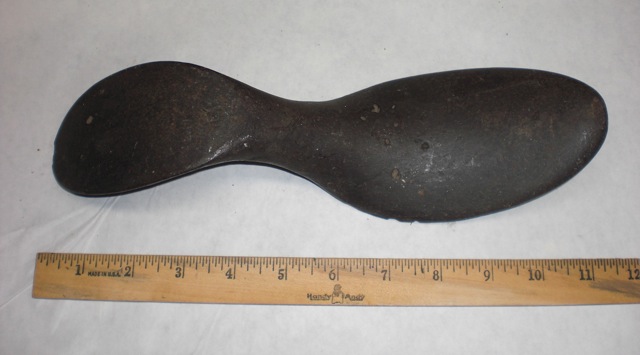
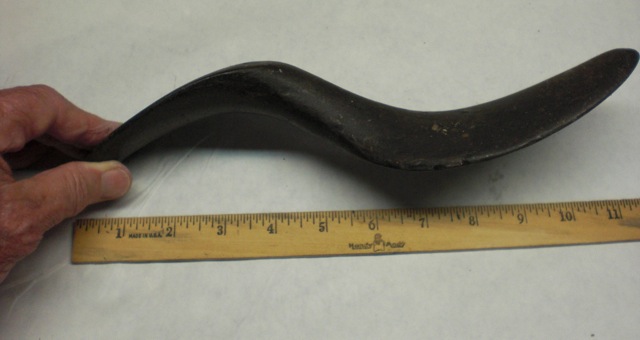
However, this is not how James and Catherine would have harvested apples or what they would have done with them.  The Museum of the Shenandoah, in Winchester, VA, provides a wonderful exhibit of farm implements of yesteryear, including an apple picker, right under the “What is it?” question, below.

Catherine Crumley 3

I had no idea what this was, being so long, but when they provided the answer – it seemed obvious.

Since we’re on the subject, the item on the bottom is a mash stirrer.  Mash, for those who don’t know, is part of the whiskey making process.  James Crumley was a Quaker, but a still was listed in his estate inventory, so he would likely have used one of these as well.

Directly under the basket of the apple picker is a weighing system.  James had a brass scales, stillyards and money scales in his estate inventory too, so it probably looked something like this.

Apples, however, were not made into whiskey, but into “cyder’ and sometimes hard cyder and things like applesauce and applebutter.  Not to mention items like pies, but pies didn’t keep.  Apples were also dried.

Below, an apple butter pot probably similar to one Catherine would have used.

Catherine Crumley 4

When I was a child, we made a lot of applesauce and applebutter, but we did not cook it in a pot outdoors, although some of the “less progressive” families did – in the same outside facility they used for maple sugar in the winter time.

And of course, there was apple juice which preceded hard cyder.

Catherine Crumley 5

The first step to juicing apples were to press them in an apple press similar to the one above.

Apples were a staple in Frederick County and were raised with little effort to provide for the family for the upcoming winter and until next fall.  Today, they are an important cash crop for the families of the region.  The orchards are beautiful, but it’s surprising that there are few farm markets.  We did find one, but it was a bit north, towards Martinsville in Berkeley Co., West Virginia.

Catherine Crumley 6

Orr’s Farm Market sells lots of different varieties of apples.  They also allow tasting and the apples were so good.  I was surprised at how different the differing varieties tasted.

The Ridge

Sometimes when you visit a location, things become obvious which were not obvious previously.  For example, that there was a ridge of mountains that “began” the Blue Ridge just to the west of James and Catherine Crumley’s land.  Apple Pie Ridge Road runs along that ridge, parallel, in the valley, north to south.

Catherine Crumley 7

The “good land” for faming lies in that valley to the east of those mountains which run the length of the county and of course into two adjacent counties, one to the south in Virginia, the beginning of the Shenandoah Valley and then extending north into Berkeley County, West Virginia.  In fact, James and Catherine also owned land in Berkeley County, just a hop, skip and a jump up the road.

Who Was Catherine?

Catherine has been rumored to be a Gilkey, but I doubt seriously if she is.  Or better stated, other than family stories, there is nothing at all to substantiate this claim, and several reasons to introduce questions.

In Paul Morton’s book, “The Crumley Family,” he reports that James married a Scottish lass named Catherine Gilkey in 1732 in Chester County, PA, but he provided no documentation.  A Scottish lass would have been Presbyterian.  If James had married a Presbyterian, he would have been dismissed from the Quaker Church, so either she became Quaker or he did not marry a Presbyterian.

Paul Nichols reports in his document, The Crumley Family, that “very old family records from Richard Griffith, a prominent Frederick County genealogist, indicate that the Gilkeys may have been the parents of his wife Catherine, but no marriage documentation has ever been found.”

At the Handley Library and Archives in Winchester, VA, among the papers of Richard Griffin, a local genealogist from the 1930’s is the following dating from 1872:

“NOTES ON MY FAMILY”

Written by Aaron H. Griffith, 1872

“My grandfather John Griffith 2nd married Mary Faulkner daughter of Jesse Faulkner and Mary his wife. Mary Faulkner was the daughter of James Cromley and his wife Catherine. James Cromley lived on Apple Pie Ridge on land he bought from his father-in-law Davie Gilkie. This land was originally granted by the King to our kinsmen James Wright and John Litler in 1734 who sold it to John Cheadle the eminent Friend who lived in eastern Virginia. John Cheadle sold it to David Gilkie who as I have said sold it to his son-in-law James Cromley, who in turn, willed it to his son John Cromley. John Cromley sold it to his brother-in-law Jesse Faulkner who sold it in 1778 to his son-in-law John Griffith. There my father was born, and there I was born on the 11th of the 3rd Mo. 1802.”

Of all the evidence, this seems to be the most credible, because Aaron Griffith was born only 40 years after James Crumley died, and only a couple years after James’ wife Catherine died.  His parents and family would have known this family first hand.

In 1758, it seems that James Crumley had a bit of a meltdown in court, potentially having to do with Barbara Gilkey Hagen, the remarried wife of David Gilkey.  If Catherine Crumley is a Gilkey, Barbara is her mother.  In the court records, the first record immediately before a proceeding with Barbara Hagen having to do with her bond (probably in conjunction with an estate, probably David Gilkey’s estate), states that it was ordered “that the sheriff take James Crumley into custody for behaving indecently before the court.”  In a 1936 letter, J. W. Baker, another Frederick County genealogist interpreted this behavior as evidence of some kind of family row.

However, James could have been in court to testify for Barbara, or it may have been circumstantial.  I do have to wonder what would provoke a Quaker into doing something “indecent” before the court.

If Catherine was the daughter of David and Barbara Gilkey, why are there no children named David or Barbara?

Sometimes family stories are true, but sometimes, they aren’t.  In this case, we have two stories to choose from.

There is also another family story that Catherine in a Bowen which has exactly as much credibility as the Gilkey story, and for exactly the same reason.

The Bowen rumor says that Catherine was the daughter of Henry Bowen.  James Crumley and Henry Bowen were neighbors in Frederick County, VA, but James Crumley’s marriage to Catherine took place years before in Pennsylvania.

However, “A.C. Nash, David Williams Cassat and Lillian May Berryhill: their descendants and ancestors,” (1986) has a chapter on the Crumleys. This book indicates Catherine may have been a Bowen and not a Gilkey.

Dorothy T. Hennen in “Hennen’s Choice: a compilation of the descendants of Matthew … “(1972), page 390, also suggests Catherine was a Bowen.

There is other circumstantial evidence that also hints at this possibility.  In Virginia, at that time, when a man died, three men were assigned to appraise his estate.  Typically, one was the dead man’s largest creditor, one was someone in the wife’s family, and one was a disinterested party.  The three individuals had to agree on the value of the man’s estate, with the exception of his land, and submit their report to the court to be filed.

The three men who appraised James Crumley’s estate after his death in 1764 included Henry Bowen.  If Catherine was a Bowen, then this Henry was her brother.  Of course, the Bowens were neighbors, so it’s impossible to surmise whether this interaction was a result of living in the same neighborhood or being related to Catherine.

There is a Bowen family in the Nottingham Quakers book referencing the church in Cecil County Maryland, adjoining Chester County, PA, but there is no Henry and no David or Barbara Gilkey, nor a Catherine Gilkey or Bowen mentioned.

I do, however, know why both stories exist.  James Crumley bought land from both David Gilkey and Henry Bowen, both men reputed to have been the father of Catherine.

On October 1, 1745, James purchased 219 acres of a 438 acre tract, part of a November 12, 1735 patent from the Colony issued to James Wright and John Littler who later sold the land to David and Barbara Gilkey his wife. (Tract 71A, Map 5.) James Crumley paid 37 pounds to the Gilkeys, who had lived on the land. James then sold the Gilkey land to his son John on February 28, 1757 for 25 shillings. Later, the same 219 acres was willed to John in his father’s will.  Perhaps James wanted to assure that John did actually receive this land.

On April 1, 1755, Henry Bowen sells to James Crumley for 5 shillings a tract of land containing 53 acres being part of a larger tract containing 103 acres.  It’s signed by Henry Bowen and witnessed by Charles Parkins and Evan Thomas and recorded in Deed Book 3, page 447.

Granted, 5 shillings is an artificially low price for 53 acres, but then again, we don’t know what kind of land constituted that 53 acres.  It could have been prime, cleared farmland or swamp – and that would make a huge difference in how much the land was worth.

Henry Bowen’s land abutted James land – so they were neighbors as well.

However, Henry Bowen left a will and named his children; Henry, John, Jacob, Mary, Hannah, Margaret, Jean, Ann and Persilla.  He lists both Isaac Eaton and Peter Babb as sons-in-law, but neither a daughter Catherine nor a son-in-law James Crumley are mentioned.  Henry did, before his death, deed land to daughter Presilla and her husband, William Gaddis, but Presilla is still mentioned in Henry’s will. In the deeds where Henry Bowen sells to his children, the price is “for love and affection.”  Of course, none of this resolves the 5 shilling question relative to James Crumley.

James Crumley married his wife, Catherine, before they came to Frederick County.  In fact, he married her several years before, back when they were living in Chester County, PA, and I have yet to find any record of either David Gilkey or Henry Bowen in Chester County, PA. Now of course, one can’t prove a negative, but autosomal DNA testing and matching has also failed to connect to either of these families.  Again, that’s not proof that Catherine is not a Gilkey or a Bowen, but together the evidence is suggestive that she is not.  Said another way, the DNA evidence is not suggestive that Catherine was a Gilkey or a Bowen, but new people test daily and we don’t know what the future will hold.

Unfortunately, we have no idea, besides those two stories, what Catherine’s surname might be.

However, what we do know is that James and Catherine did not live on the Gilkey land.  How do we know this?  Because James was considerate enough to die with a will.  In his will, he left ”the plantation” to his youngest son Samuel, and when John sold that land in 1793, the deed very specifically said that this was the land James purchased of Giles Chapman.  In James Crumley’s will, John inherited the Gilkey land.  We know this because John states such when he sells that tract as well.

Virginia tax records indicate that Catherine lived for at least another 18 years after James Crumley’s death, as she is listed as a white female head of household in 1782 with one white male and three blacks, and in 1783 with two slaves, two horses, and seven head of cattle. Her name continues to appear in the records until 1787, with an additional 3 slaves.  The white male was probably John, because Samuel appears to be dead by 1768 or Samuel.

There is no 1790 census, and John sells the land in 1793, so Catherine is assuredly gone by this time.  By 1782, Catherine would have been about 70 years old, or perhaps slightly younger.  She lived to be at least 75.

The 1793 deed from John Crumly and wife Hannah, then of Newberry in the 96 District of SC, tells us that the tract contains 150 acres and is part of a larger tract granted to Giles Chapman by grant and that he conveyed that land to James Crumley and then a second tract granted by James Crumley and devised in his will to Samuel Crumley and said John Crumly was his heir.  This tells us that Samuel probably was underage when he died and John was likely James’ eldest son.  Another possibility is that Samuel was not underage when he died, and moved away, leaving a will elsewhere that names his brother as his heir.  There is no Samuel Crumley will in Frederick County.

There is also a very interesting deed from William Crumley, Henry Crumley and Thomas Doster, all of Frederick County, on January 30, 1768 where they are bound to their brother John Crumly for the sum of 1000 pounds to secure their obligation that after the death of their mother Katherine Crumly they convey all their rights to the plantation on which she now resides and to allow said John Crumly the quiet possession of said property, signed by the same.  Witnesses were Henry Ross, M. Morgan, John Lindsey Jr. and Josiah Pickett, recorded in Deed Book 12, page 351.

Thomas Doster marries Mary, the daughter of Catherine and James, so he is the brother-in-law of Henry, William and John.

This indicates that Samuel had died by 1768, but sometime after the 1757 will.  That would explain why Katherine was living on the estate that John owned and he would eventually retain possession. If Samuel were living, Katherine would have been living with him on the home plantation that Samuel would have owned.

This means that Catherine, probably after burying her husband, also buried her son.

The Crumley Home

Sometimes luck smiles on a genealogist, and it smiled on me.  When researching James Crumley, cousins discovered that the home he and Catherine once owned was now a historic property and had been lovingly restored.

When visiting Frederick County, I had only planned to drive by, pull into the driveway by the road, and take some photos.  I was accompanied by my Crumley cousin, Pam.  However, when we arrived, the property is fairly heavily treed, and while you can see the house, you can’t see all of the house.

Pam and I decided to muster our combined courage and go to the door to ask permission to take closer photos of the house.  The dog was chained, so we felt relatively safe.  The owner came to the door, was a bit surprised to say the least, but was extremely gracious and provided a great deal of information.  She went inside to call her husband who had information in his office, and when she came back outside, she offered to give us an impromptu tour of the old section of the house.

Pam and I thought we had died and gone to heaven.  This is the house that Catherine would have lived in – all two rooms of it – from the time she was about 30 years old until her death.  She clearly had children within these walls, because in 1757, when James made his will, at least one of her children, Samuel, was underage, indicating he was born sometime after 1736.  Catherine would have had children until she was in her early-mid 40s, 42 or 43, so about 1754 or 1755. When Catherine was the woman of the house, she would have been managing at least 5 children, if not more, plus her husband, herself and at least 4 slaves in these two rooms.  Not exactly a wealthy plantation owner.

The second half of the house was added in the 1800s as a separate building that shared a wall, but at that time, there was no connection inside between the two halves of the house.  You had to go outside to go into the “other half” from whichever half you were in.  You can clearly see the divide, looking at the front of the house.  Cousin Pam and a friendly cat are posing, below.  The old half is on the left.

Catherine Crumley 8

In the photo below, the original log cabin is the part with the fireplace, and the entire section beginning with the door that extends to the rear (left) was added as a third section much later.

Catherine Crumley 9

Eventually, the owners, sometime in the late 1800s cut an inside doorway between the two halves of the house.  A rear addition was also put on, doubling the size of the house.  However, the piece that Catherine would recognize was the left part, looking straight on to the house from the road, which is the right section in the photo above, taken from the side.  Furthermore, the upper level was at one time raised to make a full story.  In Catherine’s day, it was about half-height – perfect for children.

Catherine Crumley 10

This picture is of the original chimney.  You can see that it was extended with bricks when the roof was raised.  The chimney must extend above the roof to prevent the roof from catching on fire, so the original roof was likely below the second story window that was added when the second floor was raised.

When Catherine lived here, it was a half story and probably where the children slept.

This floor, upstairs, is most likely original.

Catherine Crumley 11

My ancestor, Catherine’s son William Crumley, born in 1735 or 1736, climbed these stairs and played on this floor, perhaps, and slept in this very room, but probably not in a bed by himself.  Children shared beds – those children lucky enough to sleep in a bed and not on straw on the floor.

Catherine Crumley 12

The upstairs was accessible through an unusual stairway beside the fireplace.  In the photo below, you can see the yellow door to the far right.

Catherine Crumley 13

It’s extremely narrow and is accessible today.  Here is what it looks like from the upstairs.

Catherine Crumley 14

Here is cousin Pam emerging from the stairway on the bottom floor.  You can tell from her smile what a wonderful day we are having!

Catherine Crumley 15

There are two original windows that remain.

Catherine Crumley 16

One original windows is shown in the photo above to the right of the fireplace on the lower floor  An exact duplicate looks into the second half of the house.  Of course, at one time, that second window looked outside.

Catherine Crumley 17

The house is dark (without lights) as it would have been when Catherine lived there.  The only other source of light would have been a front and back door.  The front door is original.  That in itself is absolutely incredible, almost 300 years later.

Catherine Crumley 18

This “old” door is far more substantial than any door manufactured today.

Catherine Crumley 19

The logs of the house itself can still be seen in the rear of the original part where the new addition was added.  The owners exposed that portion and it’s beautiful.  It’s now part of a hallway.

Catherine Crumley 20

You can see the square headed forged nails.

It’s unusual, but there were rows of rock between the logs.

Here, you can see the logs chinked together at what was the original corner of the house.

Catherine Crumley 21

Looking down, there is a metal something sticking out of the log.  We don’t know what this is.

Catherine Crumley 22

You can see another view of this metal piece in a photo provided by Pam.

Catherine Crumley 23

If anyone knows what it is, please let me know.

Pam and I both had to touch the logs – knowing that James and Catherine both touched them.

Catherine Crumley 24

The current owner has marked “age lines” with each of her children’s birthdays on the door jam.  I remember my mother doing the same thing, and it makes me wonder if Catherine did something similar, oh so long ago.

Looking at James Crumley’s estate inventory, we can get some idea of how much furniture they had and where it might have fit in the two room cabin.

James had “beds and furniture” but unfortunately, they don’t tell us how many beds – although we know there was more than one.  About the only other things inside the house were brass scales, stillyards and money scales for conducting business, chests, pewter, stove and kitchen iron ware.  It says nothing about plates and such, and often those things are listed individually.  It also does not list any books or a Bible.  Nor a mirror.  Nor pewter plates, so they likely ate out of wooden trenchers.  While James did have a nontrivial amount of “cash, silver, gold and paper” to the tune of 26 pounds, and he was owed notes for 119 pounds, they didn’t seem to have much in terms of physical property.

Catherine probably cooked over the fire in the fireplace.  There could possibly have been an outside kitchen as well, but so far, nothing like that has come to light.  There would be evidence of a cooking area, and none has been found.

Furthermore, there have been no slave quarters found either, and we know that James had at least four slaves and Catherine continued to have slaves through the 1787 tax list.  Did they sleep with the family or perhaps upstairs with the children?

And then there was the matter of the still…

The Still

A still was not a common estate inventory item in Frederick County.  This means that not everyone had one, and I’m guessing that most of the Quaker men did not have a still.  But James assuredly did, and used it liberally according to his estate inventory where he had 15 gallons of liquor, a cyder mill and casks.

This still likely caused Catherine no small amount of heartburn.  This family was Quaker, but they apparently weren’t fanatically Quaker.  How much trouble did this still cause Catherine at church or within the community?  For that matter, did it cause trouble at home?

Or is the fact that there was so much debt owed to James indicative of the fact that he was a successful “businessman” within the community?  Yes, he appeared to be a shoemaker, but he also appeared to be what we would term a moonshiner today.

However, there may be more to this story than we already know.

The road that intersects Apple Pie Ridge Road in front of James and Catherine’s home is called Tuscarora Road.  The current owner told us that the Tuscarora migrated through the area.  This makes perfect sense given that they left North Caroline beginning in 1713 after the Tuscarora War, and groups migrated back and forth from then until the last group left North Carolina for New York in the early 1800s.  There are many place names along the Blue Ridge mountains, roughly paralleling I81, that include the word Tuscarora. In fact, Tuscarora Creek runs through the center of Martinsville, West Virginia, the next county north of Frederick County.

The local people tell us that the Tuscarora camped and lived in these locations for some time.  It’s unlikely that they all left.  Some would have worked and traded within the community.

We visited the historic village of Gerrardstown, about 10 miles north of James Crumley’s land where the “History of Gerrardstown” also told us the same story – that the Tuscarora were found throughout this area and along the ridge as they migrated to the north – except this book also says that the Tuscarora lived here.  There are many local areas and landmarks there with Tuscarora in their name.

Did the fact that James Crumley had a still have something to do with why the Tuscarora continued to stay and perhaps live on his land?  Was he simply an opportunist after discovering that the Tuscarora, whose chiefs had asked the whites not to provide drink to their Indian men, were camping and perhaps living on his land?  Is that part of why he carried so very much debt owed to him?

How did Catherine feel about this?  It makes me wonder if their “slaves” were African or if they were perhaps Indian – although if they were Indian it begs the question of why they simply did not just leave.  If they were Indian, they would not have been Tuscarora, but captives of other tribes that the Tuscarora held or sold or maybe used to pay their debts.  The men captives were often killed, but the women and children, being much easier to control and less likely to cause trouble, were generally sold into bondage.

There may be yet more to this story to be unraveled.

The French and Indian War

This part of the country was incessantly raided, up and down this valley, during the French and Indian War which began in 1754.  The old Indian Path became the Wagon Road which has now become I81.  During the French and Indian War, this area became the ingress and egress for both the French and hostile Indians conducting raids, hoping to drive the settlers out of their area and back from whence they came.

Areas from Martinsburg into Gerrardstown and down the valley through Winchester and further south were raided by the French and Indians.  This is exactly where James and Catherine lived – on the old main road.

Prisoners were taken, settler families were killed and life during this time period was in a state of upheaval.  In some areas, entire counties were abandoned, to be resettled later.  But that didn’t happen in Frederick County.  These settlers stayed put right where they were.  They had put down roots and they weren’t going anyplace, not even upon threat of death.

The Tuscarora Indians sided with the Americans.  Perhaps the proximity of the Tuscarora to James Crumley provided him with some modicum of protection – or at least forewarning.  Neither James nor any of his sons show any record of having served in this conflict, with the exception of one entry regarding being absent from militia service.  James would have been in his early 40s and his eldest sons between 18 and 20, so any of these men could have served.  Maybe their Quaker religion precluded it in their case, but their Quaker religion did not seem to preclude the still.  Perhaps they were selectively Quaker.

Cousin Jerry Crumly in his book, “Pioneer Ancestors: Crumley, Copeland et al” states the following:

At a Court Martial convened in Frederick County, Virginia on October 13, 1760, Captain Lewis Moore returned his muster roll and ordered that John Crumley, of the company commanded by Captain Moore, be fined 40 shillings for absenting from three private and one general muster.i Again, it seems unusual for a Quaker to be a member of a military unit, but here is evidence that John was in the militia during the French and Indian War. Hopewell Friends History, 1734 to 1934, Frederick Co., VA records that “in the years 1754-1755 a determined effort was made by the colonial government to force Friends to bear arms against the French and Indians, and upon their steady refusal some of them were beaten and imprisoned.”ii Perhaps John Crumley and his father, James, both found it preferable to serve in the militia rather than to be beaten and imprisioned. John’s Court Martial would indicate that his heart really wasn’t in it.

I have to wonder if Catherine ever hid in the cellar.  This is one of the very few log cabins I’ve ever seen with a cellar.  Would the cellar have been considered an area of safety or a sure trap with no exit?  Did the men have guns to protect the homeplace?  No guns are listed in James Crumley’s estate inventory in 1764, just a few years later.

Catherine was raising her children on a frontier that was also a war zone – a situation that never entirely resolved until after the Revolutionary War ended.  Catherine lived to see that as well.  Of her three sons, we know nothing of the children of Henry, but William and John had 8 sons between them.  We know that son William, then living just north of Catherine on land once owned by James and Catherine spanning the border with Berkeley County, now West Virginia, provided supplies for the use of the Revolutionary army.  He was allowed 5 pounds for 8 days of service as a “receiver” in collecting clothing and provisions.  He also contributed 11 bushels and a peck of wheat along with his wife’s brother-in-law and his wife’s step-father.

Catherine Crumley 26

Perhaps those supplies were stored in William’s barn, shown above, on land left to William by his father, once granted to James and Catherine by Lord Fairfax.

Fortunately for Catherine, and the other settlers, there were no actual battles in Frederick County in the Revolutionary War.  However, when living there, with war and raids raging all around, following the French and Indian War which was not really resolved until 1763 – it must have felt like there was always some kind of unrest and conflict that threatened not only your possessions and home, but your very life and that of your children and grandchildren. This must have somehow become “normal” to Catherine, because life went on.  She raised her children and did all the things that needed to be done – somehow.  Both before and after James’ death.

Let’s take a look at how Catherine would have lived on the farm, outside of her 2 room cabin.  One thing is for sure, with very little space, most activities other than some cooking, sleeping and keeping warm in the winter likely took place outside.

Out Buildings

There were some outbuildings on the property.  The one I find the most interesting is nestled behind the house.  It’s quite close today, but before the additions, it was a bit further away.  The owner thinks it may have been a smokehouse just for hanging meat, since no evidence of fire has been found there either.  She does not think it’s original to the property, but it does look quite old and I wonder if it is.  It’s log, not sawed planks, so it likely predates a sawmill.

Catherine Crumley 27

This little building is just fascinating.

Catherine Crumley 28

I wondered about this house being for the still, but a still would have required a fire as well, and there is no evidence of a fire being built inside this building.  The owner told us that the construction was said to have been of Irish origin by on one of the individuals who came to look at the property when it was being listed on the Historic Register.  of course, since we don’t know when it was constructed, we don’t know if this is a hint as to James and Catherine Crumley’s origins or not.  We don’t even know who said it was Irish, why, and if that was accurate or not.

Catherine Crumley 29

There are two other outbuilding, but both of them date to after the Crumley’s owned this land.

Catherine Crumley 30

This building was rebuilt with many of the original materials.

Catherine Crumley 31

This corn crib has never been rebuilt, but doesn’t date to when Catherine lived here.

The original well still exists too, just a few feet in front of the house.  Behind the house, down a hill, is a creek.  I’m sure the well was a welcome addition, but I doubt it was here when Catherine was alive.  She, I’m sure, walked to the creek, or sent her children or slaves.

Catherine Crumley 32

Another outbuilding that is “gone” would be the outhouse, of course.

One final building was the all-important barn.  The barn on this property was substantial.  The owner indicated that the barn was in very poor condition when they bought the property some 40+ years ago.  They felt it was a second barn built on an original foundation.  The foundation remains, and we could see differences in construction styles in different sections.

Catherine Crumley 33

Ironically, the barn was substantially larger than the original log cabin house.

Last on the tour was the cellar.  While many people would not find this exciting, we did.  We don’t know if James built this cabin or not, but it was rather “deluxe” for its time with two rooms and a cellar – albeit a dirt floor cellar.  It would have provided storage for root vegetables through the winter and probably storage for perishables like milk in the summer as well.

Catherine Crumley 34

These steps would have been original of course, although the doors have been just recently replaced..

Catherine Crumley 35

These stones are huge and very heavy.  I wonder how they found or quarried them, transported them and placed them.

The chestnut beams supporting the house are in amazing condition considering their age and moist conditions under the house.

Catherine crumley 36

Based on modifications made to the walls for ductwork, we could see the significant depth of the walls.  This looks more like a fort than a house.  Maybe this is part of the answer as to the defense of the family.  It could also explain why there are rocks between the logs.  Rocks deflect gunfire better than wood.

Catherine Crumley 37

These walls appear to be more than 2 feet thick in some areas.

The Cemetery?

Where is Catherine buried?  That’s a good question.  Most likely, where James and her son Samuel are buried.  So, where is James buried?

He would have been buried in one of two places.  Either on his own land or at the Hopewell church.

James and Catherine were Quakers.  Some of their children and their descendants continued that Quaker tradition for generations.  Some may still be Quaker today.

However, James didn’t seem, from his estate inventory, considering his liquor and still, to be a fundamentalist Quaker, although we have no evidence he was ever in any trouble within the church.  Whether he was discreet, meaning perhaps the church elders were among those who owed him money, or the elders were simply turning a blind eye – we’ll likely never know.  He was also a vestry member of the Anglican church which was likely political in nature but shows that he was a respected citizen.  For the rest of that story, see the James Crumley article.

The property owner told us that when they bought the property, there was one single gravestone propped up in the barn.  They wanted that stone, but the previous owners took it when they left.  We don’t know where on the property that stone would have been located, or why it was in the barn.  It was from a later date when the Lodge family owned the land.  But it does tell us one thing.  There was a cemetery at one time.  Was it the Crumley cemetery repurposed for new owners?  Or was it truly the Lodge cemetery with only one burial?  Are James and Catherine along with their son Samuel buried at their home or at Hopewell Friends Church?

The Hopewell Friends Church

Catherine Crumley 38

Churches and religion were extremely important to these pioneer families.  Many had sacrificed greatly in order to be able to participate in their religion of choice – and not just in the present generation – but often for many preceding generations.  Most of these people demonstrated a willingness to lay their lives down and risk everything for their religion.  This leads me to believe that, if possible, James Crumley would have wanted to be buried at Hopewell, according to his Quaker beliefs.

Catherine Crumley 39

The Hopewell Church was the first Quaker Church or Meeting House in this area and was established in 1734, before James and Catherine arrived, but not terribly long before they arrived.  They would have worshipped in this church, part of which has been expanded.

Catherine Crumley 40

If James and Catherine Crumley are buried here, it is likely in the center part under this very old tree where the earliest burials likely took place.  There are many unmarked graves.

Catherine Crumley 41

This church, except for modernization somewhat, likely has not changed much since Catherine attended.

Catherine Crumley 42

Did Catherine pick flowers and sit them in the windows of the house or the church to cheer the family or to lift her own spirits when warfare, strife and sorrow invaded her life?

Catherine Crumley 43

Gazing across the fields from the back of the church, we see the ever-present mountains in the distance.  These mountains at once defined boundaries and opportunity.  Did Catherine look at them and think about the lands she came from?  Did she think about her parents and perhaps children buried in hallowed ground left behind?  What did Catherine think about when she gazed at these mountains?  Did she have any idea that her descendants would spread across and settle the rest of the country within just a few generations?

Catherine Crumley 44

Those mountains would be both a barrier and a highway. It would be down those mountains and through the valleys that at least one of Catherine’s sons and many of her grandchildren would venture.  It would be across those mountains that the husbands and sons of settlers would march to fight the French and Indians in 1754 and to settle distant places, founding Quaker churches wherever they went.  The mountains were somewhat of a barrier for settlers, at least for a little while, but they provided no barrier at all to Indians who raided the settlements, hoping to stem the ever-growing tide of intruding settlers.  That didn’t work, and the settlers pressed on, through the mountains, into the heartland and eventually, from sea to sea.

Catherine’s Children

Catherine and James had a total of five known children, four that lived to adulthood.

  • John Crumley, probably the oldest, born about 1733 or 1734 in Chester County, PA. He married Hannah Faulkner and moved to Newberry County, SC before 1790.
  • William Crumley, born about 1735 or 1736, also in Chester County. William lived his life on land bordering Frederick County, VA and Berkeley County, West VA left to him in his father’s will. William married Hannah Mercer.
  • Mary Crumley married Thomas Doster and possibly secondly to Jesse Faulkner.
  • Henry Crumley married Sarah whose last name is unknown. All we know about Henry is that he left the area and apparently died about 1792.
  • Samuel Crumley is mentioned in his father’s will as underage, but he did not live to claim his inheritance.

In that day and time, there would likely have been at least twice and maybe three times that many children born to a pioneer couple, so at least some of those children are buried someplace in Frederick County – likely the same place James, Catherine and Samuel are buried.

Catherine’s Mitochondrial DNA

Of the four surviving children, only one was female, which limits our ability to find someone who carries Catherine’s mitochondrial DNA.  Fortunately, daughter Mary Crumley who married Thomas Doster and had three daughters, Ruth, Sarah and Mary.

Mother’s pass their mitochondrial DNA to both genders of their children, but only females pass it on.  Mitochondrial DNA can tell us a great deal about the ancestry of Catherine – information we will likely never know unless we find someone who carries her mitochondrial DNA and who is willing to test.

If you descend from Catherine’s daughter, Mary Crumley, who married Thomas Doster and possibly Jesse Faulkner, through all females to the current generation, in which you can be male or female, and you’re willing to DNA test – I have a DNA testing scholarship for you!!!!

______________________________________________________________

Disclosure

I receive a small contribution when you click on some of the links to vendors in my articles. This does NOT increase the price you pay but helps me to keep the lights on and this informational blog free for everyone. Please click on the links in the articles or to the vendors below if you are purchasing products or DNA testing.

Thank you so much.

DNA Purchases and Free Transfers

Genealogy Services

Genealogy Research

Lady Godiva (c1040-1066/1086), Gift of God, 52 Ancestors #93

You just never know who you’re going to find hanging around in your family tree.

OLYMPUS DIGITAL CAMERA

In the upper left hand corner of the wonderful royal lineage chart created by Ky White for me, you can see Lady Godiva on her trusty steed.

Chart Godiva crop

Lady Godiva, of all people, is my 32 times great-grandmother.  Yes, that means that the word great appears 32 times before the word grandmother.  Amazing isn’t it.  And you know, the very first thing I wonder is if I carry any of her autosomal DNA at all.  As remote as it seems, at the 34 generation level, I obviously carry the DNA of some of my ancestors from 34 generations ago, or I would have no DNA at all.

The problem with finding DNA at this genealogical distance is first, that the DNA would likely be chopped into such small pieces that it would be extremely difficult to differentiate from other DNA – like IBP (identical by population) or even DNA inherited from other common ancestors.  I have just one line back this far, so in the past 32 generations, were I to match someone else who also descended from Lady Godiva, it’s very possible, if not probable, that we both descend from other common ancestors as well.  So DNA, at least today, isn’t an option for proving descent.

Discovering Lady Godiva as an ancestor was fun.  Researching her was fun too.  Of course, as luck would have it, I discovered that I descended from Lady Godiva about a year AFTER I stood in the square in Coventry (England), by her statue, entirely oblivious.  Couldn’t she have whispered in my ear????

Wanna hear something really bad??  I left because I spotted a Starbucks down the street as the tour guide was talking about Lady Godiva.  No kidding.  I’m kicking myself now, let me assure you!  My husband even said I was probably related to her, and I assured him that I was not.  Duh.  DUH!!!!!  Kicking self.

I had not found my gateway ancestor yet at that time, who connected me back many generations through lots of royalty.  A gateway ancestor is kind of a jackpot – because once you find them, a whole new world of royalty opens up to you.  The difference between royalty and peasantry is that someone has done the genealogy of royalty already!  Woohoooo.

So, let’s take a look at Coventry and the life of Lady Godiva.

Coventry, Warwickshire, England

The first chronicled event in the history of Coventry took place in 1016 when King Canute and his army of Danes were laying waste to many towns and villages in Warwickshire in a bid to take control of England, and on reaching the settlement of Coventry they destroyed the Saxon nunnery.  Leofric, Earl of Mercia and his wife Lady Godiva (a corruption of her given name, “Godgifu”) rebuilt on the remains of the nunnery to found a Benedictine monastery in 1043 for an abbot and 24 monks, dedicated to St. Mary.  Leofric had been appointed Earl by Canute and was one of the three most powerful men in the country, while Godiva was already a woman of high status before marriage and owned much land.

“He [Leofric] and his wife, the noble Countess Godgifu, a worshipper of God and devout lover of St Mary ever-virgin, built the monastery there from the foundations out of their own patrimony, and endowed it adequately with lands and made it so rich in various ornaments that in no monastery in England might be found the abundance of gold, silver, gems and precious stones that was at that time in its possession. ”

— John of Worcester

Edward the Confessor, who had been crowned King by this time, favored pious acts of this nature and granted a charter confirming Leofric and Godiva’s gift.

So, Lady Godiva was a powerful woman in her own right.

Lady Godiva by John Collier

“Lady Godiva by John Collier” by John Collier in about 1897 – Unknown. Licensed under Public Domain via Wikimedia Commons – https://commons.wikimedia.org/wiki/File:Lady_Godiva_by_John_Collier.jpg#/media/File:Lady_Godiva_by_John_Collier.jpg

Godiva, or Godgifu in old English, known as Lady Godiva, lived from about 1040 to about 1067.  She was an Anglo-Saxon noblewoman who, according to a legend dating back at least to the 13th century, rode naked – only covered in her long hair – through the streets of Coventry in order to gain a remission of the oppressive taxation imposed by her husband on his tenants.

This sounds like the ultimate marital disagreement and subsequent dare.  Never challenge a strong woman!

The name “Peeping Tom” for a voyeur originates from later versions of this legend in which a man named Tom had watched her ride and was struck either blind or dead.

Godiva was the wife of Leofric, Earl of Mercia. They had one proven son Aelfgar, Earl of Mercia.  So much for my hopes of mitochondrial DNA!

Godiva’s name occurs in charters and the Domesday survey, though the spelling varies. The Old English name Godgifu or Godgyfu meant “gift of God”; Godiva was the Latinized version. Since the name was a popular one, there are contemporaries of the same name.

Ely Cathedral

“Ely Cathedral by John Buckler” by John Buckler (1770-1851) – http://oxfordprints.com/Cambridge%20Prints.htm (cropped and straightened by uploader). Licensed under Public Domain via Wikimedia Commons – https://commons.wikimedia.org/wiki/File:Ely_Cathedral_by_John_Buckler.JPG#/media/File:Ely_Cathedral_by_John_Buckler.JPG

If she is the same Godiva who appears in the history of Ely Abbey, now the Ely Cathedral in Ely, Cambridgeshire, the Liber Eliensis, written at the end of the 12th century, then she was a widow when Leofric married her. Both Leofric and Godiva were generous benefactors to religious houses. In 1043 Leofric founded and endowed a Benedictine monastery at Coventry on the site of a nunnery destroyed by the Danes in 1016.  Writing in the 12th century, Roger of Wendover credits Godiva as the persuasive force behind this act. In the 1050s, her name is coupled with that of her husband on a grant of land to the monastery of St Mary, Worcester and the endowment of the minster at Stow, St. Mary, Lincolnshire.

Lady Godiva and her husband are commemorated as benefactors of other monasteries at Leominster, Chester, Much Wenlock and Evesham. She gave Coventry a number of works in precious metal made for the purpose by the famous goldsmith Mannig, and bequeathed a necklace valued at 100 marks of silver. Another necklace went to Evesham, to be hung around the figure of the Virgin accompanying the life-size gold and silver rood, a type of medieval cross, she and her husband gave, and St. Paul’s Cathedral in the City of London received a gold-fringed chasuble. She and her husband were among the most munificent of the several large Anglo-Saxon donors of the last decades before the Conquest.  The early Norman bishops made short work of their gifts, carrying them off to Normandy or melting them down for bullion.

So, all things considered, she is the last person I’d expect to find riding naked through town.

Maidstone

“Maidstone 018” by Linda Spashett Storye_book – Own work. Licensed under CC BY 3.0 via Wikimedia Commons – https://commons.wikimedia.org/wiki/File:Maidstone_018.jpg#/media/File:Maidstone_018.jpg

Maidstone side

The manor of Woolhope in Herefordshire, along with four others, was given to the cathedral at Hereford before the Norman Conquest by the benefactresses Wulviva and Godiva – usually held to be this Godiva and her sister. The church there has a 20th-century stained glass window representing them.

Her signature, “di Ego Godiva Comitissa diu istud desideravi”, [I, The Countess Godiva, have desired this for a long time], appears on a charter purportedly given by Thorold of Bucknall to the Benedictine monastery of Spalding. However, this charter is considered spurious by many historians. Even so it is possible that Thorold, who appears in the Domesday Book as sheriff of Lincolnshire, was her brother.

The Nude Ride

The legend of the nude ride is first recorded in the 13th century, in the Flores Historiarum and the adaptation of it by Roger of Wendover.  Despite its considerable age, it is not regarded as plausible by modern historians, nor is it mentioned in the two centuries intervening between Godiva’s death and its first appearance, while her generous donations to the church receive various mentions.

According to the typical version of the story, Lady Godiva took pity on the people of Coventry, who were suffering grievously under her husband’s oppressive taxation. Lady Godiva appealed again and again to her husband, who obstinately refused to remit the tolls. At last, weary of her entreaties, he said he would grant her request if she would strip naked and ride on a horse through the streets of the town. The painting below, from 1892, depicts her moment of decision.

Lady Godiva took him at his word, and after issuing a proclamation that all persons should stay indoors and shut their windows, she rode through the town, clothed only in her long hair. Just one person in the town, a tailor ever afterwards known as Peeping Tom, disobeyed her proclamation in one of the most famous instances of voyeurism. In the story, Tom bores a hole in his shutters so that he might see Godiva pass, and is struck blind. A wooden statue of “Peeping Tom” shown in an 1826 article is shown below.

Peeping Tom

“Peeping Tom effigy Coventry-Gentlemans Magazine-vol96(1826)-p20” by W. Reader – Reader, W. “Peeping Tom of Coventry and Lady Godiva”, p.20-, “Show Fair at Coventry described,” p.22- Gentleman’s Magazine: and Historical Chronicle. Vol. XCVI (Jul-Dec 1826) (books.google). Licensed under Public Domain via Wikimedia Commons – https://commons.wikimedia.org/wiki/File:Peeping_Tom_effigy_Coventry-Gentlemans_Magazine-vol96(1826)-p20.png#/media/File:Peeping_Tom_effigy_Coventry-Gentlemans_Magazine-vol96(1826)-p20.png

In the end, Lady Godiva’s husband keeps his word and abolishes the onerous taxes.

So, if this is true, then indeed, Lady Godiva is a heroine, a martyr of sorts and probably venerated by the townspeople.  Too bad all she is remembered for is the naked part.

Some historians have discerned elements of pagan fertility rituals in the Godiva story, whereby a young “May Queen” was led to the sacred Cofa’s tree, perhaps to celebrate the renewal of spring. Cofa’s Tree was likely the source of the name Coventry and may have been a central or boundary tree around which Coventry sprung up.

The oldest form of the legend has Godiva passing through Coventry market from one end to the other while the people were assembled, attended only by two knights. This version is given in Flores Historiarum by Roger of Wendover (died 1236), a somewhat gullible collector of anecdotes, who quoted from unnamed earlier writers.

The truth of the matter is likely much more mundane.

Coventry was still a small settlement, with only 69 families (and the monastery) recorded in the Domesday Book some decades later. At that time, the only recorded tolls were on horses. Thus, it’s questionable whether there is any historical basis for the famous ride. The story is particularly doubtful since Countess Godiva would herself have been responsible for setting taxation in Coventry; Salic law, which excluded females from the inheritance of a throne or fief, did not apply in Anglo-Saxon society, and Coventry was unquestionably Anglo-Saxon. If only because of the nudity in the story, its popularity has been maintained, and spread internationally, with many references in modern popular culture – including a brand of chocolate named after her.

Other attempts to find a more plausible rationale for the legend include one based on the custom at the time for penitents to make a public procession in their shift, a sleeveless white garment similar to a slip today and one which was certainly considered “underwear” at that time.

Thus Godiva might have actually travelled through town as a penitent, in her shift. Godiva’s story could have passed into folk history to be recorded in a romanticized version. Another theory suggests that Lady Godiva’s “nakedness” might refer to her riding through the streets stripped of her jewelry, the trademark of her upper class rank. However, these attempts to reconcile known facts with legend are both weak; in the era of the earliest accounts, the word “naked” is only known to mean “without any clothing whatsoever.”

A modified version of the story was given by printer Richard Grafton, later elected MP for Coventry. According to his Chronicle of England (1569), “Leofricus” had already exempted the people of Coventry from “any maner of Tolle, Except onely of Horsse (sic.)”, so that Godiva (“Godina” in text) had agreed to the naked ride just to win relief for this horse tax. And as a pre-condition, she required the officials of Coventry to forbid the populace “upon a great pain” from watching her, and to shut themselves in and shutter all windows on the day of her ride. Grafton was an ardent Protestant and sanitized the earlier story.

The ballad “Leoffricus” in the Percy Folio (ca. 1650) conforms to Grafton’s version, saying that Lady Godiva performed her ride to remove the customs paid on horses, and that the town’s officers ordered the townsfolk to “shutt their dore, & clap their windowes downe,” and remain indoors on the day of her ride.

Godiva's ride

Marshall Claxton: Lady Godiva (1850), the Herbert, Coventry

Lady Godiva’s Death

After Leofric’s death in 1057, his widow lived on until sometime between the Norman Conquest of 1066 and 1086. She is mentioned in the Domesday survey as one of the few Anglo-Saxons and the only woman to remain a major landholder shortly after the conquest. By the time of this great survey in 1086, Godiva had died, but her former lands are listed, although now held by others. Thus, Lady Godiva apparently died between 1066 and 1086.

The place where Godiva was buried has been a matter of debate. According to the Chronicon Abbatiae de Evesham, or Evesham Chronicle, she was buried at the Church of the Blessed Trinity at Evesham, which is no longer standing, although the bell tower (below) remains today.

Evesham Belltower

According to the account in the Oxford Dictionary of National Biography, “There is no reason to doubt that she was buried with her husband at Coventry, despite the assertion of the Evesham chronicle that she lay in Holy Trinity, Evesham.”

Dugdale (1656) says that a window with representations of Leofric and Godiva was placed in Trinity Church, Coventry (below), about the time of Richard II (1367-1400)

Trinity Church, Coventry

No matter when she lived or died, or whether she rode naked or not, Lady Godiva is certainly a venerated figure of both mythology and history in Coventry today.  And regardless, she is my ancestor.  I’m so grateful that information about her does exist, and that it’s so very interesting.

A beautiful statue celebrates Lady Godiva’s ride forever in the old marketplace at Coventry.

OLYMPUS DIGITAL CAMERA

______________________________________________________________

Disclosure

I receive a small contribution when you click on some of the links to vendors in my articles. This does NOT increase the price you pay but helps me to keep the lights on and this informational blog free for everyone. Please click on the links in the articles or to the vendors below if you are purchasing products or DNA testing.

Thank you so much.

DNA Purchases and Free Transfers

Genealogy Services

Genealogy Research


Family Societies – Converting a Doubter

For those of you who don’t know me well, I’m not a joiner. I’m not a member of the DAR, although I qualify on several lines and all I’d really have to do is connect to another cousin who has already done the work. I’m a member of a small quilt group, but no large guilds. I’m not an alumni society member from the universities where I graduated either. I’m just not likely to become involved with organizations of any type. Yes, I know there are benefits, but I’ve just never been a joiner.

So, having said that, I’m going to tell you why family groups or societies are really incredibly important. Sound a bit odd? It took a huge, and I mean a HUGELY inspirational motivation for me to join….but I did and I couldn’t be happier. However, it took me more than 20 years to get to that point. Let’s hope it doesn’t take you that long.

I’ve been involved with research on several family lines with different researchers for many years, but there are collaborative benefits an organization can offer that just can’t be matched by individuals.

More than 30 years ago, back in the days of pen and ink letters that were mailed in envelopes with stamps affixed, I was introduced to my cousin, Dolores. She and I wrote back and forth sporadically for years. She suggested at some point that I join the Speak(e)(s) Family Association (SFA). I was hesitant, extremely hesitant, but she indicated that they had done rather extensive research on my, our, line and that it would be beneficial for me to receive the newsletters. I joined, albeit very reluctantly.

Sometime, and I really don’t know when, Dolores introduced me to Lola-Margaret, another cousin from the same line. I really don’t remember knowing Dolores and not knowing Lola-Margaret. These two cousins have been a part of my life now for more than half of my life.  Although I’ve known them for a long time, I’ve only become quite close to them in the past few years.  This is the story of how that happened.

Our common ancestor was the Reverend Nicholas Speak and his wife Sarah Faires who died in Lee County, Virginia in 1852 and 1865, respectively. However, during and after the Civil War, their descendants were scattered far and wide, and we didn’t know each other through family. We found each other through genealogy.

Over the past many years, we’ve shared the deaths of our parents. Not just one of our parents, all of our parents. We’ve suffered through the deaths of siblings and our own health issues. We’ve celebrated the births of grandchildren, marriages and more.

In the mid-80s, while I was raising young children, the Speaks Association had their yearly “convention” in Nashville. Part of the activities took place at the Grand Ole Opry. In the newsletter, there were a few photos and the group talked about how much fun they had, and the presentations…and for the first time ever, I actually wanted to attend one of those types of functions. I felt like I was missing out.

You see, my family was so small that we never had reunions. Three of my grandparents and my father were all dead before I was 8. I never knew my fourth grandparent. My mother only had one sibling who lived hundreds of miles away, so I never had close relations with extended family. I had no concept of what that was like. A reunion in my family was anytime there were more than two of us in the same room at the same time.

I wouldn’t be able to attend a Speaks Family Association “convention” until 2004 when the event was held just 100 miles from my home and I had absolutely no excuse NOT to attend. Plus, I had a new reason.

DNA.

????????????????????????????????????

Yep, DNA is what got me there. We had established the Speak DNA project and we needed people to test. Cousins are much more likely to become DNA participants if they hear a presentation personally and have the opportunity to ask questions – and if they feel they can actually make a positive contribution.

That year, I asked for a small amount of money from the SFA organization to fund DNA testing for those who would be beneficial participants but might not be able to fund the testing themselves. We refer to these as scholarships, and the SFA has generously funded several for more than a decade now.

Seven years…it took 7 whole years – but our investment eventually paid off. In 2011, we discovered where our ancestors originated in England when a Y DNA participant from New Zealand matched our US immigrant Y DNA line. Our New Zealand cousin knew where his ancestors were from, exactly…as in had the church christening records. Two years later, in 2013, twenty of us, including that gentleman, would be standing on that very land. The photo below shows the group at St. Mary’s Church in Whalley.

Speak Family at St Mary Whalley

The funding for the DNA testing and the trip planning and organization were all accomplished by the SFA – along with arranging for testing of three more Speak males from that part of England.

In 2014, the SFA funded another round of testing including 4 Big Y tests to help establish when and how certain lines dating back to the 1600s are related. We’ve made incredible discoveries with our genealogy that would never and could never have been made prior to DNA testing.

  • Without the funding power of the organization, none of this would have happened.
  • Without the organizational power of the group, none of this would have happened.
  • Without the conventions that brought people together physically, none of this would have happened.
  • Without the volunteers, none of this would have happened.

While genealogy was my driving force for originally joining the organization, and DNA my driving force for originally attending conventions, those things are no longer my motivation. You see, I’ve come to love my cousins, not just as research partners, but as family that is near and dear to my heart – my “sisters and brothers of another mother,” so to speak. My own siblings and family are all gone now. My husband, children, grandchildren, family of heart and my cousins are all that I have. I envy people with large families and siblings.

These next few photos explain this in a way I can’t even begin to. I can’t imagine life without my cousins and I can’t wait to see them again. Each time is richer and more meaningful and we’ve built something far more valuable than I could ever, ever have imagined. Our time together is utterly joyful, filled with laughter and love. I’m just sorry it took me so long to arrive.

????????????????????????????????????

We three cousins. This is not a “proper” society hug, but a full fledged “I am so glad to see you and I love you with all my heart” hug.

????????????????????????????????????

One of our cousins, Lola-Margaret, left, could not go on our trip to England. She is a missionary in India and was busy performing minor miracles like building an orphanage and a widow’s home. So, I bought fabrics and made her a quilt. (Ok, I made myself a quilt too, as well as one for Susan, our president, as a thank you for planning the English trip.) So Lola-Margaret was with us and now we and our trip are with her. This is her “English Flower Garden” quilt and each fabric has a story. We love Lola-Margaret and are so glad she is back with us this year at the convention!  Thank goodness we can all stay in touch and “see” each other via Facebook!  Above and below, the cousins at this year’s convention in Richmond, VA who were on the England trip gather around Lola-Margaret’s quilt.

????????????????????????????????????

Lola-Margaret, me, Dolores and another cousin, Susan, above.  I’m telling the story of something.  Just look at the smiles.  We’re all so happy.

societies5

Me, Susan and Lola-Margaret. Discovering and walking on our ancestors land. Sharing our lives, our ancestors, and our DNA. Metaphorically walking through life together, united in the shadow or our common ancestor in so many ways.

societies6

Life just doesn’t get better!!!  I just wish I hadn’t waited so long.  Amazing what DNA begat and the discoveries we’ve made by all pulling together as a group!

The moral of the story – join, participate, test – and don’t wait!  You could be the one person to make that huge difference!

______________________________________________________________

Disclosure

I receive a small contribution when you click on some of the links to vendors in my articles. This does NOT increase the price you pay but helps me to keep the lights on and this informational blog free for everyone. Please click on the links in the articles or to the vendors below if you are purchasing products or DNA testing.

Thank you so much.

DNA Purchases and Free Transfers

Genealogy Services

Genealogy Research

A Visitation by Sarah Faires Speak (1786 -1865), 52 Ancestors #91

With Lola-Margaret Speak Hall as Sarah Faires Speak

Lola Margaret as Sarah

Introduction by Roberta Estes

Lola-Margaret Speak Hall is the great-great-great-great-granddaughter of Sarah Faires Speak, wife of Nicholas Speak through their son Samuel Patton Speak and their great-great-great-granddaughter through their daughter Rebecca Speak.  Lola-Margaret’s ancestors, Joseph Hardy Speak, great-grandson of Nicholas and Sarah Faires Speak through Samuel Patton Speak’s son William Hardy Speak and Frances Rebecca Rosenbaum through William Henderson Rosenbaum and Rebecca Speak, daughter of Nicholas and Sarah, are shown in the photo below.

Speak, Joseph Hardy and Frences Rebecca Rosenbaum

Nicholas and Sarah Faires Speak married in Southwest Virginia in Washington County on August 12, 1804.  Their first 9 children were born there.

speaks chapel 1 cropped

In 1823 they moved to Lee County, Virginia, purchased land and settled down to a life of farming.  In 1828, Nicholas Speak founded the Methodist Church, now known at the Speaks Chapel Methodist Church, built the church and in 1839 donated the land and church to trustees to maintain the church after his death.  One of those trustees was his son, Charles Speak.

Sometime between their marriage in 1804 and 1828, Nicholas and Sarah had converted from being Presbyterian to Methodist.  There is a record of Bishop Asbury visiting the home of Sarah’s father, Gideon Faires, in Washington County, Virginia, so that may have signaled the beginning of the Methodist conversion of the Speak(s) family.

I also descend from Nicholas and Sarah Faires Speak, being their great-great-great-granddaughter through their eldest son, Charles.  His daughter Elizabeth married Samuel Clarkson/Claxton about 1849.  Samuel fought for the Union in the Civil War.  Samuel and Elizabeth are shown here, he dressed in his military uniform.

Samuel Claxton Elizabeth Speaks

This means that Lola-Margaret and I are both 4th cousins, and 4th cousins once removed.  She has a double dose of the Speak DNA.  This explains why Lola-Margaret and I match on autosomal DNA tests while other cousins, about as distant, don’t.  Lola-Margaret really isn’t that distant, she’s about half that distant, genetically.  Endogamy, or intermarriage will make people appear to be more closely related generationally than they actually are and even one intermarriage can make a big difference.  We find this repeatedly in groups like the Mennonites, Amish, Acadians and Jewish families, and of course, we find it in Appalachia too.

Lola-Margaret isn’t just any cousin, however.  She is a very special one, and I’m sure greatly endeared to her great-great-great-(great-)grandmother, Sarah Faires Speak, who looks down upon her regularly, showering her with special blessings.  Why is Lola-Margaret special?  Lola-Margaret lived in Sarah’s skin, walked in her shoes, retraced her steps, visited her land, her church and her grave…..for a year….in preparation to become Sarah Faires Speak.  And become Sarah she did.  Faithfully.

speaks service 2009 cropped

On October 10th, 2009, as all of us cousins gathered at the little white church at the crossroads of Pleasant View and Speaks Branch roads in Lee County, Virginia, Sarah Faires Speak visited us.

Sarah Faires arriving

Sarah entered from the back of the church, greeting all of her descendants just as she had greeted her children, grandchildren and neighbors when she and Nicholas held church every Sunday morning more than 159 years ago, except when the entire church went to camp meetings in the summer.  She made her way to the front and settled in her rocker.

Sarah Faires in rocker cropped 2

Sarah opened her well worn Bible and leafed through it, recanting the details of her life as each entry brought forth memories…some cherished, such as her marriage, jubilation at the birth of her children and their marriages, and then of course, the grief and sadness that comes with death, especially her cherished husband, Nicholas, who died in 1852, 13 years before her own “passing over.”  She saw too many of her own children and grandchildren die untimely deaths.

Lola-Margaret, as Sarah, shared Sarah’s life with us at the Speaks Chapel Methodist church on a beautiful, crisp, fall morning.  An unbelievably moving gift that still leaves me with cold-chills all these years later.

Sarah and Nicholas were with us. We could all feel them.  They were no longer in the Speaks branch road croppedcemetery across the road where our ancestors are buried with their families, settled comfortably around them under the field stones that serve as headstones.  They were with us, beside us, in the little white church on Speaks Branch road.

So come on in, sit a spell by me in the pew and share a few sacred minutes as Sarah Faires Speak touches us from across the years and shares her memories.  As Lola-Margaret, Sarah, spoke that day, from her rocker, she could see out the door of the church and looked directly at the cemetery where so many of her family members were buried.

Speaks cemetery

Listen closely as Sarah speaks from across the years…

My, it is getting so chilly outside.  But it sure feels good to be right here on this hallowed ground. It always warms my heart to be right here on Sundays.

Sarah praying

It’s nice to have that fire right there in the middle of the room, always burning when we got here.  I can’t remember who it was that’s always built that fire, but he must have been a good man.

With winter coming on in these parts, I always seem to feel the loneliest. Seems like Sundays are the hardest.  That’s when I miss my Nicholas so.

Sundays were busy days for us, with preaching and all. Oh – my Nicholas was a good man, and those were good years.  He’s been gone now 10 – no, I believe its 12 years. One misses a really good man!

There were so many good times here at this little church.  Of course, hearing the preaching of God’s word was the most important.  And Nicholas Speak could do that like nobody else I ever heard!

Speaks Chapel painting

And then, oh my, those dinners on the ground. Those are good memories, and one must learn to dwell on the good memories.

There was a lot of kin folks living in this area, and the kids always had such a good time playing with their cousins after services were over.

Speaks old cabin cropped

Our cabin, it’s just up the road a ways in that direction.  Nicholas built that cabin for us and our 9 children when we settled here in Lee County in 1823.

We only had 9 then.  They were all born in Washington County.  Frances Jane and Rebecca, they were born right there in that cabin. Oh my the tales those old logs could tell!

Speaks boards

The years of laughter as 11 children played on those floors.  Well -10, Charles married the year we left Washington County.

And Sarah Jane, I shouldn’t count her – she was 16, nearly grown, hardly playing on the floor anymore.

Now there’s a whole new crop growing up here. Sarah Jane and James built that house just down that road back behind the church.

But at our cabin now, it’s just me and Fannie, we always called Frances Jane, Fannie. It’s just the two of us to look after everybody now.

Her William Henderson won’t be coming home from this awful war.  The union soldiers captured him, horse and equipment, and carried him off to Federal Prison at Camp Douglas, Illinois.

My grandson, Samuel – that’s Samuel Pattons’s son, was captured, too.  We got word a couple of months back that the both of them died there in that prison.  The Union buried them up there.

Sarah Faires reading

My poor Fannie, she never even got to pay her last respects to William.

She’s got another baby coming next month that will never know its father.

And the 2 little boys, William and Alfred, they just don’t understand their Daddy being gone for good.

Speaks old stone

Then there’s Rebecca’s 4 children with us. Henderson was their Daddy, too. That’s seven children under 10 years old.

You see, Fannie married William Henderson Rosenbaum after her sister Rebecca died. Rebecca was married to him first.  My dear, Rebecca.  She was my baby.  She passed from this life on her 5th wedding anniversary, February 9, 1859.  She’d given birth to a little daughter only 5 days before.  Our precious little Frances Rebecca. She’s 5 now – almost 6. Reminds me so much of her mother.

Yes, it is a terrible time now.  So much going on. Sons and fathers going off to war. This terrible war has even divided our families.  Most of the boys right here have joined with the Confederacy.

speaks old stones

Our son, Jesse, and his son – they moved on to Kentucky – they fought with the Union. We don’t hear much from them since they left Lee County, but we did get word they were both wounded two times.   I do hope they are all right.  It tears a mother’s heart out, but still a mother loves them, whatever side they choose to fight on.

All this war and turmoil.  The Union troops burned the courthouse at Jonesville.  Earlier this year President Lincoln was shot and killed.  You wonder just how long this can go on.  It seems to me I’ve been mourning forever!

But, as I’ve said before, one should dwell on the good things – and the crops have been good this year.  Maybe it’s enough to have a roof over our heads and plenty to eat.

This Lee County soil is rich and gives a good yield.  The boys, Samuel, John and James have been so good to me.  They helped me get the crops in and sold.

I won’t forget the first harvest after Nicholas died.  He left me with crops in the field!  If it hadn’t been for the boys, I don’t know what I would have done.  But that is how my Nicholas raised his boys.

Nicholas stone

One should even be thankful for chilly Sunday mornings.  It’s such a good time for recalling memories.  A life time of memories.  This old Bible holds a lot of memories.  I love this old Bible.  It belonged to my Grandmother Faires, on my Father’s side. She was of Scots-Irish descent, and quite proud of it.  They lived near us where I grew up on the north side of the south fork of the Holston River.???????????????????????????????

There is a lot of family history recorded here in this Bible.  Makes one want to go back over one’s life.

I remember growing up – the stories my Father would tell us – I had 5 brothers and 4 sisters you know – stories about the Revolutionary War.  He had served as a private under Col. William Christianson on an expedition to lead a battalion of militia against the “Overhill” Cherokees in East Tennessee.  Father said the British called them “Overhill’ because they were 24 mountains away from the lower lands of the Carolina Cherokees.

These Indians were being encouraged by the British to attack the frontier settlements. The Cherokees were a powerful tribe, but Father’s company subdued them on their home ground and forced them to sign the treaty of Long Island in 1777.

He told us stories about the ferocious Indian, “Dragging Canoe,” and about Nancy Ward. She was a wonderful Indian woman who married a white man, and she became a friend to the white settlers.  She was a friend to Joseph Martin, an agent for Indian Affairs who lived just up the road.  Their friendship saved the lives of many white settlers in the lower corner of Virginia.

You see, the land between Rose Hill and Jonesville had been occupied by the Cherokees. Joseph Martin had built the first white settlement near there, so Indian attacks were a great danger.  The settlers warred with the Shawnee in 1774 and again with the Cherokee in 1776.  It wasn’t far from right here that Captain Vincent Hobbs killed Chief Benge and ended the terrible attacks on the frontiers of Virginia.

Cumberland Gap 1

Our lower corner of Virginia was very important as an outpost for those preparing expeditions into the Cumberland Gap on their way to explore the West.  Daniel Boone camped here many times.

Oh my! I seem to just be going on and on – but, I hope you will humor an old woman!

???????????????????????????????

Here it is!  Right here in this old Bible. The record of our marriage. Nicholas Speak to Sarah Faires, August 12, 1804, signed by Reverend Charles Cummings. You remember, we still lived in Washington County then.

I was so proud! My Nicholas was such a handsome man. I was 18 and he was 22.

This Bible was a gift when we were married you know. I’ve had this Bible in church with me every Sunday now for more than 60 years.  The pages are thin and worn I’ve turned them so much.  Why, I know it almost by heart.  The ink is so faded I can hardly read it anymore.  My Nicholas wrote every birth and death in the front of our Bible.  I remember him sitting by the fireplace with his pen after each of our children was born.

Look, here’s where our first child Charles was born – November 11, 1805.

And here’s where Sarah Jane was born on May 23, 1807.  And then came Samuel Patton, on January 29, 1809.

John was next – born January 2, 1812. Grandmother Faires, God rest her soul, died that same year.  Joseph came along July 20, 1813.

There was another war going on.  That was just known as the War of 1812.

Nicholas was drafted to serve in that war in August 1814.  He was a private in the 7th Regiment of Virginia Militia in the Company of Captain Abram Fulkerson and served at Fort Barbour at Norfolk, Virginia.

Fort Barbour

When he came home 6 months later, we were all greatly relieved, though he had tales to tell of “being sick unto dying” in that war.

Next, came our son, Thomas on November 26, 1816.  My father died in 1818, the same year Jane was born.

rock spring cemetery

Two years later in July of 1820, Jesse was born.

Mother died the year after and we buried her beside Father in the old Rock Spring Cemetery behind the old church back in Washington County.

Rock spring church

Our youngest son, James, was born June 18, 1822.

Seemed like I’d been pretty busy having babies.  But they do grow up, and in February of 1823, our first born, Charles, married his lovely Ann.

Nicholas felt it was time to move on.  My parents had passed on, and he moved our family to Lee County where he bought 520 acres on Glades Branch. We’ve been right here ever since.

nicholas land entry

Oh yes! Here’s where Samuel Patton married Sarah Hardy in 1827.

Nicholas farmed this land with all his boys help, and then on Sunday we’d all come to church.  We all loved to hear him proclaim the Word of God.  One might say “Nicholas Speak was a tiller of the soil during the week and a tiller of souls on Sunday.”  How we loved those dinners on the ground and ice cream suppers in the hot summer time.  Nicholas loved this little church.  He gave the very ground it’s built upon.

Speaks chapel 1910

In the summers we’d all get in the wagon and go to the Jonesville Camp Grounds for revivals.  People would come for miles around to hear those sermons and join in singing praises to God.   Sometimes, if I close my eyes really tight, I can still hear that beautiful singing from so long ago.

Amazing grace cropped

Then in 1829, our Sarah married James Bartley and John married Mary Dean.

Next was Joseph’s wedding to Leah Carnes in 1832.  I remember how proud Nicholas was to do that ceremony.

He also married Jane to George W. Ball in 1835.  I know he was proud to do that one, too, but we sure did hate to see them move off to Kentucky.

Seems like there for awhile we were having weddings as fast as we’d had babies earlier.

Thomas and Mary Polly Ball married in 1837.   Then Jesse married his Mary Polly Haynes in December of 1842.

Thomas died in 1843.  He and Polly had only been married about 5 years.  He was so young.  Only 28 years.

The next year, 1844, James married Mary Jane Kelly.

We laid Joseph and Thomas to rest along with Charles and his wife.  It was hard for Nicholas to bury his children.

Then Jesse moved his family to Kentucky and Joseph’s widow and her children moved west to Kansas.  Seems like our family was getting smaller as quickly as it had grown.

And then…in 1852…I lost my Nicholas.  Can anything be as hard as losing the one you love so dear?  Then, Joseph died that same year too.  So much sorrow.

Nicholas graves

But we had to carry on.  My Fannie and Rebecca and me.  There was so much to do and to think about.  Things I had never handled before.  The will – John took care of that.  Then there was a land bounty grant that was due to Nicholas for service in the 1812 War.  The boys have been such a help to me.

We were all so happy for Rebecca when she married William Henderson Rosenbaum on February 9, 1854.  A fine man, he was.  But then, Rebecca died just 5 years later.  I miss her so.

In 1855 John had his own sorrows when his son, Reuben – he was only 21 – died at Martins Creek.  Two years later John’s little Margaret passed away.  Only 2 sweet year’s old.  So little time to love her.

That same year Charles’ granddaughter, she was named Margaret also, died at 11 months old.  And 3 years later Jesse’s 2 children, 5 year old Martha, and 1 year old Jesse died with the measles.  They are all buried together, right there in the cemetery, near Nicholas.

Oh, that a mother could spare her children of these sorrows.

nicholas church bell

Oh my! I have born 11 children and 5 are still living. Yes, we lost Sarah in 1859, right about the time her sister Rebecca died, and then Samuel in 1861, just before the war.

I have some 75 grandchildren, and it will be 76 when Fannie gives birth. 68 of those grandchildren are still alive.  These are my treasures!

You know, really when one comes to the end of a long good life, what does she have to pass on?

Many times I’ve looked around our little cabin.  There’s an old clock, a looking glass, some books, an old table, a smoothing iron and a couple of old bells.

But the memories – oh the memories!  They will always be there.

There is a time to live and a time to die, and life goes on for those you leave behind.  It’s the heritage and those fond old memories that will forever remain.

NIcholas signature cropped

Sarah signature cropped

Lola Margaret at church door cropped

Thank You

I want to say a very special thank you to my wonderful cousin, Lola-Margaret Speak Hall for this exceptional gift.  Because of you, Lola-Margaret, Sarah lives for all of us today, and through your gift, will continue to live for her future descendants.  Bless you.

Index of Photographs

Normally in a article of this type, I label the photographs with titles, footnote them or describe them in the text, but I did not want to detract in any way from the flow of what Sarah Faires Speak had to say to us through Lola-Margaret, or distract from the continuity, so I’ve chosen to describe the photos here in the order they are displayed.

Lola-Margaret Speak Hall as Sarah Faires Speak in the Speaks Chapel United Methodist Church after her presentation on October 10, 2009.

Photo of Joseph Hardy Speak and Frances Rebecca Rosenbaum.

Photo of Speaks Chapel taken in the mid 1990s by Roberta Estes from across the road in the cemetery.

Photograph of Elizabeth Speak with her husband Samuel Clarkson/Claxton.  Elizabeth is the grandchild of Nicholas and Sarah Faires Speak through their son Charles and his wife Anne McKee.

Photograph of all of the Speak(e)(s) cousins assembled in the Speaks Chapel Church sanctuary on October 10th before Lola-Margaret’s entrance and before the service.  Photograph of Sarah Faires Speak (aka Lola-Margaret) greeting her relatives from across the years as she enters the church.

Photograph of Sarah Faires Speak (Lola-Margaret) with her Bible.

Photograph of the road sign outside the Speaks Chapel Church.

Photograph of the headstones in the Speaks Cemetery directly across the road from the church.  Sarah could see the stones of her family through the window as she spoke to us.

Sarah Faires Speak (Lola-Margaret) in prayer.  Painting of the Speaks Chapel Church.  Photograph of the cabin belonging to and probably built by Nicholas Speak and Sarah before it was abandoned in the 1960s and subsequently dismantled and rebuilt in the 1980s.

Photographs of the old logs salvaged from the original Speaks Methodist church, reused in the barn of Jewell Davis, also a Speak(s) descendant.  Photograph of Sarah Faires Speak (Lola-Margaret) reminiscing from her Bible.

Headstone of Sarah’s grandmother, Deborah Faires, maiden name unknown, wife of William Faires.  Deborah was born June 10, 1734 and died March 22, 1812.  She is buried in the Green Springs Cemetery in Washington County, Virginia and died at the age of 77 years, 9 months and 12 days.  This church was established in 1794, but her stone is one of the oldest with inscribed dates, not just a fieldstone.  It’s believed that her husband, William, who died in 1776 is buried at the now defunct Ebbing Springs cemetery.  The church perished early, to be replaced by another church in a different location, and later, a farmer pushed the cemetery stones into the creek in order to farm the land.

Headstone marking the graves of Nicholas and Sarah Faires Speak set by their descendants in the 1990s.

Sarah Faires Speak (Lola-Margaret) recounting her life.

Early drawing of the Cumberland Gap as it would have appeared to early settlers.

Sarah Faires Speak (Lola-Margaret) reading through her children’s births recorded in the Bible.

Civil War era drawing of a second fort, fort Norfolk, still in existence today and located in front of Fort Barbour in Norfolk Virginia.  Nicholas was stationed at and dismissed from Fort Barbour, located at the present day intersection of Church Street and Princess Anne Road, but he surely was familiar with this fort as well and spent time in both.

The cemetery and church where Sarah’s parents, Sarah McSpadden and Gideon Faires are buried in Washington County, Virginia.  The Rock Spring cemetery and church were established in Lodi in 1784.  Other family names are found among the early burials as well.

The 1824 Lee County, Virginia tax list is shown with Nicholas Speak’s name listed as a landowner.

Early photograph of Speaks Chapel Church taken by Charles Thomas in the late 1910s before the addition of the rear kitchen and bathroom area.  The woman in the photo is probably his wife.  Charles was the son of Nancy Bartley and Josiah Clemans Thomas.

Amazing Grace from the bulletin for our family service at Speaks Chapel on October 10, 2009.

Speak family cemetery showing the family stone with surrounding field stones marking the graves of family members.

The Speaks Chapel church bell, now mounted beside the church.

Signature of Nicholas Speak on his War of 1812 bounty land application and the later mark of Sarah Faires Speak.  She was apparently unable to read and write, or she was too old and frail to sign her name.

Lola-Margaret Speak Hall outside the door of the Speaks Chapel United Methodist Church on October 10, 2009 in Lee County, Virginia.

______________________________________________________________

Disclosure

I receive a small contribution when you click on some of the links to vendors in my articles. This does NOT increase the price you pay but helps me to keep the lights on and this informational blog free for everyone. Please click on the links in the articles or to the vendors below if you are purchasing products or DNA testing.

Thank you so much.

DNA Purchases and Free Transfers

Genealogy Services

Genealogy Research

Autosomal DNA Matching Confidence Spectrum

Are you confused about DNA matches and what they mean…different kinds of matches…from different vendors and combined results between vendors.  Do you feel like lions and tigers and bears…oh my?  You’re not alone.

As the vendors add more tools, I’ve noticed recently that along with those tools has come a significant amount of confusion surrounding matches and what they mean.  Add to this issue confusion about the terminology being used within the industry to describe various kinds of matches.  Combined, we now have a verbiage or terminology issue and we have confusion regarding the actual matches and what they mean.  So, as people talk, what they mean, what they are trying to communicate and what they do say can be interpreted quite widely.  Is it any wonder so many people are confused?

I reached out within the community to others who I know are working with autosomal results on a daily basis and often engaged in pioneering research to see how they are categorizing these results and how they are referring to them.

I want to thank Jim Bartlett, Blaine Bettinger, Tim Janzen and David Pike (in surname alphabetical order) for their input and discussion about these topics.  I hope that this article goes a long way towards sorting through the various kinds of matches and what they can and do mean to genetic genealogists – and what they are being called.  To be clear, the article is mine and I have quoted them specifically when applicable.

But first, let’s talk about goals.

Goals

One thing that has become apparent over the past few months is that your goals may well affect how you interpret data.  For example, if you are an adoptee, you’re going to be looking first at your closest matches and your largest segments.  Distant matches and small segments are irrelevant at least until you work with the big pieces.  The theory of low hanging fruit, of course.

If your goal is to verify and generally validate your existing genealogy, you may be perfectly happy with Ancestry’s Circles.  Ancestry Circles aren’t proof, as many people think, but if you’re looking for low hanging fruit and “probably” versus “positively,” Ancestry Circles may be the answer for you.

If you didn’t stop reading after the last sentence, then I’m guessing that “probably” isn’t your style.

If your goal is to prove each ancestor and/or map their segments to your DNA, you’re not going to be at all happy with Ancestry’s lack of segment data – so your confidence and happiness level is going to be greatly different than someone who is just looking to find themselves in circles with other descendants of the same ancestor and go merrily on their way.

If you have already connected the dots on most of your ancestry for the past 4 or 5 generations, and you’re working primarily with colonial ancestors and those born before 1700, you may be profoundly interested in small segment data, while someone else decides to eliminate that same data on their spreadsheet to eliminate clutter.  One person’s clutter is another’s goldmine.

While, technically, the different types of tests and matches carry a different technical confidence level, your personal confidence ranking will be influenced by your own goals and by some secondary factors like how many other people match on a particular segment.

Let’s start by talking about the different kinds of matching.  I’ve been working with my Crumley line, so I’ll be utilizing examples from that project.

Individual Matching, Group Matching and Triangulation

There is a difference between individual matching, group matching and triangulation.  In fact, there is a whole spectrum of matching to be considered.

Individual Matching

Individual matching is when someone matches you.

confidence individual match

That’s great, but one match out of context generally isn’t worth much.  There’s that word, generally, because if there is one thing that is almost always true, it’s that there is an exception to every rule and that exception often has to do with context.  For example, if you’re looking for parents and siblings, then one match is all you need.

If this match happens to be to my first cousin, that alone confirms several things for me, assuming there is not a secondary relationship.  First, it confirms my relationship with my parent and my parent’s descent from their parents, since I couldn’t be matching my first cousin (at first cousin level) if all of the lines between me and the cousin weren’t intact.

confidence cousins

However, if the match is to someone I don’t know, and it’s not a close relative, like the 2nd to 4th cousins shown in the match above, then it’s meaningless without additional information.  Most of your matches will be more distant.  Let’s face it, you have a lot more distant cousins than close cousins.  Many ancestors, especially before about 1900, were indeed, prolific, at least by today’s standards.

So, at this point, your match list looks like this:

confidence match list

Bridget looks pretty lonely.  Let’s see what we can do about that.

Matching Additional People

The first question is “do you share a common ancestor with that individual?”  If yes, then that is a really big hint – but it’s not proof of anything – unless they are a close relative match like we discussed above.

Why isn’t a single match enough for proof?

You could be related to this person through more than one ancestral line – and that happens far more than I initially thought.  I did an analysis some time back and discovered that about 15% of the time, I can confirm a secondary genealogical line that is not related to the first line in my tree.  There were another 7% that were probable – meaning that I can’t identify a second common ancestor with certainty, but the surname and location is the same and a connection is likely.  Another 8% were from endogamous lines, like Acadians, so I’m sure there are multiple lines involved.  And of those matches (minus the Acadians), about 10% look to have 3 genealogical lines, not just two.  The message here – never assume.

When you find one match and identify one common genealogical line, you can’t assume that is how you are genetically related on the segment in question.

Ideally, at this point, you will find a third person who shares the common ancestor and their DNA matches, or triangulates, between you and your original match to prove the connection.  But, circumstances are not always ideal.

What is Triangualtion?

Triangulation on the continuum of confidence is the highest confidence level achievable, outside of close relative matching which is evident by itself without triangulation.

Triangulation is when you match two people who share a common ancestor and all three of you match each other on that same segment.  This means that segment descended to all three of you from that common ancestor.

This is what a match group would look like if Jerry matches both John and Bridget.

confidence example 1 match group

Example 1 – Match Group

The classic definition of triangulation is when three people, A, B and C all match each other on the same segment and share a known, identifiable common ancestor.  Above, we only have two.  We don’t know yet if John matches Bridget.

A matches B
A matches C
B matches C

This is what an exact triangulation group would look like between Jerry, John and Bridget.  Most triangulation matches aren’t exact, meaning the start and/or end segment might be different, but some are exact.

confidence example 2 triangulation group

Example 2 – Triangulation Group

It’s not always possible to prove all three.  Sometimes you can see that Jerry matches Bridget and Jerry matches John, but you have no access to John or Bridget’s kits to verify that they also match each other.  If you are at Family Tree DNA, you can run the ICW (in common with) tool to see if John and Bridget do match each other – but that tool does not confirm that they match on the same segment.

If the individuals involved have uploaded their kits to GedMatch, you have the ability to triangulate because you can see the kit numbers of your matches and you can then run them against each other to verify that they do indeed match each other as well.  Not everyone uploads their kits to GedMatch, so you may wind up with a hybrid combination of triangulated groups (like example 2, above) and matching groups (like example 1, above) on your own personal spreadsheet.

Matching groups (that are not triangulated) are referred to by different names within the community.  Tim Janzen refers to them as clusters of cousins, Blaine as pseudo triangulation and I have called them triangulation groups in the past if any three within the group are proven to be triangulated. Be careful when you’re discussing this, because matching groups are often misstated as triangulated groups.  You’ll want to clarify.

Creating a Match List

Sometimes triangulation options aren’t available to us.  For example, at Family Tree DNA, we can see who matches us, and we can see if they match each other utilizing the ICW tool, but we can’t see specifically where they match each other.  This is considered a match group.  This type of matching is also where a great deal of confusion is introduced because these people do match each other, but they are NOT (yet) triangulated.

What we know is that all of these people are on YOUR match list, but we don’t know that they are on each other’s match lists.  They could be matching you on different sides of your DNA or, if smaller segments, they might be IBC (identical by chance.)

You can run the ICW (in common with) tool at Family Tree DNA for every match you have.  The ICW tool is a good way to see who matches both people in question.  Hopefully, some of your matches will have uploaded trees and you can peruse for common ancestors.

The ICW tool is the little crossed arrows and it shows you who you and that person also match in common.

confidence match list ftdna

You can run the ICW tool in conjunction with the ancestral surname in question, showing only individuals who you have matches in common with who have the Crumley surname (for example) in their ancestral surname list.  This is a huge timesaver and narrows your scope of search immediately.  By clicking on the ICW tool for Ms. Bridget,  you see the list, below of those who match both the person whose account we are signed into and Ms. Bridget, below.

confidence icw ftdna

Another way to find common matches to any individual is to search by either the current surname or ancestral surnames.  The ancestral surname search checks the surnames entered by other participants and shows them in the results box.

In the example above, all of these individuals have Crumley listed in their surnames.  You can see that I’ve sorted by ancestral surname – as Crumley is in that search box.

Now, your match lists looks like this relative to the Crumley line.  Some people included trees and you can find your common ancestor on their tree, or through communications with them directly.  In other cases, no tree but the common surname appears in the surname match list.  You may want to note those results on your match list as well.

confidence match list 2

Of course, the next step is to compare these individuals in a matrix to see who matches who and the chromosome browser to see where they match you, which we’ll discuss momentarily.

Group Matching

The next type of matching is when you have a group of people who match each other, but not necessarily on the same segment of DNA.  These matching groups are very important, especially when you know there is a shared ancestor involved – but they don’t indicate that the people share the same segment, nor that all (or any) of their shared segments are from this particular ancestor.  Triangulation is the only thing that accomplishes proof positive.

This ICW matrix shows some of the Crumley participants who have tested and who matches whom.

confidence icw grid

You can display this grid by matching total cM or by known relationship (assuming the individuals have entered this information) or by predicted relationship range.  The total cMs shared is more important for me in evaluating how closely this person might be related to the other individual.

The Chromosome Browser

The chromosome browser at Family Tree DNA shows matches from the perspective of any one individual.  This means that the background display of the 22 Chromosomes (plus X) is the person all of the matches are comparing against. If you’re signed in to your account, then you are the black background chromosomes, and everyone is being compared against your DNA.  I’m only showing the first 6 chromosomes below.

confidence chromosome browser

You can see where up to 5 individuals match the person you’re comparing them to.  In this case, it looks like they may share a common segment on chromosome 2 among several descendants.  Of course, you’d need to check each of these individuals to insure that they match each other on this same segment to confirm that indeed, it did come from a common ancestor.  That’s triangulation.

When you see a grouping of matches of individuals known to descend from a common ancestor on the same chromosome, it’s very likely that you have a match group (cluster of cousins, pseudo triangulation group) and they will all match each other on that same segment if you have the opportunity to triangulate them, but it’s not absolute.

For example, below we have a reconstructed chromosome 8 of James Crumley, the common ancestor of a large group of people shown based on matches.  In other words, each colored segment represents a match between two people.  I have a lot more confidence in the matches shown with the arrows than the single or less frequent matches.

confidence chromosome 8 match group'

This pseudo triangulation is really very important, because it’s not just a match, and it’s not triangulation.  The more people you have that match you on this segment and that have the same ancestor, the more likely that this segment will triangulate.  This is also where much of the confusion is coming from, because matching groups of multiple descendants on the same segments almost always do triangulate so they have been being called triangulation groups, even when they have not all been triangulated to each other.  Very occasionally, you will find a group of several people with a common ancestor who triangulate to each other on this common segment, except one of a group doesn’t triangulate to one other, but otherwise, they all triangulate to others.

confidence triangulation issue

This situation has to be an error of some sort, because if all of these people match each other, including B, then B really must match D.  Our group discussed this, and Jim Bartlett pointed out that these problem matches are often near the vendor matching threshold (or your threshold if you’re using GedMatch) and if the threshold is lowered a bit, they continue to match.  They may also be a marginal match on the edge, so to speak or they may have a read error at a critical location in their kit.

What “in common with” matching does is to increase your confidence that these are indeed ancestral matches, a cousin cluster, but it’s not yet triangulation.

Ancestry Matches

Ancestry has added another level of matching into the mix.  The difference is, of course, that you can’t see any segment data at all, at Ancestry, so you don’t have anything other than the fact that you do match the other person and if you have a shakey leaf hint, you also share a common ancestor in your trees.

confidence ancestry matches

When three people match each other on any segment (meaning this does not infer a common segment match) and also share a common ancestor in a tree, they qualify to be a DNA Circle.  However, there is other criteria that is weighted and not every group of 3 individuals who match and share an ancestor becomes a DNA Circle.  However, many do and many Circles have significantly more than three individuals.

confidence Phoebe Crumley circle

This DNA Circle is for Phebe Crumley, one of my Crumley ancestors.  In this grouping, I match one close family group of 5 people, and one individual, Alyssa, all of whom share Phebe Crumley in their trees.  As luck would have it, the family group has also tested at Family Tree DNA and has downloaded their results to GedMatch, but as it stands here at Ancestry, with DNA Circle data only…the only thing I can do is to add them to my match list.

confidence match list 3

In case you’re wondering, the reason I only added three of the 5 family members of the Abija group to my match list is because two are children of one of the members and their Crumley DNA is represented through their parent.

While a small DNA Circle like Phebe Crumley’s can be incorrect, because the individuals can indeed be sharing the DNA of a different ancestor, a larger group gives you more confidence that the relationship to that group of people is actually through the common ancestor whose circle you are a member of.  In the example Circle shown below, I match 6 individuals out of a total of 21 individuals who are all interrelated and share Henry Bolton in their tree.

Confidence Henry Bolton circle

New Ancestor Discoveries

Ancestry introduced New Ancestor Discoveries (NADs) a few months ago.  This tool is, unfortunately, misnamed – and although this is a good concept for finding people whose DNA you share, but whose tree you don’t – it’s not mature yet.

The name causes people to misinterpret the “ancestors” given to them as genuinely theirs.  So far, I’ve had a total of 11 NADS and most have been easily proven false.

Here’s how NADs work.  Let’s say there is a DNA Circle, John Doe, of 3 people and you match two of them.  The assumption is that John Doe is also your ancestor because you share the DNA of his descendants.  This is a critically flawed assumption.  For example, in one case, my ancestors sister’s husband is shown as my “new ancestor discovery” because I share DNA with his descendants (through his wife, my ancestor’s sister.)  Like I said, not mature yet.

I have discussed this repeatedly, so let’s just suffice it to say for this discussion, that there is absolutely no confidence in NADs and they aren’t relevant.

Shared Matches

Ancestry recently added a Shared Matches function.

For each person that you match at Ancestry, that is a 4th cousin or closer and who has a high confidence match ranking, you can click on shared matches to see who you and they both match in common.

confidence ancestry shared matches

This does NOT mean you match these people through the same ancestor.  This does NOT mean you match them on the same segment.  I wrote about how I’ve used this tool, but without additional data, like segment data, you can’t do much more with this.

What I have done is to build a grid similar to the Family Tree DNA matrix where I’ve attempted to see who matches whom and if there is someone(s) within that group that I can identify as specifically descending from the same ancestor.  This is, unfortunately, extremely high maintenance for a very low return.  I might add someone to my match list if they matched a group (or circle) or people that match me, whose common ancestor I can clearly identify.

Shared Matches are the lowest item on the confidence chart – which is not to say they are useless.  They can provide hints that you can follow up on with more precise tools.

Let’s move to the highest confidence tool, triangulation groups.

Triangulation Groups

Of course, the next step, either at 23andMe, Family Tree DNA, through GedMatch, or some combination of each, is to compare the actual segments of the individuals involved.  This means, especially at Ancestry where you have no tools, that you need to develop a successful begging technique to convince your matches to download their data to GedMatch or Family Tree DNA, or both.  Most people don’t, but some will and that may be the someone you need.

You have three triangulation options:

  1. If you are working with the Family Inheritance Advanced at 23andMe, you can compare each of your matches with each other. I would still invite my matches to download to GedMatch so you can compare them with people who did not test at 23andMe.
  2. If you are working with a group of people at Family Tree DNA, you can ask them to run themselves against each other to see if they also match on the same segment that they both match you on. If you are a project administrator on a project where they are all members, you can do this cross-check matching yourself. You can also ask them to download their results to GedMatch.
  3. If your matches will download their results to GedMatch, you can run each individual against any other individual to confirm their common segment matches with you and with each other.

In reality, you will likely wind up with a mixture of matches on your match list and not everyone will upload to GedMatch.

Confirming that segments create a three way match when you share a common ancestor constitutes proof that you share that common ancestor and that particular DNA has been passed down from that ancestor to you.

confidence match list 4

I’ve built this confidence table relative to matches first found at Family Tree DNA, adding matches from Ancestry and following them to GedMatch.  Fortunately, the Abija group has tested at all 3 companies and also uploaded their results to GedMatch.  Some of my favorite cousins!

Spectrum of Confidence

Blaine Bettinger built this slide that sums up the tools and where they fall on the confidence range alone, without considerations of your goals and technical factors such as segment size.  Thanks Blaine for allowing me to share it here.

confidence level Blaine

These tools and techniques fall onto a spectrum of confidence, which I’ve tried to put into perspective, below.

confidence level highest to lowest

I really debated how to best show these.  Unfortunately, there is almost always some level of judgment involved. In some cases, like triangulation at the 3 vendors, the highest level is equivalent, but in other cases, like the medium range, it really is a spectrum from lowest to highest within that grouping.

Now, let’s take a look at our matches that we’ve added to our match list in confidence order.

confidence match list 5

As you would expect, those who triangulated with each other using some chromosome browser and share a common ancestor are the highest confidence matches – those 5 with a red Y.  These are followed by matches who match me and each other but not on the same segment (or at least we don’t know that), so they don’t triangulate, at least not yet.

I didn’t include any low confidence matches in this table, but of the lowest ones that are included, the shakey leaf matches at Ancestry that won’t answer inquiries and the matches at FTDNA who do share a common surname but didn’t download their information to be triangulated are the least confident of the group.  However, even those lower confidence matches on this chart are medium, meaning at Ancestry they are in a Circle and at FTDNA, they do match and share a common surname.  At Family Tree DNA, they may eventually fall into a triangulation group of other descendants who triangulate.

Caveats

As always, there are some gotchas.  As someone said in something I read recently, “autosomal DNA is messy.”

Endogamy

Endogamous populations are just a mess.  The problem is that literally, everyone is related to everyone, because the founder population DNA has just been passed around and around for generations with little or no new DNA being introduced.

Therefore, people who descend from endogamous populations often show to be much more closely related than they are in a genealogical timeframe.

Secondly, we have the issue pointed out by David Pike, and that is when you really don’t know where a particular segment came from, because the segment matches both the parents, or in some cases, multiple grandparents.  So, which grandparent did that actual segment that descended to the grandchild descend from?

For people who are from the same core population on both parent’s side, close matches are often your only “sure thing” and beyond that, hopefully you have your parents (at least one parent) available to match against, because that’s the only way of even beginning to sort into family groups.  This is known as phasing against your parents and while it’s a great tool for everyone to use – it’s essential to people who descend from endogamous groups. Endogamy makes genetic genealogy difficult.

In other cases, where you do have endogamy in your line, but only in one of your lines, endogamy can actually help you, because you will immediately know based on who those people match in addition to you (preferably on the same segment) which group they descend from.  I can’t tell you how many rows I have on my spreadsheet that are labeled with the word “Acadian,” “Brethren” and “Mennonite.”  I note the common ancestor we can find, but in reality, who knows which upstream ancestor in the endogamous population the DNA originated with.

Now, the bad news is that Ancestry runs a routine that removes DNA that they feel is too matchy in your results, and most of my Acadian matches disappeared when Ancestry implemented their form of population based phasing.

Identical by Population

There is sometimes a fine line between a match that’s from an ancestor one generation further back than you can go, and a match from generations ago via DNA found at a comparatively high percentage in a particular population.  You can’t tell the difference.  All you know is that you can’t assign that segment to an ancestor, and you may know it does phase against a parent, so it’s valid, meaning not IBC or identical by chance.

Yes, identical by population segment matching is a distinct problem with endogamy, but it can also be problematic with people from the same region of the world but not members of endogamous populations.  Endogamy is a term for the timeframe we’re familiar with.  We don’t know what happened before we know what happened.

From time to time, you’ll begin to see something “odd” happened where a group of segments that you already have triangulated to one ancestor will then begin to triangulate to a second ancestor.  I’m not talking about the normal two groups for every address – one from your Mom’s side and one from your Dad’s.  I’m talking, for example, when my Mom’s DNA in a particular area begins to triangulate to one ancestral group from Germany and one from France.  These clearly aren’t the same ancestors, and we know that one particular “spot” or segment range that I received from her DNA can only come from one ancestor.  But these segment matches look to be breaking that rule.

I created the example below to illustrate this phenomenon.  Notice that the top and bottom 3 all match nicely to me and to each other and share a common ancestor, although not the same common ancestor for the two groups.  However, the range significantly overlaps.  And then there is the match to Mary Ann in the middle whose common ancestor to me is unknown.

confidence IBP example

Generally, we see these on smaller segment groups, and this is indicative that you may be seeing an identical by population group.  Many people lump these IBP (identical by population) groups in with IBC, identical by chance, but they aren’t.  The difference is that the DNA in an IBP group truly is coming from your ancestors – it’s just that two distinct groups of ancestors have the same DNA because at some point, they shared a common ancestor.  This is the issue that “academic phasing” (as opposed to parental phasing) is trying to address.  This is what Ancestry calls “pileup areas” and attempts to weed out of your results.  It’s difficult to determine where the legitimate mathematical line is relative to genealogically useful matches versus ones that aren’t.  And as far as I’m concerned, knowing that my match is “European” or “Native” or “African” even if I can’t go any further is still useful.

Think about this, if every European has between 1 and 4% Neanderthal DNA from just a few Neanderthal individuals that lived more than 20,000 years ago in Europe – why wouldn’t we occasionally trip over some common DNA from long ago that found its way into two different family lines.

When I find these multiple groupings, which is actually relatively rare, I note them and just keep on matching and triangulating, although I don’t use these segments to draw any conclusions until a much larger triangulated segment match with an identified ancestor comes into play.  Confidence increases with larger segments.

This multiple grouping phenomenon is a hint of a story I don’t know – and may never know.  Just because I don’t quite know how to interpret it today doesn’t mean it isn’t valid.  In time, maybe its full story will be revealed.

ROH – Runs of Homozygosity

Autosomal DNA tests test someplace over 500,000 locations, depending on the vendor you select.  At each of those locations, you find a value of either T, A, C or G, representing a specific nucleotide.  Sometimes, you find runs of the same nucleotide, so you will find an entire group of all T, for example.  If either of your parents have all Ts in the same location, then you will match anyone with any combination of T and anything else.

confidence homozygosity example

In the example above, you can see that you inherited T from both your Mom and Dad.  Endogamy maybe?

Sally, although she will technically show as a match, doesn’t really “match” you.  It’s just a fluke that her DNA matches your DNA by hopping back and forth between her Mom’s and Dad’s DNA.  This is not a match my descent, but by chance, or IBC (identical by chance.)  There is no way for you to know this, except by also comparing your results to Sally’s parents – another example of parental phasing.  You won’t match Sally’s parents on this segment, so the segment is IBC.

Now let’s look at Joe.  Joe matches you legitimately, but you can’t tell by just looking at this whether Joe matches you on your Mom’s or Dad’s side.  Unfortunately, because no one’s DNA comes with a zipper or two sides of the street labeled Mom and Dad – the only way to determine how Joe matches you is to either phase against Joe’s parents or see who else Joe matches that you match, preferable on the same segment – in other words – create either a match or ICW group, or triangulation.

Segment Size

Everyone is in agreement about one thing.  Large segments are never IBC, identical by chance.  And I hate to use words like never, so today, interpret never to mean “not yet found.”  I’ve seen that large segment number be defined both 13cM and 15cM and “almost never” over 10cM.  There is currently discussion surrounding the X chromosome and false positives at about this threshold, but the jury is still out on this one.

Most medium segments hold true too.  Medium segment matches to multiple people with the same ancestors almost always hold true.  In fact, I don’t personally know of one that didn’t, but that isn’t to say it hasn’t happened.

By medium segments, most people say 7cM and above.  Some say 5cM and above with multiple matching individuals.

As the segment size decreases, the confidence level decreases too, but can be increased by either multiple matches on that segment from a common proven ancestor or, of course, triangulation.  Phasing against your parent also assures that the match is not IBD.  As you can see, there are tools and techniques to increase your confidence when dealing with small segments, and to eliminate IBC segments.

The issue of small segments, how and when they can be utilized is still unresolved.  Some people simply delete them.  I feel that is throwing the baby away with the bathwater and small segments that triangulate from a common ancestor and that don’t find themselves in the middle of a pileup region that is identical by population or that is known to be overly matchy (near the center of chromosome 6, for example) can be utilized.  In some cases, these segments are proven because that same small segment section is also proven against matches that are much larger in a few descendants.

Tim Janzen says that he is more inclined to look at the number of SNPs instead of the segment size, and his comfort number is 500 SNPs or above.

The flip side of this is, as David Pike mentioned, that the fewer locations you have in a row, the greater the chance that you can randomly match, or that you can have runs of heterozygosity.

No one in our discussion group felt that all small segments were useless, although the jury is still out in terms of consensus about what exactly defines a small segment and when they are legitimate and/or useful.  Everyone of us wants to work towards answers, because for those of us who are dealing with colonial ancestors and have already picked the available low hanging fruit, those tantalizing small segments may be all that is left of the ancestor we so desperately need to identify.

For example, I put together this chart detailing my matching DNA by generation. Interesting, I did a similar chart originally almost exactly three years ago and although it has seemed slow day by day, I made a lot of progress when a couple of brick walls fell, in particular, my Dutch wall thanks to Yvette Hoitink.

If you look at the green group of numbers, that is the amount of shared DNA to be expected at each level.  The number of shared cMs drops dramatically between the 5th and 6th generation from 13 cM which would be considered a reasonable matching level (according to the above discussion) at the 5th generation, and 3.32 cM at the 6th generation level, which is a small segment by anyone’s definition.

confidence segment size vs generation

The 6th generation was born roughly in 1760, and if you look to the white grouping to the right of the green group, you can see that my percentage of known ancestors is 84% in the 5th generation, 80% in the 6th generation, but drops quickly after that to 39, 22 and 3%, respectively.  So, the exact place where I need the most help is also the exact place where the expected amount of DNA drops from 13 to 3.32 cM.  This means, that if anyone ever wants to solve those genealogical puzzles in that timeframe utilizing genetic genealogy, we had better figure out how to utilize those small segments effectively – because it may well be all we have except for the occasional larger sticky segment that is passed intact from an ancestor many generations past.

From my perspective, it’s a crying shame that Ancestry gives us no segment data and it’s sad that 23andMe only gives us 5cM and above.  It’s a blessing that we can select our own threshold at GedMatch.  I’m extremely grateful that FTDNA shows us the small segment matches to 1cM and 500 SNPs if we also match on 20cM total and at least one segment over 7cM.  That’s a good compromise, because small segments are more likely to be legitimate if we have a legitimate match on a larger segment and a known ancestor.  We already discussed that the larger the matching segment, the more likely it is to be valid. I would like to see Family Tree DNA lower the matching threshold within projects.  Surname projects imply that a group of people will be expected to match, so I’d really like to be able to see those lower threshold matches.

I’m hopeful that Family Tree DNA will continue to provide small segment information to us.  People who don’t want to learn how to use or be bothered with small segments don’t have to.  Delete is perfectly legitimate option, but without the data, those of us who are interested in researching how to best utilize these segments, can’t.  And when we don’t have data to use, we all lose.  So, thank you Family Tree DNA.

Coming Full Circle

This discussion brings us full circle once again to goals.

Goals change over time.

My initial reason for testing, the first day an autosomal test could be ordered, was to see if my half-brother was my half-brother.  Obviously for that, I didn’t need matching to other people or triangulation.  The answer was either yes or no, we do match at the half-sibling level, or we don’t.

He wasn’t.  But by then, he was terminally ill, and I never told him.  It certainly explained why I wasn’t a transplant match for him.

My next goal, almost immediately, was to determine which if either my brother or I were the child of my father.  For that, we did need matching to other people, and preferably close cousins – the closer the better.  Autosomal DNA testing was new at that time, and I had to recruit cousins.  Bless those who took pity on me and tested, because I was truly desperate to know.

Suffice it to say that the wait was a roller coaster ride of emotion.

If I was not my father’s child, I had just done 30+ years of someone else’s genealogy – not a revelation I relished, at all.

I was my father’s child.  My brother wasn’t.  I was glad I never told him the first part, because I didn’t have to tell him this part either.

My goal at that point changed to more of a general interest nature as more cousins tested and we matched, verifying different lineages that has been unable to be verified by Y or mtDNA testing.

Then one day, something magical happened.

One of my Y lines, Marcus Younger, whose Y line is a result of a NPE, nonparental event, or said differently, an undocumented adoption, received amazing information.  The paternal Younger family line we believed Marcus descended from, he didn’t.  However, autosomal DNA confirmed that even though he is not the paternal child of that line, he is still autosomally related to that line, sharing a common ancestor – suggesting that he may have been born of a Younger female and given that surname, while carrying the Y DNA of his biological father, who remains unidentified.

Amazingly, the next day, a match popped up that matched me and another Younger relative.  This match descended not from the Younger line, but from Marcus Younger’s wife’s alleged surname family.  I suddenly realized that not only was autosomal DNA interesting for confirming your tree – it could also be used to break down long-standing brick walls.  That’s where I’ve been focused ever since.

That’s a very different goal from where I began, and my current goal utilizes the tools in a very different way than my earlier goals.  Confidence levels matter now, a great deal, where that first day, all I wanted was a yes or no.

Today, my goal, other than breaking down brick walls, is for genetic genealogy to become automated and much easier but without taking away our options or keeping us so “safe” that we have no tools (Ancestry).

The process that will allow us to refine genetic genealogy and group individuals and matches utilizing trees on our desktops will ultimately be the key to unraveling those distant connections.  The data is there, we just have to learn how to use it most effectively, and the key, other than software, is collaboration with many cousins.

Aside from science and technology, the other wonderful aspect of autosomal DNA testing is that is has the potential to unite and often, reunite families who didn’t even know they were families.  I’ve seen this over and over now and I still marvel at this miracle given to us by our ancestors – their DNA.

So, regardless of where you fall on the goals and matching confidence spectrum in terms of genetic genealogy, keep encouraging others to test and keep reaching out and sharing – because it takes a village to recreate an ancestor!  No one can do it alone, and the more people who test and share, the better all of our chances become to achieve whatever genetic genealogy goals we have.

______________________________________________________________

Disclosure

I receive a small contribution when you click on some of the links to vendors in my articles. This does NOT increase the price you pay but helps me to keep the lights on and this informational blog free for everyone. Please click on the links in the articles or to the vendors below if you are purchasing products or DNA testing.

Thank you so much.

DNA Purchases and Free Transfers

Genealogy Services

Genealogy Research

Ancestry Shakey Leaf Disappearing Matches: Now You See Them, Now You Don’t

Do you ever have one of those days where you say, “If one more thing goes wrong….”?

Well, I was and I did and it did.

One of the things I do daily as a reward and a fun thing is to sign in to Ancestry to check my DNA matches – in particular shakey leaf matches because it means we also share a common, identified, ancestor.

I keep a spreadsheet of my shakey leaf matches.  I know exactly how many I have, and if my “shared ancestor hint” match number has changed, I then go and look for my new match.

Ancestry shakey leaf matches

I check to see the identity of our common ancestor, and then I put them on my spreadsheet, tracking them, the common ancestor and if we have other common ancestors or surnames.

Sometimes my number goes down by 1 or so which always makes me go “hmmmm.”  Sometimes my number increases by one or two but there are no “blue dots” for new matches.  I just chalked it up to, well, Ancestry being Ancestry.

Today, I signed in and my match number had increased, but no new blue dot match.  I noticed a relatively close match that I didn’t recognize, so I checked my spreadsheet to see if they were there – and they weren’t.

So, I checked the next 10 or 20 and guess what – more were missing.

My day went from bad to worse.

I had 175 prior shakey leaf matches, 176 with my newest one today.

I went back and checked all of my shakey leaf matches.

There were 30 “new” matches that have never shown up with a new “blue” button – so I have never put them on my spreadsheet.  And no, in case you’re wondering, no one but me has access to my account.

However, there were 44 previous matches that are missing entirely.  Where the devil did they go?  That’s 25%.  Poof.  Gone.  Just gone.  And these are people I DNA match with AND share a common ancestor.  What’s going on????

These weren’t all distant matches either.  Six were 3rd or 4th cousins, some of which I know are legitimate because we have also tested at Family Tree DNA and/or are at GedMatch and triangulate.

Altogether, that’s a total 74 “changes” that happened.  So, the truth is, I actually had a total (after Ancestry’s phasing purge) of 220 shakey leaf matches but since the 44 disappeared gradually as the 30 arrived, the shift was very subtle and went unnoticed.

If we can’t depend on Ancestry’s match numbers nor the “new match” blue dot indication, then we’re going to have to go through and reconcile our shakey matches one by one, by hand, from time to time.  You can’t download this information.  This wasn’t fun.  It shouldn’t be necessary.  It’s ridiculous that we have to do this.

I hate to say this, but trying to deal with substandard software in the form of bad NADs,  unannounced matches and disappearing matches in combination with no chromosome browser to verify anything is making this more and more like work and less and less like fun.  Yet, we don’t need a chromosome browser because we are supposed to trust Ancestry.  Yea, right….when pigs fly.

I’m becoming increasingly disillusioned and frustrated.  This is not some cute parlor game – for Heaven’s sake – this is my ancestors, my flesh and blood, my DNA.  This is sacred to me.  This matching shell game is not amusing in the least.

I don’t know whether to beat my head against the wall, cry, throw in the towel with Ancestry or just keep plugging with the hope that maybe, someday, Ancestry will get their act together.  How many years does it take???  Given that every iteration so far has been supposed to be “right,” how will we ever know when things really are accurate – especially without any tools to verify?  Maybe this is why we don’t have those tools?

Twenty five percent lost matches of people with both DNA and tree matches and we’re supposed to have any modicum of confidence?  This isn’t exactly a minor adjustment.  And it’s not like this is the first problem we’ve seen with Ancestry’s DNA product, or an anomaly.  There has been issue after issue.

So, if you’re not tracking your Ancestry shakey leaf matches independently, you need to start.  If you are already tracking them, check to see if you have unannounced new matches and matches that have disappeared.  You probably have a few surprises waiting.

As for me, I’m taking two aspirin and going to bed.  It’s so late it’s early and tomorrow just HAS to be a better day!

______________________________________________________________

Disclosure

I receive a small contribution when you click on some of the links to vendors in my articles. This does NOT increase the price you pay but helps me to keep the lights on and this informational blog free for everyone. Please click on the links in the articles or to the vendors below if you are purchasing products or DNA testing.

Thank you so much.

DNA Purchases and Free Transfers

Genealogy Services

Genealogy Research

Genetic Genealogy Has Come of Age

sweet 16

And we didn’t even have a party…no Sweet 16 party…no turning 21 inaugural trip to the bar. It happened when we weren’t looking.  Sometime pretty recently.

In the Beginning…

When I first heard about DNA testing for genealogy, back in 1999, it didn’t even have a name.  Today it’s known as genetic genealogy, but before that, Megan Smolenyak Smolenyak, one of the early pioneers in this field, about the year 2000, termed it genetealogy.  This was shortly after DNA testing first entered the consumer market space.  That name didn’t catch on.

I had already entered the world of genetic genealogy through mitochondrial DNA testing.  This was about the time I heard about Y DNA testing and suspected it might be a scam – like those bogus pedigree charts sold back in the 1970s and 1980s.  I did some research and called Family Tree DNA.  Bennett Greenspan, the President of the company, called me back, at 9:30 at night and we talked for an hour.  As our discussion progressed and I understood more about Y DNA testing and how it really was applicable to genealogy, I told him I was interested in setting up a surname project for the Estes line, but I was concerned that I didn’t have enough knowledge of how genetic genealogy and the Family Tree DNA website worked to do it justice.  Bennett told me that with my background, I’d be fine and that he would help me if I needed it.  My, how far we’ve come.  And talk about famous last words!

No one knew about DNA testing for genealogy at that time.  And I do mean no one.  Every person I approached to test was skeptical and most of the initial testers tested because they knew and trusted me.  Sadly, many of those folks are gone now.  Thank Heavens they tested when they did, because now would be too late and several were end-of-line people.

Within a couple of years, there were 2 or 3 of us doing DNA for genealogy presentations.  Even as little at 5 or 6 years ago, one had to beg for a spot on a conference schedule for DNA testing.  Today, there are entire DNA tracks at almost every conference and even entire events focused on genetic genealogy, with many speakers to choose from.

Genetic Genealogy Grows Up

Fast forward to 2015.  John Reid at his blog, Canada’s Anglo-Celtic Connections, has been doing the Rockstar Genealogist voting now since 2012.  Is it a popularity contest of sorts?  Sure.  But, to me it’s much more important than that, and it’s not about who wins individually.  It’s about the fact that we’re all winning.

Last year, in 2014, I really, really wanted to see a genetic genealogist in the winners circle.  Until recently, few traditional well-known genealogists had incorporated genetic genealogy as a standard tool, with Megan being a notable exception.

On the other hand, there were several folks who defined themselves as primarily genetic genealogists, myself included.  It was time for genetic genealogy to become an adult – to join the rest and sit at the big table. I think we arrived.

In order to help things along a bit, I offered a donation to the War of 1812 Pension fund if any genetic genealogist was in the finals.  Indeed, genetic genealogy was quite well represented in the finalists, and not just in the genetic genealogy category either.

However, the evidence that genetic genealogy has finally matured and come of age is that it has become the norm, and not the exception.  Today, very few genealogists don’t know about genetic genealogy now – and even if they are living under a rock and haven’t yet participated, they at least know it exists.  Most genealogists have participated at some level.

When I spoke years ago and asked how many people had tested in a room full of people, a few hands would be raised. Now it’s more like 50% and in many locations, more.

But the real evidence is held in this year’s 2015 Rockstar results.  Yes, there are genetic genealogists well represented again in the winners circle – several of us.  I’m extremely grateful for the level of recognition for DNA testing – because media coverage of any form lends a level of legitimacy and encourages new people to test.  Positive exposure of any sort is wonderful, as is individual recognition.  Genetic genealogy, more than traditional genealogy, is a group, collaborative effort – so we need more testers.  The more people who test, the more walls will fall.

The Devil in the Details

But to me, the real message is buried in the details.  I was thrilled, overjoyed, to see the details.  What details, you ask?

There were a total of 2026 people who voted in John’s poll this year, and of those people, 57% of them listed themselves as genetic genealogists.

FIFTY SEVEN PERCENT!!!!!

That’s not 57% of the people who have heard about genetic genealogy – that’s 57% of the genealogists who also consider themselves genetic genealogists.  They are actively using genetic genealogy in some capacity as a tool for their genealogy.  These are genealogists incorporating genetic genealogy, not a separate group of “DNA people” running around with missionary zeal carrying DNA swab kits and asking everyone their name and where their grandparents were from!

I still remember getting stopped by the Texas State Trooper after one of the Family Tree DNA conferences in Houston and after looking at his badge, quizzing him as to where his family was from.  He decided I was either harmless or crazy and sent me on my way.  He declined to swab but I gave him my card just in case he changed his mind one day!  Imagine the story he told back at the station about the “crazy DNA lady!”  Now the crazy DNA lady is part and parcel of every genealogist – at least 57% anyway.  Hopefully that percentage will grow to 100% shortly.

Red Letter Day

Genetic genealogy is no longer separate or different or “odd.”  Not an outlier anymore, but part of the norm.  A mandatory piece of the puzzle.  In fact, as Judy Russell said, in her article, “DNA, coming on strong,” “it’s part and parcel of what every genealogist should be doing.”

Judy also tells us in her article that Thomas W. Jones, co-editor of the National Geographic Society Quarterly, stated that Y, mitochondrial and autosomal DNA testing should be part of what every genealogist does to capture their family story.  Every genealogist.  Not some and not just 57%.  Indeed, this is a red letter day!

Indeed, DNA testing is due for the Sweet 16 party.  It has survived and emerged a lovely flower, blossoming and coming entirely into its own – with the entire genealogy world realizing what kind of a unique gift every one of us has – directly from our ancestors.  And hopefully, with each individual realizing that the way to harness this energy is to test and to share those results along with the rest of our genealogy.

Every genealogist should test their Y (if a male) or find a male to represent their paternal line, test their mitochondrial DNA for their matrilineal line, and test their autosomal DNA.

Document DNA as an Integral Part of Family History

After you are done testing yourself, look around for who in your family carries Y or mtDNA that represents ancestors that your own DNA doesn’t reveal.  For example, your father’s mitochondrial DNA is not your mitochondrial DNA (because males don’t contribute mitochondrial DNA to their offspring) but his mitochondrial DNA provides the story of his mother’s matrilineal line.  Dad already gone?  Did he have siblings?  Test them, and while you’re testing their mitochondrial DNA, test their autosomal DNA as well.

What you are doing, in essence, is creating a DNA pedigree chartWikiTree provides tools that combine pedigree charts and DNA testing so that this information is available to descendants.  So, while you are providing information, you stand to harvest a lot more than you’ll ever provide.  Think about it.  You can contribute but one Y (if a male) and one mtDNA line, but you have many ancestors whose information you can gather as their direct linear descendants test.  Here’s an example of my chart with the haplogroups of my oldest ancestors noted if I have that information.  And if I don’t have it, guaranteed I’m looking for it!  All of this ancestral information except that of my red circle great-great-grandmother came from other people because I don’t carry their Y or mtDNA.

DNA Pedigree

Lastly, I would strongly encourage every genealogist to test the oldest family members autosomally, even if their Y and mtDNA lines are already tested and represented.  Not one of them, all of them.  They have each inherited different DNA from their, and your, ancestors.  Once they are gone, there is no further opportunity – a part of the history of your ancestors will depart with them and there will never be any way for you to recover what is lost.

So test.

Test everyone!

Test now!

While you can.

Build and preserve the genetic part of your family history that you can obtain no other way!

______________________________________________________________

Disclosure

I receive a small contribution when you click on some of the links to vendors in my articles. This does NOT increase the price you pay but helps me to keep the lights on and this informational blog free for everyone. Please click on the links in the articles or to the vendors below if you are purchasing products or DNA testing.

Thank you so much.

DNA Purchases and Free Transfers

Genealogy Services

Genealogy Research

How They Found the Real Benjamin Kyle

Benjamin Kyle 2010

The genetic genealogy community let out a simultaneous whoop for joy last week at the news that the identity of Benjamin Kyle had finally been found. At long last, the “man with no name” finally has a name – a real name – not a temporary name.

In case you’re not familiar, the man known as Benjamin Kyle was found beaten, stripped naked and left for dead behind a trash dumpster in 2004 in Richmond Hill, Georgia, outside Savannah.  He remembered nothing….nothing at all.  Not how he got there, not what happened, and not who he was.  His life became a living hell, because you not only can’t work, you can’t get any services, not even a bed in a homeless shelter, without being able to prove you are.  Surprised?  So was I.

Benjamin did remember snippets from time to time.  He remembered what he believed to be his birthday, 10 years to the day before Michael Jackson, and he remembered that he was Catholic.  He remembered landmarks in Indianapolis, Indiana as a child and some things from Colorado, but not much more.  He thought his first name might be Benjamin.

In 2008 Benjamin Kyle appeared on the Dr. Phil show, and in 2011, a documentary was produced about his plight.  Through this and other media coverage, his situation became known in the genetic genealogy community.  DNA testing commenced thanks to Family Tree DNA, and this saga culminated last week with the announcement that Benjamin’s identity has been found…along with his family…and yes…in Indiana.

Who accomplished this feat?  It wasn’t the police, as one might expect.  In fact, it is a little known group of “search angels” with www.DNAadoption.com, a nonprofit group that helps adoptees and others with unknown parentage find their roots through a combination of DNA testing and assembling the family trees of those whom they match, narrowing the search for their own family.  It’s a long tedious process, but it’s doable, and the DNAadoption volunteers developed and documented the methodology for success.

But hey, let’s listen as Diane Harman-Hoog tell this story herself in her article, Our Greatest Challenge.  After all, it’s their story, their victory – Diane along with the other search angels, and of course a victory for Benjamin Kyle too.  And for the inquiring minds who want to know exactly how the researchers accomplished this incredible feat….Diane shares the methodology!

Congratulations to all of the researchers and genetic genealogists involved in the search and discovery of the true identity of Benjamin Kyle.  I must say, in all of the footage I’ve seen of Benjamin, the video in the news article announcing the discovery of his identity is the first time I’ve ever seen him smiling and he looks genuinely happy!  It must have been an incredible day for Benjamin – like a second birth in one lifetime.  The gift of his life returned.

The folks at www.dnaadoption.com truly are angels.  Amazingly skilled, dedicated, devoted angels.  I’m positive that Benjamin Kyle would agree.  I do believe in the process of finding his original family that he has found a new family of genealogists too!

angel family

______________________________________________________________

Disclosure

I receive a small contribution when you click on some of the links to vendors in my articles. This does NOT increase the price you pay but helps me to keep the lights on and this informational blog free for everyone. Please click on the links in the articles or to the vendors below if you are purchasing products or DNA testing.

Thank you so much.

DNA Purchases and Free Transfers

Genealogy Services

Genealogy Research


Hannah Mercer (c1740-c1773), Died at 33, 52 Ancestors #89

Hannah Mercer was the daughter of Edward Mercer who made his will on September 25, 1762, although it wasn’t probated until December 1, 1763.  In his will, Edward left several items to daughter Hannah.

“I give and bequeath to my daughter Hannah Mercer five pounds and five shillings worth of Puter the same being now in her possession. And also one bed and furniture thereto belonging likewise I give to my said Daughter Hannah Six head of young cattle the same being now in her possession which said cattle shall be kept on the plantation until they be three years old.  I also give her a side sadle and the Keeping of her mare on the plantation whilst she continues unmarried.”

The wording is a bit odd, with the phrase “being now in her possession” seeming to hint that she does not live with her parents, and therefore might be married.  But Edward refers to her as Hannah Mercer, not by a married name.  Edward, however, removes all doubt about her marital status in the last sentence where he says “whilst she continues unmarried.”

Edward also left Hannah his plantation if his sons Edward and Aaron were to die without issue.  One of the reasons this is so unusual is that Edward Mercer (the father) had another son, Richard, and another daughter, Elizabeth.  Typically all the males would come before a daughter in an inheritance situation like this, but in this case, no.  As it turns out, it didn’t matter because Edward and Aaron did not die without issue or before their father.  Still, this must have made Hannah feel very good. It perhaps speaks of a close relationship between Hannah and her father.

It was previously thought that Hannah married William Crumley in about 1761, because their oldest son, James was born in the 1763/1764 timeframe.  If James was born in that timeframe, then it looks like Hannah married sometime after Edward wrote his will in September 1762 and before the 1763/1764 birth, so Hannah’s mare didn’t stay on her father’s plantation very long.  Hannah clearly wasn’t married in September of 1762, nor, apparently, was a wedding imminently planned.

Hannah’s Childhood Years

The wording of Edward’s will, plus when Hannah began having children would suggest Hannah’s birth about 1740-1742.  We don’t know positively where, but we do have an important clue, although it needs to be confirmed.

Hannah’s youngest brother, Aaron Mercer, fought in the Revolutionary War.  His papers where he applied for a land grant reportedly stated that he was born in Ireland, although I have been unable to verify that actual information.  http://www.fold3.com does not have Aaron’s paperwork and service records, although he very clearly served because he is mentioned as an officer in several other veterans pension applications.

In Aaron’s paperwork, he doesn’t dirctly give his birth year, but working backwards, genealogists have surmised that he was born about 1746. If this is the case, then Hannah would have been born in Ireland as well.  It’s difficult to resolve Ireland and Quaker but we do know that several Quaker families left England and went to Ireland before coming to America.  James Crumley may have been part of this group, and Edward Mercer may have as well.  If Edward Mercer were Scotch-Irish, he would have been Presbyterian and if he were Irish, he would have been Catholic.  However, Edward Mercer is living dead center in the middle of the Quaker community.

Hannah’s mother, Ann was living at the time Edward made his will.

We know that the Mercer family was living in Frederick County in 1759 when Edward Mercer was on the Frederick County, VA rent rolls.

Edward received a land grant in 1751 and another in 1760.  The 1760 grant was located at the head of Babb’s Great Meadow adjoining Babb’s Mountain.  Babb’s Mountain (red balloon) wasn’t far at all, just a little over a mile, from Apple Pie Ridge Road where James Crumley, William Crumley’s father, lived, just north of White Hall.

Babbs Mountain

Unfortunately, we don’t have any marriage information for Hannah Mercer and William Crumley.

What information we do have is that William’s wife was positively named Hannah, based on her signature on deeds, and their son was named Aaron Mercer Crumley.  The middle name Mercer continued to be passed down this line to future generations as well.

Their Home

After Hannah and William were married, they lived on the land that William Crumley bought from his father, James, in 1757.  This land was part of the large land grant obtained by James Crumley and the southern 200 acres of that grant purchased by William spanned the Virginia/West Virginia border, right under that “10 min” sign below.

James Crumley land spanning border

On the map above, William’s land extended south of the border on 51/2, but they lived on the Berkeley County, West Virginia side of the border.  We know this because William’s will was probated in Berkeley County, not in Frederick County. William’s father, James, lived at what is now 3641 Apple Pie Ridge in Frederick County.

While looking for something quite different, I stumbled across the probable location of William and Hannah’s home.

I was able to find William Crumley’s land on an 1890 map by following the ownership of the Francis Silver land, as stated below:

Francis Silver acquired the William Crumley land in two tracts. The first tract of 62 acres before 1820. He built the beautiful brick house in 1821. The 1820 land book lists no house. The 1822 lists $1,000.00 added for improvements added last year. He purchased the larger tract from Abraham Waidman in 1829 (DB lost). In 1836 Francis Silver sold the brick house with 275¾ acres to his son Zephaniah Silver who had married Martha Jane Henshaw April 17, 1834. They kept the plantation until after the Civil War and sold in 1868 for $12,000.00 to John Hershey. John Hershey sold the house with 197 acres for $5,000.00 to Andrew B. Houck and Samuel Garver. May 1, 1876 (DB 73, p. 275). Samuel Garver and A. B. Houck sold in 1880 to J. R. Brown and Robert M. Brown (DB 77, p. 119, page 259). Joseph R. Brown sold his half interest to Robert M. Brown in 1885, who sold the same year to Charles G. Boyles and James K. Boyles for $8,100.00. Charles G. Boyles sold his half interest to James K. Boyles in 1919. James K. Boyles died in 1932 leaving all his estate to be divide equally between his children (WB 27, p. 386). Daughter Maggie R. Busey died in 1951. The heirs of James K. Boyles sold to James A. Lockard in 1959 who gave a Deed of Trust to Darrell K. Koonce.

On the following 1890s map, you can see the location of J. Boyles home at what looks like the headwaters of Mill Creek, just north of the border of Berkeley County and Frederick County, on the road that today leads to Gerrardsville.  You can also see North Mountain, an important landmark, to the left.

Berkeley county 1890

On these satellite views, you can see the same road today.  The house on the map above is about half way between the dog leg in the road north of the house and the state line ot the south, between the creek and the road.

On the map view of the area, you can see the same dog leg in the road and today, there is  Mt. Pleasant Cemetery, shown in green, across from this area.  The location of this cemetery surely makes me wonder if this was William Crumley’s family cemetery and if he and Hannah are buried here.

William Crumley land map

Moving to the satellite map, you can see the farms in that location today.

William Crumley land satellite

Moving a little closer.

William Crumley land satellite 2

Moving even closer you can see that there is a working farm in this location.

William Crumley land satellite 3

Unfortunately, there is no street view of this area.  The address of this property today is 3647 Dominion Road.

William Crumley farm today

This looks like the original structure.

William Crumley farm home

Children

Hannah Mercer and William Crumley (the first) had five children:

  • James Crumley born about 1763/1764, married Mary Stonebridge by whom he had children, and then second to Elizabeth Downey. James died in Frederick County, VA after 1830.
  • Ann Crumley born about 1766 married Thomas Reese, had 9 children, and died on August 29, 1819. Ann had three daughters, Hannah, nancy, Rachel and Sarah.
  • William Crumley (the second) born about 1767, married an unknown wife and moved by 1796 to the frontier of what would become Greene County, Tennessee that year. He married for a second time in 1817 to Elizabeth Johnson in Greene County and moved about 1820 to Lee County, Virginia on the border with Claiborne and Hawkins County, Tennessee, where he died about 1839.
  • Catherine Crumley was born about 1769/1770 and married James Mooney and then John Eyre. She had daughters Catherine, Mary (Polly), and Eliza by James Mooney and daughters Hannah and Nancy by John Eyre. Catherine died on December 20, 1857 in Fayette County, Ohio.
  • Aaron Mercer Crumley was born Oct. 22, 1771 in Frederick County, VA. He married Jane Atherton on February 3, 1796. They had 10 children. It appears that Aaron first lived in Greene County, Tennessee and probably migrated with his brother, William (the second), as 8 of his children were born there and the youngest two in Ohio. Aaron died on August 18, 1835.

Hannah’s Death and William Crumley’s Remarriage

We don’t know for sure when Hannah died, but we do know that it was before William’s marriage to Sarah Dunn.  In 1774, after Sarah’s marriage to William, the Hopewell Friends disowned Sarah for marrying out of faith.  They first summoned her on August 1, 1774 to explain herself, which probably wasn’t long after her marriage.

Sarah Crumley Hopewell

They petitioned her again in September and October, but Sarah never explained herself.  The explanation was obvious.

Sarah Crumley Hopewell2

This tells us two things.  One, Hannah died sometime between Aaron’s birth in late 1771 and William’s marriage to Sarah in mid-1774, and it also tells us that William wasn’t Quaker at that time, in 1774, and so Hannah likely wasn’t Quaker either.  At one time, both William and his father, James, had been Quaker, and are mentioned as such in the Quaker minutes in 1759.

Ironically, Hannah’s father was Quaker too, and he was mentioned in those same records in March 1759, but in very much of a different light.

Edward Mercer Hopewell

Apparently Edward decided not to appear, so they discussed the issues without him being present.

Edward Mercer Hopewell2

Was Edward Mercer being thrown out of the Quaker Church a family scandal?  Was his drinking a scandal?  What did his wife, Ann, do when this happened?  Did she and the children continue to attend the Hopewell Friend’s Meeting, or were they too embarrassed?  Or was she angry and decided to attend elsewhere?  I would love to have been a fly on that wall!

Hopewell Meeting House

Were William and Hannah married as Quakers at the Hopewell Meeting House (above) sometime around 1763?  Were they converted as a couple outside the faith.  Was Hannah not a Quaker after 1759 and William defected when he married Hannah, in effect thrown out of the church at that time?  If so, why are there no records?  Maybe he just decided to stop attending.  So many questions.

If Hannah was a Quaker when she died between 1771 and 1774, then she is likely buried in the Hopewell Meeting Cemetery, shown below.  Otherwise, she would have been buried in a family cemetery, possible the one across the road from where she and William lived.  If she did die in childbirth, then the child was buried with her as well.

Hopewell Cemetery

Given that William Crumley would have had 5 children under the age of 10 when Hannah died, I’m guessing he was not single long. He would have remarried as soon as possible, and his second wife, Sarah, inherited 5 children immediately, and then added another 10 to their family.  She gets my nomination for sainthood!

How agonizing for Hannah to know she was dying and leaving her children, and there was clearly nothing she could do about it except pray that her husband would marry another woman who would love her children – or at least not be mean to them.  I can only imagine how a mother would feel leaving such young children motherless.

Hannah’s oldest 2 or 3 children may have remembered her.  My ancestor, William, born about 1767 or 1768 may have remembered her vaguely, depending on when she died. He would have been between the ages of 3 and 7.  In other words, the only mother most of Hannah’s children ever knew was Sarah.  Hannah must have loved Sarah from the other side for loving and caring for her children.  There was never any hint of conflict in the court records between the children of Hannah and Sarah, or between Hannah’s children and Sarah.

Given this situation, my best guess would be that Hannah died in 1773 having another baby.  The timing would be right given Aaron’s birth in late 1771 and William’s remarriage in 1774.

Regardless of what took Hannah’s life, it was horribly sad, because she was a woman in her prime.  If she was born about 1740, she would have been about 33 when she died.  Much too young and certainly not taken by anything “normal.”  Sadly, deaths in childbirth were much too common at that time.

DNA

The closest thing we had to proof that Hannah, William Crumley’s wife, was Hannah Mercer was the fact that their son, Aaron Mercer Crumley was named after Hannah’s brother, Aaron Mercer.

However, with the advent of DNA testing, I match multiple descendants of Edward Mercer through son Moses at Ancestry, and have other Mercer matches at Family Tree DNA.

Ancestry Mercer Match

We now have confirmation through matching and triangulation that William Crumley’s wife Hannah was indeed Hannah Mercer.

We know nothing more about Hannah, unfortunately, but since she did have daughters, if we could find a descendant who descends from Hannah through all females to the current generation (which can be male), we could obtain a sample of Hannah’s mitochondrial DNA, which would tell us about her deep ancestry.  That would be wonderful gift and is information not available any other way.

Mitochondrial DNA is passed from mothers to all of their children, but is only passed on by the daughters and is not mixed with the DNA of the father.  Because if this, we get the opportunity to “see” the DNA of the direct matrilineal line without dilution.  Through that, we can tell where in the world Hannah’s direct matrilineal ancestors came from.

If someone does descend from Hannah through all females to the current generation, please let me know as I have a DNA scholarship waiting for the first person.  If someone does test, I’ll post the results here – otherwise, we’re still waiting.

______________________________________________________________

Disclosure

I receive a small contribution when you click on some of the links to vendors in my articles. This does NOT increase the price you pay but helps me to keep the lights on and this informational blog free for everyone. Please click on the links in the articles or to the vendors below if you are purchasing products or DNA testing.

Thank you so much.

DNA Purchases and Free Transfers

Genealogy Services

Genealogy Research

James Crumley (c1711–1764), Slave-Owning Quaker Moonshiner, 52 Ancestors #88

In the Beginning…

We don’t know where James Crumley was born, but he was born in or before 1711.  Some early accounts tell us that James was born in County Monaghan, Ireland and some say Yorkshire, England, but to date, there is absolutely no conclusive evidence of either. There isn’t even a preponderance of evidence.  There is only speculation and a few hints that may or may not be red herrings.

Part of me thinks the Yorkshire information might be correct due to James association with the Quaker families who immigrated from England.  Another part of me thinks the Irish origins are more likely correct, given DNA matching and other information.

In “Pioneer Ancestors”, the author suggests that James Crumley could have been among the Quaker families who first emigrated from Yorkshire County to Ulster province in Ireland in the seventeenth and eighteenth centuries and then came to America.  The migration wave from Ulster began about 1717 and a second wave occurred from 1725-1729.  This second wave of immigrants arrived just before James Crumley’s name first appeared in the Chester County, PA tax rolls, so maybe James was actually from both places.

English records indicate that during the 1650s, the Quaker movement swept across England with thousands of farmers and tradespeople becoming Quaker.  Most market towns had Quaker meetings.

In the late 1600s, Ulster, in Ireland became quite prosperous and the north of England had become economically depressed.  That along with the lack of control of a state church in Ireland encouraged migration from England to Ireland, especially from Yorkshire and Durham.

Upon arrive in America, Quaker immigrants distributed themselves according to their places of origin in Britain.  Country Quakers from Cheshire, Lancashire and Yorkshire settled mainly in Chester and Bucks Counties.

The oldest reference found asserting that James Crumley “was born in Yorkshire, England” was the 1957 volume of “Colonial and Revolutionary Lineages of America” in which no supporting documentation was presented.

Much to my chagrin, no Crumley or similar surname male from overseas has Y DNA tested and matches our Crumley DNA. However, we do have a DNA clue.  One of the autosomal DNA matches to our Crumley line in the 1800s in Ohio was born in Ireland, according to the census.  A physician, also named James Crumley, he was reported to have studied in Edinburgh, but that is in Scotland.  I’m hopeful that his descendants will find additional information about this man.

There are other hints that at least some Crumley families were from Ireland.  In the Boston Pilot in 1867 there was an ad under “missing friends” for one Thomas Crumley, a tailor by trade, a native of county Monaghan, Ireland who came to this country over 20 years ago.  Any information will be thankfully received by his brother, Joseph Crumley, Holyoke, Mass.”  Of course, we don’t know if this was “our” Crumley paternal line or not.

A letter is found in the Handley Library Archives, Winchester, Virginia dated  February 27, 1930 written by Father Thomas Crumley said that his father came to the United States from Guard Hill, a small settlement outside of Newbliss, County Monaghan, Ireland. If or how this man is connected is uncertain.

Looking in immigration and naturalization records, we don’t find our James, but we do find a number of Crumleys who did immigrate from Ireland, so Crumley is definitely a name found there.

We also know, from James’ will in 1757, that he has a brother Thomas and a sister, Joan, but he doesn’t say if they live in the US or they are still in the old country, wherever that was.  If they are in this country, in particular, Thomas Crumley who carries the same surname, where is he???  Or was he perhaps disabled and that’s why James was leaving him money?

A cursory search in the early Virginia, Maryland and Pennsylvania records, so far, has turned up nothing about Thomas.

Chester County, Pennsylvania

Chester County PA map

James is first found in the US in 1732 on a tax list in East Nottingham, Chester County, Pennsylvania with a tax amount of 1 shilling.  Only 6 other people had a tax this low, so he, in essence, was one of the 6 poorest people in the township.  The only people poorer were those with nothing at all.  By 1735, James was taxed at 2 pence, 6 shillings, which was about average, so he was moving up in the world.

We know that James was a member of the Quaker church after he moved to Frederick County, VA and East Nottingham in Chester County supported the largest Quaker Meeting House south of Philadelphia, the East Nottingham Friends Meetinghouse, shown below. The brick section was originally built in 1724.

East Nottingham Meeting House

Many of the families in this area were Quaker, seeking refuge from persecution in England.  Not escaping problems, the region of Chester County where James Crumley lived was involved in a border dispute between Maryland and Pennsylvania.

This part of Pennsylvania and Maryland represented the frontier at this time, according to Dr. Robert Warwick Day in his paper, “The Nottingham Lots and the Early Quaker Families.”

Historically, the Nottingham Lots were “ground zero” for a multi-generational land dispute between the several Lords Baltimore and William Penn, his sons and grandsons over border rights. Unlike other English colonies in America, both Maryland and Pennsylvania were originally grants or gifts to Lord Baltimore and William Penn, respectively. Each had autonomy in governing his colony without the direct control of the English government.

It is apparent from the records that Maryland had its toehold in this area before Pennsylvania. The Maryland Charter of 1632 placed that colony’s northern boundary near 40 degrees latitude, closer to Philadelphia. However, this border was never firmly established.

Fifty (50) years later, in 1682, William Penn received a grant of land from James 11 of England on the west side of the Delaware River and Delaware Bay. Penn appointed his cousin, William Markham, governor of Pennsylvania and appointed three commissioners to lay out the city of Philadelphia. Penn continued to amass great land holdings in the new colony, as he had in England.

The primary dispute was over Lord Baltimore’s claim to the northern border of Maryland and William Penn’s claim to the southern border of Pennsylvania. This land dispute continued for another fifty years after Penn’s death in 1718. It was not until the late 1760’s that the boundary was drawn through the work of two eminent English mathematicians and astronomers, Charles Mason and Jeremiah Dixon.

Pa Md Mason Dixon Line

The Nottingham Lots grew out of William Penn’s tenacity in establishing his border rights. The second Lord Baltimore, Cecil Calvert, became more preoccupied with settling his border rights with the colony of Virginia to the south. At the same time, Penn was successful in attracting Quaker families primarily from the Philadelphia area and West Jersey as a means of fortifying his title to it.

In 1701, William Penn granted a warrant for 18,000 acres for the Nottingham Lots as one tract. In 1701, all 18,000 acres lay in Chester County, PA. However, after the settlement of the Mason-Dixon Line in the late 1,760’s, only 1,300 acres of the original Nottingham Lots remained in Chester County and the other 16,700 acres became part of Cecil County, Maryland.

Penn’s original tract was divided into lots running north and south, resulting in 37 lots. Each lot averaged approximately 500 acres and each was numbered between 1 and 37. It is generally believed that prospective owners made selections by the drawing of lots – hence, the use of the term “Lots.”

The name “Nottingham” most likely came from William Penn’s home in Nottinghamshire, England. The local township became known as East Nottingham and the meetinghouse became East Nottingham. Quakers and Scots-Irish Presbyterians settled the area to the west, known as West Nottingham.

Nottingham was a frontier village for its first 30 years, while settlers cleared the land and built roads, shops, dwellings, and the Meetinghouse. The Lots were populated by “simple, frugal, and industrious people” who combined farming with one or more of the occupations of that time including milling, blacksmithing, carpentry, clock making, tanning. They raised extensive crops of wheat, corn, and vegetables. Tobacco was not grown here since the soil would not support it.

The community became highly self-sufficient by the sharing of services, such as home-building, relying very little on outside resources other than perhaps support from the Philadelphia Yearly Meeting of Friends.

The religious and cultural heart of the Nottingham Lots was clearly the East Nottingham Monthly Meeting (or Brick Meetinghouse. In either 1707 or 1709, a log cabin was built to serve as the first Nottingham Meetinghouse.

In 1724, the 2 1/2 story structure was built and in 1730, the East Nottingham Monthly Meeting (or Brick Meetinghouse) was organized as a separate Monthly Meeting. There were two separate sides, one of brick and one of stone, one side for the men and the other side for the women. It is thought to have been the largest Quaker meetinghouse south of Philadelphia, within the Philadelphia Yearly Meeting, for the next few decades.

The social traditions of the early Nottingham founders were closely aligned to their conservative religious beliefs. The Friends addressed themselves as “thee” and “thou.” They dressed very conservatively and were simple in their daily lives. Their household possessions were few, but land ownership appeared to be a high priority.

They were also very human, according to meeting records. Some Friends were “disowned” from Quaker meetings for a variety of reasons, including marrying out of unity, excessive drinking, fornication, taking an oath, assaulting another person, and others. The Quaker faith and moral conscience in this small community was apparently strong, conservative, and rigid.

The first homes in the village, called “bee hives,” were very small, stone houses built on two levels.

Bee Hive houses

As wealth amassed in the community by the 1730’s, somewhat larger, but modest, four-room houses of brick and/or stone were built. They often had a “keeping room” with a cooking fireplace and had very simple, narrow staircases to the second floor. They were occasionally built with the help of neighboring Friends. To this day, several homes built in the 1700’s, such as the Messer Brown home, have the names of the builders inscribed in the exterior brick.

The Nottingham Quakers were very traditional about their rites of burial. The graveyard partially surrounded the Meetinghouse. Initially, there were no grave markers or stones to identify the deceased. Later, there were small stones used with no markings, and then subsequently, small stones with inscriptions were added. The larger headstones were a later addition and seemed to be out of form with Quaker simplicity.

A review of genealogical records reveals that most of these first purchasers were middle-class yeomen born in England during the middle 1600’s and died in the Nottingham area in the early 1700’s. Their roots were mostly in the northern England counties of Cheshire, Durham, Lancashire, and Yorkshire, although some other English counties were represented.

Nearly all of the original Nottingham families came from within a 50-mile radius of Philadelphia before settling here. All were Quakers, and most of them transferred their certificate of membership from other Quaker meetings to the Brick Meetinghouse after its establishment. It can be surmised that William Penn or his agents knew at least some of the families in England or Pennsylvania and encouraged them to relocate to Nottingham.

Many of the families transferred their membership from the Chester Monthly Meeting to the Nottingham Meeting about 1705.

After about 1710, there were other Quakers who came to the Nottingham Lots in search of land and a new life. Most of this second wave of settlers had their early roots throughout England, Ireland, Scotland and Wales.

After 1730, some of the Nottingham descendants began to move to other regions. Cheaper land prices, better economic opportunities, plus overcrowding caused by the influx of settlers who had purchased land near Nottingham, were factors that caused some of the descendant families to migrate south and west.

Some of these families moved to Northern Virginia, the Shenandoah Valley, central and southside Virginia. They were among the first generation of pioneer families of the uplands region of the South. Hopewell Monthly Meeting near Winchester, VA, for example, had a good representation of Nottingham Friends who followed Alexander Ross to the Shenandoah Valley to settle 100,000 acres in the 1730’s.

However, for many of the Friends, who were accustomed to religious freedom in Pennsylvania, the issues of religious persecution and slavery arose in these new lands and were foreign to their beliefs. Some affluent Quakers in both Pennsylvania and the South were slave owners themselves but were often admonished by their own members.

It was from this Quaker environment that James emerged.  It’s doubtful that he was born here, as there is no record of his parents.  Did he immigrate as an adult?  Were his parents Quakers in the Philadelphia region?

Some of the Nottingham records still exist, including births, deaths and marriages.  I ordered the book, and not once is any Crumley surname mentioned.  If James was a member of this church, he was certainly silent.  There were other Quaker meetings in the general vicinity, however, and the meetings seemed to be rather closely connected.

James clearly was not part of the first wave of migration into this area.  He followed in the 1730s and remained on the Chester County tax list until 1740, after which he disappeared.

James’ Wife, Catherine

Before we move on, let’s talk about James’ wife, because while she is widely reported to be Catherine Gilkey, there really isn’t any proof.  In Paul Morton’s book, “The Crumley Family,” he reports that James married a Scottish lass named Catherine Gilkey in 1732 in Chester County.  He also reports that James arrived in Chester County in 1731 from Yorkshire, England, but he provides no documentation for either piece of information.  That’s really unfortunate, because both are really critically important to understanding James’ life.

If James had married a Presbyterian, he would have been dismissed from the Quaker Church, so either she became Quaker or he did not marry a Presbyterian – or he wasn’t yet a Quaker.

Furthermore, we first find James in association with the Gilkey name in Frederick County, not in Chester County.  The Gilkey name does not appear in the Nottingham book, but of course it would not if they were Presbyterians.  I have not researched the Chester County records to see if the Gilkey surname appears in those records, but that task needs to be added to the ‘to do’ list.

Paul Nichols reports in his document, The Crumley Family, that “very old family records from Richard Griffith, a prominent Frederick County genealogist, indicate that the Gilkeys may have been the parents of his wife Catherine, but no marriage documentation has ever been found.”

At the Handley Library and Archives in Winchester, VA, among the papers of Richard Griffin, a local genealogist from the 1930’s is the following dating from 1872:

“NOTES ON MY FAMILY”

Written by Aaron H. Griffith, 1872

“My grandfather John Griffith 2nd married Mary Faulkner daughter of Jesse Faulkner and Mary his wife. Mary Faulkner was the daughter of James Cromley and his wife Catherine. James Cromley lived on Apple Pie Ridge on land he bought from his father-in-law Davie Gilkie. This land was originally granted by the King to our kinsmen James Wright and John Litler in 1734 who sold it to John Cheadle the eminent Friend who lived in eastern Virginia. John Cheadle sold it to David Gilkie who as I have said sold it to his son-in-law James Cromley, who in turn, willed it to his son John Cromley. John Cromley sold it to his brother-in-law Jesse Faulkner who sold it in 1778 to his son-in-law John Griffith. There my father was born, and there I was born on the 11th of the 3rd Mo. 1802.”

Of all the evidence, this seems to be the most reliable, because he was born only 40 years after James Crumley died, and only a couple years after his wife Catherine died.  His parents and family would have known this family first hand.  However, some researchers offer notes of caution about Richard Griffin’s work, stating that it contains known errors.  However, Aaron’s letter is original.

Often a family tiff suffices to prove a relationship, but sometimes, they just add to the mystery.  After David Gilkey’s death, his widow, Barbara, married James Hagen.

In 1758, it seems that James Crumley had a bit of a meltdown in court and it may have had to do with Barbara Gilkey Hagen.  In the court records, the first record, before a proceeding with Barbara Hagen having to do with her bond (probably in conjunction with an estate), states that it was ordered “that the sheriff take James Crumley into custody for behaving indecently before the court.”  In a 1936 letter, J. W. Baker, another Frederick County genealogist interpreted this behavior as evidence of some kind of family row.

However, James could have been in court to testify for Barbara, or it may have been circumstantial.  I do have to wonder what would provoke a Quaker into doing something indecent before the court.  Do you think maybe he swore?

If Catherine was the daughter of David and Barbara Gilkey, why are there no children named David or Barbara, although there are also no children names James or Catherine.

Another rumor having to do with James wife, Catherine, is that she was a Bowen, the daughter of Henry Bowen.  James Crumley and Henry Bowen were neighbors in Frederick County, VA, but James’s marriage took place years before in Pennsylvania.

However, “A.C. Nash, David Williams Cassat and Lillian May Berryhill: their descendants and ancestors,” (1986) has a chapter on the Crumleys. And indicates Catherine may have been a Bowen and not a Gilkey.

Dorothy T. Hennen, “Hennen’s Choice: a compilation of the descendants of Matthew” … (1972)  Page 390 also suggests Catherine was a Bowen.

There is other circumstantial evidence that also hints at this possibility.  In Virginia, at that time, when a man died, three men were assigned to appraise his estate.  Typically, one was the dead man’s largest creditor, one was someone in the wife’s family, and one was a disinterested party.  The three individuals had to agree on the value of the man’s estate, with the exception of his real estate.

The three men who appraised James Crumley’s estate after his death in 1764 included Henry Bowen.  If Catherine was a Bowen, then this Henry was her brother.  Of course, the Bowens were neighbors, so it’s impossible to surmise whether this interaction was a result of living in the same neighborhood or being related to Catherine.

There is a Bowen family in the Nottingham Quakers book referencing the church in Cecil County Maryland, adjoining Chester County, PA, but there is no Henry or Catherine mentioned.

On to Frederick County, Virginia

James apparently followed or moved with the Nottingham Quakers when they moved to Frederick County which was at that time an unsettled frontier.

This undated Quaker map from “Hopewell Friends History” shows the Hopewell Meeting House and its proximity to other meetings as well.

Hopewell Meeting Map

The earliest Hopewell Meeting records burned in 1759 when the clerk’s house burned, but the church itself still stands and is active today.

Hopewell Meeting House

Many of the Nottingham families were establishing families of the Hopewell Friend’s Meeting House, shown above.  James Crumley was among the members.

Hopewell Meeting Sign

On June 3, 1744, James Crumley purchased land in Frederick County, 250 acres at the head of Yorkshireman’s Branch where he was described as a cordwainer, a French derived English term for a man who makes shoes from new leather.  He bought this property from Giles and Sarah Chapman who were among the 70 original Quaker families that settled in the Shenandoah Valley and organized the Hopewell Friends Meeting.

This must have been great cause for celebration.  James would have been about 35 years old, or older, and finally saved enough for his own land.  Perhaps the move to Frederick County had been for this exact opportunity – where land was more affordable – and of course – required a lot more work to make it farmable as well.

In 1748, James purchased land from David and Barbara Gilkey.

Also in 1748, James was appointed an overseer of road maintenance from the court house to Morgan Morgan’s property.  That’s a significant distance, from the center of Winchester to north of the line that is today Virginia and West Virginia on Apple Pie Ridge Road.  Morgan Morgan’s cabin is reconstructed on his land today.

In 1752, according to the Hopewell Friends History, James Crumley, one of three Quakers, was elected to the Vestry of Frederick parish.  This seems odd, because the vestry was the Anglican Church, and local researchers indicate that it was not unusual for Quakers to be members in order to perform political functions.  This is actually quite interesting, because the previous vestry has been dissolved amid charges of persecution of Quakers and failure to build a church with money provided.  By including three Quakers, they assured that the Quakers at least had a voice.  James was a church warden again in 1755 and 1756.

We find the following passage in the Virginia Hopewell Friends History:

“When the new county of Frederick was erected in 1743 Isaac Parkins became very prominent in the conduct of its affairs. He served [p.19] many years as a justice, a captain of militia, and a vestryman. He was elected to the House of Burgesses, representing Frederick County in the sessions of 1754 and 1755. He used his influence to ameliorate the sufferings of Friends caused by the laws governing those dissenting in religious opinions from the Established Church, and the court orders of Frederick County show that he repeatedly secured the release of persons “imprisoned for conscience sake,” and was active in their defence. In 1751 he presented to the Frederick County Court a petition asking that the vestry for Frederick Parish be dissolved, charging misappropriation of funds. In the following February, 1752, the General Assembly passed an act charging the vestry for Frederick Parish with oppressive and corrupt practices, and ordering its dissolution and the election of a new vestry. Along with two other Friends, James Cromley and Lewis Neill, Isaac Parkins was elected to this new vestry, and served for many years.”

On March 20, 1753, James Crumley received a grant for 39 acres from Lord Fairfax.  This land was on Back Creek and abutted Rodary? Rubits and William Dillon.

James VA land grant#3

Also in 1753 James sued one Joseph Beeler, but the suit was dismissed when the summons was not executed.  In other words, the guy may have skipped town.

On February 1, 1754, James received a large land grant for 752 acres on Mill Creek, land which now spans the border of Frederick County, Virginia and Berkeley County, West Virginia.  This land was originally surveyed for James Anderson in 1753 and was sold to James Crumley in 1754.  The final land grant was made to James.

James Crumley land spanning border

This drive from Gerrardstown in Berkeley County, West Virginia to Apple Pie Ridge in Frederick County, Virginia runs along Mill Creek and cuts right through the middle of James Crumley’s land grant.

James Crumley land survey

James 1754 grant abutted Thomas Martin, John Bozioth, Col. Morgan Morgan and Nicholas Hanoshaos or Hanshaw.  It was on Mill Creek, a branch of Obeckon.

James VA land grant#2

In February 1754, Henry Bowen Sr. gave to his son, Henry Jr, a tract of land adjoining Thomas Rees, Nicholas Henshaw and James Crumley.  In April of 1755, Henry Bowen sold James Crumley 53 of 103 acres.

On February 28, 1757, James Cromley (sic) sold to his son John the 219 acres that he purchased from David and Barbara Gilkey.

In February 1757, James Cromley (sic) sold to his son, William, 270 acres at the southern end of the Lord Fairfax tract, in what is now Berkeley County, West Virginia.  This tract was known as the James Wright and John Littler tract on the drafts of Opeckon and the upper end includes the plantation of David Gilkey as conveyed to James Crumley by David Gilkey and his wife, Barbara.  Boo 4, page 220 and 230.

Frederick County Deed Book 4, page 229, recorded on March 1, 1757:

On February 28, 1757, this indenture between James Crumley (spelled Cromley throughout) and William Crumley (spelled Cromley throughout) both of Frederick County, for 2 shillings current money of Virginia, Frederick County tract of 270 acres…Thomas Martin corner…foot of a ridge…along Martin’s line…crossing Mill Creek…part of 742 acres granted to James Crumley by deed from the proprietors office bearing the date of first of February MDCCLIV (1754).  William Crumley to pay the rent of one ear of Indian corn on Lady Day next.  Signed by James Crumley his mark and witnessed by Thomas Wood, Edmond Cullen and William Dillon

This deed is registered with the court and followed by a similar deed which seems to release William from a one year indenture.

March 1, 1757 James Crumley to William Crumley for 22 shillings…release and confirm unto the said William Crumley (in his actual possession now being by virtue of a bargain and sale to him hereof made for one year indenture bearing date the day next before the date of these presents and force of the statute for transferring uses into possessions)…tract or parcel containing 270 acres.

The description is exactly as the first document as are the witnesses and it is filed on the same day, March 1st, 1757

On June 27, 1757, James wrote his will, but he did not pass away until 1764, 7 years later.  Making a will well before you were going to need it was contrary to the typical colonial behavior – so it makes me wonder if he had a lingering illness, or if he simply had a scare in 1757 from which he recovered.  His will states that he is in good health, and he continued to transact business.

On September 14, 1758, James received 5 shillings, 4.5 pence for furnishing provisions to the colonial militia and for “the defense and protection of the colonies along the frontier” in addition to the provisions.

This record is found in Henings Statutes, Volume 7, page 214, and is for Culpeper County.  Interestingly enough, James Crumley’s record is just after a record for Henry Bowen, his neighbor in Frederick County.  One of the candidates to be James Crumley’s wife father is Henry Bowen.

This would have been the beginning of the French and Indian War.  It difficult to reconcile James militia duty with his Quaker religion.  Some Quakers were staunch pacifists and others were not.  There was significant pressure on the frontier and protection was vital.  It was likely defend yourself, and your neighborhood, or die.

Cousin Jerry Crumly in his book, “Pioneer Ancestors: Crumley, Copeland et al” states the following:

At a Court Martial convened in Frederick County, Virginia on October 13, 1760, Captain Lewis Moore returned his muster roll and ordered that John Crumley, of the company commanded by Captain Moore, be fined 40 shillings for absenting from three private and one general muster.i Again, it seems unusual for a Quaker to be a member of a military unit, but here is evidence that John was in the militia during the French and Indian War. Hopewell Friends History, 1734 to 1934, Frederick Co., VA records that “in the years 1754-1755 a determined effort was made by the colonial government to force Friends to bear arms against the French and Indians, and upon their steady refusal some of them were beaten and imprisoned.”ii Perhaps John Crumley and his father, James, both found it preferable to serve in the militia rather than to be beaten and imprisioned. John’s Court Martial would indicate that his heart really wasn’t in it.

On January 19, 1761, James Crumley received another 53 acres from Lord Fairfax which abutted James’ own land and that of Benjamin Barret and Mathias Elmore.  It says it is at the foot of N. Mountain, which I presume means North.

James VA land grant

In August, 1761, John Lindsey sold to James Crumley for 13 pounds several animals and some furniture.

The last living entry we have is from Henings’s Statutes of Virginia and it says “7/1756/1763 James Crumley to Henry Bowen for provisions, 5 pounds, 5.5 pence.”

Historic Homes

Several historic homes exist today on the land once owned by James Crumley, in particular, the 742 acre tract.

We are fortunate that the Berkeley County Historical Society published a wonderful article in Issue 8 of the Berkeley Journal titled “Houses and Historic Sites Locates on the James Crumley Land Grant.”  This journal is still available for purchase through the Historical Society.

One of the Crumley cousins who has visited the site was kind enough to send this map as well.

James Crumley land map

Apple Pie Ridge Road lies right on top of the ridge running north and south between the Crumley and original Morgan Morgan King’s patent.

James Crumley did not live on this 742 acre tract, but he later divided it and his son, William Crumley did live there.  We know that because not only did William Crumley own the land, his will is probated in Berkeley County, West Virginia, not in Frederick County, Virginia, although apparently this land spanned the division between counties and states.

In February 1757, William Crumley acquired from his father, James Crumley, 270 acres at the southern end of the Lord Fairfax tract, in what is now Berkeley County, West Virginia.

James Crumley land divided

James land grant was divided into three parts.  The left most part, which is the most southern tract, was sold to son William before James’s death.  William lived there during his lifetime, and after his wife, Sarah’s death in 1809, David Faulker, William’s executor, then living in Greene Co., Ohio, sold William’s plantation of 270 acres for $6000 to Aaron M. Crumley and Thomas Crumley (Superior Court Deed book 20, page 47).  A year later, the brothers sold the land for $4468.33 to Abraham Waidman of Berk’s County, PA (DB 27, p 241).  It sure makes me wonder why they were willing to take a significant hit of about 1/3 of the land’s value in just a year.  Frances Silver then acquired the land, some before 1820 and some after.  Silver built a large, by the standards of those days, brick house between 1820 and 1821, according to tax records, which was still standing when the journal article was written and is shown below.

James Crumley Francis Silver Houe

According to the journal, today William Crumley’s land is located on Greenspring Road near the Frederick County line on the most southern section of the James Crumley land grant.

On the rightmost portion of James land, which is the northern 200 acres, two cabins were found, including the John Springer cabin built before 1750.  Springer was living on this land when it was surveyed for James Anderson, before it was granted to James Crumley in 1754.  The Springer cabin is shown below.

James Crumley Faulkner cabin

Issue Eight of the Berkeley Journal, published in 1979 includes an article titled “Houses and Historic Sites Located on the James Crumley land Grant,” pages 79-100 and tells us that Thomas Faulkner built a log cabin there in 1775 with a wing added about 1785 that is still standing today.  After James Crumley’s death, his heirs sold this land to Thomas Faulkner who sold it to James Newland who sold part of it to James Hodgson.

This land and cabins were sold twice by 1810 when most of the Quaker families sold out, moved and transferred their church memberships to Short creek Meeting in Jefferson County, Ohio.James Crumley Hodgson cabin

Movers and Shakers

In 1758, James Crumley’s name is found in an unusual place – George Washington’s journal.  George was running for office as a Frederick County delegate to the House of Burgesses.  Although he did not live there, he did buy liquor for the voters.  Sort of gives new meaning to “buying votes.”  At that time, one had to publicly state whom you were voting for, and only white landowners over the age of 21 were allowed to vote.  Even though James was allowed two votes, he only voted for one man, Hugh West, which means he simply threw his second vote away.  Was this a matter or principle and a statement, or was it simply an oversight.  Regardless, George Washington took note of that – and I’m sure James was not on the favored guest list at Mount Vernon.

In a 1932 letter, Richard Griffith wrote that “James Crumley was a man of considerable wealth for his day and time, and his position an important one.  He was a friend of Lord Fairfax, and there is evidence to show that he was a visitor at Greenway Court and was entertained there at least twice, probably oftener.”

Greenway Court, Lord Fairfax’s estate, below, near Winchester, Virginia, was the center of government of the Northern Neck Part of Virginia.  James Crumley lived 7 or 8 miles from Greenway Court.

Greenway Court

Today, the original estate office remains.  If James visited Lord Fairfield, he may well have walked in this very building.

Greenway Court office

James’ Will and Estate

James wrote his will on June 27, 1757 but it wasn’t probated until August 9, 1764 where it is recorded in Frederick County Will Book 3, 1761-1770, page 68.

In the name of God, Amen.  I James Crumley of the County of Frederick and the colony of Virginia cordwainer being at present in perfect health of body and sound and perfect mind and memory praise be therefore given to Almighty God, do make, constitute and ordain this my last will and testament in manner and form following.  First and principally I recommend my soul into the hands of Almighty God who gave it, hopeing through the merits death and passion of Jesus Christ my savior to obtain remission of all my sins and to inherit everlasting life, and my body I commit to the earth whence it came to be decently buried at the discretion of my executors hereafter named and as touching the desposition of all such men such worldly estate as it hath pleased Almighty God to bestow upon me. I leave and bequeath as followeth:

First I will that all my just debts and funeral charges be fully paid and discharged.

Item, I leave until my son John Crumley 219 acres with an addition of a piece more to be divided betwixt Benjamin Barret and me to him his heirs and assigns forever.

Item, I leave unto my two sons William and Henry Crumley 644 acres of land equally to be divided betwixt them in quantity and quality to them their heirs and assigns forever.

Item, I leave unto my granddaughter Ruth Doster 100 acres of land joining the tracts of my sons William and Henry and joining upon John Boisers to her her heirs and assigns forever.

Item, I leave unto my loving wife Catherine Crumley all that present plantation where I now live during her natural life of whilst she continues under the name of Catherine Crumley and upon her decease or upon altering her said name I leave and bequeath the said plantation to my youngest son Samuel Crumley and to his heirs and assigns forever.

Item, I leave and it is my will that all the rest and remainder of my estate both real and personal be equally divided betwixt my five children, Mary, John, William Henry and Samuel upon the decease of my wife of upon altering her present name and not before.  And moreover my will is that if my wife shall see cause to alter her condition that she shall have a like equal divident of my moveable estate with my children.  As also my will is that my wife shall keep the children with her till of age or until they settle their places and my desire and will is that the quit rents yearly and other publick demands be paid out of the product of the plantation, not to diminish any part of the childrens divident in the estate thereby.

Item, I leave unto each of my 4 sons aforesaid out of moveable estate to the value 15 pounds in whatever they shall stand in need of upon their setting by themselves.

Item, I leave unto my brother Thomas Crumley 15 pounds current money and to my sister Joan 5 pounds current money.

Lastly, I leave, constitute ordain and appoint my well beloved friends Robert Cunningham and George Ross together with my well beloved wife Catherine Crumley executors of this my last will and testament hereby revoking disallowing and making void all former wills testaments legacies or executors heretofore by me made ordained or appointed ratifying and confirming this and this only to be my last will and testament in presence of these witnesses this 27th day of June in the year of our Lord 1757.

James Crumley signs and Catherine Crumley signs also with a mark of R

Witnesses:
William Dillon
M. Kean
William Frost

We don’t know where James is buried, but it’s likely at the Hopewell Friends Meeting House Cemetery.  As I look at this stone wall, I wonder if James helped construct or maintain it.

Hopewell Cemetery

James will was probated on August 9th, 1764, so he likely died during the summer of 1764.  Both William Frost and Matthew Keen swear as witnesses and prove the will.  Catherine Crumley, his widow and administratrix of the will, enters into bond with John Neavill, John McMachen and Francis Lilburne as her securities in the penalty of 1000 pounds for her “due and faithful administration of the said estate.”  This tells us that James has a significant estate, as this is a very high bond for that time period.  James had gone from being one of the 6 poorest men in the township in 1732 to a substantial estate thirty two years later in 1764.

James would have been in his 50s, not an old man by any stretch, and he likely had children still at home when he died.  Son Samuel, referenced in the will never appears in any records, so he obviously died before coming of age, and perhaps even before James himself died.  If Catherine was the same age as James, when James wrote his will in 1757, he could have had children at home as young as 2 or 3 years of age.

Frederick Co. Court, Winchester, Va.
Will Book 3, pp. 231-232
Appr. Sept. 1st, 1764

Appraisment Bill of the Estate of James Crumley Deceased to wit

Cash, silver, gold, and paper                                      26-6-3

Washing (wearing?) apparel                                       20-6-6

One negro man                                                         65-0-0

One negro woman and child                                      55-0-0

One negro girl                                                           25-0-0

Beds and furniture                                                     74-4-0

Wheat, rye, and corn                                                 28-12-0

Cows and calves, 13 heads                                       18-10-0

28 hogs and six sheep                                               9-12-0

Six head of horse kind                                               35-10-0

A waggon and gear                                                   9-15-0

Three plows, a harrow and gears, axes & edge tools   8-12-0

One still and utensils cyder mill and cask                    19-17-0

Hides tanned leather and shoe maker tools                10-10-0

Pewter and stove and kitchen iron ware                      13-15-0

Brass scales, stillyards, and money scales                  8-8-6

Home spun cloth linen and woolen                             7-2-7 1/2

Chests, cooper ware and lumber                                7-14-6

Debts due the Estate by bonds and notes                   115-17-4

One note in the Office of Isaac Wright                        4-18-0

Two saddles and 15 gallons of liquor; hives and bees  4-2-6

Total                                                                      508-13-2 1/2

Henry Bowen, William Barret and Azariah Pugh appraisers – returned and ordered recorded Nov. 7, 1764.

James estate inventory, given that he as a Quaker, is quite interesting, and unexpected.  He had 4 slaves who could have been a family, and he had 15 gallons of liquor and a still.  Given the Quaker stance on slavery – and that many Quakers bought slaves with the sole intention of freeing them – he may have been in conflict with the Quaker church over this.  I have seen commentaries that he was reprimanded by the church for this practice, but there are no records supporting this in the Hopewell records.

We know that James’ slaves were not freed, during or after his life, because in 1768, James’ son John Crumley releases his future right in James’ estate after his mother, Katherine, dies, including “all rights to the negroes.”  It makes me very sad to know that my Quaker ancestor owned slaves and didn’t free them. It bothers me that the slaves were not even humanized enough to be referred to by their names – not that it would improve their condition any.  I hope that the slaves were in fact a family and that they were allowed to remain together.  Emancipation wouldn’t occur for another 100 years, probably freeing those slaves great-great-grandchildren.

Given the amount of liquor James had, it’s unlikely that this was only for personal use.  Fifteen gallons, along with the still, is suggestive that he was distilling alcohol for sale – or he had some hellatious parties.  A Quaker slave-owning moonshiner.  Who knew???  Who would ever have guessed?

It has been suggested that perhaps James was distilling alcohol as a medicine.  It has also been postulated that perhaps distillation was an economic necessity because it was much cheaper to transport whiskey than corn or rye to distant markets.  Let’s take a look at that possibility.

According to “Ancestors on the Frontier” by Justin Replogle, a horse could carry 4 bushel of grain, but could carry the equivalent of 24 bushels after it was made into whiskey.  Checking contemporary sources, it’s stated that a bushel of corn makes about 2.75 gallon of whiskey, so James 15 gallons probably took about five and a half bushel of corn.  Most stills of that time made less than 100 gallons.

It was much cheaper to ship grain as whiskey.  In 1790, there were over 500 stills in Washington County, PA, a heavily religious Brethren and Mennonite area also bordering the Allegheny Mountains.

Clearly, given James’ alliance with the church as a vestry member as late as 1756, these apparent “flaws” in his Quakerness didn’t interfere with his church membership.  He was never dismissed.  All of this considered, I wonder if he was buried in the church cemetery after all.  Although, if his fellow Friends didn’t let it bother them during his life, I doubt they suddenly let it bother them in death.  I wonder if his slaves had to dig his grave.  Were they sad or glad?

Judging from the amount of debts due the estate, it looks like he might have been selling liquor on credit.

Shoemaker’s Tools

These shoemaker’s tools might have been those of James Crumley.  Cousin Jerry says the following:

“I have an iron shoe repair tool, pictured here, that was passed to me supposedly from back to my gggranddad, Robert 1800-1883. I’ve often wondered just how far back this thing goes. Robert, of course, was a pioneer, so he could make/repair anything. I have a spinning wheel he made for a new daughter-in-law. This may have originated with him or from his grandfather James.

Jerry shoemaker tool

It’s made of heavy iron, and the end parts are different sizes: one for repairing men’s shoes and one for women’s or children’s shoes.

Jerry shoemaker tool2

I have hand tools that belonged to my great granddad, then my granddad, then my own dad. I still use them in my shop. When I pick one up I feel like I’m shaking hands with those old men.”

Quakers and Slaves

When I think of Quaker, I think of peace loving and abolition.  I think of plain, gentle people and plain dress, but not quite as “plain” as the Amish and Mennonite.

However, the history of the Quakers and slavery is not as cut and dried as it seems, and it appears that James Crumley may have been caught up in the early Quaker and slavery conflict.

According to the website, “Quakers and Slavery,” the first slaves arrived in Philadelphia in 1684 and were sold to Quakers.  Between 1682 and 1705, one of 15 families in Philadelphia owned slaves, and many of them were Quakers.  Some Quakers were involved in the slave trade.

In 1688, the first protest was made against slavery in the Germantown Quaker monthly meeting and went without action.  However, conflict continued to build, and in 1693, a Quaker named George Keith published a papers cautioning Quakers not to buy or own slaves.

In 1712, a Quaker petitioned the Pennsylvania Assembly to outlaw slavery and was refused.

In 1713, the Chester monthly meeting called for the banning of slavery and censure of those who did not comply.

In 1731, 20% of Philadelphia Quakers owned slaves and accounted for 30% of all the slaves in the city of Philadelphia.

We don’t know if James Crumley owned slaves in Pennsylvania or not.  It’s probably unlikely since he didn’t own land, but it’s certainly possible.  The first we know positively that James owned slaves was when he died in 1764 and 4 slaves were included in his estate inventory.

What we do know is that while some Quakers were solidly opposed to slavery, many were not and owned slaves.  This did not, at this time, appear to interfere with their church membership, with the possible exception of the Chester Meeting.  Of course, this could have been the meeting that James Crumley attended when he lived in Chester County, Pennsylvania if he was a practicing Quaker there.  Given that he migrated with the Nottingham Meeting House group to Frederick County, he was certainly affiliated with the Quakers in some fashion.

Apple Pie Ridge

James home plantation in Frederick County was located on Apple Pie Ridge, said to have been named for the delicious apple pies baked by the Quakers.  It is still a land of many apple orchards.  I guess now would not be the time for me to fess up that I don’t care for apple pie.  Maybe the problem is that I haven’t had an Apple Pie Ridge apple pie.

Incredibly, the James Crumley home still remains and is today on the register of historic buildings.

James Crumley home

From the application for the Register of Historic Places:

The acreage where the Crumley-Lynn-Lodge house stands encompassed two parcels–one of 250 acres and one of 1,250 acres–granted by patent from Colonial governor William Gooch in 1735 to Giles Chapman. Chapman sold the acreage to James Crumley who is listed in the Rent Rolls of Frederick County in 1759. Crumley appears to have come to Virginia from Chester, Pennsylvania, where at least five of his children had been born.

James Crumley in his will devised to his wife, Catherine, “All that present plantation whereon I now live during her natural life or while she continues under the name of Catherine Crumley and upon her decease or upon altering her said name I bequeath the said plantation to my youngest son Samuel Crumley.” He directs that Catherine “keep the children with her until of age,” indicating that at least one or two of his children were not yet 21 years old (at least in 1757 when he wrote the will.) He expressed concern for her altering her name, which presumably would have implied her remarriage.

Virginia tax records indicate that Catherine lived for at least another 18 years as she is listed as a white female head of household in 1782 and in 1783 with two slaves, two horses, and seven head of cattle. Her name continues to appear in the records until 1787, with an additional 3 slaves.

This data, when coupled with the Crumley will of 1764, indicates that there was a dwelling on the property that likely dates from as early as 1759 when James Crumley moved his large family to Virginia from Pennsylvania. It was not unusual for families to relocate from Pennsylvania to Virginia’s Shenandoah Valley in the eighteenth century.

The property was ultimately sold in 1793 by John Crumley to Robert Bull of Berkeley County, Virginia, now West Virginia. Samuel Crumley, who had been the original devisee for the plantation parcel, appears to have died by this date, and John Crumley, probably son to James, was the grantor to Bull. The acreage is given as 150 acres in the deed, and buildings are specifically mentioned. The parcel is described as part of the patent sold to Giles Chapman and sold to James Crumley. The selling price of 293 pounds is substantial enough to reflect a dwelling on the property.

By 1885, the Crumley-Lynn-Lodge House is recorded on a map of Frederick County published by D. J. Lake, and Co. as the “Wm. Lodge Res[idence],” located on what has been known as Apple Pie Ridge as early as 1816. The dwelling house is shown as standing on the west side of the main road running north from White Hall Post Office to the West Virginia line.

James Crumley land layout

There have been virtually no changes to the essential core elements of this house since 1851, although several rear additions have been made.

James Crumley topographic map

Today, this map shows the location of the original James Crumley home at 3641 Apple Pie Ridge Road.  It was placed on the National Register of Historic places in 2006 as the Crumley-Lynn-Lodge House in Frederick County, VA.

James Crumley Apple Pie Ridge

The earliest section of James Crumley’s home was built about 1759, and was a 1 1/2-story, log section raised to a full two stories about 1850. About 1830, a two-story, Federal style brick section was added. A two-story frame section was added to the original log section in 1987–1994. The front facade features a folk Victorian-style front porch with square columns, sawn brackets and pendants, and plain handrail and balusters. Also on the property are the contributing mid-1800s brick granary, and log meat house, as well as a late-1800s century corn crib, and the stone foundation of a barn.

James Crumley home interior

The oldest portion of this building is to the left in the photo above, submitted with the Application for the Register of Historic Places.

The application for the Register of Historic Places states the following:

Historical and architectural evidence suggests that the earliest 1 ½-story log section was constructed ca. 1759 for James Crumley. The two-story brick section to the north was added in 1830 by William Lynn, who had acquired the property in the early nineteenth century. The last historic addition to the house, which included raising the original 1 ½-story log section to two full stories, was made around 1850, shortly after the property was acquired by the Lodge family. In addition to the main house, the property includes a rare example of a mid-nineteenth-century brick granary, and log meat house, as well as a late-nineteenth-century corn crib, and the stone foundation of a barn. The buildings and the setting retain much of their mid-nineteenth-century appearance and integrity.

The earliest section of the Crumley-Lynn-Lodge House is the three-bay log portion to the south. Originally 1 ½ stories in height, it was raised to two stories ca. 1850, and is clad in weatherboard siding and features a gable roof of standing-seam metal, a random-rubble stone foundation, and six-over-six-sash double-hung wooden windows. The exterior-end limestone chimney located on the south gable end was made taller to accommodate the second story using a brick stack. Also on the south end is a bulkhead entry to the basement, which is excavated about seven feet deep.

The earliest log portion of the house features a two-room plan divided by a wooden paneled partition. The room to the south has a front door leading from the porch and a rear door that originally led to the exterior, and later to a rear lean-to. The room also contains a large fireplace along the south wall with a small window to its left. The plain wooden mantelshelf with brackets is modern, but the oak lintel and at least some of the horizontal wood paneling along that wall appear original. The fireplace surround has been plastered and the hearth is brick.

Although the floors in this room have been covered with more modern pine flooring, the painted architrave door and window trim, plaster walls, exposed unpainted ceiling joists, and batten doors with early hardware and hand-wrought strap and H & L hinges are all intact. The boxed staircase in the southwest corner of this room is enclosed with wide planks and contains a small closet beneath it. This stair would have originally led to the ½-story loft which was enlarged to a full story ca. 1850. Just to the right of this staircase is a three-over-six-sash window that, along with the window to the left of the fireplace, is smaller in size than the ones on the front (east) wall and probably indicates the original size of the windows in this section of the house. A doorway with a batten door, also along this rear wall, lines up with the front door.

James Crumley home door

Also part of the earliest log section of the house is a smaller room north of the larger room (or parlor) that was originally unheated. The two rooms are separated by a wooden paneled partition of vertical yellow pine boards, some of which are tongue and grooved.

This is a wonderful document to have about James Crumley’s home.  I do have a couple of comments to make.  The historian is referencing the fact that James Crumley was on the tax list by 1759, and perhaps they are looking at a jump in value on the tax list that would indicate a home was built on this property, albeit a 2 room log cabin.  However, given that James Crumley purchased this land in 1748 from the Gilkeys, this home could have been another decade (or more) older than originally thought.

A cousin who visited provided me with the photo above of the door and the photo below as well.

James Crumley home fireplace

James and Catherine’s Children

As evidenced by James will, James and Catherine had 5 children who were living in 1757, but apparently only 4 who survived to adulthood.  Samuel is not mentioned in any records after his father’s will in 1757.

  • John Crumley was probably the eldest child. He was probably born about 1733 or 1734 in Chester County, PA.  He was of age by 1757 when James sold him land. John married Hannah Faulkner about 1761 in Frederick County, VA and moved to Newberry County, SC before 1790 where he is found in the 96 District. He died according in 1794 with a will, having 9 children.
  • William Crumley was probably the second eldest son, born around 1735 or 1736, also in Chester County, PA.  He too was of age by 1757 when James sold him land. William married Hannah Mercer about 1761 in Frederick County, VA. William lived his life on the land originally owned by James and died in 1793 in Berkeley County, West Virginia where that land was located after Virginia and West Virginia divided. He married a second time to Sarah Dunn in 1774, having a total of 15 children by his two wives.
  • Mary Crumley was also born early to the marriage, as she was already married to Thomas Doster and had daughter Ruth in 1757 when James wrote his will. It’s unclear, but Mary may have been married a second time to a Jesse Faulkner.
  • Henry Crumley married Sarah whose last name is unknown. Very little is known about Henry.  Henry signed deeds in 1766 and 1768 and in 1770 appointed William Crumley his power of attorney.  He apparently moved from the area and died about 1792.  There are no known children but that doesn’t mean they don’t exist.

James and Catherine likely had additional children…probably 5 or 6, who died as children.  Note that there are no children named James or Catherine.

DNA

Over the years, many Crumley descendants have been interested in genealogy.  With the advent of genetic genealogy, almost 15 years ago now, several Crumley males reached out and tested through the Crumley Y DNA project with the hope of confirming their common ancestry.  And indeed, they did.

As time moved on, autosomal DNA testing became available to supplement the Y DNA results.  Autosomal DNA is the DNA received from both parents which is contributed by ancestors in various amounts.  In each generation, more ancestral DNA is lost and the pieces that remain are often passed in smaller and smaller segments.  However, often, enough DNA remains intact to match to other descendants who also carry that same DNA segment from the same ancestor.

Today, there are almost 50 Crumley descendants who have joined the Crumley DNA project or tested outside of Family Tree DNA at either 23andMe or Ancestry and who have downloaded their results to GedMatch.

I utilized the tools at both Family Tree DNA and at GedMatch to see just how much of James Crumley’s DNA is found in his descendants.  More specifically, if several of James descendants match on a particular segment of DNA, that DNA is very likely descended from James.  To prove this, each segment would need to be triangulated between any 3 descendants.  This is a manual process and with almost 50 individuals involved, would take me from now to next year.  So, I did not triangulate or prove these segments.  These are match groups between 49 of James descendants today who descend through two different sons, John and William.  To eliminate picking up downstream DNA of the son’s wives, the descendants of son John are only matched to the descendants of son William.  I took that resulting match spreadsheet and utilized Kitty Cooper’s overlapping segment mapping tool to see how many of the matched pairs exist on various chromosomes.

Note that in the legend, when you see Carl V, for example, that really means that Carl matches to one of the other participants, so what you see mapped on the chromosome are not single matches, but paired matches.

If there are more than 4 match pairs on any segment, they are “behind” or overlapping each other on the chromosome and you can’t see them.  What I’m saying  is not to pay attention to the names, just the colored segments on the chromosomes.

This wonderful tool gives you a good idea of the segments where James descendants match each other above 3 cM and 300 SNPs.  As more descendants test, more matching segments will appear.

Does this mean that all of these segments come from James or Catherine?  Probably not.  Some of the smallest segments are probably identical by chance, especially segments not found in large groups or clusters.  When you have a large cluster of the same matching segment, it increases the chances significantly that these are not matches by chance and are identical by descent – in other words, they do come directly from James and Catherine..

James Crumley overlapping segments

Kitty also provides a tool where you can look at any single chromosome and how the matches stack up.  Below is James (and Catherine) Crumley’s chromosome 8.  For me,  the fact that I and so many of my Crumley kin still carry part of James and Catherine is absolutely amazing.  I look at the colorful representation of their ancestors on this chromosome map, rebuilt by their descendants and I see the beauty of Nature and the everlasting legacy of the ancestors, in this case, my very own moonshining Quaker, James Crumley.

James Crumley chromosome 8

Looking at these graphics makes me feel like a happy confetti explosion has occurred, except in reverse, and the pieces of confetti are being fit back together again, at least on paper, to recreate at least a small part of our common ancestor, James Crumley and his wife, Catherine.  While part of this DNA is James, Catherine would have contributed an equal amount of DNA to all of their children, so part of this, today, is hers as well.  As more people test and technology improves, maybe one day we’ll knows which pieces of DNA were contributed by James and which by Catherine.  Who knows, it may even be their cumulative DNA found in their descendants that one day that will lead us to their parents.

Acknowledgements:  This article is a combination of the research of several Crumley descendants, both living and dead.  I want to thank each and every one who contributed (and continues to contribute) and all of those who DNA tested as well.  What we can accomplish together is amazing!

______________________________________________________________

Disclosure

I receive a small contribution when you click on some of the links to vendors in my articles. This does NOT increase the price you pay but helps me to keep the lights on and this informational blog free for everyone. Please click on the links in the articles or to the vendors below if you are purchasing products or DNA testing.

Thank you so much.

DNA Purchases and Free Transfers

Genealogy Services

Genealogy Research