DNA.Land

DNA.Land first launched in October of 2015, a free upload site whose goal is to encourage sharing to enable scientists to make new discoveries including the initiative to understand what is needed for a cure for breast cancer by 2020.

Their purpose, as stated by DNA.Land in their FAQ:

DNA.Land is a place where you can learn more about your genome while enabling scientists to make new genetic discoveries for the benefit of humanity. Our goal is to help members to interpret their data and to enable their contribution to research.

DNA.Land has invested a lot of effort into providing tools for genetic genealogists in order to encourage them to upload their autosomal DNA testing results to DNA.Land and participate in research in exchange for having access to their tools.

Let’s step through the process and take a look at their offerings.

If you’re interested in participating, the first thing to do is to register and the next step is the consent process.

Consent

If you are considering participation, or uploading your DNA to utilize their ethnicity or matching services, you must sign their consent form. Needless to say, you need to fully read the consent form before clicking to authorize, at DNA.Land and anyplace else.

Please note that you can click on any image to enlarge.

Upload Your File

After you click to approve and continue, you’ll be asked to select a file to upload. I chose Family Tree DNA Build 37.

Research Questions

Given that the focus of DNA.Land is medical research, you’ll be asked questions about yourself and your ancestry, such as your birthdate, as well as that of your parents.

I joined the Breast Cancer research and authorized researchers to contact me.

You are then asked, “Is this file your file?” DNA.Land wants to be absolutely sure you are providing information for your own file, and not someone else’s.

DNA.Land then asks questions related to your family and breast cancer. I answered the questions, agreed to be contacted if there are questions and joined the study.

You’ll answer questions about whether your parent, full siblings or children have been diagnosed with breast cancer, as well as questions about yourself.

I was excited to see that I was the 7,456th person to join the breast cancer initiative, but then I realized that their goal is 25,000 by the end of 2017. They have a LONG way to go. Please consider joining.

Your Personal Page

Your personal page includes your file status, the research projects in which you are participating as well as reports available.

Your file status is shown at the bottom of the page, including links to learn more.

About Imputation

DNA.Land was the first vendor to attempt imputation. I wrote about imputation in the article, Concepts – Imputation. I also wrote about matching with a vendor who utilizes imputation in the article Imputation Matching Comparison.

Imputation affects your matches, segment sizes and the quality of those matches. If you’re not familiar with imputation, I would strongly suggest reading these articles now.

While I’m incredibly supportive of the breast cancer and research initiatives, I’m less excited about the accuracy of imputation relative to genetic genealogy. Let’s take a look.

My Reports

Now that I’m done with setup and questions, I’m ready to view information about my own DNA results according to DNA.Land. Remember that these results include imputed information, meaning data that was imputed to be mine in regions not tested based on my DNA in regions that have been tested. My Family Tree DNA file that I uploaded held over 700,000 tested locations, and DNA.Land imputes another 38 million locations based on the 700,000 that were actually tested.

You can select from various My Reports options:

  • Find Relatives
  • Find Relatives of Relatives
  • Ancestry Report
  • Trait Prediction Report

Let’s look at each one.

Find Relatives

As of today, just over 70,000 individuals have uploaded, an increase of 10,000 in just under two months, so the site is rapidly growing.

The first page is DNA Relationship Matches. The match below is my closest match to cousin, Karen. I wrote about dissecting this match in the article Imputation Matching Comparison.

You can show or hide the chromosome table at far right. Segments are divided into recent and ancient based on the segment size. I’m not sure I would have used the term “ancient,” but what DNA.Land is trying to convey is that more often, smaller segments are older than larger segments.

I have 11 High Certainty matches and 1 speculative.

The information page explains more. Click on the “Learn more about the report” link in the upper left hand corner, which displays the following example information.

All reported segments are 3.00 cM or larger.

Very beneficially, my closest match, Karen, showed her GedMatch kit number as her middle name. I utilized her file at GedMatch and her results at DNA.Land to compare raw data file matching and imputed file matching. You can read about the findings in the article, Imputation Matching Comparison.

Based on imputed matching, I’m not sure that today I would have much confidence in matches to the relatives of relatives, but let’s take a look anyway.

Find Relatives of Relatives

Relative of relatives is a big confusing.  Think if it as an alternate to a chromosome browser.  Here’s what their information page says about this feature.

This is a bit confusing. The “via” relative is the person on your match report.

The first person listed, or the “endpoint” relative is the person related to them.

The intersection is the set of intersecting matching segments between you, your match and their match that (apparently) also matches you, or they would not be on this report.

Here’s a Relatives of Relatives match with my strongest match, Karen.

The problem is that the person shown as Karen’s match, Shelley, is not shown as my match.  The common matching segments between the three of us, shown above and below, are very small.  Even though Shelley is a match to Karen, Shelley apparently only matches me on smaller segments, not large enough to pass the DNA.Land threshold for a match.

The problem is that all of the above matching and triangulating segments above are imputed segments and don’t show up as legitimate matches at GedMatch between me and Karen, so they can’t be a valid three way match between me, Karen and Shelley.

In other words, these aren’t valid matches at all, even before the discussion about whether they are identical by descent, chance or population.  Therefore, these have to be matches on imputed regions, not through actual testing.

The certainty field is also confusing.  I initially though that the “high” certainty pertained to the three way match certainty, but it doesn’t.  Certainty means the certainty of the match between your match (the via relative) and the endpoint (their match) and has nothing to do with the certainty of the segments matching the three of you being relevant.

If you’d like to utilize this information, please read the information pages VERY CAREFULLY and be sure you understand what the information, is, and isn’t, telling you.

Ancestry Report (Ethnicity)

The Ancestry report is DNA.Land’s ethnicity report.

Looking at the map, it’s difficult to compare the DNA.Land results to other vendors, because they have Scandinavia divided into half, with the westernmost part of Scandinavia included in their Northwest Europe orange grouping, the light green designated as Finnish with the olive green as North Slavic. Other vendors include Norway and all of Sweden as part of Scandinavia.

One nice thing is that the population reference locations are shown on the map below, even for non-matching reference groups.

In my case, DNA.Land missed my Native American entirely.

The chart below represents my known and proven genealogy as compared to the DNA.land ethnicity results.

You can see how DNA.Land stacks up against the rest of the vendors, below.

Trait Prediction Report

The trait report requires an additional consent form. In essence, DNA.Land wants to make sure you really want to see your traits, that you understand what you are going to see and that you understand how traits are calculated and displayed.

DNA.land offers several traits you can select from.

But there’s a hitch.

Before you can see your traits, you get to answer a survey. In all fairness, DNA.Land’s purpose is medical research, and the reports participants receive are free.

My eye color is accurate, BUT, I also just told them that my eye color is dark brown during the questions. Not terribly confidence inspiring – but my confidence increased  after reviewing all of the information they provided about the science behind my actual trait prediction.

The eye color map, above, is something unique I haven’t seen elsewhere. I find this kind of information quite interesting.

Even though I did provide DNA.Land with the “brown eyes” answer, this chart makes me feel much better, because they shared the science behind my result with me. Therefore, I now feel much better, because, based on the science, it’s apparent that they didn’t just parrot my result back to me.

There is also a “what if my result is wrong” link. After all, science is all about continuing to learn and to think we know everything there is to know about genetics is foolhearty.

Yea, I like this a LOT!

If you’d like to read more about how genetic research takes place, read the interesting article titled Is there a Firefox Gene? Yes, that’s the Firefox browser, and yes, this is a real study. Take a look. It’s really quite interesting and written in plain English.

Summary

DNA.Land has a different purpose than other DNA matching and ethnicity sites. As a nonprofit, DNA.Land offers their matching and ethnicity services as an enticement to genetic genealogists who have paid to test elsewhere to upload their results to DNA.land and in doing so, to participate in medical research.

DNA.Land is absolutely up front about their mission. The features are “complimentary,” so to speak, meant to be enticements to consumers to participate and contribute their DNA results.

Given that, it’s difficult to be terribly upset with DNA.Land’s features and services.

DNA.Land has a nice user interface and some nice display features. Their eye color mapping isn’t found elsewhere, and other similar features would make great teaching tools. Their help pages are informative and educational.

Imputation concerns me. Imputation for medical research doesn’t directly affect me today, although it may someday, given that imputed data is used for research.

Imputed data does affect your results at Promethease if you choose to utilize your imputed results as input for any application that reports your academic and/or medical mutations. You can read about that in the article, Imputation Analysis Using Promethease.

Imputation affects matching for genetic genealogy negatively. While I didn’t discuss matching quality in this article, I did in the article Imputation Matching Comparison, which I would encourage you to read if you are attempting to utilize the DNA.Land matching function seriously for genealogy. I would encourage genetic genealogists to simply match at the vendor where they tested, or at Family Tree DNA which accepts uploads (Ancestry V1, V2 and 23andMe V3, V4) from other vendors, or at GedMatch for serious match analysis.

My suggestion to DNA.Land for matching would be to eliminate the smaller segments entirely, especially if they are a result of imputation and not actual matching DNA segments. In my limited experiment, DNA.Land seemed to do relatively well on matching and utilizing larger segments.

Ethnicity results at DNA.Land, called Ancestry Results, are divided oddly, with Northwestern Europe including all of the British Isles, western Scandinavia along with the northwest quadrant of continental Europe. This division makes it extremely difficult to compare to other vendors’ results.

DNA.Land seems to report an unrealistic amount of Southern European, but again, it’s somewhat difficult to tell where the dividing line occurs. It would be easier if their ethnicity map were overlayed on a current map of Europe showing country boundaries. DNA.Land missed my Native entirely.

It would be interesting to know how much of the ethnicity results are calculated on actual DNA and how much through imputation. Ethnicity results tend to be dicey enough in the industry as a whole without adding the uncertainty of imputation on top. Having said that, given how popular ethnicity testing has become, offering another ethnicity opinion is probably a large draw for attracting people to upload and participate in research at DNA.Land.

Some of the trait information is quite interesting and new traits will probably be equally so, although I wonder how much of that information is imputed as well. In other words, I don’t know if the results are actually “mine” through testing or could be in error. The good news is that DNA.Land provides the genetic locations where the trait analysis is compiled, allowing you to utilize a service like Promethease which provides the ability in some cases to confirm imputed data if you upload your actual tested files from testing vendors.

For all results, I would very much like to see a toggle where you can toggle between actual match results and match results derived from imputation.

I would also like to see some research about the accuracy of imputation as compared to non-imputed results. Clearly this would be available through research efforts like my own at Promethease, exome and full genome sequencing.

In a nutshell, DNA.Land provides an interesting free service so long as you don’t want to take the results terribly seriously for genealogy research. If any of the results are important or you want to depend upon them for accuracy, verify elsewhere with actual tested data.

It’s important to remember at DNA.Land that their real goal isn’t to provide a product or to compete with the testing vendors. Their features are a “thank you” or enticement for consumers to contribute their autosomal data for medical research, some of which may be “for profit.”  Companies aren’t going to participate in research initiatives that don’t hold the potential for profit.

I really didn’t need an enticement, but I’m grateful nonetheless.

Additionally, DNA.Land has provided an important first foray into imputation and allowed us to compare imputed data with tested data. I know that wasn’t their goal, but I’m glad to have the opportunity to learn and work with real life examples. My own. I would encourage you to do the same.

Be Part of the Cure

The last thing I have to say is that I truly hope and pray that the Breast Cancer Deadline shown as 2020 is a real and achievable goal.

I welcome the opportunity for anything I can to do help eliminate that horrific scourge that has affected so many women. Breast cancer has taken the lives of my family members and friends, as I’m sure it has yours, and I would like nothing better than to participate in some small way in wiping it off the face of the earth. DNA.Land is one way you can help, and it costs you absolutely nothing.

______________________________________________________________

Disclosure

I receive a small contribution when you click on some of the links to vendors in my articles. This does NOT increase the price you pay but helps me to keep the lights on and this informational blog free for everyone. Please click on the links in the articles or to the vendors below if you are purchasing products or DNA testing.

Thank you so much.

DNA Purchases and Free Transfers

Genealogy Services

Genealogy Research

Testing Strategy – Should I Test at Ancestry and Transfer to Family Tree DNA?

As most people know by now, Ancestry doesn’t accept DNA file transfers from other vendors, so many people recommend testing first at Ancestry and then transferring to Family Tree DNA.

Actually, that’s not always the best choice.

  • There is nothing inherently WRONG with that strategy, but it may not be right for you either. Transferring to Family Tree DNA from Ancestry certainly won’t hurt anything, but a transfer will only provide 20-25% of your matches if you tested at Ancestry after May of 2016 because the DNA chips used for processing are different at the two vendors.
  • If you tested at Ancestry before May of 2016, the Ancestry kit and the Family Tree DNA kits are identical, so transferring will give you the same matches at Family Tree DNA as if you had tested there. You are on the Ancestry V1 kit, so just transfer.  There is no need for a V1 kit to retest at Family Tree DNA. The transfer itself is free, as are your matches, but to unlock all features and tools costs $19. A bargain.
  • If you tested at Ancestry after May of 2016, you tested on the V2 kit. Ancestry changed the markers tested and now the Ancestry kit is only partially compatible with Family Tree DNA. As an Ancestry V2 transfer kit, you will only receive about 20-25% of the matches you would receive if you tested at Family Tree DNA.  The matches you receive will be your closest matches, but is that enough?

For some people, especially adoptees, your closest matches may be all that you are interested in.  If so, you’re golden with any Ancestry transfer.

For genealogists, you’re missing 75-80% of your matches, and your brick-wall breaker may well be in that group. Not good at all!

Let’s look at my kits for example.  I have tested directly at Family Tree DNA, and I have also transferred an Ancestry V2 kit to Family Tree DNA.

As you can see, my Family Finder kit received 3115 matches.  My Ancestry V2 transfer kit only received 26.65% of those matches.

Plus, if you attach the DNA of known family members to your tree, Family Tree DNA provides phased matching, which tells you which side of your tree a match connects to.  In the example above, that means that I know immediately which side 1236 of my matches connect to.  That’s a whopping 40% and that’s before I even look at their trees or common surnames! This is an incredible tool.

People who recommend that you test at Ancestry, today, and transfer to Family Tree DNA may not understand the unintended consequences, or they may be people who work primarily with adoptees. They may also not understand the value of phased matches for genealogists.

For people who tested at Ancestry after May of 2016, my recommendation is to take the Family Finder test directly at Family Tree DNA as well as test at Ancestry separately.

If you tested at MyHeritage, that test is fully compatible at Family Tree DNA as well, so do transfer, no retest needed!

To Order or Transfer

To order your Family Finder test, click here and then on the Family Finder test, shown below.

To transfer to Family Tree DNA for free from any company, click here and then in the upper left hand corner of the screen, click Autosomal Transfer, last option under the dropdown under the blue DNA Tests to get started.

Related Articles:

______________________________________________________________

Disclosure

I receive a small contribution when you click on some of the links to vendors in my articles. This does NOT increase the price you pay but helps me to keep the lights on and this informational blog free for everyone. Please click on the links in the articles or to the vendors below if you are purchasing products or DNA testing.

Thank you so much.

DNA Purchases and Free Transfers

Genealogy Services

Genealogy Research

Elinor McDowell (c1690->1730), Murtough’s Wife, Many Questions and No Answers, 52 Ancestors #173

We don’t know a lot about Murtough McDowell, and we know even less about his wife, Elinor.

In fact, the only way we know her name is through a deed where on September 26, 1730, Murtough and Elinor McDowell of Baltimore County, Maryland sold to Richard Gist 100 acres on the north side of the Patapsco River.  Murtough signed with an X and Elinor didn’t sign at all. It would be highly unusual for a literate female to be married to a male who could not write. So we will suppose here that Elinor could neither read or write.

If Elinor was Murtough’s only wife, she was probably born before 1700 since he was in Baltimore County before May of 1722.

Thirty years later, in 1752, Murtough’s son, Michael, sold his share in Murtough’s land.  At that time, Michael would have been at least 21 years of age.

Michael also had a son, Michael Jr. that was born about 1747.  We could safely say that Michael Sr. was at least 25 before Michael Jr. was born, so Michael Sr. was probably born no later than 1722.  Michael Sr. could have been born shortly after arriving in the colonies, on the ship in route, or in Ireland. Marriage records in Baltimore County don’t exist prior to 1777.

Therefore, it’s likely that Elinor who was married to Murtough in 1730 was the mother of Michael – but it’s not certain by any means.

Because Michael was living in Virginia in 1752, a state where Catholics were not tolerated, we can be fairly certain that Michael was Protestant and attended the Anglican church, as mandated by Virginia law.  This suggests that Michael’s parents were not likely to be Catholic either, and indeed, Murtough’s Y DNA match in Ireland lived in a solidly Protestant area – then as now.

Given that, it’s very likely that Elinor was Protestant as well, and if she was married to Murtough before he left Ireland, her family was probably from Kingsmoss, or nearby.  You have to be able to court to marry – and courting probably occurred with neighbors or fellow churchgoers. Who else would he see regularly?

Let’s presume, for purposes of discussion, that Michael’s birth year was 1722.  We don’t know if Michael was his mother’s first child, or her last child – or someplace in-between.  Therefore, Elinor could have been anyplace from about 21 to about 43 in 1722, so a birth range for her of 1679 to 1701.  I would be surprised if Elinor was born in 1701, because that would not have given Murtough much time to earn enough to pay passage to Maryland for both he and a wife.

Not only is there nothing to suggest that Michael and Elinor were indentured servants – they couldn’t have been, because indentured servants could not be married, nor could they patent land, a process which Murtough began in May of 1722.

Therefore, it’s most likely that they were over 30 when they arrived, allowing them time to amass enough pay for their passage and any of their children, so Elinor was probably born sometime before 1690.

Maryland in 1720

What was Maryland like in 1720? What did Elinor find awaiting her as she stepped off the ship that would have sailed nearly to the end of the murky Chesapeake Bay?  If she arrived in late summer, the Chesapeake was body of water full of stinging jellyfish? However, the bay was also an important food source.

Did the family subsist on the plentiful seafood such as oysters and crab until they could find land and plant crops for the following year’s harvest? Where did they stay their first few days and weeks?  Did they know someone who had already sailed earlier?

In 1720, according to the map above, no plantations were shown on the Patapsco River and only 4 or 5 on the north side of the inlet.  Most plantations were along the water’s edge in order to build private docks for ships to moor and load tobacco for transport back to England.  Tobacco was the mainstay of Maryland, and Marylanders welcomed the merchant ships that were always filled with cloth and other goods not available in the colonies.

Imported goods from the UK are listed below in the order of monetary value:

  • Wool
  • Silk
  • Linen and sailcloth
  • Cordage
  • Gunpowder
  • Leather wrought and for saddles
  • Brass and copper wrought
  • Iron wrought and nails
  • Leads and shot
  • Pewter

Goods from other foreign ports:

  • Linens
  • Calicoes
  • East India Goods
  • Wrought silks
  • Iron and Hemp

In a letter to “the King’s Most Excellent Majesty” dated September 8, 1721, we find the following discussion of population:

From whence it appears, that the Inhabitants of this province have increased to above double the number in 15 years, and altho’ some part of this increase may have been occasioned by the transportation of the rebels from Preston, by the purchase of slaves, as well as by the arrival of several convict persons, and of many poor families, who have transported themselves from Ireland; yet it must be allowed, that Maryland is one of the most flourishing provinces upon the Continent of America.

Elinor and Murtough were most likely part of those poor families who transported themselves from Ireland.  The colonies lured immigrants with the possibility of achieving a dream that could never be realized in Ireland – land ownership – and with that, financial independence.

Maryland was a tobacco economy, with few towns and large plantations.  Small farmers did their own backbreaking work without the aid of slaves, widely used on the larger plantations as shown in this 1670 painting from neighboring Virginia.

Raising tobacco was an unforgiving mistress to which a man or a couple was in essence enslaved night and day, year-round.  The tobacco crop was vulnerable to all sorts of pests and calamities – including weather and the economy.

Tobacco, shown above, depleted the soil of nutrients within just three years, so crop rotation had to be employed and a farmer had to have nine times as much land as was planted at any one time with tobacco.  A single worker could tend to between 4 and 6 acres, so a farmer would have to have 54 acres of tillable farmland (plus land for a house and outbuildings) to keep 6 acres planted in tobacco.  The rest was sewn in wheat or other grains to feed both humans and livestock. Of course, the goal of any “planter” was to have help, be it a son, daughter, wife, indentured servant or slave.

Women cooked, cleaned, bore and raised children, carded flax for linen and spun wool from which they wove fabrics that were then dyed and made into clothing by hand. The woman in the photo below is using a traditional Irish spinning wheel.

Cloth that was manufactured overseas and imported was beyond the reach of most farmers.

Many women also worked alongside men in the field.

Small farmers were poor by colony standards – even if they were rich by Irish standards where land was never owned by the people who farmed the land – only by rich English gentry.

In 1720, Native Americans still lived in Maryland.  In fact, it wasn’t until 1744 that the chiefs of the Six Nations relinquished by treaty all claims to land in the colony, with the assembly purchasing the last Indian land in June of 1744. Murtough and Elinor probably knew and may have lived alongside Native families. Perhaps Native women shared their knowledge of herbal medicines with Elinor.

The Robert Long House located in present day Baltimore and believed to be the oldest home, shown below, dates from 1765.

Elinor may well have seen this building as she came and went, if she lived long enough – but this home would have looked nothing like where Elinor eventually lived.  Most homes of small farmers were one room and had only a dirt floor.  Some had a fireplace indoors which provided heat as well as a cooking area.  Cooking probably occurred outside, especially in summer.  The family may have had one bed, with children sleeping on straw or pallets. If they were very poor, everyone would have slept on straw, along with insects and possibly some livestock.

Estate records exist in both Baltimore and Prince George’s County during this timeframe, yet we know nothing more of Murtough and Elinor. I thoroughly searched Baltimore County records, although an extensive search has yet to be completed in Prince George’s County where Murthough’s final land grant suggests that he lived in 1732. It would be unusual for Murtough to own three parcels of land, two at his death, yet leave no estate at all to be administered.

We know that Elinor was alive in 1730, but we don’t know any more.  We don’t know when or where she died, although it was likely at Pleasant Green, located on the North Run of Jones Falls – the land owned by Murtough and Elinor from 1722 when it was surveyed until Michael sold his share in 1752.

If this is the case, then both Elinor and Murtough are likely buried someplace on the 100 acres named Pleasant Green on the North Branch of Jones Falls, in the area shown below.

DNA

Unfortunately, because we don’t know of any female children born to Elinor, her mitochondrial DNA is not available to us today. Mitochondrial DNA is given by mothers to both genders of their children, but only females pass it on. Our only prayer would be if additional children are discovered, one of which is a female with descendants to the current generation through all females. In the current generation, of course, males would also carry their mother’s mitochondrial DNA.

However, there seems to be a genetic hint buried in the confusion.

I joined my kits at Family Tree DNA to the NIFHS Ballymena DNA project that represents Northern Ireland. The project administrator contacted me indicating that I match two people, both of whom are Irish, living in Northern Ireland, from the Ballymena area, about 17 miles from Kingsmoss.

Are these two matches simply chance?  We don’t know.

Are these matches through Murtough, Elinor or another ancestor?  We don’t know that either. It’s only a hint, not an answer.

We do know that the DNA inherited from this couple has to have originated from either Murtough or his wife.  Without identifying people from either side prior to Murtough and Elinor, we have no way to sort the McDowell DNA into “sides,” meaning Murtough’s and Elinor’s DNA.

However, the final chapter of what DNA will one day reveal is not yet written.

In Summary

We know that Elinor was either brave, reluctant or fool-hearty, or maybe some of each.  There were no guarantees, only opportunities, but opportunities fraught with danger – beginning with a 6 week or longer ocean voyage in a small ship on a very large and sometimes angry sea.  The devil you know versus the devil you don’t.

Women during that time had little say in decisions like whether to uproot the family, leave everything familiar and embark on a new life in a new land, from whence there was no return. Did Elinor have a brood of a dozen stairstep children as she boarded the ship, or was she expecting her first?

We’ll never know whether Elinor was excited about this new adventure and the future that awaited – whether she was lukewarm and set forth begrudgingly, or whether she was dragged kicking and screaming all the way to the boat.  None of that mattered after they arrived in America, because there truly was no going back. She simply made the best of her life in the colony of Maryland. Was she happy? Was she homesick for the green fields and bogs of Ireland? Did she leave aging parents behind, along with siblings?

Perchance Elinor felt better about their immigration to the colonies when she and Murtough sold their land in1730.  Perhaps making something of a profit made the journey worthwhile. Did she purchase a treat, perhaps an ell or two of calico to make herself a nice dress?

We are left with so many questions.

  • Who was Elinor?
  • Was she married to Murtough in Ireland?
  • How many children did she have in her lifetime?
  • How many did she bury?
  • How many lived to adulthood?
  • Who were they?
  • Did she lose children on the ship during their journey, wrapping them lovingly as she said prayers and buried them as sea?
  • Was the family confined to steerage for weeks on end?
  • Did she give birth on the ship? Before birth control, women spent their entire reproductive lives either pregnant or nursing.
  • Did Elinor leave small graves behind in the Presbyterian churchyard near Kingsmoss in Ireland?
  • Did she bury children and perhaps Murtough in Baltimore County at Pleasant Green?
  • Did she and Murtough pull up stakes a second time, moving on to Prince George’s county, as the 1732 land survey and grant suggests?
  • Did Elinor wave goodbye to son Michael as he set forth on the journey of the next generation to Halifax County, Virginia – just as she had bid her relatives goodbye years earlier? The goodbye to Michael was probably final, because 260 miles to Halifax County would have taken about 26 days by wagon or about two weeks by horse.
  • Did Elinor ever see her grandchild, Michael Jr.? Was he born before Michael Sr. left Maryland?
  • Did Elinor have other grandchildren?

So very many questions, and no answers.  Perhaps one day, the DNA of Elinor’s descendants along with currently unknown records will somehow answer at least a few of these questions.

______________________________________________________________

Disclosure

I receive a small contribution when you click on some of the links to vendors in my articles. This does NOT increase the price you pay but helps me to keep the lights on and this informational blog free for everyone. Please click on the links in the articles or to the vendors below if you are purchasing products or DNA testing.

Thank you so much.

DNA Purchases and Free Transfers

Genealogy Services

Genealogy Research

Glossary – Terminal SNP

What is a Terminal SNP?

It sounds fatal doesn’t it, but don’t worry, it’s not.

The phrase Terminal SNP is generally used in conjunction with discussing Y DNA testing and haplogroup identification.

SNPs Define Haplogroups

In a nutshell, SNPs, single nucleotide polymorphisms, are the mutations that define different haplogroups. Haplogroups reach far back in time on the direct paternal, generally the surname, line.

SNPs, mutations that define haplogroups are considered to be “once in the lifetime of mankind” events that divide one haplogroup into two subgroups, or branches.

A haplogroup can be thought of as the ancient genetic clan of males – specifically their Y DNA. You might want to read the article, What is a Haplogroup?

If you test your Y DNA with Family Tree DNA, you’ll notice that you receive an estimated haplogroup with the regular Y DNA tests which test STR, or short tandem repeat, markers. STRs are the markers tested in the 37, 67 or 111 marker tests. You can read about the difference between STRs and SNPs in the article, STRs vs SNPs, Multiple DNA Personalities.

STR markers are used for more recent genealogical testing and comparison, while haplogroups reach further back in time.

An estimated haplogroup as provided by Family Tree DNA is based on STR matches to people who have done SNP testing. Estimated haplogroups are quite accurate, as far as they go. However, by necessity, they aren’t deep haplogroups, meaning they aren’t the leaves on the end of the twigs of the branch of your haplotree. Estimated haplogroups are the big branches.

In essence, what a haplogroup provided with STR testing tells you is the name of the town and the main street through town. To get to your house, you may need to turn on a few side streets.

Haplotree

The haplotree, back in the ancient days of 2002 used to hold less than 100 haplogroups, each main branch called by a different letter of the alphabet. The main branches or what is referred to as the core backbone is shown in this graphic from Wikipedia.

Today, the haplotree shown for each Y DNA tester on their personal page at Family Tree DNA, has tens of thousands of branches. No, that’s not a misprint.

The haplotree is the phylogenetic tree that defines all of the branches of mankind and groups them into increasingly refined “clans” or groups, the further down the tree you go.

In other words, Y Adam is at the root, then his “sons” who, due to specific mutations, formed different base haplogroups. As more mutations occurred in the son’s descendants’ lines, more haplogroups were born. Multiply that over tens of thousands of years, and you have lots of branches and twigs and even leaves on the branches of this tree of humanity.

Let’s look at the terminal SNP of my cousin, John, on his Haplotree and SNP page at Family Tree DNA.

John’s terminal SNP is R-BY490. R indicates the main branch and BY490 is the name of the SNP that is the further down the tree – his leaf, for lack of a better definition.

In John’s case, we know this is the smallest leaf on his branch, because he took the Big Y test which reads all of his SNPs on the Y chromosome.

Haplogroup R is quite large with thousands of branches and leaves – each one with its own distinct history that is an important part of your genealogy. Tracking where and when these mutations happened tells you the migration history of your paternal ancestor.

How else would you ever know?

How Do I Discover My Terminal SNP?

Sometimes “terminal SNP” is used to mean the SNP for which a man has most recently tested. It may NOT mean that he has tested for all of the available SNPs. What this really means is that when someone gives you a terminal SNP name, or you see one listed someplace, you’ll need to ask about the depth of the testing undergone by the man in question.

Let’s look at an example.

I’ve condensed John’s tree into only the SNPs for which he tested positive. The entire tree includes SNPs that John tested negative for, and their branches which are not relevant to John – although we certainly didn’t know that they weren’t relevant before he tested. However, he may want to reference the large and accurate scientific tree, so all information is provided to John. It’s like seeing a map that includes all roads, not just the one you’re traveling.

I’ve created a descendant chart style tree below. Y line Adam is the first male. Some several thousands of years later, his descendant had a mutation that created haplogroup R defined by the SNP M207, in yellow.

John, based on his STR matches, was predicted to be R-M269. On his results page, that’s the estimated haplogroup that was showing when his results were first returned.

If you had asked John about his terminal SNP, he would have probably told you R-M269. At that time, to the best of his knowledge, that WAS his terminal SNP – but it wasn’t really.

John could choose three ways to test for additional SNPs to discover his actual terminal SNP.

  • One by One

John could selectively test one SNP at a time to see if he was positive, meaning that he has that mutation. SNPs cost $39 each to test, as of the time this article was written. Of course, John could also be negative for that SNP, meaning he doesn’t have the SNP, and therefore does not descend from that line. That’s good information too, but then John would have to select another branch to test by purchasing the SNP associated with that new branch.

If John had selected any of the SNPs on the list above to test, he would have tested positive. So, let’s say John decided to test L21, a major branch. If he tested positive, that means that all of the branches directly above L21, between L21 and M207, are also positive, by inference.

At that point, John would tell you that his terminal SNP is L21, but it isn’t actually.

  • SNP Packs

Now, John wants to purchase a more cost-effective SNP pack, because he can test 100 or more SNP locations by purchasing one SNP pack for $99. That’s a great value, so John purchases the SNP pack offered on his personal page. A SNP pack tests selective SNPs all over the relevant portion of the tree in an attempt to place a man on a relatively low branch. These SNPs are selected to find an appropriate branch, not the appropriate leaf. They confirm (or disprove) SNPs that have already been discovered.

Let’s say, in John’s case, the SNP pack moves him down to R-ZP21. If you asked him now about his terminal SNP, he would probably tell you R-ZP21, but it still isn’t actually.

SNP packs are great and do move people down the tree, but the only way to move to the end of the twigs is the Big Y test.

  • The Big Y Test

The Big Y test tests for all known SNPs as well as what were called Novel Variants and are now called Unnamed Variants which are new SNPs discovered that are as yet unnamed. You may have a new SNP in your line waiting to be discovered. The Estes family has one dating from sometime before 1495 that, to date, has only been found in Estes descendant males from that common ancestor who was born in 1495.

The Big Y test scans virtually the entire Y chromosome in order to place testers on the lowest leaf of the tree. You can’t get there any other way with certainty and you’ll never know if you have any as yet undiscovered SNPs or leaves unless you take the Big Y.

In John’s case, that leaf was 4 more branches below R-ZP21, at R-BY490.

Why Does a Terminal SNP Matter?

Haplogroup R-M269 is the most common haplogroup of European men.

Looking at the SNP map, you can see that there are so many map locations as to color the map of the UK entirely red.

Genealogically, this isn’t helpful at all.

However, looking now at DF49, below, we see many fewer locations, suggesting perhaps that men with this terminal SNP are clustered in particular areas.

SNPS further down John’s personal haplotree tell an increasingly focused and granular story, each step moving closer in time.

Summary

Men generally want to discover their terminal SNP with the hope that they can learn something interesting about the migration of their ancestors before the genesis of surnames.

Perhaps they will discover that they match all men with McSurnames, suggesting perhaps a Scottish origin. Or maybe their terminal SNP is only found in a mountainous region of Germany, or perhaps their Big Y matches all have patronymic surnames from Scandinavia.

Big Y testing is also a community sourced citizen science effort to expand the Y haplotree – and quite successfully. The vast majority of SNPs on the publicly available ISOGG Y tree today are from individual testers, not from academic studies.

Haplogroups, and therefore terminal SNPs are the only way we have to peek back behind the veil of time.

If you’re interested in discovering your terminal SNP, you’ll be money ahead to simply purchase the Big Y up front and skip individual SNP testing along with SNP packs. In addition to discovering your terminal SNP, you are also matched to other men who have taken the Big Y test.

You can order the Big Y, individual SNPs or SNP packs by clicking on this link, signing on to your account, and then clicking on the blue “Upgrade” button, either in the Y DNA section, shown below, or in the upper right hand corner of your personal page.

______________________________________________________________

Disclosure

I receive a small contribution when you click on some of the links to vendors in my articles. This does NOT increase the price you pay but helps me to keep the lights on and this informational blog free for everyone. Please click on the links in the articles or to the vendors below if you are purchasing products or DNA testing.

Thank you so much.

DNA Purchases and Free Transfers

Genealogy Services

Genealogy Research

The Surprise Reunion – 52 Ancestors #173

The retirement party invitation came in the mail a month or so ago.

A year before that, the veterinary practice that I had been frequenting since 1983 had been sold to a corporation. That’s common in the veterinary medicine practice as young doctors graduate from medical school with hundreds of thousands of dollars of debt and can no longer afford to purchase practices of older veterinarians wanting to retire.

Combine that with increasingly complex laws and regulations, along with an unfriendly small business environment in Michigan, and the only way out profitably for a veterinarian is to sell to a corporation who runs the practice from afar as one of many offices. I hated to see it, because much of the small office feel disappears and the doctors’ ability to use some amount of discretionary judgement is curtailed.

This month’s invitation was to a bittersweet celebration – a retirement party for Gary, a veterinarian who had just graduated from veterinary medical school when I first began with the practice 34 years ago. When the older vet retired, Gary and another younger vet bought the practice a few years later.

34 years. Where did those years go?

It’s wonderful that Gary gets to retire, something he richly deserves, but sad because one of the rocks, the foundations, the safety nets for the animals and their humans is gone. Gary’s partner retired a few years ago. The slow whittling away of a safe haven. Gary not only treated pets, but horses and wildlife too with compassion and humanity – often a thankless job.

Unlike a “normal” customer, I have had a bond with Gary that transcends normal.

Just to be clear, none of you are still suffering from the illusion that I’m “normal,” are you? I hope not. If so, just put that thought out of your mind. It’s much easier to understand me if you’re not saddled with that expectation.

In 1983, I was young mother, a professional in the computer field and a volunteer with the local Humane Society who did not have a shelter at that time, fostering animals in private homes like mine. I was also on my way to becoming a licensed wildlife rehabilitator.

I blame Gary, personally, for his encouragement.

There were days I saw Gary more than I saw my family – and that’s no joke. There was one month I saw Gary every day.  Every. Single. Day.  That says something about him and me both.

But I wasn’t the only one that Gary encouraged. There was a cadre!

The photo above includes Gary, dead center, which I explained to him was his just punishment – and 5 ladies who hadn’t seen each other in decades.

Picture this if you will.

My husband and I are behaving ourselves, acting properly, at the reception today. I was striving for normal.

See the woman in the red coat?

She’s a troublemaker. Extraordinaire.

I have not seen said troublemaker in at least 20 years, but at one time she and I were “partners,” not in crime, but in rescue operations. In fact, she had the key to my (previous) house and she had the NERVE to leave “surprises” for me. You know, like pregnant animals ready to deliver, or whatever she deemed in need at the moment.

And you don’t even want to know what she told my mother about me, but I digress.

So, like I said, I’m standing there behaving myself when some female in a red coat is pointing at me from across the room accusingly and proclaims, “You, Bobbi Estes.”

The volume of the room quickly dropped as conversation stopped and people began staring at me. I was relieved for just a moment that no one said “there’s the cat lady,” or “the DNA Lady,” like happened in the restroom at the Tennessee State archives one time.

Now, given that she used my nickname, I knew there was no use in denying that she knew me, but I looked around behind me just in case anyway to see if there was anyone else I could blame.

My husband slowly walked away. This is not his first rodeo.

Taking a closer look at the woman in red, I realized that this was indeed my former partner – and I quickly scanned through the stories in my mind to take stock of how much trouble I was actually in.

Ummm….potentially a lot. But then, so is she. That knife cuts two ways.

I decided to fess up to being me, because people were still staring at me, and made my way through the crowd in her direction. I hugged Linda – it really was great to see her – and she said, “look behind you.”

I turned around to see the lady at far right, Chris, sitting across the room. I almost didn’t recognize her.

I don’t think I’ve seen Chris since before 1993 when my own life took a tragic left turn, and I had to resign from the Humane Society board as well as volunteer activities.

Chris was at that time the tireless President of the organization, saving countless animals and ushering in a new environment that ultimately led to the Humane Society as it stands today.

As I excitedly traversed the room to hug Chris, she said, “Did you see Caroline?”

“Caroline who?” I asked, as Chris pointed behind me to yet another part of the room.

Then, I saw the lady in the brown coat at far left.

Caroline is probably single-handedly responsible for the salvation of more small heartbeats than any other person I’ve ever known. She has worked unceasingly for more than 50, if not 60, years saving animals discarded by others – and still does! I can’t count the number of trips in the middle of the night she made to scoop some poor unfortunate up off the road – and then to the dark office to meet Gary, the vet who could always be counted upon to help any animal in need.

Sometimes we weren’t successful, and we cried – together with our rescue partner if someone was available to help when the call came in. Sometimes in the otherwise dark office with Gary. Sometimes in our car alone. Soldiers together in an unending, never-finished war. Those were our days in the trenches.

When I motioned for Linda to come and join us in our glorious hug-fest, the lady in black, Sharon, standing beside Gary in the photo, was talking to Linda.

Sharon works at the vet’s office, but she has also been involved with rescue and dog training for so long that I can’t remember not knowing her – at least 20 years.

What are the chances of all of us attending the reception at the same time?

Synchronicity? Divine intervention? Our just punishment? Veterans in a holy war.

Sometimes life just happens – moves fast and we drift apart.

Nothing intentional – but the reunion was akin to being raised from the dead.

However, we’re not done with this story yet, because that troublemaker in the red coat – the one who was such a BAD influence on me for so long. The one who owned “Linda House” on her family land in Tennessee that we visited together – the Moore family land. That one.

You see it coming don’t you???

Yep, you guessed it. We’re cousins, or at least we think we are. A possibility discovered by other genealogists sharing information back and forth – DNA projects – deciphering which Moore lines are which – when invariably someone from Alabama sent her my name as a resource. You see, I have a Moore family too and the Moores are a tangled-up mess. I was the one trying to sort through the various families using Y DNA when Linda began doing genealogy after she retired.

Since we’ve been fortunate enough to reconnect, even though the party was SUPPOSED to be for Gary (although you’d never know that by looking at our picture below), we’ve made arrangements to resume our unplanned reunion.

Regularly.

Beginning a week from Monday. Preferably this time not in the midst of the blood and the mud and constant anguish over not being able to do enough, fast enough…but at a restaurant where we will commence telling stories about one another.

But Linda, troublemaker Linda, she gets to swab for DNA before she gets to eat!

This amazing day certainly didn’t end the way it began.

Nothing bittersweet here.

Maybe Gary’s retirement involved more destiny than we knew. He solidified our purpose for all those years and we bracketed his career.

Old friends really are the best blessing! What a glorious day. I think we’re the ones who received the gift.

Thanks for one last favor, Gary!

______________________________________________________________

Disclosure

I receive a small contribution when you click on some of the links to vendors in my articles. This does NOT increase the price you pay but helps me to keep the lights on and this informational blog free for everyone. Please click on the links in the articles or to the vendors below if you are purchasing products or DNA testing.

Thank you so much.

DNA Purchases and Free Transfers

Genealogy Services

Genealogy Research

Thanksgiving Suggestions From a Dysfunctional Family

I hope that you are enjoying or preparing to enjoy your Thanksgiving with family and friends.

I also hope that you are getting a breather – although if you’re the host or hostess, probably not. And if you’re the turkey, you’ve already breathed your last.

I have distinct memories of my Mom making herself crazy with food prep for company that we only saw once a year – at Thanksgiving. Some family members we were so glad to see…and then there were a couple of others.

I always felt terrible for Mom, but as a child, I really couldn’t do anything about the situation except to set the table and stay out from underfoot.

That’s changed, of course, and now I’m in her shoes, so, here are my (and my evil twin’s) Thanksgiving suggestions to get you through the day:

  • Help the hostess clean her house the day before, especially if she works outside the home which means her time is quite limited, or if she is older. In this case, “older” starts about age 30.
  • If you don’t want to do that, consider having Thanksgiving at your house and all of a sudden vacuuming at the hostess’s house will seem really attractive.
  • Have family members DNA swab BEFORE eating – that way if they begin to discuss politics during the meal and someone half the family stomps out – you’ll already have collected their DNA.
  • As soon as DNA swabbing is over, consider serving, as an appetizer, the brownies brought by your really laid-back cousin who lives in a medical marijuana state. There’s a reason why he smiles all the time. Thanksgiving will go much more smoothly.
  • Lend a hand – meaning be helpful. Do not be a smart-aleck and clap your hands. Otherwise, you’ll never know what is really in your food.
  • Do not give the hostess who has been up since 5 AM wrestling with a turkey and has not eaten anything all day long an alcoholic beverage, or one of those brownies.
  • Bring a dish – preferably with enough food in the dish to feed more than a goldfish. Yes, uncle, this means you.
  • Bring flowers for the table – nice flowers, not leftover half-dead mums from the frost earlier in the week.
  • Set the table before the meal with real, not paper, plates. Forks go on the left, knife at right closest to the plate and spoon to the right of that. Just put a roll of paper towels on the table for napkins.
  • If the hostess replaces the paper towels with cloth napkins, do not blow your nose on them.
  • It’s impolite to hang out on your cell phone during the meal. Also impolite anytime conversation is taking place. Yes, we can tell what you are doing in your lap or under the table.
  • However, it’s OK to go in the bathroom and discretely search for recipes that include Xanax, possibly as frosting for brownies. Christmas is only a month away and you have get to see these folks again.
  • The reason there is now a timer installed in the bathroom is because you took up residence in the ONLY bathroom last Thanksgiving for an hour and a half. Not cool. #notyouroffice
  • Clear the table after the meal. Don’t let the dog lick the plates even if you are done with them. At least not where anyone can see.
  • Help with the dishes. No, you cannot just throw the plates away. Also, see above.
  • Don’t disappear onto the couch leaving everything for someone else – especially not the same someone who cooked the meal. People have died for less.
  • If you do this and are married to the hostess, let’s just say you will have had your last child whether you meant to or not.
  • Watch the kids. Yes, your kids and someone else’s if need be. And that does not mean watch them get into trouble.
  • Do not feed said children your cousin’s special brownies. Or alcoholic beverages. That does not count as watching them.
  • Take a deep breath and drink in the scene, because everyone may not be here next year. It’s considered bad form to fantasize about who you would like to be absent next year.
  • Love them while you can, if you can.
  • Take a moment to remember those who have departed, but are still among the family in spirit this year. To honor them, discuss their most memorable moments. Like the summer Mom got her false teeth stuck in a corn cob, or maybe when she was cheering so hard for her grandson running at the state track meet that her dentures fell out of her mouth, onto the track below – causing him to be embarrassed and emotionally scarred for life. To hear him tell it anyway. He did have to go and hunt for them and pick them up as an auditorium full of people laughed. He waved those things like a trophy as he trotted off the track, waving at Grandma. She, on the other hand, was utterly mortified and tried to disappear into nothing. Yep, they will love haunt you for this.
  • On the other hand, there are the “other” still-living relatives. You know who you are.
  • Speaking of which, if you are the lecherous uncle, this might not be the year. Just saying…
  • On second thought, if you’re the lecherous uncle, become suddenly vegetarian and stay home, because knives are sharp and so are memories.
  • If you’re not the lecherous uncle, but he has the bad judgement to attend, again, spend your time walking from person to person, whisper behind your hand into their ear, look at him furtively and nod in his direction as you’re whispering.
  • Write #metoo on postit notes and leave them where Uncle Lecherous will find them at the most inopportune times. Or, better yet, stick one on the bottom of his cup where he won’t see it, but others will. Every. Time. He. Takes. A. Drink. Act surprised and after an hour or two, say aloud “I wonder what that is stuck to your cup” and everyone else can chime in, “Me too.”
  • It is not OK to out grandma at the dinner table, no matter how happy you are to have discovered that Uncle Lecherous is only your half uncle. This massive faux pas will cause you to become immediately and permanently exiled to the “bad” list as well as the children’s table. Just be silently grateful to grandma.
  • Try really hard to appreciate everyone’s differences. If you can’t do that, attempt to be tolerant, unless Uncle Lecherous acts up again. If tolerance doesn’t work, or Uncle Lecherous needs his comeuppance, try not to get blood on anything. It makes a mess and stains.
  • If the family member with whom you have an altercation is genetically related and did not DNA swab before the altercation, attempt to recover some of their blood, so long as it’s not mixed with yours. (Just kidding, sortof.)
  • If you must altercate, do so preferably after dinner, outside. Do not upset the Thanksgiving table or use a drumstick or cast iron skillet as a weapon. Drumsticks are ineffective and you won’t have leftovers tomorrow, and you might damage the  skillet.
  • If the police arrive due to the altercation, hope that the officers are related (to you) and be prepared to feed them. I don’t know about donuts in the afternoon, but chocolate anything has been known to work as has pumpkin pie. However, do NOT allow anyone to give the officers the special brownies.
  • If the officers begin to ask questions about the brownies, tell them how happy you are that Uncle Lecherous brought his special secret-recipe brownies. Again, everyone can chime in with, “me too.” Watching the results will provide world-class entertainment and stories for decades!

I hope this has made you smile. Feel free to add your own “suggestions” in the comments!

The holidays are special and family gatherings are the time and place to share memories and swab family members while everyone is still in a good mood and before the fight begins.

Thanksgiving is a good time to prepare for the Christmas holidays by asking people to bring photos and other memorabilia to share.  Bring a scanner along with DNA swab kits.  Sharing gets everyone thinking about genealogy and they’ll be a lot more willing to swab if they are excited about their common family history and understand that their DNA is an important part of the puzzle.

Friday, and for some even later on Thanksgiving day, the great shopping rat-race begins. Here’s hoping you get to spend quality time with family and make Thanksgiving a day of peace and joy.

Safe journey and see you overhome!

______________________________________________________________

Disclosure

I receive a small contribution when you click on some of the links to vendors in my articles. This does NOT increase the price you pay but helps me to keep the lights on and this informational blog free for everyone. Please click on the links in the articles or to the vendors below if you are purchasing products or DNA testing.

Thank you so much.

DNA Purchases and Free Transfers

Genealogy Services

Genealogy Research

Why the Big Y Test?

My recent article about the Big Y test sale and coupons bundled with a free 111 marker upgrade at Family Tree DNA generated quite a number of questions about the Big Y DNA test itself, and why a male might want to take one. I’ll answer that question, along with a few more that have arisen, but the coupon sale I referenced only pertained to December 2017. The rest of this article is still very relevant!

Why the Big Y?

Y DNA tests test a man’s direct paternal (usually surname) line and fall into two groups.

  • STRs – Short Tandem Repeats
  • SNPs – Single Nucleotide Polymorphisms

The first group, STRs, are the typical 12, 25, 37, 67 and 111 Y DNA tests.  STR marker location values change rapidly, as compared to SNPs which mutates more slowly.

Each STR test tests the number of STR markers it’s named for. In other words, a 37 marker test tests 37 marker locations with the goal of matching other men with the same surname. Often, as you test higher levels, the results become much more specific and you “lose” matches to men with non-matching surnames. In this case, “losing” is a good thing, like weight!

The closer the STR match on more markers, the more reliable the results. Fewer matches generally mean we’re filtering out the more distant matches in time and the closer in time you shared a common ancestor with the people you match the most closely on the highest marker test you’ve both taken.

In other words, you might match 50 people at 37 markers, but only 20 at 67 markers and 4 at 111 markers.  Those 4 men are the most closely related to you on that direct paternal line – which is why we strongly suggest that people upgrade to 111 markers.

You can see in this example from the Estes project that the first two people whose surname is Estes are not biologically descended from the same male as the last four individuals – because their STR markers showing in the project are quite different.

Because STR markers mutate more rapidly, they are very useful for genealogy – and are used for that purpose.  An exact high marker match (typically 37, 67 or 111) to a male with the same surname indicates that you share a common ancestor with that man, probably within the past few generations and certainly since the advent of surnames. STR mutations sometimes happen independently in different lines, and when that happens, it’s called matching by convergence.

SNPs, on the other hand, are much more stable and mutate at a much slower rate and are therefore sometimes not as useful for traditional genealogy – BUT – they have the power to look further back in time where we have no tools other than DNA to make discoveries about our ancestors.

In general, but not always, men known to descend from a common ancestor will share the exact same “terminal SNP” – meaning the SNP mutation that happened the most recently.  Sometimes a SNP mutation will have happened in the past few generations and men who share a common ancestor since the advent of surnames will have a different terminal SNP, but not often and if they do, it’s generally only one step down the haplotree from each other. Just the “son” leaf on that branch.

On the Big Y haplotree, above, of an Estes male, five people match him on the BY490 branch, six on the BY482 branch above, and so forth. Of course, the next question is who matches him on these branches, so he will look at his Big Y match list to see those individuals.

What this means is that, in general, SNPs define more distant clan relationships, because they happen less often, and STRs define more recent surname relationships – although the more SNPs that are discovered – the more instances of some overlap we see.

The following chart shows where the two kinds of testing are the most useful – which illustrates why we need both kinds of testing.

Sometimes, there are no new SNP mutations that have occurred in a particular since the adoption of surnames. Of course, there is an exception to every guideline, and it just might be you. In fact, it could be between you and your father, or your father and his father. You don’t know what you don’t know and the only avenue to discovery is DNA testing.

What Does the Big Y Do?

While the STR panel tests specific addresses on the Y DNA to read a specific location – the Big Y test is a scan that scans the majority of the Y chromosome.

In other words, the 37 marker test provides you with results for 37 individual locations, or alleles, on the Y chromosome by measuring the number of repeats found at those locations specifically.

However, the more DNA addresses to be checked, the more expensive the test – which is why STR testing is broken into panels.

The Big Y test scans the majority of the Y chromosome to compare to a standard Y DNA pattern.  Because scan technology, known as NGS or next generation sequencing, allows us to look at tens of thousands of locations, it is not as accurate as looking at one specific location (think google satellite view versus driving down the street).  The DNA sequencing equipment scans the entire Y chromosome several times, like 25 or 30, and then reports on how many times something out of the ordinary is seen at a specific location.

If the scan spots something unusual 10 times or more, it’s called as a positive “result.”  Ten times or less, it’s considered a blip and not a high enough confidence result to consider as a valid result to report to a customer.

Why Do You Care?

As a customer, you may not care about the scans and underlying scientific processes that I just described – but you do care about the outcome which is your confirmed haplogroup closest in time to you on the tree. That information is important genealogically.

The Y DNA haplotree is the result of mutations that occurred every few hundred or few thousand years over the lifetime of mankind.  The mutation that identifies you the most closely with your closest male relatives is the last mutation that occurred that you all share – or don’t – which means a new mutation happened since the advent of your surname, assuming you do actually descend from a common ancestor and don’t just circumstantially carry the same surname. Yes, that does occasionally happen.

The result for the customer who takes the Big Y test is that the haplogroup predicted through STR testing is confirmed and generally several more branches and leaves are added to your own personal haplogroup tree.

Family Tree DNA very accurately predicts your branch haplogroup when you take an STR test, but it’s a major branch, near the tree, not a small branch and certainly not a leaf.  Smaller branches can’t be accurately predicted nor larger branches confirmed without SNP testing. The most effective way to SNP test for already discovered haplogroups – plus new ones never before found – perhaps unique to your line – is to take the Big Y.

While all of this science may not sound exciting at first glance, the results certainly can be, for a genealogist anyway.

The Big Y:

  • Confirms estimated haplogroups.
  • Provides you with your haplogroup closest in time – meaning puts twigs and leaves on your branches.
  • Helps to build the Y DNA tree, meaning you can contribute to science while learning about your own ancestors.
  • Confirms that men who do match on the same STR markers really ARE in the same haplogroup.
  • Shows matches further back in time than STRs can show.
  • Maps the migration of the person’s Y line ancestors.

Together, STR and SNP tests provide us with the closest mutations meaning the most genealogically relevant as well as (generally) older and more distant mutations, giving us at least some information before the age of surnames. This means you will match men who adopted surnames about the same time your ancestors did.  If you are a McDonald, you might match men whose surname is Campbell, as an example. Or, you might match men with Scandinavian surnames.  All of these pieces of information add to the story of your ancestors before surnames and records – the point at which your paternal line is unquestionably lost to traditional genealogy. Big Y testing is a way to reach back behind that veil.

How else will you ever learn the history of your ancestor in that timeframe? And why wouldn’t you want to?

Summary

If you are interested in discovering any of this information, the Big Y is the most thorough avenue for the genealogist.  You can purchase some SNP markers individually, but that gets expensive very quickly, and you can’t learn about any new markers your DNA might hold if you purchase only SNP markers previously known to exist. Y DNA holds hundreds or even thousands of SNPs with mutations to report.

Additionally, many men’s DNA also holds never-before-discovered SNP mutations.  You can’t discover those any way other than a Big Y test.

Who Should Purchase the Big Y?

  • Males who want to discover their ancestor’s story before the advent of surnames.
  • Men who want to confirm and extend their haplogroup.
  • Men who want to be pioneers and discover new SNPs in their DNA – never previously found.
  • Males who want to participate in research and building the Y DNA tree.
  • Males who have previously taken some level of STR tests at Family Tree DNA.

The Big Y is only an upgrade test. You can only see the Big Y as a purchase option on your account as an upgrade.  Click on the blue Upgrade button located in your Y DNA section or at the top right of your personal page.

Questions

  • I want to discover my father’s paternal line, but I’m a female. What can I do?

Answer – Test your father or brother, or a male relative who carries your father’s surname and descends from the common male ancestor through the direct paternal line.  The article, Concepts – Who To Test For Your Father’s DNA will help you find a male to test for your father’s line.

  • I’m a male, but I haven’t taken any Y DNA test? How can I take the Big Y?

Answer – Easy.  Just order the BIG Y-500 which includes the 111 marker test, the Big Y and additional free STR markers.

  • I’ve already taken the 111 marker test? How do I order the Big Y?

Answer – Just click on your blue Upgrade button.

______________________________________________________________

Disclosure

I receive a small contribution when you click on some of the links to vendors in my articles. This does NOT increase the price you pay but helps me to keep the lights on and this informational blog free for everyone. Please click on the links in the articles or to the vendors below if you are purchasing products or DNA testing.

Thank you so much.

DNA Purchases and Free Transfers

Genealogy Services

Genealogy Research

Concepts – DNA Recombination and Crossovers

What is a crossover anyway, and why do I, as a genetic genealogist, care?

A crossover on a chromosome is where the chromosome is cut and the DNA from two different ancestors is spliced together during meiosis as the DNA of the offspring is created when half of the DNA of the two parents combines.

Identifying crossover locations, and who the DNA that we received came from is the first step in identifying the ancestor further back in our tree that contributed that segment of DNA to us.

Crossovers are easier to see than conceptualize.

Viewing Crossovers

The crossover is the location on each chromosome where the orange and black DNA butt up against each other – like a splice or seam.

In this example, utilizing the Family Tree DNA chromosome browser, the DNA of a grandchild is compared to the DNA of a grandparent. The grandchild received exactly 50 percent of her father’s DNA, but only the average of 25% of the DNA of each of her 4 grandparents. Comparing this child’s DNA to one grandmother shows that she inherited about half of this grandmother’s DNA – the other half belonging to the spousal grandfather.

  • The orange segments above show the locations where the grandchild matches the grandmother.
  • The black sections (with the exception of the very tips of the chromosomes) show locations where the grandchild does not match the grandmother, so by definition, the grandchild must match the grandfather in those black locations (except chromosome tips).
  • The crossover location is the dividing line between the orange and black. Please note that the ends of chromosomes are notoriously difficult and inconsistent, so I tend to ignore what appear to be crossovers at the tips of chromosomes unless I can prove one way or the other. Of the 22 chromosomes, 16 have at least one black tip. In some cases, like chromosome 16, you can’t tell since the entire chromosome is black.
  • Ignore the grey areas – those regions are untested because they are SNP poor.

We know that the grandchild has her grandmother’s entire X chromosome, because the parent is a male who only inherited an X chromosome from his mother, so that’s all he had to give his daughter. The tips of the X chromosome are black, showing that the area is not matching the mother, so that region is unstable and not reported.

It’s also interesting to note that in 6 cases, other than the X chromosome, the entire chromosome is passed intact from grandparent to grandchild; chromosomes 4, 11, 16, 20, 21 and 22.

Twenty-six crossovers occurred between mother and son, at 5cM.  This was determined by comparing the DNA of mother to son in order to ascertain the actual beginning and end of the chromosome matching region, which tells me whether the black tips are or are not crossovers by comparing the grandchild’s DNA to the grandmother.

For more about this, you might want to read Concepts – Segment Survival – Three and Four Generation Phasing.

Before going on, let’s look at what a match between a parent and child looks like, and why.

Parent/Child Match

If you’re wondering why I showed a match between a grandchild and a grandparent, above, instead of showing a match between a child and a parent, the chromosome browser below provides the answer.

It’s a solid orange mass for each chromosome indicating that the child matches the parent at every location.

How can this be if the child only inherits half of the parent’s DNA?

Remember – the parent has two chromosomes that mix to give the child one chromosome.  When comparing the child to the parent, the child’s single chromosome inherited from the parent matches one of the parent’s two chromosomes at every address location – so it shows as a complete match to the parent even though the child is only matching one of the parent’s two of chromosome locations.  This isn’t a bug and it’s just how chromosome browsers work. In other words, the “other ” chromosome that your parents carry is the one you don’t match.

The diagram below shows the mother’s two copies of chromosome 1 she inherited from her father and mother and which section she gave to her child.

You can see that the mother’s father’s chromosome is blue in this illustration, and the mother’s mother’s chromosome is pink.  The crossover points in the child are between part B and C, and between part C and D.  You can clearly see that the child, when compared to the mother, does in fact match the mother in all locations, or parts, 3 blue and 1 pink, even though the source of the matching DNA is from two different parents.

This example shows the child compared to both parents, so you can see that the child does in fact match both parents on every single location.

This is exactly why two different matches may match us on the same location, but may not match each other because they are from different sides of our family – one from Mom’s side and one from Dad’s.

You can read more about this in the article, One Chromosome, Two Sides, No Zipper – ICW and the Matrix.

The only way to tell which “sides” or pieces of the parent’s DNA that the child inherited is to compare to other people who descend from the same line as one of the parents.  In essence, you can compare the child to the grandparents to identify the locations that the child received from each of the 4 grandparents – and by genetic subtraction, which segments were NOT inherited from each grandparent as well, if one grandparent happens to be missing.

In our Parental Chromosome pink and blue diagram illustration above, the child did NOT inherit the pink parts A, B and D, and did not inherit the blue part C – but did inherit something from the parent at every single location. They also didn’t inherit an equal amount of their grandparents pink and blue DNA. If they inherited the pink part, then they didn’t inherit the blue part, and vice versa for that particular location.

The parent to child chromosome browser view also shows us that the very tip ends of the chromosomes are not included in the matching reports – because we know that the child MUST match the parent on one of their two chromosomes, end to end. The download or chart view provides us with the exact locations.

This brings us to the question of whether crossovers occur equally between males and female children.  We already know that the X chromosome has a distinctive inheritance pattern – meaning that males only inherit an X from their mothers.  A father and son will NEVER match on the X chromosome.  You can read more about X chromosome inheritance patterns in the article, X Marks the Spot.

Crossovers Differ Between Males and Females

In the paper Genetic Analysis of Variation in Human Meiotic Recombination by Chowdhury, et al, we learn that males and females experience a different average number of crossovers.

The authors say the following:

The number of recombination events per meiosis varies extensively among individuals. This recombination phenotype differs between female and male, and also among individuals of each gender.

Notably, we found different sequence variants associated with female and male recombination phenotypes, suggesting that they are regulated by different genes.

Meiotic recombination is essential for the formation of human gametes and is a key process that generates genetic diversity. Given its importance, we would expect the number and location of exchanges to be tightly regulated. However, studies show significant gender and inter-individual variation in genome-wide recombination rates. The genetic basis for this variation is poorly understood.

The Chowdhury paper provides the following graphs. These graphs show the average number of recombinations, or crossovers, per meiosis for each of two different studies, the AGRE and the FHS study, discussed in the paper.

The bottom line of this paper, for genetic genealogists, is that males average about 27 crossovers per child and females average about 42, with the AGRE study families reporting 41.1 and the FHS study families reporting 42.8.

I have been collaborating with statistician, Philip Gammon, and he points out the following:

Male, 22 chromosomes plus the average of 27 crossovers = an average of 49 segments of his parent’s DNA that he will pass on to his children. Roughly half will be from each of his parents. Not exactly half. If there are an odd number of crossovers on a chromosome it will contain an even number of segments and half will be from each parent. But if there are an even number of crossovers (0, 2, 4, 6 etc.) there will be an odd number of segments on the chromosome, one more from one parent than the other.

The average size of segments will be approximately:

  • Males, 22 + 27 = 49 segments at an average size of 3400 / 49 = 69 cM
  • Females, 22 + 42 = 64 segments at an average size of 3400 / 64 = 53 cM

This means that cumulatively, over time, in a line of entirely females, versus a line of entirely males, you’re going to see bigger chunks of DNA preserved (and lost) in males versus females, because the DNA divides fewer times. Bigger chunks of DNA mean better matching more generations back in time. When males do have a match, it would be likely to be on a larger segment.

The article, First Cousin Match Simulations speaks to this as well.

Practically Speaking

What does this mean, practically speaking, to genetic genealogists?

Few lines actually descend from all males or all females. Most of our connections to distant ancestors are through mixtures of male and female ancestors, so this variation in crossover rates really doesn’t affect us much – at least not on the average.

It’s difficult to discern why we match some cousins and we don’t match others. In some cases, rather than random recombination being a factor, the actual crossover rate may be at play. However, since we only know who we do match, and not who tested and we don’t match, it’s difficult to even speculate as to how recombination affected or affects our matches. And truthfully, for the application of genetic genealogy, we really don’t care – we (generally) only care who we do match – unless we don’t match anyone (or a second cousin or closer) in a particular line, especially a relatively close line – and that’s a horse of an entirely different color.

To me, the burning question to be answered, which still has not been unraveled, is why a difference in recombination rates exists between males and females. What processes are in play here that we don’t understand? What else might this not-yet-understood phenomenon affect?

Until we figure those things out, I note whether or not my match occurred through primarily men or women, and simply add that information into the other data that I use to determine match quality and possible distance.  In other words, information that informs me as to how close and reasonable a match is likely to be includes the following information:

  • Total amount of shared DNA
  • Largest segment size
  • Number of matching segments
  • Number of SNPs in matching segment
  • Shared matches
  • X chromosome
  • mtDNA or Y DNA match
  • Trees – presence, absence, accuracy, depth and completeness
  • Primarily male or female individuals in path to common ancestor
  • Who else they match, particularly known close relatives
  • Does triangulation occur

It would be very interesting to see how the instances of matches to a certain specific cousin level – say 3rd cousins (for example), fare differently in terms of the average amount of shared DNA, the largest segment size and the number of segments in people descended from entirely female and entirely male lines. Blaine Bettinger, are you listening? This would be a wonderful study for the Shared cM Project which measures actual data.

Isn’t the science of genetics absolutely fascinating???!!!

______________________________________________________________

Disclosure

I receive a small contribution when you click on some of the links to vendors in my articles. This does NOT increase the price you pay but helps me to keep the lights on and this informational blog free for everyone. Please click on the links in the articles or to the vendors below if you are purchasing products or DNA testing.

Thank you so much.

DNA Purchases and Free Transfers

Genealogy Services

Genealogy Research

Murtough McDowell (<1700-1752), Return to Kingsmoss Road – 52 Ancestors #172

Some people will go to great lengths, or distances, to return to their homeland.

It must be in the blood, because I was drawn to Ireland like a moth to a flame.

When I discovered the location in Ireland where Murtough McDowell was likely from, and then subsequently asked to speak at Genetic Genealogy Ireland with a promise of a visit to where Murtough lived, that cinched the deal.

On the Tuesday following the conference, four genetic genealogists, who I’m now referring to as the Irish Rovers, set out from Dublin for Belfast on a journey of discovery.

Our group of Irish genetic genealogy rovers, shown here in front of Carrickfergus Castle. Left to right, Maurice Gleeson, Michelle Leonard, me and Martin McDowell. Did you notice that last name? We surely had fun on our adventure!

I want to take just a minute to introduce you to my three fellow adventurers. It’s always great fun to have encouragement when getting into trouble.😊  It was wonderful to be with 3 other people with the same interests, that speak the same language – sharing conversations, research ideas and a lot of laughter. We had a spectacular day, and you’re coming along – so meet your travel partners:

  • Maurine Gleeson is a physician, psychiatrist, part time actor and genetic genealogist, which means he can certify the entire carful of us as crazy! You can read his blog here and his wonderful YouTube Channel presentations here. I can’t stress enough how fortunate the genetic genealogy community is to enjoy the contributions of Maurice.
  • Michelle Leonard is a professional genealogist living in Glasgow, Scotland, specializing in both genealogy and genetic genealogy. You can view the facebook page for her business, Genes & Genealogy here.
  • Martin McDowell, to whom I’m forever grateful for his McDowell research, is the Education and Development Director for The North of Ireland Family History Society located on the outskirts of Belfast. Martin is available to perform genealogy and genetic genealogy research at martin.mcdowell3@talktalk.net.

In a future article about visiting Ireland, I’ll include a list of resources provided by these fine folks.

Ok, now that you know the players, let’s set out on our adventure. First, I need to introduce you to Murtough McDowell, the man who is responsible for this quest.

Murtough McDowell

We know very little about Murtough, yet, I’ve now stood where he did, or at least where he probably stood. I have trod the same land, looked at the same mountains that he would have seen standing on the farm in the boggy fields of Kingsmoss.

I first found Murtough, written as Murto, in Baltimore County Families, 1659-1759 by Robert W. Barnes on page 437, stating:

Morto McDowell was in Baltimore County by July 1722 when he surveyed 100 acres Pleasant Green on Sept 26, 1730, he and wife Eleanor conveyed 100 acres to Richard Gist in 1750 as Murto Mackdaniel. He owned 100 acres Bring Me Home, probably dead by 1752, leaving a son Michael McDowell.

I found the recorded deeds in Baltimore County which provide us with a little more information, although I have not been able to find the original patent to Murtough, or a sale to him.

Patapsco River Land

September 26, 1730, Murtough and Elinor McDowell, planter of Baltimore Co. Maryland sell to Richard Gist, merchant of same, for 1,764 pounds tobacco, 100 acres on the North side of Patapsco River, signed Murtough (x) McDowell witness William Hamilton, Thomas Linby.

This tells me that Murtough didn’t know how to write or sign his name.

This conveyance is the only record of Murtough’s wife, or her name. We can presume that she was the mother of his children, but that may not be true. We can also presume that she too was Scots-Irish and they were married in Ireland, but that might not be the case either.

The Patapsco River is shown above in green. We don’t know where on the Patapsco, but I’d bet, given that Gist is a merchant, that the land wasn’t far out of the settled portion of Baltimore at that time.

This area was still an undeveloped frontier in 1720.  The map below, dated 1719 shows Baltimore County bordering Pennsylvania, where Murtough would have landed in an area that would one day become the port of Baltimore. At that time, Baltimore didn’t yet exist, but an earlier “Baltimore Town” did.

By http://maps.bpl.org – A new map of Virginia, Mary-land and the improved parts of Pennsylvania & New Jersey, CC BY 2.0, https://commons.wikimedia.org/w/index.php?curid=27806510

The city of Baltimore wasn’t founded until 1729, and then not by that name, when the citizens petitioned the county to establish a town for the ease of exporting tobacco and facilitating trade. The first brick building in what resembled a town wasn’t constructed until 1739.

Baltimore wasn’t more than a small town, so the land where Murtough lived was assuredly a rural farm.  The first census taken in 1752 lists only 30 residents of “Baltimore Town,” with another 11,345 free whites in surrounding Baltimore County, 1,501 servants and convicts, 4,143 black and mulatto slaves and 204 free blacks and mullatos.

This drawing of the City of Baltimore in 1752 by John Moale is the first known.

Richard Gist laid out the city of Baltimore and was a burgess, so a sale to him does not suggest a family connection. He owned a lot of land and seemed to be somewhat of a land speculator – and the town of Baltimore was expanding.  The land is mentioned again, below:

289 – Sept. 4, 1749 Charles Carroll surgeon of Annapolis, Ann Arundel Co., MD to William and Jemima Seasbrook, planter, of Baltimore County deed in exchange of 100 acres patented by Murtough McDowell who sold and Richard Gist who devised and his son Christopher Gist, brother of Jemima Seabrook.

This would have been the Patapsco land.

I initially thought the land sale above to Gist was Pleasant Green, the land in the patent below, but based on later deeds and location, it appears that the land sold in 1749 to Seasbrook and Pleasant Green were two different tracts. The Patapsco River and Jones Falls do not intersect until very near the outlets of both – and the head of the North Branch of Jones Falls was quite distant from the fledging town of Baltimore at that time.

Pleasant Green

The 1722 survey for the 1724 Pleasant Green land tells us that this land was actually surveyed for Morto Mackdual, which is how McDowell is pronounced today in Ireland, on July 4, 1722, independence day but before independence occurred. The land was patended on May 20, 1724.

The survey itself tells us a little more.  We know that Murtough was in Baltimore County before May 24th of 1722. The land is named Pleasant Green and it’s located on the North side of Jones Falls – beginning on the west side of the north run on the north side of a pocoson (swamp) descending into the run descending into Jones Falls.

Could I find Jones Falls today? Indeed, I can. Jones Falls is a 17.9 mile long stream that is impounded to create Lake Roland before running through the City of Baltimore and emptying into Baltimore Inner Harbor.

The great news is that this description tells us enough that we can locate the land, at least approximately, today, because the survey tells us that Murtough’s land is located on the west side of the North Run on the north side of a swamp.  A 1768 deed says this land is the head of the north run of Jones Falls.

According to Wikipedia, the North Branch begins at about the intersection of Park Heights Avenue and Walnut Avenue in Worthington, about 10 miles north of the center of Baltimore. This distance does cause me to wonder if the North side of Jones Falls might then have been different than the North Branch today.  However, a later 1768 deed specifically says the head of the North Run of Jones Falls.

Now, with a satellite view.

I wonder if the little green lake, above, was the pocosson mentioned.  If so, it’s actually on another small branch.

And the beginning of Jones Falls Branch.

If the description is accurate and translates to today’s language as well, this should have been the land owned by Murtough.  Unfortunately, we can’t “drive down” Walnut Avenue, but we can drive by the pocasson on Park Heights Avenue.

Murtough’s residence in Baltimore County in 1722 would suggest that he was probably born before 1700. Murtough’s son, Michael, is clearly of age in 1752 when he sells his interest in his father’s estate from Halifax County, Virginia.

Bring Me Home

On September 19, 1752, presumably after Murtough’s death, Michael McDowell conveyed his share of 100 acres of Bring Me Home to Joseph Murrey and in September 1752, he gave power of attorney to John Hawkins to sell the aforesaid tract.

I had not been able to find any references to Bring Me Home, that is, until today, as I finished this article.  I decided to look one more time.  It’s a good thing that I did, for two reasons.  First, I found the land patent, with Murto’s name butchered.  Second, the grant is in Prince George County, not in Baltimore County.  Furthermore, the grant says that Murtough was “of Prince George County.”

Uh-oh.  I think I’d better go back to the library and look for a will for some spelling of Murtough McDowell in Prince George County instead of Baltimore County where I’ve been searching. All other deeds, including the sale of this land are recorded in Baltimore County, which is somewhat confusing.

Update – In December of 2017, the Prince George County, Maryland probate index and will indexes were both checked on microfilm, with no McDowell entries prior to 1768.  Murtough isn’t in those records.
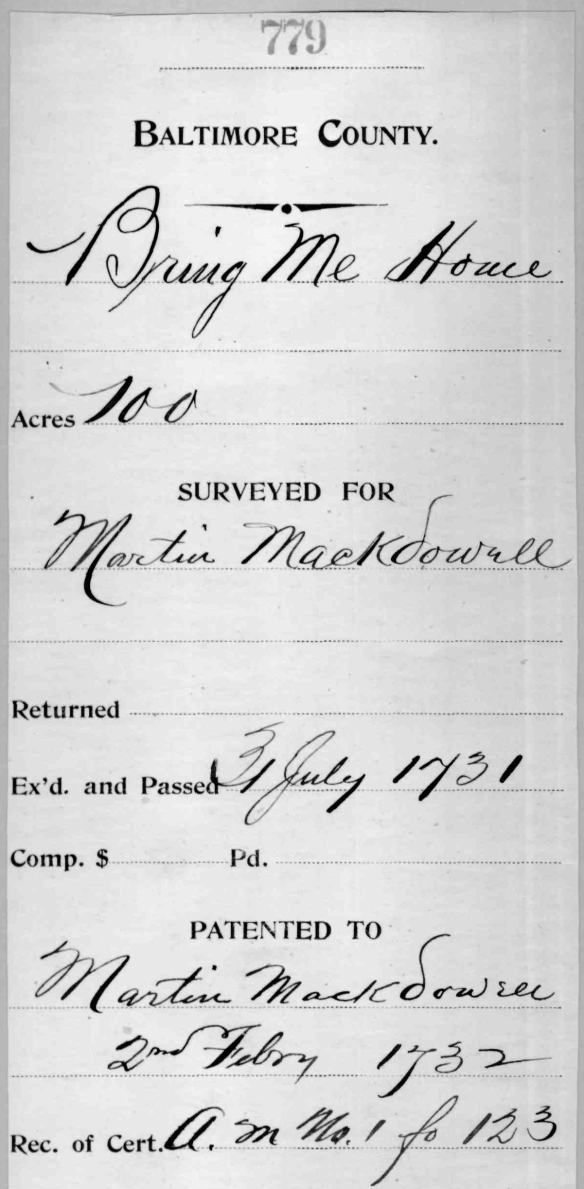
Clearly the index and the actual name are different.  Martin, above, and Murtue below, probably spelled the way it sounded when Murtough pronounced his name.

Murtue acquired Bring Me Home in 1732, but it was surveyed on June 23, 1730. The 100 acres was in Prince George County “on the western shore of this province” at the head of a small branch which ?? into a run called the North Run.

Prince George County was formed in 1696 and formed the entire western portion of the state, but has been since subdivided.  I was unable to find a watercourse called North Run.

Adding to the confusion, the Maryland Archives Patent Index shows that Bring Me Home is now in Harford County, Maryland.

Harford County was formed 1774, so may well have been part of Prince George’s in the 1730s. I clearly have not attempted to run this deed forward to current in Prince George’s and subsequently Harford County, but if this can be done – it might tell us more specifically where Murtough’s land was located.  Given that Pleasant Green was his first patent, and he appeared to still own it at his death, I suspect that he actually lived at Pleasant Green.  He would also have selected the names of his land.  Perhaps Pleasant Green and Bring Me Home reminded him of Ireland.

Land Sales

340 – September 9, 1752 Michael McDowell of Halifax Co., VA to Joseph Murray Jr. of Baltimore Co., MD 100 acres. Signed Michael McDowell – witnesses Richard Hooker, Thomas Hooker.

Sept .19, 1752 – Michael McDowell of Halifax Co., VA power of attorney to John Hawkins. Signed Michael McDowell wit Richard Hooker and Thomas Hooker.

The last mention of Michael McDowell is in September of 1768 when Dr. William and Mary Lyon of Baltimore sell to Charles Motherby 100 acres and 15 acres head of the North Run of Jones Falls purchased on September 19, 1752 from Michael McDowell, planter, of Halifax County, Virginia.

However, this 1768 transaction is confusing, because the September 1752 deed which we have is for Bring Me Home, not for Pleasant Green.

It appears that Murtough owned three tracts of land, although I don’t find any record of a patent for the land sold to Gist.

Land Location Survey Patent Sell Buyer
North side Patapsco – 100 acres 1730 Richard Gist
Pleasant Green – 100 acres – North Run Jones Falls July 4, 1722 May 20, 1724 September 19, 1752 by Michael McDowell of Halifax Co., VA William and Mary Lyon
Bring Me Home – 100 acres – Prince George County June 23, 1730

July 31, 1731

Feb. 2, 1732 Sept. 19, 1752 by Michael McDowell or Halifax Co., VA POA John Hawkins, sale to Joseph Murrey

The only other mention of Murtough in the documents for Baltimore County is a reference to “153:93 Debt book for 1750 also in Calvery papers,” which I was unable to find. There is also a reference to Murto McDuall 280 which I suspect may be the page number in the Calvery papers.

Michael is the only known child of Murtough, although clearly, he probably wasn’t the only child.

It’s Murtough’s DNA, through his descendant, that led us back to Ireland, and in particular to Kingsmoss Road.

Murtough’s DNA

Murtough’s grandson, also named Michael, served in the Revolutionary War and died an old man in Claiborne County, Tennessee in 1840. It had been a long way from Ireland to Tennessee – two generations, three wars and 120 years.

The Scots who became Irish and then Scots-Irish in America had spent generations fighting, so warfare was nothing new.

Michael Jr., Murtough’s grandson, born about 1747, never knew his grandfather, but I’d wager that he heard stories of Ireland. We don’t know if Michael’s father, Michael, was born in Ireland or the colonies.

Unfortunately, we really don’t know why Murtough left Ireland about 1720. I wonder if Michael knew. Perhaps the history of that region in Ireland will shed light on the question.

Michael Jr.’s great-great-grandson, Lewis, some 164 years after Michael’s 1840 death would take a Y DNA test that would connect Michael and Murtough back to a McDowell family in Ireland. Michael’s great-great-grandson matched another McDowell man whose McDowell grandfather was born in Kingsmoss, County Antrim, about 12 miles northwest of Belfast, in what is today Northern Ireland.

Given that we’ve lost our Murtough McDowell line in paper records, it was time to do the genealogy of Lewis’s match to see if we can connect.

Lewis’s Match

Fortunately, Lewis’s match’s father was born in Ireland, at Kingsmoss in either 1907 or 1908. The family and church records disagree by a year, but the date and parents are the same.

Lewis’s match was able to give us his parent’s and grandparent’s information, but for the rest, I engaged the services of Martin McDowell, a very nice gentleman, who, ironically, lives very close to Kingsmoss Road today, although his ancestors were in Antrim in the late 1700s. However, his Y DNA proves that his mcDowell line and the Kingsmoss line are not one and the same. I just knew we had to be related, somehow, and needless to say, I was disappointed

Martin was able to document the matches’ line back through two James, the oldest of which was a laborer with no further details. The oldest James would have had to have been born before 1835.

The son, James (Jr.), was born about 1855 in County Antrim and was a railroadman, living in Ballyrobert in 1876 when he was married in the May Street Presbyterian Church in Belfast, built in 1829, long after Murtough left. They lived in Kingsmoss from about 1890. James Jr. died in Carnmoney in 1935 and his wife, Sarah, died at Kingsmoss in 1909.

James Jr.’s siblings were born in Ballycraigy, Ballyhenry and Kingsbog, another name for Kingsmoss. These people were baptized or married in Carnmoney Presbyterian Church and St. Anne’s Church in Belfast, which had not yet been built when Murtough lived in Ireland.

Many of James Jr.’s siblings are buried in the Mallusk Cemetery, but we have no recorded burials prior to that time. It’s likely that earlier burials took place at either Carnmoney or Mallusk.

James Jr.’s son, Samuel James was born in Ballycraigy in 1877, married in the Carnmoney Presbyterian Church in 1897 and lived in Kingsmoss, his children all being born there between 1898 and 1909.

His son, Samuel is the father of the tester who matches Lewis McDowell.

Unfortunately, with the records destruction in Ireland, Martin wasn’t able to go back further. He checked the church records in surrounding areas as well as civil registrations, which began in 1864, wills and other documents – all to no avail.

Martin did find that an Andrew McDowell lived in Carnmoney in the late 1700s, but was unable to connect him forward or backward

in time.

Even though we don’t know exactly where Murtough was from, we can map the various locations mentioned in the records, shown on the map below which covers about 2 miles by 2 miles. This entire driving route is only 13 miles.

Let’s visit some of these locations and see what we can fin!

Carnmoney

Carnmoney, from the ancient Irish word Carn Monaidh, meaning “cairn on the bog,” is the closest Protestant church to Kingsmoss and was established as a meeting house in 1622 at the site of a holy well, St. Brigit’s, still visible at the rear of the contemporary church. You can see a photo of the well in this article.

An earlier Carnmoney Presbyterian Church, one of the oldest Presbyterian churches in Ireland, dates from 1657 but has since been replaced by a new church. The old church was reported to have been built on the foundation of an original church dating from the time of St. Patrick’s arrival in Ireland.

The original church was built near Carnmoney Hill, where local rumors of an ancient cemetery on the hillside persist and where Celtic festivals and fairs were once held on the summit.

The old church was located in the center of the current graveyard, where newer graves clearly delineate the former location of the church.

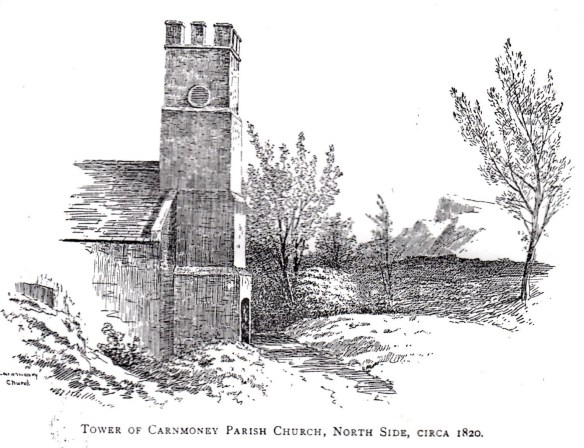
You can read more about the old church and the history of the region when it was established in this article, from which we discover the following information about the  church as it was in Murtough’s time:

The inside of the church was as plain and bare as the outside. There were six square pews on the south side with the “three decker,” and seven on the north side. The pulpit had no canopy, nor was there any stove, so that on a cold Sunday the few attenders often adjourned to the surrounding glebe where prayers were said around the drawing-room fire. The windows were wide and slightly pointed, with plain wooden sash frames, the east one being similar, with the communion table below it. A pathway led to the church door from the old road on the north side. The existing road along the south side is more modern. The only fragment of the old church that I know of is the circular stone window-casing from the tower, which is now built over a well on the glebe avenue.

This was probably the church where Murtough attended, the pews where he sat and the doorway in the tower where he entered. His feet probably helped to wear the entry stone smooth, over time, and Murtough’s prayers were offered from inside this humble church, surrounded by the graves of his ancestors. Did they speak to him, encouraging him to migrated, as they once had?  To dream, to take what he had and board a ship for a journey to the new colonies where he would have the opportunity to own land? Was Murtough married here in this church? Did he bury his parents in the cemetery before he left, someplace close to his grandparents perhaps? Did Murtough bury children here, or a wife perhaps?

The old road mentioned is the Old Irish Highway running from Carrick to Antrim, now the O’Neill Road. Parts of the old road are reportedly still visible in places running alongside the O’Neill road, now B513, visible below.

From Carnmoney Hill, still covered woodlands, one can clearly see Belfast, and on a clear day, the western coast of Scotland is within view.

I wonder if the Scots who resettled here climbed the hill from time to time to view their ancient homeland and longingly reflect on those left behind.

Come along on a lovely walk on Carnmoney Hill in this YouTube video.

Protestants and Catholics

We do know one other piece of important information and that is that the McDowell family is protestant, not Catholic. As Louis’s match said, that’s very important in Northern Ireland. The records bear this out – meaning both the importance of religion in Ireland, then and now, and that fact that the McDowell family was Protestant.

This confirmation would suggest strongly, along with the surname and the Irish location, that the McDowell family was one of the Protestant families seated in Ireland from Scotland during the Ulster Plantation era wherein the English confiscated the Irish lands and redistributed them to English nobles known as “undertakers” in parcels of about 3000 acres each. These undertakers were then obligated to “seat” at least 20 Protestant English-speaking families (48 adult males) on their land.

County Antrim was one of two unofficially seated counties where Presbyterian lowland Scots began settling in 1606. In 1607 Sir Randall MacDonnell settled 300 Presbyterian Scots families on his land in Antrim.

By 1622, there were 4000 adult Scottish males living in County Antrim and County Down. The poster below, found at the North of Ireland Family History Society includes the McDowell surname.

However, the displaced Irish were not happy having their land confiscated and being  evicted, and Civil War was on the horizon.

After 1630, Scottish migration to Ireland waned for a decade. In the 1630s, Presbyterians in Scotland staged a rebellion against Charles I for trying to impose Anglicanism. The same was attempted in Ireland, where most Scots colonists were Presbyterian and a large number returned to Scotland as a result.

Civil war raged until after 1650 when the area was once again brought under English control. At that point, Scottish immigration from the southwest of Scotland to Ireland resumed, along with some immigrants from the Border Reiver region of Scotland along the English border.

Another wave of Scottish immigration to Ulster took place in the 1690s, when tens of thousands of Scots fled a famine (1696–1698) in the border region of Scotland. It was at this point that Scottish Presbyterians became the majority community in the province. Whereas in the 1660s, they made up some 20% of Ulster’s population (though 60% of its British population) by 1720 they were an absolute majority in Ulster.

Despite the fact that Scottish Presbyterians strongly supported the Williamites in the Williamite war in Ireland in the 1690s, they were excluded from power in the postwar settlement by the Anglican Protestant Ascendancy. During the 18th century, rising Scots resentment over religious, political and economic issues fueled their emigration to the American colonies, beginning in 1717 and continuing up to the 1770s.

The early date would fit nicely with the immigration of Murtough McDowell to Baltimore County and this political unrest may have been his motivation.

Scots-Irish from Ulster and Scotland, along with British from the border region comprised the most numerous group of immigrants from Great Britain and Ireland to the colonies in the years before the American Revolution. An estimated 150,000 left northern Ireland. They settled first mostly in Pennsylvania and western Virginia and  from there moving southwest into the backcountry of upland territories in the South and the Appalachian Mountains.  

Belfast

I couldn’t wait to visit Murtough’s homeland. My friend, Maurice Gleeson was kind enough to arrange this trip as well as drive. Martin McDowell accompanied us, as did Michelle Leonard who discovered that her ancestor lived down the road a few miles, in Templepatrick along the Old Irish Highway. Are we perchance related too?

We had a brilliant day, as the Irish would say, even though the weather was a bit drizzly. First stop – a visit to the cat gardens at Belfast Castle, built in 1862. Yes, cat gardens!

If it was before, it’s no secret now that I’m a cat lover! So you’ll just have to excuse this distraction.  SQUIRREL…no, wait…CAT!!!
Murtough would never have seen this castle, of course, because wasn’t built for another 140 years after he left, but the view over the bay from the castle grounds would have been stunning then as now.

Michelle and I had a great time searching for all of the cats in the garden, and I suspect we missed a few.

There are actually two cats in the above photo, one sitting in the yard and one directly behind in the rock wall – a memorial to a beloved cat gone on to the great catnip field in the sky.

We found one last cat from inside the castle, looking down at the back garden from the wedding venue.  The bride descends the spiral staircase into the piazza, but the cat sleeping between the hedges directly in front of the stairs never wakes up. Being a cat, if it did wake up, it would look at the bride disdainfully for interrupting it’s nap.

What a fun diversion on the way to find Murtough! Next, we’re on to Carrickfergus Castle where we had lunch in the restaurant across the quay from the castle.

Carrickfergus castle would have been known by Murtough, as the old Irish Highway went from here to Antrim, right past where the McDowell family lived.

Carrickfergus castle is massive and guards the entrance to Belfast, originally surrounded on three sides by water.

Carrickfergus Castle is about 900 years old. I wonder if Murtough was ever inside this castle? It’s hard to imagine that Murtough went from a place with a building like this to a frontier with Indians still inhabiting the region and no stone buildings at all.

The side of the castle, shown above, behind me, is much longer than the width.

A building depicted to show what life was like in medieval Belfast. Whatever you do, don’t walk under the windows!

We visited yet a third castle, briefly, later in the day – or maybe I should say we visited behind a castle.

Behind Castle Upton in Templepatrick, we visited the Templeton graveyard and  mausoleum that would have been a dynamite set for a Halloween movie.

It’s down a one lane, lonely, dark, winding road. Why, they would never find a body here!
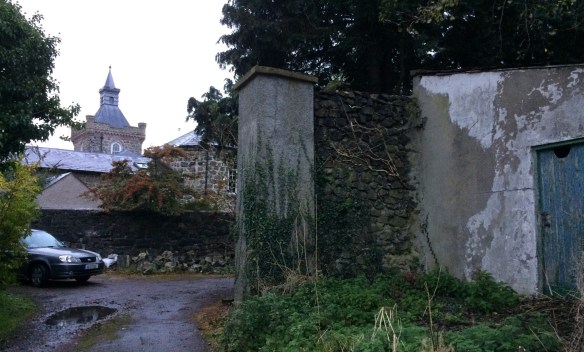
There is also no place to turn around – you’re trapped at the end, so we parked and walked. We should have told ghost stories on the way.

Michelle’s ancestors are probably buried here.
I love these ancient vines and moss covered walls.

At the end of the walled tunnel of trees, we find the cemetery gate.
The entrance to the cemetery is gated, but virtually no one visits. I kept half-expecting Dracula to jump out and chase us!

If you slip down this long dark tunneled road behind this ancient castle and murder someone back here in ye olde graveyard, and burn the body, don’t even think about putting the hot ashes in here!!! OK?

Now that we’re done with Halloween’s fright night in this beautiful old walled cemetery, on to Kingsmoss. Yes, finally!

Visiting Kingsmoss

In the records, this location wasn’t called Kingsmoss Road, just Kingsmoss as a location. Today, it’s Kingsmoss Road.

Kingsmoss Road isn’t very long, which means that if the Murtough McDowell family originated here, we know within a mile or so where they lived.

Kingsmoss Road is less than a mile in length.

Unless our common ancestor is further back in time and therefore migrated to a different part of Ireland, or remained in Scotland, Murtough was likely from someplace in this region where his family would have been “seated.”

Martin indicated that back in the 1970s, the houses on this road today didn’t exist. Instead, the original old cottages were still in place. In Ireland, you can’t build a new house anyplace you want – even if you own the land. You are required to build on an old foundation. The only exception is if you build a house on your property for a relative, like a child – and they must live there for at least some amount of time before it can be sold.

This means that the houses then were likely in the same locations as the ones today, minus a few that have simply been torn down. This house was built on the curve in the road.

This old wall at Sallybush Road where it intersects with Kingsmoss Road may have existed in the time that Murtough would have lived here.

This bridge may have existed in some format then as well. Of course, there’s a cluster of houses by the bridge, because a stream means fresh water.

We drove down the road until we found what looked to be an original farmhouse, although clearly not as old as the homes from the early 1700s. Martin indicated that farm homes at that time were probably mud huts.

Regardless of the house, the view of the mountains wouldn’t have changed.

This is clearly a rural farming area, even today, although some people do now commute the dozen miles to Belfast.  In the past, Belfast was too far to go for a job.

We saw a few fences and gates constructed from old wagon or cart wheels.

Still a working farm today. Martin said the original farms would have been quite small – smaller than those today.

This oh-so-cute goat thought we were bringing food, at least that’s what we thought he was saying!

The Orange Hall

Moving up the road less than a mile to Ballyrobert, we discovered the Orange Hall. In fact, we saw several Orange Halls in this region.

The Orange Order is a Protestant fraternal organization found primarily in Northern Ireland and the Scottish lowlands.

The Orange Institution commemorates the civil and religious privileges conferred on Protestants by William of Orange, the Dutch prince who became King of England, Scotland, and Ireland in the Glorious Revolution of 1688. In particular, the Institution remembers the victories of William III and his forces in Ireland in the early 1690s, especially the Battle of the Boyne, an event in Ireland that Murtough or his parents surely remembered. The battle occurred about 80 miles south of the Kingsmoss area.

In 1689 during the Williamite War in Ireland, County Antrim was a centre of Protestant resistance against the rule of the Catholic James II. During the developing crisis James’ garrison at Carrickfergus successfully repulsed an attempt by local Protestants to storm it. So, perhaps Murtough or his parents did know Carrickfergus Castle, but not quite in the way I might have thought.

County Antrim is heavily Protestant and it’s here that the 1798 Irish Rebellion was at its strongest with orangemen recruited from the yeomanry.

Mallusk Cemetery

We know that several McDowell family members are buried in the Mallusk Cemetery, but we don’t know the age of the cemetery. The church built in the 14th or 15th century fell into disuse when King Henry dissolved the monasteries and no longer remains. Certainly there would be burials from this timeframe, because the land around the church would have been consecrated, and the cemetery has probably been in use one way or another ever since.

If Murtough’s parents and ancestors did indeed live in this region, it’s very likely that some could be buried in the many unmarked graves.

The cemetery isn’t far from the Kingsmoss area. The entire mapped area is about two and a half miles by two and a half miles.

The day was ending as we visited.
The older section is towards the rear.

Many areas have small fences, probably designating family plots, but few of the old graves have stones. At that time, everyone knew who was buried where, so stones were unnecessary – as well as expensive.

The ground is very uneven, probably indicating unmarked graves, along with the roots of trees grown thick over the years.

The stones that do exist are arranged in a haphazzard way.

Probably a stone for an unmarked grave – like so many in Appalachia.

The crows supervised our visit.

Did I just visit the graves of my ancestors?

The Garden Center

We took the opportunity to stop at a garden center on Ballyrobert Road which has reeds and a spiral pathway sculpted into a field. I couldn’t resist after discovering this phenomenon using Google maps, because I have a labyrinth in my own yard at home.

Visitors can pay to walk the gardens during the summer. The garden center was closed, but a kind-hearted soul let us take a peek.

You can’t tell in the photo above, but we are standing at the entrance to the spiral, the reeds in front of us forming the dark area on the aerial view.

However, on this particular day, we discovered why this area is also called Kingsbog – because it is – literally.

Water squishes up from the ground wherever you walk. Can you see it, reflecting, above? We had not had heavy rains. This is just the nature of the land here. The people “seated” here certainly didn’t receive prime farmland. It’s like the water table is above the ground, or even with the ground, rising and retreating at will just at ground level.

A beautiful grove of trees on a slightly higher area.

Before Ireland

Before the McDowells settled in Ireland, they lived in Scotland and were a Scottish clan.

The name Macdowall is from the district of Galloway, shown on the map below, which itself was named after the Galli or Gaelic settlers of the seventh and eighth centuries.

Galloway is quite close to Ireland, about 20 miles by water and is the area that could be seen from Cornmoney Hill.

The surname Macdowall and its variations are Anglicised forms of the Gaelic Mac Dubhghaill, meaning “son of Dubhghall”. The Gaelic personal name Dubhghall means “dark stranger”.

Today, the Irish pronounce the same like “McDuel,” except with an Irish brogue thrown in.

We know that our McDowell line does not match another McDowell line. Both may have originated in the same place and belonged to the same clan, but the male progenitors are not the same person.

The history of the McDowell Clan indicates that the lesser status McDowells were among those recruited by the English for the Irish plantations, and many moved.

Irony

There is somehow a great irony that we know so little about Murtough’s life, but his DNA, passed to his descendants, was the light that guided us home.

I’m sure that when Murtough departed Ireland, probably right behind Carrickfergus Castle in Belfast Lough, for Baltimore County, he never dreamed that eight generations and almost 300 years later, his descendant would fly in a big silver bird back to Ireland in less than a day – a crossing that would have taken him weeks, to stand here, on the boggy land that he left, with the cold Irish bog water squishing up between her toes.

We have come full circle and found our way home through an unmarked labyrinth of time, thanks to Murtough’s DNA. Our Holy Grail.

Murtough, go raibh maith agat as na mbronntanas. (Thank you for the gift, in Gaelic.)

My labyrinth.

______________________________________________________________

Disclosure

I receive a small contribution when you click on some of the links to vendors in my articles. This does NOT increase the price you pay but helps me to keep the lights on and this informational blog free for everyone. Please click on the links in the articles or to the vendors below if you are purchasing products or DNA testing.

Thank you so much.

DNA Purchases and Free Transfers

Genealogy Services

Genealogy Research

Native American DNA Resources

Spokane and Flathead men circa 1904

I receive lots of questions every day about testing for Native American DNA, ethnicity, heritage and people who want to find their tribe.

I’ve answered many questions in articles, and I’ve assembled those articles into this handy-dandy one-stop reference about Native American DNA testing.

Where to Start?

If you are searching for your Native American heritage or your tribe, first, read these two articles:

Father’s and Mother’s Direct Lines

Y DNA is inherited by men from their direct paternal line, and mitochondrial DNA is inherited by both genders from their mother’s direct matrilineal line. You can read a short article about how this works, here.

If you’re interested in checking a comprehensive list to see if your mitochondrial DNA haplogroup is Native American, I maintain this page of all known Native American haplogroups:

Information about Native American Y DNA, subsets of haplogroup Q and C:

How Much Native Do You Have?

Estimating how much of your Native ancestor’s DNA you carry today:

Projects – Joining Forces to Work Together

Native American DNA Projects you can join at Family Tree DNA:

Regardless of which other projects you choose to join, I recommend joining the American Indian project by clicking on the Project button on the upper left hand side of your personal page.

News and How To

Some articles are more newsy or include how-to information:

Utilizing Haplogroup Origins and Ancestral Origins at Family Tree DNA:

I’ve written about several individual Native haplogroups and research results. You can see all of articles pertaining to Native American heritage by entering the word “Native” into the search box on the upper right hand corner of my blog at www.dna-explained.com.

Ancient Native Remains

Which Tests?

Family Tree DNA is the only vendor offering comprehensive Y and mitochondrial DNA testing, meaning beyond basic haplogroup identification. However, there are several levels to select from. Several vendors offer autosomal testing, which includes ethnicity estimates.

These articles compare the various types of tests and the vendors offering the tests:

Additional Resources

My blog, Native Heritage Project is fully searchable:

For other DNA related questions, please check the Help page, here.

______________________________________________________________

Disclosure

I receive a small contribution when you click on some of the links to vendors in my articles. This does NOT increase the price you pay but helps me to keep the lights on and this informational blog free for everyone. Please click on the links in the articles or to the vendors below if you are purchasing products or DNA testing.

Thank you so much.

DNA Purchases and Free Transfers

Genealogy Services

Genealogy Research