Longobards Ancient DNA from Pannonia and Italy – What Does Their DNA Tell Us? Are You Related?

The Longobards, Lombards, also known as the Long-beards – who were they? Where did they come from? And when?

Perhaps more important – are you related to these ancient people?

In the paper, Understanding 6th-century barbarian social organizatoin and migration through paleogenomics, by Amorim et al, the authors tell us in the abstract:

Despite centuries of research, much about the barbarian migrations that took place between the fourth and sixth centuries in Europe remains hotly debated. To better understand this key era that marks the dawn of modern European societies, we obtained ancient genomic DNA from 63 samples from two cemeteries (from Hungary and Northern Italy) that have been previously associated with the Longobards, a barbarian people that ruled large parts of Italy for over 200 years after invading from Pannonia in 568 CE. Our dense cemetery-based sampling revealed that each cemetery was primarily organized around one large pedigree, suggesting that biological relationships played an important role in these early medieval societies. Moreover, we identified genetic structure in each cemetery involving at least two groups with different ancestry that were very distinct in terms of their funerary customs. Finally, our data are consistent with the proposed long-distance migration from Pannonia to Northern Italy.

Both the Germans and French have descriptions of this time of upheaval in their history. Völkerwanderung in German and Les invasions barbares in French refer to the various waves of invasions by Goths, Franks, Anglo-Saxons, Vandals, and Huns. All of these groups left a genetic imprint, a story told without admixture by their Y and mitochondrial DNA.
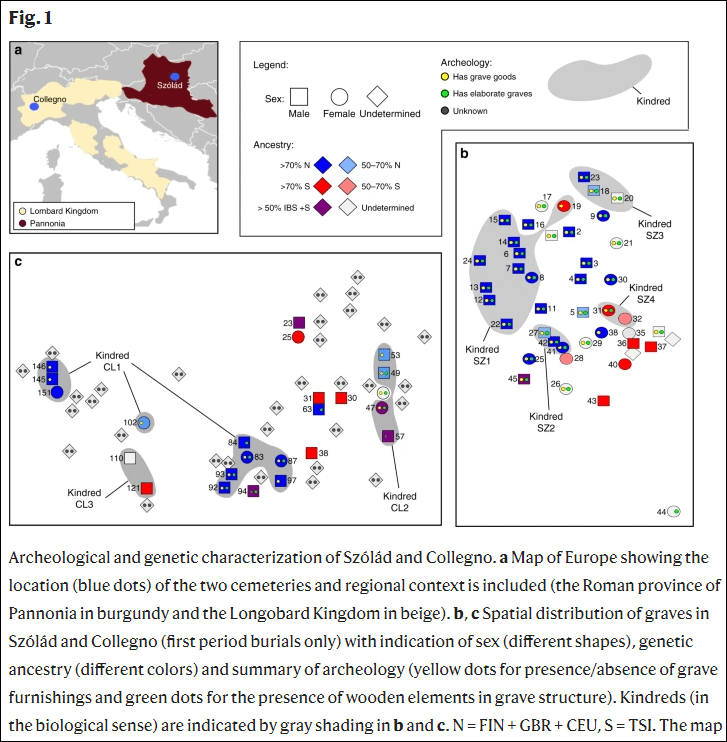
click to enlarge

The authors provide this map of Pannonia, the Longobards kingdom, and the two cemeteries with burial locations.

One of their findings is that the burials are organized around biological kinship. Perhaps they weren’t so terribly different from us today.

Much as genealogists do, the authors created a pedigree chart – the only difference being that their chart is genetically constructed and lacks names, other than sample ID.

One man is buried with a horse, and one of his relatives, a female, is not buried in a family unit but in a half-ring of female graves.

The data suggests that the cemetery in Pannonia, Szolad, shown in burgundy on the map, may have been a “single-generation” cemetery, in use for only a limited time as the migration continued westward. Collegno, in contrast, seems to have been used for multiple generations, with the burials radiating outward over time from the progenitor individual.

Because the entire cemetery was analyzed, it’s possible to identify those individuals with northern or northeastern European ancestry, east of the Rhine and north of the Danube, and to differentiate from southern European ancestry in the Lombard cemetery – in addition to reassembling their family pedigrees. The story is told, not just by one individual’s DNA, but how the group is related to each other, and their individual and group origins.

For anyone with roots in Germany, Hungary, or the eastern portion of Europe, you know that this region has been embroiled in upheaval and warfare seemingly as long as there have been people to fight over who lived in and controlled these lands.

Are You Related?

Goran Runfeldt’s R&D group at Family Tree DNA reanalyzed the Y DNA samples from this paper and has been kind enough to provide a summary of the results. Michael Sager has utilized them to branch the Y DNA tree – in a dozen places.

Mitochondrial DNA haplogroups have been included where available from the authors, but have not been reanalyzed.

Note the comments added by FTDNA during analysis.

Many new branches were formed. I included step-by-step instructions, here, so you can see if your Y DNA results match either the new branch or any of these samples upstream.

If you’re a male and you haven’t yet tested your Y DNA or you would like to upgrade to the Big Y-700 to obtain your most detailed haplogroup, you can do either by clicking here. My husband’s family is from Hungary and I just upgraded his Y DNA test to the Big Y-700. I want to know where his ancestors came from.

And yes, this first sample really is rare haplogroup T. Each sample is linked to the Family Tree DNA public tree. We find haplogroups G and E as well as the more common R and I. Some ancient samples match contemporary testers from France (2), the UK, England, Morocco, Denmark (5), and Italy. Fascinating!

Sample: CL23
Location: Collegno, Piedmont, Italy
Age: Longobard 6th Century
Y-DNA: T-BY45363
mtDNA: H

Sample: CL30
Location: Collegno, Piedmont, Italy
Age: Longobard 6th Century
Y-DNA: R-P312
mtDNA: I1b

Sample: CL31
Location: Collegno, Piedmont, Italy
Age: Longobard 6th Century
Y-DNA: G-FGC693
FTDNA Comment: Authors warn of possible contamination. Y chromosome looks good – and there is support for splitting this branch. However, because of the contamination warning – we will not act on this split until more data is available.
mtDNA: H18

Sample: CL38
Location: Collegno, Piedmont, Italy
Age: Longobard 6th Century
Y-DNA: E-BY3880
mtDNA: X2

Sample: CL49
Location: Collegno, Piedmont, Italy
Age: Longobard 6th Century
Y-DNA: R-CTS6889

Sample: CL53
Location: Collegno, Piedmont, Italy
Age: Longobard 6th Century
Y-DNA: R-FGC24138
mtDNA: H11a

Sample: CL57
Location: Collegno, Piedmont, Italy
Age: Longobard 6th Century
Y-DNA: R-BY48364
mtDNA: H24a

Sample: CL63
Location: Collegno, Piedmont, Italy
Age: Longobard 6th Century
Y-DNA: I-FT104588
mtDNA: H

Sample: CL84
Location: Collegno, Piedmont, Italy
Age: Longobard 6th Century
Y-DNA: R-U198
mtDNA: H1t

Sample: CL92
Location: Collegno, Piedmont, Italy
Age: Longobard 6th Century
Y-DNA: R-S22519
mtDNA: H

Sample: CL93
Location: Collegno, Piedmont, Italy
Age: Longobard 6th Century
Y-DNA: R-S22519
mtDNA: J2b1a

Sample: CL94
Location: Collegno, Piedmont, Italy
Age: Longobard 6th Century
Y-DNA: R-DF99
mtDNA: K1c1

Sample: CL97
Location: Collegno, Piedmont, Italy
Age: Longobard 6th Century
Y-DNA: R-L23

Sample: CL110
Location: Collegno, Piedmont, Italy
Age: Longobard 6th Century
Y-DNA: R-L754

Sample: CL121
Location: Collegno, Piedmont, Italy
Age: Longobard 6th Century
Y-DNA: R-BY70163
FTDNA Comment: Shares 2 SNPs with a man from France. Forms a new branch down of R-BY70163 (Z2103). New branch = R-BY197053
mtDNA: T2b

Sample: CL145
Location: Collegno, Piedmont, Italy
Age: Longobard 6th Century
Y-DNA: R-S22519
mtDNA: T2b

Sample: CL146
Location: Collegno, Piedmont, Italy
Age: Longobard 6th Century
Y-DNA: R-A8472
mtDNA: T2b3

Sample: SZ1
Location: Szólád, Somogy County, Hungary
Study Information: The skeletal remains from an individual dating to the Bronze Age 10 m north of the cemetery.
Age: Bronze Age
Y-DNA: R-Y20746
mtDNA: J1b

Sample: SZ2
Location: Szólád, Somogy County, Hungary
Age: Longobard 6th Century
Y-DNA: R-Z338
FTDNA Comment: Shares 5 SNPs with a man from the UK. Forms a new branch down of R-Z338 (U106). New branch = R-BY176786
mtDNA: T1a1

Sample: SZ3
Location: Szólád, Somogy County, Hungary
Age: Longobard 6th Century
Y-DNA: I-BY3605
mtDNA: H18

Sample: SZ4
Location: Szólád, Somogy County, Hungary
Age: Longobard 6th Century
Y-DNA: R-ZP200
FTDNA Comment: Splits R-ZP200 (U106). Derived (positive) for 2 SNPs and ancestral (negative) for 19 SNPs. New path = R-Y98441>R-ZP200
mtDNA: H1c9

Sample: SZ5
Location: Szólád, Somogy County, Hungary
Age: Longobard 6th Century
Y-DNA: R-BY3194
FTDNA Comment: Splits R-BY3194 (DF27). Derived for 19 SNPs, ancestral for 9 SNPs. New path = R-BY3195>R-BY3194
mtDNA: J2b1

Sample: SZ6
Location: Szólád, Somogy County, Hungary
Age: Longobard 6th Century
Y-DNA: I-P214

Sample: SZ7
Location: Szólád, Somogy County, Hungary
Age: Longobard 6th Century
Y-DNA: I-S8104
FTDNA Comment: SZ13, SZ7 and SZ12 share 2 SNPs with a man from Denmark, forming a branch down of I-S8104 (M223). New branch = I-FT45324. Note that SZ22 and SZ24 (and even SZ14) fall on the same path to I-S8104 but lack coverage for intermediate branches.
mtDNA: T2e

Sample: SZ11
Location: Szólád, Somogy County, Hungary
Age: Longobard 6th Century
Y-DNA: R-FGC13492
FTDNA Comment: Shares 1 SNP with a man from Italy. Forms a new branch down of R-FGC13492 (U106). New branch = R-BY138397
mtDNA: K2a3a

Sample: SZ12
Location: Szólád, Somogy County, Hungary
Age: Longobard 6th Century
Y-DNA: I-S8104
FTDNA Comment: SZ13, SZ7 and SZ12 share 2 SNPs with a man from Denmark, forming a branch down of I-S8104 (M223). New branch = I-FT45324. Note that SZ22 and SZ24 (and even SZ14) fall on the same path to I-S8104 but lack coverage for intermediate branches.
mtDNA: W6

Sample: SZ13
Location: Szólád, Somogy County, Hungary
Age: Longobard 6th Century 422-541 cal CE
Y-DNA: I-S8104
FTDNA Comment: SZ13, SZ7 and SZ12 share 2 SNPs with a man from Denmark, forming a branch down of I-S8104 (M223). New branch = I-FT45324. Note that SZ22 and SZ24 (and even SZ14) fall on the same path to I-S8104 but lack coverage for intermediate branches.
mtDNA: N1b1b1

Sample: SZ14
Location: Szólád, Somogy County, Hungary
Age: Longobard 6th Century
Y-DNA: I-CTS616
FTDNA Comment: SZ13, SZ7 and SZ12 share 2 SNPs with a man from Denmark, forming a branch down of I-S8104 (M223). New branch = I-FT45324. Note that SZ22 and SZ24 (and even SZ14) fall on the same path to I-S8104 but lack coverage for intermediate branches.
mtDNA: I3

Sample: SZ15
Location: Szólád, Somogy County, Hungary
Age: Longobard 6th Century
Y-DNA: R-YP986
mtDNA: H1c1

Sample: SZ16
Location: Szólád, Somogy County, Hungary
Age: Longobard 6th Century
Y-DNA: R-U106
mtDNA: U4b1b

Sample: SZ18
Location: Szólád, Somogy County, Hungary
Age: Longobard 6th Century
Y-DNA: E-BY6865
FTDNA Comment: Shares 1 SNP with a man from Morocco. Forms a new branch down of E-BY6865. New branch = E-FT198679
mtDNA: H13a1a2

Sample: SZ22
Location: Szólád, Somogy County, Hungary
Age: Longobard 6th Century
Y-DNA: I-Y6876
FTDNA Comment: SZ13, SZ7 and SZ12 share 2 SNPs with a man from Denmark, forming a branch down of I-S8104 (M223). New branch = I-FT45324. Note that SZ22 and SZ24 (and even SZ14) fall on the same path to I-S8104 but lack coverage for intermediate branches.
mtDNA: N1b1b1

Sample: SZ23
Location: Szólád, Somogy County, Hungary
Age: Longobard 6th Century
Y-DNA: R-S10271
mtDNA: H13a1a2

Sample: SZ24
Location: Szólád, Somogy County, Hungary
Age: Longobard 6th Century
Y-DNA: I-ZS3
FTDNA Comment: SZ13, SZ7 and SZ12 share 2 SNPs with a man from Denmark, forming a branch down of I-S8104 (M223). New branch = I-FT45324. Note that SZ22 and SZ24 (and even SZ14) fall on the same path to I-S8104 but lack coverage for intermediate branches.
mtDNA: U4b

Sample: SZ27B
Location: Szólád, Somogy County, Hungary
Age: Longobard 6th Century 412-538 cal CE
Y-DNA: R-FGC4166
FTDNA Comment: Shares 1 SNP with a man from France. Forms a new branch down of R-FGC4166 (U152). New branch = R-FT190624
mtDNA: N1a1a1a1

Sample: SZ36
Location: Szólád, Somogy County, Hungary
Age: Longobard 6th Century
Y-DNA: T-Y15712
mtDNA: U4c2a

Sample: SZ37
Location: Szólád, Somogy County, Hungary
Age: Longobard 6th Century 430-577 cal CE
Y-DNA: R-P312
mtDNA: H66a

Sample: SZ42
Location: Szólád, Somogy County, Hungary
Age: Longobard 6th Century
Y-DNA: R-P312
mtDNA: K2a6

Sample: SZ43
Location: Szólád, Somogy County, Hungary
Age: Longobard 6th Century 435-604 cal CE
Y-DNA: I-BY138
mtDNA: H1e

Sample: SZ45
Location: Szólád, Somogy County, Hungary
Study Information: ADMIXTURE analysis showed SZ45 to possess a unique ancestry profile.
Age: Longobard 6th Century
Y-DNA: I-FGC21819
FTDNA Comment: Shares 2 SNPs with a man from England forms a new branch down of FGC21819. New branch = I-FGC21810
mtDNA: J1c

_____________________________________________________________

Disclosure

I receive a small contribution when you click on some of the links to vendors in my articles. This does NOT increase the price you pay but helps me to keep the lights on and this informational blog free for everyone. Please click on the links in the articles or to the vendors below if you are purchasing products or DNA testing.

Thank you so much.

DNA Purchases and Free Transfers

Genealogy Products and Services

Genealogy Research

Mitochondrial DNA Facebook Group Launches

Mitochondrial DNA has so much untapped potential!

Until now, there hasn’t been an online resource where one could go to find information about and specifically discuss mitochondrial DNA. Even more distressing, in many groups, when the topic of mitochondrial DNA arises, misinformation abounds, discouraging would-be testers.

New Group!

I’m very pleased to announce the new Facebook group, Mitochondrial DNA, here, founded by the National Geographic Society Genographic Project’s lead scientist, Dr. Miguel Vilar. As you know, the Genographic Project’s public participation phase has ended, but the scientific research for those who opted-in for science continues and Miguel is leading the way.

Miguel shares a lifelong passion for mitochondrial DNA, inherited by both males and females from their direct matrilineal line.

Different colored stars represent different Y DNA lines. Different colored hearts represent different mtDNA lines. The paternal and maternal grandfathers carry the mtDNA of their mothers, not shown here.

Mitochondrial DNA informs you about your mother’s mother’s mother’s line – the pink hearts above – both genealogically and historically. In other words, you can break down brick walls in your genealogy and understand the genesis of your matrilineal line before the advent of surnames. We can better answer the question, “where did I come from,” or more succinctly, where did our mother’s direct line come from.

In addition to Miguel, you’ll find other experts in the group, including members of the Million Mito Project, which I wrote about here.

  • Goran Rundfeldt heads the R&D team at FamilyTreeDNA.
  • Paul Maier is a population geneticist and member of the research team at FamilyTreeDNA. He specialized in toad and frog mtDNA in grad school and is now working on the new mitochondrial tree, for humans 😊, among other projects.
  • I’ve always been very interested in mitochondrial DNA, was a member of the Genographic Project design team and the first Genographic affiliate researcher. You can reference my Mitochondrial DNA resource page, here, which includes articles and step-by-step instructions for how to utilize mtDNA results.

Aside from the Million Mito research team, other Mitochondrial DNA group members with a special interest in mitochondrial DNA include:

As I scan down the list of members, I see several more highly qualified people.

Come On Over

Come on over and take a look for yourself to see what kinds of subjects are being discussed. Browse, ask a question, and contribute.

Send other people who have questions, are seeking advice, or are interested in what mitochondrial DNA can do for them.

Do you have a matrilineal brick wall you’d like to see fall? The first step is to test your mitochondrial DNA, preferably at the full sequence level to obtain as much information as possible. The more people who test, the better our chances of making meaningful connections.

Your mitochondrial DNA is a gift directly from your matrilineal ancestors. See what they have to say!

_____________________________________________________________

Disclosure

I receive a small contribution when you click on some of the links to vendors in my articles. This does NOT increase the price you pay but helps me to keep the lights on and this informational blog free for everyone. Please click on the links in the articles or to the vendors below if you are purchasing products or DNA testing.

Thank you so much.

DNA Purchases and Free Transfers

Genealogy Products and Services

Genealogy Research

Free Y DNA Webinar at Legacy Family Tree Webinars

I just finished recording a new, updated Y DNA webinar, “Wringing Every Drop out of Y DNA” for Legacy Family Tree Webinars and it’s available for viewing now.

This webinar is packed full of information about Y DNA testing. We discuss the difference between STR markers, SNPs and the Big Y test. Of course, the goal is to use these tests in the most advantageous way for genealogy, so I walk you through each step. There’s so much available that sometimes people miss critical pieces!

FamilyTreeDNA provides a wide variety of tools for each tester in addition to advanced matching which combines Y DNA along with the Family Finder autosomal test. Seeing who you match on both tests can help identify your most recent common ancestor! You can order or upgrade to either or both tests, here.

During this 90 minute webinar, I covered several topics.

There’s also a syllabus that includes additional resources.

At the end, I summarized all the information and show you what I’ve done with my own tree, illustrating how useful this type of testing can be, even for women.

No, women can’t test directly, but we can certainly recruit appropriate men for each line or utilize projects to see if our lines have already tested. I provide tips and hints about how to successfully accomplish that too.

Free for a Limited Time

Who doesn’t love FREE???

The “Squeezing Every Drop out of Y DNA” webinar is free to watch right now, and will remain free through Wednesday, October 14, 2020. On the main Legacy Family Tree Webinar page, here, just scroll down to the “Webinar Library – New” area to see everything that’s new and free.

If you’re a Legacy Farmily Tree Webinar member, all webinars are included with your membership, of course. I love the great selection of topics, with more webinars being added by people you know every week. This is the perfect time to sign up, with fall having arrived in all its golden glory and people spending more time at home right now.

More than 4000 viewers have enjoyed this webinar since yesterday, and I think you will too. Let’s hope lots of people order Y DNA tests so everyone has more matches! You just never know who’s going to be the right match to break down those brick walls or extend your line back a few generations or across the pond, perhaps.

You can view this webinar after October 14th as part of a $49.95 annual membership. If you’d like to join, click here and use the discount code ydna10 through October 13th.

_____________________________________________________________

Disclosure

I receive a small contribution when you click on some of the links to vendors in my articles. This does NOT increase the price you pay but helps me to keep the lights on and this informational blog free for everyone. Please click on the links in the articles or to the vendors below if you are purchasing products or DNA testing.

Thank you so much.

DNA Purchases and Free Transfers

Genealogy Products and Services

Genealogy Research

Quick Tip – Trees, Death Dates and Unintentionally “Private” Ancestors

I manage trees for a number of DNA tests for my relatives at various vendors. DNA and trees work hand-in-hand to identify common ancestors, providing hints to direct you along that path.

If you don’t have a tree at the sites that support trees, meaning FamilyTreeDNA, Ancestry and MyHeritage, please either create one or upload a GEDCOM file from your genealogy software. Many of the features provided by those vendors depend on both your DNA results and the tree you’re linked to. While 23andMe does not support trees, you can include a link to a tree in another site under “settings,” then “enhanced profile” – so do that.

In many cases, especially for Y and mitochondrial DNA at Family Tree DNA, I only enter the relevant line for the tests taken. That way, anyone who matches my cousin can check their tree and easily view the relevant line for the test.

Often, especially if the person tested at my request, I’m the one who has done the genealogy and I don’t research the wives or collateral lines that are not relevant to the test that was taken. I don’t want to do a lot of maintenance work to export only a small branch from my desktop software, so I create each tree by hand from scratch.

Of course, if they have taken a Family Finder test, I upload a more robust tree for them that includes as much of their various lines as I know.

Uploading or creating trees helps us and other genealogists break through their brick walls too.

Ned Matched John – But Encountered a “Privacy” Roadblock

Recently, another Estes tester, we’ll call him Ned, matched the Y DNA of my cousin, John, and emailed me, saying that John’s entire tree was private. I told him that I had not made John’s tree private, so Ned sent me a screenshot.

click to enlarge

There’s no dispute – while the tree itself isn’t private, every single person in the tree is.

What could be causing this? In other words, how do I fix it? That’s not AT ALL what I intended.

Let’s Check the Privacy Settings

The first thing to do, of course, is to check the settings – so I signed in to John’s account.

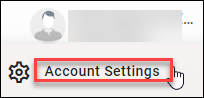
I checked the privacy settings, located under Account Settings just below the user name of the kit, after you sign in.

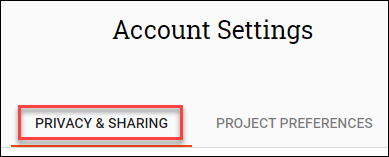
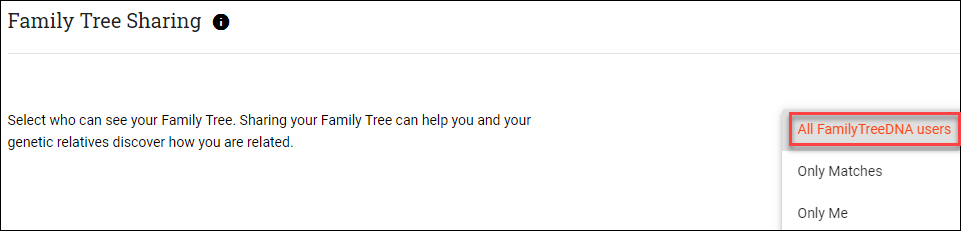
According to the Privacy and Sharing settings, John’s tree is not private.

click to enlarge

That seemed odd, so I checked John’s tree myself. It looks fine to me, so I wonder what might be wrong?

click to enlarge

Nothing is showing as private from John’s perspective from within his account.

I decided to send Ned a direct sharing link to see if that made any difference.

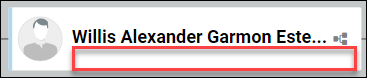
The link I shared with Ned made no difference, but reading the information in the red box did! Yay for documentation!

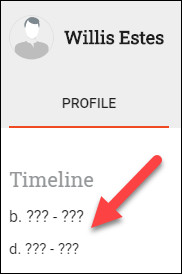
I had not filled in the birth or death dates of the people in question or marked them as deceased. Yes, I know – my bad.

I clicked on the profile and then “View Profile” to verify.

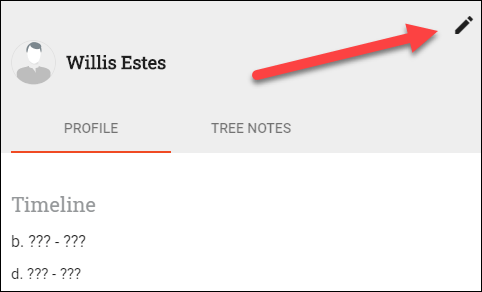
Sure enough – no dates. To edit the profile, click on the pencil.

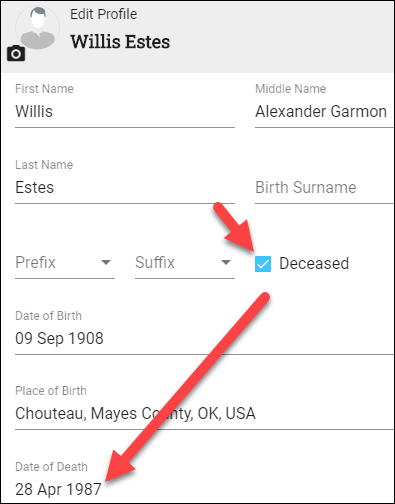
In order to cause the death date and death location fields to display, you must check the “Deceased” box which then turns blue.

Even if you don’t know the death date or location, marking the person as deceased allows their information to be displayed, such as their name, and NOT to be marked as private.

If you do NOT click the deceased box, the person’s profile WILL be marked “private” and will not be shown to anyone except you, the tester, if you sign in. You’ll have no idea that it isn’t showing to other people when you had intended to share all along.

click to enlarge

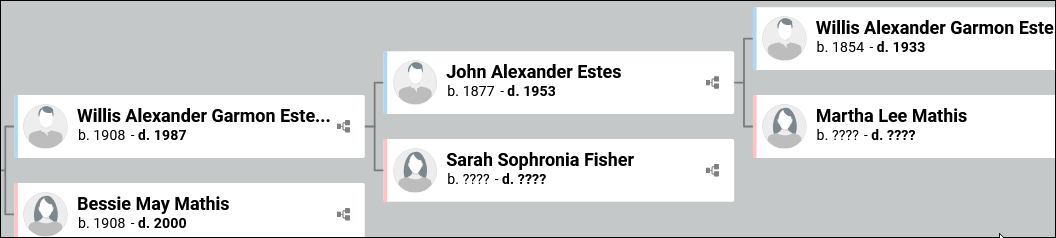
I marked each person as deceased and added death dates and locations while I was working on the tree.

Did that take care of the problem?

Let’s take a look from Ned’s perspective.

click to enlarge

Sure did.

In order for people to display, you need to kill them off, again😊

Tree Privacy

Every vendor has a combination of features that control tree privacy and security. You will be able to mark the entire tree private or shareable. You may be able to make it searchable, or not, depending on the vendor.

No vendor will display known living people to others – but the calculations they use to determine who may be living, unless you specifically mark them as deceased, will vary.

Be sure to check all of those factors, and find a way to view the tree from someone else’s perspective to check and be sure it’s functioning the way you expect.

I would never have known that all of John’s ancestors were private if Ned hadn’t contacted me.

At Family Tree DNA, if you view your own tree and you notice that neither dates nor question marks appear in the date field on the pedigree page – that means you have not marked these people as deceased – so no information for them will show to anyone else.

If you see any dates or question marks beneath the names of people on your tree – then that individual’s profile will show and is not private, unless you have marked the entire tree as private.

Check your trees to see if you have an unknown issue. Those valuable trees provide critical information to your matches. They may not contact you to ask why your tree is private – in fact – most won’t. They assume it’s a choice you meant to make.

Be sure you’re not unintentionally driving cousins away. You never know who’s going to have that crucial piece of information or photo, and you want all of your cousin-bait to function as intended!

_____________________________________________________________

Disclosure

I receive a small contribution when you click on some of the links to vendors in my articles. This does NOT increase the price you pay but helps me to keep the lights on and this informational blog free for everyone. Please click on the links in the articles or to the vendors below if you are purchasing products or DNA testing.

Thank you so much.

DNA Purchases and Free Transfers

Genealogy Products and Services

Genealogy Research

Ancient Icelandic Viking Settlers Expand the Y DNA Tree

The harsh yet starkly beautiful volcanic island of Iceland was only settled about 1100 years ago, between 870 and 930 CE (current era). Obviously, the original settlers had to originate in locations where populations were already established. During this time, Vikings had been raiding islands and coastal regions of Ireland, Scotland, and England.

Their DNA, now unearthed, tells their tale.

This 2018 paper, Ancient genomes from Iceland reveal the making of a human population by Ebenesersdóttir et al, along with the supplementary material, here, provides insight into the genomes of 27 ancient Icelanders who are a combination of Norse, Gaelic and admixed individuals. The Irish Times wrote a non-academic article, here.

Unequal contributions of the ancient founders, plus isolation resulting in genetic drift separates the current Icelandic population from the founder populations. These ancient Icelandic genomes, autosomally, are more similar to their founding populations than today’s Icelanders.

While autosomal DNA recombines in each generation, Y and mitochondrial DNA does not, revealing the exact DNA of the original founding members of the population. This, of course, allows us to peer back in time. We can see who they match, historically, and where. Today, we can see if our Y and mitochondrial DNA matches them as well.

The authors of the paper selected 35 ancient individuals, believed to be first-generation founders, to have their whole genomes sequenced, of which 27 were successful. Sometimes the ancient DNA is just too degraded to sequence properly.

Nineteen of these burials are pre-Christian, 2 from Christian burials and one that is “Early Modern,” dated to 1678 CE. Ages are expressed, as follows:

  • Pre-Christian <1000 CE
  • Pre-Christian 950-1050 CE
  • Early modern Born 1678 CE
  • Pre-Christian <1050 cal CE

Dates that say “cal CE” mean that they were carbon 14 dated and calibrated and CE (alone) means that those dates are based on the archaeological context of grave goods, other remains, and environmental indicators such as volcanic ash.

As he did with the 442 ancient Viking genomes that I wrote about, here, Goran Runfeldt who heads the research department at FamilyTreeDNA downloaded the Icelandic genomes, extracted and aligned the mitochondrial and Y DNA results.

Michael Sager analyzed the Y DNA and those results, once again, have refined, enhanced or split at least 8 branches of the Y DNA tree.

For instructions about how to see if your mitochondrial or Y DNA results match any of these ancient genomes, please click here. If you haven’t yet tested, you can order or upgrade a Y or mitochondrial DNA test, here.

The Graves

This map, provided in the paper by the authors, shows the burial locations of the remains, noted by sample numbers. Circles are females, squares are male. Light gray was later excluded from the author’s study.

Some of these burials and grave goods are fascinating. For example, note the horse and dog burials.

Goran and Michael have been kind enough to share their analysis, below, along with comments. Thanks, guys!

Sample: DAV-A9
Location: Dalvík (Brimnes), North, Iceland
Study Information: One of the largest and most studied pre-Christian burial sites in Iceland. Thirteen human skeletal remains, six horse skeletons, and the remains of three dogs were found at the site. In one of the graves, the deceased individual had been placed in a sitting position at the rear of a boat
Age: Pre-Christian 900-1000 CE
Y-DNA: I-FGC21765
FTDNA Comment: Likely splits this branch
mtDNA: H1

Sample: DKS-A1
Location: Öndverðarnes, West, Iceland
Study Information: Grave goods included a sword, a spearhead, a knife, a shield-boss, a bone-pin, and fragments of iron. According to a morphological analysis, the skeletal remains show evidence of developmental delay that could be explained by hypogonadism caused by Klinefelter syndrome, testicular disorder or castration.
Age: Pre-Christian 850-1000 CE
Y-DNA: R-YP6099
mtDNA: U5a1h

Sample: FOV-A1
Location: Fossvellir, East, Iceland
Study Information: The remains are thought to have been placed at the site after the individual was deceased. The bones had been carefully arranged on top of each other and were surrounded by stone slabs and turf.
Age: Christian 1246-1302 CE
Y-DNA: R-DF23
mtDNA: HV17a

Sample: GRS-A1
Location: Grímsstaðir, North, Iceland
Study Information: Three pre-Christian burials were found in close proximity to each other near the site of a farmstead. We analysed one of the skeletal remains (GRS-A1), which were excavated in 1937. No grave goods were found at the site.
Age: Pre-Christian <1050 cal CE
Y-DNA: R-BY92608
mtDNA: K1a1b1b

Sample: GTE-A1
Location: Gilsárteigur, East, Iceland
Study Information: In 1949, field-leveling exposed a pre-Christian burial site near an old farm site. The remains of two skeletons were excavated in 1957. Both burials contained grave goods.
Age: Pre-Christian <1000 CE
Y-DNA: R-CTS4179
mtDNA: H4a1a4b

Sample: HSJ-A1
Location: Hrólfsstaðir, East, Iceland
Study Information: A comb, knife, and pieces of charcoal were found in the grave.
Age: Pre-Christian <1000 CE
Y-DNA: I-BY202281
FTDNA Comment: forms a branch with 2 men (Scotland and England). I-BY202281. The two modern samples share an additional 11 markers that HSJ-A1 is ancestral for
mtDNA: H3g1

Sample: KNS-A1
Location: Karlsnes, South, Iceland
Study Information: Grave goods included a spearhead, a knife, two lead weights, three beads, and a small stone.
Age: Pre-Christian 950-1050 CE
Y-DNA: R-Z290
mtDNA: H5

Sample: KOV-A2
Location: Kópavogur, West, Iceland
Study Information: Two skeletal remains. Based on archaeological evidence, the remains were identified as a female, born 1664, and a male, born 1678. According to historical records, they were executed in 1704 for the murder of the female’s husband. The male was beheaded, and his impaled head publicly exhibited, whereas the female was drowned. Their remains were buried in unconsecrated ground at a site called Hjónadysjar.
Age: Early modern Born 1678 CE
Y-DNA: R-L151
mtDNA: H1

Sample: MKR-A1
Location: Viðar (Másvatn), North, Iceland
Study Information: The remains date to <1477 C.E. based on volcanic ash chronology, and are thought to be from a pre-Christian burial site.
Age: Pre-Christian <1050 cal CE
Y-DNA: R-YP1258
mtDNA: K1c1b

Sample: NNM-A1
Location: Njarðvík, East, Iceland
Study Information: A human skull (NNM-A1) was found at a site considered to be a badly damaged pre-Christian burial.
Age: Pre-Christian <1000 CE
Y-DNA: R-BY56981
mtDNA: H2a2b5a

Sample: ORE-A1
Location: Ormsstaðir, East, Iceland
Study Information: Pre-Christian site near an old farmstead was excavated after being exposed during field leveling. One human skeleton (ORE-A) was found, along with an axe, a knife, and three lead weights. A single human bone from another individual was found nearby.
Age: Pre-Christian 900-1000 CE
Y-DNA: R-PH93
mtDNA: K1a3a

Sample: SBT-A1
Location: Smyrlaberg, North, Iceland
Study Information: Pre-Christian burial site in an old gravel quarry. Two years later its excavation revealed a male skeleton (SBT-A1) and an iron knife. Another grave, badly damaged, was found nearby, but only fragments of bone were recovered.
Age: Pre-Christian <1000 CE
Y-DNA: I-FGC74518
FTDNA Comment: Shares 6 SNPs with a man from England. Forms a branch down of I-BY46619 (Z140). Branch = I-FGC74518
mtDNA: H3g1a

Sample: SSG-A2
Location: Sílastaðir, North, Iceland
Study Information: A cluster of four pre-Christian graves. Based on morphological analysis, three of the skeletons were deemed male, and one female.
Age: Pre-Christian 850-1000 CE
Y-DNA: R-BY41282
FTDNA Comment: Split the R-BY23441 block – derived only for BY41282 (Z246)
mtDNA: J1c3g

Sample: SSG-A3
Location: Sílastaðir, North, Iceland
Study Information: A cluster of four pre-Christian graves. Based on morphological analysis, three of the skeletons were deemed male, and one female.
Age: Pre-Christian 850-1000 CE
Y-DNA: I-FGC9493
mtDNA: T2b2b

Sample: SSJ-A2
Location: Surtsstaðir, East, Iceland
Study Information: The remains of two individuals were found at the site, along with grave goods.
Age: Pre-Christian 850-1000 CE
Y-DNA: I-Y129187
mtDNA: U5a1a1

Sample: STT-A2
Location: Straumur, East, Iceland
Study Information: Pre-Christian burial site was excavated, which included the remains of four individuals (one child, one male, one female, and another adult whose sex could not be determined by morphological analysis). Grave goods included a horse bone, a small axe, thirty boat rivets, a lead weight, two pebbles, and a knife.
Age: Pre-Christian 975-1015 cal CE
Y-DNA: R-FT118419
FTDNA Comment: Shares 22 SNPs with a man from Wales. They form the branch R-FT118419 (Z251)
mtDNA: U4b1b1

Sample: SVK-A1
Location: Svínadalur, North, Iceland
Study Information: Human skeletal remains were brought to the National Museum of Iceland. They had been exposed for many years near an old farmhouse. There were no grave goods found at the site, but the remains are thought to be pre-Christian.
Age: Pre-Christian <1050 cal CE
Y-DNA: I-FGC21682
FTDNA Comment: Joins VK110 and VK400 as an additional I-FGC21682* (P109)
mtDNA: I2

Sample: TGS-A1
Location: Tunga, North, Iceland
Study Information: Human skeletal remains (TGS-A1) were excavated in 1981 by inhabitants at a nearby farm. They were classified at the National Museum of Iceland as having unknown temporal origin. The remains were radiocarbon dated for this study, indicating that they date from the 10th century C.E.
Age: Pre-Christian 943-1024 cal CE
Y-DNA: R-Y10827
FTDNA Comment: Likely R-BY4659. Also PH1220+, but this is a C>T mutation also present in hg I ancient samples R7 and Carrowkeel531.
mtDNA: T2e1

Sample: TSK-A26 / ÞSK-A26
Location: Skeljastaðir, South, Iceland
Study Information: Christian cemetery at Skeljastaðir in Þjórsárdalur. The remains are dated to before 1104 C.E., as the site was abandoned in the wake of a volcanic eruption of Mount Hekla in that year.
Age: Christian 1120 cal CE
Y-DNA: R-Y77406
FTDNA Comment: Shares 2 SNPs with a man from Norway. Forms branch down of R-BY30235 (L448). New branch = R-Y77406
mtDNA: J1b1a1a

Sample: VDP-A6
Location: Vatnsdalur, West, Iceland
Study Information: Boat grave with seven skeletal remains (three females and four males), along with a dog skeleton. Grave goods included a knife, thirty beads, a silver Thor’s hammer, a fragmented Cufic coin (ca. 870–930 C.E.) and jewelry.
Age: Pre-Christian 850-1050 CE
Y-DNA: R-YP1120
mtDNA: H1c3a

Sample: VDP-A7
Location: Vatnsdalur, West, Iceland
Study Information: Boat grave with seven skeletal remains (three females and four males), along with a dog skeleton. Grave goods included a knife, thirty beads, a silver Thor’s hammer, a fragmented Cufic coin (ca. 870–930 C.E.) and jewelry.
Age: Pre-Christian 850-1050 CE
Y-DNA: R-FT209682
FTDNA Comment: Shares 7 SNPs with a man from Sweden. Forms branch down of R-BY71305 (Z18). New branch = R-FT209682
mtDNA: H4a1a1

Sample: YGS-B2
Location: Ytra-Garðshor, North, Iceland
Study Information: The site included the disturbed remains of nine human skeletons (four males, two females, one child and two individuals whose sex could not be inferred based on morphological analysis). There were grave goods in all graves.
Age: Pre-Christian <1000 CE
Y-DNA: R-Y98267
FTDNA Comment: Split the R-Y84777 block (L238). Derived only for Y98267
mtDNA: J1c1a

_____________________________________________________________

Disclosure

I receive a small contribution when you click on some of the links to vendors in my articles. This does NOT increase the price you pay but helps me to keep the lights on and this informational blog free for everyone. Please click on the links in the articles or to the vendors below if you are purchasing products or DNA testing.

Thank you so much.

DNA Purchases and Free Transfers

Genealogy Products and Services

Genealogy Research

FamilyTreeDNA’s myOrigins Version 3 Rollout

As the fall leaves change colors and people are turning more to inside activities, FamilyTree DNA began rolling out MyOrigins version 3 today.

That’s the good news. The bad news is that everyone is trying to sign on at the same time, so the system is quite slow right now. Maybe that’s actually good news too because it means people are interested AND maybe they will take this opportunity to add trees and link matches if they have not already done so!

What’s Happening?

Yesterday, the following email was sent to group project administrators.

If you’d like to view the list of all populations reported, click here.

The Rollout

I really like the process of prioritizing people who have signed in most recently. They are clearly the most interested in their results.

If you’re wondering if your results have been updated, sign on to your account. Look at your messages to the left of your Autosomal DNA Results.

click to enlarge

If you don’t see this message, then you have the new MyOrigins 3 results, so simply click on MyOrigins.

More Results Coming

Not only are more people going to be receiving results soon, but additional features will be released over time:

  • Population-based chromosome painting, including trace amounts less than 1%. I expect this feature will be released after everyone has received updated results – but that’s my assumption – not from FTDNA.
  • Some people may receive additional population trace amounts not reported in this initial release to facilitate chromosome painting – so check back every couple weeks to see if your results have changed.

My Results

click to enlarge

I have multiple kits at Family Tree DNA – one tested there and one from Ancestry that I use when I write about twins and siblings. Ancestry uses a different chip when processing their DNA tests, and my results at FamilyTreeDNA are somewhat different for the two tests. Keep in mind that the two tests test some of the same locations, but not all.

click to enlarge

I have a 23andMe test I could upload as well. I may do that, simply to compare results, especially since 23andMe also shows my Native segments. Once Family Tree DNA releases their ethnicity chromosome painting, I’ll want to see if the tests report the same locations.

My Comparison

My British Isles are much more specific now. Much of my genealogy from the British Isles is somewhat ambiguous. I know positively that some lines are from there – just not exactly where.

Trace amounts do not contribute to the totals. I wasn’t sure quite how to handle this since we don’t know how much the trace amount actually is – and if it’s noise in some cases.

Here’s the comparison of the four major vendors and their current results, above and below.

I can’t discern the exact amount of Native, although it’s clearly small. I know it’s present and not noise because I’ve proven these segments to the ancestors whose Y and mitochondrial DNA prove their Native origins.

Furthermore, MyOrigins3 essentially matches my Native segments at 23andMe. I know this because I was fortunate enough to have had that sneak peek earlier this year when MyOrigins3 was in beta. You can take a look at Dr. Maier’s presentation about MyOrigins3, here.

Population-based chromosome painting is coming for everyone after the MyOrigins3 rollout is complete. No, I couldn’t pry a more specific date out of anyone😊

How Can Ethnicity Help Your Genealogy?

By clicking on the Shared Origins tab, you can see a list of your matches that have some of the same populations and locations. Of course, this doesn’t mean that your match is because of that population, or within that population, but it does provide you with a place to start – especially if the population is a minority population to you – like my Native American.

I can view the list of my Shared Origins matches, view our matching segments in the chromosome browser to see how we triangulate and share matches with others – hopefully identifying our common ancestor.

In my case, I’ve also painted my known matches at DNAPainter, so most of my segments map to an ancestral line. I compare segment with a specific match to my identified segments at DNAPainter and I’ll probably be able to determine if our matching segment could be assigned that ethnicity by identifying the ancestral line.

Caveats

You all know the caveats I always preach, right?

  • Ethnicity is only an estimate!
  • Just because you don’t show a specific ethnicity doesn’t mean you don’t have that heritage.
  • You don’t inherit exactly half of the DNA of your ancestors. In fact, you may or may not inherit anything measurable from any specific ancestor(s) several generations back in time.
  • Small amounts of ethnicity can be noise.
  • You cannot have an ethnicity that neither of your parents have, although it may be named as something else from the same region. Chromosome painting will help unravel this immensely.
  • Did I mention that ethnicity is only an estimate?

Levity

Now for some much-needed levity

I had forgotten about this, but today, my friend mentioned that this is his favorite ad ever. Yes, an ad. It’s well worth the watch – only a minute or so and I guarantee, it will make you laugh out loud!!!

Go Thor!!!!!!

_____________________________________________________________

Disclosure

I receive a small contribution when you click on some of the links to vendors in my articles. This does NOT increase the price you pay but helps me to keep the lights on and this informational blog free for everyone. Please click on the links in the articles or to the vendors below if you are purchasing products or DNA testing.

Thank you so much.

DNA Purchases and Free Transfers

Genealogy Products and Services

Genealogy Research

23andMe Genetic Tree Provides Critical Clue to Solve 137-Year-Old Disappearance Mystery

DNA can convey messages from the great beyond – from times past and people that died long before we were born.

I had the most surprising experience this week. It began with receiving an email with the sender name of my long-time research buddy, cousin Garmon Estes.

It’s all the more surprising because not only did Garmon never own a computer, despite my ceaseless encouragement, he passed over in 2013 at the age of 85. So, imagine my shock to open my email to see a message from Garmon. Queue up spooky music😊

As it turned out, Garmon’s nephew is also Garmon. I had communicated with the family off and on over the years since the death of Garmon the elder. Garmon, the younger, had written to tell me that the second “great brick wall” that haunted his Uncle Garmon had fallen – and how that happened, thanks to DNA.

Garmon, the Elder

Estes Garmon

Garmon Estes, the elder

I first met Garmon the elder, via letter, back in the 1970s or maybe early 80s. He was an experienced genealogist and I was beginning.

At that time, Garmon had been chasing the identity of the father of our common ancestor, John R. Estes, for decades, and I was just embarking on what would become a lifelong adventure, or perhaps it could better be called an obsession.

John R. Estes had moved from some unknown location to Claiborne County, Tennessee with his wife and family about 1820. That’s pretty much all we knew at that time. Garmon had spent decades before the age of online records researching every John Estes he could find. I can’t even begin to tell you how many John Esteses existed that needed to be eliminated as candidates.

Garmon lived in California, far from Tennessee. I lived in Indiana, then Michigan – significantly closer. He began caring for his ill spouse, and I began traveling to dusty courthouses, sometimes reading musty books page by yellowed page, extracting everything Estes. Garmon worked from his local Family History Center when he could and wrote letters.

Between our joint sleuthing and many theories that we both composed and subsequently shot down, we narrowed John R. Estes’s location of origin to Halifax County, Virginia. However, there were multiple John Esteses living there at the same time, about the same age, none using middle initials reliably, and some not at all. How inconsiderate!

I began perusing every possible record. I had eliminated some Johns as candidates, most often because they clearly remained in the community after our John had moved to Claiborne County. Late one night, in our local family history center, I found that fateful clue – John R. Estes noted as (S.G.) short for “son of George,” on just one tax list. All it takes is that one gold-nugget record.

It was after 10 PM when I left the Family History Center and even later when I got home. I debated whether I should call Garmon or not, but I decided that indeed, he would want to know immediately, even if I did call at an inconvenient time or wake him up.

The discovery of John’s father, of course, opened the door for much more research, and it solved one of Garmon’s two brick walls that had haunted his genealogy life.

He never solved the second one, but it wasn’t for lack of trying.

What Happened to Willis Alexander Garmon Estes?

Willis Alexander Garmon Estes was born on December 21, 1854, in Lenoir, Roane County, TN. His nickname was Willie.

Willie married Martha Lee Mathis in 1874 and they had 4 children beginning with the first child born the next year in Roane County. Sometime between 1875 and the birth of the second child in 1877, they migrated to Greenwood, Wise County, Texas where their next two children were born in 1877 and 1881.

Martha was pregnant for their fourth child in 1883 when something very strange happened. Willie disappeared, and I do mean literally and completely. Just poof, gone.

Not sure what to do, Martha’s father, who lived in Missouri, went to Texas to retrieve his pregnant daughter and her children and took her and the children home to Missouri where their last child was born that September.

Willie was only 28 when he vanished. The family, of course, had many stories about what happened. Texas at that time was pretty much the “wild west” and the stories about Willie reflected exactly that.

Texas was sometimes the refuge of outlaws and shady characters. One story revealed that Willie had shot a man back in Tennessee and the family fled to Louisiana, then Texas. Of course, that doesn’t tell us why he disappeared in Texas, but it opens the door to speculation and casts doubt on his character, perhaps.

Another story was that he was shot by Indians.

A third story stated that Willie settled in Indian Territory north of the Red River, now Oklahoma, and that he had an altercation with an Indian over the supposed theft of firewood, although who was accusing who was unclear. Willie shot the Indian, then had to flee for his life, leaving his pregnant wife and children as a posse of Indian Police surrounded his house. Willie supposedly promised Martha that he would return, but never did. It was reported that he was shot in Mexico, but no further details emerged.

Aren’t these just maddeningly vague???

Yet another story was that Willie headed for the goldfields of California, struck it rich, and was murdered on the way back home. The details varied, but one version had him murdered by a traveling companion on the trail. Another had him becoming ill and dying in a hospital in St. Louis where his wife went to search for him, to no avail. That might explain why she went back to Missouri, Garmon postulated. And yet a third version was some hybrid of the two where “someone” tried to find Willie’s family for years to reveal what had happened, and where, but was never successful. Of course, how did the family know about this if the mystery person was unable to find the family? But I digress.

Garmon desperately wanted to solve that mystery. He wanted closure.

I didn’t realize that the genealogy bug had bitten Garmon’s nephew too, but it clearly has. Garmon would be so proud.

With Garmon the younger’s permission, I’m publishing “the rest of the story,” Connecting the Dots, as written by Garmon the younger, with a few technical interjections from me involving DNA from time to time.

Connecting the Dots

In 2015, My dad Richard Estes, my brother Corey Estes, and I took a trip to Texas and Oklahoma to see if we could find out more about Willis Alexander Garmon Estes’ disappearance.

Estes greenwood

We visited Greenwood, Texas and nearby Decatur where we looked at historical records at the Wise County Clerk Office. We also went up to Oklahoma City to see the state archives and to Tishomingo to look at any records that might be available.

Estes Oklahoma history.png

Interestingly enough, we did not find any clues as to the disappearance of Willis Alexander Garmon Estes. There were no newspaper articles or criminal records concerning any incidents with Willis Alexander Garmon Estes. The only new information that we found was a couple of land deeds showing that Willis Alexander Garmon Estes’ brother Fielding had bought and sold land in Wise County during the time that Willis Alexander Garmon Estes was living in Greenwood.

We left empty-handed on our trip but our curiosity remained strong and we began talking to each other about going on another trip to Tennessee to speak with Estes family members in Loudon County to see if they might know something about Willis Alexander Garmon’s disappearance.

DNA Testing

In December of 2018, my wife, children, and I had our DNA tested using the service 23andMe. We received test results within a month of sending in saliva samples. The results did not reveal anything unusual.

Fast forward to October 2019. 23andMe introduced a new Family Tree feature that automatically creates a family tree based on the DNA results that you share with relatives in 23andMe. This was a fascinating feature and I noticed that all of my family members were automatically placed into the correct position on the family tree without me having to do anything.

[Roberta’s note – this is not always the case, so don’t necessarily expect the same level of accuracy. The tree is a wonderful innovative feature, just treat family placement as hints and not facts.]

Every few weeks as more and more people had their DNA tested on 23andMe, new relatives were added to the family tree.

In February 2020, I noticed something interesting under the location of Willis Alexander Garmon Estes on the family tree. A woman by the name of Edna appeared as a descendent of Willis Alexander Garmon Estes. The first thing I did was to try and get in contact with her on 23andMe. No luck. Next, I thought maybe she was the descendent of one of Willis Alexander Garmon’s sons (James, John, or George). However, after researching the descendants of each of those lines, Edna’s name did not appear.

The next step I took was to look up as many Ednas by that last name on ancestry.com as I could find and trace their ancestry back to see where it led.

There were two Ednas by that last name in the United States whose age matched the one on 23andMe. I traced both of their ancestry lines back to the 1800’s. Neither one had Willis Alexander Garmon Estes as an ancestor.

Breakthrough

During the middle of March 2020, when I was quarantined at home from work due to the COVID-19 virus, I took another look at Edna’s family lines. I noticed there was a gentleman by the name of James Henry Houston mentioned as an ancestor.

The interesting thing about James was that he was born on the same day, same year, and in the same county as Willis Alexander Garmon Estes. James Henry Houston was born on December 26, 1854 in Loudon County, Tennessee. This seemed like possibly more than a coincidence, so I dived into the data a little bit more.

I looked at federal census records to find out more about James Henry Houston’s past. Strangely there were no official records of him until May 12, 1889 when he married Allie Ona Taylor in Erath, Texas. Normally, if someone is born in 1854, they would show up in one of the federal census records of 1860, 1870, or 1880. James Henry Houston does not show up in any official federal census records until 1900.

According to ancestry records, James Henry Houston married Allie Ona Taylor in 1889 and resided in the Hood County region of Texas until 1910. During this time, he raised 8 children with his wife Allie.

In 1920, the federal census placed him and Allie in Whitehall, Montana. The last federal census he appears in is 1930. He lived in Pomona, California where he died in 1933 at the age of 78.

At this point, I thought it was highly likely that James Henry Houston and Willis Alexander Garmon Estes were the same person. If my hunch was correct then a photo of James Henry Houston would most likely show a resemblance to his son, my great grandfather John Alexander Estes.

Estes James Henry Houston

The photos above show a remarkable similarity in the eyes, nose, mouth, and facial structure between the two men. To me, the photo and historical evidence is enough to conclude that Willis Alexander Garmon Estes is James Henry Houston.

Garmon’s Concluding Thoughts

As I reflect on the fact that Willis Alexander Garmon Estes renamed himself James Henry Houston and moved from Wise County down to Hood County, Texas – approximately 60 miles distance to marry and raise a new family, many more questions come to mind.

What exactly happened to cause Willis Alexander Garmon Estes to leave his wife and children behind? Was it simply a marital dispute or did it involve a criminal offense and running from the law as was mentioned in the family lore?

Did my great grandfather know that his father lived in Pomona in 1930, which was only 6 miles away from where he was living in Rancho Cucamonga? Were there other family members that knew what happened but promised not to tell anyone else? We may never know.

Finally, I want to add one more piece to the story that I found fascinating. On ancestry.com, many of the family trees for James Henry Houston state that the mother and father of James Henry Houston was Jennie Bray and Henry Houston. No information is given for their birthdates or where they came from. The mother and father of Willis Alexander Garmon Estes was Jennie McVey and William Estes. The names Jennie Bray and Jennie McVey are very similar. In order to hide his true identity, James Henry Houston would have to make up a surname for his father since he called himself Houston, not Estes. Willis Alexander Garmon Estes had a brother named John Houston Estes. This might explain why James Henry Houston chose to use the surname Houston rather than another name.

Congratulations Garmon

I know this made Garmon the elder puff up with pride for Garmon the younger’s sleuthing skills and leap for joy at the solve. Garmon, the elder, had two main genealogy goals throughout his entire life. One was solved while he was living, but it took another generation to solve this one.

Great job, Garmon!

About the 23andMe Genetic Tree

23andMe is the only vendor to construct a “trial balloon” genetic tree based only on how the tester matches people and how they do, or don’t, match each other. This occurs with no input from testers in the form of genealogical trees of identifying how people are related to the tester.

Family Tree DNA has Phased Family Matching, MyHeritage has Theories of Family Relativity, and Ancestry has ThruLines which all do some sort of DNA+tree+relationship connectivity, but since 23andMe does not support user-created or uploaded trees, anything they produce has to be using DNA alone.

On one hand, it’s frustrating for genealogists, but on the other hand, there is sometimes a benefit to a different “all genetic” approach.

Of course, the only information that 23andMe has to utilize unless your parents have tested is how closely you match your matches and how closely your matches match each other. This allows 23andMe to place your matches at least in a “neighborhood” on your tree, at least approximately accurate, unless your parents are related to each other and that shared DNA causes things to get dicey quickly.

I wrote about 23andMe’s new relationship triangulation tree when it was first introduced in September 2019, nearly a year ago, here. The launch was rocky for a number of reasons, and if you’ve done genealogy for a long time, your research goals are likely to be further back in time than this 4 generation relationship tree will reveal.

23andMe tree

Click to enlarge

This is what my relationship tree looked like at the time the function was launched. You’ll note that 23andMe places relationships back in time 4 generations, to your great-great-grandparents, meaning that you might have 3rd or even 4th cousins showing up on your genetic tree.

I initially had a total of 18 people placed on my tree, with 3 being close family, 4 being accurate, 4 unknown, 1 uncertain and 6, or one third, inaccurate.

Keep in mind that 23andMe doesn’t make any provision to accommodate or take into account half-relationships, like half-brother or half-sister, either currently or historically. Therefore, descendant placement predictions can be “off” because half-siblings only carry the DNA from one common parent, instead of two, making those relationships appear more distant than they really are.

In Garmon’s case, his great-great-grandfather is the ancestor who was MIA, so the genetic tree has the potential to work well for this purpose.

Estes 23andme tree today

click to enlarge

Today, my tree looks somewhat different, with only 14 people displayed instead of 18, and 6 waiting in the wings to see if I can help 23andMe figure out how and where to place them.

Since the initial launch, customers have been given the opportunity to add their ancestors’ names to their nodes. This works just fine so long as nobody married more than once and had children from both marriages.

Estes Willie Alexander today

click to enlarge


Here’s a closer image of the left-hand side of my tree where I’ve super-imposed the location of Willis Alexander Garmon Estes and Edna, as they are related to Garmon the Younger, at bottom right. Ignore the other names – I only utilized my own tree for an example tree structure.

One more generation and it’s unlikely that 23andMe would have made the connection between Edna and Garmon the younger.

Not only does this illustrate the perfect reason to test the oldest generations in your family, but also never to ignore an unknown match that seems to be within the past 3 or 4 generations. You never know what mysteries you might unravel.

Four generations actually reaches back in time quite substantially. In my case, my great-great-grandparents were born in 1805, 1810, 1812, 1813, 1815, 1816, 1818 (2), 1820, 1822, 1827, 1829, 1830, 1832, 1841 and 1848.

If you have mysteries within your closest 4 generations to unravel, the genetic tree at 23andMe might provide valuable clues, but only if you’re willing to do the requisite work to figure out HOW these people match you.

You can’t transfer your DNA file TO 23andMe, so if you want to have your results in the 23andMe database, you’ll need to test there.

Acknowledgments: Thank you to Garmon Estes, the younger, for generously sharing this story and allowing publication. My heart was warmed to see your generational research trip.

Thank you to Garmon Estes, the elder, for being my research partner for so many years. You can finally RIP now, although somehow I suspect you already have these answers.

_____________________________________________________________

Disclosure

I receive a small contribution when you click on some of the links to vendors in my articles. This does NOT increase the price you pay but helps me to keep the lights on and this informational blog free for everyone. Please click on the links in the articles or to the vendors below if you are purchasing products or DNA testing.

Thank you so much.

DNA Purchases and Free Transfers

Genealogy Products and Services

Genealogy Research

Plea to Ancestry – Rethink Match Purge Due to Deleterious Effect on African American Genealogists

I know this article is not going to be popular with some people and probably not with Ancestry, but this is something I absolutely must say. Those of us in the position of influencers with a public voice bear responsibility for doing such.

Let me also add that if you are of European heritage and you think this topic doesn’t apply to you – if you have any unidentified ancestors – it does. Don’t discount and skip over. Please read. Our voices need to be heard in unison.

Ancestry Lewis.jpg

The Bottom Line

Here’s the bottom line. Ancestry’s planned purge of smaller segments, 6-8 cM, is the exact place that African Americans (and mixed Native Americans too) find their ancestral connections. This community has few other options.

I’m sure, given the Ancestry blog post by Margo Georgiadis, Ancestry’s President and CEO on June 3rd that this detrimental effect is not understood nor intentional.

Ancestry Margo

Margo goes on to say, “At Ancestry, our products seek to democratize access to everyone’s family story and to bring people together.”

Yet, this planned match purge at the beginning of August does exactly the opposite. The outpouring of anguish from African American researchers has been palpable as they’ve described repeatedly how they use these segments to identify their genetic ancestors.

Additionally, my own experiences with discovering several African American cousins over the past few days as I’ve been working to preserve these smaller segment matches has been pronounced. I can even tell them which family they connect through. A gift them simply cannot receive in any other way – other than genetic connections

These two factors, combined, the community outcry and my own recent experiences are what have led me to write this article. In other words, I simply can’t NOT write it.

I trust and have faith that Ancestry will rethink their decision and utilize this opportunity for good and take positive action. Accordingly, I’ve provided suggestions for how Ancestry can make changes that will allow people on both sides of this equation, meaning those who want to keep those smaller segment matches and those glad to be rid of them, to benefit – and how to do this before it’s too late.

I don’t know if Ancestry has African American genealogists who are both passionate and active, or mixed-race genealogists, on their management decision-making team or in their influencer group, but they should.

I don’t think Ancestry realizes the impact of what they are doing. African American research is different. Here’s why.

African American History and Genetic Genealogy

Slavery ended in the US in the 1860s. Formerly enslaved persons who had no agency and control over their own lives or bodies then adopted surnames.

We find them in the 1870 census carrying a surname of unknown origin. Some adopted their former owner’s surname, some adopted others. Generally today, their descendants don’t know why or how their surnames came to be.

Almost all descendants of freed slaves are admixed today, a combination of African, European and sometimes Native Americans who were enslaved alongside Africans.

Closer DNA matches reflect known and unknown family in the 3 or 4 generations since 1870, generally falling in the 2nd to 4th cousin range, depending on the ages of the people at the time of emancipation and also the distance between births in subsequent generations.

Ancestry freed ancestors.png

The three red generations are the potential testers today. The cM values, the amount of potential matching DNA at those relationship levels are taken from DNAPainter, here, which is an interactive representation of Blaine Bettinger’s Shared cM Project.

Assuming we’re not dealing with an adoption or unknown parent situation, most people either know or can fairly easily piece together their family through first or second cousins.

You can see that it’s not until we get to the third and fourth cousin level that genealogists potentially encounter small segment matches. However, at that level, the average match is still significantly above the Ancestry purge threshold of 6-8 cM. In other words, we might lose some of those matches, but the closer the match, the higher the probability that we will match them (at all) and that we will match them above the purge threshold.

Looking again at the DNAPainter charts, we see that it’s not until we move further out in terms of relationships that the average drops to those lower ranges.

Ancestry DNAPainter

Here’s the challenge – relationships that occurred before the time of emancipation are only going to be reflected in relationships more distant than fourth cousins – and that is the exact range where smaller segment matches can and do come into play most often.

The more distant the relationship, the smaller the average amount of shared DNA, which means the more likely you are ONLY to be able to identify the relationship through repeated matching of other people who share that same ancestor.

Let me give you an example. If you match repeatedly to a group of people who descend from Thomas Dodson in colonial Virginia, through multiple children, especially on the same segment, you need to focus on the Dodson family in your research. If you’re a male and your Y DNA matches the Dodson line closely, that’s a huge hint. This holds for any researcher, especially for females without surnames, but it applies to all ancestral lines for African American researchers.

If an African American researcher is trying to identify their genetic ancestors, that likely includes ancestors of European origin. Yes, this is an uncomfortable topic, but it’s the unvarnished truth.

Full stop.

How Can African Americans Identify European Ancestors?

While enslaved people did not have surnames from the beginning of their history on these shores until emancipation, European families did. Male lines carried the same surname generation to generation, and female surnames changes in a predictable pattern, allowing genealogists to track them backward in time (hopefully.)

Given that African American researchers are literally “flying blind,” attempting to identify people with whom to reconnect, with no knowledge of which families or surnames, they must be able to use both DNA matches and the combined ancestral trees of their matches in order to make meaningful connections.

For more information on how this is accomplished, please read the articles here and here.

Tool or Method How it Works Available at Ancestry?
Y DNA for males Identifies the direct paternal line by surnames and also the haplogroup provides information as to the ancestral source such as European, African, Asian or Native American. No, only available at FamilyTreeDNA.
Mitochondrial DNA Identifies the direct matrilineal line. The haplogroup shows the ancestral source such as European, Native American, Asian or African. You can read about the different kinds of DNA, here. No, only available at FamilyTreeDNA
Clustering Identifies people all matching the tester and also matching to each other. No, available through Genetic Affairs and DNAGedcom before Ancestry issued a cease and desist letter to them in June.
Genetic Trees Tools to combine the trees of your matches to each other to identify common ancestors of your matches. You do not need a known tree for this to work. No, available at Genetic Affairs before Ancestry issued a cease and desist letter to them.
Downloading Match Information Including the direct ancestors for your matches. No, Ancestry does not allow this, and tools like Pedigree Thief and DNAGedcom that did provide this functionality were served with cease-and-desist orders.
Painting Segments Painting segments at DNAPainter allows the tester to identify the ancestral source of their segments. Multiple matches to people with the same ancestor indicates descent from that line. This is how I identify which line my matches are related to me through – and how I can tell my African American cousins how they are related and which family they descend from. No. Ancestry does not provide segment location information, so painting is not possible with Ancestry matches unless both people transfer to companies that provide matching segment information and a chromosome browser (MyHeritage, FamilyTreeDNA)
ThruLines at Ancestry Matches your tree to same ancestor in other people’s trees. ThruLines is available to all testers, but the tester MUST have a tree and some connection to an ancestor in their tree before this works. Potential ancestors are sometimes suggested predicated on people already in the tester’s tree connected to ancestors in their matches trees. For ThruLines to work, a connection must be in someone’s tree so a connection can be made. There are no tree links for pre-emancipation owned families. Those connections must be made by DNA.
DNA Matching Matching shows who you match genetically. Testers must validate that the match is identical by descent and not identical by chance by identifying the segment’s ancestry and confirming through either a parental match or matching to multiple cousins descending from the same ancestor at that same location. Segments of 7 cM have about a 50-50 chance of being legitimate and not false matches. Of course, that means that 50% are valid and tools can be utilized to determine which matches are and are not valid. All matches are hints, one way or another. You can read more, here. Ancestry performs matching, but does not provide segment information. Testers can, however, look for multiple matches with the same ancestors in their trees. Automated tools such as Genetic Affairs cannot be used, so this needs to be done one match at a time. The removal of smaller segment matches will remove many false matches, but will also remove many valid matches and with them, the possibility of using those matches to identify genetic ancestors several generations ago, before 1870.
Shared Matching Shows tester the people who match in common with them and another match. Ancestry only shows shared matches of “fourth cousins and closer,” meaning only 20 cM and above. This immediately eliminates many if not most relevant shared matches from before emancipation – along with any possibility of recovering that information.

The Perfect, or Imperfect, Storm

As you can see from the chart above, African American genealogists are caught in the perfect, or imperfect, storm. Many tools are not available at Ancestry at all, and some that were have been served with cease-and-desist letters.

The segments this community most desperately needs to make family connections are the very ones most in jeopardy of being removed. They need the ability to look at those matches, not just alone, but in conjunction with people they match in clusters, plus trees of those clustered matches to identify their common ancestors.

Ancestry has the largest database but provides very few tools to benefit people who are searching for unknown ancestors, especially before 1850 – meaning people who don’t have surnames to work with.

Of course, this doesn’t just apply to African American researchers, but any genealogist who is searching for women whose surnames they don’t know. This also applies to people with unknown parentage that occurred a few generations back in time.

However, the difference is that African American genealogists don’t have ANY surnames to begin with. They literally hit their brick wall at 1870 and need automated tools to breach those walls. Removing their smaller segment matches literally removes the only tool they have to work with – the small scraps and tidbits available to them.

Yes, false matches will be removed, but all of their valid matches in that range will be removed too – nullifying any possibility of discovery.

A Plan Forward

You’ve probably figured out by now that I’m no longer invited to the Ancestry group calls. I’m fine with that because I’m not in any way constrained by embargoes or expectations. I only mention this for those of you who wonder why I’m saying this now, publicly, and why I didn’t say it earlier, privately, to Ancestry. I would have, had the opportunity arisen.

That said, I want to focus on finding a way forward.

Some options are clearly off the table. I’m sure Ancestry is not going to add Y or mitochondrial DNA testing, since they did that once and destroyed that database, along with the Sorenson database later. I’m equally as sure that they are not going to provide segment location information or a chromosome browser. I know that horse is dead, but still, chromosome browser…

My goal is to identify some changes Ancestry can make quickly that will result in a win-win for all researchers. It goes without saying that if researchers are happy, they buy more kits, and eventually, Ancestry will be happier too.

Right now, there are a lot, LOT, of unhappy researchers, but not everyone. So what can we do to make everyone happier?

Immediate Solutions

  • Remove the cease and desist orders from the third-party tools like Genetic Affairs, DNAGedcom, Pedigree Thief and other third-party tools that researchers use for clustering, automated tree construction, downloading and managing matches.

This action could be implemented immediately and will provide HUGE benefits for the African American research community along with anyone who is searching for ancestors with no surnames. Who among us doesn’t have those?

  • Instead of purging small segment matches, implement a setting where people can define the threshold where they no longer see matches. The match would still appear to the other person. If I don’t want to see matches under 8 cM, I can select that level. If someone else wants to see all matches to 6 cM, they simply do nothing and see everything.
  • Continue to provide new matches to the 6 cM level. In other words, don’t just preserve what’s there today, but continue to provide this match level to genealogists.
  • Add shared matches under 20 cM so that genealogists know they do form clusters with multiple matches.

Longer-Term Solutions

  • Partner with companies like Genetic Affairs and DNAgedcom, tools that provided not just match data, but automated solutions. These wouldn’t have been so popular if they weren’t so effective.
  • Implement some form of genetic networks, like clustering. Alternatively, form alliances with and embrace the tools that already exist.

The Message Customers Hear

By serving the third-parts tools that serious genealogists used daily with cease-and-desist orders, then deleting many of our matches that can be especially useful when combined with automated tools, the message to genealogists is that our needs aren’t important and aren’t being heard.

For African American genealogists, these tools and smaller matches are the breadcrumbs, the final breadcrumb trail when there is nothing else at all that has the potential to connect them with their ancestors and connect us all together.

Let me say this again – many African Americans have nothing else.

To remove these small matches, rays of hope, is nothing short of immeasurably cruel, and should I say it, just one more instance of institutionalized racism, perpetrated without thinking. One more example of things the African American community cannot have today because of what happened to them and their ancestors in their past.

Plea

I will close this plea to Ancestry with another quote from Margaret Georgiadis from Ancestry’s blog.

Ancestry Margo 2.png

Businesses don’t get to claim commitment when convenient and then act otherwise. I hope this article has helped Ancestry to see a different perspective that they had not previously understood. Everyone makes mistakes and has to learn, companies included.

Ancestry, this ball’s in your court.

Feedback to Ancestry

I encourage you to provide feedback to Ancestry, immediately, before it’s too late.

You can do this by any or all of the following methods:

Ancestry support

Ancestry BLM.png

Speak out on social media, in groups where you are a member, or anyplace else that you can. Let’s find a solution, quickly, before it’s too late in another 10 days or so.

As John Lewis said, #goodtrouble.

Make a difference.

_____________________________________________________________

Disclosure

I receive a small contribution when you click on some of the links to vendors in my articles. This does NOT increase the price you pay but helps me to keep the lights on and this informational blog free for everyone. Please click on the links in the articles or to the vendors below if you are purchasing products or DNA testing.

Thank you so much.

DNA Purchases and Free Transfers

Genealogy Products and Services

Genealogy Research

Fun DNA Stuff

  • Celebrate DNA – customized DNA themed t-shirts, bags and other items

GEDmatch Introduces Automated Tree Matching

GEDmatch has just introduced a great new tool – automated tree matching. You’ll find it under the “Find common ancestors (MRCA) from DNA matches” on the application menu under Tier 1 tools which are available for a $10 monthly subscription. (Yes, you can subscribe month by month.)

gedmatch mrca.png

Of course, you’ll need to have your tree uploaded so that GEDmatch can match ancestors in your tree against ancestors in other people’s trees.

I wrote about how to upload a GEDCOM file, which holds your family tree information, in the article, Download Your Ancestry Tree and Upload It Elsewhere for Added Benefit. Step-by-step instructions for uploading both DNA files and a GEDCOM file to GEDmatch are included in this article.

MRCA (Most Recent Common Ancestors) Search Tool

Clicking on the “Find common ancestors (MRCA) from DNA matches” link takes you to a screen where you’ll enter your kit number.

gedmatch mrca search

The default settings work fine. 10,000 is the maximum number of kits it will compare.

Next, you’ll see the processing screen.

gedmatch mrca results.png

click to enlarge

In my case, of my highest 10,000 matches, only 1036 had associated GEDCOM files. That’s only about 10%. Imagine how much information would be available if everyone uploaded a GEDCOM file.

Of those, I had 136 hits of people where potential common ancestors could be identified in our trees.

When processing is complete, you’ll see a list of your matches complete with your common ancestors. How cool is this!!!

gedmatch mrca matches

click to enlarge

I’ve obscured private information. Looking at this information, column by column:

  • I can click through to my match’s tree by clicking on the green tree icon.
  • The cM column shows the total matching cMs over the threshold of 7. In the case of my first match, that 52.5 cMs is broken into 2 segments of 19.6 and 32.9.
  • The Common Ancestor in Primary GEDCOM is my ancestor.
  • The Descent Path to Primary Kit is how I am descended from that ancestor.
gedmatch descendants.png

click to enlarge

For example, clicking on the 5G in the first row shows me that I’m 7 generations removed, so Agnes Muncy is my 5th great-grandmother.

  • The next column, Common Ancestor in Row GEDCOM shows the relationship of my match to the person shown in their GEDCOM file. In this case, the names are spelled exactly the same, but that’s not always the case.
  • The Up/Down Path shows how the two of us are related to each other and descended from our potential common ancestor.

gedmatch up down path

  • The Compare GEDCOM link provides information about all of the common individuals in our trees. I don’t think the GEDCOM IDs are any type of security risk, but I’ve obscured those numbers anyway. At GEDmatch, you can request to compare by GEDCOM ID.

gedmatch gedcom compare.png

  • Finally, the Score column ranks the matches from 1 to 10, with 10 being highest.

The Up/Down Path information illustrates the challenges in making computer comparisons. The information in our trees is similar, but not exact. I’ve spelled Samuel’s name Claxton and my match has spelled it Clarkson. Both are accurate. There was no consistency and descendants spell it differently. Even his military papers were elusive for decades when his widow filed a claim because the name was spelled both ways.

What Else Can I Do?

For those of us using DNAPainter to paint our segment matches, this new tool is a goldmine of ancestral segment information that can be attributed to specific ancestors, especially for matches who tested at Ancestry where segment information is not available.

I wrote about DNAPainter, here.

I know what I’m going to be doing for the rest of the day!

Enjoy

_____________________________________________________________

Disclosure

I receive a small contribution when you click on some of the links to vendors in my articles. This does NOT increase the price you pay but helps me to keep the lights on and this informational blog free for everyone. Please click on the links in the articles or to the vendors below if you are purchasing products or DNA testing.

Thank you so much.

DNA Purchases and Free Transfers

Genealogy Products and Services

Genealogy Research

Download Your Ancestry Tree and Upload It Elsewhere for Added Benefit

Once you’ve created a tree at Ancestry, you can download or export that tree to upload it elsewhere, or for safekeeping at home.

Be aware that while the tree itself is downloaded, any documents you have attached through Ancestry are NOT downloaded along with the tree. To do that, you’ll need to sync your tree through RootsMagic or Family Tree Maker software on your home computer. That’s not the focus of this article.

This article provides step-by-step instructions on how to make a downloaded copy of your actual tree called a GEDCOM file. All vendors understand the GEDCOM file exchange format for family trees.

Uploading your tree elsewhere allows you to save time and enhances your experience at other vendors, such as Family Tree DNA, MyHeritage, and GEDmatch – all three of whom utilize your DNA test in addition to your tree in order to provide you with advanced tools and enhanced results.

These three vendors all use and provide segment information, in addition to trees, and matching is free if you transfer a DNA file. Transferring a DNA file and downloading a tree are two separate things.

To use DNA plus trees, there are two steps and I’ll cover both. First, let’s look at the benefits and the differences between those three vendors so you know what to expect.

Features Summary

Here’s a quick and very basic summary of the features and functions of each of the three companies that accept both GEDCOM and DNA file uploads and provide tree+DNA combination features.

  FamilyTreeDNA MyHeritage GEDmatch
Upload DNA File Yes Yes Yes
Free Matching Yes Yes Yes
Advanced Features $19 one-time unlock $29 one-time unlock $10 monthly subscription for Tier 1
Upload GEDCOM file* Yes Yes** Yes
Features Using GEDCOM File Phased Family Matching Theories of Family Relativity, Smart Matches, searches Comparison with matches’ trees
Genealogy Records Subscription Available No Yes No
DNA Testing in House Yes Yes No, upload only
Unique Features Assigning matches maternally and paternally, Y and mtDNA tests, archives your DNA Theories of Family Relativity, genealogical records, photo enhancement Ability to view your matches’ matches, advanced DNA tools

*There may be GEDCOM file size restrictions at some vendors.

**MyHeritage restricts free trees to 250 individuals, but you can add a records subscription to be able to work with a larger tree. You can read more, here. You can try a free subscription, here. I believe you can upload any size GEDCOM file without a subscription, but advanced functions such as record matches are restricted.

Unlike at the other vendors who focus exclusively on DNA, MyHeritage provides the resources to build and add branches to your tree, hence the restriction on how much is provided for free.

Both MyHeritage and FamilyTreeDNA also do their own DNA testing, so you don’t need to test at Ancestry. I wrote about testing and transfer strategies, here.

Regardless of where you test, you can download your tree from Ancestry and upload it to other sites.

I initially started out with only my direct ancestors in my tree, but you’ll want to include their children, minimally, in order to assist the vendors with tree comparisons, assuring that a person in two different trees is actually the same person, not just someone with the same or a similar name.

Downloading Your Ancestry Tree

After signing on to Ancestry, you’ll see the following at the upper left:

Download ancestry tree.png

Click on “Trees.”

Download Ancestry tree 2

You’ll see a list of all the trees you’ve created or that have been shared with you.

Click on the tree you want to download.

Download Ancestry tree settings.png

Next, you’ll see your tree displayed. Click on the down arrow to display options and click on “Tree Settings.”

Download Ancestry tree manage

You’ll see your tree settings, above. We’re focused ONLY on the area in the red box.

Downloading does NOT delete your tree. That is a different option.

Let’s look at a closeup of this section.

Do NOT Delete Your Tree

Delete means “throw away” permanently – you cannot retrieve the tree. Export means to make a copy, leaving the original intact on Ancestry.

Let’s look closer.

Download Ancestry export.png

People see the warning at the bottom, in the Delete tree section and they don’t realize that’s NOT referring to Export Tree.

See those little red arrows, above? They’re all pointing to minuscule tiny grey dividing lines between the Hint Preferences Section, the Manage Your Tree export function and the Delete your tree function.

The warning pertains to deleting your tree, not “Export tree.”

DO NOT DELETE YOUR TREE!!!

If you accidentally click on “Delete your tree,” you do get a confirmation step, shown below.

Download Ancestry delete

If you want to export or copy your tree for use elsewhere, do NOT press delete.

Download/Export Your Tree

To download your tree, click on the green Export tree button.

Download ancestry export 2.png

Export means to download a COPY of your tree, leaving the original on Ancestry.

Next, you’ll receive an “in process” message while your GEDCOM file is being created.

Download Ancestry generating

After you click on “Export tree,” you’ll receive this message.

Download Ancestry download.png

When finished, you’ll be able to click on “download tips” if you wish, then click on the green “Download your GEDCOM file.”

Save this file on your computer.

Uploading Your GEDCOM Elsewhere

Next, it’s time to upload your GEDCOM file to our three vendors. Please note that if you have previously uploaded a GEDCOM file to these vendors, you can replace that GEDCOM file, but that’s not always in your best interest.

We’ll look at GEDCOM replacement strategies and ramifications in each vendor’s section.

You’ll need to have an account set up with each vendor first.

Uploading to Family Tree DNA

At FamilyTreeDNA, the way to set up an account is to either order a DNA test, here, or transfer your autosomal DNA file from either 23andMe, Ancestry, or MyHeritage.

Transferring your DNA to FamilyTreeDNA

Transfer instructions for DNA from or to Family Tree DNA are found in the article, Family Tree DNA Step by Step Guide: How to Upload-Download DNA Files.

After you set up an account at Family Tree DNA, you can then upload your GEDCOM file.

Uploading Your GEDCOM File to FamilyTreeDNA

You can upload any GEDCOM file to FamilyTreeDNA.

Sign on to your account, then click on “myTREE” on the upper toolbar.

download ancestry ftdna

Click on “Tree Mgmt” at upper right.

Download ancestry ftdna gedcom.png

Next, you’ll see the “GEDCOM UPLOAD” beneath.

You can only upload one tree to Family Tree DNA. When you upload a new GEDCOM file, your current tree is deleted at the beginning of the process.

FamilyTreeDNA GEDCOM Replacement Strategy

You can replace a GEDCOM file with a newer, better one at FamilyTreeDNA, however, doing so means that any people you match who you’ve linked to their profiles in your original tree will need to be relinked.

Phased Family Matching where your matches are bucketed to maternal, paternal or both sides are created based on matches to people you’ve attached to their proper places in your tree.

If you have few or no matches attached to their profiles in your tree, then relinking won’t be a problem. If, like me, you’re taking full advantage of the ability to connect matches on your tree in order for your matches to be assigned maternally or paternally, then replacing your GEDCOM file would constitute a significant investment of time relinking.

The best plan for FamilyTreeDNA is to upload a robust tree initially with lines extended to current so that you can attach testers easily to their proper place in the tree.

If you didn’t do this initially, you’ll need to add the line to the tester from your common ancestor as you identify matches with common ancestors.

Uploading to MyHeritage

At MyHeritage, you can begin by ordering a DNA test, here, or transferring a DNA file from another vendor, here. You can also sign up to try a free genealogy subscription, here. From any of these three links, you’ll be prompted to set up an account.

Transferring Your DNA to MyHeritage

Instructions for transferring your DNA to MyHeritage can be found in the article, MyHeritage Step by Step Guide: How to Upload-Download DNA Files.

Uploading your GEDCOM File to MyHeritage

You can upload a GEDCOM file from any source to MyHeritage. After signing in to your account, you’ll see “Family tree” in the top task bar.

download ancestry myheritage

Click on Family tree and you’ll see “Import GEDCOM.”

Download Ancestry MyHeritage import.png

At MyHeritage you can have multiple GEDCOMs uploaded, but you’ll only be able to link your DNA test to your primary tree from which Theories of Family Relativity for you are generated.

MyHeritage GEDCOM Replacement Strategy

I have a full subscription to MyHeritage which allows an unlimited number in people of an unlimited number of trees. Smart Matches and other hints are generated for every person in every tree unless I disable that feature.

If I were to replace my primary GEDCOM file that is linked to my own DNA test, I would lose all of my Theories of Family Relativity which are only generated every few months. The next time Theories are run, I would receive new ones, but not before then.

Replacing an existing GEDCOM file at MyHeritage also means that you’ll lose links to any attached documents or photos that you’ve associated with that tree, additions of changed you’ve made, as well as Smart Matches to other people’s trees. You can, however, sync with MyHeritage’s own free desktop tree builder software.

Initially, a few years ago, I uploaded an ancestors-only tree to MyHeritage reaching back a few generations. Now I wish I had uploaded my entire GEDCOM file. I didn’t because I have unproven people and relationships in my computer file and I didn’t want to mislead anyone. However, Theories of Family Relativity uses descendants of your ancestors to connect across lines to other people. Having descendants of my ancestors in that tree wasn’t important at MyHeritage then, before that feature was introduced, but it is now.

Today, I’ve minimally added children and grandchildren of my ancestors, by hand. I use MyHeritage records and searches extensively, and I’d lose thousands of links if I replaced my primary GEDCOM file. Besides, when I review each person I add in the tree, it provides the opportunity of reviewing their information for accuracy and searching for new documents. I’ve discovered amazing things by using this one-at-a-time method for adding my ancestors’ children and descendants – including new information that led to a new ancestor just last week.

Uploading to GEDMatch

You’ll begin by setting up a free account at GEDmatch.

Download Ancestry gedmatch

GEDmatch isn’t a DNA testing site or a genealogy records site. It’s a DNA tools site that provides tools not found elsewhere. Sometimes matches found at Ancestry will download to GEDmatch but not elsewhere. Ancestry does not provide genealogically valuable segment information.

GEDmatch not only provides segment information and triangulation, as do FamilyTreeDNA and MyHeritage, but they also provide the ability for you to view the matches of your matches. This open-source approach is one of GEDmatch’s founding principles.

Uploading Your DNA to GEDmatch

After you sign in to GEDmatch, you’ll need to upload your DNA file from one of the vendors to GEDmatch. I strongly recommend using DNA files from the standard vendors, such as Ancestry, FamilyTreeDNA, MyHeritage or even LivingDNA. Other vendors use different chips or test different DNA locations and matching is sometimes less reliable.

download ancestry gedmatch upload DNA.png

After signing on to Gedmatch, you’ll see “Upload your DNA files.” Click on the link there for further prompts.

After uploading your DNA file, you’ll want to upload your GEDCOM file so that your matches can see if you have a common ancestor in your trees.

Upload Your GEDCOM file to GEDmatch

Scrolling down the sidebar below the “Upload Your DNA” section, past the various applications, you’ll see the Family Trees section.

download ancestry gedmatch gedcom

You’ll see the GEDCOM upload section, as well as various comparison tools. Click on “Upload GEDCOM (Fast)” to begin.

GEDmatch GEDCOM Replacement Strategy

You can replace your GEDCOM file at GEDmatch at will. Since all information at GEDmatch is generated real-time, meaning when the request is submitted, nothing is “saved” nor pre-generated, so you won’t lose anything by replacing a GEDCOM file, at least not as of this writing.

However, you’ll need to delete your current GEDCOM file first. You can do that by scrolling to the bottom of your User Profile area where your kit number is listed. (Mine is obscured, below.) You’ll see your GEDCOM file information.

download ancestry gedmatch resources.png

Click to manage resources, including deleting a GEDCOM file.

Currently, at GEDmatch, my direct line ancestral tree is sufficient.

Summary

Regardless of where you maintain your primary family tree, download or export it as a GEDCOM file and upload it elsewhere. You’re only cheating yourself (and your matches) if you don’t take advantage of all available tools.

_____________________________________________________________

Disclosure

I receive a small contribution when you click on some of the links to vendors in my articles. This does NOT increase the price you pay but helps me to keep the lights on and this informational blog free for everyone. Please click on the links in the articles or to the vendors below if you are purchasing products or DNA testing.

Thank you so much.

DNA Purchases and Free Transfers

Genealogy Products and Services

Genealogy Research