The Y and mitochondrial DNA of our ancestors can provide us with a smorgasbord of information. Unfortunately, we only carry the Y and mitochondrial DNA of one or two lines. If you’re a female, you carry the mitochondrial DNA (mtDNA) of your matrilineal line only, and if you’re a male, you carry the paternal (patrilineal meaning surname) Y DNA line (blue squares) in addition to your mother’s matrilineal line (red circles.) You can read about the difference between maternal versus matrilineal and paternal versus patrilineal here.
Therefore, to collect the rest of the haplogroups and match information about our ancestral lines, meaning those with no color above, we must depend on cousins who descend from those ancestors in such a way that they carry the desired Y or mtDNA.
For men, their surname is generally reflective of the Y DNA inheritance path, presuming that neither the surname nor the Y DNA was changed, intentionally or otherwise – meaning adoption or name changes, for example.
Women contribute their mitochondrial DNA to both genders of their children, but only females pass it on to the next generation.
This inheritance path assures that neither the Y nor mitochondrial DNA is admixed with the DNA of the other parent, meaning the DNA changes little if at all generation to generation and we can see back a very long distance into the past by following the stair-step mutations that have accumulated over hundreds and thousands of years.
Think of it as your genetic periscope!
Recently a press article reported that in very limited cases with a medically co-presenting mitochondrial disease, the father’s mitochondrial DNA is found in children. Blaine Bettinger explained further here. It’s actually not new news and you really don’t need to worry about this in regard to genealogy.
Mary Younger
When I originally wrote Mary Younger’s 52 Ancestors article, I didn’t know anything about her mitochondrial DNA because no one from that line had yet tested.
In that article, I detailed her descendants as best I could, and of those descendants, who would carry Mary’s mitochondrial DNA.
A cousin, Lynn, read the article and replied that indeed, she descends from Mary through all females – and was willing to DNA test. Thank you Lynn!!!
Mary’s mtDNA Dispells a Myth
Lynn’s results came back and told us that Mary Younger’s mitochondrial DNA is haplogroup H1a3a.
Often in early genealogy research, when a colonial lineage brick wall was encountered, the comment that “maybe she was Indian,” was made. Sometimes those comments fanned the flames of myths that took hold like wildfire and are reflected today in many online trees. The “maybe” became quickly omitted and the comment was elevated from the realm of speculation to gospel.
Mary Younger was born about 1766, probably in either Essex or King and Queen County to Marcus Younger and his wife, Susannah whose surname we don’t know. Therefore, Susannah would have been born between 1720 and 1746.
There’s a persistent rumor that Susannah’s surname was Hart and there is some reason to suspect that it may have been, but the bottom line is that we don’t know.
If Susannah’s surname IS Hart, we don’t know which Hart individual was her father, although Anthony Hart (1755-1832) and Marcus Younger were both associated with one Robert Hart, believed to be Anthony’s father, but that too is unproven. The King and Queen County courthouse burned and that’s where the Hart land was located, so most records are gone. Bummer.
There is some amount of suspicion that Anthony Hart and Susannah that married Marcus Younger were siblings. To make matters even worse, Marcus and Susannah Younger’s son, John Younger married Lucy Hart – so autosomal DNA from that line will match the Hart line and not (necessarily) because of Susannah. Therefore, John Younger’s line can’t be used for comparisons to the Hart line for either mitochondrial or autosomal. However, cousin Lynn’s DNA as Mary Younger’s direct matrilineal descendant can be utilized for both mitochondrial and autosomal comparisons.
What we do know, from Mary Younger’s mitochondrial DNA alone is that Susannah through her matrilineal line was NOT Native American. Haplogroup H1a3a is European, unquestionably European.
We can dispel that Native American myth forever, at least about this particular line.
Lynn’s H1a3a Matches
What can we tell about haplogroup H1a3a and in particular, Lynn’s matches?
None of Lynn’s three exact matches have completed their geographical information for their most distant known ancestor. These match maps are such powerful tools if people would only complete the information.
Other than the three with no information, so aren’t shown on the map – the matches on the map in the US aren’t terribly relevant unless specific clusters suggest a particular migration path. In this case, nothing of note, although those 3 Canadian maritime matches are curious. I don’t know if there is any useful information there or not.
However, Europe is different, because those matches are fairly tightly clustered.
All of Lynn’s matches are either in the British Isles or in Scandinavia. This could suggest either that descendants of her ancestors, hundreds or thousands of years ago migrated to both locations, or it could mean that the English locations are perhaps showing a Viking influence.
Lynn’s matches themselves are unremarkable other than the fact that her only rare mutation occurs in the coding region, which means that we really do need the full sequence test to make use of this information. She has 107 full sequence matches, of which three are exact, providing the following most distant ancestor information.
Martha Patsy Terry was born in 1805 in North Carolina and died after 1865 in Alabama
Sarah Emma Doyle was born in 1824 in Fayette County, TN and died in 1890 in Cass Co., Texas.
The third match says “information needed.” Well, me too😊
The only person with one mutation difference shows their most distant ancestor with a name and birth of 1534. They apparently misunderstood what was being asked, because if you look at their tree, their most distant matrilineal ancestor is Margaret Moore born in NC, died in Texas, and who had daughter Dicie Moore in 1830 in Tennessee.
Unfortunately, these matches aren’t terribly helpful either, at least not today.
Two of the three exact matches have trees which I checked for the surname of Hart and Younger and looked for geographic proximity.
Checking advanced matches by selecting both Family Finder and the Full Sequence mitochondrial matches shows no individual who matches on both tests.
Haplogroup H1a3a
If Lynn’s mtDNA matches aren’t being productive, what can I tell about haplogroup H1a3a itself?
Doron Behar in his 2012 paper placed the age of H1a3a at 3859 years, give or take 1621 years, so therefore haplogroup H1a3a was born between 1238 and 6480 years ago. An exact match with no additional mutations could be from long ago. Fortunately, Lynn does have a few additional mutations, so her exact matches share mutations since the birth of haplogroup H1a3a.
Using the Family Tree DNA mitochondrial tree and searching for H1a3a, we discover the following information.
Haplogroup H1a3a is found in a total of 21 countries. The most common location is Germany, which isn’t reflected in Lynn’s matches.
This is especially interesting, because it suggests that the haplogroup itself may have spread from the Germanic region of Europe into both England and Sweden. Lynn’s matches are only found in those diaspora regions, not in Germany itself. To me, this also suggests that the people still in Germany have accrued several mutations as compared to Mary Younger’s DNA. They are no longer considered a match since their common ancestor is far enough back in time that they have accumulated several mutations difference from cousin Lynn today. Conversely, the people closer in time that share some of those mutations do qualify as matches.
And no, haplogroup H1a3a is not Native American, in spite of the one person who had indicated such (the feather icon.) Many people record “American” or “Native American” because they believe, before testing, that they have Native American on “that side,” as opposed in that specific line. Of course, the maternal side could mean any one of many ancestors – as opposed to the matrilineal line which is directly your mother’s mother’s mother’s line until you run out of direct line mothers in your tree.
What we know now is that sometime between 1200 and 6500 years ago, the haplogroup defining mutations between H1a3 and H1a3a occurred, probably someplace in Germanic Europe. From there, people migrated to both the British Isles and portions of Scandinavia.
Given that we find Susannah in the early 1700s in King and Queen County, Virginia, it would be a reasonable working hypothesis that she was English (or at least from the British Isles) and not Scandinavian. Alexander Younger, the grandfather of Marcus Younger was from Scotland and many of the early era colonial settlers in that region were English.
Hopefully, time and more DNA testers will eventually tell more of Susannah’s tale – either through mitochondrial or autosomal DNA matches, or both.
What About You?
If you haven’t yet tested your mitochondrial DNA, now would be a great time. In fact, you can click here to order the mtFull test. Who knows what you might learn. Are there specific questions you’d like to answer about dead end female lines? Mitochondrial DNA is one way to circumvent a surname/genealogical blockade – at least partially.
If you don’t carry the mitochondrial DNA line that you need, sponsor a test for a cousin. You’ll get to meet a really cool person to share information with, like Lynn, and learn about your common genealogical bond as well as your ancestor’s DNA.
I receive a small contribution when you click on some (but not all) of the links to vendors in my articles. This does NOT increase the price you pay but helps me to keep the lights on and this informational blog free for everyone. Please click on the links in the articles or to the vendors below if you are purchasing products or DNA testing.
The company Genetic Affairs launched a few weeks ago with an offer to regularly visit your vendor accounts at Family Tree DNA, Ancestry and 23andMe, and compile a spreadsheet of your matches, download it, and send it to you in an e-mail. They then update your match list at regular intervals of your choosing.
I didn’t take advantage of this, mostly because Ancestry doesn’t provide me with segment information and while 23andMe and Family Tree DNA both do, I maintain a master spreadsheet that the new matches wouldn’t integrate with. Granted, I could sort by match date and add only the new ones to my master spreadsheet, but it was never a priority. That was yesterday.
AutoClustering
That changed this week. Genetic Affairs introduced a new AutoClustering tool that provides users with clustered matches. I’m salivating and couldn’t get signed up quickly enough.
Please note that I’ve cropped the names for this article – the Genetic Affairs display shows you the entire name.
In short, each tiny square node represents a three-way match, between you and both of the people in the intersection of the grid. This does NOT mean they are triangulated, but it does mean there’s a really good chance they would triangulate. Think of this as the Family Tree DNA matrix on steroids and automated.
This tool allows me by using my mother’s test as well to actually triangulate my matches. If they are on my mother’s side of the tree, match me and mother both, and are in the match matrix, they must triangulate on my mother’s side of my tree if they both match me on the same segment.
With this information, I can check the chromosome browser, comparing my chromosomes to those other two individuals in the matrix to see if we share a common segment – or I can simply sort the spreadsheet provided with the AutoCluster results. Suddenly that delivery service is extremely convenient!
No, this service is not free, but it’s quite reasonable. I’m going to step through the process. Note that at times, the website seemed to be unresponsive especially when moving from one step to another. Refreshing the page remedied the problem.
Account Setup
Go to www.geneticaffairs.com. Click on Register to set up your account, which is very easy.
After registering, move to step 2, “Add website.”
Add websites where you have accounts. All of your own profiles plus the other people’s that you manage at both Ancestry and 23andMe are included when you register that site in your profile.
You’ll need your signon information and password for each site.
At Family Tree DNA, you’ll need to add a new website for each account since every account has its own kit number and password.
I added my own account and my mother’s account since mother’s DNA is every bit as relevant to my genealogy as my own, AND, I only received half of her DNA which means she will have many matches that I don’t.
When you’re finished adding accounts, click on “Websites and Profiles” at the top to open the website tab of your choosing and click on the blue circular arrows AutoCluster link. You are telling the system to go out and gather your matches from the vendor and then cluster your matches together, generating an AutoCluster graphic file.
There are several more advanced options, but I’m going to run initially with Approach A, the default level. This will exclude my closest matches. Your closest matches will fall into multiple cluster groups, and the software is not set up to accommodate that – so they will wind up as a grey nonclustered square. That’s not all bad, but you’ll want to experiment to see which parameters are best for you.
If you have half-siblings, you may want to work with alternate settings because that half-sibling is important in terms of phasing your matches to maternal or paternal sides.
Asking me if “I’m sure” always causes me to really sit back and think about what I’ve done. Like, do I want to delete my account. In this case, it’s “overworry” because the system is just asking if you want to spend 25 credits, which is less than a dollar and probably less than a quarter. Right now, you’re using your free initial credits anyway.
The first time you set up an account, Genetic Affairs signs in to your account to assure that your login information is accurate.
I selected my profile and my mother’s profile at Family Tree DNA, plus one profile each at 23andMe and Ancestry. I have two profiles at both 23andMe (V3 and V4) and Ancestry (V1 and V2).
When making my selections, I wasn’t clear about the meaning of “minimum DNA match” initially, but it means fourth cousin and closer, NOT fourth and more distant.
My recommendation until you get the hang of things is to use the first default option, at least initially, then experiment.
Welcome
While I was busy ordering AutoClusters, Genetic Affairs was sending me a welcome e-mail.
Hello Roberta Estes,
Thank you for joining Genetic Affairs! We hope you will enjoy our services.
We have a manual available as well as a frequently asked questions section that both provide background information how to use our website.
You currently have 200 credits which can be supplemented using single payments and/or monthly subscriptions. Check out our prices page for more information concerning our rates.
Please let us know if anything is unclear, we can be reached using the contact form.
The great news is that everyone begins with 200 free credits which may last you for quite some time. Or not. Consider them introductory crack from your new pusher.
Options
Genetic affairs will sign on your account at either Ancestry, 23andMe or Family Tree DNA, or all 3, periodically and provide you with match information about your new matches at each website. You select the interval when you configure your account. After each update, you can order a new AutoCluster if you wish.
Each update, and each AutoCluster request has a cost in points, sold as credits, associated with the service.
To purchase credits after you use your initial 200, you will need to enter your credit card information in the Settings Page, which is found in the dropdown (down arrow) right beside your profile photo.
You can select from and enroll in several plans.
Prices which varies by how often you want updates to be performed and for how many accounts. To see the various service offerings and cost, click here.
Here’s an example calculation for weekly updates:
This is exactly what I need, so it looks like this service will cost me $2.16 per month, plus any Autoclustering which is 25 credits each time I AutoCluster. Therefore, I’ll add another 100 credits for a total of $3.16 per month.
It looks like the $5 per month package will do for me. But don’t worry about that right now, because you’re enjoying your free crack, um, er, credits.
Ok, the e-mail with my results has just arrived after the longest 10 minutes on earth, so let’s take a look!
The Results E-mail
In a few minutes (or longer) after you order, an e-mail with the autoclustering results will arrive. Check your spam filter. Some of my e-mails were there, and some reports simply had to be reordered. One report never arrived after being ordered 3 times.
The e-mail when it arrives states the following:
Hello Roberta Estes,
For profile Roberta Estes: An AutoCluster analysis has been performed (access it through the attached HTML file).
As requested, cM thresholds of 250 cM and 50 cM were used. A total number of 176 matches were identified that were used for a AutoCluster analysis. There should be two CSV files attached to this email and if enough matches can be clustered, an additional HTML file. The first CSV file contains all matches that were identified. The second CSV file contains a spreadsheet version of the AutoCluster analysis. The HTML file will contain a visual representation of the AutoCluster analysis if enough matches were present for the clustering analysis. Please note that some files might be displayed incorrectly when directly opened from this email. Instead, save them to your local drive and open the files from there.
Attached I found 3 files:
Matches list
Autocluster grid csv file
Autocluster html file that shows the cluster itself
The Match Spreadsheet
The first thing that will arrive in your e-mail is a spreadsheet of your matches for the account you configured and ordered an AutoCluster for.
In the e-mail, your top 20 matches are listed, which initially confused me, because I wondered if that means they are not in the spreadsheet. They are.
At 23andMe, I initially selected 5th cousins and closer, which was the most distant match option provided. I had a total of 1233 matches.
23andMe caps your account at 2000 (unless you have communicated with people who are further than 2000 away, in which case they remain on your list), but you can’t modify the Genetic Affairs profile to include any people more distant than 5th cousins
Note that the 23andMe download shows you information about your match, but NOT the actual matching segment information☹
At Ancestry, I selected 4th cousin and closer and I received a total of 2698 matches. I could select “distant cousin” which would result in additional matches being downloaded and a different autoclustering diagram. I may experiment with this with my V2 account and compare them side by side.
This Ancestry information provides an important clue for me, because the matches I work with are generally only my Shared Ancestor Hints matches. If the Viewed field equals false, this tells me immediately that I didn’t have a shared ancestor hint – but now because of the clustering, I know where they might fit.
At Family Tree DNA, I selected 4th cousin, but I could have selected 5th cousins. I have a total of 1500 matches.
This report does include the segment information (Yay!) and my only wish here would be to merge the two downloads available at Family Tree DNA, meaning the segment information and the match information. I’d like to know which of these are assigned to maternal or paternal buckets, or both.
AutoClustering
The Autocluster csv file is interesting in that it shows who matches whom. It’s the raw data used to construct the colored grid.
My matches are numbered in their column. For example, person M.B. is person 1. Every person that matches person 1 is noted at left with a 1 in that column. Look at the second person under the Name column, C. W., who matches person 1 (M.B.), 2 (C.W.), 3 (T.F.), 4 (purple) and 5 (A.D.).
All of these people are in the same cluster, number 3, which you’ll see below.
The AutoCluster Graph
Finally, we get to the meat of the matter, the cluster graph.
Caveat – I experienced a significant amount of difficulty with both my account and my graph. If your graph does not display correctly, save the file to your system and click to open the file from your hard drive. Try Edge or Internet explorer if Chrome doesn’t work correctly. If it still doesn’t display accurately, notify GeneticAffairs at info@geneticaffairs.com. Consider this software release late alpha or early beta. Personally, I’m just grateful for the tool.
When you first open the html file, you’ll be able to see your matches “fly” into place. That’s pretty cool. Actually, that’s a metaphor for what I want all of my genealogy to do.
This grid shows the people who match me and each other as well, so a trio – although this does NOT mean the three of us match on the same segment.
The first person is Debbie, a known cousin on my father’s side. She and all of the other 12 people match me and each other as well and are shown in the orange cluster at the top left.
I know that my common ancestor couple with Debbie is Lazarus Estes and Elizabeth Vannoy, so it’s very likely that all of these same people share the same ancestral line, although perhaps not the same ancestral couple. For example, they could descend from anyone upstream of Lazarus and Elizabeth. Some may have known ancestors on either the Estes or Vannoy side, which will help determine who the actual oldest common ancestors are.
You’ll notice people in grey squares that aren’t in the cluster, but match me and Debbie both. This means that they would fall into two different clusters and the software can’t accommodate that. You may find your closest relatives in this grey never-never-land. Don’t ignore the grey squares because they are important too.
The second green cluster is also on my father’s side and represents the Vannoy line. My common ancestor with several matches is Joel Vannoy and Phoebe Crumley.
Working my way through each cluster, I can discern which common ancestor I match by recognizing my cousins or people who I’ve already shared genealogy with.
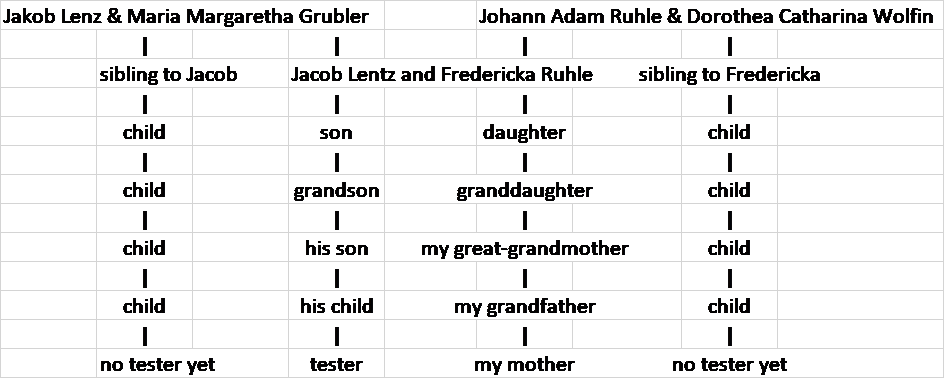
The third red cluster is on my mother’s side and I know that it’s my Jacob Lentz and Fredericka Ruhle line. I can verify this by looking at my mother’s AutoCluster file to see if the same people appear in her cluster.
You can also view this grid by name, # of shared matches and the # of shared cMs with the tester. Those displays are nice but not nearly as informative at the AutoClusters.
Scroll for More Match Information
Be sure to scroll down below the grid (yes, there is something below the grid!) and read the text where you’re provided a list of people who qualify to be included in the clusters, but don’t match anyone else at the criteria selection level you chose – so they aren’t included in the grid. This too is informative. For example, my cousin Christine is there which tells me that our mutual line may not be represented by a cluster. This isn’t surprising, since our common ancestor immigrated in the 1850s – so not a lot of descendants today.
You’re also provided with AutoCluster match information, including whether or not your match has a tree. I do have notes on my matches at Family Tree DNA for several of these people, but unfortunately, the file download did not pick those notes up.
However, the fact that these matches are displayed “by cluster” is invaluable.
You can bet your socks that I’m clicking on the “tree” hotlink and signing on to FTDNA right now to see if any of these people have recognizable ancestors (or surnames) of either Elizabeth Vannoy or Lazarus Estes, or upstream. Some DO! Glory be!
Better yet, their DNA may descend from one of my dead-ends in this line, so I’ll be carefully recording any genealogical information that I can obtain to either confirm the known ancestors or break through those stubborn walls.
Dead ends would become evident by multiple people in the cluster sharing a different ancestor than one you’re already familiar with. Look carefully for patterns. Could this be the key to solving the mystery of who the mother of Nancy Ann Moore is? Or several other brick walls that I’d love to fall, just in time for Christmas. Who doesn’t have brick walls?
By signing on to Family Tree DNA and looking carefully at the trees and surnames of the people in each group, I was able to quickly identify the common line and assign an ancestor to most of the matching groups.
This also means I’ll now be able to make notes on these matches at Family Tree DNA paint these in DNAPainter! (I’ve written several articles about using DNAPainter which you can read by entering DNAPainter into the search box on this blog.)
Mom’s Acadian Cluster
Endogamy is always tough and this tool isn’t any different. Lots of grey squares which mean people would fit into multiple clusters. That’s the hallmark of endogamy.
My Mom’s largest clustered group is Acadian, which is endogamous, and her orange cluster has a very interesting subgroup structure.
If you look, the larger loosely connected orange group extends quite some way down the page, but within that group, there seems to be a large, almost solid orange group in the lower right. I’m betting that almost solid group to the right lower part of the orange region represents a particular ancestral line within the endogamous Acadian grouping.
Also of interest, my Mom’s green cluster is the same as my red Jacob Lentz/Frederica Ruhle cluster group, with many of the same individuals. This confirms that these people match me and that other person on Mom’s side, so whoever in this group matches me and any other person on the same segment is triangulated to my Mom’s side of my genealogy.
You can also use this information in conjunction with your parental bucketing at Family Tree DNA.
In Summary
I’m still learning about this tool, it’s limitations and possibilities. The software is new and not bug-free, but the developer is working to get things straightened out. I don’t think he expected such a deluge of desperate genealogists right away and we’ve probably swamped his servers and his inbox.
I haven’t yet experimented with changing the parameters to see who is included and who isn’t in various runs. I’ll be doing that over the next several days, and I’ll be applying the confirmed ancestral segments I discover in DNAPainter!
This is going to be a lot of fun. I may not surface again until 2019😊
I receive a small contribution when you click on some (but not all) of the links to vendors in my articles. This does NOT increase the price you pay but helps me to keep the lights on and this informational blog free for everyone. Please click on the links in the articles or to the vendors below if you are purchasing products or DNA testing.
Oh yea, this cliff-hanger installment in the mystery series better known as “Dad’s Better-Than-Any-Soap-Opera Life” is a doosey!
I’ve been trying for years to piece my father’s life together, and slowly, the puzzle pieces fall into the place. However, it doesn’t feel like one puzzle, but a schizophrenic mixture of several puzzles that all have the same shaped pieces but different pictures on the front.
I’m chronically confused by his life, events and choices. Nonetheless, I persevere, because I really want to unearth the truth which, I hope, can serve to unlock some understanding of this man who passed from this earth when I was but a child.
I knew that my father had served in the military. Initially I thought it was once, then twice – once during WWI and WWII. Then, I discovered that it was twice during WWI, then a third enlistment was added. Tidbits about my father’s life tended to creep up on me like that – a slow drip of truth confounded by lots of obfuscation and drama.
I was confused – very confused, and to complicate matters even further, his service records burned in the 1973 National Personnel Records Center fire in St. Louis Missouri. Then, according to the Department of Veterans Affairs in 1991, his medical records from the veterans facility in Fort Wayne, Indiana were forwarded to the Dayton, Ohio Record Center for storage in 1960 and that all records prior to 1964 had been destroyed – and that they were sorry.
Not nearly as sorry as I was.
I guess high drama even followed him around AFTER his death in 1963. I remember hearing about the St. Louis fire, vaguely, but I had absolutely no inkling at the time how adversely it would affect my ability to unravel the life of my father years later.
When I did find out, I wrote letter after letter and tried to obtain what scraps I could. When I was mostly unsuccessful, I figured that was it. Finished. Done. That chapter forever closed. At least that’s what I had been told by all the government agencies and had accepted as truth.
I was wrong.
Ordering Research
I placed an order with a genealogical research firm for record retrieval and reconstruction, I figured that it couldn’t hurt and might be fruitful. They knew where to look, and how, and I didn’t.
A few weeks later, I received at least a few of my father’s records and while I was saddened by the contents, I wasn’t surprised. What I’d hoped for was some additional detail. There wasn’t nearly as much detail as I wanted, but at least there was something. Genealogists NEVER find “enough” details😊
Some tidbits solved long-standing puzzles. Some begged new questions – but all of it was interesting, including the fact that they had archived the original letter I’d written back in 1991, adding it to his file, when they clearly HAD this information and DIDN’T send it to me then. How startling to see my own handwriting in his file.
First, I sent them all of the information that I had compiled. No use replowing the same field.
I’ll spare you the details of the paperwork flow, but the information the research firm received was that court martial records should be in the archives in College Park, MD and that the case number was 138991. Court martial records had not been stored in St. Louis!
Hurray!!!!
Queasy
Then, I felt queasy. My father had a court martial number.
A court martial number.
This man, the father who held me in my childhood and left me far too soon.
The man I adored, and grieved, had been court martialed.
That was tough. Sickeningly tough. Nauseatingly tough.
The Army
My father also had two service numbers: 0900796 and 21585201, but he enlisted three times.
Service from August 24, 1917 to May 19, 1919
Service from May 20, 1919 – Nov. 26, 1921
Service at Fort Sheridan, Illinois
His third enlistment at Fort Sheridan began on January 8, 1927. He deserted on May 23rd of that same year, but he wasn’t discharged until October 31, 1938 – 11 years later?
That’s bizarre.
Why? What was going on?
What new origami puzzle is waiting to unfold?
First Enlistment
The first document in the document packet was the May 1919 discharge from my father’s initial enlistment.
Two items are of note.
First, he was in some kind of trouble, because he forfeited 2/3rds of his pay for one month.
Keep reading however, because under remarks, we see why:
AWOL Nov 11, 1918 (Thursday) to Nov. 20, 1918 (Saturday)
AWOL from Feb. 10, 1919 (Monday) to Feb. 12, 1919 (Wednesday)
AWOL from April 4 (Friday) or 11 (Friday,) 1919 (I can’s make out which date is correct) to April 13, 1919 (Sunday)
Hmmm, apparently, my father had a bit of an AWOL (absent without leave) problem.
Also of note, we discover the location of his original enlistment at Lafayette, Indiana. I already knew that he initially trained at Fort Benjamin Harrison near Indianapolis after enlistment, but I was never positive where he had actually enlisted.
I do have signatures of my father, but I have another one here.
The great irony is that he immediately re-enlisted at Camp Custer in Battle Creek, Michigan the day after he was discharged.
Camp Custer still stands, although it was deserted and hollow a few years ago when I visited.
Perhaps that $60 re-enlistment bonus, especially after forfeiting 2/3rds of his pay might have had something to do with it. His actual monthly pay was a whopping $49, according to this document, of which he sacrificed $30?
Where the heck was he when he was AWOL? I expected those AWOL dates to be weekends, but there is no consistent pattern. I thought perhaps a relative had died back in Claiborne County, but I don’t see any evidence of that either.
Maybe he had met Virgie and was going back and forth to Indiana? Nope, not until the summer of 1919.
Perhaps my father’s drinking problem was escalating. That’s more likely.
Second Enlistment
My father’s second enlistment ended a bit differently. He was Honorably Discharged from Fort Leavenworth on November 26, 1921 when his term of service expired.
Aren’t the words “honorably discharged” and “Fort Leavenworth” oxymorons? Polar opposites?
This time, he requested travel pay back to Tazewell, TN, where his parents were from originally and where his father was living at that time.
But, based on other records, it doesn’t appear that he actually went to Tazewell. Instead, he went back to Battle Creek, Michigan where Camp Custer, also known as Fort Custer, where he had been serving before going to Leavenworth was located.
Ilo Bailey
What was happening in my father’s life during this time that might have had something to do with his decision to become AWOL?
Ilo Bailey, that appears to have been what happened.
On February 24, 1920, Ilo had a son, Lee Joseph Estes. Using a pregnancy calculator, Lee’s conception most probably occurred between May 26 and June 2, 1919. These dates of course presume a pregnancy of normal duration.
These dates may also explain why my father re-enlisted on May 20th, and they might also have something to do with his AWOL status in April. He may have been quite smitten with Ilo and wanted to stay in the vicinity.
On November 4th, 1919, he was AWOL and a month later, on December 3, 1919, he married Ilo in Battle Creek under an assumed name, Don Caroles who he claimed was from New Mexico.
When I initially discovered this marriage, I wondered why the alias. It seemed so bizarre. Now we know. He was AWOL. However, his mother’s name is listed as Mary Claxton. Margaret Claxton was his grandmother on his mother’s side. Even more interesting, Ilo’s mother is listed as Ollie Bolton, which was my father’s mother by her maiden name. I’m taking this as evidence that Ilo’s family did not approve of this marriage and the couple probably married without her family’s knowledge and/or consent.
This also makes me wonder if Ollie was somehow involved and may have gone along, posing as Ilo’s mother. Ilo, at 19, was surely old enough to sign for herself to marry. The problem was that Ilo wasn’t actually 19, she was 17, underage and pregnant, so perhaps Ollie was along as her “mother” to vouch for the fact that she was 19 and old enough to marry.
My father, aka Don Caroles, is listed as “in the service,” even though he’s AWOL. This could be a clear indication that he never intended to actually desert and still considered himself a soldier. As you’ll see in a bit, this may seem irrelevant or trivial, but it has important ramifications.
Otherwise, why would he make that declaration about being in the service? And why would he stay in the same town if he actually wanted to desert? People from Camp Custer were sure to see and recognize him there.
Interestingly enough, he’s also listed in the 1920 census, taken on January 14, 1920 where he as Don and Ilo, age 17, are living with her mother, Maud at 221 East Avenue North.
Here’s the property today.
The Battle Creek property tax system indicates that this home was built in 1920 and is a 5 room, two bedroom house, but was it built before or after he lived there? If he lived there, it was relatively new and that’s not likely given the circumstances.
If he was living in this house with his very pregnant bride and her family, it was cozy quarters indeed. Furthermore, given that they were living with her mother, it doesn’t appear that her family was estranged, at least not at this point. Perhaps he was helping to take care of her mother and her three siblings too.
Research reveals that Ilo’s father died on March 28, 1917, so her mother would have been left as a widow to raise the children alone. This puts the statement recorded in legal documents that “her people couldn’t” provide for her in a different light than meaning they wouldn’t care for Ilo. There’s a big difference between can’t and won’t.
It still doesn’t explain Ilo’s letter in March of 1921 to Dad stating that she had sacrificed the love of her family for him.
However, that’s not the only thing going on in his life, as if this wasn’t enough.
Martha Dodder
Dad had met Martha Dodder too.
We know from my half-sister Edna, daughter of Dad and Martha, that they met while he was hospitalized in the Camp Custer Hospital, shown below, with the attached YMCA building where families and volunteers came to comfort the ill or wounded soldiers.
Among other things, the YMCA provided soldiers with paper, envelopes and postage so they could write to their loved ones. My father’s letters to Virgie were written on YMCA stationery. It’s probably in this very building that he met Martha.
Dad was admitted to the hospital on or before August 7 and remained through August 30, 1919. His illness may have started with the flu epidemic, but it quickly morphed into something much worse and life threatening.
From his letters to a third girlfriend, Virgie, in Indiana, whom he met in June 1919, he literally thought he was going to die. He had previously proposed to Virgie, but her letters had dwindled to once a month while he was hospitalized, and he clearly knew that something was amiss in that relationship. In those letters, he had told her that he had broken it off with the previous girlfriend in Michigan, who would have (presumably) been Ilo.
His health deteriorated. From August 7th until at least August 30th he was hospitalized with either meningitis or encephalitis following a tonsillectomy.
My half-sister, Edna Estes, shown with her mother, Martha Dodder, below, was born on May 22, 1920.
The conception calculator (that’s getting a workout thanks to Dad) tells us that Edna was probably conceived between August 12, 1919 and August 29, 1919 but possibly as late as September 3rd.
He had broken up with Ilo, been ghosted by Virgie, had surgery, spent a month in the hospital, thought he was dying and clearly took comfort with Martha.
Surname Manipulation
If you’re wondering how Edna’s last name was Estes if he was married to Ilo at the time Edna was born, that too appears to be a clever construction of my father’s somewhat devious cunning. If nothing else, he was ingenious.
Purely guessing now, but given that at the time of Edna’s birth he was in the midst of being court martialed and was married to another woman with an infant 3 months old, he probably speculated that the judge might not look kindly on his leniency request if the judge knew that my father had indeed gotten two different women “in trouble” 3 months apart. Yep, that judge might, just might, view this behavior as a character flaw and decide to throw the book at him. And since the consequences of violating article 58 under which he was being court martialed were “up to and including death,” the outcome was incredibly important. So, Dad apparently successfully convinced Martha to protect him. I would like to have been a fly on that wall!
Edna’s original birth certificate, at the time she was born, listed her father as Edward Polushink and her name was listed as Edna Marie Polushink. No one in the family knew about this original birth certificate, nor had anyone ever heard the name Edward Polushink when the birth certificate was accidentally discovered after Martha’s passing.
After my father married Martha Dodder in 1921, they petitioned to have the birth certificate amended, and today, Edna’s birth certificate lists William Sterling Estes as her father which DNA testing of her granddaughter subsequently confirmed.
The dead give-away is that Edna’s birth certificate is listed in the official clerk’s book, not in the date order of the other birth records as babies were born, but on the date that the record was changed, in 1922. The clerk had a great deal of difficulty finding Edna’s birth record due to the out of order recording, which is also how that original record was discovered. The original was listed in the correct date location but was stricken through.
Timeline
I just can’t keep events like these straight without a timeline, not to mention that timelines help me visualize more accurately and see “holes” in things, literally or figuratively.
October 1, 1901 or 1902 – William Sterling Estes is born based on census and family records. Could possibly be 1903 but less likely.
August 24, 1917 – First military enlistment – age 13 or 14, falsified age
October 1, 1917 – 14th or 15th birthday
October 1, 1918 – 15th or 16th birthday
First Enlistment AWOL Nov 11, 1918 (Thursday) to Nov. 20, 1918 (Saturday)
First Enlistment AWOL from Feb. 10, 1919 (Monday) to Feb. 12, 1919 (Wednesday)
First Enlistment AWOL from April 4 (Friday) or 11 (Friday,) 1919 to April 13, 1919 (Sunday).
May 19, 1919 – First enlistment complete, honorable discharge
May 20, 1919 – Enlisted for the second time at Camp Custer in Battle Creek, Michigan
May 26 – June 2, 1919 – Ilo Bailey’s son conceived
June 25, 1919 – First letter to Virgie whom he had recently met in Indiana, states he has broken up with the former girlfriend
June-August 1919 – Has proposed to Virgie. Is taking her an engagement ring when he gets out of hospital.
August 7 – 30, 1919 – Hospitalized, flu, pneumonia and eventually either meningitis or encephalitis, meets Martha Dodder who is a volunteer at the hospital
August 30, 1919 – Letter to Virgie with entirely different tone, understands that her lack of communication means the end, says goodbye, terribly saddened, but leaves the door open
August 12 – September 3, 1919 – Conception dates for Edna Estes, daughter with Martha Dodder
October 1, 1919 – 16th or 17th birthday
Second Enlistment AWOL – November 4, 1919
November 18, 1919 – Status changed from AWOL to desertion (this changed his legal status from Article 62 AWOL to Article 58 desertion)
December 3, 1919 – Marriage to Ilo Bailey in Battle Creek using assumed name of Don Caroles. Ilo is 6 months pregnant.
April 7, 1920 – Arrested for desertion/AWOL in Battle Creek, confined to the guard house at Camp Custer
May 20, 1920 – Martha’s daughter, Edna Estes born as he is being court martialed. He is still married to Ilo.
May 20 through August, 1920 – Court Martial proceedings
August 1920 – Court Martial sentencing
August 1920 – November 1921 – Fort Leavenworth performing hard labor
October 1, 1920 – 17th or 18th birthday while in Leavenworth
March 22, 1921 – Ilo letter saying she is leaving the state with the baby and has sacrificed the love of her parents for him and their marriage was never legal. Perhaps this is why a line was at some time drawn through the marriage record in the clerk’s marriage book.
October 1, 1921 – 18th or 19th birthday while in Leavenworth
November 26, 1921 – Term of service ended, honorably discharged from Fort Leavenworth
December 12, 1921 – Marriage to Martha Dodder in Battle Creek, 2 weeks and 2 days after leaving Leavenworth
October 1, 1922 – 19th or 20th birthday, married to Martha and living in Battle Creek
September 5, 1923 – Martha files for divorce stating that he “loafs around doing nothing and she has to go out to work.” (Was he the original stay-at-home Dad?) Both are seeking a divorce and she alleges the legally required phrase of “extreme cruelty” in order to obtain a divorce in Michigan at that time.
October 1, 1923 – 20th or 21st birthday, in process of getting divorced from Martha
February 26, 1924 – Divorce from Martha final in Battle Creek
October 1, 1924 – 21st or 22nd birthday – who knows where the heck he is? His two children are living with their mothers and he isn’t living with or married to either mother anymore.
That’s a lot of ground to cover by your 21st or 22nd birthday. One heck of a lot!
But that’s not the half of it.
Court Martial
Reading your father’s court martial is brutal. I was torn between wanting to know and not wanting to look. This would be a lot easier if this history was a couple of generations removed, and much less personal.
For God’s sake, this is my FATHER. Half of me is from him, but hopefully not the AWOL half.
I need to read this and try to unravel what happened. Perhaps I can understand why.
The investigation, above, recommended that my father be court martialed, and that’s exactly what happened. He was to be charged with a violation of the 58th Article of War.
ART. 58. DESERTION.–Any person subject to military law who deserts or attempts to desert the service of the United States shall, if the offense be committed in time of war, suffer death or such other punishment as a court-martial may direct, and, if the offense be committed at any other time, any punishment, excepting death, that a court-martial may direct.
Death?
DEATH?
My father was messing around with an offense that could result in a death sentence? Where they stand you up against the wall and your fellow soldiers line up and shoot you point blank.
What the bloody hell was he thinking?
This document was followed by 22 typed legal pages of testimony, much of it having to do with the morning reports in barracks, shown below, and the process that soldiers used to obtain passes.
Clearly, my father did not obtain or attempt to obtain a pass. The court martial also includes details such as that there was nothing missing, meaning no equipment or clothes had been taken when he was not present for the morning report. In other words, he hadn’t stolen anything from the government and it goes as evidence to suggest that he wasn’t planning to desert. He was just a few months late returning, that’s all.
Right!
He apparently was cooperative and said little. He said nothing about disliking the service or military at any time, according to the testimony from various people.
During the proceedings, my father answered questions respectfully, with “Yes Sir” and “No Sir.”
Reading the transcripts of the trial, several tidbits were revealed.
Question to his commanding officer: Was the accused ever in trouble in the company?
A: Well I believe he would go downtown and stay late and that is about all.
Q: What is your opinion of his character?
A: He seemed to be a very good soldier.
That’s so sad. It’s also worth noting that he was a Sergeant at one point, but ultimately was discharged as a Private.
The police officer, Edward Abbey, who arrested my father was tipped off by two ex-soldiers who spotted him along with his (presumed) wife, baby and another female at the Majestic Theater in Battle Creek.
The officer waited until the movie was over, then stopped him on the way out, put his hand on him, and asked if he was a deserter. My father replied no, that he wasn’t, but the officer took him to the station to question him.
Based on the testimony, there is apparently a difference in the classification of someone who is absent without leave (Article 61) and a deserter (Article 58.) The primary difference between the two offences is “the intent to remain away permanently” or if the purpose is to shirk important duty, such as combat. If a person intends to return to “military control,” then they are AWOL and not a deserter – even if they are away for years. For the first 30 days, the unit attempts to locate the soldier and convince them to return to the unit.
Oh yea, one other tiny difference. AWOL doesn’t carry the death penalty as a possibility – so it would have been important to have him convicted as AWOL and not as having deserted. Much safer for his neck that way.
So my father was just late – really, really late.
Today, at the 30 day mark, the soldier becomes “a wanted person” and their status changes to deserter. At that time, the line in the sand may not have been as clear. Anyone AWOL for more than 30 days is tried by court martial.
Given this distinction, the several pages of testimony by various individuals regarding the fact that my father was wearing at least a partial uniform when arrested and never left the area provides evidence that he may have not actually intended to permanently desert. When I first read this document, that repeated testimony seemed unnecessary overkill, but now I understand why so much focus was placed on that seemingly trivial information.
In essence, desertion requires intent while being AWOL does not. Although being gone for 5 months indicates that he made the same bad decision to be AWOL for roughly 150 consecutive days. However, every day was a new decision while a deserter makes one decision, once, and carries it out. A deserter likely leaves the area immediately to minimize chances of being caught, and he didn’t do that either.
So either he really didn’t intend to actually desert, or he was incredibly short-sighted – to put it nicely.
At the police station, my father apparently freely admitted that he had “left the army without permission” which is technically AWOL and not desertion. He denied being a deserter. He obviously knew the technical difference.
At the time my father was apprehended, he was wearing civilian clothes that mostly covered up his military issued uniform. According to the arresting officer, “I noticed his uniform pants because his civilian pants had a three cornered hole in them. He had on a dark colored civilian coat.” He was not wearing military leggings which you can see in the following picture of him kissing Virgie.
Based on letters he had written to Virgie during the time when they were briefly engaged in the summer of 1919, he was trying to figure out how they could live on his soldier’s pay. He commented that he didn’t need non-military clothes because the Army would provide his clothing. I’m wondering if the reason he was wearing his military garb under other clothes is because he only had one civilian outfit (with a tear in the leg) and he needed the layers for warmth. Wearing military issue simply increases the odds that someone will notice and recognize you, which is the last thing you want if you are a deserter. Or AWOL.
These pieces don’t all add up. Had he always intended to go back “tomorrow?” Yet each tomorrow looked increasingly bleak in terms of the consequences?
He had never left Battle Creek during the 5 months he was AWOL, so clearly wasn’t trying very hard to hide. He had been driving a team for someone, meaning a team of horses. And he was wearing a uniform, or at least pieces of his uniform in the town beside the military base where he was AWOL from. I have to wonder at his thought process.
The night he was apprehended, the officer said that there was a woman at the station without the baby, and a woman at city hall with a baby. Ilo could simply have had her friend take care of the baby while she waited for him. Or, maybe, the two women waiting separately were pregnant Martha and Ilo with baby Lee. If that was the case, then incarceration might have sounded like the best of two bad options and much safer than the explosion that might have resulted had Martha and Ilo met.
Or perhaps, they had met and his goose was already cooked in more than one pot.
During the court martial proceedings, my father stated that he did not wish to make a statement or testify on his own behalf. There really wasn’t much he could say.
Counsel for defense closing argument:
“The defense wishes the court to take into consideration that the accused has a wife and a 2 or 3 month old baby with no means of support and the accused asks that the court show leniency.”
The Judge Advocate read that there were no previous convictions and read my father’s statement of service that omitted his prior service enlistment, which he brought to the attention of the judge.
Fortunately, the Judge Advocate took pity on him and the sentence was modified, the dishonorable discharge order suspended and the hard labor being reduced from 18 months to just 6.
Ahhh, it looks like Dad got a break and the judge remarked that he was not determined to be guilty of desertion, simply AWOL. Six months for AWOL versus 18 for desertion. Maybe those old Army clothes he was wearing, for whatever the reason, saved his skin.
Hard labor at that time meant exactly what it implied – working rock quarrys, building roads or laboring on docks. Or, perhaps, building state or government buildings, like the prisons themselves.
The next document is an amended sentence.
The original sentence was for 18 months of hard labor, but this document says 6 months. He had been granted the leniency he requested.
It appears that the Adjutant General has a significant amount of discretion. There’s a difference between this type of case and one of desertion under fire that jeopardizes the lives of other soldiers. While there appears to be no justification for the choice he made, it’s still not comparable to defecting to the enemy or risking the lives of others.
Still, the fact that he would have done something that even MIGHT result in his own death sentence boggles my mind.
BUT, my father actually DID serve more than six months, and the reason why will astound you!
More Confusion
Then, the most confusing document of all was dated the day of his sentencing:
Let’s take this apart piece by piece.
Born in New Mexico, October 1, 1898? We already know that he “modified” his birth year significantly to enlist in the service. He was born in either 1901 or 1902. But he was NOT born in New Mexico. Why did he say that? What don’t we know?
Raised in urban environment by parents. That’s not true either. He was raised on farms and his parents divorced.
Quit school at age of 16. Assuming he attended school until he enlisted in 1917, that means he would have quit school at the age of enlistment of 14 or 15.
Claims that he was in second year of Carlyle Indian School at the time.
I’m dumbstruck at this claim which is clearly patently false. Why would he make this up?
The Carlisle Indian School was a “boarding school” for Native American students with the intention of removing them from the “Native influences” of their family and community and mainstreaming their assimilation into the Europeanized version of American life by depriving them of their culture and language.
My father was quite dark and our family had an oral history of Native heritage, so I’m not surprised that he could pull this off.
As fate would have it, a few years ago I transcribed the entire list of Carlisle Indian School residents, including the list from the school itself and from the National Archives, neither of which are individually complete. There is no Estes on this list. There is also no Don Caroles or anything similar. For those interested, I wrote about the records here.
Other information includes:
He worked as a fireman on the Grand Trunk Railroad. If he did this, I don’t know when it would have been. Firemen on the railroads tended the fire for the running of a boiler to power the steam engine.
His job in the Army was at one point listed as fireman as was the 1920 census entry, so this is at least believable. It may be the only remotely true statement made by him in this sentencing memorandum.
He was about 5 months before being apprehended. True.
He denies use of alcohol, drugs and civil offences.
Alcohol probably played a factor in this situation, one way or another. Either that, or he got himself so head-over-heels in trouble that he drank to drown those problems. Of course, then alcohol would have made the problems even worse. He had a drinking problem which I believe started as a child when he was fed alcohol by his parents to ease hunger pangs when the family had no food.
He was convicted of AWOL and escape and given a sentence of 18 months.
But wasn’t his sentence reduced to 6 months, from 18?
Wait?
What?
ESCAPE???
What escape?
Prisoner’s statement is that he had got a young girl into trouble and married her and as her people were unable to support her he went AWOL to do so.
So, he finally tells us why, or at least a sanitized version of why. Is it a reason or an excuse?
As sad as this sounds, it’s likely at least partially true, given the nature and commentary of the Ilo letter that she wrote as a form of “Dear John” letter a few months later while he was serving his time at Fort Leavenworth. Not that she didn’t have cause (think Martha Dodder), but it’s sad nonetheless that he was incarcerated in Leavenworth as a result of taking care of her (and his child) but she left him by leaving town while he was serving the sentence.
Keep in mind that in 1919, my father was all of 17 years old, possibly 18, had gotten himself into one whale of a mess, had no family to turn to and no resources to help. A 17-year-old with a wife who was reportedly estranged from her family because of him, and a newborn baby.
By the time this statement was taken, he also had a second child with Martha who was born on the day his court martial began. It’s unclear whether the two women knew about each other or each other’s children. Furthermore, Virgie, whom he proposed to in the summer of 1919 was long gone although I don’t think he every stopped loving her – given that he married her 42 years later in 1961.
In other words, in 1919, he was a hot mess.
Lastly, he had survived a hospitalization in August that had very nearly taken his life and may have left him with some level of residual brain damage that exacerbated his poor decision making. Not to mention, the US was engaged in a war. Nope. No stress there.
Physical condition good.
Low-average intellect.
I wonder how they decided his intellect was low-average. He made very poor decisions, but he was not an intellectually impaired or stupid man by any means. Again, I wonder about brain damage from the August 1919 hospitalization.
Fair emotional stability.
I sure would like to know the criteria for this assessment. From the distance of 99 years, I’d say he was a train wreck!
Not recommended for the Battalion July 27, 1920, because of no desire for further military service.
But then, there’s that escape…
Escape? What Escape?
Just when I think my father is done surprising me, there’s more.
“While awaiting the results of trial, the prisoner escaped confinement on or about June 2nd.”
I’m.
Just.
Speechless.
He escaped custody?
After his trial?
Inside a military base?
What on earth was he thinking?
How far did he get?
How long was he gone?
I was so stunned by the “escape” that I nearly missed the rest of the information on this page that tells us that he never served overseas. I had never seen evidence that he did, but it’s nice to have confirmation.
What does it mean that he’s “not recommended for the Battalion?”
In the Journal of the American Institute of Criminal Law and Criminology, Vol. 4, No. 6 (Mar., 1914), pp. 918-920 (3 pages,) the difference between a Disciplinary Barracks and a prison is set forth. The barracks hopes to reform military offenders whose offences are only military in nature. To that end, for prisoners whose merit warrants, they are allowed the privilege of being assigned to a special unit (battalion) to receive military training for a portion of the time that would otherwise be devoted to hard labor. He did not qualify for that privilege. In part, that might have been because his term of service would expire while he was at Leavenworth, so he would have no time left to serve.
The last statement was:
Clemency is not recommended.
No kidding. He blew that opportunity with his escape attempt and his reduced sentence of 6 months was reinstated to the original 18. Someplace he had also lost his officer status. He had been granted clemency, and then he subsequently lost it by his bone-headed escape. He made his own bad situation, literally, three times worse. I don’t think this man was firing on all cylinders. I truly do wonder about the meningitis or encephalitis from 1919 having a detrimental effect on his logical decision making ability.
Was he suffering from a brain injury? He went from being “a good soldier” to this. The change is like Jekyll and Hyde. What happened?
Amazingly, they did not reduce his discharge to dishonorable.
Maybe there is more to this story that we don’t know – something like he went out drinking with his guard buddies. Maybe his escape wasn’t quite like it appears. But we’ll never know.
I can’t imagine any soldier that was both AWOL and having escaped being given an honorable discharge under any normal circumstances. There must have been some sort of extenuating circumstances.
But then again, this is my father and “normal” has never been a word associated with him or even one day of his life.
Fort Leavenworth
I’ve heard of Fort Leavenworth, but what is it really?
First, Fort Leavenworth is a military base, but it’s better known for the prison, or prisons, actually.
Two Fort Leavenworth prisons exist, the Federal Penitentiary and the military United States Disciplinary Barracks. That’s where my father was sent.
The original military prison building was built in 1877 with a second additional building, below, being completed about 1921. Inmates at this older facility were used in the construction of the second building and the Federal Prison by the same name which was located nearby and completed about the same time.
Perhaps now we know the “hard labor” to which my father was assigned. This mustard colored building with the barred windows may have been his home. Somehow very ironic to build your own prison. Did he live in the new one too?
The original Disciplinary Barracks (USDB) was Fort Leavenworth’s biggest and tallest building sitting on top of a hill at the corner of McPherson Avenue and Scott Avenue overlooking the Missouri River. The largest buildings of the original barracks (“The Castle”) were torn down in 2004.
You can see a photo of the original building and cells, here. Note the pile of rocks by the shed that would have been quarried by the inmates.
The old domed building was nicknamed “Little Top” in contrast to the domed federal prison 2 1⁄2 miles south which was nicknamed the “Big Top”. The walls and ten of the buildings in the original location remain and have been converted to other uses at the Fort.
The original prison was 12 acres and the walls were from 16 to 41 feet high. Given the timing of the construction of this facility, it’s certainly possible that he worked on this wall, or others similar.
In 2002, Gail Dillon of Airman magazine wrote:
A visitor would immediately notice the medieval ambiance of this institution – the well-worn native stone and brick walls constructed by long-forgotten inmates when ‘hard labor’ meant exactly that – have witnessed thousands of inmates’ prayers, curses, and pleas over the past 128 years” and that entering the facility was “like stepping back in time or suddenly being part of a kitschy movie set about a prison bust.”
Given that my father was sentenced in 1920, it’s quite likely that he helped build the complex above (mostly torn down in 2004), those prison walls, as well as the Federal Penitentiary below.
He was discharged from the Disciplinary Barracks on November 26th of 1921, two days after Thanksgiving, with travel money to return to Tazewell, TN. Of course, that doesn’t mean that’s where he went.
We already know that 16 days later, he married Martha Dodder in Battle Creek, Michigan. Maybe he hoped to start anew, with a clean slate, and raise his daughter.
Unfortunately, that’s not what happened.
Third Enlistment
And, because twice in the Army evidently wasn’t enough for him, he had to go for enlistment number 3, but not for another 5 years and two months.
Where was he for those 5 years?
We know that he married Martha Dodder in Battle Creek on December 12, 1921 and that in February 1924 their were divorce was final, so he was apparently living in Battle Creek during that time, “being lazy” according to Martha.
A subsequent report from a different source tells us that he stated that he joined the Army from Lafayette, Indiana in 1926. Given his disregard for the truth, it’s hard to know if there is any shred of validity given that I’ve have found no evidence of a 1926 enlistment.
The third enlistment document in the packet is from Fort Sheridan, Illinois, and it too is very confusing.
My father re-enlisted on January 8, 1927 at Fort Sheridan, Illinois, an induction and training center.
And yes, he did it AGAIN! He went AWOL again!
What was this man thinking? Was he even thinking?
The top clearly says “Supplemental pay roll of deserter William S. Estes, Private Company A, 2nd infantry.
Deserter
It just kills me to see that word associated with my father.
Again, let’s dissect this information.
Deserted at Fort Sheridan May 23, 1927
Due US at date of desertion
Due US $17.53 for T fr Ft. Leavenworth Kansas to Fort Sheridan, Ill issued by Maj C.A. Meals May 14, 1927 on T/R 191,119 May 14, 1927
Reimburse Appn FD 700 P 5024 A 9-7
Due US clo lost RS $34.03 (clo apparently means clothing)
Due US C&E 20.74
Due US for clo overdrawn at date of desertion 41.40
Money value of clo drawn since enlistment 103.96
Sol having deserted within the 1st 6 mos of enlistment
Last paid to April 30, 1927 by Capt. Thomas B. Kennedy FD
No AWOL during current enlistment
What? Fort Leavenworth again! And he hadn’t even deserted yet when he was at Fort Leavenworth this time? Wouldn’t simply being AT (or anyplace near) Fort Leavenworth have been enough of a reminder that he would have sworn never to desert, be late or even sneeze again? You’d think so.
What do we have here? Did he just miss the home boys?
My heart sunk when I saw the mention of Fort Leavenworth. Based on what I think I’m reading, he traveled from Fort Leavenworth to Fort Sheridan on May the 14th. He then deserted on May 23rd. Or, conversely, he never made it to Fort Sheridan from Leavenworth.
Fort Leavenworth is the same location where he was sent for 18 months hard labor in 1919. You’d think that after one “visit” there, he would do absolutely everything in his power never to have to set foot anyplace near there again.
So he apparently enlisted on January 8th, got into some sort of trouble that was not AWOL, according to the last line, got sent back to Leavenworth for no more than 4 months where he had “resided” previously in 1921, returned to Fort Sheridan and then permanently deserted 9 days later on May 23rd.
This time, given his actions, there is no question that he intended desertion. Yet, somehow, in some way, his record was cleared and he received a military burial and a commendation certificate from President Kennedy, not to mention a military headstone.
How did that happen, given that NARA records indicate his discharge date from this third enlistment as October 31, 1938 was “other than honorable?”
This man is truly a conundrum and a contradiction of every expectation or assumption I’ve ever held.
Research, Again
I contacted the folks at the research firm again, and asked if there was any possibility of finding records of whatever happened at Fort Sheridan that resulted in him being sent to Fort Leavenworth again after his enlistment of January 8th. Obviously, he was in some kind of serious trouble right?
Well, as it turns out, maybe not.
Kathleen tells me the following:
Fort Leavenworth was and still is also a working base, as well as a detention center. Soldiers passed through there without being headed for the prison, so he was probably just in transit from base to base.
She clearly didn’t understand my father!
Soldiers would receive their travel allowances in sequence rather than all at once. The payment mentioned there would be the money issued to him to travel from there to Fort Sheridan, and apparently he never made it to Fort Sheridan.
OK, so maybe he wasn’t sent to Fort Leavenworth from Fort Sheridan because he was in some kind of trouble. How ironic if he just happened to get assigned to Leavenworth for some task or duty, given the reason he spent almost 18 months there in 1920 and 1921. Still you would think if anything would have deterred him from deserting again, it would have been the vivid reminder of seeing those walls again. How much more “in your face” could a reminder be?
Was he just working on the outside, looking in, this time? Or is there still more to this story that we just don’t know? Again, Kathleen:
I’d say there are probably more records out there buried somewhere, but his peacetime service makes it a different type of search. A lot of peacetime paperwork was routinely destroyed, because it was perceived to be of little value once shipments were received or equipment was repaired. What survives most from those times are the higher level communications, rosters, and training records.
And of course, those records could have and probably did burn in 1973 in St. Louis.
I asked if we could find any records about his deserter status, and why he wasn’t discharged until 1938, which seemed really odd to me. Why wait until 1938 to give him the boot?
We did request the court martial from this time period as well, but it was not located. It doesn’t mean that it no longer exists, it means that at this moment in time its whereabouts are unknown, and it may in fact be destroyed.
He would not have been discharged without being present. Otherwise, the army had no authority to apprehend him as a deserter. Even if he was incarcerated by civilian authorities, the army maintained ‘control’ over him. It’s possible they simply took the paperwork to the prison and discharged him there since they had finally located him. This would have been part of his service record and was most likely lost in the fire.
The fire. Always that fire! Dang that fire!
The Conundrum
Why, then, if his final military enlistment ended with a less than honorable discharge did the family receive this document upon his death?
Envelope above which held the following document.
And the burial flag from his funeral service. As it turns out, given that he had two honorable discharges, even if he had one dishonorable discharge, he might still have qualified for the flag.
Would a deserter have received these things? It never in my wildest dreams occurred to me that his discharge was “less than honorable.” Why would I have ever suspected?
Not only that, the man was a proud veteran and very active in the Red Key, Indiana American Legion post, along with the Knightstown orphan’s home. To this day, I have his well-worn American Legion hat, threadbare in places, tie and pins.
My father is so confusing!
Kathleen again:
While he had a dishonorable discharge, he also had an honorable discharge on his record. In 2004, after the fire that destroyed so much information sometimes simple proof of service was enough to obtain a headstone, and by then nobody really looked terribly closely into fragmented seventy year old records when a vet’s family made a simple headstone request. If they presented the honorable discharge pay stub from 1921, it could conceivably have flown right through.
While I’m sure the family didn’t have a pay stub from 1921, there were other things. In the records sent by Virgie, I found his second honorable discharge. That would probably have sufficed. Obviously, something did.
Then, after my sister, Edna’s death, her granddaughter sent me a copy of his first Honorable Discharge that has been saved by Martha all those years.
And, the VA confirmed my father’s honorable discharges, never mentioning the third enlistment.
Given this documentation, you can understand why I was so shocked to discover the court martial, not to mention the third enlistment complete with dishonorable discharge. There weren’t any hints about either. I was utterly astounded, gobsmacked, not to mention heartbroken.
In spite of everything else, up until this point, I could still be proud of his military service to his country, and at such a tender age, but now that too is compromised.
Kathleen continued:
I’m not too surprised at either of those things occurring – it’s also possible that someone petitioned the Army to have his record polished up, and the commendation served as confirmation of that. Involve the right people high enough up in the food chain, and anything is possible.
It was his second hitch in the service when he was in trouble that I had investigated for you after his death.
However, that letter from President Kennedy arrived within a couple weeks of his death, before Aunt Margaret had time to investigate and remedy anything. It may have simply been a “form letter” sent to the families of all deceased veterans, but that fact that Virgie received it suggests that the government themselves hadn’t put 2 and 2 together and figured out that he had a final less than honorable discharge from his third enlistment.
My mother, who was permanently and thoroughly disgusted with my father mentioned something disdainfully about some issue being “fixed” as well, but I was never clear about what was “fixed” or why, nor did I realize how relevant that tidbit would be to me after anyone who might have known the answers was gone.
Mother’s comment about “fixing” might have been about his military record, but it also might have been about his divorce to Ellen not being final when he married Virgie – yet one more thing the women in his life had to fix and clean up. He left one messy trail.
The Bottom Line
The bottom line to all of this is that while he may not have been sent to Leavenworth as an inmate in early 1927 during the first few months of his third enlistment (or he may have, we’re not sure,) he clearly didn’t manage to get himself from Fort Leavenworth to Fort Sheridan between May 14th and 23rd. Or, he did make it back to Fort Sheridan and then deserted. Regardless, he was in a heap-o’-trouble. And he clearly, very, very clearly knew better and was already painfully aware of the consequences.
Either way, that was the last straw, so to speak, and when the military caught up with him again 11 years later in 1938, they simply dishonorably discharged him. I believe that soldiers were only sentenced to Leavenworth until the end of their enlistment, which is why he only served 17 of his 18 months in 1921.
Regardless of what happened, he was “less than honorably” discharged as the result of his third term of service. Do we have any idea, any idea at all what happened?
Next Stop – A New Alias and A New Disaster
By 1927, when he deserted from Fort Sheridan, my father had apparently learned the power of an alias and how to misbehave more successfully. This time, he didn’t stay in the same town, and he apparently didn’t wear any part of his uniform. In other words, he wasn’t just chronically AWOL, he flat out deserted with full intent.
This time, he became Paul Lamarr (LeMarr), an alias he would maintain for the next 15 years. Yes, 15 long years. How did he select that name anyway? It’s quite unique.
It’s amazing that I ever found him, but he did, inadvertently, leave a few bread crumbs and sleuths in this digital age found his trail. Amazingly, he kept his past buried for 91 years.
Just over two months after disappearing from Fort Sheridan, Illinois, on August 6, 1927, now 24 or 25 years old, Paul LaMarr wrote a bad check in Berrien County, Michigan, across Lake Michigan from Fort Sheridan. The legal proceedings also mention that he had used the alias of Art Thomas, although we don’t see that name again.
He began living as Paul LaMarr.
On that same day, Paul LaMarr married Cora Edmonds, a minor, whose mother and grandmother, both widows, were members of the celibate religious order (some would say cult) known as the House of David.
If your jaw just hit the floor, mine too. No, I can’t even begin to explain that dichotomy, so don’t ask.
The next chapter in my father’s never-ending life-long-drama, now (mostly) as Paul LaMarr, but also at least for a short while as Dr. Donald McCormack, had begun.
And….Yet ANOTHER Shoe Drops
Not only that, but Cora’s family lived in the same multi-family commune home as Bessie Boruff…someone who would one-day have a daughter named Violet, surnamed Miller, last name compliments of her step-father. I never met Violet, but my mother and sister (Edna) did and I knew that she existed – but our families lost track of each other more than half a century ago.
Was Violet my father’s child, my half sister? He, Bessie, Violet and Edna all believed so.
This grainy photo from the newspaper is all that I have.
I do believe we look at least somewhat alike when we were younger, but who knows if we actually do, or if I’m simply looking for the resemblance and wanting to see one. I know how easy that is to do, because I did it with my brother who was not my biological brother, Dave Estes. I’m not about to find and fall in love with a sibling again just to discover that they aren’t.
In the collage below, Violet is at left, me center, Dad at right and two photos of Edna, my DNA-proven half sister, beneath. What do you think? You can see photos Ilo’s son Lee, here, but Lee had no children so there is no way to prove that he is my father’s child.
In spite of what I think is a resemblance, Violet’s conception date, based on her birth date if she was a full term child suggests that Violet might have been conceived when my father’s whereabouts were conclusively known, meaning in jail having to do with that bad check – and not anyplace close to Bessie. There is about a 5 week discrepancy.
DNA testing would solve that mystery once and for all, but Violet, who married Elmer Bruce Golladay (originally Golliday) and then Orville Blevins, died in 2004. Yes, Violet had at least three children while married to Mr. Golliday, and yes, I would love to DNA test one of Violet’s descendants.
Truthfully, I keep hoping that one of them will test on their own and just show up on my DNA match list someplace. I’d have my answer without having to explain any of….well….this. If they match me, they get to own my father’s soap-operaesque tale too. If not, then they have a different mystery to solve.
However…
When I think about trying to contact them, and yes, I have found at least two of Violet’s family members on Facebook, I struggle with how I would ever go about explaining this situation. Plus, an intrusion of this type may not be welcome news.
Merry Christmas, grandpa got run over by a court martial. Imagine if they are a veteran or lost a family member in service. Ummm…no.
They get to become aware of a very “colorful” character not far in their past, or conversely, one of their family members may not be who they think they are/were and either scenario may be unwelcome news they didn’t ask for. If they don’t seek answers by reaching out or DNA testing on their own, I’m very hesitant to intrude with what could well amount to distressful information.
Of course, if they have already tested and don’t match me, I’ll never know. So here’s hoping that maybe one day someone in Violet’s family will become interested in genealogy and google Violet’s name.
Hopefully, after they get over the same shock that I felt, they will contact me and we, together, can solve one more mystery in my father’s life.
If they are worried that the apple didn’t fall far from the parental tree – ironically – no. My father may have made boneheaded decisions about his own life, but the women who raised his children did an awesome job! He apparently had great taste in wives because their descendants are amazing people.
Sooo, maybe Santa will bring at least one of Violet’s children or grandchildren a DNA test for Christmas and they’ll just test!
Santa, can I arrange for a delivery?
———–
Epilogue: As you might imagine, this article was very difficult to process and write. I debated for weeks about whether it should be published or not, and I published it with no small amount of reservation.
After publication, my German friend and faithful blog reader offered the following slightly edited commentary, which I found very comforting as well as enlightening. Thank you so much Chris.
Though I do not know much about your father, only your articles, I am quite confident of this conclusion: No brain damage required to explain his running away, no bad decision making. I rather fear that running away may have been the only decision he was possibly able to take at all. He had no other choice!
He ran away to military to escape his personal life, he ran away from military service, he ran away from wives and the responsibility for his babies. He ran away to alcohol to forget about himself for a while. He tried to run away from himself by changing his identity. And, as I remember from your other article, it seems that his final choice was to run away from his life.
Importantly, this does not imply that he did not at the same time truly love these women and children, including you! It was not them whom he was running away from, it was himself whom he tried to flee from.
Please feel hugged! Thank you for your openness to share these stories with us all! And let us all try to give other souls on this earth a place to stay and find peace, not to leave.
I receive a small contribution when you click on some (but not all) of the links to vendors in my articles. This does NOT increase the price you pay but helps me to keep the lights on and this informational blog free for everyone. Please click on the links in the articles or to the vendors below if you are purchasing products or DNA testing.
For everyone that has been waiting for the MyHeritage LIVE 2018 webinars, they are available free at Legacy Family Tree Webinars, here.
One really nice thing MyHeritage did was to include the actual speaker’s slides on the left side of the screen, with the speaker shown to the right. This means that you’re going to be able to see the slides better than many people attending the conference.
I spy several that I need to watch – like learning more about the MyHeritage Mobile App, Newspaper Research strategies and how to more effectively use SuperSearch.
I mostly attended the DNA sessions, so I need to watch the genealogy ones online.
I do have a recommendation for you though.
Gilad Japhet’s keynote was incredible. So inspirational, powerful and moving – in a way that all genealogists can relate to. Riveting is the word that comes to mind. You could have heard a pin drop.
The great thing is that Gilad is making the changes happen in how records are searched and indexed at MyHeritage that will benefit his own research – and ours too, right along with his. Not to mention leading edge genetic technology like extracting DNA from envelopes and stamps. The jury is still out on this, so stay tuned.
Happy Holidays to You
You can give yourself an early (free) holiday present by setting time aside to watch these information-filled sessions.
There are a total of 18 free sessions from the conference and another 27 free classes about how to use MyHeritage for a total of 45.
Make yourself a list of the sessions you’d like to watch and watch one a day – sort of a genealogical version of the 45 days of Christmas😊
Of course, genealogy research works much better if it includes DNA testing.
Upload Your DNA
Don’t forget that DNA uploads and tools are free at MyHeritage until December 1, but after that there will be a cost for their advanced tools. Anyone who tests there or uploads before December 1 will be grandfathered in for free. That’s just 2 more days so don’t wait!
I receive a small contribution when you click on some (but not all) of the links to vendors in my articles. This does NOT increase the price you pay but helps me to keep the lights on and this informational blog free for everyone. Please click on the links in the articles or to the vendors below if you are purchasing products or DNA testing.
Here’s the pedigree chart generally used to explain the people in your tree represented by Y (blue boxes) and mtDNA (red circles) testing. Unlike autosomal, Y and mitochondrial only tests one line, but tests that one line VERY deeply, providing information not available through autosomal testing.
Y DNA tests only the Y DNA of the line shown with the blue boxes, NOT everyone on your paternal side.
Mitochondrial DNA tests only the line shown in red circles, NOT everyone on your maternal side.
That’s a good thing, not a bad thing, because this type of testing reveals information and matching opportunities not available through autosomal testing.
Maternal Versus Matrilineal, Paternal Versus Patrilineal
When we say maternal and paternal, the meaning can easily be confused.
Anyone on the father’s entire side of the tree literally is paternal, and anyone on the mother’s side literally is maternal. The line is drawn straight down the middle, with half of your ancestors on each side.
What we really mean when we discuss Y and mtDNA testing is patrilineal and matrilineal. Those words mean the direct paternal line only, and the direct maternal line only, shown below.
There doesn’t seem to be as much confusion with understanding that the Y chromosome follows the patrilineal line – probably because we’re used to this concept as the surname follows the same Y DNA path.
Matrilineal means the same thing on the maternal side, but there isn’t any key anchor concept, such as surname to go along with it. Therefore, when I’m discussing mitochondrial DNA testing, I say, “matrilineal, meaning your mother’s mother’s mother’s line, on up the tree until you run out of mothers.”
Why is this So Important?
Aside from the fact that expectations can easily be mis-set resulting in misinterpreted results, the concept of patrilineal and matrilineal are important because this confusion results in the confused person in advertently confusing others.
For example, when people want to take a mitochondrial DNA test to see if their Native American ancestor is on their mother’s side, what they are really testing is their matrilineal line, not everyone on their mother’s side of the tree.
Native American mitochondrial haplogroups are known to be subsets of haplogroups A, B, C, D and X. If the matrilineal line is Native, the mitochondrial results will fall into the proper Native subgroup. If not, they won’t.
However, a maternal Native American ancestor could well exist in any other ancestor or ancestors whose circles and squares aren’t colored at all – shown below by haplogroup B2a.
Conversely, a male Native American ancestor could exist in any of those other lines as well, shown above by C-M217. The only way to discover that information is to DNA test someone who carries the Y or mitochondrial DNA of each of your ancestral lines.
At Family Tree DNA
At Family Tree DNA, the only vendor that does full Y and mitochondrial testing and matching, one of the information fields that testers are asked to provide is titled “Earliest Known Ancestors.”
Although this field says specifically how to determine the relevant ancestor they are asking about, many people either don’t read this, or don’t understand, or they enter the information before their results come back and never think to update this field when they discover that this isn’t their Native line after all.
On the Matches Map tab, where this information can also be entered, there is no explanation for which ancestor they are asking for. Often, I see males names have been entered in the direct maternal field, so the person interpreted this as their OLDEST person on their mother’s side – which of course is inaccurate – instead of their most distant matrilineal ancestor.
The problem is that if the tester enters a person who was born in Germany, and the matrilineal ancestor is a Native American female (or vice versa), this provides incorrect information to the system which then uses that compiled information to populate Haplogroup Origins, Ancestral Origins and the locations on the Family Tree DNAuniversal Y haplotree and mitochondrial public haplotree for other people. This is why you often see people in European haplogroups shown as “Native American.” Other testers’ information is part of what is provided on those pages. Collaboration is the underpinning foundation of genetic genealogy, but it also carries with it the opportunity for error.
Family Tree DNA provides a lot of information to customers, but some of it relies on information from other testers, so please test, and please be sure that your information is accurately reflected in these fields. Now might be a good time to check.
What About My Other Lines?
You can’t test for lines other than your patrilineal (males only) and your matrilineal (both genders) personally, BUT, other family members can – and you can surely gift them with tests. I look at it this way; they are testing for me, and if I could, I’d test for that line in a heartbeat – so I’m more than willing to provide a scholarship for their testing.
In the situation above, your mother’s father carries the mitochondrial DNA that you seek, shown as Native American B2a. If he’s not living, his siblings carry that same mitochondrial DNA. If he has sisters, their children, both male and female carry his mother’s mitochondrial DNA too. You need to follow the lineage through all females to a living relative who’s willing to test.
To obtain the DNA of the Native male, shown above as C-M217, you’d need to test your father’s mother’s father, or her brothers, or their sons. Follow this line up and down in the tree to find a male who carries that surname who is not adopted into the family.
I’ve been gathering my own ancestors’ Y and mtDNA information, because only Y and mtDNA provides a periscope view directly down a single line without admixture from the other parent.
There’s just so much to learn! Where they originated, the history of their lineage, who you match and more. Y and mtDNA reaches back before surnames.
What can you learn about your family lines, and who can you ask to test?
What About You?
You can order the Y DNA for males and the mtFull test for either males or females at Family Tree DNA. When I ask a family member to test, I always offer to also purchase a Family Finder test at the same time so we can utilize their autosomal DNA as well, which is inherited from all of their lines. The cousin and I both get to know our ancestors better and advanced matching feature allows combined matching between all kinds of tests.
The Family Finder test can then be leveraged by uploading the autosomal DNA files to other free databases such as GedMatch and MyHeritage to obtain even more matches.
Your cousins and family members are goldmines containing the DNA nuggets of your ancestors just waiting to be found!
I receive a small contribution when you click on some (but not all) of the links to vendors in my articles. This does NOT increase the price you pay but helps me to keep the lights on and this informational blog free for everyone. Please click on the links in the articles or to the vendors below if you are purchasing products or DNA testing.
You have just 5 more days to upload your autosomal DNA raw data files from other sites to MyHeritage for entirely free. As of December 1st, MyHeritage is changing their pricing model for uploads and a charge of some sort will be put in place for the more advanced tools.
MyHeritage hasn’t said exactly what that charge will be, whether it will be a one time unlock or a subscription of some sort.
What they HAVE said is that anyone who transfers DNA from any of the other major vendors before December 1st or has transferred in the past will have free access to all of the DNA tools.
As of December 1, 2018, our policy regarding DNA uploads will change: DNA Matching will remain free for uploaded DNA data, but unlocking additional DNA features (for example, ethnicity estimate, chromosome browser, and some others) will require an extra payment for DNA files uploaded after this date. We will announce the full details of the new policy once it is finalized, closer to December 1st. All DNA data that was uploaded to MyHeritage in the past, and all DNA data that is uploaded now and prior to December 1, 2018, will continue to enjoy full access to all DNA features for free. These uploads will be grandfathered in and will remain free.
You can upload multiple files from different people to be managed under one account at MyHeritage. For example, I manage several kits for multiple family members. The e-mails have been flying back and forth the past several days as I’ve been requesting permission to do the free uploads by the end of November. If your family member opens a MyHeritage account someday, you can transfer their results to them – no problem.
You can transfer Ancestry, Family Tree DNA, 23andMe and LivingDNA raw DNA files.
If you haven’t uploaded yet, or have family members whose files you manage that you haven’t uploaded, you don’t want to wait. The clock is tick-tocking! Upload now so you don’t forget like I almost did.
I receive a small contribution when you click on some (but not all) of the links to vendors in my articles. This does NOT increase the price you pay but helps me to keep the lights on and this informational blog free for everyone. Please click on the links in the articles or to the vendors below if you are purchasing products or DNA testing.
William Crumley the second was born in 1767 or 1768 in Frederick County, Virginia. He married, but his wife’s name is unknown. We do, however, know that her mitochondrial DNA haplogroup is H2a1. Without any other moniker, H2a1 has in effect become her name, because I have nothing else to call her that identifies her individually.
We don’t know much about H2a1, only that she was having children by about 1786 and had her last child, Catherine Crumley was born in 1805, suggesting that H2a1 herself was born about 1766.
It was Catherine Crumley’s descendant who took the mitochondrial DNA test that provided us with H2a1. Ironic that we have her mitochondrial DNA and know her haplogroup, but not her name. Of course, we are presuming that indeed, she was William II’s only wife, meaning that her haplogroup applied to her eldest child, Susannah Crumley born about 1786 and the other 8 children born between Susannah and Catherine.
H2a1’s son, William Crumley III was born between 1785 and 1789. William would have inherited his mother’s mitochondrial DNA, H2a1, but he would not have passed it on to his children. Mitochondrial DNA is only passed on by females. William’s children would have inherited their mitochondrial DNA from his wife, their mother.
William III married Lydia Brown on October 1, 1807 in Greene County, Tennessee, where the family had moved by 1793. Lydia was the daughter of Jotham Brown and his wife Phoebe, whose surname is unknown, neighbors who lived close by.
As couples do, William III and Lydia set about starting a family right away, having their first child, the Reverend John Crumley in 1808 or 1809. John was followed by William Crumley the fourth in 1811 and Jotham Crumley in 1813. Sarah may have been a twin to Jotham, born in 1813 or she may have been born in 1815. Of course, there were no birth or death certificates back then.
In 1817, daughter Clarissa was born on April 10th.
That’s where the confusion starts.
Enter Elizabeth Johnson
Enter Elizabeth, known as Betsey, Johnson who married William Crumley in Greene County, TN on October 20, 1817.
Which William Crumley, you ask? Well, so have we, for years. In fact, it’s discussed at length, here.
Given Elizabeth’s age of approximately 17 years when she married (assuming she is who we think she is,) and the fact she was remembered as the cousin of Lydia Brown, we presumed that she married William Crumley III. William III at approximately age 35-40 was closer to her age than William II at approximate age 55 – and Lydia Brown was the wife of William III so it stood to reason that they family would know her cousins.
Seems logical, right?
Except, the next child born to William III and his wife, Lydia or Elizabeth, my ancestor, Phoebe Crumley was born on March 24th, 1818, not even 50 weeks after her sister, Clarissa had been born. Furthermore, Phoebe had been born in Claiborne County, Tennessee, near the border with Lee County, Virginia, not in Greene County where earlier children were born. Also of note, Lydia’s mother, Jotham Brown’s wife was named Phoebe.
It’s certainly possible that William Crumley III’s first wife, Lydia Brown had died and he had remarried quickly to Elizabeth Johnson, then moved to Claiborne County. Except, the dates don’t work well.
We know that Lydia Brown Crumley was alive on April 10, 1817 when Clarissa was born.
Phoebe’s mother, whoever she was, got pregnant in June of 1817, 4 months before Elizabeth Johnson married William Crumley.
Pregnancy as a motivator for marriage happens, but it seemed odd that a 34 year old man with a 2 month old child, whose wife had just died was impregnating a 17 year old girl.
I discussed all the pros and cons of the situation in the articles about Lydia Brown and Phoebe Crumley, but the only other alternative is that Elizabeth Johnson had married the elder William Crumley II. It seems even odder that a man of 50+ would be marrying a girl of 17. But that too happened. Or, maybe Elizabeth was actually older than we thought.
Furthermore, William Crumley II had no additional children after 1817, at least none that we know of, but William III did. Yes, it looked quite probable that Elizabeth Johnson married William Crumley III. Young wives tended to have children, regardless of the age of their husband – so the preponderance of circumstantial evidence pointed to Elizabeth marrying William Crumley III, or Jr. as he was called in Greene County. William Crumley II was referred to as William Sr.
This seemed like the most reasonable (at least tentative) conclusion, based on the evidence at hand.
The problem is that it was wrong.
DNA Upsets the Apple Cart
One of my cousins who descends from Clarissa (born in April 1817) through all females kindly tested her mitochondrial DNA years ago. My line, through Phoebe, the younger sister of Clarissa had tested too, and they matched exactly at the full sequence level. Furthermore, both of those women also matched a descendant of a daughter of Jotham Brown, confirming that those three women had a common ancestor.
This tells us that very likely Clarissa and Phoebe are full siblings. However, dates weren’t always recorded correctly and people simply forgot. Were those two girls’ births recorded in the correct order with the correct years?
I really wanted to test a descendant of the daughter, Melinda, born April 1, 1820. That child was unquestionably born after the 1817 marriage to the second wife, if she was a second wife.
Not long ago, as a result of the article about Lydia, a descendant of Melinda came forth and volunteered to test.
Believe me, those weeks spent waiting for DNA results seemed like an eternity.
Finally, the results were ready, and sure enough, Melinda’s descendant matches Clarissa’s descendant and Phoebe’s descendant at the full sequence level, exactly.
The proof doesn’t get any better than this.
Except…
One Final Hitch
I’d feel a lot better if there wasn’t one last rumor to contend with. The rumor that Elizabeth Johnson was Lydia Brown’s cousin.
Elizabeth Johnson had to be either the daughter of Zopher Johnson, or the daughter of Moses Johnson, both of Greene County, TN. Moses was either the brother or the son of Zopher Johnson. Those are the only candidate fathers for Elizabeth.
Let’s look at the various possible relationships.
Possibility #1 – Jotham Brown’s wife, Phoebe, is Zopher Johnson’s Daughter as is Elizabeth Johnson
In the scenario above, Elizabeth and Lydia would not have been cousins, but aunt/niece. Their mitochondrial DNA would have matched, but in the article about Jotham Brown’s wife, Phoebe, we dismissed the possibility that she was Zopher Johnson’s daughter, so Possibility #1 isn’t possible after all.
Possibility #2 – Jotham Brown’s Wife, Phoebe, is the Daughter of Zopher Johnson and Elizabeth is Zopher’s Granddaughter Through Son Moses
In the above scenario, if Moses was the son of Zopher, these women would be first cousins, but the mitochondrial DNA lineage would be broken at Moses, so their mitochondrial DNA wouldn’t match.
Additionally, we dismissed the possibility that Phoebe is Zopher’s daughter, so Possibility #2 is not, for 2 different reasons. It’s possible that we’re wrong about Phoebe being Zopher’s daughter, but it’s NOT possible that we’re wrong about the mitochondrial DNA not matching in this scenario.
Furthermore Moses is believed to be the brother of Zopher, not his son.
Possibility #3 – Phoebe is Zopher’s Daughter, Moses is Zopher’s Brother and Elizabeth is Moses’s Daughter
The possibilities really aren’t endless, they just seem that way! 😊
In this third scenario where Moses and Zopher are brothers, not father and son, Elizabeth and Lydia would be 1st cousins once removed, but they would not share mitochondrial DNA unless Zopher and Moses had married sisters or women who also shared the same exact mitochondrial DNA.
The only scenario in which the mitochondrial DNA would be shared with cousins, assuming that Elizabeth Johnson and Lydia Brown were indeed cousins, is Possibility 1 where Jotham’s wife is Zopher’s daughter.
The evidence suggests that Phoebe Brown is not the daughter of Zopher Johnson, eliminating Possibility 3 as well.
Possibility #4 – Zopher Johnson’s Wife and Jotham Brown’s Wife Were Sisters
I’m going to presume here that the individual who recorded that Elizabeth Johnson and Lydia Brown were cousins meant first cousins, although it’s possible that cousin means further back and possibly not in the direct matrilineal line.
For Elizabeth Johnson’s mitochondrial DNA to match that of Lydia Brown’s exactly, they must both descend from the same common female ancestor in the direct matrilineal line.
How might that work, assuming Jotham’s wife is not Zopher’s daughter?
If the child of both Elizabeth Johnson and Lydia Brown had matching mitochondrial DNA, then the cousin lineage had to be through their mother’s matrilineal side.
This means that the wives of Zopher Johnson and Jotham Brown would have been sisters, or possible matrilineal cousins with no interweaving male generations.
Zopher Johnson and Jotham Brown were both found in Frederick Co., VA by 1782 where the tax list tells us that Zopher had 2 people in his household, indicating that he had not been married long.
Jotham Brown and Phebe, his wife are having children by 1761 in Virginia according to the 1850 census record of their oldest child.
These couples are probably at least 20 years different in age.
Unfortunately, we know very little about where Jotham originated. We know that Zopher’s parents were living in Northampton Co., PA in 1761 about the time he was born.
In order for Jotham’s wife, Phoebe to be the sibling of Zopher Johnson’s wife, they would have had to be living in the same location in roughly 1780, which was probably Frederick Co., VA.
Is it possible that the reason that Clarissa, Phoebe and Melinda’s mitochondrial DNA matches is because they actually do have two separate mothers who were cousins? Yes, it is.
Is there any evidence of that? No, not today.
However, this is the only alternate possibility that works at all.
Of course, the most reasonable scenario is that Lydia Brown didn’t die, and Clarissa, Phoebe and Melinda are all 3 her daughters. This evidence is strengthened of course by the fact that Phoebe is named after Lydia Brown’s mother.
What Other Tools are Available?
Unfortunately, Jotham Brown is 6 generations back from me. If Phoebe’s mother was Elizabeth Johnson instead of Lydia Brown, Zopher Johnson would be the same number of generations back in my tree as Jotham Brown.
The absence of Johnson autosomal matches in and of itself at that distance wouldn’t be remarkable for any particular individual, but with as many people from this line who have tested, it’s increasingly unlikely that I would match no one from the Johnson line.
At Ancestry, I added Zopher Johnson in my tree, as Jotham Brown’s wife, Phoebe’s father, creating a “honey-pot” of sorts for matches. I have no one that shares Zopher except for people who also have Phoebe listed as Phoebe Johnson. In other words, no one who descends from Zopher through any other line.
I have 27 people who I match through Jotham Brown through his other children, which I wouldn’t have as matches unless Jotham Brown was my ancestor as well.
At MyHeritage, I also added Zopher Johnson, but I have not had SmartMatches there either. Like at Ancestry, I do have Jotham Brown matches.
Several people match at Ancestry who has no chromosome browser. I have a Jotham Brown Circle at Ancestry with 45 members, of which I match 16.
Not all my matches are from Ancestry. Other matches are found at Family Tree DNA, MyHeritage and GedMatch which allow me to paint their segments on my DNAPainter profile, triangulating with others.
Conclusion
We have multiple pieces of evidence including three matching mitochondrial DNA tests for the sisters, children of William Crumley III, on the following timeline:
Crumley birth timeline
We’ve proven that Clarissa, Phebe and Melinda all share the exact same mitochondrial DNA. These births occurred both before and after the marriage of Elizabeth Johnson to one of the William Crumleys in 1817.
I have more than 30 matches to several of Jotham Brown’s descendants through multiple children other than through Lydia Brown, the wife of William Crumley III.
I don’t have any matches to Zopher Johnson through anyone except people who list Jotham Brown’s wife, Phebe, as the daughter of Zopher Johnson in their trees.
Jotham Brown’s wife’s name was Phebe, a rather unusual name, certainly suggesting that Lydia Brown was the mother of Phebe Crumley born in 1818.
I believe the combination of these factors confirms beyond any reasonable doubt that the mother of Phoebe Crumley born in 1818, as well as the younger children born to William Crumley III and his wife were all born to Lydia Brown, the first and only known wife of William Crumley III.
I believe that Elizabeth Johnson married William Crumley II, not William Crumley III based on this as well as new research evidence to be discussed in a future article.
Based on the cumulative evidence, Elizabeth Johnson did not marry William Crumley III and Lydia Brown, William Crumley III’s first wife did not die before the birth of either Phebe or Melinda Crumley.
Based on the fact that I have no autosomal DNA matches to Zopher Johnson’s descendants, I believe we’ve removed the possibility that Jotham Brown’s wife, Phebe is the daughter of Zopher, or the child of Zopher’s brother, Moses. In other words, there is no hint of a biological connection between the Johnson and Brown families upstream of Jotham Brown and his wife, Phoebe whose surname remains unknown.
As far as I’m concerned, we can put this question to bed, forever.
Acknowledgements
Thank you to the descendants of Clarissa, Phoebe and Melinda Crumley for mitochondrial DNA testing. We could never have solved this without you.
Thank you for descendants of Jotham Brown and Zopher Johnson for autosomal DNA testing.
Thank you to Stevie Hughes for her extensive research on the Zopher Johnson line.
If You Want to Test
If you want to test your mitochondrial DNA, click here and order the mtFull test.
I receive a small contribution when you click on some (but not all) of the links to vendors in my articles. This does NOT increase the price you pay but helps me to keep the lights on and this informational blog free for everyone. Please click on the links in the articles or to the vendors below if you are purchasing products or DNA testing.
Sometimes I talk to myself, and truth be told, I answer myself too. Often my own questions and research are what provide the foundation for my articles that I share with readers. Today, I’m talking to myself once again, and you’re invited to eavesdrop.
Thanksgiving is about thankfulness. Really, it’s not about turkey, pie or the football😊 I know, that’s hard to digest. Pardon the pun.
As we age, sometimes holidays become very bittersweet. The pain of loss is intermixed with the thankfulness, and from time to time, that pain is overwhelming and swamps everything else. It’s sometimes hard to be thankful, so I need memory-joggers – hence talking to myself.
We all experience these type of life events, because the human state is not static. We are born, live and die. If we are born, the only question left is the duration of the other two. And, how we decide to live for the time we have on earth.
I’m sharing my own personal thankfulness recipe, because Lord knows sometimes I need to be reminded. In no particular order. Mix, serve and repeat as necessary.
Feel free to improve this “recipe” by substituting or adding your own ingredients.
Thankfulness Recipe
I’m thankful for my cousins that I’ve met through genealogy, because they far, far outnumber my immediate family that has dwindled to only a few.
I’m super thankful for all of the cousins who have agreed to DNA test. None of us can do this alone. Thank each and every one of you!
I’m grateful for social media to connect us, even though that same platform has been used to manipulate people as well. I hope I, we, are all smarter now and evaluate everything from every source for accuracy. I’d hate to lose social media as a connection mechanism because it has so much positive to offer.
I’m thankful that I can shop on the internet and don’t have to enter any store or drive anyplace close to any mall on Black Friday!
I’m thankful for my fur family, who is always here for me – even though their lives are proportionally shorter and their crossing the rainbow bridge is excruciatingly painful for their humans left behind. I hope I’ve enriched their lives as much as they’ve enriched mine. (Confession – I have funerals and write “obituaries” for my fur family. It helps – a little.)
I’m thankful for the opportunities I’ve enjoyed. Yes, I’ve worked hard to be “available” for those opportunities to appear, so I won’t call them “luck,“ but sometimes being in the right place at the right time eclipses everything else. Call it synchronicity, fate, whatever – I’m grateful.
I’m thankful for my genealogy and DNA friends who have helped me immeasurably over the years. You know who you are.
I’m incredibly thankful for Chris and Tom, two men who reached out to me through my blog years ago and have shepherded me unflaggingly through my German lineage. I’d be lost without them. They are now among my fast friends.
I’m thankful for my home, and that it still stands, unlike so many in California and elsewhere. Makes me feel guilty for the fact that I hate cleaning it.
I’m thankful that I’m in a position where I can make “care quilts” for others, not need one for myself. And for my quilt sisters who work as a team in this endeavor. And that I can express love in such a tangible way.
I’m thankful for the physicians, nurses and support staff that work hard and study initially for years, plus incessantly for their entire careers to provide medical care that enables us to escape the grim reaper that gathered our ancestors far too early.
I’m thankful for every year that I continue to be healthy, or at least healthy enough to do what I love. When I can’t do that any longer, I want to join the ancestors and the fur family across the rainbow bridge. Family, take note!
I’m thankful for genealogical DNA testing that has allowed us to piece our disparate families back together again and to Max Blankfeld and Bennett Greenspan for founding this industry 18 years ago. Really, we are all one family – it’s only a matter of distance and degree.
I’m thankful that my ancestors were my ancestors, even those who I really can’t embrace personally (one probably murdered his wife), because without each and every one of them, I wouldn’t be here, or wouldn’t be me.
I’m thankful to be able to identify the DNA I carry of each ancestor. This confirmation process helps me bond with each ancestor personally. I cherish the chase of discovery and documenting their lives as best we can from a distance. I’m still awed by the fact that the clues to their identity are held within me and their other descendants. The life journey I’ve taken as a result of chasing them is amazing indeed – movie worthy!
I’m thankful to my mother for her many sacrifices that I never understood until I was an adult. I’m correspondingly sorry for being a shit (yes, I was), but perhaps that tenaciousness ultimately served me well. That’s my story and I’m sticking to it!
I’m also incredibly, INCREDIBLY grateful that Mom DNA tested before she left us. I thank her for this every single day.
I’m thankful to my father but I’m not exactly sure why. He was quite the wild child, but he also had a hole in his soul not of his own making that he spent his entire life trying to patch. I’m working on this one.
I’m thankful that I have the ability and willingness to learn and change and that much of the “normalcy” of the time and place in which I grew up came to serve as an example of what I oppose, not embrace.
I’m thankful that I’m not too stubborn to admit when I’m wrong, because you can’t change directions until you admit that you’re lost. This one took awhile, trust me😊
In an odd way, I’m thankful to the people and circumstances that have made me miserable (but not too miserable), because they, retrospectively, became learning tools and catalysts of change, enabling me to grow and mature personally. (This is a tough thing to be thankful for.)
I’m thankful for my step-father, who I met too late, loved with all my heart, and who left too soon. His quiet steadfast example and Hoosierisms have served as my guiding light for many years. “Never mud-wrestle with a pig. You get muddy, the pig enjoys it and the spectators can’t tell the difference.” Many of his sayings were much more colorful and I smile every time I recall them😊
I’m thankful that I learned what racism and discrimination (of all types) were in an era and place where I’m not condemned to suffer the full effects of either. My heart breaks for people that suffer so unfairly. In my step-father’s words, “I don’t care if he’s purple, as long as he’s good to my daughter.” I hope to see the demise of the weaponization of human differences within my lifetime.
I’m thankful for my brother Dave who turned out not to be my brother, who I met as an adult, who loved me by choice and in sharp contrast to other biological family members who did not. He taught me a lot about the definition of unconditional love.
I’m thankful for my husband in spite of the fact that he sometimes exasperates me terribly, and because he bakes me the panettone bread that I love – from scratch. I’ve come to recognize that there are different ways to say “I love you,” many of which we may not recognize as such. (I think I’ll tape this up on the mirror so I can remember this when I really need it😉)
I’m thankful that I’ve learned how, when and where to draw the line to eliminate toxic people from my life. My gut knows even when my head doesn’t. When it’s time to walk away, it’s time to walk away.
I’m thankful for my family and “family of heart” who over the years have stepped up to the plate when there was nothing in it for them. That’s the measure of true love.
I’m thankful for my son-in-law who took care of me when I was ill and couldn’t take care of myself.
I’m thankful for my grandchildren, both human and canine, and every minute I get to spend with them.
I’m thankful for my daughter-in-law who I’ve been fortunate enough to come to know as a friend over the years. It takes a strong woman to deal with the rest of us!
I’m thankful for second chances – for everyone (except for the Charles Manson level ilk). Second chances arrive in the form of addiction support groups, surgery, treatment, divorce, returning to school, life-changing decisions, etc.
I’m thankful to my children for becoming such fine adults, in spite of the fact that when they were teens I wondered if any of us would survive and if I would ever receive the gift of being this thankful. I’m immensely proud of both of them. Both are amazing in such different ways and I swell with pride to see the mark they are leaving on this earth and humanity. Sorry for the brag on them. I can’t help myself. Our children are our lasting legacy, one way or another.
But mostly, this Thanksgiving, I’m thankful that a decades-long rift within my family seems to be healing. Sometimes love can be entirely masked by pain, and isolation becomes a reinforcing form of self-defense. Risk, reaching out, makes people vulnerable to rejection and pain. I’m so very grateful that this healing appears to be happening before my funeral. Fingers crossed – about the rift closing of course, not the funeral.
Last, but not least, I’m thankful to all of you for the time you allow me into your lives. I hope you are having a wonderful time with your family and friends – or that you’re blissfully buried in your genealogy. Better yet, maybe these two things are one and the same.
I receive a small contribution when you click on some (but not all) of the links to vendors in my articles. This does NOT increase the price you pay but helps me to keep the lights on and this informational blog free for everyone. Please click on the links in the articles or to the vendors below if you are purchasing products or DNA testing.
Dante Labs is offering a whole genomes test for $199 this week as an early Black Friday special.
Please note that just as I was getting ready to push the publish button on this article, Veritas Genetics also jumped on the whole sequencing bandwagon for $199 for the first 1000 testers Nov. 19 and 20th. In this article, I discuss the Dante Labs test. I have NOT reviewed Veritas, their test nor terms, so the same cautions discussed below apply to them and any other company offering whole genome sequencing. The Veritas link is here.
Update – Veritas provides the VCF file for an additional $99, but does not provide FASTQ or BAM files, per their Tweet to me.
I have no affiliation with either company.
$199 (US) is actually a great price for a whole genome test, but before you click and purchase, there are some things you need to know about whole genome sequencing (WGS) and what it can and can’t do for you. Or maybe better stated, what you’ll have to do with your own results before you can utilize the information for genealogical purposes.
The four questions you need to ask yourself are:
Why do you want to consider whole genome testing?
What question(s) are you trying to answer?
What information do you seek?
What is your testing goal?
I’m going to say this once now, and I’ll say it again at the end of the article.
Whole genome sequencing tests are NOT A REPLACEMENT FOR GENEALOGICAL DNA TESTS for mitochondrial, Y or autosomal testing. Whole genome sequencing is not a genealogy magic bullet.
There are both pros and cons of this type of purchase, as with most everything. Whole genome tests are for the most experienced and technically savvy genetic genealogists who understand both working with genetics and this field well, who have already taken the vendors’ genealogy tests and are already in the Y, mitochondrial and autosomal comparison data bases.
If that’s you or you’re interested in medical information, you might want to consider a whole genome test.
Let’s start with some basics.
What Is Whole Genome Sequencing?
Whole Genome Sequencing will sequence most of your genome. Keep in mind that humans are more than 99% identical, so the only portions that you’ll care about either medically or genealogically are the portions that differ or tend to mutate. Comparing regions where you match everyone else tells you exactly nothing at all.
Exome Sequencing – A Subset of Whole Genome
Exome sequencing, a subset of whole genome sequencing is utilized for medical testing. The Exome is the region identified as the portions most likely to mutate and that hold medically relevant information. You can read about the benefits and challenges of exome testing here.
I have had my Exome sequenced twice, once at Helix and once at Genos, now owned by NantOmics. Currently, NantOmics does not have a customer sign-in and has acquired my DNA sequence as part of the absorption of Genos. I’ll be writing about that separately. There is always some level of consumer risk in dealing with a startup.
Helix sequences your Exome (plus) so that you can order a variety of DNA based or personally themed products from their marketplace, although I’m not convinced about the utility of even the legitimacy of some of the available tests, such as the “Wine Explorer.”
On the other hand, the world-class The National Geographic Society’s Genographic Project now utilizes Helix for their testing, as does Spencer Well’s company, Insitome.
You can also pay to download your Exome sequence data separately for $499.
Autosomal Testing for Genealogy
Both whole genome and Exome testing are autosomal testing, meaning that they test chromosomes 1-22 (as opposed to Y and mitochondrial DNA) but the number of autosomal locations varies vastly between the various types of tests.
The locations selected by the genealogy testing companies are a subset of both the whole genome and the Exome. The different vendors that compare your DNA for genealogy generally utilize between 600,000 and 900,000 chip-specific locations that they have selected as being inclined to mutate – meaning that we can obtain genealogically relevant information from those mutations.
Some vendors (for example, 23andMe and Ancestry) also include some medical SNPs (single nucleotide polymorphisms) on their chips, as both have formed medical research alliances with various companies.
Whole genome and Exome sequencing includes these same locations, BUT, the whole genome providers don’t compare the files to other testers nor reduce the files to the locations useful for genealogical comparisons. In other words, they don’t create upload files for you.
The following chart is not to scale, but is meant to convey the concept that the Exome is a subset of the whole genome, and the autosomal vendors’ selected SNPs, although not the same between the companies, are all subsets of the Exome and full genome.
I have not had my whole genome sequenced because I have seen no purpose for doing so, outside of curiosity.
This is NOT to imply that you shouldn’t. However, here are some things to think about.
Whole Genome Sequencing Questions
Coverage – Medical grade coverage is considered to be 30X, meaning an average of 30 scans of every targeted location in your genome. Some will have more and some will have less. This means that your DNA is scanned thirty different times to minimize errors. If a read error happens once or twice, it’s unlikely that the same error will happen several more times. You can read about coverage here and here.
Here’s an example where the read length of Read 1 is 18, and the depth of the location shown in light blue is 4, meaning 4 actual reads were obtained. If the goal was 30X, then this result would be very poor. If the goal was 4X then this location is a high quality result for a 4X read.
In the above example, if the reference value, meaning the value at the light blue location for most people is T, then 4 instances of a T means you don’t have a mutation. On the other hand, if T is not the reference value, then 4 instances of T means that a mutation has occurred in that location.
Dante Labs coverage information is provided from their webpage as follows:
Other vendors coverage values will differ, but you should always know what you are purchasing.
Ownership – Who owns your data? What happens to your DNA itself (the sample) and results (the files) under normal circumstances and if the company is sold. Typically, the assets of the company, meaning your information, are included during any acquisition.
Does the company “share, lease or sell” your information as an additional revenue stream with other entities? If so, do they ask your permission each and every time? Do they perform internal medical research and then sell the results? What, if anything, is your DNA going to be used for other than the purpose for which you purchased the test? What control do you exercise over that usage?
Read the terms and conditions carefully for every vendor before purchasing.
File Delivery – Three types of files are generated during a whole genome test.
The VCF (Variant Call Format) which details your locations that are different from the reference file. A reference file is the “normal” value for humans.
A FASTQ file which includes the nucleotide sequence along with a corresponding quality score. Mutations in a messy area or that are not consistent may not be “real” and are considered false positives.
The BAM (Binary Alignment Map) file is used for Y DNA SNP alignment. The output from a BAM file is displayed in Family Tree DNA’s Big Y browser for their customers. Are these files delivered to you? If so, how? Family Tree DNA delivers their Big Y DNA BAM files as free downloads.
Typically whole genome data is too large for a download, so it is sent on a disc drive to you. Dante provides this disc for BAM and FASTQ files for 59 Euro ($69 US) plus shipping. VCF files are available free, but if you’re going to order this product, it would be a shame not to receive everything available.
Version – Discoveries are still being made to the human genome. If you thought we’re all done with that, we’re not. As new regions are mapped successfully, the addresses for the rest change, and a new genomic map is created. Think of this as street addresses and a new cluster of houses is now inserted between existing houses. All of the houses are periodically renumbered.
Today, typically results are delivered in either of two versions: hg19(GRVH37) or hg38(GRCH38). What happens when the next hg (human genome) version is released?
When you test with a vendor who uses your data for comparison as a part of a product they offer, they must realign your data so that the comparison will work for all of their customers (think Family Tree DNA and GedMatch, for example), but a vendor who only offers the testing service has no motivation to realign your output file for you. You only pay for sequencing, not for any after-the-fact services.
Platform – Multiple sequencing platforms are available, and not all platforms are entirely compatible with other competing platforms. For example, the Illumina platform and chips may or may not be compatible with the Affymetrix platform (now Thermo Fisher) and chips. Ask about chip compatibility if you have a specific usage in mind before you purchase.
Location – Where is your DNA actually being sequenced? Are you comfortable having your DNA sent to that geographic location for processing? I’m personally fine with anyplace in either the US, Canada or most of Europe, but other locations maybe not so much. I’d have to evaluate the privacy policies, applicable laws, non-citizen recourse and track record of those countries.
Last but perhaps most important, what do you want to DO with this file/information?
Utilization
What you receive from whole genome sequencing is files. What are you going to do with those files? How can you use them? What is your purpose or goal? How technically skilled are you, and how well do you understand what needs to be done to utilize those files?
A Specific Medical Question
If you have a particular question about a specific medical location, Dante allows you to ask the question as soon as you purchase, but you must know what question to ask as they note below.
You can click on their link to view their report on genetic diseases, but keep in mind, this is the disease you specifically ask about. You will very likely NOT be able to interpret this report without a genetic counselor or physician specializing in this field.
The Dante Labs Health and Wellness Report appears to be a collaborative effort with Sequencing.com and also appears to be included in the purchase price.
I uploaded both my Exome and my autosomal DNA results from the various testing companies (23andMe V3 and V4, Ancestry V1 and V2, Family Tree DNA, LivingDNA, DNA.Land) to Promethease for evaluation and there was very little difference between the health-related information returned based on my Exome data and the autosomal testing vendors. The difference is, of course, that the Exome coverage is much deeper (and therefore more reliable) because that test is a medical test, not a consumer genealogy test and more locations are covered. Whole genome testing would be more complete.
I wrote about Promethease here and here. Promethease does accept VCF files from various vendors who provide whole genome testing.
None of these tests are designed or meant for medical interpretation by non-professionals.
Medical Testing
If you plan to test with the idea that should your physician need a genetics test, you’re already ahead of the curve, don’t be so sure. It’s likely that your physician will want a genetics test using the latest technology, from their own lab, where they understand the quality measures in place as well as how the data is presented to them. They are unlikely to accept a test from any other source. I know, because I’ve already had this experience.
Genealogical Comparisons
The power of DNA testing for genealogy is comparing your data to others. Testing in isolation is not useful.
Mitochondrial DNA – I can’t tell for sure based on the sample reports, but it appears that you receive your full sequence haplogroup and probably your mutations as well from Dante. They don’t say which version of mitochondrial DNA they utilize.
However, without the ability to compare to other testers in a database, what genealogical benefit can you derive from this information?
Furthermore, mitochondrial DNA also has “versions,” and converting from an older to a newer version is anything but trivial. Haplogroups are renamed and branches sawed from one part of the mitochondrial haplotree and grafted onto another. A testing (only) vendor that does not provide comparisons has absolutely no reason to update your results and can’t be expected to do so. V17 is the current build, released in February 2016, with the earlier version history here.
Family Tree DNA is the only vendor who tests your full sequence mitochondrial DNA, compares it to other testers and updates your results when a new version is released. You can read more about this process, here and how to work with mtDNA results here.
Y DNA – Dante Labs provides BAM files, but other whole genome sequencers may not. Check before you purchase if you are interested in Y DNA. Again, you’ll need to be able to analyze the results and submit them for comparison. If you are not capable of doing that, you’ll need to pay a third party like either YFull or FGS (Full Genome Sequencing) or take the Big Y test at Family Tree DNA who has the largest Y Database worldwide and compares results.
Typically whole genome testers are looking for Y DNA SNPs, not STR values in BAM files. STR (short tandem repeat) values are the results that you receive when you purchase the 37, 67 or 111 tests at Family Tree DNA, as compared to the Big Y test which provides you with SNPs in order to resolve your haplogroup at the most granular level possible. You can read about the difference between SNPs and STRs here.
As with SNP data, you’ll need outside assistance to extract your STR information from the whole genome sequence information, none of which will be able to be compared with the testers in the Family Tree DNA data base. There is also an issue of copy-count standardization between vendors.
Autosomal DNA – None of the major providers that accept transfers (MyHeritage, Family Tree DNA, GedMatch) accept whole genome files. You would need to find a methodology of reducing the files from the whole genome to the autosomal SNPs accepted by the various vendors. If the vendors adopt the digital signature technology recently proposed in this paper by Yaniv Erlich et al to prevent “spoofed files,” modified files won’t be accepted by vendors.
Summary
Whole genome testing, in general, will and won’t provide you with the following:
Desired Feature
Whole Genome Testing
Mitochondrial DNA
Presumed full haplogroup and mutations provided, but no ability for comparison to other testers. Upload to Family Tree DNA, the only vendor doing comparisons not available.
Y DNA
Presume Y chromosome mostly covered, but limited ability for comparison to other testers for either SNPs or STRs. Must utilize either YFull or FGS for SNP/STR analysis. Upload to Family Tree DNA, the vendor with the largest data base not available when testing elsewhere.
Autosomal DNA for genealogy
Presume all SNPs covered, but file output needs to be reduced to SNPs offered/processed by vendors accepting transfers (Family Tree DNA, MyHeritage, GedMatch) and converted to their file formats. Modified files may not be accepted in the future.
Medical (consumer interest)
Accuracy is a factor of targeted coverage rate and depth of actual reads. Whole genome vendors may or may not provide any analysis or reports. Dante does but for limited number of conditions. Promethease accepts VCF files from vendors and provides more.
Medical (physician accepted)
Physician is likely to order a medical genetics test through their own institution. Physicians may not be willing to risk a misdiagnosis due to a factor outside of their control such as an incompatible human genome version.
Files
VCF, FASTQ and BAM may or may not be included with results, and may or may not be free.
Coverage
Coverage and depth may or may not be adequate. Multiple extractions (from multiple samples) may or may not be included with the initial purchase (if needed) or may be limited. Ask.
Updates
Vendors who offer sequencing as a part of a products that include comparison to other testers will update your results version to the current reference version, such as hg38 and mitochondrial V17. Others do not, nor can they be expected to provide that service.
Version
Inquire as to the human genome (hg) version or versions available to you, and which version(s) are acceptable to the third party vendors you wish to utilize. When the next version of the human genome is released, your file will no longer be compatible because WGS vendors are offering sequencing only, not results comparisons to databases for genealogy.
Ownership/Usage
Who owns your sample? What will it be utilized for, other than the service you ordered, by whom and for what purposes? Will you we able to authorize or decline each usage?
Location
Where geographically is your DNA actually being sequenced and stored? What happens to your actual DNA sample itself and the resulting files? This may not be the location where you return your swab kit.
The Question – Will I Order?
The bottom line is that if you are a genealogist, seeking genetic information for genealogical purposes, you’re much better off to test with the standard and well know genealogy vendors who offer compatibility and comparisons to other testers.
If you are a pioneer in this field, have the technical ability required to make use of a whole genome test and are willing to push the envelope, then perhaps whole genome sequencing is for you.
I am considering ordering the Dante Labs whole genome test out of simple curiosity and to upload to Promethease to determine if the whole genome test provides me with something potentially medically relevant (positive or negative) that autosomal and Exome testing did not.
I’m truly undecided. Somehow, I’m having trouble parting with the $199 plus $69 (hard drive delivery by request when ordering) plus shipping for this limited functionality. If I was a novice genetic genealogist or was not a technology expert, I would definitely NOT order this test for the reasons mentioned above.
A whole genome test is not in any way a genealogical replacement for a full sequence mitochondrial test, a Y STR test, a Y SNP test or an autosomal test along with respective comparison(s) in the data bases of vendors who don’t allow uploads for these various functions.
The simple fact that 30X whole genome testing is available for $199 plus $69 plus shipping is amazing, given that 15 years ago that same test cost 2.7 billion dollars. However, it’s still not the magic bullet for genealogy – at least, not yet.
Today, the necessary integration simply doesn’t exist. You pay the genealogy vendors not just for the basic sequencing, but for the additional matching and maintenance of their data bases, not to mention the upgrading of your sequence as needed over time.
If I had to choose between spending the money for the WGS test or taking the genealogy tests, hands down, I’d take the genealogy tests because of the comparisons available. Comparison and collaboration is absolutely crucial for genealogy. A raw data file buys me nothing genealogically.
If I had not previously taken an Exome test, I would order this test in order to obtain the free Dante Health and Wellness Report which provides limited reporting and to upload my raw data file to Promethease. The price is certainly right.
However, keep in mind that once you view health information, you cannot un-see it, so be sure you do really want to know.
What do you plan to do? Are you going to order a whole genome test?
I receive a small contribution when you click on some (but not all) of the links to vendors in my articles. This does NOT increase the price you pay but helps me to keep the lights on and this informational blog free for everyone. Please click on the links in the articles or to the vendors below if you are purchasing products or DNA testing.
A signature is defined as a mark or something that personally identifies an individual. A form of undeniable self-identification.
Of course, that’s exactly why I seek my ancestors’ signatures, both their handwriting and their genetic signature.
Jacob Lentz was born in Germany in 1783 and died in 1870 in Ohio.
Most documents of that timeframe contained only facsimiles of actual signatures. Original deeds indicate that the document was signed, but when recorded in deed books at the courthouse, the clerk only transcribed the signature. The person recorded the physical deed that they had in their hand, and then took it home with them. Therefore, the deed book doesn’t hold the original signature – the original deed does. I was crestfallen years ago when I discovered that fact. ☹
Hence, the actual physical signature of an ancestor is rare indeed.
Recently, I’ve been lucky enough to find not one, but two actual signatures of Jacob Lentz – plus part of his genetic signature as well.
Jacob’s Handwritten Signatures
When Jacob Lenz, later Lentz in the US, petitioned to leave Germany in 1817, he signed the petition document.
The original document is in the “Weinstadt City Archive”, which kindly gave permission for the reproduction and was graciously retrieved by my distant cousin, Niclas Witt. Thank you very much to both!
Here’s Jacob’s actual signature.
The story of Jacob’s life and immigration, and what a story it is, is recorded here, here, here and here.
Jacob’s life has a missing decade or so, after he completed his indentured servitude about 1820 or 1821 in Pennsylvania and before he arrived in Montgomery County, Ohio about 1830. In Ohio, he purchased land and began creating records. That’s where I found him initially.
Jacob’s youngest child, Mary Lentz, was born in May or June of 1829, before leaving Pennsylvania. She married in Montgomery County, Ohio on December 19, 1848 to Henry Overlease. That marriage document contains the signature of her father, Jacob Lentz.
This signature is slightly different than the German one from 31 years earlier, but it’s still clearly our Jacob, as the document states that the parents have signed. It looks like he’s also incorporated the “t” into the name now as well.
Jacob Lentz’s Genetic Signatures
As I was celebrating the discovery of not one, but two versions of Jacob’s written signature, I realized that I carry part of Jacob’s genetic signature too, as do others of his descendants. I just never thought of it quite like that before.
His genetic signature is every bit as personal, and even better because it’s in me, not lost to time.
There are three types of DNA that can provide genetic signatures of our ancestors; mitochondrial, Y DNA and autosomal.
Mitochondrial DNA
Mitochondrial DNA is passed from mothers to all genders of their children, but only their daughters pass it on. Therefore, it’s primarily unchanged, generation to generation.
Being a male, Jacob couldn’t pass his mitochondrial DNA on to his descendants, so we have to discover Jacob’s mitochondrial DNA by testing someone else who descends from his mother’s direct matrilineal line through all females but can be a male in the current generation.
Unfortunately, we haven’t been able to discover Jacob’s mitochondrial DNA that he inherited from his matrilineal line, meaning his mother’s mother’s mother’s line.
However, we only identified his parents a few months ago. Most of Jacob’s family didn’t immigrate, so perhaps eventually the right person will test who descends from his mother, or her matrilineal line, through all women to the current generation.
Jacob’s matrilineal line is as follows, beginning with his mother:
Jacob’s mother – Maria Margaretha Gribler born May 4, 1749 and died July 5, 1823 in Beutelsbach, married Jakob Lenz November 3, 1772.
Her mother, Katharina Nopp born April 23, 1707 and died November 27, 1764 in Beutelsbach, married Johann Georg Gribler on October 26, 1745.
Agnes Back/Beck born November 26, 1673 in Aichelberg, Germany, died February 10, 1752 in Beutelsbach and married Johann Georg Nopp from Beutelsbach.
Margaretha, surname unknown, from Magstadt who married Dionysus Beck who lived in Aichelberg, Germany.
If you descend from any of these women, or their female siblings through all females to the current generation, I have a DNA testing scholarship for mitochondrial DNA at Family Tree DNA for you! I’ll throw an autosomal Family Finder test in too!
If you’d like a read a quick article about how mitochondrial, Y DNA and autosomal DNA work and are inherited, click here.
Y-DNA
On the other hand, Jacob did contribute his Y DNA to his sons. Lentz male descendants, presuming no adoptions, carry Jacob’s Y DNA signature as their own.
We are very fortunate to have Jacob Lentz’s Y DNA signature, thanks to two male Lentz cousins. I wrote about how unique the Lentz Y DNA is, and that we’ve determined that our Lentz line descends from the Yamnaya culture in Russia some 3500 years ago. How did we do that? We match one of the ancient burials. Jacob’s haplogroup is R-BY39280 which is a shorthand way of telling us about his clan.
On the Big Y Tree, at Family Tree DNA, we can see that on our BY39280 branch, we have people whose distant ancestors were found in two locations, France and Germany. On the next upstream branch, KMS67, the parent of BY39280, we find people with that haplogroup in Switzerland and Greece.
Our ancestors are amazingly interesting.
Autosomal DNA
Jacob shares his Y and mitochondrial DNA, probably exactly, with other relatives, since both Y and mitochondrial DNA is passed intact from generation to generation, except for an occasional mutation.
However, Jacob’s autosomal DNA was the result of a precise combination of half of his mother’s and half of his father’s autosomal DNA. No one on this earth had the exact combination of DNA as Jacob. Therefore, Jacob’s autosomal DNA identifies him uniquely.
Unfortunately, Jacob isn’t alive to test, and no, I’m not digging him up – so we are left to piece together Jacob’s genetic signature from the pieces distributed among his descendants.
I realized that by utilizing DNAPainter, which allows me to track my own segments by ancestor, I have reconstructed a small portion of Jacob’s autosomal DNA.
Now, there’s a hitch, of course.
Given that there are no testers that descend from the ancestors of either Jacob or his wife, Fredericka Ruhle, at least not that I know of, I can’t sort out which of these segments are actually Jacob’s and which are Fredericka’s.
In the chart above, the tester and my mother match each other on the same segments, but without testers who descend from the parents of Jacob and Fredericka, through other children and also match on that same segment, we can’t tell which of those common segments came from Jacob and which from Fredericka. If my mother and the tester matched a tester from Jacob’s siblings, then we would know that their common segment descended through Jacob’s line, for example.
Painting Jacob’s Genetic Signature
The segments in pink below show DNA that I inherited from either Jacob or Fredericka. I match 8 other cousins who descend from Jacob Lentz and Fredericka Ruhle on some portion of my DNA – and in many cases, three or more descendants of Jacob/Fredericka match on the same exact segment, meaning they are triangulated.
As you can see, I inherited a significant portion of my maternal chromosome 3 from Jacob or Fredericka, as did my cousins. I also inherited portions of chromosomes 7, 9, 18 and 22 from Jacob or Fredericka as well. While I was initially surprised to see such a big piece of chromosome three descending from Jacob/Fredericka, Jacob Lentz and Fredericka Ruhle aren’t really that distantly removed – being my great-great-great-grandparents, or 5 generations back in time.
Based on the DNAPainter calculations, these segments represent about 2.4% of my DNA segments on my maternal side. The expected amount, if the DNA actually was passed in exactly half (which seldom happens,) would be approximately 3.125% for each Jacob and Fredericka, or 6.25% combined. That means I probably carry more of Jacob/Fredericka’s DNA that can eventually be identified by new cousin matches!
Of course, my cousins may well share segments of Jacob’s DNA with each other that I don’t, so those segments won’t be shown on my DNAPainter graph.
However, if we were to create a DNAPainter chart for Jacob/Fredericka themseves, and their descendants were to map their shared segments to that chart, we could eventually recreate a significant amount of Jacob’s genetic signature through the combined efforts of his descendants – like reassembling a big puzzle where we all possess different pieces of the puzzle.
Portions of Jacob’s genetic signature are in each of his descendants, at least for several generations! Reassembling Jacob would be he ultimate scavenger hunt.
What fun!
Resources
You can order Y and mitochondrial DNA tests from Family Tree DNA here, the only company offering these tests.
You can order autosomal tests from either Family Tree DNA or MyHeritage by clicking on those names in this sentence. You’ll need segment information that isn’t available at Ancestry, so I recommend testing with one of these two companies.
23andMe and Gedmatch also provide segment information. Some people who test at both 23andMe and Ancestry upload to GedMatch, so be sure to check there as well.
I receive a small contribution when you click on some of the links to vendors in my articles. This does NOT increase the price you pay but helps me to keep the lights on and this informational blog free for everyone. Please click on the links in the articles or to the vendors below if you are purchasing products or DNA testing.


![LPC-015-029-002A[1]](https://i0.wp.com/dna-explained.com/wp-content/uploads/2018/11/LPC-015-029-002A1.jpg?resize=584%2C241&ssl=1)