Internet Archive Genealogy Collection – Who’s There?

You may be familiar with Internet Archive because of the Waybackmachine that archives websites that, if you’re lucky, you can find again once they are gone. Sadly, the old WorldConnect RootsWeb trees that included comments with so much valuable information can’t be found (or at least I can’t find them,) but many other obsolete websites are only available through Waybackmachine.

I must admit, I use this tool a lot. I also donate from time to time to help fund this valuable resource. However, there’s more to Internet Archive than Waybackmachine. A lot more.

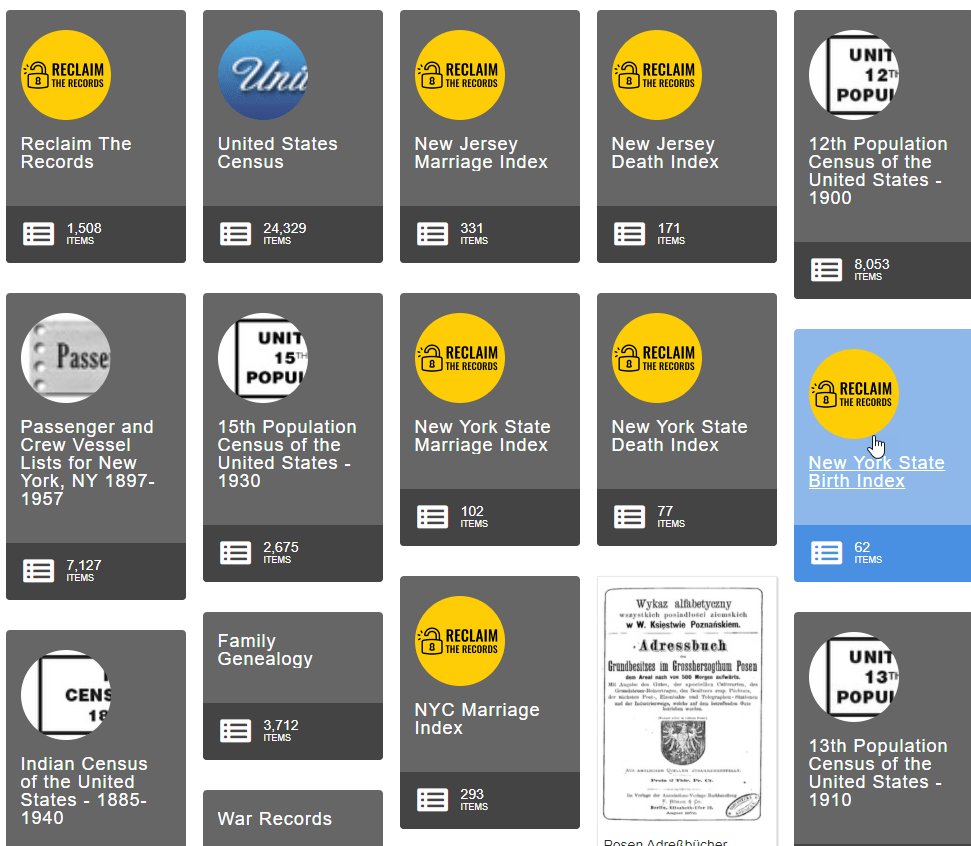
Recently, I received an email with a link to their “Genealogy Collection,” here.

Just scroll down – but only if you have absolutely nothing else to do today.

I mean, you can get lost here forever.

You can browse on lots of pages, but you can also search.

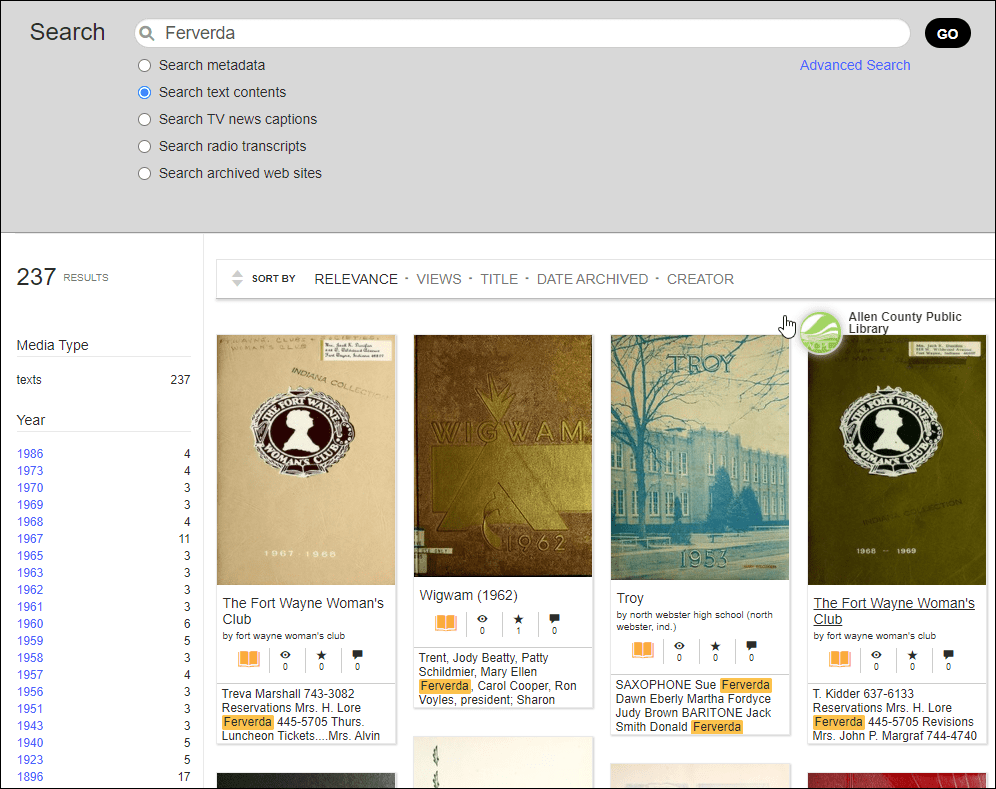
I selected the surname Ferverda because it’s fairly unique. It was spelled Ferwerda in the Netherlands and is also spelled Fervida in my family line in the US.

Click to enlarge images

There are a total of 237 results searching the text contents, falling into several years, as you can see at left.

Scrolling on down that left-hand sidebar, you can see thatFerverda results fall into different categories as well.

Some of these, like Leesburg and Fort Wayne, I recognize based on knowing exactly where this family lived.

But Argentina? Did a family line immigrate there?

And the US patent office? Ok, I have to look, so I clicked.

I recognize the name of my uncle who was a research chemist in the paint industry.

I didn’t know he held patents though.

  • Ferverda, Harold L., to General Electric Co. Method of making a laminated core. 2,786,006, 3-19-57, CI. 154 — 80.
  • Ferverda, Harold L., to General Electric Co. Process for bonding dynamoelectric machine coil end turns and article produced therebv. 2,802,120, 8-6-57, CI 310 — 45.

Hey, look….there’s my grandfather who was the station agent for the railroad at one point in his life!

I wonder what this has to say about him.

Next, there’s the Ferwerda surname with all publications in Dutch, in the Netherlands, under the genealogy tab.

Some documents are available as images and some in a downloadable text version. Even if the document is written in a foreign language, automated translators are available through Google and other resources. Who knows what treasures might be lurking where you least expect them.

What interesting discoveries can you make? Maybe your names will be found in the genealogy collection too. Let me know if you find something good!

_____________________________________________________________

Disclosure

I receive a small contribution when you click on some of the links to vendors in my articles. This does NOT increase the price you pay but helps me to keep the lights on and this informational blog free for everyone. Please click on the links in the articles or to the vendors below if you are purchasing products or DNA testing.

Thank you so much.

DNA Purchases and Free Transfers

Genealogy Products and Services

Genealogy Research

Books

Customize Your RootsTech Conference: 96 DNA Sessions to Choose From!

Some of the RootsTech Connect 2021 speakers. Courtesy of FamilySearch and the speakers, of course.

We should have been in Salt Lake City this past week, but alas, we’ll all be getting together virtually instead during February 25-27.

As much as I regret not being able to see people, in person, (boy, do I ever miss that), there are GOOD things about RootsTech this year.

This year’s RootsTech Connect is virtual, so we DO get to attend. We haven’t lost out entirely. The conference is entirely free, and every session was recorded by the presenters. As you watch these sessions, say a thank you to the presenters, because trust me, the recording experience (which took days) was an adventure most of us don’t exactly want to repeat.

RootsTech Connect 2021 has been a learning experience for everyone and I want to say a huge, HUGE, thank you to FamilySearch and the team who has been working diligently trying to figure out the inner machinations of something this gargantuan! To use one of their analogies, on a call someone said that it’s like they are designing the airplane as they are flying. I’d say that’s a pretty apt description.

Virtual means that you can register and watch at your own convenience. As badly as I do want to see everyone in 2022 in Salt Lake, I really hope RootsTech records the sessions there and offers them afterward. The combination of free and online on-demand has dramatically extended the RootsTech reach which means more genealogists and more DNA testers – both of which are a good thing.

Not everyone can go to Salt Lake City and the sheer number of people who have registered bears testimony to the popularity of an inclusive event. Normally, there are about 40K people that attend RootsTech in person. There are already more than a quarter-million people registered this year and we still have several days to go. Of course, everyone can afford RootsTech this year, because it’s entirely free and no travel is required.

If you haven’t yet registered, you can do so here.

Who’s Attending?

After you register, you can see how many of your relatives, at least according to your FamilySearch tree, are also attending Rootstech 2021.

During, but not before the conference begins, you’ll be able to see who those cousins are and communicate back and forth.

This is the link to see how many of your relatives have registered.

On this same page, if you scroll towards the bottom, you can see how many people with a particular surname are registered.

During the conference, you’ll be able to message back and forth with friends and relatives. Maybe they’ve DNA tested, and if not, maybe they would like to! If the past is any indication, FamilySearch shows you how you are related to each relative. It functions similarly to their fun “Famous Relative” app. (Insert appropriate grain-of-salt, verify everything warning here.)

You know you want to type in your “difficult” surnames to see if maybe, just maybe, someone with that surname is attending😊.

24×7

This year’s conference is unique because it will run 24×7. Of course, staff, attendees, and exhibitors can’t stay up for 3 days straight and be anything resembling coherent – but it’s always daytime someplace in the world. I can’t help but see the image in my mind of RootsTech rotating around the world.

Sessions

The session format has changed this year. Most sessions are 20 minutes, not an hour. Think genealogy TED talks from your favorite presenters. There are a few advanced sessions that are an hour in length.

For example, my session, DNA Triangulation: What, Why, and How was just too in-depth for 20 minutes or even two 20-minute sessions, so it’s the traditional hour-long session.

We’ll cover a lot in that time, beginning with a definition of triangulation, why you want to use triangulation, how triangulation works, and an overview of how to use triangulation at each vendor. I hope you’ll plan on attending.

A Plethora of Riches

There are more than 800 RootsTech sessions in total, in a multitude of languages, including some also presented in American Sign Language.

You can take a look at the sessions in English and ASL, here. The list of sessions in other languages will be available soon.

Furthermore, there will be an open chat session for each class where you can ask questions. Each presentation will have a chat room monitor answering questions, and the presenter will drop in from time to time during the three conference days.

Celebrate

I printed all 18 pages and I’m customizing a conference for myself. The good news is that we’re not constrained to three days because we can watch sessions later.

I have to tell you, when I’m at RootsTech, I do use the mobile conference app to schedule the sessions I want to see, but the show is draining and I meet so many people I want to talk to. That means I often don’t get to see several speaker sessions that I planned to attend.

This year, everyone will have the option to see every single session!

I’m planning to make “the conference” a bit festive for myself. I’m going to set my laptop up in my quilt studio, not in my office, so I can be “off work.”

Yes, I’ll be quilting and conferencing at the same time. And if I can’t do both simultaneously, then at least I’ll be enjoying the conference “on pandemic vacation” in another part of my house, away from my office. I think I’ll eat naughty food and chocolate to celebrate too😊.

Now if I could just find some of those lovely hot roasted almonds and kettle corn that we can smell wafting throughout the convention center…but I digress.

No Set “Schedule”

There is no conference “schedule,” per se. Registrants will sign in to the conference and be able to participate in a multitude of activities. You’ll be able to watch keynotes on the main state, listen to speaker sessions, visit the expo hall or the DNA Basics Learning Center, and more.

Many vendors will be sponsoring free sessions too in their booths, along with providing the opportunity for attendees to ask questions.

Keynote Speakers

Keynote speakers always appear on the Main Stage, the largest auditorium space in Salt Lake City.

This year, you’ll join the “Main Stage” area in the virtual conference to watch the keynote speakers. These sessions will be recorded and repeat too.

Click to enlarge

Notice the time conversion chart.

Hint – I have a World Clock on my phone, which I use to figure out what time it is in other locations. Furthermore, you can schedule an appointment in your calendar if you want to be “present” for a particular session or event and set an alert to remind you a few minutes in advance.

You can read about the keynote speakers, here.

The Expo Hall

The Expo Hall, or the show floor, is one of my favorite parts of RootsTech. I love to see what’s new along with vendor-specific presentations in their booths. Vendors will be hosting presentations this year too, although you’ll need to check out the Expo Hall and the show floor for yourself to see who is hosting sessions, when, and which ones you might like to attend. Pay close attention, because vendor sessions may NOT be available later.

Of course, vendors will be anxious to answer your questions and glad to sell you some of their wares. These companies need our support right now.

RootsTech DNA Basics Learning Center

After the Expo Hall opens, you’ll have access to the DNA Basics Learning Center that will offer additional DNA sessions focused on beginners. This is IN ADDITION to the regular conference sessions.

These 20-minute back-to-basics sessions have been contributed by volunteers to provide a foundation of genetic genealogy education. The schedule is being finalized, but I can tell you that there are more than 35 sessions.

You’ll find educators you’re familiar with, and probably some new people too.

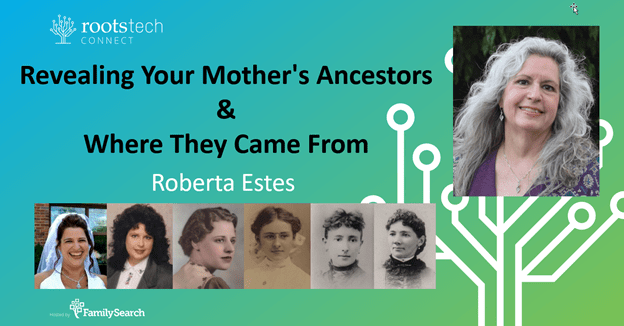
You might have already guessed that I’ve recorded a session for the Learning Center: Revealing Your Mother’s Ancestors and Where They Came From.

Like with the other sessions, there will be an online chat forum for these sessions too.

There will be a schedule, but the classes will all be available afterward in the “on-demand” library. How cool is that!

There’s More…

There’s more too. Volunteers in the genealogy community have recorded what I would call bite-sized tidbits of genealogy goodness. I’m not sure exactly what they are officially called, but I know they’re mini-classes that will be available during the conference. Think genealogy Brownie Bites.

Between the regular sessions, the DNA Learning Center, the genealogy mini-classes, and vendor presentations, one of the FamilySearch folks said they are processing 1800+ recorded presentations. I can’t even begin to imagine what they are dealing with! But from an attendee’s perspective, this is a smorgasbord so long you can’t see the end.

Customizing Your Personal Conference Plan

I counted 59 DNA sessions on the regular Session list, plus 37 or so in the DNA Basics Learning Center. Not included in that total are sessions on the non-English list yet to be released, vendor presentations, and mini-sessions.

You could watch just DNA sessions for days and days.

It’s ironic that a few years ago, we couldn’t get even one DNA session on the agenda of most conferences – and now, I don’t even recognize all the speakers presenting about DNA topics. DNA has become a mainstream, fundamental, inextricable tool for genealogy. I suspect genetic genealogy will have a supporting role, maybe making a cameo appearance in other sessions too.

I hope that everyone enjoys the conference and fine-tunes techniques for using DNA to increase genealogy effectiveness. Confirm your ancestors, meet new cousins and break down those brick walls.

Print the Session list and the Learning Center list when it’s released, and create a customized conference for yourself. My personal conference will assuredly be longer than three days.

I think after the actual RootsTech conference, I’ll probably select one or two sessions each day and schedule them on my calendar. RootsTech 2021 might just last all year.

_____________________________________________________________

Disclosure

I receive a small contribution when you click on some of the links to vendors in my articles. This does NOT increase the price you pay but helps me to keep the lights on and this informational blog free for everyone. Please click on the links in the articles or to the vendors below if you are purchasing products or DNA testing.

Thank you so much.

DNA Purchases and Free Transfers

Genealogy Products and Services

Genealogy Research

Books

Outside the Pale: The Lore Family’s “Remarkable” Life Revealed Through the Newspaper – 52 Ancestors #324

Recently, I renewed a previously lapsed subscription to Newspapers.com (get 7 days free, here) in order to search for one particular event surrounding one specific ancestor. But then, as things do with genealogy, one thing led to another, and another, and to make a long story short…it was 3 AM and I wound up in Rushville, Indiana with Nora Kirsch Lore and her family in the very early 1900s. Talk about time travel!

I have written individual articles about the principles in this article, but this story is different than before. I’ve mentioned previously that the benefit of telling each ancestor’s life story separately is that you focus exclusively on just THAT one ancestor. Of course, they were born to parents, probably married someone, and had at least one child that survived to reproduce. Clearly, their story touches on the generations on both sides of them, and must, for continuity – but the story isn’t about anyone but that ancestor, told in their voice, from their perspective.

When you find a treasure trove that spans three generations of an extended family, and you’ve already written about the specific ancestors, it’s difficult to fit the new information into the cracks, because there aren’t any cracks big enough. Not to mention, this is a story all by itself.

Boy, is it ever!

The Papers

As luck would have it, some of the Rushville newspapers have been imaged and OCRed at Newspapers.com so that you can search by keyword(s), which is often first name plus surname in either a particular newspaper or a particular area, like “Rushville, Indiana” or simply “Indiana”.

The bad news is that the surname, Lore, is also a word and also part of other words, plus Curtis Benjamin Lore never used his full name. Most often, he went by Curt or C. B. Lore. Initials are particularly difficult to include reliably in searches. His wife’s name was Nora, but as it turns out, the custom of the day dictated that she was always referred to as Mrs. C. B. Lore until after his death when she was occasionally referred to as Mrs. Nora Lore. Often, she was still referred to as Mrs. Curt Lore or some other derivative that did not include her first name.

Frustrating? You think so?

I changed the search parameters several times, and hopefully, I found all of the references. I discovered that even using the same search criteria, sometimes results varied, so search thoroughly.

Another challenge is that due to the search and OCR challenges, maybe only 25% or less of the matches were truly relevant. However, that’s OK, because I really didn’t need to sleep for 3 nights anyway. Yes, I waded through and read more than 500, and probably closer to 1000 results. Let’s just say I know way more about Rushville Indiana than I ever really wanted to know. Why, it’s almost like I lived there right along with my ancestors!

It really was like time travel as I experienced, albeit second hand, what they experienced in the 1890s and the first two decades of the 1900s.

One last challenge is that you can’t presume that all of the years of a newspaper are imaged just because some of them are. No place on Newspapers.com could I determine how to ascertain which parts of a particular newspaper’s publications have been imaged. It’s certainly possible that some weeks or months or pages are missing throughout. Remember, absence of evidence does not necessarily equate to evidence of absence.

The Players

First, before we look at what the newspapers revealed, let’s take a look at the players that we’ll visit.

The photo below, taken about 1907 or 1908 at the Kirsch House in Aurora, Indiana includes many of the people you’ll meet including Nora Kirsch Lore, her parents, and siblings.

Left to right, I can identify people as follows:

  • Seated far left – one of the Kirsch sisters – possibly Carrie Kirsch.
  • Standing male left behind the chair – C. B. Lore, husband of Nora Kirsch – which dates this photo to before January 1909 when he became ill for the last time
  • Seated in the chair in front of CB Lore in a white dress – Nora Kirsch Lore, his wife
  • Male with bow tie standing beside C. B. Lore – probably Edward Kirsch, if not then probably Todd Fiske, husband of Lou Kirsch
  • Male standing beside him with no tie – probably Martin Kirsch
  • Woman standing in the rear row – Kirsch sister, possibly Ida.
  • Standing right rear with beard – Jacob Kirsch, father of Kirsch sisters and husband to Barbara Drechsel Kirsch.
  • Front adult to the right of Nora with child – Kirsch sister, possibly Lou.
  • Child beside Nora – Eloise Lore, her daughter, born in 1903, so dating the photo to about 1907
  • Adult woman, seated, with black skirt – mother to Kirsch sisters and wife to Jacob Kirsch, Barbara Drechsel Kirsch
  • Young woman beside Barbara to at right with large white bow – probably Curtis Lore, Nora’s daughter

Jacob Kirsch (1841-1917) and Barbara Drechsel Kirsch (1848-1930) are the parents of Nora Kirsch and her siblings. Jacob and Barbara lived in Aurora, Indiana where they owned the Kirsch House, a restaurant, tavern, and hotel that would be much like a B&B today. The Kirsch House was an exciting place, filled with travelers and colorful figures. In fact, it was at the Kirsch House that Nora met C. B. Lore who wasn’t quite exactly what he portrayed himself to be – single. His wife and children back home in Pennsylvania seemed to have slipped his mind until AFTER he had married Nora.

Whoo boy, is he ever lucky that Jacob Kirsch didn’t catch wind of that! In fact, I’m not at all sure that Nora or the Kirsch family EVER knew. There were so, so many secrets in this family.

Years of hidden drama in such a mundane, innocent-looking antique brick building. Nothing belies what lurked beneath.

Photo courtesy, Pat Allen, Allen Aerial

The Kirsch house is the L-shaped red brick building behind the depot and the white pickup truck. Today, you can still see the larger window where passenger tickets were sold.

The Kirsch house itself was interesting in other ways. Located strategically between the railroad depot and the Ohio River, in the background above, where paddle-wheeler riverboats docked, it was subject to massive flooding during the winter and spring months.

That’s the Kirsch House, just behind the RR crossing sign in 1937, courtesy of the historical society.

The basement bears the scars of many floods, and so too did the inside of the structure.

Flooding that included ice flows was more damaging yet. As you might imagine, stories about flooding, being trapped in floods and escaping from floods were legendary in the family.

It takes special people to live in a place where devastation visits regularly, and you know you’re just going to clean up and start over to have it happen all over again in a few weeks, months, or next year.

These folk were cut from a different cloth. Brave. Resilient. Not one bit risk-averse. It’s no wonder that these people or their parents were immigrants. That too required exceptional bravery.

Jacob Kirsch was quite the character, having one glass eye and other “interesting” characteristics.

The children of Jacob and Barbara, other than Nora, are:

  • Caroline (Carrie) Kirsch (1871-1926) married Joseph Smithfield Wymond (1861-1910). Joseph, a wealthy riverboat gambler contracted syphilis and eventually died of the disease. Then 16 years later, Carrie died too. She never had children. For obvious reasons, her family despised Joseph. He, in essence, killed Carrie, slowly and painfully. Given that Carrie’s father, Jacob Kirsch, was involved in one lynching AND was a crack shot, even with one eye, Joseph is lucky he didn’t “die by enraged father,” although maybe Jacob decided that a quick death would be too good for him.
  • Margaret Louise (Lou) Kirsch (1873-1940) married Charles Theodore “Todd” Fiske (1874-1908). Todd lost his job as a civil engineer and committed suicide by gunshot at the Kirsch House where they were living at the time. Lou never had children.
  • John Edward Kirsch (1870-1924) married Emma Miller and lived in Edwardsport, Knox Co., Indiana. Edward died at age 54 of paralysis, according to his death certificate, which generally means a stroke, given that he appears to have died the same day he became ill.
  • George Martin Kirsch (1868-1949) married Maude Powers and died in Shelbyville, Indiana at age 80 of a cerebral thrombosis, another form of stroke.
  • Ida Caroline Kirsch (1876-1966) married William “Billy” Galbreath (1891-1921) who died of acute alcoholism. She never remarried and never had children.

As you can see, there was a lot of grief under the roof of the Kirsch House.

Nora Kirsch (1866-1949) married Curtis Benjamin Lore in 1888 at the Kirsch House and eventually moved to Rushville Indiana, where drama to rival any soap opera unfolded. Their children were:

  • Edith Barbara Lore (1888-1960) married John Whitney Ferverda in Rushville, Indiana, and moved to Silver Lake. Edith is my grandmother who is absent in the family photo at the Kirsch House.
  • Curtis Lore (1891-1912), a daughter who died of tuberculosis in Rushville.
  • Mildred Elvira Lore (1899-1987) married Claude Martin in Wabash, Indiana, and moved to Houston, Texas (Absent in Kirsch House photo.)
  • Eloise Lore (1903-1996) married Warren Cook and moved to Lockport, New York. Eloise never had children.

The Lore of the Lore Family

If you just read the newspaper accounts, the Lore family looks like an upwardly-mobile, probably fairly well-to-do, carefree family – based on how much socializing they are doing. Of course, no one in Rushville had any idea that they had left Aurora, in part, to disguise the “premature” birth of their first child.

And no one, ever, knew about the past of roguishly handsome, charismatic C.B. Lore. Probably not even his wife and assuredly, not his daughters!

Looks, or in this case, snippets and sound bites, can be very deceiving.

Striking Gold Off the Bat

The very first newspaper entry is actually quite enlightening. It begins by telling us that C. B. Lore has his own company.

April 30, 1888, Indianapolis News – Shelbyville, Indiana – The Natural Gas Company today contracted with C. B. Lore & Co. of Greensburg to drill three more wells for $2400 on the farm of Mrs. tenant, east of this city.

Given that the 1890 census does not exist, this tidbit provides us with previously unknown information.

  • May 16, 1889, Rushville, Indiana – In the column titled “Horse Talk” we discover that O. Posey and son, owners sold to C. B. Lore of Greensburg a horse named Moscoe for $400 at the Rush County Horse Breeder’s sale at the fairgrounds.

This had to be a racehorse. I wonder what Nora thought about this.

Horses would shape their future in unexpected ways.

Horse Racing In Rushville

As it turns out, Rushville was a race-horse town in the 1880s and 1890s, known for its fast horses. James Wilson began this legacy with one sire in the 1860s and 1870s that sired many record-breaking Standard Bred Trotters.

By the early 1890s, there were three competition harness tracks on the edge of Rushville, north, south, and east. Every township had at least one training track, and there were a total of 25 tracks in the county. Of course, racing-related people were attracted as were associated businesses. C. B. Lore could have been one of these.

The main track, Riverside Park, located by the old mill location in Rushville had a 60-foot wide regulation track and grandstands. A swinging footbridge was erected across the river to allow easier access to the track, saloons, of course, and businesses.

While the local articles don’t mention gambling, you know that betting was a big draw and lucrative business in its own right too, because betting and horse-racing go hand in hand. What the articles do say is that many of the large Victorian homes were built with “horse money.”

And you can bet that where there’s money, there’s always someone looking to turn a quick buck in less than scrupulous ways.

In September of 1899, the race at Riverside wasn’t held, but somehow a bogus record of the horses that “won” that day was submitted to the American Trotter Association. When the fraud was discovered, local horsemen and officials were expelled, the incident being called “one of the most extraordinary turf frauds ever perpetrated.”

The racing heyday was over, Rushville’s reputation forever tarnished, along with those who participated, but that didn’t mean individuals who loved horses and racing didn’t continue to breed horses and race.

In March of 1907, fifty horses were training at the local track according to the local paper.

But where was C.B. Lore during this time?

Where Was C. B. Lore?

The newspaper tells us what the 1890 census cannot.

  • October 2, 1890 – C. B. Lore of Greensburg was here Saturday.

Nora and C. B. married in January 1888. I know that Edith was born in Marion County a few months later, but between August 1888 when Edith was born in Indianapolis, and the 1900 census, I had no idea where they were living. According to this, in 1889 and 1890, they were living in Greensburg, Indiana. Who knew?

It’s about 20 miles from Greensburg to Rushville, and about 50 miles from Greensburg to Indianapolis.

And yes, Greensburg did have a newspaper, and no, it’s not available on Newspapers.com yet. Just in case you were wondering. Trust me, I keep checking.

This makes sense of another piece of information. The photo of Edith, taken when she was maybe 3 or so, was in a studio in Greensburg.

Also worth noting – those beads she is wearing were actual gold.

1891

Not mentioned is that Curt and Nora’s second child, Curtis, a daughter arrived on March 8th, but we aren’t sure exactly where she was born.

In 1891, the Rushville newspaper notes that C. B. had drilled wells “here” but doesn’t say that they live in Rushville. Edith would turn three in August of 1891, so they were probably still living in Greensburg at this point.

Greenburg is most famously known for the tree growing from the roof of the clocktower – a site Nora and Curt would have seen.

On May 14th, 1891, Curtis sustained a financial loss because his drilling outfit burned. The paper says Greenfield, but I think they meant Greensburg. Greenfield is quite a distance away.

C. B. Lore had been a well-driller in Pennsylvania, which is what brought him to Aurora, Indiana initially. He drilled the Blue Lick Well, there, so the fact that he continued in the drilling business isn’t a surprise. It’s just that we didn’t know well-drilling was connected to Rushville before.

I’m guessing, since his rig burned, that it was something like this Drake Well, common in Pennsylvania where Curtis learned well-drilling.

1892

  • On June 10th, 1892, Curtis, then a Rush County resident, filed a lawsuit.

This suit was apparently settled, as we hear nothing more. But who was John F. Pleffer and why did C. B. Lore sue him?

C. B. or Curt Lore was mentioned often in the local newspaper. Obviously, they moved to Rushville sometime in 1891 or early 1892.

  • On August 2nd, 1892, “Curt Lore shipped his horses to Columbus yesterday.”

I’m betting this was for a race, pardon the pun. The Columbus newspaper provides some context for this event.

  • On December 9, 1892, W. A. Jones, Rich Wilson, Curtis Lore, and William Dagler shipped several head of horses to Chicago to be entered in the great sale.

1893

  • The April 14, 1893 newspaper tells us that Mrs. Curtis Lore visited at Indianapolis last Wednesday.
  • On August 1, 1893 report that Miss Lena Wise of Greensburg is the guest of Mr. and Mrs. C. B. Lore.
  • August 6, 1893 – Indianapolis Journal – Miss Lena Wise of Greensburg is the guest of Mrs. C. B. Lore.
  • On September 12th, Carrie Kirsch of Aurora is visiting her sister, Mrs. Curtis Lore.
  • On Friday, September 22nd the newspaper reports that Mrs. C. B. Lore entertained in honor of Miss Carrie Kirsch of Aurora.
  • On December 12th, Mrs. Curt Lore and children left today to visit homefolks at Aurora over the holidays.

So, I wonder what C. B. Lore was doing with himself while his wife and children were visiting her parents for a month.

1894 was a busy year.

  • January 12, 1894 – Mrs. Curtis Lore returned home last Tuesday from an extended visit with her parents at Aurora.
  • February 23, 1894 – Nineteen members of the “What Not” Club of this city went to Manilla last Tuesday and spent the day with Mr. and Mrs. C. E. Trees. A very pleasant day was spent by all. The list includes Mrs. Curtis Lore.
  • March 20, 1894 – Mrs. Cad Kirsch of Aurora is visiting Mr. and Mrs. C. B. Lore. This answers the question of who Cad was – Carrie – which means I have a photo someplace.
  • March 23, 1894 – Miss Lena Wise of Greensburg is visiting Mr. and Mrs. Curtis B. Lore.
  • April 3, 1894 – It appears that Curt has become an entrepreneur.

$12,000 is a HUGE sum of money in 1894 and converts to about $365,000 in today’s dollars. I can’t help but wonder where he obtained that kind of money. They didn’t even own a house.

  • April 6, 1894 – under the City Council news, we discover that Curt plans to build an ice house.

C.B. Requested that the land be donated to him, but the council had a different idea.

  • April 10, 1894 – C. B. Lore closed the contract last Saturday for the old site of the woolen mill on which to build the ice factory. Work will begin as soon as the weather settles.

According to Rushville history, the woolen mill stood on the riverbanks just south of the Presbyterian Church and was consumed by fire in 1887. The fire and flood-prone location would certainly make the site unbuildable for most purposes and therefore available for C. B. for his ice business.

On this 1908 plat map of Rushville, you can see Water Street, where the original mill was located, along with the footbridge.

On April 13th, Curt apparently bought the land.

It doesn’t say how much he paid, but he would have needed even MORE money. That’s no small building.

But wait, we’re not done.

Also the same page:

Now, in addition to horses, ice, and oil, C. B. Lore is one of the founders of the local phone company. Not only that, we know, based on this article that they would have a phone for $12.50, or about $380 today, in addition to his founding stock in the company.

Either his horses and wells were either wildly successful or he had found a monetary source someplace else. I can’t help but wonder about gambling which is often synonymous with horse racing. Big winners and big losers.

  • May 25, 1894, reported in the Indianapolis News – Curt Lore, Rushville, sold to E. Wiles, Charlottesville, a 3-year-old filly by Aparka, dam Sue King by King Rose.
  • May 25, 1894 – C. B. Lore started his ice factory today.
  • June 9th – C. B. Lore is at Louisville, KY today to purchase a new ice wagon.

This ice wagon from this timeframe was from Washington, DC.

  • August 31, 1894 – C. B. Lore is putting down another well for use at the ice factory.

More and more money invested in the ice factory. I wonder if Curt could sleep at night. Nothing like pouring huge amounts of money into a business venture that has yet to produce much if any revenue.

  • September 11, 1894 – Miss Lena Wise of Greensburg is the guest of Mr. and Mrs. C. B. Lore.
  • September 14, 1894 – Miss Edith Lore is at home from a visit with Greenburg relatives.

Who lived in Greensburg that was related? I still don’t know, but this might explain why Nora and Curt moved to Greensburg in the first place.

  • October 2, 1894 – C. B. Lore has an aluminum bicycle, the first one in the city.
  • November 20, 1894 – C. B. Lore is drilling a gas well near the ice factory. It is now over 450 feet deep and gas enough is supplied to make a blaze about 4 feet high.

C.B. is utilizing the land surrounding the ice factory to drill for gas.

On November 23rd, Curt was in the paper 3 times.

Wow, Curt has been busy!

Wait, what?

What? Now in addition to oil, gas, horses, ice, and a phone company, he’s establishing an electric company for commercial lights?

No moss is growing under this man’s feet!

  • December 7, 1894

1895 is, unfortunately, missing entirely from Newspapers.com. I need to know what happened with the lights!!!

1896 

  • Jan 10, 1896 – Civil cases set for trial, Indianapolis Brewing Co. vs Lore

A brewing company? Is Curt brewing beer too?

  • Jan 26, 1896 – Ladies Musicale met with Mrs. C. B. Lore on January 20.
  • Jan 31, 1896 – Curtis B. Lore resumed operations at his ice-plant yesterday.

Why had operations stopped? Does this have anything to do with the lawsuit? Maybe he bought equipment from them?

  • April 17, 1896

This is truly frightening. Runaway horses were a danger and killed many. Ironic that his horses became frightened by a bicycle, and he’s the one who introduced bicycles to Rushville.

  • April 21, 1896 – C.B. Lore (and others) formed a party of wheelmen which rode to Greensburg last Sunday and spent the day there.

Wheelmen refers to bicyclers. Curt would have been 40 years old.

  • April 24, 1896 – Mrs. C. B. Lore won a prize at a card party on Wednesday afternoon.

The following notification ran 8 different times in the local paper. I’m sure they saw it, and so did everyone else in town.

May 8, 15, 22, 26 and 29, 1896. Also June 2, 9, and 16.

The risks of entrepreneurship. Clearly, things were not going well. This would appear only to be for the pumps inside, not the building or the land. This would have been in addition to the initial $12,000 in a separate contract.

One interesting aspect is that they sued Nora too, which is very unusual for that timeframe. Apparently, Curt used the land as collateral, and this suit forces the sale of the lots to pay for the machinery.

This suit tells us exactly where this land is located. I wish there was a picture of his ice building.

Today, this is the Eagles Lodge.

  • May 19, 1896

Apparently, the horses were afraid of both “cars” and bicycles. This would have been train cars, not automobiles.

  • June 2, 1896 – Miss Mina Lore left last week to spend the summer with her grandparents in Pennsylvania.

Mina is Curt’s niece, his brother A. D. Lore’s daughter. So is Gertie mentioned on August 4th.

  • June 30, 1896 – Mrs. C. B. Lore and children left last Saturday for an extended visit with her parents at Aurora.
  • July 28, 1896

Indeed, there was betting involved. I KNEW it.

$25 doesn’t sound like much more than a friendly wager until you realize that’s about $800 in today’s dollars.

  • August 4, 1896 – Miss Gertie Lore of First Street is on the sick list.

August 18, 1896:

I believe this is baseball.

  • October 16, 1896 – A. D. Lore has moved his family to Albion, PA.

Adin apparently moved back to Pennsylvania, then to Ashtabula, Ohio before 1904 and lived there, working as a blacksmith and in the “car barn”, which I presume means rail cars, until the year before his death when he returned to Pennsylvania. At the time of his death, in 1913, he was working as a well driller and died of blood poisoning from an abscess on his hand.

  • November 10, 1896

Nora appears to have been somewhat of a socialite. I hope she enjoyed these years, because, sadly, they wouldn’t last.

1897

  • February 5, 1897 – Miss Carrie Kirsch of Aurora is the guest of her sister, Mrs. C. B. Lore.
  • February 19, 1897 – Mrs. C. B. Lore and Mrs. George T. Aultman elegantly entertained a large number of friends at the Social Club rooms last Tuesday afternoon. Progressive Euchre was played. Dainty refreshments were served.
  • Feb 26, 1897

  • March 12, 1897 – C. B. Lore and Mrs. Lore are a team engaged in the duplicate whist tournament at the Social Club. The 4th contest will be held on Monday Night.

The number 428 is beside their names. According to Wikipedia, Duplicate Whist was the precursor to Duplicate Bridge.

A week later, they were still in the running as well as on March 30th.

  • March 23, 1897 – Miss Carrie Kirsch who has been the guest of her sister, Mrs. C. B. Lore returned home to Aurora yesterday afternoon. Also, C. B. Lore and Mrs. Lore are one of the standing teams engaged in the duplicate whist tournament at the Social Club. The next contest of the series will be Monday night.
  • March 23, 1897 – Curt Lore had a severe strain last Friday at the ice plant while lifting a heavy wood-rack, but is able to be out again.
  • April 23, 1897 – Curt Lore will manage the Rushville ice plant this summer.

This is an odd announcement, given that he purchased the land and built that plant. Of course, we don’t know if he lost the land when that suit was filed.

  • April 30, 1879 – Rev. C. W. Tinsley, C. B. Lore and Walter Wilson spent Wednesday at Indianapolis.
  • June 11, 1897

Amazing. Now it appears Curtis is going to manage a baseball team too. When does he find the time? What doesn’t this man do?

  • July 6, 1897 – Mrs. C. B. Lore and daughters are visiting her parents at Aurora.
  • July 27, 1897 – C. B. Lore left yesterday for a few days visit at Aurora.
  • August 3, 1897 – Orville E. Scott succeeded Curtis B. Lore yesterday in the management of the Rushville Ice Plant.

Based on this, I’m guessing Curt no longer owns that land or the plant. Did he lose all that money? What happened???

  • August 24, 1897 – Miss Lulu Kirsch and Will Fisk, of Aurora, who have been visiting C. B. Lore and wife have returned home.
  • September 7, 1897 – Mrs. Daisy Navin of Indianapolis visited C. B. Lore and wife last week.
  • September 17, 1897 – Mrs. C. B. Lore is visiting friends at Indianapolis.
  • October 15, 1897 – C. B. Lore put 37 new flues in the boiler at the Riverside dairy this week.

What? Add metal and furnace work to the list of things Curt does!

  • October 15, 1897 – Jacob Kirsch and wife of Aurora are the guests of C. B. Lore and wife, and will remain here until Monday.

This is the first of only two times that Nora’s parents ever came to visit. Of course, being the proprietors of the Kirsch House was a full-time 24x7x365 job, so it was probably very difficult for them to get away.

  • October 27, 1897 – C. B. Lore has filed a suit against the Rushville Ice Co., on account, Demand $350. John F. Joyce attorney.

Apparently Curt had to file suit for some funds owed.

  • November 16, 1897 – Curtis Lore has contracted to fit up an Aurora hotel with a hot water heating apparatus.

Add hot water heating to Curt’s skill set, which of course is not only for heating water, but likely for heating the building with radiators. They don’t say, but that hotel is likely the Kirsch House.

In 2008, the old Kirsch House structure was being evaluated by a structural engineering firm for the City of Aurora. In that report, they took photographs inside the building and noted that the original hot water radiators were still evident on the second floor and the plumbing and boiler remained in the basement. It’s likely that this is the handiwork of Curt Lore.

That stairway, slightly visible to the right in the photo above, and below, is the stairway his bride, Nora, descended on January 18, 1888, the day of their wedding, wearing a dress she made herself.

  • December 14, 1897 – Charles Morgan left yesterday where he will assist C. B. Lore in putting in a heating apparatus.
  • December 17, 1897 – The lady minstrel entertainment given at Melodeon Hall last night for the benefit of Canton No. 21 IOOF was a marked success in the high class of the performance given and the large audience which attended. The sketch given by Jesse Pugh and Little Miss Edith Lore in which the former took the part of the burglar was cleverly acted.

Little Miss Edith Lore was my grandmother, all of 9 years old. How I would love to peek back in time and see her as a child.

Rabbit Hole

I’m a quilter, and I couldn’t help but notice the prices of fabric in the newspaper.

At these prices, one could purchase enough fabric to make a full-size bed quilt for about 50 cents. In 2021, it’s closer to $150, at a minimum and that’s before batting, quilting, thread, etc. A single spool of thread today costs more than all of the fabric needed for a quilt then.

Currently, 100% cotton fabric sells for about $12 per yard, on average, and feather ticking for about $35 per yard. Linens range from $10 at bargain-basement prices to about $200 per yard for the finest.

Nora was a quilter. Was she, like me, drawn like a moth to a flame when fabric was on sale?

Nora created absolutely stunning applique quilts later in her life, in the 1930s, that would represent Indiana at the Chicago World’s Fair. I’m betting that back in 1897, with a six-year-old, a nine-year-old, and a calendar full of social engagements, her quilting was probably for sanity and utility, and not for show. Many of her quilts were loved and used by the family, for years. This yellow quilt, cherished by her daughter, Eloise, escaped much use.

I couldn’t help but notice this ad for Christmas handkerchiefs. Women of that time, before Kleenex, owned many handkerchiefs. Who didn’t need handkerchiefs? They were functional, pretty, and fun. Handkerchiefs made a lovely, thoughtful gift that didn’t cost too much.

Nora had an entire box of handkerchiefs, passed to her daughters eventually, then to Mom, then to me.

One of the favorite family quilts made by Nora was this blue quilt that was literally worn and loved to death. I used several of Nora’s handkerchiefs to patch this quilt some 30 years ago, giving it a second or maybe a third life, a century or so after Nora made this quilt. Perhaps in Rushville.

I can’t help but look at the ads for both the calico fabrics and the handkerchiefs and wonder if perhaps this quilt is the marriage of both.

Ok, climbing out of the rabbit hole and back to Rushville in 1898.

1898

  • January 14, 1898 – Mrs. R. F. Scudder and Mrs. C. Lore will entertain this afternoon at the Social Club rooms.
  • January 18, 1898 – Mrs. R. F. Scudder and Mrs. C. B. Lore entertained 40 of their lady friends at the Social Club rooms last Friday afternoon and evening, at cards. A nice luncheon was served to the guests.
  • February 4, 1898 – S. H. Teneyck and wife and E. L. Lenix and wife of Indianapolis are the guests of C. B. Lore and wife.
  • February 11, 1898 – Mrs. C. B. Lore and Mrs. R. F. Scudder gave a masked party at the Social Club last Wednesday night which was attended by several couples.

Mrs. Scudder’s husband was the president of the Republican party in Rush County. I have to laugh at the idea of masked balls. Royalty in Rushville.

  • February 25, 1898 – The colonial party given at the Social Club’s hospitable home on First Street…on Washington’s birthday, was an event which will be looked back to with pleasure by the 50 lady friends and other guests that attended. The rooms were decorated in red, white and blue with pretty colors. In the dancing hall the pictures of George and Martha Washington were conspicuous being surrounded with stars and stripes.

During the afternoon the ladies played hearts, the scores being kept on red, white, and blue cards formed in the shape of a heart. The honors were awarded to Mrs. C. B. Lore.

I’m beginning to think any reason was a good excuse for a party.

I wonder if the women’s dresses looked anything like this drawing from the turn of the century.

Or perhaps these women from 1893.

Or these more matronly women.

The men in this horse-racing town might well have accompanied the women dressed like this, sporting gold-handled and gold-tipped canes and smoking cigars.

  • April 1, 1898 – The spectacular production of “Queen Flora’s Day Dream, or the Butterflies Frolic,” given at the opera house under the direction of Miss Beatrice Raymond of Chicago in which a large number of young ladies and children of this city took part was attended by a large crowd last night.

The two little daughters had to be Edith born in 1888 and Curtis born in 1891 because the next child was not born until 1899.

  • April 1, 1898 – Curtis B. Lore and wife to Harry B. Jones, lots in Rushville, quit claim $1000.

I wonder which lots these are. They must have been the icehouse lots. This is confusing. Perhaps deed records would help resolve this information. I need to look again. Maybe another trip to Rushville would be in order.

  • April 5, 1898 – C. B. Lore delegate to the Congressional convention.

I just had a feeling Curt would be dabbling in politics.

  • April 12, 1898 – C. B. Lore is a delegate of the second ward Republicans which met at the engine house. Each delegate was given the privilege to select his own alternate.
  • April 15, 1898 – C. B. Lore found a lady’s pocketbook on Main Street yesterday which the owner can have by calling on him.
  • April 19, 1898 – C. B. Lore was given a judgment against the Rushville Ice and Cold Storage Co. of $206 last Saturday morning. The claim was for services as Superintendent of the ice plant and the use of his team and wagon.

Apparently, Curt was providing management services, and delivery, but no longer had an ownership interest. I suspect as the result of that earlier lawsuit. Regardless, it appeared, at least until now, to be amicable, even though his interest had been foreclosed upon.

  • April 22, 1898 – Claim by C. B. Lore, assisting engineer for $3.75 filed
  • April 29, 1898 – Edith Lore and Master Thomas Wallace, two Juniors, sang a missionary song. This took place at the 6th Convention of the Christian Endeavor Union of the 14th district, held at the Presbyterian Church on Wednesday and Thursday. The church was handsomely decorated in white, pink, green and gold colors, and flowers.
  • May 13, 1898 – Application of Curtis B. Lore for street commissioner was read to Council and placed on file.

Now he’s applying for Street Commissioner too?

  • July 5, 1898 – C. B. Lore and wife went to Trader’s Point last week where they joined an Indianapolis camping party for a 2 weeks outing.

Trader’s Point is near Indianapolis in a now-defunct village near Eagle Creek Reservoir.

Ironically, we know that at least one child didn’t go along on this trip.

Thanks to my cousin, Chelsea, we have a photo of Edith in Aurora with her Rabe cousins taken in July 1898 at her great-grandmother’s house.

  • September 16, 1898 – The machinery in the old electric light building is being loaded on cars by C. B. Lore for shipment to Indianapolis.
  • December 27, 1898 – Mrs. C. B. Lore and children are visiting her parents at Aurora.

The pilgrimage home at Christmas time has lasted for four generations and counting, a luxury not afforded Nora’s grandparents who immigrated from Germany.

1899

On April 8th, not reported in the paper, Mildred was born to Curt and Nora.

  • May 23, 1899 – Curt Lore and daughter of Rushville were in our city a short time this morning.
  • June 23, 1899 – Mrs. C. B. Lore and children are visiting her parents at Aurora where they will remain for 4 or 5 weeks.
  • July 21, 1899 – Mrs. C. B. Lore and children returned home yesterday from an extended visit with her parents at Aurora.
  • July 25, 1899 – Miss Carrie Kirsch of Aurora is visiting her sister, Mrs. C. B. Lore.

I wonder how Curt was involved with the Rushville Gas Company. Perhaps, given his oil and gas experience, he was simply providing an emergency service in a dangerous situation.

  • September 1, 1899 – Harry Siebern and C. B. Lore have formed a partnership under the name of the Cineograph Electric Advertising Company. They will visit surrounding towns and give entertainments. Siebern has resigned his position with Bliss and Dowing.
  • September 15, 1899 – The Warograph Company of this city, composed of C. B. Lore, Harry Seiburn and Charles E. Wolfe, will give an entertainment at Newsom’s hall, in Carthage tonight and tomorrow night. It is worthy of patronage.
  • September 22, 1899 – Charles E. Wolfe went to Mattoon, Illinois, yesterday where he will join the Warograph Company owned by Frazee and Tichenor.

Apparently, Curt has now formed two new companies and inside of a week, lost one of his partners.  A week later, Charles E. Wolfe joined the military.

In the book, “Film before Griffith” by John Fell, the author states that the “cinematographe” and “Warograph” were the very first examples of projected motion pictures. Although they were identical to each other in their workings and manufactured by Luciere Brothers, the subject matter to be shown determined the choice of machine. The “Warograph” showed pictures of the Spanish American War – hence its title – “and seems to have created quite a stir among viewers. It provided “motionized pictures” of an actual war which viewers had read about in the pages of the newspaper, even though the original footage had probably been staged at the Edison studios in 1898-1899.”

I certainly didn’t see this coming. I’m beginning to wonder if Curt moved to new things because he IS successful, or because he isn’t. Is Curt struggling here? Or are they well enough off that he simply has the freedom to do whatever moves him?

  • September 29, 1899 – C. B. Lore will give his warograph entertainment in the yard at the Pythian Hall tonight and tomorrow night.
  • October 3, 1899 – Jesse W. Guire went to Mattoon, Illinois, yesterday where he will join the Warograph Company owned by Frazee and Tichenor.
  • November 14, 1899 – Mrs. C. B. Lore went to Aurora yesterday afternoon to attend the wedding of her sister, Miss Lulu Kirsch which takes place this evening.
  • December 12, 1899 – C. M. Ford, of the Big Four office, is at Claypool, called there by the sickness of his wife. Curt Lore is attending to the duties during his absence.

C. M. Ford would be the local railroad stationmaster or agent. This tells us that Curt had a working knowledge of Morse Code, mandatory for communicating up and down the line. Another skill we didn’t know Curt possessed.

  • December 22, 1899 – C. B. Lore succeeded in getting out the tools, yesterday morning, which were lost in the gas well that William L. Price is drilling south of the race bridge.

It seems like Curt had a lot of experience in dealing with whatever problems surfaced.

1900

The 1900 census shows Nora and Curt living in Rushville with 3 children, married 13 years, according to the census. They had actually been married 12 years, but often adjusted their marriage date to align in a more socially acceptable way with their first child’s birth. He notes his occupation as a “machinist.” Two female servants are living with them, ages 19 and 27.

To afford two live-in servants, they must be at least marginally well-off. They weren’t alone though. There were a total of 121 servants out of a total population of 6,027 for all of Rushville Township, which includes the city of Rushville.

Their neighbor is William Covertson, the railroad agent.

William Covertson and his wife Ethel whose full name was Ida Ethel Clark were the best friends of Nora and Curt Lore. They were neighbors, their children grew up together and they remained fast friends long after Rushville was in the rearview mirror.


  • February 20, 1900
  • February 27, 1900

  • March 23, 1900 – Under the title, Social Club Entertainment: A company of about 150 persons gathered at the Social Club last Tuesday night and after indulging in a fine supper, prepared by the ladies, they adjourned to the hall upstairs where a program which had been arranged by the gentlemen was rendered. The stage was nicely decorated with the national colors and a dressing-room arranged on one side for the performers. C. B. Lore in the part of a Dutch comedian, sang a song in the Dutch dialect.

A comedian?? It’s probably a good thing he didn’t quit his day job. At least we know the man wasn’t shy if he would sing in public and was confident enough to play a comedian.

  • April 17, 1900 – Mrs. C. B. Lore won a favor at a card party last Friday. At 6 o’clock a tempting supper was served.
  • June 5, 1900 – C. B. Lore signed a petition declaring that he was in favor of a street fair, along with many other individuals and businesses. No gambling games or devices nor any kind of vulgar or indecent shows will be allowed. Only clean attractions that will interest and amuse the people will be allowed.
  • June 26, 1900 – A party consisting of…C. B. Lore and family…spent Sunday near Moscow.

  • July 6, 1900 – Andy Pea had his merry-go-round at the 4th of July celebration at Laurel. C. B. Lore was there with his warograph. Both attractions were well patronized.

I wonder if Curt was promoting the Warograph for future bookings, or if one could pay and watch a movie on the spot. Now we know why he petitioned for the street fair.

  • July 10, 1900 – Mrs. Charles Fisk and Miss Carrie Kirsch of Aurora are visiting their sister, Mrs. C. B. Lore.
  • July 13, 1890 – A street fair was taking place in Rushville, with very large crowds with an estimated 7000 visitors in one day.

  • August 24, 1900 – Mrs. C. B. Lore and family returned home last Wednesday from an extended visit at Aurora. She was accompanied home by her sister, Miss Ida Kirsch, who will visit here.
  • September 28, 1900 – C. B. Lore and wife are visiting her parents at Aurora.
  • October 30, 1900 – Mrs. C. B. Lore entertained about 40 friends last Friday afternoon with cards at the Club House. A pleasant time was spent by all.
  • October 30, 1900 – Republican Rally – Third Division, all on horseback. New Salem Band, Aides included Curt Lore. Mounted Rough Riders and all persons on horseback.
  • November 23, 1900 – C. B. Lore is putting in a bathroom outfit for Dick Wilson in the house formerly owned by Mrs. Helen Wilson.

Homes are getting that all-important indoor plumbing!

It’s interesting to note that Rushville did have at least some telephones, but the ads in the same paper don’t list phone numbers for businesses, or anything indicating that they have telephones. I’m guessing this is before the days of phone numbers. You simply picked up the phone and asked the operator to connect you to a specific house. I’d also wager that most families didn’t have phones and that they were somewhat of a status symbol. Now I wonder if people had phones before indoor bathrooms.

  • November 27, 1900 – Mrs. Lore received a prize at the club house when Mrs. Sexton entertained a number of ladies.

All Hell Breaks Loose

Remember that horse racetrack scandal that took place on September 16, 1899, where the race didn’t actually occur, but a list of winning horses was submitted anyway?

Yes?

This story was published nationwide on December 6th, and the local paper ran it on the following day.

If you’re guessing that C. B. Lore was involved up to his eyeballs, you’d be right.

  • December 7, 1900

The board of review of the American Trotting association investigated one of the most extraordinary turf frauds ever perpetrated, and at the close of the inquiry issued an edict of expulsion against the following persons, all residents of Rushville, Indiana.

Note that the parenthesis are my notes.

    • W. A. Jones (race track owner)
    • Harrie Jones (was in Evansville that day, son of W. A. Jones)
    • James Williams
    • W. J. Wilson (17 years old, son of Dick Wilson who was in Rhode Island with his horses)
    • W. W. Wilson (invalid and has been for several months)
    • J. D. Hiner (signed record knowing very little of its contents and because asked to do so)
    • C. F. Vance (signed papers at the solicitation of friends)
    • J. B. Vance (says he is driver, in case the race happened)
    • C. B. Lore (have not seen him, but newspaper was told he had no part in making the bogus record)
    • R. F. Scudder (says he is not a horseman and knew nothing about this until months later)
    • John Sail (colored stable boy)

The offense for which these people were put outside the pale of reputable turfdom – the sentence being effective on tracks of the National associations as well as the American – is the “faking” of an entire day of alleged trotting and pacing over the Rushville track on Sept. 16, 1899, procuring the admission of summaries of the same in the official records of the American Association as well as the year book of the American Trotting Register Association and then selling and otherwise making use for gain of the horses alleged to have made fast records on the day in question.

W. A. Jones (horse breeder in 1900 census) who owns Riverside Park informs the Republican that bona fide arrangements were made for a race meeting there on Sept. 16, 1899, and that he consented that two or three of his horses might be entered in order to fill out classes. In consequence of bad weather the meeting was not held. He had no other connection whatever with the affair.

Mr. Jones says that his son, Harrie Jones (horseman in the 1900 census, living with his in-laws), had no connection with the proposed races here. He was at Evansville that week with his string of horses, a fact with Secretary John Steiner, of the American Association knows, because he was, in his official capacity receiving reports from the Evansville races.

R. F. Scudder (Insurance agent in 1900 census) says he is not a horseman and had nothing at all to do with the proposed races, and did not sign or authorize anybody else to sign his name to any paper or record of that meeting. As a matter of fact, he never heard of any such record until months afterwards.

Jesse Vance (salesman in 1900 census, boarder, looks to be brother of Cicero) says his only part in the races was that of driver, in case they had come off.

Cicero F. Vance (widowed, drayman, boarder in 1900 census) says he signed the papers as one of the judges at the solicitation of some friends. Personally, he had no interest whatever in the matter.

John Hiner (liveryman in 1900 census) says he signed the record, knowing very little of its contents, and because he was asked to.

W. J. Wilson is a son of Dick Wilson (age 42, no occupation listed, his family lives with his wife’s family who list their occupation as “landlord”) and is about 17 years old. Dick was not here at the time, being in Rhode Island with his horses.

W. W. Wilson, better known as “Boo!,” is an invalid and has been for several months. (On the same page as this article, his death was reported on the same day of heart trouble. Born in 1862, son of late James Wilson, wealthy breeder who owned the original sire of the race horses in Rushville.)

We have not been able to see Mr. Lore (machinist in 1900 census) but are told that he had no part in making the bogus record.

John Sail is a colored stable boy.

Up to this date, no one has been found who made the bogus record of the races. Whoever it was has not helped the fast horse business in Rush County.

Oh boy, what a shameful mess.

It’s interesting that one man admitted signing the papers at the behest of others, but doesn’t say who. I can’t help but wonder if he did tell the association, and that’s why these men were expelled and publicly shamed.

Notice that there is no notice that year about what Curt and Nora were doing for Christmas. This was probably a very difficult time for them, especially Nora and the girls who clearly had nothing to do with this, regardless of Curt’s involvement.

This smacks of outright fraud. The value of horses depends on their speed and wins. It looks like the track owner, members of the wealthy Wilson family who were horse breeders, a few businessmen, a couple of people who worked at the livery and probably had little choice in the matter, and perhaps a few irresponsible fringe-element people looking to make an easy buck were all involved.

It’s hard for me to believe that no one knew anything – including Curt.

One Hum Dinger

This was one long decade.

Nora and Curt’s lives seem oddly juxtaposed against one another.

They seem wealthy and have servants, but don’t own a house.

They act the role of wealthy socialites but owe an incredible amount of debt, which is foreclosed.

Curt seems to be quite focused on success, trying one thing after another or perhaps several things simultaneously. Nora seems oddly disconnected from whatever he is doing – concentrating on cards, the social club, luncheons, her children, church, and visiting other similarly situated wives. Perhaps being able to provide Nora and his daughters with this lifestyle is part of what Curt feels defines him as successful.

But then again, they aren’t entirely disconnected. They went “camping” together for two weeks, having a child nine months later, and he traveled to Aurora to visit her parents. But then again, she went home for Christmas alone.

Rushville may be a small town, but there’s a lot of horse-racing money and proportionally many wealthy people. Maybe it’s similar, on a somewhat grander scale, to those make-it-or-break-it oil boomtowns where Curt was raised, back in Pennsylvania. Live fast and take risks, because tomorrow isn’t assured.

Curt had to be a scrapper his entire life. He was orphaned young and began making his way in the oilfields before he was even a teenager. He had certainly known fear and grief and hunger and cold and poverty. He seems to be driven never to endure those things again. He adored his daughters, and they, in turn, nearly worship him.

Curt was always busy, granted, but never too busy for his girls. He took them with him when he went visiting for business, or out to check on his horses – and they loved to ride along in the buggy with their father. As old women, they would talk about those cherished days in Rushville where he told them tales about his father being a river pirate. Maybe those weren’t tall tales after all.

In the span of a decade, Curt had:

  • Drilled for oil and gas in multiple locations
  • Bought and raced horses
  • Founded an ice plant company
  • Drilled water wells for the ice plant
  • Bought an ice delivery wagon
  • Lost the ice plant through foreclosure
  • Been hired as the superintendent of the ice plant
  • Started a telephone company
  • Started an electric light company
  • Applied to be the street commissioner
  • Founded a baseball team
  • Managed the team
  • Was perhaps brewing beer, or at least was sued by a brewing company
  • Founded two “moving picture” companies
  • Been the delegate for the Republicans
  • Applied to be the Street Commissioner
  • Functioned as a stand-up comedian at the “social club”
  • Installed indoor plumbing in homes
  • Installed hot water heat in a hotel
  • Repaired a broken gas line
  • Substituted for the local railroad station agent
  • Gambled, perhaps for high stakes, and apparently…lost
  • Suffered very public humiliation and expulsion from horse racing. Tarred with the brush of dishonesty and labeled, along with the rest, as “outside the pale of reputable turfdom.”

Did Curt simply think that rules were for other people and he was above all that?

Maybe not.

Perhaps as an orphan back in Pennsylvania, Curt had learned to do whatever needed to be done to get ahead, to survive. Perhaps he got carried away. Maybe founding those companies, in particular, the Warograph company, the day before the racetrack event, is a symptom of financial desperation.

Was he close to losing it all – and with it – his pride? Was he afraid to bringing shame to his wife, daughters, and her family? Was he afraid of losing or maybe worse yet, being pitied by his beloved daughters?

What drove Curt? He was, assuredly, a driven man. I keep hearing Kenny Rogers in my mind, singing, “Know when to hold ’em, know when to fold ’em. Know when to walk away. Know when to run.”

Curt was only 45 years old and seems to have lived enough for several lives already.

What tales will the next decade of newspapers reveal?

_____________________________________________________________

Disclosure

I receive a small contribution when you click on some of the links to vendors in my articles. This does NOT increase the price you pay but helps me to keep the lights on and this informational blog free for everyone. Please click on the links in the articles or to the vendors below if you are purchasing products or DNA testing.

Thank you so much.

DNA Purchases and Free Transfers

Genealogy Products and Services

Genealogy Research

Books

How Can YOU Get Theories of Family Relativity at MyHeritage?

It’s almost Valentine’s Day and we have a gift from MyHeritage – two gifts actually.

First, MyHeritage is offering free access for everyone to all marriage records, including international records, through February 16th, here.

New Theories of Family Relativity

However, from a genetic genealogy perspective, MyHeritage‘s new Theories of Family Relativity (TOFR) results are a wonderful Valentine’s Day gift.

The email that I received indicates that the total theories produced for everyone in the database has increased by 19%, from 33,373,070 to 39,845,078 in just 5 months, and the number of DNA testers who have at least one TOFR has increased by 20%.

If you didn’t have Theories before, you may now. If you did have Theories before, you will want to check for new ones.

What Generates New Theories?

Of course, some of this increase is due to the holiday tests that are now available for matching in the system.

Some new Theories are a result of people who have uploaded or constructed trees who didn’t have trees before.

Some new Theories are because people have linked their DNA to a tree where it was not previously linked. If your DNA kit is not associated with “you” on a tree, the system has no way of knowing “who” you are in your tree, and therefore can’t generate theories about how you are related to other testers.

If you don’t have TOFRs, check and make sure that your kit is assigned to “you” on your tree. Under the DNA tab, select “Manage DNA Kits” and check to be sure all of the kits that you manage are properly assigned.

click on images to enlarge

What’s New?

I’m anxious to see what’s new for me.

MyHeritage completed the previous TOFR run in September 2020, so just shy of 5 months ago. At that time, I had a total of 67 matches with Theories. Today, I have a total of 73 for an increase of 8%.

You can check to see how many Theories you have by clicking on the DNA Match “Filters” then the “Theories of Family Relativity” option which displays only matches that have associated Theories. Follow the red arrows.

You can also review each Theory by clicking on Review DNA Match, which includes other information about that match.

I can quickly see which theories are new and I haven’t worked with before because I make notes when I have a new theory. When you have recorded a note, the little “conversation” icon is purple. You can see that with the green arrow, above.

Enabling Theories to Form

Like everyone else, I want more Theories to form, so I’ve intentionally been fleshing out the branches of my tree to encourage TOFR formation.

Theories are formed for people with whom you are a DNA match if one or more of the following conditions occur:

  • Your tree and their tree can be connected directly.

For example, let’s say our common ancestor is three generations back in time meaning we share great-grandparents, but my match has only their grandparents entered – nothing more. I have entered our common ancestor and all of their children in my tree, including the grandparents of my match.

My Heritage connects-the-dots between our trees through the grandparents of my match who appear in both trees.

  • Your tree and your match’s tree can be connected through other people’s trees.

Using this same example, let’s say that my match and I both have only entered our individual grandparents in our trees. A third person in the system has a tree that includes our common ancestor, our great-grandparents. The third person’s tree includes my match’s grandparent and my grandparent too.

Again, MyHeritage connects-the-dots between the three trees, making multiple “hops.”

Here’s one of my new Theories that connects me and the other tester through two separate tree connection “hops” with very high confidence, 100%, that the identical people are being connected.

MyHeritage generated 5 possible paths of connection for this match using different trees, so be sure to take a look at all different theories for each match. You’ll see those on the upper left-hand corner of the TOFR page.

  • Your tree and your match’s tree can be connected using some combination of trees and documents.

Let’s say that my match has only entered their grandparents. I have our common ancestors, our great-grandparents in my tree, but I don’t have their grandparent listed as the child of my (our) great-grandparents. MyHeritage may find a census record, for example, that connects those dots.

Multiple theories through different pathways may be suggested for the same match – and it’s important to evaluate every piece of data. They are called Theories for a reason. They aren’t always accurate, but they make great hints and, for me, they are generally either correct or close. Close enough that I can figure out the rest.

Priming the Pump

What can you do to help Theories form, aside from testing, uploading or creating a tree, and linking your DNA kit to “you” in your tree?

  • Add descendant generations to your tree with as much information as you have for each person including spouse, birth and death dates and locations, in addition to children. The further down the branches you populate your tree, the more information there is for MyHeritage to use to connect the branches.

MyHeritage generates both Smart Matches and Record Matches for every person in your tree. MyHeritage will notify you via email when Smart or Record matches are generated. That’s how I found over 800 newspaper records for my grandfather’s family containing juicy information I never knew – and there’s no other way to find out today.

You can view each category on the person’s profile card. Hmmm, looks like I need to get busy😊

Additional ways to help Theories form include:

  • Accept SmartMatches when appropriate. SmartMatches are tree matches generated to confirm that the person in question is the same person. That doesn’t mean the information has to match exactly. Accepting a SmartMatch doesn’t mean that information will be automatically imported into your tree. You will be able to select each individual field, or no fields at all. Confirmation simply means you agree that this IS the same person, and you are then given the option to import information if you wish.
  • Reject SmartMatches if the suggestion is actually the wrong person. This helps the system “learn.”
  • Confirm Record Matches if they are accurate. Record matches are generated when physical records or records from other databases are generated for an individual in your tree. Like Smart Matches, you can import data from Record Matches after confirming the match.
  • Reject Record Matches if they are not for the same person in your tree.

Test or Transfer, Either One

Of course, you’ll only have TOFRs at MyHeritage if you’ve tested or transferred your DNA.

You can order a test now for only $59 during the Valentine’s Day Sale, here, or you can transfer your DNA to MyHeritage from either Ancestry, 23andMe or FamilyTreeDNA which includes matching and basic tools at MyHeritage for free. The advanced tools including Theories of Family Relativity cost $29 per test to unlock unless you are a paid MyHeritage subscriber – in which case, advanced DNA features are free for any upload and there is no unlock fee. You can try a free MyHeritage trial subscription, here.

After you take a DNA test at MyHeritage or transfer, you’ll need to wait for the next TOFR run to have Theories, but if you test or transfer now and create or upload a tree, you’ll be the recipient of Theories the next time they are generated. You’ll also have time to work on fleshing out your tree and working with Smart Matches and Record Matches to learn more about your ancestors and to increase the odds of obtaining Theories.

You can order a DNA test, here, and you can transfer to MyHeritage, here. If you need assistance, I’ve written step-by-step transfer instructions, here.

_____________________________________________________________

Disclosure

I receive a small contribution when you click on some of the links to vendors in my articles. This does NOT increase the price you pay but helps me to keep the lights on and this informational blog free for everyone. Please click on the links in the articles or to the vendors below if you are purchasing products or DNA testing.

Thank you so much.

DNA Purchases and Free Transfers

Genealogy Products and Services

Genealogy Research

Books

Haplogroup Matching: What It Does (and Doesn’t) Mean

“Our haplogroups (sort of) match, so that means we’re related, right?”

Well, maybe.

It depends.

Great Question

This is an oft-asked great question. Of course, the answer varies depending on the context of the question and what is meant by “related.” A haplogroup match may or may not be a valid match for genealogy. A “match” or a “not match” can mean different things.

The questions people often ask include:

  • Does a haplogroup have to match exactly in order for another person to either be considered a match to you?
  • If they don’t match exactly, can they still be considered as a possible match?
  • Conversely, can we rule someone out as a match on a specific genealogical line based on haplogroup alone?

These questions often arise in relation to DNA testing at Family Tree DNA, sometimes when people are trying to compare results to people who have haplogroup estimates, either at FamilyTreeDNA or from testing elsewhere.

In other words, if one person is haplogroup J and someone else is J1, either at the same vendor or at another, what does that tell us? This question pertains to both Y DNA and mitochondrial DNA tests no matter where you’ve tested.

Family Tree DNA offers different levels of Y DNA testing. Interpreting those match results can sometimes be confusing. The same is true for mitochondrial DNA, especially if your matches have not taken the full mitochondrial sequence (mtFull) test.

You might be comparing apples and oranges, or you might be comparing a whole orange (detailed test) with a few slices (haplogroup estimate.) How can you know, and how can you make sense of the results?

If you’re comparing a haplogroup between sources, such as a partial haplogroup determined by testing through a company like 23andMe or LivingDNA to complete tests taken at FamilyTreeDNA, the answer can be less than straightforward.

I discussed the difference between autosomal-based haplogroup assignments and actual testing of both Y DNA and mitochondrial DNA which result in haplogroup assignments, here. In a nutshell, both LivingDNA and 23andMe provide a high-level (base) haplogroup estimates based on a few specific probes when you purchase an autosomal test, but that’s not the same as deeper testing of the Y chromosome or mitochondrial DNA.

The answer to whether your haplogroup has to match is both “yes”, and “no.” Don’t you hate it when this happens?

Let’s look at different situations. But to begin with, there is at least one common answer.

Yes, Your Base Haplogroup Must Match

To even begin to look further for a common ancestor on either your Y DNA line (direct patrilineal) or direct mitochondrial matrilineal line (your mother’s mother’s mother’s line on up the tree), your base haplogroup much match.

In other words, you and your matches must all be in the same base haplogroup. Haplogroups are defined by the presence of specific combinations of mutations which are called SNPs (single nucleotide polymorphisms) in the Y DNA.

Click to enlarge images

All of these men on the Y DNA matches page are a branch of haplogroup R as shown under the Y-DNA Haplogroup column. There are more matches on down the page (not shown here) with more and different haplogroups. However, you’ll notice that all matches are a subset of haplogroup R, the base haplogroup.

The same is true for mitochondrial DNA haplogroups. You can see in this example that people who have not tested at the FMS (full mitochondrial sequence) level have a less specific haplogroup. The entire mitochondria must be tested in order to obtain a full haplogroup, such as J1c2f, as opposed to haplogroup J.

The Y DNA Terminal SNP Might Not Match

For Y DNA testers, when looking at your matches, even to close relatives, you may not have the same exact haplogroup because:

  • Some people may have tested at different levels
  • Some people in recent generations may have developed a SNP specific to their line.

In other words, haplogroups, testing level, and known genealogy all need to be considered, especially when the haplogroups are “close to each other” on the tree.

For Y DNA, FamilyTreeDNA:

  • Provides all testers with base haplogroup estimates based on STR tests, meaning 12-111 marker panels. These are very accurate estimates, but are also very high level.
  • Offers or has offered in the past both individual SNP tests and SNP packs or bundles that test individual SNPs indicating their presence or absence. This confirms a SNP or haplogroup, but only to that particular level.
  • Offers the Big Y-700 test, along with upgrades to previous Big Y test levels. There have been 3 versions of the Big Y test over time. The Big Y reads the entire gold standard region of the Y chromosome, reporting the known (named) SNP mutations customers do and don’t have. Additionally, the test reports any unnamed SNPs which are considered private variants until multiple men on the same branch of the Y DNA tree test with the same mutation. At that point, the mutation is named and becomes a haplogroup.

That’s why the answer is “no,” your haplogroup does not have to match exactly for you to actually be a match to each other.

A father and son could test, with one having an estimated haplogroup of R-M269 and the other taking the Big Y-700 resulting in a very different Terminal SNP, quite distant on the tree. Conversely, both men could take the Big Y and the son could have a different terminal SNP than the father because a mutation occurred between them. An autosomal DNA test would confirm that they are in fact, father and son.

However, a father and son who test and are placed in different base haplogroups – one in haplogroup I, and the other in haplogroup R, for example, has a very different situation. Their autosomal test would likely confirm that they are not father and son.

Having said this about paternity, especially if haplogroups are estimated and specific Y DNA SNP testing has not been done, don’t have a premature freak-out moment. Look at autosomal DNA, assuming you DO want to know. Y DNA alone should never be used to infer paternity without autosomal testing.

Let’s look at some examples.

Matches and Haplogroups

In the example shown above, you can see that several people have taken the Big Y test, so their SNP will be shown on further down the haplotree than those testers who have not. These are a leaf, not a branch.

You can see by looking at the Terminal SNP column, at far right, that people who have either taken the Big Y, or had any positive SNP test will have a value in the Terminal SNP column.

Anyone who has NOT taken the Big Y or taken a SNP test will have their base haplogroup estimated based on their STR tests. In this case, that estimate is R-M269. People with estimated haplogroups will not show anything in the Terminal SNP column.

It’s possible that if all of these men took the Big Y test that at least some would share the same Terminal SNP, and others might be closely related, only a branch or so different on the tree.

These men in this example are all descendants of Robert Estes born in England in 1555. All have Estes surnames, except for one man who is seeking the identity of his paternal line.

Let’s Look at the Tree

Our tester in the screenshot is haplogroup R-ZS3700 and matches men in the following haplogroups:

  • R-M269
  • R-L21
  • R-BY490
  • R-BY154784

There are a few additional haplogroups not shown because they are further down on his match list, so let’s just work with these for now.

After determining that these men are on the same branch of the Y tree, haplogroup R, the real question is how closely they are related and how close or far distant their terminal SNPs are located. More distance means the common ancestor is further back in time.

However, looks can be deceiving, especially if not everyone has tested to the same level.

The haplogroup furthest up in the tree, meaning the oldest, is R-M269, followed by the man who took the single SNP test for R-L21. Notice that R-M269 has more than 15,000 branches, so while this haplogroup could be used to rule out a match, R-M269 alone isn’t useful to determine genealogical matching.

There are a lot of branches between R-L21 and the next haplogroup on the tree.

Finally, here we go. Our tester is haplogroup R-ZS3700 that has one descendant branch. R-ZS3700 is a branch of R-BY490 that has 2 branches.

R-BY154784 is the last SNP on this branch of the tree. Our tester matches this man too.

Another way of viewing these matches is on the Block Tree provided for Big Y testers.

In this view, you can see that the Estes men all match back to about 18 “SNP generations” ago according to the legend at left, but they don’t match men further back in time who have taken the Big Y test.

Notice the up-arrow where haplogroups R-L21 and R-M269 are shown across the top of the display.

If you click on R-L21, you’ll see that that it appears about 61 SNP generations back in time.

Haplogroup R-M269 appears even further back in time, about 174 SNP generations.

The only reason you will match someone at either the R-L21 or R-M269 level is because you both descend from a common long-ago ancestral branch, hundreds to thousands of years in the past. You and they would both need to take either the Big Y-700 test for Y DNA, or the full sequence mitochondrial DNA test in order to determine your full haplogroup and see your list of matches based on those full sequences.

Public Trees

You can view FamilyTreeDNA‘s extensive public Y DNA tree by haplogroup, here.

You can view their public mitochondrial DNA tree by haplogroup, here.

And the Answer Is…

As you can see, there is no single answer to the question of haplogroup relationships. The answer is also partly defined by the context in which the question is asked.

  1. For two men to be “related” on the Y DNA patrilineal line, yes, minimally, the base haplogroup does have to match. Base haplogroups are defined by the leading letter, like “R” in the examples above.
  2. “Related” based on base haplogroup only can be hundreds or thousands of years back in time, but additional testing can resolve that question.
  3. “Related” can mean before the advent of surnames. However, a match to a man with the same surname suggests a common ancestor with that surname in the past several hundred years. That match could, however, be much closer in time.
  4. For two men to be closely related, assuming they have taken the same version of Big Y test, their haplogroup branches need to be fairly closely adjacent on the haplotree. FamilyTreeDNA will be introducing haplogroup aging soon, meaning SNP/haplogroup branch dates on their haplotree. At that time, the “distance” between men will be easier to understand.
  5. You can exclude a genealogical relationship on the direct paternal line if the two men involved have a different base haplogroup. This question often occurs when people are trying to understand if they “might match” with someone whose haplogroup has been estimated.
  6. This holds true as well for mitochondrial DNA haplogroups and matching.

And there you have it, six answers about what haplogroup matching does and does not mean.

The bottom line is that haplogroups can be a great starting point and you can sometimes eliminate people as potential matches.

However, to confirm genealogical matches, you’ll always need more granular testing that includes actual Y DNA or mitochondrial DNA matching based on marker mutation results, not just haplogroups.

_____________________________________________________________

Disclosure

I receive a small contribution when you click on some of the links to vendors in my articles. This does NOT increase the price you pay but helps me to keep the lights on and this informational blog free for everyone. Please click on the links in the articles or to the vendors below if you are purchasing products or DNA testing.

Thank you so much.

DNA Purchases and Free Transfers

Genealogy Products and Services

Genealogy Research

Books

Rudolph Muller’s Blacksmith Shop in Grossheppach

Just when you thought we were finished with Rudolph Muller and his wife, Margretha, in Grossheppach, we’re not😊

Cousin Wolfram, using the 1832 cadastral maps, made an important discovery and has been kind enough to share. THANK YOU!!!

Blacksmith and Ferrier

If you recall, in the Grossheppach records for Johann Rudolph Muller and his wife, Margretha, we discovered that Rudolph was noted as a blacksmith and ferrier in different records.

I asked Wolfram if he thought that perhaps Rudolph’s blacksmith shop was at the castle, given that horses were rare and that Margretha was listed as either a chambermaid or “waiting maid.” Both of those professions suggested that they worked for someone who had enough money to pay for non-essential items like horses and services like maids.

Wolfram had mentioned that he had not been able to determine, previously, the location of the blacksmith shop – but that has all changed now.

Make yourself a cup of tea, or beverage of your choice, because we’re going along with Wolfram on an adventure to find the elusive blacksmith shop!

Wolfram’s Discovery

I LOVE emails from Wolfram!

Here is something more which might be quite interesting.

One entire word about the job of a blacksmith in Großheppach. You need to know, horses were really rare. I have seen this in the inventory lists of mid/end 18th century. There is absolutely rarely a horse. Maybe only the mill, the castle and the Lamm Inn had horses. There was no need for it and the space of the valley did not allow to plant food for the horses. Even my mother told, there was only one house who had horses. Also oxes were not available, my mother told. They carried the carts either by hand (smaller ones) or with milk cows. I was also asking if it was difficult having cows for the carts. But she mentioned they had very calm cows. They were able to do everything. So for a blacksmith the job were not so much horseshoes (yes, sometimes for troups who came along). Mainly they were surely doing all kind of metal work. Tools for work, for the carts and for buildings.

Now, where the family was located in Großheppach. I did not know where he lived. But now I analyzed the facts:

I have following facts:

I have the cadastre of 1832. There are three smith’s named:

  1. Joseph Friedrich Löffler, Schmied
  2. Christoph Ellwanger, Schmied
  3. Johannes Lutz, Schlosser together with Johannes Pfund, Nagelschmied (= Nailsmith?)

Wolfram provided a document which included the following information based on the cadastral map of 1832.

Location #1

Urnummerkarte 095, Grunbacher Straße ca. Nr. 20

Hauptstraße 34, today Grunbacherstraße (number. 20 is no longer there)

Consisting of:

Area square rods [QR]
House and barn 12,8
Wooden hut 3,2
Courtyard space 9,9
Total 25,9
in sqm 212,6

[Quelle: Urnummernkarte NO 2922, Jg 1832]    [Quelle: Google Maps, 2015]

Owner:

1832:

Joseph Friedrich Löffler, Schmied (blacksmith)

Here the explanation for the above location:

Ground of no.1 is named as a living house and barn, a wooden cabin and a courtyard. It does not look like a fix installed blacksmith. But it is located close to the castle (to the right) and close to the Lamm inn (to the left).

Location #2

Urnummerkarte 105, Brückenstraße 1

Mühlweg 1, steht nicht mehr, heute Brückenstraße 1. War Gasthaus zum Schlüssel. Dieses Gasthaus hatte den größten Saal im Ort, so dass hier de facto alle Hochzeiten gefeiert wurden. Auf älteren Gruppenbildern ist meist der Eingang, flankiert von zwei aufgestellten  Bäumen, abgebildet.

Deepl translation of above:

Mühlweg 1, no longer stands, today Brückenstraße 1. Was Gasthaus zum Schlüssel. This inn had the largest hall in the village, so de facto all weddings were celebrated here. Older group pictures usually show the entrance flanked by two upright trees.

Consisting of:

Fläche Quadratruten [QR]
Residential house 18,1
Staffeln (Seasons) 0,7
Scheuer [b] 8,0
Forge [a] 2,4
Oven the garden 0,4
Courtyard space 16,4
Total 46,0
in sqm 377,6

[Quelle: Urnummernkarte NO 2922, Jg 1832]    [Quelle: Google Maps, 2015]

Owner:

1832:

Christoph Ellwanger, Schmied

Ground of no2 is named as living house, stairs (even there it is flat ???), barn, blacksmith, baking oven in the garden and courtyard. The blacksmith workshop itself is the small building right at the edge of the crossing.

Location 3

Urnummerkarte 170, Brückenstraße 5

Mühlweg 3 und 5, today Brückenstraße 5

Consisting of:

Fläche Quadratruten [QR]
Residential house 5,8
5,8
Courtyard space 5,4
Total 17,0
in sqm 139,5

[Quelle: Urnummernkarte NO 2922, Jg 1832]    [Quelle: Google Maps, 2017]

Owner:

1832:

Johannes Lutz, locksmith and

Johannes Pfund, Nailsmith, joint

Ground of no3 is neighbor of no. 2 and next to the mill. Owner of this building is Johannes Lutz, locksmith and Johannes Pfund, nailer [= nailsmith?]

Wolfram’s Analysis

Only no. 2 is named as a blacksmith workshop. Therefore I think this was the original place. It is a good strategic place, by the way, because this was on the old street from east to west, it was on the way to the bridge over the Rems to reach Beutelsbach, Endersbach, Schnait or on the way to the south and finally, it was located next to the mill.

This place became a restaurant, I think in the 20th century (but I am not 100% sure), called “Zum Goldenen Schlüssel” (The golden key) and was THE RESTAURANT for all kind of events because they had the biggest room for celebrations (wedding, funeral feast…)

Also, my parents married there and my grandparents, and…

Basically, all old wedding pictures from Großheppach have this motive you can see an example in the picture below.

Now looking backwards. For sure I have a list of blacksmiths.

The inventory files from mid/end 18th century I have not analyzed fully. But I had a look in some records of the Barchet family (also blacksmith). There is saying, the house was standing “in the middle of the village, touching at the one side to the common entrance street, and on the other to Matthäus Lösch and Jerg Leonhard Stock.”

As Matthäus Lösch was a cooper in mid-1750s and the two houses east of the smith along the old roman main street were also owned from coopers in 1820, It seem that the Barchet owned this blacksmith in mid 1750s. But further backwards I actually cannot go.

 Finally, it is sure, that the place of a blacksmith was at that particular corner also in mid-1800s. And the probability is high, that 100 years before the blacksmith was at the same place as there was not so much movement those days in houses/jobs etc. And I am quite sure, Rudolph Müller owned this blacksmith at this particular corner or even founded it.

By the way, at the corner is today the butcher “Klass.”

Still today they have the golden key in their logo which is coming from the former restaurant “Zum Goldenen Schlüssel”. And it looks logic, that the real root of the key-logo is laying in the old blacksmith. I really have to ask the owner who is my friend 🙂

Bingo!!

So, there you have it. Wolfram has been able to identify the location of Rudolph’s blacksmith shop which is of course where the family lived too. Comparatively speaking, their home seemed quite large. Did Rudolph build this home, and the forge, or did he purchase the property from an earlier blacksmith, perhaps from the heirs of one who had perished during the Thirty Years War?

Is there any hint of the blacksmith shop, or bricks from the oven, perhaps, still recognizable or to be found on the property, today?

This “corner lot” would have been a prime piece of real estate, passed by all travelers because it was directly on the road to the bridge and the mill, locations frequented by everyone.

I wonder if Rudolph knew the history of this road, that it was, in fact, the old Roman road.

That legions of men in boots had marched around the corner and past his blacksmith shop for hundreds, if not thousands of years. That battles had been fought here, and on the bridge nearby.

Some lucky men rode horses and those horses needed shoes. Perhaps Rudolph had some wine on hand too for thirsty riders as well as water for thirsty horses. At least men who owned horses had enough money to pay for his services and perhaps some discretionary purchases too.

Local farmers bringing their grain to the mill might have needed the axle on their cart or wagon fixed, or a tool or something else repaired. Rudolph was right nearby, literally next door, within sight.

Even people not needing a blacksmith’s services might have been lured by the smells of whatever was baking in that outdoor oven. Maybe the blacksmith’s shop became the corner gathering place where vineyards were discussed and the quality of fermenting wine along with the weather. Or if the visitors were women, who was courting whom, and later, who was “expecting.” Or maybe even more scandalous when that order was reversed.

I’ve noted the two blacksmith locations that were located very closely adjacent in 1832, 140 years or about 4 generations after Rudolph’s death, on the current map, above. The arrow at left is, of course, the blacksmith shop where Rudolph is believed to have lived, although the blacksmith shop is incorporated into the larger “residential” building which has been significantly expanded, and the garden oven is gone. It’s still quite recognizable 189 years after the cadastral map was drawn and would likely have been recognizable if a map had been drawn in Rudolph’s lifetime as well.

The arrow at right points to the location that was, in 1832 the locksmith and “nailsmith.”

The large building to the far right, in the corner, is the old mill, both then and now.

The long corner building appears to be where Rudolph and Margretha would have lived, with the blacksmith workshop right on the corner and a baking oven in the courtyard. Grain was readily available at the mill next door. This large oven and oversized residential building suggest that maybe Rudolph provided more than blacksmith services and wine to his visitors. Were he and Margretha also proprietors of a food establishment of some sort – maybe the equivalent “fast food” of the 1600s? Grab a glass of wine and a pastry, “to go,” or while you wait for your repair to be completed?

Was “waiting maid” perhaps a way of conveying that Margretha waited on customers, a waitress or server in today’s vernacular? Was this the actual beginning of what would evolve into the Golden Key restaurant? The location was certainly ideal!

Connections

Now it makes sense why the local miller at the time, Jerg Leonhard Herman and his wife Magdalena stood up as godparents for all but one of Rudolph and Margretha’s children. Jerg Leonhard was born in 1630, so the couple would have been the same age as Rudolph and Margretha Muller. They were not only neighbors, but the families along this stretch, the blacksmith, the miller, and the cooper were all tradesmen essential to life in a German village.

And now, of course, I wonder who Jerg Leonard Hermann’s wife, Margaretha, was. Were these couples related? Perhaps there is yet another chapter to this story and even more than meets the eye.

_____________________________________________________________

Disclosure

I receive a small contribution when you click on some of the links to vendors in my articles. This does NOT increase the price you pay but helps me to keep the lights on and this informational blog free for everyone. Please click on the links in the articles or to the vendors below if you are purchasing products or DNA testing.

Thank you so much.

DNA Purchases and Free Transfers

Genealogy Products and Services

Genealogy Research

Books

DNA Tidbit #6: Search Your Emails

I know, this sounds ridiculous doesn’t it.

How long have you had email? I had email before most people because of my technology-related profession, but I’d wager you’ve had email for at least 20 years.

Have you ever forgotten about anything?

Of course not, right?

Let’s do a little experiment.

Experiment

Go to your email and find the oldest email message you have. (Sort by date, oldest first.)

Before you read the email, do you remember receiving it? Do you know what’s in it?

It may be nothing at all and simply needs to be deleted – but it also might be important. If not then, now.

When I did this experiment myself, just now, I discovered that my husband had sent me a few really cute photos of my granddaughters – MANY years ago. I had forgotten all about them (the pictures, not the granddaughters,) but now I’ve filed them where they are supposed to go.

In the case of photos, I file the photo in the proper photo folder on my system itself, NOT in email, and then I delete the email. But other emails get treated differently.

Email Folders

For years, I’ve filed most emails in a series of logical folders. For example, if I’m working on my Estes line, I have an Estes folder and inside that folder, correspondence by either topic or person – or maybe more subfolders.

I try to file emails after I process them when they arrive – but notice the word “try” and the other word, “process.”

Unfortunately, I never get around to processing some emails. I have the best of intentions, but it seems like I’m just chronically pressed for time. I used to think this would stop and I’d catch up, but now I know it’s a permanent condition.

Things fall between the cracks.

About Searching

Every email provider works differently, and I can’t begin to advise you HOW to search on your email platform.

I use a combination of synced platforms, meaning one iteration is online, plus I download my emails to my computer system through Microsoft Outlook. That’s where I have folders set up and move messages to the appropriate folders.

I also have, (ahem,) many emails in my inbox that I’ve never done anything with. When I have a few minutes and I can choose between processing old emails or working on genealogy or writing an article – you can see what wins out.

I discovered by accident recently that I had more information about an ancestor than I realized – including emails from people no longer living with details about their lineage.

This has happened in part because I had forgotten about 20+-year-old conversations and partly because some emails weren’t filed in the appropriate folders. It’s also possible that some emails are filed, but have two surnames, a location, or information relevant to your current research that you didn’t realize at the time.

That’s why you need to think in terms of using your email provider’s search functionality to cast a broad net and search your own archives.

Search Techniques

Using Outlook, I have several options, including:

  • Just searching the inbox or current folder that’s open
  • Searching all folders and subfolders
  • Searching all mailboxes or all Outlook items
  • Filtering by specific fields
  • Including or excluding attachments
  • And more

If you’re uncertain how to search on your platform, Google and possibly YouTube are your friends.

What I typically do using OutLook, unless I know I’m going to get a huge number of hits, which often crashes Outlook, is to search for the surname in question.

Searching for Estes would return way too many, including every message I’ve sent or received. I’d need to find something more specific. Like maybe Halifax for Halifax County, or Moses for Moses Estes. Sterling for my father’s middle name. The most unique word I can think of relevant to my search.

I might be searching for anything having to do with the village of Beutelsbach in Germany, so I’d enter that word.

If I select a specific folder and open it in Outlook, that makes things easier because I can search for Moses within the Estes folder and receive only relevant hits inside that folder. Of course, that’s assuming I filed everything like I was supposed to. In my case, that’s not a valid assumption.

Beutelsbach won’t be as easy, because I have several ancestral lines from that village so emails pertaining to Beutelsbach will be filed in numerous places.

So, What Happened?

You might be wondering how or why this came up. And you might have guessed that I found something quite important that I have forgotten entirely about.

You’d be right.

How did that happen?

I simply forgot.

However, when I saw the email, I remembered immediately. Turns out, it was an email with photos of one of the villages where many ancestors lived in Germany. The best pictures anyplace on the internet were right on my own system, with permission to use them, all along.

What have you forgotten about? What’s buried in your old emails that might be valuable?

Let me know what you find.

_____________________________________________________________

Disclosure

I receive a small contribution when you click on some of the links to vendors in my articles. This does NOT increase the price you pay but helps me to keep the lights on and this informational blog free for everyone. Please click on the links in the articles or to the vendors below if you are purchasing products or DNA testing.

Thank you so much.

DNA Purchases and Free Transfers

Genealogy Products and Services

Genealogy Research

Books

Painting the Life of Rudolph & Margretha Muller in Grossheppach, Germany – 52 Ancestors #322

It never fails to amaze me when fate joins cousins from across the globe.

Yep, it has happened once again and I’m jumping for joy.

Johann Rudolpf Muller and his wife, Margretha had several children – among them, two daughters.

I descend from daughter Sibylla born in 1672, and my distant cousin, Wolfram descends from her older sister, Veronica, born in 1666. That makes us roughly 7th cousins.

Let me say before going any further that this article would not have been possible without Wolfram’s generosity – sharing his research, information, time, and photos. He has been immeasurably patient with me asking what probably feels like endless questions.

For me, the view he has provided of where our ancestors lived is like drinking the nectar of the Gods. This not only provides a glimpse into the village of Grossheppach, but transports me across time as well.

Photo courtesy Wolfram Callenius.

This ancient stone marks the boundary of Grossheppach where it borders neighboring Kleinheppach. Gross means large and Klein means small. Of course, both are a matter of perception.

Originally, these two villages were one.

Großheppach and Kleinheppach emerged as a joint expansion site in the 9th century (at the time the Fronhof constitution was still in force) and was probably founded in Waiblingen. The place takes its name from the stream, which at that time was already called Heckebach or Heggebach, which stands for a stream between hedges; the village and corridor image of the Middle Ages was characterized by the many hedges that served as fences. The oldest spellings of the place name are Hegnesbach (1236) and Hegbach (1365). As an independently tangible place, Kleinheppach first appears as Heckebach superiori (1294) or Obernheggebach (1297).

Kleinheppach, the smaller village consisted of a church surrounded by a few houses in 1686.

Sometimes the church records of residents of Kleinheppach are mixed with those of Grossheppach in the Grossheppach church register.

Wolfram has a unique perspective because he still lives in Grossheppach, village of our ancestors, along the little stream beside the church, the blacksmith’s shop, the old inn, and the mill.

I’ve asked Wolfram a lot, and I mean A LOT of questions this week. I’m very grateful for his answers and insights, not to mention, pictures.

Did I mention pictures???

Grossheppach in Pictures

Photo courtesy Wolfram Callenius.

Yes, pictures of beautiful Grossheppach, today and yesteryear! Notice the stately church dome in the background.

Photo courtesy Wolfram Callenius.

Many of these buildings hail from the time when Johann Rudolph and Margretha lived here. They walked these streets which were probably cobblestones or even dirt at the time and saw these very same buildings. This building on the corner above, now the Schreiber bakery, is one of the oldest buildings in town, built before 1560.

Photo courtesy Wolfram Callenius.

The historic Lamm Inn was the only place for travelers to rest, standing across from the church in the center of the old part of town, also originating on the old Roman road before 1560.

Photo courtesy Wolfram Callenius.

Rudolph and Margretha knew these buildings well. They would have been in and out of these structures over the years. Their daughter, Sibylla, may have been the midwife in Grossheppach before she became the official midwife in neighboring Beutelsbach.

Photo courtesy Wolfram Callenius.

Given the apparent age of this building in this early 1900s photo, Wolfram thinks it’s from the 1800s. It’s not connected to our family.

Photo courtesy Wolfram Callenius.

Wolfram tells us about the milk house:

The milk house was a house where the people sold their milk to if they had more than they needed. I am not sure. Maybe they did cheese out of it but definitively also butter. There you were able to buy milk, butter, cheese.

The people you can see on the picture was the family of my grand-grandfather.

The small child at the hand of my grand-grandfather Gottlob Stilz (1875-1942) was my grandmother Sophie (1909-1977). The wife is my grand-grandmother Sofie Böhringer (1881-1964) with her other child (aunt Anna Bertha) on her arm. The picture must be from 1912.

The house is not existing any more. But my mother told it was placed at today’s Kleinheppacherstrasse 26.

By the way, maybe interesting for you. Normally the people had beside the chicken, some cows for the milk and sometimes maybe meat. Most people were poor. And as you might know, a cow needs to birth every year a calf to get milk. Means you need a bull. So the bull was normally a municipal owned animal, so not everybody needed to have one. They had an extra stable for these bull which was called “Farrenstall”. Because the name of such a bull was “Farren”. In Großheppach it was located in former days in the town hall – ground floor;)

I’m sorry, but this made me just laugh out loud. I was raised on a farm in the US and am all too familiar with bulls. We too shared one bull for the entire neighborhood. You might say he got to go for slumber parties. Happiest bull ever.

German “farms” are much different than in the US. Because of the need to cluster houses together defensively, all the houses are built with the barns in the village, and the farm fields extend behind the village.

Medieval cities were walled, but in smaller towns, only the church and cemetery were walled. In some cases, estates that enclosed several houses and barns were walled as well.

In the Beginning

Photo courtesy Wolfram Callenius.

Let’s start closer to the beginning, with the bridge and the mill, above and also seen in this beautiful 1686 drawing of Grossheppach when Rudolph, Margretha and their children were living in one of these approximately 55 homes.

The count is approximate for two reasons. First, it’s hard to discern between roofs, and second, because some of those roofs are likely barns beside houses. I can’t tell. So perhaps as few as 20 or 25 houses.

In 1832, Grossheppach had a total of 125 houses.

Photo courtesy Wolfram Callenius

Even in the 1950s, Grossheppach was still a small village nestled snugly in the Rems Valley beneath sloping hillside vineyards.

Photo courtesy Wolfram Callenius

We do know a few things for sure.

Rudolf and Margretha didn’t live at the mill, although they were quite close to the miller who stood up for several of their children’s baptisms. They didn’t live in the church or in the vineyards. People didn’t actually “live” in either of those places. Farmers and vinedressers lived in the village and walked up to the fields to work. The village was established in time out of mind beside the little stream of Heppach and grew slowly over many centuries.

Wolfram begins:

I can tell you the origin of “Heppach” which is “Heck-bach”. This phrase of the town is often shown in early documents. Origin is ‘Hecke’ and ‘Bach’ which basically means ‘hedge’ and ‘creek’. So the creek at the hedge, or hedge at the creek – as you wish😉

On your second picture you can see a big building close to the bridge. This is the old mill. The buildings still existing. And today the bridge is almost at the original place. Two years ago they digged part of an old bridge. You can read an article about the bridge here.

The archivist Bernd Breyvogel is working in the archive of Weinstadt which is – by the way – located in the old castle of Großheppach. In the 1970’s there was a reform and the 5 villages Großheppach, Beutelsbach, Endersbach, Schnait and Strümpfelbach went together to the new city “Weinstadt” but still the people here know which village they relate to;).

The article asks, “Is the historical bridge the bridge where there was heavy fighting between the imperial and Swedes with 300 dead in January 1643?”

Based on the archaeological dig in combination with this drawing, the answer appears to be yes.

As a genealogist, I have to wonder – how in the heck would a small village bury 300 dead people all at once. That’s probably more people than the entire adult population of the village, maybe more than the population of surrounding villages, combined.

The battle in 1643 occurred during the Thirty Years’ War. This bridge connects Grossheppach with the vineyards on the north side of Beutelsbach. Clearly, anyone living in either village would have been painfully aware of this battle. While Rudolf Muller wasn’t yet living in Germany, my ancestors from Beutelsbach certainly were, and they would clearly have heard that battle, assuming they weren’t involved in some way themselves.

That battle lived in infamy and shaped the village where Rudolph and Margaretha would settle 17 years later.

Wolfram continues:

About the small island close to the mill. This “island” can still be recognized, even though it is not in use any more. On site you can see, that there is the old mill race between the two old buildings. I marked it here into the google map. The one building above the yellow arrow is the one in the map of Kieser’s forest map with the mill wheels. The building below the arrow is built after 1686. But the river course of the Rems has been changed.

Ahh, this explains why I was having trouble finding that island on the map today.

By the way, you can also use Google Maps in 3D. Then you have even a more real and realistic view of my (actual) village:

Wolfram explains that Grossheppach is much older than this though.

As of location of this village you need to know, the village is placed directly at an old road from roman times. Which were going from east to west. The road is today located in Großheppach as “Grunbacher Straße” and “Pfahlbühlstraße” and came from Bavarian region along the former roman border “Limes” and finished in Bad Cannstatt.

There was a roman fort at this strategic place, built in the first century AD. Still today some construction from roman times in the ground of the former castle. Unfortunately, I have only found a site in German. Maybe Google can do the rest for you: https://www.roemerkastell-stuttgart.com/geschichte/

Also the corresponding Wikipedia article is only in German: https://de.wikipedia.org/wiki/Kastell_Stuttgart-Bad_Cannstatt.

But about the roman border “Limes” there is an article in English: https://en.wikipedia.org/wiki/Limes_(Roman_Empire)

It’s only about 500 feet from the castle to the church, so it’s probable that this old portion of the village is much older than Grossheppach as we know it.

The Roman limes passed directly through Grossheppach, guarded by Roman soldiers from the first through the fifth centuries.

I can’t help but wonder how many of the original families in this area are descendants of the soldiers and local women. Y DNA of early families might well tell that story.

Grossheppach to Beutelsbach

It’s just over a mile from church to church, across the infamous bridge. Throughout Europe, it’s quite common to see steeples in every direction in the countryside, looking at the horizon across the fields. Most villages remained small and all residents needed to be able to fit inside the church and get there quickly.

The mile between villages would only have taken a few minutes to walk. During that 1643 battle, the sounds of armor clashing and the screams of men would have traveled piercingly through the air.

I sure wish Google had StreetView in Europe.

Understanding the dynamics of chronic warfare in Europe over the ages, the walled church and churchyard/cemetery make much more sense.

Both churches retain at least a portion of their original walled structure.

Seen from the air, the church in Beutelsbach is walled with a separate entrance through a small tower near the bottom of the photo.

The yard beside the church is the old cemetery where Rudolph and Margretha’s daughter, Sibylla would have been buried.

Residents would have gathered within those walled churches. Looking at the front, we can see the fortification slots that would allow archers to shoot from the church towers.

Safety was found within churches, in more ways than one. It’s no wonder that everyone lived as close as possible to the church, made of stone, easier to defend and less likely to burn.

The church would literally have been where the community sheltered and literally made their last stand.

Wolfram shares this bit of history:

Rudolph Müller was a farrier, specialized in horseshoes. But you need to know, this was a small village with not so many people living – especially after the 30-years-war. I estimate that 70 – 80% of the people died during the war – mainly from diseases and hunger.

There were some bad periods which were mainly two pest pandemics: 1627 and 1634 after the lost battle of Nördlingen where thousands of marauding foreign soldiers came down the valley of the Rems from Aalen and taking everything which was not nailed down. They destroyed even wine yards. The big and important city Waiblingen – which is only 5 km away – was destroyed totally (only 2 or 3 buildings from the period before are still available in the town). Details of the battle you can read here,

The Church

The church in Grossheppach is ancient, predating Rudolph and Margretha. Their children were baptized in this building. Some of their funerals were preached here too, just before their tiny caskets were carried out the side door into the churchyard, their final resting place. Eventually, Rudolf and Margretha would join them, the dust of their bones still lingering.

Wolfram tells us about the church:

The nave of the church was built in 1468, so it is a Gothic building.

Photo courtesy Wolfram Callenius

But they built on an older building which was has been built between 1300 and 1350 as a chapel and became a church around 1430. The chapel was built on a place which was part of the estate “Gmünder Hof” and was owned by the earl of Württemberg (by the way, three estates merged together and founded the village Großheppach).

In 1540’s the church converted from catholic to protestant by decree from Duke Ulrich of Württemberg. His son, Duke Christoph ordered on 30 Jun 1550 to stop catholic mass. The protestant baptism records of Großheppach are available from 1558. Earlier church documents are not available as far as I know.

The lower part of the tower is the oldest part (Romanesque) and might even older than the first chapel. Still today you can see the arrow slits on the east side. I am not sure, if those you can see on the south side are original. The helmet of the tower was different in the past and was looking similar to the one of the church in Endersbach:

Photo courtesy Wolfram Callenius

In the local historic book is a small but quite nice drawing how it could has been around 1560. In the book you can read, that the drawing has been made according to researches of old documents:

You can see the gothic church with its churchyard. A high wall around with a 2-floor wall walk and arrow slits. Parts of the wall on the east and south side are still existing (west is left, east is right at the pic). On the right side you can see the former estate “Gmünder Hof” on the lower right corner of the estate you see a bigger timbered house. This is also still existing and contains today the bakery Schreiber (they have the world’s best Prezel!). Across the street you can see the Lamb Inn with its double roof.

Courtesy Wolfram Callenius

There’s a significant difference in this drawing from 1560, which was followed by the Thirty Years War which began in 1618, and the drawing from 1686. Wolfram doesn’t say when the three estates merged to form Grossheppach, but based on the 1686 map, I’d wager it was between 1560 and 1686. By 1686, based on the map, we know it’s called Grossheppach.

If more than half of the people died during that war, then some of these homes would likely have been empty. Families would have been recombining, attempting to make the best of things. If the three independent estates had not yet merged, it would have made sense at this time.

Income of the nobility relied on taxes, and if people weren’t living on the land and raising crops, there was nothing to tax. After the devastation of the war, Germany needed people to work the land again and rebuild the economy.

After the war ended, it was common for German localities to advertise, in the vernacular of the day, for settlers from neutral countries such as Switzerland that were relatively unaffected by the war – hoping to relieve overpopulation there and provide opportunities for land ownership, freedom of religion and other benefits that might entice settlers.

Devastation for some, leaving empty homes, meant opportunity for the next generation.

Looking at Google Maps, we see those same three buildings today. The church at left, the Lamm Inn with a yellow star and the bakery with red.

Wolfram tells us that in 1769 the top of the church tower roof was replaced by a baroque helmet. The original tower would have been in place when Rudolph and Margretha walked from their home, not far away, to worship.

I asked Wolfram if he had a photo of the interior of the church, and if the baptismal font is original.

Unfortunately, the inside of the church is very puristic.

In former days the church has been painted inside, like you can see in the church of Beutelsbach or Schnait today and there were pictures at the walls and statues.

Also the windows have been different.

The protestant pietists broke very much with the catholic and wanted to reduce more to the inner spirit of the people. They destroyed a lot of old interiors in all of Europe. So today the chorus area/chapel looks like this which is directly below the tower:

Photo courtesy Wolfram Callenius

If the baptismal is original from former days I do not know and I was not able to find it in the Grossheppach history book.

The baptismal font is underneath that tablecloth.

When I first saw that church tower, I wanted to see what was inside. Church towers are often off-limits for safety reasons.

It was my lucky day because Wolfram sent several photos from inside of the church tower and narrates his visit.

Photo courtesy Wolfram Callenius

The picture is from inside the church tower. Normally the tower is closed and only some small wooden stairs are going up. The entry is outside from the north. Some years ago there was an open house day and I had the opportunity to get up the tower. I took some pictures.

Photo courtesy Wolfram Callenius

Just look at this bell. I wonder if this bell was in place when Rudoph and Margretha lived there? Fortunately, Wolfram has the answer:

About the church bells – the biggest was from 1495, called “Hosanna bell”. But this bell was melted in 1904 into a new one after it has been broken during ringing on 28 Feb 1904. But this new big one has not been melted then. Neither in the first nor second World War. (You need to know, many bells have been melted because metal was rare). So at least the size and material is original:)


Then there were two smaller bells. They had to be melted in 1917 for the first World War. Only 1922 they had money enough to get two new ones but those both had to be melted again in 1942. The two small ones we have now are from 1948.


And here is a link for something you will definitively love. There are some videos of the church and you can hear the bells ringing 🙂


The history of the church provided in Wolfram’s link says that the church had a beautiful peasant painting above the pulpit at one time. I suspect this is beneath the paint and I can’t help but wonder if that couldn’t be painstakingly restored, or at least exposed. It also mentions that the church had an organ by 1600. I wonder how much damage the church sustained during the Thirty Years War. I suspect a substantial amount, but no one would want to carry parts of an organ or church bells away. The original organ was replaced more than a century ago.

You can see and hear Easter and Christmas services here and here 

Still, we know that even after a couple of remodels, it’s still the same church. Rudolph and Margretha sat in pews in this very place, baptized their children in this very building, probably in a baptismal font in just about that same location.

They would have been as at home in this church as they were in their own house.

They would have heard the voices of the bells every time they rang. They would have heard them ring to announce deaths, including those of their own children. The only thing they never got to do in this church, together, was to attend one of their children’s marriages. The family attended Margretha’s funeral in this very sanctuary in 1689 before any of their children married.

Photo courtesy Wolfram Callenius

This bell would have summoned residents to church on Sundays.

Photo courtesy Wolfram Callenius

Of course, the beams had to be strong enough to support the weight of the bells and not shift as they rang. Thinking about the engineering required for these early churches and large buildings – it’s actually an amazing feat and not only do they still stand, they are functional. These buildings have truly withstood the test of time.

If only these walls, beams and bells could talk. What stories they could tell.

Photo courtesy Wolfram Callenius

Two bells side by side. The bells do sound quite different.

Photo courtesy Wolfram Callenius

Well, this is a mystery. Always a curious genealogist, I asked Wolfram about this whatever-it-is.

It turned out to be an old clock that used to be located outside on the tower.

Photo courtesy Wolfram Callenius

Also this one which looks like a cupboard or cabinet, it is from the old church clock.

Today the clock is electric and this one is from 1900 and they placed it there. I do not know if this is the original place but there was space in the tower. As you can see on the picture there is some text. I will translate it for you:

“In memory of
Miss. Elise Vreede,
died here 19 Nov 1899,
donated from her three sisters
Mrs. Marie Schmid, Schorndorf,
Mrs Luise von Wendland, München,
Mrs. Therese von Abel, Grossheppach
In the year of salvation 1900.”

Therese von Abel was the local landlord’s wife. They lived here in the small castle.

Photo courtesy Wolfram Callenius

I would guess that this is the platform inside the tower and the steps to the bell lead upward from there. Back then, the bell-ringer would have climbed those steps to ring the bell as needed. It would be interesting to know how often the bell rang.

The churchyard in Grossheppach is now bricked with pavers, but the graves of both Rudolph and Margretha assuredly lie beneath these pavers, within the fortified walls.

Von Silesia711 – Eigenes Werk, CC BY-SA 4.0, https://commons.wikimedia.org/w/index.php?curid=66911538

Wolfram added information about the cemetery beside the church in Grossheppach.

As of cemetery: There were three of them. The oldest was around the church in the churchyard, you are totally right. Once this cemetery became too small because of higher population and some pandemic diseases and they needed to create a new cemetery. And outside the village also because of the pandemic. In Großheppach they built a new one northwest of the church. The location you can see here:

Photo courtesy Wolfram Callenius

This second cemetery does also not exist anymore. And since some years people totally forgot about it. But then bones came out of the ground due to some new buildings, people remembered. By the way, the bones have been buried a second time on the actual cemetery. The third one is that what is used today, northeast of the church. The age I have to estimate (never thought about it) but it is maybe interesting for you to sort it historical wise. I think it is around 100 years old, maybe 120 years. But honestly, I do not know, it could be also only 80, or 150 years.

What this tells us is that in 1832, when this map was created, that part of the village was still pretty much vacant. Notice the fields surrounding the cemetery. What we don’t know, of course, is when it began to be used. Of course, I wonder if those soldiers were buried here in 1634, while spaces in the churchyard were reserved for Grossheppach families.

On this current map, I’ve marked the church. The red star shows the 1832 cemetery and the purple star at right indicates the castle.

The blue dots are the end of the walking path from Beutelsbach to the church in Grossheppach. It’s clear that the old village consists of the buildings immediately surrounding the church. You can view many at this link.

Extracting More Information

Understanding the culture and customs in the village allows descendants to extract more information about the life and time in which our ancestors lived.

Wolfram made this observation about the burial record of Johann Rudolph’s second wife, also named Margaretha.

Her second marriage:

“Den 12 Nov. ist H, Johann Heinrich Berger Schulmeister v. Gerichtschr. alhir Mit Margretha Margaretha Knauß[en] Copuliert word[en] ./.“ [On 12 Nov has been married here Mr. Johann Heinrich Berger, schoolmaster and law clerk (the one who was writing the official documents of the village) with Margretha Knauß.]

Margaretha’s burial record:

„Eodem ward begraben Margaretha, Rudolph Millers, gewesenen Schmidts u burgers allhir hinterbliebene wittib, (…) genannt die Knaußerin, weil ihr erster Mann Hanß Jerg Knaußen, Barbier alhier geweßen.“ [at the same date has been buried Margaretha, survived widow of Rudolph Miller, former smith and citizen here, (…) called the „Knaußerin“ because her first husband was Hanß Jerg Knaußen, barber here].

Interesting here is, that this wife was from a “better” family because she was the widow of the schoolmaster and law clerk Knauß. And well-off family members have mostly married in a family with similar social status. Means, the smith Rudolph Müller was also part of the “upper class”.

Citizenship

Wolfram found Hanss Rudolph and Margretha’s citizenship records in Grossheppach in 1662.

Hanß Rudolph MÜLLER/MILLER; von Stein am Rhein; „aus dem Schweitzerland“ [Seelenbuch GH, pg 431]; Bürger und Hufschmied zu Großheppach; * um 1632 Stein am Rhein [Fleckenbuch GH, pg 422]; □ 28.07.1692 Großheppach [TotB]

Hanß Rudolph becomes a citizen from Großheppach at 28.02.1662 together with his wife

No marriage record in Großheppach]

Margretha NN.; von Schefen [= Stäfa?], area of Zürich [Fleckenbuch GH, pg422]; from 1662 Bürgerin in Großeppach; * in Switzerland; „ein Cammermädgen“ [Seelenbuch GH, S.431]; □ 30.10.1689 Großheppach [TotB]; Die Margaretha becomes a citizen from Großheppach at 28.02.1662 together with her husband.

Their first child born in Grosshappach arrived in May of 1661 and died in October of the same year. On the last day of February in 1662, when both Rudolph and Margretha became citizens, she was about 4 months pregnant for their next child.

I have no idea what the criteria was at that time to become a citizen. Did Rudolph and Margretha always intend to become citizens, or did they make that decision after living there for some time? Did they discover that the village needed a blacksmith and ferrier and moved to Grossheppach from Switzerland intentionally for that position?

Were the local residents excited about the young couple settling in their midst, providing a much-needed craftsman?

Perhaps these new settlers helped them heal from the ravages of such a long, miserable war.

Drum Roll – Origins

Wolfram’s research about Rudolph and Margretha is very, VERY illuminating and resulted from his one-place-study research.

And now about the origin of Johannes Rudolph and his wife.

During searching for interesting sources for my study of Großheppach in the archive of Großheppach, I found a historical source which is called “Fleckenbuch”. Which means basically “book of the village”. The record started in 1529. The recorder of the village was writing important things in. Also people who became citizen in Großheppach. You know, church records are the most important while searching about family history. But sometimes also civil sources are important. Especially during and after 30-years-war many people moved around and settled somewhere. Furthermore, church books from the period of 30-year-war are often missing or information are listed bad. Even in the years after the war – so 1648 until around 1670 – church records are often not precise and information missing. In addition to this, these civil records become very important.

 As in this case with Johannes Rudolph Müller.

Anno 1662. „Denn. 28 Februarÿ seindt NachFolgende Persohnen zue MitBurgern vff: vnnd angenom[m]en worden.

1. Hannß Rudolph Miller, Huoffschmidt von Stein am Rhein gebürtig, vnd seine HaußFraw Margaretha. von Schefen, im Zürcher gebieth.“ [On 28 February following persons became citizens. 1. Hannß [= Johannes] Rudolph Miller, farrier and born in Stein am Rhein and his wife Margaretha, from Schefen, territory of Zurich.]

So it is written clearly that he came from Stein am Rhein.

The name of the town where his wife came from could be also read as ‘Schefer’, ‘Sehefen’ or ‘Sehefer’ but these villages cannot be located. So finally, this is open.

I can tell you, here and now, that indeed Rudolph has been located (thanks to cousins Wolfram, Pam and Tom) and we have a lead on a possible marriage to Margretha thanks to Tom’s sleuthing.

There’s going to be a wonderful article in the future. You’re just not going to believe how this unfolded between several very eager people. Now, we wait for another friend to see if she can find the original record we need.

Fingers crossed!

The Castle

Photo courtesy Wolfram Callenius

Rudolph was a ferrier, and Margretha was a “waiting maid,” according to Wolfram’s translation of her death record. Tom translated it as “chambermaid,” but the essence is the same. This makes me wonder if she was a “waiting maid” at the Grossheppach Castle. Who else would be able to afford a maid?

Von Khor – Eigenes Werk, CC BY-SA 3.0, https://commons.wikimedia.org/w/index.php?curid=3895183

This castle photo dates to about 1930, and below, the castle as restored today.

Von Silesia711 – Eigenes Werk, CC BY-SA 4.0, https://commons.wikimedia.org/w/index.php?curid=66831166

A portion of the original defensive wall remains today. I wonder how badly this structure was damaged during the Thirty Years War.

By Silesia711 – Own work, CC BY-SA 4.0, https://commons.wikimedia.org/w/index.php?curid=71895840

This castle dates to 1592 and was expanded in 1655. In addition to the castle itself, the property included a horse stable, below.

Von Silesia711 – Eigenes Werk, CC BY-SA 4.0, https://commons.wikimedia.org/w/index.php?curid=71895843

Is this the farm building at the castle where Rudolph shoed horses? I’d wager that answer is yes.

The castle cellar door is at right. The stone vaulted wine cellar dates from 1593 but I think that has a separate entrance.

Families who owned this castle were reportedly not aristocrats, but the bourgeois upper class.

Hmmm, a horse stable…Rudolph was a ferrier and Margretha was a “waiting maid”….

This surely makes me wonder. These families could assuredly afford both a ferrier and a waiting maid. Could Rudolph and Margretha possibly have lived in one of these buildings on the castle property?

Beautiful Vineyards

Grossheppach is located in the middle of the wine region where the entire economy is dependent on the grape harvest.

After the soldiers destroyed the fields in 1634, the residents would have immediately begun to replant the vineyards. From seedling to grape harvest takes about 3 years – years which are filled with pruning and cultivation. Baby and pamper those vines.

And pray. Pray that the temperature doesn’t drop below freezing and damage those tender shoots.

A good vinedresser knows how to strike the perfect pruned balance of shoots and buds that will produce not just a good harvest, but quality, sun-ripened grapes.

It’s very unusual to find a cousin, interested in genealogy and history, who still lives in the ancestral area. Wolfram has graciously provided several photos with historical significance, which I’m including here.

You can also see additional photos on his website, here, including basket weaving.

Why is basket weaving important? Baskets were used for harvesting grapes without damaging or bruising them.

Photo courtesy Wolfram Callenius

Grapes were and are picked by hand, but that’s just the final task.

Photo courtesy Wolfram Callenius

When the vines are dormant in the winter, they need to be tended and pruned.

Photo courtesy Wolfram Callenius

Vines are tied to stakes so that they will grow and produce as much yield as possible. Too much shade from leaves and other vines prevents ripening. Hence the ancient occupation in the wine region known as a vinedresser.

Photo courtesy Wolfram Callenius

This work needed to be done in the winter when the vines were dormant, without leaves.

Note the little buildings on the hills in the background. They look to be too small for people to live in, so I asked Wolfram.

Photo courtesy Wolfram Callenius

Wolfram says:

The tiny houses are not for living. You are right, they are for the needed tools and in former times definitely also for sudden bad weather or to warm up by using a small oven inside. Still today you can see them. I guess you can see them also at google maps🙂

I never thought about warming up, but of course. Much of their work was done in the winter.

And yes, most pictures were from grape harvesting. For the people these were festival days. You collect the fruits of the whole-year-work!. When I was young it was still this way. And relatives and friends helped relatives and friends. Today it became different. It became more a business and during harvesting seasons there are also foreign workers from Poland etc. So on these pictures mostly relatives are working. But still today the most of the grapes are harvested by hand. This improves the wine quality.

“Festival days.” What a wonderful way to view this activity. Of course it was festive. A celebration. I never thought about that. I had commented to Wolfram about how happy everyone in the following photo looked. They are all smiling and happy, and the people sitting on the ground are eating grapes right out of the basket. They must have been luscious, sweet and warm.

I notice that the women all have their hair pulled back with scarves. Having long hair myself, this would be to prevent your hair from getting in the way and to prevent it from getting tangled in the vines and leaves. I’m thinking grape juice in hair would be very sticky.

I asked Wolfram about the various sized baskets, from small to the one on the man’s back, to the vat in the wagon behind the man.

Photo courtesy Wolfram Callenius

Yes, these were the standard “baskets” for carrying the grapes. They were made from wood and they are called “Butte” (single) or “Butten” (two or more). In former days most of the people were poor. Horses were almost not existing (only at the mill). Mostly they had some single cows for the milk and some chicken for the eggs and meat. All for their own need. And the hills are quite steep. In some areas they were able to use cows to transport the grapes in bigger barrels (as you can see at this pic) but often they had to carry the grapes in these baskets downhill to the wine press. Therefore this bigger size. When I was young, we still had always these “Butten”. But made of plastic instead. Today you can drive almost everywhere in the vineyards in Großheppach with tractors through the rows. So you cut also by hand but you are using buckets to put in a 1000 l tub on the tractor.

The age of this picture is quite clear because the man with the “Butte” is my grandfather Hermann Mayer (1904 – 1996) and the wife with the white bucket is my grandmother, Sophie Stilz (1909 – 1977). And the wife next to her with the white cap is my grand-grandmother Pauline Mayer (1872 – 1945) 😉 My grand-grandmother died in 1945 and in 1939 my grandfather got injured very heavy and was not able to work for at least 1.5 years. And it seems for me the picture has been made before 1939. So maybe between 1932 and 1939.

Photo courtesy Wolfram Callenius

This “mountain press” was built in the Grossheppach vineyards in 1660, which means it was brand new when Rudolph and Margretha moved to Grossheppach.

I asked Wolfram about the mountain presses along with the man, the cart and what he was doing:

There were three presses in Großheppach. I tried to localize it but for me it was only possible for two of them.

The use of the small barrel honestly I do not know. It might can be for some wine. But definitively not for grapes, you carry them always open. It could also be used to transport cider. Unlikely water. The man is also interesting. He is wearing a backpack sprayer for agent. And therefore the barrel could be also for the agent.

I noticed in this picture that the vineyards seem to be fenced with rocks. This is somewhat enlightening because it’s reported in the records for Sibylla Muller’s husband, Johann Georg Lenz, a vinedresser, that “stones fell on his body and back.” Were those stones being quarried for the vineyards? I notice that the stones are all squared. Where were they quarried and how far were they transported?

Photo courtesy Wolfram Callenius

This looks like a new vineyard, with the stakes for tying vines just waiting. Lots of small sheds for supplies. I must admit, I’m quite curious as to why it appears they were “starting over” with such a huge swath of land.

Wolfram included another photo of an old house in the vineyards.

Photo courtesy Wolfram Callenius

Wolfram didn’t know the history of this structure, but it’s clearly old and is no longer standing today.

I asked if the vineyards are privately or governmentally owned.

The vineyards are privately owned. Behind my house my cousin has one of his vineyards here.

Photo courtesy Wolfram Callenius

Wolfram indicated that most of the work was done by oxen and not horses. The vat is an open barrel into which grapes were deposited as family members picked the harvest.

He noted:

The man on the back is my grandfather Hermann Mayer (1904 – 1996) and right next to him his wife and my grandmother Sophie Stilz (1909 – 1977) And yes, it is a picture from autumn, harvesting grapes. My mother told, they had some cows for the milk. I do not know if they had oxes just for work. Maybe I should ask my mother.

Photo courtesy Wolfram Callenius

Translation via Google translate: Here too, grapes were harvested in 1928 in Bader, below the steep Buhlerbuckel. At the front as the smallest you can see my father Gottfried Klopfer holding his sister Johanna’s hand.

Confession

I’ve been drawn to vineyards ever since I can remember. I have no idea why. I like only a few wines – ones that tend to be sweet. Muscatos and Niagaras – and oh yes, ice wines.

Or maybe some Moscato wine and apricot liqueur. Oh yes!!!

Of course, a real vintner would laugh me right out of the building. These are “sissy” sweet wines when compared to the “real thing.” My husband accuses me of loving grape juice – and he’s right. I love grape juice too – including the sparkling variety.

But I love, and I mean LOVE vineyards.

Not to get all sappy on you, but, can I tell you a secret?

I got married at a winery. Outside, in the yard, with the majestic medieval stones providing a beautiful backdrop. The vineyards are right next door where you can’t see them in the photo.

Weddings don’t’ normally happen at wineries, but we told them not to worry – the yard outside would be just fine.

Such a beautiful day

You can see the barrels stacked behind the wedding party. We stood in front of the grape arbor, of course. What else?

The Mon Ami Winery original building was purchased in Europe in the 1870s, essentially in ruins, disassembled, transported to the US on ships, then reassembled.

When I travel, I almost always seek out wineries. I don’t actually mean to – it just kind of happens.

  • Indiana – check
  • Michigan – check
  • Ohio – check
  • California – check
  • Williamsburg – check
  • Texas – check
  • Austria – check
  • Germany – check
  • Norway – check
  • Australia – check
  • Homer, Alaska – check
  • New Zealand – check
  • Tasmania – check
  • North Carolina – check

Oh, look! I think I found the colonists…

Finding dark chocolate while following a “wine trail” I just happened across. Check.

Yes, I find wineries everyplace. I have never understood this allure, especially given that I’m not much of a wine drinker. Maybe it’s the old-world ambiance I love. Maybe it’s my roots showing through.

Our standing joke when we go wine-tasting is that Jim gets his and mine too, and I drive. But if there’s a lovely sweet wine, I’m sunk. Unfortunately, there almost never is – but I’m just happy being around grapes, vineyards and anything that smells like wine. Winery tours are always wonderful fun and every one is unique.

I’ve made grape and wine-themed quilts. There are also Quilt Wines but they look too dry for my taste.

Although in all fairness, I should warn you that quilting and wine do not pair well. Well, at least the mistakes are funny.

At one point, I made wine at my own very own “Ore Creek Winery.” Don’t ask, I’m not a vintner. I’m more the vinedresser. But designing and making those hand-stitched wine bottle labels was fun nonetheless.

I often take pictures of grapes when I travel, with the sun shining on or through them. They represent liquid sunshine and I feel incredibly close to both the earth and my ancestors.

It’s amazing where you find grapevines growing. While these are in a vineyard, it’s not unusual in Europe to find them growing up the side of a house or fence in a very small space. Grapevines are beautiful as well as functional.

I especially love grapevines with roses blooming nearby. Roses are often planted at the end of rows of grapevines in vineyards and serve as an early-warning system for fungus and other pests that invade both plants. If they appear in the rosebushes, the grapevines need to be treated before the year’s harvest is damaged.

Not only that, roses attract pollenators and beneficial insects, and they are a feast of color for the eyes, and the soul.

I even have wild grapevines growing in my yard that I can’t seem to get rid of. It’s like they sought me out and found me, compliments of my ancestors, I’m sure.

Yes, I know, my ancestors are probably rolling over in their graves at the thought of me trying to “get rid” of grapevines.

My husband tried to harvest these, and they are, bar none, the sourest grapes either of us has ever tasted. The birds wouldn’t even eat them and the bear threw them back. The raccoon and possums looked at us like we were crazy. No wonder their seeds are proliferating all over the place – no one wants them.

There’s simply not enough sugar or fermentation to fix this problem. We tried. But darn, those leaves, berries and vines are just so stunningly beautiful.

How ironic that my ancestors prayed for the vines and grapes to grown and here I am with doing everything possible to arrest their growth.

Nevertheless, these cumulative experiences connect me with my German vintner, vinedresser, vineyard roots.

My moth-to-flame attraction to anything and everything vineyard connects me to those ancestors – where they lived, what they saw and experienced. I can paint their lives in the colors and flavors of the vinebow.

Winemaking wasn’t just a part of their life – their entire economic existence depended on the ripening harvest on the hillside – whether they were vinedressers or the ferrier who serviced their horses and oxen. Everyone depended on the lowly grape.

I can close my eyes and almost smell the earthy soil and see them among the rows of vines, picking grapes in the warm sunshine, smiling at me across the centuries.

Or maybe, just maybe, they’re amused at their descendant with a wild grape problem.

Cheers!

_____________________________________________________________

Disclosure

I receive a small contribution when you click on some of the links to vendors in my articles. This does NOT increase the price you pay but helps me to keep the lights on and this informational blog free for everyone. Please click on the links in the articles or to the vendors below if you are purchasing products or DNA testing.

Thank you so much.

DNA Purchases and Free Transfers

Genealogy Products and Services

Genealogy Research

Books

Margretha Muller (c1632-1689), Wife to Rudolph Muller, Born in Switzerland – 52 Ancestors #321

We don’t know Margaretha or Margretha’s birth surname, but we do know that she was born in Switzerland and married Johann Rudolph Muller, probably in Switzerland as well – sometime before the birth of their first child in Grossheppach, Germany in 1661. Clearly, the young couple migrated from Switzerland before that time, probably about that time, and not long after their marriage.

They theoretically could have met and married in Grossheppach, on the Rems River in Germany after both families migrated, but there are no records to support that theory – and church records in Grossheppach do exist during this timeframe.

It’s most likely that the newlyweds answered the call of the German nobles for settlers in the German lands that had been devastated and depopulated during the Thirty Years War which had ended in 1648. It took generations to recover from that war – in terms of rebuilding and in terms of population loss which averaged 50%, but ranged from 30% to 100% in various regions.

Grossheppach, shown here in 1686, was spared the worst of the devastation, so was probably more stable with at least some remaining original population. Note the mill – you’ll see it again later!

Grossheppach, a small village, is located smack dab in the middle of the wine-growing region, but Margretha’s husband, Rudolph, was a blacksmith and ferrier.

Like many women of that era, what little we know about Margretha is from the church records.

Margretha’s Birth

We can estimate the year of Margretha’s birth based on when her last child was recorded in the Grossheppach baptismal records.

Her first child in the Grossheppach church records was born in 1661 and her last child was born in 1675. If we presume Margretha was about 43 when the last child was born, that places her birth at about 1632, give or take a couple years in either direction.

If Margretha was born about 1632, she likely married sometime after 1652. She may have married and had children in Switzerland, but there are no burial or marriage records for Rudolph and Margretha in Grossheppach as parents to children not born there.

My suspicion is that the young couple married and saw settlement in Germany as the “great adventure” that awaited, promising reprieve from taxes among other perks for settlers.

Opportunity awaited.

They may have migrated with others. After all, there’s safety in numbers and family is more likely to help you in a time of need than unknown strangers.

One-Place Study

How lucky could I have been to stumble across a one-place study about Grossheppach families, which you can find here.

The one hint I can find about the Swiss location of Margretha is in the document of tracking “foreigners” in Grossheppach, in German, on page 59 where we find the locality, name of the individual, a year, and what the researcher found.

In this case, the locality is “Schefen, Kanton Zurich (=Stafa?), the individual is Margaretha, no known birth surname, This indicates von “Shefen” which translates literally to “from sheep,” followed by (wird Bg. in GH) which means became a citizen in Grossheppach.

Her husband’s information is noted with him being from Stein am Rhein. What the heck is Stein am Rhein? It’s the name of a village!!!

The researcher also lists Rudolph as “Bg.” meaning berger, and farrier. This is the researcher’s list of ancestors, so I suspect that the researcher descends through daughter, Veronica.

If this location is indeed accurate, this provides us with a location, probably for both Rudolph and Margretha. I’ve written to the researcher and heard back just before publishing this article today. Hint – there will be a chapter 2😊

Stein am Rhein is breathtakingly beautiful, the central, compact medieval old city still quite visible. It was probably walled at one time.

By Hansueli Krapf – Own work: Hansueli Krapf (User Simisa (talk · contribs)), CC BY-SA 3.0, https://commons.wikimedia.org/w/index.php?curid=8395907

Be still my heart!

Stein am Rhein is a small, stunningly beautiful village on the Rhine River in Switzerland, with the medieval church still intact. Just take a look. OH MY.

By JoachimKohlerBremen – Own work, CC BY-SA 4.0, https://commons.wikimedia.org/w/index.php?curid=50871067

I’m trying to tell myself NOT to fall completely in love until I can confirm the accuracy of this information. I already want to climb on a plane.

By JoachimKohler-HB – Own work, CC BY-SA 4.0, https://commons.wikimedia.org/w/index.php?curid=87543300

Stein am Rhein is 20-25 miles from Zurich as the crow flies.

Church records do exist for Stein am Rhein, but I’d need the transcribed records, only available at the Family History library in Salt Lake, here, as opposed to the unindexed and German script original records, here. Not only that, but Stein am Rhein has records dating from the 1400s. I might have to seek out someone with expertise in Swiss records who can actually read that script!

Stein am Rhein would have been about a 100-mile journey to Grossheppach.

Let’s hope there are records in Switzerland and they are somewhat available. My heart is racing just thinking about an additional 200 years of possible records and ancestors.

Margretha’s Life’s Story Spun Through Her Children

A huge thank you to Tom for finding and translating these Grossheppach records.

By Silesia711 – Own work, CC BY-SA 4.0, https://commons.wikimedia.org/w/index.php?curid=66911537

Margretha’s known children were all born in Grossheppach and baptized in the local church which includes the remains of a fortified wall.

If Sibilla, born in 1661 was Margretha’s first child, this was truly a heartbreaking time. Margretha had looked forward to the arrival of her first baby, loved her, and then lost her 24 short weeks later. I wonder if the baby struggled from birth or contracted some childhood disease that ripped her from her mother’s arms and broke her heart.

Baptism: 6 May 1661 + Grossheppach Evangelical Church

Child: Sibilla

Parents: Rüdolph Müller & Margretha

Godparents: Jerg Lienhardt Herman; Margretha, Ulrich Schweikhardrt from Stutg(art); Sibilla, Stöckler(in) from Stutgardt, farm maid.

Note that one of the godparents was also named Sibilla, which might be a hint indicating a relative.

Burial: 19 Oct 1661 Grossheppach Evangelical Church

Sibilla, 2 weeks old, child of Rüdolph Müller, smith

These churchyard fortifications likely enclosed the cemetery at the time Margretha buried her baby.

Von Silesia711 – Eigenes Werk, CC BY-SA 4.0, https://commons.wikimedia.org/w/index.php?curid=66911538

In this aerial view, you can see the area that would have been the cemetery, with its fortified wall remaining yet today, at the lower right.

The treed area may be another portion of the ancient cemetery, now returned to nature.

Margretha became pregnant about the same time that Sibilla died, and the first son, Hanss Rudolph, named for his father, arrived the following August.

Baptism: 7 Aug 1662 Grossheppach Evangelical Church

Child: Hanss Rüdolph

Parents: Hanss Rüdolph Müller & Margretha

Godparents: Jerg Leonhardt Herman; Ulrich Schweickhart from Stutg(art); Sibilla Glöckhler(in) also from ?

The next two baptisms are somewhat confusing. Someone later stamped the church records with dates. Obviously these two children could not have been born 8 months apart – or at least not unless the first child died and the second child was very premature. If these girls had been twins, they would have been baptized at the same time. There are no death records, nor any further records for either Anna Magdalena nor Anna Margretha.

After I originally wrote this article, cousin Wolfram who lives in Grossheppach and has access to the original records and corrected this record for Anna Margaretha’s birth in 1663.

Baptism: 12 Feb 1663 Grossheppach Evangelical Church

Child: Anna Magdalena

Parents: Hanss Rüdolph Müller & Margretha

Godparents: Jerg Schmid from Grunbach; J.L. Herman, miller; Daniel’s wife, Magdalena.

Baptism: 11 Oct 1664 Grossheppach Evangelical Church

Child: Anna Margretha

Parents: Hanss Rüdolph Müller & Margretha

Godparents: Jerg Leonhard Herman, miller; Magdalena, wife of Daniel Ziegler; Anna Margretha, wife of Ulrich Schweickh(a)r(t).

Given that the next child, Veronica, didn’t arrive for 21 months, it’s unlikely that Anna Margretha died at or near birth.

Baptism: 29 July 1666 Grossheppach Evangelical Church

Child: Veronica

Parents: Hanss Rüdolph Müller & Margretha

Godparents: Daniel Ziegler….; Hanss Eiber……; Maia Elisabetha Blaror(in)?

Two years and a few days later, Hanss Jacob joined the growing family.

Baptism: 9 Aug 1668

Child: Hanss Jacob

Parents: Hanss Rüdolph Müller & Margretha

Godparents: Ulrich Schweigger from Stuttgardt; Jerg Lienhard Herman, miller; Magdalena, Daniel Ziegler’s wife.

A death record for Hans Jacob exists on August 18, 1675, but with no parents’ names, and is most likely this child. Just 9 days after his 7th birthday.

The next baby arrived 16 months after Hanss Jacob, just before Christmas. By this time, assuming all children except two lived, when Anna Barbara was born, Margretha would have had four children ages 16 months to 7 years. I’d say she had her hands full.

Baptism: 17 Dec 1669 Grossheppach Evangelical Church

Child: Anna Barbara

Parents: Hanss Rüdolph Müller & Margretha

Godparents: Jerg Schmid, schoolteacher in Grunbach; Jerg Lienhard Herman, miller; Magdalena, wife of Daniel Ziegler.

Anna Barbara died on October 31, 1679.

It would be almost three years before the next child arrived, hinting at a child that was stillborn in late 1671. We don’t see births of children who were not baptized in the records – nor burial records.

Baptism: 6 Sept 1672 Grossheppach Evangelical Church

Child: Sibylla

Parents: Hanss Rüdolph Müller & Margretha

Godparents: Jerg Schmid, schoolteacher in Grunbach; Jerg Lienhard Herrman, miller; Magdalena, wife of Daniel Ziegler.

It’s interesting that they named a second child Sibylla. It’s also interesting that the original godmother, Sibilla, of the first Sibilla born in 1661 is not present for this baptism. That original Sibilla Stockler(in) or Glockler(in) was only present for the births in 1661 and 1662, causing me to wonder why she wasn’t present later, and isn’t present for this birth when the child is apparently named in her honor. Of course, this makes me wonder if she died.

This also causes me to ponder the possibility if she is a sister or maybe niece to Margretha. The (in) suffix to her surname indicates that she is not married, so either Stockler or Glockler would be her birth surname.

Fortunately for me, this child named Sibylla lived. She’s my ancestor and her story can be found here.

Baptism: 27 Sept 1674 Grossheppach Evangelical Church

Child: Jerg Lienhardt +

Parents: Hanss Rüdolph Müller & Margretha

Godparents: Jerg Schmidt, schoolteacher in Grunbach; Jerg Lienhard Herman, miller; Magdalena, wife of Daniel Ziegler.

I noticed that Jerg Leinhard Hermann, the local miller, is the godfather for six of seven of Margretha’s children. This close association also suggests a close relationship. Their last child, who, unfortunately, did not live long, was named for Jerg Leinhard.

Burial: 31 January 1675 Grossheppach Evangelical Church

Cause of Death: ?

Decedent: Jerg Lienhard, 18 weeks old

Child of Hanss Rüdolph Müller, smith.

It appears that Margretha ended her childbearing years in almost exactly the same way she began them. In 1675, Margretha was likely in her early to mid-40s. She had given birth to at least 9 children whose baptisms appear in church records.

Given the three-year space, she probably had one stillborn child who was simply buried but not baptized, meaning she had at least 10 children.

We don’t know that Margretha didn’t have more children that died in Switzerland before settling in Germany, or after the child born in 1675. We do know that the last child baptized, in 1675, Jerg Lienhard passed away 18 weeks later.

To Margretha, who 14 years earlier had lost her firstborn daughter 24 weeks after she was born, this must have seemed terribly, horribly familiar.

Margretha’s Death

Margretha died on October 30th, 1689 when she was about 57 years old.

Burial:30 Oct 1689 Grossheppach Evangelical Church

Buried the wife of Rudolph Müller.

At the time of her death, none of her children had married. Her eldest son would have been 27 years old, but he wouldn’t marry until 1696.

Daughter Veronica would marry a year after Margretha’s death, in 1690.

Sibilla, born in 1672 would have just turned 17 that late October day when the family gathered inside the medieval church to hear Margretha’s funeral sermon, then walked outside to bury her mother’s coffin. Sibylla didn’t marry for another several years, in 1698.

There are no marriage records for any other children, before or after Margretha’s death.

No grandchildren were born before Margretha died, so she never had the opportunity to enjoy those cherubic faces. I hope they all heard stories about Margretha and her life, including her family left behind in Switzerland.

In 1689, Margretha’s home was probably bustling with activity as her adult and near-adult children helped with household activities. Her son named for his father, or two sons if Hans Jacob survived, likely assisted Rudolph in the blacksmith shop and as the local ferrier.

Von Silesia711 – Eigenes Werk, CC BY-SA 4.0, https://commons.wikimedia.org/w/index.php?curid=66911528

The men may have worked in this very barn, or one similar, still standing, in Grossheppach.

The daughters would have assisted Margretha with the never-ending household chores and probably took care of her in her final illness.

Von Silesia711 – Eigenes Werk, CC BY-SA 4.0, https://commons.wikimedia.org/w/index.php?curid=66912145

Margretha’s home might have looked like, or could even been this medieval cross house in Grossheppach.

Von Silesia711 – Eigenes Werk, CC BY-SA 4.0, https://commons.wikimedia.org/w/index.php?curid=66911532

Or maybe this one.

Regardless, Margretha would have been in and out of all of these homes over the years. They would have been familiar, likely open to the neighbors, most of whom were related, at any time. Women likely came and went, especially in a time of need – childbirth, illness and the ever-present death.

Two years later, Rudolph remarried to another Margaretha. He died a year later, in 1992, joining Margretha and their children in the cemetery beside the church in Grossheppach.

It’s somehow ironic, and not just a little sad, that Margretha’s daughter, Veronica died in 1708 at only 41 years of age. Of course, there were many causes of death, but I always wonder about childbirth for women of childbearing age. Her sister, Sibilla, was a midwife and I wonder if she delivered Veronica’s children.

Unfortunately, the minister, in the Register of Souls, incorrectly attributed Veronica’s step-mother, who was also named Margaretha, as her mother. I realize that’s an easy mistake to make, but it hurts my heart for Veronica’s mother, our Margretha.

Hopefully, this error meant one thing – either Veronica and step-mother Margaretha had a wonderful relationship. Of course, it could also be that the minister was new to the church and didn’t know the family history. We don’t know exactly when this register was compiled, but it was clearly after 1711.

Seelenregister (Register of Souls) Grossheppach Evangelical Church

Veronica (spouse of Johann Jacob Mahler); died 11 January 1708, aged 41 years, 6 months.

Father: Rudolph Müller, citizen and farrier (smith) from Switzerland Cand (Kanton?); died 1692.

Mother: Margaretha, born in Switzerland, a chambermaid; died 23 March 1711, about 71 years of age.

Note by Tom who performed these translations: This Margaretha is Veronica’s step-mother. Her birth mother died in 1689 and was also named Margaretha.

This does cause me to wonder if step-mother Margretha truly was also from Switzerland, or if the two Margrethas have been intertwined, which I suspect is the case. If the step-mother is also from Switzerland, this tells us that perhaps several Swiss families settled in Grossheppach – and maybe they are related or from the same region or village.

Was our Margretha a chambermaid, or was the step-mother the chambermaid? Was chambermaid somehow different than “housewife” in that time and place? If so, how?

Godparents

I’m always so grateful when ministers include the names of the various godparents with baptisms. I wish when records are indexed, the godparents’ names were indexed too, because they are often the keys to unraveling relationships.

I compiled this table of godparents in order to see who is found in multiple baptisms and what can be discerned about those individuals. People who journeyed from out of town were more likely to be relatives than those who might have been godparents because they were neighbors or village officials.

It’s worth remembering that the Godparents were responsible for raising the child, and raising them up in the church, if something were to happen to the parents. Before the days of modern medicine, that happened all too often. Godparents were making this solemn promise in from of everyone, including God.

Godparents made a serious commitment, which is why they are often trusted family members.

Child Godparent Location Comment
Sibilla 1661 Jerg Leinhardt Herman, Margretha In 1657, one Georg Leonhard Hermann married Maria Magdalena Krausin. This family seems to have been in Grossheppach for several generations, so not Swiss.
Sibilla Stockler(in) Stuttgart, farm maid Given the same first name, the distance from Stuttgart and her peasant status, this person is likely related.
Hans Rudolph – 1662 Jerg Leinhardt Herman This family is found in the region in the earlier 1600s, so not Swiss.
Ulrich Schweikhardt, Stuttgart I don’t find this individual, but I do find this family in Stuttgart earlier than this timeframe, so apparently not Swiss.
Sibilla Glockler(in) Also from…[probably Stuttgart] These 3 people at this baptism are the same as the 1661 baptism, so likely all 3 connected in some way. There is a 1626 birth in Stuttgart for Anna Sybilla Gletler or Gloeckler.
Anna Magdalena 1664 Jerg Schmidt Grunbach Jerg died in 1686 in Grossheppach. Grunbach was perhaps 2 miles distant.
J. L. Herman Miller Probably Jerg Leonhard Herman
Daniel’s wife, Magdalena Probably Daniel Ziegler, see below
Anna Margretha – 1664 Jerg Leonhard Herman Miller
Magdalena, wife of Daniel Ziegler
Anna Margaretha, wife of Ulrich Schweickh(a)r(t)
Veronica 1666 Daniel Ziegler
Hans Eiber Mayor in Grossheppach
Maria Elisbetha Blaror(in)?
Hans Jacob 1668 Ulrich Schweigger Stuttgart
Jerg Leinhard Herman Miller
Magdalena, Daniel Ziegler’s wife
Anna Barbara 1669 Jerg Schmid Schoolteacher in Grunback
Jerg Leinhard Herman Miller
Magdalena, wife of Daniel Ziegler
Sibylla 1672 Jerg Schmid Schoolteacher in Grunbach
Jerg Leinhard Herrman Miller
Magdalena, wife of Daniel Ziegler
Jerg Leinhardt 1674 Jerg Schmidt Schoolteacher in Grunbach
Jerg Leinhard Herman, miller
Magdalena, wife of Daniel Ziegler

Typically, when we see the same people repeat as godparents, especially when they have to travel from out of town, that often means they are relatives, and probably close relatives – often siblings.

Stuttgart is not nearby, about 11 miles distant. Either Rudolph or Margretha had some connection to the individuals from Stuttgart.

In this case, the fact that these families were living in this region for at least a generation suggests strongly that they were not from Switzerland, but perhaps they had married people who were, or there is a connection from an earlier generation.

By Silesia711 – Own work, CC BY-SA 4.0, https://commons.wikimedia.org/w/index.php?curid=66911535

Johann Rudolph and Margretha appear to be particularly close to Jerg Leinhardt Hermann, the local miller. They both would have seen the former Grossheppach mill, above and below, daily.

Von Silesia711 – Eigenes Werk, CC BY-SA 4.0, https://commons.wikimedia.org/w/index.php?curid=66911533

Why Johann Rudolph Muller and Margretha selected the same godparents for their children repeatedly will have to remain a mystery, at least for now.

Mitochondrial DNA

The mitochondrial DNA of Margretha would have been passed on to her children of both sexes, but only females pass it on.

We don’t know what happened to three daughters:

  • Anna Magdalena reportedly born in 1664
  • Anna Margaretha reportedly born in 1664
  • Anna Barbara born in 1669

We know that two of Margretha’s daughters did in fact marry and have children, Veronica and Sybilla.

Veronica

From the Register of Souls, we see that Veronica had six daughters.

  • Veronica’s daughter Veronica born in 1700, died in 1717.
  • Veronica’s daughter, Anna Barbara Mahler married Jacob Kloepfer in 1732 and died in 1763. It looks like she had one daughter in 1733, but only three children are shown in the Grossheppach book through 1737.

Sibilla

Margretha’s daughter, Sibilla Muller born in 1672 married Johann George Lenz/Lentz in neighboring Beutelsbach in 1698. She had two daughters who lived.

  • Elisabetha was born in 1709, but we know nothing more.
  • Anna Barbara Lenz born in 1699 and died in 1770 married Johann Georg Vollmer in 1729, having four daughters who lived to adulthood:
    1. Barbara 1729-1744
    2. Maria Elisabetha 1732-1795
    3. Regina 1738-1740
    4. Anna Maria 1740-1781

Descendants of these females, through all females, to the current generation which can be male or female would carry the mitochondrial DNA of Margretha. I have a DNA testing scholarship for the first person who qualifies.

Stay Tuned

Just before I finished this article, I received a reply from the researcher who performed the one-place study of Grossheppach. They, indeed, to descend from Johann Rudolph Muller and Margretha through daughter Veronica – and – they have additional information they are willing to share. Bless that person.

As it turns out, they still live in Grossheppach.

I’m doing the genealogy happy dance.

Stay tuned. There’s more to come!

_____________________________________________________________

Disclosure

I receive a small contribution when you click on some of the links to vendors in my articles. This does NOT increase the price you pay but helps me to keep the lights on and this informational blog free for everyone. Please click on the links in the articles or to the vendors below if you are purchasing products or DNA testing.

Thank you so much.

DNA Purchases and Free Transfers

Genealogy Products and Services

Genealogy Research

Books

Free Webinar: Revealing Your Mother’s Ancestors & Where They Came From

I want to personally invite everyone to “save the date” for the free presentation I’ve created for the RootsTech DNA Basics Learning Center.

Those of you who have attended RootsTech in person in Salt Lake City over the past couple of years may have noticed the DNA Center sponsored by FamilySearch that provides non-vendor-specific DNA education for everyone.

You probably remember their DNA beans explaining the concept of random autosomal inheritance.

That tidy little package is “you.” The genealogical goal, of course, is to work backwards and figure out who, in your tree, those jellybean colors represent.

This year we won’t be gathering together in Salt Lake City, so it will be a bring-your-own-jellybeans event. However, the DNA Learning Center will be available virtually – which is actually a great benefit.

I know, I want to see everyone too – but in this case, the sessions are recorded and will be available for everyone worldwide so we can educate far more people than on the show floor.

Revealing Your Mother’s Ancestors & Where They Came From

In addition to my regular session, which I’ll write about as soon as the schedule is finalized, I volunteered to create a basic presentation for the DNA Learning Center. DNA is critically important to genealogy and I want everyone to enjoy that benefit.

As everyone knows, maternal ancestors are often challenging for a variety of reasons. Because surnames change with marriage, at least in most western cultures, females’ birth surnames are more prone to be missing. Fortunately, DNA has provided genealogists with two different tools to help overcome those challenges.

Mitochondrial DNA is focused only on your direct matrilineal (your mother’s mother’s mother’s) line, and autosomal DNA can be inherited from any ancestor. However, there are tools and techniques that allow us to hone autosomal results and use them selectively.

I’ll be covering inheritance and how to utilize both autosomal and mitochondrial DNA, including haplogroups, for your genealogy. Both separately, and together.

We’ll discuss how a cousin and I collaborated, using both types of DNA in addition to traditional genealogical records to break through one of those “no surname” brick walls six generations in the past. That breakthrough then revealed several MORE generations, like dominoes falling in quick succession.

Those pesky ancestors had moved from Long Island to New Jersey to Virginia leaving no backward trail. Cleary, not your normal migration pattern. This mystery absolutely could NOT have been solved without mitochondrial DNA pointing the way.

When and Where?

The where is easy – on your computer or device, of course.

Currently, this free session is scheduled to air twice, so mark your calendar:

  • February 25 – 3 PM EST – captioned in English
  • February 27 – 1 PM EST – captioned in Spanish

FamilySearch is providing volunteers to answer questions entered into the online chat during all of the DNA Learning Center sessions, including mine. I plan to “be there” to answer questions too, as will several other volunteers. Some volunteers will speak Spanish on the 27th. Unfortunately, I don’t speak Spanish, so I’ll be restricted to answering questions in English.

When the entire 3-day DNA Learning Center schedule is finalized, I’ll post and give a huge shout-out to the other volunteer speakers too.

While we wait for Rootstech to arrive, you still have time to order mitochondrial or autosomal DNA tests, below.

_____________________________________________________________

Disclosure

I receive a small contribution when you click on some of the links to vendors in my articles. This does NOT increase the price you pay but helps me to keep the lights on and this informational blog free for everyone. Please click on the links in the articles or to the vendors below if you are purchasing products or DNA testing.

Thank you so much.

DNA Purchases and Free Transfers

Genealogy Products and Services

Genealogy Research

Books