Ethnicity Testing and Results

I have written repeatedly about ethnicity results as part of the autosomal test offerings of the major DNA testing companies, but I still receive lots of questions about which ethnicity test is best, which is the most accurate, etc.  Take a look at “Ethnicity Percentages – Second Generation Report Card” for a detailed analysis and comparison.

First, let’s clarify which testing companies we are talking about.  They are:

Let’s make this answer unmistakable.

  1. Some of the companies are somewhat better than others relative to ethnicity – but not a lot.
  2. These tests are reasonably reliable when it comes to a continent level test – meaning African, European, Asian and sometimes, Native American.
  3. These tests are great at detecting ancestry over 25% – but if you know who your grandparents are – you already have that information.
  4. The usefulness of these tests for accurately providing ethnicity information diminishes as the percentage of that minority admixture declines.  Said another way – as your percentage of a particular ethnicity decreases, so does the testing companies’ ability to find it.
  5. Intra-continental results, meaning within Europe, for example, are speculative, at best.  Do not expect them to align with your known genealogy.  They likely won’t – and if they do at one vendor – they won’t at others.  Which one is “right”?  Who knows – maybe all of them when you consider population movement, migration and assimilation.
  6. As the vendors add to and improve their data bases, reference populations and analysis tools, your results change. I discussed how vendors determine your ethnicity percentages in the article, “Determining Ethnicity Percentages.”
  7. Sometimes unexpected results, especially continent level results, are a factor of ancient population mixing and migrations, not recent admixture – and it’s impossible to tell the difference. For example, the Celts, from the Germanic area of Europe also settled in the British Isles. Attila the Hun and his army, from Asia, invaded and settled in what is today, Germany, as well as other parts of Eastern Europe.
  8. Ethnicity tests are unreliable in consistently detecting minority admixture. Minority in this context means a small amount, generally less than 5%.  It does not refer to any specific ethnicity. Having said that, there are very few reference data base entries for Native American populations.  Most are from from Canada and South America.

In the context of ethnicity, what does unreliable mean?

Unreliable means that the results are not consistent and often not reproducible across platforms, especially in terms of minority admixture.  For example, a German/Hungarian family member shows Native American admixture at low percentages, around 3%, at some, but not all, vendors.  His European family history does not reflect Native heritage and in fact, precludes it.  However, his results likely reflect Native American from a common underlying ancestral population, the Yamnaya, between the Asian people who settled Hungary and parts of Germany and also contributed to the Native American population.

Unreliable can also mean that different vendors, measuring different parts of your DNA, can assign results to different regions.  For example, if you carry Celtic ancestry, would you be surprised to see Germanic results and think they are “wrong?”  Speaking of Celts, they didn’t just stay put in one region within Europe either.  And who were the Celts and where did they ‘come from’ before they were Celts.  All of this current and ancient admixture is carried in your DNA.  Teasing it out and the meaning it carries is the challenge.

Unreliable may also mean that the tests often do not reflect what is “known” in terms of family history.  I put the word “known” in quotes here, because oral history does not constitute “known” and it’s certainly not proof.  For the most part, documented genealogy does constitute “known” but you can never “know” about an undocumented adoption, also referred to as a “nonparental event” or NPE.  Yes, that’s when one or both parents are not who you think they are based on traditional information.  With the advent of DNA testing, NPEs can, in some instances, be discovered.

So, the end result is that you receive very interesting information about your genetic history that often does not correlate with what you expected – and you are left scratching your head.

However, in some cases, if you’re looking for something specific – like a small amount of Native American or African ancestry, you, indeed, can confirm it through your DNA – and can confirm your family history.  One thing is for sure, if you don’t test, you will never know.

Minority Admixture

Let’s take a look at how ethnicity estimates work relative to minority admixture.

In terms of minority admixture, I’m referring to admixture that is several generations back in your tree.  It’s often revealed in oral history, but unproven, and people turn to genetic genealogy to prove those stories.

In my case, I have several documented Native American lines and a few that are not documented.  All of these results are too far back in time, the 1600s and 1700s, to realistically be “found” in autosomal admixture tests consistently.  I also have a small amount of African admixture.  I know which line this comes from, but I don’t know which ancestor, exactly.  I have worked through these small percentages systematically and documented the process in the series titled, “The Autosomal Me.”  This is not an easy or quick process – and if quick and easy is the type of answer you’re seeking – then working further, beyond what the testing companies give you, with small amounts of admixture, is probably not for you.

Let’s look at what you can expect in terms of inheritance admixture.  You receive 50% of your DNA from each parent, and so forth, until eventually you receive very little DNA (or none) from your ancestors from many generations back in your tree.

Ethnicity DNA table

Let’s put this in perspective.  The first US census was taken in 1790, so your ancestors born in 1770 should be included in the 1790 census, probably as a child, and in following censuses as an adult.  You carry less than 1% of this ancestor’s DNA.

The first detailed census listing all family members was taken in 1850, so most of your ancestors that contributed more than 1% of your DNA would be found on that or subsequent detailed census forms.

These are often not the “mysterious” ancestors that we seek.  These ancestors, whose DNA we receive in amounts over 1%, are the ones we can more easily track through traditional means.

The reason the column of DNA percentages is labeled “approximate” is because, other than your parents, you don’t receive exactly half of your ancestor’s DNA.  DNA is not divided exactly in half and passed on to subsequence generations, except for what you receive from your parents.  Therefore, you can have more or less of any one ancestor’s individual DNA that would be predicted by the chart, above.  Eventually, as you continue to move further out in your tree, you may carry none of a specific ancestor’s DNA or it is in such small pieces that it is not detected by autosomal DNA testing.

The Vendors

At least two of the three major vendors have made changes of some sort this year in their calculations or underlying data bases.  Generally, they don’t tell us, and we discover the change by noticing a difference when we look at our results.

Historically, Ancestry has been the worst, with widely diverging estimates, especially within continents.  However, their current version is picking up both my Native and African.  However, with their history of inconsistency and wildly inaccurate results, it’s hard to have much confidence, even when the current results seem more reasonable and in line with other vendors.  I’ve adopted a reserved “wait and see” position with Ancestry relative to ethnicity.

Family Tree DNA’s Family Finder product is in the middle with consistent results, but they don’t report less than 1% admixture which is often where those distant ancestors’ minority ethnicity would be found, if at all.  However, Family Tree DNA does provide Y and mitochondrial mapping comparisons, and ethnicity comparisons to your matches that are not provided by other vendors.

Ethnicity DNA matches

In this view, you can see the matching ethnicity percentages for those whom you match autosomally.

23andMe is currently best in terms of minority ethnicity detection, in part, because they report amounts less than 1%, have a speculative view, which is preferred by most genetic genealogists and because they paint your ethnicity on your chromosomes, shown below.  You can see that both chromosome 1 and 2 show Native segments.

Ethnicity 23andMe chromosome

So, looking at minority admixture only – let’s take a look at today’s vendor results as compared to the same vendors in May 2014.

Ethnicity 2014-2015 compare

The Rest of the Story

Keep in mind, we’re only discussing ethnicity here – and there is a lot more to autosomal DNA testing than ethnicity – for example – matching to cousins, tools, such as a chromosome browser (or lack thereof), trees, ease of use and ability to contact your matches.  Please see “Autosomal DNA 2015 – Which Test is the Best?”  Unless ethnicity is absolutely the ONLY reason you are DNA testing, then you need to consider the rest of the story.

And speaking of the rest of the story, National Geographic has been pretty much omitted from this discussion because they have just announced a new upgrade, “Geno 2.0: Next Generation,” to their offering, which promises to be a better biogeographical tool.  I hope so – as National Geographic is in a unique position to evaluate populations with their focus on sample collection from what is left of unique and sometimes isolated populations.  We don’t have much information on the new product yet, and of course, no results because the new test won’t be released until in September, 2015.  So the jury is out on this one.  Stay tuned.

GedMatch – Not A Vendor, But a Great Toolbox

Finally, most people who are interested in ethnicity test at one (or all) of the companies, utilize the rest of the tools offered by that company, then download their results to www.gedmatch.com, a donation based site, and make use of the numerous contributed admixture tools there.

Ethnicity GedMatch

GedMatch offers lots of options and several tools that provide a wide range of focus.  For example, some tools are specifically written for European, African, Asian or even comparison against ancient DNA results.

Ethnicity ancient admixture

Conclusion

So what is the net-net of this discussion?

  1. There is a lot more to autosomal DNA testing than just ethnicity – so take everything into consideration.
  2. Ethnicity determination is still an infant and emerging field – with all vendors making relatively regular updates and changes. You cannot take minority results to the bank without additional and confirming research, often outside of genetic genealogy. However, mitochondrial or Y DNA testing, available only through Family Tree DNA, can positively confirm Native or minority ancestry in the lines available for testing. You can create a DNA Pedigree Chart to help identify or eliminate Native lines.
  3. If the ancestors you seek are more than a few generations removed, you may not carry enough of their ethnic DNA to be identified.
  4. Your “100% Cherokee” ancestor was likely already admixed – and so their descendants may carry even less Native DNA than anticipated.
  5. You cannot prove a negative using autosomal DNA (but you can with both Y and mitochondrial DNA). In other words, a negative autosomal ethnicity result alone, meaning no Native heritage, does NOT mean your ancestors were not Native. It MIGHT mean they weren’t Native. It also might mean that they were either very admixed or the Native ancestry is too far back in your tree to be found with today’s technology. Again, mitochondrial and Y DNA testing provide confirmed ancestry identification for the lines they represent. Y is the male paternal (surname) line and mitochondrial is the matrilineal line of both males and females – the mother’s, mother’s, mother’s line, on up the tree until you run out of mothers.
  6. It is very unlikely that you will be able to find your tribe, although it is occasionally possible. If a company says they can do this, take that claim with a very big grain of salt. Your internal neon warning sign should be flashing about now.
  7. If you’re considering purchasing an ethnicity test from a company other than the four I mentioned – well, just don’t.  Many use very obsolete technology and oversell what they can reliably provide.  They don’t have any better reference populations available to them than the major companies and Nat Geo, and let’s just say there are ways to “suggest” people are Native when they aren’t. Here are two examples of accidental ways people think they are Native or related – so just imagine what kind of damage could be done by a company that was intentionally providing “marginal” or misleading information to people who don’t have the experience to know that because they “match” someone who has a Native ancestor doesn’t mean they share that same Native ancestor – or any connection to that tribe. So, stay with the known companies if you’re going to engage in ethnicity testing. We may not like everything about the products offered by these companies, but we know and understand them.

My Recommendation

By all means, test.

Test with all three companies, 23andMe, Family Tree DNA and Ancestry – then download your results from either Family Tree DNA or Ancestry (who test more markers than 23andMe) to GedMatch and utilize their ethnicity tools.  When I’m looking for minority admixture, I tend to look for consistent trends – not just at results from any one vendor or source.

If you have already tested at Ancestry, or you tested at 23andMe on the V3 chip, prior to December 2013, you can download your raw data file to Family Tree DNA and pay just $39.  Family Tree DNA will process your raw data within a couple days and you will then see your myOrigins ethnicity results as interpreted by their software.  Of course, that’s in addition to having access to Family Tree DNA‘s other autosomal features, functions and tools.  The transfer price of $39 is significantly less expensive than retesting.

Just understand that what you receive from these companies in terms of ethnicity is reflective of both contemporary and ancient admixture – from all of your ancestral lines.  This field is in its infancy – your results will change from time to time as we learn – and the only part of ethnicity that is cast in concrete is probably your majority ancestry which you can likely discern by looking in the mirror.  The rest – well – it’s a mystery and an adventure.  Welcome aboard to the miraculous mysterious journey of you, as viewed through the DNA of your ancestors!

______________________________________________________________

Disclosure

I receive a small contribution when you click on some of the links to vendors in my articles. This does NOT increase the price you pay but helps me to keep the lights on and this informational blog free for everyone. Please click on the links in the articles or to the vendors below if you are purchasing products or DNA testing.

Thank you so much.

DNA Purchases and Free Transfers

Genealogy Services

Genealogy Research

Autosomal DNA Testing 101 – Tips and Tricks for Contact Success

contact

In the first part of this two part series, Autosomal DNA Testing 101 – What Now?, we talked about the different kinds of things you can do when you receive your autosomal DNA test results from either Family Tree DNA, Ancestry or 23andMe.  There are, in general, 4 types of goals that people have when they test their autosomal DNA – if they have any specific goals:

  1. I want to meet people I’m related to.
  2. I want to confirm my genealogy is correct.
  3. I want to find new ancestors.
  4. I want to map my chromosomes to my ancestors.

Regardless of which of these goals you had when you tested, or have since developed, now that you know what is possible – most of the options are going to require you to do something – often contacting your matches.

One thing that doesn’t happen is that your new genealogy is not delivered to you gift wrapped and all you have to do is open the box, untie the bow around the scroll, and roll it down the hallway.  That only happens on the genealogy TV shows:)

Because of the different ways the various vendors have implemented their DNA matching software, there are different reasons why you might want to contact your matches.

23andMe

At 23andMe, you cannot send messages to your matches or share your matching DNA segments unless you obtain permission from each match to first communicate with them and then to share matching DNA segments, which can be one or two separate permissions.  23andMe has an internal messaging system that facilitates you sending a permission request to your matches.  Personalized messages work best.  If permission is granted, you can then begin a dialogue about common ancestors and how you might match that person.

Family Tree DNA

At Family Tree DNA, you are provided with the e-mail address of everyone that you match within each person’s privacy selections.  Participants can upload their GEDCOM files, create family trees and enter a list of ancestral surnames.  You can search by current or ancestral surname.  The most common reason to contact someone you match at Family Tree DNA is if you are a match to them and they have not uploaded or created a family tree.

Ancestry

Ancestry also uses an internal messaging system.  The most common reason to contact a DNA match at Ancestry is if you match someone, and especially if you share a shakey leaf hint with them, meaning you have a common ancestor in your trees – but your match’s tree is private and you can’t see who that common ancestor might be.

GedMatch

If you upload your results to www.gedmatch.com, a free (donation based) site, you can then match your results to people who tested at all 3 companies – if they also have uploaded their results.  People provide their e-mails when uploading and configuring their accounts at GedMatch.  People who use GedMatch are often the most excited and “into” autosomal DNA matching and therefore, the most likely to contact matches.

Regardless of where you are matching, it’s important to make that first communication attempt count.  At 23andMe, if your match declines contact, you can’t communicate with them.  If they don’t reply, you can delete that first contact attempt and try again, but your attempts are limited – so you really do have to make them count.

Here are some helpful hints and approaches that do and don’t work well.  Your goal is to obtain a helpful response, so you want to position yourself in the best possible light to get that response.

A faux pas may kill your chances, so let’s start out with what not to do, and why, then we’ll look at how to make your communications a winner!

Don’t!

  • Don’t send group e-mails to everyone you match saying, “Hi, we all match. Can you tell me how?” Guess what? You won’t get many or any replies and you’ll have irritated all of your matches in one fell swoop. This is considered DNA spamming. Think about what you are writing before you press that send button.
  • Don’t say things like this to people: “Hi, I’m guessing (or hoping) that you’ve mapped your (or your cousin’s) chromosomes and you can just tell me how we are related.” When I told this person I have not mapped my cousin’s chromosomes – they had the bad judgment to ask me when I might get around to it.
  • Don’t provide just a few surnames and ask if they are related. Most of your matches will be more than 2 or 3 generations back in the tree, so the answer is likely going to be “no,” or no answer at all.
  • Don’t offer to send them an ancestry invite. That means they have to sort through your entire tree to find a match, AND Ancestry will attach your tree to their list forever. Give the e-mail recipient something to work with in the e-mail itself. Don’t make your problem their problem or they won’t reply. The more work they have to do to reply, the less chance they will.
  • Don’t send multiple e-mails with dribs and drabs of information in each one. If you have something to share, put it together logically and concisely in an e-mail and send one.
  • Don’t assume that someone of a different ethnicity isn’t related to you.
  • Don’t assume a particular surname is indicative of a person’s entire genealogical background.
  • Don’t convey an entitlement attitude. Remember, you are asking them to take a few minutes of their time to help you.
  • Don’t assume that all of your matches are from the US, or that English is their primary language – so use full state names and locations. The good news is that more and more people are testing from around the world.
  • Don’t send messages in all caps.
  • Don’t send messages with misspellings, incorrect grammar or abbreviated texting language. Translated, this means your phone or i-pad with autocorrect is probably not a good idea.
  • Don’t send the entire request in the title of the message. Yes, people do this.
  • Don’t send a message with a title like “hi there.”  It’s likely to go to the spam folder or be over looked or ignored.  Instead, title each message with the name of the test, the testing company and whose DNA you are writing about.  In other words, something like this: “Autosomal DNA Match at Family Tree DNA to John Doe”
  • Don’t just send the “canned” request message at 23andMe. Send a personal note. If you have an online tree, include that link. If you notice you have ancestors from the same part of the world, or country, tell them. If you match their DNA, tell them. Some people send match requests because they notice a common surname. In other words, try to find some common ground to start a conversation.
  • Don’t dash off a hurried, half-baked, partially complete message.  It shows and will be reflected in the responses you do, and don’t, receive.
  • Don’t expect others to do your work for you.  Recently, I received a match contact and when I asked the sender for the name of the person they matched, they told me they couldn’t remember, they had sent out a “mass mailing,” and asked me to check my kits and see if there were matches to them.  Seriously?  They also didn’t tell me the testing company name, nor the test type.  Three e-mails later, I still don’t know the name of the person they matched.  Guess what.  Delete!  Make it easy for your matches to help you and don’t waste their time by only providing partial information.

Do!

  • Read your matches profiles if they have provided one. It shows you took the time to read what they provided, and may give you some common ground out the door. “I see we both have ancestors from the Netherlands,” is a good icebreaker, for example.
  • Address the e-mail to the person using their name if it’s available. In other words, begin, “Hi Joe” not just “Hi.” Do not assume a gender. Names can be deceiving. My name is not deceiving, Roberta, but I can’t tell you how many e-mails I receive to Robert or “Mr. Estes.” This tells me they didn’t pay attention.
  • Do use capital letters and punctuation.  Otherwise, you’re telling the person on the receiving end they aren’t important enough to bother with – and they will likely treat your request in kind.
  • Enter information about yourself in your profile at the vendors, including your country of origin.
  • Upload a photo of yourself into your profile at the vendor so that people can see you. This makes you seem more like a real person and they may look at you for family resemblance. Probably shouldn’t upload a photo that might be controversial or off-putting if your goal is to maximize response.
  • Link your tree to your DNA results (Ancestry) or upload a Gedcom file (Family Tree DNA.) 23andMe is more challenging since their collaboration with My Heritage which is a subscription service. Most people simply put a link to their public tree someplace in their profile information at 23andMe.
  • Provide your name and kit number or other identifying information in all correspondence – including the first e-mail.
  • Include kit numbers (GedMatch) and/or names (Family Tree DNA) that you’re matching. Many people manage multiple kits for family members and if they have to go and look for you in their kits’ matches, they won’t.  Don’t make the recipient have to guess at any part of the equation.  Say something like this, “Hi, I match John Smith’s autosomal DNA test at Family Tree DNA and you are his e-mail contact…”
  • Tell them where you tested and where you are matching them. “Hi, I tested at Ancestry and downloaded by kit to GedMatch where I’m kit number A100007. I’m matching kit F9141, Jane Doe, where you are listed as the contact.”  Be sure to get the name of the testing company right.  Today, someone told me the test was through “Family Search,” who, of course, does not do DNA testing.
  • If you are matching on a Y or mitochondrial DNA test, tell them at what level you’re matching.  Otherwise, they have to search through each level to find you.  On mitochondrial DNA, if you and they both tested to the full sequence level, but you’re only matching on the HVR1 level, it’s not nearly as compelling or interesting as if you match at the full sequence level with no mutations difference.  So, tell them, “I’m a match to John Doe at Family Tree DNA at the full mitochondrial level, with no mutations difference.  Maybe we can find our common ancestor.  My direct mitochondrial line is….”
  • If you are matching at GedMatch and you lowered the match threshold from the default, tell them. Better yet, don’t lower the threshold, at least not for initial comparisons.
  • Make replying to your query as easy as possible. You stand a much better chance of getting a reply. The more work you make them do, the less chance you’ll get a reply.
  • Include your full name and e-mail address if you are using Ancestry’s or 23andMe’s message systems.
  • Get your facts straight. I recently received an e-mail from someone who told me that we matched on 21% of our DNA and one segment. I knew that was impossible because 21% is in the half sibling range and if you’re a half sibling – you will match on a whole lot more than one segment. If you don’t pay attention and get your facts straight, it’s less likely that the person you are contacting will take you seriously.
  • Accept contact requests if you tested at 23andMe and receive a contact or sharing request, and be sure to share genomes so that you can see how you match and use their comparison tools like their Family Inheritance: Advanced.
  • Include a very brief, maybe two sentence summary about yourself in contact requests. Something like. “It appears we may match on my father’s side which is primarily from Appalachia, which means they were Scotch-Irish and British before that” or “My maternal heritage is from Scandinavia, so the names may not look familiar to you. My mother’s family is from the area near Stockholm.” Do not tell them your life story or ramble. You’ll lose them.
  • Send a pedigree chart (preferably with an index) in pdf format if you’re using e-mail or a link to a tree. I have a pedigree chart for my mother’s side and my father’s side. I can tell which side they match because my mother has tested as well. One of the best tools I have ever received with a query is shown below. It was sent as a spreadsheet, which made it incredibly easy for me to sort, but wouldn’t work for everyone. It could be sent as a pdf file as well, and is very easy to scan for surnames and locations. I immediately liked this person and absolutely knew they were serious and we stood a chance of making a genealogy connection.  (Click on the image to make larger in a separate window.)

ancestor spreadsheet

  • Take the time to learn about autosomal DNA, matching and what it means. Aside from the many articles on this blog which you can find by using the key search word “autosomal,” here are four additional resources for you:

Genetic Genealogy: The Basics and Beyond by Emily Aulicino
NextGen Genealogy: The DNA Connection by David Dowell
DNA Adoption’s classes
Beginners Guide to Genetic Genealogy by Kelly Wheaton

  • If you’re adopted or searching for an unknown parents or grandparent, visit www.dnaadoption.com.
  • If you have a blog or genealogy webpage, include that information, maybe below your signature.
  • If you’re serious about maximizing your opportunities for success with genetic genealogy, you’ll want to test at all 3 companies, Family Tree DNA (Y, mtDNA and autosomal), Ancestry and 23andMe. Family Tree DNA facilitates reduced cost file transfers from Ancestry and from 23andMe if you tested before Dec. 2013 (when 23andMe changed their chip.) They all have their strong and weak points – but the bottom line is that you’ll want to fish in all three ponds. You’ll also want to download your results from one of those companies, preferably Family Tree DNA or Ancestry, to www.gedmatch.com, a site that facilitates comparison of data from the various companies and provides some great tools. GedMatch is a contribution site, so don’t forget to donate. Some of their Tier 1 tools require a minimal subscription of $10 a month, which is well worth it if you are serious. Ask your matches if they have downloaded their data to GedMatch and provide your kit number there.
  • Be courteous and gracious. Say please and thank you. You’d be amazed how many people say neither.
  • Share this article with eager newbies who need a little direction. Most newbies aren’t going to find this article before shooting off that e-mail in their initial excitement to an entire group of matches. By helping them to better focus their efforts, you’ll be helping yourself too. Most newbies have no idea what they’ve just gotten themselves into!

Acknowledgements:  Thanks to contributors in the ISOGG Facebook group for helping to flesh out these tips for success.

______________________________________________________________

Disclosure

I receive a small contribution when you click on some of the links to vendors in my articles. This does NOT increase the price you pay but helps me to keep the lights on and this informational blog free for everyone. Please click on the links in the articles or to the vendors below if you are purchasing products or DNA testing.

Thank you so much.

DNA Purchases and Free Transfers

Genealogy Services

Genealogy Research

Autosomal DNA Testing 101 – What Now?

When I first started this blog, my goal was to provide explanations and examples of genetic genealogy topics so that there would be fewer questions and easier answers.

That sounded like a great idea, but the reality of the situation is that the consumer market for autosomal DNA testing has exploded – meaning more and more consumers with more and more questions.  Compounding that situation, the consumers who purchase these tests today, especially on impulse, and mostly I’m referring to Ancestry.com here, often have absolutely no idea what to expect or even what they want except that Ancestry will find their ancestors for them.  That’s because that’s what Ancestry tells them in their advertising.

So, in the big picture, the questions and inquiries that experienced people are currently receiving are becoming less specific and more general and often exhibit a lack of understanding of what DNA testing can do.  It’s frustrating to parties on both sides of the fence, but I’m glad people are asking because it means they are interested and willing to learn.

Rather than approach this topic from a technical perspective of how to work with autosomal DNA, I’d like to talk about what can be done with autosomal DNA testing from a newbie perspective.  The person who just got their results back and are saying to themselves, “OK, now what can I do with this?”

However, there is lots “how to” information in this article for everyone if you click on the links.  If nothing else, this gives you a tool to send to those overly excited newbies who are starry eyed but have no clue how to proceed.  Remember, you were once new too!

This is part 1 of a two part series.  The second part will focus on how to make contact with your matches successfully.  But now, let’s pretend it’s day 1 and you just got your autosomal test results back.

Why Did You Test?

The first question to ask yourself is why did you test in the first place?  If your answer is “because Ancestry had a sale,” that’s fine, but then you’ll need to read all four options to know what you can do with autosomal DNA.

1.  I want to meet other people I’m related to.

Ok, but the first thing here you’re going to have to define is the word “related.”  You are likely related to everyone on your match list.  I said likely, because there may be some people there whose DNA simply matches yours by chance.  For the most part, and especially for those people who are your closest matches, you’re related somehow. The challenge, of course, is to figure out how – meaning through which ancestor.  This is the genealogy jigsaw puzzle of you!

All three of the major vendors, Family Tree DNA, Ancestry and 23andMe show you your closest matches first on your match list.

autosomal 101 FTDNA

Do you want to meet your DNA cousins only if you can identify a common ancestor?  Do you want to work with them on genealogy? The answers to these questions will help sort through the rest of what to do and how.

If your goal is to contact your matches, then Family Tree DNA is the easiest, as they provide you with the e-mail addresses of your matches by clicking on the little envelope for each match on your match page, shown above.

Ancestry is second easiest, but forces you to use their internal message system which often doesn’t deliver the messages.  (Do not send more than 30 in one day or Ancestry will blacklist your messages and block your communications, thinking you are a spammer.)

23andMe is the most difficult as you have to request permission to communicate with each match and also to share DNA and if your match authorizes communication, then you can communicate through 23andMe’s message system.  Sound cumbersome?  It is and the response rate is low.

Confirming Genealogy

Let’s look at another reason for testing.

2.  I want to confirm my genealogy is correct – meaning that my great-grandfather really is my great-grandfather and so forth on up the line.

Well, you’re in luck, especially if some of your cousins, known or otherwise, have tested.  Confirming your genealogy is easier done in closer generations than more distant ones and the more cousins from various lines that have tested, the better.  That’s because you will share more of your DNA with relatives when you have a close common ancestor.

Autosomal DNA is divided approximately in half in each generation, when the child receives half of their DNA from each parent – so the closer your cousin, the more likely you are to share more DNA with them.  The more DNA you share, the more likely you are to be able to identify which ancestor it comes from.  And if a match matches you and your proven cousin both on the same segment, that identifies positively which line that match comes from.  That three way matching is called triangulation.

Let’s talk about the word “confirm.”  Herein lies a challenge, because DNA does have the absolute ability to confirm ancestors, as noted above.  DNA also has the ability to give you hints that go towards a “preponderance of evidence.”  DNA, can also lead you astray if you draw erroneous conclusions – and one vendor provides a tool (or tools) that encourages overstepping conclusions.  Let’s look at each circumstance.

Proof Positive through Triangulation

Just what it says – absolutely unquestionable proof that a particular ancestor is your ancestor.  If you match two other people who also descend from your common ancestors, Joe and Jane Doe, on the same segment of DNA, that is confirmation that you share that ancestor and that segment of your DNA is considered proven to that ancestral line.  This requires two things.  First, that your DNA matches on the same segment AND that you have identified the same ancestors, Joe and Jane Doe, genealogically in your trees.

Now, you probably can’t tell which side of the couple, Jane or Joe, the DNA is from unless you also match two people on just Jane’s side of the family or just Joe’s on that same segment.

One caveat here – counting you and your parent as two of the three people doesn’t work because you and your parents are too close in the tree.  By three people, that would preferably be three people who descend from that couple through three different children.

Here’s an example.

JohnDoe

It would also ideally be more than three people, but three is the minimum to form a triangulation group.  In the real world, these matches might not start and end of the same segments as in the example above, but the overlapping portion should be significant

The example above is proof positive, because the three people descend from the same ancestor, through different children, and match on the same chromosome in the same locations.

This technique is called triangulation.

Now for the bad news – you can’t do this at Ancestry.com, because they don’t provide you with any of the segment information in the last 5 columns.  Ancestry has no chromosome browser, which is the tool that shows you where on your DNA you match your cousins.

Family Tree DNA’s chromosome display tool that is part of their chromosome browser is shown below.

Two cousins browser

On the example above, you can see that Barbara Jean Long, the black background person on the chromosome graphic, is being compared to her two first cousins, the blue and orange on the chromosome graphic.

You can download the information from Family Tree DNA or 23andMe in spreadsheet format, or you can display the information graphically, like in the example above.  You can see the “stacked” locations where both the cousins match the black background person they are being compared to.  You can also see that there are some locations where only one of the cousins matches the background person, like on chromosome 20.  And of course, some locations where neither cousin matches the background person, like on chromosome 21.

If you download that data, the information gives you the locations where the people being compared match the person they are being compared against.

Two cousins combined

The chart above is the download of part of chromosome 1 for Barbara, Cheryl and Donald, siblings who are Barbara’s first cousins.

The areas where the 3 people overlap, or triangulate, are colored in green on the spreadsheet, while the rows entirely in pink or blue do not triangulate – meaning Barbara matches either one cousin or the other, but not both.  Keep in mind that this example only proves their common ancestral couple, which in this case are common grandparents – but the technique is the same no matter which common ancestor you are trying to prove.

This bring us to our next topic, that of close relatives.

Close Relative Matches

I previously said that you can’t use you and a close relative to prove a distant ancestor.  But that’s not necessarily true when the relationship you are trying to prove is closer in time.  The chart below shows the relationships of the example above.

Miller Ferverda chart

In the case shown above, two first cousins who are siblings, Cheryl and Don, are being compared to their common first cousin, Barbara.  Their fathers were siblings and their common ancestors were their grandparents.  This is not 6 generations up a tree where matching is iffy.  You can be expected to match closely with your first cousins where you may not match with more distant cousins, because you simply didn’t inherit any of the same DNA from your distant common ancestor.  You should be sharing about 12.5% of your DNA with first cousins, and if you have first cousins that you’re not matching, that might signal that an undocumented adoption has occurred in one line or the other.

In a case like this, if you and a first cousin match, that suffices to prove a close connection.  If you don’t match, it suffices to raise questions.  A lot of questions.  Big ugly questions.  The next thing to do is to see if any other known cousins have tested and who they match – or don’t match.

For example, if Barbara Ferverda was not the child of John Ferverda, she would not match either Cheryl nor Don, and we’d know there was a problem.  If Cheryl and Don match other Ferverda or Miller relatives and Barbara didn’t, then we’d know the genetic break in the line was on Barbara’s side and not on Cheryl/Don’s side.

This same technique is also how we know which “side” matches are on.  If an unknown match matches both Barbara and Cheryl, for example, it’s a good bet that their common ancestor is someplace in the Miller/Ferverda line.  If they also match another Miller on the same segment, then the common ancestor has been narrowed to the Miller side of the Miller/Ferverda couple.

Unfortunately, not all DNA results are as definitive or easy to prove as these.  Let’s look at some of the more “squishy” results.

Preponderance of Evidence through Aggregated Data

In regular genealogy, there are a range of proofs.  There is direct evidence that someone is the child of an ancestor.  That would be a will, for example, that names a daughter and her husband and maybe even tells where they moved to.  This would be your lucky day!

Think of that will as equivalent to triangulated proof of a common ancestor.  There is just no arguing with the evidence.

If you’re not that lucky, you have to piece the shreds of indirect evidence together to make a story.  In the genealogy world, this is called preponderance of evidence, and I am always, always much less comfortable with this type of evidence than I am with solid proof.

There are various flavors of pieces of evidence in the DNA world. Sometimes we have hints of relationships without proof.

The most common is when you have matches with a group of people who share the same surname, but you can’t get back far enough to find a common ancestor.  Is this a probable match?  Yes?  Guaranteed?  No.  Have I seen them fall apart and the actual match be on another entirely unrelated line?  Yes.  See why I call these squishy?

Ancestry takes this one step further with their DNA Circles.  For a DNA Circle to be created, you must match DNA with someone in the Circle AND everyone in the Circle must match DNA with someone else in the Circle AND everyone in the Circle must have a common ancestor in their tree.  Circles begin with a minimum of three people.  Generally, the more people who match AND have the same ancestor, the stronger the likelihood that you would be able to confirmation the common ancestor of the group as your ancestor too – if you had a chromosome browser type of tool.  Still, Circles alone are not and never will be, proof.  Circles are great hints and along with other research, can confirm genealogical research.  For example, my paper genealogy says I descend from Henry Bolton, and I find myself in Henry Bolton’s tree, matching several other Bolton descendants through Henry’s other children.  Those multiple connections pretty well confirms the paper trail is accurate and no undocumented adoptions have occurred in my line.

Now, the bad news….Circles is predicated upon matching of trees.  If there is a common misconception out there that is replicated in these trees, then people who match will be shown in a Circle predicated on bad information.  And, there is no way to know.  However, people interpret the existence of a DNA Circle as proof positive and that it confirms the tree.  Membership in a DNA Circle is absolutely NOT proof of any kind, let alone proof positive – except that your DNA matches the people who you are connected to by lines and their DNA matches the people they are connected to by lines.  You can see my connections in orange below, and the background connections in light grey.

circle henry bolton matches2

This is an example of my Henry Bolton Circle.  I match 5 different people’s DNA (the orange lines) who also show Henry Bolton as their ancestor.  This does NOT mean the match is on the same segment, so it is NOT triangulated.  This is a grouping of data where multiple people match each other, not a genetic triangulation group where everyone matches on the same segment.  In fact there are cases that I have found where the person I match in a circle is through a different line entirely, so in that case, the presumption of which common ancestor our common DNA is from is incorrect.

I want to be very clear, there is nothing wrong with DNA Circles, so far as they go.  The consumer needs to understand what Circles are really saying – and what they can’t and don’t say.  DNA Circles are another important tool in our arsenal.  We just have to be careful not to assume, or presume, more than is there.  Presuming that we match someone in the Circle because we share Henry Bolton’s DNA may in fact be inaccurate.  We may match on a completely unrelated line – but because we do match and share a common ancestor in our tree – we both find ourselves in the Henry Bolton Circle.

Are you reading those squishy words?  Presume – it’s related to the word assume…right???  And keep in mind that Circles are created based in part on those wonderfully accurate Ancestry trees.  Are you feeling good about this preponderance of evidence yet?

However, in my case, I’ve done due diligence with the genealogy and I have all of my proof ducks in a row.  The fact that I do match so many Bolton descendants confirms my work, along with the fact that at the other vendors and at GedMatch, I  have triangulated my matches and proven the Bolton DNA.  So, this circle is valid but the only proof I have is not found at Ancestry or because I’m a Circle member, but by triangulation and aggregated data using other vendor’s tools.

This next screen shot is of an exact triangulated match using GedMatch’s triangulation tool.  Each line shows me matching two cousins, along with the start and stop segments.  This just happens to be the Ferverda example.  So, I match six people, all on the same segment, all with a known common ancestor.  This is proof positive.  Not all “matching” is nearly so definitive.

Gedmatch triangulation

Sometimes the matches aren’t so neat and tidy. That’s when we move to using aggregated data.

Aggregated Data – What’s That?

Aggregated data is a term I’ve come up with because there isn’t any term to fit in today’s genetic genealogy vocabulary.  In essence, aggregated data is when a group of people (who may or may not know who their common ancestor is) match on common segments of data, but not necessarily on the same segments, or not all of the same segments.  When you have an entire group of these people, they form a stair step “right shift” kind of graph.

The interesting part of this is that by utilizing aggregated data and looking not only at who we match, but who our matches match that share a common ancestor, we can gain insight and hints.  Finding a common ancestor is of course a huge benefit in this type of situation because then you’ve identified at least a DNA “line” for the entire group.

If we were to utilize the triangulation tools at Gedmatch and look at my closest triangulated matches, they would look something like this, where the segments that I match with each person (or in this case, two people) shift some to the right.  What you are seeing is the start and stop match locations, with graphing.  Therefore, I match all of these people that have a common ancestor.

Each match overlaps the one above and below to come extent – and often by a lot.  These are known as triangulation groups (TG).

However, the top match and the bottom match do not overlap, so they don’t triangulate with each other.  They are still valid triangulated matches to me and you can expect to see this kind of matching when using aggregated data.

Understand that when you see your triangulation groups at GedMatch, your mother’s side and your father’s side will be intermixed. In this case, I know the common ancestor and I know many of these testers, so I’m positive that this is a valid grouping (plus, they all match my Mom too – the best test of all.)

gedmatch triang group

Here’s another example only showing three matches.  All three are triangulated to me through the same ancestor, but the locations of the top and bottom matches don’t overlap with each other.  Both overlap the one in the middle in part.

gedmatch overlap

New Ancestor Discoveries – Not Evidence at All

Let’s look at the third reason for DNA testing.

3.  I want to find new ancestors.

Discovering brand new ancestors is a bit tougher.

There are two ways to discover new ancestors.  The first is through triangulation combined with traditional genealogy.  I have done this, but in these cases, I did have a clue as to what I was looking for.  In other words, the new ancestor I discovered was actually confirming a wife’s surname or identifying the parents of an ancestor from several potential candidate couples.

The second way to potentially discover a new ancestor is Ancestry’s New Ancestor Discoveries, NADs, which is really a somewhat misleading name.  What Ancestry has determined is that you match a group of people who share a common ancestor – and Ancestry’s leap of faith is that you share that ancestor do too.  While that may not be correct, what IS very relevant is that you do match this group of people who DO share a common lineage and there is an important hint there for you someplace!  But don’t just accept Ancestry’s discovery as your new ancestor – because there is a good chance it isn’t.  Let’s take a look.

Ancestral Lines Through Triangulation

Let’s go back to the John Doe example.

JohnDoe

Let’s take the worst case scenario.  You’re an adopted and have no information.  But you match an entire group of people in a triangulated group who DO know the identity of their common ancestor.

Does this mean that John Doe is your ancestor?  No.  John Doe could be your ancestor, or he could be the brother of your ancestor, or the uncle of your ancestor.  What this does tell you is that either John Doe is your ancestor, some of John Doe’s ancestors are your ancestors, or you are extremely unlucky and you are matching this entire group by chance.  The larger the segment, the less likely your match will be by chance.  Over 10 cM you’re pretty safe on an individual match and I think you’re safe with triangulated groups well below 10 cM.

Ancestry’s New Ancestor Discoveries

You can make this same type of discovery at Ancestry, but it’s not nearly as easy as Ancestry implies in their ads and you have no segment data to work with, just their match, shown below.

Larimer NAD

“Just take the test and we’ll find your ancestors,” the ad says.  Well, yes and no and “it depends.”

Ancestry went out on a limb a few months ago, right about April Fools Day, and frankly, they fell off the end of the branch by claiming that New Ancestor Discoveries are your missing ancestors found.  While that is clearly an overly optimistic marketing statement, the concept of matching you with people you match who all share a common ancestor is sound – it was the implementation and hyper-marketing that was flawed.

The premise here is that if you match people in a Circle that have a common ancestor, that you too might, please note the word might, share that ancestor – even if that person is not in your tree.  In other words, even if you don’t know who they are.  Just like the John Doe triangulation example above.

Here is my connection to the Larimer DNA Circle, even though I don’t know of a Larimer ancestor.

Larimer NAD circle

Now, the problem is that you might be related to an ancestor on one side upstream several generations, but it’s manifesting itself as a match to that particular couple because several people of that couple’s descendants have tested.  I’ve shown an example of how this might work below.

common unknown ancestor

In this example, you can see that your true common ancestor is unknown to both groups of people, but it’s not Mary Johnson and John Jones, or in my case, not John and Jane Larimer.

However, three descendants of Mary Johnson and John Jones tested, and you match all three.  If you also showed Mary Johnson and John Jones in your tree, then you’d be in a Circle with them at Ancestry.  However, since Mary Johnson and John Jones are NOT your ancestors, they are not in your tree.  Since you match three of their descendants, Ancestry concludes that indeed, Mary Johnson and John Jones must also be your ancestors.

While NADs are inaccurate about half the time, the fact that you do share DNA with the people in this group is important, because someplace, upstream, it’s likely that you share a common ancestor.  It’s also possible that you match these three people through unconnected ancestors upstream and it’s a fluke that they all three also descend from this couple.  And yes, that does happen, especially when all of the people involved have ancestors from the same region.

The first day that Ancestry rolled the New Ancestor Discoveries, I was assigned a couple that could not possibly be my ancestors.  I called them Bad NADs.

In my experience, there are more erroneous NADs out there than good ones.  I knew my original one was bad, as I had proof positive because I have triangulated my other lines.  Then, one day, my bad NAD was gone and now, a few weeks later, I have another assigned NAD couple that I have not been able to prove or disprove – the Larimers.  Truthfully, after the bad NAD fiasco, I haven’t spent a lot of time or effort because without tools, there is no place to go with this unless the people I match will download their results to GedMatch.  I’m hoping that a new tool to be released soon will help.

Here’s how NADs could be useful.  Let’s say that my Larimer matches download to GedMatch and I discover that they also match a triangulated group from my McDowell line.  Well, guess what – my Michael’s McDowell’s wife is unknown.  Might she be a Larimer?  Michael’s mother is also unknown.  Might she be a Larimer?  It gives me a line and a place to begin to work, especially if they share any common geography with my ancestors.

Even if the NADs aren’t my direct ancestors, this is still useful information, because somehow, I probably do connect to these people, even though my hands are somewhat tied.  However, labeling them New Ancestor Discoveries encourages people to jump to highly incorrect conclusions.  This isn’t even in the preponderance of evidence category, let alone proof.  It’s information that you can potentially use with other DNA tools (at GedMatch) and old fashioned genealogy to work on proving a connection to this line.  Nothing more.

So what is the net-net of this? Circles can count in the preponderance of evidence, especially in conjunction with other evidence, but NADs don’t.  Neither are proof.  If we were able to work with the segment data and compare it, we might very well be able to determine more, but Ancestry does not provide a chromosome browser, so we can’t.

Ancestor Chromosome Mapping

4.  I want to map my chromosomes to my ancestors so that I know which of my DNA I inherited from each ancestor.

If this is your DNA testing goal, you certainly did not start by testing with Ancestry.com, because they don’t have any tools to help you do this.  This tends to be a goal that people develop after they really understand what autosomal DNA testing can do for them.  In order to map your genome, you have to have access to segment information and you have to triangulate, or prove, the segments to each ancestor.  So count Ancestry out unless you can talk your matches into downloading their raw data files to either GedMatch or Family Tree DNA.  You’ll be testing with both Family Tree DNA and 23andMe and downloading your match information to a spreadsheet and utilizing the tools at www.gedmatch.com and www.dnagedcom.com.

Just so you get an idea of how much fun this can be, here’s my genome mapped to ancestors a few months ago.  I have more mapped now, but haven’t redone my map utilizing Kitty Cooper’s Tools.

Roberta's ancestor map2

Tips and Tricks for Contact Success

Regardless of which of these goals you had when you tested, or have since developed, now that you know what you can do – most of the options are going to require you to do something – often contacting your matches.

One thing that doesn’t happen is that your new genealogy is not delivered to you gift wrapped and all you have to do is open the box, untie the bow around the scroll, and roll it down the hallway.  That only happens on the genealogy TV shows:)

So join me in a few days for part two of Autosomal DNA Testing 101 – Tips and Tricks for Contact Success.

______________________________________________________________

Disclosure

I receive a small contribution when you click on some of the links to vendors in my articles. This does NOT increase the price you pay but helps me to keep the lights on and this informational blog free for everyone. Please click on the links in the articles or to the vendors below if you are purchasing products or DNA testing.

Thank you so much.

DNA Purchases and Free Transfers

Genealogy Services

Genealogy Research

The 1 Million Mark and Effective Matches

one million

Last week, Ancestry.com announced the millionth customer in their autosomal data base.  On January 18th, 23andMe did the same.  I don’t have exact numbers from Family Tree DNA, but they can’t be terribly far behind.  So, let’s look at the effectiveness of these matches at the roughly 1 million mark between the various vendors.

comparison chart

Black bold highlights the vendor’s positive aspects and red bold notes the drawbacks and places where each vendor could stand improvement.  I’ve underlined the two red issues I feel are the most serious.

*1 – Both 23andMe and Ancestry provide communications with others whom you match through internal message systems.  However, you have to request permission at 23andMe with anyone you match to communicate with them, and then additionally to share their DNA.  The 23andMe the 1404 number is how many people I match and the 162 number is the number of people that have accepted communications from me.  Not all of those 162 are sharing DNA.

*2 – At 23andMe, this would be the number of people sharing DNA results with me.  Ancestry has no tools that allow comparison of DNA segments.  At Family Tree DNA this would be all of my matches.

*3 – 23andMe cuts your matches off at 1000 unless you are communicating with your matches or you have an outstanding “introduction sent” request.  Of the 1404 people I match, 138 are sharing genomes, 24 have accepted communications but have not shared genomes, and 12 have declined.  The balance of my 1404 are either those to whom I’ve requested an introduction and they haven’t replied at all or some that I haven’t gotten around to inviting yet.  Ironically, my last of 1404 matches (in percentage of shared DNA order) is my known cousin who would have been purged had we not been sharing genomes.  You don’t have to send introductory invitations to those you match at either Family Tree DNA nor Ancestry and neither of those companies have an arbitrary cutoff, although Ancestry.com did a massive match purge when they implemented phasing.

*4 – At 23andMe, I can request to communicate with all 1404 people I match.  Of those, 162 have agreed to communicate or share genomes.  I can only communicate with those 162 people.  That doesn’t compare very well to either 1040 nor 5481 – and it shows how much genealogical benefit I’ve derived from 23andMe as compared to both Ancestry and Family Tree DNA.

*5 – At Ancestry, a minimum level subscription is required at $49 per year to see matching trees.  Not all participants have trees uploaded, and many trees aren’t public, so are not available for tree matching.  Otherwise, all trees connected to DNA results are included in matching function.

*6 – At Family Tree DNA, testers are encouraged to upload GEDCOM files or create trees in their account, and matching surname hints are given, but no actual ancestor matching in trees is performed.  Each participant must look at the tree of their matches, if provided.

*7 – 23andMe no longer hosts family trees on their site.  They have entered into collaboration with subscription service, MyHeritage.  Family Tree DNA is the only one of the vendors who hosts their own trees and does not require an additional subscription for that service, or for tree matching.

*8 – I have fewer matches at Family Tree DNA now than I did in November of 2014 when I had 1875 matches.  I have submitted a query to Family Tree DNA and they assure me this match number is accurate.

Commentary

The disparity between the 23andMe and Ancestry match numbers, since both vendors have 1 million autosomal results in their data bases, is suggestive of how many matches may have been pared from my match list at 23andMe.

The number of effective matches that can be usefully utilized, and how they can be utilized, are quite a bit different than the total number of matches implies without further analysis.

Both Family Tree DNA and Ancestry have unique strong points that make them stand out as vendors.

23andMe, since I can only work with or communicate with about 10% of my matches, is the least useful, for me, for genealogy.  I found their health services, which 23andMe is no longer allowed to offer following a dust-up with the FDA, very beneficial.

The tree matches and DNA Circles at Ancestry are very useful, but the fact that Ancestry provides absolutely no tools such as a chromosome browser or the other comparison tools that both 23andMe and Family Tree DNA provide makes Ancestry’s tree matches terribly frustrating eye candy in the candy shop behind a hermetically sealed window we can’t get through.  Tree matches and Circles are suggestive of an ancestral connection, but without comparison and triangulation tools, your match to an individual could be through a different, potentially unknown, line, and you have no tools at Ancestry to confirm or deny.  People are left to assume that the tree matches and Circles are proof, and unfortunately, they do in droves.

Thankfully, Family Tree DNA accepts transfers from Ancestry, V3 chip transfers from 23andMe (not the V4 chip since Dec. 2013) and GedMatch accepts files from all 3 vendors.  Those are the only avenues to actually compare the DNA of those who tested at Ancestry to triangulate and prove ancestral matches.

The great news in all of this is that more than 1 million people have tested, and probably more than two million in total – although there is clearly some overlap between vendors.  With every person that tests and that we match in one place or another, it increases our odds as genealogists to confirm our genealogy or break through those pesky brick walls.

Footnote:  The prices for the tests are the same, at $99, unless a sale is taking place at one of the vendors.  Both 23andMe and Ancestry also sell the aggregated anonymized DNA data for other purposes.  Both 23andMe and Ancestry will request that you sign (digitally authorize by clicking a box) an informed consent agreement for your non-anonymized (or less anonymized) data to be utilized or sold as well.  Family Tree DNA is the only one of these three firms that does not sell your DNA data in any form.

______________________________________________________________

Disclosure

I receive a small contribution when you click on some of the links to vendors in my articles. This does NOT increase the price you pay but helps me to keep the lights on and this informational blog free for everyone. Please click on the links in the articles or to the vendors below if you are purchasing products or DNA testing.

Thank you so much.

DNA Purchases and Free Transfers

Genealogy Services

Genealogy Research

DNA Testing Strategy for Adoptees and People with Uncertain Parentage

Adoptees aren’t the only people who don’t know who their parents are.  There are many people who don’t know the identity of one of their two parents…and it’s not always the father.  Just this week, I had someone who needed to determine which of two sisters was her mother.  Still, the “who’s your Daddy” crowd, aside from adoptees, is by far the largest.

The DNA testing strategy for both of these groups of people is the same, with slight modifications for male or female. Let’s take a look.

Males have three kinds of DNA that can be tested and then compared to other participants’ results.  The tests for these three kinds of DNA provide different kinds of information which is useful in different ways.  For example, Y DNA testing may give you a surname, if you’re a male, but the other two types of tests can’t do that, at least not directly.

Females only have two of those kinds of DNA that can be tested.  Females don’t have a Y chromosome, which is what makes males male genetically.

adopted pedigree

If you look at this pedigree chart, you can see that the Y chromosome, in blue, is passed from the father to the son, but not to daughters.  It’s passed intact, meaning there is no admixture from the mother, who doesn’t have a Y chromosome, because she is female.  The Y chromosome is what makes males male.

The second type of DNA testing is mitochondrial, represented by the red circles.  It is passed from the mother to all of her children, of both genders, intact – meaning her mitochondrial DNA is not admixed with the mtDNA of the father.  Woman pass their mtDNA on to their children, men don’t.

Therefore when you test either the Y or the mtDNA, you get a direct line view right down that branch of the family tree – and only that direct line on that branch of the tree.  Since there is no admixture from spouses in any generation, you will match someone exactly or closely (allowing for an occasional mutation or two) from generations ago.  Now, that’s the good and the bad news – and where genealogical sleuthing comes into play.

On the chart above, the third kind of DNA testing, autosomal DNA, tests your DNA from all of your ancestors, meaning all of those boxes with no color, not just the blue and red ones, but it does include the blue and red ancestors too.  However, autosomal DNA (unlike Y and mtDNA) is diluted by half in each generation, because you get half of your autosomal DNA from each parent, so only half of the parents DNA gets passed on to each child.

Let’s look at how these three kinds of DNA can help you identify your family members.

Y DNA

Since the Y DNA typically follows the paternal surname, it can be extremely helpful for males who are searching for their genetic surname.  For example, if your biological father’s surname is Estes, assuming he is not himself adopted or the product of a nonpaternal event (NPE) which I like to refer to as undocumented adoptions, his DNA will match that of the Estes ancestral line.  So, if you’re a male, an extremely important test will be the Y DNA test from Family Tree DNA, the only testing company to offer this test.

Let’s say that you have no idea who your bio-father is, but when your results come back you see a preponderance of Estes men whom you match, as well as your highest and closest matches being Estes.

By highest, I mean on the highest panel you tested – in this case 111 markers.  And by closest, I mean with the smallest genetic distance, or number of mutations difference.  On the chart below, this person matches only Estes males at 111 markers, and one with only 1 mutation difference (Genetic Distance.)  Please noted that I’ve redacted first names.

Hint for Mr. Hilbert, below – there is a really good chance that you’re genetically Estes on the direct paternal side – that blue line.

Estes match ex

The next step will be to see which Estes line you match the most closely and begin to work from there genealogically.  In this case, that would be the first match with only one difference.  Does your match have a tree online?  In this case, they do – as noted by the pedigree chart icon.  Contact this person.  Where did their ancestors live?  Where did their descendants move to?  Where were you born?  How do the dots connect?

The good news is, looking at their DNA results, you can see that your closest match has also tested autosomally, indicated by the FF icon, so you can check to see if you also match them on the Family Finder test utilizing the Advanced Matching Tool.  That will help determine how close or distantly related you are to the tester themselves.  This gives you an idea how far back in their tree you would have to look for a common ancestor.

Another benefit is that your haplogroup identifies your deep ancestral clan, for lack of a better word.  In other words, you’ll know if your paternal ancestor was European, Asian, Native American or African – and that can be a hugely important piece of information.  Contrary to what seems intuitive, the ethnicity of your paternal (or any) ancestor is not always what seems evident by looking in the mirror today.

Y DNA – What to order:  From Family Tree DNA, the 111 marker Y DNA test.  This is for males only.  Family Tree DNA is the only testing company to provide this testing.  Can you order fewer markers, like 37 or 67?  Yes, but it won’t provide you with as much information or resolution as ordering 111 markers.  You can upgrade later, but you’ll curse yourself for that second wait.

FTDNA Y

Mitochondrial DNA

Males and females both can test for mitochondrial DNA.  Matches point to a common ancestor directly up the matrilineal side of your family – your mother, her mother, her mother – those red circles on the chart.  These matches are more difficult to work with genealogically, because the surnames change in every generation.  Occasionally, you’ll see a common “most distant ancestor” between mitochondrial DNA matches.

Your mitochondrial DNA is compared at three levels, but the most accurate and detailed is the full sequence level which tests all 16,569 locations on your mitochondria.  The series of mutations that you have forms a genetic signature, which is then compared to others.  The people you match the most closely at the full sequence level are the people with whom you are most likely to be genealogically related to a relevant timeframe.

You also receive your haplogroup designation with mitochondrial DNA testing which will place you within an ethnic group, and may also provide more assistance in terms of where your ancestors may have come from.  For example, if your haplogroup is European and you match only people from Norway….that’s a really big hint.

Using the Advanced Matching Tool, you can also compare your results to mitochondrial matches who have taken the autosomal Family Finder test to see if you happen to match on both tests.  Again, that’s not a guarantee you’re a close relative on the mitochondrial side, but it’s a darned good hint and a place to begin your research.

Mitochondrial DNA – What to Order:  From Family Tree DNA, the mitochondrial full sequence test.  This is for males and females both.  Family Tree DNA is the only company that provides this testing.

FTDNA mtDNA

Autosomal DNA

Y and mitochondrial DNA tests one line, and only one line – and shoots like a laser beam right down that line, telling you about the recent and deep history of that particular lineage.  In other words, those tests are deep and not wide.  They can tell you nothing about any of your other ancestors – the ones with no color on the pedigree chart diagram – because you don’t inherit either Y or mtDNA from those ancestors.

Autosomal DNA, on the other hand tends to be wide but not deep.  By this I mean that autosomal DNA shows you matches to ancestors on all of your lines – but only detects relationships back a few generations.  Since each child in each generation received half of their DNA from each parent – in essence, the DNA of each ancestor is cut in half (roughly) in each generation.  Therefore, you carry 50% of the DNA of your parents, approximately 25% of each grandparent, 12.5% of the DNA of each great-grandparent, and so forth.  By the time you’re back to the 4th great-grandparents, you carry only about 1% of the DNA or each of your 64 direct ancestors in that generation.

What this means is that the DNA testing can locate common segments between you and your genetic cousins that are the same, and if you share the same ancestors,  you can prove that this DNA in fact comes from a specific ancestor.  The more closely you are related, the more DNA you will share.

Another benefit that autosomal testing provides is an ethnicity prediction.  Are these predictions 100% accurate?  Absolutely not!  Are they generally good in terms of identifying the four major ethnic groups; African, European, Asian and Native American?  Yes, so long at the DNA amounts you carry of those groups aren’t tiny.  So you’ll learn your major ethnicity groups.  You never know, there may be a surprise waiting for you.

FTDNA myOrigins

The three vendors who provide autosomal DNA testing and matching all provide ethnicity estimates as well, and they aren’t going to agree 100%.  That’s the good news and often makes things even more interesting.  The screen shot below is the same person at Ancestry as the person above at Family Tree DNA.

Ancestry ethnicity

If you’re very lucky, you’ll test and find an immediate close match – maybe even a parent, sibling or half-sibling.  It does happen, but don’t count on it.  I don’t want you to be disappointed when it doesn’t happen.  Just remember, after you test, your DNA is fishing for you 24X7, every single hour of every single day.

If you’re lucky, you may find a close relative, like an uncle or first cousin.  You share a common grandparent with a first cousin, and that’s pretty easy to narrow down.  Here’s an example of matching from Family Tree DNA.

FTDNA close match

If you’re less lucky, you’ll match distantly with many people, but by using their trees, you’ll be able to find common ancestors and then work your way forward, based on how closely you match these individuals, to the current.

Is that a sometimes long process?  Yes.  Can it be done?  Absolutely.

If you are one of the “lottery winner” lucky ones, you’ll have a close match and you won’t need to do the in-depth genealogy sleuthing.  If you are aren’t quite as lucky, there are people and resources to help you, along with educational resources.  www.dnaadoption.com provides tools and education to teach you how to utilize autosomal DNA tools and results.

Of course, you won’t know how lucky or unlucky you are unless you test.  Your answer, or pieces of your answer, may be waiting for you.

Unlike Y and mtDNA testing, Family Tree DNA is not the only company to provide autosomal of testing, although they do provide autosomal DNA testing through their Family Finder test.

There are two additional companies that provide this type of testing as well, 23andMe and Ancestry.com.  You should absolutely test with all three companies, or make sure your results are in all three data bases.  That way you are fishing in all of the available ponds directly.

If you have to choose between testing companies and only utilize one, it would be a very difficult choice.  All three have pros and cons.  I wrote about that here.  The only thing I would add to what I had to say in the comparison article is that Family Tree DNA is the only one of the three that is not trying to obtain your consent to sell your DNA out the back door to other entities.  They don’t sell your DNA, period.  You don’t have to grant that consent to either Ancestry or 23andMe, but be careful not to click on anything you don’t fully understand.

Family Tree DNA accepts transfers of autosomal data into their data base from Ancestry.  They also accept transfers from 23andMe if you tested before December of 2013 when 23andMe reduced the number of locations they test on their V4 chip

Autosomal DNA:  What to Order

Ancestry.com’s DNA product at http://www.ancestry.com – they only have one and it’s an autosomal DNA test

23andMe’s DNA product at http://www.23andMe.com – they only have one and it’s an autosomal DNA test

Family Tree DNA – either transfer your data from Ancestry or 23andMe (if you tested before December 2013), or order the Family Finder test. My personal preference is to simply test at Family Tree DNA to eliminate any possibility of a file transfer issue.

FTDNA FF

Third Party Autosomal Tools

The last part of your testing strategy will be to utilize various third party tools to help you find matches, evaluate and analyze results.

GedMatch

At GedMatch, the first thing you’ll need to do is to download your raw autosomal data file from either Ancestry or Family Tree DNA and upload the file to www.gedmatch.com.  You can also download your results from 23andMe, but I prefer to utilize the files from either of the other two vendors, given a choice, because they cover about 200,000 additional DNA locations that 23andMe does not.

Ancestry.com provides you with no tools to do comparisons between your DNA and your matches.  In other words, no chromosome browser or even information like how much DNA you share.  I wrote about that extensively in this article, and I don’t want to belabor the point here, other than to say that GedMatch levels the playing field and allows you to eliminate any of the artificial barriers put in place by the vendors.  Jim Bartlett just wrote a great article about the various reasons why you’d want to upload your data to Gedmatch.

GedMatch provides you with many tools to show to whom you are related, and how.  Used in conjunction with pedigree charts, it is an invaluable tool.  Now, if we could just convince everyone to upload their files.  Obviously, not everyone does, so you’ll still need to work with your matches individually at each of the vendors and at GedMatch.

GedMatch is funded by donations or an inexpensive monthly subscription for the more advanced tools.

DNAGEDCOM.com

Another donation based site is http://www.dnagedcom.com which offers you a wide range of analytical tools to assist with making sense of your matches and their trees.  DNAGEDCOM works closely with the adoption community and focuses on the types of solutions they need to solve their unique types of genealogy puzzles.  While everyone else is starting in the present and working their way back, adoptees are starting with the older generations and piecing them together to come forward to present.  Their tools aren’t just for adoptees though.  Tools such as the Autosomal DNA Segment Analyzer are great for anyone.  Visit the site and take a look.

Third Party Y and Mitochondrial Tools – YSearch and MitoSearch

Both www.ysearch.org and www.mitosearch.org are free data bases maintained separately from Family Tree DNA, but as a courtesy by Family Tree DNA.  Ysearch shows only a maximum of 100 markers for Y DNA and Mitosearch doesn’t show the coding region of the mitochondrial DNA, but they do allow users to provide their actual marker values for direct comparison, in addition to other tools.

Furthermore, some people who tested at other firms, when other companies were doing Y and mtDNA testing, have entered their results here, so you may match with people who aren’t matches at Family Tree DNA.  Those other data bases no longer exist, so Ysearch or Mitosearch is the only place you have a prayer of matching anyone who tested elsewhere.

You can also adjust the match threshold so that you can see more distant matches than at Family Tree DNA.  You can download your results to Ysearch and Mitosearch from the bottom of your Family Tree DNA matches page.

Mitosearch upload

Answer the questions at Mito or Ysearch, and then click “Save Information.”  When you receive the “500” message that an error has occurred at the end of the process, simply close the window.  Your data has been added to the data base and you can obtain your ID number by simply going back to your match page at Family Tree DNA and clicking on the “Upload to Ysearch” or Mitosearch link again on the bottom of your matches page.  At that point, your Y or mitosearch ID will be displayed.  Just click on “Search for Genetic Matches” to continue matching.

Get Going!

Now that you have a plan, place your orders and in another 6 to 8 weeks, you’ll either solve the quandry or at least begin to answer your questions.  Twenty years ago you couldn’t have begun to unravel your parentage using DNA.  Now, it’s commonplace.  Your adventure starts today.

Oh, and congratulations, you’ve just become a DNA detective!

I wish you success on your journey – answers, cousins, siblings and most importantly, your genetic family.  Hopefully, one day it will be you writing to me telling me how wonderful it was to meet your genetic family for the first time, and what an amazing experience it was to look across the dinner table and see someone who looks like you.

______________________________________________________________

Disclosure

I receive a small contribution when you click on some of the links to vendors in my articles. This does NOT increase the price you pay but helps me to keep the lights on and this informational blog free for everyone. Please click on the links in the articles or to the vendors below if you are purchasing products or DNA testing.

Thank you so much.

DNA Purchases and Free Transfers

Genealogy Services

Genealogy Research

Why Autosomal Response Rate REALLY DOES Matter

In my recent article “Autosomal DNA 2015 – Which Test is the Best?,” one of the comparison items between vendors I mentioned is response rate.  Specifically, I said, in reference to 23andMe, “Very low match response rate to inquiries.  Positive response is required to see matching DNA segments.”

This has generated some commentary, but based on the nature of the comments, both in terms of blog comments and private e-mails, I can tell that many people don’t understand why response rate matters at 23andMe.  On the other hand, some regular users of all 3 vendors felt I didn’t go far enough in explaining the difference and why response rate at 23andMe matters so much.

I’m going to see if I can make this issue a bit more clear.  Response rate really does matter and it’s not just whining!

apples oranges

At 23andMe YOU CAN’T SEE MATCH INFORMATION OR DO ANY DNA COMPARISON WITHOUT A POSITIVE RESPONSE FROM THOSE YOU MATCH.  In other words, they must reply in the affirmative – that they want to communicate with you AND that they want to share DNA results.  Otherwise, you can do nothing.

This is a process not required by either Family Tree DNA or Ancestry.  So, out the door, there is a very big difference.

At Family Tree DNA, you can see everything available WITHOUT additional correspondence, so while a response from a match would be nice, it’s not essential to being able to compare their DNA, see who you match in common, see their tree, if posted, find your common surnames, or perform any other function provided by the vendor.

At Ancestry.com, WITH a subscription, you can see your matches, their trees (if not private) and DNA Circles with no additional correspondence.  The only time you need to correspond with someone is if their tree is private or they don’t post a tree.

The operative words here are want and need.  At 23andMe, you absolutely positively NEED a positive response from each and every match (both authorization to communicate AND authorization to share DNA results) BEFORE you can DO anything.

So, comparatively speaking, a low response rate at 23andMe means that you’re only going to see a small fraction of your matches that are showing, while a low response rate at the other vendors is an irritant and comes after you’ve utilized the vendor’s tools and then asked your match for additional information.  In other words, no response at Family Tree DNA or Ancestry is not a barrier to playing.  At 23andMe, you’re dead in the water if your matches don’t respond.

In essence, 23andMe requires three authorizations to be able to see your matches DNA information: the original authorization to test, authorization to communicate and authorization to “share” DNA results.

With both Family Tree DNA and Ancestry, one authorization, when you initially test, is all you need – although the tools and approach of these two vendors are very different as pointed out in the original article.

So, as you can see, the response rate at Family Tree DNA and Ancestry really isn’t essential to utilizing the tools, but it’s another matter entirely at 23andMe – so we’re not comparing apples to apples.

So, let’s look at the real effects of 23andMe’s authorization policy.

At 23andMe

At 23andMe, this is what you get, out of the box.  The person’s account I’m using for this first graphic tested for two purposes and is not interested in genealogical contact, so this is an “untouched” account, except that I’ve redacted the names, if showing, in blue to the left.  Looks good – all those matches, until you realize you can’t DO anything without contacting each and every single match.

23andme untouched

What isn’t obvious is that you can’t COMPARE your DNA or information with any of these people WITHOUT sending an introduction request.  In addition, they ALSO must authorizing DNA sharing.  And by the way, an introduction request and DNA sharing are NOT one and the same thing.  You can see the names of public matches, who have pre-authorized communications, but you cannot compare DNA with them.  You can’t even see the names of other (nonpublic) matches until you send an introduction request to them and they reply in the affirmative.  Those are the accounts above that just say “male” with no blue partially redacted name above them.

If you click on “Send an introduction,” here are your options.

23andMe intro request

You can request an intro and genome sharing in one message, but that doesn’t mean they’ll accept both nor does it mean that someone will send you a request for both.

This is what an introduction request looks like to the receiver.

23andMe contact request

Now, an introduction request only allows you to talk to your match.  If they do not ask for, or authorize genome sharing, next, you have to request to share your DNA results – and they also have to reply in the affirmative to that request too.

Not intuitively obvious you say?  Right!

Here’s the process to request to share genomes.

23andme dna share request

And here’s the reply step to authorize genome sharing.

23andme dna share authorization crop

Is it any wonder the response rate is low?

So, as you can see, just being able to see that you have a match is not the same thing as being able to utilize the information.  With Family Tree DNA and Ancestry, you can immediately utilize the information from all of your matches to the full extent of that vendor’s offerings.

At Family Tree DNA

At Family Tree DNA, here is what you see out the gate (full names redacted.)

Family Tree DNA out the gate

No contact request needed, no separate authorization to share DNA and no subscription required to see your matches, to compare DNA, to see who you match in common, to see their trees (if provided) or to see your matching surnames.  The little dropdown box under each person provides additional options.

You don’t NEED to contact your matches for anything.  You may WANT to contact them for genealogy information, especially if they have not uploaded or created trees.

At Ancestry – WITH Subscription

At Ancestry.com, to see all three available DNA related features, your matches, their trees (if provided and if public) and DNA Circles, you must have a subscription.  Ancestry offers a minimal subscription for $49, per year, for this purpose or a standard subscription covers DNA functionality as well.  You must have a subscription to see your matches trees and your DNA Circles.

Here is what your Ancestry match page looks like.

Ancestry with subscription

You don’t NEED to contact your matches to view results.  You may WANT to contact those you match and if their tree is private, you will have to contact them to request to see the tree or for the identity of your common ancestor if you have a shakey leaf.

Comparative Numbers

So, let’s look at this comparatively, for my accounts at the three vendors.

23andMe Family Tree DNA Ancestry (with subscription)
Total Number of Matches 1373 2100 3950
Number of Matches I can see without special approvals (meaning a match response required) 0 (0%) 2100 (100%) 3950 (100%)
At 10% response rate, number of effective matches 137 (10%) 2100 (100%) 3950 (100%)
At 10% response rate, DNA accounts available to compare DNA 10% or 137  accounts 100% or 2100 accounts 0% (no chromosome browser)

This shows, in black and white, why a low response rate at 23andMe is so devastating.  The percent of people whose DNA you can see equals the response rate at 23andMe.  So if you have 1000 matches at 23andMe, but you only have a 10% response rate, it’s the same as having only 100 functional matches – because the rest are entirely unavailable to you – well except for the fact that they sit there and stare at you mockingly.

If one has a 10% response rate at 23andMe, and all of those responses are positive, and all authorize BOTH communication and DNA sharing, you are still only seeing 10% of the matches listed.  So, 1000 matches at 23andMe is not at all the same as 1000 matches at Family Tree DNA or Ancestry.

At Family Tree DNA, all of your match accounts are immediately available to you for viewing, communicating and comparison.

At Ancestry, you can see all of your matches (with a subscription), but you can’t compare the matching DNA because Ancestry offers no chromosome browser.

The Meat

The meat of genetic genealogy is comparing your actual segments to your matches.  So, let’s look at some real numbers.

I send a custom request to each of my matches at 23andMe and have been doing so since the product was introduced.

Looking at my top 100 matches, let’s see how many authorized sharing.

In a way, this is skewing the results, just so you know, because many of these matches are relatives who I recruited to test initially.  Plus I’ve worked on my closest matches at 23andMe much harder than my more distant matches, so this is an absolute BEST CASE scenario for the 23andMe numbers.  My actual response rate is about 10% for all matches.

At 23andMe, of my closest 100 matches, several of which are close family, 22 of my matches are sharing, one has declined and the rest are in limbo where I’ve sent an invitation and they have not responded. It’s interesting to note that of those 100, 23 are “public” which means that the intro step can be skipped, but they still have to be invited to share genomes.

Number of my 100 closest matches I can see:

23andMe Family Tree DNA Ancestry
Number of 100 closest matches I can see 22 (22%) 100 (100%) 100 (100%)
Extrapolated by % to entire match total 302 of 1373 2100 of 2100 3950 of 3950

23andMe said that existing trees would be available until May 1, 2015, but I can find no trees attached to any of my matching 23andMe accounts now, although there never were many.

Number of trees I can see:

23andMe Family Tree DNA Ancestry
Number of trees I can see 0 (0%) 33 (33%) 66 (66%)*
Extrapolated by % to match total 0 of 1373 693 of 2100 2607 of 3950

*The balance of Ancestry trees are 20 matches that have no trees and 14 that have private trees.  Twenty of the 66 have common ancestors, but of those, 6 are private trees.

Number of people with whom I can compare DNA segments in chromosome browser:

23andMe Family Tree DNA Ancestry
Number of people I can compare DNA 22 (22%) 100 (100%) 0 (0%) (no chromosome browser tool)
Extrapolated by % to match total 302 of 1373 2100 of 2100 0 of 3950

I hope these examples help make it clear why response rate really is an important factor – unfortunately – and why a response rate discussion about Family Tree DNA and Ancestry does not have the same meaning as a response rate discussion about 23andMe.

One of the best things 23andMe could do would be to get rid of the convoluted DNA authorization courtship Macarena dance.  There is no dance instructor, people don’t discover that they need to do it until after they test, and many people simply don’t understand, don’t bother or give up.  If 23andMe isn’t going to get rid of it, the LEAST they could do is to make it easy and step you through the process.  I don’t know who benefits from this, but I guarantee you, it’s not the genealogy consumer.

macarena

______________________________________________________________

Disclosure

I receive a small contribution when you click on some of the links to vendors in my articles. This does NOT increase the price you pay but helps me to keep the lights on and this informational blog free for everyone. Please click on the links in the articles or to the vendors below if you are purchasing products or DNA testing.

Thank you so much.

DNA Purchases and Free Transfers

Genealogy Services

Genealogy Research

Autosomal DNA 2015 – Which Test is the Best?

Update: This article is now obsolete, but I’m leaving it for historical context.

Original article:

One of the questions most often asked today is which autosomal DNA test, or testing company, is the best, meaning Ancestry, 23andMe or Family Tree DNA.

The answer is often that it varies depending on your goals, individual priorities and budget.  As with all things, circumstances with the vendors change over time.  They offer new products, change features and overall, sometimes their actions and choices make them more or less valuable and attractive to the consumer.

This article reflects my opinions about what is good, and bad, at each vendor, today, in February 2015, and what they do best and worst.  I am reviewing them in alphabetical order.

23andMe

Best Feature

  • Ability to download matching information about who your matches match that you match as well, along with common matching DNA segments, allowing direct triangulation.

23andme best feature

In the example above, you can select the profile of any person you match and match  against the profile of anyone else you match, showing you the common DNA segments of all parties.

Good Features

  • Chromosome Browser
  • Ethnicity feature tends to report minority Native and African when other companies sometimes fail to do so.
  • Ethnicity painted on chromosome segments.
  • Matching names provided in order of frequency found – of course this assumes that the matches have entered a list of family surnames, which isn’t often the case.
  • Y and mitochondrial DNA haplogroup estimate provided.

Not So Good

  • Trees – were horrible before. 23andMe has recently partnered with MyHeritage which will require a subscription if your tree is larger than 250 individuals. The jury is still out on this but the initial release has been rocky and appears untested.
  • Most of their customers are not genealogists and are not interested or know little about their genealogy. Fortunately, serious genealogists often test with multiple companies so you’re likely to catch them at either Family Tree DNA or at Ancestry.
  • Very low match response rate to inquiries.  Positive response is required to see matching DNA segments.
  • Must communicate through internal message system.
  • Unfriendly website – difficult to find information.
  • Big Pharm alliances, contracts and medical patents – and your DNA is included one way or another, individually or aggregated, depending on the level of your authorization.
  • Corporate focus is on medical and not genealogical.
  • Customer support is poor, slow and often never replies.
  • Limit of roughly 1000 matches, at which point your matches begin to be trimmed. You can retain more if you have established communications with people. I have over 1200 matches today, but I don’t know how many I have lost. This can make your effective matching threshold much higher than their published number by virtue of the fact that your smallest matches are forever being trimmed after you reach the 1000 match threshold.
  • Spit kit versus swab kit.
  • Cannot adjust matching threshold.
  • V4 chip precludes data transfer to Family Tree DNA
  • Test not available worldwide, meaning data base is not worldwide.  Also not available in NY or MD.

Worst Feature

  • Horribly cumbersome and confusing multiple introductory and authorization/acceptance hurdles cause many people to not contact, communicate with and authorize sharing with most of their matches. I wrote about this here.


Ancestry.com

Best Feature

  • The shakey leaf hints that show you who, of your DNA matches, also share a common ancestor in your pedigree chart. This drastically reduces the amount of initial footwork you need to do.

shakey leaf

Good Features

  • The size of their data base increases likelihood of matching.
  • DNA Circles provides additional evidence of ancestral connection.
  • They are a genealogy, not a medically focused company.
  • Provides list and links to matching surnames on matches trees, even when no common ancestor is identified.
  • Clean, easy to use interface, although major changes have been announced and I have no idea whether that will be a positive or negative

Not So Good

  • Some people have private trees which means they can see your match information, including a common ancestor if there is one, but you cannot see theirs.
  • Ancestry ethnicity sometimes finds minority amounts of admixture, but can also be significantly incorrect on majority ancestry, so it’s difficult to have confidence in the consistency of results.
  • Subscription required (starting at $49) to see matches/circle members which may not be fully understood before testing by consumers. In my case, I have a full subscription, so it’s a moot point, but that is not the case with everyone and it can be an unwelcome surprise.
  • Ancestry’s consent allows them to sell anonymized results to buyers, including Big Pharm, should they choose to do so. As of October 2014 when I visited Ancestry as part of DNA Day, they stated that they had not sold any DNA data at that time.
  • Communication is only through internal message system.
  • Spit kit versus swab kit.
  • Customer service is often uneducated about genetic genealogy in general, although they are responsive.
  • Combination of matching and Circles leads people to believe that these are confirmed genetic matches to that particular line, even though Ancestry states otherwise, if one reads the text.
  • DNA is an auxiliary tool and not a primary or priority corporate focus.
  • Corporate history shows lack of commitment to DNA and to clients who tested – meaning their on-again-off-again DNA history the destruction of the Y and mtDNA data bases in October 2013.
  • Academic phasing may have trimmed real matches.
  • Test not available worldwide, meaning data base is not worldwide, although Ancestry has just announced availability in the UK and Ireland.
  • Y and mitochondrial DNA ignored.

Worst Feature

  • No chromosome browser or equivalent type of tool or tools. I can’t state this strongly enough and it is a HUGE negative and requires that you transfer your results to either Family Tree DNA or to Gedmatch where you do have tools.


Family Tree DNA

Best Feature

  • Full service genetic genealogy company – focused on genetic genealogy.

ftdna best feature

Good Features

  • Accepts transfers from Ancestry and V3 chip from 23andMe
  • Partnership with National Geographic for research.
  • Chromosome browser which includes in-common-with feature, search by surname and search by ancestral name.
  • Matching Matrix individually and within projects for administrators.
  • Projects and the ability within projects with advanced matching to see everyone you match autosomally within that project.
  • Match names and e-mails provided – not forced to utilize an internal messaging system.
  • Consent signed when ordering test is all that is needed for full matching and all features.
  • Does common surname matching with all matches – bolding the results.
  • Matching attempts to take highly endogamous populations into consideration.
  • Includes access to other genetic genealogy tools like various levels of Y and mtDNA tests.
  • Data base includes results for all tests, in one place, and resulting matches show Y and mtDNA haplogroups if that test has also been taken.
  • Searches can include multiple types of test results, like everyone who matches both the mtDNA and the Family Finder test.
  • Archives DNA for 25 years, allowing upgrades to be done on order without re-swabbing if DNA is adequate and viable.
  • Testing performed in in-house lab.
  • Project administrator liaison provided.
  • Educational webinars for general genetic genealogy education and new product/feature releases. Archived webinars available on demand.
  • Project administrator conference annually for the past decade.
  • New features regularly released.
  • Swab kit versus spit kit.
  • Responsive to customer and project administrator needs and requests.
  • Their customers more likely to be serious genealogists versus someone who tested initially for medical information (at 23andMe before December 2013) or impulse buyers.
  • They do not sell and do not request consent to sell your personal or aggregated data to outside buyers. If your DNA data is ever requested for an academic research project, you will be individually contacted for consent.
  • No subscription that increases actual cost of utilizing the test results.
  • Available worldwide (unless illegal in the location, like France.)

Not So Good

  • Cannot see if your matches also match each other on a specific segments, so cannot directly triangulate.
  • Cannot adjust matching threshold for initial match, but can after initial match.
  • Ethnicity often does not pick up small amounts of minority admixture found by other vendors and at Gedmatch.

Worst Feature

  • Trees are difficult to use.

Recommendations

1. In light of the above, my recommendation for autosomal DNA testing for genealogy if you can take only one test, order the Family Finder test with Family Tree DNA. They are unquestionably committed to genetic genealogy, have the most comprehensive set of tools, including a chromosome browser and other matching tools, and are overall the best company. The Family Finder test costs $99, unless you purchase when it’s on sale or have a coupon. (Current coupon code for $15 off is 15for15.)

2. If you can test with two companies, test with Family Tree DNA and Ancestry.com. You can do this by testing with Ancestry.com and transferring your results to Family Tree DNA,  This approach costs about $187 total: to test at Ancestry ($99), for the first year basic subscription at Ancestry to see all your matching results ($49) if you aren’t already a subscriber, then to transfer the results to Family Tree DNA (free) and unlock the results ($39) unless you find 4 more people to transfer and then the unlock is free.  Note that you will still need to swab to obtain the genealogy benefits of Y and mtDNA testing if you choose to take those tests in addition – and I hope you will because those are very valuable genealogy tools too and not available at the other vendors.

3. In my opinion, 23andMe has become a distant third in DNA testing due to their floundering and lack of commitment in the genealogy market-space, their prohibitively difficult introduction system that requires individual approvals for communicating and then for sharing of DNA (meaning matching) for each person you match, their recent alliance with Big Pharm, and their continuing lack of responsiveness to requests for genealogy enhancements. Lastly, you can no longer transfer your results from 23andMe to Family Tree DNA because 23andMe moved to the v4 chip (in December of 2013) which reduced the number of SNPs tested from about 900,000 to about 600,000, making the results incompatible with Family Tree DNA. However, just because they are third doesn’t mean you shouldn’t test there if you are really serious and want to fish in all of the ponds. It’s just the third choice if you can’t test at all three.

Judy Russell, The Legal Genealogist just wrote an article, 2015, Most bang for the DNA buck, which I suggest you read as well.  She makes some very good points, although our approach is a bit different.  But then again, I’d expect that.  I’ve spent my life doing “analytical” types of things and she has spent her life doing “lawyery” types of things, and there is nothing better than two perspectives to draw from.

The Future

It will be interesting to see what the landscape looks like a year, 2 and 5 years from now.  I think the X-prize (pardon the pun) will go to the company or companies that provide comprehensive tools and make genetic genealogy as easy and productive as possible – for both the beginner and the advanced user.  No small feat – that’s for sure!

______________________________________________________________

Disclosure

I receive a small contribution when you click on some of the links to vendors in my articles. This does NOT increase the price you pay but helps me to keep the lights on and this informational blog free for everyone. Please click on the links in the articles or to the vendors below if you are purchasing products or DNA testing.

Thank you so much.

DNA Purchases and Free Transfers

Genealogy Services

Genealogy Research

Cilantro – Love It or Hate It

This falls into the “just for fun” category.

I received this e-mail from 23andMe a few weeks ago.

cilantro

I found this interesting, so I clicked on the “see my report” link.

cilantro2

I don’t like cilantro, but it doesn’t taste like soap to me, just bitter.

cilantro3

This genetic connection was reported in two papers written by 23andMe and is found on two different genetic locations, one described above, and one, below.

cilantro4

On this same page, my family and cousins were listed by group of who carries which version of the gene. I found that interesting, so I decided to ask and see how reality stacked up to genetic prediction.

I texted my kids to see if they liked Cilantro, and the fact that they were excited, thinking I had found a new recipe to try, gave me the answer.  They both do.  I don’t.  Let’s see how this stacks up to those two marker values and their cumulative predictions.

Rs2741762 Rs3930459 Actually Likes or Dislikes
Son Typical odds like/dislike Higher odds of disliking Likes
Daughter Typical odds like/dislike Typical odds like/dislike Likes
Me Lower odds of disliking Higher odds of disliking Dislikes

Looking at this information, my son should probably dislike Cilantro, my daughter would have normal odds of liking or disliking it, and if I averaged, I’d fall in the middle too, but that’s not how it worked out in real life.

______________________________________________________________

Disclosure

I receive a small contribution when you click on some of the links to vendors in my articles. This does NOT increase the price you pay but helps me to keep the lights on and this informational blog free for everyone. Please click on the links in the articles or to the vendors below if you are purchasing products or DNA testing.

Thank you so much.

DNA Purchases and Free Transfers

Genealogy Services

Genealogy Research

2014 Top Genetic Genealogy Happenings – A Baker’s Dozen +1

It’s that time again, to look over the year that has just passed and take stock of what has happened in the genetic genealogy world.  I wrote a review in both 2012 and 2013 as well.  Looking back, these momentous happenings seem quite “old hat” now.  For example, both www.GedMatch.com and www.DNAGedcom.com, once new, have become indispensable tools that we take for granted.  Please keep in mind that both of these tools (as well as others in the Tools section, below) depend on contributions, although GedMatch now has a tier 1 subscription offering for $10 per month as well.

So what was the big news in 2014?

Beyond the Tipping Point

Genetic genealogy has gone over the tipping point.  Genetic genealogy is now, unquestionably, mainstream and lots of people are taking part.  From the best I can figure, there are now approaching or have surpassed three million tests or test records, although certainly some of those are duplicates.

  • 500,000+ at 23andMe
  • 700,000+ at Ancestry
  • 700,000+ at Genographic

The organizations above represent “one-test” companies.  Family Tree DNA provides various kinds of genetic genealogy tests to the community and they have over 380,000 individuals with more than 700,000 test records.

In addition to the above mentioned mainstream firms, there are other companies that provide niche testing, often in addition to Family Tree DNA Y results.

In addition, there is what I would refer to as a secondary market for testing as well which certainly attracts people who are not necessarily genetic genealogists but who happen across their corporate information and decide the test looks interesting.  There is no way of knowing how many of those tests exist.

Additionally, there is still the Sorenson data base with Y and mtDNA tests which reportedly exceeded their 100,000 goal.

Spencer Wells spoke about the “viral spread threshold” in his talk in Houston at the International Genetic Genealogy Conference in October and terms 2013 as the year of infection.  I would certainly agree.

spencer near term

Autosomal Now the New Normal

Another change in the landscape is that now, autosomal DNA has become the “normal” test.  The big attraction to autosomal testing is that anyone can play and you get lots of matches.  Earlier in the year, one of my cousins was very disappointed in her brother’s Y DNA test because he only had a few matches, and couldn’t understand why anyone would test the Y instead of autosomal where you get lots and lots of matches.  Of course, she didn’t understand the difference in the tests or the goals of the tests – but I think as more and more people enter the playground – percentagewise – fewer and fewer do understand the differences.

Case in point is that someone contacted me about DNA and genealogy.  I asked them which tests they had taken and where and their answer was “the regular one.”  With a little more probing, I discovered that they took Ancestry’s autosomal test and had no clue there were any other types of tests available, what they could tell him about his ancestors or genetic history or that there were other vendors and pools to swim in as well.

A few years ago, we not only had to explain about DNA tests, but why the Y and mtDNA is important.  Today, we’ve come full circle in a sense – because now we don’t have to explain about DNA testing for genealogy in general but we still have to explain about those “unknown” tests, the Y and mtDNA.  One person recently asked me, “oh, are those new?”

Ancient DNA

This year has seen many ancient DNA specimens analyzed and sequenced at the full genomic level.

The year began with a paper titled, “When Populations Collide” which revealed that contemporary Europeans carry between 1-4% of Neanderthal DNA most often associated with hair and skin color, or keratin.  Africans, on the other hand, carry none or very little Neanderthal DNA.

http://dna-explained.com/2014/01/30/neanderthal-genome-further-defined-in-contemporary-eurasians/

A month later, a monumental paper was published that detailed the results of sequencing a 12,500 Clovis child, subsequently named Anzick or referred to as the Anzick Clovis child, in Montana.  That child is closely related to Native American people of today.

http://dna-explained.com/2014/02/13/clovis-people-are-native-americans-and-from-asia-not-europe/

In June, another paper emerged where the authors had analyzed 8000 year old bones from the Fertile Crescent that shed light on the Neolithic area before the expansion from the Fertile Crescent into Europe.  These would be the farmers that assimilated with or replaced the hunter-gatherers already living in Europe.

http://dna-explained.com/2014/06/09/dna-analysis-of-8000-year-old-bones-allows-peek-into-the-neolithic/

Svante Paabo is the scientist who first sequenced the Neanderthal genome.  Here is a neanderthal mangreat interview and speech.  This man is so interesting.  If you have not read his book, “Neanderthal Man, In Search of Lost Genomes,” I strongly recommend it.

http://dna-explained.com/2014/07/22/finding-your-inner-neanderthal-with-evolutionary-geneticist-svante-paabo/

In the fall, yet another paper was released that contained extremely interesting information about the peopling and migration of humans across Europe and Asia.  This was just before Michael Hammer’s presentation at the Family Tree DNA conference, so I covered the paper along with Michael’s information about European ancestral populations in one article.  The take away messages from this are two-fold.  First, there was a previously undefined “ghost population” called Ancient North Eurasian (ANE) that is found in the northern portion of Asia that contributed to both Asian populations, including those that would become the Native Americans and European populations as well.  Secondarily, the people we thought were in Europe early may not have been, based on the ancient DNA remains we have to date.  Of course, that may change when more ancient DNA is fully sequenced which seems to be happening at an ever-increasing rate.

http://dna-explained.com/2014/10/21/peopling-of-europe-2014-identifying-the-ghost-population/

Lazaridis tree

Ancient DNA Available for Citizen Scientists

If I were to give a Citizen Scientist of the Year award, this year’s award would go unquestionably to Felix Chandrakumar for his work with the ancient genome files and making them accessible to the genetic genealogy world.  Felix obtained the full genome files from the scientists involved in full genome analysis of ancient remains, reduced the files to the SNPs utilized by the autosomal testing companies in the genetic genealogy community, and has made them available at GedMatch.

http://dna-explained.com/2014/09/22/utilizing-ancient-dna-at-gedmatch/

If this topic is of interest to you, I encourage you to visit his blog and read his many posts over the past several months.

https://plus.google.com/+FelixChandrakumar/posts

The availability of these ancient results set off a sea of comparisons.  Many people with Native heritage matched Anzick’s file at some level, and many who are heavily Native American, particularly from Central and South America where there is less admixture match Anzick at what would statistically be considered within a genealogical timeframe.  Clearly, this isn’t possible, but it does speak to how endogamous populations affect DNA, even across thousands of years.

http://dna-explained.com/2014/09/23/analyzing-the-native-american-clovis-anzick-ancient-results/

Because Anzick is matching so heavily with the Mexican, Central and South American populations, it gives us the opportunity to extract mitochondrial DNA haplogroups from the matches that either are or may be Native, if they have not been recorded before.

http://dna-explained.com/2014/09/23/analyzing-the-native-american-clovis-anzick-ancient-results/

Needless to say, the matches of these ancient kits with contemporary people has left many people questioning how to interpret the results.  The answer is that we don’t really know yet, but there is a lot of study as well as speculation occurring.  In the citizen science community, this is how forward progress is made…eventually.

http://dna-explained.com/2014/09/25/ancient-dna-matches-what-do-they-mean/

http://dna-explained.com/2014/09/30/ancient-dna-matching-a-cautionary-tale/

More ancient DNA samples for comparison:

http://dna-explained.com/2014/10/04/more-ancient-dna-samples-for-comparison/

A Siberian sample that also matches the Malta Child whose remains were analyzed in late 2013.

http://dna-explained.com/2014/11/12/kostenki14-a-new-ancient-siberian-dna-sample/

Felix has prepared a list of kits that he has processed, along with their GedMatch numbers and other relevant information, like gender, haplogroup(s), age and location of sample.

http://www.y-str.org/p/ancient-dna.html

Furthermore, in a collaborative effort with Family Tree DNA, Felix formed an Ancient DNA project and uploaded the ancient autosomal files.  This is the first time that consumers can match with Ancient kits within the vendor’s data bases.

https://www.familytreedna.com/public/Ancient_DNA

Recently, GedMatch added a composite Archaic DNA Match comparison tool where your kit number is compared against all of the ancient DNA kits available.  The output is a heat map showing which samples you match most closely.

gedmatch ancient heat map

Indeed, it has been a banner year for ancient DNA and making additional discoveries about DNA and our ancestors.  Thank you Felix.

Haplogroup Definition

That SNP tsunami that we discussed last year…well, it made landfall this year and it has been storming all year long…in a good way.  At least, ultimately, it will be a good thing.  If you asked the haplogroup administrators today about that, they would probably be too tired to answer – as they’ve been quite overwhelmed with results.

The Big Y testing has been fantastically successful.  This is not from a Family Tree DNA perspective, but from a genetic genealogy perspective.  Branches have been being added to and sawed off of the haplotree on a daily basis.  This forced the renaming of the haplogroups from the old traditional R1b1a2 to R-M269 in 2012.  While there was some whimpering then, it would be nothing like the outright wailing now that would be occurring as haplogroup named reached 20 or so digits.

Alice Fairhurst discussed the SNP tsunami at the DNA Conference in Houston in October and I’m sure that the pace hasn’t slowed any between now and then.  According to Alice, in early 2014, there were 4115 individual SNPs on the ISOGG Tree, and as of the conference, there were 14,238 SNPs, with the 2014 addition total at that time standing at 10,213.  That is over 1000 per month or about 35 per day, every day.

Yes, indeed, that is the definition of a tsunami.  Every one of those additions requires one of a number of volunteers, generally haplogroup project administrators to evaluate the various Big Y results, the SNPs and novel variants included, where they need to be inserted in the tree and if branches need to be rearranged.  In some cases, naming request for previously unknown SNPs also need to be submitted.  This is all done behind the scenes and it’s not trivial.

The project I’m closest to is the R1b L-21 project because my Estes males fall into that group.  We’ve tested several, and I’ll be writing an article as soon as the final test is back.

The tree has grown unbelievably in this past year just within the L21 group.  This project includes over 700 individuals who have taken the Big Y test and shared their results which has defined about 440 branches of the L21 tree.  Currently there are almost 800 kits available if you count the ones on order and the 20 or so from another vendor.

Here is the L21 tree in January of 2014

L21 Jan 2014 crop

Compare this with today’s tree, below.

L21 dec 2014

Michael Walsh, Richard Stevens, David Stedman need to be commended for their incredible work in the R-L21 project.  Other administrators are doing equivalent work in other haplogroup projects as well.  I big thank you to everyone.  We’d be lost without you!

One of the results of this onslaught of information is that there have been fewer and fewer academic papers about haplogroups in the past few years.  In essence, by the time a paper can make it through the peer review cycle and into publication, the data in the paper is often already outdated relative to the Y chromosome.  Recently a new paper was released about haplogroup C3*.  While the data is quite valid, the authors didn’t utilize the new SNP naming nomenclature.  Before writing about the topic, I had to translate into SNPese.  Fortunately, C3* has been relatively stable.

http://dna-explained.com/2014/12/23/haplogroup-c3-previously-believed-east-asian-haplogroup-is-proven-native-american/

10th Annual International Conference on Genetic Genealogy

The Family Tree DNA International Conference on Genetic Genealogy for project administrators is always wonderful, but this year was special because it was the 10th annual.  And yes, it was my 10th year attending as well.  In all these years, I had never had a photo with both Max and Bennett.  Everyone is always so busy at the conferences.  Getting any 3 people, especially those two, in the same place at the same time takes something just short of a miracle.

roberta, max and bennett

Ten years ago, it was the first genetic genealogy conference ever held, and was the only place to obtain genetic genealogy education outside of the rootsweb genealogy DNA list, which is still in existence today.  Family Tree DNA always has a nice blend of sessions.  I always particularly appreciate the scientific sessions because those topics generally aren’t covered elsewhere.

http://dna-explained.com/2014/10/11/tenth-annual-family-tree-dna-conference-opening-reception/

http://dna-explained.com/2014/10/12/tenth-annual-family-tree-dna-conference-day-2/

http://dna-explained.com/2014/10/13/tenth-annual-family-tree-dna-conference-day-3/

http://dna-explained.com/2014/10/15/tenth-annual-family-tree-dna-conference-wrapup/

Jennifer Zinck wrote great recaps of each session and the ISOGG meeting.

http://www.ancestorcentral.com/decennial-conference-on-genetic-genealogy/

http://www.ancestorcentral.com/decennial-conference-on-genetic-genealogy-isogg-meeting/

http://www.ancestorcentral.com/decennial-conference-on-genetic-genealogy-sunday/

I thank Family Tree DNA for sponsoring all 10 conferences and continuing the tradition.  It’s really an amazing feat when you consider that 15 years ago, this industry didn’t exist at all and wouldn’t exist today if not for Max and Bennett.

Education

Two educational venues offered classes for genetic genealogists and have made their presentations available either for free or very reasonably.  One of the problems with genetic genealogy is that the field is so fast moving that last year’s session, unless it’s the very basics, is probably out of date today.  That’s the good news and the bad news.

http://dna-explained.com/2014/11/12/genetic-genealogy-ireland-2014-presentations 

http://dna-explained.com/2014/09/26/educational-videos-from-international-genetic-genealogy-conference-now-available/

In addition, three books have been released in 2014.emily book

In January, Emily Aulicino released Genetic Genealogy, The Basics and Beyond.

richard hill book

In October, Richard Hill released “Guide to DNA Testing: How to Identify Ancestors, Confirm Relationships and Measure Ethnicity through DNA Testing.”

david dowell book

Most recently, David Dowell’s new book, NextGen Genealogy: The DNA Connection was released right after Thanksgiving.


Ancestor Reconstruction – Raising the Dead

This seems to be the year that genetic genealogists are beginning to reconstruct their ancestors (on paper, not in the flesh) based on the DNA that the ancestors passed on to various descendants.  Those segments are “gathered up” and reassembled in a virtual ancestor.

I utilized Kitty Cooper’s tool to do just that.

http://dna-explained.com/2014/10/03/ancestor-reconstruction/

henry bolton probablyI know it doesn’t look like much yet but this is what I’ve been able to gather of Henry Bolton, my great-great-great-grandfather.

Kitty did it herself too.

http://blog.kittycooper.com/2014/08/mapping-an-ancestral-couple-a-backwards-use-of-my-segment-mapper/

http://blog.kittycooper.com/2014/09/segment-mapper-tool-improvements-another-wold-dna-map/

Ancestry.com wrote a paper about the fact that they have figured out how to do this as well in a research environment.

http://corporate.ancestry.com/press/press-releases/2014/12/ancestrydna-reconstructs-partial-genome-of-person-living-200-years-ago/

http://www.thegeneticgenealogist.com/2014/12/16/ancestrydna-recreates-portions-genome-david-speegle-two-wives/

GedMatch has created a tool called, appropriately, Lazarus that does the same thing, gathers up the DNA of your ancestor from their descendants and reassembles it into a DNA kit.

Blaine Bettinger has been working with and writing about his experiences with Lazarus.

http://www.thegeneticgenealogist.com/2014/10/20/finally-gedmatch-announces-monetization-strategy-way-raise-dead/

http://www.thegeneticgenealogist.com/2014/12/09/recreating-grandmothers-genome-part-1/

http://www.thegeneticgenealogist.com/2014/12/14/recreating-grandmothers-genome-part-2/

Tools

Speaking of tools, we have some new tools that have been introduced this year as well.

Genome Mate is a desktop tool used to organize data collected by researching DNA comparsions and aids in identifying common ancestors.  I have not used this tool, but there are others who are quite satisfied.  It does require Microsoft Silverlight be installed on your desktop.

The Autosomal DNA Segment Analyzer is available through www.dnagedcom.com and is a tool that I have used and found very helpful.  It assists you by visually grouping your matches, by chromosome, and who you match in common with.

adsa cluster 1

Charting Companion from Progeny Software, another tool I use, allows you to colorize and print or create pdf files that includes X chromosome groupings.  This greatly facilitates seeing how the X is passed through your ancestors to you and your parents.

x fan

WikiTree is a free resource for genealogists to be able to sort through relationships involving pedigree charts.  In November, they announced Relationship Finder.

Probably the best example I can show of how WikiTree has utilized DNA is using the results of King Richard III.

wiki richard

By clicking on the DNA icon, you see the following:

wiki richard 2

And then Richard’s Y, mitochondrial and X chromosome paths.

wiki richard 3

Since Richard had no descendants, to see how descendants work, click on his mother, Cecily of York’s DNA descendants and you’re shown up to 10 generations.

wiki richard 4

While this isn’t terribly useful for Cecily of York who lived and died in the 1400s, it would be incredibly useful for finding mitochondrial descendants of my ancestor born in 1802 in Virginia.  I’d love to prove she is the daughter of a specific set of parents by comparing her DNA with that of a proven daughter of those parents!  Maybe I’ll see if I can find her parents at WikiTree.

Kitty Cooper’s blog talks about additional tools.  I have used Kitty’s Chromosome mapping tools as discussed in ancestor reconstruction.

Felix Chandrakumar has created a number of fun tools as well.  Take a look.  I have not used most of these tools, but there are several I’ll be playing with shortly.

Exits and Entrances

With very little fanfare, deCODEme discontinued their consumer testing and reminded people to download their date before year end.

http://dna-explained.com/2014/09/30/decodeme-consumer-tests-discontinued/

I find this unfortunate because at one time, deCODEme seemed like a company full of promise for genetic genealogy.  They failed to take the rope and run.

On a sad note, Lucas Martin who founded DNA Tribes unexpectedly passed away in the fall.  DNA Tribes has been a long-time player in the ethnicity field of genetic genealogy.  I have often wondered if Lucas Martin was a pseudonym, as very little information about Lucas was available, even from Lucas himself.  Neither did I find an obituary.  Regardless, it’s sad to see someone with whom the community has worked for years pass away.  The website says that they expect to resume offering services in January 2015. I would be cautious about ordering until the structure of the new company is understood.

http://www.dnatribes.com/

In the last month, a new offering has become available that may be trying to piggyback on the name and feel of DNA Tribes, but I’m very hesitant to provide a link until it can be determined if this is legitimate or bogus.  If it’s legitimate, I’ll be writing about it in the future.

However, the big news exit was Ancestry’s exit from the Y and mtDNA testing arena.  We suspected this would happen when they stopped selling kits, but we NEVER expected that they would destroy the existing data bases, especially since they maintain the Sorenson data base as part of their agreement when they obtained the Sorenson data.

http://dna-explained.com/2014/10/02/ancestry-destroys-irreplaceable-dna-database/

The community is still hopeful that Ancestry may reverse that decision.

Ancestry – The Chromosome Browser War and DNA Circles

There has been an ongoing battle between Ancestry and the more seasoned or “hard-core” genetic genealogists for some time – actually for a long time.

The current and most long-standing issue is the lack of a chromosome browser, or any similar tools, that will allow genealogists to actually compare and confirm that their DNA match is genuine.  Ancestry maintains that we don’t need it, wouldn’t know how to use it, and that they have privacy concerns.

Other than their sessions and presentations, they had remained very quiet about this and not addressed it to the community as a whole, simply saying that they were building something better, a better mousetrap.

In the fall, Ancestry invited a small group of bloggers and educators to visit with them in an all-day meeting, which came to be called DNA Day.

http://dna-explained.com/2014/10/08/dna-day-with-ancestry/

In retrospect, I think that Ancestry perceived that they were going to have a huge public relations issue on their hands when they introduced their new feature called DNA Circles and in the process, people would lose approximately 80% of their current matches.  I think they were hopeful that if they could educate, or convince us, of the utility of their new phasing techniques and resulting DNA Circles feature that it would ease the pain of people’s loss in matches.

I am grateful that they reached out to the community.  Some very useful dialogue did occur between all participants.  However, to date, nothing more has happened nor have we received any additional updates after the release of Circles.

Time will tell.

http://dna-explained.com/2014/11/18/in-anticipation-of-ancestrys-better-mousetrap/

http://dna-explained.com/2014/11/19/ancestrys-better-mousetrap-dna-circles/

DNA Circles 12-29-2014

DNA Circles, while interesting and somewhat useful, is certainly NOT a replacement for a chromosome browser, nor is it a better mousetrap.

http://dna-explained.com/2014/11/30/chromosome-browser-war/

In fact, the first thing you have to do when you find a DNA Circle that you have not verified utilizing raw data and/or chromosome browser tools from either 23andMe, Family Tree DNA or Gedmatch, is to talk your matches into transferring their DNA to Family Tree DNA or download to Gedmatch, or both.

http://dna-explained.com/2014/11/27/sarah-hickerson-c1752-lost-ancestor-found-52-ancestors-48/

I might add that the great irony of finding the Hickerson DNA Circle that led me to confirm that ancestry utilizing both Family Tree DNA and GedMatch is that today, when I checked at Ancestry, the Hickerson DNA Circle is no longer listed.  So, I guess I’ve been somehow pruned from the circle.  I wonder if that is the same as being voted off of the island.  So, word to the wise…check your circles often…they change and not always in the upwards direction.

The Seamy Side – Lies, Snake Oil Salesmen and Bullys

Unfortunately a seamy side, an underbelly that’s rather ugly has developed in and around the genetic genealogy industry.  I guess this was to be expected with the rapid acceptance and increasing popularity of DNA testing, but it’s still very unfortunate.

Some of this I expected, but I didn’t expect it to be so…well…blatant.

I don’t watch late night TV, but I’m sure there are now DNA diets and DNA dating and just about anything else that could be sold with the allure of DNA attached to the title.

I googled to see if this was true, and it is, although I’m not about to click on any of those links.

google dna dating

google dna diet

Unfortunately, within the ever-growing genetic genealogy community a rather large rift has developed over the past couple of years.  Obviously everyone can’t get along, but this goes beyond that.  When someone disagrees, a group actively “stalks” the person, trying to cost them their employment, saying hate filled and untrue things and even going so far as to create a Facebook page titled “Against<personname>.”  That page has now been removed, but the fact that a group in the community found it acceptable to create something like that, and their friends joined, is remarkable, to say the least.  That was accompanied by death threats.

Bullying behavior like this does not make others feel particularly safe in expressing their opinions either and is not conducive to free and open discussion. As one of the law enforcement officers said, relative to the events, “This is not about genealogy.  I don’t know what it is about, yet, probably money, but it’s not about genealogy.”

Another phenomenon is that DNA is now a hot topic and is obviously “selling.”  Just this week, this report was published, and it is, as best we can tell, entirely untrue.

http://worldnewsdailyreport.com/usa-archaeologists-discover-remains-of-first-british-settlers-in-north-america/

There were several tip offs, like the city (Lanford) and county (Laurens County) is not in the state where it is attributed (it’s in SC not NC), and the name of the institution is incorrect (Johns Hopkins, not John Hopkins).  Additionally, if you google the name of the magazine, you’ll see that they specialize in tabloid “faux reporting.”  It also reads a lot like the King Richard genuine press release.

http://urbanlegends.about.com/od/Fake-News/tp/A-Guide-to-Fake-News-Websites.01.htm

Earlier this year, there was a bogus institutional site created as well.

On one of the DNA forums that I frequent, people often post links to articles they find that are relevant to DNA.  There was an interesting article, which has now been removed, correlating DNA results with latitude and altitude.  I thought to myself, I’ve never heard of that…how interesting.   Here’s part of what the article said:

Researchers at Aberdeen College’s Havering Centre for Genetic Research have discovered an important connection between our DNA and where our ancestors used to live.

Tiny sequence variations in the human genome sometimes called Single Nucleotide Polymorphisms (SNPs) occur with varying frequency in our DNA.  These have been studied for decades to understand the major migrations of large human populations.  Now Aberdeen College’s Dr. Miko Laerton and a team of scientists have developed pioneering research that shows that these differences in our DNA also reveal a detailed map of where our own ancestors lived going back thousands of years.

Dr. Laerton explains:  “Certain DNA sequence variations have always been important signposts in our understanding of human evolution because their ages can be estimated.  We’ve known for years that they occur most frequently in certain regions [of DNA], and that some alleles are more common to certain geographic or ethnic groups, but we have never fully understood the underlying reasons.  What our team found is that the variations in an individual’s DNA correlate with the latitudes and altitudes where their ancestors were living at the time that those genetic variations occurred.  We’re still working towards a complete understanding, but the knowledge that sequence variations are connected to latitude and altitude is a huge breakthrough by itself because those are enough to pinpoint where our ancestors lived at critical moments in history.”

The story goes on, but at the bottom, the traditional link to the publication journal is found.

The full study by Dr. Laerton and her team was published in the September issue of the Journal of Genetic Science.

I thought to myself, that’s odd, I’ve never heard of any of these people or this journal, and then I clicked to find this.

Aberdeen College bogus site

About that time, Debbie Kennett, DNA watchdog of the UK, posted this:

April Fools Day appears to have arrived early! There is no such institution as Aberdeen College founded in 1394. The University of Aberdeen in Scotland was founded in 1495 and is divided into three colleges: http://www.abdn.ac.uk/about/colleges-schools-institutes/colleges-53.php

The picture on the masthead of the “Aberdeen College” website looks very much like a photo of Aberdeen University. This fake news item seems to be the only live page on the Aberdeen College website. If you click on any other links, including the link to the so-called “Journal of Genetic Science”, you get a message that the website is experienced “unusually high traffic”. There appears to be no such journal anyway.

We also realized that Dr. Laerton, reversed, is “not real.”

I still have no idea why someone would invest the time and effort into the fake website emulating the University of Aberdeen, but I’m absolutely positive that their motives were not beneficial to any of us.

What is the take-away of all of this?  Be aware, very aware, skeptical and vigilant.  Stick with the mainstream vendors unless you realize you’re experimenting.

King Richard

King Richard III

The much anticipated and long-awaited DNA results on the remains of King Richard III became available with a very unexpected twist.  While the science team feels that they have positively identified the remains as those of Richard, the Y DNA of Richard and another group of men supposed to have been descended from a common ancestor with Richard carry DNA that does not match.

http://dna-explained.com/2014/12/09/henry-iii-king-of-england-fox-in-the-henhouse-52-ancestors-49/

http://dna-explained.com/2014/12/05/mitochondrial-dna-mutation-rates-and-common-ancestors/

Debbie Kennett wrote a great summary article.

http://cruwys.blogspot.com/2014/12/richard-iii-and-use-of-dna-as-evidence.html

More Alike than Different

One of the life lessons that genetic genealogy has held for me is that we are more closely related that we ever knew, to more people than we ever expected, and we are far more alike than different.  A recent paper recently published by 23andMe scientists documents that people’s ethnicity reflect the historic events that took place in the part of the country where their ancestors lived, such as slavery, the Trail of Tears and immigration from various worldwide locations.

23andMe European African map

From the 23andMe blog:

The study leverages samples of unprecedented size and precise estimates of ancestry to reveal the rate of ancestry mixing among American populations, and where it has occurred geographically:

  • All three groups – African Americans, European Americans and Latinos – have ancestry from Africa, Europe and the Americas.
  • Approximately 3.5 percent of European Americans have 1 percent or more African ancestry. Many of these European Americans who describe themselves as “white” may be unaware of their African ancestry since the African ancestor may be 5-10 generations in the past.
  • European Americans with African ancestry are found at much higher frequencies in southern states than in other parts of the US.

The ancestry proportions point to the different regional impacts of slavery, immigration, migration and colonization within the United States:

  • The highest levels of African ancestry among self-reported African Americans are found in southern states, especially South Carolina and Georgia.
  • One in every 20 African Americans carries Native American ancestry.
  • More than 14 percent of African Americans from Oklahoma carry at least 2 percent Native American ancestry, likely reflecting the Trail of Tears migration following the Indian Removal Act of 1830.
  • Among self-reported Latinos in the US, those from states in the southwest, especially from states bordering Mexico, have the highest levels of Native American ancestry.

http://news.sciencemag.org/biology/2014/12/genetic-study-reveals-surprising-ancestry-many-americans?utm_campaign=email-news-weekly&utm_source=eloqua

23andMe provides a very nice summary of the graphics in the article at this link:

http://blog.23andme.com/wp-content/uploads/2014/10/Bryc_ASHG2014_textboxes.pdf

The academic article can be found here:

http://www.cell.com/ajhg/home

2015

So what does 2015 hold? I don’t know, but I can’t wait to find out. Hopefully, it holds more ancestors, whether discovered through plain old paper research, cousin DNA testing or virtually raised from the dead!

What would my wish list look like?

  • More ancient genomes sequenced, including ones from North and South America.
  • Ancestor reconstruction on a large scale.
  • The haplotree becoming fleshed out and stable.
  • Big Y sequencing combined with STR panels for enhanced genealogical research.
  • Improved ethnicity reporting.
  • Mitochondrial DNA search by ancestor for descendants who have tested.
  • More tools, always more tools….
  • More time to use the tools!

Here’s wishing you an ancestor filled 2015!

______________________________________________________________

Disclosure

I receive a small contribution when you click on some of the links to vendors in my articles. This does NOT increase the price you pay but helps me to keep the lights on and this informational blog free for everyone. Please click on the links in the articles or to the vendors below if you are purchasing products or DNA testing.

Thank you so much.

DNA Purchases and Free Transfers

Genealogy Services

Genealogy Research


Chromosome Browser War

There has been a lot of discussion lately, and I mean REALLY a lot, about chromosome browsers, the need or lack thereof, why, and what the information really means.

For the old timers in the field, we know the story, the reasons, and the backstory, but a lot of people don’t.  Not only are they only getting pieces of the puzzle, they’re confused about why there even is a puzzle.  I’ve been receiving very basic questions about this topic, so I thought I’d write an article about chromosome browsers, what they do for us, why we need them, how we use them and the three vendors, 23andMe, Ancestry and Family Tree DNA, who offer autosomal DNA products that provide a participant matching data base.

The Autosomal Goal

Autosomal DNA, which tests the part of your DNA that recombines between parents every generation, is utilized in genetic genealogy to do a couple of things.

  1. To confirm your connection to a specific ancestor through matches to other descendants.
  2. To break down genealogy brick walls.
  3. Determine ethnicity percentages which is not the topic of this article.

The same methodology is used for items 1 and 2.

In essence, to confirm that you share a common ancestor with someone, you need to either:

  1. Be a close relative – meaning you tested your mother and/or father and you match as expected. Or, you tested another known relative, like a first cousin, for example, and you also match as expected. These known relationships and matches become important in confirming or eliminating other matches and in mapping your own chromosomes to specific ancestors.
  2. A triangulated match to at least two others who share the same distant ancestor. This happens when you match other people whose tree indicates that you share a common ancestor, but they are not previously known to you as family.

Triangulation is the only way you can prove that you do indeed share a common ancestor with someone not previously identified as family.

In essence, triangulation is the process by which you match people who match you genetically with common ancestors through their pedigree charts.  I wrote about the process in this article “Triangulation for Autosomal DNA.”

To prove that you share a common ancestor with another individual, the DNA of  three proven descendants of that common ancestor must match at the same location.  I should add a little * to this and the small print would say, “ on relatively large segments.”  That little * is rather controversial, and we’ll talk about that in a little bit.  This leads us to the next step, which is if you’re a fourth person, and you match all three of those other people on that same segment, then you too share that common ancestor.  This is the process by which adoptees and those who are searching for the identity of a parent work through their matches to work forward in time from common ancestors to, hopefully, identify candidates for individuals who could be their parents.

Why do we need to do this?  Isn’t just matching our DNA and seeing a common ancestor in a pedigree chart with one person enough?  No, it isn’t.  I recently wrote about a situation where I had a match with someone and discovered that even though we didn’t know it, and still don’t know exactly how, we unquestionably share two different ancestral lines.

When you look at someone’s pedigree chart, you may see immediately that you share more than one ancestral line.  Your shared DNA could come from either line, both lines, or neither line – meaning from an unidentified common ancestor.  In genealogy parlance, those are known as brick walls!

Blaine Bettinger wrote about this scenario in his now classic article, “Everyone Has Two Family Trees – A Genealogical Tree and a Genetic Tree.”

Proving a Match

The only way to prove that you actually do share a genealogy relative with someone that is not a known family member is to triangulate.  This means searching other matches with the same ancestral surname, preferably finding someone with the same proven ancestral tree, and confirming that the three of you not only share matching DNA, but all three share the same matching DNA segments.  This means that you share the same ancestor.

Triangulation itself is a two-step process followed by a third step of mapping your own DNA so that you know where various segments came from.  The first two triangulation steps are discovering that you match other people on a common segment(s) and then determining if the matches also match each other on those same segments.

Both Family Tree DNA and 23andMe, as vendors have provided ways to do most of this.  www.gedmatch.com and www.dnagedcom.com both augment the vendor offerings.  Ancestry provides no tools of this type – which is, of course, what has precipitated the chromosome browser war.

Let’s look at how the vendors products work in actual practice.

Family Tree DNA

1. Chromosome browser – do they match you?

Family Tree DNA makes it easy to see who you match in common with someone else in their matching tool, by utilizing the ICW crossed X icon.

chromosome browser war13

In the above example, I am seeing who I match in common with my mother.  Sure enough, our three known cousins are the closest matches, shown below.

chromosome browser war14

You can then push up to 5 individuals through to the chromosome browser to see where they match the participant.

The following chromosome browser is an example of a 4 person match showing up on the Family Tree DNA chromosome browser.

This example shows known cousins matching.  But this is exactly the same scenario you’re looking for when you are matching previously unknown cousins – the exact same technique.

In this example, I am the participant, so these matches are matches to me and my chromosome is the background chromosome displayed.  I have switched from my mother’s side to known cousins on my father’s side.

chromosome browser war1

The chromosome browser shows that these three cousins all match the person whose chromosomes are being shown (me, in this case), but it doesn’t tell you if they also match each other.  With known cousins, it’s very unlikely (in my case) that someone would match me from my mother’s side, and someone from my father’s side, but when you’re working with unknown cousins, it’s certainly possible.  If your parents are from the same core population, like Germans or an endogamous population, you may well have people who match you on both sides of your family.  Simply put, you can’t assume they don’t.

It’s also possible that the match is a genuine genealogical match, but you don’t happen to match on the exact same segments, so the ancestor can’t yet be confirmed until more cousins sharing that same ancestral line are found who do match, and it’s possible that some segments could be IBS, identical by state, meaning matches by chance, especially small segments, below the match threshold.

2. Matrix – do they match each other?

Family Tree DNA also provides a tool called the Matrix where you can see if all of the people who match on the same segment, also match each other at some place on their DNA.

chromosome browser war2

The Matrix tool measures the same level of DNA as the default chromosome browser, so in the situation I’m using for an example, there is no issue.  However, if you drop the threshold of the match level, you may well, and in this case, you will, find matches well below the match threshold.  They are shown as matches because they have at least one segment above the match threshold.  If you don’t have at least one segment above the threshold, you’ll never see these smaller matches.  Just to show you what I mean, this is the same four people, above, with the threshold lowered to 1cM.  All those little confetti pieces of color are smaller matches.
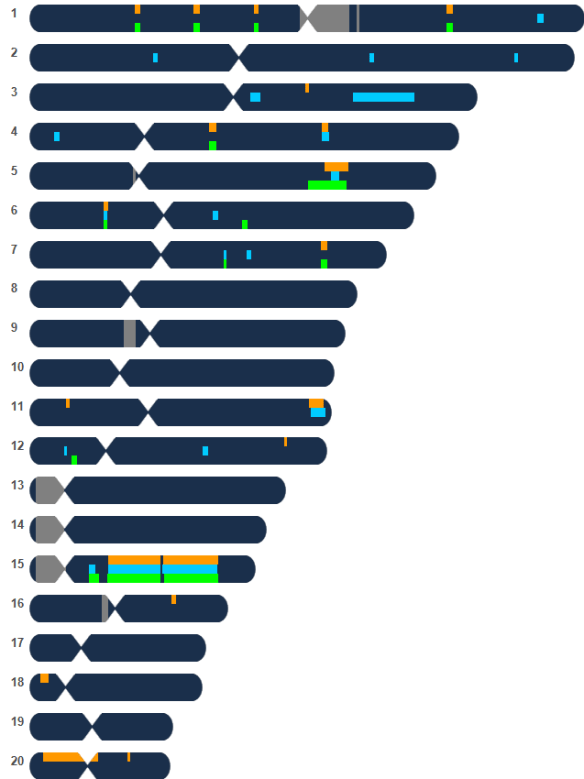
chromosome browser war3

At Family Tree DNA, the match threshold is about 7cM.  Each of the vendors has a different threshold and a different way of calculating that threshold.

The only reason I mention this is because if you DON’T match with someone on the matrix, but you also show matches at smaller segments, understand that matrix is not reporting on those, so matrix matches are not negative proof, only positive indications – when you do match, both on the chromosome browser and utilizing the matrix tool.

What you do know at this point is that these individuals all match you on the same segments, and that they match each other someplace on their chromosomes, but what you don’t know is if they match each other on the same locations where they match you.

If you are lucky and your matches are cousins or experienced genetic genealogists and are willing to take a look at their accounts, they can tell you if they match the other people on the same segments where they match you – but that’s the only way to know unless they are willing to download their raw data file to GedMatch.  At GedMatch, you can adjust the match thresholds to any level you wish and you can compare one-to-one kits to see where any two kits who have provided you with their kit number match each other.

3. Downloading data – mapping your chromosome.

The “download to Excel” function at Family Tree DNA, located just above the chromosome browser graphic, on the left, provides you with the matching data of the individuals shown on the chromosome browser with their actual segment data shown. (The download button on the right downloads all of your matches, not just the ones shown in the browser comparison.)

The spreadsheet below shows the downloaded data for these four individuals.  You can see on chromosome 15 (yellow) there are three distinct segments that match (pink, yellow and blue,) which is exactly what is reflected on the graphic browser as well.

chromosome browser war4

On the spreadsheet below, I’ve highlighted, in red, the segments which appeared on the original chromosome browser – so these are only the matches at or over the match threshold.

chromosome browser war5

As you can see, there are 13 in total.

Smaller Segments

Up to this point, the process I’ve shared is widely accepted as the gold standard.

In the genetic genealogy community, there are very divergent opinions on how to treat segments below the match threshold, or below even 10cM.  Some people “throw them away,” in essence, disregard them entirely.  Before we look at a real life example, let’s talk about the challenges with small segments.

When smaller segments match, along with larger segments, I don’t delete them, throw them away, or disregard them.  I believe that they are tools and each one carries a message for us.  Those messages can be one of four things.

  1. This is a valid IBD, meaning identical by descent, match where the segment has been passed from one specific ancestor to all of the people who match and can be utilized as such.
  2. This is an IBS match, meaning identical by state, and is called that because we can’t yet identify the common ancestor, but there is one. So this is actually IBD but we can’t yet identify it as such. With more matches, we may well be able to identify it as IBD, but if we throw it away, we never get that chance. As larger data bases and more sophisticated software become available, these matches will fall into place.
  3. This is an IBS match that is a false match, meaning the DNA segments that we receive from our father and mother just happen to align in a way that matches another person. Generally these are relatively easy to determine because the people you match won’t match each other. You also won’t tend to match other people with the same ancestral line, so they will tend to look like lone outliers on your match spreadsheets, but not always.
  4. This is an IBS match that is population based. These are much more difficult to determine, because this is a segment that is found widely in a population. The key to determining these pileup areas, as discussed in the Ancestry article about their new phasing technique, if that you will find this same segment matching different proven lineages. This is the reason that Ancestry has implemented phasing – to identify and remove these match regions from your matches. Ancestry provided a graphic of my pileup areas, although they did not identify for me where on my chromosomes these pileup regions occurred. I do have some idea however, because I’ve found a couple of areas where I have matches from my mother’s side of the family from different ancestors – so these areas must be IBS on a population level. That does not, however, make them completely irrelevant.

genome pileups

The challenge, and problem, is where to make the cutoff when you’re eliminating match areas based on phased data.  For example, I lost all of my Acadian matches at Ancestry.  Of course, you would expect an endogamous population to share lots of the same DNA – and there are a huge number of Acadian descendants today – they are in fact a “population,” but those matches are (were) still useful to me.

I utilize Acadian matches from Family Tree DNA and 23andMe to label that part of my chromosome “Acadian” even if I can’t track it to a specific Acadian ancestor, yet.  I do know from which of my mother’s ancestors it originated, her great-grandfather, who is her Acadian ancestor.  Knowing that much is useful as well.

The same challenge exists for other endogamous groups – people with Jewish, Mennonite/Brethren/Amish, Native American and African American heritage searching for their mixed race roots arising from slavery.  In fact, I’d go so far as to say that this problem exists for anyone looking for ancestors beyond the 5th or 6th generation, because segments inherited from those ancestors, if there are any, will probably be small and fall below the generally accepted match thresholds.  The only way you will be able to find them, today, is the unlikely event that there is one larger segments, and it leads you on a search, like the case with Sarah Hickerson.

I want to be very clear – if you’re looking for only “sure thing” segments – then the larger the matching segment, the better the odds that it’s a sure thing, a positive, indisputable, noncontroversial match.  However, if you’re looking for ancestors in the distant past, in the 5th or 6th generation or further, you’re not likely to find sure thing matches and you’ll have to work with smaller segments. It’s certainly preferable and easier to work with large matches, but it’s not always possible.

In the Ralph and Coop paper, The Geography of Recent Genetic Ancestry Across Europe, they indicated that people who matched on segments of 10cM or larger were more likely to have a common ancestor with in the past 500 years.  Blocks of 4cM or larger were estimated to be from populations from 500-1500 years ago.  However, we also know that there are indeed sticky segments that get passed intact from generation to generation, and also that some segments don’t get divided in a generation, they simply disappear and aren’t passed on at all.  I wrote about this in my article titled, Generational Inheritance.

Another paper by Durand et al, Reducing pervasive false positive identical-by-descent segments detected by large-scale pedigree analysis, showed that 67% of the 2-4cM segments were false positives.  Conversely, that also means that 33% of the 2-4cM segments were legitimate IBD segments.

Part of the disagreement within the genetic genealogy community is based on a difference in goals.  People who are looking for the parents of adoptees are looking first and primarily as “sure thing” matches and the bigger the match segment, of course, the better because that means the people are related more closely in time.  For them, smaller segments really are useless.  However, for people who know their recent genealogy and are looking for those brick wall ancestors, several generations back in time, their only hope is utilizing those smaller segments.  This not black and white but shades of grey.  One size does not fit all.  Nor is what we know today the end of the line.  We learn every single day and many of our learning experiences are by working through our own unique genealogical situations – and sharing our discoveries.

On this next spreadsheet, you can see the smaller segments surrounding the larger segments – in other words, in the same match cluster – highlighted in green.  These are the segments that would be discarded as invalid if you were drawing the line at the match threshold.  Some people draw it even higher, at 10 cM.  I’m not being critical of their methodology or saying they are wrong.  It may well work best for them, but discarding small segments is not the only approach and other approaches do work, depending on the goals of the researcher.  I want my 33% IBD segments, thank you very much.

All of the segments highlighted in purple match between at least three cousins.  By checking the other cousins accounts, I can validate that they do all match each other as well, even though I can’t tell this through the Family Tree DNA matrix below the matching threshold.  So, I’ve proven these are valid.  We all received them from our common ancestor.

What about the white rows?  Are those valid matches, from a common ancestor?  We don’t have enough information to make that determination today.

chromosome browser war6

Downloading my data, and confirming segments to this common ancestor allows me to map my own chromosomes.  Now, I know that if someone matches me and any of these three cousins on chromosome 15, for example, between 33,335,760 and 58,455,135 – they are, whether they know it or not, descended from our common ancestral line.

In my opinion, I would think it a shame to discount or throw away all of these matches below 7cM, because you would be discounting 39 of your 52 total matches, or 75% of them.  I would be more conservative in assigning my segments with only one cousin match to any ancestor, but I would certainly note the match and hope that if I added other cousins, that segment would be eventually proven as IBD.

I used positively known cousins in this example because there is no disputing the validity of these matches.  They were known as cousins long before DNA testing.

Breaking Down Brick Walls

This is the same technique utilized to break down brick walls – and the more cousins you have tested, so that you can identify the maximum number of chromosome pieces of a particular ancestor – the better.

I used this same technique to identify Sarah Hickerson in my Thanksgiving Day article, utilizing these same cousins, plus several more.

Hey, just for fun, want to see what chromosome 15 looks like in this much larger sample???

In this case, we were trying to break down a brick wall.  We needed to determine if Sarah Hickerson was the mother of Elijah Vannoy.  All of the individuals in the left “Name” column are proven Vannoy cousins from Elijah, or in one case, William, from another child of Sarah Hickerson.  The individuals in the right “Match” column are everyone in the cousin match group plus the people in green who are Hickerson/Higginson descendants.  William, in green, is proven to descend from Sarah Hickerson and her husband, Daniel Vannoy.

chromosome browser war7

The first part of chromosome 15 doesn’t overlap with the rest.  Buster, David and I share another ancestral line as well, so the match in the non-red section of chromosome 15 may well be from that ancestral line.  It becomes an obvious possibility, because none of the people who share the Vannoy/Hickerson/Higginson DNA are in that small match group.

All of the red colored cells do overlap with at least one other individual in that group and together they form a cluster.  The yellow highlighted cells are the ones over the match threshold.  The 6 Hickerson/Higginson descendants are scattered throughout this match group.

And yes, for those who are going to ask, there are many more Vannoy/Hickerson triangulated groups.  This is just one of over 60 matching groups in total, some with matches well above the match threshold. But back to the chromosome browser wars!

23andMe

This example from 23andMe shows why it’s so very important to verify that your matches also match each other.

chromosome browser war8

Blue and purple match segments are to two of the same cousins that I used in the comparison at Family Tree DNA, who are from my father’s side.  Green is my first cousin from my mother’s side.   Note that on chromosome 11, they both match me on a common segment.  I know by working with them that they don’t match each other on that segment, so while they are both related to me, on chromosome 11, it’s not through the same ancestor.  One is from my father’s side and one is from my mother’s side.  If I hadn’t already known that, determining if they matched each other would be the acid test and would separate them into 2 groups.

23andMe provides you with a tool to see who your matches match that you match too.  That’s a tongue twister.

In essence, you can select any individual, meaning you or anyone that you match, on the left hand side of this tool, and compare them to any 5 other people that you match.  In my case above, I compared myself to my cousins, but if I want to know if my cousin on my mother’s side matches my two cousins on my father’s side, I simply select her name on the left and theirs on the right by using the drop down arrows.

chromosome browser war9

I would show you the results, but it’s in essence a blank chromosome browser screen, because she doesn’t match either of them, anyplace, which tells me, if I didn’t already know, that these two matches are from different sides of my family.

However, in other situations, where I match my cousin Daryl, for example, as well as several other people on the same segment, I want to know how many of these people Daryl matches as well.  I can enter Daryl’s name, with my name and their names in the group of 5, and compare.  23andMe facilitates the viewing or download of the results in a matrix as well, along with the segment data.  You can also download your entire list of matches by requesting aggregated data through the link at the bottom of the screen above or the bottom of the chromosome display.

I find it cumbersome to enter each matches name in the search tool and then enter all of the other matches names as well.  By utilizing the tools at www.dnagedcom.com, you can determine who your matches match as well, in common with you, in one spreadsheet.  Here’s an example.  Daryl in the chart below is my match, and this tool shows you who else she matches that I match as well, and the matching segments.  This allows me to correlate my match with Gwen for example, to Daryl’s match to Gwen to see if they are on the same segments.

chromosome browser war10

As you can see, Daryl and I both match Gwen on a common segment.  On my own chromosome mapping spreadsheet, I match several other people as well at that location, at other vendors, but so far, we haven’t been able to find any common genealogy.

Ancestry.com

At Ancestry.com, I have exactly the opposite problem.  I have lots of people I DNA match, and some with common genealogy, but no tools to prove the DNA match is to the common ancestor.

Hence, this is the crux of the chromosome browser wars.  I’ve just showed you how and why we use chromosome browsers and tools to show if our matches match each other in addition to us and on which segments.  I’ve also illustrated why.  Neither 23andMe nor Family Tree DNA provides perfect tools, which is why we utilize both GedMatch and DNAGedcom, but they do provide tools.  Ancestry provides no tools of this type.

At Ancestry, you have two kinds of genetic matches – ones without tree matches and ones with tree matches.  Pedigree matching is a service that Ancestry provides that the other vendors don’t.  Unfortunately, it also leads people to believe that because they match these people genetically and share a tree, that the tree shown is THE genetic match and it’s to the ancestor shown in the tree.  In fact, if the tree is wrong, either your tree or their tree, and you match them genetically, you will show up as a pedigree match as well.  Even if both pedigrees are right, that still doesn’t mean that your genetic match is through that ancestor.

How many bad trees are at Ancestry percentagewise?  I don’t know, but it’s a constant complaint and there is absolutely nothing Ancestry can do about it.  All they can do is utilize what they have, which is what their customers provide.  And I’m glad they do.  It does make the process of working through your matches much easier. It’s a starting point.  DNA matches with trees that also match your pedigree are shown with Ancestry’s infamous shakey leaf.

In fact, in my Sarah Hickerson article, it was a shakey leaf match that initially clued me that there was something afoot – maybe. I had to shift to another platform (Family Tree DNA) to prove the match however, where I had tools and lots of known cousins.

At Ancestry, I now have about 3000 matches in total, and of those, I have 33 shakey leaves – or people with whom I also share an ancestor in our pedigree charts.  A few of those are the same old known cousins, just as genealogy crazy as me, and they’ve tested at all 3 companies.

The fly in the ointment, right off the bat, is that I noticed in several of these matches that I ALSO share another ancestral line.

Now, the great news is that Ancestry shows you your surnames in common, and you can click on the surname and see the common individuals in both trees.

The bad news is that you have to notice and click to see that information, found in the lower left hand corner of this screen.

chromosome browser war11

In this case, Cook is an entirely different line, not connected to the McKee line shown.

However, in this next case, we have the same individual entered in our software, but differently.  It wasn’t close enough to connect as an ancestor, but close enough to note.  It turns out that Sarah Cook is the mother of Fairwick Claxton, but her middle name was not Helloms, nor was her maiden name, although that is a long-standing misconception that was proven incorrect with her husband’s War of 1812 documents many years ago. Unfortunately, this misinformation is very widespread in trees on the internet.

chromosome browser war12

Out of curiosity, and now I’m sorry I did this because it’s very disheartening – I looked to see what James Lee Claxton/Clarkson’s wife’s name was shown to be on the first page of Ancestry’s advanced search matches.

Despite extensive genealogical and DNA research, we don’t know who James Lee Claxton/Clarkson’s parents are, although we’ve disproven several possibilities, including the most popular candidate pre-DNA testing.  However, James’ wife was positively Sarah Cook, as given by her, along with her father’s name, and by witnesses to their marriage provided when she applied for a War of 1812 pension and bounty land.  I have the papers from the National Archives.

James Lee Claxton’s wife, Sara Cook is identified as follows in the first 50 Ancestry search entries.

Sarah Cook – 4

Incorrect entries:

  • Sarah Cook but with James’ parents listed – 3
  • Sarah Helloms Cook – 2, one with James’ parents
  • Sarah Hillhorns – 15
  • Sarah Cook Hitson – 13, some with various parents for James
  • No wife, but various parents listed for James – 12
  • No wife, no parents – 1

I’d much rather see no wife and no parents than incorrect information.

Judy Russell has expressed her concern about the effects of incorrect trees and DNA as well and we shared this concern with Ancestry during our meeting.

Ancestry themselves in their paper titled “Identifying groups of descendants using pedigrees and genetically inferred relationships in a large database” says, “”As with all analyses relating to DNA Circles™, tree quality is also an important caveat and limitation.”  So Ancestry is aware, but they are trying to leverage and utilize one of their biggest assets, their trees.

This brings us to DNA Circles.  I reviewed Ancestry’s new product release extensively in my Ancestry’s Better Mousetrap article.  To recap briefly, Ancestry gathers your DNA matches together, and then looks for common ancestors in trees that are public using an intelligent ranking algorithm that takes into account:

  1. The confidence that the match is due to recent genealogical history (versus a match due to older genealogical history or a false match entirely).
  2. The confidence that the identified common recent ancestor represents the same person in both online pedigrees.
  3. The confidence that the individuals have a match due to the shared ancestor in question as opposed to from another ancestor or from more distant genealogical history.

The key here is that Ancestry is looking for what they term “recent genealogical history.”  In their paper they define this as 10 generations, but the beta version of DNA Circles only looks back 7 generations today.  This was also reflected in their phasing paper, “Discovering IBD matches across a large, growing database.”

However, the unfortunate effect has been in many cases to eliminate matches, especially from endogamous groups.  By way of example, I lost my Acadian matches in the Ancestry new product release.  They would have been more than 7 generations back, and because they were endogamous, they may have “looked like” IBS segments, if IBS is defined at Ancestry as more than 7 or 10 generations back.  Hopefully Ancestry will tweek this algorithm in future releases.

Ancestry, according to their paper, “Identifying groups of descendants using pedigrees and genetically inferred relationships in a large database,” then clusters these remaining matching individuals together in Circles based on their pedigree charts.  You will match some of these people genetically, and some of them will not match you but will match each other.  Again, according to the paper, “these confidence levels are calculated by the direct-line pedigree size, the number of shared ancestral couples and the generational depth of the shared MRCA couple.”

Ancestry notes that, “using the concordance of two independent pieces of information, meaning pedigree relationships and patterns of match sharing among a set of individuals, DNA Circles can serve as supporting evidence for documented pedigree lines.”  Notice, Ancestry did NOT SAY proof.  Nothing that Ancestry provides in their DNA product constitutes proof.

Ancestry continues by saying that Circles “opens the possibility for people to identify distant relatives with whom they do not share DNA directly but with whom they still have genetic evidence supporting the relationship.”

In other words, Ancestry is being very clear in this paper, which is provided on the DNA Circles page for anyone with Circles, that they are giving you a tool, not “the answer,” but one more piece of information that you can consider as evidence.

joel vannoy circleJoel Vannoy circle2

You can see in my Joel Vannoy circle that I match both of these people both genetically and on their tree.

We, in the genetic genealogy community, need proof.  It certainly could be available, technically – because it is with other vendors and third party sites.

We need to be able to prove that our matches also match each other, and utilizing Ancestry’s tools, we can’t.  We also can’t do this at Ancestry by utilizing third party tools, so we’re in essence, stuck.

We can either choose to believe, without substantiation, that we indeed share a common ancestor because we share DNA segments with them plus a pedigree chart from that common ancestor, or we can initiate a conversation with our match that leads to either or both of the following questions:

  1. Have you or would you upload your raw data to GedMatch?
  2. Have you or would you upload your raw data file to Family Tree DNA?

Let the begging begin!!!

The Problem

In a nutshell, the problem is that even if your Ancestry matches do reply and do upload their file to either Family Tree DNA or GedMatch or both, you are losing most of the potential information available, or that would be available, if Ancestry provided a chromosome browser and matrix type tool.

In other words, you’d have to convince all of your matches and then they would have to convince all of the matches in the circle that they match and you don’t to upload their files.

Given that, of the 44 private tree shakey leaf matches that I sent messages to about 2 weeks ago, asking only for them to tell me the identity of our common pedigree ancestor, so far 2 only of them have replied, the odds of getting an entire group of people to upload files is infinitesimal.  You’d stand a better chance of winning the lottery.

One of the things Ancestry excels at is marketing.

ancestry ad1

If you’ve seen any of their ads, and they are everyplace, they focus on the “feel good” and they are certainly maximizing the warm fuzzy feelings at the holidays and missing those generations that have gone before us.

ancestry ad2

This is by no means a criticism, but it is why so many people do take the Ancestry DNA test. It’s advertised as easy and you’ll learn more about your family.  And you do, no question – you learn about your ethnicity and you get a list of DNA matches, pedigree matches when possible and DNA Circles.

The list of what you don’t get is every bit as important, a chromosome browser and tools to see whether your matches also match each other.  However, most of their customers will never know that.

Judging by the high percentage of inaccurate trees I found at Ancestry in my little experiment relative to the known and documented wife’s name of James Lee Claxton, which was 96%, based on just the first page of 50 search matches, it would appear that about 96% of Ancestry’s clientele are willing to believe something that someone else tells them without verification.  I doubt that it matters whether that information is a tree or a DNA test where they are shown  matches with common pedigree charts and circles.  I don’t mean this to be critical of those people.  We all began as novices and we need new people to become interested in both genealogy and DNA testing.

I suspect that most of Ancestry’s clients, especially new ones, simply don’t have a clue that there is a problem, let alone the magnitude and scope.  How would they?  They are just happy to find information about their ancestor.  And as someone said to me once – “but there are so many of those trees (with a wrong wife’s name), how can they all be wrong?”  Plus, the ads, at least some of them, certainly suggest that the DNA test grows your family tree for you.

ancestry ad3 signoff

The good news in all of this is that Ancestry’s widespread advertising has made DNA testing just part of the normal things that genealogists do.  Their marketing expertise along with recent television programs have served to bring DNA testing into the limelight. The bad news is that if people test at Ancestry instead of at a vendor who provides tools, we, and they, lose the opportunity to utilize those results to their fullest potential.  We, and they, lose any hope of proving an ancestor utilizing DNA.  And let’s face it, DNA testing and genealogy is about collaboration.  Having a DNA test that you don’t compare against others is pointless for genealogy purposes.

When a small group of bloggers and educators visited Ancestry in October, 2014, for what came to be called DNA Day, we discussed the chromosome browser and Ancestry’s plans for their new DNA Circles product, although it had not yet been named at that time.  I wrote about that meeting, including the fact that we discussed the need for a chromosome browser ad nauseum.  Needless to say, there was no agreement between the genetic genealogy community and the Ancestry folks.

When we discussed the situation with Ancestry they talked about privacy and those types of issues, which you can read about in detail in that article, but I suspect, strongly, that the real reason they aren’t keen on developing a chromosome browser lies in different areas.

  1. Ancestry truly believes that people cannot understand and utilize a chromosome browser and the information it provides. They believe that people who do have access to chromosome browsers are interpreting the results incorrectly today.
  2. They do not want to implement a complex feature for a small percentage of their users…the number bantered around informally was 5%…and I don’t know if that was an off-the-cuff number or based on market research. However, if you compare that number with the number of accurate versus inaccurate pedigree charts in my “James Claxton’s wife’s name” experiment, it’s very close…so I would say that the 5% number is probably close to accurate.
  3. They do not want to increase their support burden trying to explain the results of a chromosome browser to the other 95%. Keep in mind the number of users you’re discussing. They said in their paper they had 500,000 DNA participants. I think it’s well over 700,000 today, and they clearly expect to hit 1 million in 2015. So if you utilize a range – 5% of their users are 25,000-50,000 and 95% of their users are 475,000-950,000.
  4. Their clients have already paid their money for the test, as it is, and there is no financial incentive for Ancestry to invest in an add-on tool from which they generate no incremental revenue and do generate increased development and support costs. The only benefit to them is that we shut up!

So, the bottom line is that most of Ancestry’s clients don’t know or care about a chromosome browser.  There are, however, a very noisy group of us who do.

Many of Ancestry’s clients who purchase the DNA test do so as an impulse purchase with very little, if any, understanding of what they are purchasing, what it can or will do for them, at Ancestry or anyplace else, for that matter.

Any serious genealogist who researched the autosomal testing products would not make Ancestry their only purchase, especially if they could only purchase one test.  Many, if not most, serious genealogists have tested at all three companies in order to fish in different ponds and maximize their reach.  I suspect that most of Ancestry’s customers are looking for simple and immediate answers, not tools and additional work.

The flip side of that, however, if that we are very aware of what we, the genetic genealogy industry needs, and why, and how frustratingly lacking Ancestry’s product is.

Company Focus

It’s easy for us as extremely passionate and focused consumers to forget that all three companies are for-profit corporations.  Let’s take a brief look at their corporate focus, history and goals, because that tells a very big portion of the story.  Every company is responsible first and foremost to their shareholders and owners to be profitable, as profitable as possible which means striking the perfect balance of investment and expenditure with frugality.  In corporate America, everything has to be justified by ROI, or return on investment.

Family Tree DNA

Family Tree DNA was the first one of the companies to offer DNA testing and was formed in 1999 by Bennett Greenspan and Max Blankfeld, both still principles who run Family Tree DNA, now part of Gene by Gene, on a daily basis.  Family Tree DNA’s focus is only on genetic genealogy and they have a wide variety of products that produce a spectrum of information including various Y DNA tests, mitochondrial, autosomal, and genetic traits.  They are now the only commercial company to offer the Y STR and mitochondrial DNA tests, both very important tools for genetic genealogists, with a great deal of information to offer about our ancestors.

In April 2005, National Geographic’s Genographic project was announced in partnership with Family Tree DNA and IBM.  The Genographic project, was scheduled to last for 5 years, but is now in its 9th year.  Family Tree DNA and National Geographic announced Geno 2.0 in July of 2012 with a newly designed chip that would test more than 12,000 locations on the Y chromosome, in addition to providing other information to participants.

The Genographic project provided a huge boost to genetic genealogy because it provided assurance of legitimacy and brought DNA testing into the living room of every family who subscribed to National Geographic magazine.  Family Tree DNA’s partnership with National Geographic led to the tipping point where consumer DNA testing became mainstream.

In 2011 the founders expanded the company to include clinical genetics and a research arm by forming Gene by Gene.  This allowed them, among other things, to bring their testing in house by expanding their laboratory facilities.  They have continued to increase their product offerings to include sophisticated high end tests like the Big Y, introduced in 2013.

23andMe

23andMe is also privately held and began offering testing for medical and health information in November 2007, initially offering “estimates of predisposition for more than 90 traits ranging from baldness to blindness.”  Their corporate focus has always been in the medical field, with aggregated customer data being studied by 23andMe and other researchers for various purposes.

In 2009, 23andMe began to offer the autosomal test for genealogists, the first company to provide this service.  Even though, by today’s standards, it was very expensive, genetic genealogists flocked to take this test.

In 2013, after several years of back and forth with 23andMe ultimately failing to reply to the FDA, the FDA forced 23andMe to stop providing the medical results.  Clients purchasing the 23andMe autosomal product since November of 2013 receive only ethnicity results and the genealogical matching services.

In 2014, 23andMe has been plagued by public relations issues and has not upgraded significantly nor provided additional tools for the genetic genealogy community, although they recently formed a liaison with My Heritage.

23andMe is clearly focused on genetics, but not primarily genetic genealogy, and their corporate focus during this last year in particular has been, I suspect, on how to survive, given the FDA action.  If they steer clear of that landmine, I expect that we may see great things in the realm of personalized medicine from them in the future.

Genetic genealogy remains a way for them to attract people to increase their data base size for research purposes.  Right now, until they can again begin providing health information, genetic genealogists are the only people purchasing the test, although 23andMe may have other revenue sources from the research end of the business

Ancestry.com

Ancestry.com is a privately held company.  They were founded in the 1990s and have been through several ownership and organizational iterations, which you can read about in the wiki article about Ancestry.

During the last several years, Ancestry has purchased several other genealogy companies and is now the largest for-profit genealogy company in the world.  That’s either wonderful or terrible, depending on your experiences and perspective.

Ancestry has had an on-again-off-again relationship with DNA testing since 2002, with more than one foray into DNA testing and subsequent withdrawal from DNA testing.  If you are interested in the specifics, you can read about them in this article.

Ancestry’s goal, as it is with all companies, is profitability.  However, they have given themselves a very large black eye in the genetic genealogy community by doing things that we consider to be civically irresponsible, like destroying the Y and mitochondrial DNA data bases.  This still makes no sense, because while Ancestry spends money on one hand to acquire data bases and digitize existing records, on the other hand, they wiped out a data base containing tens of thousands of irreplaceable DNA records, which are genealogy records of a different type.  This was discussed at DNA Day and the genetic genealogy community retains hope that Ancestry is reconsidering their decision.

Ancestry has been plagued by a history of missteps and mediocrity in their DNA products, beginning with their Y and mitochondrial DNA products and continuing with their autosomal product.  Their first autosomal release included ethnicity results that gave many people very high percentages of Scandinavian heritage.  Ancestry never acknowledged a problem and defended their product to the end…until the day when they announced an update titled….a whole new you.  They are marketing geniuses.  While many people found their updated product much more realistic, not everyone was happy.  Judy Russell wrote a great summary of the situation.

It’s difficult, once a company has lost their credibility, for them to regain it.

I think Ancestry does a bang up job of what their primary corporate goal is….genealogy records and subscriptions for people to access those records. I’m a daily user.  Today, with their acquisitions, it would be very difficult to be a serious genealogist without an Ancestry subscription….which is of course what their corporate goal has been.

Ancestry does an outstanding job of making everything look and appear easy.  Their customer interface is intuitive and straightforward, for the most part. In fact, maybe they have made both genealogy and genetic genealogy look a little too easy.  I say this tongue in cheek, full well knowing that the ease of use is how they attract so many people, and those are the same people who ultimately purchase the DNA tests – but the expectation of swabbing and the answer appearing is becoming a problem.  I’m glad that Ancestry has brought DNA testing to so many people but this success makes tools like the chromosome browser/matrix that much more important – because there is so much genealogy information there just waiting to be revealed.  I also feel that their level of success and visibility also visits upon them the responsibility for transparency and accuracy in setting expectations properly – from the beginning – with the ads. DNA testing does not “grow your tree” while you’re away.

I’m guessing Ancestry entered the DNA market again because they saw a way to sell an additional product, autosomal DNA testing, that would tie people’s trees together and provide customers with an additional tool, at an additional price, and give them yet another reason to remain subscribed every year.  Nothing wrong with that either.  For the owners, a very reasonable tactic to harness a captive data base whose ear you already have.

But Ancestry’s focus or priority is not now, and never has been, quality, nor genetic genealogy.  Autosomal DNA testing is a tool for their clients, a revenue generation source for them, and that’s it.  Again, not a criticism.  Just the way it is.

In Summary

As I look at the corporate focus of the three players in this space, I see three companies who are indeed following their corporate focus and vision.  That’s not a bad thing, unless the genetic genealogy community focus finds itself in conflict with the results of their corporate focus.

It’s no wonder that Family Tree DNA sponsors events like the International DNA Conference and works hand in hand with genealogists and project administrators.  Their focus is and always has been genetic genealogy.

People do become very frustrated with Family Tree DNA from time to time, but just try to voice those frustrations to upper management at either 23andMe or Ancestry and see how far you get.  My last helpdesk query to 23andMe submitted on October 24th has yet to receive any reply.  At Family Tree DNA, I e-mailed the project administrator liaison today, the Saturday after Thanksgiving, hoping for a response on Monday – but I received one just a couple hours later – on a holiday weekend.

In terms of the chromosome browser war – and that war is between the genetic genealogy community and Ancestry.com, I completely understand both positions.

The genetic genealogy community has been persistent, noisy, and united.  Petitions have been created and signed and sent to Ancestry upper management.  To my knowledge, confirmation of any communications surrounding this topic with the exception of Ancestry reaching out to the blogging and education community, has never been received.

This lack of acknowledgement and/or action on the issues at hand frustrates the community terribly and causes reams of rather pointed and very direct replies to Anna Swayne and other Ancestry employees who are charged with interfacing with the public.  I actually feel sorry for Anna.  She is a very nice person.  If I were in her position, I’d certainly be looking for another job and letting someone else take the brunt of the dissatisfaction.  You can read her articles here.

I also understand why Ancestry is doing what they are doing – meaning their decision to not create a chromosome browser/match matrix tool.  It makes sense if you sit in their seat and now have to look at dealing with almost a million people who will wonder why they have to use a chromosome browser and or other tools when they expected their tree to grow while they were away.

I don’t like Ancestry’s position, even though I understand it, and I hope that we, as a community, can help justify the investment to Ancestry in some manner, because I fully believe that’s the only way we’ll ever get a chromosome browser/match matrix type tool.  There has to be a financial benefit to Ancestry to invest the dollars and time into that development, as opposed to something else.  It’s not like Ancestry has additional DNA products to sell to these people.  The consumers have already spent their money on the only DNA product Ancestry offers, so there is no incentive there.

As long as Ancestry’s typical customer doesn’t know or care, I doubt that development of a chromosome browser will happen unless we, as a community, can, respectfully, be loud enough, long enough, like an irritating burr in their underwear that just won’t go away.

burr

The Future

What we “know” and can do today with our genomes far surpasses what we could do or even dreamed we could do 10 years ago or even 5 or 2 years ago.  We learn everyday.

Yes, there are a few warts and issues to iron out.  I always hesitate to use words like “can’t,” “never” and “always” or to use other very strongly opinionated or inflexible words, because those words may well need to be eaten shortly.

There is so much more yet to be done, discovered and learned.  We need to keep open minds and be willing to “unlearn” what we think we knew when new and better information comes along.  That’s how scientific discovery works.  We are on the frontier, the leading edge and yes, sometimes the bleeding edge.  But what a wonderful place to be, to be able to contribute to discovery on a new frontier, our own genes and the keys to our ancestors held in our DNA.

______________________________________________________________

Disclosure

I receive a small contribution when you click on some of the links to vendors in my articles. This does NOT increase the price you pay but helps me to keep the lights on and this informational blog free for everyone. Please click on the links in the articles or to the vendors below if you are purchasing products or DNA testing.

Thank you so much.

DNA Purchases and Free Transfers

Genealogy Services

Genealogy Research
