Ancient DNA Matches – What Do They Mean?

The good news is that my three articles about the Anzick and other ancient DNA of the past few days have generated a lot of interest.

The bad news is that it has generated hundreds of e-mails every day – and I can’t possibly answer them all personally.  So, if you’ve written me and I don’t reply, I apologize and  I hope you’ll understand.  Many of the questions I’ve received are similar in nature and I’m going to answer them in this article.  In essence, people who have matches want to know what they mean.

Q – I had a match at GedMatch to <fill in the blank ancient DNA sample name> and I want to know if this is valid.

A – Generally, when someone asks if an autosomal match is “valid,” what they really mean is whether or not this is a genealogically relevant match or if it’s what is typically referred to as IBS, or identical by state.  Genealogically relevant samples are referred to as IBD, or identical by descent.  I wrote about that in this article with a full explanation and examples, but let me do a brief recap here.

In genealogy terms, IBD is typically used to mean matches over a particular threshold that can be or are GENEALOGICALLY RELEVANT.  Those last two words are the clue here.  In other words, we can match them with an ancestor with some genealogy work and triangulation.  If the segment is large, and by that I mean significantly over the threshold of 700 SNPs and 7cM, even if we can’t identify the common ancestor with another person, the segment is presumed to be IBD simply because of the math involved with the breakdown of segment into pieces.  In other words, a large segment match generally means a relatively recent ancestor and a smaller segment means a more distant ancestor.  You can readily see this breakdown on this ISOGG page detailing autosomal DNA transmission and breakdown.

Unfortunately, often smaller segments, or ones determined to be IBS are considered to be useless, but they aren’t, as I’ve demonstrated several times when utilizing them for matching to distant ancestors.  That aside, there are two kinds of IBS segments.

One kind of IBS segment is where you do indeed share a common ancestor, but the segment is small and you can’t necessarily connect it to the ancestor.  These are known as population matches and are interpreted to mean your common ancestor comes from a common population with the other person, back in time, but you can’t find the common ancestor.  By population, we could mean something like Amish, Jewish or Native American, or a country like Germany or the Netherlands.

In the cases where I’ve utilized segments significantly under 7cM to triangulate ancestors, those segments would have been considered IBS until I mapped them to an ancestor, and then they suddenly fell into the IBD category.

As you can see, the definitions are a bit fluid and are really defined by the genealogy involved.

The second kind of IBS is where you really DON’T share an ancestor, but your DNA and your matches DNA has managed to mutate to a common state by convergence, or, where your Mom’s and Dad’s DNA combined form a pseudo match, where you match someone on a segment run long enough to be considered a match at a low level.  I discussed how this works, with examples, in this article.  Look at example four, “a false match.”

So, in a nutshell, if you know who your common ancestor is on a segment match with someone, you are IBD, identical by descent.  If you don’t know who your common ancestor is, and the segment is below the normal threshold, then you are generally considered to be IBS – although that may or may not always be true.  There is no way to know if you are truly IBS by population or IBS by convergence, with the possible exception of phased data.

Data phasing is when you can compare your autosomal DNA with one or both parents to determine which half you obtained from whom.  If you are a match by convergence where your DNA run matches that of someone else because the combination of your parents DNA happens to match their segment, phasing will show that clearly.  Here’s an example for only one location utilizing only my mother’s data phased with mine.  My father is deceased and we have to infer his results based on my mother’s and my own.  In other words, mine minus the part I inherited from my mother = my father’s DNA.

My Result My Result Mother’s Result Mother’s Result Father’s Inferred Result Father’s Inferred Result
T A T G A

In this example of just one location, you can see that I carry a T and an A in that location.  My mother carries a T and a G, so I obviously inherited the T from her because I don’t have a G.  Therefore, my father had to have carried at least an A, but we can’t discern his second value.

This example utilized only one location.  Your autosomal data file will hold between 500,000 and 700,000 location, depending on the vendor you tested with and the version level.

You can phase your DNA with that of your parent(s) at GedMatch.  However, if both of your parents are living, an easier test would be to see if either of your parents match the individual in question.  If neither of your parents match them, then your match is a result of convergence or a data read error.

So, this long conversation about IBD and IBS is to reach this conclusion.

All of the ancient specimens are just that, ancient, so by definition, you cannot find a genealogy match to them, so they are not IBD.  Best case, they are IBS by population.  Worse case, IBS by convergence.  You may or may not be able to tell the difference.  The reason, in my example earlier this week, that I utilized my mother’s DNA and only looked at locations where we both matched the ancient specimens was because I knew those matches were not by convergence – they were in fact IBS by population because my mother and I both matched Anzick.

ancient compare5

Q – What does this ancient match mean to me?

A – Doggone if I know.  No, I’m serious.  Let’s look at a couple possibilities, but they all have to do with the research you have, or have not, done.

If you’ve done what I’ve done, and you’ve mapped your DNA segments to specific ancestors, then you can compare your ancient matching segments to your ancestral spreadsheet map, especially if you can tell unquestionably which side the ancestral DNA matches.  In my case, shown above, the Clovis Anzik matched my mother and me on the same segment and we both matched Cousin Herbie.  We know unquestionably who our common ancestor is with cousin Herbie – so we know, in our family line, which line this segment of DNA shared with Anzick descends through.

ancient compare6

If you’re not doing ancestor mapping, then I guess the Anzick match would come in the category of, “well, isn’t that interesting.”  For some, this is a spiritual connection to the past, a genetic epiphany.  For other, it’s “so what.”

Maybe this is a good reason to start ancestor mapping!  This article tells you how to get started.

Q – Does my match to Anzick mean he is my ancestor?

A – No, it means that you and Anzick share common ancestry someplace back in time, perhaps tens of thousands of years ago.

Q – I match the Anzick sample.  Does this prove that I have Native American heritage? 

A – No, and it depends.  Don’t you just hate answers like this?

No, this match alone does not prove Native American heritage, especially not at IBS levels.  In fact, many people who don’t have Native heritage match small segments?  How can this be?  Well, refer to the IBS by convergence discussion above.  In addition, Anzick child came from an Asian population when his ancestors migrated, crossing from Asia via Beringia.  That Eurasian population also settled part of Europe – so you could be matching on very small segments from a common population in Eurasia long ago.  In a paper just last year, this was discussed when Siberian ancient DNA was shown to be related to both Native Americans and Europeans.

In some cases, a match to Anzick on a segment already attributed to a Native line can confirm or help to confirm that attribution.  In my case, I found the Anzick match on segments in the Lore family who descend from the Acadians who were admixed with the Micmac.  I have several Anzick match segments that fit that criteria.

A match to Anzick alone doesn’t prove anything, except that you match Anzick, which in and of itself is pretty cool.

Q – I’m European with no ancestors from America, and I match Anzick too.  How can that be?

A – That’s really quite amazing isn’t it.  Just this week in Nature, a new article was published discussing the three “tribes” that settled or founded the European populations.  This, combined with the Siberian ancient DNA results that connect the dots between an ancient population that contributed to both Europeans and Native Americans explains a lot.

3 European Tribes

If you think about it, this isn’t a lot different than the discovery that all Europeans carry some small amount of Neanderthal and Denisovan DNA.

Well, guess what….so does Anzick.

Here are his matches to the Altai Neanderthal.

Chr Start Location End Location Centimorgans (cM) SNPs
2 241484216 242399416 1.1 138
3 19333171 21041833 2.6 132
6 31655771 32889754 1.1 133

He does not match the Caucasus Neanderthal.  He does, however, match the Denisovan individual on one location.

Chr Start Location End Location Centimorgans (cM) SNPs
3 19333171 20792925 2.1 107

Q – Maybe the scientists are just wrong and the burial is not 12,500 years old,  maybe just 100 years old and that’s why the results are matching contemporary people.

A – I’m not an archaeologist, nor do I play one…but I have been closely involved with numerous archaeological excavations over the past decade with The Lost Colony Research Group, several of which recovered human remains.  The photo below is me with Anne Poole, my co-director, sifting at one of the digs.

anne and me on dig

There are very specific protocols that are followed during and following excavation and an error of this magnitude would be almost impossible to fathom.  It would require  kindergarten level incompetence on the part of not one, but all professionals involved.

In the Montana Anzick case, in the paper itself, the findings and protocols are both discussed.  First, the burial was discovered directly beneath the Clovis layer where more than 100 tools were found, and the Clovis layer was undisturbed, meaning that this is not a contemporary burial that was buried through the Clovis layer.  Second, the DNA fragmentation that occurs as DNA degrades correlated closely to what would be expected in that type of environment at the expected age based on the Clovis layer.  Third, the bones themselves were directly dated using XAD-collagen to 12,707-12,556 calendar years ago.  Lastly, if the remains were younger, the skeletal remains would match most closely with Native Americans of that region, and that isn’t the case.  This graphic from the paper shows that the closest matches are to South Americans, not North Americans.

anzick matches

This match pattern is also confirmed independently by the recent closest GedMatch matches to South Americans.

Q – How can this match from so long ago possibly be real?

A – That’s a great question and one that was terribly perplexing to Dr. Svante Paabo, the man who is responsible for producing the full genome sequence of the first, and now several more, Neanderthals.  The expectation was, understanding autosomal DNA gets watered down by 50% in every generation though recombination, that ancient genomes would be long gone and not present in modern populations.  Imagine Svante’s surprise when he discovered that not only isn’t true, but those ancient DNA segmetns are present in all Europeans and many Asians as well.  He too agonized over the question about how this is possible, which he discussed in this great video.  In fact he repeated these tests over and over in different ways because he was convinced that modern individuals could not carry Neanderthal DNA – but all those repeated tests did was to prove him right.  (Paabo’s book, Neanderthal Man, In Search of Lost Genomes is an incredible read that I would highly recommend.)

What this means is that the population at one time, and probably at several different times, had to be very small.  In fact, it’s very likely that many times different pockets of the human race was in great jeopardy of dying out.  We know about the ones that survived.  Probably many did perish leaving no descendants today.  For example, no Neanderthal mitochondrial DNA has been found in any living or recent human.

In a small population, let’s say 5 males and 5 females who some how got separated from their family group and founded a new group, by necessity.  In fact, this could well be a description of how the Native Americans crossed Beringia.  Those 5 males and 5 females are the founding population of the new group.  If they survive, all of the males will carry the men’s haplogroups – let’s say they are Q and C, and all of the descendants will carry the mitochondrial haplogroups of the females – let’s say A, B, C, D and X.

There is a very limited amount of autosomal DNA to pass around.  If all of those 10 people are entirely unrelated, which is virtually impossible, there will be only 10 possible combinations of DNA to be selected from.  Within a few generations, everyone will carry part of those 10 ancestor’s DNA.  We all have 8 ancestors at the great-grandparent level.  By the time those original settlers’ descendants had great-great-grandparents – of which each one had 16, at least 6 of those original people would be repeated twice in their tree.

There was only so much DNA to be passed around.  In time, some of the segments would no longer be able to be recombined because when you look at phasing, the parents DNA was exactly the same, example below.  This is what happens in endogamous populations.

My Result My Result Mother’s Result Mother’s Result Father’s Result Father’s  Result
T T T T T T

Let’s say this group’s descendants lived without contact with other groups, for maybe 15,000 years in their new country.  That same DNA is still being passed around and around because there was no source for new DNA.  Mutations did occur from time to time, and those were also passed on, of course, but that was the only source of changed DNA – until they had contact with a new population.

When they had contact with a new population and admixture occurred, the normal 50% recombination/washout in every generation began – but for the previous 15,000 years, there had been no 50% shift because the DNA of the population was, in essence, all the same.  A study about the Ashkenazi Jews that suggests they had only a founding population of about 350 people 700 years ago was released this week – explaining why Ashkenazi Jewish descendants have thousands of autosomal matches and match almost everyone else who is Ashkenazi.  I hope that eventually scientists will do this same kind of study with Anzick and Native Americans.

If the “new population” we’ve been discussing was Native Americans, their males 15,000 year later would still carry haplogroups Q and C and the mitochondrial DNA would still be A, B, C, D and X.  Those haplogroups, and subgroups formed from mutations that occurred in their descendants, would come to define their population group.

In some cases, today, Anzick matches people who have virtually no non-Native admixture at the same level as if they were just a few generations removed, shown on the chart below.

anzick gedmatch one to all

Since, in essence, these people still haven’t admixed with a new population group, those same ancient DNA segments are being passed around intact, which tells us how incredibly inbred this original small population must have been.  This is known as a genetic bottleneck.

The admixture report below is for the first individual on the Anzick one to all Gedmatch compare at 700 SNPs and 7cM, above.  In essence, this currently living non-admixed individual still hasn’t met that new population group.

anzick1

If this “new population” group was Neanderthal, perhaps they lived in small groups for tens of thousands of years, until they met people exiting Africa, or Denisovans, and admixed with them.

There weren’t a lot of people anyplace on the globe, so by virtue of necessity, everyone lived in small population groups.  Looking at the odds of survival, it’s amazing that any of us are here today.

But, we are, and we carry the remains, the remnants of those precious ancestors, the Denisovans, the Neanderthals and Anzick.  Through their DNA, and ours, we reach back tens of thousands of years on the human migration path.  Their journey is also our journey.  It’s absolutely amazing and it’s no wonder people have so many questions and such a sense of enchantment.  But it’s true – and only you can determine exactly what this means to you.

______________________________________________________________

Disclosure

I receive a small contribution when you click on some of the links to vendors in my articles. This does NOT increase the price you pay but helps me to keep the lights on and this informational blog free for everyone. Please click on the links in the articles or to the vendors below if you are purchasing products or DNA testing.

Thank you so much.

DNA Purchases and Free Transfers

Genealogy Services

Genealogy Research

Analyzing the Native American Clovis Anzick Ancient Results

This ancient DNA truly is the gift that keeps on giving.

Today, Felix Chandrakamur e-mailed me and told me that the Anzick results were not yet fully processed at Gedmatch when I performed a “compare to all.”  He knows this because he knows when he uploaded the results, and after they were finished, he ran the same compare and obtained vastly different results.  I am updating my original article to point to this one, so the data will be accurately reflected.

In fact, the results are utterly fascinating, take your breath away kind of fascinating.  Felix wrote an article about his findings, Clovis-Anzick-1 ancient DNA have matches with living people!

While finding what appear to be contemporary matches for the Anzick child may sound ho-hum, it’s not, and when you look at the results and the message they hold for us, it’s absolutely astounding.

Felix ran his comparison with default values of 7cM.  This is the threshold that is typically utilized as the line in the sand between “real” and IBS, matches – real meaning the results are and could be, if you could find your common ancestor, genealogically relevant.  In this case, that clearly isn’t true.

The exception to this rule is heavily admixed groups, such as Ashkenazi Jewish people who are related to every other Askhenazi Jewish person autosomally.  It seems, looking at these results, that this is the same situation we find with the 12,500 year old Anzick child and currently living people.  This population had to be painfully small for a very long time and the DNA had to exist in every person within that population group for it to be passed in segments this large to people living today.

After receiving Felix’s e-mail, of course, I had to go back and run the compares again.  In particular, I wanted to run the one to many, as he had.

I began at the 1cM level and noticed that I received exactly 1500 results, which seemed to me like a cutoff – not an actual number of matches.  So, I upped that threshold to 2, then 3, then 4, then 5, then 6, then finally to the default of 7.  It was only at 7, the IBS/IBD default, that the results were under the 1500 threshold, at 1466.

1466 current matches?????

This is absolutely amazing.  The Anzick child lived about 12,500 years ago in Montana.  How are 1466 matches to currently living people possible?

Many of these matches are to people from the southwest and Mexico today.  They are not, for the most part, from eastern Canada.

Let’s take a look at what we found.

In the 1466 results, as Felix mentioned, the closest matches match at current “cousin” levels to Anzick.  The highest 7 matches that show haplogroups are haplogroup Q1a3a.  Unfortunately, with the constant renaming of the haplogroups recently, it’s difficult to interpret the haplogroup exactly, which is why we’ve gone to SNP names.  Looking at some of the names and e-mails, several appear to carry Spanish surnames or be from Mexico or South America.

Of the 1466 results:

  • 2 were Y haplogroup C
  • 79 were Y haplogroup Q
  • 520 carried a mitochondrial DNA haplogroup of A, B, C, D, M or X
  • Of the 79 haplogroup Q carriers, 52 also carried a Native mitochondrial haplogroup.
  • A total 549 individuals out of 1466 carried at least one Native American haplogroup, or about 37.5%.  That’s amazingly high.

Of these closest matches who are Y haplogroup Q, they also all carry variant Native American mitochondrial DNA haplogroups as well, so these people may not be heavily admixed.  In other words, they may be almost “pure” Native American.

In order to test this theory, I entered the number of the kit that rated the highest in terms of total cM at 160.1 with the largest segment at 14.8.  You can click on the images to enlarge.

anzick1

As you can see, this individual is very nearly 100% Native American.

The second individual on the list, who may be from Guatemala, also carries almost no admixture.

anzick2

Of the highest 21 matches that listed any haplogroup information, all have either or both Native Y or mitochondrial DNA haplogroups.

Out of curiosity, I ran the first person on the list who had neither a Native American Y or mitochondrial haplogroup – both being European.

As you can see, below, they are still clearly heavily Native American, but clearly admixed.

anzick3

I moved to the last person of the 1466 on this list whose DNA matched at a total of 7cM, who did not carry a Native haplogroup.  This individual, below, is more heavily admixed.

anzick 3.5

Lastly, I ran the same admixture tool on the last person, who had a total of 7cM matching that did have a Native American mitochondrial haplogroup.

anzick4

Not surprisingly, the individual with almost no non-Native admixture is much more likely to carry the ancient segments in higher percentages than the individuals who are admixed.   This again strongly suggests that at one point, these segments were present in an entire group of Native people and may still be present in very high numbers in people who carry no admixture.

Out of curiosity, and assuming that these first two individuals are not known to be related to each other, I ran them against each other in a one to one comparison.

There were no matches at the default values, but by dropping them just a little, to 5cM and 500 SNPs, they match on 6 segments.

anzick5

It looks like they should match on chromosome 17 at the 700 SNP/7 cM default threshold.

At 200 SNPs and 2cM, there were 67 segments.  These are clearly ancient in nature and size, but matching just the same.  By lowering the threshold to 100 SNPs and 1cM, they share a whopping 990 segments.

Indeed, these two men very clearly share a lot of population specific DNA from the ancient people of the New World, including that of Anzick male child who lived in Montana 12,500 years ago.

______________________________________________________________

Disclosure

I receive a small contribution when you click on some of the links to vendors in my articles. This does NOT increase the price you pay but helps me to keep the lights on and this informational blog free for everyone. Please click on the links in the articles or to the vendors below if you are purchasing products or DNA testing.

Thank you so much.

DNA Purchases and Free Transfers

Genealogy Services

Genealogy Research

Utilizing Ancient DNA at GedMatch

Mummy of 6 month old boy found in Greenland

It has been a wonderful week for those of us following ancient DNA full genome sequencing, because now we can compare our own results to those of the ancient people found whose DNA has been fully sequenced, including one Native American.

Felix Chandrakumar has uploaded the autosomal files of five ancient DNA specimens that have been fully sequenced to GedMatch.  Thanks Felix.

When news of these sequences first hit the academic presses, I was wishing for a way to compare our genomes – and now my wish has come true.

Utilizing GedMatch’s compare one to all function, I ran all of the sequences individually and found, surprisingly, that there are, in some cases, matches to contemporary people today.  I dropped the cM measure to 1 for both autosomal and X.

Please note that because these are ancient DNA sequences, they will all have some segments missing and none can be expected to be entirely complete.  Still, these sequences are far better than nothing.

1.  Montana Anzick at GedMatch

This is the only clearly Native American sample.

http://www.y-str.org/2014/09/clovis-anzick-dna.html

F999912

9-27-2014 – Please note that kit F999912 has been replaced by kit F999913.

10-23-2014 – Please note that kit F999913 has been replaced by kit F999919.

No matches at 1cM in the compare to all.  This must be because the SNP count is still at default thresholds, in light of information discovered later in this article.

Update – as it turns out, this kit was not finished processing when I did the one to one compare.  After it finished, the results were vastly different.  See this article for results.

2.  Paleo Eskimo from Greenland at GedMatch

http://www.y-str.org/2013/12/palaeo-eskimo-2000-bc-dna.html

F999906

Thirty-nine matches with segments as large at 3.8.  One group of matches appears to be a family.  One of these matches is my cousin’s wife.  That should lead to some interesting conversation around the table this holiday season!  All of these matches, except 1, are on the X chromosome.  This must be a function of these segments being passed intact for many generations.

I wrote about some unusual properties of X chromosomal inheritance and this seems to confirm that tendency in the X chromosome, or the matching thresholds are different at GedMatch for the X.

3.  Altai Neanderthal at GedMatch

http://www.y-str.org/2013/08/neanderthal-dna.html

F999902

One match to what is obviously another Neaderthal entry.

4.  Russian Causasus Neanderthal at GedMatch

Another contribution from the Neanderthal Genome Project.

http://www.y-str.org/2014/09/mezmaiskaya-neanderthal-dna.html

F999909

No matches.

5.  Denisova at GedMatch

http://www.y-str.org/2013/08/denisova-dna.html

F999903

Two matches, one to yet another ancient entry and one to a contemporary individual on the X chromosome.

But now, for the fun part.

My Comparison

Before I start this section, I want to take a moment to remind everyone just how old these ancient segments are.

  • Anzick – about 12,500 years old
  • Paleo-Eskimo – about 4,000 years old
  • Altai Neanderthal – about 50,000 years old
  • Russian Caucasus Neanderthal – about 29,000 years old
  • Denisova – about 30,000 years old

In essence, the only way for these segments to survive intact to today would have been for them to enter the population of certain groups, as a whole, to be present in all of the members of that group, so that segment would no longer be divided and would be passed intact for many generation, until that group interbred with another group who did not carry that segment.  This is exactly what we see in endogamous populations today, such as the Askenazi Jewish population who is believed, based on their common shared DNA, to have descended from about 350 ancestors about 700 years ago.  Their descendants today number in the millions.

So, let’s see what we find.

I compared by own kit at GedMatch utilizing the one to one comparison feature, beginning with 500 SNPs and 1cM, dropping the SNP values to 400, then 300, then 200, until I obtained a match of some sort, if I obtained a match at all.

Typically in genetic genealogy, we’re looking for genealogy matches, so the default matching thresholds are set relatively high.  In this case, I’m looking for deep ancestral connections, if they exist, so I was intentionally forcing the thresholds low.  I’m particularly interested in the Anzick comparison, in light of my Native American and First Nations heritage.

The definition of IBS, identical by state, vs IBD, identical by descent segments varies by who is talking and in what context, but in essence, IBD means that there is a genealogy connection in the past several generations.

IBS means that the genealogy connection cannot be found and the IBS match can be a function of coming from a common population at some time in the past, or it can be a match by convergence, meaning that your DNA just happened to mutate to the same state as someone else’s.  If this is the case, then you wouldn’t expect to see multiple segments matching the same person and you would expect the matching segments to be quite short.  The chances of hundreds of SNPs just happening to align becomes increasingly unlikely the longer the matching SNP run.

So, having said that, here are my match results.

Anzick

I had 2 matches at 400 SNPs, several at 300 and an entire list at 200, shown below.

Chr Start Location End Location Centimorgans (cM) SNPs
1 6769350 7734985 1.7 232
1 26552555 29390880 1.9 264
1 31145273 33730360 2.7 300
1 55655110 57069976 1.9 204
1 71908934 76517614 2.8 265
1 164064635 165878596 2.8 264
1 167817718 171330902 3.3 466
1 186083870 192208998 4.2 250
2 98606363 100815734 1.4 256
2 171132725 173388331 2.0 229
2 218855489 220373983 2.5 261
3 128892631 131141396 1.7 263
3 141794591 143848459 2.5 207
4 1767539 3571907 2.7 235
4 70345811 73405268 2.5 223
5 2340730 2982499 2.3 200
5 55899022 57881001 2.3 231
5 132734528 134538202 1.9 275
5 137986213 140659207 1.7 241
6 34390761 36370969 1.8 293
8 17594903 18464321 1.9 200
8 23758017 25732105 1.7 240
8 109589884 115297391 1.9 203
9 122177526 124032492 1.6 229
10 101195132 102661955 1.2 264
10 103040561 105596277 1.3 304
10 106135611 108371247 1.5 226
12 38689229 41184500 1.6 247
13 58543514 60988948 1.6 220
13 94528801 95252127 1.0 277
14 60929984 62997711 1.8 255
14 63724184 65357663 1.7 201
14 72345879 74206753 1.7 263
15 36850933 38329491 2.7 238
16 1631282 2985328 2.5 273
16 11917282 13220406 3.7 276
16 15619825 17324720 3.1 305
16 29085336 31390250 1.3 263
16 51215026 52902771 3.4 224
17 52582669 56643678 4.7 438
19 11527683 13235913 1.7 203
19 15613137 16316773 1.2 204
19 46195917 49338412 3.3 397
20 17126434 18288231 2.1 225
21 35367409 36969215 4.1 254
21 42399499 42951171 1.6 233
22 33988022 35626259 5.0 289

In my case, I’m particularly fortunate, because my mother tested her DNA as well.  By process of elimination, I can figure out which of my matches are through her, and then by inference, which are through my father or are truly IBS by convergence.

I carry Native heritage on both sides, but my mother’s is proven to specific Native ancestors where my father’s is only proven to certain lines and not yet confirmed through genealogy records to specific ancestors.

Because I had so many matches, quite to my surprise, I also compared my mother’s DNA to the Anzick sample, combined the two results and put them in a common spreadsheet, shown below.  White are my matches.  Pink are Mom’s matches, and the green markers are on the segments where we both match the Anzick sample, confirming that my match is indeed through mother.

ancient compare

We’ll work with this information more in a few minutes.

Paleo

At 200 SNP level, 2 segments.

1 26535949 27884441 1.1 258
2 127654021 128768822 1.2 228

My mother matches on 9 segments, but neither of the two above, so they are either from my father’s side or truly IBS by convergence.

Altai Neanderthal

ancient compare2

Russian Neanderthal

Neither my mother nor I have any matches at 100SNPs and 1cM.

Denisovan

I have one match.

Chr Start Location End Location Centimorgans (cM) SNPs
4 8782230 9610959 1.2 100

My mother matches 2 segments at 100 SNPs but neither match is the same as my segment.

Matching to Ancestral Lines

I’ve been mapping my DNA to specific ancestors utilizing the genealogy information of matches and triangulation for some time.  This consists of finding common ancestors with your matches.  Finding one person who matches you and maps to a common ancestor on a particular segment consists of a hint.  Finding two that share the same ancestral line and match you and each other on the same segment is confirmation – hence, the three of you triangulate.  More than three is extra gravy:)

I have also recorded other relevant information in my matches file, like the GedMatch Native chromosomal comparisons when I wrote “The Autosomal Me” series about hunting for my Native chromosomal segments.

So, after looking at the information above, it occurred to me that I should add this ancestral match information to my matches spreadsheet, just for fun, if nothing else.

I added these matches, noted the source as GedMatch and then sorted the results, anxious to see what we might find.  Would at least one of these segments fall into the proven Native segments or the matches to people who also descend from those lines?

What I found was both astonishing and confusing….and true to form to genealogy, introduced new questions.

I have extracted relevant matching groups from my spreadsheet and will discuss them and why they are relevant.  You can click on any of the images to see a larger image.

ancient compare3

This first set of matches is intensely interesting, and equally as confusing.

First, these matches are to both me and mother, so they are confirmed through my mother’s lines.  In case anyone notices, yes, I did switch my mother’s line color to white and mine to pink to be consistent with my master match spreadsheet coloration.

Second, both mother and I match the Anzick line on the matches I’ve utilized as examples.

Third, both 23andMe and Dr. Doug McDonald confirmed the segments in red as Native which includes the entire Anzick segment.

Fourth, utilizing the Gedmatch admixture tools, mother and I had this range in common.  I described this technique in “The Autosomal Me” series.

Fifth, these segments show up for two distinct genealogy lines that do not intersect until my grandparents, the Johann Michael Miller line AND the Acadian Lore line.

Sixth, the Acadian Lore line is the line with proven Native ancestors.

Seventh, the Miller line has no Native ancestors and only one opportunity for a Native ancestor, which is the unknown wife of Philip Jacob Miller who married about 1750 to a women rumored to be Magdalena Rochette, but research shows absolutely no source for that information, nor any Rochette family anyplace in any proximity in the same or surrounding counties to the Miller family.  The Miller’s were Brethren.  Furthermore, there is no oral history of a Native ancestor in this line, but there have been other hints along the way, such as the matching segments of some of the “cousins” who show as Native as well.

Eighth, this makes my head hurt, because this looks, for all the world, like Philip Jacob Miller who was living in Bedford County, PA when he married about 1750 may have married someone related to the Acadian lines who had intermarried with the Micmac.  While this is certainly possible, it’s not a possibility I would ever have suspected.

Let’s see what else the matches show.

ancient compare4

In this matching segment Mom and I both match Emma, who descends from Marie, a MicMac woman.  Mom’s Anzik match is part of this same segment.

ancient compare5

In this matching segment, Mom and I both match cousin Denny who descends from the Lore line who is Acadian and confirmed to have MicMac ancestry.  Mom’s Anzik segments all fit in this range as well.

ancient compare6

In this matching segment, cousin Herbie’s match to Mom and I falls inside the Anzick segments of both Mom and I.

ancient compare7

More matching to the proven Miller line.

ancient compare8

This last grouping with Mom is equally as confusing at the first.  Mom and I both match cousin Denny on the Lore side, proven Acadian.

Mom and I both match the Miller side too, and the Anzik for both of us falls dead center in these matches.

There are more, several more matches, that also indicate these same families, but I’m not including them because they don’t add anything not shown in these examples.  Interestingly enough, there are no pointers to other families, so this isn’t something random.  Furthermore, on my father’s side, as frustrating as it is, here are no Anzick matches that correlate with proven family lines.  ARGGHHHHHH……

On matches that I don’t share with mother, there is one of particular interest.

ancient compare9

You’ll notice that the Anzik and the Paleo-Greenland samples match each other, as well as me.  This is my match, and by inference, not through mother.  Unfortunately, the other people in this match group don’t know their ancestors or we can’t identify a common ancestor.

Given the genetic genealogy gold standard of checking to see if your autosomal matches match each other, I went back to GedMatch to see if the Paleo-Greenland kit matched the Clovis Anzik kit on this segment, and indeed, they do, plus many more segments as well.  So, at some time, in some place, the ancestors of these two people separated by thousands of miles were related to each other.  Their common ancestor would have either been in Asia or in the Northern part of Canada if the Paleo people from Greenland entered from that direction.

Regardless, it’s interesting, very interesting.

What Have I Learned?

Always do experiments.  You never know what you’ll find.

I’m much more closely related to the Anzick individual than I am to the others. This isn’t surprising given my Native heritage along with the endogamous culture of the Acadians.

My relationship level to these ancient people is as follows:

Lived Years Ago Relatedness Comments
Montana Anzick 12,500 107.4cM at 200 SNP level Confirmed to Lore (Acadian) and Miller, but not other lines
Greenland Paleo 4,000 2.3cM at 200 SNP level No family line matches, does match to Anzick in one location
Altai Neanderthal 50,000 2.1cM at 200 SNP level No family line matches
Russian Neanderthal 29,000 0
Denisovan 30,000 1.2cM at 200 SNP No family line matches

The Lores and the Millers

Looking further at the Lore and Miller lines, there are only two options for how these matching segments could have occurred.  There are too many for them all to be convergence, so we’ll have to assume that they are indeed because we shared a common population at some time and place.

The nature of how small the segments are testify that this is not a relatively recent common ancestor, but how “unrecent” is open to debate.  Given that Neanderthal and Denisovan ancient segments are found in all Europeans today, it’s certainly possible for these segments to be passed intact, even after thousands of years.

The confirmations to the Lore line come through proven Lore cousins and also through other proven Acadian non-specific matches.  This means that the Acadian population is highly endogamous and when I find an Acadian match, it often means that I’m related through many ancestors many times.  This, of course, increases the opportunity for the DNA to be passed forward, and decreases the opportunity for it to be lost in transmission, but it also complicates the genealogy greatly and makes determining which ancestor the DNA segment came from almost impossible.

However, I think we are safe to say the segments are from the Acadian population, although my assumption would be that they are from the Native Ancestors and not the French, given the high number of Anzick matches, Anzick being proven to be Native.  Having said that, that assumption may not be entirely correct.

The Miller line is relatively well documented and entirely from Germany/Switzerland, immigrating in the early 1700s, with the exception of the one unknown wife in the first generation married in the US.  Further examination would have to be done to discover if any of the matches came through Johann Michael Miller’s sons other than Philip Jacob Miller, my ancestor.  There are only three confirmed children, all sons.  If this segment shows up in Johann Michael Miller’s line not associated with son Philip Jacob Miller, then we would confirm that indeed the segment came from Europe and not a previously unknown Native or mixed wife of Philip Jacob.

Bottom Line

So, what’s the bottom line here?  I know far more than I did.  The information confirms, yet again, the Acadian Native lines, but it introduces difficult questions about the Miller line.  I have even more tantalizing questions for which I have no answers today, but I tell you what, I wouldn’t trade this journey along the genetic pathway with all of its unexpected bumps, rocks, slippery slopes and crevices for anything!!  That’s why it’s called an adventure!

______________________________________________________________

Disclosure

I receive a small contribution when you click on some of the links to vendors in my articles. This does NOT increase the price you pay but helps me to keep the lights on and this informational blog free for everyone. Please click on the links in the articles or to the vendors below if you are purchasing products or DNA testing.

Thank you so much.

DNA Purchases and Free Transfers

Genealogy Services

Genealogy Research

Big Y DNA Results Divide and Unite Haplogroup Q Native Americans

featherOne of my long standing goals has been to resurrect the lost heritage of the Native American people.  By this I mean, primarily, for genealogists who search for and can’t find  their Native ancestors.  My blog, www.nativeheritageproject.com, is one of the ways that I contribute towards that end.  Many times, records are buried, don’t exist at all, or don’t reflect anything about Native heritage.  While documents can be somewhat evasive and frustratingly vague, the Y DNA of the male descendants is not.  It’s rock solid.

The Native communities became admixed beginning with the first visits of Europeans to what would become the Americas.  Native people accepted mixed race individuals as full tribal members, based on the ethnicity of the mother.  Adoption also played a key role.  If a female, the mother, was an adopted white child, the mother was considered to be fully Native, as was her child, regardless of the ethnicity of the father.

Therefore, some people who test their DNA expecting to find Native genetics do not – they instead find European or African – but that alone does not mean that their ancestors were not tribal members.  It means that these individuals have to rely on non-genetic records to prove their ancestors Native heritage – or they need to test a different line – like the descendants of the mother, through all females, for example, for mitochondrial DNA.

On the other hand, some people are quite surprised when their DNA results come back as Native.  Many have heard a vague story, but often, they don’t have a clue as to which genealogical line, if any, the Native ancestry originated.  Native ancestry was often hidden because the laws that prevailed at the time sanctioned discrimination of many kinds against people “of color,” and if you weren’t entirely of European origin, you were “of color.”  Many admixed people, as soon as they could, “became” white socially and never looked back. Not until recently, the late 20th century, when discrimination had for the most part become a thing of the past and one could embrace their Native or African heritage without fear of legal or social reprisal.

Back in December of 2010, we found the defining SNP that divided haplogroup Q between Europeans and Native Americans.  At the time, this was a huge step forward, a collaboration between testing participants, haplogroup administrators, citizen scientists and Family Tree DNA.

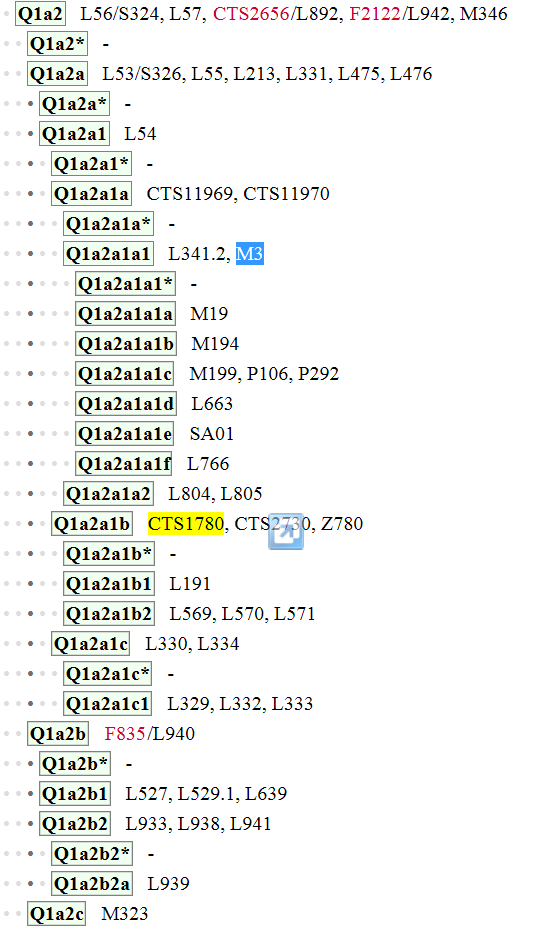
This allowed us to determine who was, and was not included in Native American haplogroups, but it was also the tip of the iceberg.  You can see below just how much the tree has expanded and its branches have been shuffled.  This is a big part of the reason for the change from haplogroup names like Q1a3 to Q-M346.  For example, at one time or another the SNP M3 was associated with haplogroup names Q1a3a, Q1a3a1 and Q1a3a1a.  On the ISOGG tree below, today M3 is associated with Q1a2a1a1.

isogg q tree

The new Family Tree DNA 2014 tree is shown below for one of the Big Y participants whose terminal SNP is L568, found beneath SNP CTS1780 which is found beneath L4, which is beneath L213 which is beneath L474 which is beneath MEH2 which is beneath L232 which is, finally, beneath M242.

ftdna 2014 q tree

The introduction of the Big Y product from Family Tree DNA, which sequences a large portion of the Y chromosome, provided us with the opportunity to make huge strides in unraveling and deciphering the haplogroup Q (and C, the other male Native haplogroup in the Americas) tree.  I am hopeful that in time, and with enough people taking the Big Y test, that we will one day be able to at least sort participants into language and perhaps migration groups.

In November, 2013, we asked for the public and testers to support our call for funds to be able to order several Big Y tests.  The project administrators intentionally did not order tests in family groups, but attempted to scatter the tests to the far corners, so to speak, and to include at least one person from each disparate group we have in the haplogroup Q project, based on STR matches, or lack thereof, and previous SNP testing.

Thanks to the generosity of contributors, we were able to order several tests.  In addition, some participants were able to order their own tests, and did.  Thank you one and all.

The tests are back now, and with the new Big Y SNP matching, recently introduced by Family Tree DNA, comparisons are a LOT easier.

So, of course, I had to see what I could find by comparing the SNP results of the several gentlemen who tested.

To protect the privacy of everyone involved, I have reduced their names to initials.  I have included their terminal SNP as identified at Family Tree DNA as well as any tribal, ethnic or location information we have available for their most distant paternal ancestor.

There are two individuals who believe their ancestors are from Europe, and there is a very large group of European haplogroup Q members, but I’m not convinced that the actual biological ancestors of these two gentlemen are from Europe.  I have included both of these individuals as well. Let’s just say the jury is still out. As a control, I have also included a gentleman who actually lives in Poland.

native match clusters

Of the individuals above, SD, CT and CM are SNP matches.

CD, WJS and WBS are SNP matches with each other.

BG and ETW are also SNP matches to each other.

None of the rest of these individuals have SNP matches.  (Note, you can click to enlarge the chart.)

native snp matches

In the table above, the Non-Matching Known SNPs are shown with the number of Shared Novel Variants.  For example, SD and CT have 4 non-matching SNPS and share 161 Novel Variants and are noted as 4/161.

We can easily tell which of the known SNPs are nonmatching, because they are shown on the participants match page.

snp matches page

What we don’t know, and can’t tell, is how many Novel Variants these people share with each other, and how many they might share with the individuals that aren’t shown as matches.

Keep in mind that there may be individuals here that are not shown as matches to due no-calls.  Only people with up to and including 4 non-matching Known SNPs are counted as matches.  If you have the wrong combination of no-calls, or, aren’t in the same terminal haplogroup, you may not be shown as a match when you otherwise would be.

The other reason for my intense interest in the Novel Variants is to see if they are actually Novel, as in found only in a few people, or if they are more widespread.

I downloaded each person’s Novel Variants through the Export Utility (blue button to the right at the top of your personal page,) and combined the Novel Variants into a single spreadsheet.  I colorized each person’s result rows so that they would be easy to track.  I have redacted their names. The white row, below, is the individual who lives in Poland.

novel variant 1

There are a total of 3506 Novel Variants between these men.  When sorting, many clustered as you would expect.  There is the Algonguian group and what I’ve taken to calling the Borderlands group.  This group has someone whose ancestor was born in VA and two in SC.  I have documentation for the Virginia family having descendants in SC, so that makes sense.  The third group is an unusual combination of the gentleman who believes his ancestors are from Germany and the gentleman whose ancestors are found in a New Mexico Pueblo tribe, but whose ancestor was, likely, based on church records, a detribalized Plains Indian who had been kidnapped and sold.

Clusters that I felt needed some scrutiny, for one reason or another, I highlighted in yellow in the Terminal SNP column.  Obviously the Polish/Pueblo matching needs some attention.

Another very interesting type of match are several where either all or nearly all of the individuals share a Novel Variant – 15 or 16 of 16 total participants.  I don’t think these will remain Novel Variants very long.  They clearly need to be classified as SNPs.  I’m not sure about the process that Family Tree DNA will use to do this, but I’ll be finding out shortly.

Here’s an example where everyone shares this Novel Variant at location 7688075,except the gentleman who lives in Poland, the man who believes his ancestor is from Germany, and the Creek descendant.

novel variant 2

I was very surprised at how many Novel Variants appear in all 16 results of the participants, including the gentleman who lives in Poland – represented by the white row below.

novel variant 3

So, how were the Novel Variants distributed?

Category # of Variants Comments
Algonquian Group 140 This is to be expected since it’s within a specific group.  Any matches that include people outside the 3 Algonquian individuals are counted in a separate category.  These matches give us the ability to classify anyone who tests with these marker results as provisionally Algonquian.
Borderlands 83 This confirms that these three individuals are indeed a “group” of some sort.  This also gives us the ability to classify future participants using these mutations.
All or Nearly All – 15 or 16 Participants 80 These are clearly candidates for SNPs, and, given that they are found in the Native and the European groups, they appear to predate the division of haplogroup Q.
Several Native and European, Combined 45 This may or may not include the person who lives in Poland.  This group needs additional scrutiny to determine if it actually does exist in Europe, but given that there are more than 3 individuals with each of these Novel Variants, they need to be considered for SNPhood.
Pueblo/NC 1
Poland/Borderlands 2
Mexico/Algonquian 2
German/Pueblo 9 I wonder if this person is actually German.
Poland/Mexico 20 I wonder if this person’s ancestors are actually from Poland.
Algonquian, NC, Creek 1
Borderland, Mexico, Creek 1
Algonquian/Cherokee 1
All Native, no Euro 2
Algonquian, Borderlands, Mexico, NC 1
Algonquian, Mexico, Borderlands 1
Borderlands, Pueblo 1
Borderlands, Creek, NC 1
Algonquian, Cherokee, Mexico 3
Algonquian, Pueblo, Creek, Borderlands 1
Cherokee, NC 2
Algonquian, Borderlands 2
Borderlands, NC 1
Algonquian, NC 1
Polish/NC 10

Some of this distribution makes me question if these SNP mutations truly are a “once in the history of mankind” kind of thing.  For example, how did the same SNP appear in the Polish person and the NC person, or the Pueblo person, and not in the rest of the Native people?

New SNPs?

So, are you sitting down?

Based on these numbers, it looks like we have at least 125 new SNP candidates for  haplogroup Q.  If we count the Algonquian and the Borderlands groups of matches, that number rises to about 250.  This is very exciting.  Far, far more than I ever expected.  of these SNPS, about half will identify Native people, even Native groupings of people.  This is a huge step forward, a red letter day for Native American ancestry!

SNPs and STRs

Lastly, I wanted to see how the SNP matching compared to STR matching, or if it did at all, for these men.

Only two men match each other on any STR markers.  CD and WJS matched on 12 markers, but not on higher panels.  The TIP calculator estimated their common ancestor at the 50th percentile to be 17 generations, or between 425 and 510 years ago.  We all know how unrealistic it is to depend on the TIP calculator, but it’s the only tool we have in situations like this.

Given that these are the only two men who do match on STR markers, albeit distantly, in a genealogical timeframe, let’s see what the estimates using the 150 years per SNP mutation comes up with.  This estimate is just that, devised by the haplogroup R-U106 project administrators, and others, based on their project findings.  150 years is actually the high end of the estimate, 98 being the lower end.  Of course, different haplogroups may vary and these results are very early.  Just saying.

CD has 207 high quality Novel Variants.  He shares 188 of those with WJS, leaving 19 unshared Novel Variants.  Utilizing this number, and multiplying by 150, this suggests that, if the 150 years per SNP is anyplace close to accurate, their common ancestor lived about 2850 years ago.  If you presume that both men are incurring mutations at the same rate in their independent lines, then you would divide the number of years in half, so the common ancestor would be more likely 1425 years ago.  If you use 100 years instead of 150, the higher number of years is 1900 and the half number is about 950 years.

It’s fun to speculate a bit, but until a lot more study has occurred, we won’t be able to reasonably estimate SNP age or age to common ancestor from this information.   Having said all of that, it’s not a long stretch from 710 years to 950 years.

It looks like STR markers are still the way to go for genealogical matching and that SNPS may help to pull together the deeper ancestry, migration patterns and perhaps define family lines.  I hope the day comes soon that I can order the Big Y for lots more project members.  Most of these men do have STR marker matches, and to men with both the same and different surnames.  I’d love to see the Big Y results for those individuals who match more closely in time.

This is still the tip of the iceberg.  There is a lot left to discover!  If you or a family member have haplogroup Q results, please consider ordering the Big Y.  It would make a wonderful gift and a great way to honor your ancestors!

You can also contribute to the American Indian project at this link:

https://www.familytreedna.com/group-general-fund-contribution.aspx?g=AIP

In order to donate to the haplogroup C-P39 project which also includes Native Americans, please click this link:

http://www.familytreedna.com/group-general-fund-contribution.aspx?g=Y-DNAC-P39

______________________________________________________________

Disclosure

I receive a small contribution when you click on some of the links to vendors in my articles. This does NOT increase the price you pay but helps me to keep the lights on and this informational blog free for everyone. Please click on the links in the articles or to the vendors below if you are purchasing products or DNA testing.

Thank you so much.

DNA Purchases and Free Transfers

Genealogy Services

Genealogy Research

Native American DNA Projects

Native DNA in Feathers

I’m often asked about projects that are for or include Native American DNA results.  Please note that different project administrators have different criteria for admission to a project.  Some require definitive proof of descent, some require no documentation at all.  This is entirely left to the discretion of the project administrators.  Therefore, you should NEVER assume that because you match someone in one of these projects that you have Native heritage.  There are various ways to prove Native heritage using DNA which I’ve discussed in the article, “Proving Native American Ancestry Using DNA.”

Furthermore, some of these projects aren’t exclusively for Native American descendants, but you may find Native descendants or families among the project members because of the topic or where the project is focused.

Regarding haplogroup projects.  Some haplogroups include both people who are and who are not Native.  Check with the particular project to understand the nuances.  In many cases, research through the projects is ongoing.

If you know of additional projects which should be added to this list, please let me know.

Native American, First Nations or Aboriginal DNA Projects

Acadia Metis Mothers
http://www.familytreedna.com/public/AcadiaMetisMothers/default.aspx

Algonquian East DNA Project
http://www.familytreedna.com/public/algonquian_east/default.aspx

American Indian DNA Project
http://www.familytreedna.com/public/AmericanIndian/

AmerIndian Ancestry out of Acadia Project
http://www.familytreedna.com/public/AcadianAmerIndian/

AmerIndian Mexico (Southwest US and Mexico)
http://www.familytreedna.com/public/MexicoAmerindian/

Cherokee DNA Project
http://www.familytreedna.com/public/CherokeeDNAProject/default.aspx

Mitochondrial American Indian Founder Project
http://www.familytreedna.com/public/AmerindFoundermtDNA/default.aspx

Mothers of Acadian mtDNA Project
http://www.familytreedna.com/public/mothersofacadia/default.aspx
Some Native results

Native People of Southwest Virginia
http://www.familytreedna.com/public/napeopleofswvirginia/

Piqua/Shawnee – no public website – contact admins below
cavetank@aol.com, tankerkh@uc.edu, ewest14@woh.rr.com

Robeson Co., NC American Indian (formerly Lumbee)
https://www.familytreedna.com/groups/robesonconcamericanindian/about

Tuscarora
http://www.familytreedna.com/public/Tuscarora/

Waccamaw DNA Project
http://www.familytreedna.com/public/CapefearIndians/default.aspx

Wesorts-Piscataway
http://www.familytreedna.com/public/Wesorts-Piscataway

Wiccocomico Native American DNA Project
http://www.familytreedna.com/public/wiccocomico/default.aspx

Mitochondrial DNA Haplogroup Projects

Haplogroup A Mitochondrial DNA
http://www.familytreedna.com/public/haplogroupAmtDNA/
Note – Native American DNA is a subgroup of haplogroup A.  See this link for specifics.

A2 Mitochondrial DNA Project
http://www.familytreedna.com/public/mtDNA_A2
A2 is known to be Native.

A4 Mitochondrial DNA Project
http://www.familytreedna.com/public/A4-mtDNA/
Haplogroup A4 is known to be Native.

B2 Mitochondrial DNA Project
http://www.familytreedna.com/public/mt-DNA-B/
B2 is known to be Native.

Haplogroup C Mitochondrial DNA Project
http://www.familytreedna.com/public/C_Haplogroup_mtDNA
Subgroups of haplogroup C are known to be Native.

Haplogroup D Mitochondrial DNA Project
http://www.familytreedna.com/public/D/
Subgroups of haplogroup D are known to be Native.

Haplogroup X Mitochondrial DNA Project
http://www.familytreedna.com/public/x/
Subgroups of haplogroup X are known to be Native.

Haplogroup X2b4 Mitochondrial DNA Project
http://familytreedna.com/public/x2b4mtdna
X2b4 is currently being studied to determine if it is Native or has a Native component.

Y Haplogroup Projects

Y Haplogroup C
http://www.familytreedna.com/public/Chaplogroup/
Subgroups of haplogroup C are known to be Native.

Haplogroup C-P39
http://www.familytreedna.com/public/ydna_C-P39/#sthash.cKkws2cd.dpbs
This SNP defined Native Americans within haplogroup C.

American Indian Haplogroup Q1a3a1 – QM3
http://www.familytreedna.com/public/Amerind%20Y/?/publicwebsite.aspx?vgroup=Amerind+Y

Related Topics

You may find Native families listed in these projects.

Caribbean DNA Project
https://www.familytreedna.com/public/caribbeanproject

Cumberland Gap Mitochondrial DNA Project
http://www.familytreedna.com/public/Cumberlandgap-mtdna/?/publicwebsite.aspx?vgroup=Cumberlandgap-mtdna

Cumberland Gap Y DNA Project
http://www.familytreedna.com/public/CumberlandGap-YDNA

Early Chesapeake
http://www.familytreedna.com/public/Early_Chesapeake

East Carolina Roots
http://www.familytreedna.com/public/eastcarolinaroots/default.aspx

Melungeons

Click to access MelungeonsMulti-EthnicPeopleFinal.pdf

Mitochondrial DNA of the Middle Appalachians
http://www.familytreedna.com/public/mtDNA%20of%20Middle%20Appalachians/default.aspx?section=mtresults

New Mexico DNA Project
http://www.familytreedna.com/public/newmexicoDNA/

North Carolina Early 1700s
http://www.familytreedna.com/public/NorthCarolinaEarly1700s/default.aspx

Puerto Rico DNA Project
http://www.familytreedna.com/public/puertoricansurname/

Southwestern Virginia Roots
http://www.familytreedna.com/public/SWVirginia

Virginia 1600s
http://www.familytreedna.com/public/va-1600s

Voices in Time
http://www.familytreedna.com/public/voicesintime/

______________________________________________________________

Disclosure

I receive a small contribution when you click on some of the links to vendors in my articles. This does NOT increase the price you pay but helps me to keep the lights on and this informational blog free for everyone. Please click on the links in the articles or to the vendors below if you are purchasing products or DNA testing.

Thank you so much.

DNA Purchases and Free Transfers

Genealogy Services

Genealogy Research

Finding Native American Ethnic Results in Germanic People

I’m often asked about the significance of small percentages of autosomal DNA in results.  Specifically, the small percentages are often of Native American or results that would suggest Native admixture.  One of the first questions I always ask is whether or not the individual has Germanic or eastern European admixture.

Why?

Take a look at this map of the Invasion of the Roman Empire.  See the Huns and their path?

Hun map

It’s no wonder we’re so admixed.

Here’s a map of the Hunnic empire at its peak under Attila between the years 420-469.

Hun emplire

But that wasn’t the end of the Asian invasions.  The Magyars, who settled in Hungary arrived from Asia as well, in the 800s and 900s, as shown on this map from LaSalle University.

magyar map

Since both the Hungarians and some Germanic people descend from Asian populations, as do Native Americans, albeit thousands of years apart, it’s not unrealistic to expect that, as populations, they share a genetic connection.

Therefore, when people who carry heritage from this region of the world show small amounts of Native or Asian origin, I’m not surprised.  However, for Americans, trying to sort out their Native ethnic heritage, this is most unhelpful.

Let’s take a look at the perfect example candidate.  This man is exactly half Hungarian and half German.  Let’s see what his DNA results say, relative to any Asian or Native heritage, utilizing the testing companies and the free admixture tools at www.gedmatch.com.

He has not tested at Ancestry, but at Family Tree DNA, his myOrigins report 96% European, 4% Middle Eastern.  At 23andMe in speculative view, he shows 99.7 European and .2 sub-saharan African.

Moving to the admixture tools at GedMatch, MDLP is not recommended for Asian or Native ancestry, so I have excluded that tool.

Eurogenes K13 is the most recently updated admixture tool, so let’s take a look at that one first.

Eurogenes K13

 JK Eurogenes K13 v2

Eurogenes K13 showed 7% West Asian, which makes perfect sense considering his heritage, but it might be counted as “Native” in other circumstances, although I would certainly be very skeptical about counting it as such.

However, East Asian, Siberian and Amerindian would all be amalgamated into the Native American category, for a combined percentage of 1.31.

jk eurogenes k13 chart

However, selecting the “admixture proportions by chromosome” view shows something a bit different.  The cumulative percentages, by chromosome equate to 10.10%.  Some researchers mistakenly add this amount and use that as their percentage of Native ancestry.  This is not the case, because those are the portions of 100% of each individual chromosome, and the total would need to be divided by 22 to obtain the average value across all chromosomes.  The total is irrelevant, and the average may not reflect how the developer determines the amount of admixture because chromosomes are not the same size nor carry the same number of SNPs.  Questions relative to the functional underpinnings of each tool should be addressed to the developers.

Dodecad

I understand that there is a newer version of Dodecad, but that it has not been submitted to GedMatch for inclusion, per a discussion with GedMatch.  I can’t tell which of the Dodecad versions on GedMatch is the most current, so I ran the results utilizing both v3 and 12b.

jk dodecad v3

jk dodecad v3 chart

I hope v3 is not the most current, because it does not include any Native American category or pseudocategory – although there is a smattering of Northeast Asian at .27% and Southwest Asian at 1%.

Dodecad 12b below

jk dodecad 12b

The 12b version does show .52% Siberian and 2.6% Southwest Asian, although I’m not at all sure the Southwest Asian should be included.

HarappaWorld

jk harappaworld

jk harappaworld chart

Harappaworld shows .09 Siberian, .27% American (Native American), .23% Beringian and 1.8% Southwest Asian, although I would not include Southwest Asian in the Native calculation.

In Summary

Neither Family Tree DNA nor 23andMe find Native ancestry in our German/Hungarian tester, but all 3 of the admixture tools at Gedmatch find either small amounts of Native or Asian ancestry that could certainly be interpreted as Native, such as Siberian or Beringian.

Does this mean this German/Hungarian man has Native American ancestry?  Of course not, but it does probably mean that the Native population and his ancestral populations did share some genes from the same gene pool thousands of years ago.

While you might think this is improbable, or impossible, consider for a minute that every person outside of Africa today carries some percentage of Neanderthal DNA, and all Europeans also carry Denisovan DNA.  Our DNA does indeed have staying power over the millennia, especially once an entire population or group of people is involved.  We’ve recently seen this same type of scenarios in the full genome sequencing of a 24,000 year old Siberian male skeleton.

Our German/Hungarian man carries 2.4% Neanderthal DNA according to 23andMe and 2.7% according to the Genographic Project, which also reports that he carries 3.9% Denisovan.  The European average is about 2% for Neanderthal.

The net-net of this is that minority admixture is not always what it seems to be, especially when utilizing autosomal DNA to detect small amounts of Native American admixture.  The big picture needs to be taken into consideration.  Caution is advised.

When searching for Native admixture, when possible, both Y DNA and mitochondrial DNA give specific answers for specific pedigree lines relative to ancestry.  Of course, to utilize Y or mtDNA, the tester must descend from the Native ancestor either directly paternally to test the male Y chromosome, or directly matrilineally to test the mitochondrial line.  You can read about this type of testing, and how it works, in my article, Proving Native American Ancestry Using DNA.  You can also read about other ways to prove Native ancestry using autosomal DNA, including how to unravel which pedigree line the Native ancestry descends from, utilizing admixture tools, in the article, “The Autosomal Me.”

______________________________________________________________

Disclosure

I receive a small contribution when you click on some of the links to vendors in my articles. This does NOT increase the price you pay but helps me to keep the lights on and this informational blog free for everyone. Please click on the links in the articles or to the vendors below if you are purchasing products or DNA testing.

Thank you so much.

DNA Purchases and Free Transfers

Genealogy Services

Genealogy Research

Bluejacket Reunion with a Tomahawk

I want to thank Carlyle Henshaw for this wonderful article.  When I asked him for permission to publish, here’s what Carlyle had to say.

“I really had fun researching that article.  The three Bluejacket brothers that establish Bluejacket Crossing were George, Henry and Charles.  Henry was my great great grandfather.  The three brothers were grandsons of Shawnee Chief Blue Jacket, 1737-1808.  He was the last principal war chief of the Shawnee Tribe of Indians.  We have 15 members in our PekowiBlueJacket Project.  All trace to Blue Jacket genealogically.  We all descend from the three brothers via DNA.  Nine of us have Family Finder.  Four males have fathers who are named Bluejacket and all match each other.  One is haplogroup Q and three are Q1a3a1.  All in all, everyone matches up in the Blue Jacket line, genetically and genealogically.  We have sixth, seventh and eighth generations from Blue Jacket represented.”

A REUNION with a TOMAHAWK

by Carlyle Hinshaw

Twin Bridges State Park — On July 1, 2001, the Shawnee Indian Blue Jacket family held its biennial reunion at this lovely place eight miles southeast of Miami, Oklahoma. The picnic was comprised of 60 relatives and other Shawnee friends and two fine Ottawa County Coon Hounds who know a Shawnee repast when they see, er, smell one! Blue Jackets from the Cherokee Nation (Cherokee Adopted Shawnee), Eastern Shawnee Tribe and Shawnee Tribe gathered to celebrate their long, illustrious history. Several excellent stories arose and are being told as time allows for the telling.

Robert Harry Withrow, Jr., of Kanab, Utah, brought a Pipe Tomahawk used by and handed down through, his family from Shawnee days in northeastern Kansas Territory during the middle 1800’s. Robert also brought along the story of the Pipe Tomahawk.

On November 30, 1831, a group of 334 Shawnees, including families of Chief John Perry, Henry and James (Jim) Blue Jacket, Peter Cornstalk and John Woolf arrived at the Shawnee Agency in Kansas after a three month “Trail of Tears” from Allen County, Ohio. Most of the adults rode horseback and the children in baggage wagons. These Wapaghkonetta and Hog Creek Shawnees had ceded (August 8, 1831) their homelands to the U. S. Government for 100,000 acres within or contiguous to, the existing Shawnee Reserve south of the Kansas (Kaw) River. The following year, 24 Shawnees of the River Huron in Michigan Territory made their trek to the new Shawnee country. In 1833, 14 more followed suit and in 1839, the total of River Huron Shawnees in the Shawnee Reserve was 38. (Louise Barry, THE BEGINNING OF THE WEST, p. 223-24, Kansas State Historical Society, Topeka, 1972).

The new Shawnee lands were however, smack dab in the middle of the great western migration. Starting with a fur party path in 1827 (Sublette’s Trace), several trails headed up in the Independence, Missouri – confluence of the Kaw and Missouri rivers area and the main trace of the Oregon California Road crossed Shawnee lands south of the Kaw. Westward Ho traffic steadily increased and reached a crescendo after the discovery of gold in California in 1849. Settlement along the various trails began and Indian lands became more and more desirable to emigrants wanting to establish roots.

Treaty of 1854

Successful in their continual efforts to displace Indians, the U. S. Government had Shawnee leaders travel to Washington DC and sign a treaty on May 10, 1854, ceding 1, 600,000 acres of their land for 200,000 within the same area. Now that was a hell of a deal for the governmental’s! Shawnee signers of the document included: Joseph Parks, Black Hoof (was he still around?), George McDougal, Silverheels, Paschal Fish, Long Tail, George Blue Jacket, Graham Rogers,  Wa-wah-che-pa-e-kar (or, Black Bob), Tooly and Henry Blue Jacket. Witness’s to the signatures included Agent Benjamin F. Robinson and Interpreter Charles Blue Jacket. Each Shawnee was awarded, in severalty, 200 acres and that included Absentee Shawnees and Adopted Shawnees.

BLuejacket crossing

Hughmongous tracts of lands immediately became available for settlement and many new areas were incorporated, including Lawrence in 1854 and Eudora in 1857. German settlers purchased land for the latter town from Paschal Fish, who, along with John Blue Jacket, had been assistant gun and blacksmiths for the Leavenworth Agency in 1837. Quick to take advantage of this new situation, the Blue Jacket brothers, Henry, George and Charles, went into the hotel and ferry business. George and storekeeper William “Dutch Bill or Billy” Greiffenstein incorporated the town of Sebastian, six miles SE of Lawrence in the SE1/4 of the SW1/4 of Section 12 – Township 13 South – Range 20 East. The town did not survive and is not shown on modern maps. Henry died at Blue Jacket’s Crossing of the Wakarusa River on May 3, 1855, leaving his wife, Eliza, with six children and expecting a seventh. The latter was born in early 1856.

On the afternoon of May 19, 1855, the first steamboat to ply the Kansas River, the EMMA HARMON, left Kansas City en-route to Topeka and other way landings. Stopping to re-supply wood around noon the next day, they slipped into the stream again and almost immediately were hailed by an Indian wanting a tow up river for his flatboat. They stopped, made the small boat fast and proceeded west up river. The flatboat had just been made by Tooly, a Shawnee who had operated a ferry where the Delaware River, coming from the north, joined the Kaw between Lawrence and Topeka. Upon reaching the confluence of the Kaw and Wakarusa, they cast the Indian loose in his craft. Amidst cheering and waving from the passengers, the red man poled his way up the smaller stream. That Indian boat captain had to be one of two cousins, both strapping 21 year olds, Stephen S. Blue Jacket, eldest son of Henry, or William George Blue Jacket, eldest son of George! Thus began operations of Blue Jacket’s Ferry. (Kansas Historical Quarterly, V. 6, p. 17-19)

bluejacket ferry

Civil War

The Free State – Slave State concept became an overriding one at this time, as anti-slavery Kansas Jayhawkers actively worked with the underground railroad bringing freedom to many and pro-slavery Missouri Bushwhackers fought to bring the freedmen back into slavery. With Lawrence as the “free state” capitol, local traffic added to the depth of Oregon California Road ruts. Kansas in fact became a free State in 1861 as the Civil War broke out.

On the night of August 21, 1863, Confederate Captain William Clarke Quantrill led 400 raiders from successes at Independence, Missouri against Union troops, toward Lawrence to punish the anti-slavery zealots of many years standing. The inhabitants of Blue Jacket’s Crossing got wind of Quantrill’s sweep across northeastern Kansas and took precautions. Eliza Silverheels, wife of David Likens Blue Jacket, had a one year old boy at the time but took it upon herself to round up the children and some older protectors, loaded them with provisions and the very youngest and sent them into the hills south of the Wakarusa.

Defending Hearth and Home

Eliza was determined to guard her home, stayed there and lay in wait for the band of guerillas prancing toward Lawrence. This great-great grandmother of Robert Harry Withrow, Jr., was armed with a Pipe Tomahawk, most assuredly obtained from her father-in-law, the Rev. Charles Blue Jacket, by now an ordained Methodist Minister.

As the raiders crossed the Wakarusa at this Shawnee enclave, one, bent on looting Eliza’s home and perhaps intent on doing bodily harm to any inhabitants, tried to enter by a window. A young, enraged Shawnee Indian woman brandishing a wicked looking Tomahawk confronted him! With great effort, Eliza gave a mighty swing of her weapon, so mighty in fact, that when the axe met the raider, her arm broke. The haft of the Tomahawk broke at the same time. The Quantrillian was not so fortunate, as the blow to his head did him in for good!

The Confederates hit Lawrence at 5 AM, killing upwards of 200 men, looting, raping and setting fire to the entire town in an atrocity of the worst kind. Quantrill later was abandoned by most of his men and killed by Union troops in Kentucky. Lawrence began recovery immediately, regardless of the heartbreak foisted upon them by those monsters.

Pipe Tomahawks

The successful defender passed the family Pipe Tomahawk on to daughter Cindarella Blue Jacket who passed it to her daughter Cindarella Florence (Mills) Brown. Mrs. Brown’s daughter, Betty June, married Robert Harry Withrow and they parented Robert, Jr., who is the current keeper of the family heirloom. The Withrow family and 90 year old grand mom, Cindarella Florence, all attended the picnic and all contributed to this story.

European and Americans developed pipe Tomahawks for the Indian trade. Made with a smoking handle and a tobacco bowl insert at the head, they served, among other things, as “badges of prestige” given to Indian leaders at treaty signings and other occasions. Giver and receiver ornately decorated most. Modern artisans reproduce them and can be acquired at less than $50.00 to $500.00. Documented historical antiquities sell for upwards of $35,000!

Robert Withrow pipe tomahawk

Robert Withrow’s Pipe Tomahawk does not have the original smoking haft, thanks to Eliza’s mighty blow, however, its origin is documented by makers marks.

The maker was a Vickers metal smith in London, England in 1833. The head was cast in the Naylor, Vickers and Company’s Sheffield foundry.

Pipe tomahawk

Both sides of the head have the “Bleeding Heart” symbol, which is a common decoration on the antique ones.

Pipe tomahawk bleeding heart

The Masonic emblem was probably etched by gun and black smithy, John Blue Jacket, brother of the Rev. Charles Blue Jacket, who, along with many other Shawnees, was active in that organization.

Pipe tomahawk man in moom

The other side is scribed with a man in the moon, which is a bit unusual. The French Moon or crescent moon was, however, a common inscription, sometimes included when the head was cast.

Robert Withrow, Jr. is a teacher of survival skills across the country, both to private and military groups. It is fitting that he continues to preserve Shawnee history and heritages.

Withrow family

Top L-R: Robert Withrow, Robert Withrow, Jr ., Robert John Brown
Bottom, L-R: Betty Withrow, Cindarella Brown, Saundra Davis.

The elder Withrows live in Chetopa KS, Robert and Saundra in Centralia IL and Cindarella in Centralia.

Cindarella had the good fortune to remember her grandparents. She was born in 1911 and David Likens Blue Jacket passed away on April 4, 1919 and Eliza (Silverheels) Blue Jacket on June 12, 1929. Great historical events were told directly to their daughter Cindarella (Blue Jacket) Mills and to their grand daughter Cindarella Mills. Now, at 90 years of age, the latter is still able to give us insight to our Shawnee heritage. Thank you Cindarella Florence (Mills) Brown.

Gaylord Carlyle Hinshaw
1713 Baron Dr
Norman OK 73071
405-364-4584
bjexploration@swbell.net

______________________________________________________________

Disclosure

I receive a small contribution when you click on some of the links to vendors in my articles. This does NOT increase the price you pay but helps me to keep the lights on and this informational blog free for everyone. Please click on the links in the articles or to the vendors below if you are purchasing products or DNA testing.

Thank you so much.

DNA Purchases and Free Transfers

Genealogy Services

Genealogy Research

Daughters of Princess Mary Kittamaquund

Daughters book cover

Recently Shawn and Lois Potter utilized the Minority Admixture Mapping technique I developed, utilized and described in the series “The Autosomal Me” to establish that the mother of John Red Bank Payne was Native American.  Shawn and Lois were so encouraged after that positive experience that they set forth to document another Native ancestor.

They produced this report as a beautiful and fully sourced booklet which they have very graciously given permission to reproduce in part here.

Daughters of Princess Mary Kittamaquund

Every student of American history has heard about Pocahontas—the young Indian princess who struggled to establish peace between the Powhatan Indians and Virginia colonists, married Englishman John Rolfe, and left descendants through her son Thomas Rolfe.  But, few have heard about Mary Kittamaquund—another young Indian princess who likewise promoted peace between the Piscataway Indians and Maryland colonists, married Englishman Giles Brent, and, as revealed by archival research combined with DNA analysis, left descendants through her daughters.  Both women lived heroic yet brief lives; and both should be remembered for their devotion to their people in an age of momentous danger and change.  The following sketch introduces Princess Mary Kittamaquund and her daughters.

Mary Kittamaquund, daughter of the Tayac (Paramount Chief) of the Piscataway Indians, was born in Maryland probably about 1631.[i]  Her father ruled over as many as 7,000 people between the Potomac and Patuxent Rivers.[ii]  Following about six months of dialogue and study with Jesuit Missionary Father Andrew White, Mary’s father converted to Christianity and was baptized on July 5, 1640.[iii]  Soon after February 15, 1640/1, Mary too was baptized, and her father sent her to the English settlement called St Mary’s City, near the mouth of the Potomac River, to be educated by Governor Leonard Calvert and his sister-in-law, Margaret Brent.[iv]

Mary married Giles Brent, brother of Margaret Brent, before January 9, 1644/5.[v]  A band of Parliamentarians led by Richard Ingle and William Claiborne attacked St Mary’s City on February 14, 1644/5, and carried Giles Brent, Father Andrew White, and others in chains to England.  Upon his arrival in London, Giles brought suit against his captors and returned to Maryland before June 19, 1647.[vi]  Mary and Giles moved to present day Aquia, Stafford County, Virginia, after November 8, 1648, and before August 20, 1651.[vii]  Mary died probably after April 18, 1654, and before September 4, 1655.[viii]  Giles Brent died in Middlesex County, Virginia, on September 2, 1679.[ix]

Scholars disagree about the number of children born to Mary Kittamaquund and Giles Brent.  Some list only three children named in the 1663 and 1671 wills of sister and brother Margaret and Giles Brent.[x]  Margaret appointed her brother Giles “and his children Giles Brent, Mary Brent, and Richard Brent” executors of her estate.[xi]  Giles left bequests to his son Giles Brent and daughter Mary Fitzherbert.[xii]  Other historians, such as Dr. Lois Green Carr, Maryland Historian at the Maryland State Archives, on the basis of information gleaned from provincial court records, probate records, and quitrent rolls, identify six children of Mary and Giles, including Katherine Brent (who married Richard Marsham), Giles Brent (who married his cousin Mary Brent), Mary Brent (who married John Fitzherbert), Richard Brent (who died after December 26, 1663), Henry Brent (who died young), and Margaret Brent (who also died young).[xiii]

Some researchers further believe daughter Mary Brent divorced John Fitzherbert before April 26, 1672, and married second Charles Beaven.  This belief is supported by (1) a reference to the divorce of Mary and John in a letter of this date from Charles Calvert to his father, (2) a statement regarding “my brother iñ Richard Marsham” in the June 20, 1698 will of Charles Beaven, (3) the appointment of “my well beloved Richard Marsham” by Mary Beaven to be executor of her 1712 will, and (4) other circumstances demonstrating kinship ties between these families.[xiv]  Still others refuse to accept this relationship without further evidence, lamenting the loss of contemporary records which has “confused researchers for a hundred years.”[xv]

Recent DNA analysis, however, reveals six descendants of Katherine and Richard Marsham and three descendants of Mary and Charles Beaven, representing six separate lineages, inherited at least sixteen matching segments of Native American DNA on chromosomes 2, 3, 4, 5, 6, 7, 8, 13, 15, 16, 20, and 22.  Figure 1 shows the relationships between these descendants; and Figures 2-17 illustrate the sixteen matching Native American chromosomal segments (see Figures 18-33 for additional images of these segments produced by four independent admixture tools; and also see http://dna-explained.com/2013/06/02/the-autosomal-me-summary-and-pdf-file/ for information about Minority Admixture Mapping).  These matching chromosomal segments point to a common Native American ancestor, who, because other possibilities can be eliminated, must have been the mother of Katherine and Mary.[xvi]  Considering this DNA evidence in light of contemporary records, it now seems certain Mary Kittamaquund and Giles Brent were the parents of Katherine, wife of Richard Marsham, and Mary, wife first of John Fitzherbert and second of Charles Beaven.

Genealogical Summary

Katherine Brent was born probably in Aquia, Stafford County, Virginia, say about 1650.  She may have served an unknown period of indentured service to Thomas Brooke, perhaps following the death of her mother, before she married Richard Marsham perhaps before December 26, 1663, and certainly before March 11, 1664/5.[xvii]  Richard immigrated to Maryland in 1658, where he served three-years of indentured service to John Horne for his transatlantic voyage.[xviii]  Katherine died in Calvert County, Maryland, before October 26, 1670.[xix]  Richard married second Anne Calvert, widow first of Baker Brooke Sr., and second of Henry Brent, after April 30, 1695, and before February, 1696.[xx]  Richard died in Prince George’s County, Maryland, between April 14 and 22, 1713.[xxi]  Katherine and Richard were the parents of the following children:

1. Sarah Marsham was born in Calvert County, Maryland, say about 1667, married first Basil Waring say about 1685, married second William Barton after December 29, 1688, married third James Haddock after April 19, 1703, and died in Charles County, Maryland, after January 8, 1733.[xxii]

2.  Katherine Marsham was born in Calvert County, Maryland, say about 1669, married first her future step-brother Baker Brooke Jr. say about 1689, married second Samuel Queen after May 27, 1698, and died in St Mary’s County after March 18, 1712, and before April 14, 1713.[xxiii]

Mary Brent was born probably in Aquia, Stafford County, Virginia, say about 1654.[xxiv]  She married first John Fitzherbert before 1671.[xxv]  Mary and John divorced before April 26, 1672.[xxvi]  Mary married second Charles Beaven say about 1674.  Charles died in Prince George’s County, Maryland, between June 20, 1698, and June 21, 1699.[xxvii]  Mary died in Prince George’s County between April 28, 1712, and June 13, 1713.[xxviii]  Mary and Charles were the parents of the following children:

1. Richard Beaven was born in Calvert County, Maryland, say about 1676, married Jane Blanford before June 11, 1703, and died in Prince Georges County, Maryland, before August 9, 1744.[xxix]

2.  Sarah Beaven was born in Calvert County, Maryland, say about 1678, married Thomas Blanford on June 20, 1698, and died in Prince Georges County, Maryland, after August 7, 1749.[xxx]

3.  Margaret Beaven was born in Calvert County, Maryland, say about 1680, and died in Prince George’s County, Maryland, between April 28, 1712, and June 13, 1713.

4. Elizabeth Beaven was born in Calvert County, Maryland, say about 1682, married John Boone about 1708, and died in Prince Georges County, Maryland, before October 30, 1725.

5. Katherine Beaven was born in Calvert County, Maryland, say about 1684, married Henry Culver about 1711, and died in Prince Georges County, Maryland, before December 20, 1762.[xxxi]

6. Charles Beaven was born in Calvert County, Maryland, say about 1686, married Mary Finch about 1712, and died in Prince Georges County, Maryland, on December 16, 1761.[xxxii]

Daughters pedigree

Following this lineage information, Shawn and Lois included a chromosome by chromosome analysis of the various individuals who tested.  I am including only one example, below.

Daughters DNA

Following the many pages of genetic comparison information, Shawn and Lois included quite a bit for their readers about the Piscataway History and Culture.  After all, DNA without genealogy and history is impersonal science.  Included were early drawings and paintings of Native people and villages, an account of the people by Father Andrew White in 1635 as well as anonymous documents from 1639 and 1640.  Their food, language and vocabulary were discussed as well with historical events being presented in timeline format.

Piscataway Timeline

1550           Piscataway Tayac governed c. 7,000 people between Potomac and Patuxent Rivers

1608           John Smith explored the Potomac River; Piscataway welcomed him with kindness

1622           Powhatan Indians attacked at least 31 Virginia settlements along the James River

1623           Virginia colonists attacked Moyaone, killing many and burning houses and corn

1634           Piscataway Tayac Wannas permitted Leonard Calvert to establish St Mary’s City

1640           Piscataway Tayac Kittamaquund was baptized by Jesuit Father Andrew White

1644           Wahocasso succeeded as Tayac, who was succeeded by Uttapoingassenem in 1658, who was succeeded by Wannasapapin in 1662, who was succeeded by Nattowasso (son of Wahocasso—breaking the tradition of matrilineal succession) in 1663

1666           Facing increasing encroachments by European settlers, the Piscataway petitioned the Maryland council, saying: “We can flee no further.  Let us know where to live, and how to be secured for the future from the hogs and cattle.”

1695           Maryland Governor Francis Nicholson “advised the council to find a way of depriving Indians beyond Mattawoman Creek of their lands, in order to ‘occasion a greater quantity of Tobacco to be made.'”

1697           Piscataway Tayac Ochotomaquath and about 400 others fled to northern Virginia; then they allied with the Iroquois in 1701 and moved to Pennsylvania.

1699           Maryland colonists estimated Piscataway military strength at 80-90 warriors

Although many Piscataway left Maryland by the end of the 17th century in the face of encroaching European settlements, others remained on their homeland, intermarrying with Europeans and Africans, while preserving their cultural traditions.  In 1996, an advisory committee appointed by the Maryland Historical Trust voted unanimously to recommend state recognition of the Piscataway Indian Nation, citing genealogical, linguistic, cultural, and political continuity between the earliest Piscataway people and their modern descendants.  On January 9, 2012, Maryland Governor Martin O’Malley issued two executive orders, granting official state recognition to the Piscataway Indian Nation (about 100 members), and the Piscataway Conoy Tribe—consisting of the Piscataway Conoy Confederacy and Subtribes (about 3,500 members), and the Cedarville Band of Piscataway (about 500 members).

St Mary's City 1634 Indian Village

This drawing of St Mary’s City in 1634 by Cary Carson from the Maryland State Archives Map Collection shows the Native people living outside the city fortifications.

This 262 page book is a wonderful combination of genealogy, genetics and history, and does exactly what genetic genealogy is supposed to do.  It enables us to document and better understand our ancestors, and in this case, to prove they were indeed, Native American.  Shawn and Lois would welcome inquiries about the book or the family lines included and you can contact them at shpxlcp@comcast.net.


               [i] Most scholars estimate her year of birth as 1634, because an unidentified Catholic missionary made the following statement about her.  “On the 15th of February we came to Pascatoe, not without the great gratulation and joy of the inhabitants, who indeed seem well inclined to receive the christian faith.  So that not long after, the king brought his daughter, seven years old, (whom he loves with great affection,) to be educated among the English at St. Mary’s; and when she shall well understand the christian mysteries, to be washed in the sacred font of baptism.”  See “Extracts from Different Letters of Missionaries, from the Year 1635, to the Year 1638,” in E.A. Dalrymple, ed., Relatio Itineris in Marylandiam.  Declaratio Coloniae Domini Baronis de Baltimoro. Excerpta ex Diversis Litteris Missionariorum ab Anno 1635, ad Annum 1638, Narrative of a Voyage to Maryland, by Father Andrew White, S.J.  An Account of the Colony of the Lord Baron Baltimore.  Extracts from Different Letters of Missionaries, from the Year 1635 to the Year 1677 (Baltimore: Maryland Historical Society, 1874), 76.  But, the circumstances of Mary’s life suggest she was born a few years earlier.  So, we suspect the author of this letter underestimated her age.

               [ii] Father Andrew White, “Annual Letter of the English Province of the Society of Jesus, 1639,” in Clayton Colman Hall, ed., Narratives of Early Maryland, 1633-1684 (New York: Barnes & Noble, Inc., 1910), 126.

               [iii] Ibid.

               [iv] Ibid., 131.

               [v] John Lewger to Governor Leonard Calvert, January 9, 1644/5, in Proceedings of the Council of Maryland, 1636-1667, Vol 3, pp. 162-163 (original pages 186-187), Archives of Maryland Online.  “To the horle Governor.  Sir  I doe signify unto you that Mr Giles Brent hath delivered unto me 2. petitions nerewth sent unto you; and I desire you by vertue of the Law in that behalfe, that you wilbe pleased to give him a competent security for his indemnification in the possession of the lands at Kent, mentioned in one of the said petitions, & for iustification of his title in them, according to the said petition, dated 7. January instant: & likewise to satisfy unto him 5700l tob & cask, demanded in the other petition for damage of non pformance of a covenant to his wife Mary touching certaine cattell; or els to shew cause why you refuse to doe either; and to appoint some time when the Counsell shall attend you for it, betweene this & Monday next.  So humbly take leave to rest  Yor servant  S. Johns. 9th Jan: 1644 John Lewger.”  See also Margaret Brent, “Account of the Estate of Governor Leonard Calvert,” June 6, 1648, in Judicial and Testamentary Business of the Provincial Court, 1637-1650, Vol. 4, pp. 388-389 (original pages 159-160).  “By payd to Mrs. Mary Brent Kittamagund 0748.”

               [vi] For information about the arrest and transport of Giles Brent to London during Richard Ingle’s Rebellion, see “Richard Ingle in Maryland” in Maryland Historical Magazine, Vol. 1(1906), 125-140.  For the terminus ad quem (limit to which—latest possible date) Giles Brent returned to Maryland, see Maryland State Archives, Judicial and Testamentary Business of the Provincial Court, 1637-1650, Vol. 4:312-313.  “June 19th This day came Margaret Brent Gent, & desyred the testimony of the prnt Gouernor Mr Tho: Greene concerning the last will & Testamt of the late Gouernor Leonard Calvert Esqr And the sd Gouernor did authorize Giles Brent Esqr one of his Lops Counsell to administer an oath unto him the sd Gouernr concerning the foresd busines.  The sd Gouernor Tho: Greene Esqr answered uppon oath concerning the last will & Testamt of Leo: Calvert Esqr aforesd That the sd Leo: Calvert, lying uppon his death bed, some 6 howres before his death, being in prfect memory, directing his speech to Mrs Margarett Brent sayd in pnce of him the sd Mr Greene & some others I make you my sole Exequutrix, Take all, & pay all.  After wch words hee the sd Leon: Calvert desyred every one to depart the roome & was some space in priuate conference wth Mrs Marg: Brent aforesd Afterwards the Mr Greene comeing into the roome againe, he heard the sd Mr L: Calvert appoint certaine Legacies in manner following.  Viz I doe giue my warring cloaths to James Linsay, & Richard William my servants, specifying his coath suite to Rich. Willan & his black suite to James Linsey. & his waring Linnen to be diuided betweene them.  Aliso I giue a mare Colt to my God sonne Leon: Greene.  Allso hee did desyre tht his exequutrix should giue the first mare Colt tht should fall this yeare, (& if non fall in this yeare, then the first tht shall hereafter fall) unto Mrs Temperance Pippett of Virginea.  And further he deposeth not.  Recognit Teste mc Willm Bretton Clk.”

               [vii] The terminus a quo (limit from which—earliest possible date) for the relocation of Giles Brent from Maryland to Virginia is the date Giles Brent appeared in court at St. Mary’s on November 8, 1648, requesting compensation for destruction of his property on the Isle of Kent by anti-Papists.  See Archives of Maryland, November 8, 1648, Liber A, Folio 205.  The terminus ad quem (limit to which—latest possible date) Giles Brent removed from Maryland to Virginia is the date Giles Brent patented Marlborough in Potomac Neck, Virginia, on August 20, 1651.  See entry from Mercer Land Book cited by W.B. Chilton, ed., “The Brent Family,” The Virginia Magazine of History and Biography, Vol. 16, No. 1 (Jul., 1908), 96-97.

               [viii] Virginia Magazine XVI, 211.  On April 17, 1654, Giles conveyed his personal estate in Virginia and Maryland to his sister Mary, in trust to educate his children and allow maintenance to his wife Mary.  See also Lurene Rose Bivin in “Brent-Marsham-Beaven-Blandford Article: A Closer Look,” Maryland Genealogical Society Bulletin, Vol. 37, No. 3, 328-334.  “In the grant to John Harrison (dated 4 September 1655), he refers to his “sister” as Mrs. Frances Harrison (Nugent, p. 319).”  Giles may have been engaged to marry his second wife, Frances Whitgreaves, widow of Jeremiah Harrison, on this date, because John Harrison made a provision for Giles.

               [ix] W.B. Chilton, ed., “The Brent Family,” The Virginia Magazine of History and Biography, Vol. 16, No. 2 (Oct., 1908), 212.  “‘Register of Christ Church, Middlesex County, Virginia.  Collo Giles Brent of Potomac departed this life 2d of September 1679 and was buried in the Great Church Yard ye next day following.'”

               [x] For example, see Douglas Richardson, Magna Carta Ancestry: A Study in Colonial and Medieval Families (Baltimore: Genealogical Publishing Co., Inc., 2005), 129.  “They had two sons, [Col.] Giles and Richard, and one daughter, Mary (wife of [Capt.] John Fitzherbert).”  See also, Robert W. Barnes, British Roots of Maryland Families (Baltimore: Genealogical Publishing Co., Inc., 1999), 73-74.

               [xi] W.B. Chilton, Vol. 16, No. 1 (Jul., 1908), 98-99.  “The Will of Margaret Brent.  In the name of God Amen.  I Margaret Brent of Peace in the County of Westmoreland in Virginia considering the casualtys of human life do therefore make this my last Will and Testament as followeth my soul I do bequeath to the mercies of my Savior Jesus Christ and my worldly estate to be disposed of by my Executors as followeth to my nephew George Brent I give all my rights to take up land in Maryland except those already assigned to my cousin James Clifton to my niece Clifton I give a cow and to my neece Elizabeth Brent I give a heifer; to Ann Vandan I give a cow calf; to my neece Mary Brent daughter of my Brother Giles Brent I give all my silver spoons which are six; to my nephew Richard Brent son of my brother Giles Brent I give my patent of lands at the Falls of Rappahanock River also my lease of Kent Fort Mannor in Maryland saving yet power to his Father my brother Giles Brent that if he shall like to do so he may sell said lease and satisfye to his son other where as he shall think fitt in lands good or money and in case of my said nephew Richard Brents death under age and without heirs of his body lawfully begotten his legacy thereto to go to his brother Giles Brent or his sister Mary Brent or to the heirs of my brother Giles Brent or otherwise as my said brother shall dispose it by his Deed or last Will to my brother Giles Brent and to his heirs forever I give all my lands goods and chattles and all my estate real and personal and all that is or may be due to me in England Virginia Maryland or elsewhere still excepting the before disposed of in this my last will and Testament and I do appoint him my said Brother Giles Brent and his children Giles Brent Mary Brent and Richard Brent or such of them as are living at the time of my death the Executors of this my last Will and Testament.  In witness whereof I have hereunto set my hand and seal this 26th day of December, Anno Domini, 1663.”

               [xii] W.B. Chilton, Vol. 16, No. 1 (Jul., 1908), 98.  “The Will of Giles Brent.  In the Name of God Amen.  I Giles Brent of the Retirement in Stafford County in Virginia Esquire contemplating the uncertainty of my time of death do ordain this my last Will and Testament in manner and form following my body to the earth and my Soul I bequeath to the mercy of my Savior Christ all my worldly estate I appoint to my Exectors to be disposed of as followeth to my daughter Mary Fitzherbert I give five ewes and a ram to my son and heir Giles Brent and to the heirs of his body lawfully begotten I give for ever all my lands rights unto lands and reversions of lands any ways due to me in either England Virginia or Maryland and for want of such heirs then unto mine own right heirs and for want of such then to the right heirs of my Honored Father Richard Brent, Esquire, deceased Antiently Lord of the mannors of Admington and Lark Stoke in the County of Gloucestershire in England after my debts paid I give all my goods moveable or immoveable whatsoever to be disposed of as followeth three thousand pounds of good tobacco with cask to be given by them my Executors unto pious use where and to whom they shall see fitt for which doing and how and to whom given I Will that to none else but God they shall be accountable.  I also Will that to Mr. Edward Sanders they give four ewes and a ram and to John Howard four ewes and a ram.  Executors of this my last Will and Testament I appoint my son Giles Brent and my Brother Richard Brent and my Brother William Brent both in England and as Attorneys in their Executorship untill my said Brothers shall otherwise order and I do appoint Mr. Edward Sanders and John Howard above mentioned both of Stafford County to be and to act and it is my Will that after my debts and my Legacies paid my said Executors stand possessed of all my goods and personal estate to the sole use of my son Giles Brent then to be delivered into his sole dispose when it shall please God that he hath arrived to the age of one and twenty years.  In witness unto this my within written last Will and Testament I have hereunto set my hand and seal this last day of August, Anno Domini, 1671.”

               [xiii] Image SC4040-0166-1, Dr. Lois Green Carr’s Biographical Files of 17th and 18th Century Marylanders, Maryland State Archives, http://msa.maryland.gov/megafile/msa/speccol/sc4000/sc4040/000001/000166/html/sc4040-0166-1.html.  Note: Dr. Carr lists the children in the following order: Mary, Giles, Richard, Katherine, Henry, Margaret.

               [xiv] See excerpt from Charles Calvert to Cecilius Calvert, April 26, 1672, in William Hand Browne, ed., Proceedings of the Council of Mayland: 1671-1682 (Baltimore: Maryland Historical Society, 1896), xiv.  “Major Fitzherbert’s brother who maryed the Indian Brent, has civilly parted with her, and (as I suppose) will never care to bed with her more; soe that your Lordship needs not to feare any ill consequence from that match, butt what has already happened to the poore man, who unadvisedly threw himself away upon her in hopes of a great portion which now is come to little.”  See also Will of Charles Beaven, signed June 20, 1698, proved June 21, 1699, Prerogative Court (Wills) Vol. 2, pp. 182-183, Liber 6, Folios 285-286.  See also Will of Mary Beaven, signed April 18, 1712, proved June 13, 1713, Prerogative Court (Wills) Vol. 3, p. 240, Liber 13, Folio 513.  See also Maryland Land Patents, BB#37:374.  On March 15, 1696/7, Richard Marsham transferred 600 acre grant called The Hickory Thickett to Charles Beaven by assignment.

               [xv] Lurene Rose Bivin in “Brent-Marsham-Beaven-Blandford Article: A Closer Look,” Maryland Genealogical Society Bulletin, Vol. 37, No. 3, 328-334.

               [xvi] Four potential scenarios explain this matching DNA considered together with Charles Beaven’s reference to Richard Marsham as “my brother iñ Richard Marsham.”  The first scenario is Richard Marsham and Charles Beaven were brothers.  This scenario almost certainly is not true because Richard Marsham and Charles Beaven had different last names and the written reference by Charles Beaven to Richard Marsham as “my brother iñ” appears to have been a standard contraction of “my brother-in-law.”  The second scenario is Richard Marsham and Mary, wife of Charles Beaven, were brother and sister.  This scenario almost certainly is not true because Mary referred to Richard Marsham as “my well beloved Richard Marsham.”  If Richard Marsham and Mary had been brother and sister, Mary surely would have referred to Richard as her brother.  The third scenario is Charles Beaven and Katherine, wife of Richard Marsham, were brother and sister.  This scenario almost certainly is not true because their descendants inherited matching segments of Native American DNA.  Charles Beaven immigrated from England to Maryland in 1666 (Skordas, Liber 9, folio 455), so he surely did not inherit Native American DNA from his parents.  The fourth and most compelling scenario is Katherine, wife of Richard Marsham, and Mary, wife of Charles Beaven, were sisters, and they also were daughters of a parent with Native American ancestry.  This scenario is consistent with other indications that Katherine and Mary were daughters of Mary Kittamaquund and Giles Brent.

               [xvii] Maryland Colonial Land Records, Liber 7, Folio 582, 583, Maryland State Archives.  “March xith 1664.  Came David Bowens and demands land for these rights following John Barnes, Clement Barnes, Margaret Whitthe, Martha Garbett, Catherine Marsham by Assign and Francis Street by Assign as follows–Know all to whom these presents may concern, that I Katherine Marsham doe assigne all my Right and Title of a Right due to mee the said Katherine for fifty acres of land unto David Bowing as witness my hand this Eleventh of March One Thousand six hundred sixty foure.  Katherine Marsham (her K mark).  Witness Richard Marsham, Robert Turner.  Know all men by these presents to whom this may concern that I Francis Streete doe assigne all my Right and Title of a right due to mee the said Francis Streete for fifty acres of Land unto David Bowing as witness my hand this Eleventh of March One Thousand six hundred sixty four.  Francis Streete.  Witness Richard Marsham, Robert Turner.”  See also Maryland Colonial Land Records, Liber 12, Folio 512, Maryland State Archives.  “May 11th 1670.  Came Richard Marsham of Calvert County and proved right to fifty acres of land it being due to him for the time of service of Katherine his wife performed to Major Thomas Brooke, Warrant then issued in the name of the said Richard Marsham for fifty acres of land it being due to him for the causio oraem above.  Certified the 11th of August next.”  Note: Even though these two documents indicate Katherine was due a total of 100 acres, the first 50 acres for an unstated cause and the second 50 acres for service to Thomas Brooke, neither record says Katherine was transported to Maryland, and both records may result from fraudulent claims.  If these records reflect legitimate claims, they do not say or prove Katherine was transported to Maryland, since some claims were granted for people who were born in Maryland.  For example, a patent for 1,644 acres was granted to Mary Brent on November 17, 1652, for the transportation of 33 persons, including “Mrs. Mary Brent, wife to Capt. Brent.”  See Nugent, pp. 266-267.  This Mrs. Mary Brent was Mary Kittamaquund, wife of Giles Brent, who certainly was born in Maryland.  Furthermore, according to Abbott Emerson Smith (“The Indentured Servant and Land Speculation in Seventeenth Century Maryland,” in The American Historical Review, Vol. 40, p. 467), “A great many of the warrants which were granted were for rights proved by the wife of a freedman.  It is not unlikely that some persons managed to get freedom dues in land, although they had never been in indentured service.”  Finally, if Katherine did serve a term of indenture, her service may have resulted from the death of her mother at a time when she was old enough to begin providing for her own maintenance.  It was not unusual during this era for children of deceased well-to-do colonists to serve a term of indenture.

               [xviii] See Maryland Colonial Land Records, Liber 4, Folio 4, Maryland State Archives.  “May the 7th 1659.  John Home demands Land for the transportation of himself and his Servants, Richard Marsham & John Edmondson, in 1658.”  See also Maryland Colonial Land Records, Liber 5, Folio 295, Maryland State Archives.  “Know all men that I Richard Marsham do give and make over to Thomas Pagett my right as is due to me as being a Servant, and now being free in Roberto McJohn Hearen as witness my hand the 16th of September 1661.  Richard Marsham.  Wit: Robert Coberthwail, Michael Coreuly.”

               [xix] See Maryland Colonial Land Records, Liber 12, Folio 512, Maryland State Archives, as cited above.  “May 11th 1670.  Came Richard Marsham of Calvert County and proved right to fifty acres of land it being due to him for the time of service of Katherine his wife performed to Major Thomas Brooke, Warrant then issued in the name of the said Richard Marsham for fifty acres of land it being due to him for the causio oraem above.  Certified the 11th of August next.”  See also Maryland Colonial Land Records, October 26, 1670, Liber 14, Folio 228.  “Patent for 50 acres in St. Mary’s County, originally Calvert County, to Richard Marsham, tract called St. Katherine’s.”  Note: This patent establishes the terminus ad quem (limit to which—latest possible date) for Katherine’s death, because Richard would be unlikely to name this property Saint Katherine’s unless Katherine had died.

               [xx] The terminus a quo (limit from which—earliest possible date) for Richard’s marriage to Anne Calvert is established by the date of a Prerogative Court record concerning the estate of Henry Brent naming Anne Brent executrix.  See Prerogative Court Records, April 30, 1695, Liber 13A, folio 291, Maryland State Archives.  The terminus ad quem (limit to which—latest possible date) for Richard’s marriage to Anne Calvert is the date they were named as husband and wife on a probate record.  See Provincial Court Judgments, February Court 1696, Liber P. L. #3, Folios 556-557, Maryland State Archives.  Richard Marsham with Ann Marsham, administrator of Henry Brent, against Thomas Collier.

               [xxi] Will of Richard Marsham, signed April 14, 1713, probated April 22, 1713, Maryland Prerogative Court (Wills), Liber xiii, Folio 514-520, Maryland State Archives.

               [xxii] The approximate year of Sarah’s marriage to Basil Waring is estimated from the year of Basil’s death preceded by four years to account for the births of two children.  See Will of Basil Waring, signed December 8, 1688, probated December 29, 1688, Maryland Calendar of Wills, Vol. 2, p. 50, and Liber 6, Folio 66.  Basil named his wife Sarah and sons Marsham and Basil.  The terminus a quo (limit from which—earliest possible date) for Sarah’s marriage to William Barton is determined by the probate date of the will of her first husband Basil Waring.  See Will of Basil Waring, signed December 8, 1688, probated December 29, 1688, Maryland Calendar of Wills, Vol. 2, p. 50, and Liber 6, Folio 66.  The terminus a quo (limit from which—earliest possible date) for Sarah’s death is determined by her deed to Robert Mackhorn.  See Deed from Sarah Haddock to Robert Mackhorn, signed January 8, 1733, recorded March 18, 1733/4, Charles County Land Rcords: 1733-1743, Book O #2, page 28.  “Sarah Haddock, widow, of Prince George’s County, formerly wife of William Barton, late of Charles County, Gent., deceased, to Robert Mackhorn of Charles County, planter.  William Barton by his will, divised to his son-in-law, Basil Waring, 300 acres, being part of this tract of land called Hadlow, lying in Charles County, and the rest of Hadlow to his wife, being now the aforementioned Sarah Haddock.  Now this deed witnesses that sd. Sarah Haddock, for 4500 lbs tobacco, has sold to said Robert the rest of Hadlow, lying in Charles County, bounded by Thos. Gerard, the division line made by sd. Sarah Haddock and Basil Waring.  Signed Sarah Haddock.  Wit. Jas. Haddock Waring, Henry Keen.”

               [xxiii] The approximate year of Katherine’s marriage to Baker Brook is estimated from the year of Baker’s death preceded by eight years to account for the births of four children.  See Will of Baker Book, signed February 5, 1698, probated May 27, 1698, Maryland Calendar of Wills, Vol. 2, p. 142, and Liber 6, Folio 83.  Baker named his wife Katherine and four children Baker, Leonard, Richard, and Ann.  The terminus ad quem (limit to which—latest possible date) for Katherine’s marriage to Samuel Queen is determined by the probate date of the will of her first husband Baker Brooke.  See Will of Baker Book, signed February 5, 1698, probated May 27, 1698, Maryland Calendar of Wills, Vol. 2, p. 142, Liber 6, Folio 83.  The terminus a quo (limit from which—earliest possible date) for Katherine’s death is determined by the date her husband’s will was probated.  See Will of Samuel Queen, signed January 10, 1711, probated March 18, 1712, Maryland Prerogative Court (Wills), Vol. 3, p. 222, Liber 13, Folio 389, Maryland State Archives.  The terminus ad quem (limit to which—latest possible date) for Katherine’s death is determined by the date of the will of her father, Richard Marsham, which provides for her children but does not mention her.  See Will of Richard Marsham, signed April 14, 1713, probated April 22, 1713, Maryland Prerogative Court (Wills), Liber 13, Folios 514-520, Maryland State Archives.

               [xxiv] On April 5, 1673, Giles Brent Jr., son of Col. Giles Brent and Mary Kittamaquund, deeded 500 acres, which he had inherited from his father, to his uncle George Brent of Woodstock, Stafford County, Virginia, stating he had reached the age of 21—a condition set in his father’s will for his ability to take possession of the land.  This suggests Giles Brent Jr. was born about 1652.  See W.B. Chilton, Vol. 16, No. 1 (Jul., 1908), 99-100.

               [xxv] Will of Giles Brent, signed August 31, 1671, in W.B. Chilton, Vol. 16, No. 1 (Jul., 1908), 98.

               [xxvi] See excerpt from Charles Calvert to Cecilius Calvert, April 26, 1672, in William Hand Browne, ed., Proceedings of the Council of Mayland: 1671-1682 (Baltimore: Maryland Historical Society, 1896), xiv.  “Major Fitzherbert’s brother who maryed the Indian Brent, has civilly parted with her, and (as I suppose) will never care to bed with her more; soe that your Lordship needs not to feare any ill consequence from that match, butt what has already happened to the poore man, who unadvisedly threw himself away upon her in hopes of a great portion which now is come to little.”

               [xxvii] Will of Charles Beaven, signed January 20, 1698/9, proven June 2, 1699, Prince Georges County Wills, Liber 6, folios 285-286,  Maryland State Archives.

               [xxviii] Will of Mary Beavan, signed April 28, 1712, proven June 13, 1713, Prince Georges County Wills, Liber 13, folio 513, Maryland State Archives.

               [xxix] Will of Richard Bevan Sr., signed February 27, 1738/9, proven May 21, 1739, Maryland Calendar of Wills, Vol. 8, p. 789, Liber 22, folio 58, Maryland State Archives.  For the terminus ad quem (limit to which—latest possible date) of Richard’s marriage to Jane Blandford, see Administration of the Will of William Bayly, June 11, 1703, Liber 24, folio 16a, Prince Georges County, MD.  “Executrix, Mrs. Jane Beven, wife of Richard Beven.”

               [xxx] Will of Thomas Blandford, signed June 17, 1749, proven August 7, 1749, Maryland Calendar of Wills, Maryland State Archives.  Thomas named his wife Sarah executrix.

               [xxxi] Will of Catherine Culver, signed October 6, 1762, proven December 20, 1762, Maryland Calendar of Wills, Vol. 31, pp. 890-891, Maryland State Archives.

               [xxxii] Charles Beaven signed a deposition in 1728, claiming to be 42 years of age.

______________________________________________________________

Disclosure

I receive a small contribution when you click on some of the links to vendors in my articles. This does NOT increase the price you pay but helps me to keep the lights on and this informational blog free for everyone. Please click on the links in the articles or to the vendors below if you are purchasing products or DNA testing.

Thank you so much.

DNA Purchases and Free Transfers

Genealogy Services

Genealogy Research

North American Languages Before Colonialism

North Am Lang before Colonization

Map from Wikimedia

______________________________________________________________

Disclosure

I receive a small contribution when you click on some of the links to vendors in my articles. This does NOT increase the price you pay but helps me to keep the lights on and this informational blog free for everyone. Please click on the links in the articles or to the vendors below if you are purchasing products or DNA testing.

Thank you so much.

DNA Purchases and Free Transfers

Genealogy Services

Genealogy Research

Clovis People Are Native Americans, and from Asia, not Europe

In a paper published in Nature today, titled “The genome of a Late Pleistocene human from a Clovis burial site in western Montana,” by Rasmussen et al, the authors conclude that the DNA of a Clovis child is ancestral to Native Americans.  Said another way, this Clovis child was a descendant, along with Native people today, of the original migrants from Asia who crossed the Bering Strait.

This paper, over 50 pages including supplemental material, is behind a paywall but it is very worthwhile for anyone who is specifically interested in either Native American or ancient burials.  This paper is full of graphics and extremely interesting for a number of reasons.

First, it marks what I hope is perhaps a spirit of cooperation between genetic research and several Native tribes.

Second, it utilized new techniques to provide details about the individual and who in world populations today they most resemble.

Third, it utilized full genome sequencing and the analysis is extremely thorough.

Let’s talk about these findings in more detail, concentrating on information provided within the paper.

The Clovis are defined as the oldest widespread complex in North America dating fromClovis point about 13,000 to 12,600 calendar years before present.  The Clovis culture is often characterized by the distinctive Clovis style projectile point.  Until this paper, the origins and genetic legacy of the Clovis people have been debated.

These remains were recovered from the only known Clovis site that is both archaeological and funerary, the Anzick site, on private land in western Montana.  Therefore, the NAGPRA Act does not apply to these remains, but the authors of the paper were very careful to work with a number of Native American tribes in the region in the process of the scientific research.  Sarah L. Anzick, a geneticist and one of the authors of the paper, is a member of the Anzick family whose land the remains were found upon.  The tribes did not object to the research but have requested to rebury the bones.

The bones found were those of a male infant child and were located directly below the Clovis materials and covered in red ochre.  They have been dated  to about 12,707-12,556 years of age and are the oldest North or South American remains to be genetically sequenced.

All 4 types of DNA were recovered from bone fragment shavings: mitochondrial, Y chromosome, autosomal and X chromosome.

Mitochondrial DNA

The mitochondrial haplogroup of the child was D4h3a, a rather rare Native American haplogroup.  Today, subgroups exist, but this D4h3a sample has none of those mutations so has been placed at the base of the D4h3a tree branch, as shown below in a grapic from the paper.  Therefore, D4h3a itself must be older than this skeleton, and they estimate the age of D4h3a to be 13,000 plus or minus 2,600 years, or older.

Clovis mtDNA

Today D4h3a is found along the Pacific coast in both North and South America (Chile, Peru, Ecuador, Bolivia, Brazil) and has been found in ancient populations.  The highest percentage of D4h3a is found at 22% of the Cayapa population in Equador.  An ancient sample has been found in British Columbia, along with current members of the Metlakatla First Nation Community near Prince Rupert, BC.

Much younger remains have been found in Tierra del Fuego in South America, dating from 100-400 years ago and from the Klunk Mound cemetery site in West-Central Illinois dating from 1800 years ago.

It’s sister branch, D4h3b consists of only one D4h3 lineage found in Eastern China.

Y Chromosomal DNA

The Y chromosome was determined to be haplogroup Q-L54.  Haplogroup Q and subgroup Q-L54 originated in Asia and two Q-L54 descendants predominate in the Americas: Q-M3 which has been observed exclusively in Native-Americans and Northeastern Siberians and Q-L54.

The tree researchers constructed is shown below.

Clovis Y

They estimate the divergence between haplogroups Q-L54 and Q-M3, the two major haplogroup Q Native lines, to be about 16,900 years ago, or from between 13,000 – 19,700.

The researchers shared with us the methodology they used to determine when their most common recent ancestor (MCRA) lived.

“The modern samples have accumulated an average of 48.7 transversions [basic mutations] since their MCRA lived and we observed 12 in Anzick.  We infer an average of approximately 36.7 (48.7-12) transversions to have accumulated in the past 12.6 thousands years and therefore estimate the divergence time of Q-M3 and Q-L54 to be approximately 16.8 thousands years (12.6ky x 48.7/36.7).”

Autosomal

They termed their autosomal analysis “genome-wide genetic affinity.”  They compared the Anzick individual with 52 Native populations for which known European and African genetic segments have been “masked,” or excluded.  This analysis showed that the Anzick individual showed a closer affinity to all 52 Native American populations than to any extant or ancient Eurasian population using several different, and some innovative and new, analysis techniques.

Surprisingly, the Anzick infant showed less shared genetic history with 7 northern Native American tribes from Canada and the Artic including 3 Northern Amerind-speaking groups.  Those 7 most distant groups are:  Aleutians, East Greenlanders, West Greenlanders, Chipewyan, Algonquin, Cree and Ojibwa.

They were closer to 44 Native populations from Central and South America, shown on the map below by the red dots.  In fact, South American populations all share a closer genetic affinity with the Anzick individual than they do with modern day North American Native American individuals.

Clovis autosomal cropped

The researchers proposed three migration models that might be plausible to support these findings, and utilized different types of analysis to eliminate two of the three.  The resulting analysis suggests that the split between the North and South American lines happened either before or at the time the Anzick individual lived, and the Anzick individual falls into the South American group, not the North American group.  In other words, the structural split pre-dates the Anzick child.  They conclude on this matter that “the North American and South American groups became isolated with little or no gene flow between the two groups following the death of the Anzick individual.”  This model also implies an early divergence between these two groups.

Clovis branch

In Eurasia, genetic affinity with the Anzick individual decreases with distance from the Bering Strait.

The researchers then utilized the genetic sequence of the 24,000 year old MA-1 individual from Mal’ta, Siberia, a 40,000 year old individual “Tianyuan” from China and the 4000 year old Saqqaq Palaeo-Eskimo from Greenland.

Again, the Anzick child showed a closer genetic affinity to all Native groups than to either MA-1 or the Saqqaq individual.  The Saqqaq individual is closest to the Greenland Inuit populations and the Siberian populations close to the Bering Strait.  Compared to MA-1, Anzick is closer to both East Asian and Native American populations, while MA-1 is closer to European populations.  This is consistent with earlier conclusions stating that “the Native American lineage absorbed gene flow from an East Asian lineage as well as a lineage related to the MA-1 individual.”  They also found that Anzick is closer to the Native population and the East Asian population than to the Tianyuan individual who seems equally related to a geographically wide range of Eurasian populations.  For additional information, you can see their charts in figure 5 in their supplementary data file.

I have constructed the table below to summarize who matches who, generally speaking.

who matches who

In addition, a French population was compared and only showed an affiliation with the Mal’ta individual and generically, Tianyuan who matches all Eurasians at some level.

Conclusions

The researchers concluded that the Clovis infant belonged to a meta-population from which many contemporary Native Americans are descended and is closely related to all indigenous American populations.  In essence, contemporary Native Americans are “effectively direct descendants of the people who made and used Clovis tools and buried this child,” covering it with red ochre.

Furthermore, the data refutes the possibility that Clovis originated via a European, Solutrean, migration to the Americas.

I would certainly be interested to see this same type of analysis performed on remains from the eastern Canadian or eastern seaboard United States on the earliest burials.  Pre-contact European admixture has been a hotly contested question, especially in the Hudson Bay region, for a very long time, but we have yet to see any pre-Columbus era contact burials that produce any genetic evidence of such.

Additionally, the Ohio burial suggests that perhaps the mitochondrial DNA haplogroup is or was more widespread geographically in North American than is known today.  A wider comparison to Native American DNA would be beneficial, were it possible. A quick look at various Native DNA and haplogroup projects at Family Tree DNA doesn’t show this haplogroup in locations outside of the ones discussed here.  Haplogroup Q, of course, is ubiquitous in the Native population.

National Geographic article about this revelation including photos of where the remains were found.  They can make a tuft of grass look great!

Another article can be found at Voice of America News.

Science has a bit more.

______________________________________________________________

Disclosure

I receive a small contribution when you click on some of the links to vendors in my articles. This does NOT increase the price you pay but helps me to keep the lights on and this informational blog free for everyone. Please click on the links in the articles or to the vendors below if you are purchasing products or DNA testing.

Thank you so much.

DNA Purchases and Free Transfers

Genealogy Services

Genealogy Research