Barbara Mehlheimer (1823-1906), Floods, Flames and Celebrations, 52 Ancestors #112

As I work with the information I have for each of my ancestors when I write these articles, something profound, remarkable or defining seems to emerge for each person. Something that is representative of their life.  I don’t “name the article” until the end, often, because until I’ve really assembled the entire story, mulled it over and worked with it, I don’t really know that ancestor very well – regardless of how well I thought I knew them when I began.

Barbara was no exception in that vein, but she was an exception in another way.  Her life was not defined by sorrow and death as many women’s lives were, continually burying children and family members.  Barbara’s life was defined differently, by floods and flames and celebrations.  I know those things don’t seem to go together, but they do.  Let’s meet Barbara and hear her incredible story.  From an impossibly difficult beginning, she had an amazingly rich life.

Goppmannsbuhl, Germany – A Crossroads

Goppmannsbuhl is, quite literally, a wide place in the road. Using Google Earth, it looks to be about 1000 feet across, and was probably smaller when Barbara Mehlheimer was born there in 1823.  There are two Goppmannsbuhl’s, one designated “a bach,” for a brook, and one as “a berg,” for a mountain.  Barbara’s emigration papers specified Goppmannsbuhl am berg, shown below, which literally butts up against Goppmannsuhl a bach, but on the north side of the brook.

Goppmannsbuhl 1

Goppmannsbuhl am berg, above, where Barbara lived.  The two villages literally divide at the brook.  I’m sure there is an old story about why buried there someplace.

Goppmannsbuhl 2

Goppmannsbuhl am bach, above, south of where Barbara lived.

Goppmannsbuhl 3

A satellite view of this combined area today.

This area of Goppmannsbuhl am berg is less than a quarter mile from end to end. Barbara lived in one of these houses, north and east of the stream called the Tauritzbach.

Goppmannsbuhl4

I wish there was a way to identify which house Barbara lived in, and with whom.

Wirbenz

Speichersdorf to Wirbenz

Wirbenz and Goppmannsbuhl are both small villages located near Speichersdorf.  Barbara was born and lived in Goppmannsbuhl, but was baptized in Speichersdorf, probably the closest church to where she was born.  Goppmannsbuhl was then and is still too small to have a church. Wirbenz has a Protestant but no Catholic church.  It’s only a couple miles from Goppmannsbuhl to either Speichersdorf or Wirbenz.  The church in Wirbenz is where Barbara had both of her daughter’s baptized.  Wirbenz is also where other Mehlheimers were found in church records.

Records for both Speichersdorf and Wirbenz reach back into antiquity, and the three villages, today combined into the municipality of Speichersdorf, are tied together historically.

Speichersdorf was first found mentioned in a protective letter of Pope Celestine Ii on May 15, 1195. In 1802/1803, Speichersdorf and area fell to Bayern. These three municipalities were then incorporated into the Upper Palatinate while the western portion of Speichersdorf fell under Upper Franconia.

There is a Carolingian cemetery at Wirbenz. The presence of this cemetery gives us an important clue as to the history of Wirbenz and this general area.

The Carolingian dynasty (known variously as the Carlovingians or Karlings) was a Frankish noble family. The name “Carolingian,” an altered form of an unattested Old High German meaning “descendant of Charles.” The family consolidated its power in the late 7th century, eventually making the offices of mayor of the palace and dux et princeps Francorum hereditary and becoming the de facto rulers of the Franks as the real powers behind the throne. By 751, the Merovingian dynasty which until then had ruled the Franks by right was deprived of this right with the consent of the Papacy and the aristocracy and a Carolingian, Pepin the Short, was crowned King of the Franks.

The greatest Carolingian monarch was Charlemagne, also one of my ancestors through a different line, who was crowned Emperor by Pope Leo III at Rome in 800. His empire, ostensibly a continuation of the Roman Empire, is referred to historically as the Carolingian Empire, incorporating all of this part of Germany as shown on the map below depicting the Empire from 800-924.

Carolingian empire

The Carolingians were displaced in most of the Empire in 888. They ruled on in East Francia until 911 and they held the throne of West Francia intermittently until 987. So a Carolingian cemetery in Wirbenz would predate the year 1000.

If Barbara’s ancestors lived in this area during the 800s and 900s, they would have been part of Charlemagne’s empire. There may be family members buried in that ancient cemetery.

Unfortunately, we can’t reach further back in time beyond Barbara’s mother who was born sometime around 1800.

Barbara’s Birth

Barbara Mehlheimer was born in Goppmannsbuhl on December 12, 1823 and christened the same day in Speichersdorf, probably the closest church to where she was born, just a couple of miles away. The same day christening suggests that perhaps there were complications and her life may have been feared for.  Catholic children were often baptized shortly after birth, but protestants, not so much, based on a differing belief about what happened to the souls of children who die.

We know very little about Barbara’s mother and even less, as in nothing, about Barbara’s father.

Barbara was born to Elisabetha Mehlheimer who was not married and the baptismal record did not list Barbara’s father’s name. Perhaps the church clerk or minister didn’t note the father’s name.  Regardless, to put this succinctly, we don’t know who Barbara’s father is.  Because females don’t have a Y chromosome from their father to DNA test, it’s unlikely we will ever know the identity of Barbara’s father unless some additional church records turn up someplace, which is always possible.

The Reverend Greininger retrieved the records I have back in the 1980s, and I don’t know whether he meticulously went through all the records hunting for additional children of Elisabetha Mehlheimer or not. It would certainly be very interesting to reconstruct this family from the available church records.

In the christening record for Barbara’s second child born in 1851, Barbara’s mother, Elisabetha Mehlheimerin is listed as “the former day laborer in Goppmannsbuhl,” which indicates she is deceased. The fact that she is also listed as Mehlheimerin, the final “in” typically designating an unmarried woman, indicates Elisabetha never married and she bestowed upon her daughter her maiden name.  At least, that’s what is typically found.  Every region and church clerk has their own customs and quirks and the relevance of a particular record can really only be judged in relationship to other records from the same place and time.

By the time Barbara is an adult and having children herself, she is listed as a servant, which is a notch up the social scale from a day laborer.

On the social ladder, the day laborer is on the bottom rung and often led a brutally difficult life.

From FamilySearch, we learn the following:

The social hierarchy of a village was determined by the size of farmland and personal property. People with little or no property found themselves at the bottom on the social ranking. These were the sons and daughters of farmers who were not entitled to inherit the farm. The number of people in such predicament grew steadily after the Thirty Years War (1618-1648). They had to work as day laborers or seasonal workers and had to be very creative to make ends meet.

Priests during that timeframe wrote of the deplorable conditions in which day laborers lived. Often, they slept on hay in the corner or loft of a peasant’s home.  They have few or no belongings, and lived at only a subsistence level.  If they did live in a separate “house,” it was often a poorly made shack on the periphery of the village.  Their children left home as quickly as possible to work for themselves or to marry.

There was an entire underclass of day laborers, a significant social notch below peasants who tended to live on and work the same homestead generation after generation. Sometimes day laborers were younger children who stood to inherit nothing. Day laborers often moved from place to place, so can be especially difficult to track genealogically.

They were right about this. Other than Barbara’s birth to Elisabetha, we have no record of Elisabetha at all except that she was dead by 1851, but there is no death record in the local church.  We know Elisabetha was probably born about 1800, or maybe somewhat earlier to be having Barbara in 1823.  Certainly Elisabeth was born sometime between 1778 (would have been 45 in 1823) and 1805 ( would have been 18 in 1823) to be of childbearing age in 1823.

The fact that Elisabetha stayed in one area suggests that perhaps there was family or a tie of some sort in the area. In other words, she wasn’t effectively a gypsy.  But if she had family, then why was she a day laborer?

Rev. Greininger found the following four records in the death register in Wirbenz:

  • Page 50, house 28:
    1851, death of Barbara Melhleimer wife of the master weaver Johann Mehlheimer, died April 6 of a disease of the lower abdomen. 65 years 6 months.

This means that she was born in October 1785.

  • Page 128, house 28:
    1868, Johann Mehlheimer, master weaver and pensioner, widower, died March 29. 75 years 10 months old.

This means he was born May 1792.

  • Page 114, house 29:
    1865, Anna Elisabetha Mehlheimerin, wife of a weaver, died of stomach hardening on Sept. 4. 68 years 3 months old.

This means she was born December 1796.

  • Page 134, house 29:
    1868, Marie Henriette Mehlheimer, second child of the weaver and farmer Lorenz Mehlheimer died Nov 26th of diphtheria.  2 years 6 months old.

This means she was born in May 1866.

Note that the first two are in the same house, as are the last two, and the houses are adjacent.

This looks to be at least three generations of this family, so they are clearly established in the region. Elisabetha could be the sister of Johann Mehlheimer born in 1785.

It’s also interesting that the wives in these church records are noted by their husband’s names, not their maiden names as is typically found in German church records.

Elisabetha may have been a day laborer, but she was a day laborer her entire life in this one area, which strongly suggests family. This almost makes me wonder if this person wasn’t in some way impaired and was a “day laborer” but in a protected family environment.

I wish the good Reverend had copied the records and sent them to me, but alas, I’m not at all sure that the churches he was visiting at that time would have had copy machines. He was lucky to even be allowed to look at the records.

In the church records in Aurora, Indiana, Barbara is also recorded in one place as her name being Maria, so perhaps she is actually Maria Barbara.

Now that we know when and where Barbara got her start in life, let’s look at the rest of her life as a timeline.

Why A Timeline?

Sometimes a timeline allows us to see things differently, with continuity, as they happened. When I create timelines, I include events that were going on around the person that also affected their lives.  I think it helps to understand what their life was actually like to see events together.  It’s different to say a child was born in a particular year, and to see that the child was born between the deaths of someone’s parents and sibling.  Gives their life, and that event, an entirely different perspective.

Women’s lives, especially, were often heavily defined by their family, meaning their siblings, their parents, of course, their husband and the choices he made, and their children. Family generally consisted of many children, one being born about every 18 months to two years during childbearing years.  This means that one likely had a lot of siblings, scads of nieces and nephews and hopefully, lots of children and then grandchildren as well.  Often the eldest daughter was marrying and producing grandchildren while the mother still had very small children at home, or was still having children herself.  In other words, there was no generational break, one flowed into and overlapped the next, and the women simply took care of and fed whoever was around at the time, be it their own children, their siblings children, their grandchildren or great-grandchildren.  Same thing happened when parents died.  The children were just “absorbed” by other family members, typically those who were godparents at the children’s baptisms, and without skipping a beat, life just went on.

Pride was taken in the number of children and grandchildren one had and it was often mentioned in church records and obituaries. Frustratingly, for us, in Barbara’s case the number was mentioned, but the names were not so we have a “count” to attempt to reach, but few hints.

All of these different events aren’t separate stories, but an interwoven tapestry of Barbara’s life.

So, let’s take a look at Barbara’s life in timeline fashion, telling Barbara’s story as we go. Buckle up, we’re starting in Germany and this ride is full of rather unexpected twists and turns and rolling seas!

Humble German Beginnings

1823, December 12 – Barbara is born to Elisabetha Mehlheimer in Goppmannsbuhl and was christened the same day in Speichersdorf in the protestant church. No father is listed in the church records.

Speichersdorf distance

Photo by Stefan Steininger

The Speichersdorf church steeple is visible and we are looking in the general direction of Goppmannsbuhl.

1848, October 8 – Barbara Mehlheimer, now almost 25 years old, gives birth to daughter Barbara Mehlheimer (but who would always be known as Barbara Drechsel) in Goppmannsbuhl. The father is George Drechsel, but Barbara and George are not married.

1851, May 13 – Barbara Mehlheimer gives birth to daughter Margaretha Mehlheimer (but who would always be known as Margaretha Drechsel) in Goppmannsbuhl. The father is again George Drechsel, and the parents are still not married.

wirbenz church distance

1851, June 17 – Both of Barbara’s daughters were christened in the protestant church Wirbenz (above) on the same day. Godparents were Barbara Krauss of Windeschenlaiback and Margaretha Kunnath of Berneck.  These woman must surely be relatives, but further searching for both of these individuals came up empty-handed.  Godparents were the people responsible for the religious upbringing of the children and who would raise them in the event that the parents died.  We also don’t know if the surnames of these women are maiden or married names.

Windischenlaibach

Windischenlaibach is just slightly south of Speichersdorf, but the only Berneck I could find is Bad Berneck, and I’m not at all convinced this is the correct location, but it is feasible.

The 1851 records are the ones that tell us that Barbara’s mother is deceased. Typically, if a female has a child without being married, she is still living with her parents.  But we don’t know who Barbara’s father was, and her mother was dead, and for all we know, could have been dead for a long time.  Was Barbara simply living with the family to whom she was a servant?

Permission to Leave

1852, April 18 – Barbara was granted permission, along with her two illegitimate daughters and George Drechsel to leave Germany and emigrate.

The State archives in Amberg, Germany, said in a record for the administration of the upper Palatinate they find that “Barbara Mehlheimer of Goppmansbuhl am Berg received permission to emigrate with her two illegitimate children, as well as Georg Drechsel from Speichersdorf, on April 18, 1852.  We were not able to find any record for Georg Hering or Drechsel regarding paternity, but the two records for the two daughters, Barbara and Margaretha are still available.”

This event is actually much more important than it would seem at first glance.

George Drechsel and Barbara Mehlheimer were married immediately upon arrival in the US.  According to the Reverend who found these records for me in the church in Germany, they probably had to immigrate to be allowed to marry.  He commented on how brave this young couple must have been.  In Germany, a young man had to prove he could support his family before he was allowed to marry.  Immigrating to America at that time was the social equivalent of eloping and was very unacceptable.  George would have had to work long and hard to save enough for both his and Barbara’s passage, and those of their two children.  This was likely their only opportunity for marriage, and they seized it.  Marriage is a right we take for granted today, but one Barbara and George risked their lives and fortunes to obtain.

The fact that they were unmarried when their first two children were born was not a matter of choice, and was not at all what they wanted, but a state forced upon them by the social class into which they were born combined with societal rules. Barbara and George were willing to stand up to society and tradition and do what they needed to do to remedy that situation.  They were brave young social rebels.  I had no idea of the hidden message in these records and am forever grateful to Reverend Greininger for revealing the truth.

Reading what the Reverend wrote about this couple changed my entire perspective of them, their lives and their choices. In this case, illegitimacy was not a sign of irresponsibility or carelessness, but was a situation forced upon Barbara, George and their children by the culture and laws of the time and place where they lived.  Instead of meekly accepting their fate, apparently the same fate as their own parents, they gathered their resolve and changed their future and that of their children and descendants, forever.

Barbara was one extremely courageous young woman, to set out for a new world with no known family and two small infants with a man not her husband – crossing an ocean known for storms and death in order to reach the new shores of life. She didn’t have to leave.  She made that choice.  I can’t even imagine.  How I would love to sit and chat with Barbara.

Arrival

1852, July 20 or 24 – Barbara, George and their two young daughters arrive in Baltimore from Bremen upon the ship, “The Harvest.”

Drechsel passenger list 2

Baby Margaret was listed separately from her parents as an infant .01 months (years?) old. George’s emigration papers say they left from Bremen, his age was 28 when they arrived and 29 when he applied for citizenship, and they arrived in Baltimore July 24, 1852.

This “View of Baltimore” by William Henry Bartlett is probably similar to the sight that greeted Barbara and George upon their arrival.  It must have been a great relief to arrive and a bit overwhelming at the same time.

View of Baltimore

1853, January 7 – George Drechsel applies for citizenship in Dearborn County, Indiana which covers the naturalization of Barbara and his children as well.

Drechsel naturalization

Dearborn County is a long way from Baltimore.  Surely there must be a reason for selecting this area, but I have yet to discover what that reason might have been.  It’s not near the coast or a port city.  Normally, people join family already settled.  If Barbara and George did that, we don’t know who those relatives were.

Despite looking, I have never found any indication, with one exception, of anyone they might be related to in this region. That exception is when their daughter, Caroline (Lena) is living as a maid to a Heinke widower in Cincinnati in the 1880 census and is listed as his cousin.

Putting Down Roots In Aurora, Indiana

1853, January 10 – Barbara and George are married in Dearborn County, Indiana, where they will spend the rest of their lives.

This was a big day for this couple, as they obtained their marriage license the same day as they applied for naturalization. They were married 3 or 4 days later, on the 10th or 11th, by the Justice of the Peace.  This was indeed the American dream for this couple.  They embraced their new life immediately and wholeheartedly.

Drechsel marriage license crop

Above, the Drechsel-Melheimer marriage license in Dearborn Co Marriage Records, book 8 page 491, marriage performed by W. Stark, JP.

Sometime after their arrival the name was at least intermittently changed to Drexler, which was probably the English phonetic pronunciation.

1854, January 8 – Almost exactly a year after their arrival in Indiana, Barbara’s daughter Caroline, known as “Lina” and “Lena” is born in Aurora, Indiana.

1856 – Barbara’s husband, George, is reported to be among the founders of St. John’s Lutheran Church. Of course, by implication, that means that Barbara was an active church member too.

“The History of Dearborn County” tells us: “The church was formed in 1856 by a small number of settlers who were convinced that it was a necessity, as well as their Christian duty, to assemble on the Lord’s Day for divine worship. In May 1878, after renting a church from the Baptists, they began to build their own church on Mechanic Street.”

Drechsel St. John

1856, August 16 – Barbara’s only son, Johann Edward, is born in Aurora, Indiana.

Property – The American Dream

1856, November 1 – George Drechsel buys lot 254 in Aurora (book 11 page 597) from Christian Riedel, the same person who witnesses their application for citizenship. Is Christian related to them?  I can find nothing more on Christian Riedel.

I don’t know if the lot they purchased had a house, or if they built the house, but this would be the only property they ever owned, located at present day 510 4th Street in Aurora.

510 4th Street Aurora

I’m sure, with four children, that Barbara was very glad to have a house of her own.

Floods!

1859, February 22 – The Ohio River flooded, and Aurora is located at a bend in the Ohio River, just downstream from Cincinnati. The water at Cincinnati was 55 feet 5 inches and is typically 3-4 (or more) feet higher in Aurora.

If Barbara and George lived in Aurora for 7 years before the river flooded, they were lucky indeed. Floods were a quintessential part of life in Aurora, although they had to be frightening.  The Ohio River is wide in that location, and when it floods, it becomes much wider, often half a mile to a mile, dirty brown, very swift and overpowering.  In other words, it’s terrifying.  The good news is that it typically rises relatively slowly, so it’s not like a tornado where you receive no warning.  The bad news is that floods last for days and you don’t know when the waters are going to crest.  I read while researching this article that the average flood in Aurora lasts for 12 days.  That would be 12 VERY LONG days.

Recently, on the Lost Aurora Facebook page, someone posted an old newspaper article with a summary of what happened in Aurora when the river floods.

To help put things in perspective, here’s a regional view of the Ohio River including Cincinnati, Lawrenceburg, upstream in Dearborn County, and Aurora on the bend of the river.  In case you didn’t realize it, that’s Kentucky right across the river.

Aurora Cincy

The part of Aurora that floods is the peninsula part, the downtown area, that lies between Hogan Creek, South Hogan Creek and the Ohio River – right at the bend in the river where all of that water is supposed to be turning. There is just too much water and it rushes into Aurora and Hogan Creek.

Aurora flood area

This satellite view shows that the area to the south/southwest of Aurora is actually hilly, meaning that the area prone to flood is the city itself.

Aurora flood area satellite

  • 50 feet at Aurora is considered flood stage. At that point the water is over Water Street at the foot of 3rd.
  • 50 feet closes Water Street at the foot of 3rd
  • 53 feet closes Route 56 at 3rd
  • 56 feet floods Importing at George Street
  • 60 feet closes the bridge over South Hogan Creek
  • 61 feet floods behind Acapulco restaurant on 2nd
  • 61 feet floods in front of the IGA on 3rd
  • 61 feet covers 4th and Judiciary
  • 61.5 feet covers 2nd and Main
  • 65 feet floods 3rd and Main
  • 66 feet floods behind the Kirsch House from the 1883 picture
  • 68 feet floods 2nd and Mechanic
  • 69 feet closes traffic on 50 (now Eads Parkway) to Lawrenceburg

Of course, water level isn’t the entire story with Ohio floods. If the river is also carrying ice, it turns into battering rams and shreds everything in its path.  Wind makes a difference too.

The map below depicts the various water levels described, although I found a few more later, one being at Bridgeway and 2nd.

Aurora flood map

All told, it looks like, with the exception of a massive flood, the Drechsel home on 4th Street (bottom arrow on map below) was relatively high and escaped flooding.  The Kirsch house on Second Street between Exporting and Bridgeway (top arrow on map below) seems to be out of harm’s way too, most of the time, although we know it flooded at least twice (probably 1884 and 1913 when the river crested above 70 feet) when Barbara Drechsel and Jacob Kirsch owned it, and likely in 1937 (80 feet) and 1945 (69.2 feet) as well.

Aurora flood map family

1859, July 18 – Barbara’s daughter, Emma Louise, known as “Lou” is born in Aurora.

1860 – The census shows Barbara’s family in Aurora. George is a laborer.  Aurora is a bustling waterfront town on the busy Ohio River with lots of people coming and going.  The census from one decade to the next has a lot of “missing” people and a lot of “new” people as well.

Drechsel 1860 census Aurora

The 1860 census tells us that Barbara can read and write, although I’m not sure that would mean English.  We have no example of her handwriting or signature.

1862, January 24 – Another flood. The water at Cincinnati was 57 feet 4 inches and is typically 3-4 (or more) feet higher in Aurora which is downstream of Cincinnati.

1862, December 28 – Barbara’s daughter Theresa Maria, known as “Mary,” is born in Aurora.

The Civil War

1861-1865 – The Civil War intruded into the lives of the people in Aurora. No battles are fought here, but every man between the ages of 20 and 45 had to make themselves available for service.  George is on the upper end of that range, and he apparently does not serve, or at least I’ve found no record of military service, although he was on the draft list.  This must have kept everyone on edge.  War, the thought of war, war on your own land – something the Germans were painfully familiar with – and the fear of your family member leaving, fighting and dying was ever-present for a few years.

Barbara’s daughter, Barbara, would marry Jacob Kirsch who served in the Civil War.

1864 marks the half way point of Barbara’s life – but of course she doesn’t know that.

1865, March 7 – Another Flood. Water level at Cincinnati was 56 feet 3 inches and is typically 3-4 (or more) feet higher in Aurora which is downstream of Cincinnati.

The Marriages and Grandchildren Begin

1866, May 27 – Barbara’s eldest daughter, Barbara, marries Jacob Kirsch.

This photo below was taken many years later, probably about 1906-1908, but it’s one of only two with Barbara and Jacob together, and they were taken the same day.

Barbara Drechsel and Jacob Kirsch

1866, December 24 – Barbara’s first grandchild, Ellenore “Nora” Kirsch, born to Barbara Drechsel and Jacob Kirsch. Our family always celebrated Christmas on the 24th, except for “Santa” gifts.  This must have been a wonderful Christmas for Barbara.

1867, March 14 – Another flood. Water at Cincinnati was 55 feet, 8 inches and is typically 3-4 (or more) feet higher in Aurora which is downstream of Cincinnati.

1868, March 18 – Barbara’s second grandchild, George Martin Kirsch, born to Barbara Drechsel and Jacob Kirsch. George Dechsel was the witness for his christening and the child’s middle name of “Martin” was likely in honor of Jacob’s brother, probably deceased, who served in the Civil War and was never found in any records thereafter.

1868, July 5 – Barbara’s granddaughter, Ellenore “Nora” Kirsch is baptized at St. John’s Church in Aurora. This is a special day, because not only is this Barbara’s first grandchild, but she and George stood up as the godparents as well.  Now for the mystery.  Every other grandchild seems to be named “for someone,” except Ellenore.  There are no Ellenore’s on either the Kirsch or Drechsel side, that we know of – so who was Ellenore?  Is this somehow a clue to the identity of a family member back in Germany?

1870, January 19 – Another flood. Water at Cincinnati was 55 feet 3 inches and is typically 3-4 (or more) feet higher in Aurora which is downstream of Cincinnati.

1870, February 18 – Barbara’s third grandchild Johann Edward Kirsch born to Barbara Drechsel and Jacob Kirsch. Johann Edward Drexler, Barbara’s son, is listed as a witness to his christening in either May of 1870 or 1871.  The year was unclear in the church records.

1870 – The 1870 census shows Barbara’s family has continued to grow, and that the older children are beginning to leave the nest. Barbara’s oldest daughter, Barbara married Jacob Kirsch in 1866 when Barbara’s youngest daughter, Mary was only 3 years old. Barbara Drechsel Kirsch’s first child was born 4 days before her youngest sister turned 4.  That must have thrilled young Mary!  What a great birthday present.

Drechsel 1870 census

I would think that in 1870 Barbara was very comfortably happy. The threat of war was past and Barbara’s family was growing and healthy.  The todays gently turned into tomorrows and the flow of life was sunny and comfortably routine.  Life as a servant in Germany was but a distant memory of another place and time.

1871, February 18 – Barbara’s fourth grandchild, Caroline “Carrie” Kirsch was born to Barbara Drechsel and Jacob Kirsch. She was probably named after Barbara’s sister, Caroline Drechsel.

1871, September 9 – Barbara’s daughter, Barbara and her husband, Jacob Kirsch, purchase property just a few blocks away in Aurora. This must have brought Barbara some peace of mind because it meant that they weren’t moving away and were putting down roots nearby in Aurora.  Jacob Kirsch was a cooper, as was his brother and George Drechsel.  Aurora supplied a huge number of barrels for whiskey and shipping to the boats on the Ohio, more than 600 barrels per day with about 100 local coopers filling that need.

1873, September 21 – Barbara’s daughter Margaretha Drechsel marries Herm Rabe in Aurora.

1873, October 26 – Barbara’s fifth grandchild, Margaret Louise “Lou” Kirsch is born in Aurora to Barbara Drechsel and Jacob Kirsch. Note the names are now becoming less German. In the German church, she would have been named Margaretha Louisa.  Louise Drexler is noted as the Godmother.  She would have been 14 at that time and was probably thrilled!

The New Church Begun

1874 – The new window for the St. John’s church where Barbara is a member was constructed. It will be another 4 years before the new church is completed according to “The History of Dearborn County.”

Jacob Kirsch st John Aurora

1876, August 6 – A summer flood, which is quite unusual. Water at Cincinnati 55 feet 5 inches and is typically 3-4 (or more) feet higher in Aurora which is downstream of Cincinnati.

1875, August – Barbara’s sixth grandchild, Mary “Mayme” Rabe, is born to Margaretha Drechsel and Herm Rabe.

The Kirsch House Era Begins

1875 – Barbara’s daughter, Barbara Drechsel and her husband Jacob Kirsch purchase The French House, renaming it The Kirsch House. It was a fine establishment, located beside the railroad depot and served the local people as well as travelers with overnight and boarding accommodations, a pub, food and fine cigars.  Barbara Drechsel Kirsch makes Mock-Turtle Soup at the Kirsch House every Tuesday, which may well have been a family recipe handed down from her mother, Barbara, brought from Germany.  I’ll be having some of Barbara’s Turtle Soup for lunch today!  That recipe has become a family tradition.

Kirsch House postcard

The depot is to the left and the Kirsch House to the right in this old postcard that mother and I discovered decoupaged to the top of the bar in the old Kirsch House, then Perrone’s, during our visit in 1990.  Given that the Kirsch House was only a couple blocks away, Barbara assuredly visited often, probably helping with the grandchildren or maybe making turtle soup!

Kirsch house 1990s

1876, September 29 – Barbara’s seventh grandchild, Frederich George Rabe was born to Margaretha Drechsel and Herm Rabe in Cincinnati, Ohio.

1876, December 12 – Barbara’s eighth grandchild, Ida Caroline Kirsch was born to Barbara Drechsel and Jacob Kirsch in Aurora. Caroline Drexler was her godmother.  I wonder where the name Ida came from?

1877 – Barbara’s son John Edward Drechsel is noted in the church records as living in Cincinnati.

June 10, 1877 – One Lena Drexler is noted as having obtained a marriage license in Cincinnati to John Vester.  I don’t know if this is our Caroline, known as Lena, or not, but since we find Caroline in the 1880 census, I’m thinking it’s not.  However, she could have obtained the license and never married, or been widowed very shortly thereafter.  I could find no further information on John Vester.

St. John’s Evangelical Church Completed

1878 – St. John Evangelical Lutheran Church is completed and members make a procession out of moving into the new church.

Aurora st John postcard

Thanks so much to Jenny Awad for the postcard, above, that includes St. John’s Church on the right. The same view today, below.  The hill has reforested.

Aurora St. John today

Sorrow

It’s actually rather amazing that Barbara had no deaths in her immediate known family from the time of her arrival in 1852 until 1879, a span of 6 children, 7 grandchildren and 25 years. Of course, we don’t know what happened back in Germany.  A quarter of a century with no fatalities in the days before antibiotics was not only remarkable, it spoke of very good genes and probably some amount of good luck as well.  But that was coming to an end.

1879, June 24 – Barbara’s grandson, Freidrich George Rabe died in Cincinnati and was brought home to Aurora for burial in the Riverview Cemetery. St. John’s Lutheran church records in Aurora show his cause of death as lung disease due to cough.  Age 2 years 8 months and 25 days.  The verse read at the funeral is Isaiah. 40:11.

He will tend his flock like a shepherd;
he will gather the lambs in his arms;
he will carry them in his bosom,
and gently lead those that are with young.

It must have been a terribly difficult funeral. His mother was 6 months pregnant for a another child.

1879, September – Barbara’s ninth grandchild, Louisa B. Rabe, is born in Aurora.

Fire!

1879 – A fire burned the Wymond cooperage company, causing one of the two owners to retire. The remaining owner purchased the company and merged with the Gibson cooperage company, rebuilt and began producing barrels again at the rate of over 600 per day.  They employed over 100 men in Aurora.  It’s interesting that simple math tells us that coopers at that time were able to make at least 6 barrels each, per day.  Barbara’s husband was a cooper, so this fire surely affected him one way or another.  In the 1880 census, George Drechsel reports that he is a cooper but has been out of work 2 months in the current census year, perhaps as a result of that fire.

1880 – In the 1800 census, the family is down to Barbara and George and their youngest daughter, Louisa, now 21, who is a seamstress.

Drechsel 1880 census

1880 – We may have a census record for Barbara’s son, listed as John Drexler, in Cincinnati, but after this, if it’s him, there is no further information about John. He is not listed in the 1890 Cincinnati Directory.

May 6, 1880 – The Cincinnati Daily Star, on Thursday, May 6, 1880, reports that Jacob Kirsch and his wife, who is Barbara, attended the funeral the day before for one John Dreckler.  This answers the question of what happened to Barbara’s son, John.  However, it does beg the question of why Barbara and George Drechsel weren’t also mentioned as having attended their son’s funeral, along with his other sisters.

jacob-kirsch-john-dreckler

1880 – Barbara’s daughter Mary is living at the Kirsch House with her sister, Barbara.

1880 – Barbara’s daughter Caroline (Lena) is living in Cincinnati with the Heinke family as a housekeeper, where she is listed as a cousin. She later marries Gottleib Heinke, but according to census records, not for another 15 years.  What she does or where she is from 1880 to 1895 is completely unknown.  She is not listed in the 1890 City Directory, but females are not listed unless they are heads of households.  Gottfried, a salesman, and Jacob Heinke are listed as living at 13 Magnolia.

1880, December 3 – Barbara’s 10th grandchild, Caroline Louise Rabe is born in Aurora.

1881, August 30 – Barbara’s daughter, Emma Louise Drechsel, married Johann Georg Giegoldt in Aurora.

1881 – Barbara’s daughter Mary is noted in the church records as having married and moved to Cincinnati.

1880-1882 – Photo of Barbara’s daughter, Barbara Drechsel Kirsch taken about this time.

Barbara Drechsel

1882, February 9 – Barbara’s eleventh grandchild, Barbara Margaretha Josephine “Nettie” Giegoldt, is born to Louise Drechsel and John Giegoldt. Barbara, now 59 years old, and daughter Margaretha stand up at her christening.

1882, February 12 – A rather severe flood. Water at Cincinnati was 58 feet 7 inches and is typically 3-4 (or more) feet higher in Aurora which is downstream of Cincinnati.

“The Great Fire”

It seems that every city and town has one, and Aurora was no exception. You’d think that with all the floods Aurora residents had to endure, they might be excused from fires, but that wasn’t the case.  A fire during a flood might have doused itself, but that wasn’t the case either!

1882, September 4 – Aurora experienced what was known as “The Great Fire,” being the worse fire the city had ever experienced. I can’t tell for sure whether Barbara and George’s home burned or not, but if not, the neighbor’s surely did.

1875 Aurora Map color

This map from 1875 shows Barbara and George’s home on lot 254, on Fourth Street, right beside the Indiana House. Here is what “The History of Dearborn County” tells us about the fire.

September 4, 1882 occurred the greatest fire at Aurora that the city ever experienced, by which was consumed nearly a whole block of buildings. The fire originated in the chair factory of John Cobb and company on Bridgeway Street, nearly opposite the Indiana House.  The wind was blowing a sweeping gale from the burning building right into the heart of the city and most of the surrounding buildings were wooden structures.  The fire extended in every direction except to the north.  The Indiana House burned, everything east of it on Fourth Street, John Siemantel’s buildings on Third Street, also Adolph Man’s saloon and all the out-houses between Third and Fourth Street and the first alley east of Bridgeway, burned.  On the west side of Bridgeway Street the chair factory, engine house, dry house and warehouse, a carpenter shop and brick dwellings and all buildings there between Third and Fourth and First were burned.

Here’s a current map with north at the top. I have noted the Drechsel home with the arrow, and based on the description and the photo, I have “drawn” the area that burned.  Unfortunately, Aurora is on the diagonal so sometimes when they talk about directions, it’s unclear what they actually mean.  Sometimes their directions seem to conflict with each other – and this is one of those times.  The description said the fire went every direction except north, but the detailed descriptions of what burned were in fact, north of the building where the fire started.  It also mentions First and I’m unclear where First was located at the time, so I’ve simply omitted that information.  I’m not very talented drawing with a mouse.

Aurora fire map

Based on this map and the 1875 map, the Drechsel land would have been on the east side of 4th Street between Bridgeway and Exporting.

Jenny Awad with the Dearborn County Historical Society was kind enough to share this photo with me, taken after the fire.

Aurora after fire Drechsel house

The right bottom is 5th and Bridgeway.  Next street towards center is 4th and Bridgeway with the burned out building which would be where the fire started.  The Indiana House is on the corner of 4th and Bridgeway, beside the Drechsel home, according to the 1875 map.

The house with the arrow must be Barbara and George’s home. Now, the question is, did it burn, partly burn or was it spared?  The reports said the Indiana House burned and that was literally right next door.  The roof of the Indiana House is still intact, but it looks like it’s doors are all black.  Today’s Drechsel home is two stories, with the door offset to the left.  In other words, today it doesn’t look like this house in the photo. Did the Drechsel’s have to rebuild due to the fire, or was the original house rebuilt later or enlarged?

Did Barbara and George escape a second time in their lives with the clothes on their backs? Even if their house did not burn, it must have been utterly terrifying to watch the fire consume the property next to yours, and the next entire block, knowing well that fate and luck and a change of winds were all that stood between you and disaster.  Where were they huddled watching?  Were they trying to get as much out of the house as they could, just in case?  Did they have any time at all?  Did any of their children’s homes burn?  There is so much we don’t know.

1883, January 10 – Barbara’s twelfth grandchild, Wilhelm J. Rabe, is born in Aurora to Margaretha Dechsel and Herm Rabe.

Devastating Floods Three Years in a Row

In the 1880s, a photographer named James Walton had a portrait studio in Aurora. Barbara Drechsel Kirsch had her picture taken there.  In 1882, 1883 and  1884, Aurora experienced increasingly devastating floods.

1883 Aurora Flood

The photo above is labeled 1883, and the 1884 flood was worse. The 84 flood was said to have been to the second level of the Kirsch House and to the roof of the train depot.  I’m exceedingly grateful to James Walton for this photo, and to Jenny Awad for sharing it with me, because it’s the only one of the town in the 1800s that I’ve seen that includes our family properties, plus it gives us some perspective on the floods in general, and how terrible it must have been a year later, in 1884.

This photo was taken from Langley Hill, so we are looking straight down Exporting Street.

1883 Aurora flood family properties

The top right arrow off to the right side of the picture is pointing to 3rd Street. The arrow below 3rd street is pointing to 4th Street, which is the first street running parallel with the bottom of the photo, closest to us. The arrow on the corner of 4th Street and Exporting is the house that Barbara Drechsel Kirsch, Barbara’s daughter, would purchase in 1921 when she sold the Kirsch House.

Barbara and George Drechsel’s house would have been on 4th street, two lots to the right of the 4th street arrow, so just outside the picture. Fourth Street appears to be somewhat higher in elevation than the areas nearer to Hogan Creek and downtown Aurora.

The top left arrow is pointing to the train depot, and the right arrow at the top is pointing to the Kirsch House, which fronts 2nd Street. You can see its portico over the sidewalk appearing below the white front of the building. At the time this picture was taken, Barbara’s daughter, Barbara, had been married to Jacob Kirsch for 17 years and they had been the proprietors of the Kirsch house for 8 years. According to family oral history, the Kirsch House flooded at least once to the second level, in other words the portico, and I believe twice.

1883, November 6 – Barbara’s thirteenth grandchild, Caroline Louise Lillian “Lilly” Giegoldt is born to Louise Drechsel and John Giegoldt in Aurora. Her christening records show the godparents as Karoline Drexler and Lilly Louise Drexler.  Could Lilly Louise have been another name for Emma Louise or could it possibly be Johann Drechsler’s wife name? Or an unknown person?

1884, February 6-15 – One of the most devastating floods ever recorded in the Ohio Valley with the water level at Cincinnati being recorded at 71 feet 1 inch. The water level is typically 3-4 (or more) feet higher in Aurora which is downstream of Cincinnati..  “The History of Dearborn County” tells us:

The water rose to such height that the force of its lifting power alone was sufficient to upturn buildings and break them in two; but to this force was added a boisterous windstorm that shook the buildings to their bases and lashed them with the furious waves until hundreds of buildings of various kinds left their foundations to be tossed upon the waters, broken to pieces or carried bodily into the river and lost forever to their owners. On the 15th, the waters reached their highest point, being two feet 8 inches higher than ever before known.

Jacob Kirsch 1884 flood

Above, 2nd Street in the 1884 flood.  People are standing on their second floor balconies looking over the flood waters.  The records indicate that when a flood was imminent, people would take their things “upstairs” to protect them.  Floods lasted an average of 12 days.  I wonder how one managed to live on the second floor of a building with no heat, no refrigeration in the middle of the winter for days on end.  I think not knowing how high the water would get would be terribly anxiety producing.  In essence, going to the second floor as a refuge made you an isolated sitting duck for the duration – or at least until someone came by with a boat, assuming they could.

One of the interesting aspects of this flood is that even though it was worse, the fact that people actually prepared for it eliminated some of the actual losses. Based on “The History of Dearborn County,” we know the following:

As a result of their precautions, the citizens of Aurora will not suffer nearly as much as they did in 1882 or in 1883, and the destruction of property will not be one-third as much as in either of those years. Warning came over the wires: ‘Prepare for seventy feet.’ That would be three feet and six inches more than we had in 1883, and the people lost no time in preparing. All the people living in houses likely to be submerged moved into their second stories, where they were high enough, and where this was not the case they abandoned the houses and moved to higher ground. All of our merchants moved their goods and perishable property beyond the possible reach of the water, and thus saved everything, many of them working night and day to accomplish their object. Of course Cobb’s Iron & Nail Company, the Sutton Mill Company, Aurora Distilling Company, and the Aurora Valley Furniture Company were drowned out and stopped operations, but, aside from loss of time, trouble and inconvenience, their losses will not amount to much. With the river already bank full (and over its banks in many places), the rain commenced Monday night, February 4, and poured down almost incessantly till Thursday morning, February 7. Tuesday, February 5, the water was over the sidewalk from the Eagle Hotel to the Crescent Brewery, and in all that portion of town north of Hogan Creek, and between George Street and the river. Then the rise was rapid, and the water extended up Second Street to Mechanic Street, up Third to Main, up Mill Street to the office of the Aurora Distilling Company, and up Main Street to its intersection with Third.

The above part of this article was written Monday morning, when we had the faintest hope that there would not be much more to tell, but the rains kept coming up till last night, when they finished early in the night with a heavy climax, and then the wind changed, and the most welcome cold snap that ever visited any community fell upon us and put a check to the rain, and gave us hope that the river would not overflow the hilltops, at least. But the rainfall had been general through the-whole valley of the Ohio, and the greatest of all floods was inevitable. Up and up and up it climbed, driving people from one refuge to another, until 4 o’clock this Thursday afternoon, February 14, 1884, it had reached a point six feet above the once legendary flood of 1832. It stood at this height for some time, as if meditating whether to burst itself in one final effort to do yet greater things, and then it began very slowly to recede.

In order that those of our readers who are away from Aurora may understand the height of the flood, we will give them a few old landmarks to go by. The water was just to the top of the door of the old yellow brick house on Cobb’s corner, which house has stood in all the great floods since 1832. It was eight feet and ten inches deep on the floor in Cobb’s store; it stood in the gutter in front of Dr. Sutton’s office, on Third Street; it was about eight inches deep on the inside corner of the pavement at the Catholic Church, on Fourth Street; it went up Second Street as far as the front door of Tuck’s building, at the corner of Bridgeway; it backed up Broadway nearly to Hogan Creek, six inches more would have sent it through the whole length of Broadway; it stood. several inches deep in Stedman & Co. ‘s foundry; it backed up Main. Street beyond Third, so that by stepping across the pavement from the front door of the old Asa Shattuck residence, one would step into the river; it was over the door knob of Dr. Bond’s residence, on George Street, and was up into the yard at John Cobb’s residence; it was in some places over the Ohio & Mississippi Railroad, between Aurora and Lawrenceburgh; over the tops of the telegraph poles, and was over the roofs of freight cars loaded with stone that were placed on the Wilson Creek bridge. Those of you who have only seen the high water of 1832 and 1847, in Aurora, have no idea of what a real high water in the Ohio is.

In other words, we don’t believe Aurora’s loss will foot up more than $20,000, unless you count the loss of time to factories being idle; and how often are they shut down to reduce stock, or by reason of a strike, for a longer period than the flood closed them? True, Aurora has lost more houses than she did last year, and more are off of their foundations, but the loss of household goods is not nearly so great this year, and the loss of mercantile stock is actually nothing worth naming, while last year it was very great, because people would not then believe that the flood would surpass every previous one, and did not get out of the way. * * * * Taking all things into consideration, we cannot help but believe that Aurora has suffered less loss this year than she did last, although this flood has been with us, and upon us, more than twice as long as that of 1883. “—Independent, February 21, 1884.

In essence, the people of Aurora suffered devastating and disruptive floods three years in a row.

1883-1885 – Sometime between 1883 and 1885, Margaretha Drechsel and Herm Rabe move their young family to Cincinnati.

1884 – Cincinnati’s records are burned, so any marriage or legal records before 1884 are lost. This would include any marriage record for John Drexler/Drechsel and Lizzie Theisinger as well as for Mary Drechsel if she married in Cincinnati before 1884, as the church records indicate.

The Lynching

1886, August 19 – Barbara’s son-in-law, Jacob Kirsch was involved with the lynching of one William Watkins after seeing him kill another man in Aurora.

1886, October 23 – Barbara’s grandson, Wilhelm Rabe, died in Cincinnati and is buried in the Wesleyan Cemetery there. He was three and a half years old.  The entire Aurora contingent likely went by train from Aurora to Cincinnati for this sad event.

1886 – Barbara’s daughter Mary sometimes comes home and goes to church with her mother, because she is occasionally listed as taking communion in the Aurora church records.

1887 – Jacob transferred the deed for The Kirsch House to Barbara, given that the administrator of Watkins estate had filed a lawsuit. The suit came to naught, although I’m sure it caused this family a great deal of anxiety, but Barbara Drechsel Kirsch continued to own the Kirsch House in severalty, even though she was married, until 1921 when she sold the property after Jacob’s death in 1917.  Jacob apparently felt he stood a better chance with Barbara than the lawsuit, and he was apparently right since she never kicked him out!

The Third Generation Begins

1888, January 18 – Barbara’s oldest granddaughter, Nora Kirsch, married Curtis Benjamin Lore at the Kirsch House. I don’t think anyone in the family knew about the scuttlebutt that would ensue…and I don’t mean their first child’s birth a few months “early.”  To read about the scuttlebutt, you’ll need to read the article about Curtis Benjamin Lore!  He was one handsome rogue!

Nora Kirsch wedding

1888, July 18th – Barbara’s grandson, George Martin Kirsch, married Maude Powers in the rectory of the St. John’s Lutheran Church.

1888, August 2 –Barbara’s first great-grandchild, Edith Barbara Lore, below, is born in Indianapolis, the child of granddaughter Nora Kirsch Lore.

Edith as a child cropped

1889, February 21 – Barbara’s second great-grandchild, Edgar Kirsch, is born to grandson George Martin Kirsch.

1889, August – Barbara’s daughter Margaretha Drechsel Rabe dies and is buried in the Wesleyan Cemetery in Hamilton County, Ohio. She leaves behind her husband and 4 living children, ages 4-14.  The family lived in Cincinnati, so Barbara was probably unable to help with the children much unless she went by train.

1891, March – Barbara’s third great-granddaughter is born, Curtis Lore, to granddaughter Nora Kirsch Lore, probably in Rushville, Indiana.

1891, March 12 – George Drecksel transfers a part of his property to Louise Giegoldt, Book 47 page 411, lot 254 the north half. It’s rather odd that he didn’t transfer the property to Louisa AND her husband.  Perhaps this was his way of insuring his daughter’s future, but it is a bit odd for the time and might be suggestive of a story we don’t know.  “Odd” things often are.

Giegoldt Drechsel crop

The closest white house is the house Louise and George Giegoldt built on lot 254 and the second white house is where Barbara and George Drechsel lived.

1891, April 6 – Barbara’s grandson, Johann “Edward” Kirsch married Emma Miller.

1891, April 30 – Barbara’s fourth great-grandchild, Hazel Kirsch, is born to grandson Edward Kirsch.

1891, July 2 – Barbara’s fourth great-grandchild, Hazel Kirsch, died and was buried in Riverview Cemetery. She was just over 2 months old.  This must have been a terribly sad day for the family.

1892 – Barbara’s daughter, Mary, is no longer listed in the church records. Either she stopped coming home, she died or she moved away.

1892, April 28 – Barbara’s granddaughter, Mary “Mayme” Rabe marries Albert Weatherby in Cincinnati, Ohio.

1892, June – Barbara’s fifth great-grandchild, Juanita Kirsch, is born to grandson Edward Kirsch. I don’t have much information about Juanita, but I do know she lived to adulthood.

1892, September 9 – Barbara’s sixth great-granddaughter, Cecile Kirsch, is born to grandson, George Martin Kirsch.

1892, October 27 – Barbara’s son-in-law, Jacob Kirsch is involved in a hunting accident so severe that his eye is blown out of his head and the side of his face absorbed a shotgun blast.  Due to the proximity to the jugular vein and the extent of his injuries, he is not expected to live, but somehow, miraculously, he does.

1893, July 15 – Barbara’s seventh great-granddaughter, Lorine E. Weatherby, is born to granddaughter Mary Rabe Weatherby.

1895 – According to the 1900 census, Barbara’s daughter Lena (Caroline) marries Gottleib Heinke about this time, probably in Cincinnati.

1895-1900 – The 1900 census indicates that Lena Heinke has one child that has died. Assuming the child was born after Lena’s marriage to Gottleib, it would have had to be between 1895 and 1900.  Linda would have been 41 years old in 1895.

1896, February 3 – Barbara’s eighth great-granddaughter, Juanita A. Weatherby, was born to granddaughter Mary “Mayme” Rabe Weatherby.

1896, July 1 – Barbara’s ninth great-granddaughter, Pauline Kirsch, was born to grandson Edward Kirsch.

1896, July 3 – Baby Pauline Kirsch dies, just two days old, and is buried at the Riverview Cemetery.

1899, April 8 – Barbara’s tenth grandchild, Mildred Elvira Lore, was born to granddaughter Nora Kirsch Lore in Rushville, Indiana.

Copy of Mildred Lore

1899, August 6 – Barbara’s eleventh greatgrandchild, Deveraux “Devero” Hoffer Kirsch, is born to grandson Edward Kirsch in Aurora.

1899, October 15 – Barbara’s granddaughter Margaret Louise “Lou” Kirsch married Charles “Todd” Fiske in Aurora. They never have children, and Todd tragically takes his own life at the Kirsch House October 31, 1908, Halloween night, in the garden, by shooting himself.  If someplace was ever going to be haunted, it would have been the garden of the Kirsch House.

Drechsel 1900 census

1900 – The census for George and Barbara shows their daughter, Lou, living next door with her husband and two daughters. Barbara must have realty enjoyed having these two granddaughters next door as well as the Kirsch grandchildren just a couple blocks away.  The rest of Barbara’s grandchildren lived in the Cincinnati area, or perhaps further.  While that isn’t a huge distance, it’s not conducive to being a part of everyday life either.

1900 – The 1900 census shows that Barbara’s daughter, Caroline, known as Lena, is married to Gottfried Heinke, with the census showing that she had one child, but none are living. It saddens me that her only child died.  The census also shows that Lena and Gottfried have been married 5 years, but Lena has been living with the Heinke family since before the 1880 census.  The 1910 census shows that Lena and Gottlieb have been married 15 years and she has had one child, and one child is living.  Unless she had that child immediately after the 1880 census, and that child left home before the 1900 census, there was no living child in 1900.  So either the 1900 or 1910 census is incorrect.

1902, April 22 – Barbara’s granddaughter, Caroline “Carrie” Kirsch marries Joseph Smithfield Wymond, of the Wymond Cooperage company family. They did not have children.  He gives Carrie syphilis which would ultimately take both their lives.  He shot himself on July 3, 1910 and Carrie died in an institution on July 24, 1926.  I’m glad Barbara didn’t live to suffer through that.  It’s unlikely that she knew about the syphilis before her death, although not impossible.  Wymond’s illness apparently became public knowledge in about 1907, so he may have had it for some years before that.

1903, October 8 – Barbara’s twelfth great-grandchild is born, Eloise Lore, to granddaughter Nora Kirsch Lore in Rushville, Indiana.

Aurora 1907

In the photo above, Eloise (at left) and sister Mildred at right, at the depot by the Kirsch House in Aurora.  Aren’t these little girls just adorable!  I wonder how they managed to keep that white dress white.

Eloise and Mildred in Florida

Eloise and Mildred in Florida a few years later in Florida!  The sisters were very close their entire lives.

1904, November 11 – Barbara’s thirteenth great-grandchild, Margaret L. Weatherby, is born in Cincinnati to granddaughter Mary “Mayne” Rabe Weatherby.

1905 – George and Barbara deeded the east half of their property to daughter, Barbara Drechsel Kirsch.

Barbara Kirsch from George Drecksel, book 66 pg 19, Dec. 15, 1905 section E ½, lot 254.  This is an example of the words north and east being confusing in Aurora.  They previously deeded the north half to Louisa Giegoldt, and there are only two halves of the lot.

Barbara’s mother died within a month of this transaction, so I suspect that it was connected with her death and the parents’ wishes for their property.

1906, January 3 – Barbara Mehlheimer Drechsel passes away. The Board of Health shows her age as 83 years and 12 days, born in Germany, died Jan. 3 1906, sick for 5 months, died in Aurora of “Cardiac arthma” probably cardiac arrhythmia, an irregular heartbeat.  I’m glad she wasn’t ill long.

I surely wish we had a photo of Barbara and George. I am still hoping that perhaps another family member does and it will appear someday!

This photo of Barbara Drechsel Kirsch’s family was taken about the time of Barbara Mehlheimer Drechsel’s funeral. We know it wasn’t taken at the time of her funeral, because she died mid-winter and this is clearly taken in warmer weather.  Based on the age of the child, Eloise, who was born in 1903, this photo was likely taken in 1907 or so.

Jacob Kirsch family photo crop

This is the only photo where all of the Barbara Drechsel and Jacob Kirsch children appear to be present with their parents.  Left to right, I can identify people as follows:

  • Seated left – one of the Kirsch sisters – possibly Carrie.
  • Standing male left behind chair – C. B. Lore – which places this photo before November 1909 when he died
  • Seated in chair in front of CB Lore in white dress, his wife – Nora Kirsch Lore
  • Male with bow tie standing beside CB Lore – probably Edward Kirsch
  • Male standing beside him with no tie – probably Martin Kirsch
  • Woman standing in rear row – Kirsch sister, possibly Lula.
  • Standing right rear – Jacob Kirsch.
  • Front adult beside Nora – Kirsch sister, possibly Ida.
  • Child beside Nora –Eloise born 1903
  • Adult woman, seated, with black skirt – Barbara Drechsel Kirsch
  • Young woman beside Barbara to her left with large white bow – probably Curtis Lore, Nora’s daughter

Grateful

I hate to say this, but maybe it’s a good thing Barbara passed over when she did, because the next handful of years were devastating for her children and grandchildren.

1907 – Another devastating flood. River at Aurora at 66 feet.  The levee broke at Lawrenceburg.  I wonder if Barbara’s grave was underwater.

1908, February 26 – George Drechsel dies and joins Barbara at Riverview.

1908, September 4 – Barbara’s granddaughter, “Nettie” Giegoldt died of Tuberculosis after suffering for 2 years.

1908, October 31 – Barbara’s granddaughter’s husband, Todd Fiske, commits suicide at the Kirsch House.

1909, November 24 – Barbara’s granddaughter’s husband, Curtis Benjamin Lore dies of tuberculosis.

1910, July 3 – Barbara’s granddaughter’s husband, Joseph Wymond reportedly kills himself before syphilis can take him.  Unfortunately, he has infected his wife, Carrie, with syphilis, which, before antibiotics, is incurable.

1912, February 12 – Barbara’s great-granddaughter, Curtis Lore, dies of tuberculosis contracted caring for her father.

1912, November 28 – Theodore Bosse, the second husband of Barbara’s daughter, Louise, dies.

Barbara was spared all of that heartache but her daughters Lou and Barbara probably ached desperately for her presence.

Missing Grandchildren

I know that I’m missing several grandchildren. Both George’s and Barbara’s church death records tell how many grandchildren they have.  Hers says 19 and his, a couple years later, says 17.  I have accounted for 15 in total, but of those only 12 are living when either Barbara or George died, so I’m not sure how they are counting. Maybe someone simply miscounted, or maybe the discrepancy lies with the missing children and grandchildren.

Regardless, I’m short at least 2 if not 4 or more grandchildren, if they have excluded grandchildren who have passed away. I’ve accounted for all children  except John and Mary, and one of those two is dead, but certainly could have had children before their death.

I have listed all of the known grandchildren and great-grandchildren in the table below.

  Grandchild Birth Death Parents Comments
1 Nora Kirsch Dec. 24, 1866 Aurora Sept. 13, 1949, Lockport, NY Barbara and Jacob Kirsch Married C.B. Lore 1888, 4 children 1888, 1891, 1899, 1903
2 George Martin Kirsch March 18, 1868 Aurora Jan 5, 1949 Shelbyville, IN Barbara and Jacob Kirsch Married Maude Powers 1888, 2 children 1889, 1892
3 Johann Edward Kirsch Feb. 18, 1870 Aurora July 2, 1924 Edwardsport, IN Barbara and Jacob Kirsch Married Emma Miller 1891, 2 children deceased 1891, 1896, 2 living children 1892, 1899
4 Caroline “Carrie” Kirsch February 18, 1871 Aurora July 24, 1926, Madison, IN Barbara and Jacob Kirsch Married Joseph S. Wymond 1902, no children
5 Margaret Louise “Lou” Kirsch October 26, 1873 Aurora June 1, 1940 Cincinnati, Ohio Barbara and Jacob Kirsch Married Charles “Todd” Fiske 1899, no children
6 Mary “Mayme” Rabe 1875, Aurora 1961 Margaretha Drechsel and Herm Rabe Married Albert Weatherby 1892 Cincy, 3 children 1894, 1896, 1904
7 Freidrich George Rabe Sept. 29, 1876, Cincinnati, Ohio June 24, 1879, Aurora, Indiana Margaretha Drechsel and Herm Rabe Buried at Riverview
8 Ida Caroline Kirsch Dec. 12, 1876 Aurora March 5, 1966 Cincinnati, Ohio Barbara and Jacob Kirsch Married William Galbreath 1921, no children
9 Louisa B. “Lou” Rabe September 1879, Aurora Jan 30, 1963 Whiteside County, IL Margaretha Drechsel and Herm Rabe Married Irvin Isaac Denison, no children
10 Caroline Louise Engel Rabe Dec. 3, 1880, Aurora June 27, 1951 Cincinnati, Ohio Margaretha Drechsel and Herm Rabe Buried in the Wesleyan Cemetery, never married
11 Barbara Margaretha Josephine “Nettie” Giegoldt Feb. 9, 1882 Cincinnati, Ohio September 4, 1908, Aurora Emma Louise Drechsel and Johann Georg Giegoldt Buried Riverview, never married, no children
12 Wilhelm J. Rabe Jan. 10, 1883 Aurora Oct. 23, 1886, Cincinnati, Ohio Margaretha Drechsel and Herm Rabe Buried in the Wesleyan Cemetery
13 Caroline Louise Lillian “Lilly” Giegoldt Nov. 6, 1883, Aurora Dec. 3, 1951 Cincinnati, Ohio Emma Louise Drechsel and Johann Georg Giegoldt Married Theorodre Ludwig “Louis” Bosse 1907, 2 children 1911, 1915
14 Eleanor Rabe March 1885 Jan. 24, 1961 Cincinnati, Ohio Margaretha Drechsel and Herm Rabe Married Guy Nicholas Young, 4 children 1908, 1910, 1915, 1929
15 Unknown, probably a Henke Before 1900 Before 1900 Caroline Drechsel and probably Gottfried Heinke Deceased per the 1900 census

There is a total of 15 grandchildren born with 12 living at George and Barbara’s deaths, none died or were born in-between George and Barbara’s deaths – at least not of the group we know about.

Great grandchildren – 13 total before Barbara and George’s deaths, 11 living at their deaths, 19 total after their deaths, 17 lived beyond infancy.  Barbara’s church record says there were 12 great-grandchildren.

It’s inconceivable to me that my grandmother knew Barbara Mehlheimer Drechsel personally and now I’ve lost two of Barbara’s children and their children. If I could just ask my grandmother some questions!

Barbara’s DNA

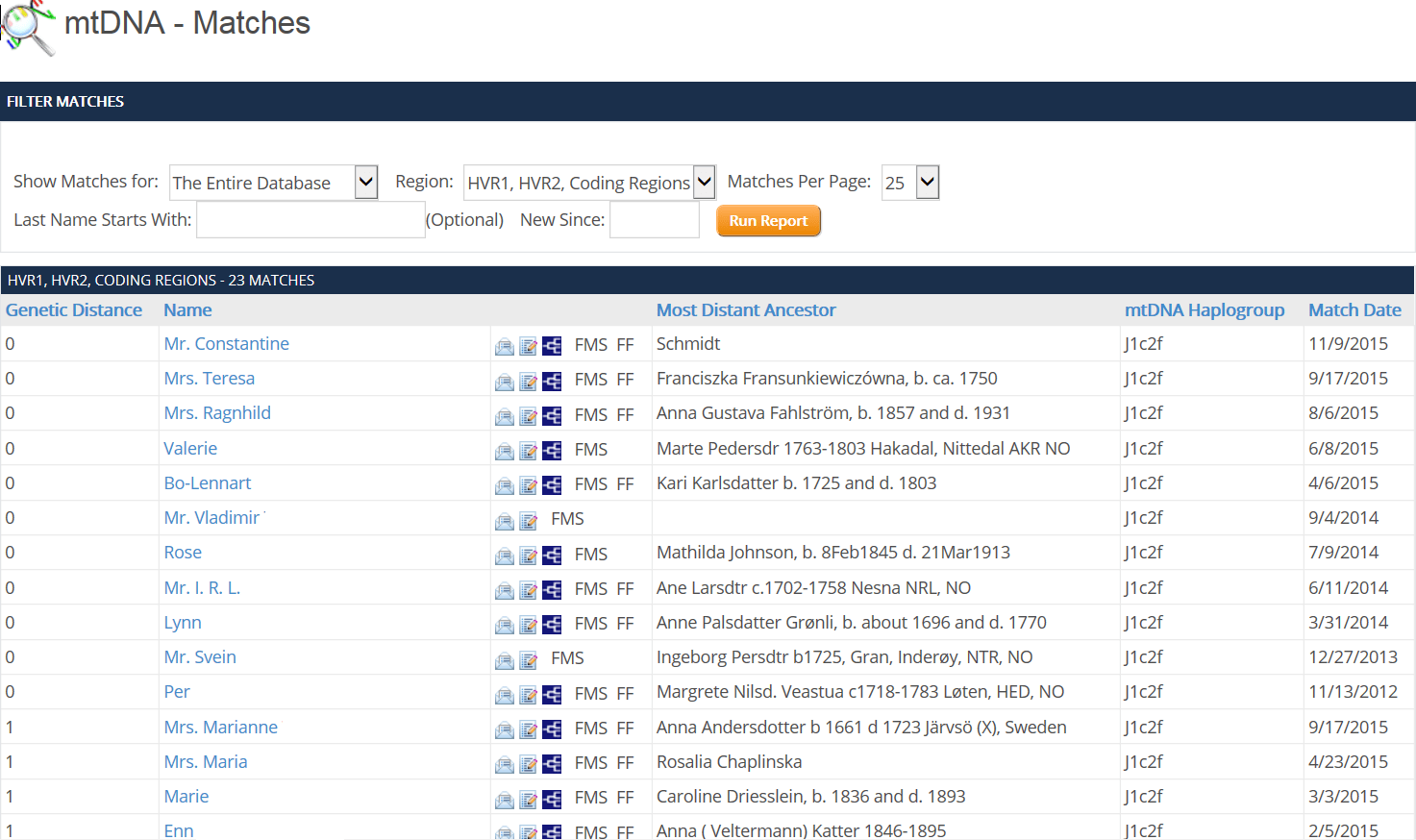
Barbara carried special DNA that is inherited from one’s mother, but only passed on by females. This mitochondrial DNA is not mixed with the DNA of any of the fathers, so it is the same exact DNA that her direct matrilineal females ancestors carried.  In other words, Barbara’s mitochondrial DNA was passed to her from her mother, Elisabetha Mehlheimer and then to her from her mother who is unknown. By analyzing this DNA we can tell some of the story about this line long before we can identify the names of the ancestors, because mitochondrial DNA reaches back into ancient times.  In this case, we see a lot of Scandinavian matches, so there must be a story there someplace aching to be told.

All of Barbara’s children carried her mitochondrial DNA, but only her daughters passed it on. Only her granddaughters through daughters would inherit Barbara’s mitochondrial DNA and pass it on for another generation.

Unfortunately, a lot of the females in these lines did not have children, so Barbara’s mitochondrial DNA is only passed on by four of her grandchildren, bolded above: Nora Kirsch, Mary “Mayme” Rabe, Eleanor Rabe and Caroline Giegoldt, although Caroline had only two sons, so Barbara’s mitochondrial line died with them in that line.

Mehlheimer mtdna

Of course, if Barbara’s daughter Mary had daughters who had daughters, we could potentially have another line carrying Barbara’s mitochondrial DNA. I hope so.

However, in the known lines, it’s dead in my generation. The only possibilities for passing it on are through Nita, Linda, Erin, Marian and Nancy if they had daughters who have daughters.

I don’t know of anyone from Barbara Mehlheimer’s line who has tested their autosomal DNA. Maybe I should say this another way – I don’t know anyone from Barbara Mehlheimer’s line, at all.  If this is your family, please give me a shout!  Inside of 4 or 5 generations, sadly, the family has become entirely disconnected.

Barbara’s Passing

Barbara died of “cardiac arthmia” which I’m sure was actually arrhythmia, meaning an irregular heartbeat. Ironically, today, a pacemaker installed in an outpatient procedure would likely have bought her many more years of life.

George Drechsel purchased a lot for himself and Barbara at Riverview Cemetery when she died. They are buried on an Indian Mound in the cemetery, just a couple miles south of Aurora on the Ohio River at the mouth of Laughery Creek.

Beside Barbara’s burial record in the cemetery books is the note “charged one single grave to George Drexler credit to him on ____”. Section Q, lot #56-tier 1, Gr 3 Plot: permit # 3489.  George was later buried beside her in grave 2.

Drechsel St, John postcard crop

The St. John’s church record shows Barbara’s remaining family as “husband, 4 married children, 19 grandchildren, and 12 great-grandchildren.”

The Funeral and Procession to the Cemetery

The verse read at Barbara’s funeral as noted in the church records was Hebrew 4.9-11 in German and Rev. 14.13 in English.

I found it interesting that one verse was read in German and one in English – and for some reason, which one was read in which language was worth noting.

Hebrews 4:9-11 Authorized (King James) Version

9 There remaineth therefore a rest to the people of God. 10 For he that is entered into his rest, he also hath ceased from his own works, as God did from his.  11 Let us labour therefore to enter into that rest, lest any man fall after the same example of unbelief.

Revelation 14:13

13 And I heard a voice from heaven saying unto me, Write, Blessed are the dead which die in the Lord from henceforth: Yea, saith the Spirit, that they may rest from their labours; and their works do follow them.

Mom church window

When Mother and I visited Aurora 1990, we took photos outside of the Lutheran Church, but it never occurred to me at the time to take pictures inside. I think we were just so excited to be able to see the records that we forgot about everything else.

Many thanks to Becki Nocks, a very kind lady for sharing the card and photos inside the church. I’m sure the church has been updated since, but the basic layout and structure would still have been the same as when Barbara and George were involved with the founding and design of the church.

St. John Card

This photo above was in the form of a Christmas card. The church is beautiful and looks very “German” to me.

St. John inside

Barbara’s casket would have laid in the front of the church.

St. John's Aurora interior c

When I’m having trouble getting through a funeral service (without blubbering), I tend to look at something and attempt to focus. Stained glass windows make a wonderful focus point.  These would have been part of the original church.  Barbara would have seen them every Sunday and probably many weekdays too, judging from how much went on at a church, the social center of the community.  I expect that everyone knew everyone and so the entire community attended funerals – and there was probably at least one a week. I wonder if Barbara focused on these windows to get through difficult funerals, like those of her grandchildren.

St. John inside window

It was cold right after New Years when Barbara died. In the summer, the attendees might cluster in the church yard while the casket was loaded onto either the horse drawn hearse or the wagon, whichever they used.

Aurora St. John Church

Those windows are beautiful from the outside too. Barbara probably gazed upon them many times and thought so as well.

I don’t know if it was the case then, but now, the undertaker is just across the street from the church. This Aurora business has existed for a very long time.

Funeral St John

The funeral procession would have left the church and headed down Mechanic Street, towards the final destination, Riverview Cemetery, just a couple miles south of Aurora along the Ohio River.

Riverview map

Most of the people who attended the service would have climbed in buggies and on wagons and gone to the cemetery for the burial. Our family did not feel they had “closure” unless they attended the actual burial itself.

Let’s go along.

Leaving the church, we travel along Mechanic Street.  Can you hear the steady clip-clop of the horses hooves?

Funeral 3rd Mechanic

Passing 3rd Street. Many of these houses were probably build after “The Great Fire.”

Funeral 4th Mechanic

Mechanic approaching 4th Street.  Where you see a car today, just replace it in your mind with a horse and buggy.

I don’t know if the German Lutherans in southern Indiana did this, but the Germans in northern Indiana always make one last pass by the home of the deceased with the body on the way to the cemetery after the funeral. If they did, the Drechsel home is a block and a half up on the right on 4th Street from the intersection of Mechanic and 4th.

Funeral 4th

Turning right on 4th, to visit the Drechsel home one more time, we pass the homes Barbara knew so well.  These houses all burned during the fire too, so Barbara would have watched many of these being rebuilt.

Funeral Drechsel house goodbye

One last look at Barbara’s home, above, behind the picket fence, where she lived for 50 years, just a few months shy of half a century. Of course, in January, there would have been no leaves on the trees and this tree has probably been planted since.  Generally, a black wreath hung on the door, signifying that this house had experienced a recent death.

Funeral 4th and bridgeway

Turning around and looking down 4th Street now, towards the River from in front of Barbara’s house, we see that the brick building on the immediate left has been at least twice rebuilt, because that was the location of the Indiana House Hotel that burned in “The Great Fire,” and the 2 story white building across the road, I believe, was the Cobb building where that devastating fire began.

Funeral 4th and Mechanic

Back now to the intersection of 4th and Mechanic, we look left one last time down Mechanic at the Lutheran Church that played such a central role in Barbara’s life.  One final glimpse and goodbye.  Looking right, we can see the Ohio River in the distance at the bottom of the 4th Steet hill.  A slight flick of the reins and the horses are off to the cemetery.

Funeral 4th Main

Descending the hill on 4th from Main.  I’m sure Barbara was extremely grateful for this hill, as it protected her family from the devastating floods.

Funeral 5th hill

On our Google Street view, 3rd and 4th were both closed for construction, so we moved over to 5th Street to reach the road along the Ohio River.  Horses pull differently going downhill, using their body weight to prevent the carriage from “running away.”  You can feel the horses change their stride to a purposeful braking plod.

Funeral Ohio at 5th

From this location at the foot of 5th Street, we see a beautiful view of the Ohio, looking across the river and upstream.  Barbara would have seen this many times, for the past 54 years.  She and George may have arrived via riverboat and docked just a few feet upstream when they first arrived in late 1852.  So this location may have been both a comforting hello and goodbye.

Funeral Ohio on 56

Barbara’s procession would have turned right and followed along the river. These two miles or so between Aurora and the cemetery would have been a peaceful ride.  And it’s a journey Barbara had made several times herself, although never before riding inside the box.  That’s generally a one ticket, one way ride, just one time.

Funeral Ohio 2

The clip-clop of the horses hooves and swaying of the carriage would have been rhythmic and soothing.  Did George’s thoughts drift back to his lovely Barbara as a young woman as they embarked upon their journey along the Rhine River more than half a century earlier when they left Germany, as he looked at the Ohio that day? Rivers had played such a central role in their lives.

Funeral Laughery Creek Road

The entrance to the Riverview Cemetery is off of Laughery Creek Road.   Turning right on Laughery Creek Road, then left immediately on the private road, the procession would have entered the cemetery.

Funeral Riverview from 56

You can see the Indian mound where Barbara is buried from 56, the main road. She is actually buried very near the brick structure in this photo.

Funeral satellite Riverview

In this satellite view, you can see both the brick structure and the main road, 56, to the right. Barbara’s burial location is shown on this diagram of Riverview.

Riverview flyer 2

The entrance then would probably have looked much like the entrance shown on the Riverview flyer we were given in 1990.

Riverview flyer

The  entrance looks a bit different today.

riverview entrance

Barbara is buried within view of the entrance.

Funeral Barbara Drechsel cemetery

In this photo, Barbara Mehlheimer and George Drechsel’s matching stones are in the front, but you can see the entrance archway to the right rear of the photo.

Funeral Barbara Drechsel stone

George would pass away two years later, in February 1908, but Barbara wasn’t alone. A son-in-law and some of her grandchildren were already buried here, and more of her children, in time, would be.

The Children of Georg and Barbara Mehlheimer Drechsel

Two of Georg and Barbara’s children were born in Germany and the rest after arriving in the United States.

  • Barbara Drechsel was born October 8, 1848 in Goppmannsbuhl, Germany and baptized in Wirbenz, the closest village, on October 22, 1851. She was also christened in June 1857 in St. John’s Lutheran Church in Aurora. Her godmother in Germany was Barbara Krauss of Windischenlaiback, likely a relative and possibly a sister, aunt or other relative to one of her parents. Barbara married Jacob Kirsch on May 27, 1866, lived most of her life in Aurora, and died on June 12, 1930 in Wabash, Indiana. She is buried at Riverview, not far from her parents.  Barbara had 6 children, all of whom survived to adulthood and married, although only 3 had children.

Jacob Kirsch stone with mother

  • Margaretha Drechsel was born May 13, 1851 in Germany, baptized on October 22, 1851 in Wirbenz and probably christened on September 1857 in Aurora with her sister. She married Herm Rabe Sept. 21, 1873 and they had a total of 6 children before Margaretha died in 1889. For a long time, I could find nothing more on Margaretha, then I discovered someone had entered her burial on Find-A-Grave, along with her children.  Thank you to that volunteer.

Drechsel Margaretha stone

Margaretha’s marker has been destroyed and only the base remains today. It is located beside that of her husband, Herb Rabe, in the Wesleyan Cemetery in Cincinnati, Ohio.

Herm Rabe stone

I would suspect that Barbara was not happy that Margaretha wasn’t brought home for burial. Being “brought back” seemed to be very important to these families, judging from later letters and hurt feelings about other deaths.  Margaretha was probably Barbara’s first child to die, although either John or Mary died before Barbara’s death as well.

Margaretha Drechsel Rabe’s children were:

  1. Freidrich George Rabe was born in 1876 and died in 1879 due to “lung disease due to cough. He is buried at Riverview.
  2. Caroline Louise Engel Rabe born December 3, 1880 and died in 1951, buried in the Wesleyan Cemetery in Cincinnati, Ohio.
  3. Mary “Mayne” Rabe born 1875 and died in 1961, married to Albert Weatherby and had three daughters, Lorine, Juanita and Margaret.
  4. Louisa “Lou” Rabe born 1879 in Aurora and died in 1963 in Whiteside County, Illinois, married to Irvin Isaac Denison in 1919. No children per the 1920 (she was 41) and 1940 census.
  5. Wilhelm Rabe born in 1883 in Aurora, died in 1886 in Cincinnati, buried in the Wesleyan Cemetery.
  6. Eleanor Rabe born in 1885 in Cincinnati, died in 1961, same location, buried in the Wesleyan Cemetery, married to Guy Nicholas Young and had 4 children, Marian, Eleanor, Donald and Guy.
  • Carolina “Lina” Drechsel was born January 8, 1854 and baptized in May of that year. Little is known about this daughter. In 1876 she was the godmother for her sister Barbara’s daughter Caroline.  In 1881 in the church records she is listed as married and moved to Cincinnati, but as late as 1886 she is still taking communion part of the time in Aurora.  By 1892 she is no longer listed in the church records.

Drechsel Lina 1880

I believe I found Lina in the 1880 census in Cincinnati listed as a cousin to Jacob Heinke. This is the only hint of family in the US for the Drechsel family.  Jacob’s wife Emilie was a Gotsch.  She is buried in the Walnut Hills Cemetery in Cincinnati, Ohio. Her family seems to be from Muhlau and Ziegelheim, Saxony, according to the birth locations listed in her siblings burials.  Her father was a doctor.  There is no indication of a relationship to Lina Drechsel through Emilie.

Jacob Heinke’s father was Johann Jacob Henke born in Hanover and Louisa Maria Schafstall, also born in Hanover.

Was Lena truly a cousin? If so, first cousins share grandparents.

In 1878 and 1879, Gottfried Heinke is listed as an upholsterer at the address of 17 Adams Street, and Lena Heine is listed as a tailoress at 610 Race, so perhaps not the same person.

In 1900, I found Lena Heinke and her husband Gottfried, married for 5 years, living at 1612 Pleasant Street in Cincinnati. This census shows that she has had 1 child, but no children are living.  Of course, Gottleib could have been her second husband.

Drechsel, Lina 1900

Gottleib and Lena are still living in 1910 and 1920 where he is a polisher in a private factory.

I found Gotfried Heinke buried in the Riverview Cemetery, born March 1, 1854 and died Feb. 23, 1926. He has no stone, but buried next to him is Lena Heinke, close to George and Barbara Drechsel in section Q, lot #57, Tier 1, Grave 23.

The 1930 census confirms Lena Heinke’s identity. She is shown living with her niece, Leah Rabe at 1568 Hobart in Cincinnati.

Drechsel Lena stone

Lena’s burial information shows that she died January 24, 1938 and is buried at Riverview. She was 84 years old when she died.

  • Barbara Mehlheimer and George Drechsel’s fourth child was Johann Edward Drechsel born on August 16, 1856. In 1871 he was the godfather of Johann Edward Kirsch, his sister’s child. By 1877, he was living in Cincinnati.  In his father’s obituary in 1908 he is listed as living along with 3 daughters, but in Georg Drechsel’s church death record, it states there are 4 daughters living.  I may have found John in the 1880 census, but I cannot find him later.  He could also be listed under Edward, and Drexler could be spelled any number of ways.  I could find no burial for him either.

The John Drexler in Cincinnati, Ohio in the 1880 census is married to Lizzie Theisinger. They are living with her parents.  He is a tailor and was born in 1856 in Indiana and his parents were born in Prussia.

Drechsel John 1880

Philip Theisinger, who would have been John’s father-in-law, died in 1884 with no will or probate apparently. However, the Cincinnati court house did burn in 1884.

Probably the most frustrating part of not being able to find John Drechsel or Drexler is that he is the only male candidate for Y DNA testing. He has no male siblings and his father has no known siblings either, although there could certainly be a sibling in Germany for his father that I’m unaware of.  However, without a male Drechsel to test, we’ll never know anything about George’s Y line DNA which means I’ll never know anything about his ancient history, before the advent of surnames.  Searching for him has been like searching for a needle in a haystack, being uncertain of which first name he used and unsure of how his last name was going to be spelled at that minute in time.

Does anyone know anything about John Drexler and Lizzie Theisinger?

  • Barbara Mehlheimer and George Drechsel’s fifth child was Emma Louise “Lou” Drechsel born on July 18, 1859 and died in Aurora June 8, 1949. She was known as “Great Aunt Giegoldt”. She married Johann George Giegoldt on March 30, 1881 and had two children.
  1. Barbara Margaretha Josephine Giegoldt was born on Feb. 9, 1882 and was baptized on April 9th. Her godparents were Barbara Kirsch and Margaretha Rabe, her mother’s sisters.  In her confirmation, Margaretha is underlined and next to it the name Nettie is penned.  She never married, died in 1908 at age 26 and is buried at Riverview.
  2. Their second child was Caroline Louise “Lily” Giegoldt born November 6, 1883 and baptized on Christmas Day. Her godparents are Karoline Drechsel and Lilly Louise Drechsel. Is Lilly another name for her mother’s sister Emma Louise, or perhaps is Lilly John Drechsel’s wife?  Caroline married Theodore “Louis” Bosse, a watchmaker, moved to Cincinnati, and had sons Raymond and Wilbur.  The 1910 census shows them in Cincinnatti.

Johann George Giegoldt

After Johann George Giegoldt died in 1901 of Tuberculosis, Lou married Theodore Busse or Bosse on May 3, 1908. Yes, if you’re scratching your head wondering if Caroline Louise Giegoldt (the daughter) actually did marriy Theodore Bosse and her mother, Louise Giegoldt, also married a Theodore Bosse in the same town 11 months later.  The answer is yes, they did.  This should not be allowed.  How to confuse a genealogist!!!

Theodore Bosse (the elder) died in 1912 of kidney failure and Louise Drechsel Giegoldt Bosse then married Valentine Dietz.

I show Louise and Valentine Deitz in 1920, 1930 and 1940 in Madison, Indiana. He died in 1941.  “Great Aunt Lou,” as mother called her, was actually married to Dietz longer than she was to either of her first two husbands, combined.

Pictured here is the Giegoldt family monument in the cemetery in Aurora.

Giegoldt monument

  • Teresa Maria “Mary” Drechsel born December 28, 1862. In the 1875 she was baptized and by 1880 she was living at the Kirsch House with her sister. By 1881, church records note her as living in Cincinnati.  Nothing more is known about Mary.

Flood, Fire and Celebrations

Barbara’s life was truly remarkable. She seemed to skirt or somehow make the best of every possible tragedy.  Although starting out with a significant social handicap, she and George risked everything and left for America, which offered them the freedom to become what they would, and could, based on their own work, not on their birth circumstances and customs beyond their control.

The city lot that Barbara and George purchased seemed to have escaped most if not all of the major floods. If they did flood, it was probably only once.  Some of that may have been luck, but some may also have been their foresight living near large rivers in Germany.  4th Street was on a hill and that proved to be an excellent choice.

However, hill or no hill, fire still threatened. The major fire of 1882 burned the building next to their home and all of the buildings down the block in two directions.  Fortunately, it seems like the Drechsel family was in luck.  If the house did burn, that’s not a story we ever heard.  And most importantly, no lives were lost.

But even more remarkable is that Barbara seems to have avoided death in her family for more than 27 years. That’s more than a quarter of a century.

Of course, we don’t know when her mother died in Germany, but we do know it was before Barbara’s second daughter was born in 1851. We don’t know if Barbara had siblings or other family members she was close to.

What we do know is that from the time Barbara immigrated, in 1852, there were no deaths until her grandchild died in 1879. At the time of Barbara’s death in 1906, she had lost 2 children, a son-in-law, 3 grandchildren and 2 great-grandchildren.

Let’s look at the flip side of that though. Barbara had 6 children born, all of whom lived, meaning 6 baptisms and 6 confirmations, all days for celebration.  She attended at least 13 weddings of immediate family members.

Barbara had 15 grandchildren and 13 great-grandchildren, which means baptisms and christenings for them as well. And that’s not counting birthday celebrations, Easter and Christmas, all opportunities for family celebrations and a home filled with people, laughter, children and cheer.

While Barbara did have some grief in her life, and I don’t want to diminish those events, her life was remarkable because of the number of celebrations she enjoyed – well over 100 not counting birthdays and holidays. That’s not bad for a woman who arrived with just the man not yet her husband and 2 small daughters with nothing more than the clothes on their backs, and no family.

Barbara’s life was shaped by her remarkable bravery and being willing to take risks and act beyond her fear.  Her family and the joyous celebrations she would enjoy for more  than half a century were her reward.

Barbara’s life was also defined by rivers and water.  First the Rhine, as an escape route, then the Atlantic, and finally the Ohio which carved the landscape and shaped the lives of those in living in Aurora, and beside which, on an Indian mound, Barbara reposes today.

Ohio hill

______________________________________________________________

Disclosure

I receive a small contribution when you click on some of the links to vendors in my articles. This does NOT increase the price you pay but helps me to keep the lights on and this informational blog free for everyone. Please click on the links in the articles or to the vendors below if you are purchasing products or DNA testing.

Thank you so much.

DNA Purchases and Free Transfers

Genealogy Services

Genealogy Research

Barbara Drechsel (1848-1930), The Kirsch House, Turtle Soup and Lace, 52 Ancestors #110

Barbara Drechsel’s story begins with a mystery. Who is this beautiful young woman?  Is it Barbara?

Let this be a lesson – write on the back of every photograph you own, preferably in pencil – but do it one way or the other. Crayon would be better than nothing.  Oh, and then don’t stack the pictures together either so the writing on the back of one leaches or rubs off on to the one below it.  It just kills me seeing unidentified photos that I know are someone’s ancestors, someone’s family members – and especially when they are mine!

mystery photo probably Nora

This unidentified female in the Kirsch family documents was originally believed to be Barbara Drechsel as a teen, based on comparisons to other photos that are identified as Barbara, like the ones below. Of course, we don’t know what Barbara’s sisters looked like.  However, there was a fly in this ointment.  Barbara Drechsel was born in 1848, so she would have been a teen in the 1860s, smack dab in the middle of the Civil War and before the camera was really in use.

Given that information, this is more likely to be a photograph that was taken about the same time as the known ones of Barbara Drechsel, below, and is likely one of Barbara’s daughters. Her oldest daughter, Nora, would have been about 14 or 15 at this time, and this person looks to be about that age and resembles Nora, so perhaps we have a photo of Nora here.  Nora’s next younger sister was born in 1871, so would only have been about 10, and this young lady looks to be older than 10.

I know Barbara is my relative, so I might be a tiche biased, but I think she is a beautiful woman. I wonder if her hair was naturally curly or if this was artificial for the photos.  Photography at that time was very much a “dress up” affair.

Barbara Drechsel

This photo was unlabeled, but based on the photo below where the clothes are the same, it is Barbara Drechsel Kirsch.

Barbara Drechsel 2

This photo is labeled Barbara Drechsel Kirsch. I found this necklace, now broken, in Mom’s jewelry box after she passed away.  The photo frame says Brownell’s formerly Kelly’s Photo Gallery No. 196 W. 5th St, Cincinnati, Ohio.

Research on Fold3.com in the Cincinnati City Directory tells me that Kelly, a photographer, did business at that location from 1876-1880 and Brownell, another photographer, took over at that location in 1881, so this was probably from the 1881-1882 timeframe. Brownell would not have had the “formerly Kelly’s” tag for long especially since Kelly was only in business since 1876.  So, this photo of Barbara was from when she was about 33 or 34 years old.

Let’s Meet Barbara

Barbara Drechsel was born on October 8, 1848 in Goppmansbuhl, Germany to George Drechsel and Barbara Mehlheimer. She was the oldest of their 6 children, two of whom would be born in Germany before they immigrated to the US.

wirbenz church

Barbara was baptized in the protestant church in Wirbenz, above, the closest village, on October 22, 1851. She was also christened in June 1857, according to the Aurora church records. Her godmother in Germany was Barbara Krauss of Windischenlaiback, likely a relative and possibly a sister, aunt or other relative to one of her parents, probably her mother, since Barbara’s mother was, well, ahem, not married to Barbara’s father.  However, it was not because her parents were uncommitted to each other.  In fact, that couldn’t have been further from the truth.

The records pertaining to Barbara and her parents were exceedingly difficult to obtain. Back in the late 1980s and early 1990s, I was fortunate enough to find a retired Reverend in that area who was interested and willing to drive from little village to little village and look through the old church books.  Because he was a Reverend, the churches would allow him access not otherwise granted, and he knew what to look for and transcribe.  Plus, he still read Latin, because the German of that time was interspersed with Latin and written in German script. If I recall correctly, Reverend Grieninger was in his 80s or 90s at that time, but his many years of working with the churches gave him a wonderful perspective of what life was like in Germany especially pertaining to records during the time that Barbara’s parents would have been living there, and leaving there.  He was also a very kind man and very non-judgmental.

George Drechsel’s emigration papers say they left from Bremen, his age was 29, and they arrived in Baltimore July 24, 1852 on the ship, “The Harvest.” Barbara wasn’t quite four years old.  She probably had no memory of the trip or of Germany.  Her earliest memories would have been of Aurora, Indiana.

We don’t know how the family traveled from Baltimore to Aurora, nor why they selected Aurora, but they did. They arrived sometime before the end of 1852, because George Drechsel applied for citizenship January 7, 1853 in Dearborn County, Indiana.  His citizenship application would have covered his wife and two children as well.  Barbara’s parents, George Drechsel and Barbara Mehlheimer were married three days later, a right we take for granted here, but a luxury they were not allowed in Germany.

Sometime after their arrival the name was changed to Drexler, which was probably the English phonetic pronunciation. It is also misspelled in other ways such as Drechsler and Drexel making it very difficult to find family members in records.

The Family Home

When Mom and I visited in the early 1990s, we found what we believed was the location where the Drechsel family lived according to the deeds we found and an 1875 map.

We discovered that Georg Drechsel had several entries in the Grantee and Grantor Deed Indexes 1826-1982.

Drechsel, Georg – (from) Riedel, Christian book 11 page 597, Nov. 1, 1856, Aurora lot 254. Note that Christian Riedel is the same person who witnessed for Georg’s naturalization.  I was hopeful of finding Christian in the census, but had no such luck.

George Drecksel to Louise Giegoldt Book 47 page 411, March 12, 1891, lot 254 the north half.

George Drecksel to Barbara Kirsch, book 66 page 19, lot 254 the East half lot 254, Dec. 15, 1905.

Except, there was a fly in the ointment. The 1875 map I was using was a black and white copy of an original.  I thought I could read it, then and now, but fate played a really cruel trick on me.

Mom and I went and found these properties in 1990. They have been “mine” ever since, until tonight when Jenny Awad from the Dearborn County Historical Society sent me a color scan of the original map.  I looked at it, realized it wasn’t the original map, but a better one with additional landmarks noted, and immediately thought, “wow, how clear.”

Then, I looked at the lot numbers and thought something looked odd.  Yep, you’ve probably guessed it by now.  Mom and I had the wrong lot number.  For 25 years now, I’ve been coveting the WRONG property.  But it does make the 1900 census confusion go away.  The reason George Drechsel lives on 4th Street in 1900 is because his lot IS on 4th Street and his house IS on 4th Street – and HAS BEEN on 4th Street ever since he bought it in 1856.  So all those lovely photos of the wrong houses….bye bye.

Oh, and yes, I get to go back and “fix” a couple of other articles too. Well, all I can say is better late than never, but am I ever, ever mad at myself.

So, here’s the really good “new” map where I can see the lot numbers clearly.

1875 Aurora Map color

The map above, from 1875, shows the Drechsel House on the Aurora map.

George Drechsel owned lot 254, on 4th Street between Bridge and Exporting.  It was a block away from the barrel factory where he probably worked.  He was a cooper.

If the original house still stands, it’s this house, at 510 4th street today.

510 4th Street Aurora

The Church

Drechsel St. John

The 1885 Dearborn Co. History for the City of Aurora says that George Drexler was a founder of St. John’s Evangelical Lutheran Church. “The church was formed in 1856 by a small number of settlers who were convinced that it was a necessity, as well as their Christian duty, to assemble on the Lord’s Day for divine worship.”

In May 1878, after renting a church from the Baptists, they began to build their own church on Mechanic Street, pictured above.  According to the local history, the church members made a procession out of leaving their old church and “moving into” the new one.  I of course don’t know what the procession actually looked like, but I view it probably as somewhat of a pious and somber parade with maybe everyone carrying a Bible, a hymnal and a candle.

It was a short walk from the Drechsel home to the new church, located at present day 222 Mechanic Street. The Drechsel family likely walked this path every Sunday together.

Drechsel to church map

In 1992, Mom and I visited Aurora, including the church of course, and took photos.

Every now and again you take a photo that is far more profound than anticipated. I feel like Mom is reaching across the generations in this photo.

Mom church window

The stained glass windows appeared to be original, and mother though they were beautiful. We took several photos, including the one above that shows the reflection of mother pointing to the windows.  Now she too has gone to join her ancestors who lived and worshiped here, and we are left with only the reflections of their lives on earth.

Religion played an important part in the lives of the German immigrants. Most of the German families were Protestant, but a few were Catholic.  Churches delivered their sermons in German until the advent of the First World War.  Eloise, Barbara’s granddaughter, remembers hearing German spoken at the Kirsch House, but she recalls that the adult children of Jacob and Barbara Kirsch told them that they needed to speak English, not German, when WWI broke out, and they “never spoke German again.”  They were afraid that people in America would think they were not loyal.

The Jacob and Barbara Drechsel Kirsch family attended the church that Barbara’s parents helped to found, as did their children who were educated in St. John’s Lutheran School held in the church. Free schools did not exist in Aurora at that time, so everyone who educated their children paid tuition in some location for their children to attend school.  Mother and I perused the records when we visited and found several “interesting” records that conflicted with dates in the family Bible – mostly marriage dates or birth dates that appeared in the Bible to have been “arranged” so that births occurred more than 9 months after marriages.  So much for the family Bible being the most accurate source available.

Aurora St. John Church

The side of the Lutheran church in 1992 and the front entryway, below. Note this window says 1874 where the history book says this church was completed in 1878.  Maybe it was begun in 1874 and not finished until 1878.

Jacob Kirsch st John Aurora

We do know that Barbara was involved in some way with the Fifth Street German Church, as the Cincinnati Enquirer newspaper carried as a social announcement on November 3, 1910 that “Mrs. Jacob Kirsch and Mrs. Fred Kappel entertained the ladies of the Fifth Street German Church Wednesday afternoon in the church parlors with a coffee social.”

Babbit

The 1860 census shows us that George Drexler, age 37 is a laborer in Aurora. He doesn’t have much of a personal estate, and it doesn’t show him owning property, although the deed records show differently.

Drechsel 1860 census Aurora

Perhaps the most interesting piece of information on this census is Barbara’s name, or nickname – Babbit. What a sweet name.

Married Life

Barbara Drechsel married Jacob Kirsch on May 27, 1866. He hadn’t been back from the Civil War long. I wonder if they courted before he left.  Did she write him letters while he was gone?  Their marriage probably wasn’t planned for long, because their first child arrived on Christmas Eve of that same year.  Many of these marriages that were originally a bit hurried lasted for a lifetime.  Theirs did.

By the time the census was taken in 1870, Barbara Drechsel and Jacob Kirsch had three children, Nora 3, Martin 2 and three month old Edward. Jacob is listed as being a cooper, probably working for the cooperage houses in Aurora – maybe the one behind the property that would one day become the Kirsch House.  They did not own a home, but they did live in Aurora.

Barbara and Jacob bought a house (or a lot and then built a house) in 1871, just down the road from the Drechsel home. They spent the first several years of married life in this location.  This life-event must have been a huge achievement for the young couple – to purchase and own their own home.  The land was described thus:  Dearborn County a certain lot or parcel of land known and designated as lot number six in David H. Walker’s sub-division of out lot number 49 in the City of Aurora, Dearborn Co., Indiana.

Jacob Kirsch Aurora map crop 3

That location is shown by the lowest red arrow, the Drechsel home at the middle red arrow, and the location of the Kirsch House which Jacob and Barbara would purchase in 1875 at the upper red arrow.

Jacob and Barbara didn’t live in Walker’s subdivision long, because by August of 1875, they bought the French House from James and Ellen French, renamed it the Kirsch House, of course, and moved on up the street to town, right beside the depot.

Thus would begin the legacy of the Kirsch House, an Aurora and family institution that stood as a landmark beside the train depot for the next 46 years, nearly half a century. Oh my, the stories those walls could tell if they could only talk!

The Kirsch House Legacy

In the 1880 census, Jacob is shown as a saloon keeper and having a boarding house. In fact, they have 3 boarders and Barbara’s sister, Mary Drexler, age 17, is living with them as a servant.

Barbara is “keeping house.”  Indeed, she is – and what an understatement.  Barbara has her husband, 6 children between the ages of 4 and 13, her sister who I’m sure is there to help, plus three boarders that live there – and that’s not counting overnight lodgers that come and go.  In addition, they maintain a pub and restaurant and you can rest assured it’s not Jacob who is cooking and washing dishes.

1880 census Aurora

Prior to Jacob and Barbara’s purchase in 1875, the establishment was called the French House. An ad in the 1876 business directory shows Jacob Kirsch as the proprietor, still gives the name as the French House and says, “The house is pleasantly situated near the railroad depot and will be found the most desirable place in the city of Aurora at which to stop.  Good wines, liquors and cigars.”

Kirsch House 2008

When I was able to tour the building in 2008, I recall that it seemed quite large.  There were several hotel type rooms in the annex area that reached towards the rear of the property, visible at left below.  I seem to recall that there were about 20.  The family sleeping area seemed to be on the second story above the front area, parallel with Second Street, as seen above.  All of the rooms on the second level were very small, as was the hallway and the only access to the upper level was the stairway in the parlor.

The public spaces, including the pub (accessed through the door at left, above), dining area (behind the pub) and parlor (accessed through the door at right, above) were located in the front part of the building on ground level, facing the street.  In the photo below, second street is to the right and Mom is standing in the parking lot of the depot.  The annex area where the boarders would have slept was in the extended area to the left.

Jacob Kirsch House side

This photo shows the property from the rear.  The private garden would have been the area that is growing in weeds today.  Mother said it was bricked in at the time and the well was located there.

Jacob Kirsch house rear

Surprisingly, even though the building spans 3 or 4 city lots, it is only about 2100 square feet.  That’s not a lot of space for the public spaces, the family area and the boarders areas.  I doubt the family had a lot of privacy and I suspect everyone shared a bathroom, such as it was at the time.

Not only was the Kirsch House a landmark establishment in Aurora, it was the hub of Kirsch family activity for nearly half a century. Memories of the Kirsch House, references to it and stories about it filled the 1900s and live into the 21st century, firmly planting the Kirsch House as an icon of the Kirsch family shortly after their immigration and representing the Kirsch family version of the realization of the American dream.  It seemed larger than life, especially to a child hearing all of those interesting stories from a time and mythical place “long ago.”

Mom and I found the original Kirsch House in 1992 when it was still being used as a restaurant. We were lucky enough to discover the bar that was there when Jacob and Barbara were proprietors still graced the front room of the building where the pub part of the building was located.

Jacob Kirsch bar

The Kirsch House was located beside the depot on Second Street. This allowed them the opportunity to provide service to any hungry or thirsty travelers departing or arriving on the train, and they were only a couple of blocks from the Ohio River where passengers arriving by steamer would disembark as well.  Because of the proximity to the train depot, the hobos would come to the back door of the Kirsch House and Barbara would feed them all.  The Kirsch’s were looked upon, according to Eloise, as elite shop and property owners.  Photos above and below were from our late 1980s or early 1990s visit.

Jacob Kirsch house by depot

Laminated onto the top of the bar in Aurora, we found original postcards, shown below, featuring the depot and the Kirsch House next door.

Jacob Kirsch house and depot

The Kirsch house at that time had a roof covering the sidewalk.  In 1992, the sidewalk roof, which I think they referred to as a portico, was gone.

Kirsch House postcard

It’s difficult to imagine the Kirsch house in its heyday, although having seen that bar, I can close my eyes and give it a pretty good shot!  Just look at those swinging saloon doors!  I doubt that the Kirsch girls were allowed in the pub area.

Unfortunately, over the past quarter century, the Kirsch House property has continued to deteriorate. The bar was removed and in essence ”disappeared” among legal wrangling.  The City owned the property for a while, but just today, literally, Jenny Awad with the Historical Society notified me that the property had been donated to an organization called Indiana Landmarks that is refurbishing the property and will put it on the market this spring, giving it in essence, another life as the gateway building to the City of Aurora, beside the historic depot, now functioning as the library annex.

Interestingly enough, during WWII, the former Kirsch House building served as a repository for the caskets of soldiers awaiting family.  That made sense, given that it was located beside the depot.  I wonder if they put each casket in a private room so that the family could have some privacy when they came to claim their loved one.  Finally, in the 1950s, when train travel declined and the trains from Cincinnati to St. Louis ceased operation, the establishment fell onto hard times. Hopefully this facelift will give it a new life.

It seems that the Kirsch House as an establish has always been quite unique in unexpected ways.

Barbara was an unusual woman in her own right too. She owned the Kirsch house, outright, free and clear, beginning in 1887.  Indeed something very unusual happened.  Jacob conveyed the Kirsch House to his wife Barbara Kirsch.  Now that’s something that just didn’t happen – ever.  Mom and I knew this was “odd” when we found that deed, we just didn’t know why.

In the 1960s, my mother, with down-payment money from her parent’s estate in hand and a job she had held for years, still couldn’t obtain a mortgage without a co-signer. Women simply did not own property as a “femme sole”, meaning a woman not subordinate to a husband, even some 80 years later – let alone owning land as a married woman but without your husband.  And to make things even stranger, Jacob conveyed the property to Barbara.  And no, they did not get divorced.  What was going on?  Women just simply did not own property under these circumstances.  But Barbara did.

But then again, men generally didn’t lynch people either. That’s right, Jacob was embroiled in a legal suit filed by the widow of a man who murdered another man, but was then immediately lynched by a mob, of which Jacob was apparently a member, perhaps a ringleader.  Apparently, in order to protect the Kirsch House, Jacob conveyed the property to Barbara and it remained in her name until she sold it in 1921, 35 years later, three years after Jacob’s death.

However, the years between 1885 and 1920 were simply brutal. One strange occurrence after another beset this family.  In 1886, when Jacob was involved with the lynching, Barbara was 38 years old and had six young children, all 6 born within a decade.  Then, Barbara had no more, even though her last child was born in 1876 when she was only 28 years old.  How would Barbara ever have raised those children and maintained the Kirsch House without Jacob, had he gone to prison for murder?  Why did Barbara have no more children?

By the 1870s, contraception was available, albeit underground due to the intolerant “Comstock Act” which made the trade of or mailing of anything to prevent contraception, to procure an abortion or any contraceptive information illegal. Some states went so far as to pass laws preventing contraception.  In any event, condoms were still sold as “rubber goods” and cervical caps as “womb supporters.”  I don’t know what Barbara did or how, but it was effective because she was evidently done having children.

Given the work load Barbara had with the Kirsch house, meaning the daily housework, laundry for family and guests and all of the daily cooking for the restaurant portion of the Kirsch House, in addition to taking care of and looking after her children, it’s possible that Barbara was simply, literally and figuratively, “too tired.”

Barbara maintained this pace for almost 50 years. Had her husband gone to prison in 1886, she would somehow have carried on.  When her brother-in-law, disabled by the Civil War, came to live with them, she simply carried on.  When her 80 year old mother-in-law came to live with them in August of 1887, Barbara carried on.  I’m sure Barbara cared for her mother-in-law in the final 18 months that she lived at the Kirsch house, before her death on February 1, 1889.

When Barbara’s daughters began marrying in 1888, some leaving, and some adding another family member, she carried on.  I think Barbara just got up every day and put one foot in front of the other, treading that oh-so familiar path from one end of the day from dawn to dusk, up and down the stairs a million times…and carried on regardless of what life deposited on her doorstep.

Kirsch house staircase

One thing we do know about Barbara, and that’s what she did every Tuesday at the Kirsch House.

Turtle Soup aka Mock Turtle Soup

In fine German tradition, one could purchase a mug of beer and a bowl of turtle soup at the Kirsch House for ten cents.  You could probably pull a stool up to the bar and engage in some fine conversation to go along with it too, along with a cigar.

Barbara Drechsel Kirsch made turtle soup every Tuesday, and she took orders for home delivery.  Buckets of soup were delivered by the young Kirsch daughters using a wagon, up and down the streets of Aurora, probably to other German families.  Perhaps this was the first form of take-out and delivery.

The original recipe for Barbara’s Turtle Soup is below, probably in the handwriting of Nora Kirsch Lore. Note the Kirsch House stationery and the note that says Mama’s recipe. Also, the word Kirsch on the second page still retains a bit of high German script.  Nora was educated at the German Lutheran Church School, so that would not be unexpected.  The second image is the back of the page.  The third image is the Turtle Soup recipe again, this time in the handwriting of Edith Lore Ferverda, and noted as her Grandmother’s recipe. Notice the changes and modernization of the recipe.

Given the location in Germany so near to the Rhine River, I have always wondered if the recipe came from Germany with this family, and they simply substituted veal for turtle because turtle was not readily available here. This is probably not be the case, because in Germany, Mockturtlesuppe, mock turtle soup, is a staple. Clearly, at some historical time, a real turtle was involved.  Turtle populations though cannot recover quickly when a breeding adult is killed, so it’s possible that mock turtle soup has been without turtle for hundreds of years, hence the name.  Mom always called it mock turtle soup, which I assumed was to preventatively eliminate the “ewww” that would have resulted if someone got focused on the turtle part.  I didn’t realize that “mock” was actually part of the original German name of the soup.

Although I assumed that this recipe descended originally from the Kirsch family because of their proximity to the Rhine River in Germany, it may have instead originated in the Drechsel family. It was Barbara Drechsel Kirsch who made the soup at the Kirsch house.

Mother made this soup once a year, generally in the winter at or near Christmas-time. One either loved this soup or hated it.  My brother and I both loved it, as did mother, but I suspect this heritage recipe will die with me, as neither his children nor mine care for it and it takes a long afternoon  to make.

As a child of about 5, I have vivid memories of standing on a chair in front of the stove with a wooden spoon stirring the flour in the cast iron skillet as it browned.  Unbrowned flour will not work, and the flour was easy to scorch, so browning the flour was a VERY important job, especially if you were five.

Kirsch House stationery turtle soup

Kirsch House turtle soup 2

Kirsch house turtle soup 3

I still make this family recipe today, and of course, I’ve modernized the process even more.

meat grinder

Instead of the old bolt-on-the-table meat grinder, which took two people to operate, today I use a food processor – and I feel guilty, like I’m cheating, every time. However, I still stand and brown the flower in Mom’s cast iron skillet.  What memories that brings back.

Turtle soup pot 2

There is no way to make a small batch of turtle soup, so making it once each year and freezing portions for lunches is always a memorable way to spend a Sunday, and a bright spot every time I have lunch and think of the generations of my ancestors who enjoyed this same lunch, every Tuesday at the Kirsch House. I may not be sitting at the bar, visiting with Barbara and Jacob, but I’m with them just the same.

Turtle soup bowl

I’ve modernized the recipe once again, and I hope that one of you will continue this wonderful family recipe.  If your family was German, try it and see what you think of this legacy heritage dish.

Now the contemporary version of Barbara Kirsch’s Turtle Soup:

  • 1 veal or beef shank (knee down, bone in) – have butcher slice into several pieces
  • 1 stalk celery
  • 1 large onion
  • 5 large carrots
  • 1 32 oz bottle of V8
  • 1 8 oz bottle of catsup
  • 5 or 6 hard boiled eggs
  • 6 cloves
  • 4 bay leaves
  • 1 or 2 lemons peeled and sliced thin
  • 4 or 4.5 cups of flour
  • 1/2 cup of good sherry

Also, the amounts of anything don’t have to be exact. I think this was made when they put in what they had, if you know what I mean.

Instructions:

  1. Place shank, chunked onion, carrots, and celery in a large soup kettle, and cover with water. Add cloves and bay leaves.
  2. I put the bay leaves and cloves in a little muslin baggie that I tie with a string and just throw it away afterwards. I don’t like the spices to stay in the soup.  If the bay leaves are whole, it’s less of a problem.
  3. Cook under medium heat until tender (about 2 hours or so – maybe 3)
  4. Remove meat from bone and set aside to cool, return bones back to pot, and continue to cook for at least another hour, or more, until you’ve extracted all the possible flavor out of the vegetables and bones. The vegetables should pretty much just be mush.
  5. Let cool. Strain broth removing vegetables and spices.  You will throw away what you strain out.
  6. Put the broth back on the stove. Add V8 juice, catsup, and sherry.
  7. Grind meat and hard boiled eggs (I used a food processor, it works great).
  8. Add meat and eggs to broth.
  9. Brown about 4 cups of flour over low to medium heat in a cast iron skillet until light toasty brown. Sift into warm soup, stirring to mix thoroughly.  I have my helper shake it slowly through a colander while I stir to keep it from clumping.
  10. Cut rind off of lemon and slice lemon into slices. Add to soup and heat thoroughly.  The lemon really does add something to the soup, but I don’t eat the lemon slices.  I just push them aside in the bowl if I’m served one.
  11. Taste and finish seasoning with salt if desired.
  12. Enjoy and think of the Kirsch House or your own German ancestors.

Apparently Barbara maintained the Kirsch House for a few years before she sold it after Jacob’s death. Jacob died in 1917 and the above stationery with the recipe is preprinted for the 1920s.  B. Kirsch is listed as proprietor.  She was 72 years old in 1920 when this stationery was printed. She was one ambitious lady and in none of her pictures does she look any worse for the wear.  In fact, she looks like an incredibly well put-together Victorian lady.

Jacob Kirsch and Barbara Drechsel

This photo shows Barbara Drechsel and Jacob Kirsch. It was probably taken the same day as the one below, as Barbara is wearing the same clothes.

We can date the photo somewhat by the age of Eloise who is in the photo and looks to be about 3 or 4 years old, so the photo must have been taken about 1906 or 1907 but before 1909 when C. B. Lore died and after 1905 when Philip Kirsch died, or he would have been included in the picture.  Barbara would have been 59 or 60.

Jacob Kirsch family photo crop

This is the only photo where all of the Kirsch children appear to be present with their parents.  Left to right, I can identify people as follows:

  • Seated left – one of the Kirsch sisters – possibly Carrie.
  • Standing male left behind chair – CB Lore – which places this photo before November 1909
  • Seated in chair in front of CB Lore in white dress, his wife – Nora Kirsch Lore
  • Male with bow tie standing beside CB Lore – probably Edward Kirsch
  • Male standing beside him with no tie – probably Martin Kirsch
  • Woman standing in rear row – Kirsch sister, possibly Lula.
  • Standing right rear – Jacob Kirsch.
  • Front adult beside Nora – Kirsch sister, possibly Ida.
  • Child beside Nora – Mildred or Eloise Lore, probably Eloise
  • Adult woman, seated, with black skirt – Barbara Drechsel Kirsch
  • Young woman beside Barbara to her left with large white bow – probably Curtis Lore, Nora’s daughter

The Decade(s) from Hell

I didn’t know Barbara personally. My mother knew her as a young child.  Barbara died when Mom was 8.  Mom said that Barbara encouraged her to come and sit on the porch swing beside her, but she was afraid which made Barbara sad.

My grandmother clearly knew Barbara well as she had lived at the Kirsch House as a late teenager.  Barbara seemed to be a woman who simply handled whatever she needed to at the moment and rolled exceedingly well with any punches.  She had a lot of experience.  She was dealt far more than her share of work and grief in her lifetime, and the years of her life beginning about 1905 had to be just living hell.  If she thought 1886 and 1887 were difficult, those were just training wheels.

In October 1892, Jacob was shot in the face in a hunting accident.  This devastating accident literally blew his eye out and he wasn’t expected to live.  He did, but rest assured that Barbara, now 44, not only cared for Jacob while he recovered, but also ran the Kirsch House and took care of the needs of the rest of the family.

jacob-kirsch-shot-in-face

Barbara’s brother-in-law, Philip Jacob Kirsch, who had lived with them since Jacob’s mother’s death in 1889 died on September 5, 1905. From his will and other family oral history, Barbara and her family were very close to Philip who had lived with them for about 15 years.  Barbara ran a boarding house, so it probably mattered little who was occupying a room.  She had to do the same amount of work regardless.  The difficult part was that Philip was ill and Barbara likely administered whatever medical and palliative care was available to him.  His intestinal problems that developed during the Civil War plagued him for the rest of his life and caused him a great deal of pain and suffering.  Philip’s mother, then Barbara cared for him.  He clearly knew he was very ill because he made a will in July 1905, leaving what little he had to his siblings and their children and saying very kind and grateful words about Jacob and Barbara.

“The balance that is left after all my legal debts are paid, this includes all of which is left, I want my dear brother Jacob Kirsch to have this being for the kind treatment which has always been given me by him and all of his family.”

Four months after Philip’s death, Barbara’s mother died on the third day of January 1906. Her official cause of death was listed as “cardiac arthmia” (probably cardiac arrhythmia, an irregular heartbeat), but given that she was born in 1823,  at 79 years of age, “old age” played a large part, I’m sure. However, that doesn’t make losing your mother any easier.  Not at all.  Losing your mother is losing your mother.  Losing parents is a natural progression of life, and you can take at least some comfort in that they had a long life, a good life and that they had the opportunity to live a full life.  But none of that makes burying your mother less painful.

However, losing her mother presented Barbara with the problem of what to do with her father, George, who was the same age as her mother and either was or was becoming senile. Perhaps Barbara’s sister, Lou, helped.  Lou’s husband had died in 1901 and she lived next door to her parents with her two daughters.  George had sold Lou half of the lot in 1891 and they had built a house next door.  In the photo below, George’s house is on the right and Lou’s is on the left.

510 4th Street both houses

Nora’s daughter, Edith, lived at the Kirsch House about this time. She would have graduated from high school in Rushville about 1906 and she attended business school in Cincinnati while living at the Kirsch House – taking the train back and forth to commute.  I don’t know long Edith lived with her grandmother at the Kirsch House, but Edith married John Ferverda in Rushville in November of 1908, so she was back in Rushville by then. Learning that Edith spent this time under Barbara’s tutelage perhaps explains a lot about Edith’s independent spirit that was frustrated by the social restrictions placed on women of her generation, especially in the highly conservative Brethren/Mennonite/Amish community of northern Indiana.

The other, unspoken reason that Edith may have gone to live at the Kirsch House was to help Barbara with her father or to perhaps help with duties at the Kirsch House so Barbara could attend to her father.

Barbara’s father died two years and a month after his wife, so in February 1908, Barbara found herself once again standing in the Riverview cemetery beside the Ohio River in the dead of winter, burying a parent. Barbara probably expected this at some level, even though I’m sure she dreaded it terribly.  What she could not have expected was what was lurking in the shadows.

On October 23rd, Barbara’s niece, Nettie Giegoldt died of tuberculosis, the same disease that took her father in 1901.  Nettie was one of Louisa’s two daughters.  Louisa had been living beside George before he died, married to Theodore Bosse in May after her father’s death, then was stricken by her daughter’s death in October.  But seven days later, something even more unthinkable happened.

Three of Barbara’s daughters had married; Nora in 1888 to C. B. Lore, Lou in 1899 to Charles “Todd” Fiske and Caroline in 1902 to Joseph Wymond. Barbara’s two sons had married and moved away.  Daughter Ida was living at home, unmarried.

Lou’s husband, Todd Fiske lost his job as a civil engineer and depression set in. Lou and Todd moved back to the Kirsch House.  On October 31, 1908, a Saturday night, Halloween night, Todd stepped outside behind the Kirsch House in the garden, took a gun and ended his life with a gunshot to the head.  On Saturday night, the Kirsch House would have been full of guests.  Were they hosting a Halloween party?  Did the guests hear the gunshot?  Did they think it was an act, just part of the festivities?  Did Barbara know in her heart what had happened before she got there?  Was Lou at home?  Did she see him in that condition?  Who found him in the garden?  Todd’s death had to be something that haunted everyone involved for the rest of their lives.  And poor Todd, to be so heartbroken and despondent to end any opportunity for the future.  His anguish must have been awful.  I can only imagine the chaos and heartache in the Kirsch House.  As a mother, it’s bad enough to suffer through something yourself, but it’s even worse to witness your child’s suffering and be able to do nothing about it.

It was about this same time that Barbara’s eldest daughter, Nora, would have come home to have a talk with her mother too.

Nora’s husband, C. B. Lore contracted tuberculosis. He died on the 24th November of 1909, the day before Thanksgiving and just a year and a month after Todd’s untimely death.  I don’t know if the family would have been thankful that C. B. was no longer suffering or grieving his death, or both.  I am under the impression that he was seriously ill for at least a couple of years before his death.  Finances were difficult.  I don’t know how they survived.  I know Nora began to do alterations and sewing for people.

Google tells me that 50% of untreated TB patients die within 5 years. Nora and the girls took care of C.B. at their home in Rushville.  So, during this time when Todd was out of work and subsequently killed himself, Barbara also knew that her other daughter’s husband was dying as well, that Nora was suffering trying to care for him, and there was nothing she could do to help that daughter either.

But there was even worse news waiting. I told you it was the decade from hell.

Barbara’s daughter, Carrie, had married Joseph Wymond in 1902, the son of a wealthy Aurora family. However, in 1910, Joseph too reportedly killed himself… before syphilis could take him, at least the newspaper tells us the story of his despondency over being ill and his suicide.  Of course, the newspaper said nothing about syphilis.  Yes, syphilis.  Yes, incurable.  Yes, Carrie had it too and yes, it would eventually kill her as well.  In spite of what the newspaper said, Joseph’s death certificate says that he died in the Wabash Valley Sanatorium, in Lafayette, Tippecanoe County, Indiana, of Bright’s disease…the exact same thing that Carrie’s death certificate would say 16 years later.  Perhaps Joseph’s family had friends at the newspaper?

We don’t know if Barbara knew about Carrie’s situation in 1908 or 1909. If not, she would surely learn of it sometime before July 3rd, 1910 when Joseph Wymond supposedly shot himself in the chest and the coroner determined it was suicide due to despondency over his illness.  It’s odd that a coroner’s report says one thing and his death certificate says something entirely different.  If Joseph did shoot himself, I don’t know if what he did was cowardly or brave.  I do know that he was not living with his wife at the time, and Carrie was living with her parents at the Kirsch House – so clearly Carrie knew and understood how he had contracted the disease.

That may sound like an odd comment, but I knew someone in the 1970s whose husband “gave” them a similar gift and the physicians even then were less than frank, instead asking questions like, “Have you been with someone other than your husband?”  “No.”  “Well, then…..”

That was the end of the conversation with absolutely no explanation of what “well then” meant or that the diagnoses was indeed something that could only be sexually transmitted.  People were and are extremely uncomfortable with these topics.  In the Kirsch family, what “really” killed Carrie was a topic reserved for only the closest family members and then only when adults and only conveyed in muffled whispers of modesty and embarrassment.

That must have been some conversation between Joseph and Carrie.  “Well honey, I have syphilis and guess what, so do you!  Yes, we’re going to die, but we’ll still be together.”  Disbelief, betrayal and shock must have followed.  Poor Carrie.  I wonder how long she waited before telling her mother and sisters and I wonder if anyone ever told her father.  Being the proprietor of a bar it’s unlikely that Jacob was in the dark.

How do you tell your mother that your handsome husband from the “right side of town,” from the upstanding family, whom you trusted and promised to love for better or worse…has given you syphilis? In the Victorian era, how do you even talk to your mother about a sexually transmitted disease?  Because if you have an STD, it means you had S part of STD.  OMG!   However, at some point, you have to say something.  Your mother is neither blind, deaf nor stupid – and Aurora was a small town with an active grapevine.  You know syphilis is a death sentence, a slow, horrible, torturous, death sentence.  And you know the day you tell your mother you are laying a burden on her heart that can and will never be removed.  Not to mention that your father, who lynched a man in 1886, might just go and kill said husband when he finds out.

Wymond’s 1910 obituary suggests that he had been ill for about 3 years. If that is correct, then Carrie probably had that talk with her mother sometime between 1907 and 1910.  So Barbara knew what Carrie was facing, but she didn’t know how soon or when.  Barbara didn’t know if she would live long enough to care for Carrie, or if she would be able.  All Barbara knew was that her child was going to suffer horribly and eventually die through no fault of her own, and due to the betrayal of the man she trusted to be faithful…and wasn’t.  I think Wymond is lucky Barbara didn’t kill him.

Based on what we know, Nora would have known C.B. was in trouble maybe as early as 1905, Carrie knew about Joseph’s disease about 1907 and Lou’s husband lost his job and killed himself in 1908. Those things, combined with her parent’s deaths surely made Barbara’s heart very, very heavy.

But that wasn’t all. Nora’s daughter, Curtis, had contracted tuberculosis caring for her father.  They surely knew this for several years before Curtis died, so while Barbara was dealing with Carrie’s situation, not to mention Todd’s death and that of C.B. Lore, she also knew that her granddaughter would succumb too.  In the one photo of Nora during this timeframe, she looks like a walking zombie.  I’m glad there aren’t more.

They tried everything to save Curtis, including remedies that were extremely painful to Nora, like having Curtis live on the front porch in the winter cold, with the belief that the cold air would cure tuberculosis. Nora was desperate and I believe she would have tried anything.  Fate was not to smile on the family, and Curtis died on February 12, 1912, at age 21, 2 years and 2 months after her father, leaving Nora and the rest of her daughters utterly devastated.  My grandmother, Edith, said that when Curtis died, she lost her best friend.

Nora blamed herself for Curtis’s death, unnecessarily.  Curtis wanted to go to the Southwest, either Arizona or New Mexico with her boyfriend’s family for “better air” when she was sick and her mother didn’t want her to go.  Nora wanted Curtis to be where she could help her.  In retrospect, Nora felt she should have let Curtis go because she might have been cured and lived.  In reality, at that time, nothing could have saved her, except antibiotics which had not yet been discovered.

Ironic that the same antibiotics that would have saved Carrie and her good-for-nothing husband would also have saved C.B. Lore and Curtis.

By 1912, Barbara, now 64 years old was living with 2 widowed daughters who had no children, meaning there would be no one to care for them in their old age. Not long thereafter, Carrie would move to Indianapolis until after Jacob’s death in 1917.  Syphilis is known to behave as if it has remitted, outward symptoms abating, while in reality it is wreaking havoc and destroying your internal organs.

Barbara’s third widowed daughter, Nora, was struggling to make ends meet in Rushville, Indiana by being a seamstress while taking care of her daughter who was critically, then terminally, ill. The amazing thing is that Nora did not contract tuberculosis herself, despite caring for two family members who died of the disease over a period of several years, maybe as long as a decade.

This strain of tuberculosis was not done with the family however. Nora’s daughter, Edith, married John Ferverda in 1908, before C.B. Lore passed away.  John caught TB, but it lay dormant in his lungs until the late 1950s when it reactivated, causing him to have to be admitted to a tuberculosis sanitarium.  Tuberculosis did not kill him, because liver cancer claimed him first.  Mom and I had to have chest x-rays for years afterwards to check for TB.

In 1913, the Ohio River flooded, twice, once in January and once in April, flooding Aurora so badly that it was called “the greatest disaster of modern times.”  The water was to the roof of the train depot next door, which was about the second story of the Kirsch House.

In 1916, Jacob Kirsch became ill. He had stomach cancer, according to his obituary.  He lived about a year and died on July 23, 1917.  Barbara assuredly cared for Jacob during his illness.

While all of these things were going on in Barbara’s life she still continued, every day, to do what needed to be done for and at the Kirsch House. After all, that was her living too and she had a lot of people to support.

Barbara had endured an incredible amount in a relatively short time. Deaths are terrible, but they are also an end where healing begins.  Carrie’s sickness could only end in death and the suffering on that path was daily and unremitting.  Yet, it was Carrie who moved back home to help her mother after Jacob’s death.

In the winter of 1917/1918, the Ohio flooded and caused ice dams to form and break, again flooding Aurora. What else could go wrong for Barbara?

I’m sure there were bright spots too. In 1915 and 1922, Edith Lore Ferverda would give Barbara two great-grandchildren, but unless Edith visited Barbara from Silver Lake, in northern Indiana, Barbara was in no situation to leave the Kirsch House and visit Edith.

Son Edward had 4 children, two of whom died shortly after birth in 1891 and 1896, but the other two born in 1892 and 1899 lived. He had moved away by 1910.

Martin had two children as well, in 1889 and 1892 but had moved away by 1900.

Barbara didn’t get to spend much time with her grandchildren.

In many ways, selling the Kirsch House in 1921, although I’m sure Barbara hated to do it, was liberating for her. She could go someplace.  She could stay someplace.  She was no longer tied to sheets and toilets and cooking for other people every minute of every day of every week of the year.  I hope she enjoyed her new-found freedom.

Now, the absolutely amazing thing is that when you look at this photo, below, of Barbara, at right, and Nora, at left, you would never, ever imagine the level of grief and devastation both women had survived.

Nora 4 gen 1922

A four generation picture with Barbara Drechsel Kirsch (far right), Nora Kirsch Lore (far left), Mildred Lore Martin (center) and Jim Martin, infant, born in 1922.

This picture would have been taken about a year after Barbara sold the Kirsch House. She may have been 73 years old at the time, but she does not look haggard or worn out after being an innkeeper for half of a century.  Innkeeper in this case I’m sure means cook, maid, washer-woman and not just for her family, but for however many people were staying at the Kirsch House, 7 days a week, 365 days a years, every single day of every single year.  And given that the Kirsch House catered to traveling men by advertising fine wines and liquors, you know that Barbara got to clean up after way more than her share of overly-inebriated customers.

After selling the Kirsch House in 1921, Barbara and Carrie reportedly moved to Indianapolis, although I could find no record of them living there. It is inconceivable to me that Barbara left Aurora after all those years. What I did find was a record of Barbara purchasing property in Aurora, at the corner of 4th and Exporting, lot number 247, right across the street from where she grew up.

1875 Aurora Map color

Today, this property is 516 4th Street, according to Google maps..

516 4th Street front

Mother said the property where Barbara lived with Carrie was described as “the house on the hill” and this house certainly fits that description.

516 4th Street side

516 4th Street rear

It’s interesting that we also have proof that this house is original, through the photograph taken in 1883 that included just the side of this house, but we can see enough to tell that the doors and windows are in the same location – so this is the original house that Barbara and Carrie lived in for a few years.

1883 Aurora flood family properties

The top right arrow off to the side of the picture is pointing to Third Street. The arrows below third street is pointing to Fourth Street, which is the first street running parallel with the bottom of the photo, closest to us.  The arrow on the corner of 4th Street and Exporting is the house that Barbara Drechsel Kirsch, George’s daughter, would purchase in 1921 when she sold the Kirsch House.

The top left arrow is pointing to the train depot, and the right arrow at the top is pointing to the Kirsch House, which fronts Second Street, further away. You can see its portico over the sidewalk appearing below the white front of the building.

There was no one left in Aurora to help Barbara as she aged and she eventually moved to where her family was.  But that situation may not have been exactly as it appeared outwardly either, meaning that at least initially, it wasn’t about someone caring for Barbara.

Barbara had another problem, a heartbreaking, gut-wrenching problem. Her daughter, Carrie, was getting worse and Carrie’s illness was likely part of Barbara’s decision to sell the Kirsch House when she did.

If there was any way Barbara could have cared for Carrie at home, she would have.  Between 1921 and 1924, Carrie deteriorated badly. In early 1924, Carrie was institutionalized from the effects of syphilis and finally died one very long 2 years, 5 months and 3 days later, on July 24, 1926 in the Institute for the Insane, in Madison, Indiana, about 45 miles from Aurora.  The neurological effects of Syphilis cause insanity and seizures and then it destroys your organs.

Fortunately for Barbara, and Carrie, there was train service from Aurora to North Vernon, and then from North Vernon to Madison.  Barbara could have visited Carrie easily, although every visit must have been heartbreaking in its own right.

I can’t even begin to imagine Barbara’s pain watching Carrie endure this for roughly 20 years, growing increasingly ill as the disease progressed, or how much she much she must have disliked the man who visited this horrible fate upon her daughter. Dislike is probably not nearly a strong enough word.

I can’t imagine why she actually allowed Carrie to be buried by Wymond in the Riverview Cemetery, especially when there were spaces available in the Kirsch plot. In other words, it probably wasn’t a matter of money, although we’ll never know.

Wabash, Indiana

Barbara lived the final chapter of her life in Wabash, Indiana with daughter Nora.  She probably moved there after Carrie’s death in 1926.

We know that in June of 1924, according to a notice in the Cincinnati Enquirer newspaper, Mr. and Mrs. Ed Kirsch of Edwardsport, Indiana were guests of Mrs. Jacob Kirschof Aurora.

In 1929 when Barbara applied for Jacob’s Civil War pension, she lived at 279 E. Main (shown below) in Wabash. Eloise said Barbara had no money and they applied for the pension as a final way to try to help her.  I suspect that Barbara may have used the money from the Kirsch house sale to pay for Carrie’s stay in the institution where she died.  As a final insult, her widow’s pension application was denied, as they could not find Jacob’s service record. No problem, I found it, some 87 years later, far too late, of course, to help Barbara, but not too late to vindicate her honor and his service.  I’ve got your back, Barbara!

Barbara Wabash 1929

Barbara went to Wabash, of all places, because her daughter, Nora lived there. Nora remarried after the death of C.B. Lore to a man who was a superintendent in manufacturing plants.  Nora and her husband lived in Chicago in 1920, but by 1930 Nora was living with her mother in Wabash.  Nora and her husband didn’t legally divorce, but they also didn’t live together, so it’s likely that Barbara joined her daughter whose children were raised and gone.  I hope those two women enriched each other’s lives.  I hope that after all of the pain and suffering, that these were good years of peaceful, relaxing companionship, joy and warming rays of sunshine.  Truly the golden years.  If anyone ever earned them, Barbara did.

In the 1930 census, taken April 11th, Nora McCormick is listed as renting property at 123 Sinclair in Wabash, 63 years old, no occupation, with her mother, Barbara, age 83 who arrived in in the US 1849 and is naturalized.  The census doesn’t say whether it’s east or west Sinclair and I can’t tell from other clues.  That area looks similar to the area above and is only a few blocks away.  They apparently moved between 1929 and 1930.

Barbara Joins the Family at Riverview

Barbara died on June 12, 1930 in Wabash, Indiana. Her cause of death at the Wabash Health Department is listed as cerebral hemorrhage and intestated (interstitial) nephritis, also known as acute kidney failure.  In other words, she either had kidney failure and then had a stroke and died, or she had a stroke and lingered until kidney failure finished her off.  I hope the stroke simply took Barbara quickly, in her sleep, with no pain.  Barbara’s body was returned to Aurora for burial.

Surprisingly, my mother had never been to visit Barbara’s grave, at least not that she remembered. My grandmother, Edith, tended to protect Mother from things like death and funerals under the premise that she was too young to understand.

Mother and I found the Kirsch stone in Riverview Cemetery shared by Barbara Drechsel and Jacob Kirsch.

Jacob Kirsch stone

Here, mother stands beside Jacob and Barbara, or at least as close as one can get on this side of the great divide!

Jacob Kirsch stone with mother

Several of Barbara’s children and their husbands are buried on the same plot. Charles “Todd” Fiske and Lou Kirsch Fiske Wellesley, Ida Kirsch Galbreath with her husband William J. Galbreath and Barbara’s son, Edward Kirsch.  Carrie is buried in the same cemetery beside Joseph Wymond, a location that mystifies me and causes me to ask all kinds of questions, for which there are no answers.

Barbara’s parents are buried nearby in the same cemetery as well.

DNA

It’s somewhat ironic that I’m normally begging for mitochondrial DNA lines, but in this case, I carry that line myself, so that test was easy. If you think for one minute that mitochondrial DNA isn’t interesting or useful, read about what we discovered here.

mito line

What isn’t easy is finding anyone else descended from this line to test autosomally. I can’t believe that no one has tested to date, but they apparently haven’t, or I’m incredibly unlucky and don’t match them.  We do have matches from C.B. Lore’s line.  If you descend from the Kirsch, Drechsel or Koehler lines from either Dearborn or Ripley County, Indiana, or the home locations in Germany for these family lines, please consider taking an autosomal Family Finder test at Family Tree DNA.

The Needlework

No discussion of the Kirsch women would be complete without mentioning their absolutely stunning needlework. Barbara Drechsel Kirsch was a lacemaker, and her daughters likely learned the craft from the time they were young, at home as well as in the German schools.

I have no idea how Barbara got all the tasks done she had to do, let alone have time for needlework of any kind. Aside from mock turtle soup, and the Kirsch House, Barbara Drechsel’s legacy was her handwork.  Perhaps it was her sanity.  Of course, at that time, handwork was not considered “anything special,” it was just one of the many things women were supposed to learn how to do.

Drechsel lace collar

Above, a beautiful lace collar. At that time, collars were detachable so that you could preserve the piece of lace and reuse it after the underlying dress was no longer usable.  This was also a good way to change your wardrobe, creating something “new.”

Drechsel lace handkerchief

In our family, every woman who marries receives a beautiful lace handkerchief to carry at her wedding. I guess this is our own family version of “something old, something new.”  It includes and incorporates our ancestors as well in that special day.  I don’t know whether the handkerchiefs will run out or the descendants will run out first.  The one above is mine and was later mounted and framed.

Drechsel lace collar2

In 1994, mother and I were asked to create an exhibit for the Allen County Public Library in Fort Wayne, Indiana that included both the needlework and a genealogical aspect of the history of the family.  Mother was particularly thrilled as so much of her family and her own personal history centered in and near Fort Wayne, about half an hour from where she grew up.

We titled the exhibit “Six Generations of Hoosier Needlewomen” and included works from Barbara Drechsel Kirsch, her daughters and their descendants.

Drechsel lace collar 3

In addition to Barbara’s beautiful lacework, her daughter, Nora’s Climbing Vine quilt was featured in the 1933 Chicago World’s Fair. Unfortunately, we have no photographs of it at the fair, but Mother told the story of their visit to the fair to see Nora’s quilt.  Nora had entered the quilt in the local Sears competition, then it went to the regional and then the state competitions, finally winning and going to the World’s Fair, being exhibited in the Sears Pavilion.

climbing vine quilt

Here’s a close up of Nora’s Climbing Vine quilt. This work is all hand appliqué with fine hand quilting.

The depression was in full swing, and money was scarce. The family could not afford to go for an overnight to Chicago, so they got up very early and left from Silver Lake with Nora and the entire family.  They drove to the World’s Fair, took their food and picnicked, and the entire family saw the quilt hanging in its splendor in the exhibition hall.  Then they drove the entire way back home, arriving in the middle of the night.  All in all, the trip was about 24 hours in duration.

Sadly, Barbara missed this momentous event by just three years, but she was surely involved with Nora’s quilting while the two of them lived together in Wabash. I’m sure as Nora bumped along that road in the darkness of the night on the way to and from Chicago, she wished her mother could be along to share that day.  For an Indiana woman, a quilt at the World’s Fair was about as much validation and infamy as one could ever hope to achieve.  Barbara would have been so proud of her daughter and somehow, I know she was with them!

Mother would visit Nora, her grandmother, in “the little house” in Wabash, after Barbara’s death and she told about how Nora had a quilt frame that was lowered from the ceiling so that people could sit around it and quilt in the middle of the living room. When finished for the day, the quilt frame was just pulleyed up towards the ceiling and life went on just like in any normal room.  You know that Barbara and Nora spent many hours around that frame in the 1920s.  Those must have been peaceful, beautiful years for those women, a few years of calm after decades of storm.

The photo below is from the Six Generations exhibit and it shows my lace in a tray, center, Mom’s crocheted afghan and baby booties, rear, a table runner made by the Kirsch sisters that mother displayed on the piano under the beer stein and some lace in the far right corner.

When I first began making lace, many years ago, I didn’t realize that Barbara Drechsel had been a lacemaker too, nor that lacemaking was all but a deceased art. Neither my mother nor grandmother made lace, nor quilted for that matter, so I have to wonder about genetics.  I’d be happy as a clam to find a quilting gene!

6 gen Hoosier Needlewomen case

The quilt below is called Picket Fence. Mom also referred to it as Flower Garden.  I always particularly liked this quilt, as it reminds me of the perfect family that everyone wants, and doesn’t exist anyplace.  But the beauty within our family is nurtured and grows within the white picket fence.  That is both prophetic and appropriate for the Kirsch family, especially the sisters.

This quilt is dated 1931. The fence is hand pieced, the flowers are appliquéd and the entire quilt is hand quilted with small, fine stitches.  Perhaps Nora finished this quilt to ease the grief of her mother’s passing.  These quilts took months if not years to create.

Picket fence quilt

The yellow and white quilt below reminds me of sunshine. This nine patch and snowball block quilt was never used.  Before Eloise passed away, she sent this to Mother, along with some other needlework and quilted family items.  This quilt was made in 1927 or 1928, before Barbara’s passing.

Given that Barbara didn’t pass away until 1930, I’d wager that Barbara quilted on these and if she didn’t quilt on them, she surely sat with Nora and visited as Nora quilted. Mom and I did the same thing, some 50, 60 and 70 years later.  I so wish there could have been a time for us all to quilt together.

Nora's snowball quilt

All of these quilts are hand quilted and considering the timeframe, I’d say they are also hand pieced.

The crazy quilt in the photo below was made at least in part by Barbara Drechsel Kirsch’s daughter, Carrie Kirsch, who embroidered her name and “age 11.” The quilt is shown hanging on Mom’s quilt rack adjacent Mom’s climbing vine afghan she made in honor of Nora’s award winning World’s Fair Climbing Vine quilt.  Carrie Kirsch was 11 in 1884, so this quilt is more than 130 years old.  Unfortunately, the quilt is now in very poor condition.  To me, when I look at this cheerful quilt, it speaks to me of happier times at the Kirsch House before the tsunami of devastation rolled over the family.

Kirsch crazy quilt

This quilt would have been made at the Kirsch House, probably out of scraps left over after making their clothing. Barbara surely put a few stitches in this quilt with her daughters and may have taught them how to do the embroidery work found on several of the blocks.  I can see the four Kirsch sisters and their Mom, Barbara Drechsel sitting in the parlor at the Kirsch House after all of the dishes were done in the evening, the quilt spread between them, as they all worked on some part and chatted and laughed.  Maybe they confided in each other as well and talked over any problems too.  That’s what we do today.  We’ve certainly solved all the world problems around the quilt frame!

This last quilt is actually one of my favorites because of how it spans six generations of our family and all of the “character” it has accumulated over the decades.

Handkerchief quilt

Nora made this quilt. It was probably one that Barbara witnessed or was involved with.  The heyday of Nora’s quiltmaking seemed to be in the 1920s and very early 1930s which makes sense given that her children were grown, her husbands out of the picture and her mother lived with her.  Of course, the part of the quilt that Nora would have made is the blue drunkard’s path, the original part of the quilt.

Edith, Nora’s daughter, my grandmother, owned this quilt and she used it on the beds.  I remember it.  Mom said that this quilt came to them because no one else wanted it because it was utilitarian and not showy and beautiful like the show-stopping applique quilts.  So we really used it.  Every day.  When my kids when to visit my parents when they were little, they cuddled up in this quilt.

Mom washed it, in a washing machine, which, in retrospect, she should not have done, and the fabric began to deteriorate.  Eventually, there were several rather large holes in the quilt, and Mom gave it to me to make bears or salvage what could be salvaged in some way.  I brought it home and laid it out to cut for bears.  My daughter came into the room and asked what I was doing with “Mawmaw’s quilt.”  I told her and she was heartbroken, started sobbing, and blurted out between sobs, “You can’t cut up Mawmaw’s quilt.”  So much for bears.  Thankfully, I hadn’t cut yet.  Little did my daughter know that it wasn’t Mawmaw’s quilt, but it was Mawmaw’s Mawmaw’s quilt.

At a loss as to what to do, I went and found the box of handkerchiefs, accumulated by the Drechsel/Kirsch/Lore/Ferverda women and combined into a single box over the years. We don’t carry “hankies” anymore, so we no longer crochet edges on them, embroider them or purchase them for souvenirs or gifts anymore either.  But those women did.  So, my daughter and I selected handkerchiefs that were in decent shape that we thought were probably owned and used by these women.  Some had been washed so many times they looked as old as the quilt.  I used the handkerchiefs to construct “patches” and the Kirsch family women’s handkerchief’s saved the life of Nora’s quilt.  Karmic indeed. Yes, I still have the quilt today, of course and someday, so will my daughter.

Quilts wrap you in a blanket of love but the process of quilting, and apparently repairing quilts too, is bonding like no other. That bond is never broken or compromised, not across years or generations.  If anything, it is solidified by surviving heartache together, and the deeper the heartache, the firmer the bond – creating a legacy that even survives death.  Barbara lives on.

barbara drechsel cropped

______________________________________________________________

Disclosure

I receive a small contribution when you click on some of the links to vendors in my articles. This does NOT increase the price you pay but helps me to keep the lights on and this informational blog free for everyone. Please click on the links in the articles or to the vendors below if you are purchasing products or DNA testing.

Thank you so much.

DNA Purchases and Free Transfers

Genealogy Services

Genealogy Research

What is a DNA Scholarship and How Do I Get One?

I mention DNA scholarships from time to time in my 52 Ancestor articles and sometimes in conjunction with other projects as well.

What, exactly, is a DNA scholarship? Who gets one?  How and why?

First, let’s talk a bit about the basics of how DNA works, because understanding that is fundamental to understanding why we have DNA scholarships in the first place, who qualifies and why. Not everyone has the DNA they need for testing specific genealogical lines – and scholarships are a way to obtain that information from others.  I think of it as a testing incentive to someone who is already interested at some level.

Every person can test their DNA, but each person carries a unique and very important type of DNA from just one or two very specific ancestors.

DNA for Genealogy – Y and Mitochondrial

There are three kinds of DNA we can use for genealogy.

Mitochondrial DNA, carried by both males and females, is your mother’s mother’s mother’s line all the way up your tree until you run out of direct line mothers.

Y DNA, which only males carry, is inherited from the father’s father’s father’s direct paternal line which typically follows the surname.

The pedigree chart path of both Y (blue) and mitochondrial DNA (red) is shown on the pedigree chart below

Y and mito

You’ve probably noticed that the brother, or males, carry both blue Y DNA and red mitochondrial DNA, but the sister, or females, carry only red mitochondrial DNA.

Sisters, or females, pass mitochondrial DNA on to their offspring, but males don’t.

So, males can test for Y and mitochondrial DNA and females can only test for mitochondrial DNA. In either case, the mitochondrial DNA reflects the oldest direct matrilineal ancestor in that line.

Most (but not all) of the DNA scholarships that I offer are for Y and mitochondrial DNA lineages and Family Tree DNA is the only company that offers these types of genealogical tests.

Autosomal DNA

The third kind of DNA for genetic genealogy is autosomal DNA which allows testing for all of your ancestral lines and provides matching to others who carry the same DNA. The trick is, of course, that you have to look at your common genealogy to figure out why your DNA matches, meaning which ancestor you share.  Sometimes that quest is successful, and sometimes it isn’t.

Autosomal path

The reason autosomal DNA matching works is because you and the person you match have inherited a piece of the same DNA from a common ancestor. In the above chart, the DNA of the ancestors is colored blue, yellow, green, etc.  When you match someone else with a common segment, your goal is to determine which ancestor it came from.

Your autosomal DNA segments from any given ancestor become smaller and smaller over time with each generation, until eventually, they either become so small they don’t show up as matches, or you lose them altogether as more and more generations accrue between you and that ancestor. Ancestral DNA is “diluted” in a sense in every generation when the offspring receives half of each parent’s DNA.  The chances of carrying a particular distant ancestor’s DNA become less in each generation.

However, the Y and mitochondrial DNA are never diluted, because they are never admixed with the DNA of the other parent. They are passed intact, and therefore they provide a periscope back into the very distant past, but ONLY for that particular line.  In many cases, the haplogroup, or “clan” tells you a great deal about that ancestor, such as where they were from ancestrally.  There are African, Native American, Asian, Jewish and European haplogroups, and yes of course there is some overlap between some of those, but we have advanced tools to deal with that too.

Combining Autosomal DNA with Y and Mitochondrial

If you can discover the Y and mitochondrial DNA haplogroup of each of the ancestors on your tree, you can tell a great deal about them that may well have washed out in the autosomal DNA. For example, in the colored graph above, let’s say that the blue male line is unquestionably Native American and carries a distinctive Native American Y haplogroup, C-P39.

Using this example, if the blue male great-grandfather is 100% Native, which is very unlikely today, the “son’s” and “daughter’s” autosomal DNA would reflect something like 12.5% Native heritage.

However, if the blue great grandfather was himself only one eighth Native, he would have carried roughly 6.25% total Native autosomal DNA and his children would carry roughly 3.25%. The father in this chart would carry roughly 1.63% Native autosomal DNA and the children in the chart, only .81 or less than 1%, an amount which is generally not recognizable on autosomal ethnicity tests today.  It’s also possible that the Native autosomal DNA has “washed out” entirely by this time.

The good news is that the Y DNA is still 100% Native. So even though Native heritage may not be detectable today in the autosomal tests, it’s 100% confirmed in the Y DNA test for that line.  This makes Y DNA a very powerful tool.  Mitochondrial DNA works the very same way on the matrilineal line – it never gets diluted either.

But, what if your Native ancestor is not in either the Y (blue) or mitochondrial (red) lines that you can directly test for?  What if your Native ancestor is in the yellow, green, pink, grey, gold or aqua lines.  You won’t know what the DNA of those direct Y or mitochondrial lines tells you until you find someone appropriately descended from those lines to test.

DNA Beggars

You’ve now become a DNA beggar – begging for people who do descend from those lines through Y or mitochondrial DNA to test. If you’re a female, it can become immediately evident if you have no male siblings and your father is deceased.  In this case, you can’t test your Y DNA directly (because you don’t have a Y chromosome,) but you desperately need those results to flesh out your genealogy.

The good news is that this same information is important to other people too and they DO carry the Y or mitochondrial DNA of the lineage you need.

I call this process creating your DNA pedigree chart.  Here’s an example of mine with haplogroups, where known.

DNA Pedigree

The good news is that sometimes people from those lineages have already tested and you may be able to find them through either surname projects, Ysearch or Mitosearch. When I can’t find someone who has already tested, I try various methods to recruit a suitable candidate and sweeten the pie by offering a DNA scholarship.

DNA Scholarships

Given that you want other people to test their DNA to provide information for your common ancestor – the best way to obtain that is to offer to pay for the test. Hence, the DNA scholarship.  Some people don’t feel comfortable if I say I’m paying for a test.  Sometimes, in surname and haplogroup projects, people join forces to pay for tests for someone with a particular lineage.  Regardless of who pays, or how, the result is that a DNA scholarship is available for someone of a particular lineage.

Looking for a DNA Scholarship?

You’d actually be surprised how many scholarships, or free DNA tests, are available. The ISOGG Wiki holds a list under the title of “Free DNA Tests” at this link.

The scholarships I offer, listed below, are for one person, and when someone has taken that one test, the scholarship is no longer available. I’ll update this list as I add scholarships and as they are (hopefully) redeemed.

Mitochondrial DNA Testing Scholarship for anyone who descends through any from the following people (or their female siblings) through all females only. In the current generation, meaning you, males can test so long as there are only females between the male and the ancestor.

Y DNA Testing Scholarship for any male who descends from the following people through all males, meaning you carry the surname today:

  • Berchtol, Hans (1641/53-1711) Konken/Krottelbach, Germany, wife Anna Christina or Hans Simon Berchtol/Bechtel, wife Catherine, living in Steinwenden, Germany in the same timeframe
  • Bonnevie, Jacque dit “Beaumont” (c1660 Paris -1783 Port Royal, Acadia)
  • Combs, John (c1705-1762) Amelia County, VA or brother George Combs (b 1701/05-c1765) lived in Charlotte County, VA
  • Dorfler, Johann George (1732-1790), Speichersdorf and Wirbenz, Germany, married Anna Magdalena Buntzman, Johann Dorfler (1699-1779) Wirbenz married Anna Gerlin, Johann Dorfler (born c 1660) Wirbenz married Barbara Ehl
  • Drechsel, George (1823-1908), born in Speichersdorf, Germany, died Aurora, Indiana in 1908, married Barbara Mehlheimer, son John Edward Drexler lived in Cincinnati married to Lizzie Theisinger
  • Mann, John (1725 Ulster, Ireland-1774 Botetourt Co., VA) married Frances Carpenter
  • Martin, Thomas (b 1577 Ringwould, Kent), father William Martin (died 1614)
  • Mercer, Edward (c1704-1763) married Ann, lived in Frederick County, VA
  • Woodrow/Woodward, Matthew born about 1550 probably Northborne, Kent

______________________________________________________________

Disclosure

I receive a small contribution when you click on some of the links to vendors in my articles. This does NOT increase the price you pay but helps me to keep the lights on and this informational blog free for everyone. Please click on the links in the articles or to the vendors below if you are purchasing products or DNA testing.

Thank you so much.

DNA Purchases and Free Transfers

Genealogy Services

Genealogy Research

Native American Haplogroup X2a – Solutrean, Hebrew or Beringian?

I was very pleased to see the article, “Does Mitochondrial Haplogroup X Indicate Ancient Trans-Atlantic Migration to the Americas? A Critical Re-Evaluation” by Jennifer Raff and Deborah Bolnick.

This is one of those topics that gets brought up over and over again and is often presented in the form of an urban legend with some level of bias based up on the agenda, exuberance or opinion of the person who is presenting the evidence. In other words, it makes for good click-bait.

Personally, I don’t have a horse in this race. I care about the truth, whatever it is, being discovered and unraveled.  I think the authors of this paper have done a good job of presenting the evidence in both directions then drawing conclusions based on scientific data as we know it.  There has been new evidence emerge in the recent past and there is likely to be more in the future which, depending on the evidence, could cause a re-evaluation of this topic.

Why has haplogroup X2 been so contentious and controversial when the other Native American haplogroups have not?

There are two primary reasons:

  1. There is no clear-cut genetic path across Beringia to the New World for X2a, meaning that X2a is not found in Siberia in the areas bordering Beringia. The ancestral form of the other Native American haplogroups are found there, indicating a clear migration path. Having said that, haplogroup X2a and subgroups is very clearly the rarest of the Native American mitochondrial DNA haplogroups and it’s certainly feasible that not enough testing has been performed on living or ancestral people to discover X2 or X2a directly ancestral individuals. It is also possible that line has died out, but hopefully we will still find examples in skeletal remains as more are DNA typed.
  2. Many of the early carriers of haplogroup X2a were found in eastern maritime Canada, a prime theoretical landing location for Solutreans.  This certainly fanned the Solutrean flame.  However, more recent discoveries of haplogroup X2a and subgroups have been more widely geographically dispersed.  Neither is there a path or ancestral form of X2a found in Europe or the Middle East.

Looking at the X2a subgroups (X2a, X2a1, X2a1a, X2a1b, X2a1c, plus three forms of X2a2) in the haplogroup X project at Family Tree DNA, the American Indian project, GenBank and various academic papers, we find the following locations identified for X2a and subgroups, moving west to east:

  • Saskatchewan
  • Pasadena, California
  • Chihuahua, Mexico
  • Edmonton, Alberta
  • Selkirk, Manitoba
  • Manitoba (2)
  • La Pointe, Wisconsin
  • Ontario
  • Ontario border with Michgan (Manitoulin Island)
  • St. Ignace, Michigan (near border with Ontario)
  • Manawan, Quebec
  • Newfoundland and Labrador
  • Newfoundland (Island) 2
  • Cape Breton, Canada
  • Nova Scotia, Canada

Although not in the haplogroup X project, X2a2 has also been found among the Navajo and Jemez in the American Southwest and in Kennewick Man found in Kennewick, Washington. Other tribal affiliations include the Chippewa, Ojibwa and Sioux.  Given the Newfoundland and Canadian seaboard locations, the Algonquian speaking Micmac and Beothuk populations would clearly be involved as well.

X2a map

Note on the X2a map above reflecting the oldest known ancestral locations, that no locations appear outside of North America.

Haplogroup X2a is believed to have developed in Beringia during the period of isolation of approximately 8,000 years experienced by the people who were to become the “First Nations” and “Native Americans” in North America. This is the reason, not just for X2a, but for other haplogroups as well, that some subgroups exist only in Native people in the New World and not in Asia from whence they came.  Those haplogroup identifying mutations occurred during their long stay in Beringia.

We know from archaeological excavations along with genetic analysis in some cases that the Native people by roughly 14,000 years ago had emerged from Beringia, trekked southward and were in Monte Verde in Chile. The Native population seems to have diverged into two groups, one in South America who likely arrived via a western coastal route, and one who migrated more eastwardly, the ancestors of Anzick Child who lived about 12,500 years ago in Montana and whose DNA has been tested.

Kennewick Man who carries the oldest form of haplogroup X2a yet found in the Americas was dated to be about 9,000 years old and was found in Washington State, so clearly X2a was present in the Native population 9,000 years ago and on the western side of the continent.

You will note that in the list of X2a results given above, none of the locations are any further south than Chichuhua, Mexico.  Based on the locations of these most distant ancestors, a primary west to east migration path just north of the present day border between the US and Canada is suggested, along with a secondary path southward along the Pacific coast or western corridor.

Here are the salient points listed by Raff and Bolnick in support of haplogroup X2a and subgroups originating in Asia, along with the other Native American haplogroups, and arriving together in the same settlement wave:

  1. Haplogroup X2a is present in the Americas in pre-European contact skeletal remains confirming is it not a result of post-contact admixture.
  2. While the Altai, considered to be the original Asian homeland of today’s Native American people, do carry haplogroup X2, the linking mutations between X2 and X2a have not been found in that or any other population group today. Haplogroup X itself originated in the Middle East before X2 evolved, but that is not indicative of Hebrew or European ancestry.
  3. X2a is not found in the Middle East, and therefore could not have been part of a theoretical Hebrew migration from the Middle East 2500 years ago. Haplogroup X2a was found in Kennewick man who lived 9000 years ago, in Washington State, so X2a in the Americas predates the proposed Hebrew migration by some 6,500 years.
  4. The oldest and deepest rooted X2a result, relative to the haplotree, is Kennewick man whose remains were found in the western US. If X2a was the result of a Solutrean migration during the Pleistocene 23,500 to 18,000 years ago with a landing base in Newfoundland or someplace on the east coast, the oldest and deepest lineages should be found in the eastern population, not on the west coast.
  5. Based on coalescence dates and demographic history, X2a is likely to have originated in the same population as the other American founder haplogroups.
  6. Kennewick Man was explicitly tested for his affinity with European and Polynesian populations and that hypothesis was rejected.
  7. Studies have indicated that a population found in central Asia contributed strongly to both the Native American population and the European population by moving from central Asia into both Europe and Siberia, but that does not equate to Europeans being ancestral to Native Americans. Instead, a common ancestral population often referred to as the “ghost population” was part of the founding group of both Europeans and Native Americans as described here and here. This means that later European populations, such as Germanic people who do show small amounts of “Native American” admixture are probably more closely related to Native Americans than earlier populations from before the central Asian people arrived and settled en masse in Europe.
  8. No Solutrean skeletal remains have been recovered in Europe in order to facilitate a direct comparison. However, if Solutrean people did arrive in the New World on the east coast, one would not expect to find a European/Solutrean signature equally distributed among all native people, but instead distributed in a gradient pattern with the highest levels closest to where the Solutrean people lived, meaning their landing point.  In other words, it would radiate outward like ripples from a rock thrown into water.  However, the genetic signature of West Eurasian ancestry in Native American people is found equally in all Native American genomes tested to date, and as such, predates the evolution of regional genetic structure within North and South America as reflected in migration patterns.

______________________________________________________________

Disclosure

I receive a small contribution when you click on some of the links to vendors in my articles. This does NOT increase the price you pay but helps me to keep the lights on and this informational blog free for everyone. Please click on the links in the articles or to the vendors below if you are purchasing products or DNA testing.

Thank you so much.

DNA Purchases and Free Transfers

Genealogy Services

Genealogy Research

Katharina Barbara Lemmert (1807-1889), The Pregnant Immigrant, 52 Ancestors #108

I don’t know if my mother was named Barbara for Katharina Barbara Lemmert or for Nora Kirsch Lore’s other grandmother, Barbara Mehlheimer.  Nora’s mother was Barbara Drechsel.  She married Jacob Kirsch and they had Ellenora, known as Nora, whose middle name I could have sworn was Barbara.  However, there is no record of any middle name for Nora, so apparently she simply passed the name Barbara on to her daughter, Edith Barbara Lore who passed it on to my mother.  Unfortunately, it ended with my mother’s generation.  I love the name Barbara.  Roberta – well, not so much.

barbara pedigree

True to the German naming tradition, my mother’s name was Barbara Jean, and she was called by her middle name. Everyone knew her as Jean, unless it was her mother using both names when she was in trouble, or someone who didn’t know mother well.  That’s how we knew if she was receiving “spam” phone calls.  If they asked for Barbara, Barbara was never at home.  If they asked for Barbara Jean, we asked who was calling.  If they asked for Jean, she was home and we generally knew the caller by voice.

In my generation, I only wish I had been named Barbara. I carry my mother’s middle name, but am called by my first name.  I would have much preferred Barbara.  However, by the time I was born, we were five generations out of Germany, five generations in which to “modernize” and lose the old traditions, and female children were no longer being named the same name as their mother.  It’s odd, males maintained that proud naming tradition, but it was considered very unusual and nearly unheard of for women in my generation.  One MIGHT be named for a grandmother or aunt, but never the same name as your mother.

I wish we had a picture of Katharina Barbara Lemmert. We don’t.  There might have been one missed opportunity, and that was when her granddaughter, Nora Kirsch was married at the Kirsch House in January of 1888.  If Katharina Barbara was able, you know she would assuredly have been at that wedding.  A photo was taken of both the bride and the groom, separately, although those photos might have not been taken that day since there are no “family” pictures.  I so very much wish that occasion had been memorialized with photos.

Three of Nora Kirsch’s four grandparents were living when she married and lived in the area. What a missed opportunity.

German Beginnings

Katharina Barbara Lemmert was born on September 1, 1807 in Mutterstadt, Germany to Johann Jacob Lemmert and Gerdraut Steiger.

Katharina Barbara Lemmert 1807 birth

The church registry above records the birth of Catharina Barbara Lemmert, also spelled as Katharina, and shows her baptism the next day, Sept. 2, 1807. It  gives her parents’ names, and indicates that her godparent is Catharina Barbara Wetzler, unmarried.  Typically godparents are related in some fashion to the child’s parents, but I don’t know how Catharina Barbara Wetzler was connected.  In Mutterstadt, everyone was related to everyone else.  Occasionally, a godparent it is an honorary position, such as a mayor.

The German church records were all translated by Elke Hall, now retired, but my trusty interpreter of both German language and customs for many years.

Katharina Barbara Lemmert never knew her father, because he died on February 28, 1808, exactly 6 months less one day after she was born. He was a farmer, noted as a fieldman. He was only 33 years old when he died.  I wonder what took him so early.  I always wonder about some kind of farm accident.  One thing is for sure – it wasn’t old age.

Katharina’s mother was young and had three daughters, the oldest of which would have been just under 7. Yet, Gerdraut did not remarry for another 7 years, not until 1814.  There are no church records of additional children for Gerdraut, although we may have missed them due to the name change.

We do know that Gerdraut was living in 1829 due to Katharina Barbara’s marriage record that says the following:

Kirsch Lemmert 1829 marriage

Today the 22nd of December 1829 were married and blessed Philipp Jacob Kirsch from Fussgoenheim, the legitimate, unmarried son of the deceased couple, Andreas Kirsch and Margaretha Koehler and Katharina Barbara Lemmerth the legitimate unmarried daughter of the deceased local citizen Jacob Lemmerth and his surviving wife Gertrude Steiger, both of protestant religion.

One of my favorite things about German records is that the females, even after marriage, are always referred to by their maiden name so you can tell who they are!

We don’t know what happened to the middle sister, but Katharina Barbara’s oldest sister, Anna Maria Lemmert, born in 1801, married Philip Jacob Krick in 1824 in Mutterstadt, according to church records. She reportedly immigrated in 1848 to Indiana with her sister, Katharina Barbara, but I have not been able to find any record of that happening.  I hope it did, because it would have meant that Katharine Barbara had family here.

We do know that Katharina Barbara’s husband’s sister, Anna Margaretha Kirsch who had married Johann Martin Koehler (born 1796 Ellerstadt) did immigrate after his death in 1848 or 1849, so Katharina Barbara did know someone here, other than her husband and the Weynacht family who immigrated from Mutterstadt on the same boat with the Kirsch family. The Weynacht family would live as neighbors to the Kirsch family in Ripley County.  German families tended to stay together in the new land.  It probably felt very good to have someone else in close proximity whose native language was the same as yours and whose family history was from the same place.

After they arrived, but not long after they arrived, something odd happened.

Katharina Barbara Lemmert and Philip Jacob Kirsch arrived in New Orleans on July 4, 1848 and they were married in America on July 27, 1848 in Ripley Co., Indiana. I found this exact scenario with another ancestral couple, and I discovered the other couple was never married in Germany, but that is assuredly not the case for Katharina Barbara Lemmert and Philip Jacob Kirsch, because we have their church marriage record, shown above, and their subsequent children’s baptism records.  Germans of that time were very anal about stating very explicitly if a child’s parents were married or not married.

So why would a couple decide to remarry and immediately after arriving in the US? They arrived in New Orleans on July 4th and the trip to Aurora took 8 days by steamer.  Let’s give them a day on either end for transfers, which brings us to about July 14th.  This means they were married 13 days later in Ripley County.  This suggests two things to us.

First, they already knew where they were going. They didn’t have to scout around for a location – and they had some way to get there.

Second, getting married in the US was considered to be very important for some reason. I have never been able to figure this out, nor has anyone else been able to enlighten me.  If anyone knows why this happened, please do tell.  There has to be some significance.

Not only had they been married for nearly 20 years, Katharina Barbara was pregnant for their last child, Andreas, who would be born in February of 1849.

That wedding must have been something with the couple’s 6 stair-step children in attendance, the bride holding a child of 18 months, and 2 months pregnant for another child.

On February 6, 1849, just 7 months later, Katharina Barbara would give birth to her last child they would name after her husband’s father, Andreas, who had died when he was just 13.

Roots in Ripley County, Indiana

The 1850 census shows the family having settled in on a farm in Franklin Township of Ripley County, near Milan. They own real estate worth $1200.  Indeed, they had realized the American dream – land ownership was something they couldn’t have achieved in Germany and was one of the primary immigration motivations.

Kirsch 1850 ripley

They live beside the Andrew Waynacht family who came over on the same ship with them.  They too had achieved the dream of land ownership.  The German Rader family is also a neighbor, although there are farmers from other areas too, including Scotland, NY, PA and Ohio.  This looks to be a good area in which to settle with lots of diverse neighbors seeking the same thing – opportunity.

This adorable ginger-bread house sits on their land today and certainly looks like it could be from that timeframe.  I can just see Katharina Barbara standing here.  She would have lived here from the time she was about 41 until her death, 41 years later, just shy of her 82nd birthday.  She literally lived half of her entire life here, so it was assuredly “home” in the most heartfelt way.

Kirsch ripley house

Katharina Barbara walked this land, toiled in her garden which would have been behind the house and probably watched for people arriving down the road from the front porch, if the porch existed then.  She would have sat in the shade of the trees, wearing her apron over her housedress, and “snapped” beans in her lap.  She would have cleaned peas, shucked sweet corn or maybe hulled luscious strawberries for a rare dessert treat.  Every morning, she would have walked the rows of the garden, inspecting the plants and gathered what was ripe while the dew was still glistening on the leaves, before the oppressing heat of the day.

A few hours later, those veggies plus whatever meat they had would become lunch for the family as they came in from the fields after working half the day, literally since sunup, the coolest part of the day that included daylight.  What was available in the garden often was the determining factor in terms of what she prepared for the family to eat that day.

The main meal was eaten at noon and farm wives fed everyone working on the farm that day, plus whoever happened by.  Often they didn’t know exactly how many they would be feeding, so they made a lot of whatever they made.

Plus, there was always a pot of beans simmering.  If all else failed, beans!  If you ran out of something, beans!  Need a snack, beans!  Beans was always the fallback answer, along with potatoes at my house.  Root vegetables and those that could be stored for long periods (carrots, cabbage, potatoes,) dried (beans,) or ground (corn, wheat) were staples that never failed you. I grew up on a farm much like this in Indiana and little changed in the intervening century, except for tractors with engines.

To the best of my knowledge, this was the only farm this couple would ever own. Philip Jacob Kirsch would live another 30 years and Katharina Barbara would live almost 40 more years.  It seems that once they hit solid land they put down roots and never moved again.  I can hardly say that I blame them.

The good news is that the Lutheran church they helped to found and attended wasn’t far away.

Kirsch land and cemetery

Their farm was located at the left red arrow and the Lutheran church they helped to found was at the right, about a mile and a half distant. They were Lutheran in Germany and Lutheran in Ripley County as well.  That much didn’t change.  They brought their religion with them.

Deaths, Marriages and Births – The Cycle of Life

The sad news is that the church had a small cemetery and they buried little Andreas there likely the day after he died, on September 8th, probably in 1851. His stone is so worn that the death year has been variously recorded as 1853, 1821 and 1891, but the month and day are always September 8th.  Katharina Barbara’s baby was gone.

Andreas Kirsch stone

Every time she went to church, she was reminded of that loss. Was this comforting in some way for her, or simply a weekly painful reminder of the death of her youngest child, the one that would forever be her baby? I’ve wondered if Andreas was a Down’s child.  Katharina Barbara was in her 40s when he was born.

The St. Peter’s Evangelical Lutheran Church was established by a small group of pioneers in Franklin Township in 1847, but it was disbanded in 1855. The cemetery where Andreas is buried abuts a clearing that probably held the church.

Lutheran lost church cemetery

This burial begs more questions, because Katharina Barbara’s oldest daughter, also Katharina Barbara Kirsch, married Johann Martin Koehler in Fink’s Church in June of 1851, three months before Andreas died. Perhaps the Koehlers attended Finks.  Or perhaps they didn’t have a minister at St. Peters to marry them at that time.  Or perhaps only St. Peter’s had a cemetery and that’s why Andreas was buried there.  St. Peters was less than two miles from where Barbara Katharina lived, and Fink’s was about 9 miles, via our roads today.  I suspect at that time that there were wagon roads that reduced that distance a couple of miles or more.  You can see the remnants of those roads today on the satellite map and on the 1884 plat map as well.  The map below shows Finke Church on the left, the cemetery where Andreas Kirsch is buried on the right and their home a mile or so west of old Milan where the address is displayed.

Finks to house to lost lutheran

Did Katharina Barbara begin attending Fink’s before St. Peter’s dissolved in 1855?  Did she visit Andreas’ grave often, or did she just take his passing pretty well in stride, perhaps feeling lucky that only one of her children had died?  Children’s graves tend to draw mothers, regardless of how painful.

Katharina Barbara’s first grandchildren arrived shortly after her daughter’s marriage, perhaps helping a bit to sooth her grief over the death of Andreas.

Katharina Barbara Kirsch and Martin Koehler would have 4 daughters, three of which lived to adulthood.  Sadly, Katharina Barbara Lemmert would bury her granddaughter in Aurora in 1860 when she was just 3 years old.

Johannes Kirsch would be Katharina Barbara’s next child to marry, in 1856.  It’s unclear exactly where Johannes went after his marriage in Ripley county to Mary Blotz or Blatz, as I was unable to find them in the 1860 census, but they were having babies by 1858 and by 1870, were living in Indianapolis.

The 1860 census tells us that Katharina Barbara and her family are doing well in Ripley County. They own land worth $2000 and have $400 in personal assets.  They also have two other children living with them.  Elizabeth Kaiter, age 6, born in Indiana and Matthew Weis, age 9 born in Bavaria.  I don’t find any more about Elizabeth, although her surname could be misspelled.  I do find a Matthew Weis living in Aurora Indiana in 1920, so this is likely the same man, but it doesn’t tell me why he was living with Katharina Barbara Lemmert Kirsch in 1870.  Regardless of why, these children were too young to be “servants” so Katharina was clearly acting as their mother, or foster-mother.  These two would have been her children of heart.

1860 Ripley census

We don’t know a lot about the time after Katharina Barbara and Philip Jacob immigrated and before the Civil War, but we do know that Katharina Barbara’s son, Jacob, had his “eye put out” with a gun, and I do mean literally. It’s not funny, but I do have to laugh, remembering all those warnings by mothers immemorial about not doing whatever because “you’ll put your eye out.”  Well, Jacob was living proof.  I wonder if his mother told him not to do what he was doing…

The family story says that Jacob and another boy were quail hunting and Jacob was hiding behind a bush. Apparently, and I’m extrapolating here, the other boy thought Jacob was the was a quail and shot him in the eye – or maybe the two boys were just horsing around.  I surely would have loved to hear Jacob tell this story. It’s probably a good thing they weren’t using very powerful guns, or Jacob would have lost far more than his eye and I wouldn’t be here today!

The Dark Cloud of the Civil War

The 1860s had to be an extremely difficult time for Katharina Barbara. The Civil War descended upon these people.  She had four service aged sons and all able-bodied men between the ages of 20 and 45 were required to report.  We know for sure that at least 3 of her sons served, and probably all 4.

Katharina Barbara’s oldest son, Philip Kirsch, became very ill but served the full three years of his enlistment. He did return home, but never recovered.  He lived with his parents for the rest of their lives, then lived with his brother Jacob until Philip’s own death in 1905 where he left his meager estate to his siblings, nieces and nephews.

One John Kirsch did serve, but I can’t tell if it was Katharine Barbara’s second son, John, or not. John worked with wood and it would have taken $300 for him to hire a replacement for his service – assuming he could find a replacement.  Not likely for a woodworker.

Katharina Barbara’s third son, Martin Kirsch, enlisted and is recorded in the “strictly German” 32nd Regiment, Indiana Volunteer Infantry, Company D, but is never heard of again.  We don’t know if he died or what, but he was never discharged.  Perhaps as the balance of the Civil War records are digitized, we’ll learn his fate.  We know that he was not mentioned in his brother’s will in 1905.

The fourth son, Jacob Kirsch, was the son who had the perfect “out,” meaning he didn’t pass the civil war physical, but the family history tells us he served anyway as a teamster and cook. He must have felt strongly about this cause.  After his death, Jacob’s widow filed for a pension and was declined for non-service, but the Indiana roster records do show Jacob Kirsch.

Katharine Barbara had plenty to worry about for several years, and probably got to either bury son Martin, or never got to bury son Martin because his body was not returned. Most soldiers were buried on or near the battlefield where they fell or the “hospital” where they died.

By late 1864, her sons that survived had mustered out or served their time. It has been a very long three years.  Katharina Barbara was probably trying very hard to help Philip Jacob recover from his persistent, and as it turns out, lifelong, intestinal issues.

Sunlight Again

On November 22, 1864, Katharina Barbara’s youngest daughter Anna Marie Kirsch would marry John Kramer in Dearborn County. After the years of the war, this had to be an very welcome happy event, a celebration.  By 1870, Anna Marie (Mary) and John were living in Illinois, so Katharina Barbara probably didn’t get to see much of her daughter or those grandchildren. In the 1900 census, Mary Kramer is a widow and has 9 children, all living.  In the 1920 census, she gives her parents birth location at Mutterstadt, so this is unquestionably the right Mary Kramer living in Collinsville, Madison County, Illinois, across the river from St Louis, Missouri where Jacob Kirsch’s 1917 obituary says his sister, Mary Kramer, lives.

The next wedding would be son Jacob Kirsch to Barbara Drechsel in 1866. I’m sure Katharina Barbara was relieved that they were living in Aurora.  Yes, it was a few miles, about 15, but only a few miles.  The day before Christmas, Jacob and Barbara’s first daughter, Nora, my great-grandmother, arrived in the world.  I’m sure the Christmas of 1866 was joyful.  The war was over, Jacob was married and there was a new baby.  Nora’s generation always celebrated Christmas on December 24th, a typical German tradition, so Nora’s arrival on the 24th gave everyone something extra-special to celebrate.  I sure wish we had pictures!

Katharina Barbara’s son William Kirsch followed by marrying in 1870 to Carolyn Kuntz, although we don’t know much about them. We know that William was dead by 1905 when his brother Philip remembered William’s 2 male and 1 female children in his will.  William was probably the William Kirsch that died in Nebraska in February 1891, wife Carrie, with sons Edward and Henry and daughter Mattie, the oldest of which was born in Indiana.

The 1870 census reflects Katharina Barbara’s shrinking family in Ripley County as her children married and began families of their own.

1870 Ripley census

Interestingly, in addition to Katharina Barbara, her husband and son, we also find Mathias White, age 19, now listed as farm labor, which is probably the same person as Matthew Weis in 1860. Weis is the German word for white.  He would not have been old enough to serve in the war, Mathias was very probably a great help to Philip Jacob and Katharina Barbara on the farm during the war years.

In 1874, son Philip who was living on the farm with his parents applied for a Civil War pension saying that his father’s situation had become very strained and that he, Philip (the son), could not do any manual labor due to his Civil War injuries. Philip Jacob Kirsch, the father, would have been 68 years old and Katharina would have been 67.  Indeed, their years and miles were likely wearing on them.

Grandchildren and Great-grandchilden

Katharina Barbara had a total of 24 grandchildren, but 4 died during her lifetime. Of her children, only Philip Kirsch, Jacob Kirsch and Katharine Barbara Kirsch Koehler stayed relatively close.  Philip lived with his parents, Jacob lived in Aurora in Dearborn County and Katharina Barbara Kirsch Koehler lived in both Aurora and Lawrenceburg at various times.  The rest of Katharina Barbara’s grandchildren were with her children who were scattered in Illinois, Indianapolis and possibly Nebraska.  Of course, three of Katharina Barbara’s children didn’t have children.

In 1876, Katharina Barbara’s first great-grandchild was born to Lizzie Koehler Knoebel, a boy, Harry Knoebel. Another generation began.

In 1878, Katharina Barbara’s second born great-grandchild was born to Lizzie Koehler Knoebel and would die. What would Katharina Barbara have said to her grieving granddaughter as she stood beside her at the graveside burying her baby? Barbara had certainly stood in Lizzie’s shoes a few years earlier in the little cemetery beside the log cabin church in Ripley County.  Did Katharina Barbara simply hug Lizzie and stand silently, sharing a grief for which there were no words, or did she have some words of wisdom and comfort for Lizzie.

Two years later, on April the 26th, 1880, Lizzie had a third child, a son, that would live, but just a few days later, the grim reaper would visit the family, just the same.

On May 10, 1880, Katharina Barbara’s husband, Philip Jacob Kirsch, died. Two days later, on a spring day, he was buried in the Riverview Cemetery south of Aurora where their son, Jacob lived.  Flowers were probably blooming, birds chirping, but there was no joy in the Kirsch family that day.

riverview entrance

Jacob bought the plot in which many members of the Kirsch family would be buried, including the Knoebel baby. The information at the cemetery says that Philip Jacob died of “old age” and that the couple lived near Milan.

In the 1880 census, taken just a month or so later, Katharina Barbara is living on the old home place with her son, Philip Jacob, the Civil War veteran. Philip is 49 with a disability and Katharina Barbara is 73.  Neither one of them are spring chickens, and life must have gotten very difficult for them about this time.  Did their neighbors help them out?  Did their married children that still lived locally come to help?  How did they manage to farm, given that farming was very physically labor intensive?

1880 Ripley census

The Indiana 1880 mortality census records are not yet digitized and available at Ancestry. When they are, there may be additional information about Philip Jacob Kirsch’s death.

On July 1, 1884, Katharina Barbara’s granddaughter, Lizzie Koehler died, just past her 30th birthday. I wonder if her death had anything to do with childbirth.  Lizzie is buried on the Kirsch plot in the Riverview Cemetery with her child that had died a few years before her in 1878.

Barbara would once again have visited the cemetery.  She probably put flowers on Philip Jacob’s grave before her granddaughter’s funeral and maybe pulled a few stray blades of grass growing over the base of the stone.  I know that mother always felt that “cleaning up the stone” was in essence doing something for or taking care of the person who was buried there.  Kind of like pushing the hair off of their forehead.  They didn’t much care but the person performing the caring gesture felt better.

I don’t know if Jacob had the current stone set before or after his mother passed.  Katharina Barbara probably also realized that she was in essence visiting her own final resting place too.  By this time, Katharina Barbara had been through several dress rehearsals.

On August 29, 1887, Katherina Barbara, along with all of her children and their spouses would execute a deed selling the farm in Ripley County.  Katherina Barbara turned 80 on September 1st, and son Philip, who had lived with her was 50 and disabled.  I’m sure they simply could not maintain the farm any longer, so they sold.  Fortunately, that deed is very descriptive and confirmed the location of the farm, along with the names and locations of all the living children.  Interestingly enough, Katharina Barbara and Philip were both living in Dearborn County by this time, according to the deed.  I’m sure they were living with son Jacob Kirsch and his wife, Barbara Drechsel Kirsch at the Kirsch House in Aurora.

On January 18, 1888, Katharina Barbara’s granddaughter, Nora Kirsch (below) married Curtis Benjamin Lore at the Kirsch House in Aurora. I know that, weather permitting, Katharina Barbara would have been present for that wedding.  This was her first grandchild through son Jacob to marry.

Nora Kirsch wedding

On August 2, 1888, my grandmother and Katharina Barbara’s great-granddaughter, Edith Barbara Lore was born in Indianapolis.

Edith as a child cropped

Was Nora able to take the baby back to Ripley or Dearborn County to see her grandmother? I hope so. All grandmothers love their grandchildren and particularly love babies.   Oh, how I wish there was a generational photo of the family that year.

This would be the last baby Katharina Barbara would get to love. The last set of fingers to kiss, the last baby to smile and laugh and probably drool on her as well.  The last feet to tickle, the last child to rock and sing to sleep.

Barbara Passes On

Katharine Barbara Lemmert died February 1, 1889 and was buried beside Philip Jacob Kirsch on a cold winter’s day, seven months shy of her 82th birthday, 60 years after marrying Philip Jacob (the first time) and 41 years after first setting foot on American soil. What a journey!

Barbara had seen a lot in her life, lived in two countries on two continents, crossed the ocean in either a sailing ship or a steamer, and plied the Mississippi and Ohio Rivers in a steamboat paddlewheeler…pregnant…with 7 children…and a husband. Two weeks later, she married that same husband for the second time…just to be sure I guess.  Just over a decade later, at least three of her sons, if not four, fought in the Civil War, and one of them probably perished.  Two children, four grandchildren, a great-grandchild and her husband would precede her in death.  At least, on that far shore, much the same as the far shore of America, she had someone waiting for her.

Kirsch Philip Jacob stone

Mitochondrial DNA

Katharina Barbara Lemmert’s mitochondrial DNA was passed to her by her mother. Woman pass it on, men don’t, so Katharina Barbara’s sisters would have passed it on as well.  However, since we don’t know much about those sisters, we don’t know of any descendants to test today.

Katharina Barbara’s two daughters both had daughters who passed her mitochondrial DNA on through their daughters who hopefully passed it on to someone who still carries it today. In the current generation, males also carry their mother’s mitochondrial DNA, so they can test.  They just don’t pass that kind of DNA on to their offspring.  Only females pass it on.

Katharina Barbara Kirsch who married Johann Martin Koehler had the following daughters who lived:

  • Mary Koehler, born January 6, 1852, married Henry Hornberger in 1871 in Dearborn County, Indiana. He is shown alone in Nebraska in the 1880 census, so she has apparently died by this time. There is no record of any children, but the family sources do indicate that “they went to Nebraska.” The Riverview cemetery shows her burial on January 22, 1880, age 28, and having been sent for burial from Omaha.
  • Elizabeth “Lizzie” Koehler born in 1854 married Christian Knoebel and had two male children. Lizzie died in 1884.
  • Mamie Koehler born in 1869 married John Fichter in 1892 and had two daughters, Florence and Alberta. Family oral history said that Mamie is a foster or adopted child. Not all the family agrees with that commentary – but all of the people who would have known are now dead. Mamie is shown with Barbara on the 1880 census, but in the 1870 census when she would have been one year old, she does not show in the census with this family in Aurora, Dearborn County, Indiana.

Anna Maria Kirsch born in 1847 married John Kramer and became known as Mary Kramer. She died in 1929 in Collinsville, Madison County, Illinois with her birthplace listed as Mutterstadt.  She had 9 children of which 6 were daughters.

  • Ida Kramer, 1867-1944 never married
  • Nettie Kramer, 1869-1940, married a Huber
  • Louisa Kramer, born in 1871, married Mathias Phillips and had 6 daughters
  • Lilly Kramer born in 1873, was single in 1940, so apparently never married
  • Elizabeth Kramer born in 1875, married John Bell and had one daughter
  • Florence Kramer 1887-1911, never married

It appears that the only possible individuals living today who carry Katharina Barbara’s mitochondrial DNA are people who descend from Nettie, Louisa or Elizabeth Kramer through all females to the current generation.

If this description fits you, I have a DNA testing scholarship with your name on it. I’d love to find out more about our ancestor, Katharina Barbara Lemmert.

______________________________________________________________

Disclosure

I receive a small contribution when you click on some of the links to vendors in my articles. This does NOT increase the price you pay but helps me to keep the lights on and this informational blog free for everyone. Please click on the links in the articles or to the vendors below if you are purchasing products or DNA testing.

Thank you so much.

DNA Purchases and Free Transfers

Genealogy Services

Genealogy Research

Genealogy and Ethnicity DNA Testing – 3 Legitimate Companies

Big 3 logos

Update: Please note that a 4th company has now been added to this list, MyHeritage.

As with any industry that has become popular, especially quickly, there are the front runner companies, and then there is an entire cadre of what I am going to call “third tier” companies that spring up and are trying to play off of the success of the front runners and the naivety of the consuming public. I’m going to avoid the use of the words snake oil here, because some of them aren’t quite that bad, but others clearly are.  You get the drift, I’m sure.  There is a very big gulf, as in a chasm, between the three front-runners, Family Tree DNA, Ancestry and 23andMe, whose recognizable logos you see above and the rest of the pack.

Recently, we’ve seen a huge raft of people finding these “third tier” companies, purchasing their products thinking they’re getting something they aren’t, often due to what I would call corporate weasel-wording and snazzy ads, and then being unhappy with their purchase. Unfortunately, often the purchasers don’t understand that they’ve in essence “been had.”  This type of behavior tarnishes the entire genetic genealogy industry.

So, if you find a test on LivingSocial or a Groupon coupon that “looks familiar” it may by the AncestrybyDNA test that people mistakenly purchase instead of the AncestryDNA kit sold by Ancestry.com.  They think they are getting a great deal on the AncestryDNA test.  They aren’t.  It’s not the same thing at all.  AncestrybyDNA is an old, inaccurate, ineffective test called DNAPrint that has been rebranded to be sold to the unsuspecting.  Don’t buy this Groupon item.

There are other useless tests too, probably too many to mention by name, plus I really don’t want to give them any publicity, even inadvertently.

I also want to be clear that I’m only talking about genetic genealogy and ethnicity testing, not about medical DNA testing or traditional paternity testing, although some of the labs that offer paternity testing services also offer the less than forthright tests, in fact, those very two mentioned above.  I’m also not talking about add-on services like GedMatch and DNAGedcom which don’t provide DNA testing and do provide much valued services within the genetic genealogy community.  I’m also not talking about the Genographic project testing which does provide great information but is not in essence a genetic genealogy test in the sense that you can’t compare your results with others.  You can, however, transfer your results from the Genographic project to Family Tree DNA where you can compare with others.

Twisting the Truth

One of the biggest areas ripe for harvesting by sheisters are the thousands of people who descend, or think they descend from, or might descend from Native Americans. It’s a very common question.

If you find a company that says they will tell you what Indian tribe you descend from, and believe me, they’re out there, just know that you really can’t do that today with just a DNA test.  If you could identify a tribe that quickly and easily, these three leading companies would be doing just that – it would be a booming consumer product.  “Identifying my tribe” is probably my most frequently asked question and a highly sought after piece of information, so I’m not surprised that companies have picked up on that aspect of genetic genealogy to exploit.  I wrote about proving Native heritage and what it takes to identify your tribe here and here.  If that’s how they’re trying to hook you, you’re either going to be massively disappointed in your results, or the results are going to be less than forthright and truthful.

Yes, the DNA truth can be twisted and I see these “twisted results” routinely that people have paid a lot of money to receive and desperately want to believe.

Let me just give you one very brief example of DNA “fact” twisting. Person one claims (“self-identifies” in the vernacular), with no research or proof, that their maternal grandma is Cherokee, a very common family story.  Their mitochondrial haplogroup is H3, clearly, unquestionably European and not Native.  You test and share haplogroup H3 with person one.  I’ve seen companies that then claim you descend from the same “Cherokee line” as person one with haplogroup H3 and therefore you too are magically Cherokee because you match someone in their data base that is “Cherokee.” Congratulations!  I guess all Europeans who carry haplogroup H3 are also Cherokee, using that same logic.  Won’t they be surprised!

This H3=Cherokee analogy is obviously incorrect and inaccurate in several different ways, but suffice it to say that, as a hopeful consumer, you are now very happy that you are now “proven” to be Cherokee and you have no idea or understanding that it’s all predicated on one person’s “self-identification” that allows the less-than-ethical company to then equate all other H3 people to a “Cherokee lineage.” The problem is that you aren’t either proven Native nor Cherokee on your direct matrilineal line. And you’ve been snookered.  But you’re obliviously happy.

What a shameful way to exploit Native people and their descendants, not to mention the consuming public.

Unfortunately, there are lots of ways to twist the truth, intentionally or inadvertently.  If you’re looking for direction on this topic, there is a FaceBook group called Native American Ancestry Explorer: DNA, Genetics, Genealogy and Anthropology that I would recommend.

In genetic genealogy, meaning for both genealogy and ethnicity, there are three companies that are the frontrunners, by any measure, and then there are the rest, many of whom misrepresent their wares and what they can legitimately tell you. Or they tell you, and you have no idea if what they say is accurate or their own version of “truth” from their own “private research” and data bases, i.e., H3=Cherokee.

The Big 3

So, here are the Big 3 testing companies, in my preference order.

  1. Family Tree DNA
  2. Ancestry
  3. 23andMe

Not only are these the Big 3, they are the only three that give you the value for your money as represented, plus the ability to compare your results to others.

Family Tree DNA is the only company to provide mitochondrial and Y DNA testing and matching.

All three of these companies provide autosomal tests and provide you:

  • Ethnicity estimates
  • Autosomal DNA Results (downloadable)
  • Autosomal DNA Matching to others in their data base
  • Different tools at each company that vary in quality and completeness

If it’s not one of these three companies, don’t buy, JUST DON’T.

You can debate all day about which of these three companies is the best for you (or maybe all three), but that is what the debate SHOULD be about, not whether to use one of these companies versus some third tier company.

I’m am not going to do a review of these companies in this article. Suffice it to say that my 2015 review holds relatively well EXCEPT that 23andMe is still going through something of a corporate meltdown with their genetic genealogy product which has caused me to take them off of my recommended list other than for adoptees who should test with all three vendors due to their data base matching.  Also, if you’re trying to make a decision in relation to the Big 3 companies and testing, you might want to read these two articles, here and here, as well.

I will do a 2016 review after 23andMe finishes their transition so we know how the genealogy aspect of their new services will work.

Personally, I think that everyone interested in genetic genealogy should test their mitochondrial DNA (males and females both,) and Y DNA (males only) at Family Tree DNA and their autosomal DNA (males and females both) at both Ancestry and Family Tree DNA. Family Tree DNA offers a $39 transfer from Ancestry, so you can put together a nice testing package and reap all of the benefits.  Here’s a basic article about the different kinds of DNA testing, what they cover and how, based on your family tree.

Bottom Line

So, here’s the bottom line – as heated as the debate gets sometimes within the genetic genealogy community about which of the three vendors, Family Tree DNA, Ancestry or 23andMe, is best, that really IS the question to debate.  The question should NEVER be whether to use a third tier company for genetic genealogy or ethnicity instead of one of these three.

So spread the word and hopefully none of our genealogy friends or well-meaning spouses or family members purchasing gifts with the very best of intentions will get sucked in. Stick with the Big 3.

______________________________________________________________

Disclosure

I receive a small contribution when you click on some of the links to vendors in my articles. This does NOT increase the price you pay but helps me to keep the lights on and this informational blog free for everyone. Please click on the links in the articles or to the vendors below if you are purchasing products or DNA testing.

Thank you so much.

DNA Purchases and Free Transfers

Genealogy Services

Genealogy Research

Saying Hello in the DNA World

Hey Baby, what’s your sign?  Remember that?  I surely do.  It was the worst introductory, aka “pickup line” ever!

If someone asked me that today, after rolling my eyes of course, I’d just have to show them a double helix on my Kerchner R1b piniphone or maybe just look at them deadpan and say “R1b,” M269” or “J1c2f.” If they know what means, well, there might be hope…

Ok, so what DO you say to someone with whom you match on your DNA?  How do you appropriately say “hello?”

When you receive a match from a vendor or via tools like GedMatch, what do you say to that new match that will elicit a response that might be useful and not make you look either like an idiot or predatory in the process? In part, that has to do with what kind of DNA match it is, meaning Y, mitochondrial or autosomal, and in part, how you ask for information.

So, first, let’s talk about some basics of how to obtain good responses and secondly, let’s look at each type of match.

The Basics

I know some of these basics sounds, well, really basic, but I wouldn’t have included them if I didn’t receive a lot of e-mails from people who obviously don’t understand these basic communications “good manners.”

  1. Do use capitals and punctuation. If you don’t you’re conveying the message to the recipient that they don’t matter enough to bother constructing a complete sentence. E-mails like this are apt to be immediately deleted.
  2. Don’t put the entire question in the subject line. These get deleted too.
  3. Include the person’s name who you match. Don’t assume that the person whose e-mail is on the kit is the person who tested.  Many people manage multiple (as in many) kits.
  4. Don’t write “dear match” e-mails and copy several people at once.
  5. Title the e-mail with something relevant like “DNA Match to Robert Doe at Family Tree DNA.”  You don’t want your e-mail to wind up in their spam filter.
  6. Include the basics of the match including the match’s name on the kit (or kit number) and the company (or service like GedMatch) where the match occurred.  I always add the test type as well, and if the match is particularly close.
  7. Don’t say, “Can you tell me how we’re related?” without giving any other information. That comes across as sounding a bit “entitled” and the response it gets from the receiver generally isn’t positive.
  8. Do not tell your life story. They won’t read it and they’ll delete it.
  9. Include friendly, short, concise basic information, depending on the kind of test.
  10. I always end my communications with a question for them to answer and a short, positive comment.

Y-DNA

Y-DNA tests are between males, so if you’re a female, you might want to mention that you’re the custodian for the kit for your brother, or father, John Doe. Give basic surname and lineage information for the Doe line.

Here’s an example of a contact e-mail for Y DNA:

Dear Robert Doe,

I’m the custodian for the DNA kit at Family Tree DNA of John Doe, my father. I noticed that he matches Robert Doe, which I presume is you, on the Y DNA test at 67 markers with only one mutation.  In addition, these two men carry the same surname which suggest a common ancestor.  I’ve also checked and you two don’t seem to match on the Family Finder test, so perhaps the common ancestor between you and my father is a few generations back in time.

Here is my father’s direct Doe lineage:

y pedigree

As you can see, I’m stuck with Martin Doe in Virginia. I’m hoping that our match might be helpful in getting beyond this brick wall.

Who is your oldest Doe ancestor and where were they located?

Thank you for your time. Here’s hoping we can find our common ancestor or at least some hints!

Jane Doe

Mitochondrial DNA

Mitochondrial DNA is a little more challenging genealogically, because the surnames change with every generation. Therefore, locations become very important clues in terms of finding a common ancestor.

Here’s an example of a mitochondrial DNA contact e-mail:

Dear Susie Smith,

I’m the custodian for the DNA kit at Family Tree DNA for my mother, Barbara Jones. I noticed that mother and Susie Smith, which I presume is you, share mitochondrial DNA at the full sequence level with no mutations difference.  This means that our common relative could be in recent generations, or maybe further back in time.  Since you’ve both also taken the Family Finder test, I noticed that you also match in the 2nd to 4th cousin range, meaning you and mother could potentially share great-grandparents to great-great-great-grand-parents. That could possibly be from Barbara Brown, Ellen Green or Mary on my pedigree chart below.

Here is my mother’s matrilineal line as far back as I have information:

mtDNA pedigree

Of course, it’s possible that our common ancestor is further back in time, but I’m hopeful that some of these names or locations might look familiar or be where your matrilineal family members are from too.

Do you see anything here that looks promising in terms of a common ancestor or location?  Where is your most distant maternal ancestor from?

I look forward to hearing from you. Maybe we can solve this puzzle together.

Jane Jones

Autosomal DNA

Autosomal DNA is, of course, genealogically more complex than either Y or mitochondrial DNA in that your matches can be from any of your family lines. That also means this test is full of potential as well, but it’s more difficult to provide your matches with enough information to obtain a useful response without overwhelming them.  With three different vendors plus GedMatch, a one-size-fits-all introductory letter doesn’t work

The first thing I do is to see if I can tell how this person may match me.

For example, my mother has taken the Family Finder test at Family Tree DNA as well, so the first thing I check on any match is to see if that person matches both me and my mother. If so, then that match is through my mother’s side of the tree.

This is easy to do with the ICW (in common with) button at Family Tree DNA.  The ICW button looks like crossed arrows and is blue, below.

Joy compare

The list of matches returned will either show my mother or it won’t.

If the person doesn’t match my mother, and Joy doesn’t, I see who else they do match in addition to me.  For example, let’s see who Joy matches that I match as well.

Joy ICW

I can tell based on the ICW cousins that Joy and I both match that indeed, this match is on my father’s side and that it’s in the Vannoy line. That’s actually very helpful, because it helps me provide my match with some direction and gives us someplace to go.  This also illustrates the benefit of testing every cousin you can find!

Here’s an example of a Family Finder contact e-mail:

Dear Joy,

I notice that I have a match to Joy Smith, which I presume is you, at Family Tree DNA on the Family Finder test.  Our connection is estimated to be at the 2nd to 4th cousin level. This is exciting because it means we may be able to find our common ancestor.

Based on the fact that you match several of my cousins, including Stacy, Charlene, Christopher, Debbie and 3 Vannoy cousins, our common ancestor seems to be either in the Vannoy line, from which we all descend, or a common ancestral line to all of these cousins.

I’m attaching a copy of my father’s pedigree chart in pdf format so that it’s easily readable. Please note that his grandmother was Elizabeth Vannoy and take a look at her lineage. There is an index in the back of the document so you can easily scan to see if anyone looks familiar.

Are any of her ancestors your ancestors too?

I’m excited to see if we can make a family connection. I look forward to hearing from you,

Roberta Estes

Of course, if you’re sending a message to someone you match at either 23andMe or Ancestry.com, it would read a little bit differently because their tools are different from those provided at Family Tree DNA. For those vendors, my contact verbiage reads somewhat differently, in part, because my mother’s DNA is not at either of those vendors and I have much less flexibility in terms of tools and usage.

For example, at 23andMe the contact request is “blind” and you can’t see anything about matches until the contact and DNA sharing requests are accepted. This is changing shortly at 23andMe, but exactly how all of this will work is uncertain.  Also, not all 23andMe kits can be transferred to Family Tree DNA.

At Ancestry, they have no chromosome browser, so you can’t look at any comparative chromosome information. You can see who else you match in common though, in addition to the Circles.

The message is also different because both Ancestry and 23andMe contacts must be made through their internal message system where you cannot attach files and you are limited in terms of message size. Also, remember to sign your full real name.  Your screen name may not be the same and that’s all the recipient will see in the message they receive through the vendor.  I also include an e-mail address.

Here’s an example of a 23andMe or Ancestry contact message.

I notice that we are a DNA match. That’s great news.  I believe that we may match through the Estes line, but I’m not positive.  I have a number of Estes cousins who have tested from this line at Family Tree DNA that you might match as well.  You can upload your results to Family Tree DNA and see your matches for $39 instead of retesting, which is a real value.  You can also join the Estes project at Family Tree DNA.  Many of my cousins have uploaded their results to GedMatch too.  Have you uploaded your DNA results to http://www.GedMatch.com yet?  It’s a free service provided by genealogists for genealogists and allows people who have tested at different companies to compare their kits for matching.  I’d love to send you my pedigree chart, my GedMatch kit number, provide instructions for transferring your kit to Family Tree DNA and GedMatch, or answer questions.  You can e-mail me at xxxxxx@att.net.  I look forward to seeing if we can find our common ancestor.  Do you have any Estes ancestors in your tree?  Genealogy sure has gotten exciting since DNA has been added as a tool.

Roberta Estes

If I can make this contact more personal, I do. For example, if we share a common ancestor in a tree or a Circle at Ancestry, I always include that information.  I tend, in general to get more responses where I can tell the recipient at least something about how we do or might match, even if it’s nonspecific.

If you want to read more about autosomal DNA contacts tips for success, you can read this more extensive contact article here and one for adoptees here.

Making the contact takes very little effort. Not all contact requests work, of course, but I’ve found some real gems in those that do.

Let me know in the comments what contact techniques work well for you.

Have fun!!!

______________________________________________________________

Disclosure

I receive a small contribution when you click on some of the links to vendors in my articles. This does NOT increase the price you pay but helps me to keep the lights on and this informational blog free for everyone. Please click on the links in the articles or to the vendors below if you are purchasing products or DNA testing.

Thank you so much.

DNA Purchases and Free Transfers

Genealogy Services

Genealogy Research

We Match…But Are We Related?

Last week, I received this question from a reader, we’ll call him Jim:

“I match Susie on the HVR1 and HVR2 regions of our mitochondrial DNA….but I was just wondering….are we related?’

Well, the answer is yes…and maybe.

You see, the answer hinges on the definition of the word “related.”

If Jim means related at any point in time, the answer is yes.  If Jim and Susie share the same haplogroup, at any level, then they did indeed share an ancestor at some point in the past. The question is – how long ago?  And that part of the answer isn’t easy.

Now, if what Jim means is related in the sense of “in a genealogically meaningful timeframe,” which is generally anytime from the present back in time roughly 500 or maybe as long as 800 years….the answer is a resounding maybe.

And of course, the answer differs a bit, depending on whether you’re talking about mitochondrial DNA, Y DNA or autosomal DNA.

Let’s look at all 3 types of DNA tests.

Mitochondrial DNA

First, Jim doesn’t have enough information to make that “genealogically meaningful” determination. To do that, he and his match both need to test at the full sequence level for mitochondrial DNA.  The full sequence test tests all 16,569 locations of the mitochondria, where the HVR1+HVR2 tests only 1135 locations.  Family Tree DNA is the only testing company to provide this level of testing.

Jim needs more information.

If Jim and Susie match at the full sequence level too, then the genealogical timeframe becomes possible. If they match with no mutations, meaning a genetic distance of zero, it becomes even more likely, but it’s certainly not a given – nor is figuring out who the common ancestor might be.  For example, below are my closest full sequence matches and my most distant matrilineal ancestor was from Germany.  Most of these matches are Scandinavian.

match mito

However, exact full sequence matches are where you start to look for a common ancestor. No common ancestor found?  Then at least look for common geography.

One of the easiest ways to do that, for both mitochondrial DNA and Y DNA, at Family Tree DNA, is by utilizing the Matches Map, available on your toolbar.

match matches map'

Assuming your matches have completed their most distant ancestor’s location (which is not always the case,) it’s easy to look for match groups and clusters on the map. Your most distant ancestor’s balloon will be white, with your matches color coded.  You can click on any of the balloons to see the match, their ancestor and location.  These are my full sequence matches.  Surprisingly, my closest matches aren’t in Germany at all!!!  Hmmm….time to start looking at what happened in history that might account for this population movement.

In many cases, people will match at the HVR1 and HVR2 levels, but not match at higher levels. In fact, they may both be haplogroup H (for example) at the HVR1 and HVR2 levels, but the full sequence testing refines their haplogroups and their extended haplogroups may no longer match each other.  For example Jim’s refined haplogroup could be H2 and Susie’s ’s H6.  Both are subgroups of H, who was born roughly 12,800 years ago, according to “A ‘Copernican’ Reassessment of the Human Mitochondrial DNA Tree from its Root” by Behar et al, published in The American Journal of Human Genetics 90, 675–684, April 6, 2012.

So, yes, Jim and Susie are definitely related in the past 12,000 years – but I’m not thinking this is what Jim was really asking. I refer to this as “haplogroup cousins.”

However, a lot has happened in 12,000 years. As in, mutations happened, and subgroups emerged.  So while Jim and Susie might both be members of haplogroup H, they are not both members of the same subgroup, so their ancestors both developed mutations which classify them into subgroups H2, born not long after H was born, and H6, born about 11,000 years ago.

So, the bottom line is if you don’t match at the full sequence level, you’re not related in a genealogically meaningful time frame. If you do match at the full sequence level, you might be related in a genealogically meaningful timeframe.

A couple years ago, I set about looking at mitochondrial DNA mutation rates and discovered that the only academic paper published that addressed this in the HVR1, HVR2 and coding regions was written about penguins. Not exactly what I was looking for, but it does explain why there is no TIP type calculator for mitochondrial DNA.

Family Tree DNA does provide some guidelines in their learning center.

    • Matching at the HVR1 level means that you have a 50% chance of sharing a common maternal ancestor within the last fifty-two generations. That is about 1,300 years.
    • Matching on HVR1 and HVR2 means that you have a 50% chance of sharing a common maternal ancestor within the last twenty-eight generations. That is about 700 years.
    • Matching exactly on the Mitochondrial DNA Full Sequence test brings your matches into more recent times. It means that you have a 50% chance of sharing a common maternal ancestor within the last 5 generations. That is about 125 years.

I personally think that the 5 generation estimate of a 100% match for the full sequence is overly optimistic. In fact, a lot overly optimistic.  I do find people who do share common ancestors at the full sequence level, but it’s the exception and not the rule – although part of that may be because the surname changes every generation so it’s genealogically difficult to track.  However, genealogical matches would be much more common if more people tested their mitochondrial DNA.

You can see a good example in this article of how mitochondrial DNA told me a story I didn’t know about my matrilineal line – and would never have known without full sequence testing.

What I didn’t include in this article is that many of my mitochondrial DNA matches shared their mutation information with me, and I created a “tree” that showed exactly where each mutation happened and who shared a common ancestor with whom.

I obviously can’t share that chart publicly, but the chart below conveys the methodology. The oldest known ancestors of these matches lived in the locations listed at the bottom of the chart.

match 1

In the above case, you can clearly see that it’s very likely that the founder lived in Scandinavia because at least some of the descendants of all three unique mutation groups, A, B and C live in Scandinavia today. However, Mutation J is found in Germany.  This suggests that sometime after the common mutation, F, an individual migrated from Scandinavia to Germany.  Mutation K, who also shares mutation F, is still in Scandinavia today.

Y DNA

It’s a bit easier to answer the “are we related” question for Y DNA because the surnames are often the same. So yes, if you match on STR markers (those are panels for 12, 25, 37, 67 and 111 markers) and you carry the same surname, you’re likely related in a genealogically relevant timeframe.  Don’t you hate it when you see those weasel words like “likely?”

However, if your surname is Smith, or something else very common, and you only match at 12 markers, and you don’t match at higher levels, then again, you’re probably a haplogroup cousin. Names like Smith and Miller are occupation names and every village across continental Europe had at least one at all times.  So, there are lots of Smiths and Millers that have the same base haplogroup and aren’t related in a genealogically meaningful timeframe.

You can see an example of this in my Miller-Brethren project. These are Miller families, German in origin, who belonged to the small German Brethren religious group.

Match Miller 1

Match Miller 2

I thought this would be a relatively small, easy project, but not so much. There were a lot more genetically different Miller surname groups even within the small Brethren church than I expected.

As you can see, many of these groups share haplogroups, especially major haplogroups like R-M269.

In some groups, some individuals have tested additional SNPs by taking either individual SNP tests, the Big Y or SNP panel tests, offered on their individual pages.

So, for example, you may see the haplogroup designations of R-M269 and R-CTS7822 in the same family grouping where the STR markers match exactly or nearly. Confusing?  Yes, but that means that one individual had taken additional testing.  If you look at the haplogroup trees, you would see that CTS7822 is downstream of M269 in haplogroup R.

The important thing for finding genealogically relevant matches is matching high numbers of STR markers. I encourage everyone to test at 67 markers, and I like to see 111 if the budget allows.

If you match someone at 67 markers, exactly, there’s a very good chance you’re very closely related.

For example, cousin Rex matches cousin Richard at 67 markers with only 3 differences. I happen to have their genealogy, and I know when these two men’s lines diverge.  They descend from two different sons of Michael Miller (Mueller) who was born in 1692.  Three cumulative Y STR mutations have happened since that time in these men’s two lines.

Match Miller 3

Rex’s haplogroup is R-M269, but Richard took the Big Y test, so his haplogroup is shown as R-CTS7822 and he now sits as proxy for the rest of the Michael Miller descendant group.

Y matches have access to the TIP calculator, that little orange box shown on the match page above to the right of each matches name.  The TIP calculator provides generational estimates to a common ancestor, weighted by haplogroup marker mutation frequency.

The TIP calculator shows us that, based on their mutations at 67 markers, these two men are most likely to be related between 6 and 7 generations. At the 50th percentile, they are as likely to be related sooner as later, so the 50th percentile is the number I tend to use for an estimate of the distance to the most recent common ancestor.

Match tip

In fact, their common ancestor is 7 generations ago, counting their parents as generation 1.

The more markers tested, the more data you, and the TIP calculator, have to work with. I’ve found the TIP calculator to be quite accurate at 67 and 111 markers when using the 50th percentile as a predictor.

What? You say you don’t match anyone with your surname?

That’s more common than you think.

One of two things could have happened.

First, your paternal surname line may simply have not tested yet.

You may be able to search in the appropriate surname project and find a group of people who descend from “your” ancestor with different DNA. That’s a pretty big hint too, assuming the genealogy is accurate.  If the genealogy is accurate, and your line is the “odd man out,” the next question is always “when did the genetic break occur,” and why.  That leads us to the second scenario.

Second, there could be an undocumented adoption in your line. I’m using undocumented adoption in the most general sense here, meaning anything from a child taking a step father’s name to a true adoption.  The surname does not match the biological line and we don’t know why – so some “adoption” of some sort took place someplace.

The question is, one or two?

I first ask people if they really want to know the answer, because once you pursue this avenue, you can’t close Pandora’s box.

If the answer is yes, they are sure, then I suggest they find a male with their surname that they know should be related and test him.

The answer will become obvious at that point, and the test plan from there forward should reflect the discovery from that test.

Autosomal

The question of “are we related” can be more obtuse when discussing autosomal DNA.

On the other hand, like with Y DNA, the answer can be very evident.

In fact, there is an entire spectrum of autosomal DNA matches and I wrote about how much confidence you should put in each type.

But let’s get down to the very basic brass tacks.

There are only two ways you can match someone’s autosomal DNA.

Either you share a common ancestor or you are matching by chance.

When you receive DNA from your parents, that DNA came from their ancestors as well. All of the DNA you receive from your parents came from some ancestor.

Then, how can you match someone by chance?

You have two strands of autosomal DNA. Think of two lanes of a street.  However, the houses on both sides of that street have the same address.  Your Mom’s DNA value goes in front of one house, in one lane, and your Dad’s goes in front of the house with the same address in the other lane, but we don’t know whose DNA is whose and there is no consistency in whose DNA goes in which lane.

So, it looks like this.

match autosomal strands

You can see in this example that you received As in all positions from Mom and Cs in all positions from Dad. However, these alleles can be positioned in either your strand 1 or 2, so the entire roughly 700,000+ locations typically tested for genealogy is mixed between Mom and Dad.  So, there is no way to tell, just by looking at your DNA, which DNA in any position (strand 1 or 2 at any address) came from whom.

You can also see, looking at the chart above, that if someone matches you on all As, they match you on your Mom’s side, and if they match you on all Cs, they match you on your Dad’s side. This is called identical by descent.  This means, yes, you are related.

But what happens if someone has ACA? They match you too, by zigzagging back and forth between your Mom and Dad’s DNA.  That’s called identical by chance, and it’s not a valid genealogical match. This means, no, you’re not related, at least not on this segment.

I wrote more about this phenomenon and tools to work with your DNA in “One Chromosome, Two Sides, No Zipper.”

How can you tell the difference between identical by descent (related) and identical by chance (not related)? Therein lies the big question.

If you match someone who also matches one of your parents, then you match them through that side of your family – identical by descent from a common ancestor.

Don’t have parents to test?  Then how about your parents siblings, aunts, uncles, first cousins….etc.  Often the best way to tell if a match is a legitimate match is by who else they match that also matches you.  This is why we encourage people to test all of their relatives!

And that, of course, leads to identifying the common ancestor. For example, if you match someone who also matches your first cousin on the same segment, your common ancestor has to be in that same genealogical line shared by you and your first cousin.  This technique is called triangulation.

I wrote more about cousin matching too, in “Just One Cousin.”

You can read more on this general topic here and here, as well.

I wrote a primer for folks just getting autosomal results back called “Autosomal DNA Testing 101 – Now What?”

Combination Tools

There are several ways to match people. Sometimes looking at combinations of tools is quite helpful as well.

One of my favorite and little known methodologies is to combine two tools together.  This is only available at Family Tree DNA, because they are the only vendor who also performs the mitochondrial and Y DNA tests in addition to the autosomal testing.

For example, if you match someone on the Y or mitochondrial DNA, notice if they have taken the Family Finder test as well. If they have, the little icon by their name on your match list will say “FF.”

If so, by using the Advanced Matching tool, available under “Tools and Apps” on your personal page Toolbar at Family Tree DNA, you can query to see who matches you utilizing multiple tools.

match toolbar

For example, for cousin Rex, I wanted to know who he matched on BOTH his Y 12 marker test and the Family Finder test. Sure enough, two individuals match him on both.

match combo

Please note that I could also have performed this same search within any project by utilizing the “show matches for” drop down box.

Summary

I hope this quick broad-brush survey of the various DNA testing tools and what your matches mean for each type has helped you to take some of those matches from the “maybe” to the “yes” or “no” category.

After all, the fun in all of this is to discover as much as we can about our ancestors by who we are related to. Guilt by genetic association.  There is something to be learned from every match or group of matches if we’re listening…even if it is that your German 4Xgreat-grandmother’s lineage was likely originally Scandinavian.  I don’t know about you, but that tidbit of knowledge and the doors it opens was well worth the price of admission, all by itself.

And just think, you’ll never have the opportunity to find out if you’re related if you don’t test and work with your results!  There is so much waiting to be discovered.

______________________________________________________________

Disclosure

I receive a small contribution when you click on some of the links to vendors in my articles. This does NOT increase the price you pay but helps me to keep the lights on and this informational blog free for everyone. Please click on the links in the articles or to the vendors below if you are purchasing products or DNA testing.

Thank you so much.

DNA Purchases and Free Transfers

Genealogy Services

Genealogy Research

Susanna Agnes Berchtol or Bechtol (1688-1748/1754), Wife of Johann Michael Mueller, 52 Ancestors #105

Susanna Agnes Berchtol was born on May 3, 1688, probably in Krottelbach, Germany, shown below, to Hans Berchtol and his wife Anna Christina, whose last name is unknown.

Krottelbach Germany

I say probably, because the church that the family attended and where her birth was recorded was in Konken, but since her father’s residence at the time of his death is stated in the Konken Church records as being Krottelback, just a few miles away, that’s likely where the family resided when Susanna was born as well. There was no church in Krottelbach at that time.

Another researcher shows that Susanna was born in a neighboring small town, Ohmbach, but since I don’t have the original church records of either, I’ll withhold final judgement until the records are retranslated by a professional genealogist in Germany.

The name was written as both Berchtol, Bechtol and Bechtel at various times and locations, but was primarily Berchtol in Germany and Bechtol in the US with it morphing to Bechtel in the later 1800s.

The Berchtols were one of several Swiss pietist refugee families who settled in this part of Germany. Other Swiss families included the Johann Michael Mueller family.  This Johann Michael Mueller would be “the first” or at least the first that we know of.  His son, Johann Michael Mueller (the second) would be born in 1692. Ironically, Susanna’s parents, Hans Berchtol and his wife Christina were the godparents at the baptism of Johann Michael Mueller (the second) in 1692, in Steinwenden, about 15 miles distant.  Susanna Agnes Berchtol was four years and five months old when Michael was born.

These two families were previously acquainted, because in 1686, Hans Berchtol was also the Godfather to another child of Johann Michael Mueller (the first) and his wife. That child died.  Many times, the families tried to spread the godparent responsibility out among several adults and relatives in their village.  Along with being the godparent at birth, and carrying the responsibility for the child’s religious education (which was often their only education), the godparents also were the acknowledged “foster parents” should something happen to the child’s biological parents.  All too often, that unfortunate eventuality did happen before the child was of age – and having foster parents already designated removed any doubt about intention or who was raising the children.

In the case of Johann Michael Mueller (the second), that’s exactly what happened. His parents were both dead by the time he was three years of age, which may have played a very large role in his future marriage to Susanna Agnes Berchtol.  Since Michael’s parents lived several miles distant from the Berchtols, had he been raised in Steinwenden where he was born, he would have had very limited exposure to the Berchtol family.

Susanna Agnes Berchtol’s father died on June 15, 1711, according to the Reformed church records.

We don’t know if, Anna Christina, Susanna’s mother was still living in 1711 when Han’s Berchtol died, but in either case, the family would have needed help to survive. Susanna’s youngest sibling that we know of was born in 1698, so there would have been young children still at home.

Susanna was the oldest daughter and the second oldest child, according to the church records. Of course, there could have been other children born to Susanna’s parents before they arrived in Germany in the mid-1680s.

Johann Michael Mueller, age 19 in 1711, would have been a strapping youth with a debt to repay. Not an official debt, but a debt of gratitude to his godparents who could well have raised him after his parents’ death.  Hence, Johann Michael Mueller’s presence in Krottelbach and in the Berchtol household.  Michael likely knew Susanna his entire life and may have been raised in the same household, at least for part of that time.

After her birth, the first record we find of Susanna is her marriage to Johann Michael Mueller on January 4, 1714 in Krottelbach.

Their first child was baptized in that same church a year and 15 days later on January 19, 1715.  That must have been a radiant year for Susanna – her marriage and her first child.

After that, the official records that include Susanna go silent, but we can infer a lot based on what we know about Michael.

There is a possibility that Susanna and Michael moved to Lambshein in 1721. There is a record of a Michael Mueller becoming a resident there, but we have no further records.  It would be interesting to see if the Reformed Church records exist for Lambshein, and if Johann Michael Mueller with wife Susanna Agnes are present.  Those two names, in combination, are fairly unique.

Typically, German children were called by their middle names. We know that Johann Michael was called Michael.  Most male children’s first name was Johann, a saint’s name.  Using this same tradition, Susanna Agnes would have been called Agnes, not Susanna, but for some reason I’ve always thought of her as Susanna – which of course makes absolutely no logical sense.

Regardless of how she was called, either name, Susanna or Agnes was fairly rare and that in combination with Johann Michael Mueller or just Michael Mueller would certainly identify this couple.

We believe that son Lodowich was born about 1724 and son Philip Jacob Mueller was born about 1726, someplace in Germany. We have the naturalization record for Philip Jacob, so there is no question about where he was born.  We have an undated naturalization record for Lodowich as well as one for a John Miller.  Lodowich is fairly unique, especially living in Frederick County, Maryland and being naturalized in Pennsylvania.  John is a much more common name, although he too lived in Frederick County, Maryland and was naturalized in Pennsylvania, so I’m betting it’s the same family.

Michael and Susanna and however many children they had at the time sailed for the American colonies in the summer of 1727, arriving in Philadelphia on October 2, 1727 on the ship Adventure from Rotterdam, last from Plymouth, England.

We don’t know how long the Miller family was in Holland before departing.  Some Brethren lived with the Mennonites in Holland for years before departing.

The records don’t say how the immigrants arrived in Rotterdam, but since the Rhine River was the primary “road” in Medieval times, it’s most likely they arrived by boat to Rotterdam and at Rotterdam camped outside the city, then transferred to a sea-worthy vessel. Rotterdam was “the” embarkation point for both the British Isles and the land that would one day become America.

This map shows the path of the Rhine in Europe.

Rhine map

“Rhein-Karte2” by Ulamm (talk) 02:45, 13 May 2014 (UTC) – File:Rhein-Karte.png by Daniel Ullrich (Threedots). Licensed under CC BY-SA 3.0 via Commons

Steinwenden is about equidistant between Mannheim and Bingen on the Rhine River in the yellow section. Konken is probably slightly closer to Bingen.  In either case, Susanna Berchtol and Michael Miller needed to connect with a ship on the Rhine River so they could reach their destination of Rotterdam.

The trip from Krottelbach to Rotterdam is not an easy trip. It’s more than 450 miles overland.  They surely would have taken river boats if they could.  Today a canal covers most of this distance, but then, the Meuse river winds its way towards Rotterdam as does the Rhine River which they could have connected with in several nearby cities.

Krottelback to Rotterdam crop

I visited Rotterdam in 2014 via the Rhine River. That’s Rotterdam on the horizon, below.  Susanna and her family likely traversed this same path.

Rotterdam approach

The old part of the city as seen from the water.

Rotterdam from Rhine

Except for modern buildings and ships, the approach to Rotterdam probably hasn’t changed much from when Susanna would have seen it in the 1720s and now.

Rotterdam from Rhine 2

This etching shows Rotterdam in 1665.  That looks a lot like the same church above and below.

Rotterdam 1665

Rotterdam was very much a canal city, shown below in this 1652 map.

Rotterdam map

The pietists of the 1720s didn’t follow far behind the heels of the 1709 Palatinates who swamped the city of Rotterdam and camped, by the tens of thousands, in makeshift shacks on dikes outside the city walls waiting for transportation to England and the colonies. Did the Brethren find themselves in the same location, or did they stay with people who lived inside the city?  How did Rotterdam cope with being the last stop on the European continent for Germans trying to leave for better opportunities across the sea?  How did these people eat?  Where did they obtain food?  What about bathroom facilities and hygiene?  They surely only had the barest necessities with them, anticipating a long and crowded journey in a ship.

After leaving Rotterdam, their vessel would have stopped in Plymouth, in Devon England, a regular stopping point, a port city and the last possible location to take on food, clean water, beer (for drinking as the water was often very foul), cargo and sometimes passengers if there was any space left.

Sometimes passengers got to disembark one more time in Plymouth, and sometimes not. This map was from the siege of 1643, but Plymouth probably hadn’t grown a great deal in the following 75 years and the old part of the city would remain the same.

Plymouth map

This house, now the oldest house in Plymouth built in 1498, stood at the time that Susanna would have stopped in Plymouth on the way to America. In fact, by that time, this house would have been more than 200 years old, still young by European standards.  If Susanna got a few minutes to stroll along the quay in Plymouth, she surely would have seen this house that we still can see today.

What did she think as she looked at these houses, knowing she would not set foot on terra firma or see houses for several weeks, if ever, again? Or was Susanna simply too busy with small children to take a walk?

Plymouth house

How did Susanna feel on these boats as she left everything and everyone she had ever known behind, with the exception of her husband, his step-brother and their children?  Did she know anyone else on the boat?  Was she frightened, excited or maybe some of each?  What were her thoughts as land disappeared from sight?  Was she looking forward or backward?  Did she know anyone at all in the new land, or were they simply following rumors of a better life and opportunity?

Transatlantic crossings were not without risk, and most ships buried at least someone at sea. Some ships buried many.  Children were especially vulnerable.  Not only was the ship itself in danger of sinking or passengers washing overboard in bad weather, but the passengers were always in danger due to poor health and illness, often induced by rotten food and bad water.  And then, of course, there was the ever-present issue of sea-sickness.  While it won’t kill you, at least not directly, it will make you incredibly and unrelentingly miserable.

How many children did Susanna have along with her? Did the journey end with as many children as it began, or were they “up” or “down” a child or two.  Was Susanna pregnant on the boat, or God forbid, giving birth?  Those trips typically took from 4 weeks to 3 months, depending on the winds, weather and luck.  The average was about 6 weeks.

Given that their first child was born in 1715, Susanna could have had about 8 children, if all babies born survived. We do know that at least three sons had been born who did survive, and possibly four.

Were Michael and Susanna joining people already established in the colonies, which would certainly lessen the fear, or were they simply arriving in Philadelphia and would figure it out from there? Was someone meeting them at the docks?  Did they have instructions about where to go and who to ask for?  They spoke German in a country that spoke English.

Did they stay in Philadelphia or did they leave immediately for Chester County, where they were first found in 1732?  Where were they from 1727 to 1732?  If they couldn’t pay for their own passage, they would have been indentured to someone for up to 7 years, which would have been 1734, unless their indenture was for a shorter amount of time.  If they weren’t indentured, how did they pay for their passage for a family of at least five, if not more?

Their arrival in Philadelphia in 1727 probably looked something like this. I would bet that when Susanna set foot on dry ground, she never wanted to see another ship again.  If she had survived the voyages and lost no children, she was truly fortunate.  Susanna would have turned 39 years old in May as they were preparing for this trip.

Philadelphia waterfront

This oil painting by Matthew Birth in 1820 shows the Philadelphia waterfront with a shipyard in the foreground. This harbour view probably looked something like what greeted Susanna and Michael when they arrived nearly 100 years earlier.

Philadelphia waterfront 1820

Only the adult males were listed on the passenger list, so we don’t know positively that Susanna was with Michael, but it’s the most likely scenario. The pietists brought their families and did not tend to leave them behind with the idea they would join them later.  There was no way for families left behind to survive.  In many cases, these families had little or nothing when they left.

At that time, Germans were vassals and did not personally own land. Generally, they owned some livestock, which could be quickly sold, and some farm implements, and that’s it.  Not difficult to pick up and leave.

We know that Samuel Bechtol arrived, at some point, and given the joint land ownership between Johann Michael Mueller and Samuel Bechtol, it’s very likely that Susanna was related to him. Some people indicate they were siblings, but I haven’t seen any documentation stating such.  Susanna did have a brother, Hans Jacob Berchtol, born in 1686 who married Anna Marie Glosselos, but I found no record of a Samuel as Susanna’s sibling.  Of course, it’s entirely possible that we don’t have all of the birth records.  Some children could have been born in Switzerland before the family came to Germany.

There is a Hans Simon Berchtol family in Steinwenden where the Mueller family lived who did have a son named Hans Samuel born in 1685 with a Hans Michael (surname illegible) as godfather. Clearly these families were interconnected in some fashion, both in Germany and in Pennsylvania.  There is one immigration record from September 1743 for Samuel Bechtol, but that might be somewhat late.  There is a 1737 record for Jacob (IB) Bechtel.  Estimates are that only about one third of the immigration records from this time frame have been preserved, and none before 1727 when the oath of allegiance began to be required.

We don’t know where Susanna was living from 1727 to 1732 but they were assuredly in or nearby Philadelphia in one of the German communities. It’s unclear when this family became Brethren as opposed to either Mennonite or Reformed.

There were congregations of both in Chester County.

I asked Merle Rummel, a long-time Brethren minister who is also a historian about the differences between Mennonites and Brethren in that timeframe. He was kind enough to send me some information, including his publication, “The Pietists,” which I’m trying to distill here.  I wanted to understand the differences between the Brethren and Mennonites, which, to me, an outsider and from a perspective of nearly 300 years later, look an awful lot alike.

Issue or Belief Brethren Mennonite
Pietism, Radical Pietism – separated from Protestant churches, specifically Lutheranism Anabaptist – delays baptism until adult confession of faith, rebaptizes those baptized as infants
Pacifist (against war) Yes Yes
Celibacy In some cases No
Worship Day Generally Sunday, some groups on Saturday, being the 7th day Sunday
Churches Initially in homes or barns. Sometimes walls were moveable for services.  Eventually built churches where men and women sat of opposite sides of the church.  Loud services and singing.
Also Known as Baptizing Brethren, Baptist Brethren, Dunkers, Tunkers
Method of Baptism Adult trine (triple) immersion in the name of the Father, Son and Holy Ghost Adult baptism, but not trine immersion and sometimes not immersion at all
Communion service Feet washing, agape, love feast, holy kiss Traditional communion
Focus Faith, Biblical studies, cultivation of personal piety Obedience
Divisions Moravians, Brethren, Ephrata Brethren, from the Moravians – the Methodists Mennonite, Amish, Hutterites, River Brethren
Formation Brethren – 1708 Schwarzenau, Germany, Pietist movement – 1680 in Germany 1500s
Beliefs Obedience to Christ as opposed to a church, nonviolence, nonswearing, nonconformity, refusal to take oaths, charity, Bible study, refusal to go to court or sue, simplicity of life and dress, temperance but not abstinence towards alcohol No taking of oaths, no participation in military action, no participation in civil government, simplicity of life and dress.
Affiliation Closely affiliated and lived with Mennonites in exile in Holland between 1719-1729, but became distinct and separate religion in Pennsylvania. Died out in Europe. Survived and widespread in Europe today.
Goals To establish a personal relationship with Jesus, within or outside of any religion, or for people with no religion, not to change churches. Initially did not intend to become a separate religion, just a way of worship.  Inclusive of all initially, eventually excluded many.

I can see that the differences in the ways the two religious groups approached both baptism and communion would be enough to cause them to become or remain two different groups.  Those beliefs are fundamental to the Brethren and they would not be willing to compromise on those tenets.

By 1738, three of the families that Susanna Bechtol and Michael Miller are found with throughout their lives are founding the Little Conewago Church, 80 miles west of Philadelphia in Hanover Township, York County. These are the Ulrichs, Cripes and Jacob Stutzman, Michael Miller’s step-brother who arrived on the boat with Michael and Susanna and their children.  Jacob Stutzman was born in 1706, so was significantly younger than Michael and Susan and they may have felt very parental towards him.  He was not quite young enough to be their eldest child, but he was close.

The lack of Michael Miller’s name as a founding member of Little Conewago could mean that the records are lacking or that he was Mennonite at this time. However, by 1744, Alexander Mack’s letters mention Michael, so it’s likely he was Brethren by this time.  By 1754, Michael had married a Brethren widow, so he was assuredly Brethren by that time.

On the map below, the path from Chester County to the Black Rock Church, the main Brethren church in the area where Little Conewago was located is shown, a distance of about 75 miles.

Chester Co to Little Conewago

We know Susanna and Michael were living in York County in 1744 when on February 7th, Michael bought 400 acres of land northeast of Hanover with Nicholas Garber and Samuel Bechtol.  These families had also lived in Chester County.

The Bechtol family never left York County, PA. Johann Michael Mueller sold his portion of that land to Samuel Bechtol in 1752.  As administrator of the estate of Nicholas Garber, Michael likely sold Nicholas’s portion to Samuel Bechtol as well.  By 1754, Michael Miller had married Elizabeth, the widow of Nicholas Garber.

The Johann Michael Mueller family was likely Brethren by this time, because their resistance to filing documents with the county had manifested itself. Not all deeds were filed, and neither was the marriage between Johann Michael Miller and Nicholas Garber’s widow.  We only know of this because it says in a 1754 court record that Johann Michael Mueller is now married to Elizabeth, the widow of Nicholas Garber and administering his estate.

So, this also tells us that Susanna had assuredly died by 1754. Some researchers feel she had died by 1752 when Johann Michael Mueller sold his land to Samuel Bechtol.  Michael Mueller had purchased land in Frederick County, MD in 1745 and was preparing to move to that area.  Susanna did not sign off on her dower rights on the 1752 deed, but then again, if the deed was to her brother or other family member, maybe they didn’t feel the need.  Some researchers feel that the lack of her signature indicate that she had died by this time.

In 1752, Susanna would have been 64 years of age. She probably had her last child at least 20 years prior, so there would have been no small children left at home.

It’s believed that Michael Miller actually moved to Frederick County, MD after the 1752 sale of his land in York County, PA. He wouldn’t have had any place to live otherwise.

Chester Co to Maugansville

The trip from Hanover to Maugansville was only about 60 miles, right down the new Monocacy Road.

So, Michael sold his land to a man who was possibly his deceased wife’s brother, almost certainly a relative, remarried to the widow of the other one-third property owner, sold that land as well, and removed to Maryland. It certainly appears that Susanna Agnes had died by 1752 and assuredly had by 1754..

In that time and place, widows and widowers did not remain single for long – mostly as a matter of survival, not a social or cultural preference. Life on the frontier was safer and easier with two people, you had a helpmate and a partner.  Pure and simple.

So, it’s likely that Susanna died something between 1748 when Nicholas Garber died and 1752 when Michael sold his land to Samuel Bechtol.

Since we don’t know when Susanna died, we don’t know where she is buried, but we do have a hint – such that it is.

In 1748, a land dispute that had been unfolding in York County, PA became much worse. In a letter to the governor asking for assistance it says that many of the Germans have “gone already and the rest say they will.”  This dispute turned into a war, and indeed, most of the Germans, at least the pietist ones, did leave for Maryland just over the border with Pennsylvania.  This dispute turned violent and several people were killed.  We don’t know if Susanna was perhaps an undocumented victim of these activities.  The date of Nicholas Garber’s death calls this into question for him as well.

We do know the location of the land in York County, thanks to Gene Miller’s work. The Miller/Bechtol/Garber land was dead center in the middle of the disputed land area.  These pacifist people must have wondered if God had a perverse sense of humor – all things considered.  What we do know is that Susanna’s husband was on a list of wanted men (if it was her Michael Miller) and another member of the Brethren family group, an Ullery, told the sheriff to “go to the devil” – something VERY un-pietist like and so unusual that it was recorded.  These people had been pushed to the breaking point.

Miller page 15

The land owned by the three men, Johann Michael Mueller, Samuel Berchtol/Bechtol and Nicholas Garber is shown above overlayed with dotted lines onto an 1886 map created by Gene Miller.  In the lower corner with the red arrow, you can see the notation Mennonite Church Cemetery on the land owned by these joint landowners.  You can also see that Bechtols by the surname spelling of Bechtel still live on this very land in 1886, 130+ years later.  Today that cemetery is known as the York Road Cemetery and also as Bair’s Mennonite Church Cemetery.

Bair's mennonite church

This cemetery is where Samuel Bechtol who died in 1785 is buried. The Berchtol/Bechtol family was known to be Mennonite.  It’s certainly possible that Susanna Agnes Berchtol was Mennonite as well before shifting slightly to the Brethren faith, which is very similar.  It’s also possible that both Susanna and Michael were Mennonite until after Susanna’s passing when Michael could have become Brethren to marry Elizabeth Garber.  One thing is evident – these three families were of somewhat different faiths, Brethren and Mennonite, and it didn’t seem to cause any problems between them.  The Brethren and Mennonite faiths were very similar except for their forms of baptism and communion.

Regardless, Susanna had to be buried someplace. The fact that Berchtols were buried here some time later might suggest that earlier burials occurred here as well.  Perhaps Susanna isn’t buried far from Samuel.  The church itself was not established until 1774 but a family or community cemetery certainly could have pre-dated the church in this location.

If Susanna did make it to Frederick County, Maryland, she may have been one of the first Brethren to be buried there.

Children

Beginning in the 1760s, Michael began to distribute his remaining land to his children and his step-children. By the time of his death, he owned no land and had no estate probate – unfortunately.  Therefore, the only way we have to connect the dots with his children is via land transactions.

Because Michael did not have a will, we only know of three or four children positively, and a possible fifth. The rest of the individuals attributed to Michael and Susanna are speculation, and there is a lot of speculation online.  If someone does have other children and documentation for such, I would love to add that child.  I have not included any speculative children below.

  • Hans (probably Johann) Peter Mueller, baptized on January 19, 1715, at Konken. We don’t know if this child lived to adulthood. If so, he would probably have married when the family was living in Chester Co, PA. He may be John Miller below.
  • Lodowich Miller probably born 1724 or earlier in Germany. Migrated with his parents and lived in or near Hanover, PA and Hagerstown, MD before marrying Barbara, surname unknown, and migrating to Rockingham Co., VA about 1782 where he likely died in 1792. We have an undated naturalization record for Lodowich.
  • Philip Jacob Miller born about 1726 in Germany. Migrated with his parents and lived near Hanover, York Co., PA. Inherited land from his father in formerly Frederick, present day Washington County, MD near Maugensville. Married Magdalena, probably in York County, who was reported to be a Rochette, although I have never found any documentation or that surname. Philip Jacob remained in Frederick County until 1796 when he, along with his children, migrated to Campbell County, KY where he died in 1799.
  • John Miller inherits part of Ash Swamp from Michael in 1765 and lived there until he died in 1795, likely being buried on his own land on a 50 by 50 foot cemetery plot, now lost to time. He may be Hans Peter Mueller born in 1715. There is an undated naturalization record in Pennsylvania for a John Miller in Maryland, although we can’t tell if this is the same man for sure.
  • Hans Michael Miller is given money to purchase land.
  • Michael Miller Junior is given land.

Sadly, we know of no daughters, although they almost certainly existed. There are numerous people who have suggested individuals in the community as Michael’s daughters, but so far, none have produced any evidence whatsoever.

Susanna lived in several places during her childbearing years and the rest of her marriage years. In other words, if she had other children who died, they could have been baptized and buried in a number of places.  If this happened, it must have been exceedingly difficult for Susanna to move on, leaving her children’s graves behind, and alone.  As a mother, I can tell you that there is always a part of you that remains with those children.

  • 1714-1715 – Krottelback
  • 1716-1721 – Unknown location in Germany
  • 1721 – Possibly Lambshein
  • 1721-1727 – Unknown location in Germany
  • 1727 – Rotterdam, then ship to America
  • 1727-1732 – Unknown location in Pennsylvania
  • 1732-1740 – Coventry Township, Chester County, PA
  • 1740-1744 – Unknown location in Pennsylvania
  • 1744-1752 – Near Hanover, York County, PA
  • 1752+ – Frederick County, MD

If Susanna did not pass away before 1752 when Michael sold his York County land, she could have moved with him to Frederick County, Maryland in 1752, but she was assuredly departed by 1754.

Most women of this timeframe in history never ventured more than ten miles distant from their European home. Susanna Agnes Berchtol was no stereotypical woman and saw a great deal of adventure in her life.  I wonder if she chose this path or if it was chosen for her.  Did she even get to vote on the matter?  Did she look ahead in anticipation, or did she cry every time she left her familiar home?  She did a lot of leaving in her lifetime.  A lot of climbing onto boats, into wagons and probably walking.

Daughters?

Unfortunately, because we don’t have the mitochondrial DNA line of Susanna, we can’t use the unbroken female line mitochondrial DNA to prove a daughter relationship. To do that, we would need to have two individuals who both believe they descend from Susanna through all females – and their mtDNA would need to match at the full sequence level.  Then, we could probably be fairly sure they both do indeed descend from Susanna (or at least a common matrilineal ancestor) – but not Susanna positively without proven genealogical descent.  Of course, finding someone who descends through all females from any of Susanna’s sisters would provide Susanna’s mtDNA as well, since mitochondrial DNA is passed from females to both genders of their children, but only females pass it on.  If you have proven descent from Susanna’s sisters, Barbel (Barbara) born about 1693 or Ursula born about 1696, through all females to the current generation, which can be male, I have a DNA testing scholarship for you.

There’s another kind of test for anyone who descends from Johann Michael Mueller and Susanna Agnes Berchtol through any children, male or female, and through any combination of male and female children down that line. It’s an autosomal test called Family Finder at Family Tree DNA. Several people known to descend from this couple through male children have already tested.  If people who believe they descend through female children also test, and match, that’s evidence to suggest that Michael and Susanna Agnes did have female children – and to identify who they are.

If anyone believes they descend from Susanna Agnes Bechtol and Johann Michael Mueller through a female child, they can take the autosomal Family Finder test at Family Tree DNA and join the Miller Brethren project. In this project, we have gathered together many of the descendants of Johann Michael Mueller and Susanna Agnes Berchtol and we can compare autosomal DNA against these descendants as well.  Yes, that connection would be several generations back in time.  One could not expect to match all of their descendants, but they could certainly match some of their descendants.  In this situation, the most difficult caveat would be that none of those individuals being compared share any other surname lines.  Of course, in the Brethren community, that’s a difficult goal to achieve.

Still, it’s not beyond the realm of possibility and I encourage everyone who descends from this line to test autosomally and join the Miller Brethren project. I also encourage participants to upload their results to GedMatch where we can adjust match thresholds individually.  In the cases of people matching distantly, this can make quite a difference in terms of whom matches whom.

I have to wonder what Susanna Agnes Berchtol would think of us discussing her DNA. Of course, Susanna would have had no idea what DNA was, although she certainly didn’t seem to be dissuaded by new frontiers.  These small pieces of her DNA are the ties that bind her descendants to her in an unbroken chain of life.

______________________________________________________________

Disclosure

I receive a small contribution when you click on some of the links to vendors in my articles. This does NOT increase the price you pay but helps me to keep the lights on and this informational blog free for everyone. Please click on the links in the articles or to the vendors below if you are purchasing products or DNA testing.

Thank you so much.

DNA Purchases and Free Transfers

Genealogy Services

Genealogy Research

The Best and Worst of 2015 – Genetic Genealogy Year in Review

2015 Best and Worst

For the past three years I’ve written a year-in-review article. You can see just how much the landscape has changed in the 2012, 2013 and 2014 versions.

This year, I’ve added a few specific “award” categories for people or firms that I feel need to be specially recognized as outstanding in one direction or the other.

In past years, some news items, announcements and innovations turned out to be very important like the Genographic Project and GedMatch, and others, well, not so much. Who among us has tested their full genome today, for example, or even their exome?  And would you do with that information if you did?

And then there are the deaths, like the Sorenson database and Ancestry’s own Y and mitochondrial data base. I still shudder to think how much we’ve lost at the corporate hands of Ancestry.

In past years, there have often been big new announcements facilitated by new technology. In many ways, the big fish have been caught in a technology sense.  Those big fish are autosomal DNA and the Big Y types of tests.  Both of these have created an avalanche of data and we, personally and as a community, are still trying to sort through what all of this means genealogically and how to best utilize the information.  Now we need tools.

This is probably illustrated most aptly by the expansion of the Y tree.

The SNP Tsunami Growing Pains Continue

2015 snp tsunami

Going from 800+ SNPs in 2012 to more than 35,000 SNPs today has introduced its own set of problems. First, there are multiple trees in existence, completely or partially maintained by different organizations for different purposes.  Needless to say, these trees are not in sync with each other.  The criteria for adding a SNP to the tree is decided by the owner or steward of that tree, and there is no agreement as to the definition of a valid SNP or how many instances of that SNP need to be in existence to be added to the tree.

This angst has been taking place for the most part outside of the public view, but it exists just the same.

For example, 23andMe still uses the old haplogroup names like R1b which have not been used in years elsewhere. Family Tree DNA is catching up with updating their tree, working with haplogroup administrators to be sure only high quality, proven SNPs are added to branches.  ISOGG maintains another tree (one branch shown above) that’s publicly available, utilizing volunteers per haplogroup and sometimes per subgroup.  Other individuals and organizations maintain other trees, or branches of trees, some very accurate and some adding a new “branch” with as little as one result.

The good news is that this will shake itself out. Personally, I’m voting for the more conservative approach for public reference trees to avoid “pollution” and a lot of shifting and changing downstream when it’s discovered that the single instance of a SNP is either invalid or in a different branch location.  However, you have to start with an experimental or speculative tree before you can prove that a SNP is where it belongs or needs to be moved, so each of the trees has its own purpose.

The full trees I utilize are the Family Tree DNA tree, available for customers, the ISOGG tree and Ray Banks’ tree which includes locations where the SNPs are found when the geographic location is localized. Within haplogroup projects, I tend to use a speculative tree assembled by the administrators, if one is available.  The haplogroup admins generally know more about their haplogroup or branch than anyone else.

The bad news is that this situation hasn’t shaken itself out yet, and due to the magnitude of the elephant at hand, I don’t think it will anytime soon. As this shuffling and shaking occurs, we learn more about where the SNPs are found today in the world, where they aren’t found, which SNPs are “family” or “clan” SNPs and the timeframes in which they were born.

In other words, this is a learning process for all involved – albeit a slow and frustrating one. However, we are making progress and the tree becomes more robust and accurate every year.

We may be having growing pains, but growing pains aren’t necessarily a bad thing and are necessary for growth.

Thank you to the hundreds of volunteers who work on these trees, and in particular, to Alice Fairhurst who has spearheaded the ISOGG tree for the past nine years. Alice retired from that volunteer position this year and is shown below after receiving two much-deserved awards for her service at the Family Tree DNA Conference in November.

2015 ftdna fairhurst 2

Best Innovative Use of Integrated Data

2015 smileDr. Maurice Gleeson receives an award this year for the best genealogical use of integrated types of data. He has utilized just about every tool he can find to wring as much information as possible out of Y DNA results.  Not only that, but he has taken great pains to share that information with us in presentations in the US and overseas, and by creating a video, noted in the article below.  Thanks so much Maurice.

Making Sense of Y Data

Estes pedigree

The advent of massive amounts of Y DNA data has been both wonderful and perplexing. We as genetic genealogists want to know as much about our family as possible, including what the combination of STR and SNP markers means to us.  In other words, we don’t want two separate “test results” but a genealogical marriage of the two.

I took a look at this from the perspective of the Estes DNA project. Of course, everyone else will view those results through the lens of their own surname or haplogroup project.

Estes Big Y DNA Results
http://dna-explained.com/2015/03/26/estes-big-y-dna-results/

At the Family Tree DNA Conference in November, James Irvine and Maurice Gleeson both presented sessions on utilizing a combination of STR and SNP data and various tools in analyzing their individual projects.

Maurice’s presentation was titled “Combining SNPs, STRs and Genealogy to build a Surname Origins Tree.”
http://www.slideshare.net/FamilyTreeDNA/building-a-mutation-history-tree

Maurice created a wonderful video that includes a lot of information about working with Y DNA results. I would consider this one of the very best Y DNA presentations I’ve ever seen, and thanks to Maurice, it’s available as a video here:
https://www.youtube.com/watch?v=rvyHY4R6DwE&feature=youtu.be

You can view more of Maurice’s work at:
http://gleesondna.blogspot.com/2015/08/genetic-distance-genetic-families.html

James Irvine’s presentation was titled “Surname Projects – Some Fresh Ideas.” http://www.slideshare.net/FamilyTreeDNA/y-dna-surname-projects-some-fresh-ideas

Another excellent presentation discussing Y DNA results was “YDNA maps Scandinavian Family Trees from Medieval Times and the Viking Age” by Peter Sjolund.
http://www.slideshare.net/FamilyTreeDNA/ydna-maps-scandinavian-family-trees-from-medieval-times-and-the-viking-age

Peter’s session at the genealogy conference in Sweden this year was packed. This photo, compliments of Katherine Borges, shows the room and the level of interest in Y-DNA and the messages it holds for genetic genealogists.

sweden 2015

This type of work is the wave of the future, although hopefully it won’t be so manually intensive. However, the process of discovery is by definition laborious.  From this early work will one day emerge reproducible methodologies, the fruits of which we will all enjoy.

Haplogroup Definitions and Discoveries Continue

A4 mutations

Often, haplogroup work flies under the radar today and gets dwarfed by some of the larger citizen science projects, but this work is fundamentally important. In 2015, we made discoveries about haplogroups A4 and C, for example.

Haplogroup A4 Unpeeled – European, Jewish, Asian and Native American
http://dna-explained.com/2015/03/05/haplogroup-a4-unpeeled-european-jewish-asian-and-native-american/

New Haplogroup C Native American Subgroups
http://dna-explained.com/2015/03/11/new-haplogroup-c-native-american-subgroups/

Native American Haplogroup C Update – Progress
http://dna-explained.com/2015/08/25/native-american-haplogroup-c-update-progress/

These aren’t the only discoveries, by any stretch of the imagination. For example, Mike Wadna, administrator for the Haplogroup R1b Project reports that there are now over 1500 SNPs on the R1b tree at Family Tree DNA – which is just about twice as many as were known in total for the entire Y tree in 2012 before the Genographic project was introduced.

The new Y DNA SNP Packs being introduced by Family Tree DNA which test more than 100 SNPs for about $100 will go a very long way in helping participants obtain haplogroup assignments further down the tree without doing the significantly more expensive Big Y test. For example, the R1b-DF49XM222 SNP Pack tests 157 SNPs for $109.  Of course, if you want to discover your own private line of SNPs, you’ll have to take the Big Y.  SNP Packs can only test what is already known and the Big Y is a test of discovery.

                       Best Blog2015 smile

Jim Bartlett, hands down, receives this award for his new and wonderful blog, Segmentology.

                             Making Sense of Autosomal DNA

segmentology

Our autosomal DNA results provide us with matches at each of the vendors and at GedMatch, but what do we DO with all those matches and how to we utilize the genetic match information? How to we translate those matches into ancestral information.  And once we’ve assigned a common ancestor to a match with an individual, how does that match affect other matches on that same segment?

2015 has been the year of sorting through the pieces and defining terms like IBS (identical by state, which covers both identical by population and identical by chance) and IBD (identical by descent). There has been a lot written this year.

Jim Bartlett, a long-time autosomal researcher has introduced his new blog, Segmentology, to discuss his journey through mapping ancestors to his DNA segments. To the best of my knowledge, Jim has mapped more of his chromosomes than any other researcher, more than 80% to specific ancestors – and all of us can leverage Jim’s lessons learned.

Segmentology.org by Jim Bartlett
http://dna-explained.com/2015/05/12/segmentology-org-by-jim-bartlett/

When you visit Jim’s site, please take a look at all of his articles. He and I and others may differ slightly in the details our approach, but the basics are the same and his examples are wonderful.

Autosomal DNA Testing – What Now?
http://dna-explained.com/2015/08/07/autosomal-dna-testing-101-what-now/

Autosomal DNA Testing 101 – Tips and Tricks for Contact Success
http://dna-explained.com/2015/08/11/autosomal-dna-testing-101-tips-and-tricks-for-contact-success/

How Phasing Works and Determining IBS vs IBD Matches
http://dna-explained.com/2015/01/02/how-phasing-works-and-determining-ibd-versus-ibs-matches/

Just One Cousin
http://dna-explained.com/2015/01/11/just-one-cousin/

Demystifying Autosomal DNA Matching
http://dna-explained.com/2015/01/17/demystifying-autosomal-dna-matching/

A Study Using Small Segment Matching
http://dna-explained.com/2015/01/21/a-study-utilizing-small-segment-matching/

Finally, A How-To Class for Working with Autosomal Results
http://dna-explained.com/2015/02/10/finally-a-how-to-class-for-working-with-autosomal-dna-results/

Parent-Child Non-Matching Autosomal DNA Segments
http://dna-explained.com/2015/05/14/parent-child-non-matching-autosomal-dna-segments/

A Match List Does Not an Ancestor Make
http://dna-explained.com/2015/05/19/a-match-list-does-not-an-ancestor-make/

4 Generation Inheritance Study
http://dna-explained.com/2015/08/23/4-generation-inheritance-study/

Phasing Yourself
http://dna-explained.com/2015/08/27/phasing-yourself/

Autosomal DNA Matching Confidence Spectrum
http://dna-explained.com/2015/09/25/autosomal-dna-matching-confidence-spectrum/

Earlier in the year, there was a lot of discussion and dissention about the definition of and use of small segments. I utilize them, carefully, generally in conjunction with larger segments.  Others don’t.  Here’s my advice.  Don’t get yourself hung up on this.  You probably won’t need or use small segments until you get done with the larger segments, meaning low-hanging fruit, or unless you are doing a very specific research project.  By the time you get to that point, you’ll understand this topic and you’ll realize that the various researchers agree about far more than they disagree, and you can make your own decision based on your individual circumstances. If you’re entirely endogamous, small segments may just make you crazy.  However, if you’re chasing a colonial American ancestor, then you may need those small segments to identify or confirm that ancestor.

It is unfortunate, however, that all of the relevant articles are not represented in the ISOGG wiki, allowing people to fully educate themselves. Hopefully this can be updated shortly with the additional articles, listed above and from Jim Bartlett’s blog, published during this past year.

Recreating the Dead

James Crumley overlapping segments

James and Catherne Crumley segments above, compliments of Kitty Cooper’s tools

As we learn more about how to use autosomal DNA, we have begun to reconstruct our ancestors from the DNA of their descendants. Not as in cloning, but as in attributing DNA found in multiple descendants that originate from a common ancestor, or ancestral couple.  The first foray into this arena was GedMatch with their Lazarus tool.

Lazarus – Putting Humpty Dumpty Back Together Again
http://dna-explained.com/2015/01/14/lazarus-putting-humpty-dumpty-back-together-again/

I have taken a bit of a different proof approach wherein I recreated an ancestor, James Crumley, born in 1712 from the matching DNA of roughly 30 of his descendants.
http://www.slideshare.net/FamilyTreeDNA/roberta-estes-crumley-y-dna

I did the same thing, on an experimental smaller scale about a year ago with my ancestor, Henry Bolton.
http://dna-explained.com/2014/11/10/henry-bolton-c1759-1846-kidnapped-revolutionary-war-veteran-52-ancestors-45/

This is the way of the future in genetic genealogy, and I’ll be writing more about the Crumley project and the reconstruction of James Crumley in 2016.

                         Lump Of Coal Award(s)2015 frown

This category is a “special category” that is exactly what you think it is. Yep, this is the award no one wants.  We have a tie for the Lump of Coal Award this year between Ancestry and 23andMe.

               Ancestry Becomes the J.R. Ewing of the Genealogy World

2015 Larry Hagman

Attribution : © Glenn Francis, http://www.PacificProDigital.com

Some of you may remember J.R. Ewing on the television show called Dallas that ran from 1978 through 1991. J.R. Ewing, a greedy and unethical oil tycoon was one of the main characters.  The series was utterly mesmerizing, and literally everyone tuned in.  We all, and I mean universally, hated J.R. Ewing for what he unfeelingly and selfishly did to his family and others.  Finally, in a cliffhanger end of the season episode, someone shot J.R. Ewing.  OMG!!!  We didn’t know who.  We didn’t know if J.R. lived or died.  Speculation was rampant.  “Who shot JR?” was the theme on t-shirts everyplace that summer.  J.R. Ewing, over time, became the man all of America loved to hate.

Ancestry has become the J.R. Ewing of the genealogy world for the same reasons.

In essence, in the genetic genealogy world, Ancestry introduced a substandard DNA product, which remains substandard years later with no chromosome browser or comparison tools that we need….and they have the unmitigated audacity to try to convince us we really don’t need those tools anyway. Kind of like trying to convince someone with a car that they don’t need tires.

Worse, yet, they’ve introduced “better” tools (New Ancestor Discoveries), as in tools that were going to be better than a chromosome browser.  New Ancestor Discoveries “gives us” ancestors that aren’t ours. Sadly, there are many genealogists being led down the wrong path with no compass available.

Ancestry’s history of corporate stewardship is abysmal and continues with the obsolescence of various products and services including the Sorenson DNA database, their own Y and mtDNA database, MyFamily and most recently, Family Tree Maker. While the Family Tree Maker announcement has been met with great gnashing of teeth and angst among their customers, there are other software programs available.  Ancestry’s choices to obsolete the DNA data bases is irrecoverable and a huge loss to the genetic genealogy community.  That information is lost forever and not available elsewhere – a priceless, irreplaceable international treasure intentionally trashed.

If Ancestry had not bought up nearly all of the competing resources, people would be cancelling their subscriptions in droves to use another company – any other company. But there really is no one else anymore.  Ancestry knows this, so they have become the J.R. Ewing of the genealogy world – uncaring about the effects of their decisions on their customers or the community as a whole.  It’s hard for me to believe they have knowingly created such wholesale animosity within their own customer base.  I think having a job as a customer service rep at Ancestry would be an extremely undesirable job right now.  Many customers are furious and Ancestry has managed to upset pretty much everyone one way or another in 2015.

AncestryDNA Has Now Thoroughly Lost Its Mind
https://digginupgraves.wordpress.com/2015/04/02/ancestrydna-has-now-thoroughly-lost-its-mind/

Kenny, Kenny, Kenny
https://digginupgraves.wordpress.com/2015/04/10/kenny-kenny-kenny/

Dear Kenny – Any Suggestions for our New Ancestor Discoveries?
https://digginupgraves.wordpress.com/2015/04/13/dear-kenny-any-suggestions-for-our-new-ancestor-discoveries/

RIP Sorenson – A Crushing Loss
http://dna-explained.com/2015/05/15/rip-sorenson-a-crushing-loss/

Of Babies and Bathwater
http://www.legalgenealogist.com/blog/2015/05/17/of-babies-and-bathwater/

Facts Matter
http://legalgenealogist.com/blog/2015/05/03/facts-matter/

Getting the Most Out of AncestryDNA
http://dna-explained.com/2015/02/02/getting-the-most-out-of-ancestrydna/

Ancestry Gave Me a New DNA Ancestor and It’s Wrong
http://dna-explained.com/2015/04/03/ancestry-gave-me-a-new-dna-ancestor-and-its-wrong/

Testing Ancestry’s Amazing New Ancestor DNA Claim
http://dna-explained.com/2015/04/07/testing-ancestrys-amazing-new-ancestor-dna-claim/

Dissecting AncestryDNA Circles and New Ancestors
http://dna-explained.com/2015/04/09/dissecting-ancestrydna-circles-and-new-ancestors/

Squaring the Circle
http://legalgenealogist.com/blog/2015/03/29/squaring-the-circle/

Still Waiting for the Holy Grail
http://legalgenealogist.com/blog/2015/04/05/still-waiting-for-the-holy-grail/

A Dozen Ancestors That Aren’t aka Bad NADs
http://dna-explained.com/2015/04/14/a-dozen-ancestors-that-arent-aka-bad-nads/

The Logic and Birth of a Bad NAD (New Ancestor Discovery)
http://dna-explained.com/2015/08/12/the-logic-and-birth-of-a-bad-nad-new-ancestor-discovery/

Circling the Shews
http://legalgenealogist.com/blog/2015/05/24/circling-the-shews/

Naughty Bad NADs Sneak Home Under Cover of Darkness
http://dna-explained.com/2015/08/24/naughty-bad-nads-sneak-home-under-cover-of-darkness/

Ancestry Shared Matches Combined with New Ancestor Discoveries
http://dna-explained.com/2015/08/28/ancestry-shared-matches-combined-with-new-ancestor-discoveries/

Ancestry Shakey Leaf Disappearing Matches: Now You See Them – Now You Don’t
http://dna-explained.com/2015/09/24/ancestry-shakey-leaf-disappearing-matches-now-you-see-them-now-you-dont/

Ancestry’s New Amount of Shared DNA – What Does It Really Mean?
http://dna-explained.com/2015/11/06/ancestrys-new-amount-of-shared-dna-what-does-it-really-mean/

The Winds of Change
http://legalgenealogist.com/blog/2015/11/08/the-winds-of-change/

Confusion – Family Tree Maker, Family Tree DNA and Ancestry.com
http://dna-explained.com/2015/12/13/confusion-family-tree-maker-family-tree-dna-and-ancestry-com/

DNA: good news, bad news
http://legalgenealogist.com/blog/2015/01/11/dna-good-news-bad-news/

Check out the Alternatives
http://legalgenealogist.com/blog/2015/12/09/check-out-the-alternatives/

GeneAwards 2015
http://www.tamurajones.net/GeneAwards2015.xhtml

23andMe Betrays Genealogists

2015 broken heart

In October, 23andMe announced that it has reached an agreement with the FDA about reporting some health information such as carrier status and traits to their clients. As a part of or perhaps as a result of that agreement, 23andMe is dramatically changing the user experience.

In some aspects, the process will be simplified for genealogists with a universal opt-in. However, other functions are being removed and the price has doubled.  New advertising says little or nothing about genealogy and is entirely medically focused.  That combined with the move of the trees offsite to MyHeritage seems to signal that 23andMe has lost any commitment they had to the genetic genealogy community, effectively abandoning the group entirely that pulled their collective bacon out of the fire. This is somehow greatly ironic in light of the fact that it was the genetic genealogy community through their testing recommendations that kept 23andMe in business for the two years, from November of 2013 through October of 2015 when the FDA had the health portion of their testing shut down.  This is a mighty fine thank you.

As a result of the changes at 23andMe relative to genealogy, the genetic genealogy community has largely withdrawn their support and recommendations to test at 23andMe in favor of Ancestry and Family Tree DNA.

Kelly Wheaton, writing on the Facebook ISOGG group along with other places has very succinctly summed up the situation:
https://www.facebook.com/groups/isogg/permalink/10153873250057922/

You can also view Kelly’s related posts from earlier in December and their comments at:
https://www.facebook.com/groups/isogg/permalink/10153830929022922/
and…
https://www.facebook.com/groups/isogg/permalink/10153828722587922/

My account at 23andMe has not yet been converted to the new format, so I cannot personally comment on the format changes yet, but I will write about the experience in 2016 after my account is converted.

Furthermore, I will also be writing a new autosomal vendor testing comparison article after their new platform is released.

I Hate 23andMe
https://digginupgraves.wordpress.com/2015/06/14/i-hate-23andme/

23andMe to Get Makeover After Agreement With FDA
http://dna-explained.com/2015/10/21/23andme-to-get-a-makeover-after-agreement-with-fda/

23andMe Metamorphosis
http://throughthetreesblog.tumblr.com/post/131724191762/the-23andme-metamorphosis

The Changes at 23andMe
http://legalgenealogist.com/blog/2015/10/25/the-changes-at-23andme/

The 23and Me Transition – The First Step
http://dna-explained.com/2015/11/05/the-23andme-transition-first-step-november-11th/

The Winds of Change
http://legalgenealogist.com/blog/2015/11/08/the-winds-of-change/

Why Autosomal Response Rate Really Does Matter
http://dna-explained.com/2015/02/24/why-autosomal-response-rate-really-does-matter/

Heads Up About the 23andMe Meltdown
http://dna-explained.com/2015/12/04/heads-up-about-the-23andme-meltdown/

Now…and not now
http://legalgenealogist.com/blog/2015/12/06/now-and-not-now/

                             Cone of Shame Award 2015 frown

Another award this year is the Cone of Shame award which is also awarded to both Ancestry and 23andMe for their methodology of obtaining “consent” to sell their customers’, meaning our, DNA and associated information.

Genetic Genealogy Data Gets Sold

2015 shame

Unfortunately, 2015 has been the year that the goals of both 23andMe and Ancestry have become clear in terms of our DNA data. While 23andMe has always been at least somewhat focused on health, Ancestry never was previously, but has now hired a health officer and teamed with Calico for medical genetics research.

Now, both Ancestry and 23andMe have made research arrangements and state in their release and privacy verbiage that all customers must electronically sign (or click through) when purchasing their DNA tests that they can sell, at minimum, your anonymized DNA data, without any further consent.  And there is no opt-out at that level.

They can also use our DNA and data internally, meaning that 23andMe’s dream of creating and patenting new drugs can come true based on your DNA that you submitted for genealogical purposes, even if they never sell it to anyone else.

In an interview in November, 23andMe CEO Anne Wojcicki said the following:

23andMe is now looking at expanding beyond the development of DNA testing and exploring the possibility of developing its own medications. In July, the company raised $79 million to partly fund that effort. Additionally, the funding will likely help the company continue with the development of its new therapeutics division. In March, 23andMe began to delve into the therapeutics market, to create a third pillar behind the company’s personal genetics tests and sales of genetic data to pharmaceutical companies.

Given that the future of genetic genealogy at these two companies seems to be tied to the sale of their customer’s genetic and other information, which, based on the above, is very clearly worth big bucks, I feel that the fact that these companies are selling and utilizing their customer’s information in this manner should be fully disclosed. Even more appropriate, the DNA information should not be sold or utilized for research without an informed consent that would traditionally be used for research subjects.

Within the past few days, I wrote an article, providing specifics and calling on both companies to do the following.

  1. To minimally create transparent, understandable verbiage that informs their customers before the end of the purchase process that their DNA will be sold or utilized for unspecified research with the intention of financial gain and that there is no opt-out. However, a preferred plan of action would be a combination of 2 and 3, below.
  2. Implement a plan where customer DNA can never be utilized for anything other than to deliver the services to the consumers that they purchased unless a separate, fully informed consent authorization is signed for each research project, without coercion, meaning that the client does not have to sign the consent to obtain any of the DNA testing or services.
  3. To immediately stop utilizing the DNA information and results from customers who have already tested until they have signed an appropriate informed consent form for each research project in which their DNA or other information will be utilized.

And Now Ancestry Health
http://dna-explained.com/2015/06/06/and-now-ancestry-health/

Opting Out
http://legalgenealogist.com/blog/2015/07/26/opting-out/

Ancestry Terms of Use Updated
http://legalgenealogist.com/blog/2015/07/07/ancestry-terms-of-use-updated/

AncestryDNA Doings
http://legalgenealogist.com/blog/2015/07/05/ancestrydna-doings/

Heads Up About the 23andMe Meltdown
http://dna-explained.com/2015/12/04/heads-up-about-the-23andme-meltdown/

23andMe and Ancestry and Selling Your DNA Information
http://dna-explained.com/2015/12/30/23andme-ancestry-and-selling-your-dna-information/

                      Citizen Science Leadership Award   2015 smile

The Citizen Science Leadership Award this year goes to Blaine Bettinger for initiating the Shared cM Project, a crowdsourced project which benefits everyone.

Citizen Scientists Continue to Push the Edges of the Envelope with the Shared cM Project

Citizen scientists, in the words of Dr. Doron Behar, “are not amateurs.” In fact, citizen scientists have been contributing mightily and pushing the edge of the genetic genealogy frontier consistently now for 15 years.  This trend continues, with new discoveries and new ways of viewing and utilizing information we already have.

For example, Blaine Bettinger’s Shared cM Project was begun in March and continues today. This important project has provided real life information as to the real matching amounts and ranges between people of different relationships, such as first cousins, for example, as compared to theoretical match amounts.  This wonderful project produced results such as this:

2015 shared cM

I don’t think Blaine initially expected this project to continue, but it has and you can read about it, see the rest of the results, and contribute your own data here. Blaine has written several other articles on this topic as well, available at the same link.

Am I Weird or What?
http://dna-explained.com/2015/03/07/am-i-weird-or-what/

Jim Owston analyzed fourth cousins and other near distant relationships in his Owston one-name study:
https://owston.wordpress.com/2015/08/10/an-analysis-of-fourth-cousins-and-other-near-distant-relatives/

I provided distant cousin information in the Crumley surname study:
http://www.slideshare.net/FamilyTreeDNA/roberta-estes-crumley-y-dna

I hope more genetic genealogists will compile and contribute this type of real world data as we move forward. If you have compiled something like this, the Surname DNA Journal is peer reviewed and always looking for quality articles for publication.

Privacy, Law Enforcement and DNA

2015 privacy

Unfortunately, in May, a situation by which Y DNA was utilized in a murder investigation was reported in a sensationalist “scare” type fashion.  This action provided cause, ammunition or an excuse for Ancestry to remove the Sorenson data base from public view.

I find this exceedingly, exceedingly unfortunate. Given Ancestry’s history with obsoleting older data bases instead of updating them, I’m suspecting this was an opportune moment for Ancestry to be able to withdraw this database, removing a support or upgrade problem from their plate and blame the problem on either law enforcement or the associated reporting.

I haven’t said much about this situation, in part because I’m not a lawyer and in part because the topic is so controversial and there is no possible benefit since the damage has already been done. Unfortunately, nothing anyone can say or has said will bring back the Sorenson (or Ancestry) data bases and arguments would be for naught.  We already beat this dead horse a year ago when Ancestry obsoleted their own data base.  On this topic, be sure to read Judy Russell’s articles and her sources as well for the “rest of the story.”

Privacy, the Police and DNA
http://legalgenealogist.com/blog/2015/02/08/privacy-the-police-and-dna/

Big Easy DNA Not So Easy
http://legalgenealogist.com/blog/2015/03/15/big-easy-dna-not-so-easy/

Of Babies and Bathwater
http://www.legalgenealogist.com/blog/2015/05/17/of-babies-and-bathwater/

Facts Matter
http://legalgenealogist.com/blog/2015/05/03/facts-matter/

Genetic genealogy standards from within the community were already in the works prior to the Idaho case, referenced above, and were subsequently published as guidelines.

Announcing Genetic Genealogy Standards
http://thegeneticgenealogist.com/2015/01/10/announcing-genetic-genealogy-standards/

The standards themselves:
http://www.thegeneticgenealogist.com/wp-content/uploads/2015/01/Genetic-Genealogy-Standards.pdf

Ancient DNA Results Continue to Amass

“Moorleiche3-Schloss-Gottorf” by Commander-pirx at de.wikipedia – Own work. Licensed under CC BY-SA 3.0 via Commons

Ancient DNA is difficult to recover and even more difficult to sequence, reassembling tiny little blocks of broken apart DNA into an ancient human genome.

However, each year we see a few more samples and we are beginning to repaint the picture of human population movement, which is different than we thought it would be.

One of the best summaries of the ancient ancestry field was Michael Hammer’s presentation at the Family Tree DNA Conference in November titled “R1B and the Peopling of Europe: an Ancient DNA Update.” His slides are available here:
http://www.slideshare.net/FamilyTreeDNA/r1b-and-the-people-of-europe-an-ancient-dna-update

One of the best ongoing sources for this information is Dienekes’ Anthropology Blog. He covered most of the new articles and there have been several.  That’s the good news and the bad news, all rolled into one. http://dienekes.blogspot.com/

I have covered several that were of particular interest to the evolution of Europeans and Native Americans.

Yamnaya, Light Skinned Brown Eyed….Ancestors?
http://dna-explained.com/2015/06/15/yamnaya-light-skinned-brown-eyed-ancestors/

Kennewick Man is Native American
http://dna-explained.com/2015/06/18/kennewick-man-is-native-american/

Botocudo – Ancient Remains from Brazil
http://dna-explained.com/2015/07/02/botocudo-ancient-remains-from-brazil/

Some Native had Oceanic Ancestors
http://dna-explained.com/2015/07/22/some-native-americans-had-oceanic-ancestors/

Homo Naledi – A New Species Discovered
http://dna-explained.com/2015/09/11/homo-naledi-a-new-species-discovered/

Massive Pre-Contact Grave in California Yields Disappointing Results
http://dna-explained.com/2015/10/20/mass-pre-contact-native-grave-in-california-yields-disappointing-results/

I know of several projects involving ancient DNA that are in process now, so 2016 promises to be a wonderful ancient DNA year!

Education

2015 education

Many, many new people discover genetic genealogy every day and education continues to be an ongoing and increasing need. It’s a wonderful sign that all major conferences now include genetic genealogy, many with a specific track.

The European conferences have done a great deal to bring genetic genealogy testing to Europeans. European testing benefits those of us whose ancestors were European before immigrating to North America.  This year, ISOGG volunteers staffed booths and gave presentations at genealogy conferences in Birmingham, England, Dublin, Ireland and in Nyköping, Sweden, shown below, photo compliments of Catherine Borges.

ISOGG volunteers

Several great new online educational opportunities arose this year, outside of conferences, for which I’m very grateful.

DNA Lectures YouTube Channel
http://dna-explained.com/2015/04/26/dna-lectures-youtube-channel/

Allen County Public Library Online Resources
http://dna-explained.com/2015/06/03/allen-county-public-library-online-resources/

DNA Data Organization Tools and Who’s on First
http://dna-explained.com/2015/09/08/dna-data-organization-tools-and-whos-on-first/

Genetic Genealogy Educational Resource List
http://dna-explained.com/2015/12/03/genetic-genealogy-educational-resource-list/

Genetic Genealogy Ireland Videos
https://www.youtube.com/channel/UCHnW2NAfPIA2KUipZ_PlUlw

DNA Lectures – Who Do You Think You Are
https://www.youtube.com/channel/UC7HQSiSkiy7ujlkgQER1FYw

Ongoing and Online Classes in how to utilize both Y and autosomal DNA
http://www.dnaadoption.com/index.php?page=online-classes

Education Award

2015 smile Family Tree DNA receives the Education Award this year along with a huge vote of gratitude for their 11 years of genetic genealogy conferences. They are the only testing or genealogy company to hold a conference of this type and they do a fantastic job.  Furthermore, they sponsor additional educational events by providing the “theater” for DNA presentations at international events such as the Who Do You Think You Are conference in England.  Thank you Family Tree DNA.

Family Tree DNA Conference

ftdna 2015

The Family Tree DNA Conference, held in November, was a hit once again. I’m not a typical genealogy conference person.  My focus is on genetic genealogy, so I want to attend a conference where I can learn something new, something leading edge about the science of genetic genealogy – and that conference is definitely the Family Tree DNA conference.

Furthermore, Family Tree DNA offers tours of their lab on the Monday following the conference for attendees, and actively solicits input on their products and features from conference attendees and project administrators.

2015 FTDNA lab

Family Tree DNA 11th International Conference – The Best Yet
http://dna-explained.com/2015/11/18/2015-family-tree-dna-11th-international-conference-the-best-yet/

All of the conference presentations that were provided by the presenters have been made available by Family Tree DNA at:
http://www.slideshare.net/FamilyTreeDNA?utm_campaign=website&utm_source=sendgrid.com&utm_medium=email

2016 Genetic Genealogy Wish List

2015 wish list

In 2014, I presented a wish list for 2015 and it didn’t do very well.  Will my 2015 list for 2016 fare any better?

  • Ancestry restores Sorenson and their own Y and mtDNA data bases in some format or contributes to an independent organization like ISOGG.
  • Ancestry provides chromosome browser.
  • Ancestry removes or revamps Timber in order to restore legitimate matches removed by Timber algorithm.
  • Fully informed consent (per research project) implemented by 23andMe and Ancestry, and any other vendor who might aspire to sell consumer DNA or related information, without coercion, and not as a prerequisite for purchasing a DNA testing product. DNA and information will not be shared or utilized internally or externally without informed consent and current DNA information will cease being used in this fashion until informed consent is granted by customers who have already tested.
  • Improved ethnicity reporting at all vendors including ancient samples and additional reference samples for Native Americans.
  • Autosomal Triangulation tools at all vendors.
  • Big Y and STR integration and analysis enhancement at Family Tree DNA.
  • Ancestor Reconstruction
  • Mitochondrial and Y DNA search tools by ancestor and ancestral line at Family Tree DNA.
  • Improved tree at Family Tree DNA – along with new search capabilities.
  • 23andMe restores lost capabilities, drops price, makes changes and adds features previously submitted as suggestions by community ambassadors.
  • More tools (This is equivalent to “bring me some surprises” on my Santa list as a kid.)

My own goals haven’t changed much over the years. I still just want to be able to confirm my genealogy, to learn as much as I can about each ancestor, and to break down brick walls and fill in gaps.

I’m very hopeful each year as more tools and methodologies emerge.  More people test, each one providing a unique opportunity to match and to understand our past, individually and collectively.  Every year genetic genealogy gets better!  I can’t wait to see what 2016 has in store.

Here’s wishing you a very Happy and Ancestrally Prosperous New Year!

2015 happy new year

______________________________________________________________

Disclosure

I receive a small contribution when you click on some of the links to vendors in my articles. This does NOT increase the price you pay but helps me to keep the lights on and this informational blog free for everyone. Please click on the links in the articles or to the vendors below if you are purchasing products or DNA testing.

Thank you so much.

DNA Purchases and Free Transfers

Genealogy Services

Genealogy Research