Mass Pre-Contact Native Grave in California Yields Disappointing Results

In 2012 during excavation for a shopping mall near San Francisco, a mass grave containing 7 men was unearthed.  The manner in which they were buried led archaeologists to believe that they had been murdered, and quickly buried, not ceremonially buried as tribal members would be.  They were found among more than 200 other burials.

The victims ages ranged from about 18 to about 40 and scientists concentrated on analyzing the wounds, cause of death and DNA of these men.  In part, they wanted to see if they were related to each other and if they originated in this area or came from elsewhere.  In other words, were they unsuccessful invaders as suggested by the circumstances of their burials?

This article tells more about the excavations and includes some photos.

Analysis suggests the men lived about 1200 years ago, clearly before European contact.  Analysis of the men’s teeth provided information about their history.  These men had spent their lives together, but their isotope signatures were clearly different than the individuals in the balance of the burials.  Indeed, they look to have been invaders.

An academic paper titled “Isotopic and genetic analysis of a mass grave in central California: Implications for precontact hunter-gatherer warfare” was published a few weeks ago in the American Journal of Physical Anthropology.  The article itself is behind a paywall available here.  The abstract is provided below:

Abstract

OBJECTIVES:

Analysis of a mass burial of seven males at CA-ALA-554, a prehistoric site in the Amador Valley, CA, was undertaken to determine if the individuals were “locals” or “non-locals,” and how they were genetically related to one another.

METHODS:

The study includes osteological, genetic (mtDNA), and stable (C, N, O, S) and radiogenic (Sr) isotope analyses of bone and tooth (first and third molars) samples.

RESULTS:

Isotopes in first molars, third molars, and bone show they spent the majority of their lives living together. They are not locals to the Amador Valley, but were recently living to the east in the San Joaquin Valley, suggesting intergroup warfare as the cause of death. The men were not maternally related, but represent at least four different matrilines. The men also changed residence as a group between age 16 and adult years.

CONCLUSIONS:

Isotope data suggest intergroup warfare accounts for the mass burial. Genetic data suggest the raiding party included sets of unrelated men, perhaps from different households. Generalizing from this case and others like it, we hypothesize that competition over territory was a major factor behind ancient warfare in Central California. We present a testable model of demographic expansion, wherein villages in high-population-density areas frequently fissioned, with groups of individuals moving to lower-population-density areas to establish new villages. This model is consistent with previous models of linguistic expansion. Am J Phys Anthropol, 2015. © 2015 Wiley Periodicals, Inc.

http://www.ncbi.nlm.nih.gov/pubmed/26331533

Genetic Information

I was extremely disappointed with the genetic information.  Working with the local Ohlone community, the scientists did attempt to extract DNA from the 7 individuals in the mass grave, with 6 extractions being successful.

They only analyzed the HVR1 region of the mitochondrial DNA.

Eerkens 2015 table

In the paper, the authors indicate that nuclear DNA which would include the Y chromosome as well as autosomal DNA was too degraded to recover.  While disappointing, there is nothing they can do about that.

However, only analyzing the mitochondrial DNA, which they clearly were able to amplify, at the HVR1 level is an incredible lost opportunity.  They obtained enough resolution in 6 of the individuals to obtain general haplogroup assignments.  However, the HVR2 and coding regions would have provided the defining information about extended haplogroups and individual mutations, including, perhaps, haplogroups rarely or never seen previously in the Americas.

Furthermore, given the information above, we can’t tell if the D1 individuals are related to each other matrilineally or not.  The B2 individuals are clearly not related in a recent timeframe nor are the A2, B2 and D1 people related to each other on their matrilineal line.  What a shame more information wasn’t obtained.

While I’m grateful that DNA testing was undertaken, I’m saddened by the partial results, especially in this day of full genomic sequencing for ancient DNA specimens.  I’m perplexed as to why they would not have obtained as much information as was possible, given the significant effort expended in recovering any ancient DNA specimen.

______________________________________________________________

Disclosure

I receive a small contribution when you click on some of the links to vendors in my articles. This does NOT increase the price you pay but helps me to keep the lights on and this informational blog free for everyone. Please click on the links in the articles or to the vendors below if you are purchasing products or DNA testing.

Thank you so much.

DNA Purchases and Free Transfers

Genealogy Services

Genealogy Research

Catherine Crumley (c1712-c1790), Raised Her Family in a Two Room Cabin, 52 Ancestors #94

Catherine Crumley 1

I had been planning to make my way to Apple Pie Ridge for some time now, when an opportunity presented itself by way of a speaking engagement in Richmond, VA in the fall of 2015.  I checked the map, and sure enough, Apple Pie Ridge, where my Quaker ancestors, James Crumley and his wife, Catherine, lived, was right on the way home.

When driving in Frederick County close to Apple Pie Ridge, how the Ridge obtained its name becomes immediately obvious.

Catherine Crumley 2

There are indeed apple orchards everyplace.  This time of year, the apples are being harvested and there are semis taking the apples to be processed into yummy goodies that will provide people from all over the US with apple products until next year’s harvest.

However, this is not how James and Catherine would have harvested apples or what they would have done with them.  The Museum of the Shenandoah, in Winchester, VA, provides a wonderful exhibit of farm implements of yesteryear, including an apple picker, right under the “What is it?” question, below.

Catherine Crumley 3

I had no idea what this was, being so long, but when they provided the answer – it seemed obvious.

Since we’re on the subject, the item on the bottom is a mash stirrer.  Mash, for those who don’t know, is part of the whiskey making process.  James Crumley was a Quaker, but a still was listed in his estate inventory, so he would likely have used one of these as well.

Directly under the basket of the apple picker is a weighing system.  James had a brass scales, stillyards and money scales in his estate inventory too, so it probably looked something like this.

Apples, however, were not made into whiskey, but into “cyder’ and sometimes hard cyder and things like applesauce and applebutter.  Not to mention items like pies, but pies didn’t keep.  Apples were also dried.

Below, an apple butter pot probably similar to one Catherine would have used.

Catherine Crumley 4

When I was a child, we made a lot of applesauce and applebutter, but we did not cook it in a pot outdoors, although some of the “less progressive” families did – in the same outside facility they used for maple sugar in the winter time.

And of course, there was apple juice which preceded hard cyder.

Catherine Crumley 5

The first step to juicing apples were to press them in an apple press similar to the one above.

Apples were a staple in Frederick County and were raised with little effort to provide for the family for the upcoming winter and until next fall.  Today, they are an important cash crop for the families of the region.  The orchards are beautiful, but it’s surprising that there are few farm markets.  We did find one, but it was a bit north, towards Martinsville in Berkeley Co., West Virginia.

Catherine Crumley 6

Orr’s Farm Market sells lots of different varieties of apples.  They also allow tasting and the apples were so good.  I was surprised at how different the differing varieties tasted.

The Ridge

Sometimes when you visit a location, things become obvious which were not obvious previously.  For example, that there was a ridge of mountains that “began” the Blue Ridge just to the west of James and Catherine Crumley’s land.  Apple Pie Ridge Road runs along that ridge, parallel, in the valley, north to south.

Catherine Crumley 7

The “good land” for faming lies in that valley to the east of those mountains which run the length of the county and of course into two adjacent counties, one to the south in Virginia, the beginning of the Shenandoah Valley and then extending north into Berkeley County, West Virginia.  In fact, James and Catherine also owned land in Berkeley County, just a hop, skip and a jump up the road.

Who Was Catherine?

Catherine has been rumored to be a Gilkey, but I doubt seriously if she is.  Or better stated, other than family stories, there is nothing at all to substantiate this claim, and several reasons to introduce questions.

In Paul Morton’s book, “The Crumley Family,” he reports that James married a Scottish lass named Catherine Gilkey in 1732 in Chester County, PA, but he provided no documentation.  A Scottish lass would have been Presbyterian.  If James had married a Presbyterian, he would have been dismissed from the Quaker Church, so either she became Quaker or he did not marry a Presbyterian.

Paul Nichols reports in his document, The Crumley Family, that “very old family records from Richard Griffith, a prominent Frederick County genealogist, indicate that the Gilkeys may have been the parents of his wife Catherine, but no marriage documentation has ever been found.”

At the Handley Library and Archives in Winchester, VA, among the papers of Richard Griffin, a local genealogist from the 1930’s is the following dating from 1872:

“NOTES ON MY FAMILY”

Written by Aaron H. Griffith, 1872

“My grandfather John Griffith 2nd married Mary Faulkner daughter of Jesse Faulkner and Mary his wife. Mary Faulkner was the daughter of James Cromley and his wife Catherine. James Cromley lived on Apple Pie Ridge on land he bought from his father-in-law Davie Gilkie. This land was originally granted by the King to our kinsmen James Wright and John Litler in 1734 who sold it to John Cheadle the eminent Friend who lived in eastern Virginia. John Cheadle sold it to David Gilkie who as I have said sold it to his son-in-law James Cromley, who in turn, willed it to his son John Cromley. John Cromley sold it to his brother-in-law Jesse Faulkner who sold it in 1778 to his son-in-law John Griffith. There my father was born, and there I was born on the 11th of the 3rd Mo. 1802.”

Of all the evidence, this seems to be the most credible, because Aaron Griffith was born only 40 years after James Crumley died, and only a couple years after James’ wife Catherine died.  His parents and family would have known this family first hand.

In 1758, it seems that James Crumley had a bit of a meltdown in court, potentially having to do with Barbara Gilkey Hagen, the remarried wife of David Gilkey.  If Catherine Crumley is a Gilkey, Barbara is her mother.  In the court records, the first record immediately before a proceeding with Barbara Hagen having to do with her bond (probably in conjunction with an estate, probably David Gilkey’s estate), states that it was ordered “that the sheriff take James Crumley into custody for behaving indecently before the court.”  In a 1936 letter, J. W. Baker, another Frederick County genealogist interpreted this behavior as evidence of some kind of family row.

However, James could have been in court to testify for Barbara, or it may have been circumstantial.  I do have to wonder what would provoke a Quaker into doing something “indecent” before the court.

If Catherine was the daughter of David and Barbara Gilkey, why are there no children named David or Barbara?

Sometimes family stories are true, but sometimes, they aren’t.  In this case, we have two stories to choose from.

There is also another family story that Catherine in a Bowen which has exactly as much credibility as the Gilkey story, and for exactly the same reason.

The Bowen rumor says that Catherine was the daughter of Henry Bowen.  James Crumley and Henry Bowen were neighbors in Frederick County, VA, but James Crumley’s marriage to Catherine took place years before in Pennsylvania.

However, “A.C. Nash, David Williams Cassat and Lillian May Berryhill: their descendants and ancestors,” (1986) has a chapter on the Crumleys. This book indicates Catherine may have been a Bowen and not a Gilkey.

Dorothy T. Hennen in “Hennen’s Choice: a compilation of the descendants of Matthew … “(1972), page 390, also suggests Catherine was a Bowen.

There is other circumstantial evidence that also hints at this possibility.  In Virginia, at that time, when a man died, three men were assigned to appraise his estate.  Typically, one was the dead man’s largest creditor, one was someone in the wife’s family, and one was a disinterested party.  The three individuals had to agree on the value of the man’s estate, with the exception of his land, and submit their report to the court to be filed.

The three men who appraised James Crumley’s estate after his death in 1764 included Henry Bowen.  If Catherine was a Bowen, then this Henry was her brother.  Of course, the Bowens were neighbors, so it’s impossible to surmise whether this interaction was a result of living in the same neighborhood or being related to Catherine.

There is a Bowen family in the Nottingham Quakers book referencing the church in Cecil County Maryland, adjoining Chester County, PA, but there is no Henry and no David or Barbara Gilkey, nor a Catherine Gilkey or Bowen mentioned.

I do, however, know why both stories exist.  James Crumley bought land from both David Gilkey and Henry Bowen, both men reputed to have been the father of Catherine.

On October 1, 1745, James purchased 219 acres of a 438 acre tract, part of a November 12, 1735 patent from the Colony issued to James Wright and John Littler who later sold the land to David and Barbara Gilkey his wife. (Tract 71A, Map 5.) James Crumley paid 37 pounds to the Gilkeys, who had lived on the land. James then sold the Gilkey land to his son John on February 28, 1757 for 25 shillings. Later, the same 219 acres was willed to John in his father’s will.  Perhaps James wanted to assure that John did actually receive this land.

On April 1, 1755, Henry Bowen sells to James Crumley for 5 shillings a tract of land containing 53 acres being part of a larger tract containing 103 acres.  It’s signed by Henry Bowen and witnessed by Charles Parkins and Evan Thomas and recorded in Deed Book 3, page 447.

Granted, 5 shillings is an artificially low price for 53 acres, but then again, we don’t know what kind of land constituted that 53 acres.  It could have been prime, cleared farmland or swamp – and that would make a huge difference in how much the land was worth.

Henry Bowen’s land abutted James land – so they were neighbors as well.

However, Henry Bowen left a will and named his children; Henry, John, Jacob, Mary, Hannah, Margaret, Jean, Ann and Persilla.  He lists both Isaac Eaton and Peter Babb as sons-in-law, but neither a daughter Catherine nor a son-in-law James Crumley are mentioned.  Henry did, before his death, deed land to daughter Presilla and her husband, William Gaddis, but Presilla is still mentioned in Henry’s will. In the deeds where Henry Bowen sells to his children, the price is “for love and affection.”  Of course, none of this resolves the 5 shilling question relative to James Crumley.

James Crumley married his wife, Catherine, before they came to Frederick County.  In fact, he married her several years before, back when they were living in Chester County, PA, and I have yet to find any record of either David Gilkey or Henry Bowen in Chester County, PA. Now of course, one can’t prove a negative, but autosomal DNA testing and matching has also failed to connect to either of these families.  Again, that’s not proof that Catherine is not a Gilkey or a Bowen, but together the evidence is suggestive that she is not.  Said another way, the DNA evidence is not suggestive that Catherine was a Gilkey or a Bowen, but new people test daily and we don’t know what the future will hold.

Unfortunately, we have no idea, besides those two stories, what Catherine’s surname might be.

However, what we do know is that James and Catherine did not live on the Gilkey land.  How do we know this?  Because James was considerate enough to die with a will.  In his will, he left ”the plantation” to his youngest son Samuel, and when John sold that land in 1793, the deed very specifically said that this was the land James purchased of Giles Chapman.  In James Crumley’s will, John inherited the Gilkey land.  We know this because John states such when he sells that tract as well.

Virginia tax records indicate that Catherine lived for at least another 18 years after James Crumley’s death, as she is listed as a white female head of household in 1782 with one white male and three blacks, and in 1783 with two slaves, two horses, and seven head of cattle. Her name continues to appear in the records until 1787, with an additional 3 slaves.  The white male was probably John, because Samuel appears to be dead by 1768 or Samuel.

There is no 1790 census, and John sells the land in 1793, so Catherine is assuredly gone by this time.  By 1782, Catherine would have been about 70 years old, or perhaps slightly younger.  She lived to be at least 75.

The 1793 deed from John Crumly and wife Hannah, then of Newberry in the 96 District of SC, tells us that the tract contains 150 acres and is part of a larger tract granted to Giles Chapman by grant and that he conveyed that land to James Crumley and then a second tract granted by James Crumley and devised in his will to Samuel Crumley and said John Crumly was his heir.  This tells us that Samuel probably was underage when he died and John was likely James’ eldest son.  Another possibility is that Samuel was not underage when he died, and moved away, leaving a will elsewhere that names his brother as his heir.  There is no Samuel Crumley will in Frederick County.

There is also a very interesting deed from William Crumley, Henry Crumley and Thomas Doster, all of Frederick County, on January 30, 1768 where they are bound to their brother John Crumly for the sum of 1000 pounds to secure their obligation that after the death of their mother Katherine Crumly they convey all their rights to the plantation on which she now resides and to allow said John Crumly the quiet possession of said property, signed by the same.  Witnesses were Henry Ross, M. Morgan, John Lindsey Jr. and Josiah Pickett, recorded in Deed Book 12, page 351.

Thomas Doster marries Mary, the daughter of Catherine and James, so he is the brother-in-law of Henry, William and John.

This indicates that Samuel had died by 1768, but sometime after the 1757 will.  That would explain why Katherine was living on the estate that John owned and he would eventually retain possession. If Samuel were living, Katherine would have been living with him on the home plantation that Samuel would have owned.

This means that Catherine, probably after burying her husband, also buried her son.

The Crumley Home

Sometimes luck smiles on a genealogist, and it smiled on me.  When researching James Crumley, cousins discovered that the home he and Catherine once owned was now a historic property and had been lovingly restored.

When visiting Frederick County, I had only planned to drive by, pull into the driveway by the road, and take some photos.  I was accompanied by my Crumley cousin, Pam.  However, when we arrived, the property is fairly heavily treed, and while you can see the house, you can’t see all of the house.

Pam and I decided to muster our combined courage and go to the door to ask permission to take closer photos of the house.  The dog was chained, so we felt relatively safe.  The owner came to the door, was a bit surprised to say the least, but was extremely gracious and provided a great deal of information.  She went inside to call her husband who had information in his office, and when she came back outside, she offered to give us an impromptu tour of the old section of the house.

Pam and I thought we had died and gone to heaven.  This is the house that Catherine would have lived in – all two rooms of it – from the time she was about 30 years old until her death.  She clearly had children within these walls, because in 1757, when James made his will, at least one of her children, Samuel, was underage, indicating he was born sometime after 1736.  Catherine would have had children until she was in her early-mid 40s, 42 or 43, so about 1754 or 1755. When Catherine was the woman of the house, she would have been managing at least 5 children, if not more, plus her husband, herself and at least 4 slaves in these two rooms.  Not exactly a wealthy plantation owner.

The second half of the house was added in the 1800s as a separate building that shared a wall, but at that time, there was no connection inside between the two halves of the house.  You had to go outside to go into the “other half” from whichever half you were in.  You can clearly see the divide, looking at the front of the house.  Cousin Pam and a friendly cat are posing, below.  The old half is on the left.

Catherine Crumley 8

In the photo below, the original log cabin is the part with the fireplace, and the entire section beginning with the door that extends to the rear (left) was added as a third section much later.

Catherine Crumley 9

Eventually, the owners, sometime in the late 1800s cut an inside doorway between the two halves of the house.  A rear addition was also put on, doubling the size of the house.  However, the piece that Catherine would recognize was the left part, looking straight on to the house from the road, which is the right section in the photo above, taken from the side.  Furthermore, the upper level was at one time raised to make a full story.  In Catherine’s day, it was about half-height – perfect for children.

Catherine Crumley 10

This picture is of the original chimney.  You can see that it was extended with bricks when the roof was raised.  The chimney must extend above the roof to prevent the roof from catching on fire, so the original roof was likely below the second story window that was added when the second floor was raised.

When Catherine lived here, it was a half story and probably where the children slept.

This floor, upstairs, is most likely original.

Catherine Crumley 11

My ancestor, Catherine’s son William Crumley, born in 1735 or 1736, climbed these stairs and played on this floor, perhaps, and slept in this very room, but probably not in a bed by himself.  Children shared beds – those children lucky enough to sleep in a bed and not on straw on the floor.

Catherine Crumley 12

The upstairs was accessible through an unusual stairway beside the fireplace.  In the photo below, you can see the yellow door to the far right.

Catherine Crumley 13

It’s extremely narrow and is accessible today.  Here is what it looks like from the upstairs.

Catherine Crumley 14

Here is cousin Pam emerging from the stairway on the bottom floor.  You can tell from her smile what a wonderful day we are having!

Catherine Crumley 15

There are two original windows that remain.

Catherine Crumley 16

One original windows is shown in the photo above to the right of the fireplace on the lower floor  An exact duplicate looks into the second half of the house.  Of course, at one time, that second window looked outside.

Catherine Crumley 17

The house is dark (without lights) as it would have been when Catherine lived there.  The only other source of light would have been a front and back door.  The front door is original.  That in itself is absolutely incredible, almost 300 years later.

Catherine Crumley 18

This “old” door is far more substantial than any door manufactured today.

Catherine Crumley 19

The logs of the house itself can still be seen in the rear of the original part where the new addition was added.  The owners exposed that portion and it’s beautiful.  It’s now part of a hallway.

Catherine Crumley 20

You can see the square headed forged nails.

It’s unusual, but there were rows of rock between the logs.

Here, you can see the logs chinked together at what was the original corner of the house.

Catherine Crumley 21

Looking down, there is a metal something sticking out of the log.  We don’t know what this is.

Catherine Crumley 22

You can see another view of this metal piece in a photo provided by Pam.

Catherine Crumley 23

If anyone knows what it is, please let me know.

Pam and I both had to touch the logs – knowing that James and Catherine both touched them.

Catherine Crumley 24

The current owner has marked “age lines” with each of her children’s birthdays on the door jam.  I remember my mother doing the same thing, and it makes me wonder if Catherine did something similar, oh so long ago.

Looking at James Crumley’s estate inventory, we can get some idea of how much furniture they had and where it might have fit in the two room cabin.

James had “beds and furniture” but unfortunately, they don’t tell us how many beds – although we know there was more than one.  About the only other things inside the house were brass scales, stillyards and money scales for conducting business, chests, pewter, stove and kitchen iron ware.  It says nothing about plates and such, and often those things are listed individually.  It also does not list any books or a Bible.  Nor a mirror.  Nor pewter plates, so they likely ate out of wooden trenchers.  While James did have a nontrivial amount of “cash, silver, gold and paper” to the tune of 26 pounds, and he was owed notes for 119 pounds, they didn’t seem to have much in terms of physical property.

Catherine probably cooked over the fire in the fireplace.  There could possibly have been an outside kitchen as well, but so far, nothing like that has come to light.  There would be evidence of a cooking area, and none has been found.

Furthermore, there have been no slave quarters found either, and we know that James had at least four slaves and Catherine continued to have slaves through the 1787 tax list.  Did they sleep with the family or perhaps upstairs with the children?

And then there was the matter of the still…

The Still

A still was not a common estate inventory item in Frederick County.  This means that not everyone had one, and I’m guessing that most of the Quaker men did not have a still.  But James assuredly did, and used it liberally according to his estate inventory where he had 15 gallons of liquor, a cyder mill and casks.

This still likely caused Catherine no small amount of heartburn.  This family was Quaker, but they apparently weren’t fanatically Quaker.  How much trouble did this still cause Catherine at church or within the community?  For that matter, did it cause trouble at home?

Or is the fact that there was so much debt owed to James indicative of the fact that he was a successful “businessman” within the community?  Yes, he appeared to be a shoemaker, but he also appeared to be what we would term a moonshiner today.

However, there may be more to this story than we already know.

The road that intersects Apple Pie Ridge Road in front of James and Catherine’s home is called Tuscarora Road.  The current owner told us that the Tuscarora migrated through the area.  This makes perfect sense given that they left North Caroline beginning in 1713 after the Tuscarora War, and groups migrated back and forth from then until the last group left North Carolina for New York in the early 1800s.  There are many place names along the Blue Ridge mountains, roughly paralleling I81, that include the word Tuscarora. In fact, Tuscarora Creek runs through the center of Martinsville, West Virginia, the next county north of Frederick County.

The local people tell us that the Tuscarora camped and lived in these locations for some time.  It’s unlikely that they all left.  Some would have worked and traded within the community.

We visited the historic village of Gerrardstown, about 10 miles north of James Crumley’s land where the “History of Gerrardstown” also told us the same story – that the Tuscarora were found throughout this area and along the ridge as they migrated to the north – except this book also says that the Tuscarora lived here.  There are many local areas and landmarks there with Tuscarora in their name.

Did the fact that James Crumley had a still have something to do with why the Tuscarora continued to stay and perhaps live on his land?  Was he simply an opportunist after discovering that the Tuscarora, whose chiefs had asked the whites not to provide drink to their Indian men, were camping and perhaps living on his land?  Is that part of why he carried so very much debt owed to him?

How did Catherine feel about this?  It makes me wonder if their “slaves” were African or if they were perhaps Indian – although if they were Indian it begs the question of why they simply did not just leave.  If they were Indian, they would not have been Tuscarora, but captives of other tribes that the Tuscarora held or sold or maybe used to pay their debts.  The men captives were often killed, but the women and children, being much easier to control and less likely to cause trouble, were generally sold into bondage.

There may be yet more to this story to be unraveled.

The French and Indian War

This part of the country was incessantly raided, up and down this valley, during the French and Indian War which began in 1754.  The old Indian Path became the Wagon Road which has now become I81.  During the French and Indian War, this area became the ingress and egress for both the French and hostile Indians conducting raids, hoping to drive the settlers out of their area and back from whence they came.

Areas from Martinsburg into Gerrardstown and down the valley through Winchester and further south were raided by the French and Indians.  This is exactly where James and Catherine lived – on the old main road.

Prisoners were taken, settler families were killed and life during this time period was in a state of upheaval.  In some areas, entire counties were abandoned, to be resettled later.  But that didn’t happen in Frederick County.  These settlers stayed put right where they were.  They had put down roots and they weren’t going anyplace, not even upon threat of death.

The Tuscarora Indians sided with the Americans.  Perhaps the proximity of the Tuscarora to James Crumley provided him with some modicum of protection – or at least forewarning.  Neither James nor any of his sons show any record of having served in this conflict, with the exception of one entry regarding being absent from militia service.  James would have been in his early 40s and his eldest sons between 18 and 20, so any of these men could have served.  Maybe their Quaker religion precluded it in their case, but their Quaker religion did not seem to preclude the still.  Perhaps they were selectively Quaker.

Cousin Jerry Crumly in his book, “Pioneer Ancestors: Crumley, Copeland et al” states the following:

At a Court Martial convened in Frederick County, Virginia on October 13, 1760, Captain Lewis Moore returned his muster roll and ordered that John Crumley, of the company commanded by Captain Moore, be fined 40 shillings for absenting from three private and one general muster.i Again, it seems unusual for a Quaker to be a member of a military unit, but here is evidence that John was in the militia during the French and Indian War. Hopewell Friends History, 1734 to 1934, Frederick Co., VA records that “in the years 1754-1755 a determined effort was made by the colonial government to force Friends to bear arms against the French and Indians, and upon their steady refusal some of them were beaten and imprisoned.”ii Perhaps John Crumley and his father, James, both found it preferable to serve in the militia rather than to be beaten and imprisioned. John’s Court Martial would indicate that his heart really wasn’t in it.

I have to wonder if Catherine ever hid in the cellar.  This is one of the very few log cabins I’ve ever seen with a cellar.  Would the cellar have been considered an area of safety or a sure trap with no exit?  Did the men have guns to protect the homeplace?  No guns are listed in James Crumley’s estate inventory in 1764, just a few years later.

Catherine was raising her children on a frontier that was also a war zone – a situation that never entirely resolved until after the Revolutionary War ended.  Catherine lived to see that as well.  Of her three sons, we know nothing of the children of Henry, but William and John had 8 sons between them.  We know that son William, then living just north of Catherine on land once owned by James and Catherine spanning the border with Berkeley County, now West Virginia, provided supplies for the use of the Revolutionary army.  He was allowed 5 pounds for 8 days of service as a “receiver” in collecting clothing and provisions.  He also contributed 11 bushels and a peck of wheat along with his wife’s brother-in-law and his wife’s step-father.

Catherine Crumley 26

Perhaps those supplies were stored in William’s barn, shown above, on land left to William by his father, once granted to James and Catherine by Lord Fairfax.

Fortunately for Catherine, and the other settlers, there were no actual battles in Frederick County in the Revolutionary War.  However, when living there, with war and raids raging all around, following the French and Indian War which was not really resolved until 1763 – it must have felt like there was always some kind of unrest and conflict that threatened not only your possessions and home, but your very life and that of your children and grandchildren. This must have somehow become “normal” to Catherine, because life went on.  She raised her children and did all the things that needed to be done – somehow.  Both before and after James’ death.

Let’s take a look at how Catherine would have lived on the farm, outside of her 2 room cabin.  One thing is for sure, with very little space, most activities other than some cooking, sleeping and keeping warm in the winter likely took place outside.

Out Buildings

There were some outbuildings on the property.  The one I find the most interesting is nestled behind the house.  It’s quite close today, but before the additions, it was a bit further away.  The owner thinks it may have been a smokehouse just for hanging meat, since no evidence of fire has been found there either.  She does not think it’s original to the property, but it does look quite old and I wonder if it is.  It’s log, not sawed planks, so it likely predates a sawmill.

Catherine Crumley 27

This little building is just fascinating.

Catherine Crumley 28

I wondered about this house being for the still, but a still would have required a fire as well, and there is no evidence of a fire being built inside this building.  The owner told us that the construction was said to have been of Irish origin by on one of the individuals who came to look at the property when it was being listed on the Historic Register.  of course, since we don’t know when it was constructed, we don’t know if this is a hint as to James and Catherine Crumley’s origins or not.  We don’t even know who said it was Irish, why, and if that was accurate or not.

Catherine Crumley 29

There are two other outbuilding, but both of them date to after the Crumley’s owned this land.

Catherine Crumley 30

This building was rebuilt with many of the original materials.

Catherine Crumley 31

This corn crib has never been rebuilt, but doesn’t date to when Catherine lived here.

The original well still exists too, just a few feet in front of the house.  Behind the house, down a hill, is a creek.  I’m sure the well was a welcome addition, but I doubt it was here when Catherine was alive.  She, I’m sure, walked to the creek, or sent her children or slaves.

Catherine Crumley 32

Another outbuilding that is “gone” would be the outhouse, of course.

One final building was the all-important barn.  The barn on this property was substantial.  The owner indicated that the barn was in very poor condition when they bought the property some 40+ years ago.  They felt it was a second barn built on an original foundation.  The foundation remains, and we could see differences in construction styles in different sections.

Catherine Crumley 33

Ironically, the barn was substantially larger than the original log cabin house.

Last on the tour was the cellar.  While many people would not find this exciting, we did.  We don’t know if James built this cabin or not, but it was rather “deluxe” for its time with two rooms and a cellar – albeit a dirt floor cellar.  It would have provided storage for root vegetables through the winter and probably storage for perishables like milk in the summer as well.

Catherine Crumley 34

These steps would have been original of course, although the doors have been just recently replaced..

Catherine Crumley 35

These stones are huge and very heavy.  I wonder how they found or quarried them, transported them and placed them.

The chestnut beams supporting the house are in amazing condition considering their age and moist conditions under the house.

Catherine crumley 36

Based on modifications made to the walls for ductwork, we could see the significant depth of the walls.  This looks more like a fort than a house.  Maybe this is part of the answer as to the defense of the family.  It could also explain why there are rocks between the logs.  Rocks deflect gunfire better than wood.

Catherine Crumley 37

These walls appear to be more than 2 feet thick in some areas.

The Cemetery?

Where is Catherine buried?  That’s a good question.  Most likely, where James and her son Samuel are buried.  So, where is James buried?

He would have been buried in one of two places.  Either on his own land or at the Hopewell church.

James and Catherine were Quakers.  Some of their children and their descendants continued that Quaker tradition for generations.  Some may still be Quaker today.

However, James didn’t seem, from his estate inventory, considering his liquor and still, to be a fundamentalist Quaker, although we have no evidence he was ever in any trouble within the church.  Whether he was discreet, meaning perhaps the church elders were among those who owed him money, or the elders were simply turning a blind eye – we’ll likely never know.  He was also a vestry member of the Anglican church which was likely political in nature but shows that he was a respected citizen.  For the rest of that story, see the James Crumley article.

The property owner told us that when they bought the property, there was one single gravestone propped up in the barn.  They wanted that stone, but the previous owners took it when they left.  We don’t know where on the property that stone would have been located, or why it was in the barn.  It was from a later date when the Lodge family owned the land.  But it does tell us one thing.  There was a cemetery at one time.  Was it the Crumley cemetery repurposed for new owners?  Or was it truly the Lodge cemetery with only one burial?  Are James and Catherine along with their son Samuel buried at their home or at Hopewell Friends Church?

The Hopewell Friends Church

Catherine Crumley 38

Churches and religion were extremely important to these pioneer families.  Many had sacrificed greatly in order to be able to participate in their religion of choice – and not just in the present generation – but often for many preceding generations.  Most of these people demonstrated a willingness to lay their lives down and risk everything for their religion.  This leads me to believe that, if possible, James Crumley would have wanted to be buried at Hopewell, according to his Quaker beliefs.

Catherine Crumley 39

The Hopewell Church was the first Quaker Church or Meeting House in this area and was established in 1734, before James and Catherine arrived, but not terribly long before they arrived.  They would have worshipped in this church, part of which has been expanded.

Catherine Crumley 40

If James and Catherine Crumley are buried here, it is likely in the center part under this very old tree where the earliest burials likely took place.  There are many unmarked graves.

Catherine Crumley 41

This church, except for modernization somewhat, likely has not changed much since Catherine attended.

Catherine Crumley 42

Did Catherine pick flowers and sit them in the windows of the house or the church to cheer the family or to lift her own spirits when warfare, strife and sorrow invaded her life?

Catherine Crumley 43

Gazing across the fields from the back of the church, we see the ever-present mountains in the distance.  These mountains at once defined boundaries and opportunity.  Did Catherine look at them and think about the lands she came from?  Did she think about her parents and perhaps children buried in hallowed ground left behind?  What did Catherine think about when she gazed at these mountains?  Did she have any idea that her descendants would spread across and settle the rest of the country within just a few generations?

Catherine Crumley 44

Those mountains would be both a barrier and a highway. It would be down those mountains and through the valleys that at least one of Catherine’s sons and many of her grandchildren would venture.  It would be across those mountains that the husbands and sons of settlers would march to fight the French and Indians in 1754 and to settle distant places, founding Quaker churches wherever they went.  The mountains were somewhat of a barrier for settlers, at least for a little while, but they provided no barrier at all to Indians who raided the settlements, hoping to stem the ever-growing tide of intruding settlers.  That didn’t work, and the settlers pressed on, through the mountains, into the heartland and eventually, from sea to sea.

Catherine’s Children

Catherine and James had a total of five known children, four that lived to adulthood.

  • John Crumley, probably the oldest, born about 1733 or 1734 in Chester County, PA. He married Hannah Faulkner and moved to Newberry County, SC before 1790.
  • William Crumley, born about 1735 or 1736, also in Chester County. William lived his life on land bordering Frederick County, VA and Berkeley County, West VA left to him in his father’s will. William married Hannah Mercer.
  • Mary Crumley married Thomas Doster and possibly secondly to Jesse Faulkner.
  • Henry Crumley married Sarah whose last name is unknown. All we know about Henry is that he left the area and apparently died about 1792.
  • Samuel Crumley is mentioned in his father’s will as underage, but he did not live to claim his inheritance.

In that day and time, there would likely have been at least twice and maybe three times that many children born to a pioneer couple, so at least some of those children are buried someplace in Frederick County – likely the same place James, Catherine and Samuel are buried.

Catherine’s Mitochondrial DNA

Of the four surviving children, only one was female, which limits our ability to find someone who carries Catherine’s mitochondrial DNA.  Fortunately, daughter Mary Crumley who married Thomas Doster and had three daughters, Ruth, Sarah and Mary.

Mother’s pass their mitochondrial DNA to both genders of their children, but only females pass it on.  Mitochondrial DNA can tell us a great deal about the ancestry of Catherine – information we will likely never know unless we find someone who carries her mitochondrial DNA and who is willing to test.

If you descend from Catherine’s daughter, Mary Crumley, who married Thomas Doster and possibly Jesse Faulkner, through all females to the current generation, in which you can be male or female, and you’re willing to DNA test – I have a DNA testing scholarship for you!!!!

______________________________________________________________

Disclosure

I receive a small contribution when you click on some of the links to vendors in my articles. This does NOT increase the price you pay but helps me to keep the lights on and this informational blog free for everyone. Please click on the links in the articles or to the vendors below if you are purchasing products or DNA testing.

Thank you so much.

DNA Purchases and Free Transfers

Genealogy Services

Genealogy Research

Nora Kirsch (1866-1949), Quilter Extraordinaire!, 52 Ancestors #92

Nora motorcycle

Nora Kirsch on a motorcycle with 3 of her daughters, Eloise, Mildred, Nora and Edith, my grandmother.  These women were always up to some sort of mischief!  I come by it honestly!!!

Nora, or actually, Elnora or Ellenora Kirsch lived a remarkable life for a woman born in 1866, immediately following her father’s service in the Civil War.  Nora, as she preferred to be called, was born on Christmas Eve in Aurora, Indiana, on the Ohio River in the location known as the Kirsch House.  Proprietors of the Kirsch House for nearly 50 years were her father, Jacob Kirsch and her mother, Barbara Drechsel, who were married May 27, 1866.  Jacob and Barbara were both born in Germany.

Yes, indeed, if you’re counting on your fingers, it was a brief pregnancy – something that the family would spend the next several generations trying in a number of ways to hide – not the least of which was falsifying the family Bible.  It was the church records that would finally spill the family secret, more than 125 years later.

Aurora St. Paul Church

We know that Nora was baptized in 1868 at the St. Paul Evangelical Lutheran Church in Aurora.  In fact, that’s the only place her name is recorded as Ellenora.  According to her daughter, she didn’t like the name and never used it.  Witnessing her christening were Barbara and Georg Drechsel (also spelled Drexler), her grandparents.  We know that the Kirsch girls all attended the subscription Lutheran school held in the Lutheran church, above.

At that time, proprietors of hotels or inns lived in the establishment and oversaw the running of the restaurant and bar, plus the rooms and guest services of course.

Kirsch House 2008

Today (above), the Kirsch House building still stands, although for how much longer is questionable.  In the summer of 2008, I visited the Mayor of Aurora and he was kind enough to take me on a tour of the old building which has been abandoned for well over a decade.  The City at that time was hopeful of obtaining funding to restore the building.

I assured him that if I won the lottery, he would have his money, but instead of calling it the Neaman Hotel, for the proprietors following the Kirsch’s, they would have to rename it.  He laughingly said that if we funded the restoration, we could name it anything we wanted.  I’m still buying lottery tickets.  Sadly, the building is in very poor shape with many of the previous owners’ “improvements” compromising the structural integrity of the building.  It was nice to see it one more time, and to be able to see inside, especially upstairs in the private areas, which we had been unable to do before when mother and I visited in the 1980s.

Nora Kirsch probably

This photo was unlabeled.  By process of elimination, I believe this is Nora Kirsch as a child.

Nora spent her childhood at the Kirsch House with her 3 sisters and two brothers, all born before the end of 1876, meaning that Barbara had 6 children under the age of 10 years old.  How Barbara handled this, while running a hotel, is utterly beyond me, but she did and raised lovely young women. In one census, one of Barbara’s sisters lived there to help.

Nora must have helped to care for her siblings. Nora who would have been 10 at the end of 1876 must have had a lot of responsibility and received little individual attention.

In addition to caring for the children, Barbara cooked for the Kirsch House and she cleaned the rooms after the guests. On Tuesdays, she would make her famous “mock turtle soup” (no turtles, just beef) and the girls would deliver it to families who had ordered a “pail,” in their wagon, up and down the streets of Aurora.  A bowl of turtle soup and a beer was 10 cents at the Kirsch House and was served at the bar, shown here with Mother in the 1990s.

Kirsch house 1990s

The Kirsch House must have been a very interesting place to grow up.  The discussions of the politics of the time must have permeated the walls and one would not be able to avoid becoming enchanted with the various handsome strangers.  Some men would not come and go quickly, but would take up residence for quite some time, affording the family an opportunity to get to know them.

The photo below, laminated onto the bar of the Kirsch House, but now no longer in the building, shows the Kirsch House (at right) and the Aurora train station.  Notice the “taxi” waiting for passengers getting off of the train.

Three blocks directly down the street was the dock where passengers would board various steamers and paddleboats on the Ohio River.

Kirsch house map

The Kirsch House, at 506 Second Street (upper left hand corner of map above with little grey balloon,) was in an ideal location – close to both forms of primary transportation and hopefully high enough in elevation that the Ohio River floods didn’t reach that far north.  Sometimes it did and sometimes it didn’t.  The family tells stories of the floods.

Kirsch House street view

Here’s a view today of the train depot, the Kirsch House on the left and a view down Second street to the Ohio River where you see the trees in the distance.

Aurora landing

This is the Ohio River at the end of Second Street where passengers used to board the steamers.  It’s called Aurora Landing today.

Meet the Family

This is the only photo where all of the Kirsch children are present with both of their parents.  Left to right, I can identify people as follows:

  • Seated left – one of the Kirsch sisters – possibly Carrie.
  • Standing male left behind chair – CB Lore – which places this photo before November 1909
  • Seated in chair in front of CB Lore – Nora Kirsch Lore
  • Male standing beside CB Lore – Martin or Edward Kirsch
  • Male standing beside him with no tie – Martin or Edward Kirsch
  • Woman standing in rear row – Kirsch sister, possibly Lula.
  • Standing right rear – Jacob Kirsch.
  • Front adult beside Nora – Kirsch sister, possibly Ida.
  • Child beside Nora – Mildred Lore
  • Adult woman with black skirt – Barbara Drechsel Kirsch
  • Young woman beside Barbara to her left – probably Curtis Lore

kirsch family

Inside the Kirsch House

The Kirsch House was much less grand than the stories lead one to believe.  The rooms aren’t large, and the living area for the proprietor and the guests does not seem to be removed from each other.  One room is slightly larger than the rest and I would presume this is the owner’s bedroom.

There is a parlor, which we would consider a living room, and that seems to be the only common living area for the family or guests.  There were many small guest rooms.  The mayor had been in the building many times, as it had become the local “flop-house” when he was a paramedic.  A sad finale for such a fine civic landmark.

Nonetheless, in the late 1800s, the Kirsch House was a fine establishment and the Kirsch family was well-respected within the community.  They raised their daughters and sons here and sent them to private Lutheran schools.  They were literate and intelligent and went on to live successful, healthy, productive lives.

Ellenore “Nora” Kirsch was the first child born to Jacob Kirsch and Barbara Drechsel Kirsch in December 1866.  Nora would marry Curtis Benjamin Lore, known as “CB” Lore, at 4:30 PM January 18, 1888 at the Kirsch House.  Nora’s daughters shared the story that she made her own wedding gown (and wedding cake) and descended the spiral staircase into the parlor to meet her groom.

Kirsch house staircase

Our visit revealed that the spiral staircase wasn’t spiral, and it wasn’t open either (photo above), but nonetheless, the memory of the bride greeting her groom was joyfully shared for at least 3 generations.

Alas, I’m not at all sure that her life was as joyful as it was portrayed.

Nora’s Wedding

Nora Kirsch wedding invitation

The photo below was Nora’s wedding picture.  She is such a beautiful young woman.

Nora Kirsch wedding

Even though Nora married C.B. Lore on January 18, 1888, you might note in her Bible, below, she recorded her wedding at having taken place in 1885, which my mother corrected to 1888.  Nora must have rolled over in her grave.  THAT was indeed the family skeleton, but not nearly as large a skeleton as a secret that C.B. Lore harbored.

The following Bible pages were sent to me by Nora’s daughter, Eloise, and are from Nora’s Bible.

Nora's Bible cropNora's Bible2So, why did Nora modify her wedding date?

Nora and CB were married January 18, 1888 and their daughter Edith was born August 2, 1888 in Indianapolis.  At this time, this “early birth” was a social faux pas, but in this case, it carried even greater significance.  It is the key to a secret that has stayed buried for 120 years and only divulged itself in the overheated, oppressively dusty archives in the attic of a Pennsylvania courthouse on a humid August day.  It begs the question:  Who was Curtis Benjamin Lore?  Perhaps he wasn’t quite who he seemed to be.

Curtis Benjamin (known as C.B.) Lore

C.B. (Curtis Benjamin) Lore was a man who worked the oil and gas fields.  The census in Indiana says he was born in 1860 or 1861, but the 1860 census in Warren County, Pennsylvania shows us that he was born in 1856.

In 1887 when he came to Indiana from Pennsylvania, he was 31 years old, hardened and tan, a strong, worldly and extremely handsome man.  Nora was 21 and had little experience with men.  It’s no wonder that he subtracted a few years from his age, reducing the 10 year divide between their ages to a less questionable 6 years.  I don’t know whether she ever knew the truth or not, but his redesigned birth year stayed with him for the duration of his life, in the census and on his tombstone.

Below, C. B. Lore’s wedding photo.  Odd that there isn’t one of the two of them together…until you realize that Jacob Kirsch, Nora’s father signed for their marriage the very day they married.  This marriage was a bit hurried, one might say.  There probably wasn’t ‘time to prepare for much of anything.

Lore Kirsch Marriage

Little did Nora know that C. B. was not yet divorced from his wife in Pennsylvania. Ummmm, mmmmm, mmmm…as the old ladies used to say.

Curtis Lore Wedding

Curtis Benjamin Lore, most handsome rogue!

We have very few photos of Curtis (C.B.) Lore.  The one below is Curtis Lore (right) with his brother-in-law Martin Kirsch.

CB Lore Martin Kirsch

This photo belies the very rough childhood experienced by C. B. Lore.  His father would be dead before C. B. was 10, leaving C. B.’s mother to struggle to feed her children.  Sometimes she couldn’t.  At 14, C. B. was working as a farm hand and a decade later, by 1880, his mother would be dead too.  He spoke of this as a tragedy, although we don’t have any details.  In 1876, at age 20, C. B. Lore married Mary Bills in Warren County, PA.

In 1886 C. B. would move to Indiana, leaving Mary, to work the oil and gas fields as a driller and by late 1887 would fall in love with Nora Kirsch.  It’s unclear whether C. B. intended to “leave” Mary or if he just intended to work and then return home.  In any case, the leaving turned out to be permanent.

C. B.’s wife, Mary sued for divorce in November of 1887 which was final 4 months after his marriage in January 1888 to Nora Kirsch.  I suspect strongly that old Jacob Kirsch, Nora’s father gave C. B. the choice of the business end of a shotgun or the preacher, and being an intelligent man, C. B. selected the preacher.   His soon-to-be-x-wife was hundreds of miles away, would likely never know and might not care, and the gun was but a few inches distant in the hands of an angry father of a pregnant daughter who was a crack shot.

After their marriage, C. B. and Nora moved to Indianapolis, where their first child was born.  They then moved to Rushville, Indiana where they had 3 more daughters.  Curtis Benjamin Lore contracted tuberculosis, reportedly in Kentucky tending his race horses, and died in 1909.  His daughter, also named Curtis, contracted tuberculosis caring for him and died three years later, in 1912.

Nora must have been devastated.  Two of her sisters had also lost their husbands between 1908 and 1910 as well, one from suicide and one from syphilis.  This family had no shortage of drama and tragedy.

Nora’s parents were aging.  Jacob would pass away in 1917 and Barbara would hold onto the Kirsch house until 1921 when she would sell it and move in with her daughter Carrie, in Indianapolis.  Carrie would die in 1926, of syphilis contracted from her husband, hospitalized in an asylum.  There was no cure for syphilis at that time.  First it destroyed your body, then your mind.

A Stranger Knocks at the Door

One day, after C. B. Lore died, my grandfather, John Ferverda, Edith Lore’s husband,, was standing in the kitchen of his mother-in-law, Nora, in Rushville.  A man knocked at the door.  Nora answered the door, and the stranger said that he was looking for C. B. Lore, his father.

A long poignant silence fell over the small group. Nora seemed to recover her ability to talk within a minute or so, and then asked the young man inside.  She told him that C. B. had passed away.  The young man was too late to meet his father.

Both my mother and Eloise, mother’s Aunt (Nora’s daughter), told me about this event.  It was quite the scandal and was apparently one final blow to Nora.  Let’s just say that C. B. had not left her in the best of circumstances and had apparently accepted money for services he did not provide.  Perhaps it was because he was ill, but regardless, it was left to Nora to make things right after his death.

Unfortunately, Mother never knew the name of the young man, nor did she tell me any details.  I don’t think her father told her.  He may have left Nora and the young man alone to talk privately.  I’m sure the situation was quite distressing and embarrassing for all involved.

Poor Nora.  And the poor young man too.  I can’t help but wonder what happened to him.

Nora’s Second Marriage

Nora married Tom McCormick on October 28, 1916 in Rushville, Indiana, a man with whom she was never happy.  The only example we have of Nora’s signature is on her marriage document to Tom McCormick.

Lore, Nora marriage to McCormick

They lived happily never after.  They never divorced, but neither did they live together after a short time.  Nora is buried in Rushville beside C. B. Lore.

By 1920, Nora had moved with Tom McCormick to Chicago where they lived at 3820 Washington Boulevard Per the 1920 census) and he was listed as a superintendent in a factory.  Eloise said that he managed the woodworking for the Victrola factory.

Nora Chicago location today

The location of the address is this vacant lot today, but the property in the photo above looks almost exactly like the backs of the apartments show in the photo below.

Nora and Claude Martin 1920 Chicago

Nora Kirsch Lore McCormick and Claude Martin, probably about 1920.  At least she is smiling and laughing in this photo.  The men both have white hats – must have been the style of the day.

Below is a photo of Nora with Tom McCormick.  He looks like Scrooge and she looks miserable.  She was better off without him.  Mom says he deserted her but somehow the family eventually received word that he had died.

Nora and McCormick in Chicago

Below are the fronts of the buildings in Chicago whose backs are showing above, so it’s likely that the building Nora lived in looked much like these.

Nora Chicago building fronts

This is less than a block from Garfield Park, complete with a pool and an observatory.  At that time, this would have been a rather posh neighborhood.

However, let’s take a step back in time.

A Visit To Rushville, Indiana

In the 1910 census, Nora and the girls were living at 324 W. First Street in Rushville which is, today, the state highway through town.  Nora is listed as a widow at the same address in the 1916 City Directory as well, with Mildred listed as a sales clerk and “Elouise” as a student.

Wabash 324 w first

Nora sold fabric and such, after C. B.’s death, so this would have been a perfect location for her business, as it is the main street through town.

I don’t know if she lived in this location when C.B. Lore was alive, but I suspect that she did not move unless she was forced to.  To my knowledge, they never owned property.

Judging from the photos in Mother’s box, her visit with me was not the first time she visited Rushville.  She apparently visited with her mother at least twice, once about 1940 and then again after Nora’s death in 1949.

Rushville Willkie

Our family was connected with Wendell Wilkes’s ill-fated 1944 run for the presidency.  Willke’s wife was from Rushville and judging from a newspaper article, Nora and his wife were friends, and their children had attended school together.

Willkie sign

In the photo below, Mom stands near the memorial to Wendell Willkie in the cemetery where C. B. Lore and Nora Kirsch Lore McCormick along with their daughter Curtis Lore are buried.

Rushville Mom and Willkie memorial

The following newspaper article from Mom’s scrapbook is very interesting, not only in terms of the Willke family, but in terms of information about Nora herself.

Rushville newspaper article

In 1940, Nora is living with her daughter in LaFontaine, Indiana and is thinking of returning to Wabash.  She states that her husband has died.  I suspect his means McCormack.  Nine years later, Nora would pass away in Lockport with Eloise.  I find her final comment very telling, not only about her life, but about women’s lives in general, particularly in the generations born before the 1950s when women would begin to have more generous choices.  I hope she got to do the things she aspired to before her death and hat she missed doing in her younger life.  I wish she had shared with us what they might have been.  It’s sad that the most intimate glimpse of her life’s aspirations and her only “voice” remaining is through a newspaper article.

It’s too bad there were no photographs accompanying the article.  This trip must have been very exciting for mother, who would have been about 18.  Had things gone differently, she could have met the man who would have been president.

After we finished at the courthouse and cemetery, we went on to find the Graham School that the Lore girls would have attended, which was located a couple of blocks from their house, which was on Main Street according to the census.  It was abandoned in the 1990s, but when the girls would have gone to school, it would have been a bustling place full of youthful voices.

Rushville school

Below is the First Presbyterian Church in Rushville.  I can’t recall exactly what we discovered, if they attended this church, if C.B. Lore helped to construct this church, or both.  Whatever the connection, Mom was very excited to find their church and is standing in front in the photo.  In Aurora they were Lutheran.  By the time Edith would move to Silver Lake, the family would be Methodist.  Mom would become Baptist.  Our German ancestors would be appalled.

Rushville church

Life Growing Up in Rushville, Indiana

Having a houseful of 4 daughters must have provided some very special times.  I can hear the laughter, giggling and squeals in my imagination.  The 4 girls were born in sets of 2, the younger 2 and the older 2, over a span of 14 years.

Buggy ride

Eloise, Nora’s youngest daughter, told me that the girls used to go with C. B. Lore in the buggy when they were young. He had race horses and oil wells, and visited Kentucky often, probably having to do with his horses.  He would check on them in local places as well, and the girls would ride along.  Eloise in particular loved those rides.  I initially thought this photo above was of the Lore daughters, but Mom’s photo says this is Aunt Carrie and Aunt Lula Kirsch and that the horse is Dexter.  It seems that buggy rides were popular with all of the family females.

Rushville 1908

This photo shows Nora’s daughters Mildred and Eloise in Rushville in 1908.  According to Eloise, both Mildred and Eloise were sent to live with their grandmother, Barbara Drechsel at the Kirsch House in Aurora for two years while their father was terminally ill with tuberculosis.  That probably saved their lives.

Aurora 1907

Eloise and Mildred in 1907 in front of Depot in Aurora.  The building behind them looks like the Kirsch house and this is a train wagon.

Kirsch sisters at the lake

1911 – the Kirsch sisters at the lake.  The photo says 1905 on the back, but 1911 on the front.

Let’s meet the girls!

Curtis Lore

Curtis, a female born in March of 1891, was the second oldest child of Nora Kirsch and C. B. Lore.  Edith always said that when her sister died on February 9, 1912, she lost her best friend.

Curtis Lore baby

Curtis’ photos are distinguished by her large ears.  Thankfully the baby picture and the one below were labeled.

Curtis Lore teen

Eloise told me that at that time home remedies for tuberculosis included keeping the person in a very cold environment.  Eloise said they had to put Curtis on the enclosed porch and it nearly killed Nora to see her there so cold.

Nora felt responsible for Curtis’s death to some extent, as Curtis was wanted to go to the southwest (Arizona) with her boyfriend’s family.  Nora had told her she could not go, and so she remained in Rushville, to succumb to tuberculosis.  Nora believed that had she gone, she either would not have contracted the disease, or would have survived it.

Curtis’s obituary:

Rushville Republican, Feb. 9, 1912

Curtis Lore Succumbs

Curtis Lore, age 21 years, daughter of Mrs. C. B. Lore of West 1st street died late this afternoon after suffering with tuberculosis for several weeks.  She took treatment at the state sanatorium near Rockville for some time but did not improve.  She is survived by her mother and three sisters.

John Ferverda, the beau and eventual husband of Edith Ferverda would develop tuberculosis as well, but not until the 1950s or early 1960s.  The doctors told him his lungs were scarred and he had probably harbored the virus for all the years since C. B. Lore and Curtis both contracted and died from the disease.  Mom and I had to have chest x-rays and TB tests for years.  Mom’s lungs were scarred as well.

Eloise Lore

Eloise, born October 8, 1903, was always a beautiful girl, young lady and woman.  She was kind hearted and loved her family.  She never had children, so she adopted those of her sisters as her own.  Mother was very close to Eloise who was always a bit of a renegade.  I liked her a lot.  She was always the one to do the thing that was unconventional.  I recall her dancing with me on the dance floor alone at the Elks Club long before that was accepted practice in “good company.”

Eloise 1907

Eloise in 1907.

This is probably a school photo and may have been Eloise’s graduation photo.

Eloise graduation

The photo of Eloise, below, was taken in Wabash, not in Rushville or Chicago.  Eloise would have graduated in about 1921 and given that they were living in Chicago in 1920, it’s likely Eloise graduated in Chicago. She looks a bit older than 18 in this photo as well.

Eloise portrait

The 1920 census shows us that Eloise was living with her mother, Nora and her step-father, T. H. McCormick at 3820 Washington Blvd, in Chicago, Illinois.  McCormick was a superintendent in the Victrola factory, which was what took them to Wabash, Indiana.  Eloise is noted as a high school student.  Eloise said she went to school her Freshman and Sophomore years in Wabash, then her Junior and Senior years in Chicago where she graduated.  The family moved back to Wabash, where McCormick left Nora, “up and left, just disappeared” as Eloise put it.

In 1929, Eloise would marry Warren Cook.  He apparently had a disease of some sort, and he had a stroke very young, shortly after they were married.  Eloise would remain his wife and become the breadwinner of the family for the duration of their marriage. He died in 1970.  He and Eloise were married for 41 years.

Apparently Nora felt that Warren’s mother had the responsibility to tell Eloise about the disease that Warren had before Eloise married him.  The Lore family felt that Warren’s family withheld information from Eloise which caused a life-long rift.

In spite of the situation, Eloise made sure she had a full life and never once did I know her to feel sorry for herself.  On the contrary, she was an inspiration to everyone she met.

Eloise Lore Warren Cook 1955

Eloise and Warren about 1955.

Eloise and Mildred in Florida

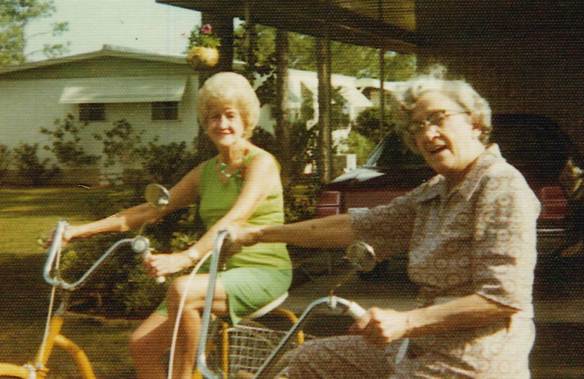
This photo is more how I remember Eloise.  She had downgraded from a motorcycle to a bicycle, but she is riding, coifed to the max, with her sister Mildred, in Florida.

After Warren’s death, Eloise remarried Al Rutland, “a younger man,” who outlived her.  The family liked Al, even if that younger man thing was scandalous.  Most of us cheered her on!  We figured at the pace Eloise lived, it took a younger man to keep up with her.  Eloise and Al were able to travel together and have much more of a normal life than she was able to have with Warren.  We were grateful Eloise had that opportunity.

Eloise and Al Rutland

In the photo below, Eloise is visiting with my parents.  Note the old wood shingled roof, the burn barrels and the outhouse behind the garage, complete with sidewalk.  That was life on the farm.

Eloise on the farm 1970s

Eloise was an amazing woman and died on June 5, 1996 in Lake County, Florida.  She was blind in her later years.

My memories of Eloise are of how sharing she was, and of how she was a woman born several decades before her time.  She was always positive and understanding of everyone’s differences.  She was an early supporter of women’s, gay and lesbian rights and equality for all, regardless of race or any other factor you could think of.  She could be comfortable around almost anyone, in any circumstances, and inspired everyone she met with her quiet solidarity.  She was indeed a shining example.

She mentioned to me one time that Curt, her father, brought the girls souvenir spoons home after he traveled, and she wondered out loud if one of those spoons might hold a clue to some genealogy question.  Her eyesight was failing, so I asked if she could have Al read me what was engraved on the spoon.  She said, “I’ll just send you the spoon.”

She not only sent he spoon, she sent her mother’s wedding invitation and a note from Nora’s Bible.  I’m not sure what Nora was trying to do, but it appears to have been done in 1890 and she was calculating ages, apparently.  Aside from Nora’s signature on her marriage application for McCormick, this is the only example of her handwriting that we have.

Nora Bible note

Note that while Nora shows Edith’s age correctly, in spite of the birth versus marriage date, she shows her own birth a year later than it was.  It’s possible that Nora never knew what year she was actually born.  Nora also thought Curt was born in 1860.  Eloise wrote her mother’s death date and initialed her work, ELC being Eloise Lore Cook.  That must have been a very sad day for Eloise.  It’s hard enough when it happens, but recording that death date in the Bible is so final.

Mildred Elvira Lore
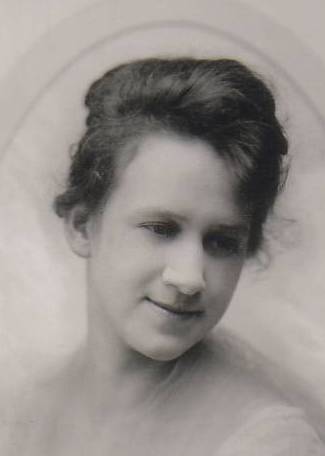
Copy of Mildred Lore

Mildred was the third child born April 8, 1899.  Mildred’s “first love,” a doctor’s son from Wabash, died during WWI, an event very difficult for Mildred to cope with.  Mildred would go on to marry Claude Martin on June 3, 1920 in Wabash, Indiana and live a long and happy life.  During their lifetimes, she and Claude would live in Indiana, Texas and Michigan, and possibly other locations.  They had 2 children, Jim born in 1922 and Jerry born in 1924.  Jerry died in 1954, and I have little information about his family other than he married Shirley and some of the photos with Eloise are with this family.  Eloise adopted people within the family, so perhaps she adopted Shirley and the boys as well after Jerry’s death.

Jim Martin eventually moved to Michigan, living in Drayton Plains and his daughters would include Judy who provided a large number of the Kirsch photos years ago, and Patty who contributed a number of Rushville photos.   I remember visiting Jim and his wife Inez with Mom in the 1980s.

Judy thought that there was a box of photos that had gotten drywalled into a closet in her parents old home.  We never were able to check, so some of our Kirsch photos may well be “archived” forever in a wall in Michigan.  Jim, Judy’s father, told me that there was a trunk of photos that got “pitched” when they moved and what didn’t get thrown away then, got thrown away in the next move to Roanne, Indiana.  I just felt sick.  I can’t bear to think about what might have been there.

Mildred and Edith about 1918

Mildred and sister Edith with husbands and Edith’s son, Lore, above.

Mildred and Claude Martin 50th anniversary

Above, Mildred and Claude Martin’s 50th wedding anniversary.

Mildred died on May 30, 1987 in Houston, Texas, living with her son.

Edith Barbara Lore

Edith as a child cropped

Edith Barbara Lore was the eldest child of Nora Kirsch and C.B. Lore, born in Indianapolis, Marion County, Indiana August 2, 1888.  Edith is my grandmother.

It appears that there is some confusion about Edith’s birth year.  Apparently either her mother was embarrassed about her birth not occurring more than 9 months after her marriage, or Edith was embarrassed about it.  The family story was that her birth had artificially been set back a year for insurance purposes.  Regardless, Edith was born in 1888, not 1889.  Apparently at some time she needed a delayed birth certificate and she didn’t realize she had been born in Marion County (Indianapolis), not in Rushville.

Edith married John Whitney Ferverda on November 17, 1908 in Rushville, Indiana.

Their life together would begin in Rushville, Indiana where he worked at the depot for the “Big 4” Railroad as the telegraph operator.

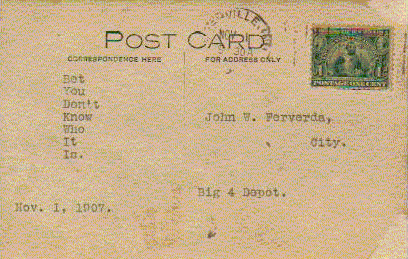
Edith umbrella postcard

The above photo of Edith was made into a postcard.  Here’s the back.

Edith postcard back

Apparently all of that flirting was effective.  They were married the next year.

The marriage license for Edith Lore and John Ferverda in 1908 was huge so I scanned it in halves and have “sewed” them back together digitally below.  He is a telegraph operator and she is a stenographer.

Lore Ferverda marriage application

By 1910, the census shows that Edith and John had moved to Lake Township in Kosciusko County, where Silver Lake is located.  His occupation is shown as a telegraph operator.

Edith young woman

Edith was truly a beautiful young woman.  I see mother’s eyes when I look at the photo above.

Edith was an unusual woman for her time as she worked her entire life.  During the depression, when John’s hardware business went belly up, it was her job that saved the family.  She lived with her grandmother, Barbara Drechsel Kirsch at the Kirsch House and attended business school in Cincinnati before her marriage in 1908 to John Ferverda.

The 1930 census shows John as a salesman for the Ford garage and Edith as the bookkeeper for the chicken hatchery.  They own their home, it’s worth $3500, which is more than most of the other homes, and they also own a radio which was quite the luxury.

Edith died in 1960, living her adult life in Silver Lake, Indiana.  This color photo of Edith and John was taken not long before she passed away.  This is how I remember her.

John and Edith 1959 standing

Nora after Rushville

Nora did not stay long in Rushville after C. B. Lore died.  In her 1913 photo, below, she does not look happy.  Of course, her husband had died and so had her daughter in 1912.

Nora Kirsch Lore 1913

Below, Nora is on the left in Florida with either her Aunt Lou Fisk or her Aunt Ida Kirsch on the right.  There was discussion of some property that was owned in Florida near a beach.  No one knows how or when it was disposed of, or even where it was.  Gotta love the hat!

Nora Florida

By 1920, Nora would be married to McCormick. Ironically, Eloise, who lived with the couple from the time she was 13 never said anything about this man.  Maybe she was practicing the old adage of “if you can’t say something nice, don’t say anything at all.”

We don’t know a great deal about Nora between 1920 and 1930, but we do have a few photos.

Nora 1920

Nora Kirsch Lore McCormick and Harold Lore Ferverda, probably about 1920 judging from his age.  I think my mother and her brother both inherited their noses from Nora.

I love the old car which was probably a new car then.

Nora 4 gen 1922

Four generation picture with Barbara Drechsel Kirsch (far right), Nora Kirsch Lore (far left), Mildred Lore Martin (center) and Jim Martin, infant, born in 1922, above.  This would have been about a year after Barbara sold the Kirsch House and moved north with her daughters.  I’m surprised at how much Nora doesn’t look like Barbara.

After that, Barbara would move to Wabash, Indiana, living with Nora in “the little house” as mother remembered it, and would pass away in 1930.

Nora 1923

Above, Nora Kirsch Lore McCormick, James Martin, Harold Lore Ferverda and Barbara Jean Ferverda in 1923.  Mom was 2 months old here.  Nora is obviously enjoying her grandchildren a great deal and below, enjoying her garden.  Her love of flowers is reflected in her quilts.

Nora garden

Maybe I received the gardening gene from her.  Flowers I love, weeds not so much, nor do I like pulling them.

Nora 1939

Dad (John Ferverda), Warren (Cook), Grandma (Nora), Me (Jean Ferverda), Mother (Edith), Eloise, Mildred, Jimmy (Martin).  At least Mom put these in a scrapbook and labeled them.  Thank you Mother!

Nora 1944

Mildred Kirsch Martin, Warren (Eloise’s husband), Jerry Martin, Eloise, and Nora.  Nora is beginning to look quite elderly here.  But everyone is dressed up, so this must have been some occasion.  Based on Jerry’s approximate age here of maybe 20, this was probably about 1944 and she would have been 78 years old.

Nora 1940s

This photo is Nora Kirsch Lore in her later years, in the 1940s.  She looks like she may have had dementia.

Nora, Mildred and Eloise

Mildred, left. Nora Kirsch Lore, seated, and Eloise, right.

Wabash

Nora Kirsch Lore McCormick moved to Wabash, Indiana first about 1916, then again between 1920 and 1930 because of Tom McCormick’s job.  Mom, born in 1922, remembers visiting her there when she was young.  Nora was a quilt maker, and it is here that she made the wonderful quilts that would eventually win a trip to the 1933 Chicago World’s Fair to represent the State of Indiana.  Mom said that the quilt frame would be lowered by pulleys from the ceiling to above the table in the dining room.  She said the house was quite small and this was the only way she could have enough room to quilt.  Mom would play under the table while Nora would quilt.

Mom and I went to Wabash, and Mom showed me the “little house” where Nora lived.  I don’t know if she owned or rented the house.  This is probably where she lived with McCormick, but I really don’t know.

Mother never said anything about him except that they weren’t married very long and that he left her when they lived in Wabash, but they never divorced.  Eventually Nora received word that he had died from one of his children from his first marriage.  However, he is in some photos that range apparently from the 1920s through the early 1940s.  Maybe he came and went.

Wabash noras

Back to Rushville

At some point, Nora moved to Lockport, NY to live with Eloise, where she passed away on September 13, 1949.  Her body was returned to Rushville, Indiana where she was buried by her first husband, C. B.  Lore.  According to her daughter, Mildred, she had specifically asked for the McCormick surname not to be put on her gravestone.  I’m not sure if that was where her heart was or not, but it is where she rests for eternity.  C.B. Lore may have been her true love, despite everything.

In the 1990s, Mom, Gretchen and I would revisit the area (in addition to Aurora) to see what kind of genealogical evidence we could find.  We had a difficult time finding the tombstones, but we were eventually successful.  The photos below were taken by C.B. Lore’s headstone when Mom was probably 28 or 29.

Mom Rushville 1940s

The grave looks fairly new in this photo, and this is Nora’s burial, so I suspect that Mom’s visit was shortly after Nora’s September 1949 death, perhaps in the spring of 1950.

The Payne family crypt is located in front of the stones, so getting a good photo is difficult.  However, it makes a great landmark when trying to find the stones.

Lore graves Rushville

Lore graves Rushville2

The 3 Lore family members in a row.  Note no grass on Nora’s grave.  This must have been a very sad visit for Mom  and her mother, Nora’s daughter, Edith.  At least she had Mom with her.

Rushville Payne memorial

The Lore headstones are to the left of the Payne memorial or mausoleum in the photo above.  It’s one heck of a lot easier to find the Payne building than the Lore headstones.

Nora Kirsch Lore stone

Nora stone with CB and Curtis

Nora is buried with her daughter and her first husband, C. B. Lore.  Her grave was difficult to find, because by request, her surname on the stone is Lore, but in the sextant’s book, she is registered as McCormick.  I found her by finding Curtis’ grave.

Curtis Lore stone

CB Lore stone

Nora’s Quilts

Nora was a master quilt-maker, a quilt-maker extraordinaire – and that’s not because she was my great-grandmother.  She truly was, as confirmed by the fact that her quilt was one that represented the State of Indiana in the 1933 Chicago World’s Fair.

There is absolutely no question about where my interest in needlework, lacemaking and quilt-making came from.  It’s ironic that this gift seems to have followed the direct mitochondrial DNA line.  Of course, mother’s do influence daughters, whether they realize it at the time or not – although my mother was not a quilter nor a lace-maker and neither was my grandmother.  I think they had to work too hard, for too many hours, to develop hobbies that were also time intensive.  They did not have the electronic assistants and time saving tools we have today.  Everything was done by hand then, from food growing to prep to dishes to sewing.

The Needlework

Kirsch lace collar

No discussion of the Kirsch women would be complete without mentioning their absolutely stunning needlework.  Barbara Drechsel’s and possibly Nora Kirsch’s lacework above and below.

Kirsch Lace handkerchief

It’s a tradition in our family that every female that marries selects one of the remaining lace handkerchiefs and carries in as she marries.

Barbara Drechsel Kirsch was a lacemaker, and her daughters likely learned the craft from the time they were young, at home as well as in the German schools.

Kirsch lace collar2

In 1994, mother and I were asked to create an exhibit for the Allen County Public Library that included both their needlework and a genealogical aspect of the history of the family.  The Allen County Public Library in Fort Wayne, Indiana is a nationally known and widely respected genealogical library.  Mother was particularly thrilled as so much of her family and her own personal history centered in and near Fort Wayne.

We titled the exhibit Six Generations of Hoosier Needlewomen and included lace works from Barbara Drechsel Kirsch, her daughters, including Nora’s wonderful collection of quilts, Edith’s work making doll clothes, Mother’s beautiful fine crocheting, my quilts, counted thread works and lacemaking, and my daughter’s  crosstitch. Of those 6 individuals, at least 4 are national level award winners.

Kirsch lace collar3

We displayed Nora’s quilts in a number of locations over the years. Rockome Gardens, an Amish village in Illinois was renowned for both their counted thread show and competition, as well as a companion exhibit for quilts a week or so later.

Mother particularly loved Nora’s Climbing Vine quilt.  Mom made an afghan that was similar, and I designed a counted thread piece in her honor that won the 1988 Embroiderers’ Guild National Event.  Below, my “Needlewoman’s Enchanted NeedleGarden” sampler is displayed in front of Nora’s Climbing Vine quilt, the inspiration for the sampler, at Rockome Gardens.

Needlegarden with Climbing Vine

Mother and I traveled to the Embroiderers’ Guild Awards Banquet in Louisville, KY as well as to Rockome where they displayed all of the related pieces together.  We thoroughly enjoyed those trips and our wonderful heritage.  How I wished I could have known Nora.  How glad I am that Mom and I did these things, together, while we had the opportunity.

Below, Nora’s Climbing Vine quilt, dated 1932, to the left, Picket Fence to the right and Mother’s Climbing Vine afghan in the center.

Nora's quilts and Mom's afghan

Nora’s Climbing Vine quilt was featured in the 1933 Chicago World’s Fair.  Unfortunately, we have no photographs of it at the fair, but Mother told the story of their visit to the fair to see her quilt.

Nora had entered the quilt in the local Sears competition, then it progressed to the regional and then the state competitions, finally winning and going to the World’s Fair.

The depression was in full swing, and money was scarce.  The family could not afford to go for an overnight to Chicago, so they got up very early and left from Silver Lake, Indiana with Nora and the entire family packed into an old black Model T Ford.  They drove to the World’s Fair, took their food and picnicked, and the entire family saw the quilt hanging in its splendor in the exhibition hall.  Then they drove the entire way back home, arriving in the middle of the night.  All in all, the trip was about 24 hours in duration.  The photo below is Mom, me and my daughter at a quilt exhibit with Climbing Vine.

Climbing vine family photo2

Nora was 66 years old when she created this World’s Fair award-winning quilt.

climbing vine quilt

This work is all hand appliqué with fine hand quilting.  Everything in Nora’s quilts was done by hand, including the piecing.

Needlewomen display case

The photo above is from the Six Generations exhibit and it shows my lace in a tray, center, Mom’s crocheted afghan and baby booties, rear, a table runner made by the Kirsch sisters that mother displayed on the piano and some lace in the far right corner.

Needlewomen display case2

This photo shows Mother’s crocheted afghans, shawls and table covers, the doll clothes made by Edith for Mother, embellished handkerchiefs, and beautiful, but tiny, crocheted gloves.  Those Kirsch women had tiny little hands. Nora’s hands were so tiny she had to step on her thimbles to bend them to keep them on her fingers.

The quilt below is called Picket Fence.  Mom also referred to it as Flower Garden.  I always particularly liked this quilt, as it reminds me of the perfect family that everyone wants, and doesn’t exist anyplace.  But the beauty within our family is nurtured and grows within the white picket fence.  This quilt is dated 1931.  The fence is hand pieced, the flowers are appliquéd and the entire quilt is hand quilted with small, fine stitches.

Picket fence quilt

This red and green quilt below, sometimes called the Christmas Tree quilt, was made by Nora, as were the rest of the quilts here.  This quilt was on Mom’s bed for years. Mom said that it was on the bed in Silver Lake too, and when her parents passed away, other people were interested in the “show quilts,” but no one was interested in the ones used for bedding, so Mom took them.  I have very fond memories of this quilt.  Can you find the “error”?  Quilters have a proverb that one cannot make a perfect quilt, because only God is perfect. Some quilters will intentionally introduce an error in the pattern.  I don’t need to do that.  I make plenty of mistakes without trying.  I don’t know if Nora was aware of this or not, but the proverb is not a new one and is not of the current generation, so it is likely she had at least heard it.  Today, that’s “our excuse” when we make a mistake.

This quilt’s colors are known as “depression green and depression pink” in the antique fabric world.

Nora's pink and green quilt

The yellow and white quilt below reminds me of sunshine.  This nine patch and snowball block quilt was never used.  Before Eloise passed away, she sent this to Mother, along with some other needlework and family items.  I’m sure that Mildred would have had some quilts as well.  I wonder what hers looked like.  This quilt was made in 1927 or 1928.

Mom told me that when she went to visit Nora in the little house in Wabash, that she had a large quilt frame set up.  All of these quilts are hand quilted and hand pieced.  I can’t think of a better way to spend retirement – creating family heirlooms and memories.  Those scalloped edges are quite difficult.  Nora would have been about 61 when she made this quilt.

Nora's snowball quilt

The oldest quilt is shown In the photo below, a crazy quilt made at least in part by Carrie Kirsch, age 11, is shown hanging on Mom’s quilt rack that was behind the couch.  Carrie (Caroline Kirsch) was 11 in 1884, so this quilt is almost 125 years old.  Unfortunately, the quilt is now in very bad repair.  From this we know that the Kirsch girls were quilting at the Kirsch House and they started as children.

Kirsch crazy quilt

The quilt below, although it looks pathetic, is one of my all-time favorite quilts. This quilt, without the handkerchiefs, was the quilt that was always on the bed in Kokomo, on the farm.  I slept under it, my kids slept under it, and we used it on the couch for a couch quilt.

All those years, I never really knew about Nora, but I knew that this particular quilt had seen so much within our family and was a constant companion and continuous source of comfort.  Mom washed it several times, and over time, it began to deteriorate with use.  It was well loved.

Not wanting to throw it away, Mom asked me if I could make something out of it, like maybe teddy bears for the kids.  I told her I surely could, and took the quilt home to give it yet another life as teddy bears.  I told the kids.  They cried and cried.  My daughter said, “you can’t cut up Mawmaw’s quilt.”  Little did they know it was Mawmaw’s Mawmaw’s quilt.  I really didn’t know what to do, but clearly, I could not do what we had planned without causing my children permanent psychological trauma.

There were actual holes through the quilt, so I had to find a way to reconstruct some fabric and restuff parts of it with batting.  I remembered my grandmother’s handkerchiefs, safely tucked away for some wonderful future project.

The future had come. I took the Kirsch and Lore women’s handkerchiefs and used them to create fabric for the old much-loved quilt.  I gave the quilt back to Mom, and it served another decade or two before retiring permanently.

Ironically, when I go to quilt shows and tell this story, everyone loves to look at and discuss the beauty and history of Climbing Vine and Picket Fence, but this is the quilt that makes everyone smile…and cry.

Handkerchief quilt

Quilting was obviously a very important part of Nora Kirsch Lore’s life.  Her quilts are her legacy that she passed to us, through the two intermediate generations.  Quilters say that wrapping up in a quilt is like a hug from the quilter.  Thank you so much Nora.

Not only did I receive 12.5% of Nora’s autosomal DNA, her mitochondrial DNA and the quilting bug, which I am attempting to pass on to the next generation, I received so much more.

Through her quilts, Nora triumphs above the finality of death and reaches across the generations and decades to touch us with the beauty and warmth that her hands and heart created.  Even some 66 years later, I can still have a hug from Nora, an ancestor who died before I was born..  I wonder if she knows how much her legacy is cherished.

______________________________________________________________

Disclosure

I receive a small contribution when you click on some of the links to vendors in my articles. This does NOT increase the price you pay but helps me to keep the lights on and this informational blog free for everyone. Please click on the links in the articles or to the vendors below if you are purchasing products or DNA testing.

Thank you so much.

DNA Purchases and Free Transfers

Genealogy Services

Genealogy Research

Genetic Genealogy Has Come of Age

sweet 16

And we didn’t even have a party…no Sweet 16 party…no turning 21 inaugural trip to the bar. It happened when we weren’t looking.  Sometime pretty recently.

In the Beginning…

When I first heard about DNA testing for genealogy, back in 1999, it didn’t even have a name.  Today it’s known as genetic genealogy, but before that, Megan Smolenyak Smolenyak, one of the early pioneers in this field, about the year 2000, termed it genetealogy.  This was shortly after DNA testing first entered the consumer market space.  That name didn’t catch on.

I had already entered the world of genetic genealogy through mitochondrial DNA testing.  This was about the time I heard about Y DNA testing and suspected it might be a scam – like those bogus pedigree charts sold back in the 1970s and 1980s.  I did some research and called Family Tree DNA.  Bennett Greenspan, the President of the company, called me back, at 9:30 at night and we talked for an hour.  As our discussion progressed and I understood more about Y DNA testing and how it really was applicable to genealogy, I told him I was interested in setting up a surname project for the Estes line, but I was concerned that I didn’t have enough knowledge of how genetic genealogy and the Family Tree DNA website worked to do it justice.  Bennett told me that with my background, I’d be fine and that he would help me if I needed it.  My, how far we’ve come.  And talk about famous last words!

No one knew about DNA testing for genealogy at that time.  And I do mean no one.  Every person I approached to test was skeptical and most of the initial testers tested because they knew and trusted me.  Sadly, many of those folks are gone now.  Thank Heavens they tested when they did, because now would be too late and several were end-of-line people.

Within a couple of years, there were 2 or 3 of us doing DNA for genealogy presentations.  Even as little at 5 or 6 years ago, one had to beg for a spot on a conference schedule for DNA testing.  Today, there are entire DNA tracks at almost every conference and even entire events focused on genetic genealogy, with many speakers to choose from.

Genetic Genealogy Grows Up

Fast forward to 2015.  John Reid at his blog, Canada’s Anglo-Celtic Connections, has been doing the Rockstar Genealogist voting now since 2012.  Is it a popularity contest of sorts?  Sure.  But, to me it’s much more important than that, and it’s not about who wins individually.  It’s about the fact that we’re all winning.

Last year, in 2014, I really, really wanted to see a genetic genealogist in the winners circle.  Until recently, few traditional well-known genealogists had incorporated genetic genealogy as a standard tool, with Megan being a notable exception.

On the other hand, there were several folks who defined themselves as primarily genetic genealogists, myself included.  It was time for genetic genealogy to become an adult – to join the rest and sit at the big table. I think we arrived.

In order to help things along a bit, I offered a donation to the War of 1812 Pension fund if any genetic genealogist was in the finals.  Indeed, genetic genealogy was quite well represented in the finalists, and not just in the genetic genealogy category either.

However, the evidence that genetic genealogy has finally matured and come of age is that it has become the norm, and not the exception.  Today, very few genealogists don’t know about genetic genealogy now – and even if they are living under a rock and haven’t yet participated, they at least know it exists.  Most genealogists have participated at some level.

When I spoke years ago and asked how many people had tested in a room full of people, a few hands would be raised. Now it’s more like 50% and in many locations, more.

But the real evidence is held in this year’s 2015 Rockstar results.  Yes, there are genetic genealogists well represented again in the winners circle – several of us.  I’m extremely grateful for the level of recognition for DNA testing – because media coverage of any form lends a level of legitimacy and encourages new people to test.  Positive exposure of any sort is wonderful, as is individual recognition.  Genetic genealogy, more than traditional genealogy, is a group, collaborative effort – so we need more testers.  The more people who test, the more walls will fall.

The Devil in the Details

But to me, the real message is buried in the details.  I was thrilled, overjoyed, to see the details.  What details, you ask?

There were a total of 2026 people who voted in John’s poll this year, and of those people, 57% of them listed themselves as genetic genealogists.

FIFTY SEVEN PERCENT!!!!!

That’s not 57% of the people who have heard about genetic genealogy – that’s 57% of the genealogists who also consider themselves genetic genealogists.  They are actively using genetic genealogy in some capacity as a tool for their genealogy.  These are genealogists incorporating genetic genealogy, not a separate group of “DNA people” running around with missionary zeal carrying DNA swab kits and asking everyone their name and where their grandparents were from!

I still remember getting stopped by the Texas State Trooper after one of the Family Tree DNA conferences in Houston and after looking at his badge, quizzing him as to where his family was from.  He decided I was either harmless or crazy and sent me on my way.  He declined to swab but I gave him my card just in case he changed his mind one day!  Imagine the story he told back at the station about the “crazy DNA lady!”  Now the crazy DNA lady is part and parcel of every genealogist – at least 57% anyway.  Hopefully that percentage will grow to 100% shortly.

Red Letter Day

Genetic genealogy is no longer separate or different or “odd.”  Not an outlier anymore, but part of the norm.  A mandatory piece of the puzzle.  In fact, as Judy Russell said, in her article, “DNA, coming on strong,” “it’s part and parcel of what every genealogist should be doing.”

Judy also tells us in her article that Thomas W. Jones, co-editor of the National Geographic Society Quarterly, stated that Y, mitochondrial and autosomal DNA testing should be part of what every genealogist does to capture their family story.  Every genealogist.  Not some and not just 57%.  Indeed, this is a red letter day!

Indeed, DNA testing is due for the Sweet 16 party.  It has survived and emerged a lovely flower, blossoming and coming entirely into its own – with the entire genealogy world realizing what kind of a unique gift every one of us has – directly from our ancestors.  And hopefully, with each individual realizing that the way to harness this energy is to test and to share those results along with the rest of our genealogy.

Every genealogist should test their Y (if a male) or find a male to represent their paternal line, test their mitochondrial DNA for their matrilineal line, and test their autosomal DNA.

Document DNA as an Integral Part of Family History

After you are done testing yourself, look around for who in your family carries Y or mtDNA that represents ancestors that your own DNA doesn’t reveal.  For example, your father’s mitochondrial DNA is not your mitochondrial DNA (because males don’t contribute mitochondrial DNA to their offspring) but his mitochondrial DNA provides the story of his mother’s matrilineal line.  Dad already gone?  Did he have siblings?  Test them, and while you’re testing their mitochondrial DNA, test their autosomal DNA as well.

What you are doing, in essence, is creating a DNA pedigree chartWikiTree provides tools that combine pedigree charts and DNA testing so that this information is available to descendants.  So, while you are providing information, you stand to harvest a lot more than you’ll ever provide.  Think about it.  You can contribute but one Y (if a male) and one mtDNA line, but you have many ancestors whose information you can gather as their direct linear descendants test.  Here’s an example of my chart with the haplogroups of my oldest ancestors noted if I have that information.  And if I don’t have it, guaranteed I’m looking for it!  All of this ancestral information except that of my red circle great-great-grandmother came from other people because I don’t carry their Y or mtDNA.

DNA Pedigree

Lastly, I would strongly encourage every genealogist to test the oldest family members autosomally, even if their Y and mtDNA lines are already tested and represented.  Not one of them, all of them.  They have each inherited different DNA from their, and your, ancestors.  Once they are gone, there is no further opportunity – a part of the history of your ancestors will depart with them and there will never be any way for you to recover what is lost.

So test.

Test everyone!

Test now!

While you can.

Build and preserve the genetic part of your family history that you can obtain no other way!

______________________________________________________________

Disclosure

I receive a small contribution when you click on some of the links to vendors in my articles. This does NOT increase the price you pay but helps me to keep the lights on and this informational blog free for everyone. Please click on the links in the articles or to the vendors below if you are purchasing products or DNA testing.

Thank you so much.

DNA Purchases and Free Transfers

Genealogy Services

Genealogy Research

Hannah Mercer (c1740-c1773), Died at 33, 52 Ancestors #89

Hannah Mercer was the daughter of Edward Mercer who made his will on September 25, 1762, although it wasn’t probated until December 1, 1763.  In his will, Edward left several items to daughter Hannah.

“I give and bequeath to my daughter Hannah Mercer five pounds and five shillings worth of Puter the same being now in her possession. And also one bed and furniture thereto belonging likewise I give to my said Daughter Hannah Six head of young cattle the same being now in her possession which said cattle shall be kept on the plantation until they be three years old.  I also give her a side sadle and the Keeping of her mare on the plantation whilst she continues unmarried.”

The wording is a bit odd, with the phrase “being now in her possession” seeming to hint that she does not live with her parents, and therefore might be married.  But Edward refers to her as Hannah Mercer, not by a married name.  Edward, however, removes all doubt about her marital status in the last sentence where he says “whilst she continues unmarried.”

Edward also left Hannah his plantation if his sons Edward and Aaron were to die without issue.  One of the reasons this is so unusual is that Edward Mercer (the father) had another son, Richard, and another daughter, Elizabeth.  Typically all the males would come before a daughter in an inheritance situation like this, but in this case, no.  As it turns out, it didn’t matter because Edward and Aaron did not die without issue or before their father.  Still, this must have made Hannah feel very good. It perhaps speaks of a close relationship between Hannah and her father.

It was previously thought that Hannah married William Crumley in about 1761, because their oldest son, James was born in the 1763/1764 timeframe.  If James was born in that timeframe, then it looks like Hannah married sometime after Edward wrote his will in September 1762 and before the 1763/1764 birth, so Hannah’s mare didn’t stay on her father’s plantation very long.  Hannah clearly wasn’t married in September of 1762, nor, apparently, was a wedding imminently planned.

Hannah’s Childhood Years

The wording of Edward’s will, plus when Hannah began having children would suggest Hannah’s birth about 1740-1742.  We don’t know positively where, but we do have an important clue, although it needs to be confirmed.

Hannah’s youngest brother, Aaron Mercer, fought in the Revolutionary War.  His papers where he applied for a land grant reportedly stated that he was born in Ireland, although I have been unable to verify that actual information.  http://www.fold3.com does not have Aaron’s paperwork and service records, although he very clearly served because he is mentioned as an officer in several other veterans pension applications.

In Aaron’s paperwork, he doesn’t dirctly give his birth year, but working backwards, genealogists have surmised that he was born about 1746. If this is the case, then Hannah would have been born in Ireland as well.  It’s difficult to resolve Ireland and Quaker but we do know that several Quaker families left England and went to Ireland before coming to America.  James Crumley may have been part of this group, and Edward Mercer may have as well.  If Edward Mercer were Scotch-Irish, he would have been Presbyterian and if he were Irish, he would have been Catholic.  However, Edward Mercer is living dead center in the middle of the Quaker community.

Hannah’s mother, Ann was living at the time Edward made his will.

We know that the Mercer family was living in Frederick County in 1759 when Edward Mercer was on the Frederick County, VA rent rolls.

Edward received a land grant in 1751 and another in 1760.  The 1760 grant was located at the head of Babb’s Great Meadow adjoining Babb’s Mountain.  Babb’s Mountain (red balloon) wasn’t far at all, just a little over a mile, from Apple Pie Ridge Road where James Crumley, William Crumley’s father, lived, just north of White Hall.

Babbs Mountain

Unfortunately, we don’t have any marriage information for Hannah Mercer and William Crumley.

What information we do have is that William’s wife was positively named Hannah, based on her signature on deeds, and their son was named Aaron Mercer Crumley.  The middle name Mercer continued to be passed down this line to future generations as well.

Their Home

After Hannah and William were married, they lived on the land that William Crumley bought from his father, James, in 1757.  This land was part of the large land grant obtained by James Crumley and the southern 200 acres of that grant purchased by William spanned the Virginia/West Virginia border, right under that “10 min” sign below.

James Crumley land spanning border

On the map above, William’s land extended south of the border on 51/2, but they lived on the Berkeley County, West Virginia side of the border.  We know this because William’s will was probated in Berkeley County, not in Frederick County. William’s father, James, lived at what is now 3641 Apple Pie Ridge in Frederick County.

While looking for something quite different, I stumbled across the probable location of William and Hannah’s home.

I was able to find William Crumley’s land on an 1890 map by following the ownership of the Francis Silver land, as stated below:

Francis Silver acquired the William Crumley land in two tracts. The first tract of 62 acres before 1820. He built the beautiful brick house in 1821. The 1820 land book lists no house. The 1822 lists $1,000.00 added for improvements added last year. He purchased the larger tract from Abraham Waidman in 1829 (DB lost). In 1836 Francis Silver sold the brick house with 275¾ acres to his son Zephaniah Silver who had married Martha Jane Henshaw April 17, 1834. They kept the plantation until after the Civil War and sold in 1868 for $12,000.00 to John Hershey. John Hershey sold the house with 197 acres for $5,000.00 to Andrew B. Houck and Samuel Garver. May 1, 1876 (DB 73, p. 275). Samuel Garver and A. B. Houck sold in 1880 to J. R. Brown and Robert M. Brown (DB 77, p. 119, page 259). Joseph R. Brown sold his half interest to Robert M. Brown in 1885, who sold the same year to Charles G. Boyles and James K. Boyles for $8,100.00. Charles G. Boyles sold his half interest to James K. Boyles in 1919. James K. Boyles died in 1932 leaving all his estate to be divide equally between his children (WB 27, p. 386). Daughter Maggie R. Busey died in 1951. The heirs of James K. Boyles sold to James A. Lockard in 1959 who gave a Deed of Trust to Darrell K. Koonce.

On the following 1890s map, you can see the location of J. Boyles home at what looks like the headwaters of Mill Creek, just north of the border of Berkeley County and Frederick County, on the road that today leads to Gerrardsville.  You can also see North Mountain, an important landmark, to the left.

Berkeley county 1890

On these satellite views, you can see the same road today.  The house on the map above is about half way between the dog leg in the road north of the house and the state line ot the south, between the creek and the road.

On the map view of the area, you can see the same dog leg in the road and today, there is  Mt. Pleasant Cemetery, shown in green, across from this area.  The location of this cemetery surely makes me wonder if this was William Crumley’s family cemetery and if he and Hannah are buried here.

William Crumley land map

Moving to the satellite map, you can see the farms in that location today.

William Crumley land satellite

Moving a little closer.

William Crumley land satellite 2

Moving even closer you can see that there is a working farm in this location.

William Crumley land satellite 3

Unfortunately, there is no street view of this area.  The address of this property today is 3647 Dominion Road.

William Crumley farm today

This looks like the original structure.

William Crumley farm home

Children

Hannah Mercer and William Crumley (the first) had five children:

  • James Crumley born about 1763/1764, married Mary Stonebridge by whom he had children, and then second to Elizabeth Downey. James died in Frederick County, VA after 1830.
  • Ann Crumley born about 1766 married Thomas Reese, had 9 children, and died on August 29, 1819. Ann had three daughters, Hannah, nancy, Rachel and Sarah.
  • William Crumley (the second) born about 1767, married an unknown wife and moved by 1796 to the frontier of what would become Greene County, Tennessee that year. He married for a second time in 1817 to Elizabeth Johnson in Greene County and moved about 1820 to Lee County, Virginia on the border with Claiborne and Hawkins County, Tennessee, where he died about 1839.
  • Catherine Crumley was born about 1769/1770 and married James Mooney and then John Eyre. She had daughters Catherine, Mary (Polly), and Eliza by James Mooney and daughters Hannah and Nancy by John Eyre. Catherine died on December 20, 1857 in Fayette County, Ohio.
  • Aaron Mercer Crumley was born Oct. 22, 1771 in Frederick County, VA. He married Jane Atherton on February 3, 1796. They had 10 children. It appears that Aaron first lived in Greene County, Tennessee and probably migrated with his brother, William (the second), as 8 of his children were born there and the youngest two in Ohio. Aaron died on August 18, 1835.

Hannah’s Death and William Crumley’s Remarriage

We don’t know for sure when Hannah died, but we do know that it was before William’s marriage to Sarah Dunn.  In 1774, after Sarah’s marriage to William, the Hopewell Friends disowned Sarah for marrying out of faith.  They first summoned her on August 1, 1774 to explain herself, which probably wasn’t long after her marriage.

Sarah Crumley Hopewell

They petitioned her again in September and October, but Sarah never explained herself.  The explanation was obvious.

Sarah Crumley Hopewell2

This tells us two things.  One, Hannah died sometime between Aaron’s birth in late 1771 and William’s marriage to Sarah in mid-1774, and it also tells us that William wasn’t Quaker at that time, in 1774, and so Hannah likely wasn’t Quaker either.  At one time, both William and his father, James, had been Quaker, and are mentioned as such in the Quaker minutes in 1759.

Ironically, Hannah’s father was Quaker too, and he was mentioned in those same records in March 1759, but in very much of a different light.

Edward Mercer Hopewell

Apparently Edward decided not to appear, so they discussed the issues without him being present.

Edward Mercer Hopewell2

Was Edward Mercer being thrown out of the Quaker Church a family scandal?  Was his drinking a scandal?  What did his wife, Ann, do when this happened?  Did she and the children continue to attend the Hopewell Friend’s Meeting, or were they too embarrassed?  Or was she angry and decided to attend elsewhere?  I would love to have been a fly on that wall!

Hopewell Meeting House

Were William and Hannah married as Quakers at the Hopewell Meeting House (above) sometime around 1763?  Were they converted as a couple outside the faith.  Was Hannah not a Quaker after 1759 and William defected when he married Hannah, in effect thrown out of the church at that time?  If so, why are there no records?  Maybe he just decided to stop attending.  So many questions.

If Hannah was a Quaker when she died between 1771 and 1774, then she is likely buried in the Hopewell Meeting Cemetery, shown below.  Otherwise, she would have been buried in a family cemetery, possible the one across the road from where she and William lived.  If she did die in childbirth, then the child was buried with her as well.

Hopewell Cemetery

Given that William Crumley would have had 5 children under the age of 10 when Hannah died, I’m guessing he was not single long. He would have remarried as soon as possible, and his second wife, Sarah, inherited 5 children immediately, and then added another 10 to their family.  She gets my nomination for sainthood!

How agonizing for Hannah to know she was dying and leaving her children, and there was clearly nothing she could do about it except pray that her husband would marry another woman who would love her children – or at least not be mean to them.  I can only imagine how a mother would feel leaving such young children motherless.

Hannah’s oldest 2 or 3 children may have remembered her.  My ancestor, William, born about 1767 or 1768 may have remembered her vaguely, depending on when she died. He would have been between the ages of 3 and 7.  In other words, the only mother most of Hannah’s children ever knew was Sarah.  Hannah must have loved Sarah from the other side for loving and caring for her children.  There was never any hint of conflict in the court records between the children of Hannah and Sarah, or between Hannah’s children and Sarah.

Given this situation, my best guess would be that Hannah died in 1773 having another baby.  The timing would be right given Aaron’s birth in late 1771 and William’s remarriage in 1774.

Regardless of what took Hannah’s life, it was horribly sad, because she was a woman in her prime.  If she was born about 1740, she would have been about 33 when she died.  Much too young and certainly not taken by anything “normal.”  Sadly, deaths in childbirth were much too common at that time.

DNA

The closest thing we had to proof that Hannah, William Crumley’s wife, was Hannah Mercer was the fact that their son, Aaron Mercer Crumley was named after Hannah’s brother, Aaron Mercer.

However, with the advent of DNA testing, I match multiple descendants of Edward Mercer through son Moses at Ancestry, and have other Mercer matches at Family Tree DNA.

Ancestry Mercer Match

We now have confirmation through matching and triangulation that William Crumley’s wife Hannah was indeed Hannah Mercer.

We know nothing more about Hannah, unfortunately, but since she did have daughters, if we could find a descendant who descends from Hannah through all females to the current generation (which can be male), we could obtain a sample of Hannah’s mitochondrial DNA, which would tell us about her deep ancestry.  That would be wonderful gift and is information not available any other way.

Mitochondrial DNA is passed from mothers to all of their children, but is only passed on by the daughters and is not mixed with the DNA of the father.  Because if this, we get the opportunity to “see” the DNA of the direct matrilineal line without dilution.  Through that, we can tell where in the world Hannah’s direct matrilineal ancestors came from.

If someone does descend from Hannah through all females to the current generation, please let me know as I have a DNA scholarship waiting for the first person.  If someone does test, I’ll post the results here – otherwise, we’re still waiting.

______________________________________________________________

Disclosure

I receive a small contribution when you click on some of the links to vendors in my articles. This does NOT increase the price you pay but helps me to keep the lights on and this informational blog free for everyone. Please click on the links in the articles or to the vendors below if you are purchasing products or DNA testing.

Thank you so much.

DNA Purchases and Free Transfers

Genealogy Services

Genealogy Research

Elizabeth “Probably Not Webb” Estes (1715/1720-1772/1782 ), Wife of Moses, 52 Ancestors #86

Moses Estes Sr. did us a huge favor.  Both of his wives were named Elizabeth, so when he was an old man, he didn’t have any “jealous wife” memory type issues when he mistakenly used his first wife’s name in a fit of pique (or a fit of whatever) when talking to his second wife.  That’s a good thing, because indeed, he was an older gentleman when he married the second Elizabeth, Elizabeth Talbot, a widow, and he had a lot of years experience having said “Elizabeth.”  The favor he did was to tell us when, exactly, he married the second Elizabeth.  In 1782, they had a prenuptial agreement which was filed with the court.  How’s that for ahead of your time!

However, it’s the first Elizabeth I’m interested in, the mother of Moses’s children and specifically, my ancestor, Moses Estes Jr.

Was Elizabeth a Webb?

We’re actually fortunate that we know the first Elizabeth’s first name.  It’s her last name that is in question.  However, if you take a quick look at the Ancestry trees for Moses Estes, born in 1711 and who died in 1787, you’ll find that the majority of those trees list Webb as her last name, or mistakenly list Elizabeth Jones Talbot, Moses’s second wife.

Those same trees will list another tree as a source…and so it goes.  Around and around.  For the record – we don’t know the first Elizabeth’s last name.  It’s a myth – but a myth that might have a source.  You see, there was a reference to a record…someplace.

I have to confess here, I’ve never seen the original record, BUT, someplace, I have seen a researcher’s notes referring to a land record that included Moses Estes and a male Webb.  That researcher had made the “connection” that because Moses Estes bought or leased land from the Webb male, that the Webb male was Moses’s wife’s father.

A leap of faith you say?  Yes, a leap of something, that’s for sure.  But, it could be true and it’s a place to begin further research…if I could only find that doggone reference.

But the problem is that I’ve lost the reference and I don’t remember where I saw it…other than it was in someone’s handwritten notes years ago.  I remember thinking to myself “that’s it??!!!”  That’s how someone connected some extremely tenuous dots that Elizabeth’s surname was Webb?  I remember being incredulous and thinking that there was surely more.  Then, in the 1980s, a historical novel was released that included the Estes family, and Elizabeth’s name in that novel was Webb too.  The deck was stacked at that point, and in the annals of mythology, and online trees, Elizabeth’s surname became Webb and took on a life of its own.

I’ve pulled every record I have in this house, and didn’t find that reference.  Now I’m doubting myself.  Did I even see it?  Did I dream it?  Does it exist at all – even the researcher’s note?  And if that researcher’s note exists, does the real record exist?  As many Virginia records as I’ve extracted, I’ve never come across an Estes/Webb transaction and neither has my cousin, the retired lawyer who extracted half of Virginia for Estes names.  OK, that’s an exaggeration, probably not half, just the early counties, but still, she doesn’t have it in her records either.  Of course, not everyone extracts EVERY record by that surname.  Some people are sane humans and only extract their own line’s records.  So, if that happened, maybe Moses’s record was overlooked by other researchers.

So, if you happen to come across any Virginia land record of a Webb and an Estes – or any other record, for that matter, of a Webb and an Estes between about 1730 and 1770 or so, please, PLEASE send it to me complete with the reference and source.  I promise, I will never, ever, lose it again.

Because, you know, Elizabeth’s surname actually might be Webb, but I can’t research it any further until I find that doggone slippery reference that I know I saw at one time or another.

So, if we don’t know Elizabeth’s last name, what do we know about her?

Life in Virginia

We first find Moses Estes as an adult in Hanover County in 1734.  He would have been age 23 at that time, and he was purchasing land jointly with his brother Robert and his other brother John served as a witness.

In 1736, Moses patented land adjoining his brother’s land.

In general, men did not purchase land before they married, so it’s quite likely that Moses was married about 1734 to a local gal from Hanover County, the area that would become Louisa and then Amelia as new counties were formed.

Elizabeth’s son, William was born sometime between 1735 and 1740, so Elizabeth was probably born in 1715-1720 or maybe even slightly earlier.

In 1742 Louisa County was formed and the Estes lands fall into this county.  That’s a very fortunate turn of events, because Louisa County records exist where most of Hanover’s have been destroyed.  Unfortunately, the Hanover records that might include a marriage document, or estate documents for Elizabeth’s parents, are gone.

We know, due to later deeds, that Moses lived in an area between Contrary and Northeast Creeks in Louisa, later Amelia County, between the red arrows.  It was here that Elizabeth had her children and raised her three young boys.

Louisa Northeast Contrary Creeks

1742 is also about the time that Elizabeth’s son John was born.  Son Moses Jr. was born about that time as well. Elizabeth and Moses were probably just like all other pioneer couples and had a child every 18-24 months for as long as the female was fertile, which would have been until about 1755-1760 for Elizabeth.  However, we only know of three sons.

The transaction that tells us Elizabeth’s first name is a land sale in Amelia County in 1751 in which Elizabeth, wife of Moses, relinquished her dower right in the land.  Dower right in Virginia meant that if a man died, his wife was entitled to one third of his estate by right of dower.  The husband could not relinquish his wife’s dower rights, so she had to sign to relinquish those.  Typically, the wife was “examined separately” from her husband, so the husband could not influence her answer.  Of course, she had to go home with her husband, so I’m not sure how effective asking the wife privately if she relinquished her dower actually was.  Can’t you just imagine that ride home, had the wife said, “no” that it wasn’t by her own will that she was signing away her dower rights?  How many ways can you spell ugly??

A great many deeds don’t have this additional signature, and I know of one case where the man sold his land and died a couple years later.  The wife then sued the purchaser for her one third of his land and won.  Not only that, but she got the third with the house in which she was living at the time.  One gets the idea that maybe she didn’t know her husband sold the land they were living on, especially since it was a mortgage that defaulted, which is how the sale came about – through the default to the mortgage holder.  In that place and time, the mortgagee signed a deed that the mortgage holder redeemed if they defaulted.  That kind of situation, is, of course, exactly the reason that the wife had to sign, and woe be unto the buyer that doesn’t see to that detail.

In 1758, Elizabeth and Moses are living in Amelia County and the French and Indian War is in full swing.  The House of Burgesses passed an act for the defense of the frontier and we find Moses, John and William Estes of Amelia County on the roster.  These young men are probably still living at home, as they were late teenagers or in their early 20s and not yet married.

This list suggests that perhaps Moses Jr. was the youngest of the three sons and not quite old enough to serve with his father and older brothers.  He probably felt very left out and I’m sure he did not want to be left at home with his mother as his father and brothers got to ride off to war and do all of those “exciting” grown-up manly things – at lease from Moses Jr.’s perspective.

I’m sure Elizabeth was glad to have a son remain at home.  He may have been too young to ride with the men, but he was certainly old enough to provide some protection, farm labor and partnership to his mother.

Moses Sr. is mentioned in the court minutes and deed books from time to time, but another decade would pass before we hear from Elizabeth again.  In 1768, Moses Jr. sells the land he had purchased from his father-in-law, John Combs’, estate and that sale is witnessed by his father and mother, Moses Estes Sr. and Elizabeth.

By 1768, Elizabeth had attended the weddings of all three of her sons, had gained three daughter-in-laws and had at least half a dozen grandchildren to enjoy.

An Uncomfortable Juncture

In 1769, Moses Sr. filed suit in Amelia County against his brother, Elisha, surrounding his father, Abraham’s, estate distribution – never mind that Moses’s father died more than 48 years earlier.  This may be the worst case of procrastination I’ve ever seen.  Or maybe, a long-festering boil erupted between the brothers.

I suspect that when one person in a household does something that dramatic, it is reflected via the domino effect to the rest of the family members too.  This was probably a highly emotional time, with depositions, threats and high drama.  It’s hurtful to think or know that your sibling betrayed and cheated you.  Whether it was true or not, it surely appears that Moses believed it to be true.  Elisha, in essence, in court documents, called Moses a liar, another upsetting turn of events.  Moses surely paced and swore and cried, if he let Elizabeth see his tears.  It’s hard to be the one betrayed.  And either he was the one betrayed, or he was the betrayer.  Either way – a family ripped apart.  You know Elizabeth’s household was in a state of upheaval as these unpleasant events unfolded like layers of an onion.

Elizabeth’s three sons were married and had families of their own by this time.  They may have been living with Moses and Elizabeth, or on their property, or nearby.  If Elizabeth and Moses had other children, they would still have been at home.  Elizabeth probably tried to function normally, attending church and other normal social functions of the day.  But, assuredly, Elisha’s wife and children were there too.  Not only would this suit have divided the family, it likely divided the community as well.

Maybe this court suit and the level of discomfort it caused had something to do with why Elizabeth and Moses moved to Halifax County, taking all three of their grown sons and their families along.  Maybe they were trying to put the lingering past behind them with a new beginning.

On to Halifax County, VA

By 1771, the family was moving to Halifax County and Moses Sr. bought land just west of South Boston on the Pole Bridge Branch of Miry Creek.

Moses Estes land aerial

In 1771, Moses sells his land in Amelia County and once again, Elizabeth relinquished her dower rights and signs with an X, which tells us that she could not write – and probably could not read since the two tend to go together.

However, they may not have moved right away, because in January of 1772, Moses (of Amelia County) sells to William Estes (of Amelia County) 100 acres of his land in Halifax County.  Elizabeth signs this document as well.

We know that Moses was living in Halifax County by this time or very shortly thereafter, because in March of 1772, the court authorized paying him as a road hand for building a bridge across Burches Creek, near his land.

Later in October of 1772, Moses sells the balance his land in Halifax County to his 3 sons and Elizabeth does not sign, so her death may have occurred between January and October of 1772. Given that we know that Moses owned the land on Pole Branch, and he is buried there himself, it’s very likely that Elizabeth is buried in the Estes Cemetery on that land as well.

Estes cem box elders

Or, did Elizabeth not sign because the deed was to her sons and she (and they) saw no need for her to go to the courthouse to sign?

Given that Elizabeth’s death seems to have occurred after Moses sells his Amelia land, it’s most likely that Elizabeth did make it to Halifax County, but possibly, just barely.  Did she ever get to live in this house that Moses built?

Estes Osborne home

We don’t know for sure that Elizabeth died in 1772, but we do know for sure she had died by 1782.  Elizabeth was not an old woman.  If she was born in 1715, she would have been 57-67 and if she was born in 1720, age 52-62.  She may still have had older children at home.  If there were no other living children, then she had likely buried 6 or 7 of her children, or maybe more – and then left their graves behind when she moved to Halifax County.  I can’t even begin to imagine that heartache.

Elizabeth may have lived long enough to see the Revolutionary War which began in 1775.  In 1778, the focus of the fighting shifted to the south, including Virginia.  She certainly lived through the ramping up process that led to that war which was focused on resistance to taxes imposed by England on the colonies which the colonists felt were unjust.  All men paid taxes and I’m sure it was the hot topic of conversation for months and maybe years before the war actually began.  Halifax County was involved in the fighting by 1780 and 1781, and it’s quite likely that Elizabeth’s son Moses’s land was used as an encampment by soldiers.  Elizabeth’s grandson, George fought in that war.  Did he come to tell his grandmother goodbye before he left, if she was still living at that time, or did he visit her grave one last time?

If Elizabeth didn’t die before 1780, she would have buried her adult son, William, in the family cemetery on Grubby Road in Halifax County.  About that same time in 1780, son John left with his family for the Holston River in what is now Tennessee.  At that time, Tennessee was not yet a state and that area was unsettled and wild frontier, with settlers still skirmishing with the Indians.  Once a family left, it was forever.  No one came back.

I hope that Elizabeth did not have to bury her son.  1780 would have been a year of terrible loss for her.  When a grown child left for parts unknown, not only did they leave, but they took with them the grandchildren and the only form of communication was an occasional letter – if that – assuming people could read and write.

Men, in that timeframe, did not remain single for long – so it’s possible that Elizabeth did live to see 1780 – and it may have broken her heart.  She was assuredly resting in the cemetery, beside son William, by 1782.

In 1782, Moses remarried (with that prenuptial agreement) and 5 years later, Moses was dead, probably buried beside his first wife Elizabeth and his son, William, in the cemetery on his property.  In fact, it appears that Moses second wife predeceased him, so it’s entirely possible that Moses lies between the two Elizabeths. If a man ever had to behave, he does!

I found Moses’ land in the early 2000s when I visited Halifax County several times, working on the various genealogy records in the courthouse.  Based on the land records and following them forward in time, I was able to locate Moses’s original land, with the help of a couple of wonderful cousins, an incredibly patient and generous landowner and some unimaginable good luck.  I think Moses and Elizabeth were helping me!

Moses Estes cemetery

I wonder how long Elizabeth lived on this land.  Did they live in the house Moses built, or did she die while they would have been living in a cabin.  Was the cabin they lived in first the cabin that sat back on the hill where John, Moses and Elizabeth’s son, eventually lived before he headed out for the frontier in 1780?

Estes clearing

There are so many questions and so few answers.

Elizabeth’s Children

Elizabeth had the following known children.  I’ve always suspected that she also had some daughters, but to date, none are known.

Elizabeth’s sons are as follows:

1. The oldest son born to Moses and Elizabeth was probably John, born between their marriage and 1742, or so. We don’t know the year for sure, but what we do know is that John’s eldest son, Abraham, born in 1764, gave the following testimony when applying for a Revolutionary War pension.

“I, Abraham was born in Amelia County, Virginia.  My father moved from there to Halifax, Va. where he lived until the fall of 1779, where he moved to the Holston River until 1780.”  After that they removed to Warren Co., KY.

John Estes married Elizabeth Chism, daughter of John Chism and Elizabeth Gillington.  She was remembered in her grandfather, Nicholas Gillington’s will in Halifax County in 1772.  John Estes died in 1824 in Warren Co., KY.

2. Another son, Moses Jr., was born about 1742 or maybe slightly earlier, married Luremia Combs about 1762, whose father, John Combs also lived in Amelia County. Moses Jr. bought land in Lunenburg County from his brother-in-law after John Combs death, but moved with his father, Moses Sr. to Halifax County about 1770 where they both spent the rest of their lives.  He died in 1813 with a will.

Moses had a son, Moses (the third), who was born between 1775 and 1780 in Halifax County and died in 1875 in Smith County, TN, per the probating of his will in 1875.  And no, those dates are not typos.  He married Selah Palmer.  To the best of my knowledge, this is the only grandchild of Elizabeth whose photo we have.  Most of her grandchildren died before the camera was in wide use, after the Civil War.  Moses (the third) lived to be over 100, as did his brother George Estes as well as George’s son, John R. Estes.  Longevity runs in this family.  I look at this man and wonder if he looks anything like Elizabeth and Moses Sr.

Moses Estes 1779-1875 m Selah Palmer

John R. Estes, my ancestor, below, would have been this man’s nephew.  John R. and his father, George, both also lived to be around 100, as have several of their descendants.

John R. Estes restored

3. The third son of Moses Sr. and Elizabeth, William Estes, was also born in the same 1735-1740 timeframe. William married Mary Harris.  He died in 1780 and his estate was probated in Halifax County, VA.  Family legend says that he was a drover of horses and drove them to the East coast being gone for long periods of time.  He apparently had what was probably an appendicitis attack and became very ill.  His wife was sent for, but she was days away and did arrive, but William had already died.  Mary brought his body home and buried him in the family cemetery.

DNA

Unfortunately, DNA won’t help us with Elizabeth in this circumstance, at least not directly or immediately.

It’s ironic that the one trait that has a huge potential to affect my life, that of longevity, is most likely genetic, yet, we can’t identify that gene (or genes), nor do I know if I carry it.  We do know that several people downstream of Moses and Elizabeth lived to the age of 100, and a few slightly older.  Two of my aunts and my grandfather are in that group – so I potentially could carry the Estes longevity gene.  We also don’t know where it came from – meaning from Moses’s or Elizabeth’s family.  All I do know is that Moses’s father’s line does not seem to be responsible for the longevity gene – but we know nothing about Moses’s mother nor Elizabeth’s family.

Elizabeth’s mitochondrial DNA is dead to us unless she had daughters that we don’t know about – and they turn up “proven” in some fashion.  I do find it hard to believe that only three sons survived from a marriage that would have produced children for more than 20 years – so at least 10 children and quite possibly more.

Of course, another avenue to find Elizabeth’s mitochondrial DNA would be through her sisters, or her mother’s sisters, if they have any descendants through all females – but of course – I’d have to know who her parents were to identify her siblings, or her mother’s siblings.

I have looked at my autosomal DNA results for Webb, but without knowing the name of the man I’m looking for, I can’t pinpoint anything obvious.  Perhaps I should create a “Webb” tree out of my matches trees and see what turns up the most “close” to me since I carry less of the ancestor’s DNA than the generations that are further upstream than I am.

Although since I’m not even sure I have Webb ancestry, those people with Webb in their tree could be solely circumstantial.  Webb is not an uncommon surname and it is a Virginia family in close proximity with all of the other early colonial Virginia families – so possibly and probably intermarried.

Right now, my only hope against hope is for an Ancestry NAD – New Ancestor Discovery.  As upset as I was that Ancestry gave me an ancestor that wasn’t mine who hung around for months before disappearing, and has now reappeared, I’d be very interested in a Webb NAD – because that might be possible and I could then at least attempt to convince my relevant NAD matches to download their result to GedMatch where I can view the matching DNA segments to see if they triangulate.

Having said that, it would be my luck that I’d get a NAD that really looked to be “real” but wasn’t.  However, it I had a NAD, I could at least then attempt to work with the results.

However, regardless of how much I wish for a Webb NAD, it’s probably too far back time.  Initially Ancestry was planning to reach back 10 generations in time.  Elizabeth’s parents would be 9.  However, when the NADs and Circles were released, Ancestry was only reaching back 6 or 7 generations.  In some cases, for DNA Circles, I believe this has been expanded by maybe one generation or two, but not to 9 or 10 – at least not yet.  But I’m still hoping that Ancestry reaches back more generations as they become more confident and refine their new features.  I’m also hoping for a Webb NAD and praying for Ancestry to add a chromosome browser so I don’t have to try to convince my matches (it’s so unbecoming to beg) at Ancestry to transfer to Family Tree DNA and/or download to GedMatch.

While I’m wishing, I’d like for Family Tree DNA to add tree matching as well.  They already have the chromosome browser feature and trees, so tree matching would be a very logical follow-on step.  And from there, maybe ancestor predictions???

We are truly DNA and genealogy junkies aren’t we!  Anything to find those elusive ancestors.  I just want to know if Elizabeth is a Webb, and if not, who is she???

______________________________________________________________

Disclosure

I receive a small contribution when you click on some of the links to vendors in my articles. This does NOT increase the price you pay but helps me to keep the lights on and this informational blog free for everyone. Please click on the links in the articles or to the vendors below if you are purchasing products or DNA testing.

Thank you so much.

DNA Purchases and Free Transfers

Genealogy Services

Genealogy Research

Sallie, Sarah or Mary maybe Coates (c1740 – 1782/1787), Mystery Wives of the Reverend George McNiel, 52 Ancestors #85

Sometimes when we get back to these end-of-line females, their genealogy facts become very tenuous, and we find that we are missing more information than we have.

Sarah Coates, at least we think that the names of Sarah and Coates or Coats go together as one person, was married to the Reverend George McNiel.

She may or may not have been his first wife, and for all we know, Sarah and Coates may not have been the same woman.- although we don’t have any reason to think otherwise, well, except for that pesky little death and taxes issue.  Yes, death and taxes still “get you,” even in genealogy!

Let’s take a look at what we do have.

Joyce Dancy McNeil, now deceased, was a cousin to me on two different lines, McNeil by marriage through her husband, historian George McNeil and through the Wilkes County, NC Vannoy lines in her own genealogy.  Joyce was an extremely thorough genealogist and I was so glad to find her early in my searching.  Sadly, by the time I was able to visit Wilkes County in 2004, Joyce had passed on.

Joyce and George had researched the McNeil family extensively.  I was confused because some researchers listed the Reverend George McNiel’s wife as Mary and some as Sarah.  Joyce told me that there was a deed in Spotsylvania County, VA that George McNiel witnessed, as did a Mary McNiel.  Researchers presumed that Mary was George’s wife.  Indeed, she may have been, but there is no proof of that.  It would be interesting by process of elimination to see who else Mary could have been at that time.  Unfortunately, that deed is not included in the book “Spotsylvania County, 1721-1800, Being Transcriptions from the Original Files,” so I have been unable to verify this information.

To the best of my knowledge, no one has completely extracted the Spotsylvania County records for McNiel, and this should be done.

Unfortunately, we don’t know where they lived in Spotsylvania County.

The next information comes from a letter written by George’s grandson in 1898.  In the letter, he says that George McNiel married a “Miss Coats” in Virginia.  Another source, a pamphlet written in 1905 to commemorate the 100th anniversary of the Reverend George McNiel’s death (and setting of his headstone), says that marriage occurred in Grayson County, which wasn’t formed until 1793, long after George would have been marrying Miss Coats if she is the mother of some or all of his children who were born between about 1757 and 1782.  In the 1750s, when George would have been marrying, that area, now Grayson County, would have been Augusta County.

It’s also reported that George fled into Grayson County, VA for safety in 1771 after scuffling with the Regulators and after the battle of Alamance.  It was additionally stated that he lived in Moore County, settling there in 1745-1750.  Again, Moore County, North Carolina wasn’t formed until in 1784 from Cumberland which was formed in 1754 from Bladen.  The problem is that we have records for him in Spotsylvania County during this time.  In fact, as late as 1775 he was still purchasing land in Spotsylvania County.  He sold his land in Spotsylvania County in 1778, but unfortunately, his wife did not release her dower rights and sign as well.  For us, that’s a significant lost opportunity.

We do know through church records that George was in Grayson County, but that was in 1800 when he was clearly traveling and ministering as a circuit riding minister.

Joyce also said there was evidence that George’s first child was born before his arrival in America.  If this is true, then that child’s mother clearly did not survive until the end of George’s life.  However, if her name was Mary, and she preceded “Miss Coates” who George is reported to have married in Virginia, then this may be true.  The problem is, of course, that we don’t know when George married Miss Coates so we have no idea which of his children might have been by a first wife, Miss Coates, or yet another wife.

The first child we have any record of is Mary, born in 1757, but how that birth date was attributed to Mary, I have no idea since there seems to be very little information about her.  In the book, Genealogy of the McNiel Clan written by the Johnson Hayes, published in 1934, Mary is shown as being born in 1771 and as having married in 1803 to Henry Miller, but no birth date or other information for Mary is given.

What I do know is that our first record of George McNiel is in Spotsylvania County, in 1757, so we know he was here in the colonies by that time.  Whether he was married upon arrival, or if his first child was born before arrival or in transit, we don’t know.  Daughter Mary was reported to have died in 1850, but I can’t find her in the census.

There is reason to think George may have had three wives, or, I hate to even suggest this out loud, because I do NOT want to start a rumor, but George could have had 4 wives.  Let’s look at the evidence and hints.

In 1782, in Wilkes County, there was a bill of sale between John Stubblefield and Jacob Nichols that was witnessed by George and Sally McNiel.

Miss Coates first name may have been Sarah, known as Sally.

On the Wilkes County 1787 tax list, there were categories for a number of things, including the number of white females.  That number was 0 for George, as it was three years later, in the 1790 federal census.  George’s first wife, whatever her name, had died after the birth of her last child in 1782 but before 1787 and George was single for at least three years, from 1787-1790.  He obviously remarried sometime between 1790 and June 1805 when he died, because he had a wife, Sarah, living at the time of his death.

In 1808, William McNiel was administering the estate of both George McNiel and his wife, Sarah McNiel.

So, what do we have here?

  • A possible wife before coming to the US, who could be the Mary who witnessed a Spotsylvania County deed that reportedly exists but that I can’t find.
  • A marriage, possibly in Grayson County, to one Miss Coats.
  • A possible wife, Sally, in 1782.
  • No wife in 1787 or 1790.
  • A wife, Sarah, at George’s death in 1805, who died by 1808.

Clearly, in my case, the woman I’m most interested in is the one who was the mother of my ancestor, William McNiel, born about 1760.  Given that this is before George is apparently preaching and traveling, I’m guessing that William’s mother would likely be Mary in Spotsylvania County, assuming Mary was William’s wife – and I’m not at all sure that is a valid assumption.  It’s no wonder that so many descendants have simply given this woman the name of Mary Sarah” or “Sarah Mary” Coates and let it go at that – never mind that it’s very likely wrong on at least two if not three counts.

One thing is clear, William’s mother is not wife Sarah who died just after Reverend George died in 1805, and whose estate was being probated in 1808 – because this wife Sarah was not married to George in 1787 or 1790.  In fact, George could easily have married a Sarah Coats in Grayson County after 1790 when we know he was in fact there preaching.  But why, if this is the case, would that be the only wife his descendants mentioned and not the mother of his many children?

I surely wish this story didn’t have so many “could haves” and questions – but sadly, that is all that I do have or even might have.

Why didn’t any of George’s descendants think to add this tidbit of information – George’s wife, his helpmate?  Even if George had only two wives, or three, or even four – it’s still remarkable enough to talk about.  I find it rather unbelievable that George’s descendants could not even remember the first name of “Miss Coats.”  Lastly, this woman (or women) deserves a medal, not have their names forgotten, because the wife is the one who maintained everything at home while George was out and about preaching, saving souls and founding new churches.  And that wife, if she was a second or third wife, was likely raising his children from previous marriages in addition to her own.

How many children did she bear in his absence, and was she even able to obtain the assistance of a midwife?  Who would have ridden for the midwife, if George was gone?  While the traveling preacher tends to be venerated, in this case, at least, it’s the name-forgotten wife who stayed at home and held everything together without the assistance of her husband.  She should be celebrated.  She is the unsung heroine of the story.  The fact that her name has been forgotten just makes the irony even greater and the story sadder.

We know that George and his then-current wife had children from around 1757 until the last child was born in February 1782 – although there is a very large gap between Mary born in 1771 and Thomas born in 1782 which could potentially alert us to the death of a wife and a remarriage.  It could also be that several children died, or George was gone much of the time.  It was about 1776 when Baptists began to be allowed to preach freely, which corresponds with the time in which the family legend claims he was ordained a Baptist minister.

We know that George and his wife lived on Lewis Fork Creek, right across the road from where the Elder George McNiel Cemetery is located today.

Elder George McNiel gravesite

This satellite image shows the location in more detail, but the cemetery is not visible from the road and a local person would have to be a guide.

Elder George McNiel gravesite satellite

When historian George McNiel and I visited this cemetery in 2004, George told me that the Reverend George McNiel and his wife lived directly across the road from the cemetery, in a cabin behind the house that belonged to his granddaughter – which was  in ruins with only the chimney standing in 2004, below.

George McNiel land

As we walked George’s land, this misty apparition appeared in a clearing.  Was George or his wife or maybe his granddaughter with us that day?

George McNiel granddaughter land

George’s wife did pass away before 1787, leaving him with this child who was still either an infant or a toddler plus 4 additional underage children, not to mention the older ones still living at home.  This must have been a terribly sad day in the McNiel cabin on Lewis Fork Creek.  George must have wondered what he was going to do.  It’s actually amazing that he did not marry for more than 3 years.  I would wager that his older married children took the younger ones to raise.  He certainly couldn’t do that while visiting, circuit riding and establishing churches throughout the region.  Not to mention, by 1802, George was also the register of deeds for Wilkes County.

Even though her grave is unmarked, George’s wife, mother of his children, probably Sallie, is surely laid to rest in the McNiel cemetery located on George’s land, near where George himself was laid to rest as well, some 20 years later.

George McNiel cemetery2

Today, the cemetery is overgrown and it’s not evident from any distance that it is a cemetery.  At least the cattle aren’t, or weren’t, allowed to graze in the cemetery.

George McNiel cemetery

As you get a little closer, you can make out the ghostly shapes of the abandoned monuments.

George McNiel tombstone

In addition to the Elder George McNiel, whose stone, set in 1905, a hundred years after his death, is shown above, several generations have been buried here as well, including son Thomas born in 1782 and several of Thomas’s children.

However, there is one thing we know, concretely, about George’s wife – she was a Baptist – at least eventually.  We have no records of George preaching in Spotsylvania County, but records abound after 1779 – which is while George’s wife was still alive.  In fact, based on the 1782 deed, her name was likely Sallie.

After all of this thrashing around in the mud is done, we actually know very little.  We’re still not sure of George’s wife’s name.  We’ve introduced even more questions in an already tenuous situation.  No one is going to thank me for this article:)

Aside from extracting the Spotsylvania County records, which is now on my to-do list, how else could we unravel this riddle?

DNA

Finding people who descend through all female lines to DNA test is sometimes difficult due to all of the generational name changes.  However, it has been successfully done in other lines, so it’s not impossible

Mitochondrial DNA is passed from mothers to all of their children, but only passed on by the females.  So, anyone who descends from the wife of George McNiel through all females will carry her mitochondrial DNA.  In the current generation, the descendant can be either a male or female.

If we were able to test mitochondrial descendants of the daughters of George McNiel, we could verify that they were all born to the same mother.

Unfortunately, my first problem is that I have no information about the eldest daughter, born in 1757, no information about the children of Elizabeth McNiel and what information I do have about Polly is that she had 4 sons who would not have passed on her mitochondrial DNA.  Not looking good so far, but maybe there is more information to be had, currently unknown – and maybe it will be the descendant families that provide the info.  Fingers crossed.

  • Mary Hillary McNiel born 1757 – no further information and it is unknown if this information is accurate or if this person even existed. If so, Hillary could be a family surname.
  • John McNiel born 1759 married Fanny Cleveland.
  • William McNiel born 1760/1761 died circa 1832 in Claiborne Co., TN, married Elizabeth Shepherd (my line).
  • James McNiel born circa 1763 died August 1834, married Mary “Polly” Shepherd.
  • Benjamin McNiel born 1765 married Elizabeth Lips.
  • Joseph McNiel born 1767 died circa 1855 married Hannah Wilson and Elizabeth Powell.
  • Elizabeth McNiel born about 1767 (per an 1857 deposition where she says she is 90 years old when applying for her husband’s Revolutionary War pension and bounty land in Watauga Co., NC,) married in 1785 to Robert Bingham in Wilkes County, NC. Children unknown.
  • Mary “Polly” McNiel born 1771 married Henry Miller in1803 in Wilkes County. Four known sons.
  • Thomas McNiel born February 1782, died 1865, married Miss Parsons.

George McNiel was a minister.  I can’t believe that his Bible hasn’t turned up in the descendants someplace, complete with a list of wives and children.  You KNOW he had at least one Bible, and probably multiples.  Maybe he wore them out!

Grandchildren

No pictures of George McNiel’s children exist, but there are two photos of his grandchildren.

The Reverend James McNiel, below, born in 1816, was the son of Joseph McNiel and Hannah Wilson.  Joseph was the son of Rev. George McNiel and whichever wife, probably Sallie, he was married to in 1767 when Joseph was born.

James McNiel

A second grandson is also memorialized by a photograph.

George W. McNiel, Sr. was born in 1825 and died in 1914.  He is buried in the Elder George McNiel Cemetery and was the son of Thomas McNiel, born in 1782 and a Parsons woman.  His father, Thomas was born in February 1782, the son of Reverend George McNiel and probably the Sallie who had died by 1787.

George W. McNiel

A third grandson, Elijah McNeill, son of James McNeill is shown below, courtesy of his descendant, William McNeill.

Was George, above, holding a Bible, maybe his grandfather’s Bible? What other book would be important enough to include in a “formal” dress up picture?

Elijah McNeill grandson of rev George

Did any of these grandsons look anything like either the Reverend George McNiel or his wife, whatever her name?

My ancestor, William McNiel, was born about 1760, so he is most likely to share a mother with James McNiel born in 1763 or Joseph McNiel born in 1767 than with Thomas born in 1782 – although all three of these men could clearly have shared the same mother.

We don’t have the answers to all, or even many of these questions today, but maybe, just maybe, someday we will.

______________________________________________________________

Disclosure

I receive a small contribution when you click on some of the links to vendors in my articles. This does NOT increase the price you pay but helps me to keep the lights on and this informational blog free for everyone. Please click on the links in the articles or to the vendors below if you are purchasing products or DNA testing.

Thank you so much.

DNA Purchases and Free Transfers

Genealogy Services

Genealogy Research

Mary Harrold (c 1750-1826), “Fly Me Back to Sweet Old Ireland,” 52 Ancestors #84

Mary is one of those ancestors whose life, what we know if it, is told mostly through the lives of those around her – specifically, her husband and children.  We don’t know who Mary’s parents were and were it not for one court note in particular, even her name would only be found in legend.  In this case, the legend of her name and the name Mary in the court notes match.

Mary was the wife of John Harrold.  She was born sometime around 1750, probably someplace in Virginia, and she died in 1826 in Wilkes County, North Carolina.

Based on a combination of the birth year of her son, John, based on census records and his tombstone, we know that Mary had at least one child by 1782, which puts her birth year at 1762 or earlier.

A potential record that mentions one Mary and John O’Harrell in Botetourt County suggests she may have had two children older than John.

The Botetourt County court record on March 11, 1779 tells us the following:

“The court doth allow Mary O’harrell, wife of John O’harrell, a soldier in the Continental Army, 30 pounds for the support of herself and two small children.”

Based on records of soldiers who served, there was no John O’Harrell and there was only one John Harrold or any similar surname who served from Botetourt County.  That would be Mary’s husband John  – so it’s likely that the John and Mary mentioned in 1779 are our John and Mary.

We know from John’s service record that he was discharged in June of 1779 after serving for 3 years, so his service began in June of 1776.

If Mary has two small children, we can presume they have been married at least 5 years, so that would mean they were married before 1774.  If the two children were born before he left in 1776, then they were likely married by 1771 or so, pushing Mary’s birth year back to about 1750 or slightly thereafter.  John is believed to have been born about 1750 based on these same records, so her birth about the same time makes sense.

If this is the case, then Mary has become nearly destitute by March of 1779 and had to rely on the county for money.  This may well imply that either her family was not from Botetourt County or they were gone, or destitute as well.

If this is our Mary, we don’t know who these two children are.  There is no document that gives us a list of her children, and the ones we do know are based on a variety of circumstances, not the least of which is that John Harrold is the only Harrold male in Wilkes County after he appears there around 1800 – so emerging children of that surname would be his.

We find John Herrald on the 1790 census for Iredell County, NC, but his wife’s age is only given as a hash mark in the “free white females” category.  By 1790, they had 3 males under 16, 1 male over 16 (John) and 4 females.  Six children means they have been married about 12 years, more or less, so by 1778 or earlier.  Given that John was gone for 3 years, followed by another 18 month stint in the army, they were probably married 4 years or so earlier than the 2 years multiplication by child suggests, so by 1774 or so.

Given that John’s discharge in 1779 says he is going home to Botetourt County, we can probably presume that is where they lived before the war, and likely where both families were from.

The challenge is that John’s Y DNA doesn’t match the other Harrold (by any spelling) families in Botetourt County.

So, given that we have all of our proverbial ducks in a row, we know the following:

1750ish – Mary born

1774 – Mary married by this date, possibly as early as 1771, possibly in Botetourt County, VA

June 1776 – Mary’s husband leaves for the War from Botetourt County

March 1779 – Mary obtains assistance from the county for herself and 2 children.

June 1779 – John is discharged after 3 years service and returns home.

1780 – John enlists for a second term in the Revolutionary War in August, leaving Mary at home with 2 small children and probably pregnant for another child.

1782 – John is discharged in February, returning home to Botetourt County just in time for spring planting.  Mary must be extremely relieved.

1782 or 1783 – son John Jr. is born in Virginia.

About 1784 – Mary has daughter Sallie.

1785 – John and by inference Mary are on the Iredell County, NC tax list.

About 1785 – Mary has daughter Elizabeth.

About 1785 – Mary has son Alexander.

1790 – Mary and John are living in Iredell County, NC according to the census and have 6 children.

About 1790 – Mary has son William.

About 1790 – Mary has daughter Charlotte.

1794 – Mary and John have probably moved to Wilkes County, because John is mentioned in the court notes regarding a transaction with one Robert Powers involving 75 pounds of indigo.  This was not registered in court until 1804, so they might not yet have lived in Wilkes in 1794.

1796 – John files in Wilkes court against one Thomas Adams against whom he obtained an execution order in Iredell County.  They do live in Wilkes County by now.

1797-1799 – Mary’s son, John, married about this time.

1800 – Mary and John are enumerated in Wilkes County in the census under the surname Harral.

We know that in 1790, John and Mary have 6 children, 3 boys and 3 girls, the boys being under 16.

In 1800, their children are reported as:

  • 1 male under 10 (William born about 1790)
  • 1 male 10-15 (Alexander born about 1785)
  • 2 female 16-25 (Charlotte, Elizabeth and/or Sallie)

We show three females in 1790 and I have three daughters listed, but only two are shown here and none are known to have married until after 1800.  So, there is a discrepancy.

In 1790, their son, John Jr., is living next door and is listed as age 16-25, putting John’s birth between 1775 and 1784, which is consistent with the information we already have.  He has a wife and one female child, suggesting they have been married between 1 and 3 years.

Both John and Mary are over the age of 45, which means they were both born before 1755.  Given that Mry’s youngest child, William, was born about 1790, Mary could have been born slightly before 1750.  Women often bore their last children at the age of 42 or 43.

1801 – John patents land on Harrold Mountain

Harrold mountain

1803 – Daughter Elizabeth married Reuben Carter whose land abuts that of John Harrold, at least until Reuben loses his land.

1805 – Mary’s daughter Sallie marries Jessie Turner before 1805 and they leave for Breathit County, KY.

1806 – Mary’s daughter, Charlotte, married Koonrod Dick.  They were in Simpson Co., KY before 1825.

1809 – Mary’s son, William and Mary McDowell, daughter of their neighbor, are married by Jacob McGrady, the Baptist preacher.

1810 – Son William departs for Claiborne County, TN.  This is likely the last time Mary sees her son, although she lives another 16 years.  She probably never meets any of her grandchildren by William.

It must have pained Mary greatly to see her children marrying and leaving Wilkes County, one by one.

1810 – The 1810 census shows John Harrold, with one male living with him, age 16-26, plus his wife.  Both John and Mary are shown as over age 45.

1812 – Mary’s son, Alexander marries about this time and shortly thereafter, leaves for Breathit County, KY.  This is likely the last time Mary sees Alexander.  She likely never sees any of Alexander’s children either.

The 1820 census reflects John and Mary’s age the same way.  Now John and Mary are living entirely alone, all of the children gone and married.  They are living beside John Herrald Jr. who has 9 people in his family and one slave.  These grandchildren, Mary probably sees daily!

John Sr. dies in 1825 and Mary follows in 1826.  We know Mary’s name, positively, because of an allowance made to her in January 1826 from John’s estate, which was probated in October of 1825.  However, by October 1826, just a  year after John’s death, Mary’s estate sale was held – so she died sometime between January and October of 1826.

I hired a historian to retrieve John and Mary’s estate inventory and sale information, both, from the North Carolina archives in Raleigh, with absolutely no luck.  I know they existed at one time because they are referenced in the court notes complete with book and page number – however – Wilkes County says they no longer have any of those records and they are at the archives in Raleigh, and Raleigh says they never received those books from Wilkes.  And then there are those persistent rumors that the staff decades ago in Wilkes County decided to have a bonfire with the old records that no one would need anymore.  This just kills me, because Mary and John’s estate inventory would give us the most personal glimpse of their actual lives that we could get from the vantage point of where we sit today, 190 years removed – unless there is an unknown family journal or Bible hanging around someplace.  And I’m not holding my breath for that.

One of my close friends and I were discussing a week or so ago how much our descendants would be able to tell about us personally if they were building the scaffolding of our lives from only public records.  She and I concluded that while they would find the “big pieces” so to speak, like birth, marriage, death, children’s births, and moving – they would never know anything about us personally.  Meaning what we are like.  No one would know that I love color, for example, whether it be in summer flowers or quilts.  That I hate to cook, love dark chocolate, and do quite a bit of charity work.  They would have no idea of my profession, my career, my education level, my degrees or my political or religious leanings.  All of those things that make me uniquely me would be absent.  However, if they had an inventory listing from my estate sale, there would at least be clues.  I so wish we had Mary’s estate listing.

Mary is credited with saying that when she died, she wanted to be put up on the bluff on top of Harrold Mountain so that she could fly back to sweet old Ireland.

Harrold Mountain bluff

Since she doesn’t have a marker, perhaps they did.  Harrold Mountain bluff is shown above.

John Harrold burial

Mary is likely buried beside John Harrold, her husband, on Harrold Mountain.  Furthermore, we know about where that is, and she is either buried under the chicken house with John (above), or she is buried with son John in the Harrold/Brown Cemetery.

Brown Harold cemetery after

Perhaps old John is buried with John Jr. in the same cemetery, shown on the map below on Harrold Mountain.

Brown Harrold cem

Given that both sons William and Alexander leave Wilkes County, it makes sense that John Jr. would obtain William’s land upon his death.  It looks very much like he did, in part because John is buried on the land Old John owned.  So, it’s entirely possible that John Jr. lies in the same cemetery with both of his parents.  In that time and place, that’s quite unusual – often generations didn’t stay in the same place long enough for multiple generations to live, grow old and pass on.

I’ve tried to reconcile the census documents with John and Mary’s children, reconstructed from the records we do have:

Name/Birth 1779 1790 census 1800 census Other
2 children in court record 3 boys under 16, 3 girls 1 m<101 m 10-152 f 16-25
Child born before 1779 per court record Possibly James in 1805 record
Child born before 1779 per court record
John/1782-83 Age 8 Living next door Birth year of 1783 on tombstone
Alexander/c 1785 Age 5 Age 15 1850 census says he was born in NC in 1785
William/c1790 Newborn 1790 Age 10 In 1855 deposition, William says he is 65 years old, in 1850 census, says he is born in NC
Elizabeth/c1785 Age 5 Age 15 Married in 1803
Charlotte/c1790 Newborn or born after census Doesn’t work based estimated birth year of 1790 and 1800 census Married in 1806.
Sarah/c1784 6 16 Married before 1805

Note that a James appears once in an 1805 Wilkes County record, but never appears again. If this James is John’s son, then he would have had to be one of the two oldest children AND living on his own or not in John’s household by 1790.  Unlikely, but not impossible

These birth years are all estimates, with the exception of John whose birth year is on his tombstone and in the 1850 census, and William who gives his age in a deposition and in the census as well.  Other birth years are estimated by marriage date which is estimated by the age of the oldest child when not available in official records.  Long way around, I know.

The bottom line is that Mary and John are one child short in 1800, but for all we know, one of the daughters was living elsewhere.

Mitochondrial DNA

To the best of my knowledge, no one who descends directly from Mary through all females has yet DNA tested.  These people would carry Mary’s mitochondrial DNA.

Mary reportedly had three daughters.  However, there is some discrepancy in the 1800 census when only two daughters are shown.  Of course, one could have been slightly older, one could have been visiting or living with a relative – we don’t know.

However, if people who descend from either 2 or 3 daughters test, and their mitochondrial DNA which would be descended directly from Mary match each other, then we now they share a common ancestor.  There is always the possibility as well that Mary was not John’s only wife.  There could have been 2 different Mary’s as well – the one in 1779, assuming that is the right family, and the one who died in 1826.  There is no oral history of anything like this, but it’s always a possibility.

Secondly, we could tell a lot about Mary – meaning her haplogroup and where her closest matches are found in the world.  In other words, we could probably confirm that Mary was indeed Irish!

If you descend from Mary Harrell through all females to the current generation, where either males or females will work, please let me know.  There is a DNA testing scholarship waiting for you!

Mary’s female children are as follows:

1. Sarah or Sallie Herrell, born about 1784 and married Jesse Turner about 1805  in Wilkes County. They moved to Breathit County, KY and had daughters:

    • Susannah born about 1806 – nothing more known
    • Elizabeth “Mama Bets” born February 1813 and married her first cousin, Thomas T. Herrell. They had daughters Sarah born in 1841, Elizabeth born in 1845, Nancy born about 1846, America born in 1850 and Jemima born in 1852.

2.  Charlotte Herrell born about 1790, married in 1806 in Wilkes County, NC to Koonrod Peter Dick. They moved to Simpson County, KY and had daughter Mary Dick. They probably had other children as well, but I have found no records.

3.  Elizabeth Herrell born about 1785 married Reuben Carter in 1803 in Wilkes County. They moved on to Maury County TN and then, reportedly, to Crawford County, MO. Nothing is known about their children.

______________________________________________________________

Disclosure

I receive a small contribution when you click on some of the links to vendors in my articles. This does NOT increase the price you pay but helps me to keep the lights on and this informational blog free for everyone. Please click on the links in the articles or to the vendors below if you are purchasing products or DNA testing.

Thank you so much.

DNA Purchases and Free Transfers

Genealogy Services

Genealogy Research

African DNA in the British Isles

While the Slave Owner registers from 1834 in England and the recent project to index and study their contents has raised consciousness about slavery and how intertwined slavery was through Caribbean sugar production to all of the British Isles – DNA is telling a story too.  While the slave owner registers speak to the ownership of slaves in the Caribbean by Britains, those weren’t the only slaves.

I have done several DNA Reports in past decade for people who received unexpected results.  By unexpected results, I’m referring to clearly African haplogroups in Europe, primarily the British Isles, found in people who are just as clearly “white” today – and whose ancestors have been considered as such for generations.  Furthermore,  their autosomal DNA generally shows no trace or occasionally shows minute amounts of their African heritage, yet it is clearly there as proven by Y and mitochondrial DNA.

When these people are found in the US and their ancestors have been here for generations, especially in a slave-owning area, my first thought is always that perhaps the genealogy is in error – or that there was an undocumented adoption that would never show in genealogical records.  But when the people are not in the US and their ancestors have never lived outside of Europe and are well-documented, the results are impossible to explain away or rationalize in that fashion.

blacks in london

I’m also not referring to haplogroup E-M215, old E1b1b or E-M35, old E1b1b1, which is known to be North African, or Berber, found in the Mediterranean basin.  This haplogroup is found sparsely in England, likely due to the Roman legions who arrived and stayed or at least left some of their Y DNA behind.  Steven Bird wrote the paper about this titled “Haplogroup E3b1a2 as a Possible Indicator of Settlement of Roman Britain by Soldiers of Balkan Origin.”

I’m talking about haplogroups that are unquestionably sub-Saharan African in origin, such as Y DNA E-M2, old E1b1a now E-V38, and often, mitochondrial haplogroups such as L1, L2 and L3  – meaning that they originated with women, not men.

This begs the question of how those haplogroups came to be embedded in the British population long enough ago that there is no record that the people who carried them were not white.  In other words, the person who brought that haplogroup to the British Isles arrived long ago, many generations.

I have always found this a bit confounding, because while England was indeed heavily intertwined in the slave trade, England never had the space or need to employ slaves in the way that they were engaged on large plantations in the Caribbean or in the Southern US.  Furthermore, England had its own surplus of people they were trying to send elsewhere, which was one of the benefits of colonization.  You could send your undesirables to populate your colonies.  For example, those pesky recusant Catholics who refused to convert settled in Maryland.  Many people convicted of small crimes, such as my Joseph Rash for stealing 2 bags of malt, were transported to the colonies, in his case, Virginia.

We know that there were some Africans in Elizabethan England, although those records are almost incidental, few and far between.  Africans have been in England since the 12th century, but it wasn’t until slaving began in earnest that their numbers increased.  At this point, blacks in England were mostly novelties and were often owned by captains of slave ships and occasionally sold on the quay of coastal cities like Bristol.

Although not widespread, slavery was practiced in England until 1772, when the Somerset case effectively determined that chattel slavery was not supported by English law.  This legally freed all slaves in England, if not in actual practice.  Slaves in England at that time were mostly domestic servants and flocked to be baptized in the hope it would ensure their freedom.  The good news is that those baptisms created records.

Buried in the details of the Somerset case and arguments are an important tidbits.

James Somerset, a slave, was purchased in Massachusetts and brought to England by his master, Charles Stewart.  James escaped, was captured and was going to be shipped to the Caribbean by Stewart and sold as a plantation slave.  However, while in England, James had been converted to Christianity and his three god-parents upon his baptism filed suit claiming that while he may have been a slave when brought to England, that English law did not support slavery and he was therefore not a slave in England and could not be shipped against his will to the Caribbean to be sold.  This was not a humanitarian case, per se, but a case about law and legal details.

Somerset’s advocates argued that while colonial laws might permit slavery, neither the common law of England nor any law made by Parliament recognized the existence of slavery and slavery was therefore unlawful. The advocates also argued that English contract law did not allow for any person to enslave himself, nor could any contract be binding without the person’s consent. When the two lawyers for Charles Stewart, the owner, put forth their case, they argued that property was paramount and that it would be dangerous to free all the black people in England, who numbered at the time approximately 15,000.

That’s the information I was looking for.  There were 15,000 African or African descended slaves in England in 1772.  Given that most were domestic servants, the females would have been subject to whatever their owner wanted to impose upon them, including sexual advances.  Let’s face it, there were a lot more English men available in England than African men, so it’s very likely that the children of enslaved women would have been fathered by white men whether by consensual or nonconsensual means.

Their half white children would also have been enslaved, at least until 1772, and if they also bore children from an English male, their offspring would have been 25% African and 75% English.  Within another generation, they would have looked “white” and their African heritage would have been forgotten – at least until their descendants eight or ten generations later took a mitochondrial or Y DNA test and turned up with confusing African results.

______________________________________________________________

Disclosure

I receive a small contribution when you click on some of the links to vendors in my articles. This does NOT increase the price you pay but helps me to keep the lights on and this informational blog free for everyone. Please click on the links in the articles or to the vendors below if you are purchasing products or DNA testing.

Thank you so much.

DNA Purchases and Free Transfers

Genealogy Services

Genealogy Research

Some Native Americans Had Oceanic Ancestors

This week has seen a flurry of new scientific and news articles.  What has been causing such a stir?  It appears that Australian or more accurately, Australo-Melanese DNA has been found in South America’s Native American population. In addition, it has also been found in Aleutian Islanders off the coast of Alaska.  In case you aren’t aware, that’s about 8,500 miles as the crow flies.  That’s one tired crow.  As the person paddles or walks along the shoreline, it’s even further, probably about 12,000 miles.

Aleutians to Brazil

Whatever the story, it was quite a journey and it certainly wasn’t all over flat land.

This isn’t the first inkling we’ve had.  Just a couple weeks ago, it was revealed that the Botocudo remains from Brazil were Polynesian and not admixed with either Native, European or African.  This admixture was first discovered via mitochondrial DNA, but full genome sequencing confirmed their ancestry and added the twist that they were not admixed – an extremely unexpected finding.  This is admittedly a bit confusing, because it implies that there were new Polynesian arrivals in the 1600s or 1700s.

Unlikely as it seems, it obviously happened, so we set that aside as relatively contemporary.

The findings in the papers just released are anything but contemporary.

The First Article

The first article in Science, “Genomic evidence for the Pleistocene and recent population history of Native Americans” by Raghaven et al published this week provides the following summary (bolding is mine):

How and when the Americas were populated remains contentious. Using ancient and modern genome-wide data, we find that the ancestors of all present-day Native Americans, including Athabascans and Amerindians, entered the Americas as a single migration wave from Siberia no earlier than 23 thousand years ago (KYA), and after no more than 8,000-year isolation period in Beringia. Following their arrival to the Americas, ancestral Native Americans diversified into two basal genetic branches around 13 KYA, one that is now dispersed across North and South America and the other is restricted to North America. Subsequent gene flow resulted in some Native Americans sharing ancestry with present-day East Asians (including Siberians) and, more distantly, Australo-Melanesians. Putative ‘Paleoamerican’ relict populations, including the historical Mexican Pericúes and South American Fuego-Patagonians, are not directly related to modern Australo-Melanesians as suggested by the Paleoamerican Model.

This article in EurekAlert and a second one here discuss the Science paper.

Raghaven 2015

Migration map from the Raghaven paper.

The paper included the gene flow and population migration map, above, along with dates.

The scientists sequenced the DNA of 31 living individuals from the Americas, Siberia and Oceana as follows:

Siberian:

  • Altai – 2
  • Buryat – 2
  • Ket – 2
  • Kiryak – 2
  • Sakha – 2
  • Siberian Yupik – 2

North American Native:

  • Tsimshian (number not stated, but by subtraction, it’s 1)

Southern North American, Central and South American Native:

  • Pima – 1
  • Huichol -1
  • Aymara – 1
  • Yakpa – 1

Oceana:

  • Papuan – 14

The researchers also state that they utilized 17 specimens from relict groups such as the Pericues from Mexico and Fuego-Patagonians from the southernmost tip of South America.  They also sequenced two pre-Columbian mummies from the Sierra Tarahumara in northern Mexico.  In total, 23 ancient samples from the Americas were utilized.

They then compared these results with a reference panel of 3053 individuals from 169 populations which included the ancient Saqqaq Greenland individual at 400 years of age as well as the Anzick child from Montana from about 12,500 years ago and the Mal’ta child from Siberia at 24,000 years of age.

Not surprisingly, all of the contemporary samples with the exception of the Tsimshian genome showed recent western Eurasian admixture.

As expected, the results confirm that the Yupik and Koryak are the closest Eurasian population to the Americas.  They indicate that there is a “clean split” between the Native American population and the Koryak about 20,000 years ago.

They found that “Athabascans and Anzick-1, but not the Greenlandis Inuit and Saqqaq belong to the same initial migration wave that gave rise to present-day Amerindians from southern North America and Central and South America, and that this migration likely followed a coastal route, given our current understanding of the glacial geological and paleoenvironmental parameters of the Late Pleistocene.”

Evidence of gene flow between the two groups was also found, meaning between the Athabascans and the Inuit.  Additionally, they found evidence of post-split gene flow between Siberians and Native Americans which seems to have stopped about 12,000 years ago, which meshes with the time that the Beringia land bridge was flooded by rising seas, cutting off land access between the two land masses.

They state that the results support all Native migration from Siberia, contradicting claims of an early migration from Europe.

The researchers then studied the Karitiana people of South America and determined that the two groups, Athabascans and Karitiana diverged about 13,000 years ago, probably not in current day Alaska, but in lower North America.  This makes sense, because the Clovis Anzick child, found in Montana, most closely matches people in South America.

By the Clovis period of about 12,500 years ago, the Native American population had already split into two branches, the northern and southern, with the northern including Athabascan and other groups such as the Chippewa, Cree and Ojibwa.  The Southern group included people from southern North America and Central and South America.

Interestingly, while admixture with the Inuit was found with the Athabascan, Inuit admixture was not found among the Cree, Ojibwa and Chippewa.  The researchers suggest that this may be why the southern branch, such as the Karitiana are genetically closer to the northern Amerindians located further east than to northwest coast Amerindians and Athabascans.

Finally, we get to the Australian part.  The researchers when trying to sort through the “who is closer to whom” puzzle found unexpected results.  They found that some Native American populations including Aleutian Islanders, Surui (Brazil) and Athabascans are closer to Australo-Melanesians compared to other Native Americans, such as Ojibwa, Cree and Algonquian and South American Purepecha (Mexico), Arhuaco (Colombia) and Wayuu (Colombia, Venezuela).  In fact, the Surui are one of the closest populations to East Asians and Australo-Melanese, the latter including Papuans, non-Papuan Melanesians, Solomon Islanders and hunter-gatherers such as Aeta. The researchers acknowledge these are weak trends, but they are nonetheless consistently present.

Dr. David Reich, from Harvard, a co-author of another paper, also published this past week, says that 2% of the DNA of Amazonians is from Oceana.  If that is consistent, it speaks to a founder population in isolation, such that the 2% just keeps getting passed around in the isolated population, never being diluted by outside DNA.  I would suggest that is not a weak signal.

The researchers suggest that the variance in the strength of this Oceanic signal suggests that the introduction of the Australo-Melanese occurred after the initial peopling of the Americas.  The ancient samples cluster with the Native American groups and do not show the Oceanic markers and show no evidence of gene flow from Oceana.

The researchers also included cranial morphology analysis, which I am omitting since cranial morphology seems to have led researchers astray in the past, specifically in the case of Kennewick man.

One of the reasons cranial morphology is such a hotly debated topic is because of the very high degree of cranial variance found in early skeletal remains.  One of the theories evolving from the cranial differences involving the populating of the Americans has been that the Australo-Melanese were part of a separate and earlier migration that gave rise to the earliest Americans who were then later replaced by the Asian ancestors of current day Native Americans.  If this were the case, then the now-extinct Fuego-Patagonains samples from the location furthest south on the South American land mass should have included DNA from Oceana, but it didn’t.

The Second Article

A second article published this week, titled “’Ghost population’ hints at long lost migration to the Americas” by Ellen Callaway discusses similar findings, presented in a draft letter to Nature titled “Genetic evidence for two founding populations of the Americas” by Skoglund et al.  This second group discovers the same artifact Australo-Melanesian DNA in Native American populations but suggests that it may be from the original migration and settlement event or that there may have been two distinct founding populations that settled at the same time or that there were two founding events.

EurekAlert discusses the article as well.

It’s good to have confirmation and agreement between the two labs who happened across these results independently that the Australo-Melanesian DNA is present in some Native populations today.

Their interpretations and theories about how this Oceanic DNA arrived in some of the Native populations vary a bit, but if you read the details, it’s really not quite as different as it first appears from the headlines.  Neither group claims to know for sure, and both discuss possibilities.

Questions remain.  For example, if the founding group was small, why, then, don’t all of the Native people and populations have at least some Oceanic markers?  The Anzick Child from 12,500 years ago does not.  He is most closely related to the tribes in South America, where the Oceanic markers appear with the highest frequencies.

In the Harvard study, the scientists fully genome sequenced 63 individuals without discernable evidence of European or African ancestors in 21 Native American populations, restricting their study to individuals from Central and South America that have the strongest evidence of being entirely derived from a homogenous First American ancestral population.

Their results show that the two Amazonian groups, Surui and Karitians are closest to the “Australasian populations, the Onge from the Andaman Island in the Bay of Bengal (a so-called ‘Negrito’ group), New Guineans, Papuans and indigenous Australians.”  Within those groups, the Australasian populations are the only outliers – meaning no Africans, Europeans or East Asian DNA found in the Native American people.

When repeating these tests, utilizing blood instead of saliva, a third group was shown to also carry these Oceanic markers – the Xavante, a population from the Brazilian plateau that speaks a language of the Ge group that is different from the Tupi language group spoke by the Karitians and Surui.

Skoglund 2015-2

The closest populations that these Native people matched in Oceana, shown above on the map from the draft Skoglund letter, were, in order, New Guineans, Papuans and Andamanese.  The researchers further state that populations from west of the Andes or north of the Panama isthmus show no significant evidence of an affinity to the Onge from the Andaman Islands with the exception of the Cabecar (Costa Rica).

That’s a very surprising finding, given that one would expect more admixture on the west, which is the side of the continent where the migration occurred.

The researchers then compared the results with other individuals, such as Mal’ta child who is known to have contributed DNA to the Native people today, and found no correlation with Oceanic DNA.  Therefore, they surmised that the Oceanic admixture cannot be explained by a previously known admixture event.

They propose that a mystery population they have labeled as “Population Y” (after Ypykuera which means ancestor in the Tupi language family) contributed the Australasian lineage to the First Americans and that is was already mixed into the lineage by the time it arrived in Brazil.

According to their work, Population Y may itself have been admixed, and the 2% of Oceanic DNA found in the Brazilian Natives may be an artifact of between 2 and 85% of the DNA of the Surui, Karitiana and Xavante that may have come from Population Y.  They mention that this result is striking in that the majority of the craniums that are more Oceanic in Nature than Asiatic, as would be expected from people who migrated from Siberia, are found in Brazil.

They conclude that the variance in the presence or absence of DNA in Native people and remains, and the differing percentages argue for more than one migration event and that “the genetic ancestry of Native Americans from Central and South America cannot be due to a single pulse of migration south of the Late Pleistocene ice sheets from a homogenous source population, and instead must reflect at least two streams of migration or alternatively a long drawn out period of gene flow from a structured Beringian or Northeast Asian source.”

Perhaps even more interesting is the following statement:

“The arrival of population Y ancestry in the Americas must in any scenario have been ancient: while Population Y shows a distant genetic affinity to Andamanese, Australian and New Guinean populations, it is not particularly closely related to any of them, suggesting that the source of population Y in Eurasia no longer exists.”

They further state they find no admixture indication that would suggest that Population Y arrived in the last few thousand years.

So, it appears that perhaps the Neanderthals and Denisovans were not the only people who were our ancestors, but no longer exist as a separate people, only as an admixed part of us today.  We are their legacy.

The Take Away

When I did the Anzick extractions, we had hints that something of this sort might have been occurring.  For example, I found surprising instances of haplogroup M, which is neither European, African nor Native American, so far as we know today.  This may have been a foreshadowing of this Oceanic admixture.  It may also be a mitochondrial artifact.  Time will tell.  Perhaps haplogroup M will turn out to be Native by virtue of being Oceanic and admixed thousands of years ago.  There is still a great deal to learn.  Regardless of how these haplogroups and Oceanic DNA arrived in Brazil in South America and in the Aleutian Islands off of Alaska, one thing is for sure, it did.

We know that the Oceanic DNA found in the Brazilian people studied for these articles is not contemporary and is ancient.  This means that it is not related to the Oceanic DNA found in the Botocudo people, who, by the way, also sport mitochondrial haplogroups that are within the range of Native people, meaning haplogroup B, but have not been found in other Native people.  Specifically, haplogroups B4a1a1 and B4a1a1a.  Additionally, there are other B4a1a, B4a1b and B4a1b1 results found in the Anzick extract which could also be Oceanic.  You can see all of the potential and confirmed Native American mitochondrial DNA results in my article “Native American Mitochondrial Haplogroups” that I update regularly.

We don’t know how or when the Botocudo arrived, but the when has been narrowed to the 1600s or 1700s.  We don’t know how or when the Oceanic DNA in the Brazilian people arrived either, but the when was ancient.  This means that Oceanic DNA has arrived in South America at least twice and is found among the Native peoples both times.

We know that some Native groups have some Oceanic admixture, and others seem to have none, in particular the Northern split group that became the Cree, Ojibwa, Algonquian, and Chippewa.

We know that the Brazilian Native groups are most closely related to Oceanic groups, but that the first paper also found Oceanic admixture in the Aleutian Islands.  The second paper focused on the Central and South American tribes.

We know that the eastern American tribes, specifically the Algonquian tribes are closely related to the South Americans, but they don’t share the Oceanic DNA and neither do the mid-continent tribes like the Cree, Ojibwa and Chippewa.  The only Paleolithic skeleton that has been sequenced, Anzick, from 12,500 years ago in Montana also does not carry the Oceanic signature.

In my opinion, the disparity between who does and does not carry the Oceanic signature suggests that the source of the Oceanic DNA in the Native population could not have been a member of the first party to exit out of Beringia and settle in what is now the Americas.  Given that this had to be a small party, all of the individuals would have been thoroughly admixed with each other’s ancestral DNA within just a couple of generations.  It would have been impossible for one ancestor’s DNA to only be found in some people.  To me, this argues for one of two scenarios.

First, a second immigration wave that joined the first wave but did not admix with some groups that might have already split off from the original group such as the Anzick/Montana group.

Second, multiple Oceanic immigration events.  We still have to consider the possibility that there were multiple events that introduced Oceanic DNA into the Native population.  In other words, perhaps the Aleutian Islands Oceanic DNA is not from the same migration event as the Brazilian DNA which we know is not from the same event as the Botocudo.  I would very much like to see the Oceanic DNA appear in a migration path of people, not just in one place and then the other.  We need to connect the dots.

What this new information does is to rule out the possibility that there truly was only one wave of migration – one group of people who settled the Americas at one time.  More likely, at least until the land bridge submerged, is that there were multiple small groups that exited Beringia over the 8,000 or so years it was inhabitable.  Maybe one of those groups included people from Oceana.  Someplace, sometime, as unlikely as it seems, it happened.

The amazing thing is that it’s more than 10,000 miles from Australia to the Aleutian Islands, directly across the Pacific.  Early adventurers would have likely followed a coastal route to be sustainable, which would have been significantly longer.  The fact that they survived and sent their DNA on a long adventure from Australia to Alaska to South America – and it’s still present today is absolutely amazing.

Australia to Aleutians

We know we still have a lot to learn and this is the tip of a very exciting iceberg.  As more contemporary and ancient Native people have their full genomes sequenced, we’ll learn more answers.  The answer is in the DNA.  We just have to sequence enough of it and learn how to understand the message being delivered.

______________________________________________________________

Disclosure

I receive a small contribution when you click on some of the links to vendors in my articles. This does NOT increase the price you pay but helps me to keep the lights on and this informational blog free for everyone. Please click on the links in the articles or to the vendors below if you are purchasing products or DNA testing.

Thank you so much.

DNA Purchases and Free Transfers

Genealogy Services

Genealogy Research