Mary Rice (c 1723 – c 1778/81), Are You Really Your Sister? – 52 Ancestors #251

Dearest Great-great-great-great-great-grandmother Mary,

I’d wager that you were born in Hanover County, Virginia given that Amelia County hadn’t been settled yet when you were born. In fact, there wasn’t much out there even a few years later, in 1751 when the Fry-Jefferson map was drawn. Most of the settlement was along the James and other major rivers. Amelia was the hinterlands!

Mary Rice Amelia in 1751.png

You were probably a late teen or even in your early 20s when your family lumbered along in the wagon, moving the homestead, all the family and probably several animals to what was then the frontier on the slow-flowing emerald green waters of the Sandy River in Amelia County.

You said goodbye to most everything that was familiar, but some of the neighbors and at least a few family members made that same journey to the new frontier.

That must have been some trip!

Bang – crash! Another hole in the trail, carved by the line of wagons moving westward. Another rut. Another broken wagon wheel.

What an adventure!

Your uncle, Matthew Rice, had purchased land and probably lived in Amelia County since 1741, but your father, Joseph didn’t purchase land until 1746. Maybe he wanted to see how Matthew did living past the edge of civilization. Maybe Matthew’s letters back home talked about cheap land and opportunity.

Your father was last mentioned in a merchant’s account book in 1743 and again in 1744-45. It’s possible that you and James Moore were courting or married about this time.

Of course, it’s also possible that you met young James and were smitten after you both arrived in Amelia County.

Your family could have lived with your uncle Matthew for awhile until your Dad decided which land to purchase. Or, your family could have been “sizing up” the land for farmability by living there.

In any case, in 1746, your Dad, Joseph Rice, put down roots in Amelia County and he would never move again.

I think your first son, James, named after your husband of course, was born about 1746. It could have been a little later, but not a lot later based on the fact that in 1767, your son James was listed on the poll tax list with your husband. That means young James was at least 16 years of age. Sometimes the age was “misremembered” to avoid taxes for an extra year or two, so James could have been as old as 20 or 21 that year instead of 16. If James actually was 16, then he would have been born in 1750 or 1751.

Your next two oldest children, Lydia and William Moore were born about this time as well – probably before or right near 1750.

We know you had a child as late as 1767 and may have had two more children after that.

Based on these brackets, your birth year was probably about 1723, give or take a year or two in either direction. I’d say we’d be safe saying 1720-1725.

Given that “you” signed a deed relinquishing your dower right in property sold in 1769 and 1778, but not in property sold in 1781 and later, you probably died about that time. Your youngest children wouldn’t have yet been adults.

I wonder what happened.

But more than anything, I wonder who you were.

Ironically, we know who your father was, but we don’t really know who you were.

In fact, you might just have been your sister.

You, of course, know the answer to this puzzle, but we’re quite confused.

Mary, Mary Quite Contrary

Your father, Joseph Rice died in 1766 and wrote his will on December 14, a few days before Christmas in the winter of 1765. That must have been a terrible Christmas, knowing his death was imminent.

He clearly knew his days were numbered, because at that time, men didn’t write a will until they felt it was necessary. His will was probated on June 16, 1766, about 6 months later, so he was probably in declining health for the last several months of his 66 years on this earth.

In his will, he left 100 acres to your husband, James Moore, stating that James is his son-in-law.

Thank you Joseph! All’s well.

Your Dad then left land to your brothers, all 5 of them.

Still all good.

But then your Dad says a really confounding thing.

“To my well beloved daughter Mary Rice one feather bed and furniture and one cow and calf.”

What the heck?

Your name is NOT Mary Rice. At least not in 1766. The wife of James Moore, if named Mary, would be Mary Moore, not Rice.

So, is your name something else, and your sister, Mary Rice was unmarried in 1766? That’s certainly what Joseph Rice’s will strongly suggests.

Your Dad wrote this will 6 months before he died, so it’s not like he was literally on his death bed. He wasn’t.

The 1769 Deed

On Decmeber 19, 1769, you and James sold all 136 acres of your land to David Lewis in prepartion for moving to Halifax County.

One part was the land inherited from Joseph Rice, ” and is to be in a four square between William Rice and Noel Waddil” and the second part being 36 acres purchased from Noel Waddill and Abraham Womack.

That deed was witnessed by Joseph Brown, Francis Drinhard or Frinkard, Henry (his mark) Nelson and Thomas Sadler.

There are NO records of you in Prince Edward County – not a single one. When you and James sold land, you never signed to release your dower right.

Furthermore, there is no record of you and James Moore selling the 100 acres that your father left James, nor the other 36 acres you and James owned.

You and James both signed with your marks, and you separately released your dower rights.

James Moore 1769 Deed Prince Edward page 1.png

James Moore 1769 Deed Prince Edward.png

James Moore 1769 Deed Prince Edward page 3.png

This is why have genealogists have assigned Mary Rice as the wife of James Moore? But was Mary Rice married to James Moore in 1766 when Joseph Rice died, or was James Moore, at that time married to another Rice sister?

Onward to Halifax County

By 1770, James Moore and Mary had moved to Halifax County where he proceeded to buy land. Lots of it.

In 1774, James sold land twice, and again in 1778 and Mary Moore, his wife, relinquished her dower rights. However, in 1781 when James sold land, there was no Mary, nor does she ever appear in records again.

The only wife’s name we have for James is Mary.

And of course Joseph Rice left one feather bed, furniture along with a cow and calf to daughter Mary Rice in 1766, not Mary Moore.

So, here’s the question.

We know for sure that James Moore’s wife was the daughter of Joseph Rice. There’s no doubt about that because I and some of your other descendants match descendants of your siblings and Joseph Rice states such in his will.

So, are you really Mary Rice and your father was having a senior moment when he wrote his will and didn’t refer to you by your married name? I don’t think so, because by leaving you property without your husband implies that he didn’t approve of your husband and that clearly was not the case because he left James Moore 100 acres of land.

Were you dead already by the time your father died? I don’t think that’s the case either because your father would have left the land to your children and a guardian would have been appointed for them as your heirs. That didn’t happen either.

So, you were apparently alive in December of 1765, and probably in June of 1766.

James Moore, along with your oldest son, James, was on the tax list in Prince Edward County in 1767 – so you had been married to James a minimum of 15 years by 1765.

If you aren’t Mary Rice,then you had died by December 1769 when James Moore and his wife Mary sold their land.

Your family was in Halifax County by 1770.

But the question is, were you with them?

If you are Mary, you were you still alive in 1774, 8 years later when Mary Moore signed as James Moore’s wife?

Was your father really was having a senior moment and your name really is Mary Rice Moore.

If you died, before 1769, was your death part of the reason that your heartbroken husband picked up and left Prince Edward County?

Could be, but if so, he had remarried to a woman named Mary. Marriage records exist for Prince Edward County, but marriages of dissenters might have not been registered.

If you died before 1769, you’re not buried in Halifax County, but someplace in Prince Edward County – likely in the same location as your father. In a little cemetery on his land now long forgotten.

And oh, another question too.

Why didn’t you and James name any children Joseph? Or Rachel? Or wasn’t Rachel your mother?

Or, did you have those children and they died? There are several unexplained multi-year gaps between your children that silently whisper of death.

You also didn’t name any of your children John, Charles or David after your brothers? You did name a daughter Mary and a son William, but then again, William Moore in Prince Edward County was probably your brother-in-law and if Mary wasn’t your name, then your named your daughter after your sister, Mary.

Is the Mary who was married to James Moore in 1769 your sister, Mary Rice? Did James Moore marry your sister after both your father and then you died?

Am I way out on a limb here?

Why the heck were there no marriage documents filed? Oh, yea, that’s right, you were dissenters.

OK, since we can’t tell for sure who you are, aside from being Joseph Rice’s daughter, let’s at least look at where you and your family lived in Prince Edward County after it separated from Amelia.

That much we can do!

The Lay of the Land

Did you know that a century after you left this land that just a mile down the road, in what is now the Sailor’s Creek State Park, the decisive battle of the Civil War took place? Of course, the battle, more of a massacre actually, raged all over that area, including on your land.

I know that you and James Moore didn’t own slaves, and neither did your father – so you might have been pleased that your land was involved in the battle that swung the victory for the north, resulting in freeing the slaves.

Sadly, almost 8000 men died that April 6th, 1865 when half of Lee’s Army was either killed or captured. You can read more about that here, here and here. Were you watching from the great beyond that day?

I know you thought I never would, but I found your land using DeedMapper.

Let’s start with the land you and James Moore owned before your father died.

Mary Rice Sailor Creek land.png

Look Mary, there it is, outlined in purple. It might not be positioned perfectly, but it’s close. You and James owned the upper part of the purple square which was originally Abraham Womack’s land. William Womack was your neighbor too.

Your Dad, Joseph Rice’s land is shown with the green arrow, and the village of Rice today, Rice’s Depot in the 1800s and Rice’s Station during the Civil War is located where the purple arrow points.

Right beside your Dad’s land is Samuel Goode’s land. Somehow Samuel descends from John Goode and Frances Mackerness. I think they might have been his grandparents. In any case, the Mackness first name in Virginia is tied to this family and the Rowlett family. John Rowlett born about 1705 in Henrico County is reported to have been married to Elizabeth Goode, although I have never seen any documentation for that and don’t know if it’s supposition based on the fact that John Rowlett named a son who was born in Prince Edward County, Mackness. John Rowlett’s father, William was married to Frances Worsham. Of course, those Henrico families all moved to the part of Amelia County that became Prince Edward.

Did I mention to you that our DNA strongly suggests that we are relate to the Womack family? Would you mind telling me how?

By the time these families arrived in Amelia County in the 1740s, they had been intermarrying for 4 or 5 generations. Lord help us ever straighten this out! Maybe you can assist.

Samuel Goode sold his land to Charles Rice, your brother, in 1761. Your son, Mackness Moore was born in 1765 or earlier. I know there’s a connection. There has to be. What is it?

Is this family somehow connected to your parents or your husband’s parents? How?

By the way, who were your husband’s parents?

Who was your mother?

And were you actually your sister?

I need answers, Mary!

Brother-in-Law

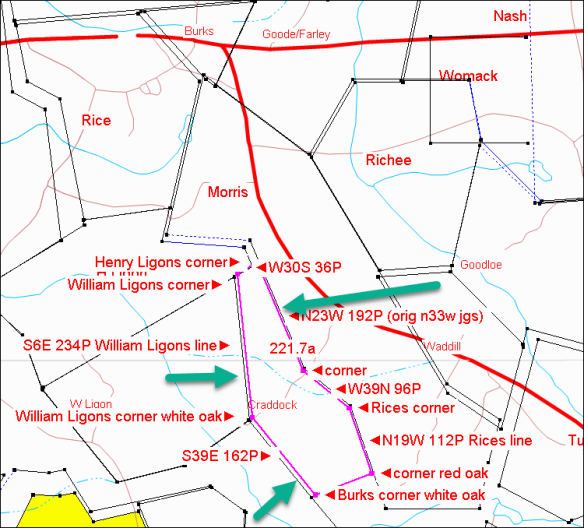
I found your brother-in-law’s land too – or at least I think William Moore is your husband’s brother.
Mary Rice William Moore land.png

In 1752 William Craddock sold this 148 acre tract outlined in purple to William Moore who lived not far from your father (upper left) and adjacent your uncle, Matthew Rice whose land also abutted yours. Your own land is noted upper right with Womack. Everyone lived in close proximity and lent helping hands whenever necessary.

Not only that, another common bond was probably that you were all dissenters – meaning not members of the Anglican church. Your uncle David Rice’s son, the Reverend David Rice, was a Presbyterian minister known as the “Apostle of Kentucky” and your own father built a dissenting meeting house on his property in 1759.

By the time your father died in 1766 and you moved to Halifax County by 1770, your brother-in-law, William Moore, was getting up there in years. William’s son, William Jr. came of age in about 1762, according to the tax list, so William Sr. appears to be older than James Sr. In 1774, William Moore and his wife Margaret sold part of his land to Thomas Vaughan and by 1782, William disappeared from the tax lists. In 1784, he sold more land, except 13 acres. I’d say that William moved on or died about this time. You wouldn’t have heard about this in Halifax County until a letter could have arrived.

You and James must have been close to your brother-in-law William, because you named your eldest son James and your second son, William. Since William was older than James, this makes me wonder if their father’s name was also William.

The Old Neighborhood

The family names of those old patents and deeds on the map look so warmly familiar don’t they? There’s the Certain land and the Richee land too. They weren’t just names to you – you knew these people and were probably related to many.

The Spradling land is just east of the Certain land. These families moved to Halifax County when you and James Moore packed up and left. In Halifax County, James Moore bought his land from James Spradling and another James Spradling lived with you for 2 years in 1774 and 1775 before he enlisted to serve in the Revolutionary War. There’s surely a family connection someplace.

And look, the green arrows below approximate your father’s land. Of course, your Dad owned more than this. Eventually he bought the Atwood land above his original land too.

Mary Rice Joseph Rice land.png

Here’s the approximate land on Google maps today.

Mary Rice Joseph Rice aerial.png

I think, based on the Civil War map that the mill branch was just about where the red star is placed. Did you and James own a mill?

Mary Rice Sailor Creek aerial.png

Here’s the land you and James owned.

Mary Rice Sailor Creek map.png

Looks pretty boring here, but if you look at the Civil War map, you can see the mill and the millpond.

Mary Rice Civil War map.png

You can even see the subtle roads from the mill going north and south. Those roads aren’t visible today, but the Mill Branch is mentioned in the 1760 deed where you sold 75 acres to Noel Waddill on Sailor’s Creek, part of the tract that you and James purchased from Abraham Womack, bounded by Ryan, Matthew Rice, and the Mill Branch.

Sailor’s Creek old road is mentioned too in the tax descriptions. In fact, the 1759 description says that your land is between Ligon’s Rolling Road, Sailor’s Creek Old Road, Sailor’s Creek and Sandy River.

James was clearing land in 1745 with the Ligon men who owned land on the south and west of your father. In fact, your Dad’s land abutted theirs.

Mary Rice Joseph Rice 1746.png

It’s ironic that there are two cemeteries on your Dad’s land today. Of course, 100 acres of this 400 would become yours. We just don’t know which hundred other than it abutted your brother William’s land.

One cemetery is located at the Pisgah Baptist Church and another on the west side of the property, on Highway 460, in green. That cemetery looks to be new, but I wonder about the history of the Pisgah Baptist Church Cemetery. Is that your original family cemetery where your Mom and Dad are buried? It looks too perfectly square, but you never know. I wonder where the dissenting meeting house was located that your Dad built in 1759. I’d wager the cemetery is someplace close to that.

Mary Rice Pisgah cemetery.png

Now that I think of it, if you died in Prince Edward County, you’re probably buried someplace on this land as well.

Your Dad left one fourth of this land to you and James, although we don’t really know which fourth other than it was not the eastern portion that William inherited.

Your brothers, John, William and Charles owned the other 300 acres and your mother lived there, probably with Charles, judging from the way the will is constructed. On the other hand, in 1767, John is listed as living with Rachel Rice – probably because he was underage but 16 or over, so taxable.

On the Civil War map, we can see several houses on your dad’s land.

Mary Rice houses.png

I’d wager that your father’s house was at Rice’s Station, in the present-day village of Rice. That makes sense since he built a church here. A nice crossroads would have delivered travelers perhaps for a bit of a business. This was the main road at the time.

Did you and James live in one of those houses too? I’d bet that you did. We know your brother inherited the east part of the land, and your other brother’s land abutted yours. I’d almost bet that you had the north portion.

Mary Rice Rice's Station.png

The Battle of Rice’s Station took place here the same morning as the infamous Battle of Saylor’s Creek.

Mary Rice Battle Rice's Station.jpg

This map shows the battlefield area, right where your family lived – exactly 100 years earlier.

Rice

A few years ago, I visited Rice, quite by accident actually. I remember at the time thinking that this was somehow significant. Too much to be happenstance. I didn’t really realize just how significant at the time, or that I was literally on Joseph Rice’s land.

I guess he summoned me home.

Actually it wasn’t just Joseph’s, but also yours and James’ land.

Let’s drive along the old Rolling Road headed north out of Rice.

Rolling Road

This looks like it could well be the old Ligon Rolling Road referred to in the deed – in fact, the locals told me it was called the Rolling Road. I thought it was named that because of the rolling hills, but it was because these roads were used to roll tobacco hogsheads, or casks, to the docks for shipping downriver.

Mary Rice Rolling Road house.jpg

This very old building was being restored. The owners told me that it dated from before the Revolution. This is on the property that would either have been Joseph Rice’s or just north of his land.

Mary Rice Rolling Road house 2.jpg

Did you or a family member live here? You surely would have been familiar with this house and probably visited. Maybe another family member lived here, because it appears that the Rice and Moore families owned this entire region.

Mary Rice Rolling Road outbuildings.jpg

The outbuilding.

Mary Rice fields

Looking across the fields.

Mary Rice old building.jpg

This old building is or was at the Rice crossroads with Prince Edward Highway. It was pretty dilapidated years ago and appears to be gone today. It wouldn’t have existed in the 1700s, but I had to wonder about the history of this structure.

Unfortunately, Google Street View doesn’t include any of the roads in this area except for what is today Prince Edward Highway. Ironically, the road then would have been dirt and much smaller, but it too was probably the equivalent of a colonial highway – bring people into and out of Prince Edward County.

Today, Prince Edward Highway circumvents the sleepy village of Rice, which is probably the manifestation of Joseph Rice’s plantation.

Google maps shows Rice to be above the highway, but it isn’t. The center of Rice is the location of the old depot, near the Post Office today. At upper right, Saylor’s Creek Road reaches towards your old homestead. You and James would have traveled this road, now named Gully Tavern Road, many, many times to visit your parents and attend church on your father’s property. Of course, except when you were in “child bed.”

Mary Rice Rice.png

It’s about two and a half miles distant using today’s Gully Tavern Road, County Road 619.

Mary Rice Sailor Creek road.png

Today Gully Tavern Road just looks like typical farm country.

Mary Rice Gully Tavern Road.png

Here’s the old split, with Saylor’s Creek Road, now Gully Tavern, to the right. You probably knew this well, as did your horses.

Mary Rice road split.png

Did you marry at your father’s house, taking this road to your new home as a bride?

On down Sailor’s Creek Road, it looks like the old mill branch and pond would have been here, with the mill too of course, but nothing remains today. Was this where your house was located before you and James lived on your father’s land?

Mary Rice Mill pond.png

Looks like current Sunshine Lane might have been the old road, or near to it, with the mill pond below.

Mary Rice Sunshine Lane.png

We know that by the time your father died, in 1766, you and James lived on his land because in his will, he said, “To my son-in-law James Moore 100 acres land whereon he now lives to be divided from the tract I live on by a line that was run by Robert Farguson to him and his heirs forever.”

Today, the road out of Rice, leading away from your father’s land, down Saylor Creek Road looks like this, punctuated by the ever-present Dollar General store.

Mary Rice intersection.png

The road to the left leads right onto the plantation from the east, but of course, that’s gone today.

Mary Rice road Prince Edward highway.png

Driving west across your Dad’s land.

Mary Rice highway 2.png

Not widely cleared today.

Mary Rice Highway 3.png

The old road into Rice on the left. Of course, this “new road” we’re driving on didn’t exist then.

Mary Rice highway 4.png

The old train track is now a hiking trail. It’s probably thanks to the railroad going through Rice that the name was preserved.

Mary Rice highway 5.png

A typical Virginia byway. I wonder, was this more cleared when you lived here, or has this really never been entirely cleared?

Mary Rice highway aerial.png

The Exxon Station today marks the old road as well.

Mary Rice Exxon station.png

I guess you’ll have to think of this as our current livery stable for our gasoline horses.

Mary Rice highway 6.png

To the west, there’s some cleared land peeking through, but it doesn’t look like this was very great farm land. It’s hilly, swampy and wooded. Maybe that’s why you chose to leave for Halifax County after your father died. I’d bet your Mom died shortly thereafter.

This must have been a very sad time for you, especially if you also buried children named Joseph and Rachel. Somehow, I’m guessing that you did.

Mary Rice Trinity Gardens.png

Towards the western edge of your Dad’s land, today, we find the Trinity Memorial Gardens. Of course, when you lived on this land, there was a cemetery someplace too. Today, your family cemetery is lost to time.

You probably went back to the family cemetery one last time, visiting the graves of your parents and perhaps those of some of your babies as well, before leaving that final time for Halifax County. You would have been about 47 years old then.

There weren’t gravestones except for field stones, but you didn’t need stones with names. Who could ever forget where their parents are buried.

Once gone, you probably never went back. What today is a day trip in a car was a week’s journey, one way, for you, over badly rutted roads – if you can even call them that.

Nope, the ticket to Halifax County was one way.

Halifax County

By far, the largest portion of your life was spent in Prince Edward County. In fact, I wonder whatever possessed you to leave.

What happened after your father’s death?

Did your husband marry your sister, Mary Rice?

Or are you Mary Rice?

If not, what was your first name?

If you made it to Halifax County, the landscape wouldn’t have looked a lot different, with the exception that the hills seem to be steeper and you can see the Blue Ridge Mountains in the distance. It’s not too far until you begin to climb upward in the foothills. Some would consider these ridges the foothills.

This is your land in Halifax County, although it was probably much more wooded then, at least until James Moore and your sons cleared it.

Mary Rice Halifax Blue Ridge.jpg

As you can see, it’s very hilly. In fact, a place on the main road just northwest of your land is called “Top of the World” because you can see straight to the Peaks of Otter some 50 miles away.

Those mountains in the distance aren’t good farming area, so you wouldn’t have wanted to move that far west. Although several of your children would do just that.

They crossed those mountains to the next frontier of Tennessee. They too had a one-way ticket, but I don’t think any of them left until after you passed away. You didn’t have to wave goodbye to them as the horses strained to start the heavy wagon on it’s journey.

It seems that the Womack family once again preceded you to the ever westward-shifting frontier – this time in Halifax County. In fact, you and James bought land in Halifax County from James Spradling in 1770, but he had obtained the land patent from Isham Womack. Of course, both men were Prince Edward County neighbors.

It seems that a subset of the Amelia and Prince Edward families moved together – and kept moving together.

They probably all attended the dissenting church on Joseph Rice’s property. Maybe these are the neighbors who constructed the old Moore Meeting House where your son William would begin preaching in Halifax County before 1775.

Your son, the Reverend William Moore must have made you proud, because he became a Methodist minister, as did your son Rice Moore. Even your daughters were known as incredible exhorters in Hawkins County, Tennessee.

I wonder if the process of changing dissenting religions, probably Presbyterian in Prince Edward County to Methodist in Halifax was smooth or fraught with heartache. Could this be part of the reason why your family along with a few others moved away?

I sure wish I had answers Mary.

I am going to leave you here, in the peaceful Henderson Cemetery that almost no one knows about, located on your original land in Halifax County.

Mary Rice Halifax cemetery.jpg

Of course, the Mary Moore buried here by James Moore in an unmarked grave might not be you. Or maybe it is.

Was your grave the first one dug in this cemetery as your family gathered ’round?

Are you the Mary Moore that was married to James Moore when he lived here?

Are you Mary Rice Moore?

Or are you really Mary Rice’s sister whose name we don’t know?

Mary Rice Moore’s Daughters

Whatever your actual name, I’m calling you Mary Rice.

That’s what all of the family trees say, and it’s entirely possible that Mary Rice indeed was married to James Moore as his only wife. It’s a given that James Moore’s first wife was Joseph Rice’s daughter. Not only do we know that because of Joseph Rice’s will, but also because your descendants match Joseph Rice’s siblings’ descendants DNA too.

It’s also entirely possible that James just happened to marry a woman named Mary as his second wife after you died sometime after your father in 1766 and before December 1769.

Given that Joseph Rice could have told us the name of James Moore’s wife that was his daughter, the joke’s on us these 253 years later because all we can do now is to speculate. There’s no way to ever confirm either way, short of finding a long-lost letter or Bible. Regardless of what James Moore’s Rice wife’s first name was, she was a daughter of Joseph Rice – that’s much is for sure. So the older genealogy is intact either way.

Some people have wondered if Joseph Rice’s wife at his death, Rachel was his first or second wife, and that perhaps both of his wives named a daughter Mary. It sounds improbable, but it wouldn’t be the first time that two children had the same name from two different wives.

One way or another, for genealogy, it really doesn’t matter because James Moore’s wife’s parents were the same regardless of whether she was Mary Rice or her sister.

Mary Rice Moore’s Mitochondrial DNA

I’d love to be able to document the mitochondrial DNA line of James Moore’s wife, referred to as Mary Rice Moore.

Her mitochondrial DNA would have been passed through her daughters to the current generation, if any descendants matching that description exist.

  • Lydia Moore, wife of Edward Henderson, is almost unquestionably a Moore and was born about 1762. Edward Henderson has a lifelong relationship with the Moore family and owns land which is sold to him by James and abuts both James and William Moore’s land. Edward and Lydia named a child Rice Henderson. Daughters were named:
    • Sally (1796-1870) married William Shelton and had daughters Elizabeth Shelton (1822-1900), Frances Fuqua Shelton (1829-1901) and Jemima Ruth Shelton (1837-?)
    • Peggy (c1786-1840) married Thomas Clark
    • Oney (c1782-after 1860) married William Frederick Ferrell and had daughters Emilia Mildred Ferrell born in 1815, Margaret Ferrell born in 1820 and Susan Jane Ferrell born in 1822
    • Mary (c1804-?) marred William Clark
  • Sally (Sarah) Moore was born about 1767 and married Martin Stubblefield in October 1788 with James Rice as surety. This family migrated to Grainger Co., TN, naming their daughters:
    • Nancy Stubblefield (1794-1836) married James Lebow
    • Rebecca Stubblefield (1798-1862) married Abel Wilson
    • Mary Stubblefield (1806-1888) married Henry Countz (Counts)
    • Elizabeth Ann (1807-1885) married William Chaen (Chain) Jr.
  • Mary Moore, probably born before 1769 was married to Richard Thompson in February 1789 by the Rev. William Moore with Edward Henderson as surety. The Richard Thompson family is found in Grainger Co. with the other Moore siblings. Their daughters were named:
    • Mary Thompson
    • Frances “Fanny” Thompson

If you descend from any of these women to the current generation through all females, I have a free DNA testing scholarship for you. The current generation can be male, because females contribute their mitochondrial DNA to all of their children, but only females pass it on.

Are you a direct maternal descendant of Mary Rice Moore, or whatever her name is? If so, your DNA may hold the key to the next breakthrough! I’d love to hear from you!

______________________________________________________________

Disclosure

I receive a small contribution when you click on some of the links to vendors in my articles. This does NOT increase the price you pay but helps me to keep the lights on and this informational blog free for everyone. Please click on the links in the articles or to the vendors below if you are purchasing products or DNA testing.

Thank you so much.

DNA Purchases and Free Transfers

Genealogy Services

Genealogy Research

Your Mitochondrial DNA Journey – Free New Video at Family Tree DNA

Family Tree DNA released a cool new video for everyone who has taken the full sequence mitochondrial DNA test.

I signed in today and discovered this nice little gift.

mtDNA journey link.png

I clicked, and the first thing you do is to answer a few questions to generate your video.

After selecting a drawing of an avatar, you’ll move on to a couple of questions. Note that you cannot change your answers, so if you eventually want to share on social media, be sure the names and location is something you’ll be comfortable with.

mtDNA journey info.png

After you click submit, your video takes a few minutes to generate.

mtDNA journey generate.png

You’ll receive an e-mail when the video is ready.

mtDNA journey email.png

Now, just click on the very same link on your account.

mtDNA journey link

My video was 4 minutes+ in length and began by showing me how mitochondrial DNA is inherited.

mtDNA journey parents.png

Next, the video explains the concept of our ancestor, Mitochondrial Eve.

mtDNA journey mitochondrial eve.png

I must say, the speech is synthetic, and I chuckled every time I heard it say mitochondrial.

mtDNA journey haplogroup map.png

The video does a good job of describing the concept of a haplogroup, then proceeds to explain your base haplogroup – J in my case.

mtDNA journey haplogroup source.png

Next, your specific haplogroup, J1c2f for me, and where it’s found in the world.

mtDNA journey haplogroup specific.png

Hapogroup frequency is shown as well as the range, on a map.

mtDNA journey haplogroup range.png

One cool stop on your journey is your relationship to a notable figure, even if it’s distant.

mtdna journey notable.png

King Richard III, whose skeleton was found under a parking lot, also descends from haplogroup J. Who knew!!!

mtdna journey matches.png

The video provides some quick examples of how to understand your matches and explains mutations. My Swedish matches were really unexpected, given that my ancestor was found in Germany. There’s a story there waiting to be told!

mtDNA journey new match.png

Next, the video encourages people to sign in to view their matches when they receive match notification e-mails. Each match holds the promise of a new discovery.

mtDNA journey share.png

Last, you have an option to share your video with family and friends on social media.

mtDNA journey social media.png

Here I am on Facebook.

mtDNA journey on Facebook.png

Pretty cool.

The Great Thing About Mitochondrial DNA

The great thing about mitochondrial DNA is that results apply to several people in your family. You, your siblings, your mother and your mother’s siblings all share your maternal grandmother’s mitochondrial DNA – so the information is something that pertains to lots of people – not just you. Unlike autosomal tests, one of you can take a mitochondrial DNA test to represent everyone, so it’s a great value.

  • If you have taken the full sequence mitochondrial DNA test, just click here to sign in and generate your video.
  • If you’ve taken the HVR1 or HVR2 lower resolution test, you can upgrade to the full sequence by clicking on the upgrade button in your account and you’ll receive your video automatically when your full sequence results are ready.
  • If you haven’t yet tested your mitochondrial DNA, it’s the story of your matrilineal line – and it’s a great time to order your mitochondrial DNA test. Mine held surprises I’d never have guessed. Just recently I matched someone from the neighboring village to where my oldest known ancestor in that line lived in Germany in the 1600s. Her genealogy may help identify my ancestors too.

Click here to order.

______________________________________________________________

Disclosure

I receive a small contribution when you click on some of the links to vendors in my articles. This does NOT increase the price you pay but helps me to keep the lights on and this informational blog free for everyone. Please click on the links in the articles or to the vendors below if you are purchasing products or DNA testing.

Thank you so much.

DNA Purchases and Free Transfers

Genealogy Services

Genealogy Research

Mitochondrial DNA: Part 4 – Techniques for Doubling Your Useful Matches

This article is Part 4 of a series about mitochondrial DNA. I suggest you read these earlier articles in order before reading this one:

This article builds on the information presented in parts 1, 2 and 3.

Hellooooo – Is Anyone Home?

One of the most common complaints about ALL DNA matches is the lack of responses. When using Y DNA, which follows the paternal line directly, passed from father to son, hopefully along with the surname, you can often discern hints from your matches’ surnames.

Not so with mitochondrial DNA because the surname changes with each generation when the female marries. In fact, I often hear people say, “but I don’t recognize those names.” You won’t unless the match is from very recent generations and you know who the daughters married to the present generation.

Therefore, genealogists really depend on information from other genealogists when working with mitochondrial DNA.

Recently, I experimented at Family Tree DNA  to see what I could do to improve the information available. Family Tree DNA is the only vendor that provides full sequence testing combined with matching.

This exercise is focused on mitochondrial DNA matches, but you can use the same techniques for Y DNA as well. These are easy step-by-step instructions!

Let’s get started and see what you can do. You’ll be surprised. I was!

Your Personal Page at Family Tree DNA

Mitochondrial matches.png

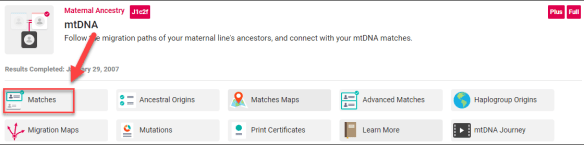
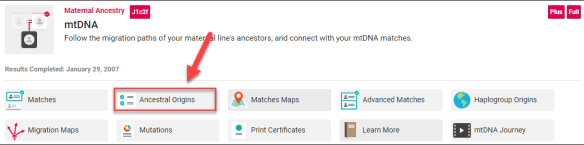
On your personal page, under mtDNA, click on Matches.

Matches

You’ll be viewing your match list of the people who match you at some level.

You’ll see several fields on your match list that you’ll want to use. Many of the bullet points in this article refer to the fields boxed in red or red arrows.

mitochondrial matches

You can click this image to enlarge.

Let’s review why each piece of information is important.

  • Be sure you’re using viewing your matches for the HVR1, HVR2 and Coding region in the red box at the top. Those are your most relevant matches. That’s not to say that you shouldn’t also view your HVR1+HVR2 matches, and your HVR1 matches, because you literally never know what might be there. However, start with the HVR1+HVR2+Coding Region.
  • Focus on your Genetic Distance of 0 matches. Those are exact matches, meaning you have no mutations that don’t match each other. A genetic distance of 1 means that you have one mutation that doesn’t match each other. You can read about Genetic Distance here.
  • Be sure you’re looking at the match results for the entire data base or the project you want to be viewing. For example, if I’m a member of the Acadian AmerIndian project and have Acadian ancestry on my direct matrilineal line, knowing who I match within that project may be extremely beneficial, especially if I need to narrow my results to known Acadian families.
  • Look at the earliest known ancestor (EKA) information. Don’t just let your eyes gloss over it, really look at it. There may be secrets hidden here that are critical for solving your puzzle. The mother of Lydia Brown was discovered by a cousin recently after I had (embarrassingly) ignored an EKA in plain sight for years. You can read about that discovery here.
  • Click on the little blue pedigree icon on your match to view trees that go hand in hand with the earliest known ancestor (EKA) information. Some people provide more information in either the EKA or the tree, so be sure to look at both for hints.

mitochondrial tree

  • If your match’s pedigree icon is grey, they haven’t uploaded their tree. You can always drop them an email explaining how useful trees are and ask them if they will upload theirs.

Utilizing Other Resources

Many people don’t have both trees and an EKA at Family Tree DNA. Don’t hesitate to check Ancestry, MyHeritage or FamilySearch trees with the earliest known ancestor information your match provides if they don’t have a tree, or even if they do to expand their tree. We think nothing of building out trees for autosomal matches – do the same for your matches’ mitochondrial lines.

Finding additional information about someone’s ancestor is also a great ice-breaker for an email conversation. I mean, what genealogist doesn’t want information about their ancestors?

For example, if you match me and I’ve only listed my earliest known ancestor as Ellenore “Nora” Kirsch, you can go to Ancestry and search for her name where you will find several trees, including mine that includes several more generations. Most genealogists don’t limit themselves to one resource, testing company or tree repository.

mitochondrial ancestry tree

WikiTree includes a descendants link for each ancestor that provides a list of people who have DNA tested, including mtDNA. Here’s an example for my ancestor, Curtis B. Lore.

mitochondrial wiki tree

Unfortunately, no one from that line has tested their mitochondrial DNA, but looking at the descendants may provide me with some candidates that descend from his sisters through all females to the current generation, which can be male.

You can do that same type of thing at Geni if you have a tree by viewing that ancestor and clicking on “view a list of living people.”

mitochondrial Geni

While trees at FamilySearch, Ancestry and MyHeritage don’t tell you which lines could be tested for mitochondrial DNA, it’s not difficult to discern. Mitochondrial DNA is passed on by females to the current generation where males can test too – because they received their mitochondrial DNA from their mother.

Family Tree DNA Matches Profiles

Your matches’ profiles are a little used resource as many people don’t realize that additional information may be provided there. You can click on your match’s name to show their profile card.

mitochondrial profile

Be sure to check their “about me” section where I typed “test” as well as their email address which may give you a clue about where the match lives based on the extension. For example, .de is Germany and .se is Sweden.

You can also google their email address which may lead to old Rootsweb listings among other useful genealogical information.

Matches Map

Mitochondrial matches maps.png

Next, click on your Matches Map. Your match may have entered a geographical location for their earliest known ancestor. Beware of male names because sometimes people don’t realize the system isn’t literally asking for the earliest known ancestor of ANY line or the oldest ancestor on their mother’s side. The system is asking for the most distant known ancestor on the matrilineal line. A male name entered in this field invalidates the data, of course.

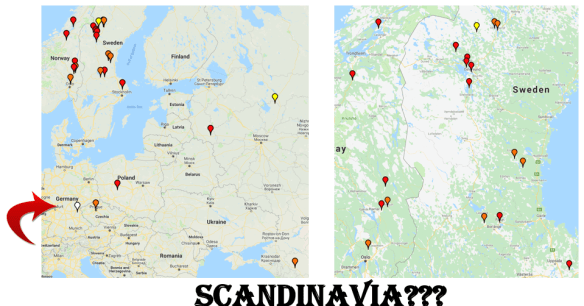
My Matches Map is incredibly interesting, especially since my EKA (earliest known ancestor) is from Germany in 1655.

mitochondrial Scandinavia

The white pin shows the location of my ancestor in Germany. The red pins are exact matches, orange are genetic distance of 1, yellow of 2 and so forth.

Note that the majority of my matches are in Scandinavia.

The first question you should be asking is if I’m positive of my genealogical research – and I am. I have proofs for every single generation. The question of paternity is not relevant to mitochondrial DNA, since the identity of the mother is readily apparent, especially in small villages of a few hundred people where babies are baptized by clergy who knows the families well.

Adoptions might be another matter of course, but adoptions as we know them have only taken place in the past hundred years or so. Generally, the child was still baptized with the parents’ names given before the 1900s. Who raised the child was another matter entirely.

Important Note: Your matches map location does NOT feed from your tree. You must go to the Matches Map page and enter that information at the bottom of that page. Otherwise your matches map location won’t show when viewed by your matches, and if they don’t do the same, theirs won’t show on your map.

mitochondrial ancestor location

Email

I KNOW nobody really wants to do this, but you may just have to email as a last resort. The little letter icon on your match’s profile sends an email, or you can find their email in their profile as well.

DON’T email an entire group of people at once as that’s perceived as spam and is unlikely to receive a response from anyone.

Compose a friendly email with a title something like “Mitochondrial DNA Match at Family Tree DNA to Susan Smith.” Many people manage several kits and if you provide identifying information in the title, you’re more likely to receive a response

I always provide my matches with some information too, instead of just asking for theirs.

Advanced Matching

Mitochondrial advanced matches

Click on the advanced matching link on your personal page.

The Advanced Matches tool allows you to compare multiple types of tests. When looking at your match list, notice if your matches have also taken a Family Finder (FF) test. If so, then the advanced matching tool will show you who matches you on multiple types of tests, assuming you’ve taken the Family Finder test as well or transferred autosomal results to Family Tree DNA.

For example, Advanced Matches will show you who matches you on BOTH the mtDNA and the Family Finder tests. This is an important tool to help determine how closely you might be related to someone who matches you on a mitochondrial DNA test – although here is no guarantee that your autosomal match is through the same ancestor as your mitochondrial DNA match.

mitochondrial advanced matches filter

On the advanced matching page, select the tests you want to view, together, meaning you only want to see results for people who match you on BOTH TESTS. In this case, I’ve selected the full mitochondrial sequence (FMS) and the Family Finder, requested to show only people I match on both tests, and for the entire database. I could select a specific project that I’ve joined if I want to narrow the matches.

Note that if you don’t click the “yes” button you’ll see everyone you match on both tests INDIVIDUALLY, not together. So if you match 50 people on mtDNA and 1000 on Family Finder, you would show 1050 people, not the people who match you on BOTH tests, which is what you want. You might match a few or none on both tests.

Note that if you select “all mtDNA” that means you must match the person on the HVR1, HVR2 and coding region, all 3. That may not be at all what you want either. I select each one separately and run the report. So first, FMS and Family Finder, then HVR2 and Family Finder, etc.

When you’ve made your selection, click on the red button to run the report.

Family Finder Surnames

Another hint you might overlook is Family Finder surnames.

mitochondrial family finder surnames

Go to your Family Finder match list and enter the surname of your matches EKA in the search box to see if you match anyone with that same ancestor. Of course, if it’s Smith or Jones, I’m sorry.

mitochondrial family finder surname results

Entering Kirsch in my Family Finder match list resulting in discovering a match that has Kirsh from Germany in their surname list, but no tree. Using the ICW (in common with) tool, I can then look to see if they match known cousins from the Kirsch line in common with me.

Putting Information to Work

OK, now we’ve talked about what to do, so let’s apply this knowledge.

Your challenge is to go to your Full Sequence match page in the lower right hand corner and download your match list into a spreadsheet by clicking the CSV button.

mitochondrial csv

Column headings when downloaded will be:

  • Genetic Distance
  • Full Name
  • First Name
  • Middle Name
  • Last Name
  • Email
  • Earliest Known Ancestor
  • mtDNA Haplogroup
  • Match Date

I added the following columns:

  • Country
  • Location (meaning within the country)
  • Ancestral Surname
  • Year (meaning their ancestor’s birth/death year)
  • Map (meaning do they have an entry on the matches map)
  • Tree (do they have a tree)
  • Profile (did I check their profile and what did it say)
  • Comment (anything I can add)

This spreadsheet is now a useful tool.

Our goal is to expand this information in a meaningful way.

Data Mining Steps

Here are the steps in checklist format that you’ll complete for each match to fill in additional information on your spreadsheet.

  • EKA (earliest known ancestor)
  • Matches Map
  • Tree
  • Profile
  • Advanced matching
  • Family Finder surname list
  • Email, as a last resort
  • Ancestry, MyHeritage, FamilySearch, WikiTree, Geni to search for information about their EKA

Doubling My Match Information

I began with 32 full sequence matches. Of those, 13 had an entry on the Matches Map and another 6 had something in the EKA field, but not on the Matches Map.

32 matches Map Additional EKA Nothing Useful
Begin 13 on Matches Map 6 but not mapped 13
End 29 remapped on Google 5 improved info 3

When I finished this exercise, only 3 people had no usable information (white rows), 29 could be mapped, and of the original 13 (red rows), 5 had improved information (yellow cells.)

mitochondrial spreadsheet

Please note that I have removed the names of my matches for privacy reasons, but they appear as a column on my original spreadsheet instead of the Person number.

Google Maps

I remapped my matches from the spreadsheet using free Google Maps.

mitochondrial Google maps

Purple is my ancestor. Red are the original Matches Map ancestors of my matches. Green are the new people that I can map as a result of the information gleaned.

The Scandinavian clustering is even more mystifying and stronger than ever.

Add History

Of course, there’s a story here to be told, but what is that story? My family records are found in Germany in 1655, and before that, there are no records, at least not where my ancestors were living.

Clearly, from this map and also from comparing the mutations of my matches that answered my emails, it’s evident that the migration path was from Scandinavia to Germany and not vice-versa.

How did my ancestor get from Scandinavia to Germany?

When and why?

Looking at German history, there’s a huge hint – the Thirty Years’ War which occurred from 1618-1648. During that war, much of Germany was entirely depopulated, especially the Palatinate.

Looking at where my ancestor was found in 1655 (purple pin), and looking at the Swedish troop movements, we see what may be a correlation.

mitochondrial Swedish troop movements

In the first few generations of church records, there were several illegitimate births and the mother was referred to as a servant woman.

It’s possible that my Scandinavian ancestor came along with the Swedish army and she was somehow left behind or captured.

The Challenge!

Now, it’s your turn. Using this article as a guideline, what can you find? Let me know in a comment. If you utilize additional resources I haven’t found, please mention those too!

What’s Next?

Please join me for the next article in this series, Mitochondrial DNA: Part 5 – Joining Projects.

______________________________________________________________

Disclosure

I receive a small contribution when you click on the link to one of the vendors in my articles. This does NOT increase the price you pay but helps me to keep the lights on and this informational blog free for everyone. Please click on the links in the articles or to the vendors below if you are purchasing products or DNA testing.

Thank you so much.

DNA Purchases and Free Transfers

Genealogy Services

Genealogy Research

County Formation Petitions Resolve Long-Standing Mystery: Which William Crumley Got Married? – 52 Ancestors #244

Recently, I became aware of petitions in the Tennessee State Library and Archives (TSLA), by county, when reading this article by Judy Russell, the Legal Genealogist. If you have ancestors in Tennessee, check this resource.

Between 1840 and 1850, several of my ancestors lived in the area of Claiborne and Hawkins County, Tennessee that would become Hancock County in 1848 when the Tennessee Supreme Court overruled attempts to block the formation of the new county.

This process of forming Hancock County was not straightforward and resulted in numerous petitions being filed, which was probably terribly frustrating at the time and probably divisive within the community. However, the petitions are a goldmine of information now. Not only can we discover how our ancestors felt about the county’s formation but even more importantly, signatures are found on the petitions.

In order to sign a petition, one must be a registered voter. I know for sure that voters had to be white and male, but they may have also been required to be landowners although I have some doubt about that.

Some signatures appear to be original, and others appear to be transcribed from a list.

I ordered the petitions from the Tennessee State Archives and they arrived a couple weeks later.

Who Lived in Hancock County, Tennessee?

My ancestors who lived in this region between 1840 and 1850 included the following men who were old enough to sign the petitions in the 1840s.

Ancestor 1840 County 1850 County Signs Petitions
Joel Vannoy 1813-1895 Claiborne, the part that became Hancock Moved to Little Sycamore Community in Claiborne County Yes 1841 (2), 1843 (2)
Elijah Vannoy c 1784->1850 Claiborne, part that became Hancock Hancock County Yes 1841 (2), 1843 (2)
William Crumley III 1788-c1852 Claiborne, part that became Hancock Hancock County, on Blackwater, the portion that was previously Hawkins Yes 1841 (second petition), 1843 (2)
Joseph Preston Bolton (1816-1887) Giles, VA but received at Thompson Settlement Church in 1842 by experience, suggesting he is living in what would become Hancock by this time Hancock County, on 4 Mile Creek No
William Herrell (c1789-1859) Claiborne, part that became Hancock Hancock on Powell River No
Michael McDowell Claiborne, part that became Hancock Lived on Powell River, died before 1850, may have died before petitions No
Fairwick Claxton/Clarkson (c1799-1874) Claiborne, part that became Hancock Hancock on Powell River No

The Crumley and Vannoy families intermarried, and the Bolton, Herrell, McDowell and Clarkson families lived adjacent on the Powell River very near the Virginia border and intermarried as well. The Crumley/Vannoy group signed the petitions, and the Bolton/Herrell/McDowell/Claxton/Clarkson group did not.

I’m sure there was some underlying reason for how these two groups of residents felt, that that information has not trickled down to us today.

There is a very unexpected surprise involving the signature of William Crumley on this petition.

First, let’s look at the petitions themselves.

The Petitions

In total, 6 petitions existed between 1839 and 1844. In 1848, the Tennessee Supreme Court finally decided the fate of Hancock County and since it exists today, we know that they voted in favor of the county formation.

On these petitions, the introductory paragraphs stated the purpose of the petition, followed by the signers. Not all petitions had signature pages nor were productive, so I’ve included the petition pages that included names of my ancestors.

Petition 2

TSLA Summary:

Claiborne County petition from 311 signatures from Hawkins and Claiborne Counties asking they be allowed to form a new county. (Hancock County)

  • Roll – 16
  • Year – 1841
  • Petition – 122a

Detail from actual petition:

On September 2, 1841, residents petitioned for the following, the verbiage extracted.

“Petition as a result of the inconveniences under which we labor traveling some 25 miles over large cragged mountains to serve as jurors or in other cases and at great expense and trouble, we heretofore employed a surveyor to run out the boundary of a new county composed of the parts, Hawkins and Claiborne. He returned 389 square miles in said bounds, which is 30 square miles over and above the constitutional number of square miles prescribed for any new county.”

This first petition was not granted. However, there were six total pages of signatures that appear to be the original signatures, not a transcribed list, dated September 2, 1841.

Hancock petition 1841

Elijah Vannoy is signature #5

Hancock petition 1841-5

Joel Vannoy’s signature is #99.

Petition 3

TSLA petition summary:

Claiborne County – new county  –  Petition from certain citizens of Claiborne County asking they be permitted to form a new county.

  • Roll – 16
  • Year – 1841
  • Petition – 85

From the petition signed Dec. 22, 1841, submitted on Dec. 31, 1841, heard on January 25, 1842.

“Petitioners of Claiborne County secondly petition your honorable body that we are a people far remote from the county cits (seats) Tazewell and that we employed a surveyor will qualified and after being duly sworn…”

Followed by a description of the proposed county bounds and signatures of petitioners within the pounds of the territory of the county” that appear to be original. They state they have 160 qualified voter signatures and ask if the petition is not granted, “if the ballot box says we have, let us hear it and if not, let us not trouble your honors further.” They state they have an overwhelming majority and a constitutional right to establish a new county.

Only 93 signatures are included.

Hancock petition 1841 second

William Crumley signed at #21 and his son John Crumley at #23.

Hancock petition 1841 second 2

Joel Vannoy signed at #73, his father Elijah Vannoy Sr. at #92 and Joel’s brother, Elijah Vannoy Jr. at #93.

Petition 4

TSLA Summary:

Claiborne County  –  Petition from 246 citizens Claiborne and Hawkins Counties to form a new county to be known as Hancock County. Map of proposed county and statement of Richard Mitchell, deputy surveyor, included in the folder.

  • Roll – 16
  • Year – 1843
  • Petition – 61

From the petition:

November 1843 – Petitioners of Hawkins and Claiborne County living at a remote distance from the seat of justice of each county and often having to attend as jurors and in other business, over cragged mountains and high waters, we pray your honorable body to grand unto us a new county composed in the parts of Hawkins and Claiborne. We have not approached closer than 12 miles to the existing county seats. We have  at least 600 qualified voters in the bounds of the new contemplated county and this being our third petition…”

Hancock petition 1843

Joel Vannoy signed at #12 and Elijah Vannoy at #33.

Hancock petition 1843 2

E Vannoy signs at #69, but either this one or the signature at #33 would be Jr. Many of these signatures look very similar, causing me to wonder if some of the signatures were transcribed from an original list, not actually signed on this document.

Hancock petition 1843 3

William Crumley signs at #202, but it matches the rest and does not appear to be an original signature. William’s son, Aaron F. Crumley signs at #194.

This document is followed by the survey dated by the surveyor as to its accuracy November 11, 1843. I wonder if some of the signature papers were lost, although at the end of the signature section there were 34 more that said “signed over legend” which I presume means people who signed with an X witnessed by another individual.

That does not equate to the 600 mentioned, but perhaps this is in addition to an earlier petition.

Petition 5

TSLA Summary:

Claiborne County – new county – Petition from 106 citizens of Claiborne County asking they be allowed to form a new county.

  • Roll – 17
  • Year – 1843
  • Petition – 146

From the petition:

Nov 25, 1843 – Petitioners of Claiborne County who reside in the part in the bounds and in favor of a new county.

Hancock petition 1843 second

William Crumly signed at #14, with son Aaron F. Crumley at #13, son John Crumley at #19 and Elijah Vanoy at #18. Of course, we don’t know the order of the homes of the people involved, but Elijah’s son, Joel married William’s daughter, Phoebe, in 1845.

Some of these signatures appear to be original, but the Aaron and William Crumley signatures appear to be the same.

Hancock petition 1843 second 2

Elijah Vanoy Sr. or Jr. signed at #28 and Elijah Sr.’s son, Joel signed at #85.

There were a total of 106 signatures on 3 pages. Only the people in the affected area needed to sign one way or another.

William Crumley’s Signature Solves a Mystery

With 4 William Crumleys in successive generations, keeping them straight has been a challenge, to put it mildly.

In the article about William Crumley (the third born 1788), son of William Crumley (the second born 1767/8), I discussed the fact that both men lived in Greene County, TN, and one of them married Elizabeth Johnson in October 1817.

For a very long time, it was presumed, based on her probable age, if Elizabeth was who we thought she was, that she had married the younger William Crumley, and that his wife, Lydia Brown had died shortly after giving birth to a child in April of 1817. Speedy remarriages weren’t uncommon in that time and place.

The only somewhat unusual circumstance is that Elizabeth Johnson would have gotten pregnant in June, because the next child born to William Crumley (the third) and his wife was my ancestor Phoebe who arrived in March of 1818. It was also a little unusual that Lydia Brown’s mother’s name was Phoebe Cole and Elizabeth named her first child Phoebe. But then again, the Johnsons and Browns were intermarried too or maybe Elizabeth was just incredibly generous.

Or, maybe Lydia didn’t die after all and Elizabeth married a different William Crumley and was not the mother of Phoebe.

By testing the mitochondrial DNA of the descendants of the child born in April of 1817, Phoebe’s descendants along with the descendants of the next child, Malinda, born in 1820, we confirmed that their mitochondrial DNA was identical. Now granted, this could happen if the two women, Lydia and Elizabeth shared a common matrilineal ancestor.

That’s rather unlikely since Phoebe Cole was from New Jersey and Elizabeth Johnson’s father, Zopher, was from Pennsylvania – but with genealogy you never know for sure. Stranger things have happened.

However, William Crumley’s signature on this petition is corroborating data for the mitochondrial evidence.

William Crumley who married in 1817 has a different signature than two other documents signed in Greene County by a William Crumley as well.

William Crumley the third would have been called Jr. in Greene County, given that William Crumley (the first) was already long deceased by 1817, so William Crumley the second would have been William Crumley Sr. in Green County.

I had to make a chart to keep all of the Williams and their signatures straight.

Who In Greene County, TN Signed What
William Crumley I, 1735/6-1793 Never in Greene County, TN Nothing in Greene County
William Crumley II, 1767/8-c 1839 Sr. 1796 court order in the Territory South of the Ohio, possibly 1807 marriage document for William III, possibly 1817 marriage document.
William Crumley III, 1788-1859 Jr. Married in 1807 as Jr., signed War of 1812 affidavit in 1814, marriage of Aaron Crumley in 1814 and signs as William Jr., 1816 marriage for Isaac Crumley where he signs as Jr.
William Crumley IV, 1811-1864 Married in 1840 in Greene Co.

We don’t know which William Crumley married in 1817. What I really NEED to know if if William the third married in 1817, because my ancestor, Phoebe, was born in 1818.

We know unquestionably that the 1796 document was signed by William Crumley II because the older William Crumley was dead by then, and the younger one still a minor. This does of course assume the signature is actually Williams.

William Crumley 1796 signatureA comparison of the various signatures, assembled by researcher Stevie Hughes some years ago shows us the following variations.

Crumley signature comparisons

The next signature is William Crumley from the 1841 petition and looks to be nearly an exact match to the 1816 signature but NOT to the 1817 marriage signature.

Hancock County 1841 Crumley signature

The signature from William Crumley’s 1814 power of attorney having to do with his War of 1812 service is shown below. This signature looks to be identical to the 1814 signature, again, assuming this is his actual signature and the clerk did not transcribe it. the clerk would have been the same person if these signatures are transcribed, so the signatures would “match.” No wonder I’m confused.

william-crumley-poa 1814

We know that William Crumley in 1807 is in fact the man who married Lydia Brown and that signature does not match the man who signed the 1796 document just a decade earlier. What we don’t know for sure, at least without further analysis, is that the first bondsman in 1807 was the groom and not the groom’s father.

The signature in 1807 and 1817 looks more alike than the other two signatures, who also resemble each other. This 1807/1817 resemblance is what led researchers for years to assume that the William who married Lydia Brown is the same William that married Elizabeth Johnson.

The surnames look very similar, but the Ws look different. The W in 1817 looks a bit wobbly.

William Crumley Lydia Brown marriage

Jotham Brown was Lydia’s brother, and William Crumley Sr. would have been the father of William Crumley Jr. who married Lydia Brown. How do we know that?

William Crumley who married in 1807 was underage, so his father had to sign for him. He could not sign for himself. So clearly, there is some confusion about who is being called Jr. and Sr. and who is marrying who in 1817.

What we still don’t know positively is if the man in 1817 who married Elizabeth Johnson was William the second or third.

The signature on the petition in Hancock County matches exactly to that of William Crumley the third (Jr. in Greene County, born 1788) and not that of the man who married Elizabeth Johnson in 1817.

We know the man who signed the Hancock County petition in 1841 was William the third born in 1788 (Jr. in Greene County) because this William died between 1837 and 1840 in Lee County, VA, right across the county line from Hancock County, TN.

My Unexpected Gift

When I requested this petition, I thought I might learn something interesting about my ancestors and the history of the region where they lived, generally.

I never expected to solve a long-standing mystery. I didn’t even realize what I had, at first, and then the light bulb clicked on and I retrieved the various signatures for comparison.

We now have two important independent pieces of evidence that point to the same conclusion. We have full sequence mitochondrial DNA results from Family Tree DNA that match, strongly suggesting that Phoebe Crumley had the same mother as both her older sister who was born in 1817 before William Crumley married Elizabeth Johnson and Phoebe’s younger sister born in 1820. Furthermore, we have a signature for William Crumley (born in 1788) in Hancock County in 1841 which is not the signature of the William Crumley who married in Greene County in 1817.

William Crumley (the older of the two men in 1817) would have been 50 years old, marrying for the second time, and did not need a separate bondman. He had enough money to be his own bondsman while his son who had been a minor in 1807 did not. William Crumley born in 1788, the younger of the two William’s would also have been marrying for the second time, and he wouldn’t have needed a secondary bondsman either in 1817.

Regardless of the signatures, given the question about originality, I’m extremely grateful for the mitochondrial DNA test results.

You just never know what one single signature, DNA test or piece of information will do for you and more information is always better.

Order everything!

______________________________________________________________

Disclosure

I receive a small contribution when you click on the link to one of the vendors in my articles. This does NOT increase the price you pay but helps me to keep the lights on and this informational blog free for everyone. Please click on the links in the articles or to the vendors below if you are purchasing products or DNA testing.

Thank you so much.

DNA Purchases and Free Transfers

Genealogy Services

Genealogy Research

DNA Testing the Recently Deceased

No one really want to think about this, but it happens.

You’ve always meant to DNA test someone, and they’ve agreed, but either you didn’t order the kit, or the kit is far away from where they passed away.

What can you do?

Take heart, all is not lost. You have two options.

Swabbing the dead

Swabbing the Deceased

Some funeral homes work with companies for DNA preservation and other services, but these services do not provide you with genealogy results from any of the major vendors and are processed by the lab associated with the company whose kit the funeral home is selling.

For genealogy, you have two options.

  1. Call Family Tree DNA (713-868-1438 9-5 CST) and have them overnight you a swab kit. The funeral director can swab the inside of their cheek and generally, funeral directors do a great job. You may want to ask for extra vials to be included in the overnight package, just in case. This is your last (and only) chance.
  2. If you don’t have time or aren’t in a location where you can receive an overnight delivery, purchase an Identigene paternity test kit at any CVS or similar drugstore. That kit will cost you about $27 for the kit alone, but the kit contains sterile swabs and a sterile pouch for inserting the swabs after swabbing the inside of the cheek. DO NOT SEND THE SWABS TO IDENTIGENE. Instead, call Family Tree DNA and explain that you are sending the Identigene swabs to their lab for processing. They will provide you with instructions and you must obtain approval before sending non-standard swabs for processing.

Caveats and Alternatives

  • Cheek swabbing must occur before embalming because embalming fluid interferes with DNA processing, per Dr. Connie Bormans, lab director at GenebyGene.
  • Having said that, there are cases where swabbing has taken place after embalming and it did work. It doesn’t hurt anything to try. The worst that happens is that the test fails.
  • Per my friendly mortician, if you’re desperate and embalming has occurred, another area where some have achieved swabbing success is the crease behind the ear lobe where skin cells tend to become trapped if the body has not already been cleaned in that area. At this point, you have nothing to lose by trying.
  • Please note that sometimes “overnight” is not actually overnight. I attempted to overnight something across the Memorial Day weekend and “overnight” in that case was actually Friday to Tuesday for all carriers. If you are in a pickle, be aware of delivery constraints surrounding weekends, holidays and perhaps a very remote location.

Ordering

After the kit is returned to Family Tree DNA for processing, you can order the regular suite of tests. I would suggest that you order all the tests you actually want initially, because the quantity and/or quality of the DNA sample may be questionable.

In other words, later upgrades may not be successful. I had that situation occur with my aunt’s mitochondrial DNA test results. The initial mtPlus test was successful, but her sample could not be upgraded to either the mitochondrial full sequence or Family Finder.

Three Data Bases in One Test

While you can’t obtain a spit sample from a deceased person for other autosomal tests, you can transfer the person’s autosomal DNA results to both GedMatch and MyHeritage for additional matching after processing.

Hopefully you’ll never find yourself in this difficult situation, but if you do, you have options.

______________________________________________________________

Disclosure

I receive a small contribution when you click on some (but not all) of the links to vendors in my articles. This does NOT increase the price you pay but helps me to keep the lights on and this informational blog free for everyone. Please click on the links in the articles or to the vendors below if you are purchasing products or DNA testing.

Thank you so much.

DNA Purchases and Free Transfers

Genealogy Services

Genealogy Research

Mitochondrial DNA: Part 3 – Haplogroups Unraveled

This is the third article in a series about mitochondrial DNA.

The first two articles are:

This third article focuses on haplogroups. They look so simple – a few letters and numbers – but haplogroups are a lot more sophisticated than they appear and are infinitely interesting!

What can you figure out about yours and what secrets will it reveal? Let’s find out!

What is a Haplogroup?

A haplogroup is a designation that you can think of as your genetic clan reaching far back in time.

My mitochondrial haplogroup is J1c2f, and I’ll be using this as an example throughout these articles.

The description of a haplogroup is the same for both Y and mitochondrial DNA, but the designations and processes of assigning haplogroups are different, so the balance of this article only refers to mitochondrial DNA haplogroups.

Where Did I Come From?

Every haplogroup has its own specific history.

Mitochondrial migration maps.png

Looking at my DNA Migration Map at Family Tree DNA, I can see the path that haplogroup J took out of Africa.

mitochondrial migration map j.png

This map is interactive on your personal page, so you can view your or any other haplogroup highlighted on the map.

mitochondrial frequency map J.png

On the frequency tab of the Migration Map, you can view the frequency of your haplogroup in any specific location.

Mitochondrial personal page mutations

On my Mutations tab, I’m provided with this information:

The mitochondrial haplogroup J contains several sub-lineages. The original haplogroup J originated in the Near East approximately 50,000 years ago. Within Europe, sub-lineages of haplogroup J have distinct and interesting distributions. Haplogroup J1 is found distributed throughout Europe, from Britain to Iberia and along the Mediterranean coast. This widespread distribution strongly suggests that haplogroup J1 was part of the Neolithic spread of agriculture into Europe from the Near East beginning approximately 10,000 years ago.

Stepping-Stones back in Time

The haplogroup designation itself is a stepping-stone back in time.

Looking at my full haplogroup, J1c2f, we see 5 letters or numbers.

The first letter, J, is my base haplogroup, and each letter or digit after that will be another step forward in time from the “mother” haplogroup J.

Therefore, 1 is a major branch of haplogroup J, c is a smaller branch sprouting off of J1, 2 is a branch off of J1c, and f is the last leaf, at least for now.

Ages

In the supplementary data for the article, A “Copernican” Reassessment of the Human Mitochondrial DNA Tree from its Root, by Doron M Behar et al, published in the Journal of Human Genetics on April 6, 2012, he provides age estimates for the various haplogroups and subhaplogroups identified at that time.

My haplogroup breakdown is shown below.

Haplogroup

Time Estimate (Years) SD (standard deviation in years)
J 34,258.3 4886.2
J1 26,935.1 5272.9
J1c 13,072.3 1919.3
J1c2 9762.5 2010.7
J1c2f 1926.7

3128.6

  • Time estimate means how long ago this haplogroup was “born,” meaning when that haplogroup’s defining mutation(s) occurred.
  • SD, standard deviation, can be read as the range on either side of the time estimate, with the time estimate being the “most likely.” Based on this, the effective range for the birth of haplogroup J is 29,372.1 – 39,144.5. In some of the most current haplogroups, like J1c2f, the lowest age range is a negative number, which obviously can’t happen. This sometimes occurs with statistical estimates.

The first question you’re going to ask is how can these age estimates be so precise? The answer is that these are statistical calculations – because we can’t travel back in time.

What Came Before J?

Clearly J is not Mitochondrial Eve, so what came before J?

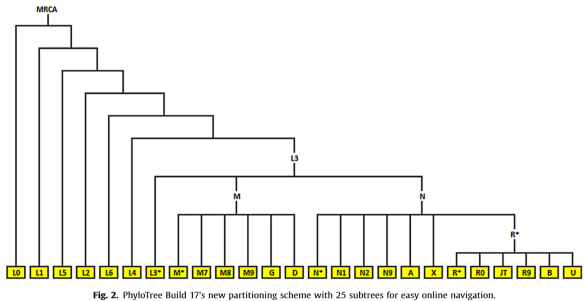
In the paper announcing the latest version (Build 17) of the Phylotree by van Oven, meaning the haplotree for mitochondrial DNA, this pedigree style tree was drawn to show the backbone plus 25 subtrees.

mitochondrial Build 17 tree.png

Haplogroup J descended from JT, fourth from right on the bottom right.

The MRCA, most recent common ancestor at the root of the tree would be the RSRS (Reconstructed Sapiens Reference Sequence), known colloquially as Mitochondrial Eve.

Branches and Names

Haplogroups were named in the order they were discovered, using the alphabet, A-Z (except O). Branches are indicated by subsequent numbers and letters. Build 17 of the phylogenetic tree includes 5437 branches, increasing from 4809 in build 16.

Occasionally branches are sawed off and reconnected elsewhere, which sometimes plays havoc with the logical naming structure because they are renamed completely on the new branch. This happened when haplogroup A4 was retired in Build 17 and is now repositioned on the tree as haplogroup A1. I wrote about this in the article, Family Tree DNA’s Mitochondrial Haplotree.

It’s easier to see the branching tree structure if you look at the public mitochondrial haplotree on the Family Tree DNA website. Scroll to the very bottom of the main Family Tree DNA page, here, and click on mtDNA haplotree.

Mitochondrial mtDNA haplotree.png

You can search for your haplogroup name and track your ancestral haplogroups back in time.

mitochondrial J1c2f search.png

J1c2f is shown below on the tree, with haplogroup J at the top.

mitochondrial J1c2f tree

Click to enlarge

Where in the World?

Whether you’ve tested at Family Tree DNA or not, you can view this tree and you can see the location of the earliest known ancestor of people who have tested, agreed to sharing and have been assigned to your haplogroup.

You can mouse over the little flag icons or click on the 3 dots to the right for a country report.

mitochondrial country.png

The country report details the distribution of  the earliest known ancestors where people on that branch, and those with further subbranches are found.

mitochondrial country report J1c2f

You can click to enlarge the image.

J1c2f is the lowest leaf on this branch of the tree, for now, so there is no difference in the columns.

However, if we look at the country report for haplogroup J1c2, the immediate upstream haplogroup above J1c2f, you can see the differences in the columns showing people who are members of haplogroup J1c2 and also downstream branches.

Mitochondrial country report J1c2

Click to enlarge the image.

I wrote more about how to use the new public tree here.

Haplogroup Assignment Process

There’s a LOT of confusion about haplogroup assignments, and how they are generated.

First, the official mitochondrial tree is the Phylotree, here. Assigning new haplogroups isn’t cut and dried, nor is it automated today. The Phylotree has been the defacto location for multiple entities to combine their information, uploading academic samples to GenBank, a repository utilized by Phylotree for all researchers to use in the classification efforts. You can read more about GenBank here. Prior to Phylotree, each interested entity was creating their own names and the result was chaotic confusion.

Individuals who test at Family Tree DNA can contribute their results, a process I’ll cover in a future article.

The major criteria for haplogroup assignments are:

  • Three non-familial sequences that match exactly. Family mutations are considered “private mutations” at this time.
  • Avoidance of regions that are likely to be unstable (such as 309, 315 and others,) preferably using coding region locations which are less likely to mutate.
  • Evaluating whether transitions, transversions and reversions are irrelevant events to haplogroup assignment, or whether they are actually a new branch. I covered transitions, transversions and reversions here.

Periodically, the Phylotree is updated. The current version is Build 17, which I wrote about here.

The Good, the Bad and the Ugly

While change and scientific progress is a good thing, it also creates havoc for the vendors.

For each vendor to update your haplogroup, they have to redo their classification algorithm behind the scenes, of course, then rerun their entire customer database against the new criteria. That’s a huge undertaking.

In IT terms, haplogroups are calculated and stored one time for each person, not calculated every time you access your information. Therefore, to change that data, a recalculation program has to be run against millions of accounts, the information stored again and updating any other fields or graphics that require updating as a result. This is no trivial feat and is one reason why some vendors skip Phylotree builds.

When you’re looking at haplogroups at different vendors, it’s important to find the information on your pages there that identify which build they are using.

Vendors who only test a few locations in order to assign a base or partial haplogroup may find themselves in a pickle. For example, if a new Phylotree build is released that now specifies a mutation at a location that the vendor hasn’t tested, how can they upgrade to the new build version? They can’t, or at least not completely accurately.

This is why full sequence testing is critically important.

Haplogroup Defining Mutations

Build 17 example

Using the Build 17 table published by Family Tree DNA that identifies the mutations required to assign an individual to a specific haplogroup or subhaplogroup, you can determine why you were assigned to a specific haplogroup and subgroups.

Mutations in Different Haplogroups are Not Equal

What you can’t do is to take mutations out of haplogroup context for matching.

Let’s say that someone in haplogroup H and haplogroup J both have a mutation at location G228A.

mitochondrial mutation comparison.png

That does NOT mean these two people match each other genealogically. It means that the two different branches of the mitochondrial tree, haplogroup J and haplogroup H individually developed the same mutation, by chance, over time. In other words, parallel, disconnected mutations.

It may mean that both individuals simply happen to have the same personal mutations, or, it could mean that eventually these values could become haplogroup defining for a new branch in one or the other haplogroup.

How Common Are Parallel Mutations?

From the Build 17 paper again, this table shows us the top recurrent mutations after excluding insertions, deletions and location 16519. We see that 197 different branches of the tree have mutation T152C. My branch is one of those 197.

Mitochondrial build 17 mutation frequency.png

I think you can see, with location T152C being found in 197 different branches of the Pylotree why the only meaningful match between two people is within specific haplogroup subclades.

Within a haplogroup, this means that two people match on T152C PLUS all of the upstream haplogroup defining markers. Outside of a haplogroup, it’s just a chance parallel mutation in both lines.

Therefore, if another person in haplogroup J1c2f and I match a mutated value at the same location, that could be a very informative piece of genealogical information.

Partial and Full Haplogroups

Some vendors, such as 23andMe and LivingDNA provide customers with partial haplogroups as a part of their autosomal offering.

Family Tree DNA (full haplogroup) 23andMe LivingDNA
J1c2f J1c2 J1c

23andMe and LivingDNA provide partial haplogroups because they are not testing all of the 16,569 locations of the mitochondrial DNA. They are using scan technology on a chip that also processes autosomal DNA, so the haplogroup assignment is basically an “extra” for the consumer. Each chip location they use for mitochondrial (or Y) DNA testing for haplogroups is one less location that can be used for autosomal testing.

Therefore, these companies utilize what is known as target testing. In essence, they test for the main mutations that allow them to classify people into major haplogroups. For example, you can see that LivingDNA tests the mutations through the J1c level, but not to J1c2, and 23andMe tests to J1c2 but not J1c2f. If they tested further, my haplogroup designation would be J1c2f, not J1c or J1c2.

For full sequence testing, complete haplogroup designation and matching, I need to test at Family Tree DNA. They are the only vendor that provides the complete package.

Matching

mitochondrial matches link.png

Family Tree DNA provides matching of customer results. Consumers can purchase the mtPlus product, which tests only the HVR1/HVR2 portion of the mitochondria, or the mtFull product which tests the entire mitochondria. I recommend the mtFull.

In addition to haplogroup information, customers receive a list of people who match them on their mitochondrial sequence.

mitochondrial matches result

Click to enlarge

Matches with genealogical information allow customers to make discoveries such as this location information, provided by Lucille, above:

mitochondrial villages map.png

Lucille’s earliest known ancestor, according to her tree, is found just 12.6 km, or 7.8 miles from the tiny German village where my ancestor was found in the late 1600s.

Of course, matching isn’t provided in the 23andMe and LivingDNA databases, so we can’t tell who we do and don’t match genealogically, but haplogroups alone are not entirely useless and can provide great clues.

Haplogroups Alone

Haplogroups alone can be utilized to include or eliminate people for further scrutiny to identify descendancy on a particular line.

Mitochondrial advanced matches.png

For example, at Family Tree DNA, I can utilize the advanced matching tool to determine whether I match anyone on both the Family Finder autosomal test AND on any of the mitochondrial DNA tests.

mitochondrial advanced matches

Click to enlarge

My match on both tests, Ms. Martha, above, has not tested at the full sequence level, so she won’t be shown as a match there. It’s possible that were she to upgrade that we would also match at the full sequence level. It’s also possible that we wouldn’t. Even an exact mitochondrial match doesn’t indicate THAT’s the line you’re related on autosomally, but it does not eliminate that line and may provide useful clues.

If my German match, Lucille and I had matched autosomally AND on the full sequence mitochondrial test, plus our ancestors lived 7 miles apart – those pieces of evidence would be huge clues about the autosomal match in addition to our mitochondrial match.

Alas, Lucille and I don’t match autosomally, but keep in mind that there are many generations between Lucille and me. If we had matched autosomally, it would have been a wonderful surprise, but we’d be expected not to match given that our common ancestor probably lived sometime in the 1600s or 1700s.

If I’m utilizing 23andMe and notice that someone’s haplogroup is not J1c2, the same as mine, then that precludes our common ancestral line from being our direct matrilineal line.

At GedMatch, people enter their haplogroup (or not) by hand, so they enter their haplogroup at the time they upload to GedMatch. It’s possible that their haplogroup assignment may have changed since that time, either because of a refined test or because of a Build number update. Be aware of the history of your haplogroup. In other words, if your haplogroup name changed (like A4 to A1), it’s possible that someone at GedMatch is utilizing the older name and might be a match to you on that line even though the haplogroup looks different. Know the history of your haplogroup.

Perhaps the best use of haplogroups alone is in conjunction with autosomal testing to eliminate candidates.

For example, looking at my match with Stacy at 23andMe, I see that her haplogroup is H1c, so I know that I can eliminate that specific line as our possible connection.

mitochondrial haplogroup compare.png

At Family Tree DNA, I can click on any Family Finder match’s profile to view their haplogroup or use the Advanced matching tool to see my combined Family Finder+mtDNA matches at once.

Mitochondrial match profile.png

Haplogroups and Ethnicity

My favorite use of haplogroups is for their identification of the history of the ancestral line. Yes, in essence a line by line ethnicity test.

Using either your own personal results at Family Tree DNA, or their public haplotree, you can trace the history of your haplogroup. In essence, this is an ethnicity test for each specific line – and you don’t have to try to figure out which line your specific ancestry came from. It’s recorded in the mitochondrial DNA of each person. I’ve created a DNA pedigree chart to record all my ancestors Y and mitochondrial DNA haplogroups.

Ancestor DNA Pedigree Chart

Using Powerpoint, I created this DNA pedigree chart of my ancestors and their Y and mitochondrial DNA.

Roberta's DNA Pedigree Chart 2019

You can see my own mitochondrial DNA path to the right, in red circles, and my father’s Y DNA path at left, in blue boxes. In addition to Y DNA, all men have mitochondrial DNA inherited from their mother. So you can see my grandfather, William George Estes inherited his mitochondrial DNA from his mother Elizabeth Vannoy, who inherited it from Phoebe Crumley whose haplogroup is J1c2c.

This exercise disproved the rumor that Elizabeth Vannoy was Native American, at least on that line, based on her haplogroup. You can view known Native American haplogroups here.

So Elizabeth Vannoy and her mother, Phoebe Crumley, and I share a common ancestor back in J1c2 times, before the split of J1c2c and J1c2f from J1c2, so roughly 2,000 years ago, give or take a millennia.

Haplogroup Origins

My own haplogroup J is European. That’s where my earliest ancestor is found, and it’s also where the migration map shows that haplogroup J lived.

Mitochondrial haplogroup origins.png

The information provided on my Haplogroup Origins page shows the location of my matches by haplogroup by location. I’m only showing my full sequence matches below.

Generally, the fewer locations tested, at the HVR1 or HVR1+HVR2 levels, the matches tend to be less specific, meaning that they may reach thousands of years back in time. On the other hand, some of those HVR1/HVR2 matches may be very relevant, but it’s unlikely that you’ll know unless you have a rare value in the HVR1/HVR2 region meaning few matches, or both people upgrade to the full sequence test.

mitochondrial haplogroup origins results

Click to enlarge image

You can see by the information above that most of my exact matches are distributed between Sweden and Norway, which is a very specific indicator of Scandinavian heritage ON THIS LINE alone.

By contacting and working with my matches of a genetic distance of 1, 2 and 3, I determined, based on the mutations, that the “root” of this group originated in Scandinavia and my branch traveled to Germany.

This is more specific than any ethnicity test would ever hope to be and reaches back to the mid-1600s. Better yet, I can make this same discovery for every line where I can find an individual to test – effectively rolling back the curtain of time.

Ancestral Origins

Mitochondrial ancestral origins.png

Haplogroup Origins can be augmented by the Ancestral Origins tab which provides you with the ancestral location of your matches’ most distant known ancestor.

mitochondrial ancestral origins results

Click to enlarge

Again, exact matches are going to be much more relevant to you, barring exceptions like heteroplasmies (covered here), than more distant matches.

New Haplogroup Discoveries

You might wonder, when looking at your results if there are opportunities for new haplogroup subgroups. In my case, there are a group of 33 individuals who match exactly and that include many common mutations in addition to the 11 locations in my results that are currently indicated as haplogroup identifying, indicated in red below.

mitochondrial haplogroup defining mutations J1c2f

Click to enlarge image

My haplogroup defining mutation at A10398G! is a reversion, meaning that it has mutated back to the ancestral value, so we don’t see it above, because now it’s “normal” again. We just have to trust the ancestral branching tree to understand that upstream, this mutation occurred, then occurred a second time back to the normal or ancestral value.

The two extra mutations that everyone in this group has may be enough to qualify for a new haplogroup, call it “1” for purposes of discussion – so it could be named J1c2f1, hypothetically. However, there may be other sub-haplogroups between f and 1, so it’s not just a matter of tacking on a new leaf. It’s a matter of evaluating the entire tree structure with enough testers to find as many sub-branches as possible.

Attempting to assign or reassign branches based on a few tests and without a full examination of many tests in that particular branching haplotree structure would only guarantee a great deal of confusion as the new branch names would have to be constantly changed to accommodate new branching tree structures upstream.

This is exactly why I encourage people to upload their results to GenBank. I’ll step through that process in our last article.

What’s Next?

My next article in this series, in a couple weeks, will be Mitochondrial DNA: Part 4 – Techniques for Doubling Your Useful Matches. I more than doubled mine. There’s a lot more available than meets the eye at first glance if you’re willing to do a bit of digging.

But hey, we’re genealogists – and digging is what we live for!

______________________________________________________________

Disclosure

I receive a small contribution when you click on some (but not all) of the links to vendors in my articles. This does NOT increase the price you pay but helps me to keep the lights on and this informational blog free for everyone. Please click on the links in the articles or to the vendors below if you are purchasing products or DNA testing.

Thank you so much.

DNA Purchases and Free Transfers

Genealogy Services

Genealogy Research

Genographic Project Prepares to Shut Down Consumer Data Base

Today, on the National Geographic Society’s Genographic Project page, we find this announcement:

Genographic end

This is a sad day indeed.

  • Effective May 31, 2019, you can no longer purchase Genographic kits.
  • If you currently have an unsubmitted kit, you may still be able to submit it for processing. See this link for more information about your specific kit.
  • The Genographic website will be taken down December. 31, 2020. Your results will be available for viewing until then, but not after that date.
  • Data will be maintained internally by the Genographic project for scientific analysis, but will not be otherwise available to consumers. Miguel Vilar with the Genographic Project assures me that the underlying scientific research will continue.

Please Transfer Your DNA Results

The original Genographic project had two primary goals. The first being to obtain your own results, and the second being to participate in research.

If you are one of the 997,222 people in 140 countries around the world who tested, you may be able to transfer your results.

Depending on which version of the Genographic test you’ve taken, you can still preserve at least some of the benefit, for yourself and to scientific research.

Family Tree DNA Genographic transfer

Note that only Y and mitochondrial DNA results can be transferred, because that’s all that was tested. How much information can be transferred is a function of which level test you initially took, meaning the version 1 or version 2 test.

According to the Family Tree DNA Learning Center, people who transfer their results also qualify for a $39 Family Finder kit, which is the lowest price I’ve ever seen anyplace for an autosomal DNA test.

  • If you tested within the US in November 2016 or after, you tested on the Helix platform and your results cannot be transferred to Family Tree DNA.

If you have already tested your Y (males only) and mitochondrial DNA at Family Tree DNA, there is no need to transfer Genographic data. Family Tree DNA information will be more complete.

Salvage as Much as Possible

As a National Geographic Society Genographic Project Affiliate Researcher and long-time supporter, I’m utterly heartsick to see this day.

Please transfer what you can to salvage as much as possible. We already lost the Sorenson data base, Ancestry’s Y and mitochondrial DNA data base along with YSearch and MitoSearch. How much Y and mitochondrial DNA information, critical to genealogists and the history of humanity, has been lost forever?

Let’s not lose the Genographic Project information too. Please salvage as much as possible by transferring – and spread the word.

Please feel free to repost or preprint this article.

______________________________________________________________

Disclosure

I receive a small contribution when you click on some (but not all) of the links to vendors in my articles. This does NOT increase the price you pay but helps me to keep the lights on and this informational blog free for everyone. Please click on the links in the articles or to the vendors below if you are purchasing products or DNA testing.

Thank you so much.

DNA Purchases and Free Transfers

Genealogy Services

Genealogy Research

Honoring Veteran USMC William Tully Brown, Navajo Code Talker

Veteran USMC William Tully Brown, Navajo Code Talker

Veteran USMC William Tully Brown, 97-year-old Navajo Code Talker of North Cottonwood, Arizona, holding his DNA kit from Family Tree DNA after swabbing, photo courtesy Vee F. Browne-Yellowhair.

I can’t even begin to describe the honor I feel to be able to write a Memorial Day article honoring WWII USMC veteran, William Tully Brown, one of the few living Navajo Code Talkers.

I first became aware of William because he matches the Anzick Child in one of the DNA projects at Family Tree DNA that I administer. I reached out to his daughter Vee F. Browne-Yellowhair who has graciously facilitated communications with her father.

William is 100% Native American, Navajo, as confirmed by his autosomal DNA, family genealogy and tribal history.

If you’re wondering about how a Navajo man born on the Navajo reservation in Arizona might match the DNA of a child buried approximately 12,500 years ago in Montana, the answer is because they share a common ancestor very long ago from a highly endogamous population.

Neither Anzick Child nor William have any ancestors that weren’t Native American, so any DNA that they share must come from Native American ancestors. In other words, their DNA is identical by population.

The original group of individuals migrating across Beringia who would settle in the Americas, the ancestors of all of the Native people extending across North, Central and South America, is thought to have been very small. Of course, there were no humans living in the American continents at that time, so that founding population had no new DNA sources to introduce into the expanding population. All aboriginal people descended from the original group.

beringia map

By Erika Tamm et al – Tamm E, Kivisild T, Reidla M, Metspalu M, Smith DG, et al. (2007) Beringian Standstill and Spread of Native American Founders. PLoS ONE 2(9): e829. doi:10.1371/journal.pone.0000829. Also available from PubMed Central., CC BY 2.5, https://commons.wikimedia.org/w/index.php?curid=16975303

It’s believed by some scientists that over time, additional migrations arrived from far Northeast Asia, in what is now Siberia, but that founding population in Asia is the same population that the original group left.

Today, we see fully Native people, including William, with ethnicity results that include North and Central America, Siberia and often, a small amount of East Asian, totaling 100%.

William’s DNA contributions are amazing, and we’ll cover them in a future article, but what I’d really like to do today is to honor his military service and incredible legacies. Yes, legacies, plural. When I think I couldn’t love and respect this man any more, he contributes selflessly again as he approaches the century mark. God Bless this man!

Let’s begin by talking about William’s incredible service with the Navajo Code Talkers.

The Navajo Code Talkers

Veteran USMC William Tully Brown, Navajo Code Talker WWII

William Tully Brown in a younger photo, courtesy Vee F. Browne-Yellowhair.

The Navajo Code Talkers, highly intelligent and incredibly brave men, were the heroes of WWII. The original group of Navajo Marines recruited specifically for their language skills to serve in the Pacific theater numbered 29 but had been expanded to more than 400 by the end of the war.

Only 7 Code Talkers are still alive today. William Tully Brown is 97 years old and is pictured at the beginning of this article in his Marine uniform, which he still loves, and above in a younger photo.

The great irony is that the Navajo had been forbidden as children to speak their Native language, practice their religion, arts or culture, raised often in boarding schools intended to assimilate them and rid them of their Native “ways.” It’s those same children, as men, who saved the very country that tried to “beat the Indian” out of them, teaching them to suffer in silence, according to now deceased Code Talker, Chester Nez.

We should all be incredibly grateful that the Navajo were so forgiving.

Navajo is a very complex language with many dialects, making it unintelligible to other language speakers. It was estimated that only about 30 non-Navajo individuals spoke or understood Navajo in 1942 – making it a wonderful choice for a secret code.

The Navajo language proved to be undecipherable, even by the best cryptographers, and remained so for decades. Meanwhile, the Code Talkers translated communications and tactical information to and from the Navajo language, utilizing radio, telephone and other communications on the front lines of the war. The work of the Code Talkers was essential to the Allied Victory of WWII, with Code Talkers being present at many important battles including Utah Beach and Iwo Jima.

At the Battle of Iwo Jima, Major Howard Connor, 5th Marine Division signal officer, had six Navajo code talkers working around the clock during the first two days of the battle. These six sent and received over 800 messages, all without error. Connor later stated, “Were it not for the Navajos, the Marines would never have taken Iwo Jima.”

For many years, the humble Navajo men weren’t recognized, keeping their military secrets, even from their families. It wasn’t until 1968, a quarter century later, that the documents were declassified, resulting in recognition for the brave Code Talkers.

August 14th was designated as National Navajo Code Talkers Day in 1982 by President Ronald Reagan. In 2000, Bill Clinton signed a law which awarded gold medals of honor to the 29 men who developed the special Navajo military code, and silver congressional medals to all Code Talkers. You can view William Tully Brown’s name in the Congressional Record, here.

Their pride and loyalty remains unwavering.

You can read more about the Code Talkers here.

The Language of Our Ancestors

Veteran Code Talker, Kee Etsicitty said, ” We, the Navajo people, were very fortunate to contribute our language as a code for our country’s victory. For this, I strongly recommend we teach our children the language our ancestors were blessed with at the beginning of time. It is very sacred and represents the power of life.”

The Navajo language isn’t the only language and legacy that William Tully Brown will be remembered for. His DNA, yet another language, is a second selfless legacy that he leaves.

William Brown tested his DNA at Family Tree DNA which matches not only with the Anzick child, but with many other individuals who are Navajo or carry Native American DNA.

The Navajo history tells us that they migrated from the far north. Remnants of that journey remain in their oral legends. Archaeologists suggest that the migration from the northwest occurred around the year 1500.

The Navajo language roots confirms that connection.

Navajo is a Na Dene language, a derivative of Athabaskan which is also spoken in Alaska, in northwestern Canada, and along the North American Pacific rim.

This map shows the areas where the Na-Dene languages are spoken today.

The languages spoken in areas of the southwestern part of the US are referred to as Southern Athabaskan languages.

Therefore, it doesn’t come as a surprise that we find DNA matches to William Brown by several individuals whose ancestry is Native from and who still live in areas within the northern orange regions.

DNA is Forever

William Tully Brown’s legacy isn’t only in the Navajo code words he spoke in WWII, or his bravery, but also the code carried in his DNA that he has so generously contributed. William’s DNA has now been documented and will endure forever.

William’s genetic legacy reaches out to future generations, extending the connection to the ancestors through the threads of time, back to the Anzick child and forward for generations to come – drawing us all together.

Thank you Marine veteran William Tully Brown for your immense generosity, sacrifices and altruistic contribution of both life-saving and live-giving codes. How fitting that your heroism began 80 years ago with a war-winning language that would rescue both our country and democracy, as well as our Allies – and now, near your century mark, you are leaving a remarkable legacy by contributing your own genetic words, your DNA, for posterity.

Preserving our country then and our Native heritage now, uniting past, present and future. Gathering the generations together, lighting their way home.

_______________________

Attribution:

Thank you to Vee F. Browne-Yellowhair, the daughter of USMC veteran William Tully Brown, Code Talker, for permission to write this article, her generosity, and for his photos.

______________________________________________________________

Disclosure

I receive a small contribution when you click on some (but not all) of the links to vendors in my articles. This does NOT increase the price you pay but helps me to keep the lights on and this informational blog free for everyone. Please click on the links in the articles or to the vendors below if you are purchasing products or DNA testing.

Thank you so much.

DNA Purchases and Free Transfers

Genealogy Services

Genealogy Research

Mitochondrial DNA: Part 2 – What Do Those Numbers Mean?

This is the second part in a series about mitochondrial DNA. The first article can be found here:

When people receive their results, generally the first thing they look at is matches, and the second thing is the actual results, found under the Mutations tab.

Mitochondrial personal page mutations.png

We’re going to leave working with matches until after we discuss what the numbers on the Mutations page actually mean.

Fair warning – if you’re not interested in the “science stuff,” then this article probably isn’t for you. We’re going to talk about the different kinds of mutations and how they affect your results and matching. I promise to make the science fun and understandable.

However, it’s only fair to tell you that you don’t need to understand the nitty-gritty to make use of your results in some capacity. We will be covering how to use every tab on your mitochondrial DNA page, above, in future articles – but you may want to arm yourself with this information so you understand why tools, and matching, work the way they do. All matches and mismatches are not created equal!

The next article in the series will be “Mitochondrial DNA: Part 3 – Haplogroups Unraveled” in which we’ll discuss how haplogroups are assigned, the differences between vendors, and how haplogroup results can be utilized for genealogy.

If you have your full sequence mitochondrial results from Family Tree DNA, it would be a good idea to sign on now, or to print out your results page so you can refer to your results while reading this article.

Results

I’m using my own results in these examples.

When you click on the “Results” icon on your personal page, above, this is what you’ll see.

Mitochondrial mutations

You can click to enlarge this image.

After you read the information about your haplogroup origin, your eyes will drift down to the numbers below, where they will stop, panic spreading throughout your body.

Never fear – your decoder ring is right here.

Where Did Those Numbers Come From?

The numbers you are seeing are the locations in your mitochondrial DNA where a mutation has occurred. Mutations, in this sense, are not bad things, so don’t let that word frighten you. In fact, mutations are what enables genetic genealogy to work.

Most of the 16,569 locations never change. Only the locations that have experienced a mutation are shown. Locations not listed have not experienced a mutation.

The number shown is the location, or address, in the mitochondrial DNA where a mutation has occurred.

However, there is more than one way to view your results.

Two Tabs – rCRS and RSRS

Mitochondrial RSRS

Click to enlarge this image.

You’ll notice that there are two tabs at the top of the page. RSRS values are showing initially.

rCRS and RSRS are abbreviations for “revised Cambridge Reference Sequence” and “Reconstructed Sapiens Reference Sequence.”

The CRS, Cambridge Reference Sequence was the reference model invented in 1981, at Cambridge University, when the first full sequencing of mitochondrial DNA was completed. Everyone has been compared to that anonymous individual ever since.

The problem is that the reference individual was a member of haplogroup H, not a haplogroup further back in time, closer to Mitochondrial Eve. Mitochondrial Eve was not the first woman to live, but the first woman to have a line of continuous descendants to present. You can read more about the concept of Mitochondrial Eve, here and about rCRS/RSRS here.

Using a haplogroup H person for a reference is kind of like comparing everyone to the middle of a book – the part that came later is no problem, but how do you correctly classify the changes that preceded the mutations that produced haplogroup H?

Think of mitochondrial DNA as a kind of biological timeline.

Mitochondrial Eve to rCRS.png

In this concept example, you can see that Mitochondrial Eve lived long ago and mutations, Xs, that formed haplogroups accrued until haplogroup H was born, and additional mutations continued to accrue over thousands of years.

Mitochondrial Eve to H and J.png

Haplogroup J, a different haplogroup, was born from one of mitochondrial Eve’s descendants with a string of their own mutations.

The exact same process occurred with every other haplogroup.

You can see a bare-bones tree in the image below, with H and J under different branches of R, at the bottom.

Mitochondrial bare bones tree.png

Using the rCRS model, the descendants of haplogroup J born today are being compared to the rCRS reference person who is a descendant of haplogroup H.

In reality, everyone should be being compared directly to Mitochondrial Eve, or at least someone much closer to the root of the mitochondrial phylotree than haplogroup H. However, when the CRS and then the revised CRS (rCRS) was created, scientists didn’t know as much as they do today.

In 2012, Dr. Doron Behar et al rewrote the mitochondrial DNA phylotree in the paper A “Copernican” Reassessment of the Human Mitochondrial DNA Tree from its Root by discerning what mitochondrial Eve’s DNA looked like by tracking the mutations backwards in time.

Then, the scientists redrew the tree and compared everyone to Mitochondrial Eve at the base of the tree. The RSRS view shows those mutations, which is why I have more mutations in the RSRS model than in the rCRS model where I’m compared with the haplogroup H person who is closer in time than Mitochondrial Eve. In other words, mutations that were considered “normal” for haplogroup J because haplogroup H carried them, are not considered mutations by both haplogroup J and H because they are both being compared to Mitochondrial Eve.

Today, some papers and individuals utilize the CRS version, and others utilize the RSRS version. People don’t adapt very well or quickly to change. Complicating this further, the older papers, published before 2012, would continue to reference rCRS values, so maintaining the rCRS in addition to the RSRS seemed prudent.

You can see the actual mtDNA haplotree here and I wrote about how to use it here.

Let’s look at the differences in the displays and why each is useful.

The Cambridge Reference Sequence

My rCRS results look a little different than the RSRS results.

Mitochondrial RSRS

Click to enlarge this image.

I have more mutations showing on the RSRS page, above, than in the rCRS page below, including only the information above the second row of black headers.

Mitochondrial rCRS page

Click to enlarge.

That’s because my RSRS results are being compared to Mitochondrial Eve, much further back in time. Compared to Mitochondrial Eve, I have a lot more mutations than I have being compared to a haplogroup H individual.

Let’s look at the most common example. Do you see my mutation at location 16519C?

Mitochondrial 16519.png

In essence, the rCRS person carried this mutation, which meant that it became “normal” and anyone who didn’t have the mutation shows with a mutation at this location.

Therefore, today, you’re very likely to have a mutation at location 16519C in the rCRS model.

In the RSRS results below, you can see that 16519C is missing from the HVR1 differences.

Mitochondrial DNA RSRS mutations.png

You can see that the other two mutations at locations 16069 and 16126 are still present, but so are several others not present in the rCRS model. This means that the mutations at locations 16129, 16187, 16189, 16223, 16230, 16278 and 16311 are all present in the rCRS model as “normal” so they weren’t reported in my results as mutations.

However, when compared to Mitochondrial Eve, the CRS individual AND me would both be reported with these mutations, because we are both being compared to Mitochondrial Eve.

Another difference is that at the bottom of the rCRS page you can see a list of mutations and their normal CRS value, along with your result.

Mitochondrial HVR1 rCRS mutations.png

For location 16069, the normal CRS value is C and your value is T.

Why don’t we have this handy chart for the RSRS?

We don’t need it, because the value of 16069C in the RSRS model is written with the normal letter preceding the location, and the mutated value after.

Mitochondrial nucleotides.png

You might have noticed that you see 4 different letters scattered through your results. Why is that?

Letters

The letters stand for the nucleotide bases that comprise DNA, as follows:

  • T – Thymine
  • A – Adenine
  • C – Cytosine
  • G – Guanine

Looking at location 16069, above, we see that C is the normal value and T is the mutated value.

Let’s look at different kinds of mutations.

Transitions, Transversions and Reversions

DNA is normally paired in a particular way, Ts with As and Cs with Gs. You can read more about how that works here.

Sometimes the T-As and C-Gs flip positions, so T-C, for example. These are known as transitions. A mutation with a capital letter at the end of the location is a transition.

For example, C14352T indicates that the normal value in this location is C, but it has mutated to T. This is a transition and T will be capitalized. The first letter is always capitalized.

If you notice that one of your trailing letters in your RSRS results is a small letter instead of a capital, that means the mutation is a transversion instead of a transition. For example, C14352a.

Mitochondrial DNA transitions and transversions.png

You can read more about transitions and transversions here and here.

When looking at your RSRS results, your letter before the allele number is the normal state and the trailing noncapital letter is the transversion. With C14352a, C is the normal state, but the mutation caused the change to a, which is a small letter to indicate that it is a transversion.

Original Value

Typical Transition Pairing (large trailing letter)

Unusual Transversion Pairing (small trailing letter)

T

C a or g

A

G

c or t

C

T

a or g

G A

c or t

An exclamation mark (!) at the end of a labeled position denotes a reversion to the ancestral or original state. This means that the location used to have a mutation, but it has reverted back to the “normal” state. Why does this matter? Because DNA is a timeline and you need to know the mutation history to fully understand the timeline.

The number of exclamation marks stands for the number of sequential reversions in the given position from the RSRS (e.g., C152T, T152C!, and C152T!!).

Mitochondrial DNA reversions.png

This means that the original nucleotide at that location was C, it changed to T, then back to C, then back to T again, indicated by the double reversion-!!. Yes, a double reversion is very, very rare.

Insertions

Mitochondrial DNA insertions.png

Many people have mutations that appear with a decimal point. I have an insertion at location 315. The decimal point indicates that an insertion has occurred, and in this case, an extra nucleotide, a C, was inserted. Think of this as DNA cutting in line between two people with assigned parking spaces – locations 315 and 316. There’s no room for the cutter, so it’s labeled 315.1 plus the letter for the nucleotide that was inserted.

Sometimes you will see another insertion at the same location which would be noted at 315.2C or 315.2A if a different nucleotide was inserted.

Complex insertions are shown as 315.XC which means that there was an insertion of multiple nucleotides, C, in this case, of unknown length. So the number of Cs would be more than 1, but the number was not measurable so the unknown “X” was used.

Some locations, such as 309 and 315 are so unstable, mutating so often, that they are not included in matching.

Deletions

Deletions occur when a piece of DNA is forever removed. Once deleted, DNA cannot regenerate at that position.

A deletion is indicated by either a “d” or a “-“ such as 522d or 522-.

Deletions at locations 522 and 523 are so common that they aren’t utilized in matching either.

Extra and Missing Mutations

On the RSRS tab, you’ll notice extra and missing mutations. These are mutations that vary from those normally found in people who carry your haplogroup. Missing and extra mutations are your own personal DNA filter that allow you to have genealogically meaningful matches.

Mitochondrial DNA extra and missing mutations.png

Extra mutations are mutations that you have, but most people in your haplogroup don’t.

Missing mutations are mutations that most people have, and you don’t.

Heteroplasmies

A heteroplasmy is quite interesting because it’s really a mutation in progress.

What this means is that you have two versions of the DNA sequence showing in your mitochondrial DNA at that location. At a specific location, you show both of two separate nucleotides. Amounts detected of a second nucleotide over 20% are considered a heteroplasmy. Amounts below 20% are ignored. Generally, within a few generations, the mutation will resolve in one direction or the other – although I have seen some heteroplasmies that seem to be persistent for several generations.

Heteroplasmies are indicated in your results by a different letter at the end of the location, so for example, C16069Y where the Y would indicate that a heteroplasmy had been detected.

The letter after the location has a specific meaning; in this case, Y means that both a C and a T were found, per the chart below.

Mitochondrial DNA heteroplasmy.png

Heteroplasmy Matching

Technically, using the example of C16069Y, where Y tells us that both C and T was found, this location should match against anyone carrying the following values:

  • C (original value)
  • T (mutated value)
  • Y (letter indicating a heteroplasmy)

However, currently at Family Tree DNA, the heteroplasmy only counts as a match to the Y (specific heteroplasmy indicator) and the CRS value or C, but not the mutated value of T.

Genetic Distance

The difference in matching locations is called the genetic distance. I wrote about genetic distance in the article, Concepts – Genetic Distance which has lots of examples.

When you have unusual results, they can produce unexpected consequences. For example, if a heteroplasmy is found in the HVR 1 or 2 region, and a woman’s child doesn’t have a heteroplasmy, but does have the mutated value – the two individuals, mother and child, won’t be shown as a match at the HVR1/2 level because only exact matches are shown as matches at that level.

That can be pretty disconcerting.

If you notice something unusual in your results, and you match someone exactly, you know that they have the same anomaly. If you don’t match the person exactly, you might want to ask them if they have the same unusual result.

If you expect to match someone, and don’t, it doesn’t hurt to begin discussions by asking about their haplogroup. While they might be hesitant to share their exact results values with you, sharing their haplogroup shouldn’t be problematic. If you don’t share at least the same base haplogroup, you don’t need to talk further. You’re not related in a genealogically relevant timeframe on your matrilineal line.

If you do share the same haplogroup, then additional discussion is probably warranted about your differences in results. I generally ask about the unusual “extra and missing” mutations, beginning with “how many do you have?” and discussing from there.

Summary

I know there’s a lot to grasp here. Many people don’t really want to learn the details any more than I want to change my car’s oil.

For more information, you can call, e-mail or e-chat with the support department at Family Tree DNA which is free.

Next Article – Haplogroups

Your haplogroup, which we’ll discuss in the next article, can eliminate people as being related to you in the past hundreds to thousands of years, but you need the information held in all of your 16,569 locations to perform granular genealogical matching and to obtain all of the available information. In order to obtain all 16,569 locations, you need to order the mtFull Sequence test at Family Tree DNA.

______________________________________________________________

Disclosure

I receive a small contribution when you click on some (but not all) of the links to vendors in my articles. This does NOT increase the price you pay but helps me to keep the lights on and this informational blog free for everyone. Please click on the links in the articles or to the vendors below if you are purchasing products or DNA testing.

Thank you so much.

DNA Purchases and Free Transfers

Genealogy Services

Genealogy Research

Mitochondrial DNA: Part 1 – Overview

This is Part 1 of a series about mitochondrial DNA, abbreviated as mtDNA, and how to use it successfully for genealogy.

What is Mitochondrial DNA and Why Do I Care?

Mitochondrial DNA.jpg

Mitochondrial DNA is different from nuclear, or autosomal, DNA. Nuclear DNA resides within the nucleus of a cell, while mitochondrial DNA resides outside the nucleus.

Mitochondrial DNA nucleus.png

Every cell has thousands of mitochondria while it only has one nucleus.

Mitochondrial DNA is a circular ring with 16,569 base pair locations. The biological purpose of mitochondria is to power the organism, converting chemical energy into a form that the cells can utilize.

Mitochondrial DNA is also different from autosomal DNA in how it is passed to offspring.

Inheritance Path

Mitochondrial DNA is unique because all people, males and females, inherit their mitochondrial DNA from their mothers, but only females pass it on to their children.

Y and mtDNA inheritance

The chart above illustrates which individuals in your tree inherit their mitochondrial DNA from whom.

Mitochondrial DNA inheritance.png

The daughter and son both inherit their mitochondrial DNA from their mother, who inherits hers from her mother, and so forth – on up the direct matrilineal line. You can read about the difference between matrilineal and maternal lines, here. In essence, maternal can be referring to anyone on your mother’s side of your tree, while matrilineal is your mother’s mother’s mother’s line ad infinitum.

However, every person in this tree carries mitochondrial DNA of specific ancestors.

Mitochondrial DNA inheritance 2.png

The red arrows show the inheritance path of mitochondrial DNA for individuals whose contributors are also in the tree.

The father of the children inherited his mitochondrial DNA from his magenta mother’s matrilineal line.

His father inherited his mitochondrial DNA from his lavender mother’s line.

The maternal grandfather in dark blue inherited his mitochondrial DNA from his red mother’s line.

Mitochondrial DNA inheritance 3.png

The gold arrows show that the contributors of these individuals are not shown on this tree, but they all inherited their mitochondrial DNA from their matrilineal lines as well.

When discussing mitochondrial DNA, we generally think in terms of ourselves, but the application of mitochondrial DNA to genealogy is as far reaching as all of our ancestors.

Each line has its own unique story for us to harvest – assuming we can find an appropriate candidate for testing or find someone who has already tested.

Why Mitochondrial DNA Works

Mitochondrial DNA is inherited from our matrilineal line directly, with no genetic contribution from any males. This inheritance path allows us to use mitochondrial DNA for matching to others reaching back generations as well as providing a way to view beyond the line-in-the-sand of surnames.

In other words, because mitochondrial DNA is not mixed with DNA from the fathers, it’s very nearly identical to our matrilineal ancestors’ mitochondrial DNA many generations ago.

In fact, by tracing a series of mutations, we can track our ancestor over time from mitochondrial Eve, born in Africa tens of thousands of years ago to where we are today.

Mutations Happen

If mutations never occurred, the mitochondrial DNA of all people would be identical and therefore not useful for us to use for genealogy or to peer back in time beyond the advent of surnames.

Mutations do occur, just not on any schedule. This means that it’s difficult to predict how long ago we shared a common ancestor with someone else based solely on mitochondrial DNA mutations.

There might be a mutation between us and our mother, or there might be no mutations for hundreds or even, potentially, thousands of years.

Part of the success of matching genealogically with mitochondrial DNA testing has to do with the regions tested.

Testing fewer locations results in matches that are much less relevant.

The Regions

Mitochondrial DNA is divided into 4 regions used for genealogy.

  • HVR1 – Hypervariable Region 1 – locations 16021-16569 (548 total locations)
  • HVR2 – Hypervariable Region 2 – locations 1-437 (437 locations)
  • HVR3 – Hypervariable Region 3 – locations 438-576 (138 locations)
  • Coding Region – the balance of the mitochondria (15,445 locations)

If you think of mitochondrial DNA as a clock face, the hypervariable regions span the time from approximately 11-1. The Coding Region is the balance.

Mitochondrial DNA loop.png

Family Tree DNA bundles the HVR3 region with the HVR2 region in their results. They test the entire D Loop, meaning a total of 1124 locations in their mtPlus product.

Matching at the HVR1 or HVR1 plus HVR2/3 levels alone can reach back thousands of years in time. I strongly encourage testers to test at the higher full sequence level with the mtFull product, allowing much more granular matching.

The HVR1, 2 and 3 regions are exactly as their name suggests – hypervariable – meaning that they mutate faster than the coding region.

The mtFull or full sequence test tests the entire mitochondria – all 16,569 locations.

Genealogists need a full sequence test in order to do two things:

  • Match with other testers reliably
  • Obtain a full haplogroup which acts as a periscope in time, allowing us to look much further back in time than autosomal and on one specific line. There’s no confusion as to which line the results came from with mitochondrial DNA.

If you’ve only taken the mtPlus test, don’t worry, you can sign on here and upgrade at any time to the mtFull.

Medical Information

The coding region carries most of the potentially medically relevant locations. Medical data is not provided in the results of the testing – only genealogically relevant information.

Family Tree DNA does provide for HVR1 and HVR2/3 results to be shown in projects that testers join, if testers so choose. Coding region results are never shared anyplace unless individual testers share them individually with each other.

I’m personally not concerned about this, but mitochondrial DNA testing has been occurring for 20+ years now and it was uncertain at that early date what medical information might be discovered in the coding region, so the decision to not share was made by Family Tree DNA at that time and remains in effect today.

Today, Family Tree DNA is the only vendor to test your full sequence mitochondrial DNA and provide matching. Therefore, all examples in this series utilize results and tools at Family Tree DNA.

So, what can people see of your actual results?

What Matches See

Mitochondrial DNA match view

You can click this image to enlarge.

People whom you match can see that you do match, but they can’t see any differences or mutations. They see the name you’ve entered, your earliest known ancestor and can send e-mail to you. Aside from that, they can’t see your results or mutations unless you’ve joined a project.

Within projects, participant names are never listed publicly. In other words, your matches can’t tell that it’s you unless they recognize your earliest known ancestor on the project list and you are the only person with that ancestor.

Don’t worry though, because only your HVR1 and HVR2 region results are listed in projects, as shown in the next section.

Benefits of Joining Projects

The great news is that even if you’ve just ordered your test and are waiting for results, you can research and join projects now.

Projects at Family Tree DNA provide testers with access to volunteer administrators to help as well as clustering users in projects that are meaningful to their research.

Mitochondrial DNA hap A project.png

The haplogroup A project is shown above with maternal earliest known ancestor (EKA) names as provided by testers.

Another important project feature is the project map function, allowing testers in a specific haplogroup to view the locations of the earliest known ancestors of other members of the same haplogroup – whether they match each other or not. Your ancestors traveled with theirs and descended from a common ancestor. Cool, huh!

Mitochondrial DNA hap A10 map.png

For example, here’s the haplogroup A10 cluster around Montreal. What’s the story associated with that distribution? Whatever it is, it’s probably important genealogically.

Mitochondrial DNA hap A5a1a1 map.png

Here’s haplogroup A5a1a1 in Japan.

Do you have clusters? You can see if you join relevant projects.

Another type of project to join is a geographical or interest group.

The Acadian AmerIndian Project welcomes descendants who have tested the Y, autosomal and/or mitochondrial DNA of the various Acadian families which includes French and English settlers along with First Nations indigenous ancestors.

Mitochondrial DNA Acadian Amerindian project.png

The map shows the distribution of the haplogroup A2f1a ancestors of various Acadian testers.

Mitochondrial DNA Acadian hap A2f1a map.png

Projects such as the Acadian AmerIndian Project facilitate genealogists discovering the haplogroup and information about their direct line ancestor without testing.

For example, if Anne Marie Rimbault, shown above, is my ancestor, by viewing and hopefully joining this project, I can harvest this information about my ancestor. I can’t personally test for her mitochondrial DNA myself, but thankfully, others who do descend matrilineally from Anne Marie have been generous enough to test and share.

Furthermore, I’ve contacted the tester through the project and gained a great cousin with LOTS of information.

Just think how useful mitochondrial DNA would be to genealogists if everyone tested!

Finding Projects to Join

I encourage all testers to join appropriate haplogroup projects. There may be more than one. For mitochondrial haplogroup J, there is only one project, but for those who carry haplogroup H, there is a haplogroup H project and many additional subgroup projects.

I also encourage you to browse the selections and join other interest projects. For example, there are projects such as Cumberland Gap which is regional, the American Indian project for people researching Native ancestry, in addition to your relevant haplogroup project(s).

When deciding which projects to join, don’t neglect your mitochondrial DNA. Your selection may be a huge benefit to someone else as well as to your own research.

How to Join Projects

Sign on to your personal page at Family Tree DNA and click on myProjects at the top, then on “Join A Project.”

mitochondrial dna project join.png

Next, you’ll see a list of projects in which your surname appears. These may or may not be relevant for you.

Mitochondrial project list

You can click to enlarge this image.

You can search by surname.

Mitochondrial project search.png

More importantly, you can browse in any number of sections.

Mitochondrial project browse.png

For mitochondrial DNA, I would suggest specifically mtDNA haplogroups, of course, along with mtDNA Geographical Projects, Dual Geographical Projects, and mtDNA lineage projects.

Surname projects are more challenging for mitochondrial DNA since the surname changes every generation.

When you find a project of interest, click to read the description written by the volunteer administrators to see if it’s a good fit for you, then click through to join.

Next Article in the Series

Of course, you’re probably wondering what all of those numbers in your results and shown in projects mean. The next article in about a week will address exactly that question.

Reference Articles

These articles may be of interest.

Mitochondrial DNA is often confused with X DNA, and they are not at all the same.

Mitochondrial DNA can quickly confirm or put to rest that Native American ancestor family story.

A great example of using mitochondrial DNA to break through a brick wall that would never have fallen otherwise!

If you haven’t yet tested, your can order your mtFull Sequence test today!

______________________________________________________________

Disclosure

I receive a small contribution when you click on some (but not all) of the links to vendors in my articles. This does NOT increase the price you pay but helps me to keep the lights on and this informational blog free for everyone. Please click on the links in the articles or to the vendors below if you are purchasing products or DNA testing.

Thank you so much.

DNA Purchases and Free Transfers

Genealogy Services

Genealogy Research