Phebe Crumley’s Mother Really IS Lydia Brown (c1781-c1830) – 52 Ancestors #318

This day took its sweet time arriving!

And yes, I’ve used DNA evidence along with every other shred of traditional evidence that I could dig up about either Lydia Brown or her husband, William Crumley. I’ve been trying to prove that the William Crumley who was the father of Phebe (Phoebe) Crumley either WAS or WAS NOT the William Crumley that married Elizabeth “Betsy” Johnson in October of 1817, just months before Phebe’s birth on March 24, 1818, as recorded on her gravestone.

Of course, we all know that gravestones can be wrong.

Mitochondrial DNA testing told me that the mitochondrial DNA of the daughter, Clarissa, born on October 10th, 1817 to William Crumley and his wife, just a few months before some William Crumley married Betsy Johnson, matched the mitochondrial DNA of Phebe.

For good measure, the mitochondrial DNA of the daughter, Belinda “Melinda” Crumley born on April 1, 1820, also matches both Clarissa and Phebe. But again, we know that birth dates have been known to be wrong by several years – not to mention that there’s a possibility that the two women, Lydia Brown and Elizabeth “Betsy” Johnson, could have been related. Nothing is ever simple, it seems.

A group of families including Crumley, Johnson, Cooper and Brown had traveled together for at least a couple of generations and we are unable to document these lines very well.

I even analyzed the handwriting of the various William Crumleys, and of course, there were several.

If you’d like to read the articles about this extremely difficult family to unravel, here’s a list along with a cheat sheet of who was whom. Yes, you need a dance card to keep track of this family.

Phebe’s father was William Crumley (the third) and either Lydia Brown or Elizabeth “Betsy” Johnson was her mother.

This William is the grandfather to Phebe and appears to be who married Elizabeth “Betsy” Johnson. He was the father of William Crumley (the third.)

William Crumley the third married Lydia Brown. The question has always been whether Lydia Brown died in 1817 after the birth of Clarissa, followed by William marrying Elizabeth “Betsy” Johnson who gave birth to Phebe a few months later.

So, was Lydia dead, or wasn’t she?

Mitochondrial DNA results of the three daughters of William Crumley all match each other. I wish those early records hadn’t been so sparse. Unfortunately, the Hancock County, TN records have twice burned.

I think I’ve solved it – finally – based on the signatures of William Crumley.

Jotham Brown is the father of Lydia Brown.

Of course, if Phebe’s mother was NOT Lydia Brown, then Lydia’s parents don’t matter in my tree.

Angst

I’ve spent years going through twister-like perturbations trying to identify which William Crumley married Betsy Johnson. Whichever woman gave birth to Phebe in 1818 was my ancestor. Obviously, which William Crumley married Betsey Johnson makes a huge difference in my tree. I mean, I think I have it nailed down, but with this family, I’m never sure. Given all that, I’m sure you’ll understand my angst when an e-mail arrived this week.

When I saw the topic was this family again, I didn’t know whether to be hopeful or cringe.

Marlene, an unpaid volunteer was attempting to help a lady prove that Jotham Brown, Lydia Brown’s father, was a patriot through the Frederick County, VA tax lists.

Marlene, who is very nice, explained:

This is relevant because the revenue from 1782 and 1783 taxes were partly used to fund supplies to support the Revolution, so [Jotham Brown] appearing on the tax list may be considered patriotic service.

Do you have a copy of or a link to this 1782 tax list, in which Jotham Brown appears?

Any assistance you are able and willing to provide is VERY much appreciated!

When I wrote Jotham Brown’s story, I was only looking to place him in Frederick County. It never occurred to me that Jotham might be determined to be a Patriot in the DAR sense because he was on a tax list.

I didn’t need the original tax list, so I utilized a transcribed version of the 1782 Virginia census, provided by another researcher. Marlene reports that Binns Genealogy doesn’t show him on their lists.

A cousin found the Frederick County personal property tax lists for 1782, here, and there is no Jotham Brown in either 1782 or 1783 on the actual tax list. I read page by page.

A couple of days later, I heard from Marlene again about Phebe’s brother, Aaron Crumley.

Aaron

I just read your 29 Jun 2019 blog about County Formation Petitions and found it very interesting. Your conclusions about which William Crumley married who and when made me wonder if you have looked at the marriage records of Aaron F. Crumley. Since the lady I’m trying to help descends from Aaron F. Crumley [and his 2nd wife] I’ve spent some time on this and note that when Aaron married for the 4th time, at age 63 [2 May 1886], the record in Miami County, Kansas indicated that his parents were William Crumley and [no first name listed] Brown. This leads me to the conclusion that Lydia Brown lived until at least 1823 when Aaron F. Crumley was born, so it must have been a different William Crumley who married Betsy Johnson.

Glory be. Marlene had just found what neither I, nor any of the other Crumley researchers had been able to find for decades. And, she very kindly shared. Thank you Marlene!

Truthfully, I didn’t know that Aaron had married a fourth time.

I showed Aaron’s birth occurring about 1821. The 1850 census Hancock County, TN shows him as age 29, so born in 1821. Other census records show him born in 1822, 1823, or 1824. Regardless of whether Aaron was born in 1821 or as late as 1824, all those years are after the births of all three daughters whose mitochondrial DNA matches each other, including Phebe who was born in 1818.

Aaron’s marriage record shows exactly what Marlene said.

Aaron’s age on May 2, 1886, was given, by him, as age 63, meaning he was born in 1823 or perhaps 1822 if he had not yet had his birthday for 1886. His Civil War draft registration from 1863 shows the same information.

Aaron married Mary Murry, age 32, which makes me wonder if he has previously unknown children from this fourth marriage. Mary’s FindAGrave entry, plus additional information indicates that yes, they did have children.

In 1913, Mary Crumley, widow of Aaron F, is living in Portland Oregon with Fred, Frank, and J. Harvey Crumley.

In 1909, in Spokane, we find Frank, Fred, and James K, a blacksmith all living at 2024 Augusta Avenue.

I do think Mary did have children, because the 1910 census shows Mary Crumley living in Spokane, Washington, age 54, widowed, married for 6 years, had 4 children, 2 living. She is living with sons Frank Crumley and Fred Crumley, ages 24 and 21, both born in Kansas.

Mary’s 1910 census entry, of course, tells us that Aaron Crumley died in 1892 at age 69.

While Aaron’s information is interesting, the real gold nugget here, for me, is that marriage entry for Aaron F. Crumley where he gives his mother’s maiden name as Brown.

Not Johnson.

Of course, this makes me wonder why her first name wasn’t recorded as Lydia. Other mothers in these records had first names. But then again, some mothers had no name.

Clearly, Aaron provided this information himself, because no one else would have been applying for his marriage license. He knew who his mother was – this is first-hand information. Thank goodness the clerk wrote SOMETHING down.

It’s a Wrap

We now have genetic evidence with three mitochondrial DNA tests, evidence based on the various William Crumleys’ locations and signatures, and finally, first-person evidence with Aaron providing the maiden name of his mother.

We now know that Lydia Brown lived at least past Aaron’s birth. Aaron appears to be the last child born, or at least the last one we know about.

From this information, we can estimate Lydia’s birth year.

If Aaron was born in 1822 and Lydia was age 41, that would put her birth about 1781.

We know Lydia married in 1806, so she would have been perhaps 21 at the time, putting her birth at about 1785.

I would say it’s safe to bracket her birth between 1781 and 1785, give or take another year or so in either direction.

We know for a fact, based on the 1850 census that says William had been married within the year, that William did marry in 1849 or 1850 before the census to a woman named Pya or Pequa.

The 1830 and 1840 census are inconclusive, although William is shown with a female the right age to be Lydia in 1830. In 1840, William, age 50-60 has no female his own age in the household, but is living with a female aged 60-70 which could be his step-mother, Betsy Johnson, after his father’s death.

The best evidence we have is that Lydia Brown lived beyond Aaron’s birth and probably beyond 1830, passing away sometime between 1830 and 1840 in Claiborne County, TN, likely living near what is now Turner Hollow Road, near Littleton Brooks and Eli Davis. We know from previous research that was where William lived.

One of William’s daughters married a Davis, one married a Walker from down Mulberry Gap Road, and Phebe married a Vannoy who lived nearby. Clarissa and William both went back to Greene County, TN, and married. The children seem to have scattered a bit, possibly after their mother’s death – so maybe Lydia’s death was closer to 1830 than 1840.

Crumley Cemetery

Today, there’s a Crumley cemetery on Burchett Hollow Road in Hancock County, the portion that was previously Claiborne, although Findagrave doesn’t show a mapped location.

Several years ago, my cousin provided a map of the Josiah Ramsey land division. Eli Davis lived near what today seems to be the Burchett Hollow land.

Overlaying that map with this map, today, and following Burchett Hollow to the end, I can see something that very much looks like a fenced cemetery with a few headstones.

The children of Aaron’s brother, John, and their descendants are buried in the Crumley Cemetery.

In the 1840 census, William and his son, John Crumley, are living side by side, between Eli Davis and Littleton Brooks.

I would wager that this land was indeed where the Crumley family lived – and where Lydia died when she was about 50 years old, then buried in a long-lost grave, probably marked with a fieldstone.

_____________________________________________________________

Disclosure

I receive a small contribution when you click on some of the links to vendors in my articles. This does NOT increase the price you pay but helps me to keep the lights on and this informational blog free for everyone. Please click on the links in the articles or to the vendors below if you are purchasing products or DNA testing.

Thank you so much.

DNA Purchases and Free Transfers

Genealogy Products and Services

Genealogy Research

Books

DNA Tidbit #5: What’s Your Goal?

You probably see this all the time on social media:

“I just got my DNA results. Now what?”

No further information is given.

The answer is, “What is your goal?”

Why did they test and what are they hoping to learn?

DNA Tidbit Challenge: Define goals for answering genealogy questions, allowing you to focus your efforts.

Your DNA testing goal depends on a number of factors including:

  • What test you took, meaning Y DNA, mitochondrial or autosomal.
  • Where you tested and the tools they offer.
  • What you’re hoping to achieve. In other words, why did you test in the first place?

For a short article about the difference between Y, mitochondrial, and autosomal DNA, please click here.

For more seasoned genealogists, we may have taken all the tests and answered many questions already, but still, our research needs to be guided by goals.

I regularly check my matches. I still think I may have had a half-sibling that is yet to be located. After I confirm that no, I don’t have any new close matches, I then look at the rest, making notes where appropriate.

Recently, late one night, I thought to myself, “why am I doing this?” Endlessly scrolling through new matches and randomly seeing if I can figure out where they fit or which ancestor we share.

But why?

Originally, I had two broad goals.

  • I wanted to find Y line males in each line and other males from the same supposed line to confirm that indeed the ancestral line is what the paper trail had identified.
  • To confirm that I am indeed descended from the ancestral lines I think I am, meaning no NPEs. As a genealogist, the only thing I’d hate worse than discovering that I’ve been researching the wrong line for all these years is to keep doing so.

Given that I’ve confirmed my connection to ancestors on most lines back several generations now, what are my goals?

Broad and Deep

I’ve realized over the years that goals are both broad and deep.

Broad goals are as I described above, in essence, spanning the entire tree.

My broad goals have changed a bit over time. I’ve located and tested descendants of many Y lines, but I’m still working on a few. I’ve confirmed most of my lineage back several generations by matching the DNA from other children of the same ancestor and using tools like triangulation and DNAPainter to confirm the segment is actually from the ancestral couple I think it is.

I’ve added the goal of breaking down brick walls.

This means that I need to look deep instead of broad.

Deep means that I need to focus on and formulate a plan for each line.

Looking Deep

I’ve identified three specific deep goals and put together a plan with action steps to achieve those goals.

  • Deep Goal #1 – Collecting and Using Y and Mitochondrial DNA

I like to “collect” the Y DNA and mitochondrial DNA results/haplogroups of my ancestors for different reasons. First, I’ve discovered surprises in where their DNA originated. For both Y DNA and mitochondrial DNA, you can identify their continent of origin as well as confirm ancestors or break down brick walls for that one specific line through matches and other tools at Family Tree DNA.

Looking at my tree, my closest ancestor whose Y DNA or mtDNA I don’t have is my great-grandmother, Evaline Miller (1857-1939) who had 4 daughters who all had daughters. You wouldn’t think it would be this difficult to find someone who descends to current through all daughters.

How do I go about achieving this goal? What are some alternatives?

  • Track and ask family members, if possible.
  • Find descendants using MyHeritage, Ancestry and Geneanet (especially in Europe) trees. Bonus – they may also have photos or information that I don’t, especially since this isn’t a distant ancestor.

click to enlarge

Ancestry’s ThruLines shows your matches by ancestor, so long as the connection can be made through trees. Unfortunately, in this case, no one descends correctly for mitochondrial DNA, meaning through all females to the current generation which can be male. BUT, they might have an aunt or uncle who does, so it’s certainly worth making a contact attempt.

  • I can also use WikiTree to see if someone has already tested in her line. Unfortunately, no.

However, I don’t know the profile manager so maybe I should click and see how we might be related. You never know and the answer is no if you don’t ask😊

Deep Goal #2 – Confirming a Specific Ancestor

I want to confirm that a specific ancestor is my ancestor, or as close as I can get.

What do I mean by that?

In the first couple of close generations, using autosomal DNA, we can confirm ancestral lines and parentage. We can confirm our parents and our grandparents, but further back in that, we have to use a combination of our tree and other tools to confirm our paper genealogy.

For example, as we move further back in time, we can’t confirm that one particular son was the father as opposed to his brother. In closer generations, autosomal DNA might help, but not beyond the first couple of generations. Second cousins always match autosomally, but beyond that, not so much.

Using Y DNA, if we can find a suitable candidate, I can confirm that my Estes ancestor actually does descend through the Estes line indicated by my paper trail.

I need to find someone in my line either to test or who has already tested, of course.

click to enlarge

If they do test and share their match information with me, and others from that same line have tested, I can see their earliest known ancestors on their Y DNA match page.

If someone from that line has already tested and has joined a surname project, you can see their results on the public project page if they have authorized public project display.

click to enlarge

This is also one way of determining whether or not your line has already tested, especially if you have no Y DNA matches to the expected surname and ancestor. If others have tested from that ancestor, and you don’t match them, there’s a mystery to be unraveled.

To see if projects exist for your surnames, you can click here and scroll down to the search box, below.

Please note that if someone else in your family takes the Y DNA test, that doesn’t guarantee that you descend from that ancestor too unless that person is a reasonably close relative and you match them autosomally in the expected way.

Confirmation of a specific ancestor requires two things without Y DNA testing:

  • Sharing autosomal matches, and preferably triangulated segments, with others who descend from that ancestor (or ancestral couple) through another child.
  • Eliminating other common ancestors.

Of course, Ancestry’s ThruLines are useful for this purpose as are MyHeritage’s Theories of Family Relativity, but that only works if people have linked their DNA results to a tree.

My favorite tool for ancestor confirmation is DNAPainter where you can paint your segments from FamilyTreeDNA, 23andMe, MyHeritage and GEDmatch, either individually or in bulk. You can’t use Ancestry DNA information for this purpose, but you can transfer your Ancestry DNA file to those other vendors (except 23andMe) for free, and search for matches without retesting. (Step-by-step transfer instructions are found here.)

Here’s an example of a group of my matches from various companies painted on one of my chromosomes at DNAPainter. You can read all about how to use DNAPainter, here.

I identify every match that I can and paint those segments to that ancestor. Ancestors are identified by color that I’ve assigned.

In this case, I have identified several people who descend from ancestors through my paternal grandmother’s side going back four generations. We have a total of 12 descendants of the couple Henry Bolton and Nancy Mann (burgundy), even though initially I can only identify some people back to either my grandparents (mustard color) or my grandmother’s parents (grey) or her grandparents (blue). The fact that several people descend from Henry and Nancy, through multiple children, confirms this segment back to that couple. Of course, we don’t know which person of that couple until we find people matching from upstream ancestors.

What about that purple person? I don’t know how they match to me – meaning through which ancestor based on genealogy. However, I know for sure at least part of that matching segment, the burgundy portion, is through Henry Bolton and Nancy Mann, or their ancestors.

Deep Goal #3 – Breaking Down a Brick Wall

Of course, the nature of your brick wall may vary, but I’ll use the example of not being able to find the parents of an ancestral couple.

In the above example, I mentioned that each segment goes back to a couple. Clearly, in the next generation, that segment either comes from either the father or mother, or parts from both perhaps. In this case, that oldest burgundy segment originated with either Henry Bolton or Nancy Mann.

In other words, in the next generation upstream, that segment can be assigned to another couple.

Even if we don’t know who that couple is, it’s still their DNA and other people may have inherited that very same segment.

What we need to know is if the people who share that segment with us and each other also have people in their trees in common with each other that we don’t have in our trees.

Does that make sense? I’m looking for commonality between other testers in their trees that might allow me to connect back another generation.

That common couple in their trees may be the key to unlocking the next generation.

Caveat – please note that people they have in common that we don’t may also be wives of their ancestors downstream of our common ancestor. Just keep that in mind.

Let’s shift away from that Bolton example and look at another way to identify clusters of people and common ancestors.

In order to identify clusters of people who match me and each other, I utilize Genetic Affairs autocluster, or the AutoCluster features incorporated into MyHeritage or the Tier 1 “Clusters” option at GEDmatch.

Based on the ancestors of people in this red cluster that I CAN identify, I know it’s a Crumley cluster. The wife of my William Crumley (1767/8 – 1837/40) has never been identified. I looked at the trees of the people in this cluster that I don’t know and can’t identify a common ancestor, and I discovered at least two people have a Babb family in their tree.

Babb was a near neighbor to William Crumley’s family, but I’ve also noticed that Babb married into this line downstream another 3 generations in Iowa. These families migrated from Frederick County, VA to Greene County, TN and on, together – so I’ll need to be very careful. However, I can’t help but wonder if my William’s wife was a Babb.

I need to see if any of my other matches have Babb as a common name. Now, I can search for Babb at any of the testing vendors to see what, if anything, I can discover.

Genetic Affairs has a combined AutoCluster and AutoTree/AutoPedigree function that compares and combines the trees of cluster members for you, here.

Goals Summary

Now, it’s your turn.

  • What are your genealogy goals that DNA can assist with?
  • Are those goals broad or deep?
  • What kind of DNA test can answer or help answer those questions?
  • What tools and research techniques fit the quandary at hand?

I suggest that you look at each ancestor, and in particular each end-of-line ancestor thinking about where you can focus to obtain answers and reveal new ancestors.

Happy ancestor hunting!

_____________________________________________________________

Disclosure

I receive a small contribution when you click on some of the links to vendors in my articles. This does NOT increase the price you pay but helps me to keep the lights on and this informational blog free for everyone. Please click on the links in the articles or to the vendors below if you are purchasing products or DNA testing.

Thank you so much.

DNA Purchases and Free Transfers

Genealogy Products and Services

Genealogy Research

Books

Holiday DNA Sales Have Started Early

Wow – the sales started early this year! I understand that Black Friday has morphed into the month of November. I’m good with that!

I’m not really surprised because many people are spending more time at home and let’s face it, genealogy is a great at-home activity. I’m glad the sales are starting earlier and running longer because it encourages more people to become engaged.

Genealogy can even help you produce holiday gifts for others in a myriad of ways. Not just purchasing DNA kits for yourself and family members but creating stories or giving them a book you’ve created with photos of grandma and grandpa’s life, perchance.

Of course, DNA is a HUGE part of genealogy. Even if you’re not going to be able to see Uncle Joe this Thanksgiving, you can certainly have a fun Zoom session and document him swabbing or spitting for his DNA test! Make memories, one way or another

Let’s see what the vendors are offering. Then, be sure to read to the end for a surprise.

FamilyTreeDNA – Early Bird Holiday Sale

click to enlarge

FamilyTreeDNA has more products to offer than any of the other vendors with autosomal, Y DNA and mitochondrial DNA tests, each offering something unique.

Y DNA focuses only on your direct patrilineal (surname) line if you are a male. Mitochondrial DNA follows your matrilineal (mother’s mother’s mother’s) line for both sexes. The Family Finder autosomal test traces all ancestral lines. You can read a quick article about these different tests and how they work in this article:

The Family Finder test uses matches to known family members like parents, aunts, uncles and cousins to assign other matches who match both you and your family member to either maternal or paternal sides of your tree.

You can also use Genetic Affairs AutoCluster, AutoTree and AutoPedigree tools at FamilyTreeDNA to get even more mileage out of your DNA tests.

If you were an early tester with Y and mitochondrial DNA, you can upgrade now to a more robust test to receive more granular results.

click to enlarge

Have you noticed the ancient DNA articles I’ve been writing recently?

Your most refined haplogroup revealed only in the Big Y-700 or mitochondrial mtFull Sequence test allows you to compare your haplogroup with ancient samples most effectively. I promise you, there will be more articles upcoming! These are just pure joy, connecting back in time.

The FamilyTreeDNA sale ends November 24th. Please click here to order or upgrade.

MyHeritage

MyHeritageDNA includes lots of features that other vendors don’t have, such as integrated AutoClusters and Theories of Family Relativity (TOFR) which connects you and your matches through a network of common records and trees. TOFR is surprisingly accurate, either pointing the way to or identifying common ancestors.

I wrote about how to use these and other included tools to unravel your genealogy in this recent article, with a free companion webinar:

Additionally, MyHeritage has a strong focus in Europe that includes lots of European testers – perfect for people whose ancestors are emigrants from another country.

MyHeritageDNA is on sale now for $49, a $30 savings, plus free shipping if you purchase two or more kits. Please click here to order.

This sale ends November 25th.

Ancestry

Best known for their large database, AncestryDNA offers ThruLines which takes advantage of their database size to suggest common ancestors for you and your matches based on multiple trees. I wrote about ThruLines in this article:

The AncestryDNA test is on sale now for $59, a $40 savings, with free US shipping. Please click here to order.

Sale ends November 23rd.

23andMe

23andMe is best known in the genealogy community for the accuracy of their Ancestry Composition, known as ethnicity results, which they paint on your chromosomes.

23andMe also creates a “genetic tree” between you and your closest matches based on who does and who does not match each other, and how they match each other. I wrote about genetic trees and subsequently, how they solved one mystery in these two articles.

While the genetic tree technology isn’t perfected yet, it’s certainly the direction of the future and can provide insight into how you and others are related and where to look for them in your actual genealogy tree.

The 23andMe Ancestry only test is available for a 10% reduction in price at $88.95. Please click here to order.

Of course, 23andMe also offers a health product that includes the ancestry product.

The 23andMe Health + Ancestry test is available for $99, a saving of 50%. Please click here to order.

These sale prices end November 26th.

Surprise!!!

I have an early holiday gift for you too.

Beginning later this week, I’m publishing the first article in a new interactive series aptly named…drum roll…“DNA Tidbits.”

Indeed, there is fruit-of-the-vine to be harvested and that’s exactly what we are going to do – in small steps! Tidbits.

Just like everything else on this blog, it’s completely free of course and we are going to have lots of FUN!

Let me give you a hint – you’ll probably want to have test results at all of these companies because the Tidbits will be bouncing around a bit – so if you need to buy something, please click on the links below.

Thank you and I can’t wait to get started!

_____________________________________________________________

Disclosure

I receive a small contribution when you click on some of the links to vendors in my articles. This does NOT increase the price you pay but helps me to keep the lights on and this informational blog free for everyone. Please click on the links in the articles or to the vendors below if you are purchasing products or DNA testing.

Thank you so much.

DNA Purchases and Free Transfers

Genealogy Products and Services

Genealogy Research

Books

Ancient Ireland’s Y and Mitochondrial DNA – Do You Match???

Ancient Ireland – the land of Tara and Knowth and the passage tombs of New Grange. Land of legend, romance, and perchance of King Arthur, or at least some ancient king who became Arthur in legend.

The island of Ireland, today Ireland and Northern Ireland, was a destination location, it seems, the westernmost island in the British Isles, and therefore the western shore of Europe. Anyone who sailed further west had better have weeks of food, water, and a great deal of good luck.

But who settled Ireland, when, and where did they come from? How many times was Ireland settled, and did the new settlers simply mingle with those already in residence, or did they displace the original settlers? Oral history recorded in the most ancient texts speaks of waves of settlement and conquest.

According to two papers, discussed below, which analyze ancient DNA, there were two horizon events that changed life dramatically in Europe, the arrival of agriculture about 3750 BC, or about 5770 years ago, and the arrival of metallurgy about 2300 BC, or 4320 years ago.

The people who lived in Ireland originally are classified as the Mesolithic people, generally referred to as hunter-gatherers. The second wave was known as Neolithic or the people who arrived as farmers. The third wave heralded the arrival of the Bronze Age when humans began to work with metals.

Our answers about Irish settlers come from the skeletons of the people who lived in Ireland at one time and whose bones remain in various types of burials and tombs.

The first remains to be processed with high coverage whole genome sequencing were those of 3 males whose remains were found in a cist burial on volcanic Rathlin Island, located in the channel between Ireland and Scotland.

In 795, Rathlin had the dubious honor of being the first target of Viking raiding and pillaging.

Rathlin Island is but a spit of land, with a total population of about 150 people, 4 miles east to west and 2.5 miles north to south. Conflict on the island didn’t stop there, with the Campbell and McDonald clan, among others, having bloody clashes on this tiny piece of land, with losers being tossed from the cliffs.

The island is believed to have been settled during the Mesolithic period, according to O’Sullivan in Maritime Ireland, An Archaeology of Coastal Communities (2007). The original language of Rathlin was Gaelic. Having been a half-way point between Ireland and Scotland, it’s believed that Rathlin served as an important cog in the Dalriada diaspora with Dalriada people taking their language, through Rathlin, into Scotland from about 300 AD, or 1700 years ago.

The first Irish remains whose DNA was sequenced at the whole genome level are from those three men and a much earlier Neolithic woman.

  • Three men from a cist burial in Rathlin Island, Co. Antrim (2026-1534 BC) with associated food vessel pottery.
  • A Neolithic woman (3343-3030 BC) from Ballynahatty, County, Down, south of Belfast, found in an early megalithic passage-like grave

Megalithic tomb at the centre of the Giant’s Ring in Ballynahatty, Ireland, photo by robertpaulyoung – [1], CC BY 2.0, https://commons.wikimedia.org/w/index.php?curid=3221494

The female is clearly older than the three Rathlin males. According to Cassidy, et al, 2016, she clusters with 5 other Middle Neolithic individuals from Germany, Spain, and Scandinavia, while the males cluster with early Bronze Age genomes from central and northern Europe, reflecting a division between hunter-gatherer and early farmer individuals.

The males reflect genetic components of the Yamnaya, early Bronze Age herders from the Pontic Steppe, along with an equal level of Caucasus admixture.

The threshold between the Neolithic and Bronze Age fell at about 3750 BC in western Europe and Ireland, right between these two burials.

Even Earlier Burials

In 2020, Cassidy et al sequenced another 44 individuals from Irish passage grave burials ranging in age from 4793 to 2910 BC, or about 3000 to 7000 years ago. All of the men are members of haplogroup I, except two who are Y haplogroup H.

The Rathlin males, all haplogroup R1b, combined with evidence provided by later genetic analysis of passage grave remains point decisively towards a population replacement – with haplogroup R males replacing the previous inhabitants of both Europe and the British Isles.

In far western Ireland, haplogroup R and subgroups reach nearly 100% today.

I would encourage you to read the two papers, linked below, along with supplemental information. They are absolutely fascinating and include surprises involving both the history between Ireland and continental Europe, along with the relationships between the people buried at Newgrange.

Not only that, but the oral history regarding an elite sibling relationship involving the sun was passed down through millenia and seems to be corroborated by the genetics revealed today.

The most recent 2020 paper includes extensive archaeological context revolving around passage graves and megalithic tombs. When I visited New Grange in 2017, above, I was told that genetic analysis was underway on remains from several ancient burials.

I’m incredibly grateful that Dr. Dan Bradley’s ancient DNA lab at the Smurfit Institute of Genetics in Dublin, which I was also privileged to visit, was not only working on these historical treasures but that they were successful in obtaining high-quality results for Y DNA, autosomal and mitochondrial.

Dr. Dan Bradley in his ancient DNA lab in Dublin.

Take a look at these fascinating papers and then, see if you match any of the ancient samples.

Papers

Neolithic and Bronze Age migration to Ireland and establishment of the insular Atlantic genome by Cassidy et al 2016

This paper included the Ballynahatty female and the three Rathlin Island males.

Significance

Modern Europe has been shaped by two episodes in prehistory, the advent of agriculture and later metallurgy. These innovations brought not only massive cultural change but also, in certain parts of the continent, a change in genetic structure. The manner in which these transitions affected the islands of Ireland and Britain on the northwestern edge of the continent remains the subject of debate. The first ancient whole genomes from Ireland, including two at high coverage, demonstrate that large-scale genetic shifts accompanied both transitions. We also observe a strong signal of continuity between modern-day Irish populations and the Bronze Age individuals, one of whom is a carrier for the C282Y hemochromatosis mutation, which has its highest frequencies in Ireland today.

Abstract

The Neolithic and Bronze Age transitions were profound cultural shifts catalyzed in parts of Europe by migrations, first of early farmers from the Near East and then Bronze Age herders from the Pontic Steppe. However, a decades-long, unresolved controversy is whether population change or cultural adoption occurred at the Atlantic edge, within the British Isles. We address this issue by using the first whole genome data from prehistoric Irish individuals. A Neolithic woman (3343–3020 cal BC) from a megalithic burial (10.3× coverage) possessed a genome of predominantly Near Eastern origin. She had some hunter–gatherer ancestry but belonged to a population of large effective size, suggesting a substantial influx of early farmers to the island. Three Bronze Age individuals from Rathlin Island (2026–1534 cal BC), including one high coverage (10.5×) genome, showed substantial Steppe genetic heritage indicating that the European population upheavals of the third millennium manifested all of the way from southern Siberia to the western ocean. This turnover invites the possibility of accompanying introduction of Indo-European, perhaps early Celtic, language. Irish Bronze Age haplotypic similarity is strongest within modern Irish, Scottish, and Welsh populations, and several important genetic variants that today show maximal or very high frequencies in Ireland appear at this horizon. These include those coding for lactase persistence, blue eye color, Y chromosome R1b haplotypes, and the hemochromatosis C282Y allele; to our knowledge, the first detection of a known Mendelian disease variant in prehistory. These findings together suggest the establishment of central attributes of the Irish genome 4,000 y ago.

A Dynastic elite in monumental Neolithic society by Cassidy et al, 2020

Poulnabrone Dolmen, County Clare, where disarticulated remains of 35 individuals have been excavated and two, approximately 5500-6000 years old, have resulting haplogroups.

This second article includes a great deal of archaeological and burial information which includes caves, reefs, cist burials, boulder chambers, peat bogs, dry-stone walls, portal tombs (think Stonehenge style structures), megalithic tombs such as the Giant’s Ring, court tombs, and passage tombs, including Newgrange.

Abstract

The nature and distribution of political power in Europe during the Neolithic era remains poorly understood1. During this period, many societies began to invest heavily in building monuments, which suggests an increase in social organization. The scale and sophistication of megalithic architecture along the Atlantic seaboard, culminating in the great passage tomb complexes, is particularly impressive2. Although co-operative ideology has often been emphasized as a driver of megalith construction1, the human expenditure required to erect the largest monuments has led some researchers to emphasize hierarchy3—of which the most extreme case is a small elite marshalling the labour of the masses. Here we present evidence that a social stratum of this type was established during the Neolithic period in Ireland. We sampled 44 whole genomes, among which we identify the adult son of a first-degree incestuous union from remains that were discovered within the most elaborate recess of the Newgrange passage tomb. Socially sanctioned matings of this nature are very rare, and are documented almost exclusively among politico-religious elites4—specifically within polygynous and patrilineal royal families that are headed by god-kings5,6. We identify relatives of this individual within two other major complexes of passage tombs 150 km to the west of Newgrange, as well as dietary differences and fine-scale haplotypic structure (which is unprecedented in resolution for a prehistoric population) between passage tomb samples and the larger dataset, which together imply hierarchy. This elite emerged against a backdrop of rapid maritime colonization that displaced a unique Mesolithic isolate population, although we also detected rare Irish hunter-gatherer introgression within the Neolithic population.

Y DNA Analysis at FamilyTreeDNA

Fortunately, the minimum coverage threshold for the Bradley lab was 30X, meaning 30 scanned reads. Of the 37 males sequenced, the lab was able to assign a Y DNA haplogroup to 36.

Family Tree DNA downloaded the BAM files and Michael Sager analyzed the Y DNA. The results split about 8 Y DNA lines, resulting in a total of 16 different haplogroup assignments. There are a couple more that may split with additional tests.

Cassidy et al report that the Y DNA results in several geographic locations, using the ISOGG tree (2018) for haplogroup assignment, although in some cases, I did find some inconsistencies in their haplogroup and SNP names. I would recommend reading the paper in full for the context, including the supplementary information, and not simply extracting the SNP information, because the context is robust as is their analysis.

If your family hails from the Emerald Isle, chances are very good that these people represent your ancestral lines, one way or another – even if you don’t match them exactly. The events they witnessed were experienced by your ancestors too. There appears to have been a vibrant, diverse community, or communities, based on the burials and history revealed.

Of course, we all want to know if our Y DNA or mitochondrial DNA haplogroups, or that of our family members matches any of these ancient samples.

Thank you to Michael Sager, phylogeneticist, and Goran Runfeldt, head of R&D at Family Tree DNA for making this information available. Without their generosity, we would never know that an ancient sample actually split branches of the tree, nor could we see if we match.

Do You Match?

I explained, in this article, here, step-by-step, how to determine if your Y DNA or mitochondrial DNA matches these ancient samples.

If you only have a predicted or base haplogroup, you can certainly see if your haplogroup is upstream of any of these ancient men. However, you’ll receive the best results if you have taken the detailed Big Y-700 test, or for the mitochondrial DNA lines, the full sequence test. You can upgrade or order those tests, here. (Sale started today.)

Sample: Rathlin1 / RM127 (Cassidy et al. 2016)
Sex: Male
Location: Glebe, Rathlin Island, Northern Ireland
Age: Early Bronze Age 2026-1885 cal BC
Y-DNA: R-DF21
mtDNA: U5a1b1e

Sample: Rathlin2 / RSK1 (Cassidy et al. 2016)
Sex: Male
Location: Glebe, Rathlin Island, Northern Ireland
Age: Early Bronze Age 2024-1741 cal BC
Y-DNA: R-DF21
mtDNA: U5b2a2

Sample: Rathlin3 / RSK2 (Cassidy et al. 2016)
Sex: Male
Location: Glebe, Rathlin Island, Northern Ireland
Age: Early Bronze Age 1736-1534 cal BC
Y-DNA: R-L21
mtDNA: J2b1a

Sample: Ballynahatty / BA64 (Cassidy et al. 2016)
Sex: Female
Location: Ballynahatty, Down, Northern Ireland
Age: Middle to Late Neolithic 3343-3020 cal BC
mtDNA: HV0-T195C!

The above 4 samples were from the original 2016 paper, with the additional samples from 2020 added below

Sample: Ashleypark3 / ASH3 (Cassidy et al. 2020)
Sex: Male
Location: Ashleypark, Tipperary, Ireland
Age: Early-Middle Neolithic 3712-3539 cal BC
Y-DNA: I-FT344600
FTDNA Comment: Ashleypark3, Parknabinnia186, Parknabinnia2031, Parknabinnia672, Parknabinnia675, Parknabinnia768 and Poulnabrone06 split the I2-L1286 (S21204+/L1286-) branch. These samples, along with SBj (Gunther 2018), I1763 (Mathieson 2018), Ajv54 (Malmström 2019) and Ajv52, Ajv58 and Ajv70 (Skoglund 2012) form the branch I-FT344596. All Cassidy samples form an additional branch downstream, I-FT344600. There is further evidence that SBj, Ajv58 and Ajv52 might form an additional branch, sibling to I-FT344600
mtDNA: T2c1d1

Sample: Killuragh6 / KGH6 (Cassidy et al. 2020)
Sex: Male
Location: Killuragh, Limerick, Ireland
Age: Mesolithic 4793-4608 cal BC
Y-DNA: I-V4921
FTDNA Comment: Joins ancient samples Loschbour, Motala12, Motala3 (Lazaridis 2015) and Steigen (Gunther 2018) at I2-V4921
mtDNA: U5b2a

Loschbour Man is from present-day Luxembourg, Motala is from Sweden and Steigen is from Norway.

Sample: Parknabinnia186 / PB186 (Cassidy et al. 2020)
Sex: Male
Location: Parknabinnia, Clare, Ireland
Age: Middle Neolithic 3518-3355 cal BC
Y-DNA: I-FT344600
FTDNA Comment: See Ashleypark3
mtDNA: X2b-T226C

Sample: Parknabinnia2031 / PB2031 (Cassidy et al. 2020)
Sex: Male
Location: Parknabinnia, Clare, Ireland
Age: Middle Neolithic 3632-3374 cal BC
Y-DNA: I-FT344600
FTDNA Comment: See Ashleypark3
mtDNA: K1a2b

Sample: Parknabinnia672 / PB672 (Cassidy et al. 2020)
Sex: Male
Location: Parknabinnia, Clare, Ireland
Age: Middle Neolithic 3626-3196 cal BC; 3639-3384 cal BC
Y-DNA: I-FT344600
FTDNA Comment: See Ashleypark3
mtDNA: T2c1d-T152C!

Sample: Parknabinnia675 / PB675 (Cassidy et al. 2020)
Sex: Male
Location: Parknabinnia, Clare, Ireland
Age: Middle Neolithic 3263-2910 cal BC; 3632-3372 cal BC
Y-DNA: I-FT344600
FTDNA Comment: See Ashleypark3
mtDNA: H1

Sample: Parknabinnia768 / PB768 (Cassidy et al. 2020)
Sex: Male
Location: Parknabinnia, Clare, Ireland
Age: Middle Neolithic 3642-3375 cal BC
Y-DNA: I-FT344600
FTDNA Comment: See Ashleypark3
mtDNA: H4a1a1

Sample: Poulnabrone06 / PN06 (Cassidy et al. 2020)
Sex: Male
Location: Poulnabrone, Clare, Ireland
Age: Middle Neolithic 3635-3376 cal BC
Y-DNA: I-FT344600
FTDNA Comment: See Ashleypark3
mtDNA: H

Sample: Sramore62 / SRA62 (Cassidy et al. 2020)
Sex: Male
Location: Sramore, Leitrim, Ireland
Age: Mesolithic 4226-3963 cal BC
Y-DNA: I-S2519
FTDNA Comment: Split the I2-S2519 branch. Pushes Cheddar man and SUC009 down to I-S2497. Other relevant pre-L38s include I2977 (I-Y63727) and R11, I5401, I4971, I4915 I4607 (I-S2599)
mtDNA: U5a2d

This branch is ancestral to Cheddar Man who dates from about 9000 years ago and was found in Cheddar Gorge, Somerset, England. S2497 has 141 subbranches.

Sample: Annagh1 / ANN1 (Cassidy et al. 2020)
Sex: Male
Location: Annagh, Limerick, Ireland
Age: Middle Neolithic 3638-3137 cal BC
Y-DNA: I-Y3712
FTDNA Comment: One of 15 ancient samples currently on this branch
mtDNA: K1a-T195C!

Men from Germany and Ireland are also found on this branch which hosts 47 subbranches.

Sample: Annagh2 / ANN2 (Cassidy et al. 2020)
Sex: Male
Location: Annagh, Limerick, Ireland
Age: Middle Neolithic 3705-3379 cal BC
Y-DNA: I-Y3712
FTDNA Comment: One of 15 ancient samples currently on this branch
mtDNA: H4a1a1

Along with men from Germany and Ireland, and 47 subbranches.

Sample: Ardcroney2 / ARD2 (Cassidy et al. 2020)
Sex: Male
Location: Ardcrony, Tipperary, Ireland
Age: Middle Neolithic 3624-3367 cal BC
Y-DNA: I-FT354500
FTDNA Comment: Ardcroney2 and Parknabinnia443 split the I2-Y13518 branch and form a branch together (I-FT354500). Additional ancient samples residing on I-Y13518 include I2637, I2979, I6759, and Kelco cave
mtDNA: J2b1a

Kelco Cave is in Yorkshire, England.

Sample: Ashleypark1 / ASH1 (Cassidy et al. 2020)
Sex: Male
Location: Ashleypark, Tipperary, Ireland
Age: Middle Neolithic 3641-3381 cal BC
Y-DNA: I-Y3712
FTDNA Comment: One of 15 ancient samples currently on this branch
mtDNA: K2a9

Sample: Baunogenasraid72 / BG72 (Cassidy et al. 2020)
Sex: Male
Location: Baunogenasraid, Carlow, Ireland
Age: Middle Neolithic 3635-3377 cal BC
Y-DNA: H-FT362000
FTDNA Comment: Baunogenasraid72 and Jerpoint14 split the H-SK1180 branch and form branch together (H-FT362000). Several other additional ancient samples belong to this branch as well including FLR001, FLR002, FLR004, GRG022, GRG041 (Rivollat 2020), and BUCH2 (Brunel 2020)
mtDNA: K1a4a1

Y haplogroup H is hen’s-teeth rare.

Sample: Carrowkeel531 / CAK531 (Cassidy et al. 2020)
Sex: Male
Location: Carrowkeel, Sligo, Ireland
Age: Late Neolithic 2881-2625 cal BC
Y-DNA: I-FT380380
FTDNA Comment: Joins ancient sample prs013 (Sánchez-Quinto 2019)
mtDNA: H1

Sample: Carrowkeel532 / CAK532 (Cassidy et al. 2020)
Sex: Male
Location: Carrowkeel, Sligo, Ireland
Age: Late Neolithic 3014-2891 cal BC
Y-DNA: I-Y3709
FTDNA Comment: One of 12 ancient samples currently on this branch
mtDNA: J1c3

One current sample from Portugal.

Sample: Carrowkeel534 / CAK534 (Cassidy et al. 2020)
Sex: Male
Location: Carrowkeel, Sligo, Ireland
Age: Neolithic None
Y-DNA: I-M284
mtDNA: X2b4

This branch has several subclades as well as people from Ireland, Scotland, England, British Isles, Germany, France, Denmark, Northern Ireland and Norway.

Sample: Carrowkeel68 / CAK68 (Cassidy et al. 2020)
Sex: Male
Location: Carrowkeel, Sligo, Ireland
Age: Late Neolithic 2833-2469 cal BC
Y-DNA: I-Y3709
FTDNA Comment: One of 12 ancient samples currently on this branch
mtDNA: H

Sample: Cohaw448 / CH448 (Cassidy et al. 2020)
Sex: Male
Location: Cohaw, Cavan, Ireland
Age: Middle Neolithic 3652-3384 cal BC
Y-DNA: I-L1498
mtDNA: H1

This branch has 129 subbranches and men from England, Ireland, UK, France, Germany, Czech Republic, Norway, Northern Ireland and Scotland.

Sample: Glennamong1007 / GNM1007 (Cassidy et al. 2020)
Sex: Male
Location: Glennamong, Mayo, Ireland
Age: Middle Neolithic 3507-3106 cal BC
Y-DNA: I-Y3713
FTDNA Comment: Joins VK280
mtDNA: K1a-T195C!

Branch has 42 subbranches and men from Ireland, England, Scotland, France, and Germany. I wrote about VK280, a Viking skeleton from Denmark, here.

Sample: Glennamong1076 / GNM1076 (Cassidy et al. 2020)
Sex: Male
Location: Glennamong, Mayo, Ireland
Age: Middle Neolithic 3364-2940 cal BC
Y-DNA: I-Y3709
FTDNA Comment: One of 12 ancient samples currently on this branch
mtDNA: H1c

Sample: MillinBay6 / MB6 (Cassidy et al. 2020)
Sex: Male
Location: Millin Bay (Keentagh Td.), Down, Ireland
Age: Middle Neolithic 3495-3040 cal BC
Y-DNA: I-L1193
FTDNA Comment: One of 6 ancient samples currently on this branch
mtDNA: J1c3

Branch has 51 subbranches and men from Ireland and England.

Sample: Jerpoint14 / JP14 (Cassidy et al. 2020)
Sex: Male
Location: Jerpoint West, Kilkenny, Ireland
Age: Middle Neolithic 3694-3369 cal BC
Y-DNA: H-FT362000
FTDNA Comment: Baunogenasraid72 and Jerpoint14 split the H-SK1180 branch and form branch together (H-FT362000). Several other additional ancient samples belong to this branch as well including FLR001, FLR002, FLR004, GRG022, GRG041 (Rivollat 2020), and BUCH2 (Brunel 2020)
mtDNA: T2c1d1

Sample: Newgrange10 / NG10 (Cassidy et al. 2020)
Sex: Male
Location: Newgrange, Main Chamber, Meath, Ireland
Age: Middle Neolithic 3338-3028 cal BC
Y-DNA: I-Y3709
FTDNA Comment: One of 12 ancient samples currently on this branch
mtDNA: U5b1-T16189C!-T16192C!

Sample: Parknabinnia1327 / PB1327 (Cassidy et al. 2020)
Sex: Male
Location: Parknabinnia, Clare, Ireland
Age: Middle Neolithic 3631-3353 cal BC
Y-DNA: I-Y3712
FTDNA Comment: One of 15 ancient samples currently on this branch
mtDNA: T2b3

Sample: Parknabinnia443 / PB443 (Cassidy et al. 2020)
Sex: Male
Location: Parknabinnia, Clare, Ireland
Age: Middle Neolithic 3636-3378 cal BC
Y-DNA: I-FT354500
FTDNA Comment: Ardcroney2 and Parknabinnia443 split the I2-Y13518 branch and form a branch together (I-FT354500). Additional ancient samples residing on I-Y13518 include I2637, I2979, I6759, and Kelco_cave
mtDNA: K1b1a1

Sample: Parknabinnia581 / PB581 (Cassidy et al. 2020)
Sex: Male
Location: Parknabinnia, Clare, Ireland
Age: Middle Neolithic 3631-3362 cal BC
Y-DNA: I-L1193
FTDNA Comment: One of 6 ancient samples currently on this branch
mtDNA: T2b

Sample: Poulnabrone02 / PN02 (Cassidy et al. 2020)
Sex: Male
Location: Poulnabrone, Clare, Ireland
Age: Early-Middle Neolithic 3704-3522 cal BC
Y-DNA: I-Y3712
FTDNA Comment: One of 15 ancient samples currently on this branch
mtDNA: U5b1c1

Sample: Poulnabrone03 / PN03 (Cassidy et al. 2020)
Sex: Male
Location: Poulnabrone, Clare, Ireland
Age: Middle Neolithic 3635-3376 cal BC
Y-DNA: I-Y3709
FTDNA Comment: One of 12 ancient samples currently on this branch
mtDNA: K1a1

Sample: Poulnabrone04 / PN04 (Cassidy et al. 2020)
Sex: Male
Location: Poulnabrone, Clare, Ireland
Age: Early Neolithic 3944-3665 cal BC
Y-DNA: I-Y3709
FTDNA Comment: One of 12 ancient samples currently on this branch
mtDNA: H1-T16189C!

Sample: Poulnabrone05 / PN05 (Cassidy et al. 2020)
Sex: Male
Location: Poulnabrone, Clare, Ireland
Age: Early Neolithic 3941-3661 cal BC
Y-DNA: I-L1193
FTDNA Comment: One of 6 ancient samples currently on this branch
mtDNA: K1a-T195C!

Sample: Poulnabrone07 / PN07 (Cassidy et al. 2020)
Sex: Male
Location: Poulnabrone, Clare, Ireland
Age: Middle Neolithic 3629-3371 cal BC
Y-DNA: I-FT370113
FTDNA Comment: Forms a branch with Raschoille_1 (Brace 2019) and I3041 (Olalde 2018). Other relevant ancient samples are Carsington_Pasture_1, I3134, I7638 at I-BY166411, and Coldrum_1 and I2660 at I-BY168618. These 8 ancients all group with two modern men, 1 from Ireland and 1 of unknown origins.
mtDNA: U5b1c

Sample: Poulnabrone107 / PN107 (Cassidy et al. 2020)
Sex: Male
Location: Poulnabrone, Clare, Ireland
Age: Early Neolithic 3926-3666 cal BC
Y-DNA: I-Y3709
FTDNA Comment: One of 12 ancient samples currently on this branch
mtDNA: U4a2f

Sample: Poulnabrone112 / PN112 (Cassidy et al. 2020)
Sex: Male
Location: Poulnabrone, Clare, Ireland
Age: Early-Middle Neolithic 3696-3535 cal BC
Y-DNA: I-Y3709
FTDNA Comment: One of 12 ancient samples currently on this branch
mtDNA: U5b2b

Sample: Poulnabrone12 / PN12 (Cassidy et al. 2020)
Sex: Male
Location: Poulnabrone, Clare, Ireland
Age: Middle Neolithic 3621-3198 cal BC
Y-DNA: I-Y3709
FTDNA Comment: One of 12 ancient samples currently on this branch
mtDNA: H

Sample: Poulnabrone13 / PN13 (Cassidy et al. 2020)
Sex: Male
Location: Poulnabrone, Clare, Ireland
Age: Early-Middle Neolithic 3704-3536 cal BC
Y-DNA: I-S2639
mtDNA: V

Branch has 172 subclades.

Sample: Carrowkeel530 / CAK530 (Cassidy et al. 2020)
Sex: Female
Location: Carrowkeel, Sligo, Ireland
Age: Late Neolithic 2883-2634 cal BC
mtDNA: W5b

Sample: Carrowkeel533 / CAK533 (Cassidy et al. 2020)
Sex: Female
Location: Carrowkeel, Sligo, Ireland
Age: Late Neolithic 3085-2904 cal BC
mtDNA: H

Sample: NewgrangeZ1 / NGZ1 (Cassidy et al. 2020)
Sex: Female
Location: Site Z, Newgrange, Meath, Ireland
Age: Middle Neolithic 3320-2922 cal BC
mtDNA: X2b-T226C

Sample: Parknabinnia1794 / PB1794 (Cassidy et al. 2020)
Sex: Female
Location: Parknabinnia, Clare, Ireland
Age: Middle Neolithic 3647-3377 cal BC
mtDNA: J1c6

Sample: Parknabinnia357 / PB357 (Cassidy et al. 2020)
Sex: Female
Location: Parknabinnia, Clare, Ireland
Age: Early-Middle Neolithic 3640-3381 cal BC; 3774-3642 cal BC
mtDNA: U8b1b

Sample: Parknabinnia754 / PB754 (Cassidy et al. 2020)
Sex: Female
Location: Parknabinnia, Clare, Ireland
Age: Middle Neolithic 3617-3138 cal BC
mtDNA: U5b2a3

Sample: Poulnabrone10_113 / PN113 (Cassidy et al. 2020)
Sex: Female
Location: Poulnabrone, Clare, Ireland
Age: Early Neolithic 3940-3703 cal BC
mtDNA: H4a1a1a

Sample: Poulnabrone16 / PN16 (Cassidy et al. 2020)
Sex: Female
Location: Poulnabrone, Clare, Ireland
Age: Middle Neolithic 3633-3374 cal BC
mtDNA: K1b1a1

So, how about it? Do you match?

_____________________________________________________________

Disclosure

I receive a small contribution when you click on some of the links to vendors in my articles. This does NOT increase the price you pay but helps me to keep the lights on and this informational blog free for everyone. Please click on the links in the articles or to the vendors below if you are purchasing products or DNA testing.

Thank you so much.

DNA Purchases and Free Transfers

Genealogy Products and Services

Genealogy Research

Books

  • com – lots of wonderful genealogy research books

Longobards Ancient DNA from Pannonia and Italy – What Does Their DNA Tell Us? Are You Related?

The Longobards, Lombards, also known as the Long-beards – who were they? Where did they come from? And when?

Perhaps more important – are you related to these ancient people?

In the paper, Understanding 6th-century barbarian social organizatoin and migration through paleogenomics, by Amorim et al, the authors tell us in the abstract:

Despite centuries of research, much about the barbarian migrations that took place between the fourth and sixth centuries in Europe remains hotly debated. To better understand this key era that marks the dawn of modern European societies, we obtained ancient genomic DNA from 63 samples from two cemeteries (from Hungary and Northern Italy) that have been previously associated with the Longobards, a barbarian people that ruled large parts of Italy for over 200 years after invading from Pannonia in 568 CE. Our dense cemetery-based sampling revealed that each cemetery was primarily organized around one large pedigree, suggesting that biological relationships played an important role in these early medieval societies. Moreover, we identified genetic structure in each cemetery involving at least two groups with different ancestry that were very distinct in terms of their funerary customs. Finally, our data are consistent with the proposed long-distance migration from Pannonia to Northern Italy.

Both the Germans and French have descriptions of this time of upheaval in their history. Völkerwanderung in German and Les invasions barbares in French refer to the various waves of invasions by Goths, Franks, Anglo-Saxons, Vandals, and Huns. All of these groups left a genetic imprint, a story told without admixture by their Y and mitochondrial DNA.

click to enlarge

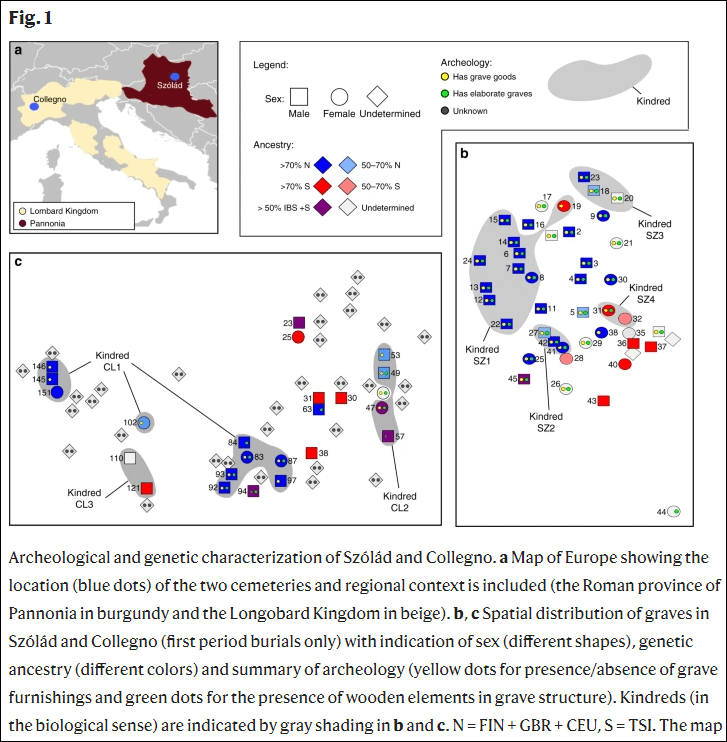
The authors provide this map of Pannonia, the Longobards kingdom, and the two cemeteries with burial locations.

One of their findings is that the burials are organized around biological kinship. Perhaps they weren’t so terribly different from us today.

Much as genealogists do, the authors created a pedigree chart – the only difference being that their chart is genetically constructed and lacks names, other than sample ID.

One man is buried with a horse, and one of his relatives, a female, is not buried in a family unit but in a half-ring of female graves.

The data suggests that the cemetery in Pannonia, Szolad, shown in burgundy on the map, may have been a “single-generation” cemetery, in use for only a limited time as the migration continued westward. Collegno, in contrast, seems to have been used for multiple generations, with the burials radiating outward over time from the progenitor individual.

Because the entire cemetery was analyzed, it’s possible to identify those individuals with northern or northeastern European ancestry, east of the Rhine and north of the Danube, and to differentiate from southern European ancestry in the Lombard cemetery – in addition to reassembling their family pedigrees. The story is told, not just by one individual’s DNA, but how the group is related to each other, and their individual and group origins.

For anyone with roots in Germany, Hungary, or the eastern portion of Europe, you know that this region has been embroiled in upheaval and warfare seemingly as long as there have been people to fight over who lived in and controlled these lands.

Are You Related?

Goran Runfeldt’s R&D group at Family Tree DNA reanalyzed the Y DNA samples from this paper and has been kind enough to provide a summary of the results. Michael Sager has utilized them to branch the Y DNA tree – in a dozen places.

Mitochondrial DNA haplogroups have been included where available from the authors, but have not been reanalyzed.

Note the comments added by FTDNA during analysis.

Many new branches were formed. I included step-by-step instructions, here, so you can see if your Y DNA results match either the new branch or any of these samples upstream.

If you’re a male and you haven’t yet tested your Y DNA or you would like to upgrade to the Big Y-700 to obtain your most detailed haplogroup, you can do either by clicking here. My husband’s family is from Hungary and I just upgraded his Y DNA test to the Big Y-700. I want to know where his ancestors came from.

And yes, this first sample really is rare haplogroup T. Each sample is linked to the Family Tree DNA public tree. We find haplogroups G and E as well as the more common R and I. Some ancient samples match contemporary testers from France (2), the UK, England, Morocco, Denmark (5), and Italy. Fascinating!

Sample: CL23
Location: Collegno, Piedmont, Italy
Age: Longobard 6th Century
Y-DNA: T-BY45363
mtDNA: H

Sample: CL30
Location: Collegno, Piedmont, Italy
Age: Longobard 6th Century
Y-DNA: R-P312
mtDNA: I1b

Sample: CL31
Location: Collegno, Piedmont, Italy
Age: Longobard 6th Century
Y-DNA: G-FGC693
FTDNA Comment: Authors warn of possible contamination. Y chromosome looks good – and there is support for splitting this branch. However, because of the contamination warning – we will not act on this split until more data is available.
mtDNA: H18

Sample: CL38
Location: Collegno, Piedmont, Italy
Age: Longobard 6th Century
Y-DNA: E-BY3880
mtDNA: X2

Sample: CL49
Location: Collegno, Piedmont, Italy
Age: Longobard 6th Century
Y-DNA: R-CTS6889

Sample: CL53
Location: Collegno, Piedmont, Italy
Age: Longobard 6th Century
Y-DNA: R-FGC24138
mtDNA: H11a

Sample: CL57
Location: Collegno, Piedmont, Italy
Age: Longobard 6th Century
Y-DNA: R-BY48364
mtDNA: H24a

Sample: CL63
Location: Collegno, Piedmont, Italy
Age: Longobard 6th Century
Y-DNA: I-FT104588
mtDNA: H

Sample: CL84
Location: Collegno, Piedmont, Italy
Age: Longobard 6th Century
Y-DNA: R-U198
mtDNA: H1t

Sample: CL92
Location: Collegno, Piedmont, Italy
Age: Longobard 6th Century
Y-DNA: R-S22519
mtDNA: H

Sample: CL93
Location: Collegno, Piedmont, Italy
Age: Longobard 6th Century
Y-DNA: R-S22519
mtDNA: J2b1a

Sample: CL94
Location: Collegno, Piedmont, Italy
Age: Longobard 6th Century
Y-DNA: R-DF99
mtDNA: K1c1

Sample: CL97
Location: Collegno, Piedmont, Italy
Age: Longobard 6th Century
Y-DNA: R-L23

Sample: CL110
Location: Collegno, Piedmont, Italy
Age: Longobard 6th Century
Y-DNA: R-L754

Sample: CL121
Location: Collegno, Piedmont, Italy
Age: Longobard 6th Century
Y-DNA: R-BY70163
FTDNA Comment: Shares 2 SNPs with a man from France. Forms a new branch down of R-BY70163 (Z2103). New branch = R-BY197053
mtDNA: T2b

Sample: CL145
Location: Collegno, Piedmont, Italy
Age: Longobard 6th Century
Y-DNA: R-S22519
mtDNA: T2b

Sample: CL146
Location: Collegno, Piedmont, Italy
Age: Longobard 6th Century
Y-DNA: R-A8472
mtDNA: T2b3

Sample: SZ1
Location: Szólád, Somogy County, Hungary
Study Information: The skeletal remains from an individual dating to the Bronze Age 10 m north of the cemetery.
Age: Bronze Age
Y-DNA: R-Y20746
mtDNA: J1b

Sample: SZ2
Location: Szólád, Somogy County, Hungary
Age: Longobard 6th Century
Y-DNA: R-Z338
FTDNA Comment: Shares 5 SNPs with a man from the UK. Forms a new branch down of R-Z338 (U106). New branch = R-BY176786
mtDNA: T1a1

Sample: SZ3
Location: Szólád, Somogy County, Hungary
Age: Longobard 6th Century
Y-DNA: I-BY3605
mtDNA: H18

Sample: SZ4
Location: Szólád, Somogy County, Hungary
Age: Longobard 6th Century
Y-DNA: R-ZP200
FTDNA Comment: Splits R-ZP200 (U106). Derived (positive) for 2 SNPs and ancestral (negative) for 19 SNPs. New path = R-Y98441>R-ZP200
mtDNA: H1c9

Sample: SZ5
Location: Szólád, Somogy County, Hungary
Age: Longobard 6th Century
Y-DNA: R-BY3194
FTDNA Comment: Splits R-BY3194 (DF27). Derived for 19 SNPs, ancestral for 9 SNPs. New path = R-BY3195>R-BY3194
mtDNA: J2b1

Sample: SZ6
Location: Szólád, Somogy County, Hungary
Age: Longobard 6th Century
Y-DNA: I-P214

Sample: SZ7
Location: Szólád, Somogy County, Hungary
Age: Longobard 6th Century
Y-DNA: I-S8104
FTDNA Comment: SZ13, SZ7 and SZ12 share 2 SNPs with a man from Denmark, forming a branch down of I-S8104 (M223). New branch = I-FT45324. Note that SZ22 and SZ24 (and even SZ14) fall on the same path to I-S8104 but lack coverage for intermediate branches.
mtDNA: T2e

Sample: SZ11
Location: Szólád, Somogy County, Hungary
Age: Longobard 6th Century
Y-DNA: R-FGC13492
FTDNA Comment: Shares 1 SNP with a man from Italy. Forms a new branch down of R-FGC13492 (U106). New branch = R-BY138397
mtDNA: K2a3a

Sample: SZ12
Location: Szólád, Somogy County, Hungary
Age: Longobard 6th Century
Y-DNA: I-S8104
FTDNA Comment: SZ13, SZ7 and SZ12 share 2 SNPs with a man from Denmark, forming a branch down of I-S8104 (M223). New branch = I-FT45324. Note that SZ22 and SZ24 (and even SZ14) fall on the same path to I-S8104 but lack coverage for intermediate branches.
mtDNA: W6

Sample: SZ13
Location: Szólád, Somogy County, Hungary
Age: Longobard 6th Century 422-541 cal CE
Y-DNA: I-S8104
FTDNA Comment: SZ13, SZ7 and SZ12 share 2 SNPs with a man from Denmark, forming a branch down of I-S8104 (M223). New branch = I-FT45324. Note that SZ22 and SZ24 (and even SZ14) fall on the same path to I-S8104 but lack coverage for intermediate branches.
mtDNA: N1b1b1

Sample: SZ14
Location: Szólád, Somogy County, Hungary
Age: Longobard 6th Century
Y-DNA: I-CTS616
FTDNA Comment: SZ13, SZ7 and SZ12 share 2 SNPs with a man from Denmark, forming a branch down of I-S8104 (M223). New branch = I-FT45324. Note that SZ22 and SZ24 (and even SZ14) fall on the same path to I-S8104 but lack coverage for intermediate branches.
mtDNA: I3

Sample: SZ15
Location: Szólád, Somogy County, Hungary
Age: Longobard 6th Century
Y-DNA: R-YP986
mtDNA: H1c1

Sample: SZ16
Location: Szólád, Somogy County, Hungary
Age: Longobard 6th Century
Y-DNA: R-U106
mtDNA: U4b1b

Sample: SZ18
Location: Szólád, Somogy County, Hungary
Age: Longobard 6th Century
Y-DNA: E-BY6865
FTDNA Comment: Shares 1 SNP with a man from Morocco. Forms a new branch down of E-BY6865. New branch = E-FT198679
mtDNA: H13a1a2

Sample: SZ22
Location: Szólád, Somogy County, Hungary
Age: Longobard 6th Century
Y-DNA: I-Y6876
FTDNA Comment: SZ13, SZ7 and SZ12 share 2 SNPs with a man from Denmark, forming a branch down of I-S8104 (M223). New branch = I-FT45324. Note that SZ22 and SZ24 (and even SZ14) fall on the same path to I-S8104 but lack coverage for intermediate branches.
mtDNA: N1b1b1

Sample: SZ23
Location: Szólád, Somogy County, Hungary
Age: Longobard 6th Century
Y-DNA: R-S10271
mtDNA: H13a1a2

Sample: SZ24
Location: Szólád, Somogy County, Hungary
Age: Longobard 6th Century
Y-DNA: I-ZS3
FTDNA Comment: SZ13, SZ7 and SZ12 share 2 SNPs with a man from Denmark, forming a branch down of I-S8104 (M223). New branch = I-FT45324. Note that SZ22 and SZ24 (and even SZ14) fall on the same path to I-S8104 but lack coverage for intermediate branches.
mtDNA: U4b

Sample: SZ27B
Location: Szólád, Somogy County, Hungary
Age: Longobard 6th Century 412-538 cal CE
Y-DNA: R-FGC4166
FTDNA Comment: Shares 1 SNP with a man from France. Forms a new branch down of R-FGC4166 (U152). New branch = R-FT190624
mtDNA: N1a1a1a1

Sample: SZ36
Location: Szólád, Somogy County, Hungary
Age: Longobard 6th Century
Y-DNA: T-Y15712
mtDNA: U4c2a

Sample: SZ37
Location: Szólád, Somogy County, Hungary
Age: Longobard 6th Century 430-577 cal CE
Y-DNA: R-P312
mtDNA: H66a

Sample: SZ42
Location: Szólád, Somogy County, Hungary
Age: Longobard 6th Century
Y-DNA: R-P312
mtDNA: K2a6

Sample: SZ43
Location: Szólád, Somogy County, Hungary
Age: Longobard 6th Century 435-604 cal CE
Y-DNA: I-BY138
mtDNA: H1e

Sample: SZ45
Location: Szólád, Somogy County, Hungary
Study Information: ADMIXTURE analysis showed SZ45 to possess a unique ancestry profile.
Age: Longobard 6th Century
Y-DNA: I-FGC21819
FTDNA Comment: Shares 2 SNPs with a man from England forms a new branch down of FGC21819. New branch = I-FGC21810
mtDNA: J1c

_____________________________________________________________

Disclosure

I receive a small contribution when you click on some of the links to vendors in my articles. This does NOT increase the price you pay but helps me to keep the lights on and this informational blog free for everyone. Please click on the links in the articles or to the vendors below if you are purchasing products or DNA testing.

Thank you so much.

DNA Purchases and Free Transfers

Genealogy Products and Services

Genealogy Research

Mitochondrial DNA Facebook Group Launches

Mitochondrial DNA has so much untapped potential!

Until now, there hasn’t been an online resource where one could go to find information about and specifically discuss mitochondrial DNA. Even more distressing, in many groups, when the topic of mitochondrial DNA arises, misinformation abounds, discouraging would-be testers.

New Group!

I’m very pleased to announce the new Facebook group, Mitochondrial DNA, here, founded by the National Geographic Society Genographic Project’s lead scientist, Dr. Miguel Vilar. As you know, the Genographic Project’s public participation phase has ended, but the scientific research for those who opted-in for science continues and Miguel is leading the way.

Miguel shares a lifelong passion for mitochondrial DNA, inherited by both males and females from their direct matrilineal line.

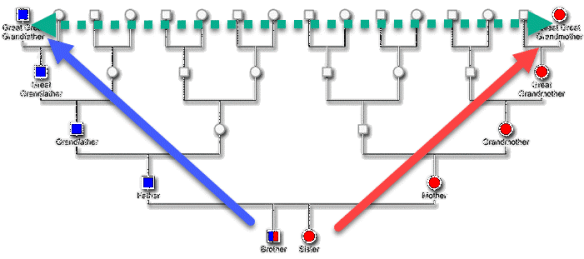
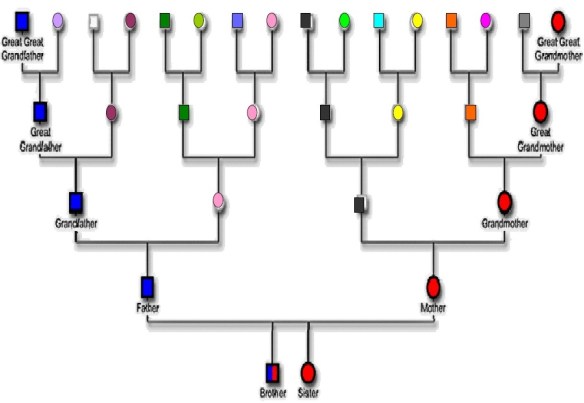
Different colored stars represent different Y DNA lines. Different colored hearts represent different mtDNA lines. The paternal and maternal grandfathers carry the mtDNA of their mothers, not shown here.

Mitochondrial DNA informs you about your mother’s mother’s mother’s line – the pink hearts above – both genealogically and historically. In other words, you can break down brick walls in your genealogy and understand the genesis of your matrilineal line before the advent of surnames. We can better answer the question, “where did I come from,” or more succinctly, where did our mother’s direct line come from.

In addition to Miguel, you’ll find other experts in the group, including members of the Million Mito Project, which I wrote about here.

  • Goran Rundfeldt heads the R&D team at FamilyTreeDNA.
  • Paul Maier is a population geneticist and member of the research team at FamilyTreeDNA. He specialized in toad and frog mtDNA in grad school and is now working on the new mitochondrial tree, for humans 😊, among other projects.
  • I’ve always been very interested in mitochondrial DNA, was a member of the Genographic Project design team and the first Genographic affiliate researcher. You can reference my Mitochondrial DNA resource page, here, which includes articles and step-by-step instructions for how to utilize mtDNA results.

Aside from the Million Mito research team, other Mitochondrial DNA group members with a special interest in mitochondrial DNA include:

As I scan down the list of members, I see several more highly qualified people.

Come On Over

Come on over and take a look for yourself to see what kinds of subjects are being discussed. Browse, ask a question, and contribute.

Send other people who have questions, are seeking advice, or are interested in what mitochondrial DNA can do for them.

Do you have a matrilineal brick wall you’d like to see fall? The first step is to test your mitochondrial DNA, preferably at the full sequence level to obtain as much information as possible. The more people who test, the better our chances of making meaningful connections.

Your mitochondrial DNA is a gift directly from your matrilineal ancestors. See what they have to say!

_____________________________________________________________

Disclosure

I receive a small contribution when you click on some of the links to vendors in my articles. This does NOT increase the price you pay but helps me to keep the lights on and this informational blog free for everyone. Please click on the links in the articles or to the vendors below if you are purchasing products or DNA testing.

Thank you so much.

DNA Purchases and Free Transfers

Genealogy Products and Services

Genealogy Research

442 Ancient Viking Skeletons Hold DNA Surprises – Does Your Y or Mitochondrial DNA Match? Daily Updates Here!

Yesterday, in the journal Nature, the article “Population genomics of the Viking world,” was published by Margaryan, et al, a culmination of 6 years of work.

Just hours later, Science Daily published the article, “World’s largest DNA sequencing of Viking skeletons reveals they weren’t all Scandinavian.” Science magazine published “’Viking’ was a job description, not a matter of heredity, massive ancient DNA study shows.” National Geographic wrote here, and CNN here.

Vikings Not All Scandinavian – Or Blonde

Say what??? That’s not at all what we thought we knew. That’s the great thing about science – we’re always learning something new.

442 Viking skeletons from outside Scandinavia were sequenced by Eske Willerslev’s lab, producing whole genome sequences for both men and women from sites in Scotland, Ukraine, Poland, Russia, the Baltic, Iceland, Greenland and elsewhere in continental Europe. They were then compared to known Viking samples from Scandinavia.

Not the grave where the sample was taken, but a Viking cemetery from Denmark.

One Viking boat burial in an Estonian Viking cemetery shows that 4 Viking brothers died and were buried together, ostensibly perishing in the same battle, on the same day. Based on their DNA, the brothers probably came from Sweden.

Vikings raiding parties from Scandinavia originated in Norway, Sweden and Denmark. At least some Viking raiders seem to be closely related to each other, and females in Iceland appear to be from the British Isles, suggesting that they may have “become” Vikings – although we don’t really understand the social and community structure.

Genes found in Vikings were contributed from across Europe, including southern Europe, and as afar away as Asia. Due to mixing resulting from the Viking raids beginning at Lindisfarne in 793 , the UK population today carries as much as 6% Viking DNA. Surprisingly, Swedes had only 10%.

Some Viking burials in both Orkney and Norway were actually genetically Pictish men. Converts, perhaps? One of these burials may actually be the earliest Pict skeleton sequenced to date.

Y DNA

Of the 442 skeletons, about 300 were male. The whole genome sequence includes the Y chromosome along with mitochondrial DNA, although it requires special processing to separate it usefully.

Goran Runfeldt, a member of the Million Mito team and head of research at FamilyTreeDNA began downloading DNA sequences immediately, and Michael Sager began analyzing Y DNA, hoping to add or split Y DNA tree branches.

Given the recent split of haplogroup P and A00, these ancient samples hold HUGE promise.

Michael and Goran have agreed to share their work as they process these samples – providing a rare glimpse real-time into the lab.

You and the Tree

Everyone is so excited about this paper, and I want you to be able to see if your Y or mitochondrial DNA, or that of your relatives matches the DNA haplogroups in the paper.

The paper itself uses the older letter=number designations for Y DNA haplogroup, so FamilyTreeDNA is rerunning, aligning and certifying the actual SNPs. The column FTDNA Haplogroup reflects the SNP Y haplogroup name.

Note that new Y DNA branches appear on the tree the day AFTER the change is made, and right now, changes resulting from this paper are being made hourly. I will update the haplogroup information daily as more becomes available. Pay particular attention to the locations that show where the graves were found along with the FamilyTreeDNA notes.

Goran has also included the mtDNA haplogroup as identified in the paper. Mitochondrial DNA haplogroups have not been recalculated, but you just might see them in the Million Mito Project😊

Here’s what you’ll need to do:

  • Go to your Y or mitochondrial DNA results and find your haplogroup.

  • Do a browser search on this article to see if your haplogroup is shown. On a PC, that’s CTRL+F to show the “find” box. If your haplogroup isn’t showing, you could be downstream of the Viking haplogroup, so you’ll need to use the Y DNA Block Tree (for Big Y testers) or public haplotree, here.
  • If you’ve taken the Big Y test, click on the Block Tree on your results page and then look across the top of your results page to see if the haplogroup in question is “upstream” or a parent of your haplogroup.

click to enlarge

If you don’t see it, keep scanning to the left until you see the last SNP.

click to enlarge

  • If the haplogroup you are seeking is NOT shown in your direct upstream branches, you can type the name of the haplogroup into the search box. For example, I’ve typed I-BY3428. You can also simply click on the FTDNA name haplogroup link in the table, below, considerately provided by Goran.

click to enlarge

I don’t see the intersecting SNP yet, between the tester and the ancient sample, so if I click on I-Y2592, I can view the rest of the upstream branches of haplogroup I.

click to enlarge

By looking at the Y DNA SNPs of the tester, and the Y DNA SNPs of the ancient sample, I can see that the intersecting SNP is DF29, roughly 52 SNP generations in the past. Rule of thumb is that SNP generations are 80-100 years each.

How About You – Are You Related to a Viking?

Below, you’ll find the information from Y DNA results in the paper, reprocessed and analyzed, with FamilyTreeDNA verified SNP names, along with the mitochondrial DNA haplogroup of each Viking male.

Are you related, and if so, how closely?

I was surprised to find a sister-branch to my own mitochondrial J1c2f. J1c2 and several subclades or branches were found in Viking burials.

I need to check all of my ancestral lines, both male and female. There’s history waiting to be revealed. What have you discovered?

Ancient Viking Sample Information

Please note that this information will be updated on business days until all samples have been processed and placed on the Y DNA tree – so this will be a “live” copy of the most current phylogenetic information.

Link to the locations to see the locations of the excavation sites, and the haplogroups for the tree locations. Michael Sager is making comments as he reviews each sample.

Enjoy!

Sample: VK14 / Russia_Ladoga_5680-12
Location: Ladoga, Russia
Age: Viking 10-12th centuries CE
Y-DNA: I-BY3428
mtDNA: J1c1a

Sample: VK16 / Russia_Ladoga_5680-2
Location: Ladoga, Russia
Age: Viking 11-12th centuries CE
Y-DNA: I-M253
mtDNA: X2b4

Sample: VK17 / Russia_Ladoga_5680-17
Location: Ladoga, Russia
Age: Viking 10-12th centuries CE
Y-DNA: T-Y138678
FTDNA Comment: Shares 5 SNPs with a man from Chechen Republic, forming a new branch down of T-Y22559 (T-Y138678)
mtDNA: U5a2a1b

Sample: VK18 / Russia_Ladoga_5680-3
Location: Ladoga, Russia
Age: Viking 10-12th centuries CE
Y-DNA: R-YP1370
mtDNA: H1b1

Sample: VK20 / Russia_Ladoga_5680-1
Location: Ladoga, Russia
Age: Viking 11th century CE
Y-DNA: I-Y22478
FTDNA Comment: Splits the I-Z24071 branch, positive only for Y22478. New path = I-Y22486>I-Y22478>I-Z24071
mtDNA: H6c

Sample: VK22 / Russia_Ladoga_5680-13
Location: Ladoga, Russia
Age: Viking 10-12th centuries CE
Y-DNA: I-A8462
mtDNA: T2b

Sample: VK23 / Russia_Ladoga_5680-9
Location: Ladoga, Russia
Age: Viking 10-12th centuries CE
Y-DNA: I-M253
mtDNA: U4a1a

Sample: VK24 / Faroe_AS34/Panum
Location: Hvalba, Faroes
Age: Viking 11th century
Y-DNA: R-FGC12948
mtDNA: J1b1a1a

Sample: VK25 / Faroe_1
Location: Church2, Faroes
Age: Early modern 16-17th centuries CE
Y-DNA: R-FT381000
FTDNA Comment: Splits the R-BY11762 branch, positive for 5 variants ancestral for ~14, new path = R-A8041>R-BY11764>BY11762
mtDNA: H3a1a

Sample: VK27 / Faroe_10
Location: Church2, Faroes
Age: Early modern 16-17th centuries CE
Y-DNA: R-L513
mtDNA: U5a1g1

Sample: VK29 / Sweden_Skara 17
Location: Varnhem, Skara, Sweden
Age: Viking 10-12th centuries CE
Y-DNA: I-S7642
mtDNA: T2b3b

Sample: VK30 / Sweden_Skara 105
Location: Varnhem, Skara, Sweden
Age: Viking 10-12th centuries CE
Y-DNA: R-S2857
mtDNA: U5b1c2b

Sample: VK31 / Sweden_Skara 194
Location: Varnhem, Skara, Sweden
Age: Viking 10-12th centuries CE
Y-DNA: R-L21
mtDNA: I4a

Sample: VK34 / Sweden_Skara 135
Location: Varnhem, Skara, Sweden
Age: Viking 10-12th centuries CE
Y-DNA: R-BY111759
mtDNA: HV-T16311C!

Sample: VK35 / Sweden_Skara 118
Location: Varnhem, Skara, Sweden
Age: Viking 10-12th centuries CE
Y-DNA: R-CTS4179
mtDNA: T2f1a1

Sample: VK39 / Sweden_Skara 181
Location: Varnhem, Skara, Sweden
Age: Viking 10-12th centuries CE
Y-DNA: G-Z1817
mtDNA: T2b4b

Sample: VK40 / Sweden_Skara 106
Location: Varnhem, Skara, Sweden
Age: Viking 10-12th centuries CE
Y-DNA: R-BY166438
FTDNA Comment: Shares 10 SNPs with a man with unknown origins (American) downstream of R-BY1701. New branch R-BY166438
mtDNA: T1a1

Sample: VK42 / Sweden_Skara 62
Location: Varnhem, Skara, Sweden
Age: Viking 10-12th centuries CE
Y-DNA: J-FGC32685
mtDNA: T2b11

Sample: VK44 / Faroe_17
Location: Church2, Faroes
Age: Early modern 16-17th centuries CE
Y-DNA: R-S658
mtDNA: H3a1a

Sample: VK45 / Faroe_18
Location: Church2, Faroes
Age: Early modern 16-17th centuries CE
Y-DNA: R-CTS8277
mtDNA: H3a1

Sample: VK46 / Faroe_19
Location: Church2, Faroes
Age: Early modern 16-17th centuries CE
Y-DNA: R-BY202785
FTDNA Comment: Forms a branch with VK245 down of R-BY202785 (Z287). New branch = R-FT383000
mtDNA: H5

Sample: VK48 / Gotland_Kopparsvik-212/65
Location: Kopparsvik, Gotland, Sweden
Age: Viking 900-1050 CE
Y-DNA: R-FGC52679
mtDNA: H10e

Sample: VK50 / Gotland_Kopparsvik-53.64
Location: Kopparsvik, Gotland, Sweden
Age: Viking 900-1050 CE
Y-DNA: I-Y22923
mtDNA: H1-T16189C!

Sample: VK51 / Gotland_Kopparsvik-88/64
Location: Kopparsvik, Gotland, Sweden
Age: Viking 900-1050 CE
Y-DNA: N-L1026
mtDNA: U5b1e1

Sample: VK53 / Gotland_Kopparsvik-161/65
Location: Kopparsvik, Gotland, Sweden
Age: Viking 900-1050 CE
Y-DNA: I-CTS10228
mtDNA: HV9b

Sample: VK57 / Gotland_Frojel-03601
Location: Frojel, Gotland, Sweden
Age: Viking 900-1050 CE
Y-DNA: R-L151
mtDNA: J1c6

Sample: VK60 / Gotland_Frojel-00702
Location: Frojel, Gotland, Sweden
Age: Viking 900-1050 CE
Y-DNA: R-YP1026
mtDNA: H13a1a1b

Sample: VK64 / Gotland_Frojel-03504
Location: Frojel, Gotland, Sweden
Age: Viking 900-1050 CE
Y-DNA: R-BY58559
mtDNA: I1a1

Sample: VK70 / Denmark_Tollemosegard-EW
Location: Tollemosegård, Sealand, Denmark
Age: Early Viking Late Germanic Iron Age/early Viking
Y-DNA: I-BY73576
mtDNA: H7d4

Sample: VK71 / Denmark_Tollemosegard-BU
Location: Tollemosegård, Sealand, Denmark
Age: Early Viking Late Germanic Iron Age/early Viking
Y-DNA: I-S22349
mtDNA: U5a1a

Sample: VK75 / Greenland late-0929
Location: V051, Western Settlement, Greenland
Age: Late Norse 1300 CE
Y-DNA: R-P310
mtDNA: H54

Sample: VK87 / Denmark_Hesselbjerg Grav 41b, sk PC
Location: Hesselbjerg, Jutland, Denmark
Age: Viking 850-900 CE
Y-DNA: R-Z198
mtDNA: K1c2

Sample: VK95 / Iceland_127
Location: Hofstadir, Iceland
Age: Viking 10-13th centuries CE
Y-DNA: R-S658
mtDNA: H6a1a3a

Sample: VK98 / Iceland_083
Location: Hofstadir, Iceland
Age: Viking 10-13th centuries CE
Y-DNA: I-BY3433
FTDNA Comment: Splits I-BY3430. Derived for 1 ancestral for 6. New path = I-BY3433>I-BY3430
mtDNA: T2b3b

Sample: VK101 / Iceland_125
Location: Hofstadir, Iceland
Age: Viking 10-13th centuries CE
Y-DNA: R-BY110718
mtDNA: U5b1g

Sample: VK102 / Iceland_128
Location: Hofstadir, Iceland
Age: Viking 10-13th centuries CE
Y-DNA: R-Y96503
FTDNA Comment: Shares 3 SNPs with a man from Sweden. Forms a new branch downstream of R-FGC23826. New branch = R-Y96503
mtDNA: J1c3f

Sample: VK110 / Iceland_115S
Location: Hofstadir, Iceland
Age: Viking 10-13th centuries CE
Y-DNA: I-FGC21682
mtDNA: H10-x

Sample: VK117 / Norway_Trondheim_SK328
Location: Trondheim, Nor_Mid, Norway
Age: Medieval 12-13th centuries CE
Y-DNA: R-S9257
mtDNA: H1a3a

Sample: VK123 / Iceland_X104
Location: Hofstadir, Iceland
Age: Viking 10-13th centuries CE
Y-DNA: R-Y130994
FTDNA Comment: Shares 17 SNPs with a man from the UAE. Creates a new branch downstream of R2-V1180. New branch = R-Y130994
mtDNA: J1c9

Sample: VK127 / Iceland_HDR08
Location: Hringsdalur, Iceland
Age: Viking 10th century CE
Y-DNA: R-BY92608
mtDNA: H3g1b

Sample: VK129 / Iceland_ING08
Location: Ingiridarstadir, Iceland
Age: Viking 10th century CE
Y-DNA: R-BY154143
FTDNA Comment: Shares 3 SNPs with a man from Sweden. Forms a new branch downstream of R1a-YP275. New branch = R-BY154143
mtDNA: U5b1b1a

Sample: VK133 / Denmark_Galgedil KO
Location: Galgedil, Funen, Denmark
Age: Viking 8-11th centuries CE
Y-DNA: R-Z8
mtDNA: K1a4a1a3

Sample: VK134 / Denmark_Galgedil ALZ
Location: Galgedil, Funen, Denmark
Age: Viking 9-11th centuries CE
Y-DNA: R-BY97519
mtDNA: H1cg

Sample: VK138 / Denmark_Galgedil AQQ
Location: Galgedil, Funen, Denmark
Age: Viking 9-11th centuries CE
Y-DNA: R-S1491
mtDNA: T2b5

Sample: VK139 / Denmark_Galgedil ANG
Location: Galgedil, Funen, Denmark
Age: Viking 9-11th centuries CE
Y-DNA: R-BY32008
mtDNA: J1c3k

Sample: VK140 / Denmark_Galgedil PT
Location: Galgedil, Funen, Denmark
Age: Viking 9-11th centuries CE
Y-DNA: G-M201
mtDNA: H27f

Sample: VK143 / UK_Oxford_#7
Location: St_John’s_College_Oxford, Oxford, England, UK
Age: Viking 880-1000 CE
Y-DNA: R-Y13833
FTDNA Comment: Splits R-Y13816. Derived for 6 ancestral for 3. New path = R-Y13816>R-Y13833
mtDNA: U5b1b1-T16192C!

Sample: VK144 / UK_Oxford_#8
Location: St_John’s_College_Oxford, Oxford, England, UK
Age: Viking 880-1000 CE
Y-DNA: I-Y2592
mtDNA: V1a1

Sample: VK145 / UK_Oxford_#9
Location: St_John’s_College_Oxford, Oxford, England, UK
Age: Viking 880-1000 CE
Y-DNA: R-YP1708
mtDNA: H17

Sample: VK146 / UK_Oxford_#10
Location: St_John’s_College_Oxford, Oxford, England, UK
Age: Viking 880-1000 CE
Y-DNA: I-M6155
mtDNA: J1c3e1

Sample: VK147 / UK_Oxford_#11
Location: St_John’s_College_Oxford, Oxford, England, UK
Age: Viking 880-1000 CE
Y-DNA: R-Y75899
mtDNA: T1a1q

Sample: VK148 / UK_Oxford_#12
Location: St_John’s_College_Oxford, Oxford, England, UK
Age: Viking 880-1000 CE
Y-DNA: I-M253
mtDNA: H6a1a

Sample: VK149 / UK_Oxford_#13
Location: St_John’s_College_Oxford, Oxford, England, UK
Age: Viking 880-1000 CE
Y-DNA: I-M253
mtDNA: H1a1

Sample: VK150 / UK_Oxford_#14
Location: St_John’s_College_Oxford, Oxford, England, UK
Age: Viking 880-1000 CE
Y-DNA: I-FT4725
mtDNA: H1-C16239T

Sample: VK151 / UK_Oxford_#15
Location: St_John’s_College_Oxford, Oxford, England, UK
Age: Viking 880-1000 CE
Y-DNA: I-S19291
mtDNA: T2b4-T152C!

Sample: VK153 / Poland_Bodzia B1
Location: Bodzia, Poland
Age: Viking 10-11th centuries CE
Y-DNA: R-M198
mtDNA: H1c3

Sample: VK156 / Poland_Bodzia B4
Location: Bodzia, Poland
Age: Viking 10-11th centuries CE
Y-DNA: R-Y9081
mtDNA: J1c2c2a

Sample: VK157 / Poland_Bodzia B5
Location: Bodzia, Poland
Age: Viking 10-11th centuries CE
Y-DNA: I-S2077
mtDNA: H1c

Sample: VK159 / Russia_Pskov_7283-20
Location: Pskov, Russia
Age: Viking 10-11th centuries CE
Y-DNA: R-A7982
mtDNA: U2e2a1d

Sample: VK160 / Russia_Kurevanikka_7283-3
Location: Kurevanikha, Russia
Age: Viking 10-13th centuries CE
Y-DNA: R-YP1137
mtDNA: C4a1a-T195C!

Sample: VK163 / UK_Oxford_#1
Location: St_John’s_College_Oxford, Oxford, England, UK
Age: Viking 880-1000 CE
Y-DNA: I-M253
mtDNA: U2e2a1a1

Sample: VK165 / UK_Oxford_#3
Location: St_John’s_College_Oxford, Oxford, England, UK
Age: Viking 880-1000 CE
Y-DNA: I-S18218
mtDNA: U4b1b1

Sample: VK166 / UK_Oxford_#4
Location: St_John’s_College_Oxford, Oxford, England, UK
Age: Viking 880-1000 CE
Y-DNA: R-BY67003
FTDNA Comment: Splits R-BY45170 (DF27). Derived for 2, ancestral for 7. New path = R-BY67003>R-BY45170
mtDNA: H3ag

Sample: VK167 / UK_Oxford_#5
Location: St_John’s_College_Oxford, Oxford, England, UK
Age: Viking 880-1000 CE
Y-DNA: I-BY34674
mtDNA: H4a1a4b

Sample: VK168 / UK_Oxford_#6
Location: St_John’s_College_Oxford, Oxford, England, UK
Age: Viking 880-1000 CE
Y-DNA: R-Z18
mtDNA: H4a1a4b

Sample: VK170 / Isle-of-Man_Balladoole
Location: Balladoole, IsleOfMan
Age: Viking 9-10th centuries CE
Y-DNA: R-S3201
mtDNA: HV9b

Sample: VK172 / UK_Oxford_#16
Location: St_John’s_College_Oxford, Oxford, England, UK
Age: Viking 880-1000 CE
Y-DNA: R-FT7019
mtDNA: I1a1e

Sample: VK173 / UK_Oxford_#17
Location: St_John’s_College_Oxford, Oxford, England, UK
Age: Viking 880-1000 CE
Y-DNA: I-FT13004
FTDNA Comment: Splits I2-FT12648, derived for 5, ancestral for 7. New path FT13004>FT12648
mtDNA: U5a1b-T16362C

Sample: VK174 / UK_Oxford_#18
Location: St_John’s_College_Oxford, Oxford, England, UK
Age: Viking 880-1000 CE
Y-DNA: R-FGC17429
mtDNA: H1-C16239T

Sample: VK175 / UK_Oxford_#19
Location: St_John’s_College_Oxford, Oxford, England, UK
Age: Viking 880-1000 CE
Y-DNA: R-Y47841
FTDNA Comment: Shares 6 SNPs with man from Sweden down of R-BY38950 (R-Y47841)
mtDNA: H1a1

Sample: VK176 / UK_Oxford_#20
Location: St_John’s_College_Oxford, Oxford, England, UK
Age: Viking 880-1000 CE
Y-DNA: I-FT3562
mtDNA: H10

Sample: VK177 / UK_Oxford_#21
Location: St_John’s_College_Oxford, Oxford, England, UK
Age: Viking 880-1000 CE
Y-DNA: R-FT31867
FTDNA Comment: Shares 3 SNPs with a man from Greece. Forms a new branch downstream of R-BY220332 (U152). New branch = R-FT31867
mtDNA: H82

Sample: VK178 / UK_Oxford_#22
Location: St_John’s_College_Oxford, Oxford, England, UK
Age: Viking 880-1000 CE
Y-DNA: R-BY176639
FTDNA Comment: Links up with PGA3 (Personal Genome Project Austria) and FTDNA customer from Denmark. PGA and FTDNA customer formed a branch earlier this week, VK178 will join them at R-BY176639 (Under L48)
mtDNA: K2a5

Sample: VK179 / Greenland F2
Location: Ø029a, Eastern Settlement, Greenland
Age: Early Norse 10-12th centuries CE
Y-DNA: I-F3312
mtDNA: K1a3a

Sample: VK183 / Greenland F6
Location: Ø029a, Eastern Settlement, Greenland
Age: Early Norse 10-12th centuries CE
Y-DNA: I-F3312
mtDNA: T2b21

Sample: VK184 / Greenland F7
Location: Ø029a, Eastern Settlement, Greenland
Age: Early Norse 10-12th centuries CE
Y-DNA: R-YP4342
mtDNA: H4a1a4b

Sample: VK186 / Greenland KNK-[6]
Location: Ø64, Eastern Settlement, Greenland
Age: Early Norse 10-12th centuries CE
Y-DNA: I-Y79817
FTDNA Comment: Shares 3 SNPs with a man from Norway downstream of I-Y24625. New branch = I-Y79817
mtDNA: H1ao

Sample: VK190 / Greenland late-0996
Location: Ø149, Eastern Settlement, Greenland
Age: Late Norse 1360 CE
Y-DNA: I-FGC15543
FTDNA Comment: Splits I-FGC15561. Derived 11 ancestral for 6. New path = I-FGC15543>I-FGC15561
mtDNA: K1a-T195C!

Sample: VK201 / Orkney_Buckquoy, sk M12
Location: Buckquoy_Birsay, Orkney, Scotland, UK
Age: Viking 5-6th century CE
Y-DNA: I-B293
mtDNA: H3k1a

Sample: VK202 / Orkney_Buckquoy, sk 7B
Location: Buckquoy_Birsay, Orkney, Scotland, UK
Age: Viking 10th century CE
Y-DNA: R-A151
mtDNA: H1ai1

Sample: VK203 / Orkney_BY78, Ar. 1, sk 3
Location: Brough_Road_Birsay, Orkney, Scotland, UK
Age: Viking 5-6th century CE
Y-DNA: R-BY10450
FTDNA Comment: FT83323-
mtDNA: H4a1a1a1a1

Sample: VK204 / Orkney_Newark for Brothwell
Location: Newark_Deerness, Orkney, Scotland, UK
Age: Viking 10th century CE
Y-DNA: R-BY115469
mtDNA: H1m

Sample: VK205 / Orkney_Newark 68/12
Location: Newark_Deerness, Orkney, Scotland, UK
Age: Viking 10th century CE
Y-DNA: R-YP4345
mtDNA: H3

Sample: VK210 / Poland_Kraków-Zakrzówek gr. 24
Location: Kraków, Poland
Age: Medieval 11-13th centuries CE
Y-DNA: I-Z16971
mtDNA: H5e1a1

Sample: VK211 / Poland_Cedynia gr. 435
Location: Cedynia, Poland
Age: Medieval 11-13 centuries CE
Y-DNA: R-M269
mtDNA: W6

Sample: VK212 / Poland_Cedynia gr. 558
Location: Cedynia, Poland
Age: Viking 11-12th centuries CE
Y-DNA: R-CTS11962
mtDNA: H1-T152C!

Sample: VK215 / Denmark_Gerdrup-B; sk 1
Location: Gerdrup, Sealand, Denmark
Age: Viking 9th century CE
Y-DNA: R-M269
mtDNA: J1c2k

Sample: VK217 / Sweden_Ljungbacka
Location: Ljungbacka, Malmo, Sweden
Age: Viking 9-12th centuries CE
Y-DNA: R-L151
mtDNA: J1b1b1

Sample: VK218 / Russia_Ladoga_5680-4
Location: Ladoga, Russia
Age: Viking 10-12th centuries CE
Y-DNA: R-BY2848
mtDNA: H5

Sample: VK219 / Russia_Ladoga_5680-10
Location: Ladoga, Russia
Age: Viking 10-11th centuries CE
Y-DNA: I-Y22024
mtDNA: T2b6a

Sample: VK220 / Russia_Ladoga_5680-11
Location: Ladoga, Russia
Age: Viking 10-12th centuries CE
Y-DNA: I-FT253975
FTDNA Comment: CTS2208+, BY47171-, CTS7676-, Y20288-, BY69785-, FT253975+
mtDNA: J2b1a

Sample: VK221 / Russia_Ladoga_5757-14
Location: Ladoga, Russia
Age: Viking 9-10th centuries CE
Y-DNA: I-Y5473
mtDNA: K1d

Sample: VK223 / Russia_Gnezdovo 75-140
Location: Gnezdovo, Russia
Age: Viking 10-11th centuries CE
Y-DNA: I-BY67763
mtDNA: H13a1a1c

Sample: VK224 / Russia_Gnezdovo 78-249
Location: Gnezdovo, Russia
Age: Viking 10-11th centuries CE
Y-DNA: N-CTS2929
mtDNA: H7a1

Sample: VK225 / Iceland_A108
Location: Hofstadir, Iceland
Age: Viking 10-13th centuries CE
Y-DNA: R-BY92608
mtDNA: H3v-T16093C

Sample: VK232 / Gotland_Kopparsvik-240.65
Location: Kopparsvik, Gotland, Sweden
Age: Viking 900-1050 CE
Y-DNA: R-Y16505
FTDNA Comment: Speculative placement – U106+, but U106 (C>T) in ancient samples can be misleading. LAV010, NA34, I7779, ble007, R55 and EDM124 are all non-R ancient samples that are U106+. More conservative placement is at R-P310
mtDNA: N1a1a1

Sample: VK234 / Faroe_2
Location: Church2, Faroes
Age: Early modern 16-17th centuries CE
Y-DNA: R-FT381000
FTDNA Comment: Same split as VK25. They share one marker FT381000 (26352237 T>G)
mtDNA: H3a1a

Sample: VK237 / Faroe_15
Location: Church2, Faroes
Age: Early modern 16-17th centuries CE
Y-DNA: R-S6355
mtDNA: J2a2c

Sample: VK238 / Faroe_4
Location: Church2, Faroes
Age: Early modern 16-17th centuries CE
Y-DNA: R-YP396
mtDNA: H3a1a

Sample: VK239 / Faroe_5
Location: Church2, Faroes
Age: Early modern 16-17th centuries CE
Y-DNA: R-M269
mtDNA: H5

Sample: VK242 / Faroe_3
Location: Church2, Faroes
Age: Early modern 16-17th centuries CE
Y-DNA: R-S764
mtDNA: H3a1a

Sample: VK244 / Faroe_12
Location: Church2, Faroes
Age: Early modern 16-17th centuries CE
Y-DNA: R-CTS4179
mtDNA: H2a2a2

Sample: VK245 / Faroe_16
Location: Church2, Faroes
Age: Early modern 16-17th centuries CE
Y-DNA: R-BY202785
FTDNA Comment: Forms a branch with VK46 down of R-BY202785 (Z287). New branch = R-FT383000
mtDNA: H3a1

Sample: VK248 / Faroe_22
Location: Church2, Faroes
Age: Early modern 16-17th centuries CE
Y-DNA: I-M253
mtDNA: H49a

Sample: VK251 / Gotland_Kopparsvik-30.64
Location: Kopparsvik, Gotland, Sweden
Age: Viking 900-1050 CE
Y-DNA: R-M459
mtDNA: U5b1e1

Sample: VK256 / UK_Dorset-3722
Location: Ridgeway_Hill_Mass_Grave_Dorset, Dorset, England, UK
Age: Viking 10-11th centuries CE
Y-DNA: R-YP5718
mtDNA: H1c7

Sample: VK257 / UK_Dorset-3723
Location: Ridgeway_Hill_Mass_Grave_Dorset, Dorset, England, UK
Age: Viking 10-11th centuries CE
Y-DNA: I-Y19934
mtDNA: H5a1c1a

Sample: VK258 / UK_Dorset-3733
Location: Ridgeway_Hill_Mass_Grave_Dorset, Dorset, England, UK
Age: Viking 10-11th centuries CE
Y-DNA: R-YP1395
FTDNA Comment: Shares 5 SNPs with a man from Norway. Forms a new branch down of R-YP1395. New branch = R-PH420
mtDNA: K1a4a1

Sample: VK259 / UK_Dorset-3734
Location: Ridgeway_Hill_Mass_Grave_Dorset, Dorset, England, UK
Age: Viking 10-11th centuries CE
Y-DNA: R-FT20255
FTDNA Comment: Both VK449 and VK259 share 3 SNPs with a man from Sweden. Forms a new branch down of R-FT20255 (Z18). New branch = R-FT22694
mtDNA: I2

Sample: VK260 / UK_Dorset-3735
Location: Ridgeway_Hill_Mass_Grave_Dorset, Dorset, England, UK
Age: Viking 10-11th centuries CE
Y-DNA: Q-BY77336
mtDNA: H1e1a

Sample: VK261 / UK_Dorset-3736
Location: Ridgeway_Hill_Mass_Grave_Dorset, Dorset, England, UK
Age: Viking 10-11th centuries CE
Y-DNA: R-BY64643
mtDNA: H52

Sample: VK262 / UK_Dorset-3739
Location: Ridgeway_Hill_Mass_Grave_Dorset, Dorset, England, UK
Age: Viking 10-11th centuries CE
Y-DNA: I-FT347811
FTDNA Comment: Shares 2 SNPs with an American of unknown origins. Forms a new branch down of Y6908 (Z140). At the same time a new branch was discovered that groups this new Ancient/American branch with the established I-FT274828 branch. New ancient path = I-Y6908>I-FT273257>I-FT347811
mtDNA: J1c4

Sample: VK263 / UK_Dorset-3742
Location: Ridgeway_Hill_Mass_Grave_Dorset, Dorset, England, UK
Age: Viking 10-11th centuries CE
Y-DNA: R-Z16372
mtDNA: K1a4d

Sample: VK264 / UK_Dorset-3744
Location: Ridgeway_Hill_Mass_Grave_Dorset, Dorset, England, UK
Age: Viking 10-11th centuries CE
Y-DNA: R-BY30937
mtDNA: N1a1a1a2

Sample: VK267 / Sweden_Karda 21
Location: Karda, Sweden
Age: Viking 9-11th centuries CE
Y-DNA: R-L23
mtDNA: T2b4b

Sample: VK268 / Sweden_Karda 22
Location: Karda, Sweden
Age: Viking 9-11th centuries CE
Y-DNA: R-M269
mtDNA: K1c1

Sample: VK269 / Sweden_Karda 24
Location: Karda, Sweden
Age: Viking 9-11th centuries CE
Y-DNA: R-M269
mtDNA: H1e1a

Sample: VK273 / Russia_Gnezdovo 77-255
Location: Gnezdovo, Russia
Age: Viking 10-11th centuries CE
Y-DNA: R-BY61747
mtDNA: U5a2a1b1

Sample: VK274 / Denmark_Kaargarden 391
Location: Kaagården, Langeland, Denmark
Age: Viking 10th century CE
Y-DNA: R-PH3519
mtDNA: T2b-T152C!

Sample: VK275 / Denmark_Kaargarden 217
Location: Kaagården, Langeland, Denmark
Age: Viking 10th century CE
Y-DNA: I-BY74743
mtDNA: H

Sample: VK279 / Denmark_Galgedil AXE
Location: Galgedil, Funen, Denmark
Age: Viking 10th century CE
Y-DNA: I-Y10639
mtDNA: I4a

Sample: VK280 / Denmark_Galgedil UO
Location: Galgedil, Funen, Denmark
Age: Viking 9-11th centuries CE
Y-DNA: I-Y3713
mtDNA: H11a

Sample: VK281 / Denmark_Barse Grav A
Location: Bårse, Sealand, Denmark
Age: Viking 10th century CE
Y-DNA: I-FGC22153
FTDNA Comment: Splits I-Y5612 (P109). Derived for 8, ancestral for 2. New path = I-Y5612>I-Y5619
mtDNA: T2

Sample: VK282 / Denmark_Stengade I, LMR c195
Location: Stengade_I, Langeland, Denmark
Age: Viking 10th century CE
Y-DNA: R-CTS1211
mtDNA: H4a1a4b

Sample: VK286 / Denmark_Bogovej Grav BJ
Location: Bogøvej, Langeland, Denmark
Age: Viking 10th century CE
Y-DNA: R-S10708
mtDNA: J1c-C16261T

Sample: VK287 / Denmark_Kaargarden Grav BS
Location: Kaagården, Langeland, Denmark
Age: Viking 10th century CE
Y-DNA: R-S22676
mtDNA: T2b

Sample: VK289 / Denmark_Bodkergarden Grav H, sk 1
Location: Bødkergarden, Langeland, Denmark
Age: Viking 9th century CE
Y-DNA: R-U106
mtDNA: J2b1a

Sample: VK290 / Denmark_Kumle Hoje Grav O
Location: Kumle_høje, Langeland, Denmark
Age: Viking 10th century CE
Y-DNA: R-FT264183
FTDNA Comment: Shares at least 4 SNPs with a man from Sweden, forming a new branch downstream R-FT263905 (U106). New branch = R-FT264183. HG02545 remains at R-FT263905
mtDNA: I1a1

Sample: VK291 / Denmark_Bodkergarden Grav D, sk 1
Location: Bødkergarden, Langeland, Denmark
Age: Viking 9th century CE
Y-DNA: I-Y20861
mtDNA: U5a1a2b

Sample: VK292 / Denmark_Bogovej Grav A.D.
Location: Bogøvej, Langeland, Denmark
Age: Viking 10th century CE
Y-DNA: R-M417
mtDNA: J1c2c1

Sample: VK295 / Denmark_Hessum sk 1
Location: Hessum, Funen, Denmark
Age: Viking 9-11th centuries CE
Y-DNA: I-Y4738
mtDNA: T1a1

Sample: VK296 / Denmark_Hundstrup Mose sk 1
Location: Hundstrup_Mose, Sealand, Denmark
Age: Early Viking 660-780 CE
Y-DNA: I-S7660
mtDNA: HV6

Sample: VK297 / Denmark_Hundstrup Mose sk 2
Location: Hundstrup_Mose, Sealand, Denmark
Age: Early Viking 670-830 CE
Y-DNA: I-Y4051
mtDNA: J1c2h

Sample: VK301 / Denmark_Ladby Grav 4
Location: Ladby, Funen, Denmark
Age: Viking 640-890 CE
Y-DNA: I-FT105192
mtDNA: R0a2b

Sample: VK306 / Sweden_Skara 33
Location: Varnhem, Skara, Sweden
Age: Viking 10-12th centuries CE
Y-DNA: I-FT115400
FTDNA Comment: Shares 3 mutations with a man from Sweden. Forms a new branch down of I-S19291. New branch = I-FT115400. VK151 has no coverage for 2 of these mutations
mtDNA: H15a1

Sample: VK308 / Sweden_Skara 101
Location: Varnhem, Skara, Sweden
Age: Viking 10-12th centuries CE
Y-DNA: R-BY33037
mtDNA: H1c

Sample: VK309 / Sweden_Skara 53
Location: Varnhem, Skara, Sweden
Age: Viking 10-12th centuries CE
Y-DNA: R-YP6189
mtDNA: K1b1c

Sample: VK313 / Denmark_Rantzausminde Grav 2
Location: Rantzausminde, Funen, Denmark
Age: Viking 850-900 CE
Y-DNA: R-JFS0009
mtDNA: H1b

Sample: VK315 / Denmark_Bakkendrup Grav 16
Location: Bakkendrup, Sealand, Denmark
Age: Viking 850-900 CE
Y-DNA: I-Y98280
FTDNA Comment: Shares 1 SNP with a man from the Netherlands. Forms a new branch downstream of I-Y37415 (P109). New branch = I-Y98280
mtDNA: T1a1b

Sample: VK316 / Denmark_Hessum sk II
Location: Hessum, Funen, Denmark
Age: Viking 9-11th centuries CE
Y-DNA: I-Y130659
FTDNA Comment: Splits I-Y130594 (Z59). Derived for 1 ancestral for 6. New path = I-Y130659>I-Y130594>I-Y130747. Ancient sample STR_486 also belongs in this group, at I-Y130747
mtDNA: K1a4

Sample: VK317 / Denmark_Kaargarden Grav BF99
Location: Kaagården, Langeland, Denmark
Age: Viking 10th century CE
Y-DNA: J-BY62479
FTDNA Comment: Splits J2-BY62479 (M67). Derived for 9, ancestral for 3. New path = J-BY62479>J-BY72550
mtDNA: H2a2a1

Sample: VK320 / Denmark_Bogovej Grav S
Location: Bogøvej, Langeland, Denmark
Age: Viking 10th century CE
Y-DNA: I-Y103013
FTDNA Comment: Shares 3 SNPs with a man from Sweden. Forms a new branch down of I-FT3562 (P109). New branch = I-Y103013
mtDNA: U5a1a1

Sample: VK323 / Denmark_Ribe 2
Location: Ribe, Jutland, Denmark
Age: Viking 9-11th centuries CE
Y-DNA: R-S10185
mtDNA: K2a6

Sample: VK324 / Denmark_Ribe 3
Location: Ribe, Jutland, Denmark
Age: Viking 9-11th centuries CE
Y-DNA: R-BY16590
FTDNA Comment: Splits R-BY16590 (L47). Derived for 7, ancestral for 3. New path = R-S9742>R-BY16950
mtDNA: N1a1a1a2

Sample: VK326 / Denmark_Ribe 5
Location: Ribe, Jutland, Denmark
Age: Viking 9-11th centuries CE
Y-DNA: R-Y52895
mtDNA: U5b1-T16189C!-T16192C!

Sample: VK327 / Denmark_Ribe 6
Location: Ribe, Jutland, Denmark
Age: Viking 9-11th centuries CE
Y-DNA: I-BY463
mtDNA: H6a1a5

Sample: VK329 / Denmark_Ribe 8
Location: Ribe, Jutland, Denmark
Age: Viking 9-11th centuries CE
Y-DNA: R-S18894
mtDNA: H3-T152C!

Sample: VK332 / Oland_1088
Location: Oland, Sweden
Age: Viking 858 ±68 CE
Y-DNA: I-S8522
FTDNA Comment: Possibly falls beneath I-BY195155. Shares one C>T mutation with a BY195155* sample
mtDNA: T2b24

Sample: VK333 / Oland_1028
Location: Oland, Sweden
Age: Viking 885 ± 69 CE
Y-DNA: R-Z29034
mtDNA: H2a2a1

Sample: VK335 / Oland_1068
Location: Oland, Sweden
Age: Viking 9-11th centuries CE
Y-DNA: R-BY39347
FTDNA Comment: Shares 8 SNPs with a man from France. Forms a new branch down of R-BY39347 (U152). New branch = R-FT304388
mtDNA: K1b2a3

Sample: VK336 / Oland_1075
Location: Oland, Sweden
Age: Viking 853 ± 67 CE
Y-DNA: R-BY106906
mtDNA: K2a3a

Sample: VK337 / Oland_1064
Location: Oland, Sweden
Age: Viking 858 ± 68 CE
Y-DNA: I-BY31739
FTDNA Comment: Possible Z140
mtDNA: U5a1b3a

Sample: VK338 / Denmark_Bogovej Grav BV
Location: Bogøvej, Langeland, Denmark
Age: Viking 10th century CE
Y-DNA: R-A6707
mtDNA: W3a1

Sample: VK342 / Oland_1016
Location: Oland, Sweden
Age: Viking 9-11th centuries CE
Y-DNA: I-BY78615
FTDNA Comment: Shares 2 SNPs with a man from Finland. Forms a new branch down of I2-Y23710 (L801). New branch = I-BY78615
mtDNA: H2a1

Sample: VK343 / Oland_1021
Location: Oland, Sweden
Age: Viking 9-11th centuries CE
Y-DNA: I-Y7232
mtDNA: H3h

Sample: VK344 / Oland_1030
Location: Oland, Sweden
Age: Viking 9-11th centuries CE
Y-DNA: R-BY32357
mtDNA: J1c2t

Sample: VK345 / Oland_1045
Location: Oland, Sweden
Age: Viking 9-11th centuries CE
Y-DNA: R-FT148754
FTDNA Comment: Splits R-FT148754 (DF63). Derived for 8, ancestral for 6. New path = R-FT148796>R-FT148754
mtDNA: H4a1

Sample: VK346 / Oland_1057
Location: Oland, Sweden
Age: Viking 9-11th centuries CE
Y-DNA: J-Z8424
mtDNA: H2a2b

Sample: VK348 / Oland_1067
Location: Oland, Sweden
Age: Viking 9-11th centuries CE
Y-DNA: I-Z171
mtDNA: T2b28

Sample: VK349 / Oland_1073
Location: Oland, Sweden
Age: Viking 829 ± 57 CE
Y-DNA: R-BY166065
FTDNA Comment: Shares 2 SNPs with a man from England. Forms a branch down of R-BY166065 (L1066). New branch = R-BY167052
mtDNA: H1e2a

Sample: VK352 / Oland_1012
Location: Oland, Sweden
Age: Viking 9-11th centuries CE
Y-DNA: I-FGC35755
FTDNA Comment: Possibly forms a branch down of I-Y15295. 2 possible G>A mutations with a I-Y15295* sample
mtDNA: H64

Sample: VK354 / Oland_1026
Location: Oland, Sweden
Age: Viking 986 ± 38 CE
Y-DNA: R-S6752
mtDNA: H2a1

Sample: VK355 / Oland_1046
Location: Oland, Sweden
Age: Viking 847 ± 65 CE
Y-DNA: L-L595
FTDNA Comment: Joins 2 other ancients on this rare branch. ASH087 and I2923
mtDNA: U5b1b1a

Sample: VK357 / Oland_1097
Location: Oland, Sweden
Age: Viking 1053 ± 60 CE
Y-DNA: I-FT49567
FTDNA Comment: Shares 4 SNPs with a man from England. Forms a new branch down of I-A5952 (Z140). New branch = I-FT49567
mtDNA: J2b1a

Sample: VK362 / Denmark_Bogovej LMR 12077
Location: Bogøvej, Langeland, Denmark
Age: Viking 10th century CE
Y-DNA: E-CTS5856
FTDNA Comment: Possibly E-Z16663
mtDNA: V7b

Sample: VK363 / Denmark_Bogovej BT
Location: Bogøvej, Langeland, Denmark
Age: Viking 10th century CE
Y-DNA: I-BY198083
FTDNA Comment: Shares 2 SNPs with a man from Switzerland. Forms a new branch down of I-A1472 (Z140). New branch = I-BY198083
mtDNA: U4b1a1a1

Sample: VK365 / Denmark_Bogovej BS
Location: Bogøvej, Langeland, Denmark
Age: Viking 10th century CE
Y-DNA: R-BY34800
mtDNA: U8a2

Sample: VK367 / Denmark_Bogovej D
Location: Bogøvej, Langeland, Denmark
Age: Viking 10th century CE
Y-DNA: I-BY67827
FTDNA Comment: VK506 and VK367 split the I-BY67827 branch. Derived for 2 SNPs total. They also share one unique marker (26514336 G>C). New branches = I-Y16449>I-BY72774>I-FT382000
mtDNA: J1b1a1

Sample: VK369 / Denmark_Bakkendrup losfund-2, conc.1
Location: Bakkendrup, Sealand, Denmark
Age: Viking 850-900 CE
Y-DNA: R-FGC7556
FTDNA Comment: Shares 13 SNPs with an American. Forms a new branch down of R-FGC7556 (DF99). New branch = R-FT108043
mtDNA: H1a

Sample: VK373 / Denmark_Galgedil BER
Location: Galgedil, Funen, Denmark
Age: Viking 9-11th centuries CE
Y-DNA: R-L20
mtDNA: J2b1a

Sample: VK379 / Oland_1077
Location: Oland, Sweden
Age: Early Viking 700 CE
Y-DNA: I-FGC22048
mtDNA: U3b1b

Sample: VK380 / Oland_1078
Location: Oland, Sweden
Age: Viking 9-11th centuries CE
Y-DNA: I-Y22923
mtDNA: H27

Sample: VK382 / Oland_1132
Location: Oland, Sweden
Age: Early Viking 700 CE
Y-DNA: I-L813
mtDNA: H3g1

Sample: VK384 / Denmark_Hesselbjerg Grav 14, sk EU
Location: Hesselbjerg, Jutland, Denmark
Age: Viking 850-900 CE
Y-DNA: R-FGC10249
mtDNA: H3g1

Sample: VK386 / Norway_Oppland 5305
Location: Oppland, Nor_South, Norway
Age: Viking 9-11th centuries CE
Y-DNA: R-S695
mtDNA: J1b1a1

Sample: VK388 / Norway_Nordland 253
Location: Nordland, Nor_North, Norway
Age: Viking 8-16th centuries CE
Y-DNA: I-Y22507
FTDNA Comment: Splits I-Y22507. Derived for 1 ancestral for 5. New path = I-Y22504>I-Y22507
mtDNA: J1c5

Sample: VK389 / Norway_Telemark 3697
Location: Telemark, Nor_South, Norway
Age: Viking 10th century CE
Y-DNA: R-Z27210
FTDNA Comment: Splits R-Z27210 (U106). Derived for 1 ancestral for 2. New path = R-Y32857>R-Z27210
mtDNA: T2b

Sample: VK390 / Norway_Telemark 1648-A
Location: Telemark, Nor_South, Norway
Age: Iron Age 5-6th centuries CE
Y-DNA: R-FT7019
mtDNA: K2a3

Sample: VK394 / Norway_Hedmark 4460
Location: Hedmark, Nor_South, Norway
Age: Viking 10th century CE
Y-DNA: R-YP5161
FTDNA Comment: Shares 1 SNP with a man from Denmark. Forms a new branch down of R-YP5161 (L448). New branch = R-BY186623
mtDNA: H13a1a1a

Sample: VK395 / Sweden_Skara 275
Location: Varnhem, Skara, Sweden
Age: Viking 10-12th centuries CE
Y-DNA: N-BY21973
mtDNA: X2c1

Sample: VK396 / Sweden_Skara 166
Location: Varnhem, Skara, Sweden
Age: Viking 10-12th centuries CE
Y-DNA: R-BY18970
FTDNA Comment: Splits R-BY18970 (DF98). Derived for 2, ancestral for 4 (BY18964+?). New path = R-BY18973>R-BY18970
mtDNA: J1c2t

Sample: VK397 / Sweden_Skara 237
Location: Varnhem, Skara, Sweden
Age: Viking 10-12th centuries CE
Y-DNA: R-S7759
mtDNA: J1b1a1

Sample: VK398 / Sweden_Skara 231
Location: Varnhem, Skara, Sweden
Age: Viking 10-12th centuries CE
Y-DNA: T-BY215080
mtDNA: H1b1-T16362C

Sample: VK399 / Sweden_Skara 276
Location: Varnhem, Skara, Sweden
Age: Viking 10-12th centuries CE
Y-DNA: N-FGC14542
mtDNA: H4a1a1a

Sample: VK400 / Sweden_Skara 236
Location: Varnhem, Skara, Sweden
Age: Viking 10-12th centuries CE
Y-DNA: I-FGC21682
mtDNA: H1-C16239T

Sample: VK401 / Sweden_Skara 229
Location: Varnhem, Skara, Sweden
Age: Viking 10-12th centuries CE
Y-DNA: R-YP5155
FTDNA Comment: Splits R-YP5155. Derived for 4, ancestral for 1. New path = R-YP5155>R-Y29963
mtDNA: H2a2b

Sample: VK403 / Sweden_Skara 217
Location: Varnhem, Skara, Sweden
Age: Viking 10-12th centuries CE
Y-DNA: R-BY3222
mtDNA: K1a4a1a2b

Sample: VK404 / Sweden_Skara 277
Location: Varnhem, Skara, Sweden
Age: Viking 10-12th centuries CE
Y-DNA: I-BY55382
FTDNA Comment: Shares 3 SNPs with a man from Sweden. Forms a new branch down of I-BY55382 (L22). New branch = I-BY108664
mtDNA: U4a2

Sample: VK405 / Sweden_Skara 83
Location: Varnhem, Skara, Sweden
Age: Viking 10-12th centuries CE
Y-DNA: R-L21
mtDNA: K1a10

Sample: VK406 / Sweden_Skara 203
Location: Varnhem, Skara, Sweden
Age: Viking 10-12th centuries CE
Y-DNA: N-Y7795
FTDNA Comment: Shares 2 SNPs with a man from Sweden. Forms a new branch down of N-Y7795. New branch = N-FT381631
mtDNA: K1a4a1

Sample: VK407 / Sweden_Skara 274
Location: Varnhem, Skara, Sweden
Age: Viking 10-12th centuries CE
Y-DNA: I-Y18232
mtDNA: H1c21

Sample: VK408 / Russia_Ladoga_5757-18
Location: Ladoga, Russia
Age: Viking 10-12th centuries CE
Y-DNA: R-CTS11962
mtDNA: H74

Sample: VK409 / Russia_Ladoga_5680-14
Location: Ladoga, Russia
Age: Viking 10-12th centuries CE
Y-DNA: I-DF29
mtDNA: H3h

Sample: VK410 / Russia_Ladoga_5680-15
Location: Ladoga, Russia
Age: Viking 11-12th centuries CE
Y-DNA: I-M253
mtDNA: X2b-T226C

Sample: VK411 / Denmark_Galgedil TT
Location: Galgedil, Funen, Denmark
Age: Viking 9-11th centuries CE
Y-DNA: R-M269
mtDNA: H1a1

Sample: VK414 / Norway_Oppland 1517
Location: Oppland, Nor_South, Norway
Age: Viking 10-11th centuries CE
Y-DNA: R-PH12
FTDNA Comment: Splits R1a-PH12. Derived for 2, ancestral for 1. New path R-Y66214>R-PH12
mtDNA: H6a1a

Sample: VK418 / Norway_Nordland 1502
Location: Nordland, Nor_North, Norway
Age: Iron Age 4th century CE
Y-DNA: R-CTS5533
mtDNA: J1c2c1

Sample: VK419 / Norway_Nordland 1522
Location: Nordland, Nor_North, Norway
Age: Viking 6-10th centuries CE
Y-DNA: N-S9378
FTDNA Comment: Shares 2 SNPs with a man from France. Forms a new branch down of N-S9378 (L550). New branch = N-BY160234
mtDNA: U5b1b1g1

Sample: VK420 / Norway_Hedmark 2813
Location: Hedmark, Nor_South, Norway
Age: Viking 8-11th centuries CE
Y-DNA: I-FGC15560
FTDNA Comment: Shares 8 SNPs with an American man. Forms a new branch down of I-BY158446. New branch = I-FT118954
mtDNA: I4a

Sample: VK421 / Norway_Oppland 3777
Location: Oppland, Nor_South, Norway
Age: Viking 10-11th centuries CE
Y-DNA: R-M198
mtDNA: U5b2c2b

Sample: VK422 / Norway_Hedmark 4304
Location: Hedmark, Nor_South, Norway
Age: Viking 10th century CE
Y-DNA: R-YP390
mtDNA: J1b1a1a

Sample: VK424 / Sweden_Skara 273
Location: Varnhem, Skara, Sweden
Age: Viking 10-12th centuries CE
Y-DNA: R-M269
mtDNA: K2b1a1

Sample: VK425 / Sweden_Skara 44
Location: Varnhem, Skara, Sweden
Age: Viking 10-12th centuries CE
Y-DNA: R-Z331
mtDNA: U3a1

Sample: VK426 / Sweden_Skara 216
Location: Varnhem, Skara, Sweden
Age: Viking 10-12th centuries CE
Y-DNA: R-M269
mtDNA: U6a1a1

Sample: VK427 / Sweden_Skara 209
Location: Varnhem, Skara, Sweden
Age: Viking 10-12th centuries CE
Y-DNA: I-Y5362
mtDNA: K1a4

Sample: VK430 / Gotland_Frojel-00502
Location: Frojel, Gotland, Sweden
Age: Viking 900-1050 CE
Y-DNA: N-S18447
mtDNA: T1a1b

Sample: VK431 / Gotland_Frojel-00487A
Location: Frojel, Gotland, Sweden
Age: Viking 900-1050 CE
Y-DNA: R-P312
mtDNA: H2a1

Sample: VK438 / Gotland_Frojel-04498
Location: Frojel, Gotland, Sweden
Age: Viking 900-1050 CE
Y-DNA: R-CTS11962
mtDNA: H1

Sample: VK443 / Oland_1101
Location: Oland, Sweden
Age: Viking 9-11th centuries CE
Y-DNA: I-A20404
mtDNA: U5b2b5

Sample: VK444 / Oland_1059
Location: Oland, Sweden
Age: Viking 847 ± 65 CE
Y-DNA: R-PH1477
mtDNA: K1a

Sample: VK445 / Denmark_Gl Lejre-A1896
Location: Gl._Lejre, Sealand, Denmark
Age: Viking 9-11th centuries CE
Y-DNA: I-Z2040
mtDNA: U3b

Sample: VK446 / Denmark_Galgedil LS
Location: Galgedil, Funen, Denmark
Age: Viking 9-11th centuries CE
Y-DNA: I-BY19383
FTDNA Comment: Shares 1 SNP with a man from England. Forms a new branch down of I-BY19383 (Z2041). New branch = I-BY94803
mtDNA: U5a1a1-T16362C

Sample: VK449 / UK_Dorset-3746
Location: Ridgeway_Hill_Mass_Grave_Dorset, Dorset, England, UK
Age: Viking 10-11th centuries CE
Y-DNA: R-FT20255
FTDNA Comment: Both VK449 and VK259 share 3 SNPs with a man from Sweden. Forms a new branch down of R-FT20255 (Z18). New branch = R-FT22694
mtDNA: H6a2a

Sample: VK452 / Gotland_Kopparsvik-111
Location: Kopparsvik, Gotland, Sweden
Age: Viking 900-1050 CE
Y-DNA: R-CTS11962
mtDNA: T2b

Sample: VK453 / Gotland_Kopparsvik-134
Location: Kopparsvik, Gotland, Sweden
Age: Viking 900-1050 CE
Y-DNA: R-YP256
mtDNA: H8c

Sample: VK461 / Gotland_Frojel-025A89
Location: Frojel, Gotland, Sweden
Age: Viking 900-1050 CE
Y-DNA: N-Y5005
FTDNA Comment: Possibly down of Y15161. Shares 2 C>T mutations with a Y15161* kit
mtDNA: H7b

Sample: VK463 / Gotland_Frojel-019A89
Location: Frojel, Gotland, Sweden
Age: Viking 900-1050 CE
Y-DNA: R-Y13467
mtDNA: H1b5

Sample: VK466 / Russia_Gnezdovo 77-222
Location: Gnezdovo, Russia
Age: Viking 10-11th centuries CE
Y-DNA: R-PF6162
mtDNA: H6a1a4

Sample: VK468 / Gotland_Kopparsvik-235
Location: Kopparsvik, Gotland, Sweden
Age: Viking 900-1050 CE
Y-DNA: R-BY125166
mtDNA: H1a1

Sample: VK469 / Gotland_Kopparsvik-260
Location: Kopparsvik, Gotland, Sweden
Age: Viking 900-1050 CE
Y-DNA: R-FGC17230
mtDNA: H3ac

Sample: VK471 / Gotland_Kopparsvik-63
Location: Kopparsvik, Gotland, Sweden
Age: Viking 900-1050 CE
Y-DNA: R-M417
mtDNA: H1m

Sample: VK473 / Gotland_Kopparsvik-126
Location: Kopparsvik, Gotland, Sweden
Age: Viking 900-1050 CE
Y-DNA: I-S14887
mtDNA: N1a1a1a1

Sample: VK474 / Gotland_Kopparsvik-137
Location: Kopparsvik, Gotland, Sweden
Age: Viking 900-1050 CE
Y-DNA: E-Y4971
FTDNA Comment: Possible E-Y4972 (Shares 1 G>A mutation with a E-Y4972* sample)
mtDNA: J1d

Sample: VK475 / Gotland_Kopparsvik-187
Location: Kopparsvik, Gotland, Sweden
Age: Viking 900-1050 CE
Y-DNA: R-BY27605
mtDNA: H1a

Sample: VK479 / Gotland_Kopparsvik-272
Location: Kopparsvik, Gotland, Sweden
Age: Viking 900-1050 CE
Y-DNA: G-Y106451
mtDNA: H1a1

Sample: VK480 / Estonia_Salme_II-E
Location: Salme, Saaremaa, Estonia
Age: Early Viking 8th century CE
Y-DNA: R-YP617
mtDNA: U4a2a1

Sample: VK481 / Estonia_Salme_II-F
Location: Salme, Saaremaa, Estonia
Age: Early Viking 8th century CE
Y-DNA: N-FGC14542
FTDNA Comment: Shares 1 SNP with a man from Sweden. Forms a new branch down of N-FGC14542. New branch = N–BY149019. VK399 possibly groups with these two as well
mtDNA: T2a1a

Sample: VK482 / Estonia_Salme_II-P
Location: Salme, Saaremaa, Estonia
Age: Early Viking 8th century CE
Y-DNA: I-SK1234
mtDNA: H1a

Sample: VK483 / Estonia_Salme_II-V
Location: Salme, Saaremaa, Estonia
Age: Early Viking 8th century CE
Y-DNA: I-Y141089
FTDNA Comment: Said to be brother of VK497 at I-BY86407 which is compatible with this placement, although no further Y-SNP evidence exists due to low coverage
mtDNA: H16

Sample: VK484 / Estonia_Salme_II-Q
Location: Salme, Saaremaa, Estonia
Age: Early Viking 8th century CE
Y-DNA: R-FT103482
FTDNA Comment: VK484 and VK486 both split R-FT103482 (Z283). Derived for 9 ancestral for 6. New path = R-FT104609>R-FT103482
mtDNA: H6a1a

Sample: VK485 / Estonia_Salme_II-O
Location: Salme, Saaremaa, Estonia
Age: Early Viking 8th century CE
Y-DNA: I-BY266
FTDNA Comment: Said to be brother of VK497 at I-BY86407 which is compatible with this placement, although no further Y-SNP evidence exists due to low coverage
mtDNA: H16

Sample: VK486 / Estonia_Salme_II-G
Location: Salme, Saaremaa, Estonia
Age: Early Viking 8th century CE
Y-DNA: R-FT103482
FTDNA Comment: VK484 and VK486 both split R-FT103482 (Z283). Derived for 9 ancestral for 6. New path = R-FT104609>R-FT103482
mtDNA: U4a2a

Sample: VK487 / Estonia_Salme_II-A
Location: Salme, Saaremaa, Estonia
Age: Early Viking 8th century CE
Y-DNA: R-YP4932
FTDNA Comment: Joins ancient Estonian samples V9 and X14
mtDNA: H17a2

Sample: VK488 / Estonia_Salme_II-H
Location: Salme, Saaremaa, Estonia
Age: Early Viking 8th century CE
Y-DNA: I-L813
mtDNA: H5c

Sample: VK489 / Estonia_Salme_II-Ä
Location: Salme, Saaremaa, Estonia
Age: Early Viking 8th century CE
Y-DNA: N-Y21546
mtDNA: T2e1

Sample: VK490 / Estonia_Salme_II-N
Location: Salme, Saaremaa, Estonia
Age: Early Viking 8th century CE
Y-DNA: I-FGC8677
FTDNA Comment: Said to be brother of VK497 at I-BY86407 which is compatible with this placement, although no further Y-SNP evidence exists due to low coverage
mtDNA: H16

Sample: VK491 / Estonia_Salme_II-Õ
Location: Salme, Saaremaa, Estonia
Age: Early Viking 8th century CE
Y-DNA: I-Y141089
mtDNA: H6a1a

Sample: VK492 / Estonia_Salme_II-B
Location: Salme, Saaremaa, Estonia
Age: Early Viking 8th century CE
Y-DNA: I-Z73
mtDNA: H1b5

Sample: VK493 / Estonia_Salme_II-Š
Location: Salme, Saaremaa, Estonia
Age: Early Viking 8th century CE
Y-DNA: R-S6353
FTDNA Comment: Shares 1 SNP with a man from Finland. Forms a new branch down of R-S6353. New branch = R-BY166432
mtDNA: H2a2a1

Sample: VK494 / Poland_Sandomierz 1/13
Location: Sandomierz, Poland
Age: Viking 10-11th centuries CE
Y-DNA: R-BY25698
mtDNA: X2c2

Sample: VK495 / Estonia_Salme_II-C
Location: Salme, Saaremaa, Estonia
Age: Early Viking 8th century CE
Y-DNA: I-BY98617
FTDNA Comment: Shares 1 SNP with a man from Romania. Forms a branch down of I-BY98617 (L22). New branch = I-FT373923
mtDNA: H1b

Sample: VK496 / Estonia_Salme_II-W
Location: Salme, Saaremaa, Estonia
Age: Early Viking 8th century CE
Y-DNA: I-BY198216
mtDNA: H1a

Sample: VK497 / Estonia_Salme_II-Ö
Location: Salme, Saaremaa, Estonia
Age: Early Viking 8th century CE
Y-DNA: I-BY86407
mtDNA: H16

Sample: VK498 / Estonia_Salme_II-Z
Location: Salme, Saaremaa, Estonia
Age: Early Viking 8th century CE
Y-DNA: R-S6752
mtDNA: H1q

Sample: VK504 / Estonia_Salme_I-1
Location: Salme, Saaremaa, Estonia
Age: Early Viking 8th century CE
Y-DNA: N-S23232
mtDNA: H28a

Sample: VK505 / Estonia_Salme_I-2
Location: Salme, Saaremaa, Estonia
Age: Early Viking 8th century CE
Y-DNA: N-Y30126
mtDNA: J1b1a1b

Sample: VK506 / Estonia_Salme_I-3
Location: Salme, Saaremaa, Estonia
Age: Early Viking 8th century CE
Y-DNA: I-BY67827
FTDNA Comment: VK506 and VK367 split the I-BY67827 branch. Derived for 2 SNPs total. They also share one unique marker (26514336 G>C). New branches = I-Y16449>I-BY72774>I-FT382000
mtDNA: J1c2

Sample: VK507 / Estonia_Salme_I-4
Location: Salme, Saaremaa, Estonia
Age: Early Viking 8th century CE
Y-DNA: I-CTS8407
FTDNA Comment: Shares 1 SNP with a man from Denmark. Forms a branch down of I-CTS8407 (P109). New branch = I-BY56459
mtDNA: HV6

Sample: VK508 / Estonia_Salme_I-5
Location: Salme, Saaremaa, Estonia
Age: Early Viking 8th century CE
Y-DNA: N-Y10933
mtDNA: J1c5

Sample: VK509 / Estonia_Salme_I-6
Location: Salme, Saaremaa, Estonia
Age: Early Viking 8th century CE
Y-DNA: I-Y36105
mtDNA: H1n-T146C!

Sample: VK510 / Estonia_Salme_I-7
Location: Salme, Saaremaa, Estonia
Age: Early Viking 8th century CE
Y-DNA: I-Y19932
FTDNA Comment: Shares 8 SNPs with a man from Russia. Creates a new branch down of I-Y19932 (L22). New branch = I-BY60851
mtDNA: H10e

Sample: VK511 / Estonia_Salme_II-X
Location: Salme, Saaremaa, Estonia
Age: Early Viking 8th century CE
Y-DNA: I-Y132154
mtDNA: T2a1a

Sample: VK512 / Estonia_Salme_II-Ü
Location: Salme, Saaremaa, Estonia
Age: Early Viking 8th century CE
Y-DNA: N-Y21546
mtDNA: H2a2b1

Sample: VK513 / Greenland F8
Location: Ø029, East_Settlement, Greenland
Age: Early Norse 10-12th centuries CE
Y-DNA: R-S2886
mtDNA: J1c1b

Sample: VK514 / Norway_Nordland 5195
Location: Nordland, Nor_North, Norway
Age: Viking 6-10th centuries CE
Y-DNA: R-YP4963
mtDNA: K2b1a1

Sample: VK515 / Norway_Nordland 4512
Location: Nordland, Nor_North, Norway
Age: Viking 10th century CE
Y-DNA: I-FGC8677
mtDNA: H52

Sample: VK516 / Norway_Sor-Trondelag 4481
Location: Sor-Trondelag, Nor_Mid, Norway
Age: Viking 10th century CE
Y-DNA: R-CTS8746
mtDNA: H6a1a

Sample: VK517 / Sweden_Uppsala_UM36031_623b
Location: Skämsta, Uppsala, Sweden
Age: Viking 11th century
Y-DNA: I-BY78615
mtDNA: J1c3f

Sample: VK519 / Norway_Nordland 4691b
Location: Nordland, Nor_North, Norway
Age: Viking 6-10th centuries CE
Y-DNA: I-M253
mtDNA: HV0a1

Sample: VK521 / Sol941 Grav900 Brondsager Torsiinre
Location: Brondsager_Torsiinre, Sealand, Denmark
Age: Iron Age 300 CE
Y-DNA: I-FGC43065
mtDNA: H16b

Sample: VK524 / Norway_Nordland 3708
Location: Nordland, Nor_North, Norway
Age: Viking 10th century CE
Y-DNA: I-M6155
mtDNA: HV0a1

Sample: VK528 / Norway_Troms 4049
Location: Troms, Nor_North, Norway
Age: Viking 8-9th centuries CE
Y-DNA: R-BY135243
mtDNA: K1a4a1b

Sample: VK529 / Norway_Nordland 642
Location: Nordland, Nor_North, Norway
Age: Viking 8-9th centuries CE
Y-DNA: I-BY106963
mtDNA: H7

Sample: VK531 / Norway_Troms 5001A
Location: Troms, Nor_North, Norway
Age: LNBA 2400 BC
Y-DNA: R-Y13202
mtDNA: U2e2a

Sample: VK532 / Kragehave Odetofter XL718
Location: Kragehave Odetofter, Sealand, Denmark
Age: Iron Age 100 CE
Y-DNA: I-S26361
FTDNA Comment: Shares 5 SNPs with a man from Sweden. Forms a new branch down of I-S26361 (Z2041). New branch = I-FT273387
mtDNA: U2e2a1a

Sample: VK533 / Oland 1076 28364 35
Location: Oland, Sweden
Age: Viking 9-11th centuries CE
Y-DNA: N-BY21933
FTDNA Comment: Splits N-BY21933 (L550). Derived for 1 ancestral for 13. New path = N-BY29005>N-BY21933
mtDNA: H13a1a1e

Sample: VK534 / Italy_Foggia-869
Location: San_Lorenzo, Foggia, Italy
Age: Medieval 11-13th centuries CE
Y-DNA: R-FGC71023
mtDNA: H1

Sample: VK535 / Italy_Foggia-891
Location: San_Lorenzo, Foggia, Italy
Age: Medieval 12-13th centuries CE
Y-DNA: R-Z2109
mtDNA: T1a5

Sample: VK538 / Italy_Foggia-1249
Location: Cancarro, Foggia, Italy
Age: Medieval 11-13th centuries CE
Y-DNA: L-Z5931
mtDNA: H-C16291T

Sample: VK539 / Ukraine_Shestovitsa-8870-97
Location: Shestovitsa, Ukraine
Age: Viking 10-12th centuries CE
Y-DNA: I-BY61100
FTDNA Comment: Splits I-BY61100 (Z2041). Derived for 5 ancestral for 3. New path I-BY65928>I-BY61100
mtDNA: V

Sample: VK541 / Ukraine_Lutsk
Location: Lutsk, Ukraine
Age: Medieval 13th century
Y-DNA: R-YP593
mtDNA: H7

Sample: VK542 / Ukraine_Chernigov
Location: Chernigov, Ukraine
Age: Viking 11th century
Y-DNA: I-S20602
mtDNA: H5a2a

Sample: VK543 / Ireland_EP55
Location: Eyrephort, Ireland
Age: Viking 9th century CE
Y-DNA: R-S2895
mtDNA: I2

Sample: VK545 / Ireland_SSG12
Location: Ship_Street_Great, Dublin, Ireland
Age: Viking 7-9th centuries CE
Y-DNA: R-DF105
mtDNA: H1bb

Sample: VK546 / Ireland_08E693
Location: Islandbridge, Dublin, Ireland
Age: Viking 9th century CE
Y-DNA: R-L448
mtDNA: HV6

Sample: VK547 / Norway_Nordland 4727
Location: Nordland, Nor_North, Norway
Age: Viking 8-11th centuries CE
Y-DNA: I-FT8660
FTDNA Comment: Splits I-FT8660 (L813) Derived for 3, ancestral for 3. New path = I-FT8660>I-FT8457
mtDNA: V

Sample: VK549 / Estonia_Salme_II-J
Location: Salme, Saaremaa, Estonia
Age: Early Viking 8th century CE
Y-DNA: I-P109
mtDNA: T2b5a

Sample: VK550 / Estonia_Salme_II-D
Location: Salme, Saaremaa, Estonia
Age: Early Viking 8th century CE
Y-DNA: N-Y4706
mtDNA: V

Sample: VK551 / Estonia_Salme_II-U
Location: Salme, Saaremaa, Estonia
Age: Early Viking 8th century CE
Y-DNA: R-CTS4179
mtDNA: J2a1a1a2

Sample: VK552 / Estonia_Salme_II-K
Location: Salme, Saaremaa, Estonia
Age: Early Viking 8th century CE
Y-DNA: I-Z2900
mtDNA: H10e

Sample: VK553 / Estonia_Salme_II-M
Location: Salme, Saaremaa, Estonia
Age: Early Viking 8th century CE
Y-DNA: I-FGC22026
FTDNA Comment: Splits I-FGC22026. Derived for 1, ancestral for 7. New path = I-FGC22035>I-FGC22026
mtDNA: K1c1h

Sample: VK554 / Estonia_Salme_II-L
Location: Salme, Saaremaa, Estonia
Age: Early Viking 8th century CE
Y-DNA: I-M253
mtDNA: W6a

Sample: VK555 / Estonia_Salme_II-I
Location: Salme, Saaremaa, Estonia
Age: Early Viking 8th century CE
Y-DNA: I-Z73
mtDNA: U3b1b

Sample: VK579 / Oland 1099 1785/67 35
Location: Oland, Sweden
Age: Iron Age 200-400 CE
Y-DNA: N-L550
mtDNA: H1s

Sample: VK582 / SBM1028 ALKEN ENGE 2013, X2244
Location: Alken_Enge, Jutland, Denmark
Age: Iron Age 1st century CE
Y-DNA: I-L801
mtDNA: H6a1b3

Update History:

  • 9-17-2020 – updated 3 times, approximately one-third complete
  • 9-18-2020 – updated in afternoon with another 124 analyzed
  • 9-19-2020 – updated with 142 analyzed
  • 9-21-2020 – updates with 240 analyzed – only 60 to go!
  • 9-22-2020 – last update – A total of 285 entries analyzed and placed on the FTDNA tree where appropriate. 15 were too low quality or low coverage for a reliable haplogroup call, so they were excluded.

____________________________________________________________

Disclosure

I receive a small contribution when you click on some of the links to vendors in my articles. This does NOT increase the price you pay but helps me to keep the lights on and this informational blog free for everyone. Please click on the links in the articles or to the vendors below if you are purchasing products or DNA testing.

Thank you so much.

DNA Purchases and Free Transfers

Genealogy Products and Services

Genealogy Research

Search Techniques for Y and Mitochondrial DNA Test Candidates

I utilize DNA matches in various ways, some of which are a little unusual. In many cases, I mine autosomal DNA matches to search for people whose Y and mitochondrial DNA can provide descendants, including me and them, with additional insights into our common ancestors.

Y and mitochondrial DNA connects testers to their ancestors in ways that autosomal cannot. It’s a different type of DNA, not combined with the DNA of the other parent, so it’s not diluted and halved in each generation like autosomal DNA. Y and mitochondrial lines each descend from only one ancestral line, rich in historical information, with the ability to reach far back in time along with the ability to connect testers recently.

You First

The very first thing you can do to further your own research is to test yourself in three ways:

  • Autosomal DNA – Test at all 4 primary testing vendors, meaning FamilyTreeDNA, MyHeritage, Ancestry and 23andMe. The reason for testing at (or transferring to) multiple vendors is because they each have a unique focus and tools. Perhaps more importantly, they each have different people in their databases. Each testing company has benefits. FamilyTreeDNA has people who tested as long as 20 years ago and are no longer available for testing. MyHeritage has many European testers and you’ll find matches there that you won’t find elsewhere if your ancestors came from Europe. Ancestry has the largest database, but fewer advanced tools.
  • Full Sequence Mitochondrial DNA Available at FamilyTreeDNA, this test allows focus solely on your matrilineal line, meaning your mother’s mother’s mother’s line directly without confusion introduced by DNA from other lines.
  • Y DNA – For males only, also available at FamilyTreeDNA, provides focus on the direct patrilineal, or surname, line.

Obviously, if you haven’t upgraded your own Y and mitochondrial DNA tests to the highest level possible, the first thing you can do is to test or upgrade to the highest level where you receive the most refined amount of information.

(There’s a sale at FamilyTreeDNA right now, lasting until August 31, 2020, so it’s a great time to upgrade or order Y and mitochondrial. Check it out here.)

Different Kinds of DNA Serve Different Genealogical Purposes

Let’s look, briefly at how the various types of DNA tests benefit genealogy. Autosomal tests that you and family members can take will help you find other family members to test for specific Y and mitochondrial DNA lines.

Remember that you can test family members in addition to yourself, so if you’re a female, you may want to recruit your father or an uncle or brother to represent your patrilineal line DNA. If you’d like to read a brief article about the different types of DNA and their benefits, 4 Kinds of DNA for Genetic Genealogy is a good resource.

Y and Mito Pedigree.png

In this image, you can see that if you’re a male you can test for both your Y (blue-square) and mitochondrial DNA (red-circle) ancestral lines. If you’re a female, you can test only your mitochondrial DNA because females don’t have a Y chromosome. Both males and females, of course, can test (green) autosomal DNA which reveals a different type of connection to all of your ancestral lines, but with autosomal, you have to figure out which people match you on which lines.

Y and mitochondrial DNA provides you with a different type of information about laser-focused specific lines that you can’t obtain through autosomal testing, and reaches back in time far beyond the curtain when surnames were adopted.

personal pedigree

You personally can only test for the red-circle mitochondrial DNA line, and perhaps the blue-square Y DNA line if you’re a male. Unless you find family members to test for the Y and mitochondrial DNA of your ancestors, you’re leaving valuable information unresearched. That means all those colored boxes and squares that aren’t blue or red.

I’ve solved MANY brick walls using both Y and mitochondrial DNA, often in conjunction with autosomal.

Let’s take a look at each type of DNA testing a little more in-depth, so that you understand how each one works and why they are important to genealogy.

The Specifics

Y DNA – Y DNA descends through the direct male paternal line and is inherited by men only. You match against other Y DNA testers, hopefully finding surname links.

The Big Y test and upgrade at FamilyTreeDNA provides testers with all 111 traditional STR markers, plus another 589+ STRs available only in the Big Y test, plus a scan of the balance of the rest of the Y chromosome that is useful for genealogy. SNP results are increasingly being used for genealogy, in addition to STRs.

SNPs group men into genetic lineages and STRs help with defining and refining the closest generations when matching to each other. Often, the benefits of these two tests overlap, which is why I recommend that males test to the Big Y-700 level which provides 700+ STR markers plus all SNPs with mutations that define ancestral lineages.

Y DNA haplogroups, derived from SNPs, reveal the geographic part of the world where the lineage originated, such as Europe, the Americas, Asia and Africa, as well as a migration path across the continents based on where SNPs are and were historically found. Ancient DNA samples are being added to the database.

If you or a family member took an earlier Y DNA test, you can upgrade to the Big Y-700 today which provides you with matching for both the STR markers and separately, SNP markers, along with other genealogical tools.

You can order or upgrade your Y DNA here. Don’t forget family members accounts you may control. They may agree to have their kit upgraded too.

To upgrade, sign in to your account, and click on your desired upgrade level under Y DNA testing.

ymt y upgrade.png

Then click on upgrades.

ymt upgrade.png

I wrote about Y DNA in these recent articles:

I have more Y DNA articles planned for the future.

You can search for additional articles by going to the main page of this blog and enter “Y DNA” into the search box for additional articles already published.

Many features such as the matches maps, haplogroup origins and ancestral origins pages are the same for Y DNA results as mitochondrial DNA results. You can view mitochondrial articles here.

Mitochondrial DNA (mtDNA) – Mitochondrail DNA descends through the direct matrilineal line to both sexes of children. Everyone has mitochondrial DNA and it is inherited matrilineally by you from your mother, from her mother, from her mother, etc.

The FMS or full mitochondrial sequence DNA test tests the entire mitochondria that provides information about your direct matrilineal line. Family Tree DNA provides matching, which can sometimes lead to genealogical breakthroughs such as when I identified Lydia Brown, the mother of my Phoebe Crumley and then a couple years later, her mother, Phoebe Cole – via mitochondrial DNA. Those discoveries led us to her mother, Mary Mercy Kent, via genealogy records. All we needed was to punch our way through that initial brick wall – and mitochondrial DNA was our battering ram.

Additionally, you’ll receive a full haplogroup designation which allows you to look back in time before the advent of surnames and identifies the location where your ancestral line came from. For those seeking confirmation of Native American heritage, Y and mitochondrial DNA provides unquestionable proof and doesn’t wash out in time as autosomal DNA does.

Mitochondrial DNA includes haplogroups, matching and other genealogical tools.

You can order or upgrade you or a family member’s mitochondrial DNA here.

To upgrade, sign in to your account, and click on the desired upgrade level.

ymt mt upgrade

Then click on Upgrade if you’re upgrading or Add On if you’re ordering a new product for yourself.

ymt add ons upgrades.png

I wrote several mitochondrial DNA articles and compiled them into a summary article for your convenience.

Autosomal DNA – With autosomal DNA testing, you test once and there’s not an upgrade unless the vendor changes DNA testing platforms, which is rare. Each of the four vendors compares your DNA with all other people who’ve taken that test, or transferred from other companies. They match you with descendants from all of your ancestral lines. While the Y and mtDNA tests look back deeply in time as well as recently on one specific line, the autosomal tests are broad but not deep, spanning all ancestral lines, but limited to approximately 10 generations.

Each autosomal vendor has unique benefits and focus as well as shortcomings. I’ve listed the major points for each vendor relative to searching for Y and mitochondrial
DNA testing candidates. It’s important to understand the advantages of each vendor because it will help you understand the testers you are most likely to find in each database and may help focus your search.

FamilyTreeDNA’s Family Finder

  • Because FamilyTreeDNA archives customer’s DNA for 25 years, many people who tested Y or mitochondrial DNA 20 years ago and are now deceased upgraded to autosomal tests when they became available, or have been upgraded by family members since. These early testers often reach back another generation or so into the past to people born a century ago.
  • Advanced autosomal matching integrates with Y and mitochondrial DNA along with surname and other projects
  • Phased Family Matching provides the ability to link family members that match you to your tree which allows Family Tree DNA to group matches as paternal or maternal by utilizing matching segments to the same side of your family
  • Genetic Affairs, a third-party tool available for testers, builds common trees by reading the trees of your matches and comparing their trees with your own to identify common ancestors.
  • Genetic Affairs builds trees and pedigrees of your matches by searching for common ancestors in your MATCHES trees, even if you have no tree or don’t share those ancestors in your tree. This functionality includes Y and mitochondrial DNA if you have tested. This facilitates discovery of common ancestors of the people who you match, which may well lead you to ancestral discoveries as well.
  • Genetic Affairs offers clustering of your shared matches.
  • DNA file transfers are accepted from other vendors, free, with a $19 one time fee to unlock advanced tools.
  • Family Tree DNA has tested people worldwide, with a few location exceptions, since inception in the year 2000.
  • No direct triangulation, but Phased Family Matching provides maternal and paternal side triangulation when matches can be grouped into maternal and paternal sides.
  • Matches and segment match information are available for download.
  • The great thing about the advanced matching tool at Family Tree DNA is that it facilitates searching for people who match you on different kinds of tests, so it helps determine the potential closeness or distance of Y and mitochondrial relationships.

MyHeritage

Ancestry

  • Ancestry has the largest database, but did not begin testing until 2012 and did not test widely outside of the US/UK for some time. They now sell tests in 34 countries. Their testers are primarily focused in the US, Canada, England, Scotland, Ireland, and diaspora, with some overlap into Europe.
  • Ancestry offers ThruLines, a tool that connects testers whose DNA matches with common ancestors in their trees.
  • Ancestry does not provide a chromosome browser, a tool provided by the other three primary testing companies, nor do they provide triangulation or matching segment location information necessary to confirm that you match on the same segment with other people.
  • Ancestry has issued cease and desist orders to third party tools that perform functions such as clustering, autotrees, autopedigrees or downloading of matches. Ancestry does not provide these types of features for their users.
  • Ancestry does not accept transfers, so if you want to be in Ancestry’s database, you must test with Ancestry.
  • No Y or mitochondrial DNA testing available.
  • Match list is not available for download.

23andMe

  • The primary focus of 23andMe has always been health testing, so many people who test at 23andMe are not interested in genealogy.
  • 23andMe tests are sold in about 50 countries, but not worldwide.
  • 23andMe provides a chromosome browser, triangulation, segment information and a beta genetically constructed tree for close matches.
  • 23andMe does NOT support a genealogical tree either uploaded or created on their site, making tree comparisons impossible.
  • Genetic Affairs AutoCluster works at 23andMe, but AutoTree and AutoPedigree do not because 23andMe does not support trees.
  • 23andMe does make match files available for downloading.
  • No Y or mitochondrial DNA full testing or matching, but basic haplogroups are provided.
  • 23andMe caps matches at 2000, less any matches that have opted out of matching. My matches currently number 1770.
  • 23andMe does not accept transfers from other vendors, so if you want to be in their database, you must test with 23andMe.

Reaching Out to Find Testers

Unfortunately, we only carry the mitochondrial DNA of our mother and only men carry the Y DNA of their father. That means if we want to obtain that DNA information about our other family lines, we have to find people who descend appropriately from the ancestor in question and test that person.

I’ll share with you how I search for people who descend from each ancestor. After finding that person, I explain the situation, why the different kinds of tests are important, and offer a testing scholarship for the Y or mtDNA test at Family Tree DNA if they have not already taken that test. If they’ve tested their autosomal DNA elsewhere. I also explain that they can transfer their autosomal DNA file for free too and will receive new matches.

Here’s an article with links to upload/download instructions for each testing company. Feel free to share.

Each DNA testing company has different features, but you can use all of the companies to find people descended in the appropriate way from each ancestor. It’s easier if you know how to utilize each vendor’s tools to optimize your chances of success. I’m going to step you through the search process with hints and tips for each vendor.

Finding Y DNA and Mitochondrial DNA Candidates at FamilyTreeDNA

Because FamilyTreeDNA tests for both Y and mitochondrial DNA and has for 20 years, you stand a better chance of finding a candidate there who may have already tested, so that’s where I always begin.

Y DNA

Let’s say, for example, that I need to find a male descendant of my Ferverda line in order to ask them to test for Y DNA. The person can be descended from either a close relative, if I know of one, or a more distant relative that I don’t know, but need to find through searching other ways.

Search for Surnames and Projects at Family Tree DNA

First, search the FamilyTreeDNA website for your goal surname among existing testers, and then the appropriate surname project to see if your line has already tested.

ymt ferverda

On the main page, here, scroll down to until you see the prompt, above, and enter the surname. Be sure to consider alternate spellings too.

ymt ferverda search.png

In this case, I see that there is a Ferverda surname project with 18 people, and scrolling on down, that 4 people with this specific surname have tested.

ymt results.png

However, searching for an alternate spelling, the way it’s spelled in the Netherlands, I find that another 10 people have tested.

ymt ferwerda

Of course, some may be females, but they probably know males by that surname.

First, I’m going to check the Ferverda DNA project to see if a Ferverda male from my line has tested, and if so, to what level.

Click on the project link in the search results to see the DNA Project.

ymt admin.png

Note two things. First, the administrator’s name, as you may need this later. If you click on their name, their email address is displayed.

Second, click on DNA Results and select Y DNA if you’re presented with a choice. If the project has a public facing page, and most do, you’ll see something like the following information.

ymt project

Hey look, it’s my lucky day, given that both of these men descend from my ancestor. I happen to know that they have both taken the Big Y test, because I’m the project administrator, but you won’t know that. One way to get an idea is if they have less than the full 111 markers showing, they probably haven’t taken the Big Y, because a 111 upgrade is included in the Big Y test today.

You have three options at this point to contact one of these men:

  • See if the people are on your own autosomal DNA match list, or the match lists of kits from that family that you manage. If so, you can view their email address and contact them. If you haven’t yet tested autosomally, meaning the Family Finder test, at Family Tree DNA, you can transfer autosomal tests from elsewhere, for free, which means you will be viewing matches within hours or a couple days. Otherwise, you can order a Family Finder test, of course.
  • If the person with the Ferverda or Ferwerda surname is not on your Family Finder match list, reach out to the project administrator with a note to the person you want to contact and ask the administrator to forward your email to the project member.
  • If the administrator doesn’t answer, contact Family Tree DNA support and make the same request.

Checking Family Finder, one of those people is on my match list and I’m pretty sure it’s the right person, because when I click on his profile, not only does the haplogroup match the DNA project, but so does the ancestor.

ymt ferverda profile.png

Searching Family Finder

If there isn’t a DNA project match you can identify as your direct line ancestor, you can search your Family Finder matches for the surname to find a male with that surname. If your match has a tree, see if your ancestor or ancestral line is showing, then note whether they have taken a Y DNA test. They may have taken a Y test, but have not joined a project or not entered any “earliest known ancestor.” You can see which tests they’ve taken by looking at the little tabs above their profile on their tree, or on their profile card.

ymt ferverda tree

click to enlarge

Regardless, you’re now in touch with a potential contact.

Don’t dismiss females with that surname, or people who show that surname in their ancestral surname list. Women with the surname you’re looking for may have husbands, fathers, brothers or uncles who descend from the line you are seeking.

ymt search field.png

Utilize Genetic Affairs

My ace in the hole at FamilyTreeDNA is the Genetic Affairs AutoTree and AutoPedigree function.

Genetic Affairs is a third-party tool that you can use to assist with analysis of your matches at FamilyTreeDNA.

ymt genetic affairs

click to enlarge

At Genetic Affairs, selecting AutoTree generates trees where common ancestors of you and your matches, or your matches to each other, are displayed.

Your goal is to identify people descended from a common ancestor either directly paternally through all males for Y DNA or through all females to the current generation, which can be males, for mitochondrial DNA.

This article provides step-by-step instructions for the Genetic Affairs AutoTree and AutoPedigree functions.

Mitochondrial DNA

Mitochondrial DNA lineages are a bit more challenging because the surname changes every generation and DNA projects are unlikely to help.

The AutoTree/AutoPedigree report through Genetic Affairs serves the same purpose for mitochondrial DNA – building trees that intersect with a common ancestor. I generally drop the “minimum size of the largest DNA segment shared with the match” to 7 cM for this report. My goal running this report for this purpose isn’t to analyze autosomal DNA, but to find testing candidates based on how my matches descend from a specific ancestor, so I want to include as many matches as possible.

Family Finder Can Refine Y and mtDNA Information

In some cases, a Family Finder test can refine a potential relationship between two people who match on either Y DNA or mitochondrial. Additionally, you may want to encourage, or gift, specific matches with an upgrade to see if they continue to match you at higher testing levels.

Let’s say that two men match closely on a Y DNA test, but you’d like to know how far back the common ancestor lived.

ymt y matches.png

In this instance, you can see that the second match has taken a BIg Y and a Family Finder test, but the exact match (genetic distance of 0) has not. If the first individual cannot provide much genealogy, having them take a Family Finder test would help at least rule out a relationship through second cousins and would give you at least some idea how far back in time your common ancestor may have lived. If you do match on Family Finder, you receive an estimate of your relationship and can check the match level possibilities using the DNAPainter Shared cM Tool. If they upgrade to the Big Y-700 test, you may be able to differentiate your line from theirs, or confirm when and where a split occurred – or that there is no split.

This same autosomal testing scenario works for mitochondrial DNA.

For people who have taken both tests, Family Finder plus either Y or mitochondrial DNA, the Advanced Matching menu allows you to select combinations of tests and projects to query.

ymt advanced

click to enlarge

Finding Y and Mitochondrial DNA Candidates at MyHeritage

MyHeritage provides a wonderful tool called Theories of Family Relativity (TOFR) which finds common ancestors between you and your DNA matches, even if the ancestor is not in both trees, so long as a path exists between the two testers’ trees using other trees or research documents, such as census records. Of course, you’ll need to verify accuracy.

ymt tofr.png

At MyHeritage, select DNA Matches, then “Has Theory of Family Relativity.”

ymt mh ferverda

click to enlarge

You can see that I have 65 matches with a Theory of Family Relativity. Additionally, I can then search by surname.

ymt mh ferverda tree.png

click to enlarge

If I am looking for a Ferverda Y DNA candidate, I’ve found one thanks to this TOFR.

If you don’t find a tree where your match descends from your ancestor in the desired way, you can also widen the search by de-selecting Theories of Family Relativity and instead selecting SmartMatchs or shared surname combined with the name of your ancestor. There are many search and filter combinations available.

Let’s look at a mitochondrial DNA example where I’m searching for a descendant of Elizabeth Speaks who married Samuel Clarkson/Claxton.

ymt smartmatches

click to enlarge

In this case, I have one SmartMatch, which means that someone by the name of Elizabeth Speaks is found in my matches tree. I need to look to see if it’s the RIGHT Elizabeth Speaks and if my match descends through all females to the current generation. If so, I’ve found my mitochondrial DNA candidate and I can leave them a message.

You can also view SmartMatches (without a DNA match) from your own tree.

I can go to that person in my tree, click on their profile, and see how many SmartMatches I have. Clicking on 13 SmartMatches allows me to view those matches and I can click through to the connected trees.

ymt mt speaks.png

I can also click on “research this person” to discover more.

If you’re still not successful, don’t give up quite yet, because you can search in the records for trees that shows the person whom you seek. A SmartMatch is only created if the system thinks it’s the same person in both trees. Computers are far from perfect.

ymt mh trees

click to enlarge

Narrow the search as much as possible to make it easier to find the right individual, and then view the trees for descent in the proper manner.

Another wonderful tool at MyHeritage is the Genetic Affairs AutoCluster tool, built-in for MyHeritage users.

ymt mh cluster.png

The above cluster shows that one person carries the surname of Elizabeth’s husband. Viewing the accompanying spreadsheet for the AutoCluster run reveals that indeed, I’ve already identified a couple of matches as descendants of the desired ancestral couple. The spreadsheet shows links to their trees, my notes and more.

ymt cluster ss

Clusters show you where to look. Without the cluster, I had only identified two people as descendants of this ancestral couple. I found several more candidates to evaluate and two mitochondrial candidates are found in this cluster.

Finding Y and Mitochondrial DNA Candidates at 23andMe

23andMe is a little more tricky because they don’t support either uploaded or created user trees which makes finding descendants of a particular ancestor quite challenging.

However, 23andMe attempts to create a tree of your closer relatives genetically. which you can find under “DNA Relatives,” under the Ancestry tab, then “Family Tree” at the top.

I’ve added the names of my ancestors when I can figure out who the match is. Please note that this “created tree” is seldom exactly accurate, but there are often enough hints that you’ll be able to piece together at least some of the rest.

Here’s part of my “created” tree at 23andMe. I’m at far right.

ymt23 tree.png

click to enlarge

If you’re a genealogist, your eyes are going to glaze over about now, because the “people” aren’t in the correct locations – with maternal and paternal sides of the tree swapped. Also, please note, the locations in which they place people are estimates AND 23andMe does NOT take into account or provide for half-relationships.

That said, you can still obtain candidates for Y and mitochondrial DNA testing.

In this case, I’m searching for a mitochondrial DNA candidate for Evaline Miller, my grandfather’s mother or a Y DNA candidate for the Ferverda line.

I can tell by the surname of the male match, Ferverda, that he probably descends through a son, making him a Y DNA candidate.

Both Cheryl and Laura are possible mitochondrial DNA candidates for Evaline Miller, based on this tree, depending of course on how they actually do descend.

I can contact all of my matches, but in the event that they don’t answer, I’m not entirely out of luck. If I can determine EXACTLY how the match descends, and they descend appropriately for mitochondrial DNA, I can view the match to see at least a partial haplogroup. Since 23andMe only uses relatively close matches when constructing your tree, I’m relatively likely to recognize the names of the testers and may have them in my genealogy program.

By clicking on the Ferverda male, I can see that his Y haplogroup is I-Z58. That’s not nearly as refined as the Y DNA information at Family Tree DNA, but it’s something if I have nothing else and he doesn’t answer my query that would include the offer of a Y DNA test at Family Tree DNA.

ymt 23 hap

You can search at 23andMe by surname, but unless your match has entered their ancestral surnames and you recognize surnames that fit together, without a tree, unless your match answers your query, it’s very difficult to determine how you connect.

ymt 23 search.png

You can also view “Relatives in Common,” hoping to recognize someone you know as a common match.

ymt relatives in common

Please note that 23andMe does allow testers to enter a link to a tree, but few do.

ymt tree link.png

It’s worth checking, and be sure to enter your own tree link location.

Finding Y and Mitochondrial DNA Candidates at Ancestry

Ancestry’s ThruLines provides an excellent tool to find both Y and mitochondrial DNA participants.

Ancestry organizes their ThruLines by ancestor.

ymt thrulines

click to enlarge

Select your desired Ancestor, someone whose DNA you seek. Clearly, Y DNA candidates are very easy because you simply choose any male ancestor in the correct line with the surname and look for a male match with the appropriate surname.

In this case, I’m selecting Martha Ruth Dodson, because I need her mitochondrial DNA.

ymt dodson.png

By clicking on her “card” I then see my matches assigned to her ThruLine.

Ymt ancestry thruline

Obviously, for mitochondrial DNA, I’m looking for someone descended through all females, so Martha’s daughter, Elizabeth Estes’s son Robert won’t work, but her daughter, Louisa Vannoy, at left is the perfect candidate. Thankfully, my cousin whom I match, at bottom left is descended through all females to the current generation, which can be male or female, so is a mitochondrial DNA candidate.

Finding Y and Mitochondrial DNA Candidates in Trees in General

I’ve utilized the combination of trees and DNA matches at FamilyTreeDNA through Genetic Affairs, Ancestry and MyHeritage, but you can also simply search for people who descend from the same ancestor based on their tree alone at the vendors who support trees as part of genealogical records. This includes both Ancestry and MyHeritage but also sites like Geneanet which is becoming increasingly popular, especially in Europe. (I have not worked extensively with Geneanet yet but plan to take it for a test drive soon.)

My reason for utilizing DNA matches+trees first is that the person has already been introduced to the concept that DNA can help with genealogy, and has obviously embraced DNA testing at least once. Not only that, with the assist of a Theory of Family Relativity, ThruLine or genetic Affairs automation tools, it’s much easier to find appropriate candidates.

Finding Y and Mitochondrial DNA Candidates at WikiTree

If you reach beyond DNA testing companies, WikiTree provides a valuable feature which allows people to specify that they descend from a particular ancestor, and if they have DNA tested, how they descend – including Y DNA, mitochondrial DNA and autosomal.

Here’s an example on the profile of John Y. Estes at WikiTree, one of my Estes ancestors.

ymt wiki.png

If someone descends appropriately for either Y or mitochondrial DNA line, and has taken that test, their information is listed.

In this case, there are two Y DNA testers and two autosomal, but no mitochondrial DNA which would have descended from John’s mother, of course.

You can click on the little green arrow icon to see how any DNA tested person descends from the ancestor whose profile you are accessing.

ymt wiki compare

Of course, the same surname for males is a good indication that the man in question is descended from that paternal line, but check to be sure, because some males took their mother’s surname for various reasons.

Here’s my line-of-descent from John Y. Estes. I can click on anyone else whose DNA information is listed as well to see how they descend from John. If they descend from John through all females, then they obviously descend from his wife though all females too which means they are a mitochondrial DNA candidate for her.

ymt wiki relationship.png

click to enlarge

Clicking on autosomal testers may reveal someone appropriately descended from the ancestor in question.

You can then click on any ancestor shown to view their profile, and any DNA tested descendants.

By clicking on name of the descendant whose DNA test you are interested in, you’ll be able to view their profile. Look for the Collaboration section where you can send them a private message that will be delivered by email from WikiTree.

ymt collaborate

Finding Y and Mitochondrial DNA Candidates at GedMatch

One final avenue to find Y and mitochondrial DNA candidates is through GedMatch, It’s probably the least useful option, though, because the major vendors all have some sort of tree function, except for 23andMe, and for some reason, many people have not uploaded GEDCOM files (trees) to GEDmatch.

Therefore, if you can find someone on GedMatch that tested elsewhere perhaps, such as LivingDNA who also provides a base haplogroup, or 23andMe, and they uploaded a GEDCOM file (tree) to GedMatch, you can utilize the GEDmatch “Find common ancestors” automated tree-matching functionality.

gedmatch mrca matches

click to enlarge

GEDmatch produces a list of your matches with common ancestors in their trees, allowing you to select the appropriate ancestor or lineage.

I wrote step-by-step instructions in the article, GEDmatch Introduces Automated Tree Matching.

Additionally, GEDmatch includes the Genetic Affairs AutoCluster tool in their Tier1 subscription offering,

ymt gedmatch.png

Gedmatch users who know their Y and mitochondrial haplogroup can enter that information in their profile and it will be reflected on the autosomal match list.

ymt gedmatch hap

Summary Chart

In summary, each testing vendor has a different focus and unique tools that can be used to search for Y and mitochondrial DNA candidates. Additionally, two other resources, WikiTree and GEDmatch, although not DNA testing vendors, can lead to discovering Y and mtDNA candidates as well.

I’ve created a quick-reference chart.

  Family Tree DNA MyHeritage Ancestry 23andMe Wikitree GEDmatch
Y DNA Test Yes No No No, partial haplogroup provided No test, listed by ancestor No, user entered
mtDNA Test Yes No No No, partial haplogroup provided No test, listed by ancestor No, user entered
DNA Projects Yes No No No Some Some
Strengths other than mentioned categories 20 year worldwide customer base, phased family matching European focus, SmartMatches, wide variety of filters Largest autosomal database Genetic tree beta DNA by ancestor May include users not found elsewhere who tested outside the major companies
Drawbacks No direct triangulation or tree matching No Genetic Affairs AutoTree or AutoPedigree Can’t download matches, no triangulation, clusters, AutoTree, or AutoPedigree No trees, 2000 match limit “One tree” may be incorrect Few trees, no AutoTree or AutoPedigree
Clustering Genetic Affairs Included in advanced tools No, prohibited Genetic Affairs N/A Included in Tier1
Genetic Affairs AutoTree & AutoPedigree Yes No No No, no tree support N/A No
Tree matching between users No, through Genetic Affairs Theories of Family Relativity ThruLines No Not directly MRCA common ancestors in Tier1

Now it’s your turn. Which Y and mitochondrial DNA lines can you find today?

Happy Hunting!

_____________________________________________________________

Disclosure

I receive a small contribution when you click on some of the links to vendors in my articles. This does NOT increase the price you pay but helps me to keep the lights on and this informational blog free for everyone. Please click on the links in the articles or to the vendors below if you are purchasing products or DNA testing.

Thank you so much.

DNA Purchases and Free Transfers

Genealogy Products and Services

Genealogy Research

Fussgoenheim, Mutterstadt and Palatinate Families During the Thirty Years War – 52 Ancestors #303

Several of my German families lived in the Palatinate in Germany before, during, and after the Thirty Years’ War.

The Palatinate, also known as the Pfalz, encompassed an area that stretches today from Bad Kreuznach in the north to Schweigen in the south. It is bounded on the east by the great Rhine River, and on the west by the smallest German state, Saarland.

30 Pfalz map.png

I’ve indicated these landmarks with the arrows, above. The Palatinate is the roughly circular area in the center.

30 Europe map

You can see in this larger photo of the region that not only does this area share a border with France, it’s small as compared to its massive neighbor.

During the Thirty Years’ War, the areas on the western side of the Rhine were utterly devastated, laid to waste, and depopulated for decades stretching into generations.

Historian and archivist, Winfried Seelinger at the Dannstadt archives calls this region, “God’s Little Acre” and says that it has probably always seemed so. Not only is the Rhine basin the warmest, sunniest corner of Germany, its fertile fields grow the famous German wines along with fruits and vegetables. As he says, people who descend from ancestors here come from sturdy stock – survivors of wars, pestilence, misery, and hard work. For those who did survive, there are many more who didn’t.

After the Thirty Years’ War ended, some of the original families tried to return to the area where they had previously lived. Virtually nothing was left – no semblance of their previous life except perhaps for rubble. The homes were destroyed, probably burned, and the fields were overgrown from 30 years of neglect.

30 15 years.jpg

To give you an idea of what 10-15 years of neglect in a field looks like, the photo above is the field behind my house. When we first moved here, the owners mowed the entire field because it was used as a horse pasture. No trees were standing. The woods on the far side of the field was mature when we arrived.

Sometime between 10 and 15 years ago, they stopped mowing the part of the field on the left half of the photo where the trees are growing. Keep in mind that this field is down a steep hill that is probably the height of a two story house, or maybe more, so the trees on the left are probably 3 or 4 stories high today. And this in just half of the duration of the war. After 30 years, the German farmers would literally have to start over, especially if they were growing investment crops such as orchards and vineyards where the vines and trees must be mature to produce. I can only imagine the level of dejection they must have felt if they did return to survey the extent of the damage and they found a scene like this amid ugly, overgrown rubble reminding them of death. The mocking ghost of a life that once was.

Some families did not attempt to return. Many didn’t survive and for those who did, thirty years is a generation. Young couples in 1618, if alive, were old in 1650. Few records survive from contemporaneous resources. Many that do were written later, or, in some cases, have to be inferred.

Before I discuss the records that involve multiple ancestors, I want to review the Thirty Years’ War and how it affected the Palatinate, called the Pfalz at that time in Germany. The region, on the fertile Rhine plain but within sight of the mountains and Palatinate Forest was then and is still known for its vineyards. In fact, one of the 1700s records in Fussgoenheim refers to the “wine tavern.”

30 vineyard

By Dr. Manfred Holz (Diskussion) – Self-photographed, CC BY-SA 3.0, https://commons.wikimedia.org/w/index.php?curid=28597736

Hambach Castle, now rebuilt and overlooking vineyards, below, near Neustadt, guarded the way on the old Roman trade routes and marked a location on the Way of St. James, also known as the Camino de Santiago, the point from where Emperor Henry IV began his pilgrim’s Walk to Canossa in 1076.

30 Hambach castle.jpg

By Dr. Manfred Holz – Own work, CC BY-SA 3.0, https://commons.wikimedia.org/w/index.php?curid=16403797

The Palatinate is steeped in history, and the families that resided there at the beginning of the 30 Years’ War likely had lived on same lands in the Rhine Valley, God’s Little Acre, for time out-of-mind – loving, fighting, defending their rich heritage. They were the descendants of Celts who had settled along the Rhine River hundreds to thousands of years before.

The Protestant Reformation began in 1517 and was quite influential across Germany and England by 1534, eventually rocking the religious foundation of all of Europe. Early, the Palatinate remained Catholic, but in the 1560s, under Elector Frederick III, adopted Calvinism and became the bulwark of the Protestant cause in Germany. The Palatinate was divided into two parts, the upper and lower region. The area west of Mannheim, Worms and Ludwigshafen was in the lower region, known as the Rhenish Palatinate.

The Thirty Years’ War began in 1618 when the Protestant-dominated Bohemian Estates offered the Crown of Bohemia to Frederick the Vth, grandson of Frederick III, rather than the conservative Catholic, Emperor Ferdinand II.

Frederick V accepted the Bohemian Crown in 1619 and was driven from Bohemia in 1620.

By this time, the Thirty Years War was in full swing and the Catholic troops utterly devastated the Palatinate over the next three years.

30 war hangings

This epoch was absolutely brutal in the Pfalz as is illustrated in this drawing titled, “Les Grandes Miseres de la guerre,” drawn in 1632/1633.

According to Winfried, the area of the Palatinate where my ancestors are found after the war was entirely depopulated and abandoned. The population of this region was almost entirely wiped out, beginning in 1620 with the Palatinate Campaign, also known as the Spanish conquest of the Palatinate.

In August 1620, the Army of Flanders in the service of the King of Spain and headquartered in Brussels, 25,000 men strong, marched into the Lower Palatinate. By the first of October, they had taken several major cities. Fighting raged throughout the region with the Catholic troops engaged in scorched-earth warfare.

One by one, the major cities fell and the smaller villages were pillaged, looted and burned. In November 1623, nearby Mannheim fell, leaving only the fortified city of Frankenthal under Protestant control. Frederick fled into exile, but the citizens had no place to go as the Spanish occupied the Palatinate.

30 Frankenthal.jpg

A year later, Frankenthal, shown above, where many of my family members had sought refuge, fell too and would not be reconstructed until 1682. During that time, people lived amid the ruins as best they could. In 1789, Frankenthal was again burned to the ground. No place was safe and people earlier displaced were once again on the move, seeking shelter anyplace they could find hope of safety.

The Protestant army in the Palatinate was a volunteer effort coordinated by an English knight. They became isolated into pockets by defeats in several regions and finally in March of 1623, James I, King of England and the father-in-law of Frederick V, ordered their surrender.

Frederick believed that his possessions would be restored to him, but that wasn’t the case. Instead, his lands were given to Bavaria and a Catholic counter-reformation was underway.

The population reduction in the Palatinate as a whole exceeded 66%.

This War didn’t end until 1648 with the Peace of Westphalia.

Thirty years is an entire generation, or more. People had found some semblance of a new life wherever they made their “temporary” home, had forged alliances, and were in no hurry to return to devastation in the countryside.

Exile

The few people who survived the onslaught sought exile in Dürkheim, now Bad Dürkheim, Frankenthal and Speyer, all three of which saw enduring warfare and eventually succumbed to the Catholic troops, and fire.

Winfried tells us that the entire Palatinate agricultural region was entirely devoid of population from about 1634 to 1650, and that repopulation was very slow thereafter. Everything had been entirely destroyed, including church and civil records. By way of example, only 5 families returned to Dannstadt, a village of about 7,500 people today, and probably fewer returned to Schauernheim.

In 1670, only about 30 people lived in Fussgoenheim, which could have been only three families.

In both 1652 and 1660, the Bishop of Speyer issued calls for people to come and settle, or resettle, in the Pfalz. Many Swiss and Germans from other areas along with displaced Jews began lives in the villages of the Palatinate.

But warfare STILL wasn’t over.

More War

In 1673, King Louis XIV declared war on this part of Germany, annexed the lands to the Rhine and in 1674, this area was again ravaged by his armies.

The Bishop wrote on January 9, 1679.

The town of Lauterburg, and the villages around there are in such a desolate and pitiful state that the people don´t even have anything to wear. Some have run away, and those who remain do not even have bread to eat.

Winfried indicated that this description applied to all regions in the Pfalz

In 1688, the French King sent nearly 50,000 men with instructions “that the Palatinate should be made a desert,” launching what would become known as the Nine Years’ War or the War of the Palatine Succession. His commander gave the half-million residents a 3-day notice that they must leave their homes, causing thousands to die of cold and hunger. Many who survived became beggars on the streets of other European cities. Again, France devastated the area, annexing it for their own.

30 Speyer

This etching shows the city of Speyer before and during the fire of 1689. Speyer was one of the locations that refugees from the villages and farms of the Palatine had fled. Once again, they would have to seek safety elsewhere as the city of Speyer almost totally destroyed.

From 1689-1697, French troops under Louis XIV once again ravaged the Palatinate. Many refugees fled across the Rhine, with France eventually offering incentives for the residents to return when they realized they needed residents to work the land and people to tax. Some did return, but many didn’t, having established new lives. Enough was enough.

Peace and tranquility returned to what was left of the Pfalz as the villages rebuilt not only their churches and homes, but also their population and civil structure. The French, however, were never far away, lurking like a watchful predator. The village of Rehhutte was occupied by French troops from 1734-1745.

In 1756, catastrophic weather conditions including hail destroyed the entire harvest.

Then in 1789, you guessed it, France invaded again.

In 1807, yet another French army did the same. By now, every castle on the Rhine had been destroyed. The French occupied the Palatinate until 1808, sending anything of value back to the coffers of King Louis XIV.

This dark period in history finally ended in 1816, almost 200 years after the beginning of the Thirty Years’ War with Napoleon’s defeat at Waterloo when Europe was re-divided, and the Pfalz was given to Bavaria where it remained until after the first World War. The Holy Roman Empire and feudalism ended, along with serfdom and constant invasions, which, combined, made the lives of both peasants and wealthier citizens miserable.

Anyone who could immigrate or leave did in the 1700s with many settling with other Palatinate Germans in Pennsylvania. The outward-bound tide continued into the mid-1800s.

30 peasant.jpg

The carnage that occurred during the 1600s and 1700s has been described as nothing sort of war crimes. In this drawing, a peasant begs for mercy in front of a burning farm. Few received grace and were more likely to join those hung in the trees.

The Thirty Years’ War itself wasn’t just violent, but led to unremitting famine and plagues. Warfare not only killed soldiers, but legions of civilians as well. Many regions were entirely abandoned, for not only years but in some cases decades.

The population was almost, if not entirely, displaced at one time or another. In most cases, multiple displacements – constant insecurity and danger that only occasionally eased for a bit and never ended.

Pestilence and disease raged. Typhus, scurvy and bubonic plague accompanied the soldiers, infecting everyone in their wake. What few contemporary records exist provide harrowing details of starvation in huge numbers, including reports to the church of cannibalism.

Truthfully, I find it nothing short of amazing that I exist at all today. I am the descendant of people made of unremitting grit and who were the fortunate few. Grit, bravery and determination only take you so far. Eventually, either you’re either lucky, or not.

My Palatinate Families

Needless to say, most Palatinate records, specifically village and church records begin in the 1700s, after the wars of the 17th century ended and the regions had some opportunity to rebuild. It’s not surprising, given what they had endured at the hands of the Catholics that the area was almost uniformly Protestant, Lutheran to be exact, with a few Jewish immigrants and Huguenot refugees settling in the abandoned areas.

My mother had several German lines from the Palatinate.

The first couple, Philipp Jacob Kirsch and Katharina Barbara Lemmert immigrated and settled in Ripley County, Indiana in 1847. As it would be revealed, other close and more distant family members from Fussgoenheim and Mutterstadt also immigrated to the same or nearby locations – retaining family bonds forged in Germany.

Mom’s second line was George Drechsel, from Speichersdorf, and Barbara Mehlheimer, from Goppmannsbuhl, who immigrated in 1852, settling in neighboring Dearborn County, Indiana.

Their children, Jacob Kirsch and Barbara Drechsel married in 1866 in Aurora, Indiana.

Mom’s third German line was the immigrant Johann Michael Miller who immigrated in 1727 and married Susanna Agnes Berchtol. Both of their families were from the Steinwenden/Krottelbach area of the Palatinate. Their children would marry other German families for generations, every generation until my German-speaking great-grandmother married a Dutch immigrant instead of a nice German boy.

Additionally, Mom had several lines known as 1709ers, German people desperate to leave the Palatinate. There was a major freeze in the winter of 1708/09 in the Palatinate. On January 10, 1709 the Rhine River froze and was closed for five weeks. Wine froze into ice. Grapevines died. Cattle perished in their sheds. Desperate, thousands of Palatinate citizens traveled down the Rhine to Rotterdam in late February and March, seeking relief.

Rotterdam was completely overwhelmed and shipped them on to England where the Germans had heard that the Queen was giving free land in America. Their exodus was an unwise gamble born of desperation because they wound up stranded in impoverished tent cities in England in 1709 before eventually finding their way as laborers to the colonies.

Mom also had ancestors from other parts of Germany, but in this article, I’m focusing on the families that lived in the Rhine basin near the neighbor villages of Mutterstadt and Fussgoehein where these families were living after the Thirty Years’ War.

While I’m telling the stories of each of these ancestors as individuals in my 52 Ancestors series, the heartache spread throughout the entire Palatinate, affecting everyone. There was personal loss made worse by a mass mourning. The survivors, while hungry and desperately poor, were still the lucky ones. Most of the people died. All of their homes were destroyed. That they survived at all is nothing short of miraculous.

I’ve placed the several families in German towns and villages in “God’s Little Acre” as far back as I can. After we lose their specific family lines, sometimes we can glean additional tidbits from community history.

Acknowledgements

Before going further, I want to take this opportunity to thank the following people for their assistance in compiling not only the specific family records, but the history of the region and earlier records of those who carried the family names, but whom we can’t directly place as ancestors. Given the repopulation of the area after 1650, it’s very likely that later citizens in the 1700s with a specific surname were related to the earlier residents of the same name.

  • Walter Schnebel – a cousin, now deceased, grew up as a neighbor to the Kirsch family in Fussgoenheim and compiled a great deal of historical information over several decades of research. His family has graciously contributed his research for future generations.
  • William – a very generous researcher in a nearby village who has graciously offered to assist my search and photograph some of my family locations. William, I can’t thank you enough.
  • Noel – a lovely blog-subscriber who took photographs of the Kirsch ancestral home in Fussgoeheim during her vacation. She’s amazing and I’m so grateful.
  • Tom – my friend, cousin and retired German genealogist who I have become very close to over the past several years. I don’t know how I’d do this without him.
  • Christoph – my good friend whose ancestors lived where my ancestors lived. They probably knew each other. Christoph, a native-German speaker and history buff discovers absolutely amazing resources that I can’t find. Christoph and Tom joined my life about the same time when Christoph discovered an error I had made!
  • Winfried Seelinger – historian and archivist at the Dannstadt archives who gracioiusly sent me valuable family and historical information about this region during the Thirty Years’ War.
  • Elke Hall – my German translator in the 1980s and 1990s when I first began this journey. She retired many years ago, but I still find historical and genealogical gems in her long and lovely letters.
  • My cousins, Marliese (now deceased) who wrote letters to the Kirsch family in Aurora, Indiana during WWII and her daughter Heike.
  • My cousin Joyce (deceased) whose husband Don is also descended from the Koehler, Kirsch and Koob ancestors. Joyce and her husband were stationed in Germany during the 1960s and she began her research then and was kind enough to share before she passed away.
  • Cousin Irene Bultman, also sadly deceased, who lived near Aurora, Indiana and provided me with the Kirsch letters that Marliese had written.
  • My mother who accompanied me on the trips to find her relatives, or at least the trail they had left behind. I miss her.

30 Mom cemetery Kirsch

  • My cousins who have taken DNA tests and provided records to help unravel our family.
  • Countless others who have contributed hints, tips, photos or kindnesses. We are not on this journey alone and breakthroughs are so often thanks to the generosity of strangers.

I am incredibly grateful for the presence of these people in my life, their giving spirit and their patience with my never-ending questions.

Let’s start with the Kirsch family beginning with the immigrant parents. Like many families from these villages, I descend from multiple ancestors in the same family line. In small villages, you marry whoever is available to marry, which means you often marry cousins, close or distant. One of the benefits of the displacement due to warfare was the addition of new DNA to the pot, but it also made tracing the families immensely more difficult.

The Kirsch Family 

Ancestor Birth Parents Death Location Spouse
Philip Jacob Kirsch, farmer 1806 Andreas Kirsch, Margaretha Elisabetha Koehler 1880 Born  Fussgoenheim, Germany, died Ripley County, Indiana Katharina Barbara Lemmert
Andreas Kirsch, farmer 1774 Elias Nicolaus Kirsch, Susanna Elisabetha Koob 1819 Fussgoenheim Margaretha Elisabetha Koehler
Elias Nicolaus Kirsch 1733 Johann Michael Kirsch, Anna Margaretha 1804 Fussgoenheim Susanna Elisabetha Koob
Johann Michael Kirsch, Mayor until 1757 C 1700 Johann Adam Kirsch, Anna Maria Koob Before 1759 Lived in Fussgoenheim, birth location uncertain Anna Margaretha, surname unknown
Johann Adam Kirsch, unterfauth, mayor in 1701 C 1677 Johann Georg Kirsch, Margretha Koch Before 1740, alive in 1717 Lived in Fussgoenheim, birth location uncertain Anna Maria Koob
Johann Georg (Jerg) Kirsch, baker, co-tenant of Josten estate in 1660 letter C 1620, married 1650 Dürkheim where is a baker Before 1695 Lived in Fussgoenheim, probably born elsewhere Margretha Koch
Line 2
Maria Catharina Kirsch 1701-1711 Johann Wilhelm Kirsch, Anna Maria Borstler After 1772 Married and lived in Fussgoenheim, birth and death locations are uncertain. Johann Theobald Koob
Johann Wilhelm Kirsch, gerichtsmann, court man C 1670, son of Johann George Kirsch born c 1620 Johann Georg Kirsch, Margretha Koch Abt 1723 Lived in Fussgoenheim, birth location uncertain, married in 1695 in Dürkheim Anna Maria Borstler


Johann Georg (Jerg) Kirsch, above C 1620 Before 1695 Lived in Fussgoenheim, probably born elsewhere Margretha Koch

Based on these records, it appears that Johann Georg Kirsch, known as Jerg, spent the time during the Thirty Years’ War in Dürkheim, now Bad Dürkheim, settling in Fussgoenheim after the war.

30 kirsch map.png

In the Kirsch line, you’ll note that the birth locations of the three oldest generations are uncertain. There are no church records in Fussgoenheim until 1726.

We do have a marriage record for Johann Georg Kirsch in 1650 in Dürkheim, followed by a record in the archives stating that in 1660, he is the co-lessee of the Josten estate in Fussgoenheim. Of course, that doesn’t tell us where he was between 1650 and 1660, where he was born or where the family was before that time.

There is nothing to indicate that the Kirsch family was in Fussgoenheim prior to the Thirty Years’ War.

Kirsch Immigrants to the US

Walter Schnebel’s records indicate that Kirsch family immigrants from Fussgoenheim, other than my ancestors, include:

  • Anna Margaretha “Marie” Kirsch born Feb. 16, 1804, my ancestor’s sister, married Johann Martin Koehler who died in Germany. She immigrated with her brother’s family and children, and died on Nov, 30, 1888 in Dearborn County, Indiana.

Walter lists an Illinois group.

  • Daniel Kirsch born September 7, 1795 to Daniel Kirsch and Eva Rosina Haas, married Catharina Barbara Lehmann, immigrated in 1836 and died on December 19, 1837 in Monroe County, Illinois.
  • Johannes Kirsch born July 13, 1817 to Johann Daniel Kirsch and Katharina Barbara Lehmann, married Elizabeth Knewitz, then Maria Katharina Mohr, died March 24, 1861 in Monroe County, Illinois
  • Maria Catharina Kirsch born March 19, 1821 to Johann Daniel Kirsch and Katharina Barbara Lehmann, married Andreas Probst, died July 18, 1877 in Monroe County, Illinois.

There seem to be three distinct groups, the Monroe County, Illinois group, the Dearborn County, Indiana group and a St. Louis, Missouri and area across the river in Illinois group.

  • Johannes VI (John) Kirsch born October 14, 1804 to Georg Heinrich Kirsch and Anna Barbara Ellspermann, married Margaretha Beckmann, died August 1, 1883 in Lawrenceburg, Dearborn County, Indiana. Immigrated in 1853 with their children.
  • Anna Elisabetha Kirsch born Dec. 14, 1828 to Johannes Kirsch IV and Maria Catharina Koob, married Philipp Jacob Kohler (Koehler), died June 28, 1876 Aurora, Dearborn County, Indiana.
  • Johannes (John William I) Kirsch born August 1, 1835 to Johannes Kirsch IV and Maria Catharina Koob, immigrated in 1859, married Caroline Kuntz in Dearborn, Indiana.
  • Andreas Kirsch born October 23, 1817 and Valentin Kirsch, brothers, born August 29, 1819 to Johann Adam Kirsch and Maria Catharina Koob immigrated on September 16, 1936 from Le Havre to New York on the ship “Henry IV.” It’s likely that Andreas is the same person whose gravestone stood at the now-defunct St. Peter’s Evangelical Lutheran Church in Franklin Twp., near where Philip Jacob Kirsch lived, with a death date of Sept. 19, 1891. If this is correct, Philip Jacob is his uncle and it’s likely that Valentine lived locally as well.

It’s unclear from Walter’s spreadsheet if he connected thee following immigrants back to the Fussgoenheim families, or if he was searching for potential Kirsch family members in the US. After looking at the rest of his spreadsheet surnames, I suspect he connected these families in some fashion. Ironically, in the early 1980s in St. Louis, I recall seeing a restaurant named the “Kirsch House” and thought it remarkable. Now, of course, I wish I had stopped.

  • Diether “Peter” Kirsch and Susan immigrated to Ohio and had 5 children who began being born in 1842.
  • Johannes “John” and Cathie lived in Cleveland, Ohio between 1880 and 1900 along with their 5 children born beginning in 1850.
  • Adam Kirsch and Charlotta Louisa in St. Louis Missouri and St. Clair County, Illinois having children born beginning in 1869 in Illinois.
  • Adam Kirsch and Mary having children in Ohio beginning in 1877.
  • George Kirsch and Caroline having children in Cleveland Ohio beginning in 1874.
  • Martin Kirsch and Elizabeth Bernhardt having children in Madison, Illinois beginning in 1885.
  • William Kirsch and Lizzie Langenwalter having children in the US beginning in 1891.
  • John Kirsch and Emma Salomi Bauer having children beginning in 1890 in St. Louis, MO, Collinsville, IL beginning in 1890.

In the future, if Kirsch males from these lines take the Y DNA test, we’ll know if they connect for sure.

Kirsch DNA

There is a Kirsch DNA Project at Family Tree DNA.

We have a male representing the Y DNA of the Kirsch line.

We don’t have the mitochondrial DNA of Maria Catharina Kirsch. I have a DNA testing scholarship for anyone descending from Maria Catharina through all females to the current generation, which can be either male or female.

The Koch Family

 Ancestor Birth Parents Death Location Spouse
Margretha Koch Bef 1630 Steffan Koch Married in Dürkheim, died in Fussgoenheim Johan Georg (Jerg) Kirsch
Steffan Koch Bef 1595 Fussgoenheim, Dürkheim

Steffan’s name was likely Johann Steffan Koch and given that he was the Lutheran pastor in Fussgoenheim before the war, he was likely born and trained elsewhere before being called to serve in Fussgoenheim.

Margaretha was likely born during the Thirty Years’ War and Steffann before. In her marriage record, Steffan was noted as the former pastor in Fussgoenheim, which could be former in the sense of “as before the Thirty Years’ War” or former in the sense of presently deceased, or both.

Koch DNA

We don’t have either the Koch Y DNA or the mitochondrial DNA of Margretha Koch. I have a DNA testing scholarship for any Koch male that descends from the Stephen Koch line directly through all males to the current generation. I also have a scholarship for anyone descending from Margaretha Koch through all females to the current generation, which can be either male or female.

The Boerstler or Borstler Family 

 Ancestor Birth Parents Death Location Spouse
Anna Maria Boerstler C 1670 Johann Adam Borstler After 1736 Lived in Fussgoenheim, married in 1695 in Dürkheim Johann Wilhelm Kirsch
Johann Adam Boerstler Before 1650 Lived in Dürkheim when his daughter married Margarethe
Line 2
Anna Barbara Boerstler 1695 Johann Jacob Boerstler and Anna Stauber 1762 Born in Schauernheim, died in Mutterstadt Johann Sebastian Reimer
Johann Jacob Boerstler, Mayor of Schauernheim 1694-1702 C 1659 1704 Lived and died in Schauernheim, possibly born in Beindersheim near Frankenthal although documentation is lacking Anna Stauber

Borstler family records are found in a wide range of villages in the Palatinate. In addition to the villages where my ancestors and earlier mentions are found, Walter also shows connections to Lambsheim, Assenheim, Rehutte and Oppenheim, all in this same general area.

30 Borstler map

Johann Adam Borstler along with Margaretha and Hans Jacob were found in the early records, their births having taken place between roughly 1640 and 1655. Hans Jacob died in 1704 in Schauernheim.

Schauernheim and Dannstadt church records both begin in 1673.

The Borstler family is found early in Fussgoenheim where one Theobaldt Burstler (probably Borstler) is living in 1717 and noted as an old man who has knowledge of the earlier customs, rules and rights of citizens.

Walter Schnebel shows that Johann Michael Boerstler born about 1659 is interviewed in 1717 as well, being the leaseholder of the Munchhof estate.

This would suggest that both of these men were from Fussgoenheim and had knowledge of the area from before the warfare in the 1600s, establishing the Boerstler line in this specific area.

The Borstler family is found as a leaseholder at the Munchhof estate south of Schauernheim and in the early Schauernheim records.

In 1704, Hans Jakob Borstler died after being noted as the Mayor from 1694-1702. This is my second Boerstler line.

Hans Michael Borstler died in 1724 and was noted as a leaseholder at the Munchhof estate. His son, Johannes was born about 1684 and married Maria Margaretha Koob in 1724 in Dannstadt. They continued as leaseholders at Munchhof where Johann Theobald Koob, displaced from Fussgoenheim, then living in Weissenheim am Sand, purchased one quarter of the leasehold estate in 1748.

Boerstler Immigrants to US

Hans Michel Borstler born August 1701 in Schauernheim to Johann Michael Borstler and Anna Margaretha Lackinger, died 1767 in Berks County, PA, married Anna Catharina Krehl in Assenheim in 1726.

Jacob Borstler born 1700 in Fussgoenheim to Johann Theobald (Dewald) Borstler and Maria Catharine Kemp (Kamp), married Catharina Peter in PA about 1727 and died in Berks County, PA.

George Borstler (Berstler,) brother of Jacob, above born about 1712, died in Alsace, Berks County, PA.

Borstler DNA

We don’t have the Y DNA of a Borstler male. I have a testing scholarship for any male who carries that surname and can document descent from the Boerstler line.

We don’t have the mitochondrial DNA of either Anna Maria Borstler or Anna Barbara Borstler. I have a DNA testing scholarship for anyone descending from either woman through all females to the current generation, which can be either male or female.

The Stauber Family

Ancestor Birth Parents Death Location Spouse
Anna Stauber 1659 Hans Stauber 1729 Schauernheim Johann Jacob Boerstler
Hans (Johann) Stauber, farmer Before 1639 Schauernheim Margarethe

The Stauber family is found in Schauernheim, according to the Schauernheim history, with Anna born there in 1658 or 1659, but her sister Margarethe was born on October 2, 1641 in Speyer. We don’t where the Stauber family lived before the war, but they were clearly in Speyer during that time.

30 speyer.png

Stauber DNA

We don’t have the Y DNA of a Stauber male. I have a testing scholarship for any male who carries that surname and can document descent from the Hans Stauber line.

We don’t have the mitochondrial DNA of Anna Stauber. I have a DNA testing scholarship for anyone descending from Anna Stauber through all females to the current generation, which can be either male or female.

The Koob Family

The Koob family married into the Kirsch family many times over several generations.

Ancestor Birth Parents Death Location Spouse
Susanna Elisabetha Koob 1731 Johann Theobald Koob, Maria Catharine Kirsch After 1776 Fussgoenheim Elias Nicolaus Kirsch
Johann Theobald Koob, leaseholder at Munchhof C 1705 Johann Dietrich Koob, Anna Catharina After 1766 Died either Fussgoenheim or Munchhof Maria Catharina Kirsch
Johann Dietrich Koob, Mayor in 1730 C 1670 1734 Died Fussgoenheim, birth location uncertain Anna Catharina, surname unknown

The Koob family was found in early records in Fussgoenheim and surrounding villages.

30 Koob map.png

The first mention that Walter found of the Koob surname was in the 1430s where Jost Kob is mentioned as a leaseholder, then in the 1470s and 1480s where Lorenz and Christmann Kob are noted as mayor, respectively, and Velten, Hensel, Hans and Henrich are noted as jurymen. Walter did not indicate where, but since this is the Fussgoenheim spreadsheet I’m using, I’d presume it was there.

Claus Koob is mentioned in 1553 and is noted as the mayor in Schauernheim in 1520.

In 1530 and 1540, Hans and Wendel Kob are noted as jurymen, presumably in Fussgoenheim, with Wendel also noted as a leaseholder. Both also contributed to defend against the Turks in 1585, as did Henrich and Michel.

In 1585, according to Winfried, there is a tax list to “defend against the Turks.” In a separate section of taxed individuals who have a lot in Schauernheim but live elsewhere, we find Wendel Kob, noted as the mayor. We would interpret this to mean he was the mayor of Fussgoenheim during the Turkish invasion.

In 1595 in Mutterstadt, it was noted that the family sought safety for 16 years in Frankenthal. We find mention of children of a Valentine Koob and Margaretha whose children were born in both Mutterstadt and Frankenthal between 1627 and 1649.

Records survive in neighboring Schauernheim earlier than in Fussgoenheim. In those records, we find Andreas Koob who died in 1627 and was the mayor there in 1617.

Between 1613 and 1627, Endres Koob is the Mayor in neighboring Dannstadt. Andres, probably the same person, is noted in September 1592 on the war tax register and again in 1617 on a tax list, noted as Mayor.

We find Koob family members by 1714 in nearby Weisenheim am Sand.

The Koob family was known to have been in Fussgoenheim in the early 1700s. Fussgoenheim records indicate that in 1701, Hans Nikel Kob was mayor and still living in 1717, noted as an old man. Elder residents were providing information about property, family lines, citizenship and such before the war.

Johann Dietrich Koob was mayor in 1730.

Between 1573 and 1701, no information is known about who was mayor, but in 1528, Lorenz Kob was mayor and in 1480, Debalt Kalbe was noted as mayor. This history reaches far back before the Thirty Years’ War, so I suspect that the Koob family was displaced, but then returned.

A Hans Simon Koob died in Schauernheim in 1708 and 1712. In 1709, he’s mentioned as a vineyard owner, so obviously there were two men by the same name living there in that timeframe.

We also find early Schauernheim marriages to Koob females, even though we don’t know who their parents were. Records connect the Schauernheim and Fussgoenheim Koob families, as well as Koob family members who lived in Weissenheim am Sand prior to 1743.

The Koob family living in Weissenheim am Sand who would provide shelter to Johann Theobald Koob after he was expelled from Fussgoenheim in 1743 was likely the son of Hans Nikel Koob, the Mayor of Fussgoenheim.

In Ellerstadt, in a local booklet by Merk, the Koob surname is listed as present between 1736 and 1780 and from 1821-1890.

These families were all somehow connected and lived in this area before the Thirty Years’ War. It’s that connection and alliance that may have saved them.

Koob Immigrants to the US

Georg Koob born August 15, 1865 and his sister, Maria born April 4, 1868 to Johann Dieter Koob II and Elisabeth Claus immigrated to the US.

George Koob died in Port Clinton, Ottawa County, Ohio on May 21, 1942.

Koob DNA

We don’t have Koob Y DNA so I have a Y DNA testing scholarship for any Koob male descending directly from Koob males through all men.

We also don’t have the mitochondrial DNA of Susanna Elisabetha Koob, so I have a DNA testing scholarship for anyone descending from Susanna Elisabetha Koob through all females to the current generation, which can be male or female

The Koehler Family

 Ancestor Birth Parents Death Location Spouse
Margaretha Elisabetha Koehler 1772 Johann Peter Koehler, Anna Elisabetha Scherer 1823 Born in Ellerstadt, died in Fussgoenheim Andreas Kirsch
Johann Peter Koehler, farmer C 1723 Johann Peter Theobald Koehler, Anna Elisabetha Ulzhöfer 1791 Married in Ellerstadt in 1762, died there Anna Elisabetha Scherer
Johann Theobald Koehler, tax collector in Rehhutte 1696 Johann Thomas Koehler, Anna Barbara Garnschrag 1767 Seckenheim, tax collector in Rehhutte, Neuhofen in 1735, died in Neustadt Anna Elisabetha  Ulzhöfer
Johann Thomas Koehler C 1663 Mathes Koehler, Anna Maria Zee 1729 Born Seckenheim, married and died in Ladenburg Anna Barbara Garnschrag
Mathes Koehler, church council member, gemeindsmann C 1645 Wolfgang Koehler 1708 Married in Ivesheim, died in Seckenheim Anna Maria Zee
Wolfgang Koehler, beer brewer and baker in Seckenheim 1622 Johannes Koehler 1708 Born Neckarau, died Seckenheim unknown
Johannes Koehler Before 1600 1675 Born Mannheim, died Neckarau unknown

In Ellerstadt, in a local booklet by Merk, the Koob surname is listed as present between 1736 and 1780 and from 1821-1890.

From the records, it looks like the Koehler family may be one that crossed the Rhine for safety in the 1790s. I’d wager that there are Koehler family lines there that connect with ours that are later found in Ellerstadt. I believe that Marliese indicated that her oral family history indicated as much and that her family had located some distant family members.

30 Koehler map

Walter Schnebel notes that Johann Theobald Koehler “came in 1761 from the Rehhütte/Limburgerhof to NW.” I don’t quite know what NW stands for, although I suspect Neustadt. Generally, it’s an abbreviation for a town and sometimes, only Walter can decipher them, except he can’t now.

It’s also worth noting that the translation of his wife’s name, Anna Elisabetha Ulzhöfer was translated years ago quite differently, as Jlleshofer.

Walter’s research indicates that in the 1720s, the family lived in Rehhutte and in the 1740s, they seem to have moved to Ellerstadt where numerous records exist.

Koehler Immigrants to the US

The only known Koehler immigrants are the children of Johann Martin Koehler, who died in 1846 in Fussgoenheim, and Anna Margaretha Kirsch who immigrated with her brother after Martin’s death. Three of her four surviving children married in America.

Koehler DNA

We have a Y DNA tester representing the Koehler line.

We do not have Margaretha Elisabetha Koehler’s mitochondrial DNA. I have a DNA testing scholarship for anyone descending from Margaretha Elisabetha through all females to the current generation, which can be either male or female.

The Scherer Family 

 Ancestor Birth Parents Death Location Spouse
Anna Elisabetha Scherer 1741 Johann Philipp Scherer, Anna Margaretha 1784 Born Heuchelheim, died Ellerstadt Johann Peter Koehler
Johann Philipp Scherer, innkeeper at the Lion Inn in Heuchelheim 1702 1755 Heuchelheim death, birth unknown Anna Margaretha surname unknown

Heuchelheim bei Frankenthal is only 8 miles up the road from Ellerstadt.

30 Scherer map.png

Walter shows a Johannes Scherer, “from Burchsal” in Fussgoenheim having a child in 1758 that died 6 years later. Given that Johann Peter Koehler was from Ellerstadt and they married there in 1762, this is may not be the same family line. Bruchsal is the opposite direction from Ellerstadt as Heuchelheim.

Scherer DNA

We have neither the Y DNA of the Scherer line, nor the mitochondrial DNA of Anna Elisabetha Scherer.

I have a DNA testing scholarship for any male Scherer descending from Johann Philip Scherer through all males to the current generation.

I also have a DNA testing scholarship for anyone descending from Anna Elisabetha Scherer through all females to the current generation which can be either male or female.

The Ulzhöfer Family (formerly translated as Jlleshoefer)

I believe this name is spelled Ulzhöfer, based on Walter’s records, but it was originally translated as Jlleshoefer.

 Ancestor Birth Parents Death Location Spouse
Anna Elisabetha Ulzhöfer 1704 Ulrich Ulzhofer 1735 Born Bruehl, married Seckenheim, died Rehhutte Johann Peter Theobald Koehler
Ulrich Ulzhöfer

This record reaches back to the time when families would have still been resettling after warfare.

30 Ulzhoefer map

This location of Bruehl is far from the area where the Koehler family is found and may not be the correct Bruehl.

Ulzhoefer DNA

We don’t have either the Y DNA of Ulrich Ulzhoefer or the mitochondrial DNA of Anna Elisabetha Ulzhoefer. I have a DNA testing scholarship for any male that descends from Ulrich Ulzhoefer directly through all males to the current generation. I also have a scholarship for anyone descending from Ann Elisabetha Ulzhoefer through all females to the current generation, which can be either male or female.

The Garnschrag Family

 Ancestor Birth Parents Death Location Spouse
Anna Barbara Garnschrag 1666 Hans Valentine Garnschrags 1747 Ladenburg Johann Thomas Koehler
Hans Valentine Garnschrags Bef 1646

Ladenburg is only a few miles from Mannheim and an area where refugees from west of the Rhine seem to have settled.

30 Garnschrag map.png

Garnschrag DNA

We don’t have either the Y DNA of Hans Valentine Garnschrag or the mitochondrial DNA of Anna Barbara Garnschrag. I have a DNA testing scholarship for any male that descends from Hans Valentin Garnschrag directly through all males to the current generation. I also have a scholarship for anyone descending from Ann Barbara Garnschrag through all females to the current generation, which can be either male or female.

The Zee, Zeh Family

 Ancestor Birth Death Location Spouse
Anna Maria Zee 1646 1722 Married Ivesheim died Seckenheim Mathes Koehler
Friedrich Zee, Zeh Bef 1625 1694 Died Ivesheim

Village center to village center is about a mile, so these people could literally have lived within sight of each other. I wonder if any type of bridge existed at the time.

30 Zee map

Note that the surname See is also in Fussgoenheim. I don’t know if this is a different spelling of the same name, and if it’s the same family. These records date back to the Thirty Years’ War, so these families could have wound up just about anyplace.

Zee, Zeh DNA

We don’t have either the Y DNA of Friedrich Zee or the mitochondrial DNA of Anna Maria Zee. I have a DNA testing scholarship for any male that descends from Friedrich Zee directly through all males to the current generation. I also have a scholarship for anyone descending from Ann Maria Zee through all females to the current generation, which can be either male or female.

The Lemmert Family 

 Ancestor Birth Parents Death Location Spouse
Katharina Barbara Lemmert 1807 Johann Jacob Lemmert, Gerdraut Steiger 1889 Mutterstadt Philipp Jacob Kirsch
Johann Jacob Lemmert, farmer 1775 Johann Peter Lemmert, Maria Katharina Reimer 1808 Mutterstadt Gerdraut Steiger
Johann Peter Lemmert, farmer 1736 Johann Peter Lemmert, Anna Maria Steiger 1781 Mutterstadt Maria Katharina Reimer
Johann Peter Lemmert, customs officer, farmer 1705 Balthasar Lemmert, Anna Barbara Ortwer 1738 Mutterstadt Anna Maria Steiger
Balthasar Lemmert, customs agent, landlord of the White Swan 1676 Johann Jakob Lemmert, Katharina Funckh 1750 Mutterstadt Anna Barbara Ortwer
Johann Jakob Lemmert, court cognant 1636 Needs to be translated 1714 Mutterstadt Katharina Funckh
Line 2
Rosina Barbara Lemmert (line 2) 1669 Johann Jakob Lemmert, Katharina Funckh 1743 Mutterstadt Johann Jakob Renner
Johann Jakob Lemmert, above 1636 1714 Mutterstadt Katharina Funckh (Funk)

Unfortunately, Walter doesn’t have Lemmert on his spreadsheet. His focus was Fussgoenheim, and I have only found Mutterstadt Lemmert records.

Lemmert DNA

We need the Lemmert Y DNA and I have a DNA testing scholarship for any male descending from a Lemmert male through all males to the current generation.

We also don’t have the mitochondrial DNA of either Katharina Barbara Lemmert or Rosina Barbara Lemmert, so I have a DNA testing scholarship for anyone descending from either woman through all females to the current generation, which can be male or female.

The Funckh (Funk) Family

 Ancestor Birth Parents Death Location Spouse
Katharina Funckh C 1635 Ventin Funckh Lived in Mutterstadt Johann Jakob Lemmert
Veltin Funckh Before 1615

The Mutterstadt Family History book shows the only Funk as Oswald Funk born about 1647 in the Canton Bern, Switzerland and died in 1708 in Mutterstadt. However, the note says the married couple moved from Switzerland about 1710 to Mutterstadt. One or the other is incorrect – perhaps a typo. I do wonder if Oswald Funk is connected to Veltin (Valentin).

Funckh (Funk) DNA

We don’t have either the Funckh (Funk) Y DNA or the mitochondrial DNA of Katharina Funckh (Funk.) I have a DNA testing scholarship for any male that descends from Ventin Funckh (Funk) directly through all males to the current generation. I also have a scholarship for anyone descending from Katharina Funckh (Funk) through all females to the current generation, which can be either male or female.

The Reimer Family

 Ancestor Birth Parents Death Location Spouse
Maria Katharina Reimer 1740 Philip Heinrich Reimer, Anna Barbara Renner 1803 Mutterstadt Johann Peter Lemmert
Philip Heinrich Reimer 1718 Johann Sebastian Reimer, Anna Barbara Borstler 1756 Mutterstadt Anna Barbara Renner
Johann Sebastian Reimer, judge 1692 Ludwig Reimer, Anna Margaretha 1766 Mutterstadt Anna Barbara Borstler
Ludwig Reimer, court cognant, master sentinel, watch-master, lieutenant, judge 1651 Bartholomous Reimer, Odilla Kobss 1712 Mutterstadt Anna Margaretha surname unknown
Bartholomous Reimer 1617 1707 Born and died in Mutterstadt, married in 1650 in Frankenthal Odilla Kobss (is this another spelling of Koob?)
Line 2
Maria Saloma Reimer 1752 Johann Jacob Reimer, Rosina Barbara Renner 1791 Mutterstadt Johann Philipp Steiger
Johann Jacob Reimer, shoemaker 1723 Johann Bernard Reimer, Anna Katharina Sager 1795 Mutterstadt Rosina Barbara Renner
Johann Bernard Reimer, gerichtsverwandter, schoffe, court related, alderman C 1687 Ludwig Reimer, Anna Margaretha 1757 Mutterstadt Anna Katharina Sager
Ludwig Reimer, above 1651 Bartholomous Reimer, Odilla Kobss 1712 Mutterstadt Anna Margaretha surname unknown
Bartholomous Reimer, above 1617 1707 Born and died in Mutterstadt, married in Frankenthal Odilla Kobss (is this another spelling of Koob?)

These records suggest that the Reimer family was from Mutterstadt before the war and returned after. The Koob family was in Mutterstadt before 1650, so the families would have known each other before they sought refuge in Frankenthal.

30 Reimer map.png

As I look at the 12 km (7.5 miles) path to Frankenthal, today, I think about the hundreds of families that walked that exact route on their way to desperately-needed safety, probably leaving everything behind except literally what they could carry. Lucky families might have had a cart and an ox to pull it.

It’s interesting to note that Walter shows an Ottilie Koob born about 1627 in Mutterstadt to Valentin Koob and Margaretha. While two children are attributed specifically to Valentin and Margaretha, one born in Frankenthal in 1649 plus Ottilie, four other children were born during this period to unknown parents. Barbara was born in 1637 and another Ottilie in 1644, both in Mutterstadt. Johann Franz and Johann Debold Koob/Kob were born in Frankenthan in 1649 and 1659 respectively. With that much age spread, it’s unlikely that all these children were born to the same parents, not to mention two Ottilies.

Is Odilla Kobss the younger Ottilie Koobs who was born in 1627 in Mutterstadt andperhaps married in Frankenthal while the family was sheltering there?

Reimer DNA

We have Reimer Y DNA, but we don’t have mitochondrial of either Maria Katharina Reimer or Maria Saloma Reimer. I have a DNA testing scholarship for anyone descending from either woman through all females to the current generation, which can be either male or female.

The Sager, Seger Family

 Ancestor Birth Parents Death Location Spouse
Anna Katharina Sager 1689 Rudolph Sager 1751 Born Ruchheim, married and died Mutterstadt Johann Bernard Reimer
Rudolph Sager Died Ruchheim Elisabetha surname unknown

The name is spelled Seger in some records.

The village of Ruchheim is just up the road from Mutterstadt.

30 Sager map

Sager, Seger DNA

We don’t have either the Sager Y DNA or the mitochondrial DNA of Anna Katharina. I have a DNA testing scholarship for any Sager male that descends from the Rudolph Sager line directly through all males to the current generation. I also have a scholarship for anyone descending from Anna Katharina Sager through all females to the current generation, which can be either male or female.

The Steiger, Staiger Family

 Ancestor Birth Parents Death Location Spouse
Anna Maria Steiger 1705 Daniel Steiger, Maria Katharina Klein 1789 Mutterstadt Johann Peter Lemmert
Daniel Steiger, church elder, kirchentester 1669/1670 Johann Theobald Steiger 1736 Mutterstadt Maria Katharina Klein
Johann Theobald Steiger, Mayor 1673-1693 C 1625 1694 Mutterstadt
Line 2
Gerdraut Steiger 1783 Johann Philipp Steiger, Maria Saloma Reimer 1829 Mutterstadt Johann Jacob Lemmert
Johann Philipp Steiger, farmer 1748 Johann Martin Steiger, Maria Magdalena Weber 1794 Mutterstadt Maria Saloma Reimer
Johann Martin Steiger 1716 Johann Theobald Steiger, Anna Katharina Bereth 1758 Mutterstadt Maria Magdalena Weber
Johann Theobald Steiger 1689 Blasius Steiger 1742 Mutterstadt Anna Katharina Bereth
Blasius Steiger, Mayor 1794-1814, customs collector for 7 years 1655 Johann Theobald Steiger 1733 Mutterstadt Anna Clara Bayer
Johann Theobald Steiger, above C 1625 1694 Mutterstadt
Line 3
Anna Maria Steiger C 1658 Johann Theobald Steiger 1734 Mutterstadt Johann George Orth
Johann Theobald Steiger, above C 1625 1694 Mutterstadt

The Mutterstadt Family History book says that Johann Theobald was born in Mutterstadt in 1625, which is during the Thirty Years’ War. This suggests the Steiger family lived in Mutterstadt before the war.

Steiger, Staiger DNA

We don’t have either the Steiger Y DNA or the mitochondrial DNA of either Anna Maria born 1658, Anna Maria born 1705 or Gerdraut Steiger. I have a DNA testing scholarship for any male that descends from the Steiger male line directly through all males to the current generation. I also have a scholarship for anyone descending from Anna Maria, Anna Maria or Gerdraut Steiger through all females to the current generation, which can be either male or female.

The Bayer Family

 Ancestor Birth Parents Death Location Spouse
Anna Clara Bayer C 1655 Mutterstadt Blasius Steiger

The only other Bayer family in the Mutterstadt Family History book is Maria Katharina Bayer born about 1745 in Assenheim and who died in Mutterstadt.

Walter, however, shows a Konrad Bayer born about 1760 who left for the Ukraine in 1785 with 5 persons.

In 1758, an Elias Bayer (Baier) was born in Roxheim to a Joahnnes Bayer and Katharina Schmid.

It’s unclear if any of these Bayer individuals are connected to Anna Clara Bayer.

Bayer DNA

We don’t have the mitochondrial DNA of Anna Clara Bayer. I have a DNA testing scholarship for anyone descending from Anna Barbara through all females to the current generation, which can be either male or female.

The Bereth Family

 Ancestor Birth Death Location Spouse
Anna Katharina Bereth 1696 1721 Born Schwetzingen, married and died Mutterstadt Johann Theobald Steiger
Johann Georg Bereth C 1656 1710 Schwetzingen Margaretha Ackerman Maudach (of Huguenoten)

I was not able to find a location by the name of Huguenoten. Cousin Joyce recorded that she was “of Huguenoten,” but I now suspect this was an indication that she was a Huguenot refugee. Was he as well?

30 Bereth map.png

Schwetzingen is across the Rhine River from Mutterstadt, which causes me to wonder how this couple met. Is Swetzingen a location where the Bereth family took refuge from the war?

Bereth DNA

We don’t have either the Bereth Y DNA or the mitochondrial DNA of Anna Katharina Bereth. I have a DNA testing scholarship for any Bereth male that descends from the Johann Georg Bereth line directly through all males to the current generation. I also have a scholarship for anyone descending from Anna Katharina Bereth through all females to the current generation, which can be either male or female.

The Klein Family

 Ancestor Birth   Death Location Spouse
Maria Katharina Klein C 1675 Daniel Klein 1733 Mutterstadt Daniel Steiger
Daniel Klein Before 1655 Mutterstadt

Daniel’s parents were probably displaced when he was born.

The Mutterstadt Family History book shows a Jacob Klein born about 1610 in Mutterstadt, married Sept. 9, 1640 in Frankenthal to Veronica and had son Johannes about 1659 in Mutterstadt. This suggests that the Klein family sought refuge in Frankenthal too.

In the Jewish section of the book, Abraham Klein was born about 1759 in Obrigheim, in the Pfalz, married Rosine Theresia Kahn. Two of his children died in Mutterstadt. This line does not seem to be related to Maria Katharina whose name is decidedly more Protestant, with a traditional saint name of Maria.

Klein DNA

We don’t have either the Klein Y DNA or the mitochondrial DNA of Maria Katharina Klein. I have a DNA testing scholarship for any Klein male that descends from the Daniel Klein line directly through all males to the current generation. I also have a scholarship for anyone descending from Maria Katharina Klein through all females to the current generation, which can be either male or female.

The Orth Family

 Ancestor Birth Parents Death Location Spouse
Anna Barbara Orth 1685 George Orth 1757 Married and died in Mutterstadt Balthasar Lemmert
Johann Georg Orth, baker Before 1665 Abt 1696 Mutterstadt Anna Maria Steiger

It’s noted in her marriage record that her father’s name is George Orth, citizen of Mutterstadt, but it was translated in other records as Ortwer and in one record as Ortel.

The Mutterstadt Family History books shows his name as Johann Georg Orth, a baker. Walter had access to the original records, not to mention was quite familiar with Mutterstadt families and who they connected to, misspellings or not.

Walter had no records for Ortwer, but several for Orth. However, his earliest Orth records are children born to Johann Jacob Orth and Anna Maria Becker in Gonnheim beginning in 1670.

Another Orth group was born 1700-1730 in Freinsheim, but at least one died in Ellerstadt.

It’s unclear whether any of these connect to the Mutterstadt family.

Orth DNA

We don’t have either the Orth Y DNA or the mitochondrial DNA of Anna Barbara Orth. I have a DNA testing scholarship for any male that descends from Johann George Orth directly through all males to the current generation. I also have a scholarship for anyone descending from Anna Barbara Orth through all females to the current generation, which can be either male or female.

The Renner Family

 Ancestor Birth Parents Death Location Spouse
Anna Barbara Renner 1721 Johann Peter Renner, Anna Katharina Schuster 1787 Mutterstadt Philipp Heinrich Reimer
Johann Peter Renner, court cognant, farmer 1679 Johann Peter Renner 1746 Mutterstadt Anna Katharina Schuster
Johann Peter Renner, farmer 1645 1709 Born Frankenthal, died Mutterstadt Susanna Elisabeth Wentz
Johann Jakob Renner, farmer, Mayor 1655-1661 1610 Mutterstadt Margaretha Buchheimer or Anna Elisabetha unknown
Line 2
Rosina Barbara Renner 1732 Johann Adam Renner, Anna Barbara Raparlien 1773 Mutterstadt Johann Jacob Reimer
Johann Adam Renner, farmer 1695 Johann Jakob Renner, Rosina Barbara Lemmert 1746 Mutterstadt Anna Barbara Raparlien
Johann Jakob Renner, farmer 1662 Johannes Renner 1730 Mutterstadt Rosina Barbara Lemmert
Johannes Renner, farmer 1632 Mutterstadt
Johann Jakob Renner, farmer, Mayor 1655-1661, above 1610 Mutterstadt Margaretha Buchheimer or Anna Elisabetha unknown

Johann Jacob Renner, born about 1610 served as mayor in Fussgoenheim from 1655-1661.

Walter’s note, also found in the Mutterstadt Family History book, says, “Family fled to Frankenthal for 16 years because of the chaos of war, came back to Mutterstadt in 1650.”

This tells us that at least a few families managed to tough it out in Mutterstadt until 1634. I wonder if they left during the Palatinate Campaign from 1619-1622 and returned, only to leave again in 1634. I wonder what caused them to leave in 1634. There must have been some precipitating event. How I wish for journals of my ancestors. Walter’s note about leaving for 16 years in 1734 appears on multiple families, which would suggest that they all decided, together, that it was indeed time to leave, understanding what would happen to everything. Yet, they decided to walk away because their alternate choice was death.

Walter shows that a Wendel Renner was born about 1575 and had 2 known sons, Marx and Hans Sebastian who lived in Dannstadt and Schauernheim. Johann Jacob and/or Johannes Renner might have been his sons as well.

The Renner family was clearly established in this area before the Thirty Years’ War.

Renner Immigration to the US

Walter lists several immigrants:

  • Johann Jacob Renner born October 17, 1702 in Mutterstadt to Johann Jacob Renner and Rosina Barbara Lemmert was the brother of my ancestor, Johann Adam Lemmert. Johann Jacob married Helena Barbara Sach in 1726 Oggersheim and died in Chester County, PA in 1766.
  • Hans Veltin (Johann Valentin) Renner born Dec. 10, 1703 in Dannstadt to Johann Diether Renner and Magdalena Cheru, married Anna Margaretha Wessa and died in 1780 in Bedminster, Bucks County, PA.
  • Anna Kunigunde Renner born April 1, 1711 in Dannstadt to Johann Martin Renner and Anna Magdalena died in 1749 in Pennsylvania.
  • Her brother, Hans (Johann) Conrad Renner born May 5, 1715 in Dannstadt married Verena Becker, immigrated in 1738 and died in 1749 in Pennsylvania.

I wonder if this group traveled together.

Renner DNA

We don’t have either the Renner Y DNA or the mitochondrial DNA of Anna Barbara or Rosina Barbara Renner. I have a DNA testing scholarship for any Renner male that descends from the Renner line directly through all males to the current generation. I also have a scholarship for anyone descending from Anna Barbara or Rosina Barbara Renner through all females to the current generation, which can be either male or female.

The Schuster Family

 Ancestor Birth Parents Death Location Spouse
Anna Katharina Schuster C 1690 Mutterstadt Johann Peter Renner

Anna Katharina Schuster was having children in Mutterstadt by 1718 and until 1734.

The Mutterstadt Family History book shows only later Schusters who originally hailed from Altlussheim.

Schuster DNA

We don’t have the mitochondrial DNA of Anna Katharina Schuster. I have a DNA testing scholarship for anyone descending from Anna Katharine Schuster through all females to the current generation, which can be either male or female.

The Wentz Family

Ancestor Birth Parents Death Location Spouse
Susanna Elisabetha Wentz C 1640 1721 Died in Mutterstadt Johann Peter Renner

Walter’s records provide us with Susanna’s name and notes that they had 2 children in Mutterstadt. Given that Johann Peter Renner was born in Frankenthal, it’s certainly possible that they were married there. The Mutterstadt family book shows no Wentz until in the 1700s.

Wentz DNA

We don’t have the mitochondrial DNA of Susanna Elisabetha Wentz. I have a DNA testing scholarship for anyone descending from Susanna Elisabetha Wentz through all females to the current generation, which can be either male or female.

The Weber Family

 Ancestor Birth Parents Death Location Spouse
Maria Magdalena Weber 1724 Johann Martin Weber 1751 Mutterstadt Johann Martin Steiger
Johann Martin Weber, court man, church elder 1700 Elke could not read father’s name. 1748 Mutterstadt Maria Magdalena Schunck

While we can’t make a connection, the Weber surname is found in the region by historians and researchers. Y DNA from the various lines would confirm or eliminate the possibility that this was the same family line.

30 weber map

Walter Schnebel finds one Albertus Weber, an alderman, born about 1640 marrying Apollonia Beck in Weisenheim am Sand.

The Mutterstadt Family History book shows Hans Weber born about 1520 in the small village of Wiesoppenheim Worms. He died about 1590 in Mutterstadt. He is listed on the register of those paying taxes to defend against the Turks in 1584 on the Neustadt register.

Weber DNA

We don’t have either the Weber Y DNA or the mitochondrial DNA of Maria Magdalena Weber. I have a DNA testing scholarship for any Weber male that descends from the Johann Martin Weber line directly through all males to the current generation. I also have a scholarship for anyone descending from Maria Magdalena Weber through all females to the current generation, which can be either male or female.

The Schunck Family

 Ancestor Birth Parents Death Location Spouse
Maria Magdalena Schunck 1688 Johann Georg Schunck 1748 Married and died in Mutterstadt Johann Martin Weber
Johann Georg Schunck Bef 1668 Died in Missling, Baden (?)

This record came from my now deceased cousin, Joyce, who researched in Germany while her husband was stationed there. She notes that Johann Georg Schunck died in Missling, Baden. I don’t find Missling or Misling or anything similar on a map. Clearly, it existed at one time.

Baden, at that time, bordered the Pfalz, on the right of the Rhine River.

30 baden.png

The Mutterstadt Family History book shows a Caspar Schunck born about 1695 noted as a “wagner from Missling (Baden)” where Missling has the German character that translates to English as ss. He married about 1714 and had 4 children in Mutterstadt.

Leonhard Schunck was born about 1655 and had a child in Mutterstadt in 1686, so the Schunck progenitor had come from Missling to Mutterstadt sometime before 1686. I wonder if Leonard was the brother of Johann Georg Schunck.

Schunck DNA

We don’t have either the Schunck Y DNA or the mitochondrial DNA of Maria Magdalena Schunck. I have a DNA testing scholarship for any Schunck male that descends from the Schunck line directly through all males to the current generation. I also have a scholarship for anyone descending from Maria Magdalena Schunck through all females to the current generation, which can be either male or female

The Rapparlien, Rapparlie, Rapparlier Family

 Ancestor Birth Parents Death Location Spouse
Anna Barbara Rapparlien 1701 Abraham Rapparlien, Anna Barbara Hoertel 1750 Mutterstadt Johann Adam Renner
Abraham Rapparlien, gutsbestaunder, (unknown translation) 1669 or 1672 Abraham Rapparlien, Anna Blancart 1736 Mutterstadt Anna Barbara Hoertel
Abraham Rapparlien, baker, judge or court bailiff Before 1645 1696 Born in Guines near Calais, France, died in Mutterstadt Anna Blancart

The Rapparlien family wasn’t the only family from near Calais. Christian Deyo who died in 1686 or 1687 in Mutterstadt was also born near Calais. The Calais region and Huguenot families are discussed, here.

30 Rapparlie map

I strongly suspect but cannot prove that the Rapparlien family was French Huguenot.

The Mutterstadt family history book notes beside the entry for Abraham Rapparlie the elder that religious refugees came around 1662 to Mutterstadt. Abraham did well for himself as a baker and a judge or bailiff in the court in Mutterstadt. His wife, Anna Blancart was born in Flanders.

30 Flanders 1509.jpg

This map of Flanders in 1609 shows that it encompassed part of what is today France, Belgium and the Netherlands. Calais and Guines was part of Flanders at that time.

30 Calais 1477.png

Calais in 1477.

In spite of the war-related upheaval in the 1600s, the Rapparlie family felt that there was more opportunity in Mutterstadt than elsewhere. Perhaps because after the war, so much of the land had been depopulated, and settlers were actively being sought. This is somehow ironic as we think of the mass exodus of residents from this region throughout the 1600s. It never occurs to us that some people would welcome the opportunity to settle on and work vacant land.

30 Calais Guines

Guines is located about 6 miles from Calais.

Unfortunately, the Protestant records only exist for 1668-1685, while the Catholic records remain from 1628-1796. Abraham was born before 1645, so his records aren’t available, and his known children were born between 1664 and 1687, in Mutterstadt.

The great news is that these records were transcribed in 1891 for the Huguenot Society of London. The transcription document states that Guines was the religious center of Protestantism in the north east of France in 1685, at the time of the Revocation of the Edict of Nantes. Protestants were “very numerous” in the district after 1558. Thankfully, a transcript of the Protestant records is available, here, and while Rapparlie doesn’t appear, having left about 1662, the records are full of Blancart and similar names.

Rapparlie, Rapparlien, Rapparlier DNA

Along with another Rapparlie researcher, I began the Rapparlie DNA project at Family Tree DNA several years ago. To date, we have two males who descend from the Mutterstadt line. Not only do they not match each other, neither of them match anyone on Y DNA, at least, not yet.

We need additional Y DNA testers from the Rapparlie line. I have a DNA testing scholarship for a Rapparlie male descended from the Muttertstadt line through all males to the current generation.

I have a mitochondrial DNA testing scholarship for anyone descending from Anna Barbara Rapparlie(n) through all females to the current generation which can be male or female.

The Blancart Family

 Ancestor Birth Parents Death Location Spouse
Anna Blancart C 1642 1717 Born in Flanders, died in Mutterstadt Abraham Rapparlie(n)

Anna was likely born in the Huguenot community near where Abraham Rapparlie(n) was born, Guines, near Calais, now in France. The Blancart name is found with various spellings such as Blanchart and Blanchard in the Huguenot transcriptions.

Blancart DNA

We don’t have the mitochondrial DNA of Anna Blancart. I have a DNA testing scholarship for anyone descending from Anna through all females to the current generation which can be male or female.

The Hoertel, Hertel Family

 Ancestor Birth Parents Death Location Spouse
Anna Barbara Hoertel 1682 Johan George Hoertel 1735 Mutterstadt Abraham Raparlien
Johann Georg Hoertel, juror in Mutterstadt, miller in Rehhutte C 1643 1715 Mutterstadt, Rehhutte Anna Catharina

Rehutte isn’t far from Mutterstadt. There doesn’t seem to be much there today, but Johann George was a miller.

30 Hoertel map.png

Hoertel, Hertel DNA

We don’t have either the Hoertel Y DNA or the mitochondrial DNA of Anna Barbara Hoertel. I have a DNA testing scholarship for any Hoertel male that descends from the Johann Georg Hoertel line directly through all males to the current generation. I also have a scholarship for anyone descending from Anna Barbara Hoertel through all females to the current generation, which can be either male or female.

Lessons from the Community

We can easily see that while individual genealogies are exceedingly valuable, we gain a broader understanding of those families if we evaluate the historical events that were occurring in the region. Evaluating their family networks, meaning the the families with whom they are affiliated, their FAN (Friends and Neighbors) Club, hat tip to Elizabeth Shown Mills, often produces additional insights. When possible, people stay together and travel with family members because survival, historically, had demanded such.

Let’s face it, you’re more likely to look after blood kin, your brother and his children, for example, than a stranger. The more family you had nearby, the more assistance was available, and the better your chances of survival.

Having grouped our families and their locations in detail by surname above, let’s see what kind of information we can glean by looking at the community, meaning the entire family grouping, as a whole.

Family Location Before War Refuge Location During War After War
Kirsch Unknown Dürkheim Fussgoenheim, Ellerstadt
Koch Fussgoenheim Dürkheim Fussgoenheim by marriage
Boerstler/Borstler Unknown, possibly Beindersheim Dürkheim Mutterstadt, Fussgoenheim, Schauernheim
Stauber Unknown Speyer Schauernheim
Koob Fussgoenheim Frankenthal Fussgoenheim, Munchhof, Weisenheim am Sand
Koehler Mannheim, Neckarau East of Rhine Ladenburg, Iversheim, Seckenheim, Rehhutte, Neustadt, Ellerstadt, Fussgoenheim
Scherer Unknown Distant – Heuchelheim Ellerstadt
Ulzhofer Unknown Possibly Bruehl – distant Bruehl, Seckenheim, Rehhutte
Garnschrag Unknown East of Rhine Ladenburg
Zee Unknown East of Rhine – Iversheim Seckenheim
Lemmert Unknown Unknown Mutterstadt
Funckh (Funk) Unknown Unknown Mutterstadt
Reimer Mutterstadt Frankenthal Mutterstadt
Sager Unknown Unknown Ruchheim, Mutterstadt
Steiger Mutterstadt Unknown Mutterstadt
Bayer Unknown Unknown Mutterstadt
Bereth Unknown, possibly Huguenot, wife “of Huguenoten” East of Rhine – Schwetzinger Schwetzinger, Mutterstadt
Klein Unknown Frankenthal Mutterstadt
Orth Unknown Unknown Mutterstadt
Renner Mutterstadt Frankenthal Mutterstadt
Schuster Unknown Unknown Mutterstadt
Wentz Unknown Unknown Mutterstadt
Weber Unknown Unknown Mutterstadt
Schunck Unknown Unknown Misling, Baden, Mutterstadt
Rapparlie(n) Guines near Calais Guines near Calais Mutterstadt
Blancart Flanders Guines near Calais Mutterstadt
Hoertel Unknown Unknown Mutterstadt, Rehhutte

Epilog

Based on this information, it looks like the entire remaining population of Mutterstadt may have gone together to Frankenthal in 1634. Koob from Fussgoenheim is also found in Frankenthal. There are no reports of these families in Speyer or Dürkheim, now Bad Dürkheim. 

30 walk.jpg

I can’t help but see in my mind’s eye the image of parents, pregnant mothers, carrying crying children, tears streaming down their own faces, helping the elderly along, hand in hand, desperate but not beaten. Perhaps Mutterstadt was burning behind them, and other villages around them.

The escape to Frankenthal must have lived on as legend in these families for generations. Or, perhaps it was so horrific that the stoic Germans dared never mention that departure from life as they knew it.

Other families sought shelter in different locations.

The Boerstlers were clearly in the region before the war and may have already had ties to Dürkheim, now Bad Dürkheim, where we find family records. The Kirsch progenitor married in Durkheim, but we don’t know where the Kirsch family was from before the war.

This compiled work allows us to search the records of both Frankenthal and Dürkheim for specific families, surnames and records – much more productive than shooting in the dark.

Several family members who are later found together are also clustered east of the Rhine in the same and adjacent villages.

Furthermore, this type of summary project helps me flesh out the details in their lives. To imagine their flight to Frankenthal with their neighbors who were also their relatives, both close and distant, perhaps helping each other as they stumble and fall along the path, encouraging each other in an attempt to rein in their own terror.

I can feel the overwhelming dread they experienced when returning to Mutterstadt and Fussgoenheim, walking down that same road in the opposite direction some 16 years later, minus several family members resting someplace in graves. Returning home, such as it was. Perhaps they visited the cemetery beside the rubble of the church to tell their family members that they had come back.

I suspect they brought along with them other refugee families who needed new permanent homes. Maybe they were now relatives too. And of course, some children would have married and babies would have been born. Refugees or not, some things about human nature never change.

Returning to “God’s Little Acre,” was, for them, perhaps the sprouting of seedlings after a devastating forest fire. They had survived. Raised children. Brought new life into the world. And now, the next generation would begin anew, carving a future out of the ruins of the past.

_____________________________________________________________

Disclosure

I receive a small contribution when you click on some of the links to vendors in my articles. This does NOT increase the price you pay but helps me to keep the lights on and this informational blog free for everyone. Please click on the links in the articles or to the vendors below if you are purchasing products or DNA testing.

Thank you so much.

DNA Purchases and Free Transfers

Genealogy Products and Services

Genealogy Research

August Hot News: Ancestry Match Tagging Script, DNA Sales, DNAPainter Newsletter & More

August news.png

This wasn’t exactly how I had in mind to convey these news items, but you know that saying, “Life is what happens when you’re making other plans,”? Well, let’s just say it’s one of those weeks/months and years.

So, this article is going to be short and sweet, and I promise a more detailed article in a few days.

However, you need at least some of this info ASAP, so here it is in its rather unrefined raw state.

  • Ancestry Tagging Script
  • Ancestry Acquisition Update
  • Summer Sales
  • MyHeritage Sale
  • FamilyTreeDNA Sale
  • DNAPainter Free Newsletter
  • New Ancient Ancestor

Ancestry Tagging Script (to Save Your Sanity)

A very nice person, Roger Frøysaa, has written a free javascript to group your Ancestry matches. Of course, I’m referring to your 6-8 cM matches that are subject to the upcoming purge later in August.  I’m using Roger’s gracious gift, but struggling because the script keeps timing out, or Ancestry’s backend keeps timing out, etc.

You might need to be at least somewhat comfortable with computers for this to work and it doesn’t work on a tablet or iPad, but does work on a Mac.

I have the latest version of both Chrome and Edge browsers installed on a relatively new computer with lots of memory. For me, the script works best on Edge and in the middle of the night when Ancestry’s servers are less busy. Still, I can’t seem to get below my 6.2 cM matches without the script or Ancestry bombing. It doesn’t help any that my internet service has been flaky this week too.

The author recommends Firefox. (Update. I’ve installed Firefox and it’s running like a champ.)

Here are the instructions: https://docs.google.com/document/d/100BqYdjeVdwmHaT9gTL3miknxm7bKik4KwcHaoUX72I/edit?fbclid=IwAR04u0VQaaVeG-6pkif-ILYmLPQgHTtCf13A0lW4EMPTm0QwOb1hDb9o7L4

Print these out, read them thoroughly, and follow them step by step.

Here’s a link to the script on GitHub: https://github.com/lrf1/ancestry_scripts/blob/master/ancestry_dnsmatches_grouptagger_v2.js

Here’s a YouTube video about how to use the script: https://www.youtube.com/watch?v=pnqGChJL0kw&fbclid=IwAR04iTVzcaKF8YJx2ewX_2rMEXQFaFaNIW5YfPQMlJYG6yfd1U6NvCN47Vc

Individual tweaking is required.

In my case, I have named the group where I want my 6-8 cM matches saved “1saved.” I selected that name because the 1 locates it near the top and I’ll know what’s there.

August ancestry 1saved

Following Roger’s instructions, 1saved should be row 3, but I had to enter row “2” in the script to get the matches to save to the group 1saved.

// MODIFY THE FOLLOWING LINES AS NEEDED

var groupTitle = “1saved“;

var groupRow = 2;

Regardless, the script works, and truthfully, all I really care about is that these matches are preserved.

My biggest problem occurs after the script bombs the first few times, and it will – you’ll need to restart it. Until the script manages to work its way to the location in the file, which is increasing further down in the scrolling, where it discovers matches to be tagged, I must re-enter and re-enter the script to reinitiate the searching.

This is by NO MEANS a complaint because I’m very grateful for this free tool. It’s just an observation that I hope will help you too. Having said that, I can’t tell you how many surnames like Bolton, my grandmother’s birth surname, Estes and Vannoy by various spellings, my great-grandmother’s surname I’ve seen scroll past as they are being tagged. There’s gold in those matches.

Furthermore, many people are reporting successes now that they’re actually looking at these smaller matches. If half of these are identical by chance, or false positives, that means half are NOT false and you need to use your analytical skills to figure out which is which.

Someone asked me earlier if I know anyone who will run the script or tag on behalf of someone else. I don’t, but you could ask on any number of Facebook groups, specifically the AncestryDNA Matching group or the ISOGG group.

If you’re NOT going to use the script, I recommend the following methodology to save at least some of your highest quality matches that are most likely to be relevant.

Select both “Common Ancestors” and “Shared DNA.” Enter the levels of shared DNA you want to view, meaning 6-6 or 6-7 or 7-7, which will display all of your matches where a potentially shared ancestor has been identified (ThruLine.)

August ancestry common plus 6.png

This won’t save anyplace near all of your 6-8 cM matches, but it will save the potentially most beneficial.

I wrote the article, Ancestry to Remove DNA Matches Soon – Preservation Strategies with Detailed Instructions, here, and Ancestry Match Purge Update here.

Note that Ancestry has stated they are delaying the purge until “late August,” but I’m seeing multiple people report that their 6-8 cM matches are already gone, so if you want to save them, one way or another, don’t delay.

Ancestry Acquisition Update

Ancestry’s announced acquisition by Blackstone Group, which I wrote about here, has raised questions about privacy. An article this week in Vice quotes both an Ancestry and Blackstone spokesperson on the topic who say that Blackstone will not have access to user data nor will it be shared with Blackstone’s portfolio companies.

Summer Sales Have Arrived

Late summer always ushers in summer DNA sales.

Right now, FamilyTreeDNA, MyHeritage, and Ancestry are having sales.

AncestryDNA is on sale for $59, here.

MyHeritage is on sale for $49, here and has a significant customer base in Europe where most of my ancestors originated.

Of course, FamilyTreeDNA has Y DNA and mitochondrial DNA in addition to autosomal plus 20 years’ worth of testers in their database.

Regardless of where you’ve tested, having family members in the same database makes your own test so much more valuable because many of your matches will match family members too. I’m in all of the databases, and several of my family members are as well.

Remember, you can transfer tests for free to both MyHeritage and Family Tree DNA from other vendors. Instructions for each company can be found here.

MyHeritage Sale

The MyHeritage DNA kit is on sale right now for $49 and free shipping with 2 or more.

August myheritage

Don’t forget that if you’ve tested elsewhere, you can transfer to MyHeritage for free and pay just $29 to unlock the advanced tools, such as Theories of Family Relativity, or subscribe to the full records package and the unlock is free.

Family Tree DNA Sale

Family Tree DNA offers their Family Finder autosomal test, but additionally, they offer Y and mitochondrial DNA testing and matching which provide insights you can’t obtain with autosomal DNA testing alone.

  • Y DNA is for males only and tests the direct paternal (surname) line.
  • Mitochondrial DNA is for both men and women and tests your direct matrilineal line – your mother, her mother, her mother, etc.

If you’ve already tested at a lower level, you can upgrade.

august ftdna 2

If you know what you want, go right ahead and order.

This is a wonderful time to order tests for family members who represent Y DNA and mitochondrial lines that you can’t test for yourself.

Early in the week, I’ll publish an article that shows how to locate people at each testing company who are appropriately descended from your ancestor whose Y DNA or mitochondrial DNA results you’d like to have.

This sale runs through the end of August, so you have time to search out and find people to ask if they’d be willing to test. Of course, if you already know people appropriately descended, by all means, ask them and get a kit on order. I generally offer a DNA testing scholarship so that the $$ factor is removed from my request. It makes it easier for them to say yes. If they agree, I add a Family Finder test too. I believe in striking while the iron is hot.

If you’d like to read about the different kinds of DNA testing, the article 4 Kinds of DNA for Genetic Genealogy is great to share with others as well.

Free DNAPainter Newsletter

I received an email this week from Jonny Perl at DNAPainter, one of my favorite tools, and he’s now offering a free monthly newsletter with tips on how to use DNAPainter. You can sign up here. I certainly did.

I’ve written extensively about DNAPainter, here.

New Ancient Mystery Ancestor

Guess what, you may have a new mystery ancestor. How cool is this??!!

LiveScience reported this week that scientists have detected traces of an earlier human ancestor in Neanderthal and Denisovan DNA. That ancient ancestor existed 200,000-300,000 years ago, in Africa, leaving and intermixing with the Neanderthals then living in the Middle East or elsewhere outside of Africa, but before the move to Europe.

You can read the PLOS article, here.

I don’t know about you, but I find this absolutely fascinating.

TTFN

Enough news for now, although I’ve probably forgotten something.

Order a DNA test, find an ancestor, subscribe to the DNAPainter newsletter, and enjoy summer, safely.

I’ll see you later this week with an article about how to search for family members, in particular Y and mitochondrial DNA carriers that represent your ancestral lines. You never know what critical information is waiting just to be discovered.

_____________________________________________________________

Disclosure

I receive a small contribution when you click on some of the links to vendors in my articles. This does NOT increase the price you pay but helps me to keep the lights on and this informational blog free for everyone. Please click on the links in the articles or to the vendors below if you are purchasing products or DNA testing.

Thank you so much.

DNA Purchases and Free Transfers

Genealogy Products and Services

Genealogy Research