Andreas Kirsch (1774-1819) of Fussgoenheim, Bayern, Germany, 52 Ancestors #148

Andreas.

Such a beautiful name. I’ve loved it since I first saw the name as part of our family history, although that first time was in such a sad context.

When researching the Kirsch family in Ripley County, Indiana, I ran across a cemetery listing for the child, Andreas Kirsch, by himself in a long-abandoned cemetery. I wondered to myself, was this child “ours,” and why was he all alone?

The child, Andreas Kirsch, was born right after the immigrants, Philip Jacob Kirsch and Katharina Barbara Lemmert arrived in the US in 1848. Andreas was recorded in the 1850 census with his parents in Ripley County, Indiana, but died in 1851 or so, still a toddler. He is buried in the “Old Lutheran Cemetery” near Milan, the location of a Lutheran Church founded by German immigrants, probably a log cabin, long gone now and remembered by none.

Lutheran lost church cemetery

The only reminder is a few old gravestones, including Andreas’ now illegible marker. Andreas is buried alone, with no other family members close by. After the church was abandoned, the family attended church elsewhere, and eventually, the parents died and were buried near Aurora near where their son, Jacob Kirsch, lived.

Andreas Kirsch stone

Andreas was the youngest son of Philip Jacob Kirsch, whose father was an earlier Andreas Kirsch…a man who never left Germany. The younger Andreas was named after his grandfather nearly 30 years after the elder Andreas died.

fussgoenheim-sign

Andreas married Margaretha Elisabetha Kohler or Koehler sometime before December 1798 when their (probably first) child was born, also in Fussgoenheim. If this isn’t their first child, it’s the first child that we know survived. Unfortunately, the church records don’t appear to be complete.

Equally as unfortunately, there were multiple men named Andreas Kirsch living in Fussgoenheim at the same time, so figuring out who was who was challenging, to say the least. Family records failed me. It was church records that saved me. Fortunately, Germans recorded almost everything in the church records. If you missed a birth, you’d have another opportunity to glean information about the child’s parents when they married, or died, and perhaps at other times as well.

Philip Jacob Kirsch and his wife, Katharine Barbara Lemmert weren’t the only people from the Kirsch family to immigrate to Indiana. Philip Jacob Kirsch’s sister, Anna Margaretha Kirsch married Johann Martin Koehler and the two families immigrated together and settled in Ripley County, Indiana.

Another family who immigrated with the Kirschs, on the same ship, and is found living beside them in Ripley County in the 1850 census is the Andrew (Andreas in German) Weynacht family. The Weynacht’s are also found functioning as Godparents for Kirsch baptisms in Fussgoenheim. I’m not sure how, but the Weynacht family is surely related in one or perhaps several ways. Often children were named for their Godparent, so I wonder if Andreas Weynacht was the Godfather to baby Andreas Kirsch when he was born and christened in the now-forgotten Lutheran church in Ripley County, just weeks after these families arrived from Germany. So perhaps Andreas Kirsch was named after his grandfather with his name given by his godfather as well. At that time, it was the Godparents’ responsibility to raise the child if something happened to the parents.  This would have been very important to immigrants to a land where they knew no one nor the language.  All they had was their circle of immigrants.

The marriage record from the Fussgoenheim Lutheran Church of Andreas Kirsch’s daughter, Anna Margaretha Kirsch to Johann Martin Koehler in 1821 states that Andreas Kirsch is deceased by this time.

kirsch-anna-margaretha-to-johann-martin-koehler

Translated by Elke, a German interpreter and my friend, back in the 1980s, the record says:

Johann Martin Koehler, farmer, single, 24 years 11 months born and residing in Ellerstadt son of Philipp Jacob Koehler son of Peter Koehler farmer in Ellerstadt, present and consenting and his wife who died in Ellerstadt, Maria Katharina Merck and Anna Margaretha Kirsch, single, no profession 17 years 7 months born and residing here daughter of the deceased Andreas Kirsch and his surviving wife Elisabeth Koehler, present and consenting.

Witnesses Ludwig Merck (brother of Maria Katharina, his mother), farmer in Ellerstadt 10 years 6 months old uncle of the groom, Peer Merck, farmer, from here, 43 years old, uncle of the groom (his mother’s other brother) and Johannes Koob, farmer, from here 70 years old, uncle of the bride and Mathias Koob, farmer from here, cousin of the bride.

You might be wondering if Johann Martin Koehler who married Anna Margaretha Kirsch was related to Anna Margaretha’s mother, Margaretha Elisabetha Koehler. Why, as a matter of fact, yes. Johann Martin Koehler’s father was Philip Jacob Koehler, brother of Margaretha Elisabetha Koehler, making Anna Margaretha Kirsch and Johann Martin Koehler first cousins, shown in yellow below.

Are you getting the idea that these families in Mutterstadt were all heavily intermarried?

koehler-intermarriage-2

And because I wasn’t confused enough, the son of Anna Margaretha Kirsch and Johann Martin Koehler Sr., shown above in green as Johann Martin Koehler born in 1829, married his mother’s youngest sister, his aunt, Katharina Barbara Kirsch born in 1833. One of Anna Margaretha Kirsch and Johann Martin Koehler’s other children, Philip Jacob Koehler married Anna Elisabetha Kirsch, but she wasn’t as closely related. These families married and intermarried for generations, using the same names repeatedly, causing massive confusion trying to sort through the families and who belonged to whom.

Noting the relationships mentioned in the 1821 marriage record, if Johannes Koob, age 70, so born about 1751, was Anna Margaretha’s uncle, he had to be either a sibling of one of Anna Margaretha’s parents (Andreas Kirsch or Anna Margaretha Koehler) or the husband of a sibling of one of her parents.

We know that Anna Margaretha (Andreas’ wife) was a Koehler, not a Koob, so Johannes had to be the husband of one of Anna Margaretha’s aunts through either her mother, Margaretha Elisabetha Koehler, or father, Andreas Kirsch.

Checking the church records, I’ve only found 3 of Andreas Kirsch’s siblings. One is female, Maria Catharina Kirsch born Sept. 30, 1772 and I don’t know who she married.

The records shows that Margaetha Elisabetha Koehler had at least 7 sisters. Of those, Anna Elisabeth Koehler born October 3, 1781 married Johann Mathias Koob, born November 9, 1774. This could be one of the Koob men in question, although I don’t have marriages for 5 of the daughters. The Kirsch, Koob and Koehler families intermarried often and for generations.

A second record confirms that Andreas Kirsch married Margaretha Koehler. Philip Jacob Kirsch’s marriage record, shown from the original church record as follows:

Kirsch Lemmert 1829 marriage

It translates as:

Today the 22nd of December 1829 were married and blessed Philipp Jacob Kirsch from Fussgoenheim, the legitimate, unmarried son of the deceased couple, Andreas Kirsch and Margaretha Koehler and Katharina Barbara Lemmerth the legitimate unmarried daughter of the deceased local citizen Jacob Lemmerth and his surviving wife Gertrude Steiger, both of protestant religion.

This tells us that by 1829, both Andreas and his wife, Margaretha had passed away.

This marriage record and translation is further confirmed by this record at FamilySearch.

kirsch-lemmert-marriage

We know from Anna Margaretha Kirsch’s 1821 marriage record that her father, Andreas had already passed away by that time. We discover his death date through a record from Ancestry.

andreas-kirsch-death

Ancestry has select deaths and burials, 1582-1958 and Andreas Kirsch’s burial date is listed as May 22, 1819 in Fussgonheim with his wife listed as Margaretha Elisabetha Kohler. That’s now three independent confirmations that Andreas Kirsch’s wife was Margaretha Elisabeth Koehler.

Generally, burials are recorded in the church record, because that’s when the minister was involved. People died a day or two before they were buried.- never longer in the days before refrigeration, at least not unless it was winter.

Why Are These Three Records So Important?

There was a great amount of confusion surrounding who Andreas Kirsch married, and for good reason.

The church records show that the Andreas married to Margaretha Elisabetha Koehler died before 1821.  Andreas’ wife’s name is again confirmed by the 1829 marriage record, followed by discovering Andreas’ own 1819 death record.

However, a now deceased cousin and long-time researcher, Irene, showed the couple as Johannes Andreas Kirsch married to Anna Margaretha Koob, not Koehler.

Walter, another cousin, showed Andreas’ wife as Anna Margaretha Koob, his occupation as schmiedemeister – master smithy. Andreas is noted as Johannes II “der Junge” in Walter’s records, so there may be some generational confusion.

As it turns out, Walter wasn’t entirely wrong – but he wasn’t entirely right either. That couple did exist – but the husband wasn’t our Andreas Kirsch.

There was an Anna Margaretha Koob married to a Johannes Kirsch. Their son, Johannes Kirsch married Maria Catharina Koob born in 1802.

Anna Elisabetha Kirsch (1828-1876), daughter of Johannes Kirsch and Maria Catharina Koob (above) married Philip Jacob Koehler (1821-1873), son of Anna Margaretha Kirsch (1804-1888, daughter of our Andreas Kirsch and Margaretha Elisabetha Koehler) and Johann Martin Koehler (1765-1847/8), and moved with the immigrating group to Ripley County, Indiana. It’s no wonder people living more than 100 years later were confused.

Two additional cousins, Joyce from Indiana and Marliese, who still resided in Germany, also showed that Andreas was married to Anna Margaretha Koob, born in 1771 and who died in 1833, instead of to Margaretha Elizabetha Koehler. Marliese indicated that this information was from family records. The family history stated that the Kirsch brothers were married to Koob twin sisters.

The death record of Anna Margaretha Koob shows her husband as Johannes Kirsch Senior, not Andreas Kirsch – but I didn’t have this record yet at that time.

koob-anna-margaretha-1833-death

I began to wonder if I was losing my mind and if the original record I had was wrong – or for the wrong person with all of the same name confusion. However, the marriage record for Philip Jacob Kirsch and Katharina Barbara Lemmert clearly said that Andreas Kirsch was his father and Margaretha Elisabetha Koehler was his mother.  Philip Jacob and Katharina Barbara are my ancestors, and the Lemmert family was from Mutterstadt, so not heavily intermarried with the Kirsch line – meaning that mistaking this couple for any other couple was a remote possibility.  Furthermore, the church records indicate that they and their children all immigrated, and Katherina Barbara’s obituary in Indiana gives her birth location – so it’s unquestionably the same couple. Their 1829 marriage record is very clear, but still, I was doubting.

Mistakes do sometimes happen and at that point, it was 4 researchers who I respected with the same information, against one, me, with one church record. Was the church record somehow wrong?  Elke, my friend and interpreter said no, it wasn’t wrong, and dug harder and deeper and searched for more records, eventually finding the second  marriage record from 1821 that also indicated Andreas Kirsch’s wife was Margaretha Elisabetha Koehler.

Before additional records surfaced, given these conflicts, I struggled with knowing what to believe. Now, given three different church records that show Andreas as married to Margaretha Elisabetha Koehler, it would take a lot to convince me otherwise. I am so grateful for those German church records.

Of course, the repeated use of the same names make this puzzle even more difficult to unravel. It seems that all women were named either Maria, Katharina, Barbara or Elizabetha, sometimes with a Margaretha thrown in for good measure. Men almost always had the given name of Johann or Johannes and were generally called by their middle name, if they had one, which was the same as many of their cousins of course. You could have shouted “Andreas” or “Johannes” in the middle of the main street in Fussgoenheim, been heard to each end of town, and at least one person would probably have answered from each household.

DNA and Endogamy

To make this confusing situation even more difficult by rendering autosomal DNA useless, these families all resided in the small village of Fussgoenheim and the neighboring village of Ellerstadt, and were likely already very intermarried and had been for 200 years or so by the time our family immigrated. This is the very definition of endogamy.

Not to mention that Germans aren’t terribly enamored with DNA testing for genealogy. Most of the families in Germany feel they don’t need to DNA test because they have been there “forever.” No need to discover where you are “from” because you’re not “from” anyplace else.

One of the challenges in Fussgoenheim is that the church records are incomplete, leaving holes in the history and therefore out knowledge.  Limited numbers of families meant little choice in marriage partners. Young people had to live close enough to court, on foot – generally at church, school and at the girl’s parents home. You married your neighbors, who were also your relatives at some level. There was no other choice. Endogamy was the norm.

Y DNA

Autosomal DNA is probably too far removed generationally to be useful, not to mention the endogamy.  However, I’d love to find out for sure if a group of Kirsch/Koehler descendants would test.  Being an immigrant line, there are few descendants in the US, at least not as compared to lines descending from colonial immigrants in the 1600s.

On the other hand, Y DNA, were we able to obtain the Kirsch Y DNA, would be very useful. Y DNA provides us with a periscope to look back in time hundreds and thousands of years, since the Y chromosome is only inherited by men from their fathers. The Y chromosome is like looking backwards through time to see where your Kirsch ancestor came from, and when, meaning before Fussgoenheim. Yes, there was a “before Fussgoenheim,” believe it or not.

Andreas Kirsch (1774-1819) didn’t have a lot of sons.  Only two are confirmed as his sons and had male children.

  • Johann Adam Kirsch was born on December 5, 1798, married Maria Katherina Koob and died in 1863 in Fussgoenheim, noted as a deceased farmer. Family documents suggest he was one of the wealthiest farmers in the valley. Johann Adam had sons Andreas born in 1817, Valentine born in 1819, Johannes born in 1822 and Carl born in 1826, all in Fussgoenheim. It’s certainly possible that some of these men lived long and prospered, having sons who have Kirsch male descendants who live today.
  • Johann Wilhelm Kirsch married Katharina Barbara Koob. This person may not be a son of Andreas. The relationship is assumed because this couple acted as the godparents of the child of Philip Jacob Kirsch. This may NOT be a valid assumption. It’s unknown if Johann Wilhelm Kirsch had male children.
  • Philip Jacob Kirsch, the immigrant to Indiana did have several sons, all of whom immigrated with their parents to Indiana. Philip Jacob Kirsch born in 1830 never married. Johann William Kirsch married Caroline Kuntz, had two sons, but neither had sons that lived to adulthood, ending that male Kirsch line. Johannes, or John, born in 1835 married Mary Blatz in Ripley County, Indiana and moved to Marion County where he died in February 1927. John had sons Frank and Andrew Kirsch. Frank died in August, 1927 and left sons Albert and John Kirsch. Philip Jacob’s son, Jacob, had son Martin who had a son Edgar who had no children. Jacob also had son Edward who had son Deveraux “Devero” who had son William Kirsch, who has living male descendants today.

Summary

Fortunately, we finally confirmed who Andreas married – Margaretha Elisabetha Koehler. Andreas, if he is watching, is probably greatly relieved that we have him married to the correct wife now…or maybe he’s just amused.

Looking back, Marliese’s family in Germany reestablished communications with the Kirsch/Koehler family in Indiana during the 1930s and shared her family genealogical information. By that time, the Kirsch/Koehler families here had no information on the historical family back in Germany.

These families maintained some level of interaction, writing letters, for the next two generations. I think that the family genealogy information from Germany, much of it from family memory, was inadvertently in error relative to Andreas Kirsch’s wife. The German family members graciously shared their information with various researchers in the US, who shared it with others. Therefore, the original “remembered” information was incorrect in exactly the same way when gathered some 50 years later from descendants. I don’t know how the US researchers would have obtained the identically incorrect information otherwise. That was before the days of online trees that could easily be copied and even before the days of the LDS church’s microfilmed records, which is where I found the records for Elke to translate in the 1980s. Of course, there are even more records available today through FamilySearch and Ancestry.

Sadly, my Kirsch cousins have all passed on now. I would love to share this with them. I’m sure they would be grateful to learn that we know unquestionably, confirmed by three individual church records, who Andreas married. That was a brick wall and sticking point for a very long time.

Andreas did not live a long life. He was born in 1774 and died in 1819. Surely, at roughly 45 years of age, he didn’t die because he was elderly. Perhaps one day, we’ll obtain the actual death record from the church which may include his cause of death. Some churches were religious (pardon the pun) about recording as much information as possible, including causes of death and scriptures read at the funeral, and others recorded the bare minimum.

I’m grateful to know Andreas a little better. I like to think he was rooting for me as I searched for accurate records. I hope that someday, a record will be found to tell us a little more about his actual life – like his occupation, perhaps. Hope springs eternal!

For more information about Andreas Kirsch, please read Andreas Kirsch (1774-1819) Gets New and Improved Parents – 52 Ancestors #224.

______________________________________________________________

Disclosure

I receive a small contribution when you click on some of the links to vendors in my articles. This does NOT increase the price you pay but helps me to keep the lights on and this informational blog free for everyone. Please click on the links in the articles or to the vendors below if you are purchasing products or DNA testing.

Thank you so much.

DNA Purchases and Free Transfers

Genealogy Services

Genealogy Research

All Matches Now FREE at Family Tree DNA for Transfer Kits

Family Tree DNA just sent the following e-mail to the project administrators regarding the new Ancestry and 23andMe file upload ability. It’s full of good news! This information is in addition to my article this morning, available here.

Exciting new points are that ALL of your matches are free for transfer kits, not just the first 20 matches. In addition, the matrix feature is free too, so you can see if your matches also match each other. Great added free features and a reduced unlock price for the rest of Family Tree DNA’s nine autosomal tools.

Did you already upload your results, but never unlocked? Now you can unlock for just $19.

family tree dna logo

Dear Project Administrators,

You’ve all been waiting for it, and it’s finally here – transfers for 23andMe© V4 and AncestryDNA™ V2 files!

Here are the details, point by point.

  • Customers can now transfer 23andMe© V4 and AncestryDNA™ V2 files in addition to the 23andMe© V3 and AncestryDNA™ V1 files that Family Tree DNA accepted previously. MyHeritage and Genographic transfers will be supported in the coming weeks.
  • Family Tree DNA still does not accept 23andMe© processed prior to November 2010. A Family Finder test will need to be purchased.
  • 23andMe© V3 and AncestryDNA™ V1 now receive a full list of matches and the ability to use the Matrix feature FOR FREE. For only $19, the customer can unlock the Chromosome Browser, myOrigins, and ancientOrigins.

ftdna-myorigins-transfer

  • 23andMe© V4 and AncestryDNA™ V2 receive all but the most speculative matches (6th to remote cousins), also for free. After transferring, if the customer wants to receive speculative matches, they will have to submit a sample and have a Family Finder run at the reduced price of $59.
  • Matches should take somewhere between one and 24 hours to appear, depending on the volume of tests in the autosomal pipeline.
  • myOrigins update will be released in the coming weeks. Until then transfers will include only broad populations.
  • Additionally, all previously transferred files that have not been unlocked will receive their matches and have access to the Matrix feature for free as long as the release form is signed.  These kits will be also be able to unlock the other Family Finder features for $19. If the transfer was on a kit with another product where the release form has already been signed, then the matches will appear with no further action necessary.
  • The Autosomal Transfer webpage has been enhanced to include a new image and a FAQ section. The FAQ section is displayed towards the bottom of the page.

ftdna-new-transfer

  • If a customer tries to transfer the same autosomal file a second time, a message will be displayed that the file is a duplicate and will list the kit number of the original kit.
  • The main Autosomal Transfer topic in the Learning Center has been updated. This topic contains the most recent information and now includes all transfer subtopics on the same page. Additional FAQ information will be added to this topic as needed in the future.

Click here to get started!!!

______________________________________________________________

Disclosure

I receive a small contribution when you click on some of the links to vendors in my articles. This does NOT increase the price you pay but helps me to keep the lights on and this informational blog free for everyone. Please click on the links in the articles or to the vendors below if you are purchasing products or DNA testing.

Thank you so much.

DNA Purchases and Free Transfers

Genealogy Services

Genealogy Research

Family Tree DNA Now Accepts All Ancestry Autosomal Transfers Plus 23andMe V3 and V4

Great news!

Family Tree DNA now accepts autosomal file transfers for all Ancestry tests (meaning both V1 and V2) along with 23andMe V3 and V4 files.

Before today, Family Tree DNA had only accepted Ancestry V1 and 23andMe V3 transfers, the files before Ancestry and 23andMe changed to proprietary chips. As of today, Family Tree DNA accepts all Ancestry files and all contemporary 23andMe files (since November 2013).

You’ll need to download your autosomal raw data file from either Ancestry or 23andMe, then upload it to Family Tree DNA. You’ll be able to do the actual transfer for free, and see your 20 top matches – but to utilize and access the rest of the tools including the chromosome browser, ethnicity estimates and the balance of your matches, you’ll need to pay the $19 unlock fee.

Previously, the unlock fee was $39, so this too is a great value. The cost of purchasing the autosomal Family Finder test at Family Tree DNA is $79, so the $19 unlock fee represents a substantial savings of $60 if you’ve already tested elsewhere.

To get started, click here and you’ll see the following “autosomal transfer” menu option in the upper left hand corner of the Family Tree DNA page:

ftdna-transfer

The process is now drag and drop, and includes instructions for how to download your files from both 23andMe and Ancestry.

ftdna-transfer-instructions

Please note that if you already have an autosomal test at Family Tree DNA, there is no benefit to adding a second test.  So if you have taken the Family Finder test or already transferred an Ancestry V1 or 23andMe V3 kit, you won’t be able to add a second autosomal test to the same account.  If you really want to transfer a second kit, you’ll need to set up a new account for the second autosomal kit, because every kit at Family Tree DNA needs to be able to have it’s own unique kit number – and if you already have an autosomal test on your account, you can’t add a second one.

What will you discover today? I hope you didn’t have anything else planned. Have fun!!!

______________________________________________________________

Disclosure

I receive a small contribution when you click on some of the links to vendors in my articles. This does NOT increase the price you pay but helps me to keep the lights on and this informational blog free for everyone. Please click on the links in the articles or to the vendors below if you are purchasing products or DNA testing.

Thank you so much.

DNA Purchases and Free Transfers

Genealogy Services

Genealogy Research

800 Articles Strong

800-strong

Today is something of a red-letter day. This is the 801st article published on this blog.

This blog, DNA-Explained, was christened on July 11, 2012 and will soon be 5 years old, as hard as that is to believe. In some ways, it feels like this blog has been around “forever” and in other ways, it feels like it’s very new, because there is always some interesting topic to write about.

Truthfully, I can’t believe I’ve written 800 articles. No wonder some of the letters are worn off of my keyboard. And it’s my second keyboard!

My original goal was one article per week, which would have been about 235 articles by now. I wasn’t sure I could accomplish that. It’s amazing what inspiration can do! I love genetic genealogy every bit as much today as I did then, if not more. What an incredibly exciting time to be alive with an unbelievable opportunity to participate in an unfolding field with new discoveries being made on an almost daily basis.

I had been considering a DNA blog when Spencer Wells, then Scientist in Residence at the National Geographic Society, suggested that I SHOULD author a blog. That encouragement was all it took to motivate me. Thanks so much Spencer for that final nudge!!!

spencer and me

Just 12 days after DNA-Explained’s launch, the Genographic 2.0 product was introduced and I was privileged to participate in that announcement.

I started writing articles in self-defense, truthfully, because I was receiving the same questions over and over again. I figured if I could write the answer once, I could then just point the next person with that same question to an answer that included graphics and illustrations and was a much better answer than I could provide in an e-mail.

Plus, repetitively recreating the same answer was a time-waster – and blogging to share publicly with the goal of helping lots of people learn seemed the perfect solution.

I had no idea, and I mean none, that DNA testing in the direct to consumer marketplace would explode like it has. I’m glad I started writing when I did, because there are ever-more people asking questions. That’s a good thing, because it means people are testing and learning what messages their DNA has for them.

Our DNA is the most personal record of our ancestors that we’ll ever have – and today more and more tools exist to interpret what those ancestors are telling us. We are still panning for gold on the frontier of science although we know infinitely more than we did a decade or 5 years ago, and we know less than we will 5 or 10 years from now. We are still learning every single day. That’s what makes this field so exciting, and infinitely personal.

Here’s part of what I said in my introductory article:

Genetic genealogy is a world full of promise, but it changes rapidly and can be confusing. People need to understand how to use the numerous tools available to us to unravel our ancestral history.

People also love to share stories. We become inspired by the successes of others, and ideas are often forthcoming that we would not have otherwise thought of.

In light of that, I’ve tried to include a wide variety of articles at every level so that there is something for everyone. I hope I’ve managed to make genetics interesting and shared some of my enthusiasm with you over the years.

In Celebration

To celebrate this 800 article-versary, I’m going to share a few things.

  • Article organization and how to find what you want
  • The 10 most popular articles of those 800
  • Two things people can do to help themselves
  • Articles I wish people would read
  • Questions asked most frequently

Then, I’m going to ask you what you’d like for me to write about in the future.

Articles Organization aka How To Find What You Want

Blogs allow you to group articles by both categories and tags, two ways of organizing your articles so that people and search engines can find them.

Each article is identified by categories. You can click on any of the categories, below, to see which articles fall into that category. These are also some of the keywords for the blog search feature.

I’ve also grouped articles by tags as shown on the sidebar of the blog. The larger text indicates tags with more articles.

800-tags

You can click on any of those as well (on the actual blog page) to view all the articles that fall into that tag group.

For example, one of my 52 Ancestor Stories would be tagged with “52 Weeks of Ancestors” but if it discussed Y DNA, that would be one of the categories selected.

At the end of every blog article, you can see the category or categories the article is posted under, tags and other pertinent information about that article.

800-end-of-article

The Top 10 Articles

  1. Proving Native American Ancestry Using DNA
  2. 4 Kinds of DNA for Genetic Genealogy
  3. Ethnicity Results – True or Not?
  4. Mythbusting – Women, Fathers and DNA
  5. Genealogy and Ethnicity DNA Testing – 3 Legitimate Companies
  6. How Much Indian Do I Have in Me???
  7. What is a Haplogroup?
  8. Thick Hair, Small Boobs, Shovel Shaped Teeth and More
  9. Ethnicity Testing and Results
  10. 23andMe, Ancestry and Selling Your DNA Information

The Two Things People Can Do To Help Themselves

  1. Search first.

Before asking a question, I wish people would try searching my blog for the answer. Using the search box in the upper right hand corner, the blog is fully key word searchable.

800-search

Furthermore, even if you can’t figure out the right key word to search, you can also find articles on my blog by searching for phrases using google.

2. Upload GEDCOM files.

Your DNA testing is only as good as the comparisons you can make, and the ancestors and ancestral links you can find. Please, please, PLEASE upload GEDCOM files to Family Tree DNA and GedMatch. If you don’t have a tree, you can create one at Family Tree DNA. Link your tree to your DNA results on Ancestry and share your results. 23andMe has no tree ability at this time.

The Articles I Wish People Would Read

In addition to some of the articles already listed in the top 10, I wish people would read:

Questions Asked Most Frequently

  • Questions relating to Native American heritage and testing.
  • Questions relating to ethnicity, especially when the results are unexpected or don’t seem to align with what is known or family oral history.
  • Overwhelmed newbies who receive results and don’t have any idea how to interpret what they’ve received, which is why I created the Help page.

The Future – What Articles Would You Like to See?

It’s your turn.

What topics would you like to see me cover in upcoming articles? Is there something in particular that you find confusing, or enticing, or exciting?

I’m not promising that I’ll write about every topic, and some may be combined, but articles are often prompted by questions and suggestions from readers.

And speaking of readers…

Thank You

A very big thank you to all of my subscribers and followers for making DNA-Explained so popular and such a success. You folks are amazing, infinitely giving and helpful. We really are a community!

thank-you

______________________________________________________________

Disclosure

I receive a small contribution when you click on some of the links to vendors in my articles. This does NOT increase the price you pay but helps me to keep the lights on and this informational blog free for everyone. Please click on the links in the articles or to the vendors below if you are purchasing products or DNA testing.

Thank you so much.

DNA Purchases and Free Transfers

Genealogy Services

Genealogy Research


Revisiting AncestryDNA Matches – Methods and Hints

I think all too often we make the presumption about businesses like Ancestry that “our” information that is on their site, in our account, will always be there. That’s not necessarily true – for Ancestry or any other business. Additionally, at Ancestry, being a subscription site, the information may be there, but inaccessible if your subscription lapses.

For a long time, I didn’t keep a spreadsheet of my matches at Ancestry, and when I began, not all of the information available today was available then – so my records are incomplete. Conversely, some of the matches that were there then are gone now. A spreadsheet or other type of record that you keep separately from Ancestry preserves all of your match information.

I was recently working on a particular line, and I couldn’t find some of the DNA Shared Ancestor Hints (aka green leaves) that were previously shown as matches. That’s because they aren’t there anymore. They’ve disappeared.

Granted, Ancestry has been through a few generations of their software and has made changes more than once, but these matches remained through those. However, they are unquestionably gone now. I would never have noticed if I hadn’t been keeping a spreadsheet.

Now, I have a confession to make. At Ancestry, the ONLY matches that I really work with are the DNA matches where I ALSO have a leaf hint – the Shared Ancestor Hint Matches.

ancestry-ancestor-hint

That’s not to say that this approach is right or wrong, but it’s what works best for me.  The only real exception is close matches, 3rd cousins or closer.  Those I “should” be able to unravel.

I’m not interested in trying to unravel the rest. About 50% of my matches have trees, and those trees do the work for me, telling me the common ancestor we match if one can be identified. For me, those 367 green Ancestor Hints DNA+tree-matches are the most productive.

So I’m not interested in utilizing the third party tools that download all of my Ancestry matches. I also don’t really want all of that information either – just certain fields.

Adding the match to my spreadsheet gives me the opportunity to review the match information and assures that I don’t get in a hurry and skim over or skip something.

So, when some of my matches came up missing, I knew it because I HAVE the spreadsheet, and I still have their information because I entered it on the spreadsheet.

Here’s an example. In a chart where I worked with the descendants of George Dodson, I realized that three of my sixteen matches (19%) to descendants of George Dodson are gone. That’s really not trivial.

ancestry-match-information

If you’re wondering how I could not notice that my matches dropped, I asked the same question. After all, Ancestry clearly shows how many Shared Ancestor hints I have.

Ancestry matches periodically have a habit of coming and going, so I’ve never been too concerned about a drop of 1 in the total matches – especially given adoptee shadow trees and such. Generally, my match numbers increase, slowly. What I think has actually been happening is that while I have 3 new matches, what really happened is that I lost two and gained 5 – so the net looks like 3 and I never realized what was happening.

ancestry-dna-main-page

Because I’m only interested in the Shared Ancestor Hint matches, that’s also the only number I monitor – and it’s easy because it’s dead center in the middle of my page.

When I realized I have missing matches, I also realized that I had better go back and enter the information that is missing in my spreadsheet for my early matches– such as the total segment match size, the number of matching segments and the confidence level. That’s the best we can do without a chromosome browser. It would be so nice if Ancestry provided a match download, like the other vendors do, so we don’t have to create this spreadsheet manually.

The silk purse in this sow’s ear is that in the process of reviewing my Ancestry matches, I learned some things I didn’t know.

Why Revisit Your Matches?

So, let’s take a look a why it’s a good idea to go back and revisit your Ancestry Shared Ancestor Hints from time to time.

  • People change their user name.
  • People change their ancestors.
  • You may now share more than one ancestral line, where you didn’t originally. I’ve had this happen several times.
  • People change their tree from public to private.
  • People change their tree from private to public.
  • Your matches may not be there later.
  • Circles come, and Circles go, and come, and go, and come and go…
  • If you contacted someone in the past about a private tree, requesting access, they may have never replied to you (or you didn’t receive their correspondence,) but they may have granted you access to their tree. Who knew!!!
  • Check, and recheck Shared Surnames, because trees change. You can see the Shared Surnames in the box directly below the pedigree lineage to the common ancestor for you and your match.

ancestry-shared-surnames

  • Ancestry sometimes changes relationship ranges. For example, all of the range formerly titled “Distant Cousin” appears to be 5th – 8th cousins now.
  • When people have private trees, you’re not entirely out of luck. You can utilize the Shared Matches function to see which matches you and they both match that have leaf hints. Originally, there were seldom enough people in the data base to make this worthwhile, but now I can tell which family line they match for about half of my Shared Ancestor Hint matches (leaf matches) that are private.

This is also my first step if I do happen to be working with someone who doesn’t have a tree posted or linked to their DNA.

Click on the “View Match” link on your main match page for the match you want to see, then on the “Shared Matches” in the middle of the gray bar.

ancestry-shared-matches

The hint that you are looking for in the shared matches are those leaf hints, because you can look at that person’s tree and see your common ancestor with them, which should (might, may) provide a hint as to why the person you match is also matching them. It’s not foolproof, but it’s a hint.

ancestry-shared-matches-leaf

Of course, if you find 3 or 4 of those leaf hints, all pointing to the same ancestral couple, that’s a mega-hint.

Unfortunately, that’s the best sleuthing we can we can do for private matches with no tree to view and no chromosome browser.

  • You may have forgotten to record a match, or made an error.
  • Take the opportunity to make a note on your Ancestry match. The “Add Note” button is just above the “Pedigree and Surnames” button and just below the DNA Circle Connection.

ancestry-note

On your main match page, you can then click on the little note icon and see what you’ve recorded – which is an easy way to view your common ancestor with a match without having to click through to their match page. When the person has a private tree, I enter the day that I sent a message, along with any common tree leaf hint shared matches that might indicate a common ancestor.

ancestry-note-n-match-page

Tracked Information

Part of the information I track in my spreadsheet is provided directly by Ancestry, and some is not. However, the matching lines back to a common ancestor makes other information easy to retrieve.  The spreadsheet headings are shown below.  Click to enlarge.

ancestry-spreadsheet-headings

I utilize the following columns, thus:

  • Name – Ancestry’s user name for the match. If their account is handled by someone else, I enter the information as “C. T. by johndoe.”
  • Est Relationship – ancestry’s estimated relationship range of the match.
  • Generation – how many generations from me through the common ancestor with my match. Hint – it’s always two more than the relationship under the common ancestor. So if the identification of the common ancestor says 5th great-grandfather, then the person (or couple) is 7 generations back from me.
  • Ancestor – the common ancestor or couple with the match.
  • Child – the child of that couple that the match descends from.
  • Relationship – my relationship to the match. This information is available in the box showing the match in the shared ancestor hint. In this case, EHVannoy (below) and I are third cousins.
  • Common Lines – meaning whether we have additional lines that are NOT shown in Ancestor Hints. You’ll need to look through the Shared Surnames below the Shared Ancestor Hint box. I often say things in this field like, “probably Campbell” or “possibly Anderson” when it seems likely because either I’ve hit a dead end, or the family is found in the same geographic location.

ancestry-common-lines

  • Shared cMs – available in the little “i” to the right of the Confidence bar, shown below.

ancestry-shared-cms

Click on the “i” to show the amount of shared DNA, and the number of shared segments.

  • Confidence – the confidence level shown, above.
  • MtDNA – whether or not this person is a direct mitochondrial line descendant from the female of the ancestral couple. If so, or if their father is if they aren’t, I note it as such.
  • Y DNA – if this person, or if a female, their father or grandfather is a direct Y line descendant of this couple.

I’m sure you’ve figured out by now that if they are mtDNA or Y descendants, and I don’t already have that haplogroup information, I’m going to be contacting them and asking if they have taken that test at Family Tree DNA. If they have not, I’m going to ask if they would be willing. And yes, I’ll probably be offering to pay for it too. It’s worth it to me to obtain that information which can’t be otherwise obtained.

  • Comments – where I record anything else I might have to say – like their tree isn’t displaying correctly, or there is an error in their tree, or they contacted me via e-mail, etc. I may make these same types of notes in the notes field on the match at Ancestry.

Musings

It’s interesting that at least one of my matches that was removed when Ancestry introduced their Timber phasing is back now.

However, and this is the bad news, 82 previous leaf hint matches are now gone. Some disappeared in the adjustment done back in May 2016, but not all disappearances can be attributed to that house-cleaning. I noted the matches that disappeared at that time.

If you look at my current 367 matches and add 82, that means I’ve had a total of 449 Ancestor Hint matches since the Timber introduction – not counting the matches removed because of Timber. That means I’ve lost 18% of my matches since Timber, or said another way, if those 82 remained, I’d have 22% more Ancestor Hint matches than I have today.

Suffice it to say I wish I had more information about the matches that are gone now. I’d also like to know why I lost them. It’s not that they have private trees, they are simply gone.

As you may recall, I took the Ancestry V2 test when it became available to compare against the V1 version of the Ancestry test that I had taken originally.

ancestry-v2-match

It’s interesting that my own V2 second test doesn’t show as a shared match in several instances, example above and below.

ancestry-no-v2-match

It should show, since I’m my own “identical twin,” and the fact that it does not show on several individual’s shared matched with my V1 kit indicates that my match to that individual (E.B. in this case) was on the 300,000 or so SNPs that Ancestry replaced on their V2 chip with other locations that are more medically friendly. All or part of that V1 match was on the now obsolete portion of the V1 chip that my V2 test, on the newer chip, isn’t shown as a match. That’s 44% of the DNA that was available for matching on the V1 chip that isn’t now on the V2 chip.

My smallest match was 6cM. Based on the original white paper, Ancestry was utilizing 5cM for matches. Apparently that changed at some point. Frankly, without a chromosome browser, I’m fine with 6cM. There’s nothing I can do with that information, beyond tree matching without a chromosome browser anyway – and Ancestry already does tree matching for us.

Frustrations and Hints

Aside from the lack of a chromosome browser, which is a perpetual thorn in my side, I have two really big frustrations with Ancestry’s DNA implementation.

My first frustration is the search function, or lack thereof. If I turn up bald one day, this is why.

Here’s the search function for DNA matches.

ancestry-search

I can’t search for a user ID that I’ve recorded in my notes that I know matches me.

I can’t narrow searches beyond just a surname. For example, I’d like to search for that surname ONLY in trees with Shared Ancestor Hints, or maybe only in trees without hints, or only people in my matches with that surname, or only people who have this surname in their direct line, not just someplace in their tree. Just try searching for the surname Smith and you’ll get an idea of the magnitude of the problem. Not to mention that Ancestry searches do not reliably return the correct or even the same information. Ancestry lives and dies on searching, so I know darned good and well they can do better. I don’t know of any way around this search issue, so if you do, PLEASE DO TELL!!!

My second frustration is the messaging system, but I do have a couple hints for you to circumvent this issue.

I have discovered that there are two ways to contact your matches, and those two methodologies are by far NOT equal.

On your DNA match page, there is a green “Send Message” button in the upper right. Don’t use this button.

ancestry-messaging-green-button

The problem with using this button is that Ancestry does NOT send the recipient an e-mail telling them they received a message. Users have to both know and remember to look for the little grey envelope at the top of their task bar by their user name. Most don’t. It’s tiny and many people have no idea it’s there, especially if they are receiving e-mails when other people contact them through Ancestry. They assume that they’ll receive an e-mail anytime anyone wants to contact them. Reasonable, but not true.

I’m embarrassed to tell you that by the time I realized that envelope was there, I had over 100 messages waiting for me, all from people who thought I was willfully disregarding them, and I wasn’t.

So, if you use the green button, you’ve sent the message, but they have no idea they received a message. And you’re waiting, with your hopes dropping every day, or every hour if it’s an important match.

If you click on your little gray envelope, you’ll see any messages you’ve sent or received through the green contact button on the DNA page.

You can remedy this notification problem by utilizing the regular Ancestry contact button. Click on the user name beside their member profile on this same DNA page. In this case, EHVannoy.

You’ll then see their profile page, with a tan “Contact EHVannoy” button, EHVannoy being the user name.

ancestry-messaging-brown-button

Use this tan contact button to contact your matches, because it generates an e-mail. However, the tan button does NOT add the message to your gray envelope, and I don’t know of any way to track messages sent through the tan button. I note in my spreadsheet the date I send messages and a summary of the content. I also put this information in the Ancestry note field.

What’s Next?

Now, I know what you’re going to be doing next. You’re going to be going to look at your grey envelope and resend all of those messages using the tan button. There is an easy way to do this.

First, click on the grey envelope, then on the “Sent” box on the left hand side. You will then see all the messages you’ve sent.

ancestry-sent

Then, just click on the user name of any of your matches and that will take you to their profile page with the tan button!!! You can even copy/paste your original message to them. Do be sure to check your inbox to be sure they didn’t answer before you send them a new message.

ancestry-sent-to-profile

Hopefully some of the people who didn’t answer when you sent green button messages will answer with tan button messages. Fingers crossed!!!

______________________________________________________________

Disclosure

I receive a small contribution when you click on some of the links to vendors in my articles. This does NOT increase the price you pay but helps me to keep the lights on and this informational blog free for everyone. Please click on the links in the articles or to the vendors below if you are purchasing products or DNA testing.

Thank you so much.

DNA Purchases and Free Transfers

Genealogy Services

Genealogy Research

George Dodson (1702 – after 1756), Disappeared Without a Trace, 52 Ancestors #145

Ancestors born in the early 1700s and earlier in colonial America become increasingly more difficult to trace. The Dodson line is no exception. The Dodson family does have an ace in the hole however, and that’s the compiled research of the Reverend Silas Lucas, published in a 2-volume set titled The Dodson (Dotson) Family of North Farnham Parish, Richmond County, Virginia – A History and Genealogy of Their Descendants.

Reverend Lucas includes information from an earlier manuscript by the Reverend Elias Dodson titled Genealogy of the Dodson Families of Pittsylvania and Halifax Counties in the State of Virginia which was written about 1859. The Reverend Elias may have confused the various Raleighs, unfortunately for my line, but he can be forgiven for doing so 100 years after the fact. He was also somewhat ambiguous about the various Georges. Certainly his manuscript in conjunction with the extracted and transcribed historical records is the only avenue one would ever have to sort through these families today. Dodsons are pretty much like rabbits and all of the cute baby rabbits have the same names, generation after generation.

Much of the information about George Dodson comes from Reverend Lucas.

Between 2000 and 2015, I visited many of the Virginia, North Carolina and Tennessee counties involved, including historical societies, courthouses, museums, Virginia, Tennessee and North Carolina State Archives and Jamestown, and I came away with little that Reverend Lucas had missed. To date, there doesn’t seem to be anything relevant in the Virginia Chancery Suite Index either, except, wouldn’t you know it, Pittsylvania County records aren’t indexed yet. When I visited Pittsylvania County a decade or so ago, their chancery suits were an abysmal mess and they allowed anyone to paw through them, opening bundles with no prayer of ever getting the right documents back in the right packet. It was a horrible and sad state of affairs and I’m positive that their chancery records, if they ever do come online, will be incomplete at best.

North Farnham Parish, The Home of the Dodsons

George Dodson was born on October 31, 1702 in Richmond County, Virginia, according to the North Farnham Parish Records, the son of Thomas Dodson and Mary Durham.

George Dodson married Margaret Dagord, 6 years his junior, daughter of Henry Dagord, on April 20, 1726, also according to the North Farnham Parish Records.

George’s father, Thomas Dodson, wrote his will in 1739 and died either in 1739 or 1740, leaving George “150 acres of land whereon the said George Dodson is now living.” Like many other colonial sons, George had set up housekeeping on some of his father’s land, likely with the anticipation that he would clear it, farm it and one day inherit the fruits of his labor.

In both 1746 and 1751, George Dodson was shown on the Richmond County quit rent rolls, a form of taxation. Thank goodness for taxes!!!

In 1756, George and Margaret Dodson sold their 150 acres to William Forrister and apparently moved on.

Richmond County Deeds 11-421 – Date illegible, 1756. George Dodson and wife Margaret of North Farnham Parish to Robert Forrister of same for 16 pounds and 4000 pounds of a crop of tobacco, 150 acres being a tract of land whereon they now dweleth, beginning at the mouth of William Everett’s spring branch, William Forrister’s line, the Rowling? Branch.. Witnesses: John Hill, Gabriel Smith, Ja. (x) Forrester.

Recorded April 2, 1756 and Margaret Dodson relinquished dower.

Now, if we just knew where William Everett’s spring branch was located, or William Forrister’s land or the Rowling Branch, which is probably Rolling Branch. I have not done this, but utilizing the property records of William Everett and William Forrister and bringing them to current, if that is possible, might well reveal the original location of the Dodson land. Absent that information, let’s take a look at what we can surmise.

The Forrister Property

We do have something of a juicy clue. In 1723, one Dr. William Forrester who lived in the Northern Neck area of Richmond County made a house call to the Glascock Family who lived on Glascock’s Landing on Farnham Creek which connected with the Chesapeake Bay. Something went very wrong, and Dr. Forrester was murdered. However, the subsequent testimony says that, “Gregory Glascock being examined saith that on the 5th of November last about midnight he set off in a boat with his father, Thomas Glascock from their Landing on Farnham Creek…”

George Dodson would have been 21 years old. This murder and the subsequent escape of the Glascock’s had to be the topic of discussion in every family, in church and at every public meeting for months, if not years.

george-dodson-northern-neck

By Ali Zifan – Own work; used a blank map from here., CC BY-SA 4.0, https://commons.wikimedia.org/w/index.php?curid=44344137

The Northern Neck of Virginia is described as the northernmost of the 3 peninsulas on the western short of the Chesapeake Bay, bounded by the Potomac River on the north the Rappahannock River on the south. It encompasses Lancaster, Northumberland, Richmond and Westmoreland Counties today, as shown on the map above.

dodson-northern-neck

On the bottom right areas of this survey map from 1736/1737, above, you can see Richmond County. On the contemporary map below, you can see Farnham Creek intersecting with the Rappahannock River. Farnham Creek begins in the upper right hand corner and looks to travel about 5 miles or so southeast to the Rappahannock, marked by the red balloon.

george-dodson-farnham-creek

It’s not far across the neck to the Potomac and the Chesapeake.

george-dodson-neck

Another William Forrester testified in his Revolutionary War pension application in 1836 that in 1779 or 1780 the enemy had landed on Indian banks or Glasscock’s warehouse in the Rappahannock River.

george-dodson-indian-banks

Indian Banks Road is shown by the red balloon, above, very close to Farnham Creek.

We encamped at Leeds town where the Companys remained for upwards of 6 weeks – Leeds town is a small village located between the Rappahannock and Potowmac [sic: Potomac] rivers. the object in placing us at that point was that we might aid in repelling any incursion which might be made by the enemy from either river. We remarched from Leeds town to Richmond Courthouse under the Command of Captain Harrison from thence to Farnham Church & from thence to Indian banks Glasscock’s Warehouse. The cause of our returning to the latter point was the information received of the approach of the enemy up the Rappahannock river. We remained for some time precise period not remembered. We marched to Farnham Church from thence & were discharged at the expiration of 3 months the term of our enlistment.

The North Farnham Parish Church on North Farnham Church Road, below, was built in 1737 and has been restored several times.

george-dodson-north-farnham-parish-church

On the map below, we find Indian Banks Road very close to Farnham Creek. The North Farnham Church and Indian Banks are both shown at opposite ends of the blue line on the map below.

george-dodson-church-to-indian-banks

Clearly, the Forrester family lived in this area, and so did the Dodsons who were their neighbors. Based on the two stories about the Forrester family, one from 1723 when Dr. Forrister was murdered, and the second from the Revolutionary War almost 60 years later, the Forrester family didn’t move. They still lived near Glascock’s Lansing on North Farnham Creek and the Rappahannock, and this is likely where George Dodson lived too, given that William Forrister was his neighbor and bought his land.

The French and Indian War

For the most part, Richmond County was spared the brunt of the French and Indian War which lasted for 7 years, beginning in 1754. However, men from Richmond County did belong to militias and furnished supplies to Washington’s army. Unfortunately, none of those militia lists remain today, at least not that I could find, so we don’t know if George Dodsons or his sons, perhaps, were involved.

French and Indian war

By Hoodinski – Own work, CC BY-SA 3.0, https://commons.wikimedia.org/w/index.php?curid=30865550

Moving On

In 1756, George and Margaret Dagord Dodson were not youngsters. George would have been 54 and Margaret, 48. Their children ranged in age from Lazarus who was 28 years old and probably already married, to daughter Hannah, about age 9, born about 1747. Hannah may have died by 1756, because nothing is known of her after her birth is recorded in the church records.

George may have decided that moving was a “now or never” proposition, because their older children were of marriage age. Unless they wanted to leave their older children behind, if they were going to move, they should sell now and take them along while they still could – before the children became settled as adults into the area and wouldn’t want to leave.

The problem is that we don’t know where George and Margaret went.

George’s siblings went to Faquier County and joined the Broad Run Baptist Church there, but there is no sign of George on the list of members when the church was constituted in December of 1762, nor in any subsequent records with the exception of a 1770 rent roll.

In 1762, Thomas Dodson of Faquier County, George’s brother, released his right to his claim on the estate of his father, Thomas, to his brothers; Greenham Dodson of Amelia County, Abraham, Joshua and Elisha of Faquier County…but no George. Was this just an oversight?

Where was George, and why wasn’t he mentioned in this list? Was this an omission, or had he passed away? If he passed away, wouldn’t Thomas release his rights to George’s heirs? Or perhaps, just those siblings mentioned purchased Thomas’s portion of their father’s estate and George did not.

Between 1759 and 1761, George’s son, Raleigh was probably living in King William County, as he was noted in one court record, but there is no mention of George. Raleigh is also missing after that until he appears witnessing a deed in Halifax County in 1766 between Thomas Dodson and Joseph Terry. But again, no George.

Many researchers think that George joined his siblings and their children in Pittsylvania and Halifax County, Virginia, after 1766 when many Dodsons from the Broad Run congregation moved south. That’s possible, but there is no George with a wife Margaret before 1777 when George would have been 75 years old, and there were eventually many George Dodsons. George was certainly a popular name in the Dodson family.

Pittsylvania County, Virginia Records

The earliest record we have of a George Dodson in Pittsylvania County is a 1771 land grant for 400 acres to George Dodson, next to John Madding, and on Birches Creek, the location where so many other Dodsons settled. Tracking this land forward in time through deeds would tell us whether this belonged to our George, who likely died not terribly long afterwards, or to another George Dodson.

george-dodson-1777-document

However, there is another tantalizing tidbit. On February 8, 1777, George Dodson, Margaret (X) Dodson and Thomas Wyatt witness a deed of sale from Thomas Dodson to John Creel, for negroes. Seeing this saddened my heart, although we have absolutely no indication that our George owned other humans. Still, it reminds us of the ingrained institution of slavery that George would have witnessed on a daily basis.

Based on earlier transactions, the conveyor would have been “Second Fork Thomas,” either the son, brother or or nephew of George Dodson and Margaret Dagord. If this George was our George Dodson, he was likely a witness because he lived close or was nearby when the sale was consummated. This would suggest that George lived near the Birches Creek land an area gently sloping and partially wooded, shown below.

george-dodson-second-fork-birches-creek

This area falls between Highway 360, known as the Old Richmond Road, and the bottom of the map in the satellite view, below.

george-dodson-second-fork-map

This photo of an old building was taken at the intersection of Oak Level and River Road in Halifax County, an area that would have been very familiar to George if he lived long enough to make it to Halifax County near the Pittsylvania County border.

george-dodson-old-building

George and Margaret Dodson who witnessed that 1777 deed of sale may have been ours.  It was originally thought that this George and Margaret may have been the Reverend George Dodson whose wife’s name was Margaret too and also lived in Pittsylvania County. However, he is married to Eleanor in 1783 and didn’t marry Margaret until after that, according to Rev. Lucas. Therefore, the George and Margaret in 1777 cannot be the Reverend George and his wife, unless the other Reverend George Dodson’s wife was also named Margaret. Little is known about the other Reverend George Dodson.  Does everyone have to be named George and be a Reverend?

The George Dodson who died in 1825 was married to Margaret at the time he died.  She may not have been his first wife.  George’s children were born beginning about 1765 and marrying from the 1780s to 1812. This George and Margaret were not an older couple, so this is not the George Dodson who married Margaret Dagord.

In 1777, George Dodson begins a series of land transactions on Birches Creek which runs near and across the border between Halifax and Pittsylvania Counties. Furthermore, from this time forward, several George, Lazarus, Raleigh and Thomas Dodsons have a long intertwined series of relationships and transactions. We know that the Lazarus and Raleigh in these transactions aren’t ours, because George’s son, Raleigh Dodson left for what would become Hawkins County, Tennessee in 1778 when he sold his land in Caswell County and took his son, Lazarus Dodson, with him. That much, we know for sure!

Sorting Georges and Margarets

Reverend Lucas says that the Rev. Elias Dodson tried to straighten out the George’s apparently, saying the following:

  • Thomas and Elizabeth Rose Dodson were the parents of “Lame George the Preacher.”

The Thomas Dodson married to Elizabeth Rose is the son of Thomas Dodson who was married to Mary Durham and was the brother to George. Thomas, George’s brother’s will was probated in 1783 in Pittsylvania County.

  • Greenham Dodson was the father of “George the Preacher.”

Greenham was the brother of George Dodson and disappeared from Pittsylvania County records after 1777.

  • On page one of his manuscript, the Reverend Elias provides a list of the children of George Dodson and Margaret Dagord, but he only lists three of their children: Lazarus, Fortune (Fortunas) and David.
  • “Peggy married the 1st time Fortune Dodson, son of George on the first page of this book.”

Peggy is a nickname for Margaret. Peggy is the daughter of Elisha and Sarah Averett Dodson. Elisha is our George’s brother, making Peggy and Fortunas 1st cousins. Fortunas appears in the records in 1776 when he writes his will and in 1777 when the will is probated. Nothing is known of Fortunas between his birth in 1740 and his death in 1776, except that he married and was having children by 1766.

Elisha, Peggy’s father, was a member of the Broad Run Baptist Church. In December of 1762, Elisha and wife Sarah were “dismissed to Halifax.” This would suggest that George’s son Fortunas and Elisha’s daughter Peggy were in the same place by 1766 or so in order to have married and be having children. Was our George Dodson in Halifax by 1766, or was Fortunas traveling with his brothers or maybe living with his uncle, Elisha.

The following chart shows the complex intertwining of the various George, Margaret and Raleigh Dodsons, along with a few other twists and curves.  Click to enlarge.

george-dodson-chart-2

  • Lame George the Preacher, son of Thomas Dodson and Eleanor Rose, had wife Eleanor in 1779 and 1783. His known children are not the same as the George who died in 1825.
  • George who died in 1825 had wife Margaret at that time.  He may or may not have been the son of George and Margaret Dagord. The daughter of the George who died in 1825 married a Thomas Madding in 1798. John Madding owned land next to 1771 land grant to George Dodson.
  • Rachel, daughter of Rev. Lazarus Dodson married a Thomas Madding according to Lazarus’s 1799 will.
  • George the Preacher, son of Greenham, and George born in 1737 may have been conflated in the records.  We know that Greenham had a son George who was a preacher.  We don’t know what happened to George Dodson and Margaret Dagord’s son, George.
  • George born in 1737 may not have been the same George that died in 1825.
  • George, either the son of Greenham or the one born 1737, had wife Elizabeth when he lived in Patrick and Henry County in the later 1780s and 1790s. He apparently moved back to Pittsylvania County in the 1790s
  • George the Preacher, if he is not the same person as George born in 1737, could have had a wife named Margaret.
  • A Rolly Dodson has a land grant in 1765 on Smith River near Falls Creek which is in Patrick and Henry Counties (today) on the same river and creek as Lambeth Dodson patented land in 1747.  Lambeth was a brother to Thomas Dodson who married Mary Durham.  The Smith River area is about 20 miles further west than the Birches Creek area of Halifax/Pittsylvania County where the Dodson clan who arrived in the 1766 timeframe would settle.  No further info about this land patented by Rolly has been found in any county. This Rolly may not be directly connected to the Birches Creek group, or he may simply have arrived a year before the rest, sold the patent without registering it as a deed and moved east later when they arrived.
  • The Rolly above may not be Raleigh born in 1730 who bought land in Caswell Co., NC in 1766.
  • We know there is another Raleigh and Lazarus because in 1777 they take an oath of allegiance in Pittsylvania County.  Parts of Pittsylvania would later become Patrick and Henry Counties.
  • There is confusion stating that the wife of Second Fork Thomas was the daughter of Lame George, the Preacher, which is very unlikely as this chart is drawn and as reported by Rev. Lucas.
  • It’s possible that Second Fork Thomas is actually Thomas, the son of Thomas who was married to Elizabeth Rose, who could then have married his first cousin, the daughter of Lame George.
  • Needless to say, the Thomases, Georges, Raleighs and Margarets are confused and confusing in Halifax and Pittsylvania County, Virginia.

I tried to sort through the Peggy/Margaret scenario, but find the recorded facts to be somewhat suspect. If Fortunas died in 1776, he could have had an infant child. Assuming he did, the 3 other children would have been born between 1770 and 1774. That means Peggy would have been born in roughly 1750 at the latest.

If Peggy remarried to Raleigh Dodson Sr.’s son, Raleigh Jr., several years her junior who was born about 1756, and then had an additional 4 (documented by Raleigh’s will) or 6 children (oral history), one as late as 1790, Peggy would have been 40 or older when she had her last child. That’s certainly possible. One fly in this ointment is that Raleigh Jr.’s wife in Hawkins County in 1806 appears to be Sarah, not Peggy.

However, the Raleighs in Hawkins, Giles and Williamson County of the same generation all seem to be confused with conflicting information, so I would not bet any money on the accuracy of which Raleigh Peggy married after Fortunas died. There are at least two, if not 3, Raleighs of the same generation. One died in Giles County, TN in 1815, one in Williamson County, TN in 1836 who was (apparently) married to a Margaret and the Raleigh of Hawkins County who disappears after 1808. Reverend Lucas thinks that the Raleigh who was married to Peggy in Pittsylvania County, and Raleigh who sold land in April of 1806 in Pittsylvania County was the son of Raleigh Sr. However, the Raleigh that is the son of Raleigh Sr. is noted as “of Hawkins County” when he sells land in February of 1806 in Hawkins County, two months before the Raleigh in Pittsylvania County sold his land there.

Did Peggy, who is very clearly married to a Raleigh Dodson in 1791 when she and her siblings sell her father’s land, marry a different Raleigh?

Based on the 1777 loyalty oaths sworn, we do know for sure that there is at least one other Raleigh in Pittsylvania County at that time, because George’s son Raleigh Sr. is living in Caswell County, NC, and Raleigh Jr. would have been living with his father, barring any unusual circumstances. The Reverend Elias Dodson attributes a son “Rolly” to Rev. Lazarus Dodson, brother of Raleigh Sr., but Rev. Lazarus’s will in 1799 does not reflect a son by that name, by any spelling.

By 1766 when the Dodsons migrated en masse from Faquier County to Halifax and Pittsylvania County, our George would have been 64 years old. He had long surpassed his life expectancy at that time of 37 years, and George may simply have sold his land in 1756, at age 54, and died without purchasing additional land elsewhere. Not all records from this timeframe exist. Several counties have burned records between the Revolutionary War, the War of 1812 and the Civil War, not to mention courthouse fires. George could have moved to a county whose records don’t survive today, but the most likely place for George to be found, if he was living, was with his siblings and children in Farquhar County and then in Halifax and Pittsylvania County, Virginia.

George’s Children

George’s children are recorded in the records of the North Farnham Parish Church. It’s a good thing, because without a will or estate records for George, we would have no information.

  • Mary born December 21, 1726
  • Lazarus Dodson born October 7, 1728
  • Rawleigh Dodson born February 16, 1730
  • Thomas Dodson born May 25, 1735
  • George Dodson born October 31, 1737
  • Fortunatus Dodson born March 31, 1740
  • Hannah Dodson born May 2, 1747
  • David Dodson probably born after 1740 if he is the son of George as identified by the Reverend Elias Dodson. However, he in not recorded in the North Farnham Parish Church records.

For more information about the children of George Dodson and Margaret Dagord, please see Margaret Dagord’s story.

DNA

I keep hoping that I’ll be included in a DNA Circle at Ancestry for George Dodson. Ancestry Circles are formed somewhat mystically, kind of like when the Circle fairy sprinkles fairy dust on your ancestors, you might receive one.

Ancestry does discuss how Circles are formed, in generalities. Circles are supposed to be formed when you have 3 or more individuals whose DNA matches and you share a common ancestor, but suffice it to say, I’m not included in a George Dodson Circle yet, even though I match or have matched 16 other people who share him as an ancestor. A few of the individuals I have matched in the past are no longer shown on my match list.  However, I still match 13 people who share George with me in our trees, as indicated by those green leaf Ancestor Hints.

The chart below shows my DNA+tree matches to descendants of George Dodson who married Margaret Dagord. I’s interesting, in light of the confusion about George, the son of George Dodson and Margaret Dagord, with absolutely nothing concrete about whether son George even lived, that 9 different people claim him as their ancestor, although their individual trees are highly disparate. One match claims “Second Fork” Thomas, who wasn’t a son of George Dodson and Mary Dagord at all. Still, my DNA matches theirs and we share George Dodson and Mary Dagord in our trees – however accurate or inaccurate those trees might be.

Match Predicted Relationship Relation-ship Child of George Shared cMs Confi-dence At FTDNA or Status
Cindy 4th cousin 7C David 32, 2 segments High
Claude 5-8th cousin 7C George 18.7, 1 segment Good FTDNA largest segment 39.19 cM
Beverly 5th-8th cousin 7C1R George 10.6, 1 segment Mod
DT Lazarus gone
Prince 5th-8th 6C1R George 8.1, 1 segment Mod
GD 5th – 8th 6C1R George 6.2, 1 segment Mod
Lou 5th-8th 7C George 15.8, 1 segment Mod
Lumpy 5th-8th 7C Fortunas 9.6, 1 seg Mod
LW 5th – 8th 7C George 9.1, 1 segment Mod
WT 5th-8th David gone
Erin 5th – 8th 7C George 7.5, 1 segment Mod
Missouri 5th-8th George gone
William 5th – 8th 7C Lazarus 7.3, 1 segment Mod
Brian 5th-8th 7C Lazarus 7.5, 1 segment Mod
Sybil 5th-8th 7C Thomas “Second Fork” 7.5, 1 segment Mod
Jack 5th-8th 7C George 6.5, 1 segment Mod FTDNA largest segment 19.31cM

Note that with the two people who are also found at Family Tree DNA, the largest segment size is very different. Unfortunately, as we all know by now, there is no chromosome browser at Ancestry, so I’ll just have to do the best I can without that tool.

Ancestry is known for stripping out sections of DNA that they feel is “too matchy” utilizing their Timber program, so I wanted to see if any of these matches at Ancestry could be found at Family Tree DNA who has a chromosome browser and provides chromosome matching information. In some cases, Ancestry users utilize their name as their user name, so are readily recognizable when you search at Family Tree DNA within your matches. I found two of my Ancestry matches at Family Tree DNA.

Claude has also tested at Family Tree DNA and his results there shows the single longest segment to be a whopping 39cM. The fact that Ancestry stripped this out made me wonder if perhaps that segment was found in one of the pileup regions, so I took a look.

george-dodson-ftdna-segments

The segment on chromosome 5 is a total of 39.19 cM. The next largest segment is 3.44 cM and found on chromosome 16. There is no pileup region on chromosome 5, so the missing 20.49 cM has nothing to do with a known pileup region. Apparently, there were enough people matching me on this segment that Ancestry felt it was “too matchy,” indicating a segment that they interpreted as either a pileup or an ancestry because we share a common population, and they removed it. That’s unfortunate, because as we’ll see, it’s clearly a relevant Dodson segment.

I moved to my Master DNA spreadsheet where I track my chromosome segments and do triangulation, and sure enough, this same segment has been preserved nearly intact in other Dodson descendants as well. You can see that one individual whose surname today is Durham carries a large part of this segment. Followup may indeed indicate that this segment came from the George Dodson’s mother, Mary Durham.

george-dodson-match-segments

A second individual who matches me at Family Tree DNA is Jack. We share 19.31 cM on chromosome 4 at Family Tree DNA, but the match disappeared entirely at Ancestry for awhile, then returned with only 1 segment of 6.5cM matching. My match to Jack is shown on the Family Tree DNA chromosome browser, below.

george-dodson-jack-segments

We may have lost George after 1756 on paper, but George really isn’t lost. Clearly, identifiable parts of George Dodson’s DNA have been handed down to his descendants. He is us.

Summary

We are fortunate to have any information at all about George. Were it not for the North Farnham Parish Church records, we wouldn’t know the date of his birth, the names of his parents or the name of his wife.

Our only other direct tie to the past is, of course, George’s father’s will where he leaves George land.

I wish we had more than the barest snippets about George’s life. We lose him entirely after 1756 when he sells his land in Richmond County, with the possible exception of that tantalizing February 8, 1777 deed in Pittsylvania County where George and Margaret are witnesses to a sale. Of course, we don’t know if that George and Margaret are married to each other, and we don’t know the name of the wife of at least one of the other George Dodson’s living in that area.  We do know that the George who died in 1825 was married at that time to a Margaret, and if she was his only wife, they were having children beginning in about 1765 and lived in the Halifax/Pittsylvania County area. That couple is not our George and Margaret.  So the 1771 land grant to George and the 1777 George and Margaret pair could well NOT be our George. But then again, it could. If it is, he is a hearty 74 years old in 1777, looking towards his three quarter of a century mark birthday that October 31st.

In my heart of hearts, I suspect that our George died sometime after he sold his Richmond County land in 1756 and before the 1766 Dodson migration to Halifax and Pittsylvania Counties. I think he really did disappear without a trace. No records, no will or estate, no oral history, nothing – except his DNA carried by his descendants today.

Acknowledgements

Much of the information about the early Dodson lines, specifically prior to Raleigh, comes from the wonderful two volume set written by the Reverend Silas Lucas, published originally in 1988, titled The Dodson (Dotson) Family of North Farnham Parish, Richmond County, Virginia – A History and Genealogy of Their Descendants.

I am extremely grateful to Reverend Lucas for the thousands of hours and years he spent compiling not just genealogical information, but searching through county records in Virginia, North Carolina, Tennessee, and more. His work from his first publication in 1958 to his two-volume set 30 years later in 1988 stands as a model of what can and should be done for each colonial family – especially given that they were known to move from state to state without leaving any type of “forwarding address” for genealogists seeking them a few hundred years later. Without his books, Dodson researchers would be greatly hindered, if not entirely lost, today.

______________________________________________________________

Disclosure

I receive a small contribution when you click on some of the links to vendors in my articles. This does NOT increase the price you pay but helps me to keep the lights on and this informational blog free for everyone. Please click on the links in the articles or to the vendors below if you are purchasing products or DNA testing.

Thank you so much.

DNA Purchases and Free Transfers

Genealogy Services

Genealogy Research

Native American and First Nations DNA Testing – Buyer Beware

Native DNA in Feathers

This week, a woman in North Carolina revealed that she descends from the extinct Beothuk tribe in Canada as a result of a DNA test from a Canadian DNA testing company. This has caused quite an uproar, in both genetic genealogy and Native American research communities, and has been resoundingly discredited by geneticists.

People’s motivation for wanting to know if they have Native heritage generally falls into the following categories:

  • Curiosity and a desire to confirm a family story
  • Desire to recover lost heritage
  • Desire to identify or join a tribe
  • Desire to obtain services provided to eligible tribal members, such as educational benefits
  • Desire to obtain benefits provided to eligible tribal members, such as a share of casino profits

Questions about DNA testing to reveal Native ancestry are the most common questions I receive and my Native DNA articles are the most visited on my website and blog.

Legitimate DNA Tests for Native Heritage

There are completely legitimate tests for Native ancestry, including the Y DNA and mitochondrial DNA tests for direct paternal (blue box genealogy line, below) and direct matrilineal lines (red circle genealogy line, below). Both Y and mitochondrial DNA have scientifically identified and confirmed haplogroups found only in Native Americans, as discussed in this article. Both Y and mitochondrial DNA at appropriate testing levels can identify a Native ancestor back in time thousands of years.

Y and mito

However, if the Native ancestor does not descend from the direct paternal or direct matrilineal lines, the only DNA test left is an autosomal test which tests all of your ancestral lines, but which can only reliably identify ancestral heritage for the past 5 or 6 generations in any of those lines due to recombination of DNA with the other parent in each generation. Autosomal tests provide you with percentage estimates of your ethnicity although they can vary widely between companies for various reasons. All three of these tests are available from Family Tree DNA as part of their normal product offering.

If you’d like to see an example of genealogy research combined with all three types of DNA testing for a Native Sioux man, please read about John Iron Moccasin.

Less Than Ethical DNA Tests for Native Heritage

Because of the desire within the consuming public to know more about their Native heritage, several specialty testing services have emerged to offer “Native American” tests. Recently, one, Accu-Metrics out of Canada has been highly criticized in the media for informing a woman that she was related to or descended from the extinct Beothuk tribe based on a match to a partial, damaged, mitochondrial sample from skeletal remains, now in housed in Scotland.

When you look at some of these sites, they spend a lot of time convincing you about the qualifications of the lab they use, but the real problem is not with the laboratory, but their interpretation of what those results mean to their clients – e.g. Beothuk.

Those of us who focus on Native American ancestry know unequivocally that “matching” someone with Native ancestry does NOT equate to being from that same tribe. In fact, we have people in the American Indian Project and various Native haplogroup projects who match each other with either Native Y or mitochondrial results who are tribally enrolled or descended from tribes from very different parts of the Americas, as far distant as Canada and South America.

Based on this 2007 paper, A Preliminary Analysis of the DNA and Diet of the Extinct Beothuk: A Systematic Approach to Ancient Human DNA, describing the analysis of the Beothuk remains, it appears that only the HVR1 region of the Beothuk skeletal remains were able to be partially sequenced. An HVR1 level only match between two people could be from thousands to tens of thousands of years ago.

According to Dr. Doron Behar’s paper, A ‘‘Copernican’’ Reassessment of the Human Mitochondrial DNA Tree from its Root, dating haplogroup formation, haplogroup C was formed about 24,000 years ago, give or take 5,000 years in either direction, and haplogroup X was formed about 32,000 years ago, give or take 12,000 years in either direction. There are individuals living in Europe and Asia, as well as the Americans who fall into various subgroups of haplogroup C and X, which are impossible to differentiate without testing beyond the HVR1 region. A match at the HVR1 level which only indicates C or X, without subgroups, could be from a very ancient common ancestor, back in Asia and does not necessarily indicate Native American heritage without additional testing. What this means is that someone whose ancestors have never lived outside of China, for example, would at the basic haplogroup level, C, match to the Beothuk remains because they shared a common ancestor 24,000 years ago.

Furthermore, many people are tribally enrolled whose mitochondrial or Y DNA would not be historically Native, because their tribal membership is not based on that ancestral line. Therefore, tribal membership alone is not predictive of a Native American Y or mitochondrial haplogroup. Matching someone who is tribally enrolled does not mean that your DNA is from that tribe, because their DNA from that line may not be historically Native either.

Tribes historically adopted non-Native people into the tribe, so finding a non-Native, meaning a European or African haplogroup in a tribal member is not unusual, even if the tribal member’s enrollment is based on that particular genealogical line. European or African DNA does not delegitimize their Native heritage or status, but finding a European or African haplogroup in a tribal member also does NOT mean that those haplogroups were historically Native, meaning pre-Columbian contact.

Worse yet, one company is taking this scenario a step further and is informing their clients that carry non-Native haplogroups that they have Native heritage because a group of their clients who “self-identified” as “Native,” meaning they believe their ancestor is Native, carry that haplogroup. The American myth of the “Indian Princess” is legendary and seldom do those stories pan out as accurate with DNA testing and traditional genealogical research. Basing one client’s identification as Native on another client’s family myth without corroboration is a mind-boggling stretch of logic. Most consumers who receive these reports never go any further, because they have achieved what they sought; “confirmation” of their Native heritage through DNA.

A match, even in the best of circumstances where the match does fall into the proven Native haplogroups does not automatically equal to tribal affiliation, and any company who suggests or says it does is substantially misleading their customers.

From the Accu-Metric site, the company that identified the woman as Beothuk:

Native American linkage is based on a sample comparison to a proven member of the group, which identifies specific tribal linkage.

New for 2016: We can also determine if you belong to the 56 Native tribes from Mexico.

The DNA results can be used in enrollment, disenrollment, claiming social benefits, or simply for a peace of mind. We understand the impact that this testing service has on the First Nation and Native American community and we try to use our expertise for the community’s overall interests.

From Dr. Steven Carr, a geneticist at Memorial University in St. John’s (Canada) who has studied the Beothuk:

We do not have enough of a database to identify somebody as being Beothuk, so if somebody is told [that] by a company, I think we call that being lied to.

I would certainly agree with Dr. Carr’s statement.

According to the 2007 Beothuk paper, the Beothuk mitochondrial DNA fell into two of the 5 typical haplogroups for Native American mitochondrial DNA, C and X. However, only portions or subgroups of those 5 haplogroups are Native, and all Native people fall someplace in those 5 haplogroup subgroups, as documented here.

The Beothuk remains would match, at the basic haplogroup level, every other Native person in haplogroup C or X across all of North and South America. In fact, the Beothuk remains match every other person world-wide at the basic haplogroup level that fall into haplogroups C or X.  It would take testing of the Beothuk remains at the full sequence level, which was not possible due to degradation of the remains, to be more specific.  So telling a woman that she matches the Beothuk was irresponsible at best, because those Beothuk remains match every other person in haplogroup C or X, Native or not.  Certainly, a DNA testing company knows this.

Accu-Metrics isn’t the only company stretching or twisting the truth for their own benefit, exploiting their clients. Dr Jennifer Raff, a geneticist who studies Native American DNA, discusses debunking what she terms pseudogenetics, when genetic information is twisted or otherwise misused to delude the unsuspecting. You can view her video here. About minute 48 or 49, she references another unethical company in the Native American DNA testing space.

Unfortunately, unethical companies are trying to exploit and take advantage of the Native people, of our ancestors, and ultimate of us, the consumers in our quest to find those ancestors.

Reputable DNA Testing

If you want to test for your Native heritage, be sure you understand what various tests can and cannot legitimately tell you, which tests are right for you based on your gender and known genealogy, and stay with a reputable testing company. I recommend Family Tree DNA for several reasons.

  • Family Tree DNA is the founding company in genetic genealogy
  • They have been in business since 1999
  • They are reputable
  • They are the only company to offer all three types of DNA tests
  • They offer matching between their clients whose DNA matches each other, giving you the opportunity to work together to identify your common link
  • They sponsor various free projects for customers to join to collaborate with other researchers with common interests

When evaluating tests from any other companies, if it sounds too good to be true, and no other company can seem to provide that same level of specificity, it probably is too good to be true. No company can identify your tribe through DNA testing. Don’t be a victim.

These three articles explain about DNA testing, and specifically Native DNA testing, and what can and cannot be accomplished.

For other articles about Native American DNA testing, this blog is fully key-word searchable by utilizing the search box in the upper right hand corner.

______________________________________________________________

Disclosure

I receive a small contribution when you click on some of the links to vendors in my articles. This does NOT increase the price you pay but helps me to keep the lights on and this informational blog free for everyone. Please click on the links in the articles or to the vendors below if you are purchasing products or DNA testing.

Thank you so much.

DNA Purchases and Free Transfers

Genealogy Services

Genealogy Research

Concepts – Segment Size, Legitimate and False Matches

Matchmaker, matchmaker, make me a match!

One of the questions I often receive about autosomal DNA is, “What, EXACTLY, is a match?”  The answer at first glance seems evident, meaning when you and someone else are shown on each other’s match lists, but it really isn’t that simple.

What I’d like to discuss today is what actually constitutes a match – and the difference between legitimate or real matches and false matches, also called false positives.

Let’s look at a few definitions before we go any further.

Definitions

  • A Match – when you and another person are found on each other’s match lists at a testing vendor. You may match that person on one or more segments of DNA.
  • Matching Segment – when a particular segment of DNA on a particular chromosome matches to another person. You may have multiple segment matches with someone, if they are closely related, or only one segment match if they are more distantly related.
  • False Match – also known as a false positive match. This occurs when you match someone that is not identical by descent (IBD), but identical by chance (IBC), meaning that your DNA and theirs just happened to match, as a happenstance function of your mother and father’s DNA aligning in such a way that you match the other person, but neither your mother or father match that person on that segment.
  • Legitimate Match – meaning a match that is a result of the DNA that you inherited from one of your parents. This is the opposite of a false positive match.  Legitimate matches are identical by descent (IBD.)  Some IBD matches are considered to be identical by population, (IBP) because they are a result of a particular DNA segment being present in a significant portion of a given population from which you and your match both descend. Ideally, legitimate matches are not IBP and are instead indicative of a more recent genealogical ancestor that can (potentially) be identified.

You can read about Identical by Descent and Identical by Chance here.

  • Endogamy – an occurrence in which people intermarry repeatedly with others in a closed community, effectively passing the same DNA around and around in descendants without introducing different/new DNA from non-related individuals. People from endogamous communities, such as Jewish and Amish groups, will share more DNA and more small segments of DNA than people who are not from endogamous communities.  Fully endogamous individuals have about three times as many autosomal matches as non-endogamous individuals.
  • False Negative Match – a situation where someone doesn’t match that should. False negatives are very difficult to discern.  We most often see them when a match is hovering at a match threshold and by lowing the threshold slightly, the match is then exposed.  False negative segments can sometimes be detected when comparing DNA of close relatives and can be caused by read errors that break a segment in two, resulting in two segments that are too small to be reported individually as a match.  False negatives can also be caused by population phasing which strips out segments that are deemed to be “too matchy” by Ancestry’s Timber algorithm.
  • Parental or Family Phasing – utilizing the DNA of your parents or other close family members to determine which side of the family a match derives from. Actual phasing means to determine which parts of your DNA come from which parent by comparing your DNA to at least one, if not both parents.  The results of phasing are that we can identify matches to family groups such as the Phased Family Finder results at Family Tree DNA that designate matches as maternal or paternal based on phased results for you and family members, up to third cousins.
  • Population Based Phasing – In another context, phasing can refer to academic phasing where some DNA that is population based is removed from an individual’s results before matching to others. Ancestry does this with their Timber program, effectively segmenting results and sometimes removing valid IBD segments.  This is not the type of phasing that we will be referring to in this article and parental/family phasing should not be confused with population/academic phasing.

IBD and IBC Match Examples

It’s important to understand the definitions of Identical by Descent and Identical by Chance.

I’ve created some easy examples.

Let’s say that a match is defined as any 10 DNA locations in a row that match.  To keep this comparison simple, I’m only showing 10 locations.

In the examples below, you are the first person, on the left, and your DNA strands are showing.  You have a pink strand that you inherited from Mom and a blue strand inherited from Dad.  Mom’s 10 locations are all filled with A and Dad’s locations are all filled with T.  Unfortunately, Mother Nature doesn’t keep your Mom’s and Dad’s strands on one side or the other, so their DNA is mixed together in you.  In other words, you can’t tell which parts of your DNA are whose.  However, for our example, we’re keeping them separate because it’s easier to understand that way.

Legitimate Match – Identical by Descent from Mother

matches-ibd-mom

In the example above, Person B, your match, has all As.  They will match you and your mother, both, meaning the match between you and person B is identical by descent.  This means you match them because you inherited the matching DNA from your mother. The matching DNA is bordered in black.

Legitimate Match – Identical by Descent from Father

In this second example, Person C has all T’s and matches both you and your Dad, meaning the match is identical by descent from your father’s side.

matches-ibd-dad

You can clearly see that you can have two different people match you on the same exact segment location, but not match each other.  Person B and Person C both match you on the same location, but they very clearly do not match each other because Person B carries your mother’s DNA and Person C carries your father’s DNA.  These three people (you, Person B and Person C) do NOT triangulate, because B and C do not match each other.  The article, “Concepts – Match Groups and Triangulation” provides more details on triangulation.

Triangulation is how we prove that individuals descend from a common ancestor.

If Person B and Person C both descended from your mother’s side and matched you, then they would both carry all As in those locations, and they would match you, your mother and each other.  In this case, they would triangulate with you and your mother.

False Positive or Identical by Chance Match

This third example shows that Person D does technically match you, because they have all As and Ts, but they match you by zigzagging back and forth between your Mom’s and Dad’s DNA strands.  Of course, there is no way for you to know this without matching Person D against both of your parents to see if they match either parent.  If your match does not match either parent, the match is a false positive, meaning it is not a legitimate match.  The match is identical by chance (IBC.)

matches-ibc

One clue as to whether a match is IBC or IBD, even without your parents, is whether the person matches you and other close relatives on this same segment.  If not, then the match may be IBC. If the match also matches close relatives on this segment, then the match is very likely IBD.  Of course, the segment size matters too, which we’ll discuss momentarily.

If a person triangulates with 2 or more relatives who descend from the same ancestor, then the match is identical by descent, and not identical by chance.

False Negative Match

This last example shows a false negative.  The DNA of Person E had a read error at location 5, meaning that there are not 10 locations in a row that match.  This causes you and Person E to NOT be shown as a match, creating a false negative situation, because you actually do match if Person E hadn’t had the read error.

matches-false-negative

Of course, false negatives are by definition very hard to identify, because you can’t see them.

Comparisons to Your Parents

Legitimate matches will phase to your parents – meaning that you will match Person B on the same amount of a specific segment, or a smaller portion of that segment, as one of your parents.

False matches mean that you match the person, but neither of your parents matches that person, meaning that the segment in question is identical by chance, not by descent.

Comparing your matches to both of your parents is the easiest litmus paper test of whether your matches are legitimate or not.  Of course, the caveat is that you must have both of your parents available to fully phase your results.

Many of us don’t have both parents available to test, so let’s take a look at how often false positive matches really do occur.

False Positive Matches

How often do false matches really happen?

The answer to that question depends on the size of the segments you are comparing.

Very small segments, say at 1cM, are very likely to match randomly, because they are so small.  You can read more about SNPs and centiMorgans (cM) here.

As a rule of thumb, the larger the matching segment as measured in cM, with more SNPs in that segment:

  • The stronger the match is considered to be
  • The more likely the match is to be IBD and not IBC
  • The closer in time the common ancestor, facilitating the identification of said ancestor

Just in case we forget sometimes, identifying ancestors IS the purpose of genetic genealogy, although it seems like we sometimes get all geeked out by the science itself and process of matching!  (I can hear you thinking, “speak for yourself, Roberta.”)

It’s Just a Phase!!!

Let’s look at an example of phasing a child’s matches against those of their parents.

In our example, we have a non-endogamous female child (so they inherit an X chromosome from both parents) whose matches are being compared to her parents.

I’m utilizing files from Family Tree DNA. Ancestry does not provide segment data, so Ancestry files can’t be used.  At 23andMe, coordinating the security surrounding 3 individuals results and trying to make sure that the child and both parents all have access to the same individuals through sharing would be a nightmare, so the only vendor’s results you can reasonably utilize for phasing is Family Tree DNA.

You can download the matches for each person by chromosome segment by selecting the chromosome browser and the “Download All Matches to Excel (CSV Format)” at the top right above chromosome 1.

matches-chromosomr-browser

All segment matches 1cM and above will be downloaded into a CSV file, which I then save as an Excel spreadsheet.

I downloaded the files for both parents and the child. I deleted segments below 3cM.

About 75% of the rows in the files were segments below 3cM. In part, I deleted these segments due to the sheer size and the fact that the segment matching was a manual process.  In part, I did this because I already knew that segments below 3 cM weren’t terribly useful.

Rows Father Mother Child
Total 26,887 20,395 23,681
< 3 cM removed 20,461 15,025 17,784
Total Processed 6,426 5,370 5,897

Because I have the ability to phase these matches against both parents, I wanted to see how many of the matches in each category were indeed legitimate matches and how many were false positives, meaning identical by chance.

How does one go about doing that, exactly?

Downloading the Files

Let’s talk about how to make this process easy, at least as easy as possible.

Step one is downloading the chromosome browser matches for all 3 individuals, the child and both parents.

First, I downloaded the child’s chromosome browser match file and opened the spreadsheet.

Second, I downloaded the mother’s file, colored all of her rows pink, then appended the mother’s rows into the child’s spreadsheet.

Third, I did the same with the father’s file, coloring his rows blue.

After I had all three files in one spreadsheet, I sorted the columns by segment size and removed the segments below 3cM.

Next, I sorted the remaining items on the spreadsheet, in order, by column, as follows:

  • End
  • Start
  • Chromosome
  • Matchname

matches-both-parents

My resulting spreadsheet looked like this.  Sorting in the order prescribed provides you with the matches to each person in chromosome and segment order, facilitating easy (OK, relatively easy) visual comparison for matching segments.

I then colored all of the child’s NON-matching segments green so that I could see (and eventually filter the matchname column by) the green color indicating that they were NOT matches.  Do this only for the child, or the white (non-colored) rows.  The child’s matchname only gets colored green if there is no corresponding match to a parent for that same person on that same chromosome segment.

matches-child-some-parents

All of the child’s matches that DON’T have a corresponding parent match in pink or blue for that same person on that same segment will be colored green.  I’ve boxed the matches so you can see that they do match, and that they aren’t colored green.

In the above example, Donald and Gaff don’t match either parent, so they are all green.  Mess does match the father on some segments, so those segments are boxed, but the rest of Mess doesn’t match a parent, so is colored green.  Sarah doesn’t match any parent, so she is entirely green.

Yes, you do manually have to go through every row on this combined spreadsheet.

If you’re going to phase your matches against your parent or parents, you’ll want to know what to expect.  Just because you’ve seen one match does not mean you’ve seen them all.

What is a Match?

So, finally, the answer to the original question, “What is a Match?”  Yes, I know this was the long way around the block.

In the exercise above, we weren’t evaluating matches, we were just determining whether or not the child’s match also matched the parent on the same segment, but sometimes it’s not clear whether they do or do not match.

matches-child-mess

In the case of the second match with Mess on chromosome 11, above, the starting and ending locations, and the number of cM and segments are exactly the same, so it’s easy to determine that Mess matches both the child and the father on chromosome 11. All matches aren’t so straightforward.

Typical Match

matches-typical

This looks like your typical match for one person, in this case, Cecelia.  The child (white rows) matches Cecelia on three segments that don’t also match the child’s mother (pink rows.)  Those non-matching child’s rows are colored green in the match column.  The child matches Cecelia on two segments that also match the mother, on chromosome 20 and the X chromosome.  Those matching segments are boxed in black.

The segments in both of these matches have exact overlaps, meaning they start and end in exactly the same location, but that’s not always the case.

And for the record, matches that begin and/or end in the same location are NOT more likely to be legitimate matches than those that start and end in different locations.  Vendors use small buckets for matching, and if you fall into any part of the bucket, even if your match doesn’t entirely fill the bucket, the bucket is considered occupied.  So what you’re seeing are the “fuzzy” bucket boundaries.

(Over)Hanging Chad

matches-overhanging

In this case, Chad’s match overhangs on each end.  You can see that Chad’s match to the child begins at 52,722,923 before the mother’s match at 53,176,407.

At the end location, the child’s matching segment also extends beyond the mother’s, meaning the child matches Chad on a longer segment than the mother.  This means that the segment sections before 53,176,407 and after 61,495,890 are false negative matches, because Chad does not also match the child’s mother of these portions of the segment.

This segment still counts as a match though, because on the majority of the segment, Chad does match both the child and the mother.

Nested Match

matches-nested

This example shows a nested match, where the parent’s match to Randy begins before the child’s and ends after the child’s, meaning that the child’s matching DNA segment to Randy is entirely nested within the mother’s.  In other words, pieces got shaved off of both ends of this segment when the child was inheriting from her mother.

No Common Matches

matches-no-common

Sometimes, the child and the parent will both match the same person, but there are no common segments.  Don’t read more into this than what it is.  The child’s matches to Mary are false matches.  We have no way to judge the mother’s matches, except for segment size probability, which we’ll discuss shortly.

Look Ma, No Parents

matches-no-parents

In this case, the child matches Don on 5 segments, including a reasonably large segment on chromosome 9, but there are no matches between Don and either parent.  I went back and looked at this to be sure I hadn’t missed something.

This could, possibly, be an instance of an unseen a false negative, meaning perhaps there is a read issue in the parent’s file on chromosome 9, precluding a match.  However, in this case, since Family Tree DNA does report matches down to 1cM, it would have to be an awfully large read error for that to occur.  Family Tree DNA does have quality control standards in place and each file must pass the quality threshold to be put into the matching data base.  So, in this case, I doubt that the problem is a false negative.

Just because there are multiple IBC matches to Don doesn’t mean any of those are incorrect.  It’s just the way that the DNA is inherited and it’s why this type of a match is called identical by chance – the key word being chance.

Split Match

matches-split

This split match is very interesting.  If you look closely, you’ll notice that Diane matches Mom on the entire segment on chromosome 12, but the child’s match is broken into two.  However, the number of SNPs adds up to the same, and the number of cM is close.  This suggests that there is a read error in the child’s file forcing the child’s match to Diane into two pieces.

If the segments broken apart were smaller, under the match threshold, and there were no other higher matches on other segments, this match would not be shown and would fall into the False Negative category.  However, since that’s not the case, it’s a legitimate match and just falls into the “interesting” category.

The Deceptive Match

matches-surname

Don’t be fooled by seeing a family name in the match column and deciding it’s a legitimate match.  Harrold is a family surname and Mr. Harrold does not match either of the child’s parents, on any segment.  So not a legitimate match, no matter how much you want it to be!

Suspicious Match – Probably not Real

matches-suspicious

This technically is a match, because part of the DNA that Daryl matches between Mom and the child does overlap, from 111,236,840 to 113,275,838.  However, if you look at the entire match, you’ll notice that not a lot of that segment overlaps, and the number of cMs is already low in the child’s match.  There is no way to calculate the number of cMs and SNPs in the overlapping part of the segment, but suffice it to say that it’s smaller, and probably substantially smaller, than the 3.32 total match for the child.

It’s up to you whether you actually count this as a match or not.  I just hope this isn’t one of those matches you REALLY need.  However, in this case, the Mom’s match at 15.46 cM is 99% likely to be a legitimate match, so you really don’t need the child’s match at all!!!

So, Judge Judy, What’s the Verdict?

How did our parental phasing turn out?  What did we learn?  How many segments matched both the child and a parent, and how many were false matches?

In each cM Size category below, I’ve included the total number of child’s match rows found in that category, the number of parent/child matches, the percent of parent/child matches, the number of matches to the child that did NOT match the parent, and the percent of non-matches. A non-match means a false match.

So, what the verdict?

matches-parent-child-phased-segment-match-chart

It’s interesting to note that we just approach the 50% mark for phased matches in the 7-7.99 cM bracket.

The bracket just beneath that, 6-6.99 shows only a 30% parent/child match rate, as does 5-5.99.  At 3 cM and 4 cM few matches phase to the parents, but some do, and could potentially be useful in groups of people descended from a known common ancestor and in conjunction with larger matches on other segments. Certainly segments at 3 cM and 4 cM alone aren’t very reliable or useful, but that doesn’t mean they couldn’t potentially be used in other contexts, nor are they always wrong. The smaller the segment, the less confidence we can have based on that segment alone, at least below 9-15cM.

Above the 50% match level, we quickly reach the 90th percentile in the 9-9.99 cM bracket, and above 10 cM, we’re virtually assured of a phased match, but not quite 100% of the time.

It isn’t until we reach the 16cM category that we actually reach the 100% bracket, and there is still an outlier found in the 18-18.99 cM group.

I went back and checked all of the 10 cM and over non-matches to verify that I had not made an error.  If I made errors, they were likely counting too many as NON-matches, and not the reverse, meaning I failed to visually identify matches.  However, with almost 6000 spreadsheet rows for the child, a few errors wouldn’t affect the totals significantly or even noticeably.

I hope that other people in non-endogamous populations will do the same type of double parent phasing and report on their results in the same type of format.  This experiment took about 2 days.

Furthermore, I would love to see this same type of experiment for endogamous families as well.

Summary

If you can phase your matches to either or both of your parents, absolutely, do.  This this exercise shows why, if you have only one parent to match against, you can’t just assume that anyone who doesn’t match you on your one parent’s side automatically matches you from the other parent. At least, not below about 15 cM.

Whether you can phase against your parent or not, this exercise should help you analyze your segment matches with an eye towards determining whether or not they are valid, and what different kinds of matches mean to your genealogy.

If nothing else, at least we can quantify the relatively likelihood, based on the size of the matching segment, in a non-endogamous population, a match would match a parent, if we had one to match against, meaning that they are a legitimate match.  Did you get all that?

In a nutshell, we can look at the Parent/Child Phased Match Chart produced by this exercise and say that our 8.5 cM match has about a 66% chance of being a legitimate match, and our 10.5 cM match has a 95% change of being a legitimate match.

You’re welcome.

Enjoy!!

______________________________________________________________

Disclosure

I receive a small contribution when you click on some of the links to vendors in my articles. This does NOT increase the price you pay but helps me to keep the lights on and this informational blog free for everyone. Please click on the links in the articles or to the vendors below if you are purchasing products or DNA testing.

Thank you so much.

DNA Purchases and Free Transfers

Genealogy Services

Genealogy Research

Raleigh Dodson (1730-c1794) of Dodson’s Ford; Ferryman, Surveyor and Stone Dresser, 52 Ancestors #143

Can I tell you a secret?  I’ve been dreading and putting off writing this article because I’ve gathered information on Raleigh for so long, it’s in so many places and it’s not the least bit organized.  I hate messes like this, and Raleigh, truthfully, was a mess.

And even more discouraging, Raleigh wasn’t always a mess.

I had transcribed close to 200 pages in a MSWord document over 3 or 4 weeks while visiting Tennessee during multiple trips.  Notes made in courthouses during the day were transcribed at night on my laptop in hotel rooms.

I swear, I thought I transferred those files to my desktop at home – but I obviously did not – because after my laptop was stolen, those transcribed pages were no more.  Now, the saving grace, if there is one, is that I printed parts of those transcriptions which were in the files with some of the notes – and I made copies of some of the deeds at courthouses.  And if you’re wondering if I threw the original notes away after I transcribed them – yes – for the most part.  So, every time I have an anti-packrat moment and tell myself it’s OK to throw something away – I think of situations like this.

After that, for me, to even think about Raleigh was to feel very discouraged.  I can’t go back and recover much of what was lost.  Thankfully, I still have the most important parts and I think I’ve been able to reconstruct most everything relevant – although it felt like it took forever and it was far from joyful. But now it’s done and Raleigh’s life is in order – or as much order as I can give him more than 220 years after he departed this life. Now that I think of it, it’s pretty amazing that we can reconstruct any of  someone’s life nearly 300 years after their birth – as they traipsed across frontiers.

The bad part about doing original research is that you have to sort through a lot of chaff to find any wheat – and I’m reasonably confident that it’s just the chaff that is missing – because thankfully it was the wheat that I printed to use the following day when I returned to the courthouse.

And the answer to the next question you’re about to ask is yes, I do carry a printer (and also a scanner) with me when I travel. Most courthouses won’t allow scanners or photography of the books, but you just never know what else you’ll run across in other locations.

Bookends

We have the bookends of Raleigh’s life pretty well documented – birth and death.  The problem is that I wasn’t happy with that, and I had to go to Hawkins County and try to find his land.  And while it should have been relatively easy, scattered records, burned records and quirky turns made the task much more difficult than I expected.  Truthfully, with Dodson Creek, Dodson Ford, Dodson Creek Church and Dodson Creek Cemetery, how tough could this be – really?  The answer is, much more difficult than I anticipated.

It doesn’t help any that many of Hawkins County’s records burned in the Civil War, including marriage records and wills.  After the war ended, some of the wills were re-transcribed from the original wills that survived, but of course there are no probate dates or other information.  And not all wills survived.  Enough to make a genealogist tear their hair out.

In the First Families of Tennessee, Rawleigh Dodson is recorded as born in 1730, died circa 1794 in Hawkins Co., TN, married Mary unknown, settled in Sullivan County in 1786 and the proof of such settlement is a land grant.  Now, why couldn’t I just enter this into my genealogy program and leave well enough alone?

Because, I’m me and I just can’t.  There is so much more to our ancestors than their birth and death dates – and I had to get to know Raleigh.  I wanted to unravel his life, walk in his footsteps and on his land.

Come along with me and we’ll visit Dodson Ford – and it’s not a car dealership either!  But first, we visit North Farnham Parish in Richmond County, Virginia and travel with Raleigh along the way.

In the Beginning…

The North Farnham Parish Register records Rawleigh’s birth.  Michelle Goad extracted the information, as follows:

Born, Dodson, Rawleigh, son of George and Margaret Dodson, 18 January 1730.

The North Farnham Parish Episcopal Church as it stands today is believed to have been built about 1737.  It has been restored, although it was used as a stable during the Civil War.

North Farnham Church

Raleigh probably watched this church being built.  Maybe he even helped carry tools to the workers.  A 7 year old boy would have probably thought that was fun.  Maybe they let Raleigh pound a few nails too.

The church is located in Farnham, Virginia, in Richmond County on North Farnham Church Road (County Route 692) at its intersection with Cedar Grove Road (County Route 602) about 5 miles from the Rappahannock River.

raleigh-farnham-map

Raleigh’s parents surely lived someplace in the satellite image below.

raleigh-farnham-satellite

This area was settled quite early, being on a neck of land between the Potomac River, the Rappahannock River and the Chesapeake Bay, northeast of Richmond.  Maryland lies across the Potomac. This part of Virginia is flat and relatively unremarkable, sporting salt and pepper fields and woods.

raleigh-chesapeake

Given that the parish register included dates preceding 1737, the current building was obviously not the first church building.

Raleigh lived near this location for his entire childhood and perhaps part of his adult life.

In 1739, Raleigh’s father, George, was left “150 acres of land whereon this said George Dodson is now living” in the will of George’s father, Thomas Dodson.   This land is described as being “at the mouth of William Everett’s spring branch adjoining William Forrister and the Rowling? Branch,” when George and Margaret Dodson of North Farnham Parish sold the land in 1756 to William Forrester.

This also tells us that Raleigh knew his grandfather, and probably quite well, given that they lived on his land.  Raleigh would have been about 9 when his grandfather died.  A hard lesson for a young boy about life and death.

Raleigh’s marriage record has not been located, but it’s likely that he married someone who lived near his family in Richmond County, probably sometime around 1754 or 1755.

There is one piece of evidence that suggests Raleigh was living in Prince William County, VA around 1759 to 1761.  There is a court case, Raleigh Dodson vs John Webb in trespass with the notation that the defendant has a special parlance granted him.  Prince William order book 1759-61, p 241.

raleigh-1755-map

You can see, on the 1755 map above that Prince William County in the upper left to the left of the big A isn’t far from Richmond County on the “neck” in the lower right between the Rappahannock and Potomac Rivers.  A more contemporary map from FamilySearch is shown below.

raleigh-prince-william

Raleigh may have attended the Broad Run Baptist Church in Fauquier County, formed from the southern portion of Prince William County in 1759, when a person whose name has been interpreted as “Roby” Dodson had an infant taken into the care of the church on October 9, 1763.  The infants name, interpreted as “Shier” could be a misread of Toliver or Oliver.  At any rate, we hear no more of “Roby” and “Shier,” and if Roby was Raleigh, we hear no more of him either.

The path from Richmond County to Broad Run, about 100 miles in a wagon, was only an interim stopover for the Dodson families.

raleigh-richmond-to-prince-william

Many of the Dodsons who found their way to Halifax County, Virginia were dismissed from Broad Run between 1763 and 1766.

raleigh-broad-run

The Broad Run Church, above, was founded as a Baptist church in 1762, which meant it was a church of dissenters.  At that time in Virginia, the Anglican church was the only legal church, meaning the only church recognized by law, and membership was mandatory.

Many Dodsons are found in the Broad Run Baptist Church records, but Raleigh is absent.  He would have been required by law to attend the Anglican church, but that doesn’t mean he attended or participated. He might have preferred to pay the fine.

Raleigh’s next appearance would be in Halifax County, Virginia. This trip was about twice as far, and through some rough mountains near Lynchburg, although they may have chosen the route through Farmville instead.
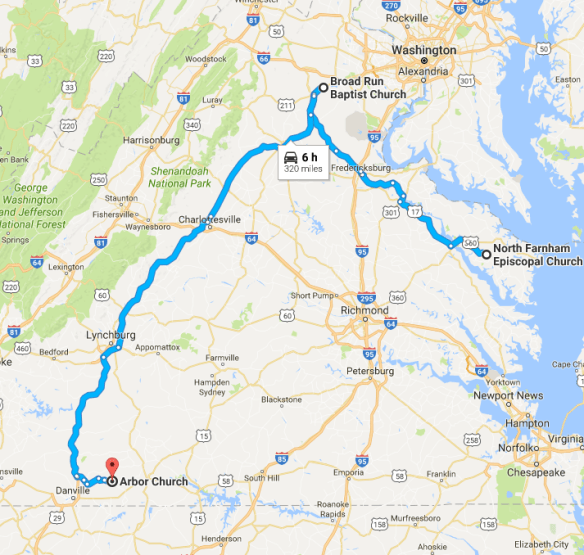
raleigh-prince-william-to-halifax

In 1766, Raughley Dodson and Lazarus, probably his brother, witnessed a deed from Joseph Terry to Thomas Dodson for land on the second fork of Birches Creek, Halifax County, VA Deed book 6-363. This Thomas or his son Thomas, the records are unclear, would thereafter be known as “Second Fork Thomas.”

Raleigh also had a brother Thomas.  The Reverend Silas Lucas identifies Second Fork Thomas as Thomas, the son of Thomas Dodson who married Elizabeth Rose, who was the brother to Raleigh’s father, George.  Therefore, if this is accurate, Second Fork Thomas, born about 1730, would have been Raleigh’s first cousin, not his brother or his uncle.  However, I’m not convinced that the records for Raleigh’s brother, whom nothing is known about, and Raleigh’s uncle Thomas, and Raleigh’s first cousin Thomas haven’t been conflated, especially given that “Second Fork Thomas,” according to Lucas, didn’t die until 1816 in Hawkins County, TN.

raleigh-thomas-dodsons

Thomas Dodson, thought to be “Second Fork Thomas” eventually lived near Raleigh on the north side of the Holston River in Hawkins County.  It’s unclear what happened to Raleigh’s brother, Thomas, although he could certainly be the Thomas in Hawkins County. The Dodson family is incredibly difficult to sort accurately.

Dodson’s Ordinary

Today, the original Dodson Ordinary in Halifax County is a historic site called Carter’s Tavern, located on the main road from South Boston to Danville across the road from Arbor Church, shown on the map below.

raleigh-arbor-church-map

The Dodson Ordinary has a rich and vibrant history of being a stage coach stop and sporting the ghost of a man killed in the building.  The original proprietor, Joseph Dodson, was born in 1724 to Thomas Dodson and Elizabeth Rose. This would mean that Joseph was Raleigh’s first cousin.

Joseph arrived in Halifax County in 1766, along with several other Dodson men, probably including Raleigh, and purchased the land on Toby Creek that would become the Dodson Ordinary.

Joseph Dodson died in 1773, leaving the plantation to his wife and son, Joseph.  The same year Joseph died, he sold land, along with “Second Fork Thomas,” in Halifax County.

raleigh-carter-tavern-sign

raleigh-dodson-ordinary

Restoration work within the Tavern revealed the name of Thomas Dodson etched in the fireplace stone mortar, along with a date of 1767.  Given that Joseph bought the land in 1766, it makes sense that in 1767, he would be building a house.  We’ll never know whether the etcher was Raleigh’s brother Thomas, or Joseph’s brother Thomas, or Joseph’s son Thomas, who would have been about 20 in 1766.  I’m betting on Joseph’s son!

Raleigh assuredly knew Joseph well and probably visited the Dodson Ordinary many times as the Ordinary was a regional location of commerce and a stage coach stop, along with a tavern, of course.  Judging from later records, Raleigh probably never met a drop of whisky that he didn’t like, and business transactions in that day were often agreed upon in taverns which were social gathering places for men!  I suspect liquor greased a lot of business deals.

raleigh-top-of-the-world

Across the road from Dodson’s Ordinary, the view is spectacular to the north, across the area of Birches Creek, called the “Top of the World” by local people. On a clear day, you can see the Peaks of Otter, about 70 miles distant as the crow flies.

Directly across the road from Dodson’s Ordinary and east a few hundred feet, local legend tells us that a revival was held under a bush where the Arbor Church is located today.

raleigh-arbor-church

We find the following information about Arbor Church:

The Arbor Church congregation is one of the oldest congregations in Halifax County. In the Spring of 1785 William Dodson, a missionary Baptist preacher held a revival under a bush arbor near Carter’s Tavern. As a result of that revival Arbor Baptist Church was organized with 35 charter members and Mr. Dodson as the first preacher. Mr. Samuel Dodson, owner of Carter’s Tavern donated a triangular lot of about 2 acres on which a log building was erected. The base of the triangle bordered River Road with the apex at a rock spring down the hill. Mr. Dodson said he gave the land that way so that the church would have a continuous supply of water.

In the picture, below, you can see the edge of Dodson’s Ordinary, later named Carter’s Tavern, on the right, and the church is the white building behind the trees on the left.

raleigh-tavern-and-church

Many of the Dodson family members who relocated to Halifax County had been members of Broad Run Church in Fauquier County, including the Reverend Lazarus Dodson, Raleigh’s brother, who was living in this area by 1767 and founded the Little Sandy Creek Church on the Dan River, which runs near the Virginia/North Carolina border.

The southwestern portion of Halifax County and the southeastern portion of Pittsylvania County became the center of Dodson family life in Virginia.  These counties bordered Caswell County, NC on the south, and the Dodsons spilled over into Caswell as well.

Raleigh Buys Land on Country Line Creek

In the winter of 1768, Raleigh bought into the American dream – land.

February 19, 1768, John Roberson and wife Margaret of Orange County, NC sold to Rolley Dodson of said county for 16# Virginia money 50 acres on the east side of the Country Line Creek.  Witnesses Hugh Kelly, Henry Hicks and Henry Willis.  (Orange County Deed book 2-160)

raleigh-halifax-to-country-line

Caswell County, NC was created from Orange County in 1777 and Raleigh’s land fell into Caswell. The Orange County, North Carolina Court of Pleas and Quarter Session records need to be checked for Raleigh between 1768 and 1777.

country line creek

The Caswell County tax list for 1777 shows that Raleigh Dotson was assessed 172# for property in the Richmond District.

Raleigh and his wife Mary sold their 50 acres of land on the south side of Country Line Creek on July 5, 1778 to Clement Gann (being purchased of John Robinson) and evidently moved to Hawkins County, TN about this time.

Given that Raleigh’s deed says on the south side, I’d wager that his land was where Country Line runs east to west, as opposed to the area where it runs more north to south.

We don’t know where on Country Line Creek Raleigh lived, but this is where NC62 crosses Country Line, just south of Yanceyville today.  You can’t actually see the creek, but you can pull off and fish, apparently.

raleigh-country-line

This area is very heavily wooded.  The 1860 census taker added notes about Caswell County, and he describes Caswell County as rolling and hilly as the streams are approached.  He then says, “The roughest areas are those along Country Line Creek.”  Raleigh probably lived along the portion of Country Line Creek shown below.

raleigh-country-line-satellite

In 1777, the heads of household had to take an oath of allegiance to support the Colony of Virginia against the crown.  Raleigh and Lazarus Dodson’s oaths were recorded in Pittsylvania county.  Oaths taken by George Carter included Elisha Dodson, George Dodson (possibly Raleigh’s father), Lazarus Dodson, Rolly Dodson, Thomas Dodson, George Hardy Jr., Joshua Hardy, William Hardy, Charles Lewis and John Lewis.  A Lewis family researcher says this looks like the “Mine Branch” Lewis family and then using Roger Dodson’s survey book,  we can determine that the location of George Carter’s land was south of Mine Branch near Double Creek in Pittsylvania County.

There is no way to tell if this is our Raleigh and his son Lazarus, but given that our Raleigh is living in Caswell County in North Carolina, this is likely not our Raleigh or his son, Lazarus who would have been about 17.  This is more likely Raleigh’s brother, the Reverend Lazarus Dodson, who did indeed live in Pittsylvania County.  The Rev. Elias Dodson names one “Rolly” as the son of Rev. Lazarus, which makes more sense than our Raleigh who was living in NC swearing an oath of this type in Virginia.

Raleigh obviously left for what would become east Tennessee sometime between July of 1778 when he sold his Caswell County land, and May of 1779 when Rawley Dodson and Dodson’s Creek are both mentioned in Washington County land warrant 1382.

After Raleigh had left Caswell, the name of Rawley Dodson shows up there once again in matters pertaining to the estate of John Moore, Jr. (1786-1791).  A list of accounts included the name of Rawley Dodson in Caswell Co., will book C, June court 1792.

raleigh-caswell-to-hawkins

East Tennessee

The area where Raleigh settled in present day east Tennessee was originally the Washington District, then Sullivan County, North Carolina, then in 1784 the highly political and volatile rogue State of Franklin, then in 1786 Hawkins County, North Carolina, then in 1790 the Territory South of the Ohio River which then became Hawkins County, Tennessee in 1796 when Tennessee became a state.  Raleigh lived in all of these places without moving an inch.  The boundaries moved around him, and not without a great deal of drama either.  Raleigh must have been in a constant state of emotional upheaval!

raleigh-1796-map

On the 1796 map above, Washington County is shown as land south of the Holston, with Hawkins County just across the river.  Hawkins C.H. means Hawkins Courthouse, which is today’s Rogersville.

Elijah Chissum had a ferry across the Holton River and Dodson Ford crossed just beneath Hawkins Courthouse too.

From the book Tennessee Land Warrants, Vol 4 Part 1:

Page 60 – 407 (291) March 10, 1780 Elijah Chisum enters 100 acres on the left fork of Dodson’s Creek, border begins at a bent below the first row of nobs and runs down the creek.  Warrant issued on June 18, 1780 by John Adair and the warrant was assigned August 16, 1788 by Elijah Chusum to John Cox (Thomas King, witness) 100 acres surveyed June 12, 1787 by Rawleigh Dodson, James Bunch and Reason Kartin, chain carriers, grant 527 issued Nov. 26, 1789

The above warrant tells us that Raleigh was a surveyor.  Another grant tells is that Elijah Chism’s line bordered Evans’ line, a neighbor of Raleigh.

From the book Valid and Invalid North Carolina Warrants in Tennessee by Dr. A. B. Pruitt:

Page 48 – Washington County warrant 1382 to Rowley Dotson for 150 acres on Dotson’s Creek and joins tract where said Dotson lives, warrant issued May 21, 1779 and warrant issued October, 24, 1779 by John Carter, Book 28, page 121

The entry book for John and Landon Carter, entry takers for “Washington Co., NC, now Tennessee,” shows a warrant, 1783, dated May 21, 1779, directing the surveyor of Sullivan County to “lay off for William Payne 150 acres on the Holston River adjoining a tract of land known as the ‘burnt cabin’”.  This land was surveyed on April 28, 1787 for Rawleigh Dodson by Rawl Dodson, deputy surveyor.

Did Raleigh survey his own land, or was Rawl Dodson, in this case, Raleigh Jr.?  It’s interesting that his nickname may have been Rawl.

The State of NC issued grants to Raleigh Dodson for two tracts of 150 acres, both apparently entered before Hawkins County was created in 1786; grant #1481 for 150 acres on the left fork of Dodson’s creek and #1489 for 150 acres on the south side of Holston River.  Dodson’s Creek, no doubt named by or for Raleigh Dodson, is a branch of the Holston River on the south side of the river and nearly opposite the town of Rogersville.  Dodson’s Ford was located near the mouth of Dodson’s Creek where the Indians’ Great War Path and Trading Path crossed the Holston River.

raleigh-1780-dodson-ford

“Dodson Ford -1780” is marked on this historic map, courtesy of the Hawkins County Archives.

The location of Dodson Ford was at one time was marked by a Tennessee Historical marker, although the marker was reportedly hit and then stolen years ago and never replaced.  The land around Dodson’s Ford is some of the most beautiful in east Tennessee.

raleigh-land

Above, the Dodson land looking south from across the Holston River. This is one of my favorite photos, because it conveys the flavor of the land and I think, the spirit of the frontiersmen, and women, who first settled these rolling hills along the river.

raleigh-holston

Looking upstream towards Dodson Ford from the mouth of Honeycutt Creek on the Holston River.  The Ford was about the location of the pillar on the right bank of the river in the distance.

raleigh-1789-grant

Raleigh’s 1789 land grant, above, is for 150 acres in Hawkins County on the south side of the Holston on Dodson’s Creek on the left fork above Evans line.  Beginning on a beech tree running thence:

  • West 110 poles to a white oak (1815 feet)
  • Then north 220 poles to a pine (3630 feet
  • Then east 110 poles to a stake (1815)
  • Then south 221 poles to the beginning (3646.50 feet)

This was granted at Fayetteville, NC on November 26, 1789.

Another grant was entered by both Lazarus and Raleigh, both granted the same day, November 26, 1789. (Click to enlarge.)

raleigh-1789-grant-2

Raleigh’s grant reads, “150 acres in Sullivan County on the south side of Holston River lying between Dodson’s Creek and a former entry including a spring at the head of Dodson’s creek, beginning on Lazarus Dodson’s line,” then metes and bounds, as follows:

  • Pine running thence along the same south 40 degrees east 100 poles to a hickory (1650 feet)
  • Then south126 poles to a post oak (2079 feet)
  • West 186 poles to a stake then (3069 feet)
  • North 35 east 236 poles to the beginning (3894 feet)

Lazarus’s grant reads as follows:

300 acres in Sullivan on the south side of Holston lying on both sides of Dodson’s Creek beginning on a red oak,

  • Then with a conditional line between John Sanders and said Dodson running thence along the same south 65 degrees west 240 poles to a poplar and black gum (3960 feet)
  • South 50 poles to a white oak (825 feet)
  • Rawley Dodson’s line
  • Thence along same south 40 east 140 poles to a white oak thence (2310 feet)
  • East 140 poles to a stake then (2310 feet)
  • North 200 poles to the beginning (3300 feet)

Raleigh’s deed, as it turns out, becomes quite important later in the story, as this is the land that Raleigh actually lived on and leaves to his son, Raleigh.  Raleigh Sr.’s son, Lazarus, lived right next door.  Father and son filed for and obtained their land at the same time.

Interestingly, the last sentence says “the said Rawley Dodson shall cause this grant to be registered in the registers office of said Sullivan County within 12 months from the date hereof otherwise the same shall be void and of no effect.”

So the grant was only the first step.  If you didn’t register the deed, the grant didn’t matter.

Page 124-798 (681) – Rolly Dotson enters 300 acres on the south side of Holston River and on both sides of Dotson’s Creek, border, begins on Dodson’s line on a branch at a white oak marked D, runs along said Dodson’s line and up the branch.  Duplicate warrant issued Sept., 28, 1792.

I’d love to find that tree with a “D.”

Between Raleigh and Lazarus’s main grants, they owned 600 acres, just under a mile by a mile square on the west side of Dodson’s Creek.  That doesn’t count Raleigh’s 1791 purchase of the Honeycutt land, which was an additional 163 acres.  Lazarus’s land actually crossed Dodson Creek and abutted John Sanders land, on the east side.

On the map below, the blue arrows approximate Raleigh’s grant, and the red includes the approximate land that Lazarus and Raleigh held together.  After Raleigh bought the Honeycutt land, those red arrows on the left would have moved over by Honeycutt Creek on the Holston. A one mile by one mile square of land is 640 acres and one Pole is 5.5 yards or 16.5 feet.There are 5,280 feet in a linear mile.

raleigh-land-boundaries

We know that Raleigh’s land included Dodson Ford which was the extension of the present day Old Persia Road/Tennessee 66 where it merged with Old Tennessee 70.  The old highway marker for Dodson Ford used to be located at this intersection.

So, Where was Dodson Ford?

We can pretty well place where Dodson Ford was located.

You can’t see the old road today on the satellite image, but you can see the old bridge just the other side of where Old Tennessee 70 intersects with Trail of the Lonesome Pine.

raleigh-old-road

A local man told me that the old bridge there was built where Dodson Ford used to cross.  The only part of the old bridge you can see today is the pilings near the south bank and in the river.  Arnott’s Island is the teardrop shaped island to the right of the old bridge.

Old Tennessee 66 was Old Persia Road which intersected with Old Tennessee 70 and Crossed the Holston where it ended, at Dodson’s Ford.  What we don’t know for sure is exactly where Dodson Ford was located, but we do know approximately, within a few hundred feet.

Based on what we know about our Raleigh’s deeds and the neighbor’s deeds, we now know that Raleigh Dodson and Lazarus owned land primarily west of Dodson Creek, top red arrow shown on the map below, including Dodson Ford which crossed the Holston River.

raleigh-ford-location

George Kite owned the land where the Kite Cemetery is located today and is also where Evan’s station was located, probably at the intersection of what is today Dodson Creek coming from the east and Louderback Creek on the south, marked by the bottom red arrow on the map above.  Of course, George Kite sold part of his land to Louderback, which is how that Creek obtained its name.  The old Kite house is very near the Kite Cemetery, which is the green square just below the Kite arrow.

On the satellite image below, you can see the location of the mouth of Dodson Creek, to the far right, Arnott’s Island, the bend in old Tennessee 70 where the Sanders Cemetery is located, marked by the red arrow a the bottom.  the scars from the old road that led to the old bridge across the Holston, likely where Dodson Ford was as well, are marked by the two arrows at left.

raleigh-dodson-ford-map

The location of the Ford itself was likely very close to where the old 66/70 bridge across the Holston was eventually built, which has now been torn down and dismantled, except for the bases.

raleigh-dodson-ford-pilings

We could call these the ghost sentinels of Dodson Ford – remnants of the past, standing watch today.

The TVA Authority land acquisition map from 1943 shows the old bridge over the Holston at this location labeled Tennessee 66 and Tennessee 70, confirming that Old 66 was indeed Old Persia Road.

And it would make sense that the bridge over the Holston, whenever it was built, was built at or near where the old Dodson’s Ford used to be located.  After all, the Ford was located at the easiest place to cross the river.

raleigh-tva-map

I wish someone had told me that there WAS a TVA land acquisition map when I first started trying to piece Raleigh’s land history together, because it would have been a LOT easier to work backwards through contemporary deeds than trying to work forward from land grants.

We Interrupt Raleigh’s Life to Bring you the Revolutionary War

In October, 1780, the forces under Col. Arthur Campbell gathered at Dodson’s Ford before going downriver to the attack on the Overhill Cherokee towns of Chota, Talequah, Tallassee, and others.

Both Lazarus and his father, Raleigh Dodson served in the Revolutionary War.

Their Revolutionary War service is documented in “North Carolina Revolutionary Army Accounts, Index to Soldiers residing in Washington and Sullivan County, 1781-1783.

NC Army Acct

Both Raleigh and Lazarus Dodson are listed.

nc army acct detail

After finding this tantalizing nugget, I contacted the NC Archives and eventually, visited, in order to obtain the original records.

According to pay records found in the NC Archives, in Raleigh, NC, Lazarus Dodson served in the Revolutionary War in August of 1783.  That is likely the date of his discharge, so he may have served earlier in the year.

Laz dodson rev war pay record

In 1783, an Act authorizing the opening of a land office for the redemption of specie and other certificates was passed, and all soldiers holding specie or certificates were enabled to redeem them by taking land in exchange, at a rate fixed by the state of North Carolina.

laz dodson rev war auditor record

Believe it or not, there were two holes punched in this document, reflecting how it has been stored.

Raleigh and Lazarus Dodson both served in the Revolution and are both found in the Morgan district which includes the land that would become East Tennessee.

raleigh rev war record

A second Rolley Dotson is found in the Hillsboro district (auditors Mebane and Nichols), which is the area of NC below Halifax/Pittsylvania in VA.  We know that our Raleigh was in East Tennessee prior to this time, but that this part of Tennessee was still North Carolina.

district auditors

The auditors and their corresponding districts found in the archives helped define which Raleigh was which.

nc rev war districts

We don’t know exactly who Lazarus and Raleigh served under, nor what they did when they were in service.  I wonder if they joined Col. Campbell on the march against the Cherokee in 1780/81, or if they fought at King’s Mountain in October of 1780, as did many men from this area.  Unfortunately, there is no roster for either event, but they are the most likely campaigns for men from Hawkins County to have participated in.  Colonel Arthur Campbell was involved in both, camped at Dodson Ford in late 1780 on his way destroy the Cherokee towns and was probably related to Charles Campbell, Raleigh’s neighbor on Dodson Creek.

Raleigh’s Life Resumes in Hawkins County After the Revolutionary War

In 1786, Raleigh signed the petition seeking the formation of Hawkins County along with his sons, Lazarus and Toliver.  I have the original petition from the North Carolina State Archives, but unfortunately, all three men’s names are signed in the same handwriting and spelled as “Rolley Dotson, Lazaras Dotson” and “Tollover Dotson.” At least we know how Rolley was pronounced, given the phonetic spelling of his name.

Raleigh is mentioned in numerous land warrants, nearly all of which were issued in the Dodson’s Creek area and subsequently assigned or sold to others.  I have limited the information here to the land Raleigh actually kept, because that is the most informative to us about Raleigh’s life.

In June 1791, Raleigh purchased a tract of 163 acres at a sheriff’s sale, formerly the John Honeycutt property, which adjoined the property of Elisha and Lazarus Dodson and included Honeycutt Creek.

June 6, 1791 – Thomas Berry sheriff of Hawkins County, to Rawley Dodson for 111#, 163 acres in Hawkins County on the south side of the Holston River including two plantations beginning on the river bank, Elisha Dodson’s line, Lazerus Dodson’s line, being a tract of land sold by execution the property of John Honeycutt.  Registered July 5, 1799  Liber E – 194

In December of 1808, Raleigh’s son, Raleigh, conveys Raleigh’s grant land to James Breeden, then Breeden sells the land to Daniel Seyster:

We know both Breeden and Seyster lived in the immediate area, because in 1801, a deed from James Breeden to Daniel Seyster described that land as being on Dodson Creek near Evans Station adjoining lands of George Kite, Breeden and Dodson’s line.

Stations were called such at that time because they were generally fortified homes in which other residents could take shelter, and of course, defend, in case of Indian attack.  This tells us that one of the early stations was indeed on Dodson Creek, and near the Kite land.  At least one old Kite home still stands, or did in 2009, within view of the Kite Cemetery.

raleigh-kite-cemetery

The Kite Cemetery includes the progenitor, George Kite’s grave and overlooks both the old Kite home and Dodson Creek.

raleigh-kite-cem-old-trees

This cemetery is named the Kite Cemetery, because George Kite is buried here, along with many of his family members, but there are also many unmarked graves.  The cemetery could have been in use before 1796 when George Kite arrived on the scene.  In fact, it may have originally been the Evans Cemetery. Early pioneers had to be buried someplace.

The photo below shows the old Kite home.

raleigh-kite-house

George Kite was the original Kite settler in Hawkins County, arriving about 1796.

raleigh-kite-dodson-creek

Dodson Creek runs in front of the Kite Cemetery, in the field across the road.

raleigh-dodson-creek-2

You can see the old Kite house in the distance below, across the roof of the newer home.

raleigh-kite-house-from-cemetery

In 1796, in deed book 1, page 196, George Kite purchased 600 acres from George Kiger (later written as Kizer and Kiser) on the south side of the Holston on Dodson Creek, formerly Honeycutt Creek, including Evans station.

In 1812, George Kite sells to Thomas Haynes half of the 200 acre tract from NC to John Gransby granted on November 27,1762 and that John Evans conveyed to Kite.  So we know that the Kite land is the original Evans Station land.  Eventually, Thomas Haynes’ descendants include Dru Haynes, after whom Dru Haynes Road is named today, running along the east side of Dodson Creek.

In 1813, George Kight Sr. sells 200 acres to Henry Louderback described as lying on both sides of the west fork of Dodson Creek on Evans old line on the southeast side of the creek.  Today’s Louderback Creek was originally known as Dodson Creek.

raleigh-kite-cem-map

An 1826 deed refers to the heirs of Daniel Cyster, deceased.  One John Dodson obtained a grant that bordered Cyster’s land and refers to Mark Mitchell’s land grant.

In 1806, Raleigh Jr. sells his father’s land.

January 29, 1806 – Rawleigh Dodson to James Breeden, both of Hawkins County for $500, 150 acres in Hawkins County on the south side of Holston, Lazarus Dodson’s line (refers to the original grant 537, dated Nov. 26, 1781 and registered in Hawkins County March 2, 1793), witness Richard Mitchell, Thomas Murrell.

Followed by:

To all whom these presents…I, Mary Dodson, widow and relict of Rawleigh Dodson decd do for a valuable consideration relinquish and quit claim my right, title…to the before described tract of land this <blank> day of 1806.  Witness Thomas Murrell, William (x) Jeffer, Rawleigh Dodson ack Feb 1806 and proved by William Jeffer and Raleigh Dodson registered August 20, 1806.

And then in deed book 6, page 139:

April 2, 1806 – James Breeden having bought of Raleigh Dodson a tract where on said Dodson now lives on the south side Holston River, 150 acres beginning in old line of Lazarus Dodson acd February 24 last by Dodson and Sarah Dodson in Hawkins court to said Breeden with John Saunders hereby assigns his interest in said land under a bond for $6000.  Witness Mark Goldsberry, Co? Foster

John Saunders signs off because this is Raleigh’s original land and John is married to Raleigh’s daughter.

August 20, 1806, transaction date January 29, 1806 – James Breeden from Raleigh Dodson 4-154 for $500 grant 537, 150 acres, original grant lines – Begin at Lazarus Dodson’s line run along same, east 100 poles to hickory, south 126 poles.

December 2, 1808 – Raleigh Dodson to James Breeden, for 150 pounds, the land lying below Dodson’s Ford on the south side of Holston beginning on the river bank at an elm and white walnut sprout on Elisha Dodson’s line, then with said line south 10 east 140 poles to a dogwood sapling and white oak on Lazarus Dodson’s line then north 70 east to Dodson’s Creek then north 94 poles to a white oak on the bank of the river then down the meandering of the river to the beginning.  Warranty and defending….as far as they may not interfere with the land of John Saunders and William Lawson…tract of land conveyed to my father at sheriff’s sale and I the said Raleigh Dodson having the said land devised to me do make over and convey my said right…”

Even though this deed is dated in December, it is submitted at the November Court and witnessed by A. Campbell and Thomas Jackson and ordered to be recorded.

raleigh-breeden-1808-deed

The January 1806 deed is very important, because it is the actual land Raleigh lived on, according to his will.  This deed tells us that Raleigh actually lived west of Dodson Creek, on the Holston, which makes sense when piecing the deeds of others in the neighborhood together.  We also know that Dodson Ford was on the west side of Dodson Creek, near but apparently not at the mouth of Dodson Creek, because the deeds never refer to the mouth of the creek.  This meshes with the 1808 land description.

Charles Campbell and Michael Roark lived in-between Raleigh Dodson and George Kite on Dodson Creek..  I would love to know exactly where.  There are three nice branches which would have been spring fed to the west of Dodson Creek and those branches are likely where Charles Campbell and Michael Roark lived.

One of those branches has this old bridge over Dodson Creek, leading to the field where the spring branch would be.  I suspect that Charles Campbell lived here.

raleigh-dodson-creek-campbell

Charles Campbell’s granddaughter married Raleigh Dodson’s grandson a generation later in Claiborne County. Relationships forged between families on Dodson Creek lasted for generations, even as those families continued the ever-westward migratory movement to new locations.

Raleigh’s Will

Raleigh seems to have still been actively engaged in his business in September of 1792.  Published in the Knoxville Gazette, which was published in Rogersville in its early years, I found an ad for R. Dodson, dated Sept. 8, 1792 stating:

The public are hereby informed that there is a FLAT kept at Dodson’s Ford on Holston where constant attendance will be given to convey passengers across the river.  R. Dodson, Sept. 6, 1792

Clearly sometime between September of 1792 and July of 1793, it became clear to Raleigh that his days were numbered.  Thank goodness he had a will, because we would have been quite lost without this record.

Source: Hawkins County Wills: Page 145

In the Name of God, Amen. I, Rawleigh Dodson Sr. being in an infirm state of health but of sound mind and considering that I may shortly leave this life, I have thought it necessary to make this my last Will & Testament, revoking all former wills by me made, and in the first place I resign myself to the disposal of my Creator hoping for mercy & forgiveness. In respect of my Earthly affairs, To my wife I leave and bequeath my whole Estate real & personal to her use during her natural life, after which I leave to my son Rawleigh Dodson the plantation on which I now live with all the appurtenances, also one other piece of land joining, butted and bounded as appears by the patent in my name, also all my working tools, horses, except a motherless colt, three cows with their calves, one feather bed with the furniture, half the pewter, and one half pot mettal, also what hay I may have remaining. To my grandchildren Mary and Nancy Shelton, the remainder of my cattle equally divided, also the remainder of the pewter and pot mettal to be equally divided between them, and to Mary Shelton one bed and furniture, also the motherless colt, one cotton and one linen wheel and half the cards, the other wheel & cards to Nancy. There is a bond due me of fifteen pounds from Henry Rowan to be collected and my debts paid out of it. Peggey Manafee my eldest daughter having by her husband obtained credit for sixty pounds for which I have his note, I hereby direct my Executor to give up said note. My sons Lazarus and Tolliver I have done a Fatherly part by and hereby acquit them of all demands that I may have against them. My daughter Nelly the wife of John Saunders I consider I have done enough for, having given her husband the land he now lives on. My son James to whom I have (already) given several things, I now bequeath my claim on Thos. Jackson for share of some land to be obtained by a warrant by me given to said Jackson to be laid on the halves provided said warrant obtains a title for land. Warrant was for 300 acres. I also appoint my son Lazarus and my neighbor Rodham Kenner my Executors and do authorize and direct them to put this my said Will & Testament into effect. In witness whereof I have hereunto set my hand and seal This 20th day of July A.D. 1793._Rawleigh x Dodson (seal) (his mark) _Test. Thos. Jackson Rodham Kenner Mary x Shelton (her mark)

Typically wills are recorded in the clerk’s will book when they are produced by the family for probate, after the individual has died. The original will is transcribed into the book, and the original document is generally returned to the family – the official copy being the one on the clerk’s book. However, for some reason, the clerk retained Raleigh’s actual will in Hawkins County, and the Keith Mencasco, a descendant obtained it from the Hawkins County Archives. When Keith graciously offered to send me a copy, I accepted of course, but what I expected to receive was a copy of the clerk’s entry book, not a hand written document with original signatures. Of course, by this time, Raleigh, now in his 60s and possibly ill couldn’t write his name, if he ever could.

However, knowing that he held this actual document, read it, then signed it in front of his family warms my heart. Thank you so much Keith.

Raleigh Dodson will

Raleigh Dodson will 2

It’s this outer part of the will document, folded and labeled as Raleigh’s that confirms that this is his original will, not from the clerk’s book. This document is 225 years old and has managed to escape the ravages of time, floods, fires and wars.

Raleigh Dodson will 3

Raleigh wrote his will on July 20, 1793.  The date of probate is not known, but indications are that he was alive in Nov. 1794 when he and his son James sold tracts of 40 and 110 acres to Robert Brown (Hawkins deeds 2-328 and 2-329).  This land may have involved the join patent with Thomas Jackson referred to in Raleigh Dodson’s will, the land he left to his son James.

raleigh-will-page-1

raleigh-will-page-2

Raleigh’s will, above, was recopied into the will book after the Hawkins County courthouse burned in the Civil War. How the actual document escapes the flames is nothing short of a miracle.  The name Menasco was apparently misspelled or misinterpreted as Manafee.  An easy mistake to make, given that there were Manafee families in the county in the 1860s, and James Menasco had left in 1795 for Georgia after his wife died, so the name Menasco was unfamiliar in the county in the late 1860s.

Raleigh’s Wife, Mary

Raleigh Dodson does not name his wife in his will, but left to her his whole estate both real and personal during her lifetime “after which I leave to my son Rawleigh the plantation on which I now live and another piece adjoining”.  The adjoining land was that obtained from the sheriff in 1791.  Raleigh Dodson Jr, sold his father’s patent land to James Breeden on January 29, 1806 and we find the following as well:

‘I, Mary Dodson, widow and relict of Raleigh Dodson, decd, relinquish and quit claim my right, title and interest to this land.”  (Hawkins deed 4-154)

Giles County, Tennessee, Court records show that Mary Dodson, widow, was appointed administrator of the estate of Raleigh Dodson on September 7, 1815.

It has been speculated that the widow, Mary Dodson, may have gone with her son Raleigh Jr. to Alabama and then to Giles and Williamson Counties, TN.  There is one Raleigh Dodson on the Giles County tax list in 1812. Given that the court record says, “Mary Dodson, widow,” implying that she is the widow of Raleigh, whose estate she is being appointed administrator of, I am extremely doubtful that this is our Mary, widow of Raleigh who died in approximately 1794 in Hawkins County.  Raleigh’s estate had been resolved for years by 1815 and there was no need to appoint an administrator in Giles County. Furthermore, our Raleigh’s wife Mary would have been 85 or 86 by this time, a very unlikely candidate to be an estate administrator.

The Amis Store Ledger

In 1775, the grandparents of Davy Crockett settled in the Watauga colony in the area in what is today Rogersville near the spring that today bears their name. After an Indian attack and massacre, the remaining Crocketts sold the property to a Huguenot named Colonel Thomas Amis.

In 1780/1781, Colonel Amis built a fort at Big Creek, on the outskirts of the present-day Rogersville which was then in Sullivan County, NC.

That same year, about three and one-half miles above downtown Rogersville, Amis erected a fortress-like stone house around which he built a palisade for protection against Indian attack.  This is known as the Amis Stone House, shown below and here.

amis-house

The next year, Amis opened a store; erected a blacksmith shop; and built a distillery. Amis also eventually established a sawmill and a gristmill. From the beginning, Amis kept a house of entertainment which was also a stagecoach stop, a place for travelers to rest and spend the night as well as locals to gather.  Of course, it was a tavern too.

Built as a defensive garrison in addition to a trading post, the upper part of the house originally had rifleports instead of windows.  This speaks to the environment on the Holston in 1780 and 1781, when Raleigh Dodson and Thomas Amis began doing business.

Year’s later, Amis’ daughter Mary recalled that she frequently wakened to hear Indians grinding their knives and tomahawks on her father’s grindstone.

The view from Amis House is beautiful and is the vista Raleigh would have seen, overlooking Big Creek Valley.

raleigh-view-from-amis-house

By Brian Stansberry – Own work, CC BY 3.0, https://commons.wikimedia.org/w/index.php?curid=41895021

Thomas Amis also kept an account ledger book which is, thankfully, still in existence.  This is one of the only documents that shows who lived in this area in the early years.

Raleigh Dodson had an account with Amis.  The record book begins in 1782 with Raleigh’s account, as follows:

  • Oct 12, 1782 – to balance in settlement
  • November 20, 1782 – laying grubbin ghoe
  • April 8, 1783 – beating out plows
  • April 24, 1783 – 1 fish gigg, laying bar plow and coulter, 1.5 lb iron and mending gigg, sharpening plow, making Dutch plow
  • December – work on picks
  • January 3, 1784 – 1 gallon whisky
  • April 26, 1784 – whisky
  • Half Gallon whisky to Shelton
  • September 4, 1785 – balle in settlements
  • February 28, 1786 – half cow, 5 quarts whisky
  • December 24, 1786 – 1 gal whisky
  • January 20, 1787 – 1 pint whisky, half pint whisky
  • Undated – 3 pints whisky, half pint whisky
  • February 7, 1787 – 3 pints whisky
  • February 14, 1787 – half gallon whisky
  • March 8, 1787 – 1 quart whisky, 1 hank silk, to season mare, half pint whisky
  • May 5, 1788 – half pint whisky, 3 yards calamanco (a thin glossy woolen fabric often with stripes or checkered designs – you can see several examples here)
  • May 6, 1788 – 1 stock trist
  • 2 ballads(?)
  • July 10, 1788 – 1 pint whisky, sharpening plow
  • Sept 29, 1788 – 2 half pints whisky
  • October 28, 1788 – half pint whisky
  • November 5, 1788 – half pint whisky
  • March 24, 1789 – half pint fun (rum?)
  • April 12, 1789 – 1 quart whisky, half pint whisky, 1 quart whisky
  • July 5, 1789 – 1 gallon whisky
  • September 10, 1789 – 1 quart whiskey and jug
  • July 4, 1789 – 3 pints whisky

Mr. Rawly Dotson Credit

  • By Mabice (havice?)
  • By 1 skin
  • By 1 grindstone
  • By bale charged in new acct
  • By 24.25 bushels corn
  • By 2 days work

1788

  • March 28 – by 22 bushels corn
  • May 21 – By 2 days work
  • May 22 – by 5 bushels corn from W. Bell
  • October 10 – by 3 days work dressing the mill

1789

  • June 4 – by dressing mill
  • 10.6 carried to page 105

To balance brought forward from folio

  • June 22 – 4 gallon whisky, 1.25 gallons whisky

1789

  • August 4 – 1 bottle and whisky
  • Sept. 3 – 1 quart whisky
  • Sept 24 – half gallon whisky
  • Sept 25 – to shoeing horse for son James
  • Oct. 6 – making bar plow and finding iron, pinting (pointing) coulter, 3 quarts whisky from Sanders, half pint whisky, half pint whisky, three half pints whisky

1789 – Mr. Rawly Dotson credit

  • Aug. 14 – by cash
  • October 10 – by 2 bushels rye, by 206.5 pounds beef
  • Oct. 22 – by 1 peck wheat brought by William Payne Jr.
  • Oct 23 – by 10.5 bushels rye
  • Carried to folio 6 – 18.4

Mr. Rawly Dotson debit

1789 balance brought forward from folio

  • Nov. 4 – half pint whisky, 3 pints whisky, half pint whisky, half pint whisky
  • Nov. 9 – half pint whisky
  • Dec. 4 – making 33 nails and finding iron
  • Dec. 24 – 2 gallons whisky

1790

  • Jan 18 – half pint whisky, to ball in settlements, 2 half pints whisky, 2 pints whisky
  • Jan. 22 – to 15 paid for hackle, to one gander
  • April 23 – to able in whiskey

1789 – Mr. Rawly Dotson credit

  • Nov. 4 – by dressing mill, by 1 bushel rye
  • Nov. 9 – by one grindstone
  • Dec. 24 – by 2.25 bushel corn

1790

  • January 18– by 1 deerskin, by credit ammisted from 65 folio, by balee to charged to new acct
  • Jan. 22 – by 253 lb. port
  • 10.4 carried to folio

There are also much more abbreviated accounts for Talifero and Elisha in 1783 and Oliver and Lazarus in 1794.  Raleigh does not name a son, Elisha, in his will, but I would not be at all surprised to discover that Elisha had simply been omitted because his father had already seen to his inheritance and Elisha didn’t owe his father any debts.

Raleigh’s account tells the story of a farmer, and one who was probably very glad to have a resource to sharpen his plow blades, work on his picks and shoe his son’s horses.  I do wonder if the Shelton mentioned was the father of Raleigh’s granddaughters mentioned in his will.  It’s too bad there is no first name with Shelton.  A recheck of the Amis store accounts doesn’t show any Sheltons on the list of creditors.

Raleigh was also apparently a fisherman, judging by the fact that his fish gigg had to be mended which probably meant that he hit a rock when spearfishing.  Anyone carrying a fish gigg was in danger of being mistaken for the devil himself. Some giggs looked like pitchforks, and some looked more like barbed rakes. The photo below is from a museum and may well have looked similar to Raleigh’s gigg.

raleigh-fish-gigg

By Charlez k – Self-photographed, CC BY-SA 2.0 de, https://commons.wikimedia.org/w/index.php?curid=7439566

Obviously, the Dodson family diet was varied with beef, wild game and fish.

It might appear that Raleigh drank a lot of whiskey.  I really do have to wonder if he had what would be termed today, “a drinking problem.”  However, given his ferry business, it’s also conceivable that Raleigh was selling whiskey, by the shot probably, to clients.  If he was a smart man, and one must presume he was simply to survive on the frontier, he would also have offered food and lodging to guests who needed to cross the river, along with livery service, taking care of and stabling their horses for the night.

So Raleigh’s whiskey may not have been all for himself…or maybe it was.

It seems that Raleigh traded “dressing the mill” for some of his purchases.

What is “Dressing the Mill”?

A mill used for grinding corn and grain must be dressed, usually once a year by a millstone “dresser.”  The stones ground themselves flat with usage, and the dresser would separate the upper and lower stones, and carve furrows in the stones in a prescribed pattern.  These furrows or grooves helped to direct the corn or other grain into and  through the millstones.

The furrow design is shown below.

raleigh-dressing

By Stevegray at the English language Wikipedia, CC BY-SA 3.0, https://commons.wikimedia.org/w/index.php?curid=728078

Dressing was often done in the dead of winter, or when the mill was otherwise closed to safeguard the secrets of crafting the mill.  This would also be the time when farmers like Raleigh would be less busy in the fields, so had time to dress the millstones.

The metal tools used to carve the furrows would often become imbedded in the mill dresser’s forearms.  Itinerant dressers would travel the countryside looking for temporary work, and the miller would ask the dresser to “show your mettle” which means rolling up his sleeves and showing his forearms to see if they looked slightly blue from an accumulation of iron splinters.  Of course, having these splinters didn’t mean you were a good dresser, only that you had some experience.

The photo below shows a contemporary stone dresser.

raleigh-stone-dresser

By Rasbak – Own work, CC BY-SA 3.0, https://commons.wikimedia.org/w/index.php?curid=4492066

You can see a short video here.

https://www.flickr.com/photos/1rod/3610810417/

So, in addition to being a land speculator, a ferryman, a surveyor, a farmer and a fisherman, Raleigh was also a stone dresser.

Religion, or Lack Thereof

We don’t know anything about Raleigh’s religious beliefs, except that he was not a tee-totaller.  However, there is evidence of religious activity on the frontier, in churches in Hawkins County, and Raleigh is conspicuously absent – just as he is from the Broad Run Baptist Church .

The County Line Church in Hawkins County was constituted as “North on Holston” in March 1792 and while there are many Dodsons in evidence, Raleigh isn’t among them.  This church may have been too distant, being located on the north side of the Holston on the county line border between Hawkins and Grainger Counties.

However, the Big Creek meeting house that first met in June 1790 was held in what I believe was the location of the Amis Store.

Regardless, the “South Holston” appears in the Holston Association minutes in August of 1791 and included Jesse Dodson, William Murphy and George Evans as messengers.  In October 1792, there is a reference to Deader Creek Church whose messengers were the same William Murphy and George Evans as listed with Holston River, and I strongly suspect that “Deader Creek” is actually Dodson Creek – George Evans being the George Evans of Evan’s Station.

Of course, just because Raleigh didn’t take a leadership role as a messenger to the association didn’t mean he wasn’t a church member.  We do know that at least one of Raleigh’s son’s, Lazarus, took a leadership role in the Gap Creek Baptist Church in Claiborne County by 1805.

Raleigh’s brother, Lazarus, was a Baptist minister in Pittsylvania County, Virginia, as well.

Where is Raleigh Buried?

The good news, and bad news, is that there are few cemeteries in this area.  The Dodson Creek Cemetery, which was the location I initially suspected, is too far east and wasn’t established until 1831.  The deed is hanging on the cemetery fence, and the establishment date is on the stone, so obviously a lot of people ask.

raleigh-dodson-creek-cem

After working the deeds both forwards and backwards, in summary, I’ve found the following information about Raleigh’s land.  Remember, in the beginning when I told you Raleigh was messy – well, this is it!

  • Raleigh died in roughly 1794, leaving his home tract (presumed to be 150 acres and not the 300 acres total) and adjoining tract (or 163 acres) to son Raleigh.
  • Son Raleigh sold Raleigh’s original land to James Breeden on January 29, 1806, with Raleigh’s wife releasing her dower rights.
  • In 1816, James Breeden sold to James Saunders 120 acres of land on Dodson Creek.
  • In 1818, James Breeden sold 200 acres, 2 tracts of land to Samuel Smith, below Dodson Ford, abutting both Elisha Dodson and Lazarus Dodson’s lines.

Unfortunately, neither of these Breeden deeds match the 150 acres that Raleigh Dodson owned, but in the end, it doesn’t matter, because of what eventually happens.

  • James Sanders is the father of John Ross Sanders, born in 1815, and who inherited the land that his father James owned. John Ross Sanders is buried in the Sanders Cemetery, located at the bend in Dodson Ford Road (today Old Tennessee 70) directly “above” the Dodson Ford and where the old bridge was located.  The location of the cemetery is shown below, in green.

raleigh-sanders-cem-map

  • In 1844, James Sanders sold 184 acres to John R. Sanders at the mouth of Dodson Creek adjacent land of Peter Smith and others. John Ross Sanders dies in 1861 and is buried on his land.  His widow, Martha sells the land in 1874 to her daughter, Lucy, and son-in-law, James H. Vance, who are also buried in the Sanders Cemetery.
  • In 1818, Samuel Smith sold 160 acres on Dodson Creek to Henry Chesnutt described as below a large spring running into the creek, the road from Dodson Ford to Campbell (although Campbell is not clear) along said road to Smith’s meadow, across the bottom field, the Holston river below the mouth of Dodson Creek.
  • In 1819, Henry Chessnut sold to John A. McKinney 160 acres at Dodson’s Ford, west ?, south Dodson Creek leads from Dodson Ford to Knoxville, heirs of Samuel Smith, black walnut below mouth of Dodson Creek.

Unfortunately, this Chesnutt sale makes tracking Raleigh’s land even more difficult, because Lazarus sold his land adjoining Raleigh’s and John Sanders to James Chesnutt, so the Chesnutt family is deeply interwoven into this area.

  • In 1855, Charles A. McKinney and John Netherland, executors of the estate of John A. McKinney, sold to John Reynolds for $750 the land on the south side of Holston on the waters of Dodson creek adjoining land of John Reynolds, Peter Smith and others, begin at a black oak, west on the bank of Dodson Creek below the spring S46W134 poles to oak on bank line then with line 40W154p to road leading from Dodson’s Ford to Knoxville then with said road NE112P along said road to upper end meadow owned by John Reynolds at end of ditch made by John McKinney then on ditch north across bottom to walnut to bank of sluice then across sluice and NW to lower end of island at sycamores then up river to upper point of island then across sluice to SE course to mouth of Dodson creek, to then to the beginning, 163 acres – including the island immediately below Dodson’s Ford, half of which the said John Reynolds now owns.

This 163 acres is probably the same 163 acres that Raleigh purchased in 1791, adjoining his original land grant tract.  Below Dodson’s Ford would have meant downriver.  Dodson Ford would have been on Raleigh’s original land grant, not the land he bought in 1791.

Chili Sanders said that some of the islands washed away years ago in a flood. If these islands still exist today, they would include Arnott’s island and it would put Dodson’s Ford above Arnott’s Island, at the mouth of Dodson Creek – which is not mentioned in Raleigh’s deeds.  So it’s likely that Dodson’s Ford was actually just below Arnott’s Island today – and those other islands indeed washed away.

  • A clue to where John Reynolds obtained his land is found in this 1835 deed from James Smith wherein he deeds the land his father Samuel Smith died with, on the Holston River between Honeycutt Creek and Dodson creek – only the land of the heirs of Joshua Smith below and John A. McKInney above, and others, about 290 acres, half part James Smith is entitled to until death of his mother and then entitled to half of all land, which would be 109 acres all of which I sell my interest in.
  • In 1841, John Reynold sells some land to John Leonard and in 1855, John Leonard sells land to Valentine D. Arnott adjoining Peter Smith’s land, Isaac Louderback and others.

The land along Dodson Creek became unbelievably divided and convoluted. Many deeds don’t include the number of acres which makes identifying the land, unless there are metes and bounds that can be matches to earlier deeds, nearly impossible.  Samuel Smith died and his heirs had intermarried with the Chesnutts, Sanders, Reynolds and other local families.  People lost their land.  Land became divided between heirs.  Heirs bought other heirs land.  Divorces and remarriages happened. In at least one case, a deed was ordered to be recorded, and never way.  And of course, the courthouse burned during the Civil War.  Other than all of that, the land was easy to track.

However, eventually, the land coalesces once again.  By 1943, the Arnott and Bradshaw families owns all of this land in question.  As it turns out, the Arnott family sold the land to the Bradshaws, so all of this land at one time belonged to the Arnott family.

  • In a 1936 deed from J. F. Arnott to R. M. Bradshaw, the road crossing the bridge is referred to as 66 and 70 and the road from Rogersville to Greenville (70) and the road from Rogersville to Bulls Gap (66). It also refers to a deed from Hugh Chesnut and wife.
  • On December 26, 1889, Hugh Chesnutt and wife sold to W. D and J. F. Arnott 109.75 acres adjoining the land of John R. Sanders…Dodson’s Creek…Dru Haynes corner, stake in Dodson’s Ford road…tract from R. H. Reynolds to Hiloh Chesnut.
  • 1884 deeds from Hugh Chesnut and wife refer to one third undivided interest in land on Dodson Ford Road.
  • In 1895, Hugh Chesnutt and wife Hilary, W. H. Reynolds and wife Lucy, John R. Sanders, Nola Sanders and Mary Wolsey Smith share in three tracts of land – one of which is the John Ross Sanders land, the second appears to be on Dodson Creek but further north, near the Kites and D.L. Haynes and the third is their interest in the estate of John R. Sanders, decd.

Eventually, all of these people would sell to the Arnott family, according to the 1943 map.

It’s telling that in 1850, John Ross Sanders neighbor is Valentine Arnott.

raleigh-1850-hawkins-census

Therefore, all pointers suggest, strongly, that the John Ross Sanders cemetery is also where his father, James Sanders who reportedly died in 1863 is buried as well.

If indeed this is the land owned by Raleigh Dodson, it’s also likely where he is buried too.  Family cemeteries didn’t tend to disappear entirely, they tended to enlarge and were sometimes “renamed” to reflect the surname of the next family that owned the land.

raleigh-sanders-land-map

The John Sanders property is located on the east side of Dodson Creek on Sanders Road, shown above.  The original home is gone now, but there does not appear to be a cemetery on that land either, so John Sanders and Nellie are probably buried in the Sanders Cemetery on Old Tennessee 70 – the little green spot at left.

The Sanders cemetery is also located on the only readily available high ground.  The land on the north side of the road, formerly called Dodson Ford Road, between the railroad and the Holston River is too low and floods.  No family would bury someone where their grave would flood.

The only other reasonable possibility would be the Kite Cemetery, which is significantly further south, or possibly a now lost cemetery.

My bet is that not only is Raleigh buried in the Sanders Cemetery, but he lived on this land as well. He would assuredly have lived as close as he could to Dodson Ford, with quick access to the Holston, but far enough away that his home didn’t flood.  The Sanders Cemetery and surrounding land fits the bill exactly.

Sanders Cemetery

When I visited Hawkins County in August 2009, it was beastly hot, but Chili Sanders, a local firefighter and also a descendant of Raleigh Dodson, was kind enough to take me up to the Sanders Cemetery early one Sunday morning, while the temperature was only in the 80s, before it got hot.

FindAgrave has mislabeled the Sanders Cemetery as the Reynolds Cemetery and shows no internments, which is incorrect on both counts.

However, cemetery information obtained at the Hawkins County archives shows the Sanders Cemetery, #158, correctly and with directions.  “Take Highway 70 south from Rogersville, turn left after crossing the Hugh B. Day Bridge.  Cemetery is located on hill to the right after the railroad crossing.”  That’s exactly right.

When I visited in 2009, the cemetery was almost impenetrable, and were it not for Chili knowing exactly where to go and how to get in, finding and accessing this cemetery would have been nearly impossible.  Ok, scratch nearly.

raleigh-sanders-cem

This is the entrance and this is partway up the “hill” at the bend in Old Tennessee 70 just east of the railroad track.  We climbed the fence and hiked up the hill.  Chili assured me he had the property owner’s permission, and believe me, I prayed that he did and they didn’t forget.  Thankfully, everyone knows Chili, so long as they didn’t shoot first.  Overgrown cemeteries on private property in remote mountain locations in Appalachia are not someplace you really want to be discovered by unhappy property owners.
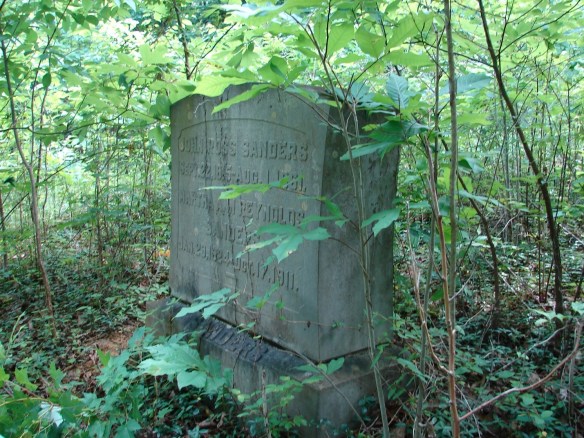
raleigh-john-ross-sanders

The earliest marked burial is John Ross Sanders who died in 1861.

raleigh-john-ross-sanders2

This grave is probably marked because John’s wife, Martha, didn’t pass away until 1911.  She outlived John by 50 years and two months and remarried to a Smith.
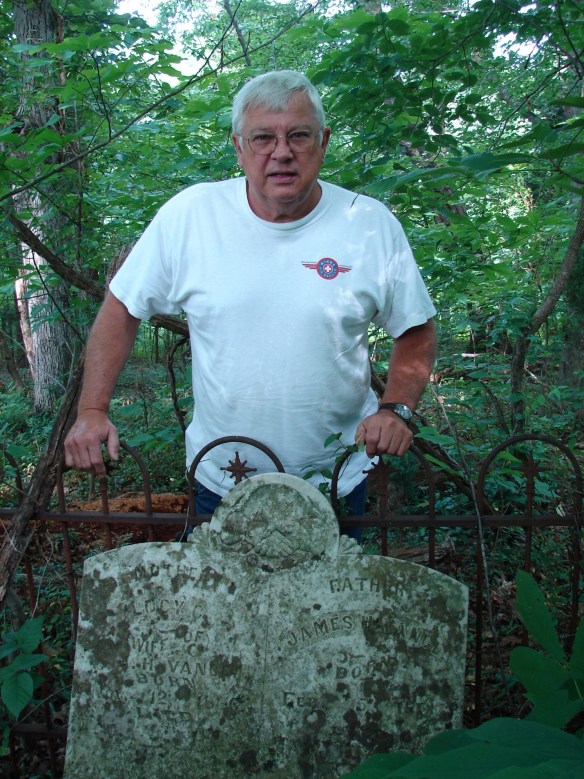
raleigh-chili-sanders

Chili Sanders standing above the grave of James H. Vance born February 5, 1807 and died in 1884.  James was the son-in-law of John Ross Sanders and married to John’s daughter, Lucy. I look at Chili and wonder if he looks anything like Raleigh Dodson.

raleigh-james-vance

There are very few gravestones, but the cemetery itself is not small.

raleigh-sanders-cem-2

raleigh-sanders-cem-3

There are many unmarked graves beneath the vegetation. You can see and feel them, meaning the sunken ground, and sometimes see the fieldstones peeking through the vegetation.

raleigh-sanders-cem-4

I tripped over a few fieldstones buried in the underbrush which were in all probability, gravestones, and felt awful.  I wonder if that was Raleigh trying to get my attention.  “Hey, I’m here!!!”

raleigh-sanders-cem-5

Thank goodness there were no snakes.

raleigh-sanders-cem-6

Some portions of the cemetery were simply inaccessible.

raleigh-sanders-cem-7

I would very much like to set a Revolutionary War stone for Raleigh in this location, near Dodson’s Ford, on land he assuredly owned. It pains my heart that Raleigh doesn’t have a gravestone.

Raleigh’s Children

Raleigh had several children, and were it not for his will, we’d have to do a lot of speculating.  Children as named in Raleigh’s will:

  • Rawleigh Dodson Jr
  • Grandchildren Mary and Nancy Shelton
  • Nelly, wife of John Saunders
  • James Dodson
  • Peggy Manafee (Margaret Dodson Manasco)
  • Lazarus Dodson
  • Toliver (Oliver) Dodson

Elisha is not named in Raleigh’s will, and is entirely speculative, based on the fact that he appeared with Raleigh and his children and owned land adjacent to both Lazarus and Raleigh.  If Elisha is Raleigh’s son, Raleigh had obviously already provided for him, and he owned Raleigh no debts to be forgiven.

  • Elisha Dodson (speculative)

If Elisha wasn’t Raleigh’s son, who was he?

You can read more about Raleigh’s children in Raleigh’s wife Mary’s article.

DNA

One of the traits that seems to be inherited by Dodson descendants is the love of genealogy.  Perhaps the fact that the Reverend Silas Lucas devoted so many years to Dodson research, so it’s relatively easy to track your lines has something to do with the popularity of Dodson family genealogy.

There also seems to be a disproportionate number of Dodson autosomal DNA matches as well.  I’m not sure if this is because the early Dodson’s were very prolific, producing a large number of descendants today, or if the Dodson DNA is particularly hearty (nah), or if the fact that the Dodson Lucas genealogy legacy produces a lot of trees, enabling people to connect their trees after DNA connects their genes. Probably the result of the first and third options.

At Ancestry.com, I have 387 DNA matches with whom I share a common ancestor is a tree.  Of those, 11 descend from George Dodson and Margaret Dagord through 5 separate sons.   Thirteen DNA matches descend from George’s parents, Thomas Dodson and Dorothy Durham through 5 separate sons.  Two descend directly from Raleigh through son, Toliver and son James.  I’m not counting my direct cousins through my own line.

That’s 7% of my matches from the Dodson line alone, which is a bit high, considering that I have 64 great-great-great-great-grandparents and Raleigh is one generation beyond that at my GGGGG-grandfather.

I think this is proof positive that a well-researched genealogy, in print, in one form or another, has a HUGE effect on the number of DNA-plus-tree matches you’ll receive on that line. It’s also evidence of why accurate research is so important.  Otherwise, everyone will put erroneous information into all their trees, and then will believe that because they match so many other people with the same trees, that they must all be correct and DNA confirms the genealogy.

That’s isn’t the case.

Ancestry matches your DNA and then, if you have a common ancestor identified in both your trees, even if they are erroneous in the same way, displays your common ancestor for you to view.  So just be wary of common mistakes and assuming that a DNA match validates genealogy as written.  It doesn’t.  You can both simply be wrong in the same way – and this most often happens when people copy trees without individually scrutinizing and verifying information and documentation.

raleigh-common-ancestor

It’s fun to see how you connect to common ancestors.

In Summary

Raleigh led an incredible life.  He lived in 3 states plus the wild State of Franklin and the Territory South of the Ohio.  He lived on and helped forge at least two frontiers.  When Raleigh moved to the Holston River in what would become Hawkins County, he was approaching the half-century mark, and in addition to homesteading, he would yet fight in the Revolutionary War.

Raleigh was clearly a multi-talented jack-of-all-trades; a skilled ferryman, a land surveyor and a stone dresser, in addition to being a hunter, fisherman and a farmer.  Of course, everyone on the frontier was a farmer, or you didn’t eat.

In addition to those skills, Raleigh was a Patriot and served in the Revolutionary War.  When Raleigh was discharged in 1783, he was certainly not a young man at age 53. He served with his son, Lazarus.  Lazarus and Raleigh were apparently very close.  Not only did they serve in the war together, they also applied for side-by-side land grants and lived on the Holston River between Honeycutt Creek and Dodson Creek together until after Raleigh passed away, probably in 1794.

Raleigh apparently did not apply for land as payment for his Revolutionary War service, but his son, Lazarus did.  Raleigh appeared to be quite savvy and didn’t seem like a man to leave much laying on the table in terms of what was due to him, so I wonder if there are transactions yet to be found, or he sold his Revolutionary War land claim before it was registered in his name.

A decade after his discharge, Raleigh was writing his will in Hawkins County on Dodson Creek where he and his son, James, made a final land sale in 1794.

Sometime after that, Raleigh passed away and his son, Raleigh, and his wife, Mary, lived on his land for the next dozen years, when the scene fades to black in 1808.

Today, Raleigh’s descendants still live along Dodson Creek – Chili Sanders being descended through daughter Nellie who married John Saunders/Sanders.

raleighs-turkeys

Chili was gracious enough during my visits to invite me to visit his home and allowed me to photograph his land – the same land that John Saunders owned which was obtained from Raleigh. So this was originally Raleigh’s land.  If you look closely, you can see turkeys in the distance, at the bottom of the hill, across the fence line. Raleigh probably looked out and saw turkeys too, and deer, and bobcat, and fox and wolves. Raleigh would have thought this was his lucky day!  “Hey Mary, turkey for dinner!”

This land wouldn’t have been cleared when Raleigh settled here, but Raleigh and his sons and son-in-laws, and their descendants for generations have cleared the land and forged a life from what was once unbroken wilderness – along Raleigh’s namesake Dodson Creek.

Indeed, Raleigh “showed us his mettle.”

Acknowledgements

Much of the information about the early Dodson lines, specifically prior to Raleigh, comes from the wonderful two volume set written by the Reverend Silas Lucas, published originally in 1988, titled The Dodson (Dotson) Family of North Farnham Parish, Richmond County, Virginia – A History and Genealogy of Their Descendants.

I am extremely grateful to Reverend Lucas for the thousands of hours and years he spent compiling not just genealogical information, but searching through county records in Virginia, North Carolina, Tennessee, and more.  His work from his first publication in 1958 to his two-volume set 30 years later in 1988 stands as a model of what can and should be done for each colonial family – especially given that they were known to move from state to state without leaving any type of “forwarding address” for genealogists seeking them a few hundred years later.  Without his books, Dodson researchers would be greatly hindered, if not entirely lost, today.

Update

In August 2017, Doug Jenkins, another researcher provided me with the following research, probably shedding light on Raleigh’s granddaughter Mary Shelton:

Internet researchers – with no source data – claim that James Chesnutt’s wife was Mary Dodson.  I doubt that because James Chesnutt wasn’t in the right place at the right time to have married a Dodson.  However, the name Raleigh does become in regular usage in the 3rd generation of Hawkins Co Chesnutts.  I think the name entered the family through the marriage of Hugh Chesnutt to Mary Shelton about 1800.  That is likely the Mary Shelton named as a grand daughter in Raleigh’s Will.  In 1850, a William Shelton left a Will in Hawkins County, Tennessee naming his sister, Polly Chesnutt, among other heirs.  I think the family is enumerated in 1850 in the Dodson Ford area and Mary Chesnutt (widow of Hugh) is enumerated with her son William Chesnutt.  Also in the household is a William “Chesnutt”, but that must be William Shelton b. 1785 in Virginia mistakenly called Chesnutt by the census taker.  By reading his Will, it would appear that William Shelton was an old bachelor.  This is consistent with the 1840 census data also, because there were 2 males born in the 1770’s in Hugh Chesnutt’s household.

______________________________________________________________

Disclosure

I receive a small contribution when you click on some of the links to vendors in my articles. This does NOT increase the price you pay but helps me to keep the lights on and this informational blog free for everyone. Please click on the links in the articles or to the vendors below if you are purchasing products or DNA testing.

Thank you so much.

DNA Purchases and Free Transfers

Genealogy Services

Genealogy Research

Concepts – Calculating Ethnicity Percentages

There has been a lot of discussion about ethnicity percentages within the genetic genealogy community recently, probably because of the number of people who have recently purchased DNA tests to discover “who they are.”

Testers want to know specifically if ethnicity percentages are right or wrong, and what those percentages should be. The next question, of course, is which vendor is the most accurate.

Up front, let me say that “your mileage may vary.” The vendor that is the most accurate for my German ancestry may not be the same vendor that is the most accurate for the British Isles or Native American. The vendor that is the most accurate overall for me may not be the most accurate for you. And the vendor that is the most accurate for me today, may no longer be the most accurate when another vendor upgrades their software tomorrow. There is no universal “most accurate.”

But then again, how does one judge “most accurate?” Is it just a feeling, or based on your preconceived idea of your ethnicity? Is it based on the results of one particular ethnicity, or something else?

As a genealogist, you have a very powerful tool to use to figure out the percentages that your ethnicity SHOULD BE. You don’t have to rely totally on any vendor. What is that tool? Your genealogy research!

I’d like to walk you through the process of determining what your own ethnicity percentages should be, or at least should be close to, barring any surprises.

By surprises, in this case, we’re assuming that all 64 of your GGGG-grandparents really ARE your GGGG-grandparents, or at least haven’t been proven otherwise. Even if one or two aren’t, that really only affects your results by 1.56% each. In the greater scheme of things, that’s trivial unless it’s that minority ancestor you’re desperately seeking.

A Little Math

First, let’s do a little very basic math. I promise, just a little. And it really is easy. In fact, I’ll just do it for you!

You have 64 great-great-great-great-grandparents.

Generation # You Have Who Approximate Percentage of Their DNA That You Have Today
1 You 100%
1 2 Parents 50%
2 4 Grandparents 25%
3 8 Great-grandparents 12.5%
4 16 Great-great-grandparents 6.25%
5 32 Great-great-great-grandparents 3.12%
6 64 Great-great-great-great-grandparents 1.56%

Each of those GGGG-grandparents contributed 1.56% of your DNA, roughly.

Why 1.56%?

Because 100% of your DNA divided by 64 GGGG-grandparents equals 1.56% of each of those GGGG-grandparents. That means you have roughly 1.56% of each of those GGGG-grandparents running in your veins.

OK, but why “roughly?”

We all know that we inherit 50% of each of our parents’ DNA.

So that means we receive half of the DNA of each ancestor that each parent received, right?

Well, um…no, not exactly.

Ancestral DNA isn’t divided exactly in half, by the “one for you and one for me” methodology. In fact, DNA is inherited in chunks, and often you receive all of a chunk of DNA from that parent, or none of it. Seldom do you receive exactly half of a chunk, or ancestral segment – but half is the AVERAGE.

Because we can’t tell exactly how much of any ancestor’s DNA we actually do receive, we have to use the average number, knowing full well we could have more than our 1.56% allocation of that particular ancestor’s DNA, or none that is discernable at current testing thresholds.

Furthermore, if that 1.56% is our elusive Native ancestor, but current technology can’t identify that ancestor’s DNA as Native, then our Native heritage melds into another category. That ancestor is still there, but we just can’t “see” them today.

So, the best we can do is to use the 1.56% number and know that it’s close. In other words, you’re not going to find that you carry 25% of a particular ancestor’s DNA that you’re supposed to carry 1.56% for. But you might have 3%, half of a percent, or none.

Your Pedigree Chart

To calculate your expected ethnicity percentages, you’ll want to work with a pedigree chart showing your 64 GGGG-grandparents. If you haven’t identified all 64 of your GGGG-grandparents – that’s alright – we can accommodate that. Work with what you do have – but accuracy about the ancestors you have identified is important.

I use RootsMagic, and in the RootsMagic software, I can display all 64 GGGG-grandparents by selecting all 4 of my grandparents one at a time.

In the first screen, below, my paternal grandfather is blue and my 16 GGGG-grandparents that are his ancestors are showing to the far right.  Please note that you can click on any of the images to enlarge.

ethnicity-pedigree

Next, my paternal grandmother

ethnicity-pedigree-1

Next, my maternal grandmother.

ethnicity-pedigree-2

And finally, my maternal grandfather.

ethnicity-pedigre-3

These displays are what you will work from to create your ethnicity table or chart.

Your Ethnicity Table

I simply displayed each of these 16 GGGG-grandparents and completed the following grid. I used a spreadsheet, but you can use a table or simply do this on a tablet of paper. Technology not required.

You’ll want 5 columns, as shown below.

  • Number 1-64, to make sure you don’t omit anyone
  • Name
  • Birth Location
  • 1.56% Source – meaning where in the world did the 1.56% of the DNA you received from them come from? This may not be the same as their birth location. For example an Irish man born in Virginia counts as an Irish man.
  • Ancestry – meaning if you don’t know positively where that ancestor is from, what do you know about them? For example, you might know that their father was German, but uncertain about the mother’s nationality.

My ethnicity table is shown below.

ethnicity-table

In some cases, I had to make decisions.

For example, I know that Daniel Miller’s father was a German immigrant, documented and proven. The family did not speak English. They were Brethren, a German religious sect that intermarried with other Brethren.  Marriage outside the church meant dismissal – so your children would not have been Brethren. Therefore, it would be extremely unlikely, based on both the language barrier and the Brethren religious customs for Daniel’s mother, Magdalena, to be anything other than German – plus, their children were Brethren..

We know that most people married people within their own group – partly because that is who they were exposed to, but also based on cultural norms and pressures. When it comes to immigrants and language, you married someone you could communicate with.

Filling in blanks another way, a local German man was likely the father of Eva Barbara Haering’s illegitmate child, born to Eva Barbara in her home village in Germany.

Obviously, there were exceptions, but they were just that, the exception. You’ll have to evaluate each of your 64 GGGG-grandparents individually.

Calculating Percentages

Next, we’re going to group locations together.

For example, I had a total of one plus that was British Isles. Three and a half, plus, that were Scottish. Nine and a half that were Dutch.

ethnicity-summary

You can’t do anything with the “plus” designation, but you can multiply by everything else.

So, for Scottish, 3 and a half (3.5) times 1.56% equals 5.46% total Scottish DNA. Follow this same procedure for every category you’re showing.

Do the same for “uncertain.”

Incorporating History

In my case, because all of my uncertain lines are on my father’s colonial side, and I do know locations and something about their spouses and/or the population found in the areas where each ancestor is located, I am making an “educated speculation” that these individuals are from the British Isles. These families didn’t speak German, or French, or have French or German, Dutch or Scandinavian surnames. People married others like themselves, in their communities and churches.

I want to be very clear about this. It’s not a SWAG (serious wild-a** guess), it’s educated speculation based on the history I do know.

I would suggest that there is a difference between “uncertain” and “unknown origin.” Unknown origin connotates that there is some evidence that the individual is NOT from the same background as their spouse, or they are from a highly mixed region, but we don’t know.

In my case, this leaves a total of 2 and a half that are of unknown origin, based on the other “half” that isn’t known of some lineages. For example, I know there are other Native lines and at least one African line, but I don’t know what percentage of which ancestor how far back. I can’t pinpoint the exact generation in which that lineage was “full” and not admixed.

I have multiple Native lines in my mother’s side in the Acadian population, but they are further back than 6 generations and the population is endogamous – so those ancestors sometimes appear more than once and in multiple Acadian lines – meaning I probably carry more of their DNA than I otherwise would. These situations are difficult to calculate mathematically, so just keep them in mind.

Given the circumstances based on what I do know, the 3.9% unknown origin is probably about right, and in this case, the unknown origin is likely at least part Native and/or African and probably some of each.

ethnicity-summary-2

The Testing Companies

It’s very difficult to compare apples to apples between testing companies, because they display and calculate ethnicity categories differently.

For example, Family Tree DNA’s regions are fairly succinct, with some overlap between regions, shown below.

ethnicity-ftdna-map

Some of Ancestry’s regions overlap by almost 100%, meaning that any area in a region could actually be a part of another region.

ethnicity-ancestry-map-2

For example look at the United Kingdom and Ireland. The United Kingdom region overlaps significantly into Europe.

ethnicity-ancestry-map

Here’s the Great Britain region close up, below, which is shown differently from the map above. The Great Britain region actually overlaps almost the entire western half of Europe.

ethnicity-ancestry-great-britain

That’s called hedging your bets, or maybe it’s simply the nature of ethnicity. Granted, the overlaps are a methodology for the vendor not to be “wrong,” but people and populations did and do migrate, and the British Isles was somewhat of a destination location.

This Germanic Tribes map, also from Ancestry’s Great Britain section, illustrates why ethnicity calculations are so difficult, especially in Europe and the British Isles.

ethnicity-invaders

Invaders and migrating groups brought their DNA.  Even if the invaders eventually left, their DNA often became resident in the host population.

The 23andMe map, below, is less detailed in terms of viewing how regions overlap.

ethnicity-23andme-map

The Genographic project breaks ethnicity down into 9 world regions which they indicate reflect both recent influences and ancient genetics dating from 500 to 10,000 years ago. I fall into 3 regions, shown by the shadowy Circles on the map, below.

ethnicity-geno-map-2

The following explanation is provided by the Genographic Project for how they calculate and explain the various regions, based on early European history.

ethnicity-geno-regions

Let’s look at how the vendors divide ethnicity and see what kind of comparisons we can make utilizing the ethnicity table we created that represents our known genealogy.

Family Tree DNA

MyOrigins results at Family Tree DNA show my ethnicity as:

ethnicity-ftdna-percents

I’ve reworked my ethnicity totals format to accommodate the vendor regions, creating the Ethnicity Totals Table, below. The “Genealogy %” column is the expected percentage based on my genealogy calculations. I have kept the “British Isles Inferred” percentage separate since it is the most speculative.

ethnicity-ftdna-table

I grouped the regions so that we can obtain a somewhat apples-to-apples comparison between vendor results, although that is clearly challenging based on the different vendor interpretations of the various regions.

Note the Scandinavian, which could potentially be a Viking remnant, but there would have had to be a whole boatload of Vikings, pardon the pun, or Viking is deeply inbedded in several population groups.

Ancestry

Ancestry reports my ethnicity as:

ethnicity-ancestry-amounts

Ancestry introduces Italy and Greece, which is news to me. However, if you remember, Ancestry’s Great Britain ethnicity circle reaches all the way down to include the top of Italy.

ethnicity-ancestry-table

Of all my expected genealogy regions, the most definitive are my Dutch, French and German. Many are recent immigrants from my mother’s side, removing any ambiguity about where they came from. There is very little speculation in this group, with the exception of one illegitimate German birth and two inferred German mothers.

23andMe

23andMe allows customers to change their ethnicity view along a range from speculative to conservative.

ethnicity-23andme-levels

Generally, genealogists utilize the speculative view, which provides the greatest regional variety and breakdown. The conservative view, in general, simply rolls the detail into larger regions and assigns a higher percentage to unknown.

I am showing the speculative view, below.

ethnicity-23andme-amounts

Adding the 23andMe column to my Ethnicity Totals Table, we show the following.

ethnicity-23andme-table-2

Genographic Project 2.0

I also tested through the Genographic project. Their results are much more general in nature.

ethnicity-geno-amounts

The Genographic Project results do not fit well with the others in terms of categorization. In order to include the Genographic ethnicity numbers, I’ve had to add the totals for several of the other groups together, in the gray bands below.

ethnicity-geno-table-2

Genographic Project results are the least like the others, and the most difficult to quantify relative to expected amounts of genealogy. Genealogically, they are certainly the least useful, although genealogy is not and never has been the Genographic focus.

I initially omitted this test from this article, but decided to include it for general interest. These four tests clearly illustrate the wide spectrum of results that a consumer can expect to receive relative to ethnicity.

What’s the Point?

Are you looking at the range of my expected ethnicity versus my ethnicity estimates from the these four entities and asking yourself, “what’s the point?”

That IS the point. These are all proprietary estimates for the same person – and look at the differences – especially compared to what we do know about my genealogy.

This exercise demonstrates how widely estimates can vary when compared against a relatively solid genealogy, especially on my mother’s side – and against other vendors. Not everyone has the benefit of having worked on their genealogy as long as I have. And no, in case you’re wondering, the genealogy is not wrong. Where there is doubt, I have reflected that in my expected ethnicity.

Here are the points I’d like to make about ethnicity estimates.

  • Ethnicity estimates are interesting and alluring.
  • Ethnicity estimates are highly entertaining.
  • Don’t marry them. They’re not dependable.
  • Create and utilize your ethnicity chart based on your known, proven genealogy which will provide a compass for unknown genealogy. For example, my German and Dutch lines are proven unquestionably, which means those percentages are firm and should match up relatively well to vendor ethnicity estimates for those regions.
  • Take all ethnicity estimates with a grain of salt.
  • Sometimes the shaker of salt.
  • Sometimes the entire lick of salt.
  • Ethnicity estimates make great cocktail party conversation.
  • If the results don’t make sense based on your known genealogical percentages, especially if your genealogy is well-researched and documented, understand the possibilities of why and when a healthy dose of skepticism is prudent. For example, if your DNA from a particular region exceeds the total of both of your parents for that region, something is amiss someplace – which is NOT to suggest that you are not your parents’ child.  If you’re not the child of one or both parents, assuming they have DNA tested, you won’t need ethnicity results to prove or even suggest that.
  • Ethnicity estimates are not facts beyond very high percentages, 25% and above. At that level, the ethnicity does exist, but the percentage may be in error.
  • Ethnicity estimates are generally accurate to the continent level, although not always at low levels. Note weasel word, “generally.”
  • We should all enjoy the results and utilize these estimates for their hints and clues.  For example, if you are an adoptee and you are 25% African, it’s likely that one of your grandparents was Africa, or two of your grandparents were roughly half African, or all four of your grandparents were one-fourth African.  Hints and clues, not gospel and not cast in concrete. Maybe cast in warm Jello.
  • Ethnicity estimates showing larger percentages probably hold a pearl of truth, but how big the pearl and the quality of the pearl is open for debate. The size and value of the pearl is directly related to the size of the percentage and the reference populations.
  • Unexpected results are perplexing. In the case of my unknown 8% to 12% Scandinavian – the Vikings may be to blame, or the reference populations, which are current populations, not historical populations – or some of each. My Scandinavian amounts translate into between 5 and 8 of my GGGG-grandparents being fully Scandinavian – and that’s extremely unlikely in the middle of Virginia in the 1700s.
  • There can be fairly large slices of completely unexplained ethnicity. For example, Scandinavia at 8-12% and even more perplexing, Italy and Greece. All I can say is that there must have been an awful lot of Vikings buried in the DNA of those other populations. But enough to aggregate, cumulatively, to between a great-grandparent at 12.5% and a great-great-grandparent at 6.25%? I’m not convinced. However, all three vendors found some Scandinavian – so something is afoot. Did they all use the same reference population data for Scandinavian? For the time being, the Scandinavian results remain a mystery.
  • There is no way to tell what is real and what is not. Meaning, do I really have some ancient Italian/Greek and more recent Scandinavian, or is this deep ancestry or a reference population issue? And can the lack of my proven Native and African ancestry be attributed to the same?
  • Proven ancestors beyond 6 generations, meaning Native lineages, disappear while undocumentable and tenuous ancestors beyond 6 generations appear – apparently, en masse. In my case, kind of like a naughty Scandinavian ancestral flash mob, taunting and tormenting me. Who are those people??? Are they real?
  • If the known/proven ethnicity percentages from Germany, Netherlands and France can be highly erroneous, what does that imply about the rest of the results? Especially within Europe? The accuracy issue is especially pronounced looking at the wide ranges of British Isles between vendors, versus my expected percentage, which is even higher, although the inferred British Isles could be partly erroneous – but not on this magnitude. Apparently part of by British Isles ancestry is being categorized as either or both Scandinavian or European.
  • Conversely, these estimates can and do miss positively genealogically proven minority ethnicity. By minority, I mean minority to the tester. In my case, African and Native that is proven in multiple lines – and not just by paper genealogy, but by Y and mtDNA haplogroups as well.
  • Vendors’ products and their estimates will change with time as this field matures and reference populations improve.
  • Some results may reflect the ancient history of the entire population, as indicated by the Genographic Project. In other words, if the entire German population is 30% Mediterranean, then your ancestors who descend from that population can be expected to be 30% Mediterranean too. Except I don’t show enough Mediterranean ancestry to be 30% of my German DNA, which would be about 8% – at least not as reported by any vendor other than the Genographic Project.
  • Not all vendors display below 1% where traces of minority admixture are sometimes found. If it’s hard to tell if 8-12% Scandinavian is real, it’s almost impossible to tell whether less than 1% of anything is real.  Having said that, I’d still like to see my trace amounts, especially at a continental level which tends to be more reliable, given that is where both my Native and African are found.
  • If the reason my Native and African ancestors aren’t showing is because their DNA was not passed on in subsequent generations, causing their DNA to effectively “wash out,” why didn’t that happen to Scandinavian?
  • Ethnicity estimates can never disprove that an ancestor a few generations back was or was not any particular ethnicity. (However, Y and mitochondrial DNA testing can.)
  • Absence of evidence is not evidence of absence, except in very recent generations – like 2 (grandparents at 25%), maybe 3 generations (great-grandparents at 12.5%).
  • Continental level estimates above 10-12 percent can probably be relied upon to suggest that the particular continental level ethnicity is present, but the percentage may not be accurate. Note the weasel wording here – “probably” – it’s here on purpose. Refer to Scandinavia, above – although that’s regional, not continental, but it’s a great example. My proven Native/African is nearly elusive and my mystery Scandinavian/Greek/Italian is present in far greater percentages than it should be, based upon proven genealogy.
  • Vendors, all vendors, struggle to separate ethnicity regions within continents, in particular, within Europe.
  • Don’t take your ethnicity results too seriously and don’t be trading in your lederhosen for kilts, or vice versa – especially not based on intra-continental results.
  • Don’t change your perception of who you are based on current ethnicity tests. Otherwise you’re going to feel like a chameleon if you test at multiple vendors.
  • Ethnicity estimates are not a short cut to or a replacement for discovering who you are based on sound genealogical research.
  • No vendor, NOT ANY VENDOR, can identify your Native American tribe. If they say or imply they can, RUN, with your money. Native DNA is more alike than different. Just because a vendor compares you to an individual from a particular tribe, and part of your DNA matches, does NOT mean your ancestors were members of or affiliated with that tribe. These three major vendors plus the Genographic Project don’t try to pull any of those shenanigans, but others do.
  • Genetic genealogy and specifically, ethnicity, is still a new field, a frontier.
  • Ethnicity estimates are not yet a mature technology as is aptly illustrated by the differences between vendors.
  • Ethnicity estimates are that. ESTIMATES.

If you like to learn more about ethnicity estimates and how they are calculated, you might want to read this article, Ethnicity Testing, A Conundrum.

Summary

This information is NOT a criticism of the vendors. Instead, this is a cautionary tale about correctly setting expectations for consumers who want to understand and interpret their results – and about how to use your own genealogy research to do so.

Not a day passes that I don’t receive very specific questions about the interpretation of ethnicity estimates. People want to know why their results are not what they expected, or why they have more of a particular geographic region listed than their two parents combined. Great questions!

This phenomenon is only going to increase with the popularity of DNA testing and the number of people who test to discover their identity as a result of highly visible ad campaigns.

So let me be very clear. No one can provide a specific interpretation. All we can do is explain how ethnicity estimates work – and that these results are estimates created utilizing different reference populations and proprietary software by each vendor.

Whether the results match each other or customer expectations, or not, these vendors are legitimate, as are the GedMatch ethnicity tools. Other vendors may be less so, and some are outright unethical, looking to exploit the unwary consumer, especially those looking for Native American heritage. If you’re interested in how to tell the difference between legitimate genetic information and a company utilizing pseudo-genetics to part you from your money, click here for a lecture by Dr. Jennifer Raff, especially about minutes 48-50.

Buyer beware, both in terms of purchasing DNA testing for ethnicity purposes to discover “who you are” and when internalizing and interpreting results.

The science just isn’t there yet for answers at the level most people seek.

My advice, in a nutshell: Stay with legitimate vendors. Enjoy your ethnicity results, but don’t take them too seriously without corroborating traditional genealogical evidence!

______________________________________________________________

Disclosure

I receive a small contribution when you click on some of the links to vendors in my articles. This does NOT increase the price you pay but helps me to keep the lights on and this informational blog free for everyone. Please click on the links in the articles or to the vendors below if you are purchasing products or DNA testing.

Thank you so much.

DNA Purchases and Free Transfers

Genealogy Services

Genealogy Research