Search Techniques for Y and Mitochondrial DNA Test Candidates

I utilize DNA matches in various ways, some of which are a little unusual. In many cases, I mine autosomal DNA matches to search for people whose Y and mitochondrial DNA can provide descendants, including me and them, with additional insights into our common ancestors.

Y and mitochondrial DNA connects testers to their ancestors in ways that autosomal cannot. It’s a different type of DNA, not combined with the DNA of the other parent, so it’s not diluted and halved in each generation like autosomal DNA. Y and mitochondrial lines each descend from only one ancestral line, rich in historical information, with the ability to reach far back in time along with the ability to connect testers recently.

You First

The very first thing you can do to further your own research is to test yourself in three ways:

  • Autosomal DNA – Test at all 4 primary testing vendors, meaning FamilyTreeDNA, MyHeritage, Ancestry and 23andMe. The reason for testing at (or transferring to) multiple vendors is because they each have a unique focus and tools. Perhaps more importantly, they each have different people in their databases. Each testing company has benefits. FamilyTreeDNA has people who tested as long as 20 years ago and are no longer available for testing. MyHeritage has many European testers and you’ll find matches there that you won’t find elsewhere if your ancestors came from Europe. Ancestry has the largest database, but fewer advanced tools.
  • Full Sequence Mitochondrial DNA Available at FamilyTreeDNA, this test allows focus solely on your matrilineal line, meaning your mother’s mother’s mother’s line directly without confusion introduced by DNA from other lines.
  • Y DNA – For males only, also available at FamilyTreeDNA, provides focus on the direct patrilineal, or surname, line.

Obviously, if you haven’t upgraded your own Y and mitochondrial DNA tests to the highest level possible, the first thing you can do is to test or upgrade to the highest level where you receive the most refined amount of information.

(There’s a sale at FamilyTreeDNA right now, lasting until August 31, 2020, so it’s a great time to upgrade or order Y and mitochondrial. Check it out here.)

Different Kinds of DNA Serve Different Genealogical Purposes

Let’s look, briefly at how the various types of DNA tests benefit genealogy. Autosomal tests that you and family members can take will help you find other family members to test for specific Y and mitochondrial DNA lines.

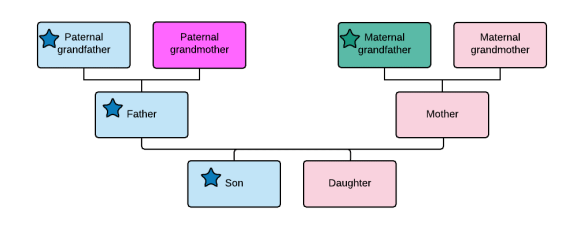
Remember that you can test family members in addition to yourself, so if you’re a female, you may want to recruit your father or an uncle or brother to represent your patrilineal line DNA. If you’d like to read a brief article about the different types of DNA and their benefits, 4 Kinds of DNA for Genetic Genealogy is a good resource.
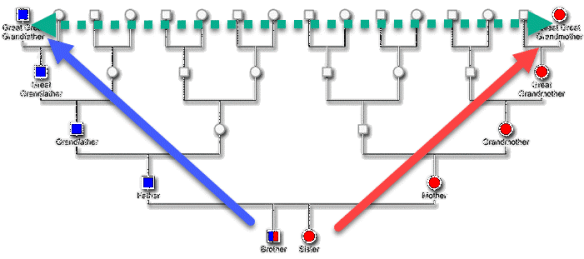
Y and Mito Pedigree.png

In this image, you can see that if you’re a male you can test for both your Y (blue-square) and mitochondrial DNA (red-circle) ancestral lines. If you’re a female, you can test only your mitochondrial DNA because females don’t have a Y chromosome. Both males and females, of course, can test (green) autosomal DNA which reveals a different type of connection to all of your ancestral lines, but with autosomal, you have to figure out which people match you on which lines.

Y and mitochondrial DNA provides you with a different type of information about laser-focused specific lines that you can’t obtain through autosomal testing, and reaches back in time far beyond the curtain when surnames were adopted.
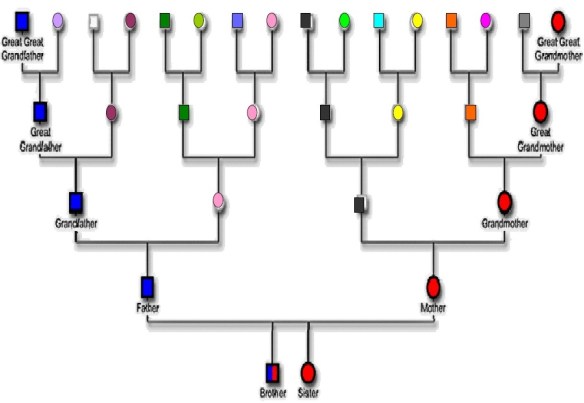
personal pedigree

You personally can only test for the red-circle mitochondrial DNA line, and perhaps the blue-square Y DNA line if you’re a male. Unless you find family members to test for the Y and mitochondrial DNA of your ancestors, you’re leaving valuable information unresearched. That means all those colored boxes and squares that aren’t blue or red.

I’ve solved MANY brick walls using both Y and mitochondrial DNA, often in conjunction with autosomal.

Let’s take a look at each type of DNA testing a little more in-depth, so that you understand how each one works and why they are important to genealogy.

The Specifics

Y DNA – Y DNA descends through the direct male paternal line and is inherited by men only. You match against other Y DNA testers, hopefully finding surname links.

The Big Y test and upgrade at FamilyTreeDNA provides testers with all 111 traditional STR markers, plus another 589+ STRs available only in the Big Y test, plus a scan of the balance of the rest of the Y chromosome that is useful for genealogy. SNP results are increasingly being used for genealogy, in addition to STRs.

SNPs group men into genetic lineages and STRs help with defining and refining the closest generations when matching to each other. Often, the benefits of these two tests overlap, which is why I recommend that males test to the Big Y-700 level which provides 700+ STR markers plus all SNPs with mutations that define ancestral lineages.

Y DNA haplogroups, derived from SNPs, reveal the geographic part of the world where the lineage originated, such as Europe, the Americas, Asia and Africa, as well as a migration path across the continents based on where SNPs are and were historically found. Ancient DNA samples are being added to the database.

If you or a family member took an earlier Y DNA test, you can upgrade to the Big Y-700 today which provides you with matching for both the STR markers and separately, SNP markers, along with other genealogical tools.

You can order or upgrade your Y DNA here. Don’t forget family members accounts you may control. They may agree to have their kit upgraded too.

To upgrade, sign in to your account, and click on your desired upgrade level under Y DNA testing.
ymt y upgrade.png

Then click on upgrades.

ymt upgrade.png

I wrote about Y DNA in these recent articles:

I have more Y DNA articles planned for the future.

You can search for additional articles by going to the main page of this blog and enter “Y DNA” into the search box for additional articles already published.

Many features such as the matches maps, haplogroup origins and ancestral origins pages are the same for Y DNA results as mitochondrial DNA results. You can view mitochondrial articles here.

Mitochondrial DNA (mtDNA) – Mitochondrail DNA descends through the direct matrilineal line to both sexes of children. Everyone has mitochondrial DNA and it is inherited matrilineally by you from your mother, from her mother, from her mother, etc.

The FMS or full mitochondrial sequence DNA test tests the entire mitochondria that provides information about your direct matrilineal line. Family Tree DNA provides matching, which can sometimes lead to genealogical breakthroughs such as when I identified Lydia Brown, the mother of my Phoebe Crumley and then a couple years later, her mother, Phoebe Cole – via mitochondrial DNA. Those discoveries led us to her mother, Mary Mercy Kent, via genealogy records. All we needed was to punch our way through that initial brick wall – and mitochondrial DNA was our battering ram.

Additionally, you’ll receive a full haplogroup designation which allows you to look back in time before the advent of surnames and identifies the location where your ancestral line came from. For those seeking confirmation of Native American heritage, Y and mitochondrial DNA provides unquestionable proof and doesn’t wash out in time as autosomal DNA does.

Mitochondrial DNA includes haplogroups, matching and other genealogical tools.

You can order or upgrade you or a family member’s mitochondrial DNA here.

To upgrade, sign in to your account, and click on the desired upgrade level.

ymt mt upgrade

Then click on Upgrade if you’re upgrading or Add On if you’re ordering a new product for yourself.

ymt add ons upgrades.png

I wrote several mitochondrial DNA articles and compiled them into a summary article for your convenience.

Autosomal DNA – With autosomal DNA testing, you test once and there’s not an upgrade unless the vendor changes DNA testing platforms, which is rare. Each of the four vendors compares your DNA with all other people who’ve taken that test, or transferred from other companies. They match you with descendants from all of your ancestral lines. While the Y and mtDNA tests look back deeply in time as well as recently on one specific line, the autosomal tests are broad but not deep, spanning all ancestral lines, but limited to approximately 10 generations.

Each autosomal vendor has unique benefits and focus as well as shortcomings. I’ve listed the major points for each vendor relative to searching for Y and mitochondrial
DNA testing candidates. It’s important to understand the advantages of each vendor because it will help you understand the testers you are most likely to find in each database and may help focus your search.

FamilyTreeDNA’s Family Finder

  • Because FamilyTreeDNA archives customer’s DNA for 25 years, many people who tested Y or mitochondrial DNA 20 years ago and are now deceased upgraded to autosomal tests when they became available, or have been upgraded by family members since. These early testers often reach back another generation or so into the past to people born a century ago.
  • Advanced autosomal matching integrates with Y and mitochondrial DNA along with surname and other projects
  • Phased Family Matching provides the ability to link family members that match you to your tree which allows Family Tree DNA to group matches as paternal or maternal by utilizing matching segments to the same side of your family
  • Genetic Affairs, a third-party tool available for testers, builds common trees by reading the trees of your matches and comparing their trees with your own to identify common ancestors.
  • Genetic Affairs builds trees and pedigrees of your matches by searching for common ancestors in your MATCHES trees, even if you have no tree or don’t share those ancestors in your tree. This functionality includes Y and mitochondrial DNA if you have tested. This facilitates discovery of common ancestors of the people who you match, which may well lead you to ancestral discoveries as well.
  • Genetic Affairs offers clustering of your shared matches.
  • DNA file transfers are accepted from other vendors, free, with a $19 one time fee to unlock advanced tools.
  • Family Tree DNA has tested people worldwide, with a few location exceptions, since inception in the year 2000.
  • No direct triangulation, but Phased Family Matching provides maternal and paternal side triangulation when matches can be grouped into maternal and paternal sides.
  • Matches and segment match information are available for download.
  • The great thing about the advanced matching tool at Family Tree DNA is that it facilitates searching for people who match you on different kinds of tests, so it helps determine the potential closeness or distance of Y and mitochondrial relationships.

MyHeritage

Ancestry

  • Ancestry has the largest database, but did not begin testing until 2012 and did not test widely outside of the US/UK for some time. They now sell tests in 34 countries. Their testers are primarily focused in the US, Canada, England, Scotland, Ireland, and diaspora, with some overlap into Europe.
  • Ancestry offers ThruLines, a tool that connects testers whose DNA matches with common ancestors in their trees.
  • Ancestry does not provide a chromosome browser, a tool provided by the other three primary testing companies, nor do they provide triangulation or matching segment location information necessary to confirm that you match on the same segment with other people.
  • Ancestry has issued cease and desist orders to third party tools that perform functions such as clustering, autotrees, autopedigrees or downloading of matches. Ancestry does not provide these types of features for their users.
  • Ancestry does not accept transfers, so if you want to be in Ancestry’s database, you must test with Ancestry.
  • No Y or mitochondrial DNA testing available.
  • Match list is not available for download.

23andMe

  • The primary focus of 23andMe has always been health testing, so many people who test at 23andMe are not interested in genealogy.
  • 23andMe tests are sold in about 50 countries, but not worldwide.
  • 23andMe provides a chromosome browser, triangulation, segment information and a beta genetically constructed tree for close matches.
  • 23andMe does NOT support a genealogical tree either uploaded or created on their site, making tree comparisons impossible.
  • Genetic Affairs AutoCluster works at 23andMe, but AutoTree and AutoPedigree do not because 23andMe does not support trees.
  • 23andMe does make match files available for downloading.
  • No Y or mitochondrial DNA full testing or matching, but basic haplogroups are provided.
  • 23andMe caps matches at 2000, less any matches that have opted out of matching. My matches currently number 1770.
  • 23andMe does not accept transfers from other vendors, so if you want to be in their database, you must test with 23andMe.

Reaching Out to Find Testers

Unfortunately, we only carry the mitochondrial DNA of our mother and only men carry the Y DNA of their father. That means if we want to obtain that DNA information about our other family lines, we have to find people who descend appropriately from the ancestor in question and test that person.

I’ll share with you how I search for people who descend from each ancestor. After finding that person, I explain the situation, why the different kinds of tests are important, and offer a testing scholarship for the Y or mtDNA test at Family Tree DNA if they have not already taken that test. If they’ve tested their autosomal DNA elsewhere. I also explain that they can transfer their autosomal DNA file for free too and will receive new matches.

Here’s an article with links to upload/download instructions for each testing company. Feel free to share.

Each DNA testing company has different features, but you can use all of the companies to find people descended in the appropriate way from each ancestor. It’s easier if you know how to utilize each vendor’s tools to optimize your chances of success. I’m going to step you through the search process with hints and tips for each vendor.

Finding Y DNA and Mitochondrial DNA Candidates at FamilyTreeDNA

Because FamilyTreeDNA tests for both Y and mitochondrial DNA and has for 20 years, you stand a better chance of finding a candidate there who may have already tested, so that’s where I always begin.

Y DNA

Let’s say, for example, that I need to find a male descendant of my Ferverda line in order to ask them to test for Y DNA. The person can be descended from either a close relative, if I know of one, or a more distant relative that I don’t know, but need to find through searching other ways.

Search for Surnames and Projects at Family Tree DNA

First, search the FamilyTreeDNA website for your goal surname among existing testers, and then the appropriate surname project to see if your line has already tested.

ymt ferverda

On the main page, here, scroll down to until you see the prompt, above, and enter the surname. Be sure to consider alternate spellings too.

ymt ferverda search.png

In this case, I see that there is a Ferverda surname project with 18 people, and scrolling on down, that 4 people with this specific surname have tested.

ymt results.png

However, searching for an alternate spelling, the way it’s spelled in the Netherlands, I find that another 10 people have tested.

ymt ferwerda

Of course, some may be females, but they probably know males by that surname.

First, I’m going to check the Ferverda DNA project to see if a Ferverda male from my line has tested, and if so, to what level.

Click on the project link in the search results to see the DNA Project.

ymt admin.png

Note two things. First, the administrator’s name, as you may need this later. If you click on their name, their email address is displayed.

Second, click on DNA Results and select Y DNA if you’re presented with a choice. If the project has a public facing page, and most do, you’ll see something like the following information.

ymt project

Hey look, it’s my lucky day, given that both of these men descend from my ancestor. I happen to know that they have both taken the Big Y test, because I’m the project administrator, but you won’t know that. One way to get an idea is if they have less than the full 111 markers showing, they probably haven’t taken the Big Y, because a 111 upgrade is included in the Big Y test today.

You have three options at this point to contact one of these men:

  • See if the people are on your own autosomal DNA match list, or the match lists of kits from that family that you manage. If so, you can view their email address and contact them. If you haven’t yet tested autosomally, meaning the Family Finder test, at Family Tree DNA, you can transfer autosomal tests from elsewhere, for free, which means you will be viewing matches within hours or a couple days. Otherwise, you can order a Family Finder test, of course.
  • If the person with the Ferverda or Ferwerda surname is not on your Family Finder match list, reach out to the project administrator with a note to the person you want to contact and ask the administrator to forward your email to the project member.
  • If the administrator doesn’t answer, contact Family Tree DNA support and make the same request.

Checking Family Finder, one of those people is on my match list and I’m pretty sure it’s the right person, because when I click on his profile, not only does the haplogroup match the DNA project, but so does the ancestor.

ymt ferverda profile.png

Searching Family Finder

If there isn’t a DNA project match you can identify as your direct line ancestor, you can search your Family Finder matches for the surname to find a male with that surname. If your match has a tree, see if your ancestor or ancestral line is showing, then note whether they have taken a Y DNA test. They may have taken a Y test, but have not joined a project or not entered any “earliest known ancestor.” You can see which tests they’ve taken by looking at the little tabs above their profile on their tree, or on their profile card.

ymt ferverda tree

click to enlarge

Regardless, you’re now in touch with a potential contact.

Don’t dismiss females with that surname, or people who show that surname in their ancestral surname list. Women with the surname you’re looking for may have husbands, fathers, brothers or uncles who descend from the line you are seeking.

ymt search field.png

Utilize Genetic Affairs

My ace in the hole at FamilyTreeDNA is the Genetic Affairs AutoTree and AutoPedigree function.

Genetic Affairs is a third-party tool that you can use to assist with analysis of your matches at FamilyTreeDNA.

ymt genetic affairs

click to enlarge

At Genetic Affairs, selecting AutoTree generates trees where common ancestors of you and your matches, or your matches to each other, are displayed.

Your goal is to identify people descended from a common ancestor either directly paternally through all males for Y DNA or through all females to the current generation, which can be males, for mitochondrial DNA.

This article provides step-by-step instructions for the Genetic Affairs AutoTree and AutoPedigree functions.

Mitochondrial DNA

Mitochondrial DNA lineages are a bit more challenging because the surname changes every generation and DNA projects are unlikely to help.

The AutoTree/AutoPedigree report through Genetic Affairs serves the same purpose for mitochondrial DNA – building trees that intersect with a common ancestor. I generally drop the “minimum size of the largest DNA segment shared with the match” to 7 cM for this report. My goal running this report for this purpose isn’t to analyze autosomal DNA, but to find testing candidates based on how my matches descend from a specific ancestor, so I want to include as many matches as possible.

Family Finder Can Refine Y and mtDNA Information

In some cases, a Family Finder test can refine a potential relationship between two people who match on either Y DNA or mitochondrial. Additionally, you may want to encourage, or gift, specific matches with an upgrade to see if they continue to match you at higher testing levels.

Let’s say that two men match closely on a Y DNA test, but you’d like to know how far back the common ancestor lived.

ymt y matches.png

In this instance, you can see that the second match has taken a BIg Y and a Family Finder test, but the exact match (genetic distance of 0) has not. If the first individual cannot provide much genealogy, having them take a Family Finder test would help at least rule out a relationship through second cousins and would give you at least some idea how far back in time your common ancestor may have lived. If you do match on Family Finder, you receive an estimate of your relationship and can check the match level possibilities using the DNAPainter Shared cM Tool. If they upgrade to the Big Y-700 test, you may be able to differentiate your line from theirs, or confirm when and where a split occurred – or that there is no split.

This same autosomal testing scenario works for mitochondrial DNA.

For people who have taken both tests, Family Finder plus either Y or mitochondrial DNA, the Advanced Matching menu allows you to select combinations of tests and projects to query.

ymt advanced

click to enlarge

Finding Y and Mitochondrial DNA Candidates at MyHeritage

MyHeritage provides a wonderful tool called Theories of Family Relativity (TOFR) which finds common ancestors between you and your DNA matches, even if the ancestor is not in both trees, so long as a path exists between the two testers’ trees using other trees or research documents, such as census records. Of course, you’ll need to verify accuracy.

ymt tofr.png

At MyHeritage, select DNA Matches, then “Has Theory of Family Relativity.”

ymt mh ferverda

click to enlarge

You can see that I have 65 matches with a Theory of Family Relativity. Additionally, I can then search by surname.

ymt mh ferverda tree.png

click to enlarge

If I am looking for a Ferverda Y DNA candidate, I’ve found one thanks to this TOFR.

If you don’t find a tree where your match descends from your ancestor in the desired way, you can also widen the search by de-selecting Theories of Family Relativity and instead selecting SmartMatchs or shared surname combined with the name of your ancestor. There are many search and filter combinations available.

Let’s look at a mitochondrial DNA example where I’m searching for a descendant of Elizabeth Speaks who married Samuel Clarkson/Claxton.

ymt smartmatches

click to enlarge

In this case, I have one SmartMatch, which means that someone by the name of Elizabeth Speaks is found in my matches tree. I need to look to see if it’s the RIGHT Elizabeth Speaks and if my match descends through all females to the current generation. If so, I’ve found my mitochondrial DNA candidate and I can leave them a message.

You can also view SmartMatches (without a DNA match) from your own tree.

I can go to that person in my tree, click on their profile, and see how many SmartMatches I have. Clicking on 13 SmartMatches allows me to view those matches and I can click through to the connected trees.

ymt mt speaks.png

I can also click on “research this person” to discover more.

If you’re still not successful, don’t give up quite yet, because you can search in the records for trees that shows the person whom you seek. A SmartMatch is only created if the system thinks it’s the same person in both trees. Computers are far from perfect.

ymt mh trees

click to enlarge

Narrow the search as much as possible to make it easier to find the right individual, and then view the trees for descent in the proper manner.

Another wonderful tool at MyHeritage is the Genetic Affairs AutoCluster tool, built-in for MyHeritage users.

ymt mh cluster.png

The above cluster shows that one person carries the surname of Elizabeth’s husband. Viewing the accompanying spreadsheet for the AutoCluster run reveals that indeed, I’ve already identified a couple of matches as descendants of the desired ancestral couple. The spreadsheet shows links to their trees, my notes and more.

ymt cluster ss

Clusters show you where to look. Without the cluster, I had only identified two people as descendants of this ancestral couple. I found several more candidates to evaluate and two mitochondrial candidates are found in this cluster.

Finding Y and Mitochondrial DNA Candidates at 23andMe

23andMe is a little more tricky because they don’t support either uploaded or created user trees which makes finding descendants of a particular ancestor quite challenging.

However, 23andMe attempts to create a tree of your closer relatives genetically. which you can find under “DNA Relatives,” under the Ancestry tab, then “Family Tree” at the top.

I’ve added the names of my ancestors when I can figure out who the match is. Please note that this “created tree” is seldom exactly accurate, but there are often enough hints that you’ll be able to piece together at least some of the rest.

Here’s part of my “created” tree at 23andMe. I’m at far right.

ymt23 tree.png

click to enlarge

If you’re a genealogist, your eyes are going to glaze over about now, because the “people” aren’t in the correct locations – with maternal and paternal sides of the tree swapped. Also, please note, the locations in which they place people are estimates AND 23andMe does NOT take into account or provide for half-relationships.

That said, you can still obtain candidates for Y and mitochondrial DNA testing.

In this case, I’m searching for a mitochondrial DNA candidate for Evaline Miller, my grandfather’s mother or a Y DNA candidate for the Ferverda line.

I can tell by the surname of the male match, Ferverda, that he probably descends through a son, making him a Y DNA candidate.

Both Cheryl and Laura are possible mitochondrial DNA candidates for Evaline Miller, based on this tree, depending of course on how they actually do descend.

I can contact all of my matches, but in the event that they don’t answer, I’m not entirely out of luck. If I can determine EXACTLY how the match descends, and they descend appropriately for mitochondrial DNA, I can view the match to see at least a partial haplogroup. Since 23andMe only uses relatively close matches when constructing your tree, I’m relatively likely to recognize the names of the testers and may have them in my genealogy program.

By clicking on the Ferverda male, I can see that his Y haplogroup is I-Z58. That’s not nearly as refined as the Y DNA information at Family Tree DNA, but it’s something if I have nothing else and he doesn’t answer my query that would include the offer of a Y DNA test at Family Tree DNA.

ymt 23 hap

You can search at 23andMe by surname, but unless your match has entered their ancestral surnames and you recognize surnames that fit together, without a tree, unless your match answers your query, it’s very difficult to determine how you connect.

ymt 23 search.png

You can also view “Relatives in Common,” hoping to recognize someone you know as a common match.

ymt relatives in common

Please note that 23andMe does allow testers to enter a link to a tree, but few do.

ymt tree link.png

It’s worth checking, and be sure to enter your own tree link location.

Finding Y and Mitochondrial DNA Candidates at Ancestry

Ancestry’s ThruLines provides an excellent tool to find both Y and mitochondrial DNA participants.

Ancestry organizes their ThruLines by ancestor.

ymt thrulines

click to enlarge

Select your desired Ancestor, someone whose DNA you seek. Clearly, Y DNA candidates are very easy because you simply choose any male ancestor in the correct line with the surname and look for a male match with the appropriate surname.

In this case, I’m selecting Martha Ruth Dodson, because I need her mitochondrial DNA.

ymt dodson.png

By clicking on her “card” I then see my matches assigned to her ThruLine.

Ymt ancestry thruline

Obviously, for mitochondrial DNA, I’m looking for someone descended through all females, so Martha’s daughter, Elizabeth Estes’s son Robert won’t work, but her daughter, Louisa Vannoy, at left is the perfect candidate. Thankfully, my cousin whom I match, at bottom left is descended through all females to the current generation, which can be male or female, so is a mitochondrial DNA candidate.

Finding Y and Mitochondrial DNA Candidates in Trees in General

I’ve utilized the combination of trees and DNA matches at FamilyTreeDNA through Genetic Affairs, Ancestry and MyHeritage, but you can also simply search for people who descend from the same ancestor based on their tree alone at the vendors who support trees as part of genealogical records. This includes both Ancestry and MyHeritage but also sites like Geneanet which is becoming increasingly popular, especially in Europe. (I have not worked extensively with Geneanet yet but plan to take it for a test drive soon.)

My reason for utilizing DNA matches+trees first is that the person has already been introduced to the concept that DNA can help with genealogy, and has obviously embraced DNA testing at least once. Not only that, with the assist of a Theory of Family Relativity, ThruLine or genetic Affairs automation tools, it’s much easier to find appropriate candidates.

Finding Y and Mitochondrial DNA Candidates at WikiTree

If you reach beyond DNA testing companies, WikiTree provides a valuable feature which allows people to specify that they descend from a particular ancestor, and if they have DNA tested, how they descend – including Y DNA, mitochondrial DNA and autosomal.

Here’s an example on the profile of John Y. Estes at WikiTree, one of my Estes ancestors.

ymt wiki.png

If someone descends appropriately for either Y or mitochondrial DNA line, and has taken that test, their information is listed.

In this case, there are two Y DNA testers and two autosomal, but no mitochondrial DNA which would have descended from John’s mother, of course.

You can click on the little green arrow icon to see how any DNA tested person descends from the ancestor whose profile you are accessing.

ymt wiki compare

Of course, the same surname for males is a good indication that the man in question is descended from that paternal line, but check to be sure, because some males took their mother’s surname for various reasons.

Here’s my line-of-descent from John Y. Estes. I can click on anyone else whose DNA information is listed as well to see how they descend from John. If they descend from John through all females, then they obviously descend from his wife though all females too which means they are a mitochondrial DNA candidate for her.

ymt wiki relationship.png

click to enlarge

Clicking on autosomal testers may reveal someone appropriately descended from the ancestor in question.

You can then click on any ancestor shown to view their profile, and any DNA tested descendants.

By clicking on name of the descendant whose DNA test you are interested in, you’ll be able to view their profile. Look for the Collaboration section where you can send them a private message that will be delivered by email from WikiTree.

ymt collaborate

Finding Y and Mitochondrial DNA Candidates at GedMatch

One final avenue to find Y and mitochondrial DNA candidates is through GedMatch, It’s probably the least useful option, though, because the major vendors all have some sort of tree function, except for 23andMe, and for some reason, many people have not uploaded GEDCOM files (trees) to GEDmatch.

Therefore, if you can find someone on GedMatch that tested elsewhere perhaps, such as LivingDNA who also provides a base haplogroup, or 23andMe, and they uploaded a GEDCOM file (tree) to GedMatch, you can utilize the GEDmatch “Find common ancestors” automated tree-matching functionality.

gedmatch mrca matches

click to enlarge

GEDmatch produces a list of your matches with common ancestors in their trees, allowing you to select the appropriate ancestor or lineage.

I wrote step-by-step instructions in the article, GEDmatch Introduces Automated Tree Matching.

Additionally, GEDmatch includes the Genetic Affairs AutoCluster tool in their Tier1 subscription offering,

ymt gedmatch.png

Gedmatch users who know their Y and mitochondrial haplogroup can enter that information in their profile and it will be reflected on the autosomal match list.

ymt gedmatch hap

Summary Chart

In summary, each testing vendor has a different focus and unique tools that can be used to search for Y and mitochondrial DNA candidates. Additionally, two other resources, WikiTree and GEDmatch, although not DNA testing vendors, can lead to discovering Y and mtDNA candidates as well.

I’ve created a quick-reference chart.

  Family Tree DNA MyHeritage Ancestry 23andMe Wikitree GEDmatch
Y DNA Test Yes No No No, partial haplogroup provided No test, listed by ancestor No, user entered
mtDNA Test Yes No No No, partial haplogroup provided No test, listed by ancestor No, user entered
DNA Projects Yes No No No Some Some
Strengths other than mentioned categories 20 year worldwide customer base, phased family matching European focus, SmartMatches, wide variety of filters Largest autosomal database Genetic tree beta DNA by ancestor May include users not found elsewhere who tested outside the major companies
Drawbacks No direct triangulation or tree matching No Genetic Affairs AutoTree or AutoPedigree Can’t download matches, no triangulation, clusters, AutoTree, or AutoPedigree No trees, 2000 match limit “One tree” may be incorrect Few trees, no AutoTree or AutoPedigree
Clustering Genetic Affairs Included in advanced tools No, prohibited Genetic Affairs N/A Included in Tier1
Genetic Affairs AutoTree & AutoPedigree Yes No No No, no tree support N/A No
Tree matching between users No, through Genetic Affairs Theories of Family Relativity ThruLines No Not directly MRCA common ancestors in Tier1

Now it’s your turn. Which Y and mitochondrial DNA lines can you find today?

Happy Hunting!

_____________________________________________________________

Disclosure

I receive a small contribution when you click on some of the links to vendors in my articles. This does NOT increase the price you pay but helps me to keep the lights on and this informational blog free for everyone. Please click on the links in the articles or to the vendors below if you are purchasing products or DNA testing.

Thank you so much.

DNA Purchases and Free Transfers

Genealogy Products and Services

Genealogy Research

6 & 7 cM Matches: Are 172 ThruLines All Wrong?

Are some 6-8 cM matches valid and valuable? If not, then are my 172 ThruLines that Ancestry created for me that include my 8 great-grandparents surnames at that level all wrong? Or the total of 552 ThruLines at 6 and 7 cMs all wrong?

We all know by now that about half of 6 and 7 cM matches will be identical by chance, meaning not valid, but that leaves about half that ARE valid. We need clues to be able to figure out IF these matches are valid, and the logical place to start is by utilizing three techniques.

  • First, if both of our parents have tested, does the person also match our parent, and if a chromosome browser is available, on the same segment.

If the answer is no, no need to go any further, this match is not valid. If yes, then we know if phases through one generation and we need to keep looking for evidence.

  • Second, the same litmus test, but with our closest known relatives that have tested. Does the match also match aunts, uncles, siblings, first cousins, or other known proven close relatives? Of course, if they match on the same segment, that’s family phasing and the beginning of triangulation and strongly, strongly suggests descent from the same common identified ancestor.

Note that Ancestry does NOT show you Shared Matches below 20 cM, so don’t assume those shared matches to family members don’t exist. Check your family members’ kits directly. Don’t rely only on Ancestry’s shared matches.

  • Third, surnames and trees that suggest common ancestral lines of DNA matches. That’s what Ancestry does for us with ThruLines. Let’s take a look at what I’ve found sorting and grouping my 6-8 cM matches at Ancestry.

There’s way more information than I expected to find.

Focus on Grouping

With Ancestry’s upcoming purge of all DNA customers’ 6 and 7 cM matches, inclusive, I’ve been very focused on grouping and saving those matches for future use. Otherwise, they will be gone forever, along with my genetic connection and any useful genealogical information.

I’ve written about the upcoming Ancestry purge here, here and here – including preservation strategies and how to communicate with Ancestry to share your feelings about this topic if you so choose. Note that this disproportionately affects people seeking unknown ancestors a few generations back in time.

Raise your hand if you have no unknown ancestors before 1870 or so…

Ancestry’s 6-8 cM Matches

I’ve been recording statistics as I’ve been grouping and working with results, and thought I’d share what I’ve found with you.

Ancestry tota.png

I have a total of 92,931 matches at Ancestry. This includes endogamous Acadian, Mennonite and Brethren lines, which produce lots of matches, but also multiple German and Dutch lines of relatively recent immigrants with almost no testers. So it probably evens out.

You’ll note that of my matches, 3,757 are estimated by Ancestry to be 4th cousin or closer, and Ancestry categorizes the rest of them as Distant matches, from 6-20 cM, although some of those wind up being closer than 4th cousins.

I have 27,926 6-cM matches, 16,846 7-cM matches and 11,428 8-cM matches. I was initially saving 8-cM matches because Ancestry was initially rounding 7.6 up to 8 and the only way to save all 7-cM matches was to save all 8-cM matches. Last week, Ancestry added decimal points so you don’t have to save 8-cM matches anymore, just all 6 and 7.

Without additional tools, all of those matches are overwhelming – but that’s exactly WHY we need technologies such as clustering, triangulation, ThruLines which Ancestry provides, a chromosome browser, family phasing, shared matches below 20 cM, and more.

You can certainly look at known genealogy and make inferences about common ancestors when you match someone genetically, and that’s very useful in and of itself.

However, you need more than just the fact that you match someone to confirm that you share a specific common ancestor biologically, not just on paper. Having said that, just having the breadcrumb of a DNA match to lead you to your cousins isn’t a bad thing in and of itself.

Of my total matches:

  • 18% are 7 cM
  • 30% are 6 cM
  • That’s a total of 48% of my matches that would have been lost later in August if I hadn’t grouped them.

Some people feel that matches at this level aren’t useful, but the line in the sand is very thin between a 7.99 cM deleted match and an 8.0 retained match where the former is lumped into the “not useful, so no big deal to lose” bucket and the other is just fine and potentially useful.

I get it, I really do, that everyone gets tired of explaining that NO, you can’t find one match and assume a valid connection, and yes, digging for evidence is work. There is no magic wand. Smaller or larger matches, they all need additional cumulative evidence to indicate that the match is valid, and how.

It’s time-consuming and frustrating educating people HOW to utilize all DNA matching appropriately. Those smaller matches take more effort to work with and require more evidence of legitimacy, but there are absolutely, assuredly many legitimate, useful, matches between 6-8 cM.

Furthermore, many of those matches reach back in time to those elusive ancestors we are seeking and can’t yet identify. We need more and better tools, not less data. Conversely, some 6-8 cM matches are as close as third or fourth cousins. I found 4 in one family and we’re sharing photos of our ancestors who were siblings, born in 1827 and 1829, respectively.

I’m not throwing half of my 6-8 cM coins away because some are gold and some are counterfeit.

If you are, I’ll take all of your coins and I’ll be happy to sort out the gold, thank you😊

Where’s the Gold?

Ancestry filter

You can search and sort in any number of ways at Ancestry. First, I checked to see how many of my 6 and 7 cM matches had common ancestors as identified by Ancestry via Thrulines.

6 cM 7 cM Total
Common Ancestors (ThruLines) 274 278 552

If I had not grouped these, I would have lost all 552 matches that Ancestry connected to common ancestors through ThruLines. Of course, each connection needs to be individually verified using traditional genealogical record searches. Keep in mind that ThruLines can only find matches where people connect in trees.

Without these 6 and 7 cM matches, any connecting genetic path or breadcrumbs to these people is gone.

Great-grandparents’ Surnames

Since I can filter by segment match size and surname, combined, at Ancestry, I decided to take a look at my 6-7 cM matches that would be purged had I not grouped them, and see what I can discover by surname utilizing the surnames of my great-grandparents.

That’s just 3 generations for me, meaning I could expect to carry more of the DNA of these ancestors than of ancestors further back in time.

I started with the “Match name” of Estes, meaning that the person who took the test has that name. Of course, some women could use their married surname, so this doesn’t mean that my match to that person is via that surname. It’s just a starting point, but probably a good hint.

I had 12 Estes surname matches in the 6-7 cM range. Of those:

  • 4 had no tree
  • 1 had a private tree
  • 1 had an unlinked tree
  • None had common identified ancestors meaning ThruLines
  • That leaves me with 7 candidates to work with directly, including the unlinked tree
  • Of those, I knew how 5 of their trees connect to the Estes line

Of course, I have the benefit of having worked with the Estes genealogy for decades along with the benefit of trees and other resources not at Ancestry. Connecting these lines took me about 15 minutes. In essence, I’ve turned them into virtual “ThruLines” by identifying the common ancestor, even if Ancestry didn’t.

I have not yet worked with the rest of my surname matches in the same way, but by preserving them by grouping, I can in the future.

I searched for both the “Match Name” and the “Surname in the Matches’ Trees,” separately. Some who carry the surname aren’t going to have trees and conversely, finding the surname in your matches’ trees is by no means an indication that that particular surname or ancestor is why you’re matching. However, it’s a great hint and a place to begin your research, including shared matches.

Be sure to check alternate spellings of surnames too.

Note that a surname that can also be part of a name returns all possible connections. For example if I’m searching for the Lore surname and the name of my match is Loreal Jones, it will still appear in the Match name list. The same applies to the name of the managing person.  However, scrolling through these is pretty easy.

So, what did I find?

Results!

I created this chart of what I discovered using the surnames of my great-grandparents along with common alternate spellings.

Surname Match Name Surname in Matches’ Trees Comments
Estes, Eastes 13 matches, no ThruLines 208 matches, 20 Thrulines
Bolton 6, no ThruLines 121, 14 Thrulines All 6 surname matches have trees and I can place some immediately.
Vannoy, Van Noy 2, no ThruLines 49, 10 ThruLines I can place 1 of the 2 surname matches and connect them to the Vannoy line. Their tree is unlinked and another is private. Checking the “include similar surnames box” resulted in 2355 results. Won’t do that again.
Ferverda, Fervida, Ferwerda 0 2, no ThruLines Confirmed a common ancestor in the Netherlands with one tester. An 1860s immigrant line.
Miller 175, 1 ThruLine 2248, 95 ThruLines Very common surname and Brethren. Shared matches, if over 20 cM which is Ancestry’s threshold would potentially be very helpful.
Clarkson, Claxton 2, no ThruLines 96, 22 ThruLines I need to break down a brick wall in this line. Also, maybe someone has a photo of my great-grandmother. I was able to provide a photo of someone else’s ancestors discovered as a 6 and 7 cM match to 4 family members.
Lore, Lord 112, no ThruLines 209, 10 ThruLines Acadian, endogamous. Lore is part of many other names.
Kirsch 0 18, 0 ThruLines 1850s German immigrant line. This was VERY helpful. I’ve already found previously unknown cousins and one line that I thought was defunct, isn’t.
Total 310, 1 ThruLine 2951, 171 ThruLines Total 3261 matches and 172 ThruLines

I’m not willing to throw these away.

Continue to Provide Feedback to Ancestry

I find the assertion that these smaller matches are neither accurate nor valuable simply mind-boggling. Clearly, as you can see above, these matches provide invaluable clues for us, as genealogists, to follow. Over time, I’ve proven many matches in this range (who have tested at or transferred to other vendors with a chromosome browser) to triangulate with several generations of family members using DNAPainter, so at least some matches are quite valid. And yes, we do have tools to accumulate evidence – the same exact tools we use for larger matches.

Imagine how much else is actually buried in those matches that could be distilled into useful information with technology tools.

I fully understand it’s in Ancestry’s best interest to delete these matches to free up processing resources, but I’m far from convinced that it’s in our best interest as avid genealogists.

I also realize that many if not most genealogists who aren’t as focused as many of you reading this article won’t notice or care, but that’s not the case for truly committed genealogists with years invested in this work. There’s valuable information there for those of us willing to commit our resources and invest our time to work on the matches.

The Proof is in the Pudding

The proof is in the results – those 3,261 surname matches that serve as immediate hints and 172 ThruLines that Ancestry themselves has assembled for us.

The more I work with these matches, the LESS convinced I am that they should be deleted. There is certainly chaff to be sifted and discarded, but Ancestry could take a more precise, surgical approach instead of a wholesale decapitation that will remove 48% of my matches and more for other people. I would certainly be more than happy to be part of a proactive discussion focusing on how to delete less useful matches or those we’ve determined to be invalid, but preserve the rest.

Of course, the easiest option would simply be for Ancestry to allow us to elect to retain current and elect to receive future 6-8 cM matches by checking a simple box and continue to provide those for those of us who care and are willing to work with them.

Yes, the remaining matches after the purge will indeed “be more accurate,” as Ancestry says, because fewer will be false, but many of the very matches you need to identify those elusive distant ancestors will almost assuredly be gone. The baby will have been thrown out with the bathwater.

It’s generally not any individual match itself, but groups or clusters of matches that point the way – shared matches and ThruLines. If half or more of the cluster we need is gone, with no way to connect the genetic dots, we may never discover the identity of those ancestors. That’s a shame, because it negates the very benefit of being in the largest autosomal database. In a way, both Ancestry and we as their clients are victims of their own success.

Perhaps Ancestry will yet reverse their decision and if not, perhaps Ancestry’s competitors will see an unfulfilled opportunity here. I’d be glad to be a part of those discussions as well.

Take a look. What valuable nuggets are hiding in your smaller matches? Be sure to group those matches to prevent their deletion.

Provide Feedback to Ancestry

There’s still time to provide your feedback to Ancestry if you don’t want to lose your 6-8 cM matches later this month. Ancestry needs to serve all of their genealogical customers who have taken DNA tests, not just the most convenient. I encourage Ancestry to develop useful tools as others have done instead of deleting the matches we need in order to unmask those unknown ancestors.

  • Email Ancestry support at ancestrysupport@ancestry.com although there have been reports from some that this email doesn’t work, so you may need to utilize another contact method.
  • You can initiate an online “chat” here.
  • Call ancestry support at 1-899-958-9124 although people have been reporting obtaining offshore call-centers and problems understanding representatives. You also may need to ask for a supervisor.
  • Ancestry corporate headquarters phone number on the website is listed as 801-705-7000.
  • You can’t post directly on Ancestry’s Facebook page, but you can comment on posts and you can message them.
  • Ancestry’s Twitter feed is here.

_____________________________________________________________

Disclosure

I receive a small contribution when you click on some of the links to vendors in my articles. This does NOT increase the price you pay but helps me to keep the lights on and this informational blog free for everyone. Please click on the links in the articles or to the vendors below if you are purchasing products or DNA testing.

Thank you so much.

DNA Purchases and Free Transfers

Genealogy Products and Services

Genealogy Research

August Hot News: Ancestry Match Tagging Script, DNA Sales, DNAPainter Newsletter & More

August news.png

This wasn’t exactly how I had in mind to convey these news items, but you know that saying, “Life is what happens when you’re making other plans,”? Well, let’s just say it’s one of those weeks/months and years.

So, this article is going to be short and sweet, and I promise a more detailed article in a few days.

However, you need at least some of this info ASAP, so here it is in its rather unrefined raw state.

  • Ancestry Tagging Script
  • Ancestry Acquisition Update
  • Summer Sales
  • MyHeritage Sale
  • FamilyTreeDNA Sale
  • DNAPainter Free Newsletter
  • New Ancient Ancestor

Ancestry Tagging Script (to Save Your Sanity)

A very nice person, Roger Frøysaa, has written a free javascript to group your Ancestry matches. Of course, I’m referring to your 6-8 cM matches that are subject to the upcoming purge later in August.  I’m using Roger’s gracious gift, but struggling because the script keeps timing out, or Ancestry’s backend keeps timing out, etc.

You might need to be at least somewhat comfortable with computers for this to work and it doesn’t work on a tablet or iPad, but does work on a Mac.

I have the latest version of both Chrome and Edge browsers installed on a relatively new computer with lots of memory. For me, the script works best on Edge and in the middle of the night when Ancestry’s servers are less busy. Still, I can’t seem to get below my 6.2 cM matches without the script or Ancestry bombing. It doesn’t help any that my internet service has been flaky this week too.

The author recommends Firefox. (Update. I’ve installed Firefox and it’s running like a champ.)

Here are the instructions: https://docs.google.com/document/d/100BqYdjeVdwmHaT9gTL3miknxm7bKik4KwcHaoUX72I/edit?fbclid=IwAR04u0VQaaVeG-6pkif-ILYmLPQgHTtCf13A0lW4EMPTm0QwOb1hDb9o7L4

Print these out, read them thoroughly, and follow them step by step.

Here’s a link to the script on GitHub: https://github.com/lrf1/ancestry_scripts/blob/master/ancestry_dnsmatches_grouptagger_v2.js

Here’s a YouTube video about how to use the script: https://www.youtube.com/watch?v=pnqGChJL0kw&fbclid=IwAR04iTVzcaKF8YJx2ewX_2rMEXQFaFaNIW5YfPQMlJYG6yfd1U6NvCN47Vc

Individual tweaking is required.

In my case, I have named the group where I want my 6-8 cM matches saved “1saved.” I selected that name because the 1 locates it near the top and I’ll know what’s there.

August ancestry 1saved

Following Roger’s instructions, 1saved should be row 3, but I had to enter row “2” in the script to get the matches to save to the group 1saved.

// MODIFY THE FOLLOWING LINES AS NEEDED

var groupTitle = “1saved“;

var groupRow = 2;

Regardless, the script works, and truthfully, all I really care about is that these matches are preserved.

My biggest problem occurs after the script bombs the first few times, and it will – you’ll need to restart it. Until the script manages to work its way to the location in the file, which is increasing further down in the scrolling, where it discovers matches to be tagged, I must re-enter and re-enter the script to reinitiate the searching.

This is by NO MEANS a complaint because I’m very grateful for this free tool. It’s just an observation that I hope will help you too. Having said that, I can’t tell you how many surnames like Bolton, my grandmother’s birth surname, Estes and Vannoy by various spellings, my great-grandmother’s surname I’ve seen scroll past as they are being tagged. There’s gold in those matches.

Furthermore, many people are reporting successes now that they’re actually looking at these smaller matches. If half of these are identical by chance, or false positives, that means half are NOT false and you need to use your analytical skills to figure out which is which.

Someone asked me earlier if I know anyone who will run the script or tag on behalf of someone else. I don’t, but you could ask on any number of Facebook groups, specifically the AncestryDNA Matching group or the ISOGG group.

If you’re NOT going to use the script, I recommend the following methodology to save at least some of your highest quality matches that are most likely to be relevant.

Select both “Common Ancestors” and “Shared DNA.” Enter the levels of shared DNA you want to view, meaning 6-6 or 6-7 or 7-7, which will display all of your matches where a potentially shared ancestor has been identified (ThruLine.)

August ancestry common plus 6.png

This won’t save anyplace near all of your 6-8 cM matches, but it will save the potentially most beneficial.

I wrote the article, Ancestry to Remove DNA Matches Soon – Preservation Strategies with Detailed Instructions, here, and Ancestry Match Purge Update here.

Note that Ancestry has stated they are delaying the purge until “late August,” but I’m seeing multiple people report that their 6-8 cM matches are already gone, so if you want to save them, one way or another, don’t delay.

Ancestry Acquisition Update

Ancestry’s announced acquisition by Blackstone Group, which I wrote about here, has raised questions about privacy. An article this week in Vice quotes both an Ancestry and Blackstone spokesperson on the topic who say that Blackstone will not have access to user data nor will it be shared with Blackstone’s portfolio companies.

Summer Sales Have Arrived

Late summer always ushers in summer DNA sales.

Right now, FamilyTreeDNA, MyHeritage, and Ancestry are having sales.

AncestryDNA is on sale for $59, here.

MyHeritage is on sale for $49, here and has a significant customer base in Europe where most of my ancestors originated.

Of course, FamilyTreeDNA has Y DNA and mitochondrial DNA in addition to autosomal plus 20 years’ worth of testers in their database.

Regardless of where you’ve tested, having family members in the same database makes your own test so much more valuable because many of your matches will match family members too. I’m in all of the databases, and several of my family members are as well.

Remember, you can transfer tests for free to both MyHeritage and Family Tree DNA from other vendors. Instructions for each company can be found here.

MyHeritage Sale

The MyHeritage DNA kit is on sale right now for $49 and free shipping with 2 or more.

August myheritage

Don’t forget that if you’ve tested elsewhere, you can transfer to MyHeritage for free and pay just $29 to unlock the advanced tools, such as Theories of Family Relativity, or subscribe to the full records package and the unlock is free.

Family Tree DNA Sale

Family Tree DNA offers their Family Finder autosomal test, but additionally, they offer Y and mitochondrial DNA testing and matching which provide insights you can’t obtain with autosomal DNA testing alone.

  • Y DNA is for males only and tests the direct paternal (surname) line.
  • Mitochondrial DNA is for both men and women and tests your direct matrilineal line – your mother, her mother, her mother, etc.

If you’ve already tested at a lower level, you can upgrade.

august ftdna 2

If you know what you want, go right ahead and order.

This is a wonderful time to order tests for family members who represent Y DNA and mitochondrial lines that you can’t test for yourself.

Early in the week, I’ll publish an article that shows how to locate people at each testing company who are appropriately descended from your ancestor whose Y DNA or mitochondrial DNA results you’d like to have.

This sale runs through the end of August, so you have time to search out and find people to ask if they’d be willing to test. Of course, if you already know people appropriately descended, by all means, ask them and get a kit on order. I generally offer a DNA testing scholarship so that the $$ factor is removed from my request. It makes it easier for them to say yes. If they agree, I add a Family Finder test too. I believe in striking while the iron is hot.

If you’d like to read about the different kinds of DNA testing, the article 4 Kinds of DNA for Genetic Genealogy is great to share with others as well.

Free DNAPainter Newsletter

I received an email this week from Jonny Perl at DNAPainter, one of my favorite tools, and he’s now offering a free monthly newsletter with tips on how to use DNAPainter. You can sign up here. I certainly did.

I’ve written extensively about DNAPainter, here.

New Ancient Mystery Ancestor

Guess what, you may have a new mystery ancestor. How cool is this??!!

LiveScience reported this week that scientists have detected traces of an earlier human ancestor in Neanderthal and Denisovan DNA. That ancient ancestor existed 200,000-300,000 years ago, in Africa, leaving and intermixing with the Neanderthals then living in the Middle East or elsewhere outside of Africa, but before the move to Europe.

You can read the PLOS article, here.

I don’t know about you, but I find this absolutely fascinating.

TTFN

Enough news for now, although I’ve probably forgotten something.

Order a DNA test, find an ancestor, subscribe to the DNAPainter newsletter, and enjoy summer, safely.

I’ll see you later this week with an article about how to search for family members, in particular Y and mitochondrial DNA carriers that represent your ancestral lines. You never know what critical information is waiting just to be discovered.

_____________________________________________________________

Disclosure

I receive a small contribution when you click on some of the links to vendors in my articles. This does NOT increase the price you pay but helps me to keep the lights on and this informational blog free for everyone. Please click on the links in the articles or to the vendors below if you are purchasing products or DNA testing.

Thank you so much.

DNA Purchases and Free Transfers

Genealogy Products and Services

Genealogy Research

Identifying Unknown African American Lineages Using DNA

My article asking Ancestry to reconsider purging 6-8 cM matches due to the effects on African American genealogy raised questions about how one could identify a lineage for an African American (or anyone really) who has no knowledge of their tree beyond a certain point in time.

That’s actually a really good question, so let me explain by using examples from my own family that illustrate how the science and matching techniques work together.

African American DNA isn’t any different than other DNA. What is different is that African Americans have absolutely no records, no surname and no context before emancipation in the 1860s and the first census in 1870. Many, and especially new researchers, have no idea where to look and without records, DNA is their only way to make connections back in time.

Unfortunately, this is also the threshold in time where the DNA of ancestors prior to 1870 is now chopped into segments the size of 6-8 cM.

Accidental Discovery

This week, while I was working on evaluating my smaller segment matches at Ancestry, I noticed that one was to an African American man, based on his profile picture, with whom I shared 7 cM.

AA Frank.png

I clicked on the match and then on Shared Matches. Even though this match is only 7cM, Shared Matches of 20 cM or above will show. The only shared matches that won’t show are shared matches below 20 cM, because they are presumed to be further back in time than 4 generations. I do wish Ancestry would show all shared matches.

We had 12 shared matches, ranging from 20 to 57 cM. some that I had previously identified as descending from the same couple.

I thought I recognized two or three of these people as having tested at other vendors.

I reached out to my match, we’ll call him Frank. He said that his mother, aunt and another relative had all tested at Ancestry too. I told Frank that I didn’t see their names in our Shared Matches, when I realized that could be because I shared less than 20 cM with them.

Sure enough, when I searched for the surname of the testers in question, they are all 4 on my match list.

AA Frank's family

Based on who we match in common at Ancestry, I *thought* I knew which ancestral couple we share in common. We all only match on one segment, but I can’t tell if it’s the same segment of course without a chromosome brower. And I can’t tell if these people also match each other at Ancestry on a common segment, although I would certainly presume so since he told me that they are closely related.

I asked Frank to transfer their results to either FamilyTreeDNA or MyHeritage, the other two vendors that accept transfers, where we can obtain segment information. Frank and two of his relatives transferred from Ancestry to FamilyTreeDNA where I’ve tested many family members over the years.

When I can identify a common ancestor with a match at any vendor that provides segment information, I paint those segments at DNAPainter.

Indeed, I did match Frank and his family members on the same segment, as do many of my cousins who are confirmed to have descended from a common ancestor.

The graphic below from DNAPainter shows all of my matches to this segment from all vendors identified to the purple couple.

AA Frank paint.png

I went to DNAPainter and painted these three smaller segment matches from Frank and his relatives, assigning them to the same ancestral couple. As you can see, they fit right in.

Can you tell which three of the people above are these three new cousins that I matched initially on 7 and 8 cM at Ancestry? No, of course not, because this is the exact same segment where I match all of my other cousins who are all assigned to the purple couple.

Given that these matches shown in purple are all descended from a specific line, my three newly-found cousins match them and must be related to that line in some way.

This match isn’t identical by chance, because their segment phases within their family, through Frank’s mother and another close relative.

We all share the same DNA, it’s phased in Frank’s family through three generations, so the conclusion must be that we share a common ancestor. This is an example of classic triangulation with many proof points.

Frank and his relatives then searched for the surname in question and found more people in their match lists from this same couple. They just didn’t know where to look before, but now they do.

If we accept that shared DNA between all of the purple people who are identified as descendants of the same ancestors share that ancestral couple’s lineage because they share the same DNA segments, and because they all match each other, then we must also accept that our three new cousins share the same genealogical line, because they share the same DNA as the previously proven cousins.

Now, of course, we need to work on geography and proximity, meaning figuring out exactly how our new cousins might descend from this line. We can also work on identifying matches to the wives lines’, if the wives are known, which may help place the most recent common ancestor. It’s also possible that we match because of an ancestor upstream of the purple couple.

In this case, there is no male in our match list that is descended from the appropriate surname line, so Y DNA testing is not an option. They are currently looking to see if they can find a qualifying male to test.

However, in another case, from some months back, we were able to identify an appropriately descended male.

The Smith Case

In this case, Smith is the fictitious biological surname. The tester, we’ll call him Joe, was an African American male who didn’t know who his family was before emancipation.

Joe and I initially discovered several random, mostly relatively small, common autosomal DNA matches that are part of an identified triangulation group. This was enough to identify the family in general and provide us with a working theory about who might have been his ancestor, but we needed more information.

Eventually, Joe found a male that descended from his ancestor who we’ll call Harold, a male emancipated when slavery ended. That man Y DNA tested, and indeed, his Y DNA matches my Smith family paternal line exactly.

Several of my proven Smith ancestor’s known relatives’ autosomal DNA matches the DNA of Harold’s family. Joe asked several family members from various children of Harold to test, and they too match various Smith descendants on many of the exact same segments of DNA.

AA Smith paint

I don’t match all of Joe’s relatives, but I do match some. On this common smaller segment of 7.7 cM, Joe’s family is painted in green and purple. My oldest progenitor, the Smith Father is painted in blue. Descendant generation matches are painted in other colors. However, since I now know that the blue portion is progenitor Smith, all of these segments can be tracked back to him on that side of the family – along with the segments carried by Joes family members who descend from multiple children of his progenitor. In reality, we now know that all these segments are actually blue – because it’s the exact same DNA.

That’s not all. There’s more evidence.

My Smith ancestor owned a female slave, and there were only two males of the right age that could have impregnated the mother of Harold who was emancipated. His mother had died before emancipation. The male child, Harold, listed as a mulatto was found in the 1870 census living in the household of the widow of father Smith. Did she, or did she not know that Harold was either her deceased husband’s son or her grandson?

In this Smith case, we have several pieces of evidence:

  • Some paper-trail records including the census and Harold’s death certificate listing his mother carrying the Smith surname. However, it was not uncommon for slaves to be identified by their master’s surnames as an identifier of ownership, not of marriage or descent. Harold’s father was listed as unknown, also not uncommon.
  • Geography – we know where both families lived which was both remote and mountainous.
  • Opportunity – two Smith males of an age to father a child, the Smith father and son, and no other Smith males.
  • Y DNA exact match of Harold’s descendant to the Smith family males at 111 markers.
  • Autosomal DNA evidence on a triangulated segment in an identified triangulation group to me, shown above, and other triangulated segments to other Smith family members.
  • Triangulated DNA in my family of people that descend from father Smith
  • Triangulated segments of DNA in Joe’s family that descend from multiple children, tracking those segments back to Harold, eliminating the possibility that they are identical by chance in the current generation

The smaller segment DNA evidence led us here. How much evidence do we need to draw at least a preliminary conclusion that Joe is a cousin? And, given that Joe’s family’s DNA matches the Smith family DNA exactly, and in descendants of multiple children in both lines, what other possible explanation is there? Add to that the Y DNA evidence.

Can I tell Joe whether Harold’s father was the Smith father or the Smith son? If Joe and his family autosomally match the ancestors of the Smith widow, then Joe’s ancestor is (probably) the child of the Smith son. So far, they don’t, so it’s most likely that the Smith father is our common ancestor, not the Smith son.

Joe then added Harold as a child of my Smith ancestor on Ancestry, using Harold’s biological surname, Smith, in an attempt to cause a ThruLine to form. Of course, had Joe used a different surname, one that Harold adopted at emancipation, assuming it was different from Smith, the ThruLine would not have formed. Another challenge for African American researchers or anyone whose biological surname is not the same as their surname used.

When I checked my ThruLines this week, I found three people descended from our common ancestor, Joe plus two more family members that I didn’t know had tested at Ancestry.

AA Smith match.png

These matches are now safely “saved” and won’t disappear when the purge occurs in early August, but the two 6 cM matches would clearly have disappeared otherwise and the 8 cM segment at Ancestry was a 7.7 segment at the other testing company, so it would likely have disappeared too. Ancestry rounds.

Joe’s segment match to me was the key to being able to reconnect our families initially. Without this critical clue, we would never have been able to reunite our family. Yes, we are a family. We’ve met and had a reunion. We’ve shared meals. I am watching his beautiful children grown up. And we would never have found each other without DNA.

All thanks to those segments between 6 and 8 cM that some opine aren’t real and aren’t relevant.

Some matches aren’t relevant which is why we need more evidence than one match, but some are very valid and therein lies the gold.

pexels-photo-1371168

Those matches are the gateway to research – clues to be evaluated just like any other clue. All evidence must be evaluated, genetic or otherwise.

We don’t discard census records out of hand because they might not be our ancestor without evaluating the evidence presented. DNA matches that stand a 50% chance of being accurate (at 7 cMs) and not false positive shouldn’t be categorically dismissed either.

A starving person doesn’t discard a basket of produce because only half of it is edible. Yet, that’s what’s about to happen.

African American Testing

African Americans who test have a blank slate, with no surnames, to work with before emancipation. Segment matches, and often segments between 6 and 8 cM because the passage of time has whittled them to this size, are the clues that allow African American researchers to begin reassembling their ancestral family.

In many cases, genealogists more fortunate don’t need smaller segment matches to piece together our family puzzles, but those working with little or no information on any line before 1870 need every clue they can get. The rest of us can simply ignore what we don’t want – but they can’t recover something taken from them.

Had it not been for that 8 cM match with Joe (actually 7.7 at the other vendor), I wouldn’t have found those cousins, and I wouldn’t have been able to figure out the line through which we are related. Without my work with known family, it’s very unlikely that Joe and his family would have been able to figure this out with no context. For them, it was a needle in the haystack. For me, I had already identified those ancestors and assigned relevant DNA segments to those ancestors. For me, there were records outside of DNA and DNA only confirmed my genealogy. For them, DNA is all they have – just a genetic  prayer.

These are just two examples of how DNA connections reassemble families for African Americans specifically and other researchers whose more distant family members are unknown.

Please Share

Feel free to share your experiences in the comments.

Please also share this and my original article with your genealogy friends and organizations. This topic is not welcome in some places. We don’t have long, so it’s up to you to spread the word.

Plea to Ancestry – Rethink Match Purge Due to Deleterious Effect on African American Genealogists

I’m still hopeful that Ancestry will reconsider. It benefits them, and us, to do so.

Ancestry’s email is ancestrysupport@ancestry.com and phone is 1-800-958-9124.

_____________________________________________________________

Disclosure

I receive a small contribution when you click on some of the links to vendors in my articles. This does NOT increase the price you pay but helps me to keep the lights on and this informational blog free for everyone. Please click on the links in the articles or to the vendors below if you are purchasing products or DNA testing.

Thank you so much.

DNA Purchases and Free Transfers

Genealogy Products and Services

Genealogy Research

Fun DNA Stuff

  • Celebrate DNA – customized DNA themed t-shirts, bags and other items

Plea to Ancestry – Rethink Match Purge Due to Deleterious Effect on African American Genealogists

I know this article is not going to be popular with some people and probably not with Ancestry, but this is something I absolutely must say. Those of us in the position of influencers with a public voice bear responsibility for doing such.

Let me also add that if you are of European heritage and you think this topic doesn’t apply to you – if you have any unidentified ancestors – it does. Don’t discount and skip over. Please read. Our voices need to be heard in unison.

Ancestry Lewis.jpg

The Bottom Line

Here’s the bottom line. Ancestry’s planned purge of smaller segments, 6-8 cM, is the exact place that African Americans (and mixed Native Americans too) find their ancestral connections. This community has few other options.

I’m sure, given the Ancestry blog post by Margo Georgiadis, Ancestry’s President and CEO on June 3rd that this detrimental effect is not understood nor intentional.

Ancestry Margo

Margo goes on to say, “At Ancestry, our products seek to democratize access to everyone’s family story and to bring people together.”

Yet, this planned match purge at the beginning of August does exactly the opposite. The outpouring of anguish from African American researchers has been palpable as they’ve described repeatedly how they use these segments to identify their genetic ancestors.

Additionally, my own experiences with discovering several African American cousins over the past few days as I’ve been working to preserve these smaller segment matches has been pronounced. I can even tell them which family they connect through. A gift them simply cannot receive in any other way – other than genetic connections

These two factors, combined, the community outcry and my own recent experiences are what have led me to write this article. In other words, I simply can’t NOT write it.

I trust and have faith that Ancestry will rethink their decision and utilize this opportunity for good and take positive action. Accordingly, I’ve provided suggestions for how Ancestry can make changes that will allow people on both sides of this equation, meaning those who want to keep those smaller segment matches and those glad to be rid of them, to benefit – and how to do this before it’s too late.

I don’t know if Ancestry has African American genealogists who are both passionate and active, or mixed-race genealogists, on their management decision-making team or in their influencer group, but they should.

I don’t think Ancestry realizes the impact of what they are doing. African American research is different. Here’s why.

African American History and Genetic Genealogy

Slavery ended in the US in the 1860s. Formerly enslaved persons who had no agency and control over their own lives or bodies then adopted surnames.

We find them in the 1870 census carrying a surname of unknown origin. Some adopted their former owner’s surname, some adopted others. Generally today, their descendants don’t know why or how their surnames came to be.

Almost all descendants of freed slaves are admixed today, a combination of African, European and sometimes Native Americans who were enslaved alongside Africans.

Closer DNA matches reflect known and unknown family in the 3 or 4 generations since 1870, generally falling in the 2nd to 4th cousin range, depending on the ages of the people at the time of emancipation and also the distance between births in subsequent generations.

Ancestry freed ancestors.png

The three red generations are the potential testers today. The cM values, the amount of potential matching DNA at those relationship levels are taken from DNAPainter, here, which is an interactive representation of Blaine Bettinger’s Shared cM Project.

Assuming we’re not dealing with an adoption or unknown parent situation, most people either know or can fairly easily piece together their family through first or second cousins.

You can see that it’s not until we get to the third and fourth cousin level that genealogists potentially encounter small segment matches. However, at that level, the average match is still significantly above the Ancestry purge threshold of 6-8 cM. In other words, we might lose some of those matches, but the closer the match, the higher the probability that we will match them (at all) and that we will match them above the purge threshold.

Looking again at the DNAPainter charts, we see that it’s not until we move further out in terms of relationships that the average drops to those lower ranges.

Ancestry DNAPainter

Here’s the challenge – relationships that occurred before the time of emancipation are only going to be reflected in relationships more distant than fourth cousins – and that is the exact range where smaller segment matches can and do come into play most often.

The more distant the relationship, the smaller the average amount of shared DNA, which means the more likely you are ONLY to be able to identify the relationship through repeated matching of other people who share that same ancestor.

Let me give you an example. If you match repeatedly to a group of people who descend from Thomas Dodson in colonial Virginia, through multiple children, especially on the same segment, you need to focus on the Dodson family in your research. If you’re a male and your Y DNA matches the Dodson line closely, that’s a huge hint. This holds for any researcher, especially for females without surnames, but it applies to all ancestral lines for African American researchers.

If an African American researcher is trying to identify their genetic ancestors, that likely includes ancestors of European origin. Yes, this is an uncomfortable topic, but it’s the unvarnished truth.

Full stop.

How Can African Americans Identify European Ancestors?

While enslaved people did not have surnames from the beginning of their history on these shores until emancipation, European families did. Male lines carried the same surname generation to generation, and female surnames changes in a predictable pattern, allowing genealogists to track them backward in time (hopefully.)

Given that African American researchers are literally “flying blind,” attempting to identify people with whom to reconnect, with no knowledge of which families or surnames, they must be able to use both DNA matches and the combined ancestral trees of their matches in order to make meaningful connections.

For more information on how this is accomplished, please read the articles here and here.

Tool or Method How it Works Available at Ancestry?
Y DNA for males Identifies the direct paternal line by surnames and also the haplogroup provides information as to the ancestral source such as European, African, Asian or Native American. No, only available at FamilyTreeDNA.
Mitochondrial DNA Identifies the direct matrilineal line. The haplogroup shows the ancestral source such as European, Native American, Asian or African. You can read about the different kinds of DNA, here. No, only available at FamilyTreeDNA
Clustering Identifies people all matching the tester and also matching to each other. No, available through Genetic Affairs and DNAGedcom before Ancestry issued a cease and desist letter to them in June.
Genetic Trees Tools to combine the trees of your matches to each other to identify common ancestors of your matches. You do not need a known tree for this to work. No, available at Genetic Affairs before Ancestry issued a cease and desist letter to them.
Downloading Match Information Including the direct ancestors for your matches. No, Ancestry does not allow this, and tools like Pedigree Thief and DNAGedcom that did provide this functionality were served with cease-and-desist orders.
Painting Segments Painting segments at DNAPainter allows the tester to identify the ancestral source of their segments. Multiple matches to people with the same ancestor indicates descent from that line. This is how I identify which line my matches are related to me through – and how I can tell my African American cousins how they are related and which family they descend from. No. Ancestry does not provide segment location information, so painting is not possible with Ancestry matches unless both people transfer to companies that provide matching segment information and a chromosome browser (MyHeritage, FamilyTreeDNA)
ThruLines at Ancestry Matches your tree to same ancestor in other people’s trees. ThruLines is available to all testers, but the tester MUST have a tree and some connection to an ancestor in their tree before this works. Potential ancestors are sometimes suggested predicated on people already in the tester’s tree connected to ancestors in their matches trees. For ThruLines to work, a connection must be in someone’s tree so a connection can be made. There are no tree links for pre-emancipation owned families. Those connections must be made by DNA.
DNA Matching Matching shows who you match genetically. Testers must validate that the match is identical by descent and not identical by chance by identifying the segment’s ancestry and confirming through either a parental match or matching to multiple cousins descending from the same ancestor at that same location. Segments of 7 cM have about a 50-50 chance of being legitimate and not false matches. Of course, that means that 50% are valid and tools can be utilized to determine which matches are and are not valid. All matches are hints, one way or another. You can read more, here. Ancestry performs matching, but does not provide segment information. Testers can, however, look for multiple matches with the same ancestors in their trees. Automated tools such as Genetic Affairs cannot be used, so this needs to be done one match at a time. The removal of smaller segment matches will remove many false matches, but will also remove many valid matches and with them, the possibility of using those matches to identify genetic ancestors several generations ago, before 1870.
Shared Matching Shows tester the people who match in common with them and another match. Ancestry only shows shared matches of “fourth cousins and closer,” meaning only 20 cM and above. This immediately eliminates many if not most relevant shared matches from before emancipation – along with any possibility of recovering that information.

The Perfect, or Imperfect, Storm

As you can see from the chart above, African American genealogists are caught in the perfect, or imperfect, storm. Many tools are not available at Ancestry at all, and some that were have been served with cease-and-desist letters.

The segments this community most desperately needs to make family connections are the very ones most in jeopardy of being removed. They need the ability to look at those matches, not just alone, but in conjunction with people they match in clusters, plus trees of those clustered matches to identify their common ancestors.

Ancestry has the largest database but provides very few tools to benefit people who are searching for unknown ancestors, especially before 1850 – meaning people who don’t have surnames to work with.

Of course, this doesn’t just apply to African American researchers, but any genealogist who is searching for women whose surnames they don’t know. This also applies to people with unknown parentage that occurred a few generations back in time.

However, the difference is that African American genealogists don’t have ANY surnames to begin with. They literally hit their brick wall at 1870 and need automated tools to breach those walls. Removing their smaller segment matches literally removes the only tool they have to work with – the small scraps and tidbits available to them.

Yes, false matches will be removed, but all of their valid matches in that range will be removed too – nullifying any possibility of discovery.

A Plan Forward

You’ve probably figured out by now that I’m no longer invited to the Ancestry group calls. I’m fine with that because I’m not in any way constrained by embargoes or expectations. I only mention this for those of you who wonder why I’m saying this now, publicly, and why I didn’t say it earlier, privately, to Ancestry. I would have, had the opportunity arisen.

That said, I want to focus on finding a way forward.

Some options are clearly off the table. I’m sure Ancestry is not going to add Y or mitochondrial DNA testing, since they did that once and destroyed that database, along with the Sorenson database later. I’m equally as sure that they are not going to provide segment location information or a chromosome browser. I know that horse is dead, but still, chromosome browser…

My goal is to identify some changes Ancestry can make quickly that will result in a win-win for all researchers. It goes without saying that if researchers are happy, they buy more kits, and eventually, Ancestry will be happier too.

Right now, there are a lot, LOT, of unhappy researchers, but not everyone. So what can we do to make everyone happier?

Immediate Solutions

  • Remove the cease and desist orders from the third-party tools like Genetic Affairs, DNAGedcom, Pedigree Thief and other third-party tools that researchers use for clustering, automated tree construction, downloading and managing matches.

This action could be implemented immediately and will provide HUGE benefits for the African American research community along with anyone who is searching for ancestors with no surnames. Who among us doesn’t have those?

  • Instead of purging small segment matches, implement a setting where people can define the threshold where they no longer see matches. The match would still appear to the other person. If I don’t want to see matches under 8 cM, I can select that level. If someone else wants to see all matches to 6 cM, they simply do nothing and see everything.
  • Continue to provide new matches to the 6 cM level. In other words, don’t just preserve what’s there today, but continue to provide this match level to genealogists.
  • Add shared matches under 20 cM so that genealogists know they do form clusters with multiple matches.

Longer-Term Solutions

  • Partner with companies like Genetic Affairs and DNAgedcom, tools that provided not just match data, but automated solutions. These wouldn’t have been so popular if they weren’t so effective.
  • Implement some form of genetic networks, like clustering. Alternatively, form alliances with and embrace the tools that already exist.

The Message Customers Hear

By serving the third-parts tools that serious genealogists used daily with cease-and-desist orders, then deleting many of our matches that can be especially useful when combined with automated tools, the message to genealogists is that our needs aren’t important and aren’t being heard.

For African American genealogists, these tools and smaller matches are the breadcrumbs, the final breadcrumb trail when there is nothing else at all that has the potential to connect them with their ancestors and connect us all together.

Let me say this again – many African Americans have nothing else.

To remove these small matches, rays of hope, is nothing short of immeasurably cruel, and should I say it, just one more instance of institutionalized racism, perpetrated without thinking. One more example of things the African American community cannot have today because of what happened to them and their ancestors in their past.

Plea

I will close this plea to Ancestry with another quote from Margaret Georgiadis from Ancestry’s blog.

Ancestry Margo 2.png

Businesses don’t get to claim commitment when convenient and then act otherwise. I hope this article has helped Ancestry to see a different perspective that they had not previously understood. Everyone makes mistakes and has to learn, companies included.

Ancestry, this ball’s in your court.

Feedback to Ancestry

I encourage you to provide feedback to Ancestry, immediately, before it’s too late.

You can do this by any or all of the following methods:

Ancestry support

Ancestry BLM.png

Speak out on social media, in groups where you are a member, or anyplace else that you can. Let’s find a solution, quickly, before it’s too late in another 10 days or so.

As John Lewis said, #goodtrouble.

Make a difference.

_____________________________________________________________

Disclosure

I receive a small contribution when you click on some of the links to vendors in my articles. This does NOT increase the price you pay but helps me to keep the lights on and this informational blog free for everyone. Please click on the links in the articles or to the vendors below if you are purchasing products or DNA testing.

Thank you so much.

DNA Purchases and Free Transfers

Genealogy Products and Services

Genealogy Research

Fun DNA Stuff

  • Celebrate DNA – customized DNA themed t-shirts, bags and other items

Ancestry to Remove DNA Matches Soon – Preservation Strategies with Detailed Instructions

Yesterday, Ancestry announced that they are going to remove smaller matches from their customer’s DNA match list around the first of August. I was not on this conference call myself. However, it’s a small community and others have reported consistent information.

I’m going to report what was said, then lay out a strategy for you to preserve your most useful smaller matches.

Update 7-18-2020: I have received clarification on several questions. I’m putting the updated information here:

Only segments below 8 will be deleted. However, Ancestry “rounds up,” so a segment between 7.5 and 7.99999(repeating) will be rounded up to 8. The only way to assure that you save all of the segments between 7.5 and 8 that you wish to preserve is to add all 8cM segments to groups or make notes, as described in the instructions. I’m referring to these segments as 6-8 cM segments.

ONLY segments to be salvaged will be ones in groups, with notes or matches whom you have messaged. Ancestry has confirmed that matches without these things, meaning matches in ThruLines or that you have placed in your tree will NOT BE PRESERVED unless they are grouped, have notes or you’ve messaged. 

The determining factor is total cM, not smallest cM. So total cM between 6 and 7.9999, which rounds up to 8 will be removed. Multiple 6 cM segments where the total is 12 will be fine, for example. Again, it’s the total cMs, so no math needed.

Also, in August, Ancestry is adding decimal points to the amount of cMs. After that occurs, you won’t need to save 8 cM matches to salvage 7 cM matches that have been rounded up. Focus on 6 and 7 cM first.  

7-26-2020 Update – Ancestry has posted that they have delayed the purge until the beginning of September, allowing another month to save 6-8 cM matches. They also confirmed that starred matches (in the groups) will also be saved. 

A Little Background

For a bit of history, this isn’t the first time that Ancestry has removed a large number of matches. In fact, they’ve done it twice previously, first with the introduction of their Timber algorithm resulting in a loss of over 50% of matches, an event nicknamed “Autosomalgeddon.” The screaming could be heard round the world.

In May of 2016, Ancestry revised their algorithm again which resulted in losses.

Then, as now, Ancestry told customers the matches that they lost would be mostly “false matches,” but in many cases, these matches proved to be accurate but from endogamous populations. For example, I lost most of my Acadian matches because Ancestry determined that they were simply a “pile-up region.” Those matches have proven to be valid and triangulate elsewhere.

In any case, there’s no point in crying over spilled milk.

However, the glass is about to be tipped over again so let’s figure out how to make the best of this situation and preserve as much as we can.

Why Now?

Recently, Ancestry announced that they have sold a total of 18 million DNA tests. That’s good news for testers, at least on the surface.

Ancestry overtaxed.png

If you’re a regular Ancestry user, you might have noticed that their response recently has been slow and buggy with regular timeouts. I see this notice regularly.

Last month, Ancestry’s lawyers sent cease-and-desist letters to every third party tool (that I know of) that their DNA customers can utilize in order to perform activities such as clusters, downloading a match list and downloading a list of direct line ancestors for your matches into a spreadsheet so that you can search for common surnames that might NOT already be in your tree. That, by the way, combined with triangulation, is the key to breaking down brick walls and pointing the way to previously unidentified ancestors – but I digress.

As you know, I’m a huge fan of both Genetic Affairs and DNAgedcom, both of whom provided tools to enhance and manage the huge list of matches at Ancestry – turning those individual matches into something infinitely more useful.

Ancestry 92K

No one can reasonably evaluate 92,000 matches or make use of most of them.

Ancestry match categories.png

You can see how many matches fall into each group. Unfortunately, by selecting the custom range, the list of matches is displayed, but the number of matches in that range is not displayed.

The answer is NOT to remove those smaller matches unilaterally, which is the approach that Ancestry is taking, but to utilize better tools to identify valid matches.

These third-party tools signed on to our account, with our permission, on our behalf, and utilized the power of computers to process data that would take us days, if it was possible at all with the huge number of matches that each person has now. This is, after all, the purpose of computers – right?!?

While I was certainly unhappy with the letters threatening the people who provide us with tools to utilize our own results – I was hopeful that it meant that Ancestry was going to provide something similar internally.

Now, retrospectively, I think that Ancestry is trying to find a way to manage their 18 million testers and their matches without adding infrastructure resources. They want to reduce the processing load and when the cease-and-desist letters didn’t have the desired effect on their servers, they looked for other methodologies.

Clearly, providing users with fewer matches means less to manage in a database which equates to freeing up resources.

Ancestry’s commentary is reportedly that this purge will remove “most false matches.” Of course, it will also remove all accurate matches at that level too – and yes, you can in many cases tell the difference.

False Matches

According to LostCousins and others who were on the call, Ancestry indicates that they will remove most if not all matches less than 8 cM. Today, the matching threshold after Timber and Ancestry’s academic (not parental or family) phasing algorithm is 6 cM. Their current algorithms are intended to remove most false matches.

An 8 cM match can be any of the following relationships, according to Ancestry:

Ancestry 8 cm percent

However, as genetic genealogists, we know that with unphased data, 7cM matches are equally as likely to be false matches, identical by chance, as they are to be genuine matches.

There are certainly better ways to assure valid matching other than a mass deletion, such as:

  • Clusters (like Genetic Affairs, DNAgedcom and others,) genetic networks that indicate that people in clusters are related to each other. These are like shared ancestors on steroids.
  • Phased Data (like FamilyTreeDNA’s Phased Family Matching) that phases your matches with known family members, assigning the match either maternally or paternally.
  • Triangulation (like at MyHeritage, FamilyTreeDNA and via third-party tools that received the cease-and-desist letters.)

As Ancestry did in 2016, they apparently will NOT delete matches that you’ve been using, as defined by when:

  • You’ve added a match to a colored dot or star match group.
  • You’ve entered a note for the match which of course indicates that you’re working with them.
  • You’ve sent a message to the match.

I would hope that any matches you’ve placed in your tree would be spared as well, but that criteria is not mentioned on any list I’ve seen. (Update – they are NOT spared and will be deleted.)

I’ve also seen nothing indicating that if you share a match with your parent, which is the definition of parental phasing, that those small matches will be spared either. However, “Shared Matches with Mother” or father is in the group list, so maybe. You could easily add a group for that to be sure everyone is in a group that might be at risk. (Update – shared matches with parents will be deleted.)

It was reported that Ancestry specifically stated that a match showing up in your ThruLines does NOT preserve them in your match list. (Have received confirmation that this is accurate.)

Why Preserve Matches?

You must surely be asking yourself why you need to go to the trouble to preserve these matches – especially if Ancestry seems to think otherwise. Keep in mind that once they are gone, you have no option to work with them, ever.

There are five primary reasons for preserving at least your best matches that are in jeopardy.

  1. Confirming Ancestors – You can confirm your descent from an ancestor you believe to be yours. Without triangulated segment information, which is not available at Ancestry, the best way to do this is by looking at whether you match the DNA of people who descend from multiple children from that same ancestor. If you only match people descended from one child, the same child as you, it’s certainly possible that you have all mis-identified the same person erroneously in your tree.
  2. Sharing Information – photos, etc. You never know who is going to have what gem of information. In the past two weeks, I’ve been blessed by a photo of a third-great-grandfather and a letter from his wife to her daughter. On another line, a photo of a watch case and on a Dutch line, a box with a photo of my ancestor’s sibling surfaced. Reach out to see what kind of information your matches might have. Yes, you may have to wade thought a lot of duds, but you just never know where that nugget will be found. They are out there.
  3. Potential Ancestor Suggestions – Seasoned genealogists may not need potential ancestor suggestions provided by Ancestry, but new researchers certainly do. Old-timers have already done a lot of the digging – but you never know when something useful will turn up. For every brick wall that falls, there are two new opportunities.
  4. Y and Mitochondrial DNA Candidates – Y and mitochondrial DNA holds information not otherwise available. I wrote a short description of the different kinds of DNA, here. I utilize ThruLines and searches to locate candidates for Y and mtDNA testing for all of my genealogy lines, asking if the person would consider those tests at FamilyTreeDNA. Ancestry doesn’t offer that type of testing. Generally, I offer a DNA testing scholarship. I figure a Y or mitochondrial DNA test is the same price as a reference book (or two) and the resulting information can only be obtained from people descended from those ancestors on a specific path. In other words, that type of DNA is much, MUCH rarer than reference books. As a quick review, Y DNA follows the direct paternal (surname) line in males only, and mitochondrial DNA is inherited by both sexes of children from their mother, but only females pass it on. You inherited your mtDNA directly from your mother’s mother’s mother’s mother on up the direct matrilineal line.
  5. DNA Transfers – Other vendors, meaning both FamilyTreeDNA and MyHeritage offer unique and much more robust tools that utilize DNA segment information. You can transfer to either company and receive matching for free, paying only to unlock advanced features. GEDmatch, a third party tool doesn’t provide testing, but does provide additional analysis tools as well. Depending on where the majority of your family has tested or “gathered,” you can ask or encourage your Ancestry matches to transfer so that you can confirm that you share triangulated segments. You may be able to provide them with information about their genealogy that they don’t otherwise have access to at Ancestry. I wrote step-by-step transfer instructions, here, for each vendor.

Of course, if you no longer have the matches to work with – these benefits won’t be available to you. This is exactly why it’s critical to identify the most crucial smaller matches and preserve them now. Once Ancestry has removed them, they are gone forever unless they transfer to one of the other vendors.

Ok, so how can we identify and preserve the most important of these matches?

Preservation Strategies

This mass extinction event is supposed to occur about the first of August. When this happened in 2016, we were never given a date and time – just a general date range and one day it just happened.

Here are my recommendations for how to preserve matches that stand the best chance of being relevant, even if they are between 6 and 8 cM.

Please note that I recommend all of these approaches, not just one. Each one will catch people that the others don’t – which will preserve the most likely matches to be useful for you.

First, under DNA Matches, create a “holding group” so you can use that group to preserve matches.

Ancestry groups.png

You’ll use a group as a way to prevent the deletion of the match.

Ok, let’s get started.

Auto-Clusters and Third-Party Results

If you ever ran third party cluster tools on your Ancestry data (before the cease-and-desist orders), refer to those clusters now, looking for the size of the matches, focusing on any 8 cM or lower for the longest segment. It’s probably not happenstance that you match all those people and they also match each other.

I believe DNAgedcom is still functioning, so you may be able to obtain cluster information there. If you need assistance, check in with the DNAGedcom User Group on Facebook, here.

If you don’t have time to analyze each match now to determine which actual group the match belongs in, create one group at Ancestry that is simply a “Preservation Group” so that you can assign the person to the group in order that they won’t be deleted. Remember, the only matches in jeopardy are the ones from 6 to 8 cM inclusive.

ThruLines

Ancestry thrulines

ThruLines is the best tool that Ancestry provides in terms of doing the DNA-plus-tree-matching work for you. ThruLines searches for people whose DNA you match and who also have a common ancestor in your tree. Or at least someone who Ancestry thinks may be a common ancestor. It’s up to you to verify.

On your ThruLines page, click on any Ancestor appearing on that page. The fact that an ancestor appears on ThruLines means that there is at least you and one other person whose DNA matches and you share that common ancestor.

I’m going to click on Lazarus Estes, my great-grandfather, because I have several matches through him.

Ancestry list

By clicking on the List option, at the red arrow above, you will see the various matches by their line – meaning which child of Lazarus Estes.

Ancestry 9 cm

Unfortunately, Ancestry does NOT tell us the individual segment sizes. They tell us the total segment match (after removing anything they think is too matchy) and the total number of segments. You only need to be concerned about segments between 6 and 7.99 cM in size, but currently Ancestry rounds up so segments above 7.5 will show as 8 on your list. You will need to save those as well, or you will lose at least half of your 8 cM matches.

Moving down to the match in the red box, that person matches on 9 cM, so while they are not officially in jeopardy, I’m taking this opportunity to make sure they are assigned to the Lazarus Estes group. Ancestry didn’t say that they won’t delete any matches over 8 cM, so I’m being careful.

Ancestry profile

To access the area where you can add this person to a group and make a note, click on their profile picture.

Ancestry note

You’ll see your photo, plus theirs and the links to add this match to a group, or to add a note.

Ancestry predicted this match to be 5th-8th cousins, but they are my second cousin twice removed.

Ancestry group assign

Shared Matches

Shared Matches is not a preservation method, because Ancestry does NOT show any shared matches below 20 cM, unfortunately.

Ancestry shared match list

Common Ancestors

Ancestry common ancestors

Common Ancestors equates to ThruLines. Click on the Common Ancestors link to view all of your matches with whom a common ancestor can be identified in one list.

Ancestry common ancestors list

These matches will be presented in the largest to smallest match order, not by ancestor like ThruLines. This makes it easier to just keep scrolling and scrolling to the bottom of the match list where your most distant match that can be identified with a confirmed or potential common ancestor is listed.

If you managed to assign all of the matches to groups from your Thrulines, your smallest “common ancestor” matches should all be assigned to groups. Larger matches aren’t in jeopardy.

I have several pages of people who are in jeopardy. Am I ever glad that I checked.

Ancestry 6 cm

Use the Shared DNA filter as well to select only shared DNA matches of 6-8 cM in order to save these more rapidly.

It’s hard to believe that Ancestry is actually going to take these matches away from me, even though we share DNA, other matches and common ancestors.

Searching

Ancestry search

Searching for surnames or unique locations among your matches will provide you with additional hints as to possible relationships. Your connection may be to someone who doesn’t connect via a common ancestor, or the spelling might be slightly different. Matching a surname does not mean that’s how your DNA matches, but it’s a hint and can be especially powerful when combined with locations.

Ancestry multiple

You can combine search terms too. In this case, I combined my unusual Dutch surname of Ferwerda and the location of Leeuwarden and found two people. I confirmed one right away shares my line. I’m working on the second.

Ancestry search results

Both of these matches would have been lost, yet I share both DNA, confirmed ancestors and shared matches with at least one of these people.

Summary

It’s time to get busy. You probably have more matches than you think and you don’t have a lot of time between now and the end of July.

_______________________________________________________

Disclosure

I receive a small contribution when you click on some of the links to vendors in my articles. This does NOT increase the price you pay but helps me to keep the lights on and this informational blog free for everyone. Please click on the links in the articles or to the vendors below if you are purchasing products or DNA testing.

Thank you so much.

DNA Purchases and Free Transfers

Genealogy Products and Services

Genealogy Research

Download Your Ancestry Tree and Upload It Elsewhere for Added Benefit

Once you’ve created a tree at Ancestry, you can download or export that tree to upload it elsewhere, or for safekeeping at home.

Be aware that while the tree itself is downloaded, any documents you have attached through Ancestry are NOT downloaded along with the tree. To do that, you’ll need to sync your tree through RootsMagic or Family Tree Maker software on your home computer. That’s not the focus of this article.

This article provides step-by-step instructions on how to make a downloaded copy of your actual tree called a GEDCOM file. All vendors understand the GEDCOM file exchange format for family trees.

Uploading your tree elsewhere allows you to save time and enhances your experience at other vendors, such as Family Tree DNA, MyHeritage, and GEDmatch – all three of whom utilize your DNA test in addition to your tree in order to provide you with advanced tools and enhanced results.

These three vendors all use and provide segment information, in addition to trees, and matching is free if you transfer a DNA file. Transferring a DNA file and downloading a tree are two separate things.

To use DNA plus trees, there are two steps and I’ll cover both. First, let’s look at the benefits and the differences between those three vendors so you know what to expect.

Features Summary

Here’s a quick and very basic summary of the features and functions of each of the three companies that accept both GEDCOM and DNA file uploads and provide tree+DNA combination features.

  FamilyTreeDNA MyHeritage GEDmatch
Upload DNA File Yes Yes Yes
Free Matching Yes Yes Yes
Advanced Features $19 one-time unlock $29 one-time unlock $10 monthly subscription for Tier 1
Upload GEDCOM file* Yes Yes** Yes
Features Using GEDCOM File Phased Family Matching Theories of Family Relativity, Smart Matches, searches Comparison with matches’ trees
Genealogy Records Subscription Available No Yes No
DNA Testing in House Yes Yes No, upload only
Unique Features Assigning matches maternally and paternally, Y and mtDNA tests, archives your DNA Theories of Family Relativity, genealogical records, photo enhancement Ability to view your matches’ matches, advanced DNA tools

*There may be GEDCOM file size restrictions at some vendors.

**MyHeritage restricts free trees to 250 individuals, but you can add a records subscription to be able to work with a larger tree. You can read more, here. You can try a free subscription, here. I believe you can upload any size GEDCOM file without a subscription, but advanced functions such as record matches are restricted.

Unlike at the other vendors who focus exclusively on DNA, MyHeritage provides the resources to build and add branches to your tree, hence the restriction on how much is provided for free.

Both MyHeritage and FamilyTreeDNA also do their own DNA testing, so you don’t need to test at Ancestry. I wrote about testing and transfer strategies, here.

Regardless of where you test, you can download your tree from Ancestry and upload it to other sites.

I initially started out with only my direct ancestors in my tree, but you’ll want to include their children, minimally, in order to assist the vendors with tree comparisons, assuring that a person in two different trees is actually the same person, not just someone with the same or a similar name.

Downloading Your Ancestry Tree

After signing on to Ancestry, you’ll see the following at the upper left:

Download ancestry tree.png

Click on “Trees.”

Download Ancestry tree 2

You’ll see a list of all the trees you’ve created or that have been shared with you.

Click on the tree you want to download.

Download Ancestry tree settings.png

Next, you’ll see your tree displayed. Click on the down arrow to display options and click on “Tree Settings.”

Download Ancestry tree manage

You’ll see your tree settings, above. We’re focused ONLY on the area in the red box.

Downloading does NOT delete your tree. That is a different option.

Let’s look at a closeup of this section.

Do NOT Delete Your Tree

Delete means “throw away” permanently – you cannot retrieve the tree. Export means to make a copy, leaving the original intact on Ancestry.

Let’s look closer.

Download Ancestry export.png

People see the warning at the bottom, in the Delete tree section and they don’t realize that’s NOT referring to Export Tree.

See those little red arrows, above? They’re all pointing to minuscule tiny grey dividing lines between the Hint Preferences Section, the Manage Your Tree export function and the Delete your tree function.

The warning pertains to deleting your tree, not “Export tree.”

DO NOT DELETE YOUR TREE!!!

If you accidentally click on “Delete your tree,” you do get a confirmation step, shown below.

Download Ancestry delete

If you want to export or copy your tree for use elsewhere, do NOT press delete.

Download/Export Your Tree

To download your tree, click on the green Export tree button.

Download ancestry export 2.png

Export means to download a COPY of your tree, leaving the original on Ancestry.

Next, you’ll receive an “in process” message while your GEDCOM file is being created.

Download Ancestry generating

After you click on “Export tree,” you’ll receive this message.

Download Ancestry download.png

When finished, you’ll be able to click on “download tips” if you wish, then click on the green “Download your GEDCOM file.”

Save this file on your computer.

Uploading Your GEDCOM Elsewhere

Next, it’s time to upload your GEDCOM file to our three vendors. Please note that if you have previously uploaded a GEDCOM file to these vendors, you can replace that GEDCOM file, but that’s not always in your best interest.

We’ll look at GEDCOM replacement strategies and ramifications in each vendor’s section.

You’ll need to have an account set up with each vendor first.

Uploading to Family Tree DNA

At FamilyTreeDNA, the way to set up an account is to either order a DNA test, here, or transfer your autosomal DNA file from either 23andMe, Ancestry, or MyHeritage.

Transferring your DNA to FamilyTreeDNA

Transfer instructions for DNA from or to Family Tree DNA are found in the article, Family Tree DNA Step by Step Guide: How to Upload-Download DNA Files.

After you set up an account at Family Tree DNA, you can then upload your GEDCOM file.

Uploading Your GEDCOM File to FamilyTreeDNA

You can upload any GEDCOM file to FamilyTreeDNA.

Sign on to your account, then click on “myTREE” on the upper toolbar.

download ancestry ftdna

Click on “Tree Mgmt” at upper right.

Download ancestry ftdna gedcom.png

Next, you’ll see the “GEDCOM UPLOAD” beneath.

You can only upload one tree to Family Tree DNA. When you upload a new GEDCOM file, your current tree is deleted at the beginning of the process.

FamilyTreeDNA GEDCOM Replacement Strategy

You can replace a GEDCOM file with a newer, better one at FamilyTreeDNA, however, doing so means that any people you match who you’ve linked to their profiles in your original tree will need to be relinked.

Phased Family Matching where your matches are bucketed to maternal, paternal or both sides are created based on matches to people you’ve attached to their proper places in your tree.

If you have few or no matches attached to their profiles in your tree, then relinking won’t be a problem. If, like me, you’re taking full advantage of the ability to connect matches on your tree in order for your matches to be assigned maternally or paternally, then replacing your GEDCOM file would constitute a significant investment of time relinking.

The best plan for FamilyTreeDNA is to upload a robust tree initially with lines extended to current so that you can attach testers easily to their proper place in the tree.

If you didn’t do this initially, you’ll need to add the line to the tester from your common ancestor as you identify matches with common ancestors.

Uploading to MyHeritage

At MyHeritage, you can begin by ordering a DNA test, here, or transferring a DNA file from another vendor, here. You can also sign up to try a free genealogy subscription, here. From any of these three links, you’ll be prompted to set up an account.

Transferring Your DNA to MyHeritage

Instructions for transferring your DNA to MyHeritage can be found in the article, MyHeritage Step by Step Guide: How to Upload-Download DNA Files.

Uploading your GEDCOM File to MyHeritage

You can upload a GEDCOM file from any source to MyHeritage. After signing in to your account, you’ll see “Family tree” in the top task bar.

download ancestry myheritage

Click on Family tree and you’ll see “Import GEDCOM.”

Download Ancestry MyHeritage import.png

At MyHeritage you can have multiple GEDCOMs uploaded, but you’ll only be able to link your DNA test to your primary tree from which Theories of Family Relativity for you are generated.

MyHeritage GEDCOM Replacement Strategy

I have a full subscription to MyHeritage which allows an unlimited number in people of an unlimited number of trees. Smart Matches and other hints are generated for every person in every tree unless I disable that feature.

If I were to replace my primary GEDCOM file that is linked to my own DNA test, I would lose all of my Theories of Family Relativity which are only generated every few months. The next time Theories are run, I would receive new ones, but not before then.

Replacing an existing GEDCOM file at MyHeritage also means that you’ll lose links to any attached documents or photos that you’ve associated with that tree, additions of changed you’ve made, as well as Smart Matches to other people’s trees. You can, however, sync with MyHeritage’s own free desktop tree builder software.

Initially, a few years ago, I uploaded an ancestors-only tree to MyHeritage reaching back a few generations. Now I wish I had uploaded my entire GEDCOM file. I didn’t because I have unproven people and relationships in my computer file and I didn’t want to mislead anyone. However, Theories of Family Relativity uses descendants of your ancestors to connect across lines to other people. Having descendants of my ancestors in that tree wasn’t important at MyHeritage then, before that feature was introduced, but it is now.

Today, I’ve minimally added children and grandchildren of my ancestors, by hand. I use MyHeritage records and searches extensively, and I’d lose thousands of links if I replaced my primary GEDCOM file. Besides, when I review each person I add in the tree, it provides the opportunity of reviewing their information for accuracy and searching for new documents. I’ve discovered amazing things by using this one-at-a-time method for adding my ancestors’ children and descendants – including new information that led to a new ancestor just last week.

Uploading to GEDMatch

You’ll begin by setting up a free account at GEDmatch.

Download Ancestry gedmatch

GEDmatch isn’t a DNA testing site or a genealogy records site. It’s a DNA tools site that provides tools not found elsewhere. Sometimes matches found at Ancestry will download to GEDmatch but not elsewhere. Ancestry does not provide genealogically valuable segment information.

GEDmatch not only provides segment information and triangulation, as do FamilyTreeDNA and MyHeritage, but they also provide the ability for you to view the matches of your matches. This open-source approach is one of GEDmatch’s founding principles.

Uploading Your DNA to GEDmatch

After you sign in to GEDmatch, you’ll need to upload your DNA file from one of the vendors to GEDmatch. I strongly recommend using DNA files from the standard vendors, such as Ancestry, FamilyTreeDNA, MyHeritage or even LivingDNA. Other vendors use different chips or test different DNA locations and matching is sometimes less reliable.

download ancestry gedmatch upload DNA.png

After signing on to Gedmatch, you’ll see “Upload your DNA files.” Click on the link there for further prompts.

After uploading your DNA file, you’ll want to upload your GEDCOM file so that your matches can see if you have a common ancestor in your trees.

Upload Your GEDCOM file to GEDmatch

Scrolling down the sidebar below the “Upload Your DNA” section, past the various applications, you’ll see the Family Trees section.

download ancestry gedmatch gedcom

You’ll see the GEDCOM upload section, as well as various comparison tools. Click on “Upload GEDCOM (Fast)” to begin.

GEDmatch GEDCOM Replacement Strategy

You can replace your GEDCOM file at GEDmatch at will. Since all information at GEDmatch is generated real-time, meaning when the request is submitted, nothing is “saved” nor pre-generated, so you won’t lose anything by replacing a GEDCOM file, at least not as of this writing.

However, you’ll need to delete your current GEDCOM file first. You can do that by scrolling to the bottom of your User Profile area where your kit number is listed. (Mine is obscured, below.) You’ll see your GEDCOM file information.

download ancestry gedmatch resources.png

Click to manage resources, including deleting a GEDCOM file.

Currently, at GEDmatch, my direct line ancestral tree is sufficient.

Summary

Regardless of where you maintain your primary family tree, download or export it as a GEDCOM file and upload it elsewhere. You’re only cheating yourself (and your matches) if you don’t take advantage of all available tools.

_____________________________________________________________

Disclosure

I receive a small contribution when you click on some of the links to vendors in my articles. This does NOT increase the price you pay but helps me to keep the lights on and this informational blog free for everyone. Please click on the links in the articles or to the vendors below if you are purchasing products or DNA testing.

Thank you so much.

DNA Purchases and Free Transfers

Genealogy Products and Services

Genealogy Research

Concepts: Inheritance

Inheritance.

What is it?

How does it work?

I’m not talking about possessions – but about the DNA that you receive from your parents, and their parents.

The reason that genetic genealogy works is because of inheritance. You inherit DNA from your parents in a known and predictable fashion.

Fortunately, we have more than one kind of DNA to use for genealogy.

Types of DNA

Females have 3 types of DNA and males have 4. These different types of DNA are inherited in various ways and serve different genealogical purposes.

Males Females
Y DNA Yes No
Mitochondrial DNA Yes Yes
Autosomal DNA Yes Yes
X Chromosome Yes, their mother’s only Yes, from both parents

Different Inheritance Paths

Different types of DNA are inherited from different ancestors, down different ancestral paths.

Inheritance Paths

The inheritance path for Y DNA is father to son and is inherited by the brother, in this example, from his direct male ancestors shown by the blue arrow. The sister does not have a Y chromosome.

The inheritance path for the red mitochondrial DNA for both the brother and sister is from the direct matrilineal ancestors, only, shown by the red arrow.

Autosomal DNA is inherited from all ancestral lines on both the father’s and mother’s side of your tree, as illustrated by the broken green arrow.

The X chromosome has a slightly different inheritance path, depending on whether you are a male or female.

Let’s take a look at each type of inheritance, how it works, along with when and where it’s useful for genealogy.

Autosomal DNA

Autosomal DNA testing is the most common. It’s the DNA that you inherit from both of your parents through all ancestral lines back in time several generations. Autosomal DNA results in matches at the major testing companies such as FamilyTreeDNA, MyHeritage, Ancestry, and 23andMe where testers view trees or other hints, hoping to determine a common ancestor.

How does autosomal DNA work?

22 autosomes

Every person has two each of 22 chromosomes, shown above, meaning one copy is contributed by your mother and one copy by your father. Paired together, they form the two-sided shape we are familiar with.

For each pair of chromosomes, you receive one from your father, shown with a blue arrow under chromosome 1, and one from your mother, shown in red. In you, these are randomly combined, so you can’t readily tell which piece comes from which parent. Therein lies the challenge for genealogy.

This inheritance pattern is the same for all chromosomes, except for the 23rd pair of chromosomes, at bottom right, which determined the sex of the child.

The 23rd chromosome pair is inherited differently for males and females. One copy is the Y chromosome, shown in blue, and one copy is the X, shown in red. If you receive a Y chromosome from your father, you’re a male. If you receive an X from your father, you’re a female.

Autosomal Inheritance

First, let’s talk about how chromosomes 1-22 are inherited, omitting chromosome 23, beginning with grandparents.

Inheritance son daughter

Every person inherits precisely half of each of their parents’ autosomal DNA. For example, you will receive one copy of your mother’s chromosome 1. Your mother’s chromosome 1 is a combination of her mother’s and father’s chromosome 1. Therefore, you’ll receive ABOUT 25% of each of your grandparents’ chromosome 1.

Inheritance son daughter difference

In reality, you will probably receive a different amount of your grandparent’s DNA, not exactly 25%, because your mother or father will probably contribute slightly more (or less) of the DNA of one of their parents than the other to their offspring.

Which pieces of DNA you inherit from your parents is random, and we don’t know how the human body selects which portions are and are not inherited, other than we know that large pieces are inherited together.

Therefore, the son and daughter won’t inherit the exact same segments of the grandparents’ DNA. They will likely share some of the same segments, but not all the same segments.

Inheritance maternal autosomalYou’ll notice that each parent carries more of each color DNA than they pass on to their own children, so different children receive different pieces of their parents’ DNA, and varying percentages of their grandparents’ DNA.


I wrote about a 4 Generation Inheritance Study, here.

Perspective

Keep in mind that you will only inherit half of the DNA that each of your parents carries.

Looking at a chromosome browser, you match your parents on all of YOUR chromosomes.

Inheritance parental autosomal

For example, this is me compared to my father. I match my father on either his mother’s side, or his father’s side, on every single location on MY chromosomes. But I don’t match ALL of my father’s DNA, because I only received half of what he has.

From your parents’ perspective, you only have half of their DNA.

Let’s look at an illustration.

Inheritance mom dad

Here is an example of one of your father’s pairs of chromosomes 1-22. It doesn’t matter which chromosome, the concepts are the same.

He inherited the blue chromosome from his father and the pink chromosome from his mother.

Your father contributed half of his DNA to you, but that half is comprised of part of his father’s chromosome, and part of his mother’s chromosome, randomly selected in chunks referred to as segments.

Inheritance mom dad segments

Your father’s chromosomes are shown in the upper portion of the graphic, and your chromosome that you inherited from you father is shown below.

On your copy of your father’s chromosome, I’ve darkened the dark blue and dark pink segments that you inherited from him. You did not receive the light blue and light pink segments. Those segments of DNA are lost to your line, but one of your siblings might have inherited some of those pieces.

Inheritance mom dad both segments

Now, I’ve added the DNA that you inherited from your Mom into the mixture. You can see that you inherited the dark green from your Mom’s father and the dark peach from your Mom’s mother.

Inheritance grandparents dna

These colored segments reflect the DNA that you inherited from your 4 grandparents on this chromosome.

I often see questions from people wondering how they match someone from their mother’s side and someone else from their father’s side – on the same segment.

Understanding that you have a copy of the same chromosome from your mother and one from your father clearly shows how this happens.

Inheritance match 1 2

You carry a chromosome from each parent, so you will match different people on the same segment. One match is to the chromosome copy from Mom, and one match is to Dad’s DNA.

Inheritance 4 gen

Here is the full 4 generation inheritance showing Match 1 matching a segment from your Dad’s father and Match 2 matching a segment from your Mom’s father.

Your Parents Will Have More Matches Than You Do

From your parents’ perspective, you will only match (roughly) half of the DNA with other people that they will match. On your Dad’s side, on segment 1, you won’t match anyone pink because you didn’t inherit your paternal grandmother’s copy of segment 1, nor did you inherit your maternal grandmother’s segment 1 either. However, your parents will each have matches on those segments of DNA that you didn’t inherit from them.

From your perspective, one or the other of your parents will match ALL of the people you match – just like we see in Match 1 and Match 2.

Matching you plus either of your parents, on the same segment, is exactly how we determine whether a match is valid, meaning identical by descent, or invalid, meaning identical by chance. I wrote about that in the article, Concepts: Identical by…Descent, State, Population and Chance.

Inheritance on chromosomes 1-22 works in this fashion. So does the X chromosome, fundamentally, but the X chromosome has a unique inheritance pattern.

X Chromosome

The X chromosome is inherited differently for males as compared to females. This is because the 23rd pair of chromosomes determines a child’s sex.

If the child is a female, the child inherits an X from both parents. Inheritance works the same way as chromosomes 1-22, conceptually, but the inheritance path on her father’s side is different.

If the child is a male, the father contributes a Y chromosome, but no X, so the only X chromosome a male has is his mother’s X chromosome.

Males inherit X chromosomes differently than females, so a valid X match can only descend from certain ancestors on your tree.

inheritance x fan

This is my fan chart showing the X chromosome inheritance path, generated by using Charting Companion. My father’s paternal side of his chart is entirely blank – because he only received his X chromosome from his mother.

You’ll notice that the X chromosome can only descend from any male though his mother – the effect being a sort of checkerboard inheritance pattern. Only the pink and blue people potentially contributed all or portions of X chromosomes to me.

This can actually be very useful for genealogy, because several potential ancestors are immediately eliminated. I cannot have any X chromosome segment from the white boxes with no color.

The X Chromsome in Action

Here’s an X example of how inheritance works.

Inheritance X

The son inherits his entire X chromosome from his mother. She may give him all of her father’s or mother’s X, or parts of both. It’s not uncommon to find an entire X chromosome inherited. The son inherits no X from his father, because he inherits the Y chromosome instead.

Inheritance X daughter

The daughter inherits her father’s X chromosome, which is the identical X chromosome that her father inherited from his mother. The father doesn’t have any other X to contribute to his daughter, so like her father, she inherits no portion of an X chromosome from her paternal grandfather.

The daughter also received segments of her mother’s X that her mother inherited maternally and paternally. As with the son, the daughter can receive an entire X chromosome from either her maternal grandmother or maternal grandfather.

This next illustration ONLY pertains to chromosome 23, the X and Y chromosomes.

Inheritance x y

You can see in this combined graphic that the Y is only inherited by sons from one direct line, and the father’s X is only inherited by his daughter.

X chromosome results are included with autosomal results at both Family Tree DNA and 23andMe, but are not provided at MyHeritage. Ancestry, unfortunately, does not provide segment information of any kind, for the X or chromosomes 1-22. You can, however, transfer the DNA files to Family Tree DNA where you can view your X matches.

Note that X matches need to be larger than regular autosomal matches to be equally as useful due to lower SNP density. I use 10-15 cM as a minimum threshold for consideration, equivalent to about 7 cM for autosomal matches. In other words, roughly double the rule of thumb for segment size matching validity.

Autosomal Education

My blog is full of autosomal educational articles and is fully keyword searchable, but here are two introductory articles that include information from the four major vendors:

When to Purchase Autosomal DNA Tests

Literally, anytime you want to work on genealogy to connect with cousins, prove ancestors or break through brick walls.

  • Purchase tests for yourself and your siblings if both parents aren’t living
  • Purchase tests for both parents
  • Purchase tests for all grandparents
  • Purchase tests for siblings of your parents or your grandparents – they have DNA your parents (and you) didn’t inherit
  • Test all older generation family members
  • If the family member is deceased, test their offspring
  • Purchase tests for estimates of your ethnicity or ancestral origins

Y DNA

Y DNA is only inherited by males from males. The Y chromosome is what makes a male, male. Men inherit the Y chromosome intact from their father, with no contribution from the mother or any female, which is why men’s Y DNA matches that of their father and is not diluted in each generation.

Inheritance y mtdna

If there are no adoptions in the line, known or otherwise, the Y DNA will match men from the same Y DNA line with only small differences for many generations. Eventually, small changes known as mutations accrue. After many accumulated mutations taking several hundred years, men no longer match on special markers called Short Tandem Repeats (STR). STR markers generally match within the past 500-800 years, but further back in time, they accrue too many mutations to be considered a genealogical-era match.

Family Tree DNA sells this test in 67 and 111 marker panels, along with a product called the Big Y-700.

The Big Y-700 is the best-of-class of Y DNA tests and includes at least 700 STR markers along with SNPs which are also useful genealogically plus reach further back in time to create a more complete picture.

The Big Y-700 test scans the entire useful portion of the Y chromosome, about 15 million base pairs, as compared to 67 or 111 STR locations.

67 and 111 Marker Panel Customers Receive:

  • STR marker matches
  • Haplogroup estimate
  • Ancestral Origins
  • Matches Map showing locations of the earliest known ancestors of matches
  • Haplogroup Origins
  • Migration Maps
  • STR marker results
  • Haplotree and SNPs
  • SNP map

Y, mitochondrial and autosomal DNA customers all receive options for Advanced Matching.

Big Y-700 customers receive, in addition to the above:

  • All of the SNP markers in the known phylotree shown publicly, here
  • A refined, definitive haplogroup
  • Their place on the Block Tree, along with their matches
  • New or unknown private SNPs that might lead to a new haplogroup, or genetic clan, assignment
  • 700+ STR markers
  • Matching on both the STR markers and SNP markers, separately

Y DNA Education

I wrote several articles about understanding and using Y DNA:

When to Purchase Y DNA Tests

The Y DNA test is for males who wish to learn more about their paternal line and match against other men to determine or verify their genealogical lineage.

Women cannot test directly, but they can purchase the Y DNA test for men such as fathers, brothers, and uncles.

If you are purchasing for someone else, I recommend purchasing the Big Y-700 initially.

Why purchase the Big Y-700, when you can purchase a lower level test for less money? Because if you ever want to upgrade, and you likely will, you have to contact the tester and obtain their permission to upgrade their test. They may be ill, disinterested, or deceased, and you may not be able to upgrade their test at that time, so strike while the iron is hot.

The Big Y-700 provides testers, by far, the most Y DNA data to work (and fish) with.

Mitochondrial DNA

Inheritance mito

Mitochondrial DNA is passed from mothers to both sexes of their children, but only females pass it on.

In your tree, you and your siblings all inherit your mother’s mitochondrial DNA. She inherited it from her mother, and your grandmother from her mother, and so forth.

Mitochondrial DNA testers at FamilyTreeDNA receive:

  • A definitive haplogroup, thought of as a genetic clan
  • Matching
  • Matches Map showing locations of the earliest know ancestors of matches
  • Personalized mtDNA Journey video
  • Mutations
  • Haplogroup origins
  • Ancestral origins
  • Migration maps
  • Advanced matching

Of course, Y, mitochondrial and autosomal DNA testers can join various projects.

Mitochondrial DNA Education

I created a Mitochondrial DNA page with a comprehensive list of educational articles and resources.

When to Purchase Mitochondrial DNA Tests

Mitochondrial DNA can be valuable in terms of matching as well as breaking down brick walls for women ancestors with no surnames. You can also use targeted testing to prove, or disprove, relationship theories.

Furthermore, your mitochondrial DNA haplogroup, like Y DNA haplogroups, provides information about where your ancestors came from by identifying the part of the world where they have the most matches.

You’ll want to purchase the mtFull sequence test provided by Family Tree DNA. Earlier tests, such as the mtPlus, can be upgraded. The full sequence test tests all 16,569 locations on the mitochondria and provides testers with the highest level matching as well as their most refined haplogroup.

The full sequence test is only sold by Family Tree DNA and provides matching along with various tools. You’ll also be contributing to science by building the mitochondrial haplotree of womankind through the Million Mito Project.

Combined Resources for Genealogists

You may need to reach out to family members to obtain Y and mitochondrial DNA for your various genealogical lines.

For example, the daughter in the tree below, a genealogist, can personally take an autosomal test along with a mitochondrial test for her matrilineal line, but she cannot test for Y DNA, nor can she obtain her paternal grandmother’s mitochondrial DNA directly by testing herself.

Hearts represent mitochondrial DNA, and stars, Y DNA.

Inheritance combined

However, our genealogist’s brother, father or grandfather can test for her father’s (blue star) Y DNA.

Her father or any of his siblings can test for her paternal grandmother’s (hot pink heart) mitochondrial DNA, which provides information not available from any other tester in this tree, except for the paternal grandmother herself.

Our genealogist’s paternal grandfather, and his siblings, can test for his mother’s (yellow heart) mitochondrial DNA.

Our genealogist’s maternal grandfather can test for his (green star) Y DNA and (red heart) mitochondrial DNA.

And of course, it goes without saying that every single generation upstream of the daughter, our genealogist, should all take autosomal DNA tests.

So, with several candidates, who can and should test for what?

Person Y DNA Mitochondrial Autosomal
Daughter No Y – can’t test Yes, her pink mother’s Yes – Test
Son Yes – blue Y Yes, his pink mother’s Yes – Test
Father Yes – blue Y Yes – his magenta mother’s Yes – Test
Paternal Grandfather Yes – blue Y – Best to Test Yes, his yellow mother’s – Test Yes – Test
Mother No Y – can’t test Yes, her pink mother’s Yes – Test
Maternal Grandmother No Y – can’t test Yes, her pink mother’s – Best to Test Yes – Test
Maternal Grandfather Yes – green Y – Test Yes, his red mother’s – Test Yes – Test

The best person/people to test for each of the various lines and types of DNA is shown bolded above…assuming that all people are living. Of course, if they aren’t, then test anyone else in the tree who carries that particular DNA – and don’t forget to consider aunts and uncles, or their children, as candidates.

If one person takes the Y and/or mitochondrial DNA test to represent a specific line, you don’t need another person to take the same test for that line. The only possible exception would be to confirm a specific Y DNA result matches a lineage as expected.

Looking at our three-generation example, you’ll be able to obtain a total of two Y DNA lines, three mitochondrial DNA lines, and 8 autosomal results, helping you to understand and piece together your family line.

You might ask, given that the parents and grandparents have all autosomally tested in this example, if our genealogist really needs to test her brother, and the answer is probably not – at least not today.

However, in cases like this, I do test the sibling, simply because I can learn and it may encourage their interest or preserve their DNA for their children who might someday be interested. We also don’t know what kind of advances the future holds.

If the parents aren’t both available, then you’ll want to test as many of your (and their) siblings as possible to attempt to recover as much of the parents’ DNA, (and matches) as possible.

Your family members’ DNA is just as valuable to your research as your own.

Increase Your Odds

Don’t let any of your inherited DNA go unused.

You can increase your odds of having autosomal matches by making sure you are in all 4 major vendor databases.

Both FamilyTreeDNA and MyHeritage accept transfers from 23andMe and Ancestry, who don’t accept transfers. Transferring and matching is free, and their unlock fees, $19 at FamilyTreeDNA, and $29 at MyHeritage, respectively, to unlock their advanced tools are both less expensive than retesting.

You’ll find easy-to-follow step-by-step transfer instructions to and from the vendors in the article DNA File Upload-Download and Transfer Instructions to and from DNA Testing Companies.

Order

You can order any of the tests mentioned above by clicking on these links:

Autosomal:

Transfers

_____________________________________________________________

Disclosure

I receive a small contribution when you click on some of the links to vendors in my articles. This does NOT increase the price you pay but helps me to keep the lights on and this informational blog free for everyone. Please click on the links in the articles or to the vendors below if you are purchasing products or DNA testing.

Thank you so much.

DNA Purchases and Free Transfers

Genealogy Products and Services

Genealogy Research

Genetic Affairs: AutoPedigree Combines AutoTree with WATO to Identify Your Potential Tree Locations

July 2020 Update: Please note that Ancestry issues a cease-and-desist order against Genetic Affairs, and this tool no longer works at Ancestry. The great news is that it still works at the other vendors, and you can ask Ancestry matches to transfer, which is free.

If you’re an adoptee or searching for an unknown parent or ancestor, AutoPedigree is just what you’ve been waiting for.

By now, we’re all familiar with Genetic Affairs who launched in 2018 with their signature autocluster tool. AutoCluster groups your matches into clusters by who your matches match with each other, in addition to you.

browser autocluster

A year later, in December 2019, Genetic Affairs introduced AutoTree, automated tree reconstruction based on your matches trees at Ancestry and Family Finder at Family Tree DNA, even if you don’t have a tree.

Now, Genetic Affairs has introduced AutoPedigree, a combination of the AutoTree reconstruction technology combined with WATO, What Are the Odds, as seen here at DNAPainter. WATO is a statistical probability technique developed by the DNAGeek that allows users to review possible positions in a tree for where they best fit.

Here’s the progressive functionality of how the three Genetic Affairs tools, combined, function:

  • AutoCluster groups people based on if they match you and each other
  • AutoTree finds common ancestors for trees from each cluster
  • Next, AutoTree finds the trees of all matches combined, including from trees of your DNA matches not in clusters
  • AutoPedigree checks to see if a common ancestor tree meets the minimum requirement which is (at least) 3 matches of greater to or equal to 30-40 cM. If yes, an AutoPedigree with hypotheses is created based on the common ancestor of the matching people.
  • Combined AutoPedigrees then reviews all AutoTrees and AutoPedigrees that have common ancestors and combine them into larger trees.

Let’s look at examples, beginning with DNAPainter who first implemented a form of WATO.

DNA Painter

Let’s say you’re trying to figure out how you’re related to a group of people who descend from a specific ancestral couple. This is particularly useful for someone seeking unknown parents or other unknown relationships.

DNA tools are always from the perspective of the tester, the person whose kit is being utilized.

At DNAPainter, you manually create the pedigree chart beginning with a common couple and creating branches to all of their descendants that you match.

This example at DNAPainter shows the matches with their cM amounts in yellow boxes.

xAutoPedigree DNAPainter WATO2

The tester doesn’t know where they fit in this pedigree chart, so they add other known lines and create hypothesis placeholder possibilities in light blue.

In other words, if you’re searching for your mother and you were born in 1970, you know that your mother was likely born between 1925 (if she was 45 when she gave birth to you) and 1955 (if she was 15 when she gave birth to you.) Therefore, in the family you create, you’d search for parents who could have given birth to children during those years and create hypothetical children in those tree locations.

The WATO tool then utilizes the combination of expected cMs at that position to create scores for each hypothesis position based on how closely or distantly you match other members of that extended family.

The Shared cM Project, created and recently updated by Blaine Bettinger is used as the foundation for the expected centimorgan (cM) ranges of each relationship. DNAPainter has automated the possible relationships for any given matching cM amount, here.

In the graphic above, you can see that the best hypothesis is #2 with a score of 1, followed by #4 and #5 with scores of 3 each. Hypothesis 1 has a score of 63.8979 and hypothesis 3 has a score of 383.

You’ll need to scroll to the bottom to determine which of the various hypothesis are the more likely.

Autopedigree DNAPainter calculated probability

Using DNAPainter’s WATO implementation requires you to create the pedigree tree to test the hypothesis. The benefit of this is that you can construct the actual pedigree as known based on genealogical research. The down-side, of course, is that you have to do the research to current in each line to be able to create the pedigree accurately, and that’s a long and sometimes difficult manual process.

Genetic Affairs and WATO

Genetic Affairs takes a different approach to WATO. Genetic Affairs removes the need for hand entry by scanning your matches at Ancestry and Family Tree DNA, automatically creating pedigrees based on your matches’ trees. In addition, Genetic Affairs automatically creates multiple hypotheses. You may need to utilize both approaches, meaning Genetic Affairs and DNAPainter, depending on who has tested, tree completeness at the vendors, and other factors.

The great news is that you can import the Genetic Affairs reconstructed trees into DNAPainter’s WATO tool instead of creating the pedigrees from scratch. Of course, Genetic Affairs can only use the trees someone has entered. You, on the other hand, can create a more complete tree at DNAPainter.

Combining the two tools leverages the unique and best features of both.

Genetic Affairs AutoPedigree Options

Recently, Genetic Affairs released AutoPedigree, their new tool that utilizes the reconstructed AutoTrees+WATO to place the tester in the most likely region or locations in the reconstructed tree.

Let’s take a look at an example. I’m using my own kit to see what kind of results and hypotheses exist for where I fit in the tree reconstructed from my matches and their trees.

If you actually do have a tree, the AutoTree portion will simply be counted as an equal tree to everyone else’s trees, but AutoPedigree will ignore your tree, creating hypotheses as if it doesn’t exist. That’s great for adoptees who may have hypothetical trees in progress, because that tree is disregarded.

First, sign on to your account at Genetic Affairs and select the AutoPedigree option for either Ancestry or Family Tree DNA which reconstructs trees and generates hypotheses automatically. For AutoPedigree construction, you cannot combine the results from Ancestry and FamilyTreeDNA like you can when reconstructing trees alone. You’ll need to do an AutoPedigree run for each vendor. The good news is that while Ancestry has more testers and matches, FamilyTreeDNA has many testers stretching back 20 years or so in the past who passed away before testing became available at Ancestry. Often, their testers reach back a generation or two further. You can easily transfer Ancestry (and other) results to Family Tree DNA for free to obtain more matches – step-by-step instructions here.

At Genetic Affairs, you should also consider including half-relations, especially if you are dealing with an unknown parent situation. Selecting half-relationships generates very large trees, so you might want to do the first run without, then a second run with half relationships selected.

AutoPedigree options

Results

I ran the program and opened the resulting email with the zip file. Saving that file automatically unzips for me, displaying the following 5 files and folders.

Autopedigree cluster

Clicking on the AutoCluster HTML link reveals the now-familiar clusters, shown below.

Autopedigree clusters

I have a total of 26 clusters, only partially shown above. My first peach cluster and my 9th blue cluster are huge.

Autopedigree 26 clusters

That’s great news because it means that I have a lot to work with.

autopedigree folder

Next, you’ll want to click to open your AutoPedigree folder.

For each cluster, you’ll have a corresponding AutoPedigree file if an AutoPedigree can be generated from the trees of the people in that cluster.

My first cluster is simply too large to show successfully in blog format, so I’m selecting a smaller cluster, #21, shown below with the red arrow, with only 6 members. Why so small, you ask? In part, because I want to illustrate the fact that you really don’t need a lot of matches for the AutoPedigree tool to be useful.

Autopedigree multiple clusters

Note also that this entire group of clusters (blue through brown) has members in more than one cluster, indicated by the grey cells that mean someone is a member of at least 2 clusters. That tells me that I need to include the information from those clusters too in my analysis. Fortunately, Genetic Affairs realizes that and provides a combined AutoPedigree tool for that as well, which we will cover later in the article. Just note for now that the blue through brown clusters seem to be related to cluster 21.

Let’s look at cluster 21.

autopedigree cluster 21

In the AutoPedigree folder, you’ll see cluster files when there are trees available to create pedigrees for individual clusters. If you’re lucky, you’ll find 2 files for some clusters.

autopedigree ancestors

At the top of each cluster AutoPedigree file, Genetic Affairs shows you the home couple of the descendant group shown in the matches and their corresponding trees.

Autopedigree WATO chart

Image 1 – click to enlarge

I don’t expect you to be able to read everything in the above pedigree chart, just note the matches and arrows.

You can see three of my cousins who match, labeled with “Ancestry.” You also see branches that generate a viable hypothesis. When generating AutoPedigrees, Genetic Affairs truncates any branches that cannot result in a viable hypothesis for placing the tester in a viable location on the tree, so you may not see all matches.

Autopedigree hyp 1

Image 2 – click to enlarge

On the top branch, you’ll see hyp-1-child1 which is the first hypothesis, with the first child. Their child is hyp-2- child2, and their child is hyp-3-child3. The tester (me, in this case) cannot be the persons shown with red flags, called badges, based on how I match other people and other tree information such as birth and death dates.

Think of a stoplight, red=no, green are your best bets and the rest are yellow, meaning maybe. AutoPedigree makes no decisions, only shows you options, and calculated mathematically how probable each location is to be correct.

Remember, these “children,” meaning hypothesis 1-child 1 may or may not have actually existed. These relationships are hypothetical showing you that IF these people existed, where the tester could appear on the tree.

We know that I don’t fit on the branch above hypothesis 1, because I only match the descendant of Adam Lentz at 44.2 cM which is statistically too low for me to also inhabit that branch.

I’ve included half relationships, so we see hyp-7-child1-half too, which is a half-sibling.

The rankings for hypotheses 1, 2, and 7 all have red badges, meaning not possible, so they have a score of 0. Hypothesis 3 and 8 are possible, with a ranking of 16, respectively.

autopedigree my location

Image 3 – click to enlarge

Looking now at the next segment of the tree, you see that based on how I match my Deatsman and Hartman cousins, I can potentially fit in any portion of the tree with green badges (in the red boxes) or yellow badges.

You can also see where I actually fit in the tree. HOWEVER, that placement is from AutoTree, the tree reconstruction portion, based on the fact that I have a tree (or someone has a tree with me in it). My own tree is ignored for hypothesis generation for the AutoPedigree hypothesis generation portion.

Had my first cousins once removed through my grandfather John Ferverda’s brother, Roscoe, tested AND HAD A TREE, there would have been no question where I fit based on how I match them.

autopedigree cousins

As it turns out they did test, but provided no tree meaning that Genetic Affairs had no tree to work with.

Remember that I mentioned that my first cluster was huge. Many more matches mean that Genetic Affairs has more to work with. From that cluster, here’s an example of a hypothesis being accurate.

autopedigree correct

Image 4 – click to enlarge

You can see the hypothetical line beneath my own line, with hypothesis 104, 105, 106, 107, 108. The AutoTree portion of my tree is shown above, with my father and grandparents and my name in the green block. The AutoPedigree portion ignores my own tree, therefore generating the hypothesis that’s where I could fit with a rank of 2. And yes, that’s exactly where I fit in the tree.

In this case, there were some hypotheses ranked at 1, but they were incorrect, so be sure to evaluate all good (green) options, then yellow, in that order.

Genetic Affairs cannot work with 23andMe results for AutoPedigree because 23andMe doesn’t provide or support trees on their site. AutoClusters are integrated at MyHeritage, but not the AutoTree or AutoPedigree functions, and they cannot be run separately.

That leaves Family Tree DNA and Ancestry.

Combined AutoPedigree

After evaluating each of the AutoPedigrees generated for each cluster for which an AutoPedigree can be generated, click on the various cluster combined autopedigrees.

autopedigree combined

You can see that for cluster 1, I have 7 separate AutoPedigrees based on common ancestors that were different. I have 3 AutoPedigrees also for cluster 9, and 2 AutoPedigrees for 15, 21, and 24.

I have no AutoPedigrees for clusters 2, 3, 5, 6, 7, 8, 14, 17, 18, and 22.

Moving to the combined clusters, the numbers of which are NOT correlated to the clusters themselves, Genetic Affairs has searched trees and combined ancestors in various clusters together when common ancestors were found.

Autopedigree multiple clusters

Remember that I asked you to note that the above blue through brown clusters seem to have commonality between the clusters based on grey cell matches who are found in multiple groups? In fact, these people do share common ancestors, with a large combined AutoPedigree being generated from those multiple clusters.

I know you can’t read the tree in the image that follows. I’m only including it so you’ll see the scale of that portion of my tree that can be reconstructed from my matches with hypotheses of where I fit.

autopedigree huge

Image 5 – click to enlarge

These larger combined pedigrees are very useful to tie the clusters together and understand how you match numerous people who descend from the same larger ancestral group, further back in time.

Integration with DNAPainter

autopedigree wato file

Each AutoPedigree file and combined cluster AutoPedigree file in the AutoPedigree folder is provided in WATO format, allowing you to import them into DNAPainter’s WATO tool.

autopedigree dnapainter import

You can manually flesh out the trees based on actual genealogy in WATO at DNAPainter, manually add matches from GEDmatch, 23andMe or MyHeritage or matches from vendors where your matches trees may not exist but you know how your match connects to you.

Your AutoTree Ancestors

But wait, there’s more.

autopedigree ancestors folder

If you click on the Ancestors folder, you’ll see 5 options for tree generations 3-7.

autopedigree ancestor generations

My three-generation auto-generated reconstructed tree looks like this:

autopedigree my tree

Selecting the 5th generation level displays Jacob Lentz and Frederica Ruhle, the couple shown in the AutoCluster 21 and AutoPedigree examples earlier. The color-coding indicates the source of the ancestors in that position.

Autopedigree expanded tree

click to enlarge

You will also note that Genetic Affairs indicates how many matches I have that share this common ancestor along with which clusters to view for matches relevant to specific ancestors. How cool is this?!!

Remember that you can also import the genetic match information for each AutoTree cluster found at Family Tree DNA into DNAPainter to paint those matches on your chromosomes using DNAPainter’s Cluster Auto Painter.

If you run AutoCluster for matches at 23andMe, MyHeritage, or FamilyTreeDNA, all vendors who provide segment information, you can also import that cluster segment information into DNAPainter for chromosome painting.

However, from that list of vendors, you can only generate AutoTrees and AutoPedigrees at Family Tree DNA. Given this, it’s in your best interest for your matches to test at or upload their DNA (plus tree) to Family Tree DNA who supports trees AND provides segment information, both, and where you can run AutoTree and AutoPedigree.

Have you painted your clusters or generated AutoTrees? If you’re an adoptee or looking for an unknown parent or grandparent, the new AutoPedigree function is exactly what you need.

Documentation

Genetic Affairs provides complete instructions for AutoPedigree in this newsletter, along with a user manual here, and the Facebook Genetic Affairs User Group can be found here.

I wrote the introductory article, AutoClustering by Genetic Affairs, here, and Genetic Affairs Reconstructs Trees from Genetic Clusters – Even Without Your Tree or Common Ancestors, here. You can read about DNAPainter, here.

Transfer your DNA file, for free, from Ancestry to Family Tree DNA or MyHeritage, by following the easy instructions, here.

Have fun! Your ancestors are waiting.

_____________________________________________________________

Disclosure

I receive a small contribution when you click on some of the links to vendors in my articles. This does NOT increase the price you pay but helps me to keep the lights on and this informational blog free for everyone. Please click on the links in the articles or to the vendors below if you are purchasing products or DNA testing.

Thank you so much.

DNA Purchases and Free Transfers

Genealogy Products and Services

Genealogy Research


Concepts: Chromosome Browser – What Is It, How Do I Use It, and Why Do I Care?

The goal of genetic genealogy is to utilize DNA matches to verify known ancestors and identify unknown ancestors.

A chromosome browser is a tool that allows testers to visualize and compare their DNA on each chromosome with that of their genetic matches. How to utilize and interpret that information becomes a little more tricky.

I’ve had requests for one article with all the information in one place about chromosome browsers:

  • What they are
  • How and when to use them
  • Why you’d want to

I’ve included a feature comparison chart and educational resource list at the end.

I would suggest just reading through this article the first time, then following along with your own DNA results after you understand the basic landscape. Using your own results is the best way to learn anything.

What Does a Chromosome Browser Look Like?

Here’s an example of a match to my DNA at FamilyTreeDNA viewed on their chromosome browser.

browser example.png

On my first 16 chromosomes, shown above, my 1C1R (first cousin once removed,) Cheryl, matches me where the chromosomes are painted blue. My chromosome is represented by the grey background, and her matching portion by the blue overlay.

Cheryl matches me on some portion of all chromosomes except 2, 6, and 13, where we don’t match at all.

You can select any one person, like Cheryl, from your match list to view on a chromosome browser to see where they match you on your chromosomes, or you can choose multiple matches, as shown below.

browser multiple example.png

I selected my 7 closest matches that are not my immediate family, meaning not my parents or children. I’m the background grey chromosome, and each person’s match is painted on top of “my chromosome” in the location where they match me. You see 7 images of my grey chromosome 1, for example, because each of the 7 people being compared to me are shown stacked below one another.

Everyplace that Cheryl matches me is shown on the top image of each chromosome, and our matching segment is shown in blue. The same for the second red copy of the chromosome, representing Don’s match to me. Each person I’ve selected to match against is shown by their own respective color.

You’ll note that in some cases, two people match me in the same location. Those are the essential hints we are looking for. We’ll be discussing how to unravel, interpret, and use matches in the rest of this article.

browser MyHeritage example.png

The chromosome browser at MyHeritage looks quite similar. However, I have a different “top 7” matches because each vendor has people who test on their platform who don’t test or transfer elsewhere.

Each vendor that supports chromosome browsers (FamilyTreeDNA, MyHeritage, 23andMe, and GedMatch) provides their own implementation, of course, but the fundamentals of chromosome browsers, how they work and what they are telling us is universal.

Why Do I Need a Chromosome Browser?

“But,” you might say, “I don’t need to compare my DNA with my matches because the vendors already tell me that I match someone, which confirms that we are related and share a common ancestor.”

Well, not exactly. It’s not quite that straightforward.

Let’s take a look at:

  • How and why people match
  • What matches do and don’t tell you
  • Both with and without a chromosome browser

In part, whether you utilize a chromosome browser or not depends on which of the following you seek:

  • A broad-brush general answer; yes or no, I match someone, but either I don’t know how are related, or have to assume why. There’s that assume word again.
  • To actually confirm and prove your ancestry, getting every ounce of value out of your DNA test.

Not everyone’s goals are the same. Fortunately, we have an entire toolbox with a wide range of tools. Different tools are better suited for different tasks.

People seeking unknown parents should read the article, Identifying Unknown Parents and Individuals Using DNA Matching because the methodology for identifying unknown parents is somewhat different than working with genealogy. This article focuses on genealogy, although the foundation genetic principles are the same.

If you’re just opening your DNA results for the first time, the article, First Steps When Your DNA Results are Ready – Sticking Your Toe in the Genealogy Water would be a great place to start.

Before we discuss chromosome browsers further, we need to talk about DNA inheritance.

Your Parents

Every person has 2 copies of each of their 22 chromosomes – one copy contributed by their mother and one copy contributed by their father. A child receives exactly half of the autosomal DNA of each parent. The DNA of each parent combines somewhat randomly so that you receive one chromosome’s worth of DNA from each of your parents, which is half of each parent’s total.

On each chromosome, you receive some portion of the DNA that each parent received from their ancestors, but not exactly half of the DNA from each individual ancestor. In other words, it’s not sliced precisely in half, but served up in chunks called segments.

Sometimes you receive an entire segment of an ancestor’s DNA, sometimes none, and sometimes a portion that isn’t equal to half of your parent’s segment.

browser inheritance.png

This means that you don’t receive exactly half of the DNA of each of your grandparents, which would be 25% each. You might receive more like 22% from one maternal grandparent and 28% from the other maternal grandparent for a total of 50% of the DNA you inherit from your parents. The other 50% of your DNA comes from the other parent, of course. I wrote about that here.

There’s one tiny confounding detail. The DNA of your Mom and Dad is scrambled in you, meaning that the lab can’t discern scientifically which side is which and can’t tell which pieces of DNA came from Mom and which from Dad. Think of a genetic blender.

Our job, using genetic genealogy, is to figure out which side of our family people who match us descend from – which leads us to our common ancestor(s).

Parallel Roads

For the purposes of this discussion, you’ll need to understand that the two copies you receive of each chromosome, one from each parent, have the exact same “addresses.” Think of these as parallel streets or roads with identical addresses on each road.

browser street.png

In the example above, you can see Dad’s blue chromosome and Mom’s red chromosome as compared to me. Of course, children and parents match on the full length of each chromosome.

I’ve divided this chromosome into 6 blocks, for purposes of illustration, plus the centromere where we generally find no addresses used for genetic genealogy.

In the 500 block, we see that the address of 510 Main (red bar) could occur on either Dad’s chromosome, or Mom’s. With only an address and nothing more, you have no way to know whether your match with someone at 510 Main is on Mom’s or Dad’s side, because both streets have exactly the same addresses.

Therefore, if two people match you, at the same address on that chromosome, like 510 Main Street, they could be:

  • Both maternal matches, meaning both descended from your mother’s ancestors, and those two people will also match each other
  • Both paternal matches, meaning both descended from your father’s ancestors, and those two people will also match each other
  • One maternal and one paternal match, and those two people will not match each other

Well then, how do we know which side of the family a match descends from, and how do we know if we share a common ancestor?

Good question!

Identical by Descent

If you and another person match on a reasonably sized DNA segment, generally about 7 cM or above, your match is probably “identical by descent,” meaning not “identical by chance.” In this case, then yes, a match does confirm that you share a common ancestor.

Identical by descent (IBD) means you inherited the piece of DNA from a common ancestor, inherited through the relevant parent.

Identical by chance (IBC) means that your mom’s and dad’s DNA just happens to have been inherited by you randomly in a way that creates a sequence of DNA that matches that other person. I wrote about both IBD and IBC here.

MMB stats by cM 2

This chart, courtesy of statistician Philip Gammon, from the article Introducing the Match-Maker-Breaker Tool for Parental Phasing shows the percentage of time we expect matches of specific segment sizes to be valid, or identical by descent.

Identical by Chance

How does this work?

How is a match NOT identical by descent, meaning that it is identical by chance and therefore not a “real” or valid match, a situation also known as a false positive?

browser inheritance grid.png

The answer involves how DNA is inherited.

You receive a chromosome with a piece of DNA at every address from both parents. Of course, this means you have two pieces of DNA at each address. Therefore people will match you on either piece of DNA. People from your Dad’s side will match you on the pieces you inherited from him, and people from your Mom’s side will match you on the pieces you inherited from her.

However, both of those matches have the same address on their parallel streets as shown in the illustration, above. Your matches from your mom’s side will have all As, and those from your dad’s side will have all Ts.

The problem is that you have no way to know which pieces you inherited from Mom and from Dad – at least not without additional information.

You can see that for 10 contiguous locations (addresses), which create an example “segment” of your DNA, you inherited all As from your Mom and all Ts from your Dad. In order to match you, someone would either need to have an A or a T in one of their two inherited locations, because you have an A and a T, both. If the other person has a C or a G, there’s no match.

Your match inherited a specific sequence from their mother and father, just like you did. As you can see, even though they do match you because they have either an A or a T in all 10 locations – the As and Ts did not all descend from either their mother or father. Their random inheritance of Ts and As just happens to match you.

If your match’s parents have tested, you won’t match either of their parents nor will they match either of your parents, which tells you immediately that this match is by chance (IBC) and not by descent (IBD), meaning this segment did not come from a common ancestor. It’s identical by chance and, therefore, a false positive.

If We Match Someone Else In Common, Doesn’t That Prove Identical by Descent?

Nope, but I sure wish it did!

The vendors show you who else you and your match both match in common, which provides a SUGGESTION as to your common ancestor – assuming you know which common ancestor any of these people share with you.

browser icw.png

However, shared matches are absolutely NOT a guarantee that you, your match, and your common matches all share the same ancestor, unless you’re close family. Your shared match could match you or your match through different ancestors – or could be identical by chance.

How can we be more confident of what matching is actually telling us?

How can we sort this out?

Uncertainties and Remedies

Here’s are 9 things you DON’T know, based on matching alone, along with tips and techniques to learn more.

  1. If your match to Person A is below about 20cM, you’ll need to verify that it’s a legitimate IBD match (not IBC). You can achieve this by determining if Person A also matches one of your parents and if you match one of Person A’s parents, if parents have tested.

Not enough parents have tested? An alternative method is by determining if you and Person A both match known descendants of the candidate ancestors ON THE SAME SEGMENT. This is where the chromosome browser enters the picture.

In other words, at least three people who are confirmed to descend from your presumptive common ancestor, preferably through at least two different children, must match on a significant portion of the same segment.

Why is that? Because every segment has its own unique genealogical history. Each segment can and often does lead to different ancestors as you move further back in time.

In this example, I’m viewing Buster, David, and E., three cousins descended from the same ancestral couple, compared to me on my chromosome browser. I’m the background grey, and they show in color. You can see that all three of them match me on at least some significant portion of the same segment of chromosome 15.

browser 3 cousins.png

If those people also match each other, that’s called triangulation. Triangulation confirms descent from a common ancestral source.

In this case, I already know that these people are related on my paternal side. The fact that they all match my father’s DNA and are therefore all automatically assigned to my paternal matching tab at Family Tree DNA confirms my paper-trail genealogy.

I wrote detailed steps for triangulation at Family Tree DNA, here. In a nutshell, matching on the same segment to people who are bucketed to the same parent is an automated method of triangulation.

Of course, not everyone has the luxury of having their parents tested, so testing other family members, finding common segments, and assigning people to their proper location in your tree facilitates confirmation of your genealogy (and automating triangulation.)

The ONLY way you can determine if people match you on the same segment, and match each other, is having segment information available to you and utilizing a chromosome browser.

browser MyHeritage triangulation.png

In the example above, the MyHeritage triangulation tool brackets matches that match you (the background grey) and who are all triangulated, meaning they all also match each other. In this case, the portion where all three people match me AND each other is bracketed. I wrote about triangulation at MyHeritage here.

  1. If you match several people who descend from the same ancestor, John Doe, for example, on paper, you CANNOT presume that your match to all of those people is due to a segment of DNA descended from John Doe or his wife. You may not match any of those people BECAUSE OF or through segments inherited from John Doe or his wife. You need segment information and a chromosome browser to view the location of those matches.

Assuming these are legitimate IBD matches, you may share another common line, known or unknown, with some or all of those matches.

It’s easy to assume that because you match and share matches in common with other people who believe they are descended from that same ancestor:

  • That you’re all matching because of that ancestor.
  • Even on the same segments.

Neither of those presumptions can be made without additional information.

Trust me, you’ll get yourself in a heap o’ trouble if you assume. Been there, done that. T-shirt was ugly.

Let’s look at how this works.

browser venn.png

Here’s a Venn diagram showing me, in the middle, surrounded by three of my matches:

  • Match 1 – Periwinkle, descends from Lazarus Estes and Elizabeth Vannoy
  • Match 2 – Teal, descends from Joseph Bolton and Margaret Claxton
  • Match 3 – Mustard, descends from John Y. Estes and Rutha Dodson

Utilizing a chromosome browser, autocluster software, and other tools, we can determine if those matches also match each other on a common segment, which means they triangulate and confirm common ancestral descent.

Of course, those people could match each other due to a different ancestor, not necessarily the one I share with them nor the ancestors I think we match through.

If they/we do all match because they descend from a common ancestor, they can still match each other on different segments that don’t match me.

I’m in the center. All three people match me, and they also match each other, shown in the overlap intersections.

Note that the intersection between the periwinkle (Match 1) and teal (Match 2) people, who match each other, is due to the wives of the children of two of my ancestors. In other words, their match to each other has absolutely nothing to do with their match to me. This was an “aha’ moment for me when I first realized this was a possibility and happens far more than I ever suspected.

The intersection of the periwinkle (Match 1) and mustard (Match 3) matches is due to the Dodson line, but on a different segment than they both share with me. If they had matched each other and me on the same segment, we would be all triangulated, but we aren’t.

The source of the teal (Match 2) to mustard (Match 3) is unknown, but then again, Match 3’s tree is relatively incomplete.

Let’s take a look at autocluster software which assists greatly with automating the process of determining who matches each other, in addition to who matches you.

  1. Clustering technology, meaning the Leeds method as automated by Genetic Affairs and DNAGedcom help, but don’t, by themselves, resolve the quandary of HOW people match you and each other.

People in a colored cluster all match you and each other – but not necessarily on the same segment, AND, they can match each other because they are related through different ancestors not related to your ancestor. The benefit of autocluster software is that this process is automated. However, not all of your matches will qualify to be placed in clusters.

browser autocluster.png

My mustard cluster above includes the three people shown in the chromosome browser examples – and 12 more matches that can be now be researched because we know that they are all part of a group of people who all match me, and several of whom match each other too.

My matches may not match each other for a variety of reasons, including:

  • They are too far removed in time/generations and didn’t inherit any common ancestral DNA.
  • This cluster is comprised of some people matching me on different (perhaps intermarried) lines.
  • Some may be IBC matches.

Darker grey boxes indicate that those people should be in both clusters, meaning the red and mustard clusters, because they match people in two clusters. That’s another hint. Because of the grid nature of clusters, one person cannot be associated with more than 2 clusters, maximum. Therefore, people like first cousins who are closely related to the tester and could potentially be in many clusters are not as useful in clusters as they are when utilizing other tools.

  1. Clusters and chromosome browsers are much less complex than pedigree charts, especially when dealing with many people. I charted out the relationships of the three example matches from the Venn diagram. You can see that this gets messy quickly, and it’s much more challenging to visualize and understand than either the chromosome browser or autoclusters.

Having said that, the ultimate GOAL is to identify how each person is related to you and place them in their proper place in your tree. This, cumulatively with your matches, is what identifies and confirms ancestors – the overarching purpose of genealogy and genetic genealogy.

Let’s take a look at this particular colorized pedigree chart.

Browser pedigree.png

click to enlarge

The pedigree chart above shows the genetic relationship between me and the three matches shown in the Venn diagram.

Four descendants of 2 ancestral couples are shown, above; Joseph Bolton and Margaret Claxton, and John Y. Estes and Rutha Dodson. DNA tells me that all 3 people match me and also match each other.

The color of the square (above) is the color of DNA that represents the DNA segment that I received and match with these particular testers. This chart is NOT illustrating how much DNA is passed in each generation – we already know that every child inherits half of the DNA of each parent. This chart shows match/inheritance coloring for ONE MATCHING SEGMENT with each match, ONLY.

Let’s look at Joseph Bolton (blue) and Margaret Claxton (pink). I descend through their daughter, Ollie Bolton, who married William George Estes, my grandfather. The DNA segment that I share with blue Match 2 (bottom left) is a segment that I inherited from Joseph Bolton (blue). I also carry inherited DNA from Margaret Claxton too, but that’s not the segment that I share with Match 2, which is why the path from Joseph Bolton to me, in this case, is blue – and why Match 2 is blue. (Just so you are aware, I know this segment descends from Joseph Bolton, because I also match descendants of Joseph’s father on this segment – but that generation/mtach is not shown on this pedigree chart.)

If I were comparing to someone else who I match through Margaret Claxton, I would color the DNA from Margaret Claxton to me pink in that illustration. You don’t have to DO this with your pedigree chart, so don’t worry. I created this example to help you understand.

The colored dots shown on the squares indicate that various ancestors and living people do indeed carry DNA from specific ancestors, even though that’s not the segment that matches a particular person. In other words, the daughter, Ollie, of Joseph Bolton and Margaret Claxton carries 50% pink DNA, represented by the pink dot on blue Ollie Bolton, married to purple William George Estes.

Ollie Bolton and William George Estes had my father, who I’ve shown as half purple (Estes) and half blue (Bolton) because I share Bolton DNA with Match 2, and Estes DNA with Match 1. Obviously, everyone receives half of each parent’s DNA, but in this case, I’m showing the path DNA descended for a specific segment shared with a particular match.

I’ve represented myself with the 5 colors of DNA that I carry from these particular ancestors shown on the pedigree chart. I assuredly will match other people with DNA that we’ve both inherited from these ancestors. I may match these same matches shown with DNA that we both inherited from other ancestors – for example, I might match Match 2 on a different segment that we both inherited from Margaret Claxton. Match 2 is my second cousin, so it’s quite likely that we do indeed share multiple segments of DNA.

Looking at Match 3, who knows very little about their genealogy, I can tell, based on other matches, that we share Dodson DNA inherited through Rutha Dodson.

I need to check every person in my cluster, and that I share DNA with on these same segment addresses to see if they match on my paternal side and if they match each other.

  1. At Family Tree DNA, I will be able to garner more information about whether or not my matches match each other by using the Matrix tool as well as by utilizing Phased Family Matching.

At Family Tree DNA, I determined that these people all match in common with me and Match 1 by using the “In Common With” tool. You can read more about how to use “In Common With” matching, here.

browser paternal.png

Family Matching phases the matches, assigning or bucketed them maternally or paternally (blue and red icons above), indicating, when possible, if these matches occur on the same side of your family. I wrote about the concept of phasing, here, and Phased Family Matching here and here.

Please note that there is no longer a limit on how distantly related a match can be in order to be utilized in Phased Family Matching, so long as it’s over the phase-matching threshold and connected correctly in your tree.

browser family tree dna link tree.png

Bottom line, if you can figure out how you’re related to someone, just add them into your tree by creating a profile card and link their DNA match to them by simply dragging and dropping, as illustrated above.

Linking your matches allows Family Matching to maternally or paternally assign other matches that match both you and your tree-linked matches.

If your matches match you on the same segment on the same parental side, that’s segment triangulation, assuming the matches are IBD. Phased Family Matching does this automatically for you, where possible, based on who you have linked in your tree.

For matches that aren’t automatically bucketed, there’s another tool, the Matrix.

browser matrix.png

In situations where your matches aren’t “bucketed” either maternally or paternally, the Matrix tool allows you to select matches to determine whether your matches also match each other. It’s another way of clustering where you can select specific people to compare. Note that because they also match each other (blue square) does NOT mean it’s on the same segment(s) where they match you. Remember our Venn diagram.

browser matrix grid.png

  1. Just because you and your matches all match each other doesn’t mean that they are matching each other because of the same ancestor. In other words, your matches may match each other due to another or unknown ancestor. In our pedigree example, you can see that the three matches match each other in various ways.
browser pedigree match.png

click to enlarge

  • Match 1 and Match 2 match each other because they are related through the green Jones family, who is not related to me.
  • Match 2 and Match 3 don’t know why they match. They both match me, but not on the same segment they share with each other.
  • Match 1 and Match 3 match through the mustard Dodson line, but not on the same segment that matches me. If we all did match on the same segment, we would be triangulated, but we wouldn’t know why Match 3 was in this triangulation group.
  1. Looking at a downloaded segment file of your matches, available at all testing vendors who support segment information and a chromosome browser, you can’t determine without additional information whether your matches also match each other.

browser chr 15.png

Here’s a group of people, above, that we’ve been working with on chromosome 15.

My entire match-list shows many more matches on that segment of chromosome 15. Below are just a few.

browser chr 15 all

Looking at seven of these people in the chromosome browser, we can see visually that they all overlap on part of a segment on chromosome 15. It’s a lot easier to see the amount of overlap using a browser as opposed to the list. But you can only view 7 at a time in the browser, so the combination of both tools is quite useful. The downloaded spreadsheet shows you who to select to view for any particular segment.

browser chr 15 compare.png

The critical thing to remember is that some matches will be from tyour mother’s side and some from your father’s side.

Without additional information and advanced tools, there’s no way to tell the difference – unless they are bucketed using Phased Family Matching at Family Tree DNA or bracketed with a triangulation bracket at MyHeritage.

At MyHeritage, this assumes you know the shared ancestor of at least one person in the triangulation group which effectively assigns the match to the maternal or paternal side.

Looking at known relatives on either side, and seeing who they also match, is how to determine whether these people match paternally or maternally. In this example below, the blue people are bucketed paternally through Phased Family Matching, the pink maternally, and the white rows aren’t bucketed and therefore require additional evaluation.

browser chr 15 maternal paternal.png

Additional research shows that Jonathan is a maternal match, but Robert and Adam are identical by chance because they don’t match either of my parents on this segment. They might be valid matches on other segments, but not this one.

browser chr 15 compare maternal paternal.png

  1. Utilizing relatives who have tested is a huge benefit, and why we suggest that everyone test their closest upstream relatives (meaning not children or grandchildren.) Testing all siblings is recommended if both parents aren’t available to test, because every child received different parts of their parents’ DNA, so they will match different relatives.

After deleting segments under 7 cM, I combine the segment match download files of multiple family members (who agree to allow me to aggregate their matches into one file for analysis) so that I can create a master match file for a particular family group. Sorting by match name, I can identify people that several of my cousins’ match.

browser 4 groups.png

This example is from a spreadsheet where I’ve combined the results of about 10 collaborating cousins to determine if we can break through a collective brick wall. Sorted by match name, this table shows the first 4 common matches that appear on multiple cousin’s match lists. Remember that how these people match may have nothing to do with our brick wall – or it might.

Note that while the 4 matches, AB, AG, ag, and A. Wayne, appear in different cousins’ match lists, only one shares a common segment of DNA: AB triangulates with Buster and Iona. This is precisely WHY you need segment information, and a chromosome browser, to visualize these matches, and to confirm that they do share a common DNA segment descended from a specific ancestor.

These same people will probably appear in autocluster groups together as well. It’s worth noting, as illustrated in the download example, that it’s much more typical for “in common with” matches to match on different segments than on the same segment. 

  1. Keep in mind that you will match both your mother and father on every single chromosome for the entire length of each chromosome.

browser parent matching.png

Here’s my kit matching with my father, in blue, and mother, in red on chromosomes 1 and 2.

Given that I match both of my parents on the full chromosome, inheriting one copy of my chromosome from each parent, it’s impossible to tell by adding any person at random to the chromosome browser whether they match me maternally or paternally. Furthermore, many people aren’t fortunate enough to have parents available for testing.

To overcome that obstacle, you can compare to known or close relatives. In fact, your close relatives are genetic genealogy gold and serve as your match anchor. A match that matches you and your close relatives can be assigned either maternally or paternally. I wrote about that here.

browser parent plus buster.png

You can see that my cousin Buster matches me on chromosome 15, as do both of my parents, of course. At this point, I can’t tell from this information alone whether Buster matches on my mother’s or father’s side.

I can tell you that indeed, Buster does match my father on this same segment, but what if I don’t have the benefit of my father’s DNA test?

Genealogy tells me that Buster matches me on my paternal side, through Lazarus Estes and Elizabeth Vannoy. Given that Buster is a relatively close family member, I already know how Buster and I are related and that our DNA matches. That knowledge will help me identify and place other relatives in my tree who match us both on the same segment of DNA.

To trigger Phased Family Matching, I placed Buster in the proper place in my tree at Family Tree DNA and linked his DNA. His Y DNA also matches the Estes males, so no adoptions or misattributed parental events have occurred in the direct Estes patrilineal line.

browser family tree dna tree.png

I can confirm this relationship by checking to see if Buster matches known relatives on my father’s side of the family, including my father using the “in common with” tool.

Buster matches my father as well as several other known family members on that side of the family on the same segments of DNA.

browser paternal bucket.png

Note that I have a total of 397 matches in common with Buster, 140 of which have been paternally bucketed, 4 of which are both (my children and grandchildren), and 7 of which are maternal.

Those maternal matches represent an issue. It’s possible that those people are either identical by chance or that we share both a maternal and paternal ancestor. All 7 are relatively low matches, with longest blocks from 9 to 14 cM.

Clearly, with a total of 397 shared matches with Buster, not everyone that I match in common with Buster is assigned to a bucket. In fact, 246 are not. I will need to take a look at this group of people and evaluate them individually, their genealogy, clusters, the matrix, and through the chromosome browser to confirm individual matching segments.

There is no single perfect tool.

Every Segment Tells a Unique History

I need to check each of the 14 segments that I match with Buster because each segment has its own inheritance path and may well track back to different ancestors.

browser buster segments.png

It’s also possible that we have unknown common ancestors due to either adoptions, NPEs, or incorrect genealogy, not in the direct Estes patrilineal line, but someplace in our trees.

browser buster paint.png

The best way to investigate the history and genesis of each segment is by painting matching segments at DNAPainter. My matching segments with Buster are shown painted at DNAPainter, above. I wrote about DNAPainter, here.

browser overlap.png

By expanding each segment to show overlapping segments with other matches that I’ve painted and viewing who we match, we can visually see which ancestors that segment descends from and through.

browser dnapainter walk back.png

These roughly 30 individuals all descend from either Lazarus Estes and Elizabeth Vannoy (grey), Elizabeth’s parents (dark blue), or her grandparents (burgundy) on chromosome 15.

As more people match me (and Buster) on this segment, on my father’s side, perhaps we’ll push this segment back further in time to more distant ancestors. Eventually, we may well be able to break through our end-of-line brick wall using these same segments by looking for common upstream ancestors in our matches’ trees.

Arsenal of Tools

This combined arsenal of tools is incredibly exciting, but they all depend on having segment information available and understanding how to use and interpret segment and chromosome browser match information.

One of mine and Buster’s common segments tracks back to end-of-line James Moore, born about 1720, probably in Virginia, and another to Charles Hickerson born about 1724. It’s rewarding and exciting to be able to confirm these DNA segments to specific ancestors. These discoveries may lead to breaking through those brick walls eventually as more people match who share common ancestors with each other that aren’t in my tree.

This is exactly why we need and utilize segment information in a chromosome browser.

We can infer common ancestors from matches, but we can’t confirm segment descent without specific segment information and a chromosome browser. The best we can do, otherwise, is to presume that a preponderance of evidence and numerous matches equates to confirmation. True or not, we can’t push further back in time without knowing who else matches us on those same segments, and the identity of their common ancestors.

The more evidence we can amass for each ancestor and ancestral couple, the better, including:

  • Matches
  • Shared “In Common With” Matches, available at all vendors.
  • Phased Family Matching at Family Tree DNA assigns matches to maternal or paternal sides based on shared, linked DNA from known relatives.
  • The Matrix, a Family Tree DNA tool to determine if matches also match each other. Tester can select who to compare.
  • ThruLines from Ancestry is based on a DNA match and shared ancestors in trees, but no specific segment information or chromosome browser. I wrote about ThruLines here and here.
  • Theories of Family Relativity, aka TOFR, at MyHeritage, based on shared DNA matches, shared ancestors in trees and trees constructed between matches from various genealogical records and sources. MyHeritage includes a chromosome browser and triangulation tool. I wrote about TOFR here and here.
  • Triangulation available through Phased Family Matching at Family Tree DNA and the integrated triangulation tool at MyHeritage. Triangulation between only 3 people at a time is available at 23andMe, although 23andMe does not support trees. See triangulation article links in the Resource Articles section below.
  • AutoClusters at MyHeritage (cluster functionality included), at Genetic Affairs (autoclusters plus tree reconstruction) and at DNAGedcom (including triangulation).
  • Genealogical information. Please upload your trees to every vendor site.
  • Y DNA and mitochondrial DNA confirmation, when available, through Family Tree DNA. I wrote about the 4 Kinds of DNA for Genetic Genealogy, here and the importance of Y DNA confirmation here, and how not having that information can trip you up.
  • Compiled segment information at DNAPainter allows you to combine segment information from various vendors, paint your maternal and paternal chromosomes, and visually walk segments back in time. Article with DNAPainter instructions is found here.

Autosomal Tool Summary Table

In order to help you determine which tool you need to use, and when, I’ve compiled a summary table of the types of tools and when they are most advantageous. Of course, you’ll need to read and understand about each tool in the sections above. This table serves as a reminder checklist to be sure you’ve actually utilized each relevant tool where and how it’s appropriate.

Family Tree DNA MyHeritage Ancestry 23andMe GedMatch
DNA Matches Yes Yes Yes Yes, but only highest 2000 minus whoever does not opt -in Yes, limited matches for free, more with subscription (Tier 1)
Download DNA Segment Match Spreadsheet Yes Yes No, must use DNAGedcom for any download, and no chromosome segment information Yes Tier 1 required, can only download 1000 through visualization options
Segment Spreadsheet Benefits View all matches and sort by segment, target all people who match on specific segments for chromosome browser View all matches and sort by segment, target all people who match on specific segments for chromosome browser No segment information but matches might transfer elsewhere where segment information is available View up to 2000 matches if matches have opted in. If you have initiated contact with a match, they will not drop off match list. Can download highest 1000 matches, target people who match on specific segments
Spreadsheet Challenges Includes small segments, I delete less than 7cM segments before using No X chromosome included No spreadsheet and no segment information Maximum of 2000 matches, minus those not opted in Download limited to 1000 with Tier 1, download not available without subscription
Chromosome Segment Information Yes Yes No, only total and longest segment, no segment address Yes Yes
Chromosome Browser Yes, requires $19 unlock if transfer Yes, requires $29 unlock or subscription if transfer No Yes Yes, some features require Tier 1 subscription
X Chromosome Included Yes No No Yes Yes, separate
Chromosome Browser Benefit Visual view of 7 or fewer matches Visual view of 7 or fewer matches, triangulation included if ALL people match on same portion of common segment No browser Visual view of 5 or fewer matches Unlimited view of matches, multiple options through comparison tools
Chromosome Browser Challenges Can’t tell whether maternal or paternal matches without additional info if don’t select bucketed matches Can’t tell whether maternal or paternal without additional info if don’t triangulate or you don’t know your common ancestor with at least one person in triangulation group No browser Can’t tell whether maternal or paternal without other information Can’t tell whether maternal or paternal without other information
Shared “In Common With” Matches Yes Yes Yes Yes, if everyone opts in Yes
Triangulation Yes, Phased Family Matching, plus chromosome browser Yes, included in chromosome browser if all people being compared match on that segment No, and no browser Yes, but only for 3 people if “Shared DNA” = Yes on Relatives in Common Yes, through multiple comparison tools
Ability to Know if Matches Match Each Other (also see autoclusters) Yes, through Matrix tool or if match on common bucketed segment through Family Matching Yes, through triangulation tool if all match on common segment No Yes, can compare any person to any other person on your match list Yes, through comparison tool selections
Autoclusters Can select up to 10 people for Matrix grid, also available for entire match list through Genetic Affairs and DNAGedcom which work well Genetic Affairs clustering included free, DNAGedcom has difficulty due to timeouts No, but Genetic Affairs and DNAGedcom work well No, but Genetic Affairs and DNAGedcom work well Yes, Genetic Affairs included in Tier 1 for selected kits, DNAGedcom is in beta
Trees Can upload or create tree. Linking you and relatives who match to tree triggers Phased Family Matching Can upload or create tree. Link yourself and kits you manage assists Theories of Family Relativity Can upload or create tree. Link your DNA to your tree to generate ThruLines. Recent new feature allows linking of DNA matches to tree. No tree support but can provide a link to a tree elsewhere Upload your tree so your matches can view
Matching and Automated Tree Construction of DNA Matches who Share Common Ancestors with You Genetic Affairs for matches with common ancestors with you Not available Genetic Affairs for matches with common ancestors with you No tree support Not available
Matching and Automated Tree Construction for DNA Matches with Common Ancestors with Each Other, But Not With You Genetic Affairs for matches with common ancestors with each other, but not with you Not available Genetic Affairs for matches with common ancestors with each other, but not with you No tree support Not available
DNAPainter Segment Compilation and Painting Yes, bucketed Family Match file can be uploaded which benefits tester immensely. Will be able to paint ethnicity segments soon. Yes No segment info available, encourage your matches to upload elsewhere Yes, and can paint ethnicity segments from 23andMe, Yes, but only for individually copied matches or highest 1000.
Y DNA and Mitochondrial Matching Yes, both, includes multiple tools, deep testing and detailed matching No No No, base haplogroup only, no matching No, haplogroup only if field manually completed by tester when uploading autosomal DNA file

Transfer Your DNA

Transferring your DNA results to each vendor who supports segment information and accepts transfers is not only important, it’s also a great way to extend your testing collar. Every vendor has strengths along with people who are found there and in no other database.

Ancestry does not provide segment information nor a chromosome browser, nor accept uploads, but you have several options to transfer your DNA file for free to other vendors who offer tools.

23andMe does provide a chromosome browser but does not accept uploads. You can download your DNA file and transfer free to other vendors.

I wrote detailed upload/download and transfer instructions for each vendor, here.

Two vendors and one third party support transfers into their systems. The transfers include matching. Basic tools are free, but all vendors charge a minimal fee for unlocking advanced tools, which is significantly less expensive than retesting:

Third-party tools that work with your DNA results include:

All vendors provide different tools and have unique strengths. Be sure that your DNA is working as hard as possible for you by fishing in every pond and utilizing third party tools to their highest potential.

Resource Articles

Explanations and step by step explanations of what you will see and what to do, when you open your DNA results for the first time.

Original article about chromosomes having 2 sides and how they affect genetic genealogy.

This article explains what triangulation is for autosomal DNA.

Why some matches may not be valid, and how to tell the difference.

This article explains the difference between a match group, meaning a group of people who match you, and triangulation, where that group also matches each other. The concepts are sound, but this article relies heavily on spreadsheets, before autocluster tools were available.

Parental phasing means assigning segment matches to either your paternal or maternal side.

Updated, introductory article about triangulation, providing the foundation for a series of articles about how to utilize triangulation at each vendor (FamilyTreeDNA, MyHeritage, 23andMe, GEDmatch, DNAPainter) that supports triangulation.

These articles step you through triangulation at each vendor.

DNAPainter facilitates painting maternally and paternally phased, bucketed matches from FamilyTreeDNA, a method of triangulation.

Compiled articles with instructions and ideas for using DNAPainter.

Autoclustering tool instructions.

How and why The Leeds Method works.

Step by step instructions for when and how to use FamilyTreeDNA’s chromosome browser.

Close family members are the key to verifying matches and identifying common ancestors.

This article details how much DNA specific relationships between people can expect to share.

Overview of transfer information and links to instruction articles for each vendor, below.

_____________________________________________________________

Disclosure

I receive a small contribution when you click on some of the links to vendors in my articles. This does NOT increase the price you pay but helps me to keep the lights on and this informational blog free for everyone. Please click on the links in the articles or to the vendors below if you are purchasing products or DNA testing.

Thank you so much.

DNA Purchases and Free Transfers

Genealogy Products and Services

Genealogy Research

Fun DNA Stuff

  • Celebrate DNA – customized DNA themed t-shirts, bags, and other items