About Roberta Estes

Scientist, author, genetic genealogist. Documenting Native Heritage through contemporaneous records and DNA.

MyHeritage Users Being Targeted with Phishing Emails – Other Vendors May Be Next – Instructions to Protect Yourself

hack fraud.png

An email containing an image, shown below, saying MyHeritage V2 ethnicity estimates are available is being sent from a fraudulent email account, info@myheritaqe.com (with a q instead of a g), encouraging users to click to review their matches.

hack q

This email was not sent by MyHeritage and is fraudulent. DO NOT CLICK. Delete.

hack mh fraud email.png

MyHeritage users are receiving emails from a fake account with the subject “Ethnicity Estimate V2” which attempts to lure users into signing into a fake website set up to look like the legitimate MyHeritage website. The fake website has a similar domain name, except with a q instead of a g, and has stolen the MyHeritage main website picture to look legitimate.

Please read the MyHeritage article, here. To be very clear, MyHeritage has NOT been breached, but bad actors have harvested emails, probably from the GEDmatch security breach, which I wrote about here, and are using them to try to target MyHeritage users.

Word of warning – any other vendor’s customers may be targeted too. Be very very leary right now of any emails.

What Happened?

It appears that email addresses retrieved from the GEDmatch breach either are or may be being used to target users. Be sure if you are going to renew a subscription that you are on the legitimate website, by verifying that the website name in your browser line shows the MyHeritage name accurately and not misspelled in any way.

hack web

Note the g instead of a q – this is the legitimate MyHeritage website.

To date, there are no reports of MyHeritage users who did NOT upload to GEDmatch from MyHeritage receiving targeted emails, but that may simply be a matter of time.

Other Vendors

There are also no reports of GEDmatch customers who uploaded files from other vendors being targeted, but that may be coming. Stay vigilant.

Protect Yourself

Always, always check the sender information and look for words that are similar but not accurate. Examples might be 23amdMe instead of 23andMe, or Ancesty instead of Ancestry or FamlyTreeDNA instead of FamilyTreeDNA. You get the idea. These are just examples that your brain “fixes” for you – which is what hackers are counting on.

Here are some ways to protect yourself:

  • At MyHeritage turn on two-factor authentication. Their article includes instructions.
  • When looking at emails, always truly LOOK AT and evaluate the sender.

These are examples of legitimate emails.

hack email ftdna.png

I can see that this website name is accurate.

hack email mh

I can see that MyHeritage is spelled correctly here, and it matches all of the other Smart Match notifications I’ve received.

hack ancestry.png

This is the address my Ancestry notifications come from, spelled correctly.

hack 23andme

And at 23andMe.

Please note that a normal email doesn’t guarantee that the email is legitimate, as addresses can and are spoofed regularly. However, an odd email guarantees that it’s NOT legit.

Protection on a Phone

On my phone mail, I click on the sender’s ID a couple of times until it finally displays in this format. I retrieved this email out of my spam folder, someone wanting me to click on a link. Yea, right.

Clearly, this person is not Chondell Campbell.

Hack chondell.jpg

I don’t know a Chondell Campbell, but even if I did, email addresses are hijacked all the time. I would never, ever click on any link that I can’t clearly see, nor from someone if I wasn’t expecting the information.

Call me paranoid but I’m also safe.

Change Your Password

Just to be safe, you may want to change your passwords occasionally. Don’t use the same password on multiple sites. If you already have, change them now.

Always pick a very irritating long secure strong password. You may want to use a tool like LastPass. Some people use song lyrics.

I’ve noticed a real uptick in bad-actors and emails with phishing attempts in the past few weeks/months. Increase your suspicion level from yellow to full-on red right now.

hack stop light

Don’t Click

Don’t click until you are sure, on emails, on messages, on social media or on any website. Not EVER!

We Will Get Through This

I know this is disheartening on top of pandemic and politics and whatever else is going on in your life. Keep heart. We’ll get through this.

_____________________________________________________________

Disclosure

I receive a small contribution when you click on some of the links to vendors in my articles. This does NOT increase the price you pay but helps me to keep the lights on and this informational blog free for everyone. Please click on the links in the articles or to the vendors below if you are purchasing products or DNA testing.

Thank you so much.

DNA Purchases and Free Transfers

Genealogy Products and Services

Genealogy Research

Fun DNA Stuff

  • Celebrate DNA – customized DNA themed t-shirts, bags and other items

GEDmatch Security Breach

7-21-2020 Update: Please note that information retrieved from the GEDmatch breach may be being used to send phishing emails intending to lure users into signing into a fake website set up to look like MyHeritage, but is not. If you receive an email that seems suspicious or has the title “Ethnicity Estimate v2,” do not click. Do delete that email. Please read the MyHeritage article, here. To be very clear, MyHeritage has NOT been breached, but bad actors have harvested emails and are using them to try to lure targeted MyHeritage users.

Original article:

I always hate to have to report security breaches within the genealogy community, but GEDmatch not only experienced a breach over the weekend, they are still down while the situation is under investigation.

In a nutshell, for about 3 hours on Sunday, July 19th, all of the accounts, including law enforcement kits, were available in match lists for everyone. Also, kits that had been opted out of law enforcement matching were apparently, based on screen shots of their security settings taken by users who signed on during that time, also available to law enforcement in match lists.

Here are the three announcements on their Facebook page in order of posting.

The first one was posted on July 19 at 6:09 PM.

Gedmatch breach 4

The update was posted on Monday, July 20th. GEDmatch was up for part of the day, but is now down again and will be for some time.

Gedmatch breach 3.png

GEDmatch is now down again.

GEdmatch breach 2

GEDmatch needs to stay down until an independent security firm verifies that the site is secure.

Thoughts

First, I’m concerned about the breach itself and if anything was compromised internally. GEDmatch (Verogen) has been transparent about this, and I have every reason to think they will continue as information becomes available.

Second, I hope Verogen, who now owns GEDmatch, is working with a professional security firm to conduct a security audit. I provided technology consulting for many years in the municipal government sector and I always encouraged my customers to engage with security professionals that challenge websites by having good hackers attempt to break in. This provides the website owner with the opportunity of discovering weaknesses and vulnerabilities before they are exploited by either opportunists or bad guys.

Third, any company that deals with our DNA, our private information and/or or credit card and financial information has an imperative to protect our data by protecting their website at the highest levels possible. And yes, this is a specialty area in technology and expensive. (Take note everyone who wonders why things can’t just be free.)

Fourth, working with law enforcement and handling law enforcement kits means that my third thought should be multiplied several times. GEDmatch’s responsibility is increased and customers, both individual and law enforcement agencies, must be able to have confidence that the company handling their data is both responsible and technically savvy enough to protect their website, and by implication, their customers’ data.

Fifth, while GEDmatch is not the first company, nor the first genealogy company to suffer a breach, this is more serious because data was actually exposed to people who were not supposed to see it, not just hacked from behind. Most hackers try to cover their tracks so companies don’t know they were hacked, if at all, until much later. The fact that this was so public suggests that the perpetrator or perpetrators were trying to harm GEDmatch, probably because of their work with law enforcement, although we won’t know until the investigation is complete. Of course, some people do things like this simply “because they can.” The goal of this hack initially does not appear to be theft of data, but of public exposure.

The Future

I’m not making any decision about the future until after I see what happens. As a consumer, all I can say right now is “we’ll see.” I would like to see an independent security firm audit and would feel much more comfortable if I know that has happened and any issues have been satisfactorily remediated.

I’ll also add that I feel incredibly badly for any company that has to deal with hacked sites and situations like this, especially when the goal seems to be to inflict harm, and the tactic will surely succeed at some level.

_____________________________________________________________

Disclosure

I receive a small contribution when you click on some of the links to vendors in my articles. This does NOT increase the price you pay but helps me to keep the lights on and this informational blog free for everyone. Please click on the links in the articles or to the vendors below if you are purchasing products or DNA testing.

Thank you so much.

DNA Purchases and Free Transfers

Genealogy Products and Services

Genealogy Research

Fun DNA Stuff

  • Celebrate DNA – customized DNA themed t-shirts, bags and other items

Plea to Ancestry – Rethink Match Purge Due to Deleterious Effect on African American Genealogists

I know this article is not going to be popular with some people and probably not with Ancestry, but this is something I absolutely must say. Those of us in the position of influencers with a public voice bear responsibility for doing such.

Let me also add that if you are of European heritage and you think this topic doesn’t apply to you – if you have any unidentified ancestors – it does. Don’t discount and skip over. Please read. Our voices need to be heard in unison.

Ancestry Lewis.jpg

The Bottom Line

Here’s the bottom line. Ancestry’s planned purge of smaller segments, 6-8 cM, is the exact place that African Americans (and mixed Native Americans too) find their ancestral connections. This community has few other options.

I’m sure, given the Ancestry blog post by Margo Georgiadis, Ancestry’s President and CEO on June 3rd that this detrimental effect is not understood nor intentional.

Ancestry Margo

Margo goes on to say, “At Ancestry, our products seek to democratize access to everyone’s family story and to bring people together.”

Yet, this planned match purge at the beginning of August does exactly the opposite. The outpouring of anguish from African American researchers has been palpable as they’ve described repeatedly how they use these segments to identify their genetic ancestors.

Additionally, my own experiences with discovering several African American cousins over the past few days as I’ve been working to preserve these smaller segment matches has been pronounced. I can even tell them which family they connect through. A gift them simply cannot receive in any other way – other than genetic connections

These two factors, combined, the community outcry and my own recent experiences are what have led me to write this article. In other words, I simply can’t NOT write it.

I trust and have faith that Ancestry will rethink their decision and utilize this opportunity for good and take positive action. Accordingly, I’ve provided suggestions for how Ancestry can make changes that will allow people on both sides of this equation, meaning those who want to keep those smaller segment matches and those glad to be rid of them, to benefit – and how to do this before it’s too late.

I don’t know if Ancestry has African American genealogists who are both passionate and active, or mixed-race genealogists, on their management decision-making team or in their influencer group, but they should.

I don’t think Ancestry realizes the impact of what they are doing. African American research is different. Here’s why.

African American History and Genetic Genealogy

Slavery ended in the US in the 1860s. Formerly enslaved persons who had no agency and control over their own lives or bodies then adopted surnames.

We find them in the 1870 census carrying a surname of unknown origin. Some adopted their former owner’s surname, some adopted others. Generally today, their descendants don’t know why or how their surnames came to be.

Almost all descendants of freed slaves are admixed today, a combination of African, European and sometimes Native Americans who were enslaved alongside Africans.

Closer DNA matches reflect known and unknown family in the 3 or 4 generations since 1870, generally falling in the 2nd to 4th cousin range, depending on the ages of the people at the time of emancipation and also the distance between births in subsequent generations.

Ancestry freed ancestors.png

The three red generations are the potential testers today. The cM values, the amount of potential matching DNA at those relationship levels are taken from DNAPainter, here, which is an interactive representation of Blaine Bettinger’s Shared cM Project.

Assuming we’re not dealing with an adoption or unknown parent situation, most people either know or can fairly easily piece together their family through first or second cousins.

You can see that it’s not until we get to the third and fourth cousin level that genealogists potentially encounter small segment matches. However, at that level, the average match is still significantly above the Ancestry purge threshold of 6-8 cM. In other words, we might lose some of those matches, but the closer the match, the higher the probability that we will match them (at all) and that we will match them above the purge threshold.

Looking again at the DNAPainter charts, we see that it’s not until we move further out in terms of relationships that the average drops to those lower ranges.

Ancestry DNAPainter

Here’s the challenge – relationships that occurred before the time of emancipation are only going to be reflected in relationships more distant than fourth cousins – and that is the exact range where smaller segment matches can and do come into play most often.

The more distant the relationship, the smaller the average amount of shared DNA, which means the more likely you are ONLY to be able to identify the relationship through repeated matching of other people who share that same ancestor.

Let me give you an example. If you match repeatedly to a group of people who descend from Thomas Dodson in colonial Virginia, through multiple children, especially on the same segment, you need to focus on the Dodson family in your research. If you’re a male and your Y DNA matches the Dodson line closely, that’s a huge hint. This holds for any researcher, especially for females without surnames, but it applies to all ancestral lines for African American researchers.

If an African American researcher is trying to identify their genetic ancestors, that likely includes ancestors of European origin. Yes, this is an uncomfortable topic, but it’s the unvarnished truth.

Full stop.

How Can African Americans Identify European Ancestors?

While enslaved people did not have surnames from the beginning of their history on these shores until emancipation, European families did. Male lines carried the same surname generation to generation, and female surnames changes in a predictable pattern, allowing genealogists to track them backward in time (hopefully.)

Given that African American researchers are literally “flying blind,” attempting to identify people with whom to reconnect, with no knowledge of which families or surnames, they must be able to use both DNA matches and the combined ancestral trees of their matches in order to make meaningful connections.

For more information on how this is accomplished, please read the articles here and here.

Tool or Method How it Works Available at Ancestry?
Y DNA for males Identifies the direct paternal line by surnames and also the haplogroup provides information as to the ancestral source such as European, African, Asian or Native American. No, only available at FamilyTreeDNA.
Mitochondrial DNA Identifies the direct matrilineal line. The haplogroup shows the ancestral source such as European, Native American, Asian or African. You can read about the different kinds of DNA, here. No, only available at FamilyTreeDNA
Clustering Identifies people all matching the tester and also matching to each other. No, available through Genetic Affairs and DNAGedcom before Ancestry issued a cease and desist letter to them in June.
Genetic Trees Tools to combine the trees of your matches to each other to identify common ancestors of your matches. You do not need a known tree for this to work. No, available at Genetic Affairs before Ancestry issued a cease and desist letter to them.
Downloading Match Information Including the direct ancestors for your matches. No, Ancestry does not allow this, and tools like Pedigree Thief and DNAGedcom that did provide this functionality were served with cease-and-desist orders.
Painting Segments Painting segments at DNAPainter allows the tester to identify the ancestral source of their segments. Multiple matches to people with the same ancestor indicates descent from that line. This is how I identify which line my matches are related to me through – and how I can tell my African American cousins how they are related and which family they descend from. No. Ancestry does not provide segment location information, so painting is not possible with Ancestry matches unless both people transfer to companies that provide matching segment information and a chromosome browser (MyHeritage, FamilyTreeDNA)
ThruLines at Ancestry Matches your tree to same ancestor in other people’s trees. ThruLines is available to all testers, but the tester MUST have a tree and some connection to an ancestor in their tree before this works. Potential ancestors are sometimes suggested predicated on people already in the tester’s tree connected to ancestors in their matches trees. For ThruLines to work, a connection must be in someone’s tree so a connection can be made. There are no tree links for pre-emancipation owned families. Those connections must be made by DNA.
DNA Matching Matching shows who you match genetically. Testers must validate that the match is identical by descent and not identical by chance by identifying the segment’s ancestry and confirming through either a parental match or matching to multiple cousins descending from the same ancestor at that same location. Segments of 7 cM have about a 50-50 chance of being legitimate and not false matches. Of course, that means that 50% are valid and tools can be utilized to determine which matches are and are not valid. All matches are hints, one way or another. You can read more, here. Ancestry performs matching, but does not provide segment information. Testers can, however, look for multiple matches with the same ancestors in their trees. Automated tools such as Genetic Affairs cannot be used, so this needs to be done one match at a time. The removal of smaller segment matches will remove many false matches, but will also remove many valid matches and with them, the possibility of using those matches to identify genetic ancestors several generations ago, before 1870.
Shared Matching Shows tester the people who match in common with them and another match. Ancestry only shows shared matches of “fourth cousins and closer,” meaning only 20 cM and above. This immediately eliminates many if not most relevant shared matches from before emancipation – along with any possibility of recovering that information.

The Perfect, or Imperfect, Storm

As you can see from the chart above, African American genealogists are caught in the perfect, or imperfect, storm. Many tools are not available at Ancestry at all, and some that were have been served with cease-and-desist letters.

The segments this community most desperately needs to make family connections are the very ones most in jeopardy of being removed. They need the ability to look at those matches, not just alone, but in conjunction with people they match in clusters, plus trees of those clustered matches to identify their common ancestors.

Ancestry has the largest database but provides very few tools to benefit people who are searching for unknown ancestors, especially before 1850 – meaning people who don’t have surnames to work with.

Of course, this doesn’t just apply to African American researchers, but any genealogist who is searching for women whose surnames they don’t know. This also applies to people with unknown parentage that occurred a few generations back in time.

However, the difference is that African American genealogists don’t have ANY surnames to begin with. They literally hit their brick wall at 1870 and need automated tools to breach those walls. Removing their smaller segment matches literally removes the only tool they have to work with – the small scraps and tidbits available to them.

Yes, false matches will be removed, but all of their valid matches in that range will be removed too – nullifying any possibility of discovery.

A Plan Forward

You’ve probably figured out by now that I’m no longer invited to the Ancestry group calls. I’m fine with that because I’m not in any way constrained by embargoes or expectations. I only mention this for those of you who wonder why I’m saying this now, publicly, and why I didn’t say it earlier, privately, to Ancestry. I would have, had the opportunity arisen.

That said, I want to focus on finding a way forward.

Some options are clearly off the table. I’m sure Ancestry is not going to add Y or mitochondrial DNA testing, since they did that once and destroyed that database, along with the Sorenson database later. I’m equally as sure that they are not going to provide segment location information or a chromosome browser. I know that horse is dead, but still, chromosome browser…

My goal is to identify some changes Ancestry can make quickly that will result in a win-win for all researchers. It goes without saying that if researchers are happy, they buy more kits, and eventually, Ancestry will be happier too.

Right now, there are a lot, LOT, of unhappy researchers, but not everyone. So what can we do to make everyone happier?

Immediate Solutions

  • Remove the cease and desist orders from the third-party tools like Genetic Affairs, DNAGedcom, Pedigree Thief and other third-party tools that researchers use for clustering, automated tree construction, downloading and managing matches.

This action could be implemented immediately and will provide HUGE benefits for the African American research community along with anyone who is searching for ancestors with no surnames. Who among us doesn’t have those?

  • Instead of purging small segment matches, implement a setting where people can define the threshold where they no longer see matches. The match would still appear to the other person. If I don’t want to see matches under 8 cM, I can select that level. If someone else wants to see all matches to 6 cM, they simply do nothing and see everything.
  • Continue to provide new matches to the 6 cM level. In other words, don’t just preserve what’s there today, but continue to provide this match level to genealogists.
  • Add shared matches under 20 cM so that genealogists know they do form clusters with multiple matches.

Longer-Term Solutions

  • Partner with companies like Genetic Affairs and DNAgedcom, tools that provided not just match data, but automated solutions. These wouldn’t have been so popular if they weren’t so effective.
  • Implement some form of genetic networks, like clustering. Alternatively, form alliances with and embrace the tools that already exist.

The Message Customers Hear

By serving the third-parts tools that serious genealogists used daily with cease-and-desist orders, then deleting many of our matches that can be especially useful when combined with automated tools, the message to genealogists is that our needs aren’t important and aren’t being heard.

For African American genealogists, these tools and smaller matches are the breadcrumbs, the final breadcrumb trail when there is nothing else at all that has the potential to connect them with their ancestors and connect us all together.

Let me say this again – many African Americans have nothing else.

To remove these small matches, rays of hope, is nothing short of immeasurably cruel, and should I say it, just one more instance of institutionalized racism, perpetrated without thinking. One more example of things the African American community cannot have today because of what happened to them and their ancestors in their past.

Plea

I will close this plea to Ancestry with another quote from Margaret Georgiadis from Ancestry’s blog.

Ancestry Margo 2.png

Businesses don’t get to claim commitment when convenient and then act otherwise. I hope this article has helped Ancestry to see a different perspective that they had not previously understood. Everyone makes mistakes and has to learn, companies included.

Ancestry, this ball’s in your court.

Feedback to Ancestry

I encourage you to provide feedback to Ancestry, immediately, before it’s too late.

You can do this by any or all of the following methods:

Ancestry support

Ancestry BLM.png

Speak out on social media, in groups where you are a member, or anyplace else that you can. Let’s find a solution, quickly, before it’s too late in another 10 days or so.

As John Lewis said, #goodtrouble.

Make a difference.

_____________________________________________________________

Disclosure

I receive a small contribution when you click on some of the links to vendors in my articles. This does NOT increase the price you pay but helps me to keep the lights on and this informational blog free for everyone. Please click on the links in the articles or to the vendors below if you are purchasing products or DNA testing.

Thank you so much.

DNA Purchases and Free Transfers

Genealogy Products and Services

Genealogy Research

Fun DNA Stuff

  • Celebrate DNA – customized DNA themed t-shirts, bags and other items

Johann Dietrich Koob (c 1670 -1734), Courageous Mayor of Fussgoenheim – 52 Ancestors #293

We don’t know exactly when Johann Theobald Koob was born, but we think it was about 1670, most likely in or near Fussgoenheim, Germany. This means he probably married sometime between 1695 and 1700.

My friend Christoph purchased a book about the history of Fussgoenheim. In this book, we discover that Johann Dietrich Koob was Mayor of Fussgoenheim in 1730.

Koob Mayor 1480.jpg

Interestingly, another Koob family member, Hand Nikel Kob (Johann Nicolaus Koob) was the mayor in 1701. This man was surely related to Johann Dietrich, although the relationship is uncertain.

Even more interesting, perhaps, is that in 1528 Lorenz Kob was mayor. Koob is often spelled Kob and Coob. In 1480 Debalt Kalbe was mayor. Is Kalbe another form of Koob? I’m guessing yes, but there’s no way to know.

What we can discern from these records is that the Koob family was living in this village for at least 200 years by the time that Johann Dieterich arrived on the scene, if not longer. This is stroke of unbelievable luck, because this area was entirely depopulated and abandoned during the Thirty Years’ War from about 1618 to 1648, with few of the original residents returning to their former homes – assuming they survived. The fact that we can place the surname, which I’m presuming means the same family, in Fussgoenheim before that war is an amazing stroke of fortune.

In 1700, the entire village consisted of 150-200 residents, or 30-40 houses, so the village had never been large – just group of German farmhouses clustered together. If we extrapolate that the population doubled in each generation, then the population in 1650, after the war, would have been maybe 7-10 families.  After families returned, it still wasn’t smooth sailing because there were two more invasions by French soldiers in 1674 and beginning in 1688 that took a heavy toll.

Two hundred years equates to about 8 generations. This means that these early Koob men living in Fussgoenheim in the 1500s were Catholics, given that the Reformation occurred in 1534. The Protestant Lutheran church in Fussgoenheim existed by 1600 and was probably the original Catholic church building. The current church was rebuilt in the late 1720s or early 1730s, sometime before 1733.

Fussgoenheim church records don’t exist before 1726. Aside from this list of mayors, the little we do know about Johann Dietrich Koob’s life comes from the records having to do with his children.

Four Children

We know that Johann Dieterich Koob (or Kob), Dieter as he was called, had at least 4 children, all born before the church records begin. He probably had more. We have to surmise their birth order and approximate ages based on their marriages.

  • Johann Theobald Koob was married on February 21, 1730 to Maria Catharina Kirsch.
  • Maria Catharina Koob married Johann Matthaus Sahler (or Saller) in Fussgoenheim on April 21, 1733.
  • Johann Simon Koob married next. The actual translation is important.

Marriage: the 22nd of November 1735 were married the unmarried Simon Kob, legitimate son of the late Dieterich Kob, former mayor with the young lady, Margaretha Renner, legitimate daughter of the honorable Martin Renner, local citizen.  Married after the wedding homily: Gen 2 18.

This marriage records tells us that Johann Dieterich Koob has died, but he was apparently still living in 1733 when Maria Catharina married.

Three years before, the Fussgoenheim church records state that:

January 14, 1731, a son of Johann Georg Spanier and his wife, child named Johann Simon, was baptized and the godparents were the son of Mr. Dietrick Koob, local mayor and Anna Margaretha, Johann Martin Renner’s daughter from here.

This record doesn’t indicate “late.”

  • George Heinrich Koob, the fourth child, was married in 1736.

Marriage: the 17th of January 1736 were married in the local church, he honorable young bachelor, Georg Henrich Kob, legitimate son of the late Dieter Kob(in), mayor of the exalted free county Hallberg with Anna Margaretha Kirsch(in), legitimate daughter of the late Wilhelm Kirsch, former member of the court.  The wedding homily was 1 Timothy…….?

Anna Margareta Kirsch was the sister of Maria Catharina Kirsch who married George Henrich’s brother in 1730.

It’s from these records that we discern that “Dieter” was a mayor, and roughly when he died. It’s sad that he was only able to be present for his older two childrens’ marriages.

I’m glad to see that Dieter had three sons because that means there’s a possibility that a Koob male exists today – descended directly from Johann Dietrich and carrying the Koob surname and associated Y chromosome. Y DNA is passed from father to son. By testing the Y chromosome, we can look even further back in time to determine where the Koob line may have come from – before Fussgoenheim. If you’re a Koob male from this line, I have a Y DNA testing scholarship for you. Just leave a comment or give me a shout.

Gone too Soon

Dieter’s burial record is recorded in the Fussgoenheim church books.

Koob Johann Dieter death

Burial: 21 November 1734 midday between noon and 1 p.m. died Herr Johann Dieterich Kob former mayor here and was buried on the 23rd of the same (month). Funeral Text: 2 Cos. V ? 1…

This record reveals that he died on November 21st and was buried on November 23rd. His time of death is noted as after noon. That day was a Sunday. Unfortunately, the record doesn’t give his age, but the burial record of his wife, a few months later, gives hers.

Burial: the 20th of April 1735 in the afternoon between 3 and 4 p.m. died, the widow of the mayor, Anna Catharina Kob(in), aged 60 years.  Funeral Tex …..

Anna Catharina was only 60, so born about 1675. She may have been a little younger than Johann Dietrich Koob, but probably not a lot. He apparently died when he was about 60-65 as well.

Funeral Sermon Invokes Courage

Fussgoenheim distance.jpg

I love it when the reverend records the funeral text. This allows me to read what was said, and with a bit of imagination, to close my eyes and see what might have transpired that cool fall day in the Lutheran church that smelled of fresh-hewn wood, sporting a new white steeple, nestled in the little village of Fussgoenheim, beneath the mountains, in Germany.

2 Corinthians 5:1,6-10

We have an everlasting home in heaven.

2 Corinthians 5:1,6-10

A Reading from the Second Letter of Paul to the Corinthians.

We know that if our earthly dwelling, a tent, should be destroyed, we have a building from God, a Dwelling not made with hands, eternal in heaven. So we are always courageous, although we know that while we are at home in the body we are away from the Lord, for we walk by faith, not by sight. Yet we are courageous, and we would rather leave the body and go home to the Lord. Therefore, we aspire to please him, whether we are at home or away. For we must all appear before the judgment seat of Christ, so that each one may receive recompense, according to what he did in the body, whether good or evil.

This passage speaks of courage.

Courage

Dieter was mayor of Fussgoenheim in 1730. We don’t know when he became Mayor. Most of the information we find about occupations are from various church records where that information is sometimes, and sometimes not, included, almost as an afterthought.

We know that in 1701, he wasn’t Mayor, but Hans Nikel Koob was. Johann Dieter Koob was a young man in 1701, most likely just married.

Born about 1670, his childhood would have been filled with memories of invading French troops and devastation. He probably lived through the destruction of their home, possibly more than once.

While the Thirty Years’ War ended before he was born, there was more devastation in store for the families who lived in this area.

In 1674, this area was again ravaged by Louis VIV’s armies.

In 1688, the French King sent nearly 50,000 men with instructions “that the Palatinate should be made a desert.” His commander gave the half million residents 3 days notice that they must leave their homes, causing thousands to die of cold and hunger. Many who survived became beggars on the streets of other European cities. Again France devastated the area.

During the War of the Grand Alliance from 1689-1697, the French troops under Louis XIV, ravaged the Palatinate, again.

In 1707, another French army did the same. By now, every castle on the Rhine had been destroyed. The French occupied the Palatinate for a year, sending anything of value back to the coffers of King Louis XIV.

This would have either broken Dieter, or strengthened him with incredible resolve – and yes – courage. His trials were not yet over. In fact, one might say, they were just beginning.

In 1728, Jakob Tilman von Hallberg initially obtained half of the village through noble inheritance becoming the feudal lord. Then, on September 14, 1728, he acquired the entire village.

In 1729, Hallberg began a resurvey of the land, ostensibly in order to understand the relationship of the residents to each other, and how taxes were to be charged. Some land was privately owned, but most was not. However, the “resurvey” whittled the privately owned land via inheritance down to approximately one third of the originally sized farms by redividing property and building new roads. This left some fields disconnected from their owner’s property, and Hallberg then considered them abandoned and confiscated them for himself.

The history of the village of Fussgoenheim tells us that according to the land survey, the district of Fußgönheim comprised at that time 2,869 3/4 acres of land, 95 % of which were in the possession of clergymen or of certain masters or were communal property. Only 146 3/4 acres were owned by private persons. According to the renovation protocol, Hallberg had 386 acres of land as his own property. This would be the so-called “abandoned property” confiscated by him.

The village population was probably about the same as it had been in 1700, so about 30-40 homes total.

Private owners averaged about 15 acres each, but the resurvey shrank their farms to 4.67 acres, on average.

I don’t know how the villagers and Dieter felt about Hallberg in 1728, but surely in 1729 when it was noticed that he was “cheating” by having shortened the measure of the rod he was using to resurvey the properties, concern followed by unrest would have built gradually among men’s conversations at the local tavern or after church, then burst open like a seed pod in summer.

The situation grew increasingly difficult.

Another dispute arose over the community’s sheep pasture, the lease of which had brought the community an annual income of 100 gulden. Hallberg claimed the pasture for himself in a letter of feudal title dated July 30, 1728. The residents, on the other hand, referred to their “old rights.” The dispute ended in 1733 with a compromise: Hallberg got the sheep pasture under the condition that not too many sheep graze on it.

Another accusation against Hallberg was that he had transferred the tithe income of middle-class farms. In Fußgönheim there were three bourgeois courts which had a share of the tithe income.

Hallberg withdrew this income on the grounds that the owners refused to contribute to the costs of building the Lutheran Church.

The lucrative “Weinschank,” i.e. the right to run a wine tavern, was auctioned by Hallberg for 120 gulden annually; before that it was free.

Hallberg also introduced a new levy of 15 Malcer oats to be paid annually to his magistrate.

In the face of massive resistance from the community, Hallberg had the village siezed for two months by a corporal and six men. When the inhabitants refused to pay 71 guldens every 114 days for their accommodation, he had 7 cattle, 1 cow, clothes, guns, and household goods taken away without further ado and auctioned them off in Worms.

Later documentation accuses the next Mayor, Johann Michael Kirsch of instigating riots and civil unrest. In 1743, the village jurors refused to sign the resurvey and Dieter’s son, Johann Theobald Koob, among them, was expelled from the village from 1744 to 1753.

It took courage to stand up against the lord. It was a battle that peasants, even comparatively wealthy farmers, as compared to serfs, probably couldn’t win.

Given that Dieter would have been about 60 in 1730, and died 4 years later, I can’t help but wonder if the stress of the David vs Goliath war with Hallberg contributed to an untimely death. I also wonder about worse.

Courage, indeed. These times tested his mettle at a level we can’t even imagine today. Confiscation of land was no idle threat, with the memory of 4 separate events that resulted in horrific devastation to the residents from 1618 through 1798 fresh in everyone’s minds. There was no question that the threat of losing everything was all too real. Yet, these brave German men persisted in the face of unwinnable odds.

Dieter died in the midst of this battle, but his son, Johann Theobald continued the fight. Against all odds, the Koob family was allowed to return to Fussgoenheim, triumphant, in 1753, although we don’t know what happened to Dieter’s original land. His battle had not been in vain. I’d wager his son, Theobald, visited his grave to have a celebatory glass of wine.

The Future

Life would change dramatically for Dieter’s descendants after at least a few decades of relative peace. In 1792, the feudal government disintegrated and a new form of government emerged with the French once again in charge until 1816 when this part of Germany was freed from the French. At that time, Andreas Koob, Dieter’s great-grandson, became the first mayor of Fussgoenheim in 18 years and German would once again become the official language.

Koob mayor 2.jpg

More Koob men would follow in Dieter’s footsteps as Mayor of Fussgoenheim. He apparently started a tradition.

Not the End

While Johann Dietrich Koob is the earliest Koob ancestor that I can currently document in Fussgoenheim, he was neither the end, nor the beginning.

We know positively that generations preceded him in Fussgoenheim. Based on the baptismal record for his son’s child, it’s unlikely that Johann Nicholas Koob, an earlier mayor, was Dieter’s father, but we can’t rule that out at this point entirely. However, it’s possible that Mayor Koob was raising Dieter if something had happened to his parents amidst the preceding warfare.

It’s likely that Lorenz Kob, Mayor in 1528 was our ancestor too. He was assuredly a relative, even if not a direct ancestor.

It’s probable that Debalt Kalbe was really Koob in 1480 as well.

The Koob legacy in Fussgoenheim and this part of Germany reaches back hundreds of years in time.

It also reaches forward in time. Three Koob men, all his descendants, would follow in Dieter’s footsteps as Mayor, one immediately after the French occupation, shepherding the citizens through that difficult time into a new era.

  • Andreas Koob was the first mayor after the French occupation ended in 1816.
  • Johann Dieterich Koob was Mayor from 1830 to 1834, Dieter’s namesake great-grandson.
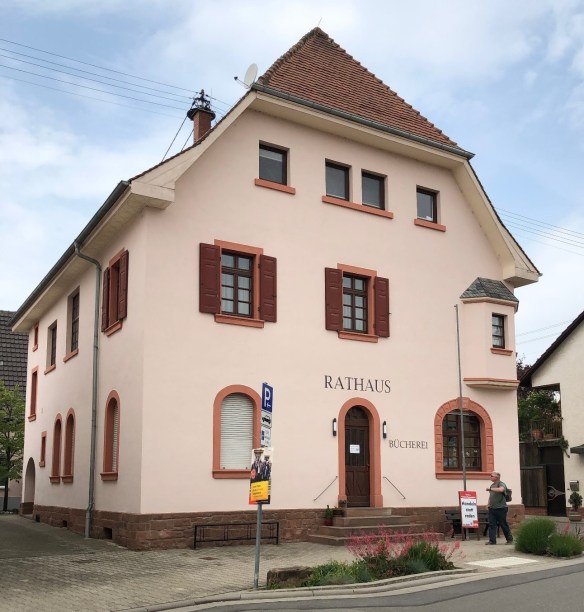
  • Jakob Koob III, Mayor 1900-1909, built the current town hall, the Rathaus in German, that still stands on the main corner of Fussgoenheim.

Koob Rathaus.jpg

We are fortunate to have a photo of Jakob, the Mayor who took office in 1909.

Koob, Jakob mayor 1909

We have no way of knowing, of course, what Johann Dieter Koob looked like, but with the generations of intermarriage and gene-sharing within the small community, it wouldn’t be a huge stretch to look at Jakob Koob III, the Mayor in 1909, and surmise that he at least resembled his Koob ancestors somewhat.

Jacob Koob IIII was Dieter’s 4 times great-grandson and married Anna Margaretha Koob.

Do we see the shadow of Johann Dietrich Koob when looking at Jacob III or Anna Margaretha?

_____________________________________________________________

Disclosure

I receive a small contribution when you click on some of the links to vendors in my articles. This does NOT increase the price you pay but helps me to keep the lights on and this informational blog free for everyone. Please click on the links in the articles or to the vendors below if you are purchasing products or DNA testing.

Thank you so much.

DNA Purchases and Free Transfers

Genealogy Products and Services

Genealogy Research

Ancestry to Remove DNA Matches Soon – Preservation Strategies with Detailed Instructions

Yesterday, Ancestry announced that they are going to remove smaller matches from their customer’s DNA match list around the first of August. I was not on this conference call myself. However, it’s a small community and others have reported consistent information.

I’m going to report what was said, then lay out a strategy for you to preserve your most useful smaller matches.

Update 7-18-2020: I have received clarification on several questions. I’m putting the updated information here:

Only segments below 8 will be deleted. However, Ancestry “rounds up,” so a segment between 7.5 and 7.99999(repeating) will be rounded up to 8. The only way to assure that you save all of the segments between 7.5 and 8 that you wish to preserve is to add all 8cM segments to groups or make notes, as described in the instructions. I’m referring to these segments as 6-8 cM segments.

ONLY segments to be salvaged will be ones in groups, with notes or matches whom you have messaged. Ancestry has confirmed that matches without these things, meaning matches in ThruLines or that you have placed in your tree will NOT BE PRESERVED unless they are grouped, have notes or you’ve messaged. 

The determining factor is total cM, not smallest cM. So total cM between 6 and 7.9999, which rounds up to 8 will be removed. Multiple 6 cM segments where the total is 12 will be fine, for example. Again, it’s the total cMs, so no math needed.

Also, in August, Ancestry is adding decimal points to the amount of cMs. After that occurs, you won’t need to save 8 cM matches to salvage 7 cM matches that have been rounded up. Focus on 6 and 7 cM first.  

7-26-2020 Update – Ancestry has posted that they have delayed the purge until the beginning of September, allowing another month to save 6-8 cM matches. They also confirmed that starred matches (in the groups) will also be saved. 

A Little Background

For a bit of history, this isn’t the first time that Ancestry has removed a large number of matches. In fact, they’ve done it twice previously, first with the introduction of their Timber algorithm resulting in a loss of over 50% of matches, an event nicknamed “Autosomalgeddon.” The screaming could be heard round the world.

In May of 2016, Ancestry revised their algorithm again which resulted in losses.

Then, as now, Ancestry told customers the matches that they lost would be mostly “false matches,” but in many cases, these matches proved to be accurate but from endogamous populations. For example, I lost most of my Acadian matches because Ancestry determined that they were simply a “pile-up region.” Those matches have proven to be valid and triangulate elsewhere.

In any case, there’s no point in crying over spilled milk.

However, the glass is about to be tipped over again so let’s figure out how to make the best of this situation and preserve as much as we can.

Why Now?

Recently, Ancestry announced that they have sold a total of 18 million DNA tests. That’s good news for testers, at least on the surface.

Ancestry overtaxed.png

If you’re a regular Ancestry user, you might have noticed that their response recently has been slow and buggy with regular timeouts. I see this notice regularly.

Last month, Ancestry’s lawyers sent cease-and-desist letters to every third party tool (that I know of) that their DNA customers can utilize in order to perform activities such as clusters, downloading a match list and downloading a list of direct line ancestors for your matches into a spreadsheet so that you can search for common surnames that might NOT already be in your tree. That, by the way, combined with triangulation, is the key to breaking down brick walls and pointing the way to previously unidentified ancestors – but I digress.

As you know, I’m a huge fan of both Genetic Affairs and DNAgedcom, both of whom provided tools to enhance and manage the huge list of matches at Ancestry – turning those individual matches into something infinitely more useful.

Ancestry 92K

No one can reasonably evaluate 92,000 matches or make use of most of them.

Ancestry match categories.png

You can see how many matches fall into each group. Unfortunately, by selecting the custom range, the list of matches is displayed, but the number of matches in that range is not displayed.

The answer is NOT to remove those smaller matches unilaterally, which is the approach that Ancestry is taking, but to utilize better tools to identify valid matches.

These third-party tools signed on to our account, with our permission, on our behalf, and utilized the power of computers to process data that would take us days, if it was possible at all with the huge number of matches that each person has now. This is, after all, the purpose of computers – right?!?

While I was certainly unhappy with the letters threatening the people who provide us with tools to utilize our own results – I was hopeful that it meant that Ancestry was going to provide something similar internally.

Now, retrospectively, I think that Ancestry is trying to find a way to manage their 18 million testers and their matches without adding infrastructure resources. They want to reduce the processing load and when the cease-and-desist letters didn’t have the desired effect on their servers, they looked for other methodologies.

Clearly, providing users with fewer matches means less to manage in a database which equates to freeing up resources.

Ancestry’s commentary is reportedly that this purge will remove “most false matches.” Of course, it will also remove all accurate matches at that level too – and yes, you can in many cases tell the difference.

False Matches

According to LostCousins and others who were on the call, Ancestry indicates that they will remove most if not all matches less than 8 cM. Today, the matching threshold after Timber and Ancestry’s academic (not parental or family) phasing algorithm is 6 cM. Their current algorithms are intended to remove most false matches.

An 8 cM match can be any of the following relationships, according to Ancestry:

Ancestry 8 cm percent

However, as genetic genealogists, we know that with unphased data, 7cM matches are equally as likely to be false matches, identical by chance, as they are to be genuine matches.

There are certainly better ways to assure valid matching other than a mass deletion, such as:

  • Clusters (like Genetic Affairs, DNAgedcom and others,) genetic networks that indicate that people in clusters are related to each other. These are like shared ancestors on steroids.
  • Phased Data (like FamilyTreeDNA’s Phased Family Matching) that phases your matches with known family members, assigning the match either maternally or paternally.
  • Triangulation (like at MyHeritage, FamilyTreeDNA and via third-party tools that received the cease-and-desist letters.)

As Ancestry did in 2016, they apparently will NOT delete matches that you’ve been using, as defined by when:

  • You’ve added a match to a colored dot or star match group.
  • You’ve entered a note for the match which of course indicates that you’re working with them.
  • You’ve sent a message to the match.

I would hope that any matches you’ve placed in your tree would be spared as well, but that criteria is not mentioned on any list I’ve seen. (Update – they are NOT spared and will be deleted.)

I’ve also seen nothing indicating that if you share a match with your parent, which is the definition of parental phasing, that those small matches will be spared either. However, “Shared Matches with Mother” or father is in the group list, so maybe. You could easily add a group for that to be sure everyone is in a group that might be at risk. (Update – shared matches with parents will be deleted.)

It was reported that Ancestry specifically stated that a match showing up in your ThruLines does NOT preserve them in your match list. (Have received confirmation that this is accurate.)

Why Preserve Matches?

You must surely be asking yourself why you need to go to the trouble to preserve these matches – especially if Ancestry seems to think otherwise. Keep in mind that once they are gone, you have no option to work with them, ever.

There are five primary reasons for preserving at least your best matches that are in jeopardy.

  1. Confirming Ancestors – You can confirm your descent from an ancestor you believe to be yours. Without triangulated segment information, which is not available at Ancestry, the best way to do this is by looking at whether you match the DNA of people who descend from multiple children from that same ancestor. If you only match people descended from one child, the same child as you, it’s certainly possible that you have all mis-identified the same person erroneously in your tree.
  2. Sharing Information – photos, etc. You never know who is going to have what gem of information. In the past two weeks, I’ve been blessed by a photo of a third-great-grandfather and a letter from his wife to her daughter. On another line, a photo of a watch case and on a Dutch line, a box with a photo of my ancestor’s sibling surfaced. Reach out to see what kind of information your matches might have. Yes, you may have to wade thought a lot of duds, but you just never know where that nugget will be found. They are out there.
  3. Potential Ancestor Suggestions – Seasoned genealogists may not need potential ancestor suggestions provided by Ancestry, but new researchers certainly do. Old-timers have already done a lot of the digging – but you never know when something useful will turn up. For every brick wall that falls, there are two new opportunities.
  4. Y and Mitochondrial DNA Candidates – Y and mitochondrial DNA holds information not otherwise available. I wrote a short description of the different kinds of DNA, here. I utilize ThruLines and searches to locate candidates for Y and mtDNA testing for all of my genealogy lines, asking if the person would consider those tests at FamilyTreeDNA. Ancestry doesn’t offer that type of testing. Generally, I offer a DNA testing scholarship. I figure a Y or mitochondrial DNA test is the same price as a reference book (or two) and the resulting information can only be obtained from people descended from those ancestors on a specific path. In other words, that type of DNA is much, MUCH rarer than reference books. As a quick review, Y DNA follows the direct paternal (surname) line in males only, and mitochondrial DNA is inherited by both sexes of children from their mother, but only females pass it on. You inherited your mtDNA directly from your mother’s mother’s mother’s mother on up the direct matrilineal line.
  5. DNA Transfers – Other vendors, meaning both FamilyTreeDNA and MyHeritage offer unique and much more robust tools that utilize DNA segment information. You can transfer to either company and receive matching for free, paying only to unlock advanced features. GEDmatch, a third party tool doesn’t provide testing, but does provide additional analysis tools as well. Depending on where the majority of your family has tested or “gathered,” you can ask or encourage your Ancestry matches to transfer so that you can confirm that you share triangulated segments. You may be able to provide them with information about their genealogy that they don’t otherwise have access to at Ancestry. I wrote step-by-step transfer instructions, here, for each vendor.

Of course, if you no longer have the matches to work with – these benefits won’t be available to you. This is exactly why it’s critical to identify the most crucial smaller matches and preserve them now. Once Ancestry has removed them, they are gone forever unless they transfer to one of the other vendors.

Ok, so how can we identify and preserve the most important of these matches?

Preservation Strategies

This mass extinction event is supposed to occur about the first of August. When this happened in 2016, we were never given a date and time – just a general date range and one day it just happened.

Here are my recommendations for how to preserve matches that stand the best chance of being relevant, even if they are between 6 and 8 cM.

Please note that I recommend all of these approaches, not just one. Each one will catch people that the others don’t – which will preserve the most likely matches to be useful for you.

First, under DNA Matches, create a “holding group” so you can use that group to preserve matches.

Ancestry groups.png

You’ll use a group as a way to prevent the deletion of the match.

Ok, let’s get started.

Auto-Clusters and Third-Party Results

If you ever ran third party cluster tools on your Ancestry data (before the cease-and-desist orders), refer to those clusters now, looking for the size of the matches, focusing on any 8 cM or lower for the longest segment. It’s probably not happenstance that you match all those people and they also match each other.

I believe DNAgedcom is still functioning, so you may be able to obtain cluster information there. If you need assistance, check in with the DNAGedcom User Group on Facebook, here.

If you don’t have time to analyze each match now to determine which actual group the match belongs in, create one group at Ancestry that is simply a “Preservation Group” so that you can assign the person to the group in order that they won’t be deleted. Remember, the only matches in jeopardy are the ones from 6 to 8 cM inclusive.

ThruLines

Ancestry thrulines

ThruLines is the best tool that Ancestry provides in terms of doing the DNA-plus-tree-matching work for you. ThruLines searches for people whose DNA you match and who also have a common ancestor in your tree. Or at least someone who Ancestry thinks may be a common ancestor. It’s up to you to verify.

On your ThruLines page, click on any Ancestor appearing on that page. The fact that an ancestor appears on ThruLines means that there is at least you and one other person whose DNA matches and you share that common ancestor.

I’m going to click on Lazarus Estes, my great-grandfather, because I have several matches through him.

Ancestry list

By clicking on the List option, at the red arrow above, you will see the various matches by their line – meaning which child of Lazarus Estes.

Ancestry 9 cm

Unfortunately, Ancestry does NOT tell us the individual segment sizes. They tell us the total segment match (after removing anything they think is too matchy) and the total number of segments. You only need to be concerned about segments between 6 and 7.99 cM in size, but currently Ancestry rounds up so segments above 7.5 will show as 8 on your list. You will need to save those as well, or you will lose at least half of your 8 cM matches.

Moving down to the match in the red box, that person matches on 9 cM, so while they are not officially in jeopardy, I’m taking this opportunity to make sure they are assigned to the Lazarus Estes group. Ancestry didn’t say that they won’t delete any matches over 8 cM, so I’m being careful.

Ancestry profile

To access the area where you can add this person to a group and make a note, click on their profile picture.

Ancestry note

You’ll see your photo, plus theirs and the links to add this match to a group, or to add a note.

Ancestry predicted this match to be 5th-8th cousins, but they are my second cousin twice removed.

Ancestry group assign

Shared Matches

Shared Matches is not a preservation method, because Ancestry does NOT show any shared matches below 20 cM, unfortunately.

Ancestry shared match list

Common Ancestors

Ancestry common ancestors

Common Ancestors equates to ThruLines. Click on the Common Ancestors link to view all of your matches with whom a common ancestor can be identified in one list.

Ancestry common ancestors list

These matches will be presented in the largest to smallest match order, not by ancestor like ThruLines. This makes it easier to just keep scrolling and scrolling to the bottom of the match list where your most distant match that can be identified with a confirmed or potential common ancestor is listed.

If you managed to assign all of the matches to groups from your Thrulines, your smallest “common ancestor” matches should all be assigned to groups. Larger matches aren’t in jeopardy.

I have several pages of people who are in jeopardy. Am I ever glad that I checked.

Ancestry 6 cm

Use the Shared DNA filter as well to select only shared DNA matches of 6-8 cM in order to save these more rapidly.

It’s hard to believe that Ancestry is actually going to take these matches away from me, even though we share DNA, other matches and common ancestors.

Searching

Ancestry search

Searching for surnames or unique locations among your matches will provide you with additional hints as to possible relationships. Your connection may be to someone who doesn’t connect via a common ancestor, or the spelling might be slightly different. Matching a surname does not mean that’s how your DNA matches, but it’s a hint and can be especially powerful when combined with locations.

Ancestry multiple

You can combine search terms too. In this case, I combined my unusual Dutch surname of Ferwerda and the location of Leeuwarden and found two people. I confirmed one right away shares my line. I’m working on the second.

Ancestry search results

Both of these matches would have been lost, yet I share both DNA, confirmed ancestors and shared matches with at least one of these people.

Summary

It’s time to get busy. You probably have more matches than you think and you don’t have a lot of time between now and the end of July.

_______________________________________________________

Disclosure

I receive a small contribution when you click on some of the links to vendors in my articles. This does NOT increase the price you pay but helps me to keep the lights on and this informational blog free for everyone. Please click on the links in the articles or to the vendors below if you are purchasing products or DNA testing.

Thank you so much.

DNA Purchases and Free Transfers

Genealogy Products and Services

Genealogy Research

Maria Catharina Kirsch (born 1707-1711, died after 1772), Drama and Displacement – 52 Ancestors #292

Maria Catharina Kirsch was born about 1710 to Johann Wilhelm Kirsch and Anna Maria Borstler (or Boerstler). We don’t have her actual birth record, because Fussgoenheim records prior to 1726 are missing. We are assuming she was born in Fussgoenheim because that’s where the Kirsch family was from, but that might not have been the case.

Her parents were married on February 22, 1695, in Bad Dürkheim.

Walter Schnebel, a now-deceased local historian, notes that her parents were both godparents in Oggersheim in 1710. I can’t tell you how much I wish I had access to Walter’s original records and work.

Kirsch atlas Fussgoenheim

Oggersheim was about 5 miles away from Fussgoenheim. Social and family connections were maintained throughout this part of Germany. It appears that the left bank of the Rhine was a vibrant, interconnected microcosm of its own.

Even without records, we can reconstruct some of Maria Catharina’s family based on baptismal records where the names of the godparents’ parents are provided.

We also have christening records of some of Maria Catharina’s siblings.

The first record that provides information about Maria Catharina is her sister’s confirmation in Fussgoenheim in 1727, followed by Maria Catharina’s other siblings in 1729 and 1731. Confirmations in the Lutheran church occurred generally sometime between the child’s age of 11 and 13.

Maria Catharina’s confirmation is missing. The Fussgoenheim church records begin in 1726. Therefore, we can infer, based on that information, plus her marriage date, that Maria Catharina was born about 1711, or perhaps slightly earlier.

Maria Catharina Kirsch married Johann Theobald Koob, spelled Coob in her marriage record, on February 21, 1730, in Fussgoenheim.

Koob Kirsch 1730 marriage

Translations courtesy of my friends Tom and Christoph.

Taufen__Trauungen__Bestattungen__Sonstiges_1726-1798_Bild74, Fussgönheim Evangelical Church Records, Archion.de

Marriage: Year 1730

On the 21st of February 1730: Joh. Theobald Coob from here with Maria Catharina Kirsch(in) were married.

This record would be suggestive of Maria Catharina’s birth about 1710, or maybe a year or two earlier. She had a child in 1750, so she probably wasn’t born before 1707. Let’s bracket her birth between 1707 and 1711.

While this record doesn’t provide us with the names of Maria Catharina’s parents, later records about her siblings do.

Her sister, Anna Margaretha was married to George Heinrich Koob in 1736, the brother of Maria Catharina’s husband, Johann Theobald Koob. So Koob brothers married Kirsch sisters. No wonder I’m constantly confused when sorting out these village families.

At Maria Catharina’s sister’s wedding, the minister noted that the sermon was from 1 Timothy. If ministers then were like ministers today, they probably had favorite or appropriate scriptures and sermons for every type of event.

It’s not unlikely that Maria Catharina’s wedding sermon was also from first Timothy, so let’s see what it says.

From the book, “Sermons on Special Occasions such as Weddings, Funerals and Dedications” by Carl Wilhelm Walther, a Lutheran pastor, translated from original German publications between 1876 and 1892, we find:

Kirsch 1 TimothyKirsch 1 Timothy 2

Based on that sermon, it’s amazing that they had children at all, but thankfully, they did.

Children

We’ve managed to find records for 8 of Maria Catharina’s children. There must surely have been more. Records are incomplete for Fussgoenheim during this time.

Maria Catharina’s first child, Susanna Elisabetha Koob, arrived and was baptized on June 17, 1731 in Fussgoenheim.

Koob, Susanna Elisabetha

Johann Andreas Kirsch was the godfather of Susanna Elisabetha. Additionally, the widow of the late Mayor Koob, Anna Elisabetha, for whom the child was named, served as godmother.

Because an elderly widow clearly would not have been expected to raise this child if something happened to her parents, that honor would have fallen to Johann Andreas Kirsch. He was Maria Catharina’s first cousin, born to Johann Jacob Kirsch. Maria Catharina’s father was Johann Wilhelm Kirsch. Their common grandparents were Johann Georg (Jerg) Kirsch and Margaretha Koch, founders of the Kirsch family in Fussgoenheim.

Susanna Elisabetha Koob married Elias Nicolaus Kirsch about 1762. The couple lived in Fussgoenheim. She died sometime after 1776 and before 1798. Fussgoenheim experienced a record gap between those years.

In 1733, Maria Catharina Kirsch’s son Emanual Koob was born and baptized on May 26th. This time, Johann Michael Kirsch and his wife, Anna Margaretha were godparents.

Kirsch Emanual Koob

Taufen__Trauungen__Bestattungen__Sonstiges_1726-1798_Bild18, Archion.de

Given that there were three Johann Michael Kirschs, all 3 with wives of the same name, we can’t be sure who the godparents were. Since it doesn’t say “judge,” “elder,” or “mayor,” we might presume this is Johann Michael Kirsch, the baker, and his wife, but that’s just a guess.

In 1763, Emanual stood as godfather when his older sister’s son, also named Emanual, was baptized.

In 1761, Emanual married Margaretha Elisabetha Renner in Schauernheim, eventually having 2 boys and a girl. His death is recorded in the Dannstadt church records on June 1, 1805.

Three years later, on April 20, 1736, a new daughter, Maria Catharina Koob was baptized. Her grandmother, Maria Kirsch(in), widow, was the godmother.

Kirsch Maria Catharina Koob

Taufen__Trauungen__Bestattungen__Sonstiges_1726-1798_Bild24 Archion.de

While grandmother could mean on either side, Maria Catharina’s mother was named Anna Maria, and would have been called Maria, while Johann Theobald Koob’s mother was named Anna Catharina.

Kirsch Koob pedigree

Maria Catharina’s father had already passed away by this time.

About 1764, Maria Catharina Koob married Andreas Kirsch, son of Johann Georg Kirsch and Anna Margaretha Hartmann.

Another son, named for his father, Johann Theobald Koob, arrived on August 24th, 1738, and was baptized 5 days later.

Kirsch Johann Theobald Koob

On Feburary 11, 1766, he married Catharina Barbara Wassa in Schauernheim. They had 6 children, the last one in March of 1775. Two were known to have survived to marry. Johann Theobald died before 1778 by which time his widow had remarried.

Maria Catharina Kirsch’s family was growing, and so far, every child seems to have lived.

Unfortunately, their run of good luck came to an abrupt end in 1740 when a newborn daughter died.

Kirsch daughter Koob

Perhaps this child’s birth was difficult. Perhaps the cord wrapped around the baby’s neck. Maybe the baby was born prematurely. One thing is for sure, Maria Catharina called for her mother who was present at the birth of this baby, and a few hours later, at the baby’s death as well.

I’m sure mother and daughter wrapped their arms around each other to ease their pain, probably cradling the baby between them as she passed. I’ve been that mother.

I wish the reverend would have recorded the baby’s name. The family assuredly remembered her as something other than “the baby that died in 1740.”

Should I give her an honorary name today?

I don’t know if it’s proper or not, and I won’t record it as such, but I’m posthumously naming her Barbara, in honor of my mother.

That child was not anonymous.

Catholicism was replaced with the Protestant faith in this part of Germany two hundred years before, after the Reformation in 1534. A protestant church existed here as early as 1600 and likely before. Still, in 1740, the concept that a baby needed to be baptized immediately, especially if they were weak and might pass away was something that remained of or had been incorporated from the Catholic faith and tenets.

Soon, Maria Catharina was pregnant again and son, Johann Dieter Koob, probably short for Johann Dieterich or Diederich arrived almost exactly a year later on September 30, 1741.

Kirsch, Johann Dieter Koob

Taufen__Trauungen__Bestattungen__Sonstiges_1726-1798_Bild32, Archion.de

While his older brothers seemed to remain in the Dannstadt area, Johann Dieter lived in Fusgoenheim, passing away on December 19, 1816. He married a cousin who shared all four of his grandparents, Maria Katharina Koob, daughter of Georg Heinrich Koob and Anna Margaretha Kirsch.

On June 21, 1742, Johann Theobald Koob and Maria Catharina stand as godparents for the child, Johann Theobald Kirsch, son of Johann Michael Kirsch, the Mayor, and his wife, Maria Magdalena Michet. Johann Michael Kirsch, also my ancestor along with his first wife, was a first cousin to Maria Catharina Kirsch.

Silence

But then, silence for Maria Catharina Kirsch. Well, at least until 1746.

This would normally cause me to believe that the church records were missing during this time, at least for this family.

It’s true that Maria Catharina was missing IN the records, but that’s because the family was missing from the village, along with most of the other Fussgoenheim families as well.

We are now entering a time of high drama!

Expelled!!!

Trouble had been brewing on the home front.

In 1743, numerous families were evicted from Fussgoenheim as punishment for standing up for their rights against an evil and unscrupulous “lord,” Jakob Tilman von Hallberg. He attempted, almost successfully, to strip the residents of their land. Johann Theobald Koob, along with several others, was jailed for 14 days, then evicted, along with his family.

They must have hated that man. He did his best to destroy them.

Many Kirsch family members were among those cast out, as was Maria Catharina, although in her case, it was because her husband refused to sign Hallberg’s fraudulent land survey, not because she was a Kirsch.

Still, her father, then deceased, and brother would have been hereditary landowners, presumably from Maria Catharina’s grandfather, Jerg Kirsch who died before 1695. The last mention we find of Maria Catharina’s mother is in that 1740 record when unnamed daughter died.

Fortunately, not for Maria Catharina, but for me as a genealogist, there are a few sparse clues about Maria’s Catharina’s family from records generated during and after the 1743 kerfuffle and eviction.

The Map

Kirsch 1743 Fussgoenheim under village

A 1743 map shows the various Kirsch and Koob properties. Maria Catharina Kirsch and Johann Theobald Koob owned two different properties.

A property belonging to the widow of Johann Michael Kirsch is shown, so we know that if a widow was still living, she would have been shown on the map, indicating interest in the property owned by her deceased husband.

Kirsch 1743 Fussgoenheim over village

A property is shown with the name Wilhelm Kirsch, just south of the church at the top of the map, above, but Maria Catharina’s father was noted by Walter as deceased before 1723. Therefore, if Maria Catharina’s mother was still living, she surely would likely have been shown as a widow – although there are some properties that are owned by someone with a Kirsch surname that we can’t read.

The Wilhelm Kirsch residence by the protestant church could have been Maria Catharina’s father’s property, but there are two other Johann Wilhelm Kirschs that were grandsons of Jerg Kirsch. It’s possible that Maria Catharina Kirsch did have a brother Johann Wilhelm that we aren’t aware of, given that we only know of three siblings for Maria Catharina. However, Walter Schnebel had access to the 1753 property accounting that resulted from the 1743 evictions, and he did not ascribe a brother by that name to Maria Catharina.

We don’t know exactly which house Maria Catharina grew up in, but she certainly didn’t move far when she married – just down the street.

Homeless

What happened to Maria Catharina when she and her small children were so ruthlessly evicted from their home; their possessions – even their clothes – confiscated?

She must have been terrified while her husband, Johann Theobald Koob, was jailed, along with several other cousins and neighbors. What would happen? What would become of them? Had Johann Theobald perhaps already sent his family to stay with relatives, just in case something beyond just bad happened?

We have no way of knowing if Hallberg had previously threatened eviction. If so, was it perceived as a hollow threat? Or, did he spring that on them as a way of negotiating their release from jail? That would be an evil choice to have to make. I wish we knew more.

There was no “due process” as we perceive it today in the US. Monarchs and nobility ruled at that time. Period. It’s actually amazing that these citizens had the gumption to stand up to Hallberg, at all – and they paid dearly.

In 1743, Maria Catharina had 5 living children, the oldest being 12, the youngest about 2. She was very probably pregnant for another child who was likely born in late 1743 or perhaps early 1744 – possibly while her husband was jailed. That would have been perceived as a lever by Hallberg, but knowing Germans, it would likely only have angered Johann Theobald Koob, and made his resolve even stronger.

So not only was her husband jailed, and the family evicted, but she was heavily pregnant and giving birth someplace in the midst of all that upheaval. There’s no church record, so apparently, she did not give birth in Fussgoenheim or the record is missing.

We also don’t know when Maria Catharina’s mother died, but it was likely sometime between 1740 when her child died and 1743 when the map was drawn. It was assuredly before 1753 when the accounting took place, because Maria Catharina’s mother was not mentioned.

It must have seemed to Maria Catharina, only in her early 30s, that the world was ending, and indeed, it was, as she knew it.

As farmers in a German village, their entire livelihood was dependent on access to their land – that tiny strip shown behind their homes.

Kirsch Koob field

You can still see that field today, pointed to by the red arrows. Their field likely stopped at the green arrow, which is the local stream. But it’s possible that they also farmed some land on the other side of the creek as well.

That barn today with the black roof located sideways to the other buildings spans the entire width of both 11 Hauptstrasse and 13 Hauptstrasse, so it’s likely two property widths wide as is the field behind that is entirely brown.

The Hallberg survey reduced landowners from about 15 acres each to an average of 4.67 acres each, a huge reduction.

Without land, they would become serfs, indentured servants, nearly slaves, in another village that would offer them shelter in exchange for their servitude. No one wanted poor people to tax the municipality, so everyone had to be able to offer something useful.

Hallberg knew this and was gambling that they would not be willing to take that risk.

He was wrong. If Germans are anything, they are tenacious. Not only didn’t they simply capitulate, they waged war, for decades.

Being evicted in Germany during this time wasn’t just a matter of moving next door and setting up shop.  This was a severe threat, and then an action, with incredible consequences.

And clearly, they couldn’t, and certainly didn’t want to go anyplace where Hallberg was in charge.

They couldn’t stay. Where did they go and what did they do?

Weissenheim am Sand

We find no records of Maria Catharina and family until a baptism pops up in Weisenheim am Sand for Johann Matheus Koob.

Koob, Johann Matheus.png

January 16, 1746, a son, Johann Matheus, parents Johann Theobald Koob and wife, Maria Catharina. Godparents Johann Matheus Sahler and wife, Maria Cath.

The Koobs had a history of intermarriage with the Sahler family.

Johann Matheus Koob would eventually become a leaseholder of the Munchhof estate that his father hadn’t yet purchased when he was born. Johann Matheus married there to Katharina Margaretha Becker in about 1775, having three children. Matheus died on January 3, 1816, probably at Munchhof – the burial record in the Dannstadt church books.

Johann Theobald Koob was related to Johann Dieter Koob, the customs collector in Weissenheim am Sand. Johann Dieter and his wife Maria Kunigunda were the godparents of their son, Johann Dieter Koob, the baby baptized in Fussgoenheim in October 1741.

We don’t know for sure, but Johann Theobald Koob and Johann Dieter Koob, the customs collector were probably first cousins.

In any case, they were clearly close, because Johann Dieter and his wife served as godparents for Johann Theobald and Maria Catharina’s baby in Fussgoenheim.

We have to speculate a bit at this point, but since we find Johann Theobald Koob noted as living in Weissenheim am Sand in 1746 when Johann Matheus was baptized and in 1748 when he purchased a leasehold share of Münchhof – we have to imagine that Maria Catharina and family sought and received shelter with their cousins in Weissenheim am Sand.

We find Maria Catharina Kirsch and Johann Theobald Koob in the records again in 1748, when Johann Theobald purchased a portion of the farm estate of Münchhof, south of Dannstadt.

Maria Catharina probably had a child in 1743, 1745 and possibly 1748. When children lived, births occurred every 2 years, and when a baby died, the next birth was generally about 12 months later. Based on this, we might surmise that perhaps the 1745 baby passed away – or at least one child, if not more, during this timeframe.

Sometime in 1748, the family moved to the large farm, Münchhof, owned by the University of Heidelberg, having purchased the right hereditarily to lease one-quarter of the farm in perpetuity. In fact, Koob descendants still live on part of that farm today.

I don’t know exactly how Johann Theobald Koob earned a living in Fussgoenheim. Without further information, we’ll have to presume he was a farmer. We know positively that beginning in 1748, the family was farming at Münchhof.

We catch up with Maria Catharina in the baptism records of Dannstadt on the 5th of December, 1750 when she had her last child Johannes Koob. He went on to marry Maria Katharina Kloos. They lived in Fussoenheim where he died on January 28, 1833.

No further baptisms tell us that Maria Catharina was probably 42 or 43 by this time.

Maria Catharina’s life seems to be divided into 5-year segments.  Married for a dozen years, then evicted in 1743, apparently to Weissenheim am Sand before moving to Münchhof in 1748.

Munchhof

I wondered how Maria Catharina and Johann Theobald even heard about a portion of the Munchhof even being for sale. Weisenheim am Sand is more than 12 miles distant. However, there’s a potential hint in the Dannstadt church records. Maria Catharina’s mother was Anna Maria Borstler, daughter of Johann Adam Borstler. The Schauernheim church records tell us that one Hans Michael Borstler died in 1724 and is noted as being the Munchhofpachter, or Munchhof leaseholder. His eldest son, Johannes born in 1684 married Maria Margaretha Koob in 1724 in Dannstadt. A Borstler is also recorded in Fussgoenheim in 1717, so there seems to be some continuity between these families and locations.

Return to Fussgoenheim?

Finally, in 1753, Johann Theobald Koob and Maria Catharina Kirsch and family were allowed to return to Fussgoenheim.

I don’t know how that decision would have been made. Was the home in Fussgoenheim nicer or life easier there than at Münchhof? It was clearly less remote.

Or, did they return as a matter of principle, given that they had fought Hallberg since his 1729 fictitious survey? That hard-won victory took 24 years, nearly a quarter of a century.

How could they NOT go back after all that? It’s also possible that if they didn’t return, they would forfeit some of their rights.

Regardless of why, they probably did return to Fussgoenheim where we find records for some of Maria Catharina’s children. Johann Theobald, her husband is mentioned as a citizen of Fussgoenheim in 1766.

What Happened to Maria Catharina’s Children?

Maria Catharina’s children seem to have been scattered between the places that she had lived. Fortunately, they were close enough that she was probably able to see them, at least from time to time.

Maria Catharina’s oldest child, my ancestor Susanna Elisabetha Koob married her double first Kirsch/Koob cousin, Elias Nikolaus Kirsch in 1763 and lived her life in Fussgoenheim. We don’t know when she died other than it was after 1776 when Fussgoenheim records no longer exist, and before the records began to be kept again in 1798.

It appears that the eldest son, Emanual Koob, remained at Münchhof, because he married in Schauernheim in 1760 to Margaretha Elisabetha Renner, had 3 children, 2 sons and a daughter, and died in Dannstadt on June 1, 1805.

Daughter Maria Catharina Koob married Andreas Kirsch in 1764 and lived her life in Fussgoenheim, dying there on December 10, 1807. They had 8 children, Johann Dieter in 1764, Catharina Margaretha in 1765 who married Jacob Holzwarch, Maria Catharina, Anna Barbara who married both Christoph See and Friedrich See, Maria Catharina, Susanna Margaretha, Maria Catharina and Andreas. Only 2 of those children are known to have lived.

Johann Theobald Koob also married in Schauernheim in 1766 to Katharina Barbara Wassa and died before 1778, leaving her a young widow with children.

Johann Dieter Koob married Maria Katharina Koob in about 1773 and died in Fussgoenheim on December 8, 1816.

Johann Matheus Koob, listed as a leaseholder at the Munchhof, married about 1775 and, according to the Dannstadt church books, died on January 3, 1816, probably on the Munchhof estate.

Maria Catharina’s youngest child, Johannes Koob married Maria Katharina Kloos about 1762 and died in Fussgoenheim on January 28, 1833.

Two of these children, daughters Susanna Elisabetha Koob and Maria Catharina Koob would have passed the mitochondrial DNA of Maria Catharina Kirsch to their offspring. Only females pass it on. If someone today descends from one of these daughters through all females to the current generation, which can be male, I have a mitochondrial DNA testing scholarship for you. Maria Catharina Kirsch’s mitochondrial DNA will allow us to peer back in time before surnames in Fussgoenheim, hopefully pointing us to earlier generations as well.

The Final Goodbye

We don’t know when Maria Catharina said her final goodbye.

The last sighting of Maria Catharina is on September 30, 1772 when her daughter Susanna Elisabeth Koob and husband Elias Nicolaus Kirsch had a daughter. Maria Catharina and Johann Theobald Koob, the court member, were godparents. The baby was baptised at home, the same day, in the house due to weakness and subsequently died.

The Fussgoenheim records are absent beginning in 1776 and don’t resume until 1798, so Maria Catharina died sometime after 1775, assuming the records are complete until that time. Six granddaughters were named for her, but we know that she stood by their graves and buried at least three of her namesake granddaughters.

At least she would have been able to enjoy several of her 25 known grandchildren, playing in the street and fields of Fussgoenheim and Munchhof.

Kirsch Fussgoenheim church

It’s likely that both Maria Catharina Kirsch and Johann Theobald Koob are buried in the churchyard in Fussgoenheim, across the fields they so ardently defended for a quarter century – finally reclaiming their home and small farm from the greedy hands of the Hallberg dynasty.

Kirsch Fussgoenheim farm

Maria Catharina would be pleased to know that their efforts were not in vain. The Fussgoenheim property remained in the hands of the Koob family for the next 200 years or so, on the main street, just across the street and down the block from the church.

Kirsch Fussgoenheim post card

Hallberg castle, built about 1740, as seen across the fields in top two photos. Lutheran Church bottom left and store on corner, bottom right.

In fact, so did Munchhof which still remains in the Koob family today. In the 1966 photo below, the Koob home on the Munchhof estate is the house located at the furthest right with the VW beetle parked in front.

Koob Munchhof 1965

It was this home that Johann Theobald Koob had purchased in 1748, along with tenant rights to the land, and where Maria Catharina raised her children, at least for several years. It’s this land that was passed down to their children and descendants to present day – 272 years later.

In 1801, the Munchhof property was damaged during the French occupation, but we don’t know to what extent or how the Koob home fared.

Koob Munchhof before 1942 bombing.jpg

Drawing courtesy the Koob family and Ralph Shuey.

The Koob home on the Munchhof took a direct hit by a bomb in 1942, but was subsequently rebuilt on the same foundation. This drawing depicts the original home as it looked before the bombing. Assuming this was the original building on this land in 1748, this home provided sheltering arms folding around this family – a secure respite to Maria Cathariana Kirsch, her husband and children after two decades of terror, angst and uncertainty.

_____________________________________________________________

Disclosure

I receive a small contribution when you click on some of the links to vendors in my articles. This does NOT increase the price you pay but helps me to keep the lights on and this informational blog free for everyone. Please click on the links in the articles or to the vendors below if you are purchasing products or DNA testing.

Thank you so much.

DNA Purchases and Free Transfers

Genealogy Products and Services

Genealogy Research

“Earliest Known Ancestors” at Family Tree DNA in 3 Easy Steps

Why should you take the time to complete the information about your earliest known ancestor, your EKA, at Family Tree DNA?

The answer is simple – because it helps you with your genealogy and it helps others too. Genealogy, and in particular, genetic genealogy is by definition a team sport. It takes at least two to test and match – and the more, the merrier. From there, it’s all about information sharing.

Maybe the easiest way to illustrate the benefit of providing Earliest Known Ancestor information is by showing what happens if you DON’T complete the EKA field.

To be direct, you lose important opportunities to work with other genealogists and, if others don’t complete their EKA, you also lose the opportunity to see who their earliest known ancestors are. This information, when viewing your Y and mitochondrial DNA matches, shows immediately who is from your genetic line. It can also help you break down brick walls to push your own EKA back a few generations. I’ve used this tactic, successfully, repeatedly with both Y and mitochondrial DNA.

Earliest Known Ancestors Are Used 7 Ways

  • Matches – Every Y and mitochondrial DNA match displays your matches’ Earliest Known Ancestor

Here’s what your matches look like if they don’t complete their EKA information.

eka match.png

How depressing to see blanks listed for the Earliest Known Ancestor for your matches. These are exact full sequence mitochondrial matches, but no ancestors listed. A few do have trees, as indicated by the blue pedigree icon, but the ability to quickly view a list of ancestors would be so beneficial.

Looking at the matches for one of my Estes male cousins, below, you can see a much more helpful example.

eka complete

You may see a genealogical line you recognize. Or, several you don’t which may serve as a huge hint.

eka project.png

  • Surname and other types of projects, meant to attract more testers, also suffer when Earliest Known Ancestors and Countries of Origin, when known, aren’t completed.
  • Matches Maps – Another place where your Earliest Known Ancestor information will help is on the Matches Map which displays the location of your matches Earliest Known Ancestors, available for both Y DNA tests and mitochondrial DNA tests as well as Family Finder.

eka matches map

Looking for clusters of matches can be very revealing and can point your research in a specific direction. Genetic clues are indispensable, as is the information about the earliest ancestors of your matches. I am clearly related to these clusters of people in Scandinavia – but it’s up to me to figure out how, and when. It would be very useful to know of any of them share the same EKA.

Additional places where your EKA is utilized to provide information about your ancestry include:

  • Ancestral Origins: A page provided for both Y and mtDNA results where locations of your matches’ EKA are shown.
  • Haplogroup Origins: A page provided for both Y and mtDNA where locations of your haplogroup are found.

eka origins.jpg

I wrote about Ancestral Origins and Haplogroup Origins, here, and here, with lots of examples.

I wrote about the Y tree, here, which shows locations for each haplogroup. An article about the mitochondrial tree can be found here. These are the most comprehensive trees available, anyplace, and they are completely free and accessible to anyone, whether they have tested at FamilyTreeDNA or not. Science at work.

That’s 7 different ways your Earliest Known Ancestor information can benefit you – and others too.

However, this information can’t be utilized unless testers complete their EKA information.

Here’s how to enter your EKA information.

How Do You Complete Your Earliest Known Ancestor Information?

Your ancestor information lives in three separate places at FamilyTreeDNA – and they are not all interconnected meaning they don’t necessarily feed each other bidirectionally.

The information is easy to complete. We will step through each location and how to update your information.

What is Direct Paternal and Direct Maternal?

Before we go any further, let’s take just a minute and define these two terms.

When completing Earliest Known Ancestor information, you’ll be asked for your “Direct Paternal Ancestor” and “Direct Maternal Ancestor.” This does NOT mean the oldest person on each side, literally. Some people interpret that to mean the furthest person back on that side of your family. That’s NOT what it means either.

Your direct paternal ancestor is the furthest person in your tree on your father’s, father’s father’s direct paternal line. In other words, your most distant patrilineal ancestor.

Your direct maternal ancestor is the further person in your tree on your mother’s mother’s mother’s direct maternal line. This is your most distant matrilineal ancestor.

eka maternal paternal.png

In this view of my cousin’s tree, Holman Estes is the Earliest Known Ancestor on the paternal, meaning patrilineal, line. Of course, that’s also the Y DNA inheritance path too.

Sarah Jones is the Earliest Known Ancestor on the maternal, or matrilineal line. Mitochondria DNA descends down the matrilineal line.

The home person in this tree inherited the Y DNA of Holman Estes (and his patrilineal ancestors) and the mitochondrial DNA of Sarah Jones (and her matrilineal ancestors.)

Ok, let’s put this information to work.

Step 1 – Earliest Known Ancestor

When you sign on, click on the down arrow beside your name on the upper right hand corner of your personal page.

eka account settings

Click on “Account Settings.”

On the “Account Settings” page, click on “Genealogy,” then on “Earliest Known Ancestors.”

eka eka.png

In our example, above, the tester has completed the Direct Paternal Ancestor information, but not the Direct Maternal Ancestor.

Note that “Country of Origin” and “Location” are somewhat different. Location can mean something as specific as a city, county or region, along with map coordinates.

Country of Origin can mean something different.

To select a location and to complete your ancestor’s information, click on “Update Location.” If you don’t click on “Update Location,” you’ll need to save this form before exiting.

When you click on “Update Location,” the system takes you to the Matches Map screen where you can easily plot ancestral locations.

eka plot locations

In our example, we see that our tester has already entered his paternal EKA, Nicholas Ewstes in Deal, in the UK. We don’t need to do anything to that information, but we need to add a Maternal Location.

Click on “Edit Location”

eka update locations.png

You’ll see a screen where you can click to edit either the Maternal or Paternal Location. In this case, I’m selecting Maternal.

eka step 2

Enter the name of your ancestor. I tend to enter more information that will uniquely identify her to someone looking at their match list, such as when and where she lived.

eka more.png

If there’s room, I could also add “m 1849 Hayesville, Ohio to John Parr” which would further uniquely identify Sarah – especially given that her surname is Jones. If a match sees “Sarah Jones,” that doesn’t provide much context, but “Sarah Jones married in 1849 in Hayesville, Ohio to James Parr,” even if the tester doesn’t provide a tree, gives the match something to sink their teeth into.

When finished, click “Next.”

eka step 3

Enter the location and press “Search.” Longitude and latitude will be filled in for you.

eka select.png

Click “Select” if this is the correct location.

eka step 4

By changing the location name here, you could enter a historical name, for example, if the location name has changed since your ancestor lived there.

eka exit.png

You’ll see the final information before you Save and Exit.

eka both

You’ll view the map with your direct paternal ancestor and direct maternal ancestor both shown with pins on your map. This is before matching, of course.

Now, if you look back at the Direct Maternal Ancestor field under Account Settings, you’ll see the information you entered on the map, except for the Country of Origin.

eka direct maternal.png

This information doesn’t feed backwards into the EKA “Country of Origin” field, because country of origin can mean different things.

For example, my cousin’s direct maternal ancestor’s location would be United States because that’s where she lived. But is it where her line originated?

eka unknown origin

When looking at the Country of Origin dropdown box, you can see that United States can actually mean different things.

  1. Does it mean she was born here and we know her ancestors were European or African, but the specific country is uncertain?
  2. Does it mean her ancestors were Native American – and if so, do we actually know that, or is it yet unproven oral history?
  3. Or does United States simply mean that my cousin’s genealogy is stuck in Ohio?

In his case, it means stuck in Ohio. The mitochondrial haplogroup of this woman’s direct matrilineal descendants and her Matches Map tells us that her ancestors were European in origin, not Native or African.

In his case, “Unknown Origin” is not inaccurate, but by making that selection, other people won’t know if the tester really doesn’t know, or if they simply forgot to enter a location. I generally enter “United States” when the US is where I’m stuck.

Please note that the actual geographic location, including longitude and latitude, does populate from map selections.

When exiting the Direct Maternal or Direct Paternal Ancestors page, always click on the orange Save button, or it won’t.

Step 2 – Matches Map

You’ve already had a preview of this functionality in Step 1.

eka y matches map.png

The second way to populate EKA information is to select Matches Map directly from the menu on your personal page at Family Tree DNA.

eka pins

click to enlarge

I clicked on Matches Map from my cousin’s Y DNA page, so we’ll see his Y DNA Matches displayed. These pins displayed on his map are there because his matches entered their Earliest Known Ancestor information. The different colors indicate the relative closeness of matches.

His white pin that shows his own ancestor is displayed behind several other men’s pins (red arrow at right) who have also tracked their Y DNA ancestor to Deal, England and match the tester.

My cousin can update or enter his EKA information by clicking on “Update Ancestor’s Location” (red arrow at bottom) where a box allowing him to select between Paternal and Maternal will be displayed.

Please note that every pin on this map has an associated match that can be displayed by either mousing over the individual pins or by clicking on “Show Match List” in the bottom left corner.

Step 3 – Trees

Be sure to upload your tree too.

eka pedigree.png

Y DNA and mitochondrial DNA match pedigree icons looks like this, indicating your match has uploaded or created a tree.

eka pedigree ff

The Family Finder pedigree icon will be blue if a tree is provided and greyed out otherwise.

Always check your match’s tree because sometimes the Earliest Known Ancestor and the earliest ancestor in your match’s tree are not the same person.

Additional research may have been completed, but regardless of the reason for a discrepancy, you want to view the most distant person in that line.

Sometimes people get confused about who belongs in the Earliest Known Ancestor field, so a tree check is always a good idea.

  • Hint: If you see a male in the maternal field, you know they are confused. Same for a female in the paternal field.

To create or upload a GEDCOM file click on “myTree” at the top of your personal page.

download ancestry ftdna

Then, select your choice of creating a tree manually or uploading a GEDCOM file that you already created elsewhere.

eka create tree.png

If you need to download a tree from Ancestry to upload to FamilyTreeDNA, I wrote about how to do that, here.

Whether you upload or create a tree, choose yourself (assuming it’s your test, or select the person whose DNA test it is) as the home person in the tree.

eka home person

Bonus – Ancestral Surnames

Once your tree is uploaded, if you have NOT previously entered your Ancestral Surnames (under Account Settings,) uploading a GEDCOM file will populate the surnames, but not just with your direct ancestral lines. It populates ALL of the surnames from your tree. This isn’t a feature that I want. I recommend adding only direct line surnames manually or from a spreadsheet. If you have a small tree or don’t mind having surname matches not in your direct line, then allowing the surnames to auto-populate is probably fine.

eka surnames.png

If you’re wondering how Ancestral Surnames are used, the two Family Finder matches below illustrate the benefits.

eka surname list

When you have matching surnames in common, they float to the top of the list and are bolded. The first match matches the tester and they bothhave those bolded surnames in their trees.

With no matching surnames, the list is still present, but no bolding, as shown in the second match.

eka surname bold.png

You can then click on the ancestral surnames to see all of the surnames listed by that match.

If you search for matches that include a specific surname on Family Finder, that surname is displayed blue, the common surnames are bolded, and the rest aren’t.

eka surname search

By looking at these common ancestral surnames, I can often tell immediately how I’m related to my match.

eka surname blue.png

Summary

Using Earliest Known Ancestors, Matches Maps and Ancestral Surnames at Family Tree DNA is as easy a 1-2-3 and well worth the effort.

If you provided this information previously, is it still up to date? For your kit and any others you manage?

What hints are waiting for you?

Have other people uploaded their trees or added EKAs since you last checked?

You can always send an email to your matches who need to add Earliest Known Ancestors by clicking on the envelope icon. Feel free to provide them with a link to this article that explains the benefits of entering their EKA information along with step-by-step instructions.

DNA is the gift that just keeps on giving – but it can give a lot more with Earliest Known Ancestors and their locations!

_____________________________________________________________

Disclosure

I receive a small contribution when you click on some of the links to vendors in my articles. This does NOT increase the price you pay but helps me to keep the lights on and this informational blog free for everyone. Please click on the links in the articles or to the vendors below if you are purchasing products or DNA testing.

Thank you so much.

DNA Purchases and Free Transfers

Genealogy Products and Services

Genealogy Research

Johann Theobald Koob (born circa 1705 – died after 1766), Münchmeister – 52 Ancestors #291

Johann Theobald Koob was born about 1705, probably in Fussgoenheim, Germany, to Johann Dietrich Koob and Anna Catharina, surname unknown.

The first record of Johann Theobald Koob is when he served as godfather for the Renner family in Fussgoenheim.

Baptism:

21 November 1728

Child: Anna Maria

Parents: Johann Jacob Renner and Helena, his lawfully wed wife

Godparents: Johann Theobald Kob, unmarried from Fussgonheim and Anna Maria Sachs(in).

This wasn’t the only interaction with the Renner family, and mark my words, they were related somehow.

Married in Fussgoenheim

In February of 1730, Johann Theobald Koob married Maria Catharina Kirsch.

Koob Kirsch 1730 marriage

Pfalz: Zentralarchiv der Evang. Kirche > Speyer > Fußgönheim > Taufen, Trauungen, Bestattungen, Sonstiges 1726-1798, Bild 74, www.archion.de

Marriage: 21 Feb 1730

Joh. Theobald Coob from here with Maria Catharina Kirch(in) were married.

Koob is spelled variously as Koob, Coob and Kob in the early church records.

Johann Theobald’s parents both attended his wedding in the quaint Lutheran church on the cobblestone street, probably sitting alongside his siblings. We know his parents were still living, because we find his father’s burial record in those same church records in November 1734 and his mother’s just a few months later, in April of 1735.

That must have been a very tough year.

Children Bless the Couple

Johann Theobald Koob and Maria Catharina Kirsch welcomed their first-born child, a daughter, Susanna Elisabetha, on June 17, 1731. How joyful they must have been when baptizing their beautiful baby girl. Three of the four grandparents celebrated with them that June Sunday, exactly 289 years ago today, as I write this article. This is an incredibly important day for me, because Susanna Elisabetha is my 4th great-grandmother.

Happy 289th birthday Susanna Elisabetha!!! Part of you is still here!

Koob, Susanna Elisabetha

Taufen__Trauungen__Bestattungen__Sonstiges_1726-1798_Bild14(1), Fussgönheim Evangelical Church Records, Archion.de

Baptism: 17 June 1731

Parents: Joh. Theobald KOOB and his wife, Maria Catharina, a daughter was baptized and named:

Susanna Elisabeth

Godparents: Johann Andreas Kirsch & Anna Elisabeth, widow of the late mayor  Koob.

We can glean so much information from the godparents. These people weren’t selected randomly, and it wasn’t just an honorary position. On the contrary, it was well-thought-out.

The godparents were expected to raise this child, attending to their education, both traditional and secular, in the event that something happened to the parents. An equivalent today would be selecting your children’s adoptive parents and designating them at the birth of your children. Godparents promised to perform these duties before the village, in front of both families, the reverend, the congregation, and more importantly, before God.

If you think about it, it’s a wonderful tradition that assures that every child in a family is cared for if the parents die without placing the entire burden of several children on one family member. In a small village, the children would only live a few houses apart and could still see each other and interact regularly.

Based on Fussgoenheim history, Anna Elisabetha, the widow godmother, is probably the widow of Johann Nicolaus Koob, the former mayor. She’s clearly related to the family, but exactly how is unknown. We do know that Johann Nicolaus Koob has a son, Johann Dietrich Koob, the same name as Johann Theobald’s father, but he married Maria Kinigunda Sahler in 1728. Therefore, if Anna Elisabeth is Johann Nicolaus Koob’s widow, she is not Johann Theobald’s grandmother.

The widow Anna Elisabeth may be his aunt or great-aunt or related another way, or both. Her name may also have been Susanna Elisabetha. In a future record, the child Susanna Elisabetha baptized that day is called Anna Elisabetha – probably after her godmother.

Two years later, Johann Theobald Koob’s first son, Emanuel Koob, joined the family.

Taufen__Trauungen__Bestattungen__Sonstiges_1726-1798_Bild18, Fussgönheim Evangelical Church Records, Archion.de

Baptism: 26 May 1733

Parents: Joh. Theobald Koob and his wife, Maria Katharina, a son was baptized and named: Emanuel

Godparents: Joh. Michael Kirsch and his wife, Anna Margaretha.

In 1763, Emanual stood as godfather when his older sister’s son, also named Emanual, was baptized.

By 1771, Emanual was godfather for his younger brother Johann Theobald Koob and his wife, Catharina Barbara when they baptized a son named Emanual. In this record, Emanual is noted as being from Münchhof near Danstatt, which proves to be an important clue.

In 1736, daughter, Maria Catharina, named for her grandmother, joined the family.

Taufen__Trauungen__Bestattungen__Sonstiges_1726-1798_Bild24, Fussgönheim Evangelical Church Records, Archion.de

Baptism: 20 April 1736

Parents: Johann Theobald Kob & wife Maria Cath.

A daughter was baptized and named: Maria Catharina

Godparent: the grandmother, Maria Kirsch(in), widow

Born: 16 April 1736

Baptized: 20 April 1736

Entry No. 29

In 1738, a son with the same name as his father was born. Interestingly enough, the godparents were from Frankenthal, about 7 and a half miles away, and the child is not named after the godparents, which is typical.

Koob Fussgoenheim Frankenthal

It looks like perhaps their son, Johann Theobald is too young to actually be a godparent, so they stood with him? Perhaps Johann Theobald Koob was the younger Johann Theobald Welker’s godfather. This would suggest some type of family relationship.

Taufen__Trauungen__Bestattungen__Sonstiges_1726-1798_Bild27, Fussgönheim Evangelical Church Records, Archion.de

Baptism: Entry No. 66

Parents: Johann Theobald Kob, the juror and his wife, Maria Catharina a son named: Johann Theob(ald) was baptized

Godparents: the honorable Georg Henrich Welcker, butcher and innkeeper in Frankthal and his wife, Maria Ernstina with son Johann Theobald, formerly confirmed at S. ……..?

Born: 24 August 1738 at 8 a.m.

Baptized: 29 August 1738

In this record, Johann Theobald was referred to as a juror. I asked my two friends, Tom and Christoph, what being a juror meant at that time in Fussgoenheim. Their answer was that while neither are experts on that specific topic, their understanding is that jurors would be respected men within the community who would perhaps adjudicate non-criminal disputes and disagreements.

Two years later, things didn’t go well in 1740.

Taufen__Trauungen__Bestattungen__Sonstiges_1726-1798_Bild30, Fussgönheim Evangelical Church Records, Archion.de

Baptism: Entry 108

Parents: Johann Theobald Kob, juror and wife, Maria Catharina, a daughter on the 14th of October 1740 was born and because of weakness so she was baptized immediately in the home.  Godparents were the mother’s side, the grandmother Maria. But the child is deceased in a few hours.

Sadly, this baby wasn’t named, or if she was, the reverend didn’t record her name. It seems so sad to think of a tiny, nameless, anonymous grave.

The next child, Johann Dieter, arrived almost exactly a year later. Of course, Johann Dietrich Koob is Johann Theobald’s father’s name.

Taufen__Trauungen__Bestattungen__Sonstiges_1726-1798_Bild32, Fussgönheim Evangelical Church Records, Archion.de

Baptism: Entry 111

Parents: Theobald Kob and his wife, Maria Catharina, a son Johann Dieter

Godparents: Johann Dieter Kob, customs collector in Weiss……?and wife Maria Kunigunda

Born 30 Sept 1741          Baptized:8 October 1741

Weissenheim am Sand is a village about 7 miles directly north of Fussgoenheim and Weissenheim am Berg is about the same distance west of Weissenheim am Sand.

This too proves to be a hint that will help tie things together, later.

In 1767, Johann Dieter Koob, unmarried, stood as godfather for his brother, Johann Theobald Koob’s child, named Johann Diederich, of course. This confirms that Dieter and Diederich are synonymous. Dieter is likely a nickname.

Johann Theobald Koob and Maria Catharina Kirsch’s last child, Johannes, arrived just before Christmas in 1750, but not before a massive upheaval that’s not revealed in the church records.

It was by tracking this family through and after that upheaval that I found another child, born in 1746 elsewhere…and baptized in exile.

Let’s just say it was an incredibly long time between 1741 and 1750.

Upheaval

There are several years missing in the births of children, with a noticeable gap between 1741 and 1750. That’s because Johann Theobald’s life was turned upside-down in 1743.

Politics in Germany was ever-present and seemingly, always dangerous. In 1729, Jakob Tilman von Hallberg, a member of the House of Hallberg who had acquired half of Fussgoenheim in 1728, followed shortly thereafter by the second half, undertook a village survey in which the roads were redrawn and the area redivided. The result was that the villagers lost two-thirds of their hereditary land, with Hallberg personally absorbing the rest that was left “abandoned” by the resurvey.

Johann Theobald Koob was one of several jurors or village elders, noted as judges in a German to English translation, who refused to sign the survey book. As punishment, Hallberg had them expelled from Fussgoenheim after first being jailed for two weeks. The Kirsch family went to Ellerstadt as serfs.

It’s unclear where Johann Theobald Koob and Maria Katharina Kirsch went, at least for several years.

We do find a baptism for another son in Weissenheim am Sand.

Baptism: Johann Matheus, parents Johann Theobald Koob and Maria Catharina. Koob on January 16, 1746. Godparents Johann Matheus Sahler and Maria Cath.

However, based on a baptism for Johann Theobald Koob’s son in 1750, it would appear that Johann Theobald Koob was in Münchhof by that time where he had some sort of hereditary ownership.

It’s likely that Johann Theobald Koob had children in 1742, 1744 and 1748 as well, but we simply don’t have those records.

The 1750 baptism record reveals such important information.

Baptism: No. 188

Born 5 December 1750

Baptized 8th of same (month) in Münchhof +

Child: Johannes

Parents: Johann Theobald Kob, hereditary owner in Münchhof and his wife.

Godparents: Johannes Lammert, innkeeper in the Lamb’s Inn in Mutterstadt and wife, Maria Margaretha Weisin.

Koob Johannes 1750

This record, from archion.de is part of the Dannstadt churchbook, not Fussgoenheim.

It’s interesting that in 1750 Johann Thoebald Koob is living in Münchhof.

Oh, what a tangled web is genealogy.

Mutterstadt

The Lammert/Lemmert family in Mutterstadt is known to me.

Koob Mutterstadt Fussgoenheim Dannstadt

Three generations later, Johann Theobald Koob’s great-grandson, Philip Jacob Kirsch would be born in Fussgoenheim in 1806. He would marry Katharina Barbara Lemmert in 1829 in Mutterstadt. This couple, my ancestors, would immigrate to Ripley County, Indiana about 20 years later, the founding members of the Kirsch line there.

Koob Jacob Kirsch pedigree

By the time Philip Jacob Kirsch married Katharina Barbara Lemmert, these families had apparently known each other for generations.

But what about Münchhof?

Münchhof

Johann Theobald Koob may have been spitefully evicted from Fussgoenheim in 1743, but he was apparently not poor. He didn’t entirely disappear. We do find him in Weissenheim am Sand in 1746 and mentioned again as being from there in 1748 when he resurfaces in Münchhof.

According to the journal, Pennsylvania Folklife” (1966), Volume 16, page 41, available here, we discover that in 1748, Daniel Jouis, as lessee, sells one quarter of the property, Münchhof, to Theobald Koob of Weisenheim am Sand.

Koob Munchhof article

While this article by Dr. Krebs is focused on the Jouis family, it handily answers several questions about Theobald Koob.

We now know where he went in 1743 after he was evicted from Fussgoenheim. He had family in Weissenheim am Sand, as evidenced from the 1741 baptism of his child, so he went there.

Koob Weissenheim am Sand atlas

Five years later, when it may have seemed improbable that he would ever be allowed to return to Fussgoenheim, he purchased a quarter lessee ownership of Münchhof and moved to this large farm, owned by the University of Heidelberg, with his family.

Koob Weissenheim am Sand map

Word that this quarter of the Münchhof estate was available for purchase, as a lessee, must have traveled by word of mouth. Johann Theobald Koob’s relative was the tax collector in Weissenheim am Sand, so he would probably have been aware of these types of opportunities. We also find early Koob families in Schauernheim and Dannstadt, just north of Münchhof.

Münchhof wasn’t exactly next door to Weissenheim am Sand, but it was fairly close to Fussgoenheim and family members seem to have been scattered throughout this part of the Palatinate – fertile lowlands east of the Rhine.

Koob Munchhof atlas

Münchhof is close to Fussgoenheim, about three and a half miles away. It would have been easy for them to see their family members in Fussgoenheim while remaining a persistent thorn in the side of Hallberg.

Koob Munchhof close

A gazetteer documenting all German locations from 1871-1918 shows Munchhof.

We can use this map to find the location of Munchhof today, matching up landmarks and roads that have retained their original shape.

Koob Munchhof atlas to google

Based on the google map legend the area below looks to be about 4 or 5 acres, roughly.

Koob Munchhof 5 acres

One quarter square mile is 1320X1320 feet and holds 160 acres, so the original Munchhof would have encompassed roughly this land, the house marked by Dells Tierwelt.

Koob Munchhof today aerial

Dr. Krebs who wrote that 1966 article even went so far as to drive out to Münchhof and take these photos for his article. I’m thrilled!

Koob Munchhof 1965

The amazing thing about these estates is that they changed very little over time and Münchhof probably looked almost exactly like it did in 1748 – 212 years earlier – minus the cars and modern farm equipment of course. There is documentation of some destruction in 1807, but whatever damage incurred was clearly repaired.

Münchhof still exists today as a location that breeds dogs.

Koob Munchhof aerial close

Fortunately, the current owners cared enough to document the history of Munchoff, here.

I used the Deepl translator to translate, below.

Our Münchhof

In 1987 we bought the “Münchhof”, which has been part of the Dannstadt community since 1797.

Koob Munchhof 1985

I’m so very grateful that they included this photo from 1985 which shows a different perspective than the 1965 photo.

The following transcript was taken from “Heimatblätter für Ludwigshafen am Rhein und Umgebung, Jg.7, 1918, No. 4

The Münchhof at Dannstadt.

The Münchhof is located about 5 minutes away from the parish village Dannstadt at the Speyerer Straße. Already the name indicates that we are dealing with a monastery estate. In the Middle Ages, half of Dannstadt was spiritual property.

In 804 the Münchhof comprised 128 acres of land, which belonged to the Kindergut.

Note that 128 acres of land was about the entire size of the village of Fussgoenheim in 1743.

The farm, which was founded at an unknown time, probably came into existence in 987 through a donation by Count Otto of Rhine-Franconia to the Benedictine and later Dominican monastery Lambrecht in the Haardtwald, which he had founded at that time. In the beginning “one” farmer – later there were several – owned the Münchhof from Lambrecht Monastery as part of his inheritance; he held the title ” Münchmeister.”

I absolutely cannot help but chuckle. This means that Johann Theobald Koob was a Munchmeister, or at least one quarter Munchmeister. Of course, in German, meister means master, so the farmer who was leasing this property was indeed the master of the hof, or farm.

In 1331, Ludwig the Bavarian pledged the Speyergau bailiwick to the sons of his brother Rudolf, the Palatine Counts Rudolf 2nd and Ruprecht 1st, for 1000 pounds heller.

When the influence of the Reformation became noticeable, Elector Friedrich 2 obtained permission from the Pope to confiscate and abolish the Lambrecht Monastery and 11 others and to transfer their income to the Heidelberg College in 1551. Thus the Münchhof fell to the University of Heidelberg.

In 1563, a settlement was reached between the university and Elector Friedrich 3, who granted St. Lambrecht and the Münchhof free of encumbrances. A large part of the other monasteries that had been confiscated were ceded by the university to the Elector, but in this way she had cleverly evaded the sovereign’s easements on the estates. The Münchhof had now become a free court. From this time on it was under the administration of the Heidelberg university conductor and the electoral administration there. However, this special position was a source of incessant friction between the courtiers and the aforementioned village court.

The Peace of Luneville in 1801 made the left bank of the Rhine French. Napoleon used the opportunity to smash the property. In 1807 the Münchhof in Mainz was auctioned off as a so-called national property.

Understanding the size of Münchhof helps put this purchase into perspective. Even if Johann Theobald Koob only purchased access to one quarter of the 128 acres, assuming it was still the same size, that means he farmed 32 acres and lived on the property, which was probably functionally the same as a small village. Compare and contrast this to the small farms in Fussgoenheim that were originally about 15 acres each, but reduced to an average of 4.67 after Hallberg’s resurvey.

Based on records from Fussgoenheim, we know that Johann Theobald Koob was still a citizen in Fussgoenheim in 1766. It’s possible that he was living at Münchhof, but I’d think those records would have mentioned that.

I couldn’t help but wonder what happened to Münchhof.

It appears that Johann Theobald’s oldest son, Emanual, inherited his father’s lease rights to Münchhof. In 1771, when he stands as godparent for his sibling’s child, he is noted as being from Munchoff. The torch has apparently passed. This record may be the closest thing we have to a death record for Johann Theobald.

It’s possible that Johann Theobald Koob actually died at Münchhof, not in Fussgoenheim. We don’t know if he loved being at Münchhof, or if it was simply a safehaven when he needed one – retaining it later as an investment. Did he stay there, or was he relieved to move back to Fussgoenheim in 1753.

Münchhof apparently became a hereditary legacy in the Koob family, because an agricultural journal published in 1876, 128 years after Johann Theobald Koob purchased that quarter, mentions a “Jakob Koob, economist on the Münchhof”:

Using 30 years per generation, that’s between 4 and 5 generations later. Johann Theobald Koob was likely the great-great or three times great-grandfather of that Jakob Koob of 1876. I wonder if he had any idea what had happened to his ancestor, Johann Theobald Koob, in 1743, why and how Münchhof came to be in the Koob family.

Contacting a local historian reveals that members of the Koob family still live on part of it’s land, not associated with the dog breeding business.

Return to Fussgoenheim

In 1753, von Hallberg was forced to allow the evicted Fussgoenheim families to return to their hereditary properties in the village. Based on this 1743 map, we know exactly which properties Johann Theobald Koob owned.

Kirsch 1743 Fussgoenheim under village

Given that this maps showed land owned hereditarily in the north half of the village, we can see that Johann Theobald Koob owned two properties, probably inherited from his father.

This property still existed in the 1940s, and the Kirsch and Koob families still lived adjacent.

Fussgoenheim Kirsch Koehler homes

The Kirsch property is noted with the X, and the Koob with the O. This photo was sent by descendants living in these houses during WWII to relatives in Indiana.

Fussgoenheim street

The properties are marked in this photo as well, which I’d wager is a victory celebration of some sort on the main street of Fussgoenheim, almost 200 years after Johann Theobald Koob had his own sweet victory of return.

Today, you can see this part of Fussgoenheim on Google maps, which correlates to the 1743 map and the 1940s photos.

Koob property today

The upper Koob property is shown, below in a photo taken by my friend, Noel, when she took a detour on her vacation to find my ancestors. I’m incredibly grateful!

Fussgoenheim intersection Ruchheimer Hauptstrasse

I believe, based on the 1743 map and today’s intersection of Hauptstrausse and Ruchheimer streets, that the property on the aerial above, designated by the upper red arrow, to the left of the yellow house, with the brown large door and solar panels is one of Johann Theobald Koob’s properties. It’s probably the same house that still stands.

Whose House Was It?

The Kirsch/Koob photo from the 1940s is of the property designated with the lower arrow, which I wrote about, here.

Marliese’s letters were somewhat confusing. She wrote them as a teen, almost 90 years after these families had immigrated. Her letters are clear about which property was the Kirsch property, because she grew up in that house.

Her references to the house with the O marked over it were believed to have referred to this as the Koehler home at that time. There was confusion within her family, plus the challenges of German to English translation, and the Kirsch, Koehler and Koob families were eventually heavily intermarried. Marliese used a lot of pronouns such as “they” and it was often unclear as to who, exactly, “they” was referring to.

This is going to be hard to follow, so here’s a diagram.

Koob Kirsch Koehler pedigree

click to enlarge

On this chart, people in red are my ancestors. You can see Johann Theobald Koob at right, with a black box around his name. The people in green are the couple who Marliese believed lived in the house next door before they immigrated – except for one daughter. Marliese and I share the same founding Kirsch, Koob and Koehler ancestors.

Knowing what I know today, after significant research, I am confident that this home was never the Koehler home, and was always the Koob home, in part, because the first record I find of the Koehler family is in Seckenheim, and never in Fussgoenheim. Johann Peter Theobald Koehler lived (1696) and died (1767) in Seckenheim during the same time period that Johann Theobald Koob was living in Fussgoenheim and at Munchhof.

My Koehler line intermarried with the Koob line in Ellerstadt. Margaretha Elisabetha Koehler was born in 1772 in Ellerstadt, married Andreas Kirsch there and moved to Fussgoenheim as his wife. Her father was probably born in Seckenheim, as his parents were born and died there.

If indeed, the Koehler family did eventually own the Koob property, it was after Johann Martin Koehler, Margaretha Elisabetha’s brother, born in 1796 in Ellerstadt married Anna Margaretha Kirsch, the daughter of Andreas Kirsch, in 1821 in Fussgoenheim.

This couple, who are not my ancestors, are shown in the green block. Martin Koehler, according to Marliese, was reported to have had a beautiful singing voice and played in the village orchestra, as well as sang in the choir.

His three surviving sons immigrated to Indiana, and his one surviving daughter married Karl Ritthaler and remained in Fussgoenheim. There are virtually no Koehler church records in Fussgoenheim, including no burial record for Johann Martin Koehler himself. As you can see, he did not marry a Koob directly, but a granddaughter of Susanna Elisabetha Koob, so it’s highly unlikely that he wound up with the Koob property next door to the Kirsch home.

Regardless of the ownership of the Koob property in the later 1800s and into the 1900s, it was clearly owned by Johann Theobald Koob in the 1700s. The Koob and Kirsch families intermarried for generations. They were all related to each other several ways.

Despite the confusion about the identification of the Koob property in the 1940s photos, Marliese’s ancestor, Anna Elisabetha Koehler, born in 1781 in Ellerstadt, married Johann Mathias Koob in 1801 and moved to Fussgoenheim. This is shown at right, in the chart, above. Their daughter married Johannes Kirsch, so even in Marliese’s own family line, no Koehler actually lived next door, but the Koob family clearly did. The Koehlers entered the picture as spouses.

I wonder how long this property actually remained in the Koob family, and what happened to it.

Johann Theobald Koob’s Property Today

Unfortunately, as you can see in this satellite closeup, the Koob home is gone today. replaced by the garden area in front of the building with the checkerboard roof. The original Kirsch property includes the while house at left, the driveway area and the small white building adjacent to the beginning of wall.

Fussgoenheim Kirsch Koehler

Many original structures do remain, so I have to wonder what happened to Johann Theobald Koob’s home.

Here’s a current street view, with the Kirsch home at left.

Fussgoenheim Kirsch on Hauptstrasse

The wall stands where the Koob home once stood at 11 Hauptstrausse. The double brown gates, below, appear to provide access to where the Koob’s neighbor’s home once stood, and was not the Koob property, at least, not that we know of.

Fussgoenheim Kirsch Koehler

A building, which may or may not be original, stands behind the wall (and the tree) at 11 Hauptstrasse.

Fussgoenheim Koob 11

The addresses are marked on the fence. The original Kirsch home, to the left, is 9 Hauptstrausse.

Fussgoenheim Koehler building

Today, a small garden replaces the original Koob home at 11 Hauptstrausse. in the photo above, we are looking directly at Theobald Koob’s property. Below, over the fence at the building shown above.

Fussgoenheim Koob garden 2

This Koob property is noted as 11 Haupstrausse on Google maps, as is the small portion of the building still standing to the left of the wall and to the right of the large brown door. It’s hard to align with original properties, especially since German homes are built sharing walls.

However, in the 1940s photos, the Koob home looks to be clearly separate from the Kirsch property, which included his small addition to the right of the brown door.

Fussgoenheim Koob wall 3

11 Haupstrasse, where the garden is today, was clearly the Koob property, which includes the building behind, to the left of the van in the photo below. The property to the right looks to have been 13 Hauptstrasse and appears to be used as a driveway currently.

Fussgoenheim Koob garden 3

The portion below looks to be the property designated as 13. In 1743, that was not privately owned, because it was not mapped.  I wonder if this was some of the property that Hallberg attempted to confiscate, and if so, who the rightful owners were.

Fussgoenheim Koob garden 4

The contemporary photos are all courtesy of my friend, Noel.

When Did Johann Theobald Koob Die?

We don’t know exactly when Johann Theobald Koob passed away, but we do know that on February 11, 1766, when his namesake son, Johann Theobald Koob married Catharina Barbara Wessa(in), daughter of Johann Jacob Wessa, citizen and member of the court in Schauernheim, the groom was named as the son of Johann Theobald Koob, citizen in Fussgoenheim. Had he been deceased at this time, the records would have stated that.

This tells us that Johann Theobald Koob lived through being evicted from his property in Fussgoenheim in 1743, and returned in or after 1753, living long enough to see at least three of his children marry. He welcomed at least two grandchildren, and most likely more.

Johann Theobald probably passed away sometime between 1766 and the 1771 record where his son Emanuel is noted as being from Münchhof, but the records are incomplete and we simply don’t know. The Fussgoenheim records end in 1778. He may have still been alive at that time and died between then and 1798 when the French records began during the French occupation of the Pfalz. If so, he lived long enough to see his homeland invaded and may have been displaced, yet again. If so, there was always Munchhof, a safehaven for the old Munchmeister.

DNA

Unfortunately, it appears that no Koob male has yet taken a Y DNA test. From this test, we could determine where the Koob line came from initally, before Fussgoenheim.

If you are a Koob male descending from this line through all males, please contact me. I have a Y DNA testing scholarship waiting just for you!

_____________________________________________________________

Disclosure

I receive a small contribution when you click on some of the links to vendors in my articles. This does NOT increase the price you pay but helps me to keep the lights on and this informational blog free for everyone. Please click on the links in the articles or to the vendors below if you are purchasing products or DNA testing.

Thank you so much.

DNA Purchases and Free Transfers

Genealogy Products and Services

Genealogy Research

Pandemic Journal: Rise Up

I haven’t said much, because I literally just don’t know what to say anymore.  My heart aches and I’m tired. Very emotionally tired.

Is there an opportunity, someplace, buried in this bleakness?

God, I hope so. My lips to God’s ears.

Straight Up

We, in America, are on a run-away pandemic freight train. The graphics in this article from National Geographic show the ugly going-straight-up line of daily new infections on the chart. Yet, we seem unwilling to do the small things, specifically one small thing, that can and does make a huge difference.

For many, perhaps including you, a life-and-death difference.

If that’s not bad enough we are enduring the most toxic, divisive political Hell I’ve ever experienced, mixed with civil unrest. Plus – hate speech everyplace. Social media has become unsocial media. That’s like multiple rings of Hell with multiple Satans in every one.

No One is Exempt

No get-out-of-jail free card. No pass. No redo. This is not an escape room. There is no escaping this one.

There is only action – NOW! By each and every one of us taking personal responsibility.

Friends are ill or unemployed and many have experienced deaths of family members.

Two friend’s mothers dead of Covid, my other friend’s uncle, another and another and another are added to the list – someone almost every day now, horribly ill or gone after a torturous battle. And those who “recover” don’t exactly get well. It’s not “like the flu.” Just google for those stories. They are brutal and people are left with permanent organ damage, still suffering miserably weeks and weeks later.

Very few people, if any, are NOT at risk right now, either physically, economically, or both. Businesses are shuttering and cutting back. Not to mention those who are losing their employer-sponsored health insurance when they need it most.

You may want to read the personal accounts of Dr. Erik Martin, a physician who survived the Covid trenches of NYC and is now fighting Covid in his overwhelmed community in Missouri. This isn’t primed and edited for publication – just his personal journey on his Facebook page as he does battle with this monster. Every. Single. Day.

If you don’t like the media, listen to Erik. He has no agenda.

Dichotomy

4th sky.jpg

Yet, if you look outside, you see sunshine and blue skies which belie the tsunami which is unarguably rolling towards us, one by one, at breakneck speed. I fear we have no prayer now of avoiding some form of personal devastation. That opportunity is gone. Now we must mitigate damage as best we can and deal with the rest.

Our eyes tell us one thing – everything’s fine in the back yard. Flowers are blooming and life is just like it is every other hot summer day, in all the years that have come before.

4th roses

No need NOT to BBQ and have family over. Right?

I mean, what could it hurt? Really?

Then, turn on the TV news and look at the hospitals overwhelmed in Houston with over 22,000 currently active cases in their county which is also home to the largest medical complex in the world.

Read the story about the birthday party at which 18 of 25 adults caught Covid, including both elderly parents and a cancer patient who are hospitalized. Family members said they tried to social distance and the party was only for a couple hours. But, that clearly wasn’t enough and there’s no way to tell until it’s too late, way too late.

All it takes is one time, the wrong time. Getting way with “cheating” once instills a false sense of security. Nothing happened so let’s do it again. That false feeling that “it’s OK, nothing happened” emboldens people to engage in repeated risky behavior.

It’s kind of like not using birth control. Do it enough and pregnancy will happen. You just don’t know which time. I know several of those surprises that are lovely people. However, Covid is never lovely. It’s deadly. There is no upside or redeeming qualities.

No, warm weather doesn’t kill this virus. Neither does denial. And clearly, if other countries have wrestled this monster to the ground, we could have too, but we haven’t.

In for the Long Haul

For the record, I’m still staying home, wearing a mask when I do need to go out, and I will until we have a vaccine or the virus finishes with us. Let’s hope it’s the former and soon.

And yes, I do other socially responsible things to protect myself and others too, like pay for insurance, wear a seatbelt, and not drink and drive. You get the drift I’m sure. Making those decisions are easy because the potential consequences certainly aren’t worth non-compliance.

Wearing a mask isn’t any different and it unquestionably saves lives – yours, those you love, and people you don’t even know but can infect even though you’re asymptomatic.

We don’t think anything of paying for house or car insurance that we hope we’ll never use – but some people are very resistant to wearing a mask which is both easy and free and we unquestionably need in the current circumstances. It’s free insurance for both us and everyone around us.

It’s like refusing a free gift that will save your life.

The 4th of July

pexels-photo-769525

Photo by Rakicevic Nenad on Pexels.com

It’s the 4th of July, and I don’t feel like celebrating in the traditional way this year. I fear for our democracy. I cringe when I hear vile, hate-filled words spewing from the mouths of Americans, directed at each other.

Vitriol and ignorance combined are a horrible, lethal, toxic brew. I’m stunned to witness the behavior of some people I thought I knew much better. Others, however, like cream, have risen to the top. I’m so proud of them.

I ask myself, is this hatefulness really what we have become? Or, has this climate simply unmasked selfishness and lack of concern for others that was always present? Can those who refuse to comply with something as easy as wearing a mask actually still be ignorant after all this time?

How did wearing a mask to protect yourself and others in the middle of a pandemic, a MASSIVE, overwhelming pandemic that’s killing Americans by the 10s of thousands, infecting more than 50,000 each and every day, and RISING, become a weaponized political statement? Not to mention people continue to gather when it’s unwise, even if not forbidden.

I hope the tide is turning. I’m afraid it will be too little, too late. I pray I’m wrong and that this tide turns quickly.

Every one of us needs to be that good example to help turn this boat around.

I Don’t Want to Either

I fully understand why no one wants to think about this. I understand why people want to try to pretend it doesn’t exist – especially in warm weather when it seems everything is just fine.

We’re all exhausted and we need a break.

4th lavender.jpg

The lavender is blooming, the butterflies are flitting. All looks superficially well with the world. Everything just looks so, well, normal. But this picture is deceptive because life is not normal this year – regardless of bucolic appearances that serve to confuse our aching brains.

I don’t want any of this to exist either and I certainly don’t want to think about what’s coming. But it’s going to arrive, one way or the other, and your actions, or inactions, literally will make the determination of who lives and dies in the Covid-lottery.

And to be clear, you don’t get to vote on the question of who – because by the time you know, it’s way, way too late.

Choose Love as Your Legacy

Perhaps this mental overwhelm, anguish and emotional fatigue is why I’ve been so focused on genealogy, quilting, and yes, even cleaning things – in the hope that there IS a future to be lived with those I love. Plus, I can do all of those at home.

Maybe I’m just whistling past the graveyard.

You don’t know who will be left at the end of this journey. Love everyone like there’s no tomorrow. Because there might not be.

Think about your legacy. You are living it now.

How do you feel about the last thing you said to someone, or posted on social media being the last thing you say – ever? Are you satisfied with those as your parting words?

Will you be the person who infected someone who dies, like that family of 25 who had the party? My friend’s mom who died contracted Covid on Mother’s Day when her family visited? Try living with that for the rest of your life. Her Dad’s life is still hanging in the balance.

Or will you be the voice of kindness and reason?

You get to choose one way or the other with your every action. In these pandemic times – your choice really does matter.

Will you rise up to meet the challenge?

Rise Up

Now’s the time.

Rise up.

Rise up and be counted for what you believe.

Rise up for good.

Rise up for right.

Rise up to protect others.

Rise up to defeat hatred.

Rise up and wear a mask.

Rise up and bring someone else with you.

I decided to write this article because I want to share this incredibly beautiful song; Rise Up – an inspiration even on the darkest of personal days. You need this even if you don’t know it😊

Trust me on this one.

Music that will touch your soul with love, raise your spirits and infuse you with hope.

This unbelievably moving duet by mother and son will cause your allergies to act up, immediately. Unlesss you’re already cutting onions, of course.

I give you….Rise Up – Andra Day // Cover by Mother and Son (Jordan Rabjohn Cover)

4th rise up4th rise up mother

Click here to watch on YouTube.

Rise. Up.

_____________________________________________________________

Disclosure

I receive a small contribution when you click on some of the links to vendors in my articles. This does NOT increase the price you pay but helps me to keep the lights on and this informational blog free for everyone. Please click on the links in the articles or to the vendors below if you are purchasing products or DNA testing.

Thank you so much.

DNA Purchases and Free Transfers

Genealogy Products and Services

Genealogy Research

GEDmatch Introduces Automated Tree Matching

GEDmatch has just introduced a great new tool – automated tree matching. You’ll find it under the “Find common ancestors (MRCA) from DNA matches” on the application menu under Tier 1 tools which are available for a $10 monthly subscription. (Yes, you can subscribe month by month.)

gedmatch mrca.png

Of course, you’ll need to have your tree uploaded so that GEDmatch can match ancestors in your tree against ancestors in other people’s trees.

I wrote about how to upload a GEDCOM file, which holds your family tree information, in the article, Download Your Ancestry Tree and Upload It Elsewhere for Added Benefit. Step-by-step instructions for uploading both DNA files and a GEDCOM file to GEDmatch are included in this article.

MRCA (Most Recent Common Ancestors) Search Tool

Clicking on the “Find common ancestors (MRCA) from DNA matches” link takes you to a screen where you’ll enter your kit number.

gedmatch mrca search

The default settings work fine. 10,000 is the maximum number of kits it will compare.

Next, you’ll see the processing screen.

gedmatch mrca results.png

click to enlarge

In my case, of my highest 10,000 matches, only 1036 had associated GEDCOM files. That’s only about 10%. Imagine how much information would be available if everyone uploaded a GEDCOM file.

Of those, I had 136 hits of people where potential common ancestors could be identified in our trees.

When processing is complete, you’ll see a list of your matches complete with your common ancestors. How cool is this!!!

gedmatch mrca matches

click to enlarge

I’ve obscured private information. Looking at this information, column by column:

  • I can click through to my match’s tree by clicking on the green tree icon.
  • The cM column shows the total matching cMs over the threshold of 7. In the case of my first match, that 52.5 cMs is broken into 2 segments of 19.6 and 32.9.
  • The Common Ancestor in Primary GEDCOM is my ancestor.
  • The Descent Path to Primary Kit is how I am descended from that ancestor.
gedmatch descendants.png

click to enlarge

For example, clicking on the 5G in the first row shows me that I’m 7 generations removed, so Agnes Muncy is my 5th great-grandmother.

  • The next column, Common Ancestor in Row GEDCOM shows the relationship of my match to the person shown in their GEDCOM file. In this case, the names are spelled exactly the same, but that’s not always the case.
  • The Up/Down Path shows how the two of us are related to each other and descended from our potential common ancestor.

gedmatch up down path

  • The Compare GEDCOM link provides information about all of the common individuals in our trees. I don’t think the GEDCOM IDs are any type of security risk, but I’ve obscured those numbers anyway. At GEDmatch, you can request to compare by GEDCOM ID.

gedmatch gedcom compare.png

  • Finally, the Score column ranks the matches from 1 to 10, with 10 being highest.

The Up/Down Path information illustrates the challenges in making computer comparisons. The information in our trees is similar, but not exact. I’ve spelled Samuel’s name Claxton and my match has spelled it Clarkson. Both are accurate. There was no consistency and descendants spell it differently. Even his military papers were elusive for decades when his widow filed a claim because the name was spelled both ways.

What Else Can I Do?

For those of us using DNAPainter to paint our segment matches, this new tool is a goldmine of ancestral segment information that can be attributed to specific ancestors, especially for matches who tested at Ancestry where segment information is not available.

I wrote about DNAPainter, here.

I know what I’m going to be doing for the rest of the day!

Enjoy

_____________________________________________________________

Disclosure

I receive a small contribution when you click on some of the links to vendors in my articles. This does NOT increase the price you pay but helps me to keep the lights on and this informational blog free for everyone. Please click on the links in the articles or to the vendors below if you are purchasing products or DNA testing.

Thank you so much.

DNA Purchases and Free Transfers

Genealogy Products and Services

Genealogy Research