About Roberta Estes

Scientist, author, genetic genealogist. Documenting Native Heritage through contemporaneous records and DNA.

Finding Native American Ethnic Results in Germanic People

I’m often asked about the significance of small percentages of autosomal DNA in results.  Specifically, the small percentages are often of Native American or results that would suggest Native admixture.  One of the first questions I always ask is whether or not the individual has Germanic or eastern European admixture.

Why?

Take a look at this map of the Invasion of the Roman Empire.  See the Huns and their path?

Hun map

It’s no wonder we’re so admixed.

Here’s a map of the Hunnic empire at its peak under Attila between the years 420-469.

Hun emplire

But that wasn’t the end of the Asian invasions.  The Magyars, who settled in Hungary arrived from Asia as well, in the 800s and 900s, as shown on this map from LaSalle University.

magyar map

Since both the Hungarians and some Germanic people descend from Asian populations, as do Native Americans, albeit thousands of years apart, it’s not unrealistic to expect that, as populations, they share a genetic connection.

Therefore, when people who carry heritage from this region of the world show small amounts of Native or Asian origin, I’m not surprised.  However, for Americans, trying to sort out their Native ethnic heritage, this is most unhelpful.

Let’s take a look at the perfect example candidate.  This man is exactly half Hungarian and half German.  Let’s see what his DNA results say, relative to any Asian or Native heritage, utilizing the testing companies and the free admixture tools at www.gedmatch.com.

He has not tested at Ancestry, but at Family Tree DNA, his myOrigins report 96% European, 4% Middle Eastern.  At 23andMe in speculative view, he shows 99.7 European and .2 sub-saharan African.

Moving to the admixture tools at GedMatch, MDLP is not recommended for Asian or Native ancestry, so I have excluded that tool.

Eurogenes K13 is the most recently updated admixture tool, so let’s take a look at that one first.

Eurogenes K13

 JK Eurogenes K13 v2

Eurogenes K13 showed 7% West Asian, which makes perfect sense considering his heritage, but it might be counted as “Native” in other circumstances, although I would certainly be very skeptical about counting it as such.

However, East Asian, Siberian and Amerindian would all be amalgamated into the Native American category, for a combined percentage of 1.31.

jk eurogenes k13 chart

However, selecting the “admixture proportions by chromosome” view shows something a bit different.  The cumulative percentages, by chromosome equate to 10.10%.  Some researchers mistakenly add this amount and use that as their percentage of Native ancestry.  This is not the case, because those are the portions of 100% of each individual chromosome, and the total would need to be divided by 22 to obtain the average value across all chromosomes.  The total is irrelevant, and the average may not reflect how the developer determines the amount of admixture because chromosomes are not the same size nor carry the same number of SNPs.  Questions relative to the functional underpinnings of each tool should be addressed to the developers.

Dodecad

I understand that there is a newer version of Dodecad, but that it has not been submitted to GedMatch for inclusion, per a discussion with GedMatch.  I can’t tell which of the Dodecad versions on GedMatch is the most current, so I ran the results utilizing both v3 and 12b.

jk dodecad v3

jk dodecad v3 chart

I hope v3 is not the most current, because it does not include any Native American category or pseudocategory – although there is a smattering of Northeast Asian at .27% and Southwest Asian at 1%.

Dodecad 12b below

jk dodecad 12b

The 12b version does show .52% Siberian and 2.6% Southwest Asian, although I’m not at all sure the Southwest Asian should be included.

HarappaWorld

jk harappaworld

jk harappaworld chart

Harappaworld shows .09 Siberian, .27% American (Native American), .23% Beringian and 1.8% Southwest Asian, although I would not include Southwest Asian in the Native calculation.

In Summary

Neither Family Tree DNA nor 23andMe find Native ancestry in our German/Hungarian tester, but all 3 of the admixture tools at Gedmatch find either small amounts of Native or Asian ancestry that could certainly be interpreted as Native, such as Siberian or Beringian.

Does this mean this German/Hungarian man has Native American ancestry?  Of course not, but it does probably mean that the Native population and his ancestral populations did share some genes from the same gene pool thousands of years ago.

While you might think this is improbable, or impossible, consider for a minute that every person outside of Africa today carries some percentage of Neanderthal DNA, and all Europeans also carry Denisovan DNA.  Our DNA does indeed have staying power over the millennia, especially once an entire population or group of people is involved.  We’ve recently seen this same type of scenarios in the full genome sequencing of a 24,000 year old Siberian male skeleton.

Our German/Hungarian man carries 2.4% Neanderthal DNA according to 23andMe and 2.7% according to the Genographic Project, which also reports that he carries 3.9% Denisovan.  The European average is about 2% for Neanderthal.

The net-net of this is that minority admixture is not always what it seems to be, especially when utilizing autosomal DNA to detect small amounts of Native American admixture.  The big picture needs to be taken into consideration.  Caution is advised.

When searching for Native admixture, when possible, both Y DNA and mitochondrial DNA give specific answers for specific pedigree lines relative to ancestry.  Of course, to utilize Y or mtDNA, the tester must descend from the Native ancestor either directly paternally to test the male Y chromosome, or directly matrilineally to test the mitochondrial line.  You can read about this type of testing, and how it works, in my article, Proving Native American Ancestry Using DNA.  You can also read about other ways to prove Native ancestry using autosomal DNA, including how to unravel which pedigree line the Native ancestry descends from, utilizing admixture tools, in the article, “The Autosomal Me.”

______________________________________________________________

Disclosure

I receive a small contribution when you click on some of the links to vendors in my articles. This does NOT increase the price you pay but helps me to keep the lights on and this informational blog free for everyone. Please click on the links in the articles or to the vendors below if you are purchasing products or DNA testing.

Thank you so much.

DNA Purchases and Free Transfers

Genealogy Services

Genealogy Research

Ethnicity Percentages – Second Generation Report Card

Recently, Family Tree DNA introduced their new ethnicity tool, myOrigins as part of their autosomal Family Finder product.  This means that all of the major players in this arena using chip based technology (except for the Genographic project) have now updated their tools.  Both 23andMe and Ancestry introduced updated versions of their tools in the fall of 2013.  In essence, this is the second generation of these biogeographical or ethnicity products.  So lets take a look and see how the vendors are doing.

In a recent article, I discussed the process for determining ethnicity percentages using biogeographical ancestry, or BGA, tools.  The process is pretty much the same, regardless of which vendor’s results you are looking at.  The variant is, of course, the underlying population data base, it’s quality and quantity, and the way the vendors choose to construct and name their regions.

I’ve been comparing my own known and proven genealogy pedigree breakdown to the vendors results for some time now.  Let’s see how the new versions stack up to a known pedigree.

The paper, Revealing American Indian and Minority Heritage Using Y-line, Mitochondrial, Autosomal and X Chromosomal Testing Data Combined with Pedigree Analysis was published in the Fall 2010 issue of JoGG, Vol. 6 issue 1.

The pedigree analysis portion of this document begins about page 8.  My ancestral breakdown is as follows:

Geography Pedigree Percent
Germany 23.8041
British Isles 22.6104
Holland 14.5511
European by DNA 6.8362
France 6.6113
Switzerland 0.7813
Native American 0.2933
Turkish 0.0031

This leaves about 25% unknown.

Let’s look at each vendor’s results one by one.

23andMe

23andme v2

My results using the speculative comparison mode at 23andMe are shown in a chart, below.

23andMe Category 23andMe Percentage
British and Irish 39.2
French/German 15.6
Scandinavian 7.9
Nonspecific North European 27.9
Italian 0.5
Nonspecific South European 1.6
Eastern European 1.8
Nonspecific European 4.9
Native American 0.3
Nonspecific East Asian/Native American 0.1
Middle East/North Africa 0.1

At 23andMe, if you have questions about what exact population makes up each category, just click on the arrow beside the category when you hover over it.

For example, I wasn’t sure exactly what comprises Eastern European, so I clicked.

23andme eastern europe

The first thing I see is sample size and where the samples come from, public data bases or the 23andMe data base.  Their samples, across all categories, are most prevalently from their own data base.  A rough add shows about 14,000 samples in total.

Clicking on “show details” provides me with the following information about the specific locations of included populations.

23andme pop

Using this information, and reorganizing my results a bit, the chart below shows the comparison between my pedigree chart and the 23andMe results.  In cases where the vendor’s categories spanned several of mine, I have added mine together to match the vendor category.  A perfect example is shown in row 1, below, where I added France, Holland, Germany and Switzerland together to equal the 23andMe French and German category.  Checking their reference populations shows that all 4 of these countries are included in their French and German group.

Geography Pedigree Percent 23andMe %
Germany, Holland, Switzerland & France 45.7451 15.6
France 6.6113 (above) Combined
Germany 23.8014 (above) Combined
Holland 14.5511 (above) Combined
Switzerland 0.7813 (above) Combined
British Isles 22.6104 39.2
Native American 0.2933 0.4 (Native/East Asian)
Turkish 0.0031 0.1 (Middle East/North Africa)
Scandinavian 7.9
Italian 0.5
South European 1.6
East European 1.8
European by DNA 6.8362 4.9 (nonspecific European)
Unknown 25 27.9 (North European)

I can also change to the Chromosome view to see the results mapped onto my chromosomes.

23andme chromosome view

The 23andMe Reference Population

According to the 23andMe customer care pages, “Ancestry Composition uses 31 reference populations, based on public reference datasets as well as a significant number of 23andMe members with known ancestry. The public reference datasets we’ve drawn from include the Human Genome Diversity ProjectHapMap, and the 1000 Genomes project. For these datasets as well as the data from 23andMe, we perform filtering to ensure accuracy.

Populations are selected for Ancestry Composition by studying the cluster plots of the reference individuals, choosing candidate populations that appear to cluster together, and then evaluating whether we can distinguish the groups in practice. The population labels refer to genetically similar groups, rather than nationalities.”

Additional detailed information about Ancestry Composition is available here.

Ancestry.com

ancestry v2

Ancestry is a bit more difficult to categorize, because their map regions are vastly overlapping.  For example, the west Europe category is shown above, and the Scandinavian is shown below.

ancestry scandinavia

Both categories cover the Netherlands, Germany and part of the UK.

My Ancestry percentages are:

Ancestry Category Ancestry Percentage
North Africa 1
America <1
East Asia <1
West Europe 79
Scandinavia 10
Great Britain 4
Ireland 2
Italy/Greece 2

Below, my pedigree percentages as compared to Ancestry’s categories, with category adjustments.

Geography Pedigree Percent Ancestry %
West European 52.584 (combined from below) 79
Germany 23.8041 Combined
Holland 14.5511 Combined
European by DNA 6.8362 Combined
France 6.6113 Combined
Switzerland 0.7813 Combined
British Isles 22.6104 6
Native American 0.2933 ~1 incl East Asian
Turkish 0.0031 1 (North Africa)
Unknown 25
Italy/Greece 2
Scandinavian 10

Ancestry’s European populations and regions are so broadly overlapping that almost any interpretation is possible.  For example, the Netherlands could be included in several categories – and based up on the history of the country, that’s probably legitimate.

At Ancestry, clicking on a region, then scrolling down will provide additional information about that region of the world, both their population and history.

The Ancestry Reference Population

Just below your ethnicity map is a section titled “Get the Most Out of Your Ethnicity Estimate.”  It’s worth clicking, reading and watching the video.  Ancestry states that they utilized about 3000 reference samples, pared from 4245 samples taken from people whose ethnicity seems to be entirely from that specific location in the world.

ancestry populations

You can read more in their white paper about ethnicity prediction.

Family Tree DNA’s myOrigins

I wrote about the release of my Origins recently, so I won’t repeat the information about reference populations and such found in that article.

myorigins v2

Family Tree DNA shows matches by region.  Clicking on the major regions, European and Middle Eastern, shown above, display the clusters within regions.  In addition, your Family Finder matches that match your ethnicity are shown in highest match order in the bottom left corner of your match page.

Clicking on a particular cluster, such as Trans-Ural Peneplain, highlights that cluster on the map and then shows a description in the lower left hand corner of the page.

myorigins trans-ural

Family Tree DNA shows my ethnicity results as follows.

Family Tree DNA Category Family Tree DNA Percentage
European Coastal Plain 68
European Northlands 12
Trans-Ural Peneplain 11
European Coastal Islands 7
Anatolia and Caucus 3

Below, my pedigree results reorganized a bit and compared to Family Tree DNA’s categories.

Geography Pedigree Percent Family Tree DNA %
European Coastal Plain 45.7478 68
Germany 23.8041 Combined above
Holland 14.5511 Combined above
France 6.6113 Combined above
Switzerland 0.7813 Combined above
British Isles 22.6104 7 (Coastal Islands)
Turkish 0.0031 3 (Anatolia and Caucus)
European by DNA 6.8362
Native American 0.2933
Unknown 25
Trans-Ural Peneplain 11
European Northlands 12

Third Party Admixture Tools

www.GedMatch.com is kind enough to include 4 different admixture utilities, contributed by different developers, in their toolbox.  Remember, GedMatch is a free, meaning a contribution site – so if you utilize and enjoy their tools – please contribute.

On their main page, after signing in and transferring your raw data files from either 23andMe, Family Tree DNA or Ancestry, you will see your list of options.  Among them is “admixture.”  Click there.

gedmatch admixture

Of the 4 tools shown, MDLP is not recommended for populations outside of Europe, such as Asian, African or Native American, so I’ve skipped that one entirely.

gedmatch admix utilities

I selected Admixture Proportions for the part of this exercise that includes the pie chart.

The next option is Eurogenes K13 Admixture Proportions.  My results are shown below.

Eurogenes K13

Eurogenes K13

Of course, there is no guide in terms of label definition, so we’re guessing a bit.

Geography Pedigree Percent Eurogenes K13%
North Atlantic 75.19 44.16
Germany 23.8041 Combined above
British Isles 22.6104 Combined above
Holland 14.5511 Combined above
European by DNA 6.8362 Combined above
France 6.6113 Combined above
Switzerland 0.7813 Combined above
Native American 0.2933 2.74 combined East Asian, Siberian, Amerindian and South Asian
Turkish 0.0031 1.78 Red Sea
Unknown 25
Baltic 24.36
West Med 14.78
West Asian 6.85
Oceanian 0.86

Dodecad K12b

Next is Dodecad K12b

According to John at GedMatch, there is a more current version of Dodecad, but the developer has opted not to contribute the current or future versions.

Dodecad K12b

By the way, in case you’re wondering, Gedrosia is an area along the Indian Ocean – I had to look it up!

Geography Pedigree Percent Dodecad K12b
North European 75.19 43.50
Germany 23.8041 Combined above
British Isles 22.6104 Combined above
Holland 14.5511 Combined above
European by DNA 6.8362 Combined above
France 6.6113 Combined above
Switzerland 0.7813 Combined above
Native American 0.2933 3.02 Siberian, South Asia, SW Asia, East Asia
Turkish 0.0031 10.93 Caucus
Gedrosia 7.75
Northwest African 1.22
Atlantic Med 33.56
Unknown 25

Third is Harappaworld.

Harappaworld

harappaworld

Baloch is an area in the Iranian plateau.

Geography Pedigree Percent Harappaworld %
Northeast Euro 75.19 46.58
Germany 23.8041 Combined above
British Isles 22.6104 Combined above
Holland 14.5511 Combined above
European by DNA 6.8362 Combined above
France 6.6113 Combined above
Switzerland 0.7813 Combined above
Native American 0.2933 2.81 SE Asia, Siberia, NE Asian, American, Beringian
Turkish 0.0031 10.27
Unknown 25
S Indian 0.21
Baloch 9.05
Papuan 0.38
Mediterranean 28.71

The wide variety found in these results makes me curious about how my European results would be categorized using the MDLP tool, understanding that it will not pick up Native, Asian or African.

MDLP K12

mdlp k12

The Celto-Germanic category is very close to my mainland European total – but of course, many Germanic people settled in the British Isles.

Second Generation Report Card

Many of these tools picked up my Native American heritage, along with the African.  Yes, these are very small amounts, but I do have several proven lines.  By proven, I mean both by paper trail (Acadian church and other records) and genetics, meaning Yline and mtDNA.  There is no arguing with that combination.  I also have other Native lines that are less well proven.  So I’m very glad to see the improvements in that area.

Recent developments in historical research and my mitochondrial DNA matches show that my most distant maternal ancestral line in Germany have some type of a Scandinavian connection.  How did this happen, and when?  I just don’t know yet – but looking at the map below, which are my mtDNA full sequence matches, the pattern is clear.

mitomatches

Could the gene flow have potentially gone the other direction – from Germany to Scandinavia?  Yes, it’s possible.  But my relatively consistent Scandinavian ethnicity at around 10% seems unlikely if that were the case.

Actually, there is a second possibility for additional Scandinavian heritage and that’s my heavy Frisian heritage.  In fact, most of my Dutch ancestors in Frisia were either on or very near the coast on the northernmost part of Holland and many were merchants.

I also have additional autosomal matches with people from Scandinavia – not huge matches – but matches just the same – all unexplained.  The most notable of which, and the first I might add, is with my friend, Marja.

It’s extremely difficult to determine how distant the ancestry is that these tests are picking up.  It could be anyplace from a generation ago to hundreds of generations ago.  It all depends on how the DNA was passed, how isolated the population was, who tested today and which data bases are being utilized for comparison purposes along with their size and accuracy.  In most cases, even though the vendors are being quite transparent, we still don’t know exactly who the population is that we match, or how representative it is of the entire population of that region.  In some cases, when contributed data is being used, like testers at 23andMe, we don’t know if they understood or answered the questions about their ancestry correctly – and 23andMe is basing ethnicity results on their cumulative answers.  In other words, we can’t see beneath the blanket – and even if we could – I don’t know that we’d understand how to interpret the components.

So Where Am I With This?

I knew already, through confirmed paper sources that most of my ancestry is in the European heartland – Germany, Holland, France as well as in the British Isles.  Most of the companies and tools confirm this one way or another.  That’s not a surprise.  My 35 years of genealogical research has given me an extremely strong pedigree baseline that is invaluable for comparing vendor ethnicity results.

The Scandinavian results were somewhat of a surprise – especially at the level in which they are found.  If this is accurate, and I tend to believe it is present at some level, then it must be a combined effect of many ancestors, because I have no missing or unknown ancestors in the first 5 generations and only 11 of 64 missing or without a surname in generation 6.  Those missing ancestors in generation 6 only contribute about 1.5% of my DNA each, assuming they contribute an average of 50% of their DNA to offspring in each subsequent generation.

Clearly, to reach 10%, nearly all of my missing ancestors, in the US and Germany, England and the Netherlands would have to be 100% Scandinavian – or, alternately, I have quite a bit scattered around in many ancestors, which is a more likely scenario.  Still, I’m having a difficult time with that 10% number in any scenario, but I will accept that there is some Scandinavian heritage one way or another.  Finding it, however, genealogically is quite another matter.

However, I’m at a total loss as to the genesis of the South European and Mediterranean.  This must be quite ancient.  There are only two known possible ancestors from these regions and they are many generations back in time – and both are only inferred with clearly enough room to be disproven.  One is a possible Jewish family who went to France from Spain in 1492 and the other is possibly a Roman soldier whose descendants are found within a few miles of a Roman fort site today in Lancashire.  Neither of these ancestors could have contributed enough DNA to influence the outcome to the levels shown, so the South European/Mediterranean is either incorrect, or very deep ancestry.

The Eastern European makes more sense, given my amount of German heritage.  The Germans are well known to be admixed with the Magyars and Huns, so while I can’t track it or prove it, it also doesn’t surprise me one bit given the history of the people and regions where my ancestors are found.

What’s the Net-Net of This?

This is interesting, very interesting.  There are tips and clues buried here, especially when all of the various tools, including autosomal matching, Y and mtDNA, are utilized together for a larger picture.  Alone, none of these tools are as powerful as they are combined.

I look forward to the day when the reference populations are in the tens of thousands, not hundreds.  All of the tools will be far more accurate as the data base is built, refined and utilized.

Until then, I’ll continue to follow each release and watch for more tips and clues – and will compare the various tools.  For example, I’m very pleased to see Family Tree DNA’s new ethnicity matching tool incorporated into myOrigins.

I’ve taken the basic approach that my proven pedigree chart is the most accurate, by far, followed by the general consensus of the combined results of all of the vendors.  It’s particularly relevant when vendors who don’t use the same reference populations arrive at the same or similar results.  For example, 23andMe uses primarily their own clients and Nat Geo of course, although I did not include them above because they haven’t released a new tool recently, uses their own population sample results.

National Geographic’s Geno2

Nat Geo took a bit of a different approach and it’s more difficult to compare to the others.  They showed my ethnicity as 43% North European, 36% Mediterranean and 18% Southwest Asian.

nat geo results

While this initially looks very skewed, they then compared me to my two closest populations, genetically, which were the British and the Germans, which is absolutely correct, according to my pedigree chart.  Both of these populations are within a few percent of my exact same ethnicity profile, shown below.

Nat geo british 2

The description makes a lot of sense too.  “The dominant 49% European component likely reflects the earliest settlers in Europe, hunter-gatherers who arrived there more than 35,000 years ago.  The 44% Mediterranean and the 17% Southwest Asian percentages arrived later, with the spread of agriculture from the Fertile Crescent in the middle East, over the past 10,000 years.  As these early farmers moved into Europe, they spread their genetic patterns as well.”

nat geo german

So while individually, and compared to my pedigree chart, these results appear questionable, especially the Mediterranean and Southwest Asian portions, in the context of the populations I know I descend from and most resemble, the results make perfect sense when compared to my closest matching populations.  Those populations themselves include a significant amount of both Mediterranean and Southwest Asian.  Looking at this, I feel a lot better about the accuracy of my results.  Sometimes, perspective makes a world of difference.

It’s A Wrap

Just because we can’t exactly map the ethnicity results to our pedigree charts today doesn’t mean the results are entirely incorrect.  It doesn’t mean they are entirely correct, either.  The results may, in some cases, be showing where population groups descend from, not where our specific ancestors are found more recently.  The more ancestors we have from a particular region, the more that region’s profile will show up in our own personal results.  This explains why Mediterranean shows up, for example, from long ago but our one Native ancestor from 7 or 8 generations ago doesn’t.  In my case, it would be because I have many British/German/Dutch lines that combine to show the ancient Mediterranean ancestry of these groups – where I have many fewer Native ancestors.

Vendors may be picking up deep ancestry that we can’t possible know about today – population migration.  It’s not like our ancestors left a guidebook of their travels for us – at least – not outside of our DNA – and we, as a community, are still learning exactly how to read that!  We are, after all, participants on the pioneering, leading edge of science.

Having said that, I’ll personally feel a lot better about these kinds of results when the underlying technology, data bases and different vendors’ tools mature to the point where there the differences between their results are minor.

For today, these are extremely interesting tools, just don’t try to overanalyze the results, especially if you’re looking for minority admixture.  And if you don’t like your results, try a different vendor or tool, you’ll get an entirely new set to ponder!

______________________________________________________________

Disclosure

I receive a small contribution when you click on some of the links to vendors in my articles. This does NOT increase the price you pay but helps me to keep the lights on and this informational blog free for everyone. Please click on the links in the articles or to the vendors below if you are purchasing products or DNA testing.

Thank you so much.

DNA Purchases and Free Transfers

Genealogy Services

Genealogy Research

Stories about Surname Origins

How many of us have seen stories about the purported origin of our family surname?  Until now, I never thought about DNA perhaps holding the answer to whether these origin stories might be accurate – but in the case of Campbell, it seems DNA might provide a clue if not an answer.Clan Campbell current coat of arms

Ron, on my blog, posted the following query:

“There was a story about Campbells I read in Reader’s Digest probably 40 years ago. They said a Medieval family named Fairfield fell out of favor with English royalty. Many fled the country and translated their name to the native language. Those who went to France became “Beau Champ” while those who fled to Italy became “Campo Bello”, each meaning “Fair Field.”

Some years later they were allowed back home where they Anglicized their names. Beau Champs became “Beachams” and Campo Bellos became Campbells. Now the Fairfields, the Beau Champs, the Campo Bellos, the Beachams, and the Campbells are all related. Hmmm. I wonder if that story is true?”

I had seen these stories myself, years ago, but I had entirely forgotten about them.  Thanks Ron, for jogging my memory.

From this oral history, it looks like Campbell should also match these or similar surnames:

  • Beacham
  • Fairfield
  • Beauchamp
  • Campo Bellos

The first thing I’ll do is to check my own family lines of Y DNA.  My Campbell lines match that of the Campbell clan from Inverary, so if this is a true story, the Inverary line should match at least some of these surnames.

At 12 markers, where the most matches would be found there are no matches to any of these surnames.  There were also none at higher match levels. While this doesn’t entirely disprove the story, it certainly doesn’t lend any credibility to it either.

Do you have any surname stories in your family that DNA could help to prove or disprove?  Even if you don’t have someone to test, you might discover that your line has already been tested by checking the surname projects at Family Tree DNA or by checking by surname at www.ysearch.com.

______________________________________________________________

Disclosure

I receive a small contribution when you click on some of the links to vendors in my articles. This does NOT increase the price you pay but helps me to keep the lights on and this informational blog free for everyone. Please click on the links in the articles or to the vendors below if you are purchasing products or DNA testing.

Thank you so much.

DNA Purchases and Free Transfers

Genealogy Services

Genealogy Research

John Campbell (c1772-1838) of Little Sycamore Creek – 52 Ancestors #20

John Campbell’s early life is shrouded in the mists of time.  We can’t positively identify him until he’s an adult, living in Claiborne County, Tennessee, beginning in 1802.  By that time, he would have been roughly 30 years old, married, and probably had 2 or 3 children by his wife, Jane “Jenny” Dobkins, daughter of Jacob Dobkins and Dorcas Johnson.

The closest thing to proof we have that Jane was a Dobkins is Claiborne County lawyer and historian, P.G. Fulkerson (born in 1840) who interviewed old-timers and documented the early families.  He stated that Jacob’s daughter, Jane, married John Campbell and his other daughter Elizabeth married George Campbell. Jacob Dobkins died in 1833, and the Claiborne County courthouse burned in 1838, so if Jacob had a will or estate settlement that named his children, it’s lost to flames.

We believe that John Campbell was born in Virginia based on census information from his children in 1880.

John’s children were:

  • Jacob Campbell born about 1810, died 1879/1880, Collin Co., TX, married Temperance Rice
  • Elizabeth born about 1802, dead before 1842, married Lazarus Dodson
  • Elmira born about 1804 married John Pearson
  • Jane born about 1807, married a Freeman, then a Cloud
  • Martha born 1807/1808, died after 1850, married Elisha Jones, moved to Coles County, Illinois before 1839
  • Rutha born about 1813, died after 1870, married Preston Holt
  • George Washington Campbell born about 1813, died after 1870, probably in Denton County, Texas, married Nancy Eastridge, then Mary unknown
  • William Newton Campbell born 1817, died 1908 Tillman Co. OK, married Sydnia Holt, shown in the photo below

???????????????????????????????

I spent years, decades actually, chasing the wrong parents for John Campbell.  I’ve chased so many parents for this man that I’ve just about ruled everyone out and the ones I haven’t ruled out HAVE to be his parents by process of elimination.  If only it were that easy.  Campbells are like rabbits – they have huge families, are found everyplace and they all have the same first names.  John – how could you be any more generic?  And the man we presume is his brother is named George.  Not much better.  Why not Hezekiah and Azariah???

Several years ago a cousin sent me part of her Campbell research, 4 pages of a 23 page document.  In the portion she sent, she states that back in the 1950s, some Campbell relatives were interviewed who were quite elderly, and they reported that John’s father had been James, as told by their grandparents.  That information morphed into the James Campbell from the northern part of Hawkins County who was also descended from the Crockett line.  This did make some sense, as John’s grandson’s middle name was Crockett, although his first name was David.  The problem is that when you track that James in Hawkins County, TN and his widow and children, there is no John and absolutely no hint of a connection with the John Campbell in Claiborne County, Tennessee, nor the George he is so closely associated with.  Not only that, but James Campbell lived in Carter’s Valley, no place near Jacob Dobkins whose daughters John and George Campbell both married.

In Hawkins County, there are two very distinctive groups of Campbell men.  The group that lived about 20 miles north of Rogersville in Carter’s Valley, who believed they were actually settling in Virginia originally, and Charles Campbell who lived just south of Rogersville across the Holston River on Dodson Creek.  The North group is who James Campbell descended from the Crockett family is associated with.  Charles Campbell, living on Dodson Creek, had 2 sons, John and George, and Jacob Dobkins, whose daughters John and George married, lived just up the road at Bulls Gap, about 9 miles or so.  Charles Campbell lived at the ford of the Holston River, so I’d wager that everyone who crossed the river stopped by to visit, probably including Jacob Dobkins and his daughters.

Charles Campbell was living on Dodson’s Creek in 1788 and possibly as early as 1783.  In 1793, he deeded land jointly to John and George Campbell, from Hawkins Co., for 45#, 150 acres on the south side of the Holston River on the west fork of Dodson Creek.  Charles signed the deed and John Payne was the witness.  The description was metes and bounds except for a stake at the mountain.

On Feb. 26, 1802, book 3-54, George and John Campbell of Hawkins Co. sell to Daniel Seyster the 149 acres on the fork of Dodson Creek where “John Campbell now lives” for 225#.  Both men signed and the witnesses are William Paine, Michael Roark and Charles Campbell. It was proved in the May session of the court in 1802 by Michael Roark, which implies that the Campbell men were gone by that time.

John Campbell is no longer found in Hawkins County.  On May 1, 1802, John first appears in Claiborne County when he purchases land from Alexander Outlaw.  This deed is in the loose papers in the front of deed book A.

Alexander Outlaw of Jefferson Co. TN to John Campbell of Claiborne, copied from Book A page 32 – May 1, 1802 – for $400 in hand and paid by John Campbell, tract of land on the North fork of Sycamore Creek adjoining a survey of 640 acres of James Cooper and Nathaniel Henderson beginning on a grassy hill on the North side of said Creek…300 acres.  Alexander signs.  Witness Jacob Dobbins and James A. Perreman.  Registered July 7 1802.

In the same court session, John Campbell is assigned with other men to “view and lay out a road from Fort Butler to Mulberry Gap and report to next court.”

In 1809, John purchases slaves on the same day, from the same person who sells slaves to Jacob Dobkins.  Note that this same male slave, or another by the same name, is sold within the family in 1839 after John Campbell’s death.

March 29, 1809 – Jesse Cheek of Grainger County to John Campbell, negro boy Charles for $300, signed and witnessed by Solomon and Reuben Dobkins. (note this same day Jesse Cheek and his daughter sold slaves to Jacob Dobkins as well).

1809 – Elizabeth Cheek of Grainger does sell and deliver a negro girl named Jamima aged six years unto John Campbell of Claiborne and by virtue and effect of these presents to bind myself and my heirs to warrant and defend said negro from all persons and claims…Elizabeth signs…March 24, 1809 witness Jesse Cheek Senior and Jr.

Followed directly by…

I, Jesse Cheek, hath bargained and sold unto Jacob Dobkins 4 negroes names Aneker or Anekey, Mitilty, Jiary, Amelyer for the consideration of $130 in hand paid.  March 29, 1809 Jesse signs, registered July 30, 1809.  John Campbell and Solomon Dobkins witness.

In 1811, John Campbell purchases more land.

Jan. 21, 1811 Abner Chapman of Warren Co., Georgia to John Campbell of Claiborne $100 the land where said John Campbell now lives at the head of the north fork of Sycamore Creek (metes and bounds)…original corner of Chapman grant for 400 acres….stake in Campbell’s line…Campbell’s corner…crossing line in Chapman grant…containing 300 acres more or less.  Signed.  Wit Walter Evans and Abel Lanham.  Registered May 18, 1811

For the next many years, John Campbell along with George Campbell and often Jacob Dobkins are assigned as jurors and to work on and lay out roads.  This is normal activity for the timeframe.  Courts, which were held quarterly, were quite the social event of the season – and everyone attended.  If they weren’t a juror, they certainly wanted to watch the proceedings.  It’s said that one time there was so much imbibing that court had to be adjourned because the justices fell off the bench.

It appears in 1812 that John managed to upset someone, although there were two John Campbells, the other being the son of Arthur Campbell of Middlesboro, KY, who lived just beyond the Cumberland Gap.  This Martin Beaty did sue numerous people in the Arthur Campbell family, so maybe our John didn’t get himself sued.

March 25, 1812 – pages 18 and 19 – Martin Beaty vs John Campbell, defendant appears in court by Jacob Peck and Charles F. Keith his attys for slander, appealed for unit of error – moved to next court.  (Note – Beatty lives where Kentucky Rd. crosses Gap Creek, very near Middlesboro, KY where Arthur Campbell lived.)

In 1817, John Campbell was security for Solomon Dobkins, who was a constable.

In 1823, John Campbell buys and sells some land.

1823, June 4 – William Willoughby of Sullivan Co and John Campbell of Claiborne $600 paid in hand tract of land beginning on Brumfield Ridley’s corner chestnut then down the Valley south…stake in the side of Powell’s mountain…200 acres…being the tract where John Condry and others now live.  William Signs.  Witness Hugh Graham and R. Rose.

1823 – John Campbell to Jacob Campbell for $300 land on both sides of main road from the spring fork of Sycamore Creek to Little Mulberry Creek being one half of a two hundred acre tract of land granted by the St of NC to Matthew Willoughby of number 79 dated Feb. 13, 1791 and said half begins at a chestnut tree at the beginning of said grant running with the grant line…crossing said road…stake in the side of Powell’s mountain in the grant line…containing 100 acres to Jacob Campbell.  John Campbell signs.  Witness Walter Evans (he is the clerk).  Registered Jan 15 1824.  Proved in open court May 1823.

John Campbell dies in 1838.  There remains some confusion about exactly where John died.  He had some connection to Coles County, Illinois, possibly only because his daughter lived there and the documents in question may only be referring to her residence in Coles County.  Some indication is that John died there, but in the subsequent deeds, it suggests that he died in Claiborne County.  Regardless, we know that he was dead on or before Sept 22, 1838 when William Hicks built John’s coffin and submitted a receipt for payment for $5.

In 1840, a William Hicks was living 2 doors away from a William and George Campbell, so I’m betting that John Campbell was buried in Claiborne County. William Hicks also purchased items at the estate sale of John Campbell in 1838.  If John was buried in Claiborne County, in September, I’m thinking that no one would want to transport a body from Illinois to Claiborne County for burial, by wagon, at about 20 miles a day.  Google maps says that it’s about 445 miles so that would equate to about 3 weeks.  By that time, I’m thinking they would be burying him along the road someplace or giving him a water burial in the Ohio River.

If John died in Claiborne County, which seems very likely, he could be buried in the old Jacob Dobkins Cemetery which seems to be the family cemetery, shown below, and has many early unmarked graves, including that of Jacob Dobkins and his wife.  There was not a cemetery on John Campbell’s land, unless there was an early cemetery where Liberty Church and cemetery stand today, which is certainly possible.

Dobkins cemetery

On the 1839 tax list, John is listed thus in the Rob Camp District in the far northeast part of the county:

  • John Campbell, decd – 443 acres worth $1300, 25 school acres worth $10, 2 slaves worth $900

Will Book A – page 71 – inventory of the estate of John Campbell, decd and of sales (3 pages) William Fugate and Jacob Campbell admin.

In the cousin’s research that she sent, she indicated that Henley Fugate was the uncle of John Campbell, and was married to Elizabeth Campbell, sister of John, although that would make Henley John’s brother-in-law, not his uncle.  Henley and Elizabeth’s son, William, according to the cousin, was administrator of John’s estate, along with Jacob Campbell, John’s son, and that somehow William Fugate and Jacob Campbell cheated the heirs out of their money.  There are 4 different court entries accounting for the funds, which don’t look in any way unusual, but there is always a back story to be found, it seems, especially having to do with estate settlements.  The Fugates do seem very connected to the Campbell family, so there may well be a family relationship there. The cousin also indicated that the families had lived adjacent in Virginia but since I can’t seem to find a location in Virginia, I have been unable to confirm that tidbit of data.

John Campbell’s sale was huge, as these things go, and as compared to other estates of the time.

  • Cash on hand after paying note – $649
  • Note from Johoel and William Fugate  – $15
  • Notes from others – $385.22

Apparently John was in the business of lending money as he was owed notes from several people.

John’s estate sale was Feb. 25, 1839.  We don’t know what the weather was like that day.  In Claiborne County, it could have been anything from snowing, slick and miserable to sunny and warm.  The administrators of John’s estate likely wanted to get things sold and felt early spring was a good time because farmers were likely to purchase things they needed for the upcoming planting season.

Sadly, the widow, Jane Campbell, had to purchase her own things at the estate sale, because all property was deemed to be that of the husband.  Therefore, Jane Campbell, widow, purchased the following items for a total of $87.63 and a half cents:

  • 1 saw
  • 1 little wheel
  • 1 set spools
  • 1 cupboard furniture
  • 1 reel bed and bedding
  • 1 chaff bed and feather bed
  • 1 lot of gums (guns?)
  • Sheet of cotton
  • 1 trunk
  • 1 clock and case
  • 1 lot of hay
  • 1 bucket
  • 1 set fire irons and shovel
  • 1 tin trunk
  • 1 set chairs
  • 1 lot barrels
  • Tub and lard
  • 1 ewe and lamb
  • 1 mare
  • 1 lot of casting
  • 1 cow

She obviously purchased her spinning wheel.  I have to wonder at the lack of a listing for the family Bible.

Others at the same purchased:

  • 1 tub
  • 1 chipping ax
  • 1 lot tubs
  • 690 lbs bacon
  • 1 broad ax
  • 1 big wheel
  • 1 trunk
  • Raxor and box
  • Table
  • Ax
  • 2 pr gears
  • 1 yoke oxen
  • 2 baskets
  • Hoe
  • Curry comb and chair
  • Piece of steel
  • Ax
  • Harrow
  • 1 bull
  • 1 grindstone shovel, plows and bridle
  • Remnant of corn
  • 1 box shoemakers tools
  • Side leather
  • 2 lots tools
  • Fire irons
  • 1 coult
  • 1 cow
  • Cow
  • Horse
  • 1 lot sheep
  • 4 yearlings
  • 1 scythe blade
  • Cross cut saw
  • Candle stand
  • 1 saddle
  • 2 pitch forks
  • Double tree
  • Wheet sive
  • Wagon
  • Skillet and lid
  • Lot plunder
  • Lot corn basket and pickett book
  • Yoke of oxen
  • Lot of tools
  • Coult
  • 1 horse
  • 1 lock chain
  • Cow and calf
  • 1200# ?
  • 1 plain
  • 1 mare
  • 1 bridle
  • 2 hoes
  • Coulter and iron
  • Remnant of oats
  • Cutting knife and hammer
  • 202 lb bacon
  • 1 lot castings
  • Saddle
  • Lot of hogs
  • Set of chains
  • Big plow
  • 13 bushels and 3 peck wheat
  • Plow
  • 50 bushels corn
  • Big plow
  • Mill peck
  • Plow
  • Sack of cotton
  • Large plow and matchk
  • Hoe and stretchers
  • 1 bridle
  • Grindstone
  • 1 shovel, plows
  • 1 chair
  • Lot tools
  • 1 beef hide
  • 1 bee gum
  • Hoe and rake
  • Bridle and lot of corn
  • Big sugar
  • Bureau
  • 1 pair chains
  • 1 little when
  • 1 side leather and castings
  • 1 press
  • 1 bee gums
  • Blacksmith tools
  • Piece of iron
  • 2 leather aprons
  • Lot of castings and coffee mill
  • 1 pair steelyards
  • 1 cack bank
  • 1 scythe and cradle and houe
  • 1 cupboard
  • 100 dozen binds of oats
  • 1 mattock
  • 1 bedstead
  • 3 scythes
  • 1 cutting knife and scythe
  • Plow

The total of the estate sale was $958.58

Was John a shoemaker or a blacksmith?  Was his slave trained to one of these professions?

What else does this tell us about John’s life?  He was obviously a farmer, but everyone was.  He had several horses; 2 mares, 2 colts, 3 horses and 4 yearlings.  He had a “lot of hogs,” which of course means a group that was sold together, and he also had almost 1000 pounds of bacon.  Fall was slaughtering time, so there were quite a few hogs that had been killed and processed, probably in a smoke house.  There was one ewe and lamb and obviously Jane felt fondly towards them.  There was also a “lot of sheep.”  There were 3 cows and a bull and there were 2 yoke of oxen.  Oxen were matched and trained to work together, so they were often sold together as well.

They also had bee gums, which were gum trees that bees lived in.  So in essence, he was an early beekeeper.  This means, of course, that they also had honey, which might be connected to the item called “big sugar.”

They had 3 beds, 3 trunks, 2 cupboards, a bureau and a clock, which was a luxury. John was not a poor farmer.  In fact, few people in Claiborne County had slaves, so John having 2 was rather unusual.  Those who did have slaves had 1 or 2 and a very few people had 10 or more.  In the 1830 census, John had 2 slaves and his father-in-law, Jacob Dobkins, had 4.  Finding this heritage of slavery within the family saddens my heart, although I realize that it was socially acceptable, even desirable, at the time.  Well, desirable by everyone except the slave.  Slaves on small farms were often well treated and had good lives, and I hope that is how these people were treated.

John’s children and their spouses also attended his estate sale except for his daughter, Martha, who lived in Illinois.  It’ must have been a sad day to see your parents things being divided like so much excess and being sold away from your mother.  Jane did, of course, retain her dower right to one third of his estate, but that didn’t stop the estate sale.

In July of 1839, the court record shows each of the children of John Campbell and what they received during their lifetimes.

July 22, 1839 – Estate of John Campbell, amounts received during this lifetime:

  • Jacob Campbell $210
  • George Campbell (blank)
  • Lazarus Dodson 192.95
  • Preston and Ruth Holt 170.00
  • Jane Freeman 43.50
  • Jefferson and Elmire? (Eliza?) Pearson 124.50
  • William Campbell 214.00
  • Martha Jones 65.75 of Illinois

Page 206 – settlement estate of John Campbell by William Fugate and Jacob Campbell before Wiley Huffaker, clerk of court – paid William Hicks for coffin- Sept 22, 1838 – $5.00  Paid Jane Campbell for her dower June 25, 1839

By 1839, John’s heirs are selling his land to their sibling, along with a slave described as a boy in this document, so not the same person purchased in 1809.

July 29, 1839 – Elisha Jones and Martha Jones his wife, formerly Martha Campbell and daughter of John Campbell, now decd of Coale Co., Illinois, to William and George Campbell of Claiborne Co., for $187.50 assign all right and interest of 1/8th share in consequence of Martha being a daughter and heir of the said John Cambell in tract of land containing 345 acres adjacent the lands of William McVay and Marcurioius Cook it being the tract of land where on the John Campbell formerly lived and whereon the said John Campbell died seized and possessed of subject to the dower of the widow and all right and title after the death of the widow.  Elisha signs and Martha with an X.  Witness William Niel and Jacob Campbell.

This is the entry that caused the confusion about where John died.  We know that Martha Campbell lived in Illinois, and given the other information we do have, I believe this is mean to convey that Martha Jones is of “Coale Co., Illinois” and not John Campbell.  The words “formerly lived” is always used after death.  John was clearly still very invested in Claiborne County, judging from his significant estate.

The East Tennessean Newspaper on Saturday, March 7th, 1840 ran the following legal notice:

On the 13th day of Match next at the late residence of John Campbell, dec’d, upon Little Sycamore Creek in Claiborne County – offer at public sale to the highest bidder, three slaves, Charles, 51 or 52, Jenny, 38 years and Berry, 25 years.  William Fugate and Jacob Campbell administrators of John Campbell, decd.  February 8, 1840.

On March 30, 1840, John Campbell’s negroes were sold.

In April 1841, the court notes reflect that John’s estate was now worth $2897.64 and two thirds cents.

In July 1841, Wiley Huffaker was the guardian to the children of Elizabeth Campbell Dodson, deceased, and Lazarus Dodson.

Feb 1843 – Settlement of the estate of John Campbell by William Fugate and Jacob Campbell admin.  Amount given to each heir of John Campbell as received by them in the lifetime of said deceased.

  • Jacob Campbell $210.00
  • George Campbell 103.65
  • Lasarous (Lazarus) Dotson 192.75
  • Preston Holt 170.16 and a half cents
  • Jane Freeman 43.50
  • Elmire Pearson 124.50
  • William Campbell 214.00
  • Martha Jones 65.75

This is a great list, as it shows that John Campbell loaned or gave his children part of their inheritance early.

Jacob Campbell, George Campbell, Jane Freeman, Jefferson Pearson, Preston Holt and Jane Campbell sell to William Campbell for $33.03 and 1/3 cents negro boy Charles which John Campbell died seized and possessed and Jefferson Pearson and Preston Holt having interest in said negro by their marriage with daughters of said John Campbell.  Signed except Jane who makes mark of a plus sign.  Witness Gray Garrett and Hugh Dobkins and registered Jan. 13, 1840.

In October 1843, a final settlement was made with the children of Elizabeth Campbell Dodson which lists her children, by name.

On Jan. 24, 1852, William Campbell sells to Daniel Jones of the same for $1300 the land where Daniel Jones now lives including the residence of John Campbell decd lying on Little Sycamore Creek including part of 2 grants, one to Alexander Outlaw and the other to Abner Chapman, beginning….southwest corner of Outlaw grant…closing line of Chapman grant…conditional corner between William Campbell and Daniel Jones…Outlaw grant.  Signed.  Registered March 10, 1852.  Witness Tennessee Cook and William Fugate.

This last deed clearly identifies which John Campbell we are talking about.  I brought these deeds forward in time, hoping to find a landmark of some sort that I could locate today. I was very lucky.  Skipping several transactions, I found this:

1903 – Jane Ann Jones et all to G.R. Sulfridge – deed of trust – all the old Daniel Jones home farm and tract deeded to Ann Jane Jones except that previously deeded to H. Friar and others, beginning at Sycamore Creek at Nancy Coles, Nancy Cooks line, across ridge to John Cunningham’s line, Buis corner, top of ridge, George Runions, Friar’s line, public road in Little Sycamore Valley, except the grave yard plot of 3/4 acre deeded to Liberty Church, 140 acres.

liberty cemetery sign

The Liberty Church!  I knew exactly where that was located.  Here’s a photo of some of the old settlers and the Old Liberty Church taken about 1902.  The church itself was founded in 1856 and the building in this photo was built in 1883, so this church did not exist when John Campbell was alive, but the fact that the cemetery was deeded to the church helped us locate John’s land.

liberty church

The Liberty church sits down on Little Sycamore road, but the cemetery sits up on a ridge beside the church and directly behind John Campbell’s house.

From this vantage point, you look down over the valley.  It’s quite beautiful!  John Campbell might be buried here.

Liberty cemetery

This photo, below, is John’s house from in the cemetery.
Campbell house from cemetery

It’s very likely that when John died, William Hicks made his casket, someone preached his funeral, and John was carried up the hill, probably in his wagon by his own team of oxen, and he was buried right here, forever standing silent sentry, looking over his land from what is called Little Ridge.

Here’s the house from the road.  My cousin, Daryl and I went to visit.  Once we discovered the landmark of Liberty Church, we couldn’t NOT visit.

Campbell house

The cemetery stands above the house on top of the ridge.

This was a prime piece of real estate, because it had a natural spring which still flows today.  The head of the spring is under the rocks and you can see that it has hollowed out a bed downstream.

Campbell spring

You can see the stream here, located in front of the house, where it’s not far to carry fresh water to the house.

Campbell spring 2

Campbell property

The current owners were very gracious allowing us to photograph the property and answering many questions.

campbell house 2

You can easily see the original house in the center.  The owners told us the center part is made of logs.

Campbell foundation

We asked about this odd part of the foundation and discovered that there is a hidden “room” under the house.  The owners told us that they had been told that it was for travelers from long ago so that they could stay someplace without disturbing the household if they arrived at night.  I wondered about the Civil War because this area was rife with marauding soldiers from both side and many families have stories about hiding from the soldiers.

Campbell step

The door into the original cabin and the original steps.  Most of the steps in this region are stones like this.  I have the stone from one of my ancestor’s cabins that is now my back step.  I’m not sure how I’d have gotten this one in my Jeep, but had it been offered, Daryl and I would have found a way, rest assured!

George and John Campbell, Brothers or Not?

One enduring mystery is the relationship of George Campbell and John Campbell.  If you believe Fulkerson, and there isn’t any reason not to, they married Dobkins sisters, but what he did not say was that they were brothers, although based on the joint deed from Charles Campbell, the timing and the enduring relationship between the Campbell men, it’s certainly a logical conclusion.  But is it accurate?

One fine day, when Daryl and I were researching on one of our many library trips, we stumbled on one right juicy lawsuit in which the divorce of one of John Campbell’s daughters is discussed.  It seems that one fall during “hog killing,” while married, she was “discovered” in a compromising position in the barn with her Campbell cousin, George’s son, who was named and identified as her cousin.  Woohooo…..our lucky day.  Until we realized that John’s daughter and George’s son would have been cousins through their mother’s as well.  If John and George were brothers then their children would have been double first cousins.  Thankfully, she apparently didn’t get pregnant from the encounter, just divorced.  I bet that was the talk of the neighborhood for a very long time.

These families didn’t live far apart.  It was closer over the mountains, and they had wagon trails and roads across the ridges that don’t exist today.

On the map below, the red arrow at left shows the approximate location of the land of George Campbell on Russell Creek.  The top arrow shows Jacob Dobkins land and the bottom arrow shows the circle drive today around the cemetery above John Campbell’s home.  These properties were about 3 miles from each other, John’s being “across the ridge” from the others.

Campbell map

I turned to DNA hoping that perhaps I could discover something more about the relationship between John and George Campbell.  Maybe, if I was lucky they would have a family mutation that linked them.  Maybe, today, they would match exactly to a family line out of Virginia.  When the descendants of both George and John were first Y DNA tested, several years ago, we certainly weren’t that lucky.

John’s descendant who tested is Jim Campbell and George’s descendant is Paul Campbell.

I would expect both Jim and Paul to match closely.  They do match, but not closely.

Both men are 5 generations from their oldest known ancestor, meaning John and George, so they would be 6 generations from a common ancestor if George and John are brothers.

At 67 markers they have 4 mutations difference.  This would be expected, at the 50th percentile, at about 8 generations, using the TIP tool at Family Tree DNA.  Of course, I’ve discussed this tool, its drawbacks and the fallacy of averages, but sometimes it’s the only tool you have and it’s certainly better than nothing.

At 37 markers Jim and Paul have 2 mutations, at 25 markers, they aren’t shown as a match, so that means 2 mutations (deduced because that is what they have at 37).  They are not showing as a match at 12 markers either, so more than 1 mutation difference in the first panel.

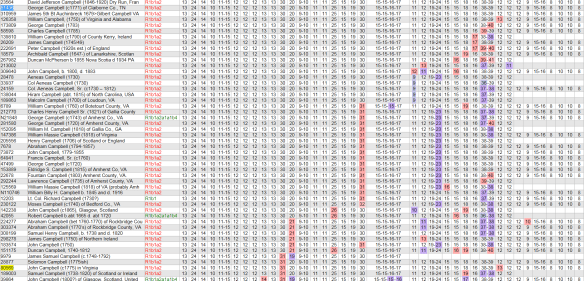
Moving to the Campbell DNA project, I can see the DNA results for the group that the administrator, Kevin Campbell has grouped both Jim and Paul into.  Fortunately, it is the same group, R1b-group 30.

Comparing their results with others in the group, we see that Jim (yellow 80569) has several mutations, and Paul (blue 81430) seems to match the modal value perfectly, so in essence has had no mutations since the common ancestor of this group.
Campbell group 30

Paul is the closest match to kit 23564 whose oldest ancestor is:

David J. Campbell, a son of Mark Washington Campbell and Mary Ann Campbell, was born on 26 August 1846 in Franklin County, PA.  It is speculated that he was born in Dry Run.  Also, according to speculation, his father, Mark W. Campbell, was born 15 December 1815 in the same county.  David married Marie Edna Gribble in 1870 and had six children. The family migrated to Clinton County, IA, McLean County, IL, Kearney County, NE, and Payette County, ID.

Jim’s closest match has 3 mutations, which isn’t terribly close, kit 28877 whose oldest ancestor is:

Solomon Campbell born Sept 1805, married Margaret Laurie, John N’s son James N Campbell Born Feb 2 1835.  Other children of John N are Martha, William, Margaret, Thomas L., James N., Solomon J., Jane.  It states on the 1841 Scottish census (Crofthead, Neilston, Renfrewshire) that John N and family were born in Ireland except for Jane who was born in Neilston.  Family also listed in Scotland 1851 census. Came to America in June of 1853, settled in Mason NH, John N. died 1878 Townsend Mass.

There is clearly no commonality in terms of either ancestors or location comparing the two closest matches.  Furthermore, Jim’s closest match is in Massachusetts when we know that John Campbell did arrive from Virginia, born in the 1770s, and was very likely part of the Scots/Irish migration from Pennsylvania through Virginia – simply given the historical patterns and logistics.

Let’s move to the individual markers and see what we can tell.

Campbell headingCampbell 389

I looked at the markers, and I think that DYS389(2) is having spontaneous mutations.  I say this because IF and assuming that truly, kit 81430 has not mutated, then all of the mutations in the 80569 kit happened after Charles Campbell who was born about 1750 or maybe slightly earlier.  It’s obvious from looking at oldest ancestors of the matches who have a value of 31 at DYS389(2) that  they could not all be descended from someone who lived since Charles Campbell.

Both Paul and Jim have taken the Family Finder autosomal test.  Let’s see what that says about their relationship.  I searched Jim’s account for matches having a surname of Campbell.  Sure enough, there were 5 results, but none of them were Paul.  These men should be 5th cousins if Charles Campbell is the father of both John and George.  That is a long way back and we would expect, on average for 5th cousins to carry only about 3cM of common DNA and less than 1%.  The FTDNA threshold is 7cM.

Jim’s sister has also taken the Family Finder test.  On the chance that she inherited differently, I checked to see if she perhaps matches Paul.  She does not.

We know that at Family Tree DNA matching threshold is set to approximately 7cM and that matches have to meet other criteria as well to be considered a match, like minimum SNPs and a minimum total cM as well.  Therefore, people with small amounts of matching DNA are not shown as matches at Family Tree DNA, but may share DNA that is important to find.  At GedMatch, you can set the matching thresholds yourself.

Let’s take a look at GedMatch to see if the John Campbell descendants match the George Campbell descendants.  Below, Jim and Paul’s autosomal DNA is compared for matches.

Campbell, paul vs jim

Sure enough, Jim and Paul match each other on four segments, one just above 3cM, just as predicted, and three more just over 1cM each.  Without a proven family connection, we would ignore segments of this size, but in a known family situation, these are important matching segments.

Let’s see if Jim’s sister matches Paul.

Campbell, paul vs jim sister

Yes, Jim’s sister and Jim both match Paul and in the same location on chromosome 7.

Do I match Paul?

Campbell, paul vs me

I do match Paul significantly.  On two chromosomes, the segments are 12 and 13 cm.  On chromosome 12, I match Paul on the same location at Jim’s sister.  On chromosome 13, I match on the same location as Jim matches Paul.

The GedMatch estimate is interesting in that it is 4.2 generations.  We know positively that we are a minimum of 7 generations distant, assuming that Charles is the father of both George and John.  Paul and I do not share any other ancestors.

Do I match Joy, the other George descendant?

Yes, I do, below.  Again, a minimum of 7 generations between us.

Campbell, me vs joy

Does Jim match Joy? No.

Does Joy match Jim’s sister? No.

Does Paul match Joy?  Both are descended from George.  Yes, on 10 different chromosomes.  These should be more closely matched than any John/George descendant matches, but they are further than 2.7 generations.

Campbell, paul vs joy

Do I match Jim, who is also descended from John Campbell?  Yes.

Campbell, me vs jim

Do I match Jim’s sister? Yes, on far more segments that I match Jim.

Campbell, me vs jim sister

The segments on chromosome 5 are identical between me, Jim and his sister.  Clearly, that came from John Campbell.  Our common ancestor, John Campbell is 5 generations from Jim and his sister, and 6 from me.

I created the following table of the results.  We have two descendants from George who match each other most closely.  Conversely, the descendants of John match each other more closely than the descendants of John match the descendants of George.  However, given the generational distance, the descendant of John and George do fall into the expected tolerance in the case of Paul matching Jim, John and me.

Jim (John) Jim’s sister Paul (George) Me (John) Joy (George)
Jim na siblings 1,3,7,13 5, 7, 11, 15 No
Jim’s sister siblings na 7, 10, 12, 13 2, 3, 5, 10, 11, 12, 13 No
Paul 1,3,7,13 7, 10, 12, 13 na 4, 9, 10, 12, 13 1, 2, 3, 5, 6, 7, 9, 12, 15, 16
Me 5, 7, 11, 15 2, 3, 5, 10, 11, 12, 13 4, 9, 10, 12, 13 na 16, 17
Joy No No 1, 2, 3, 5, 6, 7, 9, 12, 15, 16 16, 17 na

What else can we do now to further identify the parents of John and George Campbell, presuming that they are indeed brothers as the results above suggest?

At this point, there are three avenues open for study.

  1. Upgrade both Jim and Paul to 111 markers and hope for line marker mutations.
  2. Upgrade both Jim and Paul to the Big Y hoping for identical mutations, and if not, ones that will connect to another Campbell line. This option is very expensive at this time, and according to the Campbell surname administrator there are either few or no project members who have ordered the Big Y.
  3. Utilize Family Finder to search both Jim and Paul’s matches for consistent matches and hope for a clear genealogy clue as to where to begin the search for the common family of John and George.
  4. Add a dash of luck!

One thing is certain, whether John and George share a father or not, and whether that father is Charles Campbell who died before 1825 in Hawkins County, TN, or not, they do at some point not terribly distant past, share a common Campbell ancestor.  I surely wish there were any other proven children of Charles Campbell to test against.

As a matter of curiosity, I did check to see if any of the five of us Campbell descendants have matches to people with Fugate as an ancestral surname – and we all do.  However, many of these people also have Campbell ancestry and/or are from the Claiborne County region where we all have roots, so it would require more research to draw any inferences or conclusions on the Fugate question.

The Campbell lineage has been exceedingly frustrating. Why, oh why, didn’t they register that deed in 1825 in Hawkins County listing the heirs of Charles Campbell???

______________________________________________________________

Disclosure

I receive a small contribution when you click on some of the links to vendors in my articles. This does NOT increase the price you pay but helps me to keep the lights on and this informational blog free for everyone. Please click on the links in the articles or to the vendors below if you are purchasing products or DNA testing.

Thank you so much.

DNA Purchases and Free Transfers

Genealogy Services

Genealogy Research

Inverary Castle and the Clan Campbell

Scotland sunrise

Please notice that this is a sunrise photo.  Why was I up this early?  Because I fell asleep again right after dinner.  Sunrise is not something I normally experience, but I was certainly glad I was awake for this one.  This is the sunrise over Scotland, the Highlands in the distance.  This is the home of my ancestors, the Campbell and Younger families, and all of the Mc names in my tree.  McDowell, McKee, McMahon, McNeil and McSpaden.

We woke up this morning to rain.  Shortly after that, we were treated to something else.  Bagpipes.  I opened the door to the cabin on the cruise ship and looked outside.  Standing alone, in the rain, on the dock, was a single bagpipe player.  The mournful sound of the bagpipes took me back in time, to another time and place, in the remote Highlands, where another bagpipe player played in the rain.  That sound, like no other, stirred my soul.

Scotland bagpiper

Welcome home.  That’s the same thing my cousin, the Duke of Argyl who is the Campbell heir and carries the Campbell surname, said to me today.  And that is how it felt here in the Scottish Highlands, the lands my ancestors left some nearly 300 years ago.  Their blood in me rejoiced.  I now understand why Mary Herrell said she wanted to be put up on the mountain ledge when she died and her soul taken back to Ireland.  There is a part of you that never leaves your homeland.

Scotland highlands

The Highlands are magnificent in their stark beauty.

Scotland highlands 2

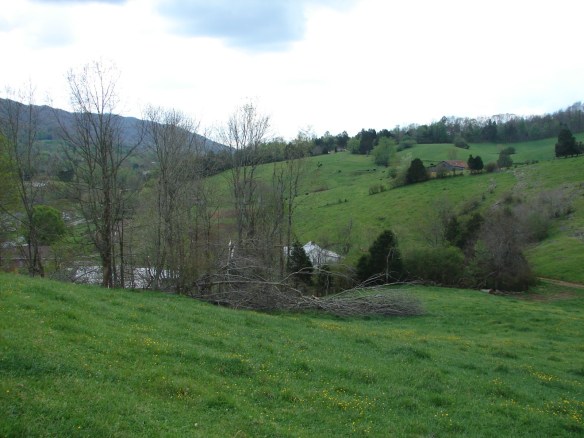
I remember one time Daryl, my cousin, and I were driving through some remote area of Claiborne County, Tennessee trying to figure out where George Campbell lived (below) and she said to me that the terrain reminded her of the highlands of Scotland.

Geo Campbell Land 008 crpped

Now I understand why the Scotch-Irish were so attracted to the Appalachian mountain highlands, the frontiers and why they were not afraid of battles.  Life here was a battle, even when no one was attacking.

Driving up into the Highlands, we stopped at the summit of the gap that is called “Rest and Be Thankful.”  It’s named appropriately, believe me, as shown below.  I suspect it was probably the horses and draft animals that were most thankful for the rest at the top.

OLYMPUS DIGITAL CAMERA

At Rest and Be Thankful, travelers have long welcomed the chance to draw their breath and enjoy the view as they cross the summit at 860 feet on the road that leads from Loch Long to Loch Awe via Glen Croe.

In the beginning, of course there wasn’t a road at all.  There was just a track, a path, made by generations of travelers, and beaten out by herds of black cattle being taken by drovers from Argyll to the Trysts and cattle markets of the Lowlands.  The making of the road, in any sense that we would now recognize it, had to wait until the 18th century. Some work was done in the 1730s on the roads in Argyll by the local government agencies, the Commissioners of Supply.  However, the real impetus for the road building came after the 1715 and 1719 Jacobite Uprisings.  General George Wade was sent to the Highlands to examine the military situation.  His report made a number of recommendations, including the construction of forts at various points and the development of a network of roads to link them.

In 1743 it was decided to construct 44 miles of military road from Dumbarton to Inveraray, via Loch Lomond-side, Tarbet, Arrochar, Glen Croe and thus down to Loch Fyne.  Major Caulfield, Wade’s Inspector of roads and successor as mastermind of the Highland roads network, was ordered to survey the route.  Work started that summer, although the progress was interrupted by the outbreak of the 1745 Jacobite Uprising.

Argyll and Inveraray, its capital was strongly Hanoverian, pro-government, firmly under the control of the Duke of Argyll, a Campbell of course, one of the leading figures in the government of Scotland.  So what military purpose was to be served by this road?  It was hardly likely that a detachment from the garrison at Dumbarton would be marched to Loch Fyne to put down an insurrection in the peaceful glens of Argyll.

Two possible reasons exist for the high priority given to this road.  The first may have been to allow the pro-government forces that could be raised in Argyll – and indeed a regiment of the Argyll Militia fought in the Culloden campaign – to move swiftly from Loch Fyne to wherever they might be needed. The other reason was perhaps less straight forward, but perhaps more plausible – to provide a conveniently smooth road to and from the Lowlands for the Duke of Argyll.  The connection between the road and the Duke was emphasised by Caulfield – when the road was nearly finished, money was running out and there was a danger that a bridge at Inveraray could not be completed,  Caulfield wrote “this will hurt a great man for the bridge is at his door,” as indeed it was, being barely a mile from Inveraray Castle, the Duke’s seat.

After Culloden, work recommenced, and by 1748 troops from the 24th Regiment – later the South Wales Borderers – had made the road over the summit of Glen Croe and erected a stone seat with the legend “Rest And Be Thankful,” shown below.  Completion of the road to Inveraray was achieved by 1749.

Rest and be thankful

On the way to Inverary Castle today, we visited Loch Lomond, the largest inland lake.  The village of Luss sits on the edge of the lake and is quite beautiful.

OLYMPUS DIGITAL CAMERA

This village looks a bit like a storybook.

Inverary is on Loch Fyne, on the other side of “Rest and Be Thankful.”

Lochs are the same things as fjords but are called lochs here.  They are tidal, in some cases, very tidal.  The scenery is incomparable, although I fully understand why my ancestors left.  Land was not available and with the religious and political changes and upheaval, it was leave or perish.  This lands lush, stark beauty must have lived in their souls for the rest of their lives, and their descendants as well as a distant memory. Loch Lomond below.

Loch Lomond

The Castle of Inverary itself was built in the early 1700s, probably just before my ancestors left for America.  They would have known this castle, most likely, but would have thought of it as the “new castle.”  Earlier castles are in ruins and located elsewhere, but this castle was built of the remains of a fort built in the 1400s, so our ancestors probably knew that fort quite well.  This castle is very beautiful however, and it sooths my soul to be someplace my ancestors walked and lived for centuries, maybe millennia.  Just down the loch a ways is Campbeltown too.  Three guesses how it received its name.

Inverary castle

The entrance to the castle spans what is today, a dry mote.

Inverary entrance

Inverary estate

Castle armory room below.  My ancestors likely used these arms.

Inverary armour room

As luck would have it, the Duke himself was in the gift shop signing books.  He’s my cousin, many times removed, and he was most gracious – inviting me back anytime.   Although I’m sure though he didn’t mean to stay in the family area of the castle:)  That’s the two of us in the photo below.  It was so much fun to meet him.  He is very much a gentleman and he personally cut fabric for me – yes – I bought Campbell tartan plaid wool.  I have no idea what I’ll do with it, but certainly something interesting.

For anyone who is interested in the history of the castle, the Duke and Duchess have had the castle interior professionally photographed and have written a book about the history of the Castle and the Campbell Clan.  I highly recommend this book.  You can purchase it online along with other Clan Campbell items.

Me and the Duke

Loch Fyne, below, at Inverary Castle, which is located just on the other side of the bridge.

Loch Fine

This area is tidal….the water comes and goes throughout the day revealing mud flats from time to time.  This is of course the bridge being referenced as at the end of the “Rest and Be Thankful” road which leads to Inverary Castle.

Loch Fine bridge

We ate in a lovely Pub at Loch Fyne where the placemats were slate tiles.

slate placemat

The roofs here are slate too.  When you have this much moisture, you don’t build anything out of wood.

slate roofs

I also understand the woolen industry now too.  Everything here needed to be wool.  Wool was warm, even when wet, which is everyday, all day long, and everyone needed wool breaches.

In one of our stops, we did find a lovely woolen mill where the local wool is made into charming and useful items, all wool, of course.

I so wanted a pair of those warm woolen kilt socks!!!  I had been cold for days.  I bought a pair of heavy knitted woolen socks for myself and my daughter and in the middle of January, she sent me an e-mail with this photo and the title “Best Socks Ever.”  Yep, those Scots knew what they were doing.  I would love to have a few more pairs of these!  Sounds like a good reason to return:)

wool socks

We made our way back through quaint villages to the boat.  We took a ferry across the Frith of Clyde, the estuary of the River Clyde as it enters the sea.  The bus would be driven on to the ferry and the entire bus transported across the frith.  I decided that I needed a Dramamine when I discovered that was the plan.  The bus is bad enough and the boat is bad enough, but a bus on a boat. Dramamine is terrible to chew!!

Bagpipes, now more than one lonely wet person, bade us farewell.  A lovely sendoff and so fitting.

Scotland bagpipers

Our towel guy tonight, Nessie of course, wears a Campbell tartan scarf in front of a Celtic cross ornament and a book about the Clan Campbell.

Nessie towel guy

Clan Campbell

In traditional genealogies of the Clan Campbell, its origins are placed amongst the ancient Britons of Strathclyde.  However the earliest Campbell in written records is Gillespie who is recorded in 1263.  Early grants to Gillespie and his relations were almost all in east-central Scotland.  However the family’s connection with Argyll came some generations before when a Campbell married the heiress of the O’Duines and she brought with her the Lordship of Loch Awe.  Because of this the early clan name was Clan O’Duine and this was later supplanted by the style Clan Diarmid.  This name came from a fancied connection to Diarmid the Boar, a great hero from early Celtic mythology.

The original seat of the Clan Campbell was either Innis Chonnell Castle on Loch Awe or Caisteal na Nigheann Ruaidh on Loch Avich. The clan’s power soon spread throughout Argyll.  However, at first the Campbells were under the domination of the Lords of Lorne, chiefs of Clan MacDougall.  The MacDougalls killed the Campbell chief Cailean Mór (Colin Campbell) in 1296.  All of the subsequent chiefs of Clan Campbell have taken MaCailein Mor as their Gaelic patronymic.

Between 1200 and 1500 the Campbells emerged as one of the most powerful families in Scotland, dominant in Argyll and capable of wielding a wider influence and authority from Edinburgh to the Hebrides and western Highlands.

The Clan Campbell DNA Project at Family Tree DNA has 613 members, including a couple different family members of my Campbell line.  The Duke of Argyl, a Campbell himself, of course, provided a Campbell timeline on the Inverary Castle website.

You know those “two brothers” stories?  Everyone has them.  Well, there really were two brothers, John and George Campbell born in the 1770s and found in Claiborne County, TN in the early 1800s.  We believe their father was Charles Campbell of Hawkins County, Tennessee, but unfortunately, the deed signed by his children to sell his property after his death was never filed in the clerk’s office, so we don’t’ know who signed.  Subsequent deeds only refer to the unfiled deed and the “Campbell heirs.”  Heartbreaking.  Enough to make you want to pull your hair out!

We know from a deed signed during Charles’ lifetime that he did have sons John and George, and we know that the man whose daughters the two Campbell sons married lived not far in Hawkins County from Charles Campbell who died in early 1825.  John and George Campbell married Jane and Elizabeth Dobkins, respectively, about 1800 or just before, daughters of Jacob Dobkins and Dorcas Johnson.

According to the Campbell DNA project and other associated documents, trees and webpages provided by Kevin Campbell, the project administrator, it appears that my line does indeed descend from the Campbell Clan of Argyl.  We are grouped in group 30, which includes the Campbell family of Argyl.

Clan Campbell DNA cropped2

I may never know exactly how I’m related to the Duke of Argyl, but thanks to DNA, my very generous Campbell cousins who tested, and the Campbell DNA project, I know for sure that I am.  And thanks to the generosity of the family of the Duke of Argyl sharing Inverary Castle with the rest of us, I can visit my homelands.  It makes a difference when you know for sure that you are visiting your family ancestral land.  Standing literally where your ancestors stood 500 years ago, and further, back into “time out of mind.”

Colin Campbell

Colin Campbell of Glenorchy who died in 1480.

Archibald Campbell

Archibald Campbell, 1st Marquess of Argyll, who led the Campbell forces in 1645 at the Battle of Inverlochy.

Campbell black watch

The Black Watch, or Campbell Tartan.

If you’d like to hear “The Campbell’s Are Coming” on pipes and drums, click here.  In the historical tidbit category, this was played by the Union as the Iron Brigade marched down the Emmitsburg Road on their way to McPherson’s Ridge at Gettysburg.

“The Campbell’s Are Coming” is the pipe hymn of the Clan Campbell, composed in 1715 by a local piper, inspired by a wedding.  The Gaelic name of the tune is “Baile Ionaraora” or “the town of Inverary.”  For more info and to hear the bagpipe version, click here.

Clan Campbell current coat of arms

Coat of Arms of the current head of the Clan Campbell, the 13th Duke of Argyll.

______________________________________________________________

Disclosure

I receive a small contribution when you click on some of the links to vendors in my articles. This does NOT increase the price you pay but helps me to keep the lights on and this informational blog free for everyone. Please click on the links in the articles or to the vendors below if you are purchasing products or DNA testing.

Thank you so much.

DNA Purchases and Free Transfers

Genealogy Services

Genealogy Research

Family Tree DNA Releases myOrigins

my origins

On May 6th, Family Tree DNA released myOrigins as a free feature of their Family Finder autosomal DNA test.  This autosomal biogeographic feature was previously called Population Finder.  It has not just been renamed, but entirely reworked.

Currently, 22 population clusters in 7 major geographic groups are utilized to evaluate your biogeographic ethnicity or ancestry as compared to these groups, many of which are quite ancient.

my origins regions

Primary Population Clusters

  • Anatolia & Caucasus
  • Asian Northeast
  • Bering Expansion
  • East Africa Pastoralist
  • East Asian Coastal Islands
  • Eastern Afroasiatic
  • Eurasian Heartland
  • European Coastal Islands
  • European Coastal Plain
  • European Northlands
  • Indian Tectonic
  • Jewish Diaspora
  • Kalahari Basin
  • Niger-Congo Genesis
  • North African Coastlands
  • North Circumpolar
  • North Mediterranean
  • Trans-Ural Peneplain

Blended Population Clusters

  • Coastal Islands & Central Plain
  • Northlands & Coastal Plain
  • North Mediterranean & Coastal Plain
  • Trans-Euro Peneplain & Coastal Plain

Each of these groups has an explanation which can be found here.

Matching

Prior to release, Family Tree DNA sent out a notification about new matching options.  One of the new features is that you will be able to see the matching regions of the people you match – meaning your populations in common.  This powerful feature lets you see matches who are similar which can be extremely useful when searching for minority admixture, for example.  However, some participants don’t want their matches to be able to see their ethnicity, so everyone was given an ‘opt out’ option.  Fortunately, few people have opted out, less than 1%.

Be aware that only your primary matches are shown.  This means that your 4-5th cousins or more distant are not shown as ethnicity matches.

Here’s what the FTDNA notification said:

With myOrigins, you’ll be able compare your ethnicity with your Family Finder matches. If you want to share your ethnic origins with your matches, you don’t need to take any action.  You’ll automatically be able to compare your ethnicity with your matches when myOrigins becomes available.  This is the recommended option. However, we do understand that sharing your ethnicity with your matches is your choice so we’re sending you this reminder in case you want to not take part (opt-out). To opt-out, please follow the instructions below. *

  1. Click this link.
  2. If you are not logged in, do so.
  3. Select the “Do not share my ethnic breakdown with my matches. This will not let me compare my ethnicity with my matches.” radio button.
  4. Click the Save button.

You can get more details about what will be shared here.  You may also join our forums for discussion* You can change your privacy settings at any time. Thus, you may opt-out of or opt back into ethnic sharing at a later date if you change your mind.

What’s New?

Let’s take a look at the My Origins results.  You can see your results by clicking on “My Origins” on the Family Finder tab on your personal page at Family Tree DNA.

Ethnicity and Matches

Your population ethnicity is shown on the main page, as well as up to three shared regions that you share with your matches.  This means that if you share more than 3 regions with these people, the 4th one (or 5th or 6th, etc.) won’t show.  This also means that if your match has an ethnicity you don’t have, that won’t show either.

my origins ethnicity

Above, you see my main results page.  Please note that this map is what is known as a heat map.  This means that the darkest, or hottest, areas are where my highest percentages are found.

Each region has a breakdown that can be seen by clicking on the region bar.  My European region bar population cluster breakdown is shown below along with my ethnicity match to my mother.

my origins euro breakdown

And my Middle Eastern breakdown is shown below.

my origins middle east breakdown

Ethnicity Mapping

A great new feature is the mapping of the maternal and paternal ethnicity of your Family Finder matches, when known.  How does Family Tree DNA know?  The location data entered in the “Matches Map” location field.  Can’t remember if you completed these fields?  It’s easy to take a look and see.  On either the Y DNA or the mtDNA tabs, click on Matches Map and you’ll see your white balloon.  If the white balloon is in the location of your most distant ancestor in your paternal line (for Y) or your matrilineal line for mtDNA (your mother’s mother’s mother’s line on up the tree until you run out of mothers), then you’ve entered the location data and you’re good to go.  If your white balloon is on the equator, click on the tab at the bottom of the map that says “update ancestor’s location” and step through the questions.

ancestor location

If you haven’t completed this information, please do.  It makes the experience much more robust for everyone.

How Does This Tool Work?

my origins paternal matches

The buttons to the far right of the page show the mapped locations of the oldest paternal lines and the oldest matrilineal (mtDNA) lines of your matches.  Direct paternal matches would of course be surname matches, but only to their direct paternal lines. This does not take into account all of their “most distant ancestors,” just the direct paternal ones.  This is the yellow button.

The green button provides the direct maternal matches.

my origins maternal matches

Do not confuse this with your Matches Map for your own paternal (if you’re a male) or mitochondrial matches.  Just to illustrate the difference, here is my own direct maternal full sequence matches map, available on my mtDNA tab.  As you can see, they are very different and convey very different information for you.

my mito match map

Comparisons

By way of comparison, here are my mother’s myOrigins results.

my origins mother

Let’s say I want to see who else matches her from Germany where our most distant mitochondrial DNA ancestor is located.

I can expand the map by scrolling or using the + and – keys, and click on any of the balloons.

my origins individual match

Indeed, here is my balloon, right where it should be, and the 97% European match to my mother pops up right beside my balloon.  The matches are not broken down beyond region.

This is full screen, so just hit the back button or the link in the upper right hand corner that says “back to FTDNA” to return to your personal page.

Walk Through

Family Tree DNA has provided a walk-through of the new features.

Methodology

How did Family Tree DNA come up with these new regional and population cluster matches?

As we know, all of humanity came originally from Africa, and all of humanity that settled outside of Africa came through the Middle East.  People left the Middle East in groups, it would appear, and lived as isolated populations for some time in different parts of the world.  As they did, they developed mutations that are found only in that region, or are found much more frequently in that region as opposed to elsewhere.  Patterns of mutations like this are established, and when one of us matches those patterns, it’s determined that we have ancestry, either recent or perhaps ancient, from that region of the world.

The key to this puzzle is to find enough differentiation to be able to isolate or identify one group from another.  Of course, the groups eventually interbred, at least most of them did, which makes this even more challenging.

Family Tree DNA says in their paper describing the population clusters:

MyOrigins attempts to reduce the wild complexity of your genealogy to the major historical-genetic themes which arc through the life of our species since its emergence 100,000 years ago on the plains of Africa. Each of our 22 clusters describe a vivid and critical color on the palette from which history has drawn the brushstrokes which form the complexity that is your own genome. Though we are all different and distinct, we are also drawn from the same fundamental elements.

The explanatory narratives in myOrigins attempt to shed some detailed light upon each of the threads which we have highlighted in your genetic code. Though the discrete elements are common to all humans, the weight you give to each element is unique to you. Each individual therefore receives a narrative fabric tailored to their own personal history, a story stitched together from bits of DNA.

They have also provided a white paper about their methodology that provides more information.

After reading both of these documents, I much prefer the explanations provided for each cluster in the white paper over the shorter population cluster paper.  The longer version breaks the history down into relevant pieces and describes the earliest history and migrations of the various groups.

I was pleased to see the methodology that they used and that four different reference data bases were utilized.

  • GeneByGene DNA customer database
  • Human Genome Diversity Project
  • International HapMap Project
  • Estonian Biocentre

Given this wealth of resources, I was very surprised to see how few members of some references populations were utilized.

Population N Population N
Armenian 46 Lithuanian 6
Ashkenazi 60 Masai 140
British 39 Mbuti 15
Burmese 8 Moroccan 7
Cambodian 26 Mozabite 24
Danish 13 Norwegian 17
Filipino 20 Pashtun 33
Finnish 49 Polish 35
French 17 Portuguese 25
German 17 Russian 41
Gujarati 31 Saudi 19
Iraqi 12 Scottish 43
Irish 45 Slovakian 12
Italian 30 Spanish 124
Japanese 147 Surui 21
Karitiana 23 Swedish 33
Korean 15 Ukrainian 10
Kuwaiti 14 Yoruba 136

In particular, the areas of France, Germany, Norway, Slovakia, Denmark and the Ukraine appear to be very under-represented, especially given Family Tree DNA’s very heavy European-origin customer base .  I would hope that one of the priorities would be to expand this reference data base substantially.  Furthermore, I don’t see any New World references included here which calls into question Native American ancestry.

Webinar

Family Tree DNA typically provides a webinar for new products as well as general education.  The myOrigins webinar can be found in the archives at this link.  It can be viewed any time.  https://www.familytreedna.com/learn/ftdna/webinars/

Accuracy

How did they do?  Certainly, Family Tree DNA has a great new interface with wonderful new maps and comparison features.  Let’s take a look at accuracy and see if everything makes sense.

I am fortunate to have the DNA of one of my parents, my mother.  In the chart below, I’m comparing that result and inferring my father’s results by subtracting mine from my mother’s.  This may not be entirely accurate, because this presumes I received the full amount of that ethnicity from my mother, and that is probably not accurate – but – it’s the best I can do under the circumstances.  It’s safe to say that my father has a minimum of this amount of that particular population category and may have more.

Region Me Mom Dad Inferred Minimum
European Coastal Plain 68 17 51
European Northlands 12 7 5
Trans Ural Peneplain 11 10 1
European Coastal Islands 7 34 0
Anatolia and Caucus 3 0 3
North Mediterranean 0 34 0
Circumpolar 0 1 0
Undetermined* 0 0 40

*The Undetermined category is not from Family Tree DNA, but is the percentage of my father not accounted for by inference.  This 40% is DNA that I did not inherit if it falls into a different category.

Based on these results alone, I have the following observations.

    1. I find it odd that my mother has 34% North Mediterranean and I have none. We have no known ancestry from this region.
    2. My mother does have one distant line of Turkish DNA via France. I have presumed that my Middle Eastern (now Anatolia and Caucus) was through that line, but these results suggest otherwise.
    3. My mother’s Circumpolar may be Native American. She does have proven Native lines (Micmac) through the Acadian families.
    4. These results have missed both my Native lines (through both parents) and my African admixture although both are small percentages.
    5. The European Coastal Plain is one of the groups that covers nearly all of Europe. Given that my mother is 3/4th Dutch/German, with the balance being Acadian, Native and English, one would expect her to have significantly more, especially given my high percentage.
    6. The European Coastal Island percentages are very different for me and my mother, with me carrying much less than my mother.  This is curious, because she is 3/4th German/Dutch with between 1/8th and 3/16th English while my father’s lines are heavily UK.  My father’s ancestry may well be reflected in European Coastal Plain which covers a great deal of territory.

What We Need to Remember

All of the biogeographic tools, from Family Tree DNA, 23andMe and Ancestry, are “estimates” and each of the tools from the three major vendors rend different results.  Each one is using different combinations of reference populations, so this really isn’t surprising.  Hopefully, as the various companies increase their population references and the size of their reference data bases, the results will increasingly mesh from company to company.  These results are only as good as the back end tools and the DNA that you randomly inherited from your ancestors.

Furthermore, we all carry far more similar DNA than different DNA, so it’s extremely difficult to make judgment calls based on ranges.  Europe, for example, is extremely admixed and the US is moreso.  The British Isles were a destination location for many groups over thousands of years.  Some of the DNA being picked up by these tests may indeed be very ancient and may cause us to wonder where it came from.  In future test versions, this may be more perfectly refined.

There is no way to gauge “ancient” DNA, like from the Middle East Diaspora, from more contemporary DNA, only a thousand years or so old, once it’s in very small segments.  In other words, it’s all very individual and personal and pretty much cast in warm jello.  We’ve come a long way, but we aren’t “there” yet.  However, without these tools and the vendors working to make them better, we’ll never get “there,” so keep that in mind.

While this makes great conversation today, and there is no question about accuracy in terms of majority ancestry/ethnicity, no one should make any sweeping conclusions based on this information.  This is not “cast in concrete” in the same way as Y DNA and mitochondrial haplogroups and STR markers.  Those are irrefutable – while biogeographical ethnicity remains a bit ethereal.

In summary, I would simply say that this tool can provide great hints and tips, especially the matching, which is unique, but it can’t disprove anything.  The absence of minority admixture, which is what so many people are hunting for, may be the result of the various data bases and the infancy of the science itself, and not the absence of admixture.

My recommendation would be to utilize all three biogeographic admixture products as well as the free tools in the Admixture category at GedMatch.  Look for consistency in results between the tools.  I discussed this methodology in “The Autosomal Me” series.

What Next?

I asked Dr. David Mittelman, Chief Scientific Officer, at Family Tree DNA about the reference populations.  He indicated that he agreed that some of their reference populations are small and they are actively working to increase them.  He also stated that it is important to note that Family Tree DNA prioritized accuracy over false positives so they definitely took a conservative approach.

______________________________________________________________

Disclosure

I receive a small contribution when you click on some of the links to vendors in my articles. This does NOT increase the price you pay but helps me to keep the lights on and this informational blog free for everyone. Please click on the links in the articles or to the vendors below if you are purchasing products or DNA testing.

Thank you so much.

DNA Purchases and Free Transfers

Genealogy Services

Genealogy Research

Charles Campbell (c1750 – c1825) and the Great Warrior Path – 52 Ancestors #19

When I discovered that I was going to be visiting Scotland in the fall of 2013, I couldn’t bypass the opportunity to visit the seat of the Clan Campbell.

Campbell isn’t my maiden name, but it was the maiden name of my ancestor, Elizabeth Campbell born about 1802 who married in about 1820, probably in Claiborne County, TN, to Lazarus Dodson, born about 1795.  Elizabeth’s father was John Campbell, born 1772-1775 in Virginia and her mother was Jane “Jenny” Dobkins.  John’s brother is believed to be George Campbell, born around 1770-1771.  We are fairly certain that their father was one Charles Campbell who died before May 31, 1825 in Hawkins County, Tennessee when a survey for his neighbor mentions the heirs of Charles Campbell.

Charles Campbell was in Hawkins County by about 1788.  A Charles Campbell was mentioned in Sullivan County, the predecessor of Hawkins, as early as 1783, but we don’t know if it’s the same man.  The history of Charles Campbell’s Hawkins County land begins in 1783 when it was originally granted to Edmond Holt.

1783, Oct 25, 440 (pg 64 Tn Land Entries John Armstrong’s office) – Edmond Holt enters 300 ac on the South side of Holston river near the west end of Bays Mountain, includes a large spring near the mountain and runs about, includes Holt’s improvement at an Indian old War Ford, warrant issued June 7, 1784, grant to Mark Mitchell.

Hawkins view of Campbell land

This photo shows the area of Dodson’s creek from across the Holston River atop a high hill.  Dodson’s Creek, today, is located beside the TVA power plant.  In this photo, Dodson’s Creek would be just slightly to the right of the power plant in the distance.  You can’t see the Holston River in this photo, but it is just in front of the power plant.  This is a good representation of the rolling mountains of this region.  I stayed in this house for nearly a week while doing research in Hawkins County before realizing that the land I was looking at, daily, out the back door, off of the porch swing, was the land of both my Campbell and Dodson ancestors.  Talk about a jolting moment.

The Old War Ford is the crossing of the Holston River at the mouth of Dodson Creek where the Indians used to camp and cross, on the Great Warrior Path.

Indian war path

My cousin helped me locate the Great Warrior Path crossing and I took the  photos below during a visit to locate the Dodson and Campbell lands.

1790, May 26 – Mark Mitchell to Charles Campbell 100# Virginia money, Dodson’s Ck, Beginning at a synns on the nw side Bays mountain thence on Stokely Donelson’s, north 60 then west 218 poles to a small black and post oak on a flat Hill then south 30 west 219 to two white oaks in a flat, then s 60 east 218 poles to a stake then north 30 east 219 poles along Bays Mountain to the beginning containing 300 acres. Signed, wit John (I) Owen mark, William Wallen, George Campbell mark (kind of funny P), R. Mitchell (it appears that this transaction actually took place in 1788, but wasn’t registered until later.) south side of the Holston on the west fork of Dodson Creek.

Today, the road that originally led to the ford of the Holston River dead ends into a road and the part of the road that was the “ford” is gone.  A field exists in its place, and a historical marker, and that’s it.  Not even any memories as the ford was no longer needed when bridges were built, and by now, there have already been several generations of bridges.

old war ford

Here’s the field.  The trees grow along the river and help to control erosion from flooding today.  Walking up to the area, you can see the actual ford area, although there is nothing to give away the fact that this used to be a ford of the river.  The locals say there is bedrock here.

old war ford 2

This area is flood plain, so one would not live here.  The old cemetery where we believe Raleigh Dodson is buried is across the current road and up the hill.  The land where we think Charles Campbell lived is just up Dodson Creek from this area as well, but on somewhat higher ground.

Possible Campbell land

I believe this is or is very near the current day location of the Charles Campbell land.  Dodson Creek runs adjacent the road, and you have to cross the creek to get to the farmable land from the road.  You can see the makeshift bridge above.

Beautiful pool at the bend in Dodson Creek where it leaves the road.

Dodson Creek is beautiful and lush.

Dodson Creek 2

1793/1794 – Charles Campbell to George and John Campbell, all of Hawkins County, for 45#, 150 acres on the south side of the Holston, west fork of Dodson Ck beginning at 2 white oaks then (metes and bounds), signed, John Payne witness.

1802, Feb 26 – George Campbell and John Campbell of Hawkins County to Daniel Leyster (Leepter?, Seyster, Septer) of same, 225# tract on west fork of Dodson’s Creek being same place where said John Campbell now lives, 149 acres, then (metes and bounds) description. Both sign,  Witness, Charles Campbell, Michael Roark and William Paine.  Proven in May session 1802 by oath of Michael Roark (inferring that the sellers are gone from the area).

Is the difference between 149 and 150 acres a cemetery, a church or a school?

Dodson Creek is where Charles Campbell lived.  This is the Dodson family who John Campbell’s daughter, Elizabeth, would marry into a generation later in Claiborne County.  Dodson Creek was also just a few miles from Jacob Dobkins’ home, whose daughter’s George and John Campbell would marry.  Jacob Dobkins, George and John Campbell and their Dobkins wives would be in Claiborne County, Tennessee by 1802.

We believe Charles Campbell came from the Augusta or Rockingham County area of Virginia, but we don’t know for sure.  Unfortunately the deed where his heirs conveyed his land is recorded in the court record, but never in the deed book, so we have no idea who his heirs were.  The will of his neighbor, Michael Roark, who was born in Bucks County, PA and then lived in Rockingham Co., VA stated that he bought the land of Charles Campbell from his heirs joining the tract “I live on.”  Charles’ other neighbor was a Grigsby, and so was Michael Roark’s wife. It’s not unlikely that Charles Campbell was related to one or both of these men.

Michael Roark’s will dates August 25, 1834 and proven on February 4, 1839 says, among other things, that he leaves to grandson James Rork, son of John, tract of land that I now live on after wife and I die, son John 4 shares of tract of land that I bought of the heirs of Charles Campbell joining the tract I live on and containing about 150 acres. Unfortunately, the deed between the Campbell heirs and Michael Roark was never registered.

In a deed from Michael Roark to Neil and Simpson with John Scruggs as their trustee, registered July 17, 1835, where Michael Roark had in essence mortgaged his land in November of 1830 and by 1835 was unable to pay his debt.  The verbiage says in part that Michael not only conveys his land, which is described, but he adds “and also the interest I have in the shares of the 4 legatees of Charles Campbell, decd, to a tract of land lying on Dodson’s Creek.”  He does not say that his wife is a daughter of Charles Campbell, but it’s certainly possible.  He described one of the two tracts of Roark land he is conveying as having been conveyed to him by James Roark in 1811.

This 1835 entry tells us that Charles Campbell’s land apparently had not yet been sold and that there were at least 4 legatees.

Roark, Michael cabin

Years ago, in a book in the library in Hawkins County, I stumbled across this photo of a picture of the cabin of Michael Roark.  You know that Charles Campbell’s cabin didn’t look much different.  A quite elderly descendant of Michael, Libby Roark Schmalzreid, claimed that her grandfather built his house on this land, and is buried on a hill just above the home he built.  She was in her 90s more than half a decade ago, and never said who her grandfather was.  She did say on Rootsweb that the location is on Dodson Creek not far from Strahl.  Given that Michael Roark and Charles Campbell were neighbors, if we find Michael’s cabin, we can also find Charles land.  I mean his actual land, not just a general area.  On the map below, Dodson Creek is shown by the arrows, and Strahl is marked as well.  It’s about 2000 feet from Strahl to the red arrow below noting Dodson Creek.  Dodson Creek and its branches wanders all over this neighborhood.  So, if anyone knows who Libby’s grandfather was, where he built his house or where he is buried, please give me a shout.

Strahl

Perhaps the key to finding Charles Campbell back in Virginia is to find both Michael Roark and the Grigsby family as well.

On the 1783 Shenandoah Co., VA, tax list, we find both Charles Campbell and Jacob Dobkins in Alexander Hite’s district. Jacob Dobkins is the father of Jane “Jenny” Dobkins who would eventually marry John Campbell and her sister,  Elizabeth Dobkins who would marry George Campbell, believed to be the brother of John Campbell.

Of course, there were also 2 Charles Campbells in Rockingham County, VA in 1782 and 1 in Fayette and one in Lincoln, both in 1787.

Several years ago, we DNA tested both a male Campbell descendant of both John and George and confirmed that indeed, these line match each other as well as the Campbell clan line from Scotland and that the descendants of the lines of both men also match autosomally as cousins, further confirming that John and George were most likely brothers.  This was good news, because even though we don’t know the exact names of Charles ancestors, thanks to DNA, we still know the history of those ancestors before they immigrated, probably in the early 1700 with the first waves of the Scotch-Irish.

So, for me, the opportunity to visit the clan seat, and meet the current Duke of Argyll, the 26th chief of the Clan Campbell and the 12the Duke of Argyll, Torquhil Campbell, personally, was literally the chance of a lifetime.

The Duke, Torquhil Campbell, is much different from other aristocracy.  He lives at Inveraray Castle, the clan seat, but parts of the castle are open to the public.  In addition, the castle is his actual full time residence and he actively manages the estate, including signing books about Inveraray in the gift shop in the castle.

OLYMPUS DIGITAL CAMERA

You can’t miss him if he’s there, as he has on an apron that says “Duke.”  He’s a lot younger than I expected as well, born in 1968, but extremely gracious and welcoming.  There must be tens of thousands of Campbell descendants and many probably make their way back to Inverary like the butterflies return to Mexico every winter.

While I was visiting Inveraray, I purchased two books about the clan Campbell and a third, written by the Duke himself, about Inveraray. The Campbell clan origins are shrouded in myth and mists, as you might imagine, but let me share them with you anyway.

Campbell coat of arms

The first origin story, from a book called “Campbell, The Origins of the Clan Campbell and Their Place in History” by John Mackay, says :

“The first Campbells were a Scots family who crossed from Ireland to the land of the Picts.  The Clan Campbell originated from the name O’Duibhne, one of whose chiefs in ancient times was known as Diarmid and the name Campbell was first used in the 1050s in the reign of Malcolm Canmore after a sporran-bearer or purse-bearer to the king previously called Paul O’Duihne was dubbed with his new surname.

Historians after such obscure and legendary times, have agreed that the can name comes from the Gaelic ‘cam’ meaning crooked and ‘beul’ meaning the mouth, when it was the fashion to be surnamed from some unusual physical feature, in this case by the characteristic curved or crooked mouth of the family of what is certainly one of the oldest clan named in the Highlands.

It was the Marquis who insisted that he was descended from a Scots family in Ireland who had crossed to what was then mostly the land of Picts to establish the first Scots colony in the district of Dalriada – a comparatively small part of what we know today as Argyll at the heart of what would in time become the kingdom of Scotland.  It is marked by the fort of Dunadd, of the A816, a few miles north of Lochgilphead, set in the inlet called Loch Gilp off from Loch Fyne.”

Loch Fyne is where the current castle of Inveraray, clan seat, is located and where I visited.

The second source is a booklet called “Campbell, Your Clan Heritage,” by Alan McNie, which is condensed from a larger book, Highland Clans of Scotland by George –Eyre-Todd published in 1923.

It says:

“Behind Torrisdale in Kintyre rises a mountain named Ben an Tuire, the “Hill of the Boar.”  It takes its name from a famous event in Celtic legend.  There, according to tradition, Diarmid O’Duibhne slew the fierce boar which had ravaged the district.  Diarmid was of the time of the Ossianic heroes.

Diarmid is said to have been the ancestor of th race of O’Duibhne who owned the shores of Loch Awe, which were the original Oire Gaidheal, or Argyhll, the “Land of the Gael,”

The race is said to have ended in the reign of Alexander III in an heiress, Eva, daughter of Paul O’Duibhne, otherwise Paul of the Sporran so named because as the kings treasurer, he was supposed to carry the money-bag.  Eva married a certain Archibald of Gillespie Campbell, to whom she carried the possession of her house.  This tradition is supported by a charter of David II in 1368 which secured to Archibald Campbell of that date certain lands of Loch Awe ‘as freely as there were enjoyed by his ancestor, Duncan O’Diubhne.’

Who the original Archibald Campbell was remains a matter of dispute.  By some he is said to have been a Norman knight by the name of De Campo Bello.  The name Campo Bello, however, is not Norman but Italian.  It is out of all reason to suppose that an Italian ever made his way into the Highlands at such a time to secure a footing as a Highland Chief.”

This book then goes on to recite the “crooked mouth” story as well.

A third origin story is recorded in the book written by the current Duke, himself, “Inveraray Castle, Ancestral Home of the Dukes of Argyll.”  In this book, the Duke says:

“The Campbells, thought to be of British stock, from the Kingdom of Strathclyde, probably arrived in Argyll as part of a royal expedition in circa 1220.  They settled on Lochaweside where they were placed in charge of the king’s land in the area.

The Chief of Clan Campbell takes his Gaelic title of ‘MacCailein Mor’ from Colin Mor Campbell – ‘Colin the Great’ – who was killed in a quarrel with the MacDougalls of Lorne in 1296.

His son was Sir Neil Campbell, boon companion and brother-in-law to King Robert the Bruce, whose son, Sir Colin was rewarded in 1315 by the grant of the lands of Lochawe and Ardscotnish of which he now became Lord.

From Bruce’s time at least, their headquarters had been at the great castle of Innischonnell, on Loch Awe.   Around the mid 1400s, Sir Duncan Campbell of Lochawe, great-grandson of Sir Colon, moved his headquarters to Inveraray, controlling most of the landward communications of Argyll.”

From the Campbell DNA Project website, we find this pedigree chart of the Clan Campbell, beginning with the present Duke at the bottom.

Campbell pedigree

Let’s see if Y chromosome DNA results can tell us about the Campbell Clan history.

Originally, the DNA testing told us that the Campbell men were R1b1.  The predicted haplogroup was R1b1a2, now known as R-M269, but some of the Campbell men who have tested further are haplogroup R1b1a2a1b4, or R-L21.

Looking at my cousin’s matches map at 37 markers, below, the Campbell men cluster heavily around the Loch Lomond/Greenock region which is very close to the traditional Campbell seat of Inverary.

Campbell cluster

At 12 markers, the cluster near Greenock, slightly northwest of Glasgow, is quite pronounced.  Most of these matches are Campbell surnames.

Campbell Greenock cluster

Another item of interest is that several men in this cluster have tested for SNP L1335.  This is the SNP that Jim Wilson announced is an indicator of Pictish heritage, although it is widely thought that this was a marketing move with little solid data behind it.  Otherwise, Jim Wilson, a geneticist, would surely be publishing academically, not via press announcements from a company that has previously damaged their own credibility, several times.

Regardless, our Campbell group tested positive for this SNP.  I contacted Kevin Campbell, the Campbell DNA project administrator, who is equally as cautious about the Pictish label, but we both agree that this marker indicates ancient, “indigenous Scots,” and yes, they could be Picts.  Time will tell!

In the next few days, I’ll be writing about my visit to Inverary.  I hope you’ll join me!

______________________________________________________________

Disclosure

I receive a small contribution when you click on some of the links to vendors in my articles. This does NOT increase the price you pay but helps me to keep the lights on and this informational blog free for everyone. Please click on the links in the articles or to the vendors below if you are purchasing products or DNA testing.

Thank you so much.

DNA Purchases and Free Transfers

Genealogy Services

Genealogy Research

2014 Y Tree Released by Family Tree DNA

On April 25th, DNA Day and Arbor Day, Family Tree DNA updated and released their 2014 Y haplotree created in partnership with the Genographic project.  This has been a massive project, expanding the tree from about 850 SNPs to over 6200, of which about 1200 are “terminal,” meaning the end of a branch, and the rest being proven to be duplicates.

If you’re a newbie, this would be a good place perhaps to read about what a haplogroup is and the new Y naming convention which replaces the well-known group names like R1b1a2 with the SNP shorthand version of the same haplogroup name, R-M269.  From this time forward, the haplogroups will be known by their SNP names and the longhand version is obsolete, although you will always see it in older documents, articles and papers.  In fact, this entire tree has been made possible by SNP testing by both academic organizations and consumers.  To understand the difference between regular STR marker testing and SNP testing, click here.

I’ve divided this article into two parts.  The first part is the “what did they do and why” part and the second is the “what does it mean to you” portion.

This tree update has been widely anticipated for some time now.  We knew that Family Tree DNA was calibrating the tree in partnership with the Genographic project, but we didn’t know what else would be included until the tree was released.

What Did Family Tree DNA Do, and Why?

Janine Cloud, the liaison at Family Tree DNA for Project Administrators has provided some information as to the big picture.

“First, we’re committed to the next iteration of the tree and it will be more comprehensive, but we’re going to be really careful about the data we use from other sources. It HAS to be from raw data, not interpreted data. Second, I’ve italicized what I think is really the mission statement for all the work that’s been done on this tree and that will be done in the future.”

Janine interviewed Elliott Greenspan of Family Tree DNA about the new tree, and here are some of the salient points from that discussion.

“This year we’re committing to launching another tree. This tree will be more comprehensive, utilizing data from external sources: known Sanger data, as well as data such as Big Y, and if we have direct access to the raw data to make the proof (from large companies, such as the Chromo2) or a publication, or something of that nature. That is our intention that it be added into the data.

We’re definitely committed to update at least once per year. Our intention is to use data from other sources, as well as any SNPs we can, but it must be well-vetted. NGS and SNP technology inherently has errors. You must curate for those errors otherwise you’re just putting slop out to customers. There are some SNPs that may bind to the X chromosome that you didn’t know. There are some low coverages that you didn’t know.

With technology such as this you’re able to overcome the urge to test only what you’re likely to be positive for, and instead use the shotgun method and test everything. This allows us to make the discovery that SNPs are not nearly as stable as we thought, and they have a larger potential use in that sense.

Not only does the raw data need to be vetted but it needs to make sense.  Using Geno 2.0, I only accepted samples that had the highest call rate, not just because it was the best quality but because it was the most data. I don’t want to be looking at data where I’m missing potential information A, or I may become confused by potential information B.  That is something that will bog us down. When you’re looking at large data sets, I’d much rather throw out 20% of them because they’re going to take 90% of the time than to do my best to get 1 extra SNP on the tree or 1 extra branch modified, that is not worth all of our time and effort. What is, is figuring out what the broader scope of people are, because that is how you break down origins. Figuring one single branch for one group of three people is not truly interesting until it’s 50 people, because 50 people is a population. Three people may be a family unit.  You have to have enough people to determine relevance. That’s why using large datasets and using complete datasets are very, very important.

I want it to be the most accurate tree it can be, but I also want it to be interesting. That’s the key. Historical relevance is what we’re to discover. Anthropological relevance. It’s not just who has the largest tree, it’s who can make the most sense out of what you have is important.”

Thanks to both Janine and Elliott for providing this information.

What is Provided in the Update?

The genetic genealogy community was hopeful that the new 2014 tree would be comprehensive, meaning that it would include not only the Genographic SNPs, but ones from Walk the Y, perhaps some Chromo2, Full Genomes results and the Big Y.  Perhaps we were being overly optimistic, especially given the huge influx of new SNPs, the SNP tsunami as we call it, over the past few months.  Family Tree DNA clearly had to put a stake in the sand and draw the line someplace.  So, what is actually included, how did they select the SNPs for the new tree and how does this integrate with the Genographic information?  This information was provided by Family Tree DNA.

Family Tree DNA created the 2014 Y-DNA Haplotree in partnership with the National Geographic Genographic Project using the proprietary GenoChip. Launched publicly in late 2012, the chip tests approximately 10,000 Y-DNA SNPs that had not, at the time, been phylogenetically classified.

The team used the first 50,000 male samples with the highest quality results to determine SNP positions. Using only tests with the highest possible “call rate” meant more available data, since those samples had the highest percentage of SNPs that produced results, or “calls.”

In some cases, SNPs that were on the 2010 Y-DNA Haplotree didn’t work well on the GenoChip, so the team used Sanger sequencing on anonymous samples to test those SNPs and to confirm ambiguous locations.

For example, if it wasn’t clear if a clade was a brother (parallel) clade, or a downstream clade, they tested for it.

The scope of the project did not include going farther than SNPs currently on the GenoChip in order to base the tree on the most data available at the time, with the cutoff for inclusion being about November of 2013.

Where data were clearly missing or underrepresented, the team curated additional data from the chip where it was available in later samples. For example, there were very few Haplogroup M samples in the original dataset of 50,000, so to ensure coverage, the team went through eligible Geno 2.0 samples submitted after November, 2013, to pull additional Haplogroup M data. That additional research was not necessary on, for example, the robust Haplogroup R dataset, for which they had a significant number of samples.

Family Tree DNA, again in partnership with the Genographic Project, is committed to releasing at least one update to the tree this year. The next iteration will be more comprehensive, including data from external sources such as known Sanger data, Big Y testing, and publications. If the team gets direct access to raw data from other large companies’ tests, then that information will be included as well. We are also committed to at least one update per year in the future.

Known SNPs will not intentionally be renamed. Their original names will be used since they represent the original discoverers of the SNP. If there are two names, one will be chosen to be displayed and the additional name will be available in the additional data, but the team is taking care not to make synonymous SNPs seems as if they are two separate SNPs. Some examples of that may exist initially, but as more SNPs are vetted, and as the team learns more, those examples will be removed.

In addition, positions or markers within STRs, as they are discovered, or large insertion/deletion events inside homopolymers, potentially may also be curated from additional data because the event cannot accurately be proven. A homopolymer is a sequence of identical bases, such as AAAAAAAAA or TTTTTTTTT. In such cases it’s impossible to tell which of the bases the insertion is, or if/where one was deleted. With technology such as Next Generation Sequencing, trying to get SNPs in regions such as STRs or homopolymers doesn’t make sense because we’re discovering non-ambiguous SNPs that define the same branches, so we can use the non-ambiguous SNPs instead.

Some SNPs from the 2010 tree have been intentionally removed. In some cases, those were SNPs for which the team never saw a positive result, so while it may be a legitimate SNP, even haplogroup defining, it was outside of the current scope of the tree. In other cases, the SNP was found in so many locations that it could cause the orientation of the tree to be drawn in more than one way. If the SNP could legitimately be positioned in more than one haplogroup, the team deemed that SNP to not be haplogroup defining, but rather a high polymorphic location.

To that end, SNPs no longer have .1, .2, or .3 designations. For example, J-L147.1 is simply J-L147, and I-147.2 is simply I-147.  Those SNPs are positioned in the same place, but back-end programming will assign the appropriate haplogroup using other available information such as additional SNPs tested or haplogroup origins listed. If other SNPs have been tested and can unambiguously prove the location of the multi-locus SNP for the sample, then that data is used. If not, matching haplogroup origin information is used.

We will also move to shorthand haplogroup designations exclusively. Since we’re committing to at least one iteration of the tree per year, using longhand that could change with each update would be too confusing.  For example, Haplogroup O used to have three branches: O1, O2, and O3. A SNP was discovered that combined O1 and O2, so they became O1a and O1b.

There are over 1200 branches on the 2014 Y Haplogroup tree, as compared to about 400 on the 2010 tree. Those branches contain over 6200 SNPs, so we’ve chosen to display select SNPs as “active” with an adjacent “More” button to show the synonymous SNPs if you choose.

In addition to the Family Tree DNA updates, any sample tested with the Genographic Project’s Geno 2.0 DNA Ancestry Kit, then transferred to FTDNA will automatically be re-synched on the Geno side. The Genographic Project is currently integrating the new data into their system and will announce on their website when the process is complete in the coming weeks.  At that time, all Geno 2.0 participants’ results will be updated accordingly and will be accessible via the Genographic Project website.

In summary:

  • Created in partnership with National Geographic’s Genographic Project
  • Used GenoChip containing ~10,000 previously unclassified Y-SNPs
  • Some of those SNPs came from Walk Through the Y and the 1000 Genome Project
  • Used first 50,000 high-quality male Geno 2.0 samples
  • Verified positions from 2010 YCC by Sanger sequencing additional anonymous samples
  • Filled in data on rare haplogroups using later Geno 2.0 samples

Statistics

  • Expanded from approximately 400 to over 1200 terminal branches
  • Increased from around 850 SNPs to over 6200 SNPs
  • Cut-off date for inclusion for most haplogroups was November 2013

Total number of SNPs broken down by haplogroup

A 406 DE 16 IJ 29 LT 12 P 81
B 69 E 1028 IJK 2 M 17 Q 198
BT 8 F 90 J 707 N 168 R 724
C 371 G 401 K 11 NO 16 S 5
CT 64 H 18 K(xLT) 1 O 936 T 148
D 208 I 455 L 129

myFTDNA Interface

  • Existing customers receive free update to predictions and confirmed branches based on existing SNP test results.
  • Haplogroup badge updated if new terminal branch is available
  • Updated haplotree design displays new SNPs and branches for your haplogroup
  • Branch names now listed in shorthand using terminal SNPs
  • For SNPs with more than one name, in most cases the original name for SNP was used, with synonymous SNPs listed when you click “More…”
  • No longer using SNP names with .1, .2, .3 suffixes. Back-end programming will place SNP in correct haplogroup using available data.
  • SNPs recommended for additional testing are pre-populated in the cart for your convenience. Just click to remove those you don’t want to test.
  • SNPs recommended for additional testing are based on 37-marker haplogroup origins data where possible, 25- or 12-marker data where 37 markers weren’t available.
  • Once you’ve tested additional SNPs, that information will be used to automatically recommend additional SNPs for you if they’re available.
  • If you remove those prepopulated SNPs from the cart, but want to re-add them, just refresh your page or close the page and return.
  • Only one SNP per branch can be ordered at one time – synonymous SNPs can possibly ordered from the Advanced Orders section on the Upgrade Order page.
  • Tests taken have moved to the bottom of the haplogroup page.

Coming attractions

  • Group Administrator Pages will have longhand removed.
  • At least one update to the tree to be released this year.
  • Update will include: data from Big Y, relevant publications, other companies’ tests from raw data.
  • We’ll set up a system for those who have tested with other big data companies to contribute their raw data file to future versions of the tree.
  • We’re committed to releasing at least one update per year.
  • The Genographic Project is currently integrating the new data into their system and will announce on their website when the process is complete in the coming weeks. At that time, all Geno 2.0 participants’ results will be updated accordingly and accessible via the Genographic Project website.

What Does This Mean to You?

Your Badge

On your welcome page, your badges are listed.  Your badge previously would have included the longhand form of the haplogroup, such as R1b1a2, but now it shows R-M269.

2014 y 1

Please note that badges are not yet showing on all participants pages.  If yours aren’t yet showing, clicking on the Haplotree and SNP page under the YDNA option on the blue options bar where your more detailed information is shown, below.

Your Haplogroup Name

Your haplogroup is now noted only as the SNP designation, R-M269, not the older longhand names.

2014 y 2 v2

Haplogroup R is a huge haplogroup, so you’ll need to scroll down to see your confirmed or predicted haplogroup, shown in green below.

2014 y 3

Redesigned Page

The redesigned haplotree page includes an option to order SNPs downstream of your confirmed or predicted haplogroup.  This refines your haplogroup and helps isolate your branch on the tree.  You may or may not want to do this.  In some cases, this does help your genealogy, especially in cases where you’re dealing with haplogroup R.  For the most part, haplogroups are more historical in nature.  For example, they will help you determine whether your ancestors are Native American, African, Anglo Saxon or maybe Viking.  Haplogroups help us reach back before the advent of surnames.

The new page shows which SNPs are available for you to order from the SNPs on the tree today, shown above, in blue to the right of the SNP branch.

SNPs not on the Tree

Not all known SNPs are on the tree.  Like I said, a line in the sand had to be drawn.  There are SNPs, many recently discovered, that are not on the tree.

To put this in perspective, the new tree incorporates 6200 SNPs (up from 850), but the Big Y “pool” of known SNPs against which Family Tree DNA is comparing those results was 36,562 when the first results were initially released at the end of February.

If you have taken advanced SNP testing, such as the Walk the Y, the Big Y, or tested individual SNPs, your terminal SNP may not be on the tree, which means that your terminal SNP shown on your page, such as R-M269 above, MAY NOT BE ACCURATE in light of that testing.  Why?  Because these newly discovered SNPs are not yet on the tree. This only affects people who have done advanced testing which means it does not affect most people.

Ordering SNPs

You can order relevant SNPs for your haplogroup on the tree by clicking on the “Add” button beside the SNP.

You can order SNPs not on the tree by clicking on the “Advanced Order Form” link available at the bottom of the haplotree page.

2014 y 4

If you’re not sure of what you want to do, or why, you might want to touch bases with your project administrators.  Depending on your testing goal, it might be much more advantageous, both scientifically and financially, for you to take either the Geno2 test or the Big Y.

At this point, in light of some of the issues with the new release, I would suggest maybe holding tight for a bit in terms of ordering new SNPs unless you’re positive that your haplogroup is correct and that the SNP selection you want to order would actually be beneficial to you.

Words of Caution

This are some bugs in this massive update.  You might want to check your haplogroup assignment to be sure it is reflected accurately based on any SNP testing you have had done, of course, excepting the very advanced tests mentioned above.

If you discover something that is inaccurate or questionable, please notify Family Tree DNA.  This is especially relevant for project administrators who are familiar with family groups and know that people who are in the same surname group should share a common base haplogroup, although some people who have taken further SNP testing will be shown with a downstream haplogroup, further down that particular branch of the tree.

What kind of result might you find suspicious or questionable?  For example, if in your surname project, your matching surname cousins are all listed at R-M269 and you were too previously, but now you’re suddenly in a different haplogroup, like E, there is clearly an error.

Any suspected or confirmed errors should be reported to Family Tree DNA.

They have made it very easy by providing a “Feedback” button on the top of the page and there is a “Y tree” option in the dropdown box.

2014 y 5

For administrators providing reports that involve more than one participant, please send to Groups@familytreedna.com and include the kit numbers, the participants names and the nature of the issue.

Additional Information

Family Tree DNA provides a free webinar that can be viewed about the 2014 Y Tree release.  You can see all of the webinars that are archived and available for viewing at:  https://www.familytreedna.com/learn/ftdna/webinars/

What’s Next?

The Genographic Project is in the process of updating to the same tree so their results can be synchronized with the 2014 tree.  A date for this has not yet been released.

Family Tree DNA has committed to at least one more update this year.

I know that this update was massive and required extensive reprogramming that affected almost every aspect of their webpage.  If you think about it, nearly every page had to be updated from the main page to the order page.  The tree is the backbone of everything.  I want to thank the Family Tree DNA and Genograpic combined team for their efforts and Bennett Greenspan for making sure this did happen, just as he committed to do in November at the last conference.

Like everyone else, I want everything NOW, not tomorrow.  We’re all passionate about this hobby – although I think it is more of a life mission for many – and surpassed hobby status long ago.

I know there are issues with the tree and they frustrate me, like everyone else.  Those issues will be resolved.  Family Tree DNA is actively working on reported issues and many have already been fixed.

There is some amount of disappointment in the genetic genealogy community about the SNPs not included on the tree, especially the SNPs recently discovered in advanced tests like the Big Y.  Other trees, like the ISOGG tree, do in fact reflect many of these newly discovered SNPs.

There are a couple of major differences.  First, ISOGG has an virtual army of volunteers who are focused on maintaining this tree.  We are all very lucky that they do, and that Alice Fairhurst coordinates this effort and has done so now for many years.  I would be lost without the ISOGG tree.

However, when a change is made to the ISOGG tree, and there have been thousands of changes, adds and moves over the years, nothing else is affected.  No one’s personal page, no one’s personal tree, no projects, no maps, no matches and no order pages.  ISOGG has no “responsibility” to anyone – in other words – it’s widely known and accepted that they are a volunteer organization without clients.

Family Tree DNA, on the other hand has half a million (or so) paying customers.  Tree changes have a huge domino ripple effect there – not only on their customers’ personal pages, but to their entire website, projects, support and orders.  A change at Family Tree DNA is much more significant than on the ISOGG page – not to mention – they don’t have the same army of volunteers and they have to rely on the raw science, not interpretation, as they said in the information they provided.  A tree update at Family Tree DNA is a very different animal than updating a stand-alone tree, especially considering their collaboration with various scientific organizations, including the National Geographic Society.

I commend Family Tree DNA for this update and thank them for the update and the educational materials.  I’m also glad to see that they do indeed rely only on science, not interpretation.  Frustrating to the genetic genealogist in me?  Sure.  But in the long run, it’s worth it to be sure the results are accurate.

Could this release have been smoother and more accurate?  Certainly.  Hopefully this is the big speed bump and future releases will be much more graceful.  It’s easy to see why there aren’t any other companies providing this type of comprehensive testing.  It’s gone from an easy 12 marker “do we match” scenario to the forefront of pioneering population genetics.  And all within a decade.  It’s amazing that any company can keep up.

______________________________________________________________

Disclosure

I receive a small contribution when you click on some of the links to vendors in my articles. This does NOT increase the price you pay but helps me to keep the lights on and this informational blog free for everyone. Please click on the links in the articles or to the vendors below if you are purchasing products or DNA testing.

Thank you so much.

DNA Purchases and Free Transfers

Genealogy Services

Genealogy Research


Wales, Conway Castle and High Winds

One should not go to sleep at 8:30 at night.  Because one wakes up at, let’s say, about 4:30 in the morning.  However, I laid down to read and the Carnival Legend was gently rocking and the next thing I knew, I was sound asleep. No evening entertainment or shows for me that night! Too bad, because the shows are wonderful and the cost is included. This shot below is from the show on the Carnival Splendor. We sailed on her before. I can’t show you the photo from this cruise, because, obviously, I slept through the shows….all of them. Yep, every last one.

Carnival Splendor Show

The other disturbing thing that is happening is that I’m now dreaming in that cockney British accent. I’ve never had this happen before, except when I lived in France. And I’ve only been here for 10 days or so. And the problem is that I don’t understand about half of what they are saying.  You see, after 300 years or so, British and American English are only distant cousins, kind of like we are to them.  And when you take into consideration that English is a second language in most of London, you’re dealing with cockney British English spoken by a non-native speaker – and then you understand about every 4th word.  So I understand only part of what people are saying in my dreams.  But that’s OK, I just make up the rest to be what I want it to be!  It’s my dream, after all.

Yesterday was a “sea day” meaning we didn’t dock in any ports. We won’t discuss this particular sea day because the word of the day was “Dramamine.” High winds forced us to change the schedule as well, and we’re going to miss one of the ports I was very excited to visit, because the tour we had booked was going to go right past the last of the McDowell family whose DNA my McDowell family matches, in Northern Ireland, on King’s Moss Road in Ballyrobert, Newtown. When you’re trying to use DNA to find your family location in the old country, this is indeed the Holy Grail. I’m so close but yet so far.

The problem is that it’s storming and there are extremely high seas, 25-30 foot waves. To put this in perspective, waves are generally no more than 6-8 feet. The port of Belfast has closed and we’ve been rerouted. We’re going, guess where…. back to Liverpool which is adjacent Chester. In fact, Chester is one of the shore excursion options. Instead, Jim and I chose to go to Conway Castle in North Wales.

Try as I might, I could not find any ancestor who was from Wales. There is one rumored to be from Wales, one Peter Johnson supposedly born 1715 in Wales and who died in 1790 in Allegheny Co., PA. He married Mary Polly Philips. I also have a Thomas Rice, which is a Welsh name, rumored to be from Shirenewton, Monmouthshire Wales, born about 1660, but no proof. This probably means I just haven’t hunted deep enough, because someone has to be Welsh.

There is a Wales Cymru DNA project at Family Tree DNA for people who can prove their ancestors back to Wales. This project is for both Yline and mitochondrial DNA. Due to the importance of determining the genetic profile of the indigenous populations of the British Isles, The Wales/Cymru DNA Project collects the DNA haplotypes of as many persons as possible who can trace their Y chromosome and/or mtDNA lines to Wales; the reasoning by many researchers being that there was less genetic replacement from invaders in Wales than elsewhere, excepting small inaccessable islands and similar locales.

Having said that, tradition among historians holds that the Celts retreated as far west into Wales as possible to escape invading populations. The Wales DNA project seeks to determine the validity of that theory. Their long term goal is to identify the haplotypes of the Welsh Princes. They provide a nice list of resources on this page if you have Welsh ancestry.

I decided to dig a bit deeper. In the Rice DNA project, kit number 4086 is reportedly a descendant of Matthew Rice, who is probably the brother of my Joseph Rice (c1700-1766) who was married to Rachel. If this is the case, and if the project grouping is correct in terms of family association, then my Matthew could have been Welsh.

So, I’m going to enjoy Wales assuming that I do indeed have Welsh ancestry and I simply haven’t proven it yet! If nothing else, I’m Welsh for a day because today, we’re visiting Conwy Castle.

Conwy Castle

Conwy Castle (Welsh: Castell Conwy) is a medieval fortification in Conwy, on the north coast of Wales. It was built by Edward I, during his conquest of Wales, between 1283 and 1289. Constructed as part of a wider project to create the walled town of Conwy, the combined defenses cost around £15,000, a huge sum for the period.

Conwy Castle mockup

This rendition shows the town within the walls as it would have appeared in the 1200s when initially build.

Over the next few centuries, the castle played an important part in several wars. It withstood the siege of Madog ap Llywelyn in the winter of 1294–95, acted as a temporary haven for Richard II in 1399 and was held for several months by forces loyal to Owain Glyndŵr in 1401.

Following the outbreak of the English Civil War in 1642, the castle was held by forces loyal to Charles I, holding out until 1646 when it surrendered to the Parliamentary armies. In the aftermath the castle was partially slighted by Parliament to prevent it being used in any further revolt, and was finally completely ruined in 1665 when its remaining iron and lead was stripped and sold off.

UNESCO considers Conwy to be one of “the finest examples of late 13th century and early 14th century military architecture in Europe”, and it is classed as a World Heritage site. The rectangular castle is built from local and imported stone and occupies a coastal ridge, originally overlooking an important crossing point over the River Conwy. Divided into an Inner and an Outer Ward, it is defended by eight large towers and two barbicans, with a postern gate leading down to the river, allowing the castle to be resupplied from the sea.

Conwy Castle exterior

The castle walls are absolutely massive.

OLYMPUS DIGITAL CAMERA

Unfortunately, Conway Castle is so large that I couldn’t get far enough away from it to get a good photo.  The outside of it is at least 2-3 stories below the inside courtyard and castle main area where I was.  The entire city was walled with a total of 21 towers and everything inside was part of the castle complex.  The magnitude of this castle was simply astounding.  It only took 4-5 years to complete.  It was built in the 1200s and is in ruins today.  But they are beautiful ruins.  The 8 castle towers and walls are all still intact.

Conwy paraphet

Conwy view

Conwy arches

When we were in Chester, I wanted to walk the old city walls, but we didn’t get a chance to do that.  Here, I walked the walls, around the castle, but the wall walk at one time extended entirely around the city.

You can see in the photo below that the castle walls seamlessly transition into the city walls.

Conwy City walls

This photo gives you an idea of how large that wall actually is, as compared to the cars.

Conwy walls back

Conwy skyline

In addition, I climbed the very small, very tight circular stone stairs to the top of one of the paraphets, or towers.  The views were utterly stunning.  I’m glad I did it, but I won’t be doing it again.  Between the height, the wind and the motion sickness from the circular stairs, once is enough. The next few photos are from the paraphet walk.

Conwy Jim

And of course, there are sheep. There are more sheep in Wales than people.

Conwy sheep

The city as seen from the towers.

Conwy village

And the countryside.

Conwy countryside

And the harbour.

Conwy harbor

Sometimes rainy days make for stunning photos!

Conwy harbor 2

Can you imagine maneuvering a bus through the city wall? Well, our driver knew that there was only one wall entrance that had a 3 inch clearance, side to side, and that is the only entrance the bus would fit through. And it was not this entrance.

Conwy road

After leaving Conway Castle, we went and had lunch in Betws-y-Ceod, a resort area in North Wales.  We had lunch at the historic Village Inn where they served us lamb.  We had no choice in this matter.  So, I ate lamb.  I still don’t like lamb, but I did try it.  For dessert, we had strawberries and cream, which made up for the lamb.

By then, it was pouring but we had 45 minutes or so of shopping time, so we visited some local shops which is, of course, what tourists do.

There is a very quaint local courting custom.  Young men interested in young women would carve wooden spoons with highly decorated handles and give them as a gift to the object of their desire.  They are called love spoons.  The number of balls on the handle tells her how many children he wants to have, inferring of course, with her.  This custom is excusive only to Wales. You can see many examples in the LoveSpoon store, of course.

love spoons

We also tried Welsh cakes and had a little dessert picnic.  Welsh cakes are a cross between pancakes, cookies and biscuits.  They were different.  We tried three kinds, one berry of some sort, one with sugar and cinnamon – how could that be bad?  But the third was called “savory” and to me it tasted like it had lamb in it.  Not my favorite.

Welsh cakes

Back on our bus and back to our floating home. The great thing about cruises is that you only unpack once and the cruise line worries about logistics. All you have to worry about is getting yourself back on that bus at the appointed time.

Tonight at dinner, we left port just as we were seated.  As we moved out to sea, we saw a wind farm in the sea, followed by an oil rig.

Wind farm at sea

Oil rig

You can see how hard the wind was blowing because the flame at the top is burning sideways, not straight up.  Very rough sea tonight.  I’m ready for bed and I’m wearing my sea bands to bed tonight with my fingers crossed.

Our towel guy tonight was a scorpion and had a tea towel of the flag of Wales, a sweater I bought, the giveaway book about Wales and two love spoons on his fingers.

Towel guy Wales

______________________________________________________________

Disclosure

I receive a small contribution when you click on some of the links to vendors in my articles. This does NOT increase the price you pay but helps me to keep the lights on and this informational blog free for everyone. Please click on the links in the articles or to the vendors below if you are purchasing products or DNA testing.

Thank you so much.

DNA Purchases and Free Transfers

Genealogy Services

Genealogy Research

Joseph Rice 1700-1766, A Dissenter – 52 Ancestors #18

Joseph Rice was born about 1700, possibly earlier, probably in Hanover County, Virginia, and died in 1766 in Prince Edward County, Virginia. He married Rachel, whose last name is unknown, probably about 1725-1730.  Rachel died after Joseph but before 1792.

For a long time, Joseph was believed to be the son of Matthew Rice, who lived adjacent to his property in Prince Edward County, Virginia, but this has now been disproven. Matthew is Joseph’s brother. Joseph’s parents are believed to be Thomas Rice, born about 1660 in the British Isles, and who reportedly died about 1716 reportedly on a ship returning to collect his inheritance. Thomas’s wife was Marcy who was possibly a Hewes. Thomas was first found in the New Kent County records of St. Peter’s Parish baptizing his children:

  • James the sone of Thom: Rice & Marce his wife baptized ye 4 day of April 1686.
  • Thom: son to Thomas Rice bapt. ye 24th: day of June 1688.
  • Edward Son to Thomas Rice bapt: ye 17 of April 1690.
  • John Son of Tho Rice & Marcey his wife bapt the 18 Septemr 1698.
  • Mary Dautr of Tho Rice baptiz the 19 September 1700.
  • Alice daut of Tho Rice baptz the 19 September 1700.
  • Marcy dautr of Tho Rice baptized the 5 July 1702.

Thomas’s other children’s baptism records are absent.

I have always wondered about the records in the Vestry book in New Kent and then what would become Hanover Co in Va. Thomas Rice and his wife Marcy are recorded having children in this book, but then some children are apparently missing. Why? I copied part of the transcribed book, including the intro pages, and here is what I found.

“The back part (pages 1-143) contains a record, apparently very incomplete, of births, marriages, baptisms and deaths in the parish between 1685 and 1730 or 31 when a new book was begun.”

The transcriber also goes on to say:

“Of this number some 20 or more leaves have been torn out, apparently at random, generally speaking only 1 leaf at a time is missing, but occasionally two consecutive and in one case three. Furthermore of the ones that remain, or rather that have been counted as remaining, many have been torn or otherwise mutilated to the point where there is less than half and in some cases less than fourth of the sheet left.”

In 1802, this parish was split into two.

Thomas’s immigration is proven by a 1700 land patent to George Alves of New Kent Co. for importing people into the colony which includes the name of Thomas Rice. Marcy’s name is not mentioned which may mean he married her after his arrival before 1686, the date of his first child’s baptism.

We know Thomas owned land, but we don’t know how he acquired it. He died sometime between 1711 and 1716 when his wife was called Widdow Rice, possibly on a boat returning to the old country for his inheritance.

Unfortunately, records are very sparse because the majority of the records of Hanover County were burned during the Civil War, however the parish records of St. Paul’s Parish of Hanover and St. Peter’s Parish of New Kent are extant. Hanover County was formed from New Kent County in 1721.

Joseph is not proven to be the child of Thomas, but circumstantial evidence and family oral history is compelling.

We find Joseph consistently with Matthew Rice, known son of Thomas, owning land beside him in Prince Edward County, Virginia the two men being constantly intertwined throughout their lives.

Joseph Rice is first mentioned in a merchants account book in 1743 in Hanover County, Virginia.

Matthew Rice is first found mentioned in a deed executed in 1741 in Amelia Co., VA, which then encompassed present-day Prince Edward County. He purchased 800 acres and was identified as “of St. Martin’s Parish” of Hanover Co. Matthew accumulated considerable land in Sandy River area close to the land of Joseph Rice, who first obtained land in a 1746, a 400 acre land grant on Sandy River (near Great Saylor Creek) in Amelia (later Prince Edward) County. Later probate records indicate these two men were contemporaries in age. They likely were brothers since their children were near in age and were similarly named.

Joseph surveyed and worked on roads, served on jurys and voted for representatives in the House of Burgesses.

I visited Prince Edward County in 2007 and while I wasn’t able to pinpoint Joseph’s exact land, it was likely near here on Rolling Road, which appeared in his deeds.

Rolling Road

In 1759, Joseph was granted permission to build a “meeting house” on his property, indicating he was a fervent member of a dissenting religion (not Anglican), probably a Methodist given that his 2 grandsons, William and Rice Moore became early Methodist ministers in Halifax Co., Va. and Grainger Co., Tn., respectively, in the 1770’s.

Matthew Rice in Prince Edward County lived adjacent Joseph Rice and James Moore. Matthew is the son of Thomas Rice and Marcy. Joseph is not Matthew’s son. The proof lies in these deeds.

All 3 of these deeds are executed on May 18, 1765:

  • Matthew Rice of Prince Edward County to John Rice of Prince Edward County for the love which I have for my son John Rice of Prince Edward County, 165 acres on the branches of Sandy River in Prince Edward bounded by Matthew Rice Sr., Matthew Harris, Deep Bottom branch, north fork of the Great Branch of Sandy River, Thomas Smith, signed Matthew Rice wit Matthew Rice Jr., Thomas Turpin, recorded May 20, 1765
  • Matthew Rice of Prince Edward County to Nathan Rice of Prince Edward County for the love and affection I have for my son Nathan Rice a certain tract of land about 165 acres on the branches of Sandy River in Prince Edward bounded by Matthew Rice Jr., Daniel Lewallings plantation cornering on the branch, the Great Branch of Sandy River, Thomas Turpin, Matthew Rice Sr., Thomas Smith. signed.  wit Matthew Rice Jr., Thomas Turpin, recorded May 20 1765
  • Matthew Rice of Prince Edward County to William Rice of Prince Edward County for the love and affection I have for my son William Rice of Prince Edward County a certain tract of land about 175 acres on the branches of Sandy River in Prince Edward bounded by Elizabeth Barns, the road, Joseph Rice Sr., William Womack’s new corner line, Matthew Rice Sr., the branch that runs between David Rice and Joseph Rice Jr, it being half of a tract of land that Matthew Rice Sr. bought of Samuel Goode. signed. wit Matthew Rice Jr, George Rabourn recorded May 20 1765.

Note that I don’t show a land purchase from Samuel Goode to Matthew in either Amelia or Prince Edward County, but the Good(e) surname is everpresent with the Rice family, and I have to wonder if Rachel, wife of Joseph Rice was a Goode.

William, Nathan and John Rice were children of Matthew Rice and Ann McGeehee. Doing the math backwards, this means that all 3 of these people were of course born 21 years or more before this time, so before 1745. I show a birth year of 1738 for Nathan and 1742 for William. I don’t show a date for John.

Matthew Rice Sr. was born about 1696. Therefore he would have married and began having children between about 1716/1725.

Anyway, Matthew deeds his land to three of his sons. In the last deed, he references both Joseph Rice Sr. and Joseph Rice Jr., which threw me for a loop for a minute until I realized that our Joseph Rice (Sr)’s son Joseph would have been coming of age about this time, born before 1744 because he was of age when his father Joseph Sr. died in 1766, so he would be referenced as Jr. by this time in 1765.

We know old Thomas Rice and Marcy were in Hanover County having children because the Parish register shows the baptisms from 1686-1700. Two known children, Matthew and William were omitted, but thought to be born in 1792 (William) and 1796 (Matthew). Perhaps they were reversed. There are children every 2 years for all of the other slots, so if not then, they Matthew would have had to be born before 1692 (possible) or after (1700) very unlikely given the ages of the children.

Until I found a chancery suite, it was believed that Joseph was the son of Matthew, but this chancery suit, filed after Matthew died in 1775, proves otherwise. Ann McGeehee was Matthew’s second wife and their children were all under 21 when he died in 1775. Ann had 8 children by Matthew, and I believe that Benjamin Rice was the oldest of her children and came of age sometimes about 1776 because he is not listed as an infant in 1776.

We know that Benjamin went west in 1787 or 1788 from the suit. So let’s say Benjamin was born about 1755, so the other kids Matthew, Charles, Nathan, James, William and John were born to the first wife. Let’s say it took Matthew 2 years to remarry. So he would have married his first wife about 18 years before 1755, so 1737. I show Matthew Jr. in my data base as being born about 1735, so all of that makes sense.

However, the chancery suit gives all the names of his children, says that Matthew Jr. is the eldest child, and says nothing about a Joseph. So Joseph must be a brother to Matthew Sr. and not his son, which means that Joseph was the child directly of Thomas Rice and Marcy, or of some other Rice male in that neighborhood at that time. However, there are no other Rice’s recorded in the parish registers in that time and place.

Joseph Rice’s will was written in 1765 and probated on June 16, 1766, naming his wife Rachel, his children, several still underage, and his son-in-law James Moore. What we know about Joseph’s family is limited and is based on his will and other evidence. His children are listed the order they are set forth in his will along with their inheritance.

      • Son-in-law James Moore 100 acres of the land “whereon I live”.
      • John Rice, underage when his father wrote his will, born after 1744, inherited land adjoining James Moore.
      • William Rice, underage, 100 acres of the “east part of tract whereon I live”.
      • Charles Rice, underage, “remainder of land where I live after death of wife”.
      • David Rice, born before 1744, 133 acres of land where “he now lives”.
      • Joseph Rice, born before 1744, 133 acres” where he now lives”. Joseph also married a Rachel and had 4 children, John, Salley, Massey and Martha Patsy.
      • Mary Rice, feather bed, furniture, cow and calf. Given that Mary was James Moore’s wife, it’s unclear why Joseph named her separately and with her maiden name, unless James first wife died and he later remarried to Mary. We do know that James’ wife’s name in Halifax County was Mary. These people are my ancestors.
      • Not mentioned in Joseph’s will, but proven as his son by earlier deeds of gift, is his son Icay Rice. Icay settled very early in current Bourbon Co., Ky. where he obtained a preemption grant in 1779 just before his massacre on June 20, 1780 at Martin’s Station by Indians. His wife and 4 children were taken prisoner and taken to Detroit where his wife, possibly named Maiden, subsequently remarried.

There is also an unexplained William Rice who died in 1760 in Prince Edward County and Joseph Rice is an appraiser for him. We know this William is not Joseph’s son William, who is alive in 1765 when Joseph makes his will, nor Matthew’s son William who is alive in 1765 when Matthew deeds land to him. Who was this William? Joseph was most likely related to William in some manner.

By 1770, James Moore and his wife, Mary Rice Moore had moved to Halifax County, VA and their children were:

  • James Moore born circa 1785 married Lucy Akin
  • Rev. William Moore born 1750/1751 married Lucy unknown
  • Rev. Rice Moore married Elizabeth Madison and moved to Grainger County, Tennessee
  • Mackness Moore born before 1766 married Sarah Thompson and moved to Grainger County, Tennessee
  • Sally Moore born about 1767 married Martin Stubblefield and moved to Grainger County, Tennessee
  • Mary Moore bore before 1769 married Richard Thompson
  • Lydia (probably) Moore born about 1746 married Edward Henderson and lived beside James Moore
  • Thomas (possibly) Moore, died leaving an orphan

This inventory of Joseph Rice’s estate gives us our only insight into his daily life and tells us a great deal about the man. He was not poor, by any means, but he did not own slaves, which would be in keeping with the Methodist faith. He was probably a soldier, a member of the mustered county militia. Most men were. He could have served in the French and Indian war. Let’s take a peek at what he left behind when he departed this Earth:

  • 31 cattle
  • mare, 5 horses
  • 12 sheep
  • 10 geese
  • 16 hoggs
  • Cart, wheels, old rake
  • 12 bells
  • 4 jugs, butter pott
  • some camphire and tickler (tuhler) bottles and a funnell
  • 4 pair cards
  • 3 drawing knives
  • parcel carpenter tools
  • parcel shoemaker tools
  • two old swords, pistol barrel
  • 3 reaphooks, meal sifters
  • old baskets, wool, flax
  • bed (2), bedstead, furniture, bag of feathers
  • barrell with salt
  • 3 old chests and a box
  • Corn, cotton, tand leather
  • money scales
  • ladle, fleshfork
  • parcel of old books
  • some bottles and old punchboles
  • rifle, smooth bore gun belt, shot bagg
  • 2 smoothing irons, 2 candlesticks
  • 2 iron wedges, parcel of old hoes and axes
  • parcel of pewter dished
  • parcel of cyder casks
  • parcel of salt
  • 4 old saddles and horse harnesses
  • 3 bee hives
  • whip and cross cut saw
  • 6 iron potts, a grinstone, pan
  • loom and slay
  • washing tub, water pails
  • wollen wheal
  • 2 tables, parcel of chairs
  • shears, iron skillet, pickler bottle, bridle bitt
  • 3 beds, furniture
  • 3 cattle hides, knives, forks
  • parcel of wax and tallon
  • spectacles, razor, hone
  • paper, some bottles, old file
  • pair bullet moles
  • 3/4 of a hoggshead crop tobacco

Inventory returned to court March 16 1767

Was Joseph a carpenter or a shoemaker, or was he a jack of all trades out of necessity? Did he use those swords? If so, when and where? Where is the rest of the pistol? Are bullet moles actually molds? Did he make his own ammunition to put in his shot bag? Is there a story to be told?

There were books. Could he read? We know he can at least sign his name because the deeds he executed in his lifetime are signed, not marked with an X. What were the books? There are spectacles. I can see this man wearing his spectacles beside the fireplace, sitting at one of his 2 tables, reading his books by the light of his two candles.

I turned to the Rice DNA project to see if I could better define Matthew Rice, or his line. This DNA project is not housed at Family Tree DNA and it does not provide oldest ancestor information on their website. Unable to make heads or tails of this site, I wrote to the administrator and asked about descendants of Matthew Rice. The administrator replied:

“I have not updated my records in sometime, but at least #4086 who is a descendant of Jesse Rice born circa 1778 of Shelby and Muhlenburg, KY who believes they are descendants of Matthew Rice of Prince Edward County, VA is in Group 4. #4086 has no exact matches, so I am unsure if there are other descendants of Matthew or not.”

The information about group 4 shows the following.

Rice Group 4 cropped

The website goes on to say:

“Although nine of the donors have tentatively been traced back to Rices of Virginia, and eight others to Rices of Kentucky or the Carolinas (and probably to Virginia ultimately), the identification of the progenitor remains uncertain. Indeed, some other testees who do not match seem to be contending for the same progenitor (Thomas Rice of Gloucester Co, Va., c1650 – c1716). It will be necessary to test more descendants to firm up this group.”

But this part, this is really painful.

“Besides the results presented here, some of the participants have tested for certain additional loci with much lower mutation rates. These loci are used in studies of population genetics to define categories known as haplogroups. Since haplogroups are distributed broadly on continental scales and date back to prehistoric times, these categories are not useful for genealogy, and we have avoided displaying them here. Indeed, they would be a hindrance, since they have a notable tendency to distract viewers and participants alike from genealogical pursuits.”

I really want to know the Rice haplogroup. I track all of my haplogroups on my DNA pedigree chart. Furthermore, I want to know a detailed haplogroup. There is so much deep ancestry to be gleaned here and historical context that is unavailable without the haplogroup information.

I wrote to the administrator again, and was very pleasantly surprised to discover that they also maintain the Family Tree DNA Rice project site, grouped in the same way. Now, if they just showed the oldest ancestor too, that would be really useful!!!

The good news is that many of these Rice descendants have their haplogroup extended, including kit 4086, believed to be descended from Matthew. They are haplogroup R1b1a2a1a1b, otherwise known as P312. This SNP in effect divides haplogroup R in half, sometime around 4000 years ago in Europe, distributing from the west of the Rhine basin.

Many people test additional SNPs downstream of P312, but the project doesn’t have the SNP table turned on, so I can’t see if anyone in this group has tested with Geno 2.0 and what extended haplogroup they might be. However, with the new haplotree, promised shortly by Family Tree DNA, hopefully this problem will be resolved because the most downstream named haplogroup will show for everyone.

However, sometimes there is more than one way to discover information.

I decided to check the Haplogroup P312 project to see if any of the Rice’s in this group had joined that project. They do have oldest ancestors enabled, and SNPs as well.

I discovered that kits 4897 and 4131 are found in the DF27 group where the administrator wants participants to also test for Z196.

Both of these men list their oldest ancestor as Thomas Rice, Gloucester Co., VA born circa 1655 and died in the early 1700s. One says 1711, one says 1716. Both show his country or origin as Wales. I wonder if that is something that is documented or they have just assumed due the Rice surname being commonly Welsh. For the first time, recently I’ve seen Thomas’s birth listed as having occurred in 1650 in Shirenewton, Monmouthshire, Wales, but I’ve been unable to find any source for that information, so at this point, I have treated it as simply a hint. I’m not even sure how to go about verifying someone’s birth in 1650 in Wales.

I turned to my British friend, Brian, for help with these records and he every so kindly checked the book, “The British Registers of servants Sent to Foreign Plantations, 1654-1686” by Peter Wilson Coldham to see if Thomas Rice was listed. Indeed, he was.

“Thomas Rice of Shire Newton, Glam, To Clement Blake, mariner, 4 years Barbados.”

This entry was dated August 15, 1656. Next, of course, we need to know if indeed, in Wales, near Shire Newton, there was a Rice whose estate was probated sometime between 1711 and 1716. If the story about Thomas’s death is true, then there would be an estate for him to collect. Of course, if his family was well enough off to leave an estate, why was Thomas Rice bound in the first place instead of his family simply paying his transportation?

Moving back to Thomas’s DNA – checking the SNP tab in the DF27 project, it shows is that kit number 4131, a descendant of Thomas Rice, indeed has had additional testing done, which eliminates several common downstream haplogroups.

4131 Thomas Rice, Gloucester Co,VA,ca1650-ca1716 (WLS?] R1b1a2a1a1b R-P312 P312+, L2-, L20-, L21-, L4-, M126-, M153-, M160-, M65-, SRY2627-, U152-

Even better yet, kit 4897 has taken the Geno 2.0 test and has had many downstream SNPS tested. Indeed, this is my lucky day. This result extends to all of the Rice men who descend from a common ancestor. We can see below that indeed, DF27 is positive.

4897 Thomas Rice, b. 1650 and d. 1711 R1b1a2a1a1b R-P312 CTS10168+, CTS10362+, CTS10834+, CTS109+, CTS11358+, CTS11468+, CTS11575+, CTS11726+, CTS11985+, CTS12478+, CTS125+, CTS12632+, CTS1996+, CTS2134+, CTS2664+, CTS3063+, CTS3135+, CTS3331+, CTS3358+, CTS3431+, CTS3536+, CTS3575+, CTS3654+, CTS3662+, CTS3868+, CTS3996+, CTS4244+, CTS4364+, CTS4368+, CTS4437+, CTS4443+, CTS4740+, CTS5318+, CTS5457+, CTS5532+, CTS5577+, CTS5884+, CTS6135+, CTS623+, CTS6383+, CTS6800+, CTS6907+, CTS7400+, CTS7659+, CTS7922+, CTS7933+, CTS8243+, CTS8591+, CTS8665+, CTS8728+, CTS8980+, CTS9828+, DF27+, F1046+, F115+, F1209+, F1302+, F1320+, F1329+, F1704+, F1714+, F1753+, F1767+, F1794+, F180+, F2048+, F2075+, F211+, F212+, F2142+, F2155+, F2302+, F2402+, F2587+, F2688+, F2710+, F2837+, F29+, F295+, F2985+, F2993+, F3111+, F313+, F3136+, F33+, F332+, F3335+, F344+, F3556+, F356+, F359+, F3692+, F378+, F4+, F47+, F506+, F556+, F63+, F640+, F647+, F652+, F671+, F719+, F82+, F83+, F93+, L11+, L132+, L15+, L150+, L151+, L16+, L23+, L265+, L278+, L350+, L388+, L389+, L407+, L468+, L470+, L471+, L478+, L482+, L483+, L498+, L500+, L502+, L506+, L51+, L52+, L566+, L585+, L721+, L747+, L752+, L754+, L761+, L768+, L773+, L774+, L779+, L781+, L82+, M139+, M168+, M207+, M235+, M294+, M343+, M415+, M42+, M45+, M526+, M89+, M94+, P128+, P131+, P132+, P135+, P136+, P138+, P14+, P141+, P145+, P146+, P148+, P151+, P158+, P159+, P160+, P166+, P187+, P207+, P225+, P226+, P228+, P229+, P230+, P232+, P233+, P235+, P236+, P237+, P238+, P240+, P242+, P243+, P244+, P245+, P280+, P281+, P282+, P283+, P284+, P285+, P286+, P295+, P297+, P310+, P312+, PAGES00083+, PF1016+, PF1029+, PF1031+, PF1040+, PF1046+

Unfortunately, SNP Z196 is not one that is tested in the Nat Geo test, so we’re stuck until the new tree is released, unless, unless….these men have tested SNP Z196 and have joined the DF27 project. Would I be that lucky? Let’s see.

WooHoo, it is my lucky day. Both men have joined the DF27 project, both have apparently tested SNP Z196 because they are both clustered in the group titled “Aa. DF27+Z196- (R1b-DF27*).” Translated, that means they do have the DF27 haplogroup mutation, they don’t have the Z196 haplogroup mutation and the DF27* means that they have tested all downstream SNPs available and they don’t have any, so they are confirmed DF27 and not DF27 with untested downstream SNPs. So even though I can’t see these results directly, the grouping told me everything I need to know!!! Thank you DF27 project admins!!!

So, I’m excited to see where the men with this mutation set are found. Do they cluster someplace in Europe? Will we be able to tell anything from where they are found, as a group? Keep in mind, this map is generated from the “most distant ancestor” field and location, and if you don’t enter that geographic information on the Matches Map, it won’t show up here. What this means is that there are probably a lot more people who could be plotted here but haven’t entered their ancestor’s location information. Let’s see what we have.

DF27 map

This is very interesting. Aside from the British Isles, which is after all, a destination location for the rest of Europe, these group participants are widely scattered. Not something I expected. They are literally found from Spain to Scandinavia and east to west. Let’s take a closer look at the British Isles.

DF27 closeup

There is no Irish or Scottish cluster. Most of these participants ancestors are from England. Interestingly, there is no Wales cluster either. In fact, there is only one person in Wales, a Davies from Monmouthshire, which, ironically, is where Thomas Rice is supposed to be from in one set of records. Of course, verifying those records and proving it’s the same Thomas Rice are horses of a different color. What this does tell me though is that the two Rice men have listed their oldest ancestor on the Most Distant Ancestor tab, they have not entered the geographic information on the Matches Maps tab. It’s very easy to miss.

We’ve learned a lot through our little DNA sleuthing journey to find the results of our Rice line’s DNA. We’re now back some 4000 years or so in Europe and now we’re looking to figure out what type of historic migration event would populate England but not Ireland or Scotland with the DF27+Z196- men. It surely wasn’t Vikings and we know that Scotland and Ireland were settled by the Celtic people, so it wasn’t them. Who was it? Where did these people come from before England?

Saxon map

This Saxon England map above is similar to the distribution of the DF27* group in England, but we know that the Saxons were clustered in Germany before they arrived in England, and doesn’t fit the continental European distribution of this haplogroup very well.

Roman map

This map shows Roman Britain and contains the distribution of DF27 quite well, including the portion in Scotland along Antoine’s Wall which is the northern walled border of Roman Britain.

Antonine wall map

Roman soldiers were recruited and conscripted from all over Europe. At one time Rome controlled most of Europe. The extent of the Roman Empire at its height in 117 AD is shown on the map below.

Roman Empire 117AD

Which one of these scenarios might best fit the cluster of matches that includes our Thomas Rice?  In time, we may discover that answer.

Sometimes looking to the history of the area where an ancestral family is first found is helpful.  If, indeed, our Thomas is from Shirenewton, the history of Shirenewton tells us this:

“Before the Norman invasion of Wales, the Shirenewton area formed part of the forest of Wentwood (Welsh: Coed Gwent). At the time of the Domesday Book, it was part of the lands at Caldicot which were held by Durand, the Sheriff of Gloucester. Durand and his successor as sheriff, his nephew Walter FitzRoger also known as Walter de Gloucester, had part of the forest cleared around the year 1100, and established a small settlement which was known as “Sheriff’s Newton (or New Town)” or, in Latin, Nova Villa. The manor then became known as Caldecot-cum-Newton, and in some documents the village was called Newton Netherwent. “Netherwent” is the English name given to the Welsh cantref of Gwent-is-coed (Gwent beneath the wood, i.e. Wentwood), with “-went” deriving from the Roman town of Venta which became Caerwent. The name “Sheriff’s Newton” became contracted over the years into Shirenewton.


But back to our Rices after they adopted their surname which was after 1086 and probably before 1300, or so. Was our Rice line really from Wales? Do Thomas Rice born about 1650 and found in Gloucester County, Virginia and Thomas Rice born about 1660 in the British Isles and found in New Kent/Hanover County, Virginia share a common grandfather or great-grandfather perhaps? And was that ancestor found in Wales? Do records exist for this timeframe that could confirm or refute the claim that Thomas from New Kent/Hanover indeed was sailing back to claim an inheritance sometime between 1711 and 1716? The answers to all of these questions, some resting in history, some in genealogy and some in the genetics of the future wait for us to answer them.


The amazing thing is that we were able to make this discovery about the Matthew Rice line through his common paternal Rice cousins. I don’t have a male Rice descendant to test. This was done entirely “second hand” or as we could have called it at home, via “shirttail cousins.” In this case, shirttail cousins equate to Y DNA cousins, and that’s exactly what was needed. Now, let’s hope that the genealogy is correct for kit number 4086. While that is a serious consideration, I do know the genealogy of some of the Matthew lines and they did indeed wind up in Muhlenburg, KY where this participant’s ancestors are found, so I’m not terribly concerned about the line being connected to the wrong ancestor.


So, just for the record, anyone who thinks that project fields like haplogroup, oldest ancestor and location aren’t important to be displayed in any project are mistaken and deprive genealogists of information that could be useful.


Furthermore, project features like maps and SNPs, provided free by Family Tree DNA, can very simply be enabled and provide a wealth of knowledge to researchers, especially those who don’t have a male line to test.

______________________________________________________________

Disclosure

I receive a small contribution when you click on some of the links to vendors in my articles. This does NOT increase the price you pay but helps me to keep the lights on and this informational blog free for everyone. Please click on the links in the articles or to the vendors below if you are purchasing products or DNA testing.

Thank you so much.

DNA Purchases and Free Transfers

Genealogy Services

Genealogy Research