Steffan Koch (born before 1595), Lutheran Pastor in Fussgoenheim – 52 Ancestors #316

Steffan Koch was probably named Johann Steffan Koch. Koch translates to “cook” in English, which I suspect may hold an invaluable clue as to the family history at the time surnames were first adopted in the region where his family lived in Germany.

Were it not for the Dürkheim marriage document of his daughter, Margretha, we would know absolutely nothing about Steffan – not even his name.

My friend, Tom, translates:

On the same day (9 Sept 1650) Hans Georg Kirsch and Margretha, legitimate dau of M Steffan Koch, former pastor in Fussgonheim.

This record is absolutely fascinating for more than one reason.

  • First, this 1650 marriage does not take place in Fussgoenheim, but in Durkheim.
  • Second, the word “former” here could mean either of two things, or both. Former in this context often means deceased. However, Tom, a retired German genealogist is of the opinion that in this case, “former” probably means that he used to be the pastor in Fussgoenheim. Of course, it could mean both – that he was the Fussgoenheim pastor, and that’s he’s deceased.
  • Third, regardless of whether “former” means currently deceased or not, it clearly means former in the sense of “used to be,” because in 1650, the 30 Years’ War had just ended and no one had returned to Fussgoenheim. The question is, when was he the pastor?

Therefore, this marriage record provides us with extremely valuable information not available anyplace else.

We know Steffan was a minister and that the Koch family originally lived in Fussgoenheim before the Thirty Years’ War.

Von Immanuel Giel, CC BY 3.0, https://commons.wikimedia.org/w/index.php?curid=53102712

While no buildings remain from this time, this early house in Fussgoenheim probably dates from the rebuilding that occurred in the late 1600s or early 1700s and is similar in nature to the homes in Fussgoenheim when Steffan was the pastor there.

Fussgoenheim’s Lack of Records

There are no records from Fussgoenheim during or before the Thirty Years’ War. The church and all homes were burned and destroyed – along with all of the fields. In that time, homes were clustered centrally in villages, with barns attached, and the fields stretched out lengthwise behind the houses.

This arrangement provided at least some protection for the families.

The History of Fussgoenheim book tells us that there was a “court box” of court records, along with the Weistum, a document detailing accepted village customs, family history, and land ownership from 1627/28 that did survive, but was subsequently destroyed by the devastation in the War of Palatinate Succession (1688-1697) when the village was again burned to the ground.

Hereditary rights in this part of Germany at this time were not based on the eldest son receiving everything, but distributed among the heirs, including lessee rights to the farming the church properties. Therefore, from time to time, a Weistum, or summary, was produced and recorded, along with the various responsibilities.

For example, there were two schools and two mayors, one in the upper and one in the lower village, but one court with representatives of each “half” attending. The church marked the division between the two halves. The village fell under the jurisdiction at that time of two noble families, not one. Since time immemorial, according to the Weistum, one of the tasks shared by the entire community was the maintenance of the bells and the clock – oh – and yes, free wine for everyone.

Fussgoenheim produced two history books, both in German, one published in 1993 and one in 2001. By scanning select pages and using both Google and DeepL translators, I was able to sift through information about this timeframe.

Martin Luther

Before looking specifically at religion in Fussgoenheim, it’s important to note that Martin Luther only nailed his 95 Theses to the Castle church door in Wittenberg in 1517, sewing the first seeds of the Protestant Reformation. The Holy Roman Empire frowned on his activities, to put it mildly, and in 1521, he was banned and exiled, which only served to strengthen his resolve. Upon being freed in 1522, he decided it was time to act forcefully. From then until the actual Reformation in 1534 and until his death in 1546, Luther continued to guide his followers away from the Catholic tenets, rituals, and traditions, although he did call his services “Lutheran masses.”

By the time of his death, the Lutheran faith was sweeping across not only Germany, but much of the rest of Europe – and along with it, sowing division among the people, as you might imagine, and raising the ire of the established Catholic church. Luther’s ideas and concepts represented radical change that were believed to be heresy by many and the true salvation by others.

Lutheranism Comes to Fussgoenheim

The Fussgoenheim history book tells us that the transition to the Lutheran faith from Catholicism happened in Fussgoenheim no earlier than 1553 when Count von Falkenstein decreed the Reformation in this region. In 1560, the Count of Leiningen, who ruled over Fussgoenheim directly, converted to Lutheranism. In 1567, a request was made for a Lutheran pastor for the Fussgoenheim church, which was denied. Clearly, by this time, the conversion had occurred and the residents had little choice in the matter given that they were serfs, peasants, living under noble rule.

Another clue as to the effective date of the Lutheran conversion is a stone with the date of 1563 in a wall that was demolished in 1832 in the Fussgoenheim parish house that is believed to represent the date of the first rectory.

We only know the name of one other minister before the Thirty Years’ War in Fussgoenheim – Elias Roschel. The only two gravestones remaining from before 1700 are the 1605 and 1606 stones of Roschel’s wife and son. Until 1732, when Jacob Tilman von Hallberg, a noble who established another Catholic church, there was only one Lutheran church in the village, with one pastor at a time. Fussgoenheim was small and didn’t need more than one church.

These two stones are embedded in the outer wall of the nave of the church in Fussgoenheim which was reconstructed sometime about 1726, based on documents where von Hallberg was complaining because the townspeople did not (or would not?) pay for the building of the Lutheran church. Extant Lutheran church records also began in 1726.

This information tells us several things.

  • First, the local pastors were not local men. A call was issued and a Lutheran minister, when approved, came from elsewhere to serve the local congregation. Googling did not reveal where Lutheran ministers were trained at that time, but given that Catholic priests had to train in special seminaries, I’d wager that Lutheran ministers did too. The Lutheran faith was different than Catholicism but still used the same foundation pattern. Martin Luther was heavily involved with the University of Wittenberg.
  • Second, this tells us that although Steffan Koch was the pastor in Fussgoenheim before the war, it’s unlikely that his family originated in Fussgoenheim. We find no Koch families in the church records after the war, although that’s not necessarily unexpected because many families did not return to their original location from 30 years prior.
  • Third, the stones from 1605 and 1606 tell us that Elias Roschel was probably the minister in 1605 and 1606, so Steffan Koch was likely the minister sometime between 1606 and when the village was abandoned. But when was that, exactly?

Palatinate Campaign

Steffan Koch was probably the minister sometime between 1605/1606 and 1620.

The 30 Year’s War started in 1618 with the Bohemian revolt. The Spanish Hapsburgs committed to eradicating Protestantism from the face of the earth, with Jesuit-educated Ferdinand famously saying, “I’d rather see my lands destroyed than tolerate heresy for a single day,” and he set about ruthlessly doing exactly that.

By Barjimoa – Own work, CC BY-SA 4.0, https://commons.wikimedia.org/w/index.php?curid=84113547

Not only was Germany, Belgium, and the Netherlands profitable to the Holy Roman Empire, it was also a hotbed of Protestants – and the “Spanish Road” ran directly through the Palatinate. France, also strongly Catholic, sided with Spain and Italy, and the battle lines were drawn. Unfortunately, France also bordered the Palatinate.

Fussgoenheim, with fertile farmland and desirable vineyards, was nestled between the Rhine River and the Palatinate Forest, southwest of Mannheim, within about 40 miles of the French border.

By 1620, the Palatinate Campaign had begun, and the Pfalz was no longer simply “collateral damage,” but targeted directly.

In August 1620, 25,000 soldiers left Brussels and invaded the lower Palatinate. Disease followed the soldiers as well, infecting the troops as well as the residents.

For two years, battles raged incessantly until the villages were depopulated and the final cities, one by one, fell. In September of 1622, the Heidelberg fortress fell, followed by Mannheim on November 2nd and Frankental, without a fight, on November 29th.

Only two cities, Dürkheim and Speyer still held. Both of those, on the other hand, were nearly completely destroyed in 1689 during the Nine Years’ War.

In 1626, all Protestant clergy had to leave the country on pain of death. Fortunately for the Germans, the Swedish King came to their aid and took back much of the land and cities previously lost, including Frankenthal. Between 1630-1634, many of the Protestant pastors returned to Germany, but shortly thereafter, France would attack directly through the Palatinate. Fussgoenheim was always “on the way” to everyplace it seemed, because the roads followed the river.

I can’t help but wonder where Steffan Koch and his family were sheltered during this time. What I wouldn’t give for his journal. As refugees, it’s unlikely they had more than literally the clothes on their back. While they may have found temporary refuge in cities, they would not have been residents, and therefore second-class citizens, serfs, with virtually no rights. Non-residents would have been the last to receive any type of assistance, including food.

While these military campaigns killed the residents and caused the remainder to flee by the fall of 1622, the war itself was far from over and would continue until a truce was finally called in 1648.

By then, the human and economic toll was devastating. The war was no longer really about religion, but about control and who would rule Europe.

Those who hadn’t starved or died had abandoned the farms, villages and cities, decades earlier. In some regions, the loss was 90% of the population, such as in Oberamt Zweibrucken and 87% in Kaiserslautern. In 1635 alone, 50% of the inhabitants of Speyer died of hunger and plague and the rest were impoverished and starving. How could they have even buried that many people? That year in Speyer was bracketed by years of plague and famine.

A peasant begs for mercy in front of his burning farm; by the 1630s, being caught in the open by soldiers from either side was tantamount to a death sentence

Constant troops, looting, combat operations, and decimation of both the population and farms meant that there wasn’t food for anyone – and the soldiers on both sides, often mercenaries, took what little could be found.

In 1649, the Deidesheim tax role noted that in many taxable places, including both Fussgoenheim and Ruchheim, “no living soul can be found anymore.”

The parish descriptions of the 19th-century lament the loss of tradition:

Now follows the time of the third Big Years War, whose darkness, as far as Fussgoenheim is concerned, has not been illuminated by anything shines as through the complete darkness that lies above it. For there are no after-judges are available, neither from priests nor others.

Twenty years after the end of the war, by about 1670, still, only 30 people lived in the village of Fussgoenheim.

By 1670, we know that Jerg Kirsch and his wife, Margretha Koch were two of those people. If children were counted among the 30, then their children would have accounted for another 6 or 7, if not more. We know of a total of 7 sons and no daughters, so it’s likely that they had children we are unaware of.

We also know that Jerg was co-lessee of the Jostens estate, so there was at least one other family involved who might well account for another 10 people. At that time, the former monasteries and religious orders owned much of the land in the Palatinate, and in Fussgoenheim.

The archivist at neighboring Schaurenheim was exactly right when he said that only a handful of families returned to any of these villages during this time after the war, and then very, very slowly. It’s likely that the villages were rebuilt by the offspring of those few families intermarrying.

However, the villages would again be abandoned in 1684 due to the Nine Years’ War, also known as the War of Palatinate Succession, when the rest of the Fussgoenheim records were destroyed. Still, some families returned, yet again.

Those hereditary rights to farm the land were likely powerful draw cards – and although rebuilding represented untold hours of labor – it was still better than nothing accompanied by no hope for better.

Questions – More Questions

I have so many questions.

  • Where was Steffan Koch from, before Fussgoenheim?
  • When did he serve the Fussgoenheim congregation?
  • When did he and his family leave Fussgoenheim?
  • Did they go directly to Dürkheim, now Bad Dürkheim, or did they attempt to shelter in other locations first?
  • Based on the description of Steffan as the former pastor in Fussgoenheim, it’s possible that he married a local gal.
  • Was Steffan deceased in 1650?
  • Did Steffan and his family have to leave the country in 1624, and if so, where did they go? Was Margretha born there?
  • Why did they come back?
  • Why was Steffan not involved as a pastor in the church in Dürkheim?
  • What did Steffan do to support his family during that time, assuming he did not die in Fussgoenheim?
  • Did either Steffan or his wife survive the war? What about their children?

Steffan might have known Elias Roschel. In fact, if the wife and son died after Elias himself, Steffan might have been the minister to perform those funerals. If Elias died after this wife and son, Steffan could have been the minister to bury him.

Based on the dates we do have, we can estimate Steffan’s age, very roughly.

He was a pastor in Fussgoenheim, which tells us that he was an adult before 1618.

If his daughter was born between 1620 and 1630, based on her marriage date of 1650, it’s very likely that Steffan indeed did survive to leave Fussgoenheim and she was born in Dürkheim or wherever they were living between 1618 and 1630.

Assuming Steffan’s daughter was born about 1630, and his wife was his same age, they could have been newly married, or married for 25 years when Margretha was born. We know Steffan was an adult by 1618, and let’s assume he would not be a pastor until he was at least 25 years old. This brackets his birth year between 1585 and 1593.

If Steffan lived to see his daughter marry, he would have been between 57 and 65 years of age.

Not elderly by today’s standards, but between the war, starvation, plague, and what would be considered normal health issues – it’s unlikely that Margretha’s parents were in the church with her on September 9, 1650. They were probably buried just outside, in the churchyard.

Steffan’s Religion

Steffan Koch was a man of the cloth. A believer in a new, or relatively new, religion, Protestantism, born of the desire to reform Catholicism. He probably knew people who had personally known Martin Luther.

Steffan was probably inspired with a convert’s fire – and he literally risked his life and those of every family member to defend those beliefs.

This wasn’t just a religion, but a movement questioning papal authority, errors, abuses, and discrepancies in the Catholic Church, such as the selling of indulgences.

Indulgences were sold in order to raise money and in order to reduce the amount of punishment one had to undergo for a sin.

Reconciliation

Steffan would have been either first or second-generation Protestant. If he was born between 1585 and 1593, his father would have been born before 1565/1573, about the time that various regions in the Palatinate were converting.

Steffan’s grandparents would have been born Catholic and were probably practicing Catholics, so Steffan might well have been viewed as quite the rabble-rouser and trouble-maker, not just by the authorities, but by his family as well.

Clearly, Steffan’s beliefs were steadfast and unmovable, and he was completely committed. The church where he was assigned to serve would become his family away from home, even if his family, or at least some members, were supportive. Unquestionably, Steffan was on the leading edge of a new movement and any change that radical is bound to make many people uncomfortable for a variety of reasons.

Steffan would have known first-hand of the trials and tribulations being suffered by converts. He would have heard from other ministers when he was studying and from his family as well if they were the first generation to convert. He would have likely been warned and was prepared to suffer because anyone who has ever been on the leading edge of anything that’s disruptive to religious beliefs knows full well they’re on the bleeding edge.

Yet, Steffan clearly could not have understood or even imagined the magnitude of the suffering to come – although he did have the example of Christ’s life, especially at the end. Would that be enough to sustain him? We don’t know.

Steffan may have felt that the trials and tribulations he, his wife, and family had to undergo and suffer through were divinely ordained.

Having said that, I have to wonder if his wife and children survived the war. What about his parents, siblings and their children?

If they did not die a natural death, how did Steffan frame his understanding of the “purpose” of their deaths? How did he correlate a loving God with the fact that millions of people were dying? Did he not wonder why an all-powerful God did not stop the invading armies – either physically like the Red Sea parting, or by causing them to have a change of heart?

Did Steffan not wonder how a loving and caring God could allow his followers and believers to starve – including innocent children – perhaps his own?

How did Steffan reconcile this in his mind, with his family and parishioners who would have looked to him for guidance as a man of the cloth – even if he wasn’t the active pastor in Dürkheim?

How did the heartache and utter devastation affect his faith? Did his faith sustain him in those dark days, or did he question his decisions of the past that led to the horrific suffering of the time in which he lived?

For. Thirty. Long. Years.

11,000 days of Hell on Earth.

Was his faith somehow reinforced or shaken? After all, the Catholics weren’t suffering.

What did he say if he was preaching funerals for those who starved to death?

Was Steffan angry with God?

The Comet
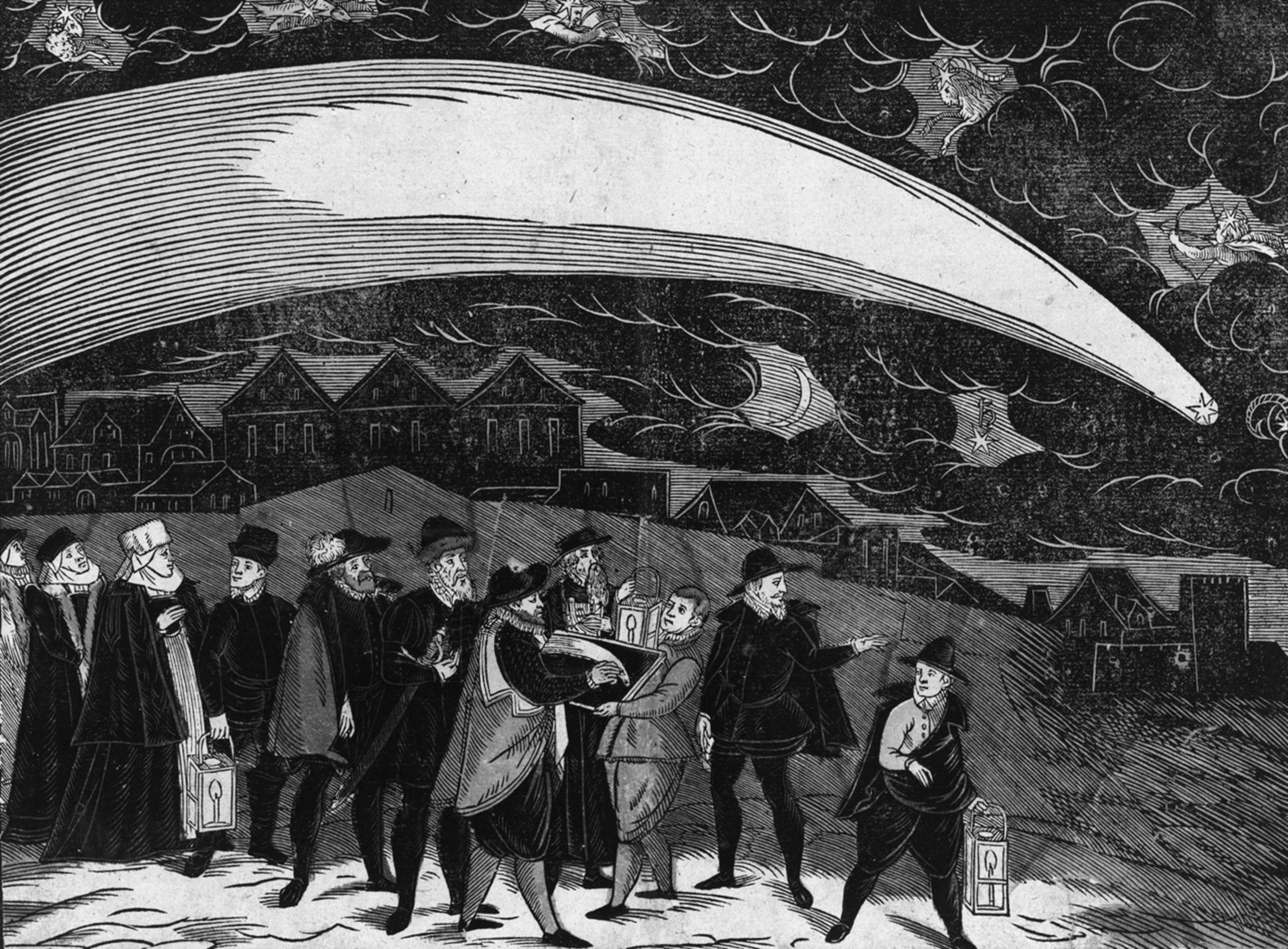
According to the article, Jeremiah in the Village: Prophecy, Preaching, Pamphlets, and Penance in the Thirty Year’s War, in 1618, at the height of the Lutheran apocalyptic fervor, a great comet blazed across the European sky, visible from September 6-25, sparking more than 100 pamphlets warning of God’s anger and prophesying doom. Pastors preached from the Old Testament in the spirit of the prophet, Jeremiah, in lengthy mournful lamentations that would come to be known as jeremiads.

As the war unfolded, ministers used the misery and suffering to call for more pious action. Seeing themselves as the chastened Israelites, ministers admonished that only increased religious action and adherence could save their countrymen. Jeremiah stated that God punished those who deviated from his commandments. Therefore, the Germans suffering such horrible devastation were undergoing punishment for their sinfulness and lack of repentance. God even sent a comet to warn them, yet they still had not adequately repented.

I shudder to think how the father or mother felt who watched their home burn, their children die and even their spouse perish. The guilt must have been as devastating as the war itself – to be blamed for something so incredibly beyond your control or even influence.

Conrad Dietrick, a Lutheran minister, on New Year’s Day 1619 published a pamphlet of his sermon that was very straightforward:

  • What comets are
  • What they mean
  • What we should do as a response to the meaning

Then, he answered his own questions:

  • God sent the comet as a warning because sin abounded in Germany, although that theme had been ever-present since the Turkish threat in the 1580s.
  • Mend your ways.
  • Stop disregarding God’s commandments and live a moderate and pious life.
  • God might not have to follow through on his threat to destroy his people if they heeded the celestial warning and subsequent warfare and live within the bounds of Lutheran discipline.

One pamphlet called out the deadly sins of the parishioners responsible for the devastation, such as the following, therefore making Germany responsible and subject to punishment:

  • Excessive pride and display
  • Swearing
  • Fornication
  • Disobedience to authority

Oh, and by the way, good deeds alone aren’t enough to get you out of this pickle and earn God’s Grace, because your sins are very deep.

Preachers and pamphlets were the social media, television and radio of the day.

By the end of the war, in 1648, one pamphlet published regarding the Treaties of Westphalia opened with the comet’s prophesying appearance in 1618 and closed with the war ending, “by God’s Grace,” in 1648. In other words, the people were suffering and had suffered through their own choices and actions. No one was going to feel sorry for them. They deserved what God saw fit to do to them, and probably worse.

It’s interesting to note, that whether true or not, the idea that the comet had appeared for 30 days across the skies was connected to the fact that the war had lasted for 30 years. In other words, by that time, the comet wasn’t just a warning, it was simply accepted as having been an accurate prophecy of what was to come.

During the war, the ministers attempted to make the essence of the sermons reach home in their communities – tailoring the message as needed. As the war dragged on, they became discouraged that their parishioners, the “common men,” were apparently unable to either understand or fulfill their messages. Many pastors became increasingly desperate for the much-needed change within their congregation necessary to end the war and suffering, and their sermons became increasingly reproachful and filled with missionary zeal.

They continued to predict that war would devastate Germany, and they would continue to be correct. Preaching itself became a form of prophecy and the ongoing war and atrocities only confirmed the message.

Sermons of one minister included the following New Years’ Day messages:

  • 1623 – Amos 4:6-12 – On the 3 punishments of the land/dearth, war and devastation with which God now afflicts our dear Germany because of its sins and how we should properly view them.
  • 1624 – Haggai 1:6-7 – Laid out reasons why it has happened that in these times no happiness, blessing, and increase for timely nourishment can be found.
  • 1625 – How we should act when we hear of foreign war preparations, recruiting, and troop movements.
  • 1626 – Habakkuk 1:12 – Why the armies on the march are an instrument of God’s punishment.
  • 1627 – Ephesians 5 – How one may properly get along in the current troubled times of war.
  • 1628 – How Christian subjects should pray for their rulers in these troubled times.
  • 1629 – Jeremiah 47:6-7 – The Lord’s sword – that is the word of the Prophet Jeremiah wherein the only proper cause is laid out, why one sighs and calls in vain for peace and an end to the war.”
  • 1632 – Jeremiah 15:11 – Land ruin and war consolation.
  • 1636 – The year of the plague in Ulm, the minister stated that 15,000 people had died that year, including thousands of beggars and refugees from neighboring villages. About one third were deaths of citizens from Ulm. Some days as many as 170 died – going on to say that those figures of death and misery needed no more explanation other than that provided in Psalm 107:17-20.

17 Fools by reason of their transgression, and because of their iniquities are afflicted.

18 Their soul abhorreth all meat and they are brought to death’s door.

19 Then they cry unto the Lord in their trouble, and he delivereth them from their distress.

20 He sendeth his word and healeth them, and delivereth them from their graves.

  • 1637 – Jeremiah 14:19-20 – Hammer of Peace, wherein is reported, what the causes are that the Peace that we have longed for for so many years has not come at all or let itself be seen.
  • 1638 – Psalm 14 – Heartfelt Zionish New Year’s Sigh – This was the year that cannibalism was reported in Breisach during a siege.

One preacher said 8 times in a funeral oratory for a minor noblewoman, “O, that we have sinned so much.” The topic and images of both punishment and penance, along with exhortations, were common themes in the sermons of Lutheran pastors during the war. They repeatedly referred to and lamented, “Oh woe, oh woe, the great sinfulness.”

How did the residents feel who heard these sermons that clearly placed the blame for the war and their great suffering squarely on their own shoulders?

In 1630, the shoemaker, Hans Heberle, in Neenstetten wrote as a preface to his journal that he began with the 1618 comet:

Anno 1618 a great comet appeared in the form of a large and horrible rod of punishment, with which God mightily threatened us because of our sinful lives, which we deserved many times over and still deserve today…what it means – what also will come of it – that is something we may cry hot tears over, as we, alas, experience now and have experienced from 1620 up to 1630 and which can’t be described.

Depending on one’s perspective, two other dates for the “beginning” of the war are given in contemporaneous literature; 1617 which is the 100 year anniversary of Martin Luther’s 95 Theses, a particularly galling event to Catholics, and 1619 when Ferdinand was elected Holy Roman Emperor.

It seems that the more pious believers suffered inwardly, feeling responsible for the devastation by their failings. The less pious certainly suffered, but not from the added layer of guilt.

Most people seemed to believe what they were being told and accept the horrible responsibility for what befell them. In the words of one man, “our sins are more than the stars in the heavens, more than the sand on the sea, more than the dust on the earth. Because we have sinned excessively, the punishment has overwhelmed us.”

The ministers and people of the Palatinate, along with the rest of Germany, tried their best to make sense, through the lens of religion, of a situation over which they had no control. Anything resembling normalcy was entirely absent. By the time the war had ended, not only were millions dead as a result, untold more had died not directly due to the war, but due to age or being displaced, having begun their lives in bucolic villages where they expected to live out their lives.

Nothing could have been further from the truth.

We don’t know if Steffan Koch lived to see the end of the war and his daughter’s marriage in 1650, but another pastor celebrated the end of the war in 1648 with one last passage from Jeremiah 33:47:

Thus says the Lord: In this place of which you say:

It is a waste without man or beast,” in the cities of Judah and the streets of Jerusalem that are desolate, without man or inhabitant or beast, there shall be heard again the voice of mirth and the voice of gladness, the voice of the bridegroom and the voice of the bride, the voices of those who sing, as they bring thank offerings to the house of the Lord: “give thanks to the Lord of hosts, for the Lord is good, for his steadfast love endures forever!” For I will restore the fortunes of the land as at first, says the Lord.

Indeed, two years later, Steffan Koch’s daughter would be the voice of the bride in the church in Dürkheim.

The Church of St. Johannis in Dürkheim

The church in Fussgoenheim was destroyed during the Thirty Years’ War, so we have no record of what that church looked like, or even who was buried in the churchyard. The books of baptisms, confirmations, marriages, and burials, written in Steffan’s own hand was destroyed.

We don’t know much about Steffan’s life after Fussgoenheim, aside from the fact that Dürkheim is one of only two cities that stood, and that his daughter married into another Fussgoenheim family in 1650. Of course, we don’t know that Jerg Kirsch’s parents were actually from Fussgoenheim before the devastating war, or if the couple returned there because Jerg was able to obtain an order to become the co-lessee of the Josten’s estate in 1660.

What we do know is that from the time Steffan left Fussgoenheim, probably between 1620 and 1622, likely before the birth of his daughter, Margretha in about 1630, the church in Dürkheim, for however long he lived, was his church home.

To the best of our knowledge, Steffan was never the pastor there, because he was not referenced as such in Margretha’s marriage record. Given that he certainly didn’t die until after Margretha was conceived, it’s likely that he spent at least some time in Dürkheim, in the church there which does survive.

I would wager that Steffan helped the pastor there as he could – perhaps filling in when necessary. Dürkheim suffered terribly from both plague and starvation during the war, so there would likely have been many funerals, some occurring hurriedly so that the body or bodies could be quickly buried.

So much suffering, so much need – so many who would welcome the comforting hand and prayers of a minister, even if Steffan wasn’t their official minister. He was still a man of God, having answered a higher calling. He would have known what to say to provide comfort for the grieving.

I can only extrapolate about how Steffan felt in Dürkheim. It must have been some torturous combination of every-single-day terror, gratitude for surviving, at least so far, grief at the life they had to leave behind, grief over what their family, friends, and neighbors were suffering, probably grief over the deaths of his own family members, hunger, and overwhelming guilt if he indeed believed that God was punishing him for his lack of…well…pretty much everything. I can’t even begin to imagine what it would be like to see your child starve and die if you believed their suffering was doled out by God because YOU weren’t pious enough.

On the other hand, Steffan may have somehow taken comfort in his religion. Given that his faith would have been strong enough to commit his life to convincing others that Lutheranism was indeed the way and the light, he probably believed that whatever happened was “God’s will” and that those who passed over were indeed sitting at the feet of God in Heaven – relieved from their earthly worries here.

Or, maybe some combination of all of that.

Since I don’t know what or how he felt but do know what the church looked like, I’d like to take a walk with Steffan and perhaps, to be able to glimpse at least this much through Steffan’s eyes.

Walking in Steffan’s Footsteps

The church of St. Johannis, or St. John, now known as the Castle Church was built in Dürkheim sometime before 946, obviously as a Catholic church. Around 1300, the current church, minus the current spire, was built on the original foundation. Ironically, the church was built in part with indulgences for those believers who visited the church – one of the very things that caused Martin Luther to part ways with the Catholic Church.

In 1504 and 1508, burial crypts and a chapel were built on to the church and would have been present when Steffan walked those hallways.

Dürkheim was not a small town. This illustration from 1450, 200 years before Margretha was married in the church there, shows that the houses were clustered closely together.

Limburg Abbey was destroyed in 1504, the remains resting high above Dürkheim. You can take a stunning flight over by drone, here. While Steffan wouldn’t have had this bird’s-eye-view, he would have seen the ruined Abbey above the town – and you can see the town from the drone footage. Wow, just wow.

The Hardenburg castle stood sentry over Dürkheim when Steffan trod these streets, although it lies in ruins today.

This 1630 drawing of the church with the Latin school across the yard doesn’t’ show the wooden crosses marking the graves in the churchyard. Steffan and others stood here all too often. I can’t help but wonder about mass graves during that time of inordinate death resulting from warfare, plague, and starvation.

By comparison, you can see the church today, with the churchyard now paved with brick or cobblestone. I can’t help but think of the generations of people whose ashes rest below. And yes, my mind does wander to bones and DNA.

This engraving, from 1650 shows the fortress and the church that Steffan attended, and where his daughter, Margretha, was married that very year. This scene would have been very familiar to the Koch family.

This drawing from 1787 shows the ruined abbey in the distance

Today, the church which sports a tall spire that was replaced in the 1800s nestles in the modern city of Bad Dürkheim.

The ancient streets and a few old houses remain today, probably rebuilt after the devastating 1689 fire.

You can still walk up to the church on the old cobblestone streets, approaching from the rear, here. Steffan probably walked this pathway hundreds if not thousands of times. I have to wonder if the residents sought refuge inside the church from time to time as troops advanced.

Only the walls of the church remained after the church was burned in 1689, taking roughly 20 years to repair and rebuild. These walls stood when Steffan walked in the churchyard surrounding the church, now covered with bricks.

Von Immanuel Giel – Eigenes Werk, CC BY-SA 3.0, https://commons.wikimedia.org/w/index.php?curid=33547176

The original church was constructed at different times. Beautiful stonework with quarried stone corners on the rear of the Leininger burial chapel that was added in 1505. The door allowed the Count to exit the service without going through the church proper.

Von Immanuel Giel, CC BY 3.0, https://commons.wikimedia.org/w/index.php?curid=57943700

The church is beautiful, even without the new spire.

Walking around the church, we can see the burial chapel, built in 1505 and already more than 100 years old when Steffan lived there.

I wonder if the vine harkens back to the time before the churchyard was bricked or paved with cobblestones. We can’t see the beautiful door on this side of the church very well.

Steffan walked through the larger double side doors on the other side of the church. The door in place at that time would have led to the churchyard and was probably the doorway through which coffins were carried after the funeral service on their final journey.

The size of this side door and stones shows just how massive this church is and gives us some idea of why it took 35 years or so, from about 1300 to 1335, an entire generation, to build.

Inside the burial chapel, we find this stone of Agnes von Leiningen-Hardenburg who died in 1586. Did Steffan perhaps seek solitude in the quietness of this chapel from time to time? As refugees, they probably lived in cramped and noisy quarters with other families.

In the same burial vault, the stone of the Count who built the chapel beside his consecration cross.

Inside the burial crypt.

Today, the tombstone of the Limburg abbot who died in 1531 has been moved outside, but when Steffan sat inside this church, this stone was there was well. I wonder how Steffan felt about this, given that the Abbott was clearly Catholic at that time, and the devastation Steffan was living through day-to-day was wrought by a war with Catholics and Catholicism.

Von Altera levatur – Eigenes Werk, CC BY-SA 4.0, https://commons.wikimedia.org/w/index.php?curid=53165415

Another stone moved outside shows the alliance coat of arms of the Lords of Weingarten and those of Sickingen.

Von Immanuel Giel, CC BY 3.0, https://commons.wikimedia.org/w/index.php?curid=57943697

Steffan would have walked past, and perhaps stopped to tough this double epitaph carving of Count Emich XII. and Maria Elisabeth von Pfalz-Zweibrücken in the castle church, carved in 1612. She died in 1629, so it’s certainly possible that Steffan was present at her funeral.

Behind the figures is a relief of the Hardenburg Castle, home of the Leiningen family.

Von Immanuel Giel, CC BY 3.0, https://commons.wikimedia.org/w/index.php?curid=57943744

Did Steffan absentmindedly run his fingers along these carved branches, leaves, and acorns, silently praying for strength?

A lovely, friendly gargoyle that Steffan saw and perhaps loved too. Did he tell his children or grandchildren stories about this mythical beast? Gargoyles are said to protect what they guard against evil or harmful spirits. If the gargoyle’s mouth was open, it was devouring a giant. This gargoyle looks kind of like it’s contentedly chewing its cud.

This south aisle, facing west, probably looked much the same, without the modern accouterments, of course. Did the thick walls deaden the city sounds, allowing deep reflection?

Perhaps the single most iconic item of the Lutheran faith representing inclusion into the flock, both earthly and Heavenly, is the baptismal font. This font survived from 1537 and if any of Steffan’s children were baptized in this church, this was the font in which that holy ritual occurred. Given that he was a minister, Steffan may have baptized his children himself.

I can close my eyes and witness that act of faith, love, and devotion.

Von Immanuel Giel – Eigenes Werk, CC BY-SA 3.0, https://commons.wikimedia.org/w/index.php?curid=33547186

While the stained glass windows and cross are new, the nave is not. Steffan may have preached here and assuredly prayed in this sacred space; for safety, for deliverance, for himself, for his family, and for so many others. But more than anything, Steffan probably prayed to find a way to live better, more religiously, more piously, in order that God would not be angry with him.

Punishing anyone with warfare punished everyone with warfare. Steffan would have prayed to find a way to be a more convincing leader, not so much for himself, but for the other parishioners who suffered for 30 years, and more. If only, if only, he could successfully obtain God’s Divine assistance to convince them. If God would just grant him the words that would be convincing enough.

Not unlike how many of his descendants feel today, in the midst of another plague that could, in fact, be affected and slowed by convincing enough people to do so. A direct link from me to Steffan, across 400 years, almost exactly.

Given what Steffan went through, whether or not he survived the actual war and accompanying horrors, I’d expect that prayer is what defined his life – and probably his death. A lifetime of increasingly desperate prayer.

_____________________________________________________________

Disclosure

I receive a small contribution when you click on some of the links to vendors in my articles. This does NOT increase the price you pay but helps me to keep the lights on and this informational blog free for everyone. Please click on the links in the articles or to the vendors below if you are purchasing products or DNA testing.

Thank you so much.

DNA Purchases and Free Transfers

Genealogy Products and Services

Genealogy Research

Books

Holiday Idea – Books at Genealogical.com

This week’s holiday gift idea is books at Genealogical.com.

Genealogical.com isn’t just a bookstore, they are a small genealogy-focused publishing company. Translated, this means that without them, none of the books you find here would be available. Or, minimally, it would be much, much more difficult for genealogical authors to find a publisher meaning most of those books would never come to fruition. When purchasing books, please consider supporting this business that supports the industry we love.

Who doesn’t like to curl up by the fireplace this time of year with a hot drink and a book? My idea of a good book is something genealogy or history related. Maybe I should warn you – I’m a book junkie – attracted to bookshops (and maps shops and quilt shops) like a moth to a flame!

For the holidays, you can order books for others and for yourself too. Kind of like packing cookies – one for them, one for you😊

When we are researching our ancestors, often we overlook books that could really be useful.

click to enlarge

Let’s take a look at Genealogical.com.

They have all kinds of books available three ways:

  • Traditional printed books in their online store (2364 to be exact)
  • Ebooks (772)
  • An online subscription model that includes access to 740 ePub books for either $49.95 for 3 months or $99.95 for a year

Search and Filter

Personally, I seldom get past the first page without a bright shiny object catching my attention.

However, tear yourself away and look at the search section, at the right of the main page.

Filtering by region is generally state and country.

Subject filters are where I can easily disappear. There are so many options. Let’s say, for example, that I want to search for Native American topics.

There are 155 books about Native Americans. But wait, there are also 6 about Palatines and 16 about Pennsylvania Germans, both of which also pertain to my genealogy.

I think I need to make a list and convince Santa I’ve been good – or maybe just order them myself!

You can also filter by time period.

Ok, I’m curious – what kinds of books are in the Middle Ages category?

click to enlarge

Those look quite interesting. Do you know if your ancestor was one of the Magna Carta Barons? Or descended from Charlemagne?

Authors

Have a favorite author? Type in a surname and see if they have published something at Genealogical.com? Let’s try Elizabeth Shown Mills, someone just about every genealogist knows – and if you don’t, no time better than the present.

Good Gravy! Elizabeth has 16 items available. I had no idea.

click to enlarge

Her legendary foundation book, “Evidence Explained” is here, of course, but also several more including this gem about her FAN Principle – Friends and Neighbors.

I can’t even begin to tell you how many times I’ve used the FAN Principle successfully. In a nutshell, you track your ancestors by accumulating evidence about their associates – friends and neighbors (FAN). You can order this Biographer’s Guide for yourself and let Elizabeth explain exactly how this works.

Free

Last, on the Blog tab, you can enjoy lots of really useful free articles.

Check Genealogical.com out now. What are you going to order, and how do you hope it will benefit your research?

_____________________________________________________________

Disclosure

I receive a small contribution when you click on some of the links to vendors in my articles. This does NOT increase the price you pay but helps me to keep the lights on and this informational blog free for everyone. Please click on the links in the articles or to the vendors below if you are purchasing products or DNA testing.

Thank you so much.

DNA Purchases and Free Transfers

Genealogy Products and Services

Genealogy Research

Books

DNA Tidbit #4: Filter Matches by Country at MyHeritage

How many of you have ancestors who lived in other countries, either now or at one time? I see all those hands popping up! Me too.

At MyHeritage, you can filter your DNA matches by country.

If you’ve tested elsewhere, but not at MyHeritage, you can upload your DNA from another testing company to MyHeritage, here. Step-by-step instructions, if you need them, are here.

DNA Tidbit Challenge: Sign on to your MyHeritage account and filter your DNA matches by location.

It’s easy.

After opening your DNA match list, click on the filter icon to expose the filter options, then the down arrow shows available locations where your matches are from.

This is NOT where their ancestors are from – but where the tester themselves are from.

In my case, finding people who live in either the Netherlands or Germany and match me means there’s a good chance that they are from my mother’s Dutch or German lines since they immigrated to the US in the 1850s and 1860s.

click to enlarge

Glancing through my match list, I notice two who share a surname I recognize. Of course, I want to determine if these people match my mother’s side of the family.

Although Mom passed away long before MyHeritage began DNA testing, I do have her results at FamilyTreeDNA so I transferred them (free) to MyHeritage as well. You can click here to transfer.

If your parents haven’t DNA tested, and can’t, other close relatives such as aunts, uncles, grandparents, etc. will be useful too.

I clicked on “Review DNA Match” to review my matches information.

The first person doesn’t match my mother nor any recognizable close relatives from my father’s side, so this is likely an identical by chance (IBC) or false match.

The second person does match my mother but has not elected to compare matching segments. Unfortunately.

The common surname in their tree doesn’t reveal a common location, and their tree is very small, so my only clue left is the “Shared Ancestral Places” map.

The grey pins are my ancestors, and the black pins are my match’s ancestors.

Notice that we have clusters of ancestors in close proximity, some about 10 miles apart.

Without more robust tree information or without the ability to view DNA segments and look for triangulated matches, I’m not able to go further, at least not without contacting this match.

If my match enabled segment viewing, I would be able to paint this match at DNAPainter and likely know which line we share in common. I’ve written about how to use DNAPainter, here.

DNA Privacy Settings

Here’s how to enable segment viewing.

Your DNA Privacy settings at MyHeritage are located under the down-arrow by your profile name.

Next, click on “My DNA Preferences” and make your selection.

click to enlarge

Summary

The MyHeritage focus in Europe pays off handsomely for people whose ancestors hailed from there – or testers who live there today. Lots of Europeans test with MyHeritage.

I have 300 matches from the Netherlands and 221 from Germany. The MyHeritage feature that allows me to sort by location is very useful. I’ll be reviewing each of these matches.

I have fewer matches on these lines overall because those immigrant ancestors have fewer descendants in the US to test – so the ability to find matches to people who don’t have US lines is a real boon. If the match is valid, that narrows the possible common ancestors immediately.

In fact, I just noticed a Dutch match with 11 common surnames and a Theory of Family Relativity.

Hot diggity – look here. Those purple pins should be colored gold because they are common ancestor locations in our tree.

This person matches and triangulates with my mother and first cousin as well. I know what I’m doing for the rest of the day!

Now, it’s your turn.

What interesting tidbits can you find when filtering by country? Do you have people in unusual countries that you don’t recognize who match you? Check it out!

_____________________________________________________________

Disclosure

I receive a small contribution when you click on some of the links to vendors in my articles. This does NOT increase the price you pay but helps me to keep the lights on and this informational blog free for everyone. Please click on the links in the articles or to the vendors below if you are purchasing products or DNA testing.

Thank you so much.

DNA Purchases and Free Transfers

Genealogy Products and Services

Genealogy Research

Books

Margretha Koch, (born 1625-1630), The Preacher’s Daughter – 52 Ancestors #315

I surely wish we knew more about Margretha Koch. We’re fortunate to have a few tidbits.

The first and only record for Margretha directly is her marriage to Johann Georg “Jerg” Kirsch in Dürkheim on September 9, 1650. Given the customs of the time, she was probably 20 or 21 years old.

My friend, Tom, translates:

On the same day (9 Sept 1650) Hans Georg Kirsch and Margretha, legitimate dau of M Steffan Koch, former pastor in Fussgonheim.

By inference, this tells us that Margretha grew up entirely during the Thirty Years’ War which started in 1618, a few years before she was likely was born. By 1622, all of the remaining population in the Palatinate that hadn’t been killed or died as a result of the initial onslaught of the war had left the countryside with what little they had left, but not by choice.

The entire population became exiles with nothing more than they could carry, as shown by this painting, seeking shelter someplace, anyplace as a simple matter of survival. The cities swelled, then one by one, they fell either in battle or by siege.

This drawing of Casale Monferrato in 1630 shows the soldiers waiting. During a siege, the attacking soldiers simply surrounded a city and waited as the pinned-in residents starved and died. No food could get in, and they couldn’t escape without surrender.

During the siege of Prague in 1648, the soldiers waited until the residents were weak from hunger and thirst, then attacked.

Life in Exile

Humans have amazing resiliency. Margretha was probably born between 1625 and 1630. Only three Palatinate cities withstood the ravages of war and weren’t burned to the ground. Dürkheim, now Bad Dürkheim, was one of those, and that’s where Margretha would have been born to refugee parents. The first wave of attack in 1618 burned most of the Palatinate, so by the time Margretha entered the world, they were likely settled in Durkheim and had been for some time.

I wonder if the family lived in a communal home, crammed to the gills with other families in the same dire situation. Dürkheim was a walled city, which afforded protection, but also prevented expansion to accommodate masses of refugees.

Margretha’s parents would have worried night and day about where their next meal was coming from and simply if they would survive to the next day and the next week. Since the fields had been burned by the advancing army, there were no crops nor animals. The grim reaper arrived as starvation. Estimates range as high as 60% of the population died, someplace from 4.5 to 8 million in a political-religious war with the French Catholics attempting to eradicate German Protestantism.

Note the devastated landscape in this 1647 painting of marauding soldiers.

Surviving a year might have seemed impossible, but one year poured into the next while the war was constantly fought around them – for 30 long years – one after the other.

Somehow, miraculously, Margretha survived.

Margretha, growing up had never known anything else. However and wherever they lived in Dürkheim – it was “normal” to her.

The Church

The church was always the center of a German town, but in Margretha’s case, even moreso. Margretha and her family probably lived within sight of the church. Dürkheim wasn’t exactly a large city and her father would have wanted to be near the church. After all – it was their cherished religion for which they were willing to sacrifice their lives.

We know that Margretha’s father, Steffan Koch, was a Protestant minister in Fussgoenheim before the war, so their home would likely have been filled with prayer and they would have attended church every Sunday in the nearby St. Johannis Church, today known as the Castle Church.


The Latin School Margretha would have attended was located just across the churchyard, which, at that time would have been filled with wooden crosses. This church had already been in use by then for hundreds of years, so graves were probably already being reused.

It’s certain that Margretha would have buried her parents here, unless of course by some miracle, they returned with Margretha and Jerg to Fussgoenheim sometime around 1660. There wouldn’t have been much if anything to return to.

The French burned everything more than 40 years earlier. The ONLY reason Jerg Kirsch with his young family would have left Dürkheim at that point was for opportunity – and that came their way when, somehow, they became co-lessees of the Jostens estate. I must say, given that this was a lease from a religious body, I have to wonder if Steffan Koch was somehow involved with those arrangements.

We have no reason to doubt that Margretha was Jerg’s only wife, although it’s certainly possible that she died and he remarried.

The end of the war and the move to Fussogoenheim was neither immediate nor uneventful. The archivist in neighboring Schauernheim tells us that people didn’t begin to return immediately after the war. A few brave souls began returning about 1650 and even then, only a handful in each village.

Another War, Another Evacuation

After settling in Fussgoenheim in 1660 or so, the family had to hurriedly evacuate again in 1674 when France again annexed the Palatinate to the Rhine, declaring War on this region and in 1688, the French king instructed his soldiers that “the Palatinate should be made a desert.” They did their best. War had returned with a vengeance, along with starvation, with warfare not subsiding until 1697.

By the time they moved to Fussgoenheim, Jerg and Margretha would have had several small mouths to feed. By the time they left again, their youngest children, if they survived, could have been marriage age.

They remained in Dürkheim the second time until after 1695 when their son, Wilhelm, married. If Margretha was still living, she likely returned to Fussgoenheim with her sons by 1701 when Adam was noted as Mayor.

Children

We know, based on records from the mid-1700s in Fussgoenheim that Jerg had 7 children, which of course, means Margretha did too:

  • Johann Jacob Kirsch born about 1655, died before 1623 and married Maria Catharina, surname unknown. They had 6 known children beginning in about 1695 through about 1710.
  • Daniel Kirsch born about 1660, died before 1723. Nothing more known.
  • Johannes Kirsch, born about 1665, died November 15, 1738 in Ellerstadt, single.
  • Andreas Kirsch, born about 1666, died April 21, 1734, single or at least no children in Fussgoenheim. Lived in Oggersheim and Ellerstadt.
  • Johann Michael Kirsch, the Judge, born about 1661, died January 1, 1743, married Anna Margaretha Spanier, and had 6 children beginning in about 1700.
  • Johann Wilhelm Kirsch born about 1670, died before 1723, and married Anna Maria Boerstler in Durkheim in 1695. They had 4 known children beginning in about 1700 through 1718. A daughter, born about 1718 was named Anna Margaretha, likely for her grandmother.
  • Johann Adam Kirsch, born between 1650 and 1677, died before 1740, married a Greulich female, then Anna Maria Koob. He had 5 children, beginning about 1700 and continuing until about 1716.

Notice that there are no females listed. It’s possible they had no daughters, or we were unable to identify them through later death and baptismal records of other Fussgoenheim village residents. Many times women’s birth surnames were not recorded.

Let’s hope that Margretha had the opportunity to enjoy at least some of her grandchildren.

What Happened to Margretha?

We don’t have any idea when Margretha died, but we do know that by 1695 when Johann Wilhelm married, she was either deceased or a widow. Johann Wilhelm’s marriage record in the church states that Jerg is deceased.

Given that Margretha’s sons that we are aware of moved back to either Fussgoenheim or that region, if she were living at the time her son was married in 1695, she may well have returned to Fussgoenheim with her adult children.

By 1701 when we know that Adam was living in Fussgoenheim, Margretha would have been between 70 and 80 years old, so it’s certainly possible that she is buried in the graveyard outside the beautiful church in Dürkheim, She could also have been buried in Fussgoenheim if she died while the family lived there between 1660 and 1674, or if she returned to Fussgoenheim after 1697 with her children.

_____________________________________________________________

Disclosure

I receive a small contribution when you click on some of the links to vendors in my articles. This does NOT increase the price you pay but helps me to keep the lights on and this informational blog free for everyone. Please click on the links in the articles or to the vendors below if you are purchasing products or DNA testing.

Thank you so much.

DNA Purchases and Free Transfers

Genealogy Products and Services

Genealogy Research

Books

Black Friday Weekend Sales – They’re Everyplace

Yes, I know it’s Saturday.

The Black Friday sales for DNA kits will continue through the weekend and into Monday. I have no inside knowledge, but I’m sure that there will be sales after Black Friday weekend, through the month of December, but the prices for DNA kits may not be as good.

Here’s everything in one place.

This is a great time to:

  • Make sure you’re in the big 4 databases. Each vendor has benefits that the others don’t have.
  • Purchase kits for close family members meaning parents, aunts, uncles, grandparents, cousins, etc. for those databases as well. For your genealogy, you don’t need your children (they have a subset of your DNA) or your siblings if you have tested BOTH parents.
  • Purchase kits to use later in the year.

Sale Prices

Here are the Black Friday weekend vendor sale prices:

Both Y and mitochondrial DNA tests help to build the genetic trees of both mankind and womankind.

Upgrades are on sale too – just sign on to your kit and take a look.

Not sure about the different kinds of DNA and when to order which test? I wrote a short article, 4 Kinds of DNA for Genetic Genealogy, that explains.

This is the sale everyone waits for – so if you’re interested, now is the time.

_____________________________________________________________

Disclosure

I receive a small contribution when you click on some of the links to vendors in my articles. This does NOT increase the price you pay but helps me to keep the lights on and this informational blog free for everyone. Please click on the links in the articles or to the vendors below if you are purchasing products or DNA testing.

Thank you so much.

DNA Purchases and Free Transfers

Genealogy Products and Services

Genealogy Research

Books

Preserve your Family’s Stories by Telling Them

This year has given us all a lot to think about.

One topic that has been brought into sharp focus for me is my ancestors who lived through, and died during, the 1918 flu pandemic known as the Spanish Flu. You might recall that even though the year 1918 was associated with that flu outbreak, it actually spanned parts of at least three years including two full winters.

I know that my father was in the Army at the time and very nearly died in the base hospital. In fact, he thought he was, in his words, “a goner.”

He wrote a few letters to his girlfriend, Virgie, who he later married. I was fortunate enough to inherit those letters after her death.

Otherwise, I would never have known anything at all about that time in his life – or even that he had that flu – let alone nearly died.

Looking at my family tree, all 4 of my grandparents were alive, but my mother had not yet been born.

However, all four of my father’s grandparents died during this time with a cause of death of “pneumonia” where we have a death certificate.

On my mother’s side, one of her grandparents was already deceased and the other three survived the pandemic. We don’t know if they were sick or not.

Other than my father, we know almost nothing about my ancestors’ lives during this time. What was it like? What were they thinking? Were they afraid? Did other family members or maybe people in the neighborhood die? Did they understand the infectious process?

So many questions.

The Gifts I Wish I Had

If I could reach back in time and ask my grandparents and great-grandparents for one thing, it would be the gift of letters – documentation of the daily hum-drum of their lives. Legacy letters. Newsy letters or a journal.  Maybe not so much telling me about the “big things,” although those too, but sharing personal aspects of their lives.

Let me put this in perspective. I have so many questions for my 8 great-grandparents that I desperately wish they had answered by leaving letters or journals. Something. Anything but silence.

  • Lazarus Estes was born in 1848 in Estes Holler in Claiborne County, TN and lived through the Civil War, dying in July of 1918. He would have been about 15 when the war broke out between the states. What was it like there? What did he do when there were battles within hearing of his family homestead? When the soldiers marched through the hills, confiscating all the food and livestock? How did they survive? And what about his sister, Elizabeth, sneaking into the soldiers’ camp and stealing their milk cow back? Is that true? His father, John Y. Estes was a POW – what was that like? Did they know he had been captured and where he was being held? Something happened right after the war when Lazarus’s father signed all of his household goods over to 17-year-old Lazarus. What was going on? Lazarus was the grandson of John R. Estes who settled in Claiborne County and the grandson of a Revolutionary War veteran, George Estes who didn’t die until just before the Civil War. George was reportedly at Valley Forge that terrible winter. Is that true? What was going on with George’s daughter, Susannah who never married, had 5 illegitimate children at a time when that was absolutely NOT socially acceptable, and went on to own all of George’s land. I’ve love to hear those stories. But there are no stories preserved today beyond vague references.
  • Elizabeth “Betty” Ann Vannoy was born in 1847 in Hancock County, TN, married Lazarus Estes, and died in Claiborne County in October of 1918. She too would have experienced the Civil War firsthand. It’s through the Vannoy family that we do have the story about the family taking the chickens and hiding in a cave to escape the marauding soldiers. Was that true? Where was that cave? Her father Joel Vannoy had mental health challenges, being committed to the Eastern State Mental Hospital in 1886s. How did that affect her and the family? What was he like? Why was his body dug up and reburied in a different grave? Why did Elizabeth lose so many children? Where did that oft-repeated story of Native American ancestors come from? Did she know that the “flu” was deadly dangerous before they both contracted it and died?
  • Joseph B. “Dode” Bolton was born in 1853 in Hancock County, TN and died in February 1920, just 12 days after his wife, both of “pneumonia as a result of the flu.” First, how did he get the nickname “Dode” and where did it come from? What did the initial, “B.” stand for? Where did your father’s middle name, Preston, come from? What can you tell me about the life of your immigrant grandfather, Henry Bolton? Were he and his brother, Conrad, really kidnapped on the docks in London? Or sold by an evil step-mother? Did Henry actually serve in the Revolutionary War, hand-selected by George Washington to care for his horses? Who were your grandmother, Nancy Mann’s parents? What was your great-grandmother, Mary’s surname, the woman married to John Harrold in Wilkes County, NC? Were they really Irish?
  • Margaret N. Clarkson or Claxton was born in 1851, married Joseph “Dode” Bolton, and died in 1920 in Hancock County, TN. I’d like to know if her middle initial was actually N. and if so, what was the full name and where did it originate? She too would have lived through the Civil War. Her father, Samuel Claxton/Clarkson was disabled with a bowel disease he caught during his Union Army service that eventually killed him. What does she remember about her father’s service in the Union Army? How did he cross the mountains to enlist? Was there pushback in the local community because he fought for the north? What is the truth about the haunted Rebel Holler, near where they lived, relative to the Civil War?

My Mom’s side was quite different. They lived in Northern Indiana.

  • Hiram Bauke Ferwerda, Ferverda here, born in Tierjerksteradeel, West Dongeradeel, Friesland, the Netherlands, immigrated at the age of 14 in 1868 and died in 1925 in Kosciusko County, Indiana. As a Mennonite family, they settled in northern Indiana among the Brethren where his father was a farmer and teacher. I would love to have a journal of his early life, his time as a baker’s apprentice in the tiny Dutch hamlet on a tiny canal comprised of all of 7 houses, up through and including the Atlantic crossing. His brother, Henry, seemed to have been tortured by epilepsy and resulting mental illness. Henry died a pauper in 1898 and was not brought home to be buried. I’d love to know more about what happened. How did Hiram Bauke, a Brethren man wind up becoming the town Marshall and a local banker? What happened?
  • Evaline Louise Miller was born in 1857 on a farm near New Paris, Indiana, married Hiram Ferverda, and died in 1939 in Leesburg. All 11 children lived to adulthood and all but two outlived her. I’d like to know about her early life in the Brethren Church. Her father, John David Miller, and grandfather, David Miller, homesteaded among the Indians along Turkey Creek in the 1830s and I’ve love to understand more about those early years. Did John David Miller actually serve in the Civil War, even being a Brethren? Who is the mystery Elizabeth Miller, David’s second wife who died in “the sickly year” of 1838? Four of Eva’s sons served in the military, unheard of for a Brethren family. How did that happen and what did the family think? Something occurred that caused Eva’s estate to be distributed unevenly, with some debts forgiven and agreed to by all. What happened and why?
  • Curtis Benjamin “C.B.” Lore was born in 1856 in Blue Eye, PA, and died in 1909 in Rushville, Indiana. The life of his father, Antoine “Anthony” Lord/Lore, and his early life are both shrouded in mystery. Curtis was married to Mary Bills when he left Warren County, PA, and didn’t divorce until after he married Nora Kirsch in Indiana. What happened? There were rumors of another son, other than the children from his first marriage. Were there more children, and if so, where and who? What happened to C. B.’s siblings and mother, Rachel Levina Hill after his father’s untimely young death? Was his father, born to Acadian parents Honore Lord and Marie Lafaille in L’Acadie, Quebec, Canada actually a river pirate? What happened to Antoine, and when?
  • Ellenore “Nora” Kirsch was born in 1866 in Aurora Indiana to German immigrant parents. She married C. B. Lore and died in 1949 living with her daughter in Lockport, NY. Unfortunately, I can’t find her death certificate, so I’d like to know her cause of death. I’d love to hear about life at the Kirsch House in Aurora, Indiana. Why did her father, Jacob Kirsch, deed the property to her mother, Barbara Drechsel? What about that lynching – and how exactly did Jacob lose his eye? Did Jacob serve in the Civil War, and was he actually summoned to euthanize an elephant at the Cincinnati Zoo? Did Nora know that C.B. Lore had been married before when she married him and that he was STILL married? Did she know about his children? What did she do when a son showed up at her kitchen door a couple of years after his death, looking for him? Who was that child? Nora married again, unhappily, after C. B.’s death and I’d like to hear more about that marriage. Nora was an exquisite quilter, with one of her quilts representing the state of Indiana in the 1933 Chicago World’s Fair. I so very much wish she had kept a quilt journal.

Creating and Preserving Legacy Stories

When we think of recording legacy stories, we often get bogged down by the enormity of writing something book-length. Think small.

Here’s an example. On Thanksgiving morning, when I woke up to smell those yummy Thanksgiving smells, even though we were having pandemic-style Thanksgiving meaning that we weren’t seeing anyone – I recalled another Thanksgiving from the past. In a minute, I’ll share that memory with you as I posted on Facebook.

Note that Facebook is sharing spontaneously in the moment, but we should have no expectation of permanence or being able to google and find something later – or ever for that matter. Facebook is not mean to be an archive of any sort. So write those memories down and publish elsewhere – a blog, a webpage, or send these stories to your family directly. Maybe all three.

Additionally, I attach my stories to my tree at both Ancestry and MyHeritage. You may say, “yes but they make money from subscriptions,” and that IS EXACTLY WHY THOSE STORIES AND YOUR TREE WILL SURVIVE into the future. Free things tend to disappear. Businesses are in business for profit, pure and simple, and in this case, that works to your advantage.

Print those stories, send them to people individually as well as electronically to historical societies. I put mine together in booklet form and donate to the Allen County Public Library. The Family History Library (LDS) accepts items as well.

Here’s my short Thanksgiving Facebook posting that I also pasted into a document with the photos below. I hope this provides a bit of entertainment and perhaps inspiration.

Aromas of Thanksgiving Past

The smells of Thanksgiving. A unique blend that reminds me of Thanksgivings past. I’m so grateful that Jim likes to cook, because I don’t. I did it because I had to. He does it because he loves to.

One of my favorite Thanksgiving memories is the year mom accidentally got tipsy. I was about 13 or 14.

Mom didn’t drink. Not that she was opposed to drinking, it just wasn’t something she did much, if at all. Maybe occasionally socially.

My uncle and his family were coming for thanksgiving. Mom loved having family visit so she had been up cooking and getting ready for hours. We decorated for the holidays the day before their visit. Mom loved the Christmas tree too and was excited to put it up a couple of days early.

When Uncle Lore and his family arrived, he brought some type of adult beverage with him. I don’t remember what it was. I know it had alcohol in it because we kids had something else.

Mom hadn’t eaten at all that day. My uncle made her a pretty drink in a fancy glass and she began sipping it as she scurried around the kitchen.

Mom’s niece, Lore’s daughter, looked at me at one point and said, “I think your mom is tipsy.” I had never seen my mom tipsy – wasn’t even quite sure what tipsy was.

Mom always sang when cooking in the kitchen and sometimes kicked up her heels a bit with a dance step or two from years past, but that year she was singing and dancing both, across the kitchen floor as she cooked – and laughing. A lot. So were we. It was quite a raucous family sing-along.

We relieved her of cooking duty with hot things. By then, Mom didn’t much care.

After we ate, a meal she giggled through, Mom was tired and fell asleep with her glasses on – the first and only time she ever fell asleep at Thanksgiving.

We just covered Mom up on the couch in our midst. She smiled and shifted from time to time. I’m sure she could hear us because we all just continued to talk. And yes, we were bad and just might have decorated her forehead with a gift bow. I’m blaming my brother for that!

I fondly remember that quilt from her bed and that Christmas candle wreath in the window.

Mom was horribly embarrassed afterward. We teased her forever, of course. Our family was full of practical jokers and this opportunity could not be ignored. For those of you not a member of this kind of family – silence would have conferred shame, judgment and ostrification.

Singing together and Mom dancing around the kitchen is a very fond and joy-filled Thanksgiving memory for me – along with the ensuing joking and laughter for years after. It speaks to the humanness of everyone involved. Even if Mom was mortified that she had become a wee bit tipsy.

Your Legacy Stories

What fun stories come to mind that your descendants, born or not yet born, would be interested in hearing? How about nieces or nephews? What information about your life or that of your ancestors would you like to share with them? Think about how far back in time my grandparents or great-grandparents could have discussed with first-hand knowledge that was never preserved.

How about telling future generations about 2020 – you know one way or another, or maybe in multiple ways – it’s already legendary. How about sharing your perspective for posterity?

I’m positive there are heartwarming, amusing, or funny stories someplace in your family that desperately need sharing!

Don’t leave your family with a list of unanswered questions.

Give your family the gift of a family legacy story. It’s free to create and so much more personal than anything you could ever purchase – even if you could shop safely right now!

Happy holidays everyone!!

_____________________________________________________________

Disclosure

I receive a small contribution when you click on some of the links to vendors in my articles. This does NOT increase the price you pay but helps me to keep the lights on and this informational blog free for everyone. Please click on the links in the articles or to the vendors below if you are purchasing products or DNA testing.

Thank you so much.

DNA Purchases and Free Transfers

Genealogy Products and Services

Genealogy Research

Books

Heintzman Muller and the Mystery of the Boltigen Choir Court Window – 52 Ancestors #314

Old, meaning really old records are extremely rare. Once you’ve reached the end of the church records, and you’re back in the early 1600s, the late Medieval age, in remote alpine villages and hamlets in Switzerland, let’s face it, you’re likely not going to find much of anything except pristine mountain meadows and Edelweiss.

By Böhringer Friedrich – Own work, CC BY-SA 2.5, https://commons.wikimedia.org/w/index.php?curid=11882229

At that time, alpine chalets clustered in tiny hamlets were waystations on mule paths across the Alps between France and Switzerland.

The highlands were only accessible by pack animal and the locals enjoyed a secluded pastoral life, living off what they or their animals could produce, including cheeses. The higher the elevation, the fewer crops could be grown. At the highest elevations, no crops could be grown and the land could only be used for alpine pasture.

Von Yesuitus2001 at de.wikipedia – Eigenes Werk, CC BY-SA 2.5, https://commons.wikimedia.org/w/index.php?curid=12135242

The 37-mile-long Simme River originates at the foot of the Tierberggketscger glacier high in the Alps.

Beginning about where the red arrow points, the ice-cold Simme carves its way through the Simmental Valley, 37 miles until it empties into Lake Thunersee.

Along its path, we find the villages and hamlets that make up our family story – the family stories of everyone who lived in the Simmental Valley.

Along its downward path, the frothy waters of the Simme plunge over cliffs, its whitewater rushing through sleepy villages and hamlets consisting of just a few houses, past cattle and goats, near the house where Heinsmann Mueller lived in the 1600s.

Heinsmann Muller was the father of Johann Michael Muller, spelled variously as Muller and Mueller in Switzerland and Germany, and Miller eventually in the US, as noted in Johann Michael’s 1684 marriage record. I wrote about Heinsmann in the article Heinsmann (Heinrich) Muller (<1635-<1684) of Schwarzenmatt, Switzerland.

Based on Johann Michael’s birth, marriage, and one tax record for his father, Heinsmann, we know that Heinsmann was born sometime before 1633, that he died sometime after Michael’s birth in 1654/1655, and before Michael’s 1684 marriage where Heinsmann is noted as deceased.

After I thought we were at the end of the line with Heintzman, also recorded as Heinzman and Heinsmann, Müller in Schwarzenmatt, I was blessed with an amazing, and I do mean amazing find.

My friend Christoph who lives in Germany found the family who owns the historic Muller home, today. Peter, the current owner, wrote a letter explaining how he had tried to preserve the heritage of this structure.

I wrote about this amazing discovery in The Muller House on Kruezgasse; Humble Beginnings in Schwarzenmatt, Switzerland. The Muller home dates from 1556 based on the date carved into a wall. You can see another stunning preserved historic home from this same period, nearby, here, here, and more here, allowing us a cultural peek back in time.

While we can’t place Heintzman in this exact house, there were only a few houses in this tiny hamlet and we can definitively place the Muller family in this home just one generation later. There were only two Muller families living in Schwarzebmatt in 1653 and Peter’s house has to be one of them. This amazing historic home has been in the Muller family ever since and remains so today.

You can see that Schwarzenmatt, even all these years later, is still quite small.

The pin shows the group of houses where the Muller home was located along with another house from about 1693. This was the heart of this little hamlet, a mule and traveler stop on the way over the Alps into France through the Jaun Pass, one of the highest paved roads in Europe. This means, of course, that the homes along this route are also the highest settlements in Europe, then as now.

If you’re brave, ride along the current road on a motorcycle here. Motion sickness warning – trust me – hold on to something. I watched, but had to do it in several separate sittings.

The beauty of this alpine post-card-perfect view makes my heart just skip a beat.

Jaun Pass

The modern-day Jaun Pass road was completed 1878, cut through the hillsides and forest with modern machinery, not following an old trail. Prior to that time, according to Chris S. of Footsteps of Ancestors, another friend, who has worked with local historians, the old mule trail followed the Reidigrabe, the stream draining the Reidige(n) meadow into the Simme. This is the namesake meadow and stream of Chris’s Reutiger/Reidiger family. This trail followed the stream on both sides of the pass and used the naturally open ground in the meadows at and above the tree line.

Chris mentions that Jaun is the last German-speaking village in that direction. Charmey is Francophone. Jaun’s German dialect is quite unusual and very distinct, probably a combination of both and colloquially known as Switzerland’s 5th language. I would wager than Heintzmann, his ancestors and descendants spoke the franca lingua as well.

The ancient Jaunpass mule track, then known by the old field name still in use by the locals today, facilitated exporting cattle to Paris and wine and grain in the other direction, back into the Bernese Oberland.

Heintzmann Muller wasn’t just a peasant living in a convenient place for a stray shepherd or man walking with a mule over the mountain to rest, but an astute businessman, positioning himself in a location where his family stood to benefit from commerce and trade, providing services at the doorway to the other half of the continent. It appears that the Muller family owned mills in Eschi, Boltigen and Zollikofen in addition to an early B&B for travelers.

Today, we enjoyed beautiful photos of a sleepy out-of-the way hamlet and alpine meadows, while in the 1500s and 1600s, and likely long before, this mule path was literally *the* route from the Arrental through the central Simmental into the French-speaking part of Switzerland and on to Geneva, the southeast of France and the Mediterranean.

The Boltigen – Schwar(t)zenmatt – Reidigraben – Reineschli – (Lower) Reidigen* = Reidigenpass – Faengli – Leimerabach – Jaun Castle (ruins) – Jaun/Bellegarde path was the old route from time immemorial. It linked and still links the middle Simmental with the Jaun-Charmey Valley above Gruyeres and the road on to Lake Geneva, known locally as Lac Leman.

Either Going in Circles or Coming Full Circle

And so, we come full circle.

I lived in the village of Versoix on Lac Leman and in Crans-Montana for several months as a student, having no idea of course that my ancestral home was nestled in one of those alpine meadows I hiked at every opportunity and came to love so much.

While Versoix was a couple hours of hair-pin-turn mountain roads away from Schwarzenmatt, from the top of the mountains above Crans-Montana, I could literally have seen Lenk about 5 miles distant across the mountaintops, and possibly Schwarzenmatt, had I known to look.

Nothing like the magnetic draw of the Alps, reaching someplace in the soul, beckoning one back home.

Language is interesting in this part of Europe. We spoke French in Geneva, Versoix and Montana, but most people spoke German as well. Dialects abounded in locations just a few miles apart.

Interestingly, Chris says that Reidige in the Swiss dialect has no N, typical for most Swiss-German places, especially in Bernese dialect. Locals say “BOL-tih-geh” for Boltigen. So, I’m guessing the N is Schwarzenmatt would have been silent too.

The Original Mule Path

click to enlarge

The original Jaun Pass mule pathway went right past the old Muller house in Schwartzenmatt, which likely explains the large stable facilities and cheesemaking equipment found in the old homestead.

This home, at one end of the cross-mountain journey would have been a very important stopping point, going both directions, to rest both weary people and animals. The distance from Schwarzenmatt to Juan is about 8 or 9 miles as the crow flies, but the actual mountain distance considering the up and down elevation rise of about 1300 feet and the difficult and rugged high-altitude mountainous terrain could easily have doubled the walking distance.

If you look closely, you can still see the pathways along this quarter mile or less of the Reidiggraben leaving the small road. People didn’t live at this elevation. Nothing much did.

Peasant Revolt and Church Fire

We know that Heinzman Muller lived in Schwarzenmatt in 1653 when he appeared on the tax list of 43 “chimneys,” which equates to 43 or fewer houses, given that some houses might have had more than one chimney. Five houses away we discover Wolfgang Muller too – probably a close relative. We know that one Benedikt Muller lived in the hamlet as early as 1502. Was this an ancestor of Heintzman and Wolfgang? We don’t know, but I’d certainly say that it’s likely. It’s unlikely that many new settlers arrived, at least not to stay, especially not millers who needed location, money and opportunity all three to build a mill. If a second mill was needed, that would represent a good opportunity for a brother or son.

The closest church was down the mountain a mile or two in the village of Boltigen – and that church was mentioned as early as 1228 along with other churches where small groups of hardy souls lived, up and down the Simmental valley.

Unfortunately, the church in Boltigen burned in 1840, along with its records. Other nearby hamlets had early churches too, particularly St. Stephan and Zweisimmen dating from 1300s. In 1525, those two churches broke away from the Abbey in Bern and formed their own parish. Three years later, the Canton of Bern adopted the new faith of the Protestant Reformation and local churches were forced to convert.

I’m guessing there as much gnashing of teeth in the valley, especially in 1653 when the currency was devalued, allowing peasants only 3 days to exchange their copper coins for gold or silver at the old rate before a 50% devaluation, causing the fortunes of the rural population to be sliced in half overnight and precipitating the Swiss Peasant War of 1653.

Battles were fought as close as Bern with thousands of peasants organizing into an angry army and wielding weapons such as these.

I can’t help but wonder if the 1653 chimney tax list was in some way a result of or connected to these financial issues.

At least three families from this region migrated together to Steinwenden after the end of the Thirty Years’ War – our Johann Michael Mueller, the Stutzman line and Michael’s cousin, Jacob Ringeison (and similar spellings.)

It’s through those Steinwenden records that we found our way to Schwarzenmatt where Tom, Christoph and I sifted through the few remaining records hoping to connect the dots.

That’s it. Nothing more to be found due to missing Boltigen records. We’re done, right?

Nope

Meet Chris

Enter Chris S. from Footsteps of Ancestors, probably a distant cousin, who writes:

In many Canton Bern parishes there were two copies of the church books for a span of time, sometimes a long one. As you know, the Heimatort of a family and its members was and still is more important for Swiss personal and familial identity and records, rather than the birthplace of a person.

What’s missing from the archived records due to a Boltigen church fire are:

    • 1627-1709 baptisms
    • 1627-1661 and 1751-1815 marriages
    • 1627-1683 burials
    • Information such as a table of contents, index, and notes in spaces and margins on some records 1716 – 1728.

If these records are in a duplicate book, somewhere (but obviously not in the city of Bern at the archives), then they might be available sometime in the future. We can hope and pray.

The Boltigen church records which still exist are found here.

The great news is that these records exist, beginning in 1594. The not-so-great news is that they are not transcribed or indexed and unless you can read ancient German script AND know German, you’re out of luck.

Heinzmann was probably born before 1627, and if he wasn’t, his father surely was. It’s possible that more Mueller records will surface one day if these and other Simmental Valley records are ever indexed. It might be possible to reach back another 2 or 3 generations.

What’s a Heimatort?

Chris might have thought I knew what a heimatort was, but I didn’t. I love history because it provides me with endless opportunities to learn.

In Switzerland, citizenship has three levels. A heimatort refers to either “home place” or “citizen place,” not to be confused with place of birth or place of residence. A person may have been born or live in a different place than his or her heimatort, which confers specific legal rights and obligations.

In Switzerland, both historically and currently, people are identified by their heimatort, or place of origin, not their birthplace or place of residence. However, all three of those locations are sometimes one and the same. At one time, beggars and paupers were deported back to their heimatort so that the location where they lived didn’t have to support them if they could no longer support themselves. At another point in history, Switzerland was sponsoring immigration to the colonies if people would relinquish their right to welfare. You can view the register of Swiss surnames, here.

Boltigen Descendants

Chris is a Boltigen descendant as well. What are the chances of finding another descendant from that tiny hamlet in the Swiss Alps, yet he found me? Sometimes truth is stranger than fiction.

If you share any of Chris’s lines such as Rediger/Rettinger, Andrist/Andress, Jaggi, Bachler/Beckler and a Swiss-German “Indian John” Miller 1730-1798 found in colonial Pennsylvania, he’d love to hear from you at Rediger_Origins@outlook.com.

Chris writes:

I wrote earlier this summer with a question about your Muller/Mueller/Miller lineage from Boltigen.

This was to compare Boltigen area lineage Y DNA haplotypes with our Reidiger/Reutiger/Rediger haplotype after our Rediger cousin had test results post. Were our Reidigers originally Mullers, Jonelis, Boschungs, Andrists, Julmys, Teuschers, or something else entirely? We have lists of pre-1800 Boltigen and Jaun families.

It turns out that our Reidigers/Reutigers from Boltigen are none of these. Instead, their male lineage is a well-known and very old and large Swiss-German clan. Most of them are from the Aare valley, between Thun and the city of Bern.  Verification is happening now, and if anybody out there is curious as to the identity of this family, they can contact me.

Your Mullers are apparently involved here as well: My ancestor (Baschi’s) younger brothers Steffen and Michel had two Muller witnesses at their baptisms in Boltigen. Steffen’s in 1727 were Stefan Tschabel, Joseph Müller, and Elisabeth Warzenmeier. Michel’s in 1729 were Barthlome Mühlener (Von Mühlenen), Michel Müller, and Elsbeth Reutiger (Reidiger) born Sul(l)iger.

Of course, this Michael Muller can’t be our Michael Muller who was born in 1655 and was living in Steinwenden, Germany in the 1680s. But the 1727 Michael could certainly have been a cousin or other relative.

More Mullers in a Mannrechtsrodel

Thinking back, I recall seeing something else about inhabitants leaving and required “passports.”.

Christoph, my German friend, explained that:

Swiss emigrants usually had to register before emigrating abroad. This was done by them to retain the right to return to their home town in Switzerland later on, if needed. This right to do so was called “Mannrecht.” They (and even their children born abroad!) kept this lifelong right and received a passport.

Therefore, a register was written for all emigrants, stating their home town in Switzerland and the place abroad they went to. The register was called “Mannrechtsrodel”.

Unfortunately, there were exceptions to the rule. When registering, the emigrants had to pay 10% of their money. Some emigrants, especially the poor ones, thus emigrated without prior registration.

Another group of non-registered emigrants (there may have been further groups) were Swiss anabaptists, Mennonites etc. They fled abroad and/or where expelled from Switzerland, hence no registration.

Anyway, I found online a transcription of the Canton Bern “Mannrechtsrodel” starting in 1694 – see attached. If you go to the family name “Müller”, you will find quite a few ones from Boltigen, the parish including Schwarzenmatt.

Unfortunately, those are much too late for “our” Michael Müller. But now I start to wonder: Maybe the state archive of Bern houses another “Mannrechtsrodel” for the time prior to 1694? If so, it would probably not have been transcribed yet.

From the Mannrechstroddel, we find the following Muller men from the Simmental Valley:

    • December 2, 1720 – Michael Muller von hinter Zweisimmen zieht nach Leistadt (Bad Dürkheim)
    • November 29 ,1726 – Benedicht Muller von Boltigen zieht nach Eppingen
    • May 6, 1732 – Wolffgang Muller von Boltigen zieht sein Mannrecht nach Wurttemberg
    • February 1, 1752 – Christen Mullr von Boltigen aeiht sein Mann und Landrecht und seine Mittel nach Sundhausen/Elsass
    • March 14, 1754 – Johannes Muller von Boltigen zeicht sein Mann und Landrecht nach Horbach im Zwiebruckischen (nicht in SE/W)

One man, Michael, from Zweisimmen and four from Boltigen. The names of both Benedicht and Wolffgang will become familiar as we see them several times scattered across many generations.

Arms and Heraldry

Almost as an aside, Chris mentioned:

The second reason for this fast message is to also show you the second image.

Two Muller arms are shown on the 1683 Boltigen stained-glass window. It was in or for their Choir Court in or annexed to the local church. The window is now housed in a museum in the city of Bern. I don’t know if this represents two branches of the same (= your) family, or if there were two distinct Muller lines in the middle Simmental e.g. Boltigen. Either way, this image is very likely linked to your own family history.

Some of these arms were not at this extremely useful heraldry site which is great for finding Swiss families and determining their origins and branching.

I contacted the creator, Alfred Dobler, and sent him the Choir Court window image, and its source link, here. He immediately added the missing arms/surnames to the site.

What? There’s a window and my Heinzman Muller is involved?

The Choir Court Window

Note that the third image from the top on the right-hand side of the 1683 window clearly shows Heintzman Muller, along with a heraldic shield beneath. This information about the window, in German, was translated by Deepl translator into English as follows:

In 1587, the Bernese government had established the choir courts by means of a “Christian mandate”, which watched over the respect of the national religion, moral order and respectability in the parishes. For this purpose, the founders of the disc chose a suitable iconographic pictorial theme: the judges of Jehoshaphat, who are not to pronounce justice in the name of people but in the name of the Lord. The same representation is found in analogous form on several disc crack copies (by Hans Jakob Nüscheler, Werner Kübler the Younger, Lorenz Lingg and a Bernese master, among others).

Coat of arms names: in the center above: Mr. Abraham Walter this one / at the time Castlan Jm Obersimenthal; left row: Mr. Johaness Grim / predicant zu Boltige // Mr. Hans Jm Ober= / stäg Haubtman // Benedict / Müller // Mr. Stäffen / Zwalen // Mr. David Sulliger / old Kilchmeÿer // Mr. Bartlome Jonneli / new Kilchmeÿer // Stäffen Knöri / old Kilchmeÿer; right row: Mr. Hanβ Eschler / old governor // Mr. Hanβ Kunen / old Kilchmeÿer // Mr. Vlrich Jm Ober= / stäg Schreiber // Mr. Heintzman / Müller // Mr. Hanβ Grünen / wald Weibel // Hanβ Stocker / Grichtschreibe // Mr. Vlrich / Büller; bottom row: Hannβ Herder // Vlrich / Lutz // Mr. Bartlome / Zäller.

A second description:

The main picture, framed by inscriptions at the top and bottom, shows Jehoshaphat, the king of Judah, standing with his sceptre raised at the front left, at the installation of a judge, who is enthroned on the judgment seat surrounded by the people (2 Chr 19, 5-7). On all sides the representation is covered by the coats of arms of the choir court of Boltigen.

The 18-part wreath of arms begins above with the oval framed full coat of arms of the Kastlan of Obersimmental Abraham Walter. This is followed clockwise by the coats of arms of the following choir judges: Governor Hans Eschler, Kirchmeier Hans Kuhn, scribe Ulrich Im Obersteg, Heintzman Müller, Weibel Hans Grünenwald, court scribe Hans Stocker, Ulrich Bühler (Büeler), Bartholomäus Zeller, Ulrich Lutz Hans Herder, Old Churchwarden Stefan Knöri, New Churchwarden Bartholomäs Joneli, Old Churchwarden David Sulliger, Stefan Zwahlen, Benedikt Müller, Captain Hans Im Obersteg and Pastor Johann Grimm.

Looking at the list of other residents that comprised the Choir Court, and the 1653 chimney tax list thirty years earlier, it’s very likely that Heintzmann’s wife’s family is among these residents as well. Possibly his parents too. In fact, it’s likely that every single one of these people are related to each other in multiple ways and probably have been for generations. The perfect example of endogamy in this remote, sheltered, valley.

Chris provided a most helpful photo of the window with the names beside their shields.

click to enlarge

Heintzman Muller’s Shield

What does Heintzman Muller’s shield tell us?

Shields were inherited and identified the person and their family line in some way – often hung above doorways for tradesmen. A method of writing and identifying the craft of the person living there during a time in history when few could read or write. These shields, or blazons, were passed down in the family from father to son from at least the 1400s and 1500s.

Different family “branches,” especially if they were currently or historically in the same business as their ancestors, had similar but not exact heraldry. Keep in mind that the only way to learn a trade was as an apprentice – or to literally grow up “apprenticing” to your father.

As it turns out, the yellow “thing” (device) on Heintzman’s shield (blazon) is a cogwheel which was used in a mill to turn the wheel to grind the grain.

This article shows several examples, including the one shown in Heintzman’s shield.

The “cog-wheel”, also called a  “gear-wheel” or “mill-wheel”, with an embattled outer edge, is used in mechanisms from tiny clockworks to giant mill-works and is found in the canting arms (German Mühle, “mill”) of Mülinen c.1460 [GATD 20v].

Immanuel Giel 08:42, 29 October 2007 (UTC) (own photography)

Here’s an old German mill wheel, probably much like the Muller family mill wheels.

Looking at the coat of arms for Benedikt Muller, it’s a variation, only by color, of the same cog wheel. He was clearly a miller too, and not just by name.

This of course begs the question of whether these are two Muller lines, or one? Why are they both miller cog wheels, but different colors and positions?

Two Muller Lines, or One?

Back to Chris, again:

You’re very welcome for the choir court window mention earlier this year. I had a feeling you’d be fascinated with that like my family and I were.

Ringeison/-sen, Ringieson/-sen is an interesting surname. My maternal grandmother, is basically 100% Swiss-German Amish-Mennonite, and I know many Swiss-German surnames (Anabaptist or not), but I have never seen this surname often. I will keep my eye out for it in the future for you.

As for your Muellers (Mullers) in and around Boltigen, these might actually be two different families and male lineages, or at least sub-lineages. There are two Mueller coats-of-arms (specifically blazons = shields) on the choir court window. I’ve asked Rudolf, Aldo, and Ulrich about this, as well as some cousins in Switzerland.

The reason they urge caution against us thinking they were close lineages of the same family is two-fold.  The first is the number of mills in the Simmental, the second are the villages in the Simmental which are Mueller Heimatorts.

First, I need to mention that growing grain was common in the Simmental for centuries, from the Roman Era into the Renaissance. This valley grain was milled locally of course. Then, the continuing Little Ice Age (from about 1300-1870) made the climate too cold for lengthy hay seasons in the Alpine meadows and grain growing occurred on the valley floor. Wheat and barley growing switched to lower elevation areas, such as around the city of Bern (which helped it rise to power), and the Simmental floor was dedicated to hay production for winter feed. The higher Alpine meadows turned to summer-only pasture. This is now changing back as the world warms.

The history of St. Stephan tells us a little more, referencing the 1500s:

Traditionally the villagers raised crops on the valley floor for local consumption. Beginning in the 16th century, they started to trade for grain from the cities of the Swiss Plateau and raised cattle for meat, milk and cheese on the valley floor and in seasonal alpine herding camps.

Chris asks, “Where did your Mullers get their surname?” Chris isn’t the only one who wants to know.

Mills in the Simmental Valley

Chris provided a great deal of information about mills in the Simmental Valley. I’ve lightly edited his information to include mileage and maps.

Going downhill in the Simmental, there were two old grain mills in Lenk (23 km up the mountain, south, from Schwarzenmatt), and one near Zweisimmen (9 km south from Schwarzenmatt between Schwarzenmatt and Lenk, and the location of the ruins of an ancient castle from the 13th century.)

The Betelried mill in Zweisimmen is notable because it is a good example of an old dual-purpose mill, one with both saw (Säge) and grain (Getreide, Korn) – flour (Mehl). Its full name was Betelried Säge und Mühle.

And, amazingly, there are still two big old (ancient?) mill stones on the Furggeli (a slope and Alpine pasture) of the Albristhorn mountain, which is almost due east of St. Stephan.

People likely quarried these mill stones up there. But then how to bring them down?

Roll down carefully with many people and livestock assisting?

M

This mountain is not small, by any stretch of the imagination, and the Furggeli is located on the far side of the Albristhorn, meaning the stones would have to be brought around the mountain. Perhaps this explains why they were abandoned and remain as silent sentinels today. I can’t help but wonder how they were quarried, and when.

By H.sch.57 – Own work, CC BY 3.0, https://commons.wikimedia.org/w/index.php?curid=8127483

Wouldn’t the mill stones crack? It would depend on the composition of the stone, granite vs. dolomite, and so on.

Moving, on, headed downriver along the Simme, there was a former grain mill south of Boltigen proper called the Eschi Mühle (2.4 km from Schwarzenmatt).

There’s a good chance your Miller family’s male line has a link to this place, but it may be another mill in the Simmental, and that’s the whole point of the caution.

The Eschi road is the first road off (a left) the Jaun Pass road. The Juan Pass road is one of the highest elevation paved roads in Europe and the Pass at 4,951 feet is one of the highest passes as well, which means that the homes of our ancestors were too.

That’s something to think about – Heintzmann and Michael were living at the highest elevation of (European) humanity at around 2700 feet above sea level and they probably had absolutely no idea!

Very close to Schwarzenmatt, the ‘inner’ Mühle road is off the Eschi road, but there is another Mühle road (‘outer’), very close by – just on the other side of the property – off the main Simmental highway = the old valley road.  This is all near where the Weissenbach (Wyssenbach; left bank), Garfbach (left bank), and Goldbach (right bank) flow into the Simme River.

Muhle translates to mill.

You’ve been in and around Boltigen and likely remember the road off the main highway, south of Boltigen, heading to Ruhren.

Also, you may remember the turnoff to the Jaun Pass, which is a bit closer to Boltigen than the Ruhren turnoff. There is also a road between Ruhren and the Jaunpass road, so it makes a ‘triangle’ of sorts.

There are three old sawmills near Boltigen (2.4 km north from Schwarzenmatt): the Säge Schwarzenmatt, Säge Reidenbach, and Säge Taubental. These are water-powered and may have originally been grain mills that transitioned to wood cutting in the Renaissance during the colder climate.

Then, there is another old (former = Ehemals) flour mill near Boltigen, for a total of two known for sure. This is the Mühle Wüstenbach in Oberwil (6.3 km southeast from Boltigen or 8.7 km from Schwarzenmatt). Downhill further there are two former flour mills at Därstetten (5.6 km southeast from Oberwil or 14.3 from Schwarzenmatt): the Obere and Untere Mühle along the Simme. To the south in the mountain forests there is also the Mühle Wampflen Zwischenflüh in Diemtigen, (19.8 km down-mountain from Schwarzenmatt.)

Then, there are two former mills in Erlenbach, (17.4 km southeast from Schwarzenmatt.) The Untere Mühle ground grain flour, but the Erlenbach Ölmühle made oil out of fatty seeds, e.g. mustard, flax (linseed), and perhaps poppy seeds or safflower seeds. Before the Simmental converted from Roman Catholic to Swiss Reformed, seed oil was important especially during Lent as suet and lard were verboten. One of the Simmental Muller families may have made flour while the others originally made oil.

Finally, there’s the old Latterbach Mühle, the old Obere Säge und Mühle in Wimmis (24.4 km southeast from Schwarzenmatt,) and apparently a current grain mill in Wimmis at the mouth of the Simme.

Reading about the villages and hamlets in the Simmental Valley, one would think they are both remote and sequestered. Surprisingly, there were castles built rather high into the valley to collect taxes and control the cross-mountain trade. Of course, the people living high in the valley, especially after the climate cooled and farming was relegated to the warmer valley floors would have had to travel to the lower elevations to trade with the people around Wimmis and Thun. Still, their families would have continued living in the higher elevations of the valley, especially considering travel was difficult at best, and by mule.

Right?

Nope. Wrong again.

This entire Muller family, beginning to end, is the perfect example of “never assume.”

Boltigen Zollikofen Connection

Chris had a surprising revelation, certainly not one that I expected.

click to enlarge

One of the Boltigen Muller families, according to its coat-of-arms (the gold on blue), also has a presence in Zollikofen just north of the city of Bern.

Chris was full of surprises:

So, I should mention that there’s the former Obere Mühle and Untere Mühle Reichenbach in Zollikofen, which you can see here. Both are near Reichenbach Castle along the River Aare. And, there’s the former Mühle Dietrich in Zollikofen as well. Maybe your family’s male line actually became Millers there?

The relevant Mueller coats-of-arms begin on this page.

Put the above mill locations in the Simmental together with the fact that there are three Boltigen Muller coats-of-arms and that there are Mullers with Heimatorts in Zweisimmen, Boltigen, Erlenbach, and Wimmis (but not Lenk nor Oberwil), and there’s a good chance that the two blazons on the choir court window represent two different families.

However, my gut says there’s a good chance the coir court window blazons are actually the same old male lineage with a shared trade passed down. Y-DNA testing would show of course. How could they be two families but the same male line? The split happened long enough ago that the blazons (shields) are not merely showing cadency = birth order. The memory of being related may have been lost.

I checked history about German and French heraldry online, especially how they showed cadency = birth order, as well as talking to Herr Dobler who has the useful Swiss heraldry site. Cadency was usually done with a single color change, such as the wheel changing color OR the background, not both. Or, a small object was added, such as a star, rose, etc.

In late Medieval, Renaissance, and modern Swiss heraldry people rarely if ever had personal arms, unlike in Britain where that’s the norm. Those blazons (shields) are definitely family-linked. Family-specific, not person-specific. The fathers and sons of those men on the choir court window would also use those same blazons = shields. After the Swiss got rid of most of their old nobility (Uradel), e.g. the Hapsburgs, it became common for all families to have what some historians and anthropologists call “civil arms.” Egalitarian. These are not tradesman marks or hausmarks per se. They are true heraldry, but non-nobles and gentry both had/have them.

At this point, I’m absorbing information like a sponge sucking water out of a fire hydrant, but the mention of Zollikofen stopped me right in my tracks.

I surely wonder when surnames were adopted in this part of Switzerland. When did a Hans who happened to be the local miller become Hans Muller and not just “Hans the miller down the mountain?” And then, one of his brothers or children moved, taking the family Blazon along to someplace far enough away that one would never think of a medieval family being so far removed.

Zollikoffen, Revisited

I really, really thought we had finally put Zollikoffen to bed, but it appears Zollikoffen woke up again and is now running unrestrained through the house, although cast perhaps in a different role this time.

Genealogy is always interesting

One upon a time, it was believed that Johann Michael Mueller the first (1655-1695), Heinzmann’s son but before we knew that, was from Zollikoffen, outside of Bern, Switzerland. Reportedly, a record existed in the church. I asked everyone who might know because I wanted to see the record and a translation. Trust me, we’ve hunted high and low. No one had ever seen that, but everyone had heard about it😊

How did that rumor ever begin?

Following the Thirty Years’ War, the Swiss were invited to settle in the portions of Germany that had been entirely depopulated during the conflict. Residents and citizens had either been killed, died of starvation or stayed where they found refuge for 30 years.

After the end of the war in 1648, thirty years later, the older people had died, the younger people had established lives, such as they were, and had no desire to return to a place they had never lived and where nothing remained. No houses, no churches, the fields had been destroyed and the forests had taken over once again. There was nothing to “go back” to.

Germans sweetened the deal by promising religious freedom and waiving taxes for several years. Therefore, many Swiss men or families, some Anabaptist, made their way to Germany.

In 2016 – 2018, I wrote a series of articles in which we documented three generations of Mueller/Muller/Miller men and their wives, beginning with the immigrant who was born in Steinwenden.

In the Steinwenden records, eventually, we discovered that the Muller, Ringeisen and Stutzman families were related to each other, and that the Ringeisen and Stutzman families originated in Erlenbach. Stutzman is also found in Schwarzenmatt. I wrote about that in the article, Muller, Ringeisen and Stutzman Families of Schwarzenmatt, Switzerland.

Erlenbach – does that location sound familiar? The Steinwenden church records state that Jakob Ringiesen is Michael Miller’s cousin, the Muller family has a heimatort in Erlanbach and there’s a mill. It appears that the Erlenbach church records exist, here, with some records reaching as far back as 1590. Again, no index or transcriptions.

Baptisms exist from 1590-1750, marriages from 1590-1668 and deaths from 1611-1735. I can’t help but wonder about the Muller names found there. If Jakob Ringeisen and Michael Miller are literal cousins, and that term wasn’t used loosely, they shared grandparents.

You’ll excuse me a minute while I drool over these stunning 13-15th century murals in the deceptively simple Erlenbach church, knowing that Heinzmann Muller and his ancestors likely stood right here. Whether this is “the” family or not, it’s likely that everyone in the valley was in each church from time to time.

By WillYs Fotowerkstatt – Own work, CC BY 3.0, https://commons.wikimedia.org/w/index.php?curid=16696191

Be still my heart!

Johann Michael’s father was revealed in his 1684 marriage record as Heinsmann Muller of Schwarzenmatt, and once we began to dig into those records, we also found Stutzman.

All roads led to Schwarzenmatt, where more information was revealed, and having confirmed our family line in the Simmental Valley, we could disregard the records in Zollikoffen.

Or could we?

Make no mistake, there is absolutely NO question about our ancestor Johann Michael Muller being the son of Heintzmann, Heinzmann or Heinsmann Muller/Mueller of Schwarzenmatt. His marriage record provided both his father’s name AND location. Thank goodness.

The problem in Zollikofen was that although there is a Muller family there, nothing else fit. However, since the Canton of Bern experienced an uprising in 1653, the combination of the Swiss uprising, the Miller family being Anabaptist in the US and the German’s making migration very appealing about the same time, those factors allowed Miller descendants to connect the dots. Unfortunately, those dots shouldn’t have been connected – a mistake still reflected in a great many online records and trees.

In 1996, cousin Reverend Richard Miller visited the church in Zollikofen where it was believed that Johann Michael Muller had been born. Lacking any other evidence, it was widely accepted that our Johann Michael Mueller began life about 1655 in Zollikofen.

Now, given the information provided by Chris, the heraldry website who cites the archives in Bern as the source of the Zollikofen and Boltigen shields, and that choir church window – it looks like maybe, in the greatest of ironys, the Schwarzenmatt and Zolikoffen families actually are the same historic family line. How is this even possible? These locations aren’t exactly close, about 41 miles – down a mountain and across a river, and given how many other mills and Mullers reside in-between, how can this be the same family?

Hmmm, maybe that history of trading in the valley when the climate cooled became a lot easier if you were trading with a line of your own family. Maybe.

Maybe the Zollikoffen Mullers found it particularly beneficial to have a family member at the trading gateway across the mountains. Maybe.

The Zollikofen Muller Records

So, what do we know about the Zollikofen line and how did early researchers make that connection?

I have no idea, but maybe a little genealogy archaeology will turn up some record or source someone might have used to link Michael Miller (the immigrant) and his parents with Zollikofen at some time in the past. It’s clear that no one today knows.

My friend Christoph, from Germany, asked in a very knowledgeable German genealogy chat room where he received a potential answer:

It appears that maybe the original connection between the Steinwenden line and Switzerland may have come from the little book by Fritz Braun, “Swiss and other Immigrants and Emigrants” in the reference KB Steinwend (1684-1780) from writings on the history of migration of the Palatinate, the note: “Michael Müller from Switzerland, lives in Steinwend.”

We could already have guessed this much about the Michael from Steinwenden, given the population of the other residents who were mostly Swiss. But that note would have sent researchers digging for Muller families in Switzerland, finding Zollikofen.

Working with German and Swiss researchers and original records, we find the following:

Not everything matches the “real” data in the KB of Bremgarten near Bern (Zollikofen belongs to this parish).

In 1655 I found the following baptisms there:

    • 1/21/1655 – Hans / parents: Hans M. & Anna Wyß
    • 2/04/1655 – Hans Rudolph / parents: Hans M. & Anna Schönauer
    • 4/01/1655 – Hans / parents: Tobias M. & Verena Müller

In 1655, no other Hans Müller were baptized here.

I don’t find any Michael Müller anywhere!

But there is the following couple:

Hans Rudolph Müller & Salome Huber, married February 18, 1653 in Bremgarten
they baptize the following children in Bremgarten:

    • July 29, 1655 > Anna
    • 08.1657> Hans

Other children (according to FamilySearch):

    • 04.1659> Barbara
    • 01.1661> Benedikt
    • 09.1662> Katharina
    • 04.1664> Peter
    • 04.1667> Peter
    • 04.1670> Elsbeth
    • 02.1673> Niklaus
    • 01.1679> Christina

The information from FamilySearch needs to be verified

The Millers from Zollikofen BE were found in the Billeter.

Here is the baptism of Jacob Hans Rudolph Müller on November 13th, 1625 in Bremgarten, perhaps the beginning of the solution to this riddle.

Hans Rudolph, who was married to Salome Huber in 1653, is only listed as Rudolph/Rudi M. in later baptisms.

When original records from Zollikofen were checked, there was no Johann Michael Mueller/Muller to be found.

Now, it appears that perhaps this Zollikofen family is indeed connected with our Schwarzenmatt Muller family. I can’t help but notice the name Benedikt Muller among Rudolph’s children which isn’t terribly common and is found in the Schwarzenmatt records as early as 1502, as well as in the window in 1683.

I can’t help but think about erroneous conclusions we would have reached had we found a Muller male from the Zollikofen line and their Y DNA had matched our Miller line in the US. Fortunately, we didn’t, but it certainly wasn’t for lack of me trying.

Chris had more information to offer.

Heimatorts, Heraldry and Families

The more I dig, the more I see that Simmental families often had very deep, old links to the Aaretal, or Aare River region, which is not what many Americans would assume and also not what many Swiss today would assume either.

This connection was either to the upper Aaretal along the pair of lakes, Thunersee into which the Simme empties, and Brienzersee, which used to be one lake until the land with Interlaken silted up, to villages such as Interkirchen, Meiringen, Brienz, Grindelwald, Lauterbrunnen, Ringgenberg, and Beatenberg.

Or, the connection was to the lower Aaretal, such as to Thun (arguably not that far away at the north end of Lake Thunersee, but still another geographic and sub-cultural world); Steffisburg, Münsingen, Rubigen, Muri, Bern, Bolligen, and Zollikofen.

When I say connection, I don’t mean only surname registry and heraldry, but sometimes records used to build verified trees. It’s multifaceted.

Thinking out loud. My family has this same problem with our Jaggis. We aren’t 100% certain if Benedicta Jaggi’s family was from higher in the Simmental, or if she and/or her parents were born in the Aaretal e.g. Meiringen area. There are Jaggis in both areas, and they appear to be the same family. Some Swiss surnames are much rarer than others, and the heraldry information often lists multiple village Heimatorts, sometimes many miles apart. And of course they were naming children the same names each generation. On Ancestry some user-submitted trees have Jaggi guy A and Jaggi daughter B… from the lake area, and other trees have Jaggi guy M and Jaggi daughter N from the Simmental in the same slots. I have spent more time on the Redigers and Boltigen history lately to untangle this. It will be done.

I’ll bang out a fast map for you showing the Mueller Heimatorts in Canton Bern, especially the Simmental, as well as where the heraldry records show lineages and which blazons (shields) apply to which places.

This information – the official Swiss surname/location rosters and the heraldry registration, old and modern – often overlaps perfectly, but not always. One way to look at the ‘gap’ of not overlapping is as a discrepancy… and sometimes maybe it is. Another way, cautiously optimistic, is that the differences help show the bigger true picture. If the first three dozen pages of an old American Heritage or Websters dictionary fell out and were lost, and the last four dozen pages of an old Oxford English Dictionary likewise fell out and were lost… the two can be used as one even though their word set and definitions are not exactly the same. Together they make a usable whole. What’s missing in one is present in the other, but not exactly, and that’s ok.

Maps! Chris, bless you, bless you, bless you…you’re an official cousin now!

Heimatort and Heraldry Maps

Chris created two maps.

click to enlarge

The first map, above, shows all of the pre-1800 (so, late 1400s, early 1500s to 1799) Muller Heimatorts in Canton Bern, the data from here.

click to enlarge

The second map shows ~20 of the Canton Bern Muller coats-of-arms (specifically blazons) arranged on a zoomed-in map of part of the Canton. The brown rectangles represent flour or seed mills.

As you can see, there are three blazons present at/for Boltigen. I have these simply lined up; they are not adjacent to imply they are equivalent or related. The one with the or (gold/yellow) mill wheel on the blue field is also found in Zollikofen, and the listing for these arms mentions both towns for this blazon, so this is not a coincidence.

You can definitely see some patterns on the map. Differences and connections. And, there are some good examples of cadency. The male line at Reichenback in the Kander Valley is obviously a branch of the male line at Spiez.

With a dozen old mills in the Simmental, it makes sense that there were potentially four different male lineages with the surname Muller. There are four (a fifth at Darstetten was found after this map was created) different Simmental blazons if the black-on-gold and yellow-on-blue are not branches of the same male line. I’d say the chances of them being different vs. related are 60-40 or maybe 70-30.

One Simmental Mueller line is from Zweisimmen, from the mill Betelried. One family is probably named after the mill just upstream of Boltigen at Eschi, and one is probably named after their work at the Wüstenbach (Oberwil) mill just downstream from Boltigen. The fourth Simmental (= third Boltigen) red wheel on yellow background arms and family would be connected to one of the other mills in the valley.

Note that Erlenbach (birthplace of Jakob Ammann (born in 1644 and died between 1712-1730), Anabaptist leader after conversion between 1671-1680, and namesake of the Amish religious movement, and Wimmis are two official pre-1800 Muller Heimatort locations in the Simmental, but they do not have their own blazons listed. This must be a factor. We have four Simmental Heimatorts and four Simmental blazons. I don’t think this is coincidence. This indicates four independent ‘Miller’ families. Or, there are three distinct lines and the fourth blazon/family is a sub-lineage of another. I think this is less likely but the possibility is worth mentioning.

Boltigen as you know is halfway up/down the Simmental Valley (above) along the Simme River, and so people gravitated to it over the centuries. It became a ‘catch all’ village for other Simmental locales. It has a relatively large amount of overlap in surnames with villages both up and down the valley.

This technique helps untangle some strings, and shows apples vs. oranges. I find that visually mapping out the Heimatorts and blazons can be very useful. I’ve done this with other Swiss surnames before, trying to determine if we’re dealing with totally different families or different sub-lines of the same large, old family.  And sometimes the Y-DNA data later verifies the connections or differentiations.

Peter Mosimann

In 2018, Chris in Germany found Peter Mosimann who had authored a 2015 out-of-print book about Boltigen.

If anyone has or finds this book, I’ll buy it!

Peter was kind enough to copy chapter 25 and send it along, from which sprung the article about the Muller House of Kreuzgasse. This house remains in his wife’s family many generations later.

In a letter which I recently found again when researching this article, Peter provided some additional information.

In addition to the Boltigen blazon, Peter had found a Muller mill in Darstetten.

Peter wasn’t researching Heintzmann Muller specifically, because he didn’t know which Muller man, Heintzmann or Wolfgang in 1653 lived in the Schwarzenmatt home that was passed down in his wife’s family.

I, on the other hand, was specifically interested in Heintzmann, especially since the name was so unique.

Peter said that the name Heintzmann was found in the Boltigen area records until at least 1779, another century.

Peter’s comments, translated using DeepL and Google translate:

In 1679 -1703 a Heintzman Müller was a choir judge and in 1687-1691 Kilchmeyer:

    • Choir Court Manual Boltigen II: p. 61, 87, 103, 118, 208, 221
    • Choir Court Manual Boltigen III: p. 2, 113, 171
    • Chorgerichtmanual Boltigen IV: p. 4:

The choir court manuals can be found in the community archive of Boltigen in Reidenbach.

The baptismal register 1710-1761 from Boltigen shows 3 boys born to Heintzmann Müller and Barbara Zmoos.:

    • July 13, 1712 a Heintzman Müller
    • July 13, 1721 a Jacob Müller
    • June 6, 1726 a Niclaus Müller

Unfortunately, the exact place of residence is missing in all three cases.

Well, this is deflating because it means that the Heintzmann Mueller in the 1683 wndow may have been the Heintzmann Muller who was a member of the choir court until 1703. In which case, he’s NOT the deceased Heintzmann who was the father of Michael Miller noted in April 1684.

What Does This Mean?

There’s actually quite a bit of information revealed.

  • We know that Heintzman Mueller was deceased by his son Johann Michael’s marriage on April 17, 1684 in Miseau, Germany.
  • We know that in 1683 when this stained glass window was created, both Heintzman Muller and Benedikt Mueller were choir court judges.
  • We know that the Boltigen burial records are missing through 1683, but not 1684 and Heinzmann is not listed in 1684, leading to the tentative conclusion, which had to be revised almost immediately, that Michael’s father, Heintzman died after the window was created in 1683 but before April 1684.
  • In the window, Heintzman has the honorific of Hr., Herr, before his name where Benedikt does not. At that time, Hr would have indicated respect, similar to “Mister” or “sir” today, literally “my lord” or “worthy gentleman” at that time. This might suggest, perhaps, that Heintzman is older and Benedikt is not?
  • We know that Heintzman Muller is recorded as a choir court judge until 1703, but we don’t know if there is more than one Heintzman Muller involved as a choir court judge. In other words, could that 1683 window have been Michael’s father who was deceased by 1684?
  • If this Heintzman in the window is a brother of Johann Michael Muller, and was born between 1650 and 1660, he would have been age 33-43 when the window was created, and 53 in 1703, the last year a man by that name appears as a choir court judge.
  • We know, based on the shields of both Heintzman and Benedikt Muller than their occupations were millers, although possibly either different family lines or related more distantly and/or milling different types of products; flour vs seeds.
  • We know that there are at least four Muller heimatorts in the Simmental Valley and four shields. This chart attempts to correlate the heimatorts, shields and the various mill locations from the maps in order from north to south, with distance from Schwarzenmatt.
Twelve Mills in Six Villages Four Mueller  Heimatorts in Simmental (and Aaretal) Five Mueller Simmental Shields (Heraldry)
Lenk – 23 km S of Schwarzenmatt (up the mountain) None None
Other mills in the Simmental, e.g. Zweisimmen – 9.5 km S of Schwarzenmatt Z2 – Zweisimmen Zweisimmen Mueller coat of arms (blue with silver stars)
Boltigen – 2 mills, one flour mill just S at Eschi (2 km S of Schwarzenmatt) and one just N at Oberwil (8.7 km N of  Schwarzenmatt or 6.3 from Boltigen) – also three old saw mills that might have previously been flour or seeds B4 – Boltigen = the “other” Boltigen families Boltigen blue-on-gold shield (Benedikt) OR Boltigen red-on-gold shield found later at Bern
Darstetten – 2 mills – 12.4 km N of Schwarzenmatt None Darstetten, golden arrow through golden half mill wheel on blue background
Erlenbach – 2 mills, one for flour and one for seed oil – 17.4 km N of Schwarzenmatt E3 – Erlenbach Possibly Boltigen blue-on-gold shield found in Zollikofen OR Boltigen red-on-gold shield found later at Bern
Wimmis – 3 mills – 24.4 km N of Schwarzenmatt W3 – Wimmis Further from Boltigen, so less likely to be one of the Boltigen shields
Zollikofen near Bern – 2 mills; village (and mill?) connected with a Boltigen family and mill, possibly Eschi? – 67 km N of Schwarzenmatt Z1 – Zollikofen = one of the families also in Boltigen Boltigen blue on gold shield in both Zollikofen and Boltigen in choir court window for Heinsmann Mueller
  • The two closest mills without an assigned blazon are the mill as Eschi and at Oberwill. However the closest mills with Muller heimatorts are Boltigen and Erlenbach.
  • Given that both men are found in the Boltigen choir court window, it’s likely that they lived in adjacent hamlets with mills on the Simme, closer to Boltigen than the next churches in the valley. In this case, the distinction between a village and a hamlet would be that a hamlet is a small collection of farms that used to be one farm long ago. A hamlet wouldn’t likely have a church and people who lived there would attend church in the closest village – in this case, Boltigen. Using this logic, this suggests that both Heintzmann and Benedict lived on the yellow road which follows the Simme within the red circle, below, the edges positioned half-way to the next location with a church.

  • Given that both Oberwil and Zweisimmen had churches at that time, it makes sense that all 3 Boltigen Muller families with shields would have had mills located where it was close to attend the Boltigen church than either the Zeisimmen or the Oberwil church. In the case of the Heintzmann and Wolfgang, they unquestionably attended the Boltigen church and were held in quite high esteem. Therefore, I would suggest that one of the shields was unquestionably the Eschi mill and perhaps at least one of the Boltigen saw mills was at one time a flour mill, or that perhaps we are missing a record of a mill. Were there two at Eschi? The next most likely location is Oberwill, but that does not explain why a miller living in Oberwill attended church in Boltigen. The next location is Darstetten and we know that miller is not one of the Boltigen millers.
  • Chris points out that a dozen mills in the Simmental Valley obviously shows that not all mills lead to a lineage having the surname Muller/Mueller associated with the mill. This is assuming, reasonably, that each mill was linked with one male line in medieval times, e.g. 13th and 14th century.
  • The common miller occupation, combined with the fact that we know two Muller families lived in Schwarzenmatt based on the chimney or hearth tax list from 1653, strongly suggests that indeed, the Muller men, Heintzman and Wolfgang, living 5 houses apart in Scharzenmatt are relatives.
  • We know that Heintzman Muller, Michael’s father, was living in Schwarznmatt near Wolfgang in 1653.
  • We know that there may be more Miller records in the unindexed church records after 1594 and before 1627 in Boltigen and potentially in Erlenbach where Ringiesen is found, St. Stephan and Zweisimmen where Muller is found, and other villages in the Simmental Valley.
  • We know, based on the 1653 chimney tax lists that two additional Muller men are living in the neighboring hamlet of Eschi.
  • Thanks to Chris, we know that Heintzmann or any similar name including Heinz and Heinrich are not in the Boltigen church record births between 1610-1627, the latest time that records are available, nor in the Zollikofen records through 1630.
  • We know, based on the Mannrechtsrodel or passport that in 1720, a Michael Muller from Zweisimmen emigrated, and that in 1726, 1732, 1752 and 1754 that other Muller men left Boltigen (which would have included the smaller surrounding hamlets) including one Wolffgang and Benedikt – names that repeat in the Schwarzenmatt family and Benedikt in Zollikofen.
  • Benedikt and Heintzman who have panes in the church window were not likely brothers and may not have been related, although the blazons tell us that Heintzman and the Zollikofen Muller family are related. We find a Benedikt in Zollikofen and Heintzman was Michael’s father’s name, so the yellow wheel on blue is likely the shield associated with Michael Miller’s father’s line.
  • Michael’s father, Heintzman would have been born in or before 1633, based on Michael’s birth about 1655 and the 1653 chimney tax list. Heintzman’s father would have been born in or before 1603. If Heinzmann’s father was not Wolfgang, he was dead or living someplace else in 1653.
  • Benedikt was not on the 1653 list in Schwarzenmatt, but one Wolfgang Muller was. The name Benedikt does not repeat in my family line. One Benedikt was on the 1683 Choir Court window. Bendikt was also among the children born to Rudolph in 1661 in Zollikofen, although the name Rudolph is not found in our Miller line either. Both a Wolfgang and Benedikt left Boltigen (region) in the 1700s, so those names were still in use then.
  • The name Heintzmann was found in the records as late as 1779.
  • If these families sharing the blue and gold blazon sprung from the same source, given where they lived, Schwarzenmatt and Zollikofen, it was likely some generations earlier. Given that Rudolph Muller was born in 1625 and Heintzmann was born in or before 1633, they are clearly separated by more than one generation.
  • Given the length of time that the Muller line was in Schwarzenmatt (1502), why is there no heimatort there?
  • While initially, I thought the choir court window established the death year of Heinsmann Mueller in 1683, additional information that one Heintzmann Muller was a choir court judge as late as 1703 calls the identity of the Heintzmann in the 1683 window into question.
  • Given that Heintzmann in 1683 is associated with the gold mill wheel on blue background, and that heraldry was hereditary within a family line, it’s likely that Heintzmann, Michael’s father, was a miller as well.
  • The Muller home in the Peter Mosimann family is not located directly on the Simme River, which is not to discount the possibility of Heintzman also owning a mill, but living a short distance away in a prime trading location.
  • The fact that Benedikt is missing from the 1653 tax list in Schwarzenmatt suggests he is living elsewhere, or that he was living with his parents in 1653. Either Heintzmann or Benedikt of 1683 could have been sons of Heintzmann or Wolfgang in 1653, or someone else.

It would be quite interesting to know if the hearth or chimney tax lists exist for any of the other villages and hamlets in the Simmental Valley, and if any other Muller families were living there in 1653. Perhaps we can find Benedikt or other Muller men.

When reviewing the pages of the hearth list that were provided by Peter and Christoph, I noticed that Eschi is listed just beneath Schwarzenmatt and I can see something that looks like Mulford Muller but the writing is difficult to read and the list may be continued on the following following page, although Eschi is smaller than Schwarzenmatt.

Then, it occurred to me that perhaps that word is not Mulford, which is clearly NOT a German name, so I asked my wonderful friend and cousin, Tom, translator of German-words-I-cannot-read to take a look.

Those two names are in fact:

  • Michael Müller, the younger
  • Michael Müller, the elder

Eschi, the tiny hamlet on the Simme with the mill, maybe 200 feet from side to side, within sight of the larger hamlet of Schwarzenmatt, had two Michael Muller adults living there in 1653.

Two years later, Heintzmann Muller would have a son that he would name Johann Michael Muller. Given the history of children being named after godparents who are generally relatives, promising to raise them in the ways of the church should their parents perish, it’s likely that one of these Michael Mullers was the Godfather of our Michael Muller who would one day leave the Simmental for Steinwenden.

Heintzman’s father could have been Wolfgang, his near neighbor in 1653, or, Wolfgang could have been a cousin, uncle, brother or perhaps, even not related, although that’s unlikely given the repeat names of Wolfgang, Benedict, Heintzmann and Michael beginning as early as 1502.

Whoever knew that a window could lead to so much information about our Muller family – in particular tying Heintzman Muller of 1683 to the Zollikofen Muller family through their shields – along with launching a whole slew of new questions.

Following the trail, in this case, the mule path of our ancestors is always an amazing experience.

We’re very fortunate that Chris found this window, which turned out to be a gateway to much, much more. I’m ever so grateful to Chris for his many emails and so generously sharing his invaluable research. We are kindred spirits in our tenacity. I couldn’t have written this article without him, along with Christoph, Tom and Peter Mosimann’s original work to preserve the history of the humble Muller house on Kreuzgasse in Schwarzenmatt.

_____________________________________________________________

Disclosure

I receive a small contribution when you click on some of the links to vendors in my articles. This does NOT increase the price you pay but helps me to keep the lights on and this informational blog free for everyone. Please click on the links in the articles or to the vendors below if you are purchasing products or DNA testing.

Thank you so much.

DNA Purchases and Free Transfers

Genealogy Products and Services

Genealogy Research

Books

Pandemic Journal: Holiday Lemonade Reset – The Year We Saved Everyone

I know how tough this is – and how tired we all are. A vaccine is coming, but certainly not before 2020 is in the rear-view mirror and the holidays are upon us.

Let me say first and foremost that I hope and pray that your family has been spared Covid. Mine hasn’t. I realize that I’ve expanded my family over the years through genealogy – which means I have more people to love – and more to lose.

I’ve lost both a close cousin and more distant family members (yes, plural) as well – not to mention one who is quite ill as I write this. And that doesn’t even take into account the Covid long-haulers.

I’m sick to death of not seeing my family. The holidays are upon us, and I had to do a reset. Let me explain.

Perspective

2020 has been about loss, pure and simple. But we have to get through the next few months with as little damage as possible.

I remember the year that I couldn’t go home to my parents because bad weather and icy roads interfered. On the morning we were to leave, Mom called early, crying, and told us not to come. We both cried. We had never been apart at Christmas. Even the year tragedy struck, we were together. But I knew she was right, as much as I didn’t like it.

Left up to my own devices, I would have told her I wanted to try it and I could do it. She said, “No, don’t be ridiculous – it’s terrible. Don’t leave, I can’t live with you or your kids’ death.” Truthfully, I would have gambled with my own life, but not that of my kids – and our destiny was tied together. What was I even thinking – certainly not logically with my brain.

Next, I had to tell my kids we couldn’t do what we had done every single Christmas since they had been born.

I didn’t want to ruin their Christmas – even though I was pretty sure mine already was.

I knew my children’s reaction would be predicated upon mine.

So, I sucked it up and put the most positive spin on the situation that I could. I explained to my kids that we were going to have two Christmasses that year. One at home and one later. That we weren’t going to be able to go to my folks house that particular day – BUT – that we would all be safe. I named all of the people one by one who wouldn’t be traveling and asked if they wanted to be sure they were safe. “Yes, yes,” they agreed to every name. Suddenly, it wasn’t about just us anymore and they agreed that staying home was the best idea.

I explained that no one would have to worry about anyone else having an accident. That SANTA would be able to find us – AND – that we’d get to have two Christmasses – not just one.

I expected more crying.

They sniffled a bit and asked if they could call their grandparents. Of course!

My Dad got on the phone and pretended he was Santa. Now both of my kids KNEW he wasn’t Santa, of course, but they still had a great deal of fun.

He told them that Christmas would be even better for any number of reasons that I don’t remember. I do remember them laughing back in the day when there were only two phone extensions and one child was on each one so I wasn’t privy to the conversation.

Truth be told, I was incredibly relieved for two reasons:

  • That we were all safe.
  • That my kids weren’t devastated.

I realized that celebration is not about a particular calendar day – but about the people we love. And sometimes being present for people we love means to keep them safe even if we know it’s going to make them sad, or mad.

We have it in our arsenal to find the positive and to change our perspective – just like my Dad did.

Understanding that negative reactions, from tears to anger to condescending criticism stem from a place of pain. Try to focus there and not on the behavior of the person and how it makes you feel.

Here are four ideas that might help you celebrate in a new way this holiday season.

Idea #1: “I Remember When”

If you start a positive “I remember when” conversation, family members will join in. You’ll soon find that people are teasing each other and laughing.

“Hey Dad, I understand you were pregnant at one time??? When was that?”

Now I full well know what those pranksters did, and why. In fact, I know it was a fundraiser, but never let reality stand in the way of a good family legend. The retelling will GUARANTEE laughter and sharing those stories with younger generations who might think these discussions are just wonderful.

Idea #2: Zooming Favorite Picture and Gratitude

I never really thought about it before, but using Zoom technology allows people who might have not been able to attend before to be included now. In the future, as some people do gather in various places, perhaps Zoom connections between various “pods” or people who can’t attend would make the holidays even better and relieve the loneliness for people who can’t attend in person.

If you arrange a Zoom, Skype or other family meeting, you can ask for each person to bring their favorite picture – maybe of another family member.

Here’s mine with my step-Dad, the day I got married. I can’t even begin to express how much I loved that man and how terribly GRATEFUL I am to have had him in my life. (Should I mention that he pointed out where the back door was in case I wanted to change my mind???)

Gratitude makes everyone feel good and good memories just wash over you.

Favorite pictures engender positive stories that will make everyone smile and perhaps give us the opportunity to tell someone how much we value them. Right now, that means more than ever.

Idea #3: Rethink Traditions

Yes, yes, I know. Turkey, mashed potatoes and dressing is traditional – but only because we’ve made it that way.

How about a new tradition, or maybe reviving a very old tradition? Even in a colder climate.

How about meeting, if you live close, to take a family walk – outside – socially distanced and with masks if you’re within several feet of each other. You can each bring snacks and drinks or picnics for your own family. You can sit on park benches or at picnic tables if there is no snow. Rethink cold.

You can light candles if it’s evening and sing – far apart of course, with masks. You can walk in the woods carrying candles and luminaries.

You can share stories about ancestors and strength and virtue and how you are all loving each other by protecting each other. And you can do this together apart if necessary by Facetime or some other technology on your phone. At least we HAVE the technology to bridge the divide.

Our family began this winter tradition last year with St. Lucia day, walking outside in the snow at night. It was incredibly beautiful.

Here’s a stunning Youtube video for inspiration, and another here, along with a very cute historical how-to video here. Like mulled wine? Celebrating St. Lucia might just be for you! What fun!

Protecting each other is indeed the way of bringing light into the darkness.

Idea #4: Reschedule the Holiday

One winter, Mom couldn’t find all the ingredients she needed for her traditional sugar-cream pies at the holidays.

So, she punted. She had frozen strawberries we had picked, cleaned and frozen together in the summer and she had the ingredients for shortcake.

We had strawberry shortcake with strawberries from her garden for Christmas dinner. And you know what? We had that every single year after that too.

Shortcake became a cherished tradition because an existing tradition had to be changed.

It may help you feel better now to reschedule a “Thankful Holiday” in the summer where you can be outside if necessary.

You’ll all be thankful that everyone stayed safe and EVERYONE SURVIVED TO BE THERE.

Help for You

If you are struggling, and we have all struggled this year, might I suggest you create a playlist of music for yourself.

Music soothes the soul. Singing along lifts your spirits.

Here are some to try:

It’s hard to be brave enough to be the one who says “no” this holiday season with grace and love, knowing that not only will you miss out, but that some family members may be angry. I can’t help but think about the alternative. As I’ve explained, I love them enough to overlook their anger to keep them, and everyone else, safe.

It’s Really About Next Year

Yes, not seeing family at the holidays is a sacrifice – but think of it as the life-saving, life-giving, most loving thing we can do for those we love. It’s really about us and THEM being around for Christmas, and the holidays next year – for our own family members and other people’s family members too.

It’s about love and making good memories out of a difficult situation. Lemonade for Thanksgiving.

You got this!

Let’s make this holiday season forever be remembered as the year we, together, saved everyone by celebrating a different way.

MyHeritage + Mixtiles: Creating an Ancestor Wall

When MyHeritage introduced Mixtiles, I kind of yawned. I’m sorry, but that’s the truth. I’m not yawning anymore.

Mixtiles are photos printed on lightweight tiles that hang on your wall without nails.

Where did my skepticism come from?

  • I have no more wall space.
  • I already have photos hung.
  • I already have photos waiting to be hung that I’ve never gotten around to hanging.

When a new product emerges in this market space, in part because I write about emerging developments, and in part because I just love this community, I feel some obligation to work with new things. How else can I write about them for you if I don’t try them myself?

I’m getting ready to write an article about holiday gifts and I thought maybe I’d include Mixtiles in that article.

Scratch that.

Mixtiles deserves its own article, so here we are! Prepare to have fun. (And no, if anyone is wondering, this is not an affiliate linked product. It’s just that I love it!)

Not Yawning Anymore

So, what happened?

After pondering a bit, I realized that Mixtiles have several benefits:

  • I DON’T have printed copies of many photos that people have sent me electronically over the years and printing them would be a pain.
  • The photos I do have are mostly in black and white and often fuzzy. At MyHeritage, you can both enhance and colorize photos, separately, for free if you are a subscriber. I wrote about photo enhancement, here. If you’re not a subscriber, you can enhance/colorize a few for free and you can try a 14-day free trial subscription, here.
  • Mixtiles are all the same size, 8 by 8 inches, so it’s easy to coordinate a snazzy display.
  • Mixtiles are lightweight and adhere to the wall without nails, which is why I have an entire stack of pictures that aren’t hung already.
  • Mixtiles are less expensive than printing and framing photos – $11 each before any discounts – and there’s almost always a discount.
  • You can order Mixtiles from home and don’t have to go frame-shopping or anyplace else for that matter.
  • You can have them shipped anyplace and even include a gift note. Hello holiday shopping!!!

I realized that many of the photos I’ve received over the years are snapshot size and grainy, and I’d never frame them. I knew that MyHeritage plus Mixtiles would improve the photos, and print them, and I could have a wonderful Ancestor Wall in the stairway – something I’ve always wanted.

I had a coupon to order half a dozen. I’m embarrassed to tell you how many I ordered (28). When you place an order, you receive a welcome discount. I’ve ordered three times and the first time, the discount was about half off and the second time, 35%. The more you purchase at once, the less they cost each. I ordered three times and each time the discount was slightly less. I should have planned better – and now you can.

However, Mixtiles are only $11 to begin with (and shipping is free) so it’s easy to see another photo on your computer and think, “Oh, I’d like to add that one too.” Which is exactly how I wound up ordering 28.

Design

I decided that I wanted to colorize my photos. I realize not everyone wants to do this, and that’s fine. To me, color in their faces, even if not perfect, brings my ancestors to life. Even the first photos of me are black and white although I remember the colors of that plaid dress in the photo taken when I was about 5 at one of the department stores.

Using Powerpoint, I experimented with layouts. You probably don’t need to do this, but I did so I could share with you.

I uploaded any photos not already enhanced and colorized to MyHeritage and did both easy processes. I tagged the photos to the correct person so they are attached to my tree. Then, I substituted the enhanced/colorized photos in the layout for you to see.

Drum roll please…

What a difference enhancement and colorization made.

These are the photos that I submitted to Mixtiles, with the exception of the black and white one of my paternal grandfather in the lower right-hand corner. Mixtiles said that the original photo I wanted to use wasn’t of sufficient quality and might be blurry, so I substituted a different one.

I never saw my paternal grandparents in person – so these photos are as close as I’ll ever get.

Working with these pictures brought back such memories, in part because when possible, I selected photos of my ancestors that included me as a young child. Of course, I was too young to remember the ones with my father and grandmother.

I do remember “helping” my Mom make those matching dresses and wearing them oh so proudly. I doubt I was much help in that process, but for a 4 or 5-year-old, it was so much fun. That was my first sewing project. Until I saw this picture again, I never really realized those matching dresses all those years ago were the seed for my love of quilting today.

I have only one photo of me with my father and only a couple with my maternal grandmother. They both died when I was young and photos were rarely taken at that time. I am so pleased to be able to include them in my Ancestor Wall that I’ll be building along the stairway during the holidays.

How Does Mixtiles Work?

Here’s a short video about how you can order your Mixtiles through MyHeritage along with a blog article.

One important thing to note is that the higher scan quality of your photo, the better the end product. I was the lucky recipient of many of the photos I have today, electronically, so I can’t rescan them.

You will be provided with the opportunity to adjust and crop your photos once selected and the amount of “zooming in” that you can do is dependent on the size and quality of the photo.

You can see that the photos I selected are not the views of these photos that I ended up using after adjustment, zooming, and cropping. In one case, the photo at left, I couldn’t enlarge enough to focus in on just my grandfather, so I selected a different photo for his spot on the wall.

OK, truth be told, I ordered a Mixtile of this family photo too, after shifting it down so no one’s head is cut off – but I found a different photo to represent my grandfather in the primary layout.

I had a glitch with one photo and accidentally included it twice, in two separate orders. I noticed the problem immediately when I received the second order confirmation. Mixtiles resolved the situation immediately via email, offering to either refund the money for the one tile or to give me a free coupon code for one tile.

I’m still going to publish a gift ideas article in a few days – but today – I took a walk down memory lane and gave myself a gift – thanks to the team at MyHeritage and Mixtiles!

_____________________________________________________________

Disclosure

I receive a small contribution when you click on some of the links to vendors in my articles. This does NOT increase the price you pay but helps me to keep the lights on and this informational blog free for everyone. Please click on the links in the articles or to the vendors below if you are purchasing products or DNA testing.

Thank you so much.

DNA Purchases and Free Transfers

Genealogy Products and Services

Genealogy Research

Books

DNA Tidbit #3: Ancestry’s Genetic Communities

For those who have DNA tested at Ancestry, Ancestry has combined your ethnicity results with Communities and loosely tied that to both your ancestors and your DNA matches within those communities.

Before we visit this feature, I need to stress that Communities are far from a complete picture of your heritage or where your ancestors came from, but various aspects of communities that do exist (for you) may hold some hints for your research.

Genetic Communities at Ancestry are assigned based on large-scale clusters of people who match each other and whose ancestors are found in regions with a specific type of history that can be considered communities.

DNA Tidbit Challenge

Sign on to your Ancestry account and click on DNA Story. For those of us who have already looked at ethnicity estimates (who hasn’t?), we generally click on DNA Matches or ThruLines and skip DNA Stories, but there may be hints buried in DNA Stories too.

Initially, you’ll see your ethnicity map with Communities at the right.

click to enlarge

Your ethnicity regions are in solid white lines, and the Genetic Communities based on your DNA matches, their ancestors, and your ancestors are indicated by the white hashed lines.

In some cases, a community will be split between an overseas location and a settlement area in the US.

click to enlarge

Note that both communities above have subregions as well, and if you mouse over these subregions, they are highlighted on the map.

That’s all you see if you don’t click further.

Click on Communities

With each community, you can either click on the right arrow or the actual community/subcommunity.

I have 10 possible ancestor stories in the first group and 8 in the second, although the 8 are a subset of the 10 which doesn’t make much sense, especially since Ancestry had a LOT more to choose from.

It’s interesting to note that more than 2 million Ancestry members are clustered in the Lower Midwest and Virginia Settlers community.

click to enlarge

Keep in mind that while your ancestors may not be found in a specific subregion, their descendants may be. In my case, my ancestors definitely ARE found in the Cumberland Gap region, but are not in Missouri or Arkansas. However, their descendants settled there in droves, so I have lots of DNA matches from that diaspora region. Think, “next frontier.”

Using the Timeline

You’ll see a timeline bar, beginning with “Overview” for each community, plus a grey sliding bar all the way to the right.

If you slide the bar at the far right, you’ll see Featured Matches and Community History in the panel to the right of the map.

The timeline bar by year to the left, if you click on a year, skips some general information shown if you use the slider at far right.

click to enlarge

In the panel, you’ll see possible ancestors identified through StoryScout. They are your ancestors from your tree, but the information they present about that ancestor may or MAY NOT actually be for your ancestor.

I wrote about StoryScouts here: StoryScouts in Ancestry’s New StoryScout: Be Cautious.

Again, beware, but don’t dismiss these out of hand, even if you’re an experienced long-time genealogist, because occasionally Ancestry might find a newly available record, one you didn’t know about previously or a tidbit that you overlooked.

click to enlarge

For example, the 1930 census (and others) includes street names and house numbers. You can click through to view the census page and discover the house number even though only Sinclair Street was mentioned in StoryScout.

click to enlarge

Next, you can go to Google maps street view, search for 123 Sinclair and “visit” where your great-grandmother and great-great-grandmother, both widows, lived – from the safety of your own home in the middle of a pandemic. How fun is that!

Each dot underneath that story represents a StoryScout story of a different ancestor. These are not my only StoryScout stories, the balance of which are available under the StoryScout tab.

Next, you’ll find three relatively close selected DNA matches.

The stories are not necessarily connected to maternal or paternal sides of my family, nor are the matches connected to the stories. Yes, I know, it’s confusing.

Those three matches are from my father’s side, but the stories are mostly from my mother’s tree. This isn’t a problem so long as you don’t assume a logical connection between information.

My mother’s side of the family was living in Indiana but came from Germany, the Netherlands, Pennsylvania, and Nova Scotia. My father’s side of the family is from the Cumberland Gap area of Tennessee via Virginia and North Carolina. These communities, especially where descendants went to live, overlap in terms of geography.

click to enlarge

If you click on a green number on the map, you’ll see the stories of the “possible ancestors” connected with that location. A green pin with no number means only one person in that location

Keep Scrolling – There’s More

You can either continue to scroll towards the bottom or you can click a specific time on the map slider, like 1700, for example.

The map will then show you the immigration patterns from the regions where people who settled in those communities were living in the 1700s, below.

click to enlarge

You’ll see some history of the region from that timeframe at right. The green pin locations are from your ancestral tree. The two in the pink and blue circles are people who just have a country location during that timeframe.

click to enlarge

As you enlarge the map the large green numbers become smaller as the pins land in more specific locations.

Eventually, you’ll get to the smallest number of ancestors in a location, and when you click on that number, you’ll see the ancestor profiles from your TREE who are found in that location. This is NOT from StoryScout, but from your own tree so there is no new information to be found other than that particular ancestor has been grouped in that community.

click to enlarge

As you continue to click on different years on the timeline, you can see the population expansion, along with ancestors who were located in those regions – their profiles shown in the panel at right. Note that Utah and Texas are not shown in the original Communities map, but this population has expanded into those regions on the timeline map.

Summary

Unfortunately, my maternal and paternal lines are mixed in these communities, even though their origins are very different. They both wound up in Indiana because that’s where the two disparate populations settled.

Therefore, I can’t really use Communities to sort through paternal and maternally connected ancestors or matches. We also can’t view or download a list of which of our ancestors are included in each community. We can’t see which of our matches have ancestors in any community either.

Probably the most interesting thing that I discovered wasn’t really a discovery, per see, at all – but a history tidbit that generated a question. The StoryScout for Barbara Drechsel, my great-great-grandmother who was age 70 in 1920, reminded me that was the first year that women could vote – exactly a century ago, of course.

The history mentioned that only one-third of women voted, compared to two-thirds of men. I wonder if Barbara voted. I wonder if the voting records for Aurora, Indiana where she lived at the time remain today. (I checked – Family Search shows nothing, but I’ll check with my friend at the historical society.)

I do know that Barbara’s granddaughter, Edith Lore Ferverda, not only voted, she worked at the polls and registered women to vote. Where did I discover that information? In the newspaper collection at MyHeritage.

While I didn’t break down any brick walls using the Communities at Ancestry, I did pick up a few tidbits that made me think and ask questions.

Every family’s story is different. Maybe you’ll notice something you didn’t see before or discover a nugget of history that might provide reasons why your ancestors might have emigrated.

Let me know what you find.

_____________________________________________________________

Disclosure

I receive a small contribution when you click on some of the links to vendors in my articles. This does NOT increase the price you pay but helps me to keep the lights on and this informational blog free for everyone. Please click on the links in the articles or to the vendors below if you are purchasing products or DNA testing.

Thank you so much.

DNA Purchases and Free Transfers

Genealogy Products and Services

Genealogy Research

Books