Catherine Savoie (c1661-c1722/5), Whispered Threads Weave a Tapestry of Life – 52 Ancestors #445

Catherine Savoie or Savoye was born about 1661 in Acadia to Francois Savoie (also Savoy and Savoye) and Catherine LeJeune, the fifth of their nine children.

The Savoie family lived at BelleIsle, behind today’s BelleIsle Hall Acadian Cultural Center where Catherine’s older brother, Germain Savoie, later lived.

If you’re a Savoie descendant, Charlie Thibodeau at the Cultural Center can walk you through those swamps, show you the Savoie dykes and where the homestead stood. I’m climbing one of the Savoie homestead dykes, above, on the way to their settlement.

Charlie can and will tell you about the days, 350 years ago, of old Acadia. This is literally a hike back through time.

What would Catherine think of her descendants visiting her childhood home? She would have so many stories to tell us.

The first Acadian census was taken in 1671 when Catherine was living in a home that stood here, literally right here, listed with her parents as 9 years old, which puts her birth in 1662.

The family has four cows and is living on six arpents of cultivated land.

In the next census, taken in 1678, Catherine’s parents are not listed, so it appears that they have both died, or the entire family was missed in the census. However, they are not listed in any future census either. Two of Catherine’s older siblings have married, but it’s unclear where Catherine’s other siblings are living. Two of her siblings, like her parents, simply disappear after the 1671 census. Perhaps the same malady swept them all away. That’s a lot of grief to bear for a young woman between the ages of 9 and 16.

Catherine is shown in the 1678 census having married Francois Levron about 1676. The couple has been blessed with their first child, a boy, age 1. The parents’ ages are not given in this census. Francois and Catherine are living with the Widow Pesselet, who has one cow and five sheep, but no land under cultivation.

The age of their child suggests that Catherine married Francois Levron when she was between 14 and 16 years old. That sounds very young to us today, but Acadian girls tended to marry early. Plus, if Catherine’s parents died, an expedited marriage would have been a good solution.

Andre Carl Vachon has suggested that Francois Levron, born about 1651, was a soldier who was transferred from Fort Pentagouet in Maine to Port Royal during the winter of 1672.

By 1686, the next census, Catherine and Francois have four children. Catherine is listed as age 20, with her oldest child as age 9. That is clearly incorrect, as Catherine would have been born in 1666 and had her first child at age 11. Catherine would have been about 25.

In 1693, Catherine is listed as age 34, which puts her birth year at 1659.

In 1698, Catharine was 38, which suggests her birth in 1660.

In 1700, she is 41, which correlates with her birth in 1659.

Based on the various census dates, minus 1686 which is clearly in error, Catherine was probably born between 1660 and 1662. If she was born in 1661 and married in 1676, she would have been about 15 or maybe 16 – which is about right for an Acadian bride. She would have been very excited to marry and start her own family.

The Sieur de Diereville, a surgeon from France who spent a year in Port Royal beginning in 1699, wrote:

A Father and a Mother do not keep
A nubile daughter long at home, although
She causes them no care, and to their will
Submits in registering her vows. If when
Some tender Suitor comes, to urge his love
His Sweetheart favours him, wedlock
Unites them both and they are free
To populate the World; which is,
Moreover, that which they do best,
And, as their tenderness is never shared,
Between the first transports of ardent Youth
And old age, many a Child’s begot.

He also commented that class differences didn’t seem to matter when marrying, as opposed to back in France.

Motherhood

Motherhood began early for Catherine, around16 or so, which was younger than the average of about 20 for Acadian girls. Still, 15 or 16 was not uncommon.

Catherine had 10 known children, and probably at least 14, based on those empty spaces which whisper about the children who were born and died between censuses. She also had more than 66 grandchildren, but we really don’t know how many more – and she didn’t know them all. Some died at birth. Some were born after Catherine’s death. Some of her children moved away.

Child Birth Death Spouse  Children
Jacques Levron C 1677 Before 1746 Marie Doucet married Jan. 8, 1710 13
? 1679 Before 1686 census
? 1680 Before 1686 census
Magdelaine Levron C 1682 Before May 8, 1752 Clement Vincent married c 1698 12
Anne Levron C 1684 Jan. 5, 1733 Pierre Benoit married c 1713 2
Marie Levron C 1686 Aug. 1, 1727 Jean Garceau married in 1703 10
Census 1686
? C 1688
Elisabeth (Isabelle) Levron C 1690 After Aug. 14, 1763 Michel (Etienne) Picot married Nov. 3, 1705, then Yves Maucaer Feb. 9, 1712 5
Joseph Levron C 1691 After 1750 in Quebec Rose Denise Veronneau married Sept. 13, 1722 Boucherville, Quebec, then Catherine Brunet in 1750 in Fort Frontenac 3
Jean-Baptiste Levron C 1692 Before March 2, 1756 Francoise Labauve married Jan 13, 1716 9
Census 1693
Jeanne Levron dit Nantais C 1694 Jan 19, 1751 Augustin Comeau married Feb. 12, 1714 11
Pierre Levron C 1696 Jan. 20, 1725 Never married
Census 1698
? C 1698 1698-1700
Madeleine Levron C 1700 After 1723 Jean Labauve married Aug. 11, 1722 1
Census 1700

This chart shows Catherine’s known children, plus those we can infer based on those loudly silent gaps in the census.

The four “gap” children would have been buried either in the cemetery at Port Royal, now known as the Garrison Cemetery, or in the little cemetery behind the St. Laurent Church or Chapel, referred to as the Mass House, just east of BelleIsle, very near where Catherine’s parents lived. Depending where Catherine and Francois lived and what was going on when those children died, some may have been, and probably were, buried in both cemeteries.

St. Laurents, and its cemetery, is lost to us today.

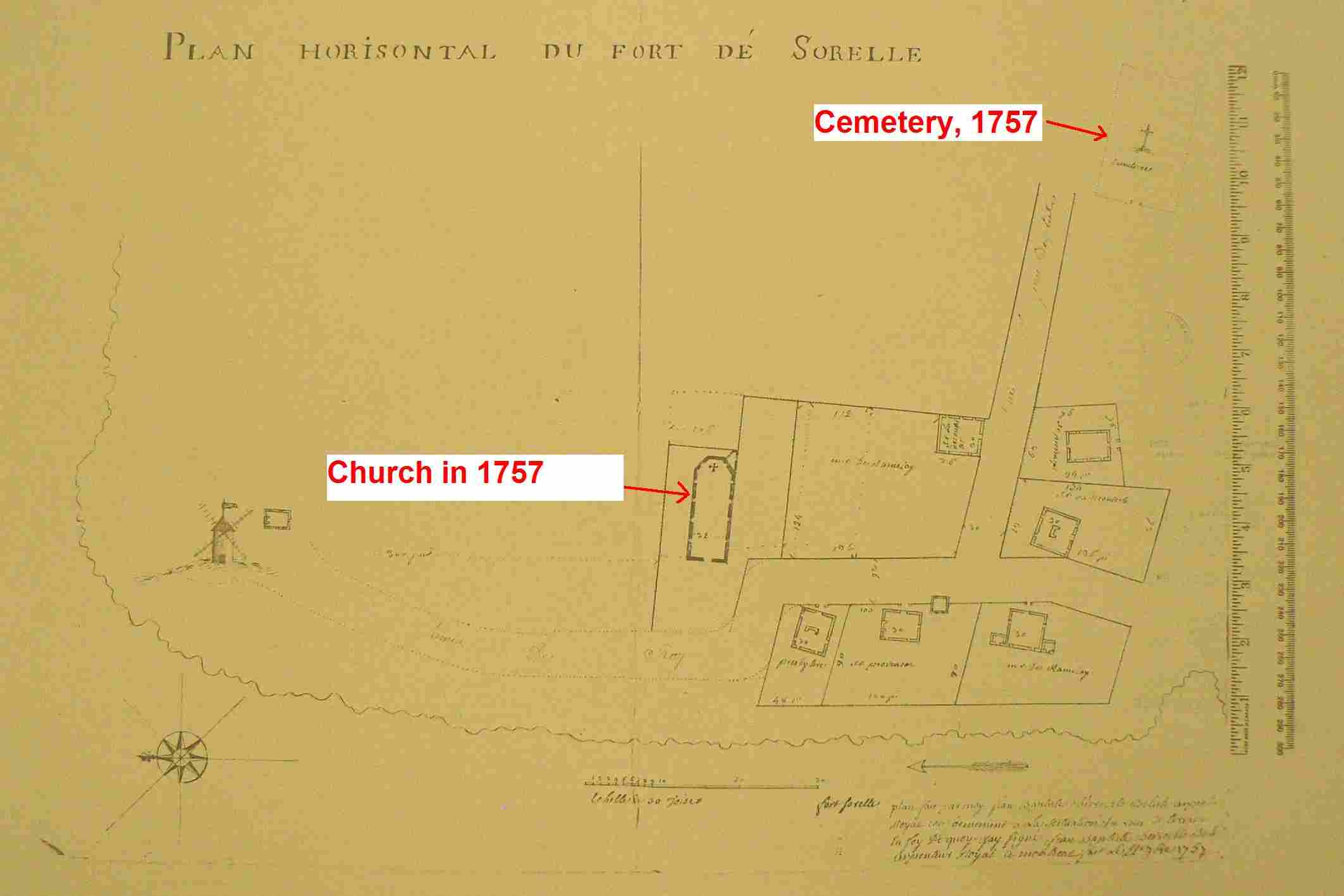
We know the church existed, as it is listed as the “Mass House” on two early maps. This 1757 map shows two “things” at the Mass House. One would have been the church, of course, and the other is probably the adjacent cemetery.

This 1733/1753 map version is less specific.

We know that the parish church at Port Royal was destroyed in 1690 and probably in 1708 as well, given that the rest of the town was burned. After Port Royal fell to the English in 1710, the Garrison Cemetery, as it was renamed, began to be used for English burials. It wasn’t entirely abandoned by Acadians, but based on some parish records before 1710, we know the Mass House at BelleIsle was in use by 1707. I’d wager that it had been in use since at least 1690, if not much earlier.

Unfortunately, parish records are incomplete, and none exist before 1702. Those after 1702 are spotty, and few record the location of burials, even though we know at least three early cemeteries existed. FindaGrave lists 17 known burials at St. Laurent, including Catherine’s close family members. I know of one more not listed in the cemetery – Catherine’s own son who died in 1725. This tells us that this cemetery was in use for at least two decades and probably significantly longer.

Even though the cemetery no longer exists today, it’s unlikely that the English settlers who arrived beginning around 1759, four years after the Acadians were deported in 1755, would have summarily destroyed a known cemetery. The church would have either deteriorated, been used for something else, or eventually been removed, but the graves likely simply remained undisturbed until, with the passage of time, the cemetery became overgrown, then forgotten, and now lost.

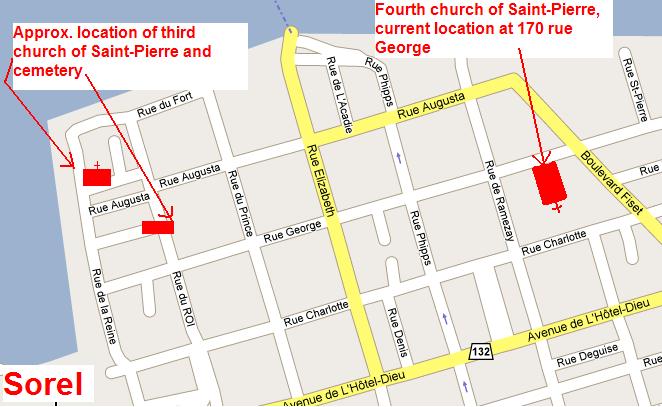
Based on the two earlier maps, and today’s Google Maps, I’ve noted the two approximate locations of the cemetery.

This is the approximate location of the 1757 map Mass House.

This is the approximate location of the Mass House on the map drawn based on the 1707 census, another map in 1733, and refined by 1753 information.

It’s someplace in this area. Maybe Charlie can find it one day!

We may not know exactly where, but it’s certain that the upriver residents worshipped here and buried their family members in the consecrated land adjacent the church. It was a lot closer than Port Royal, which often didn’t have a functioning church, and after 1710, it was a lot safer upriver than in Port Royal, given the shifting sands of the English and Acadian political status.

Catherine’s four children who were born and died between censuses may have been buried here, especially the child born after 1690 when we know the church in Port Royal was destroyed. This child born about 1698, died between the 1698 and the 1700 censuses, where Catherine’s daughter Madeleine was recorded.

The only thing remaining of these children is simply an empty gap on the census page, the ache in Catherine’s heart, and perhaps an unmarked grave here – their original small wooden cross long gone.

I surely wish we could locate the church and cemetery site today.

Unusual Circumstances

Do you ever get a funny gut feeling that something just isn’t right, or that there’s another piece to a story that you don’t, and probably never will, know?

That’s how I feel about Catherine’s family. Of course, many, if not most Acadian records no longer exist, so we’re working with only a sliver of information.

Here’s the very short list of available records that we are able to reference, combined with historical episodes that affected the Acadians in Port Royal dramatically:

  • Sporadic Acadian census records
  • Some birth, marriage, and death records after 1702
  • English attacks and surrounding historical events

What was happening in Catherine’s life following her 1676 marriage, which would probably have taken place in the Catholic church in Port Royal?

In the 1678 census, Catherine is a newlywed, with a one-year-old baby. The family is living with the Widow Pesselet. I’d like to know the rest of that story!

Between Catherine’s marriage and the 1686 census a decade later, she gave birth to six children, two of whom had died, and four who were living.

In the 1686 census, Francois Levron and Catherine Savoie are listed between the Melanson and Brun families, which strongly suggests that they are living across the river from Port Royal, where they are later found.

In 1690, the English attacked and burned all of the homes in Port Royal and probably the homes across the river as well, which would have included the Levron home.

They literally lived directly across the river from Fort Anne in Port Royal. In this photo, taken within the fort, the Levron home would have been to the right of the church.

The upriver homesteads were spared, but it’s very unlikely that these homes within clear sight would have been.

Between the 1686 and the 1693 censuses, four children were born to Catherine, but only the last three were living in 1693.

In the 1693 census, they are found in the same location as 1686, beside Laurens Grange and Pierre Doucet, who lived across from Port Royal and Fort Anne. So they apparently rebuilt after being burned out, as did the other Acadians at and near Port Royal.

In 1693, the English attacked and burned a dozen or so homes, plus three barns full of grain.

Between the 1693 and 1698 censuses, two more children joined the family, and their eldest daughter had married.

But in 1698, there was an unexpected census change. Francois and Catherine appear to be living in a different area.

In 1698, Francois Levron and Catherine Savoie are listed as neighbors of Emanuel Hebert on one side, and Rene Forest on the other. Their daughter, Madelaine, and her new husband, Clement Vincent are living next door.

Shown on this Mapannapolis map, this places Francois and Catherine fairly far upriver, about 12 miles East of Port Royal at Bloody Creek, which at one time was called Forest Creek. Rene Forest lives on one side, and the Hebert family on the other.

Another child or two were born in 1698 or 1699, both of whom perished.

In the 1700 census, the family has roughly the same neighbors as they did in 1686 and 1693, across the river from Fort Anne at Port Royal. So either they moved back downriver, or the 1698 census was out of order.

Their last child was born about that time as well. Catherine is now about 40 years old, so this makes sense, although it’s possible that she had another child or even two.

In 1701, the entire family is missing from the census, but their married daughter, Madelaine, and Clement Vincent are living upriver.

Something is going on, but what?

Know what else is strange in 1701? Daughter, Marie Levron, age 15, was working as a servant in the home of Emanuel Hebert. Why is that? Servants are exceedingly rare in Acadia, and are generally confined to the governors and upper-class, wealthy residents of Port Royal. Not Acadian farmers farming reclaimed marshlands upriver. Furthermore, Marie’s not there to help with young children, as she is three years younger than their youngest child.

Francois and Catherine are listed again in the 1703 census. I can’t tell for sure where the family is living, but they are two doors from their daughter and Clement Vincent – and it looks like they may still be upriver. The census may not have been recorded in house-to-house order, and the census taker also may have canoed back and forth across the river. Francois and Catherine have two boys and four girls, which means that daughter Marie is living at home again. Marie would marry Jean Garceau later that year, a soldier, on November 20, 1703. Several Acadian young women married the French garrison soldiers.

Looking at witnesses at various church events, it’s clear that Catherine and her family are interwoven in the tapestry of the upriver families as well as those living directly across from Port Royal.

The English struck again in 1704, burning homes, destroying crops, killing cattle and tearing down dykes.

Daughter Elizabeth Levron, also recorded in some records as Isabelle, married Michel (Etienne) Picot, also a soldier, on Nov. 3, 1705.

The English returned in 1707, burning nearly everything in the town – probably including the Levron homestead and that of their two married daughters, who were likely living on the same land.

We know for a fact that in both 1707 and 1710, the Levron family was living right across the river from Hogg Island at Port Royal, because we have two different maps that confirm the location.

On both the 1708 and 1710 maps, Francois Levron is noted by his dit name, Nantois, and he’s listed as “Le bonhomme Nantois” on the 1707 census.

The 1707 census also confirms that location. Clement Vincent is living next door, with Rene Doucet and the Grange/Granger family as neighbors.

Catherine’s eldest son, Jacques Levron, married Marie Doucet on January 8, 1710.

1710 was the year that Acadia was permanently lost to England following a wicked battle in which Catherine may well have had to shelter in the subterranian black hole in Fort Anne with her children and grandchildren.

It was safe there, but it would have been brutal if they had to stay for the entire 19 days.

In addition to the capitulation of the fort, one of the terms of surrender was that residents within three nautical miles, “within cannon shot,” were to be protected and allowed to stay, and those beyond the three-mile perimeter would be allowed to stay on sufferance.

The Priest attempted to gather and unite the Acadians beyond the three-mile marker, at Pre Ronde, or Round Hill, across from BelleIsle where Catherine’s family lived. This act of rebellion got him kidnapped by the English and shipped off to Boston. He was gone from mid-January through mid-December of 1711. There was a lot of death in Acadia that year.

After the surrender, the Acadians were told by the English that they would have to leave for other French colonies, meaning places like Beaubassin, for example. While the Acadians didn’t want to leave at first, by 1720, they had all planned to leave, but the English, realizing that they could not support themselves, now prohibited it. This back and forth tug-of-war lasted for years.

It was a very rough decade, with a great deal of uncertainty, acrimony and turmoil. What should they do, and who was going to do what – and when? Many of the young people left as soon as they married, while they could, and before they accumulated any belongings to lose.

In June of 1711, the Battle of Bloody Creek, took place on the Annapolis River above the mouth of Bloody Creek – formerly Forest Creek. If, indeed, Catherine and her family had relocated upriver in this area, they would have had front and center seats for the battle with the British. Someplace between 50 and 150 Acadians and their Native allies ambushed around 70 English troops in the river. They ultimately hoped to retake the fort, but without artillery, were unsuccessful. It’s possible that some Acadian men either died in the ambush, or were wounded and died later.

Daughter Marie’s husband, Jean Garceau, a French soldier, died sometime in 1711, leaving her with young children, including a year-old baby. Marie remarried to Alexander Richard the day after Christmas – just a week or so after the priest returned from Boston.

Daughter Elizabeth’s husband, Michel Picot, also a soldier, died sometime in 1711, leaving her with two infants, the youngest born in November, 1711. Elizabeth remarried to Yves Maucaer on Feb. 9, 1712, three weeks before baby Michel was officially baptized. Marriage was a matter of survival. Everyone already knew everyone in the close-knit community – so it wasn’t like you had to meet and get acquainted.

Catherine would have been doing her best to comfort and help her two newly-widowed daughters.

Catherine’s sister, Francoise Savoie, who was married to Jean Corporon died around Christmas in 1711, and was buried on the 27th.

Good Heavens, how much more can this family take?

Catherine’s sister, Marie Savoie, had married Gabriel Chiasson, and they had moved to Beaubassin where she died sometime after her youngest child was born in 1711, and the 1714 census. There seemed to be regular travel between the Acadian colonies, so I’m sure Catherine eventually heard the sad news and grieved her sister’s passing.

Daughter Anne Levron married Pierre Benoit about 1713.

Daughter Jeanne Levron married Augustin Comeau on Feb. 12, 1714.

Then, the unthinkable happened. Catherine’s husband, Francois Levron, died at midsummer, on June 23, 1714. I wonder if his death was sudden or if he had been ill. He was about 53, so not elderly by any means.

In the 1714 census, obviously taken after his death, Catherine is found living in the middle of six Girouard family members who live in the Girouard Village, just down the road from both Emmanuel Hebert and Rene Forest. This is the upriver location where they are found in the 1698 census, where Marie is living in 1701, and where her son was living in 1725. Why is this family found here or near here repeatedly.

However, Catherine’s son-in-law, Clement Vincent is still living “near the fort” on the census, near Rene Doucet and the Grange families again. Probably on Francois Levron’s land. Why is Catherine Savoie not living with them, or with her other married children?

Why is Catherine living in the midst of the Girouard family, near but not in the midst of the Hebert and Forest families, with her three unmarried children consisting of two sons and a daughter? In 1714, those three children would have been 22, 18, and 14. Catherine is about 53 years old and has no livestock and no land. How is she living? What is she eating? Who is feeding her children? Her two sons are old enough to work on the neighbors’ farms. Is that why they are living there? Why are they not living on and farming their own land?

So many questions!

In January of 1716, Catherine’s son, Jean-Baptiste Levron married Francoise La Bauve. Whose family lives almost directly across the river. Francois Levron is listed as deceased, of course, but Catherine is not.

On the thirteenth day of January, in the year 1716, we, the undersigned, declare to whom it may concern that we, Jean Baptiste Levron and Françoise Labaume
of this parish, and François Labauve, father of the said Labauve, and her mother, Marie Rimbaud, raise no objection to the proposed future marriage of our aforementioned children, Jean Baptiste Levron, son of the late François Levron and Catherine Savoye, residents of this parish, and Françoise La Bauve, daughter of Noël La Bauve and Marie Rimbaut, currently also residing in this parish.

On August 11, 1722, in the marriage entry of Magdelaine Levron and Jean de La Bauve, Francois Levron and Catherine Savoye are both described in exactly the same way. Francois is noted as deceased, and Catherine is simply listed as the mother. This leads me to believe that Catherine is probably still living, given that Francois is described as deceased. Little is known about the newlywed couple other than one child was born on December 11, 1723 in Grand Pre, which means they probably settled there immediately after they married. Catherine would not have known this grandchild, although she may have received word that the baby was born.

At some point, Joseph Levron left home and married Rose Denise Veronneau on Sept. 13, 1722 in Boucherville, Quebec. Catherine may never have known of this marriage, or whatever happened to her son. I’m guessing that Joseph was gone by the 1714 census, because he’s not accounted for. Was he one of the crew members of Pierre Baptiste, the friendly local privateer who recruited Acadian boys?

I was hoping to be able to narrow the dates of Catherine’s death based on her serving as Godmother to some of her grandchildren, but she is not listed for any grandchild. She might be listed for other children in the community, but Godparents and witnesses to events are not indexed in the Nova Scotia archive records. Perhaps having siblings or younger people as Godparents was the tradition, since they were more likely to be able to step in and raise a child should something happen to the parents.

Catherine’s Death

What we know about Catherine’s death is held in her son’s death record.

His death record continues on the next page.

Catherine’s youngest son, Pierre Levron never married and died in the home of Pierre Gaudet (Godet) on January 21, 1725, where he was listed as a domestic. Witnesses were his uncle Germain Savoye and Pierre Godet. His father is listed as Francois Levron, deceased, and Catherine Savoye, who is not listed as deceased by the archives translation.

However, based on an independent translation, both of Pierre’s parents are listed as deceased, and there’s more.

On the twenty-first of the month of January, 1725, was buried in the cemetery of Haut-de-Rivière, in my absence, the body of Pierre Levron, about thirty years old, son of Sieur François Levron, resident of Port Royal in Acadia, and of Catherine Savoye, his father and mother (both) deceased, (he died) the previous day after having confessed, in the house of Pierre Godet also…

(page 2)

…resident of Port Royal, in whose service he had been a servant. In witness of which I have signed, René Charles de Breslay, missionary priest, curate of the parish of St. Jean Baptiste and grand vicar of Monseigneur the Bishop of Québec, after having held a service for the repose of his soul and performed the burial ceremonies of his body at Port Royal on the 26th of the said month, in the presence of the said Pierre Godet and Germain Savoye, also residents of Port Royal and his uncle, who declared they did not know how to sign when requested to do so according to ordinance. R. C. De Breslay, missionary.

Note that the cemetery of Haut-de-Rivière would translate to “upper river cemetery,” meaning he was buried at St. Laurent. I feel good about that, becuase I know he had family nearby, maybe even his parents – or at least Catherine.

There were two Pierre Godets (Gaudet), two years apart, both named the same and born to the same parents. They also married Blanchard sisters, whose parents lived at BelleIsle. Pierre Godet the older, known as Pierre the elder, lived in Beaubassin in 1714 and signed a document there in August of 1722, so the Pierre in the 1725 record would have been Pierre the younger.

His father, Denis Godet, had established the Village des Gaudet in what is now the town of Bridgetown, even further upriver, amassing significant land across the river from Rene Forest and the Heberts.

In 1693, Denis Godet still owned his 20 arpents of land, but by 1698, Denis is still living, but the land was listed in Pierre’s name.

This 1733 map, drawn just a few years after Pierre Levron died, shows Gaudet Village where he would have lived. The houses were scattered aong the ridge of what is today Bridgetown.

Given his holdings, at age 71, Pierre Godet could probably have used a domestic servant, and as a respected community member, he would also have stood in for the priest, hearing Pierre Levron’s death-bed confession.

It’s possible that Pierre Godet was Pierre Levron’s godfather, although we will never know because the early parish records were destroyed by the English. However, that could be one reason why Pierre Levron was living with Pierre Godet. Pierre probably went to live in the Godet home when his mother died.

Please note that the designation of “Sieur” for Francois Levron, which translates to “Sir,” doesn’t necessarily mean royalty or nobility, but is an indication of respect equivalent to the English “Sir,” indicating someone that is well-respected within the community, and perhaps of social standing with a particularly respected trade such as a merchant or professional of some type.

As a final confirmation that Catherine was deceased, her daughter Elizabeth Levron remarried to Etienne Comeau in 1730, and both of Elizabeth’s parents are referenced as deceased.

Lack of Records

Why is Catherine’s death and burial record missing from the parish records? Wouldn’t I love to know that answer!!

For some reason, many deaths and burials were not recorded, or were recorded and are lost today. Was there a second register someplace – may be a book traditionally used for the St. Laurent Chapel?.

In a chart from page 73 in a pdf file from La Society historique acadienne, published in French, we find a tally of the total burials recorded in the existing parish registers.

It’s apparent that many deaths are omitted. For example, the years between 1706 and 1712, inclusive, have 16, 11, 14, 24, 16, 3, and 10, respectively. The priest had been kidnapped and taken to Boston in 1711, which shows 3 burials. The priest’s absence explains that drop. He did attempt to catch up when he returned.

Relative to Catherine, 1722 has 5 burials, 1723 has 1, 1724 has 5, and 1725 has 9. The numbers spike in 1727, with 23.

Based on this information, combined with the other records telling us that Catherine was alive in mid-August 1722, but deceased in January 1725 when her son died, I’d say Catherine probably died in 1723. It looks like the “least normal” year in terms of burials.

What we can say with certainty is that Catherine’s death occurred sometime between August 11, 1722 and January 20, 1725 when she was about 60 years old, or maybe a few years older. For all we know, Catherine may have also gone to live with the Godet family as a domestic after Francois’s death in 1714, and before her own death.

Catherine’s Children’s Lives

I was hoping to further narrow Catherine’s death by her grandchildren’s baptisms. Sometimes grandparents serve as a Godmother. Catherine was never found as Godmother for any of her grandchildren. Several were born prior to her death, between 1722 and 1725, so she would have been present at the baptisms in Port Royal.

How many grandchildren did Catherine know? Surely, as she aged and her own children established their adult lives, she would have taken solace and found joy in her grandchildren. She probably enjoyed watching them as their parents worked on the farms and in the fields.

Perhaps Catherine prepared food and baked bread in the Acadian ovens that were located outside every home as her grandchildren played nearby while their parents shored up dykes, planted and harvested grains, and worked with the livestock.

Where were Catherine’s children, and what was going on in their lives?

  • Catherine’s oldest son, Jacques Levron, was born about 1677 and married Marie Doucet in January of 1710.

In total, they had about 12 children, 8 of whom are known, meaning 2 died young, within Catherine’s lifetime.

In 1714, Jacques traveled on the vessel La Marie Joseph to Île Royale, today’s Cape Breton Island, to look at land. The land is very different there – not sandy or tidal marsh, but rocky. Farming techniques from Port Royal and the Annapolis River Valley wouldn’t work on Cape Breton Island. Jacques chose not to settle there and returned to Annapolis Royal, where he died before 1746. His daughter, born in March of 1716 died three months later, which would have brought Catherine immense grief. It appears that they lost a child in 1728 and 1735, but Catherine was gone by then, embracing them on the other side of the veil.

In total, they had 14 children, of which 7 died young, within Catherine’s lifetime.

Madeleine lost at least her first three children, Catherine’s first three grandchildren. Both women would have been devastated. Given that they lived next door, Catherine would assuredly have been present and probably assisting at their births. There are no parish records before 1702. Madeleine’s first child who lived was born in 1704.

Catherine and Madeleine must both have heaved a huge sigh of relief, assuming the earlier babies died near birth. Of course, without modern medicine and treatments, death was never far away, always skulking for a soul to capture.

Madeleine lost other babies in about 1711 and 1717. Given that there is no baptism or burial record, they may have been stillborn. Another died in 1719, just days old, and in 1722, 13 months old. Children baptized in both 1709 and 1719 listed Abraham Bourg as having provisionally baptized the babies in lieu of the priest, so that confirms that they lived across from Port Royal. It may also suggest that the babies were weak or sick, and they couldn’t wait for the priest.

Madeleine died in 1752 in Pisiquid, today’s Truro, where they apparently settled between 1726 and 1727, probably after Catherine died.

  • Daughter Anne Levron was born about 1684 and married Pierre Benoit, a soldier, about 1713. He became an officer, merchant and innkeeper in Louisbourg, where they lived. It may have been Anne and Pierre that her brother, Jacque Levron, visited in 1714.

We only have records of two children, although Anne almost assuredly had more.

Given that Anne’s first known child, Anne, was born in 1718, she must have lost either two or three earlier children. Anne, the child, died at age 15 in 1733 in Louisbourg, just two weeks after her mother. The second living child, Marie Anne, was born in May of 1725, which infers that either several children are unknown, or died between 1718 and 1725.

Anne and Pierre would have left Port Royal not long after their marriage, given that the fort at Louisbourg was founded in 1713, which probably broke Catherine’s heart. Catherine would not have been able to share in her daughter’s joys or grief. She would have been unable to comfort Anne, even if word did eventually trickle back to Port Royal about the residents of Louisbourg.

Catherine’s daughter, Anne, died on January 5, 1733, in the midst of a smallpox outbreak that took the lives of 200 people in Louisbourg, including Anne and her namesake daughter.

They would have been laid to rest in the cemetery which is unmarked today, but located in this field by the bay.

  • Daughter Marie Levron was born about 1686 and married Jean Garceau in 1703, a soldier at the garrison who may well have fought with her father.

Marie’s life was shaped by tragedy. In total, she had about 15 children, of which 6 died young, and 7 died within Catherine’s lifetime.

Based on a gap in the records, Marie lost a child in about 1705 or 1706, and another in 1709. Her husband, Jean, died in 1711, and Marie remarried to Alexandre Richard at Christmas that year. Unfortunately, Marie lost more children in 1714, 1716, 1722, and 1725. Additionally, we have nothing after their births for Claude born in 1715 and Isabelle, born in 1723, who may have passed about the same time their grandmother, Catherine.

Less than half, only 7 of Marie’s children grew to adulthood.

Catherine never stood as Godmother, but would have attended their baptisms, praying for a good future for them, then stood beside the graves to bury all but one or two of those grandchildren.

  • Daughter Elizabeth (Isabelle) Levron was born about 1690, the same year that all of the homes in Port Royal were burned by the English. We don’t know if her birth was before, during, or after the terrifying incursion. She married Michel Picot in 1705, then Yves Yvon Maucaire in 1712, followed by Etienne Comeau in 1730.

Elizabeth survived the Acadian’s worst nightmare – the expulsion in 1755 where they were forced to walk down the snow-cover wharf, leaving everythign behind, and board  overcrowded ships for God-knows-where.

The same wharf within view of her childhood home across the river.

Many did not survive, but Elizabeth wound up in Massachusetts where she was last found in the census on August 14, 1763. She would have been 73 years old and died sometime thereafter. 

In total, Elizabeth had only 5 known children, but she clearly would have given birth to more. Based on what we do know, she probably brought about 14 babies into the world.

Her first child’s birth wasn’t recorded until two years after her wedding, so I’d wager that her first child died in 1704, a year after she married. It wasn’t uncommon to lose the first baby, especially with a difficult birth.

Elizabeth probably lost her third baby in 1706, and another in 1709. We know that Port Royal experienced a “pestilence” in 1709, following a severe winter and the burned homes the year before, but it was reportedly confined mostly to the fort and surrounding area.

Elizabeth’s husband, Michel, died between February and November of 1711, when Elizabeth’s son, Michael was born on November 13th, 1711. At his baptism in February of 1712, his mother had remarried three weeks earlier, and of course, his father was listed as deceased. I suspect his father was already deceased when Michel was born.

Some kind of Hell was going on in Acadia in 1711.

This makes me wonder if both Elizabeth’s and Marie’s husbands met the same fate – possibly as a result of the 1710 battle when the French lost Acadia to the English. An even more likely possibility is that they perished in June, 1711, in or as a result of the Battle of Bloody Creek.

Catherine would have comforted Elizabeth after the deaths of her babies and first husband, Michel.

Elizabeth had three known children by Yves, but she probably lost one, if not two children before her next child was baptized in 1715. Elizabeth apparently lost another child in 1717, and three more before her next child’s birth in 1726.

Sadly, there is nothing more known about the child born in 1715 or 1726, so it’s likely that they died as well, meaning that Elizabeth only had three children who lived. Of those, one was deported with Elizabeth to Massachusetts, one died before the deportation, and the death of her son was after 1735 but when is uncertain.

Yves died on June 16, 1727, and she remarried again in November of 1730 to Etienne Comeau, but no children were born to that marriage.

Of Elizabeth’s children who perished, Catherine would have been right there, standing with her sobbing daughter, burying 10 children and Elisabeth’s first husband.

The 17-teens were so filled with tragedy and grief for this family.

  • Son Joseph “dit Letayer” Levron was born about 1691 and married Rose Denise Veronneau in September 1722 in Quebec, so Catherine, would not have known his wife or children. We know Catherine was still alive in August of 1722, but gone by January 1725, and she may or may not have been aware of Joseph’s marriage.

In total, Joseph had three known children, two of whom may have been born before Catherine died, but there were assuredly more.

  • Son Jean-Baptiste Levron was born about 1692, married Francoise LaBauve in 1716, and died before March 2, 1756. He would have been one of the three children living with Catherine in the 1714 census after Francois died.

In total, Jean-Baptiste had about 14 children, of which 6 died young, and one or two probably died within Catherine’s lifetime.

Jean-Baptiste and his wife lost a child in both 1721 and 1723. There is nothing more known about the child baptized in 1721, so she may have died before Catherine.

Jean-Baptiste and his family relocated to the settlement at Grand Pre between 1730 and 1737.

At least two children would have been born between those years, and another in 1741 – but we don’t know if the records are complete.

  • Daughter Jeanne Levron dit Nantais was born about 1694 and married Augustin Comeau in February 1714. She died on January 19, 1751.

In total, Jeanne had about 15 children, of whom 5 died young.

Jeanne’s first child, Marie Josephe, was born three days after Christmas the same year that her parents married, but sadly, died when she was just 6, in July 1721.

Catherine would have known this child well and stood by her small grave, weeping, that hot July day. It’s gut-wrenching to lose any child, but the longer you know them, the more there is to grieve. Not just their future, but your shared memories and bonding moments as well.

Four more children were born to Jeanne before Catherine died, so she would have celebrated their baptisms and enjoyed watching them blossom in the Acadian sun.

Jeanne probably lost two more children between 1733 and 1734, and at least two more between 1735 and 1741. Three of her 11 children born in the 1720s and 1730s have no information beyond their birth, which could be because they were scooped up in the 1755 expulsion and survived elsewhere. Let’s hope.

  • Son Pierre Levron was born about 1696 and died on January 20, 1725, in the middle of the winter, which is how we bracketed Catherine’s death. He would have been one of the three children living with Catherine in the 1714 census.
  • Catherine’s youngest child, Madeleine or Magdelaine Levron was born in 1700 and married Jeane La Bauve on August 11th, 1722, which is the last date we know for certain that Catherine was living. Madeleine was the daughter living with Catherine in the 1714 census, and the La Bauve family lived across the river, just above BelleIsle. Madeleine and Jeane La Bauve left shortly after their marriage for Grand Pre where their first child, a son, was born on December 11, 1723.

If Catherine was still living, she wouldn’t have known about Madeleine’s first baby until word filtered down to Port Royal.

We know this child was baptized in this church and survived to marry, but we don’t know anything more about Madeleine, her husband, or any additional children.

Did they die in Grand Pre, and rest in unmarked graves in the cemetery there?

Or were they deported from these shores, now marked with this iconic cross?

Part of me wonders if Catherine packed up and went with them to Grand Pre, and that’s why we don’t have a death record for her. Having considered that possibility, I doubt it because it seems unlikely that she would have left her unmarried son, Pierre, along with the rest of her family, behind.

I wonder if Pierre was disabled in some way, which is why, after Catherine’s death, he was living with neighbors as a domestic when he died.

Actual Timeline

There are two lenses with which to view these events. One way is through their individual stories, and another is via an actual timeline.

Stories are a lot more personal, and the timeline is starkly black-and-white. We need both perspectives.

The stories relate to individual people, but the timeline shows Catherine’s life, in order – or sometimes, disorder. It’s much easier to see, by year, what was actually happening.

We can’t do this well for our Acadian ancestors who lived before the census and parish records existed, but Catherine’s life spanned those years. Her early life was before parish records, but her children’s lives and grandchildren’s births are often found in the church books.

I know I’m just a glutton for punishment, but I had to create a spreadsheet timeline for Catherine.

This helps me “visit” with her during her life as she lived it. It also helps illuminate possible cause and effect. Without parish records, we don’t have a lot of information before 1702, although we can infer a lot by the various censuses and associated history.

Even so, we have a total of about 290 known “events” – most of which Catherine would have made a trip to church, or to the cemetery, or both.

Of course, that was in addition to “normal” church services, whatever that would have meant in an Acadia that was often either unstable or engaged in warfare. Not to mention that few people lived IN Port Royal. Catherine grew up on the North side of the river at or near BelleIsle, moved downriver across from the fort when she married, lived there through being burned out at least four times, if not five, then spent (at least) her sunset years back upriver, but on the south side.

The Girouard marsh and dykes overlook the Savoie lands and those of other BelleIsle families. Depending on which way you look, you could probably also see the St. Laurent Mass House. It’s no wonder Catherine’s family was buried here.

There’s still a lot that we don’t know, but viewing this timeline helps us piece together and understand more about what was happening in Catherine’s life day-to-day, month-to-month and year-to-year.

Our timeline begins with Catherine’s birth and ends around the time of her death.

I’ve color coded groups of people and events:

  • Catherine’s parents, aunts, uncles and siblings are in bold black
  • Catherine’s children are in bold blue
  • Catherine’s grandchildren are purple
  • Births are green
  • Mrriages are magenta
  • Deaths are teal

Although the births of nieces and nephews involve Catherine’s siblings, I have not color coded those.

Some events are told directly. For example, females birth surnames are given in the census, with ages in many cases. Later, we can match the names of children with marriages and the births of their own children. Families can be reliably reconstructed in this manner. Other events are revealed indirectly, like the gaps in the census that reveals that a child, or maybe two, were born and died. This could have been one event, with a stillbirth or even multiple miscarriages, or it could have been separate events, with a birth, joyful baptism, and later, a death – all happening with no evidence other than that telltale gap.

Date Who Relationship Event Comment
1661 Catherine Savoie Self Birth
1663 Francois Savoie brother Birth
1665 Barnabe Savoie brother Birth
1667 Andree Savoie sister Birth
1670 Marie Savoie sister Birth
1670 Francoise Savoie sister Marriage Jean Corporon
1671-1686 Francois Savoie brother Death Died between the census dates
1671-1686 Francois Savoie father Death Died between the census dates
1671-1686 Catherine LeJeune mother Death Died between the census dates
1671-1686 Barnabe Savoie brother Death Died between the census dates
1671 Census – age 9 with her parents at BelleIsle
1671 Marie Corporon niece Birth
1672 Madeleine Corporon niece Birth
1673 Jeanne Corporon niece Birth
1675 Jeanne Savoie sister Marriage Etienne Pellerin
1675 Jacques Corporon nephew Birth
1676 Madeleine/Magelaine Pellerin niece Birth Charles Calve dit la Forge
1676 Catherine Savoie self Marriage Francois Levron
1676 Marie Savoie sister Marriage Jacques Triel dit Laperriere, a soldier who probably served with Francois Levron
1677 Jacques Levron son Birth
1677 Jean Corporon nephew Birth
1677 Pierre Triel nephew Birth
1678 Marie Pellerin niece Birth
1678 Germain Savoie brother Marriage Marie Breau
1678 Marie Corporon niece Birth
1678 Census – living near Port Royal with the Widow Pesselet
1679 Catherine Savoie’s unknown child child Birth & Death Gap in children
1679 unknown Savoie brother Germain’s child Birth Gap in children
1679 Marie Madelaine Triel die LaPerriere niece Birth
1680 Catherine Savoie’s unknown child child Birth & Death Gap in children
1680 unknown Pellerin sister’s child Birth
1680 unknown Corporon sister’s child Birth & Death Gap in children
1680 unknown Savoie brother Germain’s child Birth Gap in children
1681 unknown Triel sister’s child Birth & Death
1681 Isabelle (Elizabeth) Corporon niece Birth
1682 Madeleine Levron daughter Birth Died before May 1752 in Pisiquid when her son married.
1699 unknown Vincent daughter’s child Birth & Death
1682 Pierre Pellerin nephew Birth
1682 Germain Savoie nephew Birth
1682 Nicolas Triel nephew Birth
1683 Cecile Corporon niece Birth
1684 Anne Levron daughter Birth Died in 1733 in Louisbourg.
1684 Alexis Triel nephew Birth
1684 Francois Xavier Savoie nephew Birth
1684 Anne Pellerin niece Birth
1685 Jean-Baptiste Pellerin nephew Birth
1685 Marguerite Corporon niece Birth
1686 Marie Levron daughter Birth Died in 1727 Annapolis Royal
1686 Map with homesteads but no names
1686 Census – living across the river from Port Royal
1686 unknown Triel sister’s child Birth & Death
1686-1693 Francois Goutrot aunt’s husband Death Died between the census dates
1686-1693 Marie Corporon niece Death Died between the census dates
1687 Marie Corporon niece Marriage Charles Boudrot – moved to Pisiguit
1687 Martin Corporon nephew Birth
1688 Catherine Savoie’s unknown child child Birth & Death Gap in children
1688 unknown Triel sister’s child Birth & Death
1688 unknown Savoie brother Germain’s child Birth Gap in children
1688 Marie Savoie sister Marriage Gabriel Chiasson, was in Minas in 1693, Beaubassin in 1697
1688 Francois Corporon nephew Birth
1688 Jeanne Pellerin niece Birth
1689 Michel Chiasson nephew Birth In Les Mines by 1693 but Catherine may have been at his baptism
1689 New fort begun, left unfinished
5-9-1690 English attacked and burned homes
June 1690 English reinforcements arrived
1690 English pirates burned homes
1690 Acadia falls under English control
1690 Madeleine Corporon niece Marriage Bernard Doucet
1690 Marie Triel niece Birth
1690 Pierre Savoie nephew Birth
1690 Charles Pellerin nephew Birth
1690 Elizabeth Levron daughter Birth 1763 census in Massachusetts
1691 Pierre Chiasson nephew Birth In Les Mines by 1693 but Catherine may have been at his baptism
1691 Jeanne Corporon niece Marriage Antoine Hebert
1691 Charles Corporon nephew Birth
1691 Bernard Pellerin nephew Birth
1691 Joseph Levron son Birth Died 1750 Canada
1692 Jean Baptiste Chiasson nephew Birth In Les Mines by 1693 but Catherine may have been at his baptism
1692 Jean-Baptiste Levron son Birth Grand Pre in 1737, died between 1741 and 1756
1692 unknown Triel sister’s child Birth & Death
1692 Jean Corporon nephew Birth
1692 Jean Savoie nephew Birth
1696 Census – lives across the river from the fort
1693 English attack Port Royal burning homes and barns
1693 Madeleine/Magelaine Pellerin niece Marriage Charles Calve dit la Forge
1693 unknownn Pellerin sister’s child Birth & Death
1693 Marie Savoie sister Relocated Beaubassin by 1693
1694 Alexandre Pellerin nephew Birth
1694 unknown Triel sister’s child Birth & Death
1694 Marie-Madeleine Corporon niece Birth
1694 Jeanne Levron daughter Birth Died 1751 Annapolis Royal
1694 Marie Madeleine Savoie niece Birth
1695 Marie Pellerin niece Marriage Jacques Doucet
1696 Pierre Levron son Birth
1696 unknown Pellerin sister’s child Birth & Death
1696 Paul Savoie nephew Birth
1696 unknown Triel sister’s child Birth & Death
1696 Ambrose Corporon nephew Birth
1696 Marie Savoie niece Birth
1697 Acadia returned to French
1693-1698 Edmee LeJeune aunt Death Mother’s sister
1693-1698 Charles Corporon nephew Death Died between the census dates
1698 Census – listed with upriver families
1698 Catherine Savoie’s unknown child Child Birth & Death Gap in children
1698 unknown Triel sister’s child Birth & Death
1698 unknown Pellerin sister’s child Birth & Death
1698 Claude Savoie nephew Birth
1699 Marguerite Pellerin niece Birth
1699 Fort Anne returned to French
1698-1700 Marie Savoie sister Spouse Death Died between the census dates
1698-1700 Ambrose Corporon nephew Death Died between the census dates
1698-1700 Francois Corporon nephew Death Died between the census dates
1698-1700 Nicolas Triel nephew Death Died between the census dates
1700 Census – lives across the river from the fort
1700 Madeleine Levron daughter Birth Chipoudie 1752, 1755, Camp L’Esperance winter 1756/57.
1700 unknown Savoie brother Germain’s child Birth Gap in children
1700-1701 Marie Savoie niece Death Died between the census dates
1701 Census – family missing except two children living upriver
1701 unknown Savoie brother Germain’s child Birth Gap in children
1701 Anne Pellerin niece Marriage Abraham Brun
11-27-1702 Marie Madelaine Triel die LaPerriere niece Marriage Louis La Chaume dit Loumeray, a soldier, moved to Louisbourg between 1710-1713
1702 Work on Fort Anne resumes
1702 Cecile Corporon niece Marriage Jean Boudrot – moved to Pisiquid
1700-1703 Jacques Corporon nephew Death Died between the census dates
1701-1703 Pierre Pellerin nephew Death Died between the census dates
1703 Census – location uncertain
1703 unknown Vincent grandchild Birth & Death
5-25-1703 Charles Savoie nephew Birth
11-20-1703 Marie Levron daughter Marriage Daniel Garceau
3-17-1704 Pierre Vincent grandson Birth
June 1704 English attacked and burned homes, Port Royal under siege 17 days
10-22-1704 Pierre Jean Garceau grandson Birth
1706 unknown Vincent grandchild Birth & Death
1704-1707 Pierre Vincent grandson Death Before 1707 census
Spring 1705 English attack Acadian settlements
1705 unknown Savoie brother Germain’s child Birth Gap in children
9-29-1705 Madeleine/Magelaine Pellerin niece Spouse Death Charles Calve dit La Forge who lives as Beausoleil at the river heights
11-3-1705 Elisabeth Levron daughter Marriage Michel Picot
1706 Privateers defending Port Royal
1705 Jean Corporon nephew Marriage Marie Pinet – moved to Grand Pre
1706 unknown Garceau grandchild Birth & Death
10-5-1706 Marie Josephe Savoie niece Birth
1707 Census – lives across the river from the fort
1707 Labat map – lives across the river from the fort
1-2-1707 Marie Josephe Vincent granddaughter Birth died on Ile St. John 1756
1-17-1707 Madeleine/Magelaine Pellerin niece Marriage Pierre Gaudet – couple is unknown after this date but may be present in 1714
1-18-1707 Marie Savoie niece Marriage Rene Blanchard
4-8-1707 Daniel Garceau grandson Birth died 1772 Yamachiche, Quebec
6-6-1707 Attack on Port Royal – 11 days – homes burned
6-17-1707 English attack ends
8-19-1707 Isabelle (Elizabeth) Corporon niece Birth Illegitimate child born with Rene Fontaine as father
8-21-1707 Attack on Port Royal – 11 days
9-2-1707 English attack ends
11-23-1707 Francois Savoie nephew Marriage Marie Richard
11-28-1707 Marie Jeanne Picot grandson Birth Died 1751 Port Royal
1-1-1708 Madeleine Vincent granddaughter Birth died in Quebec in 1768
2-3-1708 Alexis Triel nephew Death Buried in cemetery of St. Jean Parish, Port Royal
1708 Fort Anne defenses shored up
1708 unknown Savoie brother Germain’s child Birth Gap in children
1708 Martin Corporon nephew Marriage Cecile Joseph – moved to Les Mines, Pisiguit
10-1-1708 Marie Triel niece Marriage Pierre Le Blanc die Jassemin, sergeant of a company, native of Ozan in the Auvergne
1709 unknown Garceau grandchild Birth & Death
1709 unknown Picot grandchild Birth & Death
1-16-1709 Germain Savoie nephew Marriage Genevieve Babineau
2-4-1709 Jeanne Pellerin niece Marriage Pierre Surette
5-3-1709 Marguerite Corporon niece Birth Illegitimate child Francois Lecul born, son of Jean Lecul
5-7-1709 Marguerite Savoie niece Birth
1710 unknown Vincent grandchild Birth & Death
1710 Labat map – lives across the river from the fort
1-8-1710 Jacques Levron son Marriage Marie Doucet
2-11-1710 Jean Baptiste Pellerin nephew Marriage Marie Martin
3-20-1710 Joseph Garceau grandson Birth died 1789 Quebec
9-4-1710 British warships begin arriving in the harbour
9-24-1710 British attack on Port Royal begins – homes burned
10-5-1710 British have blockaded harbour at Goat Island
10-12-1710 Port Royal falls to England
10-16-1710 Keys of fort handed to English, French soldiers leave
October 1710 Acadians told they have two years to move to French territory
11-14-1710 Madeleine Corporon niece Marriage Francois Leclerc, a soldier
11-24-1710 Pierre Savoie nephew Death Buried at St. Laurent Chapel
4-15-1711 Marie Joseph Levron granddaughter Birth reportedly died at sea in 1758
1-17-1711 Marguerite Savoie niece Death Buried at St. Laurent Chapel
4-26-1711 Marie Madeleine Savoie niece Marriage Rene Babineau, deported and wound up in Quebec
June 1711 Battle of Bloody Creek – French attempt to retake fort
7-17-1711 Anne Vincent granddaughter Birth Married in 1727 in Grand Pre and died in 1768 in Louisiana
1711 Marie Triel niece Death Died during father Durand’s captivity in Boston
1711 Elizabeth Levron daughter Spouse Death Michel Picot
1711 Marie Levron daughter Spouse Death Jean Garceau
11-13-1711 Michel Picot grandson Birth Died after 1735
12-26-1711 Marie Levron daughter Marriage Alexandre Richard
12-27-1711 Francoise Savoie sister Death
1711-1724 Marie Savoie sister Relocated In Louisbourg by 1724
1-8-1712 Elizabeth Levron daughter Marriage Yves Yvon Maucaire
2-2-1712 Michel Picot grandson Baptized Three weeks after Catherine’s daughter remarried
1712 Isabelle (Elizabeth) Corporon sister Marriage William Johnson – Scotsman in service with English Garrison when Port Royal fell
3-16-1712 Marguerite Corporon niece Birth Jean Pierre Clemenceau, illegitimate son born with Jean Clemenceau while he was married to Anne Roy who also had a baby a month later
5-20-1712 Joseph Levron grandson Birth died c 1755 before deportation
10-1-1712 Pierre Toussaint Richard grandson Birth Died 1751 Port LaJoye, Isle St. Jean
3-13-1713 France ceded all of Acadia to England
1713 unknown Maucaire grandchild Birth & Death
1713 Anne Levron daughter Marriage Pierre Benoit, soldier
6-9-1713 Jean Vincent grandson Birth died 1758 at sea
7-9-1713 Anne Pellerin nephew Spouse Death Abraham Pellerin
11-27-1713 Bernard Pellerin nephew Marriage Marguerite Gaudet
1711-1714 Marie Savoie sister Death in Beaubassin
1714 Census – living among upriver families Widow
1714 Acadians ready to leave for Minas, but now the English prohibit the move
2-12-1714 Jeanne Levron daughter Marriage Augustin Comeau
1714 unknown Richard grandchild Birth & Death
1714 Unknown Benoit grandchild Birth & Death
4-14-1714 Brigitte Levron granddaughter Birth died 6 months after wedding in 1737 in Grand Pre
12-28-1714 Marie Joseph Comeau granddaughter Birth born in a transport ship and baptized by a woman on the ship during the crossing
2-22-1715 Marguerite Corporon niece Birth Birgitte born, father listed as Jacques Amireault, says “legitimate marriage” but the child died on June 7th, 3 months later with no surname and no father listed.
1715 Marie-Madeleine Corporon niece Marriage Jean Seigneur, a wealthy innkeeper in Louisbourg
1715 Joseph Vincent nephew Birth Died in 1778 in Morlaix, Bretagne, France.
1715 Fort Gates shut to trading with Acadians
6-27-1715 Claude Richard grandson Birth & Death Nothing after his birth
8-22-1715 Charles Maucaire grandson Birth & Death Nothing after his birth
1716 Unknown Benoit grandchild Birth & Death
1-7-1716 Marguerite Pellerin niece Marriage Bernard Gaudet
1-13-1716 Jean Baptiste Levron son Marriage Francoise LaBauve
1-13-1716 Alexandre Pellerin nephew Marriage Jeanne Gaudet
3-22-1716 Anne Levron granddaughter Birth
6-10-1716 Anne Levron granddaughter Death
8-10-1716 Madeleine Comeau granddaughter Birth NY during the expulsion
1717 Acadians have decided to stay on peaceful terms
4-1-1717 Paul Vincent grandson Birth
4-8-1717 Jacques Levron grandson Birth Married in 1754, decd by 1758 when son died in Quebec.
4-30-1717 Marie Josephe Levron granddaughter Birth Died 1765 Cayenne, French Guiana with her husband and all 5 of her children
1717 unknown Maucaire grandchild Birth & Death
1717 unknown Richard grandchild Birth & Death
10-8-1717 Paul Vincent grandson Death
6-17-1718 Marie Richard granddaughter Birth Died in 1796 in Canada
7-22-1718 Marguerite Comeau granddaughter Birth Massachusetts during deportation, died in 1767 in Quebec
11-14-1718 Jean Savoie nephew Marriage Marie Dugas
1718 Anne Benoit granddaughter Birth Died 15 days after her mother in 1733 in smallpox epidemic in Louisbourg.
1718 Martin Corporon nephew Marriage First wife died between 1714 and 1718 when he married Marie Josephe Viger.
2-25-1719 Jean Baptiste Joseph Levron grandson Birth In Beaubassin by 1743, Chipoudie 1755, Camp L’Esperance, died 1767 Quebec.
3-18-1719 Marguerite Vincent granddaughter Birth
3-19-1719 Marguerite Maucaire granddaughter Birth Massachusetts in 1763 with 6 unknown children
4-6-1719 Marguerite Vincent granddaughter Death
1720 New Governor mandates loyalty oath or Acadians must leave in 3 months taking nothing
1720 Acadians refuse and make preparations to leave
1720 Governor prohibits Acadians from leaving, says they are ungovernable
1-20-1720 Anne Levron granddaughter Birth Probably died young, nothing more
3-21-1720 Jeanne Comeau granddaughter Birth Married in Pubnico in 1753
5-1-1720 Marguerite Richard granddaughter Birth Died in 1757 in Quebec
1720 Unknown Benoit grandchild Birth & Death
1720 Pierre Triel nephew Marriage Catherine Bourg
7-28-1721 Marie Joseph Comeau granddaughter Death
8-25-1721 Claude Vincent grandson Birth
8-13-1721 Elisabeth Levron granddaughter Birth & Death Nothing more
1721 unknown Maucaire grandchild Birth & Death
1722 Simon Levron grandson Birth Les Mines in 1746, died in Quebec in 1757
1722 Unknown Benoit grandchild Birth & Death
1722 unknown Richard grandchild Birth & Death
1722 Francois Savoie nephew Relocated Grand Pre
1-12-1722 Anne Pellerin niece Marriage Laurents Doucet
1-17-1722 Marie Joseph Comeau granddaughter Birth Died 1756 probably New York
Mar-May 1722 Siege of Annapolis Royal by Mi’kmaq and Maliseet
8-11-1722 Madeleine/Magdelaine Levron daughter Marriage Jean La Bauve and in Grand Pre by Dec 1723, probably as Camp L’Esperance, nothing more known
9-8-1722 Claude Vincent grandson Death
9-13-1722 Joseph Levron son Marriage Rose Denise Veronneau
11-17-1722 Jeanne Savoie sister Spouse Death Etienne Pellerin
11-23-1722 Paul Savoie nephew Marriage Judith Michel
4-6-1723 Marie Jeanne Picot granddaughter Marriage Louis Thibault
5-14-1723 Isabelle Richard granddaughter Birth 1760 census in Newbury, Mass, but nothing more
10-22-1723 Pierre Vincent grandson Birth In Port La Joye in 1752, died 1787 in Quebec
12-11-1723 Jean Baptiste La Bauve grandson Birth in Grand Pre
1723 unknown Levron grandson Birth & Death
1723 unknown Maucaire grandchild Birth & Death
1724 Unknown Benoit grandchild Birth & Death
2-1-1724 Marguerite Pellerin niece Death
2-21-1724 Jean Baptiste Comeau grandson Birth Died 1797 Quebec
3-26-1724 Louis Levron grandson Birth Died in Louisiana
July 1724 Raid on Annapolis Royal by Mikmaq and Maliseet – burned houses and took prisoners
7-24-1724 Yves Thibault great-grandson Birth CT during deportation, died 1801 Church Point, Clare, Digby
1-30-1725 Charles Pellerin nephew Marriage Madeleine Robichaud
2-20-1725 Marguerite Corporon niece Marriage to Henry Samuel
1725 unknown Richard grandchild Birth & Death
1725 unknown Maucaire grandchild Birth & Death
1725 unknown Vincent grandchild Birth & Death
1722-1725 Catherine Savoie self Death Between August 11, 1722 and January 20, 1725
1-20-1725 Pierre Levron son Death His mother Catherine is listed as deceased.

This exercise revealed, among other things, that Catherine’s older sister, Marie’s husband, Jacques Triel, died fairly young. Marie, never remarried, lived to age 84, and outlived all but one of her children. Only one child grew to adulthood.

Catherine’s niece, Marguerite Corporon, is extremely interesting. Every family has a wild child – in some way or other. In fact, we may have been that person in our family. But we need to be careful about rushing to judgement about Marguerite who had at least two and possibly three illegitimate children, meaning children born outside of a marriage between the parents. Illegitimate births were extremely rare in Acadia – let alone three times with the same female.

According to Gisa Hynes, writing Some Aspects of the Demography of Port Royal, 1650-1755  for the University of New Brunswick Journal, after analyzing the parish registers, 0.6 percent, or about one in 200 births, was illegitimate between 1702 and 1755, and almost no babies were born in the 9 months after the parents married. The influence of the Catholic church is reflected in the extremely low pre-marital conception rate.

Even more unusual in Marguerite’s case, the father of one of those children was a man who was married to a different woman whose also had a baby a month later.

I can only imagine the drama.

I feel incredibly badly for both women, truthfully. The wife clearly had no choice in the situation, and divorce simply didn’t exist. She went on to have more children with her husband.

We don’t know any of the circumstances surrounding Marguerite and how she became pregnant either the first, or succeeding, times. The event(s) may not have been consentual. And once a woman’s reputation is “ruined,” it’s extremely difficult for a female to dig herself out of that hole – one she may not have willingly put herself in.

Regardless, the situation was unfortunate – and was assuredly grapevile and gossip fodder for years, if not generations. Marguerite did marry an Englishman when she was about 40, a decade after her third child was born. I hope she lived her best life in whatever way possible. It’s not like she had the option of moving away or visiting an “Auntie” someplace else, and starting over.

Marguerite’s challenges were interwoven with the larger issues taking place in Acadia at the same time.

Acadia Changed

Life changed dramatically in Acadia in 1710, meaning the English seizure of Port Royal, protection of Acadians only within three miles, the Battle of Bloody Creek in 1711, combined with the edict that Acadians had to leave. I’d wager that two of Catherine’s sons-in-law, both former soldiers, were involved in the resistance that followed.

Now, considering this additional information, finding the family upriver, beyond that 3-mile line, in 1714 and later makes a LOT of sense.

Catherine may have lived long enough to welcome her first great-grandchild in July of 1724, Yves Thibault. The next generation, all of whom were deported if they didn’t join Catherine in the graveyard first, had begun.

We don’t know where Catherine rests for eternity, but it could well be here in an undocumented cemetery on her family’s land.

_____________________________________________________________

Share the Love!

You’re always welcome to forward articles or links to friends and share on social media.

If you haven’t already subscribed (it’s free,) you can receive an e-mail whenever I publish by clicking the “follow” button on the main blog page, here.

You Can Help Keep This Blog Free

I receive a small contribution when you click on some of the links to vendors in my articles. This does NOT increase your price but helps me keep the lights on and this informational blog free for everyone. Please click on the links in the articles or to the vendors below if you are purchasing products or DNA testing.

Thank you so much.

DNA Purchases and Free Uploads

Genealogy Products and Services

My Books

Genealogy Books

Genealogy Research

Sir Francois Levron dit Nantois (c1651-1714), and Acadia’s Pirate – 52 Ancestors #444

“Sir,” you ask?

Francois was a “Sir”?

Yes, indeed, yes, he was. You never know what secrets are tucked away in old, musty records.

Francois Levron was born around 1651 in France. His dit name, Nantois, seems to suggest he may have originated in or near Nantes.

Francois is absent in the first Acadian census of Port Royal taken in 1671.

André-Carl Vachon, Acadian historian, believes Francois Levron was a soldier who originally settled in Pentagouet, at the fort, shown on the map, above.

The remains of Fort Pentagouet have been located near present-day Castine, Maine, which is only about 110 nautical miles from Port Royal.

The Fort, or where it used to stand, has been excavated and marked with a cross, today.

Vachon reports that in 1672, a famine struck Fort Pentagouet, causing several men to be relocated to Port Royal for the winter.

As a soldier, after arriving in Port Royal, Francois would have lived in the barracks within Fort Anne.

If Francois was, indeed, at Pentagouet, that means he served alongside the man who would one day become his neighbor along the Riviere Dauphin at Port Royal – Pierre Doucet. Half a century later, their grandchildren would marry.

Based on the birth dates of their children, Francois Levron married Catherine Savoye/Savoie around 1676.

Port Royal was a sleepy little town, referred to by the priest, Louis Petit as “a mere depot for pelts.” Only 68 families lived in Port Royal and scattered up and down the river valley. It may have been a depot for pelts, but surprisingly, Petit requested a Nun be dispatched to open and run a boarding school for girls. It’s unclear whether that ever happened.

In the 1678 Port Royal census, Francois and his wife are living with the Widow Pesselet, along with one child, a boy, age 1. They have no livestock and no land, so it’s entirely possible he was still a soldier and the young family was living with the widow as a mutually beneficial arrangement. Based on the neighbors, I can’t tell exactly where they are living, but it seems to be quite close to Port Royal which would make perfect sense if he was or had been a soldier. The census may not have been taken or recorded in house-to-house order.

The widow Pesselet is Barbe Bajolet (1608-c1678), who was married to Isaac Pesselet before being widowed by Saviniue de Courpon. She was one of the few people to make the trek back to La Rochelle, remarry in 1654, then return to Acadia. The 1671 census shows that she had eight children living in France, with two married daughters in Acadia; Marianne Lefebvre, 21, who married Etienne Comeau, and Marie Peselet, 26, married to Jean Pitre. They lived 3 and 4 houses from their mother, respectively. Barbe had 1 cow and 5 sheep, but no land under cultivation.

Was there some relationship with Barbe Bajolet other than a young couple living with an elderly widow? Why was Barbe living with Francois Levron instead of living with her children?

By 1686, when the next census occurred, we find Francois Levron, age 33, living with his wife Catherine Savoye, age 20, which is clearly in error, with children Jacques, 9, Magdelaine, 5, Anne, 2, Marie 1, 8 cattle, and 7 sheep. They have no land under cultivation, once again, and notably, no gun.

They are living between Vincent Brun and Charles Melanson, which tells me which side of the river and corresponds to later mapped locations, showing their land directly across the river from Port Royal.

Fortunately, we have a map of Port Royal drawn in 1686. Based on later maps and the census, Francois Levron and family lived across from Hogg Island, the easternmost area of Port Royal, shown above.

We can easily see the location of the fort, which included barracks, and the Catholic church, then located outside the fort, where Francois would have worshipped, both as a soldier, and later, with his family. Nearby, a cross marks the cemetery where he may well be buried.

Today, the Acadian graves are unmarked, but landmarks such as the officer quarters, fort ramparts, church remains, later English burials and LIDAR data identify the location of the Acadian cemetery.

A New Governor

In 1687, a new Governor, Louis-Alexandre des Friches de Meneval was appointed in the ever-turning revolving door of Acadian governors. His orders were to encourage colonization and agriculture and prevent the English from trading and fishing in Acadia. Meneval brought 30 additional soldiers with him, raising the strength of the garrison to 90, but found the fort in significant disrepair.

His engineer, Pasquine, had suggested a complete rebuild of the fort, but Meneval hesitated and then denied the request to save money – a decision that changed history. Sometimes not to decide is to decide.

Ultimately, the cost was much, much greater.

By 1688, Acadia was having challenges. The younger people began moving to Beaubassin and points north in 1682, causing a labor shortage. Additionally, the Acadians were experiencing a shortage of manure, necessary for fertilizing fields. Who knew a manure shortage was even a thing?

Meneval’s report written in the fall of 1688 stated that:

The cost of living was high; there was a shortage of flour and of workers; some of the soldiers were old and disabled and had ceased to be of any use; the contingent of the preceding year had received bad muskets and that of 1688 had only 19 muskets between 30 soldiers, so that half of them were without arms; the surgeon was a drunkard, and the court had neglected to supply funds with which to pay him; a hospital and medical supplies were needed; his own gratuity had not been renewed, and he sought permission to go to France to report to the minister and settle some personal affairs.

I surely wish we knew who those old and disabled soldiers were. Were they married to local women?

Was the drunkard surgeon Jacques Bourgeois who founded Beaubassin in 1682, but continued to live at Port Royal? Did an area this small, and from France’s perspective, insignificant and “back-woodsy,” have more than one surgeon? It’s doubtful.

Meneval’s report went on to say that he, like his predecessor, Denonville:

Recommended that soldiers be allowed to marry and to become settlers; he also recommended that fishing, the country’s best resource, be developed by advancing loans to the settlers and protecting the coasts with armed barks; the settlement at Les Mines (Grand Pré, N.S.) was developing, and he had issued a few ordinances.

Does this mean that no soldiers had married local women, or simply that it was discouraged? We know that by the time Francois Levron’s daughter, Marie, married Jean Garceau in 1703, her husband was a soldier at the fort because the priest recorded that tidbit in the parish register, and the Governor signed as a witness.

Meneval closed his report by saying that the English “very much wanted Acadia.”

As his report was being written, English pirates were attacking and pillaging other French forts and seizing French ships as prizes, many of which had been destined for Port Royal carrying badly needed supplies.

In 1689, William of Orange, the new King of England declared war on France, which reverberated through the colonial holdings of both countries.

Acadia was the weakest, most exposed, and most poorly defended of the French colonies.

The situation in Acadia continued to deteriorate, with political infighting. In 1689, Meneval requested to be recalled to France, and said he would go even without permission, “preferring 100 times to remain three years in the Bastille rather than one single week here.”

That’s ugly, and I’m sure that attitude did not go unnoticed by either the soldiers or the Acadians.

In October of 1689, French ships did eventually arrive. On board was another new engineer, Vincent Saccardy, carrying court orders that instructed him to build a fort at Port-Royal forthwith, and sent a further sum of 5,000 livres. Saccardy had the old fort razed completely and drew up a plan for a vast enceinte, or wall enclosing the fort, with four bastions that would strengthen security by enclosing the governor’s house, the church, a mill, and the guard-houses. Importantly, it would also be able to hold barracks and receive the settlers in case of attack.

Saccardy set to work immediately, and in 16 days, with the help of the soldiers, settlers, and 40 sailors, succeeded in building half of the enceinte before it was time for the ship to leave again. Saccardy received an order to re-embark from from the Governor General of New France, Buade de Frontenac, leaving the fort unfinished. Robinau de Villebon, Meneval’s lieutenant, was also ordered to go to France, thus leaving the unhappy governor without an officer and a half-finished fort. I can only imagine his complete exasperation.

Meneval did not leave, but all things considered, he probably lived to wish he had.

Tensions were rising in the region and would soon boil over.

Battle of Port Royal

1690 was a horrible year.

Acadia needed an exceptional, courageous leader. They only had a reluctant one who wished nothing more than to go home to France, regardless of the repercussions.

Acadia had become increasingly enmeshed in the escalations between England and France, and specifically New England. In early 1690, two Indian raids in New England, one in New York and one in New Hampshire, spurred colonial governors to combine forces and launch a retaliatory attack on the French Acadians, whom they blamed for riling up the Indians and encouraging the attacks.

Prior to this time, Acadia and the New England colonies had a trading partnership. This alliance caused at least one of the logical picks for the retaliatory expedition’s commander to be rejected in favor of Sir William Phipps, a man with no military experience but who had found a treasure ship in the West Indies.

Lest we dismiss his prowess, Phipps sailed on April 28th from Boston with five ships, 446 men, and 58 mounted guns.

On the way, he rendezvoused with additional ships, and by the time Phipps approached Acadia, he had seven ships, 78 cannon, and 736 men, 446 of whom were militiamen. That was a force to be reckoned with.

On May 9th, Phipps sailed into the harbour, making contact with Pierre Melanson dit Laverdure, a bilingual French Huguenot who lived closest to the mouth of the river, near Goat Island.

It’s unclear whether or not Melanson knew Phipps was gathering intelligence information, but regardless, after discerning the state of the town of Port Royal with Melanson, Phipps proceeded to sail further up the river, to Port Royal. It was about 20 miles from the sea to Port Royal, with Melanson residing roughly half-way inbetween.

Alerted by sentries, Meneval had a gun fired to warn settlers of the approaching English ships, but only three men came to the fort. I wonder why. Did they not hear the gun? Did they think it wasn’t serious? Were they that angry with Meneval? Were they “too busy” planting?

Acadia was entirely unprepared for the coming onslaught.

The garrison itself only had about 70 soldiers. A few Acadian men in the area were available to help, eventually bringing the total available fighting men to somewhere between 85 and 90, according to different sources. Forty-two Acadian men were absent from the area.

Worse yet, thanks to years of neglect, deterioration, and being half-rebuilt, Fort Anne was in a terrible state of disrepair. Governor Meneval objected when the engineer was sent elsewhere, but to no avail. His protests went unheeded, the engineer did not return, and the fort remained incomplete.

The worst part was that the protective wall surrounding the fort was unfinished, none of the fort’s 18 cannons were mounted, and the entire fort only possessed 19 muskets. Of the Acadian households, which were scattered for another 20+ miles up the river, just over half, 53, had a gun of any kind. Of those, 14 households, mostly those with older sons, had more than one gun. To say the Acadians and French soldiers, together, were unprepared and unable to defend Port Royal was an understatement. Sitting ducks was more like it.

Whatever information Melanson had shared with Phipps, it may not have been everything.

Phipps did not go ashore at Port Royal, at least not initially. The following day, May 10th, Phipps sent an emissary to demand the fort’s surrender. Governor Meneval had little choice, given that they couldn’t defend themselves, not even in the slightest, not to mention they were outnumbered about 10 to 1. Having said that, Meneval was strongly criticized for putting up no resistance at all and simply capitulating.

Meneval dispatched the local priest, Father Louis Petit, to the English ships to negotiate the terms of surrender with Phipps.

  • Phipps agreed not to harm the Acadian settlers or their personal property, and to continue to allow unrestricted Catholic worship.
  • Meneval agreed that the fort, cannon, and merchandise belonging to the king and the company would be handed over to the English.
  • The officers and French soldiers would retain their liberty and be transported to Quebec.

However, Phipps refused to sign a document stating such, even when Meneval arrived onboard the ship on May 12th to seal the deal.

Several eyewitnesses confirmed the verbal agreement.

Never fail to obtain a signed document, although it’s unclear if that would actually have made any difference. However, it is probably the reason that the 1690 oath signature document survives today. The Priest took it with him because he didn’t trust Phipps – with good reason – as we’ll soon see.

Furthermore, the fact that Phipps refused to sign gives credence to the Acadian version of what happened after their surrender.

Surrender

What occurred next is without dispute. Why it happened remains debated.

When Phipps came ashore and saw how weak the fort and garrison were, he regretted the surrender terms he had agreed to – or he had planned this all along.

He immediately imprisoned the soldiers in the church and confined the governor to his home, under guard. Then, Phipps unleashed his men. All of which was counter to the agreement.

Despite the surrender agreement, the English soldiers completely destroyed both the fort and the town, running amok for the next 10 days and looting everything, including the property of the Acadians. Nothing was spared – not their clothes, not their gardens, not their livestock – nothing. The English then burned what was left, including homes, the stockade, and barns. At least 28 residences were torched. Some reports said 35, which assuredly included every home in Port Royal and probably every other home within visual sight of the fort, including the Levron homestead across the river.

Additionally, the English plundered and desecrated the church. Then, for spite, they killed the livestock.

Per the agreement, only the fort and the king’s property was to be surrendered to English control, not the residents’ personal property.

Instead, Acadia was essentially destroyed during planting season.

In a strange twist of fate, the English did not burn the mills, and didn’t bother to travel further upriver to the farms there. That’s probably what saved the Acadians and prevented them from starving.

The English claimed that while Meneval was meeting with Phipps, French soldiers and Acadians were seen carrying items away from the fort – booty which should have been included in the spoils for the English captors after the French surrender.

If Phipps couldn’t see the condition of the fort prior to signing, how, then, did English sailors see men INSIDE the fort carrying things away while Meneval was meeting with Phipps?

When Phipps learned of this “breach of trust,” he reportedly flew into a rage and declared the agreement void – turning the English soldiers loose to do whatever they wished.

The French said that Meneval hadn’t left detailed orders when he departed to meet with Phipps, so the French soldiers began drinking, then broke into a store belonging to one of Meneval’s political opponents. If those goods were privately owned, which it seems they would have been, they would not have been included in the surrender agreement, so while the soldiers were clearly up to mischief, it did not breach the agreement since the goods were private property.

Had it breached the agreement, it could have been easily remedied. Meneval didn’t seem inclined to quibble about anything and would probably have given Phipps anything he asked for. Phipps simply used this as an excuse to destroy Acadia.

Regardless, Meneval must have been furious with the men, but it no longer mattered.

Meneval and his second-in-command reported that when Phipps came ashore, he was extremely unhappy with the condition of the fort and the size of the garrison that he had obtained, suggesting that he had been taken advantage of.

However, given that Phipps spoke with Melanson before arriving at Port Royal, it’s unlikely that Phipps was unaware – not to mention that he could clearly see that the fort had no walls and no cannons were in view. The fort is within full sight from the river.

Phipps’ lament did, however, make a good excuse for what followed.

Biographers later suggested that Phipps needed the plunder to pay for the expedition, and he simply sought, and found, a “reason” to dispose of the verbal agreement. Given that he refused to sign the terms of surrender document, this may have become part of his plan as soon as he found out from Melanson that the fort was in horrible repair.

However, that still does not explain away the choice to destroy everything in sight. Burning the homes, destroying the Acadian farms, and killing their livestock was nothing short of cruel sport.

The English weren’t done yet. After forcing the Acadians to sign a loyalty oath, Phipps put an Acadian council in place to conduct business after the English left.

Then, Phipps kidnapped Governor Meneval, Father Abbe Trouve (of Beaubassin) and Father Louis Petit, holding them hostage along with between 50 and 58 of the French soldiers from the Fort Anne garrison. Sources differ on the number of soldiers that were transported with Phipps and the others back to Boston on the English ships. The soldiers at the garrison who were not transported had managed to escape to Les Mines.

Later in 1690, at least some of the men were exchanged for English hostages in Quebec.

One Acadian man, Pierre Maisonnat dit Baptiste, known often as just “Baptiste,” who would go on to become a notorious privateer, escaped his captors in Boston and made his way back to Acadia.

The destruction of Port Royal and the annihilation of Acadian homes and property, acts of intentional and explicit betrayal, not the actual act of warfare, destroyed any goodwill or trust between the two peoples. Up until that point in time, they had enjoyed at least a halting trade relationship – overtly, covertly, or both.

The 1690 Loyalty Oath

The English required that all of the Acadian men sign a loyalty oath which I transcribed here.

Wee do swear and sincerely promise that wee will be faithfull and bear true allegiance to his Majesty King William King of England, Scotland, France and Ireland.

So helpe us God.

This document was important, because unlike the verbal surrender agreement, no one could dispute that the Acadian men had signed. This signed oath was a critical protective piece, because the English could not claim that the Acadians had never sworn loyalty. Given the breach of trust between the English and French, the priest secreted this document beneath his garb when they were kidnapped and taken to Boston – protecting his parish flock.

We know the Acadian men were required to sign. What we don’t know is what happened to the French soldiers inhabiting the fort who were married to Acadian women, assuming that there were some.

Were they allowed to stay in Acadia? If they stayed, they assuredly would have been required to sign the oath.

What we do know is that Francois Levron did NOT sign the required oath in 1690, but we don’t know why.

Was he still a soldier in 1690?

Regardless of whether he was still a soldier or had previously retired, all available men were called to defend the fort, and Port Royal, so he assuredly would have been involved.

Was he one of the three men who showed up to help the soldiers?

Did he not sign the oath because he was one of the soldiers who escaped?

History tells us that 42 Acadian men were absent from the area.

Was he one of those men?

Where were they?

The 1686 census holds clues:

  • The 1686 census tells us that there were 104 households at Port Royal. Of those, almost half, 51, had no gun. Not for hunting, and not for defense.
  • Eight 1686 households were widows, none of whom signed in 1690. Apparently, the English weren’t worried about women swearing loyalty, only the heads of household – which I presume means the people most likely to rebel. They clearly didn’t know the women in my family😊
  • Nine 1686 households were males 70 or older who did not sign the 1690 oath, and who were not recorded in the 1693 census, so I presume they probably died before 1690. The English clearly weren’t concerned with these men either.
  • Of the 1686 households, another 16 are accounted for in 1690 by being known to have relocated to the northern Bay of Fundy colonies, such as Beaubasin, Pisiquid or Les Mines.

That reduces the number of 1686 heads of households that were eligible to sign the 1690 oath to 71.

  • Of those, a total of 36 signed in 1690, leaving a balance of 35 heads of household in the 1686 census who are unaccounted for, and not known to have died, who did not sign.
  • Of those, two were elderly and living with their children, but were alive in 1690 because they are recorded in the 1693 census.
  • In two more families, the men died and the widows had remarried by 1693, so it’s likely that their first husbands had died by the time the 1690 petition was signed.

After eliminating the people who were in the 1686 census, and who signed in 1690, there are still 13 men who did not sign, who were still living in 1693. So, why didn’t they sign?

Recall that 42 men were reported to have been away. Some probably returned during the 12 days that Phipps was anchored in the harbour, and they would have been forced to sign.

  • Are these 13 men ones who might have been away, perhaps in the northern settlements, scoping out their options and debating whether to move there or stay at Port Royal? Genealogy research shows that many families had moved north between 1686 and 1690, which is why they didn’t sign the loyalty oath.
  • Were those 13 men soldiers who escaped, then made their way back to their families after the British left in 1690? One would think the English would have made them sign when they were discovered back in Port Royal, although that didn’t happen with privateer Pierre Baptiste, who we know unquestionably escaped and is found in the 1693 Port Royal census.

Conversely, a few people had certainly been old enough to be recorded in the 1686 census, and had families, but were apparently missed in the Port Royal enumeration. They signed the 1690 oath and were recorded in the 1693 census.

All of that said, what this tells us is that there was a lot of upheaval and churn occurring in Acadia, and the 1690 attack certainly made things worse.

Imagine being away and returning to find your home gone, everything burned, and your family traumatized, if not worse.

Francois Levron did not sign, but the oath was required. No one was allowed to refuse, so he was clearly one of the men who was absent for some reason.

We can only speculate as to why, but given that they had no land in 1686, they would have been prime candidates to move North to where land was more plentiful and easier to acquire. If he had still been a soldier, he would not have been allowed to leave – at least not until French surrendered to the English in 1690. I can’t imagine that the English would have been receptive to any able-bodied French soldiers remaining – viewing them as potential sparks of dissent.

For whatever reason, Francois Levron and his family stayed at Port Royal.

By 1693, they have 15 arpents of land under cultivation, which perhaps explains why they did not move to Beaubassin or points north. It would be interesting to know how they obtained this land, and if it was before or after 1690.

Had they relocated, their children would have married different spouses, and history would have been completely different for their 15,000+ descendants.

They dug in and stayed, perhaps making the more difficult decision. Life was anything but easy.

After the Oath

Not long after Phipps left, two English pirate ships arrived and burned the rest of what had been spared. More livestock was killed, and more theft and plundering took place, including the desecration of the church.

Indeed, 1690 was just a horrible year.

I can only imagine how discouraged Francois must have been. He had four children under 13 and a new baby. How would he provide for them if his home burned, his land was ruined, and his livestock killed? How could he protect them?

What followed was an anxious, uneasy “peace” in Acadia, with frayed nerves and absolutely everyone constantly on edge. A smoldering quiet hung uneasily in the air, like the smoking embers of their homes.

Life was difficult at best. Homes had to be rebuilt, fields repaired as best they could, somehow crops had to be planted, assuming they could be given the salinity of the seawater if their dykes had been broken. Food was in short supply, and the people were emotionally and spiritually wounded.

English vessels from New England arrived to trade and check on the inhabitants, and of course, to take French prizes if they could find French ships lurking nearby.

When the English were gone, French privateers operated out of Port Royal, boosting the beleaguered economy by outfitting their ships from local merchants and tradesmen. The privateers also attracted local young men as crew with the promise of prizes and plunder and a way to exact revenge upon the despised English who had caused, and continued to cause, such pain.

In fact, the Acadians had their own privateer who didn’t even bother to hide.

Meet Pierre Baptiste!

Pierre Baptiste – Acadia’s Legendary Pirate

Pierre Maisonnat dit Baptiste, or simply Baptiste as he was commonly called, was a famous or maybe infamous pirate whose crew was primarily Acadian.

Baptiste had defended Acadia, standing with the brave Acadian men at Fort Anne in 1690. He was taken prisoner, along with other unnamed Acadians, and transported to Boston, but escaped.

Bravo Baptiste! I hope you took other Acadian men with you!

Now hot under the collar, he renewed his efforts against the English, and committed to protect Acadia. It’s unclear, but this may have been when Baptiste actually turned to privateering, commissioned by the French who governed the rest of New France.

Baptiste was quite successful, taking eight ships in 1691 on his first mission, one within sight of Boston Harbour.

Brave, intelligent and incredibly confident, there was nothing Baptiste wouldn’t try. On the flip side, he was also wiley, scheming and willing to do whatever was necessary to accomplish a goal. I’m not sure if those were good qualities or bad, considering. He was both renowned as a celebrated hero and a brazen, rascally scoundrel, depending on who was doing the telling. One thing was certain, he was a colorful character and one you assuredly wanted on your side.

France praised Baptiste and celebrated his successes. England detested him.

The English retaliated. Again. In 1693, they attacked Port Royal, burning a dozen houses and three barns that were full of grain.

Pierre, our privateer friend, is actually recorded on the 1693 Port Royal census, married to Magdelaine Bourg, with 30 arpents of land and, wait for it…15 guns. In that census, three men had four guns, and five had three. No one else even came close to Pierre’s arsenal.

I can hear the census taker now:

“How many guns to you have?”

Baptiste: “Guns…hmm…let me see. Do you mean here in the house?”

“No, altogether.”

Baptiste: “Altogether meaning here in Port Royal or everyplace?”

You can see where this is going, right?

Whatever the “real” answer, the recorded answer was 15, which dwarfed everyone else’s count.

Francois Levron would have known Baptiste well. In 1690 at the fort, a brother-at-arms, and at church, of course. Every time an English scare materialized, the men would have rushed to the fort together. Sometimes, it wasn’t just a scare. All too often, the alarm was the real deal. The Redcoats were coming!

The town of Port Royal was actually quite small, with most of the population scattered between Port Royal and and the upriver communities – sprinkled over the next 15 or 20 river miles. Everyone pretty much knew everything about everyone.

If you’re a privateer, you’re going to anchor your ship right in front of the fort, which is also adjacent to the Port Royal “business district,” such as it was. It would be where the blacksmith shop was located, the armorer, the tavern, merchants, and so forth.

The local merchants would have loved Baptiste, because he came with money or goods to trade. They all needed to rebuild.

It was also where all the local people congregated to attend to business, attend church services, or bury the dead – so a pirate sure to make contact with the local boys who were your next starry-eyed recruits.

Large ocean-going ships couldn’t travel further upriver due to the shape of the land, river, rocks, and tidal flow.

Know who lived right across the river from the fort? Francois Levron.

In 1693, Francois Levron, age 42, is living with Catherine Savoye, age 34, and their children, Jacques 14, Madeleine 11, Anne, 9, Marie, 7, Elisabeth, 3, Joseph, 2, and Jean Baptiste, 1. They have 10 cattle, 12 sheep, 6 pigs, and are living on 15 arpents of land. The family has one gun.

Interesting, isn’t it, that his child born between 1691 and 1692 was named Jean Baptiste. That could be entirely unrelated to Baptiste, or maybe not.

Francois Levron is still living in the same area, very near Pierre Doucet and Laurens Grange(r), across from the fort, just to the right of the white church. .

In 1686, Francois Levron had no land and no gun, but in 1693, the family had both.

In 1686, only 53 of the 104 households had guns.

In 1693, almost all families owned at least one gun, but some, especially with older sons, had more. Every family, with only three exceptions, is armed – and that probably just means that Pierre Baptiste hadn’t gotten those three men a gun yet.

Never again would Acadia be vulnerable and unarmed. Never again would they be left unable to defend themselves – at least not if Baptiste had anything to do with it. He probably had spare guns from the English prizes he took.

After what happened in 1690, these guns would have been as much for defense as hunting. You can fish without a gun, but you can’t fight off the British without one.

Baptiste armed the Acadians right under the noses of the British – who were in essence absentee landlords. Not only that, Baptiste lived at Port Royal, married a local woman (apparently among other wives elsewhere, but that’s a whole other story), and was recorded in the census – in plain sight. It looks like he lived right in Port Royal, probably in the house closest to his ship.

Talk about thumbing your nose at the English. I love this guy, regardless of his personal issues.

Not everyone in Acadia was happy with that arrangement, though. Some felt that Baptiste’s presence focused the wrath of the English upon Acadia.

Who’s to say if they were better or worse off for his presence?

Get the Popcorn!

Baptiste was entertaining, to say the least, and assuredly kept every tongue anywhere near Port Royal wagging.

In 1693, the census shows Baptiste, age 30, with his wife, Madeleine Bourg, age 16. He was actually about 34.

Madeleine Bourg, after having Baptiste’s child about 1695, wound up going back home to live with her parents when it was discovered that he already had at least one wife in France, Isabeau (Judith) Subiran – who he eventually brought to Acadia to live with him.

I kid you not!

Madeleine’s marriage to Baptiste was annulled for bigamy.

Lord have mercy on this rascally man.

Baptiste’s luck changed a bit in 1695, with his vessel running ashore. He escaped with his crew, as always. Escaping was his forte, and he seemed to be the luckiest man ever.

By 1697 he had been outfitted with a new ship and been sent raiding along the New England coast. He spent the rest of his life vacillating between being imprisoned in Boston, and escaping to return to someplace in Acadia – often Port Royal. His nickname should have been Houdini, or maybe Houdini should have been named Baptiste..

Baptiste was living in Port Royal in 1703, or at least his French wife was. She died on October 19th, 1703, and is noted as the wife of “Sieur Captain Baptiste” by Father Felix Pain, and was “buried in the presence of relatives” which would have been either her daughter(s) or Baptiste himself. Pirate or not, bigamist or not, he is addressed as “Sir” by the priest who was clearly aware of the situation. Everyone was “aware” of the situation, and I can’t imagine that there was any love lost between Baptiste and Madeleine Bourg’s family. After all, that marriage anullment made the child illegitimate and brought shame onto Madeleine – whether it should have or not. Fortunately, she remarried about 1697 and seemed to have a “normal” marriage the second time around.

Baptiste, it appears, was none the worse for that indiscretion.

In 1706, Baptiste became the port Captain of Beaubassin.

In January 1707, in Port Royal, Baptiste married yet another wife, Marguerite Bourgeois, after her second husband died. She was the daughter of the founder of Beaubassin. This marriage, frankly, shocks me given that Baptiste was a known bigamist. However, Marguerite’s father was the surgeon, Jacques Bourgeois, who was probably the man referred to as a drunkard in 1690 – so he probably had a few skeletons in his closet too. Baptiste and Bourgeois probably tipped a few together.

Maybe Baptiste was also an expert at “explaining” his behavior, too. Plus, he seemed to be something of a legandary “favorite son.” In all fairness, he defended Acadia when Acadia couldn’t really defend itself, and may have saved Acadia multiple times. Obviously his playboy ways were overlooked – although I doubt strongly if his first Acadian wife’s family forgave him.

Once again, in 1707, Baptiste came to the aid of Port Royal, serving with distinction when the British launched another brutal attack. Francois Levron was probably very glad to see his old friend once again.

Baptiste presumably died in Beaubassin, sometime after the 1714 census where he is listed as Sr. (Sieur) Maisonnat, along with Marguerite Bourgeois.

Regardless of his spicy personal life, especially in Catholic Acadia, he was always treated with respect in any written document. I’m guessing that everyone knew that without him, there might not have been an Acadia – and if so, their lives would have been much more difficult.

Everyone needs a folk hero, and perhaps better even yet, if they provide popcorn-grade entertainment. An Acadian soap-opera. I mean, who WASN’T interested in the latest chapter of “Baptiste – Acadia’s Beloved Bad-Boy Pirate”?

“Have you heard about Baptiste?”

“No, tell me, what did he do NOW?”

I’m still left wondering if Francois Levron was one of those unnamed Acadian men who escaped in 1690, and if he was in the company of Baptiste. Does our family owe the life of our ancestor to our unconquerable Acadian privateer?

Orchards

In the 1698 census, Francois Leveron, now age 50, is living with Catherine Savoye, age 38, along with children Jacque, 23, Anne, 14, Marie, 12, Elizabeth 10, Jeanne, 4, Jean-Baptiste, 7, and Pierre, 2. They have 10 cattle, 13 sheep, and two hogs on 15 arpents of land, along with 20 fruit trees.

Ah yes, Acadian orchards are, yet today, known for their wonderful fruit – especially apples. Many of the old apple trees remain on land that was once Acadian farms. On the census, almost every family had fruit trees.

These trees remain in the marsh where Catherine Savoye’s parents lived. Perhaps Francois and Catherine planted seeds from Catherine’s parents’ trees.

Next door to Francois in 1698, we find Clement Vincent, 22, married to Magdelaine Leveron, age 16, with 5 cattle and 8 sheep.

Francois’s oldest daughter has wed, although no church records from this time remain. The church had been burned, so she likely married in the rectory or perhaps in the little Chapel at BelleIsle.

MapAnnapolis shows both the Levron and Vincent properties.

On the Google Maps image, below, the left red arrow near the bottom, beside the creek, is the Clement Vincent land, whose wife was the daughter of Francois Levron.

On the map above, using the creek as an anchor point, and Hogg Island across the River, the Levron land was between the rightmost red arrow below Granville Road at the Public Works building, and the red arrow on the map below, where MapAnnapolis places their marker.

You can’t see these yards from the road, but I wonder what that circle in the back yard is.

However, the 1698 census itself is somewhat confusing, because both Francois Levron and Clement Vincent are reported smack dab in the middle of the group of families on the south side of the river, a dozen miles upriver, including the Girouard family near Tupperville whose land today still sports a large apple orchard.

Rene Forest is the household just before Francois, and Emanual Hebert is the household on the other side of Vincent. Are Francois Levron and his son-in-law actually living upriver, or is their census report stuck in the middle of those families, out of order? It seems unlikely that they are living upriver, especially since the 1700 census shows him among the same families across the river from Fort Anne at Port Royal

But then, 1714 shows the family upriver again.

Port Royal Becomes French Again

In 1697, Acadia was returned to French control by the Treaty of Ryswick which ended the King William’s War.

However, the transfer wasn’t effectuated until 1699 when Joseph Villebon, the new Acadian Governor, wrote:

It is more than 60 years since Port Royal was founded and the work of clearing the land and the marshes began. The latter have, up to the present time, been very productive, yielding each year a quantity of grain, such as corn, wheat, rye, peas and oats, not only for the maintenance of families living there but for sale and transportation to other parts of the country.

Flax and hemp, also, grow extremely well, and some of the settlers of that region use only the linen, made by themselves, for domestic purposes. The wool of the sheep they raise is very good and the clothing worn by the majority of the men and women is made of it.

Port Royal is a little Normandy for apples… [Several] varieties of apple tree are found at Port Royal, and russet pears. There are other varieties of pears, and cherries… There is an abundance of vegetables for food… cabbage, beets, onions, carrots, chives, shallots, turnips, parsnip, and all sorts of salads; they grow perfectly and are not expensive. Fine green peas… Beef…The sheep are very large… suckling pig… Hens, cocks, capons, pullets, tame geese… Eggs, butter… These are the things which can be obtained from them for food. They are hunters… hare and partridge are very numerous …there are also wild fowl.

In the 1700 census, Francois is listed as Leuron. This wasn’t the most accurate census ever taken. His age has decreased, which is a neat trick if you know how to do it. Catherine is 41, son Jacques’ age has also decreased and he is now 21, Madelaine is recorded as living at home again and is 18, and her husband is missing, Marie is 14, Elizabeth is the same age as two years earlier, 10, Joseph who was missing in 1695 is 9, Jean-Baptiste is 8 and the baby Marie Jeanne, is not shown at all. They still have 15 arpents of land, 12 cattle, 18 sheep and one gun.

There is a 1701 Acadian census, but the entire family is missing, with the exception of Marie who is now age 15 and working as a servant upriver in the home of Emanual Hebert. This is quite confusing.

By 1702, the fort had fallen into disrepair again – which seems like a constant refrain. Perhaps a more accurate telling of the saga is that France continually neglected Acadia, sometimes going 4 or 5 years without resupplying the soldiers, or bringing new recruits.

Is it any wonder things fell into disrepair and morale plummeted?

Once again, a new, expanded fort was planned, but progress was halting.

With only about 100 men, the new fort was estimated to be completed in 1703 or 1704. Not wanting to take that risk, Port Royal residents contributed as much as they possibly could. A new church and hospital was added inside the fort.

The governor in charge at the time, Jacques-Francois de Brouillan, was incompetent at best, and criminal at worst.

In the 1703 census, Francois Leuron is listed with his wife, unnamed, with 2 boys and 4 girls. Two are arms-bearers. Clement Vincent lives two houses away with his wife and one female child.

1704

Sure enough, the Acadian’s worst fears came to pass once again.

Angry again about Indian attacks in New England, the English sought revenge by attacking Acadia again in 1704. They burned homes, destroyed crops, killed cattle, tore down dykes and laid both the Fort and the town of Port Royal under siege.

For 17 days, the soldiers and possibly the townspeople holed up in the fort. The English attacked during that time, but there was no devastation like there had been in 1690. This seemed to be more spur-of-the-moment and focused on retaliation than a planned assault focused on capitulation. After 17 days, the English, apparently satisfied with their revenge, simply left.

The next year, in 1705, the English returned with 550 men in two gunboats, 14 transports, 36 whaleboats, and a shallop. They killed people and captured prisoners along the way as they sailed around Acadia – leaving destruction in their wake everyplace they went.

De Brouillan was replaced in 1705 with an acting governor, thankfully, and not long thereafter, 600 feet of the unfinished fort’s ramparts washed away into the river, caused by torrential spring rains.

I can only imagine the horror as the Acadians witnesses the devastation and wondered why God was betraying them.

Many of the 185 soldiers at the fort were young and inexperienced, and frankly, didn’t want to be there.

Governor Daniel Subercase arrived in 1706. A competent leader, Subercase realized the massive task that he faced. The fort remained unfinished, no supply ship from France had arrived for some time, and morale was at an all-time low.

Port Royal had come to depend heavily on privateers for protection. They kept the English ships at bay and transported supplies. They also brought captured English sailors to Port Royal to be used for exchange barter in the future. Because that inevitable “future” always came with the English.

The first thing Subercase did was to take 35 English prisoners to Boston to exchange for Acadian men being held. I’d surely love to know who those Acadian men were.

Subercase knew the fort needed to be completed quickly, and even sold his own belongings, including his clothes, to raise the funds to do so.

The problem was, he just couldn’t do it fast enough. Rome wasn’t built in a day, and neither was Fort Anne.

1707

The 1707 Acadian census lists Francois Levron using his more familiar name. “Le bonhomme Nantois,” which means “the good man Nantois,” with his wife, 2 boys 14 or older, 2 younger boys, 2 girls 12 or older and 1 younger girl. They are living on half an arpent of land with 2 cattle, 2 hogs and one gun.

What happened to his land?

That’s a lot less than the 15 arpents of land under cultivation in 1700, before the depradations of 1707 – so the census may have been taken after the English “visited” again. He may have still had the land, but it wasn’t under cultivation because – well, the English had destroyed everything again. Dykes kept seawater out and you can’t farm salty soil. Using the Acadian dyking system, it takes about 3 years for the salt to wash out of the soil and for it to become productive again.

Clement Vincent lives next door with his wife and 2 children, also with half an arpent of land under cultivation.

It’s not uncommon for military men to have a “dit” name, such as Nantois, which might reflect a location, something about them, or even a humorous nickname – long after they were no longer soldiers.

Nantois suggests someone from Nantes, a beautiful medieval town with a complex history that includes Romans, Protestants, and Catholics.

Was this castle in Nantes part of Francois’s life before Acadia?

Did he sail from Saint-Nazaire, a seaport on the Loire River, in Nantes, which is located about 30 miles upriver from the Atlantic Coast, one of the largest ports in the 17th century?

How I wish I could ask him.

In the 1707 census, Francois Levron’s neighbor is his son-in-law, Clement Vincent. Beside him is Pierre Doucet, and on the other side Julien Lore/Lord who is recorded using only his dit name, LaMontagne. This places Francois Leveron unquestionably on the north side of the river, which is documented in a 1708 map.

This close-up image of the river was drawn by Labat in 1708, reflecting the depredations of 1707. You can see the word, “nantois” written along the road. You can see 5 structures. Two or three are probably homes, given that at least one son-in-law is living right beside him. His other son-in-law, Jean Garceau is probably living there too. The other structures are probably barns. We can also see that most of the area is treed. No fields are evident, but the small area around the buildings looks like it’s marsh when compared with other known marshy areas.

Francois’s 1707 reduction in land on the census may very well reflect what occurred in 1707, depending on when the census was taken.

Yes, the English attacked – again.

The 1707 Attack

Assuming that Francois arrived in colonial France as a soldier, we don’t know how long that lasted. He could potentially have served until 1690 when the French surrendered Fort Anne to the English, and then became an Acadian resident with his wife and children. In 1690, he would have been about 40.

In 1693, Francois was assuredly NOT a French soldier, so he would have been earning a living from his 15 arpents of land.

In 1697, when France recovered Acadia, it’s unlikely that Francois would have begun serving again, although once a military man, always a military man.

Those skills never leave you and would have served to protect his family in 1704 and again, in 1707.

Acadia, for the beautiful bucolic river valley that it is, was not necessarily a peaceful place.

I suspect that some periods calmed down and lulled the residents into complacency, right up until something happened. Then, the old ever-present anxiety returned with a vengeance. Always living on the edge, and half expecting an attack any minute became a way of life all over again.

The fort was dilapidated. The old powder magazine was leaky and wet. You can’t fire cannons without dry powder. The fort was in terrible condition, and morale was at an all-time low. The Acadians at Port Royal were, once again, sitting ducks, but Subercase heroically attempted to rectify the situation as best he could – going so far as to sell his clothes to do so.

The next attack came in March of 1707, the governor only had 160 soldiers to defend not only the fort, but the town as well. Many of his soldiers were inexperienced and had no desire to fight. Essentially, they had been recruited from the “quays of Paris” and likely had no choice in the matter. Some had run away and defected to the other side.

Now, all Acadian men who could carry a gun were soldiers defending their homes, families, and homeland. No question remained about what happened when the fort could not be defended. Everyone remembered 1690 and their homes having burned multiple times by now.

They knew it would happen again – and it did.

Governor Subercase managed to hold the fort, somehow, against more than 1000 men from New England, but the sheer imbalance foreshadowed the future.

Having no other choice, the governor recruited pirates who were more than happy to assist the Acadians by taking English ships as “prizes.” While France ignored Subercases’s pleas for help, the Acadians lived off the booty of the corsairs for the next three years.

This did help, but it also enraged New England, whose ships were being lost and who could no longer easily access the fishing grounds on the Grand Banks.

They would steam and their anger would fester for three years. The attack in 1710 was unlike any other.

1710

Captured English sailors had been warning the Acadians for three years. 1708, 1709, and then 1710 that an attack was coming.

When the promised attack didn’t happen, perhaps the Acadians became a little complacent. What they did accomplish was to finish the fort. Almost.

On a crisp October day, Armageddon arrived in the form of 3400 English soldiers on 43 ships, with more firepower than existed in all of Acadia. Their sheer number of soldiers was three times the number of entire people, including women and children, in all of Acadia – not just Port Royal.

Can you imagine the shocked looks on Acadian faces as they realized the magnitude of the invasion and what was about to unfold – as the ships just kept coming and coming – one after another until they could no longer see the end of the ships in the river.

The Acadians stood no chance – yet – unlike 1690, they were not about to give up without at least some sort of resistance.

These people were incredibly brave!

Imagine how they felt seeing their former French comrades with the English – soldiers who had once served with them in the garrison – but had deserted and betrayed them.

The river began to look like a parking lot. There were so many ships that it took several days for them to all sail into position in the river.

Their only prayer now was for the long-absent French fleet to show up and barricade the English fleet into the river where they could be dealt with accordingly.

While that was a nice fantasy, maybe a dream, and assuredly a prayer, it didn’t happen.

No, the Acadians were entirely alone.

The sentry near Goat Island had sounded the alarm, so there was at least a little time to gather the women and children in the fort. The soldiers and Acadians rushed around inside the fort to finish as much as possible. They had received no supplies, pay or rations from France in four years – so they had been “making do” a lot – with whatever they had.

Francois’s wife and children, and his daughters and their children, who lived right across the river, were probably sheltered inside the fort. The upriver homesteads likely had a different safe plan.

The most secure location in the fort, by far, was the “Black Hole,” formerly the old powder magazine.

It was also the most terrifying – a subterranean chamber. Only one way in and the same way out.

I hyperventilate even looking at this, yet I forced myself to stand there last summer – to experience what my ancestors had.

What would happen if no one ever came and opened the door? There was only one answer.

By 1710, Francois was no spring children. He was 60ish, but I’m sure as long as he had a breath in his body, he was going to fight.

Francois’s oldest son, Jacques was 31, had just married Marie Doucet that January, and she was three months pregnant. Francois’s second son, Joseph, 19, and Jean-Baptiste, 18 would certainly have been standing beside their father, facing down the English. Pierre would have been 15, so I’m not sure where he would have been. My guess would be standing right beside his father and brothers.

Daughter Madeleine’s husband, Clement Vincent would have been fighting, and she and their four children would probably have been sheltering with her mother, Catherine Savoye, wherever she was. Catherine could have gone upriver to BelleIsle where she grew up, and hid in the hills behind the river. The English would never find them there.

Daughter Anne wasn’t married, but Marie had married Jean Garceau and probably lived in the third house on the Levron homeplace. Their third child was just a few months old. Jean Garceau would have been fighting with his father-in-law, and Marie was probably in the Black Hole with her mother. (I’m not even Catholic and I’m crossing myself.)

Daughter Elizabeth had married Michel Picot and had one child. Daughter Jeanne was 16 and Madeleine was 10.

If the fort fell and everyone inside died, literally the entire Levron family – three generations – would be wiped out in one fell swoop. Eight men fighting, and 16 women and children in the black hole. Nothing will motivate a man to fight more than that. Francois must have felt an incredible weight and desperation on his shoulders that day – far greater than any earlier battle – because his family was larger and he was responsible for every soul, including his unborn grandchild.

Maybe what he felt was unflinching determination.

And so, they stood firm, the Acadian men, French soldiers, a few Mi’kmaq, their brethren who had come to stand and die with them, and about 20 men from Quebec who had the bad luck to be there when the English arrived. Incredibly outnumbered, they held off the invading English as long as humanly possible.

I’m sure they prayed to all that is holy.

The English landed and advanced on both sides of the river, eventually surrounding the fort so closely that the people inside the fort could hear their mocking voices.

TheEnglish 1710 siege map shows their landing locations, along with the Acadian homesteads, and, of course, the fort.

The English had done their homework well and knew a great deal about the fortifications.

Hell’s Fire rained down on the Acadians for days. Gunfire and grenades were lobbed over the fort walls.

The French were being squeezed from all sides.

I wonder if Francois Levron could glimpse his home across the water. Was it standing? Was it burning? Had he let his livestock loose in the hills, hoping they would survive?

The Acadian men turned to guerrilla-style resistance – a fighting style they had learned from the Mi’kmaq, and one the English were unfamiliar with.

Still, they were vastly outnumbered, and the English had been able to mount their cannon on the dykes behind and across Alain’s Creek from the fort.

Armageddon! Hell’s utter fury!

And then…

Silence.

Uncanny, eerie silence.

The French were quite confused, but soon saw two English officers approaching the fort waving flags of truce. Truce, not surrender.

The English had to know that the Acadians really didn’t want to commit suicide, and after the beating they had been taking, were probably ready to surrender. The Acadians clearly saw the handwriting on the wall.

The English demanded a surrender. Subercase negotiated. Everyone’s future rested on him and his skill. What a heavy weight to hear.

Given his circumstances, Subercase did a fine job.

The Acadians would not be massacred, and neither would their families. The English prisoners were released from the fort, and the English boats headed upriver to fetch the Acadian women and children who had sheltered there. The absolute worst thing that the English could have done was to harm the Acadian families. However, the Acadians could do nothing except trust them.

The Acadians were allowed to keep six cannons and two mortars, although I have no idea why. Maybe as salve to their dignity. The English received the rest of what was inside the fort as spoils of war.

The men could not hold the fort, although they did their best in the face of insurmountable odds, and managed to last for 19 days. They also managed, thanks to Subercase, not to be slaughtered. They would live to raise their families, and perhaps, to fight another day.

The French soldiers were provided passage back to France on the English ships, and once again, England controlled Acadia and renamed Port Royal, Annapolis Royal.

On October 16th, the key to the fort was ceremonially passed from Subercase to Nicholson, the English commander, and the Acadians were allowed to march out of the fort with full honors, carrying the French flag, “arms and baggage, drums beating and colors flying,” even in defeat.

I can see Francois Levron marching through this archway, probably staring straight ahead, defeated, but head unbowed.

Labat drew another map in 1710.

This map shows the Nantois land once again, with four divisions of some type, but unlike the other homesteads that depict fields. There’s a 5th square to the right of the other four, too. That could have been the son who had just married.

To the left, around the bend in the river, Labat also drew the English camp of 1707. With the English camped right there, you know for sure that Francois Levron’s homesteads were burned.

On both the 1707 and the 1710 maps, you can see other settlers’ fields that were under cultivation. How did Francois Levron survive with no fields? Did he have another skill or trade? And what are those little Xs along the shore? Perhaps markers to keep ships from running ashore or encountering rocks?

Today, you can’t see much of anything from the road, unfortunately.

Based on the shape of the road, the shore and the river, it looks like the Levron home was located down this driveway, behind the houses.

I sure would like to know what those rough areas are in the back of the houses. I wonder if the homeowners have found anything resembling homestead remains. Generally rocks formed the foundation and make mowing or plowing impossible.

This 1753 map drawn and enhanced from a 1733 house map of Acadia shows the “Nantois” Levron property.

1714

There was only one more Acadian census, taken in 1714. But Francois had aleady died earlier in the year.

ChatGPT translated his death record thus:

On the twenty-third of June in the year 1714, I,
the undersigned, serving as parish priest at Port Royal in Acadia,
have solemnly buried François Levron, a resident of Port Royal,
about sixty years of age, who died of illness
after receiving the sacraments. In witness of which
I have signed the present register on the same day and year as above.
Fr. Justinen Durand, Recollect missionary

It looks like Francois died and was buried the same day. Perhaps he died early, and it was hot.

The Nova Scotia Archives translates his age as about 70 years old. I see soixante, not soixante-dix, and although I struggle with this old handwriting, I do think they are wrong this time. I’m very grateful for these indexed records, but I’ve learned always to retranslate.

How old was Francois when he died? What evidence do we have.

Using the various censuses that provide ages, we have the following:

  1678 1686 1693 1698 1700 1707
Francois 33 (1653) 42 (1651) 50 (1648) 49 (1651) Listed
Catherine 20 34 38 41 Yes
Jacques 1 9 14 23 21 Yes
Madeleine 5 11 M Clement Vincent 18
Anne 2 9 14 16 Yes
Marie 1 7 12 14 M 1703 Jean Garceau
Elisabeth 3 10 10 M 1705 Michel Picot
Joseph 2 9 Yes
Jean-Baptiste 1 7 8
Jeanne 4
Marie Jeanne 2 Yes
Pierre
Madeleine

Based on the various census documents, his birth year averages 1650. It looks like Francois was born about 1651, which means he was about 63 when he died. In any case, he was closer to 60 than 70.

Francois Levron may rest someplace in the garrison cemetery, in the fort where he probably lived at one time as a soldier, and where he so bravely fought against the English at least half a dozen times. Where he stood with Baptiste. Just a few feet from where Acadian history had been made over and over.

Francois still stands guard, someplace.

It’s possible that Francois was buried in the St. Laurent’s Chapel cemetery at BelleIsle, where many of the upriver Acadians are buried – most church records don’t specifiy which cemetery – only that they were buried and when.

We know that several residents were buried at St. Laurents after 1710 when the English controlled Annapolis Royal and the church there, such as it was.

The 1714 census reflects Francois’s death, showing only the “widow Nantois”, with 2 sons, and 1 daughter. However, they are living smack dab in the middle of seven Girouard families, clearly upriver. Other families, including his son-in-law Clement Vincent are listed “near the fort.”

This is the third time that we find the Levron family among the upriver families, so there’s some connection there, but we may never know what it is.

One Final Respect Paid

It’s a huge pain, but often viewing and translating every record of someone’s children and, minimally, the births of their grandchildren yields unexpected nuggets worth their weight in gold. Baptismal records, witnesses, and more.

Generally, those ancillary people aren’t indexed, but, honestly, they should be because, among other reasons, they document relationships and serve as a different kind of census. Specifically, who is still alive. Sometimes relationships are provided as well.

Francois’s unmarried son died in 1725 and was buried in the cemetery at St. Laurents. His death record is somewhat unusual in both it’s length and phrasing – not to mention that he is working as a domestic.

The Nova Scotia Archives extracted what they considered to be the important parts of the record, but it’s the first part of Pierre’s burial record that reveals more about Francois, even 11 years after his death in 1714.

On the twenty-first of the month of January, 1725, was buried in the cemetery of Haut-de-Rivière, in my absence, the body of Pierre Levron, about thirty years old, son of Sieur François Levron, resident of Port Royal in Acadia, and of Catherine Savoye, his father and mother (both) deceased, (he died) the previous day after having confessed, in the house of Pierre Giraud as well.

This record was recorded by Father de Breslay who had only just arrived in  Annapolis Royal that year. The Priest did not know Francois Levron personally, so his reference to him using the honorific of Sir, especially when he did not use that for everyone else, has to reflect how Sieur Francois Levron was remembered in the Acadian community more than a decade after his death.

A good man, “bonnehomme Nantois,” and a brethren at arms with Acadia’s privateer, Baptiste, both known as Sieur.

Origins

Who were Francois’s parents? Is he related to Levron family members in France? Is there any possibility of tracking Francois to parish records in France?

Francois’s nickname, “Nantois” provides us with a potential clue about his origins, but his Y-DNA might give us answers – if a male Levron who descends from Francois were to take the Y-DNA test.

Y-DNA tracks a male’s direct paternal line both recently, to men with a common or similar surname, and also back in time beyond the advent of surnames.

If Francois originated in Nantes, whose residents are known as Nantais, he might match another male from that region. He might have an ancient connection to the Namnetes, a tribe of Gaul who inhabited what is now Nantes during the Iron Age, or perhaps to the Romans who followed.

If you are a Levron male who descends directly through your paternal line from Francois, I have a DNA testing scholarship for you. Let’s learn together. Please reach out.

_____________________________________________________________

Share the Love!

You’re always welcome to forward articles or links to friends and share on social media.

If you haven’t already subscribed (it’s free,) you can receive an e-mail whenever I publish by clicking the “follow” button on the main blog page, here.

You Can Help Keep This Blog Free

I receive a small contribution when you click on some of the links to vendors in my articles. This does NOT increase your price but helps me keep the lights on and this informational blog free for everyone. Please click on the links in the articles or to the vendors below if you are purchasing products or DNA testing.

Thank you so much.

DNA Purchases and Free Uploads

Genealogy Products and Services

My Books

Genealogy Books

Genealogy Research

Marie Levron (c1686-1727), Tragedy from Cradle to Grave – 52 Ancestors #443

Marie Levron was born about 1686 in or near Port Royal, Nova Scotia, to Francois “dit Nantois” Levron and Catherine Savoie. Levron is sometimes spelled Leveron, Leuron and other ways as well.

In 1686, we first find Marie Levron listed as age 1 in the census, along with her parents and three older siblings: Jacques age 9, Magdelaine, age 5, and Anne, age 2.

This probably means that Marie was actually born in 1686, given that her sibling is age 2, and children were generally born 18 months to two years apart. Later censuses also suggest that her birth was in 1686 as well.

In 1690, New England militia brutally attacked Port Royal, overtook the fort, plundered and burned the town, desecrated the church, and killed their livestock. Marie would have been too young to fully realize what was going on, but might have been terrorized by the attack itself. Assuredly, she would have been affected by the magnitude of the destruction. Given the level of trauma involved, this attack might have formed Marie’s earliest memories. Their home was probably burned, given their proximity to the fort.

Not only would her family have been immediately and directly affected, but this event was a turning point in English and Acadian relations. Any trust and goodwill between the two had been permanently destroyed.

In the 1693 census, Marie Levron was age 7 and was living at home with the same family members plus three new siblings: Elizabeth, age 3, Joseph, age 2, and Jean Baptiste, age 1. The gap between Marie and Elizabeth suggests she had an additional sibling born about 1688 who died between birth and the 1693 census.

This sibling may have died at birth when Marie was too young to realize what was taking place. Or, the child may have died just before the census when Marie was 7 and she had known them for years. It’s certainly possible that the child perished in the 1690 depredations when the English burned so many homes.

In 1698, Marie Leveron was age 12, living with her family, who had grown with the addition of two siblings – Jeanne, age 4, and Pierre, age 2. Her sister, Magdeleine, age 16, had recently married Clement Vincent and was living next door.

In 1700, Marie Leuron (Levron) was 14 and living with her family, but two of her siblings are missing. Jeanne and Pierre are not listed. Normally, this would mean that they had died, but that’s not true in this case.

Jeanne would have been 6 in 1700. She married in 1714, so she clearly had not died.

Pierre would have been 4. He is not found again until his death in 1725, when he died in the home of Pierre Godet as a domestic.

Where were these two children in 1700, and why was Pierre later working as a domestic?

Additionally, Marie’s sister, Magdeleine, also recorded as Madelaine, who was married in the 1698 census, is recorded as once again living with her parents. Her husband is not found. This leads me to question the accuracy of the census, because her husband, Clement Vincent, didn’t die, and they went on to have a dozen children. The eldest was born about 1701. Perhaps Magdeleine was visiting her parents when the census-taker recorded the family members.

In 1701, Marie Levrin, age 15, was listed as a servant in the home of Emanuel Hebert and his wife Andree Brun. Marie was younger than four of their five children at home, and one year older than their son, Alexandre, so she wasn’t living there to help with young children.

In 1698, Emanual Hebert was listed as the neighbor of Francois Levron, Clement Vincent and Rene Forest.

Servants were very unusual in Acadia, with only five listed individually. The total shows 17 servants in Port Royal, but we are left in the dark about the identity of the rest of those servants.

Marie’s parents and family are missing from the census.

It’s possible that they had departed for either Les Mines or Beaubassin and been missed in the census, or they were literally in transit. The family would have known the Emanual Hebert family well, so perhaps, for some unknown reason, Marie stayed behind, living with the Hebert’s as a servant.

If they went someplace, they were back by 1703.

In 1703, Marie was probably counted with her family in the census in Port Royal, although her parents had six daughters and four sons at the time, and the census only reflects four girls and two boys.

On November 20, 1703, Marie married Jean Garceau, a soldier at Fort Anne, and he was not listed in the census, so the census was likely taken before the wedding.

On the 20th of November in the year one thousand seven hundred and three, I, a parish priest performing the curial functions in this parish, after the publication of the three banns on three consecutive Sundays, without any impediment having been found, united in matrimony, by words in the presence of our Holy Mother Church, Jean Garsseault, called Tranchemontagne, soldier of this garrison in the company of Duvernay, son of Pierre Garsseaux and Jaquette Soulard of the parish of St. René in the diocese of Poitiers, and Marie Levron, daughter of François Levron and Catherine Savoye, of this parish. And they declared that they could not sign, but made their mark, along with those witnesses whose names I have signed below on the same day and year as above.

Marie was married by the Priest, Felix Pain, with the commander of Fort Anne serving as a witness.

The nuptials would have been performed either in the chapel at the Fort if it had been rebuilt by that time, in the rectory, or the commander’s residence in either the fort or on Hogg Island. The fort layout a few years later, in 1710, above, is from the Fort Anne Museum, at Fort Anne in Annapolis Royal.

As newlyweds, Jean and Marie would have wanted to establish a homestead, a place to live and raise their children for the rest of their lives. A little farm they could cultivate. They might well have built a small home on her father’s land.

Marie’s first baby, Pierre Garceau, was born on October 22, 1704, 11 months after they were married. His parents are listed as Jean Garssau dit Tranche Montagne and Marie Levron. Pierre Consolin, bombardier, and Anne Levron (mistranscribed as Curone), Marie’s older sister, were Godparents.

Since the 1690 attack, Fort Anne had fallen into disrepair to the point of being unable to defend itself, or anything else, for that matter. In 1702, a new, highly qualified engineer, Pierre-Paul de Labat had arrived, and by 1704, the dilapidated fort was under construction.

Concurrently, the English were chronically breathing down the neck of Acadia, so they desperately needed the protection of the new fort.

Financial and political issues with France delayed the rehabilitation of the fort which meant that Port Royal and the homesteads along the Riviere Dauphin, including where Marie and her small family lived, were exposed.

Both the soldiers and townspeople were struggling to complete the fort – but the soil and stone for the new earthworks and many ramparts all had to be hand-carried.

France, however, had essentially disappeared from the equation. No supplies arrived, and neither did money nor reinforcements.

(c) National Maritime Museum; Supplied by The Public Catalogue Foundation

Needing protection, Port Royal had little choice but to partner with privateers, a nicer name for pirates – well, at least the pirates that were on your side. Not only did they protect Port Royal, they sought and took English ships as prizes, and deposited captured English sailors at Port Royal where they could be used in future negotiations.

1707 – A Baby and a War

It’s puzzling that Marie Levron and Jean Garceau are not found in the 1707 census, but then again, neither are Marie’s parents. Jean was still a soldier, so they would have had to live near the fort.

Marie welcomed her second child, Daniel Garceau, on April 8, 1707. Interestingly, Monsieur de Subercase, Governor of the Province, and Dame Marie Mius, wife of Monsieur Duvivier, a French officer under Subercase, were Godparents. Jean Garceau was a soldier under Subercases’s command.

The two and a half year gap between Pierre and Daniel suggests that a child died in 1706, but there is no church record of such. Of course, the records may not be complete, or the child may have been born prematurely and never baptized.

A month after Daniel’s birth, the English launched an attack on Port Royal. Marie must have been utterly terrified.

To the best of our knowledge, Marie and Jean were living directly across the river from Port Royal.

All men were on a hair-trigger notice. Based on the reports provided by the English hostages, Port Royal was anticipating an attack. It was only a matter of when. Sure enough, in May of 1707, it arrived.

Messengers were sent to notify and gather the male residents living nearby in order to oppose the advance of the enemy on both sides of the river.

The British had landed near Goat Island, and more than 320 men were advancing through the woods on both banks. Port Royal was under attack.

The battle was brutal. Thankfully, Governor Subercase, who was quite competent, was in charge and led both the soldiers and Acadian men in battle.

The Acadian forces met the English face to face and engaged in hand-to-hand combat.

The English could not take the fort as they had anticipated, so they resorted to guerrilla warfare in the woods and along the river. They burned buildings and homes, laying waste to all of Port Royal.

Placard photos taken in the Museum at Fort Anne.

The English retreated, then returned again in August, but were once again repelled 11 days later.

However, the worst was yet to come – and everyone was on pins and needles.

The English Return

Subercase knew that time was limited, so he scrounged for as many additional hands as could be found to assist with the fort completion.

The privateers captured 35 more English ships and brought 470 additional English captives to Port Royal. The fort was not prepared for this many captives, and Spotted Fever, now called typhus, ravaged the hostages and the community. Typhus is caused by poor sanitation in extremely crowded conditions and is spread by fleas and body lice. More than 50 died.

Word came that a “great force” was being gathered at Boston. In preparation, Subercase added 150 Indians and 75 militia from Grand Pre. They expected an attack in 1708, and when that didn’t happen, in 1709.

The only thing that saved Port Royal in 1709 was that the English fleet had been redirected for service in the Spanish War. However, Port Royal didn’t know that.

Marie must have been a nervous wreck. She had two very small children. I think she lost a child in the spring of 1709, but we’ll never know.

1710 – Another Baby and the English Arrive

Around June 1709, Marie became pregnant for their third child.

Joseph Garceau, was born on March 20, 1710 and baptized three days later. Joseph Levron, his uncle, and Marie de Breuil stood as Godparents.

Fortunately, the fort had been mostly completed, and while Port Royal certainly could have used reinforcements from France, at least they weren’t entirely helpless now. The fort was ready – or at least as ready as it could be.

There were new barracks and a new powder magazine.

Additionally, trees and brush had been cleared from the waterfront so that the English couldn’t use it for cover.

When Marie’s baby was just six months old, and a month before her oldest child’s 6th birthday, the first few ships of the English fleet sailed up the river and into view. Not a few English ships like had happened in 1707, but the entire English fleet consisting of more than 35 ships and 3400 soldiers would arrive within a few days – almost three times the entire population of all of Acadia. Port Royal only had about 450 residents and of that, only 100 or so were men.

The English came prepared this time, with a full siege battle plan.

Complete with a labeled map.

To make matters worse for the Acadians, the abandonment of Port Royal and the rest of Acadia by France had created morale issues among the soldiers, which, in turn, led to a high desertion rate. Many of the deserters had joined the English forces and provided them with valuable intelligence.

No pay and reduced rations will do that to you. A few soldiers, like Jean, had married local women, but most had not and wanted nothing more than to escape – one way or another.

Marie’s husband, Jean, had to leave his wife and their children, wherever they lived, or wherever he secreted them to keep them safe. He donned his uniform as a soldier, facing incredible and unwinnable odds as the English attacked.

He had to know he was facing death. Marie knew that too, no matter what he said. I can only imagine their tearful goodbye as he departed their home to defend Port Royal from within Fort Anne in the face of legions of English soldiers. He must have felt like a sitting duck!

What is it like to stare death in the face?

What is it like to leave your wife and small children to their fate at the hands of enemy soldiers?

We don’t know exactly what happened. If Jean wasn’t in the fort as the English warships sailed up the river, he would have hurriedly taken his assigned defensive station within the fort before the gates were closed.

Maybe he hurried his wife and children into the fort with him.

Fortunately, the fort’s master engineer,  Pierre-Paul DeLabat drew a 1710 map.

He labeled the Nantois, or Levron, homestead, on the river across from Hogg Island.

This location of the Levron home might explain why Marie fell in love with a soldier who was stationed right across the river.

On the 1707/1708 map drawn by Delabat, the Nantois home is shown directly across the river from Hogg Island, just slightly upriver from the fort.

If Jean was in the fort, he didn’t have the opportunity to tell his wife goodbye. I don’t know exactly where Marie’s family was, although Labat was quite specific. The Levron family may have already moved elsewhere, anticipating the onslaught. That home had assuredly been burned out in 1707 and had to rebuild.

I hope Marie was able to make her way home to her parents who lived on the north side of the River, and perhaps to her mother’s parents several miles further east.

On September 24th, at about 2:15 in the afternoon, the first ships were sighted by sentries near Goat Island.

As more and more ships arrived from the west, a warning would have rapidly traveled along the river valley to alert the residents.

At least 35 ships anchored in front of the fort, blocking the harbour. A sea of sails swayed back and forth, striking terror in the Acadian residents and the few French soldiers, alike.

How could 300 men, which included a few visitors, possibly fend off 3400 English soldiers?

More and more ships sailed into the harbour – none of them French.

Acadia would not surrender without a fight.

By October 5th, all of the English fleet had arrived, but the Acadians had no way to know there weren’t more.

If Marie was at her parent’s home, the river in front of their homestead would have been full of English ships. Marie and others probably continued to anxiously watch the horizon to the west for yet more English warships to appear.

I’m sure they appeared endless.

Acadian women and children had been gathered in the fort and secreted in the dank, dark, subterranean “black hole” for safety.

We don’t know if Marie was among them.

Once the only door to the Black Hole is shut, there is no light and no circulation. I’d truly have to fear imminently for my life to willingly be locked in here.

Marie may have sheltered in the black hole.

Or perhaps she had made her way upstream and was hiding there with family members, or in the mountains that line the river valley on the north side of the River, behind the Levron homestead.

On October 6th, the English came ashore, landing troops both north and south of the Fort, and Port Royal.

The Acadians tried to fire upon the English ships, but their cannons couldn’t reach that distance across the river. The Acadians were both outnumbered and outgunned.

Aside from her own safety, Marie would have been worried sick about her husband. Was he safe? Was he injured? Was he dead? Where was he?

Could she see anything?

Fort Anne and Port Royal, including the area across the river, were completely surrounded. The Acadians resorted to guerrilla-style warfare, dressing not in military uniforms, but in skins and clothing like the Mi’kmaq, shooting at the English red-coats from the woods and what few structures remained.

The English burned everything they could. Homes, farms, fields, barn. Burned it all! Again!

After four days of resistance, Governor Subercase knew they were all about to be slaughtered. If you live, you can fight another day. From within the fort, which may have been where Marie was sheltering, Subercase sent a French officer with a white parley flag to the English camp.

Negotiations ensued for two days as the English continued to advance upon the fort. When they reached a distance of 300 feet, people within the fort could hear the voices of the English soldiers. Now within very close range, the English opened fire upon the fort and lobbed grenades inside the walls.

A hellish firestorm of a battle ensued. History speaks to the thunderous discharge of cannons and artillery raining down on the brave men holding the fort against insurmountable odds.

The women and families secreted in the pitch black Black Hole would have huddled together and prayed without cease. They would have felt every single explosion – not knowing if it was the literal end.

The English prisoners, also held in the fort, were probably equally as terrified, given that they might well be killed by either side – either intentionally or accidentally. They were probably praying too.

Then, silence.

Deafening silence.

The English fire ceased. The Acadians stood in the eerie silence, confused and wondering what was happening.

Had their prayers been answered?

Had, by some miracle, the French fleet arrived in the harbour?

Had they, by the Grace of God, been saved?

Time stood still as the Acadians waited. Anticipation had never seemed so long.

What were the people in the black hole thinking?

Were they anticipating the best, or the worst?

Maybe both?

Were they whispering, or silent?

What was happening?

And why?

By the end of the day on October 12th, negotiations were complete.

The Acadians would not be massacred. Their families would not be harmed.

The English prisoners would be released, and British boats were sent upriver to retrieve Acadian women and children who were hidden there – and to spread the word.

The entire episode lasted for 19 excruciatingly long days. On October 16th, the key to the fort was handed from the French officers to the English, and the French soldiers and Acadian men marched out of the fort through the gate with their dignity and little else.

Surrender terms included provisions to protect the Acadians. “Inhabitants within the gun range of the fort,” which was three miles, could remain in undisturbed possession of their land for up to two years if they wished, provided they were willing to swear an oath to the British Crown. Then they were required to leave.

Those at a greater distance than three miles were tolerated or allowed to remain on sufferance.

French soldiers were returned to France on British warships.

The local priest only recorded one death during the battle, a child who died on October 14th during the siege. I have a hard time believing only one person died. Two soldier-age men died not long thereafter, so they could have been injured during the battle.

Jean Garceau was a soldier. He had married an Acadian woman. Where was he?

Where Was Marie’s Husband?

When the fort fell, the priest, Father Durand, tried to reunite the Acadian settlers upriver, beyond the three-mile demarcation line. He attempted to protect the residents from the terms of capitulation that required that despised oath of allegiance to the English crown, an agreement that clearly would only have been made under duress.

The English were quite unhappy with Father Durand and considered him seditious. They took him prisoner in January of 1711 and sent him, as a captive, to Boston, with a few other unnamed Acadians.

Father Durand was ultimately released and returned to Acadia later in the year.

The last date before his capture that Father Durand performed any of his clerical duties was January 17, 1711. Father Durand once again appears in the parish registers on December 20th where he begins catching up on baptisms and other official duties that had been neglected in his absence, given that he was the only priest in Port Royal.

After recording more pressing items, Father Durand made a blanket entry for several people who had died while he was in Boston – including Jean Garceau, although he is erroneously recorded as Joseph. There was no Joseph Garceau, except for Jean and Marie’s young son, who we know did not die, and there was also no date on the group entry. What it does say is that these people died during Father Durand’s absence while he was in Boston.

Now, Marie, at age 24, was a widow with three small children. How was she going to survive?

Marie Remarries

The day after Christmas, December 26th, Father Durand married Marie Levron, widow of Jean Garceau, with Alexander Richard.

On the twenty-sixth day of December in the year 1711, I, the undersigned, acting in the role of parish priest, after three banns were published during parish masses, did join in marriage by mutual consent Alexandre Richard, son of the late Michel Richard and Jeanne Babin, and Marie Levron, daughter of François Levron and Catherine Savoye, widow of Jean Garceau, all of this parish. They declared that they did not know how to sign. In witness of which, I have signed on the above-mentioned day and year.

While that may not be her name and signature, it is Marie’s X, so she made that actual mark. The second mark is Alexandre’s.

The witnesses are Rene de Forest, and Rene Babinaut (sp?) along with Father Justinian Durand, officiating priest.

Rene may be an important clue, because he is a neighbor of Emanuel Hebert with whom Marie had lived as a servant. She would have known the family well. It’s also worth noting that Alexander Richard’s family lived in the area too.

Unfortunately, the Nova Scotia Archives doesn’t translate or index witnesses.

While we don’t know exactly when Jean died, Marie’s marriage just six days after the priest returned strongly suggests that Jean had been deceased for some time.

If Jean Garceau died shortly after Father Durand was captured in January of 1711, Marie would have been a widow for nearly a year.

When Marie remarried, she had three Garceau children. Pierre had just turned 7, Daniel, who was four-and-a- half, and Joseph, the baby, who was 21 months old. The baby would not have remembered Jean Garceau, and Daniel probably didn’t either.

Life With Alexander Richard

Marie’s second husband, Alexander Richard dit Boutin is somewhat confusing. His father had a son by the same name with both of his wives. While that sounds odd, especially if the first son lived, this is not the first time I’ve seen this phenomenon in Acadian families.

The Alexander Richard that Marie Levron married is the younger man, born around 1686 to Michel Richard and Jeanne Babin.

Alexander’s mother, a widow, had married Laurent Doucet, who lived at BelleIsle near the Savoie family.

The older Alexander Richard had died in 1709, so even without the detail in the parish record, we know unquestionably that Marie married the younger man.

Marie’s fourth child, and first child with Alexandre, Pierre Toussaint Richard, arrived on October 1, 1712, and was baptized the following day with Pierre Laure and Jeanne Doucet as Godparents.

Marie’s parents were getting older, and her father, Francois Levron, noted as ”about seventy years old,” was buried on June 23, 1714, according to the parish registers.

Marie, her mother, siblings and their families would have gathered that summer day to lay him to rest in the cemetery inside Fort Anne, probably where her husband, Jean Garceau rested as well. At peace, but with the protective barracks in the background.

The Acadian graves remain, but all are now unmarked. Whatever markers remained in 1755 were subsequently destroyed by the English.

Marie’s mother was noted in the 1714 census as “Widow Nantois, 2 sons and 1 daughter, living in the midst of the Girouard clan – so it’s entirely possible that they had moved upriver after they were burned out in 1707 and 1710. She actually had three unmarried sons, so one of them was missing from the census.

In the 1714 census, Alexander Richard is living with his wife and four sons beside Mathiew Doucet, very near the Julien Lore dit LaMontagne – not far east of Granville Ferry on the north side of the river – near the Leveron land. Of course, three of Alexander Richard’s four sons were his step-sons, but he raised the Garceau boys as his own. In fact, Marie’s youngest Garceau son, Joseph, often used the surname Richard, and sometimes Pierre used Alexandre’s dit name, Boutin.

Another two-and-a-half-year gap between children causes me to wonder if Marie lost a child in 1714.

Claude Richard was born on June 27, 1715, with Pierre Blanchard and Anne Robichaux, daughter of Alexandre Robichaux, as Godparents.

Three years between children nearly assures that a child was born and perished.

Marie Josephe Richard was born on June 17, 1718, and baptized the following day with Yves Maucaire and Marie LeBlanc as Godparents.

Marguerite Richard was born on May 1, 1720, and baptized two days later, with Alexandre Brossard and Marguerite Bourg, wife of Pierre Brossard, as Godparents.

Another three years between children. If Marie was actually losing every other child, she must have been filled with dread and anxiety with every pregnancy, especially every other pregnancy.

Isabelle Richard was born on May 14, 1723, and baptized two days later with René Doucet and Isabelle Levron as Godparents.

Isabelle Levron is Marie’s sister, who is also recorded in some records as Elizabeth.

On January 20, 1725, Marie’s 30-year-old brother, Pierre Levron died. Their father is noted as deceased, but their mother appears to still be living.

With nearly four years between Isabelle and Joseph, I’d wager at least one child was buried during this time. Sadly, without modern medical care, families anticipated losing half of their children. What a sad state of “normal.”

Marie’s youngest child, Joseph Richard was born on February 19, 1727, and baptized the following day with ”Pierre Garceau, son of the late Jean Garceau, and Marie Lor, daughter of the late Julien Lore,” standing as Godparents. Pierre was Joseph Richard’s half-brother.

If you’re scratching your head, thinking to yourself that Marie had a child named Joseph in 1710 with Jean Garceau, and now another Joseph in 1727 with Alexandre Richard – you’d be right. And yes, they were both alive in 1727.

Apparently Alexander having a same-name half-sibling didn’t deter him from doing the same with his own offspring.

Not Peaceful

Just for the record, in case we’re inclined to think that life was peaceful in Acadia after 1710 – it wasn’t.

Conflict with the English continued. First, the Acadians were required to leave in two years. Then, when they planned to depart, the English forbid it because they had come to realize that they had no prayer of feeding their own soldiers without the Acadians raising food for them.

Yet, the English continued to require a loyalty oath, and the Acadians just as adamantly continued to refuse for a variety of reasons. In 1720, some slight of hand resolved the oath issue for for the next 35 years. The Oath the Acadians signed was two pages – but only the first page was sent back to England. So, in essence, both parties got the conditions they required.

It wasn’t until 1720 that Acadians didn’t constantly live under threat of one kind or another. Until 1755, of course.

Marie’s Premature Death

Sadly, there is no happy ending to Marie’s story. No rocking great-grandchildren by the hearth or summers playing in the warm sunshine.

On August 1, 1727, Marie died just four and a half months after she gave birth to Joseph. The parish register tells us that Marie, the wife of Alexandre Richard, died on August 1st and was buried the following day. Her husband and Louis Tibault, her nephew, were witnesses.

Unfortunately, Marie’s parents were not listed, which would have given us a clue about whether her mother was still living. We know her father died in 1714.

The family was most probably associated with the St. Laurent Church at BelleIsle, because Marie’s sister, Madelaine/Magdelaine Levron was married there in 1722, and it was much closer than Port Royal.

Marie was either buried beside the church there, or in the cemetery at Port Royal.

On that hot summer day, Marie’s nine children would have said goodbye to their mother in the little chapel and buried her in the churchyard outside, now lost to time in the woods on the right side of the river.

When Marie died, none of her children had yet married, and many were young.

  • Pierre was 23
  • Daniel was 20
  • Joseph was 17
  • Pierre Toussaint was almost 15
  • Claude was almost 12, assuming he was alive
  • Marie Josephe had just turned 9
  • Marguerite was 7
  • Isabelle was 4
  • Joseph was only four and a half months old

What was baby Joseph to do without a mother? Someone had to feed him. Perhaps one of Marie’s sisters stepped in. Elizabeth/Isabelle had a baby in September of 1726, and Madeleine had a baby in October of 1726, which meant that both women would have been nursing babies when Joseph was in need. And, after all, they were her sisters and Joseph’s aunts.

Marie had probably already buried 4 or 5 children, mostly babies, along with her father and her first husband. Hopefully, she was buried near her children, all of whom passed too soon.

I can’t help but wonder if Marie’s death was an after-effect of or connected to Joseph’s birth.

Marie was only 40.

Who Raised Marie’s Children?

Who raised Marie’s children? Did her mother or perhaps a sister step in? If Marie knew how ill she was, or suspected that she was dying, that would have been the question foremost on her mind.

The purpose of Godparents is to raise the child in the event that the parents perish and cannot raise the child. In this case, only one parent died. Normally, what happens in cases like this is that the living parent quickly remarries to another individual who has lost their spouse. Clearly, in a small community, everyone already knew everyone else.

There’s absolutely no evidence that Alexandre ever remarried, and his occurred after the 1755 deportation – so he was single for a very long time.

Perhaps the marriages and other records of Marie’s children provide some clues.

  • Pierre Garceau, also sometimes known as Pierre Boutin, married Agnes Doucet in 1728 and lived in Port Royal. Alexander Richard did not sign for him. They had eight children. Pierre disappears from records after he witnesses his daughter’s marriage in Annapolis Royal in 1750. His wife, Agnes Doucet, died in Connecticut in 1789, so if Pierre lived long enough to be deported, that’s likely where he ended up. He would have been 51 years old in 1755.
  • Daniel Garceau married Anne Doucet about 1730 and lived near Annapolis Royal. No parish marriage record. They had 11 children. After the 1755 deportation, Daniel ended up in New York before making his way to Quebec.
  • Joseph Garceau married Marie Philippe Lambert about 1732 and lived in Beaubassin. No parish marriage record found. They had seven children. During the Grand Derangement, aka, forced expulsion of the Acadians, Joseph was reportedly separated from his family and deported to Georgia, while his wife, Marie Lambert, and children sought refuge at Isle St. Jean before making their way to Quebec where the family was reunited.
  • Pierre Touissant Richard married Marie Josephe Boudreau about 1732 and lived in Pisiguit. No marriage parish record found. They had six children. Pierre died at Port-la-Joye and was buried in 1751 on Isle St. John, today’s Prince Edward Island. His wife and children were deported to France in 1758 aboard the Duke William, landing in St. Malo, where one son died two days later, his wife died three days later and another son, 4 weeks later. Two additional children recovered, one living the rest of their life in France, and one eventually making it to Louisiana. One son’s wife and child made it to France, but his fate is unknown. The fate of the sixth child is unknown.
  • Claude Richard’s fate is unknown, but he could have died young – perhaps before Marie’s untimely passing.
  • Marie Josephe Richard married Paul Doiron in Annapolis Royal in 1738, with her father, Alexandre Richard, signing the parish register for her, so we know they were both still in or near Annapolis Royal in 1738. They had 11 children. Marie Josephe gave birth to a child in Pisiquit by 1747 and was on Ile St. Jean by 1752. By 1760, she was living in Saint-Etienne-de-Beaumont, just across the river from Quebec City in Canada, where she died in 1796. Five of her children succumbed to the smallpox epidemic that ravaged Quebec, and Quebec City in particular, in the winter of 1757-1758. Those children died on November 8, 1757, December 20th, January 7th , 8th and 14th, 1758, and were buried in the same cemetery as her sister, Marguerite’s children.
  • Marguerite Richard married in 1745 in Port Royal to Jean Breau “of the Canard River,” which empties into the Minas Basin across from Grand Pre. Alexandre Richard did sign as a witness. We don’t know exactly where Marguerite’s six children were born, but given that there are no Annapolis Royal baptism records for them, we have to assume it was near where her husband was farming. They were in Notre-Dame-de-Quebec by mid-1757, which means they were not deported from Annapolis Royal. Given their early settlement in Quebec, they would have been deported from further north in Nova Scotia, sought refuge in one of the encampments, and had possibly escaped their English guards at Mirimichi. Tragically, all but one of Marguerite’s family members succumbed to the smallpox epidemic of 1757-1758. Her husband, Jean Breau (Brault), died on July 4, 1757, the same day as Francoise, her six-month-old baby. Marguerite assuredly was horribly grief-stricken. She soon became ill herself, with a houseful of sick children. Marguerite died on December 7th, her 12-year-old son Jean died the following day, three-year-old Marie Josephe died on December 13th, four-year-old Francois died on December 18th, and 10-year-old Alexis died on January 12, 1758. They were buried in the cemetery at Notre-Dame-de-Quebec in Quebec City. Only one of Marguerite’s children, Elizabeth, survived to adulthood and died in 1792 at about age 41 in Quebec, after burying two husbands. What a horrific tragedy.
  • Isabelle Richard married Francois Raimon in 1753 in Port Royal. Alexandre Richard did not sign for her. We know nothing more about Isabelle other than she reportedly was listed on the 1760 Essex County, Massachusetts Acadian census, and was noted as having been deported to Connecticut in 1755. No children are listed. The next person on the census list is her father, Alexandre Richard dit Boutin.
  • Joseph Richard died in 1747 in Annapolis Royal. Alexandre was not a witness.

This tells us that Alexandre Richard did not move someplace else and remarry – and he stayed very involved with his children. He was obviously expelled with Isabelle and her husband and may have been living in the same household.

Marie’s husband, Alexandre Richard, three children and 18 grandchildren living in Annapolis Royal, formerly Port Royal until the English took it, were ensnared in the horrific expulsion of the Acadians. Additionally, four other children were forcibly expelled from elsewhere in Nova Scotia, and many died.

In 1755, by the time Marie’s husband and children who remained in Annapolis Royal were forced to march down the snow-covered Queen’s Wharf, board overcrowded death ships, leaving everything behind, Marie had been in her grave for 28 years.

If Marie’s final resting place was in the Garrison Graveyard, Alexandre and her children would have paused one last time to say goodbye, even if it was from the distance of the wharf.

We can only imagine the hell that followed.

On the 1760 list of Acadians in Essex County, Massachusetts, Alexandre Richard is listed, as is his daughter Isabelle Richard, who was married to Francois Raymond. Alexandre is listed as 70, infirm, and sent to Bradford.

So, it would appear that Alexandre Richard did not remarry, and one way or another, managed to find a way to raise his six children, and three step-children. Perhaps the older children raised the younger children, and everyone worked the farm together.

Alexandre was a good father to all 9 of Marie’s children, and apparently, loved Marie beyond the grave, given that he never remarried, remaining single for the next 33+ years.

Tragedy

Tragically, Marie’s life was cut short, as was that of many family members. Maybe it was a blessing that she did not have to endure 1755 and what followed, with her family separated in as many directions as there were living children.

Marie never got to attend her children’s weddings or cherish the smiles and giggles of grandchildren. She never received the honor of serving as a Godmother to her grandchildren, or seeing them baptized.

Marie buried her first husband, Jean Garceau, who may have died as a result of the 1710 fall of Acadia to the British.

Marie was fortunate enough to marry Alexandre Richard, who raised her three Garceau children in addition to their own. Marie’s youngest Garceau child was a baby and was close enough to Alexandre to take his surname as an adult. So did her eldest from time to time.

Some of Marie’s children remained in Port Royal after marriage, but several others struck out for points North where more land on the Bay of Fundy was available for salt-marsh reclamation and farming.

Child Acadia Location Deportation Location Children
Pierre Garceau 1704-after 1750 Port Royal Possibly Connecticut 8
Daniel Garceau 1707-1772 Port Royal New York 10
Joseph Garceau aka Richard 1710-1789 Beaubassin Georgia, then Quebec 7
Pierre Toussant Richard 1712-1751 Pisiquit, Prince Edward Island by 1751 He died in 1751 on Ile St. John. Wife and children deported to France 6
Claude Richard 1715 – ? Nothing known, probably died young.
Marie Joseph Richard 1718 – 1796 Pisiquit Quebec 11 – 5 succumbed to Smallpox in 1757-1758
Marguerite Richard 1720-1757 Canard River Quebec 6 – 5 plus both parents succumbed to Smallpox in 1757-1758
Isabelle Richard 1723 – after 1760 Port Royal Massachusetts None known
Joseph Richard 1727 – 1747 Port Royal Not deported Never married

Marie had at least 48 grandchildren, and probably several more. Records are spotty, and in the colonies, nonexistent.

Of those known grandchildren, 18 lived in Port Royal, so, had Marie lived, she would have known them and been able to see them regularly, probably on a daily basis. She would have been a seamless part of thier lives. I can see her playing hide-and-seek in the sunlight and shadows with them – except she never got to. Perhaps she visited them in other ways.

Marie’s mother, Catherine Savoie, born about 1659, may have outlived her daughter. Unfortunately, there is no existing death record for Catherine, so we don’t know when she died. Based on her son Pierre’s death record in 1725, where his father is noted as deceased, but Catherine is not, she may well have lived several years beyond Marie. She would have been about 68 when Marie died.

While Marie’s grandchildren didn’t have the opportunity to interact with her, they may have known and been close to Catherine – at least for a few years.

As difficult and tragic as Marie’s life was, she raised children who were survivors. Had it not been for those who persevered, with a dash of luck, of course, and probably several rounds of prayers, especially in the Black Hole – I would not be here today.

Our ancestors may have been scattered to the wind, but the Acadians were seeds and took root the world over. Today, WikiTree reports that Marie has (at least) 1984 descendants, and I’m sure there are more whose identities remain unknown.

_____________________________________________________________

Share the Love!

You’re always welcome to forward articles or links to friends and share on social media.

If you haven’t already subscribed (it’s free,) you can receive an e-mail whenever I publish by clicking the “follow” button on the main blog page, here.

You Can Help Keep This Blog Free

I receive a small contribution when you click on some of the links to vendors in my articles. This does NOT increase your price but helps me keep the lights on and this informational blog free for everyone. Please click on the links in the articles or to the vendors below if you are purchasing products or DNA testing.

Thank you so much.

DNA Purchases and Free Uploads

Genealogy Products and Services

My Books

Genealogy Books

Genealogy Research

The Chauvet Cave: Trip Back in Time With Prehistoric European Humans – Are We Related?

One of the reasons I love both mitochondrial and Y-DNA testing is because it doesn’t mix with the DNA of the other parent like autosomal DNA does. This means that in additional to being useful genealogically, it provides a direct laser-line back in time – even thousands of years – to your earlier ancestors.

You’ll never know their names, of course, but you can track where they lived and where they migrated – through their mutations – breadcrumbs that function as signposts pointing the way to your ancestors. Using Discover, you can discover (pardon the pun):

  • Their migration path
  • When haplogroup defining mutations occurred
  • Other countries where ancestors of people with that haplogroup lived in a genealogical timeframe
  • Where that haplogroup is found further back in time through Ancient Connections

Your haplogroup and DNA matching is a gift from and a ticket to our ancestors that every genealogist should unwrap.

My mitochondrial DNA haplogroup is J1c2f, but the earliest tests that I took two decades ago when this industry was young positioned my haplogroup first as J, then as J1, then as J1c.

It wasn’t until a dozen years later than my full haplogroup, J1c2f was identified when the mitochondrial haplotree was initially published, then developed as more testers tested, both academically and personally at FamilyTreeDNA. Today, of course, we have the new Mitotree with even more refinement.

The earliest tests only covered the HVR1 or HVR1 plus HVR2 regions of mitochondrial DNA, while the current mtFull test covers all 16,569 locations.

Nevertheless, knowing that I was a member of haplogroup J told me something about my early ancestry, as well as provided matching to other testers. That “something” was information I could obtain no other way

In 2003, we knew that early humans had been in Europe by 50,000 years ago, Hunter-gatherers who spent their lives seeking shelter and food. We knew little else about their lives or cultures.

In 1994, stunning rock art had been discovered in Chauvet Cave in France. Thanks to a landslide blocking the entrance some 21,000 years ago, this cave and its art had been protected from humans, wildlife and the elements.

After its accidental discovery, the French government guarded and protected this astounding record of humanity with fervor, not repeating earlier mistakes in other locations, such as the Lascaux Cave, by allowing tourism which essentially destroyed those caves and their art.

By JYB Devot – Own work, CC BY-SA 4.0, https://commons.wikimedia.org/w/index.php?curid=64503410

Chauvet cave is sealed behind a steel door with very limited access

Research at Chauvet remains closely controlled. Scientists have revealed that the stunning cave art created by early humans was older than initially thought, having been created beginning about 35,000 years ago and extending over thousands of years.

This charcoal drawing of an Irish elk was tested at location GifA 96063 (green dot) and was dated to 36,000 years ago (14C AMS). Furthermore, it’s drawn over what may be the earliest potential known depiction of an erupting volcano.

Just imagine what our predecessors must have thought when volcanos erupted.

Were the Chauvet artists Neanderthal or modern humans, or a mixture of both? We don’t know, but we do know that the earliest DNA recovered from Germany and Czechia, who surprisingly, were distantly related groups, dated from 42,000 and 49,000 years ago. They carried mitochondrial haplogroups N and R and those people were admixed and had Neanderthal ancestors. Then again, so do contemporary Europeans and their descendants.

Later papers expanded on haplogroup migration to and through Europe. We are still learning today – in many cases due to paleoanthropology or archaeogenetics by genetic anthropologists. Excavation and testing of ancient remains continues to reveal fragments and details of our human migration story.

However, back in 2003, when my first results arrived, all we knew was that haplogroup J was a European haplogroup, probably having initially formed in the Levant or Fertile Crescent – and making its way to Europe over thousands of years.

By Communication Grotte Chauvet 2 – Own work, CC BY-SA 4.0, https://commons.wikimedia.org/w/index.php?curid=137822676

We also knew that Chauvet Cave was the earliest evidence of humankind in a specific European location – so it made sense to wonder if my ancestors were among the cave-painters.

I voraciously read everything I could find about Chauvet Cave, looking at each image and wondering if my ancestor, someplace between 1200 and 1700 generations ago, stood holding red ochre, painted those amazing spiritual images and signed their work with a handprint signature by spitting red pigment over their hand, leaving an outline on the rock wall. Was this a shamanistic ritual, connecting the shaman with the rocks with the animals they painted?

Did the practitioners perhaps hold handfuls of red ochre paint, then splat them against the wall, creating large red polka-dots that remain some 30,000 years later? Was this something fun, adding a little levity to cave painting, or maybe it depicted a wound?

Scientists tell us today that two individuals created those dots. A male that stood about 5’9” and either a female or younger male who pressed their ochre-reddened hands into the cave walls. Did they laugh as they were making art, or was this a spiritual ritual and deadly serious? Did they have a concept of “art” as we do today, or was this their form of religion? Were they praying for a good hunt, or perhaps begging for protection – or maybe both. Maybe looking to appease the Gods if the volcano was threatening to erupt.

Was a trip to the Chauvet Cave a vision quest? Perhaps a rite of passage? Were the animals either signatures of a sort, or visions?

What did they call this cave? Did it have a name? Did they have names?

I could close my eyes and see them. Were these artists specially trained in these techniques – the best of the best in their cultural group? Was it talent or training, or both? Rites of passage? There seems to be a pattern of quality among the paintings that suggest that cave painting wasn’t just left to anyone.

Was this skill or trade passed down through the generations? Was it a right of the leaders or powerful – or maybe followed specific lines? Perhaps direct maternal or direct paternal, or some other inheritance pattern?

Did the painters ritually prepare the wood, making it into charcoal used to draw the lions?

Lions? In Europe?

And rhinoceroses? In present-day France?

How things have changed!

Perhaps they used early handmade tools to engrave and scratch images into the walls for us to marvel at today. They used horsehair brushes with pigments found in their environment to paint and shape the images.

Were the horses domesticated in any way, or were they wild horses?

Did they hunt the animals portrayed – animals long extinct before modern history? Horses, aurochs, deer and mammoths? Was this their way of blessing the hunt, as such?

Many paintings depicted predatory animals such as lions, panthers, leopards, bears, buffaloes, hyenas and even rhinoceroses and are not found in any other European caves.

This hyena and leopard, which is much smaller, both have red ochre spots.

Was this art meant to absorb the power of these powerful awe-inspiring animals, or perhaps they were drawm for protection?

Or, was the act of drawing itself a rite of passage?

Why are no smaller animals portrayed? Was this a cave of special power, or powers?

The cave was inhabited during two historical periods, the first some 30,000-40,000 years ago, and the second roughly 25,000-27,000 years ago. The artwork is from the first habitation.

What happened to those people? Did they move on and cease to inhabit this region?

The remnants of hearths are found in the cave’s soft clay floor, along with a child’s footprints. So are pawprints of cave bears who hibernated there, along with their skulls and the skull of a horned ibex.

Pawprints from about 26,000 years ago are either those of a dog or wolf. Was there a difference then? Had wolves yet been domesticated into dogs as we know them?

Were the paintings meant to protect the painters and their clan? Were they shamanic portals to a spiritual world?

Did they pray to these animals as deities? Why are no humans depicted?

Who were these people?

By JYB Devot – Own work, CC BY-SA 4.0, https://commons.wikimedia.org/w/index.php?curid=64503433

Why did they select the Chauvet Cave, high on this limestone wall, in a cliff over hung by the massive rock column known as the Pillar of Abraham, as opposed to another location? Is there a special significance? Is the location above the natural bridge relevant? Was it a meeting place or a journey destination? Did the landscape look, from a particular angle, like a prehistoric animal or deity? Some suggest the bridge bears some resemblance to a mammoth from the cave entrance.

There’s only one problem with that theory. The river elevation at that time was much higher than it is today, and the bridge wasn’t carved by the river when the caves were being painted. Many caves in the area are archaeologically significant – but nothing like the Chauvet Cave.

Why this cave?

And why did they choose the deepest recesses of the cave, nearly impossible to reach, in which to paint the best of their stunningly realistic artworks? Was the difficult journey to the cave part of the ritual itself? Did they work in a trance, perhaps? Trances and shamanic practitioners, functioning in the realm of the supernatural, are as old as humanity itself.

Did the artists join their ancestors there? Carbon dioxide levels in the cave reach levels considered unsafe in the winter months.

Were my ancestors among the hundreds of generations of those artists? Were they buried there? Did they become one with the art, the spirits, and ascend to the spirit world from Chauvet Cave?

Or, were some perhaps born in the safety of the deep recesses of the cave where the most spectacular art is found in the Gallery of Lions? Future shamans, perhaps, under the watchful eyes of the spirit animals and those shamans who had come and gone on before?

Could their power or presence be summoned?

So, so many questions.

Yes, I allowed myself to be drawn into the mesmerizing, elusive and unknowable history of Chauvet Cave.

There’s a very real possibility that my ancestors had been there.

Stood there.

Maybe participated in rituals there.

Placed red ochre on the walls.

This slide from a very early DNA presentation pretty much says it all.

I never forgot Chauvet Cave.

I also never thought I would accidentally visit.

Perhaps they summoned me.

But first, let’s go back to 1994 in the Ardèche Valley, high above the Ardèche Gorge and the natural bridge carved into the limestone by the Ardèche River millennia ago.

1994

It was a cold afternoon on a day that would live forever, shaping and changing our understanding of human prehistory. On December 18, 1994, three friends, amateur cavers, officially discovered the cave. Another person, Michel Rosa, nicknamed Baba, had discovered a hole the previous summer, which he deemed an airhole or vent into a cave, but was blocked by a stalactite that he could not get past. He was not among the group of three who would make their way into the cave that winter.

By Thilo Parg – Own work, CC BY-SA 4.0, https://commons.wikimedia.org/w/index.php?curid=97312442

The entrance, marked above, was steep and difficult. The cave was long, and the depths, where the most remarkable art awaited, would not be reached for another several months.

Credit for discovery of the cave, and how much credit is deserved by whom is hotly disputed yet today.

Regardless, Eliette Brunel was the first to wedge her way into the hole, dropping into a world that time had frozen. After her eyes had adjusted and she looked past the crystalline deposits that had formed since the last humans visited more than 20,000 years earlier, she spotted fuzzy red lines on the wall, and exclaimed, “They have been here!”

The cave consists of six chambers, filled with prehistoric animals, plus two vulva-type figures, and perhaps one minotaur, depending on your interpretation.

These early artists achieved a realism not before known, nor discovered since, by incorporating the natural fissured and curves of the cave wall into the paintings, giving them motion, movement and life. That speaks of talent, not just copying and repeating a pattern.

Another of the three explorers, Jean-Marie Chauvet, for whom the cave was named the Chauvet-Pont d’Arc, remarked at the “remarkable realism” and “aesthetic mastery” of the early artists and their drawings.

The sophistication of these paintings exceeded that of any early works, and most later ones as well. In one word, they are unique, and we may never fully understand their genesis, purpose or impact.

Less than a decade later, when my haplogroup J DNA results arrived, the thrill of the Chauvet Cave discovery was still fresh – as was my palpable excitement about understanding the path of haplogroup J, then nicknamed Jasmine, as she trekked across Europe.

Was Jasmine in the Chauvet Cave? I don’t know.

Were my other ancestors in the Chauvet Cave? Probably, if the people of Chauvet survived? When Europe was first populated, animals and hazards far outnumbered small bands of people. A tiny village or family group of, say, maybe 20 people could easily be wiped out. Their genetic line forever extinguished.

Let’s hope that we continue to find ancient remains in Europe, and perhaps in the limestone caves along the Ardèche River. If people returned to this same location for around 20,000 years, one might surmise that the legend or custom of cave painting was passed from generation to generation, or maybe group to group. However, the truly masterful paintings seemed to only occur when the first group of people lived there.

Of course, they couldn’t return to this cave after the rockslide sealed the entrance. I can only imagine how the people, who may have been returning for time immemorial, 700-900 generations, felt to return and see their sacred cave permanently sealed.

Did they feel it was divine intervention? How did they interpret that? It seems like they would have done more than just shrug.

Did they have any concept of the number of future generations that might succeed them, as they had succeeded their ancestors for those 800 or so generations?

Probably not, but yet there I was, at Chauvet, in the summer of 2023, quite my accident.

The Surprise Visit

I journeyed to France in the summer of 2023 to travel to various ancestral locations via riverboat along the Rhone River, and to bask in the land of countless ancestors.

The tour operators offered day trips that guests could select from, and I chose one that included a walk in the beautiful village of Viviers, a visit to a lavender distillery, and the Ardèche Gorge. Truthfully, it was the lavender distillery, Maison de la Lavande, and the medieval village that hooked me. The Gorge was an added benefit.

Little did I realize…

We set out to visit the Massif Central and the Ardèche region. Ironically, I almost didn’t go, because I was concerned about the twisty curvy roads, and I didn’t want to feel ill. I sat near the front of the tour bus, just behind the driver, which afforded a wonderful view. Albeit, sometimes, a frightening view as the magnitude of the driving challenge was evident.

What I didn’t anticipate was a day trip that would include the Chauvet Cave.

The bus route through the Massif Central followed the Ardèche Gorge and winding Ardèche River, hundreds of feet below.

The river carves its way through the limestone cliffs, sculpting the land beneath and beside it’s wandering path.

It’s truly a long way down. Kayakers enjoy the slow-moving waters.

Kayak rentals abound along the lower reaches of the river.

The road runs high in the mountains, parallel to the river gorge, with overlooks at a few locations along the way. Few places have enough space for an extra lane, so overlooks are quite limited.

It was difficult for me to fend off motion sickness, but I managed, and it turned out to be well worth the effort.

It was an exceptionally hot day, so excuse my appearance.

If I look happy here, I didn’t yet know that the Chauvet Cave would present itself, literally, in front of me.

I hadn’t thought about the Chauvet Cave in some time and hadn’t put two and two together.

A few hours into our journey, we needed to stop for a bathroom break, to give the poor bus and driver a break, and to eat lunch.

When you are driving along the road beneath Chauvet Cave, at the base of the cliffs, you can’t see much of anything except foliage.

You can see the little walk in the field that begins a very steep hike and climb onto the cliffs. I took pictures here with absolutely no idea what I was photographing, although this one is from Google Maps later. What were the chances of taking a photo of that exact place and discovering it only later after the cave’s location had been pointed out to me?

The cave is unmarked, so you’d never know it was there if you didn’t know. We drove right past this incredible site, and no one was aware. It hadn’t clicked yet for me, either.

This unremarkable, humble little fence is the only clue. If you’re worried about me revealing the location, don’t be. The site is impenetrable.

You can see the loop, the location of the cave, the “person” on the road beside the stone building where we ate, and the camera icon is the natural bridge.

Our lunch stop, the stone building above, is essentially the only place in the area that has amenities with parking that could accommodate the bus. There were no other choices, but it was lovely and we didn’t care. I’ve marked the cave to the right, but we still had no idea.

When I say amenities, I mean remote French country, with a very cute, rather rustic but very clean building surrounded by flowers.

We piled out, stood in line for the restroom facilities which had been built onto a historic stone building without restroom facilities. There are very few new buildings in France. You can tell this is the only facility for many miles because this sign expressed exactly how we all felt.

We had a good laugh.

We were invited to find a seat at the few tables at what I think was actually a campground. There were maybe three tables inside and several more outside on the patio.

I’m an outside person, hot weather or not, so I found my way to the most distant table, beneath a tree, across from the vineyard, beside a flower box. Yes indeed, this is my idea of a wonderful, peaceful respite.

I could stay here forever.

This choice would turn out to be an incredible “happy accident.”

One of the two servers brought us a pitcher of ice water and glasses. And wine. Every meal has wine, but I’m not a wine connoisseur so my husband always gets mine too. I’m happy and he’s very happy:)

When traveling as a group, you often don’t get a lunch choice, or if you do, it’s either item 1 or item 2. I don’t recall what I selected. The menu was in French and I got the gist of it, but it really didn’t matter – I’m flexible and like to try new things. Often Jim and I order something different so we can both try two new things. We call it “adventure eating.”

Keep in mind that France is a much more laid back place than the US. Lunch may take an hour. Maybe two. Maybe all afternoon. It’s more about the event and the camaraderie and enjoying the food that getting full.

As we relaxed, waited for our lunch, enjoyed the wine, and chatted among ourselves, for some reason, it struck me that I thought I recalled that the Chauvet Cave was someplace in this region.

I had no cell reception, so I found our lovely French tour guide who was sitting inside with our bus driver, and asked.

I struggle with French, and she struggled with English, so I thought sure she had misunderstood my question when her answer was “Oui, Juste ici,” meaning “Yes, right here.”

No, I didn’t mean generally – I mean where, exactly? Will be pass anyplace close?

Yes, she replied, “it’s right here.”

Wait? What?

Me: Chauvet Cave?

Her: Oui, Grotte Chauvet?

Me: Where?

Her, pointing: “Juste là-bas.“ – Right over there.

Me: Vraiment? (Really?)

Her: “Oui, vraiment.”

My incredulity must have been written all over my face.

She came outside and sat down beside me. I showed her my phone with a picture of a map from earlier. She put the phone on the table and started pointing.

I was very confused.

She stood up and motioned for me to come with her.

We walked across the gravel road to the vineyard and she began to point.

“Right there,” she said, “on the cliff.”

“Where on the cliff?”

“Under the bushes?”

“Which bushes?”

I took this picture, and she pointed to the bushes beneath the rocky portion of the mountain, to the right of the large bushy glob, for lack of another word.

I was utterly and completely dumbstruck.

Speechless.

I stood mute in disbelief.

I finally found my words again and asked how she knew the exact location of the cave? She told me she lived in the little nearby village, and her friend actually discovered the cave. Everyone, she said, who lives there knows exactly where it is.

How is this even remotely possible?

July 8, 2023 – Facebook posting

OMG, I’ve died and gone to Heaven. I’m literally at the Chauvet Cave, the oldest evidence of human art in Europe. And it’s beyond stunning.

I’m pinching myself.

I had no idea we’d be here. This is not a bucket list item for most people, but it assuredly is for me. I’ve worked with and studied human migration for 25 years now, and this cave is sacred.

Very few people inhabited what would be Europe 35K years ago. Those that did painted this cave, recording animals we had no idea lived here. They were probably the ancestors, one way or the other, of most Europeans and their descendants today.

As luck would have it, a friend of our guide that lives in her tiny village discovered the cave, so she knew exactly where it is – and showed me.

Better yet, I’m having lunch looking directly at the cave. I feel like I’m living a dream. First this stunning location and then to discover I sat myself in front of the cave.

I truly could not believe the incredible odds that I would accidentally manage, by happenstance, to wind up having lunch is a remote region of mountainous France, literally looking at Chauvet Cave immediately in front of me.

And, by luck of the draw, have a women from this area who knew exactly where the cave is as my tour guide – for a tour that originated maybe three hours away on the Rhone River.

Tell me my ancestors weren’t calling to me.

I sat spellbound, eating the artistic, beautiful food, in the best seat in all of the Ardèche Department in France.

I cannot take my eyes off of the limestone cliff wall – connecting with those people who walked there, perhaps my most distant ancestors in Europe, across 40,000 years. I wonder how those humans originally found the cave. Were they seeking shelter?

We had some free time, and I left the group and walked alone in the vineyard that stands as a silent sentry today. Did the people who painted the cave also cultivate any agriculture, or was that still too early in human history.

I was spellbound to this place and that time. Utterly transfixed.

I saw a path, and I had to explore. Isn’t that the story of my life. Is that what they did, too?

I walked towards the cave, which seems to beckon me. Perhaps the cave that sheltered humanity, allowing us to survive.

I feel like I’ve been drawn home to the cradle of European humanity – the wellspring of our shared human story. Hooked like an unwitting fish in the water and reeled right in by some powerful ancestral force.

I don’t know how to describe this surreal moment other than perhaps some combination of an out-of-body experience and transcendent state of flow. Time paused, or perhaps collapsed in on itself. The boundaries between then and now, and them and me, dissolved. It felt both ancient and present – beyond time as we understand it – an umbilical cord somehow inexplicably tethering us.

Words are entirely inadequate.

In this picture, you can see the steep access path, beneath the rocky ledge, and other caves as well.

You’ll notice other limestone caves all along the cliffs throughout the region, but none of those caves even hold a candle to Chauvet – and none were treated in the same way. Why was Chauvet special?

Caves aren’t easy to access. Either they are high on the cliff walls, requiring either rappelling down or climbing up through narrow paths, then fissured rocks.

Here’s a nearby limestone cave. And no, I did not go splunking. Being with a tour group does not afford that amount of flexibility – especially since the cave wasn’t even on the agenda at all. Plus, by this time, I was alone, and you NEVER embark on a risky adventure alone. I’ve been there, done that, and broke my ankle in the process. Plus, there was more to see.

I turned around and hiked down to the river to see what awaited there.

This area is extremely popular with kayakers who walk their kayaks down this path and launch just before the beautiful natural arch bridge which you can see, at left, above.

By Jan Hager – Own work, CC BY-SA 4.0, https://commons.wikimedia.org/w/index.php?curid=51738871

After reaching the water, I decided to hike on the path above and along the river, which afforded me a stunning view of the river, bridge and the mountains on both sides.

I suddenly realized that the river level 35,000 years ago was MUCH higher than it is today. It didn’t run beneath the arch, which hadn’t yet been hollowed out, but over the top, which meant the valley floor was also elevated.

OH!

The river is to my immediate right, and path in front of me continues straight to the mountains, or turns left to Chauvet. Isn’t that the perfect metaphor for life.

Standing at the intersection of the walk to the river, and the path alongside the river, you can see the bridge in the center, just to the right of the fence, the mountains on both sides, and Chauvet to the far left.

On this photo, I’ve marked both the top of the arch of the bridge, and the Chauvet cave, with red arrows. Based on the elevation, you can see that before the river carved the bridge, the landscape of the valley would not have been worn away, and human access to the cave would have been much different. In other words, the valley floor would have been much closer to the cave.

This makes so much sense.

As much as I wanted to stay, it was time for me to go.

I found it ironic that on the way back to join the group at the bus, I found this sign which, translated by ChatGPT, says:

The Invisible History of the Pont d’Arc

The arch of the Pont d’Arc is a unique natural monument in the world.
It has probably fascinated humanity for millennia.

Like a totem, it evokes a gateway between two worlds: the visible and the invisible, the familiar and the wild, mystery and knowledge.

Hidden within this setting is the decorated Chauvet-Pont d’Arc Cave,
classified as a UNESCO World Heritage Site.

It has revealed to our amazed eyes drawings over 36,000 years old.

But did you know that this site holds other hidden stories?

By exploring the Combe d’Arc, discover the invisible stories sheltered by this majestic landscape:

    • how water sculpted, drop by drop, this mineral arch
    • how, over the ages, humans found their place in this extraordinary location

Introspective Journey

While the rest of our tour group had lunch, sandwiched between two other stops, plus some time to walk along the river and view the natural bridge, I had taken an amazing journey back in time and visited ancient humanity. The people who painted those incredible images in the Chauvet Cave are probably the ancestors of every European, assuming even one of them survived to reproduce, or the ancestors of no one today, if their lines perished.

One way or another, humanity did survive, and standing on this sacred site allows us, today, to glimpse a time far in the past – just as our mitochondrial and Y-DNA do as well.

Our own ancestors speak to us from long ago, and the mutations we carry from them light the way back in time, through the Ardeche and the mountainous regions of France, expanding into the rest of Europe.

A priceless window in time.

Indeed, as Eliette exclaimed, “They have been here,” and perhaps they still are, in us.

Resources

If you’re interested, I found three YouTube videos that expand upon the Chauvet Cave.

My one regret is that I didn’t know about the Cavern du Pont-d’Arc, a vast to-scale reproduction of the Chauvet Cave. I would have found a way to visit, even if I had to hire a private driver for a day.

___________________________________________________________

Share the Love!

You’re always welcome to forward articles or links to friends and share on social media.

If you haven’t already subscribed (it’s free,) you can receive an e-mail whenever I publish by clicking the “follow” button on the main blog page, here.

You Can Help Keep This Blog Free

I receive a small contribution when you click on some of the links to vendors in my articles. This does NOT increase your price but helps me keep the lights on and this informational blog free for everyone. Please click on the links in the articles or to the vendors below if you are purchasing products or DNA testing.

Thank you so much.

DNA Purchases and Free Uploads

Genealogy Products and Services

My Books

Genealogy Books

Genealogy Research

René Doucet (c1680-c1731), Lifetime of Incessant Upheaval – 52 Ancestors #441

René Doucet was born about 1680 in Port Royal, Acadia, to Pierre Doucet and Henriette Pelletret.

René is often referred to with the dit name of dit Laverdure, but this appears to be incorrect. LaVerdure was initially assigned to him based on the belief that he was the grandson of Germain Doucet, Sieur de La Verdure, but he is not. Menou d’Aulnay states in his will that the Doucet children, including Pierre, René’s father, were Germain Doucet’s nieces and nephews, not his children. He was the child of Germain’s unknown brother.

The designation of “Sieur” typically was associated with a landowner or feudal lord. Sometimes it indicated minor nobility, or that he was the holder of a seigneurie, or feudal estate in France. In Acadia, Sieur de La Verdure probably means that Germain was a landholder someplace that resembled the word Verdure or the location of La Verdure in France, and others paid him rent to farm his land. The designation was probably not hereditary.

Therefore, I am not referring to René as “dit Laverdure,” although old habits die hard, and you may see him referred to as such in other places.

First Sightings in Acadia

René is not shown in the Port Royal 1678 census, but the names of children were not recorded – only their sex. Tim Hebert reconstructed the children in families based on future censuses and other records, except for the three-month-old male child.

Father Clarence D’Entremont (1909-1998) later correlated the 3-month-old male in the household with René. That child might be René or may well have been another child who died. We can’t simply assume it’s René, especially since we have multiple sources of evidence that conflict, indicating his birth year as 1680.

However, censuses have always been subject to error, and multiple censuses, in this case, clearly have issues. Still, it’s all we have before 1702 when the first surviving parish records begin.

In 1686, René’s place in the family is shown by the name Pierre who is 8 years old, which would suggest he’s that 3-year-old in 1678. This is confusing, given that another male, age 18, is also shown by the name of Pierre. No other male child in this family can be René. Other children’s names are also misspelled in this census.

René’s mother died sometime between 1686 and 1693, as his father is listed as a widower in 1693, leaving his father with children to raise. She could have died during the attacks of 1690. If so, that would probably have scarred René deeply.

In 1693, René is shown with his father and recorded as age 13, which means he was born about 1680.

He would have been someplace between about 8 and 13 when his mother passed away, and he wept at her graveside as she was buried. The church stood on this knoll before it was burned in 1690. The old Acadian graves are unmarked today.

In 1698, René is listed as age 18, again pointing to his birth in 1680.

In the 1700 census, he is shown as 20, and age 21 the following year, also suggesting his birth in 1680.

Married Life

René was married about 1701 or 1702 to Marie Broussard. The Port Royal parish registers still exist beginning in May of 1702. English incursions destroyed earlier records.

In the 1703 census, René is shown with his wife and one girl, although their oldest child was a boy, Pierre, not a girl. No ages are given. He’s noted as an arms bearer. I can’t tell exactly, based on the census order, where they lived, although they are listed between Abraham Dugast and Abraham Comeau, both of whom lived near Port Royal.

In 1707, René is shown with his wife, 1 boy less than 14, 1 girl less than 12, 4 arpents of land, 19 cattle, 17 sheep, 8 hogs and 1 gun. Note that the 1703 census erroneously recorded his first child, a son, who was Pierre, as a daughter.

In this census, René is living among a group of families who reside on the north side of the river, directly across from the fort. Some neighbor families lived across the river and slightly west of Port Royal. They include Abraham Bourg, three Granger families, René Doucet, Clement Vincent, Le bonhomme Nantois, which is the Levron family, then the Montagne (Lord/Lore) families begin who live on the north side of the river, a few miles east of Port Royal.

Their view of Port Royal probably looked much like it does today, with the fort ramparts visible at far right, and the houses and a dock in the center and at left. René’s mother’s family lived in one of those houses along the waterfront. His grandfather died long before he was born, but his grandmother, Perrine Bourg lived until between 1693 and 1698, so he would have known her well.

In 1710, René and his wife have 1 boy and 2 girls and are listed beside his father, Pierre Doucet. They are living beside neighbors Bourg, Grange(r), Pierre Broussar(d), Clement Vincent, and the Leveron family.

In 1714 they have 1 son and 3 daughters. They are on the list titled “Near the Fort,” and are still living in the same location, beside Laurent Grange or Granger, Pierre Broussard and Clement Vincent.

The Land

After René’s father, Pierre Doucet, died in 1713 at an advanced age, probably around 92, René would have taken over farming his father’s land. In actuality, he would have taken over the labor years before, probably in his teens. No man in his 80s can withstand the physical rigors of farming, especially not the dyke maintenance.

The dykes had to be shored up and maintained so that they drained the water outwards to drain the marshes and let no salty or brackish water backflow into the reclaimed land.

Most of René’s siblings made their way to Beaubassin and the Minas Basin area, which required the same type of farming, so they weren’t around to help Pierre as he aged.

Click on any image to enlarge

This 1686 map shows the location of the original fort on the spit of land on the right between the “Ro” and “yal.”. The placard mounted below this map in the museum in Port Royal says, “Very exact plan of the land where the houses of Port Royal are located and where a considerable town can be made, Franquelin, Jean-Baptiste, 1686.” The legend says that the fort is in ruins. “Un fort ruiné.”

Behind the fort, you can see the church that was burned four years later, in 1690, and the neatly fenced cemetery. The main road is still the main road, today.

Cleared areas and fields are visible directly across the river. Residents would have taken canoes and small boats back and forth regularly. You can see a man standing in the smaller boat and three other boats “parked” along the shoreline between the fort and the Allain River or Creek. Three sailing ships that would have entered the river from the sea are shown mid-river, where the channel was deep.

Pierre Doucet’s land was conveniently located across the river from Port Royal (red arrow), probably about where that ship was located, but that also meant the farm was exposed to the incursions of the English, which, unfortunately, occurred regularly. In other words, it wasn’t particularly safe.

Maybe I should restate. It not only wasn’t safe, it was probably an attractive target, unprotected by the fort and within easy sight of the ocean-going English warships.

This 1707 map reflects the locations of the homesteads across the river from star-shaped Fort Anne shown at center left. Pierre Doucet’s land is labeled and shown at the arrow, and the names of the neighbors noted in the census are shown in close proximity as well.

Today, you can see Fort Anne, a National Historic Site, at left beside the river, and the Doucet home across the river.

In addition to 1707, 1708, and 1710 original maps, MapAnnapolis has mapped the location of several Acadian homesites, overlaid onto contemporary maps, here.

You can see their placement of the Doucet homesite on an overlay of Google Maps today.

These are the same neighbors mentioned in the census.

What looks like a “rough patch” is visible in the yard indicated by MapAnnapolis. This is often what areas that are too rough to farm or mow look like from above. In other locations, patches like this are sometimes the remains of an Acadian homestead. I wonder if that’s the case here.

I’d surely love to know if anyone has investigated this property for historical relevance and the remains of an Acadian farm – perhaps the foundation of a building.

Incessant Warfare

“Acadia” in what is today Nova Scotia only lasted from the 1630s until 1755. René was probably the first generation born on Acadian soil. He had never and never would see the shores of France. His father, Pierre, was born in France about 1621.

If we accept 1680 as René’s birth year, he was only 10 when a devastating attack took place, nearly ending Acadia right then and there in 1690.

General William Phips, commander of the English fleet out of Boston set out with 7 ships and 700 men to capture Port Royal. They ransacked the town and fort, stole anything of value, and burned at least 28 homes and the church before returning to Boston. While they didn’t burn the mills and farms upriver, the Doucet farm wasn’t upriver – it was within immediate sight right across the river from the fort and assuredly would not have been spared.

As if that wasn’t bad enough, English pirates followed, doing even more damage. They burned more homes, killed people, and gleefully slaughtered livestock. The people in the 1686 census who are missing in 1693 would include those who died in these predatory raids – including René’s mother.

René’s father and the other Acadian men, his father among them, signed a loyalty oath to the English monarchy because they had no other choice. After they signed, the English departed for Boston, leaving an Acadian council in charge.

René, an impressionable boy of 10 or 12, witnessed this, and it would have impressed him deeply. It was probably a life-altering event, shaping his perspective forever.

This incursion, along with others, encouraged several Acadian families to move on to Les Mines and settlements along the Bay of Fundy.

The English continued to attack Port Royal, attempting to wrest control of Acadia from the Acadians due to their perceived allegiance to France, and force the Acadians from their land. I have never been clear if the English end goal was total control, or annihilation of the Acadians themselves in order to take their land for English settlement. Maybe the answer to that question depended on when, and who, was asked. Unfortunately, if the English had made the Acadians fair resettlement offers, instead of “just leave with nothing,” they would probably have left together.

Unfortunately, that never happened.

As René came of age, the raids and warfare were ramping up again. It’s likely that the family homestead was burned in 1690, 1696, 1703, 1707, 1708, and assuredly in 1710 when Port Royal fell.

That’s growing up and living in a war zone.

How does one actually recover from devastation like that? What bravery and perseverance were on display.

While Fort Anne did have a few soldiers, the fort had fallen into significant disrepair, forcing a wholesale replacement beginning around 1700.

Unfortunately, a series of events, including mismanagement, delayed the rebuilding of the fort. Even though the Acadians had been repeatedly warned that the English were planning to return, destroying and pillaging once again, they were not able to complete the fort in time. They didn’t have adequate and competent management. They didn’t have enough soldiers, or even Acadian men combined with soldiers, nor enough supplies or construction materials.

Of course, each subsequent attack increased the damage that had to be rebuilt. Not just the fort, but homes, farms, dykes, barns – the necessities of everyday life.

Throughout this, life continued. Marriages, births, deaths, church attendance, planting, and harvesting – whatever could be construed as normal during that time.

Wedded Bliss

When René Doucet married Marie Broussard in 1701 or early 1702, the community had suffered through several years of either being under attack, or expecting to be under attack. They knew it was coming; they just didn’t know when or how bad it would be. What a way to live. Continual dread.

For families whose farms were along the waterfront facing the fort, this must have been an incredibly stressful time because the British war machine sailed right up the river, laid anchor between the fort and the opposite bank, and began firing upon the fort and attacking the citizens.

Everything within sight was laid to the torch.

In some cases, the women and children were taken into the fort, into the powder magazine known as the “black hole,” but we don’t know if that happened in just 1710 or was standard practice earlier.

For René as a child, it might have been more dangerous to shelter in the fort than on the other side of the river. By the time they saw the ships arriving, they wouldn’t have been able to row across the river to the fort.

As an adult, he would have been worried about protecting his family and fighting.

It’s also possible that families on the north shore escaped into the North Hills behind their homes and made their way upriver to family members at BelleIsle.

The English soldiers would not have dared to follow through the dense woodland hills where both Acadians and Indians would be hiding in ambush, especially after night fell.

René Doucet married Marie Broussard, whose parents lived several miles upstream at Belle Isle, which was further from the fort and in a better defensive position. Perhaps when British sails appeared, Marie quickly gathered the children and headed for her parent’s home.

René and Marie had their first child, Pierre, the day before Christmas in 1703, which is how we established that they probably married in 1701 or 1702. Since records prior to May of 1702 didn’t survive, we don’t have a marriage date, nor do we know that they didn’t have an earlier child that died. Marie was born in January 1786, so she was young when she married – not unusual among Acadian girls.

Warfare can be all-consuming, but not even that could prevent love from blossoming. I hope their wedding day was warm, carefree, and joyful.

The Attacks Resume

In preparation for the expected conflict, in 1701, the Governor of Acadia began construction of a stone and earthen fort which was still incomplete by 1704, leaving the residents vulnerable. They scrambled, trying to complete the fort, but unsuccessfully.

The English attacks upon Acadia resumed about the same time that René and Marie were starting their family.

By June of 1704, when their baby boy was just 5 months old, Acadia was under attack again by the English in revenge for a French and Indian raid on Deerfield, Massachusetts in February of that year. It’s unclear whether the Acadians had anything to do with that raid, but nonetheless, they were the representative French people in the region and paid the price, bearing the wrath of the English.

Settlements and one of their two churches were looted. The dams and dikes were “dug down,” meaning their fields were flooded with seawater. Since you could see the Doucet farm from the river, we must assume theirs was one that suffered these depredations.

In later drawings, you can see ships docked in the Annapolis River, then called the Rivière Dauphin, between the fort and the Doucet land across the river. Given that the ships wanted to stay out of cannon range, they were probably anchored closer to the Doucet homestead than the fort. This may have been drawn from the Doucet land and shows us exactly what they saw.

When Daniel d’Auger de Subercase became governor of Acadia in April 1706, he had years of mismanagement and neglect to overcome with only 160 soldiers, many of whom were “fresh from the quays of Paris.” In other words, they were inexperienced or worse. Subercase knew he had to act instead of simply remaining a sitting duck, waiting for English predators to kill his men and end Acadia. He assumed an offensive position and, among other things, encouraged Native raids against English targets in New England.

He also encouraged the corsairs of Port-Royal to act against the English colonial ships. Privateers, another term for sanctioned pirates, were very effective, and the English fishing fleet on the Grand Banks was reduced by 80% between 1702 and 1707. As a bonus, certain English coastal communities were attacked.

In New England, public outrage simmered, at first, then those flames were fanned into rage.

René and Marie’s second (known) child, Anne Marie, arrived in November of 1706, three years after their first child, and just four months before the English attack on Acadia in March of 1707. The attack was comprised of 1000 men led by Massachusetts and joined by men from Rhode Island and New Hampshire. It ultimately failed but foreshadowed things to come.

Attacks occurred again in 1707 and 1708, some quite severe. The soldiers certainly couldn’t hold the fort alone, so all men who could carry a gun were members of the militia. There was no choice. Their lives hung in the balance.

In 1708, Queen Anne’s war began, and the hostilities ramped up again between the English and French.

In 1708, the fort’s store was built, and the Acadians were shoring up their defenses.

A new powder magazine and bombproof barracks were constructed and the riverbanks were cleared to remove cover for attackers. An additional ship was built, and relationships were established with privateers who welcomed the opportunity to take English ships. If France wouldn’t protect Acadia, the privateers would!

Prisoners taken from English corsairs reported that the English were planning attacks in 1708 and 1709.

René was just under 30 years old and probably physically in his prime.

Their third child, Agathe, arrived three years after the second child, on January 19, 1710. One of the godparents was the Lieutenant of the company at the fort. René was probably coordinating closely with the soldiers.

Nothing motivates a man like his family being in jeopardy, and their very existence depending on his skills as a soldier.

1710

On September 24, 1710, Port Royal was attacked again. The English were intent on completely overwhelming the Acadians with 5 warships and 3400 troops. This time, the English were well prepared. 400 marines from England were joined by 900 soldiers from Massachusetts, 300 from Connecticut, and 100 from New Hampshire. Iroquois were recruited as scouts.

There were more English and colonial soldiers than the Acadians had total residents in both Port Royal and the Acadian settlements further north.

Par Charny — Travail personnel, CC BY-SA 3.0, https://commons.wikimedia.org/w/index.php?curid=17854799

The Acadians, with their 300 soldiers, a number which would have included all able-bodied men, stood absolutely no chance, although they did manage to hold the fort for an amazing 19 days. The episode became known as the Siege of Port Royal, or the Conquest of Acadia.

This hand-drawn English map shows the landmarks of the Siege of 1710. Looking at the map location across from the fort, it’s possible that the English came ashore at the Doucet homestead.

Another map shows the homesteads on the far side of the river across from the fort.

Based on the other maps, it appears to me that the Doucet home was actually the residence closest to the location, labeled with a “4,” which, according to the legend, is “where our whole body of men landed.”

I’m nauseous just thinking about what that family endured. Their abject terror. Perhaps this is why some of their children are 3 years apart instead of 18 months.

Did René have to witness his home burn? Did he know his family had sheltered elsewhere, or did he have to watch the flames, maybe from across the river, fearing the worst? What about his barn and livestock?

Would anyone or anything be left?

Without fields to plant and livestock, rebuilding would be impossible or, at best, exceedingly difficult. Without his wife and children, he wouldn’t care about rebuilding.

Here is what we know about the 1710 battle:

As the fleet sails north, it is joined by a dispatch ship sent by Thomas Matthews, captain of the Chester; it was carrying deserters from the French garrison, who reported that the morale of the French troops was extremely low. Nicholson (British commander) sends the ship ahead with one of the transports. As they entered Digby Gully, they received fire from groups of Micmacs on the coast. The ships retaliate with their guns, with neither side taking any casualties.

On October 5, the main British fleet arrived at Goat Island, about 10 kilometers (6.2 mi) south of Port-Royal. That afternoon, the Caesar transport runs aground while attempting to enter Annapolis, and is eventually swept away by the rocks. Her captain, part of her crew, and 23 soldiers died, while a company commander and some 25 other people fought ashore.

The following day, October 6, British marines began landing north and south of the fortress and town. The northern force was joined by four New England regiments under the command of Colonel Vetch, while Nicholson led the remaining New England troops as part of the southern force. The landings were uneventful, with fire from the fort being countered by one of Fleet’s long-range bombers. Although later accounts of the siege state that Vetch’s detachment was part of a strategic plan to encircle the fort, contemporary accounts report that Vetch wanted to have command somewhat independent of Nicholson. These same accounts state that Vetch never came within range of the fort’s guns before the end of the siege; his attempts to erect a battery of mortars in a muddy area opposite the fort, across Allain Creek, were repulsed by the fire of cannon. The southern force encountered guerrilla-type resistance outside the fort, with Acadian and native defenders firing small arms from houses and wooded areas, in addition to taking fire from the fort. This fire caused three deaths among the British, but the defenders could not prevent the British on the south side from establishing a camp about 400 meters from the fort.

Over the next four days the British landed their guns and brought them to camp. Fire from the fort and its supporters outside continued, and British bombers wreaked havoc inside the fort with their fire each night. With the imminent opening of new British batteries, Subercase sent an officer with a flag of parliament on 10 October. The negotiations started badly, because the officer was not announced correctly by a beater (drummer). Each side ended up taking an officer from the other, mainly for reasons of military etiquette, and the British continued their siege work.

On October 12, the forward siege trenches and guns within 91 m (300 ft) of the fort opened fire. Nicholson sends Subercase a demand for surrender, and negotiations resume. At the end of the day, the parties reach an agreement on the terms of surrender, which is formally signed the next day. The garrison is permitted to leave the fort with all the honors of war, “their arms and baggage, drums beating and flags flying.”

The British must transport the garrison to France, and the capitulation carries specific protections to protect the inhabitants. These conditions provide that “inhabitants of the cannon firing range of the fort” may remain on their properties for up to two years if they wish, provided they are prepared to take the oath to the British Crown.

Ironically, one of the terms of surrender stated that inhabitants within cannon-shot, 3 English miles, could stay for 2 years, meaning they had two years to move their “moveable items” to a French territory, which was any of the rest of Acadia, at least until the Treaty of Utrecht in 1713.

René’s home had probably already burned, but his land was unquestionably within cannon-shot.

481 Acadians pledged allegiance to the Queen of England, and the French troops left Port Royal, renamed by the English to Annapolis Royal, on a British warship. They were taken back to France.

450 English soldiers remained at the fort, but they clearly didn’t want to be there. By June of 1711, only 100 were left – the rest having either deserted or died.

The Native Americans were involved on both sides.

Everything was in upheaval.

In Grand Pre, the English arrived under the premise of peace but were actually there to take the property of the Acadians. Peter Melanson, Alexander Bourg, Anthony LeBlanc, John & Peter Landry were chosen to be deputies to bring the word to the Acadians who hadn’t heard that their property was now the government’s.

They were asked to pay 6000 livres (about $1200) in money or in poultry; plus, 20 pistoles ($80) every month to maintain the English governor’s table. This, in addition to a tax to pay the troops, would allow them to travel to and trade with Port Royal. Otherwise, they were captive.

No one counted on the stubborn dispositions of the Acadians.

A document was composed on November 16 saying that the deputies were granted the power to collect the money. English commander Samuel Vetch wanted to get as much money from the Acadians as possible, but 6 months of sickness had reduced his forces to 100 men, and he couldn’t impose the tax.

The Acadians weren’t used to being taxed and found every excuse possible not to pay, or to pay as little as possible. When the Acadians were asked to help by working on fortifications, a number of excuses were offered up…their horses were too thin, the Indians might attack, there was ice on the river, etc. This uncooperative attitude was effective and would remain with the Acadians through the years.

The Massacre at Bloody Creek

In June of 1711, a detachment of English soldiers from Fort Anne traveled upriver in a whaleboat and two flatboats and was ambushed by a band of Indians, although some reports indicated that there were also Acadians involved. The boats did not stay together and had not accounted for the tide, allowing the Indians to rally and set up an ambush. The Native people, who often intermarried with the Acadians, were closely allied.

Thirty English soldiers, a major, and the fort engineer were killed at what came to be known as “Bloody Creek,” 12 miles east of Annapolis Royal. The event was named the Battle of Bloody Creek or the Bloody Creek Massacre. Some evidence suggests there were more deaths than were reported.

Buoyed by their victory, approximately 600 Acadian, Abenaki, and Mi’kmaq men blockaded Fort Anne. Unfortunately, the blockade was unsuccessful because they had no artillery, and the fort was still accessible by water.

We can rest assured that René was involved in the blockade.

The English and the Oath

On March 23, 1713, René and Marie had their fourth child, Anne, three years after the third child was born.

On April 13, 1713, Acadia passed to England, with France ceding all of Nova Scotia or Acadia with its 2000 residents. One author reported that in the past century, France had sent less than 200 colonists to Acadia and, at that point, was focused on Louisiana. In other words, Acadia was left to fend for herself, whither, and die.

By 1713, the roles had reversed. The Acadian residents stated that they were ready to leave, but the English tried to prevent their departure because they realized that they needed their crops and labor to feed the English soldiers. The French at Ile Royal offered the Acadians safe harbor, but the Acadians refused, feeling that there wasn’t enough land, the ground was rocky, and they would starve. They knew how to farm salt marshes. They had no idea how to farm rocky soil.

For the Acadians, this was something of a lose-lose situation. Yet, the Acadians were known for their resolute persistence, and they continued to do so.

The English pressured the Acadians from 1713-1730 to take an oath of allegiance and become British subjects. The Acadians continually refused, expressing three points of concern: that they be able to continue their Catholic faith, the Indians (allies of the French) might attack an Acadian who fought against the French, and that the English take the Acadians’ history into account.

Both sides were entrenched, and the standoff continued.

The only census under the English was taken in 1714, where René was listed with his wife, son, and three daughters living among the same neighbors.

In a twist of irony, the Acadians tried to leave and join the other French families elsewhere, but Vetch, the English governor had reversed his position when he realized how strong that French settlement would be, and that he would have no farmers to govern and no one to feed the English soldiers. Now, instead of insisting they leave, he forbade them to leave and prevented their exodus.

Vetch wrote a letter on Nov. 24, 1714, to London, showing why he hadn’t let the Acadians go. Evidently, he had received six questions, which he answered thus:

          1) He calls the area “L’Accady and Nova Scotia” and says there are about 500 families (2500 people) there.

          2) He notes that all (except for 2 families from New England … the ALLENs and the GOURDAYs) wanted to move.

          3) He also estimates that there are 500 families at Louisbourg, plus 7 companies (of soldiers). The French king gave them 18 months provisions and helped them out with ships and salt (for the fishery) to encourage them to settle there.

          4) As to the movement of Acadians from Nova Scotia to Isle Royale, he notes that it would empty the area of inhabitants. Even the Indians (with whom the French intermarried and shared their religion) would take their trade to Isle Royale to follow the Acadians. This would make Isle Royale a much larger colony.

Vetch said that 100 Acadians (who knew the woods, could use snowshoes, and knew how to use birch canoes) were more valuable than 5 times as many soldiers fresh from Europe. They were also excellent in fishery. Such a move would create the largest and most powerful French colony in the New World.

          5) He notes that some of them (“without much belongings”) have already moved, but the rest plan on moving the next summer (1715) when the harvest is over and the grain is in. They had about 5000 black cattle, plus many sheep and hogs, that they would take with them if permitted. So if they move, the colony will be reverted to a primitive state and be devoid of cattle. It would require a long time and 40,000 pounds to obtain that much livestock from New England.

          6) He also wrote that having them sell the land wouldn’t be good; the treaty doesn’t even give them that right. He states that they wouldn’t have wanted to go if the French officers (speaking for the French king) hadn’t threatened that they’d be treated as rebels if they didn’t move.

The Acadians, always determined, tried any number of avenues to leave, including clandestinely making boats, which were seized. The Acadians essentially became hostages on their own lands – land that they hadn’t planted because they thought they were leaving.

So, in November of 1714, in addition to the other issues, they had no food. That meant that the winter of 1714 was a very lean time. Marie was pregnant.

On May 1, 1715, René and Marie had their fifth child, Francois.

The Acadians remained completely committed to their position. They were pleasant and polite but staunchly refused to take that cursed oath.

The English were in control and they were stubborn too. Things got worse.

In 1715, the gates of Fort Anne were shut, and the Acadians were prevented from trading with the fort and also with the Indians. The Acadians now desperately wanted to leave, but they couldn’t. The English tried to starve them into submission.

I hope that the sea and maybe their Indian allies sustained the Acadians during these starving times. Something must have worked, because that baby born in May didn’t die.

In 1717, Captain Doucette, reportedly an Englishman of no relation (but I’d like to see a Y-DNA test) became the Lieutenant Governor of Acadia. By this time some Acadians relented and decided to stay on peaceful terms. Perhaps the devil you know versus the devil you don’t. When the Indians learned about this, they threatened the Acadians.

Though they had always been friends and allies, and in some cases, relatives, the Indians were worried about the Acadians defecting to the English side if they agreed to the English terms and stayed put.

Captain Doucette demanded that the Acadians take the oath, but the Acadians thought that doing so would tie them down … and most of the families still wanted to move. They said if they were to stay, they wanted protection from the Indians, and the oath should be stated so that they would not have to fight their own countrymen. But Doucette wanted an unconditional oath.

Wills clashed, and neither side made headway. The stalemate continued.

On April 19, 1718, René and Marie had their 6th child, Catherine, three years after their fifth child was born.

Sadly, on October 4, 1719, Catherine died and was buried, probably in the garrison cemetery. I do question this, though, because the garrison would have been under English control, and there was a Mass House where the Acadians worshipped at BelleIsle, so their child might have been buried in that now-lost cemetery there.

1720 – To Leave or Not to Leave

By this time, Port Royal had been renamed to Annapolis Royal.

On May 9, 1720, those who had become British subjects were offered free exercise of their religion, a guarantee to their property, and their civil rights. Official notices were translated into French to be distributed, a policy that continued from 1720 to 1755. An offer was made that they could depart but not take any of their possessions with them.

The Acadians answered that they feared the Indians if they took the oath. They promised to be faithful and peaceful but would not sign the requested oath and agreement. They explained that they couldn’t leave in the year allotted by the treaty because no one would buy their land.

The French government wanted them to move, but the land the French offered was poor, and the English government was underhandedly making them stay by refusing to allow them to take anything. The English didn’t want to lose their source of supplies. The Acadians were hard to control…the Minas Acadians even more so than the Port Royal Acadians.

Everyone was exasperated, and the Acadians were probably angry.

Those poor Acadians. This is the drama that never ends.

General Phillips arrived later in 1720 and issued a proclamation that they must take the oath unconditionally or leave the country within 3 months. He also said they couldn’t sell or take with them any of their property, thinking that would force the Acadians to take the oath. But the Acadians still refused, saying that the Indians were threatening them. When they proposed, “Let us harvest our crops and use vehicles to carry it,” Philipps figured that the Acadians were planning on taking their possessions with them and denied their request.

This had truly become a no-win situation.

The Acadians felt that their only route of “escape” was by land, so they began to make a road from Minas to Port Royal, about 70 miles.

The governor issued an order that no one should move without his permission, and he even sent an order to Minas to stop work on the road.

The English stated that the Acadians desired to take the Port Royal cattle to Beaubassin, about 300 miles today by road but not nearly as far by water. Beaubassin was a fortified French possession and some Acadian families had already lived there for decades.

Philipps, reaching the end of his patience, pronounced the Acadians ungovernable and stubborn, and stated that they were directed by bigoted priests. He went on to say that the Acadians couldn’t be allowed to go because it would strengthen the population of their French neighbors. The Acadians were also needed to build fortifications and to produce supplies for the fort. Philipps stated that they couldn’t leave until there “are enough British subjects to be settled in their place.” He hoped that there were plans being made to bring in British families and expected problems from the Indians, who didn’t want the Acadians to move.

Instead, France started sending people to Ile Royal. The fort at Louisbourg, destroyed in 1758, was begun in 1720. Other settlements in the region included St. Pierre near the Straight of Canso, which had slate mines, and Niganiche, further north on the Gulf of St. Lawrence, a fishing port.

On February 5, 1721, René and Marie had their 7th child, Marguerite, three years after their 6th child.

Roughly two years later, in 1723, Charles, their 8th child, joined the family.

On August 20, 1725, they welcomed their 9th child, Jean, into the world.

By now, René was 45 years old and probably quite tired of the constant upheaval and uncertainty. He had lived his entire life like this.

1725 – An Oath, But Wait…

In 1725, Governor Armstrong, a violent man with a bad temper and a reputation that preceded him, arrived. However, he realized he needed the Acadians and convinced the Port Royal Acadians, representing about one-fourth of the Acadian population, to take the oath by reminding them that England would not allow Catholics to serve in the Army. Their concern was having to fight against their countrymen and family members, and he had addressed that. Encouraged by his success, he tried the same thing in Minas, but it didn’t work.

Then, he offered to allow the Acadians to take the following oath: “I do sincerely promise and swear that I will be faithful and bear true allegiance to His Majesty King George the Second, so help me God.” This meant that they wouldn’t have to “take up arms” against the French or Indians, they could leave whenever they wanted, and they had the freedom to have priests and to practice the Catholic religion.

Beginning then, they were often known as the “Neutral French” or French Neutrals.

The Acadians breathed a sigh of relief. Perhaps the decades-long issues that rubbed constantly like a burr in underwear were finally over.

Maybe they could finally live in peace and raise their children with some level of security.

On July 20th, 1728, René and Marie welcomed their 10th child, Cecile.

In 1729, that oath they had taken was considered too lenient and declared null and void. Everyone was unhappy, but the Acadians were unwavering in their insistence on a conditional oath.

This is where it gets interesting.

Governor Phillips Saves the Day!

Phillips, the old commander who was sent to replace Armstrong, reported that the Acadians took this oath:

“I sincerely promise and swear, as a Christian, that I will be utterly faithful and will truly obey His Majesty King George the Second, whom I acknowledge as the sovereign Lord of Nova Scotia and Acadia. So help me God.”

That’s what Phillips reported, but the actual oath continued on a second page, as follows:

“… that the inhabitants, when they have sworn hereto, will not be obliged to take up arms against France or against the Savages, and the said Inhabitants have further promised that they will not take up arms against the King of England or against its government.”

The priest and a notary signed as witnesses, but Phillips only sent the first part back to England. The Royals didn’t know about the second part, and the Acadians believed they were protected. In essence, both sides got their way, even though it wasn’t exactly on the up-and-up.

However, it worked, and peace was finally upon Acadia.

For the next 15 or 20 years, the Acadians were left alone, and their population grew rapidly. However, those additional people strained the seams of the Acadian settlements at Port Royal.

But for René, that didn’t matter.

A Baptism 

On September 10th, 1731, René Doucet and Anne Granger witnessed the baptism of René’s granddaughter, Marguerite Garceau, born to Jeanne, also known as Anne Doucet and Daniel Garceau. René’s daughter would have been ecstatic about the birth of her first baby and was probably thrilled for her father to stand as godfather. I can only imagine her joy that fall day, standing beside the baptismal font.

The inclusion of Anne Granger, who would have been a neighbor, suggests strongly that they were still living on the same land where René had been born, probably in the house that had been rebuilt several times, overlooking the beautiful dyked marshes and the Annapolis River.

While this wasn’t René’s first grandchild, it was the second grandchild born in Port Royal and the only one he had stood with at their baptism. The rest of his grandchildren were born to children who had married and migrated to Chipoudy or Beaubassin – not places nearby. He probably seldom, if ever, saw his children who moved away and their children.

Tragedy

Sometime after September 10, 1731, tragedy struck. René died, but we don’t know when, or how, or where. We just know that there are no further records that include René. No baptisms that I’ve found – nothing.

What we do know is that there was no death or burial entry in the Port Royal parish records, nor the records in the Minas basin. In other words, had René been visiting his children elsewhere and perished, he would have been buried there, and the priest would have made an entry in the church books, which do exist.

Instead, we are met with stony silence.

Was he out on the water and died?

Was he traveling by boat or canoe to visit his children when a storm came up and swamped his boat?

Was he fishing?

Did a bore tide sweep him away?

Did he drown, his body not recovered?

Did he disappear hunting in the winter?

What happened, and why is there no record?

He wasn’t an old man, only just over 50, someplace between 51 and 53.

We will never know, but I surely hope his family knew and were able to have some type of closure.

I hope he didn’t simply disappear.

Assuming René died about 1731, his wife, Marie Broussard who was about 45, was left with children at home to raise.

I believe, based on what we have been able to discern, that René’s son-in-law, Daniel Garceau, stepped in and helped his wife’s family, essentially running the farm for all of them to survive. They would all have lived communally.

Even with help, Marie assuredly had her hands full.

  • Son, Pierre had married in 1725 and was living in Chipoudy.
  • Daughter Anne Marie was married and living in Pisiquit.
  • Daughter Agathe was married and living in Chipoudy.
  • Daughter Anne or Jeanne had married Daniel Garceau and stayed in Annapolis Royal, probably working the farm with Marie. Marie must have thanked God daily for this couple.
  • Son Francois was about 16 when René died and didn’t marry until 1742, staying in Annapolis Royal. He probably helped Daniel and his mother with the farm.
  • Daughter Marguerite was about 10 years old when René died.
  • Son Charles was about 8 when René died.
  • Son Jean was about 6 when René died.
  • Daughter Cecile was about 3 when René died.

René’s widow, Marie, never remarried, although her life would have been much easier with a husband. She reportedly died sometime after the marriage of her youngest child, Cecile, who was the last to marry on January 22, 1752. Both parents are mentioned in this record, and neither is mentioned as deceased. We are left to wonder.

The other possibility for René is that the reason there is no death record for him is because he lived beyond the deportation in 1755, and died elsewhere. That’s not impossible, but absolutely no record in 24+ years makes that rather improbable. The Annapolis Royal parish records are not indexed by every name – only indexing the primary person, parents and spouse. Parents are provided, but if they are deceased, those records don’t always say so. Witnesses and godparents are also not indexed. I surely wish they were.

So, if anyone finds René Doucet in any parish record in Acadia after September of 1731, please let me know.

_____________________________________________________________

Share the Love!

You’re always welcome to forward articles or links to friends and share on social media.

If you haven’t already subscribed (it’s free,) you can receive an e-mail whenever I publish by clicking the “follow” button on the main blog page, here.

You Can Help Keep This Blog Free

I receive a small contribution when you click on some of the links to vendors in my articles. This does NOT increase your price but helps me keep the lights on and this informational blog free for everyone. Please click on the links in the articles or to the vendors below if you are purchasing products or DNA testing.

Thank you so much.

DNA Purchases and Free Uploads

Genealogy Products and Services

My Books

Genealogy Books

Genealogy Research

Memories Resurface When the Old Family Home Gets a Facelift

Two years ago, a friend messaged me, letting me know that my old family home in the historic “Silk Stocking” neighborhood in Kokomo, Indiana was for sale. Perusing that listing, even though the home was clearly in poor condition, jogged so many memories.

I found several photos from when we lived there and positioned them in the rooms as they were photographed in April of 2023. You can take a look, here.

I was shocked at that time at the low price of the property at $89K, even considering its condition and its advanced age. The house was built in 1915, although the Zillow listing says 1925, which leads me to wonder if it was initially wired for either electricity or fitted for plumbing. I know it was built with two fireplaces, likely for heat.

Of course, for all I knew, in 2023, it might even still have had the old boiler – so who really knew how extensive the remodel would need to be? And why are some of the radiators still visible in the home today?

Fast forward.

A classmate messaged me again, this time with a listing for the fully remodeled home, now for sale again at $219.9K.

Some of the photos from the 2023 listing showed areas in the home that aren’t shown this time, and vice versa.

I realize this isn’t your home, but perhaps you can use some of the same techniques to overlay your photos. I love house history as well as genealogy. Plus, who doesn’t enjoy a good story?

Maybe finding real estate listings of your family home will cause you to reflect as well.

Let’s take a virtual tour.

The front porch hasn’t changed much at all. Not in two years. Not in 50. Even the address plaque is the same.

We used to grow beautiful blue Morning Glories that wrapped their tendrils around those green wooden trellises that were painted green, even back then.

Of course, your attention is supposed to be on THIS house, but I immediately noticed the neighbor’s huge home, which was incredibly unique and always fascinated me. Rumor has it that they eventually owned both houses. I’m glad they didn’t just tear the smaller one down to expand their yard.

On the upper portion of the chimney is a decorative piece of iron that always looked to me like a backward S. It’s still there, and so are other historic features. Those two quarter-circle windows in the attic always looked like insect eyes to me. This house is very symmetrical.

I still miss the tree that was located where the dark marks are to the right, near the driveway in the yard. I had a stump “treehouse” of sorts that I sat in there and read books in the summer. I loved to read and spent hours here!

I do wonder what happened to the bricks between the doors. A fireplace is on the other side.

The street looks pretty much the same except that ALL of the plants on the hill and the beautiful mature maple trees in the front yard are gone now. We grew Periwinkle there because that hill next to the sidewalk was steep and difficult to mow.

The rear of the house looks pretty much the same as it did in 2023, although all of the windows in the entire home have now been replaced. The garage is gone and was two years ago, replaced by the white fencing, which I’m sure simply serves as a visual barrier for the edge of the pavement where the garage used to be. This entire area was much more inviting when we lived there. Now, it just looks sterile and utilitarian.

I’m impressed that the big pine tree is still there. Mom and I used to have weekend picnics in the backyard on a quilt under its sheltering branches. We used to lay out here to suntan.

All the grass and perennials are gone now. The electrical service was installed originally when we lived there so that the upstairs “apartment” could have its own service and be billed separately. It terminated in the kitchen – and that electrical box helped me orient in the new rooms. The upstairs apartment kitchen was located in the upper right corner. Our kitchen table sat right behind that window and the pine tree, much smaller then, was the view.

We lived in the upstairs apartment for the dozen years we owned this house, entering through a side door, marked as the foyer in the drawing below.

This downstairs floor plan will help in understanding the way the home is laid out today.

Previously, the three large windows in the lower left that now grace the eat-in kitchen led to a bedroom, but (I think) with fewer windows. The downstairs kitchen was small, and the back door was how the downstairs residents usually gained entry, although they could have entered through the front doors, too.

Today, what I remember as a relatively dark bedroom is a light, cheery eat-in portion of a kitchen. The wall between what was then the kitchen and bedroom has been removed.

The original kitchen here was trolley-style, just on the right side outer wall where the sink and dishwasher are today, and included only a stove, sink and a few cabinets. The refrigerator stood on the wall that was been removed. You can see it in the 2023 photos.

This room, including this entire half of the downstairs, has been entirely redesigned.

You can see the back door here. The original kitchen was only to the right of the door, and the hallway led straight from the back door through what is now the cabinets. It’s a solid wall today. I love that they included the floorplan drawings so I can orient myself.

The door from the bedroom into the hallway appears to be where the fridge is located today. You can see where the wall between the kitchen and bedroom was removed.

A fireplace is centered on the outside wall of the living room, which spans the full the width of the house.

You can’t see in the 2025 photo, but there’s a doorway on the right in the living room leading to a small hallway and a very small bathroom. When we lived there, it had a toilet, sink, and small shower that had been built in what I believe was originally a closet when the house was turned into two apartments.

This isn’t the apartment where we lived, so this living room doesn’t evoke memories for me.

I did notice that the carpet has been removed, exposing the beautiful original floors, which have been refinished.

The fireplace is still original.

I’m not quite sure what the mirror is covering up. I don’t remember anything structural being behind it.

At the end of the living room, you’ll notice a small closet and a door to the left, which leads to the side entry foyer.

This photo looks across the foyer, past the stairs at the right, and into the end of the living room, where the closet is visible.

When we lived here, the door from the living room and its identical twin on the other side, which led to the bedroom, could be closed and locked, affording residents of both apartments privacy. Ironically, those doors were almost never locked. The side entrance was how Mom and I entered to go upstairs to our apartment.

I notice that while most of the old radiators are now gone, this one is not. It also doesn’t look original. Ours were painted.

I don’t recall ever having seen the full wood floors, so I think they had all been covered with carpet prior to Mom purchasing the property. Upstairs, the carpet wasn’t “wall-to-wall,” but still covered all but a few inches on each side. I remember itchy grey-green wool carpet.

Today, the house has been restored to a one-family residence, but when we lived there, the side entrance had its own mailbox, and the address was 530 ½ W. Sycamore, while the front was just 530.

Today, the second floor has been reestablished as bedrooms, and had been by 2023. Note that the fireplace in the front bedroom is in the same location in the front of the house as the fireplace in the living room downstairs.

The back right bedroom was originally the kitchen. In yesteryear, the kitchen sink and a couple of small cabinets were located in what appears to be a reconstructed closet today. The refrigerator stood alone on the wall to the right as you walked into that room. Since the side of the fridge is what you saw immediately when entering the kitchen, it’s where we put notes and other reminders.

The bottom right bedroom in the drawing was Mom’s bedroom, although it was in the rear of the house.

The “primary bedroom” was divided into two: the bottom third, partitioned by a (now removed) wall, was my bedroom, and the rest of the room, which is now the full width of the house, was the upper apartment’s living room.

The area labeled as the hall was a nice-sized bedroom closet for me that held a dresser beneath the window, hanging rods, and shelves.

The rear of the hall was the door that led to the attic, which was planked and had a light, but was unfinished – AND COLD in the winter! We used it for storage, and all kinds of treasures from Mom’s dancing career were to be found in boxes and suitcases.

I was discouraged from looking at those and asking too many questions, so of course, I was fascinated by the forbidden fruit and Mom’s former life that accompanied those beautiful sequined costumes. Yes, indeed, a treasure trove!

Mom knew unquestionably that I’d look in that suitcase, so when she passed, that’s where she left me the story of her “crazy mixed-up life, but it wasn’t all bad.”

The wall that sectioned off my bedroom was installed between the window and the fireplace mantle – closer to the fireplace. A twin size bed just fit between the window frame and the (now removed) wall.

On the other side of the wall, my Mom’s secretary, where I did homework, stood for years. It fit, but you couldn’t open it if it was scooted any closer to the outside wall, so a decorative basket stood between the secretary and the wall.

The room today is the full width of the home in the front of the house, mirroring exactly the living room downstairs.

There’s so much white paint on those fireplace bricks that shy of sandblasting, there’s no prayer of ever removing it. The fireplace was already painted white when we moved there.

One of the few things not remodeled since 2023 is the ceiling wallpaper.

The door to the left leads to the hall which was my closet, and then upstairs to the attic.

To the left of the bed, out of sight in the photo, is the hallway to the other two bedrooms and the stairs descending downstairs.

Yesterday’s kitchen is now a small bedroom.

Needless to say, there is nothing here today reminiscent of the kitchen that we had installed when we purchased the house and turned the upstairs into an apartment. The downpayment and remodel, back then, was thanks to Mom’s inheritance from my grandparents. This home provided us with stability and income to help with the payment.

Using the outdoor clues and the electrical box on the wall of the former kitchen, I was able to identify this room.

Back in the day, our cream-colored Formica kitchen table with brown trim, much larger than this one, stood in this corner. It had six chairs with leg-adhering vinyl or plastic-covered seats.

The stove was to the left of the window, and the few cabinets were located beside it, in the corner out of sight, at left, and beside the sink on the other wall. The kitchen was small, but I guess we never really considered that. It was big enough for us, and by 2023, it was already gone.

I have some fantastic memories of this kitchen, including my grandmother’s ever-present salt and pepper shakers, sugar bowl, and a toothpick holder.

I learned to sew on the old kitchen table using Mom’s black Singer Featherweight sewing machine that she had used back in the day to create those beautiful, mystical dance costumes. Of course, we ate on that table, so the sewing project had to be put away every day. No luxury of leaving it out so you could just pick up and start sewing again.

I also typed my school reports facing out that back window on an old Olivetti manual typewriter, making liberal use of CorrectType. If you don’t know what those are, it’s just as well.

That A5 report on King Louis XIV that I typed at this table is what earned me a scholarship to Europe to study in Switzerland and France during the summer of 1970 – an opportunity that dramatically changed my life. We weren’t allowed to use correction papers or fluid on that report, so if you made a mistake and messed up a page, you had to put another sheet of paper in and start over.

That humble kitchen table, which stood where that innocuous white table stands today, altered my life in ways that are still reflected in who I am today.

Oh, the talks we had there…

Never underestimate the power of a kitchen table.

The linen closet was outside the kitchen door, between the stairs and Mom’s bedroom, and across from the bathroom. Today, that space houses a stackable washer and dryer, a drastic improvement over hauling dirty clothes to the washer in the basement, down two flights of stairs, and back up, or to the laundromat. Generally, the person living in the other apartment didn’t mind us using the laundry facilities. We shared them, but we had to plan around their schedule since we were in and out of their apartment to access the basement. Today, this type of arrangement would be unheard of.

Mom’s bedroom was in the back corner, closest to the huge house next door. In fact, it overlooked the shared driveway. I’m sure it’s gone today, but there used to be a radiator to the left of that window, the view obstructed by the pillows. The old phone table, which, ironically, I still have, stood beneath the rear window. If a friend called, Mom would answer, come get me, and then I would flop on Mom’s bed while talking.

If it was a boyfriend and we talked for “too long,” Mom would wander through like she was checking something and give me the all-knowing evil eye.

Mom’s vanity, which I also still have and absolutely love, stood against the wall at right, next to the white closet door. I can look at the photo of the present-day bedroom and see her vanity sitting there.

If I focus my eyes in the distance and let my mind wander, I can see her there too, and feel those memories flooding back.

Our collective lives often revolved around this room. Getting ready for school, church, or a date – putting on makeup, or in this case, getting ready for the prom. Talking on the phone, and even just listening to the radio in the mornings for important local information about work or school as Mom and I got ready to leave – preparing for whatever that day held in store.

I even remember what was written on that tiny piece of paper, clipped from something, and slipped into the mirror frame. “It’s not what you say, but how you say it.” I’m pretty sure me remembering it was the entire not-so-subtle point.

When I inherited Mom’s vanity, I left it pretty much as it was. That china tray, which was my grandmother’s, still lives there, and Mom’s hairbrush still resides in the drawer, as do many of her other personal items. So many memories of just everyday things. At that time, they were unremarkable. Today, they mean the world.

Our bathroom was small. When we first moved into the residence, a larger mirror was glued to the wall where this mirror is affixed today. It was supposed to be screwed in with brackets, but it wasn’t. I had just finished brushing my teeth and walked out the bathroom door when I heard the most horrific, frightening crash and glass shattering. The mirror had fallen and broken, of course, scattering glass shards everyplace – in a bathroom. Had it hit the back of my head while I was brushing my teeth over that sink, it would probably have killed me.

We had a bathtub that included a shower that can be seen in the 2023 photos, but now they have a walk-in shower in this bathroom.

There’s a soaking tub elsewhere that came as a complete surprise.

The attic is now beautifully finished, and, I’m sure, heated. You could see it has been begun in 2023 when the project was apparently abandoned.

This attic bathroom is the entire size of the house, minus the rafter area, which is too short to be accessed.

The other end of the attic, towards the front, is also finished, with the brick fireplace exposed.

I recognize the original floor planks. They weren’t finished back then, and were dark brown from years of attic dirt and dust. They look a lot better today.

I can’t help but think that I wouldn’t want to climb to the third floor to take a bath, and it amused me to no end to read how the realtor describes this feature.

I guess it’s all a matter of perspective.

The last photo, which I was actually surprised to see in the listing, was the basement.

I never really thought much about the basement, but I have a surprising number of memories.

It wasn’t exactly an inviting area. Today, the walls are painted white, but back then, I don’t remember it being painted at all and the only color I associate with the basement is “grey,” as in “dark and grey.” It was also damp.

We had hot water heat, which meant a boiler, which Mother was terrified of. Boilers were pressurized and occasionally exploded, spraying boiling water everyplace and on anyone unfortunate enough to be anyplace close. If you were in the basement and the boiler blew, your goose was cooked along with the rest of you.

The basement was actually more like a quarter basement. I don’t recall it having concrete on the floor back then, but it could have. There were “entrance holes” to the underside of the rest of the house from that cavern. I always wondered what lived under there – monsters, I was sure.

It wasn’t as tall as a normal room and was barely high enough for an adult to stand upright.

As you stepped from the bottom step onto the floor, the boiler was directly in front of you and to the left.

The boiler seemed alive and made terrible noises. We could hear them in the radiators, and we called it Mr. Clank.

Initially, we had a washer but no dryer, which was located near the hot water heater today. I don’t recall the hot water heater then, but clearly, there was one. Maybe it was somehow connected to the boiler.

In any event, we hung the clothes to dry, either on a line in the backyard, one here in the basement, a collapsible spider-shaped clothes drying rack, or over the shower rod in the bathroom. Wet clothes were a lot heavier going back up those stairs than dirty ones were going down. We hand-washed a lot of things, like underwear and hose, by hand in the sink.

When the washing machine broke, we started going to the laundromat because it cost too much to fix the washer or buy a new one. I actually liked the laundromat, in part because it was light and cheery, not grey, and we got to go someplace. We also got to dry the clothes in a dryer there, too, meaning fewer wrinkles and less ironing, and there was ice cream at the dairy near the laundromat. Win-win if you’re a kid!

My most vivid memory of the basement, though, occurred on Palm Sunday in April of 1965.

That was the day that a series of more than 55 devasting F4 tornadoes, many more than a mile wide, ripped through central Indiana, including Kokomo – and would be forever known as the Palm Sunday Tornadoes.

In 1965, there were no early-warning systems. No sirens. Nothing on the radio.

In a town north of Kokomo, these double-funnel clouds swirling around each other swept everything away. They were followed by others in the exact same place a little later the same evening.

Our house stood on a hill, so when I looked out my bedroom window, I was looking over the treetops of Foster Park, across Wildcat Creek, and could see a significant distance to the south. An old Indian legend said that they would not live south of the Wildcat, and that Sunday, we learned why.

Late that afternoon or perhaps early evening, I finished my homework and was standing in my room, looking out the window at the green-colored storm sky, thinking that I had never seen a sky that color before. It was dusky, but I couldn’t tell if it was because of the time of day, or the intensity of the storm – and I really wasn’t thinking much about it.

My mother hurried into my room and said I needed to come with her. I could hear the urgency in her voice.

I tarried and started to argue because that sky was SO interesting. It was MOVING – swirling.

Skies didn’t do that. It was so COOL!!!

She grabbed my hair and screamed at me, literally screaming, “COME DOWNSTAIRS NOW!” What? We never went downstairs. We lived upstairs.

Mother was a small woman, but she half dragged me as I half stumbled-ran to keep up with her. I had no idea WHERE we were going, but I had no choice in the matter. She had my hair in her clutches, and that woman was not about to let go.

She was flying down the stairs like her shoes had wings.

As we hit the first landing, by the side door, I heard a terrible crash someplace upstairs.

The entire house shook.

I can’t believe she could run faster, dragging me – but she could and did.

We had to round the corner, run through the living room, around the next corner, open the door, and hightail it down the basement steps.

She somehow managed to slam the basement door behind us.

By now, I was utterly terrified.

Another crash – and another.

The house shuddered.

Then another.

Deafening.

Mom covered both of us up in the corner, as best she could, with something. I don’t remember what. She sheltered behind and beside that terrifying boiler, between it and the wall in the smallest of spaces. We were pressed tightly together, clutching each other. She covered my head with her arms and held me close.

I remember thinking that whatever was wrong must be atrocious because she was more afraid of it than of that boiler. In fact, right then, the boiler seemed like a good friend. A protector. I could feel the metal, including maybe a bolt or seam, and its heat against my skin.

Strange what we remember, isn’t it?

I was trying to ask Mom what was happening, but the noise was deafening and it was pitch black. I remember very barely hearing the word “tornado.” She was screaming, but I’m not sure if I heard her voice or somehow just sensed her terror.

We stayed in the basement for a long time after the train wreck sound had abated.

I realize now that Mom knew from growing up on a farm that tornadoes sometimes arrived in clusters. That night, tornadoes swept across a wide swath of Indiana multiple times – including Kokomo and vicinity.

The storm outside continued.

We didn’t know what had caused the crashes, so we didn’t know if or when we were safe to exit – or what we faced. No power and no flashlights either – at least not in the basement. Later, we had an emergency kit down there with candles and matches, but not that day.

As it turned out, the large maple tree beside the house had split and fallen on the roof. The multiple crashes were multiple parts of that tree, or maybe parts of two trees. Some may have been debris from other houses too. It was a mess.

We were the lucky ones. No life lost. House not destroyed. Nearby, just south of town, entire neighborhoods and small neighbor towns were wiped from the face of the earth. People we knew died.

We were incredibly relieved to discover that our very frightened cat, Snowball, had hidden and survived. She even let us pick her up when we located her. Mom and I wrapped our arms around her together and sobbed. Our small family was safe.

But then, we looked outside. We couldn’t see a lot, but it was enough. Plus, I’ll never forget the sirens and red flashing lights, which were the only way we could see much of anything. It was raining and the lights were reflecting off of everything. Fire trucks had to stop and pull debris out of the road before they could pass. Someone stopped to ask if we were alright when they saw the trees and the roof. It was a very, very long night.

More storms came and went.

It wouldn’t be until daylight in the morning that we understood the gravity of the situation our neighbors and community were facing. So much was simply gone. Wiped away. Only rubble left.

But we were safe that night, thanks to that scary, frightening, sheltering basement.

It’s amazing the memories that a picture of a basement can resurface.

______________________________________________________________

Sign Up Now – It’s Free!

If you appreciate this article, subscribe to DNAeXplain for free, to automatically receive new articles by e-mail each week.

Here’s the link. Just look for the black “follow” button on the right-hand side on your computer screen below the black title bar, enter your e-mail address, and you’re good to go!

In case you were wondering, I never have nor ever will share or use your e-mail outside of the intended purpose.

_____________________________________________________________

Share the Love!

You’re always welcome to forward articles or links to friends and share on social media.

If you haven’t already subscribed (it’s free,) you can receive an e-mail whenever I publish by clicking the “follow” button on the main blog page, here.

You Can Help Keep This Blog Free

I receive a small contribution when you click on some of the links to vendors in my articles. This does NOT increase your price but helps me keep the lights on and this informational blog free for everyone. Please click on the links in the articles or to the vendors below if you are purchasing products or DNA testing.

Thank you so much.

DNA Purchases and Free Uploads

Genealogy Products and Services

My Books

Genealogy Books

Genealogy Research

Jean Garceau dit Tranchemontagne (c1685 -1711), Soldier from Saint Marseault – 52 Ancestors #440

There’s a lot we don’t know about Jean Garceau, Goicheau, Gaucheau, Gourseau, or Garsseaux, but a few fascinating things that we do. To begin with, I doubt that he ever intended to become an Acadian. So he came as a soldier, not as a settler.

We know for a fact that Jean was a soldier at Fort Anne because his marriage entry in the parish records tells us that he was serving in the garrison.

Jean Garceau, or as it was spelled in this record, Garsseaux, dit Tranchemontagne married Marie Levron in Port Royal on November 20th 1703.

On the 2oth of November in the year one thousand seven hundred and three, I, a religious minister performing the curial functions in this parish, after the publication of the three banns on three consecutive Sundays, without any impediment having been found, united in matrimony, by words in the presence of our Holy Mother Church, Jean Garsseault, called Tranchemontagne, soldier of this garrison in the company of Duvernay, son of Pierre Garsseaux and Jaquette Soulard of the parish of St. René in the diocese of Poitiers, and Marie Levron, daughter of François Levron and Catherine Savoye, of this parish. And they declared that they could not sign, but made their mark, along with those witnesses whose names I have signed below on the same day and year as above.

Among other things, this marriage entry tells us that Jean, Marie, and her parents could not read or write – not even just sign their their names. However, the second X on this document was made by Jean, so it’s as close to his signature was we will ever have – and it’s his mark!

The following page contains some witness names, sign by the priest, which was rather unusual. The first looks to be Brouillan, who was the Governor of Acadia at that time. The second Bonaventure something, maybe L’Echofour? The third is Bourgeois Defoyer, perhaps? This signature looks different that the first two.

The signature at the bottom is Felix Pain, the Recollet priest at Port Royal.

Jean’s dit name, or nickname, translates literally as “mountain trench,” but we have no idea how his military nickname was acquired. It could have been in France or Acadia, and it could have been something related to where he lived, simply a nickname, or even something humorous.

We know that the church in Port Royal had been burned by the English in 1690 and had probably not been rebuilt. The Acadians either worshipped at the priest’s home on the main street in Port Royal, or at the Mass House, a small church at BelleIsle.

Jean, the French soldier fell in love with the lovely Acadian Marie Levron whose parents lived across the river. He must have spent evenings staringly longingly across the body of water that separated him from his love – that is – until he worked up the courage to speak with her father.

Given that Jean was stationed at the garrison in Port Royal and Marie lived right across the river, they may have been married at Father Pain’s residence. Maybe within a month of Jean’s discussion with Marie’s father. No need to wait more than the required three weeks for the banns to expire.

According to the 1710 map of Port Royal, the rectory was located near this present-day park and wharf, near the Theatre.

Standing on the wharf along the waterfront behind the Priest’s home, you can see the area of the Levron homestead directly across the river at far right.

Marie’s parents would have rowed across the river, with her of course, in a boat much like this, landing right about here on the shore. It was probably cold on that late fall day, but the soon-to-be-married couple assuredly didn’t care.

Initially, I entertained the possibility that they married at the bride’s home or maybe at the St. Laurent Chapel at BelleIsle, but given that Brouillan, the Governor, was a witness, this had to have taken place in one of three locations. Either at the priest’s home in Port Royal, possibly at Brouillan’s residence on either Hogg Island or at the fort, or in the Fort Chapel if it had been completed in time.

The next time we should have seen this couple is in the 1707 Acadian census.

Jean Garceau, by any name or his wife, are not reflected in the 1707 census, probably because he was a soldier and not an Acadian settler, although that surprises me a bit since he married an Acadian woman in 1703. Plus, she was Acadian and they had two children by this time. It’s clear that he had no intention of leaving and had joined the local community. Their first child was born in October of 1704, and the second in April 1707. Where were they?

Prior to his marriage, he would have lived at the garrison with the other soldiers, so he would not have been reflected in any census.

Jean Garceau’s Origins

We are very fortunate that Jean and Marie’s marriage record contains the parents of both the bride and groom.

Jean provides us with the name of his father, Pierre Garsseaux, and mother, Jacquette Soulard from the parish of St. Rene of the diocese Poitier.

We really have no idea how old Jean Garceau or Garsseaux was based on his marriage information, but we may be able to figure something out.

Nothing is ever easy in Acadian genealogy.

We’re going to take Jean at his word that he knows who his parents are and that the priest recorded them correctly, even though the spelling would have been phonetic. .

Cousin Mark, in preparation for my Acadian trip to France, spent weeks researching this line and found some very interesting information. I’ll just share our conversation with you, slightly modified for readability and continuity.

December 19, 2023

Hi Roberta – I looked to see who I may find located in France, just in case you visit in April.

There aren’t many Acadians that we can track due to the absence of records. A lot of guessing and speculation, but no real evidence.

One that I thought would have been easy was Jean Garceau, whose marriage record you have to Marie Levron, of 20 Nov 1703. In the record, where his name is spelled Garsseaut with the dit name Tranche Montagne (mountain trench), he apparently gave his parents’ names and location, Pierre Garsseaut and Jacquette Soulard, of parish St. René (or Rémi) of the diocese of Poitiers. Stephen White shows it as St-René.

Easy, right? NOT!!

I first tried to find a parish of either St. René or St. Rémi(y) as either could have been what was written. Surprisingly, given the proliferation of saint’s names in France, there was only one church listed in the entire country with the name Saint-René and it was near Paris. I used the excellent site for such research, gcatholic.org. There are only a couple of towns, all in Brittany, with that name as well. The diocese of Poitiers doesn’t list any. Nor did the departmental archives for Deux-Sèvres and Vienne that retain all parish records, meaning one did not exist back in the 1600s either.

But there are quite a few Saint-Rémy parishes and towns throughout France, including several in the two departments that comprise the diocese of Poitiers. The diocese was elevated to a “Metropolitan Archdiocese” in 2002, but the website still shows its history as a Diocese.

It now covers and appears to have the same boundaries as the combined departments of Deux-Sèvres and Vienne. The map on the website shows its extent. It used to be even larger, and I saw in my research the pages of the records printed with “Généralité de Poitiers” that appears to have stretched to the ocean.

The diocese even includes all the Loudunais, including Martaizé and La Chaussée.

So first of all, the trees and Find-a-Grave that may show the city Poitiers or just the Vienne department, have it wrong. There is not now and never was a parish or church with the names of either Saint-René or Saint-Rémy in the city of Poitiers or close by.

There are three parish churches named Saint-Rémy in the department of Vienne, all some distance northeast of Poitiers, one in the village of Saint-Rémy-sur-Creuse and two in the villages of Chenevelles and Liegné-les-Bois, near to each other. Departmental parish records for each go back to the period of time of my research.

By Eliane Promis – Own work, CC BY-SA 3.0, https://commons.wikimedia.org/w/index.php?curid=21377477

There is also a very old parish church in the town of Saint-Rémy, just northwest of Niort in the Deux-Sèvres department. 

Unfortunately, despite the church’s obvious age, departmental parish records for Saint-Rémy, Deux-Sèvres, only go back to 1693, but I believe this is the one referenced in the marriage record, based on my review, page by page, of the parish records in the other three parishes and what I found at Filae.com.

Before I engaged in the very tedious and difficult reading of old parish records in French, I consulted and thoroughly researched Jean and his parents’ names at Filae.com. Filae is the primary genealogical site for French genealogy, similar to Ancestry.com, and was purchased by MyHeritage a couple of years ago. I’ve subscribed to it for several years, since I started my research into French origins. They have original records, but only back to about 1700. Besides family trees, they include the database of what genealogical societies in France have researched for older records. I have found, by comparing what is listed and my own viewing of the records, that the two in the area, Cercle Généalogique Poitevin and Cercle Généalogique des Deux-Sèvres are very reliable and comprehensive.

I searched between 1650 and 1700 for Jean Garceau and the name’s phonetic variants, and for Pierre Garceau and Jacquette Soulard between 1630 and 1730. For Jean Garceau there were only two family trees and absolutely no records for the Vienne department; both trees were Acadian, and one of those was Karen Theriot Reader’s.

Searching Deux-Sèvres there were 14 genealogical society entries for a Jean Garceau spelled a few different ways. None could be the one we are looking for as either they were born too late, married showing children births and one born in 1681 but to a François Garseau and a Marguerite Payneau.

For Pierre Garceau it was about the same, no records for Vienne, 1630-1730, but for Deux-Sèvres for the longer time frame there were 51 entries by genealogical societies. This is one reason I believe it likely the Saint-Rémy indicated was the town in Deux-Sèvres and not the three villages in Vienne. Again, however, none of the entries pointed to the Pierre we are seeking and with no wife named either Jacquette or surnamed Soulard.

But I hit pay dirt with my search for Jacquette Soulard. While there were just three entries for Vienne, none of interest, there were 47 entries for Deux-Sèvres.

Five of them showed children’s births to her and a Pierre Gaucheau or Goicheau, between 1686 and 1698, at two villages about 30 miles to the north of Saint-Rémy, Saint-Marsault and Moncoutant.

Given the wide variations in spelling in parish records based on varied pronunciation of the names and the subtle changes over time, it is very easy to see Gaucheau becoming Garceau or Garsseaut by the time Jean arrived in Acadia. White even mentions that Jean is listed in a military detachment as spelled “Gourseau“.

This finding of course necessitated further research into Pierre’s name as spelled in these entries. While Gaucheau is listed in seven entries, Goicheau is listed in 51, including his marriage record to Jacquette Soulard on July 2, 1685 at Saint-Marsault, a village now part of La Forêt-sur-Sèvres commune, and about 30 miles north of Saint-Rémy. Parish records for Saint-Marsault date back to 1643.

Filae shows the ages and the names of the parents.

Also attached is a copy of the original record I obtained searching through the Deux-Sèvres archives.

Transcribed as:

Le deux juillet mil six cent quatre vingt cinq après les fiançailles et la publication des bans sans opposition faite au prône de notre messe paroissiale, je soussigné, prêtre, ai reçu le consentement mutuel de mariage de Pierre Goicheau, laboureur, âgé de trente trois ans, fils de Jean Goicheau et de Marie Martin, de la paroisse de Saint-Geoff en Nicolas, et de Jacquette Soulard, âgée de dix-huit ans, fille de Pierre Soulard et de Marie Boque, de cette paroisse.

En présence de Jacques Soulard, Louis Cochin, la veuve de Pierre Boque, et plusieurs autres qui ont déclaré ne savoir signer.

Translated as:

On the second of July, sixteen hundred and eighty-five, after the engagement and the publication of the banns without opposition, announced during the sermon of our parish mass, I, the undersigned priest, received the mutual consent of marriage between Pierre Goicheau, laborer, aged thirty-three years, son of Jean Goicheau and Marie Martin, from the parish of Saint-Geoff in Nicolas, and Jacquette Soulard, aged eighteen years, daughter of Pierre Soulard and Marie Boque, from this parish.

In the presence of Jacques Soulard, Louis Cochin, the widow of Pierre Boque, and several others who declared that they did not know how to sign.

Back to Mark’s letter:

I then searched for records of a Jean Gaucheau and Jean Goicheau. There were apparently several Gaucheau/Goicheau families in the area and a few Jeans, but none that I could with confidence conclude was the Jean we are looking for.

The closest was a Jean Goicheau that appears as a godfather to a Renée Falourd in 1695 at Saint-Marsault.

A Marie Falourd appears as godmother to two of Pierre’s children, so there was a definite friendship if not familial relationship between the two families. In the event, as records do not appear before 1693 at Saint-Rémy, I could not verify with certainty that the Pierre and Jacquette I found were those reported by Jean Garceau. I believe it very possible, however that they were, although given the marriage date and the list of children appearing regularly thereafter, it seems likely that if they were his parents, he was born out of wedlock before 1685. Pierre was 33 when married and Jacquette 18. It would also account for Jean Garceau joining the military at a young age and going overseas. But all that is speculative.

Besides my search through the original records at Saint-Marsault, I searched those parishes with the name Saint-Rémy from the Vienne department. I could not find any Garceaus nor Gaucheau or Goicheau. In fact, I did not see any surnames I recognized as being Acadian. There were certainly several non-Acadian surnames, such as Paget and Champion that appeared on a regular basis through the years at Saint-Rémy-sur-Creuse for example, but, as Filae entries indicated, none of interest to this search.

I’m incredibly grateful to Cousin Mark for his incredible research, especially given that these are not his ancestors AND his research allowed me to visit the church where Jean’s parents were married.

Moncoutant Old Churches

Before moving on to that visit, though, I want to include images of the old churches in Moncoutant.

Given that Pierre Goicheau and Jacquette Soulard had five children baptized between Saint Marseault and Moncoutant, let’s take a tour of the old Moucoutant churches in the area. One of these HAS to be the right one, and they assuredly passed by and perhaps attended baptisms, weddings, and funerals at other nearby churches. In other words, they would have been familiar with all of them.

I’m not sure which one, or ones, so here are the possible candidate churches in the region. There could have been children baptized in various churches, as their father was a laborer and perhaps moved from place to place with the seasons.

In Moncoutant, the Church of St-Gervais and St-Protais is located in the center of the city, on the old road. All old churches were either on the main road, or at crossroads.

The visitor who provided the photography of the above church says that this is a 15th century Gothic-style church with a massive bell tower. The church was enlarged in the 17th century, and was partially rebuilt in the 19th century.

The Eglise Saint-Pierre (Pugny) is located here, outside Moncoutant itself, and you can see several photos, here. You’re viewing the old portion of the church, above.

The visitor who posted these stunning photos said that it’s an 11th-century building, modified in the 15th century, devastated during the wars of religion, after which it fell into ruin. It was restored at the end of the 19th and in the middle of the 20th century.

Also located slightly outside of Moncoutant is La Chapelle-Saint-Etienne, here in this beautiful crossroads village lost in antiquity. I love this, because you can even see the old well in the yard to the right of the church. The church dates from at least 1219 when it was mentioned in a Bull on Honorius. Destroyed in the 100-Years-War (1337-1453), it was partially restored later.

In 1598, the year the Edict of Nantes was signed, church was reported to be in very poor condition.

“We found the church very desolate of all that is required, the nave completely uncovered, the choir with a vaulted chapel and half covered with curved tiles, most of the walls of which are tending to ruin, for lack of repairs (…).

The church is very poor in tablecloths, chasubles, and other required things.

We found the baptismal fonts to be overturned on the ground, because of the troubles.

In the bell tower there is a bell hanging and another that is not hanging”

Things didn’t improve much. In 1686, the church was reported to be in danger of collapse, inside and out. However, the record further notes that:

“In a chapel there is an arm in which there is a silver vase containing some linens, without the appearance of relics and which is nevertheless traditionally called the arm of Saint-Etienne.

The small cemetery, completely cut off by roads, is in the middle of the town. The priest is sick and crippled.

Going to the waters of Bourbon, he has taken as his replacement a priest named Avice, previously in Largeasse and coming from the diocese of Bayeux. The inhabitants are very unhappy about it. He let three people die (sic) at the door of the church, without giving them communion. He has no sign of a priest, neither in his clothes nor in his speech. He drinks wine very often and, in church, does nothing decent.”

And then, in 1695:

“The sanctuary is still in danger of ruin and has only 4 bushels of rye as income.”

If this is the church closest to where Pierre Garsseau and Jacquette Soulard lived, the condition of the church and the resident priest explains why they might well have looked elsewhere to have at least some of their children baptized.

This church barely hung on until 1922 when at least a minimal restoration began, and then in 2008 when the belltower was to be roofed and the transepts shored up.

I so desoerately want to bring flowers and light a candle here.

Of the three candidate churches for where Jean’s parents had their children baptized, this one is my favorite because I can see them climbing the stairs and entering the humble church through the red wooden door in belltower.

No soaring buttrices, no huge wooden doors, no pomp – maybe not even a priest, or at least a sober one. Just a beautiful little crossroads church where the local peasants walked in the hope that they could find their priest so they didn’t have to go someplace else.

This church has not undergone the extensive restoration of the others, so it’s more authentic to the age when Pierre Garceau and Jacquette Soulard, by whatever spellings, would have been living and worshipping in the churches in this region.

It is here that I feel their presence.

Their children were baptized someplace near here, even though our Jean Garceau was older, and therefore not included in the records. He was probably baptized in one of these churches too – maybe St. Etienne and the priest, having had a bit too much wine, never recorded it!

Why Saint-Marsault?

We will never know why Jean Garceau’s parents married in 1685 at Saint-Marsault, although the conditions at Saint Etienne might be a clue.

Jean said he was their child. We know from Mark’s research that his parents had a baby in 1686, and it wasn’t Jean.

We also know that his father, Pierre, was 33 when they married in 1685, and Jacquette was 18.

Let’s do some math.

If Jean married in 1703, in Acadia, as a soldier, he could not have been born in 1787 or later. If he were born in 1787, he would have been only 17 when he married, and even younger when he joined the military.

Acadian and French men simply did not marry that young. Furthermore, Marie Levron was not pregnant when she and Jean married, based on the birth of their first child a year later, so that was not a factor either.

So, one of two things has to be the case.

Jean could have been born before his parents were married. If that’s the case, then he was born in 1685 or earlier. It does cause one to wonder why his parents didn’t marry then, when Jacquette was pregnant for Jean, since they clearly did marry in July of 1685. French girls were considered of marriageable age at 14.

Or, maybe they WERE married at St. Etienne, and Jean WAS baptized there, but neither was recorded so his parents decided to marry again where there was a sober priest who recorded it in the parish register.  Yes, that’s extremely speculative and would be highly unusual – but then so is the priest letting three people die at the church door.

If Jean was born in 1685, he was 18 when he married. That’s still exceedingly young for a French male.

The second possibility is that his father, Pierre, was married previously and Jean was born to Pierre’s first wife who died. Pierre then married Jacquette, who was functionally Jean’s mother, so he thought nothing of listing her as such.

If Pierre, who was 33 in 1685, married at 23, in 1675, which was relatively young, Jean would have been someplace between 18 and 28 when he married Marie Levron in Acadia.

That makes a LOT more sense. Again, Saint Etienne could have been involved.

However, being born out of wedlock might have been a reason for Jean to join the military relatively young too.

And yes, all of this is speculation because otherwise, there’s really no way for Pierre Garceau and Jacquette Soulard to be the parents of Jean Garceau who married in 1703. Yet, he clearly said they were his parents.

If Jean’s parents were married in Saint Saint-Remy, there’s a good possibility that Jean was baptized there too. Or, perhaps he was a toddler attending his parent’s wedding.

Based on Mark’s findings, it appears evident, assuming this is the correct family, that Jean Garceau spent his childhood and much of his formative years at Saint-Marsault.

Saint Marsault

Thanks to Mark’s exhaustive work, I was able to visit Saint Marsault in the spring of 2024, and you’ll forgive me if I tell you that I literally felt my ancestors here – from the minute I set foot inside.

Our tour bus pulled up outside on the main road, at a pulloff beside a park along the village stream. These old churches are often difficult to get to, with little if any parking. The original members didn’t need parking as they simply walked or perhaps rode in a wagon.

There it stands. L’ Église St-Martial (St-Marsault,la Forêt-sur-Sèvre). This ancient church reaches back to the middle ages in this little village and was named after a third century saint venerated for his role in the spread of Christianity in France. The church was restored in the 18th century, but the various parts date from different periods in its history. The bell tower dates from the 12th or 13th century so would have already been “old” when Jean and his parents were here.

We walked up the slight hill from the road that now bypasses the church

The priest promised to meet us, but no one was there. Our knocks echoed on the thick wooden door but went unanswered. I wanted to cry.

We walked around to the side. Almost every French church has a monument to those who gave their lives in either WWI or WWII.

I was trying to console myself my telling myself that at least I was there, in that sacred place, and got to walk around and view the exterior. It would have looked much the same as Jean and his parents would have seen.

Then, one of my cousins discovered that they had left the side door open for us. Oh, happy day!

This beautiful door looks to be authentic. Pierre and Jacquette would have come and gone through this door, perhaps announcing themselves to the priest through the window if they were in need of a baptism or were sent to fetch the priest for last rites for someone.

This church is stunningly beautiful. I could see my ancestors here. Could hear their voices echoes across time.

Young Jean, probably being hushed to stay quiet during the wedding service.

He would have sat in the pews and perhaps knelt on the floor.

Of course, I lit a candle to honor my ancestors. I lit candles for my ancestors in all of the churches they, too, had lit candles in. Light and sacred prayers reaching across the ages – 339 years from their wedding to my return. I always wonder if they are watching or somehow know.

Are they here with me?

Seeing what they saw in the alcove. Acadians were staunchly religious. They fought and sacrificed for the right to worship in the Catholic faith.

Drinking in the elixir of their religious sanctity.

These doors were reinforced because the church served as a place of safety during times of attack.

Knowing that they sat here, stood here, and walked through that doorway – it was difficult for me to leave. Part of my soul is connected here through an invisible, timeless, silver thread..

I shed more than one tear as I walked back down that hill, away from the church.

Tears of joy, tears – just tears. How could I possibly have been so connected so quickly. Or maybe it wasn’t quickly – it was threads and ropes and chains reaching across the centuries. Maybe it was my ancestors holding me, calling me.

I saw the lush green foliage and spring flowers beside the stream and knew this was the stream that sustained them. Gave them life and nourished them. Water that the priest blessed to become sacred – except it was already the sacred key to life and had been back into time immemorial.

A community well was dug near the stream to provide clean water, and everyone took their bucket to the well, where they exchanged news of the day. Today, that’s just a memory, but the well-casing remains, as do the whispers of our ancestors, traveling on the breezes.

My family stood exactly in this spot – right here – some 250 years ago. Today, the well is in the little park beside the stream, probably because it floods in the spring, across the main road down the hill from the church. Dandelions bloom on this day just as they did on those long-ago spring days, too.

It was less than 5 miles between Moncoutant and Saint-Marsault, so Jean Garceau’s parents probably lived someplace halfway in-between.

The small village of La Ronde is located at a crossroads between Montcoutant and Saint Marsault and has its own church, L’Eglise Notre Dame La Ronde, la Foret-sur-Sevre, which dates from the 12th century and was rebuilt in 1478 following a fire.

This historic building at the main intersection across from the church in La Ronde probably marked the way for Jean Garceau’s parents too.

Today, a Madonna figure still resides in the alcove between the door and window, faithfully guarding the residents of the home and looking across the street at the church..

These quaint French villages of a few houses each are all connected by tiny one-lane roads threading their way like ribbons through farm country that has been tilled since before time was recorded. It seems that every couple of miles there’s a tiny crossroads village, so small there’s not even a stop sign, with its requisite Catholic church to serve the local villagers and farmers.

It was someplace here that Jean Garceau was born, grew up, and ultimately said goodbye to as a soldier. He probably remembered them well – the crossroads, the churches, the villages, and yes, his parents and siblings.

Did he think he would one day return?

Did he realize he would never set sight on France, or his parents and siblings again?

What did Jean expect when he left?

In Acadia

Exactly when Jean arrived in Acadia is uncertain, but we know he was unquestionably a soldier.

Stephen White states that he was with the Charcornacle Company, which may be accurate. Joannes de Chacornacle, a lifetime military man, became Captain of a company of infantry in Acadia on February 1, 1702. The Dictionary of Canadian Biography states that three years later, Charcornacle was in Placentia where he died in 1707. We don’t really know where Charcornacle was in late 1703.

We don’t know how many companies were at the fort when Jean married Marie, but he certainly could have been in Chacornacle’s company if Chacornacle was still there. Even if not, Jean assuredly knew him.

I could find nothing about Duvernay, the man whose company he’s noted as being a member of in his 1703 marriage record.

The fort had fallen into disrepair after the 1690 attack and had never been repaired. France had been neglectful. In 1702, work resumed on the fort as, under then-current conditions, it couldn’t possibly defend Port Royal successfully – if at all.

In 1702, Pierre-Paul Delabat, a master engineer who specialized in designing and building forts arrived.

He drew up plans to build a new fort with a low profile, making it less of an easy target.

The new fort had earthworks to absorb cannon fire and expose approaching attackers.

The fort was on the point of land with the harbor in front, the Allain River to one side, marshland, the town upstream of the fort, and woods behind with no good way of approaching unnoticed.

The fort was built in the shape of a double four-pointed star, with bastions and a dry moat, or ditch between the two, but the old fort had to be torn down, which left Port Royal and the soldiers exposed during the time they had no fort. The new earthenworks were constructed bucket by bucket and cart by cart of stone and dirt. Men were few and the Acadian families also needed to farm.

The Governor was dragging his feet and taking his time – precious time they didn’t really have.

Understanding their predicament, a force of men from Grand Pre came to assist with the construction of a stone fort, as compared to the earthen one that had failed earlier.

There were only 100 soldiers and some local men who helped with the backbreaking work of setting each stone and building the reinforced ramparts. .

Jean was unquestionably one of those men.

The project was estimated to take two years, 1703 and 1704, to complete. The French government contributed, but not enough and not fast enough. Port Royal residents contributed 800 livres with which they built a hospital and new church in addition to the work on the fort.

Jean would have been involved with all of those projects.

Everyone was unhappy with the commander, Brouillan, for a wide variety of reasons, and those complaints made their way back to France. He interfered incessantly with everything, but most concerning was his constant interference with Pierre-Paul De Labat, a military officer who had been appointed to build the new fort that was so desperately needed.

Brouillan had a residence at the fort, as governor, but he somehow swindled Etienne Pellerin out of his land and spent his time, and the money that was supposed to be for the new fort, to build himself a fine country home with a courtyard, gardens, and several outbuildings. Rue St. Antoine was even extended to provide easier access from his house to the fort. Pellerin had bought Hogg Island from Jacques Bourgeois a few years earlier.

But that wasn’t even half of the scandal. Even in this small French outpost, Brouillan had a mistress, Jeanne Quisence, Madame de Barat, who followed him to Port Royal. It’s not like it could possibly have been a secret. She opened a tavern and sold watered-down wine to the soldiers, charging terribly inflated prices. Who was to stop her? Music was even provided by the garrison’s own fifer.

Scandalous!

Jean Garceau was probably well acquainted with her establishment. Soldiers probably weren’t likely to judge, especially since they had a place to drink and socialize. Plus, they were probably wise enough to know not to criticize the Governor’s mistress and her activities, which he clearly sanctioned.

The worst part, though, was that Brouillan was excessively harsh and cruel, torturing the soldiers and destroying morale. I hate to think of Jean in this circumstance.

Finally, Brouillan was recalled to France in 1704 to answer these allegations and regain the confidence of the French government. He denied everything, and his lies apparently worked because, in 1705, he set sail once again for Port Royal but died at sea.

However, the slow progress in building the new fort, the size of the Port Royal forces, the delays caused by Brouillan, plus the dissent within the ranks caused by him began to take a heavy toll. It did not go unnoticed by the British.

To be clear, the French officers IN Port Royal begged for expeditious repairs, but were ignored and overruled. They knew they could not defend themselves well and were essentially sitting ducks.

This sign shows the fort long after the English took it, in the 1730s, but Jean built the foundations of this fort, including the officer’s quarters and chapel. That building, #11 at upper right, is today’s museum.

1704 Attack!

The fort was not prepared for another attack, but in July of 1704, in retaliation for a raid on Deerfield, CT, ready or not – it happened.

Sure enough, the Acadian’s worst fears were coming to pass. English Major Benjamin Church entered the harbour and established a blockade at Goat Island.

The men waited, stationed inside the fort, anticipating a full-on attack – which, thankfully, never materialized.

Unexpectedly, Church moved on to the Minas Basin. After raiding, burning the homes, destroying the crops, killing the cattle, and tearing down the dykes in Grand Pre, Pisiguit, and Chignecto, he returned to Port Royal. His ships sailed into the harbor and laid Fort Anne and the town of Port Royal under siege.

They captured the guard station opposite Ile aux Chevres, or Goat Island as it’s known today, probably near the original fort that overlooks Goat Island from the North side of the river. Goat island is visible beneath the tree, so the guard stations would have been near the Habitation park today.

Then, Church and his men destroyed many of the dykes that kept the salt water out of the farmland and looted the church, which tells us that there was a church of some type, probably in the fort.

The English kidnapped four Acadians, but we don’t know who.

For 17 days the soldiers holed up in the fort, awaiting the attack they were just sure was coming – but it didn’t – although confusion reigned. When the English were finally satisfied that they had extracted adequate retribution and destruction, they left.

Jean Garceau must have been sick with worry that July. Marie was heavily pregnant with their first child, Pierre, who would be born on October 22nd.

Port Royal was actually very fortunate, because Major Church was both meticulous and vengeful and proceeded to raid Castine, Maine and other locations in New Brunswick as well. For some reason, he spared Port Royal the worse and returned to Boston.

Sometimes, during these attacks by the English, Fort Anne’s own officers had to give orders to burn the houses, buildings, and even trees near the fort so that the British wouldn’t use them for cover to sneak up on the fort during an attack. At least, under those circumstances, the families had notice to leave, but that was but small comfort.

After the attack, anger seethed, though, sometimes beneath the surface, and sometimes not hidden at all. Anger at the English, but also anger at Brouillan and the French for not fortifying Port Royal in a timely manner.

Soon thereafter, 600 feet of the ramparts were washed away by torrential spring rains, probably on the harbour side near Allain Creek. This had to be incredibly discouraging, maybe even causing people to question why God would do that to them.

The officers were reported to be young and inexperienced, and the recruits of “no account.”

If they heard that, it too would have served to demoralize them further.

In 1703 and 1704, soldiers worked harder and more rapidly on the fort, but the new earthworks had to be hand-carried, literally bucket by bucket of stone and earth.

Brouillan, who died in 1705, was temporarily replaced by Simon-Pierre Denys de Bonaventure, who rehabilitated the 185 soldiers at the fort into a state of health and readiness. I wonder if this is the Bonaventure who was one of the witnesses to Jean Garceau’s marriage.

Unfortunately, the fort remained unfinished, and no ships arrived from France with anything.

They didn’t realize that they were truly on their own. It’s not like France said they weren’t coming. They were expected, but never arrived, with hope dwindling day by day.

Illicit trade was secretly taking place with Boston merchants, with Louis Allain being charged.

As a form of self-preservation, Port Royal became a rendezvous for privateers, more commonly known as pirates. They had become friendly with the French corsairs who were more than happy to thin out the English ships near Acadia. Yes, indeed. More than happy.

Captured Englishmen were held at Port Royal, awaiting an exchange agreement for captured Frenchmen held in Boston.

1706

The new governor, Daniel d’Auger de Subercase, arrived in 1706 and immediately went on the offensive against the English.

One of the first things he did was to take 35 English prisoners to Boston in exchange for Acadian men. Subercase and Massachusetts Governor Dudley were on friendly terms, maybe best described as frenemies – friendly enemies.

Thanks to Subercase, the fort was being reinforced, but that took time. Time was the one thing they didn’t have. Thank goodness Subercase was in charge.

1707 – Another Attack!

On April 8, 1707, Jean and Marie welcomed their second child, a son, Daniel, into the world and had him baptized.

The English launched an attack in May and June of 1707. By this time, all able-bodied men were enrolled in the militia, even though some lived at a considerable distance. Messengers were sent to notify and gather them, and to oppose the advance of the enemy on both sides of the river. The British had landed near Goat Island, and more than 320 men were advancing through the woods on both banks. Port Royal was under siege.

The two forces met near Allain Creek, with Subercase leading the French soldiers and Acadian men in battle. His horse was shot out from under him. He retreated, but uphill so that the advancing English had to face French fire. Subercase, wasn’t only brave, he was a military genius, thinking clearly under fire.

The English camped at the base of the hill, within half a mile of the fort, and across the river, probably in the area just beyond the bridge on both sides of the river.

They were fortunate that about 60 Canadians just happened to have reached Port Royal just before the English fleet arrived. The Canadians probably didn’t consider themselves so fortunate.

By now, more than 500 men had gathered to guard and defend the fort.

Guns were mounted on the ramparts, and the English were taking fire. The English militia knew that they had been out-strategized and were presently out-gunned as well.

For several days, the English resorted to guerilla warfare, burning buildings and such, but finally, on the 16th, the English began heavy musket fire. The fort was not breached as the English had expected, requiring their retreat, and then, the next day, their humiliating evacuation back onto their ships.

However, Port Royal was left entirely in ruins.

DeLabat, the engineer, drew a map detailing the burned buildings. The English proudly pointed out that they had burned the great magazine and the church which was actually Father Villieu’s home that was used for holding church services. They burned many homes near the north bastion of the fort and claimed to have fired from the top of the ramparts into the buildings within the fort.

Labat’s map, drawn after they attacked again in 1708, confirmed for posterity in the legend that, indeed, they had burned the make-do church, along with most homes in Port Royal.

The fort expansion proceeded.

The English returned yet again a few weeks later, in August, but Jean Garceau and the soldiers were able to repel them after 11 days. Subercase and his men killed sixteen New Englanders and lost three soldiers.

The French coffers were dry due to the war in Europe, but Subercase, a great leader, wasn’t about to lose without a fight. He sold his own effects, even his clothes, to obtain the continued assistance of the Mi’kmaq.

1708

The Acadians knew the English would not be deterred for long, so in the spring of 1708, Governor Subercase began working earnestly to get the fort in tip-top shape. 250 additional hands were brought in to help. They had their own man-of-war ship, the Venus, anchored at the foot of the fort as a deterrent. When France refused to help build a second one, they cozied up to the privateers who took great pleasure in assisting, bringing their “prizes” back to Port Royal. Indeed, there was more than one way to get things done!

Subercase wrote of them, “The privateers have desolated Boston, having captured and destroyed 35 vessels.” 470 prisoners were brought to Port Royal, causing another problem. “The crowded condition of the people, the lack of sanitary measures, and the intemperate habits of the sailors and soldiers, in this season of riotous abundance, brought on an epidemic of spotted fever, in the autumn of the year, from which over 50 died.”

If it wasn’t one thing, it was another.

They also received word that a great force was being gathered at Boston, upon which news Subercase gathered a force of 140 Indians and 75 militiamen from Grand Pre, in addition to his own.

The soldiers built a new bomb-proof powder magazine in 1708 with extremely hard stone imported five years earlier from France. Given that this stone was imported in 1703, we do know that at least one ship arrived that year, and it’s possible that Jean Garceau was upon it. He could have arrived earlier.

The new magazine held 60,000 pounds of powder for the cannons, which was kept much dryer.

This 1708 building is the only fully original building still standing at Fort Anne.

Expecting an attack in the spring of 1709, the soldiers worked to clear the riverbanks of wood so that trees and brush would not shelter the enemy.

Subercase requested reinforcements for the garrison as well but received no word or reinforcements from France. It seemed that France had, in effect, abandoned Acadia. He must have been furious.

New barracks were constructed for the soldiers and a new building, 85 feet long, to be used as the new church. They made the fort self-sufficient in the event of another siege, at least as much as possible.

The new officer’s quarters are now the museum, the white building behind the marker where the soldier’s barracks stood.

In March 1709, a corsair left her berth at Port Royal and captured nine prizes in just ten days, including prisoners that the French expected to exchange after the anticipated British attack.

The only thing that saved Port Royal in 1709 was that the British fleet never appeared in New England, having been detained for service in the Spanish war.

Nevertheless, they waited, daily expecting another attack from the English, all through 1709 and most of 1710. Word kept arriving that an attack was being planned and they knew it was inevitable – but they never expected the Hell that would eventually descend.

1710

On March 20, 1710, Jean’s son, Joseph Garceau, entered the world. His parents must have been worried sick, given what they knew was coming. I don’t know where Jean would have sent his wife and children, but it assuredly wasn’t across the river from Fort Anne.

In October of 1710, an even more devastating attack occurred – completely overwhelming Acadia – all of Acadia. Not just Port Royal, although Port Royal took the brunt. This wasn’t just at attack, it was Armageddon – the full force of the British fleet augmented by the New England one as well.

The soldiers and Acadians had rebuilt the fort as best they could. Would it stand?

We don’t know if soldiers were allowed to live with their families outside of the fort, or if they lived in the barracks in Fort Anne and visited their homes. Some men with their families lived just outside the fort on the main street, but could reach the fort within a minute or so running. That was the case for Jacques Bonnevie, but he was also an officer and had been for 17 years.

The relationship with the English was complicated. Sometimes trading partners out of Boston, and sometimes enemies. Therefore, English ships would, could and did arrive at any time. The soldiers and Acadians across the river could see their sails arriving in the Bay of Fundy, then sailing slowly up the Riviere Dauphin. They never knew if they were approaching as friend or foe that particular time, so they always had to be on guard. But they never, ever expected what transpired in 1710.

The powder magazine had been completed, and so had the new barracks. The trees and brush had been cleared along the river, so the fort had an unobstructed view of the river, but, ultimately, there wasn’t enough time, resources, or men to protect Port Royal or Acadia from the evil English. A few ships perhaps, or some Colonia militia, like before, but not the entire English fleet sent to crush their very existence.

On September 24, 1710, the English returned with their entire fleet: 36 transports, five warships, two bombardment galleys, and more soldiers than ants. 3400 of them, a combination of men from England and Massachusetts, Connecticut, and New Hampshire, along with Iroquois who had been acting as scouts. They brought more soldiers than Acadia, let alone Port Royal, had residents. There were only 1250 people in all of Acadia, and most of those were in distant locations like Beaubassin, Les Mines, and Cobequid. In Port Royal, there were only about 450, and only about 100 were men.

They were doomed.

For some time, Fort Anne, due to low morale, had been plagued with desertions, and sure enough, sailing on those British ships were those traitorous French deserters who had spilled the beans, including that morale was incredibly low. France had repeatedly failed Acadia. No reinforcements had arrived. They had either been forgotten or abandoned. It didn’t matter which, because now, they were paying the price.

They were no longer fighting for France. Now Jean Garceau was fighting for his very life and that of Marie and their three children, the youngest who had just been born in March. Would Jean ever see his six-month-old son again?

 At 2:15, sentries near Goat Island spotted sails appearing in the river, sailing towards Port Royal from the bay. These weren’t boats, they were all ocean-going vessels. Soldiers quickly realized they weren’t the long-anticipated French reinforcement ships, nor their privateer friends.

They spied more and more of them.

They were endless. They couldn’t even see all of them.

The Riviere Dauphin began to look like a port. Some reports said there were 35 ships, but others said there were more.

A sea of sails swayed in the wind, creating an uneasy nausea in those waiting and anticipating the attack. They scurried to finish as much of the fort as possible at the last minute, preparing for the unknown.

An unknown that promised to be worse than anything they could have imagined.

Acadia had less than 300 hungry, ill-equipped men or boys old enough to carry a gun, plus a few Mi’kmaq warriors who just happened to be there, plus 20 men from Quebec who were visiting to trade.

Worse yet, three-fourths of the French forces were described as “raw levies from the cities of France, destitute of military training and completely lacking in enthusiasm.” They couldn’t be allowed far from the fort, or they would disappear and join the other deserters, some of whom had already turned traitor and were helping the English.

Subercase removed the boats and canoes from the riverbanks where they were normally tied for crossing to the other side, which, of course, reduced morale even further. Provisions, including food, were scarce, even though it was fall. The Governor had been paying for everything, including the soldiers’ food, from his own coffers for the past two years.

While most men would cave, Subercase would not. The Acadians would not yield without a fight, even against overwhelming odds. Even if it meant death.

The English clearly knew the layout of the fort, town, and homes. They knew the condition of the soldiers and residents. And England, their motherland, had not abandoned them like France had abandoned Acadia. It’s not that the French monarchy and nobles didn’t know.

Subercase both pathetically and heroically wrote, thus,

“I have had means by my industry to borrow wherewith to subsist the garrison these two years. I have paid what I could, by selling all my moveables; I will give even to my last shirt, but I fear that all my pains will prove useless, if we are not succoured.”

Yet, bravely, he did not bow to the inevitable, and therefore, neither did the officers and soldiers under his command.

They did have at least a little time to prepare, as their Mi’kmaq brothers saw the ships arriving along the Digby Gully and fired upon them, but to no avail, of course. A sea of sails entering Digby narrows and blocked the harbour.

By October 5th, the English ships had arrived at Goat Island, within sight of Port Royal. It was like Hell was arriving.

They gathered the women and children inside the fort. The most vulnerable were sheltered in the black hole for protection. The black hole had no light or ventilation and in other circumstances, was a torture chamber.

The next day, the English began landing both north and south of Fort Anne and Port Royal, across Allain River and elsewhere.

The Acadian men fired upon the English from the fort but the cannons could not reach their ships in the river. There was no prayer of summoning the required strength or numbers to prevent the English incursion. It wasn’t for lack of spirit. It was for lack of France.

They engaged in a “hot skirmish.”

One of the British commanders attempted to erect a mortar battery in the muddy marshes across Allain Creek, on Abraham Dugas’s old marshes – but the soldiers were able to repulse them.

Across the river, from time to time, through the ships and smoke, Jean would have caught a glimpse of Marie’s parents’ home.

I’m sure he prayed with everything he had in him that they had all moved to safety.

The English erected their battery here, with the fort in full view just across Allain’s Creek.

They surrounded the fort and all of Port Royal. Across the river, above the fort, and below. Squeezing slowly from all sides, tighter and tighter.

Jean would have squinted to see the Levron home, across the river, when he could – but all he could see was ruins everyplace.

The Acadian and Mi’kmaq men engaged in guerrilla-style resistance outside the fort, firing small arms from houses and wooded areas. The Redcoats couldn’t see them well, as they dressed in skins and clothes like the Mi’kmaq that blended with nature. The French soldiers could spot their red coats easily – and there were red coats everywhere.

Many of their homes were burned.

Again.

Of course, they fired on the British from the fort, killing three, but were unable to prevent the British on the south side from establishing a camp about 400 yards from the fort – further up on or across from the Dugas land, shown in the distance, above.

The British landed along the river there, just behind the Hillsdale House.

They mounted their cannons and guns on the dykes, and pounded the Hell out of the fort every night, their cannons thundering and raining fire upon the fighters.

The star shape of the fort meant that their cannons could fire in any direction.

The English returned fire, of course, the deafening roar and blinding flash of the cannon’s discharge blending with the terrible and deadly scream of the bursting shells. And then, there were men’s screams, too.

It wasn’t enough.

The women and children were utterly terrified, praying continuously. They thought sure they would all die. Subercase requested a cease-fire so that the women and children could leave, which he was granted.

This suggests that at least some of the women were in the fort, which may have been the case for Marie and their three children.

Four days later, on October 10th, Subercase knew they were about to be massacred, along with everyone’s families who were now upstream but not out of harm’s way, He sent an officer to the English with a parley flag – but the English nearly killed him, not realizing his mission. The officer had not been announced in the traditional way, by a drummer. They exchanged blindfolded officers in good faith, hoping for negotiations.

Two days later, on the 12th, the English had advanced to within 300 feet of the fort and opened fire. They were so close that the French soldiers could hear their voices and their taunts.

They were this close – on the other side of the bushes, and the top of the hill is the Fort Anne rampart.

Not only were they just feet from the fort, the English used a new and very deadly invention for throwing grenades. All morning, the walls of the fort shook with the thunderous discharge of artillery – a murderous ball of hellfire, shells, and bursting grenades raining down upon the devoted few who stood manfully to their guns in a contest with but only one possible outcome.

Then, eerily, the fire abated, and the soldiers in the garrison waited – unable to see what was transpiring. The silence was deafening.

Two English officers could be seen approaching the fort on Dauphin Street bearing a flag of truce. Officers met them, blindfolded them, and led them in the gate, over the bridge, and to the Governor’s quarters.

The English commander had sent General Subercase a demand for surrender. That was at least better than the massacre that would have ensued otherwise.

The guns remained silent while negotiations ensued. Everyone’s future rested with the negotiating skills of Subercase, because it clearly didn’t rest with their ability to win the battle. The only possible saving grace would be the French fleet arriving in the harbour.

Those prayers would not be answered.

Still, they waited in terrified anticipation.

By the time the sun set, surrender terms had been reached. Their worst fears were not to be realized. They would not be massacred, and neither would their families. The English prisoners were released from the fort, and the British boats headed upriver to fetch the Acadian women and children. The absolute worst thing that the English could have done was to harm their families. However, they had no choice but to trust them.

The Acadians were allowed to keep six cannons and two mortars, although I have no idea why. Maybe as salve to their dignity. The English received the rest of what was inside the fort as spoils of war.

The men could not hold the fort, although they did their best in the face of insurmountable odds, and managed to last for 19 days. They also managed, thanks to Subercase, not to be slaughtered.

Hostilities ceased while the fort prepared for surrender. On October 16th, 1710, the key to the fort was handed over to the enemy by the revered and gallant Subercase. If you can’t win, save your men and at least live to fight another day.

As he did so, though, he quipped to Nicholson, the English commander, “hoping to give you a visit next spring.” Ironically, in some quarters, Subercase was accused of negligence.

Marie surely thought Jean would be massacred, but he was allowed to march out of the fort with full honors, carrying the French flag, “arms and baggage, drums beating and colors flying,” even in defeat.

Wretchedly clothed, bearing marks of bitter privation, the soldiers stood very tall and marched out of the fort with all the honors of war, saluting the English General as protocol required, as they passed through the British lines on their way to the water side of the fort that they had built. All they had left, other than their lives, was a small bit of dignity, afforded by the conquering English.

The English soldiers then marched across the bridge into the fort. Jean could hear their boots, rhythmically marching in triumph, as they stopped inside to halloo as they hoisted the Union Jack and drank the Queen’s health. The English ships and transports fired salvos of victory. The French soldiers stood stone-faced, staring into an uncertain future of defeat. Especially Jean. Yes, he was a French soldier, but he was also married to an Acadian woman. Now living on land controlled and conquered by the English, against whom he had fought. A man with a foot in both worlds. What would happen to him?

What would happen to his family?

You can see the same archway today at Fort Anne that the brave soldiers, including Jean, marched through.

As agreed, the French garrison of soldiers was transported to France by British ships. Most of the soldiers, who had been without pay or supplies for four years, were more than happy to be taken back to France and deposited on French soil, even if it was in a British warship.

We know that Jean was not required to leave. He and a few other French soldiers had married the daughters of Acadians, or Mi’kmaq. Some of those soldiers sailed away, abandoning their families, and others remained. Life was not by any means easy, as they were under constant suspicion and scrutiny. Ultimately, that may have contributed to his fate.

The surrender terms included specific provisions to protect the Acadian inhabitants. “Inhabitants within the gun range of the fort,” which was three miles, could remain in undisturbed possession of their land for up to two years if they wished, provided they were willing to swear an oath to the British Crown.

And therein lies the problem. That oath. But there was another option.

All French/Acadian residents could opt to move within those two years to any other French-held territory, such as Ile-Royal or Ile-St. Jean. Today, we know them as Cape Breton and Prince Edward Island.

Those at a greater distance than three miles were tolerated or allowed to remain on sufferance.

Previously, when the English won a battle, they eventually had simply gone away. The Acadians were hopeful that the English would just go away again and leave a few sentries as they had after past raids.

They also believed that the French fleet was just days or maybe weeks away someplace. They didn’t know that the French ships bound for Port Royal had been held and relieved of their supplies at Louisbourg. They were desperate there too.

There was no French fleet and no ships to rescue Port Royal.

This defeat had to be incredibly humiliating for a soldier.

The Acadians had done this so many times. Their homes had been burned at least twice, if not three or four times, since Jean had married Marie in 1703. But this time was different, because now the English were in charge.

There was at least a little preservation of dignity, but this was the end of French Acadia.

The next few weeks were, at best, confusing.

When the fort fell, the priest attempted to help by reuniting the Acadian settlers “in the upper region of the river” beyond that three-mile marker to protect them from the terms of capitulation requiring that despised oath of allegiance. Considered seditious by the British, Father Durand was taken prisoner in January 1711 and transported to Boston. Later that year, he was returned in a prisoner exchange.

But Jean was not there to greet him.

Gone Too Soon

Jean died sometime in 1711, between the dates of January 17th and the end of November.

How do we know this?

Recall that Father Durand was captured in January and taken to Boston. The last date that he performed any function and recorded it in the parish registers was January 17th. Of course, baptisms, marriages, and deaths did not occur every day, but at least one occurred every few days. In other words, Father Durand might have been in Port Royal a few days longer, but not many.

At the end of 1711, Father Durand’s name appears once again in the parish registers on December 20th, where he is performing baptisms and otherwise catching up on priestly duties that were neglected in his absence.

There was a priest who performed a few baptisms in late April, but Justin Durand recorded them in the parish registers when he returned.

Given that it took about 28 days to sail from Boston to Port Royal, he probably left Boston at the end of November.

After the more pressing events had taken place, in early 1712, in the registry, Father Durand recorded the death of Jean Garceau and several others in one entry.

The Nova Scotia Archives have omitted one name in their translation, but you can see the names clearly, including “Joseph Garcot.”

There was no adult Joseph Garcot, and we know from later records that his infant son, Joseph, died in 1789, so this had to be Jean Garceau.

After the names of the people who died, Angelique Comeau, wife of Jacques Laure, Germain Bourgeois, Joseph Garcot, and Pierre Teriot, the entry by Father Durand says. “tout mortes dans 1711 devant ma captivite.”

This translates literally to either:

  • All died in 1711 before (in front of) my captivity.
  • All died in 1711 during my captivity.

Two entries later, another woman, Marie La Perrier, wife of Pierre Le Blanc dit Jasmin, is noted the same way, but the wording is slightly different and says that she “et mort lors que j’etais a Boston dans 1711,“ which translates to “died when I was in Boston in 1711.” This is how we know that Jean did not die during the battle in 1710.

What neither entry says is that any of these people were in Boston WITH Father Durand.

What it does say is that they died IN 1711, not before, and while Father Durand was in Boston which explains why there was no death/burial entry for them when they died.

Since Father Durand recorded other deaths in 1710 and other clerical events in early 1711, it only makes sense that if these people had died before he was kidnapped, that he would have recorded their deaths and burials at the time they occurred, not later.

Furthermore, we know for a fact that Germaine Bourgeois was NOT in Boston with the priest because he was involved in the Massacre at Bloody Creek in July of 1711 in Acadia, and died after he was imprisoned – reportedly in Fort Anne.

Additionally, a married woman, Marie Comeau, was involved. There is confusion surrounding this identification, because a marriage record for Jacques Lore clearly states her name as Angelique, not Marie. There’s also a record that I have not been able to confirm that she gave birth on September 22, 1711, possibly in Pobomcoup, to a daughter. There is no baptismal record in either 1711 or 1712, as reported by some researchers, in the Port Royal records. We do know that Jacques Lore is listed in the 1714 census with a wife and two children, and remarried in 1721. There are no baptismal records or other records involving Angelique or any other wife during this timeframe. There is only one Jacques Lord, so there is little question that Father Durand is referring to his wife – but at best, this is confusing. I also question that the English would have kidnapped a woman, but we just don’t know for sure.

Let’s look at the evidence we have surrounding Jean’s death.

Father Durand did record one burial on October 14th, 1710, stating that a child had died during the siege against the English.

No other burials were recorded during that time, which may or may not mean that the French and Acadians experienced none. However, if the child’s death and burial were recorded, it stands to reason that other deaths would have been too. I found no recorded battle deaths, but assuredly several men were injured. Two younger, soldier-age men died later in 1710, so it’s possible that Jean Garceau was injured.

I found an interesting book that gives accounts of the 1710/1711 event. I don’t see any mention of Acadian hostages in 1711 though.

The book also says Durand was held hostage for two years, and we know unquestionably that he was not.

The single most compelling piece of evidence that Jean Garceau was NOT with Father Durand in Boston is the fact that his widow, Marie Levron, married Alexander Richard only six days after Father Durand returned from Boston and recorded the entry in the parish register as the first marriage he performed less than a week after returning

Father Durand performed the marriage of Marie Levron, widow of Jean Garceau, to Alexander Richard the day after Christmas, December 26th. If he had brought the news of Jean’s death with him, informing his widow, I doubt very seriously if she would marry six days later.

It’s much more likely that Jean had died months earlier, and Marie was just waiting for a priest to marry her to Alexander.

By late December, she had had enough time to grieve, especially considering that she had three babies and needed a husband. Farming and raising a family in an agrarian society requires two people.

Based on all of the evidence, taken together, I think Jean Garceau died in Acadia and is probably buried in the Garrison graveyard at Fort Anne with other soldiers and many Acadian family founders who died during this time.

Alternatively, if he died in or near Port Royal, he could have been buried in the cemetery by the Mass House at BelleIsle, but I suspect that they buried him where he fought the good fight.

It just seems so unfair that after all he survived, that something laid him low after the battles were over.

Closing Notes

I simply could not have done this without Cousin Mark, for whom I am exceedingly grateful. Mark has the patience of a saint, and yes, I’ve told him as much. It’s wonderful to have such an amazing cousin!

Here are closing thoughts from Mark:

As for Garceau/Soulard, please remember that I had NOT found the records to be conclusive, but tentative, as I could not find Jean’s birth record anywhere.

Regarding Jean’ parents:

“I believe it very possible, however that they were, (his parents) although given the marriage date and the list of children appearing regularly thereafter, it seems likely that if they were his parents, he was born out of wedlock before 1685. Pierre was 33 when married and Jacquette 18. It would also account for his joining the military at a young age and going overseas. But all that is speculative.”

Nevertheless, the couple I found remains the best possibility, after considerable research. I placed research notes on Jean Garceau’s WikiTree profile.

And this was one of the “easiest” Acadians to research.

Easy, indeed, Mark. There is nothing easy about them – Acadian research, nor their lives and challenges they so bravely faced.

They unflinchingly stared terror straight in the eyes.

__________________________________________________

Follow DNAexplain on Facebook, here.

Share the Love!

You’re always welcome to forward articles or links to friends and share on social media.

If you haven’t already subscribed (it’s free,) you can receive an e-mail whenever I publish by clicking the “follow” button on the main blog page, here.

You Can Help Keep This Blog Free

I receive a small contribution when you click on some of the links to vendors in my articles. This does NOT increase your price but helps me keep the lights on and this informational blog free for everyone. Please click on the links in the articles or to the vendors below if you are purchasing products or DNA testing.

Thank you so much.

DNA Purchases and Free Uploads

Genealogy Products and Services

My Books

Genealogy Books

Genealogy Research

What IS the McNeil Family History, by George Franklin McNeil – 52 Ancestors #439

George Franklin McNeil (1934-2018) was my cousin and friend. I had the privilege of meeting him in person in 2004 in Wilkes County, North Carolina, land of our ancestors.

By that time, I had been corresponding with George and his wife, Joyce Dancy McNeil (1937-2003) for decades. I was related to both George and Joyce individually in multiple ways through several Wilkes County families: the McNiels, however you spell it, Vannoy, Hickerson, Shepherd, and more.

George and Joyce spent more than a quarter century traipsing through the mountains and documenting the cemeteries, their locations, and burials in Wilkes County. Many were unmaintained family plots, deep in the underbrush, nearly lost forever. This mission was truly their legacy and a result of their love of history and genealogy.

Joyce and George were kind enough to send me letters with information when I was a novice genealogist, finding my way and making those wonderful early discoveries of who my ancestors were, and where they lived. Yes, before the days of the internet and databases where hints are served up to eager genealogists. George never adopted technology and staunchly refused to sign up for an email account. “Call me,” he would say. How I wish I could now.

As I matured in the field, I was able to contribute to their research and eventually test George’s Y-DNA and autosomal DNA.

Before his death, George donated his research and cemetery database to the Wilkes County Genealogical Society as an avenue to fund their efforts. The McNeil Family History Room carries his name, and lookups are available for a fee.

George penned his understanding of the McNeil/McNiel genealogy before his death. He distributed it widely among those requesting information. I think he got tired of having to write the same information over and over in letter after letter. When I asked if I could share this, he cheerfully said, “Of course.” George is gone now, and unfortunately, I can’t ask him any more questions.

There are no more trips with Cousin George riding through the beautiful rolling countryside to stare at fields where cemeteries once stood before chicken houses usurped the few flat places in the county – clearly flat land that was once just as eagerly sought-after for cemeteries.

George drew maps of the locations he was going to take you to. He drew maps for me, and several cousins have sent me maps he drew for them as well. He would tell you that he would “ride along” because otherwise, you would never find the locations. He was dead right, too.

In honor of George’s years of work, I’m publishing the document cousin George sent me about our ancestor, the Elder George McNiel, as cousin George referred to him. George would want this to be shared and certainly took every opportunity to do so himself.

I wrote an original article about the Reverend George McNiel, here, but since that time, I’ve had the opportunity to obtain additional records. After George’s work, I’ll have some commentary (did you have any doubt about that) and will provide additional records and updated DNA information in a future article.

George’s original document didn’t include photos, so I’ve added some that I took with him in the appropriate places.

Thank you, Cousin George, and Godspeed. PS – If you figure out who George’s parents were – could you please let me know! 😊

George’s article begins here. My commentary is noted as “RJE Note.” Everything else, other than photos, are verbatim.

What IS the McNeil Family History?

(By George Franklin McNeil, 4G-Grandson through one line, and 5G-Grandson through another line of the George McNiel who arrived in Wilkes County, NC in 1778, and died in the Parsonville Community in 1805. My late wife, Joyce Dancy McNeil, was an avid genealogist during the last 25 years of her life. She spent many of those years trying to unravel my ancestry. She obviously uncovered more questions than she found answers. This was before the days of the Internet and Google, so we accumulated quite a file of printed material. Much of it is contradictory. I will try to present the major differences in a logical sequence, and let you choose the story you like best.)

In this paper, I will refer to the progenitor as Elder George McNiel. I do that for two reasons. He was the first McNiel to arrive in Wilkes County, probably arriving in 1778, the first year of the existence of the county. Almost every McNeil family since then has had a son named George. To clarify which George I am talking about, I use Elder when I am talking about this eldest George. He was also a Baptist preacher.

In those days, Baptists were very adamant about equality in the church. God regarded every person as equal, they said, even though they didn’t let women say much in church. They absolutely prohibited the use of any kind of title that would suggest that one person had authority over another in the hierarchy of things. Most church covenants of the day included a section stating that no one was to be called anything other than “Brother” or “Sister.” They did make one exception. Preachers and deacons were called Elders of the Church, and were often referred to in church records by the title of Elder. So, our George was an Elder in our family, and an Elder in the Baptist Church.

Ask any McNeil, McNiell, McNeil or McNeill whose family roots extend to the tri-state area of Northwestern North Carolina, Southwestern Virginia or Eastern Tennessee, and they will tell you they are Scottish. Their earliest known ancestor was a Baptist preacher named George McNeil who arrived in Wilkes County about the time of the Revolutionary War. He bought land and settled in the Reddies River Community, but helped start many of the earliest Baptist churches in parts/most/all of the three state area. Minutes of the Strawberry, Yadkin and Mountain Baptist Associations record that he often moderated their annual meetings. He started a church near his home that was sometimes referred to in religious records as George McNiel’s Meetinghouse, and sometimes as Deepeford Meetinghouse. He was elected Wilkes County Register of Deeds and served in that office until he died. In his later years, he moved to a place on the headwaters of Lewis Fork Creek that became known as Parsonville. He is buried in a graveyard in a cow pasture in that community.

So far, so good. But from here, each descendant’s story usually differs significantly from, or completely contradicts another.

My Daddy’s Version

(RJE Note – George’s father was Commodore Christie McNeil (1898-1988), son of George Franklin McNeil (1866-1935), son of Jesse A. “Tess” McNeil (1825-1891), son of George McNeil (1802-1878), son of Rev. James McNiel (1763-1833), son of the Elder George McNiel born about 1720 and died in 1805.)

McNiels are Scotch-Irish. The prefix “Mc” means “son of” in Scotland, so McNiel means “son of Niel.” We don’t descend from the MacNiels of Barra (but I can’t remember where he said we came from.) Our earliest ancestor in this section was Elder George. While North Carolina was still an English colony, George came up the Cape Fear River and settled in what became Moore County amongst a large contingent of Scotch-Irish around Cross Creek — now Fayetteville in Cumberland County. Soon, he moved a little further northwest and came under the influence of the Sandy Creek Baptist congregation and one of their famous preachers like Shubal Stearns and the Murphy Brothers. Eventually, the Sandy Creek Baptists commissioned Elder George as a church planter and encouraged him to go to the wild frontier in the mountains of northwestern North Carolina.

About the time of the Revolutionary War, Elder George came to Wilkes County and bought land on the South Fork of Reddies River adjoining Robert Shepherd’s land. He helped organize Briar Creek Baptist Church, and (Old) Roaring River Baptist Church. He was involved in some way in starting Lewis Fork Baptist Church. Three Forks Baptist Church in Boone claims that he was involved in their early history. He started a preaching point on top of Deep Ford Hill, just a short distance from his home. (Although Flat Rock Baptist Church’s minutes say their preacher went to help organize a church here in about 1792, I can’t find any record of it being officially organized at that time. It was organized on ye 7th Aprile 1798 as “Baptist Church of Christ at Reddies River” which was the normal naming convention for Baptist churches of the day. That congregation used the old Meetinghouse for about 10 years, then moved to Seed Tick Hill — across the road and river from Old Union Township School — and half a century later to its present location a short distance further up the river. It is now known as Old Reddies River Primitive Baptist Church, and services are no longer held there.)

In his later age, Elder George moved west to the headwaters of Lewis Fork Creek and started a church. (Daddy thought the name of the church was Pine Run Baptist. However, Pine Run is just over the crest of the Blue Ridge in Ashe County and Pine Run Baptist Church is located there today.) Elder George is buried in an old graveyard across the creek from where he lived.

Our line of descent came through Elder George’s son, James, whose wife was Mary ‘Polly’ Shepherd. (Daddy didn’t know the name of Elder George’s wife or of his other children.)

George William McNiel’s Additions

George William McNiel was the son of Elder George’s son Thomas and his wife Mary Hannah Parsons. George W. was born in 1825, so his grandfather had been dead 20 years when he was born. As the centennial of Elder George’s death approached (RJE -in 1905), some of the family came up with the idea of having a ceremony to mark the anniversary. Rev. William Harrison Eller of Greensboro wrote George W. asking for any information he had about his grandfather. George W did not answer the letter for almost two years, and the information he finally supplied was limited. One of his statements was “My grandfather (Elder George) came into the State of Virginia with his brothers John and Thomas.” He also wrote, “He came into the State of Virginia and married a Miss Coats.” He then lists the names of some of the children and grandchildren of Elder George.

Booklet Distributed at the Centennial Observance of Elder George’s Death

Pages 90-101 of Judge Hayes’ book, Genealogy of the McNiel Clan, appear to be a reproduction or summary of the Centennial Observance hand-out. Page 92 refers to “tradition,” but no source is mentioned. It says Elder George had a daughter, Mary, born in Scotland. It also says that Elder George was closely associated with the Sandy Creek Baptists and their preachers, Shubal Stearns, the Murphy Brothers and John Gano. (RJE note – read about John Gano here, here, here and here in conjunction with his early forays into North Carolina and his association with the Vannoy family.)

George “attended upon the ministry” of Shubal Stearns before his ordination. (From the structure of the whole paragraph, I can’t tell whether Stearns was preparing Elder George for ordination or George was preparing Stearns for ordination.)

(RJE note – Stearns was baptized into the ministry in 1751. Read about him here, and here. Elder George’s preaching style may have been similar to Stearns’s charismatic “Holy whine.” Sandy Creek was Stearns’s home church. He died and was buried there in 1771.)

(RJE note -You can see the Sandy Creek Baptist Church, above, here, here, and here.)

Rev. Joseph Murphy was baptized at Deep River, near the McNiel home in Moore County. Elder George served as a volunteer chaplain during the Revolutionary War.

The writing includes much history about early Baptist churches and associations, with Elder George’s name sprinkled here and there. However, it is impossible to determine the dates when he was involved. For instance, it may have been started in the 1750’s and still exists today. Then Elder George may be said to have been associated with it, but we can’t tell whether it was in the 1750’s or fifty years later.

If you have not read his version of family history, you should borrow a copy of Hayes’ Genealogy of the McNiel Clan from the library at Wilkes Community College and read pages 90-101.

(RJE note – a full text version of this book is available at FamilySearch, here.)

History of North Carolina Baptists, by G. W. Paschal – 1955

Shubal Stearns organized the Sandy Creek Baptist Association in 1758. He died on 29 Nov 1771. The Yadkin Baptist Association was organized in 1786. The Mountain Baptist Association was organized in 1797. George McNiel is mentioned several times:

  • 1776 – In a list of “unlettered” preachers active in Northwestern North Carolina
  • 1786-89 – Moderator of the Strawberry Baptist Association
  • 1787-89 – Moderator of the Yadkin Baptist Association
  • 1794-1800 – Messenger from Briar Creek Baptist Church to the Association
  • 1794 – Helped organize Lewis Fork Baptist Church
  • 1795 – Preacher at Lewis Fork Baptist Church

Version Published in 1933

James Larkin Pearson was a native Wilkes Countian who gained a reputation as an author, poet and newspaper publisher. His mother was Mary Louise McNiel, daughter of Larkin McNiel and Nellie Ferguson McNiel, so he was Elder George’s Great-grandson. In 1933, Pearson published the first (and only) issue of The McNiel Family Record. In it, he stated his intention to print an issue each month and to feature one McNiel family per issue. He solicited paid subscriptions and submissions of family histories. (His response must have been limited in both endeavors — no more issues were printed.) In the first issue, Pearson printed an article based on information furnished by Rev. Eller. It said that George had departed from Glasgow, Scotland along with his brothers, John and Thomas. Mary (George’s daughter) came to see them off on their voyage to America. She remained on the wharf, waving goodbye and George stood on the aft deck looking back, until the land vanished over the horizon.

(RJE Note – George and Thomas McNeil are both found as adults in Spotsylvania County, VA in 1752, both taking tailor apprentices.)

The McNiel Reunion

In 1935, a big McNiel reunion was scheduled – well promoted and advertised. My father and his brother, who were living in Roanoke Rapids, NC at the time, heard about it, and even in Great Depression days were able to scratch up enough money for train fare to North Wilkesboro. As best I can reconstruct events, Robert McNeill, one of Milton McNeill’s sons (that’s the same Milton who served on the centennial memorial committee), an attorney in Washington, DC, spearheaded the reunion idea. At about the same time, Robert was the leader in organizing The Clan MacNeil Association of America and was elected its first president. It seems that Robert enlisted James Larkin Pearson and Johnson J. Hayes as coordinators of the reunion.

The event was well attended, according to what Daddy told me. The organizers announced to the attendees that they hoped to gather information about all the descendants of Elder George McNiel. To that end, each family was encouraged to gather and write down the name and vital dates of every member of their immediate family, and trace their McNiel lineage back as far as they could. After everybody responded, some variety of book would be published to present all this history. There seemed to be a lot of enthusiasm, and the heads of many families promised to get to work on the project.

Then came the keynote address by Robert McNeill. Unfortunately, he chose not to talk about family history, but launched into a hard-core political campaign speech. He extolled the Hoover Administration and denounced the Roosevelt Administration. Then he urged all those present to be sure to vote to return the Republican Party to power next year.

In rural and small-town Carolina, in the midst of the Great Depression, there were those in the audience who did not share Robert’s opinions. They were offended by his speech, doubly so because he had chosen to use the crowd that had gathered for a totally different purpose. The reunion ended in disarray, with some families vowing that they “wouldn’t give him air if he were in a jug.” Some families sent in information about their families, others didn’t send in anything. No published data came out of the reunion until many years later.

Genealogy of the McNiel Clan, by Judge Johnson J. Hayes – 1965

Some 30 years after the ill-fated reunion, Judge Hayes attempted to make sense of the material that had been submitted much earlier. The result is a booklet that he self-published and has been out of print for almost 50 years. Today, his booklet is given more credence than it probably deserves. With his quite detailed history of Wilkes County, titled The Land of Wilkes, the Judge established a reputation as a thorough and accurate researcher. Many people today want to think that the information in his booklet is the result of his personal research, and is entitled to great respect. However, on page 1 he plainly says that the booklet is based on information submitted following the reunion. While the booklet is a valuable tool for researchers of McNiel family history, everybody needs to be aware that there are many omissions and many errors in the data presented.

Ben Rose’s Version

In the latter part of the 20th century, one of the Baptist Conventions in Virginia asked Ben Rose to write a history of early Baptist activities in the state, and to develop profiles of as many early preachers and leaders as he could. He did not research our Elder George, but he developed a profile on Elder Thomas McNiel of Spotsylvania County.

Rose concluded that Thomas’ parents and grandparents had been born in the colonies. Two earlier generations had been ship owners and masters engaged in local trade between ports in Ireland, Wales and Scotland. It is Rose’s conjecture that the family of the master lived on board the ship, and probably did not claim a home ashore.

What’s the Real Story?

Nobody knows for sure! After spending more than a third of a century trying to make sense of the stories told about Elder George McNiel, that is my honest evaluation. We have found nothing that we can tie to him before 1758. The name, George McNiel, appears a few times in Spotsylvania County, VA records. Those records were made at the time each particular event happened. They all occurred between 1758 and 1775. His involvement in helping organize Baptist churches in Northwestern North Carolina and participating in and moderating the annual meetings of the Strawberry, Yadkin, and Mountain Baptist Associations is documented in minutes recorded at the time they happened. Public records confirm that he served as Register of Deeds for Wilkes County. Written accounts of the proceedings of the NC General Assembly confirm that he was considered for a pension for Revolutionary War service and it was denied on the basis that he had not officially enlisted in a militia unit and he had already been compensated for his horse. These events in North Carolina happened after 1778. I believe the Spotsylvania County VA and the North Carolina records refer to the same person.

All the details about his personal life—date of birth, place of birth, names of parents, education, place(s) of residence before 1758, names of wife/wives, date(s) of marriage(s), total number of children, exact dates of birth of some children, place of birth of the children, involvement with Sandy Creek Baptists and their preachers, and many other details—are either omitted or based on word of mouth accounts passed down for a hundred years through families of different children, grandchildren, etc. The first time I can find that any of this kind of information was written down was when his grandson, George William McNiel, responded to an inquiry from Rev. W. H. Eller in 1898—almost a century after Elder George’s death. This grandson never saw his grandfather, being born 20 years after Elder George’s death. That it took George William almost two years to respond to the inquiry indicates to me that he was not very interested in such things and probably didn’t know much family history. He came up with something as a favor to Rev. Eller.

Over the past century, many different people have taken the few pieces of known information and elaborated on them. Some would not have been above a little puffery, or of adding some events just to make things interesting. When I questioned the details one author had written, he replied, “I can’t prove that it happened, but you can’t prove that it didn’t.”

If you find a nicely written, fairly complete biography of Elder George, my advice is to look at the sources. Unless those sources were recorded at the time the event happened, take it with a grain of salt. I can take selected versions of material printed after 1900 and make his story say anything I want it to say.

Some family traditions, and his tombstone, indicate that Elder George McNiel was born in Glasgow, Scotland. If The McNiel Family Record is correct in saying that he had brothers John and Thomas, and if you believe Spotsylvania County records that indicate that Thomas and George, who were neighbors in the county, were brothers, and if you believe Ben Rose’s profile of Thomas’s ancestors compiled for Virginia Baptists, then George and his parents were born in the colonies, and their distant ancestors had lived aboard their ship. Therefore, he would not have been born in Glasgow, nor would he have departed from there, leaving his daughter, Mary, standing on the wharf. If you believe that George, John, and Thomas sailed from Glasgow, leaving his daughter Mary on the wharf, you open a whole different can of worms. Who was Mary’s mother?

Was the mother dead or alive? George is said to have fathered a daughter named Mary in America in the 1774/84 time frame. If he had a daughter named Mary in Scotland, would he have named another one Mary? I don’t think there is proof of where George was born. You can accept the version that suits your fancy.

Who was George’s wife (wives)? If he left a daughter, Mary, on the wharf in Scotland, perhaps he had a wife there that we don’t know about. I’ve never heard of one. Did she die in Scotland? Did she later join George in the colonies? Records are silent about this possibility.

Elder George’s grandson, George William, wrote that his grandfather “came into the state of Virginia and married a Miss Coats.” Where did she come from? When did they get married? How does his “Miss Coats” turn into “Mary Coats”? Public records in Wilkes County show that George and Sally McNiel witnessed a bill of sale transferring ownership of 3 Negro slaves, August, Cumbo, and Bird, from John Stubblefield of Wilkes to Jacob Nichols of Rowan on 3 Oct 1782. Documents in the loose estate papers in the State Archives in Raleigh, dated 2 Feb 1808, show that William McNiel was the administrator of the estate of George and Sarah McNiel in Wilkes County. There could have been a wife named Mary, but public records suggest that from at least as early as 1782 until his death, his wife’s name was Sarah.

(RJE Note – I wrote about Mary, Sarah, Miss Coates, here.)

Most family histories attribute eight children to Elder George and Mary Coats. The dates of birth range from 1758 for John to 1782 for Thomas. That’s 24 years. While not impossible, that’s a rather long period for a woman to be having babies. If we examine the documented and estimated dates of birth for the children, there is one child, then a gap of 7 years, six more children, a gap of 6 years, and then one more. That’s not a natural pattern for a woman to have children. Were there two or three babies who died during each of those gaps? Did Mary actually have 12-15 babies? Or did a wife die and there was an elapsed period of time before he remarried?

There were two Federal Censuses taken during Elder George’s lifetime—1790 and 1800. At that time, the Census did not include the name of each member of the family. Only the name of the head of household was recorded, along with the number of males and the number of females living in the household, placed in broad age groupings. There is no woman in his household in either Census old enough to have been the mother of all the children attributed to Mary Coats. It’s impossible to fit the ages of the children attributed to Elder George into the age groupings in the Censuses. Of course, some of his children could have been visiting somebody else, or some grandchildren could have been visiting in his home on the day the Census Enumerator came by. Anyway, the Censuses don’t fit the family as traditionally known.

When can George and his brothers first be documented in the colonies? From several sources, we are told that Elder George worked with the Sandy Creek Baptists and their preachers, especially Shubal Stearns. Paschal tells us that the Sandy Creek Association was formed in 1758 and that Stearns died in 1771. My wife spent several months looking through records of the Cross Creek NC Scots and could not find a George, John, or Thomas that could fit into what we know about later records. If the three brothers lived in the Cross Creek community, she couldn’t find their trail. If he were so closely associated with Shubal Stearns and Sandy Creek, why did Paschal not find him there? Stearns and Sandy Creek are quite well covered by Paschal. Why is George mentioned by Paschal only after 1786, the time when we know he was living on Reddies River? A George McNiel that I believe was our ancestor was living in Spotsylvania County, VA during this period. Did he travel between Spotsylvania County and Sandy Creek?

Spotsylvania County, VA public records show that a Thomas McNiel bought land from John Lea on 4 Aug 1752. Records suggest that Thomas was a Baptist preacher. He eventually wound up in Caswell County, NC, where his will was proved at the December 1781 session of court. There is no trail of John.

On 7 Mar 1758, George McNiel witnessed the will of William Matthews in Spotsylvania County.

He and Thomas were charged with attending unauthorized religious services in Caroline County, VA, in 1768. The charges were dismissed. Elder George was assistant to the preacher at Lower Spotsylvania Baptist Church (now Wallers Baptist Church) in 1772.

On 13 Feb 1775, Daniel and George Musick sold 68 acres of land in Spotsylvania County, adjoining John Shepherd, to George McNiel. In that same year, George McNiel witnessed the deed when John Shepherd sold 500 acres in Spotsylvania County to Mack McDaniel.

On 12 Mar 1778, George McNiel purchased 120 acres on the South Fork of Reddies River in Wilkes County, NC, adjoining land owned by Roland Judd and Robert Shepherd. On 20 Nov 1778, he entered 132 acres on both sides of the South Fork of Reddies River adjoining Robert Shepherd. This was Entry No. 35, indicating that it was made very shortly after Wilkes County was formed. NC Grant No. 442 was issued for this land on 23 Oct 1782. On 15 Apr 1780, he entered another 100 acres on the South Fork of Reddies River, and on 2 Aug 1791, he entered 222 acres on the North Fork of Lewis Fork Creek.

We know that the McNiels and Shepherds were neighbors in Spotsylvania County. Two of the McNiels married Shepherds. That the McNiels settled beside the Shepherds in Wilkes County indicates to me that the Wilkes County George McNiel is the same one who had lived beside the Shepherds in Virginia.

Virginia records indicate that George was involved in religious activities before he came to Wilkes County. Tradition says he was trained as a Presbyterian preacher but became a Baptist after reaching the colonies. One story I have heard was that he said he changed because there were more Baptists to preach to. In History of North Carolina Baptists by G. W. Paschal, Elder George is on a list of “unlettered” preachers active in Northwestern North Carolina. So, how well trained was he?

Old church records substantiate his involvement in establishing Brier Creek Baptist Church and (Old) Roaring River Baptist Church in Wilkes County. In the early 1790s, he started a preaching point on top of Deep Ford Hill, a short distance from his home at the time. Early Baptist records sometimes refer to this as George McNiel’s Meetinghouse and sometimes as Deep Ford Meetinghouse. (Prior to American independence, the Anglican Church was the “official church,” supported by taxes and having clergy approved by the Church in England. A building used by the Anglican Church was the only facility in colonial America that could be called a “Church.” The places where people of any other religious persuasion worshipped could not be called a church, so the name given to them was “Meetinghouse.” By the 1790s, after Independence, Baptist worship sites legally could have been called a church, but people were so accustomed to calling them “Meetinghouses” that the term continued for years. In fact, I can remember old folks continuing to call the churches in our community Meetinghouses as late as the 1940s.) The sites of the old church and its associated graveyard have undergone so many changes that neither can be identified today.

Minutes of (Old) Reddies River (Primitive) Baptist Church state that the Deep Ford Meetinghouse was where that church was constituted on “ye 7th Aprile 1798” and that they continued to use it for worship services for the next ten years or so. The location of the road has been changed. The Deep Ford is no longer used and its exact site is no longer remembered. The supposed site of the church is covered in timber and has been logged several times, so any trace of a church would have been destroyed years ago.

The McNiel and Shepherd families were active in the new church, Reddies River (Primitive) Baptist Church. I assume they had been active in the older Deep Ford Meetinghouse. There is no way for us to know who was buried in the old graveyard. I can only assume that the older Shepherds and perhaps a couple of Elder George’s children were among those buried there. Many residents of the community with whom I have spoken can remember the old graveyard and remember that it was located in the southwestern quadrant formed by the intersection of Highway 16 and Shingle Gap Road. Ann McGlamery Carter, who grew up almost next door to the graveyard, told me that she remembered playing hide and seek in it when she was a little girl. She thought there were a few inscribed tombstones, but most of them were fieldstones. Some were large enough for her to hide behind, she said. It is a common allegation by residents of the community that Vance Lovette used the tombstones in the foundation of a chicken house that he built in the 1930s on or close to the graveyard site. (The old chicken house ceased being used in the 1970s and was bulldozed into a nearby ravine a few years later.) Several mobile homes are now located on the site of the old graveyard.

(RJE note – George took me to this location. I wrote about it in two articles about Robert Shepherd and his daughter, Elizabeth Shepherd.)

Elder George was also involved in establishing Lewis Fork Baptist Church in Wilkes County and Three Forks Baptist Church in what is now Watauga County. Most churches of that day had services on only one Sunday a month, and the same preacher served several churches. Therefore, it is probable that Elder George preached at most of the Baptist churches in existence at that time in the tri-state area. He was active in various associations of churches, often moderating their annual meetings.

George’s Later Life

I think it would have been about 1797 or 1798 when he moved from his home along the South Fork of Reddies River to a place on the headwaters of Lewis Fork Creek that is now called the Parsonsville Community.

A new church, Reddies River (Primitive) Baptist Church, was organized at the location of his old church in 1798. That probably meant that Elder George had stopped using the church building. I think that is about the time he moved away from Reddies River. The new congregation didn’t have a preacher for years, but Elder George was called upon for baptisms and funerals. I don’t have any documentary proof of why he moved to the North Prong of Lewis Fork Creek. He had entered land on Lewis Fork Creek in 1791. Perhaps, for some reason, he preferred it to his home on Reddies River. His youngest son, Thomas, must have moved with him, because a few years later, Thomas married Mary Hannah Parsons, whose family gave the Parsonsville community its name. Thomas and Hannah are buried in the same graveyard as Elder George.

I can remember when a rather large house stood on the opposite side of the Parsonsville Road from the graveyard where Elder George is buried. It had been the home of George W. Welch. Two chimneys from that house are still standing in 2013.

(RJE Note – This is a 2004 photo of the location as shown to me by Cousin George when we visited the Elder George McNeil cemetery.)

I have seen descriptions of the location of Elder George’s house as being “back of the George Welch house.” To me, that sounds like the Welch house was standing when George moved there. However, that is not the case. Actually, Welch married America A. Parsons, Elder George’s great-granddaughter, and they probably lived in the house from about 1875 to 1940. I think Elder George’s house was back of where the George Welch house was later built.

Records seem to prove that Elder George served as Wilkes County Register of Deeds until close to the time he died. His signature appears on some of the earliest documents. I’m not sure where the official office of the Register of Deeds was in those days, and I don’t know how frequently he had to be in the office. In those days, documents had to be “proved” in a regular session of court before they could be recorded. Court was held only three or four times a year. Perhaps the only time he had to be in the office was during and immediately after each court session. If that is true, I can see how he could live in Parsonsville and attend his office in Wilkesboro, some fifteen miles away. However, if he had to be in the office every day, I don’t understand how an 85+ year old man tolerated such a commute. I don’t think the roads would have accommodated a buggy, so his transportation would have been by horseback. Perhaps he could have boarded with someone living near town during the week and went home only on weekends. (A problem is that there was no town during the early part of his tenure.) In 1799, the General Assembly ordered Wilkes County to acquire some land for the county seat, and build a court house, stocks, and jail. The land that was acquired had disputed ownership and was tied up in a lawsuit until 1837.

Elder George died 7 June 1805. As the centennial of his death approached, family members came up with the idea of having a memorial service to commemorate the anniversary. The resolution by the Brushy Mountain Association to observe the centennial of his death says that no tombstone had been erected to mark his grave. The Brushy Mountain Baptist Association provided funds to buy one. A committee of relatives was named to coordinate the proceedings. The committee gathered information about Elder George’s life and had a booklet printed that was made available to those attending the service in 1905. The tombstone was erected in the graveyard directly across the creek and road from where his house had been located. It is a granite shaft about 10 inches square and some 4 feet high, resting on a base of three granite blocks of graduated size. The shaft is inscribed on three sides:

“Elder George McNeill was born in Glasgow, Scotland in or about the year 1720 and departed this life June 7, 1805.”

“He was one of the pioneer Baptist preachers and organized the Yadkin and later the Mountain Baptist Associations. He was a patriotic citizen and companion of the American Army in the war of the Revolution.”

“Committee: J. M. Eller, J. O. McNeill, G. W. Walsh, T. L. McNeill, M. McNeill.”

Whether or not the granite marker is supposed to be at the exact spot of his grave, or whether it just marks its general location, I do not know. There are no other inscribed tombstones at adjoining graves. His son, Thomas, and his grandson, George William, are buried in the graveyard, but their graves are a couple of rows west of his tombstone.

Over the years, the graveyard was not maintained. Trees and weeds grew in it. When I first remember it, it was in a cow pasture. Periodically, the cattle would turn over the tombstones, including Elder George’s.

It was probably in the 1980s when a few descendants cleaned up the graveyard and built a barbed-wire fence around it. Trees continued to grow in it.

I visited the graveyard periodically, and by the beginning of the 21st century, the barbed-wire fence was down in places, and most of the tombstones were turned over again. Weeds and briars were so thick that it was best to visit in the wintertime. In the fall of 2005, a group of descendants and friends spent one Saturday cutting and removing weeds and bushes, probing for and resetting grave markers, and removing a large dead poplar tree that threatened the graveyard. Since then, the graveyard has been cleaned off about once a year. The land is owned by an elderly man who lives outside of Wilkes County. The cemetery is not separately deeded nor is there a deeded right-of-way to it from the road. (RJE note – George wrote this document in 2013.)

How Do You Spell McNeil Anyway?

You will note a discrepancy between the way the surname is spelled on the tombstone and in this commentary. Signatures on various public documents show plainly that Elder George spelled his surname “McNiel.” Later, it became fashionable in some branches of the family to add an extra “I.”

One bachelor who was considered to be rather well off, and who retained the original spelling, had brothers, each married with a family to support and struggling financially, who changed their name to McNiell. The bachelor told someone, rather facetiously I suspect, that when your net worth exceeded a thousand dollars, you could add the extra “I.”

For some reason, some of the family started using McNeil or McNeill. One of the earlier advocates of the McNeill version was Rev. Milton McNeill. He was not only a preacher, but a politician as well. He served in most elected offices in the county as well as in the state legislature. He is the “M. McNeill” listed as a member of the centennial committee on Elder George’s tombstone. (His obituary refers to him as the “best known man in Wilkes County.”)

The other McNiels on the committee, J(ames) O(liver) and T(homas) I(rvin), both actually spelled their name McNiel, but evidently Milton prevailed to have all surnames on the tombstone spelled the way he spelled his. (The G. W. Walsh named as a committeeman on the tombstone descended from those who spelled their name Walsh, but he actually spelled his name “Welch.” He married America A. Parsons, who was Elder George’s great-granddaughter and built their house across the road from the graveyard. Chimneys of his house still stand in 2013.)

Don’t let anybody tell you that those with different spellings are not related. Essentially all of those from the tri-state area with either variation of the spelling descend from Elder George. I had uncles who used McNeil as well as some who used McNiel.

Today, the variation in the way the surname is spelled continues. I guess we just don’t know what our name is.

What About the Battle of King’s Mountain?

Many of his descendants say Elder George was at the Battle of King’s Mountain on 7 Oct 1780, during which a loosely organized group of volunteer militia from Eastern Tennessee, Western Virginia, and Northwestern North Carolina (known as the Overmountain Men) attacked and utterly destroyed a regiment of trained British soldiers along with some local Loyalist followers. There is no mention of him on the monument at King’s Mountain or in any official roster of men at the battle.

In 1881, a book titled King’s Mountain and its Heroes, written by Lyman C. Draper, was published, giving a rather detailed account of the events surrounding the battle. I have summarized that book in the following pages.

There were nine company-sized militia units involved in the battle, each under its own Colonel. Usually, a county raised a militia unit primarily to protect the settlers from Indian raids. Each of the units now looking for Colonel Ferguson had chased Indians, but they had never trained together or been in battle together. There was no overall commander, until they finally chose one during the march.

It’s hard to determine the exact number of men on either side who were actually engaged in the battle. The militia units were almost 1,800 strong, but as we will learn later, about half of them did not get to the battle. The estimated strength of the British varies all over the place, but it is believed that the number of men actually engaged in hostilities on each side was fairly equally matched, at about 900. Today, the commander of an attacking force wants at least twice the number of troops, and would like to have three times as many as the defending troops. How can we explain the lop-sided outcome of this battle in which the forces were very nearly equal in size? The Overmountain Men were motivated. They had better weapons. They used different tactics. The high ground occupied by the British, usually a military advantage, turned out to be a huge disadvantage. And maybe there was a little luck and answers to Patriot prayers.

What had got these backwoods farmers so riled up that they went looking for a fight? British General Cornwallis had landed his army at Charleston, SC, and started north. He had expected that many locals would join his army along the way. That didn’t happen, but he had not encountered strong resistance either. As he neared Charlotte, NC, he dispatched Colonel Patrick Ferguson and some 900 men to move west and pacify that region. Part of this unit got as far as Gilbertown (now Forest City) and ran into resistance. They heard rumors that the settlers to the north—in the foothills and mountains—were serious about independence and would not welcome British soldiers. Ferguson took a few prisoners, gave them a message for their leaders, turned them loose, and headed back toward Charlotte.

When Ferguson’s men reached King’s Mountain, he considered it to be an ideal defensive position. The top of the mountain was almost flat and was large enough so his whole regiment could deploy in a defensive posture. These positions overlooked a very steep drop-off of 100 feet or so on all sides of the mountain. Any attacking force would have to climb the steep incline right under the defenders’ guns. Ferguson opined, “God Almighty himself can’t drive me from here.”

Ferguson’s message to the residents was delivered to the first settlement. The original paper no longer exists and a sanitized version of it has been published. It was passed along as a verbal message to all of the other communities throughout the foothills and mountains of North Carolina, Virginia, and Tennessee. It went something like this:

All you scoundrels and riffraff who are rebelling against the king are not fit for a true Englishman to piss on. Unless you forthwith lay down your arms and swear allegiance to the king, I will march my army over the mountains. We will hang all your men and boys, **** your widows and daughters, burn your houses and outbuildings and lay waste to your crops and livestock.

The Americans didn’t like his tone. But, even worse, they knew that, given an opportunity, Ferguson would do exactly what he threatened. The leaders quickly decided they were not going to sit around and wait for him to show up. The best defense might be a good offense. They would go and find him and have it out once and for all. They would protect their family and property! They were motivated!

The militia leaders in Eastern Tennessee and Western Virginia quickly assembled their units and met at Sycamore Shoals (now Elizabethton, TN). About half of the men were on horseback. The others, who did not own a horse, or it couldn’t be spared from home for an extended period, were on foot. Each man came armed with his personal weapon. Most were long rifles that they depended on for hunting. They were accurate, and each man was well accustomed to using the weapon he carried. (The British were armed primarily with short-barreled, smooth-bore muskets.) Technically, the Militia out-gunned the British.

The combined militia moved south along paths through gaps in the mountains, headed for Quaker Meadows (Morganton). Other units joined them along the way. The Wilkes and Surry County Militia under the command of Colonel Ben Cleveland joined the main body at Quaker Meadows. Then, across the South Mountains to Gilbertown (now Forest City). Here, they found people who had seen some of Ferguson’s men. They had headed east when they left that community.

The Patriots lost a day trying to find a ford across the river. Finally, they crossed and headed generally east along the NC-SC line. They met some travelers coming from the east. Obviously, they had taken a load of food supplies somewhere. The men “persuaded” them to tell where the British troops were camped. They were on top of King’s Mountain. But, how long would they stay there? How long would it take for the militia to get to King’s Mountain moving at the speed of foot-soldiers? The leaders concluded that they would prefer to move faster with fewer men than to take the time for the whole group to get there.

The leaders of each militia unit gave the order. If you are on horseback, but you are old, or not in top physical shape, or don’t have a good rifle, or have any qualms about going into battle and shooting British citizens, get off your horse and let one of the foot-soldiers take your place. Colonel Herndon of Wilkes County was placed in command of those left on foot, which accounted for about half of the entire body. He was told to let the men camp for the night, and then move at sustainable speed toward King’s Mountain the next day. They estimated that the march would take three days.

A member of the party began to recognize landmarks and realized that he had hunted in the area years before. He gave the leaders information about the general lay of the land and agreed to act as a guide for the mounted contingent.

After a few hours’ rest, the mounted men set out in the pouring rain, expecting to ride all night. It was shortly before noon when King’s Mountain came into sight. A place was found to stop and get oriented. The leaders went as close to the mountain as they dared and marked the best approach routes. They decided to approach the mountain from the west, with 5 units (Col. Hambright/Maj. Chronicle, Col. Cleveland, Col. Lacey, Col. Williams, and Col. Shelby) moving along the north side of the mountain and 4 units (Maj. Winston, Maj. McDowell, Col. Sevier, and Col. Campbell) moving along the south side. The plan was for the men in front of each column to continue until they met at the east end of the mountain. Then, on signal, they would attack from all sides of the mountain simultaneously.

The men were told the plan. They tied their horses. Then they advanced on foot through the wet leaves, which enabled them to move with very little noise. By staying in the dense forest, they might not be detected before they were in place. But, it didn’t quite work that way. They were spotted by a British outpost before the lead elements met. The British opened fire but were ineffective at that range. The militia hurriedly got in position and began the attack.

They didn’t attack side by side in a nice straight line. Each man rushed from behind one tree to the next. Or to a big rock, or a downed log, or a stump hole or other depression in the ground. They took every advantage of camouflage and cover. They didn’t give the British much to shoot at. The only time that a militiaman was exposed to British fire was the few seconds it took for him to run from one covered position to the next. When a British soldier had loaded his musket, he moved to the edge of the drop-off and stood up to fire down the slope. He made a good target for a militiaman with his long rifle. Thus, the tactics of the two units were worlds apart. The British fought European style, while the militia fought Indian style.

That’s not the only problem the British were having. Many times, when they pointed their muskets downward to shoot down the steep slope, the bullet rolled right out of the muzzle. They were shooting blanks! They resorted to bayonet charges. But those pesky Americans wouldn’t stand still out in the open so a soldier could impale him on a bayonet blade. It’s hard to bayonet somebody on the other side of a big tree, who has a rifle ready to shoot at you. The charging British couldn’t find anyone to engage, while, all the time they were being shot at from behind trees, rocks, and logs. In rather short order, each charge ran out of steam and the British scrambled back up the steep slope to their defensive positions. So, for the British, this particular configuration of high ground was a distinct disadvantage.

Colonel Ferguson first attempted to direct the defense by a series of whistle signals. Then he mounted his horse and rode from position to position urging his men to fight harder. He was shot several times and could not stay in the saddle. Upon his death, his subordinates surrendered. So, less than an hour after the first shot was fired, the battle was over and every British combatant had been killed, wounded, or captured. American casualties were 28 killed, 62 wounded.

We would like to think that our forefathers would honor enemy surrender and treat their prisoners humanely. But they didn’t. Several British were shot while waving a white handkerchief. Soon after the battle ended, they held kangaroo courts, convicted and hanged 30-40 prisoners. Then the militia, with some 600 prisoners, headed back toward home. On the second day, they met the foot-soldiers, still moving toward King’s Mountain. During the long march from King’s Mountain to Guilford Court House, about 125 prisoners managed to escape. Many were shot “while attempting to escape.” Of the 600 prisoners when they left King’s Mountain, there were only 130 when they were transferred to General Gates.

We like to say Elder George went to King’s Mountain. He’s not named on the battlefield monument or in the roster of men at the battle. Which is right? Maybe both. Here’s the way I reconcile the contradictory versions.

The battle was in 1780. If we accept tradition that Elder George was born in 1720, he would have been 60 years old. Would a 60-year-old man set out on foot with a bunch of young whipper-snappers half his age on a march of unknown duration? I suspect he would have ridden a horse.

He was a preacher—had been for years. Regardless of how strong his support of independence was, would he have carried a rifle and would he have been expected to kill British soldiers that he encountered? I like to think that he would have carried a Bible rather than a rifle. Maybe he set out to be available to provide spiritual comfort to anyone in need of it. Maybe he counseled the Overmountain Men—those who were over-eager to kill, as well as those who had trouble reconciling the commandment “Thou shalt not kill” with the immediate objective of their journey. Some may have been afraid of combat—afraid that they might die. Perhaps he could offer encouragement, hope, and peace.

I think Elder George’s mission would have been to give spiritual comfort to the men. They were headed to battle. Casualties are to be expected in a battle. He could comfort the wounded and give the dead a Christian burial. However, there were no slots in the militia for chaplains. There was no place for him to enlist. He just went along. Perhaps he felt called by his religion or by his desire for freedom, or both.

So, I think the chances are good that Elder George left Wilkes County with Colonel Cleveland’s Militia. I think it was probably his intention to render spiritual aid before, during, and after any action in which the unit participated. I think he was most likely traveling on horseback. When the leaders decided that they wanted a young, lean, mean killing machine on every horse, I suspect that a 60-year-old preacher would have yielded his mount to a younger replacement.

There is documentation that could be construed to support this notion. In the record of legislation introduced in the North Carolina General Assembly, it is recorded that a bill to pay Elder George a pension for his Revolutionary War service was introduced. It bounced around between committees, and no one questioned his service. However, the pension was denied on the basis that he had not officially enlisted in a militia unit, and he had already been compensated for his horse.

(RJE note – You can read about my visit to Kings Mountain with photographs, here.)

My DNA Analysis

A 25-point analysis of my DNA does nothing to prove or disprove any of the contradictions in our recent family story. All 25 points correspond exactly to those of inhabitants of northern Ireland whose ancestors have lived there as long as history has been recorded. Many of those families are said to go all the way back to Niall of the Nine Hostages. This Niall was the first to consolidate the rule of northern Ireland under one person. The short version of his exploits is that he invited nine of his rival chiefs to a big party at his digs. After a big meal and consumption of quantities of Irish beverage, he boiled the doors and announced that nobody could leave until all of them had sworn allegiance to him. Thereafter, he evidently ruled the roost until he was killed in battle in 403 AD. His descendants became the historical Irish Kings.

(RJE Note – This is the painting of Kisimul Castle that hung on Cousin George’s wall.)

Local McNeils have assumed that we are related to the Scottish Clan MacNeil, whose ancestral home was Kisimul Castle on the Isle of Barra in the Hebrides Islands west of Scotland. In Castle in the Sea, Clan Chief Robert Lister MacNeil traces his ancestry through Niall of the Nine Hostages back to Noah. But DNA does not link the Barra MacNeils to Niall’s descendants nor to me. So, another male must have snuck in somewhere. Anyway, the DNA analysts at Family Tree DNA say that scientifically we descend from Niall and his Irish bunch before any of them strayed off to Scotland.

If you are a male, with a male line stretching back to Elder George, perhaps an analysis of your DNA would prove interesting. It’s painless, and you will find out what science says your background is. Don’t ask me to explain how it happened!

Roberta’s Notes:

Bless Cousin George’s heart for his decades of research, and that of his wife, my cousin, Joyce Dancy McNeil, too.

Today, we have information that wasn’t available to George – both historical and genetic. George took the Y-25 DNA test in 2005 and later upgraded, taking the Family Finder autosomal test too. His Y-DNA matches other McNeil men, by various surname spellings, including two with Big Y-700 tests. One match is from a descendant of the Thomas McNiel who moved from Spotsylvania Co., VA, to Caswell Co., NC. Additional matches are men who descend from other early McNiel settlers, one from New York and others from Ireland.

The historical assumption that every McNeil descended from one line, such as the McNeil of Barra Clan, is typical for early genealogy. It wasn’t until DNA that we had the capacity to discern that men with the same surname could have descended from multiple, unrelated ancestors.

I’ll have more to share in a subsequent article with new information.

I wanted Cousin George’s wonderful article that represents more than 30 years of work to stand alone.

_____________________________________________________________

Follow DNAexplain on Facebook, here.

Share the Love!

You’re always welcome to forward articles or links to friends and share on social media.

If you haven’t already subscribed (it’s free,) you can receive an e-mail whenever I publish by clicking the “follow” button on the main blog page, here.

You Can Help Keep This Blog Free

I receive a small contribution when you click on some of the links to vendors in my articles. This does NOT increase your price but helps me keep the lights on and this informational blog free for everyone. Please click on the links in the articles or to the vendors below if you are purchasing products or DNA testing.

Thank you so much.

DNA Purchases and Free Uploads

Genealogy Products and Services

My Books

Genealogy Books

Genealogy Research

Anne Doucet (1713-1791), Oceans, Rivers, and Perseverance – 52 Ancestors #438

Anne Doucet’s life was one adventure after another. – a dark fairy tale where beauty and danger were inextricably intertwined. Twists and turns that, if you had told her when she was young, she would have found fantastical. The beauty of the tidal river overshadowed by betrayal and loss – woven in a sinister underbelly of political maneuvering that she knew nothing of – but ruined and shaped her life just the same.

Anne had never heard of most of the places she would be cast upon, or perhaps shipwrecked is a more appropriate description. She could never have anticipated where she would later live, in yet another unknown location, one after another, far from where she was born. An unwilling refugee.

Her life would unfold like chapters in a book, one where shadows stretch long over the ancient landscape, and you cannot put down nor anticipate the disaster about to befall our heroine in the next chapter.

And when the sleepless dawn finally arrives, your soul is crushed with hers, tears falling anew. Hearts aching.

Yet therein, in that darkness, we find an eerie beauty, the candlelight of her love – ever shining. A beacon.

Come turn the pages with me.

Anne Doucet was born March 23, 1713, in Port Royal to René Doucet dit Laverdure and Marie Broussard. Their neighbor Abraham Bourg, who lived just a few yards down the road, probably within sight, provisionally baptized her the day she was born. Perhaps his wife served as a midwife.

Given that the Catholic priest, Father Durand, didn’t baptize her until April 22nd, a month later, either he was gone or something else prevented the baby from being baptized immediately.

Anne’s godparents were Mathieu Doucet and Isabelle Broussard.

Mathieu Doucet is Anne’s uncle, the son of Pierre Doucet and Henriette Pelletret.

Pierre Doucet, Anne’s grandfather, was quite elderly but still living when Anne was born, although he would only get to dote on his new granddaughter for less than six weeks. He died on June 1st. Anne’s grandmother, his wife, had been gone for years.

According to the various Acadian censuses, Anne’s Godmother, Isabella Broussard, and Elizabeth Broussard, born between 1693 and 1696, are one and the same person, the daughter of Francois Broussard and Catherine Richard. Anne Doucet’s mother, Marie Broussard, is Isabella Broussard’s older sister.

So, Anne’s paternal uncle, Mathieu Doucet, and Isabella Broussard, her maternal aunt, were her godparents, standing up in late March 1713 with her parents, promising to raise Anne in the Catholic faith and care for her, should something happen to her parents. Anne’s baptism probably occurred in the priest’s house since the Port Royal church had been burned,

Or, maybe they stood in the little “Mass House” in BelleIsle, near where her maternal grandparents lived.

Committing as a Godparent was no trivial commitment to be taken lightly, given that the Acadians had been embroiled in war with the English through the end of 1710 – and one really couldn’t say things were exactly peaceful in 1713. The Treaty of Utrecht, signed in April 1713, worsened tensions considerably, given that Acadia was formally ceded to England.

In one of Anne’s children’s baptism records, her name is recorded as Jeanne, so her name could have included Jeanne as a middle name, but it’s quite unlikely. The priest didn’t record a middle name at her birth, and Jeanne is never recorded anyplace else. Maybe Jeanne was a nickname. I also noticed that during this time, the priests performing the baptisms were all different, so perhaps he didn’t know Anne very well, or simply made a mistake.

I should also note here that Anne’s name was recorded as “Marie” later in her life more than once, so perhaps her official name was “Marie Anne.” Marie was a very common “Saint’s name” for girls. We will never know.

Life on the River

Anne Doucet was raised near Fort Anne in Port Royal, although by the time Anne was born, Port Royal, the capital of Acadia, had been lost in battle to the British and was burned two and a half years earlier.

They lived not far from her grandfather, Pierre Doucet, along the river, and her grandmother, Henriette Pelletret, was raised right across the river in Port Royal. It’s possible, given her grandfather’s advanced age and the fact that all of her father’s brothers and all of his older siblings lived in Beaubassin, that Anne’s family was living on her grandfather’s farm and would inherit it soon. Somebody had to do that hard physical labor, and there wasn’t anyone else. Pierre was quite aged, over 90, so in all likelihood, they were all living together and Anne’s family was taking care of Pierre.

The 1714 Acadian census in Port Royal shows Rene Doucet, wife, one son and three daughters living beside Claude Granger and Laurent Granger, who are listed beside Abraham Bourg and Pierre Bourg. This cluster of neighbors lived directly across the river from Fort Anne.

Anne’s uncle, Pierre Broussard, who had married Marguerite Bourg, was living between Rene Doucet and the Lore family, whose land was further east.

Anne’s maternal grandparents, Francois Broussard and Catherine Richard, lived maybe 8 or 9 miles up the same side of the river, the other side of BelleIsle, near Hebb’s Landing today.

These families along the river mingled and intermarried freely.

Anne would have been unaware of the turbulence in Acadia during her childhood as the English and Acadians argued about whether the Acadians could stay or had to go someplace else, like Beaubassin or Ile-Royal.

Changing of the Guard

In Anne’s young life, another sibling arrived like clockwork every couple of years, and beginning in 1725, her older siblings began to marry.

Several things happened about 1730. Something was going on, and I certainly wish we had complete parish records or history from that time to reveal whatever that something was.

Sometime, probably in the summer of 1730, Anne’s mother, Marie Broussard, at age 44, gave birth to her youngest child.

Anne Doucet married Daniel Garceau about that same time, maybe in the fall or early winter, based on the birth of her first child.

There are no parish records for the birth of Anne’s sibling, nor her marriage.

Anne’s first child, Marguerite Garceau, was born on September 10, 1731. The conception date would be about December 14th, so her marriage probably took place just weeks to a few months before that.

Anne would have been ecstatic about the birth of her first baby. The entire family gathered that Friday, including Anne if she could, so that the priest could baptize Marguerite. Anne’s father, Rene Doucet, and their near neighbor, Anne Granger, stood proudly as Godparents. Perhaps at the foot of Anne’s bed.

Then tragedy struck. Anne’s father, Rene Doucet, died shortly thereafter, as he doesn’t appear in any later records. Unfortunately, there’s also no burial record for him, so we really don’t know if he died at home at Port Royal, out in the Bay on the water, or maybe visiting Chipoudy or someplace in the Minas Basin. Regardless, he was gone. And the family had a problem.

Anne’s oldest brother, Pierre Doucet, had married Francoise Dugas in 1725 and was in Chipoudy by 1732, so he might already have left the Annapolis Royal region by the time Anne’s father died.

Her oldest sister, Marie-Anne Doucet, married Pierre Landry from Pisiguit. In 1730, they were living in Chipoudy when their first child was born.

Anne’s next older sister, Agathe Doucet, married Pierre Pitre in 1726 and had their first child later that same year, but they, too, were in Chipoudy (now Shepody, New Brunswick) by 1732.

Anne was the only sibling to marry and remain locally, which meant Daniel Garceau might well have begun to work his mother-in-law’s farm. She certainly couldn’t do it with stair-step children from newborn to marriage age. As her children married, they were leaving for Beaubassin and the Bay of Fundy settlements, probably due to the more receptive political climate there – and the availability of farmland.

Anne’s next oldest sibling was her brother Francois Doucet, who would have been 16 in 1731. He would have been a big help in the fields. He lived at home and didn’t marry until 1742. He and his wife stayed in Annapolis Royal until the deportation, at which time, tragicly, they became separated from Anne’s family.

Anne’s other siblings were under 10 in 1731, so I’m wagering that Anne Doucet and Daniel Garceau stepped up and stepped in and farmed Rene Doucet’s land. It was an opportunity for Daniel and a problem solved for his wife and her family.

Based on the godparents noted in these baptisms, specifically Granger and Melancon, I believe that Anne Doucet and Daniel Garceau were living on the same land, perhaps in the same home where her parents lived. Probably the same home where Pierre Doucet had originally settled. That’s the way Acadian families worked.

Rene Doucet’s home, shown here by MapAnnapolis is where Pierre Doucet’s home was located on earlier maps. The Melancon settlement was slightly west of this grouping along the Riviere Dauphin.

Standing near the Doucet land, you can see Fort Anne right across the river, along with the Queen’s Wharf.

This 1708 map shows the location of Pierre Doucet, along with Abraham Bourg, who baptized Anne in 1713, and the Granger neighbors.

This 1733 map, enhanced in 1753, shows the Rene Doucet land, directly across from the fort, probably being farmed by Daniel Garceau. Note that there are two homes.

After her marriage, Anne’s own children began arriving regularly. All of Anne’s known children were born before the 1755 Exile began, but just by a few years.

The Unthinkable Happens

This 1753 drawing of Annapolis Royal from across the river, very near the Garceau/Doucet land, shows Fort Anne to the far right. The wharf, extending into the Annapolis River, foreshadowing the future, is visible.

From Anne’s childhood home, and where she likely lived her adult life across from Annapolis Royal, she could see the wharf that one day, she would be forced to walk, sheltering her children, clutching them to her so no one would be lost or ripped from her.

Could she see her siblings being loaded onto other ships? Had she any idea that she would never see them again? That she would never know what happened to them?

They all slipped away from each other, that terrible day, into the blackness of anonymity.

The cemetery was located just behind the fort, near where the church used to be. Several of Anne’s babies had perished and probably rested there with her father, Rene Doucet, who had died around 1731, and her mother, Marie Broussard, who died in 1751.

It looks for all the world like Anne had two or three babies that died early and whose births weren’t recorded. Note that PRDH records from Quebec only people who are found in Quebec records – so any child that was born and died elsewhere would not be listed here.

When Anne was forced to leave Port Royal, the graves would have had neatly placed wooden crosses, but now, they all lie in unmarked graves.

Anne’s oldest daughter, Marguerite Garceau, married Charles Lore/Lord in January 1755, just before their deportation from Port Royal in December.

Of course, we don’t catch up with any of Anne’s children until sometime in 1767, when they finally make it to Quebec from New York where they were exiled for more than a decade.

Anne survived the unthinkable. No one can imagine being rounded up like livestock being herded to slaughter, told to bring only what you could carry, then shoved into ships with nary a square inch to spare. In the deadly cold of winter.

Yet, that’s exactly what happened.

There were more Acadians to be deported than the ships could reasonably hold, so they were forced to abandon their few belongings on the wharf before being forced onto those ships, with no heat and not even toilet facilities. The next settlers, brought to Annapolis Royal by the English a few years later and given the Acadian farms, found their paltry possessions on the shoreline where they had been unwillingly left by the suffering Acadians.

I can only imagine the gripping terror and unrelenting tears. Especially if you realized that your family members were on a different ship – or your family was split in half – or your elderly parents…

One Acadian refugee who wound up in Pennsylvania said, “We were so crowded on the transport vessel that we had no room even for all our bodies to lay down at once.”

It’s no surprise that one in four Acadians died, and many were simply never heard from again – not by family members and not in any known records. Sometimes, we know they survived because of their descendants, but in the case of many of Anne’s siblings, there’s nothing but stony silence. It’s actually more surprising, given what we know, that more people didn’t die. Only very sparse records were kept, at best, so we really don’t know how many Acadians were deported or how many tried to run and hide, so we also don’t know how many perished.

The Acadians removed from Annapolis Royal were kept below deck except when small groups were allowed above deck for a few minutes at a time. There were no toilet facilities, so the floor, which was also the only place to sleep, was the toilet. It’s no wonder that dysentery, smallpox, and other sicknesses claimed so many.

Can you imagine the stench? The horror? Giving birth? That’s probably what befell Anne’s oldest daughter.

These conditions were inhumane by any measure, possibly intentionally. Regardless, no one who could have done anything about it seemed to care.

It makes me nauseous to know that my ancestors were treated like this. Not one, but all of them who were living at the time. My mother’s great-grandfather was Acadian, the grandson of Appoline Garceau, who married Honore Lore. Appoline was on this ship with her parents, and Honore may well have been shipboard with his parents as well.

It makes me nauseous to think about how horrifically seasick they must have been during the hurricane, in the bowels of the ship, literally living in the toilet. That journey didn’t end in a month in the colonies. That ship was blown clear to the Caribbean.

They had something of a break there, but we know nothing of their time in either Antigua or St. Kitts. We don’t even know for sure that they were allowed to get off the ship. Then had to get back on that same ship to sail to New York.

How terrified they must have been boarding that ship a second time, walking up the planks, probably prodded like cattle. Assuredly, no one went willingly. The families, sadly, were smaller now. Many had been buried at sea.

The ship Experiment, directly from Hell, twice. Miraculously, somehow, they survived that horrific journey and a decade someplace in New York.

We know almost nothing about that time, except that they were in close proximity to the Lore family, and that two of Daniel and Anne’s children were married to other Acadians.

Deliverance

Then, eleven years later, in 1767, Anne Doucet and her family climbed aboard a ship yet a third time – one that was to sail into the Atlantic, around Nova Scotia, and deliver them to Quebec. They must have been terrified then, too, but the ship Diana was the vessel of angels of deliverance. The answer to their dozen years of prayers.

As horrible as the deportation, hurricane, shipwreck, then exile were, as told in both Daniel’s and also Appoline’s articles, Anne was actually one of the lucky ones – as difficult as that is to believe.

Anne appears to have lost “only” one child, Anne, during the deportation or in New York, assuming that the other two “vacant spaces” between children were those who died before they left Acadia. And yes, I realize saying she lost only one child sounds horribly callous – but considering the conditions, it was a miracle that only one of eleven perished. Some families disappeared altogether.

Anne and Daniel both survived, and Anne was blessed in her later years with grandchildren.

Children and Grandchildren

Based on birth, death, and marriage records when we have them, I’ve compiled a list of Anne’s children, when they were born and died, and where. Godparents tell a story, too, often telling us when people died and where they lived. It’s thanks to a Godparent record that we know when Rene Doucet was last known to be alive.

Additionally, I’ve included the names of Anne’s children’s spouses and when they married, plus how many known children they had and how many lived to marry.

All of Anne’s children were born in Annapolis Royal, or Port Royal, as the Acadians would have referred to it, even after the English changed its name. Except for her namesake daughter, Anne, all her children died someplace in Quebec.

Child Birth Godparents Death (Quebec) Marriage Children Born, Married
Marguerite Garceau* September 10, 1731 Rene Doucet, Anne Granger September 13, 1813 – Trois Rivieres Charles Lore 1755 At least 2, both of whom married *1
Marie Josephe Garceau *3 October 3, 1733 baptized Oct. 4 Joseph Granger,  Marie Lore September 19, 1815 – St-Ours Jean-Baptiste Lore c 1765 6, 2 married *2
“Jean” Joseph Garceau *4 April 12, 1735, baptized April 14 Joseph Lore, Marguerite Doucet May 8, 1770 – Yamachiche Marie Josephe Aubois c 1754 8, 4 married
Anne Garceau July 21, 1737, baptized July 22 Pierre Garceau, Francoise Dugas
Jean “Baptiste” Garceau *5 November 24, 1739 baptized Nov. 25 Laurent Granger, Marguerite Doucet July 31, 1790 – Yamachiche Marie Denevers Boisvert 1769 8, 5 married
Apollonie Garceau *6 February 8, 1742, baptized Feb. 9 Jean Doucet, Marguerite St. Cene (St. Seine) May 3, 1788 – L’Acadie Honore Lore c 1765 7, 5 married
Charles Garceau April 11, 1744 Charles Babineau, Marie Joseph Doucet March 3, 1825 – Yamachiche Marie Josephe Grenier 1770 9, 6 married
Pierre Garceau August 11, 1746 Simon Thibeau, Francoise Melancon December 11, 1815 – La Prairie Marie Angelique Lemay 1773 12, 1 married *7
Magdelaine Garceau August 13, 1748, bap Aug. 15 Gregoire Godet, Marguerite Garceaux August 2, 1777 – Yamachiche Jean Baptiste Boisvert 1768 5, 3 married
Ludivine (Devine) Garceau *8 Abt 1751 April 28, 1801 – Pointe-du-Lac Pierre Bertrand 1775 9, 1 married
Francois Garceau January 21, 1752, baptized Jan. 22 Charles Doucet, Marguerite Lavergne July 25, 1823 – Pointe-du-Lac Josephe Martin 1781 15, 9 married *9

*Anne’s name is listed here as Jeanne. All baptisms occurred the same day unless listed otherwise, and all children were born in or near Annapolis Royal.

*1 – Two children born in New England, both baptized in Yamachiche on August 14, 1768. There were probably at least four or five additional children born to this couple.

*2 – The oldest child was born about 1765 in the colonies and was baptized on September 14, 1767, in Becancour.

*3 – This couple was in St. Denis sur Richelieu by 1769 and St. Ours by 1773

*4 – Their first five children were born in 1767 or earlier and were baptized on August 23, 1767, in Yamachiche. By 1792, this couple was in St. Ours.

*5 – Married in February 1769 in Yamachiche. Spent his entire life there.

*6 – Marriage validated in Becancour on September 29, 1767. The first child was baptized in Yamachiche on February 28, 1768. The couple was in St. Denis by 1769, St. Ours by 1771, and L’Acadie by 1777. They left at some point after 1771, probably returning to the States, but returned to L’Acadie, where they spent the remainder of their lives.

*7 – This poor couple. They married in October of 1773 in Yamachiche and had 11 children in the next 16 years, all of whom died either shortly after birth or as young children. The notable exception was a son born in 1777 and who lived to be almost 7. The worst year was 1784, when they lost a child in June, July, and October. They buried two children in 1790 in Yamachiche. By October of 1792, they were in La Prairie, where their last child, Francois, was born, and somehow, miraculously, lived to marry. He had 10 children and lost most of them as children, but three did live to marry.

*8 – I am not entirely convinced that this is their child. Ludevine was married about 1774. Their first child was born in 1775 in Trois-Rivieres. Another child was born around 1777, with no baptismal record, but was married in Pointe-du-Lac in 1802 and died the same year in Yamachiche. No known children until 1782, when a child was born in Yamachiche, then beginning in 1784, six children, including a set of twins, were born in Point-du-Lac. The death record may give the parents’ names. This poor woman buried all but one of her babies, and the child she did not bury young died just 11 months after she married, 26 days after giving birth to her only child, born on November 12th. What a tragic life.

*9 – This couple married in early 1781, location unknown, but their children through 1807 were born in Pointe-du-Lac. In 1810, they were in Trois-Rivieres baptizing a child, but probably back in Pointe-du-Lac by 1813.

As best I can figure, Anne had at least 81 grandchildren, most of whom were born during her lifetime. She likely had more if you include the children assuredly born to her oldest daughter on that ship and in the colonies, none of whom survived. Thirty-eight grandchildren lived to marry, which, in most cases, means that the rest died before they reached marriage age.

Forty-three+ – that’s a lot of grandchildren to bury. More than half. More than one a year.

Losing her first several grandchildren in the colonies, where they couldn’t even be given a proper burial, would have been indescribably heartbreaking for Anne and the rest of the family members as well. There had been so much heartache in this family already – a veritable river of grief.

Given that two of Anne’s children, one male and one female, had several children, with only one of those grandchildren living to marriage age, I can’t help but ponder genetic factors. Add to that the fact that her oldest daughter only had two children known to have married, and several others lost roughly half of their children before adulthood, I really do wonder.

Yamachiche

Author Monique Michaud, when writing about Daniel Garceau, clearly had access to resources that I do not – or perhaps it’s her ability to speak French that opened doors to Canadian records. Additionally, she visited several locations to conduct research. I encourage you to read what she wrote about this family that formed chapters of a novel, and take special note of her maps.

Monique reports that the Garceau family finally received land concessions in 1771 in this area, north of Yamachiche along the Yamachiche River.

In tentatively placing this land, in addition to old cadastral maps, she noted the marriages of two Garceau children to the Boisvert family who lived in this area. Certainly food for thought here.

This is a high, hillside region, and Acadians typically settled in lower areas near water. That’s the type of farming they were most familiar with. However, given the circumstances, I’m sure they would have been satisfied with any land and were adaptable.

I took a virtual drive and didn’t see any buildings from the era that might be connected to the earliest Acadian settlers.

One thing is for sure: whether Daniel and Anne settled on and farmed this specific land or not, they were most assuredly here, especially given the Boisvert connection and the marker reported by Monique.

Widowhood and Remarriage

On August 28, 1772, at age 65, Daniel Garceau died and was buried in the cemetery at what was then the village of Yamachiche. By this time, the family had been in Quebec for about 5 years.

Two years earlier, on May 8, 1770, Anne’s son, Jean Joseph Garceau, died and was buried here as well. In 1795, the graves were moved to the present-day church cemetery in Yamachiche, as this area was too prone to flooding.

Several of Anne’s children remained in Yamachiche. On the concession map in this article by novelist Monique Michael, you can see the location of the original church and village at the large red dot correlating to the photo above and the land concession map along the Yamachiche River.

This aligns with Monique’s research, and also with the land along Rang des Garceau, a road named after the family where Anne’s children and grandchildren lived.

Monique mentions that Bleuetière Grande-Rivière sud, a blueberry farm, is located on the original Garceau land.

Movin’ on Up

Surprisingly, Anne moved on after Daniel’s death, although not terribly far, about 28 miles upriver.

Based on a marriage contract recorded by Notary Marin Jehanne, two years later, on February 2, 1774, in Saint-Hyacinthe, Quebec, Anne remarried to Claude Arseneau. Prior to locating this physical record, I questioned if this is really was our Anne, but this entry leaves no doubt about the identifies of the two parties involved.

Contract of marriage of Claude Arsenault widower of Marie Commeau and Anne Doucet widow of Daniel Garceau.

Next, I found the church record.

They married at Immaculate Conception in St. Ours.

Anne would become familiar with this beautiful church on the Richelieu River, as she would visit often over the next 17 years. Several of her grandchildren were baptized here, and it may well have been her new home church.

The priest at Immaculate Conception at St. Ours seemed to be confused when they married. He initially wrote in the margin that Claude Arsenault was marrying Marguerite Cormier, the name of Claude’s mother, then struck the name and wrote Marie Doulet – which isn’t accurate either. Given that none of the principals were literate, no one caught the error.

In the year seventeen hundred and seventy-four, on the fourteenth of February, after the publication of three bans of marriage, carried out on three consecutive Sundays, between Claude Arsenault, widower of Marie Comeau, and Marie Doucet, widow of Daniel Garceau and without any impediment being discovered, I, the undersigned priest, received their mutual consent to marriage and gave them the nuptial blessing according to the ceremonies of our Holy Mother Church, in the presence of the witnesses Louis Duhamel and Pierre Duhamel, who have declared they do not know how to sign.

Claude was a significantly younger man, about 17 years Anne’s junior. He had four living children and had lost his wife, Marie Comeau, in February 1772, probably to complications of childbirth, a few months before Daniel Garceau had died. Nothing more is known of the baby born in January 1772 after her baptism, but it’s presumed she died, probably around the same time as Marie Comeau. There is no burial record.

When Anne Doucet married Claude, she became an immediate mother to:

It’s possible that Marie Josephe Arseneau, born in January 1772, did not die near her mother’s death and was still living in 1774. There is no record of her death.

Taking on four more children was a big responsibility, especially given that Anne’s youngest child was already 22. Anne was old enough to be a grandmother to her stepchildren. Claude was born about the same time as Anne’s oldest daughter. I questioned if we are positive these are the right people, and indeed, multiple records confirm this, even if Anne’s name is recorded as Marie.

I asked myself, how and why did Anne get to St. Ours? She clearly knew someone, or some people. It’s not like she wandered upstream to an unknown location in a boat by herself.

The answer is found with her children.

  • Appoline Garceau, who was married to Honore Lore, was baptizing children in St. Ours in 1771, 1773, and 1775.
  • Marie Garceau, who had married Jean Lore, was in St. Ours by 1771.

If Anne went to visit her daughters, or perhaps stay with them to help with the babies, she would have had ample opportunity to meet Claude Arseneau at church. The aspect that surprises me most is the age difference between the bride and groom.

A lot of older men marry younger women, but I don’t ever recall seeing a 17-year difference with the male being that much younger. I’m sure it happened, but not often. I wonder if that’s why the priest included the words, “I, the undersigned priest, received their mutual consent to marriage…”

There’s yet another twist.

In 1783, Anne’s grandson, Charles Garceau, son of Jean Joseph Garceau and Marie Josephe Aubois, married Anne’s stepdaughter, Pelagie Arseneau, in St. Ours. So their children, assuming they had some, would have been both Anne’s great-grandchildren and her step-grandchildren.

Anne’s Final Departure

Anne may seem invincible, but she wasn’t. We all push up Daisies eventually.

Anne Doucet died on April 14, 1791, and was buried two days later, on April 16, 1791, in Sorel, Quebec, reportedly in the Cemetery of Saints-Anges. Note the word, “reportedly.” It matters.

Also, Anne’s name was goofed up again. I like to NEVER found this burial record.

Not only is it recorded as Marie Garceau. It has been indexed in Drouin at Ancestry as Marie Jarceau, and her age is given as 43, which is off by 35 years. Is this even the correct woman? Indeed, she was Anne Garceau when she married Claude Arseneau, but French women were recorded in records and buried using their birth surnames, not their married names. This strongly suggests that the priest who recorded her burial didn’t know her well or at all – or is this the wrong person? Also, the record is at Sorel, not at St. Ours.

This is a very poor copy, and I can’t even begin to read it, let alone translate it. I can’t even figure out which entry is Anne’s. Thankfully, I found a much better copy at FamilySearch, which I was able to both see and translate with a little help from ChatGPT.

On April 16, 1791, we, the undersigned, buried the body of Marie Jarceau (Monte?) who had received the sacraments the day before yesterday, aged eighty years, living wife of Claude Arcenault. Present were Emmanuel Peloquain, Claude Arcanault, and several others.

I’m so glad that I found this copy because an actual translation removes all doubt that this is the correct person. The Ancestry indexing and “translation” were both awful and extremely misleading.

We know Sorel, now Sorel-Tracy, is where or at least near where Anne’s husband, Claude, lived because his son, Antoine Arsenault, born in 1769 and died in 1771, is buried here. Claude’s first wife, Marie Comeau, who died in 1772, rests here as well as does Claude Arseneau himself when he died in 1801.

Having said that, Claude’s oldest child, Marie Suzanne, married in 1779 in St. Antoine sur Richelieu, and her only child was baptized at St. Ours. Two additional Arseneau children married in St. Ours too, in 1788 and 1800.

Was Sorel preferred for funerals, and St. Ours for marriages, perhaps? One or the other of these churches was probably Claude’s home church.

Anne moved to his home and took up residence with Claude and his children, plus her two children who were still at home. Or maybe Anne didn’t literally “move” when she married. Maybe she had already made the journey with her younger children, and they were living with one of her older daughters.

Visiting for a while, perhaps, then she met Claude. They must have been the gossip of the region based on that age gap. “Did you hear that Anne is going to marry Claude? Why, she’s old enough to be his mother…”

Perhaps she was stunning, or lovely, or both. I’m sure there’s a story we don’t know, but I surely wish we did.

One thing is for sure, given where she married, both daughters, Appoline Garceau and Marie Garceau, and their husbands, who were brothers, along with several grandchildren, were able to attend Anne’s wedding.

I tried to unravel who was living where, and when.

Anne’s youngest child, Francois, married in Pointe-du-Lac in 1781, very near Yamachiche, so he wasn’t living in Sorel at that time. These families were clearly traveling back and forth, up and down the river. Otherwise, that 1783 wedding between Anne’s grandson, whose parents did not live in Sorel or St. Ours, and Anne’s stepdaughter couldn’t have happened. I’m actually surprised that the priest didn’t take issue with that wedding, or at least grant a dispensation, even though the bride and groom were not biologically related.

The records for Anne’s other unmarried child, Ludevine, are pretty much a hot mess. We know she married Pierre Bertrand about 1775 and that he died in Trois-Rivieres in 1819, which is further downriver from Yamachiche, in the direction away from Sorel.

Records of some people from Sorel appear in St. Ours records, including Claude’s own children. St. Ours is about 10 miles distant – further upriver.

The family seemed to utilize both churches.

Claude and Anne probably lived someplace in between along the tranquil, serene Richelieu River.

The beautiful Richelieu River, along whose banks at least some of Anne’s descendants would settle, could well have reminded her of peaceful childhood days before the horrific ordeal of 1755.

Sweet days of life with her parents along the Riviere Dauphin, renamed the Annapolis River, and as a bride, across from Port Royal, before Hell descended. Perhaps the Richelieu River felt similar to her. Safe, like she had come full circle to more peaceful times.

Regardless of how she arrived along the river here, Anne lived and worshipped between St. Ours and Sorel for nearly seventeen years.

I surely hope this woman found peace.

Anne lived to see all of her children who survived marry, along with several grandchildren—a privilege denied to many by fate’s ugly hand.

She buried or at least lost four adult children in Quebec, along with many grandchildren. She lived up the river with Claude when some died, so she probably did not get to attend their funerals. The river grapevine would have brought her the sad news, though.

Anne lived long enough to welcome six great-grandchildren into the world, beginning in 1783. She would have actually had the chance to know them, as the oldest four were baptized at St.Ours. One was born near Yamachiche, and another at L’Acadie. She probably has more grandchildren and great-grandchildren who have never been documented.

Anne saw three of her step-children marry, and buried one of them.

Anne rests in the cemetery in Sorel, but discerning where was an adventure all of its own.

I sure hope Anne has a sense of humor!

Anne, where the heck are you???

Where is Anne Buried? A Scavenger Hunt

FindAGrave says Anne is buried in the Saints-Anges Cemetery in Sorel, so that’s where I started – but it’s not where I ended.

Like always, I went to take a look.

The Saints-Anges cemetery is huge, with over 15,000 burials. There are two (or three) much older cemeteries. The offices for this contemporary cemetery and two others accepting burials is across the road. You can view a drone video of the three contemporary cemeteries, here. Note that they, the caretakers, state that this cemetery was established in 1884A slightly earlier, now-defunct cemetery was established in 1852 beside the present-day church and is now a parking lot. Anne clearly isn’t buried in any of these.

Someone added her to FindAGrave and plopped her in Saint-Anges without doing further research, a cemetery that wouldn’t exist for another 93 years after she died.  Someone fix her, PLEASE!

The first cemetery in Sorel was apparently founded in the 1600s inside the fort on the waterfront. That’s not where Anne is buried, as it was closed in 1702.

A second cemetery was established in 1702, and no discernable trace is left today. Quebec locates this cemetery someplace in the square block between Rue de Prince, Rue Augusta, Rue George, and Rue Elizabeth but states that they can’t be more specific due to a lack of specificity. (A surveyor or GIS technician could place this easily from the drawing, but I digress.) I originally thought that Anne wasn’t buried in this cemetery, but I’ve since revised my thinking based on new information. I love history and other obsessive genealogists.

There are reports of stones being moved from at least one earlier cemetery to Saints-Anges. I doubt that means the graves were moved, too, but it’s possible. Many of the early graves would have had only wooden crosses until time took them, so the earlier ones may not have been able to be located in 1852.

There’s an absolutely wonderful history of Sorel here, written by a genealogist, with contemporaneous maps that include the fort, early churches, and cemetery. Apparently, the St. Pierre “church” was built four times. The first two significantly predate Anne.

Due to ongoing warfare with England, the third St. Pierre church was built of stone and was located within the fort in 1750. On this map, you can see both the cemetery in 1757, and the church within the fort. Now we are getting someplace. In 1769 and 1770, the church was renovated, so we know it was still inside the fort. In the late 1700s, the church was enlarged.

The author notes that in 1791, the year Anne died, the population of the city itself was primarily English and Loyalist Americans who had escaped the US when it threw off English rule during the Revolutionary War and that the Franco-Canadians lived in the rural areas. This shift in population must have really grated on the Acadians, given their history with the English. However, I would have expected Acadians to live rurally anyway, along the river if possible.

Claude is not found on the list of Sorel residents, which might suggest to us that he did live rurally, further upriver towards St. Ours.

For all of Anne and Claude’s lives together, they attended either St. Ours or the St. Pierre church in the fort. During that time, all family burials were at Sorel—none at St. Ours, although there are burials in the St. Ours cemetery from that timeframe. In other words, they selected Sorel over St. Ours for some reason that we will never know.

In 1822, in Sorel, due to river flooding, a new St. Pierre church was built at 170 rue George, but was not completed until 1833. By 1822, Anne had been buried for 31 years, and Claude for 21.

Based on this history and maps, I believe strongly that Anne is buried in the St. Pierre Cemetery, located near the original fort church, located near the intersection of Rue du Prince and Rue Augusta.

Based on the size of the church documented in 1757, the location of the fort, the block length and the shape of the road, the old cemetery appears to have been below (south of) Rue Augusta and extending across Rue du Prince.

Note the original divot in this 1757 drawing, and the current divit in the road indicated by the red arrow at Rue Augusta and Rue de la Reine. You can see that the original road was located slightly above that divot connecting to the larger Rue Augusta, which is located between Rue du Roi and Rue du Prince.

You can also judge distance based on the distance between the windmill on the breakwater and the fort, the fort and the street, and the divot street (original Rue Augusta) to the cemetery. Note that the 1757 cemetery is larger than the church and maybe half the size of the fort area. That cemetery may also have grown between 1757 and 1852 when the new cemetery was established at the new St. Pierre church when it was built.

Ok, so let’s take a look today.

The red star is the fort area where the 1757 church was located.

Unfortunately, where the original church and fort were located is entirely shipping, industrial, and commerce today, and you can’t even see the Richelieu River. This parking lot, probably exactly where the church was located, and the red star is above, is the best we can do today.

This is the intersection of Rue Augusta, looking south down Rue du Prince. At that time, the cemetery would have extended on both sides of Rue du Prince, to the left and the right. Rue du Prince didn’t yet exist, then.

It’s actually a short block, and this location makes a lot of sense because you’re looking up a hill, meaning the cemetery is not likely to flood here.

If I’m correct, the cemetery, side to side (north to south), would begin about here and end about at that crosswalk behind the oncoming vehicle.

Almost everything here is either buildings, streets, sidewalks, or parking lots in the rear, but here and there, there’s a tiny strip of grass and an occasional small tree. I wonder if the residents in this area have any idea that they are living above a cemetery.

This view is from the upper side (east end) of Rue Augusta, looking south at what would have been the upper right corner area of the cemetery.

Just a block from the water, this region is heavily developed and has been for a long time. There’s almost no grass to be seen. The graves have been abandoned for probably nearly 200 years now, since at least 1852 when the new church was built, and possibly earlier. They have been covered over since these old homes were constructed here.

But Anne’s spirit can’t be paved over and remains a blessing to her descendants. Her journey lasted for 78 years, began and ended on a river, crossed oceans three times, and spanned four countries – depending on how you count. Boundaries and “ownership” shifted, which, of course, was the underlying source of all the heartache that befell the Acadians.

Anne bore witness to unspeakable atrocities and suffered an immense amount of heartache, but she survived, and thanks to her perseverance and stamina, nearly 1100 known descendants claim Anne as their ancestor today.

_____________________________________________________________

Follow DNAexplain on Facebook, here.

Share the Love!

You’re always welcome to forward articles or links to friends and share on social media.

If you haven’t already subscribed (it’s free,) you can receive an e-mail whenever I publish by clicking the “follow” button on the main blog page, here.

You Can Help Keep This Blog Free

I receive a small contribution when you click on some of the links to vendors in my articles. This does NOT increase your price but helps me keep the lights on and this informational blog free for everyone. Please click on the links in the articles or to the vendors below if you are purchasing products or DNA testing.

Thank you so much.

DNA Purchases and Free Uploads

Genealogy Products and Services

My Books

Genealogy Books

Genealogy Research

Welcome to 2025! – Opportunities and New Genetic Genealogy Articles

It’s a new year with new opportunities. Lots of ancestors to find and others to confirm.

For me, the best part is actually learning about my ancestors’ lives. If you’re a subscriber, I’m sure you’ve already noticed that.

These adventures and misadventures are what inspire my blog articles. What works well, what doesn’t and how to use multiple tools to unveil more about our ancestors.

That’s what motivates me. I hope it motivates you, too.

New Articles in the Works

I’d like to share some of the articles and educational events I have planned for 2025, then ask what topics you’d like to see.

Articles on the drawing board include:

  • MyHeritage DNA File Download Instructions Update
  • Mitotree – when released
  • Mitochondrial Discover – when released
  • Genealogy Proof Series – The series continues with autosomal, Y-DNA, and mitochondrial DNA proof.
  • The Forest of the Trees – Lots of different kinds of trees for both Y and mitochondrial DNA at FamilyTreeDNA. How to use them, for what, and when. This will probably be written as a series.
  • New features and developments from vendors as they occur
  • Acadian Ancestors – I hope to complete my Acadian 52 Ancestors articles. For those who don’t know, “52 Ancestors” is a challenge to write about one ancestor each week for a year. You can sign up with Amy Johnson Crow here to learn more and receive weekly prompts. It’s fun and allows you to focus on one ancestor at a time, and the history that occurred in their lifetime.

Other Learning Opportunities

In addition to those articles, I’ll be at RootsTech in person presenting:

  • DNA Academy – the 2025 version, soup to nuts
  • DNA for Native American Genealogy
  • Reveal Your Maternal Ancestors and Their Stories Using Mitochondrial DNA
  • Guide to FamilyTreeDNA – Using Y-DNA, Mitochondrial DNA, Autosomal, X-DNA and Associated Tools

I’ll also participate in other educational events with Legacy Family Tree Webinars, WikiTree, the North Carolina Genealogy Society, and FamilyTreeDNA. I’ll provide more information about them later.

Finding Information

Remember, you can always use a keyword search on this blog to find any topic I’ve written about previously.

Also, Google’s AI has apparently trained itself using my blog articles, as have a couple of other AI tools. I know this because my blog comes up as a resource when I google questions. You can try that, too.

Your Turn – What Do You Want?

There are always new topics, new features, or different ways to explain things.

  • What would you like to see covered in 2025?
  • Are there any hot genetic genealogy topics that you’d love to learn more about?

Please make your suggestions in a comment on this article.

Here’s wishing you a wonderful 2025 with lots of ancestor discoveries.

_____________________________________________________________

Follow DNAexplain on Facebook, here.

Share the Love!

You’re always welcome to forward articles or links to friends and share on social media.

If you haven’t already subscribed (it’s free,) you can receive an e-mail whenever I publish by clicking the “follow” button on the main blog page, here.

You Can Help Keep This Blog Free

I receive a small contribution when you click on some of the links to vendors in my articles. This does NOT increase your price but helps me keep the lights on and this informational blog free for everyone. Please click on the links in the articles or to the vendors below if you are purchasing products or DNA testing.

Thank you so much.

DNA Purchases and Free Uploads

Genealogy Products and Services

My Books

Genealogy Books

Genealogy Research