Barney Campbell’s Descendants in the 1872 Chancery Court Suit – 52 Ancestors #414

Cousin Sherri, who is related to the Campbells, found a newspaper notification in the Knoxville Weekly Chronicle dating from July 24, 1872, and it clearly has to do with the Claiborne County, TN Campbell line.

Them’s my people!

So down the rabbit hole I went!!!

Who are these people? How are they connected together?  What is this all about?

Why Do I Care?

Why might an 1872 Chancery Court suit be important? My Campbell ancestors, John Campbell and his daughter, Elizabeth Campbell, were long dead by then, so why would I care what was happening 30+ years later?

Well, it’s complicated.

First, we don’t know much about the father of the two men, John and George Campbell, who settled in Claiborne County around the time the county was formed in 1801. They are believed to be brothers, both sons of Charles Campbell, but we lack definitive proof.

Second, we don’t know who the father of Charles Campbell is, but we have Y-DNA hints, and we’ve been chipping away at this brick wall for decades now. You just never know when and where that desperately needed tidbit is going to drop. Property and arguments over property are generational and often reach significantly back in time.

Third, Jacob Dobkins’ two daughters, Jenny Dobkins and Elizabeth Dobkins married John and George Campbell, respectively. Then, their grandchildren and great-grandchildren intermarried. All was NOT quiet on the homefront. In fact, these families seemed to be wracked with one scandal after another. Thank goodness, because those court records make them much more human, and often, it’s all we know about the family. Not to mention buried and not-so-buried hints.

Fourth, Jacob Dobkins was quite controversial. Jacob was a Revolutionary War soldier who bought a ton of land in Claiborne County, 1400 acres to be precise, apparently to keep his family together instead of his sons and son-in-laws moving off to claim land someplace else. Jacob was buried on the old home place, which wound up in the possession of his grandson, Barney Campbell, who himself is surrounded in mystery.

As it turned out, Jacob’s will was hidden and there was a huge brouhaha and resulting lawsuit over all that, complete with soap-opera-worthy drama and first-person details. I didn’t discover that Supreme Court case until this time last year when another cousin notified me. So old Jacob Dobkins still continues to surprise me, as do his family members. That one was juicy, too, and went all the way to the Tennessee Supreme Court in 1853, which is the only reason we found it.

Fifth, Barney Campbell himself. This man – Lord Have Mercy. He was Elizabeth Dobkins’ first-born child. There was debate for decades about whether he was born to Elizabeth before she married George Campbell, or after. And, based on that and other anomalies, whether or not Barney was fathered by George Campbell or someone else. The fact that George’s other children were mentioned by name in his will, but Barney was not, fueled that flame.

The story from WITHIN Barney’s line as told by a descendant:

My grandmother, Sally, died (in 1951) when I was about 10. I heard the story of Barney from her many times growing up…Barney was a Dobkins, his mother was Elizabeth, and he took the Campbell name when Elizabeth married George Campbell.

To explain that and probably to rescue Elizabeth’s reputation, another story emerged in a different child’s line – that George and Elizabeth had found an abandoned baby boy whose parents had been killed in Indian raids and raised him as their own. This, of course, removed the tongue-clucking about long-deceased Elizabeth’s morals. Tisk. Tisk.

Initially, based on DNA results, it looked like the answer was that Barney’s father was “someone else,” but his mother was Elizabeth Dobkins based on his descendants’ autosomal matches. Then, the results from the descendant of a second son of Barney tested and matched the Campbell line. Of course, we can’t go back in time to figure out what REALLY happened. Given those circumstances, I found it odd that Barney, of all the grandchildren, eventually would wind up owning his grandfather, Jacob Dobkins’ farm – especially after the accusations surrounding Jacob Dobkins’ will – yet he did.

I need about four Bingo cards to keep track of all of this.

To add to that suspense, someone else who lived in Claiborne County told me years ago that one of their relatives in Barney’s line started researching this family decades earlier, found something, tore everything up, and stopped searching. They wouldn’t tell anyone what they found and said no one needed to know. There’s clearly SOMETHING there, a story begging to be told.

What was it?

Where did they find that information?

Were the destroyed papers the originals?

Is this the key to that big secret?

Transcribed

I transcribed the article so I could work with the names of the plaintiffs and defendants. It was quite helpful that the suit told us where the defendants lived. I used my own research plus Joe Payne’s website here, which isn’t always correct, but Joe obtained the information from the old-timers in Claiborne County. In other words, the stories haven’t been sifted through the Ancestry filter hundreds of times and “stretched.”

Joseph Lanham and Levi Brooks vs

Residents in Claiborne County:

    • Benjamin Campbell
    • Eldridge Campbell
    • D. Campbell
    • John Campbell
    • Elizabeth Jennings
    • Mary Walker
    • David Campbell
    • Abraham Campbell
    • Alexander Campbell
    • Emily Brooks
    • Louisa Lewis
    • Abraham Lewis
    • Eliza Shumate
    • Daniel Shumate
    • Isaac Campbell
    • Mary Campbell
    • Benjamin Campbell
    • Margaret Campbell
    • George Campbell
    • Nancy Campbell
    • Reuben Kesterson

Non-residents of Tn:

    • Arthur L. Campbell
    • Newton J. Campbell
    • Andrew Campbell
    • Eldrige Campbell

Residents of Union County, TN:

    • Lucy Walker
    • John Walker

Resident of Hancock County:

    • Robert Campbell

Resident of Grainger County:

    • James Campbell

In this cause it appearing from the allegations in the bill filed, which is sworn to, that Arthur L. Campbell, Newton J. Campbell, Andrew Campbell, and Eldridge Campbell are non-residents of the state as aforesaid, so that the ordinary process of law cannot be served on them. It is therefore ordered that publication be made for 4 successive weeks in the Knoxville Chronicle notifying said non-resident defendants to appear before the Chancellor at a Chancery Court to be holden at the courthouse in Tazewell, TN on the second Monday in October 1872, then and there to make defense to complainants said bill, or the same will be taken as confessed and set for hearing ex parte to them.

July 16, 1872

Note that the second Monday of 1872 was October 13.

Who are these people? How are they related to each other? Who are the plaintiffs, and why do they have an interest in whatever the complaint is. And what is the complaint that they are suing over?

I have to know, so down that rabbit hole I leaped. I sure hope there’s a big fat rabbit down there!

Who Are These People?

Of course, the Campbell family, like all Southern families, named children after ancestors, other family members, and so forth. That means there are a bazillion Johns, Georges and Williams, etc. Many are about the same age in the same county. They need to take numbers.

“Hello, I’m John Campbell #372; pleased to meet you.”

The first thing I did was to try to sift out who these people’s parents were. I was actually HOPING that they would be a mix of the descendants of John Campbell and George Campbell, which meant they had a common interest, might link back to their fathers and confirm that they were brothers, or even give hints a generation further back.

Multiple people are listed with the same name, so I had to figure out which person was being referenced.

Also, who are the plaintiffs, and what is their interest?

I created a table and listed every defendant in the suit, the location as given in the suit, then their parents and birth year, if known, along with any commentary. By the way, Barney Campbell had two wives, but that doesn’t matter in this suit, so I’ve only listed him as the parent.

Name 1872 Location Birth/Spouse Parents Comment
Arthur L. Campbell Outside TN Born circa 1842 Barney Campbell
*Newton J. Campbell Outside TN Born 1845, died 1911 in Claiborne, m Lucy Williams 1885 Barney Campbell In 1870, he was living in Pleasant Grove, Kansas, but had moved back to Claiborne Co. by 1885 when he married.
Andrew Campbell Outside TN Born c 1842 Barney Campbell In 1870, Andrew is living with his brother Newton with the Nelson Lanham family in Kansas.
Eldridge Campbell Outside TN B 1827, died > 1880 Claiborne, m 1845 Emeline Hazelwood Barney Campbell Probably this guy, but check his death location since he is reported to have died in Claiborne.
Lucy Walker Union Co., TN B c 1834 m John Walker 1850 Claiborne Barney Campbell
John Walker Union Co., TN Husband of Lucinda (Lucy) Campbell
Robert Campbell Hancock Co., TN B 1845, d 1914 Pennington Gap, VA, m Sarah Thomas George Campbell (son of Barney) & Nancy Eastridge Probably this guy – Robert S. Campbell
James Campbell Grainger Co., TN Probably James C., son of George d 1864, son of Barney
Benjamin Campbell


Claiborne Co., TN B 1820 d 1882 Claiborne m Eliza “Louisa” Eastridge Barney Campbell
Eldridge Campbell (second listing) Claiborne Co., TN Uncertain. The only other Eldridge I show is the son of Jacob Campbell, son of John Campbell.
T. D. Campbell (probably Toliver Dodson known as “Dock”) Claiborne Co., TN B 1835 d 1899 Claiborne m Sarah Lewis Barney Campbell
John Campbell Claiborne Co., TN Many candidates, Barney’s son b 1829 d 1900 Claiborne Barney Campbell Many John candidates
Elizabeth (Louisa) Jennings Claiborne Co., TN B 1823, m James Jennings, died aft 1866 Barney Campbell She is likely a widow
Mary Walker Claiborne Co., TN Uncertain, could be Barney’s daughter who married John Lanning and perhaps remarried?
David Campbell Claiborne Co., TN B 1841, d 1919 Claiborne m Missouri Williams Barney Campbell Middle initial either H or R
Abraham Campbell Claiborne Co., TN B 1850 d 1914 Claiborne m Nancy Williams Barney Campbell
Alexander Campbell Claiborne Co., TN B 1853 d 1923 m 2C Sallie Campbell Barney Campbell
Emily Brooks Claiborne Co., TN B 1831 d c 1887 m Levi Brooks Barney Campbell Levi Brooks is one of the plaintiffs.
Louisa Lewis Claiborne Co., TN B 1843, d 1920 m Abraham Lewis George Campbell d c 1879 & Nancy Eastridge, son of Barney
Abraham Lewis Claiborne Co., TN Husband of Louisa Campbell
Eliza Shumate


Claiborne Co., TN B 1847 d 1914, m 1866 Daniel Shumate George Campbell d c 1870, son of Barney
Daniel Shumate Claiborne Co., TN Husband of Eliza Campbell
Isaac Campbell Claiborne Co., TN B 1851 d > 1885 George Campbell d c 1879, son of Barney
Mary Campbell Claiborne Co., TN B c 1853 George Campbell d c 1879, son of Barney
Benjamin Campbell Claiborne Co., TN B c 1855 George Campbell d c 1879, son of Barney
Margaret Campbell Claiborne Co., TN B c 1860 George Campbell d c 1879, son of Barney
George Campbell Claiborne Co., TN B 1864 d 1922 Claiborne George Campbell d c 1879, son of Barney
Nancy Campbell


Claiborne Co., TN Unknown
Reuben Kesterson Claiborne Co., TN Unknown

*Newton J. Campbell was very confusing. Not only are there multiple men by that name, but the Newton under discussion moved to Kansas, then back before marrying. Before this, I’m not sure anyone realized he had ever moved away. I don’t think his brother Andrew moved back because there is almost no information about him.

Barney Campbell’s first wife was Mary Brooks with whom he had a dozen children between 1820 and 1835. She died between 1835 and 1840. His second wife was Martha Jane Kesterson (1810-1889), the daughter of David Chadwell Kesterson and Elizabeth Lanham. Note the family connection in that Newton and Arthur Campbell are living with a Lanham family in Kansas in the 1870 census.

Barney and Martha had six children that lived, and probably at least one that died, between 1840 and 1853.

Regarding the Mary Campbell who married a John Lanning, I can’t help but wonder if this is actually a misspelling of Lanham. I can’t place her.

I can’t fit Reuben Kesterson, who was ordered to appear as a defendant cleanly into this family. However, in that valley, everyone was literally related to everyone else within a couple of generations, thanks to intermarriage. In the 1870 census, Reuben’s wife was deceased, so he may well have been listed as a surviving spouse. Or, he could be George Campbell’s minor children’s guardian. Or, something else.

It’s worth noting that every one of these people that I can place is either the child of Barney Campbell, through both of his wives, or the child of Barney’s son George, who died in 1864, with the exception of the second Eldridge. There is only one other Eldridge living at that time who is not Barney’s son or grandson. Was Eldridge accidentally listed twice? Did Barney’s son George have a son Eldridge that is unknown?

Barney was born about 1797 and died sometime between 1853 and 1856. A will for Barney has not been found – which may be the predicating force behind this lawsuit.

In 1860, Levi Brooks, one of the plaintiffs, is living beside Barney’s widow with his wife, Emily Campbell, and their children.

Barney’s Children

As a sanity check, I created a table of Barney’s children and what I know about them, then bolded the abovementioned children.

Name Birth, Death Spouse Comments
Benjamin 1820-1882 Claiborne Married Eliza Louisa Eastridge Alive in 1872
George (deceased 1864, not in lawsuit but his children are) B c 1821, d 1864 in Civil War Married Nancy Eastridge Captured in Civil War
Mary E. B c 1822 d ? Married John Lanning in 1853 Uncertain. There’s also a Mary Ann Campbell.
Louisa “Eliza” (deceased, not in lawsuit) B c 1823 d c 1866 Married James Jennings in 1840 – why is he not on the list? Their daughter, Mary Jennings b 1831 married c 1870 Joseph Lanham, one of the plaintiffs
Andrew B c 1826 died ? Married Louisa “Eliza” Campbell, his 2C
Eldridge B c 1827 d after 1880 Claiborne Married Emeline Hazelwood
John B c 1829 d after 1900 Claiborne Married Mary Ann Chadwell
Mary Ann B c 1829 d 1908 Claiborne Married James Walker in 1840
Emily A. B c 1831 d 1877 Claiborne Married Levi Brooks  in 1848 Levi Brooks is a plaintiff.
Lucinda B c 1834 d > 1886 Claiborne Married John Wesley Walker in 1850
Toliver D B 1835 d 1899 Claiborne Married Sarah Lewis in 1854
Charles B c 1841, probably died in Civil War. He served and is not found after. No record of marriage 20 in 1860 census, not found in 1870 nor listed in the suit
David H. (R.) B 1842 d 1919 Claiborne Married Missouri Williams in 1874
Arthur L B c 1842 d 1904 Married Sarah Ellen Clingensmith in 1875
Newton J. B 1845 d 1911 Claiborne Married Louisa “Lucy” Williams c 1885
Abraham B 1850 d 1914 Claiborne Married Nancy Williams his 2C c 1890
Alexander B 1853 d 1923 Claiborne Married Sarah Campbell his 2C c 1880

This is beginning to make more sense.

It appears that this suit probably has to do with Barney’s estate. His second wife, Martha Jane Kesterson was living in 1872 and is not a party to this suit. She would have, by law, inherited one-third of Barney’s estate. Perhaps that portion wasn’t under debate.

In 1839, Barney was taxed for 200 acres, so he clearly had land to be divided which descended through his descendants to recent times.

The Chancery Suit

Ok, so what does the Chancery Bill filed in the Chancery Court in Tazewell have to say? That’s where the meat of this lawsuit will be revealed.

Chancery bills tell us what is alleged. In other words, let’s say that person A claims they paid person B for some land, but person B died before conveying the land, died without a will, and the heirs either didn’t know about the deal, or don’t want to recognize it. Complicating matters further, the heirs planted a crop on the land which needs to be harvested, and person A claims it’s his crop since he bought the land. Person A would file against all of the heirs in order to obtain satisfaction. A judge would have to figure out what happened, and what is equitable under the circumstances.

In most places, Chancery Court is entirely different than Circuit or Criminal Court. Disputes requiring a judge to determine a fair and equitable settlement are resolved in Chancery Court. Think about a couple’s assets in a divorce. A Criminal Court would try someone for murder or a crime that broke a state or federal government law. Civil or “regular” court would be used to collect an undisputed debt, register a will, record tax payments or “prove” a deed transfer in open court by testimony.

Additionally, a Chancery Court generally served a region, not just a county, where county courts only served that particular county.

The second Monday of 1872 was October 13 and the Claiborne County chancery notes do not appear in the regular Claiborne County court notes, although the Chancery Court bills, pleadings and minutes were recorded in the courthouse at Tazewell in Claiborne County.

I browsed the court minutes at FamilySearch and read the circuit court minutes page by page, hoping for something. Anything.

Claiborne County is one of my “home” counties, so I have just about every published resource. I don’t have those notes, but maybe I missed something. I checked every available source, just in case.

I was getting a sinking feeling in the pit of my stomach because I was beginning to suspect that those records may not exist. The courthouse burned twice, once in 1863 during the Civil War, and again in 1931. Thankfully, not all records burned either time, but plenty did, including some crucial records.

The FamilySearch Catalog and FamilySearch Claiborne wiki don’t list Chancery suits or minutes at all.

Then, I found it, here.

I Found Something

No, no, I didn’t find the Chancery filing or anything else whatsoever about the suit. What I found was confirmation that those records don’t exist.

Bummer!

This Tennessee Secretary of State site confirms that the Claiborne Chancery Court records began in 1934. Given that divorces were heard in Chancery Court, this also explains why I could never find the divorce records between Martha Ruthy Dodson and John Y. Estes. At least this exercise was good for making sense of that.

However, all that was waiting down this rabbit hole about John and George Campbell was a laughing rabbit. But maybe not for Barney’s descendants.

Sometimes, even some information is better than no information. Just the newspaper article alone helps assemble Barney’s family.

So, now the rest is up to Barney’s descendants. Does anyone know what happened in 1872? Any juicy stories about land, Barney’s estate, or a rift in the family?

One thing we know for sure – something assuredly happened! So far, it’s still a mystery, and this newspaper filing was just a teaser.

Update 10-24-2023

Not long after this article was published, a cousin sent me the following deed from Claiborne County Deed book 12, page 598 that may pertain to the lawsuit filed in 1872. This deed was filed in 1880, so by inference, this deed, if related, would have been related to the result of that suit.

Based on the language, it would appear that Barney had given advancements to his children, but not his son George who had died before Barney. It’s worth noting that not all of the people in the suit are reflected in this deed.

Extracted as follows:

Lucinda Walker, wife of John W. Walker appeared separately…acknowledged annexed deed…signed on August 25, 1880.

Indenture entered into 10th day of March 1869 between Benjamin Campbell, Andrew Campbell, John Campbell, Eldridge Campbell, Emily A. Brooks, Loucinda Walker, T. D. Campbell, Mary Ann Walker, Louiza Jennings all of the county of Claiborne, state of Tennesee, of the first part and A. L. Campbell, David H. Campbell, Newton Campbell, Abraham Campbell, Alexander Campbell of the county aforesaid of the second part.

In consideration of that Barney Campbell had advanced to the party of the first part considerable property both parties being heirs at law of the said Barney Campbell, and that party of the first part for the consideration of their having had advancements by the said Barney Campbell their father before his death do hereby convey, sell, bargain, enfroff? and confirm into the said party of the second part all the right, title or claim to the reversionary interest in the dower of said Barny Campbell’s widow Jane Campbell her dower is the first part laid off to her out of the lands that Barney Campbell owned and lived on at the time of his death, to have and to hold to the said A. L. Campbell, David H. Campbell, Newton Campbell, Abraham Campbell and Alexander Campbell all the right that the said Benjamin Campbell, Andrew Campbell, John Campbell, Eldridge Campbell, Emily A. Brooks, T. D. Campbell and Mary Ann Walker, Loucinda Jennings has or may have in and to the dower of said Jane Campbell widow of Barney Campbell, decd, the part of the first part does hereby covenant to and with the party of the second part that they have a good right to convey their title in the lands before mentioned and that said Party of the first part will forever warrant and defend the title to the said lands as before stipulated to the party of the second part their heirs and assigns forever in fee simple.

Said party of the first part have hereunto set their hands and seals…

Signatures

Jeremiah Brooks
Levi Brooks
Attest as to T. D. Campbell
Robert Campbell
John Cales
as to Mary A. Walker
D. Cardwell
J. A McGriff
as to Louiza Jennings
D. Cardwell
F. L. McVey
as to Loucinda Walker
D. C. Smith
William B. Hodges
Attest to Emily Ann Brooks
Signature Sept 10
Henly Buise
J. W. Buise

Second column:
Benjamin x-mark Campbell
Andrew x-mark Campbell
John x-mark Campbell
Eldridge x-mark Campbell
T. D. x-mark Campbell
Mary Ann x-mark Walker
Louiza x-mark Jennings
Loucinda x-mark Walker
Emily Ann x-mark Brooks

Filed in my office October 4, 1880
B. H. Campbell Registrar

_____________________________________________________________

Follow DNAexplain on Facebook, here.

Share the Love!

You’re always welcome to forward articles or links to friends and share on social media.

If you haven’t already subscribed (it’s free,) you can receive an email whenever I publish by clicking the “follow” button on the main blog page, here.

You Can Help Keep This Blog Free

I receive a small contribution when you click on some of the links to vendors in my articles. This does NOT increase the price you pay but helps me to keep the lights on and this informational blog free for everyone. Please click on the links in the articles or to the vendors below if you are purchasing products or DNA testing.

Thank you so much.

DNA Purchases and Free Uploads

Genealogy Products and Services

My Book

Genealogy Books

Genealogy Research

Y-DNA Haplogroup O – When and How Did It Get to the Americas?

Y-DNA Haplogroup O has been found in male testers descended from a Native American ancestor, or in Native American tribes in the Americas – but sometimes things are more complex than they seem. The story of when and how haplogroup O arrived in the Americas is fascinating – and not at all what you might think.

Introduction

The concept of Native American heritage and indigenous people can be confusing. For example, European Y-DNA haplogroup R is found among some Native American men. Those men may be tribal members based on their mother’s line, or their haplogroup R European Y-DNA may have been introduced either through adoption practices or traders after the arrival of Europeans.

There is unquestionable genetic evidence that the origin of Haplogroup R in the Americas was through colonization, with no evidence of pre-contact indigenous origins.

Y-DNA testing and matching, specifically the Big Y-700 test, with its ability to date the formation of haplogroups very granularly, has successfully identified the genesis of Y-DNA haplogroups and their movement through time.

We’ve spent years trying to unravel several instances of Native American Y-DNA Haplogroup O and their origins. Native American, in this context, means that men with haplogroup O are confirmed to be Native American at some point in documented records. This could include early records, such as court or probate records, or present-day members of tribes. There is no question that these men are recognized as Native American in post-contact records or are tribal members, or their descendants.

What has not been clear is how and when haplogroup O entered the Native American population of these various lineages, groups, or tribes. In other words, are they indigenous? Were they here from the earliest times, before the arrival of colonists, similar to Y-DNA haplogroups C and Q?

This topic has been of great interest for several years, and we have been waiting for additional information to elucidate the matter, which could manifest in several ways:

  1. Ancient pre-contact DNA samples of haplogroup O in the Americas, but none have been found.
  2. Current haplogroup O testers in Native American peoples across the North and South American continents, forming a connecting trail genetically, geographically, and linearly through time. This has not occurred.
  3. Big-Y DNA matches within the Americas between Haplogroup O Native American lines unrelated in a genealogical timeframe whose haplogroup formation pre-dates European contact. This has not occurred.
  4. Big-Y DNA matches between Haplogroup O men whose haplogroups were formed in the Americas after the Beringian migration and expansion that scientists agree occurred at least 12-16K years ago, and possibly began earlier. Earlier human lineages, if they existed, may not have survived. A later Inuit and Na-Dené speaker circumpolar migration occurred 4-7K years ago. This has not occurred.
  5. Big-Y DNA matches with men whose most recent common ancestor haplogroup formation dates connect them with continental populations in other locations, outside of North and South America. This would preclude their presence in the Americas after the migrations that populated the Americas. This has occurred.

The Beringian migration took place across a now-submerged land bridge connecting the Chutkin Peninsula in Russia across the Bering Strait with the Seward Peninsula in Alaska.

By Erika Tamm et al – Tamm E, Kivisild T, Reidla M, Metspalu M, Smith DG, et al. (2007) Beringian Standstill and Spread of Native American Founders. PLoS ONE 2(9): e829. doi:10.1371/journal.pone.0000829. Also available from PubMed Central., CC BY 2.5, https://commons.wikimedia.org/w/index.php?curid=16975303

Haplogroup O is clearly Native American in some instances, meaning that it occurs in men who are members of or descend from specific Native American tribes or peoples. One man, James Revels, is confirmed in court records as early as 1656. However, ancestors of James Revels fall into category #5, as their upstream parental haplogroup is found in the Pacific islands outside the Americas after the migration period.

Based on available evidence, the introduction of haplogroup O appears to be post-contact. Therefore, haplogroup O is not indigenous to the Americans in the same sense as haplogroups Q and C that are found widespread throughout the Americas in current testers who are tribal members, descendants of tribal members, and pre-contact ancient DNA as mapped in the book, DNA for Native American Genealogy.

Ancient DNA

Haplogroup C is found in both North and South America today, as are these ancient DNA locations.

Haplogroup Q is more prevalent than Haplogroup C, and ancient DNA remains are found throughout North and South America before colonization.

No ancient DNA for Haplogroup O has been discovered in the Americas. We do find contemporary haplogroup O testers in regional clusters, which we will analyze individually.

Let’s take a look at what we have learned recently.

Wesley Revels’ Lineage

Wesley Revels was the initial Y-DNA tester whose results identified Haplogroup O as Native American, proven by a court record. That documentation was critical, and we are very grateful to Wesley for sharing both his information and results.

Wesley’s ancestor, James Revels, was Native American, born about 1656 and bound to European planter, Edward Revell. James was proven in court to be an Accomack “Indian boy” from “Matomkin,” age 11 in 1667. James was bound, not enslaved, until age 24, at which time he was to be freed and receive corn and clothes.

James had died by 1681 when he was named several times in the Accomack County records as both “James, an Indian” and “James Revell, Indian,” in reference to his estate. James lived near Edward Revell, his greatest creditor and, therefore, administrator of his estate, and interacted with other Indian people near Great Matompkin Neck. Marie Rundquist did an excellent job of documenting that here. Additional information about the Revels family and Matomkin region can be found here.

The location where Edward Revell lived, Manokin Hundred, was on the water directly adjacent the Great Matomkin (now Folly Creek) and Little Matomkin Creeks, inside the Metomkin Inlet. The very early date tells us that James Revels’s paternal ancestor was in the colonies by 1656 and probably born about 1636, or perhaps earlier.

Lewis and Revels men are later associated with the Lumbee Tribe, now found in Robeson and neighboring counties in North Carolina. The Lewis line descends from the Revels lineage, as documented by Marie and Wesley. Other men from this line have tested and match on lower-level STR markers, but have not taken the much more granular and informative Big-Y test.

Until recently, the men who matched Wesley Revels closely on the Big-Y test were connected with the Revels line and/or the Lumbee.

Wesley has a 37-marker STR match to a man with a different surname who had not tested beyond that level, in addition to several 12-marker STR matches to men from various locations. Men who provided known ancestral or current locations include one from Bahrain, two from the Philippines, and three from China. Those men have not taken the Big-Y, and their haplogroups are all predicted from STR results to O-M175 which was formed in Asia about 31,000 years ago.

12-marker matches can reach thousands of years back in time. Unless the matches share ancestors and match at higher levels, 12-marker matches are only useful for geographic history, if that. The Big Y-700 test refines haplogroup results and ages from 10s of thousands of years to (generally) within a genealogically relevant timeframe, often within a couple hundred years.

One of Wesley’s STR matches, Mr. Luo, has taken a Big Y-700 test. Mr. Luo descends directly from Indonesia in the current generation and is haplogroup O-CTS716, originating about 244 BCE, or 2244-ish years ago. Mr. Luo does not match Wesley on the Big-Y test, meaning that Wesley and Mr. Luo have 30 or more SNP differences in their Big-Y results, which equates to about 1,500 years. The common ancestor of Wesley Revels and Mr. Luo existed more than 1,500 years ago in Indonesia. It’s evident that Mr. Luo is not Native American, but his location is relevant in a broader analysis.

There is no question that Wesley’s ancestor, James Revels, was Native American based on the court evidence. There is also no question that the Revels’ paternal lineage was not in the Americas with the Native American migration group 12-16K years ago.

The remaining question is how and when James Revels’ haplogroup O ancestor came to be found on the Atlantic seaboard in the early/mid 1600s, only a few years after the founding of Jamestown.

The results of other Haplogroup O men may help answer this question.

Mr. Lynn

Another haplogroup O man, Mr. Lynn, matches Wesley on STR markers, but not on the Big-Y test.

Mr. Lynn identified his Y-DNA line as Native American, although he did not post detailed genealogy. More specifically, we don’t know if Mr. Lynn identified that he was Native on his paternal line because he matches Wesley, or if the Native history information was passed down within his family, or from genealogical research. Mr. Lynn could also have meant generally that he was Native, or that he was Native “on Dad’s side,” not specifically his direct patrilineal Y-line.

Based on Mr. Lynn’s stated Earliest Known Ancestor (EKA) and additional genealogical research performed, his ancestor was John Wesley Lynn (born approximately 1861, died 1945), whose father was Victor Lynn. John’s death certificate, census, and his family photos on Ancestry indicate that he was African American. According to his death certificate, his father, Victor Lynn, was born in Chatham Co., NC, just west of Durham.

Family members are found in Baldwin Township, shown above.

I did not locate the family in either the 1860 or 1870 census. In 1860, the only Lynn/Linn family in Chatham County was 50-year-old Mary Linn and 17-year-old Jane, living with her, presumably a daughter. Both are listed as “mulatto” (historical term) with the occupation of “domestic.” They may or may not be related to John Wesley Lynn.

In 1870, the only Linn/Lynn in Chatham County is John, black, age 12 or 13 (so born in 1857 or 1858), farm labor, living with a white family. This is probably not John Wesley Lynn given that he is found with his mother in 1880 and the ages don’t match.

In 1880. I find Mary Lynn in Chatham County, age 48, single, black, with daughter Eliza Anne, 20, mulatto, sons John Wesley, 14 so born about 1866, and Charles 12, both black. Additionally, she is living with her nieces and nephews, Cephus, black, 12, Lizzie, 7, mulatto, Malcom, 4, mulatto, William H, 3, mulatto (I think, written over,) and John age 4, mulatto. The children aged 12 and above are farm labor.

In 1880, I also find Jack Lynn, age 28, black, married with 3 children, living beside William Lynn, 25, also married, but with no children.

Trying to find the family in 1870 by using first name searches only, I find no black Mary in 1870 or a mulatto Mary with a child named Jack or any person named Cephus by any surname. I don’t find Jack or any Lynn/Linn family in Chatham County.

The 1890 census does not exist.

In the 1900 census, I find Wesley Lynn in Chatham County, born in January of 1863, age 37, single, a boarder working on the farm of John Harris who lives beside Jack Lynn, age 43, born in April of 1857. Both Lynn men are black. I would assume some connection, given their ages, possibly or probably brothers.

In 1940, John Wesley Lynn, age 74, negro (historical term), is living beside Victor Lynn, age 37, most likely his son.

I could not find Victor Lynn, John Wesley Lynn’s father in any census, so he was likely deceased before 1880 but after 1867, given that Mary’s son Charles Lynn was born in 1868, assuming Mary’s children had the same father. The fact that Mary was listed as single, not married nor widowed suggests enslavement, given that enslaved people were prohibited from legally marrying.

About the only other assumption we can make about Victor Sr. is that he was probably born about 1832 or earlier, probably in Chatham County, NC based on John Wesley’s death certificate, and he was likely enslaved.

Subclades of Haplogroup O

Both the Revels and Lynn men are subclades of haplogroup O and both claim Native heritage – Wesley based on the Revels genealogy and court documents, and Mr. Lynn based on the Native category he selected to represent his earliest known paternal ancestor at FamilyTreeDNA.

Both men have joined various projects, including the American Indian Project, which provides Marie and me, along with our other project co-administrators, the ability to work with and view both of their results at the level they have selected.

How Closely Related Are These Haplogroup O Men?

How closely related are these two men?

By Viajes_de_colon.svg: Phirosiberiaderivative work: Phirosiberia (talk) – Viajes_de_colon.svg, CC BY-SA 3.0, https://commons.wikimedia.org/w/index.php?curid=8849049

  • Do the haplogroups of the Revels men and Mr. Lynn converge in a common ancestor in a timeframe BEFORE colonialization, meaning before Columbus “discovered” the Caribbean islands when colonization and the slave trade both began?
  • Do the haplogroups converge on North or South American soil or elsewhere?
  • Is there anything in the haplogroup and Time Tree information that precludes haplogroup O from being Native prior to the era of colonization?
  • Is there anything that confirms that a haplogroup O male or males were among the groups of indigenous people that settled the Americas sometime between 12 and 26 thousand years ago? Or even a later panArctic or circumpolar migration wave?

Haplogroup O is well known in East Asia, Indonesia, and the South Pacific.

Another potential source of haplogroup O is via Madagascar and the slave trade.

The Malagasy Roots Project has several haplogroup O individuals, including the Lynn and Revels men, who may have joined to see if they have matches. We don’t know why the various haplogroup O men in the project joined. Other haplogroup O men in the project may or may not have proven Malagasay heritage.

Information provided by the project administrators is as follows:

The people of Madagascar have a fascinating history embedded in their DNA. 17 known slave ships came from Madagascar to North America during the Transatlantic Slave Trade. As a result, we find Malagasy DNA in the African American descendants of enslaved people, often of Southeast Asian origin. One of the goals of this project is to discover the Malagasy roots of African Americans and connect them with their cousins from Madagascar. Please join us in this fascinating endeavor. mtDNA Haplogroups of interest include: B4a1a1b – the “Malagasy Motif”, M23, M7c3c, F3b1, R9 and others Y-DNA Haplogroups include: O1a2 – M50, O2a1 – M95/M88, O3a2c – P164 and others

Resources:

http://www.ncbi.nlm.nih.gov/pmc/articles/PMC2987306/  http://www.ncbi.nlm.nih.gov/pmc/articles/PMC1199379/  http://mbe.oxfordjournals.org/cgi/pmidlookup?view=long&pmid=19535740  http://www.biomedcentral.com/1471-2156/15/77  http://www.biomedcentral.com/1471-2164/10/605

The Malagasy group only has one other man who is haplogroup O and took the Big-Y test, producing haplogroup O-FTC77008. Of course, we don’t know if he has confirmed Madagascar ancestry, and his haplogroup is quite distant from both Revels and Lynn in terms of when his haplogroup was formed.
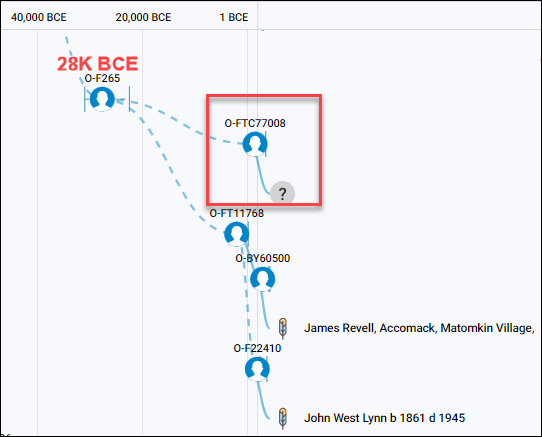
Viewing the Malagasy Project’s Group Time Tree, above, the common ancestor between those three men lived about 28K BCE, or 30,000 years ago.

Haplogroup O Project Group Time Tree

The Haplogroup O Project Time Tree provides a better representation of haplogroup O in general given that it has a much wider range of samples.

On this tree, I’ve labeled the haplogroup formation dates, along with the Revels/Lewis line which descends from O-FT45548. This haplogroup includes one additional group member whose surname is locked, as he hasn’t given publication permission. The haplogroup formation date of 1766 occurs approximately 85 years after James Revel’s birth, so is attributable to some, but not all of his descendants. At least one descendant falls into the older Haplogroup O-BY60500.

The common ancestor of all three, meaning Revels, Lewis, and the man whose name is locked and does not know his genealogy, is haplogroup O-BY60500, born about 1741.

Their ancestral haplogroup before that, O-FT11768, is much older.

Two Filipino results are shown on and descending from the parent branch of O-FT11768, formed about 3183 BCE, or about 5183 years ago. This tells us that the ancestors of all these men were in the same place, most likely the Philippines, at that time.

3183 BCE (5180 years ago) is well after the Native American migration into the Americas.

Discover Time Tree

Obviously, not every tester joins a project, so now I’m switching to the Discover Time Tree which includes all Y-DNA haplogroup branches. Their common haplogroup, O-FT11768, has many branches, not all of which are shown below. I’m summarized unseen branch locations at bottom left.

Expanding the Time Tree further to view all of the descendant haplogroups of O-FT11768, we see that this was a major branch with many South Pacific results, including the branch of O-FT22410, bracketed in red, which has three members.

One is Mr. Lynn whose feather indicates Native American as his EKA country selection, one is a man whose ancestor is from Singapore, and one is an unknown individual who did not enter his ancestor’s country of origin.

Geography

Wesley’s STR match list, which can reflect matches further back in time than the Big-Y test, includes islands near Singapore. This geography aligns with what is known about haplogroup O.

The distance between this Asian region and continental America, 9000+ miles distant by air, is remarkable and clearly only navigable at that time by ship, meaning ships with experienced crew, able to navigate long distances with supplies and water.

We know that in 760 CE, about 1240 years ago, Mr. Lynn’s haplogroup O-F24410 was formed someplace in the South Pacific – probably in Malaysia or a nearby island. This region, including the Philippines, is home to many haplogroup O men. The majority of haplogroup O is found in Asia, the South Pacific, and Diaspora regions.

We know that Hawaii was populated by Polynesian people about 1600 years ago, prior to the age of colonization. Hawaii is almost 7000 miles from Singapore.

Here’s the challenge. How did these haplogroup O men get from the South Pacific to Virginia? Mr. Lynn and the Singapore tester share a common ancestor about 1240 years ago, or 760 CE.

There is no known or theorized Native American settlement wave across Beringia as late as 760 CE. We know that the parent haplogroup was someplace near Singapore in approximately 760 CE.

Two Filipino men and the Revels’ ancestors were in the same location in the Pacific Islands 5180 years ago. How did they arrive on the Eastern Shore in Virginia, found in the Native population, either in or before 1656 when James Revels was born?

What happened in the 3500 years between those dates that might explain how James Revel’s ancestor made that journey?

Academic Papers

In recent years, there has been discussion of possible shoreline migration routes along the Russian coast, Island hopping along Alaska, Canada, and what is now the US, known as the Kelp Highway or Coastal Migration Route – but that has yet to be proven.

Even if that is the case, and it’s certainly a possibility, how did this particular group of men get from the Pacific across the continent to the Atlantic shore in such a short time, leaving no telltale signs along the way? The Coastal Migration Theory hypothesis states that this migration occurred from 12-16 thousand years ago, and then expanded inland over the next 3-5K years. They could not have expanded eastward until the glaciers receded. Regardless, the parent haplogroup and associated ancestors are still found in the Philippines and South Pacific 5000 years ago – after that migration and expansion had already occurred.

The conclusion of the paper is that there is no strong evidence for a Pacific shoreline migration. Regardless, that’s still thousands of years before the time range we’re observing.

We know that the Lynn ancestor was with men from Indonesia in 760 CE, and the Revels ancestor was with men from the Pacific Islands, probably the Philippines, 5180 years ago. They couldn’t have been in two places at the same time, so the ancestors of Revels and Lynn were not in the Americas then.

A 2020 paper shows that remains from Easter Island (Rapa Nui) show Native American DNA, and suggests that initial contact occurred between the two cultures about 1200 CE, or about 800 years ago, but there is not yet any pre-contact or post-contact ancient Y-DNA found in the Americas that shows Polynesian DNA. Furthermore, the hypothesis is that the DNA found on Easter Island came from the Americas, not vice versa. The jury is still out, but this does show that trans-Pacific contact between the two cultures was taking place 800 years ago, at least two hundred years pre-European contact.

Australasian migration to South America is also suggested by one set of remains found in Brazil dating from more than 9000 years ago, but there have been no other remains found indicating this heritage, either in Brazil, or elsewhere in the Americas.

Based on the Time Tree dates of the Haplogroup O testers in our samples, we know they were in the Islands of Southeast Asia after this time period. Additionally, there are no Australia/New Zealand matches.

The Spanish

The Spanish established an early trade route between Manila and Acapulco beginning in 1565. Consequently, east Asian men left their genetic signature in Mexico, as described in this paper.

Historians estimate that 40-129K immigrants arrived from Manilla to colonial Mexico between 1565 and 1815, with most being enslaved upon arrival. Approximately one-third of the population in Manilla was already enslaved. Unfortunately, this paper focused only on autosomal genome-wide results and did not include either Y-DNA, nor mitochondrial. However, the paper quantifies the high degree of trade, and indicates that the Philippines and other Asian population haplotypes are still prevalent in the Mexican population.

In 2016, Dr. Miguel Vilar, the lead scientist with the National Geographic Genographic project lectured in Guam about the surprising Native American DNA found in the Guam population and nearby islands. He kindly provided this link to an article about the event.

Guam was colonized by Spain. In the image from the Boxer Codex, above, the local Chamorro people greet the Manila Galleon in the Ladrones Islands, as the Marianas were called by the Spanish, about 1590.

Native Hawaiians descend from Polynesian ancestors who arrived in the islands about 400 CE, or about 1600 years ago. Captain Cook, began the age of European contact in Hawaii in 1778.

Five Possibilities

There are five possible origins of haplogroup O in the Americas.

  • Traditional migration across Beringia with the known migrations, estimated to have occurred about 12-16K years ago.
  • A Kelp Highway Coastal Migration which may have occurred about 12-16K years ago and dispersed over the next 3-5K years.
  • Circumpolar migration – specifically Inuit and Na-Dene speakers, about 4-6K years ago.
  • Post-contact incorporation from the Pacific Islands resulting from shipping trade on colonial era ships sometime after 1565.
  • Post-contact incorporation from Madagascar resulting from the importation of humans who may or may not have been enslaved upon arrival.

Do we have any additional evidence?

Other Haplogroup O DNA

From my book, DNA for Native American Genealogy:

Testers in haplogroup O-BY60500 and subclade O-FT45548 have proven Native American heritage.

We have multiple confirmed men from a common ancestor who is proven to be an enslaved Accomack “Indian boy,” James Revell, born in 1656, “belonging to the Motomkin” village, according to the Accomack County, Virginia court records. These men tested as members of haplogroup O-F3288 initially, after taking the Big Y-500 test. However, upgrading to the Big Y-700 produced more granular results and branches reflecting mutations that occurred since their progenitor was born in 1656.

Unfortunately, other than known descendants, these men have few close Y-DNA or Big Y-700 matches.

Without additional men testing from different unrelated lines, or ancient haplogroup O being discovered, we cannot confirm that this haplogroup O male’s ancestor was not introduced into the Matomkin Tribe in some way post-contact. Today, one descendant from this line is a member of the Lumbee Tribe.

However, that isn’t the end of the haplogroup O story.

The Genographic Project data shows one Haplogroup O Tlingit tribal member from Taku, Alaska, along with several testers from Mexico that indicate their paternal line is indigenous. Some people from Texas identify their paternal line as Hispanic.

Another individual indicates they were born on the Fountain Indian Reserve, in British Columbia and speaks the St’at’imcets language, an interior branch of Coastal Salish.

Haplogroup O has been identified as Native American in other locations as well.

Much of the information about Haplogroup O testers was courtesy of the Genographic Project, meaning we can’t contact those people to request upgraded tests, and we can’t obtain additional information in addition to what they provided when they tested. As an affiliate researcher, I’m very grateful to the National Geographic Society’s Genographic project for providing collaborative data.

When the book was published, the Discover Time Tree had not yet been released. We have additional information available today, including the dates of haplogroup formation.

FamilyTreeDNA Haplotree and Discover

The FamilyTreeDNA Haplotree (not to be confused with the Discover Time Tree) shows 10 people at the O-M175 level in Mexico, 10 people in the US report Native American heritage, 2 in Jamaica, and one each in Peru, Panama, and Cuba. There’s also one tester from Madagascar.

Altogether, this gives us about 35 haplogroup O males in the Americas, several with Native heritage.

Please note that I’ve omitted Hawaii in this analysis and included only North and South America. The one individual selecting Native Hawaiian (Kanaka Maoli) is in haplogroup O-M133.

Let’s look at our three distinct clusters.

Cluster 1 – Pacific Northwest – Alaska and Canada

We have a cluster of three individuals along the Pacific Coast in Alaska and Canada who have self-identified as Native, provided a tribal affiliation, and, in some cases, the spoken language.

How might haplogroup O have arrived in or near Vancouver, Washington? We know that James Cook “discovered” Hawaii in 1778, naming it the Sandwich Islands. By 1787, a female Hawaiian died en route to the Pacific Northwest, and the following year, a male arrived. Hawaii had become a provisioning stop, and the Spanish took Hawaiians onto ships as replacement workers.

Hawaiian seamen, whalers, and laborers began intermarrying with the Native people along the West Coast as early as 1811. Their presence expanded from Oregon to Alaska. Migration and intermarriage along the Pacific coast began slowly, but turned into a steady stream 30 years later when we have confirmed recruitment and migration of Hawaiian people

In 1839, John Sutter recruited a small group of 10 Hawaiians to travel with him to the then-Mexican colony of Alta, California.

By the mid-1800s, hundreds of Hawaiians lived in Canada and California. In 1847, it was reported that 10% of San Francisco’s residents were Hawaiian. Some of those people integrated with the Native American people, particularly the Miwok and Maidu. The village of Verona, California was tri-lingual: Hawaiian, a Native language, and English, and is today the Sacramento-Verona Tribe.

This article provides a history of the British Company who administered Fort Vancouver, near Vancouver, Washington, that included French-Canadians, Native Americans and Hawaiians. In 1845, 119 Hawaiians were employed at the fort. One of the 119, Opunuia, had signed on as an “engagé,” meaning some type of hired hand or employee, with the Hudson Bay Company for three years, after which he would be free to return home to Honolulu or establish himself in the Oregon Country. He married a woman from the Cascade Tribe.

The descendants of the Hawaiian men and Native women were considered tribal members. In most tribes, children took the tribal status and affiliation of the mother.

The Taku and Sitka, Alaska men on the map are Tlingit, and the man from British Columbia is from the Fountain Indian Reserve.

Hawaiian recruitment is the most likely scenario by which haplogroup O arrived in the tribes of the Pacific Northwest. In that sense, haplogroup O is indeed Native American but not indigenous to that region. The origins of haplogorup O in the Pacific Northwest are likely found in Hawaii, where it is indigenous, and before that, Polynesia – not due to a Beringian crossing.

Cluster 2 – Mexico

We find a particularly interesting small cluster of 4 haplogroup O individuals in interior Mexico.

In the 1500s, Spain established a trade route between Mexico and Manilla in the Philippines.

In 1564, four ships left Mexico to cross the Pacific to claim Guam and the Philippines for King Philip II of Spain. The spice trade, back and forth between Mexico and the Philippines began the following year and continued for the next 250.

Landings occurred along the California coast and the western Mexican coastline. The majority of the galleon crews were Malaysian and Filipino who were paid less than the Spanish sailors. Slaves, including people from the Marianas were part of the lucrative cargo.

One individual in Texas reports haplogroup O and indicates their paternal ancestors were Hispanic/Native from Mexico. A haplogroup O cluster claiming Native heritage is found near Zacatecas, Fresnillo and San Luis Potosi in central Mexico. Additionally, mitochondrial haplogroup F, also Asian, is found there as well. Acapulco is the lime green pin.

An additional haplogroup O tester with Native heritage is found in Lima, Peru.

Haplogroup O men are found in Panama, Jamaica and Cuba, but do not indicate the heritage of their paternal ancestral line. None of these men have taken Big-Y tests, and some may well have arrived on the slave ships from Madagascar, especially in the Caribbean. This source attributes some enslaved people in Jamaica to Hawaiian voyages.

I strongly suspect that the Mexican/Peru grouping in close proximity to the Pacific coastline is the result of the Manilla-Mexico 250-year trade route. The Spanish also plied those waters regularly. Big Y testing of those men would help flesh-out their stories – when and how haplogroup O arrived in the local population.

Cluster 3 – East Coast

At first glance, the East Coast grouping of men with a genetic affinity to the people of the Philippines and Indonesia seems more difficult to explain, but perhaps not.

On the East Coast, we have confirmed reports of whalers near Nantucket as early as 1765 utilizing crewmen from Hawaii, known then as the Sandwich Islands, Tahiti, and the Cape Verde Islands off of Africa. A thorough review of early literature might well reveal additional information about early connections with the Sandwich Islands, and in particular, sailors, crew, or enslaved people.

The Spanish and French were the first to colonize the Philippines by the late 1500s. They had discovered the Solomon Islands, Melanesia, and other Polynesian Islands, and by the early 1600s, the Dutch were involved as well.

The Encyclopedia Britanica further reports that Vasco Balboa first sailed into the Pacific in 1513 and seven years later, Ferdinand Magellan rounded the tip of South America. The Spanish followed, establishing a galley trade between Manila, in the Philippines and Acapulco in western Mexico.

While I found nothing specific stating that the earliest voyages brought men from the Philippines and Oceania back to their European home ports with them, we know that early European captains on exploratory voyages took Native people from the east coast of the Americas on their return journey, so there’s nothing to preclude them from doing the same from the Pacific. The early explorers stayed for months among the Oceanic Native peoples. If they were short on sailors for their return voyage, Polynesian men filled the void.

We know that the Spanish took slaves as part of their trade. We know that the ships in the Pacific took sailors from the islands. If the men themselves didn’t stay in the locations they visited, it’s certainly within the realm of possibility that they fathered children with local, Native women. Furthermore, given that the slave trade was lucrative, it’s also possible that some Pacific Island slaves were taken not as crew but with the intention of being sold into bondage. Other men may have escaped the ships and hidden among the Native Tribes along the eastern seaboard.

Fishing in Newfoundland and exploration in what would become the US was occurring by 1500, so it’s certainly possible that some of the indigenous people from Indonesia and the Philippines were either stranded, sold to enslavers, escaped, or chose to join the Native people along the coastline in North America. Ships had to stop to resupply rations and take on fresh water.

We know that by the mid-1600s, James Revels, whose father carried haplogroup O, had been born on the Atlantic coast of Virginia or Maryland, probably on the Delmarva Peninsula, short for Delaware, Maryland, Virginia, where the Accomac people lived.

There are other instances of haplogroup O found along the east coast.

On the eastern portion of the haplogroup O map from the book, DNA for Native American Genealogy, we find the following locations:

  • Hillburn, NY – man identified as “Native American Black.”
  • Chichester County, PA – Genographic tester identified the location of his earliest known ancestor – included here because O is not typically found in the states.
  • Accomack County, VA – Delmarva peninsula – James Revels lineage
  • Robeson County, NC – Lewis and Revels surname associated with the Lumbee
  • Chatham County, NC – Lynn ancestor’s earliest known location
  • Greene County, NC – enslaved Blount ancestor’s EKA in 1849

The genesis of Mr. Blount’s enslaved ancestor is unclear. Fortunately, he took a Big Y-700 test.

Mr. Blount’s only Big-Y match is to a man from the United Arab Emirates (UAE), but the haplogroup history includes Thailand, which is the likely source of both his and his UAE matches’ ancestors at some point in time. Their common ancestor was in Thailand in 336 CE, almost 1700 years ago.

All surrounding branches of haplogroup O on the Time Tree have Asian testers, except for the one UAE gentleman.

The Blount Haplogroup O-FTC77008 does not connect with the common ancestral haplogroup of Lynn and Revels, so these lineages are only related someplace in Oceana prior to O-F265, or more about  30,000 years ago. Their only commonality other than their Asian origins is that they arrived on the East Coast of the Americas.

We know that the Spanish were exploring the Atlantic coastline in the 1500s and were attempting to establish colonies. In 1566, a Spanish expedition reached the Delmarva Peninsula. This spit of land was contested and changed hands several times, belonging variously to the Spanish, Dutch, and British by 1664.

Furthermore, we also know that the ships were utilizing slave labor. One of the Spanish ships wrecked in the waters off North Carolina near Hatteras or Roanoke Island before the Lost Colony was abandoned on Roanoke Island in 1587. The Croatan Indians reported that in memorable history, several men, some of whom were reported to be slaves, had survived the wreck and “disappeared” into the hinterlands – clearly running for their lives.

These men, if they survived, would have been incorporated into the Native population as there were no other settlements at the time. Variations of this scenario may have played out many times.

James Revels’ ancestor could have arrived on any ship, beginning with exploration and colonization in the early 1500s through the mid-1650s.

By the time the chief bound the Indian boy who was given the English name James to Edward Revell, James’s Oceanic paternal ancestor could have been 4, 5 or 6 generations in the past – or could have been his father.

The Accomack was a small tribe, loosely affiliated with the Powhatan Confederacy along the Eastern Shore. By 1700, their population had declined by approximately 90% due to disease. A subgroup, the Gingaskins, intermarried with African Americans living nearby. After Nat Turner’s slave rebellion of 1831, they were expelled from their homelands.

The swamps near Lumberton in Robeson County, NC, became a safe haven for many mixed-race Native, African, and European people. The swamps protected them, and they existed, more or less undisturbed, for decades. Revels and Lewis descendants are both found there.

Many Native Americans were permanently enslaved alongside African people – and within a generation or so, their descendants knew they were Native and African, but lost track of which ancestors descended from which groups. Life was extremely difficult back then. Generations were short, and enslaved people were moved from place to place and sold indiscriminately, severing their family ties entirely, including heritage stories.

Returning to the Discover Time Tree Maps

Wesley Revels has STR matches with several men from Indonesia, China, and the Philippines. It would be very helpful if those men would upgrade to the Big Y-700 so that we can more fully complete the haplogroup O branches of the Time Tree.

The common Revels/Lewis ancestor, accompanied by two descendant men on different genetic branches from the Philippines, was born about 5180 years ago. There is no evidence to suggest Haplogroup O-FT11768 was born anyplace other than in the Philippines.

How did the descendant haplogroups of O-FT45548 (Revels, Lewis, and an unnamed man) and O-F22410 (Lynn) arrive in Virginia or anyplace along the Atlantic seaboard?

Hawaii wasn’t settled until about 1600 years ago. We know Hawaiians integrated with the Pacific Coast Native tribes in the 1800s, but James Revels was in Virginia in 1656..

We know that the Spanish established a mid-1500s trade route between Manila and Acapulco, leaving their genetic signature in western Mexico.

None of these events fit the narrative for the Revels or the Lynn paternal ancestor.

Furthermore, the Revels and Lynn lines do not connect on North American soil, as both descend from the same parent haplogroup, O-FT11768, 5180 years ago in the Philippines. This location and history suggest a connection with the Spanish galleon trade era. The haplogroup formation clearly predates that trade, which means those men were still in the Philippines, not already living on the American continents. Therefore, the descendants of the haplogroup O-FT11768 arrived in Virginia and North Carolina sometime after that haplogroup formation 5100 years ago.

The Lynn ancestor connects with a man from Singapore in 760 CE, or just 1240 years ago. A descendant of haplogroup O-F22410 arrived in North Carolina sometime later.

It does not appear, at least not on the surface, that there is a connection through Madagascar, although we can’t rule that out without additional testers. If the connection is through Madagascar, then their ancestors were likely transported from Indonesia to Madagascar, then as enslaved people from Madagascar to the Atlantic colonies to be sold. However, James Revels was not enslaved. He was clearly Native and bound to a European plantation owner, who did, in fact, free him as agreed and subsequently loaned him money.

Based on the dates involved, and when we know they were in Oceania, an arrival along the west coast, followed by a quick migration across the country to a peninsula of land in the Atlantic, is probably the least likely scenario. There is also no historical or ancient haplogroup O DNA found anyplace between the west and east coasts, nor in the Inuit or Na-Dene speakers. The Navajo, who speak the Na-Dené language, migrated to the Southwest US around 1400 CE, but haplogroup O has not been found among Na-Dené speakers.

It’s a long way from Singapore and the Philippines to Madagascar, so while the coastal migration scenario is not impossible, it’s also not probable, especially given what we know about the Spanish Pacific trade that existed profitably for 250 years.

However, one haplogroup O subgroup arrived in the UAE by some methodology after 336 CE.

It’s entirely possible, indeed probable, that haplogroup O arrived in the Americas for various reasons, on different paths, in different timeframes.

Haplogroup O was found in people in the Americas after colonization had begun. There has been no ancient Haplogroup O DNA discovered, and there’s evidence indicating that these instances of haplogroup O could not have arrived in any of the known Beringia migrations nor the theorized Coastal or Kelp migration. We know the East Coast Cluster is not a result of the West Coast 19th-century migration because James Revels was in court one hundred and fifty years before the Hawaiians were living among the Native people along the Pacific coastline.

There’s nothing to indicate that the Mexican group that likely arrived beginning in the mid-1500s for the next 250 years as a result of the Indonesian trade route migrated to the east coast, or vice versa. That’s also highly unlikely.

The most likely scenario is that Mr. Lynn’s, Mr. Blount’s, and James Revels’ ancestors were brought on trade ships, either as sailors or enslaved men. They may not have stayed, simply visited. They may each have arrived in a completely different scenario, meaning Mr. Blount’s ancestors could have been enslaved arrivals from Madagascar, Mr. Lynn’s from Indonesia, and Mr. Revel’s as a crew member on a Spanish ship. We simply don’t know.

James Revels’ descendants were Native through his mother’s tribe, as confirmed in the 1667 court records. However, the Revels and Lynn lineages weren’t Native as a result of their paternal haplogroup O ancestors crossing Beringia into the Americas with Native American haplogroups Q and C. Instead, the Lynn and Revels migration story is quite different. Their ancestors arrived by ship. The journey was long, perilous, and far more unique than we could have imagined, taking them halfway around the world by water.

Timeline

There’s a lot of information to digest, so I’ve compiled a timeline incorporating both genetic and historical information for easy reference.

  • 30,000 years ago (28,000 BCE) – haplogroup O-F265, common Asian ancestor  of Mr. Blount, the Revels/Lewis group, Mr. Lynn, and an unknown Big-Y tester in the Malagasy group project
  • 12,000-16,000 years ago – Indigenous Americans arrived across now-submerged Beringia
  • 12,000-16,000 years ago – possible Coastal Migration route may have facilitated a secondary source of indigenous arrival along the Pacific coastline of the Americas
  • 4000-7000 years ago – circumpolar migration arrival of Inuit and Na-Dené speakers found in the Arctic polar region and the Navajo in the Southwest who migrated from Alaska/Canada about 1400 CE
  • 5180 years ago (3180 BCE) – haplogroup O-FT11768, the common ancestor of Mr. Lynn and the Revels/Lewis group with many subgroups in the Philippines, Hawaii, Singapore, Brunei, China, Sumatra, and Thailand
  • 2244 years ago (244 BCE) – haplogroup O-CTS716, the common ancestor of Wesley Revels and Mr. Luo from Indonesia
  • The year 336 CE, 1684 years ago – haplogroup O-FTC77008, the common ancestor of Mr. Blount, UAE tester and a man from Thailand
  • 400 CE, 1600 years ago  –  Hawaii populated by Polynesian people
  • 760 CE, 1240 years ago – haplogroup O-F22410, common ancestor of Mr. Lynn with a Singapore man
  • 1492 CE, 528 years ago – Columbus begins his voyages to the “New World,” arriving in the Caribbean
  • By 1504 CE – European fishing began off of Newfoundland
  • 1565 – Spain claimed Guam and the Philippines
  • 1565 – Spanish trade between Manilla and Acapulco begins and continues for 250 years, until 1815, using crews of men from Guam, the Philippines, and enslaved people from the Marianas.
  • 1565 – St. Augustine (Florida) was founded by the Spanish as a base for trade and conquest along the eastern seaboard
  • 1566 – A Spanish expedition reached the Delmarva peninsula intending to establish a colony, but bad weather thwarted that attempt.
  • 1585-1587 – voyages of discovery by the English and the Lost Colony on Roanoke Island, North Carolina
  • 1603 – English first explored the Delmarva Peninsula, home to the Accomac people, now Accomack County, VA, where James Revels’s court record was found in 1667
  • 1607 – Jamestown, Virginia, founded by the English
  • 1608 – Colonists first arrived on the Delmarva Peninsula and allied with Debedeavon, whom they called the “laughing King” of the Accomac people. At that time, the Accomac had 80 warriors. Debedeavon was a close friend to the colonists and saved them from a massacre in 1622. He died in 1657.
  • 1620 – The Mayflower arrived near present-day Provincetown, Massachusetts
  • 1631-1638 – Dutch West India Company established a colony on the Delmarva Peninsula, but after conflicts, it was destroyed by Native Americans in 1638. The Swede’s colony followed, and the region was under Dutch and Swedish control until it shifted to British control in 1664
  • 1656 – Birth of James Revels, confirmed in a 1667 court record stating that he was an Accomack “Indian boy” from “Matomkin,” judged to be age 11, bound to Edward Revell. This location is on the Delmarva Peninsula.
  • 1741 CE –  Haplogroup O-BY60500 formation date that includes all of the Revels and Lewis testers who descend from James Revels born in 1656
  • 1765 – Whalers near Nantucket using crewmen from Hawaii (Sandwich Islands), Tahiti, and the Cape Verde Islands off of Africa
  • 1766 CE – Formation date for haplogroup O-FT45548, child haplogroup of O-BY60500, for some of the Lewis and Revels men who all descend from James Revels born in 1656
  • 1778 – Captain Cook makes contact with Hawaiian people
  • 1787 – The first male arrived in the Pacific Northwest from Hawaii
  • 1811 – Hawaiian seamen begin intermarrying with Native American females along the Pacific shore, eventually expanding their presence from Oregon to Alaska
  • 1839 – John Suter recruits Hawaiian men to travel with him to California
  • 1845 – Hawaiians employed by Fort Vancouver, with some marrying Native American women

Conclusions

It’s without question that James Revels was Native American very early in the settlement of the Delmarva Peninsula, now Accomack County, Virginia, but his common ancestor with Filipino men 5100 years ago precludes his direct paternal ancestor’s presence in the Americas at that time. In other words, his Revel male ancestor did not arrive in the Beringian indigenous migration 12,000-16,000 years ago. His ancestor likely arrived post-contact, based on a combination of both historical and genetic evidence.

Haplogroup O is not found in the Arctic Inuit nor the Na-Dene speakers, precluding a connection with either group, and has never been found in ancient DNA in the Americas.

Haplogroup O in the Revels lineage is most likely connected with the Spanish galleon trade with the Philippines and the early Spanish attempts to colonize the Americas.

The source of Haplogroup O in the Pacific Northwest group is likely found in the recruitment of Hawaiian men in the early/mid-1800s.

The Mexican Haplogroup O group likely originated with the Manilla/Mexico Spanish galleon trade.

The source of the Blount Haplogroup O remains uncertain, other than to say it originated in Thailand thousands of years ago and is also found in the UAE. The common Blount, UAE, and Thailand ancestor’s haplogroup dates to 336 CE, so they were all likely in or near Thailand at that date, about 1687 years ago.

What’s Next?

Science continuously evolves, revealing new details as we learn more, often clarifying or shifting our knowledge. Before the Discover tool provided haplogroup ages based on tests from men around the world, we didn’t have the necessary haplogroup origin and age data to understand the genesis of haplogroup O in the Americas. Now, we do, but there is invariably more to learn.

New evidence is always welcome and builds our knowledge base. Haplogroup O ancient DNA findings would be especially relevant and could further refine what we know, depending on the location, dates of the remains, who they match, and historical context.

Additional Big Y-700 tests of haplogroup O men, especially those with known genealogy or ancestor location, including Madagascar, would be very beneficial and allow the haplogroup formation dates to be further refined.

If you are a male with haplogroup O, please consider upgrading to the Big Y-700 test, here.

_____________________________________________________________

Follow DNAexplain on Facebook, here.

Share the Love!

You’re always welcome to forward articles or links to friends and share on social media.

If you haven’t already subscribed (it’s free,) you can receive an email whenever I publish by clicking the “follow” button on the main blog page, here.

You Can Help Keep This Blog Free

I receive a small contribution when you click on some of the links to vendors in my articles. This does NOT increase the price you pay but helps me to keep the lights on and this informational blog free for everyone. Please click on the links in the articles or to the vendors below if you are purchasing products or DNA testing.

Thank you so much.

DNA Purchases and Free Uploads

Genealogy Products and Services

My Book

Genealogy Books

Genealogy Research

Étienne Hebert (c1625-c1670): Two French Brothers & Their Ancient Ancestors – 52 Ancestors #413

In the book, Les vielles familles d’Yamachiche: vingt-trois généalogies, v. 4 published in 1908 in Ontario, we discover that Étienne Hebert is one of two brothers who came from France and settled in Acadia, now Nova Scotia. Étienne married Marie Gaudet and Antoine Hebert married Genevieve LeFranc.

We know that Étienne and Antoine were brothers because in the 2nd marriage record for Jean-Jacques Hébert (1681-?) to Marguerite Leprince on April 27, 1734, at Saint-Charles-les-Mines, they were granted a dispensation from a 3rd degree consanguine relationship. The only overlap in their two family trees would be the parents of Étienne and Antoine Hebert.

Thank goodness for those church records.

Origins

Stephen A. White provided the following information about Étienne.

HÉBERT, Étienne, came from France with his wife Marie Gaudet, according to nine depositions: one from his grandson Jean Hébert (Doc. inéd., Vol. III, p. 11), one from Pierre Trahan, husband of his granddaughter Madeleine Comeau (ibid., p. 8), one from Pierre and Madeleine’s son Pierre Trahan (ibid., pp. 110-111) and one from their nephews Sylvestre and Simon Trahan (ibid., p. 30), two from husbands of Étienne’s great-granddaughters (ibid., Vol. II, p. 182; Vol. III, p. 90), one from a great-great-grandson (ibid., Vol. III, pp. 93-94), and two from husbands of his great-great-granddaughters (ibid., pp. 45, 92-93). Seven of these depositions name his wife as Marie Gaudet; only those of the two Pierre Trahans, father and son, do not.

Lucy LeBlanc Consentino documents these priceless depositions here.

Parents

There have been several proposed and presumed parents of Étienne and Antoine Hebert. None are proven, and some have been disproven. I’m not going to recount each theory here. I’ll briefly mention the most common ones and strongly suggest that anyone tempted to assign parents for these men consult existing resources and arguments first.

Tim Hebert’s website is no longer online, but you can view it here at Wayback Machine. Tim did an exceptional job documenting the various theories and Hebert descendants.

It has been said that possibly the brothers were from south of Loudon (LaChaussee, Martaize, etc.), however, since Charles Menou d’Aulnay’s family had land in that vicinity. If he recruited settlers from that area, there is a chance they came from there, but there is no proof of where they (or most other) Acadians came from. The linguistic studies by Genevieve Massignon tried to say that they were from the Loudon area, but perhaps she was focusing too much. It is probably true that they came from western France. But the lack of documentation in the Loudon region means that perhaps we’re looking in the wrong place. Michael Poirier has suggested they came from west of Loudon at the coast … near Baie de Bourgneuf.

He bases this on:
– the location of the monastery of the Assumption (on the island Chauvet), which was regularly attended by Richelieu and was the property of his brother, Alphonse.
– Port-Royal and the church of St Jean-Baptiste
– salt-water marshes in the area were drained … much like the dyke system utilized in Acadia
– it was a zone surrounded by Protestants and enclosing Catholics

Genevieve Massignon (1921-1966) argues that a number of familial alliances existed among the first Acadian settlers PRIOR to their arrival from France, pointing to a common French origin. She believes they lived in the Acadian Governor d’Aulnay’s seigneury in France near Loudun (comprised of the villages of Angliers, Aulnay, Martaizé, and La Chausée). The Hébert family was allied with the Gaudets through Étienne’s marriage to Marie. Marie’s sister Francoise was also allied with the Leblanc family through her marriage to Daniel. Evidence of their marriages in France is found in the Belle-Isle-en-Mer declarations in 1767. Moreover, a certain Jean Gaudet was censistaire in 1634 on land at Martaizé (Vienne) in the Seigneurie owned by the mother of Acadian governor Charles d’Aulnay. However, Massignon’s research failed to find any relevant baptismal or marriage records.

Another couple, Jacques Hebert and Marie Juneau have been debunked as parents, based on the date of their marriage and analysis by Stephen White. Jacques was found in Acadia 30 years before Étienne and Antoine, then moved into mainland Canada. It’s unlikely that his two sons would be found in Acadia and not near or with him. Not to mention the depositions that state that Étienne and Antoine were born in France.

Another parent candidate was Louis Habert who is generally considered to have been the first permanent settler in Canada, arriving in 1604. He married Marie Rolet in Paris in 1602 but wasn’t known to live in Acadia. Spelling variations of this family name include Hebert, Harbert, Herbert, Herbot, Harbelot, and others. You can read more about this at FamilySearch here.

One source stated that Stephen White reported that Etienne Hebert arrived on the ship, La Verge in 1648. Karen Theriot Reader, upon further examination, determined that the page given as the source does not in fact provide that information, nor elsewhere by White.

However, the Verve did arrive in 1648, chartered by Emmanuel LeBorgne, Sieur of Coudray, to transport supplies. No passenger list exists, and several ships arrived in Acadia over the years.

In a letter to Tim Hebert, Stephen White stated that their parents are “unknown.” No birth records have been found, and White found none of the proposed parents convincing or even probable.

We simply don’t know when and where Étienne and Antoine were born. It’s fair to say it was in France because families weren’t imported until 1636. The Hebert brothers were born in the 1620s. They would have been teenagers or young men in 1636.

What Was Happening in Acadia?

Warm up your tea or coffee, ‘cause this is a fascinating tale.

Acadia was truly the frontier and constantly caught in the middle in a tug of war between France and England for control of both the land and resources, along with the people.

Settlement in Acadia began in 1604, but we’re joining this history 28 years later.

In 1632, control of Acadia passed from the English back to the French, who immediately launched voyages transporting traders and workers, some of whom became settlers. Their initial goal wasn’t settlement, though, but trading posts.

Port Royal is shown on Champlain’s 1632 map.

Isaac de Razilly was a French noble sea captain and knight who convinced his cousin, Cardinal Richelieu, chief minister to the King of France, that colonizing and establishing fur trade with Acadia was a profitable business venture. As a bonus that probably sounded attractive to Richelieu, they could convert and baptize the Native people, too.

Razilly’s 1632 voyage on the L’Esperance a Dieu included about 300 people, mostly men with possibly 12-15 women. A French newspaper report from that time states that a third ship from Rochelle joined the other two. A mason, baker, nailmaker-blacksmith, joiners, gunsmiths, sawyers, laborers, and soldiers signed up.

In 1640, notarial records in La Rochelle, France, show many contracts of engagement for workers in Acadia, although most of those people aren’t shown in the 1671 census, meaning they either died or returned to France when their engagement was over. In 1640, at least 25 men and 5 women signed up.

Couillard-Despres in “Les Gouvernors” states that 63 men arrived on the Saint Clement in 1642 to assist Charles LaTour.

After Razilly’s death in 1635, his cousin, Charles de Menou d’Aulnay, de Charnisay prepared to take over the administration of Acadia. By this time, there were 44 inhabitants at Le Have, Razily’s base of operation. Sometime between 1635 and 1640, d’Aulnay moved the settlement to Port Royal, but the men who had married Native American women likely did not move with him.

However, Charles La Tour, who had lived in Acadia since he was 17 and was married to a Mi’kmaq woman, had other plans. His father, Claude, obtained a grant for Nova Scotia from the English king, and Charles was appointed Governor, serving from 1631-1642. In essence, the LaTour father-son duo had outsmarted d’Aulnay.

Workers still continued to arrive. The 1636 passenger list of the St. Jehan, including occupations and some location origins, still exists.

d’Aulnay and La Tour began as competitors, with LaTour working out of Cap Sable and the St. John River area with traders, and d’Aulnay, who moved the Acadian settlement from La Have to Port Royal, beginning cultivation. Given where we find Étienne Hebert living, he likely arrived with d’Aulnay.

However, the competition between those men soon became animosity, then open warfare, with both men claiming to be in charge of all of Acadia.

If you think there was no drama in a relatively unpopulated area, just try to keep this next bit straight.

In 1640, after LaTour’s Mi’kmaq wife died, he married a French Huguenot woman, Françoise-Marie Jacquelin, who had powerful connections.

In 1642, d’Aulnay had LaTour, a Huguenot, charged with treason against France. LaTour’s well-connected wife traveled to France to advocate on behalf of her husband, returning with a warship for him to defend himself.

Perhaps this was a bit hasty.

In the Spring of 1643, La Tour led a party of English mercenaries against the French Acadian colony at Port-Royal. His 270 Puritan and Huguenot troops killed three men, burned a mill, slaughtered cattle, and seized 18,000 livres worth of furs.

Apparently, LaTour was a traitor after all, at least from the French perspective.

LaTour then traveled to Boston seeking reinforcements from the English, and while he was gone, d’Aulnay seized all of his possessions and outposts, including Fort LaTour.

Are you keeping track of this? I think the score was 3 to 3 here, with a Hail Mary pass underway. Get the popcorn.

LaTour may have been traveling to Boston, but his wife, Françoise-Marie, had remained at home and was not about to relinquish Fort LaTour without a fight.

In the ensuing battle, Françoise-Marie, at the ripe old age of 23, defended Fort LaTour in the Battle of St. John for three days, using the warship. D’Aulnay lost 33 men but on the fourth day, was able to capture the fort. LaTour’s men were hung at the gallows as Françoise-Marie was forced to watch with a rope around her neck, just in case she got any bright ideas. She was clearly not a woman to be trifled with.

Françoise-Marie was not hung, but Nicolas Denys recorded in his journal that she died three weeks later as a prisoner in captivity. The cause remains unknown, but it’s safe to say that her death was a volley in war. 

After learning that his wife had died, his possessions confiscated, and his men killed, LaTour sought refuge in Quebec City. He did not return to Acadia for several years, but return he would – eventually.

For the time being, d’Aulnay was firmly in control, but that only lasted a few years.

In 1650, d’Aulnay drowned when his canoe overturned, which provided the opening LaTour had been waiting for. LaTour sailed to France, obtained royal favor, his property restored, and returned to Acadia as governor in 1653, accompanied by several new colonists, including Philippe Mius d’Entremont, 1st Baron of Pobomcoup.

It was about this time, around 1650, that Étienne Hebert married Marie Gaudet. Perhaps they hoped that living near her parents, a dozen miles upriver, would be more peaceful and less exposed to attack and conflict.

LaTour had remained a widower since his wife’s death defending Fort LaTour in 1645, but in 1653, he married…wait for it… d’Aulnay’s widow, Jeanne Motin. It was not a marriage in name only, as they had five children. Some said they married to heal the rift between the warring d’Aulnay and LaTour camps, some think it was simply a marriage of convenience for both, and others feel it was LaTour’s final victory over d’Aulnay. However, Jeanne was no shrinking violet because she evicted Nicolas Denys when he attempted to exploit d’Aulnay’s death by setting up trading posts at St. Ann and St. Peters.

LaTour wasn’t off the hook, though, because in an odd sort of way, d’Aulnay still managed to be a thorn in LaTour’s side – even from beyond the grave.

Along with d’Aulnay’s property and wife came his substantial debts to Emmanuel Le Borgne, his main financier from La Rochelle. There were two sides to this story because, as part of the deal, La Bourg and other seigneurs were supposed to recruit and transport new settlers to Acadia and care for them by building communal resources like mills and bake-ovens, but they didn’t.

It appears that the Acadians and their French sponsors were both relatively unhappy. The French did not live up to their end of the bargain by building mills and ovens, and consequently, the Acadians resisted paying taxes. Everyone resented the English, but the English needed the Acadian settlers to work the land. And, of course, the land passed back and forth between the French and English from time to time, punctuated by skirmishes and outright attacks.

Acadia, for an Atlantic peninsula of land with few people, was drama-central.

By 1653, it was estimated that there were 45-50 households at Port Royal and La Have, which provides us an estimate of 300-350 people, including 60 single men. Étienne Hebert was lucky to find a bride, any bride.

In 1654, Port Royal was still small, with approximately 270 residents, as estimated by pioneer Nicholas Denys. Denys was a French prisoner at Port Royal who had been responsible for recruiting volunteers for the 1632 Razilly expedition of 300 men from Rochelle, France. They landed at La Hève near modern Bridgewater, the eventual site of the Gaudet village. This location was near the upper reaches of the tidal portion of the Riviere du Dauphine, and their boat probably could not progress further.

Denys did us the favor of describing Port Royal in 1653:

There are numbers of meadows on both shores, and two islands which possess meadows, and which are 3 or 4 leagues from the fort in ascending. There is a great extent of meadows which the sea used to cover, and which the Sieur d’Aulnay had drained. It bears now fine and good wheat, and since the English have been masters of the country, the residents who were lodged near the fort have for the most part abandoned there houses and have gone to settle on the upper part of the river. They have made their clearings below and above this great meadow, which belongs at present to Madame de La Tour. There they have again drained other lands which bear wheat in much greater abundance than those which they cultivated round the fort, good though those were. All the inhabitants there are the ones whome Monsieur le Commandeur de Razilly had brought from France to La Have; since that time they have multiplied much at Port Royal, where they have a great number of cattle and swine.

The commentary about the French settling on the upper part of the river may be very important for the Hebert family because that’s exactly where they are found.

Denys also recorded that Robert Sedgewick of Boston had been ordered by Robert Cromwell to attack New Holland (New York). As Sedgewick prepared, a peace treaty was signed between the English and the Dutch. Since he was “all dressed up with nowhere to go,” he attacked Acadia in August 1654 and destroyed most of the settlements, including Port Royal, La Have, and the Saint John River village. Sedgewick left the area but appointed an Acadian council with Guillaume Trahan in charge. Some of the French may have returned to France at this point.

Denys doesn’t say if Sedgewick burned the upper river homesteads and farms or if he was satisfied with torching Port Royal. Living 12-14 miles away in the out-country may have been the saving grace of the Hebert and Gaudet families. Or, their homesteads and farms may have been destroyed, too. Certainly, if not burned out, they were devastated by Acadia falling to the English.

Acadia was back under English rule and would remain so until being returned, again, to the French in 1667.

After Sedgewick captured Acadia for the English, LaTour went to London to regain his property, again. Being a Protestant would have worked in his favor, as well as having led the English in raids against Port Royal in 1643.

In 1656, Cromwell granted property to two Englishmen and LaTour, but LaTour sold his share to the Englishmen and moved to Cap Sable, on the southern end of the peninsula, to attempt to live the rest of his life in peace.

We don’t know positively that the Hebert brothers were in Acadia at this time, but it’s almost assured. They had probably been in Acadia for between 10 and 30 years. If White is correct, they had resided in Acadia for eight years. Windows of immigration existed, but generally only when the French were in charge, although France imported settlers to other nearby parts of New France. The French were not imported directly into Acadia when the English ruled.

In 1666, France stopped sending colonists, ostensibly for fear of depopulating the mother-country. However, the English were still arriving in the colonies to escape religious prosecution and for economic reasons. Therefore, the Acadians were exposed to at least some English settlers, probably spoke and understood at least a little English, and established some level of trade with the English colonies along the Eastern seaboard.

By Mikmaq – Own work, CC BY-SA 3.0, https://commons.wikimedia.org/w/index.php?curid=1351882

Given the 1671 census and the ages of his children, we know Étienne was married by 1651 and that his wife’s parents also settled in Acadia.

Life in Acadia always seemed to be contentious and apparently, in no small part, dangerous.

Étienne was probably in his mid to late 40s when he died, about 1670. He clearly didn’t die of old age, but probably as a result of hunting, fishing, or farming – some accident. Or, perhaps, there was a skirmish. It seemed like there was always some sort of skirmish, but a simple act of daily living such as fishing carried the risk of drowning.

The Catholic church records don’t exist, if they even had a priest at that time, so we don’t know when Étienne died. We can rest assured that, if possible, he was buried in the parish cemetery, now the Garrison Cemetery in Annapolis Royal, beside the fort and the Catholic church.

The First Acadian Census

Even though Acadia was officially returned to France in 1667, it didn’t actually happen right away. In 1670, the English surrendered the fort at Port Royal, apparently without incident. The new French governor arrived, bringing with him another 60 settlers and 30 soldiers. The new governor ordered a census, thankfully. He likely needed to know how many people would be paying taxes.

The first Acadian census was taken in 1671, documenting between 240 and 350  Acadian residents (depending which count you utilize) in 68 households in Port Royal and one household each in three other locations. Historians know some residents in settlements weren’t counted, and neither were Acadian/Native American families living with the Native people. Estimates of the entire Acadian population reach as high as 500.

Étienne was already deceased, but we can tell quite a bit from his widow’s census record, transcribed here by Lucy LeBlanc Consentino.

Marie Gaudet, widow of Étienne Hebert, 38. She has 10 children, two married children: Marie 20, Marguerite 19; Emmanuel 18, not yet married, Étienne 17, Jean 13, Francoise 10, Catherine 9, Martine 6, Michel 5, Antoine 1, 4 cattle, 5 sheep and 3 arpents of cultivated land.

This tells us that Etienne and Marie were married in about 1650, or maybe somewhat earlier. Their eldest living child was age 20. Étienne was probably about 25 years old when he married, so I’d estimate his birth year as 1625, give or take a few years. It appears that Marie Gaudet and her daughter, Marie Hebert, and her husband, Michel de Forest, and their families were probably living either on the same farm or even in the same house.

Marie’s youngest child was age 1, so we know that Étienne died sometime between 1669 and 1671.

His brother, Antoine Hebert is listed three houses away as a 50-year-old cooper, so he was born about 1621.

Hebert and Gaudet Allied Families

It’s clear that the Hebert family was somehow allied with the Gaudet family as early as 1650 when their children married. It’s possible that they married in France, or Acadia.

What we do know is that these two families lived in close proximity on the Riviere de Dauphine, now the Annapolis River.

This 1733 map at the Nova Scotia Archives is based on the 1707 census route and shows about a mile and a half or two miles distance between the Hebert and Gaudet homesteads – 57 years after Étienne Hebert and Marie Gaudet married.

Etienne Hebert lived along Bloody Creek, where the Hebert Village is found, courtesy of MapAnnapolis, below.

We know where Etienne, Marie, and their family lived and at least something about their life – but what else can we unearth?

The Hebert DNA Story

Eventually, the answer to where the Hebert brothers originated in France will be told through their Y-DNA, passed directly from father to son through the generations without ever being admixed with the mother’s DNA, or divided.

The Hebert family is well-represented in the Acadian AmerIndian Project with three Big-Y testers showing the same haplogroup. Haplogroup R-BY31006 was born about 1650, almost exactly when Étienne and his brother were marrying and having children near Fort Royal.

Click to enlarge any image

Two present-day project members descend from Étienne, and one descends from Étienne’s brother, Antoine. They have the same high-resolution haplogroup, so we know that their father had the same mutation that he gave to both sons. How I wish some Hebert men from France could test, but DNA testing for genealogy is illegal there.

Unfortunately, no other contemporary man of any surname is close to our Hebert cluster. The haplogroup ancestor upstream of R-BY31006 is the parent haplogroup R-BY31008 that occurred about 245 BCE, or 2245 years ago. The descendants of that man are also found in England, Norway, and Scotland, in addition to our Hebert men in France.

That’s quite interesting.

But there’s something even more interesting.

Ancient DNA

Looking at Ancient Connections in Discover, I note that one of the Hebert Ancient Connections was found in France and has been placed into haplogroup R-Z31644. I wonder what the connection is. Let’s take a look at that haplogroup.

The TimeTree shows us that nine ancient DNA samples are found on different haplogroup branches of R-Z31644, of which only one is found in Metz, France, and the rest in the British Isles. It’s unclear exactly what this means. Only the French sample and three others in England and Ireland are found in the current era, meaning after 1 CE. This was clearly prior to the Battle of Hastings in 1066, after which an influx of French settled in England.

Eight ancient DNA results are found in England, but none share a common ancestor earlier than 4300 years ago. Notably, one English burial from about 2000-2300 years ago shares a common ancestor with the Metz, France remains about 4000 years ago. The eight English remains, and our Metz guy descend from a common ancestor about 4300 years ago.

Did Étienne’s ancestors descend from the ancient sample at Metz? Maybe the study provides more clues.

According to the study’s authors:

The Sablon district, which is located in the southern part of the city of Metz, was, during the Gallo-Roman period, a huge necropolis where both inhumations and cremations are found. Towards the end of the 19th century, the exploitation of the sandpits enabled the uncovering of sarcophagi (stone), cists (brick and tile), coffins (wood) and vats (lead).

These characterise the new burial practices developed during late Antiquity. [Spans from about the 3rd to the 6th or 7th centuries.]

The largest funerary space spans almost a kilometre, on either side of the via Scarponensis (portion of the Reims/Metz road).

The Sablon area can be compared to the Collatina necropolis close to Rome by its chaotic organisation, although at a different scale

Looking at a map of Metz helps put this in context.

It’s unclear exactly where along this route the burials were discovered beginning in the late 1800s. They extend for more than a kilometer on both sides of the road in the Sablon neighborhood of Metz.

The Sablon neighborhood extends from near the old city center along the main artery that crosses railroad tracks that appear to sever the original road into the city.

Does the history of Metz tell us who lived there and what was occurring during this time? Indeed, it does.

Metz is located at the confluence of the Moselle and Seille rivers, near the junction of France, Germany, and Luxembourg. The original inhabitants were Celtic. The town was known as the “city of Mediomatrici,” a fortified city of the tribe by the same name.

The Mediomatrici village evolved into a Gallo-Celtic city after Julius Caesar conquered the Gauls in 52 BCE.

Named Divodurum Mediomatricum by the Romans, present-day Metz was integrated into the Roman empire in the first century CE, after which it was colloquially referred to as the Holy Village.

The historic district has kept part of the Gallo-Roman city with Divodurum’s Cardo Maximus, then called Via Scarponensis. Today, this is Trinitaires, Taison, and Serpenoise streets in the old city center, and the Decumanus Maximus, which is En Fournirue and d’Estrées streets. The Roman Forum was located at the Cardo and Decumanus intersection and is the Saint-Jacques Square today, as shown below.

By Alice Volkwardsen at German Wikipedia, CC BY-SA 3.0, https://commons.wikimedia.org/w/index.php?curid=10681319

The ancient burial occurred between 432 and 551 CE, as calculated from a molar and was found in a very large Gallo-Roman necropolis, more than a kilometer long, located on both sides along the old Roman road.

This cityscape shows Divodurum Mediomatricum in the second century CE, capital of the Mediomatrici, ancestor city of present-day Metz. The original Roman amphitheater is shown at far left, and the living quarters are located within the city walls, protecting them from attack. A wonderful summary of archaeological findings can be found here.

Today the the Centre Pompidou-Metzocation is found at the site of the original large Roman amphitheater. This amphitheater held upwards of 25,000 people and was the largest and most consequential amphitheater outside of Rome.

Rome’s influence ended when the city was attacked, pillaged and burned by the Huns on April 7, 451, then passed into the hands of the Franks about 50 years later. By 511, Metz was the capital of the Kingdom of Austrasia.

How Does the Metz Burial Connect to England?

How do the dots between Metz and the British Isles connect, given that the common ancestor of our Metz burial and the British Isles burials has descendants scattered throughout the British Isles and in Metz?

The Celts first migrated to the British Isles about 1000 BCE, or about 3000 years ago, so this ancient French man and the other ancient burials in the British Isles make sense. Their common ancestor lived 4300 years ago in Europe. The closest common ancestor of our Metz man and any English burial occurred 4000 years ago, 1000 years before the earliest Celtic migrations across the English Channel.

This man from Metz lived 1500 or 1600 years ago and shares an ancestor with several ancient British men in addition to our Hebert line and was likely Celtic..

Of course, not every Celtic man left Europe. Many stayed and eventually integrated with whoever the next conquering army was. That ensured survival. Metz was a prize to be won, controlled over the centuries by many masters.

We don’t know if this specific Celtic man buried along the Gallo-Roman Road was a direct ancestor to our Hebert line, but if not, they were assuredly related and shared common ancestors. The descendants of haplogroup R-BY31008 are unquestionably the ancestors of our Hebert line.

Back to Étienne

Étienne’s Y-DNA has identified his ancestors as Celtic some 4000 years, or 200 generations ago.

More recently, his Y-DNA confirmed his connection to Antoine Hebert, and the church records of both of their descendants confirmed them as brothers.

Depositions given by Étienne’s grandchildren, spouses of grandchildren, great-grandchildren, nieces, and nephews confirm that Étienne was born in France, but, unfortunately, does not say where. This information alone debunked some of his parent candidates.

We find no suggestion of his parents in Acadia, although that’s not impossible. Many people died and never made it into existing records. The Hebert brothers likely arrived together as young men. Antoine may have married in France, as his wife’s surname is not found in Acadia. Of course, her father could have died and left no record. Étienne’s wife’s family lives next to the Heberts in Acadia, but we don’t know if Étienne and Marie Gaudet married in France or after arrival in Acadia.

How well did Étienne remember France? Did he look over his slice of countryside along the Riviere du Dauphine, with its dikes holding the tidal river at bay, and think of similar dikes constructed by his ancestors in France?

What about his parents?

Did they die, or did he sail away, knowing he and his brother would never see them or their siblings again?

Did their family shrink into tiny dots on the horizon, waving from the wharf, then disappear forever?

Did the brothers leave because they wanted to, or did they leave perhaps because they had no family left? Often, orphans had few options in their home country, and any opportunity was welcomed.

Did Étienne marry Marie Gaudet in Acadia, or did they marry someplace in France, then two Hebert boys immigrating to the new land with the Gaudet family?

In one way, we know so much – that Étienne matches an ancient Celtic burial in Metz who died about 1500 years ago, with whom he shared a common ancestor about 4000 years ago – yet we can’t identify Étienne’s parents. At least not today, but hope springs eternal. Two years ago, we didn’t know this.

Hopefully, one day, DNA testing for genealogy will be available to men in France. Our answers lie in Hebert men in some small French village, probably along a river that was once a highway of history.

Acknowledgments

I’m incredibly grateful to the Hebert men who have taken the Big Y-700 DNA test at FamilyTreeDNA, and to FamilyTreeDNA, because without those tests and the Discover tool that includes ancient DNA connections, we would never be able to peer beyond the mists of time into their deep ancestry.

As more men test and more academic studies and ancient DNA results are added to the Discover database, we’ll continue to learn more. The Big-Y DNA test is the gift that just keeps on giving.

_____________________________________________________________

Follow DNAexplain on Facebook, here.

Share the Love!

You’re always welcome to forward articles or links to friends and share on social media.

If you haven’t already subscribed (it’s free,) you can receive an email whenever I publish by clicking the “follow” button on the main blog page, here.

You Can Help Keep This Blog Free

I receive a small contribution when you click on some of the links to vendors in my articles. This does NOT increase the price you pay but helps me to keep the lights on, and this informational blog free for everyone. Please click on the links in the articles or to the vendors below if you are purchasing products or DNA testing.

Thank you so much.

DNA Purchases and Free Uploads

Genealogy Products and Services

My Book

Genealogy Books

Genealogy Research

New Discover Tool – Compare Haplogroups & More at FamilyTreeDNA

FamilyTreeDNA has introduced a great new Y-DNA tool – Compare – as part of Discover. I wrote about how to use Discover, here.

The new Compare feature compares two haplogroups, including where they fall on the haplotree in relationship to each other, time to most recent common ancestor (TMRCA), TimeTree, and more.

It’s easy.

All you do is enter two haplogroups.

Click to enlarge any image

Here’s how.

Enter Haplogroups

You can enter the haplogroups to compare either through your account at FamilyTreeDNA or directly into Discover.

If you’ve signed in and taken any Y-DNA test, you can click through to Discover from your account, or, you can simply navigate to Discover. The Compare feature is publicly available and free, of course.

You can compare any Y-DNA haplogroup with any other haplogroup from your match list, from a project, or just at random.

Let’s say I was viewing the Estes surname project or the Estes project Group Time Tree, and found my ancestor’s lineage. Maybe I don’t know that haplogroup R-M269 is a very common mid-level predicted haplogroup, and I don’t know that R-ZS3700 is only discovered and confirmed via a Big Y-700 test.

I want to compare their haplogroups.

As an excited genealogist, I have questions.

  • How far apart are haplogroup R-ZS3700 and R-M269?
  • Have either or both of these men taken a Big Y test?
  • What commonalities do the two haplogroups have?
  • Does one descend from another?

In this case, I know these haplogroups are found in a specific ancestral cluster in a surname project, but I could compare any two haplogroups at random.

Compare!

Let’s let Compare do its magic.

If you click through to Discover from your Y-DNA page, “you” are the orange profile. Otherwise, the orange profile is the first haplogroup entered.

Compare shows me LOTs of information.

To begin with, you can see which two haplogroups are being compared. This report tells us that R-ZS3700 is a direct descendant of R-M269. By looking at the dates in the little pedigree chart, you can see that R-ZS3700 originated in the year 1700, roughly, and R-M269 in about 4350 BCE, or approximately 6350 years ago.

This tells me, indirectly, that R-ZS3700 has taken a Big Y test, and the R-M269 man has not. The other clue is the message at bottom left encouraging an upgrade. One or both men have not taken the Big Y.

In the center-left, we have the path from ZS3700, the most refined haplogroup, to R-M269 on top, and beneath, the path from R-M269 to Y-Adam.

You can mouse over any of these haplogroups to view a brief description and their age.

There’s still more, though.

At the bottom right, you can see that both of these haplogroups connect to Collin Charvis, with the younger, more refined haplogroup more closely connected, of course.

Both haplogroups have connections to the Allen Ancient Genome Diversity Project out of the Reich lab. Now I’m getting really excited!

Check each haplogroup in Discover for additional information about these ancient and modern connections.

Scrolling down to the bottom of the page, we see the Discover Compare Timeline with the two compared haplogroups.

What About Completely Different Haplogroups?

When haplogroups are entirely different, Discover Compare searches for date and time information, then searches for commonalities.

In this example, the two haplogroups, J-FT1 and I-BY44445, are entirely different. The path to their common, joining haplogroup is shown in the tree at right.

At left, the ancestral path of each is shown, reaching back to their common haplogroup, then, at the bottom, the common haplogroup, IJ-P124 is tracked back to Y-Adam.

Even with these widely divergent haplogroups, both have an Entrepreneur connection, albeit in different haplogroups. The lucky haplogroup J-FT1 person connects with Bennett Greenspan, founder of FamilyTreeDNA.

Both have ancient connections found in Germany as well.

Let’s look at a few more examples.

The commonality between these haplogroup I and R samples is that both have an actor connection, and both have a connection in ancient DNA from a common study.

Of course, reviewing each haplogroup that you’ve compared shows you their individual information. In this case, you can view more about the Salme 2-Õ ancient individual.

You can also google the common study to discover what is known about the location, excavation, and the heritage of the people who lived there.

As I played with this new Compare tool, I found additional categories for Presidential connections, Author connections, Clan connections, and Location connections, such as the US State of Maryland in one case and the country of Hungary in another.

I’ve been asking for some time for a tool to compare haplogroups, so I’m very pleased! FamilyTreeDNA went the extra mile to include additional information.

Your family members who might not be particularly interested in DOING genealogy might be quite interested in this interesting information – and would be glad to let you test their Y-DNA and research genealogy on behalf of your family. Fingers crossed! That’s a win-win for everyone.

FamilyTreeDNA has included a share function in the upper right-hand corner of each page for exactly this reason. Let’s share and get our family members excited about genetic genealogy. The more cousins that test, the more you’ll know, and the more refined the Y-DNA haplotree becomes.

There is probably a lot more to discover, pardon the pun, in the new Compare feature. It was just released today, so I’m sure I haven’t found everything.

Check Compare out with your matches’ or ancestors’ haplogroups, and let me know what fun things you find.

_____________________________________________________________

Follow DNAexplain on Facebook, here.

Share the Love!

You’re always welcome to forward articles or links to friends and share on social media.

If you haven’t already subscribed (it’s free,) you can receive an email whenever I publish by clicking the “follow” button on the main blog page, here.

You Can Help Keep This Blog Free

I receive a small contribution when you click on some of the links to vendors in my articles. This does NOT increase the price you pay but helps me to keep the lights on and this informational blog free for everyone. Please click on the links in the articles or to the vendors below if you are purchasing products or DNA testing.

Thank you so much.

DNA Purchases and Free Uploads

Genealogy Products and Services

My Book

Genealogy Books

Genealogy Research

MyHeritage and the Israeli War

In the genealogy community, we make friends with each other – and we care. Over the years, those friendships become bonds. Today, with electronic communications buffered by in-person conferences, we know and cherish people from around the world.

As the entire world knows, a surprise attack was launched against Israel by Hamas out of Gaza on October 7th when they attacked people attending a music festival near the Gaza border with Israel, mowing down at least 260 attendees. More are missing, and some are hostages. Right now, their status is unknown.

Israel is a small, compact country about the size of New Jersey. Note the legend in the upper left-hand corner of the map.

Daniel Horowitz, Genealogy Expert at MyHeritage, posted this yesterday. The MyHeritage headquarters is in Israel.

More than 700 Israelis have been killed, mostly residents, meaning families including children and the elderly as opposed to soldiers. More were brutally kidnapped, and some of those have been murdered as well. Americans are among the dead and missing, too. Israel has declared war on Hamas. More have died and will die. You can track this fast-moving situation through the news outlet of your choosing, but here is CNN’s latest.

Here’s a public Facebook posting that describes the situation from the perspective of an American film director who was in Israel for a screening that included MyHeritage.

Please note, this is NOT a political posting. This is a humanitarian update regarding our friends at MyHeritage and what they are living through minute by minute.

Most of my friends in Israel are thanks to MyHeritage – either their employees or people I met at their conferences. I know many are your friends too, and even if you haven’t met them personally, you’ve seen them at events, in videos, and interacted with them online. Collectively, they make our genealogy experience at MyHeritage possible.

I have managed to touch bases with most of my close Israeli friends, and have verified that others are “alright,” meaning not dead or missing, via social media or the person-to-person grapevine. Some of the MyHeritage employees and many of their family members, both male and female, have been called up to serve in the military.

Having said that, no one is really “alright” right now. This is not one of the episodic border skirmishes that happens from time to time. This is sudden warfare where they live.

This massive attack was entirely unexpected. The first they knew something was amiss was the missiles arriving and rockets exploding, followed by the sirens alerting them to get to a bomb shelter NOW. Everyone seems to be shellshocked, and no one doesn’t know someone who is directly affected, meaning injured, killed, kidnapped, or missing.

MyHeritage is such an honorable, family-oriented company and is supporting their employees in whatever way they can.

I’ve been in touch with company representatives, and their offices in Or Yehuda, just east of Tel-Aviv, are safe and undamaged, and at least for now, it’s pretty much business as usual. Knowing MyHeritage, I’m sure they have backup plans, and backup to the backup plans. Thanks to Covid, everyone learned to work from home, and MyHeritage continues to post normally on their Facebook page.

But right now, my concern isn’t the MyHeritage office, database, or records – it’s about the people.

As things continue to unfold, if you’re interested in status updates, I encourage you to follow Daniel Horowitz, MyHeritage’s Chief Genealogist, in the following locations:

My favorite is Facebook, but he posted a video on Twitter today. What a juxtaposition. Just a couple of days ago he was posting smiling vacation photos. How quickly things have changed dramatically.

Many of our Jewish friends in the States and around the world have family in Israel and are worried sick. This is not going to be quick, and I fear will get even messier – the proverbial “worse before it gets better.”

Please join me in supporting our friends and genealogy family at MyHeritage who are living through this war that has descended upon them in their homeland.

_____________________________________________________________

Follow DNAexplain on Facebook, here.

Share the Love!

You’re always welcome to forward articles or links to friends and share on social media.

If you haven’t already subscribed (it’s free,) you can receive an email whenever I publish by clicking the “follow” button on the main blog page, here.

You Can Help Keep This Blog Free

I receive a small contribution when you click on some of the links to vendors in my articles. This does NOT increase the price you pay but helps me keep the lights on and this informational blog free for everyone. Please click on the links in the articles or to the vendors below if you are purchasing products or DNA testing.

Thank you so much.

DNA Purchases and Free Uploads

Genealogy Products and Services

My Book

Genealogy Books

Genealogy Research

Marie Hebert (1651- c 1677): Young Acadian Bride Gone Too Soon – 52 Ancestors #412

Marie Hebert is first found at age 20 as the spouse of Michel de Forest in the 1671 Acadian census in what is today Nova Scotia.

Michel de Forest, age 33, wife Marie Hebert, 20, with children Michel 4, Pierre 2, René 1, 12 cattle, two sheep, and two arpents of cultivated land

Brides were a very limited commodity in Acadia, and women tended to be swooped up and married as soon as they became eligible.

Given that, I’d wager that Marie probably had many suitors, and her father, Étienne Hebert, and mother, Marie Gaudet, selected the man they felt was best suited for their daughter.

Michel de Forest may have had somewhat of an unfair advantage, though, because he was farming the land next door to the Hebert family, as shown on this 1733 map. Or maybe he began farming the land next door as a result of marrying Marie. It’s fun to speculate, but we’ll probably never know for sure.

What we do know is that Marie married quite young.

In the 1671 census, she was 20 and already had three children, the oldest of which had been born four years earlier, so she probably married in the Catholic church at age 15, in 1666. Unfortunately, no records survived until the early 1700s.

The census entry beside Michel De Forest and Marie Hebert is Marie Gaudet, Marie’s mother, as follows:

Marie Gaudet, widow of Etienne Hebert, 38. She has 10 children, two married children: Marie 20, Marguerite 19; Emmanuel 18, not yet married, Etienne 17, Jean 13, Francoise 10, Catherine 9, Martine 6, Michel 5, Antoine 1, 4 cattle, 5 sheep and 3 arpents of cultivated land

This census is unique because it listed the married children by name, even if they weren’t living in the household. Marie was the eldest child, born about 1651. The census also listed the married child in the household where they lived. In Marie’s case, with her husband, Michel de Forest.

Marie’s mother, also named Marie, married by age 17, if not earlier and became a grandmother at 34. I know the math works, but just the thought makes me reel. Four years later, Marie’s mother was a widow.

Marie Hebert’s father had already died, in either 1670 or 1671, given that her mother, Marie Gaudet, had a 1-year-old son.

Marie and Michael de Forest, with their two eldest children, would have accompanied her mother to the church for her father’s funeral, and then to the cemetery for his burial. Marie’s nine siblings would have been there too, as would her own two young children – too young to remember their grandfather. Either Marie and her mother were both pregnant for another child, or they both had babes in arms according to the census. What a heartwrenching day that would have been.

Marie, wife of Michel de Forest married young, and she also died young.

Marie’s Death

In the next census, taken seven years later in 1678, Michel is shown as a widower with 4 acres, 3 cows, 2 calves, 1 gun, four boys, ages 12, 10, 8, 3, and two girls, ages 6 and 4. His age is not given, but he was 40 or 41 and very clearly had his hands full.

Based on the children listed in both censuses, we know that Marie had six children in the nine years or so that she was married, before her death. She had such a short life. Given that her youngest was 3 in 1678, I wonder if she died from complications of her child’s birth in 1677 or perhaps in childbirth in 1678. How I wish we had those church records.

She was only 26 if she died in 1677.

Marie’s still youthful body would have been carefully washed, probably by her mother and sisters, dressed in her best clothes, and placed lovingly in a hand-hewn coffin, then taken by wagon or perhaps by batteau to the Catholic Church one last time for her funeral.

Her funeral hymns would rise in the church where she had been baptized, married, and her children baptized.

After her service, Marie would have been buried in consecrated ground in the graveyard beside the church in Port Royal, probably someplace near her father and maybe her babies. Eternal sentries, their graves overlooked the marshlands of the Rivière du Dauphin, today the Annapolis River. Just upriver a dozen or so miles was the farm where Marie had been born, grew up, courted, and come home as a bride – on the banks of that tidal river.

Her entire life had been lived in just twenty-some years.

I can close my eyes and see her children, beginning with the eldest, Michel, just 10 years old, holding hands as they filed out of the church into the cemetery to bury their mother. The youngest was just a baby.

If the season was right, her children could have picked some Queen Anne’s Lace or maybe some Yarrow along the way and placed their flowers gently on their mother’s casket before it was lowered into her final resting place, perhaps along with a newborn baby.

That would be their last loving act for their mother. Oh, how they must have cried, hot, sorrowful tears sliding down their faces.

The local men would have dug Marie’s grave the day before while the family was preparing her body. What a grief-filled day that surely was – not only for Michel, and Marie’s children, but for her poor mother who outlived her daughter and was herself only 45 years old in 1678, and a recent widow.

Life, or more specifically, death was cruel and oh-so-indiscriminate in who it randomly claimed.

Marie’s Children

Despite losing their mother, Marie’s known children all grew to adulthood.

Child 1671 Census 1678 Census 1686 Census Birth Year Death Year Spouse
Michel 4 12 male 19 1666-1667 By 1731 – Pisiguit, parish of Saint-Famile. Abt 1689 to Marie Petitpas, then in 1708/1709 to Marie Celestin dit Bellemere
Pierre 2 10 male 18 1668 By Nov. 1730 Abt 1693 to Cecile Richard
René 1 8 male 16 1670 1751 Abt 1695 to Francoise Dugas
Gabrielle 6 female 13 1672-1673 Nov. 9, 1710 Abt 1691 to Pierre Brassaud
Marie 4 female 11 1674-1675 1704-1706 Abt 1695 to Pierre L’Aine Benoit
Jean-Baptiste 3 male 9 1675-1678 1776 Abt 1698 to Marie Elisabeth Labarre

I suspect that Marie had another child, born between René and Gabrielle, who was born and died, probably about 1672. There is space for another child between Marie and Jean-Baptiste, or perhaps after Jean-Baptiste, a final child was born and died with Marie.

In 1678, Marie’s husband, Michel, was shown as a widower whose youngest child was 3.

Children’s names were not listed in 1678, although it’s possible to connect the dots with the children’s names from the 1686 census, eight years later.

No mother wants to die before her children, but mothers of younger children will fight every minute they can and with their very last breath to live. Leaving young children is every mother’s worst nightmare.

Baptismal records don’t remain for that time period, but it’s clear that Michel couldn’t farm and raise a passel of young children. Whoever their godmothers were may have been called upon after Marie’s death. After all, that was at least part of the purpose of godparents.

Life went on. It had to. There was no choice.

The Next Chapter

The older boys would have been old enough to help their father, but there’s nothing less helpful than a helpful 2 or 3-year-old. They needed more supervision than Michel would have been able to give.

Part of that problem was solved when Michel married Jacqueline Benoit sometime after the census in 1686, although she was quite young at 15 – younger than Michael and Marie’s oldest three sons.

The next year, in 1687, Jacqueline would present the de Forest children with a half-sibling, Marguerite. Their blended family must have been doing well, but then, disaster struck once again.

Sometime after Jacqueline became pregnant with Marguerite, and before May of 1690 when Michel’s name is absent from the loyalty oath, he died. He and Marie’s youngest child would have been about 13, and Jacqueline’s child was just a baby.

This family had suffered so much. Thankfully, the Acadian community was small and close-knit.

Marie’s de Forest children were now without both of their parents.

Jacqueline remarried in 1691. In the 1693 census, Marie’s children are not living with Jacqueline, their stepmother, and her new husband, although it appears that the oldest two children had relocated to Grand Pre where they lived, and two more would leave Port Royal a couple of years later.

The Children Fledge

With both parents gone, there was nothing to keep Michel and Marie’s children in the Port Royal area, so they began to move to the Grand Pre region – the next frontier. Fortunately for us, the Grand Pre church records (1707-1748) were taken along into exile in 1755 when the Acadians were expelled and today reside in Iberville, LA, providing researchers with valuable early information.

  • Marie’s oldest son, also named Michel Forest, married in Port Royal about 1689. In the 1693 census, Michel de Forest was living in Les Mines at age 27. Michel Forets, resident of Pisiguit, widow of Marie Petitpas, married on October 29, 1709 to Marie Bellemere, living at Grand Pree. Michel and his wives had 12 children.
  • About 1692, Pierre Forest married Cecile Richard. In the 1693 census, he is shown, age 25 in the home of Pierre Brassuad, his sister’s husband, also in Les Mines. He and Cecile had nine children.
  • René de Forest is unaccounted for in the 1693 census, but he signed the loyalty oath in 1690 as an adult. He married about 1695 to Francoise Dugas and farmed his father’s land, remaining in the Port Royal region. They had at least 13 children.
  • Gabrielle Forest married about 1691 to Pierre Brassaud. In the 1693 census, she is noted as Gabrielle Michel. Her burial is recorded in the register of St. Charles aux Mines in Grand Pre, so they had clearly joined her brothers in that area. They had nine children.
  • Daughter Marie Forest married about 1695 in Port Royal to Pierre L’Aine Benoit, her stepmother’s brother, but died after the birth of their son in 1704. They had five children.
  • Marie’s youngest child, Jean Baptiste, would not have remembered his mother. In 1693, he was listed as Jean Laforest, age 15 (so born in 1678), a domestic in the home of Daniel LeBlanc. He married about 1698 to Marie Elisabeth Labarre with whom he had 12 children. By 1714, they were living in Beaubassin.

Marie may have died quite young, but her six children produced at least 59 grandchildren to carry on her legacy.

Even though four of their six children moved on, and another died by 1704, the farm that Marie Gaudet and Michel Forest had carved out of the swamps and wilderness along the Rivière du Dauphin would not leave the family – at least not before the wholesale expulsion of the Acadians in 1755. Their third son, René, stayed to farm his parent’s homestead, establishing the René Forest Village on the banks of the Annapolis River.

In 1755, a century after her birth and nearly 80 years after Marie’s death, those grandchildren and their children’s children were scattered to the winds, but like seeds, planted themselves around the globe in fertile soil, peppering the Acadian diaspora with thousands of her descendants.

_____________________________________________________________

Follow DNAexplain on Facebook, here.

Share the Love!

You’re always welcome to forward articles or links to friends and share on social media.

If you haven’t already subscribed (it’s free,) you can receive an email whenever I publish by clicking the “follow” button on the main blog page, here.

You Can Help Keep This Blog Free

I receive a small contribution when you click on some of the links to vendors in my articles. This does NOT increase the price you pay but helps me to keep the lights on and this informational blog free for everyone. Please click on the links in the articles or to the vendors below if you are purchasing products or DNA testing.

Thank you so much.

DNA Purchases and Free Uploads

Genealogy Products and Services

My Book


Genealogy Books

Genealogy Research


23andMe User Accounts Exposed – Change Your Password Now

Call it what you may – a hacking attack, a breach, loophole, compromise, it doesn’t matter – there’s an issue at 23andMe, allegedly compromising the data of 7 million+ accounts – and you need to take action now.

I’m telling you what you need to do and why, then providing additional information. I’m presenting this weekend and very deadlined on other work as well, so this article is short and not-so-sweet.

  1. Change your password at 23andMe TO A COMPLEX PASSWORD NOT USED ANYPLACE ELSE.
  2. Consider enabling 2-factor authentication at 23andMe.

This issue has been reported to 23andMe by several people. This issue seems to have existed for several weeks, but those details don’t really matter right now.

While on October 3rd, 23andMe initially said that they “conducted an investigation” and “had not identified any unauthorized access” to their system, their press statement today was different, as reported at Wired.

What changed in the past couple of days is that this compromise became more widely known on various sites and servers, making its way into the media.

This detailed user information is for sale on the dark web. Jewish people may have been targeted, but a lot is unknown.

I have not seen these amalgamated breached files myself, but I worked with a security person who has to verify this information. That was today, and when we finished, this had blown up publicly today.

Briefly – What Has Happened?

Hackers have compiled information from multiple data breaches over time from companies across the web. That’s been going on for a long time.

Hackers have been using that information to sign into accounts at 23andMe.

Here’s how that works.

23andMe uses your email as the first step of signing on, then a password. If you use the same password at lots of places, and hackers compile breach information, they will know that the password “Fluffy” is associated with your email address, and they found it six different times in various data breaches.

So, they went to 23andMe and attempted to sign in with your email. Next, they tried “Fluffy” as your password, and voila, they were in – as you. Now the hacker has access to your profile information, not through any negligence at 23andMe, but because of data breaches elsewhere combined with an insecure and non-unique password.

Hackers then have access to DNA Relatives, shared matches, ethnicity, traits, and medical information. Furthermore, they can view the information of your matches who have opted to share their health information with you. Remember, the hacker is now operating as “you.”

Passwords

Many people reuse passwords at different sites because they are easy to remember.

DON’T REUSE PASSWORDS. Ever. Make them unique, hard or impossible to guess, and certainly not Fluffy or any other word that can be associated with you via social media. Also, never, ever answer those social media “fun” questions because you are unnecessarily giving information away publicly. Bad actors aggregate that information too.

You need to take remediation action immediately to secure your account.

Go to Settings under your initials in the upper right-hand corner of your account page.

Then select Password and follow the steps.

Accounts You Manage

This also means that if you manage other people’s DNA kits within your own account, their accounts have been compromised through yours (if your account has been compromised), including any medical information.

Articles

Here are articles published within the past 24 hours for your review. Unfortunately, PC Magazine published a thread from X (formerly Twitter) where someone used a screenshot from my blog (without permission) which is part of how I got dragged into this and why I got notified.

This thread was posted on Twitter two days ago. This data “leak” had been reported before that to 23andMe and may have existed since August.

The dark box is the hacker saying that if 23andMe does not announce a data breach within 24 hours, they will start sharing the user data. I’m not posting the threat here, but you can view it on X (former Twitter.)

23andMe gave their standard canned reply.

Then I inadvertently got dragged into this mess because, next, someone grabbed a screenshot from one of my blog articles from 2019, which exposed my name – then PC magazine published a screenshot of their posting.

In that article, I was writing about a 2019 relationship between 23andMe and FamilySearch, hence the arrow. I believe that the Twitter poster grabbed the image as an example of the 23andMe DNA Relatives user interface, but it was an unfortunate choice. They should have used their own, not scalped mine.

We really have no idea what may be discovered as this situation evolves, but at this point, 23andMe has stated that they are investigating.

The Second Issue

It appears there’s a second issue, too. The person who notified me of the original issue also told me that signing on to your own account, then replacing your profile ID with someone else’s profile ID displays their name and at least some of their information.

I’ve blurred my profile ID in the above string.

They had personally reported this to 23andMe, including emailing the CEO personally, and received the same boilerplate message as reported by others. Here’s a quote:

“Hi [xxx- name redacted] – Following a claim that someone had gained access to and is selling certain 23andMe customer data, we conducted an investigation. We have not identified any unauthorized access to our systems. We will continue to monitor the situation.”

I tried this with my matches’ IDs and could see their information, but of course I should be able to access my matches’ profiles, so I didn’t find this disturbing. I tried this with people I had invited to connect with that I don’t match, and I could see those as well. That too is expected. Although, I must admit that I was rather startled to be able to access it that way.

I tried randomly replacing digits and characters in my own profile ID and that didn’t work. But then again, there’s no way to know if the number I created was actually a valid profile ID.

Then, I signed on to an account of someone whose account I manage completely separately from my account and copied the profile ID of a second account I manage separately from my account. Those two people don’t know each other and are not related.

I could see the identity of the person whose profile ID I copied into the string, replacing the profile ID of the account I was signed into.

I saw the information below.

I’ve blurred the person’s name, initials in the purple circle, and their “about” information. However, notice that their current location is also exposed, along with their full name.

The good news is that I can’t see anything else. However, I shouldn’t be able to see this much.

I don’t think I could have done this:

  • Without first being signed into a valid account AND
  • Without knowing the profile identification, which I don’t think I could have found unless the person gave it to me, or unless it’s in the hacked information, which I understand that it is. However, if the hacked information includes the profile ID, that means the hackers are already into that account, so they don’t need to do this.

To be on the safe side, I’m removing “about” information other than ancestral surnames in my account and the accounts I manage.

I have never been comfortable with my current location being shown to anyone, including matches.

If you want to remove your location information, navigate to the map function under DNA Relatives and make your modification there.

Conclusion

Right now, I’m far more concerned about keeping you safe than 23andMe’s investigation. That’s analogous to figuring out who opened the barn door after half the herd is gone. Yes, it needs to be done and the issue addressed, but their investigation won’t help you right now.

The exposure may NOT be half of their database. It may NOT include you. Please assume it does and protect yourself.

Please change your password and consider implementing two-factor authentication. I recommend removing your location information.

Also, don’t reuse passwords. Here’s a great article about password safety.

I surely hope 23andMe is partnering with legal and security resources and has engaged an expert firm for compromise assessment.

In essence, the hacker was using our DNA information as a lever to attempt to force 23andMe to announce a breach. It’s unclear what their motivation is, but based on reports from multiple people who have seen these files, the threat is credible, as confirmed by 23andMe today. I’m not sure if the hackers really want to sell our data to bad actors on the dark web or already have, or if they want to extort money, essentially ransom, out of 23andMe, or what.

23andMe is a victim here, too, because the leaked information seems to be due to compromised user passwords that did NOT occur on their system. This has generated a lot of speculation about the motivation of the hacker.

Regardless, that doesn’t change the fact that the hacker has a huge amount of data, and it’s out of our control. I don’t know how to or if you will ever know if your data is included. I don’t know how 23andMe would be able to ascertain whose accounts are involved since the accounts were all signed into legitimately using the correct email and password.

While I realize that this situation is at least partly due to customers reusing passwords, that does not justify or rationalize the delay by 23andMe in taking the issue seriously, wasting valuable time, and allowing the hacker to gather more information. Nor does it excuse the second security issue, although that seems to be less serious.

I feel bad for any company targeted like this, while I’m also furious with 23andMe about their arrogance and cavalier attitude, resulting in unnecessary delay. Right now, as a customer, I’m not interested in playing the blame game or debating semantics about which type of compromise this is. It’s bad, regardless.

The hacker has attacked 23andMe AND their customers, you and me, but this could have been any company. The ONLY way to preclude this as a customer in a digital world is to maintain password security and use unique, complex passwords – on every account.

Hopefully, we will know more soon. In the meantime, change your password and lock down your account so that no one else has access.

Please share this article with genealogy organizations or anyone you know who has tested with 23andMe so they can protect themselves.

______________________________________________________________

Sign Up Now – It’s Free!

If you appreciate this article, subscribe to DNAeXplain for free to automatically receive new articles by email weekly.

Here’s the link. Look for the black “follow” button on the right-hand side of your computer screen below the black title bar, enter your e-mail address, click “Follow,” and you’re good to go!

MyHeritage DNA Uploads This Week – Free Access to ALL DNA Features, Forever

MyHeritage has announced that DNA files uploaded this week, through October 8th, will receive all DNA tools and features, free, forever. This means no unlock fee, not today, not next month, not next year, not ever.

The DNA file upload, matching, and basic DNA features are always free. Normally, unlocking the advanced tools costs $29 – but not now. All DNA features, including advanced ones, are free if you upload this week.

It’s always a good thing to fish in multiple genetic ponds. You’re sure to match some of the 7.3 million testers at MyHeritage. In my case, I have more than 16,600 matches, many of whom are found nowhere else. That’s true for my European ancestral lineages and some US cousins who tested there and not elsewhere, including two close matches.

When you upload, you’ll receive these tools:

What a great value!

Click here to upload now.

Who will you match?________________________________________________________

Follow DNAexplain on Facebook, here.

Share the Love!

You’re always welcome to forward articles or links to friends and share on social media.

If you haven’t already subscribed (it’s free,) you can receive an email whenever I publish by clicking the “follow” button on the main blog page, here.

You Can Help Keep This Blog Free

I receive a small contribution when you click on some of the links to vendors in my articles. This does NOT increase the price you pay but helps me to keep the lights on and this informational blog free for everyone. Please click on the links in the articles or to the vendors below if you are purchasing products or DNA testing.

Thank you so much.

DNA Purchases and Free Uploads

Genealogy Products and Services

My Book

Genealogy Books

Genealogy Research

Ancestry Updates Ethnicity, Introduces New Features & Pushes Some Behind Paywall

I knew something had changed at Ancestry when I signed in a few days ago and saw the following message:

Ancestry assured me that I’m fine, but people who don’t have a subscription can no longer see some DNA features.

Ancestry has placed some previously free features behind a paywall – meaning a subscription called AncestryDNA Plus.

If you have a full subscription to Ancestry, you’re covered. You’re not if you don’t have a full subscription and only ordered a DNA test.

I was waiting for clarification from Ancestry, which arrived in an email yesterday.

Ancestry’s Clarification

In the email from Ancestry, they listed the new AncestryDNA premium features, some of which were previously purchased separately, like Traits, some of which were included with the AncestryDNA test, and some of which are or will be new.

There are several features and changes, so let’s take a look.

AncestryDNA Plus Subscription

The biggest change is that Ancestry will now be requiring some type of membership, either a full Ancestry membership or an AncestryDNA Plus membership, in order to access several DNA features.

Ancestry has placed these features behind a paywall for customers without a full Ancestry subscription.

The subscription price is $29.99 for six months, not a year, and the subscription automatically renews. This means that unless you have a full Ancestry subscription, access to several DNA features now costs you $59.98 per year in addition to the price of your original DNA test. Ouch.

Whooboy. I can hear the screaming from here.

Yes, I know this is NOT what we were expecting when we purchased DNA tests, and I realize it’s quite pricey – especially given that it’s not a one-time purchase but an ongoing subscription.

I will review each of these features – but let me say that if you’ve been doing fine without them so far for your genealogy, there’s probably not anything you really need here.

The most important feature that genealogists need that is NOT available without a full Ancestry subscription is full access to the trees of our matches – and, to be clear, that is NOT available through the AncestryDNA Plus subscription.

Let’s look at each feature separately.

Traits and Traits by Parent

You know all those questions Ancestry has been asking you? Well, this is why.

Ancestry is comparing the DNA of individuals with specific answers to identify genetic commonalities.

Traits was a separate uplift fee in the past, but now it’s included in the AncestryDNA Plus subscription.

You may not have Traits on your account yet. My second test, which is a newer test, does NOT have traits available, but I’m sure it will soon.

If you have Traits, you will have a banner above your DNA Story, Matches and ThruLines on your DNA Results Summary page.

Ancestry includes 42 traits today.

Ancestry shows you which traits are most influenced by which parent, or both parents.

Where you fall within that range is provided as well.

Clicking on each trait provides additional information.

Don’t get too excited about this feature because some of these traits are apparently a lot more environmental than genetic. For example, according to Ancestry, male hair loss is “at least 4% genetic.” Each trait has similar information provided, and some have a surprisingly small percentage of genetic affinity. Others have a surprisingly large number of influencing genes.

Here’s a chart of my traits and the parent that Ancestry has assigned as most likely to have influenced this trait. Please note that for Ancestry to split your Traits by parent, you MUST be able to identify which side of your family your ethnicity categories descend from using SideView, which I wrote about, here. If your parents aren’t identified correctly, the source of your traits certainly won’t be either.

Trait & % Genetic My Result Influenced by Trait Accuracy
Alcohol Flush – 4% Face does not flush Maternal Wrong
Asparagus odor – 4% Able to smell asparagus metabolites (in urine) Paternal Accurate
Birth weight – 5% Above average Both Unknown
Bitter sensitivity – 20% Unable to taste a certain bitter flavor (PTC in brussel sprouts) Both Accurate – I taste brussel sprouts, but they don’t taste bitter
Caffeine intake – 4% Likely to drink a lot less caffeine than average Paternal Wrong – I can’t drink caffeinated beverages anymore, but when I could, I consumed coffee by the pot
Cilantro aversion – 5% Unlikely to enjoy cilantro Maternal Accurate
Cleft Chin – 8% No cleft chin Paternal Accurate
Dancing – 7% Least likely to enjoy dancing Maternal This is hilarious – my mother was a professional dancer, and I love dancing
Earlobes – 9% Unattached earlobes Maternal Accurate
Earwax type – 2% Wet earwax Both Accurate
Eye color – 7% Brown Maternal Accurate – although both parents had brown eyes
Facial hair fullness – 7% Patchier facial hair Maternal No idea
Finger length – 5% Ring finger longer than index finger Maternal Wrong
Freckles – 9% Unlikely Maternal Accurate
Hair color – 25% Dark hair Paternal Accurate, although both parents had dark hair
Hair strand thickness – 1% Thin hair Maternal Wrong – hair very thick
Hair type – 1% Wavy Maternal Accurate
Heart rate recovery – 12% Quicker recovery rate after exercise Both No idea
Introvert or extrovert – 1% Introvert Maternal Also hilarious – my mother was very much the extrovert
Iris patterns – 35% Furrows, crypts, and rings Both Can’t tell
Male hair loss – 4% Lower chance Paternal Probably accurate – my father was not balding in his 60s
Morning or night person – 17% Morning Paternal Wrong, wrong, 1000 times wrong
Omega 3 – 4% Average levels Both No idea
Oxygen use – 38% Average ability to raise maximum oxygen use Paternal No idea
Picky eater – 8% Picky Maternal Wrong
Remembering dreams – 1% Unlikely Paternal I remember some, sometimes, but they tend to fade
Risk Taking – 9% More likely than 60% of the population Both Probably accurate
Skin pigmentation – 13% Light to medium Both Accurate
Sun sneezing – 8% Non sneezer Paternal Accurate
Sweet sensitivity – 4% Extra sensitive Both Accurate
Taking naps – 6% Not a nap taker Maternal Accurate
Tolerating dairy – 1% Likely to tolerate Paternal Accurate
Umami sensitivity – 1% Less sensitive than others Both Uncertain – I can taste Umami but since this is comparative, I don’t really know
Unibrow – 1% No unibrow Paternal Accurate
Vitamin A – 7% Average level Maternal No idea
Vitamin B12 – 5% Average level Maternal No idea
Vitamin C – 4% Average level Paternal No idea
Vitamin D – 10% Average level Both No idea
Vitamin E – 14% Average level Maternal No idea
Wisdom Teeth – 8% Likely to develop all four teeth Maternal Accurate

If you’re thinking to yourself – how can some of these traits be anything BUT genetic, such as unibrow, you’re not alone. How can unibrow and some other traits be anything BUT genetic?

Initially, I thought maybe this would help me learn about my father, who died when I was young, but based on the low percentage of genetic influence, combined with answers that I know are inaccurate – I can’t really rely on any of this genealogically either. All I can say is that I’m really glad I didn’t pay for this feature.

Ancestry writes about their trait predictions in a white paper, here.

At the bottom of the Traits page is a “Compare Traits” tab where you can invite your matches to share traits with you.

My own second kit is not on the list of people to invite, so maybe immediate family is not available to invite? Or maybe it’s because that kit doesn’t have traits yet.

Ethnicity Inheritance

Ethnicity Inheritance shows which of your ethnicities were inherited from each parent. This was previously included in the price of your DNA test, but now it’s available through either the full Ancestry subscription or through the AncestryDNA Plus subscription.

I wrote about ethnicity inheritance when SideView was introduced, here.

Matches are now split by parent.

These matches and totals have recently been updated, at the same time as ThruLines.

Significant issues have been reported with both features, with matches incorrectly assigned that were previously assigned correctly. ThruLines has improved somewhat, but still has not been corrected entirely. Many known cousins who were previously linked to our common ancestor in ThruLines are no longer linked. I wrote about the ThruLines issue, here.

Chromosome Painter

Ancestry’s chromosome painter is NOT a chromosome browser. Yes, it looks similar, but it definitely IS NOT the same thing.

What’s the difference between a chromosome browser and chromosome painting?

Chromosome browsing with matches and chromosome painting look similar, but they aren’t the same and have different functions.

A chromosome browser allows you to compare your matching DNA segments with others and view them in a browser to see which shared DNA segments overlap, indicating a common ancestor. A chromosome browser is required to perform triangulation, which confirms common ancestors and facilitates identifying which segments descend from specific ancestors. I provided a list of triangulation resources, here.

For example, three maternal cousins above are compared on my chromosomes (in grey) using the chromosome browser at FamilyTreeDNA. The three bars under chromosome 1 represent my matches with three selected cousins who descend from Hiram Ferverda and Eva Miller.

  • The first blue cousin matches me in two locations on chromosome 1.
  • The second red cousin matches me in two locations on chromosome 1, one of which is the same location as the first blue cousin.
  • The third turquoise cousin does not match me on chromosome 1 but does on chromosomes 3 and 4.
  • None of those three cousins match me on chromosome 2.
  • On chromosome 3, you can see that all three cousins match me on a portion of the same segment which in this case indicates that we all inherited that segment from our common ancestral couple. I know these cousins, so I already know this is a maternal match, but I can easily confirm by checking my mother’s results or using the matrix tool to be sure we all match each other. Any unknown match who matches us on this same segment also descends from this same ancestral line – meaning either Bauke and Eva, or one of their ancestral lines.

All major vendors except Ancestry provide a chromosome browser.

Chromosome painting is different.

While a chromosome browser displays your matching segments with selected matches, ethnicity chromosome painting automatically paints your ethnicity on your maternal and paternal chromosomes at each location.

Ancestry paints your ethnicity on your chromosomes by parent, by assigned world region, based on YOUR designation of maternal and paternal “sides.” My maternal chromosome is displayed on the top, and my paternal chromosome is displayed on the bottom.

With chromosome painting, there’s no way to see which matches match you on specific chromosomes. Nor does Ancestry provide you with segment information. In other words, you can’t compare a specific segment to see which of your matches match you on that segment.

However, that’s one of the great features at DNAPainter, and they’ve found a way to utilize Ancestry’s painting for that purpose.

DNAPainter estimates the segment information from Ancestry’s chromosome painting, which means you can utilize the segment information from Ancestry at DNAPainter. Having said that, I’m very skeptical of Ancestry’s painting accuracy.

Note that almost all of Ancestry’s chromosome painting covers the entire maternal or paternal chromosome with one ethnicity. In my case, three maternal chromosomes have two ethnicities, and the balance of 39 chromosomes show only one ethnicity for the entire chromosome.

That’s very suspicious, given my mixed heritage, and does not align with ethnicities at the other vendors.

Furthermore, if you look at chromosome 10 as an example, my maternal chromosome shows Scotland, and my paternal chromosome shows Ireland. My mother, who is primarily (87.5%) German, Dutch, and French, and whose ancestors I’ve confirmed through 5 generations have zero, as in no Scottish or Irish. So, in this case, the ethnicity is misattributed, which means the painting of that entire maternal chromosome is incorrect as well.

That’s not the only one. Ancestry has also attributed all of maternal chromosome 18 and half of chromosome 2 as Scottish too.

Ancestry updates their ethnicity estimates periodically, generally every year or so.

If yours hasn’t been updated recently, updates are supposed to be complete by the end of September 2023.

Ethnicity estimates are just that, and each update varies slightly, but that’s about it. The only ethnicity update that would help me is IF Ancestry “rediscovered” my Native American segments that come and go at Ancestry, AND they would include matching segment information with cousins so I can determine which of my ancestors contributed that Native segment. Then I’d know which cousins share that Native segment and could utilize their trees to isolate the common ancestor. Yes, I know, I’m hallucinating, because that’s never going to happen.

However, maybe an ethnicity update will encourage people to sign in and create trees. That would be useful.

Compare My DNA Ethnicity and Communities

Another feature that seems to be new and does NOT say “Member Access,” so should be available to everyone, is the ability to compare DNA ethnicities and communities with others.

By selecting the Compare My DNA tab, then DNA Communities, you can see which of your matches share communities with you.

Note that I don’t match my own second test exactly.

By selecting Ethnicity estimates, you can see which regions you and your matches have in common.

Please understand that this does NOT necessarily mean you share those regions due to the same ancestors!

For example, my Ferverda cousin and I may or may not share some or all of our Germanic Europe or England and Northwestern Europe ethnicity from our common ancestors – and there’s no way to know or tell without segment information and a chromosome browser.

Future Features

Ancestry’s email referenced a future feature – Communities Inheritance by parental connection.

I only have three communities at Ancestry, and I know which ones result from which ancestors.

I’m presuming that if Ancestry is referencing this new feature, it’s not too far in the future.

Parental Sides Based on Ancestry Ethnicity

In the article about SideView, I discussed how customers indicate which parent is which based on ethnicity. If you can’t do it using ethnicity results alone, you can view your closest matches, which presumes you know how you’re related to them, and select ethnicity regions based on shared regions.

These additional features are built upon the base of SideView, which is built upon a base of Ancestry’s ethnicity estimate.

Many of these features rest on your ability to accurately determine your maternal and paternal sides – either using your ethnicity results or your shared ethnicity of your known closest matches. My Mom is 50% German and 24% Dutch, with the remainder being equally divided between French/Native (Acadian) and English. My father has no German and no known French. The high percentage of German made my parents easy to separate. Had I made a mistake though, or if Ancestry makes a mistake in ethnicity attribution, such as the Scottish example I provided, all of these features that depend on an accurate parental division will also be inaccurate.

Summary

This new feature rollout was confusing to sort out since:

  • Some features require a full subscription
  • Some require the new AncestryDNA Plus subscription (or a full subscription)
  • Traits was previously an extra purchase but is now included with either subscription
  • Some features remain available with the AncestryDNA test with no subscription

I made a chart.

Feature With DNA Test Subscription Needed Comment
Traits Yes Was an uplift, now included with either subscription
Traits by Parent Yes Now included
Ethnicity Estimate Yes No
Ethnicity by parent Yes Was included, now behind paywall
Ethnicity Chromosome Painter Yes Was included, now behind paywall
Matches by parent Yes Was included, now behind paywall
Compare Communities with Matches Yes No Today, there is no “Member Access” label
Compare Ethnicity Estimates with Matches Yes No Today, there is no “Member Access” label
Communities by Parent Yes Future Feature
Full Access to Matches’ Trees Partial Full subscription needed, not AncestryDNA Plus Future features in email from Ancestry

Features not mentioned above remain included in the AncestryDNA test, meaning without any additional subscription:

  • Matching
  • Grouping Matches
  • Shared Matches
  • Communities
  • ThruLines

Opinion

I have two issues with this new rollout. Ancestry is now charging for previously included features. Secondly, many of those up-charge features are predicated upon ethnicity estimates that the customer has to divide maternally and paternally. In other words, there’s a significant possibility that you’re paying for and depending upon something inaccurate.

What bothers me the most is the fact that Ancestry giveth, and Ancestry taketh away. The SideView features were included with the original DNA test purchase price initially, but now Ancestry has pushed some of those features behind a paywall. I feel that’s disingenuous.

In the bigger picture, I’ve wondered how long companies can continue to fund new features with new test sales. The companies have to provide the results to their millions of legacy clients that now reaches back years. As the database continues to grow, the processing and storage requirements do, too – and that isn’t free.

The companies BEST able to continue to fund that development are the companies that utilize DNA tests to leverage larger and repeated sales – like Ancestry and MyHeritage records subscriptions.

Furthermore,  Ancestry and 23andMe both collaborated with pharmaceutical companies, although both initial contracts have expired. Ancestry’s current collaborations are listed here.

Companies that do not utilize DNA to leverage other sales would have more motivation to place at least some of their advanced tools behind a subscription paywall. 23andMe has been doing that progressively since 2020 and now offers a “membership” for $69 per year – assuming you have a recent test. Otherwise, you have to retest for the additional cost of $229 before you can purchase the membership.

MyHeritage also limits access to full trees for DNA testers without a Premium subscription, but by comparison, they have not put any features behind a paywall that were previously included in the DNA test, nor do they have a separate DNA subscription.

Both FamilyTreeDNA and MyHeritage require a one-time unlock, $19 and $29, respectively, for advanced features if you upload a test from another testing company, meaning you didn’t test with them – but that’s entirely different from a secondary yearly subscription to access DNA features for paying customers.

FamilyTreeDNA, whose only business is DNA testing, includes all features with a DNA test. No subscription is available or required.

I’ve included this to say that I understand the need to generate revenue. My issue is that I feel like Ancestry, the largest DNA testing company, who could best afford research and development investment, essentially did a bait-and-switch with their customers by taking something away.

When ThruLines went sideways a month or so ago, I knew something was up. I suspected that Ancestry was recalculating relationships in the background for some reason. Now we know that the reason was these new features.

However, the problem with ThruLines isn’t fixed. I don’t believe many previous connections were wrong and are correct now. Cousins who match me and had common ancestors in their tree still have common ancestors in their tree and still match me – but aren’t currently connected through ThruLines. And I’m not referring to just a few.

Then, there are the issues with maternal and paternal match assignments.

Neither of these issues inspire much confidence, especially as a company begins charging for previously included features. Issues happen in IT, but the issues need to be resolved as soon as possible. The fact that these issues aren’t resolved, in addition to the required subscriptions being rolled out before the issues are resolved, makes me angry with a company many within the industry recommend in good faith.

I feel like all customers, full subscribers who want and need to utilize advanced tools to solve genealogical puzzles, along with customers who “only” tested their DNA, are being penalized.

The very least Ancestry could have done was delay the subscription rollout until they fixed the mess they made. The honorable thing would have been to only place new features behind the paywall, not taking existing features away from customers already enjoying them.

I have a full yearly subscription, so I’m covered, but if I were not, there’s nothing in the new features that I think will benefit my genealogy.

  • Traits doesn’t benefit genealogy
  • Traits by parent doesn’t benefit genealogy
  • Ethnicity by parent doesn’t – even if it was accurate.
  • Chromosome painting doesn’t – in part because the ethnicity and division is inaccurate and in part because no segment information is provided.
  • Matches by parent could be useful, but since it’s currently malfunctioning and is based on SideView ethnicity divisions, I don’t have much confidence in the results.
  • Communities by parent, a future feature, might be useful for some people, assuming parents are assigned correctly.

Since we are discussing Ancestry’s new features, I know that someone will ask if I’ve noticed the new Ancestry Dog DNA test that rolled out simultaneously.

Yes, I noticed. I suggest you read this article before purchasing any dog DNA test from any source.

There’s so much that Ancestry could do for their paying customers, whether we’ve paid for a DNA test, a subscription, or both, but instead, they’ve focused their efforts on another revenue-producing product that has nothing to do with human genealogy.

I feel like Ancestry is offering a lot of window dressing eye-candy, while what we really need are genealogical answers that are within their power to provide.

The four DNA-related features that Ancestry could provide that would be the most beneficial for genealogy would be:

  • DNA match search by ancestor. Not surname-only like is provided today. Not just Estes, but Moses Estes, or better yet –  the Moses Estes born in 1711 who died in 1787. I have 106,000 matches, and I’m not going to scroll through what are probably thousands of never-ending unrolling matches, each of which I have to click on their tree to see if my ancestor is there. This is entirely unnecessary.
  • Matching segment information for matches, including triangulation. I want to confirm which ancestor I share with my matches – and prove it.
  • Chromosome browser – seeing is believing.
  • ThruLines extended back at least another two generations, from 7 to 9.

Working without these features is akin to riding a unicycle with one hand tied behind your back. I swear, sometimes I feel like Ancestry doesn’t want us to FIND our ancestors; they just want us to keep looking!

But that really doesn’t help them in the long run, either.

Helping genealogists actually identify ancestors means we have an entirely new generation to search for in those subscription records, and then another, and another. Yep, we’d have more reason than ever to subscribe!

I want more than a carrot dangling at the end of a stick. I want tools that facilitate answers. Now, for that, I’d gladly pay a subscription.

_____________________________________________________________

Follow DNAexplain on Facebook, here.

Share the Love!

You’re always welcome to forward articles or links to friends and share on social media.

If you haven’t already subscribed (it’s free,) you can receive an email whenever I publish by clicking the “follow” button on the main blog page, here.

You Can Help Keep This Blog Free

I receive a small contribution when you click on some of the links to vendors in my articles. This does NOT increase the price you pay but helps me to keep the lights on and this informational blog free for everyone. Please click on the links in the articles or to the vendors below if you are purchasing products or DNA testing.

Thank you so much.

DNA Purchases and Free Uploads

Genealogy Products and Services

My Book


Genealogy Books

  • com – Lots of wonderful genealogy research books
  • American Ancestors – Wonderful selection of genealogy books

Genealogy Research


Michel de Forest (c1638–c1690): Acadian Family Founder – 52 Ancestors #411

There are some things we know about Michel (de) Forest, and a lot that we don’t. Furthermore, there are myths that, with repeated telling, have become widely accepted and ingrained into genealogy, but now seem to have been disproven. Thankfully, the lives of our ancestors continue to come into clearer focus.

Let’s start with the facts we have, beginning with the trusty census records.

Acadian Censuses

The French Acadians settled in what is now Nova Scotia beginning in 1632, moving to Port Royal in 1635 on the Bay of Fundy.

It’s estimated that by 1653, there were 45-50 households in Port Royal and about 60 single men. Of course, those men would have been very interested in finding wives.

A prisoner in 1654 estimated that there were about 270 residents.

From about 1653 to 1667, Acadia was under English rule, not French. This is actually important for Michel de Forest’s history, because as a French man, he would probably have arrived prior to 1653. We know he was married in 1666, so he would already have been in Acadia before 1667.

The Acadians took periodic censuses beginning in 1671. While there are millions of Acadian descendants today, the founding population was small. Given the challenges they faced, it’s actually amazing that they survived at all and that their descendants thrived, even after the Acadian Removal, known as Le Grande Derangement.

The first record we find for Michel de Forest is the 1671 census in Port Royal, Acadia, transcribed here by Lucie LeBlanc Consentino, where he is listed as Michel de Forest, age 33, wife Marie Hebert, 20, with children Michel 4, Pierre 2, René 1, 12 cattle and two sheep.

This tells us that he has been in Acadia for at least five years, in order to have married and have a 4-year-old child. He would have been about 27 when he married.

This also provides a birth year for him of about 1638.

The next census, taken in 1678, shows Michel as a widower with 4 acres, 3 cows, 2 calves, 1 gun, four boys, ages 12, 10, 8, and 3, plus two girls, ages 6 and 4. His age is not given.

Assuming that all of Michel’s children were born to the same mother, this suggests that Marie Hebert died sometime in or after 1675, when the last child would have been born.

Marie and Michel were only married for between 9 and 12 years. I wonder if she died about 1677 in childbirth. Of course, there’s no evidence for that. If she died giving birth to that child, or shortly thereafter, the child is deceased too.

In 1684, a new governor was appointed to Acadia who described the Acadians as living simply and pastorally. He claimed they lived better than Canadians, never lacking meat or bread, but weren’t as industrious. He said they never put anything away for a bad year, and their dowries were small – a few francs and a cow in calf, a ewe, and a sow.

Maybe that explains at least one of Michel’s cows and sheep in 1671.

In 1686, Michel is once again enumerated in the census, age 47, now married to Jacqueline Benoit whose age is given as 13, but is very likely erroneously recorded. Census takers then were probably much the same as census takers decades later in the US. However, accuracy was probably not deemed to be as important in Acadia. After all, everyone knew everyone else. The entire census consisted of 392 people, but scholars estimate that it was probably closer to 500.

Based on Jacqueline’s earlier family records, I believe she was 17. Michel’s children with Marie Hebert are listed as Michel 19, Pierre 18, René 16, Gabriel 13, Marie 11, and Jean-Baptiste 9. Michel had one gun, 8 sheep, and 4 hogs and was cultivating 5 arpents of land.

Age 47 puts Michel’s birth year at 1639. He was either newly married, or his wife was pregnant, because their only child was born about 1687.

In 1686, Jean-Baptiste, at age 9, fits the same pattern as the child who was 3 in 1678, but the math is slightly off. Age 9 in 1686 would put Jean-Baptiste’s birth year in 1677. Perhaps 1676 is the actual birth year, which puts Marie Hebert’s death sometime between 1676 and the 1678 census.

A 1688 report from the governor states that there was a labor shortage, a shortage of manure necessary for developing the uplands and also a shortage of tidelands that would be easy to dyke. As a result, 25-30 (mostly) younger people had moved to Minas in the last 6 years.

By sometime in 1691, Michel’s second wife, Jacqueline Benoit had remarried to Guillaume Trahan. In the 1693 census, she was listed with him as age 20. Michel Forest’s daughter Marguerite, age 6, is shown with the family, but without a surname, as is Angelique, age 1. Angelique would have been born to Jacqueline and Guillaume.

In May of 1690, Michel’s son, René signed the required loyalty oath, but Michel did not, which tells us that he had died by then.

Therefore, we know that Michel died sometime between the birth of his last child, Marguerite, born about 1687 to his second wife, Jacqueline, and May of 1690.

Michel’s youngest child, Marguerite, married about 1705 to Etienne Comeau and had nine children. She is shown with her mother and step-father in 1693 in Les Mines.

Acadia Land Location

Based on later records and a reconstruction of the 1707 census which includes Michel’s son, René de Forest, we know the probable location of Michel’s land. Further confirming this, Karen Theriot Reader reports that Michel had obtained a considerable concession extending over a mile in depth, a dozen miles to the east of the fort in Port Royal.

The René Forest Village is a dozen miles east of the fort, exactly where we would expect based on the description of that concession. A mile in depth is a LOT of land, which would have begun with water frontage on the rivière Dauphin, now the Annapolis River.

Based on the legend, a mile in depth would extend across 201 and possibly to or across 101, Harvest Highway, as well.

As further evidence, Michel married Marie Hebert, daughter of Etienne Hebert and Marie Gaudet, who lived on the adjacent farm.

The Hebert’s lived in close proximity to the de Forest family, maybe half a mile away, which would make courting easy! MapAnnapolis was kind enough to map these locations, here.

The Nova Scotia Archives shows the Hebert and Forest villages on this 1733 map.

This land remained in those families for a century. It’s no wonder that these families intermarried heavily.

Spousal Candidates

There weren’t many marriageable-age young women to choose from among Acadian families, which explains why some men chose Native wives.

I did some analysis on the 1671 census, which proved quite interesting.

There were a total of 68 families in Port Royal in 1671. With that small number of families, it’s no wonder everyone is related to everyone else within just a few generations. The descendant population is highly endogamous today. WikiTree reports that Michel has more than 28,000 identified descendants.

The 1671 census is unique in that families with older children noted how many married children they had. Then, the married child was also enumerated with their own family.

For example, Marie Hebert’s mother was widowed, and her census entry reads thus:

“Marie Gaudet, widow of Etienne Hebert, 38. She has 10 children, two married children: Marie 20, Marguerite 19, Emmanuel 18, not yet married”…and so forth

Then, Marie Hebert is listed with her husband, Michel de Forest, along with their children.

This provides us with a rare opportunity. First, we can match children, particularly females, up with their parents so long as at least one parent is still living.

This dual listing methodology also provides an unexpected glimpse into something else. Missing married children. At least six married children females in the age bracket that I was studying were noted as “married,” but they are not listed with a spouse anyplace. This could be because they had left the area, but that exodus hadn’t really begun that early and wouldn’t for another 15 years or so. It’s also possible that they were simply missed, but that seems unlikely, given that everyone literally knew everyone else and where they lived. Furthermore, everyone lived along the river.

After matching the married daughters up with their husbands, two name-based matches remained questionable, given that the ages were significantly different. For example, one couple lists Marie Gautrot as their married daughter, age 35, but Claude Terriau’s listing shows Marie Gautrot, age 24, as his wife. Their oldest child is 9. This may or may not be the same person.

My goal was to see how many females were of marriage age and single in 1666 when Michel de Forest married. I calculated the probable marriage date for each female based on the oldest child’s age minus one year.

Based on the women living in 1671, 5 females other than Michel’s wife were married in 1666, so they may or may not have been available for marriage when Michel was looking.

I entered all the women between ages 18 and 35 in 1671 into a spreadsheet, meaning they were between 13 and 30 in 1666 when Michel was about 26 or 27. While 13 is extremely young to marry, it appears that young women began marrying at that age. I suspect they married as soon as they reached puberty or shortly thereafter.

After all, finding a “good” husband was important, and in Acadia, pickings were slim. Plus, you really wanted your daughter to settle nearby, so if her “intended” was a neighbor, so much the better. And if her “intended” also had a farm and a cow – that was the veritable jackpot!

The total number of females aged 18-35 in 1671 was only 41, one of which was a widow whose age I can’t reconcile accurately.

Of those people, only 12 were unquestionably unmarried in 1666, plus possibly the widow. If all of the women who married in 1666 were unspoken for in 1666 when Michael was courting, the absolute maximum number of available spouses in that age range was 18, including Michel’s wife. I did not calculate the number of marriage-age males, but there seemed to be more males than females.

Eighteen potential spouses are actually not many to choose from. “Here are 18 people – pick one to marry for the rest of your life.” Today, we hope and expect to be happy. I’d bet they simply hoped not to be miserable and to survive. The most important qualities were probably selecting someone kind and industrious, although young people might not have realized that.

The priests would not sanction marriages to Native women unless the woman would convert and be baptized in the Catholic church, so the men who married Native women tended to live in the woods among the Native people, adopting their lifeways.

The female Acadian marriage age was quite young, ranging from 13-25. The average was 17 years and 10 months.

Calculated marriage ages of women in that age bracket based on the age of the oldest child, less one year, were:

  • 13 years old – 2 people
  • 14 – 3
  • 15 – 5
  • 16 – 2
  • 17 – 5
  • 18 – 2
  • 19 – 6
  • 20 – 3
  • 21 – 1
  • 22 – 1
  • 23 – 1
  • 24 – 1
  • 25 – 1

It’s clear from these numbers that most people were married by 20, and by 21, few female marriage partners were left. The marriages of the women in their 20s could also be erroneous if their first child or children died before the census.

Church records before 1702 do not survive, so we can’t check further.

Michel probably climbed in his birchbark canoe, wearing his cleanest clothes, and paddled the short distance to visit Marie’s parents, asking permission to marry their daughter. Or, perhaps, he asked them in church. They would have seen each other there, at least weekly, so long as the colony had a priest in residence.

Or, maybe Michel became inspired when he was visiting Marie and just popped the question one fine day when she looked particularly beautiful as they strolled through the fields on their adjoining lands.

Because Michel had no parents in the settlement, he would have established himself as a farmer by that point, proving his ability to support a wife and children. This is probably one of the reasons he didn’t marry until he was 28. Regardless of when he arrived, or under what circumstances, he still needed time to build a foundation that would make him marriage-eligible. That would mean being either a farmer, with land, or a tradesman. Something with a dependable income – as dependable as anything could be in a region torn by conflict between the French and English.

If Michel were already farming when he married, which is likely, Marie’s parents would have been excited because their daughter would be living in very close proximity, literally within sight. Or, perhaps, this is how the de Forest family came to establish their home, then the village, next to the Heberts.

Life and Death in Acadia

Michel died young. If he perished in 1687, he would have been roughly 49 years old. If he died in 1690, he would have been 52. Certainly, he could have died of natural causes, but it’s more likely that something else was responsible for his death.

Of course, without modern medical care, any wound could fester and cause sepsis, or an accident with a horse could end a life in the blink of an eye. An appendicitis attack was a death sentence. Dysentery, typhoid, and other diseases of contamination wiped out entire families.

However, none of his children died, nor did his wife at the time, so something else caused Michel’s death.

One likely candidate is the warfare with the English. Acadia had been settled by the French, but the English coveted the land, eventually taking permanent possession, in 1710. However, they had been trying for decades, and control of Acadia has passed back and forth more than once – and never peacefully.

However, 1690 was particularly heinous.

1690

In 1690, Acadia was once again plundered and burned by the English out of Boston. The church in Port Royal and 28 homes were burned, but not the mills and upriver farms, which may have included the Forest homestead.

The French pirate, Pierre Baptiste attempted to defend Port Royal in 1690 but was unsuccessful. A year later, he was successfully recruiting men in Acadia to join him in capturing British ships.

The Acadians in Port Royal swore an oath of allegiance in May of 1690 hoping to de-escalate the situation. Instead, their priest was kidnapped and taken to Boston. Luckily for us, the priest took the loyalty oath document with him, which tells us which males were alive as of May 1690. I transcribed that list, here.

Michel is not on the list, and neither are his two oldest sons, Michel and Pierre. The eldest was probably married already, but Pierre was not. Michel’s third son, René de Forest, signed the oath and stayed in Acadia to work his father’s land. The older two brothers settled shortly thereafter, if they hadn’t already, in Grand Pre which had been founded in 1686 by the Melanson family.

The English were firmly in charge of Acadia after the 1690 attack.

Emboldened, 2 English pirates took advantage of the opportunity and burned more homes, killing people and livestock.

However, by this time, it appears that Michel was already gone. His children and widow would have been left to fight those battles.

Did Michel die defending his home and family in 1690, along with his son or sons? Was their homestead burned either in the initial attack or by the pirates?

Origins

Michel was the first Forest, de Forest or Foret settler in Acadia – the founder of the Acadian Forest family. He was clearly there before he married in either 1665 or 1666, based on the age of his eldest child.

If Michel was born about 1638 or 1639, he would have been roughly 28 years old when he married.

Forest family researchers are fortunate to have long-time researcher, John P. DeLong, as a family member. John is a descendant and has been studying this family for more than 35 years. He’s been providing his web page for more than a quarter century. Thank you, John!!

John has evaluated the various famous and infamous stories about Michel’s origins, piece by piece, including both a mysterious name and religious denominational change – all of which are without any scrap of evidence other than uncertain oral history. Sometimes facts are morphed or molded a bit to fit the narrative – and that seems to be what happened over the decades, and indeed, centuries, regarding Michel.

There are two long-standing myths, meaning oral history, surrounding Michel de Forest. John goes into great detail, documenting both exceedingly well on his site, “The Origins of the Acadian Michel Forest.”

I’m not going to repeat them herel, but I strongly encourage all Michel Forest researchers to read his extensive research, points, counterpoints, and citations. It’s an excellent piece of work.

Not only is John’s research exemplary, it’s backed up by Y-DNA evidence. Assuming the tester’s genealogy is accurate, our Michel de Forest is NOT a descendant of the French Huguenot family who sought refuge in the Netherlands. Their Y-DNA, documented in the Forest Y-DNA project, here, is entirely different.

One of the theories involves our immigrant Michel being born by another name in the Netherlands to Huguenot refugees, then changing both his name and religion when immigrating to Acadia.

He was also rumored to be related to the Forest family of New Netherlands, now New York. That family descends from the Dutch Huguenot family.

An older story involved being born to another couple from the same line, but that was debunked earlier.

I concur with John DeLong’s conclusion that Michel very likely arrived around 1650 with Governor d’Aulnay:

Governor d’Aulnay was recruiting young men to voyage to Acadia between 1645 and 1650. Furthermore, a marriage delay of sixteen years is understandable. He (Michel) had to mature to adulthood, perhaps wait for his period of servitude to end, maybe spend some time setting up his own farm to become independent, and then had to wait for an eligible bride to mature given the shortage of marriageable woman in the colony. This could take up sixteen years. Surely, the fact that his second marriage was to a girl of 14 or 15 indicates that there was a serious shortage of eligible women in the colony even as late as 1686.

Without any other evidence, this is the most reasonable hypothesis.

What we know for sure is that Michel arrived in Acadia without any known family. This makes me wonder if Michel was an orphan or perhaps an adventurous teenager who set out to see the world.

Michel must have been wide-eyed as he set eyes on Port Royal for the first time. He would spend the rest of his life here, and his bones would rest in this very location.

Forest DNA

Thank goodness for the Forest DNA Project at FamilyTreeDNA. Y-DNA for males is passed from father to son, unmixed with the DNA of the mother. Occasional small mutations occur, allowing descendants to be grouped into family lines, but overall, Michel’s direct male descendants will match each other. In other words, de Forest or Forest men will match other Forest men.

Several of Michel’s direct patrilineal descendants have tested, and, as expected, they match each other. They do NOT match the Huguenot/New Netherlands group – not even close. Assuming the genealogy of the New Netherlands descendant is accurate, and no undocumented adoptions have occurred, this dispels any remaining doubt that anyone might have.

Often, stories become so ingrained in families and culture that disproof is hard to accept, especially when the story defines part of the family or cultural identity. One might ask themselves – how could these family stories have been so wrong for so long?

In this case, we know that at least two different de Forest descendant lines dating from a common ancestor in about 1830 carried this oral history, independently. Of course, we have NO idea how that story began. Maybe someone “noticed” the similarities in names and assumed that they were connected. Maybe someone told someone else they were connected. Regardless, it happened.

Then, after 150+ years of being repeated, it was accepted as incontrovertible fact, and everyone believed it. Why wouldn’t they? Those stories had been in the family “forever” so they “had” to be true. In the early/mid 1900s, books were published, further cementing the stories into the family psyche. If it’s in print, it has to be accurate, right? Then, online trees began, and what was previously in print in libraries became easily accessible from home, and the age of click/copy/paste began and continues to this day.

Let me say this again – Acadian Michel Forest’s Y-DNA, meaning his direct paternal line, does not match with the paternal line of the Dutch family, meaning that Gereyt de Forest who was born in 1737 to the wealthy Protestant de Forest family in Leiden in the Netherlands was NOT the Catholic Michel de Forest of Acadia. There are no facts that add up, and neither does the Y-DNA.

What do we know about Michel Forest’s DNA results, aside from the fact that his descendants’ Y-DNA doesn’t match the Dutch line of the same or similar surname who settled in New Netherlands?

Several of Michel de Forest’s descendants have tested, which you can see here.

I wish very much that every tester would enter their earliest known ancestor.

The volunteer project administrators have grouped Michel Forest’s known descendants together, above. You’ll notice that their haplogroups are estimated to be R-M269 based on STR tests, or the much more refined haplogroup R-FT146490 based on a Big Y test taken by kit number N36241.

On the other hand, kit number 939910 is reported to be a descendant of Melchoir de Forest III who was born about 1521 and died about 1571 or 1572. This is the Huguenot branch that immigrated to the Netherlands, then to New Netherlands. This is the line rumored to be Michel’s ancestors. Specifically, Gerryt (Geryt, Geryte, Gerryte) de Foreest/Forest born in 1637 was said to have gone to Acadia where he changed his name to Michel and became Catholic again. The birth year aligns approximately, but that’s all. Nothing more is known of Gerryte, so he was the perfect candidate to morph into Michel. A similar birth year, a continent apart, with no additional evidence, does not the same person make.

Assuming the tester’s genealogy is accurate, the Melchior haplogroup is I-FT413656, and the test can be found in the Ungrouped section.

I would very much like to see another confirmed test from any paternally descended male Melchior Forest descendant, preferably through another son. This would confirm the difference.

The base haplogroup of the Acadian Michel de Forest group is haplogroup R and the haplogroup of the Huguenot group is I. This alone disproves this theory, as those haplogroups aren’t related in thousands of years.

There are several testers in the project’s Ungrouped section. I can tell that the project administrators were actively trying to test all lines with a similar surname to see if any match. So far, they don’t.

The Group Time Tree, available under the project menu, shows all of the testers from both groups, together on one tree by time, across the top.

It’s easy to see that Acadian Michel De Forest’s group doesn’t match any other group of men with the same or similar surnames. I love this tool, because you can view all project members who have taken the Big-Y test, together, with time.

Additionally, the Forest Project has provided a summary, here that is a bit outdated, but the essence is still of value. Michel does not descend from Jesse, who descends from Melchior.

Additional information is available exclusively to members of the Forest Association, which can be found here. I’m not a member, so I don’t know what additional information might be there.

Discover More

FamilyTreeDNA has provided the free Discover tool. One of the Forest men has taken the Big Y test and has been assigned the detailed haplogroup of R-FT146490. Haplogroup R-M269 is about 6350 years old, while the mutation responsible for R-FT146490 occurred about 200 years ago.

This fine, granular information, combined with other men who have taken the Big Y test and have either the same or nearby haplogroups, provides us with significant information about our de Forest family.

It confirms who we are and tells us who we’re not.

The Discover tool provides us with information about the age of Michel’s haplogroup, R-FT146490.

The haplogroup of Michel’s direct male paternal-line descendants is estimated to have been born about the year 1800, which suggests that if more descendants of Michel through different sons were to test, we might well identify another haplogroup someplace between 1800 and the parent haplogroup born about 800 CE. That’s a thousand years. Where were our ancestors?

These dates represent ranges, though, so the 1800 date could potentially be earlier.

Perhaps additional Forest men would be willing to upgrade.

Aside from Michel’s descendants upgrading, it would be very useful to see how closely we match other men from France. But that’s a problem.

A huge challenge for Acadian DNA testing is that DNA testing in France is illegal, so most of the French tests we have are from lines that left for the New World or elsewhere.

Perhaps in time, Michel’s origins before Acadia will be revealed. Where were his ancestors between 800 CE and when we find Michel in Acadia by 1666? That’s a BIG gap. We need more of Michel’s descendants to test, preferably at least one person from each son.

Michel Summary

Michael’s life was short, and while we know who he married and the names of his children, thanks to the census, so much has been lost as a result of the destruction of the early Catholic church records.

That Catholic church that was burned by the British in 1690 assuredly held the records we need. However, the Acadians had much more than church registers to worry about after that attack. They had to bury their dead and provide for the living, somehow.

Under normal circumstances, Michael’s funeral would have been held inside the church near the fort in Annapolis Royal, and he would have been laid to rest in the cemetery beside the church. That may or may not be what happened, depending on when and how he died. The original Fort and historic area, including the church location and cemetery, is shown between St. George Street, Prince Albert, and the Bay, above.

The church no longer exists, and Acadian graves are unmarked today, but we know they were buried in what is now called the Garrison Cemetery, overlooking the Bay that welcomed Michel about 40 years earlier.

_____________________________________________________________

Follow DNAexplain on Facebook, here.

Share the Love!

You’re always welcome to forward articles or links to friends and share on social media.

If you haven’t already subscribed (it’s free,) you can receive an email whenever I publish by clicking the “follow” button on the main blog page, here.

You Can Help Keep This Blog Free

I receive a small contribution when you click on some of the links to vendors in my articles. This does NOT increase the price you pay but helps me to keep the lights on and this informational blog free for everyone. Please click on the links in the articles or to the vendors below if you are purchasing products or DNA testing.

Thank you so much.

DNA Purchases and Free Uploads

Genealogy Products and Services

My Book

Genealogy Books

Genealogy Research