Trying to track Edward Mercer has been like trying to follow one hair in a braid.
While a surname like Mercer seems fairly unique, it isn’t, or wasn’t in Frederick County, Virginia in the 1700s. Who would have guessed there would be so many in this new land of opportunity, the frontier, where the settlers lived among the Indians.
Edward Mercer was in Frederick County, Virginia by 1751, based upon his land grant. While settlers were settling this region, all was not as peaceful at it seemed. Remember that the settlers were encroaching on the Indian’s territory, territory the Indians did not “sell” and that by treaty, the settlers were not supposed to settle upon. But they were, and they did, and the Indians were NOT happy. The court notes in Shenandoah Valley Pioneers and Their Descendants (1738-1908) by T.K. Cartmell, Clerk of Court, reflect that the Indian chiefs were meeting in Winchester in 1753 to negotiate yet another treaty, and the ordinaries were not to sell them liquor.
On page 71, Cartmell tells us:
Sept. 4, 1753 – “A treaty between the Indians in in progress; It is ordered by the Court, for preventing disturbance during the Treaty with the Indians at the town of Winchester that no Ordinary keeper or other person presume to sell or give to the Indians strong liquors of any sort.” Five great chiefs with a small following spent many weeks near the town trying to work a scheme to have the white settlers vacate their territory west of the Great Mountains. This was refused, but a treaty was made to allow the Indians to remain in their villages on the Ohio River undisturbed, and that they should have the right to sell land on their reservation to peaceable white settlers. This treaty was basely violated by unscrupulous adventurers and a bloody war was the result.
And so began the French and Indian War.
The settlers built their homes as stockades and for most of the 1750s, they lived in constant fear, but no one went back from whence they came. Expeditions were sent to protect outlying settlements.
From 1754 through 1758, this area of Frederick County and what is now Berkeley County, West Virginia, then part of Frederick County, a swath from Gerardstown, West Virginia to south of Winchester, Virginia was raided successively by Indians, sometimes with the French helping the Indians. This is exactly where Edward Mercer lived, but perhaps Edward was safe, or safer, because he lived adjacent to Jacob Van Meter, the son of long-time Indian trader John Van Meter.
Some settlers were killed outright, some were taken hostage, and some returned to the community later. Others, especially those taken as children, joined the tribes and never returned to the white settlements. Both the settlers and the Indians viewed the warfare as invasive depredations. Cartmell provides details on page 74 of his history book. Suffice it to say it was a time of high tension and daily fear for those who lived on the frontier.
In 1757, the court justices ordered the court books be taken to Fort Loudon for safekeeping. They too feared for their scalps and the preservation of anything on the frontier. It was not a short war. A peace treaty, such as it was, was not signed until 1763, just before Edward Mercer’s death.
For most of the time Edward lived in Frederick County, the colonists were actively at war with the Indians and French. The frontier was not a peaceful or safe place to live.
The Many Mercers
Wilmer L. Kerns, Ph.D. wrote about Frederick County families in his book, “Frederick Count, Virginia, Settlement and Some First Families of Back Creek Valley.” Back Creek Valley was the area north of Winchester where the Mercers, Crumleys and the Quaker families settled in the vicinity of the Hopewell Meeting House, shown on the map below.

Tracking the Mercer Families The Mercer surname was frequently mentioned in Frederick County records during colonial days. Apparently, there were several different Mercer family roots in Northern Virginia. This brief sketch of the Mercer surname is tentative, and is merely intended to acknowledge that several branches of the family were among the early settlers in this region. Further research is needed to compile a more accurate account of this surname.
One Mercer family, some members of which did wind up in Frederick County were known as the John Francis Mercer line. They were from Dublin, Ireland and before that, from Chester, England. Their family is detailed in this document. There is no known connection, nor any hint of a connection between this family and the other two Mercer families – but that does not mean a connection doesn’t exist. Y DNA testing on Mercer males from both lines would tell us quickly enough.
The second and third Mercer families are quite confusing, beginning with the fact that there are two Edward Mercers who lived at the same time in the same county, but who may or may not be related to each other.
The younger Edward Mercer (1729-1783) settled in a part of Frederick County, Virginia that later became Berkeley County in 1772, so we can tell these men apart to some extent.
The Berkeley County family appears to have come from Ireland, based on a 1783 deposition recorded in Deed Book X, Vol 22, Page 335, Chester County, PA which records a statement by Mary Mercer, Berkeley County, VA, widow of Edward Mercer about sixty years old and a statement by Johathan Mercer, aged 50 regarding their acquaintance with a William Chapman. About two years after they left Ireland, the deponent (Mary Mercer) with others of her family, since dead, also left Ireland and came to America and found the George Chapman and William Chapman living on Delaware River near New Castle and Marcus Hook; they then lived together.

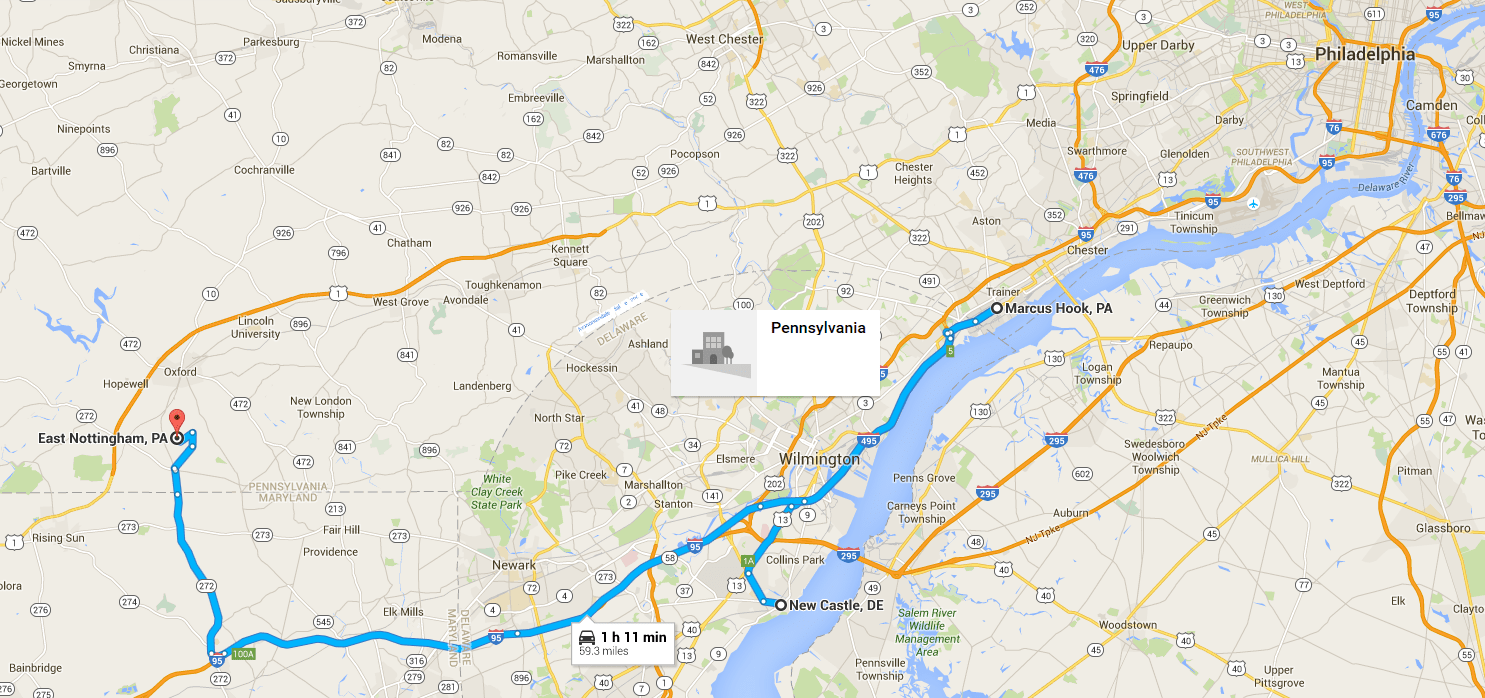
Below is a current map showing Marcus Hook, New Castle and Chester County, PA.

If Mary was 60 in 1783, and was a child when immigrated, this would put her birth in 1723 and her immigration location sometime before marrying Edward (born in 1729) in New Castle and Marcus Hook. So, this puts that Edward Mercer in the same vicinity or he would not have met and married Mary. On the map, above, you can see that New Castle on the Delaware River is very close to Philadelphia, maybe 12 or 14 miles distant.
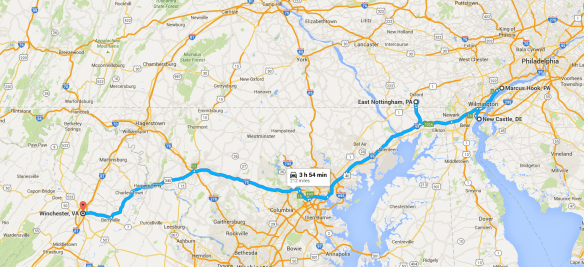
My ancestor Edward Mercer (1704-1763), the elder, settled in Frederick County, Va, north on Winchester, by October 1744 when he first appears in the court minutes, serving on a jury.
A tradition says that he emigrated from Scotland in 1737 although that certainly has not been proven. Nothing is known about his early life, although after he arrived in Frederick County, by this time probably in his 40s or 50s, there are several references in court records.
Beginning in December 1754, Edward Mercer is sued by John Littler who owns land nearby. In the same book, spanning 1754-1745, both Nicholas and Edward Mercer are sued by Jesse Pugh and both Nicholas and Edward serve on juries. In the 1745-1748 Court Order book, we find Mercer versus Lemon and in Order Book 4, 1751-1753 we find Edward Mercer suing both James Dunn and Dugal Campbell, both dismissed by the parties. In 1753-1754 we find Richard Mercer versus Poor and in 1754-1755, Edward Mercer vs Nathaniel Hare where Edward is awarded a judgment after Nathaniel fails to appear. In 1755-158, we have Edward Mercer vs Hurman and in 1758-1760, Edward sues both Campbell and Lemon. In 1760-1762, Richard Mercer sues Shibley and Simpson. This looks like a lot, but is fairly typical for the timeframe. Most suits were agreed upon and settled.
This branch of the Mercer family was found in Back Creek Valley during the 18th and 19th centuries. Edward Mercer died in 1763, and he named his wife Ann in his will, in addition to his children. A letter written by one Harrington in a letter to Wilmer Kerns on Oct. 27, 1993 states that Edward Mercer married Ann Croat (or Coats) in 1726, and he married second to Mary Gamble. However, we know that Edward was married to Ann when he died, based on his will, so this makes no sense. Another rumor bites the dust.
Indian Traders
And yet another twist to this story.
In the “History of Scots/Irish,” Chapter 5, The Explorations and Early Settlers of West Virginia states that John Van Meter, a representative of an old Knickerbocker family early seated on the Hudson was an Indian trader. He made his headquarters with the Delawares and made journeys far to the south to trade with the Cherokees. In about 1725 he first told of the fertility of the Lower Shenandoah. In the section regarding the first white settlers of West Virginia in the area it goes on to say – “Among those that came about 1734 and settled along the Upper Potomac in what is now the northern part of the West Virginia counties of Berkeley and Jefferson included: Robert Harper (Harper’s Ferry), James Lemon, Richard Mercer, Edward Mercer, Jacob Van Meter.”
John Van Meter seems to have been headquartered in Kingston, Somerset County, New Jersey. In an article relating to the last of the Southern Indians, which appeared in the Virginia Historical Magazine [Vol. III., p. 191, footnote], it states that “Mr. John Van Meter of New York gives an account of his accompanying the New York Delaware Indians in 1732 (?) on their raid against the Catawbas. They passed up the South Branch of the Potomac and he afterward settled his boys there.”
Robert Harper was born in Oxford Township near Philadelphia, Pa., in 1718. A builder and millwright, Harper was engaged by a group of Quakers in 1747 to erect a meeting house in the Shenandoah Valley near the present site of Winchester, Va.
In 1762, John Lemon obtains a land grant adjacent to both Nickolas and Edward Mercer. From a transcription of the Virginia Northern Neck Land Grants, 1742-1775, Vol II:

In 1751, Edward Mercer obtained a land grant in Frederick County, Virginia for 275 acres adjoining Jacob Vanmeter. Does this suggest that our Edward Mercer arrived with that group of men? And perhaps he was related to Richard Mercer? Our Edward did name a son Richard. The Edward Mercer of Berkeley County would only have been 12 years old in 1751, so this land grant has to be our Edward.
Richard Mercer’s wife name was Rebecca. They sold land in 1764 on the Potomac that they had obtained from Josh Hite and Isaac and John VanMeter, the Indian trader family.
While it’s tempting to suggest that Edward Mercer in Berkeley County is the son of the older Edward Mercer (Sr.) of Frederick County, we show Edward Sr.’s son Edward Jr. in 1763 patenting land beside his father in Frederick County.

Furthermore, Edward Mercer Jr. continued to live in Frederick County, years after the Edward in Berkeley County died. We find in the Virginia Northern Neck Land Grants, 1775-1800, Vol. III:

Edward Mercer from Berkeley County, Virginia (now West Virginia) who died in 1783 shows the following people in the will index abstracts of West Virginia Wills and Probate records 1724-1978.

Unfortunately, there is a lot of bleed through, but page 16 is the relevant page for Edward’s will.

Jonathan Mercer is clearly not Edward’s son, so perhaps he is Edward’s brother. We know from the deposition that Jonathan was born in about 1733.
On November 13, 1752, we find that John Lemmon purchased property and the land deed was filed in Frederick County, VA. The description of the property includes 356 acres adjoining Edward Mercer, Nickolas Mercer, and Francis Lilborn. A suit, Mercer vs Lemon, is found in the 1745-1748 court notes, but was impossible to find in the actual microfilm of the court minutes. A Will for Nicholas Lemen is witnessed in 1761 by a Richard Mercer and his wife Mary. This could be Edward Mercer Sr.’s son, Richard (who could have been in his 30s by this time), but who was Nickolas Mercer?
Nicholas Mercer is found in the road orders in 1746 and in 1748 he is replaced by Abraham Vanmetre, so he was clearly living in the same proximity as the VanMeter family which means he is connected to the Edward Mercer of Frederick County. To be of age in 1746, he had to have been born in or before 1725, about the time our Edward Mercer would have been about 21 years old, IF he actually was born about 1704.
The Nicholas Mercer who was the son of Edward in Berkeley County could not have been of age in 1746 if Edward himself was only born in 1729.
Nicholas Mercer must have been connected to our Edward in some way. In the December 1744 Frederick County Court session, we find the Jesse Pugh sued both Nicholas Mercer and Edward Mercer for trespass, in two adjacent transactions. At that time, trespass typically didn’t mean walking on someone’s land, like today, but planting crops there. Later, both Nicholas and Edward served on juries. Unfortunately, there is no Frederick County will for Nicholas, so we have no idea what happened to him.
Some people have drawn links between the various Mercer families that may not have existed in reality – drawing scattered references from multiple sources, including online trees, and weaving them together.
However, there are some very tantalizing clues that indeed, do need additional research.
George Washington and the Battle of Fort Necessity
We think of George Washington and his involvement in the Revolutionary War, but Washington’s involvement in the defense of Virginia began long before the Revolutionary War. George was extremely involved in the French and Indian War as well.
The roster of men serving in the Fort Necessity Campaign of 1754 under George Washington is compiled from two rosters.
Edward Mercer appears.
Roster of Virginia Militia serving under George Washington during the Fort Necessity Campaign Officers – George Mercer, Captain (Lieut.); John Mercer, Lieutenant (Ensign); Wise Johnston, Corporal; Enlisted Men; Edward Mercer;
We know that Captain George Mercer is connected to the Irish/English John Francis Mercer family with no (known) relation to Edward.
Let’s look at what happened at Fort Necessity. Edward Mercer was clearly there, so this is his story too.
The Battle of Fort Necessity (also called the Battle of the Great Meadows) took place on July 3, 1754, in what is now the mountaintop hamlet of Farmington in Fayette County, Pennsylvania. The engagement was one of the first battles of the French and Indian War and George Washington’s only military surrender.

In March 1754, Governor Dinwiddie sent Washington back to the frontier with orders to “act on the [defensive], but in Case any Attempts are made to obstruct the Works or interrupt our [settlements] by any Persons whatsoever, You are to restrain all such Offenders, & in Case of resistance to make Prisoners of or kill & destroy them”. Historian Fred Anderson describes Dinwiddie’s instructions, which were issued without the knowledge or direction of the British government in London, as “an invitation to start a war”. Washington was ordered to gather as many supplies and paid volunteers as he could along the way. By the time he left for the frontier on April 2, he had gathered 1,867 men. During the march to Pennsylvania, Washington picked up a few more men from a regiment they met at Winchester. This would have been where Edward Mercer joined.
Washington along with about 150 Virginians built Fort Necessity on an alpine meadow west of the summit of a pass through the Allegheny Mountains on June 3rd. Another pass nearby leads to Confluence, Pennsylvania; to the west, Nemacolin’s Trail begins its descent to Uniontown, Pennsylvania, and other parts of Fayette County along the relatively low altitudes of the Allegheny Plateau.
The fort was small, a circular stockade made of 7-foot-high (2.1 m) upright logs covered with bark and skins built around a little hut which contained ammunition and provisions such as rum and flour. The palisade was built more to defend the supplies against Washington’s own men whom he described as “loose and idle,” than as a planned defense against a hostile enemy.
By June 9th, the rest of the Virginians had arrived. Originally, the Delaware, Shawnee and Seneca supported the Virginians, but after a Native Council on June 18th, the Indians withdrew their support after the Battle of Jumonville Glen on May 28th in which Native leader Tanacharison killed French Joseph Jumonville personally. Why the Native people withdrew their supposed is unclear.
Expecting to be attacked, and with word of the impending arrival of the French and Indians, Washington fell back, abandoning most of their provisions and supplies, and reached Fort Necessity by July 1st.
At Fort Necessity, the provision hut was depleted, and there was little shelter from the heavy rain that started to fall on the 2nd. With the rain, the trenches that Washington had ordered to be dug had turned into streams. Washington realized that he would have to defend against a frontal assault and also realized that it would be difficult because the woods were less than 100 yards away, within musket range, making it possible for a besieging attacker to pick off the defenders. To improve the defense, Washington ordered his men to cut trees down and to make them into makeshift breastworks. The Virginians were clearly in trouble and they knew it.
As the British worked, the French led by Coulon, Jumonville’s half brother, approached Fort Necessity using the road the Virginians had built. Coulon arrived at Jumonville’s Glen early on the morning of July 3. Horrified to find several scalped French bodies, he immediately ordered them to be buried.
By 11:00 am on the 3rd of July 1754, Louis Coulon de Villiers came within sight of Fort Necessity. At this time, the Virginians were digging a trench in the mud. The pickets fired their muskets and fell back to the fort, whereupon three columns of Canadian soldiers and Indians advanced downhill towards the fort. However, Coulon had miscalculated the location of the fort and had advanced with the fort at his right. As Coulon halted and then redeployed his troops, Washington began to prepare for an attack.
Coulon moved his troops into the woods, within easy musket range of the fort. Washington knew he had to dislodge the Canadians and Indians from that position, so he ordered an assault with his entire force across the open field. Seeing the assault coming, Coulon ordered his soldiers, led by Indians, to charge directly at Washington’s line. Washington ordered the men to hold their ground and fire a volley. Mackay’s regulars obeyed Washington’s command, and supported by two swivel cannons, they inflicted several casualties on the oncoming Indians. The Virginians, however, fled back to the fort, leaving Washington and the British regulars greatly outnumbered. Washington ordered a retreat back to the fort. Washington must have been furious with the Virginia men who disobeyed his orders.
Coulon reformed his troops in the woods. The Canadians spread out around the clearing and kept up heavy fire on Fort Necessity. Washington ordered his troops to return fire, but they aimed too high, inflicting few casualties, and the swivel cannon fared no better. To add to the garrison’s troubles, heavy rain began to fall that afternoon, and Washington’s troops were unable to continue the firefight because their gunpowder was wet.
Louis Coulon de Villiers, who did not know when British reinforcements might arrive, sent an officer under a white flag to negotiate. Washington did not allow the Canadian officer into or near the fort, but sent two of his own men, including his translator Jacob Van Braam, to negotiate. As negotiations began, the Virginians, against Washington’s orders, broke into the fort’s liquor supply and got drunk. Gotta love those Virginia men. They had their priorities. If they were going to die, they didn’t want to leave the liquor behind! Given what we discover about Edward Mercer later, there is little doubt that he was involved with this drunken escapade.
Coulon told Van Braam that all he wanted was the surrender of the garrison, and the Virginians could go back to Virginia. He warned, however, that if they did not surrender now, the Indians might storm the fort and scalp the entire garrison.
Van Braam brought this message to Washington, who agreed to these basic terms.
On July 4, Washington and his troops abandoned Fort Necessity. The garrison marched away with drums beating and flags flying, but the Indians and the French began to loot the garrison’s baggage on their way out, subsequently burning the fort.
Washington, who feared a bloodbath, did not try to stop the looting. The Indians continued to steal from the soldiers until July 5. Washington and his troops arrived back in eastern Virginia in mid-July. On the 17th, Washington delivered his report of the battles to Governor Dinwiddie, expecting a rebuke, but Washington instead received a vote of thanks from the House of Burgesses and Dinwiddie blamed the defeat not on Washington but on poor supply and the refusal of aid by the other colonies.
The battlefield is preserved at Fort Necessity National Battlefield, and includes a reconstruction of Fort Necessity.
Voting in Frederick County
From Clark, Murtie June, Colonial Soldiers of the South, 1732-1774, Baltimore, MD: 1983: Pp. 328-332, in 1755, we know that both Richard Mercer and Edward Mercer Jr. are of age, because they both vote, as they do in 1758. In 1761, both James and John Mercer vote for George Washington. This puts the birth of both men before 1734, and possibly significantly before 1734. At that time, and until 1762, according to Cartmell, voting for the House of Burgesses was reserved for men who owned land and significant assets, specifically, the gentry class. In 1762, the voting rules were relaxed and allowed free men, of age, with only 50 acres of land or 25 acres with a house, or a lot in town with a house, to vote.
But the 1761 voting is interesting for yet another reason. Colonel George Mercer is on the ballot for the election of Burgesses to represent Frederick County and Mercer Babb votes for him, as do both Edward Mercer Jr, Edward Sr., James, John, Moses, and Richard Mercer. Col. George Mercer wins and represents the county in the House of Burgesses from 1761-1765. George Mercer was born in Frederick County in 1733 to John Mercer, reportedly born in Dublin, Ireland, and Catherine Mason. George was the brother to John Francis Mercer.
This tells us that Mercer Babb, whoever he was, was of age in 1761, so born in 1740 or earlier. It also introduces the question – who is Mercer Babb?
To answer that question, we have to look at the Babb Family.
The Babbs
Thomas Babb was born in 1697 in Brandywine Hundred, New Castle, Delaware. In 1730, he lived and was taxed in Bethel Township, Chester County, PA, according to the Hopewell Friend’s History. He died on October 4, 1760 in Frederick County, Virginia. Not long after his marriage there was a movement of Quakers from Pennsylvania to Frederick County, Virginia. Thomas went with these Quakers and was one of the founding fathers of the Hopewell Monthly Meeting north of Winchester in Frederick County in 1734.
His father had a land grant of 600 acres on Apple Pie Ridge, near Babb’s Run, northwest of Winchester. Thomas settled there and was joined by his brother, Phillip. At his father’s death the two sons inherited his land.
Thomas Babb’s will was proved November 4, 1760. He left the home place to his son, Sampson, and other bequest to his other children. His wife, not being mentioned, is believed to have already died.
The first lovely old home belonging to Thomas was called “The Great Marsh Plantation“, now known as The Babb-Purcell-Janney House. It dates to 1735. Great Marsh is located on the north side of route 673 (Gold Hills Road) between route 522 and the Apple Pie Ridge Road in Frederick, Virginia. On the map below, Babb’s Run is marked on Gold Hills Road with a small balloon just above the white box at the bottom of the map.

The red balloon is James Crumley’s land, also on Apple Pie Ridge Road, about 6 miles distant from the Great Marsh Plantation.
The second home named “The Brick House” is a lovely old brick mansion and dates also to 1735. It is located west of the Apple Pie Ridge Road and south of route 672 on Babb’s Run. This is also in Frederick, Virginia.

The Lupton family obtained the Babb land after Thomas’s death. The Lupton homestead was located just below Cedar Grove, about where the small gray balloon is located on the map below, according to a map from 1885.

The Lupton homestead is located just south of Cedar Grove between Babb’s Run and the east side of North Mountain today, marked by the small balloon on the map above. North Mountain is to the left of the balloon, with Cedar Grove Road on the other side of the mountain.
You can see and purchase these old maps at this link.
Referencing Jean Sargent’s Book “Babb Families of America” 3rd edition pg.113.
Philip Babb born in 1699 in Brandywine Hundred, New Castle, Delaware and died in Newark, New Castle Delaware on March 6, 1762, father of Thomas Babb who settled in Frederick County, Virginia, married Margaret Mercer.
This marriage would have had to have occurred after 1720, giving Mercer Babb plenty of time to be born between then and 1740. This tells us that there were Mercers in this part of the world, likely related to Edward Mercer, and probably in New Castle, Delaware before 1740.
In the book, “The Babb Families of New England and Beyond, “ Jean Sargent on page 20 and 21 tells us the following about Thomas Babb:
In the Newark Monthly Meeting Records there is an entry dated 3 Oct 1713 which reads as follows: “Thomas Babb appearing at this meeting and gives ye meeting to understand yt ye death of his wife and for want of some person to whom he might leave ye care of his young children hath hitherto been ye lett of his not coming more frequent to ye meetings of business.” While there are early entries concerning Bathsheba, none of them mention the birth of her children or the date of her marriage. (7) Thomas prospered in DE and had sizeable land holdings as shown in the early land records. (4) In 1735 he received a Patent to 600 acres of land in Frederick Co., VA. By this time his three sons had moved to Chester Co., PA, just across the state line from their former home. Thomas sent the two younger sons Thomas, Jr., and Philip to occupy the 600 acres in VA and to carry out the other provisions of the Patent. (7) In his will, dated 17 Aug 1748 and proved 13 Aug 1751, Thomas bequeathed the home place in DE to his oldest son Peter, and left the VA lands to sons Thomas, Jr., and Philip. He made other bequests to his daughters Mary, Rebecca, and Lydia, as well as to three children of his deceased daughter Hulda — John, Rebecca and Lydia Gregory. (6)
In a 1758 election in Frederick Co., VA, among those voting for George Washington for the VA House of Burgesses were: Philip Babb, Thomas Babb (son of Phil.), Thos. Babb, Peter Babb, Joseph Babb, and Thos. Babb, Jr. (8)
Sources:
(1) “History of Town of Hampton, NH” by Dow; (2) Geneo. Diet, of Maine and New Hampshire by Noyes/Libby/ Davis; (3) “History of Salem, MA” by Perley; (4) DE Land Records; (5) VA Land Records; (6) New Castle Co., Probate Records; (7) Records of Robert E. Babb, Jr.; (8) Virginia Historical Magazine, 1899 p. 163.
So, once again, we circle back to Chester County, PA. about 1735-1740.
Margaret Mercer Babb was very probably Edward Mercer’s sister and named her son, Mercer Babb.
Backslidden Quaker
In Cartmell’s history book, he states that the area in Frederick County where Edward Mercer lived was known as the Quaker settlement, but several families lived there that were not Quakers. He indicates that list includes the Mercers and Babbs who “had nothing to do with the Quakers.” Cartmell was wrong.
Edward Mercer was a Quaker, but apparently a backslidden one. So Edward may not have been a Quaker his whole life, and he may not have acted much like one when he was.
Edward was mentioned in the Quaker meeting records in March 1759 at the Baltimore meeting, but not in a very positive light.

It looks like Philip Babb got to be the bearer of bad news. Edward may well have been his brother-in-law, as this is the Philip Babb married to Margaret Mercer.
It seems like maybe Edward was systematically drinking too much. In an economy driven by distilled liquors, as a form of money and a way to preserve corn, drinking “too much” must have meant truly drinking a lot by the standards of today.

Finally, Edward Mercer was removed.

Was Edward Mercer being thrown out of the Quaker Church a family scandal? Was his drinking a scandal? What did his wife, Ann, do when this happened. Did she and the children continue to attend the Hopewell Friend’s Meeting, or were they too embarrassed? Or outraged?

Road Orders
Edward may have been in trouble at church, but he was still quite functional as a road overseer – well – most of the time.
In 1759, the Frederick County road orders from August 7th order that a road be cleared between the plantations of William Reynolds and Thomas Babb Jr. and into Sr. John’s road in the same manner as heretofore and that the spring be left open to the said road and it is further ordered that Edward Mercer be overseer thereof and that the tithables a mile on each side of the road clear and keep the same in repair according to law.
On September 4th, the court ordered that Edward Mercer be overseer of Sr. John’s road from Winchester to the Plantation where Isaac Thomas did live and that the tithables three miles on each side of the said road keep the same in repair according to law.
By 1760, however, Edward was in a bit of trouble it seems. On November 7th, the grand jury presents Edward Mercer for not opening the road from Capt. Pearis’s to Sir John’s Road at the Quaker Meeting by the knowledge of two of us at this present time.
On December 5th, the court notes that the summons had not been executed and refers it to the next court.
The next time we see Edward working on the roads in on May 4th, 1763, the same year he died. Jacob Vanmetre, Morgan Morgan and Thomas Thornberry having been appointed to view the ground from the Town of Micklinbugh to the most convenient ford on Opeckon Creek made their report whereupon it is ordered that a road be opened as by them laid off and that the tithables three miles on each side thereof work under Edward Mercer who is appointed overseer of the same.
On November 2nd 1763, Thomas Babb is appointed as overseer of the road called Sir John Sinclaire’s road in room of Edward Mercer from the forks to James McGills.
Land
Edward Mercer received his first land grant in 1751 for 275 acres adjoining Jacob Van Meter as recorded in the Virginia Northern Neck Land Grants, 1742-1775, Vol. II. Not a terribly descriptive land grant.

Note that the entry shows that the adjacent entry was for Nicholas Mercer.

In 1759, Edward Mercer is shown on the rent roll for Frederick County as is Nicholas Mercer.
In 1760, Edward obtained a second grant, but this one is much more descriptive and is for 409 acres “near the head of Babbs Great Meadow and joyning Babbs Mountain”

Fortunately, I was able to find Babb’s Mountain today, just above Cedar Grove.

Philip Babb purchased property and the land deed was filed in Frederick County, VA. on 8 April 1760. The description of the property includes 117 acres adjoining Edward Mercer and on the side of Babbs Mountain. Source: Northern Neck Grants K, 1757-1762, p. 99. The original survey reportedly exists. Obtaining the original surveys of these lands would be most helpful in terms of exactly locating Edward Mercer’s land.
The Babb family has done extensive research on the land grants and has drawn the following map.

Based on the Babb map, the location of the Lupton home, and this survey from 1812, we know the location of Edward Mercer Jr.’s land, taken from the Virginia Northern Neck Land Grants, 1800-1862, Vol IV.

Next, we find Edward Mercer Sr. leasing land to his son Moses, Bk 6 pg. 74 14 Oct. 1760: [Lease] between Edward Mercer & Ann his wife of County of Frederick [to] Moses Mercer of County aforesaid …… one tract of land lying and being under the mountain on the easternmost part of Back Creek and being part of a tract of land granted to said Edward Mercer by the Right Honorable Thomas Lord Fairfax by Patent the 18 April 1760… containing 200 acres and a half… Wit: 2 Wit. signed in German John Colson Recorded: 4 Nov. 1760 Signed by Edward Mercer & Ann Mercer
The easternmost part of Back Creek would be current Cattail Creek above Babb’s Mountain, or Babb’s Run, below Babb’s Mountain.
Richard Pearis purchased property and the land deed was filed in Frederick County, VA. on 18 May 1762. The description of the property includes 224 acres adjoining Jacob Vanmeter, and Edward Mercer. Source: Northern Neck Grants K, 1757-1762, p. 430 (Reel 294).

In 1764, the year after Edward died, his estate is still on the rent rolls, which is not unusual, especially if his wife is living there. In addition to Edward Mercer, we find Edward Mercer Jr, Nicholas Mercer, Moses Mercer and Richard Mercer.
All of these men are sons of Edward, except Nicholas who appears consistently with Edward since 1746, before Edward actually appears in the County. Was Nicholas Mercer Edward’s brother?
Edward’s Will
In 1762, Edward Mercer wrote his will, which was not probated in Frederick County until November 1, 1763, so he apparently lived another 14 months after making his will. He was obviously ill, because in the will, he states that he is weak of body.
IN THE NAME OF GOD AMEN. The twentyth Day of September in the year of our Lord one thousand Seven hundred and Sixty Two, Edward Mercer of the County of Frederick in the colony of Virginia, being sick aged and weak of Body but of perfect and sound mind memory and understanding thanks be given unto God, therefore calling to mind ye mortality of my Body and knowing it is apointed for all men once to dye do make and ordain this my last Will and Testament that is to say principally and first of all I recommend my Soul into my saviour’s hands, and my body to the Earth to be buried in a Christianlike and Decent manner at the Discretion of my Executors hereafter named and as Touching what Temporal Estate it hath pleased God to Bless me with in this Life. I give devise and Dispose of the same in the following Manner and form Imprimis: it is my Will and I do order that in the first place all my just Debts by paid and satisfied.
Item I give and bequeath unto my son Richard Mercer one cow and calf and five shillings sterling. I give and Bequeath unto my Daughter Elizabeth Heath the sum of five shillings sterling.
I also give to my son Moses Mercer the sum of Five Shillings sterling.
I give and bequeath to my daughter Hannah Mercer five pounds and five shillings worth of Puter the same being now in her possession. And also one bed and furniture thereto belonging likewise I give to my said Daughter Hannah Six head of young cattle the same being now in her possession which said cattle shall be kept on the plantation until they be three years old. I also give her a side sadle and the Keeping of her mare on the plantation whilst she continues unmarried.
I give and bequeath unto my son Edward Mercer the plantation whereon I now Live containing two hundred and nine Acres and also a survey adjoining thereto containing Ninety six Acres of Land to him his Heirs and assigns forever. I also give to my said son Edward one bay mare and one bay colt plow and Tacklin thereto belonging. I also Will that if my above named son Edward Mercer should dye without issue that my youngest son Aaron Mercer shall then become sole heir of my Land and plantation whereon I now live and if both my said sons Edward and Aaron should die without issue, I will that my Daughter Hannah Mercer, become the sole owner of my above said Land and plantation, to her heirs and assigns forever.
I also will that my son Edward Mercer should pay as a Legacy to my youngest son Aaron Mercer the sum of Forty pounds and that within the space of four years after the said Aaron comes of age.
I also Will that my wife shall have the best Rooms in the new House now part built until my son Edward shall build her a compleat house on some part of the plantation at his proper cost which House shall be sixteen foot wide and Twenty foot Long. I also give to my wife Ann Mercer one third part of my parsonal Estate that may remain after the debts and Legacies mentioned are paid.
I will bequeath unto my son Aaron the two thirds of my parsonal Estate with the benefit and profit thereof Immediately after my decease which part of the said Aaron’s stock shall be maintained on the plantation until Aaron comes of age.
Lastly I constitute and ordain my well beloved wife Ann Mercer and my son Edward Mercer and Joseph Foset my sole Executors of this my Last Will and Testament revoking and declaring void all former wills and Testaments by me made and done in witness whereof I have hereunto set my hand and seal.
Signed Sealed and acknowledged by the said Edward Mercer to be his last will and testament in the presence us.
Jesse Pugh. Thos. Babb. Mercer Babb.
Edward Mercer. (LS.)
We know Edward could write, because he signed his name.


Edward’s will was probated in Frederick County, Virginia on either November 1, 1763.

Mercer Babb
Mercer Babb was clearly of age in 1762 when he witnessed Edward Mercer’s will, so was born in 1741 or before. Generally, when someone witnesses a will, unless it’s a nuncupative will made in an emergency with death imminent, this indicates that the witness is not an heir, or they would not be witnessing the will. Normally, those who witness wills have no direct interest in the outcome. If Mercer Babb was born in 1741 or before, that means that either the Babbs and Mercers were together before they lived in Frederick County, they were both living in Frederick County by 1740 or there is a Mercer in the Babb family tree, because the name of Mercer Babb, especially witnessing the will of a Mercer male, is just not a coincidence. Mercer Babb appears to be the son of Philip Babb and Margaret Mercer. We know that Philip Babb was in Chester County by about 1735. I do believe there is more to this story than we know and it all begins back in either Chester County, PA or before that in New Castle or Marcus Hook, Delaware. These families appear to have come as a group from the Chester County area to Frederick County, VA.
Edward Mercer’s Estate Inventory (added 10-12-2015)
Recently, I spent an entire day in Richmond at the Library of Virginia, also known as the State Archives. Like always, I prepared a research list. While most of my research procured nothing, which isn’t unusual after you’re already plucked all the fruit you can readily see – I did come up with one big winner.
The estate inventory of Edward Mercer who died sometime between May 4th 1763 when he last appears in the Frederick County, Virginia court minutes in a road order, and November 1, 1763 when his estate was probated. At that same court session, he was replaced as overseer or the road, so he apparently was still “working” up to a few months before he died, even though he prepared his will “being sick, aged and weak of body” in September of 1762. Edward was probably just shy of 60, certainly not an old man – so his estate should reflect an active life, not a “retirement,” if there was such a thing then.
The first bingo I found in the library was a book of transcribed wills and estate inventories. I was quite relieved because that meant I might not have to ask them to pull the microfilm and read that. Old books on microfilm are not always legible nor is the indexing ever complete. The only individuals indexed are the primary individual – not witnesses or wives or anyone else. Many times the “rest of the story” is told in who surrounds individuals during their lifetime – so we need all of that additional information.
So, when I found Edward Mercer’s estate inventory listed in the transcribed book, I was ecstatic. I read the estate inventory, and it was short and general. It listed things like, “agricultural produce and farm animals.” Well, I have to tell you, I’ve seen a lot of colonial wills and I have never seen one list something like that. They list the produce and they list the animals, individually, or at least by breed. In other words, you in far more danger of receiving far more information that you wanted than not enough, if an estate inventory was taken and filed.
It appeared that I was going to have to get the microfilm after all.
Estate inventories are a vastly overlooked source of information not available elsewhere. The wills tell who your ancestors left his or her worldly goods to, but the estate inventory tells you what those goods were and those goods tell a huge story about your ancestor’s life. In addition to what IS in the estate inventory, what ISN’T in the inventory tells a story too – especially in the context of the time and place in which they lived.
Many men did have a will. Most wills were not written much in advance. Sometimes wills were made verbally as the individual was on death’s doorstep to whomever was nearby. These are called noncupative wills. Sometimes, death was unexpected and there no opportunity for a will.
Most women did not have wills because most women did not own items outright, meaning outside of a marriage where the man was assumed to be the owner of the land (except for her dower rights.) Often women retained what is known as a “life estate” where the woman holds either property or other items for the term of her life, at which point their ownership reverts to others, generally one or several children as specified in her husband’s will when he died.
If the woman dies before the man, the husband automatically owns everything so no will for the wife is necessary. I’m talking about historical US wills, not current law. I’m not a lawyer…I don’t play one on TV or anyplace else:)
Understanding how wills and ownership of both property and personal items worked helps in unraveling what estate inventories tell us.
When the man died, an inventory of everything was taken, even if the wife was to retain “household items.” While that seems vastly unfair, especially since she often had to bid to buy her own cooking utensils back at a sale, it’s a huge boon for genealogists.
Sometimes individuals are mentioned in inventories – and in some cases, an item is left to a daughter in a will, but by the time she collects that item, she is married and a married name is listed. In other cases, if something is left specifically to an individual, it is not included in the appraisal. It doesn’t seem standardized, you say? It’s not – and often it helps to look at other wills and estates from that county and time to observe what was customary. Any deviation from custom must have been caused by something…and that something could be interesting to a genealogist.
Even the individuals who appraise your ancestor’s estate are important. In Virginia, if your ancestor’s spouse was still living, one person who was from the “wife’s family” was chosen, keeping her interests in mind, the largest debtor of the person who died was selected, keeping their interests in mind, and one person completely disinterested in the outcome of the estate appraisal was selected.
With that information, you can sometimes add to your knowledge of the family, especially if you know the wife’s family is likely in the area. How would you know that? If your ancestor lived in that area when he married, his wife’s family would have been from that area too. Young people often met at church or social functions – and with limited transportation – that social group wasn’t from any great distance.
People often married their neighbors or individuals from just a mile or two away. Courting was likely done on foot, or maybe on horseback. You can’t marry someone you can’t court!
So, let’s take a look at Edward Mercer’s will and see what is actually in the estate inventory.
The subscribers by virtue of an order of Frederick County Court being first sworn has met and appraised such of the estate of Edward Mercer, deceased, as was brought to our view by Ann Mercer and Joseph Fanset the executors – viz –
The values would be given in pounds, shillings and pence.

- One old loom 0-15-0
- Red Cow 0-15-0
- 1 Cow and bell 3-0-0
- 1 brindle cow 2-10-0
- A brindle cow 2-0-0
- A white cow 2-10-0
- White back heifer 2-0-0
- White bull 2-0-0
- White heifer 1-15-0
- Speckled heifer 2-0-0
- Red yearling steer 1-0-0
- White steer 1-7-0
- White faced heifer 1-10-0
- Brindle calfe 0-15-0
- A pide yearling 1-0-0
- A brindle yearling 1-0-0
- Six calves 3-6-0
- 2 pide steers 3-15-0
- 2 heifers 2-10-0
- One stear 2-10-0
- A roan horse 6-0-0
- An old mare 2-10-0
- A mare and colt 3-10-0
- A bay mare and colt 5-0-0
- Old wagon and gears 9-0-0
- A pen and gears 1-3-0

- Eight swine 0-?-0
- 2 sows and pigs 0-16-0
- Harrow pens 0-10-0
- Cart wheels 1-0-0
- A rick of hay 3-0-0
- 2 ricks of hay 6-10-0
- Hay in the barn 2-0-0
- Grain in the barn 12-0-0
- Unbreak flax 0-5-0
- 2 caskes and flax seed 0-9-0
- Corn foder 0-10-0
- Hay in the stable 0-15-0
- A mall and wedges 0-5-0
- 2 old axes 0-5-0
- Indian corn 2-0-0
- 2 old hoes 0-7-0
- Small grind stone 0-3-0
- An old gun 0-15-0
- Another old gun 0-10-0
- 2 bells and collar 0-5-0
- Some old carpenters tools 0-14-0
- Old iron 0-2-6
- A pair of small hilliards 0-5-0
- Few nails 0-2-0
- Some more carpenters tools 0-10-0
- An old saddle 1-5-0
- Suit of cloathes 5-10-0
- Side saddle 1-5-0
- Old lumber 0-6-0
- 8 old chairs 1-0-0
- Old dough trough 0-3-0
- A chaf (?) bed and cloaths 1-15-0
- One bed and furniture 4-0-0
- Seven old bags 0-7-0
- Old casks and reel 0-5-0
- Old chest 0-10-0
- A morter 0-2-6
- A warming pan 1-0-0
- Old reeds and wifts (or mosts or wefts) 0-4-0

- Some salt 0-6-6
- Smoothing box and candlestick 0-3-0
- Hand and gridirons 0-8-0
- Iron poths (pots?) hangers and frying pan 1-3-0
- Old books 0-6-0
- Puter (pewter) 2-6-0
- Some old tins 0-2-0
- Sythes and hangings 0-14-0
- Old copper 0-1-3
- 3 old casks 0-5-6
- 1 cask of cyder 1-4-1
- 2 old whelbs(?) and branding iron and old tea kettle 0-11-0
- Warping barrs and boxes 0-5-0
- Hannah Mercers puter 5-0-0
- Her bed and furniture 8-0-0
Jesse Pugh, Joseph Babb, Peter Babb
At court held for Frederick County the first day of May 1764. This appraisement was returned and ordered to be recorded by the court.
The first thing this inventory tells us is that Edward Mercer was very involved in animal husbandry and likely only farmed enough to feed his animals. He did not have plows and other typical farming implements and had many more animals than the typical farmer.
The entry for salt is interesting. Salt was valuable because about 800 gallons of spring water had to be boiled away to yield a bushel of salt. Today, we take salt very much for granted, but our pioneer forefathers certainly didn’t.
Edward’s family had chairs, not just a bench to sit on. And almost enough chairs for each person to sit at the same time. He had 7 children, so the estate is one chair short for the entire family to sit together. Perhaps one chair broke. They are described as “old.” However, there is no table listed. That’s rather odd.
Edward was a good-hearted person. He did not kill his old mare who was probably no longer useful.
Edward was likely a carpenter. Every man on the frontier had a specialty skill, and his appears to be carpentry based on his tools. This means that when you find homes built in that timeframe in that area, Edward may have worked on those.
Edward owned no slaves, but he clearly could have afforded slaves had he so chosen. His lack of slaves then must have been either a personal moral judgment or a religious conviction. However, other Quakers did own slaves including the family his daughter, Hannah, married into.
The flax and loom suggest that his wife and daughter spun and wove, although interestingly enough, a spinning wheel is not listed. However, you can’t get from flax to weaving without spinning it into thread first.
There is cyder, but no alcohol. There is no still. This is highly ironic, since Edward Mercer was kicked out of the Quaker church in 1759 for…you guessed it….drinking. In fact, “too frequently drinking strong drink to excess.”
Edward Mercer signed his will and owned books, so obviously this man could read and write. How I’d love to know what those books were.
There is no Bible, although Edward was a Quaker up until he was kicked out of the church in 1759, ironically, for drinking, not attending meetings and not being penitent about either.
Other than Hannah’s furniture, which did include a bed, there were two other beds mentioned. Was there a bed for the parents, then a boys bed and a girl’s bed? There were two girls and five boys.
And speaking of Hannah, she is mentioned in the estate inventory, but it’s very likely that she was married by this time. However, the fact that she is mentioned by her maiden name does not prove that Hannah was not married. They may simply have referred to her as she was listed in the will. I have often wondered if she was already married when the will was written, even though Edward does not refer to Hannah by a married name. The reason I question this is because Edward says that the “puter” (pewter) is already “in her possession.” That would likely mean that she is not living at home, but unless she were married, where else would she be living? Edward said the same thing about Hannah’s 6 heard of cattle as well, that they are already in her possession. But then he goes on to say she can leave her mare on his plantation as long as she remains unmarried, so obviously she is not married at that time. There must be something here that I’m missing. Perhaps she was living with another family member before she married.
Edward does have two old guns, and he fought in the French and Indian War, so this makes sense. These are likely the guns he carried with General George Washington at Fort Necessity. What I wouldn’t give to see those guns.
And speaking of things I’d love to see…that old chest is one. I want to open that chest and see what is inside. I’m guessing that might be where Edward kept any spare clothes he had or anything of value – like maybe letters!!!
We also know that Edward’s wife, Ann, was living because she was one of the individuals who administered his will and “presented” his estate to the court.
We know that the family had candles. The poorest families didn’t and worked only by the light of the sun. Sundown meant bedtime.
In Edward’s case, either his estate was not sold at public auction, or there is no court record of the sale. Many times, the sale is recorded, item by item, and who was present at the sale can tell you a huge amount. In some cases, you can track valuable family heirlooms this way.
The moral of this story? Don’t think you’ve found everything when you find your ancestors will, or even if you don’t find a will. There is likely to be an estate appraisement with or without a will, and sometimes the information in the estate inventory tells you far more about your ancestors life and how they actually lived than the will itself. Wills tell you who is supposed to get what, but estates tell you the story of your ancestors life through what they left behind.
If you look around your own house, you’ll realize that your sewing machine and quilting tools, for example, at my house, are far more personal and representative of what you do with your daily life than the land you own.
In terms of getting to know your ancestor, their stuff is far more important than their land.
Edward Mercer’s Children
- Richard Mercer could have been the Richard who married a woman named Mary and lived in Berkeley County. John Mercer mentioned a brother Richard in his 1748 will that was filed in Winchester. It’s difficult to tell when Richard first appears in the records because there is an earlier Richard that is found with Edward Mercer as well.
- Elizabeth Mercer was born about (or after) 1724 and married by 1748 to William Heath who was born on Sept. 18, 1724. William was mentioned in the 1748 will of his brother-in-law, John Mercer.
- John Mercer was born circa 1727 and died in 1749, apparently unmarried. John lived in Frederick County, where his will is on file in the courthouse. His father, Edward Mercer, was named administrator for his estate.
- Moses Mercer was of age and leasing land from his father by 1760. Moses was born in 1732 and died in 1805, in Frederick County. Appraisers of Moses’ estate were Jacob Rinker, Richard Barrett, and Thomas Babb. Moses married Dinah Morrison, who was called Dianna in his will. She was born Dec. 24, 1729, and died in April 1810. After Moses’ death in 1804, Dinah received all moveable property during her natural life, plus one-third of profits from real estate. She wrote her will on April 10, 1810 and it was probated June 7, 1810. Witnesses were Aaron and John Mercer, and John Barnard. Her close friend, Abraham Lewis was named the executor. Moses and Dianah signed their names with an X “His mark” and “Her mark,” respectively.
- Hannah Mercer married William Crumley about 1763 and had died by 1774. Hannah was mentioned in the will of her brother John in 1748, and in the will of Elizabeth Morris in 1760. Who is Elizabeth Morris?
- Edward Mercer was given “the plantation where I now live – 209 acres plus adjoining 96 acre survey” by his father. Edward was born about 1744. His age was proven from a deposition given in the Augusta County Circuit Court. The name of his spouse is not known.
- Aaron Mercer, the youngest son, not of age in 1752 – served in Revolutionary War. On October 28, 1799 he obtained a Virginia Revolutionary War land grant in Ohio and moved to Ohio. Reportedly in his pension application (which is not at www.fold3.com as of 9-15-2015) he says he was born in Ireland. Aaron died on December 17, 1800 in Hamilton County, Ohio and is buried in the Old (Columbia) Baptist Graveyard. Given that there were no Revolutionary War pensions before 1818, there would have been no pension application by him, although if his wife, Elizabeth Carr, was still living, she could have applied in either 1818 as destitute or 1832/33 as a surviving veteran’s wife. She is reported to have died in 1820, so I’m quite suspicious of the claim that his Revolutionary War pension paperwork stated that he was born in Ireland.
Speculative Family
Based on all of the pieces of evidence, it looks like a speculative family might include our Edward, born about 1700, a brother Richard found with Edward early in the records, a brother Nicholas found in 1746, and a sister Margaret who married Phillip Babb sometime between 1720 and 1740.
The identity of the Edward Mercer born in 1729 who lived in Berkeley County is unclear, but given the names of Edward, Richard and Nicholas, and the locations of Chester County, PA and Delaware, these lines do seem very connected.
Edward in Berkeley County could be the son of either Edward Sr.’s brother Richard or Nicholas – although this does beg the question of what happened to either Richard or Nicholas. Richard could also have been Edward Mercer Sr.’s eldest son, not a brother. If that is the case, then Edward born in 1829 cannot be the son of Richard Mercer.
The tidbits we do have also support the suggestion that this family may have immigrated from Ireland before 1740.
However, this is speculative and needs additional research before any conclusions can be drawn. I suspect the answer is either in Chester County, PA, Marcus Hook, PA or in what is now New Castle, Delaware, if the answer exists anyplace.
DNA
The DNA results having to do with this line are every bit as frustrating and elusive as the genealogy has proven to be.
I checked the Mercer DNA project and was extremely happy to discover a Y DNA project member that indicated that they descended from Edward Mercer born in 1704, the birth year typically attributed to our Edward.
Home run!
Except…
Doggone it, there’s another tester who gives his ancestor as Edward born in 1705. That’s just too close. Worse yet, their DNA doesn’t match. Clearly two independent lines.
So, I checked at YSearch. No account for Mr. 1705 and the 1704 account had no marker values entered but it did include the death year of 1763, which pretty well cinches the identity as our Edward. I tried to contact the individual through YSearch, with no luck. This is a low kit number, indicating an early tester so the tester’s e-mail may be stale of they may not be able to reply anymore.
Next, I wrote to the project administrators of the Mercer project and asked them if they have the oldest ancestor information for either or both testers, or if they would please facilitate contact with those men. Nothing, nada, silence from the admins.
Doggone!
There is just nothing worse than a desperate genealogist.

(Click on image to see larger version.)
I copy pasted the relevant Mercer project entries into a spreadsheet. They weren’t grouped on the Mercer DNA site, so I grouped them compared to the entry for kit number 94427 which I believe is our Edward Mercer (c1704-1763). The yellow cells are mismatches to kit 94427.
There is only one other Mercer that even matches remotely, kit number 99939 just above the lower pink 94427 with the green row.
There is an entire group of blue Mercers that fall together nicely. However, in this blue group we find kit number 84471 also pink), the other Edward Mercer born in 1705. This entire line reportedly tracks back to guess where… Chester County, PA with Robert born in 1741 and Elizabeth Brown Mercer.
I checked Chester County tax records, and there are several Mercer men living there in this timeframe. They may or may not have been related to each other. And none were named Edward, Richard or Nicholas. Pulling hair out now….
Finding this large blue group associated with Chester County, and my lonely Edward Mercer with only one distant DNA match is beginning to make me very nervous.
This makes me ask questions like:
- Was Edward Mercer who died in 1763 “supposed” to be paternally related to the Chester County group, but wasn’t?
- Is there a NPE (nonpaternal event or undocumented adoption) in the lines of one of Edward Mercer’s sons, but not the other one, causing one descendant to match the Chester County group, and one descendant to not match the group?
- Is someone’s genealogy wrong? And if so, which one? I’d just be happy at this point to actually see the genealogy of either tester, and preferably both.
- Why aren’t the project administrators answering inquiries about the project? Are they gone too?
It’s small consolation, I know, but at least the two “Edward” kits are both haplogroup R-M269. So, assuming (I hate that word, BTW) either of these men descend from my Edward Mercer, I at least know that much. But at the 50% frequency rate in Europe of M269, that would have been a safe bet with no DNA testing at all.
Needless to say, if you are a male Mercer who descends from Edward Mercer who died in Frederick County in 1763, I have a DNA testing scholarship for you!
______________________________________________________________
Disclosure
I receive a small contribution when you click on some of the links to vendors in my articles. This does NOT increase the price you pay but helps me to keep the lights on and this informational blog free for everyone. Please click on the links in the articles or to the vendors below if you are purchasing products or DNA testing.
Thank you so much.
DNA Purchases and Free Transfers
Genealogy Services
Genealogy Research
Like this:
Like Loading...