Working with the New Big Y Results (hg38)

If you are a Family Tree DNA customer, and in particular, a male or manage male kits, you’re familiar with the Big Y test.

The Big Y test scans the entire gold standard region of the Y chromosome, hunting for mutations, called SNPs, that define your haplogroup with great precision. This test also discovers SNPs never before found.  Those newly discovered SNPs may someday become new haplogroup branches as well. The Big Y test is how the Y DNA phylotree has been expanded from a few hundred locations a few years ago to more than 78,000, and along with that comes our understanding of the migration patterns of our ancestors.

We’re still learning, every single day, so testing new people continues to be important.

The Big Y is the logical extension of STR testing (panels 37, 67 and 111), which focus on genealogical matches, closer in time, instead of haplogroup era matches. STR locations mutate more rapidly than SNPs, so the STR test is more useful for genealogists, or at least represent an entry point into Y DNA testing. SNPs generally reach further back in time, showing us where are ancestors were before STR test results kick in.  More and more, those two tests have some time overlap as more SNPs are discovered.

If you want to read more, I wrote about this topic in the article, “Why the Big Y Test?”.  Ignore the pricing information at the end of that article, as it’s out of date today.

Before we talk about the new format of the Big Y results, let’s take a step back and look at the multiple reasons why Family Tree DNA created a new Big Y experience.

The first reason is that the human reference genome changed.

What is the Human Reference Genome?

The Human Reference Genome is a genetic map against which everyone else is compared.  In essence, it’s an attempt to give every location in our genome an address, and to have them all line up on streets where they belong on a nice big chromosome by chromosome grid.

That’s easier said than done.  Let’s look at why and begin with a little history.

Hg refers to the human reference genome and 38 is the current version number, released in December of 2013.

The previous version was hg19, released in February of 2009.

This seems like a long time ago, but each version requires extensive resources to convert data from previous versions to the newer version.  Different versions are not compatible with each other.

You can read more about this here, here, here and here, if you really want to dig in.

Hg19, the version that we’ve been using until now, was based only on 13 anonymous volunteers from Buffalo, New York. Hg38 uses far more samples and resequences previously sequenced results as well. We learned a lot between 2009 when the previous version, hg19, was released and 2013 when hg38 was released.

Keeping in mind that people are genetically far more alike than different, sequencing allows most of the human genome to be mapped when the genomes of those reference individuals are compared in layers, stacked on top of each other.

The resulting composite reference map, regardless of the version, isn’t a reflection of any one person, but a combination of all of those people against which the rest of us are compared.

Areas of high diversity, in this case, Y SNPs, may differ from each other. It’s those differences that matter to us as genealogists.

In order to find those differences, we must be able to line up the genomes of the various people tested, on top of each other, so that we can measure from the locations that are the same.

Here’s an example.  All 4 people in this table above match exactly on locations 1-7, 9- 10 and 13-15.

Locations 8, 11 and 12 are areas that are more unstable, meaning that the people are not the same at that location, although they may not match each other, hence the different colored cells.

From this model, we know that we can align most people’s results on the green locations where everyone matches everyone else because we are all human.

The other locations may be the same or different, but they can’t be aligned reliably by relying on the map. You can read more about the complexity of this topic here and a good article, here.

A New Model

The challenge is that between 2009 and 2013, new locations were discovered in previously unmapped areas of the genome.

Think of genome locations as kids sitting in assigned seats side by side in a row.

Where do we put the newly discovered kids?

They have to crowd in someplace onto our existing map.

We have to add chairs between locations. The white rows below represent the newly discovered locations.

When we add chairs, the “addresses” of the kids currently sitting in chairs will change.  In fact, the address of everyone on the street might change because everyone has shifted.  Many of the actual kids will be the same, but some will be new, even though all of the kids will be referenced by new addresses.

This is a very simplified conceptual explanation of a complex process which isn’t simple at all.  In addition to addressing, this process has to deal with DNA insertions, deletions, STR markers which are repeats of segments, palindromic mutations as well as pseudo-autosomal regions of the Y chromosome. Additionally, not all reads or calls are valid, for a number of reasons. Due to all these factors, after the realignment is complete, analysis has to follow.

Suffice it to say that converting from one version to the next requires the data to be reanalyzed with a new filter which requires a massive amount of computational power.

Then, the wheat has to be sorted from the chaff.

Discovery

The conversion to hg38 has been a boon for discovery, already.  For example, Dr. Michael Sager, “Dr. Big Y” at Family Tree DNA has been busily working through the phylotree to see what the new alignment provides.

In November, he mentioned that he had discovered correct placement for a new haplogroup, high in the R1b tree, that joined together several subclades of U106.

In hg19, U106 had 9 subclades, all of which then branched downwards.

However, in hg38, utilizing the newly aligned genome, Michael can see that U106 has been reconfigured and looks like this instead.

Look at the difference!

  • Two new haplogroups have been placed in their proper location in the tree; Z2265 and BY30097.
  • A2150 has been repositioned.
  • Because of the placement of A2150 and Z2265, U106 now only has two direct branches.
  • S19589 has been moved beneath Z2265
  • The remaining 7 peach colored haplogroups in the old tree are now subclades of BY30097.

You may not know or realize that this shuffle occurred, but it has and it’s an important scientific discovery that corrects earlier versions of the phylotree.

Congratulations Dr. Sager!

So, how does the conversion to hg38 affect customers directly?

The Conversion

In or about October 2017, Family Tree DNA began their conversion to hg38. Keep in mind that no other vendor has to do this, because no other vendor provides testing at this level for Y DNA, combined with matching.

Not only that, but there is no funding for their investment in resources to do the conversion.  By that I mean that once you purchase the product, there is no annual subscription or anything else to fund development of this type.

Additionally, Family Tree DNA designed a new user interface for the enhanced Big Y which includes a new Big Y browser.

The initial conversion has been complete for some time, although tweaking is still occurring and some files are being reconverted when problems are discovered.  Now, the backlog of tests that accumulated during the conversion and during the holiday sale are being processed.

So, what does this mean to the consumer?  How do we work with the new results?  What has changed and what does all of this mean?

It’s an exciting time. We’re all waiting for new matches.

I’m going to step through the features and functions one at a time, explaining the new functionality and then what is different, and why.

First Look

On your personal page, you have Big Y Results and Big Y Matches.

Either selection takes you the same page, but with a different tab highlighted.

Named Variants

Named variants are SNPs that are already known and have been given SNP names.

At the bottom of the page, you can see that this person has 946 SNPs out of 77,722 currently on the tree.  Many SNPs on the tree are equivalent to each other.

The information about each SNP on this page shows that it’s derived, meaning it’s a mutation and not ancestral which is the original state of the DNA.

If you look closely, you’ll see that some of the Reference and Genotype values are the same.  You would logically expect them to be different.  These are genuine mutations, but they are listed as the same because in hg19, the reference model, which is a composite, is skewed towards haplogroup R.  In haplogroup R, these values are the same as the person tested (who is R-BY490), so while these are valid mutations on the tree of humanity, they are derived and found in all of haplogroup R. The same thing happens to some extent with all haplogroups because the reference sequence is a composite of all haplogroups.

The next column indicates whether the SNP has or hasn’t yet been placed on the Y tree.

The Reference column refers to the value at this address shown in the hg38 reference model, and the Genotype column shows the tester’s result at that location.

The confidence column shows the confidence level that Family Tree DNA has in this call. Let’s talk about confidence levels for a minute, and what they mean.

Confidence Levels

The Big Y test scans the Y chromosome, looking for specific blips at certain addresses.  Every location has a “normal” blip for the Y chromosome as determined by the reference model.  Any blips that vary from the reference model are flagged for further evaluation.

Blips can be caused by a mutation, a read error or a complex area of DNA, which is why there is a threshold for a minimum number of scans to find that same anomaly at any single location.

The area considered the “gold standard” portion of the Y chromosome which is useful genealogically is scanned between 55 and 80 times.  Then the scans are aligned and compared to each other, with the blips at various locations being reported.

The relevance of blips can vary by location and what is known as density in various regions.  In general, blips are not considered to be relevant unless they are recorded a minimum of 5 to 8 times, depending on the region of the Y chromosome.  At that level, Family Tree DNA reports them as a medium confidence call. High confidence calls are reported a minimum of 10 times.

Some individuals and third-party companies read the BAM files and offer analysis, often project administrators within haplogroup projects.  Depending on the circumstances, they may suggest that as few at 2 blips are enough to consider the blip a mutation and not a read error.  Therefore, some third-party analysis will suggest additional haplogroups not reported by Family Tree DNA. Project administrators often collaborate with Dr. Sager to coordinate the placement of SNPs on the tree.

Therefore, at Family Tree DNA:

  • You will see only medium and high confidence calls for SNPs.
  • Over time, your Unnamed Variants will disappear as they are named and become Named Variants with SNP names.
  • When Unnamed Variants become Named Variants, which are SNPs that have been named, they are eligible to be added to the Y tree.
  • If the SNP added to the Y tree is below your present terminal SNP, you may one day discover that you have a new terminal SNP, meaning new haplogroup, listed on your main page. If the new SNP is within 5 upstream of your terminal SNP, looking backward up the tree, you’ll see it appear in your mini-tree on your personal page and on your larger Haplogroup and SNP page.

Unnamed Variants

Unnamed variants are newer mutations that have not yet been named as SNPs.

In order for a mutation to be considered a SNP, in true genetics terms, it has to be found in over 1% of the population.  Otherwise, it’s considered a private, personal, family or clan mutation.

However, in reality, Family Tree DNA attempts to figure out which SNPs are being found often enough to warrant the assignment of a SNP number which means they can be placed on the haplotree of humanity, and which SNPs truly are going to be private “family mutations.”  Today, nearly all mutations found in 3 or more individuals that are considered high confidence calls are named as SNPs.

Both named and unnamed variants are a good thing.  New SNPs help expand and grow the tree.  Personal or family SNPs can be utilized in the same fashion as STR markers.  Eventually, as new SNPs are categorized and named, they will be moved from your Unnamed Variants page and added to your Named Variants page.

If you had results in the hg19 version, your unnamed variants will have changed.  Just like those kids sitting on the bleachers, your old variants are either:

  • Still here but with a new name
  • Have been given SNP names and are now on your Named Variants list

The great news is that you’ll very probably have new variants too, resulting from the new hg38 reference model and more accurate alignment.

If you’re really a die-hard and want to know which hg19 locations are now hg38 locations, you can do the address conversion here.  I am a die-hard but not this much of a die-hard, plus, I didn’t record the previous novel variant locations for my kits.  Dr. Sager who has run this program tells me that you only need to pay attention to the two drop down menus specifying the “original” and “new” assemblies when utilizing this tool.

Y Chromosome Browser Tool

You’ve probably already noticed the really new cool browser tool, positioned tantalizingly to the right of both results tabs.

Go ahead and click on either a SNP name or an unnamed variant.

Either one will cause a pop up box to open displaying the location you’ve selected in the Big Y browser.

Utilizing the new Y chromosome browser tool, you can see the number of times that a specific SNP was called as positive or negative during the scan of your Y DNA at that specific location.

To see an example, click on any SNP on the list under the SNP Name column.

The Y chromosome browser tool opens up at the location of the SNP you selected.

The SNP you selected is displayed in pink with a downward arrow pointing to the position of the SNP. The other pink locations display other nearby SNP positions.

See that one single pink blip to the far right in the example above?  That’s a good example of just one call, probably noise.  You can see the difference between that one single call and high confidence reads, illustrated by the columns of pink SNP reads lined up in a row.

You can click on any of your SNP positions, named or unnamed, to see more information for that specific SNP.

Pink indicates that a mutation, or derived value, was found at that location as compared to the ancestral value found in the reference model.

Blue rows and green rows indicate that the forward (blue) or reverse (green) strand was being read.

The intensity of the colors indicates the relative strength of the read confidence, where the most intense is the highest confidence.

The value listed at the top, T, A, C or G is the abbreviation for the ancestral reference nucleobase value found in the reference population at that genetic location, and the value highlighted in pink is the derived (mutated) value that you carry.

Confidence is a statistical value calculated based upon the number of scans, the relative quality of that part of the Y chromosome and the number of times that derived value was found during scanning.

I love this new tool.

I hope that in the next version, Family Tree DNA will include the ability to look at additional locations not on the list.

For example, I was recently working on a Personalized DNA Report where the SNP below the tester’s terminal SNP was not called one way or another, positive or negative.  I would have liked to view his results for that SNP location to see if he has any blips, or if the location read at all.

Matching

The third tab displays your Big Y matches and a mini-tree of your 5 SNPs at the end of your own personal branch of the haplotree.

Your terminal SNP determines the terminal (final or lowest) subbranch (on the Y-DNA haplotree) to which you belong.

On your mini-tree, your terminal SNP (R-BY490 above) is labeled YOU.

The number of people you match on those SNPs utilizing the new matching algorithm is displayed at each branch of the tree.

The matches shown above are the matches for this person’s terminal SNP. To see the people matching on the next branch above the terminal SNP, click on R-BY482.

The number listed beside these SNPs on your 5 step mini-tree is NOT the total number of people you match on that branch, only the number you match on that branch AFTER the matching algorithm is applied.

I put this in bold red, because based on the previous matching algorithm that managed to include everyone on your terminal SNP, it’s easy to presume the new version shows everyone in the system who matches you on that SNP – and it doesn’t necessarily.  If assume it does or expect that it will, you’re likely to be wrong. There is a significant amount of confusion surrounding this topic in the community.

New Matching Algorithm

The Family Tree DNA matching algorithm has changed substantially. It needed to be updated, as the old matching algorithm had been outgrown with the dramatic new number of SNPs discovered and placed on the phylotree. Family Tree DNA created the original matching software when the Big Y was new and it was time for a refresh. In essence, the Big Y testing and tree-building has been successful beyond anyone’s wildest dreams and the matching routine became a victim of its own success.

Previously, Family Tree DNA used a static list of somewhere around 6,000 SNPs as compared to over 350,000 today, of which more than 78,000 have been placed on the tree. By the way, this SNP number grows with every batch of Big Y results because new SNPs are always found.

The previous threshold for mismatches was 4 SNPs. As time went on, this combination of a growing tree and a static SNP list caused increasingly irrelevant matches.

For example, in some instances, haplogroup U106 people matched haplogroup P312 people, two main branches of the R1b haplotree, because when compared to the old SNP list, they had less than 4 SNP mismatches.

The new Big Y matching routine expands as the new tree grows, and isn’t limited.  This means that people who were shown as matches to haplogroups far upstream (e.g. P312/U106), whose common ancestor lived many thousands of years ago, won’t be shown as matches at that level anymore.

Many people had hundreds of matches and complained that they were being shown matches so distant in time that the information was useless to them.

The previous Big Y version match criteria was:

  • 4 or less differences in Known SNPs (now Named Variants.)
  • In addition, you could have unlimited differences in Unnamed Variants, then called Novel Variants.

Family Tree DNA has attempted to make the matching algorithm more genealogically relevant by applying a different type of threshold to matching.

In the current Big Y version, a person is considered a match to you if they have BOTH of the following:

  • 30 or fewer differences in total SNPs (named and unnamed variants combined.)
  • Their haplogroup is downstream from your terminal SNP haplogroup or downstream from your four closest parent haplogroups, meaning any of the 5 haplogroups shown on your 5 step mini-tree.

Here’s the logic behind the new matching algorithm threshold.

SNP mutations happen on the average of one every 100 years.  This number is still discussed and debated, but this estimate is as good as any.

If your common ancestor through two men had two sons, 1500 years ago, and each line incurred 1 mutation every hundred years, at the end of 1500 years, the number of mutations between the two men would be approximately 30.

Family Tree DNA felt that 1500 years was a reasonable cutoff for a genealogical timeframe, hence the new matching threshold of 30 mutations difference.

The new match criteria is designed to reflect your matches that are most closely related to you.  In other words, the people on your match list should be related to you within the last approximate 1500 years, and people not on your match list who have taken the Big Y are separated from you by at least 30 mutations.

There may be people in the data base that match you on your terminal SNP and any or all of the SNPs shown on your mini-tree, but if you and they are separated by more than 30 differences (including both named and unnamed variants) on the Y chromosome, they will not be shown as a match.  

By clicking on the SNP name on your mini-tree, at right, you can see all of the people who match you with less than 30 differences total at each level, and who carry that particular Named Variant (SNP). The example shown above show this person’s matches on their terminal SNP. If they were to click on BY482, the next step up, they would then see everyone on their match list who is positive for that SNP.

On your match page, you can search for a specific surname, nonmatching variants or match date.

The Shared Variants column is the total number of shared variants you have with the match in question.  According to the lab at Family Tree DNA, this number very high because it is reflective of many ancient variants.

You can also download your data from this page into a spreadsheet.

The Biggest Differences

What you don’t receive today, that you did receive before, is a comprehensive list of who you match on your terminal and upstream SNPs.

For example, I was working with someone’s results this week.  They had no matches, as shown below.

However, when I went to the relevant haplogroup project page, I discovered that indeed, there are at least 4 additional individuals who do share the same terminal SNP, but the tester would never know that from their Big Y results alone, if they didn’t check the project results page.

Of course, it’s unlikely that every person who takes the Big Y test joins a Y DNA project, or the same Y DNA project.  Even though projects will show some matches, assuming that the administrator has the project grouped in this manner, there is no guarantee you are seeing all of your terminal SNP matches.

Project administrators, who have been instrumental in building the tree can also no longer see who matches on terminal SNPs, at least not if they are separated by more than 30 mutations. This hampers their ability to build the Y tree.

This matching change makes it critical that people join projects AND make their results viewable to project members as well as publicly.  Most people don’t realize that the default when joining projects is that ONLY project members can see their results in the project. In other words, the results are available in the public project, like the screenshot above.

You can read more about Family Tree DNA’s privacy settings here.

Another result of the matching algorithm change is that in some cases, one man may match a second man, but the second man does not show up on the first man’s match list.

I know that sounds bizarre, but in the Estes project, we have that exact scenario.

The chart above shows that none of the Estes Big Y participants match kit number 166011, also an Estes male, but kit 166011 does show matches to all of those Estes men.

Kit 166011 is the one to the far right on the pedigree chart above, and he is descended from a different son of Robert born in 1555 than the rest of the men.  Counting from kit 166011 to Robert born in 1555 is 12 generations.  Counting from kits 244708 and 199378 to Robert is 10 generations, so a total of 22 generations between those men.

Kits 366707, 9993 and 13805 are 11 generations from the common ancestor, so a total of 23 generations.  Not only are these genealogically relevant, they carry the same surname.

The average of 30 mutations reaching to 1500 years doesn’t work in this case.  The cutoff was about 1555, or 462 years, not 1500 years – so the matching algorithm failed at 30% of the estimated time it was supposed to cover.  I guess this just goes to prove that mutations really don’t happen on any type of a reliable schedule – and the average doesn’t always pertain to individual family circumstances.

If you’re wondering if these men match on STR markers, they do.

In this case, the Big Y doesn’t show matches in a timeframe that STR markers do – the exact opposite of what we would expect.

One of the benefits of the Big Y, previously, was the ability to view people of other surnames who matched your SNP results.  This ability to peer back into time informed us of where our ancestors may have been prior to where we found them.  While this isn’t genealogy, per se, it’s certainly family history.

A good case in point is the Scottish clans and how men with different surnames may be related.

As a family historian I want to know who I match on my terminal SNP and the direct upstream SNPs so I can walk this line back in time.

What’s Coming

At the conference in Houston in November, Elliott Greenspan discussed a new direction for the Big Y in 2018.  The new feature that all Big Y testers are looking forward to is the addition of STRs beyond the 111 marker panels, extracted from the Big Y as a standard product offering. Meaning free for Big Y testers.

The 111 and lower panels will continue to be tested on their current Sanger platform.  Analysis of more than 3700 samples in the data base that have both the Big Y and 111 markers indicate that only 72 of the 111 STR markers can be reliably and consistently extracted from the Big Y NGS scan data. The last thing we want is unreliable NGS data being compared to our Sanger sequenced STR values. We need to be able to depend on those results as always being reliable and comparable to each other. Therefore, only STR markers above 111 will be extracted from the Big Y and the original 111 STR markers will continue to be sold in panels, the same as today.

However, because of the nature of scanning DNA as opposed to directly testing locations, all of the markers above 111 will not be available for everyone. Some marker locations will fail to read, or fail to read reliably.  These won’t necessarily be the same markers, but read failure will apply to some markers in just about every individual’s scan.  Therefore, these additional STR markers will be supplemental to the regular 111 STR markers. You get what you get.

How many additional markers will be available through Big Y?  That hasn’t been finalized yet.

Elliott said that in order to reliably obtain 289 additional markers, they need to attempt to call 315.  To get 489, they have to attempt more than 600, and many are less useful.

Therefore, speculating, I’d guess that we’ll see someplace between 289 and 489, the numbers Elliott mentioned.

Are you salivating yet?

Given that the webpage and display tools have to be redesigned for both individuals’ results, project pages and project administrators’ tools, I’d guess that we won’t see this addition until after they get the kinks worked out of the hg38 conversion and analysis.

It’s nice to know that it’s on the way though. Something to look forward to later in 2018.

In Summary

I know that the upgrade to hg38 had to be done, but I hated to see it.  These things never go smoothly, no matter who you are and this was a massive undertaking.

I’m glad that Family Tree DNA is taking this opportunity to innovate and provide the community with the nifty new Y DNA browser.

I’m also grateful that they listen to their customers and make an effort to implement changes to help us along the genealogy path.

However, sometimes things fall into the well of unintended consequences.  I think that’s what’s happening with the new matching routine. I know that they are continuing to work to tweek the knobs and refine the results, so you’re likely to see changes over the next few months. It’s not like there was a pattern or recipe anyplace.  This has never been done before.

Here’s a list of changes and updates I’d suggest to improve the new hg38 Big Y experience:

  • In addition to threshold matching, an option for direct SNP tree matching through the 5 SNPs shown on the participant’s 5 step mini-tree, purely based on haplotree matching. This second option would replace the functionality lost with the 30-mutation threshold matching today.
  • A matches map of the most distant ancestors at each level of matching for both threshold matching and SNP tree matching.
  • An icon indicating whether a Big Y match is an STR match and which level of STR panel testing the match has completed. This means that we could tell at a glance that a Big Y match has tested to 111 markers, but is only a match at 12.
  • An icon indicating if the Big Y match has also taken the Family Finder test, and if they are a match.
  • An icon on STR matches pages indicating that a match has taken a Big Y test and if they are a match.
  • Ability to query through the Big Y browser to SNP locations not on the list of named or unnamed variants.
  • Age estimates for haplogroups.

If you are seeing Big Y results that you find unusual or confusing, please notify Family Tree DNA support. There is a contact link with a form at the bottom of your personal page.  Family Tree DNA needs to be aware of problems and also of customer’s desires.

Family Tree DNA has indicated that they are soliciting customer feedback on the new Big Y matching and tools.

Please also join a relevant haplogroup project as well as a surname project, if you haven’t already. Here’s an article, What Project Do I Join?, to help you find relevant projects.

If you think you have an unnamed variant that should be named and placed on the phylotree, your haplogroup project administrator is the person who will work with you to verify that the unnamed variant is a good candidate and submit the unnamed variant to Family Tree DNA for naming.

If you are a project administrator having issues, questions or concerns, you can contact the group projects team at groups@ftdna.com.  Be sure that this address is in the “to” field, not the “cc” field as the e-mail will bounce otherwise.

Don’t forget that you can reference the Family Tree DNA Learning Center about your Big Y results.

Thank you to Michael Sager for his assistance with this article.

2018 Resolution – Unveiling Hidden Evidence

I spent New Year’s Eve, doing what I’ve done for years on New Year’s Eve – celebrating by researching. In fact, it was at the stroke of midnight in 2005 that I ordered kit number 50,000 from Family Tree DNA.  Yes, I’m just that geeky and yes, I had to purchase several kits in a row to get number 50,000.

That kit went on to help immensely, as I used it to test an elderly cousin of my great-grandmother’s generation who took both the Y DNA test, and then, eventually, autosomal.

This year I made a wonderful discovery to mark the new year.  But first, let’s see how I did with last year’s resolution.

Last Year’s Resolution

Last year, I made 1 resolution. Just one – to complete another year’s worth of 52 Ancestor stories.

Now, that didn’t mean I had to do 52 in total.  It meant I had to be committed to this project throughout the year.  You know, unlike cleaning out that closet…or losing weight…or exercising more. Commitments that are abandoned almost as soon as they are made.

So, how did I do?

I published 37 stories.  I shudder to think how many words or even pages that was.  I’m ashamed to say that I plucked much of the “low hanging fruit” early on, so these were tough ancestors for an entire variety of reasons.

That’s not one article each week, but at least I’m making steady progress. And I must say that I couldn’t do it without a raft of helpers – all of whom I’m exceedingly grateful to.  Friends, professionals, cousins, DNA testers, blog subscribers and commenters – an unbelievable array of very kind souls who are willing to give of their time and share their results. Thank you each and every one!

Now, I’m thrilled to tell you that Amy Johnson Crow has revitalized the 52 Ancestor’s project.  It’s free and you can sign up here.  There’s no obligation, but Amy provides suggestions and a “gathering place” of sorts. Think of her as your genealogy cheerleader or coach. It’s so much easier with friends and teammates! I miss reading other people’s stories, but I won’t have to miss that much longer!

Randy Seaver (of Genea-Musings) and I will have company once again.  He’s the only other person that I’m aware of that has continued the 52 Ancestors project – and he has put me way to shame.  I do believe he published number 286 this week.  I keep hoping that some of his ancestors and some of mine are the same so I can piggyback on Randy’s research! I need an index! Randy, are you listening?

You might wonder why I enjoy this self-imposed deadline ancestor-writing so much.

It’s really quite simple.  It’s an incredible way to organize and sort through all of your accumulated research “stuff.”  I cherish the end product – documenting my ancestors lives with dates, compassion and history.  BUT, I absolutely hate parts of the research process – and the deadline (of sorts) gets me through those knotholes.

I absolutely love the DNA, and I really, REALLY like the feeling of breaking through brick walls.  It’s like I’m vindicating my ancestors and saving them from the eternal cutting room floor. DNA is an incredible tool to do just that and there are very few ancestors that I can’t learn something from their DNA, one way or another – Y, mtDNA,  autosomal and sometimes, all three.  And yes, DNA is in every one of my articles, one way or another. I want everyone to learn how to utilize DNA in the stories of their ancestor’s lives.  In many cases the DNA of theirs that we (and our cousins) carry is the only tangible thing left of them. We are wakling historical museums of our ancestral lines!

How Did You Do?

Not to bring up an awkward subject, but if you recall, I asked you if you had any genealogy resolutions for 2017?  How did you do?

Congratulations if you succeeded or made progress.

It’s OK if you didn’t quite make it. Don’t sweat last year.  It’s over and 2018 is a brand spanking new year.

New Year Equals New Opportunities

2018 is stacking up to be a wonderful year. There are already new matches arriving daily due to the Black Friday sales and that’s only going to get better in the next month or two.  Of course, that’s something wonderful to look forward to in the dead of winter.  We’ll just call this my own personal form of hibernating. Could I really get away with not leaving my house for an entire month? Hmmm….

I want to give you three ideas for having some quick wins that will help you feel really great about your genealogy this year.

Idea 1 – Finding Hidden Mitochondrial DNA

This happened to me just last night and distracted me so badly that I actually was late to wish everyone a Happy New Year.  Yes, seriously.  One of my friends told me this is the best excuse ever!

I was working on making a combined tree for the descendants of an ancestor who have tested and I suddenly noticed that one of the female autosomal matches descended from the female of the ancestral couple through all females – which means my match carries my ancestor’s mitochondrial DNA!

Woohooooooo – it’s a wonderful day.

Better yet, my match tested at Family Tree DNA AND had already taken the mitochondrial DNA test.

Within about 60 seconds of noticing her pattern of descent, I had the haplogroup of our common ancestor. That’s the BEST New Year’s gift EVER.  I couldn’t sleep last night.

So, know what I did instead of sleeping? I bet you can guess!

Yes indeed, I started searching through my matches at Family Tree DNA for other people descended from female ancestors whose mtDNA I don’t have!

So, my first challenge to you is to do the same.

Utilizing Family Finder, enter the surname you’re searching for into the search box in the upper right hand corner of your matches page.

That search will produce individuals who have that surname included in their list of ancestral surnames or who carry that surname themselves.

Your tree feeds the ancestral surname list with all of the surnames in your tree.  I understand this will be changing in the future to reflect only your direct line ancestral surnames.

Some people include locations with their surnames – so you may recognize your line that way. Click on your match’s surname list (at far right) to show their entire list of surnames in a popup box. Some lists are very long.  I selected the example below because it’s short.

Your common surnames are bolded and float to the top.  The name you are searching for will be blue, so it’s easy to see, especially in long lists of surnames. 

About half of my matches at Family Tree DNA have trees.  Click on the pedigree icon and then search for your surname of interest in your match’s tree.

Hey, there’s our common ancestral couple – William George Estes and Ollie Bolton!!!

Idea 2 – Finding Hidden Y DNA

Now that I’ve shown you how to find hidden mitochondrial DNA, finding hidden Y DNA is easy.  Right?

You know what to do.

I this case, you’ll be looking for a male candidate who carries the surname of the line you are seeking, which is very easy to spot on the match list.

Now, word of warning.

As bizarre as this sounds, not all men who carry that surname and match autosomally are from the same genetic surname line.

As I was working with building a community tree for my matches last night, I was excited to see that one of my cousins (whose kit I manage) matches a man with the Herrell surname.

I quickly clicked on the match’s tree to see which Herrell male the match descends from, only to discover that he didn’t descend from my Herrell line.

Whoa – you’re saying – hold on, because maybe my line is misidentified.  And I’d agree with you – except in this case, I have the Y DNA signature of both lines – because at one time I thought they were one and the same. You can view the Herrell Y DNA project here.  My family line is Harrold Line 7.

Sure enough, through the Family Finder match, I checked my Harrell match’s profile and his haplogroup is NOT the same as my Herrell haplogroup (I-P37.)

I could have easily been led astray by the same surname. I really don’t need to know any more about his Y DNA at this point, because the completely different haplogroup is enough to rule out a common paternal line.

Don’t let yourself get so excited that you forget to be a skeptical genealogist😊

My second challenge to you is to hunt for hidden Y DNA.

You can  increase your chances of finding your particular lineage by visiting the relevant Y DNA projects for your surname.

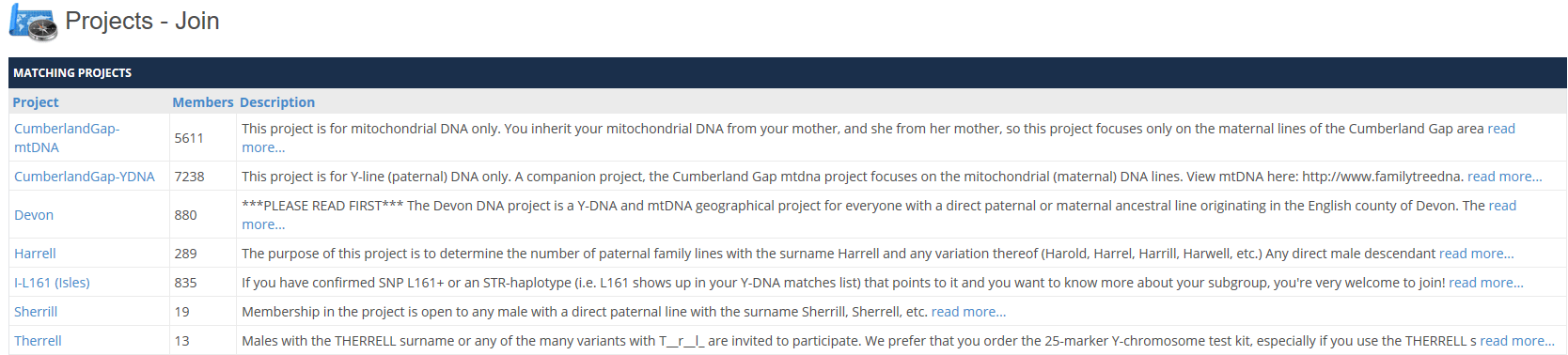
Click on Projects, then “Join a project,” then search for the DNA project that you’re interested in viewing and click on that link.

Within the project, look for oldest ancestors that are your ancestors, or potentially from a common location.  It’s someplace to start.

You can read more about how to construct a DNA pedigree chart in the article, “The DNA Pedigree Chart – Mining for Ancestors.”

Idea 3 – Pick A Puzzle Piece

Sometimes we get overwhelmed with the magnitude and size of the genealogy puzzle we’d like to solve. Then, we don’t solve anything.

This is exactly WHY I like the 52 Ancestor stories.  They make me focus on JUST ONE ancestor at a time.

So, for 2018, pick one genealogy puzzle you’d really like to solve. One person or one thing.  Not an entire line.

Write down your goal.

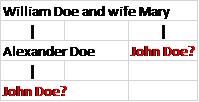
“I’d like to figure out whether John Doe was the son of William Doe or his son, Alexander Doe.”

Now admittedly, this is a tough one, because right off the bat, Y DNA isn’t going to help you unless you’re incredibly lucky and there is a mutation between Alexander Doe and his father, William.  If indeed that was the case, and you can prove it by the DNA of two of Alexander’s sons who carry the mutation, compared to the DNA of one of William’s other sons who does not, then you may be cooking with gas, presuming you can find a male Doe descended from John to test as well.

This is the type of thought process you’ll need to step through when considering all of the various options for how to prove, or disprove, a particular theory.

Make a list of the different kinds of evidence, both paper trail and genetic, that you could use to shed light on the problem. Your answer may not come from one piece of evidence alone, but a combination of several.

Evidence Available/Source Result
William’s will No, burned courthouse Verified
Alexander’s will No, burned courthouse Verified
Deeds with William as conveyor No, burned courthouse Verified
Family Bible Nope, no Bible
Deeds with Alexander as conveyor, naming John Possible, some deed books escaped fire Check through county, Family search does not list
Deeds with John as conveyor Yes, check to see if they indicate the source of John’s land John is listed in index, need to obtain original deeds from county
Y DNA of John’s line Yes, has been tested Matches DNA of William’s line as proven through William’s two brothers
Y DNA of Alexander Not tested (to the best of my knowledge), find descendant to see if they will test Search vendor DNA testing sites for male with this surname to see if they have/will Y DNA test
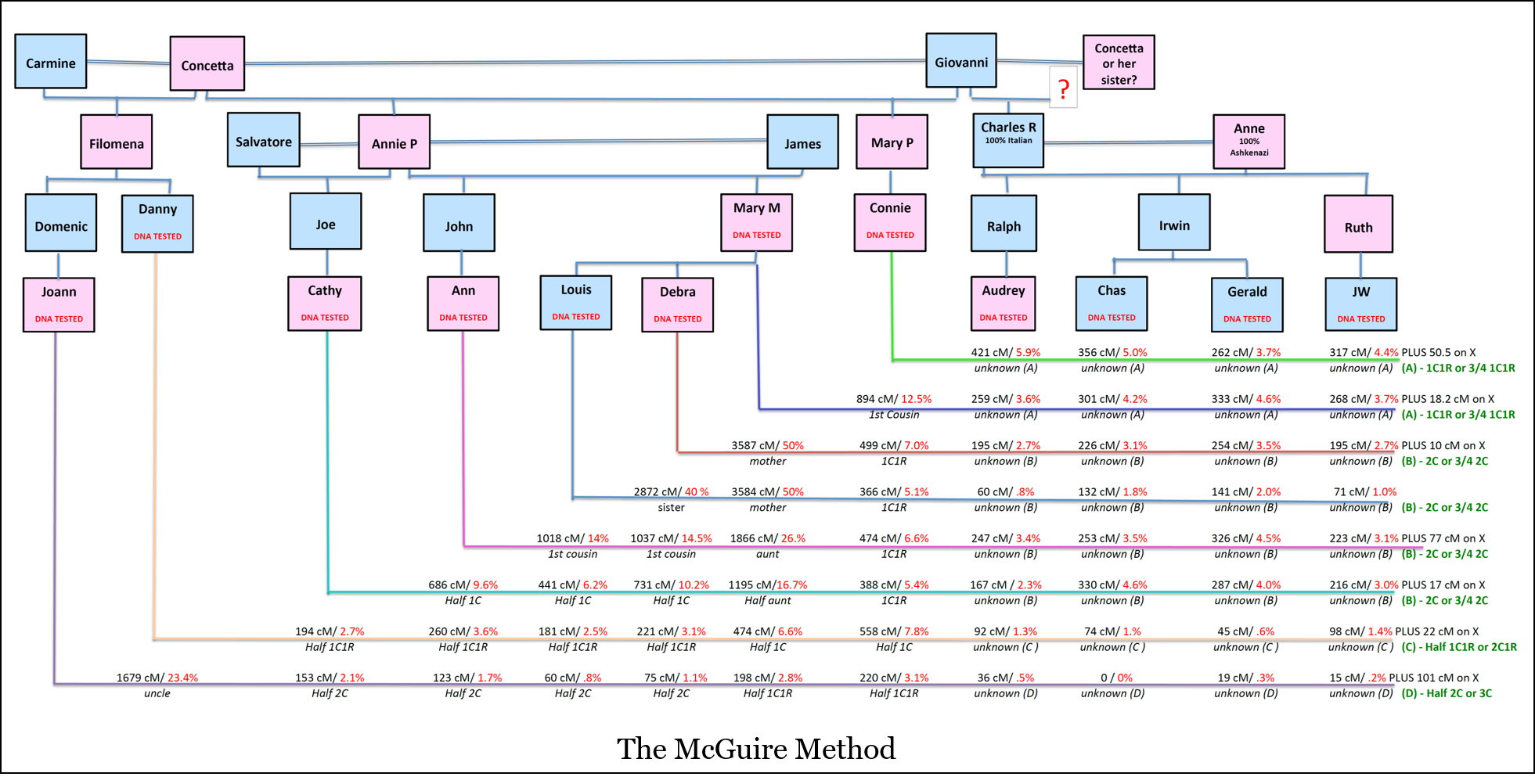
Closeness (in total cM and longest segment) of individuals autosomal matching through any of William’s descendants Mine both Ancestry and FTDNA for surname and ancestor matches This step may produce compelling or suggestive evidence, and it may not.  Make a McGuire chart of results.
Does John match any relatives of the wife of Alexander Doe? Search FTDNA and Ancestry for matches.  Triangulate to determine if match is valid and through that line. This is one of the best approaches to solve this type of problem when paper records aren’t available. Fingers crossed that Alexander and his wife and not related.

You can add pieces of evidence to your list as you think of them.

Making a list gives you something to work towards.

Your Turn!

Select one thing that you’d like to accomplish and either set about to do it, like mining for mitochondrial or Y DNA evidence, or put together a plan to gather evidence, both traditional and genetic.

In the comments, share what it is you’ll be searching for or working on.  You just never know if another subscriber may hold the answer you seek.

I can’t wait to hear what you’ll be doing this year!

Have a wonderful and productive New Year searching for those hidden ancestors!

______________________________________________________________

Disclosure

I receive a small contribution when you click on some of the links to vendors in my articles. This does NOT increase the price you pay but helps me to keep the lights on and this informational blog free for everyone. Please click on the links in the articles or to the vendors below if you are purchasing products or DNA testing.

Thank you so much.

DNA Purchases and Free Transfers

Genealogy Services

Genealogy Research

2017 – The Year of DNA

Every year for the past 17 years has been the year of DNA for me, but for many millions, 2017 has been the year of DNA. DNA testing has become a phenomenon in its own right.

It was in 2013 that Spencer Wells predicted that 2014 would be the “year of infection.” Spencer was right and in 2014 DNA joined the ranks of household words. I saw DNA in ads that year, for the first time, not related to DNA testing or health as in, “It’s in our DNA.”

In 2014, it seemed like most people had heard of DNA, even if they weren’t all testing yet. John Q. Public was becoming comfortable with DNA.

In 2017 – DNA Is Mainstream  

If you’re a genealogist, you certainly know about DNA testing, and you’re behind the times if you haven’t tested.  DNA testing is now an expected tool for genealogists, and part of a comprehensive proof statement that meets the genealogical proof standard which includes “a reasonably exhaustive search.”  If you haven’t applied DNA, you haven’t done a reasonably exhaustive search.

A paper trail is no longer sufficient alone.

When I used to speak to genealogy groups about DNA testing, back in the dark ages, in the early 2000s, and I asked how many had tested, a few would raise their hands – on a good day.

In October, when I asked that same question in Ireland, more than half the room raised their hand – and I hope the other half went right out and purchased DNA test kits!

Consequently, because the rabid genealogical market is now pretty much saturated, the DNA testing companies needed to find a way to attract new customers, and they have.

2017 – The Year of Ethnicity

I’m not positive that the methodology some of the major companies utilized to attract new consumers is ideal, but nonetheless, advertising has attracted many new people to genetic genealogy through ethnicity testing.

If you’re a seasoned genetic genealogist, I know for sure that you’re groaning now, because the questions that are asked by disappointed testers AFTER the results come back and aren’t what people expected find their way to the forums that genetic genealogists peruse daily.

I wish those testers would have searched out those forums, or read my comparative article about ethnicity tests and which one is “best” before they tested.

More ethnicity results are available from vendors and third parties alike – just about every place you look it seems.  It appears that lots of folks think ethnicity testing is a shortcut to instant genealogy. Spit, mail, wait and voila – but there is no shortcut.  Since most people don’t realize that until after they test, ethnicity testing is becoming ever more popular with more vendors emerging.

In the spring, LivingDNA began delivering ethnicity results and a few months later, MyHeritage as well.  Ethnicity is hot and companies are seizing a revenue opportunity.

Now, the good news is that perhaps some of these new ethnicity testers can be converted into genealogists.  We just have to view ethnicity testing as tempting bait, or hopefully, a gateway drug…

2017 – The Year of Explosive Growth

DNA testing has become that snowball rolling downhill that morphed into an avalanche.  More people are seeing commercials, more people are testing, and people are talking to friends and co-workers at the water cooler who decide to test. I passed a table of diners in Germany in July to overhear, in English, discussion about ethnicity-focused DNA testing.

If you haven’t heard of DTC, direct to consumer, DNA testing, you’re living under a rock or maybe in a third world country without either internet or TV.

Most of the genetic genealogy companies are fairly closed-lipped about their data base size of DNA testers, but Ancestry isn’t.  They have gone from about 2 million near the end of 2016 to 5 million in August 2017 to at least 7 million now.  They haven’t said for sure, but extrapolating from what they have said, I feel safe with 7 million as a LOW estimate and possibly as many as 10 million following the holiday sales.

Advertising obviously pays off.

MyHeritage recently announced that their data base has reached 1 million, with only about 20% of those being transfers.

Based on the industry rumble, I suspect that the other DNA testing companies have had banner years as well.

The good news is that all of these new testers means that anyone who has tested at any of the major vendors is going to get lots of matches soon. Santa, it seems, has heard about DNA testing too and test kits fit into stockings!

That’s even better news for all of us who are in multiple data bases – and even more reason to test at all of the 4 major companies who provide autosomal DNA matching for their customers: Family Tree DNA, Ancestry, MyHeritage and 23andMe.

2017 – The Year of Vendor and Industry Churn

So much happened in 2017, it’s difficult to keep up.

  • MyHeritage entered the DNA testing arena and began matching in September of 2016. Frankly, they had a mess, but they have been working in 2017 to improve the situation.  Let’s just say they still have some work to do, but at least they acknowledge that and are making progress.
  • MyHeritage has a rather extensive user base in Europe. Because of their European draw, their records collections and the ability to transfer results into their data base, they have become the 4th vendor in a field that used to be 3.
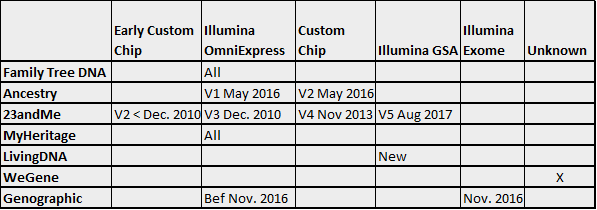
  • In March 2017, Family Tree DNA announced that they were accepting transfers of both the Ancestry V2 test, in place since May of 2016, along with the 23andMe V4 test, available since November 2013, for free. MyHeritage has since been added to that list. The Family Tree DNA announcement provided testers with another avenue for matching and advanced tools.
  • Illumina obsoleted their OmniExpress chip, forcing vendors to Illumina’s new GSA chip which also forces vendors to use imputation. I swear, imputation is a swear word. Illumina gets the lump of coal award for 2017.
  • I wrote about imputation here, but in a nutshell, the vendors are now being forced to test only about 20% of the DNA locations available on the previous Illumina chip, and impute or infer using statistics the values in the rest of the DNA locations that they previously could test.
  • Early imputation implementers include LivingDNA (ethnicity only), MyHeritage (to equalize the locations of various vendor’s different chips), DNA.Land (whose matching is far from ideal) and 23andMe, who seems, for the most part, to have done a reasonable job. Of course, the only way to tell for sure at 23andMe is to test again on the V5 chip and compare to V3 and V4 chip matches. Given that I’ve already paid 3 times to test myself at 23andMe (V2, 3 and 4), I’m not keen on paying a 4th time for the V5 version.
  • 23andMe moved to the V5 Illumina GSA chip in August which is not compatible with any earlier chip versions.
  • Needless to say, the Illumina chip change has forced vendors away from focusing on new products in order to develop imputation code in order to remain backwards compatible with their own products from an earlier chip set.
  • GedMatch introduced their sandbox area, Genesis, where people can upload files that are not compatible with the traditional vendor files.  This includes the GSA chip results (23andMe V5,) exome tests and others.  The purpose of the sandbox is so that GedMatch can figure out how to work with these files that aren’t compatible with the typical autosomal test files.  The process has been interesting and enlightening, but people either don’t understand or forget that it’s a sandbox, an experiment, for all involved – including GedMatch.  Welcome to living on the genetic frontier!

  • I assembled a chart of who loves who – meaning which vendors accept transfers from which other vendors.

  • I suspect but don’t know that Ancestry is doing some form of imputation between their V1 and V2 chips. About a month before their new chip implementation in May of 2016, Ancestry made a change in their matching routine that resulting in a significant shift in people’s matches.

Because of Ancestry’s use of the Timber algorithm to downweight some segments and strip out others altogether, it’s difficult to understand where matching issues may arise.  Furthermore, there is no way to know that there are matching issues unless you and another individual have transferred results to either Family Tree DNA or GedMatch, neither of which remove any matching segments.

  • Other developments of note include the fact that Family Tree DNA moved to mitochondrial DNA build V17 and updated their Y DNA to hg38 of the human reference genome – both huge undertakings requiring the reprocessing of customer data. Think of both of those updates as housekeeping. No one wants to do it, but it’s necessary.
  • 23andMe FINALLY finished transferring their customer base to the “New Experience,” but many of the older features we liked are now gone. However, customers can now opt in to open matching, which is a definite improvement. 23andMe, having been the first company to enter the genetic genealogy autosomal matching marketspace has really become lackluster.  They could have owned this space but chose not to focus on genealogy tools.  In my opinion, they are now relegated to fourth place out of a field of 4.
  • Ancestry has updated their Genetic Communities feature a couple of times this year. Genetic Communities is interesting and more helpful than ethnicity estimates, but neither are nearly as helpful as a chromosome browser would be.

  • I’m sure that the repeated requests, begging and community level tantrum throwing in an attempt to convince Ancestry to produce a chromosome browser is beyond beating a dead horse now. That dead horse is now skeletal, and no sign of a chromosome browser. Sigh:(
  • The good news is that anyone who wants a chromosome browser can transfer their results to Family Tree DNA or GedMatch (both for free) and utilize a chromosome browser and other tools at either or both of those locations. Family Tree DNA charges a one time $19 fee to access their advanced tools and GedMatch offers a monthly $10 subscription. Both are absolutely worth every dime. The bad news is, of course, that you have to convince your match or matches to transfer as well.
  • If you can convince your matches to transfer to (or test at) Family Tree DNA, their tools include phased Family Matching which utilizes a combination of user trees, the DNA of the tester combined with the DNA of family matches to indicate to the user which side, maternal or paternal (or both), a particular match stems from.

  • Sites to keep your eye on include Jonny Perl’s tools which include DNAPainter, as well as Goran Rundfeldt’s DNA Genealogy Experiment.  You may recall that in October Goran brought us the fantastic Triangulator tool to use with Family Tree DNA results.  A few community members expressed concern about triangulation relative to privacy, so the tool has been (I hope only temporarily) disabled as the involved parties work through the details. We need Goran’s triangulation tool! Goran has developed other world class tools as well, as you can see from his website, and I hope we see more of both Goran and Jonny in 2018.
  • In 2017, a number of new “free” sites that encourage you to upload your DNA have sprung up. My advice – remember, there really is no such thing as a free lunch.  Ask yourself why, what’s in it for them.  Review ALL OF THE documents and fine print relative to safety, privacy and what is going to be done with your DNA.  Think about what recourse you might or might not have. Why would you trust them?

My rule of thumb, if the company is outside of the US, I’m immediately slightly hesitant because they don’t fall under US laws. If they are outside of Europe or Canada, I’m even more hesitant.  If the company is associated with a country that is unfriendly to the US, I unequivocally refuse.  For example, riddle me this – what happens if a Chinese (or fill-in-the-blank country) company violates an agreement regarding your DNA and privacy?  What, exactly, are you going to do about it from wherever you live?

2017 – The Year of Marketplace Apps

Third party genetics apps are emerging and are beginning to make an impact.

GedMatch, as always, has continued to quietly add to their offerings for genetic genealogists, as had DNAGedcom.com. While these two aren’t exactly an “app”, per se, they are certainly primary players in the third party space. I use both and will be publishing an article early in 2018 about a very useful tool at DNAGedcom.

Another application that I don’t use due to the complex setup (which I’ve now tried twice and abandoned) is Genome Mate Pro which coordinates your autosomal results from multiple vendors.  Some people love this program.  I’ll try, again, in 2018 and see if I can make it all the way through the setup process.

The real news here are the new marketplace apps based on Exome testing.

Helix and their partners offer a number of apps that may be of interest for consumers.  Helix began offering a “test once, buy often” marketplace model where the consumer pays a nominal price for exome sequencing ($80), significantly under market pricing ($500), but then the consumer purchases DNA apps through the Helix store. The apps access the original DNA test to produce results. The consumer does NOT receive their downloadable raw data, only data through the apps, which is a departure from the expected norm. Then again, the consumer pays a drastically reduced price and downloadable exome results are available elsewhere for full price.

The Helix concept is that lots of apps will be developed, meaning that you, the consumer, will be interested and purchase often – allowing Helix to recoup their sequencing investment over time.

Looking at the Helix apps that are currently available, I’ve purchased all of the Insitome products released to date (Neanderthal, Regional Ancestry and Metabolism), because I have faith in Spencer Wells and truthfully, I was curious and they are reasonably priced.

Aside from the Insitome apps, I think that the personalized clothes are cute, if extremely overpriced. But what the heck, they’re fun and raise awareness of DNA testing – a good thing! After all, who am I to talk, I’ve made DNA quilts and have DNA clothing too.

Having said that, I’m extremely skeptical about some of the other apps, like “Wine Explorer.”  Seriously???

But then again, if you named an app “I Have More Money Than Brains,” it probably wouldn’t sell well.

Other apps, like Ancestry’s WeRelate (available for smartphones) is entertaining, but is also unfortunately EXTREMELY misleading.  WeRelate conflates multiple trees, generally incorrectly, to suggest to you and another person on your Facebook friends list are related, or that you are related to famous people.  Judy Russell reviews that app here in the article, “No, actually, we’re not related.” No.  Just no!

I feel strongly that companies that utilize our genetic data for anything have a moral responsibility for accuracy, and the WeRelate app clearly does NOT make the grade, and Ancestry knows that.  I really don’t believe that entertaining customers with half-truths (or less) is more important than accuracy – but then again, here I go just being an old-fashioned fuddy dud expecting ethics.

And then, there’s the snake oil.  You knew it was going to happen because there is always someone who can be convinced to purchase just about anything. Think midnight infomercials. The problem is that many consumers really don’t know how to tell snake oil from the rest in the emerging DNA field.

You can now purchase DNA testing for almost anything.  Dating, diet, exercise, your taste in wine and of course, vitamins and supplements. If you can think of an opportunity, someone will dream up a test.

How many of these are legitimate or valid?  Your guess is as good as mine, but I’m exceedingly suspicious of a great many, especially those where I can find no legitimate scientific studies to back what appear to be rather outrageous claims.

My main concern is that the entire DTC testing industry will be tarred by the brush of a few unethical opportunists.

2017 – The Year of Focus on Privacy and Security

With increased consumer exposure comes increased notoriety. People are taking notice of DNA testing and it seems that everyone has an opinion, informed or not.  There’s an old saying in marketing; “Talk about me good, talk about me bad, just talk about me.”

With all of the ads have come a commensurate amount of teeth gnashing and “the-sky-is-falling” type reporting.  Unfortunately, many politicians don’t understand this industry and open mouth only to insert foot – except that most people don’t realize what they’ve done.  I doubt that the politicians even understand that they are tasting toe-jam, because they haven’t taken the time to research and understand the industry. Sound bites and science don’t mix well.

The bad news is that next, the click-bait-focused press picks up on the stories and the next time you see anyone at lunch, they’re asking you if what they heard is true.  Or, let’s hope that they ask you instead of just accepting what they heard as gospel. Hopefully if we’ve learned anything in this past year, it’s to verify, verify, verify.

I’ve been an advocate for a very long time of increased transparency from the testing companies as to what is actually done with our DNA, and under what circumstances.  In other words, I want to know where my DNA is and what it’s being used for.  Period.

Family Tree DNA answered that question succinctly and unquestionably in December.

Bennett Greenspan: “We could probably make a lot of money by selling the DNA data that we’ve been collecting over the years, but we feel that the only person that should have your DNA information is you.  We don’t believe that it should be sold, traded or bartered.”

You can’t get more definitive than that.

DTC testing for genetic genealogy must be a self-regulating field, because the last thing we need is for the government to get involved, attempting to regulate something they don’t understand.  I truly believe government interference by the name of regulation would spell the end of genetic genealogy as we know it today.  DNA testing for genetic genealogy without sharing results is entirely pointless.

I’ve written about this topic in the past, but an update is warranted and I’ll be doing that sometime after the first of the year.  Mostly, I just need to be able to stay awake while slogging through the required reading (at some vendor sites) of page after page AFTER PAGE of legalese😊

Consumers really shouldn’t have to do that, and if they do, a short, concise summary should be presented to them BEFORE they purchase so that they can make a truly informed decision.

Stay tuned on this one.

2017 – The Year of Education

The fantastic news is that with all of the new people testing, a huge, HUGE need for education exists.  Even if 75% of the people who test don’t do anything with their results after that first peek, that still leaves a few million who are new to this field, want to engage and need some level of education.

In that vein, seminars are available through several groups and institutes, in person and online.  Almost all of the leadership in this industry is involved in some educational capacity.

In addition to agendas focused on genetic genealogy and utilizing DNA personally, almost every genealogy conference now includes a significant number of sessions on DNA methods and tools. I remember the days when we were lucky to be allowed one session on the agenda, and then generally not without begging!

When considering both DNA testing and education, one needs to think about the goal.  All customer goals are not the same, and neither are the approaches necessary to answer their questions in a relevant way.

New testers to the field fall into three primary groups today, and their educational needs are really quite different, because their goals, tools and approaches needed to reach those goals are different too.

Adoptees and genealogists employ two vastly different approaches utilizing a common tool, DNA, but for almost opposite purposes.  Adoptees wish to utilize tests and trees to come forward in time to identify either currently living or recently living people while genealogists are interested in reaching backward in time to confirm or identify long dead ancestors. Those are really very different goals.

I’ve illustrated this in the graphic above.  The tester in question uses their blue first cousin match to identify their unknown parent through the blue match’s known lineage, moving forward in time to identify the tester’s parent.  In this case, the grandparent is known to the blue match, but not to the yellow tester. Identifying the grandparent through the blue match is the needed lynchpin clue to identify the unknown parent.

The yellow tester who already knows their maternal parent utilizes their peach second cousin match to verify or maybe identify their maternal great-grandmother who is already known to the peach match, moving backwards in time. Two different goals, same DNA test.

The three types of testers are:

  • Curious ethnicity testers who may not even realize that at least some of the vendors offer matching and other tools and services.
  • Genealogists who use close relatives to prove which sides of trees matches come from, and to triangulate matching segments to specific ancestors. In other words, working from the present back in time. The peach match and line above.
  • Adoptees and parent searches where testers hope to find a parent or siblings, but failing that, close relatives whose trees overlap with each other – pointing to a descendant as a candidate for a parent. These people work forward in time and aren’t interested in triangulation or proving ancestors and really don’t care about any of those types of tools, at least not until they identify their parent.  This is the blue match above.

What these various groups of testers want and need, and therefore their priorities are different in terms of their recommendations and comments in online forums and their input to vendors. Therefore, you find Facebook groups dedicated to Adoptees, for example, but you also find adoptees in more general genetic genealogy groups where genealogists are sometimes surprised when people focused on parent searches downplay or dismiss tools such as Y DNA, mitochondrial DNA and chromosome browsers that form the bedrock foundation of what genealogists need and require.

Fortunately, there’s room for everyone in this emerging field.

The great news is that educational opportunities are abundant now. I’m listing a few of the educational opportunities for all three groups of testers, in addition to my blog of course.😊

Remember that this blog is fully searchable by keyword or phrase in the little search box in the upper right hand corner.  I see so many questions online that I’ve already answered!

Please feel free to share links of my blog postings with anyone who might benefit!

Note that these recommendations below overlap and people may well be interested in opportunities from each group – or all!!

Ethnicity

Adoptees or Parent Search

Genetic Genealogists

2018 – What’s Ahead? 

About midyear 2018, this blog will reach 1000 published articles. This is article number 939.  That’s amazing even to me!  When I created this blog in July of 2012, I wasn’t sure I’d have enough to write about.  That certainly has changed.

Beginning shortly, the tsunami of kits that were purchased during the holidays will begin producing matches, be it through DNA upgrades at Family Tree DNA, Big Y tests which were hot at year end, or new purchases through any of the vendors.  I can hardly wait, and I have my list of brick walls that need to fall.

Family Tree DNA will be providing additional STR markers extracted from the Big Y test. These won’t replace any of the 111 markers offered separately today, because the extraction through NGS testing is not as reliable as direct STR testing for those markers, but the Big Y will offer genealogists a few hundred more STRs to utilize. Yes, I said a few hundred. The exact number has not yet been finalized.

Family Tree DNA says they will also be introducing new “qualify of life improvements” along with new privacy and consent settings.  Let’s hope this means new features and tools will be released too.

MyHeritage says that they are introducing new “Discoveries” pages and a chromosome browser in January.  They have also indicated that they are working on their matching issues.  The chromosome browser is particularly good news, but matching must work accurately or the chromosome browser will show erroneous information.  Let’s hope January brings all three features.

LivingDNA indicates that they will be introducing matching in 2018.

2018 – What Can You Do?

What can you do in 2018 to improve your odds of solving genealogy questions?

  • Test relatives
  • Transfer your results to as many data bases as possible (among the ones discussed above, after reading the terms and conditions, of course)
  • If you have transferred a version of your DNA that does not produce full results, such as the Ancestry V2 or 23andMe V4 test to Family Tree DNA, consider testing on the vendor’s own chip in order to obtain all matches, not just the closest matches available from an incompatible test transfer.
  • Test Y and mitochondrial DNA at Family Tree DNA.
  • Find ways to share the stories of your ancestors.  Stories are cousin bait.  My 52 Ancestors series is living proof.  People find the stories and often have additional facts, information or even photos. Some contacts qualify for DNA testing for Y or mtDNA lines. The GREAT NEWS is that Amy Johnson Crow is resuming the #52Ancestors project for 2018, providing hints and tips each week! Who knows what you might discover by sharing?! Here’s how to start a blog if you need some assistance.  It’s easy – really!
  • Focus on the brick walls that you want to crumble and then put together both a test and analysis plan. That plan could include such things as:

o   Find out if a male representing a Y line in your tree has tested, and if not, search through autosomal results to see if a male from that paternal surname line has tested and would be amenable to an upgrade.

o   Mitochondrial DNA test people who descend through all females from various female ancestors in order to determine their origins. Y and mtDNA tests are an important part of a complete genealogy story – meaning the reasonably exhaustive search!

o   Autosomal DNA test family members from various lines with the hope that matches will match you and them both.

o   Test family members in order to confirm a particular ancestor – preferably people who descend from another child of that ancestor.

o   Making sure your own DNA is in all 4 of the major vendors’ data bases, plus GedMatch. Look at it this way, everyone who is at GedMatch or at a third party (non-testing) site had to have tested at one of the major 4 vendors – so if you are in all of the vendor’s data bases, plus GedMatch, you’re covered.

Have a wonderful New Year and let’s make 2018 the year of newly discovered ancestors and solved mysteries!

______________________________________________________________

Disclosure

I receive a small contribution when you click on some of the links to vendors in my articles. This does NOT increase the price you pay but helps me to keep the lights on and this informational blog free for everyone. Please click on the links in the articles or to the vendors below if you are purchasing products or DNA testing.

Thank you so much.

DNA Purchases and Free Transfers

Genealogy Services

Genealogy Research

Concepts – Sibling and Twin DNA Matching

Lots of people are giving their siblings DNA test kits.  That’s a great idea, especially if your parents aren’t available for testing, because siblings do inherit part of the same DNA from their parents, but not all of the same DNA. That means testing siblings is a great opportunity for more genealogical matches!

Recently, a friend asked me why his fraternal twin has matches to people he doesn’t, and vice versa.  Great question, so let’s take a look at what to expect from matches with siblings.

First, identical twins share exactly the same DNA because they are created as a result of the division of the same egg that has been fertilized by the father’s sperm. Identical twins matches should be identical.

A fraternal twin is exactly the same as a sibling. Two separate sperm fertilize two separate eggs and they gestate together, at the same time.

Second, let’s talk just a minute about Y and mitochondrial DNA, then we’ll discuss autosomal DNA.

Full Siblings Share
Mitochondrial DNA Exactly the same, unless a mutation occurred
Y DNA Males will share exactly the same, unless a mutation occurred.  Females don’t have a Y chromosome.
Autosomal DNA Approximately 50% of autosomal DNA

To obtain detailed Y and mitochondrial DNA results, you’ll need to test with Family Tree DNA. They are the only vendor offering these tests.

For autosomal matching, you can test with a number of vendors including: Family Tree DNA, Ancestry, 23andMe and MyHeritage.

You can read more about the different kinds of testing here, and a comparison of the different tests and vendors here.

50% the Same – 50% Different

Siblings share approximately 50% of the same DNA of the parents.  The other 50% is different DNA that they received from the parents that the other sibling did not receive.

In the conceptual example above, you can see that each child inherited 4 segments of the 8 total offered by their parents.  Only two of those segments were the same for both siblings, segments 3 and 4.  Of these two siblings, no one inherited parental segments 7 and 8.  Perhaps a third child would.

In other words, siblings can expect to see many of the same people in their match list and several that are different. In our example, the same people would be matching both siblings on segments 3 and 4.  People matching child 1 but not child 2 would be matching on segments 1 and 2.  People matching child 2 but not child 1 would be matching on segments 5 and 6.

The reason you’ll see the same people on your match list is because you did inherit 50% of the same DNA from your parents.

There are two reasons you’ll see different matches on your match lists.

Some of your matches on your list that don’t match your sibling will be because the two siblings inherited different pieces of DNA from their parents.  Your sibling will match people on the DNA that they received from your parents that you didn’t receive, and vice versa.

Some Matches are Identical By Chance (IBC)

Another reason for different matches is because you and your sibling will have people on both of your match lists that don’t match either parent as a result of IBC or identical by chance matching. That’s where the DNA of your match just happens to match you by virtue of zigzagging back and forth between your Mom’s and Dad’s DNA that you carry.

As you can see in this example, your pink DNA came from your Mom, and blue from your Dad, but your match carries some of both values, T and A.  This means they match you, but not because they match either of your parents.  Just an accident of circumstance. That’s what IBC is.

Telling the Difference

I wrote about matches that are identical by descent (IBD), meaning because you inherited that DNA from your parents, and identical by chance (IBC) in this article.

Unfortunately, your DNA is mixed together and without other known relatives testing, it’s impossible to discern which DNA is inherited from your mother and which from your father. This is exactly why we encourage people to have known relatives test such as parents, grandparents and cousins.  Who you match on which segments indicates where those segments descended from in your family tree.

If one or both parents are living, that’s the best way of discerning which matches are identical by descent and which are by chance.

A recent project with Philip Gammon showed by segment size the likelihood is of a match being genuine or identical by chance.  If both parents have tested, he offers the free Match-Maker-Breaker tool to do this analysis for you.

The bottom line is that when comparing your matches to those of your siblings, about 20-25% of everyone’s total matches are identical by chance, especially those at lower centiMorgan levels.

The remaining 80% or so will be divided roughly half and half, meaning half will match you and a sibling both, and half will only match you. Therefore, you will be looking at roughly 40% of your matches being in common with a particular sibling, 40% not matching your sibling but being legitimate matches and the remaining 20% that are identical by chance.

Test Parents and Family Members

Of course, because you do share roughly half of the same DNA inherited from your parents, you will have some matches to both you and a sibling that are identical by chance in exactly the same way.  Just finding someone on both of your match lists doesn’t guarantee that the match ISN’T identical by chance.

The best way to eliminate identical by chance matching, of course, is to test your parents.  Sadly, that isn’t always possible.

The next best way to determine legitimate matches is to test other family members.  At Family Tree DNA, they provide customers with the ability to link the DNA tests of family members to their proper location in your tree, and then Family Tree DNA utilizes the common DNA segments to determine common matching between you, that family member(s), and other people.

Those people who match you and a family member on the same segment are then identified as either paternal or maternal matches, based on their position in your tree.

Identifying Lineage

When thinking about who to test, half-siblings, if you have any are, a wonderful way to differentiate between maternal and paternal matches.  Because you and a half sibling share only one parent – which side of your tree those common matches come from is immediately evident!

Of my matches at Family Tree DNA, you can see that of my total 3165 matches, 713 are paternal and 545 are maternal, with 4 being related to both sides.  Don’t get too excited about those “both sides” matches, they are my descendants!

Paternal and maternal bucketing is a great start in terms of identifying which matches are genealogical – and that’s before I do any actual genealogy work.  All I did was test, create or upload a tree and connect tested family members to that tree.

Family Tree DNA is the only vendor to offer this feature.

Ethnicity

Ethnicity is a slippery fish.  I generally only consider ethnicity estimates reliable at the continental level.  There are lots of reasons that siblings will receive somewhat different ethnicity results including the internal algorithms of the various vendors.  You can read about what is involved in ethnicity testing here.

Transfers Give You More For Your Money

If you test at one of the vendors, you may be able to transfer to other vendors as well as GedMatch.  In the chart below, you can see which vendors accept transfers from other vendors. You can read more here.

Have Fun

Lots of people are now testing their DNA and I hope you and your siblings will find some great matches among the new testers. The great thing about siblings, aside from the fact that they are your siblings, is that you can leverage each other’s DNA matches.  Just one more way to share and move the genealogy ball forward.

______________________________________________________________

Disclosure

I receive a small contribution when you click on some of the links to vendors in my articles. This does NOT increase the price you pay but helps me to keep the lights on and this informational blog free for everyone. Please click on the links in the articles or to the vendors below if you are purchasing products or DNA testing.

Thank you so much.

DNA Purchases and Free Transfers

Genealogy Services

Genealogy Research

Merry Christmas – And To All A Good Life

I’ve been thinking about what I’d like to say about Christmas this year. Truthfully, I haven’t felt much like celebrating.

This year has been filled to the brim with mortifying events, the likes of which I never thought I’d see in my lifetime.

Barely a day goes by that I’m not frightened anew – for my Black, Native and Spanish friends, family, and their children. For our brave soldiers, police and firefighters of all colors and races. For the country I love and call home – the same one that my ancestors spilled their blood and gave their lives to defend. For my children, grandchildren and their descendants.

So, for Christmas or Hanukkah or Solstice, whatever you celebrate, I decided to share with you a story – one of hope – one of kinship – one of reaching beyond the stereotypes that have sometimes been ingrained in upbringing and the communities and families in which people are raised. A story about the power of choice that each of us has within us.

A story that I recall again and again because it gives me hope when my days feel hopeless. It renews my soul.

It’s a story about love, but not at all your typical love story.

The Reunion

A few years ago, a DNA group that I administer decided to host a homecoming and conference of sorts – before the days of genetic genealogy conferences.

We rented a hotel and the conference room, and before we knew it, the “reunion” was filled to capacity.

Three days of presentations were scheduled, with many of the attendees giving sessions about genealogy, and in particular, about genetic genealogy which was still  new at the time.

The Reveal

One of the draw cards was a “reveal.” My cousins and I had discovered each other a few months before and had busily been DNA testing to prove or disprove whether in fact William Herrell was the ancestor of both groups of people. Me on the one side and my cousins on the other.

The complicating factor was that William Herrell had two wives, at the same time – one black and one white. Not only that, but he had purchased the black wife, Harriett, as a slave – but the white wife, Mary, raised Harriett’s child, Cannon, with her own children after the death first of Harriett and then of William.

Was Cannon William’s biological child? Oral history said yes.  What was the truth of the matter?

Given the location of the reunion, I had some consternation about this topic and particularly about the reveal.

My cousins, however, were not concerned. It was them I was concerned for, not me, so the plan progressed smoothly. Adding to our excitement was the fact that we would all get to meet in person for the first time.

On the first day of the conference, we presented the attendees with the back story, which is actually quite interesting, then we left them with a cliffhanger. Were we related? We asked them to vote. What did they think? We would tell them the following morning.

The vote, by the way, was about half and half.

The Next Morning

On the morning of the second day of the conference, we were shocked to discover that people were simply showing up at the hotel. They had heard, through the local grapevine that there was to be a BIG REVEAL and everyone was interested.

We didn’t quite know what to do.

We crammed as many seats into the room as possible. People crowded in behind the seats and stood, and more people filled the lobby craning their necks to see.

Never in my wildest dreams did I ever imagine anything quite like this.

My cousins Carlos (Los) and Denise and I revealed the answer.

Yes, Cannon was the son of William Herrell and yes, we are all related.

But that’s not the punchline, nor is this the main story.

Los, Denise and I began on a journey as curious genealogists. Before we even knew that we were related, we had formed a relationship with each other, one which we maintain today. We’ve added more family members as well, and we are indeed “kin” as they say in the south, not just because we are blood relatives, but because we have gotten to know each other as people and we love each other. (And for the record, I have other relatives I’m not nearly so quick to claim.)

Yes, you might notice that some of us have more skin pigment than others, but our family runs the entire pigment range and truthfully, I don’t even think about it or notice anymore. It’s irrelevant. We all bleed red, feel both pain and love and are good people. It’s really that simple, and it’s all that matters.

Bottom line is that I love them, not because they are black, or actually, part black, not in spite of it, simply because they are who they are. At one point, we thought we might NOT be related, and we were all horribly disappointed, and rejoiced when we discovered that we actually DO share an ancestor and ARE cousins (thank you autosomal DNA).

The Preacher

One of our attendees at the conference was a retired Baptist minister. In his 80s, he didn’t get around well and while not wheelchair-bound, he used both a wheelchair and a cane to increase his mobility and keep himself safe. I had known him for years.

We’ll call him Reverend Jim. All of the names of people other than my cousins have been changed.

Reverend Jim and I thought that we might share a particular line, that of his surname, but Y DNA testing proved that our lines were different, a fact that frustrated us both, because we would have liked very much to share research.

Reverend Jim felt that his time was running out as he aged and his health failed, but he remained an upbeat, avid genealogist and welcomed DNA testing to advance his knowledge. Hence, his difficult trip to the conference.

After the big reveal, people gathered in the conference room and the lobby to visit with each other and discuss the results along with DNA testing. My cousins and I were talking to people, when voices dropped and it became evident that something interesting was happening across the room.

I was holding Los’s daughter who was about 18 months old at the time, wishing we lived closer and I could be another grandma to her.

Suddenly Los and I both realized that all eyes were on a table near the front window.

Curious and concerned that something might be wrong, especially given that Reverend Jim was seated there, I ambled with purpose towards the table, not wanting to appear nosey, but cognizant of the fact that I was the defacto hostess. Besides that, there seemed to be an intense discussion occurring and I wondered if it might have something to do with DNA testing.

Reverend Jim was sitting at the end of the table on one side in his wheelchair, and a black gentleman of about the same age was facing him across the table. We’ll call him Doug. Listening for just a minute revealed that they shared the same surname and were debating whether they could be from the same paternal line.

Now I understood the hushed room.

Given that one was black and one was white, the answer, if yes, meant that perhaps they had experienced something in their families like Los, Denise and I had discovered in ours, with all of it’s painful ramifications about slavery. Needless to say, this was a sensitive subject, and both people were trying to have a nice conversation without offending anyone. I’m sure both men were thinking, “probably not,” but didn’t want to say that out loud. Or maybe they were secretly wondering, “What if?”

Suffice it to say that not everyone is nearly as accepting of newly discovered interracial family as my cousins and all of our extended families. And yes, I really do mean that – ALL OF OUR EXTENDED FAMILIES.

So, I stood and listened, as other people gathered round.

The Railroad

Reverend Jim: “My Daddy worked for the railroad and was gone a lot. He missed a lot of Christmases with the family.”

Doug: “My Daddy too.”

Both men smiled and chuckled, clearly harkening back in time and thinking about their own fathers.

Reverend Jim: “We lived in the town of X back then. Did your Daddy work for the railroad too?’

Doug: “Sure did. We lived at the other end of the line, near the depot in Y.”

Reverend Jim: “My Daddy worked between X and Y most of the time, but sometimes he went on other lines too.”

Doug: “My Daddy did too. When did your Daddy work for the railroad?”

Reverend Jim: “From about 19XX to about 19XX.”

Doug: “I bet they knew each other. What was your Daddy’s name?”

Reverend Jim: “William.”

Doug, very slowly: “Mine too.”

Silence.

The men and the entire room now.

Both men stared at each other across the table.

End of the Line

Reverend Jim broke the spell and reached down in his wheelchair bag, extracting a three ring binder. He opened the cover and started leafing through the contents. I thought perhaps this discussion had gotten too close to a topic that perhaps he wasn’t comfortable with. Given his age and where he had lived his entire life.

Finally, Reverend Jim found what he was looking for. I suspected it was a pedigree chart that he wanted to share with Doug.

Reverend Jim turned a page toward Doug, placing the binder on the table. I saw an old black and white photo in a plastic sleeve. Reverend Jim, smiling, said, “That’s my Daddy. Did you know him?”

Doug leaned over politely and looked at the photo, glanced quickly at Reverend Jim, then back at the photo. Doug picked the book up and evaluated the photo more closely. The photo wasn’t in good shape, somewhat dogeared, old and grainy. A woman with Doug looked over his shoulder, peering at the photo to see if she knew the man, I’m sure.

Doug reached towards his chest, looked at Reverend Jim and said softly, “That’s my Daddy.”

Reverend Jim leaned in towards Doug, straining to hear. “What?”

Doug, now louder, still clutching his chest, “That’s my Daddy too.”

My mind raced.

Was Doug having chest pains? Is that why he was clutching his chest?

Did I need to call an ambulance?

Should I ask him?

Was his father white?

Was he sure that was his father?

Was that photo really good enough to tell?  For sure?

How could this be?

Doug must have been wondering the same thing.

Doug handed the binder with the photo to the woman behind him, and asked her, “What do you think?”

She looked closely, squinting for a long minute, scrutinizing the picture, handed the binder back to Doug and said, “Yep, that’s him.”

“You sure?”

“Yep.”

Silence!

The entire room was deathly silent now. Not one peep out of anyone.

You could have heard a blink.

Both men must have been processing this information.

Both men must have realized that their father deceived them.

Both men must have realized that their father cheated on their mother.

Both men must have been wondering how he pulled this off.

Both men must have been wondering how they didn’t know about each other.

And both men must have realized that they had a brother, and perhaps other siblings, of another skin color, born in a time in America when black and white drinking fountains were the norm and racial separation by the name of segregation was expected.

Was this a horrible moment or a wonderful moment?

Some of each perhaps?

What would they do?

It was one thing to watch my cousins and I reveal our journey, in a preplanned way, but quite another to have a surprise reveal of your own in a hotel lobby filled with an unwitting audience.

What happened next would set the tone for the entire rest of these men’s lives.

What would it be?

Acceptance or Rejection?

I realized that Reverend Jim was trying to struggle to his feet. I didn’t know if I should help him, leave him alone or gently encourage him to remain in his chair. I was frightened about what might be coming.

Doug stood up too, trying to stabilize Reverend Jim.

His face revealed confusion and pain.

Reverend Jim managed to get his cane in place, stood, wobbling and somewhat stooped, and leaned over the table to Doug, reaching for him.

I held my breath.

For an excruciatingly long minute. Everything was happening in slow motion.

Reverend Jim put his free arm around Doug and pulled him into a close hug.

Doug stepped around the table and put both arms around Reverend Jim. Reverend Jim dropped the cane, fully embracing Doug.

I realized both men were crying. Tears streaming down their faces.

Reverend Jim blurted out, between sobs, “I have a brother!”

I remember huge waves of relief washing over me. The tears, hot and salty came.

Joy.

Pure unfettered joy.

I knew this was only the beginning of the questions these men would have for each other.

A wonderful new chapter had opened. Wonderful based on their perceptions of the present, not the past.

My memory of the rest of that day is blurry now, much like that black and white photo.

The people in the lobby were quite astir with this news.

The following day, ALL of Doug’s family arrived loaded with photos and an impromptu  family reunion occurred in the lobby with family pictures scattered all over a table salted with chatter and laughter.

Reverend Jim was so overwhelmed and excited that he managed to lock his keys in his car, and later, lose them entirely. He never attended another presentation. He had much more important things to do!

I know both families were in shock.

Here’s what else I know.

Love Won

Those men had a choice to make and they had to make it in an instant.

Their families had the same choice. Most of Reverend Jim’s family was gone, but Doug’s was large and it was evident that Reverend Jim went home with far more family that he arrived with.

They had been blessed.

Hatred didn’t win that day.

Neither did bigotry.

Nor racism.

Or prejudice.

Pure and simple.

Love won.

Merry Christmas and may love bless you in the new year.

______________________________________________________________

Disclosure

I receive a small contribution when you click on some of the links to vendors in my articles. This does NOT increase the price you pay but helps me to keep the lights on and this informational blog free for everyone. Please click on the links in the articles or to the vendors below if you are purchasing products or DNA testing.

Thank you so much.

DNA Purchases and Free Transfers

Genealogy Services

Genealogy Research

Michael McDowell Sr. (c 1720 – after 1755), Breadcrumbs Scattered From Maryland Across Virginia, 52 Ancestors #175

Michael McDowell Sr. could have been born in Baltimore County, Maryland, on the boat to Maryland, or back in Ireland.

We don’t know.

What we do know is that in 1752, Michael McDowell sold portions of the property in which he had an interest that had belonged to Murtough McDowell, an immigrant.  Murtough was living in Baltimore County in 1722.

We are presuming that Murtough’s wife in 1730 was indeed the mother of Michael, but we don’t know that for sure either.  It’s certainly possible that Elinor was a second wife, but there is absolutely no evidence either way.

Halifax County, Virginia

Halifax County was formed from Lunenburg in 1752, and that’s where we find Michael McDowell in that same year, selling his father’s land in Maryland. Thank goodness for this link, because without it, we would never have been able to connect Murtough McDowell in Baltimore County, Maryland with Michael McDowell in Virginia.

The following power of attorney was issued in Halifax County, VA and recorded along with a land sale in Baltimore County, Maryland.

May 3, 1755 – Page 407 – Power of attorney from Michael Macdowell to John Hawkins, signed in Halifax County.

The power of attorney itself was entered into the Baltimore County record below the deed sale and is dated September 19, 1752.

This signature does not contain an X for a signature, which may be a later differentiator between Michael McDowell Sr. and his son, Michael Jr.

The following document is recorded in Baltimore County, Maryland:

Mich McDowell to Joseph Murry Jr. – September 19, 1752, Michael McDowell of Halifax County in the colony of Virginia to Joseph Murray Jun of the County of Baltimore in the Province of Maryland, 10 pounds current money, land known as “Bring Me Home” beginning at two bounded white oaks at the head of the north line of Jones Falls…

March 5, 1753 John Hawkins by virtue of authority of power of attorney to him made for that purpose by the within Named Micheal Macdowell to Joseph Murray Jr., and the land and premises herein mentioned to be the estate rights and interest 6 pounds current money.  Signed and witnesses by Thomas Hooker and Joseph Hooker

These signatures above do not contain an X for Michael’s signature.

Based on the above information, Michael was not in Baltimore County in person, but in Halifax County, VA on September 19, 1752 signed a Power of Attorney document. In 1753, the land was sold to Joseph Murray.

These dates are confusing, because they don’t tally exactly with the dates in the deed books.

For example, the sale date for Bring Me Home is noted as in 1755, not 1753.  I’m left with the impression that some of the documents we need are missing or perhaps some transcriptions are in error.

It looks like in 1752 Michael sold his shares in this property to Joseph Murray, and in or by 1755, he sold the actual land to Joseph.  This suggests that perhaps Michael is related to Joseph Murray, which means that Joseph Murray may have been married to Michael McDowell’s sister.  Unfortunately, there are a lot of “suggestions” here and not much more. Worse yet, if accurate, Joseph Murray’s wife is shown to be one Margaret Jones.  I might just have gone down a rathole.

We know that in 1753, Michael was in Halifax on May 3rd per the deed registration in Baltimore County, or at least that’s what was registered based on the Power of Attorney document signed in 1752. What we don’t know is whether or not Michael was actually living in Halifax County in 1753, or if he had moved on by that date.

Regardless of the actual sale date, the essence of this is that Michael, from Halifax County, Virginia, appears to be the son of Murtough McDowell from Baltimore County, Maryland.  Unfortunately, no will or other administrative or estate records for Murtough or his wife have emerged.

There are no other records for Michael McDowell in Halifax County, although there is a Peter McDowell found there in 1752.  However, if Peter was also Murtough’s son, you would think there would be another power-of-attorney document for Peter, and there is nothing.

A Land Entry

In Marion Dodson Chiarito’s book, “Entry Record Book 1737-1770” which covers land in the present counties of Halifax, Pittsylvania, henry, Franklin and Patrick, she says the following:

This book contains land entries in the western portion of the original Brunswick County, namely Halifax, Pittsylvania, Henry, Franklin and Patrick. The area concerned was south of the Roanoke-Staunton River, west of Tewahomony Creek, now Aaron’s Creek which divides Mecklenburg and Halifax cuonties, and extending to the Blue Ridge Mountains. These counties were formed from Lumemburg which was separated from Brunswick in 1746.

Marion continues:

It must be pointed out that an entry for land was but a statement of intention. Ownership of land resulted from satisfying the requirements for settlement the land and improving it. For this reason, many entries were voided.

On page 161 of Marion’s book, on page 203 of the original entry taker book residing in current day Pittsylvania County, we find an entry for a man who might be Michael McDowell:

Michael McDuell 400 on a Branch of Black Water River beginning at a white oak with 4 chops in it in the fork of said branch then up both forks and down the branch.

If this was Michael McDowell, I’ve failed to find a deed of sale at any time, and he is next found in Bedford County which, indeed, did have a Blackwater Creek.

Next Stop – Bedford County

Michael McDowell was listed on the Bedford county tax list in 1755. And before you ask, no, we don’t know for sure that this is the same Michael McDowell.  Fortunately, Michael McDowell isn’t a popular name, and the best we can do is track the name forward and backward in time.

Perhaps Michael was using his inherited money on the frontier where land was cheaper than in Halifax County which was largely settled at this point in time.  The problem with that theory is that we have no record of any Michael McDowell purchasing any land until 1783 in Bedford County, and by then, the Michael who purchased land could have been Michael Sr. or Michael Jr. who was born in 1747.

Based on subsequent records, including Michael McDowell Jr.’s Revolutionary War pension application which states that he was dismissed in 1777 or 1778 and returned to his home in Bedford County, combined with a land sale in 1793 in which the land purchased in 1783 was sold by a Michael McDowell who made his mark when signing with an X, it appears that the land in 1783 was purchased by Michael McDowell Jr., not Sr. Michael McDowell Jr. apparently could not write his name, while it appears that Michael McDowell Sr. could.

We also know, according to that pension application, that Michael Jr. was born in 1747.

What else do we know about Michael McDowell Sr.?

There are be more hints in Lunenburg County.

Lunenburg County, Virginia

We first find Michael McDowell in Lunenburg County in 1748, but what did he do between then and 1752 when we find him in Halifax County? Or perhaps Michael didn’t move, but the county line did.

Keep in mind that Halifax County, where we positively identify Michael McDowell Sr. as Murtough’s son in 1752, was Lunenburg County before Halifax was formed in 1752.

However, we may have an even earlier sighting of Michael.

We find a similar name in Albemarle County, VA in the 1745 road records, dated June 27th in which Andrew Wallace was appointed surveyor of the highway from D.S. to Mitchams River.  Archebald Woods, Jeremiah Marrow, William Shaw, Robert Mannely, John Dickey, William Wallace, Merlock McDowell, Micah Woods Jr., Micha McDowell, Anthony Osbrook, John Lawson, John Cowan, William Little and Robert Anderson ordered to assist in clearing.  Looking at this list, I have to wonder if Merlock McDowell is actually a Mortough McDowell Jr. and if Micha is Michael, of course.  The rest of these people would have been their neighbors up and down the road. Is this our Michael?  There is no way to know.

A search of Albemarle deed and will indexes from 1748 through 1753 shows no McDowells.  Albemarle was formed from Goochland in 1744, although deed and will records didn’t begin in Albemarle until 1748.  A search of Goochland County records from 1731-1749 also show nothing, so if Michael and Merlock were there, they are silent residents.

Lunenburg County was formed in 1745 from Brunswick County, Lunenburg deeds and marriages exist from 1746. Brunswick County land records exist from 1732, but no marriages. Michael McDowell is not in the compiled Virginia marriages, created from extant early records. Strike, strike, strike and out.

The 1748 tax map for Lunenburg is the first tax list available, so we don’t have any way of knowing whether or not Michael Jr., born about 1747 was born in Lunenburg, or if his father was still living in Maryland or elsewhere when Jr. was born.

The Lunenburg County 1748 tax list shows Michal McDanel with 1 tithe in the district taken in June by Mathew Talbot from Bleu Store to Little Roanoke.

Sunlight on the Southside by Landon Bell provides the Lunenburg tax lists, where extant.  We find the McDowells mentioned in the intro portion as being from Lunenburg Co., Va. before they went to NC.

In 1749, we find Michael McDowell in William Caldwell’s district, which was probably the district that would eventually become Charlotte Co., which neighbors Halifax. Michael had 1 white tithe, meaning white male over 16, and no negroes.  His neighbors were as follows:

  • William Russell
  • Thoms Walters
  • Thomas Lewis
  • Michael McDowell
  • Robert Wood
  • Estate of Major John Cole
  • William East overseer for John Cole

In 1749, the Lunenburg road orders included a Michael McDaniel, who may have actually been Michael McDowell who was ordered to work on Randolph’s Road from Thomas Worthys to the Mossing foard.

Looking at a current map, the Roanoke is called the Staunton between Halifax County and Charlotte County, and at a location called Randolph, Virginia, very near the River in Charlotte County, we find another Staunton, probably referred to in the road minutes as the Little Roanoke.

You can see that Charlotte County, shown in red below, abuts Halifax to the west.  Michael’s 1752 Power of Attorney was sworn in Halifax County.  The court house at that time was near the village of Halifax.

Randolph’s Road, from the Lunenburg County road orders seems to be a main road that crossed the Roanoke at the Little Roanoke River where a ferry was located.  According to the 1821 field survey notes the Little Roanoke is located in Charlotte County.  Of course, Randolph’s road continues on through Lunenburg and into Prince Edward County so Michael’s road duty may have been elsewhere along this then major road.  It’s referred to as a “roling road,” which means tobacco casks were literally rolled down the road to the docks to be graded and loaded onto boats. However, given the fact that the road order includes mention of a “foard,” this suggests that the road crosses some river that is more significant than a creek, but probably not as large as the Roanoke which is too large to ford without a ferry.

I suspect that Randolph’s Road is Highway 59 today.  Some road orders reference George Moore’s.  He owned Moore’s Ordinary which was located on what is now Ordinary Road, near the Whistle Stop.

In 1750 we find Michael in Nicholas Hale’s district with one tithe again as follows:

  • John Freer
  • Robert Baker
  • John Helton
  • Michael McDowell (Michal Macdowel)
  • Nicholas Alle
  • John Pybon
  • Jacob Pybon

In 1751, Michael is missing from the list and in 1752, Halifax County was formed from Lunenburg. We already know that Michael is in Halifax in 1752.

According to the map below, in 1746, reflecting the 1748 tax lists, Mathew Talbot’s District became Charlotte County in 1764, formed from Lunenburg. On the 1746 map, it looks like the Little Roanoke is called “Roanoke Creek.”

Michael Talbot’s district is the area that would initially become Charlotte County in 1764. Today Charlotte County is separated from Halifax County by the Roanoke River, which is the dividing line between Mathew Talbot’s District and Cornelius Cargill’s District in 1746.

The Lunenburg Order books 1746-1755 reflect the following:

June 1753 Michael McDuel vs Jacob Pyborn – Pyborn not inhabitant of county – suit abates.

What this does not tell us is whether Michael was still a county resident, and we don’t know when the suit was filed, except at a session prior to June of 1753.

Note that Jacob Pybon was one of Michael’s neighbors in 1750.

May court 1754 John Thompson vs Michael McDuel – def not inhabitant of county – suit abates.

This tells us that Michael probably left between June of 1753 and May of 1754, and it might give us some idea of why. Trouble was brewing perhaps.

We also know that Michael McDowell was in Halifax County on March 5, 1753 where he was considered a resident, at least according to the deed filed in Baltimore County, Maryland. Of course, that information could have been based solely on the information in the Power of Attorney document.  We don’t actually know that Michael was still living in Halifax in March of 1753. He could have moved on. He seemed to do that pretty regularly.

Sept. 1755 – John McDuel witness for Richard Booker vs Samuel Seekright, paid by Booker for 3 days attendance and once coming and returning 50 miles.

Is this John somehow connected to Michael? If so, he either died or moved on too.

There were no McDowells in the order books, deeds, road orders or wills from 1746-1766.

Bedford County was created in 1753 from Lunenburg County.

Reconstructing Michael’s Movements

As best we can tell, Michael spent his childhood in Baltimore County, Maryland.  Of that we are positive based on Murtough’s records. Murtough owned this land at the head of the North Branch of Jones Falls which Michael sold.

I wonder how Michael felt selling his boyhood home. Difficult under the best of circumstances, and even moreso if your parents were buried there – especially if you never got to say goodbye.

Today, this guardrail marks the location near 12100 Park Heights Avenue in Owings Mills, Maryland where the road crosses the North Branch of Jones Falls Creek. This would have been Murto, then Michael’s, land, or very close.

Michael may have been in Albemarle County by 1745, which probably meant he was at least 25 years old, so born 1720 or earlier.

There was a Michael McDowell in Lunenburg by 1748, probably in a portion of Lunenburg that became Charlotte County, just across the river from Halifax. MIchael could also have been living in the portion of Lunenburg that simply became Halifax.

We find Michael, Murtough’s son in Halifax County in 1752 when he signed the Power of Attorney, then possibly in 1753.

The possible land entry for 400 acres was registered in 1754, but appears to have been abandoned.

Michael McDowell is in Bedford County on the 1755 tax list.

We find no other records of any Michael McDowell during that time in Virginia or Maryland.

And there, our trail goes cold.

The next piece of information about any man with that name is what we discovered in Michael McDowell Jr.’s 1832 Revolutionary War Pension.  We know that pension application is not for Michael Sr. because the Michael McDowell who filed for the pension doesn’t die until after 1840, and he gives his age in the pension application which tells us that he was born in 1747.  Clearly not the man who sold property in Maryland from Halifax County in 1752 when he would have been 5 years old.

What happened to Michael McDowell Sr.?

We simply don’t know, other than he’s surely dead by now.

It’s pretty clear that MIchael was in Bedford County in 1755 and his namesake son lived there in 1777, but the years in-between are entirely devoid of information.  We simply know Michael Sr. died sometime after 1755 and didn’t own any property.

The possibility that Michael Sr. bought the property in 1783 and sold it from Wilkes County in 1793 exists, but is unlikely.

First, Michael Sr. would have been more than 63 years of age in 1783, purchasing his first land.  The man who sold the property from Wilkes County in 1793 when Michael Sr. would have been about 73 signed with an X, meaning he couldn’t write.  Michael Sr. could write. Additionally, in the 1787 “census” of Wilkes County, only one Michael McDowell lived there at the time, not an older and younger version.

The connection of Michael McDowell Sr. and Michael McDowell Jr. as father and son is not concrete.  There is no will or other relationship-defining document. The names and locations are the same, but there is room for error.  And the DNA doesn’t help us this time, at least not yet.

DNA Will Tell the Story – Someday

We have what is purported to be the Y DNA of Michael McDowell Jr.  I say purported, because the DNA comes from a line not firmly attached to Michael Jr. through a presumed son, Edward.  However, there is paper evidence to suggest that Edward is either Michael Jr.’s son, or is at least connected to Michael Jr.

Two types of evidence, both genetic and genealogical, confirm a male line.

First, if one male who takes a Y DNA test matches other men who have taken the same test at 37 markers or more (generally), then the surname line is confirmed – meaning that these men share a common ancestor at some point in history.

What that test cannot tell you is which common McDowell ancestor or which point in history, at least not exactly.

That information needs to come from a combination of genealogy and genetics, with the genetics confirming the paper trail genealogy.

Sometimes this methodology is lacking.  In this case, my McDowell male matches two other McDowell men at 25 markers, but both of their genealogies reach back to Michael Jr.  There is no other McDowell match at that level.

This leads to a couple of questions.

First, is the historical surname really McDowell? In other words, why aren’t their more McDowell matches, and some matches with genealogy reaching further back in time.

My McDowell male was originally only tested to 25 markers, and we’ve recently ordered an upgrade to his Y DNA to see what kinds of matches we retain at 37 markers and above.  Unfortunately, many McDowell testers tested early and haven’t upgraded.  Neither do they have trees online today.

Second, if the historical surname is McDowell, is my tester really descended from or related to Michael McDowell Jr. on the paternal line? Fate is sometimes a jokester and might just have put Michael McDowell beside his known son John, plus Luke and Edward, on the 1810 Lee County tax list just to mess with me.  Could happen.  Stranger things have happened before.

One of the best indicators of Luke being related to Michael McDowell Jr. will be if the McDowell male tester also matches people who descend from Michael McDowell Jr. through autosomal testing.  The autosomal test, known as Family Finder, is underway at Family Tree DNA.

Third, if we knew of other sons of Michael McDowell Sr., we could simply (and I say simply like it really is) test a McDowell male descendant of a different son.

Some things are simpler than others, and this isn’t one of them. We don’t know the identities of any of Michael McDowell Sr.’s other children, assuming he had them and they lived.

We will likely never be able to find additional sons of Michael McDowell Sr., at least not through paper trail genealogy, barring that miracle Bible discovery.  However, in time, if we find enough McDowell males who match this line through Y DNA as well as match at some level utilizing autosomal DNA, we may be able to find people who we think may be descended from Michael Sr.

Notice the weasel-wording, “if”, “may” and “think,” because success proving additional children of Michael McDowell Sr. is not assured – ever.  One of my life-long mottoes is, “if you don’t try, you’ll never succeed!”  This is no different. So much progress has been made in the past few years utilizing DNA testing that who knows what tools will be available to us in the future.

The answers to the questions we can answer today reside with the descendants of Michael McDowell – proven or otherwise.

Is it YOU?

  • If you are male or female and descended from Michael McDowell Jr. born in 1747 and died after 1840 in Claiborne County, Tennessee (now Hancock County), please contact me.
  • If you are male or female and descended from Edward McDowell who married Lucy Harris in 1811 in Pulaski County, KY and died in 1858 there, please contact me.
  • If you are male or female descended from Luke McDowell born in 1791 who married Frances Field in 1811 in Pulaski County, KY and died in 1879 in Dekalb County, TN, please contact me.
  • If you are a male McDowell descended from Michael McDowell Jr.’s proven son, John McDowell or William McDowell from Claiborne (now Hancock) County, Tennessee, or John’s line that settled in Lee County, VA, please contact me.

The only way to prove Michael Sr.’s line is to first prove Michael Jr.’s line, and to do that, I specifically need to find a male McDowell, meaning a male who carries the surname today, from a proven son of Michael Jr.

In the meantime, if we can prove that either a group of people, either males or females proven to descend from Michael Jr., through autosomal DNA testing, matches our McDowell Y DNA tester descended through Edward, especially on the same segments, that too is pretty compelling evidence.

The only way to compile that evidence is for descendants to test.

Is that you?  If so, please contact me and let’s discuss how we can get that done, or maybe you’ve already DNA tested someplace. Regardless, I’d love to hear from you.  It’s always fun to meet cousins and exchange information!

______________________________________________________________

Disclosure

I receive a small contribution when you click on some of the links to vendors in my articles. This does NOT increase the price you pay but helps me to keep the lights on and this informational blog free for everyone. Please click on the links in the articles or to the vendors below if you are purchasing products or DNA testing.

Thank you so much.

DNA Purchases and Free Transfers

Genealogy Services

Genealogy Research

Glossary – Terminal SNP

What is a Terminal SNP?

It sounds fatal doesn’t it, but don’t worry, it’s not.

The phrase Terminal SNP is generally used in conjunction with discussing Y DNA testing and haplogroup identification.

SNPs Define Haplogroups

In a nutshell, SNPs, single nucleotide polymorphisms, are the mutations that define different haplogroups. Haplogroups reach far back in time on the direct paternal, generally the surname, line.

SNPs, mutations that define haplogroups are considered to be “once in the lifetime of mankind” events that divide one haplogroup into two subgroups, or branches.

A haplogroup can be thought of as the ancient genetic clan of males – specifically their Y DNA. You might want to read the article, What is a Haplogroup?

If you test your Y DNA with Family Tree DNA, you’ll notice that you receive an estimated haplogroup with the regular Y DNA tests which test STR, or short tandem repeat, markers. STRs are the markers tested in the 37, 67 or 111 marker tests. You can read about the difference between STRs and SNPs in the article, STRs vs SNPs, Multiple DNA Personalities.

STR markers are used for more recent genealogical testing and comparison, while haplogroups reach further back in time.

An estimated haplogroup as provided by Family Tree DNA is based on STR matches to people who have done SNP testing. Estimated haplogroups are quite accurate, as far as they go. However, by necessity, they aren’t deep haplogroups, meaning they aren’t the leaves on the end of the twigs of the branch of your haplotree. Estimated haplogroups are the big branches.

In essence, what a haplogroup provided with STR testing tells you is the name of the town and the main street through town. To get to your house, you may need to turn on a few side streets.

Haplotree

The haplotree, back in the ancient days of 2002 used to hold less than 100 haplogroups, each main branch called by a different letter of the alphabet. The main branches or what is referred to as the core backbone is shown in this graphic from Wikipedia.

Today, the haplotree shown for each Y DNA tester on their personal page at Family Tree DNA, has tens of thousands of branches. No, that’s not a misprint.

The haplotree is the phylogenetic tree that defines all of the branches of mankind and groups them into increasingly refined “clans” or groups, the further down the tree you go.

In other words, Y Adam is at the root, then his “sons” who, due to specific mutations, formed different base haplogroups. As more mutations occurred in the son’s descendants’ lines, more haplogroups were born. Multiply that over tens of thousands of years, and you have lots of branches and twigs and even leaves on the branches of this tree of humanity.

Let’s look at the terminal SNP of my cousin, John, on his Haplotree and SNP page at Family Tree DNA.

John’s terminal SNP is R-BY490. R indicates the main branch and BY490 is the name of the SNP that is the further down the tree – his leaf, for lack of a better definition.

In John’s case, we know this is the smallest leaf on his branch, because he took the Big Y test which reads all of his SNPs on the Y chromosome.

Haplogroup R is quite large with thousands of branches and leaves – each one with its own distinct history that is an important part of your genealogy. Tracking where and when these mutations happened tells you the migration history of your paternal ancestor.

How else would you ever know?

How Do I Discover My Terminal SNP?

Sometimes “terminal SNP” is used to mean the SNP for which a man has most recently tested. It may NOT mean that he has tested for all of the available SNPs. What this really means is that when someone gives you a terminal SNP name, or you see one listed someplace, you’ll need to ask about the depth of the testing undergone by the man in question.

Let’s look at an example.

I’ve condensed John’s tree into only the SNPs for which he tested positive. The entire tree includes SNPs that John tested negative for, and their branches which are not relevant to John – although we certainly didn’t know that they weren’t relevant before he tested. However, he may want to reference the large and accurate scientific tree, so all information is provided to John. It’s like seeing a map that includes all roads, not just the one you’re traveling.

I’ve created a descendant chart style tree below. Y line Adam is the first male. Some several thousands of years later, his descendant had a mutation that created haplogroup R defined by the SNP M207, in yellow.

John, based on his STR matches, was predicted to be R-M269. On his results page, that’s the estimated haplogroup that was showing when his results were first returned.

If you had asked John about his terminal SNP, he would have probably told you R-M269. At that time, to the best of his knowledge, that WAS his terminal SNP – but it wasn’t really.

John could choose three ways to test for additional SNPs to discover his actual terminal SNP.

  • One by One

John could selectively test one SNP at a time to see if he was positive, meaning that he has that mutation. SNPs cost $39 each to test, as of the time this article was written. Of course, John could also be negative for that SNP, meaning he doesn’t have the SNP, and therefore does not descend from that line. That’s good information too, but then John would have to select another branch to test by purchasing the SNP associated with that new branch.

If John had selected any of the SNPs on the list above to test, he would have tested positive. So, let’s say John decided to test L21, a major branch. If he tested positive, that means that all of the branches directly above L21, between L21 and M207, are also positive, by inference.

At that point, John would tell you that his terminal SNP is L21, but it isn’t actually.

  • SNP Packs

Now, John wants to purchase a more cost-effective SNP pack, because he can test 100 or more SNP locations by purchasing one SNP pack for $99. That’s a great value, so John purchases the SNP pack offered on his personal page. A SNP pack tests selective SNPs all over the relevant portion of the tree in an attempt to place a man on a relatively low branch. These SNPs are selected to find an appropriate branch, not the appropriate leaf. They confirm (or disprove) SNPs that have already been discovered.

Let’s say, in John’s case, the SNP pack moves him down to R-ZP21. If you asked him now about his terminal SNP, he would probably tell you R-ZP21, but it still isn’t actually.

SNP packs are great and do move people down the tree, but the only way to move to the end of the twigs is the Big Y test.

  • The Big Y Test

The Big Y test tests for all known SNPs as well as what were called Novel Variants and are now called Unnamed Variants which are new SNPs discovered that are as yet unnamed. You may have a new SNP in your line waiting to be discovered. The Estes family has one dating from sometime before 1495 that, to date, has only been found in Estes descendant males from that common ancestor who was born in 1495.

The Big Y test scans virtually the entire Y chromosome in order to place testers on the lowest leaf of the tree. You can’t get there any other way with certainty and you’ll never know if you have any as yet undiscovered SNPs or leaves unless you take the Big Y.

In John’s case, that leaf was 4 more branches below R-ZP21, at R-BY490.

Why Does a Terminal SNP Matter?

Haplogroup R-M269 is the most common haplogroup of European men.

Looking at the SNP map, you can see that there are so many map locations as to color the map of the UK entirely red.

Genealogically, this isn’t helpful at all.

However, looking now at DF49, below, we see many fewer locations, suggesting perhaps that men with this terminal SNP are clustered in particular areas.

SNPS further down John’s personal haplotree tell an increasingly focused and granular story, each step moving closer in time.

Summary

Men generally want to discover their terminal SNP with the hope that they can learn something interesting about the migration of their ancestors before the genesis of surnames.

Perhaps they will discover that they match all men with McSurnames, suggesting perhaps a Scottish origin. Or maybe their terminal SNP is only found in a mountainous region of Germany, or perhaps their Big Y matches all have patronymic surnames from Scandinavia.

Big Y testing is also a community sourced citizen science effort to expand the Y haplotree – and quite successfully. The vast majority of SNPs on the publicly available ISOGG Y tree today are from individual testers, not from academic studies.

Haplogroups, and therefore terminal SNPs are the only way we have to peek back behind the veil of time.

If you’re interested in discovering your terminal SNP, you’ll be money ahead to simply purchase the Big Y up front and skip individual SNP testing along with SNP packs. In addition to discovering your terminal SNP, you are also matched to other men who have taken the Big Y test.

You can order the Big Y, individual SNPs or SNP packs by clicking on this link, signing on to your account, and then clicking on the blue “Upgrade” button, either in the Y DNA section, shown below, or in the upper right hand corner of your personal page.

______________________________________________________________

Disclosure

I receive a small contribution when you click on some of the links to vendors in my articles. This does NOT increase the price you pay but helps me to keep the lights on and this informational blog free for everyone. Please click on the links in the articles or to the vendors below if you are purchasing products or DNA testing.

Thank you so much.

DNA Purchases and Free Transfers

Genealogy Services

Genealogy Research

The Surprise Reunion – 52 Ancestors #173

The retirement party invitation came in the mail a month or so ago.

A year before that, the veterinary practice that I had been frequenting since 1983 had been sold to a corporation. That’s common in the veterinary medicine practice as young doctors graduate from medical school with hundreds of thousands of dollars of debt and can no longer afford to purchase practices of older veterinarians wanting to retire.

Combine that with increasingly complex laws and regulations, along with an unfriendly small business environment in Michigan, and the only way out profitably for a veterinarian is to sell to a corporation who runs the practice from afar as one of many offices. I hated to see it, because much of the small office feel disappears and the doctors’ ability to use some amount of discretionary judgement is curtailed.

This month’s invitation was to a bittersweet celebration – a retirement party for Gary, a veterinarian who had just graduated from veterinary medical school when I first began with the practice 34 years ago. When the older vet retired, Gary and another younger vet bought the practice a few years later.

34 years. Where did those years go?

It’s wonderful that Gary gets to retire, something he richly deserves, but sad because one of the rocks, the foundations, the safety nets for the animals and their humans is gone. Gary’s partner retired a few years ago. The slow whittling away of a safe haven. Gary not only treated pets, but horses and wildlife too with compassion and humanity – often a thankless job.

Unlike a “normal” customer, I have had a bond with Gary that transcends normal.

Just to be clear, none of you are still suffering from the illusion that I’m “normal,” are you? I hope not. If so, just put that thought out of your mind. It’s much easier to understand me if you’re not saddled with that expectation.

In 1983, I was young mother, a professional in the computer field and a volunteer with the local Humane Society who did not have a shelter at that time, fostering animals in private homes like mine. I was also on my way to becoming a licensed wildlife rehabilitator.

I blame Gary, personally, for his encouragement.

There were days I saw Gary more than I saw my family – and that’s no joke. There was one month I saw Gary every day.  Every. Single. Day.  That says something about him and me both.

But I wasn’t the only one that Gary encouraged. There was a cadre!

The photo above includes Gary, dead center, which I explained to him was his just punishment – and 5 ladies who hadn’t seen each other in decades.

Picture this if you will.

My husband and I are behaving ourselves, acting properly, at the reception today. I was striving for normal.

See the woman in the red coat?

She’s a troublemaker. Extraordinaire.

I have not seen said troublemaker in at least 20 years, but at one time she and I were “partners,” not in crime, but in rescue operations. In fact, she had the key to my (previous) house and she had the NERVE to leave “surprises” for me. You know, like pregnant animals ready to deliver, or whatever she deemed in need at the moment.

And you don’t even want to know what she told my mother about me, but I digress.

So, like I said, I’m standing there behaving myself when some female in a red coat is pointing at me from across the room accusingly and proclaims, “You, Bobbi Estes.”

The volume of the room quickly dropped as conversation stopped and people began staring at me. I was relieved for just a moment that no one said “there’s the cat lady,” or “the DNA Lady,” like happened in the restroom at the Tennessee State archives one time.

Now, given that she used my nickname, I knew there was no use in denying that she knew me, but I looked around behind me just in case anyway to see if there was anyone else I could blame.

My husband slowly walked away. This is not his first rodeo.

Taking a closer look at the woman in red, I realized that this was indeed my former partner – and I quickly scanned through the stories in my mind to take stock of how much trouble I was actually in.

Ummm….potentially a lot. But then, so is she. That knife cuts two ways.

I decided to fess up to being me, because people were still staring at me, and made my way through the crowd in her direction. I hugged Linda – it really was great to see her – and she said, “look behind you.”

I turned around to see the lady at far right, Chris, sitting across the room. I almost didn’t recognize her.

I don’t think I’ve seen Chris since before 1993 when my own life took a tragic left turn, and I had to resign from the Humane Society board as well as volunteer activities.

Chris was at that time the tireless President of the organization, saving countless animals and ushering in a new environment that ultimately led to the Humane Society as it stands today.

As I excitedly traversed the room to hug Chris, she said, “Did you see Caroline?”

“Caroline who?” I asked, as Chris pointed behind me to yet another part of the room.

Then, I saw the lady in the brown coat at far left.

Caroline is probably single-handedly responsible for the salvation of more small heartbeats than any other person I’ve ever known. She has worked unceasingly for more than 50, if not 60, years saving animals discarded by others – and still does! I can’t count the number of trips in the middle of the night she made to scoop some poor unfortunate up off the road – and then to the dark office to meet Gary, the vet who could always be counted upon to help any animal in need.

Sometimes we weren’t successful, and we cried – together with our rescue partner if someone was available to help when the call came in. Sometimes in the otherwise dark office with Gary. Sometimes in our car alone. Soldiers together in an unending, never-finished war. Those were our days in the trenches.

When I motioned for Linda to come and join us in our glorious hug-fest, the lady in black, Sharon, standing beside Gary in the photo, was talking to Linda.

Sharon works at the vet’s office, but she has also been involved with rescue and dog training for so long that I can’t remember not knowing her – at least 20 years.

What are the chances of all of us attending the reception at the same time?

Synchronicity? Divine intervention? Our just punishment? Veterans in a holy war.

Sometimes life just happens – moves fast and we drift apart.

Nothing intentional – but the reunion was akin to being raised from the dead.

However, we’re not done with this story yet, because that troublemaker in the red coat – the one who was such a BAD influence on me for so long. The one who owned “Linda House” on her family land in Tennessee that we visited together – the Moore family land. That one.

You see it coming don’t you???

Yep, you guessed it. We’re cousins, or at least we think we are. A possibility discovered by other genealogists sharing information back and forth – DNA projects – deciphering which Moore lines are which – when invariably someone from Alabama sent her my name as a resource. You see, I have a Moore family too and the Moores are a tangled-up mess. I was the one trying to sort through the various families using Y DNA when Linda began doing genealogy after she retired.

Since we’ve been fortunate enough to reconnect, even though the party was SUPPOSED to be for Gary (although you’d never know that by looking at our picture below), we’ve made arrangements to resume our unplanned reunion.

Regularly.

Beginning a week from Monday. Preferably this time not in the midst of the blood and the mud and constant anguish over not being able to do enough, fast enough…but at a restaurant where we will commence telling stories about one another.

But Linda, troublemaker Linda, she gets to swab for DNA before she gets to eat!

This amazing day certainly didn’t end the way it began.

Nothing bittersweet here.

Maybe Gary’s retirement involved more destiny than we knew. He solidified our purpose for all those years and we bracketed his career.

Old friends really are the best blessing! What a glorious day. I think we’re the ones who received the gift.

Thanks for one last favor, Gary!

______________________________________________________________

Disclosure

I receive a small contribution when you click on some of the links to vendors in my articles. This does NOT increase the price you pay but helps me to keep the lights on and this informational blog free for everyone. Please click on the links in the articles or to the vendors below if you are purchasing products or DNA testing.

Thank you so much.

DNA Purchases and Free Transfers

Genealogy Services

Genealogy Research

Murtough McDowell (<1700-1752), Return to Kingsmoss Road – 52 Ancestors #172

Some people will go to great lengths, or distances, to return to their homeland.

It must be in the blood, because I was drawn to Ireland like a moth to a flame.

When I discovered the location in Ireland where Murtough McDowell was likely from, and then subsequently asked to speak at Genetic Genealogy Ireland with a promise of a visit to where Murtough lived, that cinched the deal.

On the Tuesday following the conference, four genetic genealogists, who I’m now referring to as the Irish Rovers, set out from Dublin for Belfast on a journey of discovery.

Our group of Irish genetic genealogy rovers, shown here in front of Carrickfergus Castle. Left to right, Maurice Gleeson, Michelle Leonard, me and Martin McDowell. Did you notice that last name? We surely had fun on our adventure!

I want to take just a minute to introduce you to my three fellow adventurers. It’s always great fun to have encouragement when getting into trouble.😊  It was wonderful to be with 3 other people with the same interests, that speak the same language – sharing conversations, research ideas and a lot of laughter. We had a spectacular day, and you’re coming along – so meet your travel partners:

  • Maurine Gleeson is a physician, psychiatrist, part time actor and genetic genealogist, which means he can certify the entire carful of us as crazy! You can read his blog here and his wonderful YouTube Channel presentations here. I can’t stress enough how fortunate the genetic genealogy community is to enjoy the contributions of Maurice.
  • Michelle Leonard is a professional genealogist living in Glasgow, Scotland, specializing in both genealogy and genetic genealogy. You can view the facebook page for her business, Genes & Genealogy here.
  • Martin McDowell, to whom I’m forever grateful for his McDowell research, is the Education and Development Director for The North of Ireland Family History Society located on the outskirts of Belfast. Martin is available to perform genealogy and genetic genealogy research at martin.mcdowell3@talktalk.net.

In a future article about visiting Ireland, I’ll include a list of resources provided by these fine folks.

Ok, now that you know the players, let’s set out on our adventure. First, I need to introduce you to Murtough McDowell, the man who is responsible for this quest.

Murtough McDowell

We know very little about Murtough, yet, I’ve now stood where he did, or at least where he probably stood. I have trod the same land, looked at the same mountains that he would have seen standing on the farm in the boggy fields of Kingsmoss.

I first found Murtough, written as Murto, in Baltimore County Families, 1659-1759 by Robert W. Barnes on page 437, stating:

Morto McDowell was in Baltimore County by July 1722 when he surveyed 100 acres Pleasant Green on Sept 26, 1730, he and wife Eleanor conveyed 100 acres to Richard Gist in 1750 as Murto Mackdaniel. He owned 100 acres Bring Me Home, probably dead by 1752, leaving a son Michael McDowell.

I found the recorded deeds in Baltimore County which provide us with a little more information, although I have not been able to find the original patent to Murtough, or a sale to him.

Patapsco River Land

September 26, 1730, Murtough and Elinor McDowell, planter of Baltimore Co. Maryland sell to Richard Gist, merchant of same, for 1,764 pounds tobacco, 100 acres on the North side of Patapsco River, signed Murtough (x) McDowell witness William Hamilton, Thomas Linby.

This tells me that Murtough didn’t know how to write or sign his name.

This conveyance is the only record of Murtough’s wife, or her name. We can presume that she was the mother of his children, but that may not be true. We can also presume that she too was Scots-Irish and they were married in Ireland, but that might not be the case either.

The Patapsco River is shown above in green. We don’t know where on the Patapsco, but I’d bet, given that Gist is a merchant, that the land wasn’t far out of the settled portion of Baltimore at that time.

This area was still an undeveloped frontier in 1720.  The map below, dated 1719 shows Baltimore County bordering Pennsylvania, where Murtough would have landed in an area that would one day become the port of Baltimore. At that time, Baltimore didn’t yet exist, but an earlier “Baltimore Town” did.

By http://maps.bpl.org – A new map of Virginia, Mary-land and the improved parts of Pennsylvania & New Jersey, CC BY 2.0, https://commons.wikimedia.org/w/index.php?curid=27806510

The city of Baltimore wasn’t founded until 1729, and then not by that name, when the citizens petitioned the county to establish a town for the ease of exporting tobacco and facilitating trade. The first brick building in what resembled a town wasn’t constructed until 1739.

Baltimore wasn’t more than a small town, so the land where Murtough lived was assuredly a rural farm.  The first census taken in 1752 lists only 30 residents of “Baltimore Town,” with another 11,345 free whites in surrounding Baltimore County, 1,501 servants and convicts, 4,143 black and mulatto slaves and 204 free blacks and mullatos.

This drawing of the City of Baltimore in 1752 by John Moale is the first known.

Richard Gist laid out the city of Baltimore and was a burgess, so a sale to him does not suggest a family connection. He owned a lot of land and seemed to be somewhat of a land speculator – and the town of Baltimore was expanding.  The land is mentioned again, below:

289 – Sept. 4, 1749 Charles Carroll surgeon of Annapolis, Ann Arundel Co., MD to William and Jemima Seasbrook, planter, of Baltimore County deed in exchange of 100 acres patented by Murtough McDowell who sold and Richard Gist who devised and his son Christopher Gist, brother of Jemima Seabrook.

This would have been the Patapsco land.

I initially thought the land sale above to Gist was Pleasant Green, the land in the patent below, but based on later deeds and location, it appears that the land sold in 1749 to Seasbrook and Pleasant Green were two different tracts. The Patapsco River and Jones Falls do not intersect until very near the outlets of both – and the head of the North Branch of Jones Falls was quite distant from the fledging town of Baltimore at that time.

Pleasant Green

The 1722 survey for the 1724 Pleasant Green land tells us that this land was actually surveyed for Morto Mackdual, which is how McDowell is pronounced today in Ireland, on July 4, 1722, independence day but before independence occurred. The land was patended on May 20, 1724.

The survey itself tells us a little more.  We know that Murtough was in Baltimore County before May 24th of 1722. The land is named Pleasant Green and it’s located on the North side of Jones Falls – beginning on the west side of the north run on the north side of a pocoson (swamp) descending into the run descending into Jones Falls.

Could I find Jones Falls today? Indeed, I can. Jones Falls is a 17.9 mile long stream that is impounded to create Lake Roland before running through the City of Baltimore and emptying into Baltimore Inner Harbor.

The great news is that this description tells us enough that we can locate the land, at least approximately, today, because the survey tells us that Murtough’s land is located on the west side of the North Run on the north side of a swamp.  A 1768 deed says this land is the head of the north run of Jones Falls.

According to Wikipedia, the North Branch begins at about the intersection of Park Heights Avenue and Walnut Avenue in Worthington, about 10 miles north of the center of Baltimore. This distance does cause me to wonder if the North side of Jones Falls might then have been different than the North Branch today.  However, a later 1768 deed specifically says the head of the North Run of Jones Falls.

Now, with a satellite view.

I wonder if the little green lake, above, was the pocosson mentioned.  If so, it’s actually on another small branch.

And the beginning of Jones Falls Branch.

If the description is accurate and translates to today’s language as well, this should have been the land owned by Murtough.  Unfortunately, we can’t “drive down” Walnut Avenue, but we can drive by the pocasson on Park Heights Avenue.

Murtough’s residence in Baltimore County in 1722 would suggest that he was probably born before 1700. Murtough’s son, Michael, is clearly of age in 1752 when he sells his interest in his father’s estate from Halifax County, Virginia.

Bring Me Home

On September 19, 1752, presumably after Murtough’s death, Michael McDowell conveyed his share of 100 acres of Bring Me Home to Joseph Murrey and in September 1752, he gave power of attorney to John Hawkins to sell the aforesaid tract.

I had not been able to find any references to Bring Me Home, that is, until today, as I finished this article.  I decided to look one more time.  It’s a good thing that I did, for two reasons.  First, I found the land patent, with Murto’s name butchered.  Second, the grant is in Prince George County, not in Baltimore County.  Furthermore, the grant says that Murtough was “of Prince George County.”

Uh-oh.  I think I’d better go back to the library and look for a will for some spelling of Murtough McDowell in Prince George County instead of Baltimore County where I’ve been searching. All other deeds, including the sale of this land are recorded in Baltimore County, which is somewhat confusing.

Update – In December of 2017, the Prince George County, Maryland probate index and will indexes were both checked on microfilm, with no McDowell entries prior to 1768.  Murtough isn’t in those records.

Clearly the index and the actual name are different.  Martin, above, and Murtue below, probably spelled the way it sounded when Murtough pronounced his name.

Murtue acquired Bring Me Home in 1732, but it was surveyed on June 23, 1730. The 100 acres was in Prince George County “on the western shore of this province” at the head of a small branch which ?? into a run called the North Run.

Prince George County was formed in 1696 and formed the entire western portion of the state, but has been since subdivided.  I was unable to find a watercourse called North Run.

Adding to the confusion, the Maryland Archives Patent Index shows that Bring Me Home is now in Harford County, Maryland.

Harford County was formed 1774, so may well have been part of Prince George’s in the 1730s. I clearly have not attempted to run this deed forward to current in Prince George’s and subsequently Harford County, but if this can be done – it might tell us more specifically where Murtough’s land was located.  Given that Pleasant Green was his first patent, and he appeared to still own it at his death, I suspect that he actually lived at Pleasant Green.  He would also have selected the names of his land.  Perhaps Pleasant Green and Bring Me Home reminded him of Ireland.

Land Sales

340 – September 9, 1752 Michael McDowell of Halifax Co., VA to Joseph Murray Jr. of Baltimore Co., MD 100 acres. Signed Michael McDowell – witnesses Richard Hooker, Thomas Hooker.

Sept .19, 1752 – Michael McDowell of Halifax Co., VA power of attorney to John Hawkins. Signed Michael McDowell wit Richard Hooker and Thomas Hooker.

The last mention of Michael McDowell is in September of 1768 when Dr. William and Mary Lyon of Baltimore sell to Charles Motherby 100 acres and 15 acres head of the North Run of Jones Falls purchased on September 19, 1752 from Michael McDowell, planter, of Halifax County, Virginia.

However, this 1768 transaction is confusing, because the September 1752 deed which we have is for Bring Me Home, not for Pleasant Green.

It appears that Murtough owned three tracts of land, although I don’t find any record of a patent for the land sold to Gist.

Land Location Survey Patent Sell Buyer
North side Patapsco – 100 acres 1730 Richard Gist
Pleasant Green – 100 acres – North Run Jones Falls July 4, 1722 May 20, 1724 September 19, 1752 by Michael McDowell of Halifax Co., VA William and Mary Lyon
Bring Me Home – 100 acres – Prince George County June 23, 1730

July 31, 1731

Feb. 2, 1732 Sept. 19, 1752 by Michael McDowell or Halifax Co., VA POA John Hawkins, sale to Joseph Murrey

The only other mention of Murtough in the documents for Baltimore County is a reference to “153:93 Debt book for 1750 also in Calvery papers,” which I was unable to find. There is also a reference to Murto McDuall 280 which I suspect may be the page number in the Calvery papers.

Michael is the only known child of Murtough, although clearly, he probably wasn’t the only child.

It’s Murtough’s DNA, through his descendant, that led us back to Ireland, and in particular to Kingsmoss Road.

Murtough’s DNA

Murtough’s grandson, also named Michael, served in the Revolutionary War and died an old man in Claiborne County, Tennessee in 1840. It had been a long way from Ireland to Tennessee – two generations, three wars and 120 years.

The Scots who became Irish and then Scots-Irish in America had spent generations fighting, so warfare was nothing new.

Michael Jr., Murtough’s grandson, born about 1747, never knew his grandfather, but I’d wager that he heard stories of Ireland. We don’t know if Michael’s father, Michael, was born in Ireland or the colonies.

Unfortunately, we really don’t know why Murtough left Ireland about 1720. I wonder if Michael knew. Perhaps the history of that region in Ireland will shed light on the question.

Michael Jr.’s great-great-grandson, Lewis, some 164 years after Michael’s 1840 death would take a Y DNA test that would connect Michael and Murtough back to a McDowell family in Ireland. Michael’s great-great-grandson matched another McDowell man whose McDowell grandfather was born in Kingsmoss, County Antrim, about 12 miles northwest of Belfast, in what is today Northern Ireland.

Given that we’ve lost our Murtough McDowell line in paper records, it was time to do the genealogy of Lewis’s match to see if we can connect.

Lewis’s Match

Fortunately, Lewis’s match’s father was born in Ireland, at Kingsmoss in either 1907 or 1908. The family and church records disagree by a year, but the date and parents are the same.

Lewis’s match was able to give us his parent’s and grandparent’s information, but for the rest, I engaged the services of Martin McDowell, a very nice gentleman, who, ironically, lives very close to Kingsmoss Road today, although his ancestors were in Antrim in the late 1700s. However, his Y DNA proves that his mcDowell line and the Kingsmoss line are not one and the same. I just knew we had to be related, somehow, and needless to say, I was disappointed

Martin was able to document the matches’ line back through two James, the oldest of which was a laborer with no further details. The oldest James would have had to have been born before 1835.

The son, James (Jr.), was born about 1855 in County Antrim and was a railroadman, living in Ballyrobert in 1876 when he was married in the May Street Presbyterian Church in Belfast, built in 1829, long after Murtough left. They lived in Kingsmoss from about 1890. James Jr. died in Carnmoney in 1935 and his wife, Sarah, died at Kingsmoss in 1909.

James Jr.’s siblings were born in Ballycraigy, Ballyhenry and Kingsbog, another name for Kingsmoss. These people were baptized or married in Carnmoney Presbyterian Church and St. Anne’s Church in Belfast, which had not yet been built when Murtough lived in Ireland.

Many of James Jr.’s siblings are buried in the Mallusk Cemetery, but we have no recorded burials prior to that time. It’s likely that earlier burials took place at either Carnmoney or Mallusk.

James Jr.’s son, Samuel James was born in Ballycraigy in 1877, married in the Carnmoney Presbyterian Church in 1897 and lived in Kingsmoss, his children all being born there between 1898 and 1909.

His son, Samuel is the father of the tester who matches Lewis McDowell.

Unfortunately, with the records destruction in Ireland, Martin wasn’t able to go back further. He checked the church records in surrounding areas as well as civil registrations, which began in 1864, wills and other documents – all to no avail.

Martin did find that an Andrew McDowell lived in Carnmoney in the late 1700s, but was unable to connect him forward or backward

in time.

Even though we don’t know exactly where Murtough was from, we can map the various locations mentioned in the records, shown on the map below which covers about 2 miles by 2 miles. This entire driving route is only 13 miles.

Let’s visit some of these locations and see what we can fin!

Carnmoney

Carnmoney, from the ancient Irish word Carn Monaidh, meaning “cairn on the bog,” is the closest Protestant church to Kingsmoss and was established as a meeting house in 1622 at the site of a holy well, St. Brigit’s, still visible at the rear of the contemporary church. You can see a photo of the well in this article.

An earlier Carnmoney Presbyterian Church, one of the oldest Presbyterian churches in Ireland, dates from 1657 but has since been replaced by a new church. The old church was reported to have been built on the foundation of an original church dating from the time of St. Patrick’s arrival in Ireland.

The original church was built near Carnmoney Hill, where local rumors of an ancient cemetery on the hillside persist and where Celtic festivals and fairs were once held on the summit.

The old church was located in the center of the current graveyard, where newer graves clearly delineate the former location of the church.

You can read more about the old church and the history of the region when it was established in this article, from which we discover the following information about the  church as it was in Murtough’s time:

The inside of the church was as plain and bare as the outside. There were six square pews on the south side with the “three decker,” and seven on the north side. The pulpit had no canopy, nor was there any stove, so that on a cold Sunday the few attenders often adjourned to the surrounding glebe where prayers were said around the drawing-room fire. The windows were wide and slightly pointed, with plain wooden sash frames, the east one being similar, with the communion table below it. A pathway led to the church door from the old road on the north side. The existing road along the south side is more modern. The only fragment of the old church that I know of is the circular stone window-casing from the tower, which is now built over a well on the glebe avenue.

This was probably the church where Murtough attended, the pews where he sat and the doorway in the tower where he entered. His feet probably helped to wear the entry stone smooth, over time, and Murtough’s prayers were offered from inside this humble church, surrounded by the graves of his ancestors. Did they speak to him, encouraging him to migrated, as they once had?  To dream, to take what he had and board a ship for a journey to the new colonies where he would have the opportunity to own land? Was Murtough married here in this church? Did he bury his parents in the cemetery before he left, someplace close to his grandparents perhaps? Did Murtough bury children here, or a wife perhaps?

The old road mentioned is the Old Irish Highway running from Carrick to Antrim, now the O’Neill Road. Parts of the old road are reportedly still visible in places running alongside the O’Neill road, now B513, visible below.

From Carnmoney Hill, still covered woodlands, one can clearly see Belfast, and on a clear day, the western coast of Scotland is within view.

I wonder if the Scots who resettled here climbed the hill from time to time to view their ancient homeland and longingly reflect on those left behind.

Come along on a lovely walk on Carnmoney Hill in this YouTube video.

Protestants and Catholics

We do know one other piece of important information and that is that the McDowell family is protestant, not Catholic. As Louis’s match said, that’s very important in Northern Ireland. The records bear this out – meaning both the importance of religion in Ireland, then and now, and that fact that the McDowell family was Protestant.

This confirmation would suggest strongly, along with the surname and the Irish location, that the McDowell family was one of the Protestant families seated in Ireland from Scotland during the Ulster Plantation era wherein the English confiscated the Irish lands and redistributed them to English nobles known as “undertakers” in parcels of about 3000 acres each. These undertakers were then obligated to “seat” at least 20 Protestant English-speaking families (48 adult males) on their land.

County Antrim was one of two unofficially seated counties where Presbyterian lowland Scots began settling in 1606. In 1607 Sir Randall MacDonnell settled 300 Presbyterian Scots families on his land in Antrim.

By 1622, there were 4000 adult Scottish males living in County Antrim and County Down. The poster below, found at the North of Ireland Family History Society includes the McDowell surname.

However, the displaced Irish were not happy having their land confiscated and being  evicted, and Civil War was on the horizon.

After 1630, Scottish migration to Ireland waned for a decade. In the 1630s, Presbyterians in Scotland staged a rebellion against Charles I for trying to impose Anglicanism. The same was attempted in Ireland, where most Scots colonists were Presbyterian and a large number returned to Scotland as a result.

Civil war raged until after 1650 when the area was once again brought under English control. At that point, Scottish immigration from the southwest of Scotland to Ireland resumed, along with some immigrants from the Border Reiver region of Scotland along the English border.

Another wave of Scottish immigration to Ulster took place in the 1690s, when tens of thousands of Scots fled a famine (1696–1698) in the border region of Scotland. It was at this point that Scottish Presbyterians became the majority community in the province. Whereas in the 1660s, they made up some 20% of Ulster’s population (though 60% of its British population) by 1720 they were an absolute majority in Ulster.

Despite the fact that Scottish Presbyterians strongly supported the Williamites in the Williamite war in Ireland in the 1690s, they were excluded from power in the postwar settlement by the Anglican Protestant Ascendancy. During the 18th century, rising Scots resentment over religious, political and economic issues fueled their emigration to the American colonies, beginning in 1717 and continuing up to the 1770s.

The early date would fit nicely with the immigration of Murtough McDowell to Baltimore County and this political unrest may have been his motivation.

Scots-Irish from Ulster and Scotland, along with British from the border region comprised the most numerous group of immigrants from Great Britain and Ireland to the colonies in the years before the American Revolution. An estimated 150,000 left northern Ireland. They settled first mostly in Pennsylvania and western Virginia and  from there moving southwest into the backcountry of upland territories in the South and the Appalachian Mountains.  

Belfast

I couldn’t wait to visit Murtough’s homeland. My friend, Maurice Gleeson was kind enough to arrange this trip as well as drive. Martin McDowell accompanied us, as did Michelle Leonard who discovered that her ancestor lived down the road a few miles, in Templepatrick along the Old Irish Highway. Are we perchance related too?

We had a brilliant day, as the Irish would say, even though the weather was a bit drizzly. First stop – a visit to the cat gardens at Belfast Castle, built in 1862. Yes, cat gardens!

If it was before, it’s no secret now that I’m a cat lover! So you’ll just have to excuse this distraction.  SQUIRREL…no, wait…CAT!!!

Murtough would never have seen this castle, of course, because wasn’t built for another 140 years after he left, but the view over the bay from the castle grounds would have been stunning then as now.

Michelle and I had a great time searching for all of the cats in the garden, and I suspect we missed a few.

There are actually two cats in the above photo, one sitting in the yard and one directly behind in the rock wall – a memorial to a beloved cat gone on to the great catnip field in the sky.

We found one last cat from inside the castle, looking down at the back garden from the wedding venue.  The bride descends the spiral staircase into the piazza, but the cat sleeping between the hedges directly in front of the stairs never wakes up. Being a cat, if it did wake up, it would look at the bride disdainfully for interrupting it’s nap.

What a fun diversion on the way to find Murtough! Next, we’re on to Carrickfergus Castle where we had lunch in the restaurant across the quay from the castle.

Carrickfergus castle would have been known by Murtough, as the old Irish Highway went from here to Antrim, right past where the McDowell family lived.

Carrickfergus castle is massive and guards the entrance to Belfast, originally surrounded on three sides by water.

Carrickfergus Castle is about 900 years old. I wonder if Murtough was ever inside this castle? It’s hard to imagine that Murtough went from a place with a building like this to a frontier with Indians still inhabiting the region and no stone buildings at all.

The side of the castle, shown above, behind me, is much longer than the width.

A building depicted to show what life was like in medieval Belfast. Whatever you do, don’t walk under the windows!

We visited yet a third castle, briefly, later in the day – or maybe I should say we visited behind a castle.

Behind Castle Upton in Templepatrick, we visited the Templeton graveyard and  mausoleum that would have been a dynamite set for a Halloween movie.

It’s down a one lane, lonely, dark, winding road. Why, they would never find a body here!

There is also no place to turn around – you’re trapped at the end, so we parked and walked. We should have told ghost stories on the way.

Michelle’s ancestors are probably buried here.

I love these ancient vines and moss covered walls.

At the end of the walled tunnel of trees, we find the cemetery gate.

The entrance to the cemetery is gated, but virtually no one visits. I kept half-expecting Dracula to jump out and chase us!

If you slip down this long dark tunneled road behind this ancient castle and murder someone back here in ye olde graveyard, and burn the body, don’t even think about putting the hot ashes in here!!! OK?

Now that we’re done with Halloween’s fright night in this beautiful old walled cemetery, on to Kingsmoss. Yes, finally!

Visiting Kingsmoss

In the records, this location wasn’t called Kingsmoss Road, just Kingsmoss as a location. Today, it’s Kingsmoss Road.

Kingsmoss Road isn’t very long, which means that if the Murtough McDowell family originated here, we know within a mile or so where they lived.

Kingsmoss Road is less than a mile in length.

Unless our common ancestor is further back in time and therefore migrated to a different part of Ireland, or remained in Scotland, Murtough was likely from someplace in this region where his family would have been “seated.”

Martin indicated that back in the 1970s, the houses on this road today didn’t exist. Instead, the original old cottages were still in place. In Ireland, you can’t build a new house anyplace you want – even if you own the land. You are required to build on an old foundation. The only exception is if you build a house on your property for a relative, like a child – and they must live there for at least some amount of time before it can be sold.

This means that the houses then were likely in the same locations as the ones today, minus a few that have simply been torn down. This house was built on the curve in the road.

This old wall at Sallybush Road where it intersects with Kingsmoss Road may have existed in the time that Murtough would have lived here.

This bridge may have existed in some format then as well. Of course, there’s a cluster of houses by the bridge, because a stream means fresh water.

We drove down the road until we found what looked to be an original farmhouse, although clearly not as old as the homes from the early 1700s. Martin indicated that farm homes at that time were probably mud huts.

Regardless of the house, the view of the mountains wouldn’t have changed.

This is clearly a rural farming area, even today, although some people do now commute the dozen miles to Belfast.  In the past, Belfast was too far to go for a job.

We saw a few fences and gates constructed from old wagon or cart wheels.

Still a working farm today. Martin said the original farms would have been quite small – smaller than those today.

This oh-so-cute goat thought we were bringing food, at least that’s what we thought he was saying!

The Orange Hall

Moving up the road less than a mile to Ballyrobert, we discovered the Orange Hall. In fact, we saw several Orange Halls in this region.

The Orange Order is a Protestant fraternal organization found primarily in Northern Ireland and the Scottish lowlands.

The Orange Institution commemorates the civil and religious privileges conferred on Protestants by William of Orange, the Dutch prince who became King of England, Scotland, and Ireland in the Glorious Revolution of 1688. In particular, the Institution remembers the victories of William III and his forces in Ireland in the early 1690s, especially the Battle of the Boyne, an event in Ireland that Murtough or his parents surely remembered. The battle occurred about 80 miles south of the Kingsmoss area.

In 1689 during the Williamite War in Ireland, County Antrim was a centre of Protestant resistance against the rule of the Catholic James II. During the developing crisis James’ garrison at Carrickfergus successfully repulsed an attempt by local Protestants to storm it. So, perhaps Murtough or his parents did know Carrickfergus Castle, but not quite in the way I might have thought.

County Antrim is heavily Protestant and it’s here that the 1798 Irish Rebellion was at its strongest with orangemen recruited from the yeomanry.

Mallusk Cemetery

We know that several McDowell family members are buried in the Mallusk Cemetery, but we don’t know the age of the cemetery. The church built in the 14th or 15th century fell into disuse when King Henry dissolved the monasteries and no longer remains. Certainly there would be burials from this timeframe, because the land around the church would have been consecrated, and the cemetery has probably been in use one way or another ever since.

If Murtough’s parents and ancestors did indeed live in this region, it’s very likely that some could be buried in the many unmarked graves.

The cemetery isn’t far from the Kingsmoss area. The entire mapped area is about two and a half miles by two and a half miles.

The day was ending as we visited.

The older section is towards the rear.

Many areas have small fences, probably designating family plots, but few of the old graves have stones. At that time, everyone knew who was buried where, so stones were unnecessary – as well as expensive.

The ground is very uneven, probably indicating unmarked graves, along with the roots of trees grown thick over the years.

The stones that do exist are arranged in a haphazzard way.

Probably a stone for an unmarked grave – like so many in Appalachia.

The crows supervised our visit.

Did I just visit the graves of my ancestors?

The Garden Center

We took the opportunity to stop at a garden center on Ballyrobert Road which has reeds and a spiral pathway sculpted into a field. I couldn’t resist after discovering this phenomenon using Google maps, because I have a labyrinth in my own yard at home.

Visitors can pay to walk the gardens during the summer. The garden center was closed, but a kind-hearted soul let us take a peek.

You can’t tell in the photo above, but we are standing at the entrance to the spiral, the reeds in front of us forming the dark area on the aerial view.

However, on this particular day, we discovered why this area is also called Kingsbog – because it is – literally.

Water squishes up from the ground wherever you walk. Can you see it, reflecting, above? We had not had heavy rains. This is just the nature of the land here. The people “seated” here certainly didn’t receive prime farmland. It’s like the water table is above the ground, or even with the ground, rising and retreating at will just at ground level.

A beautiful grove of trees on a slightly higher area.

Before Ireland

Before the McDowells settled in Ireland, they lived in Scotland and were a Scottish clan.

The name Macdowall is from the district of Galloway, shown on the map below, which itself was named after the Galli or Gaelic settlers of the seventh and eighth centuries.

Galloway is quite close to Ireland, about 20 miles by water and is the area that could be seen from Cornmoney Hill.

The surname Macdowall and its variations are Anglicised forms of the Gaelic Mac Dubhghaill, meaning “son of Dubhghall”. The Gaelic personal name Dubhghall means “dark stranger”.

Today, the Irish pronounce the same like “McDuel,” except with an Irish brogue thrown in.

We know that our McDowell line does not match another McDowell line. Both may have originated in the same place and belonged to the same clan, but the male progenitors are not the same person.

The history of the McDowell Clan indicates that the lesser status McDowells were among those recruited by the English for the Irish plantations, and many moved.

Irony

There is somehow a great irony that we know so little about Murtough’s life, but his DNA, passed to his descendants, was the light that guided us home.

I’m sure that when Murtough departed Ireland, probably right behind Carrickfergus Castle in Belfast Lough, for Baltimore County, he never dreamed that eight generations and almost 300 years later, his descendant would fly in a big silver bird back to Ireland in less than a day – a crossing that would have taken him weeks, to stand here, on the boggy land that he left, with the cold Irish bog water squishing up between her toes.

We have come full circle and found our way home through an unmarked labyrinth of time, thanks to Murtough’s DNA. Our Holy Grail.

Murtough, go raibh maith agat as na mbronntanas. (Thank you for the gift, in Gaelic.)

My labyrinth.

______________________________________________________________

Disclosure

I receive a small contribution when you click on some of the links to vendors in my articles. This does NOT increase the price you pay but helps me to keep the lights on and this informational blog free for everyone. Please click on the links in the articles or to the vendors below if you are purchasing products or DNA testing.

Thank you so much.

DNA Purchases and Free Transfers

Genealogy Services

Genealogy Research

Native American DNA Resources

Spokane and Flathead men circa 1904

I receive lots of questions every day about testing for Native American DNA, ethnicity, heritage and people who want to find their tribe.

I’ve answered many questions in articles, and I’ve assembled those articles into this handy-dandy one-stop reference about Native American DNA testing.

Where to Start?

If you are searching for your Native American heritage or your tribe, first, read these two articles:

Father’s and Mother’s Direct Lines

Y DNA is inherited by men from their direct paternal line, and mitochondrial DNA is inherited by both genders from their mother’s direct matrilineal line. You can read a short article about how this works, here.

If you’re interested in checking a comprehensive list to see if your mitochondrial DNA haplogroup is Native American, I maintain this page of all known Native American haplogroups:

Information about Native American Y DNA, subsets of haplogroup Q and C:

How Much Native Do You Have?

Estimating how much of your Native ancestor’s DNA you carry today:

Projects – Joining Forces to Work Together

Native American DNA Projects you can join at Family Tree DNA:

Regardless of which other projects you choose to join, I recommend joining the American Indian project by clicking on the Project button on the upper left hand side of your personal page.

News and How To

Some articles are more newsy or include how-to information:

Utilizing Haplogroup Origins and Ancestral Origins at Family Tree DNA:

I’ve written about several individual Native haplogroups and research results. You can see all of articles pertaining to Native American heritage by entering the word “Native” into the search box on the upper right hand corner of my blog at www.dna-explained.com.

Ancient Native Remains

Which Tests?

Family Tree DNA is the only vendor offering comprehensive Y and mitochondrial DNA testing, meaning beyond basic haplogroup identification. However, there are several levels to select from. Several vendors offer autosomal testing, which includes ethnicity estimates.

These articles compare the various types of tests and the vendors offering the tests:

Additional Resources

My blog, Native Heritage Project is fully searchable:

For other DNA related questions, please check the Help page, here.

______________________________________________________________

Disclosure

I receive a small contribution when you click on some of the links to vendors in my articles. This does NOT increase the price you pay but helps me to keep the lights on and this informational blog free for everyone. Please click on the links in the articles or to the vendors below if you are purchasing products or DNA testing.

Thank you so much.

DNA Purchases and Free Transfers

Genealogy Services

Genealogy Research