First Iceland, Now the Faroe Islands

Faroe island capital

Sometimes it takes a crisis or a tragedy to spur a revolution.  That’s what has happened in the Faroe Islands.

In the 1990s, deCODE Genetics began the process of creating the world’s first population-wide biobank of genetic information by collecting the DNA of all residents of a confined geographic population.  They approached the Faroe Island, which at that time declined, and deCODE went on to proceed with the population of Iceland.  Unfortunately, deCODE eventually declared bankruptcy and was recently purchased, but the genomics revolution had begun and continues, ironically, in the Faroe Islands.

In Discovery Magazine’s recent article, “Faroe Island Aim to Sequence Genes of Entire Country,” they detail the plans for sequencing the genes of the entire population of 50,000 Faroe Islanders.

Faroe islands

Because of the isolation of the island, in the north Atlantic between Norway and Iceland, the residents have been marrying each other for generations, creating a highly endogamous population.  With few new genes being introduced, the existing genes get passed around, and around, and around.  This causes a very high incidence of some genetically transmitted diseases, and little known CTD, or carnitine transporter deficiency, is among them.

This genetic timebomb is also what spurred the Faroes to action, after the death of a young man, Edmund Jensen, and his family members, from this genetic mutation.

Termed FarGen, this project is leading the way on many fronts.  Questions of ethics, of responsibility, of liability and of privacy will all have to be addressed as this project unfolds, but the project holds the potential for life-changing discoveries on the medical front that will benefit not only Faroe Islanders, but many of the rest of us too.

______________________________________________________________

Disclosure

I receive a small contribution when you click on some of the links to vendors in my articles. This does NOT increase the price you pay but helps me to keep the lights on and this informational blog free for everyone. Please click on the links in the articles or to the vendors below if you are purchasing products or DNA testing.

Thank you so much.

DNA Purchases and Free Transfers

Genealogy Services

Genealogy Research

Epigenetics – Forgotten Perhaps, But Not Gone

Recently, an extremely interesting article about epigenetics appeared in Discover magazine titled “Grandma’s Experiences Leave a Mark on Your Genes.”  The tag line says that your ancestors’ lousy childhood or excellent adventures might change your personality, bequeathing anxiety or resilience by altering the epigenetic expression of genes in the brain.  Wow!

Those of us who work with genetics on a daily basis are used to looking at inheritance, pure and simple, DNA, STRs, SNPs, RNA and mitochondrial DNA.  Nothing more, nothing less.  All straightforward, right?

Epigenetics changes all that….or so we think…but how?

In 1992, two researchers, Moshe Szyf and Michael Meaney, one a molecular biologist and one a neurobiologist met at a conference, had a beer, and from there, epigenetic history has been made.

Epigenetics has to do with changes to molecular structure after the birth of a child – changes that can alter the function of DNA, which can alter you – many parts of you. It can make you susceptible to diseases and alter your personality, genetically.  This is in direct conflict with what we thought we knew.

Until epigenetics, the basic story line on how genes get transcribed in a cell was neat and simple. DNA is the master code, residing inside the nucleus of every cell; RNA transcribes the code to build whatever proteins the cell needs. Then epigenetic research showed that methyl groups could attach to cytosine, one of the chemical bases in DNA and RNA, much like a clinging vine.  Cytosine is one of the 4 nucleotides of DNA, the most basic building blocks.

epigenetic factors

The methyl groups could become married permanently to the DNA, getting replicated right along with the DNA through a hundred generations, but how?

The attachment of the methyl groups significantly altered the behavior of whichever gene they wed, inhibiting its transcription. It did so by tightening the thread of DNA as it wrapped around a molecular spool, called a histone, inside the nucleus. The tighter it is wrapped, the harder to produce proteins from the gene.

Think about what this means.  Without a mutation to the DNA code itself, the attached methyl groups cause long-term, inherited change in gene function. Other molecules, called acetyl groups, were found to play the opposite role, unwinding DNA around the histone spool, and so making it easier for RNA to transcribe a given gene.

It was found that this is particularly pronounced in the situation where mothers are either highly attentive or neglectful of their offspring.

Next came experiments on rats.  Szyf and Meaney began by selecting mother rats who were either highly attentive or highly inattentive. Once a pup had grown up into adulthood, the team examined its hippocampus, a brain region essential for regulating the stress response. In the pups of inattentive mothers, they found that genes regulating the production of glucocorticoid receptors, which regulate sensitivity to stress hormones, were highly methylated; in the pups of conscientious moms, the genes for the glucocorticoid receptors were rarely methylated.

Methylation just gums up the works. So the less the better when it comes to transcribing the affected gene. In this case, methylation associated with miserable mothering prevented the normal number of glucocorticoid receptors from being transcribed in the baby’s hippocampus. And so for want of sufficient glucocorticoid receptors, the rats grew up to be nervous wrecks.

Even more surprising, in subsequent experiments, when they infused their brains with trichostatin A, a drug that can remove methyl groups, these animals showed none of the behavioral deficits usually seen in such offspring, and their brains showed none of the epigenetic changes.  In effect, an eraser.

This information not only was revolutionary, it was highly resisted within the scientific community.  In the end, their landmark paper, “Epigenetic programming by maternal behavior,” was published in June 2004 in the journal Nature Neuroscience.

Meaney and Szyf had proved something incredible. Call it postnatal inheritance. With no changes to their genetic code, the baby rats nonetheless gained genetic attachments due solely to their upbringing — epigenetic additions of methyl groups sticking like umbrellas out the elevator doors of their histones, gumming up the works and altering the function of the brain.  Bad news.

Another scientist found that inattentive mothering in rodents causes methylation of the genes for estrogen receptors in the brain. When those babies grow up, the resulting decrease of estrogen receptors makes them less attentive to their babies.  Generational neglect.

Think about what this means for people, for you, for your ancestors.  Think about the potential effects of extreme stress, like the holocaust, for example, on the children born to those who survived.

Since the landmark, barrier-breaking 2004 paper, more than 2 dozen papers on this topic have been published.  And as you might guess, research on humans has begun as well.

In a 2008 paper, scientists compared the brains of people who had committed suicide with the brains of people who had died suddenly of factors other than suicide. They found excess methylation of genes in the suicide brains’ hippocampus, a region critical to memory acquisition and stress response. If the suicide victims had been abused as children, they found, their brains were more methylated.

What constitutes stress?  It turns out that economic stress factors can affect epigenetics too.  In 2011 Szyf reported on a genome-wide analysis of blood samples taken from 40 men who participated in a British study of people born in England in 1958.

All the men had been at a socioeconomic extreme, either very rich or very poor, at some point in their lives ranging from early childhood to mid-adulthood. In all, Szyf analyzed the methylation state of about 20,000 genes. Of these, 6,176 genes varied significantly based on poverty or wealth. Most striking, however, was the finding that genes were more than twice as likely to show methylation changes based on family income during early childhood versus economic status as adults.

Timing, in other words, matters. Your parents winning the lottery or going bankrupt when you’re 2 years old will likely affect the epigenome of your brain, and your resulting emotional tendencies, far more strongly than whatever fortune finds you in middle age.

The message here is that epigenetic changes seem to be more pronounced in the very young, infants of nonnurturing mothers, and children, as opposed to older adults.

Epigenetic changes seem to be inherited by children.  If this is true, then how does this happen and is it measureable?  In terms of genetic genealogy, these epigenetic changes might be able to be attributed to a particular ancestor, say, a Revolutionary War or Civil War solder, perhaps.

Would there be any way to tell where the epigenetic change came from, which ancestor?  Is this trackable genealogically, and would it be beneficial to ancestor identification?

And if it’s true that certain drugs, an epigenetic elixir of sorts, can remove methyl groups and effectively wipe the slate clean, would we want to do that?  Would it in effect erase the family curse of, say, serial alcoholism or mental illness. Are there benefits that we aren’t aware of or could too much be wiped out?  How would that affect memories, like Post Traumatic Stress Disorder?  Would a terrible memory be turned into something less terrible or at least manageable?  Would our perspective of what happened to us change?  Would our outlook on life change?  Would we become an optimist if we are a pessimist?  Could it cure depression?

This information also makes me wonder why we aren’t all blithering piles of goo?  None of us has escaped a lineage with a terrible event. In my own line, I have an alcoholic grandfather, a grandmother who abandoned her kids, a Civil War veteran who was a POW, a War of 1812 veteran, a Revolutionary War veteran who was with George Washington that terrible winter, and that’s just one quick glance up one line on my tree.  What protects us from the accumulated epigenetic tangle?  Something must be at play here, protecting us in some way, because we can still function.

Let’s look at the other side of that coin.  Until we figure out how to cure epigenetic trauma and its effects on our DNA, could we harvest the information from this new world of clinging vine DNA for genetic genealogy?

Please do take time to read the original Discovery article.  I have excerpted parts of it here, but it’s very detailed and describes the discovery process and subsequent proofs in much greater detail.  Epigenetics is likely the next frontier in genetics, and it has already arrived.  I have to wonder if it has a place in genetic genealogy as well.

______________________________________________________________

Disclosure

I receive a small contribution when you click on some of the links to vendors in my articles. This does NOT increase the price you pay but helps me to keep the lights on and this informational blog free for everyone. Please click on the links in the articles or to the vendors below if you are purchasing products or DNA testing.

Thank you so much.

DNA Purchases and Free Transfers

Genealogy Services

Genealogy Research

Big News! Probable Native American Haplogroup Breakthrough

We are on the verge of another new and very exciting discovery, but we need funding to finish the research.  Let me tell you about what’s going on and maybe you’ll decide to be a part of this new discovery by making a contribution.

It’s not everyday that someone gets the opportunity to make a significant contribution to scientific discovery.  But you have that opportunity today.

I believe a new Native American haplogroup has been discovered.  We have strong evidence, but we need to finish testing on a group of people for the final proof.  People whose DNA results qualify for testing have been notified, and several are ready and willing to have their results upgraded, but don’t have the funding.  I’ve funded some, and I’ve used contributed funds I’ve squirreled away from past donations, and now I’m reaching out in the hopes that together we can collaboratively make this happen.

Most of you know that I’m a long time researcher in both the genetic genealogy and Native American fields, particularly where they intersect.  I’ve being involved with genetic genealogy since the beginning and am tri-racial myself, descended from multiple Native ancestors and tribes.  I write the Personal DNA Reports for Family Tree DNA, own www.dnaexplain.com and write the free blogs, www.dna-explained.com and www.nativeheritageproject.com.   You can verify anything in this article directly with Bennett Greenspan, the President of Family Tree DNA at bcg@familytreedna.com.  In fact, Bennett is both aware and supportive of this DNA testing endeavor and has offered reduced test pricing for a short time to facilitate this discovery process.

By the way, this is not the first time this has happened.  I was also involved with a similar discovery in December 2010.  You can read about that discovery at this link.  http://dna-explained.com/2012/09/11/lenny-trujillo-the-journey-of-you/

Ok, now that you know who I am and why I care, let me tell you about the discovery.

Discovery of a New Native American Haplogroup

To date, only 5 female Native American base haplogroups, or clans, have been discovered.   A, B, C, D and X.  Within these haplogroups are subgroups, and not all subgroups in each haplogroup are Native American.  Some are Asian and European.  In fact, in haplogroup A, which is the haplogroup being studied in this project, only subgroup A2 has been confirmed to be Native American – until now.

Recently, I was working with a client’s DNA, writing a Personal DNA Report, and I realized, based on her information and that of some of the people she matched, that a subgroup of haplogroup A4 is also very likely Native American.

For Native American history, this is a big discovery.  But we need more information.  We need to proof.  How can we do that?

Advanced Testing

We need to test people in haplogroup A who are predicted to fall into this new Native American haplogroup at the full sequence level.  Mitochondrial DNA testing falls into three levels.  The highest level, the full sequence level is the one that tests the entire mitochondria and is required to obtain a full haplogroup assignment.  In other words, if you don’t test the full sequence, you’ll know that you are haplogroup A, but you’ll never know if you are A2, A4 or A10 for that matter.

Of people who have tested only at the lower levels, we have identified a small group of people who we believe will test to be haplogroup A4 or a subgroup based on some specific mutations.  Bennett Greenspan has offered discount testing for the upgraded test through July 5th.

Some people have been able to pay for their own upgrade, but not all, and I certainly don’t want the lack of funds to impede the discovery and proof of a new haplogroup.  This is akin to raising the history of this group of Native people from the dead, from the dust where some of our history and people have been lost until now.

We need several hundred dollars in total.  If everyone that we’d like to test participates, it will cost more than $2000.  You can contribute directly to the haplogroup A4 mtDNA project at Family Tree DNA and the funds will be used directly for this testing.  Every little bit helps – no amount is too small.  You can contribute in memory of someone, anonymously, or however you wish.

http://www.familytreedna.com/group-general-fund-contribution.aspx?g=mtDNA-A4a

In a few months, we’ll let you know the outcome of this testing and what we discover, right here.  I can hardly wait!

Thank you in advance for your support.

Roberta Estes

______________________________________________________________

Disclosure

I receive a small contribution when you click on some of the links to vendors in my articles. This does NOT increase the price you pay but helps me to keep the lights on and this informational blog free for everyone. Please click on the links in the articles or to the vendors below if you are purchasing products or DNA testing.

Thank you so much.

DNA Purchases and Free Transfers

Genealogy Services

Genealogy Research

Supreme Court Decision – Genes Can’t Be Patented

In a victory for consumers, patients, researchers and women, the Supreme Court today returned a decision that human genes cannot be patented.

Their decision states that DNA ”is a product of nature and not patent eligible merely because it has been isolated.”

This case was a result of a suit against Myriad Genetics, a company that was granted patents for isolating two human genes, known as BRCA1 and BRCA2, both of which are well known breast cancer genes, recently brought to light by Angelina Jolie’s decision to have preventative mastectomys after both the gene and related breast cancer were found to be prevalent in her family.  Shortly after that decision and surgery, Jolie’s aunt died of breast cancer.

While companies cannot patent the genes themselves, they can develop treatments and hopefully, cures, and those can be patented.  Synthetic genes created are also eligible for patents.  Myriad wasn’t the only company to do this.  The government has issued patents to over 4000 genes to both companies and universities.

The patenting of genes made it impossible for other competing companies who could test for the gene technically to do so.  In other words, it artificially created a sole supplier situation where only one company could provide the test for that gene, and therefore could set the price wherever they wanted.  Jolie revealed that the cost of screening for those two genes alone was $3000, a cost prohibitive to many women.  However, the actual cost of the testing is significantly less.  I was wondering just how much less, then the answer arrived in my inbox.

I know that Gene by Gene, through its division, DNA Traits has the capability to offer this test and has been selling it internationally since 2012.  Bennett Greenspan, president of Gene by Gene has discussed this with me privately, and how terribly it pained him not to be able to do this testing to help people within the US.  Bennett shared some pretty profound thoughts about the unfair situation this created.

I was just getting ready to call Bennett, when less than 6 hours after the Supreme Court decision, I received an e-mail from Gene by Gene, which contained the answer – $995.  So the actual cost to the American consumer is only about one third to one quarter of what they were being charged as a result of the patent.

Today’s Supreme Court decision is truly a victory for patients, consumers, researchers, women and all US citizens.  Below is the content of the e-mail I received from Gene by Gene announcing the ability for DNATraits to sell the BRCA test in the US.

dnatraits brca

In effort to increase access to potentially lifesaving BRCA1 and BRCA2 tests, DNATraits can now offer tests for $995, a fraction of the cost of similar tests prior to the court decision

HOUSTON — Jun. 13, 2013 – Thanks to today’s U.S. Supreme Court decision opening the door to greater access to genetic medicine by American patients and their health care providers, testing for genes specifically linked to breast, ovarian and other cancers will now be more widely available and at a lower cost than ever before.

DNATraits, a division of Houston-based genomics and genetics testing company Gene By Gene, Ltd., announced today that it will offer testing for the BRCA1 and BRCA2 genes in the United States for $995.  Prior to today’s unanimous Supreme Court ruling, when exorbitant licensing fees kept DNATraits and others from offering BRCA gene tests in the United States, the cost for such tests was around $4,000.

“We’re pleased to make this important testing more widely available and accessible in the United States,” said Gene By Gene President Bennett Greenspan.  “Our highly automated CLIA-registered lab and efficient processes enable us to make genetic and genomic testing more affordable and accessible to more individuals, in the U.S. and worldwide.  And that’s our company’s mission, in a nutshell.”

The company’s announcement about the tests, which gained national attention when actress Angelina Jolie courageously revealed in May that being a BRCA1 carrier was among the factors in her decision to have a preventive double mastectomy, comes after today’s Supreme Court ruling in “Association For Molecular Pathology v. Myriad Genetics.”

“We commend the Supreme Court for opening the door to greater technological innovation and access to genetic tools that promise to save and improve the quality of human lives in the United States,” Greenspan added.  “It’s critical that as an industry we are able to continue to engage in healthy competition to drive down the costs of these tests – because as more individuals have access to and undergo them, the more information we’ll have about many serious diseases that eventually may lead to cures.”

DNATraits has processed testing for the BRCA1 and BRCA2 genes for individuals living outside the U.S. since 2012.  Those genes are processed using traditional Sanger DNA sequencing, which is considered the gold standard for DNA analysis, at the company’s Genomic Research Center in Houston, a CLIA-registered lab which has processed more than 5 million discrete DNA tests from more than 700,000 individuals and organizations globally.

In addition to the BRCA gene tests, DNATraits offers a pre-natal array that covers 111 population specific diseases, as well as other not population-specific diseases, like Duchene Muscular Dystrophy.

Customer Inquiries

Individuals interested in learning more about either the BRCA1 or BRCA2 tests should ask their doctors for more information.  They and their health care providers can also visit the company’s website, www.dnatraits.com, or call (713) 868-1438 for more information.

______________________________________________________________

Disclosure

I receive a small contribution when you click on some of the links to vendors in my articles. This does NOT increase the price you pay but helps me to keep the lights on and this informational blog free for everyone. Please click on the links in the articles or to the vendors below if you are purchasing products or DNA testing.

Thank you so much.

DNA Purchases and Free Transfers

Genealogy Services

Genealogy Research

Gene by Gene Signs Agreement with MD Anderson Cancer Center

It’s really nice to know that the labs owned by Gene by Gene, which includes the lab that processes the Family Tree DNA tests, are so highly regarded.  The MD Anderson Cancer Center is THE cancer treatment center, very highly regarded, ranked as the #1 cancer treatment center in the US and one the first three comprehensive cancer treatment centers, focusing on academics, research and treatment.  Congratulations to Gene by Gene.  Gene by Gene and MD Anderson will make a great team!  The press release is follows:

Gene By Gene Signs Agreement with MD Anderson Cancer Center

Will provide clinical phase instruction, training and supervision for students as part of agreement

 HOUSTON — Apr. 23, 2013 – Gene By Gene, Ltd., the Houston-based genomics and genetics testing company, announced that it has signed an agreement with the University of Texas MD Anderson Cancer Center to become one of its affiliated clinical laboratories.

Under the agreement, scientists at Gene By Gene’s Genomic Research Center will provide the clinical phase instruction, training and supervision required for students in the Molecular Genetic Technology Program, one of eight undergraduate programs offered through MD Anderson’s School of Health Professions.

“We’re delighted to partner with Gene By Gene, with its long and pioneering history in the field of genomics,” said Program Director, Peter Hu, Ph.D., with the School of Health Professions.  “Gene By Gene’s sequencing, next-generation sequencing and microarray laboratory will provide the top level of experience and training that we want all our molecular students to attain.”

Gene By Gene’s Genomic Research Center is a CLIA registered lab which has processed more than 5 million discrete DNA tests from more than 700,000 individuals and organizations globally.  It is now one of only 36 laboratories in the United States, including the Yale University School of Medicine and the Baylor College of Medicine, to achieve this prestigious affiliation.

“We’re very proud to be able to share our laboratory and expertise with MD Anderson’s School of Health Professions,” said Gene By Gene President Bennett Greenspan.  “It’s an honor to be among the select few companies and institutions that are invited to affiliate with this prestigious institution.  In addition, this is a wonderful opportunity for Gene By Gene to continue investing in the next generation of leaders in genomic and genetic science, and we’re thrilled to welcome the first students to our Genomics Research Center this May.”

About Gene By Gene, Ltd.

Founded in 2000, Gene By Gene, Ltd. provides reliable DNA testing to a wide range of consumer and institutional customers through its four divisions focusing on ancestry, health, research and paternity.  Gene By Gene provides DNA tests through its Family Tree DNA division, which pioneered the concept of direct-to-consumer testing in the field of genetic genealogy more than a decade ago.  Gene by Gene is CLIA registered and through its clinical-health division DNA Traits offers regulated diagnostic tests.  DNA DTC is the Research Use Only (RUO) division serving both direct-to-consumer and institutional clients worldwide.  Gene By Gene offers AABB certified relationship tests through its paternity testing division, DNA Findings.  The privately held company is headquartered in Houston, which is also home to its state-of-the-art Genomics Research Center.

______________________________________________________________

Disclosure

I receive a small contribution when you click on some of the links to vendors in my articles. This does NOT increase the price you pay but helps me to keep the lights on and this informational blog free for everyone. Please click on the links in the articles or to the vendors below if you are purchasing products or DNA testing.

Thank you so much.

DNA Purchases and Free Transfers

Genealogy Services

Genealogy Research

The Autosomal Me – Rooting Around in the Weeds Using Third Party Tools

This is Part 5 of a series.

Part 1 was “The Autosomal Me – Unraveling Minority Admixture” and Part 2 was “The Autosomal Me – The Ancestors Speak.”  Part 1 discussed the technique we are going to use to unravel minority ancestry, and why it works.  Part two gave an example of the power of fragmented chromosomal mapping and the beauty of the results.  Part 3, “The Autosomal Me – Who Am I?,” reviewed using our pedigree charts to gauge expected results and how autosomal results are put into population buckets.  Part 4, “The Autosomal Me – Testing Company Results,” shows what to expect from all of the major testing companies, past and present, along with Dr. Doug McDonald’s analysis.

In this segment, Part 5, we’re going to look at various third party tools and what they can do for our search for minority admixture.  We will use the download files from either 23andMe and Family Tree DNA and utilize third party tools to analyze the raw data.  We’ll see how third party developers put those puzzle pieces together, if the results are consistent and what they tell us.

The Weeds

When dealing with testing companies, particularly any individual source (as opposed to multiple testing company results, as I have done), minority admixture, especially less than 1% may not be successfully recognized.  One percent equates to between 6 and 7 generations or about to the 1800 threshold in time.  However the history of both African and Native admixture in colonial America goes back another 200 years to the Jamestown era.

The social history in the US means that there are many people looking for this admixed heritage as long ago as 1609 when Jamestown was established and the first European/Native marriages took place (although there were “blonde Indians” reported by Jamestown settlers).  In round numbers, that’s about 400 years or between 13 and 16 generations.  Of course, a minority ancestor drops below the 1% threshold between 7 and 8 generations (with the first generation being the person tested) and by the time you get to the 12th generation, you’re at .048%.  At this level, Bennett Greenspan says we’re “rooting around in the weeds,” and he’s right.

However, rooting around in the weeds for those dreaded IBS (Identical by State) segments in genealogy is exactly what we need when looking for small amounts of minority admixture.  What’s an IBS segment you ask?  It’s a segment that is typically too small to be counted as an IBD, or identical by descent, segment.  IBS means that you’re from a common population if you match someone with a very small segment, not necessarily that you share a common ancestor within the past several generations.  But how to you tell if a small segment is IBS or IBD?

There is no absolute line in the sand, but often segments smaller than 7cM (centimorgans) or 700 SNPS (some say 5cM and 500 SNPs) fall into the IBS category.  This has caused some researchers to discard all segments of this size because they can’t tell the difference.  That’s unfortunate, because clearly some of these segments are IBD and the IBS segments can be useful too.

When looking for minority admixture in two people, both of them having these small segments in the same location can provide meaningful information, and can confirm minority heritage.  Said another way, if two people have less than 1% Native heritage, both share a common ancestor, and both carry part of their “less than 1%” on the same segment….one might say it’s not likely to be coincidence.  Identifying the common segments of your common ancestor can lead to identifying the specific family line those segments came from, especially if you match others as well.  This is in essence what Minority Admixture Mapping, or MAP, does.  It uses these techniques to look for patterns in these small fragmented pieces that, when taken together, indicate minority heritage.  Having said that, some IBS segments will indeed, be simply that, because you share the same base population, but some will be IBD, or more current in time.  With the MAP technique, we’re sorting through ways to utilize these small segments, whether they are IBS or IBD.

Using the tools, MDLP, Eurogenes, Dodecad and HarrappaWorld at GedMatch allows us to “root around in the weeds,” to quote Bennett, and find those all-important small IBS/IBD segments that connect us to a particular ethnicity and ultimately, to other relatives who carry these same segments in the same locations.

In general, using these this type of DNA is called BGA, or Biogeographical Ancestry where we use SNPs of autosomal DNA called AIMs, Ancestry Informative Markers.  A SNP is a Single Nucleotide Polymorphism, or a mutation that happened in one specific location on a gene.  AIMs are generally SNPs, not clusters of markers, found at different frequencies in different populations.  We combine all we know about them scientifically with information about population frequencies and then draw inferences about where our ancestors came from based on that information.  So a SNP that is useful in determining ancestry is called an AIM.

These SNPs, or AIMs, are the foundation for these BGA tools that we will be using to sort through small segments of minority admixture.  So this is a building block process.  Scientists identify SNPs found in different populations at different frequencies and identify them as such, then scientists and genetic genealogists create BGA tools that use and combine SNPs/AIMs to suggest populations and ethnicities for those who carry them.  Using these tools, majority ancestry is easy to discern.  We’re going to use those tools to look at groups of SNPs/AIMs clustered in small, fragmented IBS or IBD segments to do Minority Admixture Mapping (MAP) to confirm our minority admixture and to identify our minority admixed lines, families and perhaps even (in time) our original minority ancestor.

I bet you thought I couldn’t fit all of those acronyms in one paragraph, but I did:)  It is a bit like alphabet soup, but when you understand that this is a building process, it’s much easier to grasp as a whole.

Having at least one parents DNA makes this process much easier, because you can immediately tell if your other parent, by inferrence or process of elimination, has contributed any of the minority ancestry, or if it’s all on one side of the tree.  Of course, that’s assuming your parents aren’t related to each other.  There’s a test for that too at GedMatch.  If you don’t have one parent available, you can “make do” with aunts, uncles and cousins, but it’s a much more tedious process.

Third Party Tools

To use any of these BGA tools, you’ll need to download your results from either 23andMe, Family Tree DNA or National Geographic.  Currently at GedMatch, the only supported formats are 23andMe or Family Tree DNA, because the National Geographic test is so new.  I used my Family Finder (Illumina Build 36) raw data file.

To download your results from 23andMe, sign on to your account, then click on this link and it will take you to the area to download your results.

https://www.23andme.com/you/explorer/

Save the file and do not open it as the act of opening it sometimes causes corruption and you will have a hard time uploading the file.  If the upload fails, download a new copy and start over.  If you have an older copy on your computer, it’s always a good idea to use a fresh copy to incorporate any changes made by the vendor since your last file download.

To download your results from Family Tree DNA, sign on to your personal page, click on the Family Finder tab and then on “Download Raw Data.”  As I write this, Family Tree DNA is in the midst of a conversion from Build 36 to Build 37 for their autosomal files (in order to facilitate the integration of 23andMe results), so you may need to be a bit patient while this process completes.  Files may not be available for download at some points.  You certainly don’t want to mix comparisons, meaning using one build 36 and one build 37 file for comparison.

If you’re following this process yourself with your own data, please read all the way through this posting before starting your own processing.

Now, let’s look at the third party tools.

Stanford University

This tool is available at Stanford University.  Scientists have collaborated to provide this service and I think it’s quite interesting.  This tool is not compatible with any browser except Chrome and it requires a download of your autosomal data in a .txt file.  If it can’t load your file, the loading task simply never completes.  For me, that meant it wasn’t a .txt file I was trying to load.

http://esquilax.stanford.edu/

Load your file and choose Ancestry, then Paintings, then Hap Map 3 (experimental), then Paint my Chromosomes.

weeds 1

Their legend, above, translates to the regions, below.

ASW – African ancestry in Southwest USA

CHD – Chinese in Metropolitan Denver, Colorado

GIH – Gujarati Indians in Houston, Texas

LWK – Luhya in Webuye, Kenya

MEX – Mexican Ancestry in Los Angeles

TSI – Toscani in Italia

weeds2

Unfortunately, this isn’t terribly useful.  Hap Map 3 utilizes additional regions, including Utah, but this tool doesn’t seem to be mapping them, so my closest match region is Italy, which is midleading since none of my family was from Italy.  Hap Map 2 is also an option which does include the Utah population, but it’s not as up to date otherwise as Hap Map 3.

David Pike has figured out how to tweak these settings some.  You can read about it at this link:  https://www.23andme.com/you/community/thread/8062/.  David’s posting on June 20th shows what he did.  However, compared to the other tools available, I find this a poor choice and did not spend a lot of time trying to work with it.

However, a second feature that they provide is fun.

Stanford provides a Neanderthal tool that’s a little different than the Nat Geo or 23andMe ones.  Click on Explore, Neanderthal, Look Up Exercise.  Then enter your primary ethnicity and click on Look Up Exercise again.

Of a possible 84 Neanderthal alleles, I have 9, partially displayed below.

weeds3

GedMatch

www.Gedmatch.com is a complimentary (voluntary contribution) site created by two genetic genealogists that includes several autosomal analysis tools.  One of the areas of this site is “Admix Tools.”  On that page one finds several private or proprietary tools, some written by genetic genealogists, some by researchers, and all free.  Let’s take a look at each one and their results.  If you want to see any of the results more closely than the photos here allow, you can run each of the comparisons using kit F6656 (mine) as the first kit and kit F9141 (my mother) as the second kit.

Each of these tools offers the same functionality, as follows.

weeds 4

We will be utilizing 4 of these functions for each tool.

  • Admixture Proportions
  • Admixture Proportions by Chromosome
  • Chromosome Painting
  • Paint Differences between 2 kits, 1 chromosome

We select from the tools as follows:

weeds 5

Let’s take a look at what the tools provide.

MDLP World 22

The MDLP software is sponsored by two genetic genealogists.  You can read more about the project at http://magnusducatus.blogspot.com/ and http://magnusducatus.blogspot.com/2012/09/behind-curtains-mdlp-world-22-showcase.html.

weeds 6

MDLP shows several populations.  I was interested to see if my mother also shared the African percentage.  Interestingly, mother does have a South African segment, but it’s .12, so less than mine.  Therefore, I would have obtained part of my African heritage from my father.  She also has three different categories of Native American heritage, compared to my one.  She carried a total of 1.92% and I carry .58%.  Otherwise, our results are very similar.

weeds 7

The next feature is ethnicity mapping by chromosome.  While the display is too large to see well it’s interesting to note that indeed, both Native American and African were detected on several chromosomes, not just on chromosomes 1 and 2 as reported by 23andMe and Dr. McDonald.  Note that DeCode Genetics showed “East Asian” admixture on several chromosomes.

weeds 8

Here’s a portion of the above chart that you can actually see.  The highlighted blue regions are your major ethnic regions.

weeds 9

Another feature is chromosome painting, shown below.  This shows the first part of my chromosomes 1 and 2 painted by ethnic/regional breakdown.  The legend for each tool is different and above their graph.

weeds 10

weeds 11

These tools also provide the ability to compare one chromosome between two people.  On the graph below, my chromosome 1 is on the top, and my mother’s is second, with the third band being our common painting.  The black represents non-shared regions, meaning those contributed to me by my father.  Unfortunately, North American Native American is dark grey, sometimes difficult to distinguish from black.

weeds 12

The graph below shows that while I do share a large piece of Chromosome 1’s Native region (about 160-180mb) with my mother, there are also segments, 169-170 for example, where I have Native genes that she does not, indicating Native heritage in this location from my father’s side.

weeds 13

Eurogenes K9

Eurogenes was created by another genetic genealogist.  You can read more about it at http://bga101.blogspot.com.au/2012/04/eurogenes-admixture-utilities-at.html.

weeds 14

Eurogenes calls me primarily North European with .67 Native American and no African in the percentages above, but below, on the individual chromosomes, some African does show, although not on as many chromosomes as MDLP.

weeds 15

In the charts above and below, you can see that Eurogenes detected small amounts of African along with Native American.

weeds 16

weeds 17

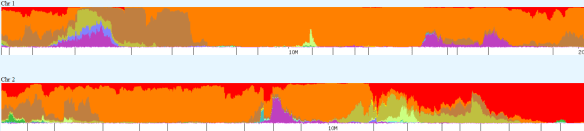
Notice that at about 10mb on chromosome 1, on the graph below in the top band, that the North American Indian (yellow) and the South Asian (red) are imbedded with each other.  These appear again together at the beginning of chromosome 2, shown as the second band.  This hints at how and why it’s sometimes so difficult to determine and filter Native American from Asian.  There is no line in the sand, there is a continuum between populations, the only differentiator being 10,000 to 15,000 years spent apart in which time, they, hopefully, developed enough differentiating mutations that we can tell them apart.

weeds 18

On the chart below, the top band shows the chromosome painting of my chromosome, and the second band shows the chromosome 1 Native American segment (about 160-180 mb) of my mother with the third band showing both matching and non-matching regions, painted black.  Looking at the segment of chromosome 1, in the graph below, characerized as Native, we can see in mine, top row, that this is categorized as Native American (yellow), but some of the same regions below, in Moms are categorized as South Asian (red), causing a technical non-match, when in reality, It’s likely a categorization issue, not a genetic mismatch.  In future analysis, we’ll be using two methods of comparison, one called “Strong Native” that only matches Native to Native and another, the “Blended Asian” method that allows for grouping of similar ancestral types that together likely indicate a Native heritage.

weeds 19

Dodecad V3

Dodecad was created by an anthropologist.  You can read more about it at http://dodecad.blogspot.com/ and http://dodecad.blogspot.com/2011/06/design-of-dodecad-v3.html.

weeds 20

Dodecad, unfortunately, does not subdivide into Native American, so the Native will show here as some form of Asian.  Northwest Africa shows in the percentages above, but more detailed African heritage shows in the chromosome detail below in regions not shown above.

weeds 21

weeds 22

weeds 23

weeds 24

Above, my chromosome painting for the first part of chromosomes 1 and 2.

Below, the comparison showing the Native segments from about 160-180mb.   My Native segment (top) compared to mother’s (middle) with the comparison of the two on the bottom for chromosome 1.

weeds 25

HarappaWorld

HarappaWorld divides results into fewer population groups and is focused on Asia.  You can read more about it at http://www.harappadna.org/2012/05/diy-harappaworld/.

weeds 26

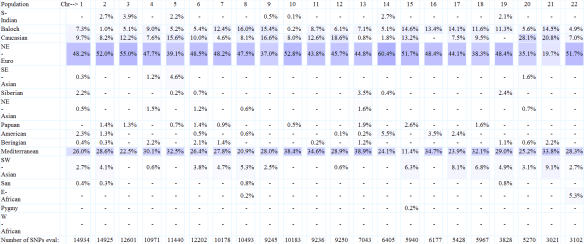
In HarrappaWorld, Beringian and American appear to be equivalent to Native American.  Like Dodecad and Eurogenes, African does not show in the total percentages, but does on the individual chromosome analysis, although in smaller percentages with this application.
weeds 27

weeds 28

weeds 29

Chromosome painting of my chromosomes 1 and 2 are shown below.

weeds 30

The graphs below show the Native region comparison of chromosome 1 between me, top row, mother, middle row, and the third graph showing the common areas, with black representing areas where there is no match.

weeds 31

For each of these tools and their results, we’ll do further analysis in a future segment of this series.

Tools Summary

Now that we’ve looked at these individual tools,  and building on the Test Results Chart created in Parts 3 and 4, let’s compare and see what information these tools add.

Test Results Chart Including Third Party Tools

Test/Company European Asian Native African Unknown
Pedigree Analysis

75%

0

~1%

0

24%

Testing Companies
Family Tree   DNA – Original

100%[1]

0

0

0

deCodeme

92%

5%

Inferred[2]

3%

deCodeme –   X

91%

6%

Inferred

3%

Dr.   McDonald

97-99%

1-3%

0.5%

0

23andMe –   Original

99%

1%

Inferred[3]

0

0

23andMe –   2012 – Standard

99.2%[4]

0

.5%

0

.3%

23andMe –   2012 – Conservative

98.7%[5]

0

.3%

0

1%

23andMe –   2012 – Speculative

99.3%[6]

0

.5%

0

.2%

Family Tree   DNA – 2012

100%[7]

Geno 2.0

79%[8]

18%

0

0

0

Ancestry

92%[9]

0

0

0

8%

Third Party Tools
MDLP

86.68%

12.55%

.58%

.17%

0

Eurogenes

94.83%

4.5%

.67%

0

0

Dodecad

85.47%

13.43%

Inferred

1.09%

0

HarrappaWorld

86.56%

12.80%

.65%

0

0

Of the various chromosomes, the breakdown is as follows. Dodecad does not break the categories in a comparable fashion to these other 3 tools, so their results are omitted in the following chart.  Please note that how geographies are categorized can make a significant difference.

Minority by Chromosome Chart

Tool/Chr MDLP Native Eurogenes Native Harrappa Native MDLP African Eurogenes African Harrappa African
1 Y Y Y N N N
2 Y Y Y Y Y N
3 N N N Y Y N
4 Y N Y N N N
5 N N N N N N
6 Y Y Y Y N N
7 N N Y N N N
8 Y Y Y Y N Y
9 Y N N Y N N
10 Y N N Y N N
11 Y N Y Y N N
12 Y N Y N N N
13 Y N Y N N N
14 Y Y Y Y N N
15 Y N N N N Y
16 Y Y Y Y N N
17 Y Y Y N N N
18 N N N N N N
19 Y Y Y Y N N
20 Y Y Y Y N N
21 Y N Y N N N
22 N N N Y Y N

From these various tools, it’s obvious that I do have some Native admixture, probably about 1%, and it’s from both parents.  I also have some African, but it looks to be an even smaller proportion that Native American.

Join me for Part 6 of this series, where we look at how to analyze and use this information.


[1] 71.5% western European, 28.4% Northeastern European

[2] Inferred that Asian is actually Native in an American with no history of Asian ancestry.

[3] No category, inferred.

[4] 78.6% Northern European, 1.8% Southern European, 18.7% Nonspecific European

[5] 54.6% Northern European, .3% Southern European, 43% Nonspecific European

[6] 91.7% Northern European, 3% Southern European, 3.3% Nonspecific European

[7] 75.18% West Europe (French and Orcadian), 24.82 Europe (Romanian, Russian, Tuscan and Finnish).  Note that my mother’s results are almost identical except the Finnish is missing from hers.

[8] 43% North Europe and 36% Mediterranean

[9] 80% British, 12% Scandinavian

______________________________________________________________

Disclosure

I receive a small contribution when you click on some of the links to vendors in my articles. This does NOT increase the price you pay but helps me to keep the lights on and this informational blog free for everyone. Please click on the links in the articles or to the vendors below if you are purchasing products or DNA testing.

Thank you so much.

DNA Purchases and Free Transfers

Genealogy Services

Genealogy Research

Hackers and Your Genetic Secrets

Did that title get your attention?  Well, it was meant to, just like it was meant to in this NBC article titled “Scientists Demonstrate How Hackers Could Unlock Your Genetic Secrets.”  Or how about this one in the New York Times, “Web Hunt for DNA Sequences Leaves Privacy Compromised?”  Sensationalism sells….and so does fear.  Don’t panic, the sky is not falling.

I’ve had several people forward me a variety of links to several articles about this expressing concern.  Most people didn’t really understand what was going on…and since “family tree databases” were mentioned in the first paragraph, it frightened them.

This article says that the “security cracking trick relies on the availability of genetic information linked to surnames in a variety of public family-tree databases.”  Well, that’s sort of true, but not exactly true.  The issue is not the family tree databases, it’s the fact that the researchers in The Thousand Genomes Project, while keeping the names of those 1000 people “anonymous,” provided enough information that these scientific researchers, not hackers, were able to data mine the 1000 Genomes participants information to determine their Y-DNA marker values, then compared those haplotypes (marker values) just like we do in databases such as Ysearch and Sorenson.  And yes, they likely had matches to several surnames, like most of us do.

Individuals in the 1000 Genomes Project signed a release indicating that they knew that their data was to be used publicly, although their identity would not be revealed but that researchers could not guarantee their privacy.  The 1000 Genomes Project, unfortunately, posted the ages of the participants, which at the time seemed innocuous enough, and it was common knowledge within the scientific community that they all lived in Utah.  With these three pieces of information, their age, their location, and from the scientists data mining, a possible surname, the scientists were then able, if the surname wasn’t something like Smith or Jones, to use publicly available Google and “white pages” types of searches to find people in that state, of that age, by that surname, and then using obituaries and such, connect them through online family trees to their more distant families.  They did this with Craig Venter, for example.

This technique is nothing new to genealogists, as we’ve been finding cousins that way for years – the difference being of course that we didn’t data mine, otherwise in this case more aptly referred to as “scientific hacking,” the 1000 Genomes Project in order to find their Y-line DNA markers to determine a possible surname for them.  That is the issue and the point of this article and ironically, it’s scientists who did it, then published the “how-to” manual.

Any genetic genealogist knows, especially anyone dealing with adoptees, that you can only reveal a biological surname about 30% of the time.  In fact the scientists success rate was lower, 12%.  But that’s actually irrelevant in the bigger context of the article.  Their point was that they succeeded at all.

This is sort of like putting personal information on the internet, except your name, and then being surprised that someone could connect the dots and put the pieces together.  No one would be surprised today if that were to happen.  In fact, I’m sure we all have received cautions and warnings about putting too much info on Facebook because burglars were robbing homes when people were vacationing.  Many people have their hometown, their high school and their birthday and year publicly available on Facebook.  Now how many “security questions” does that answer right there?  Combine that with your dog’s name and your mother’s maiden name and you’ve got almost all of the common ones.

Aside from the fear-mongering, I have three issues with these reports as a whole.

1.  Statements like “they traced those three family tree pedigrees to find other connections between relatives and sensitive genetic data.”  Whoa, stop right there.  Just because you share a surname or even if you are a direct and immediate relative, that says nothing, absolutely nothing, about whether or not you inherited some genetically disposed health issue.  Remember, children inherit half of their DNA from each parent.  So unless they are finding identical twins or parents, one cannot infer that an entire family tree of people share frightening health traits.  It’s irresponsible to suggest otherwise.

2.  “For years, experts have worried that sensitive genetic data could be used to discriminate against patients, potential employees or would-be insurance customers.  Such discrimination is illegal when it comes to employment or health insurance, but the law doesn’t’ cover life insurance, disability insurance or long-term care insurance.  Theoretically an insurer could search through genetic records and turn you down because you have a genetic predisposition to, say, Alzheimer’s disease.”

Discrimination is an issue, and laws have been put in place to prohibit discrimination in the workplace.  But insurers aren’t going to sift through genetic data like a private investigator.  Suggesting this is unnecessary fear-mongering.  Insurers don’t do that, they simply tell you that a blood test is a pre-requisite of obtaining insurance.  I know, I bought life insurance and they sent a nurse to my house to verify my identity and take a blood sample.  At that time, they were looking for diabetes, AIDs and probably a whole lot more.  Today, they might be looking for genetic pre-dispositions.  I don’t know, but I do know they have a direct method of obtaining that information and it’s not spending untold hours sifting through someone else’s data that likely isn’t relevant to you anyway.

3.  This “research” project was inspired at Whitehead Institute, an affiliate of MIT, a publicly funded institution.  When Yaniv Erlich dreamed up this new hacking technique, he said he couldn’t resist trying it, so instead of simply discovering a potential issue and privately and quietly working with the proper people to resolve the issue, he decided to exploit it publicly, obtaining, I suppose, his 15 minutes of fame.  So yes, your tax dollars did indeed likely pay for some or all of this “research.”

In one of the articles,  Dr. Jeffrey R. Botkin, associate vice president for research integrity at the University of Utah, which collected the genetic information of some research participants whose identities were breached, cautioned about overreacting. “Genetic data from hundreds of thousands of people have been freely available online,” he said, “yet there has not been a single report of someone being illicitly identified.”  He added that “it is hard to imagine what would motivate anyone to undertake this sort of privacy attack in the real world.” But he said he had serious concerns about publishing a formula to breach subjects’ privacy. By publishing, he said, the investigators “exacerbate the very risks they are concerned about.”

Well, it’s obvious that these folks at Whitehead institute don’t live in the real world and clearly don’t have enough real scientific research to do.

So, what is the take home of all of this?

  • You are not at risk of having anything exposed in this incident unless you are one of the 1000 people in the 1000 Genomes Project.  If you are part of the 1000 Genomes Project, and male, there is a 12% risk that they figured out your last name and using other tools, possibly who you are, along with your family.  If you are related to someone in the 1000 Genomes Project, the researchers might have figured out that you are related to them.  So now the risk is that they’ll do what with that information???  Guaranteed, someone will figure out the same information and much more quickly, without your DNA and without government funding if you simply stop paying your bills.
  • If you participate in a research project, such as the 1000 Genomes Project, where your full results are made publicly available, you sign a release, and that release indicates that your privacy may not be able to be protected.  You are aware of the risks before you begin.
  • We, as a community, have been warned for years not to put information that might be medically informative on the internet, such as full sequence mitochondrial DNA information.  Anyone who does so, does it at their own risk.  The people in the 1000 Genomes Project knowingly took that risk.
  • If you stay within the confines of the genealogy and DTC mainstream testing companies, you are fairly well protected.  Having said that, reading the consent forms of any of the companies makes it clear that your identity is never entirely protected.  We’re genealogists after all.  What good is genealogical testing if you can’t contact people you match?
  • Inferred health risks are not the issue they are being portrayed to be in these articles.  Your cousins health risks are not necessarily yours.  Genetic inheritance is a complex and individual event.
  • Insurers who can use health information to restrict or deny insurance are simply going to request a blood sample.  They are not going to act like a blood hound on the scent of a rabbit and sort through tons of information for inferences.  Why would they when they can obtain the information they seek, directly and much less expensively?
  • For those researchers involved with information made publicly available, such at the 1000 Genomes Project, this is a wake-up call that perhaps less information available publicly is better.  Some information, such as ages and location should perhaps be available only to legitimate researchers, which would still have included the Whitehead Institute people, but would have taken away much of their thunder.  I understand this change has already been implemented, but that doesn’t entirely mitigate the issue of genetic data mining publicly available full genomic sequence information for identity, only makes it a little more difficult and less likely to succeed.
  • I clearly understand why hackers want my bank account information, and why identity thieves want my personal information, but why, in the real world, not at Whitehead institute, would anyone ever spend the time and effort to do this?  The motivation for these researchers was clearly to publish, but I can think of no reason other than that or simply “because they could” to spend the time doing something like this.  Who would want to and for what purpose?
  • The sky is not falling

It’s behind a paywall, but you can access the scientific article here that started all of this hubbub.

______________________________________________________________

Disclosure

I receive a small contribution when you click on some of the links to vendors in my articles. This does NOT increase the price you pay but helps me to keep the lights on and this informational blog free for everyone. Please click on the links in the articles or to the vendors below if you are purchasing products or DNA testing.

Thank you so much.

DNA Purchases and Free Transfers

Genealogy Services

Genealogy Research

2012 Top 10 Genetic Genealogy Happenings

2012 has been a very busy year for genetic genealogists.  There have been lots of discoveries and announcements that affect everyone, now and in the future.  The watchwords for 2012 would be “churn” and “explosive growth.”  Let’s take a look at the 10 most important events, why they are important and what they mean for the future of genetic genealogy.

These items are in what I think are relatively good order, ranked by their importance, although I had a very difficult time deciding between number 1 and 2.

1. The New Root – Haplogroup A00

At the Family Tree DNA conference in November, Michael Hammer, Bonnie Schrack and Thomas Krahn announced that they had made a monumental discovery in the age of modern man known as Y-line Adam.  The discovery of Haplogroup A00 pushes the “birth” of mankind back from about 140,000 years ago to an amazing 338,000 years ago.  Utterly amazing.  The DNA came from an American family from South Carolina.  This discovery highlights the importance of citizen science.  Bonnie is a haplogroup administrator who recognized the potential importance of one of her participants’ DNA.  Thomas Krahn of course is with Family Tree DNA and ran the WTY test, and Michael Hammer is at the University of Arizona.  So you have the perfect blend here of participant, citizen scientist, commercial lab and academia.  What was never thought possible a decade or so ago is not only working, it’s working well and changing the face of both science and humanity.

http://dna-explained.com/2012/11/16/the-new-root-haplogroup-a00/

http://www.haplogroup-a.com./

2. Geno 2.0

Geno 2.0 is the Nickname for the National Geographic Society’s Genographic Project version 2.0.  That mouthful is why it has a nickname.

This amazing project has leveraged the results of the past 7 years of research from the original Genographic project into a new groundbreaking product.  Geno 2.0, utilizing the GenoChip, a sequencing chip created specifically for Nat Geo, offers the most complete Y tree in the world today, expanding the SNP tree from just over 800 SNPs to over 12,000.  They are in essence redrawing the Y chromosome tree as I write this.  In addition, the person who purchases Geno 2.0 will receive a mitochondrial DNA haplogroup assignment.  Over 3300 new mitochondrial mutations were discovered. A brand new anthropological “percentages of ethnicity” report is featured based on over 75,000 Ancestry Informative Markers, many only recently discovered by the Genographic project.  Additionally, participants will receive their percentage of both Neanderthal and Denisovan ancestry based on 30,000 SNPs identified that signal interbreeding between the hominids.  A new website will also facilitate social networking and uploading information to Family Tree DNA.

The wonderful news is that there is a massive amount of new information here that will change the landscape of genetic genealogy.  The difficulty is that we are struggling a bit under the load of that massive amount of information that is just beginning to descend upon us.  It’s a great problem to have!

http://dna-explained.com/2012/07/25/national-geographic-geno-2-0-announcement-the-human-story/

http://dna-explained.com/2012/07/26/geno-2-0-qa-with-bennett-greenspan/

http://dna-explained.com/2012/07/30/geno-2-0-answers-from-spencer-wells/

http://dna-explained.com/2012/07/31/geno-2-0-wty-mtdna-full-sequence-participants-and-more/

http://dna-explained.com/2012/10/14/what-to-order-geno-2-0-vs-family-tree-dna-products/

http://dna-explained.com/2012/10/16/geno-2-0-the-kit-arrives/

http://dna-explained.com/2012/12/11/geno-2-0-results-first-peek/

http://dna-explained.com/2012/12/12/geno-2-0-results-kicking-the-tires/

3. Reconstructed Sapiens Reference Sequence (RSRS)

In July, Family Tree DNA implemented the RSRS that in effect reconstructs the genetic profile of Mitochondrial Eve and bases the comparison of our DNA today against the RSRS sequence as opposed to the Cambridge Reference Sequence (rCRS) created in 1981 that is or was the current standard.  The RSRS is a result of the watershed paper published in April 2012 by Dr. Doron Behar and 8 other authors titled “A “Copernican” Reassessment of the Human Mitochondrial DNA Tree from its Root.”  A complementary research website, www.mtdnacommunity.org, accompanies the paper.

http://dna-explained.com/2012/07/14/what-happened-to-my-mitochondrial-dna/

http://dna-explained.com/2012/07/15/the-crs-and-the-rsrs/

http://dna-explained.com/2012/07/16/the-mtdna-community/

http://dna-explained.com/2012/12/02/little-a-big-a-mitochondrial-dna/

4. Full Genome and Exome Sequence Offered Commercially by Gene by Gene

It was announced at the November DNA conference that Gene by Gene, the parent company of Family Tree DNA, through their division titled DNA DTC is offering full genomic sequencing for the amazing price of $5495 for the full genome and $695 for the exome.  This is a first in the consumer marketspace.  Today, this doesn’t have a lot of application for genetic genealogy, but as the price continues to drop, and utilities are built to process the full genomic data, certainly a market and applications will emerge.  This is an important step forward in the industry with a product that still cost 3 million dollars in 2007.

http://dna-explained.com/2012/11/30/gene-by-gene-announces-landmark-dna-dtc-full-genome-sequence/

5. Neanderthal and Denisovan DNA

It’s official – they did it.  Yep, they interbred and well, they are not them anymore, they are us.  Given that everyone in Asia and Europe carries a part of them, but not people from Africa, it would appear that two populations admixed rather thoroughly in Eurasia and/or the populations were small.  The amount of Neanderthal and Denisovan DNA will continue at approximately the proportions seen today in Europe (2% Neanderthal) and Asia unless a significant amount of admixture from a population (Africa) that does not carry this admixture is introduced.  So if you’re European, you carry both Neanderthal and Denisovan DNA.  They are your ancestors.  The good news is that you can find how much of each through  the Geno 2.0 test.  23andMe results give you the percentage of Neanderthal, but not Denisovan.

http://dna-explained.com/2012/08/31/denisovan-dna-tells-a-story/

http://dna-explained.com/2012/12/12/geno-2-0-results-kicking-the-tires/

6. Ancestral Genome Reconstruction Begins,  Led by Falling Autosomal Prices and the Ability to Fish in Multiple Ponds

2012 has been the year of autosomal testing price reductions and a great deal of churn in this marketspace.  Companies are playing leap-frog with one another.  However, sometimes things are not all that they seem.

Initially, 23andMe opted for an initial payment plus monthly subscription model, which they abandoned for a one time payment price of $299 in early 2012.  Family Tree DNA was slightly less, at $289.

Ancestry led the price war by giving away kits, then selling them for $99, then $129 plus a subscription as an entrance into this market.  However, looking at the Ancestry consent form hints at possible reasons why they were selling below the cost of the tests.  You are in essence giving them permission to sell your DNA and associated information.  In addition, to gain full access to your results and matches, you must maintain some level of subscription to Ancestry.com, increasing the total effective price.

Next came Family Tree DNA’s sale where they dropped their autosomal price to $199, but they were shortly upstaged by 23andMe whose price has now dropped to $99 permanently, apparently, a result of a 50 million dollar investment in order to reach 1 million customers.  They currently have about 180,000.  23andMe has always been in the medical/health business, so their clients have always understood what they were consenting to and for.

Not to be outdone, Family Tree DNA introduced the ability earlier in 2012 to upload your data files from 23andMe to FamilyTree DNA for $89, far less than a second test, which allows you to fish in a second pond where genealogists live for matches.  The challenge at 23andMe is that most of their clients test for the health traits and either don’t answer inquiries or match requests, or know little about their genealogy if they do.  At Family Tree DNA, matches don’t have to answer and allow a match, testers are automatically matched with all participants who take the Family Finder test (or upload their 23andMe results) and testers are provided with their matches’ e-mail address.

Of course, Geno 2.0 was also introduced in the midst of this, in July, for $199 with the additional lollipop of new SNPS, lots of them, that others simply don’t have access to yet.

The good news is that consumers have benefitted from this leapfrogging, I think.  Let’s hope that the subsidized tests at Ancestry and 23andMe don’t serve long term to water down the demand to the point where unsubsidized companies (who don’t selling participants genetic results to others) have problems remaining viable.

Personally, I’ve tested at all of these companies.  I’ll be evaluating the results shortly in detail on my blog at www.dna-explained.com.

The tools provided by most testing companies, plus GedMatch, and multiple ponds to fish in are allowing the serious genetic genealogist to “reconstruct” their genome, attributing segments to specific ancestors.  Conversely, we will also be able to “reconstruct” specific ancestral family lines as well by identifying autosomal segments in multiple descendants.  This new vision of autosomal genetic genealogy will allow much more accurate ancestral line matching, and ancestor identification in the not-so-distant future.

http://www.yourgeneticgenealogist.com/2012/01/family-tree-dna-now-accepting-23andme.html

http://www.yourgeneticgenealogist.com/2012/05/23andme-eliminates-subscription-model.html

http://www.yourgeneticgenealogist.com/2012/10/clarification-of-what-is-available-to.html

http://www.yourgeneticgenealogist.com/2012/12/23andme-receives-50-million-and-drops.html

http://www.thegeneticgenealogist.com/2012/12/26/23andme-and-labcorp-sued-for-patent-infringement/

7. Ethnicity Tests Mature – Minus 1

The good news is that the various ethnicity tests (known as BGA or biogeographical ancestry tests) that provide participants with their percentages of various world populations are improving.  The bad news is that there is currently one bad apple in the card with very misleading percentages – and that is Ancestry.com.

23andMe introduced a new version of their ethnicity product in December, expanding from only 3 geographic categories to several.  The Geno 2.0 test results are just beginning to be returned which include ethnicity predictions and references to several base populations.

Family Tree DNA finally has some competition in this arena where for years they have been the only serious player, although opinions differ widely about which of these three organizations results are the most accurate.  All four are Illumina chip based, using hundreds of thousands of locations, as compared with the previous CODIS type tests which used between 15 and 300 markers and are now outdated.  All companies use different reference populations which, of course, provide somewhat different results to participants.  All companies, except Ancestry, have documented and shared their reference population information.

Outside of these companies, Doug McDonald offers a private analysis and Gedmatch offers a series of BGA comparisons written by third parties.

While this industry continues to grow and mature, I’m thinking about just averaging the autosomal ethnic results and calling it good:)

http://dna-explained.com/2012/07/21/ethnicity-finders/

http://dna-explained.com/2012/10/24/ancestrys-mythical-admixture-percentages/

http://dna-explained.com/2012/12/07/new-worldview-at-23andme/

http://dna-explained.com/2012/09/09/doug-mcdonald-on-biogeograpical-analysis/

http://dna-explained.com/2012/12/11/geno-2-0-results-first-peek/

http://www.yourgeneticgenealogist.com/2012_12_01_archive.html

8. Finding Your Roots PBS Series with Henry Louis Gates

PBS sponsored a wonderful series in the spring of 2012 hosted by Henry Louis “Skip” Gates, the chair of African American Studies at Harvard.  This series followed a lesser known 2010 series.  The 2012 inspirational series reached tens of thousands of people and increased awareness of genetic genealogy as well as sparked an interest in genealogy itself, especially for mixed race and African American people.  I was disappointed that the series did not pursue the Native American results unexpectedly obtained for one participant.  It seemed like a missed opportunity.  Series like this bring DNA testing for genealogy into the mainstream, making it less “strange” and frightening and more desirable for the average person.  These stories were both inspirational and heartwarming.  I hope we can look forward to similar programs in the future.

http://en.wikipedia.org/wiki/Finding_Your_Roots

CeCe Moore covered this series in March and April on her blog.

http://www.yourgeneticgenealogist.com/2012/03/finding-your-roots-with-henry-louis.html

http://www.yourgeneticgenealogist.com/2012/04/finding-your-roots-with-henry-louis.html

http://www.yourgeneticgenealogist.com/2012/04/finding-your-roots-with-henry-louis_09.html

http://www.yourgeneticgenealogist.com/2012/04/finding-your-roots-with-henry-louis_16.html

http://www.yourgeneticgenealogist.com/2012/04/finding-your-roots-with-henry-louis_23.html

http://www.yourgeneticgenealogist.com/2012/04/finding-your-roots-with-henry-louis_30.html

9. Ancestry, GeneTree and Sorenson

GeneTree, a for profit company and Sorenson, a non-profit company were both purchased by Ancestry.com.  This was about the same time as Ancestry introduced their autosomal AncestryDNA product.  Speculation was that the autosomal results at Sorenson might be the foundation for the new autosomal test comparisons, although there has been no subsequent evidence of this.

Ancestry initially gave away several thousand kits in order to build their data base, then sold thousands more for $99 before raising the price to what appears to be a normalized price of $129 plus an annual ancestry subscription.

While GeneTree was never a major player in the DNA testing marketspace, Sorenson Molecular Genealogical Foundation played an important role for many years as a nonprofit research institute.  There was significant distress in the genetic genealogy community related to the DNA contributed to Sorenson for research being absorbed by Ancestry as a “for profit” company.  Ancestry is maintaining the www.smgf.org website, but no additional results will be added.  Sorenson has been entirely shuttered.  Many of the Sorenson/GeneTree employees appear to have moved over to Ancestry.

The initial AncestryDNA autosomal product offering is poor, lacks tools and the ethnicity portion has significant issues. It’s strength is that many people who test are already Ancestry subscribers and have attached their trees.  So you can’t see how you connect genetically to your matches (lack of tools), but you can see the trees, if they are attached and not marked as private, of those with whom you match.  Ancestry provides “hints” relative to matching individuals or surnames.

Eventually, if Ancestry improves its products, provides tools and releases the raw data to consumers, this may be a good thing.  It’s an important event in 2012 because of the massive size of Ancestry, but the product is mediocre at best.  Ancestry seems unwilling to acknowledge issues unless their feet are held to the fire publicly as illustrated with a “lab error” erroneous match for an adoptee caught by the consuming public and ignored by Ancestry until CeCe Moore exposed them in her blog.  Whether Ancestry ultimately helps or hurts the genetic genealogy industry is a story yet to be told.  There is very little positive press in the genetic genealogy community surrounding the Ancestry product, but with their captive audience, they are clearly going to be a player.

http://www.yourgeneticgenealogist.com/2012/05/ancestrycom-buys-genetree-and-launches.html

http://dna-explained.com/2012/07/12/did-you-test-at-genetree/

http://dna-explained.com/2012/08/30/is-history-repeating-itself-at-ancestry/

http://dna-explained.com/2012/07/18/the-trouble-with-ancestry-com-matches/

http://dna-explained.com/2012/08/14/y-dna-family-tree-dna-vs-ancestry/

http://dna-explained.com/2012/08/16/ancestrys-consent-form-for-ancestrydna-autosomal-test/

http://dna-explained.com/2012/09/10/ancestry-autosomal-results-are-back/

http://dna-explained.com/2012/10/15/ancestrys-dna-survey/

http://dna-explained.com/2012/10/23/ancestry-to-release-array-data-in-2013/

http://dna-explained.com/2012/10/24/ancestrys-mythical-admixture-percentages/

http://www.thegeneticgenealogist.com/2012/06/19/problems-with-ancestrydnas-genetic-ethnicity-prediction/

http://www.yourgeneticgenealogist.com/2012/08/ancestrydna-confusing-relationship.html

http://www.yourgeneticgenealogist.com/2012/08/follow-up-on-ancestrydna-and-adoptees.html

http://www.yourgeneticgenealogist.com/2012/09/23andme-says-no-match-for-adoptees.html

10. GedMatch

GedMatch, www.gedmatch.com, created by John Olson and Curtis Rogers, isn’t new in 2012, but it’s maturing into a tool that is becoming the defacto workhorse of the serious autosomal community.  People who test at either 23andMe or Family Tree DNA download their raw results and other match information and then use a variety of tools at GedMatch to look at results in different ways and using different thresholds. GedMatch is currently working to accept the newly arriving Geno 2.0 data files.  Ancestry does not at this time allow their customers access to their raw data files, so there is nothing to upload. The bad news is that not everyone downloads/uploads their information.  Only the most savvy users, and the download/upload is not always a smooth process, often necessitating several attempts, a magic wand and some fairy dust for luck.

GedMatch is a volunteer effort funded by donations on the GedMatch site.  The magnitude of this project came to light when they needed new servers this year because the amount of traffic disabled their internet service provider.  It may be a volunteer effort, but it has mainstream requirements.  Therefore, while occasionally frustrating, it’s easy to understand why it’s light on documentation and one has to poke around a bit to figure things out.  I would actually prefer that they make it a subscription site, clean up the bugs, add the documentation and take it to the next level.  It would also be very nice if they could arrange something with the major players in terms of a seamless data transfer for clients.  All told, it’s an amazing contribution as a volunteer site.  Hats off to Curtis and John for their ongoing contribution to genetic genealogists!!!

www.gedmatch.com

http://www.legalgenealogist.com/blog/2012/08/12/gedmatch-a-dna-geeks-dream-site/

______________________________________________________________

Disclosure

I receive a small contribution when you click on some of the links to vendors in my articles. This does NOT increase the price you pay but helps me to keep the lights on and this informational blog free for everyone. Please click on the links in the articles or to the vendors below if you are purchasing products or DNA testing.

Thank you so much.

DNA Purchases and Free Transfers

Genealogy Services

Genealogy Research

Lost Colony DNA Project Makes The Scientist Magazine List of Top 20 Stories for 2012

Lost colony dnaThe Lost Colony DNA project, sponsored by the Lost Colony Research Group found themselves featured at number 15 in The Scientist Magazine’s Top 20 stories for 2012.

Original article, published on January 1st, 2012, is found at this link. http://www.the-scientist.com/?articles.view%2FarticleNo%2F31423%2Ftitle%2FLost-Colony-DNA-%2F

It’s also of note that Kerry Grens, the author of the story was honored by the North Carolina Society of Historians with an award for this article this past October.

Anne Poole (at left), Research Director,  and I are screening for artifacts in the photo at one of our excavation sites.  Anne and I seldom are actually able to do something together at the same time, as there are lots of logistics and challenges to work on every minute of every dig with 20-40 people in the field.  Please note that my t-shirt says “Well behaved women seldom make history.”  It’s my motto, and I’ve never been accused of being well behaved!

Thanks everyone for your participation and interest.  Let’s make 2013 a great year with lots of research and let’s find those colonists!!

______________________________________________________________

Disclosure

I receive a small contribution when you click on some of the links to vendors in my articles. This does NOT increase the price you pay but helps me to keep the lights on and this informational blog free for everyone. Please click on the links in the articles or to the vendors below if you are purchasing products or DNA testing.

Thank you so much.

DNA Purchases and Free Transfers

Genealogy Services

Genealogy Research

Gene by Gene Announces Landmark DNA DTC Full Genome Sequence

Gene by Gene, the parent company of Family Tree DNA, formally announced it’s direct to consumer (DTC) offering of full sequence human genome testing.

Testing will be performed in their state of the art research center, shown above, in Houston, Texas.  You can read more about Gene by Gene and their 4 divisions, DNA DTC, Family Tree DNA, DNA Traits and DNA Findings at www.genebygene.com.

Family Tree DNA was established 12 years ago to service the Genetic Genealogy market space, which didn’t yet exist at that time.  Family Tree DNA was an innovator in that field, and has brought the same innovative and entrepreneurial spirit to their other companies established since.

This new offering, the first of it’s kind, reaches out to researchers and others in need of “research only” next generation full genomic sequencing.

“Given the explosive demand for accurate, timely, and large-scale next
generation sequencing, we’re pleased to make our Genomics Research Center
available to investigators exploring the cutting edge of research to pioneer and
enhance treatment of disease, enhance quality of life, break new ground in
genealogical inquiry and otherwise advance the science of genomics,” Gene By
Gene President Bennett Greenspan said. “The launch of DNA DTC is the perfect
complement to our other divisions, through which we make genetic testing
advances every day in the fields of ancestry, health and relationship testing.”

Using the Illumina platform, DNA DTC will offer both full genomic sequence and full exome testing, adding these two items to their menu of over 200 types of DNA tests performed.  Gene by Gene’s lab has already processed more than 5 million discrete DNA tests for more than 700,000 individual clients.  Their institutional clients include the National Geographic Society’s Genographic project and other clients such as France’s Institut Pasteur, Israel’s Rabin Medical Center and the University of Utah.

By bringing full genomic sequencing to the public, they have broken the sound barrier in personal genetics, the veritable X-factor.  The full humane genome was first sequenced in 2003 at a cost of about 3 billion dollars.

A full genome sequence still cost about 3 million in 2007, but DNA DTC is offering it today for an amazing $5495.

While consumers will be able to order the full genome (or exome) test, if they want, it comes with no tools, as it is focused at the research community who would be expected to have their own analytical tools.  However, genetic genealogists being who and what they are, I don’t expect the research market will outweigh the consumer market for long, especially when the price threshold reaches about $1000.  For years the “$1000 genome” has been bantered about, and I expect with the next generation of technology, we may see it sooner than later.  The fact that it has dropped from 3 million to $5495 in 5 years is astounding.

Aside from DNA DTC and Family Tree DNA, the other two  Gene by Gene divisions are DNA Traits (www.dnatraits.com)  which provides CLIA Regulated Diagnostic tests for genetic diseases and DNA Findings (www.dnafindings.com)  which provides AABB certified paternity and relationship testing.

Way to go Max and Bennett and everyone at Gene by Gene!  Congratulations!

So, who is going to be the first in the genetic genealogy community to order this test???

______________________________________________________________

Disclosure

I receive a small contribution when you click on some of the links to vendors in my articles. This does NOT increase the price you pay but helps me to keep the lights on and this informational blog free for everyone. Please click on the links in the articles or to the vendors below if you are purchasing products or DNA testing.

Thank you so much.

DNA Purchases and Free Transfers

Genealogy Services

Genealogy Research