“Earliest Known Ancestors” at Family Tree DNA in 3 Easy Steps

Why should you take the time to complete the information about your earliest known ancestor, your EKA, at Family Tree DNA?

The answer is simple – because it helps you with your genealogy and it helps others too. Genealogy, and in particular, genetic genealogy is by definition a team sport. It takes at least two to test and match – and the more, the merrier. From there, it’s all about information sharing.

Maybe the easiest way to illustrate the benefit of providing Earliest Known Ancestor information is by showing what happens if you DON’T complete the EKA field.

To be direct, you lose important opportunities to work with other genealogists and, if others don’t complete their EKA, you also lose the opportunity to see who their earliest known ancestors are. This information, when viewing your Y and mitochondrial DNA matches, shows immediately who is from your genetic line. It can also help you break down brick walls to push your own EKA back a few generations. I’ve used this tactic, successfully, repeatedly with both Y and mitochondrial DNA.

Earliest Known Ancestors Are Used 7 Ways

  • Matches – Every Y and mitochondrial DNA match displays your matches’ Earliest Known Ancestor

Here’s what your matches look like if they don’t complete their EKA information.

eka match.png

How depressing to see blanks listed for the Earliest Known Ancestor for your matches. These are exact full sequence mitochondrial matches, but no ancestors listed. A few do have trees, as indicated by the blue pedigree icon, but the ability to quickly view a list of ancestors would be so beneficial.

Looking at the matches for one of my Estes male cousins, below, you can see a much more helpful example.

eka complete

You may see a genealogical line you recognize. Or, several you don’t which may serve as a huge hint.

eka project.png

  • Surname and other types of projects, meant to attract more testers, also suffer when Earliest Known Ancestors and Countries of Origin, when known, aren’t completed.
  • Matches Maps – Another place where your Earliest Known Ancestor information will help is on the Matches Map which displays the location of your matches Earliest Known Ancestors, available for both Y DNA tests and mitochondrial DNA tests as well as Family Finder.

eka matches map

Looking for clusters of matches can be very revealing and can point your research in a specific direction. Genetic clues are indispensable, as is the information about the earliest ancestors of your matches. I am clearly related to these clusters of people in Scandinavia – but it’s up to me to figure out how, and when. It would be very useful to know of any of them share the same EKA.

Additional places where your EKA is utilized to provide information about your ancestry include:

  • Ancestral Origins: A page provided for both Y and mtDNA results where locations of your matches’ EKA are shown.
  • Haplogroup Origins: A page provided for both Y and mtDNA where locations of your haplogroup are found.

eka origins.jpg

I wrote about Ancestral Origins and Haplogroup Origins, here, and here, with lots of examples.

I wrote about the Y tree, here, which shows locations for each haplogroup. An article about the mitochondrial tree can be found here. These are the most comprehensive trees available, anyplace, and they are completely free and accessible to anyone, whether they have tested at FamilyTreeDNA or not. Science at work.

That’s 7 different ways your Earliest Known Ancestor information can benefit you – and others too.

However, this information can’t be utilized unless testers complete their EKA information.

Here’s how to enter your EKA information.

How Do You Complete Your Earliest Known Ancestor Information?

Your ancestor information lives in three separate places at FamilyTreeDNA – and they are not all interconnected meaning they don’t necessarily feed each other bidirectionally.

The information is easy to complete. We will step through each location and how to update your information.

What is Direct Paternal and Direct Maternal?

Before we go any further, let’s take just a minute and define these two terms.

When completing Earliest Known Ancestor information, you’ll be asked for your “Direct Paternal Ancestor” and “Direct Maternal Ancestor.” This does NOT mean the oldest person on each side, literally. Some people interpret that to mean the furthest person back on that side of your family. That’s NOT what it means either.

Your direct paternal ancestor is the furthest person in your tree on your father’s, father’s father’s direct paternal line. In other words, your most distant patrilineal ancestor.

Your direct maternal ancestor is the further person in your tree on your mother’s mother’s mother’s direct maternal line. This is your most distant matrilineal ancestor.

eka maternal paternal.png

In this view of my cousin’s tree, Holman Estes is the Earliest Known Ancestor on the paternal, meaning patrilineal, line. Of course, that’s also the Y DNA inheritance path too.

Sarah Jones is the Earliest Known Ancestor on the maternal, or matrilineal line. Mitochondria DNA descends down the matrilineal line.

The home person in this tree inherited the Y DNA of Holman Estes (and his patrilineal ancestors) and the mitochondrial DNA of Sarah Jones (and her matrilineal ancestors.)

Ok, let’s put this information to work.

Step 1 – Earliest Known Ancestor

When you sign on, click on the down arrow beside your name on the upper right hand corner of your personal page.

eka account settings

Click on “Account Settings.”

On the “Account Settings” page, click on “Genealogy,” then on “Earliest Known Ancestors.”

eka eka.png

In our example, above, the tester has completed the Direct Paternal Ancestor information, but not the Direct Maternal Ancestor.

Note that “Country of Origin” and “Location” are somewhat different. Location can mean something as specific as a city, county or region, along with map coordinates.

Country of Origin can mean something different.

To select a location and to complete your ancestor’s information, click on “Update Location.” If you don’t click on “Update Location,” you’ll need to save this form before exiting.

When you click on “Update Location,” the system takes you to the Matches Map screen where you can easily plot ancestral locations.

eka plot locations

In our example, we see that our tester has already entered his paternal EKA, Nicholas Ewstes in Deal, in the UK. We don’t need to do anything to that information, but we need to add a Maternal Location.

Click on “Edit Location”

eka update locations.png

You’ll see a screen where you can click to edit either the Maternal or Paternal Location. In this case, I’m selecting Maternal.

eka step 2

Enter the name of your ancestor. I tend to enter more information that will uniquely identify her to someone looking at their match list, such as when and where she lived.

eka more.png

If there’s room, I could also add “m 1849 Hayesville, Ohio to John Parr” which would further uniquely identify Sarah – especially given that her surname is Jones. If a match sees “Sarah Jones,” that doesn’t provide much context, but “Sarah Jones married in 1849 in Hayesville, Ohio to James Parr,” even if the tester doesn’t provide a tree, gives the match something to sink their teeth into.

When finished, click “Next.”
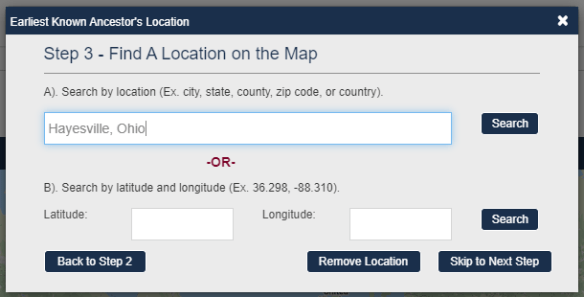
eka step 3

Enter the location and press “Search.” Longitude and latitude will be filled in for you.

eka select.png

Click “Select” if this is the correct location.
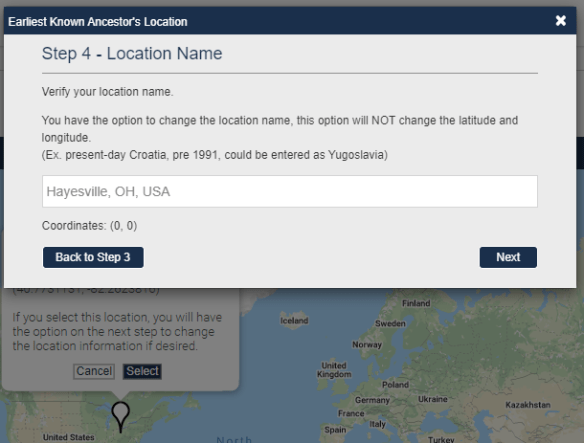
eka step 4

By changing the location name here, you could enter a historical name, for example, if the location name has changed since your ancestor lived there.

eka exit.png

You’ll see the final information before you Save and Exit.

eka both

You’ll view the map with your direct paternal ancestor and direct maternal ancestor both shown with pins on your map. This is before matching, of course.

Now, if you look back at the Direct Maternal Ancestor field under Account Settings, you’ll see the information you entered on the map, except for the Country of Origin.

eka direct maternal.png

This information doesn’t feed backwards into the EKA “Country of Origin” field, because country of origin can mean different things.

For example, my cousin’s direct maternal ancestor’s location would be United States because that’s where she lived. But is it where her line originated?

eka unknown origin

When looking at the Country of Origin dropdown box, you can see that United States can actually mean different things.

  1. Does it mean she was born here and we know her ancestors were European or African, but the specific country is uncertain?
  2. Does it mean her ancestors were Native American – and if so, do we actually know that, or is it yet unproven oral history?
  3. Or does United States simply mean that my cousin’s genealogy is stuck in Ohio?

In his case, it means stuck in Ohio. The mitochondrial haplogroup of this woman’s direct matrilineal descendants and her Matches Map tells us that her ancestors were European in origin, not Native or African.

In his case, “Unknown Origin” is not inaccurate, but by making that selection, other people won’t know if the tester really doesn’t know, or if they simply forgot to enter a location. I generally enter “United States” when the US is where I’m stuck.

Please note that the actual geographic location, including longitude and latitude, does populate from map selections.

When exiting the Direct Maternal or Direct Paternal Ancestors page, always click on the orange Save button, or it won’t.

Step 2 – Matches Map

You’ve already had a preview of this functionality in Step 1.

eka y matches map.png

The second way to populate EKA information is to select Matches Map directly from the menu on your personal page at Family Tree DNA.

eka pins

click to enlarge

I clicked on Matches Map from my cousin’s Y DNA page, so we’ll see his Y DNA Matches displayed. These pins displayed on his map are there because his matches entered their Earliest Known Ancestor information. The different colors indicate the relative closeness of matches.

His white pin that shows his own ancestor is displayed behind several other men’s pins (red arrow at right) who have also tracked their Y DNA ancestor to Deal, England and match the tester.

My cousin can update or enter his EKA information by clicking on “Update Ancestor’s Location” (red arrow at bottom) where a box allowing him to select between Paternal and Maternal will be displayed.

Please note that every pin on this map has an associated match that can be displayed by either mousing over the individual pins or by clicking on “Show Match List” in the bottom left corner.

Step 3 – Trees

Be sure to upload your tree too.

eka pedigree.png

Y DNA and mitochondrial DNA match pedigree icons looks like this, indicating your match has uploaded or created a tree.

eka pedigree ff

The Family Finder pedigree icon will be blue if a tree is provided and greyed out otherwise.

Always check your match’s tree because sometimes the Earliest Known Ancestor and the earliest ancestor in your match’s tree are not the same person.

Additional research may have been completed, but regardless of the reason for a discrepancy, you want to view the most distant person in that line.

Sometimes people get confused about who belongs in the Earliest Known Ancestor field, so a tree check is always a good idea.

  • Hint: If you see a male in the maternal field, you know they are confused. Same for a female in the paternal field.

To create or upload a GEDCOM file click on “myTree” at the top of your personal page.

download ancestry ftdna

Then, select your choice of creating a tree manually or uploading a GEDCOM file that you already created elsewhere.

eka create tree.png

If you need to download a tree from Ancestry to upload to FamilyTreeDNA, I wrote about how to do that, here.

Whether you upload or create a tree, choose yourself (assuming it’s your test, or select the person whose DNA test it is) as the home person in the tree.

eka home person

Bonus – Ancestral Surnames

Once your tree is uploaded, if you have NOT previously entered your Ancestral Surnames (under Account Settings,) uploading a GEDCOM file will populate the surnames, but not just with your direct ancestral lines. It populates ALL of the surnames from your tree. This isn’t a feature that I want. I recommend adding only direct line surnames manually or from a spreadsheet. If you have a small tree or don’t mind having surname matches not in your direct line, then allowing the surnames to auto-populate is probably fine.

eka surnames.png

If you’re wondering how Ancestral Surnames are used, the two Family Finder matches below illustrate the benefits.

eka surname list

When you have matching surnames in common, they float to the top of the list and are bolded. The first match matches the tester and they bothhave those bolded surnames in their trees.

With no matching surnames, the list is still present, but no bolding, as shown in the second match.

eka surname bold.png

You can then click on the ancestral surnames to see all of the surnames listed by that match.

If you search for matches that include a specific surname on Family Finder, that surname is displayed blue, the common surnames are bolded, and the rest aren’t.

eka surname search

By looking at these common ancestral surnames, I can often tell immediately how I’m related to my match.

eka surname blue.png

Summary

Using Earliest Known Ancestors, Matches Maps and Ancestral Surnames at Family Tree DNA is as easy a 1-2-3 and well worth the effort.

If you provided this information previously, is it still up to date? For your kit and any others you manage?

What hints are waiting for you?

Have other people uploaded their trees or added EKAs since you last checked?

You can always send an email to your matches who need to add Earliest Known Ancestors by clicking on the envelope icon. Feel free to provide them with a link to this article that explains the benefits of entering their EKA information along with step-by-step instructions.

DNA is the gift that just keeps on giving – but it can give a lot more with Earliest Known Ancestors and their locations!

_____________________________________________________________

Disclosure

I receive a small contribution when you click on some of the links to vendors in my articles. This does NOT increase the price you pay but helps me to keep the lights on and this informational blog free for everyone. Please click on the links in the articles or to the vendors below if you are purchasing products or DNA testing.

Thank you so much.

DNA Purchases and Free Transfers

Genealogy Products and Services

Genealogy Research

Johann Theobald Koob (born circa 1705 – died after 1766), Münchmeister – 52 Ancestors #291

Johann Theobald Koob was born about 1705, probably in Fussgoenheim, Germany, to Johann Dietrich Koob and Anna Catharina, surname unknown.

The first record of Johann Theobald Koob is when he served as godfather for the Renner family in Fussgoenheim.

Baptism:

21 November 1728

Child: Anna Maria

Parents: Johann Jacob Renner and Helena, his lawfully wed wife

Godparents: Johann Theobald Kob, unmarried from Fussgonheim and Anna Maria Sachs(in).

This wasn’t the only interaction with the Renner family, and mark my words, they were related somehow.

Married in Fussgoenheim

In February of 1730, Johann Theobald Koob married Maria Catharina Kirsch.

Koob Kirsch 1730 marriage

Pfalz: Zentralarchiv der Evang. Kirche > Speyer > Fußgönheim > Taufen, Trauungen, Bestattungen, Sonstiges 1726-1798, Bild 74, www.archion.de

Marriage: 21 Feb 1730

Joh. Theobald Coob from here with Maria Catharina Kirch(in) were married.

Koob is spelled variously as Koob, Coob and Kob in the early church records.

Johann Theobald’s parents both attended his wedding in the quaint Lutheran church on the cobblestone street, probably sitting alongside his siblings. We know his parents were still living, because we find his father’s burial record in those same church records in November 1734 and his mother’s just a few months later, in April of 1735.

That must have been a very tough year.

Children Bless the Couple

Johann Theobald Koob and Maria Catharina Kirsch welcomed their first-born child, a daughter, Susanna Elisabetha, on June 17, 1731. How joyful they must have been when baptizing their beautiful baby girl. Three of the four grandparents celebrated with them that June Sunday, exactly 289 years ago today, as I write this article. This is an incredibly important day for me, because Susanna Elisabetha is my 4th great-grandmother.

Happy 289th birthday Susanna Elisabetha!!! Part of you is still here!

Koob, Susanna Elisabetha

Taufen__Trauungen__Bestattungen__Sonstiges_1726-1798_Bild14(1), Fussgönheim Evangelical Church Records, Archion.de

Baptism: 17 June 1731

Parents: Joh. Theobald KOOB and his wife, Maria Catharina, a daughter was baptized and named:

Susanna Elisabeth

Godparents: Johann Andreas Kirsch & Anna Elisabeth, widow of the late mayor  Koob.

We can glean so much information from the godparents. These people weren’t selected randomly, and it wasn’t just an honorary position. On the contrary, it was well-thought-out.

The godparents were expected to raise this child, attending to their education, both traditional and secular, in the event that something happened to the parents. An equivalent today would be selecting your children’s adoptive parents and designating them at the birth of your children. Godparents promised to perform these duties before the village, in front of both families, the reverend, the congregation, and more importantly, before God.

If you think about it, it’s a wonderful tradition that assures that every child in a family is cared for if the parents die without placing the entire burden of several children on one family member. In a small village, the children would only live a few houses apart and could still see each other and interact regularly.

Based on Fussgoenheim history, Anna Elisabetha, the widow godmother, is probably the widow of Johann Nicolaus Koob, the former mayor. She’s clearly related to the family, but exactly how is unknown. We do know that Johann Nicolaus Koob has a son, Johann Dietrich Koob, the same name as Johann Theobald’s father, but he married Maria Kinigunda Sahler in 1728. Therefore, if Anna Elisabeth is Johann Nicolaus Koob’s widow, she is not Johann Theobald’s grandmother.

The widow Anna Elisabeth may be his aunt or great-aunt or related another way, or both. Her name may also have been Susanna Elisabetha. In a future record, the child Susanna Elisabetha baptized that day is called Anna Elisabetha – probably after her godmother.

Two years later, Johann Theobald Koob’s first son, Emanuel Koob, joined the family.

Taufen__Trauungen__Bestattungen__Sonstiges_1726-1798_Bild18, Fussgönheim Evangelical Church Records, Archion.de

Baptism: 26 May 1733

Parents: Joh. Theobald Koob and his wife, Maria Katharina, a son was baptized and named: Emanuel

Godparents: Joh. Michael Kirsch and his wife, Anna Margaretha.

In 1763, Emanual stood as godfather when his older sister’s son, also named Emanual, was baptized.

By 1771, Emanual was godfather for his younger brother Johann Theobald Koob and his wife, Catharina Barbara when they baptized a son named Emanual. In this record, Emanual is noted as being from Münchhof near Danstatt, which proves to be an important clue.

In 1736, daughter, Maria Catharina, named for her grandmother, joined the family.

Taufen__Trauungen__Bestattungen__Sonstiges_1726-1798_Bild24, Fussgönheim Evangelical Church Records, Archion.de

Baptism: 20 April 1736

Parents: Johann Theobald Kob & wife Maria Cath.

A daughter was baptized and named: Maria Catharina

Godparent: the grandmother, Maria Kirsch(in), widow

Born: 16 April 1736

Baptized: 20 April 1736

Entry No. 29

In 1738, a son with the same name as his father was born. Interestingly enough, the godparents were from Frankenthal, about 7 and a half miles away, and the child is not named after the godparents, which is typical.

Koob Fussgoenheim Frankenthal

It looks like perhaps their son, Johann Theobald is too young to actually be a godparent, so they stood with him? Perhaps Johann Theobald Koob was the younger Johann Theobald Welker’s godfather. This would suggest some type of family relationship.

Taufen__Trauungen__Bestattungen__Sonstiges_1726-1798_Bild27, Fussgönheim Evangelical Church Records, Archion.de

Baptism: Entry No. 66

Parents: Johann Theobald Kob, the juror and his wife, Maria Catharina a son named: Johann Theob(ald) was baptized

Godparents: the honorable Georg Henrich Welcker, butcher and innkeeper in Frankthal and his wife, Maria Ernstina with son Johann Theobald, formerly confirmed at S. ……..?

Born: 24 August 1738 at 8 a.m.

Baptized: 29 August 1738

In this record, Johann Theobald was referred to as a juror. I asked my two friends, Tom and Christoph, what being a juror meant at that time in Fussgoenheim. Their answer was that while neither are experts on that specific topic, their understanding is that jurors would be respected men within the community who would perhaps adjudicate non-criminal disputes and disagreements.

Two years later, things didn’t go well in 1740.

Taufen__Trauungen__Bestattungen__Sonstiges_1726-1798_Bild30, Fussgönheim Evangelical Church Records, Archion.de

Baptism: Entry 108

Parents: Johann Theobald Kob, juror and wife, Maria Catharina, a daughter on the 14th of October 1740 was born and because of weakness so she was baptized immediately in the home.  Godparents were the mother’s side, the grandmother Maria. But the child is deceased in a few hours.

Sadly, this baby wasn’t named, or if she was, the reverend didn’t record her name. It seems so sad to think of a tiny, nameless, anonymous grave.

The next child, Johann Dieter, arrived almost exactly a year later. Of course, Johann Dietrich Koob is Johann Theobald’s father’s name.

Taufen__Trauungen__Bestattungen__Sonstiges_1726-1798_Bild32, Fussgönheim Evangelical Church Records, Archion.de

Baptism: Entry 111

Parents: Theobald Kob and his wife, Maria Catharina, a son Johann Dieter

Godparents: Johann Dieter Kob, customs collector in Weiss……?and wife Maria Kunigunda

Born 30 Sept 1741          Baptized:8 October 1741

Weissenheim am Sand is a village about 7 miles directly north of Fussgoenheim and Weissenheim am Berg is about the same distance west of Weissenheim am Sand.

This too proves to be a hint that will help tie things together, later.

In 1767, Johann Dieter Koob, unmarried, stood as godfather for his brother, Johann Theobald Koob’s child, named Johann Diederich, of course. This confirms that Dieter and Diederich are synonymous. Dieter is likely a nickname.

Johann Theobald Koob and Maria Catharina Kirsch’s last child, Johannes, arrived just before Christmas in 1750, but not before a massive upheaval that’s not revealed in the church records.

It was by tracking this family through and after that upheaval that I found another child, born in 1746 elsewhere…and baptized in exile.

Let’s just say it was an incredibly long time between 1741 and 1750.

Upheaval

There are several years missing in the births of children, with a noticeable gap between 1741 and 1750. That’s because Johann Theobald’s life was turned upside-down in 1743.

Politics in Germany was ever-present and seemingly, always dangerous. In 1729, Jakob Tilman von Hallberg, a member of the House of Hallberg who had acquired half of Fussgoenheim in 1728, followed shortly thereafter by the second half, undertook a village survey in which the roads were redrawn and the area redivided. The result was that the villagers lost two-thirds of their hereditary land, with Hallberg personally absorbing the rest that was left “abandoned” by the resurvey.

Johann Theobald Koob was one of several jurors or village elders, noted as judges in a German to English translation, who refused to sign the survey book. As punishment, Hallberg had them expelled from Fussgoenheim after first being jailed for two weeks. The Kirsch family went to Ellerstadt as serfs.

It’s unclear where Johann Theobald Koob and Maria Katharina Kirsch went, at least for several years.

We do find a baptism for another son in Weissenheim am Sand.

Baptism: Johann Matheus, parents Johann Theobald Koob and Maria Catharina. Koob on January 16, 1746. Godparents Johann Matheus Sahler and Maria Cath.

However, based on a baptism for Johann Theobald Koob’s son in 1750, it would appear that Johann Theobald Koob was in Münchhof by that time where he had some sort of hereditary ownership.

It’s likely that Johann Theobald Koob had children in 1742, 1744 and 1748 as well, but we simply don’t have those records.

The 1750 baptism record reveals such important information.

Baptism: No. 188

Born 5 December 1750

Baptized 8th of same (month) in Münchhof +

Child: Johannes

Parents: Johann Theobald Kob, hereditary owner in Münchhof and his wife.

Godparents: Johannes Lammert, innkeeper in the Lamb’s Inn in Mutterstadt and wife, Maria Margaretha Weisin.

Koob Johannes 1750

This record, from archion.de is part of the Dannstadt churchbook, not Fussgoenheim.

It’s interesting that in 1750 Johann Thoebald Koob is living in Münchhof.

Oh, what a tangled web is genealogy.

Mutterstadt

The Lammert/Lemmert family in Mutterstadt is known to me.

Koob Mutterstadt Fussgoenheim Dannstadt

Three generations later, Johann Theobald Koob’s great-grandson, Philip Jacob Kirsch would be born in Fussgoenheim in 1806. He would marry Katharina Barbara Lemmert in 1829 in Mutterstadt. This couple, my ancestors, would immigrate to Ripley County, Indiana about 20 years later, the founding members of the Kirsch line there.

Koob Jacob Kirsch pedigree

By the time Philip Jacob Kirsch married Katharina Barbara Lemmert, these families had apparently known each other for generations.

But what about Münchhof?

Münchhof

Johann Theobald Koob may have been spitefully evicted from Fussgoenheim in 1743, but he was apparently not poor. He didn’t entirely disappear. We do find him in Weissenheim am Sand in 1746 and mentioned again as being from there in 1748 when he resurfaces in Münchhof.

According to the journal, Pennsylvania Folklife” (1966), Volume 16, page 41, available here, we discover that in 1748, Daniel Jouis, as lessee, sells one quarter of the property, Münchhof, to Theobald Koob of Weisenheim am Sand.

Koob Munchhof article

While this article by Dr. Krebs is focused on the Jouis family, it handily answers several questions about Theobald Koob.

We now know where he went in 1743 after he was evicted from Fussgoenheim. He had family in Weissenheim am Sand, as evidenced from the 1741 baptism of his child, so he went there.

Koob Weissenheim am Sand atlas

Five years later, when it may have seemed improbable that he would ever be allowed to return to Fussgoenheim, he purchased a quarter lessee ownership of Münchhof and moved to this large farm, owned by the University of Heidelberg, with his family.

Koob Weissenheim am Sand map

Word that this quarter of the Münchhof estate was available for purchase, as a lessee, must have traveled by word of mouth. Johann Theobald Koob’s relative was the tax collector in Weissenheim am Sand, so he would probably have been aware of these types of opportunities. We also find early Koob families in Schauernheim and Dannstadt, just north of Münchhof.

Münchhof wasn’t exactly next door to Weissenheim am Sand, but it was fairly close to Fussgoenheim and family members seem to have been scattered throughout this part of the Palatinate – fertile lowlands east of the Rhine.

Koob Munchhof atlas

Münchhof is close to Fussgoenheim, about three and a half miles away. It would have been easy for them to see their family members in Fussgoenheim while remaining a persistent thorn in the side of Hallberg.

Koob Munchhof close

A gazetteer documenting all German locations from 1871-1918 shows Munchhof.

We can use this map to find the location of Munchhof today, matching up landmarks and roads that have retained their original shape.

Koob Munchhof atlas to google

Based on the google map legend the area below looks to be about 4 or 5 acres, roughly.

Koob Munchhof 5 acres

One quarter square mile is 1320X1320 feet and holds 160 acres, so the original Munchhof would have encompassed roughly this land, the house marked by Dells Tierwelt.

Koob Munchhof today aerial

Dr. Krebs who wrote that 1966 article even went so far as to drive out to Münchhof and take these photos for his article. I’m thrilled!

Koob Munchhof 1965

The amazing thing about these estates is that they changed very little over time and Münchhof probably looked almost exactly like it did in 1748 – 212 years earlier – minus the cars and modern farm equipment of course. There is documentation of some destruction in 1807, but whatever damage incurred was clearly repaired.

Münchhof still exists today as a location that breeds dogs.

Koob Munchhof aerial close

Fortunately, the current owners cared enough to document the history of Munchoff, here.

I used the Deepl translator to translate, below.

Our Münchhof

In 1987 we bought the “Münchhof”, which has been part of the Dannstadt community since 1797.

Koob Munchhof 1985

I’m so very grateful that they included this photo from 1985 which shows a different perspective than the 1965 photo.

The following transcript was taken from “Heimatblätter für Ludwigshafen am Rhein und Umgebung, Jg.7, 1918, No. 4

The Münchhof at Dannstadt.

The Münchhof is located about 5 minutes away from the parish village Dannstadt at the Speyerer Straße. Already the name indicates that we are dealing with a monastery estate. In the Middle Ages, half of Dannstadt was spiritual property.

In 804 the Münchhof comprised 128 acres of land, which belonged to the Kindergut.

Note that 128 acres of land was about the entire size of the village of Fussgoenheim in 1743.

The farm, which was founded at an unknown time, probably came into existence in 987 through a donation by Count Otto of Rhine-Franconia to the Benedictine and later Dominican monastery Lambrecht in the Haardtwald, which he had founded at that time. In the beginning “one” farmer – later there were several – owned the Münchhof from Lambrecht Monastery as part of his inheritance; he held the title ” Münchmeister.”

I absolutely cannot help but chuckle. This means that Johann Theobald Koob was a Munchmeister, or at least one quarter Munchmeister. Of course, in German, meister means master, so the farmer who was leasing this property was indeed the master of the hof, or farm.

In 1331, Ludwig the Bavarian pledged the Speyergau bailiwick to the sons of his brother Rudolf, the Palatine Counts Rudolf 2nd and Ruprecht 1st, for 1000 pounds heller.

When the influence of the Reformation became noticeable, Elector Friedrich 2 obtained permission from the Pope to confiscate and abolish the Lambrecht Monastery and 11 others and to transfer their income to the Heidelberg College in 1551. Thus the Münchhof fell to the University of Heidelberg.

In 1563, a settlement was reached between the university and Elector Friedrich 3, who granted St. Lambrecht and the Münchhof free of encumbrances. A large part of the other monasteries that had been confiscated were ceded by the university to the Elector, but in this way she had cleverly evaded the sovereign’s easements on the estates. The Münchhof had now become a free court. From this time on it was under the administration of the Heidelberg university conductor and the electoral administration there. However, this special position was a source of incessant friction between the courtiers and the aforementioned village court.

The Peace of Luneville in 1801 made the left bank of the Rhine French. Napoleon used the opportunity to smash the property. In 1807 the Münchhof in Mainz was auctioned off as a so-called national property.

Understanding the size of Münchhof helps put this purchase into perspective. Even if Johann Theobald Koob only purchased access to one quarter of the 128 acres, assuming it was still the same size, that means he farmed 32 acres and lived on the property, which was probably functionally the same as a small village. Compare and contrast this to the small farms in Fussgoenheim that were originally about 15 acres each, but reduced to an average of 4.67 after Hallberg’s resurvey.

Based on records from Fussgoenheim, we know that Johann Theobald Koob was still a citizen in Fussgoenheim in 1766. It’s possible that he was living at Münchhof, but I’d think those records would have mentioned that.

I couldn’t help but wonder what happened to Münchhof.

It appears that Johann Theobald’s oldest son, Emanual, inherited his father’s lease rights to Münchhof. In 1771, when he stands as godparent for his sibling’s child, he is noted as being from Munchoff. The torch has apparently passed. This record may be the closest thing we have to a death record for Johann Theobald.

It’s possible that Johann Theobald Koob actually died at Münchhof, not in Fussgoenheim. We don’t know if he loved being at Münchhof, or if it was simply a safehaven when he needed one – retaining it later as an investment. Did he stay there, or was he relieved to move back to Fussgoenheim in 1753.

Münchhof apparently became a hereditary legacy in the Koob family, because an agricultural journal published in 1876, 128 years after Johann Theobald Koob purchased that quarter, mentions a “Jakob Koob, economist on the Münchhof”:

Using 30 years per generation, that’s between 4 and 5 generations later. Johann Theobald Koob was likely the great-great or three times great-grandfather of that Jakob Koob of 1876. I wonder if he had any idea what had happened to his ancestor, Johann Theobald Koob, in 1743, why and how Münchhof came to be in the Koob family.

Contacting a local historian reveals that members of the Koob family still live on part of it’s land, not associated with the dog breeding business.

Return to Fussgoenheim

In 1753, von Hallberg was forced to allow the evicted Fussgoenheim families to return to their hereditary properties in the village. Based on this 1743 map, we know exactly which properties Johann Theobald Koob owned.

Kirsch 1743 Fussgoenheim under village

Given that this maps showed land owned hereditarily in the north half of the village, we can see that Johann Theobald Koob owned two properties, probably inherited from his father.

This property still existed in the 1940s, and the Kirsch and Koob families still lived adjacent.

Fussgoenheim Kirsch Koehler homes

The Kirsch property is noted with the X, and the Koob with the O. This photo was sent by descendants living in these houses during WWII to relatives in Indiana.

Fussgoenheim street

The properties are marked in this photo as well, which I’d wager is a victory celebration of some sort on the main street of Fussgoenheim, almost 200 years after Johann Theobald Koob had his own sweet victory of return.

Today, you can see this part of Fussgoenheim on Google maps, which correlates to the 1743 map and the 1940s photos.

Koob property today

The upper Koob property is shown, below in a photo taken by my friend, Noel, when she took a detour on her vacation to find my ancestors. I’m incredibly grateful!

Fussgoenheim intersection Ruchheimer Hauptstrasse

I believe, based on the 1743 map and today’s intersection of Hauptstrausse and Ruchheimer streets, that the property on the aerial above, designated by the upper red arrow, to the left of the yellow house, with the brown large door and solar panels is one of Johann Theobald Koob’s properties. It’s probably the same house that still stands.

Whose House Was It?

The Kirsch/Koob photo from the 1940s is of the property designated with the lower arrow, which I wrote about, here.

Marliese’s letters were somewhat confusing. She wrote them as a teen, almost 90 years after these families had immigrated. Her letters are clear about which property was the Kirsch property, because she grew up in that house.

Her references to the house with the O marked over it were believed to have referred to this as the Koehler home at that time. There was confusion within her family, plus the challenges of German to English translation, and the Kirsch, Koehler and Koob families were eventually heavily intermarried. Marliese used a lot of pronouns such as “they” and it was often unclear as to who, exactly, “they” was referring to.

This is going to be hard to follow, so here’s a diagram.

Koob Kirsch Koehler pedigree

click to enlarge

On this chart, people in red are my ancestors. You can see Johann Theobald Koob at right, with a black box around his name. The people in green are the couple who Marliese believed lived in the house next door before they immigrated – except for one daughter. Marliese and I share the same founding Kirsch, Koob and Koehler ancestors.

Knowing what I know today, after significant research, I am confident that this home was never the Koehler home, and was always the Koob home, in part, because the first record I find of the Koehler family is in Seckenheim, and never in Fussgoenheim. Johann Peter Theobald Koehler lived (1696) and died (1767) in Seckenheim during the same time period that Johann Theobald Koob was living in Fussgoenheim and at Munchhof.

My Koehler line intermarried with the Koob line in Ellerstadt. Margaretha Elisabetha Koehler was born in 1772 in Ellerstadt, married Andreas Kirsch there and moved to Fussgoenheim as his wife. Her father was probably born in Seckenheim, as his parents were born and died there.

If indeed, the Koehler family did eventually own the Koob property, it was after Johann Martin Koehler, Margaretha Elisabetha’s brother, born in 1796 in Ellerstadt married Anna Margaretha Kirsch, the daughter of Andreas Kirsch, in 1821 in Fussgoenheim.

This couple, who are not my ancestors, are shown in the green block. Martin Koehler, according to Marliese, was reported to have had a beautiful singing voice and played in the village orchestra, as well as sang in the choir.

His three surviving sons immigrated to Indiana, and his one surviving daughter married Karl Ritthaler and remained in Fussgoenheim. There are virtually no Koehler church records in Fussgoenheim, including no burial record for Johann Martin Koehler himself. As you can see, he did not marry a Koob directly, but a granddaughter of Susanna Elisabetha Koob, so it’s highly unlikely that he wound up with the Koob property next door to the Kirsch home.

Regardless of the ownership of the Koob property in the later 1800s and into the 1900s, it was clearly owned by Johann Theobald Koob in the 1700s. The Koob and Kirsch families intermarried for generations. They were all related to each other several ways.

Despite the confusion about the identification of the Koob property in the 1940s photos, Marliese’s ancestor, Anna Elisabetha Koehler, born in 1781 in Ellerstadt, married Johann Mathias Koob in 1801 and moved to Fussgoenheim. This is shown at right, in the chart, above. Their daughter married Johannes Kirsch, so even in Marliese’s own family line, no Koehler actually lived next door, but the Koob family clearly did. The Koehlers entered the picture as spouses.

I wonder how long this property actually remained in the Koob family, and what happened to it.

Johann Theobald Koob’s Property Today

Unfortunately, as you can see in this satellite closeup, the Koob home is gone today. replaced by the garden area in front of the building with the checkerboard roof. The original Kirsch property includes the while house at left, the driveway area and the small white building adjacent to the beginning of wall.

Fussgoenheim Kirsch Koehler

Many original structures do remain, so I have to wonder what happened to Johann Theobald Koob’s home.

Here’s a current street view, with the Kirsch home at left.

Fussgoenheim Kirsch on Hauptstrasse

The wall stands where the Koob home once stood at 11 Hauptstrausse. The double brown gates, below, appear to provide access to where the Koob’s neighbor’s home once stood, and was not the Koob property, at least, not that we know of.

Fussgoenheim Kirsch Koehler

A building, which may or may not be original, stands behind the wall (and the tree) at 11 Hauptstrasse.

Fussgoenheim Koob 11

The addresses are marked on the fence. The original Kirsch home, to the left, is 9 Hauptstrausse.

Fussgoenheim Koehler building

Today, a small garden replaces the original Koob home at 11 Hauptstrausse. in the photo above, we are looking directly at Theobald Koob’s property. Below, over the fence at the building shown above.

Fussgoenheim Koob garden 2

This Koob property is noted as 11 Haupstrausse on Google maps, as is the small portion of the building still standing to the left of the wall and to the right of the large brown door. It’s hard to align with original properties, especially since German homes are built sharing walls.

However, in the 1940s photos, the Koob home looks to be clearly separate from the Kirsch property, which included his small addition to the right of the brown door.

Fussgoenheim Koob wall 3

11 Haupstrasse, where the garden is today, was clearly the Koob property, which includes the building behind, to the left of the van in the photo below. The property to the right looks to have been 13 Hauptstrasse and appears to be used as a driveway currently.

Fussgoenheim Koob garden 3

The portion below looks to be the property designated as 13. In 1743, that was not privately owned, because it was not mapped.  I wonder if this was some of the property that Hallberg attempted to confiscate, and if so, who the rightful owners were.

Fussgoenheim Koob garden 4

The contemporary photos are all courtesy of my friend, Noel.

When Did Johann Theobald Koob Die?

We don’t know exactly when Johann Theobald Koob passed away, but we do know that on February 11, 1766, when his namesake son, Johann Theobald Koob married Catharina Barbara Wessa(in), daughter of Johann Jacob Wessa, citizen and member of the court in Schauernheim, the groom was named as the son of Johann Theobald Koob, citizen in Fussgoenheim. Had he been deceased at this time, the records would have stated that.

This tells us that Johann Theobald Koob lived through being evicted from his property in Fussgoenheim in 1743, and returned in or after 1753, living long enough to see at least three of his children marry. He welcomed at least two grandchildren, and most likely more.

Johann Theobald probably passed away sometime between 1766 and the 1771 record where his son Emanuel is noted as being from Münchhof, but the records are incomplete and we simply don’t know. The Fussgoenheim records end in 1778. He may have still been alive at that time and died between then and 1798 when the French records began during the French occupation of the Pfalz. If so, he lived long enough to see his homeland invaded and may have been displaced, yet again. If so, there was always Munchhof, a safehaven for the old Munchmeister.

DNA

Unfortunately, it appears that no Koob male has yet taken a Y DNA test. From this test, we could determine where the Koob line came from initally, before Fussgoenheim.

If you are a Koob male descending from this line through all males, please contact me. I have a Y DNA testing scholarship waiting just for you!

_____________________________________________________________

Disclosure

I receive a small contribution when you click on some of the links to vendors in my articles. This does NOT increase the price you pay but helps me to keep the lights on and this informational blog free for everyone. Please click on the links in the articles or to the vendors below if you are purchasing products or DNA testing.

Thank you so much.

DNA Purchases and Free Transfers

Genealogy Products and Services

Genealogy Research

Pandemic Journal: Rise Up

I haven’t said much, because I literally just don’t know what to say anymore.  My heart aches and I’m tired. Very emotionally tired.

Is there an opportunity, someplace, buried in this bleakness?

God, I hope so. My lips to God’s ears.

Straight Up

We, in America, are on a run-away pandemic freight train. The graphics in this article from National Geographic show the ugly going-straight-up line of daily new infections on the chart. Yet, we seem unwilling to do the small things, specifically one small thing, that can and does make a huge difference.

For many, perhaps including you, a life-and-death difference.

If that’s not bad enough we are enduring the most toxic, divisive political Hell I’ve ever experienced, mixed with civil unrest. Plus – hate speech everyplace. Social media has become unsocial media. That’s like multiple rings of Hell with multiple Satans in every one.

No One is Exempt

No get-out-of-jail free card. No pass. No redo. This is not an escape room. There is no escaping this one.

There is only action – NOW! By each and every one of us taking personal responsibility.

Friends are ill or unemployed and many have experienced deaths of family members.

Two friend’s mothers dead of Covid, my other friend’s uncle, another and another and another are added to the list – someone almost every day now, horribly ill or gone after a torturous battle. And those who “recover” don’t exactly get well. It’s not “like the flu.” Just google for those stories. They are brutal and people are left with permanent organ damage, still suffering miserably weeks and weeks later.

Very few people, if any, are NOT at risk right now, either physically, economically, or both. Businesses are shuttering and cutting back. Not to mention those who are losing their employer-sponsored health insurance when they need it most.

You may want to read the personal accounts of Dr. Erik Martin, a physician who survived the Covid trenches of NYC and is now fighting Covid in his overwhelmed community in Missouri. This isn’t primed and edited for publication – just his personal journey on his Facebook page as he does battle with this monster. Every. Single. Day.

If you don’t like the media, listen to Erik. He has no agenda.

Dichotomy

4th sky.jpg

Yet, if you look outside, you see sunshine and blue skies which belie the tsunami which is unarguably rolling towards us, one by one, at breakneck speed. I fear we have no prayer now of avoiding some form of personal devastation. That opportunity is gone. Now we must mitigate damage as best we can and deal with the rest.

Our eyes tell us one thing – everything’s fine in the back yard. Flowers are blooming and life is just like it is every other hot summer day, in all the years that have come before.

4th roses

No need NOT to BBQ and have family over. Right?

I mean, what could it hurt? Really?

Then, turn on the TV news and look at the hospitals overwhelmed in Houston with over 22,000 currently active cases in their county which is also home to the largest medical complex in the world.

Read the story about the birthday party at which 18 of 25 adults caught Covid, including both elderly parents and a cancer patient who are hospitalized. Family members said they tried to social distance and the party was only for a couple hours. But, that clearly wasn’t enough and there’s no way to tell until it’s too late, way too late.

All it takes is one time, the wrong time. Getting way with “cheating” once instills a false sense of security. Nothing happened so let’s do it again. That false feeling that “it’s OK, nothing happened” emboldens people to engage in repeated risky behavior.

It’s kind of like not using birth control. Do it enough and pregnancy will happen. You just don’t know which time. I know several of those surprises that are lovely people. However, Covid is never lovely. It’s deadly. There is no upside or redeeming qualities.

No, warm weather doesn’t kill this virus. Neither does denial. And clearly, if other countries have wrestled this monster to the ground, we could have too, but we haven’t.

In for the Long Haul

For the record, I’m still staying home, wearing a mask when I do need to go out, and I will until we have a vaccine or the virus finishes with us. Let’s hope it’s the former and soon.

And yes, I do other socially responsible things to protect myself and others too, like pay for insurance, wear a seatbelt, and not drink and drive. You get the drift I’m sure. Making those decisions are easy because the potential consequences certainly aren’t worth non-compliance.

Wearing a mask isn’t any different and it unquestionably saves lives – yours, those you love, and people you don’t even know but can infect even though you’re asymptomatic.

We don’t think anything of paying for house or car insurance that we hope we’ll never use – but some people are very resistant to wearing a mask which is both easy and free and we unquestionably need in the current circumstances. It’s free insurance for both us and everyone around us.

It’s like refusing a free gift that will save your life.

The 4th of July

pexels-photo-769525

Photo by Rakicevic Nenad on Pexels.com

It’s the 4th of July, and I don’t feel like celebrating in the traditional way this year. I fear for our democracy. I cringe when I hear vile, hate-filled words spewing from the mouths of Americans, directed at each other.

Vitriol and ignorance combined are a horrible, lethal, toxic brew. I’m stunned to witness the behavior of some people I thought I knew much better. Others, however, like cream, have risen to the top. I’m so proud of them.

I ask myself, is this hatefulness really what we have become? Or, has this climate simply unmasked selfishness and lack of concern for others that was always present? Can those who refuse to comply with something as easy as wearing a mask actually still be ignorant after all this time?

How did wearing a mask to protect yourself and others in the middle of a pandemic, a MASSIVE, overwhelming pandemic that’s killing Americans by the 10s of thousands, infecting more than 50,000 each and every day, and RISING, become a weaponized political statement? Not to mention people continue to gather when it’s unwise, even if not forbidden.

I hope the tide is turning. I’m afraid it will be too little, too late. I pray I’m wrong and that this tide turns quickly.

Every one of us needs to be that good example to help turn this boat around.

I Don’t Want to Either

I fully understand why no one wants to think about this. I understand why people want to try to pretend it doesn’t exist – especially in warm weather when it seems everything is just fine.

We’re all exhausted and we need a break.

4th lavender.jpg

The lavender is blooming, the butterflies are flitting. All looks superficially well with the world. Everything just looks so, well, normal. But this picture is deceptive because life is not normal this year – regardless of bucolic appearances that serve to confuse our aching brains.

I don’t want any of this to exist either and I certainly don’t want to think about what’s coming. But it’s going to arrive, one way or the other, and your actions, or inactions, literally will make the determination of who lives and dies in the Covid-lottery.

And to be clear, you don’t get to vote on the question of who – because by the time you know, it’s way, way too late.

Choose Love as Your Legacy

Perhaps this mental overwhelm, anguish and emotional fatigue is why I’ve been so focused on genealogy, quilting, and yes, even cleaning things – in the hope that there IS a future to be lived with those I love. Plus, I can do all of those at home.

Maybe I’m just whistling past the graveyard.

You don’t know who will be left at the end of this journey. Love everyone like there’s no tomorrow. Because there might not be.

Think about your legacy. You are living it now.

How do you feel about the last thing you said to someone, or posted on social media being the last thing you say – ever? Are you satisfied with those as your parting words?

Will you be the person who infected someone who dies, like that family of 25 who had the party? My friend’s mom who died contracted Covid on Mother’s Day when her family visited? Try living with that for the rest of your life. Her Dad’s life is still hanging in the balance.

Or will you be the voice of kindness and reason?

You get to choose one way or the other with your every action. In these pandemic times – your choice really does matter.

Will you rise up to meet the challenge?

Rise Up

Now’s the time.

Rise up.

Rise up and be counted for what you believe.

Rise up for good.

Rise up for right.

Rise up to protect others.

Rise up to defeat hatred.

Rise up and wear a mask.

Rise up and bring someone else with you.

I decided to write this article because I want to share this incredibly beautiful song; Rise Up – an inspiration even on the darkest of personal days. You need this even if you don’t know it😊

Trust me on this one.

Music that will touch your soul with love, raise your spirits and infuse you with hope.

This unbelievably moving duet by mother and son will cause your allergies to act up, immediately. Unlesss you’re already cutting onions, of course.

I give you….Rise Up – Andra Day // Cover by Mother and Son (Jordan Rabjohn Cover)

4th rise up4th rise up mother

Click here to watch on YouTube.

Rise. Up.

_____________________________________________________________

Disclosure

I receive a small contribution when you click on some of the links to vendors in my articles. This does NOT increase the price you pay but helps me to keep the lights on and this informational blog free for everyone. Please click on the links in the articles or to the vendors below if you are purchasing products or DNA testing.

Thank you so much.

DNA Purchases and Free Transfers

Genealogy Products and Services

Genealogy Research

GEDmatch Introduces Automated Tree Matching

GEDmatch has just introduced a great new tool – automated tree matching. You’ll find it under the “Find common ancestors (MRCA) from DNA matches” on the application menu under Tier 1 tools which are available for a $10 monthly subscription. (Yes, you can subscribe month by month.)

gedmatch mrca.png

Of course, you’ll need to have your tree uploaded so that GEDmatch can match ancestors in your tree against ancestors in other people’s trees.

I wrote about how to upload a GEDCOM file, which holds your family tree information, in the article, Download Your Ancestry Tree and Upload It Elsewhere for Added Benefit. Step-by-step instructions for uploading both DNA files and a GEDCOM file to GEDmatch are included in this article.

MRCA (Most Recent Common Ancestors) Search Tool

Clicking on the “Find common ancestors (MRCA) from DNA matches” link takes you to a screen where you’ll enter your kit number.

gedmatch mrca search

The default settings work fine. 10,000 is the maximum number of kits it will compare.

Next, you’ll see the processing screen.

gedmatch mrca results.png

click to enlarge

In my case, of my highest 10,000 matches, only 1036 had associated GEDCOM files. That’s only about 10%. Imagine how much information would be available if everyone uploaded a GEDCOM file.

Of those, I had 136 hits of people where potential common ancestors could be identified in our trees.

When processing is complete, you’ll see a list of your matches complete with your common ancestors. How cool is this!!!

gedmatch mrca matches

click to enlarge

I’ve obscured private information. Looking at this information, column by column:

  • I can click through to my match’s tree by clicking on the green tree icon.
  • The cM column shows the total matching cMs over the threshold of 7. In the case of my first match, that 52.5 cMs is broken into 2 segments of 19.6 and 32.9.
  • The Common Ancestor in Primary GEDCOM is my ancestor.
  • The Descent Path to Primary Kit is how I am descended from that ancestor.
gedmatch descendants.png

click to enlarge

For example, clicking on the 5G in the first row shows me that I’m 7 generations removed, so Agnes Muncy is my 5th great-grandmother.

  • The next column, Common Ancestor in Row GEDCOM shows the relationship of my match to the person shown in their GEDCOM file. In this case, the names are spelled exactly the same, but that’s not always the case.
  • The Up/Down Path shows how the two of us are related to each other and descended from our potential common ancestor.

gedmatch up down path

  • The Compare GEDCOM link provides information about all of the common individuals in our trees. I don’t think the GEDCOM IDs are any type of security risk, but I’ve obscured those numbers anyway. At GEDmatch, you can request to compare by GEDCOM ID.

gedmatch gedcom compare.png

  • Finally, the Score column ranks the matches from 1 to 10, with 10 being highest.

The Up/Down Path information illustrates the challenges in making computer comparisons. The information in our trees is similar, but not exact. I’ve spelled Samuel’s name Claxton and my match has spelled it Clarkson. Both are accurate. There was no consistency and descendants spell it differently. Even his military papers were elusive for decades when his widow filed a claim because the name was spelled both ways.

What Else Can I Do?

For those of us using DNAPainter to paint our segment matches, this new tool is a goldmine of ancestral segment information that can be attributed to specific ancestors, especially for matches who tested at Ancestry where segment information is not available.

I wrote about DNAPainter, here.

I know what I’m going to be doing for the rest of the day!

Enjoy

_____________________________________________________________

Disclosure

I receive a small contribution when you click on some of the links to vendors in my articles. This does NOT increase the price you pay but helps me to keep the lights on and this informational blog free for everyone. Please click on the links in the articles or to the vendors below if you are purchasing products or DNA testing.

Thank you so much.

DNA Purchases and Free Transfers

Genealogy Products and Services

Genealogy Research

Download Your Ancestry Tree and Upload It Elsewhere for Added Benefit

Once you’ve created a tree at Ancestry, you can download or export that tree to upload it elsewhere, or for safekeeping at home.

Be aware that while the tree itself is downloaded, any documents you have attached through Ancestry are NOT downloaded along with the tree. To do that, you’ll need to sync your tree through RootsMagic or Family Tree Maker software on your home computer. That’s not the focus of this article.

This article provides step-by-step instructions on how to make a downloaded copy of your actual tree called a GEDCOM file. All vendors understand the GEDCOM file exchange format for family trees.

Uploading your tree elsewhere allows you to save time and enhances your experience at other vendors, such as Family Tree DNA, MyHeritage, and GEDmatch – all three of whom utilize your DNA test in addition to your tree in order to provide you with advanced tools and enhanced results.

These three vendors all use and provide segment information, in addition to trees, and matching is free if you transfer a DNA file. Transferring a DNA file and downloading a tree are two separate things.

To use DNA plus trees, there are two steps and I’ll cover both. First, let’s look at the benefits and the differences between those three vendors so you know what to expect.

Features Summary

Here’s a quick and very basic summary of the features and functions of each of the three companies that accept both GEDCOM and DNA file uploads and provide tree+DNA combination features.

  FamilyTreeDNA MyHeritage GEDmatch
Upload DNA File Yes Yes Yes
Free Matching Yes Yes Yes
Advanced Features $19 one-time unlock $29 one-time unlock $10 monthly subscription for Tier 1
Upload GEDCOM file* Yes Yes** Yes
Features Using GEDCOM File Phased Family Matching Theories of Family Relativity, Smart Matches, searches Comparison with matches’ trees
Genealogy Records Subscription Available No Yes No
DNA Testing in House Yes Yes No, upload only
Unique Features Assigning matches maternally and paternally, Y and mtDNA tests, archives your DNA Theories of Family Relativity, genealogical records, photo enhancement Ability to view your matches’ matches, advanced DNA tools

*There may be GEDCOM file size restrictions at some vendors.

**MyHeritage restricts free trees to 250 individuals, but you can add a records subscription to be able to work with a larger tree. You can read more, here. You can try a free subscription, here. I believe you can upload any size GEDCOM file without a subscription, but advanced functions such as record matches are restricted.

Unlike at the other vendors who focus exclusively on DNA, MyHeritage provides the resources to build and add branches to your tree, hence the restriction on how much is provided for free.

Both MyHeritage and FamilyTreeDNA also do their own DNA testing, so you don’t need to test at Ancestry. I wrote about testing and transfer strategies, here.

Regardless of where you test, you can download your tree from Ancestry and upload it to other sites.

I initially started out with only my direct ancestors in my tree, but you’ll want to include their children, minimally, in order to assist the vendors with tree comparisons, assuring that a person in two different trees is actually the same person, not just someone with the same or a similar name.

Downloading Your Ancestry Tree

After signing on to Ancestry, you’ll see the following at the upper left:

Download ancestry tree.png

Click on “Trees.”

Download Ancestry tree 2

You’ll see a list of all the trees you’ve created or that have been shared with you.

Click on the tree you want to download.

Download Ancestry tree settings.png

Next, you’ll see your tree displayed. Click on the down arrow to display options and click on “Tree Settings.”

Download Ancestry tree manage

You’ll see your tree settings, above. We’re focused ONLY on the area in the red box.

Downloading does NOT delete your tree. That is a different option.

Let’s look at a closeup of this section.

Do NOT Delete Your Tree

Delete means “throw away” permanently – you cannot retrieve the tree. Export means to make a copy, leaving the original intact on Ancestry.

Let’s look closer.

Download Ancestry export.png

People see the warning at the bottom, in the Delete tree section and they don’t realize that’s NOT referring to Export Tree.

See those little red arrows, above? They’re all pointing to minuscule tiny grey dividing lines between the Hint Preferences Section, the Manage Your Tree export function and the Delete your tree function.

The warning pertains to deleting your tree, not “Export tree.”

DO NOT DELETE YOUR TREE!!!

If you accidentally click on “Delete your tree,” you do get a confirmation step, shown below.

Download Ancestry delete

If you want to export or copy your tree for use elsewhere, do NOT press delete.

Download/Export Your Tree

To download your tree, click on the green Export tree button.

Download ancestry export 2.png

Export means to download a COPY of your tree, leaving the original on Ancestry.

Next, you’ll receive an “in process” message while your GEDCOM file is being created.

Download Ancestry generating

After you click on “Export tree,” you’ll receive this message.

Download Ancestry download.png

When finished, you’ll be able to click on “download tips” if you wish, then click on the green “Download your GEDCOM file.”

Save this file on your computer.

Uploading Your GEDCOM Elsewhere

Next, it’s time to upload your GEDCOM file to our three vendors. Please note that if you have previously uploaded a GEDCOM file to these vendors, you can replace that GEDCOM file, but that’s not always in your best interest.

We’ll look at GEDCOM replacement strategies and ramifications in each vendor’s section.

You’ll need to have an account set up with each vendor first.

Uploading to Family Tree DNA

At FamilyTreeDNA, the way to set up an account is to either order a DNA test, here, or transfer your autosomal DNA file from either 23andMe, Ancestry, or MyHeritage.

Transferring your DNA to FamilyTreeDNA

Transfer instructions for DNA from or to Family Tree DNA are found in the article, Family Tree DNA Step by Step Guide: How to Upload-Download DNA Files.

After you set up an account at Family Tree DNA, you can then upload your GEDCOM file.

Uploading Your GEDCOM File to FamilyTreeDNA

You can upload any GEDCOM file to FamilyTreeDNA.

Sign on to your account, then click on “myTREE” on the upper toolbar.

download ancestry ftdna

Click on “Tree Mgmt” at upper right.

Download ancestry ftdna gedcom.png

Next, you’ll see the “GEDCOM UPLOAD” beneath.

You can only upload one tree to Family Tree DNA. When you upload a new GEDCOM file, your current tree is deleted at the beginning of the process.

FamilyTreeDNA GEDCOM Replacement Strategy

You can replace a GEDCOM file with a newer, better one at FamilyTreeDNA, however, doing so means that any people you match who you’ve linked to their profiles in your original tree will need to be relinked.

Phased Family Matching where your matches are bucketed to maternal, paternal or both sides are created based on matches to people you’ve attached to their proper places in your tree.

If you have few or no matches attached to their profiles in your tree, then relinking won’t be a problem. If, like me, you’re taking full advantage of the ability to connect matches on your tree in order for your matches to be assigned maternally or paternally, then replacing your GEDCOM file would constitute a significant investment of time relinking.

The best plan for FamilyTreeDNA is to upload a robust tree initially with lines extended to current so that you can attach testers easily to their proper place in the tree.

If you didn’t do this initially, you’ll need to add the line to the tester from your common ancestor as you identify matches with common ancestors.

Uploading to MyHeritage

At MyHeritage, you can begin by ordering a DNA test, here, or transferring a DNA file from another vendor, here. You can also sign up to try a free genealogy subscription, here. From any of these three links, you’ll be prompted to set up an account.

Transferring Your DNA to MyHeritage

Instructions for transferring your DNA to MyHeritage can be found in the article, MyHeritage Step by Step Guide: How to Upload-Download DNA Files.

Uploading your GEDCOM File to MyHeritage

You can upload a GEDCOM file from any source to MyHeritage. After signing in to your account, you’ll see “Family tree” in the top task bar.

download ancestry myheritage

Click on Family tree and you’ll see “Import GEDCOM.”

Download Ancestry MyHeritage import.png

At MyHeritage you can have multiple GEDCOMs uploaded, but you’ll only be able to link your DNA test to your primary tree from which Theories of Family Relativity for you are generated.

MyHeritage GEDCOM Replacement Strategy

I have a full subscription to MyHeritage which allows an unlimited number in people of an unlimited number of trees. Smart Matches and other hints are generated for every person in every tree unless I disable that feature.

If I were to replace my primary GEDCOM file that is linked to my own DNA test, I would lose all of my Theories of Family Relativity which are only generated every few months. The next time Theories are run, I would receive new ones, but not before then.

Replacing an existing GEDCOM file at MyHeritage also means that you’ll lose links to any attached documents or photos that you’ve associated with that tree, additions of changed you’ve made, as well as Smart Matches to other people’s trees. You can, however, sync with MyHeritage’s own free desktop tree builder software.

Initially, a few years ago, I uploaded an ancestors-only tree to MyHeritage reaching back a few generations. Now I wish I had uploaded my entire GEDCOM file. I didn’t because I have unproven people and relationships in my computer file and I didn’t want to mislead anyone. However, Theories of Family Relativity uses descendants of your ancestors to connect across lines to other people. Having descendants of my ancestors in that tree wasn’t important at MyHeritage then, before that feature was introduced, but it is now.

Today, I’ve minimally added children and grandchildren of my ancestors, by hand. I use MyHeritage records and searches extensively, and I’d lose thousands of links if I replaced my primary GEDCOM file. Besides, when I review each person I add in the tree, it provides the opportunity of reviewing their information for accuracy and searching for new documents. I’ve discovered amazing things by using this one-at-a-time method for adding my ancestors’ children and descendants – including new information that led to a new ancestor just last week.

Uploading to GEDMatch

You’ll begin by setting up a free account at GEDmatch.

Download Ancestry gedmatch

GEDmatch isn’t a DNA testing site or a genealogy records site. It’s a DNA tools site that provides tools not found elsewhere. Sometimes matches found at Ancestry will download to GEDmatch but not elsewhere. Ancestry does not provide genealogically valuable segment information.

GEDmatch not only provides segment information and triangulation, as do FamilyTreeDNA and MyHeritage, but they also provide the ability for you to view the matches of your matches. This open-source approach is one of GEDmatch’s founding principles.

Uploading Your DNA to GEDmatch

After you sign in to GEDmatch, you’ll need to upload your DNA file from one of the vendors to GEDmatch. I strongly recommend using DNA files from the standard vendors, such as Ancestry, FamilyTreeDNA, MyHeritage or even LivingDNA. Other vendors use different chips or test different DNA locations and matching is sometimes less reliable.

download ancestry gedmatch upload DNA.png

After signing on to Gedmatch, you’ll see “Upload your DNA files.” Click on the link there for further prompts.

After uploading your DNA file, you’ll want to upload your GEDCOM file so that your matches can see if you have a common ancestor in your trees.

Upload Your GEDCOM file to GEDmatch

Scrolling down the sidebar below the “Upload Your DNA” section, past the various applications, you’ll see the Family Trees section.

download ancestry gedmatch gedcom

You’ll see the GEDCOM upload section, as well as various comparison tools. Click on “Upload GEDCOM (Fast)” to begin.

GEDmatch GEDCOM Replacement Strategy

You can replace your GEDCOM file at GEDmatch at will. Since all information at GEDmatch is generated real-time, meaning when the request is submitted, nothing is “saved” nor pre-generated, so you won’t lose anything by replacing a GEDCOM file, at least not as of this writing.

However, you’ll need to delete your current GEDCOM file first. You can do that by scrolling to the bottom of your User Profile area where your kit number is listed. (Mine is obscured, below.) You’ll see your GEDCOM file information.

download ancestry gedmatch resources.png

Click to manage resources, including deleting a GEDCOM file.

Currently, at GEDmatch, my direct line ancestral tree is sufficient.

Summary

Regardless of where you maintain your primary family tree, download or export it as a GEDCOM file and upload it elsewhere. You’re only cheating yourself (and your matches) if you don’t take advantage of all available tools.

_____________________________________________________________

Disclosure

I receive a small contribution when you click on some of the links to vendors in my articles. This does NOT increase the price you pay but helps me to keep the lights on and this informational blog free for everyone. Please click on the links in the articles or to the vendors below if you are purchasing products or DNA testing.

Thank you so much.

DNA Purchases and Free Transfers

Genealogy Products and Services

Genealogy Research

Susanna Elisabetha Koob (1731 – after 1776), Refugee – 52 Ancestors #290

Susanna Elizabetha Koob was born to Johann Theobald Koob and Maria Catharina Kirsch in Fussgoenheim, Germany on June 17, 1731.

Koob, Susanna Elisabetha

Taufen__Trauungen__Bestattungen__Sonstiges_1726-1798_Bild14(1) Fussgönheim Evangelical Church Records from Archion.de

Susanna Elizabetha’s baptism, found by Christoph and translated by Tom tells us quite a bit.

Baptism: 17 June 1731

Parents: Joh. Theobald Koob and his wife, Maria Catharina, a daughter was baptized and named: Susanna Elisabeth

Godparents: Johann Andreas Kirsch & Anna Elisabeth, widow of the late mayor (village elder), Koob.

Worth noting here is that while Anna Elisabeth is referred to as the widow of the late mayor, she is NOT referred to as the grandmother of the child, which essentially eliminates Anna Elisabeth and her husband as being grandparents of the baby being baptized.

Kirsch and Koob Family Vine

The Kirsch and Koob families are heavily intermarried. It’s not a family tree, it’s a vine. This becomes evident in the earliest records and certainly extends back before those records began being kept in 1726. In 1720, there were 30 or 40 families in the village of Fussgoenheim with a total population of between 150 and 200. In 1743, the Kirsch and Koob homes are shown adjacent on a map.

Susanna Elisabetha’s mother is Maria Catharina Kirsch whose uncle was Johann Andreas Kirsch, the baby’s godfather.

We don’t know for sure who Anna Elisabetha, the widow of Mayor Koob was, but there was a Johann Nicholas (Hans Nikel) Koob who was Mayor in 1701 whose son was married in 1728, putting making him a candidate to be the deceased Mayor Koob.

Children

The next record we have for Susanna Elisabetha Koon is her implied marriage since her first child was born in 1663, sometime after she had married Elias Nicolaus Kirsch.

Susanna Elisabetha could have married anytime beginning in 1751. Many records from this time frame are missing, including their marriage record, so Susanna Elisabetha probably birthed several children who are unaccounted for.

My cousin, Tom, found the baptism records for four children of Elias Kirsch and Susanna Elisabeth Koob, born in 1763, 1766, 1772, and 1774.

Taufen_Trauungen_Bestattungen_Sonstiges_1726-1798_Bild38
1763 Elias Kirsch and wife, Anna Elisabetha
A son was born, baptized and named: Emanuel
The Godparents: the mother’s brother, Emanuel Koob and wife, Maria Elisabetha
Born: 23rd of April 1763       Baptized: the 26th of the same       Entry No. 50

Taufen_Trauungen_Bestattungen_Sonstiges_1726-1798_Bild40
1766 Elias Korsch and wife, Susanna Elisabetha
A son was baptized and named: Georg Henrich
Godparents: Georg Henrich Koob, the juror and wife, Anna Margaretha
Born: 12th of March 1766                Baptized: the 16th of the same       Entry 73

Taufen_Trauungen_Bestattungen_Sonstiges_1726-1798_Bild48
1772 Elias Kirsch and wife, Anna Elisabetha
A daughter was baptized and named: Maria Catharina
Godparents: Johann Theobald Koob, the juror and wife, Maria Catharina
Born: the 30th of September 1772             Baptized: the 30th of the same

Maria Catharina is the only known female child. If Susanna Elisabetha’s mitochondrial DNA exists today, it would be through all females from the current generation, which can be male, through all females directly back to Susanna Elisabetha. If anyone fits this description, please reach out, because I have is a mitochondrial DNA testing scholarship for you. Susanna Elisabetha’s mitochondrial DNA will reveal even more about her heritage.

Taufen_Trauungen_Bestattungen_Sonstiges_1726-1798_Bild49
1774 Elias Kirsch and wife, Anna Elisabetha
A son baptized and named: Andreas
Godparents: Andreas Kirsch and wife, Maria Catharina
Born: the 6th of February 1774       Baptized: the same

It’s difficult to believe that a German couple in the 1700s only had 4 children. It’s much more likely that they had several earlier children and the records are simply incomplete.

Susanna was born in 1731. If Emanuel, born in 1763 was her first child, that probably means that Susanna was 32 when she married. Not unheard of, but not common either. Most German women married about a decade earlier.

Given Susanna’s age, their last child would have been born around the time that Andreas was born, in 1774, which makes sense.

Based on the records we do have, it seems that minimally, we are missing the birth of children in late 1764, 1768 and 1770.

Their child, Andreas Kirsch, my ancestor, was named after an earlier Andreas Kirsch who appears to be Andreas Kirsch born in 1729 who married Maria Catharina Koob, both of whom were related to Elias Kirsch and Anna (or Susanna) Elisabetha Koob.

Doubly Related

Their son, Andreas Kirsch, was related to his ancestors, Johann Georg Kirsch, known as Jerg, and his wife Margaretha Koch through both his mother and his father’s lines.

He’s also related to the Koob line on both sides as well. Like I said, a vine.

Koob Andreas pedigree

The red stars are located between Johann Georg Kirsch and Margaretha Koch, and the gold ones on Koob ancestors who must be related in such a small village, although I don’t know exactly how.

It’s no wonder I’m having one heck of a time unraveling these families.

Susanna Elisabetha’s Death

Koob, Fussgoenheim farm

It would appear from the records we do have that Susanna Elisabetha’s life was mundane. She was born, got married, had 4 children, and at some point, died. How exciting could life be in this little farming village anyway?

The answer is – plenty exciting.

About the time that Susanna Elisabetha was born, a political transformation was occurring that would reverberate through the next several decades in Fussgoenheim.

The von Hallberg family acquired first one half of the village in 1728, and then the other half. Beginning in 1729, as lord of the land, Jakob Tilman von Hallberg resurveyed the town, reducing the land owned by the townspeople by two thirds – resulting in a revolt.

In 1743, several families were shown on a map that I believe is Hallberg’s resurvey map. The then-current mayor, Johann Michael Kirsch, the father of Elias Nicolaus Kirsch, Susanna Elisabetha Koob’s eventual husband, Susanna’s father, Johann Theobald Koob, and other town officials refused to sign the land document. They were subsequently jailed for several weeks and then the families were expelled in 1744. Kirsch family members went to nearly Ellerstadt.

In 1750, the court ordered that they be allowed to return, but von Hallberg ignored that order which was reissued in 1753.

In 1743, Johann Theobald Koob, Susanna Elisabetha’s father, is shown as the neighbor of Johann Michael Kirsch. I’d say she married the neighbor boy, but in a small village, they were all neighbors and knew each other well. They were probably all related to each other in multiple ways.

Kirsch 1743 Fussgoenheim under village

Click to enlarge

Either Theobald Koob owned two pieces of land, which is certainly possible, or there were two living Johann Theobald Koobs at that time.

The history of Fussgoenheim tells us that Theobald Koob was one of the residents who refused to sign the land register. The Kirsch family members were expelled to Ellerstadt, living as serfs there for the next decade, at least. We don’t know where Johann Theobald Koob and family found shelter.

Susanna Elisabetha would have been 14 years old in 1743 when her father was jailed for standing up for both his rights and the principle of his beliefs. In 1744, the entire family was evicted, likely without much more than the clothes on their backs. Von Hallberg confiscated possessions, including clothes, and sold them for taxes, and whatever other sins he could concoct as justification for his actions.

Koob Ellerstadt Fussgoenheim

Ellerstadt was a short walk, a mile and a half or about half an hour through the countryside, but still, it must have been terribly difficult for those families to watch other people living in their rightful homes in Fussgoenheim, while the Kirsch family lived essentially as indentured servants in Ellerstadt, within sight of their former homes.

Was Johann Theobald Koob and family living in Ellerstadt too?

Koob Fussgoenheim Ellerstadt atlas

This 1871 map is closer to what the area looked like in 1743 than contemporary era maps.

It’s possible that Susanna Elisabetha Koob and Elias Nicolaus Kirsch were married in Ellerstadt, not in Fussgoenheim. They had to be in the same location to court. The eviction order was lifted in 1753, and we know that some members of both families did in fact return to Fussgoenheim, but not everyone. After 10 years living elsewhere, some people had married and otherwise established new lives. For some, there was no going back.

Koob Ellerstadt

At least a few of these old homes in Ellerstadt today stood then. Susanna Elisabetha Koob may well have strolled down this street with Elias Nicolaus Kirsch before 1753 when the families were allowed back in Fussgoenheim.

Google maps shows a photo of the Protestant church in Ellerstadt, here, but it’s impossible to know if this is the original church, or one constructed or heavily renovated later.

If they married here, it’s likely that the first several children of Susanna Elisabetha Koob and Elias Nicolaus Kirsch were baptized in Ellerstadt here as well.

Many years at first glance appear to be are missing in Susanna Elisabetha’s life, from 1743/1744 to 1763.

By 1763, they were living in Fussgoenheim when son, Emanual, was born, probably living in one of their old family homes that has been restored by the order of the court.

We know that Elias and Susanna were living in Fussgoenheim in 1774 when their last child was baptized, but the records after that are very incomplete. In particular, Fussgoenheim church records are missing from 1776 to 1816 – entirely.

Kirsch French Elias

The next piece of information, at all, is the death of Elias Nicolaus Kirsch in 1804, in a record recorded in French.

Kirsch French Elias death

Invasion!

French?

Why French, and is this really our Elias?

Yes, indeed it is.

Elias’s death is recorded in the civil office of Ruchheim, just two miles down the road from Fussgoenheim, and the actual entry says he lived in Fussgoenheim and is signed by his son, Andreas.

How do we explain French?

Yet another war broke out in 1789, slowly spreading across Europe.

The left bank of the Rhine was invaded by France, beginning in 1793, and was eventually ceded to France. The French Occupation lasted more than 20 years, toppling the Holy Roman Empire with its feudalism and rule by “lords,” like the Hallberg family. This would have pleased Susanna Elisabeth’s long-deceased father a great deal. After all, that’s what he fought and sacrificed so much for.

The warfare displaced many families and caused a great deal of uproar and anxiety – but ultimately, it was like ripping the bandaid off of a festering wound. The result was eventual democracy where citizens actually owned land that could not be taken away by the mandate of nobility and military service was not mandatory at the whim of a royal family.

If Susanna Elisabetha was still living, she would have been 62 in 1793.

What Happened?

We don’t know exactly what happened in Fussgoenheim and the surrounding area during this war, but a preamble to the Mutterstadt church records mentions that the residents had to flee across the Rhine “again” and were absent for about 5 years. Unfortunately, I don’t recall the years this entry was referring to, although the minister said that even baptism by a Catholic priest, if one could be found, was better than nothing. Some people stayed behind.

Koob Mutterstadt Fussgoenheim

Mutterstadt isn’t far, only about 4 miles, so I’d wager whatever was happening in Mutterstadt was also happening in Fussgoenheim.

Elias’s death record in 1804 does not mention his wife, nor his marital status, but that’s not terribly unusual for a male.

There are no later death records that look to be hers, but many records are absent, although these French records appear to overlap slightly with when the German Fusssgoenheim church records begin again in 1816.

Based on what we know, it appears that Susanna Elisabetha passed on sometime between the end of the Fussgoenheim records in 1776 and the beginning of the French death records for this region in 1798.

Anything But Mundane

Based on what was transpiring around her, Susanna Elisabetha’s life was anything, anything, but mundane. She and her family was sucked into that vortex.

We know Susanna Elisabetha was at least displaced once in 1743, returning to Fussgoenheim sometime between 1753 and 1763.

Did she live long enough to see her children to adulthood?

If she lived long enough, she was likely displaced for a second time about 1793 at about 62 years of age.

Susanna Elisabetha could have died, a refugee, someplace across the Rhine. Or, she could be buried in the Fussgoenheim churchyard.

I don’t know which to wish for, because if she is buried in Fussgoenheim before the war, she maynot have lived to attend hr children’s weddings or know her grandchildren. The only child we know anything about is Andreas, her youngest child, who began having children about 1795. For all we know, Susanna Elisabetha’s other children may not have survived – and I fear that’s the case, because there are no records. That of course would mean that only one of her children survived. At least if she’s buried in the churchyard in Fussgoenheim, she’s buried among her children and family.

On the other hand, if Susanna Elisabetha died across the Rhine, she was living once again as a displaced refugee, vulnerable and dependent upon the charity of others. Possibly buried in a pauper’s grave, entirely lost to time.

Koob Mutterstadt cross

Cousin Christine Cain’s photo from a cemetery in or near Mutterstadt

It’s no wonder following decades of upheaval that shortly after the French occupation ended, immigration to the US would begin in earnest. At least two of Susanna Elisabetha’s grandchildren would heed that call, founding the Kirsch line in Indiana along the Ohio River.

Rest in Peace, Susanna Elisabetha, wherever you are.

_____________________________________________________________

Disclosure

I receive a small contribution when you click on some of the links to vendors in my articles. This does NOT increase the price you pay but helps me to keep the lights on and this informational blog free for everyone. Please click on the links in the articles or to the vendors below if you are purchasing products or DNA testing.

Thank you so much.

DNA Purchases and Free Transfers

Genealogy Products and Services

Genealogy Research

MyHeritage New Photo Enhancer – Seeing Family Faces for the First Time

MyHeritage has introduced a wonderful new photo enhancement tool.

A few months ago, MyHeritage introduced their photo colorization tool. I uploaded many photos and colorized old black and white family photos. I wrote about that here and colorized several photos of Mom and her amazing dance partner, here.

I knew that improvements were underway, but the newly released MyHeritage Photo Enhancer, which works in conjunction with, or separately from the colorizer, is absolutely wonderful.

The new Photo Enhancer brings blurry, grainy or fuzzy photos into focus. It works amazingly well on old photos, especially groups, that were taken in black and white although it works on color pictures too. For black and white, colorizing the result makes them literally come to life in an unimaginable, breathtaking way.

And of course, there’s a story…my grandfather was a photographer, that is, when he wasn’t bootlegging. Yea, a moonshining photographer – and not one picture of his mother-in-law. There’s a joke in there someplace.

My Grandfather

I never knew my father’s side of the family. My parents were divorced and my father died when I was a child. His father, my grandfather, William George Estes, known as Will, lived to be almost 99 and died when I was in high school.

My grandfather lived in another state, 800+ miles away, and wasn’t the most upstanding of citizens. He, apparently, was not interested one iota in me. I never met him and didn’t even realize he had been alive during my lifetime until some years after his death.

Retrospectively, that’s probably for the best, considering I would likely, as a rebellious teen, have been easily influenced by a bootlegging grandpa. Maybe influenced isn’t the correct word. I would have welcomed Grandpa with open arms, wanting to sample each of his wares that he had spent decades perfecting. I would have volunteered to be the taste tester. That combined with the “less than stellar” aspect of his character is probably exactly why my mother never mentioned him.

Some of the stories I’ve heard about him since since would curl your toenails.

All that said, after I began researching my genealogy, I was intensely curious about the side of my family that I never knew. I found and made contact with my father’s sisters – the elderly, eccentric crazy aunts.

Photographer 

Will married my grandmother in 1892 at the ripe old age of 19 and drifted from job to job for years. Not long after the wedding, rumored to have taken place on horseback in the road at the county line, since he was from Claiborne County and she was from neighboring Hancock County, the young couple left Tennessee for Springdale, Arkansas.

Had he stayed in Claiborne County, Will would have farmed. There was little else to be done. He would have built a cabin in Estes Holler and tried to eek a living out of some rocky area not already being cultivated. Opportunity beckoned elsewhere.

In Arkansas, my grandmother, Ollie, ran a boarding house and according to her, Will fished all day and drank, generally at the same time, and was pretty much good for nothing.

A few years and four babies later, Ollie grew tired of his shiftlessness and aversion to work, and the couple, now with two living children headed back for Tennessee. He promised to do better back home, and at least she would have her family nearby.

I don’t know exactly when Will bought his first camera, but I can get some idea by when he began to take photographs of his parents, Lazarus Estes and Elizabeth Vannoy.

color Lazarus black and white

In the photo where they look the youngest, I’d say they are about 50, which would date the photo to about 1898 or so. You can see that Will used a backdrop, because you can see the field stones in the building to the right.

I had colorized this photo before.

color lazarus

Now, I’ve enhanced it too.

Estes, Lazarus Enhanced.png

This resolution is remarkable. Just look at this.

Now, for the closeup.

Estes, Lazarus close

Aren’t these just amazing? I have no idea what the caterpillar-looking “growth” is beneath Lazarus’s nose – perhaps a flaw in the more than century old photo. I don’t have the original.

Estes, Elizabeth Vannoy close.png

The census tells us that Will and Ollie had returned to Claiborne County, Tennessee by 1900. Will reported when the census-taker came around that he was a farmer and that he had been out of work for 6 months. Given that the census was taken in June, that meant he had been out of work for the entire year. The couple lived next to Lazarus, who was also a farmer, but hadn’t been out of work at all. Hmmm….maybe Will was fishing again.

It was about this time that Will bought a camera. Maybe Lazarus bought it for him, purchasing the “high-falutin’” camera on one of his trips to Knoxville as a way to encourage his son to do something – anything.

Will would travel around the countryside attending various family reunions and taking pictures with his black camera, perched on a tripod, with a black cloth that covered Will’s his head and the top of the camera. People still remembered him riding a horse with that camera in the saddle bags when I first began interviewing the older people in the 1970s and 1980s.

Will would join people’s family reunions and take pictures all weekend. Most reunions weren’t just a day, but lasted for several, complete with great food and plenty of liquor.

Will would then develop the photos and go back to visit for another weekend where the family would gather to purchase or order photos. More food and liquor.

He loved this setup. Seeing another opportunity, soon, he was taking along some of his home-brewed liquor to sell too.

Ollie, as you might imagine, was left home tending to the children – and none too happy with Will.

Then, one Saturday night, tragedy struck.

Their cabin burned, claiming the life of their son, Robert. Neither parent was at home. The oldest child, Estel, age 12 or 13, had been left in charge and tried to get Robbie out of the cabin, but he hid under the bed, where he died. Estel was able to get the rest of the children out of the house.

Estes Ollie and kids 1907 colorized and enhanced

Photo both enhanced and colorized using the MyHeritage photo tools.

We don’t know exactly when Robbie died, but we know, based on Estel’s age at the time, what Aunt Margaret said about the event, her age in this photo, and Robbie’s absence, that the fire occurred before April, 1907.

This is not the picture of a happy family. This is a picture of grief.

Uncle George eventually planted a willow, also now gone, on the bank of the creek where their cabin stood – a silent marker to Robbie. His grave in the family cemetery, long since lost, is probably marked with a field stone.

Willow in Claiborne cabin location.jpg

Ollie and Will were never the same after Robbie’s death, although they did remain married for a few more years.

The Man Behind the Camera 

Because Will was the person behind the camera, we have very few photos of him. Not only just during this time, but for the duration of his life.

None of the photos of Will are either large or clear. I was lucky to obtain any at all.

After their divorce, his children by Ollie didn’t see much of their father, so photos were altogether quite scarce. The few I have of him in later years were contributed by other family members.

MyHeritage

The earliest photo that includes my grandfather is from about 1910 when Will would have been about 37 years old. My aunt told me the camera had been fitted with a timer or remote release so he could be in photos too.

Estes 1910 family

I uploaded this photo to MyHeritage, without much hope. It’s small, at least somewhat blurry and has lots of people.

Estes 1910 family enhanced.png

Here, the photo has been both colorized and enhanced. Better than I expected.

But what I saw next took my breath away.

Estes William George 1910 close

That’s my grandfather.

I have never seen this man.

And he’s staring right at me with soul-piercing eyes – across a divide of 110 years.

I presumed Will looked similar to my father, and while he does, he also looks different. (Yes, the DNA has been verified – no NPEs in this line.)

Will’s draft registration tells us that he was medium height and build and had brown eyes and black hair.

That looks accurate.

He’s not clean shaven. I didn’t realize that in the other photo. He’s also not balding – perhaps a nod to our Native American ancestors who generally don’t bald.

About this time, Will and Ollie moved to Fowler, Indiana as tenant farmers. A year or two later, family was visiting, so another picture.

Estes 1913 Fowler cropped

Next, colorized and enhanced.

Estes 1913 enhanced.png

And now for my grandfather again.

Estes 1913 Will close

Was Will trying to grow a beard, and couldn’t? This one looks a bit scruffy. Is that his beard below his ear on the left-hand side of this picture?

Shortly after this photo was taken, Will and Ollie divorced. Ollie moved to Chicago, and Will went back south, settling in Harlan County, KY – bloody Harlan – moonshine capital of Appalachia.

There are no more photos of Will until more than 20 years later, in the 1930s or 1940s.

Estes, Will and Cornie.jpg

Will and his sister, Cornie Estes Epperson.

Estes, Will and Cornie enhanced

And again, his closeup.

Estes Will 1940 close.png

Hmm, his beard – you can see it’s thin and scruffy here too. I wonder if he couldn’t grow a beard – another hallmark of Native American heritage.

It’s one thing to see photos of my grandfather where he’s a small grey entity in a black and white photo, and another to see him literally in living color, just as if I were looking at him in person today.

And do I ever, ever have questions for this man. So many questions.

Next, I’d like MyHeritage to implement Photo Speaker where the ancestors answer questions😊

It’s Your Turn

Surely you must already be thinking about your photos that can potentially be enhanced. There’s nothing to lose by trying. It’s free.

If you already uploaded photos to be colorized, you can simply sign in to your account, click on “My photos” under the “Family tree” tab, select a photo and click on the Enhance “magic wand” icon. There’s more, too.

Let’s walk through this step by step.

Enhancing Photos – Step-by-Step

First, scan your photos at the highest resolution possible.

Click here and you’ll see the following image:

Estes MyHeritage enhance

You can either drag and drop a photo onto that page, or upload your photos by clicking on the little orange “Upload photo” link. If you don’t have an account already, you’ll be asked to create a free one.

There are additional benefits to having an account and working with your photos at MyHeritage. I’ll show you momentarily.

I have only one photo of me with my Dad. My fingers are crossed that this will work. We’re going to find out together.

Me and Dad

I dragged this photo of me and my Dad, plus an unknown child at bottom left and dropped it into the frame. The Enhancer got busy and in a few seconds – which seemed like the longest minute ever – the photo was ready.

Here’s the enhanced “after” photo.

Drum roll….

Estes me dad enhanced.png

You’re being shown the composite view, but you can click on the various people to see their faces.

Estes Dad 1956 enhanced

I think my Dad has my grandpa’s hairline – what do you think?

Estes 1956 me enhanced.jpg

And here’s me as a baby.

Next, I’m going to click on colorize.

Estes 1956 dad me colorized

What does Dad look like now?

Estes 1956 dad colorized.jpg

Dad’s hair was salt and pepper grey by this point, and I suspect the last photo of my grandfather where his hair looks lighter means that his was grey too.

Estes 1956 me colorized

I look for this baby’s face in my face today, and I look for me in my father’s face too.

Estes go to photos.png

You can download your enhanced photos, but they are automatically saved for you at MyHeritage.

There’s MORE!

Next, click on “Go to my photos,” or you can simply click on My photos” under the Family Tree tab, below.

Estes my photos

You can do everything you need to do with photos from this tab.

If you’ve just set up your account, import your GEDCOM file of your tree to give yourself a head start.

You’ll want your family members to be in your tree, because now you’re going to tag and link the photos to the correct people.

On your My photos page, you’ll see all of the photos you’ve uploaded whether you’ve colorized or enhanced them or not. Both versions are here, before and after.

If you have photos you uploaded prior to these features being available, you can easily colorize them and enhance them by simply clicking on the photo. You can tell which have been colorized or enhanced by the icons displayed over the photos

Estes photo gallery.png

The first two photos have the magic enhancement wand button and the colorize button displayed, so those photos have had both treatments. The third photo, at right, has only been enhanced. You always see the original photo displayed on your page initially.

To tag people in photos, click on the photo, which will expand to a screen, shown below.

Estes tag

You’ll notice that you can type a comment and also that you can tag photos. If you fly your mouse over the faces of the people, you’ll be able to tag them with their name, if they are in your tree.

Estes dad tag
I clicked in the frame to start tagging, began typing the person’s name, and the system showed me candidates. William Sterling Estes is the only person in the database with that name, so I’m selecting him.

I tagged myself too. At right, the photo information is updated.

Estes two tags

Now, when I see this photo and fly over the people, the tag box shows me the identity of that person.

Estes tag box.png

By clicking on the little dots to the right of the name of the person you’ve tagged, you can visit their profile page, among other things.

Estes profile page.png

The photo you tagged is automatically saved to their profile page.

Estes dad profile page

When you look at your tree, you’ll see that it’s now “decorated” with the ancestors you’ve tagged, and you likely have different kinds of hints waiting for you.

Estes tree with photos.png

You’ll notice informational icons for each person in your tree.

Estes smart matches

  • The green icon indicates Smart Matches to other people’s trees which may include additional photos, if they’ve uploaded photos to their trees too.
  • The brown sheet-of-paper icon indicates historical record matches, such as census, books and other records.

MyHeritage allows a complimentary 250 person tree for free, but you’ll want to add more people or better yet, upload your GEDCOM file. You’ll also want to take advantage of Smart Matches, super searches, hints, DNA tools and record matches that are benefits of a subscription.

I’m so grateful for the integration between the various MyHeritage tools – and I especially love seeing the faces of my ancestors.

Thank you, thank you, thank you MyHeritage!

_____________________________________________________________

Disclosure

I receive a small contribution when you click on some of the links to vendors in my articles. This does NOT increase the price you pay but helps me to keep the lights on and this informational blog free for everyone. Please click on the links in the articles or to the vendors below if you are purchasing products or DNA testing.

Thank you so much.

DNA Purchases and Free Transfers

Genealogy Products and Services

Genealogy Research

DNA Q&A With Roberta Estes on MyHeritage Facebook LIVE – June 24 at 2 PM EDT

MyHeritage June Q&A

I’m so pleased to send this invitation to the free MyHeritage Facebook LIVE series where I’ll be answering DNA questions beginning at 2 PM EDT on Wednesday, June 24th.

The Facebook LIVE session that I did in April, Top Tips for Triangulation, is MyHeritage’s most-viewed Facebook LIVE session with over 13,000 people to date. We realized then that a DNA Q&A session would be very well-received – so here we are!

For my friends with time conflicts, or for whom it’s the middle of the night – the session will be recorded and available afterward.

Please note that I can’t answer support type questions nor product release questions. For example, I don’t know when MyHeritage is going to roll out enhancements or updates.

All DNA questions are welcome, and you can ask them in advance at this link. You will also be able to ask questions during the session.

Tomorrow, about 10 minutes before we go live, MyHeritage will post a link to the live session on their Facebook page, here.

I will also post the live link on my DNAexplain Facebook page, here.

I’m so excited. This is going to be SOOO much fun!

Hope to see you there!

_____________________________________________________________

Disclosure

I receive a small contribution when you click on some of the links to vendors in my articles. This does NOT increase the price you pay but helps me to keep the lights on and this informational blog free for everyone. Please click on the links in the articles or to the vendors below if you are purchasing products or DNA testing.

Thank you so much.

DNA Purchases and Free Transfers

Genealogy Products and Services

Genealogy Research

The Day Dad Shot Himself

dad8

Hot mid-summer days in Indiana were so stifling that you felt like you were trying to breathe water through a hot, saturated, oppressively heavy blanket. The air was so thick you could cut it with a knife.

Before you even woke up in the morning, you were sweating. Your PJs were already sticking to your skin.

The sun rose, shining on dew-kissed leaves, and before you could even see the rays over the horizon, we were already hustling, trying to get as many of the day’s chores done before the thermometer rose even higher.

The windows were all open, held up by a piece of an old broom handle, but that didn’t matter. It was so hot that even the wind was too overtaxed to put forth the effort to stir.

Our house didn’t have air conditioning. No one did back then. Some stores did, and businesses, but not homes. That was decades away, far in the future.

Mom tried to get a head start on her Avon route on those blistering summer days, delivering quite early to other farm wives who were also up before the roosters, and long before breakfast.

Mom would pack her demonstrator bag with samples the night before. When it was this hot, Mom had to carry the entire heavy bag into each house, because leaving it in the car, even with all of the windows down would melt the lipsticks and ruin the cosmetics in about 2 minutes flat.

Plastic tubes and bottles would melt and warp. Sometimes it was so hot she would put the customer’s orders in a cooler alongside paper milk cartons filled with water and frozen into ice blocks so their purchases wouldn’t overheat and be ruined before she delivered them. She only had one old metal cooler though, so she could only take as many orders as would fit there, or in cardboard boxes, if the contents weren’t in jeopardy from heat.

The Avon order arrived by UPS every other week. Mom would unpack the order and sort the contents of the boxes on the Formica kitchen table. She put each customer’s order in a white Avon paper bag with their name and the amount they owed written on the front, plus an Avon book of course, in case they wanted to order something for the next time.

Those bags with customer orders would be placed into cardboard boxes sorted by the delivery order.

The hotter it was, the more often Mom had to return home, at least until cars had options for air conditioning and she would part with the $$ for that luxury. When Dad bought a car with AC, she never said a word about the cost.

Even after she had AC in the car, she didn’t want to let the car run while she was in someone’s house. No, not because of the danger of theft, but because it wasted gas. Literally, every penny mattered on the farm where a hailstorm could wipe out an entire year’s crop, and income, in the blink of an eye. I remember some of those years all too well.

Automobile theft was non-existent in Hoosier farm country. Heck, everyone knew everyone’s car or truck. No one needed security cameras back then. We had nosey neighbors who knew when everyone came and went. Speaking as a former teenager, trust me on this one😊

That neighborhood security force of church ladies came in handy more than once over the years and saved more than one life too. Farm country was inherently safe, at least in this way.

On this particularly scorching summer day, Dad started working before dawn in the barn. The animals were all hot too, so he made sure to give them all extra fresh, cool, water, pumped straight out of the ground. He ran water for the hogs to be able to wallow in the mud. Sometimes he would take the hose and run it over their bodies so they would feel better.

He was a very soft-hearted farmer.

By the time he finished his morning chores, Dad was done just in time to help Mom load her car with her Avon deliveries.

This particular day, Mom knew it was going to be beastly, so she planned to return home mid-morning for a second box of deliveries. That would give her the opportunity to touch up her makeup, which would surely be running by then, use the bathroom and maybe make a phone call or two to see if people were home before going back out again.

Mom wanted to be finished on the road before lunch. She still needed to cook something for her and Dad to eat – although, on hot Avon days like that, we often had a quick meal like BLTs while sitting in front of the box fan in the kitchen. Of course, iced sweet tea and for the adults, ice coffee was the preferred beverage.

Mom would insist it really wasn’t THAT hot, while the rest of us had rivulets of sweat running down our backs.

But on this miserable day, even Mom wasn’t pooh-poohing the heat – and it was still quite early.

The Basement

Farm 1955

The only cool place on that farm was the basement. The basement was called a Hoosier or Michigan basement. Our basement, maybe 15 by 20 feet, or perhaps slightly larger – wasn’t under the entire house. I suspect the original house had been built in the mid-1800s. It was Amish and square. No plumbing, kitchen, central heat, or wiring, of course.

The basement was only beneath the later addition, to the right of the original square house, above, which was built later, but still significantly pre-1950. The basement was old enough that there was no wall on one side – just dirt that receded into a spider-infested shallow crawl space under the rest of the house. There wasn’t enough tea in China to get me to crawl under there. Three sides had very old concrete blocks with two small ground-level windows that didn’t open. At some point, Dad had concrete poured over the dirt floor, facilitating a drain that emptied into a pipe that drained into the little creek down by the barn. I suspect he finished and leveled the concrete himself, because it wasn’t.

We had purchased a used pool table at an auction and played pool down there. It took about 6 men to get it down those stairs and it was never, ever coming out again, I assure you.

Later, Dad somehow rigged up a shower by running a pipe across the ceiling from the outside well by the windmill. It was the only shower in the house, and from that day on, Mom and eventually grandkids were the only ones who took baths instead of showers. In fact, Mom didn’t go down into the basement unless she had to.

That shower had one temperature – cold. Eventually, we got tepid warm too. That was a red-letter day!

Soap sat in a wire soap dish on a wooden crate along with a shampoo bottle. You carried your washcloth and towel up and down the stairs with you. There were no sides to the shower. You just stood in the corner of the basement in all of your birthday-suit glory and washed quickly.

Dad Gary Spot

My brother lived under threat of immediate and certain death if he DARED to come down to the basement or go anyplace near those windows when I was showering.

Of course, to a brother, that was simply an invitation to cause trouble. He would stand outside the window and sometimes kick it with his foot, calling my name. I would swear, “Damn it, Gary, go away.” Then, of course, I would get in trouble for swearing, which he thought was hilarious. Rinse and repeat.

On the far side of the dark, damp, but cool, basement room was Dad’s “shop.” Not to be confused with his shop in the barn.

Dad’s basement shop, even though the basement had no heat, was warmer than the unheated shop in the barn which was typically used to repair farm machinery. Repair might well mean forging a part or beating some misbehaving piece of mechanical gear into submission. Dad was good at almost everything.

Dad's buttons

The shop in the basement, over the years, came to be favored for things like working with wood and leather, making bone and wooden buttons for his rendezvous clothes and re-enactments where he was a mountain man – and working with vintage guns.

By vintage, I mean black powder muzzleloaders. Those all came and went through the side door to the basement.

Truth be told, I’m not sure Dad even owned one himself. Our guns on the farm were “put up,” meaning locked up in the house, taken very seriously, and never gotten out unless there was a need. If you saw Dad walking out of the house with a gun, something was wrong and you needed to ask how you could help.

Most often, it meant some poor animal needed to be put out of its misery. If there was any saving it, Dad would bring it in to me and Mom. Otherwise, we were instructed to stay in the house and he did whatever needed to be done.

Mom and I listened for the report, both of us winced and looked at each other – grateful that whatever it was, was over.

Dad loved to work in his shop.

People would bring him broken things at rendezvous encampments and asked him if he could fix them. He would often tell them he didn’t know, but he’d give it a try, which often meant recreating an obsolete part. He’d return the item to them at the next rendezvous. Over time, his reputation working with firearms grew and he always had something he was fixing. I think he enjoyed the challenge – and he was very good at figuring out how to repair things that seemed irrecoverably broken.

That Hot Morning

Mom pulled out of the driveway and headed north.

I pulled out of the driveway and headed south, the pavement so hot that the heat shimmered in the distance, creating optical illusions. I worked in town, some 20 or 25 miles away. Before I was past the first crossroads, my legs were already sticking to the seat.

I’m not sure where Gary was, but I think he may have been living in town at that time. He wasn’t at home.

Retrospectively, Dad probably relished the quiet of the household when Mom and I were gone, with the windows wide open and hearing the distant rustling of the animals making farm sounds.

Make no mistake, he loved us, but we weren’t exactly quiet. We were always busy, talking, doing something, cooking, canning, and complaining about the heat. Well, that was me.

After we left, Dad went down to the shop that he affectionately called his office, probably because it couldn’t have been further removed from anything resembling an office – although he had commandeered an old desk as a work surface. To this day, I have NO IDEA how that man could see anything down there in that sacrosanct dungeon that served as his man-cave. There was one light bulb hanging from the ceiling, and it was not in “his” corner of the basement, furthest from the windows.

After Mom left, Dad went downstairs to work on fixing a black powder muzzleloader that needed a part.

The thing about an Avon route is that while it might take all day, you were never terribly far from home. Mom knew all of her customers of course, but if she decided it would be better to return home to go to the bathroom, she probably wasn’t more than a few miles away, at most.

Mom had completed her first few deliveries. She was always torn between wanting to hurry so that she would get done before the worst of the heat, and not wanting to leave before someone had a chance to take a look at the sale brochure. Her best shot at getting a new order was right there in the living room or at the kitchen table when making a delivery.

As Mom left someone’s home, a very strange feeling came over her.

She couldn’t shake it.

She felt like she needed to go home.

Not like when she needed to go to the bathroom, this was different.

She tried to ignore it. It wasn’t rational, she told herself.

As she turned in the direction away from the house, heading on to her next destination, the feeling became more urgent.

Then it became overwhelming.

Mom turned around in the middle of the road and made tracks for home.

She heard the disembodied words, “hurry, hurry.”

Dad’s truck was parked at the barn, like always, so he was there.

A sense of foreboding had overcome her on the short drive home that seemed to take forever.

Mom parked in the driveway and scampered inside, somehow knowing something was wrong.

Had something happened at the barn?

Did the tractor flip over?

Where was Dad?

As she tripped across the threshold of the back door, dashed through the mudroom and into the kitchen, she saw it and stopped dead in her tracks.

Blood.

A trail of blood.

Everyplace.

She didn’t know which end of the trail was the beginning and which was the end.

What had happened?

Where was Dad?

There was blood, splatters, and misshapen partial footprints – like someone had been sliding in the blood, all blurred together.

Her head spun.

The bright red trail reached from the kitchen side door leading down the steps to the basement, across the kitchen in front of the refrigerator, and disappeared into the bathroom.

Worse yet.

There was total silence.

Nothing.

Not even the dog.

Where was the dog?

Something was horribly, horribly wrong.

Mom ran into the bathroom and stopped again.

Dead still.

Dad was laying on the floor, white as a sheet.

The dog was protectively curled around him, not moving.

Terror struck like a knife stabbed into her heart.

She rushed to him, falling on her knees in the puddle of blood.

Thank God, he was still breathing.

Mom looked for the source of the blood and quickly realized he had been trying to apply a tourniquet when he lost consciousness.

His leg was hemorrhaging, but he had been able to apply at least some pressure, and the dog was actually laying on that leg, over the wound.

Bless that dog!

Mom grabbed something. His belt, I think, but I can’t remember for sure, and secured it around his leg. She had no idea why he was unconscious. Was it loss of blood, pain, or another injury someplace?

She turned him over and saw nothing more. It never occurred to her that maybe, just maybe, someone had shot him and might be in the house and they both might be in danger.

Those were the days long before cell phones. Mom ran to the desk in the kitchen where their only phone was located. There was no 911 back then either, but there was always a sticker under the handset on the rotary phone that displayed the phone number for the ambulance, “just in case.” That was that day.

Her hands were shaking.

It rang busy.

She tried the neighbor, hoping for help.

No answer.

Ran back to check on Dad – still breathing.

She decided to take matters into her own hands.

Dad Mom Dobie Spot

My 100-pounds-soaking-wet mother couldn’t lift Dad. She pulled him through the kitchen, out the mudroom, plopped him down the two steps, dragged him along the sidewalk, and somehow stuffed him into the passengers’ side door of the car.

Then, she drove like a bat out of hell the 20 miles to the hospital.

That was the first of two times she did exactly the same thing, both times saving Dad’s life.

That was, however, the only time Dad shot himself.

The Hospital

Arriving at the hospital, Mom called me at work. I knew something was very wrong. No one ever called anyone at work back then. She minced no words.

“Dad’s shot, come to the hospital.”

My heart stopped.

Just stopped dead.

I had no idea if he was alive or dead.

Who shot him?

Where was Mom?

Which hospital. I guessed the one closest to the farm.

I simply had no idea about anything…at all.

But I will tell you that my life stopped in that moment, time morphed, and I have absolutely no recollection whatsoever of the actual drive to the hospital.

Pulling into the hospital property, I spotted Mom’s car abandoned in the driveway under the canopy, with the doors open and no sign of Mom or Dad. But blood. There was blood.

That’s all I could see.

Blood.

The security guards were looking quizzically at the car, clearly wondering what to do. I pulled up behind her car, leaped out of my car and ran into the emergency entrance.

Someone pointed me towards the curtained rooms in the back where I saw Mom emerging, looking like she was in shock, and covered in blood – even on her glasses and in her hair.

I could feel the anxiety squeezing my chest. I could smell the blood now.

“Where’s Dad?”

“They just took him up to surgery.”

“Oh my God, he’s alive?”

“Yes.”

Of course he was alive if they were taking him to surgery, but you don’t think clearly at a time like that.

Only then did it occur to me to ask Mom if she was hurt. All things considered, I presumed she wasn’t.

Mom and I both had a sobbing meltdown, right there, hugging and holding each other, which of course got me bloody too.

A volunteer took pity on us and shepherded us to a room that looked suspiciously like a chapel where we could cry in private. Plus, Mom was a mess and I’m sure they didn’t want us in the waiting room.

I gave the security guard our keys so he could move our cars out of the drive where they were blocking everything.

I asked Mom what happened.

I had no idea that she might not actually know.

Mom was in shock and could only cry.

What Happened?

After Mom left that morning, Dad had decided to work on a black powder muzzleloader.

Generally, he took a gun outside and made sure it wasn’t loaded.

But this gun was broken. Apparently, it was jammed somehow.

When Dad started to work on the gun in the basement, it discharged the bullet which then hit the concrete block wall. Ricocheting off the wall, the bullet hit Dad in the leg, badly damaging an artery and more.

Dad knew he was “hurt bad” as he put it, and decided to go upstairs to the bathroom to try to stop the bleeding.

Why he didn’t apply a tourniquet in the basement, and why he walked directly past the phone on the way to the bathroom, even touching the desk where the phone sat, instead of calling for help, I’ll never know. He was aware that his artery was involved.

He likely was shocky immediately. Who knows how much blood he had already lost by the time he had walked to the doorway, climbed the stairs, and made his way to the bathroom.

In the chapel, Mom suddenly realized that she didn’t know if she had shut the house door (she hadn’t) and was worried about the dog.

I told her I’d go home, take care of whatever needed to be done, get her some clean clothes, and come back to the hospital.

When I arrived, the dog was guarding the open door. The house looked like a massacre had occurred. Even a small amount of blood looks like a huge quantity, especially when on a flat surface like a floor.

I wasn’t prepared for what I saw.

Neither, apparently, was the sheriff, who we knew, and who pulled in right behind me.

Apparently one of those see-everything neighbors I mentioned noticed Mom driving with an intensity that belied an Avon delivery and after thinking about it, decided to drive up to the house to see if everything was alright.

The neighbor found the back door open, blood on the sidewalk, and the dog refusing to let anyone enter. They went home and called the sheriff.

The sheriff took one look at me, with blood residue on my clothes from Mom, but not realizing where it came from, and immediately put me in the squad car.

I got to sit in the squad car for some time while the sheriff radioed back to headquarters. It seems the deputies were already at the hospital – standard procedure in a shooting. The neighbor showed up again and told the sheriff what he saw.

As soon as the sheriff confirmed that things were as I said, he took a few pictures, just in case, confiscated the gun, and then he and the neighbor helped me clean things up a bit. He told me I was too upset to drive and took me back to the hospital. Mom’s clean clothes got a police escort.

This time the sheriff parked in the hospital driveway and we entered together, heading off to find Mom. I’m sure our family was the talk of the hospital for weeks, if not months or years.

I know this incident became legendary in the neighborhood.

The Legend

Dad was fine, eventually. Not just fine, but he had a wonderful story, a wonderful yarn to spin to entertain his buddies.

When he got home, his first priority was to find the bullet.

Yes, find the bullet.

How would one ever locate that bullet that was bouncing around the basement?

Well, somehow Dad found it and made what was left into a memento which he wore from that day forward – especially to rendezvous.

Dad bullet shirt

He wore his bullet with his favorite shirt. After Dad passed away, Mom wore this as well to feel close to him.

Dad bullet

When asked about why he was wearing this “thing” he had created, and what it was, the door was opened wide, providing him with the perfect opportunity to tell the story about when he shot himself. That story might, just might, have evolved a wee bit over time into somewhat of a tall tale.

Kids would gather, wide-eyed, and ask to see his scar from where the bullet went flying around the pitch-black room like a heat-seeking missile propelled by pitchfork fire.

His buddies wanted to know how that happened with the gun and all about when the sheriff arrested his wife and daughter.

Mom’s friends wanted to know how the heck she had managed to haul his carcass to the car. Dad didn’t really want to acknowledge that part. In his defense, he was unconscious and had plausible deniability.

They also wanted to know how Mom got the blood out of the linoleum and the seat of the car. She didn’t – she got a new kitchen floor with nary a whimper from Dad, and seat covers worked wonders.

In fact, sometimes the bloodstain on the seat would become part of Dad’s tall tale performance. He’d take those kids right over to see it, prefacing the great reveal with, “Are you ready? Are you sure?” before yanking the car door open to their amazement and horror. Ok, he might have enhanced the seat a bit, for effect.

The sheriff had a version of his own that he referred to as the Muzzleloader Massacre where the dog was the hero and saved Dad’s life. Sometimes, the sheriff would stop by the rendezvous and he and dad would tell dueling tall tales where they would both good-naturedly call each other liars. Those were something to hear. No matter how many times you had already heard them, they were funny. It seems there was always some new detail added by one or the other, or both.

Occasionally, I’d get to tell my own version, kind of as a tie-breaker, where I’d explain how Mom carried Dad to the car, kind of like a reverse wedding, carrying him outside over the threshold and then qualified for the Indy 500 on the way to the hospital. Then how she managed to get a new kitchen and new car out of the deal.

I think everyone always liked the dog-hero version of the story best.

Me and Dad

Wedding me with Dad

Dad, who was actually my step-father, and I had a wonderful one-of-a-kind relationship. We adored each other, as you can see by the look on our faces, above, at my wedding, just before he walked me down the aisle, after telling me it was alright to bolt out the back door if I wanted to change my mind.

Dad Mom wedding me Karen

I marvel at how fortunate Mom, along with me, were to have stumbled into his life. Or maybe he stumbled into ours.

Dad Mom wedding

It was my lucky day when they married.

Forever the prankster, you never expected that of Dad. He was always the quiet one, a man of very few words, and infinite love. However, he was always on the lookout for an opportunity to cause some mischief. My step-brother came by it honestly.

I’m positive, on the other hand, that I sorely tried that man’s patience, especially as a teen. He actually married my Mom when I was a teenager, in spite of me. Of course, I inherited that pesky brother in the deal, so I guess that was a two-way street.

Dad and I became incredibly close, bonded by our common losses and the joy of finding each other. I lost my father and he lost his daughter. One time, he walked past me sitting at the table, thunked me on the head with his thumb and forefinger, and said, “You know, when I married your mom, I got my daughter back,” and just kept on walking. Like I said, a man of very, very few words.

Not one time did any cross words ever pass between us. Not once. We loved each other, infinitely.

Only death would separate us, but not on that particular hot day in Indiana.

Back at the Hospital

Seldom did I get the best of Dad, but this time, I did.

I’m still secretly pleased by this.

Back at the hospital, when Dad returned from surgery and recovery, and we had cleaned up and changed clothes, they told us we could go to his room to wait.

As they wheeled the gurney in and got him settled, Mom was terribly relieved just to see him and started babbling – a release for hours of pent-up nerves.

Dad was all hooked up to IVs, a little groggy, but talking.

Mom asked him what happened.

He told her simply, “I shot myself.”

She asked, incredulously, “On purpose?”

“Hell no, Jean,” he replied, quite irritated at the question, probably because he was a much better shot than that.

I’m sure he thought he was about to receive a lecture, and he might just have been right.

I wasn’t sure he saw me, so I bent over the bedrail, looked down, smiled at Dad, and touched him. His irritation melted away immediately when he saw me, frown lines smoothing into the tenderest smile. I remember it so well, even today, all these years later.

He reached out to hold my hand. I could tell, in spite of his toughness that he was frightened and badly shaken. He knew how close he had come. So did I.

Had it not been for Mom, the dog, and perhaps the hand of God…

I took his rough, calloused, farm-hardened hand in both of mine, ever so gently and lovingly, and said…

“So, Barney, tell us what happened.”

Gotcha Dad.

Dad Barney

I love you and miss you incredibly. I am so privileged to have had you in my life along with these wonderful memories – and your bullet – one of my cherished possessions.

Happy Father’s Day, Dad.

Dad bullet me


Genographic Project Participants: Last Chance to Preserve Your Results & Advance Science – Deadline June 30th

If you’re one of the one million+ public participants in the National Geographic Society’s Genographic Project, launched in 2005, you probably already know that testing has ceased and the website will be discontinued as of June 30th. Your results will no longer be available as of that date.

I wrote about the closing here and you can read what the Genographic project has to say about closing the public participation part of the project, here.

However, this doesn’t have to be the end of the DNA story.

You have great options for yourself and to continue the science. Your results can still be useful, however…

You MUST act before June 30th.

Please note that if you control the DNA of a deceased person who did not test elsewhere, this is literally your last chance to obtain any DNA results for them. If you transfer their DNA, you can upgrade and purchase additional tests at Family Tree DNA. If you don’t transfer, the opportunity to retrieve their DNA will be gone forever.

Three Steps + a Bonus

  1. Preserve Your Results – Sign in to the Genographic site and take screenshots, print, or download any data you wish to keep.
  2. Contribute to Science – Authorize the Genographic Project to utilize your results for ongoing scientific research, including The Million Mito Project
  3. Transfer Your Results – If you tested before November 2016, you can transfer your results to FamilyTreeDNA and order upgrades if a sample remains

Here are step-by-step instructions for completing all three.

First – Preserve Your Results

Sign on to your account at The Genographic Project. You’ll notice an option to print your results.

Geno profile

Scroll down and take one last look. Did you miss anything?

Your profile page includes the ability to download your raw genetic data.

Geno profile option

Your Account page, below, will look slightly different depending on the version of the test you took, but the download option is present for all versions of the test.

Geno download

The download file simply shows raw data values at specific positions and won’t be terribly useful to you.

Geno nucleotides

Generally, it’s the analysis of what these mutations mean, or matching to others for genealogy, that people seek.

At the very bottom of your results page, you’ll see the option to Contribute to Science.

Geno contribute

Click on “How You Can Help.”

Second – Contribute to Scientific Research

The best way to assure the legacy of the Genographic Project is to opt-in for science research.

You can learn more about what happens when you authorize your results for scientific research, here.

Geno contribute box

Checking the little box authorizes anonymized scientific research on your sample now and in the future. This assures that your results won’t be destroyed on June 30th and will continue to be available to scientists.

The Genographic Project celebrated its 15th birthday in April 2020. Genographic Project data, including over 80,000 local and indigenous participants from over 100 countries, in addition to contributed public participation samples, has been included in approximately 85 research papers worldwide. Collaborative research is still underway. There’s still so much to learn.

Dr. Miguel Vilar, the lead scientist for the Genographic Project, is a partner in The Million Mito Project. The anonymized mitochondrial results of people who have opted-in for science will be available to that project, and others, through Dr. Vilar. Please support rewriting the tree of womankind by opting-in for scientific research.

Those words, “in the future” are the key to making sure this critical opportunity to continue the science doesn’t die.

If you don’t want to scroll down your page, you can access the scientific contribution authorization page directly from your profile.

Geno profile 2

To contribute to science, Click on the “My Contribution to Science” tab.”

Geno profile contribute

You’ll see the following screen. Then, check the box and click on the yellow “Contribute to Science” button. You’ll then be prompted with a few questions about your maternal and paternal heritage.

Geno check box

Contributing your results to science helps further scientific research into mankind, but transferring your results to FamilyTreeDNA preserves the usefulness of your DNA results for you and facilitates upgrading your DNA to obtain even more information.

Transferring also allows you to participate fully in The Million Mito Project which requires a full sequence mitochondrial DNA sample.

Third – Transfer Your Results to FamilyTreeDNA

If you tested before November 2016 when the Genographic Project switched to Helix for processing, you can transfer your results easily to Family Tree DNA.

If you don’t remember when you tested, sign in to your account. It’s easy to tell if transferring is an option.

Geno transfer option

If you are eligible to transfer, you’ll see this transfer option when you sign in.

Just click on the “Transfer Your Results” button. If you don’t want to sign in to Genographic to do the transfer, just click on this transfer link directly.

Geno transfer FTDNA

You will then see this no-hassle transfer option on the Family Tree DNA web page. Because FamilyTreeDNA did the laboratory processing for the Genographic Project from its inception in 2005 until November 2016, all you need to do is enter your Genographic kit number and the transfer takes place automatically.

Please note that if you DON’T transfer NOW, the Genographic Project is requesting the destruction of all non-transferred kits after June 30th, per their website.

Geno destroy

As you might imagine, preserving the DNA of a deceased person is critical if they didn’t test elsewhere and you have the authority to manage their DNA.

In order to support The Million Mito Project, Family Tree DNA is emailing a coupon to all people who transfer, offering a discount to upgrade to a full sequence mitochondrial DNA test.

After you transfer to Family Tree DNA, be sure to enter your earliest known ancestor and upload a tree. Here’s my “Four Quick Tips” article about getting the most out of mitochondrial DNA result, but it’s sage advice for Y DNA as well.

Bonus – Upgrade Transferred Kits

If you transfer your Genographic results to FamilyTreeDNA, you can then utilize the DNA sample provided for your Genographic DNA test for additional testing

Different versions of the Genographic Project testing provided various types of results for your DNA. In some versions, testers received 12 Y STR markers or partial mitochondrial DNA results, and in other versions, partial haplogroups. You can only transfer what the Genographic provided, of course, but once transferred, you can order products and upgrades at Family Tree DNA, assuming a sample remains.

This is important, especially if you control the kit for a loved one who has now passed away. This may be your only opportunity to obtain their Y, mitochondrial, and/or autosomal DNA results. For example, my mother passed away before autosomal DNA testing was possible, but I’ve since upgraded her test at Family Tree DNA and was able to do so because her DNA was archived.

Support Science

Please support The Million Mito Project and other academic research by:

  • Choosing to contribute to science through the Genographic project and
  • By transferring your results to Family Tree DNA so that you can learn more and upgrade

Both options are totally free, and both equally important.

Time is of the essence. You must act before June 30th.

Don’t let this be goodbye, simply au revior – the legacy of your DNA can live on in another place, another way, another day.

_____________________________________________________________

Disclosure

I receive a small contribution when you click on some of the links to vendors in my articles. This does NOT increase the price you pay but helps me to keep the lights on and this informational blog free for everyone. Please click on the links in the articles or to the vendors below if you are purchasing products or DNA testing.

Thank you so much.

DNA Purchases and Free Transfers

Genealogy Products and Services

Genealogy Research