Top 10 Most Popular Articles of 2015

Wordpress 2015

WordPress, the blogging software I use, provides a year-end summary that is quite interesting.

I really like this report, as I tend to be very focused on what I’m researching and writing, not on stats – so this is a refreshing break and summary. I thought you might be interested too.

The top 10 most viewed posts in 2015 were, in order from least to most:

10thPromethease – Genetic Health Information Alternative – From December 2013

People are beginning to ask about how they can obtain some of the health information that they were previously receiving from 23andMe.  For $5, at Promethease,  you can upload any of the autosomal files from either Family Tree DNA, 23andMe or Ancestry.com.  They will process your raw data and provide you with a report that is available to download from their server for 45 days.  They also e-mail you a copy.

9thX Marks the Spot – From September 2012

When using autosomal DNA, the X chromosome is a powerful tool with special inheritance properties.  Many people think that mitochondrial DNA is the same as the X chromosome.  It’s not.

8thThick Hair, Small Boobs, Shovel Shaped Teeth and More – From February 2013

Yep, there’s a gene for these traits, and more.  The same gene, named EDAR (short for Ectodysplasin receptor EDARV370A), it turns out, also confers more sweat glands and distinctive teeth and is found in the majority of East Asian people.

7thMythbusting – Women, Fathers and DNA – From June 2013

I’m sometimes amazed at what people believe – and not just a few people – but a lot of people.

Recently, I ran across a situation where someone was just adamant that autosomal DNA could not help a female find or identify her father.  That’s simply wrong. Incorrect.  Nada!  This isn’t, I repeat, IS NOT, true of autosomal testing.

6th4 Kinds of DNA for Genetic Genealogy – from October 2012 – This is probably the article I refer people to most often.  It’s the basics, just the basics.

There seems to be a lot of confusion about the different “kinds” of DNA and how they can be used for genetic genealogy.

It used to be simple.  When this “industry” first started, in the year 2000, you could test two kinds of DNA and it was straightforward.  Now we’ve added more DNA, more tools and more testing companies and it’s not quite so straightforward anymore.

5thIs History Repeating Itself at Ancestry? – from August 2012

Is history repeating itself at Ancestry?

I’ve been thinking about whether or not I should publish this posting.  As I write and rewrite it, I still haven’t made up my mind.  It’s one of those sticky wickets, as they are called.  One of the reasons I hesitate is that I have far more questions than answers.

4thWhat is a Haplogroup? – From January 2013

Sometimes we’ve been doing genetic genealogy for so long we forget what it’s like to be new.  I’m reminded, sometimes humorously, by some of the questions I receive.

3rdAutosomal DNA 2015 – Which Test is the Best? – From February 2015

This now obsolete article compared the autosomal tests from Family Tree DNA, Ancestry and 23andMe.  23andMe, as of year end (2015), is in the midst of rewriting their platform, which obsoletes some of the tools they offered previously.   As soon as the 23andMe transition to their new platform is complete, I’ll be writing an updated version of this article for 2016.  Until then, suffice it to say I am recommending Family Tree DNA and Ancestry, in that order.

2ndEthnicity Results – True or Not? – from October 2013

I can’t even begin to tell you how many questions I receive that go something like this:

“I received my ethnicity results from XYZ.  I’m confused.  The results don’t seem to align with my research and I don’t know what to make of them?”

1stProving Native American Ancestry Using DNA – From December 2012 – this has been the most popular article every year since 2012. This doesn’t surprise me, as it’s also the most common question I receive.

Every day, I receive e-mails very similar to this one.

“My family has always said that we were part Native American.  I want to prove this so that I can receive help with money for college.”

Interesting

I was surprised, at first, to see so many older posts, but then I realized they have had more time to accumulate hits.

Of these all-time Top 10, three of them, including the most popular, which is most popular by far, have to do with Native American ancestry, directly or indirectly. The most common questions I receive about ethnicity also relate to the discovery of Native American ancestry.

Thank you everyone for coming along with me on this on this wonderful journey.  It will be exciting to see what 2016 has to offer.  I already have some exciting research planned that I’ll be sharing with you.

Happy New Year everyone!  I’m wishing you new ancestors!

______________________________________________________________

Disclosure

I receive a small contribution when you click on some of the links to vendors in my articles. This does NOT increase the price you pay but helps me to keep the lights on and this informational blog free for everyone. Please click on the links in the articles or to the vendors below if you are purchasing products or DNA testing.

Thank you so much.

DNA Purchases and Free Transfers

Genealogy Services

Genealogy Research

23andMe, Ancestry and Selling Your DNA Information

Update: May 25, 2018 – Please note that with the advent of the GDPR legislation in Europe, this article is no longer current. Please read each company’s current statements about privacy and terms of service to understand their policies.
_____
Are you aware that when you purchase a DNA kit for genealogy testing through either 23andMe or Ancestry that you are literally giving these companies carte blanche to your DNA, the rights to your DNA information, including for medical utilization meaning sales to Big Pharm, and there is absolutely no opt-out, meaning they can in essence do anything they want with your anonymized data?

Both companies also have a higher research participation level that you can choose to participate in, or opt out of, that grants them permission to sell or otherwise utilize your non-anonymized data, meaning your identity is attached to that information.

However, opting out of his higher level DOES NOT stop the company from utilizing, sharing or selling your anonymized DNA and data.  Anonymized data means your identity and what they consider identifying information has been removed.

Many people think that if you opt-out, your DNA and data is never shared or sold, but according to 23andMe and Ancestry’s own documentation, that’s not true. Opt-out is not truly opt-out.  It’s only opting out of them sharing your non-anonymized data – meaning just the higher level of participation only.  They still share your anonymized data in aggregated fashion.

Some people are fine with this. Some aren’t.  Many people don’t really understand the situation.  I didn’t initially.  I’m very uncomfortable with this situation, and here’s why.

First, let me say very clearly that I’m not opposed to WHAT either 23andMe or Ancestry is doing, I’m very concerned with HOW, meaning their methodology for obtaining consent.

I feel like a consumer should receive what they pay for and not have their DNA data co-opted, often without their knowledge, explicit permission or full situational understanding, for other purposes.

There should also be no coercion involved – meaning the customer should not be required to participate in medical research as a condition of obtaining a genealogy test.  Most people have no idea this is happening.  I certainly didn’t.

How could a consumer not know, you ask?

Because these companies don’t make their policies and intentions clear.  Their language, in multiple documents that refer back and forth to each other, is extremely confusing.

Neither company explains what they are going to (or can) do with your DNA in plain English, before the end of the purchase process, so that the customer clearly understands what they are doing (or authorizing) IN ADDITION to what they intended to do. Obtaining customer permission in this fashion is hardly “informed consent” which is a prerequisite for a subject’s participation in research.

The University of Southern California has prepared this document describing the different aspects of informed consent for research.  If you read this document, then look at the consent, privacy and terms and conditions documents of both Ancestry and 23andMe, you will notice significant differences.

While 23andMe has clearly been affiliated with the medical community for some time, Ancestry historically has not and there is absolutely no reason for an Ancestry customer to suspect that Ancestry is doing something else with their DNA. After all, Ancestry is a genealogy company, not a medical genetics company.  Aren’t they???

Let’s look at each of these two companies Individually.

23andMe

At 23andMe, when you purchase a kit, you see the following final purchase screen.

23andMe Terms of Service

On the very last review page, after the “order total” is the tiny “I accept the terms of service” checkbox, just above the large grey “submit order” box. That’s the first and only time this box appears.  By this time, the consumer has already made their purchase decision, has already entered their credit card number and is simply doing a final review and approval.

In the 23andMe Terms of Service, we find this:

Waiver of Property Rights: You understand that by providing any sample, having your Genetic Information processed, accessing your Genetic Information, or providing Self-Reported Information, you acquire no rights in any research or commercial products that may be developed by 23andMe or its collaborating partners. You specifically understand that you will not receive compensation for any research or commercial products that include or result from your Genetic Information or Self-Reported Information.

You understand that you should not expect any financial benefit from 23andMe as a result of having your Genetic Information processed; made available to you; or, as provided in our Privacy Statement and Terms of Service, shared with or included in Aggregated Genetic and Self-Reported Information shared with research partners, including commercial partners.

Clicking on the privacy policy showed me the following information in their privacy highlights document:

  1. We may share anonymized and aggregate information with third parties; anonymized and aggregate information is any information that has been stripped of your name and contact information and aggregated with information of others or anonymized so that you cannot reasonably be identified as an individual.

In their full Privacy statement, we find this:

By using our Services, you agree to all of the policies and procedures described in the foregoing documents.

Under the Withdrawing Consent paragraph:

If you withdraw your consent for research your Genetic Information and Self-Reported Information may still be used by us and shared with our third-party service providers to provide and improve our Services (as described in Section 4.a), and shared as Aggregate Information that does not identify you as an individual (as described in Section 4.d).

And in their “What Happens if you do NOT consent to 23andMe Research” section:

If you do not complete a Consent Document or any additional consent agreement with 23andMe, your information will not be used for 23andMe Research. However, your Genetic Information and Self-Reported Information may still be used by us and shared with our third-party service providers to provide and improve our Services (as described in Section 4.a), and shared as Aggregate or Anonymous Information that does not reasonably identify you as an individual (as described in Section 4.d).

If you don’t like these terms, here’s what you can do about it:

If you want to terminate your legal agreement with 23andMe, you may do so by notifying 23andMe at any time in writing, which will entail closing your accounts for all of the Services that you use.

You can read the 23andMe full privacy statement here.

You can read the 23andMe Terms of Service here.

You can read the Consent document here.

Ancestry

Ancestry recently jumped into the medical research arena, forming an alliance with Calico to provide them with DNA information – that would be Ancestry’s customer DNA information – meaning your DNA if you’re an AncestryDNA customer. You can read about this here, here and here.

When you purchase an AncestryDNA kit, you are asked the following, also at the very end of the purchase process.  If you don’t click, you receive an error message, shown below.

Ancestry Terms and Conditions crop

Here are the Ancestry Terms and Conditions.

Here is the Ancestry Privacy Statement.

From Ancestry’s Terms and Conditions, here’s what you are authorizing:

By submitting DNA to AncestryDNA, you grant AncestryDNA and the Ancestry Group Companies a perpetual, royalty-free, world-wide, transferable license to use your DNA, and any DNA you submit for any person from whom you obtained legal authorization as described in this Agreement, and to use, host, sublicense and distribute the resulting analysis to the extent and in the form or context we deem appropriate on or through any media or medium and with any technology or devices now known or hereafter developed or discovered. You hereby release AncestryDNA from any and all claims, liens, demands, actions or suits in connection with the DNA sample, the test or results thereof, including, without limitation, errors, omissions, claims for defamation, invasion of privacy, right of publicity, emotional distress or economic loss. This license continues even if you stop using the Website or the Service.

From their Privacy Statement, here’s what Ancestry says they are doing with your DNA:

vi) To perform research: AncestryDNA will internally analyze Users’ results to make discoveries in the study of genealogy, anthropology, evolution, languages, cultures, medicine, and other topics.

The is no complete opt-out at Ancestry either.

Now What?

So, how many of you read the Terms and Conditions and Privacy Statements at either 23andMe or Ancestry and understood that you were in essence giving them carte blanche with your anonymized data when you purchased your tests from them?

Is this what you intended to do?

How many of you understood that the ONLY way to obtain your genealogy information, ethnicity and matching is to grant 23andMe and Ancestry authorization to use your DNA for other purposes?

How many of you understood you could never entirely opt-out?

Where is your DNA?

Who has it?

What are they doing with it?

How much did or will Ancestry or 23andMe, or Big Pharm make from it?

Why would they want to obtain your DNA in this manner, instead of being entirely transparent and forthright and obtaining a typical informed consent?

Are they or their partners utilizing your DNA to design high end drugs and services that you as a consumer will never be able to afford?

Are they using your DNA to design gene manipulation techniques that you might personally be opposed to?

Do you care?

Personally, I was done participating in research when 23andMe patented their Designer Baby technology, and I’ve never changed my mind since.  There is a vast difference between research to cure Parkinson’s and cancer and focusing your research efforts on creating designer children.

People who do want medical information (such as from 23andMe) should be allowed to receive that, personally, for their own use – but no one’s DNA should be co-opted for something other than what they had intended when they made the purchase without a very explicit, separate, opt-in for any other usage of their DNA, including anonymized data.

Period.

People who purchase these services for genealogy information shouldn’t have to worry about their DNA being utilized for anything else if that’s not their specific and direct choice.

I shouldn’t have to opt-out of something I didn’t want and didn’t know I was signing up for in the first place – a type of usage that wouldn’t be something one would normally expect when purchasing a genealogy product. Furthermore, if I opt out, I should be able to opt out entirely.  You only discover opt-out isn’t truly opt-out by reading lots of fine print, or asking an attorney.  And yes, I still had to ask an attorney, to be certain, even after reading all the fine print.

Why did I ask a legal expert?  Because I was just sure I was wrong – that I was missing something in the confusing spaghetti verbiage.  I couldn’t believe these companies could actually do this.  I couldn’t believe I had been that naïve and gullible, or didn’t read thoroughly enough.  Well, guess what – I was naïve and gullible and the companies can and do utilize our DNA in this manner.

Besides that, “everyone knows” that companies can’t just do what they want with your DNA without an informed consent.  Right?  Anyone dealing with medicine knows that – and it’s widely believed within the genetic genealogy community.  And it’s wrong.

It seems that 23andMe and Ancestry have borrowed a page from the side of medical research where “discarded” tissues are used routinely for research without informed consent of the person from whom they originated.  This article in the New York Times details the practice, an excerpt given below:

Tissues from millions of Americans are used in research without their knowledge. These “clinical biospecimens” are leftovers from blood tests, biopsies and surgeries. If your identity is removed, scientists don’t have to ask your permission to use them. How people feel about this varies depending on everything from their relationship to their DNA to how they define life and death. Many bioethicists aren’t bothered by the research being done with those samples — without it we wouldn’t have some of our most important medical advances. What concerns them is that people don’t know they’re participating, or have a choice. This may be about to change.

Change is Needed

The 23andMe and Ancestry process of consent needs to change too.

I would feel a lot better about the 23andMe and Ancestry practices if both companies simply said, before purchase, in plain transparent normal-human-without-a-law-degree understandable language, the following type of statement:

“If you purchase this product, you cannot opt out of research and we will sell or utilize your anonymized results, including any information submitted to us (trees, surveys, etc.) for unspecified medical and pharmaceutical research of our choosing from which we and our partners intend to profit financially.”

If I am wrong and there is a way to opt out of research entirely, including anonymized aggregated data, while still retaining all of the genealogy services paid for from the vendor, I’ll be more than happy to publish that verbiage and clarification.

Today, the details are buried in layers of verbiage and the bottom-line meaning certainly is not clear. And it’s very easy to just “click through” because you have no choice if you want to order the test for your genealogy. You cannot place an order without agreeing and clicking the box.

This less-than-forthright technique of obtaining “consent” may be legal, and it’s certainly effective for the companies, guaranteeing them 100% participation, but it just isn’t morally or ethically right.

Shame on us, the consumers, for not reading the fine print, assuming everyone could understand it.

But shame on both companies for burying that verbiage and taking advantage of the genealogists’ zeal, knowing full well, under the current setup, we must authorize, without fully informed consent, their use of our DNA in order to test in their systems to obtain our genealogy information.  They know full well that people will simply click through without understanding the fine print, which is why the “I accept” box is positioned where it is in the sales process, and the companies are likely depending on that “click through” behavior.

Shame on them for being less than forthright, providing no entire opt-out, or better yet, requiring a fully informed-consent intentional opt-in.

Furthermore, these two large companies are likely only the tip of the iceberg – leading the charge as it were. I don’t know of any other DNA testing companies that are selling your DNA data today – at least not yet.  And just because I don’t know about it doesn’t mean it isn’t happening.

Other Companies

Family Tree DNA, the third of the three big autosomal DNA testing companies, has not and is not participating in selling or otherwise providing customer DNA or data for medical or third party research or utilization.  I confirmed this with the owners, this week.

Surely, if Ancestry and 23andMe continue to get away with this less than forthright technique, more companies will follow suit.  It’s clearly very profitable.

Today, DNA.Land, a new site, offers genetic genealogists “value” in exchange for the use of their DNA data.  However, DNA.Land is not charging the consumer for testing services nor obtaining consent in a surreptitious way.  They do utilize your DNA, but that is the entire purpose of this organization.  (This is not an endorsement of their organization or services – just a comment.)

GedMatch, a third party site utilized heavily by genetic genealogists states their data sharing or selling policy clearly.

It is our policy to never provide your genealogy, DNA information, or email address to 3rd parties, except as noted above.

They further state:

We may use your data in our own research, to develop or improve applications.

Using data internally for application improvement for the intended use of the test is fully legitimate, can and should be expected of every vendor.

Bottom line – before you participate in DNA testing or usage of a third party site, read the fine print fully and understand that no matter how a vendor tries, your DNA can never be fully anonymized.

Call to Action

I would call on both 23andMe and Ancestry to make what they are doing, and intend to do, with their customers DNA much more transparent. Consumers have the right to clearly know before they purchase the product if they are required to sign an authorization such as this and what it actually means to them.

Furthermore, I would call on both companies to implement a plan whereby our DNA can never be used for anything other than to deliver to us, the consumers, the product(s) and services for which we’ve paid unless we sign, separately, and without coercion, a fully informed consent opt-in waiver that explains very specifically and clearly what will occur with our DNA.

These companies clearly don’t want to do this, because it would likely reduce their participation rate dramatically – from 100% today for anonymized aggregated data, because there is no opt-out at that level, to a rate significantly lower.

I’m reminded of when my children were teenagers.  One of them took the car someplace they knew they didn’t have permission to go.  I asked them why they didn’t ask permission first, and they rolled their eyes, looked at me like I was entirely stupid and said, “Because you would have said no.  At least I got to go this way.”  Yes, car privileges were removed and they were grounded.

Currently 23andMe reports an amazing 85-90% participation rate, which has to reflect their higher non-anonymized level of participation because their participation rate in the anonymized aggregated level is 100%, because it’s mandatory.  Their “consent” techniques have come under question by others in the field as well, according to this article.  Many people who do consent believe their participation is altruistic, meaning that only nonprofit organizations like the Michael J. Fox Foundation will benefit, not realizing the full scope of how their DNA data can be utilized.  That’s what I initially thought at 23andMe.  Did I ever feel stupid, and duped, when that designer baby patent was issued.

Lastly, I would call on both companies to obtain a fully informed consent for every person in their system today who has already purchased their product, and to discontinue using any of the data in any way for anyone who does not sign that fully informed consent. This includes internal use (aside from product improvement), not just third party data sharing or sales, given that 23andMe is planning on developing their own drugs.

If you support this call to action, let both companies know. Furthermore, vote with your money and consumer voice. I will be making sure that anyone who asks about testing firms is fully aware of this issue.  You can do the same thing by linking to this article.

Call them:

23andMe – 1-800-239-5230
Ancestry – 1-800-401-3193 or 1-800-262-3787 in the US. For other locations click here

Write them:

23andMe – customercare@23andme.com
Ancestry – Memberservices@ancestrydna.com

I genuinely hope these vendors make this change, and soon.

For additional information, Judy Russell and I have both written about this topic recently:

And Now Ancestry Health
http://dna-explained.com/2015/06/06/and-now-ancestry-health/

Opting Out
http://legalgenealogist.com/blog/2015/07/26/opting-out/

Ancestry Terms of Use Updated
http://legalgenealogist.com/blog/2015/07/07/ancestry-terms-of-use-updated/

AncestryDNA Doings
http://legalgenealogist.com/blog/2015/07/05/ancestrydna-doings/

Heads Up About the 23andMe Meltdown
http://dna-explained.com/2015/12/04/heads-up-about-the-23andme-meltdown/

______________________________________________________________

Disclosure

I receive a small contribution when you click on some of the links to vendors in my articles. This does NOT increase the price you pay but helps me to keep the lights on and this informational blog free for everyone. Please click on the links in the articles or to the vendors below if you are purchasing products or DNA testing.

Thank you so much.

DNA Purchases and Free Transfers

Genealogy Services

Genealogy Research

23andMe to Get a Makeover After Agreement with FDA

Today’s e-mail contained a message from 23andMe announcing that they have obtained partial FDA approval.  Not approval to continue what they were doing, apparently, but approval to provide some carrier status (for 36 genetic disorders), wellness and trait reports to participants.  Here’s the e-mail:

FDA 23andMe 1FDA 23andMe 2

You can read their new privacy statement here and new terms of service here.

This new functionality, replacing the old and current functionality requires a web site redesign.  Now, given that the genetic genealogy community has been begging for some functional changes for years now, this could be the silver lining to the cloud.

Sure enough, when I signed in, it says a new experience is coming.  I hope they have taken the many suggestions provided by the genetic genealogy community to heart when doing the redesign.

FDA 23andMe New Experience

Here’s a link to the FAQ.

Not everything currently available will be included in the new version.  For a comprehensive list, check here.

If you tested before the FDA shutdown in December of 2013, which happened just about concurrently with the release of their V4 chip, although the two events were unrelated, you may not qualify for all of the new reports.  It appears that you may need to upgrade to the new V4 chip platform.  23andMe states that US customers won’t have to pay anything extra for the new reports, but they don’t say that upgrading to the V4 chip would be free.  They also don’t address international customers.  I’ll guess we’ll find out.

FDA 23andMe New Reports

Now for the bad news, at least for people who have been using 23andMe for family type autosomal projects.  The price of testing increased, not just a little either – but doubled.  It was $99 and it’s now $199, as of today.  The good news – Family Tree DNA and Ancestry are still $99.  A fine way for 23andMe to thank the genetic genealogy community that kept them afloat in the nearly two years since the FDA shut down their medical and health reporting.

I think, in terms of genealogists and genealogy testing, they just shot themselves in the foot.

A Bloomberg Business article here discusses more about the new offering, including the following statement:

“The revamped test also will feed data into 23andMe’s new drug-discovery unit, led by Genentech Inc. veteran Richard Scheller. Along with gathering genetic information, 23andMe also surveys its customers on their physical traits and symptoms. By developing this unique database, the company hopes to gain a better understanding of how genes drive disease, leading to new drug targets. Out of 1 million customers, more than 80 percent have consented to participate in research, 23andMe has said.”

Clearly, the real 23andMe interest is not and has never been in genetic genealogy, but in gathering the DNA of participants to sell and utilize to design and discover drugs that are assuredly, not going to be available for free or discounted prices to those genetic genealogists who agreed to provide their DNA and other information “for research purposes.”  I have to wonder how many people realize that’s what they have done and that’s what they are doing every time they answer one of the front and center surveys on the 23andMe site.

For a long time, I think people who tested at 23andMe thought of “medical research” as the type of research involved with the Michael J. Fox Foundation which is nonprofit.  In fact, 23andMe is affiliated with this organization and has published articles including Michael in 2012.  Given that, I was uncomfortable when 23andMe patented a gene having to do with Parkinson’s Disease.

However, subsequent articles that announced that 23andMe had patented the technology for designer babies made it abundantly clear, at least to me, that the 23andMe medical interest was not altruistic as I had once believed.

You can opt out of their research, at least partially.  Your genetic information is still used in an anonymized aggregated fashion.  There is no complete opt-out, as best I could tell in either the old or new terms of service and privacy policy.

In any event, change is afoot and we’ll see the new version of the 23andMe website by the end of the year, according to Anne Wojcicki’s e-mail announcement.  Let’s hope that there is an improved genealogy matching experience.  Let’s also hope they make it unmistakably clear to customers, both old and new, that they are going to use their genetic information for high-stakes profit-making ventures and give us a way to opt out of the research aspect entirely without being penalized.

______________________________________________________________

Disclosure

I receive a small contribution when you click on some of the links to vendors in my articles. This does NOT increase the price you pay but helps me to keep the lights on and this informational blog free for everyone. Please click on the links in the articles or to the vendors below if you are purchasing products or DNA testing.

Thank you so much.

DNA Purchases and Free Transfers

Genealogy Services

Genealogy Research

William George Estes (1873-1971), You’ll Never Leave Harlan Alive, 52 Ancestors #53

Bloody Harlan, it’s called, and aye, for a reason it is.  Yes, indeed, Harlan County, Kentucky is and was a place where justice is decided and meted out outside of the law as often as within the law.  Families often live by the “old school” there and people believe, right or wrong that the laws don’t apply to them.  Sometimes vigilante justice is much swifter and with much less mercy that the laws of the land, and other times, justice never occurs.  One way or another, Harlan County, Kentucky is certainly an interesting location.

harlan map

And Harlan County, of course, is where my grandfather, William George Estes, known as Will, wound up living after he and my grandmother, Ollie Bolton divorced in the mid 19-teens in Indiana.

Harlan still

Harlan, a center of bootleg moonshining activity for all of the 1900s and before, is, ironically a dry county, in which one single small city, Cumberland, allows liquor sales.  I guess that means it’s a damp county, not entirely dry.  Now that’s no problem, since many stills (examples shown here) survive up on that desolate mountain.

Harlan still 2

That would be Black Mountain, the largest, tallest mountain in all of Kentucky.  I drove for 70 miles and still wasn’t at the top.  Black Mountain is the border between Kentucky and Virginia, and the further East you go into Harlan County, the further up you go as well, until you either turn around or descend across the crest into Virginia.  There are two roads in, both culminating in the city of Harlan and two roads out, both crossing the ridge into Virginia.  One of the roads in is called “Kingdom Come” which is the original 119.  That’s where Will Estes lived in his later years, I’m told, “above Cumberland” on 119.  He’s buried in the D.L. Creech cemetery near the red balloon below, probably close to where he lived.  Notice the “new” 119 is relatively straight, but the “old road” looks like a snake’s path back and forth winding across the new road like laces in a shoe.

Harlan Creech cemetery map

Words like remote don’t even begin to describe the step back in time one experiences when visiting Harlan County. Harlan is also stunningly beautiful.

harlan view

Most people in Harlan County are very nice, albeit a bit suspicious about why you are there and asking questions, unless you startle them or cross them.  The rest, well, just beware.

Today, along with moonshine, Harlan produces both marijuana and meth, and that population doesn’t want either of those crops interfered with. Now when you’re graveyard hunting….you’re not on the beaten path, so it tends to be a little more, um, precarious.

To put things in perspective, Harlan County has one fast food restaurant.  There is one gas station between Pineville and Harlan, a distance of 70 miles, and that gas station has a very large padlock on the restroom door and once inside, it smells worse than any outhouse I’ve ever visited.  It was last cleaned about 1960.  The convenience store clerk is openly wearing a gun and the “fried chicken” portion of the store closed long ago but the greasy smell still permeates everything.  Yep, you’ve arrived.  Gas station pumps don’t take credit cards.  The sign on the door says three things.

The first sign says:

  1. Prepay after dark.

That sign is marked through and written in is:

  1. Only customers that are known to cashier don’t have to prepay.

That is marked through and below that is scratched.

  1. Cashier says everyone including Jesus Christ must prepay.

I wish I had taken a picture.

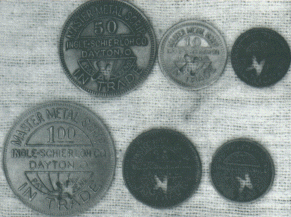
Pretty much all jobs in Harlan County, the legal ones that is, revolve around the mines.  Harlan has a love/hate relationship with the mines and mining companies.  Back in the 1930s the mines and mining companies owned the towns and people.  Workers were paid in “script”, below, money only redeemable at the company stores, where everything was overpriced.

minimg script

Poverty was rampant. Eventually, riots ensued in the 1930s with many murders on both sides of the fence, the miners and their families and the “company men”.  The nickname “Bloody Harlan” arose during this time.  Another similar strike occurred in the 1970s.  Women were actively involved in the “war” too, and an award winning documentary film was created in 1976 entitled “Harlan County, USA”.  Life has never been easy nor peaceful in Harlan County.  Life has always been tough, really tough.

The country song “You’ll Never Leave Harlan Alive” strikes the chord I felt in Harlan County.  Please listen to Darrell Scott sing this hauntingly beautiful song.  Soulful country music at its best – recording the history of our people.  Patty Loveless originally recorded this song and her video includes photos of the region that speak thousands of words.

“Spend your life thinking about how to get away”…..but few do.

“Sun comes up about 10 in the morning and goes down about 3 in the day”…..that’s because the valleys are so deep and steep.  GPS and satellite radio don’t work there because they can’t see outside the valleys to the satellites.  Cell phones?  Mine was useless.  Don’t bother trying.

My grandfather lived the second half of his life in Harlan County, died there and is buried in a grave with no marker.  So very Harlan.

No, you’ll never leave Harlan alive…

William George Estes obit

We don’t have any photos of William George Estes as a child, but one of his earliest known photos with Ollie is shown below.  Ironically, one of the things that Will did was to take photographs of people, so he’s not in many, at least not until he acquired a timer for the camera.

Ollie and William Estes

Will was probably about 40 years old in this photo.  He was born in Claiborne County on March 30, 1874 to Lazarus Estes and his wife Elizabeth Vannoy Estes.  On September 26, 1892 he married Ollie Bolton in Claiborne County.  Their first child, Samuel, was born in July the next year and would live only 6 weeks before they buried him in the family cemetery.  Not a good start for a young couple.

William George Estes and Ollie Bolton would have several children:

  • Samuel Estes born and died in 1893

Venable - Samuel Estes

  • Charles Estel Sebastian Estes (1894-1972) married Edith May Parkey

His delayed Arkansas birth certificate was issued in 1957 and signed by his father, attesting to his birth.

Estel Estes

  • Infant (1896 – before 1900) born and died in Arkansas
  • Robert Estes (1898 – before 1907), died when the house burned
  • Infant (born and died about 1900)
  • William Sterling Estes (1902/3-1963), below, married several times.

William Sterling Estes in WWI

  • Joseph “Dode” Estes (1904-1994) married Lucille Latta and had two sons. Robert Vernon Estes (1931-1951) was taken as a POW in Korea and died in captivity, his body never returned. Charles Arthur Estes (1928-1986) married and had a daughter. This photo, according to Aunt Margaret, was taken either in Quantico, VA or Balboa in San Diego when he was 13, posing as 18 to join the military.

Joseph Dode Estes in WWI

  • Margaret Estes (1906-2005) married Ed O’Rourke, had one son that died.

Margaret Estes

  • Minnie Estes (1908-2008), married several times but had one son with John Raymond Price.

Minnie Estes pearls

  • Twins (born and died in roughly 1913)
  • Elsia (born and died roughly 1914 or 1915)

After their first child died, William George Estes and Ollie left Claiborne County for a new beginning and moved to Springdale, Arkansas, shown below outside the post office about the time that Will and Ollie lived there.

Springdale Arkansas downtown

Fifteen months after Samuel died, their next child Charles Estel was born in Arkansas.

Two years later another baby was born, died and was buried in the Arkansas soil, alone.  In 1898, Robert was born.  Ollie ran a boarding house in Springdale.  By all reports, Will spent his days fishing and his nights drinking.

During my visit to Springdale in 2004, I noticed the bridge and creek across from the old “hotel” in what is now “old town.”  I figured while Ollie was changing beds and cleaning chamber pots and spittoons and taking care of her young children, Will was fishing off the bridge.  It must have been a tough life for Ollie.  For some reason, this area was settled by several Claiborne County families, so they did have at least some distant Clarkson/Claxton family there.

By the 1900 census, they were back in Claiborne County and Will has been out of work for 6 months.  Uncle George (Estes) told me before his death that Will and Ollie moved back to Estes Holler and lived in a little cabin just down from Lazarus’s land, along the creek.  I suspect that they might have had another child that died in 1900.  However, we do know that my father was born in (or about) 1902, followed by Joseph “Dode” in 1904, Margaret in 1906 and Minnie in 1908.  Sometime before 1907, the cabin caught on fire.  Some family said that Ollie was outside in the yard.  Others said she was at a party.  No one said anything about where William George was.  Estel tried to get little Robert out, but he crawled under the bed.  Robert died in the fire.  William George and Ollie buried Robert beside their first child in Estes Holler. Uncle George later planted a willow tree where the cabin burned, and that tree has since fallen and is gone, with nothing left to mark the place where they lived and their child died.  I am probably the last person alive who knows where that cabin was located.  Perhaps it’s a memory better left to dissipate with the winds of time.

Ollie 1907

The photo above shows my father, standing on the ground, along with Estel, the oldest child, standing.  The blonde child on the chair was probably Joseph Dode since he looks to be younger than my father and Dode was born in 1904. The baby is Margaret, born in 1906.  This photo was probably taken about 1907 and the note on the back says Cumberland Gap.  Ollie Bolton Estes does not look like a happy woman.  She would have recently lost her son, Robert.

Shortly thereafter, Ollie and Will departed again, this time for the farmlands of Indiana.

Outside of Fowler, Indiana, farms needed tenant farmers and it seemed like a land with more opportunity than the limited land that Estes Holler had to offer.  Aunt Margaret, before she passed away, and before she became too demented, told me that there were twins born and died in 1913.  She told me that Will and Ollie’s last child, Elsia, was born in 1914 in Fowler and that she later died in Cook County, Illinois. She said that Elsia was “retarded” as special needs children were called at the time.  At one point Margaret also mentioned another set of twins born in 1918, but if this is correct, they may not have been Will’s and they did not survive.  He was back in Tennessee/Kentucky by 1918.  Margaret was one of the Crazy Aunts, so you never really knew what or how much to believe.

Estes family 1914

The photo above, the only photo of the entire family, minus the deceased children, of course, was taken in Fowler, Indiana in about 1914.

It was in Fowler that Ollie and Will’s marriage deteriorated to the point of divorce.  According to several sources, Ollie’s cousin, Joice, said as Joicey, was visiting in Indiana.

Now just out of curiosity, I had to figure out just how Ollie and Joice were related.  And this just goes to show how the word “cousin” is interpreted in Appalachia.  Are you ready for this?

George Hatfield had a son Lynch who had a son Walter who married Mary Polly Hurst, whose mother was Mahala Claxton, daughter of James Lee Claxton and Sarah Cook.  George Hatfield also had a son Ralph who had a son Lynch who had a son Lynch who had daughter Joice.  So Ollie’s grandfather’s 1st cousin (or Ollie’s 1st cousin twice removed), Mary Polly Hurst, married Walter Hatfield.  Walter Hatfield’s father’s brother’s great-granddaughter was Joice Hatfield. So, in case you’re having trouble following this, I tried to chart the connection.

Hatfield Clarkson Tree

If you’re looking at this saying to yourself, “they aren’t related by blood, only by marriage,” you would be right.  Not only that, but related by marriage going back up the tree 4 generations, then down two, from both sides.  This explains, better than anything else, the concept of kinship in the south – or at least in this part of Tennessee.  Probably more important than anything was that these families still lived, for the most part, on the same land or at least in the same holler that their ancestors did, as close neighbors, so the kinship connection remained strong and encompassed everyone closely or distantly related.  So, four generations out, you were literally related to everyone in that part of the county.  By the way, that also made their business your business….just saying.  Oh, and if you didn’t like them, you just claimed they “weren’t kin” even if they lived across the road with the same last name.

Ollie came home one day to find Will “in the act” with her young teenage cousin, born in 1893, 20 years younger than Ollie.  Ollie took a horsewhip to them both and from all accounts, nearly killed Will.  The neighbors had to restrain Ollie and it reportedly took several men to get it done.  She was pregnant with either Elsia or the twins at the time, depending on whose version of the story you are listening to.  One version says the incident made Ollie go into labor early and she had the twins prematurely and they were stillborn.  If that is true, then she subsequently got pregnant with Elsia, if the dates are correct.  I have never been able to substantiate the births or deaths of either the twins or Elsia, but I have no reason to think they did not exist, especially since multiple people told me of their births.

Regardless of the exact timing and order of those unfortunate events, sometime around 1915, Ollie left Fowler for Chicago, without Will, and took Minnie and Margaret with her.  Aunt Margaret’s letters written many years later to my step-mother said that neither Ollie nor Will wanted the boys.  Estel, by then age 19 or 20 was old enough to fend for himself.  However, my father William Sterling known as “Bill” and also as “Sterl,” and Joseph known as “Dode” were only early teens, if that, and didn’t know exactly what to do.

Bill and Dode hopped a freight train for Tennessee and found their way back to Claiborne County looking for family and food.  They showed up half-starved and filthy and telling tales about what happened between their mother and father.  By the time Will showed up back in Estes Holler with young Joice in tow, Lazarus Estes, his father, was having none of that, and Will got himself chased out of Estes Holler for “doing Ollie wrong.”  To my knowledge, no one had ever been run out of Estes Holler, and we’ve got some pretty colorful characters to our credit.  Lazarus told Will if he came back, he’d kill him, or so the story goes.  Lazarus Estes and his wife Elizabeth Vannoy are shown below.

Lazarus and Eliabeth Vannoy Estes

The only place rougher than Estes Holler was Harlan County, and Will could go there and “hide out” (Will’s words) from both his Estes kin, Ollie’s kin and Joice Hatfield’s kin.  It seems that everyone except Joice was mad at Will.  And she would be shortly.

And yes, these are the Hatfield’s of Hatfield and McCoy feud fame and yes, Will fit right in in Harlan County.  In March of 1918, Joice had daughter, Virginia Estes, shown together below.

Joice Hatfield and Virginia Estes crop

This photo is from Virginia’s obituary in 2000.

Virginia Estes Brewer obit - dau of william George

We don’t know exactly when William George Estes came back to Claiborne County, but do know he registered for the draft on September 12, 1918 and he was living in Claiborne County at that time and Joisce is listed as his nearest relative.

WGEstes crop

The 1920 census shows us that Will is living with wife Joice, daughter Virginia, and with them, we find Joice’s younger cousin, Croice (also Crosha, Croshie) Brewer, along with her young son, Horace.  There is no further record of Horace.  Crocie was listed as “deaf and dumb.”  You know what’s coming next don’t you?

What is the best predictor of future behavior?  Past performance.

Yep, Will, again, finds himself involved with his wife’s younger cousin who is living with them.  You’d think that Joice would have known better, all things considered.

According to Margaret and cousins in Estes holler, Will actually wound up married to both of these women at the same time, one “over the mountain” in KY and one in TN.  Does this sound familiar?  Did his son, William Sterling Estes, follow in his bigamist footsteps?  That old apple and tree saying seems to hold true.  What a mess Will made.  Eventually he reportedly would live with neither wife.  I have no idea how he got himself untangled from two simultaneous marriages, or if he ever did, assuming the story is true in the first place.

Josephine Estes crop

Will had three children by Crocie, Josephine, above, born in 1923.  There appear to be pages missing, or at least several residences missed in the 1930 census on Black Mountain, but the 1940 census reports that Josephine was born in Arkansas, so Will and Crocie may have lived there for a time but were back in Harlan County by 1925.

In 1925, a baby girl names Helen May Estes was born in Lynch, Kentucky.  No one in the family ever talked about this child, or, for that matter, their son William James Estes. Helen May died when she was six years old.  Her death certificate says that she died of broncho-pneumonia on April 3, 1931, and that she had smallpox.  She was buried in the Gillam Cemetery, where their son would also be buried a few years later.  I found it odd that Helen wasn’t buried until almost a full month later, on April 4th.  It must have been a terrible month for the family.  Given that the address on the death certificate was listed as “Shack #74, Lynch,” the issue could have been money for a burial plot.  Crocie was also heavily pregnant for Evelyn as well, and may have been ill herself.

“Red-headed Evelyn” was born shortly after Helen’s death in 1931 in Kentucky and a son, William James, who was born in 1935 died as an infant in 1937 under questionable circumstances.  His death certificate states the following:  “Died of acute intestinal indigestion” and it’s noted that it was “from improper food. 2 years 6 months old and buried in the Gilliam Cemetery,” located just above Cumberland on the map below.  Remembering what Margaret said about having no food when they were children, and being fed alcohol, I have to wonder what happened to poor William James Estes.

William James Estes burial

There was some question for a long time whether Josephine was the child of Joice or Crocie.  However, since Josephine is buried in the cemetery where Evelyn, Will and Crocie are buried, she is most probably Crocie’s daughter.

Joice went back home to Hancock County, Tennessee. In the 1930 census, she is listed as Jaysey Hatfield, living with her parents, Lynch Hatfield and Virginia Foley Hatfield.  Daughter Virginia is also listed under the Hatfield surname, and there is no daughter Josephine.

In 1940, Virginia Estes is found married to Little Brewer in Hancock County, with Dorothy aged 2, and Gennett (Jannette,) 7 months old.  Virginia and Little Brewer moved to Anderson, Indiana and lived there most of their lives, working in the auto plants.  They had one more child, a son, Ambrose, born in 1942 who predeceased Virginia, who passed away in 2000.

Both Evelyn, who married Marco Pusice, a polish miner, and Josephine who married Andy Jackson lived their lives in Harlan County.  Both women, their husbands, Will and one of his wives, a “Mrs. Estes” who we presume is Crocie who died in 1961, are all buried in Harlan County in the D.L. Creech cemetery.  Joice died in 1965 in Anderson, Indiana where Virginia, her daughter, lived.

I’m sure that the Bolton/Hatfield/Brewer family reunions were interesting after that, especially given that Virginia married into the family of Crocie, Will’s third wife and Joice’s cousin who cheated with Will.  Of course, that’s kind of karmic in a sense, because Joice also cheated with Will, on her cousin, Ollie.  What’s that saying…what goes around, comes around.

If Will was a smart man, he steered very clear of any family of these women, especially male family members.  Maybe he just stayed out of Hancock County altogether.  He’s lucky he didn’t just “disappear” although the remoteness of Black Mountain and the roughness of Harlan County was probably very intimidating to anyone not from there – and it probably served to protect Will.

William George Estes in tie

To the best of my knowledge Will never worked inside the mines.  He reportedly made pilings for shoring up the mines.  Some said he wound up with a lot of mine land, but the deed index of Harlan County shows that Will owned no land at all, neither did he have a will.

The 1940 census and the entries surrounding those of William George Estes are quite interesting and gives us a flavor of what life was like in Harlan County.  Among other things, this census tells us that William George Estes never attended school.  Crocie has 4 years of school. Josephine at age 17 was classified as H3, probably 3rd year of high school.  Sadly, Eveline had no school at 8 years of age.  Perhaps Josephine was staying with someone in town.

1940 Harlan Ky census

Most of the families, for pages and pages in each direction were listed with a margin note that said “shack.”  William George was listed with a note that said “lease.”  However, the number is “74” which is the same location as given in the 1931 death certificate for Helen May.  William George is listed as a farmer and everyone else, with no exceptions, is listed in some way associated with the coal mines, or as a timberman.  I’m reminded of the family stories that said Will “made a lot of money” selling timbers to shore up the mines.  A “lot of money” may have been relative, when compared to hundreds of families living in shacks.  Someone who leased land might have been considered wealthy.  And given that we know that he was a moonshiner, we know in this case, what farmer really meant.

There is a column for where each family lived in 1935 and a surprisingly high number of these families lived in the “same house.  Will’s says the same thing, so this is where they were living in 1935 when their son was born and in 1931 when their daughter died.  They are missing in the 1930 census, but this is also likely where they were living then as well and possibly in 1925 when Helen was born.

Three entries before Will we find a margin note saying “Big Looney Creek” on leased land and 5 shacks before that another lease that says “Looney Creek.”

Seven shacks after Will’s leased land, we find Looney Creek listed again, and right beside that, two shacks later, “Top Black Mountain.”  So, Will didn’t live quite at the highest elevation in all of Kentucky, “in the last house at the end of ‘bad ass street'” as it was termed where I grew up, he lived about 10 houses below the summit.

This red balloon shows Looney Creek just below the top of Black Mountain where it crosses at the summit into Virginia.  The road follows the creek path from the top of the mountain through Lynch and Benham to Cumberland.

Looney Creek Harlan

Below is a satellite image of this area today.  We know that Will lived “above Cumberland” near Looney Creek and below the top of Black Mountain.

Looney Creek Harlan satellite

On the census, Gap Branch In Lynch, KY, is shown before Will’s location, several pages.  Today, there are no houses or “shacks” on 160 south of the two 160 markers at the top of the photo, below.  Lynch is the community that includes Gap Branch located between those top two 160 markers (below), between Benham and the red balloon (above).

Gap Branch and Looney Creek

To put this in further perspective, Will is buried above Cumberland on 119 near the first red arrow on the map below.  His son William James and daughter Helen May are buried “above Cumberland” between Cumberland and Benham, near the second arrow.  William lived someplace on 160 between Gap Branch (In Lynch, KY), the red arrow between the two 160 markers below Benham on this picture, which in Harlan County would be termed “above Benham” because of the elevation.  This arrow is located between the two 160 markers, between Benham and the top of Black Mountain.  The fourth, furthest right, red arrow is the last location of any housing today, at the 160 marker.  The red balloon is the google location for Looney Creek.  Looney Creek actually begins about half way between the red balloon and the top of the Mountain.  That would be where the freshest water would be found, so the safest to drink.  Black Mountain is the highest and most rugged and inaccessible location in Kentucky.  In the earlier 1900s, when coal was first discovered here, it was reported that there was only one mule path across this mountain.

Harlan satellite with arrows

Mom said that when she went to visit with my father in the 1950s, his house was extremely remote and difficult to get to.  She shuddered to think of it.  Mom met Crocie so she apparently lived with him at that time.  Mother didn’t care for how he treated Crocie, although she was never specific.  Mother never went back. Others referred to Crocie as Will’s virtual slave.

By the 1960s, Will was writing letters to my father about having Evelyn “hid out” until things settled down.  I don’t know what Evelyn was doing that time, but another letter mentions “bad checks.”  Both Evelyn and Josephine were exceptionally beautiful women and known in the vernacular of the day as “sirens.” It’s not surprising that they were somewhat wild, given their genetic heritage.  Furthermore, their Dad was a known moonshiner and bootlegger.  White lightning greasing the skids of popularity I’m sure for those girls, as did their beauty.

Black Mountain Harlan County

But moonshining wasn’t the whole story.  The whispered family history, and there was a LOT of whispered family history, revealed stories of Will killing a revenuer in the 1920s or 1930s.  The story goes that the revenuer had the bad judgment to try to take Will alone up on Black Mountain, shown in the photo above.  It never happened, and the revenue agent was never seen again.  Now I chalked this up to old family gossip, known in the south as “no account talk,” especially since so many of the stories about this family have proven to be unfounded or at least unsubstantiated.  However, a few years ago, through another source entirely, I heard the story of a revenue agent, who supposedly went up on Black Mountain after a moonshiner in the 1920s and was never heard from again.  It seems very odd that a revenue agent would work alone in that venue.  It almost smells like some kind of payola deal gone bad.  I have always wondered if those two stories are just coincidence – or maybe one fed the other.  Only Will knows for sure, and he’s not talking.

That’s not the end of the extraordinary stories about this family either.  It seems that something happened to Evelyn, Will’s daughter.  Two different children of Estel’s told me that Evelyn was murdered, her throat cut and she was nearly decapitated in front of her children.  One version says that she was married to a “Jake”  whom she divorced, then married “an old man,” one source says a doctor, who she took care of until she died.  Another family source says that a robber broke into their home and she was nearly beheaded in front of her children, murdered.

I found Evelyn’s death certificate and she died of a hyperglycemic coma at age 46, BUT, an autopsy was indeed performed, which is extremely odd under those circumstances.  Anemia was a contributing factor, but no injuries were listed.  If you were “anemic” because your throat had been slashed, I’d think that would be noted on the death certificate as a contributing factor.  Evelyn had one daughter, Joyce, according to her obituary and the obituary said nothing about being murdered.  I told you my family had incredible stories, and these weren’t even from the Crazy Aunts!

My visit in October 2009 to Harlan County was to locate and visit my grandfather’s grave.  With all of the genealogy work I’ve done on my older ancestors, it seemed unholy somehow that I had never made it to Harlan County to visit my grandfather.  You know, it’s not like Harlan County is on the way TO anyplace.

Will lived to be a very old man and he was only ill for a few days before his death of pneumonia.  He died November 29, 1971 in Harlan, KY, age 98.  He was buried 2 days later.  He is shown below with his sister Cornie Epperson who died in 1958.

Will Estes and Cornie Estes Epperson

I was a teenager in 1971.  I didn’t even know my grandfather was still alive, let alone that he died.  I don’t think mother knew he was alive either.  He did not attend my father’s funeral in 1963.  It was in 1973 that Virgie, my step-mother, who kept in touch with Aunt Margaret, told me that my grandfather had died. Since my father was gone, it never occurred to me that my grandfather might still have been alive.

I would have at least liked to have had the opportunity to have known him, although I’m not sure my mother would have approved, all things considered, and with good reason.  There appeared to be at least 14 grandchildren in total, although he outlived at least two of them and probably more.

My trip to locate and visit his grave was, thankfully, not reflective of the drama that heralded his life.  I had called ahead to the “rescue squad” which is associated with the Johnson Funeral home where Will’s services were held to see if they knew where the D.L. Creech Cemetery was located.  They did, and told me if I’d come up to Lynch, they’d take me and show me.  I learned a long time ago that volunteer fire and rescue are the best sources in these areas.  They know everyone and know how to get everyplace.  And they know how to stay safe.

I told them I was stopping at the courthouse on the way to Lynch, as Harlan is the county seat and you have to pass right through there on the way to Cumberland, then Lynch.  Harlan is a very small town.  One Arby’s and that’s it for fast food.

Harlan Courthouse

The courthouse and “justice center,” a building adjacent to and the size of the courthouse, was easy to find.  Outside the courthouse was a large sign that says something akin to “no firearms, knives, weapons, etc.” which is typical for a courthouse, but then there was another sign that said something like “cell phones must be turned off and by decree of Judge Jones on such and such a date, anyone observed using a cell phone in the courthouse will have the cell phone confiscated and the phone will not be returned.”  Hmmm, welcome to no nonsense Harlan County.  I turned off my cell phone.  It didn’t work anyway.  I wondered how doctors were supposed to get calls, and then I remembered that I was in Harlan County and the closest doctor was probably in Pineville, a good 35 miles away.  Question answered, there were none.  No problem.  Well, there used to be two doctors, but they were both arrested and convicted for illegal drug trafficking, per the mortician.

I went inside and through the metal detector which looked sorely out of place and appeared to be a serious intrusion from the 21st century into this 19th century courthouse.  After determining that deeds were in the next building, I left.  I had to return though as probate records for individuals without wills were located back in this initial building. Back through the metal detector, except this time, when I walked in the door, I stopped dead in my tracks, for in front of me, a man had pulled out his gun.  I drew a short breath and was trying to unroot my feet from under me while my mind was racing, along with my heart, trying to decide if I should stand still and hope he doesn’t notice me or turn tail and run like the wind.  Fortunately, he put the gun in a locker, locked the lock and took the key and then went through the metal detector.

I was quite stunned, to say the least, especially in light of their exceptionally strict policy regarding cell phone usage (as if cell phones worked there anyway.)  After the man left, I asked one of the deputies attending the metal detector about what I had just witnessed and he said that they allow people to check their guns because everyone knew you were coming out of the courthouse not “packing heat,” because it wasn’t allowed, so the street in front of the courthouse became prime pickins for murders.  So now, you can check your gun in a locker.  Yep, welcome to Bloody Harlan.

I didn’t want to bother the rescue squad unless it was absolutely necessary, so I went on up to where Google maps showed me the D.L. Creech cemetery should be.  However, at the beginning of Creech Cemetery Road, I stopped short and turned around.  There was a large hill crossing a railroad track leading to a cluster of mobile homes and there was an iron gate that could be closed across the tracks.  I couldn’t see the cemetery, so I had no idea how far up this dirt road I’d have to drive.  With the terrain and elevation of the tracks, there was one way into this place and one way out, even with a Jeep, and I was not about to get caught behind that iron gate. Off I went to the rescue squad.

They were expecting me, as I had called twice with questions in preparation for my trip.  The younger men were on a run, but an older gentleman, Derrell, the retired mortician, was there to help me.  His daughter, Stephanie had taken over the funeral home and the ambulance business and he is now officially “retired”, but he was also bored out of his mind so this was a good diversion for him and he enjoyed talking about the area and its colorful population.

I learned that Josephine wore red lipstick, literally, until the day she died, that she was considered a “siren.”  Andy Jackson, her husband, who had lived at Jackson Bottom, had “gone crazy” on them at one time and that he had only died 3 or 4 years before.  I told you, the rescue guys know everything about everyone.

I followed Derrell to the cemetery and felt much better with him along.  It was actually a very nice cemetery, well maintained, but that’s because Derrell had his crew take care of it when they had breaks in their other duties.  We walked the cemetery looking for Will’s grave, twice, with no results.  I asked if there was a cemetery map or a sextant.  Derrell said that a very cranky eccentric old woman had the map and you couldn’t get it or any information from her.   Will didn’t have a headstone.  I commented to Derrell that it’s too bad that we couldn’t locate my grandfather’s grave, because if I wanted to purchase a stone, I wouldn’t be able to do so because we wouldn’t know where to place it.

All of a sudden, Derrell remembered who to ask about the cemetery map, and maybe the women’s son-in-law had it.  He did.

Creech Cemetery plots

The map seems to be a plot of when the lots were sold, and in the case of the Jacksons, just a suggestion of how people were to be buried.  Josie Estes and Andrew Jackson are buried side by side in lots 2 and 4, not one in front of the other.  It’s unclear if anyone is buried in lot 3.  Back to the cemetery we went to locate Will’s grave. On the cemetery map above, the road into the cemetery runs along the left side and the 40 foot area is a graveled parking area.  Will’s grave should be easy to locate.

We had already located Evelyn’s stone.  She was married to Marco Pusice who predeceased her and they both share a common stone.

Pusice Stone

Apparently, Crocie was the first of the group to die in 1961 followed by Will in 1971,  Marco Pusice in 1972,  Evelyn Estes Pusice in 1977, Josephine Estes Jackson in 1979 and Andrew Jackson in 2004.  Crocie only has a fieldstone for a headstone.  Josephine, her husband Andy Jackson, Will and apparently Crocie are buried together near the front of the cemetery.  None of them have stones except for Crocie (assuming she is Mrs. Estes) and she just has a rock, as shown below.  Will is buried beside her to the left in front of the grey flat stone marker with the metal inscription on top.

Will Estes burial lots

To the left of the large Dixon stone in the photo below, you can see two metal markers, one lying flat and one upright. Those are the graves of Josephine and Andrew Jackson.

Creech cemetery view

Andy still had the funeral home metal marker, but when it’s gone, that will be all there is. Josephine has a concrete block and her funeral home marker is stuck in the top of the concrete block that has sunk into the ground.  Rather sad, actually.

Andy and Josephine Jackson burials

Derrell purchased the funeral home in the 1980s, so he didn’t know my grandfather Will, although his daughter knew Andy and remembered Josephine.

Derrell did, however, tell me some other stories of Harlan County, such as about the undertaker that embezzled all of the funeral prepayments.  He went to jail for that, because he preferred that to being dealt with by the local families.  Probably a good thing and much safer.  They do have a sense of humor in Harlan County and he would probably have been buried in one of those unmarked graves.

In addition to moonshining and womanizing, William George Estes was also a photographer.  I know that’s a really unlikely occupation for someone in the hills and hollers of Appalachia.  I suspect that it was something he rather “fell into” in some fashion.  He had a large black camera with a black cloth and a tripod and he could set the timer to take pictures.  The photographs of the family between 1907 and 1915 or so when he and Ollie divorced were taken in that manner.  He must have gotten the camera about 1907 because there are no family photos before that.

When I first visited Claiborne County, many people told me he used to go to family reunions, which used to last for several days, and took pictures of people.  Of course, he ate and drank with them.  Then, after the pictures were developed, he would go back down and visit with the family for a couple days to deliver the pictures.  I’m sure he also delivered some other products as well, and probably stayed to help drink that product.  Everyone seemed to like Will, well, except for his x-wives families, which was probably half of the county.  So the other half of the county liked him.

Will Estes and Worth Epperson

The photo above is Worth Epperson (d 1959), Will’s brother-in-law, and William George Estes.

A few years ago, I was with family members in the old Estes cemetery in Estes Holler, which one has to be let into because it’s far up the mountain on private land behind fences.  I was laying on the ground on my belly trying to get my new camera to cooperate and take a photo of a stone where the engraving, or in this case, rough hand chiseling, was worn almost smooth by rain and time.  So I fiddled and fussed and tried to get the light to shadow the grooves in the stone. I heard one of them say to the other, “she’s certainly Will’s granddaughter.”  Apparently he had to fiddle and fuss with his camera too.

William George Estes was clearly an eccentric man who walked to the beat of his own drummer.  But that was a time when taking a couple days to do something didn’t matter, especially if you didn’t have a job to get to.  And that job thing seemed to be something that never plagued Will.  He also, amazingly, didn’t drive, but being a moonshiner, he probably always had something to trade for a ride and lots of people were probably more than happy to take him.  Since he did live to a ripe old age, I’d wager a bet that he didn’t pay up until he got out of the vehicle!

It seems that Will passed moonshining on to at least one of his sons.  Sadly, he passed the proclivity for problem drinking on to all three.  My Aunt wrote in her letters that at times there wasn’t enough to eat when they were children, so they were given moonshine to drink so that their stomach’s wouldn’t hurt and they would go to sleep.  My heart just breaks for my father and his siblings.  That’s where my father’s alcoholism started – as a child, due to hunger, through no choice of his own.

Fleming Kentucky

Fleming, Kentucky, above, was a coal mining town in Letcher County.  Will’s son, Estel lived here and worked the mines when his family was young.  Estel also had a side job, delivering moonshining.  His daughter told me that they used to paint milk bottles white on the outside and he would have the kids deliver the “moonshine” camouflaged in white milk bottles.  The family was innovative – you’ve got to give them credit for that!

Will Estes with pipe

One of the Estes cousins who lives in Claiborne County, TN, tells another story about Will.  Since he didn’t drive, he would catch the bus in Harlan County, Kentucky and ride it to the closest drop off location in Claiborne County, about an hour distant and then walk on to Estes Holler to visit, after his father, Lazarus, who had banished him, died.

Will had a bullet in his pocket with his tobacco.  He filled his pipe with tobacco and started to smoke it on the bus, but unbeknownst to him, he had also gotten the bullet in the pipe.  Well, the bullet, and with it, the pipe exploded on the bus during the trip.  Scared him and the other passengers and nearly caused the driver to wreck the bus.  From then on,  he was banned from riding the bus.  I guess you might just say that’s our special family version of going out with a bang!

In 1915, Will’s parents deeded land to one of their children, Cornie Estes Epperson and her husband, Worth Epperson, and in the deed, stipulated that she and her husband were to pay the other children a specific sum of money.  This land transaction was in lieu of a will.  In William’s case, that sum was $120.  In 1957, some 42 years later, he signed the edge of that document that he had indeed received the money.  I’ve always wondered if Lazarus and Elizabeth signed this 1915 deed before or after Will returned to Estes Holler after his escapades in Indiana.  I’m guessing that it was before, given the fact that Lazarus was evidently very angry with Will when he returned, without Ollie, with Joice and after his two young sons, about ages 10 and 12, or at most 12 and 14, had arrived as hobos in desperate need.

Will Estes signature

All things considered, it’s absolutely amazing that his man lived to be 98 and a half years old, and died after a short illness of natural causes – what would once simply have been termed “old age.”

Will Estes, Wayne, Edith and Josephine

William George Estes, his grandson, Wayne Estes, Wayne’s mother Edith Mae Parkey Estes and Will’s daughter, Josephine Estes, probably in the 1960s, not long before Will’s death.  Will would have been in his 90s.

Who’s Your Daddy?

One thing that always bothered me was that my father, at right below, really didn’t look anything like his father, William George Estes.

William George and William Sterling Estes

There are no photos of Will as a young man, and my father died in his early 60s, so I’ve tried to compare photos at ages that looked to be approximately equal.  The first row, below is of Will and the second row is my father.

William George and William Sterling Estes composite

I looked and looked, and I simply could not see much resemblance.

DNA testing promised an answer to the long-standing question of whether or not I had been doing someone else’s genealogy for 30 years or so.

However, DNA testing was not to be as easy as it sounded.

We had a baseline of what the ancestral Estes Y line DNA should look like, if there were no misattributed paternal events, or adoptions.  However, my father had no sons, at least not that we could find, until we found David.  Will’s other male children did not go forth and multiply fruitfully, and those that did had children that died young.

Suffice it to say that finding a suitable DNA candidate from William’s line proved to be extremely challenging.  We tried a couple of tactics, and let’s just say that nothing worked the way it was supposed to.  In fact, no one was matching who they were supposed to be matching, nor each other.  In the case of one of William George’s descendants, the results were off just enough to be suspicious – but not enough to be definitive.  The green line below shows the ancestral Estes DNA, as finally proven by Uncle Buster.  The yellow was unknown.  The purple should match the green, and would prove William George’s line, but the purple individual was the one with just enough mutations to be inconclusive.  David, my half-brother, didn’t match anyone.

Digging up dad 1

I studied the photographs of every person in the family who descended from Lazarus.  I think my father looked more like Uncle George than anyone.

And then there was David, my father’s supposed son, who was an entirely different haplogroup and didn’t match either the primary Estes line nor the purple descendant of William George Estes.

This was making me crazy, seriously crazy.  Bang my head against the wall crazy.

I began to doubt everyone.  There was obviously a break, or maybe two, but where?

Digging up dad 2

John Y. Estes is on the left, then his son Lazarus and his son William George to the right.

My father just didn’t look like these men, and William George really didn’t look like Lazarus either.

OMG

I’m hyperventilating by now.

Looking back up the line, we had confirmed that John R. Estes did match the ancestral Estes line, but from there to current, we had no clue except that we had problems.

Finally, I realized that Uncle Buster was still living (at that time) and I went to visit him in Tennessee.  He was so deaf that you couldn’t call him and have a conversation, plus, I hadn’t seen him in years.  How do you explain all of this to a deaf man in his 90s?  Answer – in person.

When we pulled up in his driveway after driving the two mile two-track “road” to his house, he greeted us on his porch with a shotgun.  That’s how everyone whose car isn’t recognized gets greeted.  You just get out and start waving both hands in the air and shouting at Uncle Buster.  My cousin, who was along, didn’t think that was such a good idea!

Uncle Buster was gracious enough to DNA test, that day, and thankfully, he matched the Estes ancestral line as well, so we proved that Lazarus Estes, the father of William George Estes was a genetic Estes, but was William George Estes and was my father?

The fact that my brother, David, and I didn’t match each other autosomally (using old CODIS marker technology) had raised the ugly specter for me that perhaps David WAS my father’s child, and I wasn’t.  Given that I could not dig up Dad for DNA testing, although the thought was tempting, I had to know.

My brother David had become ill with hepatitis C, contracted when he received a blood transfusion when his chopper was shot down in Vietnam.  He needed a liver transplant.  David was very ill, but if he “heard” the discussions that occurred in the hospital, it was obvious that I was not a transplant candidate. I was never clear about why – the team really didn’t seem to want to talk about “incidental findings,” until I cornered one of them.  No, they admitted, we “probably” weren’t siblings.

When the initial 23andMe autosomal tests became available, David and I tested immediately.  We have previously tested at a two private labs utilizing the CODIS markers and the results were inconclusive, stating that we were “probably not half siblings, but probably related.”  Turns out, they were dead wrong.  We not only weren’t half siblings, we weren’t related at all.

At 23andMe, David and I didn’t match.  However, I didn’t know which of us, if either, was my father’s child.  Not matching David was bad enough, but not knowing the rest of the story was worse.

A few months later, I was at the Cumberland Gap reunion, telling my cousin, Deb, who also descends through Lazarus Estes via daughter Cornie Estes Epperson, a sibling to William George Estes, about my DNA woes.

Suddenly, the light bulb clicked on.  DUH!!!

If Deb tested, she would likely match me or David, assuming that the genetic break was NOT between Lazarus and William George Estes and NOT between William George Estes and my father.  In any case, the fact that she MIGHT match one of us was a gamble I was certainly willing to take, and she agreed to test.  It was a long shot, but it was the only shot I had, and I took it.

By this time, after several years of not knowing, I no longer cared which outcome developed, I just needed an answer and closure. And I thought Dave did too.

I ordered Deb’s kit, she spat, and we waited…an interminably long time it seemed.

Finally, the day arrived and the results were in my inbox.  I clicked to open, signed on, and there it was, in living color…

…the answer…

Deb matched…

…right now I was slamming my eyes shut and peeking out the slits…

…I wanted to know…

…but I didn’t want to know what I feared the answer would be…

…the truth…

…finally, the truth…

Deb matched…

Me…

DEB MATCHED ME…

Not Dave.

OH GOD!

Oh God.

I was overwhelmed with relief and at the exact same time, overwhelmed with sorrow for my brother.  I tried to tell David a couple of times and he simply did not want to hear the results, so I never pushed it.  By this time, he was gravely ill.  He was my brother and I loved him and still do, regardless.  If anything, he needed my love more than ever, although he would never have admitted to needing anything.

However, as the consummate genealogist, it really did matter to me, and not in the way most people would presume.  I wanted to know if I should stop doing my Estes side genealogy.  I didn’t want to waste any more time, if I had been wasting time, and I didn’t want to stop if the Estes line was mine genetically.  For me, that DNA test bought me out of genealogical purgatory!

About that time, Family Tree DNA also introduced the Family Finder test.  Given that Uncle Buster had already tested his Y chromosome there, his DNA was archived there, so we upgraded his test and David’s to see who matched Uncle Buster, who is actually my first cousin once removed.  Yes, I’m a born skeptic and I guess I just needed two independent proofs.  Again, the results were the same.  Buster matched me and not David.

So, with one test, either Deb’s or Buster’s, we proved the Y lines of the men involved by inference.  We know that my father matched William George’s Y chromosome and William George matched Lazarus’s – or we would not have matched autosomally at the level we were.  We also matched with other descendants of Lazarus and other Estes cousins from on up the tree as well.  Not to mention, we salvaged my grandmother’s reputation which had come under a bit of a cloud.  Sorry grandma!

As soap operas go, this one had as happy an ending as there could have been.  Soap operas NEVER have happy endings you know.  My brother never knew or admitted that he knew we weren’t biological siblings, so he was spared any emotional pain.  I loved him regardless, so it didn’t matter to me in that way.

My great regret is that I wasn’t a transplant match, but I subsequently discovered that the hospital where Dave was being treated stopped doing live donor transplants about that time, and only used cadavers, so even if I had been a match, it’s doubtful that they would have done the surgery.  Dave never received a transplant and passed away after developing liver cancer.

On the genealogy front, I was relieved to confirm that I had not wasted 30 years on someone else’s genealogy.  And, I didn’t have to dig up Dad, or William George, to do it!  Good thing, since we still don’t know precisely where William George is buried – just a general vicinity – which would be good enough for a tombstone, but not for DNA testing.

William George Estes tombstone

Nope, he never left Harlan alive.

______________________________________________________________

Disclosure

I receive a small contribution when you click on some of the links to vendors in my articles. This does NOT increase the price you pay but helps me to keep the lights on and this informational blog free for everyone. Please click on the links in the articles or to the vendors below if you are purchasing products or DNA testing.

Thank you so much.

DNA Purchases and Free Transfers

Genealogy Services

Genealogy Research

1348 – It Was a Very Bad Year – 52 Ancestors #25

It was the worst of times, it was the worst of times…it was the season of darkness…it was the winter of despair.  (Apologies to Charles Dickens.)

In my family history, 1348 was probably the worst year, ever, and I do mean EVER – and if you have European ancestry – it was, undoubtedly, for your family too.  Why?

The Plague.

The Black Plague.

The Black Death.

The Great Plague.

The Great Pestilence.

The Great Mortality.

Bubonic Plague.

And it was probably, worse, far worse, than you know, or can even imagine.

It was one of the most devastating pandemics in human history – or at least the part of human history that we know about.  Between 1348 and 1350, estimates are between 30% and 60% of all Europeans died.  DNA from victims tells us that the source of the plague was indeed the Yersinia Pestis bacterium, originating in Asia and spread by rat fleas on ships.  The epidemic began on the island of Sicily, spread from south to north, eventually encompassing all of Europe.

And it didn’t just happen once, it happened over and over again, beginning in the mid-1300s.  It appeared again and again throughout the 1300-1700s, especially in major cities, but not as widespread and all-encompassing as the initial 1348 outbreak.  By the year 1400, it’s estimated that the plague had reduced the world population from about 450 million to about 300-350 million.

According to historians, the plague was reported someplace in Europe every year between 1346 and 1671. Repeated outbreaks in some areas took high percentages of the population several times.  London, for example, lost half of its population initially, then again in 1471, 10-15% of the population died, and in 1479-80 another 20%.  In 1563, 1593, 1603, 1625, 1636 and 1664, London lost 20% of its population with each subsequent outbreak.

plague 1665

This drawing depicts the Great Plague of London in 1665, which killed up to 100,000 people.

plague London burials

Anyone who could afford to left London for six months or so during the worst of the plague. All cats and dogs were destroyed as a preventive measure. This allowed rats to flourish and spread the disease which was carried by their fleas. The painting shows a scene of horror. After sunset carts were driven through the streets to collect the dead. They were taken to the nearest graveyard to be buried in plague pits, as shown above. Fires burned to make smoke. Pipes of tobacco were smoked, posies of herbs worn and faces covered with masks. This was thought to be protection against contagion. London was overwhelmed with fear, terror and grief.

This scene was repeated throughout Europe.  Norway lost 60% of its population between 1348-1350.  Paris was stricken about every 3 years, repeatedly.  There were 22 outbreaks in Venice between 1361 and 1528, and again in 1576 when one third of the population, about 50,000, people died.  What do you do with 1000 dead bodies every day?

So, how bad was it, personally?  Wiki gives us this information about symptoms.

Contemporary accounts of the plague are often varied or imprecise. The most commonly noted symptom was the appearance of buboes (or gavocciolos) in the groin, the neck and armpits, which oozed pus and bled when opened.

Boccaccio’s description is graphic, and I’m sparing you the photos:

“In men and women alike it first betrayed itself by the emergence of certain tumours in the groin or armpits, some of which grew as large as a common apple, others as an egg…From the two said parts of the body this deadly gavocciolo soon began to propagate and spread itself in all directions indifferently; after which the form of the malady began to change, black spots or livid making their appearance in many cases on the arm or the thigh or elsewhere, now few and large, now minute and numerous. As the gavocciolo had been and still was an infallible token of approaching death, such also were these spots on whomsoever they showed themselves. ”

Ziegler comments that the only medical detail that is questionable is the infallibility of approaching death, as if the bubo discharges, recovery is possible.

This was followed by acute fever and vomiting of blood. Most victims died two to seven days after initial infection. David Herlihy identifies another potential sign of the plague: freckle-like spots and rashes which could be caused by flea-bites.

Some accounts, like that of Louis Heyligen, a musician in Avignon who died of the plague in 1348, noted a distinct form of the disease which infected the lungs and led to respiratory problems and which is identified with pneumonic plague.

“It is said that the plague takes three forms. In the first people suffer an infection of the lungs, which leads to breathing difficulties. Whoever has this corruption or contamination to any extent cannot escape but will die within two days. Another form…in which boils erupt under the armpits,…a third form in which people of both sexes are attacked in the groin.”

What did this mean to our ancestors who survived?  To begin with, people were dying so fast that they could not be afforded a proper burial.  Below, the citizens of Tournai burying plague victims.

plague tournai

Most telling, perhaps are the testimonials of the people who survived, and wrote about what they endured – the unwilling chroniclers, as it were.

“They died by the hundreds, both day and night, and all were thrown in … ditches and covered with earth. And as soon as those ditches were filled, more were dug. And I, Agnolo di Tura … buried my five children with my own hands … And so many died that all believed it was the end of the world.”

—The Plague in Siena: An Italian Chronicle

He didn’t say that he buried 5 of his children, but that he buried “my five children.”  As a parent, I can’t imagine a worse day in my worst imaginings of Hell.

“How many valiant men, how many fair ladies, breakfast with their kinfolk and the same night supped with their ancestors in the next world! The condition of the people was pitiable to behold. They sickened by the thousands daily, and died unattended and without help. Many died in the open street, others dying in their houses, made it known by the stench of their rotting bodies. Consecrated churchyards did not suffice for the burial of the vast multitude of bodies, which were heaped by the hundreds in vast trenches, like goods in a ships hold and covered with a little earth.”

—Giovanni Boccaccio

In fact, it may have been even worse than we know, and killed even higher percentages of people, especially in some locations.  Geoffrey reveals that 90% of the English population may have died.

“The seventh year after it began, it came to England and first began in the towns and ports joining on the seacoasts, in Dorsetshire, where, as in other counties, it made the country quite void of inhabitants so that there were almost none left alive.

 … But at length it came to Gloucester, yea even to Oxford and to London, and finally it spread over all England and so wasted the people that scarce the tenth person of any sort was left alive.”

—Geoffrey the Baker, Chronicon Angliae

Because of the massive number of deaths, mass graves were utilized, like this one in Martigues, France.

plague mass burial

Now the good news is that archaeology digs at the sites of the mass graves, allow scientists to unquestionably identify the DNA of the culprit bacteria in different locations, across Europe, including France, Holland and England, and compare them.  It appears from the genetic evidence that the plague may have come in waves, at least two different times, but the plague of the 1300s and 1400s is almost identical to that which hit Madagascar in 2013.  So, the plague is not dead, just lurking, in the fleas of rats.

I wondered, how many of my ancestors died?  We know that every one of my ancestors lived at least long enough to procreate, and at least one of their children lived long enough to procreate too.  When you think about it, given all of the death – repeatedly – it’s nothing short of a miracle that we’re here at all.  We are the offspring of the lucky ones.

How does that translate into what happened to my family members?  I may not know who they were, their names, but assuredly, they lived then, were alive, functioning members of medieval society.  How many were there?  Assuming a 25 year generation, here’s how many ancestors we had living in the year 1350.

Generational Years Ancestors
1950 2
1925 4
1900 8
1875 16
1850 32
1825 64
1800 128
1775 256
1750 512
1725 1,024
1700 2,048
1675 4,096
1650 8,192
1625 16,384
1600 32,768
1575 65,536
1550 131,072
1525 262,144
1500 524,288
1475 1,048,576
1450 2,097,152
1425 4,194,304
1400 8,388,608
1375 16,777,216
1350 33,554,432

If you allow for pedigree collapse, let’s say that half of these people were actually the same person, meaning that I’m descended from that person twice.  That reduces the number of ancestors alive at that time to only about 16.5 million.  Ok, now let’s say one third of them died, which is about 5 million.  If half died, that’s about 8 million.  Even if we collapse the pedigree by another 50%, which would be equivalent to a 30 year generation, 2.5 to 4 million ancestors, all dying at about the same time is a cataclysmic event in any family tree.  And if you’re European and alive today, your tree suffered this same agonizing event, or series of events.  The great irony is, that as horrific as this had to have been – I’ve never heard of a story, any oral history, in any family, that details or even suggests that this happened – and it was only about 650 years, or 23-25 generations, ago.

It’s a huge, huge loss, however you count it.  The agony for those who remained to grieve their losses must have been immense, and intense.  The very social fabric of families, communities and governments was torn from asunder the population.  Blame was laid in many places, with many people, for many reasons, but never attributed to rats.  And the people just kept dying.

plague aftermath

This painting, from 1562, titled “The Triumph of Death,” by Pieter Bruegel reflects the social upheaval and terror that follow the plague that devastated Europe.  The aftermath of the plague created a series of religious, social, and economic upheavals, which had profound effects on the course of European history. It took 150 years for Europe’s population to recover.  No family was left untouched, and I’m sure many were simply wiped from the face of the earth.

Which brings up a question – how did my ancestors manage to survive?  Was there some sort of advantage conferred upon some that others didn’t have? And if so, why?

Indeed, there may have been a protector.  It’s called CCR5-delta32, where delta means deletion, and its found on chromosome 3.  The receptor looks like this:

CCR5 receptor

This particular deletion of a gene sequence has a specific impact on T cells and blocks the entry of disease agents.  This deletion is found in between 4 and 20% of Europeans, but not in Africans or Asians.  We know that it historically has protected people from smallpox, and it protects people from AIDS today.  Initially it was thought that it also played a role in protecting people from the plague, but a second paper suggests otherwise.  The jury is still out.

It would be interesting to determine the percentage of people who died from the plague that carried the deletion.  If the percentage of plague victims with the double deletion is equal to the European percentage that carry CCR5-delta32 today, then it’s unlikely that the deletion conferred any protection, assuming the European percentage of CCR5-delta32 would have been approximately the same at that time as it is today.

If you want to know if you have the CCR5-delta32 deletion, there are two ways to find out.

If you tested at 23andMe before the FDA shut down their health reporting in late November, 2013,  you can view your own results under the “Resistance to HIV/AIDS” trait by clicking on this link.

You can also browse your raw data, as shown below.  In this case, if you have two copies of the deletion, you’re “fully protected,” whatever “fully protected” turns out to mean.  One copy means you’re partially protected, which may mean that you can become infected but the infection does not progress to full blown AIDs, or it progresses more slowly.  No deletion means that you have no protection.  The individual in the example below has one copy of the deletion, the other is normal.

23andMe CCR5

If you ordered your 23andMe test after November 2013 and don’t have health results, you’re not entirely out of luck.  You can order the test individually at Family Tree DNA, if you are already a customer, by clicking on “Order an Upgrade,” then “Order an Advanced Test,” then follow the instructions below.  The test costs $39.

FTDNA CCR5

The CCR5 mutation is autosomal, which means, of course, that you receive a copy from each parent.

In my case, I don’t carry the deletion, so neither of my parents carried two copies of the deletion or I would have inherited the deletion.

Of my children, one does have one copy of the deletion, and the other has no copies.

So, obviously, the plague did not kill everyone who didn’t carry two copies of the mutation, or today’s European descendants would only carry the mutated (deleted) version of the gene in question.

Still, for our ancestors, and our individual European families, regardless of how, why or protection conferred, 1348 was a really, really bad year from every possible perspective.  It was indeed, the season of darkness, the winter of despair.

While I can’t tell you their names, I know they died, horrible deaths, buried in mass graves – and all I can do today is to remember them namelessly – my thousands of ancestors who died in 1348.

______________________________________________________________

Disclosure

I receive a small contribution when you click on some of the links to vendors in my articles. This does NOT increase the price you pay but helps me to keep the lights on and this informational blog free for everyone. Please click on the links in the articles or to the vendors below if you are purchasing products or DNA testing.

Thank you so much.

DNA Purchases and Free Transfers

Genealogy Services

Genealogy Research

Drunken Sailors and a Porcupine

I should have known when I heard the ship groaning in the night as it shifted from side to side.  But I knew unquestionably when I sat up in the morning and began to sway back and forth.  I remembered someone telling me once about falling out of the shower on a cruise ship.  I doubted it at the time, but as of this minute, I believe that entirely.

One crew member said that it’s always cold in these northern British Isles ports, even in summer, often wet and the water in the fall especially is “choppy.”  If this is just choppy, I’d hate to see worse.

So today, I’ve gained an appreciation for drunken sailors.  You see, they may not be drunk at all, simply seasick and staggering around trying to find and maintain their footing – or the closest bathroom.  Last night, John, the cruise director said he can always tell the drunks when it gets rough.  The people who are normally sober are all staggering around, but the drunks, they are all walking in a straight line, referred to, appropriately, as “the line of experience.”  Obviously, I simply don’t drink enough!

In any case, it’s been an exceedingly rough day at sea. I spent the morning staring out the window at the horizon trying to keep the Dramamine down.  I called the spa to cancel my “happy birthday to me” massage for today since I “wasn’t feeling well.”  When I called, they told me that acupuncture cures seasickness, right after they told me that the cancellation charge was the same amount as the original spa charge.  I had my doubts, believe me, but I was so sick and miserable I was willing to try just about anything, so off to the spa I staggered – plus I was paying for it whether I went or not – so why not try acupuncture.  I couldn’t feel much worse.

Actually, I had my husband deliver me.  The wind was blowing so hard they had the outside decks closed.  The wind is howling like an unhappy banshee in the deepest Michigan winter blizzard.  That’s on the inside, sheltered deck with the open roof that can’t be closed over the pool area.  The outside is worse and unsafe, which is why it’s closed. The spa is on the other side so you have to walk through the open roof area.  If I was going to blow away, I wanted him to be with me.  I figured two of us stood a much better chance of hanging on and well, we were much heavier together and more difficult to get aloft like giant inflatable kites.

These ships were not made for winter, in fact, they have no heaters for the rooms.  You can have A/C or “regular air” which is whatever the air temperature is, recycled.  It’s in the 50s today.  I’ve taken to sleeping in my sweatshirt and wool socks with the bathrobe thrown on top of the blankets for extra warmth and I was finally warm enough last night.  If they were selling parkas, they would make a fortune because it wouldn’t matter how much they cost.  I swear to you, I saw a crew member today wearing gloves.

Tell me why I’m doing this again???  Oh yes, it’s a DNA trip, to find my ancestor’s lands and share their experiences.  And yes, some of them were mariners.  Probably, knowing my family, the ones walking in a straight line.  Ugh.  I could have passed on this particular shared experience, but no, this had to be authentic.

So after arriving at the spa, off with most of the clothes (brrrr) and in with the acupuncture needles.  There were needles in my face, in my ears and in my hands and feet including between my eyebrows and between my toes.  As I lay there, looking like a distant relative of the porcupine family and afraid to move for fear of impaling myself, the thought crossed my mind that not only did I do this of my own choosing, but worse yet, I’m paying for the opportunity.  I tried to fall asleep, which is difficult with a bunch of needles sticking in your skin.  Basically, they poke you like a pin cushion, turn the lights off, come back in about an hour and collect money for doing so.

Now the good news is that I did and do feel better.  I’m still staggering around like a drunken sailor, or what I previously thought was a drunken sailor, but I’m not sick. By mid-afternoon, after my spa treatment, food even sounded good, so I went up to the lounge deck with floor to ceiling windows and had a snack.  Yes indeed, things are improving for the old porcupine.  But the sea is quite rough again as we have left the shelter of the Isle of Skye and other islands off Ireland and are in the open North Atlantic now.  It may be rough, but it’s still exceedingly beautiful.

rough seas

This reminded me of another time, years ago, when my kids were young and we had saved enough to take everyone salmon fishing in Lake Michigan.  We chartered a boat for the day, and we invited my Mom and (step)Dad to join us.  For my Dad, who loved to fish, this was a wonderful opportunity he had never enjoyed before – and maybe he’d catch something more interesting than catfish and bluegill in the farm pond at home.

We spent the night before in a local bed and breakfast and got up early to begin our much-anticipated adventure.  I gave everyone in the family Dramamine, everyone that was, except my mother.  She refused, saying that she didn’t get sea sick.  I encouraged her to take it anyway, but she would have none of that.

You know what happened don’t you?  She turned green as pea soup – and not only was she miserable – so were the rest of us.  It’s hard to have fun when someone is so ill.  So we went back to shore, Mom and Dad departed for home, despite our protests, and the rest of us went fishing.  We caught and froze some salmon for Dad, but it just wasn’t the same as catching those fish himself.

However, this made me wonder – is motion sickness hereditary?  I have suffered with it all of my life.  My first memories of it are riding in a car when I was quite young, pre-school.  I still suffer from this same problem.  Mine is much worse than Mom’s was.

According to 23andMe, indeed motion sickness is hereditary.

In a paper presented at the 2012 ASHG Meeting, they state that:

Roughly one in three individuals is highly susceptible to motion sickness; the remaining two-thirds of the population may experience motion sickness if the conditions are extreme.

It’s estimated that up to 70% of a person’s risk for motion sickness is due to genetics, but the genetics of motion sickness has been very poorly understood … until now.

23andMe scientist Bethann Hromatka presented results from a genetic study of nearly 37,000 customers who were surveyed about motion sickness. The analysis identified 14 genetic associations with motion sickness that fall into a few different biological categories. Three genetic variants are involved in development, including development of the eye and ear. Other variants are involved neurological processes and glucose/insulin regulation.

Aha, I knew it. I get to blame my mother, and maybe my father for this unfortunate inherited trait – but I’m guessing my Estes mariner ancestors didn’t carry it – or they wouldn’t have been mariners.  But, according to Mother, she wasn’t motion sick, she simply had “an inner ear problem.”  Uh, yea, Mom, you did.  A rose by any other name…

Now, I wonder why acupuncture helps relieve the symptoms?  The crew, who also take these treatments because they have to keep working, says that one acupuncture treatment works for days too.  Although truthfully, I don’t care why.  I’m just glad that it does.  Given that the condition is genetic, I’ll probably be blessed with it the rest of my life so it’s nice to have a tool, any tool.

During the rest of the day, we were treated to a rainbow several times.  The end of the rainbow always seemed to wind up in the restrooms on the lower decks.  Not sure what to make of that pot-o-gold.  I guess it was near the casino.  The rainbow didn’t photograph well through the glass, but you get the idea.  It was pleasant and hopeful to see after not feeling so well.

OLYMPUS DIGITAL CAMERA

Our towel guy tonight has, what else…no, not acupuncture needles, although that certainly would have been appropriate.  Ginger snaps to help with seasickness, Bonine (which also costs far more on this ship than an outfit at Kohl’s) and chocolate covered strawberries – the last 3 on the ship.  Well, after all, it was my belated birthday present.  Acupuncture, ginger snaps and chocolate-covered strawberries. Who could ask for more!

Tomorrow, solid ground again.  We’re going to Urquhart Castle.  Hope you’re coming along!

OLYMPUS DIGITAL CAMERA

______________________________________________________________

Disclosure

I receive a small contribution when you click on some of the links to vendors in my articles. This does NOT increase the price you pay but helps me to keep the lights on and this informational blog free for everyone. Please click on the links in the articles or to the vendors below if you are purchasing products or DNA testing.

Thank you so much.

DNA Purchases and Free Transfers

Genealogy Services

Genealogy Research

If There was a Death Test, Would You Take It?

my_tombstone

You might remember that I said one time that I had never met a DNA test that I wouldn’t take.  I’m asking myself if I feel the same way about a different kind of test.

This week, an article was published titled “”Death test” that reveals if you’ll be alive in five years: Blood sample will identify those as risk from range of diseases.”  I love headlines.  They grab your attention, but they don’t necessarily portray things quite accurately.

First, let me say that this isn’t a DNA test.  This is a medical or “biomarker” test.  Second, it does NOT tell you if you’ll be dead within 5 years.

Still, the article itself is a good read.  The second sentence in the article really sums up the study quite well.  “It uses a sample of blood to identify those at high risk of being killed by diseases ranging from heart disease to cancer.”

That’s vastly different than telling you yes, or no, you’ll be dead within 5 years.

The underlying paper titled “Biomarker Profiling by Nuclear Magnetic Resonance Spectroscopy for the Prediction of All-Cause Mortality” An Observational Study of 17,345 Persons” was published last week in PLOS Medicine.  You can see clearly why the article had to come up with a new title.

The paper itself says, in summary, that a combination of biomarker tests is highly predictive of people who will pass away within 5 years, or are dead at the 5 year marker, even seemingly healthy people.  This includes causes of death such as heart disease and cancers which have not yet been diagnosed.  These tests, when combined, are much more reliable than any of these tests individually at picking up the general fragility of the human body that may be stressed but at such a low level that we don’t know it yet.

“Individuals with a biomarker score in the top 20% had a risk of dying within five years that was 19 times greater than that of individuals with a score in the bottom 20% (288 versus 15 deaths).”

This type of testing indeed may prove to be a powerful tool, eventually.  It’s not here yet, it’s not soup yet, and there is a lot more study that needs to be done.  The editors also caution people not to confuse correlation with causation.  In other words, these biomarkers measured are not causing the problems, they are simply measureable symptoms.

Having said this, a small group of online friends was having a discussion about this topic last evening.  The question was, “If there was a death test that actually would tell you if you’re going to be dead within 5 years, would you take it?”  Of course, there were the requisite jokes, but there was also serious discussion about what would change.  Like, no more saving for a rainy day, I’d retire now and you can eat as many Thin Mint Girl Scout cookies as you want!  What, you think that’s not serious???

So, if the 5-Year-Death-Test was a reality, would you take it?  You can vote here but tell me in the comments what you think and how your life would differ if the answer was yes, or even if the answer was no.  How would the knowledge conveyed by that test change your life?

______________________________________________________________

Disclosure

I receive a small contribution when you click on some of the links to vendors in my articles. This does NOT increase the price you pay but helps me to keep the lights on and this informational blog free for everyone. Please click on the links in the articles or to the vendors below if you are purchasing products or DNA testing.

Thank you so much.

DNA Purchases and Free Transfers

Genealogy Services

Genealogy Research

Neanderthal Genome Further Defined in Contemporary Eurasians

DNA X

A new study released by Howard Hughes Medical Institute at Harvard Medical School on January 29th titled “When Populations Collide” provides some interesting insights about Neanderthal DNA in modern humans.  This study compared the full Neanderthal genome to that of 1004 living individuals.

In general, people in East Asia carry more Neanderthal than Europeans who carry 1-3%, and Africans carry none or very little.  It appears, according to David Reich, that Neanderthal DNA is not proportionately represented in contemporary humans, meaning that some areas of Neanderthal DNA are commonly found and others not at all.  Some Neanderthal genes are carried by more than 60% of Europeans or Asians, most often associated with skin and hair color, or keratin.  Reich’s thought is that people exiting Africa assimilated with Neanderthals and selected for these genes that gave them an adaptive and survival advantage in the cooler non-African climate.

One particularly big Neanderthal genetic desert is the X chromosome, a phenomenon called hybrid sterility.  Reich suggests that this means that when Neanderthals and humans exiting from Africa interbred, they were on the cusp of being unable to reproduce successfully.  Reich explains that “when two populations are distantly related, genes related to fertility inherited on the X chromosome can interact poorly with genes elsewhere in the genome and that interference can render males, who carry only one X, sterile.”

Given the recent discussions about the X chromosome and the possibility that it may be inherited in an all-or-nothing manner more often than the other chromosomes, I had to wonder how they determined that this was hybrid sterility and not an case of absence of recombination.

Reich’s team apparently had the same question, so they evaluated the genes related to the function of the testes, confirming they too had a particularly low inheritance frequency of Neanderthal DNA.  These, combined, would eventually cause the X to be present in very small quantities in the genome of descendants since the Neanderthal X could only be inherited from women and then would cause the resulting males to be sterile.  So in essence, only females could pass the X on and only their daughters would pass it further.  Males carrying that X not only wouldn’t pass the X, they wouldn’t pass anything at all due to sterility.

If, in addition to this, the X has unusual recombination features, that could exacerbate the situation.  Conversely, if the X is inherited intact more often than not at all, it could increase the likelihood of the X being brought forward in the population.

Reich says his team is now focused on looking at Neanderthal DNA and human disease genes.  He says that his new study revealed that lupus, diabetes and Crohn’s Disease likely originate from Neanderthals.

Another study, published the same day in Science titled “Resurrecting Surviving Neandertal Lineages from Modern Human Genomes,” reaches the same conclusions about the Neanderthal inherited traits related to skin color.  This study compared the full genomes of 379 East Asians and 286 Europeans to Neanderthal genomes and discovered that they could map about 20% of the Neanderthal DNA in those individuals today.  This, conversely, means that 80% of the Neanderthal genome is missing, so either truly missing or simply missing in the people whose DNA they sequenced.  It will be interesting to see what is found as more contemporary genetic sequences are compared against Neanderthal, and as more Neanderthal DNA is found and sequenced.

Fortunately, recent advances in dealing with contaminated ancient DNA hold a great deal of promise in terms of increasing our ability to sequence DNA that was previously thought to be useless.  This report is described in the article “Separating endogenous ancient DNA from modern day contamination in a Siberian Neanderthal” and was used in the sequencing and analysis of the Neanderthal toe bone found in Siberia.

To better understand the legacy of Neanderthals, Dr. Reich and his colleagues are collaborating with the UK Biobank, which collects genetic information from hundreds of thousands of volunteers. The scientists will search for Neanderthal genetic markers, and investigate whether Neanderthal genes cause any noticeable differences in anything from weight to blood pressure to scores on memory tests.

“This experiment of nature has been done,” says Dr. Reich, “and we can study it.”

______________________________________________________________

Disclosure

I receive a small contribution when you click on some of the links to vendors in my articles. This does NOT increase the price you pay but helps me to keep the lights on and this informational blog free for everyone. Please click on the links in the articles or to the vendors below if you are purchasing products or DNA testing.

Thank you so much.

DNA Purchases and Free Transfers

Genealogy Services

Genealogy Research

Promethease – Genetic Health Information Alternative

People are beginning to ask about how they can obtain some of the health information that they were previously receiving from 23andMe.  For $5, at Promethease,  you can upload any of the autosomal files from either Family Tree DNA, 23andMe or Ancestry.com.  They will process your raw data and provide you with a report that is available to download from their server for 45 days.  They also e-mail you a copy.

At Promethease, your raw data file is deleted within 24 hours of completion of your report, and your report file will be deleted after 45 days, so be sure to download your report for future reference.  Currently they process about 20,000 genotypes, or SNPs.  They do note that they update their data base regularly from SNPedia, fed from PubMed publications.  Therefore your report in the future will include SNPs that won’t be in your report today and what we’ve learned about those SNPs may differ as well.

They have also noted that you receive different items in your report based on which vendor’s full data file you submit.  That’s true.  I uploaded all 3 of my raw data files, from Ancestry, 23andMe and Family Tree DNA and ran Promethease against each of them.  While 23andMe optimized their chip for medical and health results, Family Tree DNA intentionally removed some medically relevant data in order to avoid any FDA type of issues.  It’s unknown how Ancestry treats medically significant SNPs, but I’m running all 3 vendor’s files to view differences.

  • The Promethease report utilizing the 23andMe raw data file reported on 20,080 genotypes.
  • The Promethease report utilizing the Family Tree DNA raw data file reported on 8179 genotypes.
  • The Promethease report utilizing the Ancestry raw data file reported on 10,498 genotypes.

To start the process of uploading your file and running your report, visit:

https://promethease.com/ondemand

Of course, you’ll need to take care of housekeeping, sign up and pay.

You will then be asked to select an ethnicity.  I always hate this question, because I’m more than one and the categories never fit.  If you don’t fit any category well, select the closest.   Promethease says it only affects the sort order.  That was a relief to me, as I always wonder what I’m missing by making one selection over another.

While the report actually runs, which takes about 15-20 minutes, amuse yourself by watching the video about how to download, read and understand your results.  Or you could write a blog, like me!

Promethease instructional video

You can review this video at any time by visiting the original link.  It does make more sense after you have your report in hand.

My report only took 8 minutes to run, and according to the front page of my report, they analyzed over 20,000 SNPs or known mutation locations.  I’m excited to see what my report holds.

One of the reasons I’ve been interested in this type of DNA reporting is that my mother was “diagnosed” with Parkinson’s Disease. I put diagnosed in quotes, because Parkinson’s is a diagnosis of exclusion, for which there is no specific diagnostic test, meaning the diagnosis is one made after other alternative diseases for which there are tests, are excluded.  However, she never had some of the traditional symptoms, like the specific walking gait typical in Parkinson’s patients, nor some of the other symptoms, nor were the Parkinson’s medications effective in controlling her hand tremors. Her father also had the same tremors, which I’ve always suspected was Familial Tremor, not Parkinson’s.  I wanted to see if Mom or I carried elevated risk for Parkinson’s.  Mom’s DNA was archived at Family Tree DNA, so I could run the Family Finder test even though she had passed away by the time autosomal testing was available.  So I uploaded and ran her file at Promethease too, and compared with my own.

So, let’s look at my report based on the 23andMe raw data file.

Promethease report

At this point, you have to choose to click on “Bad News” or “Good News” first.  Someone should do a study about whether you select bad or good is genetically influenced.

In my case, I was interested to see if my “bad news” was the same “bad news” that 23andMe provided.  My top “bad news” item is indeed the same item that is reported at 23andMe.  Having said that, there are a lot more and different items here that were not reported at 23andMe.  After looking at the varied results from Promethease, I suspect that 23andMe was trying to distill data on my behalf.

However, Promethease does not attempt to analyze your results.  Some mutations are known to be connected to multiple conditions, so they simply tell you that.  In some cases, you will have some negative and some positive mutations for the same disease.  Again, they simply inform you, complete with a reference.  It’s worth noting that for one disease I’m particularly interested in, Parkinson’s, I have a lot of conflicting data, pages worth.  This just goes to show how complex interpreting this information really is, and shows that genetic predisposition, positive or negative, with only a few exceptions, is not genetic predetermination.

My good news made me feel really good.  I’m at decreased risk of frontotemporal dementia or Alzheimer’s and Parkinson’s.  I’m optimistic and empathetic.  I wonder if this has anything to do with selecting the bad news option first – I knew I had the good news to look forward to.  Get the bad stuff over with and get on with it…

Ironically, some of my good news items are in direct conflict with some of my bad news items.  And yes, some are Parkinson’s, which has apparently been more heavily studied that some other diseases.  Hopefully, the decreased and elevated risks will cancel each other out and I’ll just be average.

However, when running my Ancestry data file at Promethease, one of my elevated risks was Parkinson’s, based on the SNPs discovered in the 23andMe research, which conflicts directly with the information provided based on the 23andMe raw data file.  Searching further, different SNPs have been reported to either be associated with increased or decreased incidence of the disease – and I carry some of each – but none are extremely elevated.

So where does this leave me in terms of whether Mom had Parkinson’s, or not?  There is nothing to indicate an extremely high risk of Parkinson’s.  Some indicators are for elevated risk, some for reduced risk.  Compared to the one condition I know she had, which has a very highly elevated risk in all 3 reports, the Parkinson’s risk is simply unremarkable and doesn’t stand out.  Bottom line – I still don’t know for sure, but I still don’t think she had Parkinson’s.  Had I found highly elevated risk factors,  I would have rethought my opinion.

Many diseases have multiple genetic components along with other external factors.  Of course, not all studies report the same findings, and this report is based on academic medical studies.

Rarely are genetic predispositions more than just that, a slightly increased or decreased probability.  Few are fatal and some are more of a life sentence than a death sentence.  Having said this, there are notable exceptions, and if you really don’t want to know a worst case scenario, or aren’t prepared to deal with the results, don’t participate in DNA testing or reporting for medical or health information.  If you have reason to suspect your family may carry one of the genetic terminal illnesses, visit your doctor for advice.

And speaking of physicians, much of this information, such as the information about how certain medications are metabolized could be critically important.  In my case, I’m actually taking one of the mediations that is referenced where I have a decreased sensitivity.  Yep, I knew that, but now I can provide this information to my physician.

For those who tend to worry and borrow trouble they don’t yet have, running this type of report might not be a good idea.  It’s certainly not for hypochondriacs – IMHO.  It’s a personal choice, and a very inexpensive one at that, so financially available to everyone.  If what it contains is going to worry you, don’t do it.  I noticed that there are several anxiety categories in these reports – but then you have to run the report to see if you carry them – kind of a catch 22 if you tend to be anxious and worry.

My personal perspective is that there may be information here that is valuable to me, or to my physicians, or to my children.  The worst “bad news” item I already knew about through 23andMe, but I also anticipated that condition, without genetic testing, because my mother had this same disease in old age.  I’m not referring now to the Parkinson’s, but a vision related condition that she definitely did have.  This item was also consistently reported at a high degree of risk utilizing the data files of 23andMe, Family Tree DNA and Ancestry.  Thankfully, it is an old age problem and one that can be treated, if not cured today.  The Promethease reports, along with 23andMe’s report, have simply reinforced that I need to be proactive and vigilant and to eat lots of veggies.  The good news is that many items include preventative measures in the verbiage or associated studies that your Promethease report links to at SNPedia.

How does this report compare to the 23andMe experience, assuming 23andMe was still an option or might be again in the future for health information?  The 23andMe customer interface is much smoother and more user friendly.  It seems to be focused on more “fun” and less “worry.”  The Promethease report is that, a report, although they do a great job making it interactive.  There is no sugar coating – just the facts Ma’am.  And I think it’s actually much easier to use.  You can easily search by disease, by category, and the searches actually work.

Promethease differs in another way too.  Personally I like the idea that my data is mine, I’m in complete control of it, and it’s not being sold by Promethease out the back door for studies or purposes I might not be too thrilled about.  I don’t want my DNA to be used to patent genes that cause the tests for the condition to be restricted to the patentee at dramatically inflated prices.  While the Supreme Court determined that genes can’t be patented in the case of the BRCA breast cancer genes, the fight continues with lawsuits being filed, and 23andMe holds a Parkinson’s patent that was obtained by utilizing customer data.   Nor do I want my data to be used to patent the technology for “designer babies.”  If my DNA is going to be utilized for research, I want the ability to authorize that use, specifically.

Therefore, I feel much better about uploading a raw data file from an autosomal test at a firm like Family Tree DNA, who NEVER sells or otherwise divulges my data without first requesting permission.  I thereby maintain complete control over my genetic results, rather than utilizing companies who either sell (or otherwise utilize) my results or reserve the right to do so.  This is the case with both 23andMe and Ancestry.com, and to be clear, they have never claimed otherwise.?????????????????????????????

And oh, I forgot to mention…I am just so relieved….I have a decreased risk of baldness….

______________________________________________________________

Disclosure

I receive a small contribution when you click on some of the links to vendors in my articles. This does NOT increase the price you pay but helps me to keep the lights on and this informational blog free for everyone. Please click on the links in the articles or to the vendors below if you are purchasing products or DNA testing.

Thank you so much.

DNA Purchases and Free Transfers

Genealogy Services

Genealogy Research

2013’s Dynamic Dozen – Top Genetic Genealogy Happenings

dna 8 ball

Last year I wrote a column at the end of the year titled  “2012 Top 10 Genetic Genealogy Happenings.”  It’s amazing the changes in this industry in just one year.  It certainly makes me wonder what the landscape a year from now will look like.

I’ve done the same thing this year, except we have a dozen.  I couldn’t whittle it down to 10, partly because there has been so much more going on and so much change – or in the case of Ancestry, who is noteworthy because they had so little positive movement.

If I were to characterize this year of genetic genealogy, I would call it The Year of the SNP, because that applies to both Y DNA and autosomal.  Maybe I’d call it The Legal SNP, because it is also the year of law, court decisions, lawsuits and FDA intervention.  To say it has been interesting is like calling the Eiffel Tower an oversized coat hanger.

I’ll say one thing…it has kept those of us who work and play in this industry hopping busy!  I guarantee you, the words “I’m bored” have come out of the mouth of no one in this industry this past year.

I’ve put these events in what I consider to be relatively accurate order.  We could debate all day about whether the SNP Tsunami or the 23andMe mess is more important or relevant – and there would be lots of arguing points and counterpoints…see…I told you lawyers were involved….but in reality, we don’t know yet, and in the end….it doesn’t matter what order they are in on the list:)

Y Chromosome SNP Tsunami Begins

The SNP tsumani began as a ripple a few years ago with the introduction at Family Tree DNA of the Walk the Y program in 2007.  This was an intensively manual process of SNP discovery, but it was effective.

By the time that the Geno 2.0 chip was introduced in 2012, 12,000+ SNPs would be included on that chip, including many that were always presumed to be equivalent and not regularly tested.  However, the Nat Geo chip tested them and indeed, the Y tree became massively shuffled.  The resolution to this tree shuffling hasn’t yet come out in the wash.  Family Tree DNA can’t really update their Y tree until a publication comes out with the new tree defined.  That publication has been discussed and anticipated for some time now, but it has yet to materialize.  In the mean time, the volunteers who maintain the ISOGG tree are swamped, to say the least.

Another similar test is the Chromo2 introduced this year by Britain’s DNA which scans 15,000 SNPs, many of them S SNPs not on the tree nor academically published, adding to the difficulty of figuring out where they fit on the Y tree.  While there are some very happy campers with their Chromo2 results, there is also a great deal of sloppy science, reporting and interpretation of “facts” through this company.  Kind of like Jekyll and Hyde.  See the Sloppy Science section.

But Walk the Y, Chromo2 and Geno 2.0, are only the tip of the iceburg.  The new “full Y” sequencing tests brought into the marketspace quietly in early 2013 by Full Genomes and then with a bang by Family Tree DNA with the their Big Y in November promise to revolutionize what we know about the Y chromosome by discovering thousands of previously unknown SNPs.  This will in effect swamp the Y tree whose branches we thought were already pretty robust, with thousands and thousands of leaves.

In essence, the promise of the “fully” sequenced Y is that what we might term personal or family SNPs will make SNP testing as useful as STR testing and give us yet another genealogy tool with which to separate various lines of one genetic family and to ratchet down on the time that the most common recent ancestor lived.

http://dna-explained.com/2013/03/31/new-y-dna-haplogroup-naming-convention/

http://dna-explained.com/2013/11/10/family-tree-dna-announces-the-big-y/

http://dna-explained.com/2013/11/16/what-about-the-big-y/

http://www.yourgeneticgenealogist.com/2013/11/first-look-at-full-genomes-y-sequencing.html

http://cruwys.blogspot.com/2013/12/a-first-look-at-britainsdna-chromo-2-y.html

http://cruwys.blogspot.com/2013/11/yseqnet-new-company-offering-single-snp.html

http://cruwys.blogspot.com/2013/11/the-y-chromosome-sequence.html

http://cruwys.blogspot.com/2013/11/a-confusion-of-snps.html

http://cruwys.blogspot.com/2013/11/a-simplified-y-tree-and-common-standard.html

23andMe Comes Unraveled

The story of 23andMe began as the consummate American dotcom fairy tale, but sadly, has deteriorated into a saga with all of the components of a soap opera.  A wealthy wife starts what could be viewed as an upscale hobby business, followed by a messy divorce and a mystery run-in with the powerful overlording evil-step-mother FDA.  One of the founders of 23andMe is/was married to the founder of Google, so funding, at least initially wasn’t an issue, giving 23andMe the opportunity to make an unprecedented contribution in the genetic, health care and genetic genealogy world.

Another way of looking at this is that 23andMe is the epitome of the American Dream business, a startup, with altruism and good health, both thrown in for good measure, well intentioned, but poorly managed.  And as customers, be it for health or genealogy or both, we all bought into the altruistic “feel good” culture of helping find cures for dread diseases, like Parkinson’s, Alzheimer’s and cancer by contributing our DNA and responding to surveys.

The genetic genealogy community’s love affair with 23andMe began in 2009 when 23andMe started focusing on genealogy reporting for their tests, meaning cousin matches.  We, as a community, suddenly woke up and started ordering these tests in droves.  A few months later, Family Tree DNA also began offering this type of testing as well.  The defining difference being that 23andMe’s primary focus has always been on health and medical information with Family Tree DNA focused on genetic genealogy.  To 23andMe, the genetic genealogy community was an afterthought and genetic genealogy was just another marketing avenue to obtain more people for their health research data base.  For us, that wasn’t necessarily a bad thing.

For awhile, this love affair went along swimmingly, but then, in 2012, 23andMe obtained a patent for Parkinson’s Disease.  That act caused a lot of people to begin to question the corporate focus of 23andMe in the larger quagmire of the ethics of patenting genes as a whole.  Judy Russell, the Legal Genealogist, discussed this here.  It’s difficult to defend 23andMe’s Parkinson’s patent while flaying alive Myriad for their BRCA patent.  Was 23andMe really as altruistic as they would have us believe?

Personally, this event made me very nervous, but I withheld judgment.  But clearly, that was not the purpose for which I thought my DNA, and others, was being used.

But then came the Designer Baby patent in 2013.  This made me decidedly uncomfortable.  Yes, I know, some people said this really can’t be done, today, while others said that it’s being done anyway in some aspects…but the fact that this has been the corporate focus of 23andMe with their research, using our data, bothered me a great deal.  I have absolutely no issue with using this information to assure or select for healthy offspring – but I have a personal issue with technology to enable parents who would select a “beauty child,” one with blonde hair and blue eyes and who has the correct muscles to be a star athlete, or cheerleader, or whatever their vision of their as-yet-unconceived “perfect” child would be.  And clearly, based on 23andMe’s own patent submission, that is the focus of their patent.

Upon the issuance of the patent, 23andMe then said they have no intention of using it.  They did not say they won’t sell it.  This also makes absolutely no business sense, to focus valuable corporate resources on something you have no intention of using?  So either they weren’t being truthful, they lack effective management or they’ve changed their mind, but didn’t state such.

What came next, in late 2013 certainly points towards a lack of responsible management.

23andMe had been working with the FDA for approval the health and medical aspect of their product (which they were already providing to consumers prior to the November 22nd cease and desist order) for several years.  The FDA wants assurances that what 23andMe is telling consumers is accurate.  Based on the letter issued to 23andMe on November 22nd, and subsequent commentary, it appears that both entities were jointly working towards that common goal…until earlier this year when 23andMe mysteriously “somehow forgot” about the FDA, the information they owed them, their submissions, etc.  They also forgot their phone number and their e-mail addresses apparently as well, because the FDA said they had heard nothing from them in 6 months, which backdates to May of 2013.

It may be relevant that 23andMe added the executive position of President and filled it in June of 2013, and there was a lot of corporate housecleaning that went on at that time.  However, regardless of who got housecleaned, the responsibility for working with the FDA falls squarely on the shoulders of the founders, owners and executives of the company.  Period.  No excuses.  Something that critically important should be on the agenda of every executive management meeting.   Why?  In terms of corporate risk, this was obviously a very high risk item, perhaps the highest risk item, because the FDA can literally shut their doors and destroy them.  There is little they can do to control or affect the FDA situation, except to work with the FDA, meet deadlines and engender goodwill and a spirit of cooperation.  The risk of not doing that is exactly what happened.

It’s unknown at this time if 23andMe is really that corporately arrogant to think they could simply ignore the FDA, or blatantly corporately negligent or maybe simply corporately stupid, but they surely betrayed the trust and confidence of their customers by failing to meet their commitments with and to the FDA, or even communicate with them.  I mean, really, what were they thinking?

There has been an outpouring of sympathy for 23andme and negative backlash towards the FDA for their letter forcing 23andMe to stop selling their offending medical product, meaning the health portion of their testing.  However, in reality, the FDA was only meting out the consequences that 23andMe asked for.  My teenage kids knew this would happen.  If you do what you’re not supposed to….X, Y and Z will, or won’t, happen.  It’s called accountability.  Just ask my son about his prom….he remembers vividly.  Now why my kids, or 23andMe, would push an authority figure to that point, knowing full well the consequences, utterly mystifies me.  It did when my son was a teenager and it does with 23andMe as well.

Some people think that the FDA is trying to stand between consumers and their health information.  I don’t think so, at least not in this case.  Why I think that is because the FDA left the raw data files alone and they left the genetic genealogy aspect alone.  The FDA knows full well you can download your raw data and for $5 process it at a third party site, obtaining health related genetic information.  The difference is that Promethease is not interpreting any data for you, only providing information.

There is some good news in this and that is that from a genetic genealogy perspective, we seem to be safe, at least for now, from government interference with the testing that has been so productive for genetic genealogy.  The FDA had the perfect opportunity to squish us like a bug (thanks to the opening provided by 23andMe,) and they didn’t.

The really frustrating aspect of this is that 23andMe was a company who, with their deep pockets in Silicon Valley and other investors, could actually afford to wage a fight with the FDA, if need be.  The other companies who received the original 2010 FDA letter all went elsewhere and focused on something else.  But 23andMe didn’t, they decided to fight the fight, and we all supported their decision.  But they let us all down.  The fight they are fighting now is not the battle we anticipated, but one brought upon themselves by their own negligence.  This battle didn’t have to happen, and it may impair them financially to such a degree that if they need to fight the big fight, they won’t be able to.

Right now, 23andMe is selling their kits, but only as an ancestry product as they work through whatever process they are working through with the FDA.  Unfortunately, 23andMe is currently having some difficulties where the majority of matches are disappearing from some testers records.  In other cases, segments that previously matched are disappearing.  One would think, with their only revenue stream for now being the genetic genealogy marketspace that they would be wearing kid gloves and being extremely careful, but apparently not.  They might even consider making some of the changes and enhancements we’ve requested for so long that have fallen on deaf ears.

One thing is for sure, it will be extremely interesting to see where 23andMe is this time next year.  The soap opera continues.

I hope for the sake of all of the health consumers, both current and (potentially) future, that this dotcom fairy tale has a happy ending.

Also, see the Autosomal DNA Comes of Age section.

http://dna-explained.com/2013/10/05/23andme-patents-technology-for-designer-babies/

http://www.thegeneticgenealogist.com/2013/10/07/a-new-patent-for-23andme-creates-controversy/

http://dna-explained.com/2013/11/13/genomics-law-review-discusses-designing-children/

http://www.thegeneticgenealogist.com/2013/06/11/andy-page-fills-new-president-position-at-23andme/

http://dna-explained.com/2013/11/25/fda-orders-23andme-to-discontinue-testing/

http://dna-explained.com/2013/11/26/now-what-23andme-and-the-fda/

http://dna-explained.com/2013/12/06/23andme-suspends-health-related-genetic-tests/

http://www.legalgenealogist.com/blog/2013/11/26/fooling-with-fda/

Supreme Court Decision – Genes Can’t Be Patented – Followed by Lawsuits

In a landmark decision, the Supreme Court determined that genes cannot be patented.  Myriad Genetics held patents on two BRCA genes that predisposed people to cancer.  The cost for the tests through Myriad was about $3000.  Six hours after the Supreme Court decision, Gene By Gene announced that same test for $995.  Other firms followed suit, and all were subsequently sued by Myriad for patent infringement.  I was shocked by this, but as one of my lawyer friends clearly pointed out, you can sue anyone for anything.  Making it stick is yet another matter.  Many firms settle to avoid long and very expensive legal battles.  Clearly, this issue is not yet resolved, although one would think a Supreme Court decision would be pretty definitive.  It potentially won’t be settled for a long time.

http://dna-explained.com/2013/06/13/supreme-court-decision-genes-cant-be-patented/

http://www.legalgenealogist.com/blog/2013/06/14/our-dna-cant-be-patented/

http://dna-explained.com/2013/09/07/message-from-bennett-greenspan-free-my-genes/

http://www.thegeneticgenealogist.com/2013/06/13/new-press-release-from-dnatraits-regarding-the-supreme-courts-holding-in-myriad/

http://www.legalgenealogist.com/blog/2013/08/18/testing-firms-land-counterpunch/

http://www.legalgenealogist.com/blog/2013/07/11/myriad-sues-genetic-testing-firms/

Gene By Gene Steps Up, Ramps Up and Produces

As 23andMe comes unraveled and Ancestry languishes in its mediocrity, Gene by Gene, the parent company of Family Tree DNA has stepped up to the plate, committed to do “whatever it takes,” ramped up the staff both through hiring and acquisitions, and is producing results.  This is, indeed, a breath of fresh air for genetic genealogists, as well as a welcome relief.

http://dna-explained.com/2013/08/07/gene-by-gene-acquires-arpeggi/

http://dna-explained.com/2013/12/05/family-tree-dna-listens-and-acts/

http://dna-explained.com/2013/12/10/family-tree-dnas-family-finder-match-matrix-released/

http://www.haplogroup.org/ftdna-family-finder-matches-get-new-look/

http://www.haplogroup.org/ftdna-family-finder-new-look-2/

http://www.haplogroup.org/ftdna-family-finder-matches-new-look-3/

Autosomal DNA Comes of Age

Autosomal DNA testing and analysis has simply exploded this past year.  More and more people are testing, in part, because Ancestry.com has a captive audience in their subscription data base and more than a quarter million of those subscribers have purchased autosomal DNA tests.  That’s a good thing, in general, but there are some negative aspects relative to Ancestry, which are in the Ancestry section.

Another boon to autosomal testing was the 23andMe push to obtain a million records.  Of course, the operative word here is “was” but that may revive when the FDA issue is resolved.  One of the down sides to the 23andMe data base, aside from the fact that it’s not genealogist friendly, is that so many people, about 90%, don’t communicate.  They aren’t interested in genealogy.

A third factor is that Family Tree DNA has provided transfer ability for files from both 23andMe and Ancestry into their data base.

Fourth is the site, GedMatch, at www.gedmatch.com which provides additional matching and admixture tools and the ability to match below thresholds set by the testing companies.  This is sometimes critically important, especially when comparing to known cousins who just don’t happen to match at the higher thresholds, for example.  Unfortunately, not enough people know about GedMatch, or are willing to download their files.  Also unfortunate is that GedMatch has struggled for the past few months to keep up with the demand placed on their site and resources.

A great deal of time this year has been spent by those of us in the education aspect of genetic genealogy, in whatever our capacity, teaching about how to utilize autosomal results. It’s not necessarily straightforward.  For example, I wrote a 9 part series titled “The Autosomal Me” which detailed how to utilize chromosome mapping for finding minority ethnic admixture, which was, in my case, both Native and African American.

As the year ends, we have Family Tree DNA, 23andMe and Ancestry who offer the autosomal test which includes the relative-matching aspect.  Fortunately, we also have third party tools like www.GedMatch.com and www.DNAGedcom.com, without which we would be significantly hamstrung.  In the case of DNAGedcom, we would be unable to perform chromosome segment matching and triangulation with 23andMe data without Rob Warthen’s invaluable tool.

http://dna-explained.com/2013/06/21/triangulation-for-autosomal-dna/

http://dna-explained.com/2013/07/13/combining-tools-autosomal-plus-y-dna-mtdna-and-the-x-chromosome/

http://dna-explained.com/2013/07/26/family-tree-dna-levels-the-playing-field-sort-of/

http://dna-explained.com/2013/08/03/kitty-coopers-chromsome-mapping-tool-released/

http://dna-explained.com/2013/09/29/why-dont-i-match-my-cousin/

http://dna-explained.com/2013/10/03/family-tree-dna-updates-family-finder-and-adds-triangulation/

http://dna-explained.com/2013/10/21/why-are-my-predicted-cousin-relationships-wrong/

http://dna-explained.com/2013/12/05/family-tree-dna-listens-and-acts/

http://dna-explained.com/2013/12/09/chromosome-mapping-aka-ancestor-mapping/

http://dna-explained.com/2013/12/10/family-tree-dnas-family-finder-match-matrix-released/

http://dna-explained.com/2013/12/15/one-chromosome-two-sides-no-zipper-icw-and-the-matrix/

http://dna-explained.com/2013/06/02/the-autosomal-me-summary-and-pdf-file/

DNAGedcom – Indispensable Third Party Tool

While this tool, www.dnagedcom.com, falls into the Autosomal grouping, I have separated it out for individual mention because without this tool, the progress made this year in autosomal DNA ancestor and chromosomal mapping would have been impossible.  Family Tree DNA has always provided segment matching boundaries through their chromosome browser tool, but until recently, you could only download 5 matches at a time.  This is no longer the case, but for most of the year, Rob’s tool saved us massive amounts of time.

23andMe does not provide those chromosome boundaries, but utilizing Rob’s tool, you can obtain each of your matches in one download, and then you can obtain the list of who your matches match that is also on your match list by requesting each of those files separately.  Multiple steps?  Yes, but it’s the only way to obtain this information, and chromosome mapping without the segment data is impossible

A special hats off to Rob.  Please remember that Rob’s site is free, meaning it’s donation based.  So, please donate if you use the tool.

http://www.yourgeneticgenealogist.com/2013/01/brought-to-you-by-adoptiondna.html

I covered www.Gedmatch.com in the “Best of 2012” list, but they have struggled this year, beginning when Ancestry announced that raw data file downloads were available.  GedMatch consists of two individuals, volunteers, who are still struggling to keep up with the required processing and the tools.  They too are donation based, so don’t forget about them if you utilize their tools.

Ancestry – How Great Thou Aren’t

Ancestry is only on this list because of what they haven’t done.  When they initially introduced their autosomal product, they didn’t have any search capability, they didn’t have a chromosome browser and they didn’t have raw data file download capability, all of which their competitors had upon first release.  All they did have was a list of your matches, with their trees listed, with shakey leaves if you shared a common ancestor on your tree.  The implication, was, and is, of course, that if you have a DNA match and a shakey leaf, that IS your link, your genetic link, to each other.  Unfortunately, that is NOT the case, as CeCe Moore documented in her blog from Rootstech (starting just below the pictures) as an illustration of WHY we so desperately need a chromosome browser tool.

In a nutshell, Ancestry showed the wrong shakey leaf as the DNA connection – as proven by the fact that both of CeCe’s parents have tested at Ancestry and the shakey leaf person doesn’t match the requisite parent.  And there wasn’t just one, not two, but three instances of this.  What this means is, of course, that the DNA match and the shakey leaf match are entirely independent of each other.  In fact, you could have several common ancestors, but the DNA at any particular location comes only from one on either Mom or Dad’s side – any maybe not even the shakey leaf person.

So what Ancestry customers are receiving is a list of people they match and possible links, but most of them have no idea that this is the case, and blissfully believe they have found their genetic connection.  They have found a genealogical cousin, and it MIGHT be the genetic connection.  But then again, they could have found that cousin simply by searching for the same ancestor in Ancestry’s data base.  No DNA needed.

Ancestry has added a search feature, allowed raw data file downloads (thank you) and they have updated their ethnicity predictions.  The ethnicity predictions are certainly different, dramatically different, but equally as unrealistic.  See the Ethnicity Makeovers section for more on this.  The search function helps, but what we really need is the chromosome browser, which they have steadfastly avoided promising.  Instead, they have said that they will give us “something better,” but nothing has materialized.

I want to take this opportunity, to say, as loudly as possible, that TRUST ME IS NOT ACCEPTABLE in any way, shape or form when it comes to genetic matching.  I’m not sure what Ancestry has in mind by the way of “better,” but it if it’s anything like the mediocrity with which their existing DNA products have been rolled out, neither I nor any other serious genetic genealogist will be interested, satisfied or placated.

Regardless, it’s been nearly 2 years now.  Ancestry has the funds to do development.  They are not a small company.  This is obviously not a priority because they don’t need to develop this feature.  Why is this?  Because they can continue to sell tests and to give shakey leaves to customers, most of whom don’t understand the subtle “untruth” inherent in that leaf match – so are quite blissfully happy.

In years past, I worked in the computer industry when IBM was the Big Dog against whom everyone else competed.  I’m reminded of an old joke.  The IBM sales rep got married, and on his wedding night, he sat on the edge of the bed all night long regaling his bride in glorious detail with stories about just how good it was going to be….

You can sign a petition asking Ancestry to provide a chromosome browser here, and you can submit your request directly to Ancestry as well, although to date, this has not been effective.

The most frustrating aspect of this situation is that Ancestry, with their plethora of trees, savvy marketing and captive audience testers really was positioned to “do it right,” and hasn’t, at least not yet.  They seem to be more interested in selling kits and providing shakey leaves that are misleading in terms of what they mean than providing true tools.  One wonders if they are afraid that their customers will be “less happy” when they discover the truth and not developing a chromosome browser is a way to keep their customers blissfully in the dark.

http://dna-explained.com/2013/03/21/downloading-ancestrys-autosomal-dna-raw-data-file/

http://dna-explained.com/2013/03/24/ancestry-needs-another-push-chromosome-browser/

http://dna-explained.com/2013/10/17/ancestrys-updated-v2-ethnicity-summary/

http://www.thegeneticgenealogist.com/2013/06/21/new-search-features-at-ancestrydna-and-a-sneak-peek-at-new-ethnicity-estimates/

http://www.yourgeneticgenealogist.com/2013/03/ancestrydna-raw-data-and-rootstech.html

http://www.legalgenealogist.com/blog/2013/09/15/dna-disappointment/

http://www.legalgenealogist.com/blog/2013/09/13/ancestrydna-begins-rollout-of-update/

Ancient DNA

This has been a huge year for advances in sequencing ancient DNA, something once thought unachievable.  We have learned a great deal, and there are many more skeletal remains just begging to be sequenced.  One absolutely fascinating find is that all people not African (and some who are African through backmigration) carry Neanderthal and Denisovan DNA.  Just this week, evidence of yet another archaic hominid line has been found in Neanderthal DNA and on Christmas Day, yet another article stating that type 2 Diabetes found in Native Americans has roots in their Neanderthal ancestors. Wow!

Closer to home, by several thousand years is the suggestion that haplogroup R did not exist in Europe after the ice age, and only later, replaced most of the population which, for males, appears to have been primarily haplogroup G.  It will be very interesting as the data bases of fully sequenced skeletons are built and compared.  The history of our ancestors is held in those precious bones.

http://dna-explained.com/2013/01/10/decoding-and-rethinking-neanderthals/

http://dna-explained.com/2013/07/04/ancient-dna-analysis-from-canada/

http://dna-explained.com/2013/07/10/5500-year-old-grandmother-found-using-dna/

http://dna-explained.com/2013/10/25/ancestor-of-native-americans-in-asia-was-30-western-eurasian/

http://dna-explained.com/2013/11/12/2013-family-tree-dna-conference-day-2/

http://dna-explained.com/2013/11/22/native-american-gene-flow-europe-asia-and-the-americas/

http://dna-explained.com/2013/12/05/400000-year-old-dna-from-spain-sequenced/

http://www.thegeneticgenealogist.com/2013/10/16/identifying-otzi-the-icemans-relatives/

http://cruwys.blogspot.com/2013/12/recordings-of-royal-societys-ancient.html

http://cruwys.blogspot.com/2013/02/richard-iii-king-is-found.html

http://dna-explained.com/2013/12/22/sequencing-of-neanderthal-toe-bone-reveals-unknown-hominin-line/

http://dna-explained.com/2013/12/26/native-americans-neanderthal-and-denisova-admixture/

http://dienekes.blogspot.com/2013/12/ancient-dna-what-2013-has-brought.html

Sloppy Science and Sensationalist Reporting

Unfortunately, as DNA becomes more mainstream, it becomes a target for both sloppy science or intentional misinterpretation, and possibly both.  Unfortunately, without academic publication, we can’t see results or have the sense of security that comes from the peer review process, so we don’t know if the science and conclusions stand up to muster.

The race to the buck in some instances is the catalyst for this. In other cases, and not in the links below, some people intentionally skew interpretations and results in order to either fulfill their own belief agenda or to sell “products and services” that invariably report specific findings.

It’s equally as unfortunate that much of these misconstrued and sensationalized results are coming from a testing company that goes by the names of BritainsDNA, ScotlandsDNA, IrelandsDNA and YorkshiresDNA. It certainly does nothing for their credibility in the eyes of people who are familiar with the topics at hand, but it does garner a lot of press and probably sells a lot of kits to the unwary.

I hope they publish their findings so we can remove the “sloppy science” aspect of this.  Sensationalist reporting, while irritating, can be dealt with if the science is sound.  However, until the results are published in a peer-reviewed academic journal, we have no way of knowing.

Thankfully, Debbie Kennett has been keeping her thumb on this situation, occurring primarily in the British Isles.

http://dna-explained.com/2013/08/24/you-might-be-a-pict-if/

http://cruwys.blogspot.com/2013/12/the-british-genetic-muddle-by-alistair.html

http://cruwys.blogspot.com/2013/12/setting-record-straight-about-sara.html

http://cruwys.blogspot.com/2013/09/private-eye-on-britainsdna.html

http://cruwys.blogspot.com/2013/07/private-eye-on-prince-williams-indian.html

http://cruwys.blogspot.com/2013/06/britainsdna-times-and-prince-william.html

http://cruwys.blogspot.com/2013/03/sense-about-genealogical-dna-testing.html

http://cruwys.blogspot.com/2013/03/sense-about-genetic-ancestry-testing.html

Citizen Science is Coming of Age

Citizen science has been slowing coming of age over the past few years.  By this, I mean when citizen scientists work as part of a team on a significant discovery or paper.  Bill Hurst comes to mind with his work with Dr. Doron Behar on his paper, A Copernican Reassessment of the Human Mitochondrial DNA from its Root or what know as the RSRS model.  As the years have progressed, more and more discoveries have been made or assisted by citizen scientists, sometimes through our projects and other times through individual research.  JOGG, the Journal of Genetic Genealogy, which is currently on hiatus waiting for Dr. Turi King, the new editor, to become available, was a great avenue for peer reviewed publication.  Recently, research projects have been set up by citizen scientists, sometimes crowd-funded, for specific areas of research.  This is a very new aspect to scientific research, and one not before utilized.

The first paper below includes the Family Tree DNA Lab, Thomas and Astrid Krahn, then with Family Tree DNA and Bonnie Schrack, genetic genealogist and citizen scientist, along with Dr. Michael Hammer from the University of Arizona and others.

http://dna-explained.com/2013/03/26/family-tree-dna-research-center-facilitates-discovery-of-ancient-root-to-y-tree/

http://dna-explained.com/2013/04/10/diy-dna-analysis-genomeweb-and-citizen-scientist-2-0/

http://dna-explained.com/2013/06/27/big-news-probable-native-american-haplogroup-breakthrough/

http://dna-explained.com/2013/07/22/citizen-science-strikes-again-this-time-in-cameroon/

http://dna-explained.com/2013/11/30/native-american-haplogroups-q-c-and-the-big-y-test/

http://www.yourgeneticgenealogist.com/2013/03/citizen-science-helps-to-rewrite-y.html

Ethnicity Makeovers – Still Not Soup

Unfortunately, ethnicity percentages, as provided by the major testing companies still disappoint more than thrill, at least for those who have either tested at more than one lab or who pretty well know their ethnicity via an extensive pedigree chart.

Ancestry.com is by far the worse example, swinging like a pendulum from one extreme to the other.  But I have to hand it to them, their marketing is amazing.  When I signed in, about to discover that my results had literally almost reversed, I was greeted with the banner “a new you.”  Yea, a new me, based on Ancestry’s erroneous interpretation.  And by reversed, I’m serious.  I went from 80% British Isles to 6% and then from 0% Western Europe to 79%. So now, I have an old wrong one and a new wrong one – and indeed they are very different.  Of course, neither one is correct…..but those are just pesky details…

23andMe updated their ethnicity product this year as well, and fine tuned it yet another time.  My results at 23andMe are relatively accurate.  I saw very little change, but others saw more.  Some were pleased, some not.

The bottom line is that ethnicity tools are not well understood by consumers in terms of the timeframe that is being revealed, and it’s not consistent between vendors, nor are the results.  In some cases, they are flat out wrong, as with Ancestry, and can be proven.  This does not engender a great deal of confidence.  I only view these results as “interesting” or utilize them in very specific situations and then only using the individual admixture tools at www.Gedmatch.com on individual chromosome segments.

As Judy Russell says, “it’s not soup yet.”  That doesn’t mean it’s not interesting though, so long as you understand the difference between interesting and gospel.

http://dna-explained.com/2013/08/05/autosomal-dna-ancient-ancestors-ethnicity-and-the-dandelion/

http://dna-explained.com/2013/10/04/ethnicity-results-true-or-not/

http://www.legalgenealogist.com/blog/2013/09/15/dna-disappointment/

http://cruwys.blogspot.com/2013/09/my-updated-ethnicity-results-from.html?utm_source=feedburner&utm_medium=email&utm_campaign=Feed%3A+Cruwysnews+%28Cruwys+news%29

http://dna-explained.com/2013/10/17/ancestrys-updated-v2-ethnicity-summary/

http://dna-explained.com/2013/10/19/determining-ethnicity-percentages/

http://www.thegeneticgenealogist.com/2013/09/12/ancestrydna-launches-new-ethnicity-estimate/

http://cruwys.blogspot.com/2013/12/a-first-look-at-chromo-2-all-my.html

Genetic Genealogy Education Goes Mainstream

With the explosion of genetic genealogy testing, as one might expect, the demand for education, and in particular, basic education has exploded as well.

I’ve written a 101 series, Kelly Wheaton wrote a series of lessons and CeCe Moore did as well.  Recently Family Tree DNA has also sponsored a series of free Webinars.  I know that at least one book is in process and very near publication, hopefully right after the first of the year.  We saw several conferences this year that provided a focus on Genetic Genealogy and I know several are planned for 2014.  Genetic genealogy is going mainstream!!!  Let’s hope that 2014 is equally as successful and that all these folks asking for training and education become avid genetic genealogists.

http://dna-explained.com/2013/08/10/ngs-series-on-dna-basics-all-4-parts/

https://sites.google.com/site/wheatonsurname/home

http://www.yourgeneticgenealogist.com/2012/08/getting-started-in-dna-testing-for.html

http://dna-explained.com/2013/12/17/free-webinars-from-family-tree-dna/

http://www.thegeneticgenealogist.com/2013/06/09/the-first-dna-day-at-the-southern-california-genealogy-society-jamboree/

http://www.yourgeneticgenealogist.com/2013/06/the-first-ever-independent-genetic.html

http://cruwys.blogspot.com/2013/10/genetic-genealogy-comes-to-ireland.html

http://cruwys.blogspot.com/2013/03/wdytya-live-day-3-part-2-new-ancient.html

http://cruwys.blogspot.com/2013/03/who-do-you-think-you-are-live-day-3.html

http://cruwys.blogspot.com/2013/03/who-do-you-think-you-are-live-2013-days.html

http://genealem-geneticgenealogy.blogspot.com/2013/03/the-surnames-handbook-guide-to-family.html

http://www.isogg.org/wiki/Beginners%27_guides_to_genetic_genealogy

A Thank You in Closing

I want to close by taking a minute to thank the thousands of volunteers who make such a difference.  All of the project administrators at Family Tree DNA are volunteers, and according to their website, there are 7829 projects, all of which have at least one administrator, and many have multiple administrators.  In addition, everyone who answers questions on a list or board or on Facebook is a volunteer.  Many donate their time to coordinate events, groups, or moderate online facilities.  Many speak at events or for groups.  Many more write articles for publications from blogs to family newsletters.  Additionally, there are countless websites today that include DNA results…all created and run by volunteers, not the least of which is the ISOGG site with the invaluable ISOGG wiki.  Without our volunteer army, there would be no genetic genealogy community.  Thank you, one and all.

2013 has been a banner year, and 2014 holds a great deal of promise, even without any surprises.  And if there is one thing this industry is well known for….it’s surprises.  I can’t wait to see what 2014 has in store for us!!!  All I can say is hold on tight….

______________________________________________________________

Disclosure

I receive a small contribution when you click on some of the links to vendors in my articles. This does NOT increase the price you pay but helps me to keep the lights on and this informational blog free for everyone. Please click on the links in the articles or to the vendors below if you are purchasing products or DNA testing.

Thank you so much.

DNA Purchases and Free Transfers

Genealogy Services

Genealogy Research