Big News! Probable Native American Haplogroup Breakthrough

We are on the verge of another new and very exciting discovery, but we need funding to finish the research.  Let me tell you about what’s going on and maybe you’ll decide to be a part of this new discovery by making a contribution.

It’s not everyday that someone gets the opportunity to make a significant contribution to scientific discovery.  But you have that opportunity today.

I believe a new Native American haplogroup has been discovered.  We have strong evidence, but we need to finish testing on a group of people for the final proof.  People whose DNA results qualify for testing have been notified, and several are ready and willing to have their results upgraded, but don’t have the funding.  I’ve funded some, and I’ve used contributed funds I’ve squirreled away from past donations, and now I’m reaching out in the hopes that together we can collaboratively make this happen.

Most of you know that I’m a long time researcher in both the genetic genealogy and Native American fields, particularly where they intersect.  I’ve being involved with genetic genealogy since the beginning and am tri-racial myself, descended from multiple Native ancestors and tribes.  I write the Personal DNA Reports for Family Tree DNA, own www.dnaexplain.com and write the free blogs, www.dna-explained.com and www.nativeheritageproject.com.   You can verify anything in this article directly with Bennett Greenspan, the President of Family Tree DNA at bcg@familytreedna.com.  In fact, Bennett is both aware and supportive of this DNA testing endeavor and has offered reduced test pricing for a short time to facilitate this discovery process.

By the way, this is not the first time this has happened.  I was also involved with a similar discovery in December 2010.  You can read about that discovery at this link.  http://dna-explained.com/2012/09/11/lenny-trujillo-the-journey-of-you/

Ok, now that you know who I am and why I care, let me tell you about the discovery.

Discovery of a New Native American Haplogroup

To date, only 5 female Native American base haplogroups, or clans, have been discovered.   A, B, C, D and X.  Within these haplogroups are subgroups, and not all subgroups in each haplogroup are Native American.  Some are Asian and European.  In fact, in haplogroup A, which is the haplogroup being studied in this project, only subgroup A2 has been confirmed to be Native American – until now.

Recently, I was working with a client’s DNA, writing a Personal DNA Report, and I realized, based on her information and that of some of the people she matched, that a subgroup of haplogroup A4 is also very likely Native American.

For Native American history, this is a big discovery.  But we need more information.  We need to proof.  How can we do that?

Advanced Testing

We need to test people in haplogroup A who are predicted to fall into this new Native American haplogroup at the full sequence level.  Mitochondrial DNA testing falls into three levels.  The highest level, the full sequence level is the one that tests the entire mitochondria and is required to obtain a full haplogroup assignment.  In other words, if you don’t test the full sequence, you’ll know that you are haplogroup A, but you’ll never know if you are A2, A4 or A10 for that matter.

Of people who have tested only at the lower levels, we have identified a small group of people who we believe will test to be haplogroup A4 or a subgroup based on some specific mutations.  Bennett Greenspan has offered discount testing for the upgraded test through July 5th.

Some people have been able to pay for their own upgrade, but not all, and I certainly don’t want the lack of funds to impede the discovery and proof of a new haplogroup.  This is akin to raising the history of this group of Native people from the dead, from the dust where some of our history and people have been lost until now.

We need several hundred dollars in total.  If everyone that we’d like to test participates, it will cost more than $2000.  You can contribute directly to the haplogroup A4 mtDNA project at Family Tree DNA and the funds will be used directly for this testing.  Every little bit helps – no amount is too small.  You can contribute in memory of someone, anonymously, or however you wish.

http://www.familytreedna.com/group-general-fund-contribution.aspx?g=mtDNA-A4a

In a few months, we’ll let you know the outcome of this testing and what we discover, right here.  I can hardly wait!

Thank you in advance for your support.

Roberta Estes

______________________________________________________________

Disclosure

I receive a small contribution when you click on some of the links to vendors in my articles. This does NOT increase the price you pay but helps me to keep the lights on and this informational blog free for everyone. Please click on the links in the articles or to the vendors below if you are purchasing products or DNA testing.

Thank you so much.

DNA Purchases and Free Transfers

Genealogy Services

Genealogy Research

New Y DNA Haplogroup Naming Convention

In late 2012, the way haplogroups were being named and referenced began changing.  Before the introduction of the Geno 2.0 test in July 2012, there were approximately 850 SNPs identified on the haplotree, meaning 850 haplogroup names that all began with the letter of the haplogroup, but then had alternating numbers and letters that were added as new haplogroup branches were discovered.

The most common one in Europe is R1b1a2.  This means that after haplogroup R itself was discovered, then another haplogroup, R1 was discovered, then R1b, and so forth.  But now, for the fly in the ointment.  Let’s say that a new haplogroup has been discovered and it needs to be inserted between haplogroup R1 and haplogroup R1b.  What happens?  This naming methodology is not conducive to insertions.  It’s only been a couple of years that the tree was entirely rewritten, redrawn.  Haplogroups that were previously called E3a became E1b1a.  To say it was a large and very disconcerting shift is an understatement.  Add to this that all of the academic papers on which we depend are written in the lingo of the time.  So something that references haplogroup J1a in 2002 may not be talking about the same J1a, as defined by a SNP, in 2013 or some time in the future.

Now for the jolt.  The Genographic project utilized over 10,000 new SNPs not before known or utilized for a total of over 12,000 Y DNA SNPs in their Geno 2.0 test introduced in July of 2012 .  Therefore, the tree was going to have to be entirely drawn with the haplogroup branches renamed, once again.  This was going to be a much bigger shift than before, simply due to the sheer magnitude, and more SNPs are being discovered almost daily.  Therefore, a new methodology was needed.

Every haplogroup, such as R1b1a2, is defined by a specific SNP, in this case, M269.  This SNP and haplogroup name have a specific location on the haplotree.  The SNP locations can change without a problem, but the names of the haplogroups that need to change are the problem.  This has already led to different trees maintained by different organizatiosn being out of sync with each other.

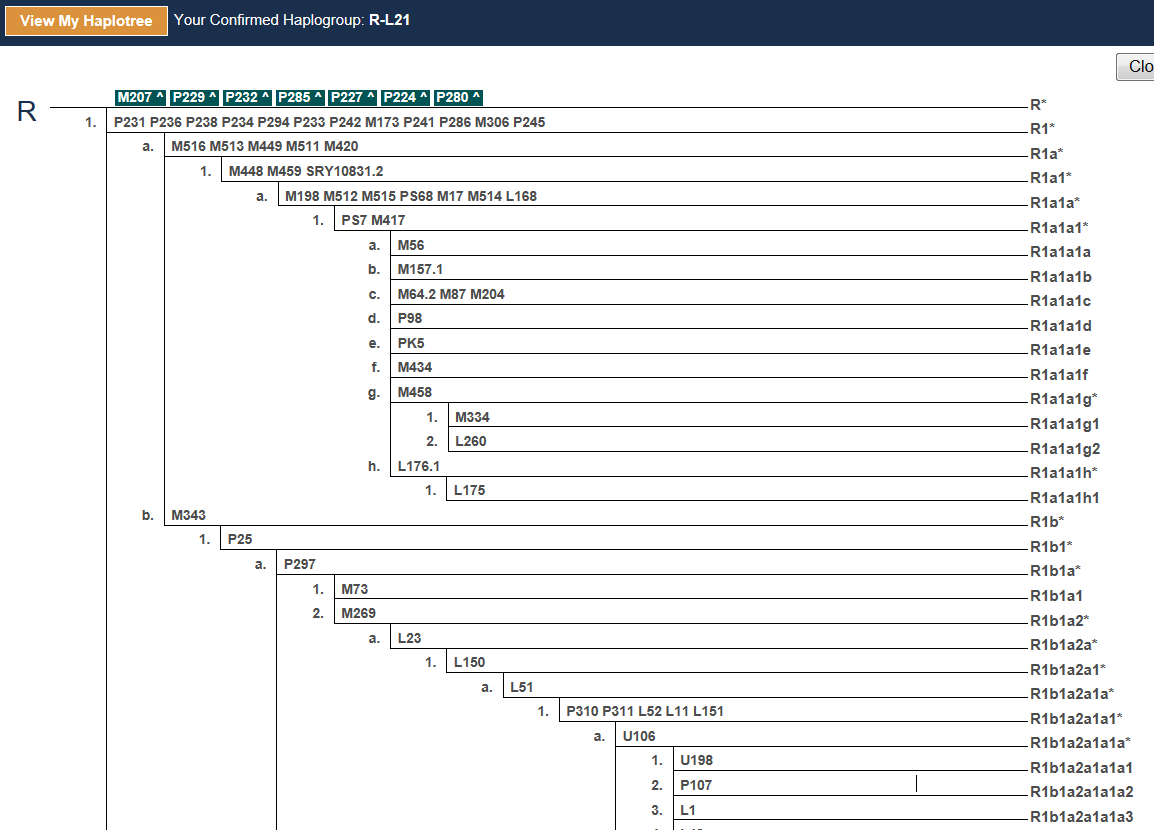
Today, at Family Tree DNA, this is what the top part of the haplogroup R tree looks like.

new hap name

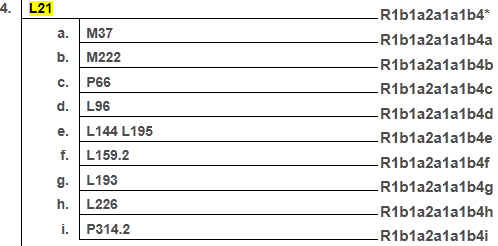
As new SNPs are discovered and inserted into the tree, there will no longer be a name assigned, shown in the right hand column.  As the names are obsoleted because of shuffling of branches on the tree, they will not be renamed.  Already, at Family Tree DNA, they are using just the SNP name as the haplogroup indicator, as you can see in the top bar where is says “Your confirmed haplogroup R-L21.  This means haplogroup R, SNP L21, which occurs further down on the tree.

Today,  R-L21 is still shown on the tree with its name, R1b1a2a1a1b4, but as the tree branches shuffle and this name no longer applies to R-L21, the name will be obsoleted and the haplogroup will only referenced as R-L21.

new hap name 1

Max Blankfeld and Bennett Greenspan of Family Tree DNA recently wrote this explanation which is found on the haplogroup pages at Family Tree DNA.

Long time customers of Family Tree DNA have seen the YCC-tree of Homo Sapiens evolve over the past several years as new SNPs have been discovered. Sometimes these new SNPs cause a substantial change in the “longhand” explanation of your terminal Haplogroup. Because of this confusion, we introduced a shorthand version a few years ago that lists the branch of the tree and your terminal SNP, i.e. J-L147, in lieu of J1c3d. Therefore, in the very near term, Family Tree DNA will discontinue showing the current “longhand” on the tree and we will focus all of our discussions around your terminal defining SNP.

This changes no science – it just provides an easier and less confusing way for us all to communicate.

Obviously, more than a decade’s worth of information exists that references the haplogroups in both formats.  Other companies in this space are not doing this level of testing and do not yet need to address this type of issue, so their data bases and references will likely stay the same, at least for the time being.  For some time to come, we will be dealing in a dual world where both methodologies are utilized and yes, some amount of confusion will certainly result.  In preparation, I wanted you to understand what has happened in the past, the recent changes, what the future holds, and why.

______________________________________________________________

Disclosure

I receive a small contribution when you click on some of the links to vendors in my articles. This does NOT increase the price you pay but helps me to keep the lights on and this informational blog free for everyone. Please click on the links in the articles or to the vendors below if you are purchasing products or DNA testing.

Thank you so much.

DNA Purchases and Free Transfers

Genealogy Services

Genealogy Research

Family Tree DNA Research Center Facilitates Discovery of Ancient Root to Y Tree

The genetic genealogy community has been abuzz for months now with the discovery of the new Root of the Y tree.  First announced last fall at the conference for DNA administrators hosted by Family Tree DNA, this discovery has literally changed the landscape of early genetic genealogy and our understanding of the timeframe of the origins of mankind.  While it doesn’t make much difference in genetic genealogy in the past few generations, since the adoption of surnames, it certainly makes a difference to all of us in terms of our ancestors and where we came from – our origins.  After all, the only difference between current genetic genealogy and the journey of mankind is a matter of generations – and all of our ancestors were there, and survived to reproduce, or we wouldn’t be here.

One of the important aspects of this discovery is the collaboration of citizen scientists with academic institutions and corporations.  In this case, the citizen scientist was Bonnie Schrack, a volunteer haplogroup project administrator, Dr. Michael Hammer of the University of Arizona, National Geographic’s Genographic Project, and Thomas Krahn and Astrid Krahn, both with the Gene by Gene Genomics Research Center.  Without any one of these players, and Family Tree DNA’s support of projects, this discovery would not have been made.  This discovery of the “new root” legitimizes citizen science in the field of genetic genealogy and ushers in a new day in scientific research in which crowd sourced samples, in this case, through Family Tree DNA projects, provide clues and resources for important scientific discoveries.

Today Gene by Gene released a press release about the discovery of the new root.  In conjunction, Family Tree DNA has lowered their Y DNA test price to $39 for the introductory 12 marker panel for the month of March, hoping to attract new participants and to eliminate price as a factor.  On April 1, the price will increase to $49, still a 50% discount from the previous $99.  Who knows where that next discovery lies.  Could it be in your DNA?

Family Tree DNA’s Genomics Research Center Facilitates Discovery of Extremely Ancient Root to the Human Y Chromosome Phylogenetic Tree

HOUSTON, March 26, 2013 /PRNewswire/   — Gene By Gene, Ltd., the Houston-based   genomics and genetics testing company, announced that a unique DNA sample submitted via National Geographic’s Genographic Project to its genetic genealogy subsidiary, Family Tree DNA, led to the discovery that the most recent common ancestor for the Y chromosome lineage tree is potentially as old as 338,000 years.  This new information indicates that the last common ancestor of all modern Y chromosomes is 70 percent older than previously thought.

The surprising findings were published in the report “An African American Paternal Lineage Adds an Extremely Ancient Root to the Human Y Chromosome Phylogenetic Tree” in The   American Journal of Human Genetics earlier this month.  The study was conducted by a team of top research scientists, including lead scientist Dr. Michael F. Hammer of   the University of Arizona, who currently serves on Gene By Gene’s advisory board, and two of the company’s staff scientists, Drs.Thomas and Astrid-Maria Krahn.

The DNA sample had originally been submitted to National Geographic’s Genographic Project, the world’s largest “citizen science” genetic research effort with more than 500,000 public participants to date, and was later transferred to Family Tree DNA’s database for genealogical research.  Once in Family Tree DNA’s database, long-time project administrator Bonnie Schrack noticed that the sample was very unique and advocated for further testing to be done.

“This whole discovery began, really, with a citizen scientist – someone very similar to our many customers who are interested in learning more about their family roots using one of our genealogy products,” said Gene By Gene President Bennett Greenspan.  “While reviewing samples in our database, she recognized that this specific sample was unique and  brought it to the attention of our scientists to do further testing.  The results were astounding and show the value of individuals undergoing DNA testing so that we can continue to grow our databases and discover additional critical information about human origins and evolution.”

The discovery took place at Family Tree DNA’s Genomic Research Center, a CLIA registered lab in Houston which has processed more than 5 million discrete DNA tests from more than 700,000 individuals and organizations, including participants in the Genographic Project.  Drs. Thomas and Astrid-Maria Krahn of Family Tree DNA conducted the company’s Walk-Through-Y test on the sample and during the scoring process, quickly realized the unique nature of the sample, given the vast number of mutations.  Following their initial findings, Dr. Hammer and others joined to conduct a formal study, sequencing ~240 kb of the chromosome sample to identify private, derived mutations on this lineage, which has been named A00.

“Our findings indicate that the last common Y chromosome ancestor may have lived long before the first anatomically modern humans appeared in Africa about 195,000 years ago,” said Dr. Michael Hammer.  “Furthermore, the sample, which came from an African American man living in South Carolina, matched Y chromosome DNA of males from a very small area in western Cameroon, indicating that the lineage is extremely rare in Africa today, and its presence in the US is likely due to the Atlantic slave trade.  This is a huge discovery for our field and shows the critical role direct-to-consumer DNA testing companies can play in science; this might not have been known otherwise.”

Family Tree DNA recently dramatically reduced the price of its basic Y-DNA test by approximately 50%.  By offering the lowest-cost DNA test available on the market today, Gene By Gene and Family Tree DNA are working to eliminate cost as a barrier to individuals introducing themselves to personal genetic and genomic research.  They hope that expanding the pool of DNA samples in their database will lead to future important scientific discoveries.

About Gene By Gene, Ltd. 
Founded in 2000, Gene By Gene, Ltd. provides reliable DNA testing to a wide range of consumer and institutional customers through its four divisions focusing on ancestry, health, research and paternity.  Gene By Gene provides DNA tests through its Family Tree DNA division, which pioneered the concept of direct-to-consumer testing in the field of genetic genealogy more than a decade ago.  Gene by Gene is CLIA registered and through its clinical-health division DNA Traits offers regulated diagnostic  tests.  DNA DTC is the Research Use Only (RUO) division serving both direct-to-consumer and institutional clients   worldwide.  Gene By Gene offers AABB certified relationship tests through its paternity testing division, DNA Findings. The privately held company is headquartered in Houston, which is also home to its state-of-the-art Genomics Research Center.

SOURCE Gene By Gene, Ltd.

______________________________________________________________

Disclosure

I receive a small contribution when you click on some of the links to vendors in my articles. This does NOT increase the price you pay but helps me to keep the lights on and this informational blog free for everyone. Please click on the links in the articles or to the vendors below if you are purchasing products or DNA testing.

Thank you so much.

DNA Purchases and Free Transfers

Family Tree DNA

MyHeritage DNA only

MyHeritage DNA plus Health

MyHeritage FREE DNA file upload

AncestryDNA

23andMe Ancestry

23andMe Ancestry Plus Health

LivingDNA

Genealogy Services

MyHeritage FREE Tree Builder

MyHeritage Subscription with Free Trial

Genealogy Research

Legacy Tree Genealogists for genealogy research

Projects, Administrators and Expectations

projects fireside

One of the reasons  I wanted to start a blog was to be able to chat about genetic genealogy topics that interest people.  I can tell what’s on your mind by the questions I receive.  For some reason, I’ve received several questions and some complaints about projects and administrators recently, and I think a fireside chat might clarify things a lot.

A few questions arrived in my in-box this past week that I’d like to paraphrase and address.  The first question is from a male and the second from a female.

Question 1 –  I’m in a number of projects.  One of the administrators contacted me and suggested I do some additional SNP testing.  But my surname project administrator has never said anything about this.  If I needed more testing, why wouldn’t my surname project administrator tell me about this?  Is this legitimate?

Question 2 – I’m so upset.  I tried to join the XYZ surname project and the administrator told me that I couldn’t.  Why can’t they be more flexible and realize I’m related to that family?  This project is listed by Family Tree DNA as one I should join, but the administrator won’t let me.

I see confusion, misunderstanding and frustration in both of these questions, for both the participants and the administrators.  I’d like to talk a little bit about projects, why they are formed, administrators, participants and expectations.

Projects

There are four types of projects at Family Tree DNA.

1.  Surname Projects – The earliest projects formed were surname projects.  Those are based on surnames, like Estes, and typically focus on the paternal lines and the Y chromosome and only that specific surname.  Herein lies the first point of confusion.  Because these projects were formed to sort out male family lines of a particular surname, they are typically restricted to males who carry that surname, or sometimes males who match that surname through adoptions of some sort.

Question 2 relates to this problem.  From her perspective, she “should be” allowed to join, because she is related.  But from a scientific perspective, there is no benefit for a female to join a male focused project.  However, from a public relations perspective, it won’t hurt to let her join.  Because women’s surnames change every generations, she could theoretically join all the surname projects for all of her ancestors.  None of it would benefit her for matching etc., but it won’t hurt anything either.

From an administrator’s perspective, having people in a project that can’t advance the goals of the project is simply clutter.  Not only that, but we have to do something with them, categorize them somehow, or leave them ungrouped.  It’s also confusing to people looking at a Y-line project to see other surnames and apparently unrelated or unconnected people.  Conversely, I want people to be happy with genetic genealogy and since she is related and very interested, perhaps she can contribute something in the way of research.angel devil

If this sounds a bit like the angel and devil, one on each shoulder talking to each other…..well, that’s because it is and there is no one right answer.

There is an exception, of course, to what I just said.  It seems there is always an exception to everything.

Family Finder

Recently with the Family Finder tests, more and more administrators are including people in their surname projects who are related to that family but who do not carry the surname because it’s the only way we have today of including Family Finder participants and grouping them.  I have begun to do this myself as a project administrator.

The alternative to this is to begin lineage projects, such as the Johann Michael Miller Descendants project, just for descendants who have taken the Family Finder test.  This is a way to know who they are, to group them so that you can work with their results.  The challenge is that projects are not set up to function this way.  They are set up to display Yline (males) and mitochondrial DNA results, only, or both for a kit, and in this case, the Yline and mitochondrial DNA results are both irrelevant and misleading if they are displayed as valid results.  Administrators are trying to figure out the best way to deal with this.

The work-around I’ve implemented is a grouping within the surname project labeled Family Finder where those who are related but don’t carry the particular surname are grouped.  I am actively recruiting descendants for these groupings as Family Finder holds great promise in finding those elusive unidentified wives, unnamed children…..but I digress.

Here’s what my Crumley project looks like.  You can see that the grouping of Family Finder is entirely irrelevant to the rest of the project, but it’s the best we can do under the current project structure.

Projects 1

2.  Haplogroup Projects – The second type of project formed was haplogroup projects.  These are for both Y-line and mitochondrial.  Some haplogroups have only one project, like mitochondrial haplogroup K, for example.  Others, like mitochondrial haplogroup H or Y-line R have many subprojects.  These projects are a function of who wants to study what – and who is willing to do the work.

Haplogroup projects, by and large, are research projects.  This means that they are arranged quite differently than surname projects.  Surname projects are generally arranged by family and within family, by line, when possible.  Haplogroup projects aren’t concerned with surnames, but with deep ancestry and location, and they are arranged by haplogroup and sub-haplogroup.

A great deal of the progress in understanding haplogroups, their history, migration patterns and the discovery of subgroups has come from the haplogroup projects.  They are very important, make no mistake.  Family Tree DNA is the only place in the world where there are groups of people grouped by haplogroup in public projects.  This is citizen science at it’s best.

The haplogroup Q project had made significant scientific contributions.  You can see that participants are grouped by haplogroup, meaning by SNP.  In some cases, administrators also group participants by the tests needed to further refine their haplogroups.  When you refine your haplogroup with further testing, you also refine your personal story and contribute to science as well.

projects 2

Haplogroup Q groups participants by their haplogroup, above, but when they need additional testing, they are grouped with others who need that test, below.  Why do they need additional testing?  That’s how we learn about haplogroups.  Every additional SNP that you test positive or negative for tells us more about migrations, about where your ancestors lived and what they did.  The power of this isn’t just in one test, but in many tests combined that write the story of our ancestors.

Projects 3

To illustrate the power of many versus one, the mapping function comes to mind.  Each project administrator can enable or disable mapping.  Mapping can be very useful to surname projects, but it’s crucial to haplogroup projects.

Here’s the map for all of haplogroup Q.   Interesting, but all that this really tells us is that it’s pretty universal.  It’s one of two Native American haplogroups, but sub-groups are found throughout Asia and Europe as well.  Want to know if you’re Native?  Then you’ll have to do SNP testing.

Projects 4

The map below shows the oldest known ancestors for those who carry SNP M25.  Looking at this map tells you immediately that these people aren’t Native American.  But if you live in the US and you’re looking for Native ancestry, and you don’t test to this level, you can be left with the erroneous impression that your haplogroup Q result IS Native when it isn’t.

Projects 5

Ah, the power of maps.  Most project administrators enable maps.

The administrators of haplogroup projects are focused very differently than surname project administrators.  This explains the confusion in question 1 about why the surname admin didn’t suggest SNP testing, but the haplogroup project admin did.

Administrators Are Different People

Ok, stop laughting!

This introduces a bit of a different topic and that is what motivates haplogroup administrators.  I mean, let’s face it, why WOULD you volunteer for this?  The answer is simple – passion combined with a smidgen of insanity!

Surname administrators are most often the family genealogist.  We all know them.  We probably are them.  It’s what attracted us to genetic genealogy in the first place.  They may or may not be terribly familiar with the science of genetics, with SNPs, and may or may not be aware of the benefits of SNP testing.  They can, however, recite the details of the original immigrant who arrived in Virginia in 1683 and all their children!

Haplogroup project administrators tend to be scientists.  I’m very fortunate that my co-admin on the haplogroup E1b1a project is a population geneticist.  Yes, they are interested in their surname family, but they are also very focused on their ancient ancestry too – in making that connection between the two and unraveling their story.  To them, haplogroup projects represent opportunities not otherwise available.

This brings us to the third and fourth kinds of projects, lineage and geographic projects, whose administrators are passionate about their project’s subject.

3.  Lineage Projects – Not many of these exist today and most that do are maternal (mitochondrial) DNA lineage projects, such as the descendants of Jane Doe, but I expect as we sort through how to best address lineage with Family Finder tests, lineage projects will become more widely utilized.

4.  Geographic projects, the fourth type of project, are all projects other than above.  These include many special interest projects, such as the Hatteras Island project, the Cumberland Gap project, the Mothers of Acadia project, the Lumbee project, the Lost Colony project, and many more.

These projects are as different as the people who founded them.  Some projects are research projects and some are what I term courtesy projects.

My Cumberland Gap Project is a courtesy project.  This means I formed it to allow people from a particular region to interact and to share.  There is an associated Yahoo group that is very active. I do not have to approve membership. It’s open for all

The Lost Colony projects (and there are three, Y-line, mitochondrial and Family) are research projects.  This means that the membership is restricted to people with specific qualifications.  I don’t do this to be mean, it’s critical to the research goals of the project.  Let me illustrate.  The goal of the Lost Colony Y-line project is to test people with a specific set of surnames (the Lost Colonists surnames) who are found in very early eastern North Carolina counties.  The project description says this and so does the FAQ.  However, 99% of the requests to join the projects say something like this: “I want to compare my results with that of the Lost Colonists.”  Well, guess what folks…..we’re trying to figure out what the Lost Colonists’ DNA looks like too.

Right now, the people in the Lost Colony Y-line project are good candidates to be descended from the colonists.  We’re working to find the colonist families in England to confirm.  However, if I let everyone who wants to compare their DNA to these people into the project, how would we ever know who is a true colonist candidate and who is just a comparer???

People get really upset when I explain this to them.  And I have to say this…I can’t resist….had they read the project background and goals in the first place….they could have saved themselves and me both some time because they would have known that they don’t qualify, and why.  They can support the project in other ways if they are interested.

As a project administrator, my largest frustration by far is with people who don’t read what is available for them.

I finally set up the Lost Colony Family project as a courtesy project for everyone who wants to test and compare their results to each other.  Now there is a place for the frustrated people who can’t join the Lost Colony Y-line or mitochondrial projects.

Some geographic (and surname) projects require pedigree charts and a specific genealogy to join.  For example, both the Lumbee and Cherokee projects have this requirement.  Of course, for a Y-line or mtDNA project, your connection must be through either the paternal line or the maternal line.  We receive requests to join daily from people who are connected, but not by Y-line or mtDNA, and they are terribly frustrated and sometimes quite angry when they are told they aren’t qualified to join.  It’s not a judgment, it’s the way DNA works.

Project administrators are the gatekeepers to be sure the project retains focus and stays on track, which is only fair to the people hoping to learn and gain information by being project members.  Project administrators are not there to simply be difficult to random applicants.  Most of us really dislike having to decline a join request, even if we do explain.  We know that some people simply won’t understand and will be upset or angry with us personally.  Not fun.

This begs the question of why people are trying to join projects that aren’t good fits for them anyway???

Picking the Right Project

The good news and the bad news is that Family Tree DNA tries to help people find relevant projects.  Unfortunately, it’s easy to misinterpret this if you don’t understand the source of this information.  Below is an example.  I’ve entered my surname, Estes, and these are the “associated projects” that are shown.  Many people interpret these to be “recommended” by Family Tree DNA, and they join each and every one of them.  That’s not the goal, nor are all projects appropriate for everyone.

Projects 6

Since I’m a female, none of the Y projects are relevant to me, and neither is the Estes surname project, generally.  However, a new person wouldn’t have the experience to know this, so administrators need to help educate people.  I wrote about this in the article, “What Project Do I Join?”

These projects are on this list because their administrator included the surname in their project profile, meaning they are interested in attracting people, or at least some people, with that surname.  However, they may not be interested in attracting all people with that surname.  If your surname is Estes and your family never set foot in America, then obviously the Cumberland Gap group, focused on the convergence of states Kentucky, Tennessee and Virginia, is not likely to be of interest to you.  Since it is a courtesy project, you can join if you want, but if it was a project like the Lost Colony projects, then you would need to provide some evidence that your family fits the criteria for those the project is seeking.

Ok, so now we’ve talked about the four kinds of projects and how to select the right one for you.  Let’s talk a little bit about what you can expect from an administrator and what they expect from you.

Administrators

First of all, administrators are volunteers.  They receive no compensation of any sort, no discounts, nothing, except they are eligible to attend the annual DNA Conference in Houston.  Eligible to attend does not mean the conference is free.  I don’t bring this up as a complaint, it’s just that there has been a persistent rumor that refuses to entirely die that administrators receive some percentage of sales or compensation of some sort for running projects.  They don’t and never have.

Because they are volunteers, their administration and personal communication styles vary widely.  Many don’t have any co-administrators so have no backup or assistance.  Some are prompt at answering e-mails, some not.  Genetic genealogy and projects are now more than 10 years old.  People age, they die, they get distracted and some just haven’t kept up.  This field moves very rapidly.  If you see a project in trouble, consider offering to help.  If that doesn’t work, notify Family Tree DNA.

There are published guidelines for administrators.  Mostly these deal with privacy and what they can and can’t do.  Most of this is intuitive, but maybe not to everyone so it is in writing.

A good project administrator:

  • Communicates with members, especially if contacted
  • Keeps the project groups current
  • Assists members equally and fairly
  • Is honest, but sensitive, especially in difficult situations like undocumented adoptions (NonParental Events)
  • Is courteous

Sounds kind of like the scouts doesn’t it?

Every project is different.  As an administrator, every time I send group messages to large projects, my e-mail address gets blacklisted as a spammer.  So I set up a Yahoo group for each of these projects, plus have provided my blog address.  Every person receives this information when they join in an automated e-mail which explains explicitly how to join the Yahoo groups and subscribe to my blog.  Still, last week, someone left one of these projects with the comment “no communication.”  Sigh.  Remember what I said about reading???

A few very poorly run projects do exist.  In one case, the administrator does not use Family Tree DNA’s public website, nor a private one, and the only way you can obtain project information is by signing up with My Family.  In another case, the administrator keeps the results private, much like above, but wrote a book about the surname a couple years ago.  That seems to call into question the motivation for the project.  These are sad and frustrating experiences for the participants.

Project admins cannot:

  • Charge a fee to join a project
  • Share or change private information (in fact, the Family Tree DNA website blocks that for admins)
  • Share the identity or personal information of participants without permission
  • Move members from one project to another
  • Use member information for any commercial purpose without authorization
  • Use member information and e-mails for spamming, etc.
  • Use a DNA project to advocate a personal or political agenda

Notify family tree DNA is you feel something is wrong or you have a concern.  Consider offering to help if you notice a project languishing.

Project Members

We’ve talked about projects, why they are different and what you can expect from an administrator, but what do they expect from you as a participant, or potential participant?

1. Courtesy – I’ve met many lovely people through genetic genealogy, but I’ve also met my share of real dooseys.  I see increasingly more “entitlement attitude” relative to projects with join criteria.  In the words of one person who did not meet the criteria, “I deserve to be in this project.  I have the right.”  I strongly suspect that only the nice people who want to learn will have gotten this far in this article, so I won’t expound further:)  For you folks, I don’t need to!

2. READ – Please, please read what is provided relative to the project goals and join criteria.  Now this is a double edged sword, because it means the admin needs to be sure to provide this information and keep it current.  Maybe I need to look at my project verbiage to see if it needs to be bolded, highlighted or in red!

3. Information – If information is requested, especially in a specific format, please comply as best you can.  There is generally a reason for the request.  Most admins don’t want to make extra work for you or themselves.  Not all projects require information.  I ask for a pedigree chart for everyone in my surname projects, and you would be amazed at how many people join the project and then never reply to any of my e-mails – probably about 50%.  This is why some admins have gone to requiring a pedigree chart of some sort before people are allowed to join. And providing a pedigree chart does not mean sending a link to your tree at Ancestry.  At Ancestry, all the admin can do is write everything down, by hand, IF they can find your line of the family in the chart.  Remember, current and recent generations are “private” at Ancestry, so finding the right family line is almost impossible without additional information.  I provide a mini-genealogy form for my project members that has them complete only the direct line directly back from them.  Here’s the one for mitochondrial and the one for Y-line is the same except the word mother is changed to father.

Projects 7

Our Fireside Chat

I hope this has helped dispel some of the confusion surrounding projects, administrators, participants and expectations.  This field started out to be quite simple, with only Y surname projects, but as the field has developed and evolved over the last decade, so have projects and with that has come some level of complexity.  Joining the correct projects for you, your family and your DNA can be one of the most beneficial aspects of genetic genealogy, allowing you to find family and collaborate your research efforts with others.

______________________________________________________________

Disclosure

I receive a small contribution when you click on some of the links to vendors in my articles. This does NOT increase the price you pay but helps me to keep the lights on and this informational blog free for everyone. Please click on the links in the articles or to the vendors below if you are purchasing products or DNA testing.

Thank you so much.

DNA Purchases and Free Transfers

Genealogy Services

Genealogy Research

What is a Haplogroup?

Sometimes we’ve been doing genetic genealogy for so long we forget what it’s like to be new.  I’m reminded, sometimes humorously, by some of the questions I receive.

When I do DNA Reports for clients, each person receives a form to complete with a few questions designed to give them the opportunity to tell me what their testing goals are and to ask any questions they might have.  One woman asked, “Can you tell me about my psychogroup?”

I thought that psychogroup was particularly appropriate for a cluster of genealogists, especially genetic genealogists, but decided I had better let that one go.

Then there was the person who wanted to know about their hologroup.  I wondered if I needed 3D glasses for that one.

Someone else wondered about their helpgroup.  I couldn’t help but think of introducing myself, “Hello, my name is Roberta and I’m a member of haplogroup J.”  Kinda gives new meaning to “what’s your sign?”

Then there was the person who though it was a Biblical reference, Holygroup and wanted to know how they connected to Biblical folks.  Well, we do talk about Y-line Adam and Mitochondrial Eve, so why wouldn’t someone ask that?

My favorite, though is the person who gave this reason for leaving a haplogroup project, “not my glopo.”  Hey, at least they realized that, as opposed to the person who called me a member of the KKK for suggesting that they did not belong in a particular project.  I found that to be particularly humorous, given my ethnic mix, heritage and family.

But today, when my cousin asked me if a haplogroup follows the mitochondrial DNA, I decided it was time to talk about what a haplogroup is, a little history, and why we use them.  And Shanen, thanks for asking!

Think of a haplogroup as an ancestral clan, a large family, like the Celts, or Vikings.  These would be larger than Native American tribes, encompassing members of many tribes.  There are two male Native American haplogroups that include all Native American males.  There are a few more African clans, or haplogroups, but not many.

There are clans for the Y chromosome, which is of course tested by the Y DNA test at Family Tree DNA and generally follows the paternal surname up and down the tree.  Y DNA is passed from father to son, only, through the Y chromosome which only males possess.

There are also clans for mitochondrial DNA, tested by the mtDNA tests at Family Tree DNA, which follows the direct maternal line up your family tree.  This means your mother, her mother, her mother, etc.  Woman give their mitochondrial DNA to all of their offspring, males and females, but only females pass it on.

You can see the Y-line, paternal (blue) and mitochondrial, maternal (red), lines on the pedigree chart below.

adopted pedigree

Companies like 23andMe and the Geno 2.0 project provide haplogroups for both Y-line and mitochondrial DNA, but neither of them test personal mutations that allow you to compare your mutations against those of other people for genealogical matches.  The regular Y-line and mitochondrial tests at Family Tree DNA do that.  In addition, both also provide your haplogroup or clan designation.

A new haplogroup is born when a very specific new mutation occurs.  All descendants will carry that mutation.  That mutation defines that haplogroup.  So if a new haplogroup is born today, we wouldn’t know it was a haplogroup until hundreds or thousands of years later when we see that lots of people have this same mutation from a single individual.  As you might imagine, many haplogroups over the ages have died out, but some have been very successful as evidenced by the fact that we are all here today!  Roughly half of the European men carry Y haplogroup R and mitochondrial haplogroup H is found in nearly 50% of all Europeans – both descending, respectively, from one single person tens of thousands of years ago.

Since all of humanity, both male and female, sprang initially from Africa, the earliest haplogroups were found there.  As some people moved further away and crossed into Asia and Europe, they developed unique mutations that would give rise to the European, Asian and Native American haplogroups we know today.  There are 4 main groupings, African, European, Asian and Native American, but there are several subgroups within most of those main groups, except for Native Americans who only have two male haplogroups.

So in essence, haplogroups are a pedigree chart of the clans of humanity.  Family Tree DNA displays a haplogroup chart with the main haplogroups shown on everyone’s personal page for Y-line DNA.  They were simply named alphabetically with no connection to a word.  So no, A is not A because it’s African, even though it happens to be.  N is not Native American.  E is not European.  You get the drift.  Any resemblance is purely coincidental.

haplogroup 1

Your clan, in this example, haplogroup I, is shown with an arrow.  Every clan, male and female, has subclans, often known as subclades for Y DNA or subgroups for mitochondrial DNA.  To see the various subgroups of I, click on the tab and voila, there they are, the subgroups of haplogroup I.  Yours is the lowest one on the tree that is green, in this case I2b1a1.

Because of the dramatic new number of haplogroups recently discovered, future versions of the haplotree will be moving away from the letter based names like I2b1a1 and will only use the terminal, or lowest branch, SNP to identify a haplogroup.  In this case, that would be L126 or L137 which are equivalent SNPs.  So in the future this person’s haplogroup will be called I-L126 instead of I2b1a1 because L126 will never change, but the name I2b1a1 changes every time a new upstream haplogroup is discovered between the root of haplogroup I and I2b1a1 and needs to be inserted into its proper place in the tree.

haplogroup 2

As we learn more about the subgroups, each one has its own story which is somewhat different than the stories of the other subgroups.  Some are evident, such as Jewish clusters, some not so much.  Each clan story involves how that haplogroup came to be found where it is today.  For example, haplogroup E is African, but within haplogroup E, there are two major divisions with very different stories for their clans.  One group is found only in Sub-Saharan African and one is found mostly in the Middle East and the Mediterranean basin and is known colloquially as the Berber haplogroup.  We’re still learning about subgroups, and with the Geno 2.0 test, the haplotree is growing exponentially.

Family Tree DNA predicts your clan, or haplogroup, with any Y-DNA test as long as you match exactly at 12 markers to someone who has been SNP tested.  SNP testing is what tests for the special haplogroup defining mutations.  If you don’t match, they will SNP test you for free to establish your primary haplogroup.

Many people purchase additional SNP tests to further define their Y haplogroup so that they can learn about where their ancestors were, when, and what they were doing.  For example, we know that SNP M222 equates to Niall of the 9 Hostages in history.  How cool is that to know!

Some years ago, Dr. Doug McDonald assembled this wonderful map of the basic haplogroups of the world. Although we’ve discovered subgroups for each haplogroup, it’s still quite valid.  E3b has since been renamed E1b1b and ExE3b means haplogroup E1b1a.  RxR1 means haplogroup R except R1a and R1b which have their own legend.

haplogroups of the world y

Mitochondrial DNA also has haplogroups, which are clans.  On the drawing below, compliments of Dr. Whit Athey, it’s easier to see how the daughter clans arose, were born, and were named.  Because of the naming pattern, this looks a little less like a pedigree chart and a little more like stars, planets and moons.

atheymitomaporiginal

One difference between Y-line DNA and mitochondrial DNA clans is that although they are all currently named alphabetically, the mitochondrial clans have names.  That is thanks to Dr. Bryan Sykes who wrote the book, “The Seven Daughters of Eve” published in 2001. For example, he named haplogroup H, Helena because Helena is Greek for light.  He told somewhat accurate stories about each clan and although quite scientifically dated now, described the life that each clan would have lived in post-glacial Europe.  This book was the first book about DNA to reach the popular reading public, and was a huge success because he humanized science and normal air-breathing humans could relate.  I ordered my first mitochondrial DNA test through his company and received one page with a Sunday School gold star on the red dot for haplogroup J.

OxfordAncestor0001

I was thrilled at the time, but times have changed a lot.  Due to advances in research and new subclades being defined, thanks in large part to citizen scientists like you, I now know that I’m haplogroup J1c2f as a result of my full sequence mitochondrial DNA test.

Unlike Y-line DNA, no additional SNP test is required to fully determine your mitochondrial DNA haplogroup.  When you take the full mitochondrial sequence test (mtFullSequence) at Family Tree DNA, you receive your most detailed, full haplogroup designation automatically.  With the HVR1 (mtDNA) and HVR2 (mtDNAPlus) tests, you receive at least your base haplogroup.  The full sequence is required to determine your full haplogroup.

To put this in perspective, think of your mitochondrial DNA as a clock face.  There are a total of 16,569 locations in your mitochondrial DNA.  The HVR1 test tests the number of locations from 11:55 to noon and the HVR2 test tests the number of locations between noon and 12:05PM.  The full sequence test tests the rest, the balance of the 50 minutes of the hour.

Family Tree DNA is the only commercial testing company that offers the full sequence test.

haplogroups of the world mt

As more discoveries are made for both male and female haplogroups, the subgroup names sometimes change within the clan or main haplogroup because new branches get inserted in the tree as they are discovered.

For example, from a scientific paper, here’s an early version of the haplogroup H mitochondrial phylotree which is what the haplotree is called for mitochondrial DNA.

Haplogroup H early

Here’s a later version.

haplogroup H later

You wouldn’t even be able to see today’s version, because the print would have to be miniscule to fit it on the page.  In Dr. Behar’s paper, “A ‘Copernican’ Reassessment of the Human Mitochondrial DNA Tree from its Root” published in April 2012, the supplemental material records haplogroup H87.  Most of those subgroups have subgroups of their own, like you can see above, and those that don’t today soon will as new discoveries are made.

Now that you know what a haplogroup is, there’s a lot you can do with both mitochondrial and Y-line DNA results.

Even if you do nothing more, it’s fun to identify your clan.  It’s the only way of extending our genealogy back in time beyond surnames.  For me, to connect my last known maternal ancestor, Elisabetha Mehlheimer, born in or near Goppsmannbuhl, Germany around 1800 to the cave paintings in Chauvet, France created about 12,000 years ago was a magical moment, a reach across time through a tenuous umbilical strand allowing me to identify and touch my 12,000 year-old ancestor.  In my wildest genealogist dreams, I never dreamed this could or would ever be possible and indeed, it wouldn’t be, were it not for the genetic genealogy tools we have today.

chauvet painting

Proving Native American Ancestry Using DNA

Every day, I receive e-mails very similar to this one.

“My family has always said that we were part Native American.  I want to prove this so that I can receive help with money for college.”

The reasons vary, and not everyone wants to prove their heritage in order to qualify for some type of assistance.  Some want to find their tribe and join to reclaim their lost heritage.  Some want to honor their persecuted and hidden ancestors, undoing some of the wickedness of the past, and some simply seek the truth.  Regardless of why, they are all searching for information lost to them.

I’d like to talk about three topics in proving Native Ancestry.  First, I’d like to do some myth-busting.  Second, I’d like to talk a little about conventional research and third, I’d like to discuss what DNA can, and can’t, do for you.

As you read this blog, please click on the links.  I’m not going to repeat something I’ve already covered elsewhere.

Myth-Busting

Myth 1 – Free College

There is no free college for Native Americans.  There are sometimes scholarships and grants available, mostly by the individual tribes themselves, for their official members.

Myth 2 – Joining a Tribe

Many people think that if they can only figure out which tribe their ancestor descends from, they can join.  This is untrue.  Each tribe is a sovereign nation, and they get to determine their criteria for membership.  Most tribes require a specific percentage of Native “blood,” called blood quantum, in addition to being able to document which tribal member you descend from.  Some tribes require as much as 25% Native heritage, and most require at least 1/16th Native heritage, which is one great-great grandparent.  If you don’t know who in your family was a tribal member it’s unlikely that you would be able to meet the blood quantum requirement.

Myth 3 – DNA Testing Will Reveal my Tribe

Generally, DNA testing does not provide us with the information needed to determine a tribe, although it can clearly tell, using y-line or mitochondrial DNA testing, whether your direct paternal or maternal line was or was not Native.  Sometimes you will be able to infer a tribe based on your matches and their documented history, but the definition of tribes, their names and locations have changed over time.  We are working on improving this ability, but the science simply isn’t there yet and the number of Native people who have tested remains small.

Simply put, most federally recognized tribes aren’t interested in more tribal members.  More members mean a smaller piece of the pie for existing members.  The pot of resources, whatever resources you’re discussing, is only so large and it must be shared by all tribal members.

What is a Tribe?

Tribes in the US fall into two categories.  When most people think about tribes they are talking about federally recognized tribes.  Those are tribes that have some continuity with the past, such as they have always been a tribe, or they still retain tribal lands, etc., and the federal government recognizes them as such.  These are the tribes that qualify for government programs and many own casinos.  As you might imagine, with the influx of casino money, the desire to join a tribe has increased significantly.

The second category is non-federally recognized tribes.  Some are state recognized and others, not at all.  State recognition does not in any way guarantee federal or state funding and there are no universal standards for state recognition.  In other words, your mileage may vary, widely.  Non-federally recognized tribes are often run as non-profit entities.  In many cases, these tribes will help people research and document their genealogy and may be more open to tribal membership for those connecting with their Native heritage.

Be aware that some “tribes” that fall into the non-federally recognized category may be less than ethical.  Some tend to come and go.  In one case, to apply to join, one had to provide information such as social security numbers and a complete family pedigree including your children. In some cases, membership is very expensive, hundreds of dollars, but is available to almost anyone for the right price.  When evaluating tribes that are not federally recognized, if something sounds fishy, it probably is.  Caution is the watchword.

In general, the federally recognized tribes do not feel kindly towards the non-federally recognized tribes and view them as “fake,” interlopers trying to get part of that pie.  Of course, the non-federally recognized tribes feel differently; that they are reclaiming their heritage denied them.  Native American politics is nothing new and is fraught with landmines.

No federally recognized tribes, to the best of my knowledge, have considered DNA testing as a criteria for membership.  No federally recognized tribe has endorsed or participated in DNA testing that I’m aware of.  This does not mean that individuals have not privately tested.

Traditional Genealogy Research

Given the criteria for membership in federally recognized tribes, traditional genealogy is the only way to obtain the type of information required.  If your family history includes a tribal name, and east of the Mississippi, that most often is Cherokee, contact the various Cherokee tribes to inquire about membership criteria.  If the membership criteria is 25% blood quantum, and you must live on the reservation, you’re toast…..no need to continue that line of research if your goal is to join the tribe.

If your goal is simply to find your Native ancestor, that’s another matter entirely.  Begin by using the traditional research tools.

First, look at where your ancestor or that family line was located.  Did they migrate from elsewhere?  How were they listed in the census?  Was someone listed as other than white, indicating mixed race?  Check the records where they lived, tax records and others to see if there is any indication of non-European heritage.  Remember that your non-white ancestor would have retained their “darker” countenance for at least 2 generations after being admixed.  Many Native people were admixed very early.

So first, check the normal genealogy records and look for hints and traces of non-European ancestry.

Second, turn to Native resources that might reflect the Native people in the areas where your family is or was found.  The Access Genealogy site is absolutely wonderful and has an amazingly complete set of records including searchable tribal rolls.  In addition, I add information almost daily to the Native Heritage Project at www.nativeheritageproject.com, which is searchable.  There are many more resources including several collections at Ancestry.com.

Hopefully, these records will help narrow your focus in your family tree to a particular person or two, not just a general branch.  Family rumors like “Grandma was a Cherokee Princess” are particularly unuseful.  What they more likely mean is that there was indeed some Native ancestry someplace in her line.  Cherokee has become a generic word like Kleenex.  It may also have meant that Indian heritage was claimed to cover much less desirable African heritage.  Institutionalized discrimination existed against any people of color in pre-1967 America, but Indians generally retained some rights that people of African ancestry did not.  Laws varied by state and time.  Take a look at my blog about Anti-Miscegenation Laws and when they were overturned.

Now, let’s look at DNA testing to see what it can do for you.

DNA Testing to Prove Native Ancestry

There are three types of DNA testing that you can do to prove Native Ancestry.  Two are very focused on specific family lines, and one is much more general.

  • Mitochondrial for your direct maternal line.
  • Y-line for your direct paternal line – if you are a male. Sorry ladies.
  • Autosomal to test your ethnic mix and one direct marker test for Native ancestors.

On a pedigree chart, these genealogical lines look like this:

adopted pedigree

You can see the path that the blue Y chromosome takes down the paternal line to the brother and the path the red mitochondrial DNA takes down the maternal line to both the brother and the sister.  Autosomal tests the DNA of all of the 16 ancestral lines shown here, but in a different sort of way.

Let’s look at each type of testing separately.

Y-Line DNA – For Paternal Line Testing for Males

The Y-line testing tests the Y chromosome which is passed intact from father to son with no DNA from the mother. This is the blue square on the pedigree chart. In this way, it remains the same in each generation, allowing us to compare it to others with a similar surname to see if we are from the same “Smith” family, for example, or to others with different surnames, in the case of adoption or Native heritage.  Native American genetics isn’t terribly different than adoptees in this situation, because different English surnames were adopted by various family members, into the late 1800s and sometimes into the early 1900s, depending on the location.

Y-line DNA can tell you whether or not you descend from a common male genealogically when compared to another testing participant.  Small mutations do take place and accumulate over time, and we depend on those so that we don’t all “look alike” genetically.  It can also tell you by identifying your deep ancestral clan, called a haplogroup, whether or not you descend from early Native Americans who were here before contact with Europeans.  For that matter, it can also tell you if you descend from those of African, European or Asian ancestry.

Scientists know today that there are only two primary haplogroups indicating deep ancestry that are found among Native American males who were here prior to contact with Indo-Europeans, and those haplogroups are C and Q3.  It is not accurate to say that all C and Q3 individuals exist only in the American Native population, but the American Native population is part of the larger group worldwide that comprises C and Q3.  We find some haplogroup C and Q3 in Europe but none in African populations, although we do learn more every single day in this infant science.

This sometimes becomes confusing, because the single most common male haplogroup among current Cherokee tribal members who have tested is R1b.  How can this be, you ask?  Clearly, one of three possibilities exists:

  1. The Cherokee (or those tribes who were assimilated into the Cherokee) adopted a European male into the tribe or a European male fathered a child that was subsequently raised as Cherokee.
  2. The R1b ancestor was not adopted into the tribe, maintained their European/American identity but married a Cherokee individual woman and their descendants are recognized as Cherokee today.
  3. There is some level of R1b admixture in the Native population that preceded contact with Europeans that we have not yet identified.

Because of the unique haplogroups for Native Americans who preceded European contact, Y-line is the only way to positively confirm that a specific line is or is not of Native American descent.  This obviously applies to all of the individuals in the pedigree chart who directly descend from the oldest known ancestor in this paternal line.

Y-line testing does not indicate anything about the contributions of the other ancestors in this family tree.  In other words, you could be 3/4th Native, with only the direct paternal line being European, and this test would tell you nothing at all about those other three Native lines.

When ordering DNA tests at Family Tree DNA, which is where I recommend that you test, everyone is encouraged to join projects.  There are several types of projects, but to begin with, you should join your surname project.  Not only does this group you with others whom you are likely to match, but this also assures that you receive the project based discounts.  I blogged about how to find and join relevant projects.

You can test at 12, 25, 37, 67 or 111 marker “locations” on the Y chromosome. I generally recommend 37 or 67 to begin which gives you enough to work with but isn’t terribly expensive.  At Family Tree DNA, you can always upgrade later, but it’s less expensive in total to test more initially.

Family Tree DNA provides significant tools for Y-line DNA as well as Mitochondrial DNA. At Family Tree DNA, for all their tests, you are provided with the e-mail addresses of your matches. At Ancestry and 23andMe, you contact matches through their internal message system. My experience has been that direct e-mails have a better response rate.

The person looking for Native Heritage will be most interested in their haplogroup designation.  If your haplogroup is either Q or C, you’ll want to join your haplogroup project, minimally, as well as other relevant Native American projects, and work with the administrators for further testing.  Remember, neither haplogroup Q nor C are always Native, so deeper testing may be in order.  You may also match others with confirmed Native heritage, including a tribe.

If the haplogroup is not Native, then you’ll have to take a look at possible reasons why.

One can never interpret non-Native haplogroup results of any one line to answer the much broader questions of, “do I have Native heritage”, “how much” and “where?”  What you can do at that point is to continue to test other lines in order to discover the identity of your Native American ancestor.

Obviously, the Y-line test is only for males. Ladies, I feel your pain. However, these next tests are for both sexes.

Mitochondrial DNA – For Direct Maternal Line Testing for Both Sexes

Mitochondrial DNA is inherited by all children from their mother only, with no admixture from the father. Women obtain their mitochondrial DNA from their mother, who got it from their mother, on up the line into infinity. This is the red circle on the right hand side of the pedigree chart. Like Y-line DNA, mitochondrial DNA is passed intact from one generation to the next, except for an occasional mutation that allows us to identify family members and family lines.

Unfortunately, it does not follow any surname. In fact the surname changes with every generation when women marry. This makes it more challenging to work with genealogically, but certainly not impossible. Because of the surname changes in every generation, there are no “surname” projects for mitochondrial DNA, per se, but there are other types of projects.  For example, the Mothers of Acadia project is using mitochondrial DNA to reconstruct the Acadian families including those of Native American heritage.

There are three levels of testing you can take for mitochondrial DNA at Family Tree DNA, which is where I recommend that you test. The mtDNA, the mtDNAPlus and the Full Sequence. The mtDNA test is a starter test that will provide you with a base haplogroup, but will leave people searching for Native ancestry needing a more complete test for full haplogroup identification confirming Native ancestry. I strongly recommend the full sequence test, but if the budget just won’t allow that, then the mtDNAPlus will do until you can afford to upgrade. Family Tree DNA is the only major lab that tests the full sequence region, plus, they have the largest matching data base in the industry.

To put this in perspective for you, the mtDNA and the mtDNAPlus tests both test about 10% of your mitochondrial DNA and the full sequence test tests all of your 16,569 mitochondrial locations. You can then compare them with other people who have taken any of those 3 tests.  Pricing for the mtDNAPlus is currently $139 and the full sequence is $199.

MtDNA testing is not as popular as Y-line testing because it’s more difficult to use genealogically as last names change every generation.  When you look at your matches, you have no idea whatsoever if you might be related to these people in a genealogically relevant time frame by looking at their last names.  Those who have invested the effort to collaboratively work on their mtDNA matches, assuming a full sequence match and a shared geographical history as well, have been pleasantly surprised by what they’ve found.

A haplogroup assigning deep ancestry is provided through mitochondrial testing, so like the Y-line, depending on the haplogroup assigned, you will know if your ancestors were here before European contact.  Maternal haplogroups that indicate Native heritage include A, B, C, D and X.  Like Y-line DNA testing, none of these haplogroups are exclusive to Native Americans, so a full sequence level test will be required to confirm a Native American subgroup.

After you receive your results, you can enter the mtDNA and mtDNAPlus portions into public data bases. There are no public data bases for the full sequence segment because there may be medical implications in some of those mutations, so they are not displayed publicly although they are compared privately within the Family Tree DNA data base. You will want to enter your data and check for matches at www.mitosearch.org (upload directly from your matches page at Family Tree DNA), www.smgf.org and www.ancestry.com, although beware of Ancestry’s accuracy issues.

Update: As of 2019, mitosearch and SMGF no longer exist and Ancestry no longer sells Y and mitochondrial DNA tests, having destroyed their database.

Testing the Y-line and mitochondrial DNA individually gives us a great deal of very specific information about 2 lines in your pedigree chart.  The best method of identifying Native American ancestors is indeed to test as many lines on your DNA pedigree chart using this methodology as possible.  Let’s take a minute to look at how to create a DNA pedigree chart.

DNA Pedigree Chart

If your Y-line and mitochondrial DNA have proven not to be Native, that doesn’t mean that the rest of your lines aren’t.

Let’s take a look at how to create a DNA pedigree chart so that you can focus your Y-line and mitochondrial DNA testing for other lines.

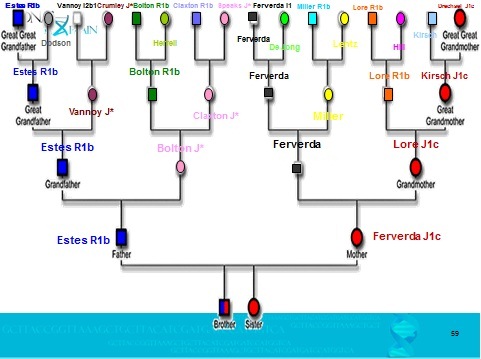
The purpose of a DNA pedigree chart is to provide guidance in terms of inheritance and also to provide a way of documenting your progress.  My chart is shown below, as an example.
DNA Pedigree

You can see the Y-line of my father and the mitochondrial line of my mother, on both ends of the pedigree chart.  At the top of each line, I have recorded the haplogroup information for each family.  Color coding each line helps in tracking descendants who would carry the DNA of the ancestor of that line.  For example, my mother’s father’s mother’s line is the yellow Miller line.  I need to find a daughter of my grandfather’s sisters, or their children, or their daughter’s children, to test for that mitochondrial DNA line.  Which reminds me, I need to call my cousin.  Family reunions, picnics and holidays are great for this type of thing.  Sadly, so are funerals.

I blogged about how to put together your own DNA pedigree chart. If you’re Native and adopted, then refer to the adoptee blog instead, or in addition.

But sometimes, we can’t find the right people in order to test, so we move to autosomal testing to help us fill in the blanks.

Autosomal Testing – For Both Sexes – The Rest of the Story 

Autosomal DNA testing tests all of your 23 pairs of chromosomes that you inherit from both of your parents. You get half of each chromosome from each parent. You can see this pattern on the pedigree chart, represented by all of the 16 genealogical lines. Therefore, as you move up that tree, you should have inherited about 25% of your DNA from each grandparent, about 12.5% of your DNA from each great-grandparent, as have all of their other great-grandchildren.

Therefore beginning with your parents, you carry the following approximate amount of DNA from each of these ancestors. I say approximate, because while you do receive exactly 50% of your DNA from each parent, there is no guarantee that their parents DNA was admixed in your parents such that you receive exactly 25% from each grandparent, but it’s close.  You can see the percentages in the chart below.

Generation Relationship % of Their DNA You Carry

1

Parents

50

2

Grandparents

25

3

Great-grandparents

12.5

4

GG-grandparents

6.25

5

GGG-grandparents

3.125

6

GGGG-grandparents

1.56

7

GGGGG-Grandparents

0.78

Given this chart, if the Native percentage is back beyond 6 generations and drops below the 1% threshold, it’s extremely difficult to discern today.

Autosomal testing will pick up relationships reliably back to about the 6th or 7th generations, and sporadically beyond that.

Autosomal testing provides you minimally with two things.  First, with a list of “cousin matches” by percentage and estimated relationship.  Second, percentages of ethnicity.  It’s this second part that’s most important for the person seeking to prove Native American heritage.

Percentages of Ethnicity

As the field of genetic genealogy has moved forward, research has begun to indicate that certain autosomal markers are found in higher or lower frequencies in different ethnic populations.

For example, if someone has the Duffy Null allele, or genetic marker, we know they positively have African admixture.  We don’t know how much African admixture, or from which line, or when that individual with African admixture entered their family tree, but we know for sure they existed.

Attempting to determine the population frequency of varying markers and what that means relative to other populations is the key to this analysis.  Few markers are simply present or absent in populations, but are found in varying frequencies.  Some populations are widely studied in the research literature, and others are virtually untouched.  Thousands have only been recently discovered as part of the National Geographic, Genographic project.

The process of compiling this information in a meaningful manner so that it can be analyzed is a formidable task, as the information is often found in nearly inaccessible academic and forensic research publications.  It’s difficult to determine sometimes if the DNA analysis of 29 individuals in a small village in northern Italy is, for example, representative of that village as a whole, of northern Italy, or more broadly for all of Italy.  Is it representative of Italy today or Italy historically?  These and other similar questions have to be answered fully before the data from autosomal testing can be useful and reliable.

Let’s take a look at all 3 of the contemporary autosomal tests and what they have to offer.

Note: as of 2019, MyHeritage is also a major player in the autosomal DNA testing space.

Family Tree DNA

Family Tree DNA sells the Family Finder test. Right now it is priced at $79 or bundled with attractive pricing with either the Y-line or mitochondrial DNA tests. I often like to use this tool in conjunction with the Y-line and mitochondrial DNA tests to see, if you match someone closely, whether you are actually related to them in a recent timeframe or if it is further back. Family Tree DNA is the only one of the autosomal testing companies that has the ability to do this type of advanced comparison.  Compared to 23andMe and Geno 2.0, they are the only ones to offer traditional Y-line and mitochondrial DNA testing which provides individual marker results and matches.

In addition to a list of autosomal matches, you will receive your breakdown of ethnicity, by percent.  The results below are for the same man with Native ancestry whose Geno 2.0 results are shown in the Geno 2.0 – First Peek blog.

native pop finder

You can read more about the Family Tree DNA autosomal product on their FAQ.

23andMe

Another company that sells autosomal testing is http://www.23andme.com. In addition to a list of cousins, you also receive admixture percentages, and their specialty, health traits.  You also receive a paternal and maternal haplogroup, but with no markers for personal comparison.  These Y-line and mitochondrial results are not as accurate at the Geno 2.0 nor the Family Tree DNA Y-line and mitochondrial DNA full sequence tests.

Be aware that while people who test at Family Tree DNA are interested in genealogy, the typical person at 23andMe tested for the health portion, not the genealogy portion, and may not answer contact requests or may know very little about their family history.

Right now, their test is $99, and you can download your results and upload them to Family Tree DNA for an additional $89, making the total price similar to the Family Tree DNA test. However, you need to be somewhat technically savvy to complete the download/upload process.

23andMe recently released a new version of their software which added quite a bit of resolution after years of being woefully behind.  Native American wasn’t even a category previously.

Ancestry

Ancestry.com recently introduced an autosomal test.  You receive matches and ethnicity percentages.  However, their ethnicity percentages have significant issues and I would not recommend them at this time.  Their cousin matches come with no analysis tools.  So for now, just skip Ancestry and concentrate on the other resources.

One Last Autosomal Test

One marker value in particular, known as D9S919 is present in about 30% of the Native people.  The value of 9 at this marker is not known to be present in any other ethnic group, so this mutation occurred after the Native people migrated across Beringia into the Americas, but long enough ago to be present in many descendants.  You can test this marker individually at Family Tree DNA, which is the only lab that offers this test.  If you have the value of 9 at this marker, it confirms Native heritage, but if you don’t carry 9, it does NOT disprove Native heritage.  After all, many Native people don’t carry it.

To order this test, for existing Family Tree DNA clients, click on the “Order Upgrade” orange button on the right hand side of your personal page, then on “Advanced Test”, then enter “autosomal” in the drop down box, then you will see the list below. D9S919 is the last one and it costs $15.  There may be a $10 one time transfer fee as well if your DNA sample is not in the Houston lab.

native d9s919 order

Swimming in Many Pools

As you can see there are lots of tools available to you that can be used individually or in conjunction with each other.  Like anything else, the more work and effort you are willing to devote to the search, the more likely you are to be successful.

Most people test their Y-line and mitochondrial DNA, not just for Native ancestry, but to learn more about the lines they can test for themselves without reaching out to other family members.

Use your DNA pedigree chart to plan who to ask in your extended family to test for which lines.

Plan to test with multiple autosomal testing companies.  Autosomal testing in particular is still in its infancy. I like to use the results of multiple companies, especially when you are dealing with small amounts of admixture.  They use different markers, combinations, analysis tools and reference populations, so you can expect slightly different results.  One company may pick up slight minority admixture while another may not.  This has happened repeatedly with both my Native and African minority admixture.

GedMatch

After you obtain your results from either Family Tree DNA or 23andMe, you’ll want to download your raw data results and then upload the file to www.gedmatch.com. This is a privately run “donation” site, not associated with any of the testing companies, meaning there is no subscription or fee to use the tools, but they do appreciate and are funded by donations.

After uploading your results you can utilize several admixture tools to compare and contrast your results.

Getting Help

If you’re struggling with working through your family possibilities for who to test, I do offer a DNA Test Plan service.

If you would like a Personalized DNA Report for Y-line or mitochondrial results, those are available as well.

If you have what amounts to a quick question that I can answer in less than an hour, including prep, I offer the Quick Consult service.

For more extensive consulting, contact me.  You can see my services here.

In Summary

Finding our Native ancestors is a way to pay homage to their lives and to the culture that was stripped from their descendants, ironically, by using their own DNA that has been gifted from them to us.  Native people, after contact with Europeans were marginalized, and that’s the best that can be said.  Many were killed, either intentionally or by European diseases, or enslaved.  The results are that Native people left few if any individual records and those that might be available often can’t be identified or linked to them personally.  For those who cannot unearth their Native ancestry using conventional genealogical means, genetic testing is the last hope left.  Fortunately, the tools and our knowledge improve every day.  We’re making great strides with what we can do, enlarging what was a pinhole into a keyhole, allowing us to peer into the past.  So, click your heels, order your tests and let’s see where your DNA takes you.

______________________________________________________________

Disclosure

I receive a small contribution when you click on some of the links to vendors in my articles. This does NOT increase the price you pay but helps me to keep the lights on and this informational blog free for everyone. Please click on the links in the articles or to the vendors below if you are purchasing products or DNA testing.

Thank you so much.

DNA Purchases and Free Transfers

Genealogy Services

Genealogy Research

The New Root – Haplogroup A00

Now that things have calmed down a bit from the whirlwind of the Family Tree DNA Conference, I’d like to write in a little more comprehensive and sane manner about the revelation that we have a new root on the human tree.

I’m referring to the session given by Bonnie Schrack, Thomas Krahn and Michael Hammer titled “In Search of the Root: Discovery of a Highly Divergent Y Chromosome Lineage.”

Bonnie has posted her slides from the presentation as well as her speaking notes on her new haplogroup A webpage.  She contacted me with some corrections to my original Blog posting about that session at the conference as well as provided additional information.  Thank you Bonnie, not just for this info, but for your work with haplogroup A that has been such a key part of this momentous discovery.  This isn’t just a once-in-a-lifetime event, it’s a once-in-the-history-of-mankind event.  Watch the haplogroup A website for more information from Bonnie about this exciting discovery and project.

Understandably, Bonnie, Thomas and Michael are somewhat restricted in what they can say until such time as the resulting academic paper in the works is published.

We all know that male humans arise from a person we call Y-line Adam, just like we call the first woman Mitochondrial Eve.  Before a 2011 paper, it was believed that shortly after Adam, haplogroup A and B were formed about the same time and were brother haplogroups.  Fulvio Cruciani’s 2011 paper, “A Revised Root for the Human Y Chromosomal Phylogenetic Tree: The Origin of Patrilineal Diversity in Africa” reorganized that tree and showed that indeed, haplogroup A formed from the root of all humanity with B forming from haplogroup A.

Cruciani showed his newly organized tree with haplogroup A1b, A1a and then A2, A3 and BT as brother haplogroups.  Cruciani did not use STR data, only SNP data in his study.

A second recent study, also in 2011, “Signatures of the pre-agricultural peopling processes in sub-Saharan Africa as revealed by the phylogeography of early Y chromosome lineages” by Chiara Batini et al, did include some STR marker that matched some of the haplogroup A samples.  Batini did not use SNP testing, so did not realize the potential of these STR samples.  These did not match the new A00 root, but other rare haplogroup A samples in subgroups.

The 7 marker STR samples that did match the new A00 sample were from a private database at the Center for Genetic Anthropology who very graciously worked with Michael Hammer and provided small amounts of those samples for further analysis.

In my conference blog posting, I asked how this discovery was previously missed, and Bonnie Schrack responded as follows:

“The reasons we had never heard about A00 before would be:

  • Very scanty research and sample collection in Africa, in proportion to the size and diversity of the population, compared to Europe and other more developed countries
  • Only recently has large-scale Y sequencing become practical and affordable; Cruciani’s 2011 paper was a breakthrough precisely because for the first time they were able to sequence a few samples on the scale of a WTY, resulting in a lot of new SNPs, and we’ve been able to make even more progress because we had a larger pool of (customer) samples from which I could cherry-pick the most divergent samples, and then our genetic genealogy/anthropology community made it possible to raise enough funds for us to sequence the most important three of them (after that point, Hammer and FTDNA found the other samples and funds).”

Before the WTY program, this type of analysis simply wasn’t being done.  This monumental discovery was a combination of citizen science, the haplogroup A project, an innovative scientific program, the WTY at Family Tree DNA, academic partnership, Michael Hammer’s lab at the University of Arizona and other institutions, along with that crucial public participation.  Without the public participation aspect, the rest would be a moot point.

Haplogroup A research at Family Tree DNA discovered not only one, but two new branches of haplogroup A, one of which was actually a new base root that needed to be inserted before, upstream of, the current root.  The locations where these new branches/roots needed to be inserted required the renaming of the current branches, hence, the newly discovered branch A00 and Cruciani’s branch, formerly A1b, is now A0.

Thomas Krahn’s A00 discovery presentation slides are also available online.  You can tell he’s a scientist from the nature of his presentation.  You can see the actual process of discovery, in essence, what he saw as this new root was unearthed.  It’s fun to walk along with him, even if you don’t understand everything you see.

As part of this process, Thomas also sequenced the DNA of a chimp and a gorilla.  You can see the results at www.ysearch.org for the chimp at 6RCUU, the gorilla at 9ED3A and the new root, A00, at 6M5JA.  You can breathe easy, humans are far distant from chimps and gorillas, but maybe closer to Neanderthals or other archaic humans than we thought.

Update: As of 2019, Ysearch is no longer available.

At the end of Thomas’s presentation, he included the image of a tree with a new root and lots of interesting branches.

Zooming in on the branches, you can see all of the DNA sequencing paraphernalia, microplates, readouts and results.  Maybe there is a little artist buried someplace in Thomas amid those scientific genes!

This work was no small feat, and the significance is mind-boggling.  This new discovery pushed the date of Y-Adam back a whopping 67% in one fell swoop.  Cruciani’s birth age for haplogroup A1b was 140,000 years ago and A00, compared to Cruciani’s sample, falls at 237,000 years ago.

Dr. Michael Hammer at the University of Arizona reanalyzed the haplogroup A tree and root with the new information available, and his new ages are even more amazing.  Cruciani’s A1b/A0 sample is now at 200,000 years old and A00 is at 338,000, with a 98% confidence level.

These dates pre-date all human fossils, although there are some archaic fossils that have been found and dated after this time in neighboring Nigeria.  This new information provides us with glimpses through the keyhole of time into ancient human origins, and begs even more questions that will be answered in time, with more genetic and anthropology research.  We all descend from this common root, and we may all be more closely related to archaic man that we knew.

The A00 participant descends from a former slave family in South Carolina.  The closest matches are found in western Cameroon near the Gulf of Guinea, a prime location in the slave trade.

There appears to be about 500 years between the participant and the samples from Cameroon, an age that speaks to the beginning of the slave trade.

Having worked closely with Lenny Trujillo, the man whose WTY sample provided us with haplogroup-changing and defining information for haplogroup Q, and understanding what a moving experience this journey has been for Lenny, I wondered about how the family involved with this revolutionary discovery must feel.

As luck would have it, I have worked with this family in one of my projects as well, and they contacted me after seeing my blog about the conference.

I asked how they felt, how they were reacting to this history-changing event in which their family was the keystone.  I have extracted pieces from e-mails back and forth, and with the families permission, am sharing what they had to say.  Clearly, without them and their active and supportive participation, this discovery would not have been made.  We all owe them a debt of gratitude.

“I have a B.S. in Mathematics. I love science and learning. I recently retired, but I spent a lot of that time working with research scientists on cutting edge technology and methods so it is very exciting to me to be a part of such a scientific discovery. My family would say I was the right one chosen.  This is the family line I know the most about so I am glad it was this part of my family.

I don’t yet have the formal results from Family Tree DNA concerning the Y-DNA sample they tested in the Walk Through the Y, I did know that the discovery was monumental from some preliminary results from Thomas.

I wanted to see the tie back to Africa, looks like GOD did exceedingly, abundantly more than I could ever ask or think. Just think of how long HE has preserved this Y-lineage just for such a time as this.”

______________________________________________________________

Disclosure

I receive a small contribution when you click on some of the links to vendors in my articles. This does NOT increase the price you pay but helps me to keep the lights on and this informational blog free for everyone. Please click on the links in the articles or to the vendors below if you are purchasing products or DNA testing.

Thank you so much.

DNA Purchases and Free Transfers

Genealogy Services

Genealogy Research

CRS Extended Haplogroup

This posting will assuredly come under the category of “things you never really wanted to know.”  The only time this will really come in useful is if Trivial Pursuit adds a genetic genealogy category, which, by the way, I think would be a wonderful idea!

Did you ever wonder about the person who took the original mitochondrial DNA test and became the Cambridge Reference Sequence?  That was in 1981, so that person may well still be alive today.  The Cambridge Reference Sequence, or CRS, is the standard to which the rest of us are compared.  Our results for mitochondrial DNA testing are the differences between us and that mystery person, so while we probably don’t realize it, the CRS and that person are important to all of us.

Simply by the luck of the draw, given that haplogroup H comprises about 50% of the population of Europe, they are likely to be from haplogroup H.  But are they?

Does anyone know?  Ok, Rebekah Canada can’t play, because, well, I know that she knows.  She helped me unravel this.  That should tell you something right there if you’re familiar with some of the genetic genealogy players.  Rebekah is one of the admins for the massive haplogroup H project and the sole admin for many of the subgroups.  So like Bill Hurst is Mr. MtDNA and Jim Logan is Mr. Hap J, Rebekah is Ms. H.  So that should confirm for you right there that indeed the CRS is haplogroup H.  And it is, but which subgroup?

Every haplogroup has a defining list of mutations that must be present (or back mutated) in order to assign that haplogroup level.  This week, I had a client who had a long list of those haplogroup mutations attributed to their haplogroup by definition, but none of the haplogroup defining mutations were listed on their CRS mutation list.  Confused?  There’s a reason for that.  Keep reading.

Care to guess why their list of haplogroup defining mutations was not on their personal page list of mutations?  Someone out there is pretty sharp….indeed….you’re right….it’s because they matched the CRS at all of those haplogroup defining levels.  This means that this person IS the same haplogroup as the CRS.

Does anyone know what haplogroup the CRS falls into at the full sequence level?

Drum roll…….

H2a2a.

Here are the required mutations for the different subclades of H that lead us to H2a2a.  This is the list of mutations that this client “should have” on their personal page.

Haplogroup Required Mutations
H 2706A,   7028C
H2 14384A
H2a 4769A
H2a2 750A
H2a2a 263A, 8860A, 15326A

However, someone who falls into haplogroup H2a2a won’t show any of these mutations on their list of mutations on their personal page that differs from the CRS, because the CRS is defined as “normal” and everything else is a mutation.

These results, shown above, with the exception of two mutations in the HVR2 region, are equivalent to the Cambridge Reference Sequence.  That means that whatever mutations that anonymous CRS individual had when they were sequenced in 1981 became “the norm” and everyone else is compared against them.  So if they HAVE a mutation, it’s not listed as such because it’s now “normal.”  Does this seem somehow backwards?  It is.  But it’s because that’s all we had in the beginning and we had to start with what we had and where we were in 1981.

This backwardness is particularly evident at location 16519.  You’ll notice that this person doesn’t show a difference at this location.  Most of the people in Europe show this location as a mutation.  What this really means is that the CRS has a mutation at that location, but since it’s considered the norm, the rest of the people, well over 50%, show this as a mutation.

But since these haplogroup defining mutations are the “norm” and since they define the CRS, they don’t show up on the list of mutations that differ from the CRS.  The only two mutations that this person has that differs from the CRS are the insertions at locations 309 and 315, shown above.  So in reality, this means that this person has all of those mutations in the haplogroup defining chart above, which are for comparison purposes, “normal,” plus the two below that differ from the CRS.

I realize this is a bit confusing.  Instead of comparing mitochondrial DNA to someone buried on a branch of haplogroup H who was alive in 1981, we should really be comparing everyone to Mitochondrial Eve.  That is exactly why the scientific world is moving to the RSRS model, the Reconstructed Sapiens Reference Sequence.  The RSRS mutations for this person are shown below, as compared to mitochondrial Eve, and you’ll notice all of the mutations shown in the chart above that define haplogroup H2a2a are present, plus the two at location 309 and 315.

If you’d like to test your mitochondrial DNA test, click here and order the full sequence test!

______________________________________________________________

Disclosure

I receive a small contribution when you click on some of the links to vendors in my articles. This does NOT increase the price you pay but helps me to keep the lights on and this informational blog free for everyone. Please click on the links in the articles or to the vendors below if you are purchasing products or DNA testing.

Thank you so much.

DNA Purchases and Free Transfers

Genealogy Services

Genealogy Research

Germain Doucet and Haplogroup C3b

I love a good mystery, don’t you?  Well, the Doucet family has one and it’s a doosey.

Marie Rundquist, the founder and administrator of the Amerindian Ancestry Out of Acadia project at Family Tree DNA has recently written a new paper about the C3b results within the project.

Marie’s paper, titled “C3b Y Chromosome DNA Test Results Point to Native American Deep Ancestry, Relatedness, Among United States and Canadian Study Participants,” tells about the project and the findings relative to haplogroup C3b.  Her raw data is available within the project.  The Native American people involved are the Mi’kmaq and ironically, while we have found several Mi’kmaq men who carry haplogroup C3b, we haven’t found any carrying the much more common Q1a3a.

The Acadian people were French and settled in the eastern-most region of Canada beginning in 1605 in Port Royal, Nova Scotia.  They mixed freely with the Native people and intermarried.  Beginning in 1710 and continuing until 1755, when they were forcibly deported, they were in conflict with the English government and refused to sign an oath of loyalty to England. The families were highly endogamous.  Today, if you discover you descend from an Acadian family, you will discover that you descend from many Acadian families.  I have one cousin who discovered that he and I are related 132 different ways.

The map below shows Acadia just before the Acadians were deported.

Marie’s paper shows that 6 different families with different surnames carry haplogroup C3b and all are related within 16 generations, or between 400 and 500 years.  Many are, of course, related much more closely.

The Doucet family is represented by 8 different males who all tested as haplogroup C3b.  They descend from various sons of Germain Doucet, born in 1641.  Germain was always presumed to be the son of the French founder, Germain Doucet, born in 1595 in France, the commander of Fort Royal.

Hmmm, this is known as a fly in the ointment.  Indeed, the original descendants of Germain Doucet (1595) who had tested carried haplogroups of R1b1a2, clearly European, just as we would expect.  But then, there was another Doucet test and he was discovered to be haplogroup C3b.

Keith Doucet, the man who tested to be C3b, and Marie subsequently wrote about their discovery and the process they went through to find other men to confirm that DNA result in a story titled “Confirmed C3b Y DNA Results Test the Heritage of Cajun Cousin Keith Doucet.”

This of course, raises questions, none of which can be readily answered.  Doesn’t every genealogy find raise at least two new questions?  Well, this one raises a few more than two.

The other son of Germain Doucet (1595), Pierre tests to be R1b1a2, while “son” Germain (1641) tested to be C3b.  Obviously, these man cannot both be the genetic children of Germain Doucet (1595) and unless a Native American Mi’kmaq male made their way to France sometime in the distant past, Germain (1641)’s father was not from France and was not Germain Doucet (1595).

We know that Germain Doucet (1595) arrived in Port Royal in 1632, was noted as the commander in 1640 and returned to France in 1654 after Port Royal fell to the English, leaving at least two of his 4 children who had married in Port Royal.

So what happened?  Here are some possibilities.

  • Germain Doucet (1595) and his wife adopted an Indian child and named him Germain Doucet
  • One of Germain Doucet’s older daughter’s had an illegitimate child and named him Germain Doucet, in honor of her father.
  • Germain’s wife became pregnant by a Native man.
  • A Native person adopted Germain Doucet’s name out of respect.  When Native people were baptized in the Catholic faith, they were given non-Native names.

So, through Marie’s project and hard work, we’ve solved one mystery and introduce yet another.

______________________________________________________________

Disclosure

I receive a small contribution when you click on some of the links to vendors in my articles. This does NOT increase the price you pay but helps me to keep the lights on and this informational blog free for everyone. Please click on the links in the articles or to the vendors below if you are purchasing products or DNA testing.

Thank you so much.

DNA Purchases and Free Transfers

Genealogy Services

Genealogy Research

The DNA Pedigree Chart – Mining for Ancestors

Judy Russell blogged a few days ago about counting up the number of ancestors you have found, of the total number available in the past 10 generations in her blog, “More Lost than Found.”  Judy had a tidy total of 12% after the 10th generation, counting your parents as generation 1. She has only been researching for 12 years.  A veritable youngster.  I’ve been researching for 34 years, so I was hopeful that my percentage would be somewhat better.  At 1% per year, I should rack up about 34%.  We’ll see.

In my presentations, I always talk to people about building their DNA pedigree chart.  I use my own as an example.  It took a lot of work, not to mention money and in some cases, some significant arm-twisting to accomplish this.

It pains me that there are blanks at the top, and some of them can never be filled.  The one person who could test for the Ruthy Dodson Estes (Claiborne Co., Tn.) mitochondrial line, won’t.  The Kirsch family has few male descendants here in the US, and so far, the only one I can find isn’t interested in testing.

With some heavy duty elbow-grease, I should be able to find someone to test for the Margaret Herrell Cook Bolton (Claiborne County, TN) and the Margaret Lentz Miller (Montgomery Co., OH and Elkhart Co., IN) lines.

Some lines are simply dead.  The deJong line had no daughters and we don’t know who her parents were in the Netherlands, so we can’t go upstream.  I can’t find Rachel Hill Lore’s daughter’s descendants from Warren County, Pa.

Instead, I focus on the 10 lines whose DNA I do have.  I thought this was pretty good, actually.  Of these 16 ancestors, I have the DNA of 10 of them.

Last week, when I read Judy’s article, I wondered exactly how my DNA pedigree chart would compare to the number of ancestors in total and the number found.  I wouldn’t say this comparison has been fun, but it has been enlightening in a number of ways.

On the chart below, the generation is noted, the total number of end-of-line ancestors in that generation, the number of ancestors I’ve identified, the percentage that represents, followed by the number whose DNA I have and the percentage compared to the total number of ancestors possible.  The percent would look a lot better if compared it with the number of ancestors identified….but that wouldn’t be playing quite fair.

Generation

Ancestors Total

Ancestors Identified

Percent

IDed

DNA Anc

%

DNA

1 – parents

2

2

100

2

100

2 – grandparents

4

4

100

4

100

3 – great-grandparents

8

8

100

7

88

4 – gg-grandparents

16

16

100

10

63

5 – ggg – grandparents

32

32

100

22

69

6 – gggg – grandparents

64

52 (6 women no surname)

87

20

31

7 – ggggg – grandparents

128

72 (5 women no surname)

56

19

15

8 – gggggg-grandparents

256

90 (7 women no surname)

35

21

8

9 – ggggggg-grandparents

512

106 (12 women no surname)

21

23

4

10 – gggggggg-grandparents

1024

101 (4 women no surname, 8 duplicate ancestors on Mom’s side)

10

25

2

Total

2046

483

24

153

7

I wound up doing an extra generation that Judy didn’t do.

So comparing my 9th generation with Judy’s number, I had a total of 382 ancestors found out of 1022 possible, for 37%.  At 1% per year, I’m three years ahead of schedule!

Expanding this number to the 10th generation reduced my percentage to 24%, but still not bad for 300 years ago, or so.

So Judy, take heart, in another 22 years you’ll be up to 37%, about one third of the way there.  It looks like one gains about 1% per year, so at this rate you’ll only need to live for another 88 years to be done.  I can die when I’m only 119.  I sure hope my retirement money holds out that long!

Finding Ancestors DNA

On the chart, the “DNA Anc” column heading means DNA ancestor’s located and the next column, “% DNA,” is the associated percentage.  While significantly smaller than the number found, this information is still quite interesting for a number of reasons.

First, my pedigree collapse didn’t begin until the 10th generation.  On my Mom’s side, I have a lot of ethnic groups, for lack of a better term for them.  I have the Brethren, the Acadians, the Dutch and other non-Brethren German immigrants, all of which lived in clusters and intermarried after arriving in the states.  The pedigree collapse, where the same ancestor is found in your tree more than once, occurred in both the Acadian line and the immigrant non-Brethren German lines back in Germany.

In order to make sure I actually had gathered up all of my ancestral DNA lines that are available, I checked the projects at Family Tree DNA.  Most of the projects are quite useful, but there were some exceptions.  I’d like to make a plea for all surname administrators to please, PLEASE, enable the oldest ancestor field on your Family Tree DNA public webpages.  Without that information, you can’t even begin to figure out if your line is represented and the page is virtually useless.

And folks who have tested, please, PLEASE, enter your oldest ancestor information with identifying data; birth, death, location and spouse would be good for starters.  This means for the Y-line, your oldest paternal ancestor and for mtDNA, your oldest female maternal ancestor.  You would be amazed how many men’s names I see in the oldest maternal ancestor field.  This is your mitochondrial DNA lineage – your mother, her mother, her mother, etc on up the tree until you run out of mothers.

Aside from the surname projects, I found the French Heritage project, the Mother’s of Acadia project and the Acadian American Indian projects quite useful.  For one thing, they had taken the time to enter relevant surnames into their project profiles, so when one of my surnames popped up, I knew to check their projects.

I had checked existing projects previously for all of my surnames, but quite a few more ancestral lines that I could readily identify as mine had been added since I last checked.  In some cases, I couldn’t tell for sure, so I omitted those.  Unfortunately, some surnames don’t have projects.

I decided to check Ysearch, although I really didn’t think it would be very productive.  I was very pleasantly surprised.  First, it’s a lot easier to search there, even with the captchas, because you can see the location.  Then you can click on the User ID to see more genealogical info…hopefully.  People tend to enter more when they are prompted and in Ysearch does that in the transfer or data entry process.  I wish Family Tree DNA did more of this type of prompting on their website.  The only thing I couldn’t see that would have been quite helpful was the oldest ancestor info without clicking on the User ID.

Surprisingly, I picked up several DNA lines from Ysearch.  They fell into three categories.  First, the unusual names that did not have projects at Family Tree DNA.  Second, surnames from projects that were poorly displayed at Family Tree DNA, meaning the oldest ancestor info wasn’t shown, so one couldn’t tell if their family was represented or not.  Third, surnames with many matches.  It was easier to tell if there was a possible fit at Ysearch than in projects at Family Tree DNA.  I compared a couple of surnames at both locations, and people do tend to enter more info at Ysearch than they do at Family Tree DNA in terms of the oldest ancestor.

On the other hand, searching at Ancestry was entirely futile.  They do have an option to see if a surname has tested.  If so, they show you the name of the person who tested and their haplogroups. Not useful.  The only way to do anything more is to look at the profile of every person to see if their tree is connected or to contact them.  Very, very not useful.

While checking projects for the paternal surnames at Family Tree DNA and at Ysearch was easy, looking for females who descended from my ancestors and who have tested was quite difficult.  We need a mitochondrial DNA data base that has the maternal ancestors of everyone who has tested that we can search to see if our maternal line is represented.  I think we’re missing a lot of opportunities by not having this functionality.

One thing that happened that I didn’t expect is that in each generation, I lost lines, but I also picked up other lines and sometimes, they had been DNA tested.  By “picked up,” I mean that if we have a female marrying into the family, back one generation, we have her father.  Some of those ancestral lines had been DNA tested.  I expected that since many were quite far back in my tree, there wouldn’t be DNA lines for them, but that wasn’t the case as long as I had enough information to uniquely identify them and the correct end-of-line person.  In other words, just having Nicholas Estes doesn’t cut it, but having Nicholas Ewstas born 1495, Deal, Kent, England, died 1533, same location, wife’s name Anny is clearly enough to identify this man.

Unfortunately, I have a lot of Dutch on my Mom’s side, and a few generations back, on my Dad’s as well.  Relative to surnames, projects and DNA testing, Dutch lines tend to be rather hopeless, especially when you’re back to when surnames were being formed, unless you know someone from that line to ask to test.

The Dutch used patronymics where the father’s name was used plus an ending -zoon for sons, -dochter for daughters. For instance, Abel Janszoon Tasman is “Abel son of Jan Tasman”, or simply Abel Janszoon.  In written form, these endings were often abbreviated as -sz. and -dr. respectively e.g. Jeroen Cornelisz. “Jeroen son of Cornelis”, or Dirck Jacobsz. Of course, the next generation would be Jan son of Dirk, or Jan Dirckszoon or Dircksz.

This means there was a different “surname” in every generation.  In the village, everyone knew who you were, but outside the village….and beyond that century, it’s a nightmare.  Patronymics were used in Holland until 1811, whereupon emperor Napoleon forced the Dutch to register and adopt a distinct surname.  Often, they simply made the patronymics the new family names, and modern Dutch patronymic-based surnames such as Jansen, Pietersen and Willemsen abound. Others chose their profession or habitat as family names: Bakker (baker), Slachter (butcher), van Dijk (of dike) etc.  But then, the spelling changed, within families and when immigrating.  All of this, combined, makes finding Dutch ancestors very challenging and surname projects difficult.

Germans adopted surnames long before the Dutch, in most cases, so we find a few more that have projects and have tested.  In my case, I often only have one or two generations here, at most, and then the line jumps overseas.  Names are spelled differently and the European people don’t have the love affair with genetic genealogy that we Americans have.  I think it has a lot to do with the fact that we are looking for our roots and they just look outside the window to see theirs.

The Pietistic faiths are difficult too.   Many of the descendants still practice the faith, or if not, a very conservative related faith.  It’s difficult to convince people who sometimes don’t have electricity and who don’t own a car, preferring  a horse and buggy, that DNA testing is something they want to do.  However, when I actually visit, I’ve had pretty good luck, at least with the more radical segments who have telephones (but not cell phones) and drive cars now.

So where does this leave me?  I’m a little richer than when I began this comparison.  I didn’t find new ancestors, but discovered DNA information about the ones I already had.  I know more about them now, and about their ancestors, and where they were before I found them in my family tree.  I know about their clan, who was Celtic, Anglo, Viking and Native American.

I also got to add two more confirmed Native American lines to my chart today.  That made me feel great.  I’m glad we’re unearthing the truth about our ancestors that was only held in whispered stories and shadows before.

Who can you find to test for your own DNA Pedigree chart?

______________________________________________________________

Disclosure

I receive a small contribution when you click on some of the links to vendors in my articles. This does NOT increase the price you pay but helps me to keep the lights on and this informational blog free for everyone. Please click on the links in the articles or to the vendors below if you are purchasing products or DNA testing.

Thank you so much.

DNA Purchases and Free Transfers

Genealogy Services

Genealogy Research