I’m regularly asked about a comparison between the Y DNA products of Family Tree DNA and Ancestry.com.
Update: Ancestry no longer has Y DNA testing, but Family Tree DNA does and this article still provides a good overview.
The price changes periodically at both companies, and as far as I’m concerned, the more compelling purchase criteria are features and functions, not price. The prices are usually relatively close.
Marker Results
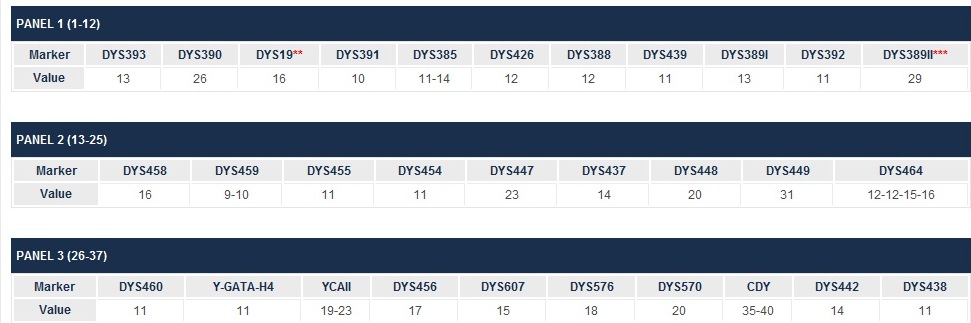
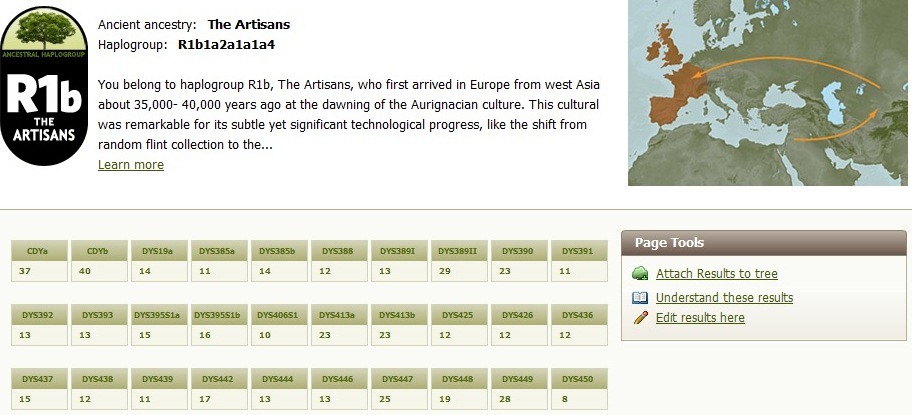
At Family Tree DNA and at Ancestry, marker results are displayed for the person who tested. Ancestry tests either 33 or 46 markers. Family Tree DNA tests 12, 25, 37, 67 or 111 markers.

Family Tree DNA results are above. Ancestry, below.

Haplogroup Maps
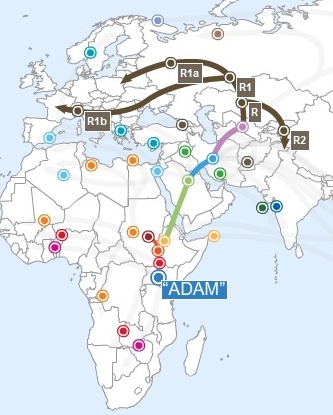
At Ancestry, the map, haplogroup description and results are all on one page, shown above, while at Family Tree DNA, they are displayed on separate pages. At Family Tree DNA, the map is interactive.

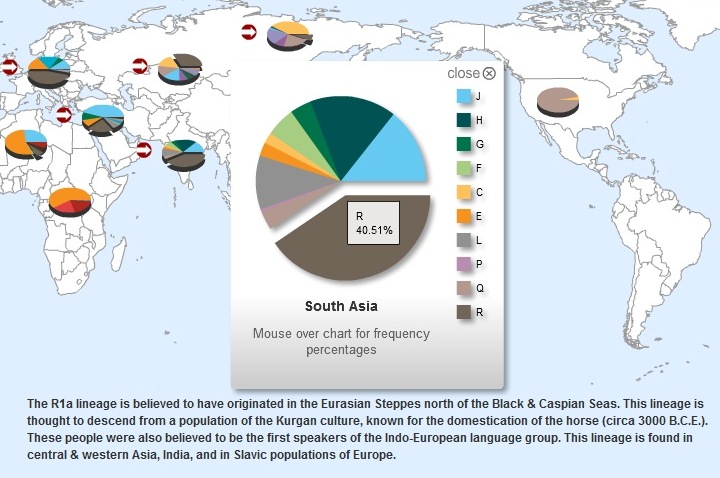
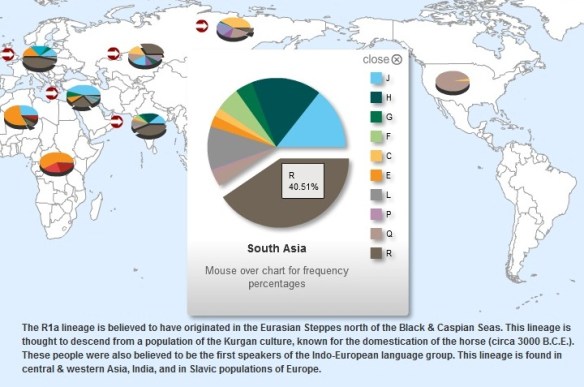
A second Haplogroup tab at Family Tree DNA also provides frequencies worldwide for the haplogroup. Ancestry doesn’t provide anything similar.
Frequency Map
Matches
Both companies, of course, provide a list of matches.

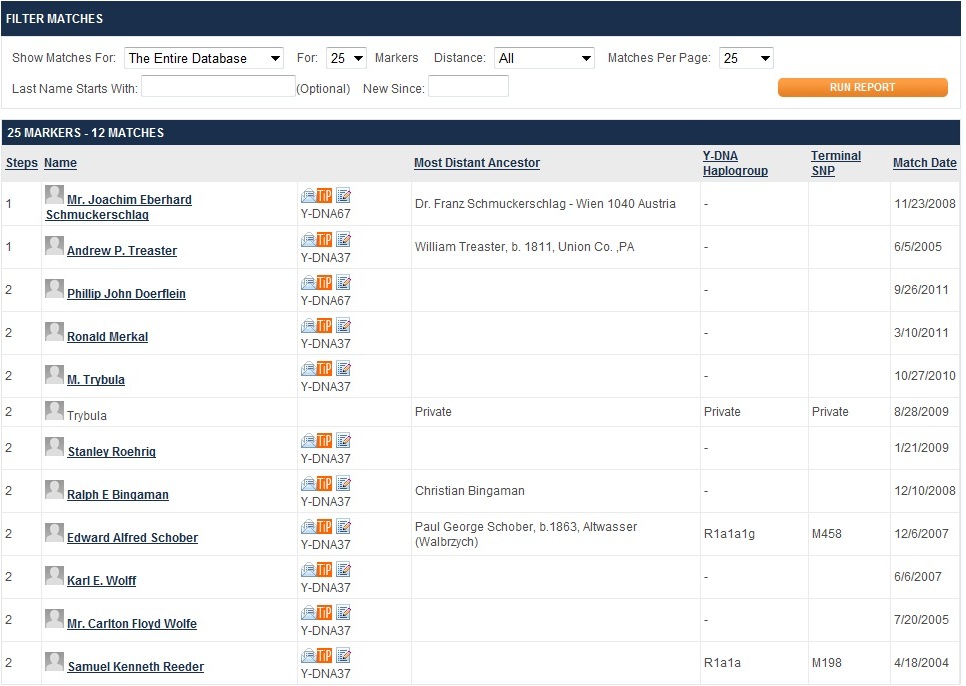
At Family Tree DNA, above, your matches have real e-mail addresses that you access by clicking on the little envelope. You don’t have to contact them through a messaging system. The TIP calculations provide time to the Most Recent Common Ancestor and allows you to modify that calculation with known genealogical information. We discussed the MRCA function and compared the calculations between Family Tree DNA and Ancestry in the blog posting, “What Does MCRA Really Mean?”.
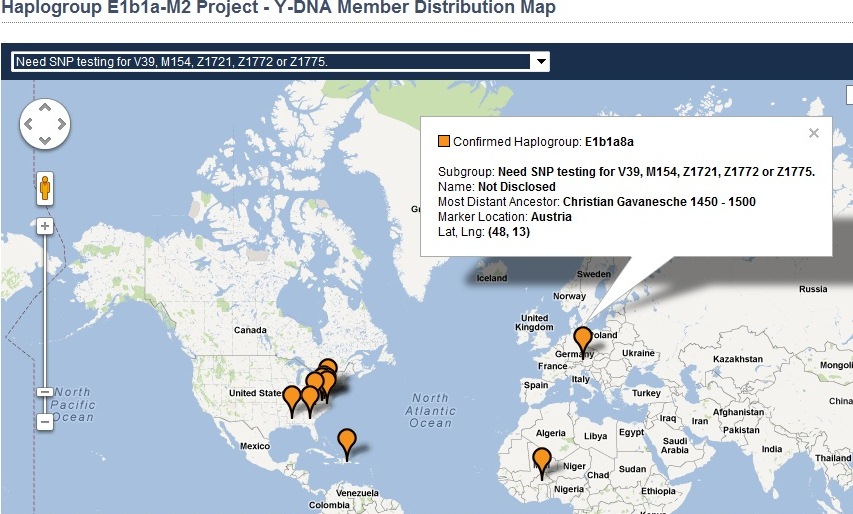
One of the must useful features is the Most Distant Ancestor field, which allows you to see at a glance if any of these matches share an ancestor with you, or in the geography of your ancestors.
Family Tree DNA has a privacy option, which allows your match to be shown, but no details. You can directly attach a Gedcom file that is available only to your matches.

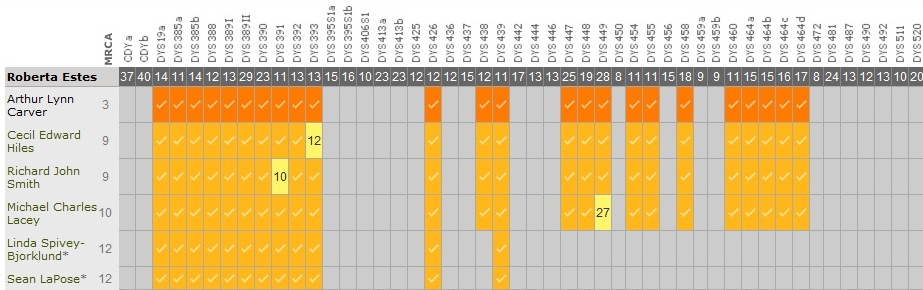
At Ancestry, your actual marker values are displayed compared with people you match, so you can see which markers you do and don’t match. Non-matches are highlighted. However, not all markers are displayed on the page. You have to scroll right at the bottom of the page to see the rest. All people at Ancestry are encouraged to upload thier family tree, and attach their results to the tree. That tree then becomes a part of Ancestry.com, although you can make it private.
Haplogroups are not displayed and neither are SNPs because Ancestry doesn’t test SNPs. This means that they estimate all of their haplogroups, and occasionally incorrectly. Complex haplogroup names, such as R1b1a2a1a1a4, mean those results have been hand entered by someone who tested elsewhere. Ancestry can’t estimate to that level.
Manual Entry Issues at Ancestry
Furthermore, the results displayed, when entered by hand by people who tested at other companies often contain “clerical mutations,” otherwise known at typos. This is the old GIGO concept – Garbage In, Garbage Out. People identified with an asterisk have entered their results by hand, including a haplogroup name.
There are 4 markers that must be adjusted at Ancestry for Family Tree DNA results to be equivalent to the same markers at Ancestry. In other words, the two companies “score” these markers differently. Initially, you had to know this and compensate. Then, Ancestry changed and began to do the compensation for you when you enter the results. That was a definite improvement, but the result is that you have no idea if the results you are looking at are equalized or not. The message here is that if you see an “*”, know to beware.
Furthermore, you can only have one set of results attached to your account, at least if you hand enter, and therefore if you want to check on matches for different relatives in your family, you need to edit the results from one person’s results to another. In this case, you must do the compensation math on the markers yourself. Fortunately, the list of markers is on the edit page, assuming people read, understand what to do and remember to adjust those values.
Advanced Matching
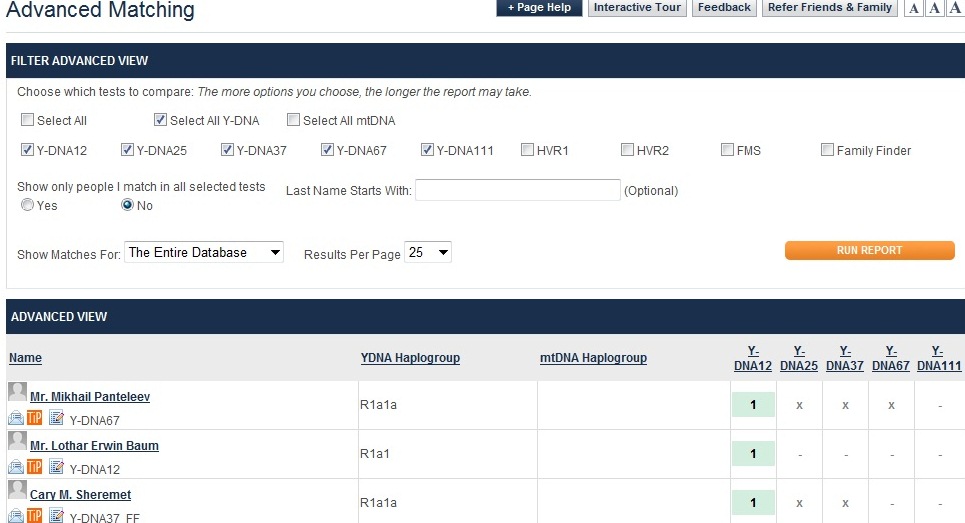
Family Tree DNA, in their last major update, added an advanced matching feature across their products that includes surname, partial name, project and combined tests matching. This is an extremely powerful tool. Ancestry has nothing similar.

Haplotrees
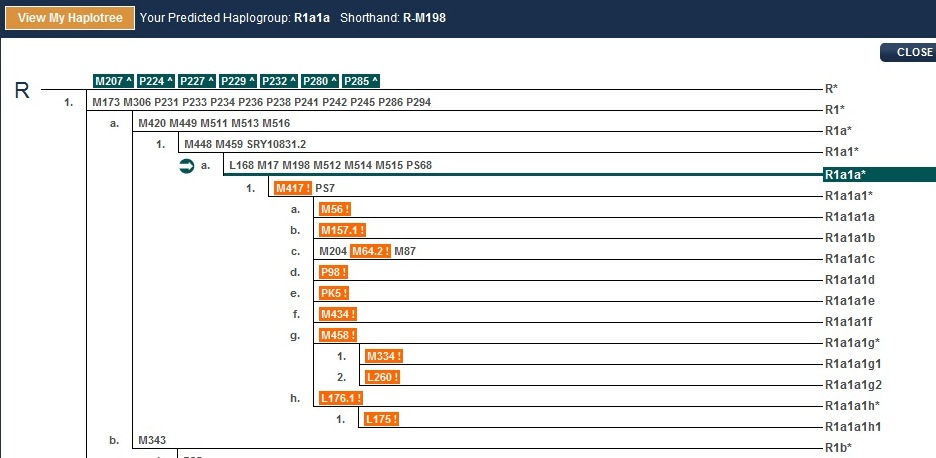
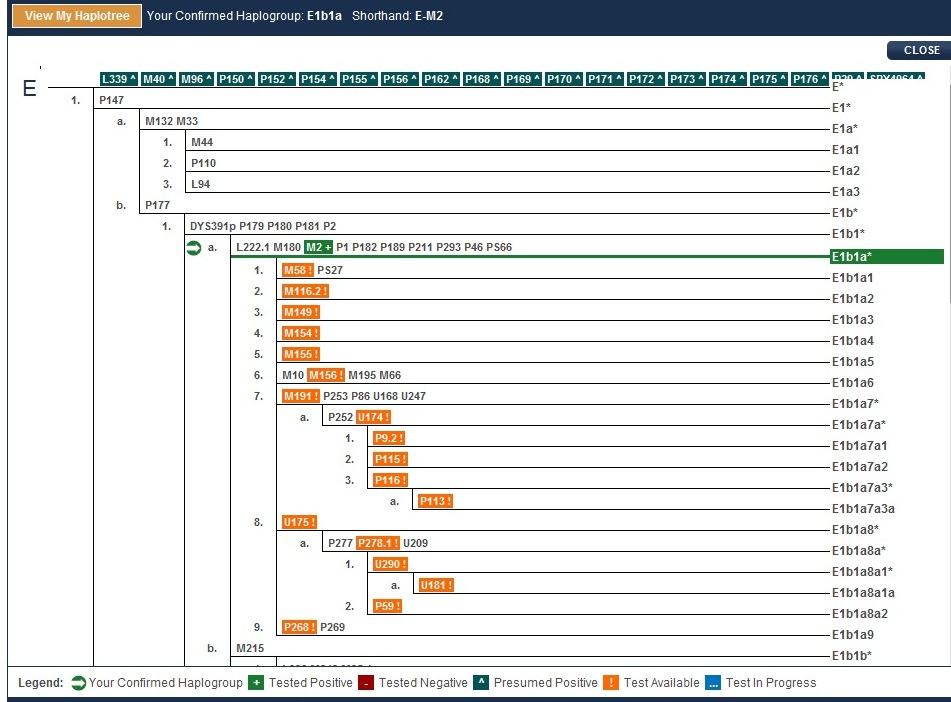
Family Tree DNA provides a haplotree. Ancestry doesn’t test SNPs, so they have nothing to put on a haplotree. Family Tree DNA guarantees that if they can’t predict your haplogroup by an exact match at 12 markers to another individual who has been SNP tested, that they will SNP test, for free, until they can successfully tell you at least which base haplogroup you are a member of. This test is called the Backbone test. They seldom need to do this anymore, but I do still occasionally see the Backbone test where the individual’s marker values are very unusual.
You can tell that Ancestry has spent a lot of time making their user interface very friendly, and it is. Some would refer to this as “dumbed down,” but regardless, haplotrees, SNPs, changing haplogroup names and all of that tends to be confusing, certainly to the novice. Most of Ancestry’s customers fall into the novice category. Ancestry’s marketing is directed at the impulse “feel good” purchase. They do a good job catering to that marketspace and that group of consumers doesn’t have any idea what a SNP is, or that there is anything more than what Ancestry provides them.

Ancestry doesn’t have a haplotree and their customers don’t miss it, at least not until someone who has tested at Family Tree DNA gets ahold of them, they need something more or want to join a project at Family Tree DNA. Fortunately, now Family Tree DNA does provide an option for Ancestry customers to “transfer in” for a reduced fee.
Haplogroup Origins
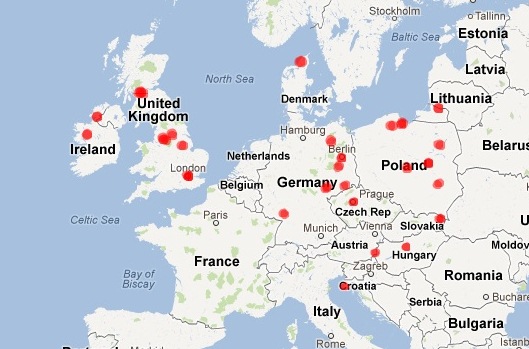
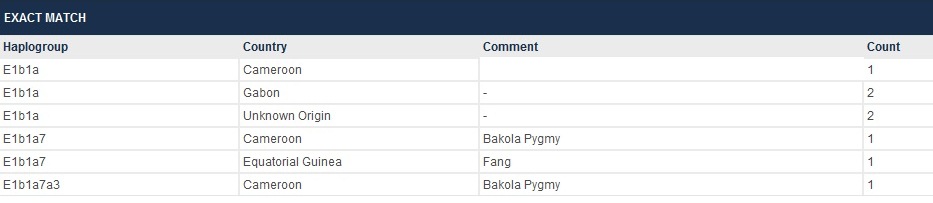
Haplogroup Origins is very powerful tool provided by Family Tree DNA and often overlooked. Haplogroup origins are haplogroup matches, based on STR markers, that point the direction to where your ancestors lived before surnames. This is invaluable in determining general locations for people trying to find their ancestors in Europe.

Ancestral Origins
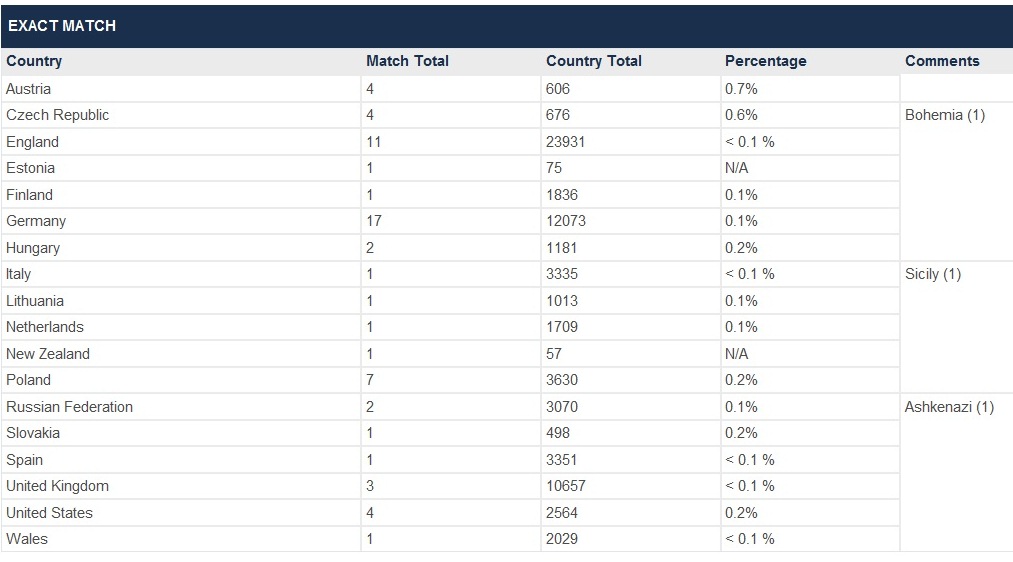
Ancestral Origins is another extremely powerful tool provided by Family Tree DNA that is similar to haplogroup origins, but brings the match time closer to the present. These are the locations of the oldest ancestors of people that match you on STR markers, not based on your haplogroup. Again, extremely useful for people trying to find their ancestor’s location overseas and/or trying to verify a particular ethnicity, such as Jewish.

Matches Maps
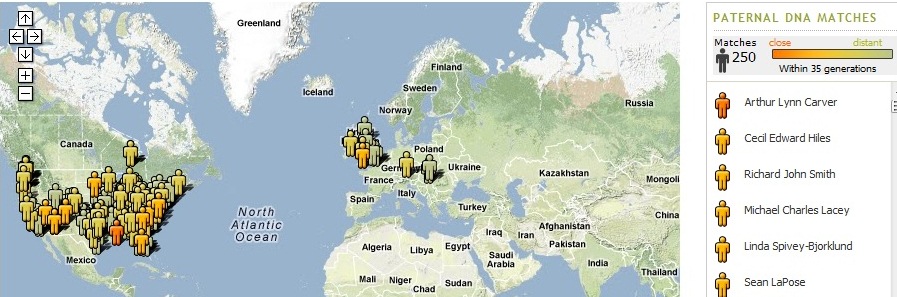
Both Ancestry and Family Tree DNA offer a map of matches, but they are significantly different.
At Ancestry, the matches shown on the map are the current addresses of the people who tested, NOT their oldest ancestor. Personally, I find this a bit creepy, as I really don’t want someone knowing where I live. Having said that, it’s a wonderful tool for adoptees and I use this feature constantly looking for location matches for my adoptee clients. Most recently, I found someone’s closest match genetically in the city where they were born. That’s a big clue. Matches are sorted in closest to furthest order and you can click on either the person icon or the name and see additional information on the map, such as the location, the name and how close the match is.

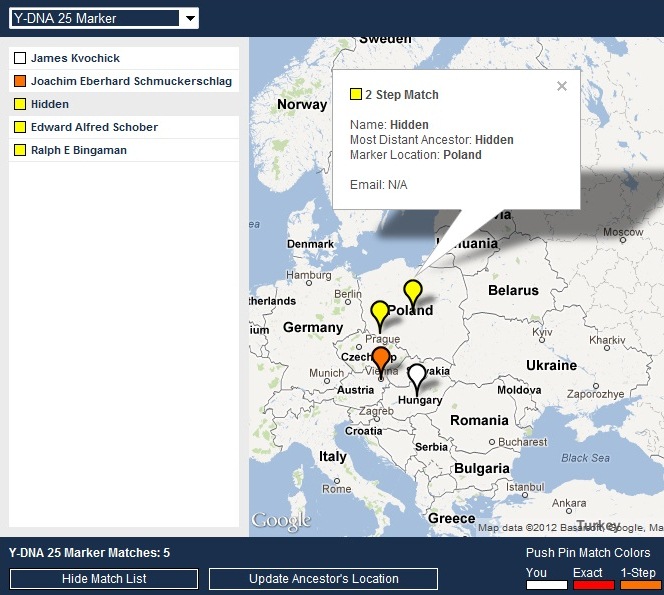
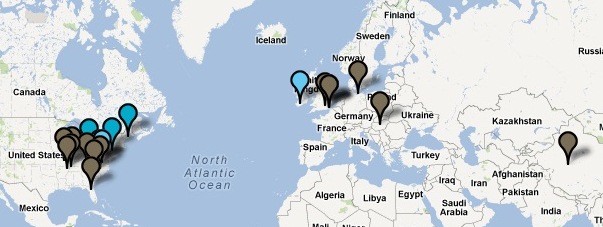
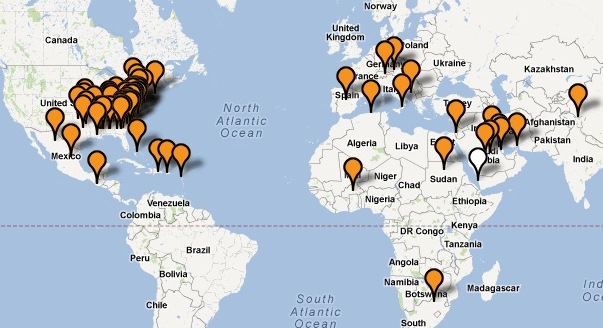
At Family Tree DNA, the matches shown are the locations of the oldest ancestors of the people you match. This is really much more relevant to genealogists in general. In addition, a match list can be displayed, and by clicking on either the person’s name, or a balloon, additional information is displayed including an e-mail option. This is an extremely powerful tool for someone looking for geographic matches or trying to determine which matches to contact.

SNP Map
Family Tree DNA has a new SNP mapping feature. Of course, Ancestry doesn’t have this, because they don’t test SNPs. This new mapping feature allows you to map clusters of SNPS. I selected clusters of 10 of R1a1-M198 just as an example.

This can be beneficial in tracking groups of haplogroup ancestors. As haplogroups connect with more modern times, this tool will become more powerful and useful to the typical genealogist.
Print Certificates and Maps
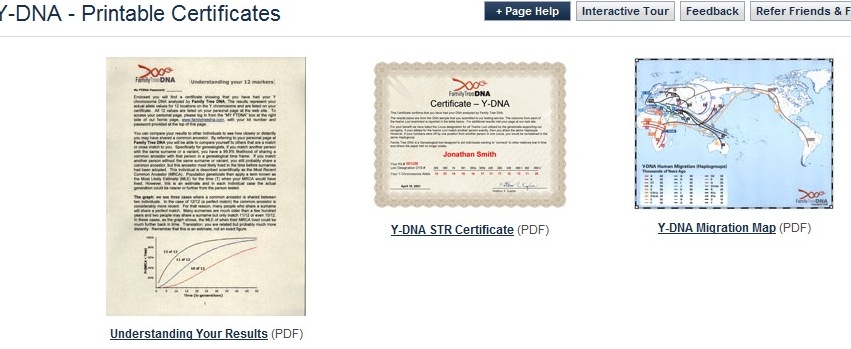
Family Tree DNA has a print option for certificates and maps. While this isn’t particularly important to me, it is to many.

Projects
At Family Tree DNA, aside from personal matches, much of the power of matching comes through projects. Volunteer administrators lovingly manage these and many, many discoveries have been made through projects.
Family Tree DNA provides oversight so that projects aren’t created willy-nilly, and projects fall into 3 main categories, surname, haplogroup and geographic projects.
Surname projects are obvious, as are haplogroup projects. Occasionally there are multiples in these categories. For example, there is a Miller project and then I have a Miller-Brethren project for the Miller families who were of the Brethren faith.
Haplogroup projects often have subgroups studying particular SNPs or large subgroups, such as haplogroup E1b1a (Sub-Saharan Africa) and E1b1b (North Africa/Mediterranean), which are different projects.
Geographic projects are pretty much anything else. My Cumberland Gap projects are there, both y-line and mitochondrial DNA, the Lost Colony projects, the Acadian project, Native American projects, the Bahamas and Puerto Rican projects, and many more. Many times academic researchers and population geneticists work with these project administrators.
Projects are absolutely wonderful resources providing the opportunity to work with others who have similar interests to learn more about the people within your group. For example, the Cumberland Gap group has provided a venue for genetic matching within the region, but we also offer a Yahoo group for project members where we share cultural and historical aspects of the Cumberland Gap area as well as genealogy.
While it is beyond the scope of this Y DNA comparison, Family Tree DNA also provides many tools to project administrators.

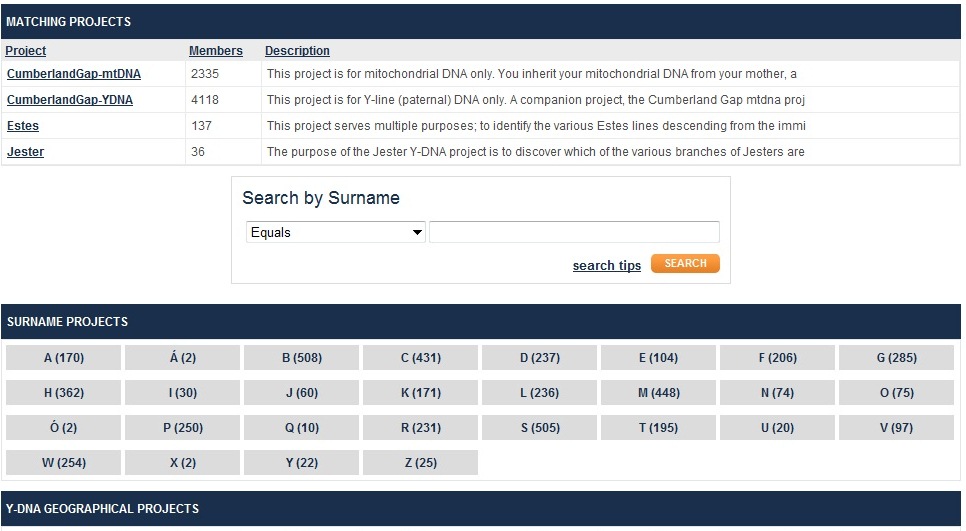
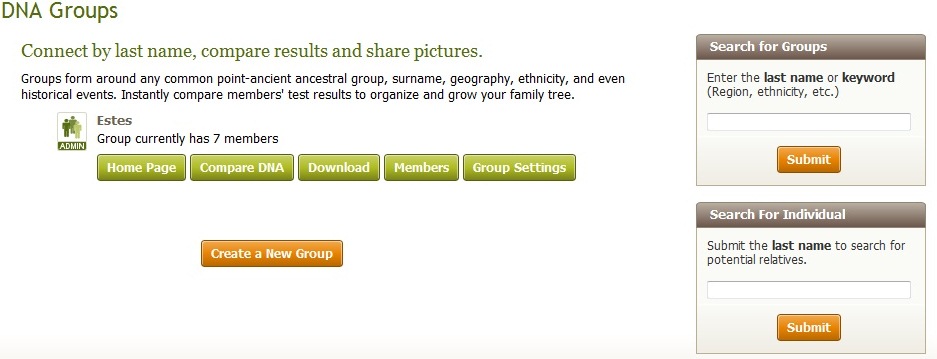
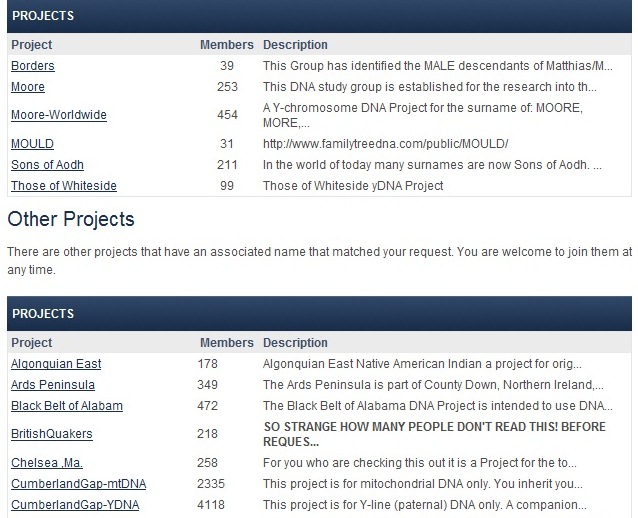
Family Tree DNA provides a search feature for projects that includes key words and surnames, plus an alphabetical browse, by category, shown above. They also display a list of projects that include the surname of the person who is signed on and doing the search. I was signed on when I did the above search, and you can see that there are 4 projects that include the surname Estes in their project profile, Estes, Jester and the Cumberland Gap Y-line and mitochondrial DNA projects.
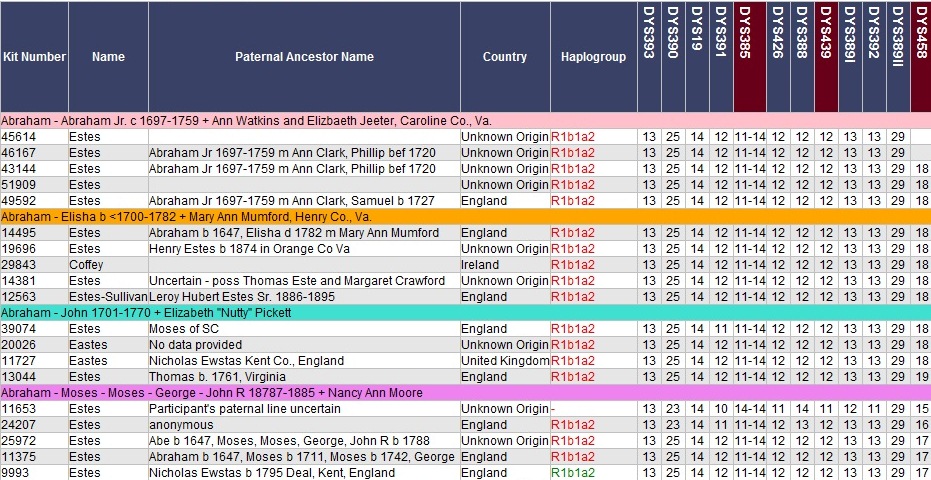
In addition, Family Tree DNA provides a public webpage for every project that includes participant grouping capabilities, shown below, colorized matches within groups, and mapping.

Project maps can display the oldest ancestor location of an entire project or of any selected subgroup.

This is a very powerful tool, especially in relation to haplogroup maps.
At Ancestry, shown below, you can search for either groups or individual surnames. The surname search is a useful tool. I searched for Estes. I can see that people by that surname have tested and their haplogroup, but I can’t see their results. Of course, if I enter Estes marker results, by process of elimination, I can figure out who I do and don’t match from this list. To contact these people, I have to go through Ancestry’s message service. My experience has been that few Ancestry contact requests are successful.

Unfortunately, at Ancestry, everyone is encouraged to “create a group.” Anyone can join whether they have DNA tested or not. It doesn’t matter if their DNA test is for a genealogy line relevant to the project, meaning paternal or direct maternal, and there is no oversight ability or control. In essence, these are individual or family study groups, not DNA projects, per se.

I entered the surname Moore, one of my brick walls. The number of “Moore” groups was overwhelming. It’s clear from looking at these that many people have created what I would term personal family study groups, but sorting through them and trying to find something useful is overwhelming. There were 25 groups including several who were listed as the Moore Paternal surname group, with 1, 2 or 3 participants in each. The oversight provided at Family Tree DNA avoids this type of mess.

Compare this to the projects at Family Tree DNA that list the surname Moore. Additionally, Family Tree DNA tells me that 824 people with the surname of Moore have tested. Of those, 454 are in the Moore Worldwide project. Yep, if I’m a male Moore, that’s where I’d want to be – where I can compare to other Moore lines.

Other Resources
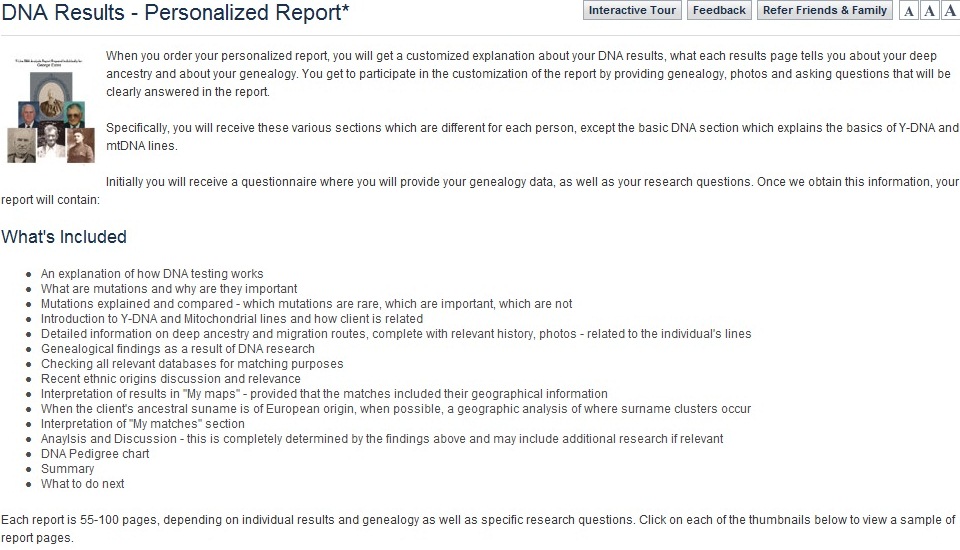
On the Other Resources tab, Family Tree DNA has a list of several other resources, all free. In addition, you can download a free e-book about how to interpret your results, or you can order a customized Personal DNA Report. None of these additional items are available at Ancestry.

Populating DNA up Trees
One feature that Ancestry has that Family Tree DNA does not is the ability to populate the DNA up a tree. Obvious pitfalls are twofold. First, the DNA may not be relevant to people up the tree if a nonparental event has occurred, also known as an undocumented adoption.
Second, the genealogy may not be correct and you’ve just genetically populated the wrong people. Not everyone views this “tree population” as a positive feature. Many view this with a very high level of trepidation, understanding that the many incorrect trees at Ancestry will eventually also have incorrect genetic information as part of that family record. There is also concern that in time, this will actually discourage DNA testing because people will find these DNA populated trees and believe that their line has already been tested, so they will think they don’t need to test.
Comparison Chart
As an easy comparison, I’ve created the following chart to compare the Y-line DNA testing and products.
| Feature |
Family Tree DNA |
Ancestry |
| Marker Results |
Yes, 12, 25, 36, 67 or 111 markers |
Yes, 33 or 46 markers |
| Migration Map |
Yes – interactive |
Yes |
| Haplogroup Description |
Yes |
Yes |
| Haplogroup Frequency Map |
Yes |
No |
| SNP testing |
Yes, Individual SNPs, Deep Clade and Geno 2.0 |
No |
| Matching |
Yes, most distant ancestor listed, direct e-mail |
Yes, marker comparison provided |
| Haplotree |
Yes, includes free SNP Backbone test if haplogroup cannot be predicted |
No |
| Advanced Matching |
Yes, by surname, partial name, project and varying test combinations |
No, but does have general surname search for participants |
| Ancestral Origins |
Yes |
No |
| Haplogroup Origins |
Yes |
No |
| Matches Map |
Yes, location of oldest ancestors |
Yes, location of person who took the test |
| SNP Map |
Yes |
No |
| Print Certificates and Maps |
Yes |
No |
| Projects |
Yes, tools and oversight provided, surname, haplogroup and geographic, includes web page, groups and maps |
Yes, encourages everyone to create project, lack of organization and tools |
| Additional Resources |
Personal DNA Reports, free e-book, Multiple FAQs, Forum, Newsletter, Genographic Project, Glossary, Ysearch, Mitosearch, News, Release Notes, Academic papers, Annual Administrator’s Conference, Mitochondrial DNA testing (full sequence), Autosomal DNA testing (with data download), Walk the Y (WTY) |
General FAQ, Mitochondrial DNA testing (no full sequence), Autosomal DNA testing (no data download), normal Ancestry subscription services, “ability” to populate DNA up trees
|
______________________________________________________________
Disclosure
I receive a small contribution when you click on some of the links to vendors in my articles. This does NOT increase the price you pay but helps me to keep the lights on and this informational blog free for everyone. Please click on the links in the articles or to the vendors below if you are purchasing products or DNA testing.
Thank you so much.
DNA Purchases and Free Transfers
Genealogy Services
Genealogy Research