The Big Y and Genealogy

holiday-lights

For the holidays, I want to talk briefly about one particular type of DNA that is tested, and why one might want to order that particular test.

I’ve seen questions this past week about the Big Y test, so let’s talk about this test today.

The Big Y Test

The questions I’ve seen recently about the Big Y mostly revolve around why the test isn’t listed among the sale prices shown on the Family Tree DNA main page.

The Big Y test is not an entry level test. The tests shown on the Family Tree DNA main page are entry level and can be ordered by anyone, at least so long as the Y DNA tests are ordered for males. (Females don’t have a Y chromosome, so Y tests won’t work for them.)

The Big Y test is an upgrade for a male who has already taken the regular 37, 67 or 111 STR (short tandem repeat) marker test. For those who are unfamiliar, STR markers are used in a genealogically relevant timeframe to match other men to search for a common recent ancestor and are the type of markers used for 37, 67 and 111 marker tests.

SNPs (single nucleotide polymorphisms) are used to determine haplogroups, which reflect deep ancestry and reach significantly further back in time.

Haplogroups are predicted for each participant based on the STR test results, and Family Tree DNA’s prediction routines are very accurate, but the haplgroup can only be confirmed by SNP testing. These two tests are testing different types of DNA mutations. I wrote about the difference here.

Different SNPs are tested to confirm different haplogroups, so you must have your STR results back with the prediction before you can order SNP tests.

The Big Y is the granddaddy of SNP testing, because it doesn’t directly test each SNP location, and there are thousands, but scans virtually the entire Y chromosome to cover in essence all known SNPs. Better yet, the Big Y looks for previously unknown or unnamed SNPs. In other words, this test is a test of discovery, not just a test of confirmation.

Many SNPS are either unknown or as yet unnamed and unplaced on the haplotree, meaning the Y DNA tree of mankind for the Y chromosome. The only way we discover new SNPs is to run a test of discovery. Hence, the Big Y.

It’s fun to be on the frontier of this wonderfully personal science.

Applying the Big Y to Genealogy

In addition to defining and confirming the haplogroup, the Big Y test can be immensely informative in terms of ancestral roots. For example, we know that our Lentz line, found in Germany in the 1600s, matches the contemporary results of Burzyan Bashkir men, descendants of the Yamnaya. I wrote about this here, near the end of the article.

Even more amazing, we then discovered that our Lentz line actually shares mutations with ancient DNA recovered from Yamnaya culture burials from 3500 years ago from along the Volga River. You can read about that here, near the end of the article. This discovery, of course, could never have been made if the Big Y test had not been taken, and it was made by working with the haplogroup project administrators. I am eternally grateful to Dr. Sergey Malyshev for this discovery and the following tree documenting our genetic lineage.

JakobLenz Malyshev chart

Our family heritage now extends back into Russia, 3500 years ago, instead of stopping in Germany, 400 or 500 years ago. This huge historical leap could NEVER have been made without the Big Y test in conjunction with the projects and administrators at Family Tree DNA.

And I must say, I’m incredibly glad we didn’t wait to order this test, because Mr. Lentz, my cousin who tested, died unexpectedly, just a couple months later. His daughter, when informing me of his death, expressed her gratitude for the test, the articles and shared with me that he had taken both articles to Staples, had them printed and bound as gifts for family members this Christmas.

These gifts will be quite bittersweet for those family members, but his DNA legacy lives on, just as the DNA of our ancestors does inside each and every one of us.  He gave all Lentz descendants an incredible gift.

______________________________________________________________

Disclosure

I receive a small contribution when you click on some of the links to vendors in my articles. This does NOT increase the price you pay but helps me to keep the lights on and this informational blog free for everyone. Please click on the links in the articles or to the vendors below if you are purchasing products or DNA testing.

Thank you so much.

DNA Purchases and Free Transfers

Genealogy Services

Genealogy Research

Daniel Miller (1755-1822), Musical Graves, 52 Ancestors #130

There are just too many Daniel Milles in Montgomery County, Ohio in the early 1800s, all Brethren, of course, and therefore, running with the same crowds and very difficult to tell apart.

In order to sort through the confusion surrounding the various Daniel Millers, and who they are related to, and how, I’ve numbered them.  This must be the German trait for love of organization coming out in me:)

Daniel (1) is the subject of this article and my ancestor. Daniel Miller was born to Philip Jacob Miller and his wife, Magdalena, whose last name is unknown, on April 8, 1755 in Frederick County, Maryland. Daniel was married to Elizabeth Ulrich and died in Montgomery County, Ohio on August 26, 1822. Those are the easy dates. The rest are difficult.

Daniel (2) arrived in Montgomery County from Huntington County, PA. Daniel (2)’s wife was Susanna Bowman and Daniel (2) lived in what would become the City of Dayton proper where he settled on Wolf Creek in November of 1802, according to the History of the City of Dayton and Montgomery County, Ohio, Volume 1.   For those specifically interested in this line, the Brethren Heritage Center has an article available written by Gale Honeyman.

Daniel (3) is the son of Daniel (1). According to the family Bible he was born on March 30, 1779 and he died on June 25, 1812. He would have been 33 years old, and unless he was disabled in some way, he was likely married and may well have had children. He would only have been about 20 when his father Daniel floated down the Ohio on a raft, probably in 1799. Daniel (3) could have remained in Clermont County when his father and uncle, David Miller, left for Montgomery County sometimes around 1802. There is no mention of an estate for Daniel (3) in Montgomery County.

Daniel (4) is the grandson of Daniel (1) through his son Stephen Miller. Daniel (4) was born in 1797 in Bedford County, PA and died in 1879 in Preble County, Ohio.

Daniel (5) is the son of Michael Miller and Salome Cramer of Montgomery County. Michael is the son of David Miller who died in 1845. David was the brother of Daniel (1). Michael obtained and farmed his father’s farm in Randolph Township. Daniel (5) was born in 1822, died in 1903 and was married to Isabella Cook.

Daniel (6) is the grandson of Daniel (1) through son Jacob A. Miller born in 1776 who married first to Elizabeth Metzger and second to Catherine Zimmerman. Jacob farmed his father’s land in Randolph Township past 1851 and likely until his death in 1858. Jacob’s son Daniel (6) by his first wife was born about 1800, married Susanna Hardman on November 1, 1819 and died about 1835 in Montgomery County.

Daniel (7) born in 1815 is the son of Isaac Miller, son of Daniel (1) and his wife Elizabeth Miller who is the daughter of David Miller, brother of Daniel (1). I know nothing more about Daniel (7).

Daniel Y. (8) born in 1808 is the son of John Miller, son of Daniel (1).  John’s wife Esther Miller, daughter of David Miller, brother of Daniel (1). Daniel Y. (8) married Margaret Bainter and died in 1833.

Daniel (9) is the son of Daniel (2) and his wife, Susan Bowman. Daniel (9) was born about 1808 and died about 1863 in Montgomery County, marrying Susan Oliver.

Daniel (10) is the son of the Elder Jacob Miller by either his first or second wife, who are unknown. This Daniel was born on September 6, 1780 and died on November 15, 1858 in Monroe County, Iowa. Daniel (10) married Elizabeth Shidler or Shideler on April, 13, 1808 in Montgomery County, Ohio, but by 1813, it appears that they had moved on to Union County, Indiana. When Daniel lived in Montgomery County, he owned land near the 4 Mile Church, east of Cottage Creek, about one and one half miles west of the Lower 4 Mile Church.

Y DNA testing has proven that the Elder Jacob Miller and Johann Michael Miller lines were not related through their paternal Miller line.

Therefore, Daniel (2) and (9) are related to each other, but probably not the rest of the Daniels. We know that Daniel (10) is not related to the Daniels descended from Philip Jacob Miller (son of Johann Michael Miller) because Y DNA testing eliminated that possibility. If a Miller male descendant of Daniel (2) or (9) were to test, we could determine if that Miller line shares a common male ancestor with either the Elder Jacob Miller of Johann Michael Miller lines. Please note that you can click on any of the graphics to enlarge.

Daniel Miller Daniel descendants

Judging from 5 grandsons names Daniel Miller, Daniel who died in 1822 was both well-loved and well-remembered. I wonder if there are any Daniels today who still descend through a line of Daniels, named for the original Daniel Miller.

Let’s take a look at the life of Daniel Miller (1), the subject of this article.  For a Brethren man with no church records to depend on, we’ve amassed a huge amount of information – probably because I had to dig so deeply and in such obscure places to find hints about his life.  This was not a short process.  I’ve worked on Daniel for at least 20 years now.  And he has frustrated me for all of those 20 years!

Having said that, and having FINALLY finished researching Daniel’s life, he is one of my most interesting ancestors.  The fact that I was able to track him across the country, on four different frontiers, and that he managed to survive in the middle of multiple wars and Indian attacks, a Brethren man unwilling to defend himself, is nothing short of miraculous.

Make yourself a pot of coffee or tea, and come along on this most amazing journey…

Daniel Miller (1), the Amazing Brethren

Daniel Miller was born to Philip Jacob Miller and his wife, Magdalena, whose last name is unknown and probably not Rochette, on April 8, 1755 in Frederick County, Maryland. We know this for a fact because both Philip Jacob Miller and Daniel Miller had a family Bible and Daniel’s birth is recorded in that Bible, along with those of his siblings.

In fact, the Bible that was once believed to be the Philip Jacob’s Bible wasn’t the original Bible, and was recopied at some point and found in the possession of Daniel – so it may have been recopied specifically for Daniel. You can see that the entries for Philip Jacob’s children look to be in the same writing, probably copied at the same time – although the copying may well have been done by Philip Jacob himself.

Daniel, along with his parents and grandparents were members of the Brethren faith, which means that there are no church records available today to help with our search. It also means that other records, such as marriages, deeds and wills were sporadically filed, since Brethren by and large tried to avoid courthouses, avoided having to swear an oath having to do with anything, or fees of any kind. So we are exceedingly lucky to have this Bible – otherwise we would know much less about the Miller family.

Let’s take a look at that wonderful Bible and see what secrets it holds for us.

The Philip Jacob Miller Bible 

First, this Bible is simply stunningly beautiful.

Philip Jacob Miller Bible front

Philip Jacob Miller probably sat in front of his fireplace in his home on Ash Swamp, about the time of his father’s death in 1771, reminded of his own mortality, and dutifully wrote the names and dates of his children’s births into his new Bible. His old Bible may have been destroyed during the two evacuations of Frederick County during the Indian Wars. If the old Bible was left behind in a hurried exit, it assuredly burned when the houses and barns were torched. Regardless of why, Philip Jacob Miller obtained a new Bible about the time his father died. We know Philip didn’t purchase the Bible before 1770, because that is the printing date, in Germany.

Philip Jacob Miller Bible front page

On February 11, 2009, I was fortunate enough with some hints and sleuthing to find the Philip Jacob Miller Bible in Elkhart, Indiana. The custodial family, who has no idea how the Bible originally came to be in their family, has taken wonderful care of the Bible and allowed it to be photographed.

Both the custodial family and I spent a significant amount of time trying to figure out how they came to be in possession of the Miller family Bible, which they greatly cherish as a family heirloom. I suspected a second marriage or something of that sort, but the only connection we could find was that their family bought a house that was in a John Miller family. Although further research suggests that John Miller is not from our line. However they obtained it, thank goodness they do cherish it, because that’s the only reason it still exists today.

Upon arriving to visit the Bible, another surprise was awaiting me, as the front section holds the children’s birth records of Philip Jacob Miller, and the back holds the same for the children of Daniel Miller, son of Philip Jacob Miller. Given a signature in the Bible, along with Daniel’s estate records, Daniel’s son John was the next custodian, taking the Bible to Elkhart County, Indiana, where he subsequently settled.  This John Miller is NOT the same John Miller that the custodial family’s ancestors bought the house from.

This Bible was printed in 1770, but the first child’s birth recorded is in 1752, and Philip Jacob’s children are not entered in birth order. Furthermore, the handwriting in the back matches Daniel’s exactly. This tells us that this Bible is probably not the original Philip Jacob Miller Bible. One look at what happened in Frederick County, Maryland in 1750s and 1760s and we’ll quickly understand why.

The residents all evacuated twice and their houses were burned. If the family Bible didn’t manage to somehow get put in the wagon as the family was evacuating, then it burned. The Miller family was back in the region by 1765 when Michael Miller, Philip Jacob’s father, was deeding land, but I’m guessing a new Bible didn’t get purchased until after Michael’s death in 1771. Perhaps Philip Jacob thought the purchase of a new Bible would be a fitting remembrance for funds received after his father’s death. Or maybe Michael bought it for Philipp Jacob. Or perhaps Philip Jacob bought a Bible for each of his children when they married or when they left the area. We’ll never know. I’m just thankful this one still exists.

A single entry gives away the subsequent owner. Beside the first entry in the Bible, which is the birth of Daniel in 1755, there is another entry which says “1775 Daniel Meines Sohn Sohn zur Welt geboren” (my son’s son was born into this world). In the back portion, we show the birth of Stephen in 1775, the eldest son of Philip Jacob’s eldest son Daniel. An earlier 1947 translation (apparently before the tape was applied) says “my grandson was born March 7, 1775”, which was obviously translated before the tape was applied, and matches exactly with Daniel’s own entry of his son’s birth.

Philip Jacob Miller Bible Daniel entry

The fact that this entry says “My son’s son” tells us that in 1775, Philip Jacob indeed was in possession of this Bible, so it was not given to Daniel for his marriage in 1774 and did not travel with Daniel to Bedford County in 1775. Philip Jacob was recording the births of his grandchildren.

This photo is me holding the Bible. What a glorious day.

Philip Jacob Miller Bible and me crop

The following page is the front inside page with Philip Jacob’s children’s births recorded.

Philip Jacob Miller Bible children

The births are recorded as follows:

  • My son Daniel Miller was born at 4 o-clock at night April 8, 1755. He died August 26, 1822.
  • My daughter Lidia was born at 3 o’clock at night, December 18, 1754. The zodiac sign was the Waterman (Aquarius).
  • My son David was born December 1, 1757, at 3 o-clock at night. The zodiac sign was the lion (Leo).
  • My daughter Susannah was born March 2, 1759, at 7 o’clock in the morning. The sign was the Bull (Taurus).
  • My daughter Christine was born December 4, 1761 at 10 o’clock in the forenoon, the sign was the Fish (Pisces).
  • My daughter Mariles was born — 1762 at 8 o’clock in the morning. The sign was the Virgin (Virgo). (Virgo runs from September 17 to October 17)
  • My son Abraham was born April 28, 1764.
  • My son Solomon was born March 20, 1767.
  • My daughter Ester was born February 13, 1769.

I find it interesting that Michael recorded the astrological signs for the births of some of his children, but not all.  I’m not at all sure of the significance of the signs, if any.

The following page is the inside back page recording the births of Daniel’s children.

Philip Jacob Miller Bible Daniel children

The first entry is that of Daniel himself, again, and the second entry is that of his sister Lizbeth born in 1752 who was not recorded on the page with the rest of Philipp Jacob Miller’s children.

  • Lizabeth Miller was born in April 1752.

The fact that Elizabeth was omitted suggests a recopy after all of the children were born in 1769. Daniel’s children begin after Lizabeth Miller’s entry, so the Bible appears to have been recopied after 1770 and before 1775.

The only other possibility is that Lizabeth Miller in the Bible was referring to Elizabeth Ullery (Ulrich) Miller, Daniel’s wife, not Daniel’s sister, Elizabeth. I don’t believe that to be the case because Lizabeth is actually referred to in the Bible entry as Elizabeth Millerin, which indicates a maiden name of an unmarried woman. We know that Philip Jacob did indeed have a daughter, Elizabeth, because she married Jacob Shutt or Shott, both signing the agreement between siblings as to the land distribution of Philip Jacob Miller after his death in 1799.

This Bible survived the trip west in a wagon, then floating down the Ohio River. This Bible has been wet one or more times. We know that in the early 1800s, this Bible went to Clermont County, Ohio, then Montgomery County, Ohio, then in the 1830s, to Elkhart County, Indiana where it remained for the next 177 years or so. An amazing journey for a Bible!

The top back entry for Daniel also has his death entry beside it to the right in a different hand and ink.

Philip Jacob Miller Bible Daniel's death

Following those entries we find Daniel’s children. Oddly, we find no other deaths recorded, nor marriages. It pains me greatly that there is no information for Daniel’s wife, Elizabeth Ulrich, or her parents.

Daniel’s children are recorded as follows:

  • My son Stephen was born March 1 (or 7) 1775
  • My son Jacob was born November 20, 1776
  • My son Daniel was born March 30, 1779. He died June 25, 1812.
  • My son David was born July 30, 1781.
  • My son Samuel was born March 17, 1785.
  • My son Johannes was born December 15, 1787.
  • My son Isaac was born December 8, 1789.
  • My son Abraham was born March 16, 1794.
  • My daughter Elisabeth was born April 2, 1796.

We do find the signature of Daniel’s son, John, in the Bible twice, once at the bottom of the back page (shown second image above) and once a few pages inside the front on a water-stained page. I wonder why John never recorded his children’s births in the Bible as well.  There was clearly a blank page available.

Philip Jacob Miller Bible John signature

It looks like Philip Jacob Miller and his wife lost a child in 1756, as there is a child born in April 1755 and then not another one until 2 and a half years later, suggesting that they lost a child about September 1756. 1756 was the year that the Brethren were evacuated and was reported to be the worst of that time. Did Magdalena have that child in a wagon perhaps? We are left to wonder what happened. One thing is for sure, that child’s death and the grief it brought to the family would have made whatever else was happening in 1756 even worse. For all we know, that child may have had to be laid to rest along the roadside someplace in an anonymous grave.

Daniel and Elizabeth also have a nearly 5 year gap between children born in 1789 and 1794.  It looks like they lost at least one if not two children during that time.

Philip Jacob Miller Bible corner2

The beautiful leather and metal workmanship on this Bible is just incredible.  I can just see both Philip Jacob and Daniel lovingly handling the same Bible I held and lovingly opened too, to step back hundreds of years into their world.

Bible Chain of Possession

The strange thing is that the custodial family has no, and I mean no, idea how they obtained this Bible in the first place or if or how they are related to the Miller family.  I did some research as well, and for them to be related looks virtually impossible.

Here’s what I have between the custodial family, their research and mine:

This Bible was handed down from:

  • Mollie Knopp Rupp to
  • Sophia Rupp Rowe to
  • George Rowe
  • Chester Rowe
  • William Rowe Beardsley (sister of Chester) and then we’re down to the last couple of generations.

This is documented on a paper with the Bible.

So I started by finding Sophia.  The Bible would have come into that family’s possession above Mollie Knopp Rupp for her to have passed it on.

The 1880 Elkhart County census shows Sophia with husband Benjamin.  Sophia was born in 1843 in Ohio and her parents were born in Pennsylvania.

Her son George was born 1876.  Benjamin Rowe was born in 1843 in Indiana.

Benjamin Rowe is the son of either Peter or Henry (two census look different) and wife Eliza both born in PA in 1815. According to their children’s ages, they were in Ohio between 1838-1842 then moved on to Indiana.  Of course, Eliza could be a second wife.

We find Sophia with her father George Rupp who was born in 1805 in PA along with his wife, Magdalena, born in 1807 in PA.  They migrated to Ohio from PA between 1831 and 1838 according to kids ages, and were still in Ohio in 1844, but in Elkhart County by 1850.  They were also not living near the Millers in Elkhart County, and they were all grouped together in Concord Township.

According to the document, Mollie Knopp Rupp would be Magdalena Rupp, wife of George so Mollie would be a nickname.  I could find no Mollie’s.  There is nothing on Rootsweb, nothing on Ancestry and neither can I find anything with the name Knopp, Rupp or Rowe in the Miller book by Mason.

My issue with all of this is that there is no reasonable opportunity that I can see for the Bible to get from the John Miller (son of Daniel) family to Mollie Knopp Rupp, but yet it did.  We know that Daniel had this Bible until his death in 1822 when it was purchased by John from Daniel’s estate, we know where this Bible was until the 1830s when the first Miller settled in Elkhart County, probably the 1840s and possibly as late as 1856 when John Miller died. This Bible was the second highest item in price at Daniel Miller’s estate sale, so obviously quite valuable to his son John.

Of course, we can’t determine what happened to his Bible after John’s death, but given that he paid top dollar for this Bible, it’s very unlikely that he intentionally allowed it to exit the family. John Miller and his wife Esther Miller were first cousins and both descended from sons of Philip Jacob Miller, meaning the Bible had personal significant to both of them.  John Miller died first in 1856 and Esther lived with her son Jacob until her death in 1861.  I suspect that the Bible never entered the estate and may have been inherited by son Jacob by virtue of the fact that his mother was living there when she died. Jacob died in 1872.

In the 1880 census, Magdalena and George Rupp who are age 72 and 75 are living beside John W. Miller, age 43, born in Indiana, in Concord Twp.  John’s wife is Mary Stutsman, age 48, children Cyrus 19, Manerva 17, Ira 16, Lewis 14, Ortha 11, Edward 5 and Lawrence 3.  John is reportedly the son of Jesse Miller, born in 1809 in Pennsylvania and who married Lucy Dalrymple. So if John W. Miller is related to our Miller line, his line never went to Montgomery County, nor is there a connection that I can discern aside from the fact that his wife was a Stutzman, a family long associated with the Brethren Miller family.

The man who owns the Bible presently has a note that says: Bible was passed from Mollie Rupp to Sophia Rupp Rowe to George Rupp.  George was his grandfather and the Bible owner tells me that his grandfather “bought the Miller farm.” Apparently from the plat map, that was the Miller farm that belonged to John W. Miller that was beside Magdalene (known as Mollie) and George Rupp in the 1880 census.

Philip Jacob Miller Bible 1880 census

I have simply found no reasonable explanation for how the Bible came into the possession of the current family, sometime after John Miller settled in Elkhart County and died, in 1856, and Mollie Knopp Rupp’s death at 88 years of age in 1896, when she passed the Bible to her daughter. Sophia.  If anyone ever solves this mystery, I’d love to know.

Let’s go back to Frederick County where both the Bible and Daniel had their beginnings.  

Frederick County, Maryland

Daniel Miller’s parents had moved to Frederick County, Maryland with a group of Brethren settlers from York Co., PA in 1751 or 1752, so by the time that Daniel was born, in 1755, they would have had at least some land cleared and been farming in Frederick County, at least in some capacity, for 3 or 4 years.

Stephen Ullerick or Ullery was the first Brethren to settle in this area in 1738 and is the father of Elizabeth Ulrich, Daniel’s eventual wife.

We’re actually assuming that Daniel was in fact born IN Frederick County, because we don’t know otherwise. I know that’s an odd statement to make, but Daniel was born in April of 1755 just before his father, Philip Jacob Miller, had his land resurveyed in May. In July, General Braddock was defeated, leaving the entire frontier exposed. The residents evacuated and left Frederick County and surrounding areas, for approximately six years, returning to find their farms destroyed, their buildings burned and of course, their livestock long gone. Given that we know Philip Jacob was still in Frederick County in May, it stands to reason that Daniel was born there the previous month.

The Brethren, of course, being pacifists, would not defend themselves. Many died. In the fall of 1756, 20 people were scalped in the Conococheague Valley, which includes the area where Philipp Jacob Miller lived, including one Jacob Miller, relationship, if any, unknown. By August, the entire valley was vacant, except for two families, according to a report received by George Washington.

We don’t know where the Miller family went when they evacuated, but Daniel spent his early years with his family wherever they lived. They may well have gone back east to join other Brethren settlements that were less endangered.

The French and Indian War ended officially in November of 1758 and Indian attacks had diminished by 1762.

We also don’t know when the Miller family returned. Certainly not before 1759, and we know they were back by 1761 when Daniel’s grandfather, Michael Miller, was purchasing land.

Daniel would have been 6 years old in 1761, so while he certainly didn’t remember the evacuation when he was 4 months old, or maybe slightly older, he probably did remember returning to Frederick County. To him, it wasn’t a return, but the first time he laid eyes on the land that his father owned, originally purchased by his grandfather.  I wonder if Daniel’s parents cried when they saw what had become of their home.

There is no sign today on this essence-of-Americana landscape of the bloodshed and terror that took place on this gently rolling farmland owned by Philip Jacob Miller with the mountains in the distance, foreshadowing the future.

Miller farm west 2

This is the land where Daniel grew up, looking at those mountains. One has to wonder if the boy ever dreamed of crossing them, or wondered what was on the other side.  The mountains were probably equated with danger when he was a child.

Miller farm mountains

Braddock’s Road

The land that General Braddock was fighting for, between Frederick County, Maryland and what is today Pittsburgh, PA, then Fort Duquesne, would be a very important road in the history of the Miller family, 20+years down the road, pardon the pun, and again, 40 years into the future.

While General Braddock was killed in 1755, a victim of his own insolence and unwillingness to heed the advice of men who knew Indian war tactics, General Forbes picked up the ball and came up with a strategic plan. Were it not for Forbes, we might all be speaking French today.

In 1758, General Harris extended a road from Harrisburg, PA to Fort Duquesne on the Ohio River (Pittsburgh.) Highway 30 follows this road most of the way today.

Forbes road went from Cumberland to Bedford and by August 1758, 1400 men had completed the road to Bedford, just wide enough to get a wagon through. A contemporary writer said it took 8 days to travel from Bedford to Ligonier, a distance of about 45 miles.  This military strategy succeeded.  General John Forbes took Fort Duquesne, now Pittsburg, the French abandoned it, and ended the French and Indian War on November 25, 1758.  Indian attacks diminished and by 1762, the French had given up Canada.  Replogle 107-108, 110

Forbes Road

There is one item of particular significance – during the war, a small fort was built at Raystown, which would eventually become Bedford, PA, a location that would, in the 1770s and 1780s, become quite important to the Brethren Miller family. It was the next stop on the frontier and four of Philip Jacob’s children, including Daniel Miller, would find themselves traveling that road and settling in in Bedford County, Pennsylvania for a few years, at least until their father rallied the family round once again.

Philip Jacob Miller would eventually follow Forbes old road, as would his son Daniel, to Pittsburgh, then down the Ohio River to Campbell Co., KY, where Philip Jacob Miller would settle one last time – this time, with his adult children – in a place where he could purchase land for each of them.

But before Daniel Miller can do any of that, he has yet to grow up – and that he did in Frederick County. But things were not always peaceful and his life was probably far more exciting that a little Brethren boy would have wished.

Pontiac’s War

After returning to Frederick County after the long evacuation caused by Braddock’s defeat, the years of 1761 and 1762 were probably spent rebuilding homes, barns and sawmills, trying to normalize life once again. Sunday would bring church services, held in one of the homes or barns of the Brethren families. Life slowly returned to normal as the seasons changed, but then, once again, they had to run for their lives.

Pontiac’s War descended upon them and from 1763 to 1765, the Brethren families in this area had to take shelter elsewhere. According to historical records, the devastation and fear was even worse than the first time. And true to form, we don’t know where the Miller family went, or for how long. What I wouldn’t give for a journal…even just one sentence a week…anything.

The Maryland Gazette, written at Frederick on July 19, 1763 said:

The melancholy scene of poor distressed families driving downwards through this town with their effects…enemies, now daily seen in the woods….panic of the back inhabitants, whose terrors at this time exceed what followed on the defeat of General Braddock.

Ironically it also reported that the season had been remarkably fine and the harvest the best for many years.

Once again, Frederick County put together two companies of militia and once again, no Brethren names appeared on the list. Replogle 113 – 114

By this time, Daniel would have been eight years old. Was he thrilled at the excitement, or terrified? Did he understand the imminent danger, or did his parents attempt to shelter the children? Was there any sheltering the children from something like that?

Perhaps the entire group of Brethren returned to Conestoga. Conestoga is near present day White Oak in Lancaster County, PA and both Conestoga and Conewago, another Brethren settlement, aren’t far from the Brethren settlement in Ephrata. It would make sense for the Brethren to return to areas they knew and relatives with whom they could shelter for as long as need be.

Ephrata to Hagerstown

I suggest this possibility because we know that two Brethren, Nicholas Martin and Stephen Ulrich, are found attending the Great Council of the Brethren in Conestoga in 1763. Where you find one Brethren, or a group, you’re likely to find more – and we know that Stephen Ulrich lived in Frederick County.

By 1765, we know that the Millers are back in Frederick County once again, because Daniel’s grandfather, Michael Miller is selling land to his children.

Daniel would have been 10 by this time, certainly old enough to help. Once again, the homes and barns would have needed to be rebuilt – and you can rest assured that Daniel did what he was capable of doing. On a farm, every able hand helped, from the youngest to the oldest.

Beyond the Allegheny Mountains

Philip Jacob Miller land Allegheny Mountains

Pontiac’s defeat served to make the lands west of the Allegheny Mountains, the ones seen in the distance, standing on Philip Jacob Miller’s land, safe, or safer, anyway, for settlement. Events began to happen that enabled the settlement of these areas. The British government bought large tracts of land from some Indian tribes, but unbeknownst to them, they were not negotiating with all of the interested parties, and new raids ensued.

It would take decades for the European takeover of the Native lands to be complete. But settlers didn’t wait on that eventuality. In 1755, the first Brethren settlers found their way to Bedford County, Pennsylvania, an area that would soon attract other Brethren as the next frontier. Why people who would not defend themselves continued to put themselves in harm’s way is beyond me, but they did consistently on every frontier.

Johann Michael Miller’s Death

Daniel would have been 16 or 17 when his grandfather, Johann Michael Miller, died. This family had been close, evacuating twice together, and returning together. Michael Miller had purchased the land eventually owned by Philip Jacob and his brothers, John and Lodowich. This, of course, is the land where Daniel grew up. The fields he roamed. The lands they left and returned to, twice, and built upon, three different times.

Daniel would have known his grandfather well, and he would have wept at his graveside, probably on the now missing cemetery on his uncle John’s land, the farm next to his father, Philip Jacob Miller. The patriarch was gone – the original German immigrant – the original Brethren in the family – the anchor.

There was one less thing to hold Daniel in Frederick County.

Marriage

We don’t know exactly when Daniel Miller married Elizabeth Ulrich, but we can estimate based on the birth of their first child, conveniently recorded in the Bible.

Their first son, or at least the first child recorded in the Bible was born on March 1, 1775. This would have been slightly less than a month before Daniel’s 20th birthday, so it’s safe to say this was their first child, and that Daniel and Elizabeth were married sometime in 1774. Most brides were pregnant shortly after marriage, so a child born in 1775 would be expected.

Unfortunately, Brethren marriages were generally not recorded civilly and were simply performed by the Brethren clergy.

Alexander Mack, the son of the founder of the Brethren movement, on Feb. 14, 1776 says that he is shunning his daughter Sarah because “she married outside of the brotherhood; secondly because [the marriage] was performed with a license; and thirdly because her husband had not quite completed his apprenticeship….” Replogle 70

This certainly explains why we have so few Brethren marriage records.

We know that Daniel did marry Elizabeth Ulrich, daughter of Stephen Ulrich Jr. and wife Elizabeth, whose last name is unknown but said to be a Cripe/Greib (without any documentation that I’ve been able to find.) We’re fortunate that when Elizabeth Ulrich’s father, Stephen Jr., died and the heirs sold his land in Washington County (formerly Frederick), Maryland in 1785, Daniel Miller is listed as one of the signing heirs.

Furthermore, the Miller, Stutzman and Ulrich families had a close relationship, not only here in the US, but in Germany where they are found together as well. However, that part of the story must wait for another day, specifically, until the German research is finished.

The Revolutionary War

In 1775, about the time that Daniel’s first child was born, the Revolutionary War broke out and Frederick County, Maryland was in the midst of the conflict. A notoriously bad place to be for a Brethren family, especially a newlywed family with a new baby.

The Revolutionary War begin in April of 1775 when British troops and American Minutemen clashed at Lexington and Concord. When this news reached Pittsburg and the western counties, military companies were formed. Donald Durnbaugh, noted Brethren historian, says that about one third of the populace remained loyal to the English government, one third favored the Revolution and the final third tried to maintain an uneasy neutrality. Many Germans, especially, opposed the war. They felt that “the English government had allowed them to settle in the rich land of America and spared them the harsh feudal exaction of the princes of Germany and the city governments of Switzerland which had caused them to migrate. Furthermore, British taxes had little effect on subsistence farming.

Those volunteering for the colonist causes were early called Associators, later called Militia Companies. The Committee on Observations made lists of those not participating, whether Loyalist or members of the Peace Churches, and they were called non-enrollers or Non-Associators.

In 1775 Congress required all able-bodied men between the ages of 16 and 50 to join militia companies. “Non-Associators” could hire replacements. But Frederick County was less liberal. In Hagerstown, the Committee of Observation proclaimed that rights required responsibilities and on Dec. 18, 1776, “resolved that the Dunkard and Mennonists” pay fines for non-participation. They also had to march with the militia to help with intrenching and to care for the sick. Non-compliance would result in “rigorous measures … immediately taken.” Mennonites and Brethren petitioned to substitute produce for cash. Some had already contributed blankets and rugs.

Early in the Revolution, Mennonites, Dunkers and Quakers were given freedom to remain true to their peace positions of non-violence, but in return they would pay an additional tax of 2 shillings and 6 pence per week. This was granted at Philadelphia and Annapolis for all of PA and MD but it was carried out in the local towns and villages. Local Committees were free to make their own rules and interpretations.

Floyd Mason, in his book, “The Michael Miller and Susanna Bechtol Family Record,” tells us what he discovered about the Brethren in Frederick County during the Revolutionary War.

During the Revolution, the colonists held their national conventions and appointed certain committees of local leaders to carry out local responsibilities. In PA and MD, the main committee was the Committee of Observation who had the responsibility for raising funds to promote the war, select its leaders and furnish themselves with one committee member for each 100 families. This committee had full power to act as it saw fit, answered to no one and there was no appeal of their decisions.

The war issues divided the people’s loyalty. About one third favored the revolution, one third were Loyalists or Tories who favored the English and one third were neutral or did not believe in this manner of settling the issues. This threw the Quakers, Mennonites and Dunkers in with the Tories or Loyalists and in opposition to the efforts of the Committee of Observation, at least as the committee saw it.

The Brethren churches were bringing discipline to bear on members who did not follow the historic peace teachings of the church. Annual Conferences were held each year and members were asked to remain true to the Church’s nonviolent principles, to refrain from participating in the war, to not voluntarily pay the War taxes and not to allow their sons to participate in the war. This caused a lot of problems for the church members who wanted to be loyal to the church, loyal to the Loyalists who had brought them to the new country and loyal to the new government which was emerging.

As the war wore on and it looked as if the patriots efforts might lose, emotions raged. Non-Associators found themselves having to pay double and triple taxes. Their barns were burned, livestock stolen or slaughtered and their crops destroyed. They were often beaten and “tarred and feathered.” Church members came to the aid of those who endured the losses.

Some members chose not to pay the war taxes or participate in the war activities and chose to wait until the authorities came and presented their papers to have taxes forced from them. This was in compliance with the Church of the Brethren Annual Conference Action. The Committee of Observation provided that non-Associators could take as much of their possessions with them as they could and then they would seize the property and remaining possessions and sell them to fill their war chests.

During this time, the Revolutionary War was taking place and the Brethren would take an oath of loyalty, but would not belong to a militia unit nor fight. Many non-Brethren residents suspected them of secretly being allied with the Tories and resented their refusal to protect themselves and others. Laws of the time allowed for the confiscation of property of anyone thought to be disloyal. Records of this type of event have survived in the oral and written histories of some of the Brethren families, in particular some who migrated on down into the Shenandoah Valley. Perhaps others thought it wise to move on about this time as well.

Taken from several sources, these are some of the names of non-Associators and others who were processed by the Committee of Observance that are descendants of Johann Michael Mueller (Jr.) who died in 1771.

  • Samuel Garber who may have married one of Michael Miller’s daughters, and their sons Martin and Samuel Garber
  • Jacob Good, Michael’s step-daughter’s husband
  • John Rife, Michael’s step-daughter’s husband
  • David Miller, the son of Philip Jacob Miller
  • Michael Wine, married Susannah, the daughter of Lodowich Miller, son of Michael Miller
  • Jacob Miller, son of Lodowich Miller
  • Abraham Miller, relationship uncertain
  • Another source lists Elder Daniel Miller, stated as Lodowick’s son, as being fined 4.5 pounds.

Susannah Miller Wine told her children and grandchildren that Michael Wine, Jacob Miller, Martin Garber and Samuel Garber had their property confiscated by the authorities for remaining true to the non-violent principles of their church.

Lodowich Miller’s family group removed to Rockingham County, VA about 1782 or 1783.

William Thomas, on the Brethren Rootsweb list in 2011 tells us:

I have a copy of the 1776 non-enrollers list for Washington County, MD, that lists “Dunkars & Menonist” fines. The list includes Abraham Miller, David Miller, and David Miller son of Philip. It goes onto list an appraisal of guns (whatever that means) in 1777 and includes a Henry Miller.

Point being there were several Miller’s in Washington County, some of who were Dunkers or Mennonites, a name common to both denominations.

If you move to the 1776 non-enroller list for Frederick County, MD, you have even more Millers. You have Jacob Miller, Jacob Miller s/o Adam, Abraham Miller, Peter Miller, Stephen Miller, Solomon Miller, Robert Miller, Henry Miller, Philip Miller, David Miller and Daniel Miller, all fined, and implying a Dunker/Mennonite/Quaker religious affiliation.

Washington County, Maryland was formed in September 1776 from the portion of Frederick County where Philip Jacob Miller lived.

In March 1776, Congress declared adherence to or support of the British King as “high treason,” so the stakes became even higher for the Brethren.

Dunkers were taken into court and fined in 1776. It is stated that Maryland Dunkers fared better than Pennsylvania Dunkers and that is perhaps why many of them moved from York Co., PA to Maryland in the 1760s.

When they did not pay their fines officials confiscated their land, sold it and paid their fines for them. Some say that the court gave them permission to destroy these records and therefore the records of some of these confiscations are not available.

  • Elder Jacob Danner – 10 pounds
  • Eld Samuel Danner, son of Jaob Danner – 6.5 pounds
  • Elder Martin Garber so of John H. Garber, 7.5 pounds – then remitted
  • Elder Samuel Gerber son of John H, – 6.5 pounds – then remitted
  • John Garber (may be Elder John H.) – 6.5 pounds – then remitted
  • Elder Daniel Miller (son of Lodowich) – 4.5 pounds
  • Elder Michael Wine, son-in-law of Lodowich Miller – 6.5 pounds, reduced to 5.5 pounds. 1782 – farm and land confiscated.
  • Christopher Steel, brother-in-law of Michael Wine – 5.5 pounds reduced

Mennonites and Dunkers were watched very closely because some though they were Loyalists.

In 1777, a law was passed requiring a loyalty oath of all male citizens above age 18. Maryland allowed “Dunkers and Menninists” to make a right of affirmation instead.

There is an oath of fidelity recorded for one Daniel Miller in Washington County, Maryland in 1778, although an oath of fidelity would be quite unusual for a Brethren man. However, Daniel’s father was naturalized so maybe an oath of fidelity was simply viewed as a necessary evil of survival at that time, given the 1777 legislation, even for a Brethren. Or maybe Daniel was shunned in Washington County, Maryland after his oath. Or maybe that Daniel Miller isn’t our Daniel Miller.

In April 1778, a law made it possible to banish non-oath-takers and confiscate their property. Punishments kept escalating until in October 1778 two Quakers were hanged despite a petition with 4000 names sent to the Assembly. In 1784 John Frederick Rachel, a Moravian, wrote, “No Dunker, no Quaker took up arms. What is more all these people were so sympathetic and loyal to the government of Great Britain that they could not be persuaded to abjure the King….”

Some Brethren did take the oath, but the church took a hard line with them. At the 1778 annual meeting the official policy was unyielding: “Brethren who have taken the attest should recall it before a justice, and give up their certificate and recall and apologize in their churches….If they cannot do this, they will be deprived of the kiss of fellowship of the council, and the breaking of bread….” Replogle 147

In 1778, failure to report loyalist sympathizers became punishable and refusing to take the allegiance oath made one ineligible to buy or sell property or collect debts. Residents traveling without an oath certificate were to be considered spies. Should they refuse to take the oath, they “shall be thrown into prison without bail.” This left pacifists very little room for compromise. Replogle 147

On the matter of paying for military substitutes, the 1781 Annual Meeting said money “should not be given voluntarily without compulsion.” Replogle 147

In both Pennsylvania and Maryland, Committees of Observation operated at the local level. One member represented each 100 families. These, in effect, were the courts. In Frederick Co, Maryland they had, of course, many ”non-Associators” to investigate.

Many people migrated to Virginia about this time. Family verbal history says that in 1782 a number of Brethren farmers went to the Shenandoah valley because of property lost to the Committee. Among them were Jacob Miller, (Michael Sr.’s son) and 2 sons of Barbara Miller, (Michael Sr’s daughter) and Michael Wine (Lodowich Miller’s son-in-law). Replogle 148

Regarding the above, please note that Michael Sr. has no proven son Jacob and no proven daughters at all.

The tax list of 1783 shows that Philip Jacob Miller owned 167 acres of land in Frederick County with 98 acres in woodland and 14 acres in meadowland and 55 acres of cultivated land. He had 9 horses, 4 cows and his oldest son Daniel owned no land but had 5 cows and 5 horses. Land costs were rising in the Washington County region as the area became more settled, as witnessed by the fact that Daniel at the age of 28 still did not own any land.

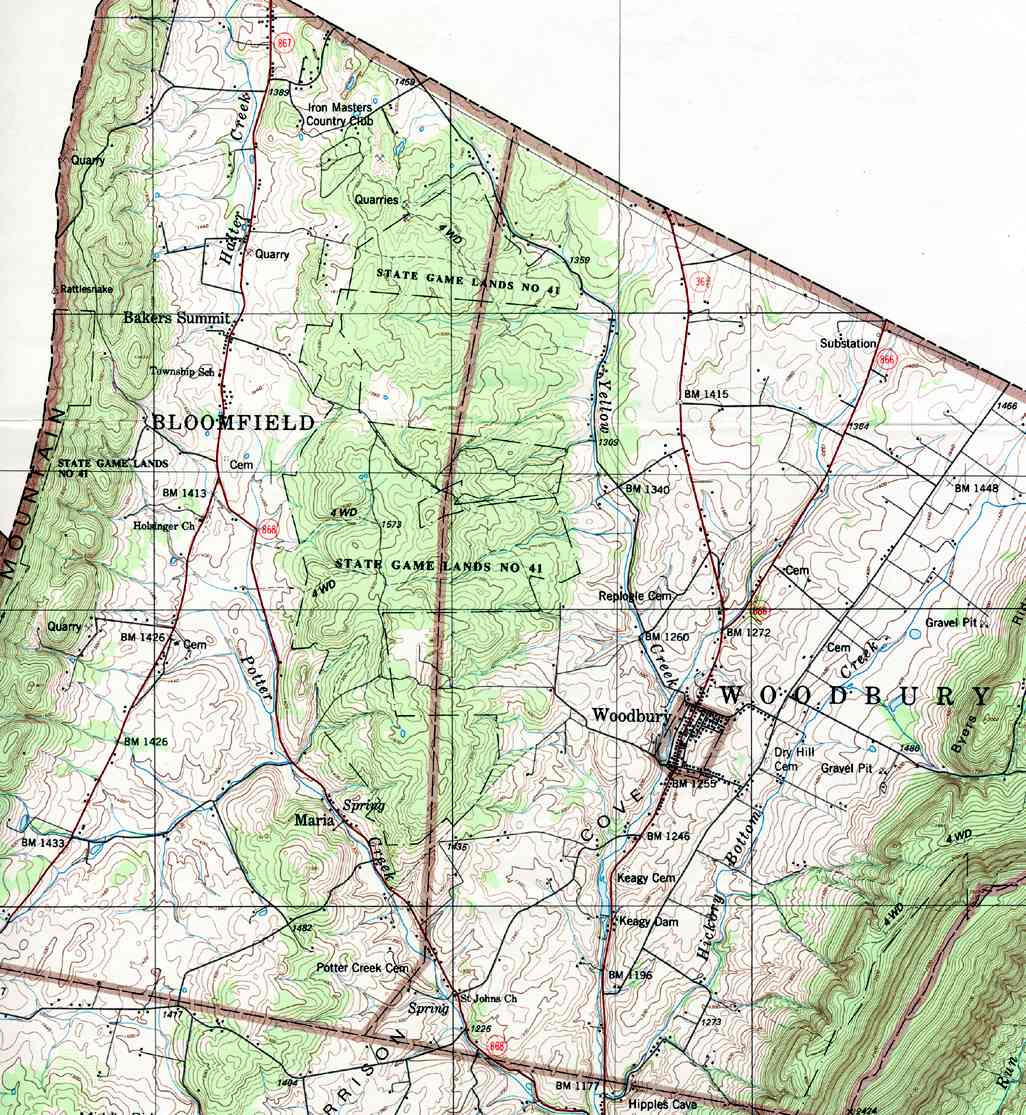
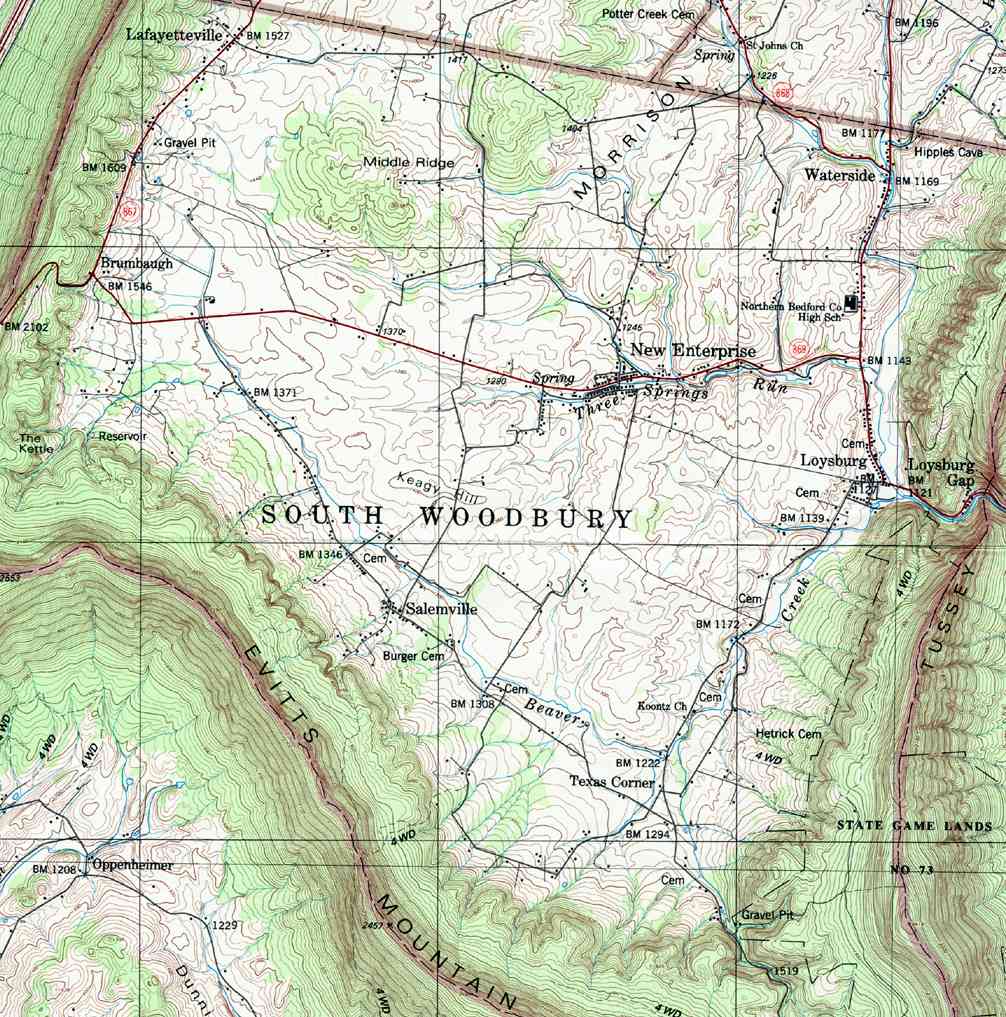
It is believed that at this time Daniel and his brother David who had by this time married Magdalena Maugans, a daughter of Conrad Maugans, moved to Morrison’s Cove, Woodberry Township, Bedford County, PA.

Hagerstown was a supply point for the newly opened land in still primitive Bedford County. Miller 31

The Next Frontier – Bedford County, Pennsylvania

In 1775, families living around Hagerstown had several routes to choose from if they wanted to migrate to Bedford County, PA. If they planned to go straight west, they took the road to Cumberland which was improved and straightened in the 1750s.

Those going to Frankstown Township in Bedford County, which at that time encompassed all of Morrison’s Cove, could travel the 60 miles to Cumberland, then take Burd’s road north to Bedford, about 30 miles. It’s possible that some took a trail up the east slope of the ridge, just west of Hagerstown. This one ran very close to or over the property of Jacob Stutzman and Stephen Ulrich II, shown below.

Stephen Ulrich land Frederick County

North of Fort Bedford, there were no improved roads. An Indian trail led through the Juniata Valley. Another went along Snake Creek to a gap at the north end. This gap opened out into a much larger flat, about 20 miles long and 5 miles wide at the widest. This was Morrisons Cove, or would be.

Settlers addresses up there were vague. Before 1775 living in Frankstown meant being somewhere in a large expanse. Generally speaking, in 1770 Frankstown is the country north of Bedford Town and Colrain is the area just south. One local history says that the dimensions of the townships before 1771 cannot be ascertained. In 1767 the vague political tracts began to divide in very complex ways. One that concerns our history occurred in 1775 when Woodberry Township was carved out of Frankstown.

When the Germans first came to Frankstown, no settlers had been here legally before and not many squatted illegally. In 1748 Conrad Weiser passed through and said, “Came to Frankstown but saw no houses or cabins” and Raystown, later Bedford, to the south was just a trading post in the 1750s. Nothing but an Indian trail passed through it until Forbes Road in 1758. Replogle 126-127

The 1850 census for Daniel Miller’s son, David Miller, living in Elkhart County, Indiana, stated that he was born in Maryland, not Pennsylvania.

David Miller 1850 census

We know David’s birth date from the family Bible – July 30, 1781.

It appears that Daniel Miller actually moved to Bedford County in the 1770s, and removed back to Frederick County, Maryland, for safety.  This back and forth yo-yo settle, evacuate and resettle routine would have been all-too-familiar to Daniel.

The Historical Society of Somerset County re-published the journal of Harmon Husband a few years ago. The Journal talks about Indian uprisings in Somerset County beginning in 1778. It talks about the 250 militia from York, Cumberland and Lancaster County were called up in 1779 to defend Westmoreland and Bedford Counties. It also includes a July 4, 1779 letter from a resident of the town of Bedford, stating the county was pointed toward destruction, and mentions Simon Girty.

Simon Girty

Simon Girty, an Irish child captured and raised by the Seneca was known as “the White Savage.”

The History of Bedford & Somerset Counties has a February 16, 1779 letter from the Bedford commissioners, noting that for the last 18 months they had been dealing with Indian uprisings, and that many of the settlers didn’t grow or harvest crops resulting in food shortages, and that many had already left the county. The History goes on to talk about an evacuation that occurred in 1782, after Girty burned Hannastown (outside Greensburg, PA).

It states the settlers (including Husband) evacuated to Conococheague (Hagerstown, Maryland area), as well as Cumberland and York Counties in Pennsylvania, the area where the Miller family resided before moving to Frederick County, Maryland in 1751 or 1752. It goes onto describe the local forts, noting that they were only occupied by a few militia and rangers, had only minimal provisions, and no money to buy additional supplies.

Fort Bedford was the nearest fort, but built in the French & Indian War, and was likely in poor shape by this time. The only option was to move to a place that had food, and was safe from the Indians who were being encouraged to attack settlers.

During a visit to the Allen County Public Library, I extracted the following information from a 1776 “List of Inhabitants” from Bedford Co., PA:

  • Daniel Gripe – Frankstown Twp
  • Jacob Gripe – “
  • Jacob Gripe Jr – “
  • Ullerick – none listed
  • Adam Miller – Colerain Twp
  • Christian Miller – Colerain
  • Christian Miller – Que – not sure which township this is or where
  • Felix Miller – Hopewell
  • George Miller – Bethel Twp
  • Jacob Miller – Barree Twp
  • John Miller – Bedford Twp
  • John Miller – Brother’s Valley
  • John Miller – Que
  • Joseph Miller – freeman – Frankstown Twp
  • Joseph Miller Sr – inmate – Frankstown Twp
  • Michael Miller – Brother’s Valley
  • Nicholas Miller – Brother’s Valley

The location, “Que,” is a bit of a conundrum.  Gale Honeyman from the Brethren Heritage Center indicates that Quemahoning Township is in Somerset County, organized in 1775, and that Christian and John were likely part of the Amish community that settled in Bruder’s tal/Broterh’s Valley coming from Berks County, Pennsylvania.

Names may be listed more than once because if they are property owners, they may own more than one location. At this time, there is no mention of Daniel or his brother David Miller. Daniel’s two brothers-in-law, Daniel Ulrich married to Susannah Miller and Gabriel Maugans who married Esther Miller were probably too young to have been in Bedford County this early. Gabriel and Esther married in the late 1790s and Daniel and Susannah married about 1780.

However, a 1775 road petition in Bedford County provides evidence that several Brethren families were indeed in Bedford County including both Daniel Miller and Daniel Ullery. The petition text is as follows:

To the worshipful justices of the Court of General Quarter Sessions of the Peace held at Bedford for the County of Bedford the third Tuesday in October in the Year of our Lord 1775 ~

The Petition of diverse inhabitants of Colerain Township and FranksTown Township in the County of Bedford humbly sheweth.

That your petitioners labour under many inconveniences for want of a road leading from Robert Elliott’s at the Snakes Spring to the Gap in the Dividing Ridge between Croyle’s Cove and Morrison’s Cove, from thence to Daniel Oulery’s Mills and from thence to Frankstown Gap in Dunnings Mountain.

Your petitioners therefore pray your worships would nominate and appoint men to view and examine the same and if they find it necessary and convenient then that they lay out the same as a public road, as they shall think may be least to the damage of the neighbor or parties concerned and least injurious to the inhabitant thereabouts and make return thereof by courses and distance under their hands to the next court agreeable to an act of assembly in such cases made and provided.

The actual petition is shown below.

Daniel Miller 1775 Bedford petition 1Daniel Miler 1775 Bedford petition 2Daniel Miler 1775 petition 3

Daniel Miller 1775 Bedford petition 4

Apparently, the 1775 petition didn’t gain traction, because in the spring of 1776, an identical petition was submitted on the third Tuesday of April, but this time, there were far fewer signatures. One other difference is that one of the landmarks was slightly different, stated as “Daniel Woolrey’s Mill in Morris’s Cove.”

The petition signers are shown in the chart below.

Petition Signers 1775 1776
Conrad Brombach X
Philip Metzger X X
Johannes Martin X X
Joseph Cellar X
Jacob Kaff X
Daniel Miller X
Henrich Bender X X
Henry Braun X X
John Deeter X
Michael Hay X
Martin Miller X X
Georg Knie X
Daniel Paul X
David Ulry X X
John Kroll (Correl) X X
Jacob Neider X
Peter Bayer X
Christian Whetston(e) X X
Phillip (Philippus) Knie X X
Georg Roth X X
Daniel Oulery X
John Gillingham X
Stophel Markly X
Joseph Morrison X
Rinehart Replogle (Reblogle) X X
Jacob Easter X
Robert Frigs X
John Houser X
Powel Rood X
Daniel Frazer X
Philip Stoner X X
William Parker X
Robert Elliott X
Benjamin McFerran X
William Phillip X
Johannes Metzger X
George Brumbaugh X
Heinrich Holding Zander X
Paul Roth X
Abraham Dieter X
Feld Ober X
Jacob Neif Braller X

Was Daniel Miller still living there, but simply didn’t sign the petition, or had he returned to Frederick County, Maryland?  He’s not on the 1776 list of inhabitants either.

It’s likely that Daniel Ulrich was still there, because his mill was mentioned, and his mill is further mentioned in local histories.  He is not listed on the 1776 list of inhabitants either, which causes me to wonder if the list is incomplete.

The following year, 1777, is the year that the British launched their Indian attacks in Morrison’s Cove and Koontz says that these “frequently compelled settlers to seek safety at Fort Bedford.”

The local history agrees that “Indian hostilities were so frequent that nearly all the inhabitants left the cove….” Replogle

The 1777 Dunkard Massacre was part of the large British strategy. The main attack was probably an area between Roaring Spring and Martinsburg in Morrison’s Cove. At least 30 people died. No first-hand account exists, but U. J. Jones says, “Some few of the Dunkards….hid themselves away; but by far the most of them stood by and witnessed the butchery of their wives and children….” Jones is not entirely reliable and doesn’t like the Brethren much, but something like this surely happened. Replogle 158

Other reports from this area in 1777 are gruesome and grisly. Many people were killed. One report said that “We came safe to Bedford…the people on the road all fled for 42 miles from Ligonier.”   Another report said that “people from Morrisons, Croyals and Friends Coves are fled or fortified.”

A 1779 extract from the commissioners’ books said that so many citizens fled that the full board couldn’t meet, collect taxes, nor could they say when they could. Replogle 161

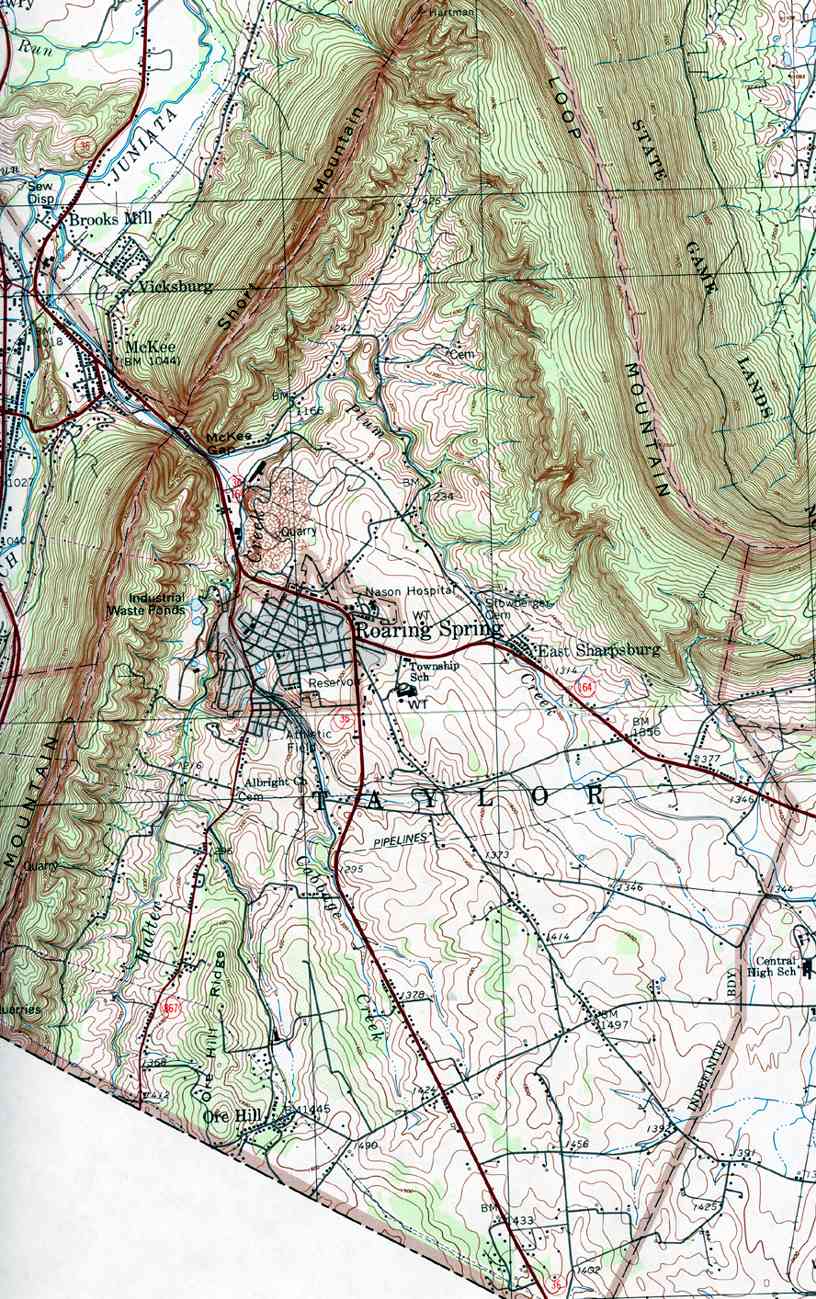
The best evidence for these families being involved in an Indian attack is the following story repeated in many accounts. Jacob Neff, a Brethren man supposedly shot and killed an Indian or two at the Neff mill. In retaliation the Indians burned the mill. The local Brethren congregation forgave him for his breach of pacifism but later banished him for bragging about it. James Sell investigated this story and found the killing and expulsion to be true, but the mill belonged to Daniel Ulrich. Though one account says he bought it later. In fact Daniel Ulrich not only owned the mill, but land that is today Roaring Spring. It is not certain which Daniel Ulrich this is, but the one that best fits is the Daniel Ulrich who married Susannah Miller, the daughter of Philip Jacob Miller. Her husband Daniel Ulrich was probably the grandson of Stephen Ulrich Sr. Susannah’s brothers Daniel and David Miller also lived in the Cove.

From the History of the Church of the Brethren in the Middle District of Pennsylvania:

During the Indian Wars of 1762 and onward there were quite a number of murders committed and captives taken. The particulars will never be known. The greatest massacre was in 1777. One history says there were thirty killed. Our tradition says twenty. The number of prisoners taken we cannot conjecture. A Brother Houser and family are mentioned among the number.

John Houser did sign the 1775 road petition, so a man by that name is present in the valley.

John Martin, a pioneer preacher, whose name heads the list of ministers of the Clover Creek congregation, suffered greatly from these Indian depredations.

John Martin signed both the 1775 and 1776 road petitions.

For want of the original, copy is taken from Jones’ History of Juniata Valley, relating the incident as follows:

Page 20:

During the Great Cove massacre, among others carried into captivity was the family of John Martin. This incursion was indeed a most formidable one, led by the kings Shingas and Beaver in person. How many were killed there is no living witness to tell; neither can we conjecture the number of prisoners taken.

The following petition was sent by John Martin to council:

August 13, 1762

“The Humble Petition of Your Most Obedient Servant Sheweth, Sir, may it please Your Excellancy, Hearing me in Your Clemancy a few words. I, One of the Bereaved of my Wife and five Children, by Savage War at the Captivity of the Great Cove, after Many & Long Journeys, I Lately went to an Indian Town, viz., Tuskaroways, 150 miles Beyond Fort Pitts, & Entrested in Co. Bucquits & Co. Croghan’s favor, So as to bear their Letters to King Beaver & Cap. Shingas, Desiring them to Give up One of my Daughters to me, Whiles I have Yet two Sons & One Other Daughter, if Alive, Among them — and after Seeing my Daughter with Shingas he Refused to Give her up, and after some Expostulating with him, but all in vain, he promised to Deliver her up with the Other Captives to yr Excellency.

Sir, yr Excellency’s Most Humble Servt Humbly & Passionately Beseeches Yr Beningn Compassion to interpose Yr Excellencies Beneficent influence in favor of Yr Excellencies Most Obedient & Dutiful Servt.

John Martin”

Page 21:

Brother Sell writes further :

The Brethren came into the Great Cove, now Morrison’s Cove, and by taking possession of the valley in the vicinity of Roaring Springs, the western portion of the Clover Creek congregation, were among its first settlers.

They set to work to clear away the forests, till the soil, build mills, and labored to promote the peace and prosperity of the country. It has been conceded to them, even by people who took no interest in their religion, that as good farmers, good taxpayers, quiet and inoffensive people — they were of the best of citizens.

But their exclusiveness, opposition to education, their lack of interest in political matters, and above all, their non-resistant principle brought them into disrepute with their neighbors.

This made their situation unpleasant and at times exposed them to more danger from their common enemy. Had they been permitted to treat with the Indian alone and manifest their love of peace and fair and honorable treatment, there is every reason to believe that not only they but their fighting neighbors would have escaped the assaults of the savage’s tomahawk and scalping knife.

The settlers all suffered from the incursions of the Indians from the time of their coming into the valley up to the time and during the Revolutionary War.

By this time by purchase and force the Indians were driven west of the Allegheny mountains. But out of hatred to their white brothers from real or imaginary wrongs, and also for spoils and scalps on which they were paid a bounty by the British government they made frequent raids into the valleys east of the mountain. When invasions were made the news was heralded as rapidly as the circumstances of the times permitted and the warning was to flee for safety. Some left their homes, others did not. All perhaps did not hear the alarm. Some could not go, and others preferred not to go. The result was that a number of them were murdered. In 1777 between twenty and thirty were killed.

During all these trying experiences of frontier life covering a period of nearly a quarter of a century, but one breach or violation of the peace principle held by our people is recorded.

Page 22, 23:

This single instance, which Brother Sell calls the “Jacob Neff Episode” occurred within the bounds of the Clover Creek congregation. U. J. Jones, after giving a copy of a report of “Thomas Smith and George Woods”, both, we believe, Justice of Peace at the time to President Wharton in which there is no direct reference to the Brethren, refers to the Neff incident as follows:

The band of Indians, after the Dunkard massacre, worked their way toward the Kittaning war path, leaving behind them some few stragglers of their party whose appetite for blood and treasure had not been satisfied. Among others, an old and a young Indian stopped at Neff’s Mill. Neff was a Dunkard; but he was a single exception so far as resistance was concerned. He had constantly in his mill his loaded rifle, and was ready for any emergency. He had gone to his mill in the morning without any knowledge of Indians being in the neighborhood, and had just set the water-wheel in motion when he discovered two Indians lurking, within a hundred yards, in a small wood below the mill. Without taking much time to deliberate how to act, he aimed through the window, and deliberately shot the old Indian. In an instant the young Indian came toward the mill, and Neff ran out of the back door and up the hill. The quick eye of the savage detected him, and fired, but missed his aim. Nothing daunted by the mishap, the savage followed up the cleared patch, when both, as if by instinct, commenced reloading their rifles. They stood face to face, not forty yards apart, on open ground where there was no possible chance of concealment. The chances were equal; he that loaded first would be victor in the strife, the other was doomed to certain death. They both rammed home the bullet at the same time — with what haste may well be conjectured. This was a critical juncture, for, while loading, neither took his eye off the other. They both drew their ramrods at the same instant, but the intense excitement of the moment caused the Indian to balk in drawing his, and the error or mishap proved fatal, because Neff took advantage of it, and succeeded in priming and aiming before the Indian. The latter, now finding the muzzle of Neff’s rifle bearing upon him, commenced a series of very cunning gyrations and contortions to destroy his aim or to confuse him, so that he might miss him or enable him to prime. To this end he first threw himself upon his face; then, suddenly rising up again, he jumped first to the right, then to the left, then fell down again. Neff, not the least put off his guard, waited until the Indian arose again, when he shot him through the head.

Neff, fearing that others might be about, left the mill and started to the nearest settlement. A force was raised and the mill revisited; but it was found a heap of smouldering cinders and ashes, and the dead bodies of the Indians had been removed. It is altogether likely that the rear of the savage party came up shortly after Neff had left, fired the mill, and carried away their slain companions.

For the part Neff took in the matter he was excommunicated from the Dunkard society. Nevertheless, he rebuilt his mill; but the Dunkards, who were his main support previously, refused any longer to patronize him, and he was eventually compelled to abandon the business.

Brother Sell speaks of the same incident as follows :

Daniel Ullery was the original owner of Roaring Spring. He built the first mill. Jacob Neff was his miller. During the Indian massacre of 1777 he shot an Indian. He was counseled by the church for his violation of her peace principles. He did not plead justification. He admitted that it was wrong to take human life but said his deed was done under strong temptation and excitement. He was excused, but required not to speak of his act in company in a boasting or justifying way. This restriction he frequently violated and he was expelled from the church.

This story has been repeated and exaggerated and the church through it is represented so that we take this opportunity to tell the story as we have it from our own traditions. The history of Juniata Valley says that when Neff rebuilt his mill the Brethren refused to patronize him. This is not correct. The chain, or abstract of title shown that Neff never owned the mill, did not build it in the first place, did not in the second place.

Pages 25, 26:

Ullery built and rebuilt it. It was a necessity in the new settlement.

The first Indian depredators, or at least the greater portion of them, were seen at a camp-fire by a party of hunters; and if the proper exertions had been made to cut them off, few other outrages would have followed. The supposition is that there were two parties of about fifteen each, who met at or near Neff’s Mill in the Cove. On their way thither, the one party killed a man named Hammond, who resided along the Juniata, and the other party killed a man named Ullery, who was returning from Neff’s Mill on horseback. They also took two children with them as prisoners.

The savages swept down through the Cove with all the ferocity with which a pack of wolves would descend from the mountain upon a flock of sheep. Some few of the Dunkards, who evidently had the latent spark of love of life, hid themselves away; but by far the most of them stood by and witnessed the butchery of their wives and children, merely saying, “Gottes wille sei gethan.” *

This sentence was so frequently repeated by the Dunkards during the massacre, that the Indians must have retained a vivid recollection of it. During the late war with Great Britain, some of the older Indians on the frontier were anxious to know of the Huntingdon volunteers whether the ” Gotswiltahns ” still resided in the Cove. Of course our people could not satisfy them on such a vague point.”

* God’s will be done.

Back to Maryland?

We have a couple of pieces of evidence that Daniel Miller went back to Maryland.

First, the local history says that the area was indeed nearly entirely evacuated and that the Conococheague Valley was one of the locations where the refugees located. For Daniel, this would simply have been going home.

Secondly, Daniel’s son indicated he was born in Maryland in 1781.

Third, in 1776 when they do not sign the road petition in Bedford County, both Daniel and David Miller appear in Frederick County on the list of non-enrollers, but there is also another Daniel Miller living in Frederick County, son of Lodowich Miller, so these two can be confused.

Fourth, in 1778, some Daniel Miller took the oath of fidelity in Washington County, Maryland, formerly the area Frederick County.

Fifth, in 1783, after Lodowich’s family, including the other Daniel, had removed to the Shenandoah Valley, Daniel Miller remains and is taxed in Frederick County with animals but no land.

However, Daniel wasn’t to stay long in Frederick County, because by 1786, we find him once again in Bedford County.

Return to Bedford County

1783 was an important year. The Revolutionary War had lasted for 7 years. On April 11, the Continental Congress proclaimed an end to hostilities. However, most of Ohio was still in dispute with the Indians which held back settlement there for another 20 years. Replogle 162

Also, in 1783, the road from Cumberland to Bedford County was improved and was eventually 12 feet wide. Replogle 57

This would have allowed wagons and might have made resettlement very attractive to Daniel Miller.

The 1784 Bedford County tax list tells us that Daniel hadn’t yet made that return journey.

1784 Bedford Co. tax returns:

  • Daniel Ullery – 408 acres in Frankstown Twp
  • No David or Daniel Miller listed but lots of other Millers
  • Jacob Stutzman – 0 acres, 1 dwelling, 2,0
  • Jacob Cripe – 900 acres

1784 Bedford County, in Brother’s Alley:

  • John Miller (1-6)
  • Peter Miller (1-5)
  • Michael Miller (1-6)
  • Christian Miller (1-6)
  • William Miller (1-2)

The Kernel of Greatness, An Informal Bicentennial History of Bedford County by the Bedford County Heritage Committee, page 134:

It is known that some Brethren settled here as early as 1785, for that was the date in a deed for a grant of land in Morrison’s Cove made jointly to Jacob Brumbaugh and Samuel Ullery. The latter was the first minister of the denomination known to have preached hereabouts. Centered around New Enterprise, the Yellow Creek (or Hopewell) congregation embraced all the territory of our county and most of Fulton. From this first group sprang the majority of all local Brethren Churches.

In 1785, Woodbury Township was formed from Frankstown. This is where Daniel Miller would live. Settlers had arrived there at first 40 years earlier, but settlement was still sparse.

The nearby town of Hollidaysburg was not laid out until next year and entire township only had 118 households. Replogle p 29

In 1786 Jacob Snyder settled in Snake Spring Valley. At his home Brethren of the area held meetings over a period of years until in 1840 a congregation was organized.

1786 Woodbury Twp. tax list

  • Daniel Miller (Cox’s land)
  • David Ulerick
  • Stephen Ulerick
  • Daniel Ulerick
  • Jacob Stutzman (Cox’s land)
  • John Ulrick – single – Cox’s land

From the tax lists, we find evidence that Daniel Miller, along with several other Brethren is living on Cox’s land. I found mention of Cox in the early deed books.

In 1780 Charles Cox in Morrison’s Cove sells John Snyder 500 acres near where Three Springs enters Yellow Creek. This tells us that Daniel Miller probably lives someplace in this vicinity as well.

Undated Tax list:

  • David Ulrich – Cox’s land
  • Stephen Ulrich – Cox’s land
  • Daniel Ulrich

In 1787, Woodbury Township was divided between Bedford County and Huntingdon County, but Daniel continues to be listed in Bedford County. In 1838, the Bedford portion is further divided into Woodbury and South Woodbury.

1788 Bedford Tax list:

  • Daniel Miller
  • David Miller
  • Daniel Ullery
  • David Ullery
  • Stephen Ullery
  • John Ullery – single

Several other Brethren families went to Morrison’s Cove and were there by 1789. At least four of Stephen Ulrich Jr.’s children: Hannah who married George Butterbaugh. David Ulrich and Stephen Ulrich III were “made subject to law to the performance of military duty” in 1789. Lydia Ulrich married Jacob Lear. Daniel Ulrich owned a mill where Roaring Spring is today. Replogle 129

Jason Replogle notes that the word “inmate” on the tax records, according to the Bedford County Historical Society means renter, non-owner.  They also say that tax assessing went on at that time every 3 years which would explain the sequence of 1782, 1785, and 1788 in Frankstown. Replogle 131

In 1789, in Morrison’s Cove, David Miller was assessed for 474 acres, 2 horses and 3 cows and Daniel for 214 acres, 3 horses and 4 cows. Replogle 129

The 1789 tax list has an unexpected benefit – ages, I think. Never before, or since, have I seen a tax list that included ages, but this one appears to. Daniel Miller was actually 34, and is shown as 37. His brother, David was 32 and he is shown as 23. If these aren’t ages, I don’t know what they would be.

1789 Bedford County Tax List

Age? Name – Woodbury Twp – Martain Loy’s Return ? Land Horses Cows
Thomas Veccory?                                             Va 125 500
Martain Loy 164 241 2 2
36 Henry Werner 96 or 46 50 2 2
43 Abraham Feeter or Jeeter 145 327 5 5
35 Jacob Good 92 150 3 4
28 Jacob Bowman – Coxes Land 102 230 2 3
40 John Bair – Coxes Land 109 230 3 1
Peter Sensebaugh – Coxes Land 76 153 1
20 John Sensebaugh – stricken through 10 Checkmark
Peter Witmar 100 300
30 Philip Mixcelle? – Snivel’s Land 182 300 2 4
40 George Bowman 10 0 1- 0
William Tatorious – one still 61 100 2 3
40 Christian Dridl 38 50 2 3
50 William Yortea – one still 36 0 2 2
45? John? Forgeson (crease in paper) 50 ? ? ?
28 Jacob Cravenston – Coxes Land 10 1- 0
Nicholas Cravenston – Coxes Land 189 279 3 3
William Beaman – Coxes land 176 278 2 2
18 George Beaman
26 Gabriel Magin – Coxes land 261 0 2 2
42 Jacob Viant – Coxes land 133 1- 1
23 David Miller – Coxes land 149 474 2 3
34 Jacob Lear – Coxes land 136 215 3 2
37 Daniel Miller – Coxes land 142 214 3 4
36 Stephen Ullreck – Cox Land 145 148 3 5
26 David Ullreck – Cox land 142 148 3 4
Ditto 37 150
56 Jacob Stutzman – Cox land 142 148 3 4
50 John Snyder 350 250 3 8
Abraham Overholtzer – one saw mill 149 220 3 3
30 John Hipple 126 419 2 2
Peter Sherman? 45 100 Torn Torn
25 Jacob Bain 60 100 2 2
34 or 39 Peter Folks 76 200 2 2
John Brannon on Capt. Hunter’s land 76 100 2 2
30 John Welch – single freeman
40 Nicolous Peticot – Capt. Hunter’s land 66 0 1- 2
37 James Ray 56 100 2
37 Henry Erllabaugh on Hunter’s land 63 5 5
36 Thoma Eyl 25 50
40 Edward Mceroy 63 100 1- 5
45 William Gilson or Gibson 66 100 5 2
John Sherley 101 150 2 2
18 Richard Sherley – struck through
Peter Werner or Verner 23 2 1
John Peterbaugh 25 100
Thomas McCune 17 70 Smudged 2
Name illegible on fold – Cox’s land 100 Hole ? 2
49 John Falkner – Cox’s land 89 Smudge 2 3
Ditto for land 25 100
30 Henry Dial 18 60 Smudge ?
27 William Adams 38 100 1 1
40 Peter Adams 65 100 2 2
44 Philip Knee, Knu or Jones 64 100 2 3
George Roth 65 100 3 2
20 Philip Roth – struck through
44 Abraham Deeter- one grist mill 175 150 3 ?
John Mets?er 11 200 3 6
40 George Broombaugh 92 130 3 4
24 John Engle 179 600 2 3
28 Casper D (or B)illinger 29 2 3
30 John Hall – half taxes 50 300 1 3
22 Daniel Hall – single freeman – one still 80 172 2 torn
21 Jacob Overholtzer – single freeman
23 John Cramer – single freeman
30 Daniel Ullerick 154 150 2 3
45 Jacob Nave 200 400 4 4
39 Ludwick Wissenger 60 100 3 2
40 Simon Hay 25 50 1 1
35 Michael Hay 51 100 2 2
35 Martain Housen? – quantity of land unknown to me 25 100
24 Edward Cowen – quantity of land unknown to me 76 209 2 2
30 Christopher Rohrer – single freeman – one still 15
Christian Newcomer 15 60
40 Harmon Deik? 100 150 2 2
23 John Ullrick – a sawmill – single freeman 70 100 2 2
40 Michael Pot? 79 227 2 3
Ditto for land 25 100
26 Nicolous Shell for Hollis land 38 100 1 1
Ditto for land 37 100
John Croal for Wallyses land 123 250 2 1
40 Abraham Newswander – Wallis land 76 2 2
23 George Faring? For Wallysis land 110 1 2
26 Rinehart Replogle Jr on Wallysis land 26 2 2
18 John Replogle – struck through
Rinehart Replogle Sr, on Wallysis land 296 476 5? 2
30 William Cohanico? – Wallysis land 226 352 2 2
46 Peter Beltser 3 1
48 Joseph Cellers 192 200 3 4
43 James Knot 25 100 2 2
40 William Nichlous 38 50 2 2
William Findley 38 50 2 2
John Adams Sr. 25 50
25 George Hanay – single freeman 35 50 1
40 John Lower 25 100
Abraham Lingin ?? 75 175 1 1
30 Jacob Devil? 75 75 1 1
23 Peter Embler 3 1 1
3? George Lingerfelt ? ? Torn Torn
25 John Overholtzer 43 80 2 1
42 Abraham Leedy 64 110 5 3
48 Henry Brown 61 110 3 2
32 William Ditts? Or Ditto? 101 200 2 2
23 George Dell or Doll 12 50
John Cellars 100 200
47 Christopher Week 58 50 4 2
22 Daniel Magin – Wallis land 160 1-
48 Crestian Wetstone – ditto 173 2 1
45 Valentine Oster 142 200 3 4
Ditto 12/10? 62
23 John George Priceler 20 70
David Hootsman 50 100
Joseph Long 326 750 2 2
Ditto 75 300
32 Daniel Ullerick 76 200 2 2
40 Lutwidk Low 28 50 1- 2
Jacob Broombaugh 275 700
Cronkleton 25 100
30 Jacob Puterbaugh 50 50 3 3
Ditto at the Long Meadows 12 25
Ditto on the Plow He?lievg 100 210
George Puterbaugh Jr 25 100
29 Adam Burcket 129 210 2 3
30 Abraham Gantsenger Jr? 75 200
25 Thomas Jones – single freeman
39 Jacob Smith – Cox’s land and tanyard 111 2 3
William Bower – single freeman 15 10 1 1
John Ditts or Ditto 54 100 2 3
George Bower – single freeman
27 Isaac Cronck – single freeman 1
John Martain 272 449 4 4
20 Coonrod Martain – struck through
John Teeter or Jeeter 172/80/1118 125 150 3 6
Ditto land 25 100
Woodbury Township Nonresident Persons Names
Samuel Wallis
Jacob Brumbaugh (4 tracts adjacent) 897
John Brumbaugh 200
Israel Brumbaugh 190
Dickson Children? 272
Ditto 84
Henry Huffman 76
Martin Houser 250
Abraham Kinsinger 200
Joseph Morris 200
Thomas Mchune 80
George Buterbaugh Jr 225
John Buterbaugh 103
John Sellery 200
Ditto 138
Daniel Hall (or Stall) 172
David Stutzman 60
Henry Snively Doc? 250
Thomas Vickroy 464
Joseph Krootleton 100
John Darne 100
Jacob Stevens 200
Joseph Long 370
Richard Vanbell 219
John Moore 503
George Ruch 369
William Gerrgas 237
Benedict Dorsey 232
Robert Lasley 298
Moses Patterson 315
Samuel Richards 367
Isaac Harvel 352
Thomas Walker 398
Abraham Robison 475
8596

On another tax list, a Jacob Miller is listed as a nonresident in 1789.

A list of the inhabitants of Woodberry Township made subject by law to the performance of militia duty, taken by Martin Loy the 26th of January 1789 includes the following names:

  • Gabriel Magin (Maugans)
  • David Miller
  • Jacob Lear (this family later found in Elkhart County, Indiana)
  • Daniel Miller
  • Steven Ullrech
  • David Ullrech
  • Jacob Stulsman (Stutzman)
  • Daniel Magin (Maugans)
  • Samuel Ullrich
  • Coonrath Martin (Conrad)
  • Daniel Ullric
  • John Ullrick
  • George Haney (descendants later found in Elkhart County, Indiana)

1789 Woodbury Twp tax list, extracted for Miller, Maugans and Ulrich by various spellings:

  • David Miller
  • Daniel Miller
  • Gabriel Maugans
  • Stephen Ulrich
  • David Ulrich
  • Samuel Ulrich
  • Daniel Ulrich

1790 or 1791 tax list

  • David Miller
  • Daniel Miller
  • Peter Maugons
  • Daniel Maugons
  • David Ulry
  • Samuel Ulry
  • Daniel Ulry
  • Stephen Ulry
  • Yearty Ulry

Daniel Miller first appeared on the Woodbury Township tax list in 1785 and by 1789, is well established, farming 214 acres with 3 horses and 2 cows. There was just one problem, those 214 acres weren’t his. He rented land from a man named Cox who was somewhat of a land speculator. Many Brethren families are noted on the tax lists as renting land from Cox. According to the “History of the Church of the Brethren in the Middle District of Pennsylvania,” by 1790, all of the desirable lands were owned and all of the good land was claimed many years before. This area began to be settled initially in 1755.

No land records have been found in Bedford County for David or Daniel Miller.  Presumably the land they rented from Cox was located near what is now New Enterprise in the southern end of the valley. This is where Samuel Ulrich, Elizabeth’s brother, was located, and many other German Baptists from the Washington County, area.

This beautiful rolling valley named Morrison’s Cove would have been where Daniel and Elizabeth farmed and raised their children among like-minded families in the Brethren church. Bedford County at that time had no established church buildings, and services were held in member’s homes and barns. Daniel, like everyone else, would have taken his turn.

David Miller Bedford fall

Daniel Miller wasn’t the only child of Philip Jacob Miller to move to Bedford County. His brother David Miller settled there too, along with sister Esther who married Gabriel Maugans and sister Susannah who married Daniel Ullery.

Susannah Miller and Daniel Ullery owned the mill at Roaring Springs, today the old mill pond with a beautiful fountain.

David Miller Roaring Springs

Daniel certainly lived nearby and visited this mill regularly, as did all farmers.

Daniel Miller roaring springs

The first census was taken in 1790, and the Bedford County census fortunately appears to be recorded in house order.

Daniel Miller 1790 Bedford census

We find Gabriel Maugans beside Daniel and David Miller. Another Maugans appears to be next door, and the entire group is near to the Ullery, Replogle and Stutzman families. All known Brethren.

It never really struck me until I saw this census that Daniel’s first 7 children were all boys.

I put together a 1788-1791 Cross Match Census and Tax lists table for Miller, Stutzman, Ullerich and Cripe in Bedford County.

Name 1790 M16+ 1790 M<16 1790 F 1788 tx 1789 tx 1790 tx 1791 tx
Phillip Miller – Ayr/Dublin – no land tax 2 1 7
Jacob Miller 1 2 4 H H
Felix Miller 2 3 1 H H
Jacob Miller 1 1 4 H
John Crull 1 3 7 W W W
David Miller 1 2 4 W W W
Daniel Miller 1 7 1 W W W
David Ullery 1 5 2 W W W
Samuel Ullery 1 1 5 W W
Jacob Miller – Bedford Twp – no land tax 1 2 2
Andrew Miller 1 6 Bd
John Crull 3 1 7 W W
Daniel Ulrick 2 2 4 W W W
Jacob Miller 4 3 3 Bd Br
Peter Miller 1 2 Bd
Peter Miller 1 1 Bd Bd
John Miller 1 2 Bd Bd
Elles Miller 1 2 Bd
Michael Miller 1 2 3 Br Br
Nicholas Miller 1 0 0 Br Br Br
Christian Miller 2 1 0 Br Br Br
Abraham Miller 1 1 Br Br
Andrew Miller – no tax lived in Br 1 1 1
John Miller 1 2 Q Q Q
Nicholas Miller 1 1 2 Br Br Br
Michael Miller 1 1 6 Br Br Br
Nicolas Miller 1 1 1 Br Br
Mary Miller, widow 0 3 1 Br
John Miller 2 3 3 M M
Barbara Miller 0 1 5 Q Q Q
Christian Miller 1 3 5 Q Q
Christian Miller 1 3 5 Q Q Q
Abraham Miller ! 1 4 Q Q Q
Christy Miller 1 3 2 Q Q Q
Hendrey Miller 1 3 2 E E
John Miller 1 1 E E
John Miller 1 1 3 E E
Peter Miller 1 3 2 E E E
Jacob Miller 1 3 2 E E E

H=Hopewell
W=Woodbury
Bd = Bedford
Br = Brother’s Valley
M= Milford
E= Elklick
Q-Que

If you’re thinking to yourself, there certainly were a lot of Miller men in Bedford County by this time, you’re absolutely right, and we know they weren’t all ours. It’s no wonder that there is so much confusion surrounding this family and surname.

The last tax lists where we find Daniel Miller are the available group from 1796-1799.

Daniel Miller 1796 Bedford tax

The 1796 list, above, shows Daniel Miller with a house and sawmill, both.  I can’t read all the column names, but he looks to also have 2 horses and 4 cows.  He was quite well off, comparatively.

Daniel is present in 1797 and 1798, but David Miller is not on the list anytime from 1796-1799. In 1799, both are absent, gone to the land of Kentucky and Ohio, the next frontier.

Bedford County Maps

What can we discern about where Daniel Miller lived in Bedford County?

From various deeds, we know that Cox owned land near where 3 Springs empties into Yellow Creek, near New Enterprise today.

Daniel Miller Cox land

The little grey balloon in the lower right quadrant marks that intersection.

Daniel Miller Cox land satellite

The road through Loysburg Gap is Woodbury Pike in present day South Woodbury Township.  The intersection of 3 Springs and Yellow Creek is just above Loysburg, shown on the topo map below.

Daniel Miller Loysburg Gap

The Topozone map below shows Dunnings Mountain forming the western border of Morrison’s Cove.

Daniel Miller Dunnings Mountain

The topographical map below shows the location of Dunnings Mountain, with the red balloon, forming a western border for Morrison’s Cove but more importantly, it also shows the valley area which is roughly 5 miles across and 20 miles north to south which constitutes Morrison’s Cove, enclosed by the mountains.  Morrison’s Cove is a beautiful valley.

Daniel Miller Morrison's Cove

This valley encompasses Roaring Spring on the North to New Enterprise on the South, Dunnings Mountain on the West to the state Game lands 73A East of 866, near Loysburg Gap where 36 crosses the mountain between New Enterprise and Yellow Creek.

Daniel Miller intersection 3 Springs

In fact, look at this beautiful historic building on 3 Springs at the intersection of 869 and Woodbury Pike, PA36.  Could this have been Daniel’s mill?

Based on the description of Cox’s land location, Daniel Miller probably lived someplace in the southern part of Morrison’s Cove. We know that Daniel Ullery owned the mill in Roaring Springs.

The headwaters of Snake Spring are about 3 miles below Loysburg, where the two mountain ranges come together and Upper Snake Spring Road becomes Church View Road which becomes Lower Snake Spring Road. This is the southernmost part of the 1775 and 1776 road petition, beginning at Snake Spring to the Gap in the dividing ridge.

Croyle’s Cove today is Snake Spring Township, and the Gap referenced would be the Gap leading between Lower Snake Spring Road and Upper Snake Spring Road. Morrison’s Cove is noted as being above this gap.

Daniel Miller Croyle's Cove

Today, Woodbury Township and South Woodbury Township are in Bedford County, while North Woodbury Township later fell into Blair County. We know that Daniel Miller lived in what was then Woodbury Township in Bedford County.

Daniel Miller Woodbury Twp

Today’s Woodbury Township

Daniel Miller South Woodbury Twp

Today’s South Woodbury Township.

Daniel Miller North Woodbury Twp Blair Co

Today’s North Woodbury Township, Blair County, PA.

On the USGS topo map, North Woodbury is not labeled as Morrison’s Cove.

Roaring Springs is in present day Taylor Township and it is also not labeled as Morrison’s Cove.

Only Woodbury and South Woodbury are labeled as Morrison’s Cove, between Woodbury and New Enterprise.

Daniel Miller lived in what was then Woodbury Township, probably near New Enterprise, and clearly on one of the streams strong enough to power a sawmill. The creeks in that area are Yellow Creek and 3 Springs and I would not be one bit surprised if the building near that intersection that still exists today was Daniel’s mill.

Philip Jacob’s Decision

In 1795, the Treaty of Grenville followed the defeat of the Indians at the Battle of Fallen Timbers near the Maumee rapids. Indians agreed to give up about two thirds of Ohio and a part of Southeastern Indiana. In Ohio large-scale Indian dangers ended and large-scale migration began. Replogle 165

Following the treaty, regular trips were established from Cincinnati to Pittsburg and back. They took a month. Boats dotted the Ohio as far as the eye could see.  A Second source says a one way trip from Pittsburgh to Cincinnati took about a week.

flatboat

As family members moved to Bedford County, and other Millers migrated to other frontier locations, the family in Frederick County was becoming thin.

Philip Jacob’s brother Lodowich had either moved to Rockingham County, VA or died in about 1782 or 1783 and their brother John died in 1794. John farmed the other half of the same land that Philip Jacob farmed. Those two men would have been extremely close, and dependent to some extent on each other for help with farming. With John’s passing, and several of Philip Jacob’s children already gone for a decade or more, he must have been thinking about what to do with his own land and assets, as well as his legacy to his children.

Philip Jacob Miller made a monumental decision. When he sold his brother, John’s land, as executor, he sold his own land to the same man in 1796.

Philip Jacob then proceeded to “sell out” as it was known, selling everything he didn’t need to be able to pack what he did need into a wagon to set off for the new frontier where he had arrived by August of 1796. Not the frontier in Bedford County. That was no longer a frontier and the land was mostly gone – but the real frontier, beyond Pittsburgh – down the Ohio River to near Fort Washington, a location that would one day become Cincinnati, Ohio. That was the real frontier where the Indians had just been defeated the year before. Trees were waiting to be chopped and land was waiting to be cleared. A repeat, for Philipp Jacob Miller, of what he had done nearly half a century earlier when Frederick County was the frontier. However, in 1751, Philip Jacob was in his 20s. In 1796, he was roughly 70.

I can just imagine an older Philip Jacob Miller sporting long grey hair, the signature look of an older Brethren man who, then, would have been considered elderly. A man that everyone knew would not defend himself, carrying his life savings in a wagon, then on a river flatboat, floating down the Ohio, landing in an untamed wilderness on a frontier that was in some ways akin to the Wild West.

I don’t know whether to be astounded or horrified. Clearly, nothing bad happened, because Philip Jacob bought about 2000 acres of land, seven times what he sold, enough for all of his children after his death to have 200 acres each. Ironically, he never got to live on the land he purchased. He never owned land in either Kentucky where he died or technically, in Ohio either, because the surveying and title transfer did not happen until after his death. So Philip Jacob actually died landless.

Thank goodness for the beginnings of his land purchase, because the transactions surrounding that land following Philip Jacob’s death in 1799 inform us of which children were still living and the names of the daughter’s husbands. 

Philip Jacob Miller left Maryland in early 1796 and arrived in Campbell County, KY later that year, just across the river and upstream a few miles from Cincinnati, then just a small village.

Son David may have actually traveled with his father in 1796, but he had assuredly joined him by 1797. In 1799, Daniel left Bedford County and followed.

The Land That Becomes Ohio in 1803

As a compromise with the other colonies during ratification deliberations on the Articles of Confederation, Virginia ceded its territorial claims to lands northwest of the Ohio River and was granted lands in the southwestern quarter of Ohio in 1784 to give as payment to Virginia’s soldiers who served in the Continental Army. This area was called the Virginia Military Reserve.

During the Constitutional Convention, Congress passed the Northwest Ordinance of 1787, which, among other things, prohibited slavery north of the Ohio River, partly to prevent farmers in the Northwest Territory from competing with the South. Nevertheless, such a prohibition was attractive to the German Baptist Brethren.

From Troy Goss’s website:

Philip Jacob Miller having acquired considerable funds from selling his property in Washington Co, MD now sought to provide for the future of his children. Sometime after Phillip’s settling in Campbell County, he purchased land warrants for two tracts of land in the still unsettled country soon to be the State of Ohio. He purchased the warrants from William Lytle who was acting as agent for James Taylor. The land was yet to be surveyed. The land was purchased for $1.10 per acre while other tracts I the area were selling for $2 per acre.

Philip Jacob’s land was comprised of 2 surveyed tracts. Tract 3790 (in Clermont and Warren County) was for 1766 2/3rd acres, according to the US National Archives. Tract 3790 consisted of 8 military warrants purchased and assembled to James Taylor and William Lytle. Philip Jacob sometime before his death acquired an interest in these warrants. The tract was then surveyed after his death and several years later, the patents were issued to his heirs.

This tract was comprised of the following warrants:

  • Warrant 4617 200 acres Robert Underwood May 19, 1798 acquired by Lytle
  • Warrant 4888 200 acres Eppa Fielding April 19 1799 acquired by Taylor
  • Warrant 3583 200 acres
  • Warrant 4828 200 acres William Lytle
  • Warrant 4902 100 acres Henry Sanders Aug 1 1799 acquired by Taylor for Reuben Rose’s service for 3 years as a private in the Virginia continental line – heir of Reuben, Feb. 7, 1802
  • Warrant 4903 for 100 acres William Plunkett Aug. 13 1799 acquired by Taylor, heir of James Feb 7 1800, for James Plunkett service for 3 years as private on Virginia line
  • Warrant 4899 for 100 acres Martin Holloways Aug. 1, 1799 acquired by Taylor Feb. 7, 1800
  • Warrant 4905 for 666 2/3 acres John Nelson Aug. 2, 1799 acquired by Taylor Feb. 7, 1800
  • Total acres 1766 2/3

The property was surveyed Feb. 20, 1800 and William Lytle acquired James Taylor’s interest in the property on June 24, 1802. A patent was issued to James Taylor, William Lytle and Robert Underwood on May 2, 1803. The property was then conveyed to David Miller and Abraham Miller administrators of the Philip J. Miller estate on Sept. 7, 1803 for $2000.

Tract 3791 was located in Warren County.

In August or September of 1799, Philip Jacob Miller died in Campbell Co., KY, before he could complete his land purchase transaction. His widow, Magdalena, lived until 1808.

An agreement was made by his heirs and children as to the disposition of the two tracts of land Philip had purchased. In an agreement dated December 19, 1799, the heirs decided to divide the 2000 acres into ten 200 acre parcels with John Ramsey and Theophilus Simonton acting as appraisers and administrators. They were to draw lots as to who received which parcel. Magdalene Miller Cripe elected to take her share in cash. In order to equalize the draw for those heirs at the last of the drawing, the following procedure was used:

  • The 10th lot was to pay $55 to the 4th
  • The 7th lot was to pay $38 to the second lot.
  • The 6th lot was to pay $33 to the 3rd lot
  • The 8th lot was to pay $28 to the first lot
  • The 9th lot was to pay $24 to the 5th

As it was in the dead of winter, the survey would have to wait until spring. On Feb. 8, 1800, entry 3790 was made for 1766 2/3 acres. On Feb. 20, 1800 the survey was made with David Miller and Jacob Snyder as chain carriers and Abraham Miller as marker. Sons David and Abraham were the executors of Philipp Jacob Miller’s estate. The survey being completed, the agreement was finalized and signed and recorded on March 29, 1800. The patent was not issued until the later part of 1803 and the heirs received their parcels during the years 1805 through 1809 as they settled into the region to receive their land.  Miller 51

Clermont County, Ohio

Excerpt from “The Brethren Encyclopedia”:

In 1796 Philip J. Miller moved to Campbell Co., KY, where he died in 1799. Members of his family were charter members of the Stonelick, OH, congregation in 1802. Later some family members (Daniel and David) moved into Montgomery Co., OH. Philip’s daughter Magdalene married Daniel Cripe, who was a leader in the southern Ohio church and later established the congregation in Elkhart Co., Indiana (1829).

While Philip Jacob Miller lived in Campbell County, KY on the south side of the Ohio River, Daniel Miller made his way 50 miles or so north into Ohio, winding up on the Clermont County border with Warren County.

While we know that Daniel Miller did wind up in Clermont County, there is one piece of evidence that suggests he may have lived in Kentucky near Philip Jacob Miller for at least a short time.

History of the Church of the Brethren of the Southern District of Ohio, 1920, p 509

When [Daniel was] eighteen months old (middle of 1799), his father (Stephen, son of Daniel, son of Philip Jacob Miller) built a raft on the Ohio River and floated down the stream to Kentucky, where they landed and lived for a while in that state. They, then, moved to Clermont County, Ohio. They next moved to Montgomery County, Ohio, where Daniel’s father (Stephen) in 1816, built the first frame house in Jackson Township.

Extracted from the History of the Church of the Brethren of the Southern District of Ohio, published originally in 1916, reprinted in 2007, page 50 – regarding the organization of Stonelick Church in Clermont County:

The following persons are remembered as being members at or soon after the final organization of the Stonelick Church in 1802: John Garver and wife, Abraham Miller, Catherine Miller, David Miller, Magdaline Miller, Stephen Miller and wife, Frederick Weaver, Elizabeth Wever, Mathias Maugans, David Bowman and wife, Joseph Myers and wife, Michael Custer and wife, Stephen Miller Jr., Lewis Caudle and wife, Gabriel Karns and wife, Jonas Bowman, Lydia Belar, Catharine Gray, Arthur McNeal and wife, Rachael Frybarger, Sarah Stouder, Sarah Binkley, Daniel Miller and wife, Daniel Replogle and wife, Jacob Metzger and wife, Esther Maugans and Daniel Maugans and wife. The first deacons included Daniel Miller. Daniel Miller was also a minister.

Magdalina was the wife of David Miller. However, Magdalena was also the widow of Philip Jacob Miller who died in 1808. Elizabeth was the wife of Daniel Miller. Abraham and Stephen were brothers to David and Daniel Miller, and all were sons to Philip Jacob Miller, deceased and Magdalena Miller.

Daniel Miller became known as the Elder Daniel Miller when he was ordained a minister in the O’Bannion Church in Clermont County, Ohio in about 1797. The O’Bannion, Obannon and Stonelick Churches are one and the same, according to the Brethren historian and minister, Merle Rummel.

What does it mean to be a Brethren Elder? From an article by Wayne Diehl titled “Miller Connections”:

What did it mean to be an Elder in the Brethren Church? “There were three levels of leadership within the church: the deacon, frequently considered the first step in the ministry in the nineteenth century: the preacher, who was frequently called a teacher; and the elder or bishop.

The deacons and preachers were elected by the vote of the local congregation, while the elders were ordained “after they have been fully tried and found faithful.”

An elder is, in general, the first or eldest chosen teacher in the congregation where there is no bishop: it is the duty of the elder to keep a constant oversight of that church by whom he is appointed as a teacher. It is his duty to appoint meetings, to baptize, to assist in excommunication, to solemnize the rites of matrimony, to travel occasionally, to assist the bishops, and in certain cases to perform all the duties of a bishop.

The O’Bannion Church was the first Brethren Church north of the Ohio on the old Indian Trail north from Bullskin Landing, the location where people landed and unloaded those flatboats.

The old log O’Bannon Church Building (c1823) was at the Stoddard (Stouder) Cemetery, shown below, about a mile east of the south edge of Goshen – so these families were in the immediate Church area, according to Merle Rummell, Reverend and Brethren Historian.
Stouder Cemetery

Daniel and David Miller didn’t wait on their inheritance of land from Philip Jacob Miller, but bought their own and lived at 132 and Woodville Pike, in the lower left hand corner of the map above.

Merle Rummell tells us the following:

Gabriel Karns lived about a mile on east of the Millers, on Manila Pike, the old Indian Road. Daniel Miller was put into the ministry at the Obannion Church.

In eastern Ohio Territory, the land back from the River was not good farmland. It was Appalachia Hills that crowded the River. David Horne travel 60 miles up the Muskingum River to the Forks of the Licking at the new Zane Trace, before he found land. John Countryman left the Massie Fort at Three Islands (now Manchester OH) and went 30 miles up the Ohio Brush Creek till he found farmland. It was at the Little Miami River, just before Cincinnati where the Brethren stopped at good farmland along the Indian Trace, the Obannon Church.

The Bullskin Landing was a goal for the Brethren migration down the Ohio River by flatboat. It was probably the best landing on the river, being a sunken valley back into the Ohio Hills.

Bullskin creek

Bullskin Creek is flooded by the Ohio River for half a mile back from the River, a wide valley opening. It was the first major landing for Ohio River flatboats above Fort Washington (Cincinnati). Here the flatboat was protected, off the river, with easy unloading facilities.

Most of the settlers on the New Frontier were frontier folk from the Old Frontier, very few were from the Settled East. The River brought them from Old Fort Redstone (now Union and Brownsville, PA), Brothers Valley and Washington Co. PA in the west; from Penns Valley, Brush Valley and Northumberland Co., PA in the north; from the Conococheague and Middletown Valley, MD; from Morrison’s Cove, Cambria Co. and the Juniata Valley, PA. The Kanawha Trace brought them from the Carolina settlements on the Yadkin; from Franklin and Floyd Counties and the lower Valley of Virginia.

These areas were the Old Frontier. It showed in the type of people who came, in their self-reliance and independent thought. They didn’t just accept being told something was true, they tried it out for themselves, and used it. They had to, or they died on the frontier. They were not stupid, while some were illiterate, most could read their Bible – maybe a Berleburg Bible, some read Greek. The Brethren knew what the Bible said, and lived it. They were definitely Brethren, and they took their Brethrenism with them, making a real Christian witness to their neighbors!

South of Goshen, came first David Miller, then his brother, Daniel. Daniel was put into the ministry there about 1798. The first minister was Elder John Garver, from Stony Creek in Brothers Valley, Pennsylvania, by way of Virginia, to North Carolina, to Kentucky. In 1805 he moved to the Donnels Creek Church, up the Indian Road. By tradition, the founding of the Obannon Baptist Church was 1795 by Elder David Stouder. He seems to have come over from Kentucky, and by research, may be the David Stover near Limestone, probably from the Log Union Church. This was the beginnings of the Obannon Church, but these families weren’t allowed to stay.

These were the Bounty Lands, claimed by Virginia as payment for service to their Veterans of the Revolution. Government survey of the lands began in 1802, and it did not matter to the Government or the surveyors if people already lived on these lands, if there were homes built and fields cleared. That the Dunker custom often included getting title from the Indians to homesteads gave them no claim to their lands in the eyes of the surveyor or state. Legally, they were squatters. There was no appeal for their claim to the land, all they could do was leave. They moved north, beyond the Bounty Lands, to the little Village of Dayton. Their move was easy, they went up the Indian Trace. From Little’s Bounty Lands Survey (1802) we have been able to identify the adjoining farms of David and Daniel Miller, they were surveyed as cleared lands.

Now other Brethren families came to Bullskin Landing. These were the second line of Brethren, moving west from the Old Frontier lands in Pennsylvania, Maryland, Virginia or Carolina, and some moved up from the churches in Kentucky. They used Bounty claims to get land, Bountys purchased back home, by self or through kin, from those who had no wish to leave for the west. The families at Obannon were mostly from Maryland and Pennsylvania: Binkley, Cripe, Grossnickle, Frey, Karns, Maugans, Miller, Moler, Pringle, Stouder; Elder John Garver and Frederick Weaver as ministers. Stonelick was a meeting house of the Obannon Congregation. This was good farmland, but it was a heavy clay and many Brethren soon moved north to better lands on the Great Miami headwaters near Dayton Ohio, where they remain strong today.

From Troy Goss’s site:

Right around the time that Daniel moved to Preble (this is an error, it was Montgomery) County, Daniel and David purchased plots from Ohio land magnate William Lytle (1770-1813), in Clermont County, on May 9, 1801. Daniel’s lot measured 100 acres (91 poles by 177 poles [1501.5′ by 2,920.5′]) for $200 and David’s, a triangular 204 acres, he bought for $400. [Deed 1801] Daniel’s plot lie between Captain William Barret’s survey (Virginia Military Reserve Survey Tract 710) to the north and David’s triangular tract to the south.

Daniel Miller Barrett MS 170

On this map from the Clermont County GIS system, Barrett MS 710 is in the upper left region in Goshen Township, where the G is located.

Troy continues:

The lot is estimated to lie to the south of Smith Road, paralleling Ohio State Route 28 (perhaps referred to as “Goshen Road,” as noted above) about 840 feet to the northwest, and up to the intersection of Smith Road and Fay Road (believed to be the southern corner of Survey 710,) shown on the maps below. Daniel and Elizabeth sold this property on April 28, 1809, to Alexander Hughey for $600, tripling what they paid for it eight years earlier. Daniel and Elizabeth were noted as living in Montgomery County at the time.  If this is correct, Daniel’s land would be in the area, shown below.

Daniel Miler 28, Smith, Fay

The corner of Barrett’s 710 is reported to be the corner of Smith Road and 28, shown above and below.

Daniel Miller Barrett land Clermont satellite

Along Smith Road, the land is much like it was 200+ years ago.  The area along 28 is sporadically developed, with homes and businesses fronting 28, so Smith Road is much more authentic to the time Daniel lived there.

Daniel Miller Clermont Smith Road field

After Daniel’s death, his heirs sold the 200-acre lot in Hamilton Township, Warren County, that he inherited from his father, to nephew-in-law Benjamin Eltzroth for $500. [Deed 1828]

There is a slightly different location for Daniel’s land provided by Merle:

Elder Daniel Miller and his brother David owned adjacent tracts of 200 and 100 acres about 2 miles south of Goshen, Ohio, on the northwest corner of OH132 and Woodville Pike – in the O’Bannon Church area.

 This area is shown on the map below, today.
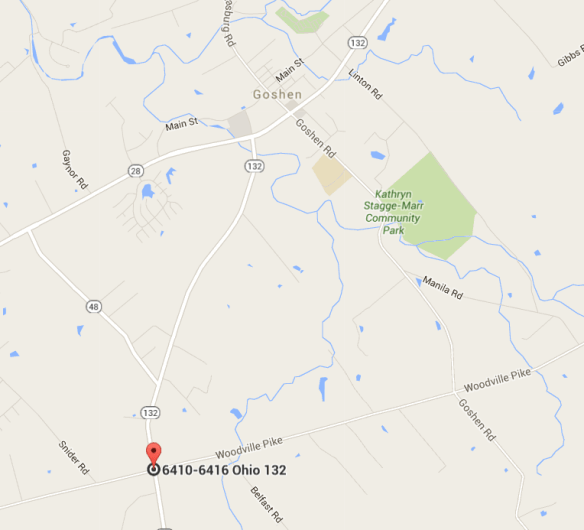
David and Daniel Clermont land map

David and Daniel’s land is shown, beginning at this intersection of Ohio 132 and Woodville Pike.

David and Daniel Clermont land

Here’s a map of the two locations.  As you can see they are a little over a mile apart, not far from Goshen.

Daniel Miller map possible land locations

David and Daniel Miller’s land as reported by Merle is shown below in relation to the location of the Stonelick Brethren Church today.

David Miller Clermont

I would like to resolve this discrepancy and have contacted the GIS (Geogaphic Information Systems) Department in Clermont County to see if they have a map with the various military surveys overlaid over the current roads and landmarks.

They were very kind and sent the following map, showing Barrett’s survey 710 as well as an inset for 132 and Woodville Pike.

Daniel Miller Barrett GIS

Additional deed work, either running Daniel’s deeds backwards to the military survey, or forward to current, could probably pinpoint the exact location of Daniel’s land in Clermont County.  Regardless of exactly where he lived, we know he was very closely involved with the O’Bannion, now Stonelick Church.

Stonelick church today

The Stonelick covered bridge, shown below, now closed and undergoing renovation is located near the Stonelick Brethren Church, above, where several of Philip Jacob’s children, including Daniel, were founders.  For Daniel, this church would have held a very special place in his heart, where he was called into the ministry.

Stonelick bridge

After living between 5 and 8 years in Clermont County, the Miller clan would be on the move once again, this time to Montgomery County, Ohio.

Montgomery County, Ohio

The Ohio land office opened in 1801 and Ohio was admitted to the Union in 1803. It was about that time or shortly thereafter that Daniel Miller moved from Clermont to what would become Montgomery County, Ohio, at about the same time the state was admitted to the Union.

The government was trying to attract settlers to frontier areas by passing the Public Land Act where land could be purchased very cheaply. In 1804, the amount of land you could purchase was reduced to 160 aces from 320 acres, but the price was still $2 an acre.

We know that Daniel was in Montgomery County in 1804 because he was listed on the tax lists. He may not have been sure he wanted to stay, because he didn’t sell his Clermont County land until 1809. One of his sons could also have been farming that land as well. Daniel’s eldest son was born in 1775, so he had several sons of an age to farm.

From “Early Settlers of Montgomery Co Ohio”:

1804 Tax List:

  • Miller, David
  • Miller, Daniel
  • Miller, John Brown
  • Miller, John
  • Miller, James Sr
  • Miller, Jacob
  • Miller, James Jr

By 1805 some of the members of the Stonelick (Clermont County) group moved on to north of Dayton in Montgomery County. Magdalene Miller Cripe and Daniel Cripe moved in 1805 along with Daniel’s brothers John, Joseph and Samuel (Miami Valley Index, Lib. Of Congress, Wash DC).

In 1805, Daniel Miller was co-executor of the estate of Peter Gephart, along with the widow Catherine Gephart. David Miller, son of Daniel, married the widow, Catharine later in 1805.

In 1805, Daniel purchased land on Bear Creek in section 34, Twp 3 Range 5 in Jefferson Township (now Miami) on the east part of the section east of the creek. He purchased 150 acres. The 1806 tax list for Montgomery County also shows others living in that section were:

  • John Bowman Sr – 136 acres
  • John Bowman Jr – 100 acres
  • Daniel Bowser 75 acres
  • John Kripe – 50 acres
  • David Miller – 50 acres

Miller P 52

From the book “History of the City of Dayton and Montgomery Co., Ohio” by Rev. A.W. Drury, 1909.

Page 828 – December 9, 1829 Miami Township was formed. Parts were taken from Washington Twp. and Jefferson Twp. This township runs along the Miami river and includes her rich bottom lands. In 1788 the first exploration party was recorded, and in 1795 the first “road” cut to present day Dayton. Miamisburg is in this original township area. In 1797 Zachariah Hole settled and created Hole’s Station, several blockhouses to protect settlers from possible Indian attack.

The land in what would become Miami Township was all purchased early.

West of the Miami River in Township 2, range 5, Alexander Scott purchased sections 2 and 3, Oct. 19, 1802, William Emrick purchased section 4 Aug. 10, 1804 and G. Myers and P. Gephart purchased sections 9 and 10 on July 9, 1804. George Stettler purchased sections 15 and 16 on July 18, 1804. Samuel Tibbals purchased sections 21, 22, and 23 on Dec. 26, 1801. Arthur Vandevere purchased section 26, 27 and 28 Aug. 17, 1801. Jacob Miller purchased Township 3 range 5 sections 34, 35 and 36 in July 28, 1801. David Longhead purchased in Township 1 range 6 sections 19, 20, 29, and 30 on Dec. 28, 1803, The above descriptions include all of the land west of the Miami River, belonging to Miami township and also parts of sections 26, 27 and 28 lying south of the Montgomery Co line. Jacob Miller, named as one of the purchasers has special interest to us as he was the first Dunker preacher, settling within the limits of Montgomery Co.

It’s possible that the Elder Jacob Miller was involved in a bit of land speculation. Daniel Miller purchased his land from Jacob Miller. He probably felt that being a fellow Brethren, he could trust Jacob.

We don’t find Daniel on the 1806 or 1808 tax lists, but they may be incomplete. We do find him in 1809 and 1810. The 1810 tax list is particularly helpful because it includes a list of who entered the land patent for this land.

1810 Lands Recorded July 21, 1810

Proprietor’s Name Twp Range Twp Section By Whom Entered
Gephart, Peter (heirs) German 5 2 10 Note – more Gepharts
No Lentz
Miller, Aaron Jefferson 5 3 11 Jacob Miller
Miller, Daniel Dayton 6 2 30 D. Miller
Miller, Daniel Dayton 5 4 11 D. Miller
Miller, Daniel Jefferson 5 3 34 Jac. Miller
Miller, David Jefferson 5 3 11 Jacob Miller
Miller, David German 5 2 10
Miller, David Randolph 5 5 17
Miller, George German 4 4 26
Miller, Isaac Sr. Jefferson 5 3 7 Peter Weaver
Miller, James Wayne 6 3 33 Fryback and Miller
Miller, John Dayton 6 2 32 Jona Donnel
Miller, John German 4 4 27
Miller, Phillip Wayne 8 3 22 P. Short
Miller, Susannah Jefferson 5 3 29 John Miller

We know in the above tax list that Daniel’s son David is living in the same location as the Gephart land. David Miller married Peter Gephart’s widow in 1805. I also suspect that the Daniel and David who own adjacent land, both entered by Jacob Miller are our Daniel and his brother David, although I have no way to prove it. The Daniel in Dayton is Daniel (2) and the land owned by David in Randolph Twp. is Daniel’s brother, David. The Randolph Township land would be David’s last land purchase, as he was buried on that land in 1845.

1814 Tax List

Name Range T S Orig Patent
Dayton Twp
Daniel Miller 6 2 30 Self
Daniel Miller 6 4 11 Self
Daniel Miller 6 2 19 Self
Daniel Miller 6 2 29 Self
John Miller 6 2 25 Andrew Robinson
John Miller 6 2 15 John Neff
German Twp
David 5 2 9, 10 Moyer and Gephart
George Miller 4 4 26 Amos Higgins
Jacob Miller 4 4 30 Abraham Horner
John Brown 4 4 27 John Miller
John Carpenter 4 4 27 John Miller
Jefferson Twp
Daniel Miller 5 3 34 Jacob Miller
Elizabeth Miller 5 3 26 Bowser and Waggoner
Isaac Miller 5 3 7 Peter Weaver
Jacob Miller 5 3 11 Self
Peter Miller 5 3 36 Wm. Waggaman
Susanna Miller 5 3 29 John Miller
David Miller 5 5 13 John Miller
Randolph Twp
David Miller 5 5 17 John Miller
John Miller 5 5 17 John Miller
Michael Miller 5 5 17 David Miller

Montgomery County township map

On the Montgomery County map, above, you can see the various Township locations. While the portion of Miami where David Miller lived, German and Jefferson were located in the southern part of the County, on the west side of the Miami River, Randolph Township was located on the North side of the County. David, Daniel’s brother bought land in Randolph Township, and eventually, so did Daniel.

Jefferson Township butts up against both German and Miami Township and Daniel definitely bought land from Jacob Miller according to Montgomery County deeds, in Jefferson Township, the part of which later became Miami Township.

A review of the Daniel Miller deeds in Montgomery County shows us the following information:

Daniel Miller land

Daniel’s land in Jefferson Township was interesting, in particular, because in addition to being owned by Daniel for more than a decade, he also established a cemetery in that location. During that time, Daniel’s son, Daniel died in 1812 at the age of 33, with no sign of having married. It’s likely that Daniel buried his son on his land.

Daniel Miller land Bear Creek

The land that Daniel owned includes what is known as the Troxel Cemetery, named after the man Daniel sold it to who was also a neighbor. It was already a cemetery at the point that Daniel sold it, and it was undeveloped when Daniel bought the land from Jacob Miller who had not lived there but was engaged in land speculation – so that cemetery had to be the Daniel Miller cemetery. It may also have served other Brethren families in the area.

The burial records were obtained from the Salem’s Church in Ellerton.

There are only 14 known burials, the earliest of which was Christian Troxel, buried in May 1814, before Daniel sold the land, so it was apparently serving as a community cemetery.

Daniel Miller land Troxel

According to Find-A-Grave, this is the location of the Troxel Cemetery with the following cemetery notes and/or description:

This cemetery no longer exists. Only one stone remains. The cemetery was located between two fields and was destroyed to make access from one field to the other.

Daniel Miller land Troxel fields

If that is in fact accurate, there are a very limited number of places on this tract of land where the cemetery could have been located.  On the map above, the cemetery would be in the upper area where Bear Creek Road and the blue Bear Creek appear side by side, where the creek approaches the road.

I don’t think the Find-A-Grave location is exactly accurate, because the deed description when Daniel sold the cemetery to Troxel says that it is on the bank of Bear Creek, measured from the middle of the head race of the great mill, containing half an acre.  The Mill appears to be located approximately where the white roof building is today, so the cemetery would be right there as well.  The tree line across from the white roof building is the north end of Daniel’s property.

Daniel Miller cemetery and mill location

If the cemetery was destroyed for field access, the only location on the banks of Bear Creek with anything resembling fields was at this location.

Daniel Miller Bear Creek mill closeup

The succession of deeds confirms that Daniel Miller was indeed a miller in the truest sense of the word. His land included a mill, and given that his 1796 tax record in Bedford County also indicated that he had a mill, this would simply be a continuation of his livelihood. And who better to trust with your business than the local church elder?

This 1851 plat map shows Beck’s Mill where Daniel Miller once owned land on Bear Creek.

Daniel Miller 1851 Bear Creek

Using Google Maps and street view, I took a “drive” of the area where Daniel lived.

Daniel Miller Bear Creek distant

Daniel’s property began as the field line below South Union Road on Bear Creek Road. The mill must have been on the far north side of Daniel’s property, just about 500 feet south of the intersection of South Union Road and Bear Creek Road, where homes are located today, based on the 1851 map and the deeds referencing the cemetery, which was clearly very close to the property line as well.  You can see Daniel’s property line on the current map today, shown below.

Daniel Miller Bear Creek mill location

From the bridge on South Union Road, we can see Bear Creek. This is looking south towards Daniel’s land.

Daniel Miller Bear Creek view

Driving south of Bear Creek, we follow the road through Daniel’s land, but the creek is obscured by trees on the right.

Daniel Miller corn fields

Daniel’s land is growing fine crops of corn. As a farmer, he would be very pleased.

Daniel Miller home place

Based on the 1851 map, and the lay of the land, I’m sure this is the old homeplace. Some of these structures could have been Daniels. Perhaps his original house is “inside” one of these homes today. This hill is the highest elevation on the property, and Bear Creek is right across the road, so Daniel clearly built where he was least likely to be flooded.

Daniel Miller farm

It’s certainly not beyond the realm of possibility that at least one of these barns was Daniels.

Daniel Miller farmscape

This land probably hasn’t changed much in the last 200 years. It was exactly 200 years ago that Daniel sold this land.  What an incredibly beautiful Americana farmscape.

Daniel (2) of Dayton

There is a second Daniel Miller on the Montgomery County tax lists that lived in what would become the City of Dayton. That isn’t our Daniel, and these two Daniel Millers have been confused for years. I spent a lot of time when I initially began researching Daniel Miller in Montgomery County barking up the wrong tree.

Gale Honeyman wonders if this Daniel Miller is also related to Philip Jacob Miller, perhaps through an unknown son of Johann Michael Miller. That’s certainly a possibility, especially with an association with the Ullery family. If a male Miller descendant of this Daniel Miller ever decides to take a Y DNA test, we’ll know immediately if Daniel (2 )descends from the same line as either Johann Michael Mueller/Miller or the Elder Jacob Miller.

Extracted from the History of the Church of the Brethren of the Southern District of Ohio, published originally in 1916, reprinted in 2007:

P 93 – The south line of Lower Stillwater was finally established along the line of the Pennsylvania Railroad from Trotwood south-east to what is now called Gettysburg Avenue: thence south a half mile and east to Miami River. This detour was made to include the lands of an early settler who needs more than passing mention. Upon a marble slab erected in the family cemetery on this farm this inscription appears:

“Daniel Miller Sr. Emigrated from Huntingdon County, Pennsylvania, 1804, to this place where he died January 24, 1849. Aged 83 years, 8 months and 19 days.”

His wife Susan, was a sister of Elder David Bowman, Sr. She died December 10, 1851. When they landed at Dayton its oldest house had been built 8 years. They made their way up Wolf Creek Valley by the men going ahead and cutting away trees and vines for passage and taking possession of Section 30, three miles west of Dayton, but now adjoining the corporation. The encroachment of the city caused the removal of their remains to Fort McKinley, where their monuments now stand.

They raised to maturity 4 sons, namely: Benjamin (Elizabeth Bowser), Daniel (Susan Oliver), John (Anna Winger Sollenberger), Joseph (Catherine Funderburg) and 7 daughters: Mary who married Samuel Ullery and died leaving a daughter Susan who married David Beeghly. Elizabeth married Moses Shoup of Beaver Creek Church, Susan married Joseph Etter, Esther married Isaac Long, Margaret married Abraham Denlinger, St., Catherine married Jacob Wolf, Sarah married John Denlinger, Sr.

Indeed, there is quite a bit of information about Daniel (2), extracted from several source, including the following by Carolyn T. Denlinger:

In late 1802 or early 1803, Daniel Miller came from Huntingdon County, Pennsylvania to prospect for land. In Harrison township in Montgomery County, he found a squatter by the name of Billy Mason who had built his cabin and cleared some land in 1800, the first squatter in Harrison Twp. Daniel Miller liked the land which lay along the Wolf Creek and he bought it from Mason. The US patent for this plot was granted to him on Feb 11 1804 above the signature of President Thomas Jefferson. Miller then returned to Pa. and brought his wife and family back to Ohio.

In 1808 a large brick dwelling was erected on a rise overlooking the Wolf Creek. This house is still standing at 3525 Dandridge Avenue and is registered as a Historic Site.

Daniel Miller 2 home

In 1804 or 1805 Miller built a saw and grist mill on Wolf Creek near his home. The grist mill was later equipped with a set of French Buhrs weighing approximately 1500 pounds each which were bought in Cincinnati. Millers Mill burned in 1825 or 26 but were rebuilt shortly thereafter.

Later he added a distillery and made large quantities of liquor. He and his sons made three trips down the Mississippi River to Natchez and New Orleans to sell the products of their labors. They did so well that Daniel Miller became the owner of a large amount of land ranging in estimates from several hundred acres to two thousand acres.

When Miller arrived in Montgomery county, it was necessary for him to cut a road through the forest to his land from Dayton which was only a tiny hamlet. This was the start of his involvement with the building of roads in the area. According to the road records of the Montgomery Co. engineers office, Daniel Miller was an active participant in the building of these roads: Liberty Road (1809), road from Dayton to New Lexington (1807), Wolf Creek Pike (1810), alteration to Wolf Creek Pike (1813), Western Avenue (1818) and other transactions. A Denlinger family tradition explains the crookedness of Wolf Creek Pike from Dayton to Trotwood this way: as the ancestors were clearing the forest to build the road, it was easier to go around the largest trees than to cut them down.

Daniel Miller’s wife was Susan Bowman, daughter of John Bowman Sr. and wife Esther (maiden name unknown). The Miller’s were the parents of ten children: Benjamin, John, Joseph, Betsy (m. Shoup), Susannah (m. Etter), Catharine (m Jacob B. Wolfe), Esther (m. Long), Margaret (m. Abraham Denlinger), Daniel Jr., Sarah (m John Denlinger). The Millers were devout members of the German Baptist Brethren Church. Their large brick home was built with removable partitions between the rooms so that worship services could be held there. The Annual Meeting of the denomination for the whole country was held at Millers Crossing in 1884.

Daniel Miller lived a long, eventful and prosperous life. He saw Montgomery County change from dense forest to a populous area and he played a prominent part in that development. He died in 1849, his wife in 1851. Both were buried near their home, but the encroachment of the city necessitated their removal to the Ft. McKinley Cemetery on Free Pike.

Fortunately, between being geographically separate along with this additional information, we have enough to separate the two earliest Daniel Millers found in Montgomery County.

Daniel Miller (1) as Executor

In 1805, Daniel Miller was appointed executor of Peter Gephart’s estate.

Daniel’s son, David, would marry Peter’s widow, Catharina Gephart in late 1805.

Montgomery Co. Administrations, Wills and Guardians 1805-1850:

Peter Gephart of German Twp administrators Catherine Gephart and Daniel Miller, security John Bowman and Zachariah Hole, Jan. 4, 1805 #12 p 19

Elizabeth Gephart 8 years and John Gephart 5 years, heirs of Peter Gephart decd, guardian Valentine Gephart and Mathaias Rigal, Aug 26,1806 #29 p 41

In May 1810, Daniel Miller as executor of Peter Gephart’s estate, Catherina Miller as his former wife and the mother of his 2 children, and David Miller as her current husband and guardian of her two Gephart children, petition the court and explain how Peter Gephart and Philip Moyer divided land they bought together.

At the August 1816 court session, Betsey Gephart 10 (age is incorrect) and John 15, heirs of Peter Gephart chose Peter Barta guardian. Security George Parsons and James Chatham.

In 1810, Daniel Miller was also the administrator of the estate of one John Miller of Jefferson Township along with widow Susannah and John Mikesell. We really don’t know who this John was, but given the 1790 census, it’s a distinct possibility that John Miller was a son of Daniel’s brother, David. David has two unexplained males on the 1790 census where he is known to have only female children at that time. John was a farmer and had an extensive estate.

Daniel Miller 1810 exec

In 1813, Daniel serves as an appraiser of the estate of his neighbor, Daniel Bowser, along with the English Brethren minister, Samuel Boltin. 

Daniel Miller 1813 appraiser

Given that Daniel Bowser was Daniel Miller’s neighbor, I wonder if Daniel Bowser is buried in the cemetery on Daniel Miller’s land.

Based on this entry from Montgomery Co. Administrations, Wills and Guardians 1805-1850, it appears that Daniel Miller might well have served once more as an administrator for Adam Miller, although I don’t know who Adam is.

Page 30 – Adam Miller, administrators Daniel and John (Johannes) Miller. Securities Michael Hagar and Adam Weaver?, July 1821. Adam died in June and paperwork within the estate packet indicate he owned land in Dayton Township.

Daniel Miller 1821 exec

In 1822, just 5 months before he died, it looks like Daniel was a witness in another estate for Jacob Ullery, probably related to Daniel’s wife.

34 – Jacob Ullery will Book A p 228 exec David Miller and Samuel Stutzman witnesses David and Daniel Miller, wife Susannah, children Daniel, Jacob, John, Mary, Susannah, Lydia, Cathy. March 4, 1822.

Moving On Up, to the North Side

When Daniel first arrived in Montgomery County, he bought land in Jefferson Township in the southern part of the county, along the Miami River bottomlands.

In 1814, according to the tax list, Daniel Miller is still farming the same land, but in 1815, that would change when Daniel sells that land and buys land in Randolph Township, closer to his brother David and very close to the Happy Corner Church, then known as the upper house of Lower Stillwater.

May 27, 1815 – Daniel Miller to Michael Hoovler $2980 section 34 Twp 3 range 5 begin at Abraham Troxel SE corner…D. Bowser corner…meandering to John Bowman’s and Abraham Troxels…149.5 acres. Signed by Daniel Miller, Elizabeth Miller her mark. Witness Philip Mikesell, A. Troxel. Elizabeth releases dower.

May 27, 1815 – Daniel Miller to Abraham Troxel, $20, section 34 Twp 3 range 5, on the Bank of Bear Creek south of the mill N 25 degrees west 7 chains 81 links to post then west one chain and 25 links to the middle of the head race of the great mill, then south 43 degrees east 8 chains and 80 links to beginning containing half an acre. Daniel Miller signed, witnesses Philip Mikesell and George Hoobler – Jefferson Township

This deed of sale tells us that there was a mill on Daniel’s property. This is the only record of that mill, with the exception of the 1851 plat map. The description of this cemetery suggests that it is between the road and the creek.

When Daniel bought this land, it was bordered by the Troxel land, and he sold the cemetery to the Troxel family.  By this time, there was at least one Troxel burial in the cemetery – at least one where the stone remained a few years ago.

Daniel sold his interests in Sec 34 in Montgomery Co, on Bear Creek, selling his 150 acres for $3000 or $20 per acre, an increase of 10 times in a period of 8 years. Of course, he had built a mill. He paid $12 per acre for his new land in Randolph County.  Daniel seemed to be an astute businessman.

Sept. 1, 1815, William Farmer and Prudence his wife to Daniel Miller for $1689,12 section 26 Twp range 5 beginning at SW corner of the section…west boundary line of said section…140.76 acres. Witness Robert Russell and Archibald E. Mickle

Where did Daniel live between May and September of 1815? A receipt in his estate indicates that he hired Michael Wiltfong to assist him with looking for land. Apparently the land they found was what Daniel purchased in Randolph Township, although why Michael wasn’t paid until after Daniel’s death in 1822 is a mystery.

In 1817, the Public Land Act acreage reduced to 80 acres. Price still $2 an acre.

After Daniel’s death, his heirs straightened out the deed to his property.  He had clearly meant to take care of this before he died, another reason to think he died unexpectedly.

March 21, 1826 – David Miller administrator of Daniel Miller to Jacob Miller – Daniel Miller died seized of the SW quarter of section 26 Twp 5 range 5 and on August 22, 1820 sold 100 acres of north side of said quarter to Jacob for $1000 who is one of the sons and heirs of said Daniel who died intestate and without executing the deed to said Jacob. Some of Daniel’s heirs are underage. Court ordered the deed to be recorded. Signed by David and John Miller. Witnessed by Henry Stoddard and John Folkerth.

Received Dec 18, 1827 recorded Jan 1, 1838

On Sept. 24, 1834 John Miller of Miami County, Ohio filed in the court of pleas and quarter sessions against Stephen Miller, Jacob Miller, Samuel Miller, Abraham Miller, John Boogher and Elizabeth his wife, Daniel Miller, Samuel Miller, Abraham Miller, Daniel Cripe and Magdalena his wife, Nancy Miller, David Miller and Elizabeth Miller demanding partition of certain real estate here-in-after described. Heard at February court 1835. Real estate sold at public auction to Peter Hoffman for $500…40 acres off the south side of the SW quarter of section 26 Twp 5 range 5 lying south of and adjoining 100 acres part of said quarter with Daniel Miller deceased in his lifetime sold to his son Jacob Miller and since his death his administrators have conveyed by virtue of an order of the court February term 1826. Signed by the sheriff of Montgomery County, James Brown and witness Abraham Barnett and David John.

This is the 40 acres with a home built in 1832 that stands today. Elizabeth did not die until October 1832, so it’s at least feasible she had the home built.

Daniel originally owned a total of 140 acres in Randolph Township. In 1820 he sold 100 acres to son Jacob, but the deed was never filed. Daniel’s heirs filed it in 1826. Part of the condition of that sale was that Jacob give up his interest in the balance of the 40 acres which may have included the Daniel Miller homeplace. However, according to Daniel’s estate paperwork, he may well not have been living there at the time he died, given that a receipt to son John indicates that he moved from “Stillwater.”

Jacob Miller owned his 100 acres at least as late as 1851 according to the plat map.

The 1851 Montgomery County plat map, Randolph Township section 26 still shows Jacob Miller.

Daniel Miller 1851 Randolph

The 1827 tax lists from Montgomery County show a listing in Randolph Township for “The heirs of Daniel Miller” for tax on 40 acres of land located at Range 5, Township 5, section 26. That land is located on a later plat map, still configured as a 40 acre farm, having not been split, shown below, with the 10 acres showing above. The upper house of Lower Stillwater, now Happy Corner Brethren Church is located about a mile to the west, just past the fruit farms, visible on the corner.

Daniel Miller 1851 Randolph 40 acres

Given this information, it’s not terribly difficult to find this land today using Google maps.

Daniel Miller Old Salem Road

On this map, Daniel’s land in Randolph Township is at the red balloon, and the Happy Corner Church, then the upper house of Lower Stillwater is located at the intersection of North Union and Old Salem Road about a mile west.

Daniel Miller Randolph google

I found the land at 3705 Old Salem Rd Dayton, OH 45415, and immediately became very excited because I was just sure I saw an old cemetery, at the green arrow.

As luck would have it, my husband wandered into my office and announced that he had to go to Cincinnati the following day.  We live in Michigan, so he had to drive through Dayton. He probably wondered why I was so excited about him leaving for a business trip, and maybe a tad bit confused.  When I asked him to go to that location where I thought the cemetery might be, he thought I had lost my mind. I asked him to take a picture, and if the owners were home, to talk to them. He discovered that it isn’t a cemetery, but a garden, created by the current owners, and he also discovered that the original farmhouse actually still stands two structures away, to the east. It pays to talk to current owners.

Daniel Miller Randolph house

Was this Daniel Miller’s house? It’s certainly possible. This address is 3625 Old Salem Road. Realtor listings tell us this home was built in 1832. If they are accurate, this wasn’t Daniel’s, at least not the original home, although the original could be underneath.  The realtor’s date may not be accurate either.

Daniel Miller Randolph house 2

However, Elizabeth lived until in 1832, so the family could have potentially built this for her. I surely would love to know if there is a log cabin under this structure. I also wonder if these trees were growing when Daniel lived there.

Maybe I need to send my husband back to talk to these owners!

Daniel Miller Randolph house close

Daniel owned one more piece of land not recorded above. In 1820, he received a land grant and based on the Land Grant Act, he would have paid $2 per acre or a total of $320 for 160 acres.

Daniel Miller land grant

This is the land Daniel’s estate was paying tax on in Darke County.

On April 27, 1829 after the snows were thawed, John Miller the SE ¼ of section 8, Twp 9 Range 4 in Adams Twp, Darke Co., 160 acres. This was formerly owned by John’s father, Daniel Miller and is the 1820 land grant. It was purchased from the heirs for $200. Earlier on Nov. 13, 1816, David Miller, John’s father-in-law (and Daniel’s brother) had obtained a patent for 160 acres on Section 7 Twp 9, range 4 in Adams Twp. This land later went to David’s heirs. There is a Miller cemetery located on Daniel’s property. It is located in the corner of the SE quarter and the section line of 7 and 8 passes on the west side of the cemetery. It is fenced but not taken care of. The stones are no longer standing. Inscriptions were takin in 1966.

Darke County Common Pleas Court, July term 1829: Stephen, Jacob, David, John, Abraham Miller, John Booker & Betsy his wife vs. Samuel, Daniel, Magdalena, Nancy, David & Betsy Miller. Petition for partition. Land described as SE 1/4 section 8, Town 9, Range 4, Darke County OH. That Daniel Miller, late of Montgomery County OH, died seized of the above described land and that he left 8 heirs to which land descends, to wit: Stephen, Jacob, David, John, Abraham, Betsy, along with Samuel Miller who resides in Montgomery County OH and who is deaf and dumb and also Isaac Miller who died leaving as his heirs at law: Daniel age about 14, Nancy age about 10, David age about 8, Betsy age about 6 & Magdalena aged about 12. Said minor heirs of Isaac Miller, dec’d, reside in Miami County OH. That Jacob has since relinquished his claim because of advancements made by his father to him, in his lifetime. Widow of Daniel Miller, Dec’d relinquishes her right to dower [she is not named]. above described land sold to John Miller. Chancery Book B-1, p 277

Daniel Miller Darke County

The map above shows the location of the Miller Cemetery on this land, and the FindAGrave entry below.

Daniel Miller Darke FindAGrave

I have never before had an ancestor who owned two pieces of land that included cemeteries, and him not be buried in either.

Gale Honeyman at the Brethren Heritage Center informed me of additional land patents, although there is no record of our Daniel selling this land, nor of his estate paying taxes for this land, so these patents could be for one of the other Daniels (2 or 10) in Montgomery County, including Daniel #1’s son, Daniel who died in 1812, although there is no Montgomery County estate for him. This is the most likely possibility since the word “Jr.” is attached to one of the patents. They could also have been sold directly and never registered, so we’ll likely never know which Daniel these belonged to.  There is no record of a Daniel Miller selling these lands in Montgomery County.

Daniel Miller of Montgomery County OH had two land patents in Perry Twp, Montgomery County in section 36 on 19 Jul 1804 and section 11 on 15 Aug 1804. Daniel Miller Jr. of Montgomery County obtained a patent in the same Twp for section 19 on 20 Aug 1805. Early Ohio Settlers, Purchasers of Land in Southwestern Ohio, 1800-1840, 1986, Ellen T. Berry & David A. Berry, p 223. Section 11 is 4 miles from the Preble County line and section 36 is 5 miles from the line.

Daniel’s Death

Daniel died on August 22, 1822. We can presume from a couple of different pieces of evidence that Daniel was not ill before he died, and may have died rather unexpectedly. Daniel had just celebrated his 67th birthday. By today’s standards, that isn’t old at all, and he was clearly still very active and involved.

First, Daniel was building something and had apparently recently moved.

Second, Daniel had no will, suggesting he did not expect to die.

Third, Daniel, apparently, did not die at home, and he may have passed rather unexpectedly.

Fourth, Daniel never registered the deed to his son Jacob from the time he sold Jacob 100 acres of the home place on August 22, 1820 until his death 2 years and 4 days later.  Had he thought he was gravely ill, he would have registered that deed.

Ohio was ravaged by illness between 1820 and 1823, as is told in the following excerpt from the book, “The Midwest Pioneer, His Ills, Cures and Doctors” by Madge Pickard and R. Carlyle Buley published in 1946, page 14:

In Ohio, too, generally prevailed the most distressing sickness and great mortality, particularly from bilious fevers and cholera morbus.

Said James Kilbourne, prominent Ohio journalist and legislator:

“Respecting the healthfulness of this country, I have to repeat that it is in fact sickly in a considerable degree.” He reported the presence in 1800 of bilious fever which returned with more violence the following year: “Almost all were sick, both in towns and country, so that it became difficult, in many instances, to get tenderers for the sick. In many instances whole famihes were down at a time and many died. What seems strange to me is that the Indians who were natives of the country are as subject to the disorder as the whites. Of the few who remain in the territory some are now sick with it and they say it has always been so, and that they have often been obliged to move back from the meadows and bottoms where they always lived, into the woods and uplands during the sickly season to escape it.”

The autumn of 1819 in Ohio was particularly bad along the Scioto River bottoms, “whence deleterious exhalations arise.” “The angel of disease and death, ascending from his oozy bed, along the marshy margin of the bottom grounds . . . floats in his aerial chariot, and in seasons favorable to his prowess, spreads mortal desolation as he flies,” mourned the Portsmouth Scioto Telegraph in 1820. In 1821, “even in the memory of the oldest Indian, so unhealthy a season was never known here before,” reported the Piqua Gazette. Of the one hundred sixty-five thousand people in the seventeen counties within a radius of fifty miles of Columbus, more than one-half were sick in September, 1823. “The most extravagant imagination can hardly picture desolation greater than the reality.”

Ironically, the mystery surrounding Daniel’s death and where he is, or was, buried in one of the most profound of his life.

And I must admit, it’s driving me crazy.

Let me first share with you what we do know.

Because Daniel did not have a will, his estate was involved and generated a lot of paperwork, which still exists today. That’s the wonderful news.

Daniel’s Estate

Montgomery Co. Administrations, Wills and Guardians 1805-1850:

Page 34 – Daniel Miller will probated Sept. 23, 1822. Security John Becher and Stephen Miller, admins David and John Miller

After Daniel died, David Miller, John Miller, John Becher and Stephen Miller are all four bound as securities for David and John Miller as administrators of Daniel’s estate. There is also a receipt where Daniel Miller promises to pay Henry Marquet $7 on January 22, 1822, not long before he died. This receipt contains Daniel’s signature and is the first signature of Daniel’s I found. Today, there are a few more.

Daniel Miller 1822 signature

Daniel’s estate receipts include tax documents for taxes in Darke Co in 1822, 23 and 24, along with Montgomery Co. It also includes a charge in March 1822 for “moving him from Stillwater” and in August for hauling one load for him on Twin. Then another entry for tax in Darke Co. in 1828 and 1829 and also in Montgomery.  The taxes in both Darke County and Montgomery County are for the land we knew that he owned, so no surprises there.  Had he owned additional land, his estate assuredly would be paying taxes on that land.

Surprisingly, there are also receipts relating to the estate of Peter Gephart. Daniel was the administrator of that estate, beginning in 1805. The last child had already come of age, so this must have simply been the final “cleanup,” although Elizabeth Gephart’s husband, William Hipple filed suit against the estate, then dropped the suit. All may not have been entirely friendly.

Samuel Studebacher filed a bill for 2750 bricks at $4 per thousand.

If Daniel had built a house outside of Montgomery County, there would have been land taxes on an additional property, and his estate would have been filed in the county where he lived when he died. Clearly, he died in Montgomery County. But what and where was he building?

Daniel’s estate sale was held September 22, 1822 and the following people purchased items. Note that the purchasers all seem to be family. Johannes Bucher was his son-in-law, married to his daughter Elizabeth. His widow seems to have purchased only one thing. John was his son who bought the family Bible and subsequently took it with him to Elkhart County, Indiana.

Who What $ Cents fractions
John Bugher One stove 20
Abraham Miller One sattle 14
Abraham Miller Two axes 4 61
Steven Miller One chorn 4
Steven Miller One box of sundry articles 2 25
Abraham Miller One mans sattle 2
Samuel Miller One clowiny? Knife 1 56 2/4
Abraham Miller One cut of augers 2 18 ¼
Abraham Miller Chisels 1 81 ¼
David Miller One hand saw 1
John Miller Shackers? forge and hoes 2 50
Jacob Miller One tin and cobs sheet 1 06 ¼
Steven Miller Tin cups and funnel 37 ½
Abraham Miller Holter chain 1 61 ½
Jacob Miller Halter chain 50
Abraham Miller Lot of sundry articles 3 12 ½
John Bucher Col and books 1 38
Abraham Miller Bale and square 1 62 ½
Steven Miller One gross snet 1 6 1/9
David Miller One smelting lien? 87 ½
Stephen Miller One bair skin 75
Abraham Miller One mattik 2 61 ¼
Abraham Miller Waking can (walking cane?) 1
Steven Miller One stovel 25
David Miller Chaier and lasts 1 81 ¼
Steven Miller One bar of iron 2 55
Steven Miller Crout cutter 62 ½
Steven Miller Hors geers 9 75
Jacob Miller Hors geers 4 25
John Miller Hors geers 1 75
Chraha Miller Two bridles 1 6 ¼
John Miller One bible 44
David Miller Set of crocks 75
Abraham Miller One bottle 37 ½
David Miller One chisel 2
Abraham Miller One had? 19
Steven Miller One barrel of whiskey 6
Abraham Miller One brittle 85 ½
Steven Miller One hogsherd 1 37
Jacob Miller Bort mantle 68 ¼
Elisabeth Miller One mans saddle 5
Steven Miller One mare 58
Steven Miller One ink stand 86
Abraham Miller One stove 33
Steven Miller One crosscut saw 8
Steven Miller One grind stone 6 25
John Miller One crosscut 7
Steven Miller One logogars?? 5
David Miller Shab skin and heb stubs 25
John Bugher Cantle mats 43 ¼
Jacob Miller One dony? (dung?) Fork 87 ½
Jacob Miller One hamer 1
John Bugher Two bags 25
John Bugher Pitch fork 50
Jacob Miller Two blains 50
John Bugher One pot 3
Jacob Miller One oven 75
Steven Miller One half bushel 62
Abraham Miller One rifel and pony? 13
Abraham Miller 30 bushels whet 15
John Miller 13 bushels whet 8 19
Abraham Miller 25 bushels corn 4 62
Jacob Miller 28 bushels of corn 5 25
John Bugher 24 bushels of oats 5 6
John Miller Sith an cratle?? 5 12 5
John Bugher 17 bushels of ray 3 56
Abraham Miller One lame (lamb?) 2 12 1
John Bugher Frying pay and spinning whele 2

Surprisingly, Daniel had a barrel of whiskey. Medicinal perhaps? That’s a lot of medicine.

I love the crout cutter.  He was truly still German.  But I must admit, I don’t know what a crout cuter looks like, so I turned to google to find out.

Daniel Miller kraut cutter

This kraut cutter is probably not as old as Daniel’s, but I’d wager that kraut cutters hadn’t changed much.  The cabbage was put into the wooden box (to preserve knuckles and fingers, I’m sure) which was then slid back and forth over the blades to shred the cabbage into small pieces.  Further reading discloses that the Germans would set this contraption on top of a large crock into which they shaved the cabbage and then added salt, allowing the cabbage to naturally ferment, turning the cabbage into sauerkraut.  Daniel had a set of crocks, which were probably used for making sauerkraut.

I do wonder about the “bair skin.”  We don’t really think of bear in Ohio today, but he did live on Bear Creek when the county was quite new.  Of course the skin could also have come from any of the other frontiers Daniel helped to forge.  I wish I knew the story behind that bear skin!

I love estate inventories.  They tell us so much about our ancestors.  Daniel had 3 saddles, but only one mare and pony.  He was obviously still farming, because he had oats, corn, wheat and probably rye.  Surprisingly, Daniel had no livestock except possibly for that lamb.  The shab skin may be a sheep skin.  Also surprisingly, Daniel didn’t have a wagon – a staple on every farm.  Nor did he have a buggy.  So how did Daniel and his wife get from place to place?  He may have ridden a horse, but surely she didn’t ride a horse to church.  Besides, they only had one horse.

This is what is shown in his estate packet, but I surely wonder if it is complete.  There also doesn’t seem to be enough kitchen gear.  Everything in the house was included, as the husband was considered to own everything.  The wife was provided for by having a right to one third of the proceeds, but still, everything was sold at auction unless she bid and the items were then deducted from her one third share.  In this case, Elizabeth, assuming this Elizabeth was the widow, only purchased one man’s saddle.

Daniel’s “simple” son, Samuel, who was often described as an “idiot,” meaning in the vernacular of that time, developmentally disabled, purchased his father’s knife.  I’m glad he was allowed to buy something.  From a later deed, we discover that he was actually “deaf and dumb,” so his mind may actually have been just fine, but he was unable to hear or communicate, sadly locked into his own world, out of ours and unable to provide for himself.  There are more instances of “deaf and dumb” children in later generations, especially where the Millers married their first cousins.

From the Book Montgomery Co. Ohio Common Pleas Law Record 1803-1849 by Rose Shilt and Audrey Gilbert:

David and John Miller admins of Daniel Miller decd, petition to convey land to Jacob Miller SW ¼ S 26 T5 and R5e agreement to sell to Daniel Miller decd, son Jacob 100 acres off N end of section. Heirs of Daniel Miller being Jacob, David, John, Stephen, Abraham, Samuel (who is an idiot) and Betsey Bugher wife of John Bugher all of age, also son Isaac Miller decd leaving 5 children being Daniel, Magdalena, David, Betsey, and Nancy, all minors.

The date right below this entry is May Term 1826, so this would be the term before that, probably Feb 1826.

From the Book Mont Co. Ohio, Chancery Records 1824-1854 by Rose Shilt:

In the Chancery court in the July term of 1835, Daniel’s estate in being heard in chancery. John Miller of Miami Co., vs Stephen, Jacob, Samuel and Abraham Miller, John Boogher and wife Elizabeth all of Montgomery Co, David Miller of Elkhart, Indiana, Daniel, Abraham 2nd and wife Magdalena, Nancy, David 2nd and Elizabeth Miller. Petition – Daniel Miller of Mont. Co decd owned 40 acres off S side Sw ¼ S26 T5 R4 adjoining 100 acres Daniel decd sold to his son Jacob Miller. Daniel Miller decd left 8 children, John, Stephen, Jacob, Samuel, Abraham Miller, Elizabeth wife of John Boogher of Mont. Co Ohio, David Miller of Elkhart Indiana, Isaac Miller late of Darke Co Ohio decd who left 5 children: Daniel Miller, Magdalena wife of Abraham Miller 2nd, Nancy and David Miller 2nd, and Elizabeth Miller, last 3 minors who reside in Elkhart, Indiana. Samuel Miller is an idiot and Jacob Miller his guardian and Jacob’s share forgeit according to terms of agreement for 100 acres leaving each 1/7th share. Sold to eter (is this supposed to be Peter) Hoffman. (page 1)

This petition is particularly important because if definitively connects David Miller of Elkhart County to Daniel, as well as Isaac from Darke County and his children.

From the book Court of Common Pleas 1803-1849, I found the following for Daniel Miller:

  • Page 22 – David and Daniel Miller petition to sell the Gephart land – as admins
  • Page 38 – Benjamin Miller assignee of Daniel Miller vs Robert Graham in debt
  • 39 – John Miller admin of Daniel Miller vs John Emrick debt
  • 41 – Gephart estate – Phillip and Jacob Gephart exec of Henry Gephart decd vs Adam Whinehart and Daniel Miller in debt
  • 22 – Gephart estate – petition to deed
  • 62 – Daniel Miller vs Henry Howman debt – Vol D1- 1818-1820
  • 101 – William Hipple vs Daniel Miller – discontinued May 1823
  • 102 – David and John Miller admin of Daniel vs widow Hurdmor (can’t read my writing for her name) debt

Estate Documents

I visited Montgomery County in 2004 and photographed Daniel’s estate packet at the Montgomery County archives building. Today, his estate papers are available through Ancestry here.

Daniel Miller estate 1

Daniel Miller estate 2

This next item is a list of bills paid out of Daniel’s estate. These can be enlightening as well.

Daniel Miller estate 3

The following document is a bill from John Miller, his son, which includes the notation for moving Daniel “from Stillwater.” Given that Daniel doesn’t seem to have purchased more property and clearly lived in Montgomery County when he died, where did John move Daniel to? Did Daniel and his wife move in with one of his children? If so, why? Who was then living on Daniel’s 40 acres in Randolph Township? Was there a separate house on that 40 acres, or was the main house on the 100 acres that Daniel sold to Jacob, and Daniel simply lived with Jacob’s family until he moved? So many questions and absolutely no answers.

Daniel Miller estate 4

Twin, noted above, likely refers to the area near the Montgomery/Preble County border where the Sugar Hill Cemetery is located, probably the location of an early Brethren Church, located on Twin Creek just east of West Alexandria in Preble County. This and the note about moving both suggest that perhaps he moved to son Stephen’s place, along with his burial location.

Daniel Miller Twin

Daniel Miller 1815 bill

Apparently, in 1815, Daniel Miller’s mare escaped and Michael Wiltfong searched for her for a day and a half, and found her. I wonder if this was involved with Daniel’s move from Bear Creek in Jefferson Township to Randolph Township.

Daniel Miller estate wood

John Becker operated a sawmill in Randolph Township. If Daniel was building something, he would have purchased the lumber near where he was building.

Daniel Miller Becker mill

He would have visited John Becker’s mill, shown above.  Notice that the barn is much larger than the house.  This was typical in Indiana where I grew up as well.

Daniel couldn’t build much with 300 feet of plank. At 10 feet per plank, this is only 30 boards. If they were 8 inches wide, and didn’t overlap, he could only have covered an area 10 feet wide, the length of the planks, and 20 feet tall. Again, not enough for a house. What was Daniel building? And where? Did this have anything to do with his move?

Daniel Miller estate 5

This receipt, above, is in German script.  Not something I can read.

Daniel Miller estate Gephart

The receipts above and below are the final settlements as Daniel’s administration of the estate of Peter Gephart. John is Peter’s son.

Daniel Miller estate Gephart 2

Daniel Miller estate Gephart 3

William Hipple married Elizabeth Gephart, daughter of Peter Gephart. These receipts are the final settlement with her, or actually, her husband since at that time the husband obtained all rights to the woman’s property when they married.

Daniel Miller estate Gephart 4

Daniel Miller estate Gephart 5

Catherine Schaeffer Gephart, widow of Peter Gephart, married Daniel’s son, David Miller in 1805. The receipts above and below contain Catherine’s mark and David’s signature.

David Miller 1823 receipt

I have omitted the several receipts that were for payment of taxes, since we already know the location of his land and those receipts don’t serve to inform us of anything unknown and several marginally legible.

Those receipts do confirm that he owned land in Darke County, Ohio as well as in Montgomery County.

Receipts also show that he had recently built something and moved, although those two things may not be connected. There was a receipt for both lumber and bricks, but not enough bricks to build an entire house, only a chimney and hearth. The receipt was for 2750 bricks. A contemporary brick calculator using bricks that are 7 5/8 by 2 1/4 indicates that to cover a 19X20 foot area, you would need 2726 bricks. Clearly a 19X20 foot area is not enough to cover a home, so this must have been a fireplace, chimney and hearth or something similar. Did he just build a room onto a house?

Apparently Daniel died rather suddenly. We can presume he was not ill because he seemed to be quite active. In 1822, Daniel Miller was 67 years old, not a young man, but neither with one foot in the grave, or so one would think. It appears that his creditors didn’t expect him to die either, as at least one of them from the building project had to swear to a bill for supplies after his death, and the man who helped him hunt land in 1815 had to submit a bill to collect for his services as well.

We know where Daniel lived most of his life, right up until the last few months, and then we not only lose track of where he lived, we also don’t know where he died and was buried, at least for awhile. Daniel Miller was not originally buried where his stone rests today.

In fact, given the size of his grave, not much of Daniel is buried in Sugar Hill Cemetery.

Daniel’s Stone in Sugar Hill Cemetery

When I visited Montgomery County in 2004, I found Daniel’s stone in Preble County, just over the county line. Like a good genealogist hot on the trail, I went right over and took photographs of the cemetery and his headstone.

But things didn’t seem right.

I noticed that the marker seemed much too new for an 1822 death, but with a large number of descendants, I figured that a new marker replaced an old one. I took pictures, said my typical ancestor prayer, and left. Little did I know the mystery that would evolve.

In the first photo, you’ll notice that Daniel’s stone is wedged in-between two others. It doesn’t look like there is room for a grave here, but at the time, I just noted it but didn’t think much of it. In retrospect, there is not room for another adult burial between the two older stones.

Daniel Miller Sugar Hill

Below is Daniel’s stone. It’s not original, but I assumed that the original stone had either been replaced or that his descendants had placed a stone later and he had never had one originally. That’s not unusual.
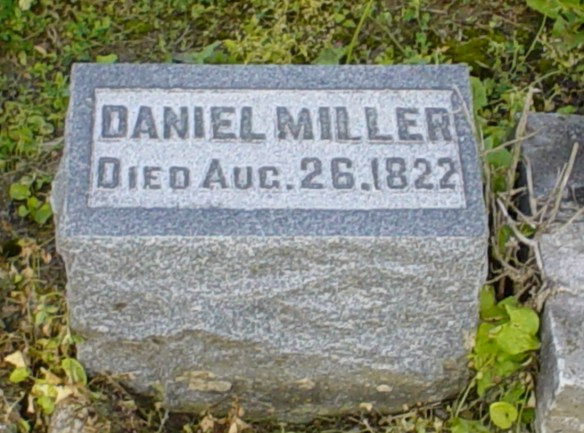
Daniel Miller Sugar Hill 2

However, take a look at the stones on either side of him. The following photo shows the stone that says, Hannah, wife of Daniel Miller, died October 4, 1876, age 65 years, 8 months, 20 days.Daniel Miller 4 Sugar Hill

The gravestone on the other side of Daniel’s stone marks the grave of Sarah Miller, wife of Daniel Miller who died on July 22, 1831 at the age of 28 years and 3 months. This woman was born in 1803. Daniel Miller is buried in-between them.  However, as confusing as this is, NEITHER of these women are the wife of the Daniel who is buried between them.  Yes, you read that correctly.  Is this some kind of morbid genealogy joke?  I mean, seriously???  Not funny.

Sarah Miller Sugar Hill

The stone directly behind these three belongs to Samuel Miller. Below is a list of all the Miller burials in Sugar Hill cemetery.

Miller Abraham       died Apr. 12, 1876, age 73y 11mo. (so born 1802)
Miller Lydia            died Jan. 7, 1891, age 87y 11mo 11da. (born 1804)

Miiller Daniel (4)           died June 8, 1879, age 8ly 5mo 9da. (born 1798)
Miller Hannah         died Oct. 4, 1876, age 65y 8mo 20da. (born 1811)
Miller Sarah                     died July 31, 1831, age 28y 3mo. (1803)

Miller Margaret       died Feb. 6, 1924, age 87y 9mo 11da. (born 1837)
Miller Samuel         died Nov. 14, 1930, age 96y 9mo 24da. (born 1834)

Miller Catharine      wife of Fred’k., died Oct. 31, 1865, age 55y 8mo 20da. (born 1810)

Miller Daniel (1)          died Aug. 26, 1822, age —.

Let’s piece these families together to see who we have and their relationships.

Abraham was the son of Stephen Miller and Anna Coleman. Stephen was the son of Daniel (1) Miller and Elizabeth Ulrich. Daniel is the man who died in 1822. Daniel’s widow, Elizabeth died in September 1834 but she does not seem to be buried here. Abraham Miller was married to Lydia Rodebaugh who is buried here as well.

Daniel (4) Miller who died in 1879 was born on Dec. 30, 1797 to Stephen Miller and Anna Coleman. His first wife was Sarah Harris whom he married on November 15, 1821 in Bedford County, Pa. and who died on July 31, 1831, as noted above. His second wife was Hannah Ernest, also noted above.

Samuel Miller was born in 1834 and died in 1930 in Preble County “on the farm where he was born.” He was the son of Daniel (4) Miller and Samuel’s wife was Margaret Marker.

In 1850, there is a Catherine Miller who lived in Perry Township, a widow and had children Levi 19, b Pa, Jeremiah 11 and Noah 3. One house away lived Joseph Miller, age 32 born in Pennsylvania and his wife Christena. Joseph is listed on Ancestry as the son of Frederick Miller and Catherine Hammer, so this Catherine who lived next to Joseph would be his mother.

Doing a bit more research on Frederick, Catherine and Joseph, we discover that in 1840, indeed we do find Joseph and Frederick living a few houses away from each other in Montgomery County, but both are age 30-40, so clearly not father and son, more likely brothers.

In 1830, in Jackson Township we find a group of men that includes Stephen (son of Daniel who died in 1822), age 50-60 and then a group of 4 men, George, 30-40, Daniel 30-40, John 20-30 and Joseph 20-30. These 4 men are likely sons of Stephen Miller   On the next page we find John B. Miller, age 50-60.

In 1820, we find two groups of Miller men in Randolph Township. Jackson was formed in 1814, so if they were living in Jackson they would have been listed there in 1820.

We have Jacob, 26-45 with Daniel, over 45. Then we have David, over 45 with John, also over 45 and Michael, age 26-45.

Looking now at the 1820 and 1830 census in Preble County, Twin Township, we find a Frederick and Jonathan in 1820. Frederick is not young then. They are still there in 1830 and Frederick is 60-70. These men don’t appear to be connected to our group of men, but one can’t be sure. What we do know is that there is no Daniel in 1820 nor are his children found there. In 1830, we do find a Daniel in Twin Township.

The pedigree below shows what we know about the relationships between the Miller burials in the Sugar Hill Cemetery. The individuals in bold are buried there.

Daniel Miller Sugar Hill pedigree

In the book, “History of the Church of the Brethren of the Southern District of Ohio” by Wayne Webb, the photo of the cabin on page 36 states that the Elder Daniel Miller built that cabin in 1830 and his son Samuel was born there in 1834. This does indeed mesh with the genealogical record that indicates Samuel lived died on the farm on which he was born. This also ties in with Daniel whose wife Sarah died in 1831. We know he was living in this vicinity by then because his wife is buried in the Sugar Hill Cemetery, so this 1830 census in Twin Township reflects what we know to be accurate based on other records.

Note:  It has come to my attention that this photograph was reproduced without permission in the book above mentioned.  According to the Brethren Heritage Center, the proper attribution should be the “History of the Church of the Brethren of the Southern District of Ohio” by the Historical Committee, 1920, published by the Otterbein Press, Dayton, Ohio.

Daniel Miller 4 cabin Twin

The problem is that the interpretation has been that this cabin belonged to the Daniel (1) Miller that died in 1822, but subsequent research shows nothing to connect the eldest “Elder Daniel” with this land, aside from the fact that a cemetery marker placed over 100 years after his death is located in the cemetery with his son, Stephen’s, children, including the Daniel (4) born in 1797, grandson of Daniel (1) who died in 1822 – whose wives Daniel (1) is buried between.

Again referring to the History of the Church of the Brethren book, on page 509, we find the following story about Stephen, son of Daniel (1) who died in 1822, and his son Daniel (4):

Stephen Miller, the father of the subject of our sketch, was twice married, first to Anna Coleman, of whose children, Daniel was the eldest. She died in Clermont County. Stephen’s second wife was Anna Deardorff (nee Lesh), who also bore him children, among whom were John J. and Stephen, who became ministers in the church.

Daniel was born in Bedford County, Pennsylvania, December 30, 1797. When 18 months of age, his father built a raft on the Ohio river and floated down the stream to Kentucky, where they landed and lived for awhile in that state. They, then, moved to Clermont County, Ohio. They next moved to Montgomery County, Ohio, where Daniel’s father in 1816 build he first frame house in Jackson Township. On November 15, 1821, he was united in marriage to Sarah Harris of Clermont County, Ohio. To this union were born 3 daughters, Anna, November 18, 1822, Sarah, November 1, 1824 and Mary, September 3, 1828. He united with the Church of the Brethren when about the age of 27, bring brought under conviction through a serious illness. A short time after this he was elected to the ministry in the Stonelick Church, and later on was ordained in the Upper Twin Church.

After his marriage he lived in Clermont County where he bought a small farm on easy terms but in the fall of 1828, he sold this farm and purchased 160 acres for $625 in Preble County, where he moved April 13, 1829. His new home consisted of a log cabin built near the center of the place surrounded by the forest.   The following winter he built a more comfortable house from hewed logs, which is yet standing. August 22, 1831, his helpmate died leaving him with three small children. January 31, 1833, he was married to Hannah Earnest, to whom were born one son, Samuel, and one daughter, Catherine, who died in 1847. All his children united with the church while young. Anna married Robert Wysong, Sarah, Josiah Woods and Mary, James Swihart. These Brethren all became deacons in the church.

Elder Miller served the Upper Twin Church as Presiding Bishop for 30 years. He was one of the first advocates of the pastoral visit and made regular calls on all the members in the congregation. He solemnized many marriages, preached many funerals and assisted in organizing many churches. His useful life came to a close June 8, 1879.

P 510 – Samuel Miller, son of Elder Daniel Miller, was born January 20, 1834. He was married to Margaret Marker Miller, Sept. 30, 1855. He was elected deacon in the Upper Twin Church in 1874, and to the ministry in 1881. His father, Elder Miller, in order that he might give more of his time to the church, sold his possessions to Samuel, with whom he and his wife lived, for 24 years. Brother Samuel and his good wife, Margaret, have grown old in the service of the Master, still living on the old home place.

Daniel Miller (1) who died in 1822 would be the oldest burial in the Sugar Hill cemetery. It seems inconceivable that his grandson, Daniel (4) Miller’s 2 wives would be buried in such close proximity to him on either side as to be touching him. If any Daniel was to be buried between the wives, it would be Daniel (4), their husband. Daniel (4) the husband of Sarah and Hannah died in 1875, a year before Hannah, and he is buried to the right of Hannah, not between his two wives. It appears that Daniel (1)’s stone was wedged in later.

So here’s the situation. Daniel (1) who died in 1822 was clearly not buried in the location where his tombstone is located today. In fact, in 1822, it’s not likely that this cemetery was even in existence. The first burial with a tombstone is in 1831, and it’s Sarah, forever resting to the right of Daniel’s stone.

The History of the Church of the Brethren of the Southern District of Ohio tell us about this location.  On page 170 the Lower Twin church is also discussed, whose name was later change to Sugar Hill, and the church later torn down. I believe, although it doesn’t say this, that is where Sugar Hill cemetery is located today. This church was organized in 1830.

As we later discover, the Elder Daniel’s grave was moved to this location, but if that was the case, why not also move his wife, Elizabeth, who died in 1834 and mark her grave as well?

It’s nearly 15 miles, and that’s 15 miles with a horse and wagon, between Daniel Miller’s land (B) in Randolph Township and the Sugar Hill Cemetery (A). Furthermore, his brother David had a family cemetery on his land and Daniel could have been buried on his own land. There was no reason to go to Sugar Hill. There has to be something we don’t know.

Daniel Miller to Sugar Hill

The answer bantered about is that Daniel Miller (1) was visiting his son Stephen at the time of his death – Stephen reportedly lived near West Alexandria, close to the Sugar Hill Cemetery. However, Daniel could easily have been transported 15 miles home in a wagon for burial, unless getting the body in the ground was a priority that trumped everything else. Daniel died in August. It could have been very hot and he could have been contagious. Others could have been ill too.

Sugar Hill Brethren Cemetery where Daniel Miller is buried is on Eaton Pike just across the county line into Preble county, slightly east of West Alexandria. Eaton Pike above is 35 on the southern border of the township line in the section map, above.

Daniel’s son Stephen owned land at the SW corner of Farmersville/West Carrollton Road and Diamond Mill Road, not in Preble county near Sugar Hill Cemetery.

On the map below, you can see Daniel’s home location on Old Salem Road, Stephen’s home on Farmersville Road and Sugar Hill Cemetery.

Daniel Miller to Stephen Miller to Sugar Hill

As it turns out, there is more to the story, much more.

Where Was Daniel Buried?

This question sent me on an incredibly frustrating journey that took about two years, and still may not be complete, because still don’t have a definitive answer, but we have tantalizing tidbits.

From Gene Edwin Miller in “Daniel Miller (1755 – 1822), a working copy and a collection of current data on Daniel Miller (1755 – 1822) son of Philip Jacob Miller, son of Michael Miller,” unpublished:

April 1979

One explanation might be as follows……….Elmer C. Miller a son of John R. Miller, son of Jacob Y. Miller, son of John Miller, son of Daniel Miller (1755 – 1822) was an evangelist and traveled throughout the midwest conducting services. In 1924, while in the Dayton, Ohio area, he wrote home to his father, telling of his meeting with a Samuel Miller. Samuel was the son of Daniel Miller, the well known Elder in the Montgomery Co. area.

Daniel was the son of Stephen Miller, oldest son of Daniel Miller (1755 – 1822).

Samuel was then 90 years old and lived in Preble Co. Samuel recalled how that he had helped his father Daniel to locate the body of Daniel Miller (1755 – 1822) from the cemetery at Farmersville to its present resting place at Sugar Hill. He said that when they found the burial place at the original location that it was marked with a little piece of marble about 12″ square and inscribed with the letters “D.M” and dated Aug. 1822. 

Then, from Merle Rummel, Brethren Historian, we have the following: 

  • Stephen William MILLER 1/m  Anna Barbara Kphlman
    born 7 Mar 1775 Conococheague MD b. 12 Apr 1774 Bedford Co PA
    died13 Jan 1851 Montgomery Co OH d. 26 Jan 1813 Clermont Co OH
    bur: Old Brower Cem, Farmersville
    Son of Daniel Miller and Elizabeth Ulrich

Merle shows Daniel’s son Stephen being buried in the old Brower Cemetery in Farmersville in 1851, roughly 30 years after Daniel’s death. However, if Daniel (1) who died in 1822 was buried with Stephen who died in 1851, why would Daniel (1)’s grave be moved? And if they moved Daniel’s grave from the Old Brower Cemetery, why didn’t they also move Stephens? This doesn’t seem logical. 

The Brower Cemetery is located just across the county line into Preble County at the intersection of 70 and Enterprise Road, shown on the map below as 4092-4498 Enterprise Road, West Alexandria, Ohio.
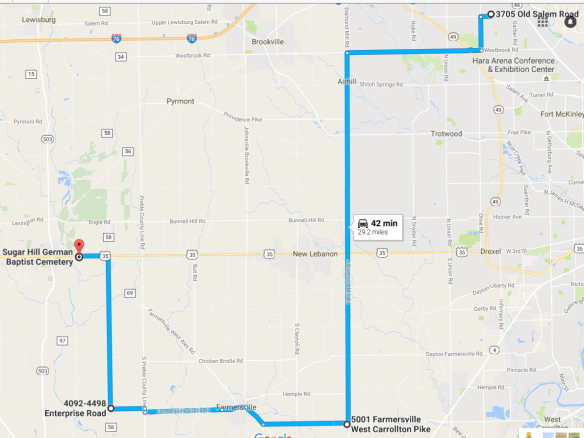
Daniel Miller, Stephen, Brower, Sugar Hill

Another piece of evidence, although this could be hearsay, is the undated NGS Quarterly page, below.

Daniel Miller NGS

This article, which does not give sources and has other incorrect information, such as Daniel’s father being Richard, states that Daniel died near West Alexandria. This could also have been presumed because of the Sugar Hill burial location. Unfortunately, no sources are provided.

Wayne Webb, a researcher with an interest in Brethren history, has a different theory, that Daniel was originally buried in a cemetery just half a mile from Stephen’s house, called the Troxel Cemetery, not to be confused with the Troxel Cemetery that is located on the original land owned by Daniel Miller in Jefferson Township. Truly, those two cemeteries are not connected and I drove myself crazy for months chasing that red herring. Daniel must have had a good laugh. This Troxel Cemetery is in Jackson Township.

From Wayne:

The place I gave you is the half acre tract which is the cemetery called Troxell’s in Jackson and which is no longer there.  That is the “other” Troxell you could not find (because it’s no longer there).  Stephen lived SW¼ R4E T4 S35.

Family lore says, as related by Merle, that Daniel died while on a trip to his son Stephen’s.  Then you have the “Farmersville” notation.  I gave you where Stephen lived.  The Troxell cemetery (NE¼ R4E T4 S36) is within a half mile of Stephen’s house.  I think some of Stephen’s children are living by him but not much is known about all of them and I’ve never taken the time to document them all.  Diamond Mill north-south, Farmersville-West Carrollton east-west.

Daniel Miller Stephen land

Stephen lived on his home farm in Jackson township all his adult life.

Wayne went on to say that there used to be a Brethren church in the same location with the cemetery.

The church is located on section 36 where the Troxel cemetery is located (basd on a map from 1875-76.)

Wayne’s mother who grew up in this area said this cemetery, then with markers, is located on Farmersville-West Carrolton Pike the NE section of section 36, T4 R4 – cemetery is 300 feet south of the road behind the house, 4/10th of a mile west of the Diamond Mill Road. Church was inactive in 1983 – the owner in the 1990s said he bought it in the 1940s.  There were stones then but they had disappeared by the 1990s when Wayne actually visited and walked out in the cemetery and saw that there were no stones visible.

Daniel Miller Troxel church

Wayne said that part of the church foundation is near the road behind the house, and the location of the cemetery is at the arrow towards the bottom of the photo. The road is just beyond the top of the photo.

The map below shows a better general location.

Daniel Miller Troxel church location

From Wayne:

Probably Steven’s original farm. This, above is 4-4-35 near Twin, Steven Jr. lived in 26 and the church was on 36 in the corner. SW corner 4-4-35 southwest 156 acres. Given the comments about going and getting Daniel in Farmersville, this may be the location of where Daniel was buried.

Daniel Miller Troxel to Stephen

You can see on the map below that the present address of the location of the old Brethren Church and cemetery is literally just about 1000 feet west of the easternmost location of Stephen’s land. Of course, if Stephen’s father Daniel was buried here, why then was Stephen not buried there as well? Instead, he was buried in the Brower Cemetery a few miles away in Preble County.

Daniel Miller Stephen Troxel addresses

The Montgomery County 1827 tax book, shows the landowners of 4-4-36 where the church and Troxel cemetery is located is as follows:

  • John Meyers ne section 200 acres
  • Jacob Bowman 4-4-36 NW 166
  • Michael Meyers 4-4-36 art of N 1/2 14 acres
  • Jacob Meyers Se part 140
  • Jonathan Meyers Sw part 143 acres

The cemetery listing from Wayne’ mother’s notes show mostly Troxel burials.

  • Samuel Troxel d 1836 age 35
  • Sarah wife of John P b 1808 d 1833
  • Unknown Linda d 1831
  • Stone in the base of the tree
  • Lewis b July 1828
  • Mary unknown
  • Christian d May 1814
  • Troxel, ?rail – no dates
  • David –
  • David Showe Jr b Oct 25
  • Abraham Shupe b 1818

We know that the cemetery existed in 1822 because two of the burials are prior to that date.

Here’s a second theory from Wayne relating to the Old Brower Cemetery, also possible.

The original German Baptist Brethren church in this area was called simply the Twin church in homage to the creeks by that name. The best evidence of the existence of an early congregation, and it lies just one mile from the Widdows Henderson tract of southwestern Jackson town­ship, Montgomery county, but in Lanier township, Preble county, is the Brower cemetery (the smaller of the two in the region) in which are interred members of the Baker, Brower, Holderman, Karn, Miller, Petry, Wirts, Wise and Yost families.

The photographs, taken in 2006 by this writer, demon­strates the deplorable condition of this early con­gregational burial ground. Evidence is suggestive that at one time there was a small log cabin serv­ing as a meeting-house.

It is likely that Elder Daniel Miller (1755-1822), as well as Elder Jacob Miller (ca. 1738-1815), of no known relation, visited this region during their pastorates preaching to the young congregation.

Daniel Miller Brower cem

One of the stones in this cemetery is that of Stephen Miller, Daniel (1)’s son.

My Opinion Regarding Daniel’s Burial

The only actual evidence we have of where Daniel was originally buried is the information from Samuel Miller who was born in 1834 and helped his father Daniel (4), who died in 1879 and is buried at Sugar Hill, locate and move Daniel Miller (1)’s grave. Samuel said they went to Farmersville. Unfortunately, Stephen’s land is about as far east of Farmersville as the Brower Cemetery is west of Farmersville.

Daniel Miller entire route map

The map above shows all of the relevant locations to this discussion, as follows:

  • Daniel Miller’s Randolph Township Property – 3705 Old Salem Road
  • Stephen Miller’s Jackson Township Property – 5001 Farmersville West Carrollton Pike
  • Troxel Cemetery – 10360 Farmersville West Carrollton Pike, just west of Stephen’s property in Jackson Township
  • Old Brower Cemetery – 4092-4498 Enterprise Road, Preble County
  • Sugar Hill Cemetery – just east of West Alexandria, Preble County

Daniel (4)’s father, Stephen, who died in 1851 was buried in the Old Brower Cemetery in Preble County, so I think it’s unlikely that Daniel (4) would have moved the older Daniel (1) away from his son, Stephen, in the Brower Cemetery. In other words, if Brower was good enough for Stephen, Daniel (4)’s father, it would have been good enough for Daniel (1), Daniel (4)’s grandfather as well.  If not, Daniel (4) would have moved them both.

I think it’s much more likely that Daniel who died in 1822 was buried in the Troxel Cemetery, with no other Millers, which would have prompted the move to a location with other Miller family members.

The grave would have been moved probably sometimes after 1854 when Samuel would have been 20, and sometime before 1879 when Daniel (4) died. Daniel (4) would have been 25 years old when his grandfather, Daniel (1), died in 1822, so he would have known where to look for the grave.

Looking at these two stones on either side of Daniel (1)’s final resting location at Sugar Hill, Sarah died in 1831 so that grave would already have been there. Hannah didn’t die until 1876, so she might have been buried after Daniel was moved. However, I actually kind of doubt that, because I think if she were buried after Daniel’s grave was moved, her grave would have been further away. The space between Sarah and Hannah is only about 18 inches or so, not large enough for another burial. Clearly, if Daniel’s remains were moved in the 1870s, after his death in the 1820s, there would only have been a few bones left, so he would have “fit” between Hannah and Sarah’s stones, not needing a full space.

Given this deductive reasoning, which is really all we have to go on, I suspect that Daniel (1) was moved to Sugar Hill between 1876 when Hannah died and 1879 when Daniel (4) died. Samuel, who moved the grave, would have been about 42 at the time, which explains why he did the digging and moving and not his father who was born in 1797 and would have been 78+ at the time.

I wonder what happened to that original marble slab with D.M. engraved. Perhaps they moved that with him and today’s contemporary stone replaced the small marble slab.

Daniel’s DNA

Ironically, although we don’t know where Daniel was in August of 1822, nor where he was buried for roughly 50 years, we do know about his ancestors and where they were. DNA testing has been a huge blessing for us and different kinds of DNA tests provide a great deal of information about our ancestors.

We’re fortunate that another Reverend Miller in the family, Richard, has been incredibly helpful and sharing with his information as well as his DNA to represent our Miller line, for which I am eternally grateful.

Richard took the Y DNA full 111 marker panel test, plus the Big Y test at Family Tree DNA.  He is also a member of the Miller Brethren DNA Project whose goal is to unravel the various Miller Brethren families.

Our Miller DNA markers from 12-111 are rare. Our only matches at any level are to other Miller men, with the exception of one poor misplaced Morgan at both 25 and 37 markers whose ancestor is reportedly from Wales. The Morgan gentleman did not test above 37 markers, so we don’t know how closely he would match above that level, but I have to wonder if Mr. Morgan is actually a Miller.  It’s worth noting that Maugans in some cases was changed over time to Morgan.  Things that make you go hmmmm….

When our Miller STR panel results first came back, years ago, I chalked up few matches to the fact that we were early in the testing game. Over the years, as more Miller matches were added to the list, but no other surnames, I realized that our lack of matches outside the Johann Michael Miller line was actually a blessing, because we have rare DNA that acts as its own filter.

One of the services I provide to Y DNA clients is a chart showing each of their markers and the frequency with which their marker value is found within their major haplogroup. I did the same thing for our Miller STR results, showing only the rare and very rare results in the chart below.

I have indicated very rare allele values below with red, bold and underscore. Six percent or less of the R1b (M343) population will show these values on these markers. The next group is rare markers, indicated by black bold. Less than 25% of the R1b (M343) population will match on these values. The Miller men have a very high number of rare and very rare marker values, especially in the first (yellow) panel.

Daniel Miller STRs

Each panel is color coded, so the first panel of 12 markers is shown as yellow. As you can see, 7 of the 12 markers in that panel are either rare or very rare values, meaning that for anyone to match the Miller DNA at 12 markers, they would have to carry all of these same rare or very rare values. Unless they descend from a Miller male, that’s very unlikely to happen. Happening simply by chance or convergence is extremely unlikely.

Of course, the next question was why the Miller DNA is so rare. Were they simply isolated in a mountain valley, never spreading the Miller DNA outside of that village, for hundreds or thousands of years? Surely, eventually, men of other German surnames from that same village will emerge, unless they died in battle or daughtered out in the intervening timeframe.

In hopes of understanding our deep ancestry better, Richard Miller agreed to take the Big Y test. The Big Y test scans over 35,000 locations on the Y chromosome that may carry mutations, called SNPs, or single nucleotide polymorphisms. SNPs are mutations that have been found previously and given a name, like Richard’s terminal SNP, R-CTS7822.

Prior to Big Y testing, Richard’s estimated SNP was R-M269, which was accurate, but Big Y testing shows us every branch of the haplotree that is relevant to Richard. In fact, the only way to discover every branch is with the Big Y test.

For our Miller men, all of our branches below M269 are:

  • M269
  • L150
  • L23
  • Z2103
  • Z2106
  • Z2109
  • CTS7822

Not only did we confirm M269, we added another six branches between M269 and CTS7822, Richard’s terminal SNP, meaning the one at the end of the line providing the most granularity.

Furthermore, the Big Y test also provides information about additional mutations called Novel Variants. Think of Novel Variants as mutations that are not yet named, because not enough is known about them yet. Either few people have been found with this mutation, or we don’t know yet exactly where it fits on the tree.

In Richard’s case, he has a total of 607 known and named SNPs and 37 Novel Variants, SNPs waiting to be placed on the tree and named.

Most of Richard’s Novel Variants are quite rare, meaning that none of the men he matches share them.

Richard has a total of 8 Big Y matches, and of those men, the closest match has three SNPs difference and only shares 4 of his Novel Variants. That means that Richard does share a common deep ancestral relative with this man, but not in a genealogical timeframe.

In fact, it would appear that most of Richard’s Novel Variants are rare, because he has no matches with 33 of 37. That’s actually quite unusual.

Haplogroup R is the most common Y DNA haplogroup in Europe, with about 45% of European men being some flavor of haplogroup R, meaning they share a common ancestor thousands of years ago when haplogroup R was born. However, there are still very rare sub-haplogroups, and Richard’s is quite rare. Maybe our ancestors truly were isolated in that mountain village.

Another benefit of the Big Y testing is that Family Tree DNA provides matching to other Big Y testers.

In Richard’s case, he matches 8 men. Not all matches have included their oldest ancestor information, but as best we can tell, the 8 men’s location history or surnames are as follows:

  • Bulgaria
  • Possibly Sweden
  • Austria
  • Moorman?
  • Seymer
  • Spain
  • Blair
  • Russia

However, none of these men share our terminal SNP of CTS7822.

Big Y matches are shown if there are 4 or fewer SNP differences.

In the R1b Basal SubClades Project, the Miller DNA is grouped both by STR marker values and SNP results entirely with Russian samples.

Daniel Miller Basal subclades

One of the samples carries the same terminal SNP as our Miller, but obviously they have more than 4 nonmatching SNPs, because they do not show as a Big Y match. Of course, many people who test don’t join projects.

Looking next at the project map for this subgroup, we discover that only one other individual has entered their geographic location information.

Daniel Miller project map

Fortunately for us, the person who DID enter their geographic location is the only other CTS7822 found in the project, whose ancestor is from Russia. By zooming in, we discover that what looked like one marker balloon is actually 3, 2 of which have the same surname.

Daniel Miller project map locations

Turning now to the SNP map at Family Tree DNA to view additional locations where at least two individuals have been identified within a radius of 1000 miles with the SNP of CTS7822, we see the following:

Daniel Miller SNP locations

CTS7822 has been found in a smattering of highly scattered locations in Europe. Keep in mind that these locations don’t just include individuals who have CTS7822 as a terminal SNP, meaning the end of the line for them, but includes individuals whose individual haplotree includes CTS7822, but who may have different additional SNP(s) further downstream, that the Miller line does not have.

Fortunately, one of the project’s volunteer administrators is a geneticist, Dr. Sergey Malyshev, from the Institute of Genetics and Cytology of Belarus National Academy of Sciences. He assembled a phylogenetic tree that shows the various SNPs found in ancient DNA on the M269 branch, as shown below.

Daniel Miller ancient

You can see that our CTS7822 is a major branching point which Dr. Malyshev estimates to have been born about 6,100 years ago.

Daniel Miller ancient branch

The Miller DNA is not a part of the branches of this tree above CTS7822. There are no known SNPs in our results that came after CTS7822, so, along with a few Russian men, we stand alone. As more becomes known about the Novel Variants, we may indeed discover that one or more variants are a new branch of the tree, but until more people test and match those variants, we wait.

What we know now is that our DNA is quite rare. We do not descend from the Yamnaya, but our ancestors and that of the Yamnaya culture found along the Volga River in Russia descend from a common ancestor who developed SNP Z2109, born also about 6,100 years ago, probably someplace in central Russia, perhaps along the Volga.

Additionally, Z2109 is also found among the Pathans, people who live in northern Pakistan and Afghanistan, illustrated in the 1825 painting below. Our Miller men, the Yamnaya represented by the Burzyan Bashkirs in Russia today and the Pathans of Afghanistan and Pakistan all share a common ancestor in antiquity.

Daniel Miller Pathan

Noting that within the R1b Basal project grouping, the only match to our terminal SNP is Russian, that within the project matching, our group is entirely Russian, except for our Miller ancestor, and that the SNPs found in ancient DNA also point unquestionably to central Russia – I think we may have the answer to why our DNA is so rare. There may or may not be much, at all, in Europe. As more Russians test, it’s likely that we will find addition matches – and perhaps more in Germany and the areas of Europe that were most affected by the invasions or migrations from Asia.

It has been a long journey from the Russian steppes, some 6,100 years ago, to Sugar Hill Cemetery in Montgomery County, Ohio. The Miller DNA and descendants have been dispersed by the winds of fortune further yet.

I would love to know the story of the chapters of those lives from 6,000 years ago. Who were those people? Where did they live and how did they get from Russia to Germany, a journey of more than 3,500 miles?  What prompted that migration, or was it just another frontier – the seeming story of the Miller men.  Perhaps they come by that honestly, the legacy left to them by 6,000 years of ancestors.

To me, it’s simply amazing that we can tell this much of the Miller story through the DNA passed from those Russian ancestors to the Reverend Richard Miller today.  And just think, we would never have known “the rest of the story” had the Reverend Richard Miller not tested.

References

I originally constructed a timeline of events in the life of Johann Michael Miller’s life utilizing various sources which I have referenced in this document:

Replogle – “Ancestors on the Frontier: Miller, Cripe, Ulrich, Replogle, Shively, Metzger” by Justin Replogle, self-published in 1998, now out of print.

Mason – “The Michael Miller and Susanna Bechtol Family Record” compiled in 1993 by Floyd R. and Catherine Mason, now deceased.

Miller – “A History and Genealogy of David Y. Miller 1809-1898” by Gene Edwin Miller, self-published.

Stutesman – “Jacob Stutzman (?-1775); His Children and Grandchildren” by John Hale Stutesman, Jr.

These 4 books plus two websites, Troy Goss’s Miller home page and Tom and Kathleen Miller’s pages are the primary resources for Johann Michael Mueller and the first two generations of his descendants, aside from my own research.

Wayne Webb’s research is referenced in some places in this article as well. Unfortunately, his ideas were never brought to a logical conclusion, as he failed to provide research that I paid to have completed.

For Brethren Research, I strongly recommend the Brethren Heritage Center in Brookville, Ohio. I have contributed my research to the Center.

Suffice it to say that all of these sources don’t always agree – and in fact some contradict each other. So I’ve sifted through each and compiled the information I found credible by evaluating the sources, where possible.  Where doubt remains or work needs to be done, I have said so.  I hope that others will continue the research and add to the body of information we have compiled about the Miller family.

______________________________________________________________

Disclosure

I receive a small contribution when you click on some of the links to vendors in my articles. This does NOT increase the price you pay but helps me to keep the lights on and this informational blog free for everyone. Please click on the links in the articles or to the vendors below if you are purchasing products or DNA testing.

Thank you so much.

DNA Purchases and Free Transfers

Genealogy Services

Genealogy Research

Jakob Lenz (1748-1821), Vinedresser, 52 Ancestors #128

Today, I get to write the article I thought I’d never ever write. For a genealogist, this is red letter day!  Not only the fact THAT I get to write about this person that I never thought I’d identify, but WHAT I get to write about him just defies any hope or expectation I could ever have had.  I could never have dreamed this big.  I’m really not exaggerating.  You’ll see!!!

Jakob’s story begins like all genealogy stories, but it ends very, very uniquely with information that was unknown to even Jakob himself!  No cheating and peeking ahead.

Jakob Lenz is the father of Jakob Lenz, or Jacob Lentz as he was known here in the States. The younger Jacob, Jacob Lentz, my ancestor, is the man who immigrated to America.

Until just recently, with the help of Tom, a retired genealogist who specialized in German records, no one had ever been able to determine where Jacob Lentz, the immigrant, was from, or who his parents were.  It wasn’t for lack of trying.  It was for lack of being lucky.

Partly, as you can see, it was because the first and last names were spelled differently in Germany, and partly because his wife’s name was remembered incorrectly, so I was looking for a marriage that didn’t exist, and partly because there were no online records until recently, so searching was a needle-in-a-haystrack proposition.

In the blink of an eye, that all changed with Tom’s discovery and opened the door into the world of my ancestors in the beautiful village of Beutelbach in Germany. Along with finding Jakob Lenz came several generations of ancestors, literally until the church records run out. Jakob and his ancestors were firmly planted in Beutelsbach and had probably been living there “forever” as far as they were concerned.

That’s what people in Europe often say when you ask where their family was from before where they live now. “We’ve lived here forever.” While that’s true from their perspective, which generally reaches back a couple to a few generations, sometimes, forever isn’t really ”forever,” as we’ll discover.

Jakob Enters the World

Jakob Lenz was born on February 1, 1748 in Beutelsbach to Johann Jakob Lenz and Katharina Haag.

JakobLenzbaptism

Jakob’s baptism is shown here in the original church records, now available, albeit poorly indexed, at Ancestry. Genealogists must possess the minds of sleuths, and an intimate knowledge of German customs and records was critical for this process as well – skills I didn’t and don’t have and thankfully, Tom does.

His translation tells us that Jakob was born on February 1st and baptized the next day, on the 2nd and that his father was a vinedresser.

Godparents:

  1. Gottfried Jacob Bechtel, baker’s helper
  2. Maria Catharina, wife of Johann Reinhold surgeon (for minor wounds) here
  3. Anna Katharina, wife of Johann George Dobler, citizen and vinedresser, here

We don’t know how the godparents are related to the Lenz or Haag families, but they likely were.  The child was generally named after godparents, with the idea being that if something happened to both parents, the godparents would raise the child and assure their religious education.  In other words, without a will, this is how Germans universally provided for the possibility that both parents would die, a situation that happened all too often.

The records at Family Search originally discovered by Tom provided us with his birth information, and lists the source as well. We therefore knew this information was taken from the church records – we just needed to obtain that church record.

JakobLenz1

Beutelsbach has provided an invaluable service to genealogists seeking their family by reassembling the historical families from church and other records and providing the information online, and for free.

JakobLenz2

Here we find the records for Jacob with his parents listed at the bottom of the page, his siblings, his wife and his children, along with any notes found in the records.

In genealogy parlance, this kind of information is “to die for.” I had struck gold again on this line!  Twice in a month – I’m definitely on a roll!

Jakob’s Marriage

Jakob Lenz married Maria Margaretha Grubler or Gribler on November 3, 1772 in the church in Beutelsbach when he was 24 years old.

JakobLenzmarriage

The document above, from the Lutheran church in Beutelsbach shows his marriage record.  It says they were “married the 18th Sunday after Trinity and that Jacob Lenz was the legitimate unmarried son of the citizen and vinedresser, Jacob Lentz from here.  Maria Margaretha is the legitimate unmarried daughter of the late Johann George Gr_bler, citizen and vinedresser from here.”

It’s interesting that his first name is spelled both Jacob and Jakob in various records and Lenz as both Lenz and Lentz.  No wonder we are confused today!  German spelling wasn’t any more standardized than it was in America during the same timeframe.

Maria Margaretha was the daughter of Johann George Gribler (as it is spelled in the Beutelsbach heritage book) and Katharina Nopp, also of Beutelsbach.

JakobLenzchurch

You can see the church spire in the center of Beutelsbach, like all European villages where the original church still exists. It is here that Jakob and Maria Margaretha sealed the union that lasted just 16 months shy of 50 years. A half century marriage in a time without antibiotics and where early death was far more common than elder years, is truly remarkable. They both, individually and together, certainly beat the odds.

Jakob’s Children

Jakob Lenz would not have been allowed to marry were he not financially stable and able to support a family. The last thing Germans wanted was people that the church and villages had to support, so they assured that people were truly financially “ready for marriage” before the marriage was authorized. Of course, that just meant that some children were born before the official marriage took place. Most people weren’t thwarted by administrative details.

Jakob Lenz and Maria Margaretha Gribler had 9 children, their first child being born just days after their first wedding anniversary.

  • Katharina Barbara Lenz was born November 17, 1773 and died September 4, 1817 in Beutelsbach of epilepsy. She never married. This makes me wonder if she was epileptic for her entire life. I expect she lived with her parents. Perhaps it was a blessing she died before they did.
  • Jakob Lenz was born July 12, 1775 and died less than 2 months later on September 1, 1775 in Beutelsbach.
  • Maria Magdalena Lenz was born October 1, 1776 and died November 1, 1849 in Beutelsback of old age. She never married.
  • Johannes Lenz was born January 16, 1779 in Beutelsbach and died October 29, 1813 at 34 years of age in Beutelsback, single, cause of death stickfluss (bronchitis or pneumonia). Occupation not given.
  • Philipp Jakob Lenz was born April 30, 1781 and died March 1, 1789 in Beutelsbach, just a few weeks before his 8th birthday.
  • Jakob Lenz was born March 15, 1783 and emigrated to America. This is my ancestor whose story is absolutely incredible. So incredible, in fact, that we had to tell the story in two parts, plus one for his wife, Johanna Friedericka Ruhle whom he married on May 25, 1808 in Beutelsbach. The church records tell us that Jakob left with his family to immigrate on February 12, 1817.

Wandert mit K. Erlaubnis vom 12.Februar 1817 mit seiner Familie nach Nordamerika aus.

Translated as:
Emigrated with children permission from the 12th February 1817 with his family to North America.

  • Katharina Margaretha Lenz was born November 2, 1785 and died January 6, 1858 in Beutelsbach at age 73 of old age. She married Johann Conrad Gos on April 21, 1807 in Beutelsbach and had 5 children. Johann Conrad immigrated to Russia in 1817 where he eventually died, but Katharina’s last child, Jakob Freidrich Gos, was born in 1823. Son Jakob Freidrich died in the poorhouse of emaciation and “wasting” in 1857, the year before his mother. Occupation: hafner (potter). It’s unclear whether Jakob Freidrich was the son of Johann Conrad Goss, perhaps home for a visit, or the son of a different father. We’ll never know, because Jakob Freidrich Gos never married, so never had children, at least none that we know about. If he had produced sons, we would have the possibility of Y DNA testing to see if his sons’ descendants match Gos men or men by some other surname. Katharina Margaretha’s secret has already gone to the grave.
  • Johanna was born July 2, 1788 and died October 10, 1788 at 3 months of age in Beutelsbach.
  • Christina was born January 1, 1793 and died “8-13” but no year given, probably 1793 at about 7 months of age.

Of their nine children:

  • 4, 2 boys and 2 girls, died as children at 2 months, 3 months, 7 months and just under 8 years of age, respectively
  • 2 died as adults, but before their parents, having never married
  • 2 married and had children
  • The son who had children immigrated to America in 1817
  • The husband of the daughter who had children left for Russia in 1817
  • 1 additional daughter lived to adulthood but never married
  • Only 3 children outlived their parents

Vinedresser

Based on multiple church records, we know that Jakob’s occupation was that of a vinedresser in the vineyards surrounding Beutelsbach, the center of the wine region in Germany. The ancient vineyards on the sides of the hills, as you can see below, have been carefully pruned and lovingly cared for by generations of vinedressers, an occupation proudly passed from father to son.

Lentz Beutelsbach photo

In fact, according to the church records, we know that Jakob learned this occupation from his father and passed this occupation to his son Jakob who was also a vinedresser before he emigrated.

I can see the two Jakobs, father and son, working in the vineyard together, talking, making small talk, but the kind of small talk that sustains one’s soul after the other person is gone. Those are the moments that are bonding forever, even though at the time they seem routine and mundane. Like plowing the fields in Indiana or picking green beans on a hot summer morning when the grass was still slippery with dew. What I wouldn’t give today to pick a day, any day, to return back in time to visit the farm in Indiana – and I’m sure that Jakob Lenz, the son, especially during his hellish immigration to America, felt the same way.

War – The End of the Political World

In 1803, the Napoleonic War threatened and for the next 12 years, the Germans lived under constant threat of upheaval as Europe fought internal wars and redefined itself.  The French empire, led by Napoleon was pitted against an array of other European powers formed into various coalitions.

waterloo

The battles were bloody and devastating, and the countryside was often laid to waste.  This History of the Kingdom of Wurttemberg tells us the following:

Once a Duchy within the Holy Roman Empire, on 1 January 1806, Duke Frederick II assumed the title of king Frederick I. He abrogated the constitution and united old and new Württemberg. Subsequently, he placed the property of the church under the control of the kingdom, whose boundaries were also greatly extended by the process of “mediatisation,” the loss of immediacy. Immediacy is the status of persons not subject to local lords, but only to a higher authority directly, such as the Holy Roman Emperor.

In 1806, Frederick joined the Confederation of the Rhine and received further additions of territory with 160,000 inhabitants. Later, by the Peace of Vienna of October 1809, about 110,000 more people came under his rule. In return for these favors, Frederick joined French Emperor Napoleon in his campaigns against Prussia, Austria and Russia. Of the 16,000 of his subjects who marched to Moscow, only a few hundred returned.

After the Battle of Leipzig in October 1813, King Frederick deserted the French emperor, and by a treaty with Metternich at Fulda in November 1813, he secured the confirmation of his royal title and of his recent acquisitions of territory, while his troops marched with those of the allies into France.

In 1815, the King joined the German Confederation, but the Congress of Vienna made no change to the extent of his lands. In the same year, he laid before the representatives of his people the outline of a new constitution, but they rejected it, and in the midst of the commotion that ensued, Frederick died on 30 October 1816.

The End of Jakob’s Personal World

For the decade beginning when Jakob was 55, war and the threat of war was ever present.  That alone would be enough to cause a great deal of stress in the life of a German citizen who lived not far from the French border.  Furthermore, many Germans lost their lives and Germany switched sides late in the war.  I’m sure the populace was both confused and disenchanted, not to mention, afraid for themselves, their children and the future.  Germany’s army was fueled by mass conscriptions and many Germans had already died in Napoleon’s war.

Beginning in 1813, when he was 65, Jacob’s personal world began to unravel as well. In October of 1813, his 34 year old son died of pneumonia.

In 1814, Jakob would have stood by the grave while his grandson was buried.

Towards the sunset of Jakob’s life, he would have lived through the year with no summer, as 1816 was called. Jakob had been born during what was termed the “Little Ice Age” in which Western Europe experienced a general cooling of the climate between the years 1150 and 1460 and a very cold climate between 1560 and 1850 that brought dire consequences to its peoples.

The colder weather caused social strife impacting agriculture, health, economics, emigration, and even art and literature. The eruption of Mt. Tambora in April 1815 in Indonesia propelled ashes into the atmosphere, blocking the sun, reducing temperatures even further – although at the time, no one could have put 2 and 2 together to deduce cause and effect. The Tambora eruption caused a particularly cold year in 1816 in which crops failed throughout both America and Europe, forcing prices for what little food did exist in Germany and other parts of Europe into record high territory. Riots ensued.

Additionally, this famine was added onto the effects of the aftermath of the Napoleonic wars which lasted from 1803-1815.

JakobLenz1812

Notice on this map of 1812, Germany really doesn’t exist, although it would by 1815 with Napoleon’s defeat.

From Jakob’s point of view, it probably seemed like the world he knew was coming to an end, between the wars, the cold weather and finally, 1816 with no summer.

It was reported that many people in 1816 spent the summer around a fire. The grape vines in many places died and few, if any, produced grapes. If Jacob loved those vines and vineyards, knowing each one personally as most vinedressers did, he would have grieved for them and been sickened at the pathetic sight of his beloved vineyards, always within view, on the hillsides.

Jakob practiced his craft as a vinedresser probably for more than half a century – and maybe longer if his health held. He probably began working in the vineyards when he was perhaps 15, or maybe younger, joining his father.  He probably worked at long as he could. He died at age 73, so it’s conceivable that he walked to work in the vineyards every day for 58 years or so. I would wager that he found the hillsides and vineyards both beautiful and peaceful.

If Jakob had not already retired, perhaps it was the year of 1816 that prompted him to do so. He would have been 68 years old and may have wondered what the world was coming to. Many people interpreted the climate change as a whole, and 1816 in particular, in Biblical terms.

Furthermore, Jakob may have had tuberculosis.

Jakob, his only surviving son, left in 1817 for America in the springtime, the year after the worst of the famine and when his father was 69 years old. Both men knew they would never see each other again. This must have been a gut-wrenching goodbye.

Jakob, the father, must surely have been terribly torn – wanting a better life for his namesake son and family, but also wanting Jakob’s company and help in his final years. Perhaps Jakob walked up the hills into the vineyard to watch his son’s wagon disappear into the distance so that no one would witness the hot tears he surely cried.  With his only son gone, he must have felt terribly alone and vulnerable in the face of an  uncertain future combined with old age.

Jakob the son would likely have been terribly torn between providing for his future and that of his wife and children by immigrating to a land with more opportunity, and staying in Germany to care for his aging parents. Not knowing if 1817 was going to repeat the agricultural devastation of 1816, not to mention the political unrest, made the decision particularly difficult, but it’s obvious that Jakob wasn’t taking a “wait and see” approach, since he had clearly made and acted upon his decision by February and probably departed Beutelsbach shortly thereafter, perhaps looking back one last time to see if his father was in sight and to sear the vineyards on the hillsides above the village that he would never see again in his memory forever.

Jakob, the father, would say a different kind of goodbye to yet another child a few months later on September 4, 1817 when his firstborn, Katharina Barbara, would die of an epileptic seizure. Given that she never married, she very likely lived with her parents. At 45 years of age, if she had been epileptic for her entire life, perhaps her death was a release. Still for an aging parent, Katharina Barbara’s decline and death must have been utterly devastating and horribly traumatic to witness. Watching your children suffer and being powerless to help is its own special kind of hell on earth.  Your worst nightmare come true.

Having witnessed seizures where the person stopped breathing, I can only imagine with horror watching your child seize and die.  How many times had they literally held their breath as she seized, but eventually resumed breathing.  This time, she didn’t.  I shudder to even think.  My heart just breaks for them, almost 200 years later.

Yet another catastrophe visited this family in 1817, which Jakob may have come to regard as the year from Hell. Katharina Margaretha Lenz’s husband, Conrad Gos, emigrated to Russia, leaving his wife and children behind.  Their support may have fallen to Jakob.

Jakob may have wondered just how much more he could take.

Jakob’s Death

JakobLenz death

Jakob Lenz died July 2, 1821 at 6AM in Beutelsbach and was buried two days later, July 4th, at 10 AM, as shown in the church record, above. Jakob’s death entry in the church records, according to the Beutelsbach website is as follows:

  • Ist hier geschult und aufgezogen worden.
  • Todesursache: Zehrfieber
  • Beruf: Weingärtner

Translated, this means:

  • Has been trained here and raised.
  • Cause of death: Zehren fever
  • Occupation: Vinedresser or liternally, wine gardener

It also gives his parents names and his father’s occupation as a vinedresser.  The record gives Jakob’s age at death as 73 years and 5 months.

Zehren fever translates as “hectic fever,” which, according to the dictionary, is described as a remittent fever, with stages of chilliness, heat, and sweat, variously intermixed, usually present in wasting diseases, in particular pulmonary consumption or tuberculosis.

Jakob’s body may have died, but his absolutely incredible Y DNA lives on in his male Lentz descendants who carry his Y chromosome.  The Y DNA is passed from father to son and follows the surname path, so all Lentz males today who descend from this line through son Jakob/Jacob who immigrated to America, barring an adoption of some sort, carry Jakob’s Y DNA signature.  Let’s take a look!

Jakob’s DNA, Another Chapter

Several weeks ago, cousin C. Lentz, a descendant of son Jacob Lentz, agreed to test his Y DNA. Never, in my wildest dreams did I expect results so unbelievably unique. C. Lentz was not the first Lentz male to test, but my previous Lentz cousin who tested is now deceased, and if we wanted to test additional markers, and order additional tests, we needed to have a new candidate.

Am I ever glad cousin C. Lentz agreed, because the information forthcoming that was not available at the time the previous Lentz cousin tested is nothing short of phenomenal. As in jaw-dropping fall-off-your-chair incredible.

The last chapter, at least as of today, in the epic journey back in time comes from Dr. Sergey Malyshev, a geneticist at the Institute of Genetics and Cytology of Belarus National Academy of Sciences who specializes in plant genetics. Plant or human, genetics is genetics and the underlying foundation is the same. As Dr. Malyshev said, the methods of DNA analysis are universal. There are no big differences in the methodology between the DNA analysis for plants or humans.

Dr. Malyshev is one of the volunteer project administrators for the R1b Basal Subclades project at Family Tree DNA. Cousin C. Lentz is a member of that project. Dr. Malyshev asked me to request the BAM file for cousin C. so that he could analyze the results. I want to emphasize that Dr. Malyshev is not affiliated with any other company or organization, and the information went no place other than to Dr. Malyshev.

I received an e-mail from Dr. Malyshev detailing the SNPs, or mutations, and the order they are found on the Y DNA tree, grouped by the older haplogroup designations, in bold below.  Underneath the headings are the SNPS that must be found positive (+) to indicate the individual is a member of that sub-haplogroup.

R1b1a1a2a2

  • CTS1078/Z2103+
  • Z8128/Y4371+
  • Z2105+
  • S20902/Z8130+
  • CTS9416+

R1b1a1a2a2c

  • Z2106+

R1b1a1a2a2c1

  • Z2108+
  • CTS1843/Z2109+

The exciting part was yet to come.

Dr. Malyshev said:

Under Z2109, Mr. Lentz’s haplotype (his personal results) and 2 other kits form the new branch, KMS67:

  • 442223 (Lentz)
  • 181183
  • 329335

Unlike Lentz, kits 181183 and 329335 are much more closely related to each other. They have 45 common SNPs. Thus, they form an additional subclade of R-KMS67 which is KMS75. The R-KMS67 branch is probably a very rare subclade. 181183 and 329335 belong to Burzyan Bashkir people. The relationships between Lentz and these Burzyan Bashkir men is very ancient. For example, the KMS75 marker was found in ancient DNA samples of the Yamnaya culture.

Ok, now I’m sitting bolt upright and wide awake. And not believing my ears.

The Yamnaya culture, as in 5,000 years ago?? Seriously? This ancient DNA was only recovered about a year ago! In fact, ironically, I wrote an article about the Yamnaya discovery because I found it utterly fascinating. Now that just seems like an uncanny coincidence.

Dr. Malyshev continues:

Thus, the separation of Lentz’s line from the Bashkir line could have occurred even before the Yamnaya culture appearance. At the moment, the distribution of R-KMS67 line in Europe is completely unknown. It will take time to understand it. It is clear that this line is very rare. Germany could be an important place for the Z2109+ people because several different subclades of R-Z2109 were found here. It will be important to check the 14168106 (A/G) marker that was also observed in samples from the Yamnaya culture. This is only possible by using the BAM file.

I ordered the BAM file, sent it to Dr. Malyshev and attempted to wait patiently, which was no small feat, let me tell you. Not being a carrier of the patience gene, I wrote to Dr. Malyshev and asked if he had been able to discern anything in cousin C. Lentz’s BAM file relative to marker 14168106 and the Yamnaya culture?

Dr Malyshev replied:

Yes, 14168106 (a change from nucleotide A to G) is positive for Lentz. I have prepared a special chart combining all data for the R-KMS67 branch.

Next, I had to know if the mutation at 14168106 preceded the Yamnaya culture or did it emerge during the Yamnaya culture, or can’t we tell for sure? In other words, is there any way to know if our Lentz ancestor was part of the Yamnaya, or did his common ancestor with the Yamnaya reach perhaps further back in time?

Dr. Malyshev again:

I think the correct answer on your question is we can’t tell for sure. The problem is that we do not have ancient DNA samples from the Western Yamnaya culture. It occupied a very big territory from the Balkan peninsula to the Severski Donietz and Don rivers in steppes near the Black Sea. We have only ancient DNA samples from the Eastern Yamnaya culture that occupied a territory to East from the Volga river in steppes near the Caspian Sea. At the moment we can only speculate that the Western Yamnaya culture was a source of R-Z2109 for both Europe and Asia. In such case the R-KMS67 branch has appeared in the Black Sea steppes, and then a main part of this branch has migrated in the Eastern direction to the Caspian Sea and formed the Eastern Yamnaya culture. Its descendants can be found around the Caspian Sea in Bashkortostan or even Iraq. However, a second small group of the R-KMS67 branch (including Lentz’s ancestor) could stay near the Black Sea for a while and then migrated to Europe together with the R-CTS7822 and R-Y14414 lines. This is only hypothesis, of course.

Dr. Malyshev mentioned the extensive area covered by the Yamnaya culture, which is shown on the map below, from Eupedia.

JakobLenz yamna culture

Dr. Malyshev is kind enough to allow me to include the chart he created that shows the branch of haplogroup R that our Lentz ancestor belongs to. As you can see, so far, our Lentz family is the only one found in Europe but we distantly match two men from the Burzyan Bashkirs in Russia and one man from Iraq.

JakobLenz Malyshev chart

I wrote about the Bashkir and the Yamnaya and events in history which could have propelled these cultures into the part of Europe that would one day become Germany in the first article about Jacob Lentz, the immigrant.

You can see the region where the Yamnaya people are found, and the Yamna culture. The river transecting the middle of the yellow region North to South, passing between the n and the a on the map below, is the Volga.

JakobLenz Yamna

Now that we know a little more about the Yamnaya as a whole, I had to ask where, in Russia, are the excavations that produced the remains that match our Lentz ancestors? On the map above, the locations are just above the last a in Yamna, on the Volga.

However, we can be much more specific in terms of the locations of the Yamnaya burials.

JakobLenz Samara

The burials were found in close proximity to the city of Samara in Russia. Samara, today Russia’s 6th largest city, was home to “nests of pirates” before 1586, at the bend around the island on the map above. Samara was a frontier post that began with a fortress on the island that protected the eastern-most boundaries of Russia from forays of nomads. Samara was the gateway between east and west, a crossroads of many trade routes. The Yamnaya were likely early inhabitants and could have been traders as well, some 3500 years before the first written records of Samara appear.

Maybe our ancestors were early pirates or perhaps the equivalent of toll takers, assuring safe passage for traders needing to cross the Volga or pass by the island on the waterway. Maybe they were soldiers or traders, or all of the above at different times.

This website tracks the locations where ancient DNA has been retrieved, and the maps below show the locations of the ancient burials from this website.

Three of the 4 Yamnaya burials are found on this map and all were from about 5,000 years ago, or about 3,000 BC.

JakobLenz ancient 1

The first burial was located just above the curve in the Volga River, above the island, on the River Sok, shown above.  The mileage legend on the maps is in the lower left hand corner.

JakobLenz ancient 2

The second burial is shown just east of the Volga River bend, above.

JakobLenz ancient 3

The third burial is shown just below the bend in the Volga River, just below the island. As I’m sure you’ve noticed, there’s a theme here. I surely wonder about the importance of that island, perhaps a neutral ground for trade or a fortified island that was easy to defend? A settlement site perhaps, or a village maybe? All of the above at one time or another?

JakobLenz ancient4

There were additional burials found on the River Sok, above, but the quality of the DNA recovered wasn’t sufficient to determine if they are a match to our Lentz line and to the other burials.

JakobLenz ancient 5

Dr. Malyshev indicates that site 370 (above) can’t be eliminated either, although it is a bit further south and east.

JakobLenz ancient 6

Looking at the region as a whole, we can see the cluster of burials, above.

JakobLenz Stuttgart

Our Lentz line eventually settled in Beutelsbach, near Stuttgart, Germany, shown above on the same ancient burial map. Need I mention that Stuttgart is no place close to Samara, Russia? In fact, it’s more than half way across the entire Eurasian continent, as you can see on the map below.  That’s a massive distance interrupted by mountain ranges and inhospitable territory.

JakobLenz Eurasia

Looking at Google maps, you can see that it’s nearly an 8 hour plane ride.

JakobLenz Samara to Beutelsbach

This trip translates into about 3,500 miles, or the distance across the US diagonally from Key West, Florida, the furthest Southeastern point to Vancouver, British Columbia, Canada which is in essence the end of the driving road in the Northwest.

jakobLenz Key West to Vancouver

I don’t know about you, but I have no desire whatsoever to make either one of those journeys, let alone by horseback, or chariot, or even perhaps on foot. If armies of that day and time moved at the same rate wagon trains did in the early US, they covered about 10 miles a day, on average. Of course, armies may well have stopped to fight and hunt and pillage and such – so their progress may have been much more sporadic and slower. One could not expect to travel for 3,500 miles through unknown terrain unimpeded and without being challenged by whomever the current residents were. People are funny that way – they don’t take kindly to invaders – especially not invaders that might have their eye on either their food or their women – or both. And an army has to eat!

That epic migration might not have been a single event, but a series of migration events separated by a significant amount of time, even generations.

Genetics and genetic genealogy, even though with our Yamnaya discovery we’re far beyond lineages we can track through paperwork back in time, isn’t much different than regular genealogy. You find one answer and it opens the door to hundreds of new questions. Genealogy and genetic genealogy are the pursuits that never end.

Now, of course, I want to know more about the Yamnaya and more about ancient Yamnaya burials with their ceremonial red ochre.

JakobLenz Yamnaya skull

More about these mysterious tall steppe-dwelling people who may well have developed the gene for and introduced lactose tolerance into the European population as they migrated westward, probably as unwelcome invaders.

More about men who will be found in eastern Europe who will carry our terminal SNP of KMS67, shared with the current day Burzyan Bashkirs and one man in Iran.

More about that intriguing DNA location 14168106, the location of an unnamed SNP just waiting to be named. Our SNP, our very own SNP, the one that belongs to us and some, but not all, of the Yamnaya, our relatives for sure and our probable ancestors. So far, that unnamed SNP belongs to no one else! No other living person so far discovered. No one else in the world except for our Lentz men and the ancient Yamnaya – reaching back some 5,000 years into the mists of time on the Volga River.

By Eternal Sledopyt – ru:Файл:Волга у Жигулей осенью.jpg, CC BY-SA 3.0, https://commons.wikimedia.org/w/index.php?curid=19028715

______________________________________________________________

Disclosure

I receive a small contribution when you click on some of the links to vendors in my articles. This does NOT increase the price you pay but helps me to keep the lights on and this informational blog free for everyone. Please click on the links in the articles or to the vendors below if you are purchasing products or DNA testing.

Thank you so much.

DNA Purchases and Free Transfers

Genealogy Services

Genealogy Research

Jacob Lentz (1783-1870), Shipwrecked, 52 Ancestors #121

This article took not months, but years to prepare. I have written and rewritten the story of Jacob several times now, and even yet this week while preparing the final draft, I made new discoveries as additional records have come on-line.  We have so little information about Jacob directly, although we do have some.  Most of what we have comes from other sources.  Suffice it to say, Jacob’s story was not one I would describe as low hanging fruit, and we still don’t have all the answers we want – like where he was born, for example.

So…please get a nice cup of coffee or tea and join me on an absolutely incredible journey, much further back in time than I ever imagined possible.  And yes, I’m saying that – me, doing what I do for a living with genetics.  Even I’m amazed.

Much of this research is courtesy of numerous cousins, one way or another, several of whom I’ve been remembering posthumously and fondly as I’ve written.  Collaboration is a fabulous tool.  I hope that those who have passed over can somehow “see” this or know.  They would be so excited and proud of their contribution.  And if they are listening…well…I still have some questions that need answers that I think can only come from beyond:)

The Tribute

It’s not many ancestors that have a tribute written about them. At least not in my family.  My family is either very quiet (pietist) or notorious, and not in a “tribute” sort of way.

I wish I had found this tribute early on. I didn’t, but I’m going to introduce you to Jacob Lentz via his tribute, sent to me a few years ago, written by his grandson.  This same basic story has descended through two different lines of his children, one that went west and one that stayed in Ohio.  My line that went North?  We didn’t even know about Jacob Lentz.  We were the clueless line!

The following tribute was sent by the descendants of Johann Adam Lentz, Jacob’s son. The first portion was written by George William Lentz, Adam’s son, a grandson of Jacob, for his son Roscoe.  George was a Church of the Brethren evangelist and elder and traveled extensively throughout the Midwest in his endeavors. The Lentz family is very indebted to him for this document.  As I look at the photo below, I can’t help but wonder if he looked like Jacob Lentz or Fredericka, his wife.

George Lentz

This document was 12 pages in length, with page 5 missing, although the missing page appears to be in Adam’s generation detailing the trip west, not during Jacob’s lifetime.  I have omitted the rest of the letter as it is not relevant to Jacob’s lifetime.

A second account of this same letter later surfaced sometime later from another cousin who descends from a separate son of Jacob.  The accounts are quite similar, but not exact.  This second version was transcribed Oct. 17, 1989 from the original letter written by George W. Lentz.  Our thanks to cousin Laura Hall for sharing it with us.  I’ll begin with the first letter and note the relevant differences in the second letter with brackets ().

A Tribute to Jacob Lentz

Jacob Lentz was born in Wuertemburg, Germany May 5, 1783 and he died in Dayton Ohio April 10, 1870 and is buried 13 miles northwest of Dayton. He married Frederica Mosselman who was born in Wuertemburg, Germany March 8 1788.  She died March 22, 1863.

When a boy Jacob heard with great interest the wonderful stories about the wonderful land to the west, beyond the sea and the unlimited opportunities that were open to everyone in the young rising nation that was dedicated to the principle that all men are created free and equal and that everyone has the inalienable right to worship God according to the dictates of his own heart and conscience, as the reading of God’s word would lead them. He was so impressed with what he was constantly hearing that he found himself with a great desire to emigrate to this land of limitless opportunity and many times he would watch the setting sun, he would find himself saying, “Someday I am going there.”

But that someday did not come until he was almost 34 years of age and had 3 (4) children in his home to care for. (Those children were Jacob, Fredericka, Elizabeth and Barberry. The other children were born in America.)

Finally all arrangements were completed and bidding farewell to all their relations he and his family with his wife’s sister began their journey in 1817 (the words “in 1817” are omitted in the second version) to the land of his dreams. Thus they left Wuertemburg, Germany to return no more.

Ships were very different then than what they are now, and as their finances were limited. They did not have the best accommodations that were furnished to the more favored, even in that early day.  But they were willing to endure the hardships of an ocean voyage that they might come to the land about which they had heard so much.  Strange as it may seem to us now, they were to spend about 3 months on the ocean before landing on American soil (the words “on American soil” are omitted from the second version).  But now comes a very strange and trying part of their experience.

They experienced much of the ocean storm and the time seemed long. As the time came that they could reasonably expect to end their journey and set foot on the new world, everyone was making preparation to quit their ocean home.

But many days passed by and no land came in sight. Everyone became restless and there were many misgivings.  They sought explanations from the captain of the ship but his explanations were not satisfactory.  One part of their diet was a large kettle of soup or hash of which they all partook.  Some actions on the part of the captain as he was about where this food was being prepared at a certain time aroused suspicions of those in charge of preparing the food and instead of serving this food it caused the arrest of the captain of the ship.

A sample of the food was preserved and found to contain poison enough to kill many more than were on board this vessel. The captain’s purpose was to poison the crew and turn the ship over to pirates. He was later executed for this.

The ship without a captain wandered around in the northern waters for some time and finally landed (shipwrecked) way up on (the western coast of) Norway where they have six months of day and six months of night; thus were your (my) early ancestors brought to a disappointment in life that they were never able to find words to express. Landing in Norway where conditions were very unfavorable and where but few people live, instead of in America.  Their money all gone, strangers in a strange land, unable to speak the language, without (a) home (and) friends or prospects (“or prospects” omitted from second copy), a sad condition.

Fishing and weaving were the only things in sight and this they did, thus managing to get along for a few months. It was not possible for them to save anything out of the meager rewards for their work, but they still kept their steadfast purpose, to finally in some way reach America.  (Second copy says “It was not possible for them to kept their steadfast purpose, to finally in someway, reach America.”)

After 6 months of weary waiting in that northern climate, an opportunity came their way. A certain ship was to leave their port for the new world and proposed to enter (so they entered) into a contract, stipulating that they should be bound out to services to anyone that would pay their passage and food expense.  The time of service was to be determined by the bidding of interested employers after landing in America.  They would be indentured servants. (Previous sentence not in second copy.)  It was stipulated that the family was not to be separated.

With this contract they set sail the second time for the land beyond the sea, not knowing what would befall them or how they would be dealt with in the future (rest of sentence not in second copy) that was veiled with clouds that seemed to be very dark. All they knew was to commit their all into the hands of the overruling Providence “That doeth all things well, patiently labor, and wait for the future to unroll whatever was in store for them.”

(The passage was $30 each for mother and father and $15 each for Jacob and Fredericka. Elizabeth died on the ocean and Barberry was a baby.)

They landed in New York on the 1st day of January 1819 (rest of sentence omitted in second copy) some 18 months or more after leaving Germany. Very soon after landing advertisements were sent out giving contract notice,  description of the family, amount of money to be paid and setting the date when they would be bound out to the one that would pay the money for the least period of service.

The momentous day soon came. They were placed on a platform before the crowd, the contract read, the amount of money to be paid was stated and the bidding began.  Of course anyone had the privilege to talk with them before hand.  The bidding was in time of service.  One bidder would offer to pay their fare for 10 years services, another for nine, another for 8, another for 7, and so the bidding continued until finally their service was declared to the successful bidder for 3 years and 6 months.  They went with him to his home at Shippensburg, Pennsylvania, wondering, wondering, wondering what it all meant to them.

They worked with a will and did their best to please their employer so he would have no just cause to hold them for service longer than the specified time.

They soon found that their employer and his wife were very good people asking reasonable work and supplying them with a comfortable home and an abundance of food. Contrasting this kindness with what they had to meet in the two preceeding years, they were content and the future looked brighter to them, as they were now sure that in a few years of time they would be free to start life over again in this land where they had longed (long hoped) to be.

After they had worked about 8 months their employer invited them into his parlor one morning and kindly explained to them that according to customary wages, they had earned enough to pay their fare across the ocean and that was all he wanted, that he appreciated very much their faithful service. There were at the liberty to do for themselves and to work for who or where they would and their wages would be theirs to do with as they wished.

Freeing them of over two and a half years of service was so unthought-of on their part that they could never thank those people enough for their great kindness. So he often told it to his children and asked them to tell it to their children – that they might know and appreciate this kindness that was shown to them at the time it meant so much.

(The following 2 paragraphs were only in the second letter, not the first.)

This was about the time Adam was born so he had a special reason to remember the story as he heard it from his father. They remained in that community some nine or ten years and then moved to Dayton, Ohio, locating ten miles northwest on land they purchased from the government.  This was in 1829.  They cleared and improved the land and there they raised their children.  They spent almost 40 years of their last in comfort.  This was a homestead.

Adam was born August 30, 1819 in Shippenburg, Pa. to Jacob and Frederica. There is a question of any other children born in America and of those they brought with them from Germany and the sister who came with them.  Jacob took his family to Dayton, Ohio in 1829 where be bought land from the government and made a homestead.  There Frederica died March 22, 1863 at 75.  She was buried 13 miles Northwest of Dayton.  Jacob died there April 10, 1870 at the age of 87.  Tribute to them and gratitude that they made the trip to America.

(Next resumes text in both letters.)

He often talked of how kindly America has dealt with him, and exhorted his children to always think well of America. Even the storms of life seemed to overwhelm him for a time with crushing force, but the time finally came when they all were made to subside, and he was made to feel and say that the good Father above, surely loves and cares for his own in his own way and time.

They were members of the Lutheran Church when they came to this country, but in the course of time united with the Church of the Brethren in which faith they closed their earthly pilgrimage, prepared we trust, for their home above.

The things herein related are the real living experiences of the long ago and I hope you will find a message in it that will do you good in life.

George W. Lentz

Of note, a third cousin was told that the place where they spent “nearly a year” was “Bergen, Norway,” shown on the map below.

Lentz Bergen

The western part of Norway borders the Atlantic and the few cities that exist are utterly stunning with the fingers of the sea reaching into the mountains as fjords.  Houses are snuggled into the lowlands bordering the sea, where any lowlands exist.  Jacob would have had to have been in a port city to arrange for transport to the US, and there are only a few cities that would have qualified, Bergen being among them.  The photo below is a photochrom from the 1800s and would have looked similar to what Jacob would have seen.

Lentz Bergen photochrom

Another Letter Surfaces

Two cousins, Laura and Dana, independently wrote to me some years ago with another letter. Their commentary appears below, followed by the letter itself.

“I remembered the story my Grampa (Ray) told me about the trip from Germany to America. He gave me his copy of the hand written notes from George to write up on my PC.  We never knew about the 12 pages George wrote, we only had 3 pages.  Grampa added a fourth page.  Grampa’s 4th page talked out the land donated to the city of Dayton where the VA center was built.  You have no idea many times we kids heard about the “dairy” stories.  Grampa actually ran the dairies in Dayton in his early adult life through WW1.  Sorry about rambling on, but he was very dear to us and I miss him and Grandma so much.  By the way, Grandma was a Bookwalter.  I noticed that the Lentz’s bought land from the Bookwalters.  They must have been in kahutz together.

Jacob’s son (who wrote these notes) name was George. George had a son named Isaac who married Ida Beeghly who had a son named Ray Lentz who is the author of the following letter:”

Abraham Lincoln was president of the USA from 1861 to 1865 when he was assassinated, vice president Andrew Jackson then became president. He was from Greenfield, Tennessee, age 56 and was president for 4 years.

During his presidency he decided to build a hospital for war veterans in central USA. The railroad which had a big depot came to Dayton.  President Jackson looked the town over and saw an attractive hillside three miles west of Dayton.  He liked the location so well that he decided to purchase the land, 400 acres, offering $113.00 per acre.  Jacob Lentz owned 120 of the 400 acres of land.  When President Jackson made the offer to Jacob, he said no, no way he would sell the land, but he would donate it, telling him what a time he had getting here to America, and how much he appreciated America.  So two years later the Central Branch of Dayton (Soldiers Home) Hospital opened.  The date was December of 1867, at the cost of $212,900.60.  $20,000 was donated by the citizens of Dayton.  In the first year 1249 veterans arrived.  On March 1869, there were 224 bed patients and 700 barracks.  The chief surgeon received $50 per month and the nurses received $8 per month.  4000 were buried there.  In 1896, the same year Nebraska became a state, and Atlanta telegraph was completed, there were 7,141 enrolled in the hospital.

End of letter.

Lentz Soldiers Home

The Soldiers home is shown on the map above today at 4100 W. Third St, Dayton, Ohio.

From the Veteran’s Facility to Happy Corners where Jacob is buried is about 10 miles.

Lentz Map Soldier Home to Happy Corner

The National Home For Disabled Volunteer Soldiers now known as The Veterans Administration is located at 4100 W. 3rd St. [which is U.S. 35] in Dayton. This address is on its north side. The 1875 Atlas of Montgomery County shows it taking nearly the entire of section 1 in Jefferson Township containing 490 acres. It was created not long after the War Between the States. There is a 35 bypass that runs on the south side of the grounds off of which you would turn north on Lyscum Rd. which is on the western edge of the complex. The only other earlier atlas is for 1851 in which this land was then owned by Henry Reasor, Jac. Wolf, Dan Kinsey and the D. Reasor heirs.

Given how far the Soldier’s Home, now the Veteran’s Families is located from where Jacob lived and this 1851 atlas information, it calls into question the accuracy of this family story.

The Soldier’s Home

It was a good story, but like many family stories, it was slightly mistaken – but not without some merit.

However, it’s a generation offset with the facts slightly askew.

The letter stated that Jacob Lentz donated the land to the Dayton Soldiers Home, now the large VA complex, in thanks for his opportunities here in the US. I contacted the VA historian, because if this was indeed true, I wanted our Jacob to take his rightful place in history, and I thought perhaps they would have some correspondence from Jacob in this vein that might be enlightening.  Not to mention, they might have a document with his signature!

The historian, Tessa Kalman, was indeed very nice and helpful, and provided the early deeds for the property. They have the original deeds there at the Veterans facility.  And yes, Jacob Lentz is involved, but it’s Jacob F. Lentz and his wife Sophia, the son of the original Jacob.  And Jacob F.’s involvement isn’t as direct as was originally noted, but let’s take this one item at a time.

The land for the VA complex was purchased from several farmers. There is a map of the land of each individual.  Jacob’s grandson’s recollections mention President Jackson, but Johnson followed Abraham Lincoln’s assassination, and there is no record of him ever having visited the facility or the land prior to the facility. In fact, a lawyer named Lewis Gunckel, a German, was responsible for putting the deal together feeling it would be good for the area.  It was then and is yet today, employing thousands and providing much needed care for our veterans.

The various deeds read like this, extracted:

  • March 12, 1850 Jacob Wolf Jr., executor for Jacob Wolf Sr., decd, to Jacob F. Lentz, 80 acres, recorded March 14, 1850 in record book 2 pages 418 and 419. Jacob Wolf Sr. wrote his will in May 1849 and it was probated in Aug. 1849. Sold to Jacob F. Lentz for $1800, the best offer, all of the south half of the northeast quarter section 1 twp 3 range 5e of a meridian drawn from the Great Miami River and containing 80 acres. Signed and witnessed by Jacob Wolf Jr, and wit John Soltherin? And D.A. Haynet?
  • Following that deed, Elizabeth Wolf, widow of Jacob Sr., separately conveys her dower to Jacob F. Lentz for $500. She signed with her mark.
  • James Crosby for $12,000 from the National Asylum for Disabled Volunteer Soldiers, in Jefferson Twp, all the south half of the NE qtr of section 1 twp 3, r5e, 80 acres more or less, conveyed by Jacob Lentz and Sophia Lentz to said James Crosby by deed dated Sept. 9, 1858 and recorded in deed book E # 3 page 465.
  • Elizabeth Cole and John C. Cole her husband formerly of Montgomery Co., Ohio and now of Detroit, Wayne County, Michigan. $1100 paid by the National Asylum for Disabled Volunteer Soldiers the following real estate in Montgomery Co. Ohio the SE quarter of section 36 twp 4 range 5e and the ne quarter of section 1 twp 3 range 5e….(metes and bounds)…containing 7.98 acres of land.
  • The next document is a survey which shows this piece of land south butting up against D&E (Eaton) Turnpike Road and shows the township line dissecting this land. This survey further divided this land into 4 quadrants of which the one sold above was one. The survey date as Oct 28 1861.
  • James B. Oliver and wife to Henry Reesor deed recorded in Book O page 85 and 86, date illegible on outside but inside it says Aug. 23, 1831, 100.17 acres for $800 SE corner east half sect 36 twp 4 range 5e on the Eaton Road. Mary Oliver release dower.
  • Followed by “I hearby release the within mortgage the notes secured by the same being all paid and cancelled. Dayton June 20, 1860 signed Jacob F. Lentz assignee of Henry Reeser. This is on the back of a mortgage deed from John C. Cole and wife to Jacob F. Lentz assignee of Henry Reesor. Recorded April 12, 1838 (is that 1858). I believe it is 1858 given later dates. Recorded May 17, 1858 in Book P pages 155 and 156. Inside deed says tract of land on SE quarter of sect 36 twp 4 range 5e…metes and bounds….along road to a stone in Jacob F. Lentz’s land, H. S. Williams 10 acre tract, 108.8 acres. Mortgage amount is $363 and it is to be paid two years later.
  • Another mortgage deed from James Crosby and Lydia Crosby to Jacob F. Lentz. Jacob signs a note on the packet that says it is for $625 payable April 1, 1864 (4 is smeared) and that it has been assigned to Henry Caylor for the principle, the interest being paid to March 1, 1860. Then there is a second note that says the notes secured by this mortgage are paid in full this April 4, 1865 and signed by Jacob F. Lentz.
  • Then a deed from Jacob F. Lentz and his wife Sophia for $6500 paid by James Crosby for the NE quarter of sect 1 twp 3 of range 5w 80 acres. Signed by Jacob F. Lentz and Sophia Lentz. Sophia released dower. Sept. 9, 1858.
  • James Crosby and Lydia Crosby conveyed to Jacob F. Lentz for $4500 the south half of the NE quarter of sect 1 in twp 3 r5e, 80 acres. Sept. 9, 1858 This is a mortgage and it has verbiage about 6 promissory notes and interest and such.
  • The last thing in the packet from Tessa is a map of the various lands purchased for the lands for the Soldier’s Home.

So the net net of this is that Jacob F. Lentz seems to have a little side business financing mortgages or notes for his neighbors. He bought the 80 acres in 1850 for $1400 and sold it in 1858 for $6500, taking a note for $4500, which was paid.  Then in the mid-1860s, the Crosby’s sold that same land for $12,000 to become part of the land for the Soldier’s Home.  One thing we know for sure, Jacob F. Lentz didn’t have a crystal ball, or he would have held onto that land a few years longer.

Sigh, another family story debunked. But it was SUCH a good story!

What Do We Know?

Now that we know that Jacob Lentz did not donate the land for the Soldier’s Home, let’s take a look at what information we have been able to collect about Jacob Lentz.

Let’s begin with a timeline of the early years, then work our way forward in the records.

  • 1783 – May 15, 1783, Jacob born in Wurttemberg, according to the letter.
  • 1809 – If Jacob had 4 children in 1817, then he was likely married about 1808 or 1809, or possibly earlier. This would have made Fredericka about 20 or 21 when they married.
  • 1817 – If he was 34 when he left for America, that would have been in 1817.
  • 1817 – Letter says they left for America in 1817.
  • 1817 or 1818 – Shipwrecked in Norway for at least 6 months, plus at least 3 months trip, so at least 9 months delayed, plus a second trip across the Atlantic.
  • 1819 – Landed in New York January 1, 1819 according to the letter.  That was indeed a Happy New Year!
  • 1819 – Indentured for 3 years and 6 months, but released after about 8 months by a family in Shippensburg, PA.
  • 1819 – son Adam born Aug. 30, 1819 in Pennsylvania.
  • Not present on census
  • 1828-1829 – lived another 9 or 10 years in the Shippensburg community, according to the letter, which would be about 1828-1829
  • 1829 – Jacob moved his family to Montgomery County and purchased land from the government 10 miles north of Dayton, according to the letter.
  • 1830 – Not present on census.

Let’s begin with the Wurttemberg location. What, if anything, do we have to verify Jacob was born in Wurttemberg?

Wurttemberg

As it turns out, there is quite a bit of information that points to Wurttemberg, just not exactly where in Wuerttemburg.

In the 1860 census, Jacob and Frederica tell us themselves that they were born in Wurttemburg.

Lentz Jacob 1860 census

In 1860, Jacob and his wife were living with son, George, born in 1824 in Pennsylvania.

I also used Wurttemberg to help reassemble Jacob’s children, since he didn’t do us the favor of leaving a will.

We know that son, Adam, was born in 1819, per the letter, and marriage records tell us that he married Margaret Whitehead January 3, 1843.  They moved to Elkhart County, Indiana before she died in July of 1844.

Another Lentz female, Margaret, married Valentine Whitehead Dec. 31, 1840 and they too migrated to Elkhart County, Indiana. Valentine died in 1851, and on March 30, 1856, Margaret remarried to John David Miller, also a widower.

In the 1880 census, Margaret tells us that her parents were both born in Wurttemberg. Margaret is my ancestor through her second marriage to John David Miller.

Lentz Miller 1880 census

Adam, first having moved to Elkhart County, Indiana, but then having moved on to Montgomery Co., Illinois tells us that his parents were born in Wurttemberg too.

Lentz Adam 1880 census

Benjamin Lentz who migrated to Kosciusko County, Indiana, abutting Elkhart County, Indiana, also tells us that both of his parents were born in Wurttemberg. Benjamin’s death certificate tells us his father was Jacob Lentz.

Lentz Benjamin 1880 census

George Lentz living in Montgomery County, Ohio tells us that his parents were born in Wurttemberg too.

Lentz George 1880 census

Jacob F. Lentz living in Montgomery County, Ohio tells us he and his parents were born in Baden.

Lentz, Jacob 1880 census

Jacob’s Children

This might be a good place to discuss Jacob’s children, because it’s through the children’s records, in part, that we verify the Wurttemberg location. Conversely, because Jacob gave that location himself in the census, it’s also through this location that we verify, as best we can, some of his children.

Jacob did not leave a will, so we’ve had to reassemble his family through other means.

Here are the children of Jacob Lentz and Fredericka Mosselman as I know them so far:

  • Jacob Franklin Lentz born Nov. 28, 1806 in Baden (1880 census) Germany, married Sophia Schweitzer. In the 1880 census he is listed as a real estate agent census and shows parents born in Baden. He is identified as Jacob’s son in a local history book.
  • Fredericka Lentz, born in Germany July 3, 1809, married Daniel Brusman in Pennsylvania and is identified by her son Lafayette’s death certificate as Fredericka Lentz.
  • Elizabeth Lentz born in Germany, died in 1818/1819 at sea, per the letter.
  • Barbery Lentz, born in Germany, a baby when they sailed. Sister Yost is mentioned in Jacob’s obituary. Barbara married Henry Yost and her death certificate in Elkhart County, Indiana gives Jacob’s name as her father.  Based on her death certificate, she was born August 21, 1816.
  • Adam Lentz born August 30, 1819 in Pennsylvania, married first in 1843 in Montgomery County, Ohio to Margaret Whitehead who died in 1844 in Elkhart Co. He then married Elizabeth Neff in 1845 in Elkhart County, then left and went to Montgomery Co., Illinois where he was listed the 1880 census with his parents having been born in Wurttemberg. The tribute letter written by his son states he was the son of Jacob.
  • Margaret Elizabeth Lentz born December 21,1822 in Pennsylvania, married Valentine Whitehead December 31, 1840 in Montgomery County, Ohio. He died in 1851 in Elkhart County, Indiana. She remarried to John David Miller March 30, 1856 and died July 4, 1903. She identifies her parents as being born in Wurttemberg in the 1880 census.  Her death certificate names her father as Adam Lentz, who was actually her brother.
  • George W. Lentz born Feb. 11, 1824 in Pennsylvania, married Sarah Spitler or Spitzler about 1845. She died in 1853 and George married Catherine Blessing in 1855 in Montgomery County, Ohio.  He shows his parents as having been born in Wurttemberg in the 1880 census. Jacob is living with George in 1880.
  • Benjamin Lentz born May 7, 1826, married first Sarah Overlease (Overlees) in Montgomery Co, remarried to Catherine Halderman in 1859 in Elkhart Co., Indiana. In the 1880 census, gives his parents birth location as Wurttemberg.       His death certificate gives Jacob as his father.
  • Mary Lentz born May 9, 1929 in either Pennsylvania or Ohio, married Henry Overlease on December 1, 1848 in Montgomery Co., Ohio. In the 1850 census, the couple was living with Jacob and Fredericka (misspelled Hannah) Lentz. Mary died on May 18, 1918 in Bartlesville, Washington Co., Oklahoma. In 1860, they too were living in Elkhart County, Indiana. In 1880, in Neosho Co., Kansas, she gives her parents’ birth location as Wurttemberg.
  • Possibly Lewis Lentz born in 1832.

Every one of Jacob’s living children that we can identify in 1880, says their parents were born in Wurttemberg (shown in red below), Germany or Baden.

Lentz Wurttemberg

By Shadowxfox – Own work based on: File:Deutsches Reich (Karte) Württemberg.svg, CC BY-SA 3.0, https://commons.wikimedia.org/w/index.php?curid=35265408

The Kingdom of Württemberg was a state in Germany that existed from 1805 to 1918, located in the area that is now Baden-Württemberg. The kingdom was a continuation of the Duchy of Württemberg, which existed from 1495 to 1805.

Lentz Wurttemberg map

By Ssch – drawn by myself, CC BY-SA 3.0, https://commons.wikimedia.org/w/index.php?curid=350991

It looks like we’ve pretty well proven Wurttemberg, so what about Shippensburg?

Shippensburg, Cumberland Co., PA

Shippensburg could be a tougher nut to crack.

Fortunately, a cousin, Paul Lantz, was able to make a trip in 2004 to Cumberland County, PA where Shippensburg is located.  Actually, Shippensburg spans the county line between Cumberland and Franklin Counties.  Franklin County records were not reviewed.

Paul reviewed the deeds and other records, including tax lists in Cumberland County, and was only able to find one record with Jacob Lentz’s name, and that was in 1828, as follows:

Shippensburg
#158 Lentz, Jacob         Potter

As Paul said after his research, “If Jacob Lentz spent nine years there and didn’t get on any of the records we searched, then he sure was an elusive cuss.”

There is a Lantz family living in the area during this time, but not in Shippensburg and there is, thankfully, no Jacob.

It’s truly unfortunate that Jacob, while so very grateful to the family who released him from his indentured servitude early, didn’t share with us their name.

He could have been living on their land the entire time, working for them so therefore not taxed on his own.

Montgomery County, Ohio

The book titled, “Biographical Sketches, City of Dayton” provides us with the following information about Jacob Lentz’s son, Jacob F. Lentz. It appears from this and other documentation that Jacob Lentz (Sr.) moved to the Dayton area in 1829, but he is absent from the 1830 census.  The article below provides information about his son, Jacob F. Lentz, including that he arrived in 1830 and at one point, he was a potter.  It’s interesting that the one record from Shippensburg that we do have about Jacob refers to him as a potter.  It makes me wonder if the 1828 record of Jacob in Shippensburg is for Jacob F. Lentz and not Jacob, the father, although the father could clearly have been a potter as well.

The other interesting item in this article is that Jacob F. was a member of the Lutheran Church, not the Brethren Church. We don’t know when Jacob, the father, converted to the Brethren faith, but Jacob F. Lentz may well not have been raised Brethren.

There were both Brethren and Lutheran Churches in Shippensburg, ironically, utilizing the same church building for many years.

Jacob’s Land

Did Jacob, as per the story, purchase land from the government after arriving in Ohio? What do we know about Jacob in Montgomery County?

When I visited Montgomery County in 2004, I found information about the family, but no land records prior to 1836. Cousin Paul Lentz had the same experience.

In 1835, on the tax roll, there is one Jacob Lantz who had 2 horses and one cow and in 1836 Jacob Lense with the same number of animals, and no land. This is in Madison Township, the same township where the Whitehead family lives as well and where Jacob would eventually purchase land.

From the tax records, it appears that Jacob F. Lentz, the son, obtained 100 acres of land in 1838, range 5e section 3 twp 4 (which is where his land is always located), noted as the the S part of the E 1/8th.  In 1840 he is shown the same but with 3 cows and 3 horses.

Lentz land tax table

In 1841, 42 and 45 it looks like Jacob and his son, Jacob F. both owned 50 acres, but by 1850, only Jacob (Sr.) is shown with land in Madison Township.

In the 1840 census, there is a Jacob Lints shown in Madison Township with several family members. I’ve noted Jacob’s children where they would fit according to their known birth dates and the census categories.

  • Male 50-60 (born 1780-1790) Jacob
  • Female 50-60 (born 1780-1790) Fredericka
  • Male 5-10 (born 1830-1835) unknown, possibly Lewis
  • Male 10-15 (born 1825-1830) Benjamin born 1826
  • Male 15-20 (born 1820-1825) George born 1824 married in 1846
  • Male 20-30 (born 1810-1820) Adam born 1819 married 1843 to Margaret Whitehead
  • Female 10-15 (born 1825-1830) Mary born 1829, married 1848
  • Female 15-20 (born 1820-1825) Margaret born 1822, married December 1840 to Valentine Whitehead

Valentine Whitehead and Margaret Lentz were married Dec. 31, 1840 in Montgomery Co, Ohio. Margaret and Valentine would subsequently move to Elkhart County, Indiana, along with Margaret’s brother Adam, brother Benjamin and her nephew Cyrus, son of Jacob F. Lentz.  Valentine Whitehead died, and Margaret remarried in Elkhart County to John David Miller in 1856.

On October 17, 1840, we find a record in Montgomery County for Jacob Lenz taking an oath of citizenship, denounced Frederick II King of Wurttenburg. It is unclear whether this is either Jacob Lentz, the father, or Jacob F. Lentz, or neither.  Wright State has these originals and was unable to find this citizenship application.  There is an 1856 application as well which is clearly neither man based on the age of 32.

Based on the following deed, Jacob, the father, bought land from Jacob F., the son, in 1841.

Deed 1 – Jacob F. Lentz to Jacob Lentz (Sr.)

Record Storage Center
Montgomery County, Ohio
Deed Book F-2 Page 524-525
Jacob F. Lentz to Jacob Lentz
Received for Record November 2nd 1841 and Recorded November 20th 1841

By this deed it is witnessed that Jacob F. Lentz of the County of Montgomery and State of Ohio for the consideration of nine hundred dollars the receipt of which is hereby acknowledged, doth grant, convey and confirm to Jacob Lentz of the same County and State his heirs and assigns. All that certain tract or parcel of land bound as follows to wit, Beginning at the South East corner of Section three(3) in Township four(4) of Range Five(5) East of a Meridian line drawn from the mouth of the Great Miami River, and running from thence North four degrees West  with the Eastern boundary of said section twenty five chains and Twenty two links to a post from which a White Oak twelve inches in diameter bears North thirty eight and a half degrees east forty five links distant and a Burr Oak twenty inches in diameter bears North Ten and a half degrees West Sixty three links distant thence South Eighty five and a fourth degrees West Thirty nine chains and Eighty nine links to a post from which a Sugar tree fourteen inches in diameter bears South Sixty six degrees East Seventy links distant another Sugar tree thirteen inches in diameter  bears North Forty eight degrees East fifty one links distant thence South Three and three fourths degrees East Twenty five Chains and twenty two links to a post in the Southern Boundary of said section from which a White Oak fifteen inches in diameter bears South Sixty six degrees East twelve links distant (being the original witness tree) thence North Eighty five and one fourth degrees East thirty nine chains and sixty five and a half links to the place of beginning. Containing Fifty acres being the North half of the above described land and the division line running east and west through the middle of said land be the same more or less situated lying and being in the County of Montgomery and State of Ohio and being the same land that was divided to Mary Hood in and by his last will and testament of her Father Andrew Hood deceased late of the County aforesaid which Mary Hood afterwards intermarried with Robert Means and said Robert Means and said Mary his wife conveyed said land to John Means by deed bearing date on the ninth day of February in the year 1836 and said John Means conveyed the same to said Henry Herrman by deed bearing date  the twenty fourth day of March in the year 1837 and the said Henry Herrman conveyed  the same to said Jacob F. Lentz by deed bearing date on the twenty fourth day of March in the year 1838. And all claim and title in law or equity, of the said Jacob F. Lentz to the said premises; the said Jacob Lentz to have and to hold the same  to the of himself and his heirs and assigns forever, and the said grantor for himself and his heirs and legal representatives covenants with the said grantee and his heirs and assigns, that he the said grantor is the owner of the said premises, and hath lawful right to convey the same in manner of  aforesaid ; and also that he the said grantor doth warrant, and with his heirs and legal representatives will forever defend the said premises, and their proper appurtenances, and every part thereof, to the said grantee and his heirs and assigns against all lawful claimants. In testimony whereof, the said Jacob F. Lantz and Sophia Lentz the wife of the said Jacob F. Lentz who hereby forever relinquishes all right of dower in the said premises, have hereunto set their hands and seals, on the ninth day of June in the year eighteen hundred and forty one.

Signed and sealed in the presence of “interlining from the word North to the word ten on the fourth line was done before signing”

Jacob F. Lentz  (seal)
Sophia Lentz   (seal)

Nathan Polcliff
Abraham Niepman

The State of Ohio SS

Montgomery County Before me, a Justice of the Peace within and for the County aforesaid, personally came Jacob F. Lentz and Sophia his wife the above named grantors and acknowledged the signing and sealing of the above deed to be their voluntary act for the uses therein expressed. And the said Sophia Lentz begin examined by me separate and apart from her said husband in the contents of said deed being fully made known to her she upon such separate examination declared that she did voluntary sign, seal and acknowledge the same, and that she is still satisfied therewith. Witness my hand, this ninth day of June in the year eighteen hundred and forty one.

Abraham Niepman J.P.

Jacob (Sr.) bought his land from his son, Jacob F. Lentz. This makes me wonder if perhaps Jacob F. Lentz could speak both German and English, and his father could not speak English.  There is no record that Jacob bought or was granted land from the government.

The deed also correlates with the tax lists that show both Jacob and Jacob F. owing 50 acres each – this deed says that Jacob F. sold Jacob half the land described.

In the 1850 census, Jacob and Fredericka are living with their daughter Mary and their son-in-law, Henry Overlees. The 1850 census shows Mary born in Ohio, and if that is true, then Jacob and Fredericka were in Ohio by May 9, 1829.  Of course, the census has been known to be wrong.

Lentz, Jacob 1850 census

Jacob continues to pay tax on the land be bought from Jacob F., his son, until he sells the same land to his son George in 1865 for $2500. In 1860, Jacob is living with his son George.  I wonder if the entire family group is living on Jacob’s land.  In 1865, the deed where Jacob sells his land to George is recorded, but note that Fredericka has been dead for 2 years by 1865, and in her release of dower, the year is recorded as 1855, not 1865.  So this actual transaction occurred 10 years before the deed was recorded.

Deed 2 – Jacob Lentz to George W. Lentz

Record Storage Center
Montgomery County, Ohio
Deed Book V-3 Pages 681-682
J & F Lentz to Geo. W. Lentz
Received for Record October 12 1865 and Recorded October 13 1865

Know all men by these presents, Jacob Lentz and Frederica Lentz his wife of the County of Montgomery & State of Ohio in consideration of the sum of Twenty Five Hundred Dollars to these paid by George W. Lentz of said County and State the receipt whereof is hereby acknowledged do hereby bargain Sell and convey to the said George W. Lentz and to his heirs and assigns forever the following Real Estate viz. All that certain tract or parcel of land bounded as follows to wit, Beginning at the South East corner of Section three(3) in Township four(4) of Range Five(5) East of a Meridian line drawn from the mouth of the Great Miami River, and running from thence North four degrees West  with the Eastern boundary of said section twenty five chains and Twenty two links to a post from which a White Oak twelve inches in diameter bears North thirty eight and a half degrees east forty five links distant and a Burr Oak twenty inches in diameter bears North Ten and a half degrees West Sixty three links distant thence South Eighty five and a fourth degrees West Thirty nine chains and Eighty nine links to a post from which a Sugar tree fourteen inches in diameter bears South Sixty six degrees East Seventy links distant another Sugar tree thirteen inches in diameter  bears North Forty eight degrees East fifty one links distant thence South Three and three fourths degrees East Twenty five Chains and twenty two links to a post in the Southern Boundary of said section from which a White Oak fifteen inches in diameter bears South Sixty six degrees East twelve links distant (being the original witness tree) thence North Eighty five and one fourth degrees East thirty nine chains and sixty five and a half links to the place of beginning. Containing One Hundred Acres be the same more or less. Excepting however the South half of the foregoing described premises. The premises hereby conveyed is the North half of the above described premises containing fifty acres more or less and being the same that was conveyed by Jacob F. Lentz and Sophia his wife by deed dated the 9th day of June AD 1841 recorded in Book No.2 Page 524 of the Montgomery County records, Said premises are situate in said county and state; together with all privileges and appurtenances to the same belonging; to have and to hold the same to the only proper use of the said George W. Lentz, and of his heirs and assigns forever. And the said Jacob Lentz and Frederica Lentz his wife for themselves and their heirs, executors and administrators do hereby covenant with the said George W. Lentz and with his heirs and assigns, that they are the true and lawful owners of the said premises, and have full power to convey the same; and that the title so conveyed is clear, free, and unencumbered; and further, that they will warrant and defend the same against all claim or claims of all persons whatsoever. In witness whereof, the said Jacob Lentz together with said Frederica Lentz his said wife who hereby releases her right and expectancy of dower in the said premises. Have hereunto set their hands and seals on this twenty ninth day of December in the year of our Lord one thousand eight hundred and fifty five.

Signed, Sealed, Acknowledged                                               Jacob Lentz  (seal)
and Delivered in presence of us:                                             Frederica Lentz   (seal)

Daniel P. Nead, Youngs V. Wood

State of Ohio, Montgomery County; SS

Be it remembered that on this twenty ninth day of December in the year of our Lord, one thousand eight hundred and fifty five before me, the subscriber a Notary Public in and for the county personally came Jacob Lentz and Frederica Lentz wife of said Jacob Lentz, the grantor in the above Conveyance and acknowledged the same to be their voluntary act and deed for the uses and purposes herein mentioned. And the said Frederica Lentz wife of the said Jacob Lentz being examined by me separate and apart from her said husband and the contents of said Deed, being by me made known and explained to her, as the statutes directs, declares that she did voluntarily sign, seal and acknowledge the same and that she is still satisfied therewith as her act and deed for the uses and purposes therein mentioned. In testimony whereof I have hereunto subscribed my name and affixed my notorial seal at Dayton on the day and year last aforesaid.

Interestingly enough, George conveys the land back to Jacob and Fredericka the following year for their “natural lives,” in other words, this was a life estate which ended at their deaths. I wonder if this was to make them feel better about the transaction, or there was some friction within the family.

Deed 3 – George W. Lentz to Jacob and Frederica Lentz

Record Storage Center
Montgomery County, Ohio
Deed Book Z Page 358
George W. Lentz to Jacob Lentz
Received for Record February 12th 1856 and Recorded March 5th 1856

Know all men by these presents that George W. Lentz of the County of Montgomery and State of Ohio in consideration of the sum of five hundred dollars to him paid by Jacob Lentz and Frederica Lentz wife of said Jacob Lentz of the same place receipt whereof is hereby acknowledged does hereby bargain, sell and convey to the said Jacob Lentz and Frederica Lentz for and during their natural and the natural life of the survivors of them. The following Real Estate viz: All the South half of al that certain tract or parcel of land to wit. Beginning at the South East corner of Section three(3) in Township four(4) of Range Five(5) East of a Meridian line drawn from the mouth of the Great Miami River, and running from thence North four degrees West  with the Eastern boundary of said section twenty five chains and Twenty two links to a post from which a White Oak twelve inches in diameter bears North thirty eight and a half degrees east forty five links distant and a Burr Oak twenty inches in diameter bears North Ten and a half degrees West Sixty three links distant thence South Eighty five and a fourth degrees West Thirty nine chains and Eighty nine links to a post from which a Sugar tree fourteen inches in diameter bears South Sixty six degrees East Seventy links distant another Sugar tree thirteen inches in diameter  bears North Forty eight degrees East fifty one links distant thence South Three and three fourths degrees East Twenty five Chains and twenty two links to a post in the Southern Boundary of said section from which a White Oak fifteen inches in diameter bears South Sixty six degrees East twelve links distant (being the original witness tree) thence North Eighty five and one fourth degrees East thirty nine chains and sixty five and a half links to the place of beginning. Containing One Hundred Acres be the same more or less, the north half of the same hereby conveyed as aforesaid containing fifty acres more or less. Situated lying and being in the township of Madison County of Montgomery and State of Ohio together with all privileges and appurtenances the same belonging to have and to hold the same to the only proper use of the said Jacob Lentz and Frederica Lentz for and during their natural life and the natural life of the survivors of them and the said George W. Lentz for himself heirs executors and administrators does hereby covenant with the said Jacob and Frederica Lentz wife of said Jacob Lentz and with their assigns that he is the true and lawful owner of the said premises and has full power to convey the same and that the title so conveyed is clear for and unencumbered and further that he will warrant and defend the same against all claim and claims of all persons whatsoever.  In witness the said George W. Lentz together with Catherine Lentz his wife who hereby releases her right and expectation of dower in the said premises have hereunto set their hands and seals on this thirty first day of December in the year of our Lord one thousand eight hundred and fifty five.

Signed sealed acknowledged and delivered in presence of us.

Daniel P. Nead                                                       George W. Lentz  (seal)

Youngs V. Wood                                                    Catherine Lentz  (seal)

State of Ohio, Montgomery County; SS

Be it remembered that on this first day of January in the year of our Lord, one thousand eight hundred and fifty six before me, the subscriber a Notary Public in and for the county personally came George W. Lentz the grantor in the above Conveyance and acknowledged the same to be their voluntary act and deed for the uses and purposes herein mentioned. And the said Catherine Lentz wife of the said George W. Lentz being examined by me separate and apart from her said husband and the contents of said Deed, being by me made known and explained to her, as the statutes directs, declares that she did voluntarily sign, seal and acknowledge the same and that she is still satisfied therewith as her act and deed for the uses and purposes therein mentioned. In testimony whereof I have hereunto subscribed my name and affixed my notorial seal at Dayton on the day and year last aforesaid.

Daniel P. Nead Notary Public for Montgomery County Ohio

The 1860 census shows Jacob and Fredericka living with son George. It shows Jacob’s real estate as worth only $200.

Lentz Jacob 1860 census

An 1875 plat map shows the SE corner of section 3 then belonging to A. Sanger and the portion that Jacob F. Lentz originally retained belongs to M. Hyer.  George owned other land and apparently sold Jacob’s land not long after his death.

The Whitehead family with whom the Lentz family intermarried still owns the land in section 12 in 1875, just a short distance away.

The Montgomery County GIS system shows this land today, and I’ve utilized red arrows to point to the corners of Jacob’s land.

Lentz Jacob land GIS

The section of land in the exact same size and shape just below Jacob’s belonged to his son, Jacob F.

Today, this land is located just north of the intersection of Shiloh Springs and Olive Roads on the west side of Olive Road, just north of the developed quadrant of land. That developed quadrant would have been the portion retained by Jacob F. Lentz.

Lentz Jacob land map

You can see the area on a larger map, above.

Lentz Jacob land satellite

A satellite view of Jacob’s land shows that while his son’s land has now been entirely developed, Jacob’s portion has not been.

Lentz Jacob land satellite close

A church sits close to the road today on Jacob’s land. The field behind the church is farmed.  Near the road, a modern home has been built south of the church, but south of that, at 5175 Olive Road, we see an older structure.

Lentz Jacob house on land

Could this be Jacob’s home, remodeled?

Lentz Jacob house closeup

Sometimes one gets lucky with homes and they have a relatively recent realtor listing that includes the year they were built. This property has not been sold since 1996, so no luck there.

Jacob’s Religion

Jacob and several of his children were Brethren. It’s unclear when and where Jacob converted.  We know that Jacob Franklin Lentz, Jacob’s oldest son, was not Brethren from the age of 17, which would have been about 1823.  There is also no indication that eldest daughter Fredericka was Brethren, or married Brethren.  On the other hand, “Sister Yost,” born in 1816, would not have been referred to as such were she not Brethren.

Margaret, born in 1822 and most of the younger children were Brethren, which may suggest that Jacob’s conversion occurred in the late 1820s or perhaps even when or after he arrived in Montgomery County. I had wondered if the family Jacob was indentured to in Shippensburg was Brethren, but that is unlikely, both from the standpoint of how the Brethren felt about any kind of servitude, and the fact that Jacob would likely have converted earlier, during his indenture, influencing his older children.

In Montgomery County, Ohio, Jacob attended the Happy Corners Church of the Brethren and is buried in the Happy Corner cemetery down the road from the church. This was the first Brethren Church established in Montgomery County.

Lentz Jacob church to home

The church was about two and a half miles from where Jacob lived, shown on the map above.

Lentz Happy Corner

This is the building that stands at the church location today, but Jacob wouldn’t recognize it. The history, below, is taken from the church website:

The Happy Corner congregation began as a body of about 50 members in 1811. The members met in various homes and made up what was known as the Lower Stillwater congregation. In 1818 the first meeting house was built out of logs near Salem pike and was the first meeting house in the Miami valley. A second meeting house was erected in 1860 on the corner of Wolf Creek and Salem pike. This became known as the lower house of Lower Stillwater. The upper house was where Happy Corner Church now stands. Services during this time alternated between the upper and lower houses.

Beginning in 1875 three more buildings of worship were built in the next two decades at the upper house location. The first burned before it was completed and the second destroyed by a tornado the same year it was built. Later that same year the white framed building on the corner of Old Salem and Union was built.

Jacob and Fredericka would have been in the cemetery before this church, as it stands today, was built. They would have attended when the church was a log structure.  In fact, they would have attended this church exclusively for 30 years, from the time of their arrival until the second church building was built in 1860.  Beginning in 1860, they would have alternated between this building and the church building at Wolf Creek Pike for services. The congregation was not large, so it would have been more like an extended family – the perfect scenario for Jacob and Fredericka who had no known family in America, aside from their children.  In 1909, the two churches combined only reported about 150 members.

The second church would have been about equidistant from Jacob’s land, shown below, and that church had a cemetery as well. I’m sure Jacob’s cemetery choice when Fredericka died in 1863 was reflective of his comfort with his home church, the one he had attended for more than 3 decades.

Lentz Happy Corner to Ft. McKinley

The second church was eventually known as the Fort McKinley Brethren Church and a cemetery was associated with that church as well. The church no longer exists, but the cemetery remains. The family who owned Jacob F.’s land, south of Jacob’s, in the 1870s is buried in this cemetery, along with many of Jacob’s neighbors.

Ft. McKinley Cemetery is located on the south side of Free Pike, 500 feet west of Salem Avenue (SR 49) at the southeast corner of North Gettysburg Avenue.

Lentz Ft. McKinley satellite

Based on the burials, you can see that the church building sat on the corner, with the cemetery behind the church.

Lentz Ft McKinley corner

Many of the people Jacob knew are buried here as well. Jacob likely attended both church services and funerals in this very location for the last decade of his life, between 1860 and 1870.

Jacob’s Death

Jacob died on April 10, 1870 and was buried in the Happy Corner Cemetery near Fredericka.

This aerial map shows the location of the white Happy Corner Church with the small grey pin on the southwest corner of Salem Road and North Union. The newer Happy Corner church is north of Salem Road at the end of the blue line.

Lentz Happy Corner map

The Happy Corner Cemetery is not immediately adjacent to the church, but is about 700 or 800 feet east of the intersection of Old Salem Road and North Union, on the north side of the street, marked below with a grey pin below. The 1875 plat map for Randolph Township shows the Happy Corner church, a second church across the road diagonally, and the cemetery tucked in-between two orchards on what looks to be a commercial orchard enterprise.

Lentz Happy Corner cemetery satellite

The Gospel Visitor index shows Jacob’s obituary in the May 1870 issue, and gives his age as 86 at the time of death – here is the exact text.

May 1870 page 160, Gospel Visitor:

Died near Dayton, O., April 10th, Brother JACOB LENTZ, aged 86 years, 10 months and 25 days. Disease palsy. He was sick but 10 days and was almost speechless during that time. He died at the home of one of his children several of whom are living here, sister Yost being one of them. He was from Wuertemberg and came to this country in 1817.

Funeral services from 2 Cor. 5:8 by brethren Bauman and Nead.

Second Corinthians 5:8 says: “We are confident, I say, and would prefer to be away from the body and at home with the Lord.”

Apparently, at almost 87 years of age, Jacob was ready to go and join Fredericka whom he had buried just slightly more than 7 years earlier.

Who is Sister Yost?

However, Jacob’s obituary raises an intriguing question.

Who was sister Yost?

Jacob’s daughters are accounted for, except for Barbery.  But there is no Barbara Yost in the 1870 census in Montgomery County except for Barbara Yost,  born in 1819 in Switzerland.  We know where Jacob was in 1819 and it wasn’t Switzerland.  That Barbara Yost doesn’t seem to fit well.  The census has been known to be wrong, and this is the only Barbara Yost showing, so let’s see what we can discover about Barbara Yost, wife of Henry.

Lentz Sister Yost 1850 census

The 1850 census shows us a Henry Yost (indexed as Tost), a tinner, wife Barbara, living in Dayton, and living with them we find one Lewis Lentz, age 18, the exact age of the child unaccounted for in the 1840 census living with Jacob and Fredericka.  Have we found Jacob’s daughter, Barbara?  And maybe a previously unknown son?

The 1860 census shows her listed as Mary B., born in Germany in 1815.

The 1870 census shown Barbara as born in Switzerland in 1819.

In 1880, Henry and wife Mary B. have moved to New Paris, Elkhart County, Indiana, with their nephew, Cassius. Mary B. is shown as being born in Germany in 1815, and both parents as well.  Henry is still shown as a tinner, so we have the correct family.

In the 1900 census, there is no record of either Henry, Mary B. or Barbara.

FindaGrave shows no Yosts at all in Elkhart County, BUT, Indiana Death Certificates for 1899 show Mary Barbara Yost, age 83 years, 2 months and 19 days, died on November 9, 1899 and her father is listed as Jacob Lentz – so indeed – this “sister Yost” is the long lost daughter, Barbary, of Jacob Lentz.

Lentz Barbara death cert

By subtracting her age as shown, we calculate Barbara’s birth date as August 21, 1816. She is also buried in the Baintertown Cemetery, along with her sister Margaret, but sadly, neither Barbara nor her husband have a marker in the cemetery.

The fact that her name vacillates between Barbara and Mary Barbara means that she was likely baptized Maria Barbra Lentz in Germany (or Switzerland).  This is the only record showing any of Jacob’s children connected with Switzerland, so while I keep it in the back of my mind, it may be irrelevant.

We also find Lewis Lentz, born in 1832, in the 1860 census living in Peru, Miami County, Indiana, not far from Elkhart County.  He is a tinner, just like Henry Yost, so we have the correct Lewis Lentz.  He died in Peru, Indiana on January 21, 1918 but his death certificate in Peru lists the day as January 25, 1918.  His death certificate is not indexed in Ancestry’s Indiana Death Records data base, but I found it by reading the Miami County entries page by page.

Lentz Lewis death cert

Lewis Lentz’s death certificate shows his father’s name as George. This cannot be Jacob’s son, George, who would only have been 8 years old when Lewis was born.  There is no candidate George Lentz in Montgomery County or anyplace else in Ohio in the 1830 or 1840 census.  It’s possible the death certificate is incorrect, or it’s possible that Lewis is not Jacob’s son, although the connection through the Yost family seems too close to be circumstantial.  It’s clear that is Lewis was living in Indiana by 1860, his children never knew their grandparents.

Jacob’s Burial

Jacob and Fredericka are both buried in the Happy Corners Cemetery.

Lentz Happy Corner cemetery

Cousin Steve Lentz visited this cemetery several years before I had the opportunity. That’s a good thing, because otherwise, we wouldn’t be able to see Fredericka’s stone at all.

Lentz, Jacob-Fredericka graves from Steve-a

Jacob’s stone is located to the right center – the light one with a rounded top. The short stone to the left center 1 row in front of Jacob’s is Fredericka’s stone.  Photo above and below courtesy of Steve Lentz.

Lentz, Fredericka Lentz grave from Steve

Close up of Fredericka’s stone, above.  In 2004, when I visited, this stone was obscured by a large yucca type plant.

Lentz Happy Corner cem

In the photo above, Fredericka’s stone is just beneath the white blooms.

Lentz, Jacob's stone

Jacob Lentz’s stone.

Jacob had no will or estate papers upon his death, as he had already sold his land to his son, George, years before.  Jacob lived his final years with George and his family. George owned other land as well, and by 1875, Jacob’s land was in the hands of another family.

However, Jacob’s legacy didn’t end there, because, thanks to his descendants, we have his DNA today, or at least part of it! 

Jacob’s DNA

In 2003 or 2004, Mother and I attended the Lentz family reunion in Ohio. It was fun to meet our cousins that we never knew we had before discovering the identity of the parents of Mother’s grandmother, Evaline Miller Ferverda. Evaline’s grandfather was Jacob Lentz.  The chart below shows the path of descent from Jacob to mother.

Lentz Jacob to mother

At the reunion, we met our cousin, Bill Lentz, who descended from Benjamin Lentz who lived in Kosciusko County, Indiana. Kosciusko County neighbored Elkhart County where Margaret Lentz who married John David Miller lived, where Adam Lentz lived before moving westward and where Barbara and Henry Yost lived, all children of Jacob Lentz.  Furthermore, Cyrus Lentz, son of Jacob Franklin Lentz also moved to Elkhart County and married a Whitehead.  Cyrus was a grandson of Jacob Lentz.

Benjamin Lentz’s death certificate, in 1903, identifies his father as Jacob Lentz.

Lentz Benjamin death cert

Bill was kind enough to take a DNA test. In the early years of DNA testing, autosomal DNA tests weren’t yet available, so Bill took a 12 marker Y DNA test.

At that time, William didn’t match any other Lentz men. Few had tested.  However, we thought we might have been related to another group of Lentz men out of Pennsylvania, and perhaps a second group out of NC.  Those were both red herrings as proven by subsequent DNA tests, but we didn’t know that at the time.  In fact, we spent a whole lot of effort trying to connect dots that weren’t there.  Thank goodness for DNA and people who will test, make their results public, and share.

Lentz DNA project

In the Lentz DNA project, the NC group is group B, E. Our Jacob Lentz group is F,G.

And speaking of red herrings, there was another Jacob Lentz found in Pennsylvania that we thought might be connected. He was found in Berks County and died there in 1789. One of his descendants had a prayer book that descended from that Jacob, and one of our cousins dutifully hunted it down and took photos.  We later discovered, via DNA testing, that the Jacob Lentz of Berks County is group I, above, so also not related to us either.

However, Cousin William did match two Lantz men, as shown on YSearch below.

Lentz Y search William

The common ancestor of these Lantz men was Michael Lantz born about (or before) 1773 in Baden, Germany and according to the information provided by his descendant, lived in Washington County, MD. Unfortunately, neither of these Lantz men have taken the Family Finder test, and one has since passed away.

Paul Lantz, one of the testers, unfortunately now deceased, did a prodigious amount of research on this line and was unable to determine who the parents or Michael were, or even where he was born, although the information in YSearch says Baden. Paul was, however, able to tell that in the book, “The Lantz Family Record” by Jacob W. Lantz, G1 Jacob Lantz of Washington County, Maryland has a son John Lantz.   The children listed for John are the children of Michael Lantz who settled in Porter Township, Jefferson County, Pennsylvania around 1810 according to all records found in Washington County, Maryland and Jefferson County, Pennsylvania.  So the children are attributed to the wrong parent, as confirmed by DNA testing.

The earliest mention of Michael in Washington County, Maryland is when Susanna, Michael’s daughter, was born January 13, 1794 and baptized April 12, 1794 in Jacob’s Church, Washington County, Maryland.  The next mention of Michael is on the 1800 Census in Williamsport, Washington County, Maryland. This is the last mention of Michael in Maryland.  All other information was found in western Pennsylvania where he is found in the 1850 census stating he is 77 years old and born in Pennsylvania (via ditto marks down the entire column.”  Michael Lantz died in 1854 in Porter Township, Jefferson County, PA.  Michael’s son John is the ancestor of both Lantz men, above, who tested and match both William and C. Lentz, who you haven’t met yet.

I am documenting what Paul Lantz provided in regards to Michael Lantz, here, in the hope that it will prevent other researchers from having to repeat this research and also with the hope that someday additional information will become available about Michael Lantz who is descended from a common ancestor with the Lentz line. By googling Paul Lantz Genforum you can view additional postings made by Paul.

When the autosomal test became available, sadly, William Lentz had passed away, but his kit was upgraded with the permission of his widow. I am still hopeful of contacting Paul’s cousin who was the second Lantz male to take the Y DNA test with the intention of asking him if he will take the Family Finder test.  It’s possible that Michael Lantz was a brother to Jacob Lentz, and if so, Michael’s descendant should match some of Jacob Lentz’s descendants as well.

The chart below shows the path of descent from Jacob Lentz to 4 cousins who have tested. Mother’s first cousins, Don and Cheryl, are not shown on the chart, below.  Their father is the brother to John Ferverda.  Only the more distant relationships are shown because they are the least likely to match and those matches are the ones we need to prove descent from a common ancestor.

Lentz descent from Jacob

William Lentz matches R. Miller, Mother and both of mother’s first cousins (Don and Cheryl) through Evaline Miller. Not only that, but William Lentz matched the various cousins on several of the same segments, shown on the chromosome browser, .

Lentz chrom browser William

The largest triangulated segment is on chromosome 2 for about 7 cM between William, mother and her first cousin, Don.

The matches to William with the various known cousins are shown below, including C. Lentz who has not yet been introduced, but who did not match William at Family Tree DNA. More about this part of the story in a minute.

Lentz William relationship table

Based up on the chart above, these match relationships fall within the expected ranges and the triangulated DNA between William, Mother and Don confirms the common ancestor.

It would be another 12 years before a second Lentz male cousin, C. Lentz, was found. He too was willing to take a DNA test, and he matches William on the 12 marker Y test, with one mutation difference.

Adding the C. Lentz results to YSearch (top row) shows the following comparative information.

Lentz Ysearch C Lentz

It’s certainly worth noting that the Lantz/Lentz match does hold at 25 markers, but unless one of the Lantz men tests above 25 markers, we won’t know if it continues to hold with only one mutation.

Let’s see how C. Lentz stacks up relative to matching the known Lentz cousins utilizing the Family Finder test.

Lentz relationship table C. Lentz

As you can see, in the above table, C. Lentz also matches all of the known cousins.

Lentz chrom browser C. Lentz

On chromosome 3, Mother, Don and C. Lentz triangulate for about 9cM.

It’s unfortunately that C. Lentz does not match William Lentz, but about 10% of third cousins don’t match at this threshold. I’m guessing that if we were to lower the threshold a bit at GedMatch that they might match.  Let’s see.

Lentz at GedMatch William and C. Lentz

Not only do they match, but that’s the same segment where C. Lentz matches my mother, so we have achieved triangulation as well between William, Mother and C. Lentz for a 7cM segment and about 900 SNPs on chromosome 22.  Not only is this triangulation, but between the descendants of 3 of Jacob’s children.  Yippee!!!

Lentz GedMatch Mother and C Lentz

The relationship from all of the known cousins is proven back to Jacob and Fredericka. This DNA where the cousins match came either from Jacob or Fredericka, through the generations to the descendants who carry it today.  I wish we had the ability to sort out which segments belonged to Jacob and which to Fredericka, but we don’t without people from Jacob’s line and Fredericka’s line to test as well.  And clearly, if we don’t know who their parents were, we don’t know who their siblings are either.

But some things, thanks to the DNA, we do know. We know that the Y DNA came exclusively from Jacob, without any admixture from Fredericka, because the Y chromosome is passed exclusively from father to son.  

What Does the Y DNA Tell Us?

Because Y DNA tracks a male’s direct paternal ancestor back in time, there is a story to be told that is detailed and relevant only to that paternal line. Thankfully, C. Lentz was gracious enough to take the Big Y test as well, so not only do we have his STR markers for comparison, we have a deeper dive into the Lentz heritage that descends from our common ancestor, Jacob Lentz.  For those of us who don’t have a Y chromosome, this is truly a Godsend.

The Lentz STR markers, meaning the panels of 12, 25, 37, 67 and 111 markers, are very unique. Translated, this means that we don’t have matches to men, other than those by the surname of Lentz and Lantz except for one Hays at 37 markers with 4 mutations difference, and no genealogy information provided.  The Hays we’re not concerned about, but the Lantz/Lentz matches are quite exciting.

Many times, you can look at the locations of solid high level matches, meaning 36, 67 or 111 markers, and look for patterns of where your matches ancestors are from. But, you can’t look for patterns if you don’t have matches, so we’re a bit out of luck on this one.

Fortunately C. Lentz was kind enough to agree to the Big Y test, which is in essence a research test, looking for both known and previously unknown mutations. By unknown, I mean unknown to mankind, not just unknown to us.

C. Lentz’s Big Y test showed that he has 618 known SNPs, or mutations, that have already been documented, plus 42 novel variants, meaning mutations that will be named as SNPs if they appear in enough men so that they aren’t considered “personal SNPs.”

Of his novel variants, some have a high number of people whom he matches, but one novel variant is found in only one other person.

Lentz Big Y novel variants

Not only that, but while he has virtually no STR matches (except Lantz and Hays), which reflect matches within a genealogically relevant time frame, normally up to about 500 years, he has 35 Big Y matches which reflect matches generally before the advent of surnames, unless another known Lentz male were to test, of course – and we would expect two related Lentz men to match exactly on the Big Y, since this test is testing ancient (or at least much older) ancestry.

C. Lentz’s Big Y matches are as follows, with the fewest SNP differences, meaning the closest relationships, being shown first:

Lentz Big Y match table

These results are very divergent and truly unexpected. There are 6 German, 4 Russian and several Middle Eastern and Caucasus matches.  There seems to be a theme here that suggests eastern Europe and western Asia.

Sometimes one just strikes it lucky in genetic genealogy, and this is one of those times. One of the administrators of the haplogroup project that C. Lentz has joined is a geneticist.  He evaluated the raw data and found a fascinating correlation.

If you’re a Lentz descendant, and you’re not sitting down…well, sit down now.

The Lentz paternal line, along with two other men, has formed a new branch of the haplotree, as follows:

“Under Z2109, his haplotype and 2 other ones form the new branch, KMS67.”

This means that discoveries were made and thanks to C. Lentz and two other testers, a new branch has been added to the tree of mankind.  This is very much pioneering research.

The two screen shots below show that portion of the Family Tree DNA haplotree.

Lentz SNP treeLentz SNP tree2

The green line is the terminal SNP, KMS67, or new branch of the tree, beneath Z2109 shown above.  Unfortunately, we can’t name it “The Lentz Branch,” but I’d like to!!

The other two men are more closely related to each other but our Lentz line is distantly related to both of them and we do share a common ancestor, long before genealogical surnames, in the hundreds to thousands of years ago timeframe.

Here’s the kicker. These two men that C. Lentz matches belong to the Burzyan Bashkir people.

The geneticist says:

The relationships between Lentz and these Burzyan Bashkir men is very ancient. For example, the KMS75 marker was found in aDNA (ancient DNA) samples of the Yamnaya culture. Thus, the separation of Lentz’s line from the Bashkir line could have occurred even before the Yamnaya culture appearance. At the moment, the distribution of R-KMS67 line in Europe is completely unknown. It will take time to understand it. It is clear that this line is very rare. Germany could be an important place for the Z2109+ people because several different subclades of R-Z2109 were found here.

So, now the question is who were the Burzyan Bashkir and what is the Yamnaya culture? We’re moving further back in time now.

Burzyan Bashkir

The pin on this map shows the Burzyan district of the Republic of Bashkortostan in Russia.

Lentz Burzyan

Looking at this map, now, the Iran, Turkey and Russian Big Y matches for C. Lentz make more sense don’t they!

The Bashkir people are a Turkic people indigenous to Bashkortostan, extending on both sides of the Ural Mountains, on the place where Eastern Europe meets North Asia.

Lentz Bashkir settlement range

By No machine-readable author provided. Kmusser assumed (based on copyright claims). – No machine-readable source provided. Own work assumed (based on copyright claims)., CC BY-SA 2.5, https://commons.wikimedia.org/w/index.php?curid=1173206

This map shows the main settlement areas of the Bashkirs in the late 18th century extending over the Kama, Volga, Samara and Tobol Rivers.

The Ural Mountains divide Russia north to south, and also divide Europe from Asia.

Lentz Ural Mountains

By Russland_topo.png: Captain Bloodderivative work: Materialscientist – Russland_topo.png, CC BY-SA 3.0, https://commons.wikimedia.org/w/index.php?curid=10797708

On this larger map, you can see the Ural Mountains, in yellow, dissecting Russia.

Lentz Russia

By Captain Blood – Own work (originally at de.wikipedia), CC BY-SA 3.0, https://commons.wikimedia.org/w/index.php?curid=551843

Most Bashkirs speak the Bashkir language, which belongs to the Kypchak branch of the Turkic languages and share cultural affinities with the broader Turkic peoples. In religion the Bashkirs are mainly Sunni Muslims of the Hanafi madhhab, having converted from Tengrism in the 9th century.  However, our connection reaches back before that time.

Tengrianism is a Central Asian religion characterized by features of shamanism, animism, totemism, both polytheism and monotheism, and ancestor worship. Historically, it was the prevailing religion of the Turks, Mongols, and Hungarians, as well as the Xiongnu and the Huns.

Early records on the Bashkirs are found in medieval works by Sallam Tardzheman (9th century) and Ibn-Fadlan (10th century). Al-Balkhi (10th century) described Bashkirs as a people divided into two groups, one inhabiting the Southern Urals, the second group living on the Danube plain near the boundaries of Byzantium – therefore – given the geography and date – referring to either Danube Bulgars or Magyars. Ibn Rustah, a contemporary of Al Balkhi, observed that Bashkirs were an independent people occupying territories on both sides of the Ural mountain ridge between Volga, Kama, and Tobol Rivers and upstream of the Yaik river.

The Bashkir on the Danube plain may explain our Lentz DNA.

This Danube Plain flood risk map is probably the best example of the extent of the Danube Plain that I’ve been able to find.

Lentz Danube plain

Achmed ibn-Fadlan visited Volga Bulgaria as a staff member in the embassy of the Caliph of Baghdad in 922. He described the Bashkirs as a belligerent Turk nation. Ibn-Fadlan described them as nature worshipers, identifying their deities as various forces of nature, birds and animals. He also described the religion of acculturated Bashkirs as a variant of Tengrism, including 12 ‘gods’ and naming Tengri – lord of the endless blue sky.

The first European sources to mention the Bashkirs are the works of Joannes de Plano Carpini and William of Rubruquis in the mid-13th century. These travelers, encountering Bashkir tribes in the upper parts of the Ural River, called them Pascatir or Bastarci, and asserted that they spoke the same language as the Hungarians.

During the 10th century, Islam spread among the Bashkirs. By the 14th century, Islam had become the dominant religious force in Bashkir society.

By 1236, Bashkortostan was incorporated into the empire of Genghis Khan who was very successful in uniting the nomadic tribes of Asia. Using his massive army, he set out to conquer most of Eurasia, including what is now eastern Europe.  This is another possibility of how the Bashkir DNA found its way into Germany to become the Lentz DNA.

Lentz Genghis Khan empire

By derivative work: Bkkbrad (talk)Gengis_Khan_empire-fr.svg: historicair 17:01, 8 October 2007 (UTC) – Gengis_Khan_empire-fr.svg, CC BY-SA 3.0, https://commons.wikimedia.org/w/index.php?curid=4534962

This map shows the Mongol empire in the 13th century, following Genghis Khan’s raids.  As you can see, the arrows continue into Europe.

The Mongol invasion of Europe in the 13th century involved the severe and rampant destruction of East Slavic principalities and major cities, such as Kiev and Vladimir. Mongol invasions also affected Central Europe, warring with the Kingdom of Hungary (in the Battle of Mohi) and causing the fragmentation of Poland (in the Battle of Legnica).

The operations were masterminded by General Subutai and commanded by Batu Khan and Kadan, both grandsons of Genghis Khan. As a result of the successful invasions, many of the conquered territories would become part of the Golden Horde empire and go on to invade yet other territories and nations including Russia, Poland, Thrace, Bulgaria, Hungary and Serbia.

You can read more about the Mongol invasion of both Poland and Hungary here.

Lentz Mongol invasion manuscript

This medieval manuscript drawing from the National Library of Budapest depicts the Mongol invasion of Hungary in 1285, but it does not depict the extent of the devastation in which half of the population was killed.

In 1242, the Mongols were resting on the Hungarian plain when they began to withdraw. The reason is unclear, but many think it was because word reached them by messenger that the Great Khan had died in December 1241 and they returned so that the princes of blood would be present to elect a new “great Khan.”  Others believe they retreated due to the fact that they were making little progress and even though they had been successful, they had lost a lot of fighting men and didn’t have the strength for the next step which would have been taking on the princes and fortifications of Germany.  Furthermore the winter of 1241/1242 had been particularly brutal, and they were camped on the Hungarian plain.  Perhaps many of these factors played a part, but they did withdraw.  However, some of their DNA remained in the region, one way or another, and would become part of the European population after their withdrawal.

However, thanks to the C. Lentz DNA, we can go back yet another step in time.  Before the Bashkir, our Lentz ancestor was part of the Yamnaya culture. 

The Yamnaya People

I must admit, I’ve been fascinated by the Yamnaya since they first came to my attention as the elusive “ghost population” that founded Europe in addition to the known hunter-gatherers and the farmers from the Middle East. I wrote about them here. Never, in my wildest dreams, did I have any idea that one of my lines might have a direct link back in time to this fascinating culture.

Lentz Yamna culture

By Joostik – Own work, CC BY-SA 3.0, https://commons.wikimedia.org/w/index.php?curid=24429966

The Yamna or Yamnaya culture, also called Pit Grave Culture and Ochre Grave Culture, was a late Copper Age/early Bronze Age culture of the Southern Bug/Dniester/Ural region (the Pontic steppe), dating to 3,500 – 2,300 BCE. The Yamna culture is identified with the late Proto-Indo-Europeans, and is the strongest candidate for the Urheimat (homeland) of the Proto-Indo-European language that would eventually evolve into the European languages of today, including German and English, although through different branches of the language tree.

The names “Yamna culture” and “Yamnaya culture” are from Ukrainian: Ямна культура and Russian: Ямная культура, both meaning “pit-grave culture”, from Russian/Ukrainian яма meaning “pit”

These beautiful items were found during excavation of the Yamna culture pit grave sites, now on display at the Hermitage Museum in St. Petersburg, Russia.

Lentz Yamna jewelry

By EvgenyGenkin – Own work, CC BY 2.5, https://commons.wikimedia.org/w/index.php?curid=3450008

I can’t help but look at this beautiful jewelry and wonder if our ancestors wore something similar, or if this type of adornment was only for shamans and leaders. Perhaps our ancestors were shamans and/or leaders.  Perhaps they carved items like this.

Lentz Yamna pot

By EvgenyGenkin – Own work, CC BY 2.5, https://commons.wikimedia.org/w/index.php?curid=3450006

This beautiful corded-ware pattern was clearly used to adorn pottery. Their lives may have been rather primitive, compared to ours, and perhaps somewhat brutal, but the spark of creativity had clearly ignited.

Lentz Yamna tips

By EvgenyGenkin – Own work, CC BY 2.5, https://commons.wikimedia.org/w/index.php?curid=3450009

These points probably served the the dual purpose of protection and hunting.

Lentz Yamna tools

By EvgenyGenkin – Own work, CC BY 2.5, https://commons.wikimedia.org/w/index.php?curid=3450011

A hammer is a hammer in any culture, but this one is quite beautiful and far from the crude hammers of a rock lashed to a stick.

The Yamnaya-people were the likely result of admixture between eastern European hunter-gatherers (via whom they also descend from the Mal’ta-Buret’ culture or other, closely related people) and hunter-gatherers from the Caucasus. Their culture is materially very similar to that of the people of the Afanasevo culture, their contemporaries in the Altai Mountains; furthermore, genetic tests have confirmed that the two groups are genetically indistinguishable.

The Yamnaya are also closely connected to later, Bronze Age cultures which spread throughout Europe and Central Asia, especially the Corded Ware people, but also the Bell Beakers as well as the peoples of the Andronovo, Sintashta, and Srubna cultures. In these groups, there are present several aspects of the Yamna culture (e.g., horse-riding, burial styles, and to some extent the pastoralist economy). Studies have also established that these populations derived large parts of their ancestry from the steppes.

Lentz Corded Ware culture

By File:Corded Ware culture.png : User:Dbachmann (2005)File:Europe laea location map.svg : User:Alexrk2Derivative work : User:Sir Henry – File:Corded Ware culture.pngFile:Europe laea location map.svg, CC BY-SA 3.0, https://commons.wikimedia.org/w/index.php?curid=26206705

The Eastern-European hunter gatherers were part of a forager population complex that prevailed in Mesolithic Europe, from the Iberian peninsula to Russia, before a farming population entered from the Middle East during the Neolithic. Remains of the Eastern European hunter gatherers have been found in Mesolithic or early Neolithic sites in Karelia and Samara Oblast, Russia. Three such hunter-gathering individuals of the male sex have had their DNA results published. Each was found to belong to a different Y-DNA haplogroup: R1a, R1b, and J. R1b is also the most common Y-DNA haplogroup found among both the Yamnaya and modern-day Western Europeans, but not just any R1b, R1b carrying the same ancient SNP markers are our Lentz DNA.

Haak et al. (2015) conducted a genome wide study of 69 ancient skeletons from Europe and Russia. They concluded that Yamnaya autosomal characteristics are very close to the Corded Ware culture people, with an estimated a 73% ancestral contribution from the Yamnaya DNA in the DNA of Corded Ware skeletons from Germany. The same study estimated a 40–54% ancestral contribution of the Yamnaya in the DNA of modern Central & Northern Europeans.

The Lentz SNPs match the Bashkir SNPs and the Big Y file is currently being analyzed to determine whether or not our Lentz family descended from the Yamnaya or preceded the Yamnaya, according to our geneticist. If our ancestor preceeded the Yamnaya, it means that our ancestral DNA did not come from the Yamnaya, but the Yamnaya DNA came from our ancestor, as did ours.  Once we derive the answer, I will  include those results here.  We are very fortunate to have ancient DNA results to compare with contemporary DNA and a geneticist to make that detailed comparison.

Whoever would have guessed that the Y DNA of C. Lentz could tell us so very much about our ancient ancestors. I can’t help but think of them as they rode across the steppes on their way to settle in what is now Germany.  Looking at the sky above the steppes, I can understand why one of their Gods was Tengri – Lord of the endless blue sky.

Lentz steppes

By Dobrych – Flickr, CC BY-SA 2.0, https://commons.wikimedia.org/w/index.php?curid=5899451

The steppe, shown in red, below, was the passageway from Asia to Europe, as well as the path for cultures. Along this path rode the domesticated horse, rolled the wheel and the chariot, and along with them, our ancestors.

Lentz steppe map

By Two-point-equidistant-asia.jpg: Mdfderivative work: Cp6 (talk) – Two-point-equidistant-asia.jpg, Public Domain, https://commons.wikimedia.org/w/index.php?curid=6871871

What a journey the Lentz DNA has made – across the steppes, finding its way one way or another into Germany, leading to us, today.

C. Lentz, I can’t thank you enough for testing and providing the only path available into our deep ancestry. What a legacy for you to leave, not only to your own family, but to all of Jacob’s descendants!  Thank you!!!  You’ve done Jacob proud!

______________________________________________________________

Disclosure

I receive a small contribution when you click on some of the links to vendors in my articles. This does NOT increase the price you pay but helps me to keep the lights on and this informational blog free for everyone. Please click on the links in the articles or to the vendors below if you are purchasing products or DNA testing.

Thank you so much.

DNA Purchases and Free Transfers

Genealogy Services

Genealogy Research

The Best and Worst of 2015 – Genetic Genealogy Year in Review

2015 Best and Worst

For the past three years I’ve written a year-in-review article. You can see just how much the landscape has changed in the 2012, 2013 and 2014 versions.

This year, I’ve added a few specific “award” categories for people or firms that I feel need to be specially recognized as outstanding in one direction or the other.

In past years, some news items, announcements and innovations turned out to be very important like the Genographic Project and GedMatch, and others, well, not so much. Who among us has tested their full genome today, for example, or even their exome?  And would you do with that information if you did?

And then there are the deaths, like the Sorenson database and Ancestry’s own Y and mitochondrial data base. I still shudder to think how much we’ve lost at the corporate hands of Ancestry.

In past years, there have often been big new announcements facilitated by new technology. In many ways, the big fish have been caught in a technology sense.  Those big fish are autosomal DNA and the Big Y types of tests.  Both of these have created an avalanche of data and we, personally and as a community, are still trying to sort through what all of this means genealogically and how to best utilize the information.  Now we need tools.

This is probably illustrated most aptly by the expansion of the Y tree.

The SNP Tsunami Growing Pains Continue

2015 snp tsunami

Going from 800+ SNPs in 2012 to more than 35,000 SNPs today has introduced its own set of problems. First, there are multiple trees in existence, completely or partially maintained by different organizations for different purposes.  Needless to say, these trees are not in sync with each other.  The criteria for adding a SNP to the tree is decided by the owner or steward of that tree, and there is no agreement as to the definition of a valid SNP or how many instances of that SNP need to be in existence to be added to the tree.

This angst has been taking place for the most part outside of the public view, but it exists just the same.

For example, 23andMe still uses the old haplogroup names like R1b which have not been used in years elsewhere. Family Tree DNA is catching up with updating their tree, working with haplogroup administrators to be sure only high quality, proven SNPs are added to branches.  ISOGG maintains another tree (one branch shown above) that’s publicly available, utilizing volunteers per haplogroup and sometimes per subgroup.  Other individuals and organizations maintain other trees, or branches of trees, some very accurate and some adding a new “branch” with as little as one result.

The good news is that this will shake itself out. Personally, I’m voting for the more conservative approach for public reference trees to avoid “pollution” and a lot of shifting and changing downstream when it’s discovered that the single instance of a SNP is either invalid or in a different branch location.  However, you have to start with an experimental or speculative tree before you can prove that a SNP is where it belongs or needs to be moved, so each of the trees has its own purpose.

The full trees I utilize are the Family Tree DNA tree, available for customers, the ISOGG tree and Ray Banks’ tree which includes locations where the SNPs are found when the geographic location is localized. Within haplogroup projects, I tend to use a speculative tree assembled by the administrators, if one is available.  The haplogroup admins generally know more about their haplogroup or branch than anyone else.

The bad news is that this situation hasn’t shaken itself out yet, and due to the magnitude of the elephant at hand, I don’t think it will anytime soon. As this shuffling and shaking occurs, we learn more about where the SNPs are found today in the world, where they aren’t found, which SNPs are “family” or “clan” SNPs and the timeframes in which they were born.

In other words, this is a learning process for all involved – albeit a slow and frustrating one. However, we are making progress and the tree becomes more robust and accurate every year.

We may be having growing pains, but growing pains aren’t necessarily a bad thing and are necessary for growth.

Thank you to the hundreds of volunteers who work on these trees, and in particular, to Alice Fairhurst who has spearheaded the ISOGG tree for the past nine years. Alice retired from that volunteer position this year and is shown below after receiving two much-deserved awards for her service at the Family Tree DNA Conference in November.

2015 ftdna fairhurst 2

Best Innovative Use of Integrated Data

2015 smileDr. Maurice Gleeson receives an award this year for the best genealogical use of integrated types of data. He has utilized just about every tool he can find to wring as much information as possible out of Y DNA results.  Not only that, but he has taken great pains to share that information with us in presentations in the US and overseas, and by creating a video, noted in the article below.  Thanks so much Maurice.

Making Sense of Y Data

Estes pedigree

The advent of massive amounts of Y DNA data has been both wonderful and perplexing. We as genetic genealogists want to know as much about our family as possible, including what the combination of STR and SNP markers means to us.  In other words, we don’t want two separate “test results” but a genealogical marriage of the two.

I took a look at this from the perspective of the Estes DNA project. Of course, everyone else will view those results through the lens of their own surname or haplogroup project.

Estes Big Y DNA Results
http://dna-explained.com/2015/03/26/estes-big-y-dna-results/

At the Family Tree DNA Conference in November, James Irvine and Maurice Gleeson both presented sessions on utilizing a combination of STR and SNP data and various tools in analyzing their individual projects.

Maurice’s presentation was titled “Combining SNPs, STRs and Genealogy to build a Surname Origins Tree.”
http://www.slideshare.net/FamilyTreeDNA/building-a-mutation-history-tree

Maurice created a wonderful video that includes a lot of information about working with Y DNA results. I would consider this one of the very best Y DNA presentations I’ve ever seen, and thanks to Maurice, it’s available as a video here:
https://www.youtube.com/watch?v=rvyHY4R6DwE&feature=youtu.be

You can view more of Maurice’s work at:
http://gleesondna.blogspot.com/2015/08/genetic-distance-genetic-families.html

James Irvine’s presentation was titled “Surname Projects – Some Fresh Ideas.” http://www.slideshare.net/FamilyTreeDNA/y-dna-surname-projects-some-fresh-ideas

Another excellent presentation discussing Y DNA results was “YDNA maps Scandinavian Family Trees from Medieval Times and the Viking Age” by Peter Sjolund.
http://www.slideshare.net/FamilyTreeDNA/ydna-maps-scandinavian-family-trees-from-medieval-times-and-the-viking-age

Peter’s session at the genealogy conference in Sweden this year was packed. This photo, compliments of Katherine Borges, shows the room and the level of interest in Y-DNA and the messages it holds for genetic genealogists.

sweden 2015

This type of work is the wave of the future, although hopefully it won’t be so manually intensive. However, the process of discovery is by definition laborious.  From this early work will one day emerge reproducible methodologies, the fruits of which we will all enjoy.

Haplogroup Definitions and Discoveries Continue

A4 mutations

Often, haplogroup work flies under the radar today and gets dwarfed by some of the larger citizen science projects, but this work is fundamentally important. In 2015, we made discoveries about haplogroups A4 and C, for example.

Haplogroup A4 Unpeeled – European, Jewish, Asian and Native American
http://dna-explained.com/2015/03/05/haplogroup-a4-unpeeled-european-jewish-asian-and-native-american/

New Haplogroup C Native American Subgroups
http://dna-explained.com/2015/03/11/new-haplogroup-c-native-american-subgroups/

Native American Haplogroup C Update – Progress
http://dna-explained.com/2015/08/25/native-american-haplogroup-c-update-progress/

These aren’t the only discoveries, by any stretch of the imagination. For example, Mike Wadna, administrator for the Haplogroup R1b Project reports that there are now over 1500 SNPs on the R1b tree at Family Tree DNA – which is just about twice as many as were known in total for the entire Y tree in 2012 before the Genographic project was introduced.

The new Y DNA SNP Packs being introduced by Family Tree DNA which test more than 100 SNPs for about $100 will go a very long way in helping participants obtain haplogroup assignments further down the tree without doing the significantly more expensive Big Y test. For example, the R1b-DF49XM222 SNP Pack tests 157 SNPs for $109.  Of course, if you want to discover your own private line of SNPs, you’ll have to take the Big Y.  SNP Packs can only test what is already known and the Big Y is a test of discovery.

                       Best Blog2015 smile

Jim Bartlett, hands down, receives this award for his new and wonderful blog, Segmentology.

                             Making Sense of Autosomal DNA

segmentology

Our autosomal DNA results provide us with matches at each of the vendors and at GedMatch, but what do we DO with all those matches and how to we utilize the genetic match information? How to we translate those matches into ancestral information.  And once we’ve assigned a common ancestor to a match with an individual, how does that match affect other matches on that same segment?

2015 has been the year of sorting through the pieces and defining terms like IBS (identical by state, which covers both identical by population and identical by chance) and IBD (identical by descent). There has been a lot written this year.

Jim Bartlett, a long-time autosomal researcher has introduced his new blog, Segmentology, to discuss his journey through mapping ancestors to his DNA segments. To the best of my knowledge, Jim has mapped more of his chromosomes than any other researcher, more than 80% to specific ancestors – and all of us can leverage Jim’s lessons learned.

Segmentology.org by Jim Bartlett
http://dna-explained.com/2015/05/12/segmentology-org-by-jim-bartlett/

When you visit Jim’s site, please take a look at all of his articles. He and I and others may differ slightly in the details our approach, but the basics are the same and his examples are wonderful.

Autosomal DNA Testing – What Now?
http://dna-explained.com/2015/08/07/autosomal-dna-testing-101-what-now/

Autosomal DNA Testing 101 – Tips and Tricks for Contact Success
http://dna-explained.com/2015/08/11/autosomal-dna-testing-101-tips-and-tricks-for-contact-success/

How Phasing Works and Determining IBS vs IBD Matches
http://dna-explained.com/2015/01/02/how-phasing-works-and-determining-ibd-versus-ibs-matches/

Just One Cousin
http://dna-explained.com/2015/01/11/just-one-cousin/

Demystifying Autosomal DNA Matching
http://dna-explained.com/2015/01/17/demystifying-autosomal-dna-matching/

A Study Using Small Segment Matching
http://dna-explained.com/2015/01/21/a-study-utilizing-small-segment-matching/

Finally, A How-To Class for Working with Autosomal Results
http://dna-explained.com/2015/02/10/finally-a-how-to-class-for-working-with-autosomal-dna-results/

Parent-Child Non-Matching Autosomal DNA Segments
http://dna-explained.com/2015/05/14/parent-child-non-matching-autosomal-dna-segments/

A Match List Does Not an Ancestor Make
http://dna-explained.com/2015/05/19/a-match-list-does-not-an-ancestor-make/

4 Generation Inheritance Study
http://dna-explained.com/2015/08/23/4-generation-inheritance-study/

Phasing Yourself
http://dna-explained.com/2015/08/27/phasing-yourself/

Autosomal DNA Matching Confidence Spectrum
http://dna-explained.com/2015/09/25/autosomal-dna-matching-confidence-spectrum/

Earlier in the year, there was a lot of discussion and dissention about the definition of and use of small segments. I utilize them, carefully, generally in conjunction with larger segments.  Others don’t.  Here’s my advice.  Don’t get yourself hung up on this.  You probably won’t need or use small segments until you get done with the larger segments, meaning low-hanging fruit, or unless you are doing a very specific research project.  By the time you get to that point, you’ll understand this topic and you’ll realize that the various researchers agree about far more than they disagree, and you can make your own decision based on your individual circumstances. If you’re entirely endogamous, small segments may just make you crazy.  However, if you’re chasing a colonial American ancestor, then you may need those small segments to identify or confirm that ancestor.

It is unfortunate, however, that all of the relevant articles are not represented in the ISOGG wiki, allowing people to fully educate themselves. Hopefully this can be updated shortly with the additional articles, listed above and from Jim Bartlett’s blog, published during this past year.

Recreating the Dead

James Crumley overlapping segments

James and Catherne Crumley segments above, compliments of Kitty Cooper’s tools

As we learn more about how to use autosomal DNA, we have begun to reconstruct our ancestors from the DNA of their descendants. Not as in cloning, but as in attributing DNA found in multiple descendants that originate from a common ancestor, or ancestral couple.  The first foray into this arena was GedMatch with their Lazarus tool.

Lazarus – Putting Humpty Dumpty Back Together Again
http://dna-explained.com/2015/01/14/lazarus-putting-humpty-dumpty-back-together-again/

I have taken a bit of a different proof approach wherein I recreated an ancestor, James Crumley, born in 1712 from the matching DNA of roughly 30 of his descendants.
http://www.slideshare.net/FamilyTreeDNA/roberta-estes-crumley-y-dna

I did the same thing, on an experimental smaller scale about a year ago with my ancestor, Henry Bolton.
http://dna-explained.com/2014/11/10/henry-bolton-c1759-1846-kidnapped-revolutionary-war-veteran-52-ancestors-45/

This is the way of the future in genetic genealogy, and I’ll be writing more about the Crumley project and the reconstruction of James Crumley in 2016.

                         Lump Of Coal Award(s)2015 frown

This category is a “special category” that is exactly what you think it is. Yep, this is the award no one wants.  We have a tie for the Lump of Coal Award this year between Ancestry and 23andMe.

               Ancestry Becomes the J.R. Ewing of the Genealogy World

2015 Larry Hagman

Attribution : © Glenn Francis, http://www.PacificProDigital.com

Some of you may remember J.R. Ewing on the television show called Dallas that ran from 1978 through 1991. J.R. Ewing, a greedy and unethical oil tycoon was one of the main characters.  The series was utterly mesmerizing, and literally everyone tuned in.  We all, and I mean universally, hated J.R. Ewing for what he unfeelingly and selfishly did to his family and others.  Finally, in a cliffhanger end of the season episode, someone shot J.R. Ewing.  OMG!!!  We didn’t know who.  We didn’t know if J.R. lived or died.  Speculation was rampant.  “Who shot JR?” was the theme on t-shirts everyplace that summer.  J.R. Ewing, over time, became the man all of America loved to hate.

Ancestry has become the J.R. Ewing of the genealogy world for the same reasons.

In essence, in the genetic genealogy world, Ancestry introduced a substandard DNA product, which remains substandard years later with no chromosome browser or comparison tools that we need….and they have the unmitigated audacity to try to convince us we really don’t need those tools anyway. Kind of like trying to convince someone with a car that they don’t need tires.

Worse, yet, they’ve introduced “better” tools (New Ancestor Discoveries), as in tools that were going to be better than a chromosome browser.  New Ancestor Discoveries “gives us” ancestors that aren’t ours. Sadly, there are many genealogists being led down the wrong path with no compass available.

Ancestry’s history of corporate stewardship is abysmal and continues with the obsolescence of various products and services including the Sorenson DNA database, their own Y and mtDNA database, MyFamily and most recently, Family Tree Maker. While the Family Tree Maker announcement has been met with great gnashing of teeth and angst among their customers, there are other software programs available.  Ancestry’s choices to obsolete the DNA data bases is irrecoverable and a huge loss to the genetic genealogy community.  That information is lost forever and not available elsewhere – a priceless, irreplaceable international treasure intentionally trashed.

If Ancestry had not bought up nearly all of the competing resources, people would be cancelling their subscriptions in droves to use another company – any other company. But there really is no one else anymore.  Ancestry knows this, so they have become the J.R. Ewing of the genealogy world – uncaring about the effects of their decisions on their customers or the community as a whole.  It’s hard for me to believe they have knowingly created such wholesale animosity within their own customer base.  I think having a job as a customer service rep at Ancestry would be an extremely undesirable job right now.  Many customers are furious and Ancestry has managed to upset pretty much everyone one way or another in 2015.

AncestryDNA Has Now Thoroughly Lost Its Mind
https://digginupgraves.wordpress.com/2015/04/02/ancestrydna-has-now-thoroughly-lost-its-mind/

Kenny, Kenny, Kenny
https://digginupgraves.wordpress.com/2015/04/10/kenny-kenny-kenny/

Dear Kenny – Any Suggestions for our New Ancestor Discoveries?
https://digginupgraves.wordpress.com/2015/04/13/dear-kenny-any-suggestions-for-our-new-ancestor-discoveries/

RIP Sorenson – A Crushing Loss
http://dna-explained.com/2015/05/15/rip-sorenson-a-crushing-loss/

Of Babies and Bathwater
http://www.legalgenealogist.com/blog/2015/05/17/of-babies-and-bathwater/

Facts Matter
http://legalgenealogist.com/blog/2015/05/03/facts-matter/

Getting the Most Out of AncestryDNA
http://dna-explained.com/2015/02/02/getting-the-most-out-of-ancestrydna/

Ancestry Gave Me a New DNA Ancestor and It’s Wrong
http://dna-explained.com/2015/04/03/ancestry-gave-me-a-new-dna-ancestor-and-its-wrong/

Testing Ancestry’s Amazing New Ancestor DNA Claim
http://dna-explained.com/2015/04/07/testing-ancestrys-amazing-new-ancestor-dna-claim/

Dissecting AncestryDNA Circles and New Ancestors
http://dna-explained.com/2015/04/09/dissecting-ancestrydna-circles-and-new-ancestors/

Squaring the Circle
http://legalgenealogist.com/blog/2015/03/29/squaring-the-circle/

Still Waiting for the Holy Grail
http://legalgenealogist.com/blog/2015/04/05/still-waiting-for-the-holy-grail/

A Dozen Ancestors That Aren’t aka Bad NADs
http://dna-explained.com/2015/04/14/a-dozen-ancestors-that-arent-aka-bad-nads/

The Logic and Birth of a Bad NAD (New Ancestor Discovery)
http://dna-explained.com/2015/08/12/the-logic-and-birth-of-a-bad-nad-new-ancestor-discovery/

Circling the Shews
http://legalgenealogist.com/blog/2015/05/24/circling-the-shews/

Naughty Bad NADs Sneak Home Under Cover of Darkness
http://dna-explained.com/2015/08/24/naughty-bad-nads-sneak-home-under-cover-of-darkness/

Ancestry Shared Matches Combined with New Ancestor Discoveries
http://dna-explained.com/2015/08/28/ancestry-shared-matches-combined-with-new-ancestor-discoveries/

Ancestry Shakey Leaf Disappearing Matches: Now You See Them – Now You Don’t
http://dna-explained.com/2015/09/24/ancestry-shakey-leaf-disappearing-matches-now-you-see-them-now-you-dont/

Ancestry’s New Amount of Shared DNA – What Does It Really Mean?
http://dna-explained.com/2015/11/06/ancestrys-new-amount-of-shared-dna-what-does-it-really-mean/

The Winds of Change
http://legalgenealogist.com/blog/2015/11/08/the-winds-of-change/

Confusion – Family Tree Maker, Family Tree DNA and Ancestry.com
http://dna-explained.com/2015/12/13/confusion-family-tree-maker-family-tree-dna-and-ancestry-com/

DNA: good news, bad news
http://legalgenealogist.com/blog/2015/01/11/dna-good-news-bad-news/

Check out the Alternatives
http://legalgenealogist.com/blog/2015/12/09/check-out-the-alternatives/

GeneAwards 2015
http://www.tamurajones.net/GeneAwards2015.xhtml

23andMe Betrays Genealogists

2015 broken heart

In October, 23andMe announced that it has reached an agreement with the FDA about reporting some health information such as carrier status and traits to their clients. As a part of or perhaps as a result of that agreement, 23andMe is dramatically changing the user experience.

In some aspects, the process will be simplified for genealogists with a universal opt-in. However, other functions are being removed and the price has doubled.  New advertising says little or nothing about genealogy and is entirely medically focused.  That combined with the move of the trees offsite to MyHeritage seems to signal that 23andMe has lost any commitment they had to the genetic genealogy community, effectively abandoning the group entirely that pulled their collective bacon out of the fire. This is somehow greatly ironic in light of the fact that it was the genetic genealogy community through their testing recommendations that kept 23andMe in business for the two years, from November of 2013 through October of 2015 when the FDA had the health portion of their testing shut down.  This is a mighty fine thank you.

As a result of the changes at 23andMe relative to genealogy, the genetic genealogy community has largely withdrawn their support and recommendations to test at 23andMe in favor of Ancestry and Family Tree DNA.

Kelly Wheaton, writing on the Facebook ISOGG group along with other places has very succinctly summed up the situation:
https://www.facebook.com/groups/isogg/permalink/10153873250057922/

You can also view Kelly’s related posts from earlier in December and their comments at:
https://www.facebook.com/groups/isogg/permalink/10153830929022922/
and…
https://www.facebook.com/groups/isogg/permalink/10153828722587922/

My account at 23andMe has not yet been converted to the new format, so I cannot personally comment on the format changes yet, but I will write about the experience in 2016 after my account is converted.

Furthermore, I will also be writing a new autosomal vendor testing comparison article after their new platform is released.

I Hate 23andMe
https://digginupgraves.wordpress.com/2015/06/14/i-hate-23andme/

23andMe to Get Makeover After Agreement With FDA
http://dna-explained.com/2015/10/21/23andme-to-get-a-makeover-after-agreement-with-fda/

23andMe Metamorphosis
http://throughthetreesblog.tumblr.com/post/131724191762/the-23andme-metamorphosis

The Changes at 23andMe
http://legalgenealogist.com/blog/2015/10/25/the-changes-at-23andme/

The 23and Me Transition – The First Step
http://dna-explained.com/2015/11/05/the-23andme-transition-first-step-november-11th/

The Winds of Change
http://legalgenealogist.com/blog/2015/11/08/the-winds-of-change/

Why Autosomal Response Rate Really Does Matter
http://dna-explained.com/2015/02/24/why-autosomal-response-rate-really-does-matter/

Heads Up About the 23andMe Meltdown
http://dna-explained.com/2015/12/04/heads-up-about-the-23andme-meltdown/

Now…and not now
http://legalgenealogist.com/blog/2015/12/06/now-and-not-now/

                             Cone of Shame Award 2015 frown

Another award this year is the Cone of Shame award which is also awarded to both Ancestry and 23andMe for their methodology of obtaining “consent” to sell their customers’, meaning our, DNA and associated information.

Genetic Genealogy Data Gets Sold

2015 shame

Unfortunately, 2015 has been the year that the goals of both 23andMe and Ancestry have become clear in terms of our DNA data. While 23andMe has always been at least somewhat focused on health, Ancestry never was previously, but has now hired a health officer and teamed with Calico for medical genetics research.

Now, both Ancestry and 23andMe have made research arrangements and state in their release and privacy verbiage that all customers must electronically sign (or click through) when purchasing their DNA tests that they can sell, at minimum, your anonymized DNA data, without any further consent.  And there is no opt-out at that level.

They can also use our DNA and data internally, meaning that 23andMe’s dream of creating and patenting new drugs can come true based on your DNA that you submitted for genealogical purposes, even if they never sell it to anyone else.

In an interview in November, 23andMe CEO Anne Wojcicki said the following:

23andMe is now looking at expanding beyond the development of DNA testing and exploring the possibility of developing its own medications. In July, the company raised $79 million to partly fund that effort. Additionally, the funding will likely help the company continue with the development of its new therapeutics division. In March, 23andMe began to delve into the therapeutics market, to create a third pillar behind the company’s personal genetics tests and sales of genetic data to pharmaceutical companies.

Given that the future of genetic genealogy at these two companies seems to be tied to the sale of their customer’s genetic and other information, which, based on the above, is very clearly worth big bucks, I feel that the fact that these companies are selling and utilizing their customer’s information in this manner should be fully disclosed. Even more appropriate, the DNA information should not be sold or utilized for research without an informed consent that would traditionally be used for research subjects.

Within the past few days, I wrote an article, providing specifics and calling on both companies to do the following.

  1. To minimally create transparent, understandable verbiage that informs their customers before the end of the purchase process that their DNA will be sold or utilized for unspecified research with the intention of financial gain and that there is no opt-out. However, a preferred plan of action would be a combination of 2 and 3, below.
  2. Implement a plan where customer DNA can never be utilized for anything other than to deliver the services to the consumers that they purchased unless a separate, fully informed consent authorization is signed for each research project, without coercion, meaning that the client does not have to sign the consent to obtain any of the DNA testing or services.
  3. To immediately stop utilizing the DNA information and results from customers who have already tested until they have signed an appropriate informed consent form for each research project in which their DNA or other information will be utilized.

And Now Ancestry Health
http://dna-explained.com/2015/06/06/and-now-ancestry-health/

Opting Out
http://legalgenealogist.com/blog/2015/07/26/opting-out/

Ancestry Terms of Use Updated
http://legalgenealogist.com/blog/2015/07/07/ancestry-terms-of-use-updated/

AncestryDNA Doings
http://legalgenealogist.com/blog/2015/07/05/ancestrydna-doings/

Heads Up About the 23andMe Meltdown
http://dna-explained.com/2015/12/04/heads-up-about-the-23andme-meltdown/

23andMe and Ancestry and Selling Your DNA Information
http://dna-explained.com/2015/12/30/23andme-ancestry-and-selling-your-dna-information/

                      Citizen Science Leadership Award   2015 smile

The Citizen Science Leadership Award this year goes to Blaine Bettinger for initiating the Shared cM Project, a crowdsourced project which benefits everyone.

Citizen Scientists Continue to Push the Edges of the Envelope with the Shared cM Project

Citizen scientists, in the words of Dr. Doron Behar, “are not amateurs.” In fact, citizen scientists have been contributing mightily and pushing the edge of the genetic genealogy frontier consistently now for 15 years.  This trend continues, with new discoveries and new ways of viewing and utilizing information we already have.

For example, Blaine Bettinger’s Shared cM Project was begun in March and continues today. This important project has provided real life information as to the real matching amounts and ranges between people of different relationships, such as first cousins, for example, as compared to theoretical match amounts.  This wonderful project produced results such as this:

2015 shared cM

I don’t think Blaine initially expected this project to continue, but it has and you can read about it, see the rest of the results, and contribute your own data here. Blaine has written several other articles on this topic as well, available at the same link.

Am I Weird or What?
http://dna-explained.com/2015/03/07/am-i-weird-or-what/

Jim Owston analyzed fourth cousins and other near distant relationships in his Owston one-name study:
https://owston.wordpress.com/2015/08/10/an-analysis-of-fourth-cousins-and-other-near-distant-relatives/

I provided distant cousin information in the Crumley surname study:
http://www.slideshare.net/FamilyTreeDNA/roberta-estes-crumley-y-dna

I hope more genetic genealogists will compile and contribute this type of real world data as we move forward. If you have compiled something like this, the Surname DNA Journal is peer reviewed and always looking for quality articles for publication.

Privacy, Law Enforcement and DNA

2015 privacy

Unfortunately, in May, a situation by which Y DNA was utilized in a murder investigation was reported in a sensationalist “scare” type fashion.  This action provided cause, ammunition or an excuse for Ancestry to remove the Sorenson data base from public view.

I find this exceedingly, exceedingly unfortunate. Given Ancestry’s history with obsoleting older data bases instead of updating them, I’m suspecting this was an opportune moment for Ancestry to be able to withdraw this database, removing a support or upgrade problem from their plate and blame the problem on either law enforcement or the associated reporting.

I haven’t said much about this situation, in part because I’m not a lawyer and in part because the topic is so controversial and there is no possible benefit since the damage has already been done. Unfortunately, nothing anyone can say or has said will bring back the Sorenson (or Ancestry) data bases and arguments would be for naught.  We already beat this dead horse a year ago when Ancestry obsoleted their own data base.  On this topic, be sure to read Judy Russell’s articles and her sources as well for the “rest of the story.”

Privacy, the Police and DNA
http://legalgenealogist.com/blog/2015/02/08/privacy-the-police-and-dna/

Big Easy DNA Not So Easy
http://legalgenealogist.com/blog/2015/03/15/big-easy-dna-not-so-easy/

Of Babies and Bathwater
http://www.legalgenealogist.com/blog/2015/05/17/of-babies-and-bathwater/

Facts Matter
http://legalgenealogist.com/blog/2015/05/03/facts-matter/

Genetic genealogy standards from within the community were already in the works prior to the Idaho case, referenced above, and were subsequently published as guidelines.

Announcing Genetic Genealogy Standards
http://thegeneticgenealogist.com/2015/01/10/announcing-genetic-genealogy-standards/

The standards themselves:
http://www.thegeneticgenealogist.com/wp-content/uploads/2015/01/Genetic-Genealogy-Standards.pdf

Ancient DNA Results Continue to Amass

“Moorleiche3-Schloss-Gottorf” by Commander-pirx at de.wikipedia – Own work. Licensed under CC BY-SA 3.0 via Commons

Ancient DNA is difficult to recover and even more difficult to sequence, reassembling tiny little blocks of broken apart DNA into an ancient human genome.

However, each year we see a few more samples and we are beginning to repaint the picture of human population movement, which is different than we thought it would be.

One of the best summaries of the ancient ancestry field was Michael Hammer’s presentation at the Family Tree DNA Conference in November titled “R1B and the Peopling of Europe: an Ancient DNA Update.” His slides are available here:
http://www.slideshare.net/FamilyTreeDNA/r1b-and-the-people-of-europe-an-ancient-dna-update

One of the best ongoing sources for this information is Dienekes’ Anthropology Blog. He covered most of the new articles and there have been several.  That’s the good news and the bad news, all rolled into one. http://dienekes.blogspot.com/

I have covered several that were of particular interest to the evolution of Europeans and Native Americans.

Yamnaya, Light Skinned Brown Eyed….Ancestors?
http://dna-explained.com/2015/06/15/yamnaya-light-skinned-brown-eyed-ancestors/

Kennewick Man is Native American
http://dna-explained.com/2015/06/18/kennewick-man-is-native-american/

Botocudo – Ancient Remains from Brazil
http://dna-explained.com/2015/07/02/botocudo-ancient-remains-from-brazil/

Some Native had Oceanic Ancestors
http://dna-explained.com/2015/07/22/some-native-americans-had-oceanic-ancestors/

Homo Naledi – A New Species Discovered
http://dna-explained.com/2015/09/11/homo-naledi-a-new-species-discovered/

Massive Pre-Contact Grave in California Yields Disappointing Results
http://dna-explained.com/2015/10/20/mass-pre-contact-native-grave-in-california-yields-disappointing-results/

I know of several projects involving ancient DNA that are in process now, so 2016 promises to be a wonderful ancient DNA year!

Education

2015 education

Many, many new people discover genetic genealogy every day and education continues to be an ongoing and increasing need. It’s a wonderful sign that all major conferences now include genetic genealogy, many with a specific track.

The European conferences have done a great deal to bring genetic genealogy testing to Europeans. European testing benefits those of us whose ancestors were European before immigrating to North America.  This year, ISOGG volunteers staffed booths and gave presentations at genealogy conferences in Birmingham, England, Dublin, Ireland and in Nyköping, Sweden, shown below, photo compliments of Catherine Borges.

ISOGG volunteers

Several great new online educational opportunities arose this year, outside of conferences, for which I’m very grateful.

DNA Lectures YouTube Channel
http://dna-explained.com/2015/04/26/dna-lectures-youtube-channel/

Allen County Public Library Online Resources
http://dna-explained.com/2015/06/03/allen-county-public-library-online-resources/

DNA Data Organization Tools and Who’s on First
http://dna-explained.com/2015/09/08/dna-data-organization-tools-and-whos-on-first/

Genetic Genealogy Educational Resource List
http://dna-explained.com/2015/12/03/genetic-genealogy-educational-resource-list/

Genetic Genealogy Ireland Videos
https://www.youtube.com/channel/UCHnW2NAfPIA2KUipZ_PlUlw

DNA Lectures – Who Do You Think You Are
https://www.youtube.com/channel/UC7HQSiSkiy7ujlkgQER1FYw

Ongoing and Online Classes in how to utilize both Y and autosomal DNA
http://www.dnaadoption.com/index.php?page=online-classes

Education Award

2015 smile Family Tree DNA receives the Education Award this year along with a huge vote of gratitude for their 11 years of genetic genealogy conferences. They are the only testing or genealogy company to hold a conference of this type and they do a fantastic job.  Furthermore, they sponsor additional educational events by providing the “theater” for DNA presentations at international events such as the Who Do You Think You Are conference in England.  Thank you Family Tree DNA.

Family Tree DNA Conference

ftdna 2015

The Family Tree DNA Conference, held in November, was a hit once again. I’m not a typical genealogy conference person.  My focus is on genetic genealogy, so I want to attend a conference where I can learn something new, something leading edge about the science of genetic genealogy – and that conference is definitely the Family Tree DNA conference.

Furthermore, Family Tree DNA offers tours of their lab on the Monday following the conference for attendees, and actively solicits input on their products and features from conference attendees and project administrators.

2015 FTDNA lab

Family Tree DNA 11th International Conference – The Best Yet
http://dna-explained.com/2015/11/18/2015-family-tree-dna-11th-international-conference-the-best-yet/

All of the conference presentations that were provided by the presenters have been made available by Family Tree DNA at:
http://www.slideshare.net/FamilyTreeDNA?utm_campaign=website&utm_source=sendgrid.com&utm_medium=email

2016 Genetic Genealogy Wish List

2015 wish list

In 2014, I presented a wish list for 2015 and it didn’t do very well.  Will my 2015 list for 2016 fare any better?

  • Ancestry restores Sorenson and their own Y and mtDNA data bases in some format or contributes to an independent organization like ISOGG.
  • Ancestry provides chromosome browser.
  • Ancestry removes or revamps Timber in order to restore legitimate matches removed by Timber algorithm.
  • Fully informed consent (per research project) implemented by 23andMe and Ancestry, and any other vendor who might aspire to sell consumer DNA or related information, without coercion, and not as a prerequisite for purchasing a DNA testing product. DNA and information will not be shared or utilized internally or externally without informed consent and current DNA information will cease being used in this fashion until informed consent is granted by customers who have already tested.
  • Improved ethnicity reporting at all vendors including ancient samples and additional reference samples for Native Americans.
  • Autosomal Triangulation tools at all vendors.
  • Big Y and STR integration and analysis enhancement at Family Tree DNA.
  • Ancestor Reconstruction
  • Mitochondrial and Y DNA search tools by ancestor and ancestral line at Family Tree DNA.
  • Improved tree at Family Tree DNA – along with new search capabilities.
  • 23andMe restores lost capabilities, drops price, makes changes and adds features previously submitted as suggestions by community ambassadors.
  • More tools (This is equivalent to “bring me some surprises” on my Santa list as a kid.)

My own goals haven’t changed much over the years. I still just want to be able to confirm my genealogy, to learn as much as I can about each ancestor, and to break down brick walls and fill in gaps.

I’m very hopeful each year as more tools and methodologies emerge.  More people test, each one providing a unique opportunity to match and to understand our past, individually and collectively.  Every year genetic genealogy gets better!  I can’t wait to see what 2016 has in store.

Here’s wishing you a very Happy and Ancestrally Prosperous New Year!

2015 happy new year

______________________________________________________________

Disclosure

I receive a small contribution when you click on some of the links to vendors in my articles. This does NOT increase the price you pay but helps me to keep the lights on and this informational blog free for everyone. Please click on the links in the articles or to the vendors below if you are purchasing products or DNA testing.

Thank you so much.

DNA Purchases and Free Transfers

Genealogy Services

Genealogy Research

Johann Michael Mueller the First (1655-1695), Pietist Refugee, 52 Ancestors #97

The Johann Michael Mueller, now Miller, family began in the Germanic area of Europe long before the advent of written records.

European Beginnings

With the decline of the Roman Empire in the 5th century, the Elbe Germani moved south into Southern Germany and Austria.  The Alemannians lived in what are now Bavaria and the Baden areas, but was then called Swabia.  Around 500 AD, or 2500 years ago, the Burgundians (French speaking) moved into western Switzerland.  The Allemannians (German speaking) moved into what is the Middleland area of Switzerland. The Alemannians were an agricultural people, but pagan and barbarian.  The Franks who lived in central Germany and who also moved into Switzerland conquered the Alemanni tribe and after a struggle, “Christianized” the people and set the moral code for the next generations.  They also introduced feudalism to the area.

Bern 2

Thus a roaming Germanic tribe was given a moral and religious structure as they resided in and farmed the area later known as the Canton of Berne, where our German speaking Miller family is first found.

Bern 3

These ancestors lived in small villages and small inter-related family groups called clans.  This organization was similar to that which was seen later on the American frontier.  Many family surnames associated early in this part of Switzerland are seen later in Pennsylvania and Ohio among the Pietist religions. Hence the family associations that are seen in relationship to the Millers on the American frontier were linkages that go back many, many generations into Europe.

For many generations these people farmed the land in Switzerland and most likely were faithful Catholics.

When the Protestant Reformation came to the Canton of Berne, Switzerland, some of these rural families followed the teachings of Zwingli and became part of the Reformed Church.  Others followed the teachings of Conrad Grebel and became part of the Anabaptist movement in Switzerland. These became known as the Swiss Brethren.  The map below shows Berne as a fortified city in 1638.  Perhaps our ancestors walked those very ramparts, entered through the city gate, conducted business and sold their wares.

Bern 4

Here’s an aerial view of the old part of the city today.

Bern 5

In the later part of the 17th century, the Swiss Pietists split into two groups; the Swiss Mennonites under the leadership of Hans Reist and the Amish who derived their name from Jacob Ammann of Erlenbach.

Thus the small clans and inter-related family groups who were farmers in the valleys of Switzerland now become members of three separate religious movements, namely the Reformed, Mennonite and the Amish.  This is why years later on the frontier in America, the Reformed (now transformed into German Baptists known as Brethren or Dunkards), the Mennonites and the Amish have similar and seemingly related surnames and practices.

Switzerland to Germany

Our Miller family line begins in Switzerland with Johann Michael Mueller, born in 1655 in Zollikofen, Switzerland.

Zollikofen 1

Zollikofen is just outside of Bern.

Zollikofen 2

During the first half of the seventeenth century, Switzerland was relatively untouched by the horrors of the Thirty Years’ War, (1618-1648), a Catholic-Protestant conflict, fought principally on German soil. Switzerland enjoyed peace and prosperity and had a good market for its excess products. During the second half of the same century a social reaction set in, which was made acute by political and religious confusion. In 1653, the peasants of the Cantons of Bern, Lucerne, Solothurn and Basel revolted against the authorities, chiefly for social reasons. Since there were good opportunities for new settlers in depopulated Germany, many people left the Canton of Bern during this period and journeyed northward into foreign parts, specifically Germany.

The Rhine River was the way out of Switzerland and these families settled wherever it led.  Beyond Germany, emigration into the “lowlands” (Netherlands) as the destination of the emigrants used to be called, lasted into the eighteenth century and was much more numerous than emigration to America – although many did eventually emigrate. The Millers, (then spelled Mueller), came from a village about 10 miles north of Bern Switzerland, called Zollikofen and were a part of the Reformed church there.

The earliest ancestor that has been documented is Johann Michael Mueller, who is believed to have been born in 1655, in the City of Zollikofen, Canton of Bern, Switzerland.

Richard Miller

The Zollikofen church, above, shown inside today, built in 1306, still stands.  Our cousin, the Reverend Richard Miller is, appropriately, standing in the pulpit.

Zollikofen church 1

Above, a view of the beautiful church from a distance and below, a street view thanks to Google maps street view.

Zollikofen church 2

It is likely that in the late 1680’s the Miller family along with perhaps other friends and relatives moved north along the Rhine River and settled in the Rhineland-Pfaltz area of southern Germany. They became part of the Steinwenden and Konken (Germany) Reformed parish churches and records of their respective families are recorded in the church records. The Steinwenden records began in 1684 and Konken in 1653, but the churches reach further back in time.  There are other churches in the area whose records to not exist and those may have held other family records as well.

The Konken records include those of the Berchtoll family, including Hans Berchtol, whose daughter would marry the son of Johann Michael Miller (the first.)

Johann Michael Mueller married Irene Charitas, whose last name is unknown.  That’s right, Charitas is NOT her last name, as is reflected universally on internet trees, but her middle name as recorded in church records, as was the custom of the time.

Cousin Reverend Richard Miller visited Zollikofen and provided the following information.

“On Friday, 04 October 1996, I was in Steinwenden and was entertained by the Burgermeister of Steinwenden. A television crew from Mainz came and interviewed me for a personal interest story of me coming back to the home of my ancestors, i.e., Johan Michael Mueller. Also present was genealogist Roland Paul of the Institue für Pfälzische Geschichte und Volkskünde located in Kaiserlautern. The Burgermeister of Steinwenden and the television station had asked Roland to research Johan Michael Müller, born 1692 in Steinwenden. The attached are two records which Roland gave me. He asserted that Michael’s mother’s maiden name is unknown, and that Irene Charitas is her first and middle name rather than first and maiden name.”

Steinwenden 1

Irene may have been related to the Schlosser family, as there was a 1689 confirmation of Irene Charitas Schloser, daughter of Conrad Schlosser, of Steinwenden, if I’m reading this correctly.

At this time however, Irene Charitas was already married to Michael Mueller as they had their first child’s birth recorded in the church records in June of 1685, or earlier.  They likely married in 1684.  Their children were baptized in the Reformed church in Steinwenden, Germany, near Mannheim.

Steinwenden 2

Steinwenden 3

The bell tower of the original Steinwenden church is all that is left standing (1996) and is shown here.

Steinwenden 4

Johann Michael Mueller and Irene Charitas Mueller had 6 children.  Sadly, all of their children died other than Johann Michael Mueller who was the youngest, born October 5th, 1692.  I can’t imagine the depth Irene’s grief at the deaths of her first 5 children – and her joy at the one that lived.

We don’t know where those children are buried, but my best guess would be the churchyard.

Steinwenden, Germany

The village of Steinwenden is shown below, photography courtesy of Richard Miller during his visit to the Miller homeland.

Steinwenden 5

Steinwenden 6

Irene may have been joyful about her son that lived, but her husband, Johann Michael, their father, died three years later on January 31, 1695, still a young man, at age 40.

Some genealogical records show that Irene died and Michael remarried to Anna Loysa Regina, but the church records indicate that all of Johann Michael Mueller’s children were born to Irene Charitas.  The summary record, below, provided to Richard Miller when he visited Steinwenden in 1996 lists Irene Charitas (with no last name listed) as the mother for all 6 children born between 1685 and 1692.

Steinwenden 7

Many times the people who were designated as Godparents were relatives of the father or mother of the children.  Godparents at that time were extremely important, and the children were generally named after the Godparents.  In the case of the death of the parents, which happened all too often, it was the Godparents who would raise the children.  The Godparents of these children were Hans George Shoemaker and his wife, Mich. Stahl – I can’t tell if this is two people or three.  The second is Abraham, Hans Berchtol, Hoffman.  Third was Samuel Hoffman.  Fourth is Maria Catherine.  Fifth is Eva ?, Catherine, Samuel Shoemaker.  Finally, the sixth child’s Godparents standing up with Johann Michael Mueller born on October 5, 1692 were Johann Michael Shoemaker, Hans Berchtol and wife.

Little did they know that Hans Berchtol’s daughter, then 4 years old, would one day marry this baby boy.

After Johann Michael’s death, his widow reportedly married Jacob Stutzman whose wife had died.  However, there exists a great deal of confusion about who Jacob Stutzman married.  In the Gene Miller book, he attributes Jacob Stutzman’s wife, Anna Loysa Regina as the widow of Johann Michael Mueller – but as we’ve seen – based on the church records, Johann Michael Miller’s wife was one Irene Charitas, not Anna Loysa Regina, at least as late as 1692.  Perhaps Irene died and Johann Michael Miller remarried to Anna Loysa Regina before his death in 1695.  This conflicting information may never be entirely resolved, at least not until the entire set of church records is transcribed and translated, in full, such that the various families can be reassembled.  However, there were many little villages in this area and people didn’t always stay in one place.

Johann Michael Mueller, born in Switzerland in 1655, died in the Steinwenden German Reformed congregation on January 31, 1695, at the age of 40 years.  His reported widow, Anna Loysa Regina Mueller remarried a Hans Jacob Stutsman of the Konken German Reformed Congregation on September 29, 1695.  If this is accurate, and Anna Loysa Regina was the widow of Johann Michael Mueller, that would indicate that Irene Charitas died between January 1692 when her only child to survive was born and 1695 when her husband died – and with enough time for him to remarry.   That could explain why they didn’t have another child in 1694 – perhaps she was dead or perhaps she and the child both died during childbirth.  If this is the case, the only mother Johann Michael Mueller would have known was Anna Regina and the only father, her second husband Jacob Stutzman.  No children are attributed to Johann Michael Mueller and Anna Loysa Regina in church records, although she did have children with Johann Jacob Stutzman..

The Pietist Movement

Lake Thun 2

The Stutzman family was originally from the Lake Thun area in Switzerland, according to the book, “Jacob Stutzman, His Children and Grandchildren” by John Hale Stutesman, Jr. who reports that they fled from religious persecution to the welcoming Palatinate in Germany before 1700.  Of course, this is also the area where the Mueller family originated as well.

Ironically, this is less than an hour away from where I lived in the summer of 1970 – one of the most stunningly beautiful areas I’ve ever had the privilege of seeing.

Lake Thun crop

This drawing of Thun isn’t far from Zollikofen where the Miller family is first found.  So it appears that the Mueller and Stutzman families were located in the same area of Switzerland.  One might surmise that they were part of a group that migrated together to Germany.

“Thunersee” by Roland Zumbühl, Arlesheim

A beautiful view of Lake Thun today.

In Germany, later, the combined Miller/Stutzman family is found near Bad Dürkheim where Johann Jacob Stutzmann was born on January 1, 1706, on the Weilacher Hof, near Hardenburg, son of the tenant farmer on the Weilacher Hof, Johann Jacob Stutzmann and his wife Regina Elisabetha.

Given that Johann Jacob Stutzman married Regina Elisabetha Mueller after the death of Johann Michael Mueller (the first), and in 1706 Jacob Stutzman’s wife’s name was recorded as Regina Elisabetha – it’s likely that Irene Charitas had died before 1695 when Johann Jacob Mueller died given that Johann Jacob Stutzman apparently married his widow.  This makes Johann Jacob Stutzman (the second) born in 1706 a “step-brother” to Johann Michael Mueller (the second.)  Said differently, Johann Michael Mueller’s step mother remarried after his father’s death and his step-mother and her new husband had a son, Johann Jacob Stutzman (the second.)  This son and his “step-brother” Johann Michael Mueller were lifelong friends and companions – eventually immigrating to America together and moving in tandem across the frontier.

Many of the Swiss families had Pietist leanings.  Some were Mennonite and eventually became Brethren, as did Johann Jacob Mueller (the second) and Johann Jacob Stutzman (the second.)

The Brethren sect itself began in 1708 in the village of Schwarzenau, in Wittgenstein, Germany with the rebaptism of eight people.  The Brethren faith spread rapidly and it was only 11 years later that the first group of Brethren landed in Philadelphia.

It’s certainly possible that an entire group of Anabaptist leaning families relocated from Switzerland to the Bad Dürkheim area in Germany.  In 1714, the Miller family was in Krottelback, not far from Hardenburg.

Lake Thun Krottelbach

The next step for these families, of course, was to safety in Holland, then on the ship Adventure in 1727 to America.  Justin Replogle states that the Brethren in Holland had been in exile since 1720.  It’s unlikely that Michael was among this group, because his son Philip Jacob was born in Germany in about 1726.

Lake Thun Rotterdam

I surely would like to know the individual stories of the families involved and what prompted these decisions.  What kinds of factors were involved?  Did they know they would be kindly received when they relocated from Switzerland to Germany, then from Germany to Rotterdam and then from Rotterdam to Philadelphia, or was the future entirely unknown?  Were they joining families who had already departed and were doing well in the new lands?  What prompted the entire group of Brethren to depart – in fact causing the sect to die out in Europe?  Were these families Brethren before they left, or did they convert after arriving in the US?  We know the Bechtol family was Mennonite.

The 30 Years War may have had a lot to do with the decision to leave Switzerland.  Germany was depopulated after the 30 Years War which ended in 1648, with some areas being entirely devastated.  Overall, the population loss was from 25-40% with the Palatinate being particularly hard hit, losing 75 to 80% of the population.  After the war, settlers from other part of Germany and Switzerland were invited to repopulate the area which included both Catholic and Lutheran (Protestant) churches.

According to the book, “Becoming German: The 1709 Palatine Migration to New York,” (pages 12-14), misery in this area wasn’t over yet.  From 1688-1697, the War of the Palatine Succession brought French armies overrunning the German southwest, laying waste to vineyards, farmland and the regions cities and smaller towns.  Mannheim was destroyed and Speyer stood uninhabited for 10 years.  Farmland stood abandoned and German rulers sought to attract new settlers by offering tax concessions and religious toleration which specifically included Catholics, Lutherans, Mennonites and Jews.

This may have been part of the reason these Protestant families selected this area.

Colonies of religious dissidents moved to Germany from neighboring counties, in particular, Switzerland.  In 1656 and 1657, more than 1000 Swiss moved to the Palatinate.  In 1671, over 1600 Mennonites arrived from Bern.  Portuguese Jews attracted by the elector’s concessions settled in Mannheim.  Huguenot refugees followed as well.

Migration became a fact of life in this part of Germany.  In one study, it was found that between 1593 and 1780, about half of one town’s citizens were not born there.

This area of Germany became extremely religiously diverse.  In 1705, an edict called the Religionsdeklaration clarified the religious situation, unquestionably giving religious freedom to all individuals.  Lutherans fell under the Reformed, as did other Protestant sects, which may be why we find both the Miller and Stutzman children baptized in Reformed or Lutheran churches.  By this time, the pietists, an offshoot of the Lutherans, were calling for a more inward-looking and emotional faith than the established churches but were meeting privately, not able to establish open churches.

In 1675, Philipp Jacob Spener, a Lutheran pastor in Frankfurt encouraged his followers to create small, private groups to read and discuss the Bible.  He didn’t intend for those groups to leave the established churches, but they formed what they called conventicles which further split the already fractured religious communities in Germany.  Pietists become very closely bound within their own group, and the pietist groups throughout Germany tended to bind together tightly as well, between villages which weren’t spaced very far apart, forming a network.

What were these early Brethren people like?

To begin with, they didn’t care much about official clergy and buildings.  They preferred to hear their neighbor farmer preach who farmed the other 6 days a week, gathered in his barn.  The word congregation did not necessarily mean a stand-alone church building, it may have meant only a gathering of like-minded people.

Pietists did not stress the intellectual side of Christianity.  They emphasized the literal text of the Bible and didn’t worry about theory.  The community stressed humility, work and service to others.  The Brethren were plain people, pacifists, remaining aloof during the worldliness of political office, military service, oaths, litigation and filing anything in court or at the courthouse, unfortunately including deeds and marriages.

The Brethren practiced shunning of church members and even their children who did things they did not approve of.  Alexander Mack Jr., the son of the founder of the Brethren church shunned both of his daughters.  One for marrying outside the faith and because the marriage “was performed with a license.”  The second, who was shunned to the point where the family would not even eat with her, was shunned for doing something we’ll have to surmise, but it was said that the “sin was not so great because they had been engaged never to leave each other.”  An entire Brethren congregation shunned another young woman because she sat in the lap of a man who was trying to force her into immorality, for an hour, pretending to be asleep.”  Her father argued that she had not actually committed fornication, and left the congregation, taking several members with him.

Church historian Morgan Edwards summarized Brethren like this in 1770: “They use great plainness of language and dress, like the Quakers; and like them will neither swear nor fight.  The will not go to law; nor take interest for the money they lend.  They commonly wear their beards…They have the Lord’s supper…love feasts, washing of feet, kiss of charity…use the trine immersion…as the party kneels down to be baptized…”  (Replogle)

We see this same culture in the Brethren, Mennonite and Amish, then as now.

The area where I grew up in Indiana had a well-established Amish, Mennonite and Brethren community.  They tended to live in the same area, but they did not intermix, or at least not much.  As much as they looked “alike” to those of us who were not members of those religions, their differences, to them, were chasms, especially the adoption of modern technology and conveniences like electricity, farm equipment and automobiles.

The Amish, typically called the “Old Order” were the most restrictive, not embracing any modern technology at all.  These were and are the horse and buggy families.

The Mennonites were in the middle.  They would ride in or drive cars, but they had to be very plain – always black, nothing shiny, no hubcaps or radios.  The local car dealership always had to special order a group of Mennonite cars.

The Brethren were the least restrictive.  Their men dressed almost normally, although some still had beards.  Their women often still wore prayer bonnets, but their clothes weren’t always black.  Their homes were plain, but did include modern conveniences.  However, in our family, one will includes instructions for the man’s gravestone not to be highly polished.  They were known as highly conservative “plain people.”

ferverda family original photo

This photo is of my mother’s Brethren grandparents, Hiram Bauke Ferverda and Evaline Louise Miller, and their family taken about 1918.  Other than their relatively “plain” dress, you would never know they were Brethren.  Their son, third from right in the front row is also wearing a uniform, having served in WWI – something VERY un-Brethren.  In this photo, the women are not wearing prayer bonnets, but mother said that she distinctly remembers this woman, her grandmother, wearing a prayer cap.  My mother’s father, John Whitney Ferverda (b1882) is the second from right, back row.

john david miller family

This photo taken about 18 years earlier, around 1900, of Evaline Louise Miller, middle, and her parents, Margaret Lentz Whitehead and John David Miller looks much more typically Brethren.  The men have beards and the women are wearing darker colors and prayer bonnets, covering their hair.

My mother’s family was Brethren until my grandfather, gasp, married a Lutheran woman and because there was no Brethren or Lutheran church in the small town where they lived, they chose to become Methodist!  Oh, the scandal!  With that religiously “mixed” marriage ended at least a 7 generations long line of Pietists who became Brethren, reaching back hundreds of years into Germany and Switzerland – back into the mists of time so far that we no longer have records, only the knowledge of how strongly those people must have felt about their religion to willingly suffer the persecution and displacement that they withstood.

I’m suspecting they literally rolled over in their graves to know that one of their descendants married outside the faith and became something un-Pietist.

The Miller DNA

One of our Miller participants has tested to 111 markers and taken the Big Y test.  Although our haplogroup is a subgroup of typically European R1b, we have only Miller matches at 12 through 111 markers, except at 25 and 37 markers where we have a match to a Morgan man whose ancestor, Morgan Morgan, hails from Wales and was born in 1688.

The Big Y DNA results, a test which not only checks for all known SNPs, but scans for new and unknown mutations as well, shows that our Miller participant most closely matches a man from Bulgaria.  In this case, the word close does not mean in a genealogical timeframe.  This match reaches back before the advent of surnames, as there are 3 known SNP differences and only 58 of 100 novel variants or previously unknown SNPs.  This means that our common ancestor with this man is probably someplace around  3,000 or 4,000 years ago.  Our next closest match is from Austria and from about as long ago.  These are followed closely by three English surnames and a Spanish surname.

The Miller terminal SNP, which defines our haplogroup, is called R-Z2106.

The Y haplotree looks like a branching tree or a pedigree chart on steroids.  Our twig, R-Z2106 is a part of a larger stick which is a part of a larger branch, etc.

z2106 tree crop

Each of these branches becomes increasingly smaller and more granular.  The 100 or so novel variants found in the Miller DNA will also become branches someday, so there may be several more.  As DNA mutates, new novel variants, which are unnamed SNPs because they have just been discovered, continue to occur every few generations in each line.  This means that our own personal branch of the tree may have several SNPs or mutations that no one else has.  Whatever valley our ancestors may have been isolated in hundreds or thousands of years ago, perhaps during the last glacial maximum, may hold many men with the same mutations that today will become a small subgroup of a haplogroup – like Z2106.  We don’t know the history, but by looking at groups of men with these same mutations, and estimating when the mutation happened, and pairing that with what we know historically and geologically was happening in the world at that time, we can piece some semblance of our own deep personal history together.

This is a map of the distribution of haplogroup L23.  It’s estimated that L23 occurred in the first male about 7000 years ago.

L23 map

Generally, the darker or most saturated regions are the origins of the haplogroup.  L23 is interesting because it is typically not found in high frequencies in Europe, typically less than 5% or haplogroup R, except in Switzerland’s Upper Rhone Valley where it is found at 27%.  That could be a clue for us.

This same paper, “Massive migration from the steppe is a source for Indo-European languages in Europe” by Haak et al, 2015, states that there is virtually no haplogroup R1b found in Europe before the period beginning about 4500 years ago in the Late Neolithic and Bronze Ages, and that this R1b found in these Russian burials appears to be mixed with Near East (Anatolian) DNA as well.  This implies, of course, that one of the migration routes to Europe was north through Russia, and one was crossing at present day Istanbul and going through the Baltic.

Z2103 map

Subgroup Z2103 is referred to as the Balkan and Asian branch of the L23 tree.  Z2103 is found in a high percentage of Armenian men today.

Armenia map

Armenia is, of course, dead center in the middle of the migration path from the Near East to the Russian steppes, shown on the map above with a red balloon.

Referencing the Armenian DNA project, two men within that project carry the R-Z2106 SNP – the same one the Miller men carry.  SNP Z2106 is exceedingly rare.  I’ve been able to locate less than a dozen samples.

However, there are 21 men who carry the Z2103 SNP and 14 men who carry the Z2109 SNP in the Armenian project.  Another 2109 SNP is found in Iraq and one in Germany.

Balkans 2400 BC

This map shows what was occurring in the Balkan region about 4500 years ago.

In 2015, six graves were excavated near Samara, Russia, shown on the map below, that represent the Yamna culture and of those, four carried the mutation Z2103 which is estimated to have been born about 6000 years ago, as are SNPs Z2109 and Z2106.

SNPs Z2106 and Z2109 were not reported in the ancient burials, but we don’t know if they were tested for or not.

These men of the Yamna culture lived between 2700 and 3300 years ago (BCE).  We share a common ancestor with these men. Where and when is the question that remains.

Samara, Russia

It is in the history of these maps, these peoples and our DNA that the story of our ancestry is told.  We’re still trying to put the pieces together, but looking at these maps, and our SNPs and novel variants, we know that our ancestors were first found in Switzerland in contemporary records, but their history extends back into Eastern Europe and back to Anatolia before that.  They may have moved into Europe with the waves of farmers from that region, or they may have arrived from the Russian steppes.  Given where our other SNPS, Z2103 and Z2109 are (and aren’t) found, I’m betting that they migrated from Anatolia across the Balkan region into eastern Europe as part of the migration of the European Neolithic farmer culture.

Neolithic Europe

None of this is cast exactly in concrete – more like in jello molds.  We continue to make discoveries and learn every day in this emerging field.  However, what we do know is exciting and tantalizing and every puzzle piece we find adds to the story of our Mueller family.

Wouldn’t Johann Michael Mueller be surprised to know the secrets his DNA shared with his irreverent Methodist descendants!  But Johann Michael, take heart, because there are still many Miller Brethren families.  In fact, we even have a Miller-Brethren DNA project to help sort and reconstruct those families!

If you descend from a Brethren Miller family, you are most welcome to join.

______________________________________________________________

Disclosure

I receive a small contribution when you click on some of the links to vendors in my articles. This does NOT increase the price you pay but helps me to keep the lights on and this informational blog free for everyone. Please click on the links in the articles or to the vendors below if you are purchasing products or DNA testing.

Thank you so much.

DNA Purchases and Free Transfers

Genealogy Services

Genealogy Research

Family Societies – Converting a Doubter

For those of you who don’t know me well, I’m not a joiner. I’m not a member of the DAR, although I qualify on several lines and all I’d really have to do is connect to another cousin who has already done the work. I’m a member of a small quilt group, but no large guilds. I’m not an alumni society member from the universities where I graduated either. I’m just not likely to become involved with organizations of any type. Yes, I know there are benefits, but I’ve just never been a joiner.

So, having said that, I’m going to tell you why family groups or societies are really incredibly important. Sound a bit odd? It took a huge, and I mean a HUGELY inspirational motivation for me to join….but I did and I couldn’t be happier. However, it took me more than 20 years to get to that point. Let’s hope it doesn’t take you that long.

I’ve been involved with research on several family lines with different researchers for many years, but there are collaborative benefits an organization can offer that just can’t be matched by individuals.

More than 30 years ago, back in the days of pen and ink letters that were mailed in envelopes with stamps affixed, I was introduced to my cousin, Dolores. She and I wrote back and forth sporadically for years. She suggested at some point that I join the Speak(e)(s) Family Association (SFA). I was hesitant, extremely hesitant, but she indicated that they had done rather extensive research on my, our, line and that it would be beneficial for me to receive the newsletters. I joined, albeit very reluctantly.

Sometime, and I really don’t know when, Dolores introduced me to Lola-Margaret, another cousin from the same line. I really don’t remember knowing Dolores and not knowing Lola-Margaret. These two cousins have been a part of my life now for more than half of my life.  Although I’ve known them for a long time, I’ve only become quite close to them in the past few years.  This is the story of how that happened.

Our common ancestor was the Reverend Nicholas Speak and his wife Sarah Faires who died in Lee County, Virginia in 1852 and 1865, respectively. However, during and after the Civil War, their descendants were scattered far and wide, and we didn’t know each other through family. We found each other through genealogy.

Over the past many years, we’ve shared the deaths of our parents. Not just one of our parents, all of our parents. We’ve suffered through the deaths of siblings and our own health issues. We’ve celebrated the births of grandchildren, marriages and more.

In the mid-80s, while I was raising young children, the Speaks Association had their yearly “convention” in Nashville. Part of the activities took place at the Grand Ole Opry. In the newsletter, there were a few photos and the group talked about how much fun they had, and the presentations…and for the first time ever, I actually wanted to attend one of those types of functions. I felt like I was missing out.

You see, my family was so small that we never had reunions. Three of my grandparents and my father were all dead before I was 8. I never knew my fourth grandparent. My mother only had one sibling who lived hundreds of miles away, so I never had close relations with extended family. I had no concept of what that was like. A reunion in my family was anytime there were more than two of us in the same room at the same time.

I wouldn’t be able to attend a Speaks Family Association “convention” until 2004 when the event was held just 100 miles from my home and I had absolutely no excuse NOT to attend. Plus, I had a new reason.

DNA.

????????????????????????????????????

Yep, DNA is what got me there. We had established the Speak DNA project and we needed people to test. Cousins are much more likely to become DNA participants if they hear a presentation personally and have the opportunity to ask questions – and if they feel they can actually make a positive contribution.

That year, I asked for a small amount of money from the SFA organization to fund DNA testing for those who would be beneficial participants but might not be able to fund the testing themselves. We refer to these as scholarships, and the SFA has generously funded several for more than a decade now.

Seven years…it took 7 whole years – but our investment eventually paid off. In 2011, we discovered where our ancestors originated in England when a Y DNA participant from New Zealand matched our US immigrant Y DNA line. Our New Zealand cousin knew where his ancestors were from, exactly…as in had the church christening records. Two years later, in 2013, twenty of us, including that gentleman, would be standing on that very land. The photo below shows the group at St. Mary’s Church in Whalley.

Speak Family at St Mary Whalley

The funding for the DNA testing and the trip planning and organization were all accomplished by the SFA – along with arranging for testing of three more Speak males from that part of England.

In 2014, the SFA funded another round of testing including 4 Big Y tests to help establish when and how certain lines dating back to the 1600s are related. We’ve made incredible discoveries with our genealogy that would never and could never have been made prior to DNA testing.

  • Without the funding power of the organization, none of this would have happened.
  • Without the organizational power of the group, none of this would have happened.
  • Without the conventions that brought people together physically, none of this would have happened.
  • Without the volunteers, none of this would have happened.

While genealogy was my driving force for originally joining the organization, and DNA my driving force for originally attending conventions, those things are no longer my motivation. You see, I’ve come to love my cousins, not just as research partners, but as family that is near and dear to my heart – my “sisters and brothers of another mother,” so to speak. My own siblings and family are all gone now. My husband, children, grandchildren, family of heart and my cousins are all that I have. I envy people with large families and siblings.

These next few photos explain this in a way I can’t even begin to. I can’t imagine life without my cousins and I can’t wait to see them again. Each time is richer and more meaningful and we’ve built something far more valuable than I could ever, ever have imagined. Our time together is utterly joyful, filled with laughter and love. I’m just sorry it took me so long to arrive.

????????????????????????????????????

We three cousins. This is not a “proper” society hug, but a full fledged “I am so glad to see you and I love you with all my heart” hug.

????????????????????????????????????

One of our cousins, Lola-Margaret, left, could not go on our trip to England. She is a missionary in India and was busy performing minor miracles like building an orphanage and a widow’s home. So, I bought fabrics and made her a quilt. (Ok, I made myself a quilt too, as well as one for Susan, our president, as a thank you for planning the English trip.) So Lola-Margaret was with us and now we and our trip are with her. This is her “English Flower Garden” quilt and each fabric has a story. We love Lola-Margaret and are so glad she is back with us this year at the convention!  Thank goodness we can all stay in touch and “see” each other via Facebook!  Above and below, the cousins at this year’s convention in Richmond, VA who were on the England trip gather around Lola-Margaret’s quilt.

????????????????????????????????????

Lola-Margaret, me, Dolores and another cousin, Susan, above.  I’m telling the story of something.  Just look at the smiles.  We’re all so happy.

societies5

Me, Susan and Lola-Margaret. Discovering and walking on our ancestors land. Sharing our lives, our ancestors, and our DNA. Metaphorically walking through life together, united in the shadow or our common ancestor in so many ways.

societies6

Life just doesn’t get better!!!  I just wish I hadn’t waited so long.  Amazing what DNA begat and the discoveries we’ve made by all pulling together as a group!

The moral of the story – join, participate, test – and don’t wait!  You could be the one person to make that huge difference!

______________________________________________________________

Disclosure

I receive a small contribution when you click on some of the links to vendors in my articles. This does NOT increase the price you pay but helps me to keep the lights on and this informational blog free for everyone. Please click on the links in the articles or to the vendors below if you are purchasing products or DNA testing.

Thank you so much.

DNA Purchases and Free Transfers

Genealogy Services

Genealogy Research

Moses Estes (c 1742-1813), Distiller of Fine Brandy and Cyder, 52 Ancestors #72

road to halifax

Halifax County Virginia is stunningly beautiful, a gently rolling mountain area.  While visiting there in the fall of 2002, my daughter and I could see why our Estes ancestors were attracted to this area.  The land is beautiful, the mountains so sloping that much rich pastureland is available, and there are plenty of water sources.  Just being there is nectar for the soul.

Halifax County was established in 1752 from Lunenburg which was originally formed from Brunswick County.  Its two major waterways are the Staunton River (known as the Midway in colonial times) and the Dan Rivers, both which are large and navigable.  Even today, while there is some industry along the rivers, most of the county is tobacco farmland.

The first surveyors called it the “Land of Eden.”  Apparently Moses Estes agreed.

Moses Estes Jr. was the son of Moses Estes Sr. and his wife Elizabeth.  Born probably before 1742, in Hanover County, VA, Moses Jr. married Luremia Combs, daughter of John Combs of Amelia County, probably sometime in 1762 since their eldest child, George Estes, was born in Amelia County on February 3, 1763.

By 1766, we find Moses Estes Jr. involved with the buying and selling of real estate in Lunenburg County with his wife’s Combes family.

For a few years, Moses Estes Jr. and Luremia lived in this beautiful location in Lunenburg County on land purchased from Luremia’s brother, George, in 1767 that had been owned by her father, John Combs, before his death in 1762.

Luremia lunenburg estes

On March 30, 1768, this tract of land was processioned and described as lying between “Reedy Creek, Reedy Creek old road, Coxes road and the North Meherrin River.”

Moses Jr. moved to Halifax County in 1769 or 1770.  After an initial land investment with his father Moses Sr., on (present day) Grubby Road, Moses Jr. purchased land in what is now South Boston, on what is now Estes Street, and established his own plantation of about 256 acres.  His property spanned relatively flat land from the Dan River Church to the South boundary of Oak Ridge cemetery and was ripe with orchards and fields.  This wasn’t a trivial amount of land.  For purposes of comparison, there are 640 acres in a square mile, so this land would have been slightly less than a half mile by one mile.

Moses produced his own fruit brandy as is mentioned both by descendants and in a chancery suit.  The family tells of huge flower gardens and a beautiful home with porches all the way around the lower and upper levels.  Several springs provided fresh water.  The Estes family would own this land for generations.  The burials in the family cemetery located on the Estes land were relocated to the Estes family tract in the Oak Ridge Cemetery, across the street from the original Estes homestead – although still on land originally owned by Moses.  According to family legend, all that was left of Moses was a collar bone and a casket handle when his grave was moved.

Tom Estes

This photo shows Tom Estes at the old Moses Estes Jr. home place in the early 1900s.  Tom is the great-great-great-grandson of Moses Estes Jr. through George, Susannah, Ezekiel and Henry Archer Estes.

This is the only known surviving photo of this home.  Descendants describe the house as a large house with lots of family photos lining the staircase as it rose to the second level.  Knowing that gallery of photos existed, and burned, just breaks my heart.

This house was special because it had a full porch both upper and lower.  You can see the corner in the photo.

The house was surrounded by lush orchards yielding apples, peaches, pears and cherries.  There were berries to pick as well.  The Estes family made berry wines and brandies.  There were 3 springs on the property as well as Reedy Creek, so fresh water was always abundant.  This truly was prime real estate.  No wonder Moses put down roots and stayed.

The following diagram was drawn by the Estes cousins who visited the Moses Estes home when they were children, before it burned in the 1930s.

Estes Halifax homeplace drawing

House 1 was the original log cabin which later served newlyweds as a starter home.  House 2 was the large Moses Estes Jr. home.  Houses 3 and 4 were farm houses.  Based on what we know from the tax lists and other sources, I’d say that Moses’s sons, George and Bartlett lived in these houses at least until Moses died.  Later, John R. Estes likely lived in one before he left for Tennessee about 1820.

Life in Halifax County

In the 1770s, when Moses Estes Sr. and Moses Estes Jr. are becoming established in Halifax County, there were several land transactions where one or both of them was involved.

Moses Sr. and Moses Jr.’s Halifax County land transactions are as follows:

  • In 1771, Moses Sr. buys 400 acres of land from John Pankey which is on Miry Creek just west of the Greens Folly property.
  • In 1771 Moses Jr. buys 256 acres from John and Elizabeth Owen (the transaction does not say Junior, but Sr. never shows this land on the tax records and Jr. still owns this land after Sr. dies). Moses Jr.’s estate shows this land after his death as well.  This is where the landfill is today, located on and behind Estes Street in South Boston across from the cemetery which originally was part of the Estes land too.
  • In 1772 Moses Sr. sells 200 acres of the Miry Creek land to his sons Moses Jr. and John Estes for 5 shillings – head of Branch of Miry Creek called the Pole Bridge branch being half the track bought of John Pankey.
  • In 1772, Moses Sr. sells other half to son William Estes for 20 shillings. This is where Moses Estes lives and he retains life estate.  This is likely where Moses Sr. and William are both buried.
  • In 1780, a deed from Micajah Estes to Nicholas Vaughn for 150 acres on Poplar creek mentions it abuts the lands of Moses Estes.  Micajah owned the Green’s Folly property and this would have abutted Moses Sr.’s land.
  • Moses Jr. and John Estes sell the 200 acres to Robert Bennett in 1777.  At the end of these transactions, Moses Jr. is left with the 256 acres he purchased from Owens.

In 1772, Moses Jr. was also a security for the will of Nicholas Gillington, the grandfather of Elizabeth Chism, the wife of Moses’s brother John.  In Amelia County, Moses Sr.’s land abutted Nicholas’s land, so the families were well acquainted.

Moses Jr. would eventually file for a 1780 Revolutionary War Claim for 6 bushels of Indian corn worth 15 shillings, 100 sheaves of oats worth#1-13-4, 100 pounds of fodder worth 3 shillings and 11 pounds of bacon worth 11 shillings.  This certainly implies that one of the military units was in Halifax County during this timeframe and needed supplies.  Given where Moses lived, I wonder if they camped at his place.  In the story of Luremia Combs, we discussed a legendary Revolutionary War military campaign that involved Halifax County, right close to where the Estes family lived. At least part of that campaign was literally on their doorstep.

By 1781, a decade after moving to Halifax County, Moses Jr. was well established in the community and was appointed surveyor of the road from Boyd’s Ferry, which is present day South Boston.  Boyd’s Ferry is where one crossed the Dan River at South Boston.  Moses was surveyor from Boyd’s Ferry to Powell’s Ferry on the Banister River.  I’ve been unable to discover where Powell’s Ferry is located on the Banister, but I think it’s just beyond the present day town of Halifax, then called Banistertown.

In 1786, Moses was reappointed and that appointment called for him to be the road surveyor from Boyd’s Ferry to the courthouse, which is located in the present day town of Halifax.  Another reappointment mentioned to the lower Banister River bridge, I suspect that was the original Powell’s Ferry.  The main road ran right directly through Moses Estes’s land in South Boston.

Moses road map

On the map, above, Boyd’s Ferry was located at the current day railroad tressle in South Boston, at the bottom of the map, shown with the red arrow.  Moses’s land is noted in South Boston by the second red arrow.  Halifax, where the courthouse is located is pointed out by a red arrow, as is Banister River, now Banister Lake, just above Halifax.  In total, this is probably 10 miles of road.  Moses is noted in court records as living 5 miles from the courthouse.

The original road through South Boston is present day 129 which started at Boyd’s Ferry.  Route 501 was constructed later and was not the main road at that time.  Moses owned a significant piece of what would become South Boston.

South Boston map

About this same time, in 1781, Moses Jr. is called upon to serve in the Revolutionary War.  Moses’s eldest son, George, served in place of his father, Moses Jr., returning from his father’s 3 month stint just in time to return for his own term of service in October.

This arrangement makes me wonder how both men felt about this.  It’s hard not to project how I feel today onto Moses and George who clearly lived in a very different cultural time and place.  I wouldn’t want my child endangered in my place – under any circumstances.  But then again, perhaps there was a financial incentive that was considered a good opportunity. Perhaps George wanted to go and would have enlisted anyway.  We just don’t know what factors went into that decision.  Moses and George were obviously extremely close as they lived together or adjacent on the same land for their entire lives, and George was the executor of Moses’s estate.  I wish one of these men had kept a journal.

We know, based on the history of the unit where George was serving, that the enemy was indeed camped at Boyd’s Ferry, in South Boston while George was serving elsewhere.  This is the very road where Moses was surveyor, meaning he was responsible for the road maintenance.  It’s somehow ironic that while George was gone and did not see active battle, his father who remained at home wound up in the middle of the Dan River campaign.  Sometimes truth is stranger than fiction.

The tax lists for this time survive, although they are often not terribly robust.

In 1782, Moses Jr. is listed with 11 family members, meaning 9 children, and 1 negro.  This is the only time I have ever seen or heard any suggestion of Moses being involved in any way with slavery – although we don’t know that the negro wasn’t free.  We only know that the negro was tithed with Moses Jr.

The fact that Moses had 9 children in 1782 tells us that at least one child was born after 1782, probably Judith.  We know, according to Moses’s will and estate that he had 10 living children in 1799.

Moses EStes 1782 signature crop

This image is Moses Estes’s signature on a November 6, 1786 petition of vestrymen opposed to a repeal.

Moses first child to marry was Clarissa, in August 1786 to Francis Boyd, of the Boyd’s Ferry family.

Clarissa Estes Francis Boyd marriage

Clarissa Combes Estes marriage bond to Francis Boyd, above.  Moses Sr. may have signed this, given the shakey handwriting.

In December 1786, Moses Jr.’s oldest son, George, married Mary Younger on the same day that his son Bartlett married Rachel Pounds.  There must have been a huge celebration at the Estes plantation with lots of brandy!

Moses did not sign for George, who would have been about 23, but he did sign for Bartlett, which makes me wonder if Bartlett was not yet of age.  In fact, Moses penned this note so we have a wonderful example of his beautiful handwriting.  It’s very different than the Moses signature above on Clarissa’s marriage bond.

It’s interesting that Rachel Pounds signs for herself, and that John Douglas is her surety.  That’s a name we’ll see again

Bartlett Estes Rachel Pounds marriage

Moses’s handwriting is just beautiful.  I can tell you I didn’t inherit that from him.  And, I have to wonder, what was Moses’s “urgent business.”

In 1787, George is listed on the tax list with Moses, obviously farming the plantation, and that same year, George’s first son, John R. Estes was probably born on the Estes land.  John R. Estes is my great-great-great-grandfather who would marry Ann Moore in 1811 and by 1820, settle in Claiborne County, TN, where he would found that branch of the Estes family.

On the 1787 tax list, Bartlett is shown living next door to Moses.  At this point both Bartlett and George are probably living in those farm houses.

On July 19th, 1787, something happened that no child ever wants to witness. Moses’s father, Moses Sr. granted power of attorney and everything he owned to his son, Moses Jr., because he could no longer care for himself.  That must have been a terribly sad day.

I, Moses Estes Sr. unable to take care of such worldly estate wherewith it has pleased God to bless me – give to my son Moses – grant full power of attorney – all stock of cattle except 1 white cow yearling, 1 white mare, 1 grey horse, 2 sows, 2 barrows, 2 goats, man’s saddle, bridle tools, carpenters, coopers and plantation tools, all household furniture, tubs, pots, pails, kettles, butter pots and everything else in my estate – Moses Estes mark – William Powell, William Younger, Rachel Younger witnesses

Moses Jr.’s father, Moses Sr. died a few months later, in late 1787.

It was also about this time that Moses and Luremia completed their family.  They had at least 10 children, and probably 11, between 1763 and about 1787.

In 1790, Moses served on an inquisition into “the death of a negro woman on the plantation of Isaac Coles.”

In 1791, Moses was presented for a misdemeanor to the court, but we don’t know what it was because the charge was dismissed in 1792.

In 1792 and 1793, a responsible and trusted citizen, Moses was appraising estates as his neighbors passed away.

In April 1793, Moses is listed as a defendant in a Chancery suit in Halifax County.  I love these suits, because they give us such a flavor of the place and time.

“Daniel Chumbley and Moses Estes at the mansion house of Estes – heard parties make swap of bonds – Chumbley gave Estes bond on William A. Smith and Estes gave Chumbley bond on Thomas Davenport for 45 shillings, Estes to pay Chumbley the difference on some other day which was computed to be at that time, after said Chumbley having some cyder of said Estes 3.3.0 given under my hand Thomas Davenport. Next deposition is from Patience Estes saying Daniel gave Moses Estes the William Smith note upon the condition that if Estes got $$ from Smith he was to pay hisself and then return the balance to said Chumbley and if Estes could not get the $$ and return him the note and he would find property.”

Now can’t you just see these men on a hot summer day, sitting under the trees, sipping “cyder” and making deals?  Maybe someone drank a bit too much.  Daniel Chumbley was the husband of Moses’s niece, Luana, daughter of William Estes and Mary Harris.

I should note here that the phrase mansion house doesn’t necessarily mean what it sounds like it means.  I found this another time, and later discovered that the “mansion house” was something like a 12X20 foot cabin.  Mansion house was often used to indicate the primary home on the property, whether it was a mansion or not.  Every man’s house was his mansion!  Although, given what we know about Moses’s house, maybe by comparison to others – it was indeed considered a mansion.

Moses Estes 1795 signature

On a November 17, 1795 petition opposing the sale of the glebe lands we find the signature of Moses Estes along with George Estes and William Younger, their neighbor.  I love the old style s that looks like an f.

In the Antrim Parish Vestry book, in 1795, we find a note that 10 shillings was brought forward.  What we don’t know is if this entry simply depicts the mandatory payment of taxes or if it also implies church membership.

In 1796, it looks like Moses wound up in jail for a bit of time.

“Alexander Spiers-John Bowman and Company versus Moses Estes, John Douglas surety – deft to pay costs, surety, brought Moses Estes, plaintiff by his attorney and prayed the deft in the custody of the sheriff which was accordingly ordered.”

Now, you know there’s a soap-opera-worthy kind of story buried here someplace.

Since 1791 or 1792, Moses had been feuding with the Douglas family, the families filing dueling lawsuits.  He was then an appraiser for a Douglas estate, so there must have been some connection, someplace.  I was surprised to see John Douglas as Moses’s surety for this lawsuit – but maybe it wasn’t as innocent as it looks.  If your surety thought they were in danger of losing their bond, they could ask the court to take you into custody – and it appears that’s exactly what John Douglas did.

Was he being vindictive or was Moses being difficult or unreliable?  Was this a ploy?  A misunderstanding?  Oh….I’d love to know.  That case, whatever it was, was subsequently dismissed in 1797 with no further explanation.

Throughout this time, Moses continued to be a road hand, testified at court in other cases, and continued with the rhythmic, lyrical pace of southern plantation life in Halifax County.

In 1799, the tax lists shows Moses with 2 white males, no blacks and 3 horses.

Also in 1799, when Moses was 57 years old, something possessed him to write his will.  Normally, at that time, one didn’t write a will unless one thought they would need it imminently.  In his will, he states that he’s in good health, but he also tells us that he is concerned about issues – so maybe all is not well in Eden.

Moses didn’t die until 1813 and he remains actively engaged with the community, signing several petitions, going to court, testifying…doing what southern gentlemen did at that time.

He may have been ill in 1799, because he signed his will with an X, but by 1802, he is once again signing with his name.

Moses Estes 1802 signature

Moses signature from a Dec. 21, 1802 petition wherein Alexander Hey, minister of Antrim Parish, was protesting his dispossession of the glebe lands.

In 1800 and 1801, Moses testified in court a total of 8 times, so he was apparently feeling just fine and attending court.

On the tax lists between 1801 and 1806, Moses increased his total number of horses to 5.  He obviously has a penchant for horses.  His brother, William, who died in 1780, was reportedly a drover of horses.

Judith Estes Andrew Juniel marriage

Moses may have signed in 1806 for his daughter, Judith’s marriage to Andrew Juniel.  Notice that his son Moses is now a player and we again see the designation of Sr. and Jr., but now Moses born about 1742 would be Moses Sr. and his son would be Moses Jr.  Is this Jr. or Sr. above?

Moses begins to slow down after Judith’s marriage.  In 1807 he is a defendant in a lawsuit, which is normal in Virginia in that time and place, and his tithes were ordered to perform road maintenance, also normal.

He isn’t mentioned in the court notes again until 1811 when he is again involved in a debt suit.

We do know, again, from tax lists, that his horse count has increased now to 6 from 1810 until his death 1813.

Moses died in 1813, at the age of about 71.  His will was probated October 25, 1813 but was first entered in the court records on October 6th, suggesting that he had perhaps died in September.

His widow, Luremia Combs (Combes) lived for at least some time after Moses’s death, as in 1816 she was at his estate sale and appears to have been living with son George in the 1820 census.

Berryman Green, Moses’s friend refused executorship and testified that the will had been changed or tampered with.  Maddenly, he doesn’t say in what way.  Moses’ estate was not settled until 1837 and the land not divided until 1842.  It appears that Luremia had died by 1830, so the extreme delay wasn’t due to Luremia living to be ancient.

Moses must have had some inkling that his estate would be a problem, because his will specifically states that he does not want issues. Moses’s will is recorded in Halifax County, will book 9, pages 353-355.

I, Moses Estes of the county of Halifax in the Commonwealth of Virginia being of perfect sense and memory and in good health thanks to God for the same but calling to mind the mortality of my body and knowing that it is appropriate for all men once to die and not knowing when that period will arrive to me have thought it necessary and expedient to make and publish my last will and testament in manner to wit:

It is my will and desire that whatsoever I have heretofore given to any of my children herewith named, be ? and considered ? so much in ordriemee of their position of the distribution of my estate and to the end, that the amount of what they have to receive from me may be justly known and to prevent disputes respecting the same I will mention each respectively.

To George Estes my oldest son I have given a horse, saddle, bed and furniture and a cow value 40 pounds.

To my daughter Clarissa who intermarried with Francis Boyd a horse and saddle, a bed and furniture and a cow values at forty pounds.

To Bartlett Estes my son one mare and saddle, a bed and furniture and a cow valued at 40 pounds.

To my daughter Patience who intermarried with Peter Holt one bed and furniture valued at 8 pounds.

To my son Laban property to the value of 30 pounds.

To Winston Estis my son property to the same value, 30 pounds.

It is my will that whatsoever I may die possessed of that at the death of my beloved wife Luremia Estis and not before be equally divided amongst all my children viz George, Clarissa, Bartlett, Patience, Laban, Winstone, Judith, Josiah, Moses and Patsey (the said Patsey now intermarried with Robert Jackson) in as fair and equitable a manner as possible, counting in the sums advanced to the said George, Clarissa, Bartlett, Patience, Laban and Winstone, as a part of their share as aforesaid, and so distributing the whole, that each of my said children shall in the end the share shall be equal.  Wife Luremia Estes to remain in possession of my land and plantation, household and kitchen furniture and property of every kind, and all of my stocks of every kind…unless she should remarry.  Executors wife Luremia, son George and friend Berryman Green, signed by Moses Estes his mark – pronounced by Moses to be his last will and testament in the presence of Arm. Watlington Jr, John Barksdale and H. David Greene.

Moses Estes willMoses Estes will1Moses Estes will2Moses Estes will3Moses Estes will4Moses Estes will5Berryman Green was assigned as executor and his bond was $5000 – a huge amount of money at that time.  This translates into Moses having an estate that was perceived to be worth a great deal.  According to Dave Manuel’s inflation calculator, $5000 in 1813 would be over $75,000 in 2014.

Berryman Green eventually testified that the witnesses changed the will, but by the time Moses’s estate was settled, the witnesses were all dead as were many of Moses’s children.  While this was horrible for the families involved, it is a boon for genealogists today. Were it not for this lawsuit, I don’t know how we would have ever pieced this family together.

Moses’ Estate Inventory

It’s easy to skip over things when you’re tired in a courthouse, after a day of aerobic exercise consisting of lifting oversized books for hours on end, and you just want to go back to the hotel and take a hot bath.  That’s exactly what I did with Moses estate inventory.  I failed to copy it – keep in mind that when I was extracting these records, copying was entirely by hand.  At that time, I didn’t understand what a valuable list this was in terms of understanding Moses’s life.

So you know what I got to do.  I couldn’t go back, so I retained a very kind genealogist who retrieved the pages from microfilm from the Library of Virginia.

Moses’s estate was extensive and allows us a wonderful glimpse into his life and the time in which he lived.

As I read through this, I had to wonder from time to time what some of these things looked like.  I would particularly have loved to have seen the sword, the bed rugs, the pewter dishes and the sewing items.

Halifax County Will Book 9, page 360

  • 4 pairs harness
  • 2 bridles
  • 2 ropes
  • 5 old sturips
  • 4 ewes bels
  • 2 sheep shears
  • 1 small bell
  • 1 hammer
  • 2 backband hooks flat iron marking iron
  • Some old copper
  • A set of shoemaker’s tools (his grandson John Y. Estes was a shoemaker)
  • Socks, stirrups and large parcel of irons
  • Hinger? 3 pairs
  • 2 rarps?
  • 2 files
  • 4 bridle bits
  • 8 chisels?
  • 3 scraping gouges cold
  • Chisel ? and several pieces of old iron
  • 6 moulding planes and a plough plane
  • 5 chisels and 3 gouges
  • drawing knife (picture below)

drawing knife

  • 2 pistols, 2 hammers

flintlock pistol

  • 2 gimblets (apparently a woodworkers tool)
  • 1 pair consrusrer?
  • 1 pair tongs
  • 1 plumb line
  • Purse and heap of Iron
  • 6 luers and lantern
  • 7 augers and bung boxes and a gouge
  • 1 drawing knife
  • 6 files
  • 1 trowel ring and square
  • 1 carrying knife
  • 1 sword and 2 plume irons
  • 1 addz and small chissel
  • 1 stock 5 bits 1 square and line
  • 7 plains and iron
  • 2 guns
  • 1 cross cut saw
  • 1 ship saw
  • 2 wedges
  • 1 tracer?
  • 1 pole ax
  • 1 broad ax

Halifax County Will book 9, page 361

  • 1 Howel
  • 1 round shave coopers ax, crew?
  • 1 box of old leather and old irons, gourd, nails
  • 3 hilling and weeding hoes, 1 grubbing hoe
  • 1 cutting box
  • 2 knives
  • 1 scythe blade
  • 3 ploughs
  • 1 coulter
  • 1 harrow
  • 3 swingle trees
  • 4 chr
  • 1 grind stone
  • 2 flax wheels
  • 2 pair of breeching
  • 2 pair of hermes
  • 2 pair of plough gears complete
  • 1 saddle and bridle
  • 2 half bushels
  • 2 baskets
  • 1 hogshead
  • 4 barrels
  • 2 runletts
  • 1 half bushel
  • 4 old barrels
  • 2 barrels rum (did Moses distill rum too?)
  • 1 pair stardleards?
  • 5 Hevys
  • 1 pear flat irons
  • 1 kittle and tubit
  • 2 tubs
  • 1 churn
  • 1 can
  • 3 pregins
  • 1 coffee pot
  • 1 candle stick and turnpit and moles
  • Knives and forks and pear large shishers (scissors?)
  • 1 tin pan
  • 2 cups
  • 1 pepper box and funal
  • 3 pewter basins
  • 6 pewter plates and 8 spoons
  • 2 pewter beaow? & earth plate
  • 2 butter pots

butter pot

  • 1 bottle
  • 1 gug
  • 1 nogin
  • 1 horn bellars
  • 2 dishes
  • 1 dutch eaven (oven) and lid

dutch oven

  •  1 flack weale and hakil (flax wheel)
  • 1 loom temples and shuttle
  • 1 pot and hooks over cover
  • 1 pot
  • 1 skillet
  • Will Book 9 page 362
  • 5 tanned sheep skins
  • 1 flax break
  • Warping ban and spool frames
  • 1 folding table
  • 1 chest
  • 6 chairs
  • 1 pine chest and little trunk
  • 9 old books (I’d love to know which books.)
  • 1 bed, bedstead, 5 covers
  • 1 bed, bedstead, 4 covers under beds
  • 4 pairs of cards
  • 1 cupboard
  • 1 cotton wheel
  • 1 pair saddle bags
  • 1 bald face horse
  • 1 bay horse
  • 1 bay mare colt
  • 1 bay mare colt
  • 1 may mare
  • 1 rorrp?
  • 1 bee hives

beehive crop

  • 2 vials of honey
  • 2 revzorz (razors?)
  • 1 bottle strap ?? knives
  • 12 head sheep
  • 1 yoke of steers, yoke and bell
  • 1 proted cow
  • 1 black and white cow and calf
  • 1 cow and black calf
  • 1 little steer
  • 1 heifer
  • 1 small heifer
  • 4 pair harmer
  • 5 house sheats
  • 2 sows and 16 pigs
  • 10 young hogs
  • Black walnut bed posts
  • Parcel of plank
  • Meal sifter

Will Book 9 page 363

  • Table and flax hackle
  • One cart body sheeves and aaletree?
  • Lock chain
  • 1 waggon
  • 2 pr harness
  • 4 gun locks (cocks?0

Filed Nov. 24, 1813

Purchasers at Moses estate sale were:

  • Dr. Granville Craddock
  • Charles D. Fontaine
  • Bartlett Estes
  • John W. Ragall
  • John Thomas
  • Woodson ?
  • William Fitzgivens?
  • ? Boyd
  • Isaac Hart
  • Henry Thomas
  • Robertson Owen
  • John Petty
  • Joseph Estes
  • James Smith
  • William Arnett or Jarrett
  • Moses Palmer
  • Anthony Green
  • Daniel Perry
  • John Hughes
  • Branch Sally
  • Elizabeth Perkesson
  • Thomas Kent
  • Samuel Landrum
  • William Huntin
  • Edmund Chisholm
  • William Abbot
  • John W. Rice
  • Miles Perkison
  • James Dicken?
  • William Owen
  • Richard Throgmartin
  • John Standley?
  • Moses Dunkley
  • Peter Hudson

George Estes bought:

  • 1 bay colt bought by G. Estes and J? Holt

While Moses’s widow, Luremia, legally, may have been entitled to one third of her husband’s estate, and according to his will, she was to be left with the use of everything – she clearly wasn’t.  She had to purchase items at the estate sale.  Apparently at that time, it was perceived that everything, literally, except for his wife’s clothes belonged to the husband – and if the wife wanted anything at all, she had to purchase it at the estate sale.  She even had to buy her coffee pot, dishes, silverware, pots and pans back.  These sales must have been devastating for the widows.

Lurana (Luremia) Estes bought:

  • 2 stays?
  • 1 kettle and trivit
  • 2 tubs and a churn
  • Coffee pot
  • Candle molds and sticks
  • 6 pewter plates and 8 spoons
  • 2 pewter basins
  • 2 dishes
  • 1 flax wheel and hackle?
  • 1 pot
  • 1 skillet
  • 5 tan sheep skin
  • 1 flax loink?
  • 1 warping bars and spool frames
  • 1 folding table
  • 1 chair
  • Books (does this imply she could read?)
  • 1 bedstead
  • 5 bed covers
  • 1 bed, bedstead, 4 covers under bed
  • A cupboard
  • 1 cotton wheel
  • 1 bay mare
  • 1 sheep

Sale filed with the court July 22, 1816.

What does this inventory list tell us about Moses’s life?

He owned books, a rare commodity at that time.  We know he could write, so we can suppose he read those books.  I’d love to know what they were.

And speaking of books, where is Moses’s Bible in this list?  We know he had one, because George refers to it in his Revolutionary War pension application when referencing proof of his birth.

We know Moses was a carpenter and probably a shoemaker too – at least he had the tools for both.

Moses had diverse farm animals including sheep, cows, horses, pigs and bees.  He tanned the skins for leather.

Luremia and the women spun thread.  There is specific mention of both a flax and a cotton wheel.  There are also sheep in evidence which means wool was available for spinning as well.  The family also owned a loom and various tools for the loom.  It must have been a very interesting household.  I wonder if Luremia made the bed rugs.  What I wouldn’t give for a peek.

One thing notably absent, especially with an estate of this size, is slaves.  Moses could clearly have afforded slaves.  I wonder what kept him from utilizing slave labor.  If it wasn’t money, it had to be morals.  While Moses’s father-in-law did own slaves, Moses’s father did not, at least not to the best of our knowledge.

Moses Children

The will lists Moses’s children, and the settlement lists their children when they have died in the interim.  Moses children are listed as follows, in order stated in the will:

  • George Estes, stated as the oldest son – born in 1763, died in 1859. He married Mary Younger (daughter of Marcus Younger) in 1786. Because George is alive, his children, other than Susannah, are not involved in the estate settlement.
  • Clarissa Combs Estes was born before 1770, probably about 1765.  She married Francis Boyd August 8, 1786 with Moses Estes as surety (with very shakey handwriting – probably Moses Sr. before he died) and William Maclin as witness. She was not living in VA in 1837. In 1835 she signs a document from the state of Georgia as to her brother George’s Revolutionary War service.
  • Bartlett Estes born approximately 1764. Bartlett and George, his brother, were married on the same day in Dec. 1786, George to Mary Younger and Bartlett to Rachel Pounds. Bartlett lives near his father for many years, but before the estate settlement, has moved to Tennessee. Bartlett dies during the estate settlement in about 1836, and prior to his death lives outside the commonwealth. His heirs are listed as Allen, John, William and Thomas Estes and Jane Boyd.
  • Patience Estes born about 1777 married Peter Holt and went to Smith Co. TN. She was dead by 1824. Her daughter sells her portion of the estate to Elisha Hodge. Her heirs were in Smith Co. TN in 1837 and were listed as John Holt, Richard Holt and Cintha Holt married to Johnson Moorefield. It has been thought that Patience married Peter Holt before 1797 due to her oldest daughter’s marriage date. However, looking closely at the records, her eldest daughter’s last name was Estes, so was apparently born before her marriage to Peter Holt. Cintha Estes married John (Johnson) Moorefield on January 23, 1817 in Halifax County. Patience Estes witnessed a deed as late as 1798 with her father Moses, and in his will in 1799 he does not refer to her as married, but he does with Patsy.
  • Laban Estes born approximately 1768 and married Priscilla Chism in 1804. By 1837 they were in Davidson Co. TN. His heirs are Barbara Buchanan, Josiah Estes, Susan (John) White, Prisciana (Joshua) Neely, Susan Estes, and Patience Estes.
  • Winston C. Estes born approximately 1770 (pre 1780) and in 1837 was not living in Virginia. His share was conveyed to Susannah, daughter of George. He left for either Tennessee or Arkansas.
  • Judith Estes was born pre-1785 and married Andrew Juniel on Jan. 24, 1806 with Laban and Moses Estes as witnesses, and Moses, her father, as surety. She signs her own consent meaning she was over 21 (born before 1785). She was dead by the time the estate was settled in 1837, probably by 1834 and her heirs were listed. She went to Henderson Co. KY. Her children are noted as Nancy who married John Hust?, Jane who married Charles Winfrey and Sally who married Benjamin Hicks.
  • Josiah Estes (also occasionally called Joseph) born approximately 1774-1777 married Elizabeth Chism (Chisum) (born circa 1789 – died after 1870) March 4, 1814 in Halifax. In 1834 he sells land from Giles Co. TN.  Laban married a Chism also – were they sisters?
  • Moses Estes born approximately 1776 and married Selah Palmer in 1802. He is in Smith Co. TN. in 1834 when he sells his interest in his father’s estate.
  • Patsey J. (Martha) Estes – born about 1780 married Robert Jackson pre 1799 – Moses specifically says in the will “now intermarried with Robert Jackson.” This must be the Martha who later marries a Lax and sues the estate as “Martha Lax”.

The following “child” is not mentioned in the will, but is referenced in the lawsuit, but not consistently.  However, in several places the will and lawsuit very specifically say that Moses has 10 children and then specifically names each one.  Who is Maga?  We may never know.  Maga is a mystery!

  • “Maga Estes,” born about 1772, which could really be Martha, married William Patrick Boyd on Feb. 1, 1792. Moses gives consent for his daughter saying “we”, implying her mother is alive. William Lampoon Is witness and Edward Wallington? as surety. Records surrounding this person are confusing.  There is clearly a marriage record and an estate distribution, but little in-between. She is not mentioned in Moses will. This omission, whether intentional or not, may be the source of some of the controversy, but she is not one of the siblings contesting the will.

Moses wife’s name was Luremia (sometimes spelled Lurana) Combs.   Some records indicate that there was an earlier wife Susanna Combes, but I found the source of this misinformation to be a mis-transcribed name in a deed.  Luremia would be easy enough to misinterpret given the state of early handwriting as it is a rather unusual name.

Surprisingly, Moses didn’t name any of his children Luremia, unless the child died.  Given the ages of Moses children, the only logical break in their ages seems to possibly be between Clarissa born 1765 and the next group of children who were born in the 1768, although we don’t know their birth years for sure.  We do know that three were born in the 1760s, George in 1763, Bartlett about 1764 and then Clarissa about 1765.  Laban was born about 1768, then the next group of 5 in the 1770s, then 2 more in the early 1780s (pre 1785).  This would be the span of years that one woman would be expected to be bearing children, from about 1763 through about 1785.

Moses Jr.’s  Estate Settlement

Moses estate settlement from the chancery suit reads as follows:

“Lax vs Estes – subpoena awarded against defendants George Estes and Elisha Hodge and they not having answered the plaintiff’s bills within 4 months from the filing thereof and still failing to answer the same the said bill is taken as confessed as to them.  Plaintiff’s appearing to have proceeded against defendents; Winston C. (Combs?) Estes, Clarisa Boyd, Moses Estes, Josiah Estes, John Holt, Richard Holt, Cintha Holt, who are not inhabitants of this commonwealth and have not appeared – plaintiff’s bills taken as confessed.  Came on this day to be heard on the bill and answers of the defendents William Boyd and Jane, his wife, Allen Estes (where does he live?), John Estes, Thomas Estes and William Estes and ex? and was agreed by counsel that Joseph C. Terry, Henry Terry and John Jennett or any 2 of them the older Joseph C. Terry being one of them are appointed commissioners for the purpose to ascertain value of the land of which Moses Estes decd died siezed of and to divide into 10 parts by metes and bounds in such quantities in each lot in valuation as well make an equal division amongst the divisees named in the will or among such as are alive and the legal heirs at law of such taking into consideration the advancements made to the divisees particularly as follows; to George Estes advancements to the value of 40#, Clarisa Boyd 40#, Bartlett Estes 40#, Patience Holt 8#, Laban Estes 30#, Winston Estes 30#, and that they assign to Martha Lax one share to Jane Boyd, Allen Estes, John Estes, Thomas Estes and William Estes, children and heirs of Bartlett Estes 2 shares to wit and the share of George Estes sold to said Bartlett, to Clarissa Boyd one share, to John, Richard and Cintha Holt the children and heirs of Patricia Holt one share, to Elisha Hodge purchased from the children and heirs of Laban Estes one, to the plaintiff Susannah Estes (George’s daughter to whom George conveys his interest in the estate) and share to wit of Winston Estes transferred to Susannah, to Elisha Hodge purchased from the heirs of Judith Juniel one share, to Josiah Estes one share, to Moses Estes one share.”

Does the above mean that Bartlett gets two shares plus the one George sold him?  If so, why?  After analyzing the estate settlement and survey and related court records, I believe that George initially sold Bartlett his share, but that Bartlett probably never paid for it, and after Bartlett’s death, George conveyed his share to his daughter Susannah.  Was this an above-board deal, or did George take advantage of the fact that Bartlett had died and there was no proof of ownership?  Did Susannah pressure her father, as George’s response to the lawsuit hints that he is offering this land to Susannah who sued her father as part of his response for not settling the estate sooner.  Was there some other reason why Susannah would wind up with the shares of both Winston and her father, with no record of money changing hands.

The heirs of Moses Jr., his living children and his deceased children’s heirs, are listed in the estate settlement in 1837 as follows:

Moses Child/Spouse Child’s Heirs Advance Shares Awarded Sold To Comment
George 40# 1 share Bartlett, then Susannah *see below
Winston C 30# 1 share Susannah Winston not resident, share transferred to Susannah
Clarissa Boyd/ Francis Boyd 40# 1 share Not resident
Moses 1 share Smith Co, Tn.
Josiah 1 share Giles Co., Tn.
Patience Holt (dead) John Holt 8# 1 share to children & heirs of Patricia Not resident
Richard Holt Not resident
Cintha Holt Not resident
Bartlett (dead) Jane/Wiliam Boyd 2 shares and the share of George Estes sold to Bartlett – eventually gets one share Children and heirs of Bartlett
Allen Estes 40# Children and heirs of Bartlett
Thomas Estes Children and heirs of Bartlett
John Estes Children and heirs of Bartlett
William Estes Children and heirs of Bartlett
Laban (dead) 30# 1 share to Elisha Elisha Hodge Elisha purch share from Children and heirs of Laban
Maga and William Boyd 1 share Implied Maga dead
Judith Juniel/Andrew Juniel 1 share Elisha Hodge Purch from children and heirs of Judith Juniel
Patsy (Martha) Jackson Lax

*George (04) Estes – defendant for not acting (executor) – got 40# advancement of inheritance – initially sold his share to Bartlett, later Susannah winds up with George’s share.

Patsy Jackson must be the same person as Martha Lax.  Otherwise there is a child missing in Moses will?  If not, Patsy Jackson must have died with no heirs between 1792 and 1799?  Martha Lax is definitely NOT listed in the will in any capacity.  Is this part of the lawsuit issue?  Is this part of what was changed by the heirs causing this decades-long lawsuit?

In 1842, the land was finally surveyed and divided, ending the 29 year long wait to settle Moses’s estate.

Moses 1842 survey

The Land

When I first visited Halifax County, Moses’s land was the first Estes land that I found by running the deeds forward in time until I found the deed for the Oak Ridge Cemetery.

Oak Ridge entrance

The Estes plot is located just inside the entrance, shown here by the bright white stones. As an aside, the beautiful cobblestone wall surrounding Oak Ridge was created for the cemetery out of the cobblestones from the main road when it was originally paved.  Knowing that Moses Estes was responsible for road maintenance on this segment of road, it’s not only likely that some of these stones were from his property, it’s also likely that he laid them himself.  I’m so glad that they were preserved in this manner.

It’s a genealogists dream to find a landmark adjacent to or on ancestral land – because it means the land is readily identifiable today.  This was this same visit where I met two Estes cousins who knew where Moses’s land was, having played there as children – and who told me about Estes Street and how it used to lead down to the Estes farm – still in the family beyond the 1930s.  According to the cousins, some descendants refused to sell to the city of South Boston when they purchased the land for the landfill and still retain ownership, having granted the city a long-term lease for the landfill.

estes street sign

Today, the water plant sits on the left of Estes Street, and the landfill has replaced the Estes farm at the end of Estes Street, which is now gated.

Estes Street dead end

The family sold off some lots on the main road years ago, and those homes still stand, but behind them, and behind the trees, where the Estes plantation once stood is the landfill today.

Estes land from cemetery

In the photo above, Main Street is hidden behind the cobblestone wall, and Estes Street runs perpendicular to Main Street beside the blue water tower on the left.  This was once all Moses’s land.

I really wanted to see what I could of the original Estes land.  All that was left in the early 2000s was some woods.  I went behind the landfill and photographed across that area in order to catch at least a glimpse of the woods and Reedy Creek which ran though the Estes property, and still does.

In these photos, you can orient yourself because you can see the blue water tower to the right in the first photos, and to the left in the second photo – so the two form a panorama.

George Estes landfillGeorge Estes landfill 2

The road that you see coming from near the water tower is an extension of the original Estes street that led to the homes.  Reedy Creek is running left to right on the forest side of the landfill access road in the bottom of this photo.

Further north, we see more forest and a meadow.  I wonder if this land was ever entirely cleared.

Estes land rear landfill

Estes Halifax google

A Google Maps view of this area today.  The Estes plot in the Oak Ridge Cemetery is marked with an arrow.

On this enlarged map, you can see Reedy Creek to the right, and you can also find it on the 1842 survey map.  The main road is 129 today.  The landfill where the houses stood is that brown bare-earth patch.

This enlargement shows the area where Estes Street remains today, the blue water tower, and the place where Estes Street is now gated, just beyond that water tower.

I was able to speak with the man who actually did the bulldozing of the buildings on the Estes land after the city made the purchase, and he indicated that the houses were located where the landfill is today, along with the original cemetery.  This makes sense, looking at the photos.

Estes Halifax google3

Note that Younger Avenue is shown at the bottom center of this image.  Moses Estes’s land adjoined that of William Younger, and Moses’s son, George, married Mary Younger, daughter of Marcus Younger in 1786.  No link between William and Marcus Younger has been established, but it’s a coincidence too unusual to be ignored.  Finding Younger Avenue also helps us establish the boundaries of Moses’s land.

Reading the various deeds involved, we discover that one of the springs on the Estes land was called the Waddell Spring.  Today, Waddell Woods is a subdivision created to the far north of this piece of property, shown with the upper arrow in the satellite view below. Indeed, it includes a spring, called Waddell Spring

Estes Halifax google4

Based on the information from various sources, including the 1842 land division survey and subsequent deeds, I believe that Moses’s land extended roughly from the west side of 129 including Oak Ridge Cemtery, north through Waddell Woods, south to Younger Avenue and then east to about the right arrow.  Of course, those survey lines weren’t straight – but this gives us some idea.  To make sure I wasn’t terribly askew, I converted acres to square feet and compared to the Halifax County map dimensions, and this looks very close.  He could have owned slightly further east.

The Graves and the Landfill

During my early trips to Halifax County, I was haunted by the knowledge that my ancestors were not only under the landfill, but that their bones, or what were left of them, were probably dug up and scattered.  I was very relieved during later visits to hear the stories told by my cousins of the graves being moved, and the oldest grave, that of Moses, holding only a collarbone and casket hinges.  We know they were moved to the Oak Ridge cemetery, across the street from the original Estes land, but we don’t know exactly where they were buried on the Ezekiel Estes family plot.  This cemetery was established in 1885, and Ezekiel, who died that year, may have been the first burial in the official “Oak Ridge” Cemetery, owned by the city of South Boston.  Now, his ancestors, as well as his children, rest with him.

Oak Ridge Estes plot

On the Estes plot, some graves are well marked and others are only marked with a stone.

Oak Ridge stone marker

Or marked by a flower…

Oak Ridge flower marker

There is a large area of unmarked graves.  Of course, among these would be Moses Jr., his wife Luremia Combs, his son George Estes and George’s wife, Mary Younger.  There are probably children of these couples buried with them as well.

Estes Oak Ridge unmarked graves

About ten years ago, the Estes cousins in Halifax Co. cleaned the markers and discovered that they are all white marble.  Look at the difference in the Estes plot 3 photos above, taken in 2002, and the photo below, taken in 2005.  Unfortunately, all the early graves aren’t marked.  We still don’t know where Moses Jr. and his son George are buried, but we just have to have faith that they were moved and buried someplace on this family plot.

Oak Ridge Estes stones cleaned

There is also a possibility that the Oak Ridge cemetery, established in 1885, was actually the  or an original Estes family cemetery.  In fact, I found information that said exactly that in a historical article on Halifax County cemeteries at the local library.  If this is the case, then there were 2 different Estes cemeteries on the same original plot of land.  This does not surprise me, especially given the long and difficult settlement of Moses’s land and the subsequent dividing of his property between his heirs.  Furthermore, there seems to have been a lot of drama in this family.  Our Estes family makes Oprah and Dr. Phil look boring!

DNA

DNA has been invaluable in reassembling this family.  Many descendants today know they carry the surname Estes, or a derivative, but they have no idea how they connect back to any ancestral line.  If they have a male Estes to test, we can easily confirm their membership in the ancestral Estes group (or not) by testing their Y chromosome at Family Tree DNA – and joining the Estes DNA project, which is free for anyone who tests at (or transfers results to) Family Tree DNA. We have connected several people with their specific lines utilizing line marker mutations, when they exist, in combination with autosomal testing.

In the article about Moses Estes Sr., I discussed the Big Y test and how I’ve utilized it to likely dispel the rumor about the Estes family being descended from the House of d’Este in Italy.

Something else we can learn about is the in-between time – from the time surnames end, in the 1300s or 1400s, and back as far as we can go in terms of who our DNA tells us we match relative to different surnames.  In other words, we’re related, but adopted different surnames when that time came.

One of the ways we can know if we descend from a group of people who are found in a remote location is to utilize the Big Y test and look for others whose deep ancestry is found in that location.

Not only did we find no Italian or Iberian DNA matches on either the regular Y DNA STR panel markers or the SNPs, we found our closest deep SNP match to be to the Gallagher family.  They are Irish.  Ireland was settled by the Celts, and our DNA looks to be Celtic as well – so we are likely related to the Gallaghers BEFORE they settled in Ireland.  How about those potatoes?  Not only do I love to discover more about my Estes ancestors after they adopted the surname Estes, but I love to discover their history before we were Esteses.

I wrote about this experience in the article, Estes Big Y DNA Results.

Perhaps the most surprising finding based on the Big Y was that we share an ancestor with Niall of the Nine Hostages, a very early Irish king from the 4th or 5th century, an ancestor of the Ui Neill family dynasty.  You just never know what kind of secrets your DNA is going to surrender!

One Line Complete

This article completes a series of 13 articles about each of my Estes direct line ancestors – meaning those who carry the Estes surname, beginning with my playboy father, William Sterling Estes and ending with my eleven times great-grandfather, Nycholas Ewstas, born in 1495, probably in or near Deal, Kent, England.  As you can see, this is the line of the surname I carry – so I am heavily invested in researching this line and discovering as much as possible.  It’s what brought me to genetic genealogy initially.

In order, my Estes line and the associated articles are:

William Sterling Estes (c1902-1963), The Missing Years, 52 Ancestors #5
William George Estes (1873-1971), You’ll Never Leave Harlan Alive, 51 Ancestors #53
Lazarus Estes (1848-1918), Huckster and Gravestone Carver, 52 Ancestors #59
John Y. Estes (1818-1895), Civil War Soldier, Walked to Texas, Twice, 52 Ancestors #64
John R. Estes (1787-1885), War of 1812 Veteran, 52 Ancestors #62
George Estes (1763-1859), Three Times Revolutionary War Veteran, 52 Ancestors #66
Moses Estes (c1742-1813), Distiller of Fine Brandy and Cyder, 52 Ancestors #72 – this article
Finding Moses Estes (1711-1787), 52 Ancestors #69
Abraham Estes (c1647-1720), The Immigrant, 52 Ancestors #35
Sylvester Estes (1596-c1647), Sometimes Churchwarden, 52 Ancestors #31
Robert Eastes (1555-1616), Householder in Ringwould, 52 Ancestors #30
Sylvester Estes (c1522-1579), Fisherman of Deal, 52 Ancestors #29
Nycholas Ewstas (c1495-1533), English Progenitor, 52 Ancestors #28

It’s quite ironic that I don’t have the requisite Y chromosome to be tested myself – but thankfully, I found Estes cousins who did.  Several in fact, which enabled us to do the Y DNA project along with, eventually, the Big Y study.  The Y DNA results, combined with autosomal DNA allowed me to prove my connection to the Estes line – even without that elusive Y chromosome.

Genealogy research is a combination of both genetic genealogy and plain old traditional paper gruntwork research – the more courthouses, the better.  During this decades-long Estes adventure, I’ve visited countless states, counties and courthouses in Michigan, Illinois, Indiana, Tennessee, North Carolina and Virginia.  My search finally took me to Deal, in Kent, England.  Although initially hesitant, I can’t tell you how glad I am that I went.  Deal is the birthplace of our Estes family as we know it today.  There is nothing, absolutely nothing, like standing and walking where your ancestors trod, lived, loved and died.  Knowing that a part of you not only sprung from there, but remains there, with them, is incredibly powerful.

However, in our Estes line, we’ve literally exhausted all of the available records.  In England, there are no earlier records in Kent where we first find our ancestors.  I’ve scoured, along with other cousins, the Virginia County records that aren’t burned counties.  There is and was no place left to look, except in our DNA – the ultimate gift from our ancestors.

The DNA aspect of this project enabled us to do several things we would otherwise have never been able to do:

  • Confirm that lineages are ancestrally Estes.
  • Establish what the Y DNA of our oldest progenitor looked like by triangulating the Y DNA of the various descendants on each marker.
  • Confirm through autosomal testing that people who do not carry the Estes Y chromosome and therefore who cannot take the Y test are Estes descendants – through the Family Finder autosomal DNA test.
  • Learn which families we are the most closely related to before the advent of surnames.
  • Determine the migration path of our Estes ancestors in Europe.
  • Dispel the myth that the Estes family descends from the d’Este family – although I’d be much happier if we could just find a male from the paternal d’Este line to test directly on the Y chromosome.
  • Discovered that we are probably Celtic.
  • Discovered that we share an ancestor with Niall of the Nine Hostages.

It has been quite a journey and one that would have been sorely lacking…no…impossible… without the DNA tools that we have at our disposal today.

It is with more than a tinge of sadness that I end this series about the direct Estes line.  Of course, that’s mixed with a dash of relief to finally have this done.  I was more than a little concerned that if I continued to delay this publication project, all of my research would either go to my grave with me, or be found sitting beside the trash can on the curb – a wall of boxes, a few days after my passing.

Thankfully, that’s not going to happen.  And I have lots more ancestors to document.  Please continue to join me for more of my ancestral journeys, wanderings, musings and DNA adventures in my continuing 52 Ancestors series.

______________________________________________________________

Disclosure

I receive a small contribution when you click on some of the links to vendors in my articles. This does NOT increase the price you pay but helps me to keep the lights on and this informational blog free for everyone. Please click on the links in the articles or to the vendors below if you are purchasing products or DNA testing.

Thank you so much.

DNA Purchases and Free Transfers

Genealogy Services

Genealogy Research

Finding Moses Estes (1711-1787), 52 Ancestors #69

The story of Moses Estes begins, actually, generations before he was born.

Moses Estes Sr. was my ancestor, specifically my 6th great-grandfather.  I’ve always been fascinated by his name.  Moses.  It’s Biblical and beautiful, but it’s not common in the Estes family, at least not before my Moses.  I always wondered where it came from.

A few years ago, my cousin returned from Deal, in Kent, England, having visited St. Leonard’s church there, with a photo of the gravestone of an earlier Moses Estes.

st leonard moses estes

Moses’s stone had a skull and crossbones at the top, and an hourglass.  These are very typical of the mariners in this region, and this church is just up the hill from the ocean.  The church even had a Mariners balcony so they could escape down the back stairs when the trouble horn was sounded from the shore so that they didn’t disrupt the service unnecessarily.

The inscription reads:

Here lyeth interred ye body of
Moses Estes who departed
this life 19 of march 1708
age 65 years
Also ye body of Constant Estes
his daughter who departed this life
November 1708 age 36 years

The Moses in Deal died 3 years before my Moses was born.

This is the only other Moses Estes in the Estes family, at least preceding my Moses.  My initial thought was that my Moses descended from this Moses, but as it turns out, that’s not even close.  I’ve highlighted both of the Moses in the chart below with my Moses in the left column.  As you can see, their common ancestor was several generations previous.  So how and why did my Moses come to be named Moses Estes?

The answer to that question lies in the old records in England and with the way Abraham Estes, my Moses’s father’s life unfolded.

Nicholas Ewstas 1495-1533 m Anny, Kent, England
Sylvester Eastye c 1522-1579 m Jone, Kent, England
Robert Eastye c 1555 m Anne Woodward, Kent, England         < 2 sons > Henry Estes b 1549 m Mary
Sylvester Eastye 1596 d 1647/1649 m Ellen Martin, Kent, England Richard Estes 1578-1625/26 m Agnes Dove
Abraham Estes b 1647, immigrant, m Barbara, d 1720 King and Queen Co., VA Richard Estes b 1605 m Sara Norman
Moses Estes b 1711 d 1787/1788 Halifax Co., VA m Elizabeth Moses Estes d 1707/1708 m 2nd to Ellen Estes, daughter of Sylvester Eastye and Ellen Martin
Moses Estes 1742-1813 m Luremia Combs
George Estes 1763-1859 m Mary Younger
John R. Estes 1787-1885 m Nancy Ann Moore
John Y. Estes 1818-1895 m Martha “Ruthy” Dodson
Lazarus Estes 1845-1919 m Elizabeth Vannoy
William George Estes 1873-1971 m Ollie Bolton
William Sterling Estes 1901-1963, my father

Moses’s father, Abraham was born about 1647, during the English Civil War.  We believe Abraham was probably born in Nonington, Kent but his baptism wasn’t recorded.  His next older sibling was baptized there in 1644.  By 1649, Abraham’s father, Sylvester, was dead.  His mother, Ellen (Ellin) Martin Estes was living in Waldershare, probably in the household with her oldest son.  On April 5th, 1649, she wrote her will, saying she was a widow, and dividing her worldly goods between her children.  From then, for many years, the screen goes blank for Abraham Estes, who was only about 2 when his mother died.

Who raised Abraham?  There may be a clue in the fact that Abraham named one of his sons Moses Estes.  Abraham’s sister, Ellen, married her second cousin once removed, Moses Estes, in St. Leonard’s Church in 1667.  This tells us that the two Estes families remained close, and it also tells us that Ellen’s home church was St. Leonard’s, in Deal.  It could mean that the Estes family in Deal, Moses’s parents, Richard Eastes and Sarah Norman Estes could have raised their 1st cousin’s children, at least the younger ones.  Ellen, John and Abraham would all 3 have fit right in age-wise with the children of Richard and Sarah.

And after Ellen and Moses married, it’s likely that Abraham lived with his older sister and her husband.  And that would explain how Abraham Estes came to name his youngest son, Moses.

In America

As an adult, Abraham Estes immigrated to the colony of Virginia after his first wife died.  He remarried in Virginia to a woman named Barbara and lived his life in New Kent and King and Queen Counties, both burned Virginia Counties, so the records we have of his life are extremely scant.

Abraham’s son, Moses, was born in 1711 in King and Queen County, VA.  We know this based on a chancery suit involving Abraham’s estate filed many years, decades, after Abraham’s death.  In fact, it was Moses himself that filed the suit in 1769 against his brother, Elisha, the executor of Abraham’s estate, nearly 50 years after their father’s death.  In the suit, testimony is given about Moses as a child, and when he was born.

Amelia Co Va chancery causes 1785-007

Eastis vs Eastis

Your orator Moses Eastis that in the year of our lord 1721 on the 21st day of Nov your orator’s late father Abraham Eastes departed this life after making and constituting in writing his last will and testament and thereby after specifically leaving? Part of his estate did give or further lend his who personal estate to his wife Barbara during her natural life and to be disposed of amongst his children then living as she might think proper.  He further stated? that the said Barbara Eastes agreeable to the trust and in the presence aforesaid reposed in her by your orator’s father on the 25th day of Nov. 1720 she made in writing her last will and testament in writing and surety? after giving an inconsiderable part of her aforesaid husband’s estate to several of her children therein mentioned directly that the remainder should remain in the hands of her executor Elisha Eastes, Thomas Poor and Susana his wife for the sole benefit of your orator and Barbara Eastes your orator’s sister whom she concluded were incapable of getting their living. But with a precise that they should become an ? in their leave? Or either of them should die then the same to be equally divided amongst Sylvester, Thomas, Elisha, Robert, Richard, John, Moses Eastes, Martha Watkins, Susana Poor and Sarah Eastes or the survivors of them as by the said last will and testament will more fully appear reference being that there to and to which your orator for greater certainty refer and on the day of blank departed this life without altering or revoking the will.  Your orator further shows that in consequence of the said appointment the said Elisha Eastes did understate the trust and execution of the said last will and testament first qualifying himself as an executor thereto agreeable to law.  Your orator further sheweth that sometime after in the blank day of blank your orator’s sister Barbara Eastes died wherefore your orator concluded himself entitled to his proportionate part of his said father’s estate according to the will of the said Barbara and made several friendly applications to the said Elisha the said executor for the same who has hereto refused such reasonable requests pretending that he had expended the whole or the greatest part in the support and maintenance of your orator and his deceased sister.  Notwithstanding there is still as your orator charges the truth to be a considerable part still remaining in his hands.  Your orator is remedyless and prays that Elisha be compelled to make full answer to these several matters and especially whether your orator’s late father did not make in writing such last will and testament as before mentioned and whether your orator’s late mother and widow of the said father did not in consequence of the trust reported make and ? of the estate  before ? and to the uses and purposes aforesaid.  Whether the said Elisha did not qualify as an executor thereto and came upon himself the management and execution thereof. Whether he has fully executed the directions of the said will.  Whether there is not still a considerable part of the said ? property left in his hand sand how much your orator prays that the said Elisha may be compelled to account for he had managed the same and if on a fair settlement of account there is any part still remaining that he may have his equal portion thereof according to the will of the said Barbara Eastis and that he may have such further and other receipts as may be agreeable to the equity court.

Next document

Summons to Elisha Estis, surviving executor of Barbary and Abraham Estis decd to appear in court to answer the case on April 7th, 1769.

Next document

October 1769 – justices ordered to take depositions

Next document

Answer of Elisha Estis to the many untruths of the petition and bill contained for answer thereto or as much of as he feels is material for him to make answer to.  He was nominated as one of the executors of Barbary Estis as in the said bill and that after dividing some legacies in her will did direct the remainder to be retained in the hands of the executor for the support of Barbary and Moses Estis the said Moses being very sickly and the said Barbary accustom to have fits and otherwise helpless so that she required to be nursed and dressed as a child.  The amount of the appraisement of the estate left by the said Barbary Estis was to the sum of 98 pounds 10 shillings and 9 pence, half? being? exclusive of the slaves and one horse and mare show appraisement amounted to 50 pounds fifteen shillings which after the death of the said Barbary were allotted to the children of the said Barbary and her husband Abram by the will of the said Barbary to which together with the said appraisement this defendant for greater clarity begs leave to refer and prays may be made part of this his answer, this def further saith that he expended a considerable deal of money for doctor’s means in endeavoring to cure the said Barbary and Moses and that for the space of 8 years boarded and maintained the said Barbery and Moses of which the def had made an account to which also he beggs leave to refer and prays may be made part of his answer and whereby it appears that the def. account is considerable more ? the said estate than the said appraisement amounts to, the def denies all combination ? and prays to be dismissed with his costs expended.

Elisha Estis (signature)

June 29, 1770

Next document

The deposition of Thomas Poor of full age being sworn…says that about 49 years since Moses and Barbary Estis, orphans of Abraham Estis came to live with Thomas Poor, this deponents father, who was an executor to the decd Barbary Estis and to whom the care of these orphans was committed and this deponent remembers that when these orphans came to his father’s house that Moses Estis was about 10 years old and Barbary Estis was about 8 years old both which children were very sickly the boy being very Buston and commonly seemed inclined to the Kickiosey and for whose benefit three doctors were commonly employed the girl being deponent says lived til she was about 16 years old he also says that she was an idiot having convulsion fits frequently and that this deponent remembers his father was at the expense of 6 shillings a month as satisfaction to Elizabeth Yeates who attended this girl three years.  He also remembers that Moses Estis went to school 2 years while he lived with Thomas Poor this deponent’s father and he further says that since the death of Barbery Estis, Moses Estis and several others with him came to his father’s house and were speaking of settling the orphan’s estate upon which Thomas Poor this deponent’s father said he was ready for settlement brought some papers and as this deponent thinks satisfies those people amongst whom was Moses Estis who also seemed satisfied that nothing was due the orphans upon a just settlement.

April 16 1770                      Thomas Poor (signature)

Moses came to live with Thomas Poor, his brother-in-law, about 1721, so he was born about 1711 and Barbara his sister born about 1713.  This makes his mother’s age about 43 in 1713, so Barbara was born about 1670 and married Abraham probably about 1690.  There are 11 children listed in her will, so that is roughly 22 years, plus Abraham who was not listed, if he is in fact her child.  Abraham could have been omitted because he received land.  Were Abraham’s children from an earlier marriage already taken care of with neither Abraham Jr. nor Samuel being Barbara’s children?

Next document

Elisabeth Harris aged about 60 being first sworn…says that about 48 or 49 years ago Moses and Barbary orphans of Abraham Estis came to live with Thomas Poor, this deponant’s father who was an executor to the decd Barbary Estis and that the said Moses Estis was Buston and Kiskififid and that he had 2 years schooling as well as this deponent remembers .  The said Barbary Estis was an idiot and quite incapable of taking the least care of her self and subject to fits and that there was medicines had for ? of the said orphans and the deponent remembers that Elisabeth Yates was employed by Thomas Poor to take care of the said Barbary and that the said Barbary damaged two beds considerably in tome of her indisposition.       Elisabeth “|” Harris (her mark)

Thank Heavens for those litigious Virginians, and that Amelia County records still exist, except for Barbara and Abraham’s wills, which have disappeared from the Amelia County file boxes!

Abraham’s original will burned in King and Queen County in one of three courthouse fires, but a copy was filed in the Amelia County case.  While we don’t have the will itself today, the balance of the chancery suit provides us with the essence of the will.

What we weren’t able to discover, however, is the surname of Moses’s mother, Barbara.  It’s in all of the trees on Ancestry as Brock, and that is absolutely incorrect.  Or maybe better stated, there is not one shred of evidence anyplace that her surname is Brock.  That name seems to have attached itself to Barbara in the 1980s when a historical fiction book that included the Estes family was published and assigned Brock as Barbara’s surname.  It also doesn’t help any that Abraham’s believed but unnamed son, Abraham, had a daughter Barbara who married Henry Brock, so indeed there was a Barbara Brock in the family, although she was Barbara Estes Brock, not Barbara Brock Estes.

Based on the depositions, Elisha Eastes says that he paid board for Moses for 8 years, which would have taken Moses to his 18th birthday, about 1719.  Men of that time did not tend to marry until they were 25-30 years of age.  They set about earning money and courting after they had a little something put aside.

The first actual record we have of Moses is in 1734 in Hanover County where he and Robert Estes jointly purchase a plantation of 100 acres.  John Estes, their brother is a witness.  I always think of this purchase, with his brother, as their “starter home.”  Probably not big enough for one of the families, let alone both – and certainly not enough land to support two families.  But, it was a beginning.

Hanover County has suffered substantial record loss.  They have deed books from 1734-1736 and 1780-1790 and chancery suits don’t begin until 1831.  Most of their records were burned in the Civil War.

In 1736, Moses patents 370 acres in Hanover County, land adjoining his brother Robert’s patent.

Moses lives in the part of Hanover County which split off to become Louisa County in 1742.  That’s a lucky break, because Louisa’s records still exist.  In 1744 and 1746, we find Moses and Robert assigned as road hands in the court orders.

In 1748, John Compton sells 185 acres that be bought in 1742 from Moses Estes located on Contrary and Northeast Creek.  This is in the vicinity where Moses lives, because in 1749, Moses Estes, now listed as “planter, of Amelia County” sells 285 acres in Fredericksville Parish adjacent John Cumpton’s former corner…on said Estes line to Robert Estes line.  He signs with an X and his wife Elizabeth, releases her dower on the same day.

Using trusty Google Maps, I was able to locate the area between Contrary and Northeast Creeks in Louisa County.

Louisa Northeast Contrary Creeks

On the map, Northeast Creek is the creek near the bottom arrow, but it looks like there may be a lake that could possibly have a dam.  Only the leftmost creek is labeled Northeast Creek, but all three branches could have been Northeast Creek at that time.

Contrary Creek is at the upper arrow.  You can see that there is about a mile, as the crow flies, between these two locations.  Present day Route 522 (208) looks to be the old road between the locations.  Today, the town of Mineral lies on that route.  So does the Louisa County Middle and High School and the Dollar General Store.

Moses would have married by about 1735 or 1740 during the time he was in Hanover County and likely before he purchased the land jointly with his brother, Robert.

Beginning in 1749, we find records of Moses in Amelia County.  The initial records, of course are Moses Sr. but after about 1760 or so, Moses Jr. might be present in some transactions.

In the October court session in Amelia County in 1749, Moses records a deed from John Gillintine proved by Nicholas Gillentine, William Southall and John Chisum.  This John Chism is likely the father of Elizabeth Chism who married Moses’s son, John Estes.  Nicholas Gillentine is her grandfather.

In 1751, Moses sells land to William Compton and Elizabeth relinquished her dower right.

By 1755, Moses and Elizabeth would have been married about 20 years and she had probably born 10 children, although we only know the names of 3 sons.  She probably had another couple of children before she was of the age that nature relieved her of that task, which is also about the same time that the oldest children are marrying.  All three of their known sons, based on their birth years, were probably born in Hanover or Louisa County.

  1. The oldest son born to Moses and Elizabeth may have been John, born between their marriage and 1742, or so. We don’t know the year for sure, but what we do know is that John’s eldest son, Abraham, born in 1764, gave the following testimony when applying for a Revolutionary War pension.

“I, Abraham was born in Amelia County, Virginia.  My father moved from there to Halifax, Va. where he lived until the fall of 1779, where he moved to the Holston River until 1780.”  After that they removed to Warren Co., Ky.

John Estes married Elizabeth Chism, daughter of John Chism and Elizabeth Gillngton.  She was remembered in her grandfather, Nicholas Gillington’s will in Halifax County in 1772.  John Estes died in 1824 in Warren Co., KY.

  1. Another son, Moses Jr., was born about 1742 or maybe slightly earlier, married Luremia Combs about 1762, whose father, John Combs also lived in Amelia County. Moses Jr. bought land in Lunenburg County from his brother-in-law after John Combs death, but moved with his father, Moses Sr. to Halifax County about 1770 where they both spent the rest of their lives.

George Estes, son of Moses Jr. who was the brother to John of Warren Co, KY, states that in the fall of 1781 he moved a family to Washington Co, TN and stayed a year.  George may well have moved his Uncle, John Estes and family, although the years don’t exactly match up.  He may have stayed with his Uncle John before volunteering for a third term in the Revolutionary War and then returning to Halifax County.

  1. The third son of Moses Sr. and Elizabeth, William Estes, was also born in the same 1735-1740 timeframe. William married Mary Harris.  He died in 1780 and his estate was probated in Halifax County, VA.  Family legend says that he was a drover of horses and drove them to the East coast being gone for long periods of time.  He apparently had what was probably an appendicitis attack and became very ill.  His wife was sent for, but she was days away and did arrive but he was already dead.  She brought his body home and buried him in the family cemetery.

In 1758, the French and Indian War was in full swing.  The House of Burgesses passed an act for the defense of the frontier, and in Amelia County, we find Moses, John and William Estes on the roster.   This leads me to believe that perhaps Moses Jr. was the youngest of the three sons, not quite old enough to be on the militia roster.

On page 358 of Deed book 7, in Amelia County, on November 22, 1760, we find a deed from Francis Clement of Amelia to Lyne Shackleford of King and Queen County, 288 acres bounded by John Clement, Jacob Seay, Moses Estes and George Hamm.

On December 1, 1760, Moses Estes witnessed the sale of 5 negroes from Robert to John Farguson.  This is particularly relevant because Moses Jr’s son, George Estes, married Luremia Combs about 1762.  Luremia’s uncle is James Farguson, son of Robert Farguson and brother to both a Robert and John as well.  This puts Moses Sr. in contact with the family which gives Moses Jr. the opportunity to meet Luremia.

We know that by 1762, Moses Jr. was married to Luremia Combs because George Estes, their son, is born in February of 1763 in Amelia County.

In 1764, Moses Estes appraises the estate of John Cook Jr.

We know that Moses Jr. and Luremia purchased John Combs’ land in Lunenburg County in February of 1767.  What we don’t know for sure is where Moses Sr. lived during this time, although I suspect he was still in Amelia County because he doesn’t sell his land there until in 1772.

In 1768, Moses Jr. sells his land in Lunenburg County and is not on the tax list in 1769.  Moses Sr. and Elizabeth witnesses the sale.

In 1769, Moses Sr. files suit against his brother, Elisha who was still living in Amelia County at that time.  Moses alleges that his father, Abraham’s estate was never fully distributed.  Moses would have turned 18 in 1729 and any balance of the estate would have been distributed to all heirs at that time.  It seems odd to wait another 40 years to file suit.  The suit said Moses had asked Elisha several times, so maybe it was one of those “now or never” moments.  One thing is for sure, if Moses didn’t file soon, he would lose his opportunity because neither man would live forever.  Maybe Moses was finishing up loose business before moving south to Halifax County.  The suit was not resolved until 1775.

Based upon this lawsuit, I would deduce that Moses and Elisha not only weren’t close in their old age, but that there was friction and resentment their entire lives.  I wonder if the older children viewed the younger children as a drain on their parents estate.

In 1771, we find the first evidence of Moses Sr. in Halifax County when Moses purchases land.  John and Betty Panke sell to Moses Estes of Amelia 400 acres for #80 – Richard Echols line, George Evins, Terrys line – surveyed for William Powell and conveyed to John Panke with Thomas Tunstall, R. Williams, Moses Estes.

In 1772, Moses (Sr.) sells his land in Amelia County to John Hughes, adjoining Nicholas Gillington.  Moses signs with an X and Elizabeth relinquishes her dower right and signs with an X as well.

Interestingly, before Moses sells this Amelia land, he sells some Halifax County land to his son, William, both men noted as “of Amelia,” 200 acres in Halifax County, 100 acres in full possession of as my own during the life of me and my wife where the plantation now is…bounded by Richard Echols line, George Evans line.

After Moses sells his Amelia County land, he assuredly moves to Halifax County, to begin the final chapter of his life.

Because Moses stays in the state of Virginia, we don’t think of him moving significant distances, but he does.  The blue “route” on the map below begins (top right) at the present day location of a school that is close to where Abraham Estes settled in King and Queen County, near the Essex County border, where Moses was born.  Next, Moses moved to Hanover/Louisa where Mineral, VA is located today.  Then, he sells out and moves to Amelia County for several years before finally moving one last time to Halifax County.

Moses Virginia map

In 2005, I returned to Halifax Co., Va. for my 5th or 6th visit, and I’m going to share this visit with you as I wrote it at the time.

Return to Halifax County

By this time, the roads as I neared Halifax Co. felt like I was approaching home.  The  mountain pass through Lover’s Leap (below) didn’t look quite so ominous.

Lover's Leap

I know all of the hairpin turns for those 7 miles now.

My favorite place, “Top of the World” awaited my arrival.  I love to sit and think of my ancestors looking at this same vista, just a couple miles from the land owned by James and William Moore and on the way from the courthouse in Pittsylvania County on Mountain road to the courthouse in Halifax.  Nancy Ann Moore, William’s daughter, would marry John R. Estes in 1811, so we know that our Estes ancestors saw this vista as well.

Peaks of Otter

Top of the World (on 360 near the Halifax/Pittsylvania Co. border) at sunset. – Peaks of Otter in the distance.

Col. Byrd, when surveying this part of Virginia in 1728, referred to this area as the “Land of Eden” because of its beautify.  He wasn’t exaggerating.

When I arrived in South Boston, I actually saw my cousin Shirley, (now deceased,) crossing the street and pulled over to talk to her.  Made me feel like I belonged there to know someone.  She welcomed me back and we went straight away to our cousin Doug’s house.  Doug asked why I hadn’t stopped earlier.  I told him that I though he had company when I drove by on my way into town.  Doug proclaimed that it didn’t matter who was there, I was kin and I was to stop anyhow.  Yes, I knew I was back home in Halifax Co., if only for a week.  It’s nice to feel like you belong.  I have no relatives where I live, so this felt really, really good to me.

It was Doug that told me that he was told as a child that the Estes family once owned all of South Boston, and if they had retained that land, they would indeed be quite wealthy today.  We laughed, because we’re certainly not wealthy.  I figured that story was at best an exaggeration that some well-meaning older relative had told someone who told Doug.  I would find out differently.  Indeed, what Doug said was absolutely true – and more.

This week was to prove most memorable.  I would find the land of Moses Estes Senior.  If you’re reading this from the distance of years and miles, it doesn’t sound impressive.  However, the history of this project shines a different light on  that accomplishment.

Actually, I view finding this land as a gift – the culmination of a decades long journey – the Holy Grail.

I began looking for the Estes genealogical connection in 1978.  Garmon Estes, before me, had already been looking for 25+ years then.  During my previous visits to Halifax County, at the intersection of Estes and Main in South Boston, I had found the land of Moses Jr., subsequently owned by his heirs including my ancestor, George Estes, hidden under a modern day landfill.  I can’t even begin to express how much this saddened my heart.

Estes Land in Halifax County

Where did Moses Sr. live in Halifax County?  He didn’t’ live with his son, Moses Jr.  And where is he buried?  Surely not the landfill!

The following contemporary map of the City of South Boston shows the general locations of the various Estes land holdings.  You can see Moses Jr.’s 256 acres to the right, across from the Oak Ridge cemetery which used to be Moses Jr.’s’ land.  At the top of this map, you can also see Greene’s Folly, located on 1150 acres that once belonged not to Moses Estes, but to his older Estes brother, John, and his sons.  We knew that Moses lived someplace in this general area.  Doug told me that the Estes land used to back up to his land, located at the bottom left arrow.  I thought Moses Sr. lived someplace near the upper left hand corner of the map.  The Estes land was literally salt and peppered all over South Boston.

Estes South Boston map

However, a general location wasn’t good enough.  Where did Moses Estes actually live?  Where was his land?  I wanted to find it and see what was left.  Maybe his grave would be there.  I had to know.

I had made many trips to Halifax County without finding Moses’s land and I wasn’t at all sure it could be located.  Many old pieces of land don’t track through to the present with titles, especially if they have been sold for debt or by an estate administrator by a different surname than the family.  Complicating things further, families often held deeds for generations before registering them, as registration wasn’t free.

The search for Moses land would take me on a labyrinth of adventures, including absolutely incredible “coincidences,” bordering on the unbelievable.

Moore Information

In preparation for previous trips, I had written to every individual in the phone book with the last names I was interested in.  I told them a little about my genealogy search, and when I would be visiting the area, just in case they had something interesting and were willing to share.  Over the years, I had many meetings in the hotel lobby, at the courthouse and the library.  They probably all referred to me as “the crazy genealogy lady.”

Aside from Estes, my Halifax County names of interest are Moore and Younger, although they didn’t marry in for another couple of generations.  On a previous visit, in 2004, I had sent many letters and received a few phone calls while I was in Halifax County.  I did not receive any hot leads or old photos though, as I had hoped.

One person who called was a very nice, obviously mature, and very talkative lovely southern gentleman named Tommy.  He told me he knew where the old Moore cemetery was located, on Grubby road, down from Sinai school.  He said you can’t see it from the road, and it’s abandoned, but he could take me right to it.  I discerned within the first few minutes, based on location, that this was not my Moore family, who were located probably 10 miles on west, so I felt guilty when I told him thanks, but no thanks.  I would leave the Moore cemetery for someone else.

I talked with Tommy about an hour in all, and he shared with me wonderful stories about his ancestor walking back from the Civil War after being wounded and then changing his middle name because he didn’t want a Yankee name.  He told me this ancestor is buried in the Moore cemetery.  I asked him if it was marked, and he said it used to be, but he didn’t know if it still was or not.  He said he grew up there, on the land next door, and could always go down to the cemetery to see the graves.  I told him he was lucky to know where his ancestors were buried.

I hung up, wishing this were my cemetery that Tommy knew about, wishing someone would call and tell me where my ancestor were buried, and wishing these were my Moores.  I needed to be the “lucky one,” just once.

Little did I know.

Sometimes, I think our ancestors want to be found, and they actually do lead us to them, or to these sites, as best they can.  Sometimes we don’t hear the faint calling very clearly.

Cousin Nancy

Before setting out on this trip, I had called my cousin Nancy to tell her that I was coming back and that I wanted to try to locate Old Moses’s land.  I told her I thought I had found it on an old grant map, the land being originally granted to a William Powell prior to Moses purchasing it.  I needed to work on the deeds, running them forward in time, checking the neighbors in that timeframe to see if Moses Estes did indeed own land next to them, and fervently hoping that there would be some identifying watercourse or road, or both, to help identify where that land is located today.

Nancy indicated that her husband, an Osborne, grew up in that area and could probably help us find the land.  Now this area is not finely groomed farms.  Much of it is first or second growth timber with patches carved out to mow or farm, typically with tobacco plants.  Tobacco is hard on the land and the crops can’t continue there forever, so much land sits fallow.

In Roger Dodson’s reconstructed grant and survey book, it shows that there was a land grant for William Powell, March 5, 1754, for 400 acres on the branches of Miry Creek.  The scanned image from the book shows us the location.  Note the Peter Fontaine land in the lower right hand corner.  This is land that eventually would be owned, in part by Moses Estes Jr. and the land that reaches across the top of this land that looks like an outstretched arm is the land owned by the sons of John Estes, brother of Moses Sr., beginning in the 1750s and eventually sold about 1780, the beginning of the Rev. War period.  This land would eventually hold Greens Folly and possibly also Berry Hill.

Estes Halifax Land Grant map

The following graphic shows the Moses Sr.’s land drawn onto a topographical map.  The yellow arrow at the top is pointing to the intersection of this land and Mountain Road (360).   The bottom yellow arrow is pointing to the utility easement which is easy to find today and seems to be about the North border of the current property.  Grubby Road runs right through this property.  The curve in Grubby road above the bottom yellow arrow is where the old Moore house that Tommy referenced is located.

Estes land drawn on topo

This looked to be Moses original land purchase of 400 acres.  Title work would confirm that, hopefully.

I arrived in Halifax County on Sunday and Monday morning I arrived at the courthouse bright and early.  I’ve been there so many times the clerks greet me like an old-timer and ask how my trip was.  Another “cousin,” Cathy, is deputy clerk there.  Yep, I felt right at home.  I know where the books are located and went right to work.

In essence, I constructed a timeline of transactions that when combined, create a history of the land that Moses owned.

At the courthouse that morning, when I found the Osborne to Moore deeds, in an epiphany moment, I realized that Tommy and I were talking about virtually, if not exactly, the same location.  Could that possibly be?

Moses Estes in Halifax County

Moses Estes Sr. moved to Halifax Co. Va. with his 3 sons about 1772.  Prior to that, he had lived in Amelia County. When Moses moved to Halifax., he assured that his sons came along by giving them land, but retaining life estate for himself on part of the land.

John and William moved with him from Amelia, and Moses Jr. sold his land in Lunenburg to join his father in Halifax.  Sadly, before Moses died, one of his sons, William would predecease him by 7 or 8 years (1780) and his son John would answer the call of the westward movement (1779).  When Moses Sr. died, only his son Moses Jr. was still living near him.  It would have been Moses Jr. who helped Moses Sr. bury his son, William Estes.  John had already gone west.

I have always suspected that Moses Sr. also had married daughters, but if he did, they have yet to be identified.  One possibility is that the wife of William Younger is one of Moses’s daughters.  The evidence is very slight, but the fact that he and his wife witnessed the last transaction, akin to a will, of Moses Sr. and that Moses Jr. bought land adjacent William Younger, that Moses Jr.’s son, George, married Mary Younger, and that the Younger and Estes families had been living as neighbors in King and Queen county on the Essex County border at the time Moses Sr. began having children leads to some speculation about earlier alliances of these two families.  The first wife of Moses Sr. could also have been a Younger.  Given that this is speculation, both ideas could be wrong and unfortunately, there is really no way for DNA testing to help us with this mystery.

1771, Mar. 21 – Moses Estes bought his 400 acres of land in Halifax County that was surveyed for William Powell.  He was preparing to move from Amelia County.

1771, August 6 – Moses sells half his land to his son William, it looks like this may have been in order to encourage William to move from Amelia, but Moses retains life estate in the land.  William subsequently died in 1780, so this remainder passes to William’s underage heirs, but not until Moses Sr. dies due to his life estate.

Moses Estes of Amelia to William Estes of Amelia – in consideration of him moving and also #20 – 200 acres in Halifax – 100 acres in full possession of as my own during the life of me and my wife where the plantation now is – bounded by Richard Echols line, George Evans line, Terry’s line – signed Moses (M) Estes, Elizabeth (x) Estes – wit John Harris, James Harris, Anne Harris (Aug. 6, 1771).

The fact that William received half of his father’s land may indicate that he is the oldest.  His other two brothers split the other half of the land.

In October 1772, Moses sells the other half of his land to his 2 sons Moses Jr. and John.  John leaves for Tennessee before 1780, leaving only Moses Jr. in Halifax with the elder Moses Estes.

Moses Estes Sr. of Halifax to Moses Estes Jr, and John Estes, sons of Moses Sr., of Halifax, for 5 shillings conjointly all that Messuage parcel of land bought of John Pankey, 200 acres – head of a branch of Miry Creek called the Pole Bridge branch being a moiety (that means half) of the tract bought of John Pankey containing 200 acres – Moses Sr mark – wit Joseph Collins, John Martin, John Wooding.  Thomas Hope came into court and relinquished right title in the land conveyed which he might claim under a deed of trust made to him by John Pankey.

At this point, Moses had conveyed all the land he purchased to his 3 sons.  In 1777, his sons Moses and John who did not receive the land in which Moses reserves life estate sell their portion of the land.

I suspect that Elizabeth died between August 6, 1771 when Moses conveyed half of his land to son William, and Elizabeth signs to release her dower and October 1772 when Moses sells the other half of his land, and she does not sign, releasing her dower.

In 1772, the court binds one Littleberry Daniel, a child, the son of William Daniel, to Moses Estes.  Moses would have been responsible for feeding and clothing the child, and teaching him a trade.  I wish the court has been more explicit – because we could have identified what trade Moses was known for based on the trade he was teaching Littleberry.  Littleberry must have been quite young, because he doesn’t marry until 1790.  He clearly did not live with Moses that entire time because Moses died in 1787.

Also, in 1772, Moses was to be paid #18.5 (or 1910 lb tobacco) for building a bridge over Burches creek, not far from his home.  I wonder whether he took the money or the tobacco.  Moses would have been about 61 at this time.

In May of 1773, Moses signs as a witness for Micajah Estes who also lived in Halifax County.  Micajah is believed to be the son of Moses’s brother, John Estes.  Micajah along with his brothers owned the property that came to be known as “Green’s Folly,” located not far from where Moses lived.

Moses signature on Micijah lawsuit

A pair of 1773 records are a bit confusing, in part because we don’t know which Moses, Sr. or Jr., this court record is in reference to.

On complaint of James Mitchell against his master Isaac Coles, Gent, released from service of his said master, the indenture appearing to be insufficient and it ordered that the church wardens of Antrim Parish bind said James to Moses Estes according to law, he confessing himself to be 18 years of age.

John Mitchell, slave, vs Moses Estes, def summoned.  On complaint of John Mitchell against his master Moses Estes for the terms of his indenture not being complyed with ordered that the said Moses be summoned to next court to answer complaint and it is also ordered that said Moses do not beat or ill treat the said John on this account.

This says slave, but this cannot be a slave per se, because a slave would not have a surname.  In the first record, the situation is referred to as an indenture, which would imply indentured servitude.  Indentured servants did have rights.  Slaves in bondage did not.  The other confusing aspect of these records is that one says James and the other says John – and I checked these repeatedly in the original records.  Lastly, it never tells us an outcome, so we have no idea what happened.  It’s a very unusual court entry and I saw no others that were similar.  Was the language directing Moses Estes not to harm John Mitchell standard under these circumstances, or was there something unusual?  It must take a very brave (or desperate) man to file against the very man who can make your life a living hell in too many ways to count.

In 1774, Shadrack Powell is bound to Moses Estes.

1777 – Moses Estes Jr. and his brother John Estes sell their 200 acres to Robert Bennett.  This is not the half that Moses Sr. is living on.  That half is still held by William Estes.

Moses Estes, John Estes, his wife Elizabeth to Robert Bennett 200 acres – witnesses John Pound, Robert Estes, Alexander Moore (Moses signs, John’s mark, Robert’s mark, Alexander signs)

In 1775, 1779 and 1780, there are lawsuits involving Moses – I suspect for debt, which is the most common suit, but these don’t specify.

The Revolutionary War begins about 1775 and reaches Halifax County in earnest in 1780.  In the winter of 1780 and the spring of 1781, Moses Jr. finds himself directly in harm’s way.  I wrote about this in Luremia Combs article, as the soldiers marched right past her doorstep.  Moses Sr. would have been an old man by now, 70 or so, and certainly would not have wanted anything to do with warfare.  Fortunately, his house was not on the main road and he may have escaped notice.

Moses Sr. did contribute to the cause however, likely when Greene’s forces crossed the Dan River on Valentine’s Day, 1781.  Moses Sr. furnished the soldiers with 45 pounds of bacon worth 2# 5 shillings.

This 1780 record is quite disturbing, especially given that Moses is 79 years old.

Moses Estes vs Luke Williams, Thomas Brady, John Nash and Morris Martin for having the said Moses beat, maim’d and wounded and him ill treated against the peace of the commonwealth. – summons issued.

It sounds like 4 against 1, which isn’t a fight but a gang beating.  Moses is lucky to have survived.  1780 seems to be a really bad year for Moses, between the War itself, his son John leaving, his grandson George serving in the war, the beating and then his son, William, passing away.  Moses was alone, with Elizabeth having died some 8 years earlier.  He probably walked to the cemetery, within view of the house, to share these difficult times with Elizabeth.

1780 – William Estes, son of Moses Estes Sr., dies and leaves a will, which, judging from the sentence structure and cadence, was not written by an attorney, but probably by William just before his death:

Lend to my beloved wife Mary Estes the plantation whereon I live together with one third part of my land I now posses and allso won third part of that where my father Moses Senr now lives after his deceas adjoyning the aforesaid plantation during her naterall life and after her deceas I give the said land to my son John Estes.  To my son Ezekiel Estes won third part of my land together with the plantation where on my brother John Estes lived and also won third part of the land that my father proses after his deceas To my son Patrick Eastis the remaining third part of the last my father now poseses after his decease.  To my beloved wife Mary Estes my sorrel mare and my riding hors in order to assist her in raising my small children.  To my son Ezekiel one sorrel horse colt which is now called his.  To my dafter Luana Estes won sorrel mare colt with a blasé face.  My other oldest sorrel horse colt to be sold to pay my debts.  To Ezekiel Estes won cow and heffer earling.  Also my desire is that my dafters Leana, Levina, Sala and Drusila Estes shall each of them have a cow and calf out of my stok with either of them maries.  Like ways to my two sons Partrick and John Eastes won cow and calf when either of them marrieth.  To son Ezekiel one feather bed and furtniture also my gun.  To daughter Leana Eastis won feather bid and furniture.  Allso to dafter Levina, Sala and Drusila Eastes allso Partrick and John Estes my two sons shall each have a feather bed and then the rest of my estate to eaquale divided between my sons Ezekiel, Partrick and John Estes and my dafters Leana, Levina, Salla and Drusila after the decease of my wife Mary Estes.  Executors Ezekiel and Mary Estes and Daniel Gill – Witness James Hardwick and Elizabeth Harris – Presented April 21, 1780  – Securities Micajah Estes and Moses Estes

1782 – Moses Sr. remarries to Elizabeth Talburt with a prenuptial contract.  He was a true Renaissance man.  His first wife Elizabeth probably died between Aug. 6, 1771 and the October 1772 transaction where Moses sells his land to Moses Jr. and John, as Elizabeth does not sign for that transaction, relinquishing her dower.  Regardless, she is clearly dead by 1782 when Moses Sr. remarried.  I just love how this is written phonetically.

Moses Estes of Halifax to hereby jointer Elizabeth Tallburd, widow of Halifax, with one half of my estate, together with her one [own] estate, consisting of 1 mare, 1 feather bed and furniture, in consequence of said Elizabeth Tallburt joining with me in the whole [holy] estate of matrimony and becoming my lawful wife.  I hereby confirm to her as her joynter, in order to support her after my death, and I divest myself of power to transfer the abovesaid joyntered estate, either by will or other means, from the said Elizabeth after we are married.  Moses (M his mark) Eastis.  Wits James Hardwick, Daniel Gill, Thomas Dobson.  Recorded 19 Sep 1782.

Thomas Dodson was the neighbor of Moses Estes.  Three generations later, the Dodson and Estes lines would intermarry in Claiborne County, Tennessee when Rutha Dodson married John Y. Estes.  Indeed, a small world.

After the Revolutionary War, the tax system changed in Virginia.  Beginning in 1782, there was both a poll tax and a land tax.  Moses is exempt, according to the records due to his age.  He is shown in 1785 with two tithables and 2 buildings, but never any negroes.  I am so grateful that Moses was not a slave-owner.

We may have a signature of Moses, although for most of his life, he signed with an X.

Estes, Clarissa boyd marriage

In 1786, Clarissa Combs Estes, granddaughter of Moses Sr., married Francis Boyd.  We know what the beautiful loopy signature of Moses Estes Jr. looks like, and this signature is certainly not that of Moses Jr.  By process of elimination I think this has to be the signature of old Moses Estes Sr.  Look how shakey that handwriting it. He probably welcomed the opportunity to go to the courthouse with his granddaughter and sign for her.  I can just see the grandfather proudly signing his name for his granddaughter – feeling quite special.

William Estes’s widow, Mary, marries John August by 1786 when he is appointed the guardian of her children and Mary requests her dower be laid off.  Shortly thereafter, they too leave Halifax for points west.  The Halifax cousins still recall the story of “the widow Estes” who put all her kids and belongings in a covered wagon and went west, never to be seen again.  It’s amazing that this snippet of a story survived for more than 225 years – and we figured out who it was.

July of 1787 was a sad month for the Estes family.  Moses Sr. signs a power of attorney (POA) saying he can no longer handle his own affairs which is more suggestive of something debilitating, like a stroke, than an illness.  This is the last transaction or record of Moses Sr..  His second wife, Elizabeth, appears to be already dead as well.  Moses dies not long after that in late 1787 or 1788.

I find this document incredibly sad.  My heart sank for old Moses when I read it.  On the other hand, had Moses not signed this POA, we would have had no idea what his “estate inventory” looked like.

Moses Estes Sr. unable to take care of such worldly estate wherewith it has pleased God to bless me – give to my son Moses – grant full power of attorney – all stock of cattle except 1 white cow yearling, 1 white mare, 1 grey horse, 2 sows, 2 barrows, 2 goats, mans saddle, bridle tools, carpenters, coopers and plantation tools, all household furniture, tubs, pots, pails, kettles, butter pots and everything else in my estate – Moses mark – William Powell, William Younger, Rachel Younger witnesses.

At this point, Moses Sr.’s son William is already dead and John has gone to Tennessee – so Moses Jr. is the only one left to help his father.

Note that William Younger is a witness, along with Rachel, which may indicated that they took any warm body to be a witness if this document was created hurriedly, or just in the nick of time.  Females typically don’t witness wills unless it is an emergency situation and the will is nuncupative, or oral only.  However, this document is not a will and it does not seem to be something that would be rushed.  So William and Rachel Younger’s signatures may be significant.

William Younger is a neighbor of Moses Jr, and in fact the Street that the landfill is actually on is Younger Street which would have intersected Estes street.  However, I have always wondered about a close family connection between these families.  We have never established who Moses Estes Sr.’s first wife was, nor who William Younger’s wife was.  The Younger family owned land very, very close to the original Estes land on the border of King and Queen County and Essex County, in the vicinity of the map shown below.

estes land map

We find these families together in 1738 in that location, then later as neighbors in Halifax County.  In 1786, and the son of Moses Jr., George, would marry Mary Younger, the daughter of Marcus Younger, the probable grandson of Alexander Younger of Essex County.  Is William Younger’s wife, Rachel, an Estes, perhaps a daughter of old Moses?  Was Moses’ first wife a Younger?  Is William Younger related to Alexander Younger?  We may never know the answers to these question.  All we can say for sure is that these families clearly knew each other before settling in Halifax County.

Tracking Moses’s Land

Feb. 1788 – Moses probably died in late 1787 or very early 1788.  Evidence of this is given by the fact that his grandson, Ezekiel, son of William who died in 1780, upon which land Moses Sr. reserved life estate, sells his share of the 200 acres, 66 acres.  This land was held in a life estate given by Moses to William, so I don’t believe this could have been sold had Moses Sr. been living.  Given that these family members had moved west, I’m sure they sold it at the first possible opportunity – as soon as that letter arrived saying Moses has passed over.  They could use the money to purchase much more land in the west.

Feb 1788 – Ezekiel Estes of Spencer Co., NC to Daniel Chumbley of Halifax – 66 acres on Miry creek – Bartlett Crenshaw’s line, Hendricks line, Chappells line – witnesses David Parker, George Eastes, Isaac Easley, Mary Ann Parker.

1790 – Moses Jr. and John Estes sell their 200 acres to Robert Bennett.  This is not the land that Moses Sr. lived on.

Deed book 10-190, Moses Estes, John Estes, his wife Elizabeth to Robert Bennett 200 acres – wit John Pound, Robert Estes, Alexander Moore (Moses signs, John’s mark, Robert’s mark, Alexander signs)

1790, Sept. 27 ( Bk 14- pg 709) – In 1790 Daniel Chumbley (the son-in-law of Moses Jr.) sells this 66 acres on Miry creek to Lovill Poindexter for 35# Va. money adjoining Bartlett Crenshaw, Hendricks, Chappels, no witnesses.

Jan. 24, 1791 – Lovill sells it back to Daniel Chumbley for 25#.  Daniel made a quick 10#.

September 1793 – Patrick and John Estes, William’s remaining two sons sell their shares in 1793.

From this point, I can no longer differentiate this 66 acres nor is it evident what Daniel Chumbley does with this land.

However, the next transactions deal with the balance of the land, 119 acres, except for 15 acres that I’ve never been able to find.

Sept 23, 1793 – Partrick Estes and John Estes both of Hawkins Co. NC (which in 1796 became Tennessee) to David Chumbley119 acres on branches of Miry Creek – Bartlett Crenshaws line, James Hadwick line, Stephen Locketts line, Ann Bennetts line, Daniel Parkers – Partrick and John sign with their marks – wit William Parker, Daniel Parker and George Estes.

This 119 acres would appear to be the same 119 acres that is presently owned by the people I visited (in 2005.)  This is where the original house stood, where the graveyard is, and where the second house was located behind the first on the ridge.  This is the land where Moses lived and died.  He is almost assuredly buried in the cemetery right beside the old house.  I wonder if he knew we visited him today (June 22, 2005), 218 years after he was put in his own ground, not far from his house, and likely beside his son, William.  Moses’ first wife Elizabeth is assuredly buried there as well. There were over 25 graves evident in the old cemetery.  It made me feel good to know they were together, and not under the landfill.

1797, Sept. 25 – Daniel Chumbley and wife to William Osborne, 119 ac on Miry Ck 100 pounds Virginia money, lines of Bartlett Crenshaw, signed X, witnesses George Hamblin, Skearn Osborne and John Osborne.

That’s it, the smoking gun.

Maynard Osborne indicates that William Osborne is buried in the cemetery on his land. William Osborne’s land is Moses’ original land where he lived and where he died.  This is also known as the Old Osborne place.  Maynard, Nancy’s husband, descends from Skearn Osborne.  This stranger-than-fiction story gets stranger yet.

1825, March 28, deed book 22-209, William Osborne to Thomas Osborne, land purchased by William and Thomas Osborne of John Bennett and Clayborne Lester on April 26, 1813, signed William and Mary Osborne.  This is the 119 acres.

This land apparently stays in the family for decades.  When we next find it being conveyed, it is in relationship to an estate and the heirs conveying their various shares.  Apparently, it remained undivided, as there are still 119 acres today.

Notice that this land suddenly adjoins Moore land.  This would turn out to be the land described by Tommy, next door to the cemetery where his Moore ancestors are buried.  Tommy reports that Moore family members are buried in that cemetery as well, including at least one Moore Civil War veteran.

1902, June 18, deed book 95-456, William Ballard Osborne to James H. Guthrie, 1/6 interest on land in Banister district on waters of Little Miry Cr. Adjacent land of William H. Moore, J.R. Moore, J.R. Hart and others, 63 acres, William Ballard, divided by the will of John Guthrie to Ann J. Osborne, decd, the mother of said William Ballard Osborne.

The photo below is the Moore home.  Nancy said there was a brick in this building that held a date and dates back to before the Civil War.  This house is located on Grubby Road north of the Moses Estes land across the road on a bend.

Moore House Grubby Road

At this point, we have connected the original Moses Estes land with both the Osborne family and the Moore family.

Placing Moses’ plat on a current topographical map, we see that this is on Grubby road and looks to take in the utility easement. During this visit, we confirmed that the easement runs across the north end of the property.

Estes Grubby aerial

The land of Moses Estes Sr. is exactly at the intersection of the utility easement and Grubby road which is exactly at the tip of the purple arrow.  The first driveway south of the easement on the west side of the road leads to the current home.  The old Estes home was in the rear, beyond the current house.

Estes Grubby on map

Moses’s original land appears to have extended as far north as 360 (Mountain Road), as evidenced by the earlier plat drawing.  Neighbors at that time included Richard Vaughn, Charles Clay, Richard Echols, Alexander Moore, and James Terry.

Notice that between Moses Estes Sr., the land owned by John Estes at Poplar Creek at Key Fork, and the land owned by Moses Estes Jr. on the East side of South Boston, the Estes family owned most of the North part of current South Boston.  Add to that the 175 acres owned by Richard Estes at one time further to the east and the Estes family held even more land.

Estes plat map halifax

The above plat map shows with the yellow arrows the land of Peter Fontaine, part of which would be purchased by William Younger and Moses Estes Jr.

Further east is the land that would be owned by Richard Estes, brother to Moses Sr. and John Estes Sr. who originally patented the land adjacent to Moses Sr. and Jr., eventually to be owned, lost, regained, and eventually sold by his sons Elisha, Micajah, John, Moses and Robert.  But that is a story all its own.  Drama was never in short supply in the Estes family.

The photo below shows the green arrow pointing to Richard’s lands, the purple arrow pointing to part of John’s son’s land, and the top yellow arrow pointing to the Northern boundary of Moses Jr.’s land.  The middle yellow arrow is pointing to the actual headwaters of Reedy Creek.  Notice that it is across (directly east) from Oak Ridge cemetery, once owned by the Estes descendants and directly across from Estes Street, which is where the bottom yellow arrow is pointing.  The purple arrow points to the area owned by John’s sons.  The Southern border of Peter Fontaine’s land plot actually came out slightly north of where it actually was located.  We know this because we know that Moses owned to the current road on the South side of the cemetery where Younger Street intersects.  However, Roger Dodson did an excellent job of recreating these plots and maps and his 24 years of labor on this project is not unappreciated.  It’s amazing that they are as accurate as they are.

Estes topo map Halifax

The Poplar Creek land, shown below, which includes Green’s folly, bordered the land of Moses Estes Jr.  The Estes men were no small landholders in the late 1700s in Halifax Co. Virginia.  Sadly, most of this land was lost or sold during the timeframe of the Revolutionary War.  The plot map below shows the lands that would be owned by John’s sons using purple arrows and shows Peter Fontaine’s holding with yellow.  The green arrow shows approximately the location of the southern border of Moses Estes Sr.’s land.

Halifax topo estes lands crop

The topographical map below shows these lands drawn and located by the green arrow still showing the approximate location of Moses Sr.’s land, the purple showing the land holdings of John’s sons.  We know that the northern border of John’s land is actually slightly too far south, because the yellow arrow below is pointing to the current location of Green’s Folly, which we know both from deeds and historical accounts written by historians alive at the time, was the land originally owed by the Estes men who were sons of John.  There is actually some question about whether the mansion still standing (as a clubhouse for a golf course, and needing restoration badly) on this land was built by the Estes family or Berryman Green, depending on which purchase dates you use and the date the house was built.  However, it’s not called Estes Folly, so we won’t complain too much and will likely never know.  This house was large enough to hold court in, was in fact larger than the courthouse of that time, and they did in fact hold court here from time to time.

halifax Estes boundaries

Green's Folly today

Greene’s Folly today, above.  This land was at one time owned by Estes men, and the house may have been built by Moses’s brother, John, and his sons.

The next topographical map shows the various locations of Estes land involving Moses, Sr., Moses Jr., John and his sons assembled using the magic of transparent tape.

Estes lands south boston

The green arrow points to the lands of Moses Sr.  The yellow points to the lands of his son, Moses Jr. adjoining the lands of William Younger to the east.

The top purple arrow points to Green’s Folly.  The Key Fork is just left of that, intersects Sinai road, then leads to the second purple arrow which points to Berry Hill plantation.  Given we know that the boundary line shown is too far south, if you shift it north to include Green’s Folly, you encompass the lands of Berry Hill as well.  The Bruce family owned and apparently built this plantation, acquiring much of the land between Berry Hill and South Boston, which of course includes the lands owned by John’s sons.  And yes, as cousin Doug had said, these original lands did butt up against the land Doug owned.  So far, those old family stories have been proven true.

There has been speculation in the Estes descendants living in South Boston for years that the middle name of the original Berry Hill owner was Estes.  I have been able to find no documentation to substantiate this, but given that some of the land owned by the Estes men is still unidentified, and many of their children are unidentified, it’s certainly probable that daughters, especially, married in the area and remained.  There were Estes families here from 1752 until after the Revolutionary War whose children have never been identified.  Many women passed their maiden names on as middle names of their children.

Looking at the map above, which does not show the Richard Estes lands to the east, we see that the Estes family at one time owned most of the lands across the northern half of South Boston.  John’s sons died and those who remained sold out before the Revolutionary War, some moving to South Carolina.  Micajah, who didn’t sell, was ruined financially.  He died in 1786, his son Micajah Jr. selling the last of his land in 1794 from what would eventually become East Tennessee.  Moses seemed to be particularly close to his nephew, Micajah, as there were several transactions over the years where the men appear together.  Moses signed as witness and bond for Micajah more than once.

Standing on Moses’s Land

At the end of that fateful Monday at the courthouse when I found all of these deeds and attempted to put them together like a giant jigsaw puzzle (without the aid of the above plats and maps), I met Maynard and Nancy outside the courthouse.  We had arranged to go out on Grubby road to see if we could find the land.

Estes Osborne home

I shared with Maynard what I had found that day, and the realization dawned on all of us that the Osborne house was in fact the Moses Estes house.  We were discussing this, when Maynard said, “I have a picture of that house”, reaching into his car and pulling out a binder with the photograph of the above house on the front.  This painting was created from a black and white photo.  This is a photo of the painting that is in Maynard’s family.

I stood there, shaking, as the realization dawned on all of us that we had, in fact, found Moses land, and I was looking at his house some 225 years later.  This was truly an epiphany, un unbelievable revelation.  I was absolutely stunned, truly speechless, a decidedly rare event.  This was one of those synchronistic events that happen only a few times in any given lifetime.  The genealogical stars had aligned.

Now, we wanted to go and find his actual land, not just on paper.  Maynard, Nancy and I set out to do just that.  Maynard had been there years before.  After all, it was the old Osborne land.  He just needed to get his bearings.

Eventually, after a few false starts (and difficult turn-arounds on 2 track roads), we found the property.  The current owners were very gracious with their entirely unexpected guests.  They showed us the skeleton of the original Estes/Osborne home, and told us that the chimney of that original house had recently fallen in.  Some people had come and taken some foundation stones for a pond, and they were in fact going to bury the remainder because they couldn’t mow their field for the rubble.  The aerial view with the small white balloon marks the location in the field of the homestead, I think.  It’s difficult to tell more than a decade later, not knowing how much has changed on that farm from when we visited and when the google aerial was taken.

Moses Estes land aerial

Nancy, Maynard and I were ecstatic.  Maynard said they always knew that the Osborne’s didn’t build the house, but he didn’t know who did build it.  Nancy and Maynard also use stones in their landscaping, so I loaded foundation stones and bricks from the hearth into my brand new one-week-old Jeep and they made arrangements to get a truck and salvage the stones for their land as well.

Moses Rock

The current owners were glad to be rid of a problem in their field and shared our excitement of our wonderful, historic, find.  Part of Moses’ house lives in my garden, above, now, more than 240 years and 1000 miles away and in cousin Nancy’s as well.

Nancy Osborne rocks

Nancy Osborne selecting rocks from the old Moses Estes homesite.

As we walked out into the field, we all stood quietly, listening over the decades, actually, over the centuries, to the voices from the past carried on the wind.  We listened for the sounds of Moses time.  This was as close to a genealogical spiritual nirvana experience as I would ever have.  Standing on his land, looking at his house, visiting his grave was a religious experience of sorts, the genealogist’s Holy Grail.  And we would never have found the land or the graves without all of the disparate pieces of information from several sources, all coming together at exactly the right time, in the right place.  It was as if Moses had called us and we had found him, or at least his grave, is spite of everything.

We stood where Moses’s house once stood and looked up the hill, “above” where Moses lived, where John’s house would have been, and sure enough, there was a clearing.  The current owners said there used to be a structure there too, but it was completely gone now.  John would have left from here in 1779 for the Holston River in Tennessee, their wagon slowly creaking out of sight.  Moses stood, alone, knowing he would never see his son again.  The land Moses gave him wasn’t enough to keep him in Halifax.

The current owners said the creek was fresh and always ran, and was down the gully past the graveyard and between John and Moses’ houses.  You can see the gulley in the photo below.  Moses had chosen his land well.

Estes clearing

The clearing “up the hill” where John Estes’ house stood.

Maynard remembered where the graveyard had been, although today you’d never know it was a graveyard.  The current owners said they thought there was one grave “back there” in the underbrush, pictured in the woods across the remains of Moses’ house, below.

The graveyard, featured in the photo below, is hidden in the overgrowth.  The only hint is the day lilies growing.

Moses Estes cemetery over house crop

Facing the graveyard, looking North, our backs to the location of Moses old house.  Probably 50 to 100 feet away from the old house.

Moses Estes cemetery

We waded through the waist high weeds into the sacred space of the cemetery, stepping backwards in time.  Maynard and I worked our way into the darkened sanctuary of the box elders.  Indeed, we found the one marked grave, an Osborne.

Estes cem Osborne stone

The only grave with a tombstone in the graveyard.

After we got into the wooded area, we discovered probably 25, maybe more, graves, some inside a grouping of box elder.  This looks to be the graves of Moses, our progenitor, being honored.  There were many newer graves outside of this area, although all graves appeared to be pre-1900, many much older.  The box elders were so large and overgrown that it looked dark, like a child’s dream hideaway, a cathedral of sorts.

Estes cem box elders

Standing inside the box elders, probably looking at Moses grave.

I should have used my flash, although there were only field stones that look like ghostly silhouettes in this picture.  Someone had once clearly cared greatly about the people buried here as they intentionally encircled this area with the box elders.  The rest of the fieldstones were outside this area, but still within the treed area as a whole.  The box elder area clearly looked like the “progenitor” area.  I wonder if Moses Jr. came back here to visit his father’s grave.  I wonder if George and John R. Estes visited this grave too.  John R. Estes was born probably the same year as old Moses, his great-grandfather, died.  Did George visit his grandpa before he left for the Revolutionary War, not knowing if he’d ever be back to see him again?  Did they wonder which of them would die first?  Was George home for the funeral of his Uncle William Estes in 1780, or was he already gone to war?  Did Moses Sr. plant these box elder bushes when his wife, Elizabeth died, and then when his son, William, died?

I can feel old Moses’ sorrow burying his adult son.  Moses was already an old man himself by this time – 69 years old.  Moses must have had more children than 3 sons, so burying William left him with only 2 children that we have been able to identify, one of whom had already gone west, never to be seen by his father again.  That must have been a truly sad day for Moses.

Finding the cemetery was a dream come true alright.  Moses had called to us in muffled whispers through Tommy and Maynard, and we finally had found his home and his final resting place.  I hope he is at peace on this beautiful land.  His grave is no longer lost.  And I too am at peace knowing where he lived, loved and died.  I have found a part of myself in finding him.

Thanks Moses for the help.  Without Tommy and Nancy and Maynard and the pieces falling into place just so, we could never have found you.

Moses DNA – Answering Questions

Moses Estes was bedrock.  His descendants spread from Halifax County across the south, the Midwest and finally the western states.  His descendants probably number in the thousands today.  Moses had 29 grandchildren from the three children we know about.  The only reasons we know about these sons is because Moses sold land to them.  I would bet there are daughters we know nothing about – and there could be additional sons as well.

Thankfully, some of Moses’s descendants are interested in genealogy.  One of the first Estes researchers I ever met, some 30+ years ago, was Garmon Estes.  Garmon descends from Moses, through Moses Jr., George and then John R. Estes.  It’s only fitting that the DNA of Moses’s descendants, along with that of other Estes men, would be utilized to answer one of the long-standing questions to plague Estes researchers.

I surely do miss my research buddy and cousin, Garmon, but he would be thrilled to know that he had an active role in resolving the long debated Estes family mystery.

Because of the persistent similarity of Estes to the name d’Este, it has been rumored for years, centuries actually, that the Estes family is descended from the royal lineage of the d’Este family of Ferrara, Italy.

Of course, that would be extremely exciting and we loved that rumor.  Many researchers dug for years to find that elusive piece of confirming evidence.  That piece, of course, remains elusive, probably because it doesn’t exist.

With the advent of Y DNA testing, Garmon was the first Estes male to test when I first established the Estes Y DNA project.  Of course, having his DNA without other Estes men to compare to was futule, so many other long-time genealogists viewed this as a prime opportunity to prove or disprove a number of lines, along with that tantalizing d’Este family rumor.

The problem was, and is, that we were never able to find a male d’Este to test.  Seems the direct male line has died out, with a couple of exceptions.  However, famous people (royalty) are not inclined to talk to us mere mortals, let alone participate in DNA testing.  There is no upside for them.  They already have their genealogy, on paper, due to their royal lineage, and the only thing they are left to question is whether or not there was a biological break in the lineage, also known as an NPE (non-paternal event,) circumstances which I call undocumented adoptions.  And if you’re a royal, you really don’t want to know if one has occurred.  Plus, I’m not sure the royals really want any new cousins clamoring for whatever they might think they are entitled to, if the Estes family would match the royal line.

Instead, we had to try to discern the heritage of the Estes family utilizing the historical nature of the Y DNA.

Several men from the Estes line tested, including Garmon and other family members from Moses’s line.  Because we know that the Y chromosome is not admixed, and is passed intact, except for an occasional mutation, from father to son, we can tell a great deal about where our ancestors were in times past, both recent past in terms of surname matches, and more distant past in terms of haplogroup or ancient clan matching.

Generally, haplogroups tend to be measured in the thousands and sometimes tens of thousands of years, and STR markers, meaning the 12, 25, 37, 67 and 111 panel tests through Family Tree DNA, generally tend to measure relationships in the 400-800 year range.  We were hoping for something in the middle, because we wanted to know where our family was during the time of the d’Este reign from about the year 900 to 1495 when we first find our Estes family in Kent, England.  Records before that time are very scant.

We knew we didn’t have any STR DNA matches to anyone in Italy, but what we didn’t know was whether we would match anyone in Italy a little further back in time.

The Big Y test introduced by Family Tree DNA in 2013 reads the majority of the Y chromosome to find not only known SNPs, which are used to identify haplogroups and subgroups, but to find any personal SNPs not previously found.  In other words, it’s a test of discovery – just perfect for our Estes family.

In the parlance of Family Tree DNA, these new discoveries are called “novel variants.”  That’s just until it can be determined if novel variants are truly a family mutation or if they are pertinent to larger groups of people.  Most novel variants will become named SNPs in time, if not already.  Those novel variants not found in other families will become Estes specific line markers, perhaps indicating our own private Estes mutations. Maybe the Estes haplogroup:)

Looking at the novel variants for the Estes line, and at the SNPs discovered, we can find no relationship of the Estes DNA (by that or any other surname) to that region of Italy.  It’s extremely unlikely that the Estes family swooped in for 500 years (or longer) and left no DNA in the region.  We’re not just talking about matching STR markers, but matching the Big Y and matching the haplogroup subgroup results.  In fact, I would be happy with ANY matching of ANY kind.  It just isn’t there

I wrote about the details in an article called Estes Big Y DNA Results.  Generally, one can’t prove a negative, so while we potentially could prove that the Estes and d’Este DNA is the same, if a male d’Este were to test, we can’t prove that they aren’t without the test.  To prove the negative, we must use the preponderance of evidence.

The longer lookback into history suggests strongly that the rumor that the Estes male line descends from the d’Este family is unfounded.  However, all genealogists are always anxiously awaiting new information to be unearthed, and I am certainly interested in anything new that develops.  I would love to prove or disprove this conclusively and put this rumor to bed forever.  Today, the only known direct lineal d’Este paternal line descendant is Ernst August, Prince of Hanover, husband of Princess Caroline of Monaco, who also has 2 sons.  So, there is hope.  In the mean time, I think the Big Y results have put the family myth into permanent cold storage – at least for now.

If you are descended from any Estes ancestor, we’d love to have you join us for Y testing if you are a male who carries the Estes surname.  If you are descended from any Estes through any line, we’d love to have you join us in the Estes project after you take the autosomal Family Finder test at Family Tree DNA.  If you have already tested at Ancestry.com, you can transfer your autosomal raw data file to Family Tree DNA for $39.  Hope to see you there!

Moses rock 2

______________________________________________________________

Disclosure

I receive a small contribution when you click on some of the links to vendors in my articles. This does NOT increase the price you pay but helps me to keep the lights on and this informational blog free for everyone. Please click on the links in the articles or to the vendors below if you are purchasing products or DNA testing.

Thank you so much.

DNA Purchases and Free Transfers

Genealogy Services

Genealogy Research

Estes Big Y DNA Results

In late 2013, a new Y DNA product called the Big Y was introduced by Family Tree DNA.  The goal of this new test was to read virtually all of the Y chromosome that was useful for genealogical purposes.

I decided to wait and see how useful this tool actually was, and how to effectively use the information before delving into a family study, in part, because the individuals tests are quite expensive. We began our Estes Big Y family study in 2014 and I have now completed a report for family members.  With their permission, I’m sharing this information with the hope that other groups will see the potential in combining STR and full sequence SNP testing for family groups.

The temptation, of course, especially in the case of the Estes lineage is to see if we could reach back further in time to see if we can connect with, confirm or dispel the persistent myth that the Estes line is descended from the d’Este family line of Italy.  Of course, if there was a direct line male from that family that existed, or was willing to test, that would answer the question in a heartbeat but that’s not the case.

The belief that the Estes family was descended from the d’Este’s is an old one and not just limited to the American Estes family or the Estes family itself.

Long-time Estes researcher and archivist, David Powell, gathered several instances where various families in England used the d’Este name, at least one of which was suggested by King James himself.

King James I of England and Scotland (reigned from 1603 to 1625) was convinced that a gentleman in his service by the name of East was in fact a descendent of the d’Este family and suggested he change his name to Este. One did not gainsay a suggestion from the king in those days!

Even earlier, the English printer Thomas East (1540-1608) used the names East, Est, Este and Easte and hinted at a connection with the d’Este family, although his motivations were much more obvious – he made his fame publishing Italian music in England and suggesting a connection to the d’Este’s would certainly not have adversely affected his sales! Thomas’ son, Michael (1580-1680), who was a composer in his own right, also used the names East, Est, Este and Easte.

Somewhat more recent was the case of Sir Augustus d’Este (1794-1848), who despite the surname, was pure English. Augustus was son of the Duke of Sussex and the daughter of the Earl of Dunmore. The marriage of his parents was without the King’s consent and he (George III) subsequently annulled the marriage, thus making Augustus illegitimate *after* his birth.  After the annulment, Augustus and his sister were given the name d’Este by their father, a name that was “anciently belonging to the House of Brunswick”. There were several other instances where English aristocrats named Este or East changed their name to d’Este, including one family in the 1800’s that changed their name from East and claimed the non-existent title “Baron d’Este.”

The Big Y test holds out the promise, or at least the possibility, of being able to connect the outside limits of the standard genealogy Y DNA STR tests and bridge the hundreds to a couple thousand year gap between STR testing and haplogroup definitions.

In our case, we needed to know where our ancestors were and what they were doing, genetically, between about 500BC and 1495AD when we both find them (coming forward in time) and lose them (going backward in time) in Deal, Kent, England.

Had they been in Kent forever, without a surname or with a surname, but not reflected in the available records, or had they truly been royalty on the continent and recently immigrated?

In the article, Nycholas Ewstas (c1495-1533) English Progenitor, I found and compiled the various list of Estes/d’Este ancestral stories.  The most reasonable seems to be found in David Powell’s article, “Origins of the Estes/Eastes Family Name,” as follows:

“…Francesco of Este, who was the son of Marquis Leonello [1407-1450], left Ferrara [1471] to go and live in Burgundy, by the will of Duke Ercole [Francesco’s uncle, who succeeded Leonello] .. and, in order that he should go at once, he gave him horses and clothes and 500 ducats more; and this was done because His Excellency had some suspicions of him .. ‘Francesco .. went to Burgundy and afterward to England’. These were the words written on the back of the picture of Francesco found in a collection of paintings near Ferrara.”

Many of the details are similar to earlier stories. But why would Francesco flee Italy? In 1471 Francesco’s brother, Ericolo, led a revolt in an attempt to overthrow Duke Ercole. The attempt was unsuccessful and in typical royal tradition, Ericolo lost his head and Francesco exiled, if only because he was Ericolo’s brother. Did Francesco really travel to England? The only evidence for this is the writing in the back of the painting, the existence of which is unconfirmed. Essentially the same story is told by Charles Estes in his book:

“.. Francesco Esteuse (born c.1440), the illegitimate son of Leonnello d’Este. Francesco was living in Burgundy. In the time of Duke Borso he came to Ferrara, and at Borso’s death was declared rebellious by Ercole because of efforts made by his brother, Ericolo, to seize power. Francesco returned to Burgundy and was heard of no more from that time (1471). As the time coincided with that when Edward conquered [sic] England with the aid of Burgundy, it was possible that Francesco followed Edward and after Edward’s victory made England his home.”

I checked with the Metropolitan Museum of Art who indicated no such notation on the painting and provided additional information showing that it’s likely that Francesco died in Burgundy.

If Francesco was the progenitor of the Estes family of Kent, who were mariners, the family in one generation, in essence, in one fell swoop, went from royalty to peasantry in Kent.  Nicholas was born in 1495 and two other Estes men, Richard and Thomas, found nearby, born about the same time.  Extremely unlikely, but not impossible.

The d’Este family of Italy was said by Edward Gibbon in his “Decline and Fall of the Roman Empire” to originate from the Roman Attii family, which migrated from Rome to Este to defend Italy against Goths. However there is no evidence to support this hypothesis.

The names of the early members of the family indicate that a Frankish origin is much more likely. The first known member of the house was Margrave Adalbert of Mainz, known only as father of Oberto I, Count palatine of Italy, who died around 975. Oberto’s grandson Albert Azzo II, Margrave of Milan (996–1097) built a castle at Este, near Padua, below, and named himself after it.

Este Castle

The city of Mainz is the capital of the state of Rhineland-Palatinate in Germany. It was the capital of the Electorate of Mainz at the time of the Holy Roman Empire which began in 962. In antiquity Mainz was a Roman fort city which commanded the west bank of the Rhine and formed part of the northernmost frontier of the Roman Empire; it was founded as a military post by the Romans in the late 1st century BC and became the provincial capital of Germania Superior.

Mainz Germany

The city is located on the river Rhine at its confluence with the Main opposite Wiesbaden, in the western part of the Frankfurt Rhine-Main.  The painting above shows Mainz looking toward the Rhine, across the old part of the city, in 1890.

There is absolutely no question that the Romans occupied Mainz as the remnants of architectural structures such as Roman City gates from the 4th century and Roman aqueducts (below) permeate the landscape yet today.

Mainz Roman aquaducts

The town of Frankfurt was adjacent Mainz and the name of Frankfurt on Main is derived from the Franconofurd of the Germanic tribe of the Franks plus Furt, meaning ford,  where the river was shallow enough to be crossed by wading. The Alemanni and Franks lived there and by 794 Charlemagne presided over an imperial assembly and church synod, at which Franconofurd (-furt -vurd) was first mentioned.

The Franks and the Alemanni were both Germanic tribes.  The Alemanni were found in what is today German Swabis and Baden, French Alsace, German-speaking Switzerland and Austrian Voralberg.  Their name means “all men” as they were a Germanic confederation tribe.  One historian, Walafrid Strabo, a monk of the Abbey of St Gall wrote in the 9th century that only foreigners called the Alemanni by that name, that they called themselves the Suebi.

This map shows the approximate location of the original Frankish tribes in the third century.

Frankish Tribes 3rd Century

“Carte des peuples francs (IIIe siècle)” by Odejea – Own work, d’après : Patrick Peron, Laurence Charlotte Feiffer, Les Francs (tome 1 – A la conquête de la Gaule), Armand Collon Editeur, Paris, 1987, isbn 2-200-37070-6. Licensed under CC BY-SA 3.0 via Wikimedia Commons

The Franks, who eventually conquered the Alemanni, were found predominately in northeastern Europe in what is now Belgium and the Netherlands along the lower and middle Rhine, extending into what is now France.

Another source claims that the Italian d’Este family roots were found as the Marquis of Sicily, affiliated with Lombardy, which was ruled by the Lombards. If this is true, the Lombards were also descendants of the Suebi, having originated in Scandinavia, and the Franks defeated the Lombards as well, so either way, the DNA would appear in the same locale.

Lombard Migration

“Lombard Migration” by Castagna – Own elaboration from Image: Europe satellite orthographic.jpg. Licensed under Public Domain via Wikimedia Commons –

Relative to the Estes family of Kent, if they do descend from the d’Este family of Italy, based on this information, their Y DNA should look like and correlate with that of either Italians or Germanic tribes such as the Franks and the Suebi.

Aside from answering this origins question that has burned for years, what other types of information might we learn from Big Y testing?

  • Does the Estes family have any mutations that are unique? In other words, specific SNP mutations have evolved in the Estes family and would, in combination with other SNPs and STRs, identify us uniquely. Someday, in hundreds of years, as we have many descendants, these individual SNPs found only in our family line will define our own haplogroup.
  • What other families are the closest to the Estes family?
  • When and where did we “split” with those other families? Does their family history help define or identify ours?
  • Can SNP mutations in combination with STR mutations help identify specific lineages within the Estes family? This is particularly important for people who don’t know which ancestral line they descend from.

These same questions would be relevant for any family interested in doing a Big Y DNA study.

The Estes family is fortunate that we have several people who are interested in the deep history of the family, and were willing to pay for the Big Y test, along with the full 111 marker Y STR tests to facilitate our research and understanding.

The Estes family is first found in Kent, England in 1495 with Nicholas whose name was spelled variably, as were all names at that time.  Estes is spelled in many ways such as Ewstas, Eustace, Estes, Eastes, Estice and more.  I am using Estes for consistency.

I have created a pedigree chart of sorts to show the descent of the Estes Big Y testers.

Estes pedigree

Robert Estes and Anne Woodward had two sons, Silvester and Robert, who have descendants Big Y testing today.

Silvester had two sons, Richard and Abraham who have descendants who have Y DNA tested, but only Abraham’s descendants have taken the Big Y test.  Robert had son Matthew whose descendant also took the Big Y test.  Note that Abraham and Matthew are shown in green which indicates that they immigrated to America.  Richard, in blue, between Abraham and Matthew did not immigrate and his descendants did not take the Big Y test.

Of Abraham’s sons, we have Y DNA tested descendants from 7 sons, but only descendants of 5 sons are participating in the Big Y project.  We are uncertain of the direct lineage of kit 199378 as noted by the ? with Elisha’s name in his ancestry.  We know positively from his DNA results that he is biologically an Estes, but he could be descended from a different son.

We are also very fortunate that we have been able through several volunteers and professional genealogists to document the Estes line reliably both back in time into Kent and forward in time to current through several lines.

The Estes DNA project is somewhat unique in the fact that we have 10, 11 and 12 generations to work with in each line.  Our closest participants are 7th cousins and our furthest, 10th cousins once removed.  We have a total of 65 separate DNA transmission events that have occurred, counting each birth in each line as one transmission event, introducing the possibility of either STR mutations or new SNPS in each new generation.

STR mutations show up in the traditional 12, 25, 37, 67 and 111 marker panels.  SNP mutations  show up in the Big Y report as either SNPs or Novel Variants which is a newly discovered SNP that has not yet been assigned an official SNP name, assuming is isn’t just a family occurrence.

Let’s look at the STR markers first.

All of our participants except one extended to 111 markers and that individual tested at 67.  Of the 111 markers, 97 marker locations have identical marker values in all participants, so have no mutations in any line since our common ancestor lived.  Of course, this means that our common ancestor carried this same value at this DNA location.

I created a virtual Estes ancestor, in green, below, by utilizing the most common values of the descendants and compared everyone against that ancestor.  Of course, this is a bit skewed because we have several descendants of Silvester’s line through Abraham and only one descendant of Robert through Matthew.

Estes ancestral Y

The reconstructed or triangulated ancestral value is shown in green, at the top, and the results that don’t match that value are highlighted.  I can’t show all 111 markers here, but enough that you get the idea.  You can see all of the Estes STR test results on the Estes DNA project page.

Comparing against the recreated ancestor, Matthew’s descendant, kit 166011, only has 7 mutations difference from our recreated Estes Y ancestor.  At 111 markers, this averages out to about one STR mutation every 1.5-2 generations.

The chart below shows Matthew’s descendant kit, 166011, compared to all of Abraham’s descendants.  Matthew’s descendant, of course, is the kit furthest genealogically from Abraham’s descendants.

The number in the intersecting cells shows the number of mutations at both 67 and 111 markers compared to kit 166011.

Kit Numbers 9993 13805 244708 366707 199378
166011 at 67 6 6 6 6 5
166011 at 111 10 10 11 11 No test

When compared to each other, and not the ancestral values, kits 244708 and 366707 are not shown as matches to kit 166011 at 111 markers at Family Tree DNA, but are at 67 markers.  When possible, I match participants to a recreated ancestor (on my spreadsheet) as opposed to matching to each other within a surname project, because it gives us a common starting point, providing a more realistic picture of how the DNA mutated to be what it is today in each line.

The Kent Estes Y DNA falls within haplogroup R-L21.  From Eupedia, here’s a map of where haplogroup R-L21 is found.

R-L21

L21 is known for being Celtic, not Germanic, meaning not the same as Franks and Suebi.  Scholars are not unified in their interpretation of the maximum influence of the Celts.  Some show no influence at all in Italy, some show a slight eastern coastal influence and this genetic maps shows a Sicilian influence.

However, because nothing in genealogy can every be straightforward, and people are always migrating from place to place, there is one known exception.

According to Barry Cunliffe’s book, “The Celts, a Very Short Introduction”, in 391 BC Celts “who had their homes beyond the Alps streamed through the passes in great strength and seized the territory that lay between the Appennine mountains and the Alps” according to Diodorus Siculus. The Po Valley and the rest of northern Italy (known to the Romans as Cisalpine Gaul) was inhabited by Celtic-speakers.  While Este is somewhat north of this region, Este history indicates that there were fights with the Celts and then assimilation to some extent, so all is not entirely black and white.

The descendants of these invading Celts, having inhabited Italy for approximately 2500 years would be expected, today, to have some defining mutations that would differentiate them from their more northern European kinsmen and they would form a cluster or subgroup, perhaps a sub-haplogroup.

However, if the d’Este family was from the Mainz region of Germany, then Celtic influence in the Po Valley is irrelevant to their Y DNA.  Unfortunately, because this history is cast in warm jello, at best, we need to consider all possibilities.

The various haplogroup project administrators are working very hard to analyze all of the Big Y results within their haplogroup projects and to make sense of them.  By making sense of them, I mean in regards to the haplogroup and haplotree as a whole, not as individuals.  The point of individual testing is to provide information that citizen scientists can utilize to flesh out the haplotree, which in turn fleshes out the history of our ancestors.  So it’s a symbiotic relationship.

The Y DNA haplotree has gone from about 800 branches to 12,000 branches with the announcement of the Genographic 2.0 test in July of 2012 to over 35,000 SNPs that the Big Y is compared against.  And that doesn’t count the thousands of new SNPs discovered and yet unnamed and unplaced on the tree.

This scientific onslaught has been termed the “SNP tsumani” and it truly is.  It’s one of those wonderful, terrible, events – simply because there is so much good information it overwhelms us.  Fortunately, the force of the tsunami is somewhat mitigated by the fact that the haplotree is broken into haplogroups and subgroups and many volunteer administrators are working feverishly to assemble the results in a reasonable manner, determining what is a leaf, a twig and a branch of the tree.

Mike Walsh is one of the administrators who maintains the L21 project and tree and has been extremely helpful in this process, providing both guidance and analysis.  The project administrators have access to the results of all of the project participants, something individuals don’t have, so the project administrator’s assistance and perspective is invaluable.  We’d be lost without them

Mike has created an extended tree of the R-L21 haplogroup

R-L21 tree crop

The Estes men are here, in the DF49 group indicated by the red arrow.

The Estes men have tested positive for SNPs which include:

  • L21
  • DF13
  • DF49

Downstream, meaning closer in time to us, the haplogroup DF49 project administrator, Peter M. Op den Velde Boots, has created a tree rooted from the DF49 mutation.

I’m pleased to say that we are on that tree as well, towards the right hand side.  The ZP SNPs on this tree are placeholder names created by the administrator so he could create a tree until an official name is issued for Z SNP locations.

DF49 tree crop2

The interesting thing is that Mike Walsh had predicted that both the Estes and a few other surnames would fall into a common subgroup based on our unusual values at three different STR markers:

  • 460<=10
  • 413=23,24
  • 534>=17

Surnames that fell into Mike’s cluster based on Y STR marker values include:

  • Gallagher (Ireland)
  • Churchville (Ireland)
  • Killeen/Killian (Ireland)
  • Hall (England)
  • Mahon (Ireland)
  • Estes (England)

We’re seeing a lot of Irish names, and Ireland was settled by Celtic people.

Initially, the Estes men matched each other fairly closely, but had many differences from any other individuals who had tested.  I have bolded the Matthew descendant kit that is the furthest from the other men who descend from Abraham.

SNP Differences With Other Estes Men

John 244708 Edward 13805 Garmon 9993 Emory III366707 Howard 166011 Dennis 199378
John 244708 x 1 (Z2001) 0 2 (Z2001, F1314) 1 (Z2001) 2 (Z2001, PF682)
Edward 13805 1 (Z2001) x 0 1 (F1314) 0 0
Garmon 9993 0 0 x 1 (F1314) 0 0
Emory III 366707 2 (Z2001, F1314) 1 (F1314) 1 (F1314) x 1 (F1314) 1 (F1314)
Howard 166011 1 (Z2001) 0 0 1 (F1314) x 0
Dennis 199378 2 (Z2001, PF682) 0 0 1 (F1314) 0 x

SNPs are haplogroup subgroup defining mutations.  SNPs with a number assigned, as shown above, prefixed by a capital letter, means that the SNP has been registered and the originating letter indicates the lab in which it was found.  SNPs discovered in Big Y testing are prefixed by BY for example.

Not all SNPs with numbers assigned have been placed on the haplogroup tree, nor will they all be placed on the tree.  Some may be determined to be private or personal SNPs or not widespread enough to be of general interest.  One certainly doesn’t want the tree to become so subdivided that family members with the same surname and known ancestor wind up in different haplogroups, appearing to not be related.  Or maybe we have to redefine how we think of a haplogroup.

Case in point, these men with known, proven common Estes ancestors have differences on three SNPs, shown in the columns, below.

Estes Men Unique SNP Mutations

Z2001 F1314 PF682
John 244708 Yes No Yes
Garmon 9993 ? No ?
Edward 13805 No No ?
Emory III 366707 No Yes ?
Dennis 199378 No No No
Howard 166011 No No ?

What does this mean?

This means that John has developed two SNP mutations that none of the other Estes men have, unless some of the men with no-callls at that location, indicated by a ?, have that mutation.  The common ancestor of all of the Estes participants except Howard is Abraham Estes, so SNP Z2001 and PF682 have occurred in John’s line someplace since Abraham.

PF682 is quite interesting in that two Estes men, both descendants of Abraham did have results for this location, one with an ancestral value (Dennis) and one with a derived, or mutated, value (John.)  What is so interesting is that the four other men had ambiguous or unclear results at this location. In this case, I would simply disregard this SNP entirely since the results of reading this location seem to be unreliable.

Emory III, also a descendant of Abraham has developed a mutation at location F1314.

In these cases, these SNPs would fall into the category of line marker mutations that are found in that family’s line, but not in the other Estes lines.  These are similar to STR line marker mutations as well.

The next type of SNP mutation reported in the Big Y results are called Novel Variants.  Novel Variants are SNPs that haven’t yet been named, because they have just recently been discovered in the past few months in the testing process.  The Big Y test compares everyone against a data base of 36,288 known SNPs.  The balance of mutations found, called novel variants, are discoveries in the testing process.

Shared Novel Variants Between Estes Men

John 244708 Edward 13805 Garmon 9993 Emory III 366707 Howard 166011 Dennis 199378
John 244708 x 88 84 89 89 84
Edward 13805 88 x 84 88 89 85
Garmon 9993 84 84 x 83 84 81
Emory III 366707 89 88 83 x 89 87
Howard 166011 89 89 84 89 x 86
Dennis 199378 84 85 81 87 86 x

In essence, the Estes family has 30 differences from the DF49 base.  Translated, that means that in essence, our Estes family line broke away from the DF49 parent haplogroup about twice as long ago as the infamous M222 subclade named after Niall of the Nine Hostages.  So, our ancestor was the ancestor of Niall of the Nine Hostages too, some 4000 years or so ago.

Finally, a Gallagher male tested, and the Gallagher and Estes families share a block of DNA that no one else shares that is comprised of 18 different individual mutations.  As these things go, this is a huge number.

The numbers below are “addresses” on the Y chromosome because SNP names have not yet been assigned.  The first letter listed is the ancestral value and the second is the mutated value found in the Estes/Gallagher combined group.

  • 07457863-C-T
  • 07618400-G-A
  • 07738519-G-A
  • 07956143-A-G
  • 08432298-A-G
  • 14005952-AATAAATAA-A
  • 14029772-C-T
  • 15436998-C-T
  • 15549360-A-C
  • 16286264-C-T
  • 17833232-TT-T
  • 18417378-G-A
  • 18638729-A-G
  • 19402586-G-A
  • 22115259-T-C
  • 22445270-G-A
  • 22445271-A-G
  • 23560522-G-A

This DNA will very likely define a new subclade of haplogroup R and has been submitted to obtain SNP names for these mutation locations for the Estes/Gallagher subclade.  Unfortunately, they will not call it the Estes/Gallagher subclade, but we can for now:)

The Estes line still shares another dozen SNPs between themselves that are not yet shared by any other surname.  At this point, those are considered family SNPs, but if others test and those SNPs are found outside the Estes family, they too will receive SNP names and become a new subclade.

So how long ago did all of this happen?  When did we split, genetically, from the people who would become the Gallaghers?

The estimates for the number of average years per SNP creation vary, but range from 110 to 170.  Utilizing this range, when comparing how long ago the Gallagher and the Estes family shared a common ancestor, we find that our common ancestor lived between 1320 and 2040 years ago.  What we don’t know is whether that ancestor lived on continental Europe or in the British Isles.  Certainly, this was before the adoption of surnames.

Another interesting aspect of this testing is that the Estes and Gallagher families don’t match above 12 markers, but they do match at 12 markers with one mutation difference.  If the Estes and Gallagher participants weren’t in the same haplogroup project, they wouldn’t even see this match since they do have 1 difference at 12 markers and only exact 12 marker matches are shown outside of projects.  This shows that sometimes very basic STR testing can reach far back in time if (multiple) mutations haven’t occurred in those first 12 markers.

I was interested to check the TIP calculator to see how closely in terms of generations the calculator expected the common ancestor to be at the 50th percentile, meaning the point at which the common ancestors is equally as likely to be earlier as later.  The calculator indicated that 17 generations was at the 50th percentile, so about 425 to 510 years ago, allowing 25-30 years per generation.  At 24 generations, or 600-720 years, which is as far as the calculator reaches, the likelihood of a common ancestor was still only at 68% and the TIP calculator would reach the 100th percentile at about the 34th generation, or 850-1020 years – if it reached that far.

It’s interesting to compare the results of the two tools.  Both agree that the common ancestor is far back in time, and extrapolating now, very likely before the advent or surnames.  The SNP estimate of 1320-2040 does not overlap with the STR estimate of 850-1020 – although in all fairness, a 12 marker TIP estimate is expecting a lot in terms of this kind of extrapolation.

After the Gallagher and Estes lines split, probably between 1300 and 2000 years ago, or between 700AD and the time of Christ, did the Estes men then find their way to Italy by the year 900 when the d’Este family is unquestionably found in Italy, and back again to Europe before we find Nicholas in Kent in 1495AD?  It’s possible, but quite unlikely.  We also have found absolutely no DNA, either utilizing STR markers or SNPs that suggest any connection with any line in or near Italy.

The Estes line is and was unquestionably L21, a haplogroup closely allied with the Celts for the past 4,000 to 5,000 years, with no indication of an Italian branch.  Unless very unexpected new data arises, I think the Estes family can put the d’Este family story away, at least as far as cold storage – unless new data arises in the form of a proven male Y-line d’Este descendant testing or matching Italian L21 DNA participants.

As it turns out, the DNA was simply the final blow to the d’Este story.  As I worked with English and European historical records, and in particular records of wealthy nobles and lesser nobles, I came to realize that children were an asset of the families to be married off for political and social favor.  This sounds terrible by today’s cultural standards, but by the standards of the times in which our ancestors were living, politically advantageously arranged marriages were the best way to provide for your children’s well-being as well as your own.  What this means to us is that no royal d’Este family member would ever have fallen into the working, peasant class.  Even if they weren’t loved or even liked, they were still valuable and would simply have been married off far away.  Our Estes family was a group of hard-working mariners in Deal, certainly not nobility.  And now we know, they were Celts in Europe before they were Deal mariners.

Our more realistic claim to royalty, albeit very distant, lies in the fact that our ancestors were also the ancestors of the Irish King, Niall of the Nine Hostages, King of Tara who died about the year 405 and was the progenitor of the Ui Neill family that dominated Ireland from the 6th to the 10th centuries.  Niall of the Nine Hostages and his descendants were very prolific, with about 3 million people being descendants.  This means that the Estes family is distant cousins to just about everyone.  It indeed, is a very small world, made smaller by the connections we can now make via DNA.

celtic tree

______________________________________________________________

Disclosure

I receive a small contribution when you click on some of the links to vendors in my articles. This does NOT increase the price you pay but helps me to keep the lights on and this informational blog free for everyone. Please click on the links in the articles or to the vendors below if you are purchasing products or DNA testing.

Thank you so much.

DNA Purchases and Free Transfers

Genealogy Services

Genealogy Research