Ancestry Update – A More In Depth Look – Losses and Gains

Ancestry told us that the average client would lose approximately one circle, would have matches shift from closer to further in relationship distance, would lose some matches and gain others. The net effect should be, for most people, that they would have a net gain of matches in total.  We know, of course that those are averages from testing their client base – and averages are just that – taking in both ends of the spectrum.

The actual results have been quite interesting, and they have been all over the map.

Some people gained total matches, some lost as many as half. The person I felt the worst for though, was the person who said they only had one match, and lost that one.

On April 20th, I used the www.dnagedcom.com tool to download all of my ancestry matches.

Today, I utilized that same tool to download my new matches.

This chart shows the difference in my totals between April 23rd and today, May 4th.

ancestry loss gain

Just looking at totals, I gained 1,592 matches, but in reality, that’s not the whole story, because I lost 1412 matches and gained 3004.

In terms of circles, in net, I lost 4, but I actually lost 6 and gained two.

But all of those darned Bad NADs that I wish would go away are still ever-present.

I checked my first couple pages of matches and three individuals have shifted from a 3rd to 4th cousin to a 4th to 6th cousin.  In two cases, that was accurate, but in the third case, it was not, they are actually a 2nd cousin once removed. Generally, I ignore these estimates anyway unless they are 3rd cousin or closer.

In terms of leaf matches, which indicate both a DNA and an ancestor match, I lost 16 but gained 43 for a net change of 17%. My closest new match was in the 5th to 8th cousin range, which I expected.

All 16 of my leaf matches that I lost were also in the 5th to 8th cousin range. Unfortunately, one field not provided by Ancestry’s deleted match download is the shared cMs.  Fortunately, if I want that information, it is available in the dnagedcom.com files.

I’m pleased with my new leaf matches, but very unhappy about losing those 16. Our DNA matched and a common ancestor had been identified.  I surely wish Ancestry had found a way to preserve leaf matches for people in this update/upgrade process.

I think the most disappointing part of this entire experience has been the number of private trees belonging to the new people I have a leaf match with, meaning we share DNA and a common ancestor in our tree. Because their tree is private, I can’t see our common ancestor – but because my tree is public, they can see the common ancestor.  I send messages to all private matches, asking the name of our common ancestor, and very few answer.  Rather unfair I think and does nothing to encourage public trees.

The Net-Net

I have never been a fan of Timber and I’m not convinced this change is for the better in terms of matches and losses. In terms of the actual science behind the scenes, I’m glad that Ancestry is now comparing actual SNP values and not just blocks.  I think all vendors should take steps to improve their science.

Having said that, no matter how improved the science, when you take matches away from people, especially matches with proven common ancestors, people feel a loss, some a grievous loss. One woman who lost half of her leaf matches says she feels like she has been beheaded.

I wish Ancestry would have handled this change in a way that didn’t cause people to incur losses. For example, leaving the current matches and only using the new matching routine on the new matches.

They could also have automatically created a file with all of your lost matches, which would have eliminated the rush to star and note your matches that you wanted to be able to preserve in some fashion.

Had the losses not occurred, I know that people would be universally ecstatic to have new matches. In other words, this could have been a very positive experience.  I hope Ancestry will take this opportunity to revisit how they handle updates.  This is the second experience that Ancestry’s customers have had with incurring match loses – and while Ancestry may consider this a “good thing” and an improvement, it’s clear that clients with losses do not.  It’s very difficult to be happy or positive about losses, even if you do receive new matches in the bargain.

I don’t believe that the matches removed were “wrong.” In some cases, those same people have downloaded to Family Tree DNA or GedMatch, shown larger segments (because of Timber) and triangulated with other people from the same ancestral line.  They are however, now below Ancestry’s new thresholds either due to a threshold shift or an algorithm difference.

Ancestry also has to do something to deal with the fact that some people have an unmanageable number of matches. As their data base grows, so will this challenge.  We need good matches that match to trees – that’s the holy grail at Ancestry.  Anything Ancestry can do to encourage people to add trees and make them public would be a huge public service.

Every vendor has to set a threshold of some type and they all do their best to eliminate matches that may be marginal or identical by chance. With any vendor, you’re going to miss some valid matches.  The difference is, I think, that other vendors haven’t taken existing matches away from clients, especially not existing matches with an identified common ancestor.

I’m ecstatic with my 43 new leaf matches. I’m not pleased to lose 25% of my Circles and I’m not pleased to lose my 16 existing leaf matches.  In my case, I didn’t incur a large loss or gain, although I lost far more Circles than I expected, but some people weren’t so fortunate.  I feel that the pieces I lost, meaning Circles and leaf matches, are more important than that pieces I gained in terms gaining total matches.  Those leaf matches are like gold and the matches without common ancestors in trees, no trees or private trees are not useful and truthfully, I don’t care how many of those I have unless they are 3rd cousin or closer.

So, really, I’m not dramatically happy or unhappy with the outcome, although the gain doesn’t make up for what was lost that was valuable.

I am very disappointed in the way this event was handled. This really could have been a universally positive experience.  Taking things away from people that they value so closely is just bad juju.  I have a mental picture of someone trying to take a favorite toy from a child, promising them something better.  It will never happen without a lot of screaming and crying – because they love and cherish their toy.  For the most part people don’t care about the “better science” or the new toy, but they do care a lot about their matches that they’ve been working on and with.

My suggestions for Ancestry for a more positive experience would be:

  • Don’t take leaf matches away from people
  • Make updates a positive experience without loss
  • If loss must occur, make it as painless as possible, perhaps by only taking distant matches without notes, leaf matches and without removing Circles
  • If loss must occur, make a file for the clients without them having to star or note the matches they want to keep
  • Create a more equitable balance so that people who don’t have public trees can’t see the common ancestors either. It’s unfair that they can and the people who share their trees cannot.  If they make their tree public, then both people can see the common ancestor.  Maybe an option to “show tree to DNA matches only” but not make the tree universally public would be a good middle ground.

The good news is that most people do have some new matches and even though some of our old matches are no longer shown as matches, we do have that information. Perhaps the matches who disappeared will download to Family Tree DNA and/or GedMatch and we can continue our genetic research from there.

I’m going to focus on the good news and the positive, so I’m off to check my 43 new leaf matches and see if I can find any new clues. Surely there has to be a gold nugget hidden in there someplace!!

______________________________________________________________

Disclosure

I receive a small contribution when you click on some of the links to vendors in my articles. This does NOT increase the price you pay but helps me to keep the lights on and this informational blog free for everyone. Please click on the links in the articles or to the vendors below if you are purchasing products or DNA testing.

Thank you so much.

DNA Purchases and Free Transfers

Genealogy Services

Genealogy Research

Ancestry Update!!!

Ancestry Update

The long-anticipated Ancestry matching update occurred sometime late this morning.

Ancestry provides links in their announcement blurb, shown above, for “learn more.”  Be sure to click on that link, but perhaps more important is the “tell us what you think link.”  Don’t miss that opportunity to ask for a chromosome browser.  Take some time to evaluate their update, and do tell them what you think.

I’ll be downloading my matches later for a more precise analysis, but here’s what has happened at first glance.

At First Glance

Previously, I had 226 leaf hints.  Leaf hints are people whose DNA you match and who have a common ancestor in their tree with you.  Now I have 254, a gain of 28 new matches.  As far as I’m concerned, these matches are the most useful part of the Ancestry product. So I’m very pleased.  In addition, some of the old matches may be gone and some new ones may take their place.  So I may actually have more new matches than 28.

My closest “new match” as a result of the rerun is in the 4th to 6th cousin range.  Please note that your matches that are new because of this change are NOT noted with a blue dot as normal “new matches.”  So I hope you starred or noted your old matches, because that is the only way you can tell who is a new match as a result of the rerun.

Previously I had 436 4th cousins or closer.  Now I have 487.  I expected this to drop as their algorithm became more restrictive, but it didn’t.  I’ll be anxious to see who remained at a 4th cousin and who got shifted or added, and if their estimates are more or less accurate.

Lastly, I previously had 191 pages of matches, at 50 matches a page, for about 9550 total matches. Today, I have 221 pages of matches, at 50 matches a page, for about 11,050 total matches.

Working With Ancestry Matches

Truthfully, the only Ancestry matches I really work with are three kinds of matches:

  • leaf matches because we share DNA and a common ancestor is our tree
  • close matches because I can often figure out our link, even with a small amount of information
  • shared matches – because when you know who else you and your match share DNA with, you can sometimes figure out the connection through that information

Leaf matches and close matches are on your main match page of course, but the shared matches are on the page after you click on “View Match” with an individual.  Ancestry only shows shared matches for high confidence matches, so you won’t have them for everyone.

shared matches update

I find this to be the most productive strategy for working with Ancestry matches for me, given that they don’t have a chromosome browser.  I always hope my matches will download to GedMatch, of course, or to Family Tree DNA, or better yet, both.

In Summary

Personally, I’m excited to have more leaf matches.  I’m disappointed about losing 4 circles.  We knew it would be a mixed bag.  In this case, I think I’m more excited than disappointed because I recorded the circles, but I don’t know who resides in the new leaf matches and I can’t wait to find out.  That’s all new information!!!  And 28 new leaf matches in one day is a bonanza!

Please share your experience in the comments!

______________________________________________________________

Disclosure

I receive a small contribution when you click on some of the links to vendors in my articles. This does NOT increase the price you pay but helps me to keep the lights on and this informational blog free for everyone. Please click on the links in the articles or to the vendors below if you are purchasing products or DNA testing.

Thank you so much.

DNA Purchases and Free Transfers

Genealogy Services

Genealogy Research

Upcoming Ancestry DNA Update – Urgent!!!

This article is very quick and dirty because it’s all that I can do at the moment and you need to have this information NOW! Please read the entire article because you’ll find instructions at the end. Yes, I know this is very short warning, but please do not shoot the messenger.  I started typing the minute tonight’s conference call was over, literally.

Ancestry was kind enough to hold a second conference call about their upcoming changes this evening with the bloggers group. The first call during Rootstech let us know changes were coming.  Tonight we received more details.

This is not the end of the world and not a repeat of Autosomalgeddon that occurred when people lost 80-90% of their matches when Timber was introduced.

Let’s get the bad news over with so we can move on.

The Bad News

  • You will lose some matches.
  • Ancestry indicated that no one lost anyone 2nd cousin or closer.
  • The change is imminent – meaning if you’re not doing something tonight and tomorrow, get busy on the “To Do” list at the end of this article.
  • You may lose Circles or NADs due to disappearing matches. The average loss was 1 circle and NADs were similar, although they did not provide a number.
  • Today you can see matches to matches up through the 4th cousin level. At the 5-8th cousin level, you cannot see matches to matches. The category most dramatically affected was the 4th cousins shifting to the 5th-8th cousin category, WHICH MEANS YOU WILL NO LONGER BE ABLE TO SEE YOUR COMMON MATCHES WITH THOSE PEOPLE.

The Good News

  • You will have new matches.
  • Most people will have a net gain in matches and the example we saw was significant.
  • Ancestry will allow you to download previous match information on matches that have disappeared but ONLY IF YOU STAR THEM OR MAKE A NOTE ON THE MATCH.  This was not originally in the plans and we want to thank Ancestry for adding this after the Rootstech call.
  • There will be two new papers, one white paper on Ancestry’s new methodology and technology, and one on matching.
  • Ancestry will review feedback after the rollout so if you have something to say, it won’t be effective on Facebook or to your friends.  The only place it stands any chance of being effective is if you submit your feedback to Ancestry directly.  And I’m betting civil feedback carries more weight than nasty feedback – no matter how you feel.  That old sugar catches more flies than vinegar thing.

The Interesting News

  • Most of the changes people will see are in the relationship estimates of more distant cousins, meaning 4th cousins or more distant.
  • Most of the lost matches will be in the most distant, 5th-8th cousin category.
  • Most of the gained matches will also be in the 5th-8th cousin category.

Your Immediate To Do List

  1. Star or note every DNA/Tree match, meaning those with leaf hints.
  2. Screen shot every Circle and NAD if you care about NADs, and record who is in the Circle or NAD.
  3. Record all of your matches with matches information for 4th cousins or closer. I would begin with 4th cousins because those are the most likely to disappear. Those with tree hints are the most valuable to you, so I would start with those.
  4. DO THIS NOW!! We can’t provide you with any release dates because Ancestry will launch when they are ready, and they don’t exactly know what day that will be. So, if you do this today, the worst thing that will happen is that you’ll have all your data. If you wait, the worst thing that will happen is that you’ll lose valuable information.

Oh, and did I mention time is of the essence????

Get busy everyone. If you wait, you’ll be sorry.

______________________________________________________________

Disclosure

I receive a small contribution when you click on some of the links to vendors in my articles. This does NOT increase the price you pay but helps me to keep the lights on and this informational blog free for everyone. Please click on the links in the articles or to the vendors below if you are purchasing products or DNA testing.

Thank you so much.

DNA Purchases and Free Transfers

Genealogy Services

Genealogy Research

Demystifying Ancestry’s Relationship Predictions Inspires New Relationship Estimator Tool

Today, I’m extremely pleased to bring you a wonderful guest article written by Karin Corbeil as spokesperson for a very fine group of researchers at www.dnaadoption.com.

I love it when citizen science really works, pushes the envelope, makes discoveries and then the scientists develop new tools!  This is a win-win for everyone in the genetic genealogy community – not just adoptees!  I want to say a very big thank you to this wonderful team for their fine work.

Take it away Karin….

As genetic genealogists we are always looking for a better “mousetrap”.  Tools and analyses that can better help us understand what we are actually looking at with our DNA results.  For adoptees and those with unknown ancestors it can be even more important.

When Ancestry came out with their “New Amount of Shared DNA” an explanation was necessary to understand what we were seeing.

We at DNAAdoption are asked to explain over and over again why your half-sibling was predicted as a 1st cousin, or that predicted Close Family – 1st cousin could actually be a half-nephew, or a predicted 3rd cousin could be a 4th cousin.  Ancestry doesn’t provide the detailed information needed to support their predicted relationship categories so providing the explanations was often a struggle.

We knew that you cannot draw or correlate any relationship inferences from either the total amount of shared DNA or the number of segments from the typical tools utilized by genetic genealogists because Ancestry’s totals will be lower and their segments will be broken into more pieces due to the removal of segments identified by the Timber algorithm as invalid matches.[1]

So in order to get a better reference to how predictions are set by Ancestry, we at DNAAdoption gathered data from 1,122 matches of different testers who had confirmed these matches as specific relationships. A collaborative effort was led by Richard Weiss of the DNAAdoption team.  Richard worked his magic with the data and the results are presented here.

A clip of the Pivot table from the data input:

Ancestry relationship table

The full data spreadsheet can be downloaded here:

Ancestry Predictions vs. Actual Relationships

Ancestry Predictions vs actual relationships

The most interesting thing about some of the prediction vs the actual relationships was seeing how more distant relationships can vary so greatly. Look at the 4th cousin prediction, for example. This varies from a half 1st cousin once removed to an 8th cousin once removed. (Obviously, this confirmed 8th cousin once removed probably has a persistent or intact segment that, due to the randomness of DNA down the generations, persisted for many generations). This makes it extremely difficult to assess any predicted relationship at the 4th cousin level. Even 1st, 2nd and 3rd cousin predictions had wide variances.

The only conclusion we can draw from this is to use Ancestry predictions with extreme caution.

With this data we were then able to take the numbers and add to our DNA Prediction Chart that we use in our DNA classes at DNAAdoption.

DNA Prediction Chart

DNA Prediction Chart 2

The full Excel spreadsheet can be downloaded here.

We then incorporated this data into our Relationship Estimator Tool created by Jon Masterson.

Jon explains, “This small program is intended to make the DNA Prediction Chart Spreadsheet a bit easier to use. It is based entirely on the data in this spreadsheet plus some interpolation of missing values. The algorithm to determine the most likely relationship(s) is very simple and based on summing the score of valid entries in the table for a given input. It is very much an experiment and test. It is likely to be less accurate with close relationships where there is missing data in the spreadsheet. You can also save the match information that you generate.”

First, download the zip file RelationshipEstimator.zip here.

Extract the files from the zip file and run the RelationshipEstimator.exe

relationship estimator

The following results are for the same person who has been confirmed as a 3rd cousin. The first set of data is from Gedmatch, the second set is from Ancestry. With this match the actual total cMs over 5 cMs are 122.9 with 5 segments; the same person shows Ancestry Shared DNA of 112 cMs with 7 segments.

For 23andMe/FTDNA/Gedmatch add the individual segment lengths in the first box using a slash “/” between each number.

At the “Source” box select 23andMe/FTDNA/Gedmatch, then click the “Process” button. Several possible estimated relationships will show.

Relationship estimator 2

For Ancestry, enter the total cMs, the # of segments.  At the “Source” box select “Ancestry”, then “Process”.

Relationship estimator 3

More information about this tool can be found here.

By seeing the larger variances with the Ancestry data (6 estimated relationships vs 3 for the actual Gedmatch data) we can only encourage those on Ancestry to upload your raw data file to Gedmatch. Of course, we still hope that one day Ancestry will release the full segment data in a chromosome browser.

We at DNAAdoption continue to try and provide analyses and tools, many times in cooperation with DNAGedcom, to give those searching for their roots better information. But we are “not for adoptees only” and provide this information for the genetic genealogy community as a whole.  We plan to add more data to these analyses in the near future.  We hope you will find it useful.

Your questions and comments are welcome.

Karin Corbeil (karincorbeil@gmail.com)

Diane Harman-Hoog (harmanhoog@gmail.com)

Richard Weiss (rnlweiss@gmail.com)

Jon Masterson (jon@scruffyduck.co.uk) 

[1] Roberta Estes, paraphrased from  http://dna-explained.com/2015/11/06/ancestrys-new-amount-of-shared-dna-what-does-it-really-mean/

______________________________________________________________

Disclosure

I receive a small contribution when you click on some of the links to vendors in my articles. This does NOT increase the price you pay but helps me to keep the lights on and this informational blog free for everyone. Please click on the links in the articles or to the vendors below if you are purchasing products or DNA testing.

Thank you so much.

DNA Purchases and Free Transfers

Genealogy Services

Genealogy Research

Ethnicity Testing – A Conundrum

Ethnicity results from DNA testing.  Fascinating.  Intriguing.  Frustrating.  Exciting.  Fun. Challenging.  Mysterious.  Enlightening.  And sometimes wrong.  These descriptions all fit.  Welcome to your personal conundrum!  The riddle of you!  If you’d like to understand why your ethnicity results might not have been what you expected, read on!

Today, about 50% of the people taking autosomal DNA tests purchase them for the ethnicity results. Ironically, that’s the least reliable aspect of DNA testing – but apparently somebody’s ad campaigns have been very effective.  After all, humans are curious creatures and inquiring minds want to know.  Who am I anyway?

I think a lot of people who aren’t necessarily interested in genealogy per se are interested in discovering their ethnic mix – and maybe for some it will be a doorway to more traditional genealogy because it will fan the flame of curiosity.

Given the increase in testing for ethnicity alone, I’m seeing a huge increase in people who are both confused by and disappointed in their results. And of course, there are a few who are thrilled, trading their lederhosen for a kilt because of their new discovery.  To put it gently, they might be a little premature in their celebration.

A lot of whether you’re happy or unhappy has to do with why you tested, your experience level and your expectations.

So, for all of you who could write an e-mail similar to this one that I received – this article is for you:

“I received my ethnicity results and I’m surprised and confused. I’m half German yet my ethnicity shows I’m from the British Isles and Scandinavia.  Then I tested my parents and their results don’t even resemble mine, nor are they accurate.  I should be roughly half of what they are, and based on the ethnicity report, it looks like I’m totally unrelated.  I realize my ethnicity is not just a matter of dividing my parents results by half, but we’re not even in the same countries.  How can I be from where they aren’t? How can I have significantly more, almost double, the Scandinavian DNA that they do combined?  And yes, I match them autosomally as a child so there is no question of paternity.”

Do not, and I repeat, DO NOT, trade in your lederhosen for a kilt just yet.

lederhosen kilt

Lederhosen – By The original uploader was Aquajazz at German Wikipedia – Transferred from de.wikipedia to Commons., CC BY-SA 2.0 de, https://commons.wikimedia.org/w/index.php?curid=2746036 Kilt – By Jongleur100 – Own work, Public Domain, https://commons.wikimedia.org/w/index.php?curid=7917180

This technology is not really ripe yet for that level of confidence except perhaps at the continent level and for people with Jewish heritage.

  1. In determining majority ethnicity at the continent level, these tests are quite accurate, but then you can determine the same thing by looking in the mirror.  I’m primarily of European heritage.  I can see that easily and don’t need a DNA test for that information.
  2. When comparing between continental ethnicity, meaning sorting African from European from Asian from Native American, these tests are relatively accurate, meaning there is sometimes a little bit of overlap, but not much.  I’m between 4 and 5% Native American and African – which I can’t see in the mirror – but some of these tests can.
  3. When dealing with intra-continent ethnicity – meaning Europe in particular, comparing one country or region to another, these tests are not reliable and in some cases, appear to be outright wrong. The exception here is Ashkenazi Jewish results which are generally quite accurate, especially at higher levels.

There are times when you seem to have too much of a particular ethnicity, and times when you seem to have too little.

Aside from the obvious adoption, misattributed parent or the oral history simply being wrong, the next question is why.

Ok, Why?

So glad you asked!

Part of why has to do with actual population mixing. Think about the history of Europe.  In fact, let’s just look at Germany.  Wiki provides a nice summary timeline.  Take a look, because you’ll see that the overarching theme is warfare and instability.  The borders changed, the rulers changed, invasions happened, and most importantly, the population changed.

Let’s just look at one event. The Thirty Years War (1618-1648) devastated the population, wiped out large portions of the countryside entirely, to the point that after its conclusion, parts of Germany were entirely depopulated for years.  The rulers invited people from other parts of Europe to come, settle and farm.  And they did just that.  Hear those words, other parts of Europe.

My ancestors found in the later 1600s along the Rhine near Speyer and Mannheim were some of those settlers, from Switzerland. Where were they from before Switzerland, before records?  We don’t know and we wouldn’t even know that much were it not for the early church records.

So, who are the Germans?

Who or where is the reference population that you would use to represent Germans?

If you match against a “German” population today, what does that mean, exactly? Who are you really matching?

Now think about who settled the British Isles.

Where did those people come from and who were they?

Well, the Anglo-Saxon people were comprised of Germanic tribes, the Angles and the Saxons.  Is it any wonder that if your heritage is German you’re going to be matching some people from the British Isles and vice versa?

Anglo-Saxons weren’t the only people who settled in the British Isles. There were Vikings from Scandinavia and the Normans from France who were themselves “Norsemen” aka from the same stock as the Vikings.

See the swirl and the admixture? Is there any wonder that European intracontinental admixture is so confusing and perplexing today?

Reference Populations

The second challenge is obtaining valid and adequate reference populations.

Each company that offers ethnicity tests assembles a group of reference populations against which they compare your results to put you into a bucket or buckets.

Except, it’s not quite that easy.

When comparing highly disparate populations, meaning those whose common ancestor was tens of thousands of years ago, you can find significant differences in their DNA. Think the four major continental areas here – Africa, Europe, Asia, the Americas.

Major, unquestionable differences are much easier to discern and interpret.

However, within population groups, think Europe here, it is much more difficult.

To begin with, we don’t have much (if any) ancient DNA to compare to. So we don’t know what the Germanic, French, Norwegian, Scottish or Italian populations looked like in, let’s say, the year 1000.

We don’t know what they looked like in the year 500, or 2000BC either and based on what we do know about warfare and the movement of people within Europe, those populations in the same location could genetically look entirely different at different points in history. Think before and after The 30 Years War.

population admixture

By User:MapMaster – Own work, CC BY-SA 2.5, https://commons.wikimedia.org/w/index.php?curid=1234669

As an example, consider the population of Hungary and the Slavic portion of Germany before and after the Mongol invasion of Europe in the 13th century and Hun invasions that occurred between the 1st and 5th centuries.  The invaders DNA didn’t go away, it became part of the local population and we find it in descendants today.  But how do we know it’s Hunnic and not “German,” whatever German used to be, or Hungarian, or Norse?

That’s what we do know.

Now, think about how much we don’t know. There is no reason to believe the admixture and intermixing of populations on any other continent that was inhabited was any different.  People will be people.  They have wars, they migrate, they fight with each other and they produce offspring.

We are one big mixing bowl.

Software

A third challenge faced in determining ethnicity is how to calculate and interpret matching.

Population based matching is what is known as “best fit.”  This means that with few exceptions, such as some D9S919 values (Native American), the Duffy Null Allele (African) and Neanderthal not being found in African populations, all of the DNA sequences used for ethnicity matching are found in almost all populations worldwide, just at differing frequencies.

So assigning a specific “ethnicity” to you is a matter of finding the best fit – in other words which population you match at the highest frequency for the combined segments being measured.

Let’s say that the company you’re using has 50 people from each “grouping” that they are using for buckets.

A bucket is something you’ll be assigned to. Buckets sometimes resemble modern-day countries, but most often the testing companies try to be less boundary aligned and more population group aligned – like British Isles, or Eastern European, for example.

Ethnic regions

How does one decide which “country” goes where? That’s up to the company involved.  As a consumer, you need to read what the company publishes about their reference populations and their bucket assignment methodology.

ethnic country

For example, one company groups the Czech Republic and Poland in with Western Europe and another groups them primarily with Eastern Europe but partly in Western Europe and a third puts Poland in Eastern Europe and doesn’t say where they group The Czech Republic. None of these are inherently right are wrong – just understand that they are different and you’re not necessarily comparing apples to apples.

Two Strands of DNA

In the past, we’ve discussed the fact that you have two strands of DNA and they don’t come with a Mom side, a Dad side, no zipper and no instructions that tell you which is Mom’s and which is Dad’s.  Not fair – but it’s what we have to work with.

When you match someone because your DNA is zigzagging back and forth between Mom’s and Dad’s DNA sides, that’s called identical by chance.

It’s certainly possible that the same thing can happen in population genetics – where two strands when combined “look like” and match to a population reference sample, by chance.

pop ref 3

In the example above, you can see that you received all As from Mom and all Cs from Dad, and the reference population matches the As and Cs by zigzagging back and forth between your parents.  In this case, your DNA would match that particular reference population, but your parents would not.  The matching is technically accurate, it’s just that the results aren’t relevant because you match by chance and not because you have an ancestor from that reference population.

Finding The Right Bucket

Our DNA, as humans, is more than 99.% the same.  The differences are where mutations have occurred that allow population groups and individuals to look different from one another and other minor differences.  Understanding the degree of similarity makes the concept of “race” a bit outdated.

For genetic genealogy, it’s those differences we seek, both on a population level for ethnicity testing and on a personal level for identifying our ancestors based on who else our autosomal DNA matches who also has those same ancestors.

Let’s look at those differences that have occurred within population groups.

Let’s say that one particular sequence of your DNA is found in the following “bucket” groups in the following percentages:

  • Germany – 50%
  • British Isles – 25%
  • Scandinavian – 10%

What do you do with that? It’s the same DNA segment found in all of the populations.  As a company, do you assume German because it’s where the largest reference population is found?

And who are the Germans anyway?

Does all German DNA look alike? We already know the answer to that.

Are multiple ancestors contributing German ancestry from long ago, or are they German today or just a generation or two back in time?

And do you put this person in just the German bucket, or in the other buckets too, just at lower frequencies.  After all, buckets are cumulative in terms of figuring out your ethnicity.

If there isn’t a reference population, then the software of course can’t match to that population and moves to find the “next best fit.”  Keep in mind too that some of these reference populations are very small and may not represent the range of genetic diversity found within the entire region they represent.

If your ancestors are Hungarian today, they may find themselves in a bucket entirely unrelated to Hungary if a Hungarian reference population isn’t available AND/OR if a reference population is available but it’s not relevant to your ancestry from your part of Hungary.

If you’d like a contemporary example to equate to this, just think of a major American city today and the ethnic neighborhoods. In Detroit, if someone went to the ethnic Polish neighborhood and took 50 samples, would that be reflective of all of Detroit?  How about the Italian neighborhood?  The German neighborhood?  You get the drift.  None of those are reflective of Detroit, or of Michigan or even of the US.  And if you don’t KNOW that you have a biased sample, the only “matches” you’ll receive are Polish matches and you’ll have no way to understand the results in context.

Furthermore, that ethnic neighborhood 50 or 100 years earlier or later in time might not be comprised of that ethnic group at all.

Based on this example, you might be trading in your lederhosen for a pierogi or a Paczki, which are both wonderful, but entirely irrelevant to you.

paczki

Real Life Examples

Probably the best example I can think of to illustrate this phenomenon is that at least a portion of the Germanic population and the Native American population both originated in a common population in central northern Asia.  That Asiatic population migrated both to Europe to the west and eventually, to the Americas via an eastern route through Beringia.  Today, as a result of that common population foundation, some Germanic people show trace amounts of “Native American” DNA.  Is it actually from a Native American?  Clearly not, based on the fact that these people nor their ancestors have ever set foot in the Americas nor are they coastal.  However, the common genetic “signature” remains today and is occasionally detected in Germanic and eastern European people.

If you’re saying, “no, not possible,” remember for a minute that everyone in Europe carries some Neanderthal DNA from a population believed to be “extinct” now for between 25,000 and 40,000 years, depending on whose estimates you use and how you measure “extinct.”  Neanderthal aren’t extinct, they have evolved into us.  They assimilated, whether by choice or force is unknown, but the fact remains that they did because they are a forever part of Europeans, most Asians and yes, Native Americans today.

Back to You

So how can you judge the relevance or accuracy of this information aside from looking in the mirror?

Because I have been a genealogist for decades now, I have an extensive pedigree chart that I can use to judge the ethnicity predictions relatively accurately. I created an “expected” set of percentages here and then compared them to my real results from the testing companies.  This paper details the process I used.  You can easily do the same thing.

Part of how happy or unhappy you will be is based on your goals and expectations for ethnicity testing. If you want a definitive black and white, 100% accurate answer, you’re probably going to be unhappy, or you’ll be happy only because you don’t know enough about the topic to know you should be unhappy.  If you test with only one company, accept their results as gospel and go merrily on your way, you’ll never know that had you tested elsewhere, you’d probably have received a somewhat different answer.

If you’re scratching your head, wondering which one is right, join the party.  Perhaps, except for obvious outliers, they are all right.

If you know your pedigree pretty well and you’re testing for general interest, then you’ll be fine because you have a measuring stick against which to evaluate the results.

I found it fun to test with all 4 vendors, meaning Family Tree DNA, 23andMe and Ancestry along with the Genographic project and compare their results.

In my case, I was specifically interesting in ascertaining minority admixture and determining which line or lines it descended from. This means both Native American and African.

You can do this too and then download your results to www.gedmatch.com and utilize their admixture utilities.
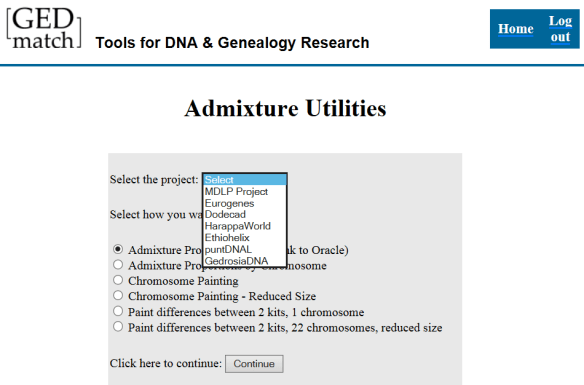
GedMatch admix menu

At GedMatch, there are several versions of various contributed admixture/ethnicity tools for you to use. The authors of these tools have in essence done the same thing the testing companies have done – compiled reference populations of their choosing and compare your results in a specific manner as determined by the software written by that author.  They all vary.  They are free.  Your mileage can and will vary too!

By comparing the results, you can clearly see the effects of including or omitting specific populations. You’ll come away wondering how they could all be measuring the same you, but it’s an incredibly eye-opening experience.

The Exceptions and Minority Ancestry

You know, there is always an exception to every rule and this is no exception to the exception rule. (Sorry, I couldn’t resist.)

By and large, the majority continental ancestry will be the most accurate, but it’s the minority ancestry many testers are seeking.  That which we cannot see in the mirror and may be obscured in written records as well, if any records existed at all.

Let me say very clearly that when you are looking for minority ancestry, the lack of that ancestry appearing in these tests does NOT prove that it doesn’t exist. You can’t prove a negative.  It may mean that it’s just too far back in time to show, or that the DNA in that bucket has “washed out” of your line, or that we just don’t recognize enough of that kind of DNA today because we need a larger reference population.  These tests will improve with time and all 3 major vendors update the results of those who tested with them when they have new releases of their ethnicity software.

Think about it – who is 100% Native American today that we can use as a reference population?  Are Native people from North and South American the same genetically?  And let’s not forget the tribes in the US do not view DNA testing favorably.  To say we have challenges understanding the genetic makeup and migrations of the Native population is an understatement – yet those are the answers so many people seek.

Aside from obtaining more reference samples, what are the challenges?

There are two factors at play.

Recombination – the “Washing Out” Factor

First, your DNA is divided in half with every generation, meaning that you will, on the average, inherit roughly half of the DNA of your ancestors.  Now in reality, half is an average and it doesn’t always work that way.  You may inherit an entire segment of an ancestor’s DNA, or none at all, instead of half.

I’ve graphed the “washing out factor” below and you can see that within a few generations, if you have only one Native or African ancestor, their DNA is found in such small percentages, assuming a 50% inheritance or recombination rate, that it won’t be found above 1% which is the threshold used by most testing companies.

Wash out factor 2

Therefore, the ethnicity of any ancestor born 7 generations ago, or before about 1780 may not be detectable.  This is why the testing companies say these tests are effective to about the rough threshold of 5 or 6 generations.  In reality, there is no line in the sand.  If you have received more than 50% of that ancestor’s DNA, or a particularly large segment, it may be detectable at further distances.  If you received less, it may be undetectable at closer distances.  It’s the roll of the DNA dice in every generation between them and you.  This is also why it’s important to test parents and other family members – they may well have received DNA that you didn’t that helps to illuminate your ancestry.

Recombination – Population Admixture – the “Keeping In” Factor

The second factor at play here is population admixture which works exactly the opposite of the “washing out” factor. It’s the “keeping in” factor.  While recombination, the “washing out” factor, removes DNA in every generation, the population admixture “keeping in” factor makes sure that ancestral DNA stays in the mix. So yes, those two natural factors are kind of working at cross purposes and you can rest assured that both are at play in your DNA at some level.  Kind of a mean trick of nature isn’t it!

The population admixture factor, known as IBP, or identical by population, happens when identical DNA is found in an entire or a large population segment – which is exactly what ethnicity software is looking for – but the problem is that when you’re measuring the expected amount of DNA in your pedigree chart, you have no idea how to allow for endogamy and population based admixture from the past.

Endogamy IBP

This example shows that both Mom and Dad have the exact same DNA, because at these locations, that’s what this endogamous population carries.  Therefore the child carries this DNA too, because there isn’t any other DNA to inherit.  The ethnicity software looks for this matching string and equates it to this particular population.

Like Neanderthal DNA, population based admixture doesn’t really divide or wash out, because it’s found in the majority of that particular population and as long as that population is marrying within itself, those segments are preserved forever and just get passed around and around – because it’s the same DNA segment and most of the population carries it.

This is why Ashkenazi Jewish people have so many autosomal matches – they all descend from a common founding population and did not marry outside of the Jewish community.  This is also why a few contemporary living people with Native American heritage match the ancient Anzick Child at levels we would expect to see in genealogically related people within a few generations.

Small amounts of admixture, especially unexpected admixture, should be taken with a grain of salt. It could be noise or in the case of someone with both Native American and Germanic or Eastern European heritage, “Native American” could actually be Germanic in terms of who you inherited that segment from.

Have unexpected small percentages of Middle Eastern ethnic results?  Remember, the Mesolithic and Neolithic farmer expansion arrived in Europe from the Middle East some 7,000 – 12,000 years ago.  If Europeans and Asians can carry Neanderthal DNA from 25,000-45,000 years ago, there is no reason why you couldn’t match a Middle Eastern population in small amounts from 3,000, 7,000 or 12,000 years ago for the same historic reasons.

The Middle East is the supreme continental mixing bowl as well, the only location worldwide where historically we see Asian, European and African DNA intermixed in the same location.

Best stated, we just don’t know why you might carry small amounts of unexplained regional ethnic DNA.  There are several possibilities that include an inadequate population reference base, an inadequate understanding of population migration, quirks in matching software, identical segments by chance, noise, or real ancient or more modern DNA from a population group of your ancestors.

Using Minority Admixture to Your Advantage

Having said that, in my case and in the cases of others who have been willing to do the work, you can sometimes track specific admixture to specific ancestors using a combination of ethnicity testing and triangulation.

You cannot do this at Ancestry because they don’t give you ANY segment information.

Family Tree DNA and 23andMe both provide you with segment information, but not for ethnicity ranges without utilizing additional tools.

The easiest approach, by far, is to download your autosomal results to GedMatch and utilize their tools to determine the segment ranges of your minority admixture segments, then utilize that information to see which of your matches on that segment also have the same minority admixture on that same chromosome segment.

I wrote a several-part series detailing how I did this, called The Autosomal Me.

Let me sum the process up thus. I expected my largest Native segments to be on my father’s side.  They weren’t.  In fact, they were from my mother’s Acadian lines, probably because endogamy maintained (“kept in”) those Native segments in that population group for generations.  Thank you endogamy, aka, IBP, identical by population.

I made this discovery by discerning that my specifically identified Native segments matched my mother’s segments, also identified as Native, in exactly the same location, so I had obviously received those Native segments from her. Continuing to compare those segments and looking at GedMatch to see which of our cousins also had a match (to us) in that region pointed me to which ancestral line the Native segment had descended from.  Mitochondrial and Y DNA testing of those Acadian lines confirmed the Native ancestors.

That’s A Lot of Work!!!

Yes, it was, but well, well worth it.

This would be a good time to mention that I couldn’t have proven those connections without the cooperation of several cousins who agreed to test along with cousins I found because they tested, combined with the Mothers of Acadia and the AmerIndian Ancestry out of Acadia projects hosted by Family Tree DNA and the tools at GedMatch.  I am forever grateful to all those people because without the sharing and cooperation that occurs, we couldn’t do genetic genealogy at all.

If you want to be amused and perhaps trade your lederhosen for a kilt, then you can just take ethnicity results at face value.  If you’re reading this article, I’m guessing you’re already questioning “face value” or have noticed “discrepancies.”

Ethnicity results do make good cocktail party conversation, especially if you’re wearing either lederhosen or a kilt.  I’m thinking you could even wear lederhosen under your kilt……

If you want to be a bit more of an educated consumer, you can compare your known genealogy to ethnicity results to judge for yourself how close to reality they might be. However, you can never really know the effects of early population movements – except you can pretty well say that if you have 25% Scandinavian – you had better have a Scandinavian grandparent.  3% Scandinavian is another matter entirely.

If you’re saying to yourself, “this is part interpretive art and part science,” you’d be right.

If you want to take a really deep dive, and you carry significantly mixed ethnicity, such that it’s quite distinct from your other ancestry – meaning the four continents once again, you can work a little harder to track your ethnic segments back in time. So, if you have a European grandparent, an Asian grandparent, an African grandparent and a Native American grandparent – not only do you have an amazing and rich genealogy – you are the most lucky genetic genealogist I know, because you’ll pretty well know if your ethnicity results are accurate and your matches will easily fall into the correct family lines!

For some of us, utilizing the results of ethnicity testing for minority admixture combined with other tools is the only prayer we will ever have of finding our non-European ancestors.  If you fall into this group, that is an extremely powerful and compelling statement and represents the holy grail of both genealogy and genetic genealogy.

Let’s Talk About Scandinavia

We’ve talked about minority admixture and cases when we have too little DNA or unexpected small segments of DNA, but sometimes we have what appears to be too much.  Often, that happens in Scandinavia, although far more often with one company than the other two.  However, in my case, we have the perfect example of an unsolvable mystery introduced by ethnicity testing and of course, it involves Scandinavia.

23andMe, Ancestry and Family Tree DNA show me at 8%, 10% and 12% Scandinavian, respectively, which is simply mystifying. That’s a lot to be “just noise.”  That amount is in the great-grandparent or third generation range at 12.5%, but I don’t have anyone that qualifies, anyplace in my pedigree chart, as far back as I can go.  I have all of my ancestors identified and three-quarters (yellow) confirmed via DNA through the 6th generation, shown below.

The unconfirmed groups (uncolored) are genealogically confirmed via church and other records, just not genetically confirmed.  They are Dutch and German, respectively, and people in those countries have not embraced genetic genealogy to the degree Americans have.

Genetically confirmed means that through triangulation, I know that I match other descendants of these ancestors on common segments.  In other words, on the yellow ancestors, here is no possibility of misattributed parentage or an adoption in that line between me and that ancestor.

Six gen both

Barbara Mehlheimer, my mitochondrial line, does have Scandinavian mitochondrial DNA matches, but even if she were 100% Scandinavian, which she isn’t because I have her birth record in Germany, that would only account for approximately 3.12% of my DNA, not 8-12%.

In order for me to carry 8-12% Scandinavian legitimately from an ancestral line, four of these ancestors would need to be 100% Scandinavian to contribute 12.5% to me today assuming a 50% recombination rate, and my mother’s percentage of Scandinavian should be about twice mine, or 24%.

My mother is only in one of the testing company data bases, because she passed away before autosomal DNA testing was widely available.  I was fortunate that her DNA had been archived at Family Tree DNA and was available for a Family Finder upgrade.

Mom’s Scandinavian results are 7%, or 8% if you add in Finland and Northern Siberia.  Clearly not twice mine, in fact, it’s less. If I received half of hers, that would be roughly 4%, leaving 8% of mine unaccounted for.  If I didn’t receive all of my “Scandinavian” from her, then the balance would have had to come from my father whose Estes side of the tree is Appalachian/Colonial American.  Even less likely that he would have carried 16% Scandinavian, assuming again, that I inherited half.  Even if I inherited all 8% of Mom’s, that still leaves me 4% short and means my father would have had approximately 8%, which is still between the great and great-great-grandfather level.  By that time, his ancestors had been in America for generations and none were Scandinavian.  Clearly, something else is going on.  Is there a Scandinavian line in the woodpile someplace?  If so, which lines are the likely candidates?

In mother’s Ferverda/Camstra/deJong/Houtsma line, which is not DNA confirmed, we have several additional generations of records procured by a professional genealogist in the Netherlands from Leeuwarden, so we know where these ancestors originated and lived for generations, and it wasn’t Scandinavia.

The Kirsch/Lemmert line also reaches back in church records several generations in Mutterstadt and Fussgoenheim, Germany.  The Drechsel line reaches back several generations in Wirbenz, Germany and the Mehlheimer line reaches back one more generation in Speichersdorf before ending in an unmarried mother giving birth and not listing the father.  Aha, you say…there he is…that rogue Scandinavian.  And yes, it could be, but in that generation, he would account for only 1.56% of my DNA, not 8-12%.

So, what can we conclude about this conundrum.

  • The Scandinavian results are NOT a function of specific Scandinavian genealogical ancestors – meaning ones in the tree who would individually contribute that level of Scandinavian heritage.  There is no Scandinavian great-grandpa or Scandinavian heritage at all, in any line, tracking back more than 6 generations.  The first “available” spot with an unknown ancestor for a Scandinavian is in the 7th generation where they would contribute 1.56% of my DNA and 3.12% of mothers.
  • The Scandinavian results could be a function of a huge amount of population intermixing in several lines, but 8-12% is an awfully high number to attribute to unknown population admixture from many generations ago.
  • The Scandinavian results could be a function of a problematic reference population being utilized by multiple companies.
  • The Scandinavian results could be identical by chance matching, possibly in addition to population admixture in ancient lines.
  • The Scandinavian results could be a function of something we don’t yet understand.
  • The Scandinavian results could be a combination of several of the above.

It’s a mystery.  It may be unraveled as the tools improve and as an industry, additional population reference samples become available or better understood.  Or, it may never be unraveled.  But one thing is for sure, it is very, very interesting!  However, I’m not trading lederhosen for anything based on this.

The Companies

I wrote a comparison of the testing companies when they introduced their second generation tools.  Not a lot has changed.  Hopefully we will see a third software generation soon.

I do recommend selecting between the main three testing companies plus National Geographic’s Genographic 2.0 products if you’re going to test for ethnicity.  Stay safe.  There are less than ethical people and companies out there looking to take advantage of people’s curiosity to learn about their heritage.

Today, 23andMe is double the price of either Family Tree DNA or Ancestry and they are having other issues as well.  However, they do sometimes pick up the smallest amounts of minority admixture.

Ancestry continues to have “a Scandinavian problem” where many/most of their clients have a significant amount (some as high as the 30% range) of Scandinavian ancestry assigned to them that is not reflected by other testing companies or tools, or the tester’s known heritage – and is apparently incorrect.

However, Ancestry did pick up my minority Ancestry of both Native and African. How much credibility should I give that in light of the known Scandinavian issue?  In other words, if they can’t get 30% right, how could they ever get 4 or 5% right?

Remember what I said about companies doing pretty well on a comparative continental basis but sorting through ethnicity within a continent being much more difficult. This is the perfect example.  Ancestry also is not alone in reporting small amounts of my minority admixture.  The other companies do as well, although their amounts and descriptions don’t match each other exactly.

However, I can download any or all three of these raw data files to GedMatch and utilize their various ethnicity, triangulation and chromosome by chromosome comparison utilities. Both Family Tree DNA and Ancestry test more SNP locations than does 23andMe, and cost half as much, if you’re planning to test in order to upload your raw data file to GedMatch.

If you are considering ordering from either 23andMe or Ancestry, be sure you understand their privacy policy before ordering.

In Summary

I hate to steal Judy Russell’s line, but she’s right – it’s not soup yet if ethnicity testing is the only tool you’re going to use and if you’re expecting answers, not estimates.  View today’s ethnicity results from any of the major testing companies as interesting, because that’s what they are, unless you have a very specific research agenda, know what you are doing and plan to take a deeper dive.

I’m not discouraging anyone from ethnicity testing. I think it’s fun and for me, it was extremely informative.  But at the same time, it’s important to set expectations accurately to avoid disappointment, anxiety, misinformation or over-reliance on the results.

You can’t just discount these results because you don’t like them, and neither can you simply accept them.

If you think your grandfather was 100% Native America and you have no Native American heritage on the ethnicity test, the problem is likely not the test or the reference populations.  You should have 25% and carry zero.  The problem is likely that the oral history is incorrect.  There is virtually no one, and certainly not in the Eastern tribes, who was not admixed by two generations ago.  It’s also possible that he is not your grandfather.  View ethnicity results as a call to action to set forth and verify or refute their accuracy, especially if they vary dramatically from what you expected.  If it’s the truth you seek, this is your personal doorway to Delphi.

Just don’t trade in your lederhosen, or anything else just yet based on ethnicity results alone, because this technology it still in it’s infancy, especially within Europe.  I mean, after all, it’s embarrassing to have to go and try to retrieve your lederhosen from the pawn shop.  They’re going to laugh at you.

I find it ironic that Y DNA and mtDNA, much less popular, can be very, very specific and yield definitive answers about individual ancestors, reaching far beyond the 5th or 6th generation – yet the broad brush ethnicity painting which is much less reliable is much more popular.  This is due, in part, I’m sure, to the fact that everyone can take the ethnicity tests, which represent all lines.  You aren’t limited to testing one or two of your own lines and you don’t need to understand anything about genetic genealogy or how it works.  All you have to do is spit or swab and wait for results.

You can take a look at how Y and mtDNA testing versus autosomal tests work here.  Maybe Y or mitochondrial should be next on your list, as they reach much further back in time on specific lines, and you can use these results to create a DNA pedigree chart that tells you very specifically about the ancestry of those particular lines.

Ethnicity testing is like any other tool – it’s just one of many available to you.  You’ll need to gather different kinds of DNA and other evidence from various sources and assemble the pieces of your ancestral story like a big puzzle.  Ethnicity testing isn’t the end, it’s the beginning.  There is so much more!

My real hope is that ethnicity testing will kindle the fires and that some of the folks that enter the genetic genealogy space via ethnicity testing will be become both curious and encouraged and will continue to pursue other aspects of genealogy and genetic genealogy.  Maybe they will ask the question of “who” in their tree wore kilts or lederhosen and catch the genealogy bug.  Maybe they will find out more about grandpa’s Native American heritage, or lack thereof.  Maybe they will meet a match that has more information than they do and who will help them.  After all, ALL of genetic genealogy is founded upon sharing – matches, trees and information.  The more the merrier!

So, if you tested for ethnicity and would like to learn more, come on in, the water’s fine and we welcome both lederhosen and kilts, whatever you’re wearing today!  Jump right in!!!

______________________________________________________________

Disclosure

I receive a small contribution when you click on some of the links to vendors in my articles. This does NOT increase the price you pay but helps me to keep the lights on and this informational blog free for everyone. Please click on the links in the articles or to the vendors below if you are purchasing products or DNA testing.

Thank you so much.

DNA Purchases and Free Transfers

Genealogy Services

Genealogy Research

Genealogy and Ethnicity DNA Testing – 3 Legitimate Companies

Big 3 logos

Update: Please note that a 4th company has now been added to this list, MyHeritage.

As with any industry that has become popular, especially quickly, there are the front runner companies, and then there is an entire cadre of what I am going to call “third tier” companies that spring up and are trying to play off of the success of the front runners and the naivety of the consuming public. I’m going to avoid the use of the words snake oil here, because some of them aren’t quite that bad, but others clearly are.  You get the drift, I’m sure.  There is a very big gulf, as in a chasm, between the three front-runners, Family Tree DNA, Ancestry and 23andMe, whose recognizable logos you see above and the rest of the pack.

Recently, we’ve seen a huge raft of people finding these “third tier” companies, purchasing their products thinking they’re getting something they aren’t, often due to what I would call corporate weasel-wording and snazzy ads, and then being unhappy with their purchase. Unfortunately, often the purchasers don’t understand that they’ve in essence “been had.”  This type of behavior tarnishes the entire genetic genealogy industry.

So, if you find a test on LivingSocial or a Groupon coupon that “looks familiar” it may by the AncestrybyDNA test that people mistakenly purchase instead of the AncestryDNA kit sold by Ancestry.com.  They think they are getting a great deal on the AncestryDNA test.  They aren’t.  It’s not the same thing at all.  AncestrybyDNA is an old, inaccurate, ineffective test called DNAPrint that has been rebranded to be sold to the unsuspecting.  Don’t buy this Groupon item.

There are other useless tests too, probably too many to mention by name, plus I really don’t want to give them any publicity, even inadvertently.

I also want to be clear that I’m only talking about genetic genealogy and ethnicity testing, not about medical DNA testing or traditional paternity testing, although some of the labs that offer paternity testing services also offer the less than forthright tests, in fact, those very two mentioned above.  I’m also not talking about add-on services like GedMatch and DNAGedcom which don’t provide DNA testing and do provide much valued services within the genetic genealogy community.  I’m also not talking about the Genographic project testing which does provide great information but is not in essence a genetic genealogy test in the sense that you can’t compare your results with others.  You can, however, transfer your results from the Genographic project to Family Tree DNA where you can compare with others.

Twisting the Truth

One of the biggest areas ripe for harvesting by sheisters are the thousands of people who descend, or think they descend from, or might descend from Native Americans. It’s a very common question.

If you find a company that says they will tell you what Indian tribe you descend from, and believe me, they’re out there, just know that you really can’t do that today with just a DNA test.  If you could identify a tribe that quickly and easily, these three leading companies would be doing just that – it would be a booming consumer product.  “Identifying my tribe” is probably my most frequently asked question and a highly sought after piece of information, so I’m not surprised that companies have picked up on that aspect of genetic genealogy to exploit.  I wrote about proving Native heritage and what it takes to identify your tribe here and here.  If that’s how they’re trying to hook you, you’re either going to be massively disappointed in your results, or the results are going to be less than forthright and truthful.

Yes, the DNA truth can be twisted and I see these “twisted results” routinely that people have paid a lot of money to receive and desperately want to believe.

Let me just give you one very brief example of DNA “fact” twisting. Person one claims (“self-identifies” in the vernacular), with no research or proof, that their maternal grandma is Cherokee, a very common family story.  Their mitochondrial haplogroup is H3, clearly, unquestionably European and not Native.  You test and share haplogroup H3 with person one.  I’ve seen companies that then claim you descend from the same “Cherokee line” as person one with haplogroup H3 and therefore you too are magically Cherokee because you match someone in their data base that is “Cherokee.” Congratulations!  I guess all Europeans who carry haplogroup H3 are also Cherokee, using that same logic.  Won’t they be surprised!

This H3=Cherokee analogy is obviously incorrect and inaccurate in several different ways, but suffice it to say that, as a hopeful consumer, you are now very happy that you are now “proven” to be Cherokee and you have no idea or understanding that it’s all predicated on one person’s “self-identification” that allows the less-than-ethical company to then equate all other H3 people to a “Cherokee lineage.” The problem is that you aren’t either proven Native nor Cherokee on your direct matrilineal line. And you’ve been snookered.  But you’re obliviously happy.

What a shameful way to exploit Native people and their descendants, not to mention the consuming public.

Unfortunately, there are lots of ways to twist the truth, intentionally or inadvertently.  If you’re looking for direction on this topic, there is a FaceBook group called Native American Ancestry Explorer: DNA, Genetics, Genealogy and Anthropology that I would recommend.

In genetic genealogy, meaning for both genealogy and ethnicity, there are three companies that are the frontrunners, by any measure, and then there are the rest, many of whom misrepresent their wares and what they can legitimately tell you. Or they tell you, and you have no idea if what they say is accurate or their own version of “truth” from their own “private research” and data bases, i.e., H3=Cherokee.

The Big 3

So, here are the Big 3 testing companies, in my preference order.

  1. Family Tree DNA
  2. Ancestry
  3. 23andMe

Not only are these the Big 3, they are the only three that give you the value for your money as represented, plus the ability to compare your results to others.

Family Tree DNA is the only company to provide mitochondrial and Y DNA testing and matching.

All three of these companies provide autosomal tests and provide you:

  • Ethnicity estimates
  • Autosomal DNA Results (downloadable)
  • Autosomal DNA Matching to others in their data base
  • Different tools at each company that vary in quality and completeness

If it’s not one of these three companies, don’t buy, JUST DON’T.

You can debate all day about which of these three companies is the best for you (or maybe all three), but that is what the debate SHOULD be about, not whether to use one of these companies versus some third tier company.

I’m am not going to do a review of these companies in this article. Suffice it to say that my 2015 review holds relatively well EXCEPT that 23andMe is still going through something of a corporate meltdown with their genetic genealogy product which has caused me to take them off of my recommended list other than for adoptees who should test with all three vendors due to their data base matching.  Also, if you’re trying to make a decision in relation to the Big 3 companies and testing, you might want to read these two articles, here and here, as well.

I will do a 2016 review after 23andMe finishes their transition so we know how the genealogy aspect of their new services will work.

Personally, I think that everyone interested in genetic genealogy should test their mitochondrial DNA (males and females both,) and Y DNA (males only) at Family Tree DNA and their autosomal DNA (males and females both) at both Ancestry and Family Tree DNA. Family Tree DNA offers a $39 transfer from Ancestry, so you can put together a nice testing package and reap all of the benefits.  Here’s a basic article about the different kinds of DNA testing, what they cover and how, based on your family tree.

Bottom Line

So, here’s the bottom line – as heated as the debate gets sometimes within the genetic genealogy community about which of the three vendors, Family Tree DNA, Ancestry or 23andMe, is best, that really IS the question to debate.  The question should NEVER be whether to use a third tier company for genetic genealogy or ethnicity instead of one of these three.

So spread the word and hopefully none of our genealogy friends or well-meaning spouses or family members purchasing gifts with the very best of intentions will get sucked in. Stick with the Big 3.

______________________________________________________________

Disclosure

I receive a small contribution when you click on some of the links to vendors in my articles. This does NOT increase the price you pay but helps me to keep the lights on and this informational blog free for everyone. Please click on the links in the articles or to the vendors below if you are purchasing products or DNA testing.

Thank you so much.

DNA Purchases and Free Transfers

Genealogy Services

Genealogy Research

Saying Hello in the DNA World

Hey Baby, what’s your sign?  Remember that?  I surely do.  It was the worst introductory, aka “pickup line” ever!

If someone asked me that today, after rolling my eyes of course, I’d just have to show them a double helix on my Kerchner R1b piniphone or maybe just look at them deadpan and say “R1b,” M269” or “J1c2f.” If they know what means, well, there might be hope…

Ok, so what DO you say to someone with whom you match on your DNA?  How do you appropriately say “hello?”

When you receive a match from a vendor or via tools like GedMatch, what do you say to that new match that will elicit a response that might be useful and not make you look either like an idiot or predatory in the process? In part, that has to do with what kind of DNA match it is, meaning Y, mitochondrial or autosomal, and in part, how you ask for information.

So, first, let’s talk about some basics of how to obtain good responses and secondly, let’s look at each type of match.

The Basics

I know some of these basics sounds, well, really basic, but I wouldn’t have included them if I didn’t receive a lot of e-mails from people who obviously don’t understand these basic communications “good manners.”

  1. Do use capitals and punctuation. If you don’t you’re conveying the message to the recipient that they don’t matter enough to bother constructing a complete sentence. E-mails like this are apt to be immediately deleted.
  2. Don’t put the entire question in the subject line. These get deleted too.
  3. Include the person’s name who you match. Don’t assume that the person whose e-mail is on the kit is the person who tested.  Many people manage multiple (as in many) kits.
  4. Don’t write “dear match” e-mails and copy several people at once.
  5. Title the e-mail with something relevant like “DNA Match to Robert Doe at Family Tree DNA.”  You don’t want your e-mail to wind up in their spam filter.
  6. Include the basics of the match including the match’s name on the kit (or kit number) and the company (or service like GedMatch) where the match occurred.  I always add the test type as well, and if the match is particularly close.
  7. Don’t say, “Can you tell me how we’re related?” without giving any other information. That comes across as sounding a bit “entitled” and the response it gets from the receiver generally isn’t positive.
  8. Do not tell your life story. They won’t read it and they’ll delete it.
  9. Include friendly, short, concise basic information, depending on the kind of test.
  10. I always end my communications with a question for them to answer and a short, positive comment.

Y-DNA

Y-DNA tests are between males, so if you’re a female, you might want to mention that you’re the custodian for the kit for your brother, or father, John Doe. Give basic surname and lineage information for the Doe line.

Here’s an example of a contact e-mail for Y DNA:

Dear Robert Doe,

I’m the custodian for the DNA kit at Family Tree DNA of John Doe, my father. I noticed that he matches Robert Doe, which I presume is you, on the Y DNA test at 67 markers with only one mutation.  In addition, these two men carry the same surname which suggest a common ancestor.  I’ve also checked and you two don’t seem to match on the Family Finder test, so perhaps the common ancestor between you and my father is a few generations back in time.

Here is my father’s direct Doe lineage:

y pedigree

As you can see, I’m stuck with Martin Doe in Virginia. I’m hoping that our match might be helpful in getting beyond this brick wall.

Who is your oldest Doe ancestor and where were they located?

Thank you for your time. Here’s hoping we can find our common ancestor or at least some hints!

Jane Doe

Mitochondrial DNA

Mitochondrial DNA is a little more challenging genealogically, because the surnames change with every generation. Therefore, locations become very important clues in terms of finding a common ancestor.

Here’s an example of a mitochondrial DNA contact e-mail:

Dear Susie Smith,

I’m the custodian for the DNA kit at Family Tree DNA for my mother, Barbara Jones. I noticed that mother and Susie Smith, which I presume is you, share mitochondrial DNA at the full sequence level with no mutations difference.  This means that our common relative could be in recent generations, or maybe further back in time.  Since you’ve both also taken the Family Finder test, I noticed that you also match in the 2nd to 4th cousin range, meaning you and mother could potentially share great-grandparents to great-great-great-grand-parents. That could possibly be from Barbara Brown, Ellen Green or Mary on my pedigree chart below.

Here is my mother’s matrilineal line as far back as I have information:

mtDNA pedigree

Of course, it’s possible that our common ancestor is further back in time, but I’m hopeful that some of these names or locations might look familiar or be where your matrilineal family members are from too.

Do you see anything here that looks promising in terms of a common ancestor or location?  Where is your most distant maternal ancestor from?

I look forward to hearing from you. Maybe we can solve this puzzle together.

Jane Jones

Autosomal DNA

Autosomal DNA is, of course, genealogically more complex than either Y or mitochondrial DNA in that your matches can be from any of your family lines. That also means this test is full of potential as well, but it’s more difficult to provide your matches with enough information to obtain a useful response without overwhelming them.  With three different vendors plus GedMatch, a one-size-fits-all introductory letter doesn’t work

The first thing I do is to see if I can tell how this person may match me.

For example, my mother has taken the Family Finder test at Family Tree DNA as well, so the first thing I check on any match is to see if that person matches both me and my mother. If so, then that match is through my mother’s side of the tree.

This is easy to do with the ICW (in common with) button at Family Tree DNA.  The ICW button looks like crossed arrows and is blue, below.

Joy compare

The list of matches returned will either show my mother or it won’t.

If the person doesn’t match my mother, and Joy doesn’t, I see who else they do match in addition to me.  For example, let’s see who Joy matches that I match as well.

Joy ICW

I can tell based on the ICW cousins that Joy and I both match that indeed, this match is on my father’s side and that it’s in the Vannoy line. That’s actually very helpful, because it helps me provide my match with some direction and gives us someplace to go.  This also illustrates the benefit of testing every cousin you can find!

Here’s an example of a Family Finder contact e-mail:

Dear Joy,

I notice that I have a match to Joy Smith, which I presume is you, at Family Tree DNA on the Family Finder test.  Our connection is estimated to be at the 2nd to 4th cousin level. This is exciting because it means we may be able to find our common ancestor.

Based on the fact that you match several of my cousins, including Stacy, Charlene, Christopher, Debbie and 3 Vannoy cousins, our common ancestor seems to be either in the Vannoy line, from which we all descend, or a common ancestral line to all of these cousins.

I’m attaching a copy of my father’s pedigree chart in pdf format so that it’s easily readable. Please note that his grandmother was Elizabeth Vannoy and take a look at her lineage. There is an index in the back of the document so you can easily scan to see if anyone looks familiar.

Are any of her ancestors your ancestors too?

I’m excited to see if we can make a family connection. I look forward to hearing from you,

Roberta Estes

Of course, if you’re sending a message to someone you match at either 23andMe or Ancestry.com, it would read a little bit differently because their tools are different from those provided at Family Tree DNA. For those vendors, my contact verbiage reads somewhat differently, in part, because my mother’s DNA is not at either of those vendors and I have much less flexibility in terms of tools and usage.

For example, at 23andMe the contact request is “blind” and you can’t see anything about matches until the contact and DNA sharing requests are accepted. This is changing shortly at 23andMe, but exactly how all of this will work is uncertain.  Also, not all 23andMe kits can be transferred to Family Tree DNA.

At Ancestry, they have no chromosome browser, so you can’t look at any comparative chromosome information. You can see who else you match in common though, in addition to the Circles.

The message is also different because both Ancestry and 23andMe contacts must be made through their internal message system where you cannot attach files and you are limited in terms of message size. Also, remember to sign your full real name.  Your screen name may not be the same and that’s all the recipient will see in the message they receive through the vendor.  I also include an e-mail address.

Here’s an example of a 23andMe or Ancestry contact message.

I notice that we are a DNA match. That’s great news.  I believe that we may match through the Estes line, but I’m not positive.  I have a number of Estes cousins who have tested from this line at Family Tree DNA that you might match as well.  You can upload your results to Family Tree DNA and see your matches for $39 instead of retesting, which is a real value.  You can also join the Estes project at Family Tree DNA.  Many of my cousins have uploaded their results to GedMatch too.  Have you uploaded your DNA results to http://www.GedMatch.com yet?  It’s a free service provided by genealogists for genealogists and allows people who have tested at different companies to compare their kits for matching.  I’d love to send you my pedigree chart, my GedMatch kit number, provide instructions for transferring your kit to Family Tree DNA and GedMatch, or answer questions.  You can e-mail me at xxxxxx@att.net.  I look forward to seeing if we can find our common ancestor.  Do you have any Estes ancestors in your tree?  Genealogy sure has gotten exciting since DNA has been added as a tool.

Roberta Estes

If I can make this contact more personal, I do. For example, if we share a common ancestor in a tree or a Circle at Ancestry, I always include that information.  I tend, in general to get more responses where I can tell the recipient at least something about how we do or might match, even if it’s nonspecific.

If you want to read more about autosomal DNA contacts tips for success, you can read this more extensive contact article here and one for adoptees here.

Making the contact takes very little effort. Not all contact requests work, of course, but I’ve found some real gems in those that do.

Let me know in the comments what contact techniques work well for you.

Have fun!!!

______________________________________________________________

Disclosure

I receive a small contribution when you click on some of the links to vendors in my articles. This does NOT increase the price you pay but helps me to keep the lights on and this informational blog free for everyone. Please click on the links in the articles or to the vendors below if you are purchasing products or DNA testing.

Thank you so much.

DNA Purchases and Free Transfers

Genealogy Services

Genealogy Research

The Ancestry 200

Sounds like a race doesn’t it, but it isn’t. It’s a milestone checkpoint of sorts, so I thought I’d take a few minutes and take a look at where my Ancestry DNA shakey leaf tree matches are, and how they are performing.

On January 13th, 2016 I reached 200 shakey leaf DNA matches at Ancestry.  In case you don’t know, a shakey left hint with someone means that our DNA matches AND our trees indicate that we have a common ancestor.  As far as I’m concerned this is the low hanging fruit at Ancestry, and pretty much all I bother with except in rare circumstances.  But those shakey leaf matches are just plain fun.  It’s like getting a bite of genealogist-crack-candy when I get a new shakey leaf.

200 leaf

Where Are We Today?

I have a total of 150 pages at 50 matches each for a total of 7500 matches today at Ancestry. That’s roughly half of the number of matches I had pre-Timber phasing introduced in November of 2014 and double the number I had after Timber.  I wrote about the introductory Timber/phasing rollout here.

Pre-Timber After Timber Intro Nov 2014 January 2016
Total Matches 13,100 3,350 7,500
Shakey Leaf Matches 36 18 200

Today, my 200 shakey leaf matches represent 2.67% of my total matches. Not a terribly good return, but again, the tree matching makes seeing the (potential) connection with these matches much easier.  The other 97%…not so easy.

New Ancestor Discoveries (NADs)

Let’s look at the first thing you see on your page. New Ancestor Discoveries, or what I (not so) affectionately call Bad NADs, because these are not my ancestors.

200 NAD

And since April 2015, Ancestry, bless their hearts, has given be 6 bad NADs, New Ancestor Discoveries that aren’t. In one case, Robert Shiflet is the husband of my ancestor’s sister.

Shiflet NAD chart

So, while I share DNA with Robert’s children, it’s not Robert’s DNA that I share, but his wife’s. Actually, Ancestry has given me 8 bad NADS, but they also take them away from time to time. But then, some come back again! Kind of like a light bulb flickering off and on, trying to burn out.

In all fairness, there is some DNA connection somehow, but not necessarily through the individual portrayed. Unfortunately, this leads many, MANY people far astray as they take these projections as gospel, and they are far from gospel.  They are much more like a leap of ill-placed faith.  I wish NADs had been labeled “hints” with the explanation that you share some DNA with people who descend from this individual.  And I wish they were someplace at the bottom of the page, hidden away – not the first thing you see.  It’s deceiving – and just plain wrong to say that I’m a “Descendant of Robert Shiflet.”  I’m not.  He was married to my ancestor’s sister.  I’m not only not his descendant, I don’t share ANY blood connection with Robert Shiflet.

200 shiflet

Today, these NADs are labeled such that it flat out says you are a “descendant of” this person, which is in my case, unequivocally untrue for all of these NADs.

On to more useful topics.

DNA Circles

Ancestry has also put me into 19 DNA Circles. Actually, they have put me into 21 DNA Circles, but two of those circles have disappeared as well.  I suspect this is due to a change in Ancestry’s ranking algorithm because they disappeared at the same time.

A DNA Circle means that you have DNA matches with at least two other people who share a common ancestor with you in their tree. That’s the claim.  However, I have two cases where I only match one other person and I’m in a Circle, and many cases where I match many people and I’m not in the circle.

A match or being included in a Circle does NOT mean you match on the same segment, or that anyone in the tree matches on the same segments – only that you match and show a common ancestor in your trees. In other words, you could be matching as a result of a different ancestor entirely on entirely different segments, and there are no tools available (like a chromosome browser or triangulation tools) to verify this connection.

200 circle 1

However, DNA Circles are useful. For example, it’s unlikely, if you are matching an ancestor through different children, and there are many matches, that your connection isn’t through this ancestral couple, or someone who contributed to the DNA of this ancestral couple.  Yes, the language here gets wishy washy.

200 circle 2

I view Circles as a way to generally confirm that my genealogy is most likely accurate. Yea, I know, more wishy washy words – but that’s because the tools we have don’t provide us with a path to clarity.

200 circle 3

Shakey Leaf Matches

I have 200 shakey leaf matches with people, meaning that we share DNA and a common ancestor in our trees. We may or may not be in a Circle together, because Circles aren’t created unless you match at least two(?) other individuals from this common ancestor, plus some other proprietary weighting factors.

I particularly like that we can see how the other people we match descend from this same ancestor. This suggests that the match really can’t be due to a NPE (nonparental event, also known as an undocumented adoption) downstream of this ancestor. If that were the case, you would only match people through the same child.

200 shakey match

Non-Shakey Leaf Matches

Let’s take a look at my best, meaning my closest, matches. Unfortunately, my highest matches don’t have trees with a common ancestor with me – so no shakey leaves.  The second closest match has no tree at all.  This lack of trees or private trees is one of the most frustrating aspects of genetic genealogy – and particularly at Ancestry because their usefulness depends so heavily on the trees.  Regardless, given that these are my closest matches, let’s see if we can’t determine our common ancestor.

200 closest

So, using deductive reasoning, let’s see what we can discover about my three highest matches. In August, Ancestry introduced the feature called “Shared Matches” meaning Ancestry shows you who you both match in common for any match that is 4th cousin or closer, meaning 6 generations or closer.  So keep in mind, you both will have matches further back in time or predicted to be more distant matches, but they won’t show in the shared matches.

So let’s look at my closest match, PR, estimated to be a second to third cousin.

Clicking on Shared Matches with PR, I have a total of 13. That’s hopeful.  Of those 13:

  • 3 have no tree
  • 1 tree is unavailable
  • 1 shakey leaf match that’s private – who never answered the inquiry message I sent them and hasn’t signed in since February 2015

200 closest shared matches

Ugh, this isn’t hopeful anymore, it’s frustrating. I was very much hoping to be able to deduce the common ancestor by seeing who else I matched – and hoping that there were some shakey leaf people with common ancestor’s already identified in the match list, but that is not to be.

Let’s move to my second closest match and try to find my common ancestor with MH who has no family tree. I can’t imagine how they are using this tool without a family tree.  However, judging from the fact that they haven’t signed in since September 3rd, maybe they aren’t doing anything with these results.  With MH, I have 12 matches, of which:

  • 3 have no tree
  • 4 have shakey leaf hints

Now those shakey leaf hints are very hopeful, so let’s see if they all point to the same ancestor!

  • 2 point to Andrew McKee
  • 1 points to Samuel Claxton and Elizabeth Speaks
  • 1 points to Fairwick Claxton and Agnes Muncy, but not through son Samuel

Uh, that would be a no, they don’t all point to the same ancestor. But three of these people are in the same line, and the fourth, well, not really.

Andrew McKee is the father of Ann McKee who married Charles Speaks who had Elizabeth Speaks who married Samuel Claxton. So the three people who descend from these ancestors are legitimately from the same line.

200 McKee

However, there is no DNA pathway from Andrew McKee to Fairwick Claxton and his wife, Agnes Muncy, but Fairwick is in both people’s trees. In this case, MH must be matching the last person through a different line, and not through Andrew McKee.  The only way Fairwick could even be insinuated is if the person descends through Samuel Claxton, Fairwick’s son who married Agnes Muncy, but that isn’t shown in their tree.  Their descend from Fairwick is through a different child.

200 Claxton

So, this trip into deductive reasoning should have worked, but didn’t exactly work quite as planned due to what I’ll call “inferential tree assumptions.” That assumption would be that if your DNA matches, and you have a common ancestor in a tree, that your DNA link is THROUGH that common ancestor.  Sometimes, in fact many times, that’s true, but there are cases where the link is through a different common ancestor. In this case, it’s likely that one way I match MH is through Andrew McKee, but I may well have a second line through Fairwick Claxton and Agnes Muncy.  These people do live in the same geography.

200 multiple leafs

I see secondary and multiple lineages far more than I would have expected. When Ancestry can see that there are multiple ancestors in your trees that match, they show that you have “Shared Ancestor Hint 1 of X”, but they can only note what’s recorded and matches in both your trees.

Moving on to my third closest match, that’s a lost cause too because it’s the same line as the first match.

Indeed, working with shakey leaf matches are indeed your best bet at Ancestry.

However, let’s take a look at this matching data in a different way.

Matches and Circles by Ancestor

There may be 200 shakey leaf matches today, but there have been a total of 263 shakey leaf matches, of which 63 have either disappeared through the magic of Timber or for some other, unknown reason. A few were adoptees trying to work with various experimental trees, so I’ve eliminated them from the totals.  I’ve kept track of my matches by ancestor though, so let’s see how many of my matches are in circles and how many of my ancestral lines are represented.

The generations column is the number removed from me to that ancestor counting my parent as generation 1.  Remember, Ancestry does not report shakey leaf matches beyond 9 generations. Total matches is how many people whose DNA match mine also show this ancestor in their tree. Circle is yes or no, there is a Circle or there isn’t for one or both of the ancestral couple.  How many of my matches are in the circle and how many total individuals are in that circle.  Note that the Total Matches (to me) should be one less than the Matches in the Circle which includes me.

Ancestor Generations Total Matches Circle Matches in Circle incl Me Total in Circle incl Me
Abraham Estes & Barbara 9 8
Andrew McKee & Elizabeth 5 5 Andrew Andrew 6 Andrew 15
Antoine Lore & Rachel Levina Hill 4 1
Catherine Heath 8 1
Charles Hickerson & Mary Lytle 7 1
Charles Speak & Ann McKee 5 1
Charlotte Ann Girouard 8 1
Claude Dugas & Francoise Bourgeois 9 3
Cornelius Anderson & Annetje Opdyke 9 4
Daniel Garceau and Anne Doucet 7 1
Daniel Miller & Elizabeth Ulrich 6 8
David Miller & Catherine Schaeffer 5 3 David David 4 David 6
Edward Mercer 8 2
Elisha Eldredge and Doras Mulford 8 1
Elizabeth Greib (m Stephen Ulrich) 7 1
Elizabeth Mary Algenica Daye 8 1
Elizabeth Shepherd (m William McNiel) 6 6
Fairwick Claxton & Agnes Muncy 5 2 Fairwick

Agnes

Fairwick 4

Agnes 4

Fairwick 7

Agnes 7

Frances Carpenter 5 1
Francois Broussard & Catherine Richard 9 3
Francoise Dugas 8 3
Francois Lafaille 6 2
George Dodson & Margaret Dagord 8 12
George Estes & Mary Younger 6 2
George McNiel & Sarah 7 7
George Shepherd & Elizabeth Angelica Daye 8 3
Gershom Hall 7 3
Gershom Hall & Dorcas Richardson 6 1
Gideon Faires & Sarah McSpadden 7 2
Henry Bolton & Nancy Mann (Henry had 2 wives) 5 12 Nancy

Henry

Nancy 7

Henry 8

Nancy 20, Henry 22
Henry Bowen & Jane Carter 9 2
Honore Lore & Marie Lafaille 5 1
Jacob Dobkins 7 1
Jacob Lentz & Frederica Moselman 5 2 Frederica Jacob Frederica 3 Jacob 3 Frederica 12, Jacob 12
Jacque Bonnevie & Francoise Mius 8 1
James Crumley & Catherine 8 1
James Hall & Mehitable Wood 7 2
James Lee Claxton 6 2
Jan Derik Woertman & Anna Marie Andries 9 1
Jeanne Aucoin 9 1
Joel Vannoy & Phoebe Crumley 4 8 Joel

Phoebe

Joel 8

Phoebe 8

Joel 8

Phoebe 8

Johann Michael Miller & Suzanna Berchtol 8 11
Johann Nicholas Schaeffer & Mary Catherine Suder 8 2
John Campbell & Jane Dobkins* 6 5 Jane

John

Jane 6

John 3

Jane 10 John 5
John Cantrell & Hannah Britton 7 7
John Francis Vannoy & Susannah Anderson 7 7
John Hill & Catherine Mitchell 6 1 John John 2 John 3
John R. Estes & Nancy Moore* 5 5 John

Nancy

John 2

Nancy 3

John 6

Nancy 6

Joseph Cantrell & Catherine Heath 8 4
Joseph Carpenter & Frances Dames 8 4
Joseph Preston Bolton (multiple wives) 4 3 Joseph Joseph 5 Joseph 9
Joseph Rash & Mary Warren 9 3
Joseph Workman & Phoebe McMahon 7 2
Jotham Brown & Phoebe 7 11
Lazarus Estes & Elizabeth Vannoy 3 1
Michael DeForet & Marie Hebert 9 2
Moses Estes Jr 7 1
Moses Estes Sr 8 1
Nicholas Speaks & Sarah Faires 6 3 Nicholas Sarah Nicholas 5 Sarah 5 Nicholas 25, Sarah 24
Peter Johnson 8 2
Philip Jacob Miller & Magdalena 7 8
Pierre Doucet & Henriette Pelletret 9 1
Rachel Levina Hill (husband Anthony Lore not shown) 4 4 Rachel Rachel 4 Rachel 4
Raleigh Dodson & Elizabeth 7 1
Robert Shepherd & Sarah Rash 7 6
Rudolph Hoch 9 1
Samuel Claxton & Elizabeth Speaks 4 1
Stephen Ulrich 7 6
Thomas Dodson & Dorothy Durham 9 6
William Crumley (2nd) 5 1
William Crumley (1st) 7 1
William Hall & Hester Matthews 9 1
William Herrell & Mary McDowell 5 1

This chart is actually very interesting. Two couples have different tallies for the mother and father.  In these cases, bolded* above, the couple was not married more than once, so the matches should equal.  This has to be a tree matching issue. Remember, these tree matches are based on the information in the trees of the people who DNA test – and we all know about tree quality at Ancestry.  GIGO

Initially tree matches were going to be restricted to 7 generations or below, but have now been extended to 9 generations. Circles are apparently still restricted to 7 generations.

I also noticed that when counting the matches by looking at them individually, the count does not always equal the Matches in the Circle, even after allowing for one difference in the Matches in Circles. So, apparently not all matches are “strong enough” to be shown in Circles.

Relationships and Matches

This is all very nice, but what does it really mean on my pedigree chart?

I’ve divided my pedigree into half, one for each parent.

On the chart below, my father’s ancestor tree matches are blue, and the circles are green. You can click on the image to see a larger version.

200 father pedigree blue

Please note that the first 6 generations (beginning with my parent) are complete, but generations 7-9, I’ve only listed ancestors that are matches to someone through a shakey leaf.

On the chart below, the same information for my mother’s side of the house.

200 mother pedigree blue

This visual demonstration is actually quite interesting in that the circles all fall in the 4th, 5th and 6th generations, meaning we’ve had enough time in the US to have enough children to produce enough descendants for there to be some who are interested enough in genealogy to test today.

Remember, Ancestry does not create circles further back in the tree, so this clustering in these generations is to be expected. In my case, some of the matches in earlier generations are every bit as significant as the ones that created Circles.

Proven Connections

In the charts below, all of the proven connections and ancestors are in red. Yes, I said red, as in RED.

200 father inferred blue

What, you don’t see any red?  That’s because there isn’t any.  That’s right, not one single one of these matches is proven.

Why not?  How can that be?

Because Ancestry doesn’t give us a chromosome browser or equivalent tools to be able to show that we indeed match other testers from the same lineage on the same segments, proving the match to that ancestor. That, of course, is called triangulation and is the backbone of autosomal genetic genealogy.

If you’re lucky, you can get the people you need most to download to GedMatch, but most people don’t, and furthermore don’t understand (or don’t care) that these matches are all inferred. Yes, I said inferred.  Fuzzy.  As in might not be accurate.

Granted, a great number of them will be legitimate, but we have hundreds of examples where the matches are NOT from the same line as the Circle indicates. Or much worse, the NADs.  NADs are almost always bad.

And you can’t prove that a match is or isn’t legitimate unless you either download to GedMatch or transfer your results to Family Tree DNA, or preferably both.

Ok, so there’s no red, but let’s look at the inferred lineage confirmations.

If, and that’s a very BIG IF, all of these matches and Circles pan out to be accurate, the chart above, on my father’s side shows ancestors with Circles in green. Yellow infers the lineages that could potentially be proven if we had a chromosome browser to triangulate the matches both within and outside of the circles.  Remember, a match and a name does not an ancestor make. It’s a hint, nothing more.

This next chart is my mother’s side of the tree.

200 mother inferred blue

I have far fewer inferred lineage confirmations in mother’s tree because two of her grandparents were recent immigrants, in the mid-1800s, and there aren’t enough descendants who have tested. Neither are there people in the old country who have tested, so mother’s inferred confirmed lineages are confined to two grandparents’ lines.

I have confirmed some of these lines at GedMatch and at Family Tree DNA, but not all. The ones I’m desperate for, of course, haven’t even answered an inquiry.  That’s how Murphy’s Law works in genetic genealogy.

We really do need that chromosome browser at Ancestry so we can begin to confirm these instead of having to infer these connections. Infer, in this case is another way of saying assume, and you all know about assume I’m sure.

As I evaluate these matches and try to figure out which ones might be more reliable than others, I refer back to two documents. First, the chart I showed earlier in the article which is derived from a spreadsheet I maintain of all of my Ancestry matches that shows me which child of the identified common ancestor my match descends from.  Ancestors with a high number of matches through different children of a common ancestor stand a better chance of being legitimate lineage matches.

Secondly, I refer to an article I wrote last fall, Autosomal DNA Matching Confidence Spectrum, in which I discuss the various type of matches and how much weight to give each type of match. Let’s face it, Ancestry is likely to provide a chromosome browser about the time that we inhabit the moon and most of your matches are unlikely to be willing to go to the time and effort to transfer anyplace, and that’s assuming that they answer a contact request, and that’s assuming that contact request gets delivered to them in the first place.  So, you will likely have to do the best you can with the situation at hand.

In my own case, because I was heavily involved in testing before Ancestry entered the autosomal testing market, I had recruited heavily, often utilizing Y DNA projects, and have had many cousins test at Family Tree DNA. Those who tested at 23andMe have transferred their tests, or in the case of V2 tests, retested at Family Tree DNA.

Because of this very fortunate grouping outside of Ancestry, I know that most of the lines above do triangulate on my personal triangulation spreadsheet. Therefore, many, but not all, of these matches on these two pedigree charts are indeed proven and triangulated at Family Tree DNA and GedMatch. But until and unless Ancestry gives us a chromosome browser type tool, they will never, ever be proven at or through Ancestry.  Come on Ancestry, where’s the meat?

In Summary

I know that the holiday season brings in a lot of sales for Ancestry and we should start seeing the results of that testing shortly. I wonder how long it will be until I have 500 shakey leaf matches, if we will have a chromosome browser by then so I can turn some of those ancestors red (stop snorting), and if any more of my missing lines will have tested.

______________________________________________________________

Disclosure

I receive a small contribution when you click on some of the links to vendors in my articles. This does NOT increase the price you pay but helps me to keep the lights on and this informational blog free for everyone. Please click on the links in the articles or to the vendors below if you are purchasing products or DNA testing.

Thank you so much.

DNA Purchases and Free Transfers

Genealogy Services

Genealogy Research

The Best and Worst of 2015 – Genetic Genealogy Year in Review

2015 Best and Worst

For the past three years I’ve written a year-in-review article. You can see just how much the landscape has changed in the 2012, 2013 and 2014 versions.

This year, I’ve added a few specific “award” categories for people or firms that I feel need to be specially recognized as outstanding in one direction or the other.

In past years, some news items, announcements and innovations turned out to be very important like the Genographic Project and GedMatch, and others, well, not so much. Who among us has tested their full genome today, for example, or even their exome?  And would you do with that information if you did?

And then there are the deaths, like the Sorenson database and Ancestry’s own Y and mitochondrial data base. I still shudder to think how much we’ve lost at the corporate hands of Ancestry.

In past years, there have often been big new announcements facilitated by new technology. In many ways, the big fish have been caught in a technology sense.  Those big fish are autosomal DNA and the Big Y types of tests.  Both of these have created an avalanche of data and we, personally and as a community, are still trying to sort through what all of this means genealogically and how to best utilize the information.  Now we need tools.

This is probably illustrated most aptly by the expansion of the Y tree.

The SNP Tsunami Growing Pains Continue

2015 snp tsunami

Going from 800+ SNPs in 2012 to more than 35,000 SNPs today has introduced its own set of problems. First, there are multiple trees in existence, completely or partially maintained by different organizations for different purposes.  Needless to say, these trees are not in sync with each other.  The criteria for adding a SNP to the tree is decided by the owner or steward of that tree, and there is no agreement as to the definition of a valid SNP or how many instances of that SNP need to be in existence to be added to the tree.

This angst has been taking place for the most part outside of the public view, but it exists just the same.

For example, 23andMe still uses the old haplogroup names like R1b which have not been used in years elsewhere. Family Tree DNA is catching up with updating their tree, working with haplogroup administrators to be sure only high quality, proven SNPs are added to branches.  ISOGG maintains another tree (one branch shown above) that’s publicly available, utilizing volunteers per haplogroup and sometimes per subgroup.  Other individuals and organizations maintain other trees, or branches of trees, some very accurate and some adding a new “branch” with as little as one result.

The good news is that this will shake itself out. Personally, I’m voting for the more conservative approach for public reference trees to avoid “pollution” and a lot of shifting and changing downstream when it’s discovered that the single instance of a SNP is either invalid or in a different branch location.  However, you have to start with an experimental or speculative tree before you can prove that a SNP is where it belongs or needs to be moved, so each of the trees has its own purpose.

The full trees I utilize are the Family Tree DNA tree, available for customers, the ISOGG tree and Ray Banks’ tree which includes locations where the SNPs are found when the geographic location is localized. Within haplogroup projects, I tend to use a speculative tree assembled by the administrators, if one is available.  The haplogroup admins generally know more about their haplogroup or branch than anyone else.

The bad news is that this situation hasn’t shaken itself out yet, and due to the magnitude of the elephant at hand, I don’t think it will anytime soon. As this shuffling and shaking occurs, we learn more about where the SNPs are found today in the world, where they aren’t found, which SNPs are “family” or “clan” SNPs and the timeframes in which they were born.

In other words, this is a learning process for all involved – albeit a slow and frustrating one. However, we are making progress and the tree becomes more robust and accurate every year.

We may be having growing pains, but growing pains aren’t necessarily a bad thing and are necessary for growth.

Thank you to the hundreds of volunteers who work on these trees, and in particular, to Alice Fairhurst who has spearheaded the ISOGG tree for the past nine years. Alice retired from that volunteer position this year and is shown below after receiving two much-deserved awards for her service at the Family Tree DNA Conference in November.

2015 ftdna fairhurst 2

Best Innovative Use of Integrated Data

2015 smileDr. Maurice Gleeson receives an award this year for the best genealogical use of integrated types of data. He has utilized just about every tool he can find to wring as much information as possible out of Y DNA results.  Not only that, but he has taken great pains to share that information with us in presentations in the US and overseas, and by creating a video, noted in the article below.  Thanks so much Maurice.

Making Sense of Y Data

Estes pedigree

The advent of massive amounts of Y DNA data has been both wonderful and perplexing. We as genetic genealogists want to know as much about our family as possible, including what the combination of STR and SNP markers means to us.  In other words, we don’t want two separate “test results” but a genealogical marriage of the two.

I took a look at this from the perspective of the Estes DNA project. Of course, everyone else will view those results through the lens of their own surname or haplogroup project.

Estes Big Y DNA Results
http://dna-explained.com/2015/03/26/estes-big-y-dna-results/

At the Family Tree DNA Conference in November, James Irvine and Maurice Gleeson both presented sessions on utilizing a combination of STR and SNP data and various tools in analyzing their individual projects.

Maurice’s presentation was titled “Combining SNPs, STRs and Genealogy to build a Surname Origins Tree.”
http://www.slideshare.net/FamilyTreeDNA/building-a-mutation-history-tree

Maurice created a wonderful video that includes a lot of information about working with Y DNA results. I would consider this one of the very best Y DNA presentations I’ve ever seen, and thanks to Maurice, it’s available as a video here:
https://www.youtube.com/watch?v=rvyHY4R6DwE&feature=youtu.be

You can view more of Maurice’s work at:
http://gleesondna.blogspot.com/2015/08/genetic-distance-genetic-families.html

James Irvine’s presentation was titled “Surname Projects – Some Fresh Ideas.” http://www.slideshare.net/FamilyTreeDNA/y-dna-surname-projects-some-fresh-ideas

Another excellent presentation discussing Y DNA results was “YDNA maps Scandinavian Family Trees from Medieval Times and the Viking Age” by Peter Sjolund.
http://www.slideshare.net/FamilyTreeDNA/ydna-maps-scandinavian-family-trees-from-medieval-times-and-the-viking-age

Peter’s session at the genealogy conference in Sweden this year was packed. This photo, compliments of Katherine Borges, shows the room and the level of interest in Y-DNA and the messages it holds for genetic genealogists.

sweden 2015

This type of work is the wave of the future, although hopefully it won’t be so manually intensive. However, the process of discovery is by definition laborious.  From this early work will one day emerge reproducible methodologies, the fruits of which we will all enjoy.

Haplogroup Definitions and Discoveries Continue

A4 mutations

Often, haplogroup work flies under the radar today and gets dwarfed by some of the larger citizen science projects, but this work is fundamentally important. In 2015, we made discoveries about haplogroups A4 and C, for example.

Haplogroup A4 Unpeeled – European, Jewish, Asian and Native American
http://dna-explained.com/2015/03/05/haplogroup-a4-unpeeled-european-jewish-asian-and-native-american/

New Haplogroup C Native American Subgroups
http://dna-explained.com/2015/03/11/new-haplogroup-c-native-american-subgroups/

Native American Haplogroup C Update – Progress
http://dna-explained.com/2015/08/25/native-american-haplogroup-c-update-progress/

These aren’t the only discoveries, by any stretch of the imagination. For example, Mike Wadna, administrator for the Haplogroup R1b Project reports that there are now over 1500 SNPs on the R1b tree at Family Tree DNA – which is just about twice as many as were known in total for the entire Y tree in 2012 before the Genographic project was introduced.

The new Y DNA SNP Packs being introduced by Family Tree DNA which test more than 100 SNPs for about $100 will go a very long way in helping participants obtain haplogroup assignments further down the tree without doing the significantly more expensive Big Y test. For example, the R1b-DF49XM222 SNP Pack tests 157 SNPs for $109.  Of course, if you want to discover your own private line of SNPs, you’ll have to take the Big Y.  SNP Packs can only test what is already known and the Big Y is a test of discovery.

                       Best Blog2015 smile

Jim Bartlett, hands down, receives this award for his new and wonderful blog, Segmentology.

                             Making Sense of Autosomal DNA

segmentology

Our autosomal DNA results provide us with matches at each of the vendors and at GedMatch, but what do we DO with all those matches and how to we utilize the genetic match information? How to we translate those matches into ancestral information.  And once we’ve assigned a common ancestor to a match with an individual, how does that match affect other matches on that same segment?

2015 has been the year of sorting through the pieces and defining terms like IBS (identical by state, which covers both identical by population and identical by chance) and IBD (identical by descent). There has been a lot written this year.

Jim Bartlett, a long-time autosomal researcher has introduced his new blog, Segmentology, to discuss his journey through mapping ancestors to his DNA segments. To the best of my knowledge, Jim has mapped more of his chromosomes than any other researcher, more than 80% to specific ancestors – and all of us can leverage Jim’s lessons learned.

Segmentology.org by Jim Bartlett
http://dna-explained.com/2015/05/12/segmentology-org-by-jim-bartlett/

When you visit Jim’s site, please take a look at all of his articles. He and I and others may differ slightly in the details our approach, but the basics are the same and his examples are wonderful.

Autosomal DNA Testing – What Now?
http://dna-explained.com/2015/08/07/autosomal-dna-testing-101-what-now/

Autosomal DNA Testing 101 – Tips and Tricks for Contact Success
http://dna-explained.com/2015/08/11/autosomal-dna-testing-101-tips-and-tricks-for-contact-success/

How Phasing Works and Determining IBS vs IBD Matches
http://dna-explained.com/2015/01/02/how-phasing-works-and-determining-ibd-versus-ibs-matches/

Just One Cousin
http://dna-explained.com/2015/01/11/just-one-cousin/

Demystifying Autosomal DNA Matching
http://dna-explained.com/2015/01/17/demystifying-autosomal-dna-matching/

A Study Using Small Segment Matching
http://dna-explained.com/2015/01/21/a-study-utilizing-small-segment-matching/

Finally, A How-To Class for Working with Autosomal Results
http://dna-explained.com/2015/02/10/finally-a-how-to-class-for-working-with-autosomal-dna-results/

Parent-Child Non-Matching Autosomal DNA Segments
http://dna-explained.com/2015/05/14/parent-child-non-matching-autosomal-dna-segments/

A Match List Does Not an Ancestor Make
http://dna-explained.com/2015/05/19/a-match-list-does-not-an-ancestor-make/

4 Generation Inheritance Study
http://dna-explained.com/2015/08/23/4-generation-inheritance-study/

Phasing Yourself
http://dna-explained.com/2015/08/27/phasing-yourself/

Autosomal DNA Matching Confidence Spectrum
http://dna-explained.com/2015/09/25/autosomal-dna-matching-confidence-spectrum/

Earlier in the year, there was a lot of discussion and dissention about the definition of and use of small segments. I utilize them, carefully, generally in conjunction with larger segments.  Others don’t.  Here’s my advice.  Don’t get yourself hung up on this.  You probably won’t need or use small segments until you get done with the larger segments, meaning low-hanging fruit, or unless you are doing a very specific research project.  By the time you get to that point, you’ll understand this topic and you’ll realize that the various researchers agree about far more than they disagree, and you can make your own decision based on your individual circumstances. If you’re entirely endogamous, small segments may just make you crazy.  However, if you’re chasing a colonial American ancestor, then you may need those small segments to identify or confirm that ancestor.

It is unfortunate, however, that all of the relevant articles are not represented in the ISOGG wiki, allowing people to fully educate themselves. Hopefully this can be updated shortly with the additional articles, listed above and from Jim Bartlett’s blog, published during this past year.

Recreating the Dead

James Crumley overlapping segments

James and Catherne Crumley segments above, compliments of Kitty Cooper’s tools

As we learn more about how to use autosomal DNA, we have begun to reconstruct our ancestors from the DNA of their descendants. Not as in cloning, but as in attributing DNA found in multiple descendants that originate from a common ancestor, or ancestral couple.  The first foray into this arena was GedMatch with their Lazarus tool.

Lazarus – Putting Humpty Dumpty Back Together Again
http://dna-explained.com/2015/01/14/lazarus-putting-humpty-dumpty-back-together-again/

I have taken a bit of a different proof approach wherein I recreated an ancestor, James Crumley, born in 1712 from the matching DNA of roughly 30 of his descendants.
http://www.slideshare.net/FamilyTreeDNA/roberta-estes-crumley-y-dna

I did the same thing, on an experimental smaller scale about a year ago with my ancestor, Henry Bolton.
http://dna-explained.com/2014/11/10/henry-bolton-c1759-1846-kidnapped-revolutionary-war-veteran-52-ancestors-45/

This is the way of the future in genetic genealogy, and I’ll be writing more about the Crumley project and the reconstruction of James Crumley in 2016.

                         Lump Of Coal Award(s)2015 frown

This category is a “special category” that is exactly what you think it is. Yep, this is the award no one wants.  We have a tie for the Lump of Coal Award this year between Ancestry and 23andMe.

               Ancestry Becomes the J.R. Ewing of the Genealogy World

2015 Larry Hagman

Attribution : © Glenn Francis, http://www.PacificProDigital.com

Some of you may remember J.R. Ewing on the television show called Dallas that ran from 1978 through 1991. J.R. Ewing, a greedy and unethical oil tycoon was one of the main characters.  The series was utterly mesmerizing, and literally everyone tuned in.  We all, and I mean universally, hated J.R. Ewing for what he unfeelingly and selfishly did to his family and others.  Finally, in a cliffhanger end of the season episode, someone shot J.R. Ewing.  OMG!!!  We didn’t know who.  We didn’t know if J.R. lived or died.  Speculation was rampant.  “Who shot JR?” was the theme on t-shirts everyplace that summer.  J.R. Ewing, over time, became the man all of America loved to hate.

Ancestry has become the J.R. Ewing of the genealogy world for the same reasons.

In essence, in the genetic genealogy world, Ancestry introduced a substandard DNA product, which remains substandard years later with no chromosome browser or comparison tools that we need….and they have the unmitigated audacity to try to convince us we really don’t need those tools anyway. Kind of like trying to convince someone with a car that they don’t need tires.

Worse, yet, they’ve introduced “better” tools (New Ancestor Discoveries), as in tools that were going to be better than a chromosome browser.  New Ancestor Discoveries “gives us” ancestors that aren’t ours. Sadly, there are many genealogists being led down the wrong path with no compass available.

Ancestry’s history of corporate stewardship is abysmal and continues with the obsolescence of various products and services including the Sorenson DNA database, their own Y and mtDNA database, MyFamily and most recently, Family Tree Maker. While the Family Tree Maker announcement has been met with great gnashing of teeth and angst among their customers, there are other software programs available.  Ancestry’s choices to obsolete the DNA data bases is irrecoverable and a huge loss to the genetic genealogy community.  That information is lost forever and not available elsewhere – a priceless, irreplaceable international treasure intentionally trashed.

If Ancestry had not bought up nearly all of the competing resources, people would be cancelling their subscriptions in droves to use another company – any other company. But there really is no one else anymore.  Ancestry knows this, so they have become the J.R. Ewing of the genealogy world – uncaring about the effects of their decisions on their customers or the community as a whole.  It’s hard for me to believe they have knowingly created such wholesale animosity within their own customer base.  I think having a job as a customer service rep at Ancestry would be an extremely undesirable job right now.  Many customers are furious and Ancestry has managed to upset pretty much everyone one way or another in 2015.

AncestryDNA Has Now Thoroughly Lost Its Mind
https://digginupgraves.wordpress.com/2015/04/02/ancestrydna-has-now-thoroughly-lost-its-mind/

Kenny, Kenny, Kenny
https://digginupgraves.wordpress.com/2015/04/10/kenny-kenny-kenny/

Dear Kenny – Any Suggestions for our New Ancestor Discoveries?
https://digginupgraves.wordpress.com/2015/04/13/dear-kenny-any-suggestions-for-our-new-ancestor-discoveries/

RIP Sorenson – A Crushing Loss
http://dna-explained.com/2015/05/15/rip-sorenson-a-crushing-loss/

Of Babies and Bathwater
http://www.legalgenealogist.com/blog/2015/05/17/of-babies-and-bathwater/

Facts Matter
http://legalgenealogist.com/blog/2015/05/03/facts-matter/

Getting the Most Out of AncestryDNA
http://dna-explained.com/2015/02/02/getting-the-most-out-of-ancestrydna/

Ancestry Gave Me a New DNA Ancestor and It’s Wrong
http://dna-explained.com/2015/04/03/ancestry-gave-me-a-new-dna-ancestor-and-its-wrong/

Testing Ancestry’s Amazing New Ancestor DNA Claim
http://dna-explained.com/2015/04/07/testing-ancestrys-amazing-new-ancestor-dna-claim/

Dissecting AncestryDNA Circles and New Ancestors
http://dna-explained.com/2015/04/09/dissecting-ancestrydna-circles-and-new-ancestors/

Squaring the Circle
http://legalgenealogist.com/blog/2015/03/29/squaring-the-circle/

Still Waiting for the Holy Grail
http://legalgenealogist.com/blog/2015/04/05/still-waiting-for-the-holy-grail/

A Dozen Ancestors That Aren’t aka Bad NADs
http://dna-explained.com/2015/04/14/a-dozen-ancestors-that-arent-aka-bad-nads/

The Logic and Birth of a Bad NAD (New Ancestor Discovery)
http://dna-explained.com/2015/08/12/the-logic-and-birth-of-a-bad-nad-new-ancestor-discovery/

Circling the Shews
http://legalgenealogist.com/blog/2015/05/24/circling-the-shews/

Naughty Bad NADs Sneak Home Under Cover of Darkness
http://dna-explained.com/2015/08/24/naughty-bad-nads-sneak-home-under-cover-of-darkness/

Ancestry Shared Matches Combined with New Ancestor Discoveries
http://dna-explained.com/2015/08/28/ancestry-shared-matches-combined-with-new-ancestor-discoveries/

Ancestry Shakey Leaf Disappearing Matches: Now You See Them – Now You Don’t
http://dna-explained.com/2015/09/24/ancestry-shakey-leaf-disappearing-matches-now-you-see-them-now-you-dont/

Ancestry’s New Amount of Shared DNA – What Does It Really Mean?
http://dna-explained.com/2015/11/06/ancestrys-new-amount-of-shared-dna-what-does-it-really-mean/

The Winds of Change
http://legalgenealogist.com/blog/2015/11/08/the-winds-of-change/

Confusion – Family Tree Maker, Family Tree DNA and Ancestry.com
http://dna-explained.com/2015/12/13/confusion-family-tree-maker-family-tree-dna-and-ancestry-com/

DNA: good news, bad news
http://legalgenealogist.com/blog/2015/01/11/dna-good-news-bad-news/

Check out the Alternatives
http://legalgenealogist.com/blog/2015/12/09/check-out-the-alternatives/

GeneAwards 2015
http://www.tamurajones.net/GeneAwards2015.xhtml

23andMe Betrays Genealogists

2015 broken heart

In October, 23andMe announced that it has reached an agreement with the FDA about reporting some health information such as carrier status and traits to their clients. As a part of or perhaps as a result of that agreement, 23andMe is dramatically changing the user experience.

In some aspects, the process will be simplified for genealogists with a universal opt-in. However, other functions are being removed and the price has doubled.  New advertising says little or nothing about genealogy and is entirely medically focused.  That combined with the move of the trees offsite to MyHeritage seems to signal that 23andMe has lost any commitment they had to the genetic genealogy community, effectively abandoning the group entirely that pulled their collective bacon out of the fire. This is somehow greatly ironic in light of the fact that it was the genetic genealogy community through their testing recommendations that kept 23andMe in business for the two years, from November of 2013 through October of 2015 when the FDA had the health portion of their testing shut down.  This is a mighty fine thank you.

As a result of the changes at 23andMe relative to genealogy, the genetic genealogy community has largely withdrawn their support and recommendations to test at 23andMe in favor of Ancestry and Family Tree DNA.

Kelly Wheaton, writing on the Facebook ISOGG group along with other places has very succinctly summed up the situation:
https://www.facebook.com/groups/isogg/permalink/10153873250057922/

You can also view Kelly’s related posts from earlier in December and their comments at:
https://www.facebook.com/groups/isogg/permalink/10153830929022922/
and…
https://www.facebook.com/groups/isogg/permalink/10153828722587922/

My account at 23andMe has not yet been converted to the new format, so I cannot personally comment on the format changes yet, but I will write about the experience in 2016 after my account is converted.

Furthermore, I will also be writing a new autosomal vendor testing comparison article after their new platform is released.

I Hate 23andMe
https://digginupgraves.wordpress.com/2015/06/14/i-hate-23andme/

23andMe to Get Makeover After Agreement With FDA
http://dna-explained.com/2015/10/21/23andme-to-get-a-makeover-after-agreement-with-fda/

23andMe Metamorphosis
http://throughthetreesblog.tumblr.com/post/131724191762/the-23andme-metamorphosis

The Changes at 23andMe
http://legalgenealogist.com/blog/2015/10/25/the-changes-at-23andme/

The 23and Me Transition – The First Step
http://dna-explained.com/2015/11/05/the-23andme-transition-first-step-november-11th/

The Winds of Change
http://legalgenealogist.com/blog/2015/11/08/the-winds-of-change/

Why Autosomal Response Rate Really Does Matter
http://dna-explained.com/2015/02/24/why-autosomal-response-rate-really-does-matter/

Heads Up About the 23andMe Meltdown
http://dna-explained.com/2015/12/04/heads-up-about-the-23andme-meltdown/

Now…and not now
http://legalgenealogist.com/blog/2015/12/06/now-and-not-now/

                             Cone of Shame Award 2015 frown

Another award this year is the Cone of Shame award which is also awarded to both Ancestry and 23andMe for their methodology of obtaining “consent” to sell their customers’, meaning our, DNA and associated information.

Genetic Genealogy Data Gets Sold

2015 shame

Unfortunately, 2015 has been the year that the goals of both 23andMe and Ancestry have become clear in terms of our DNA data. While 23andMe has always been at least somewhat focused on health, Ancestry never was previously, but has now hired a health officer and teamed with Calico for medical genetics research.

Now, both Ancestry and 23andMe have made research arrangements and state in their release and privacy verbiage that all customers must electronically sign (or click through) when purchasing their DNA tests that they can sell, at minimum, your anonymized DNA data, without any further consent.  And there is no opt-out at that level.

They can also use our DNA and data internally, meaning that 23andMe’s dream of creating and patenting new drugs can come true based on your DNA that you submitted for genealogical purposes, even if they never sell it to anyone else.

In an interview in November, 23andMe CEO Anne Wojcicki said the following:

23andMe is now looking at expanding beyond the development of DNA testing and exploring the possibility of developing its own medications. In July, the company raised $79 million to partly fund that effort. Additionally, the funding will likely help the company continue with the development of its new therapeutics division. In March, 23andMe began to delve into the therapeutics market, to create a third pillar behind the company’s personal genetics tests and sales of genetic data to pharmaceutical companies.

Given that the future of genetic genealogy at these two companies seems to be tied to the sale of their customer’s genetic and other information, which, based on the above, is very clearly worth big bucks, I feel that the fact that these companies are selling and utilizing their customer’s information in this manner should be fully disclosed. Even more appropriate, the DNA information should not be sold or utilized for research without an informed consent that would traditionally be used for research subjects.

Within the past few days, I wrote an article, providing specifics and calling on both companies to do the following.

  1. To minimally create transparent, understandable verbiage that informs their customers before the end of the purchase process that their DNA will be sold or utilized for unspecified research with the intention of financial gain and that there is no opt-out. However, a preferred plan of action would be a combination of 2 and 3, below.
  2. Implement a plan where customer DNA can never be utilized for anything other than to deliver the services to the consumers that they purchased unless a separate, fully informed consent authorization is signed for each research project, without coercion, meaning that the client does not have to sign the consent to obtain any of the DNA testing or services.
  3. To immediately stop utilizing the DNA information and results from customers who have already tested until they have signed an appropriate informed consent form for each research project in which their DNA or other information will be utilized.

And Now Ancestry Health
http://dna-explained.com/2015/06/06/and-now-ancestry-health/

Opting Out
http://legalgenealogist.com/blog/2015/07/26/opting-out/

Ancestry Terms of Use Updated
http://legalgenealogist.com/blog/2015/07/07/ancestry-terms-of-use-updated/

AncestryDNA Doings
http://legalgenealogist.com/blog/2015/07/05/ancestrydna-doings/

Heads Up About the 23andMe Meltdown
http://dna-explained.com/2015/12/04/heads-up-about-the-23andme-meltdown/

23andMe and Ancestry and Selling Your DNA Information
http://dna-explained.com/2015/12/30/23andme-ancestry-and-selling-your-dna-information/

                      Citizen Science Leadership Award   2015 smile

The Citizen Science Leadership Award this year goes to Blaine Bettinger for initiating the Shared cM Project, a crowdsourced project which benefits everyone.

Citizen Scientists Continue to Push the Edges of the Envelope with the Shared cM Project

Citizen scientists, in the words of Dr. Doron Behar, “are not amateurs.” In fact, citizen scientists have been contributing mightily and pushing the edge of the genetic genealogy frontier consistently now for 15 years.  This trend continues, with new discoveries and new ways of viewing and utilizing information we already have.

For example, Blaine Bettinger’s Shared cM Project was begun in March and continues today. This important project has provided real life information as to the real matching amounts and ranges between people of different relationships, such as first cousins, for example, as compared to theoretical match amounts.  This wonderful project produced results such as this:

2015 shared cM

I don’t think Blaine initially expected this project to continue, but it has and you can read about it, see the rest of the results, and contribute your own data here. Blaine has written several other articles on this topic as well, available at the same link.

Am I Weird or What?
http://dna-explained.com/2015/03/07/am-i-weird-or-what/

Jim Owston analyzed fourth cousins and other near distant relationships in his Owston one-name study:
https://owston.wordpress.com/2015/08/10/an-analysis-of-fourth-cousins-and-other-near-distant-relatives/

I provided distant cousin information in the Crumley surname study:
http://www.slideshare.net/FamilyTreeDNA/roberta-estes-crumley-y-dna

I hope more genetic genealogists will compile and contribute this type of real world data as we move forward. If you have compiled something like this, the Surname DNA Journal is peer reviewed and always looking for quality articles for publication.

Privacy, Law Enforcement and DNA

2015 privacy

Unfortunately, in May, a situation by which Y DNA was utilized in a murder investigation was reported in a sensationalist “scare” type fashion.  This action provided cause, ammunition or an excuse for Ancestry to remove the Sorenson data base from public view.

I find this exceedingly, exceedingly unfortunate. Given Ancestry’s history with obsoleting older data bases instead of updating them, I’m suspecting this was an opportune moment for Ancestry to be able to withdraw this database, removing a support or upgrade problem from their plate and blame the problem on either law enforcement or the associated reporting.

I haven’t said much about this situation, in part because I’m not a lawyer and in part because the topic is so controversial and there is no possible benefit since the damage has already been done. Unfortunately, nothing anyone can say or has said will bring back the Sorenson (or Ancestry) data bases and arguments would be for naught.  We already beat this dead horse a year ago when Ancestry obsoleted their own data base.  On this topic, be sure to read Judy Russell’s articles and her sources as well for the “rest of the story.”

Privacy, the Police and DNA
http://legalgenealogist.com/blog/2015/02/08/privacy-the-police-and-dna/

Big Easy DNA Not So Easy
http://legalgenealogist.com/blog/2015/03/15/big-easy-dna-not-so-easy/

Of Babies and Bathwater
http://www.legalgenealogist.com/blog/2015/05/17/of-babies-and-bathwater/

Facts Matter
http://legalgenealogist.com/blog/2015/05/03/facts-matter/

Genetic genealogy standards from within the community were already in the works prior to the Idaho case, referenced above, and were subsequently published as guidelines.

Announcing Genetic Genealogy Standards
http://thegeneticgenealogist.com/2015/01/10/announcing-genetic-genealogy-standards/

The standards themselves:
http://www.thegeneticgenealogist.com/wp-content/uploads/2015/01/Genetic-Genealogy-Standards.pdf

Ancient DNA Results Continue to Amass

“Moorleiche3-Schloss-Gottorf” by Commander-pirx at de.wikipedia – Own work. Licensed under CC BY-SA 3.0 via Commons

Ancient DNA is difficult to recover and even more difficult to sequence, reassembling tiny little blocks of broken apart DNA into an ancient human genome.

However, each year we see a few more samples and we are beginning to repaint the picture of human population movement, which is different than we thought it would be.

One of the best summaries of the ancient ancestry field was Michael Hammer’s presentation at the Family Tree DNA Conference in November titled “R1B and the Peopling of Europe: an Ancient DNA Update.” His slides are available here:
http://www.slideshare.net/FamilyTreeDNA/r1b-and-the-people-of-europe-an-ancient-dna-update

One of the best ongoing sources for this information is Dienekes’ Anthropology Blog. He covered most of the new articles and there have been several.  That’s the good news and the bad news, all rolled into one. http://dienekes.blogspot.com/

I have covered several that were of particular interest to the evolution of Europeans and Native Americans.

Yamnaya, Light Skinned Brown Eyed….Ancestors?
http://dna-explained.com/2015/06/15/yamnaya-light-skinned-brown-eyed-ancestors/

Kennewick Man is Native American
http://dna-explained.com/2015/06/18/kennewick-man-is-native-american/

Botocudo – Ancient Remains from Brazil
http://dna-explained.com/2015/07/02/botocudo-ancient-remains-from-brazil/

Some Native had Oceanic Ancestors
http://dna-explained.com/2015/07/22/some-native-americans-had-oceanic-ancestors/

Homo Naledi – A New Species Discovered
http://dna-explained.com/2015/09/11/homo-naledi-a-new-species-discovered/

Massive Pre-Contact Grave in California Yields Disappointing Results
http://dna-explained.com/2015/10/20/mass-pre-contact-native-grave-in-california-yields-disappointing-results/

I know of several projects involving ancient DNA that are in process now, so 2016 promises to be a wonderful ancient DNA year!

Education

2015 education

Many, many new people discover genetic genealogy every day and education continues to be an ongoing and increasing need. It’s a wonderful sign that all major conferences now include genetic genealogy, many with a specific track.

The European conferences have done a great deal to bring genetic genealogy testing to Europeans. European testing benefits those of us whose ancestors were European before immigrating to North America.  This year, ISOGG volunteers staffed booths and gave presentations at genealogy conferences in Birmingham, England, Dublin, Ireland and in Nyköping, Sweden, shown below, photo compliments of Catherine Borges.

ISOGG volunteers

Several great new online educational opportunities arose this year, outside of conferences, for which I’m very grateful.

DNA Lectures YouTube Channel
http://dna-explained.com/2015/04/26/dna-lectures-youtube-channel/

Allen County Public Library Online Resources
http://dna-explained.com/2015/06/03/allen-county-public-library-online-resources/

DNA Data Organization Tools and Who’s on First
http://dna-explained.com/2015/09/08/dna-data-organization-tools-and-whos-on-first/

Genetic Genealogy Educational Resource List
http://dna-explained.com/2015/12/03/genetic-genealogy-educational-resource-list/

Genetic Genealogy Ireland Videos
https://www.youtube.com/channel/UCHnW2NAfPIA2KUipZ_PlUlw

DNA Lectures – Who Do You Think You Are
https://www.youtube.com/channel/UC7HQSiSkiy7ujlkgQER1FYw

Ongoing and Online Classes in how to utilize both Y and autosomal DNA
http://www.dnaadoption.com/index.php?page=online-classes

Education Award

2015 smile Family Tree DNA receives the Education Award this year along with a huge vote of gratitude for their 11 years of genetic genealogy conferences. They are the only testing or genealogy company to hold a conference of this type and they do a fantastic job.  Furthermore, they sponsor additional educational events by providing the “theater” for DNA presentations at international events such as the Who Do You Think You Are conference in England.  Thank you Family Tree DNA.

Family Tree DNA Conference

ftdna 2015

The Family Tree DNA Conference, held in November, was a hit once again. I’m not a typical genealogy conference person.  My focus is on genetic genealogy, so I want to attend a conference where I can learn something new, something leading edge about the science of genetic genealogy – and that conference is definitely the Family Tree DNA conference.

Furthermore, Family Tree DNA offers tours of their lab on the Monday following the conference for attendees, and actively solicits input on their products and features from conference attendees and project administrators.

2015 FTDNA lab

Family Tree DNA 11th International Conference – The Best Yet
http://dna-explained.com/2015/11/18/2015-family-tree-dna-11th-international-conference-the-best-yet/

All of the conference presentations that were provided by the presenters have been made available by Family Tree DNA at:
http://www.slideshare.net/FamilyTreeDNA?utm_campaign=website&utm_source=sendgrid.com&utm_medium=email

2016 Genetic Genealogy Wish List

2015 wish list

In 2014, I presented a wish list for 2015 and it didn’t do very well.  Will my 2015 list for 2016 fare any better?

  • Ancestry restores Sorenson and their own Y and mtDNA data bases in some format or contributes to an independent organization like ISOGG.
  • Ancestry provides chromosome browser.
  • Ancestry removes or revamps Timber in order to restore legitimate matches removed by Timber algorithm.
  • Fully informed consent (per research project) implemented by 23andMe and Ancestry, and any other vendor who might aspire to sell consumer DNA or related information, without coercion, and not as a prerequisite for purchasing a DNA testing product. DNA and information will not be shared or utilized internally or externally without informed consent and current DNA information will cease being used in this fashion until informed consent is granted by customers who have already tested.
  • Improved ethnicity reporting at all vendors including ancient samples and additional reference samples for Native Americans.
  • Autosomal Triangulation tools at all vendors.
  • Big Y and STR integration and analysis enhancement at Family Tree DNA.
  • Ancestor Reconstruction
  • Mitochondrial and Y DNA search tools by ancestor and ancestral line at Family Tree DNA.
  • Improved tree at Family Tree DNA – along with new search capabilities.
  • 23andMe restores lost capabilities, drops price, makes changes and adds features previously submitted as suggestions by community ambassadors.
  • More tools (This is equivalent to “bring me some surprises” on my Santa list as a kid.)

My own goals haven’t changed much over the years. I still just want to be able to confirm my genealogy, to learn as much as I can about each ancestor, and to break down brick walls and fill in gaps.

I’m very hopeful each year as more tools and methodologies emerge.  More people test, each one providing a unique opportunity to match and to understand our past, individually and collectively.  Every year genetic genealogy gets better!  I can’t wait to see what 2016 has in store.

Here’s wishing you a very Happy and Ancestrally Prosperous New Year!

2015 happy new year

______________________________________________________________

Disclosure

I receive a small contribution when you click on some of the links to vendors in my articles. This does NOT increase the price you pay but helps me to keep the lights on and this informational blog free for everyone. Please click on the links in the articles or to the vendors below if you are purchasing products or DNA testing.

Thank you so much.

DNA Purchases and Free Transfers

Genealogy Services

Genealogy Research

23andMe, Ancestry and Selling Your DNA Information

Update: May 25, 2018 – Please note that with the advent of the GDPR legislation in Europe, this article is no longer current. Please read each company’s current statements about privacy and terms of service to understand their policies.
_____
Are you aware that when you purchase a DNA kit for genealogy testing through either 23andMe or Ancestry that you are literally giving these companies carte blanche to your DNA, the rights to your DNA information, including for medical utilization meaning sales to Big Pharm, and there is absolutely no opt-out, meaning they can in essence do anything they want with your anonymized data?

Both companies also have a higher research participation level that you can choose to participate in, or opt out of, that grants them permission to sell or otherwise utilize your non-anonymized data, meaning your identity is attached to that information.

However, opting out of his higher level DOES NOT stop the company from utilizing, sharing or selling your anonymized DNA and data.  Anonymized data means your identity and what they consider identifying information has been removed.

Many people think that if you opt-out, your DNA and data is never shared or sold, but according to 23andMe and Ancestry’s own documentation, that’s not true. Opt-out is not truly opt-out.  It’s only opting out of them sharing your non-anonymized data – meaning just the higher level of participation only.  They still share your anonymized data in aggregated fashion.

Some people are fine with this. Some aren’t.  Many people don’t really understand the situation.  I didn’t initially.  I’m very uncomfortable with this situation, and here’s why.

First, let me say very clearly that I’m not opposed to WHAT either 23andMe or Ancestry is doing, I’m very concerned with HOW, meaning their methodology for obtaining consent.

I feel like a consumer should receive what they pay for and not have their DNA data co-opted, often without their knowledge, explicit permission or full situational understanding, for other purposes.

There should also be no coercion involved – meaning the customer should not be required to participate in medical research as a condition of obtaining a genealogy test.  Most people have no idea this is happening.  I certainly didn’t.

How could a consumer not know, you ask?

Because these companies don’t make their policies and intentions clear.  Their language, in multiple documents that refer back and forth to each other, is extremely confusing.

Neither company explains what they are going to (or can) do with your DNA in plain English, before the end of the purchase process, so that the customer clearly understands what they are doing (or authorizing) IN ADDITION to what they intended to do. Obtaining customer permission in this fashion is hardly “informed consent” which is a prerequisite for a subject’s participation in research.

The University of Southern California has prepared this document describing the different aspects of informed consent for research.  If you read this document, then look at the consent, privacy and terms and conditions documents of both Ancestry and 23andMe, you will notice significant differences.

While 23andMe has clearly been affiliated with the medical community for some time, Ancestry historically has not and there is absolutely no reason for an Ancestry customer to suspect that Ancestry is doing something else with their DNA. After all, Ancestry is a genealogy company, not a medical genetics company.  Aren’t they???

Let’s look at each of these two companies Individually.

23andMe

At 23andMe, when you purchase a kit, you see the following final purchase screen.

23andMe Terms of Service

On the very last review page, after the “order total” is the tiny “I accept the terms of service” checkbox, just above the large grey “submit order” box. That’s the first and only time this box appears.  By this time, the consumer has already made their purchase decision, has already entered their credit card number and is simply doing a final review and approval.

In the 23andMe Terms of Service, we find this:

Waiver of Property Rights: You understand that by providing any sample, having your Genetic Information processed, accessing your Genetic Information, or providing Self-Reported Information, you acquire no rights in any research or commercial products that may be developed by 23andMe or its collaborating partners. You specifically understand that you will not receive compensation for any research or commercial products that include or result from your Genetic Information or Self-Reported Information.

You understand that you should not expect any financial benefit from 23andMe as a result of having your Genetic Information processed; made available to you; or, as provided in our Privacy Statement and Terms of Service, shared with or included in Aggregated Genetic and Self-Reported Information shared with research partners, including commercial partners.

Clicking on the privacy policy showed me the following information in their privacy highlights document:

  1. We may share anonymized and aggregate information with third parties; anonymized and aggregate information is any information that has been stripped of your name and contact information and aggregated with information of others or anonymized so that you cannot reasonably be identified as an individual.

In their full Privacy statement, we find this:

By using our Services, you agree to all of the policies and procedures described in the foregoing documents.

Under the Withdrawing Consent paragraph:

If you withdraw your consent for research your Genetic Information and Self-Reported Information may still be used by us and shared with our third-party service providers to provide and improve our Services (as described in Section 4.a), and shared as Aggregate Information that does not identify you as an individual (as described in Section 4.d).

And in their “What Happens if you do NOT consent to 23andMe Research” section:

If you do not complete a Consent Document or any additional consent agreement with 23andMe, your information will not be used for 23andMe Research. However, your Genetic Information and Self-Reported Information may still be used by us and shared with our third-party service providers to provide and improve our Services (as described in Section 4.a), and shared as Aggregate or Anonymous Information that does not reasonably identify you as an individual (as described in Section 4.d).

If you don’t like these terms, here’s what you can do about it:

If you want to terminate your legal agreement with 23andMe, you may do so by notifying 23andMe at any time in writing, which will entail closing your accounts for all of the Services that you use.

You can read the 23andMe full privacy statement here.

You can read the 23andMe Terms of Service here.

You can read the Consent document here.

Ancestry

Ancestry recently jumped into the medical research arena, forming an alliance with Calico to provide them with DNA information – that would be Ancestry’s customer DNA information – meaning your DNA if you’re an AncestryDNA customer. You can read about this here, here and here.

When you purchase an AncestryDNA kit, you are asked the following, also at the very end of the purchase process.  If you don’t click, you receive an error message, shown below.

Ancestry Terms and Conditions crop

Here are the Ancestry Terms and Conditions.

Here is the Ancestry Privacy Statement.

From Ancestry’s Terms and Conditions, here’s what you are authorizing:

By submitting DNA to AncestryDNA, you grant AncestryDNA and the Ancestry Group Companies a perpetual, royalty-free, world-wide, transferable license to use your DNA, and any DNA you submit for any person from whom you obtained legal authorization as described in this Agreement, and to use, host, sublicense and distribute the resulting analysis to the extent and in the form or context we deem appropriate on or through any media or medium and with any technology or devices now known or hereafter developed or discovered. You hereby release AncestryDNA from any and all claims, liens, demands, actions or suits in connection with the DNA sample, the test or results thereof, including, without limitation, errors, omissions, claims for defamation, invasion of privacy, right of publicity, emotional distress or economic loss. This license continues even if you stop using the Website or the Service.

From their Privacy Statement, here’s what Ancestry says they are doing with your DNA:

vi) To perform research: AncestryDNA will internally analyze Users’ results to make discoveries in the study of genealogy, anthropology, evolution, languages, cultures, medicine, and other topics.

The is no complete opt-out at Ancestry either.

Now What?

So, how many of you read the Terms and Conditions and Privacy Statements at either 23andMe or Ancestry and understood that you were in essence giving them carte blanche with your anonymized data when you purchased your tests from them?

Is this what you intended to do?

How many of you understood that the ONLY way to obtain your genealogy information, ethnicity and matching is to grant 23andMe and Ancestry authorization to use your DNA for other purposes?

How many of you understood you could never entirely opt-out?

Where is your DNA?

Who has it?

What are they doing with it?

How much did or will Ancestry or 23andMe, or Big Pharm make from it?

Why would they want to obtain your DNA in this manner, instead of being entirely transparent and forthright and obtaining a typical informed consent?

Are they or their partners utilizing your DNA to design high end drugs and services that you as a consumer will never be able to afford?

Are they using your DNA to design gene manipulation techniques that you might personally be opposed to?

Do you care?

Personally, I was done participating in research when 23andMe patented their Designer Baby technology, and I’ve never changed my mind since.  There is a vast difference between research to cure Parkinson’s and cancer and focusing your research efforts on creating designer children.

People who do want medical information (such as from 23andMe) should be allowed to receive that, personally, for their own use – but no one’s DNA should be co-opted for something other than what they had intended when they made the purchase without a very explicit, separate, opt-in for any other usage of their DNA, including anonymized data.

Period.

People who purchase these services for genealogy information shouldn’t have to worry about their DNA being utilized for anything else if that’s not their specific and direct choice.

I shouldn’t have to opt-out of something I didn’t want and didn’t know I was signing up for in the first place – a type of usage that wouldn’t be something one would normally expect when purchasing a genealogy product. Furthermore, if I opt out, I should be able to opt out entirely.  You only discover opt-out isn’t truly opt-out by reading lots of fine print, or asking an attorney.  And yes, I still had to ask an attorney, to be certain, even after reading all the fine print.

Why did I ask a legal expert?  Because I was just sure I was wrong – that I was missing something in the confusing spaghetti verbiage.  I couldn’t believe these companies could actually do this.  I couldn’t believe I had been that naïve and gullible, or didn’t read thoroughly enough.  Well, guess what – I was naïve and gullible and the companies can and do utilize our DNA in this manner.

Besides that, “everyone knows” that companies can’t just do what they want with your DNA without an informed consent.  Right?  Anyone dealing with medicine knows that – and it’s widely believed within the genetic genealogy community.  And it’s wrong.

It seems that 23andMe and Ancestry have borrowed a page from the side of medical research where “discarded” tissues are used routinely for research without informed consent of the person from whom they originated.  This article in the New York Times details the practice, an excerpt given below:

Tissues from millions of Americans are used in research without their knowledge. These “clinical biospecimens” are leftovers from blood tests, biopsies and surgeries. If your identity is removed, scientists don’t have to ask your permission to use them. How people feel about this varies depending on everything from their relationship to their DNA to how they define life and death. Many bioethicists aren’t bothered by the research being done with those samples — without it we wouldn’t have some of our most important medical advances. What concerns them is that people don’t know they’re participating, or have a choice. This may be about to change.

Change is Needed

The 23andMe and Ancestry process of consent needs to change too.

I would feel a lot better about the 23andMe and Ancestry practices if both companies simply said, before purchase, in plain transparent normal-human-without-a-law-degree understandable language, the following type of statement:

“If you purchase this product, you cannot opt out of research and we will sell or utilize your anonymized results, including any information submitted to us (trees, surveys, etc.) for unspecified medical and pharmaceutical research of our choosing from which we and our partners intend to profit financially.”

If I am wrong and there is a way to opt out of research entirely, including anonymized aggregated data, while still retaining all of the genealogy services paid for from the vendor, I’ll be more than happy to publish that verbiage and clarification.

Today, the details are buried in layers of verbiage and the bottom-line meaning certainly is not clear. And it’s very easy to just “click through” because you have no choice if you want to order the test for your genealogy. You cannot place an order without agreeing and clicking the box.

This less-than-forthright technique of obtaining “consent” may be legal, and it’s certainly effective for the companies, guaranteeing them 100% participation, but it just isn’t morally or ethically right.

Shame on us, the consumers, for not reading the fine print, assuming everyone could understand it.

But shame on both companies for burying that verbiage and taking advantage of the genealogists’ zeal, knowing full well, under the current setup, we must authorize, without fully informed consent, their use of our DNA in order to test in their systems to obtain our genealogy information.  They know full well that people will simply click through without understanding the fine print, which is why the “I accept” box is positioned where it is in the sales process, and the companies are likely depending on that “click through” behavior.

Shame on them for being less than forthright, providing no entire opt-out, or better yet, requiring a fully informed-consent intentional opt-in.

Furthermore, these two large companies are likely only the tip of the iceberg – leading the charge as it were. I don’t know of any other DNA testing companies that are selling your DNA data today – at least not yet.  And just because I don’t know about it doesn’t mean it isn’t happening.

Other Companies

Family Tree DNA, the third of the three big autosomal DNA testing companies, has not and is not participating in selling or otherwise providing customer DNA or data for medical or third party research or utilization.  I confirmed this with the owners, this week.

Surely, if Ancestry and 23andMe continue to get away with this less than forthright technique, more companies will follow suit.  It’s clearly very profitable.

Today, DNA.Land, a new site, offers genetic genealogists “value” in exchange for the use of their DNA data.  However, DNA.Land is not charging the consumer for testing services nor obtaining consent in a surreptitious way.  They do utilize your DNA, but that is the entire purpose of this organization.  (This is not an endorsement of their organization or services – just a comment.)

GedMatch, a third party site utilized heavily by genetic genealogists states their data sharing or selling policy clearly.

It is our policy to never provide your genealogy, DNA information, or email address to 3rd parties, except as noted above.

They further state:

We may use your data in our own research, to develop or improve applications.

Using data internally for application improvement for the intended use of the test is fully legitimate, can and should be expected of every vendor.

Bottom line – before you participate in DNA testing or usage of a third party site, read the fine print fully and understand that no matter how a vendor tries, your DNA can never be fully anonymized.

Call to Action

I would call on both 23andMe and Ancestry to make what they are doing, and intend to do, with their customers DNA much more transparent. Consumers have the right to clearly know before they purchase the product if they are required to sign an authorization such as this and what it actually means to them.

Furthermore, I would call on both companies to implement a plan whereby our DNA can never be used for anything other than to deliver to us, the consumers, the product(s) and services for which we’ve paid unless we sign, separately, and without coercion, a fully informed consent opt-in waiver that explains very specifically and clearly what will occur with our DNA.

These companies clearly don’t want to do this, because it would likely reduce their participation rate dramatically – from 100% today for anonymized aggregated data, because there is no opt-out at that level, to a rate significantly lower.

I’m reminded of when my children were teenagers.  One of them took the car someplace they knew they didn’t have permission to go.  I asked them why they didn’t ask permission first, and they rolled their eyes, looked at me like I was entirely stupid and said, “Because you would have said no.  At least I got to go this way.”  Yes, car privileges were removed and they were grounded.

Currently 23andMe reports an amazing 85-90% participation rate, which has to reflect their higher non-anonymized level of participation because their participation rate in the anonymized aggregated level is 100%, because it’s mandatory.  Their “consent” techniques have come under question by others in the field as well, according to this article.  Many people who do consent believe their participation is altruistic, meaning that only nonprofit organizations like the Michael J. Fox Foundation will benefit, not realizing the full scope of how their DNA data can be utilized.  That’s what I initially thought at 23andMe.  Did I ever feel stupid, and duped, when that designer baby patent was issued.

Lastly, I would call on both companies to obtain a fully informed consent for every person in their system today who has already purchased their product, and to discontinue using any of the data in any way for anyone who does not sign that fully informed consent. This includes internal use (aside from product improvement), not just third party data sharing or sales, given that 23andMe is planning on developing their own drugs.

If you support this call to action, let both companies know. Furthermore, vote with your money and consumer voice. I will be making sure that anyone who asks about testing firms is fully aware of this issue.  You can do the same thing by linking to this article.

Call them:

23andMe – 1-800-239-5230
Ancestry – 1-800-401-3193 or 1-800-262-3787 in the US. For other locations click here

Write them:

23andMe – customercare@23andme.com
Ancestry – Memberservices@ancestrydna.com

I genuinely hope these vendors make this change, and soon.

For additional information, Judy Russell and I have both written about this topic recently:

And Now Ancestry Health
http://dna-explained.com/2015/06/06/and-now-ancestry-health/

Opting Out
http://legalgenealogist.com/blog/2015/07/26/opting-out/

Ancestry Terms of Use Updated
http://legalgenealogist.com/blog/2015/07/07/ancestry-terms-of-use-updated/

AncestryDNA Doings
http://legalgenealogist.com/blog/2015/07/05/ancestrydna-doings/

Heads Up About the 23andMe Meltdown
http://dna-explained.com/2015/12/04/heads-up-about-the-23andme-meltdown/

______________________________________________________________

Disclosure

I receive a small contribution when you click on some of the links to vendors in my articles. This does NOT increase the price you pay but helps me to keep the lights on and this informational blog free for everyone. Please click on the links in the articles or to the vendors below if you are purchasing products or DNA testing.

Thank you so much.

DNA Purchases and Free Transfers

Genealogy Services

Genealogy Research