About Roberta Estes

Scientist, author, genetic genealogist. Documenting Native Heritage through contemporaneous records and DNA.

Concepts – Calculating Ethnicity Percentages

There has been a lot of discussion about ethnicity percentages within the genetic genealogy community recently, probably because of the number of people who have recently purchased DNA tests to discover “who they are.”

Testers want to know specifically if ethnicity percentages are right or wrong, and what those percentages should be. The next question, of course, is which vendor is the most accurate.

Up front, let me say that “your mileage may vary.” The vendor that is the most accurate for my German ancestry may not be the same vendor that is the most accurate for the British Isles or Native American. The vendor that is the most accurate overall for me may not be the most accurate for you. And the vendor that is the most accurate for me today, may no longer be the most accurate when another vendor upgrades their software tomorrow. There is no universal “most accurate.”

But then again, how does one judge “most accurate?” Is it just a feeling, or based on your preconceived idea of your ethnicity? Is it based on the results of one particular ethnicity, or something else?

As a genealogist, you have a very powerful tool to use to figure out the percentages that your ethnicity SHOULD BE. You don’t have to rely totally on any vendor. What is that tool? Your genealogy research!

I’d like to walk you through the process of determining what your own ethnicity percentages should be, or at least should be close to, barring any surprises.

By surprises, in this case, we’re assuming that all 64 of your GGGG-grandparents really ARE your GGGG-grandparents, or at least haven’t been proven otherwise. Even if one or two aren’t, that really only affects your results by 1.56% each. In the greater scheme of things, that’s trivial unless it’s that minority ancestor you’re desperately seeking.

A Little Math

First, let’s do a little very basic math. I promise, just a little. And it really is easy. In fact, I’ll just do it for you!

You have 64 great-great-great-great-grandparents.

Generation # You Have Who Approximate Percentage of Their DNA That You Have Today
1 You 100%
1 2 Parents 50%
2 4 Grandparents 25%
3 8 Great-grandparents 12.5%
4 16 Great-great-grandparents 6.25%
5 32 Great-great-great-grandparents 3.12%
6 64 Great-great-great-great-grandparents 1.56%

Each of those GGGG-grandparents contributed 1.56% of your DNA, roughly.

Why 1.56%?

Because 100% of your DNA divided by 64 GGGG-grandparents equals 1.56% of each of those GGGG-grandparents. That means you have roughly 1.56% of each of those GGGG-grandparents running in your veins.

OK, but why “roughly?”

We all know that we inherit 50% of each of our parents’ DNA.

So that means we receive half of the DNA of each ancestor that each parent received, right?

Well, um…no, not exactly.

Ancestral DNA isn’t divided exactly in half, by the “one for you and one for me” methodology. In fact, DNA is inherited in chunks, and often you receive all of a chunk of DNA from that parent, or none of it. Seldom do you receive exactly half of a chunk, or ancestral segment – but half is the AVERAGE.

Because we can’t tell exactly how much of any ancestor’s DNA we actually do receive, we have to use the average number, knowing full well we could have more than our 1.56% allocation of that particular ancestor’s DNA, or none that is discernable at current testing thresholds.

Furthermore, if that 1.56% is our elusive Native ancestor, but current technology can’t identify that ancestor’s DNA as Native, then our Native heritage melds into another category. That ancestor is still there, but we just can’t “see” them today.

So, the best we can do is to use the 1.56% number and know that it’s close. In other words, you’re not going to find that you carry 25% of a particular ancestor’s DNA that you’re supposed to carry 1.56% for. But you might have 3%, half of a percent, or none.

Your Pedigree Chart

To calculate your expected ethnicity percentages, you’ll want to work with a pedigree chart showing your 64 GGGG-grandparents. If you haven’t identified all 64 of your GGGG-grandparents – that’s alright – we can accommodate that. Work with what you do have – but accuracy about the ancestors you have identified is important.

I use RootsMagic, and in the RootsMagic software, I can display all 64 GGGG-grandparents by selecting all 4 of my grandparents one at a time.

In the first screen, below, my paternal grandfather is blue and my 16 GGGG-grandparents that are his ancestors are showing to the far right.  Please note that you can click on any of the images to enlarge.

ethnicity-pedigree

Next, my paternal grandmother

ethnicity-pedigree-1

Next, my maternal grandmother.

ethnicity-pedigree-2

And finally, my maternal grandfather.

ethnicity-pedigre-3

These displays are what you will work from to create your ethnicity table or chart.

Your Ethnicity Table

I simply displayed each of these 16 GGGG-grandparents and completed the following grid. I used a spreadsheet, but you can use a table or simply do this on a tablet of paper. Technology not required.

You’ll want 5 columns, as shown below.

  • Number 1-64, to make sure you don’t omit anyone
  • Name
  • Birth Location
  • 1.56% Source – meaning where in the world did the 1.56% of the DNA you received from them come from? This may not be the same as their birth location. For example an Irish man born in Virginia counts as an Irish man.
  • Ancestry – meaning if you don’t know positively where that ancestor is from, what do you know about them? For example, you might know that their father was German, but uncertain about the mother’s nationality.

My ethnicity table is shown below.

ethnicity-table

In some cases, I had to make decisions.

For example, I know that Daniel Miller’s father was a German immigrant, documented and proven. The family did not speak English. They were Brethren, a German religious sect that intermarried with other Brethren.  Marriage outside the church meant dismissal – so your children would not have been Brethren. Therefore, it would be extremely unlikely, based on both the language barrier and the Brethren religious customs for Daniel’s mother, Magdalena, to be anything other than German – plus, their children were Brethren..

We know that most people married people within their own group – partly because that is who they were exposed to, but also based on cultural norms and pressures. When it comes to immigrants and language, you married someone you could communicate with.

Filling in blanks another way, a local German man was likely the father of Eva Barbara Haering’s illegitmate child, born to Eva Barbara in her home village in Germany.

Obviously, there were exceptions, but they were just that, the exception. You’ll have to evaluate each of your 64 GGGG-grandparents individually.

Calculating Percentages

Next, we’re going to group locations together.

For example, I had a total of one plus that was British Isles. Three and a half, plus, that were Scottish. Nine and a half that were Dutch.

ethnicity-summary

You can’t do anything with the “plus” designation, but you can multiply by everything else.

So, for Scottish, 3 and a half (3.5) times 1.56% equals 5.46% total Scottish DNA. Follow this same procedure for every category you’re showing.

Do the same for “uncertain.”

Incorporating History

In my case, because all of my uncertain lines are on my father’s colonial side, and I do know locations and something about their spouses and/or the population found in the areas where each ancestor is located, I am making an “educated speculation” that these individuals are from the British Isles. These families didn’t speak German, or French, or have French or German, Dutch or Scandinavian surnames. People married others like themselves, in their communities and churches.

I want to be very clear about this. It’s not a SWAG (serious wild-a** guess), it’s educated speculation based on the history I do know.

I would suggest that there is a difference between “uncertain” and “unknown origin.” Unknown origin connotates that there is some evidence that the individual is NOT from the same background as their spouse, or they are from a highly mixed region, but we don’t know.

In my case, this leaves a total of 2 and a half that are of unknown origin, based on the other “half” that isn’t known of some lineages. For example, I know there are other Native lines and at least one African line, but I don’t know what percentage of which ancestor how far back. I can’t pinpoint the exact generation in which that lineage was “full” and not admixed.

I have multiple Native lines in my mother’s side in the Acadian population, but they are further back than 6 generations and the population is endogamous – so those ancestors sometimes appear more than once and in multiple Acadian lines – meaning I probably carry more of their DNA than I otherwise would. These situations are difficult to calculate mathematically, so just keep them in mind.

Given the circumstances based on what I do know, the 3.9% unknown origin is probably about right, and in this case, the unknown origin is likely at least part Native and/or African and probably some of each.

ethnicity-summary-2

The Testing Companies

It’s very difficult to compare apples to apples between testing companies, because they display and calculate ethnicity categories differently.

For example, Family Tree DNA’s regions are fairly succinct, with some overlap between regions, shown below.

ethnicity-ftdna-map

Some of Ancestry’s regions overlap by almost 100%, meaning that any area in a region could actually be a part of another region.

ethnicity-ancestry-map-2

For example look at the United Kingdom and Ireland. The United Kingdom region overlaps significantly into Europe.

ethnicity-ancestry-map

Here’s the Great Britain region close up, below, which is shown differently from the map above. The Great Britain region actually overlaps almost the entire western half of Europe.

ethnicity-ancestry-great-britain

That’s called hedging your bets, or maybe it’s simply the nature of ethnicity. Granted, the overlaps are a methodology for the vendor not to be “wrong,” but people and populations did and do migrate, and the British Isles was somewhat of a destination location.

This Germanic Tribes map, also from Ancestry’s Great Britain section, illustrates why ethnicity calculations are so difficult, especially in Europe and the British Isles.

ethnicity-invaders

Invaders and migrating groups brought their DNA.  Even if the invaders eventually left, their DNA often became resident in the host population.

The 23andMe map, below, is less detailed in terms of viewing how regions overlap.

ethnicity-23andme-map

The Genographic project breaks ethnicity down into 9 world regions which they indicate reflect both recent influences and ancient genetics dating from 500 to 10,000 years ago. I fall into 3 regions, shown by the shadowy Circles on the map, below.

ethnicity-geno-map-2

The following explanation is provided by the Genographic Project for how they calculate and explain the various regions, based on early European history.

ethnicity-geno-regions

Let’s look at how the vendors divide ethnicity and see what kind of comparisons we can make utilizing the ethnicity table we created that represents our known genealogy.

Family Tree DNA

MyOrigins results at Family Tree DNA show my ethnicity as:

ethnicity-ftdna-percents

I’ve reworked my ethnicity totals format to accommodate the vendor regions, creating the Ethnicity Totals Table, below. The “Genealogy %” column is the expected percentage based on my genealogy calculations. I have kept the “British Isles Inferred” percentage separate since it is the most speculative.

ethnicity-ftdna-table

I grouped the regions so that we can obtain a somewhat apples-to-apples comparison between vendor results, although that is clearly challenging based on the different vendor interpretations of the various regions.

Note the Scandinavian, which could potentially be a Viking remnant, but there would have had to be a whole boatload of Vikings, pardon the pun, or Viking is deeply inbedded in several population groups.

Ancestry

Ancestry reports my ethnicity as:

ethnicity-ancestry-amounts

Ancestry introduces Italy and Greece, which is news to me. However, if you remember, Ancestry’s Great Britain ethnicity circle reaches all the way down to include the top of Italy.

ethnicity-ancestry-table

Of all my expected genealogy regions, the most definitive are my Dutch, French and German. Many are recent immigrants from my mother’s side, removing any ambiguity about where they came from. There is very little speculation in this group, with the exception of one illegitimate German birth and two inferred German mothers.

23andMe

23andMe allows customers to change their ethnicity view along a range from speculative to conservative.

ethnicity-23andme-levels

Generally, genealogists utilize the speculative view, which provides the greatest regional variety and breakdown. The conservative view, in general, simply rolls the detail into larger regions and assigns a higher percentage to unknown.

I am showing the speculative view, below.

ethnicity-23andme-amounts

Adding the 23andMe column to my Ethnicity Totals Table, we show the following.

ethnicity-23andme-table-2

Genographic Project 2.0

I also tested through the Genographic project. Their results are much more general in nature.

ethnicity-geno-amounts

The Genographic Project results do not fit well with the others in terms of categorization. In order to include the Genographic ethnicity numbers, I’ve had to add the totals for several of the other groups together, in the gray bands below.

ethnicity-geno-table-2

Genographic Project results are the least like the others, and the most difficult to quantify relative to expected amounts of genealogy. Genealogically, they are certainly the least useful, although genealogy is not and never has been the Genographic focus.

I initially omitted this test from this article, but decided to include it for general interest. These four tests clearly illustrate the wide spectrum of results that a consumer can expect to receive relative to ethnicity.

What’s the Point?

Are you looking at the range of my expected ethnicity versus my ethnicity estimates from the these four entities and asking yourself, “what’s the point?”

That IS the point. These are all proprietary estimates for the same person – and look at the differences – especially compared to what we do know about my genealogy.

This exercise demonstrates how widely estimates can vary when compared against a relatively solid genealogy, especially on my mother’s side – and against other vendors. Not everyone has the benefit of having worked on their genealogy as long as I have. And no, in case you’re wondering, the genealogy is not wrong. Where there is doubt, I have reflected that in my expected ethnicity.

Here are the points I’d like to make about ethnicity estimates.

  • Ethnicity estimates are interesting and alluring.
  • Ethnicity estimates are highly entertaining.
  • Don’t marry them. They’re not dependable.
  • Create and utilize your ethnicity chart based on your known, proven genealogy which will provide a compass for unknown genealogy. For example, my German and Dutch lines are proven unquestionably, which means those percentages are firm and should match up relatively well to vendor ethnicity estimates for those regions.
  • Take all ethnicity estimates with a grain of salt.
  • Sometimes the shaker of salt.
  • Sometimes the entire lick of salt.
  • Ethnicity estimates make great cocktail party conversation.
  • If the results don’t make sense based on your known genealogical percentages, especially if your genealogy is well-researched and documented, understand the possibilities of why and when a healthy dose of skepticism is prudent. For example, if your DNA from a particular region exceeds the total of both of your parents for that region, something is amiss someplace – which is NOT to suggest that you are not your parents’ child.  If you’re not the child of one or both parents, assuming they have DNA tested, you won’t need ethnicity results to prove or even suggest that.
  • Ethnicity estimates are not facts beyond very high percentages, 25% and above. At that level, the ethnicity does exist, but the percentage may be in error.
  • Ethnicity estimates are generally accurate to the continent level, although not always at low levels. Note weasel word, “generally.”
  • We should all enjoy the results and utilize these estimates for their hints and clues.  For example, if you are an adoptee and you are 25% African, it’s likely that one of your grandparents was Africa, or two of your grandparents were roughly half African, or all four of your grandparents were one-fourth African.  Hints and clues, not gospel and not cast in concrete. Maybe cast in warm Jello.
  • Ethnicity estimates showing larger percentages probably hold a pearl of truth, but how big the pearl and the quality of the pearl is open for debate. The size and value of the pearl is directly related to the size of the percentage and the reference populations.
  • Unexpected results are perplexing. In the case of my unknown 8% to 12% Scandinavian – the Vikings may be to blame, or the reference populations, which are current populations, not historical populations – or some of each. My Scandinavian amounts translate into between 5 and 8 of my GGGG-grandparents being fully Scandinavian – and that’s extremely unlikely in the middle of Virginia in the 1700s.
  • There can be fairly large slices of completely unexplained ethnicity. For example, Scandinavia at 8-12% and even more perplexing, Italy and Greece. All I can say is that there must have been an awful lot of Vikings buried in the DNA of those other populations. But enough to aggregate, cumulatively, to between a great-grandparent at 12.5% and a great-great-grandparent at 6.25%? I’m not convinced. However, all three vendors found some Scandinavian – so something is afoot. Did they all use the same reference population data for Scandinavian? For the time being, the Scandinavian results remain a mystery.
  • There is no way to tell what is real and what is not. Meaning, do I really have some ancient Italian/Greek and more recent Scandinavian, or is this deep ancestry or a reference population issue? And can the lack of my proven Native and African ancestry be attributed to the same?
  • Proven ancestors beyond 6 generations, meaning Native lineages, disappear while undocumentable and tenuous ancestors beyond 6 generations appear – apparently, en masse. In my case, kind of like a naughty Scandinavian ancestral flash mob, taunting and tormenting me. Who are those people??? Are they real?
  • If the known/proven ethnicity percentages from Germany, Netherlands and France can be highly erroneous, what does that imply about the rest of the results? Especially within Europe? The accuracy issue is especially pronounced looking at the wide ranges of British Isles between vendors, versus my expected percentage, which is even higher, although the inferred British Isles could be partly erroneous – but not on this magnitude. Apparently part of by British Isles ancestry is being categorized as either or both Scandinavian or European.
  • Conversely, these estimates can and do miss positively genealogically proven minority ethnicity. By minority, I mean minority to the tester. In my case, African and Native that is proven in multiple lines – and not just by paper genealogy, but by Y and mtDNA haplogroups as well.
  • Vendors’ products and their estimates will change with time as this field matures and reference populations improve.
  • Some results may reflect the ancient history of the entire population, as indicated by the Genographic Project. In other words, if the entire German population is 30% Mediterranean, then your ancestors who descend from that population can be expected to be 30% Mediterranean too. Except I don’t show enough Mediterranean ancestry to be 30% of my German DNA, which would be about 8% – at least not as reported by any vendor other than the Genographic Project.
  • Not all vendors display below 1% where traces of minority admixture are sometimes found. If it’s hard to tell if 8-12% Scandinavian is real, it’s almost impossible to tell whether less than 1% of anything is real.  Having said that, I’d still like to see my trace amounts, especially at a continental level which tends to be more reliable, given that is where both my Native and African are found.
  • If the reason my Native and African ancestors aren’t showing is because their DNA was not passed on in subsequent generations, causing their DNA to effectively “wash out,” why didn’t that happen to Scandinavian?
  • Ethnicity estimates can never disprove that an ancestor a few generations back was or was not any particular ethnicity. (However, Y and mitochondrial DNA testing can.)
  • Absence of evidence is not evidence of absence, except in very recent generations – like 2 (grandparents at 25%), maybe 3 generations (great-grandparents at 12.5%).
  • Continental level estimates above 10-12 percent can probably be relied upon to suggest that the particular continental level ethnicity is present, but the percentage may not be accurate. Note the weasel wording here – “probably” – it’s here on purpose. Refer to Scandinavia, above – although that’s regional, not continental, but it’s a great example. My proven Native/African is nearly elusive and my mystery Scandinavian/Greek/Italian is present in far greater percentages than it should be, based upon proven genealogy.
  • Vendors, all vendors, struggle to separate ethnicity regions within continents, in particular, within Europe.
  • Don’t take your ethnicity results too seriously and don’t be trading in your lederhosen for kilts, or vice versa – especially not based on intra-continental results.
  • Don’t change your perception of who you are based on current ethnicity tests. Otherwise you’re going to feel like a chameleon if you test at multiple vendors.
  • Ethnicity estimates are not a short cut to or a replacement for discovering who you are based on sound genealogical research.
  • No vendor, NOT ANY VENDOR, can identify your Native American tribe. If they say or imply they can, RUN, with your money. Native DNA is more alike than different. Just because a vendor compares you to an individual from a particular tribe, and part of your DNA matches, does NOT mean your ancestors were members of or affiliated with that tribe. These three major vendors plus the Genographic Project don’t try to pull any of those shenanigans, but others do.
  • Genetic genealogy and specifically, ethnicity, is still a new field, a frontier.
  • Ethnicity estimates are not yet a mature technology as is aptly illustrated by the differences between vendors.
  • Ethnicity estimates are that. ESTIMATES.

If you like to learn more about ethnicity estimates and how they are calculated, you might want to read this article, Ethnicity Testing, A Conundrum.

Summary

This information is NOT a criticism of the vendors. Instead, this is a cautionary tale about correctly setting expectations for consumers who want to understand and interpret their results – and about how to use your own genealogy research to do so.

Not a day passes that I don’t receive very specific questions about the interpretation of ethnicity estimates. People want to know why their results are not what they expected, or why they have more of a particular geographic region listed than their two parents combined. Great questions!

This phenomenon is only going to increase with the popularity of DNA testing and the number of people who test to discover their identity as a result of highly visible ad campaigns.

So let me be very clear. No one can provide a specific interpretation. All we can do is explain how ethnicity estimates work – and that these results are estimates created utilizing different reference populations and proprietary software by each vendor.

Whether the results match each other or customer expectations, or not, these vendors are legitimate, as are the GedMatch ethnicity tools. Other vendors may be less so, and some are outright unethical, looking to exploit the unwary consumer, especially those looking for Native American heritage. If you’re interested in how to tell the difference between legitimate genetic information and a company utilizing pseudo-genetics to part you from your money, click here for a lecture by Dr. Jennifer Raff, especially about minutes 48-50.

Buyer beware, both in terms of purchasing DNA testing for ethnicity purposes to discover “who you are” and when internalizing and interpreting results.

The science just isn’t there yet for answers at the level most people seek.

My advice, in a nutshell: Stay with legitimate vendors. Enjoy your ethnicity results, but don’t take them too seriously without corroborating traditional genealogical evidence!

______________________________________________________________

Disclosure

I receive a small contribution when you click on some of the links to vendors in my articles. This does NOT increase the price you pay but helps me to keep the lights on and this informational blog free for everyone. Please click on the links in the articles or to the vendors below if you are purchasing products or DNA testing.

Thank you so much.

DNA Purchases and Free Transfers

Genealogy Services

Genealogy Research

Jane Dodson (c1760-1830/1840), Pioneer Wife on 5 Frontiers, 52 Ancestors #142

Jane Dodson was the wife of Lazarus Dodson who was born in about 1760 and probably died in either McMinn County or Claiborne County, Tennessee in about 1826. However, were it not for the 1861 death record of Lazarus and Jane’s son, Lazarus Dodson (Jr.), we would never have known Jane’s name.

Lazarus Jr. died in Pulaski County, Kentucky on October 5, 1861, just before fighting began there in the Civil War. Fortunately, for us, he has a death record and that record tells us that he was born in 1795 and that the names of his parents were Lazarus Dodson and Jane.

dodson-lazarus-1861-death

dodson-lazarus-1861-death-2

This is the only extant record of Lazarus’s mother’s name. Granted, there is no surname, but I’m just grateful for the tidbit we do have. How I do wish though that someone had thought to record her maiden name, because it’s unlikely at this point that we will ever know.

Getting to Know Jane Through Lazarus

What do we know about Jane? Most of what we know about Jane’s life is through Lazarus’s records – not an uncommon circumstance for a frontier wife.

The first positive ID of Lazarus Dodson Sr., Jane’s husband, was when he was recorded as having camped at the headwaters of Richland Creek (in present day Grainger County, TN) in the winter 1781/1782. Lazarus would have been approximately 22 years of age at this time, or possibly slightly older.

From the book Tennessee Land Entries, John Armstrong’s Office:

Page 105, grant 1262 – Dec. 4, 1783 – James Lea enters 317 acres on the North side of the Holston below the mouth of Richland Ck at a “certain place where Francis Maberry, Major John Reid, and Lazarus Dodson camped with the Indians at they was going down to the Nation last winter and opposite the camp on the other side of the river, border, begins at upper end of the bottom and runs down, warrant issued June 7, 1784, grant to Isaac Taylor.

The “Nation” referred to is the Cherokee Nation.

It has long been suspected that the Dodson and Lea families were intermarried or somehow interrelated, and it’s certainly possible that Lazarus’s wife, Jane, was a Lea. I almost hate to mention that possibility, because I don’t want to start any unsubstantiated rumors.

On the other hand, if an unattached Jane Lea were to be documented, of the right age, in the right place, she would have to be considered as a candidate. Keep in mind that we don’t know who Lazarus’s mother was either, so these families could have been intermarried before Lazarus came onto the scene.

It’s also possible that the only connection between the two families was that they were neighbors for more than a decade on the rough shores of Country Line Creek in Caswell County, North Carolina, before moving to untamed waters of the Holston River in what would become eastern Tennessee. Country Line Creek was described by the 1860 census taker almost a hundred years after Raleigh and Lazarus lived there as the roughest area in Caswell County. The area called Leasburg, in fact, was designated at the first county seat in in Caswell County in 1777, although it was a few miles distant from Country Line Creek.

The James Lea (1706-1792) family lived on Country Line Creek in Caswell County, NC, as did Raleigh Dodson, Lazarus’s father. This James Lea, according to his will, did not have a son James, nor a daughter, Jane – so it wasn’t his son who patented the land at the mouth of Richland Creek.

Due to the land entries, we know that both Lazarus and members of the Lea family were present in what would become Hawkins County at least by 1783, and probably earlier.

We don’t know exactly when Lazarus arrived in what was then Sullivan County, NC, but we do know that in 1777, men named Lazarus and Rolly Dodson are recorded as having given oaths of allegiance in Pittsylvania County, Virginia, bordering Caswell County, NC, an area where they were known to have lived, based on multiple records including their Revolutionary War service records. It’s unclear whether this pair is our Raleigh and Lazarus, but the fact that those two names appeared together is highly suggestive that they might be. However, they were not the only Raleigh and Lazarus males in the Dodson family or in this region.

If indeed this is our Lazarus, he was likely of age at that time, so he could have been born before 1760. This suggests that Lazarus was likely married not long after 1777.

Therefore, it’s likely that Raleigh along with Lazarus moved from the Halifax/Pittsylvania Virginia border with Caswell County, North Carolina to what was then Sullivan County, Tennessee sometime after July 1778 when Raleigh sold his land and before May of 1779 when Raleigh’s first tract was granted in what would become Hawkins County, Tennessee.

We know that Lazarus was clearly there by the winter of 1781/1782 and probably by spring of 1779 when his father first appears in the written records.

Sometime in the fall or winter of 1778, Raleigh and Lazarus, and Jane if she were married to Lazarus, would have navigated the old wagon roads from Caswell County to near Rogersville, Tennessee. Was Jane frightened, or excited? Was she pregnant? Did she have any idea what to expect? Was this, perchance, her honeymoon? If so, she probably didn’t care where she went, so long as it was with Lazarus. I remember those days of lovestruck early marriage. The words “to the moon and back” are in love songs for a reason!

The earliest record where we find Raleigh Dodson in what would become Hawkins County, TN is in a land warrant dated October 24,1779 which is a tract for Rowley Dotson for 150 acres joining another tract “where said Dotson lives,” that warrant being issued on May 21, 1779.

By 1780, the Revolutionary War had come to eastern North Carolina.

In October, 1780, the forces under Col. Arthur Campbell gathered at Dodson’s Ford before going downriver to the attack on the Overhill Cherokee towns of Chota, Talequah, Tallassee, and others.

Jane and Lazarus lived at Dodson Ford, and this would probably have been quite frightening for Jane. Could she see the soldiers from her cabin? Did she hear the talk about the expedition? Did Lazarus go along?  Colonel Arthur Campbell brought 200 additional men to the Battle of King’s Mountain, also fought in October of 1780.  Was Lazarus among those men too?  Unfortunately, there is no definitive roster for the Battle of King’s Mountain, only information gathered from here and there.

We know that both Lazarus and his father, Raleigh, served during the Revolutionary War, being discharged in August of 1783 in what was then western North Carolina. Both of their service records provide that information. We don’t know how long they served, but most men served in local militia units routinely.

We also know that in the winter of 1781/1782, Lazarus Dodson was camped on the Holston at the mouth of Richland Creek with Major John Reid “with the Indians,” before they “went down to the Nation,” meaning the Cherokee Nation.  Major Reid’s militia unit was form in 1778 and early 1779 at Long Island on Holston. The phrase, “with the Indians” is baffling, especially given that the militiamen destroyed the Indian towns.

One way or another, Jane was probably alone much of the time between when they settled on the Holston in late 1778 or early 1779 until August of 1783.  Those days, waiting for word about Lazarus were probably very long days, weeks and months, although during this timeframe, men often returned home between engagements if they could.

We don’t know if Jane was Lazarus’s first wife, or not – or whether he married her in Pittsylvania or Halifax County, Virginia, Caswell County, North Carolina or on the frontier in what would become Tennessee. Pittsylvania, Halifax and Caswell Counties bordered each other on the Virginia/North Carolina line, and the Dodson family was active in all three counties.

We do know unquestionably that Jane was the mother of Lazarus Dodson Jr. born in 1795, so she was assuredly married to Lazarus Sr. by that time.

In 1794, Raleigh Dodson, Jane’s father-in-law, died and in 1797, Lazarus moved within Hawkins County from near Dodson Ford on the Holston River to the White Horn Fork of Bent Creek near Bull’s Gap.

The 1800 census is missing, as is 1810, but we know that by 1800 Lazarus and Jane had moved once again were living near the Cumberland Gap, on Gap Creek, in Claiborne County. In 1802 Lazarus is recorded in the court notes of Claiborne County as a juror, which would indicate that he owned land there by then, a requirement to be on a jury.

Lazarus, and therefore most likely Jane as well, was a member of Gap Creek Baptist Church in Claiborne Co., which was located on Lazarus’ land. Lazarus is referenced in the minutes on Saturday, June 5th, 1805. Another church, Big Springs, in the same association, had asked for Gap Creek’s help with determining what to do about “a breach of fellowship with James Kenney and it given into the hands of members from other churches, to wit Absolom Hurst, Lazarus Dodson and Matthew Sims and they report on Sunday morning a matter too hard for them to define on for they had pulled every end of the string and it led them into the mire and so leave us just where they found us.”

I’m sure whatever that breach was, it was the talk of Gap Creek Baptist Church.

The only Lazrus Dotson or similar name in the 1820 census is found in Williamson County, Tennessee and is age 26-44, born 1776-1794, so too young to be our Lazarus who was born about 1760.

However, 1819 is when Lazarus Dodson sells his land on Gap Creek in Claiborne County, Tennessee and reportedly goes to Jackson County, Alabama for some time. So the 1820 census may simply have missed him. It’s also possible that Lazarus and Jane were living on Indian land in what is now Jackson County.

Or perhaps Lazarus and Jane were in transit. Lazarus’s nephew, William, son of Lazarus’s brother,Toliver, also known as Oliver, was living in Jackson County by early 1819 and lived there until his death in 1872. In fact, there is a now extinct town named Dodsonville named after William.

Two of Lazarus Sr’s sons apparently went with him to Jackson County; Lazarus Jr. and Oliver (not to be confused with Lazarus’s brother Oliver,) born in 1794. Lazarus Jr.’s son and Oliver’s son both claim to have been born in Alabama, Oliver’s son in 1819 and Lazarus Jr.’s son about 1821. If Lazarus Sr. was living in Alabama during this time, then so was Jane. It must have pained Jane to leave some of her children behind in Tennessee. No matter how old your children are, they are still your children.

Jane would have been close to 60, and she would have been packing up her household, for at least the third time, if not the fourth time, and moving across the country in a wagon. The distance from Claiborne County to Jackson County, Alabama was approximately 200 miles, which, at the rate of about 10 miles per day in a wagon would have taken about 3 weeks. I wonder if Jane got to vote in the decision to move to Jackson County. I’m guessing not.

Trying to wrap our hands around when Jane was born is made somewhat easier by the fact that she was recorded in the 1830 McMinn County, Tennessee census. Yes, I said Tennessee. Yes, she moved back. With or without Lazarus? We don’t know.

jane-1830-census

In the 1830 census, Jane Dodson is living alone and is recorded as being age 60-70, elderly by the standards of 1830 when the average life expectancy was a mere 37 years. This would put Jane’s birth year between 1760 and 1770. Therefore, Jane was likely married between 1778 and 1790. Those dates bracket the other information we have perfectly, but it doesn’t offer us any help in determining whether or not Jane was married to Lazarus before moving to the frontier, or after. Jane is not shown in the 1840 census, so either she has died or she is living with a family member where she can not be identified.

How Many Moves?

We know that Jane wasn’t born in eastern Tennessee in 1760 or 1770, because very few white families lived there then. Well, of course, this is assuming that Jane was not Native. I’m not entirely sure that’s a valid assumption, but without her mitochondrial DNA, we’ll never know for sure. Without any evidence, or even oral history for that matter, we’ll assume that Jane is not Native, although the fly in that ointment could be the record showing Lazarus camping “with the Indians.” Certainly not direct evidence about Jane, but enough to make you pause a bit and wonder, especially in a time and place when Indians were considered the enemy.

One way or another, perhaps as teenager or maybe as a bride, Jane probably moved from the relative security of the Piedmont area to the volatile frontier with Indians and soldiers coming and going for at least half a decade.

The soldiers destroyed the Cherokee villages in 1780 and early 1781, so the war on the frontier was far from over. The Revolutionary War was still being fought in many locations – and if Jane was married to Lazarus then, she spent that time in a cabin on the frontier along the Holston River, below, in what is today Hawkins County, Tennessee. Her cabin joined the land of her father-in-law, Raleigh, but he was gone fighting in the War too. Perhaps Jane spent a lot of time with her mother-in-law, Elizabeth, and her sister-in-law, Nelly Dodson Saunders whose husband John was serving as well. In fact, I’d wager that every able-bodied man was serving, so the women of Dodson Creek on the Holston River had better be able to defend themselves.

jane-near-dodson-ford

This photo was taken very near where Dodson Ford crossed the river, also the location where the Great Warrior Path and Trading Path had crossed for generations.

Lazarus served in the Revolutionary War and was discharged in 1783. That would mean that Jane likely waited at home, hoping that he would not be killed and leave her with some number of small children. At that time, women were either pregnant or nursing, so Jane could have been pregnant while he was at war.

We know that after Lazarus was discharged, he patented land in the western Tennessee counties, but it appears that Lazarus lived on Dodson and Honeycutt Creeks adjacent his father, Raleigh, during this time. That does not mean Lazarus and Jane didn’t perhaps move from one place to another, just not a great distance.

jane-dodson-creek

Dodson Creek, above, is beautiful, as is Honeycutt Creek, below. Jane and Lazarus lived between the two.

jane-honeycutt-creek

This old tree stands at the mouth of Honeycutt Creek and the Holston River.

jane-tree-at-honeycutt

Did Jane stand beneath this tree when it was small and watch for Lazarus to return?

In 1793 or 1794, Jane’s father-in-law, Raleigh, died and the family would have mourned his passing. Jane may have been pregnant at that time for either Oliver or Lazarus Jr. I’m quite surprised that there is no Raleigh among her children, although it’s certainly possible than an earlier Raleigh may have been born and died.

There is a hint that Lazarus may have moved to Greene County, TN and was living there in 1794, or at least a stud racehorse that he co-owned with his brother-in-law, James Menasco, was being advertised “at stud” in Greene County. I can just see Jane rolling her eyes over this great adventure.

Sadly, Lazarus’s sister, Peggy Dodson Mensaco died between 1794 and 1795 when James Menasco sold his land and moved to Augusta, Georgia. Jane would have stood in the cemetery a second time in just a few months as they buried her sister-in-law. I do wonder who raised Peggy’s two children. Was it Jane who comforted them at the funeral?

Oliver was born to Jane in 1794 and Lazarus in 1795.

In 1797, we know that Lazarus sold his land on Dodson Creek and moved to the Whitehorn Fork of Bent Creek, ten miles or so south in Hawkins County, but now in Hamblen County.

White Horn Fork of Bent Creek begins someplace near Summitt Hill Road, runs south, and then intersects with Bent Creek in Bull’s Gap. However, White Horn runs through an area called White Horn, following 66 the entire way, for about 5 miles, from the top of the map below to Bull’s Gap, at the bottom.

jane-white-horn-map

You can see on the satellite map of the region below that this is rough country.

jane-white-horn-satellite

This view of White Horn Creek, below, is from White Horn Road.

jane-white-horn-from-road

White Horn from a side road, below. The creek wasn’t large, but the water would have been very fresh. Water from the source of a stream was always coveted for its cleanliness.

jane-white-horn-side-road

A few years later, by about 1800, Lazarus and family had moved to Claiborne County, where they settled just beneath the Cumberland Gap on Gap Creek, shown below on Lazarus’s land where it crosses Tipprell Road today.

jane-gap-creek

Lazarus bought land early and by 1810 had patented additional land on Gap Creek.

jane-tipprell-road

Lazarus and Jane were likely living on or near this land the entire time they lived in Claiborne County, based on deed and church records. The Gap Creek Baptist Church, which stood on their land still exists today. Jane very probably attended this church, but of course it would have looked very different then, if it was even the same building, at all. It would have been a log structure at that time, as would their home.

gap-creek-church-cropped

In 1819, Lazarus sold out, again, and headed for Alabama. In Alabama, Jane and Lazarus would have settled in the part of Jackson County ceded by the Cherokee earlier that year, so perhaps someplace on what is now Alabama 79, then the main road from Tennessee into Alabama. It probably looked much the same then as it does today. Hilly and treed – for miles and miles and miles. I can’t help but feel for the displaced Cherokee. I wonder if Jane did as well.

jane-jackson-co.

The historic town of Dodsonville once existed in Jackson County, just beneath Scottsboro.

jane-dodsonville

Lazarus’s brother Oliver’s son, William, lived in Jackson County from 1819 until his death in 1872. He is buried in the Dodson Cemetery near Lim Rock, not far from historic Dodsonville, named for him. Dodsonville is probably under dammed Guntersville Lake, today.

By this time, I just feel weary for Jane. I’m sure she longed for a cabin where she could put down roots and didn’t have to sell out and pack up every few years to start over again with few belongings in an unfamiliar place with unknown dangers and strangers she didn’t know. I wonder if Lazarus was the kind of man that was always starry-eyed and enamored with the next great opportunity. Was life just one great adventure after another to him?

We know that in 1826, Lazarus Jr. (we believe) repurchased his father’s land back in Claiborne County, and that Lazarus Sr.’s land transactions, apparently having to do with his estate, were being handled in McMinn County. There is no will or probate for Lazarus Sr. in either Claiborne County or McMinn County, and the Jackson County records were burned in the Civil War.

Giving Lazarus Sr. the benefit of the doubt here, we’ll presume that Lazarus Sr. moved from Alabama directly back to McMinn County and did not first return to Claiborne and then move to McMinn. One way or another, they, or at least Jane, came back to Tennessee as did her sons Lazarus Jr. and Oliver.

Sometime between 1827 and 1830, Jane’s daughter-in-law, Elizabeth Campbell Dodson, Lazarus Jr.’s wife died. If Jane had not already returned to Tennessee, she may have returned in the wagon with Lazarus Jr. to help with his four children born between 1820 and 1827. However, by 1830, those children were living with their Campbell grandparents, who would raise them to adulthood, in Claiborne County. Perhaps the Campbell grandparents raised the children instead of Jane because they owned a farm and there were two of them and they were somewhat younger than Jane by at least a decade, if not more.  Jane, alone, would have had to handle 4 young children. Besides that, Jane’s other son, David had recently died too, leaving his widow needing help with her children as well.  Jane would have been approaching 70 by this time.

Lazarus Jr. returned to Claiborne County and is found in the records beginning in 1826 when he repurchased his father’s land. This is presuming that the land repurchase was by Lazarus Jr. and not Lazarus Sr. Lazarus Jr. remained in Claiborne County where he is found in the court notes from 1827 through about 1833 when he is recorded as being absent and owing taxes.

We know that in 1830 Jane lived someplace near Englewood in McMinn County. Liberty Hill Road runs between Englewood and Cochran Cemetery Road, so this view would have been familiar to Jane, then, too.

jane-liberty-hill-road

So Jane got to pack up for at least a 5th time and move back to Tennessee, and that’s if we know about all the moves, which is certainly not likely.

If Jane married Lazarus in 1778 or 1779, before they left Virginia, that means she got to make major moves at least 5 times between about 1780 and 1825, or roughly every 9 years. And those moves would have been while pregnant, nursing babies, with toddlers, and whatever other challenge or inconvenience you can think of.

In 1825 or so, Jane would have been 60-65 years old. The last thing most people want to do at that age is bounce around in a wagon with no shocks on rough rutty roads crossing mountains – relocating “one last time.”

jane-cumberland-gap

Cumberland Gap, from the summit, overlooking Claiborne County.

Perhaps Lazarus died mysteriously after suggesting “just one more move.”

Jane’s Children

We know beyond a doubt that Lazarus Jr., born in 1795, was Jane’s son, and we can presume that any children born after Lazarus were Jane’s as well since she was still living in 1830.

This 1826 McMinn County deed comes as close as we’re going to get to identifying Jane’s children.

Abner Lea and Others Obligation to William Dodson: State of Tennessee McMinn County. Know all men by these presents that the Abner Lea and Oliver Dodson and Eligha (sic) Dodson and William Dodson and Jessee Dodson and Lazrus Dodson and held and firmly bound in the penal sum of two thousand dollars which payment will and freely to be maid now(?) and each of us do bind our selves our heirs executor and administrators to the abounded signed sealed and delivered this day and date above written. This is our obligation is as such that has the above abound to appoint Abner Lea and Oliver Dodson to be the gardeans [guardians] of the estate of Lazarous Dodson dc’d also we authorize the said Abner Lea and Oliver Dodson to make to William Dodson a deed of Conveyeance to the part of land granted to the said William Dodson North East Quarter of Section 11 Township 5 Range first east of the meridian. Also that we confirm the sale made on the 13 day of May 1826 we also agree to give unto the heirs of David Dodson a certain piece or parcel of land designated to David Dodson by Lazarus Dodson de’d be it further understood that this is to be there part and all that they are entitled to by us, where unto we have set our hand and quill this 11 day of September 1826. Abner Lea Oliver Dodson Eligha Dodson Lazarous Dodson Jesse Dodson

Witnesses: Landford and Rhodes, William Dodson

Therefore, based on the above deed, and the information for each of the individuals below, I believe that Lazarus had 7 children that lived to adulthood, and therefore, Jane probably did as well. We know for sure that the youngest three are Jane’s children.

  • Jesse
  • Elijah
  • Mary
  • Oliver
  • Lazarus
  • David
  • William

Jesse Dodson was born by 1781 or earlier as he was of age in March 1802 when he served as a juror in Claiborne Co., TN at the March term and also the June term when he was designated as “Little Jesse Dodson.” Junior or “little” in this context meant younger, not necessarily “son of Jesse.” This designation was no doubt for the purpose of distinguishing him from Rev. Jesse Dodson, a much older man who was also a resident of Claiborne County at this time. Jesse, the son of Rev. Jesse Dodson was born in 1791, thus being too young to serve as a juror in 1802.

Prior to this, Jesse Dodson Jr. was “assessed for 1 white poll” and was was included “among those living within the Indian Boundary for the year of 1797 which the county court of Grainger released the sheriff from the collection of taxes.”

Apparently these people, it had been determined, were living beyond the treaty line on Indian land and were not within the jurisdiction of Grainger Co. This part of Grainger became Claiborne in 1801 and included the area beneath Cumberland Gap that Lazarus eventually owned and was living on by 1800.

Jesse Dodson and Mary Stubblefield Dodson joined the Big Spring Baptist church “by experience” in March 1802. They received letters of dismissal from the church in Nov. 1805, but Jesse returned his letter in May 1806. Apparently in early 1807 Jesse got into a dispute with the church over a theological question which continued on through Sept 1807 when the question was dismissed. In Aug 1808, Jesse was “excluded” from the church for “withholding from the Church.” He is not again found in the records of Claiborne Co.

On June 20, 1811, one Jesse Dodson was licensed to trade with Indian tribes in Madison Co., Alabama which borders Jackson County. Descendants of this man reportedly carry the oral tradition that he was an Indian trader. Jesse was said to be the oldest son of a large family of boys. Once when the Indian trader returned from one trip and was preparing to leave on another, the father implored his older son to take along his younger brother. The trader refused, saying the boy was so inexperienced that he would be killed by Indians. The father was adamant and insisted, so the trader relented and took the boy along. The brother was killed by Indians before Jessee’s eyes. From then on there were hard feelings between the Indian Trader and his father.

This is a tradition which may have grown with the telling over the generations, but there could be some grains of truth in the tale. The land that became Jackson Co., Alabama was originally part of the Mississippi Territory and was occupied by the Cherokee until they gave it up by treaty on Feb. 27, 1819. It is certainly possible that Jesse Dodson, Indian Trader of the Mississippi territory, was a son of Lazarus Dodson, Sr.

A Jesse Dodson was on the 1830 census of Jackson Co., AL though the family statistics are puzzling. The household consisted of 2 males 5-10, 1 male 10-15, 1 male 20-30, 1 female under 5, 1 female 10-15, 1 female 30-40 and 1 female 50-60. This would not be Jesse Dodson the Indian Trader unless he were away from home on the date of the census enumeration or unless the census taker made an error in recording the statistics. We have no record of the children of this Jesse Dodson.

Elijah Dodson, based on the 1826 deed, was also a son of Lazarus Dodson Sr, although there were multiple Elijah Dodsons. Elijah appears to be connected in the records of Claiborne with Martin Dodson and Jehu Dodson who are not mentioned in the 1826 deed. Elijah was born in 1790 in Hawkins County according to information in the Oregon Donation land claims. He died in Yamhill Co., Oregon in 1859. His first wife was Mary, surname unknown, whom he married March 12, 1807 in “Clayborn Co, Tn.”. His second wife was Elizabeth surname unknown who died in the Autumn of 1854. They were married in September of 1848 in Polk Co., Oregon.

In the June 1805 term of court, Claiborne Co., TN, Elijah along with Jehu was appointed as a road hand to work on a road of which Martin Dodson was overseer. It was a segment of the Kentucky road from the top of Wallen’s ridge to Blair’s creek. In August 1814 Elijah proved a wolf scalp he had killed in 1814 and at the August term 1815 he served as a juror. There are no records of Elijah in Claiborne beyond this date.

It is possible that Elijah eventually went to Henry Co., Ohio and Clay Co., Missouri before moving to Oregon where he made a claim to land in Yamhill Co. on which he lived from Feb 1848 until his death. It is believed that two of his sons were with him in Oregon. The record stated that his first wife left 6 children.

Mary Dodson

Abner Lea is certainly an interested party in the 1826 deed from the heirs of Lazarus Dodson. Abner is reported (although unverified) to have been married to a Mary Dodson on November 15, 1796 in Orange County, NC. The list of Lazarus’s heirs, which apparently includes Abner Lea, strongly suggests that Mary, Abner’s wife, was the daughter of Lazarus Sr. Abner’s birth date is reported to be about 1770 in Caswell County, NC, so too young to be a brother-in-law to Lazarus Sr. and about the right age to have married his daughter.

In 1810, Lazarus purchased land from Abner Lea in Claiborne County. If this is the Abner Lea born in 1770, he was about 40 in 1810. Abner Lea’s brother was James Lea, born in 1767, and in the winter of 1781/1782, Lazarus Dodson was encamped on the land patented by one James Lea in 1783 at the mouth of Richland Creek where it intersected with the Holston River, in what is now Grainger County. A James Lea family is also found on Country Creek in Caswell County, near where Raleigh and Lazarus Dodson lived before moving to the Holston River in 1778/1779.

Nothing is known about descendants of this couple.

Oliver Dodson was born August 31, 1794 in Hawkins Co., TN and died December 8, 1875 in McMinn Co., TN. He married Elizabeth, surname unknown who was born March 16, 1795 in Virginia and died Aug 7, 1883 in McMinn Co., TN. Both are buried in the Mt. Cumberland Cemetery, McMinn County.
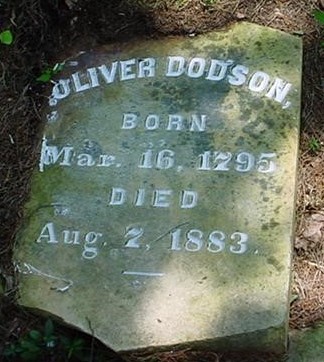
jane-oliver-dodson

The first records of Oliver in Claiborne County are found in the court minutes in August 1815 when he proved he had killed a wolf and collected the bounty for the wolf scalp.

On January 16, 1820, Oliver was relieved as road overseer of the Kentucky Road from where Powell’s Valley Road intersects the same at Wallen’s field to the state line at Cumberland Gap. At the August term 1820 he exhibited the scalp of a wolf he had killed in Claiborne in 1819. In June, 1824 he sued William Hogan for a debt and was awarded damages and costs.

Sometime before or after these events, Oliver spent some time in Jackson Co., Alabama. where one of his sons Marcellus M. Dodson claimed to be born in 1819. By 1830, Oliver was settled in McMinn Co, TN where he lived the remainder of his life.

A chancery suit filed in McMinn in 1893 involving the estate of Oliver Dodson gives us a list of his children and some of his grandchildren. The suit, chancery case #1282 Lazarus Dodson (his son) vs Mary Jane Reynolds stated that all were nonresidents of McMInn County except for Lazarus who files for himself and as administrator of Oliver Dodson and Mary Jane Reynolds. Some grandchildren lived in Knox Co., TN and the others lived in California, Texas, Missouri, Oregon, Montana, Georgia and other states.

David Dodson, based on the 1826 deed, is also a son of Lazarus Dodson, Sr. David is not in the records of Claiborne County except for the one time when he witnessed the deed to William Hogan from Lazarus Dotson and Abner Lea in May 1819.

If it is the same David Dodson who later appeared in McMinn Co., TN, then he was probably born between 1790 and 1800. David Dodson (Dotson) died in McMinn County before the 1826 deed. David’s widow was Fanny Dotson born 1790-1800 according to the 1830 census of McMinn Co. with a household consisting of herself, 1 male 5-10, 1 male 10-15, 1 female under 5, 2 females 5-10. She is living beside Jane Dodson, the widow of Lazarus Sr. and also beside William Dodson.

The land referenced in the 1826 deed is roughly the Cochran Cemetery area, shown below, near Englewood in McMinn Co.

David Dodson who died on August 15, 1826 is reported to be buried in this Cemetery, although he is not listed on FindAGrave, so his grave is apparently unmarked. It appears that David and Lazarus may have died in very close proximity to each other relative to their death dates. Poor Jane apparently lost a husband and a son within a very short time. This makes me wonder if there was an illness that took them both.

cochran cemetery

William Dotson was living next door to Jane Dodson in 1830. His household consisted of 1 male under 5, 1 male 20-30, (so born 1800-1810) 1 female under 5, 1 female 5-10 and 1 female 20-30. He was the administrator of the estate of David Dotson and seems a little old to be a son of David and Fanny, so could conceivably be a brother instead.

In 1826 in McMinn County, we find the land in Section 11, Township 5, Range first east of the meridian being conveyed to William by “guardians of the estate of Lazarus Dodson, deceased.”

jane-mcminn-1836

1836 McMinn County district map – The Rogers Connection – Myth or Fact by Sharon R. McCormack

If William is Jane’s son, and he was born about 1800, then she would have been about 30-40 at that time, and based on the birth years of her other children, closer to 40.

A William L. Dotson was appointed one of the arbitrators between the administrators of the estates of Thomas and William Burch, decd, in June of 1834. Thomas Burch died circa 1830 and had been the administrator of the estate of his father, William Burch, who died about 1828. One of the daughters of William Burch was Mrs. Aaron Davis, apparently, a former neighbor of Lazarus Dodson in Claiborne Co. Mentioned in Thomas Burch’s estate is a note against the estate of William Burch, decd and an unidentified piece of land in Claiborne Co. Aaron Davis was a member of Gap Creek Church of Claiborne Co. TN in 1818.

There were several William Dodsons in McMinn Co and it is not entirely possible to separate them without further records, but one of them was the son of Lazarus Sr.  William L. Dodson, believed to be the son of Lazarus, was born December 11, 1804 and died August 29, 1873. I sure would like to know what the L. stood for. Lazarus, or perhaps his mother’s maiden name?  William L. is buried in the Cochran Cemetery in McMinn County, along with Lazarus’s son David. It’s likely that Jane, Lazarus Sr.’s widow, is buried in the Cochran Cemetery as well, given that she was living adjacent to David and William in 1830, and William owned the land on which the cemetery stood.

It’s possible that Lazarus Sr. is buried in the Cochran Cemetery too, although based on the land purchase back in Claiborne County in 1826, it’s also possible that he is buried in Claiborne County or even back in Jackson County, Alabama. It has never been entirely clear whether the Lazarus that repurchased that Claiborne County land was Sr. or Jr. In any event, Claiborne County is where Lazarus Sr.’s marker rests today, set by descendants in 2011 in the Cottrell Cemetery on the land Lazarus once owned.

laz dodson marker

Unfortunately, Lazarus’s death date of 1826 was inscribed incorrectly as 1816, but by the time we saw the stone for the first time, it had already been set and it was too late to change the engraving.

Jane’s Other Children

If the children listed above are all Lazarus and Jane’s children, there were other children who were born and did not survive, given that children were typically born every 18 months to 2 years. The (approximate) birth dates of the children we can identify:

  • Jesse – 1781
  • Elijah – 1790
  • Mary – 1790+, so say 1792
  • Oliver – 1794
  • Lazarus – 1795
  • David – 1790-1800, so call it 1797
  • William – 1800-1810, so call it 1804 based on the cemetery record

This means there were children born in the following approximate years, in the following locations, that did not survive:

  • 1783 – probably on Dodson Creek
  • 1785 – probably on Dodson Creek
  • 1787 – probably on Dodson Creek
  • 1789 – probably on Dodson Creek
  • 1799 – probably on White Horn Branch
  • 1801 – in Claiborne County
  • 1803 – in Claiborne County

If Jane was 60-70 in 1830, she would have had to be closer to 70, or born about 1760 to be having children by 1781, so she would have been about 40 in 1800. It’s likely that she did not have any children after William born in 1804.

Of course, we don’t know when or where those children died, or were buried. It could have been where they were born or anyplace between there and McMinn County. One son could have been killed by Indians. If that is true, Jane must have been heartsick and I’d wager there were some rather unpleasant words between Jane and Lazarus, if indeed he encouraged Jesse to take the son who was killed along on the trading expedition.

All we know for sure is that no additional children were mentioned in the 1826 deed and unlike son David, they did not leave heirs. Given that Lazarus apparently did not have a will, or if he did, it has never been found, all of his living children or deceased children with heirs would have been mentioned in the deed.

If Jesse is Jane’s son and first child, that puts her marriage year at about 1780, so she either was married in North Carolina (or bordering Virginia) and her honeymoon was spent in a wagon bouncing its way to the new frontier, or she arrived to homestead on the Holston River with her parents, whoever they were, and soon thereafter married the handsome frontiersman, Lazarus Dodson. There were probably not many spousal candidates to choose from on the Holston River, so they were both probably very pleased to marry and begin their family.

Jane’s Death and Burial

Jane died sometime after 1830 and before 1840, based on the census. In 1830 she was living beside son David Dodson’s widow and William Dodson. Later deeds show that the land owned by William Dodson conveyed in the 1826 deed includes the Cochran Cemetery near present-day Englewood.

jane-cochran-cemetery-map

We know that William Dodson is buried there and David Dodson is reported to be buried there as well, along with several other Dodsons listed on FindAGrave. Jane seems to be surrounded by her descendants.

jane-cochran-internments-2

William L. Dodson, buried in the Cochran Cemetery, is shown on FindAGrave to be the son of Elisha Dodson and Mary Matlock. Elisha is shown to be the son of the Reverend Jesse Dodson, who was the preacher at Big Springs in Claiborne County. I don’t know if this is accurate, nor do I know what documentation was utilized for this information.

Unfortunately, both the Reverend Jesse Dodson and Lazarus Dodson Sr. were both functioning in Claiborne County at the same time in the early 1800s. I do find it odd that Jesse’s son, Elisha, who died in Polk County in 1864, would have a son, William L., living beside Jane and David Dodson, in McMinn County. It’s entirely possible that Elijah and Elisha, very similar names, have been confused and intermixed.

jane-cochran-aerial

The Cochran Cemetery, where Jane is probably buried is shown above and below.
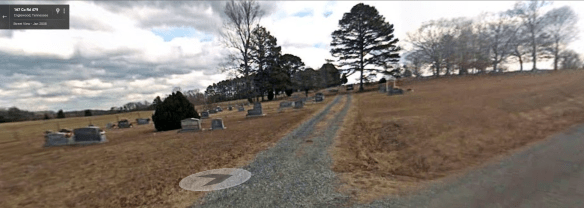
jane-cochran-from-road

County Road 479 is Cochran Cemetery Road.

jane-cochran-cemetery-road

The terrain is hilly but not mountainous and these rolling hills are what Jane saw in her last few years, living in McMinn County.

jane-cochran-distance

Mitochondrial DNA

If Mary Dodson who married Abner Lea is indeed the daughter of Jane Dodson, and if there are descendants who descend through all females to the current generation, we could test that descendant to obtain the mitochondrial DNA of Jane.

Mothers give their mitochondrial DNA to both genders of children, but only females pass it on. In order to find Jane’s mitochondrial DNA we’d need to find a descendant through her one female child, Mary – assuming that indeed Mary is Jane’s daughter.

Jane has been theorized to be a Honeycutt, given that Lazarus lives on Honeycutt Creek and has some interest in land conveyed in 1810, a Lea based on continued interaction with that family, and a Native woman since Lazarus was encamped with the Native people in 1781/1782. That may not be terribly likely since the Cherokee towns were destroyed, but then again, love has never been hindered terribly by warfare – and married to a white man might be as safe as a Native woman could be at that time.

Finding the haplogroup of Jane’s mitochondrial DNA would at least put the Native possibility, as small as it is, to sleep one way or the other, forever. Native American haplogroups are distinct from European, African or Asian haplogroups.

If you descend from Jane Dodson through daughter Mary through all females to the current generation, which can be male, please let me know. I have a DNA testing scholarship for you.

Autosomal DNA – The Dog’s Leg 

Can autosomal DNA help?

Well, theoretically, yes. However, in actuality, for me, today, the answer is “not exactly” or at least not in the way I intended.

I need to warn you, before we start, that this section is the proverbial dog’s leg – meaning we start in one place, and through a series of twists and turns, wind up someplace entirely different.  I debated removing this section – but I decided to leave it because of the educational value and discussion.  “The Dog’s Leg” would actually be an apt description of my entire 37+ years doing genealogy.

So, if you’re up for a bit of an adventure on twisty roads, let’s go!!!

jane-dodson-chart

The first problem we encounter is that Jane is several generations back in the tree, even to the most closely related descendants that have DNA tested at Family Tree DNA where we have chromosome data to work with.

Son Lazarus Jr. carried half of Jane’s DNA, and with each generation, roughly half of Jane’s DNA from the previous generation was lost. Today, descendants would carry anyplace from 3.12% to less than 1% of her DNA, so the chances of carrying the same segment that matches other descendants is progressively smaller in each generation.

Furthermore, today, we have no way to tell which DNA that the descendants might carry is Jane’s DNA, even if it can be attributed to Lazarus and Jane and no common ancestor downstream. In other words, Jane’s DNA and Lazarus’s DNA combined in their children and to sort it back into Jane’s and Lazarus’s individually, we have to have the DNA of Lazarus’s ancestral Dodson line and Jane’s ancestral line to be able to sort their DNA into his and her buckets. Today, we have some people from Lazarus’s line, but obviously none from Jane’s, since we don’t know the identity of her parents or siblings.

To know whose DNA is whose, we’d need matching DNA from Lazarus Sr.’s siblings descendants, for example. That, we may be able to obtain. However, we don’t have that information about Jane.

For the record, the person labeled “Tester,” below, in red has not tested today. If they were to test, because they descend through Lazarus Dodson Jr. through a second wife, if that red tester matches any of the green testers, we would know for sure that their common DNA is that of Lazarus Jr. (and not his wife), assuming no other common ancestral lines, because the green testers and red tester descend through different wives of Lazarus Jr.

jane-dodson-chart-2

While this would help us identify Dodson DNA in Lazarus Jr.’s generation, which means that DNA came from Lazarus Sr. and Jane as a couple, it doesn’t help us identify Jane’s DNA.

What Can We Tell About Jane?

So, what might we be able to tell about Jane?

I have access to the DNA results for Buster and Charlene (above) at Family Tee DNA, in addition to my own DNA results, of course.

I checked my own results for any Honeycutt, using the match search filter. There were two, and both also shared other surnames that I share. No particular common ancestral line or location was evident.

I also attempted to search for the surname Lea, but unfortunately, one cannot request only a particular match string, so the matches included any first or surname that included “lea.” Even more difficult, the matching Ancestral Surnames column often didn’t extend to the “L” names, so I can’t tell whether the matching surname is Lea or something else that includes “lea.”

That’s disappointing.

Next, let’s try Dodson.

You can see an example of the Ancestral Surnames below and only 4 rows maximum are displayed, even when expanded. The first three matches didn’t make it to the D surnames. I’m hoping this problem, which is relatively new, will be fixed soon.

jane-ancestral-surnames

I have 21 matches for Dodson, with 15 having trees. Let’s see if any of these people share my Dodson line.

Match # Common Ancestors
1 George Dodson and Margaret Dagord, Raleigh Dodson’s parents
3 Greenham Dodson and Eleanor Hightower (brother to George Dodson who married Margaret Dagord), also a Campbell line
4 George Dodson and Margaret Dagord, also a Crumley line
5 No common ancestor shown, but have Dodson in their ancestor surname list (5 matches)
6 Not far enough back to connect (5 matches)
7 Greenham Dodson and Eleanor Hightower

Some of my Dodson matches list Dodson in their Ancestral Surnames, but I don’t find an ancestor with the Dodson surname in their actual tree.

Of the people who do have Dodson ancestors in their trees, I find 4 where I can identify the common ancestor, and all 4 are some number of generations before Lazarus Sr. or even his father, Raleigh. In one case, there is also another identifiable ancestor with a different surname (Crumley) and in another line, a common surname (Campbell) but no common ancestor.  However, I’m brick walled on Campbell and the Campbell line did marry into the Dodson line in Lazarus Jr’s generation.

These Dodson matches are exciting, and here’s my dream list of what I’d like to do next:

  • What I’d really like to be able to do is to select all 21 of my matches and create a grid or matrix that shows me the people who match in common with me and any of them. Those would obviously be people who do NOT carry the Dodson surname, because people who do carry the ancestral (or current) Dodson surname are already listed in the 21.
  • Then, I’d like to see a matrix that shows me which of all these people match me and each other on common segments – and without having to push people through to the chromosome browser 5 at a time.
  • I’d like to be able to sort through all of the ICW matches (both Ancestral Surnames and direct ancestors in trees) to see if they have Honeycutt or Lea, or any other common surnames with each other. Because if the common surname isn’t Dodson, then perhaps it is Jane’s surname and finding a common surname among the matches might help me narrow that search or at least give me hints.
  • I’d like to be able to see who in my match list matches me on any particular given segment. In other words, let’s say that I match three individuals on a specific chromosome segment. I’d like to be able to search through my matches online for that information.
  • I’d like to be able to sort through my Dodson matches list by specific ancestor in their tree, like Lazarus Dodson. Today, I have to search each account’s tree individually, which isn’t bad if there are a few. However, with a common surname, there can be many pages of matches.

In the following example, I match 3 other Dodson descendants on a large segment of chromosome 5. This match is not trivial, as it’s 32 to 39 cM in length and approximately 7500 to 9000 SNPs.  These are very solid matches.

jane-chromosome-browser

  • The green person (JP) is stuck in Georgia in 1818 with a female Dodson birth, so the common ancestor is unknown.
  • The yellow person (CA) descends from George Dodson and Margaret Dagord, Raleigh’s parents, through another child.
  • The pink person (JP) has no tree but shows Dodson, Smoot and Durham in Virginia which tells me these are the early generations of the Dodson line. Thomas Dodson’s wife’s birth name was Durham and they were parents of both George and Greenham Dodson.  Smoot comes through the Durham line.

These individuals match me on the following segment of chromosome 5.

jane-segment-matches

Lazarus and Jane are 6 generations upstream from me, so George Dodson is 8 and Thomas Dodson is 9. That’s pretty amazing that this relatively large segment of DNA appears to have potentially been passed through the Dodson line for this many generations.  Note the word potentially.  We’re going to work on that word.

Regardless of how early or how many generations back, these matches are clearly relevant AND have been parentally phased to my father’s side, both by virtue of the Phased Family Matching (maternal and paternal buckets) at Family Tree DNA and by virtue of the fact that they don’t match my mother.

The next question is whether or not these people match each other, so to answer that question, I need to move to the matrix tool.

jane-matrix

Utilizing the matrix, we discover that they DO match each other. What we don’t know is whether they match each other on that particular segment of chromosome 5, but given the size of the segment involved, and that they do match each other, the chances are very good that they do match on the same segment.

Of course, since the yellow match is unquestionably my line of Dodson DNA and because my common ancestor with this person is upstream of both Lazarus and Raleigh, then this matching DNA segment on chromosome 5 cannot be Jane’s DNA.

Therefore, I’d really like to know who else I match on this specific segment, particularly on my father’s side, so that I can see if there are any additional proven Dodson lineage matches on this segment.  This would allow me to properly assign the people who match me on my father’s side on this segment as being “Dodson line,” even if I can’t tell for sure who the common ancestor is.

That function, of course, doesn’t exist via searching at Family Tree DNA today, but what I can do is to check my Master DNA Spreadsheet that I’ve downloaded to see who else matches me on that segment.  If you would like to know how to download and manage your spreadsheet, see the Concepts Series of articles.

My Master DNA Spreadsheet shows 23 additional matches on this segment on my father’s side, 8cM or larger, with two, one at 32.96 cM indicating a common Durham lineage, and another at 33.75 cM indicating a Dodson lineage.  Therefore, this segment can reasonably confidently be assigned to the Dodson side of the tree, and probably to the Durham line – an unanticipated bonus if it holds.

jane-dodson-pedigree

I would need additional evidence before positively assigning this segment to the Durham line, given the distance back in time.  I would need to be sure my Durham match doesn’t have a hidden Dodson match someplace, and that their tree is fairly complete.

While this little exercise helps me to identify Dodson DNA and possibly Durham DNA, it hasn’t done anything to help me identify Jane’s DNA.

Of course, if I had matches to people with Honeycutt or Lea DNA, then that might be another matter and we would have a hypothesis to prove or disprove. Or, if I could search for common surnames, other than Dodson, among my matches trees and Ancestral Surnames.

I’m going to try one more cousin, Buster, who is generationally closer than I am to see if he matches a Honeycutt at Family Tree DNA, by any chance. Nope, no Honeycutt.

I also checked at Ancestry, just to see if I match anyone there who also descends from Lazarus Sr., and I do not. I do, however, match 2 people through Lazarus’s father Raleigh, 15 people through Raleigh’s parents, George Dodson and Margaret Dagord and 14 people through Raleigh’s grandfather, Thomas Dodson.

If I match this many, it sure makes me wonder how many from this line have tested and that I don’t match. Of course, at Ancestry, they have no chromosome browser or matrix types of tools (without building your own pseudo-matrix using the Shared Matches feature), so there is no way to discern if your matches also match each other and there is no way to know if they match you and/or each other on the same segments.

The Ancestor Library – My DNA Daydream

I dream of the day when we will be able to recreate the DNA profiles of our ancestors and store them in an “Ancestor Library.” That way, when I identify the DNA on chromosome 5, for example, to be that of George Dodson and Margaret Dagord, I can assign it to that couple in the “ancestor library.” Then, if this segment on chromosome 5 is either partially or wholly Durham, I can move it up one generation and then to the Durham ancestral line in the library.

Let me explain what this “Ancestor Library” will do for us.

Let’s say we know that a piece of DNA on chromosome 1 that was inherited from Lazarus and Jane is not Dodson DNA, and let’s say we have ideal circumstances.  We know this DNA came from Lazarus and Jane because this large common matching segment is found in three descendants through three different children. We already know what the Dodson progenitor DNA in this location looks like, because it’s proven and already in the library, and our Lazarus/Jane DNA on chromosome 1 doesn’t match the Dodson DNA in the Ancestor Library. Therefore, by process of logical deduction, we know that this segment on chromosome 1 has to be Jane’s DNA. Finally, we have an identifiable piece of Jane.

Now, let’s say we can submit this sequence of Jane’s DNA into the “Ancestor Library” to see which “ancestors” in the library match that sequence of DNA.

There could be several of course who descend from the same ancestral couple.

We obtain our “Ancestor Library” match list of potential ancestors that could be ours based on Jane’s DNA segment, and we see that indeed, there is a Honeycutt line and our DNA matches that line. Depending on how many other ancestral lines also match, the segment size, etc., this would be sufficient to send me off scurrying to research Honeycutt, even if the results don’t “prove” beyond a shadow of a doubt who Jane’s parents were.  Ancestor Library matches most assuredly would give us more to work with on that magical day, sometime in the future, than we have to work with today. In fact, the Ancestor Library would actively break down brick walls.

Ok, I’ve returned from my daydream now…but I do wonder how many years it will be until that DNA future with the “Ancestor Library” comes to pass and we’ll be able to fill in the blanks in our family tree utilizing DNA to direct our records research, at least in some cases.

The Rest of the Story – My Secret

Ok, I’ll let you in on my secret. Truth is that I’ve been working on the Ancestor Library proof of concept for over 2 years now.  In November 2016, I gave a presentation at the Family Tree DNA Conference titled “Crumley Y DNA to Autosomal Case Study – Kicking It Up a Notch” about reconstructing James Crumley from 50 of his descendants.  Just to give you an idea, this is a partial reconstruction utilizing Kitty Cooper’s tools, not quite as she intended.

james-crumley-reconstruct

Just to let you know, ancestor reconstruction can be done. It may be a daydream today in the scope that I’m dreaming, but one day, it will happen. Jane’s ancestry may someday be within reach once we develop the ability to functionally “subtract out” Lazarus’s DNA from Jane’s descendants.

In Summary

I wish we had some small snippet of Jane’s voice, or even Jane’s identifiable DNA, but we don’t. All we can do is to surmise from what we do know.

We know that Jane moved from place to place, and apparently a non-trivial number of times.

Jane’s life can be divided into frontiers.

  • Birth to 1778 – 1780 – Virginia or North Carolina, probably
  • 1780 – 1797 – Holston River between Honeycutt and Dodson Creeks, present day Hawkins County, Tennessee
  • 1797 – 1800 – White Horn Fork, near Bull’s Gap, then Hawkins County, Tennessee, today, probably Hamblin County
  • 1800 – 1819 – Gap Creek beneath the Cumberland Gap, Claiborne County, Tennessee spanning the old Indian boundary line
  • 1819 – before 1830 – Jackson County, Alabama when the Cherokee ceded their land
  • 1830 – 1840/death – McMinn County, Tennessee

The longest time Jane spent in one place was about 19 years in Claiborne County where Lazarus was a member of the Gap Creek Baptist Church by 1805.  Jane was very likely a member there too, as it would be extremely unusual for a woman not to attend the same church where her husband was a member of some status.

It’s actually rather amazing that we were able to track Jane and family at all, considering the number of places they lived and given the distances that they moved. While we do hold onto them by the tiniest threads – surely we must know how many of the threads of the fabric of Jane’s life are now irrecoverably lost – like pieces of a quilt, frayed with wear and gone.

Jane had at least three children that lived, and probably a 4th since Oliver was born the year before Lazarus. She may have had 7 living children if all of Lazarus’s children were hers too – meaning she was Lazarus’s only wife. We have nothing to indicate that either Lazarus or Jane were married more than once, except for how common death was on the frontier. If all of Lazarus’s children were also Jane’s, then Jane likely had as many children that died as lived, presuming she was married for her entire child-bearing life. Losing every other child is a nightmare thought for a mother, especially today – but it was more or less expected before the days of modern medicine. Let that soak in for a minute.

One of Jane’s children may have been killed by Indians. If this is true, then that episode may have affected Jane’s relationship with her husband and potentially her son Jesse, too. Unfortunately, records during this time are scant and many are missing entirely. We will probably never know if Jesse, the Indian trader, was Jane’s son.

I hope that some day, in some way, we’ll be able to unravel the mystery of Jane’s surname. In order for that to happen, new records will either need to appear, perhaps in the form of a nice juicy chancery suit, or a family Bible needs to be found, or DNA technology needs to improve combined with some serendipity and really good luck.

In the meantime, I’ll remember Jane as the weary and infinitely patient frontier wife, repeatedly packing up and moving from one frontier to the next, for roughly 45 years, whether she really wanted to or not.

I will think of her gently caring for her grandchildren after Elizabeth Campbell Dodson died, perhaps wiping their tears as their mother was buried in a grave lost to time, not long after Jane lost her own husband, Lazarus and son David. 1826 and 1827 were grief-filled years for Jane, with one loss after another.  She buried far too many close family members.

I will think of Jane living in McMinn County in her final years, between her son David’s widow, Fanny, and their children, and son William’s family. Between those two families, Jane had 7 grandchildren living within earshot: 3 toddlers, 3 between 5 and 10 and one boy about 11 or 12. He was probably a big help to Jane and Fanny both.

I hope Jane’s golden years were punctuated by the ring of grandchildren’s voices and laughter as she gathered them around her chair in front of the fireplace on crisp winter evenings, or on the shady porch on hot summer days.  She would have regaled them with stories “from a time far away and long ago” about her journeys in wagons, across rivers before bridges and through wars into uncharted territory, where Indians and soldiers both camped in their yard at Dodson’s Ford more than 50 years earlier. I can hear her now, can’t you? “Why, they were right outside, chile.” Their eyes must have been as big as saucers. Grandma Dodson’s life was amazing!

I hope Jane’s death, when it came, was swift and kind. Ironically, she outlived her adventure-loving husband by at least 4 years and maybe more than 14. And I will always wonder if Lazarus died after suggesting to Jane that they move one more time!

Jane can never regret not having taken that leap of faith, not having followed the elusive dream, be it hers or his, or both, because it seems that they always went…well, maybe except for that one last time.

I surely hope Jane is resting in peace, because while her life is infinitely interesting to us today, with her progressive migrations to “the next” frontier, it appears that rest is probably not something Jane got much of during her lifetime.

______________________________________________________________

Disclosure

I receive a small contribution when you click on some of the links to vendors in my articles. This does NOT increase the price you pay but helps me to keep the lights on and this informational blog free for everyone. Please click on the links in the articles or to the vendors below if you are purchasing products or DNA testing.

Thank you so much.

DNA Purchases and Free Transfers

Genealogy Services

Genealogy Research

My Son in Vietnam – The Story of Bob and Nahn

Have you ever seen a “birth” announcement for a 48 year old child’s arrival? No? Well, you have now.

nhan-birth

Meet Nahn, son of Bob Thedford. You see, Bob never knew that Nahn existed, and Nahn didn’t know how to find his father.

For 48 years, Nahn dreamed and Bob had no idea…and then one day…that all changed, thanks to a DNA test at Family Tree DNA.

I became peripherally involved in Bob and Nahn’s story in 2013 when Bob’s wife, Louise, contacted me, in shock.

Bob, Nahn and Louise’s story is a bittersweet mix of sorrow and joy. I want to let Louise tell the story. After Nahn’s discovery, Louise created a document chronicling what happened so she didn’t have to write the same information over and over again to various people who wanted to know “what happened.”

Bob’s DNA Story

I want to relate a DNA story that happen in our family that added an unexpected branch to our family tree.

I took my first mtDNA test with Family Tree DNA in early 2006 and received my mitochondrial results in June 2006. In July 2010, I received results from a Family Finder DNA test. Then in March of 2012, I received results mt Full Sequence test.

When I was ordering my mt Full Sequence upgrade, I mentioned to my husband what I was doing. He said, “I want to take a DNA test. Can you order me a kit?”  So I placed an order for him for a Family Finder kit. We both received our results in March of 2012. At that time we had no idea of the life changing experience that was in store for us.

A few months later I ordered a kit for my son, our daughter and Bob’s mother. It was worked out between all of us that I would be the administrator of all kits. Checking on matches, following up on e-mails, contacting matchings. Anything that needed to be done to connect with distant cousins.

In September of 2013 we discovered that my husband had a Skin Cancer. It was caught in the early stages and we had hope that with proper treatment he could be cured.

Toward the end of September 2013, I went on-line to check all the FTDNA profiles for new matches. I have to login into each profile one at a time.

I would always check my profile first. On this night I has a few new matches but nothing that really caught my eye at the time.

Next I logged into my husband’s profile. He had a new match near the top of his match list just under our daughter and his mother.  I sat there and stared at the screen for a couple of minutes trying to comprehend what I was seeing.

The name on the screen was one I had never heard in the past. But the shared centiMorgans between my husband and this person was in the parent / child relationship range.

Our daughter shared 3,380 centiMorgans with her father. And this person shared 3,384 centiMorgans with my husband. I kept staring at the screen and the thought that was running through my head, the lab has made a mistake!!

nhan-match

I decided to contact Roberta Estes who writes a DNA Blog.  I explained to Roberta my findings. I said, “I think I already know the answer, but could there be a mistake by FTDNA in interpreting Vo Hun Nhan’s results?”

Her reply to me was, “I have never seen the lab make a mistake of the kind it would take for this to be in error.  Having said that doesn’t mean it couldn’t happen, but the entire process is automated via the tag on the vials.  I can’t even imagine how it would happen.”

I had checked our daughter and my mother-in-law’s profile, finding the same name with large amounts of matching centiMorgans. I began to think that the lab had not made a mistake.

After lot of investigation and e-mails to several people, we confirmed that Vo Huu Nhan is my husband’s 48 year old biological son. Without the DNA test we would never know of his existence. My husband had no idea that he had a son.

On October, 15, 2013, Bob reached out to Nahn’s contact, asking how to contact Nahn. Bob served in the Vietnam War from March 1968 to March 1969. Nhan was born in August 1969.

After my husband returned to the States he had 8 months left on his tour of duty. He was sent to Redstone Arsenal, Huntsville, Alabama to finish out his tour. Huntsville is my home and that is where we first came to know each other.

Bob’s tour of duty was over in December 1969 and he returned back home to Fort Worth, Texas. It was not long after he returned back to Texas, that me and my 5 year old son moved to Fort Worth.

Four days after Bob reached out to Nahn’s contact, we received this letter about what Nahn said when he was told that they had found his father.

“I just received a message from Nhan’s best friend (Son Tran who introduced Nhan to me and asked me to give Nhan a chance to have a DNA test) that Nhan was very happy about the news… He said that “he would not be happier if someone gave him a million dollar than give him a father!!”

The results of the DNA test were bittersweet. All of the family was overly excited to have found Nhan but were sad to find out that for all these years we did not know of his existence. Nhan lives in South Vietnam in the Mekong Delta, he doesn’t speak English and does not own a computer.

All Nhan had been told about his father was that he was an American G.I. and his name was Bob. That was after he came home crying and asking his grandmother “Why the kid’s made fun of him and why did he look different compared to everyone else.” He looks more like Bob’s father than looks like Bob. Another thing we couldn’t deny after seeing a picture of him.

How Nhan came to know about the DNA test was through a childhood friend that lives in Ho Chi Minh City (Saigon). His friend Dang Van Son had heard that DNA kits were being brought to Saigon and that they were looking for “Children Left Behind” to come and take the test.

nhan-with-friend

Nahn and his friend, Son, in Vietnam. Son arranged for Nahn’s DNA test.

Son contacted Nhan and told him he should come and take the test. They only had 80 test kits to go around. I don’t know how many came for the test but Nhan was able to be tested.

After we confirmed that all was legit. Son began to e-mail us and send pictures of Nhan and his family as well as send messages from Nhan.  Nhan has 5 children, 1 son and 4 daughters.

nhan-with-children

Nahn has 3 grand-children by two daughters. This added 9 new family members to my Family Tree. Nhan has been married twice. One marriage ended in divorce and his second wife died of liver cancer about 2008.

Nhan had several jobs in Vietnam so I was told by his friend Son. Porter in market, rescue diver, worked on a floating market boat.

nhan-working

On Christmas morning of 2013 we received a call from Vietnam. It was Nhan calling to wish us a Merry Christmas. His friend Son’s daughter translated. Then we received an e-mail picture of the family. We were able to Skype with him one time before my husband passed away.

In 2014, Louise and Bob discovered how difficult Nahn’s life had been. Nahn’s friend, Son, sent them the following:

nhan-letter-2

You can learn about the lives of mixed American and Vietnamese children in this YouTube video, along with information about Trista Goldberg who founded Operation Reunite and partnered with Family Tree DNA to reunite these families.

Louise continues:

On April 17, 2015 before Bob passed away a few days later on April 26, the Washington Post published an article “Legacies of War” Forty years after the fall of Saigon, soldiers’ children are still left behind. They profiled 5 children still looking for their father’s. The lead story was about my husband and Nhan.

There is a picture in the article where they are sitting in front of the computer. The reporter is Skyping with our daughter Amanda for the story. That is Amanda on the screen. The second story is about Nhan’s childhood friend Dang Van Son that has been such a help to us and Nhan with keeping us in touch with each other.

nhan-skyping

Amanda and Nahn Skyping.

On the day Bob passed away, our local paper, the Fort Worth Star Telegram’s front page story was the story about my husband and Nhan from the Washington Post, Legacies of war connect Vietnam, Tarrant County.

It was so surreal to be walking to the coffee shop and pass all the newspaper’s boxes and see Bob and Nhan’s picture in the window of the boxes. Bob was in hospice at the hospital and we knew it was a matter of time, and shortly he would not be with us anymore.

By the time these articles were published my husband was to the point of non-communication. The Washington Post had wanted to Skype with me and Bob but it was not possible. Bob passed away on Sunday night, April 26, 2015.

I knew that Bob was critically ill, then Louise informed me that Bob had passed away. I was just heartsick that Bob and Nhan never had the opportunity to meet in person. It seemed that a dream for both Bob and Nahn, so close, finally within reach, had just slipped away. I thought, at that time, that this was the end of the story, and certainly not the ending any of us wanted – but it wasn’t the end after all.

Twenty-one months later, I heard from Louise again, this time with very unexpected news.

A Visa for Nahn

Again, from Louise:

In October of 2015 we received an e-mail from Trista Goldburg the person with “Operation Reunite” who bought kits from Family Tree DNA and took them to Saigon for testing.

She had received an e-mail from Franc Shelton, Country Fraud Prevention Coordinator, Mission Vietnam FPU, U.S. Consulate General Ho Chi Minh City, Vietnam.

Dear Trista,

I hope you are well.  I would like to  encourage you to reach out to the family of Robert Thedford and urge the daughter of Mr. Thedford to consider undergoing another DNA collection, and to pay for a collection here at the consulate for Mr. Vo, at one of the approved labs from the list I sent you.

We just had a case in which we were able to close out because the parties involved proceeded in the manner which I discussed with you—in that case, the American father is practically indigent, but fortunately there were Viet Khieu benefactors in California who generously paid for the testing.  I moved that case to the front of the line and expedited all our procedures-we collected the alleged son’s sample here on 30 September and had the results back 2 weeks later (99.99%).  I hand-carried the results to the immigrant visa unit and strongly encouraged them to expedite their own processes (I have no control over that however).

Amanda was going to take a second test and we would pay for the test. The lab closest on the AABB Accredited Relationship (DNA) Testing Facilities list was, University of North Texas, Fort Worth, Texas.

When Amanda contacted them she was told they no longer did DNA testing. She replied back to Trista and let her know what she found. There were a few more letters exchanged. Amanda never did take a second test. We did not hear anything more for several months until July of this year when we received and e-mail from Nhan with a copy of his and his daughters Immigration Visa’s.

Nahn’s Letters

I have to share with you two letters Nhan sent to me. I feel sure his friend Son wrote the letter as Nhan dictated them. They are so sweet.

DEAR  MU USA  MUM,

ALLOW  ME  TO CALL    YOU  AS  MY USA  MUM.

IAM HAPPY THAT I HAVE  TWO  MUM  IN THE WORLD

  1. USA  MUM,
  2. VIETNAMSE MUM,

HAVE  GOOD MORNING MY USA MUM.

MAY GOD BLESS US

MY WARMEST REGARDS  TO YOU AND THE FAMILY,

STEP SON OF  LOVED HUSBAND  OF YOU.

VO HUU  NHAN.

1/JULY 2016 DEAR  MY USA MOTHER,

And another letter.

I DO  THANK  TO EVERY-ONE  WHO HELPED  ME  IN DNA  TESTING RESULLT,  AND BASING ON DNA TEST RESULT  I  KNOW  YOUR HUSBAND  IS  MY  BIOLOGCAL FATHER,

  DEAR  MY USA  MOTHER WITH YOUR  HELP  TODAY  I   WILL  OWN  FOR EVERYTHING YOU HAVE DONE  TO HELP ME,

I WILL  WORK  TO BE COME  AN US CITIZEN AS SOON AS I CAN,

I ALWAYS  AM  PROUD  OF MY US FATHER

I PRAY FOR HIM  DAILY   AND NOW HE HAS HIS LIFE  ON THE HEAVEN IT IS  THE BEST LIFE FOR HIS SOUL

AND I THINK HIS SOUL  ALWAYS  SHOW ME  THE WAY TO GO TO ——–

THANK   US MOTHER!

APPLICANT: VO HUU  NHAN

 11/JULY/2016

A Christmas Surprise

As these events unfolded, I was pulling for Louise and Bob, and rooting for Nahn, but without understanding the immigration process, there was little I could do to help. In fact, I didn’t think there was much anyone could do to help Nahn.

When Louise’s update e-mail arrived a few days after Christmas in 2016, it was with pictures – of Nahn – here – with her in the US. I was amazed, to put it mildly. A miracle had happened.

nhan-with-louise

Nahn and his American Mom, Louise

Not only that, but Nahn arrived with his mother and his youngest daughter – and not just to visit, but to live in the US permanently.

nhan-mother-daughter

Nahn, his Vietnamese mother and daughter in Texas, a few days after arrival, visiting Louise.

I asked Louise how Nahn’s arrival felt, for her and Amanda, given that Bob was gone and had so much wanted to meet Nahn. In a very real way, they were living Bob’s dream for him.

Yes it was a bittersweet reunion without Bob being here to enjoy it with us. Our daughter, Amanda, was excited about the meeting. She is my and Bob’s only child and now she has two half brothers.

nhan-with-amanda

Nahn and Amanda, half-siblings, meeting for the first time in Texas.  I love their smiles.  They look so happy!

Amanda has lived such a different life than Nhan. Nothing extravagant, her father has a hard-working police officer and worked a second part time job for 23 years to allow me to stay home with Amanda. Amanda earned her own way through college, but had so many more opportunities than Nahn. It’s so sad that Bob never knew Nahn existed.

Nhan has been able to prove he has an American father. Nhan, his youngest daughter, 12 year’s old, and his mother have been granted immigration visa’s. Nhan, his mother and daughter arrived at Dallas-Fort Worth International Airport on Tuesday night December 20th, 2016, thirty-six hours after leaving Vietnam.

I thought that Nahn and his family came for a visit, but that’s not the case, according to Louise.

My understanding is that Nhan, his mother and daughter plan to make Texas their new home. Currently they are living in Dallas, which is an hour or so from where I live. I am in contact with their Refugee Resettlement Case Worker at Refugee Services of Texas.

The case worker told me the night they arrived it was very cold, they came with one small bag of clothes and the clothes they had on. Clearly they weren’t prepared for winter. The next day, helping them settle in, she took them to a Walmart and said they walked in and their eyes got big and they said “WOW”!!!!!!!!!

Their case worker said her next goal is to help Nahn find a job. She will also help him learn how to ride a bus for transportation.

Nahn and his family have so many obstacles to overcome living here. The major one is the language barrier. None of them know any English except “Thank You, Hello” and “WOW” although they are already taking English classes.

nhan-with-daughter

Nahn and his daughter – their first Christmas in Texas, a few days after arrival.

In many ways, Nahn, his mother and daughter represent the journey of so many of our ancestors who arrived with the hope of making better lives for themselves and their children. They too arrived without knowing the language and with few, if any, belongings. The difference is that they often arrived in a group of other immigrants from the same country – so they had extended family and help – and others who could speak the language. Nahn and his small family arrived in a group of just 3.

I can only think how difficult the life they left must have been to warrant this kind of foray, really a leap of incredible faith, into an totally unknown world where an entirely uncertain future is more attractive than one’s current life. Nahn, his mother and daughter are incredibly brave. At some level, they must certainly be unspeakably frightened too.

I would be terrified, wondering how I would eat, how I would live, where I would live and would I be able to find work to provide for myself, my mother and a daughter with special needs.

One thing is for sure, Bob would be busting-the-buttons-off-his-shirt proud of Nhan.

How to Help

Knowing my blog readers, I know your next question will be how you can help Nahn and his family. I’m not sure what they will need from day to day, and what has already been taken care of. Please feel free to contact Nhan’s case worker, below, if you know of a job or want to help in another way.

Kate Beamon at Refugee Services of Texas
9696 Skillman, Suite 320 Dallas, TX 75243

Phone, (214) 821-4883
e-mail, kbeamon@rstx.org
http://www.rstx.org/about-us.html

Acknowledgements

A heartfelt thank you to Louise for sharing this very personal story of her family’s journey.

Louise conveys a special thank you from her family to Bennett Greenspan at Family Tree DNA.

______________________________________________________________

Disclosure

I receive a small contribution when you click on some of the links to vendors in my articles. This does NOT increase the price you pay but helps me to keep the lights on and this informational blog free for everyone. Please click on the links in the articles or to the vendors below if you are purchasing products or DNA testing.

Thank you so much.

DNA Purchases and Free Transfers

Genealogy Services

Genealogy Research

GeneaBlog Awards and GeneAwards

geneablog-awards

Tamura Jones’ blog, Modern Software Experience, has been awarding GeneaBlog Awards since 2006. I’ve been fortunate enough in the past to garner a mention for individual articles, but this year, I hit the motherlode.

I’m honored that Tamura has recognized DNA-Explained as the Best All-Around Genetic Genealogy Blog in his 2016 GeneaBlog Awards, one of only four awards he gave this year.

I’m in fine company, mind you, in 2016 and earlier as well.

I found it very interesting to view the awards from 2008-2015, listed at the bottom of the 2016 awards. If you click on his Awards page, you can see Awards back through 2006 and several “Best and Worst” articles in his GeneAwards series as well, including for 2016.

geneawards

Guess who garnered the “worst new app” for 2016. If you guessed We’re Related, you’re right. Never let the truth interfere with a good story. I’m with you Tamura!

One of my favorite all-around blogs is ClueWagon, which Tamura has consistently mentioned over the years. One of the reasons I love ClueWagon is that Kerry makes me laugh. Every time. How can you not love ClueWagon? I mean, her tag line reads, “My name is Kerry. I like dead people.” Oh, and if you want to read about what Kerry has to say about why your new Ancestry DNA matches don’t have trees, click here.

Blaine Bettinger’s blog, The Genetic Genealogist, was honored by Tamura back in 2008, in the genetic genealogy dark ages. Blaine’s blog was all of a year old in 2008! In fact, I think it was the only Genetic Genealogy blog back then. My how times have changed!

In 2015, Jim Bartlett’s wonderful blog, Segmentology, was awarded Best New Genetic Blog. Now don’t be confused by this, Jim isn’t new to genetic genealogy. In fact, I found him in the 2005 photos I took at the Family Tree DNA Genetic Genealogy Conference held in Washington DC at the National Geographic Society. It just took the rest of us all that time into nagging Jim into blogging.

Thanks Tamura for having the love for genealogy to do this every year and taking the time to create your realistic, thought-provoking articles and entertaining product reviews. Love them or hate them – you make all of them interesting – and hopefully save the rest of us a lot of frustration and heartache along the way!

______________________________________________________________

Disclosure

I receive a small contribution when you click on some of the links to vendors in my articles. This does NOT increase the price you pay but helps me to keep the lights on and this informational blog free for everyone. Please click on the links in the articles or to the vendors below if you are purchasing products or DNA testing.

Thank you so much.

DNA Purchases and Free Transfers

Genealogy Services

Genealogy Research

New Year’s Genealogy Resolution – Hey, Look, ANCESTOR

heart

As genealogists, we love genealogy, right?

So we certainly don’t need to be encouraged to work on genealogy. Often, we have to be encouraged to stop working on genealogy – like to do bothersome things like eat and sleep.  Oh yes, and work.

However, sometimes, I find myself researching haphazardly without direction, and I don’t seem to ever get anything “done,” as if there is such a thing in genealogy.  This is the genealogical equivalent of “SQUIRREL” aka “ANCESTOR.”

For me, goals give me direction and clarity. If I wake up in the morning without a plan for the day, I’m much less likely to accomplish anything.

Once a year we make New Year’s Resolutions. Resolutions give us the opportunity to reflect upon what is important to us and how we might go about achieving those things.

But more importantly, resolutions are promises to ourselves. And in my case, a commitment to my ancestors.

I only have one Genealogy Resolution this year.

I know, I know….how can there just be one?

Well, defining what is the MOST IMPORTANT lets me focus on that one goal, without distractions. Ok, with hopefully only a few distractions. Scratch that. I welcome distractions, but only if they are brick walls falling on other lines. See, I’m already distracted. Just thinking about brick walls falling does that to me.  Which is exactly why I need a focused plan.

resolution

I love the 52 Ancestors stories because they give my ancestors’ lives shape.  Birth, death, where they lived, what happened during their lifetimes, what we know or can figure out about each of them and weave into a story – including something about DNA for each of them. These articles bring these people, who are part of me, to life.  And because the articles are online, they can be updated as more information is discovered. How’s that for optimistic! Plus, the stories are available for posterity and they function as “cousin bait.”

Notice, I didn’t say 52 stories.  I want my goal, promise, resolution to be achievable. I don’t want to get discouraged and set myself up for “failure” if I miss a week for some reason. Sometimes the difference between success and failure is how we phrase the goal!

Let’s face it, sometimes life just gets in the way. Sometimes the research and gathering of information for a particular ancestor is particularly intense. Sometimes, I have to wait for information to arrive. Sometimes I need to find someone to DNA test, or order upgrades.  Sometimes we find out that we were, uh, cough…um, wrong…and we have to do some revising.  Ok, we have to saw the whole darned branch off the tree and start over. Dang!

I’d be very happy with 50 stories, truthfully!

This isn’t like that age old promise to exercise more, which, by the way, I’ve already abandoned this year – in favor of genealogy research. I mean, really, who has time for  sweating when there are ancestors who need to be found???

Plus, now that I’ve shared my resolution with you, you are all going to hold me accountable! Right?

Do you have a genealogy resolution for 2017?  Do share!

______________________________________________________________

Disclosure

I receive a small contribution when you click on some of the links to vendors in my articles. This does NOT increase the price you pay but helps me to keep the lights on and this informational blog free for everyone. Please click on the links in the articles or to the vendors below if you are purchasing products or DNA testing.

Thank you so much.

DNA Purchases and Free Transfers

Genealogy Services

Genealogy Research

2016 Genetic Genealogy Retrospective

In past years, I’ve written a “best of” article about genetic genealogy happenings throughout the year. For several years, the genetic genealogy industry was relatively new, and there were lots of new tools being announced by the testing vendors and others as well.

This year is a bit different. I’ve noticed a leveling off – there have been very few announcements of new tools by vendors, with only a few exceptions.  I think genetic genealogy is maturing and has perhaps begun a new chapter.  Let’s take a look.

Vendors

Family Tree DNA

Family Tree DNA leads the pack this year with their new Phased Family Matches which utilizes close relatives, up to third cousins, to assign your matches to either maternal or paternal buckets, or both if the individual is related on both sides of your tree.

Both Buckets

They are the first and remain the only vendor to offer this kind of feature.

Phased FF2

Phased Family Matching is extremely useful in terms of identifying which side of your family tree your matches are from. This tool, in addition to Family Tree DNA’s nine other autosomal tools helps identify common ancestors by showing you who is related to whom.

Family Tree DNA has also added other features such as a revamped tree with the ability to connect DNA results to family members.  DNA results connected to the tree is the foundation for the new Phased Family Matching.

The new Ancient Origins feature, released in November, was developed collaboratively with Dr. Michael Hammer at the University of Arizona Hammer Lab.

Ancient European Origins is based on the full genome sequencing work now being performed in the academic realm on ancient remains. These European results fall into three primary groups of categories based on age and culture.  Customer’s DNA is compared to the ancient remains to determine how much of the customer’s European DNA came from which group.  This exciting new feature allows us to understand more about our ancestors, long before the advent of surnames and paper or parchment records. Ancient DNA is redefining what we know, or thought we knew, about population migration.

2016-ancient-origins

You can view Dr. Hammer’s presentation given at the Family Tree DNA Conference in conjunction with the announcement of the new Ancient Origins feature here.

Family Tree DNA maintains its leadership position among the three primary vendors relative to Y DNA testing, mtDNA testing and autosomal tools.

Ancestry

In May of 2016, Ancestry changed the chip utilized by their tests, removing about 300,000 of their previous 682,000 SNPs and replacing them with medically optimized SNPs. The rather immediate effect was that due to the chip incompatibility, Ancestry V2 test files created on the new chip cannot be uploaded to Family Tree DNA, but they can be uploaded to GedMatch.  Family Tree DNA is working on a resolution to this problem.

I tested on the new Ancestry V2 chip, and while there is a difference in how much matching DNA I share with my matches as compared to the V1 chip, it’s not as pronounced as I expected. There is no need for people who tested on the earlier chip to retest.

Unfortunately, Ancestry has remained steadfast in their refusal to implement a chromosome browser, instead focusing on sales by advertising the ethnicity “self-discovery” aspect of DNA testing.

Ancestry does have the largest autosomal data base but many people tested only for ethnicity, don’t have trees or have private trees.  In my case, about half of my matches fall into that category.

Ancestry maintains its leadership position relative to DNA tree matching, known as a Shared Ancestor Hint, identifying common ancestors in the trees of people whose DNA matches.

ancestry-common-ancestors

23andMe

23andMe struggled for most of the year to meet a November 2015 deadline, which is now more than a year past, to transition its customers to the 23andMe “New Experience” which includes a new customer interface. I was finally transitioned in September 2016, and the experience has been very frustrating and extremely disappointing, and that’s putting it mildly. Some customers, specifically international customers, are still not transitioned, nor is it clear if or when they will be.

I tested on the 23andMe older V3 chip as well as their newer V4 chip. After my transition to the New Experience, I compared the results of the two tests. The new security rules incorporated into the New Experience meant that I was only able to view about 25% of my matches (400 of 1651(V3) matches or 1700 (V4) matches). 23andMe has, in essence, relegated themselves into the non-player status for genetic genealogy, except perhaps for adoptees who need to swim in every pool – but only then as a last place candidate. And those adoptees had better pray that if they have a close match, that match falls into the 25% of their matches that are useful.

In December, 23andMe began providing segment information for ethnicity segments, except the parental phasing portion does not function accurately, calling into question the overall accuracy of the 23andme ethnicity information. Ironically, up until now, while 23andMe slipped in every other area, they had been viewed at the best, meaning most accurate, in terms of ethnicity estimates.

New Kids on the Block

MyHeritage

In May of 2016, MyHeritage began encouraging people who have tested at other vendors to upload their results. I was initially very hesitant, because aside from GedMatch that has a plethora of genetic genealogy tools, I have seen no benefit to the participant to upload their DNA anyplace, other than Family Tree DNA (available for V3 23andMe and V1 Ancestry only).

Any serious genealogist is going to test at least at Family Tree DNA and Ancestry, both, and upload to GedMatch. My Heritage was “just another upload site” with no tools, not even matching initially.

However, in September, MyHeritage implemented matching, although they have had a series of what I hope are “startup issues,” with numerous invalid matches, apparently resulting from their usage of imputation.

Imputation is when a vendor infers what they think your DNA will look like in regions where other vendors test, and your vendor doesn’t. The best example would be the 300,000 or so Ancestry locations that are unique to the Ancestry V2 chip. Imputation would result in a vendor “inferring” or imputing your results for these 300,000 locations based on…well, we don’t exactly know based on what. But we do know it cannot be accurate.  It’s not your DNA.

In the midst of this, in October, 23andMe announced on their forum that they had severed a previous business relationship with MyHeritage where 23andMe allowed customers to link to MyHeritage trees in lieu of having customer trees directly on the 23andMe site.  This approach had been problematic because customers are only allowed 250 individuals in their tree for free, and anything above that requires a MyHeritage subscription.  Currently 23andMe has no tree capability.

It appears that MyHeritage refined their DNA matching routines at least somewhat, because many of the bogus matches were gone in November when they announced that their beta was complete and that they were going to sell their own autosomal DNA tests. However, matching issues have not disappeared or been entirely resolved.

While Family Tree DNA’s lab will be processing the MyHeritage autosomal tests, the results will NOT be automatically placed in the Family Tree DNA data base.

MyHeritage will be doing their own matching within their own database. There are no comparison tools, tree matching or ethnicity estimates today, but My Heritage says they will develop a chromosome browser and ethnicity estimates. However, it is NOT clear whether these will be available for free to individuals who have transferred their results into MyHeritage or if they will only be available to people who tested through MyHeritage.

2016-myheritage-matches

For the record, I have 28 matches today at MyHeritage.

2016-myheritage-second-match

I found that my second closest match at MyHeritage is also at Ancestry.

2016-myheritage-at-ancestry

At MyHeritage, they report that I match this individual on a total of 64.1 cM, across 7 segments, with the largest segment being 14.9 cM.

Ancestry reports this same match at 8.3 cM total across 1 segment, which of course means that the longest segment is also 8.3 cM.

Ancestry estimates the relationship as 5th to 8th cousin, and MyHeritage estimates it as 2nd to 4th.

While I think Ancestry’s Timber strips out too much DNA, there is clearly a HUGE difference in the reported results and the majority of this issue likely lies with the MyHeritage DNA imputation and matching routines.

I uploaded my Family Tree DNA autosomal file to MyHeritage, so MyHeritage is imputing at least 300,000 SNPs for me – almost half of the SNPs needed to match to Ancestry files.  They are probably imputing that many for my match’s file too, so that we have an equal number of SNPs for comparison.  Combined, this would mean that my match and I are comparing 382,000 actual SNPs that we both tested, and roughly 600,000 SNPs that we did not test and were imputed.  No wonder the MyHeritage numbers are so “off.”

My Heritage has a long way to go before they are a real player in this arena. However, My Heritage has potential, as they have a large subscriber base in Europe, where we desperately need additional testers – so I’m hopeful that they can attract additional genealogists that are willing to test from areas that are under-represented to date.

My Heritage got off to a bit of a rocky start by requiring users to relinquish the rights to their DNA, but then changed their terms in May, according to Judy Russell’s blog.

All vendors can change their terms at any time, in a positive or negative direction, so I would strongly encourage all individuals considering utilizing any testing company or upload service to closely read all the legal language, including Terms and Conditions and any links found in the Terms and Conditions.

Please note that MyHeritage is a subscription genealogy site, similar to Ancestry.  MyHeritage also owns Geni.com.  One site, MyHeritage, allows individual trees and the other, Geni, embraces the “one world tree” model.  For a comparison of the two, check out Judy Russell’s articles, here and here.  Geni has also embraced DNA by allowing uploads from Family Tree DNA of Y, mitochondrial and autosomal, but the benefits and possible benefits are much less clear.

If the MyHeritage story sounds like a confusing soap opera, it is.  Let’s hope that 2017 brings both clarity and improvements.

Living DNA

Living DNA is a company out of the British Isles with a new test that purports to provide you with a breakdown of your ethnicity and the locations of your ancestral lines within 21 regions in the British Isles.  Truthfully, I’m very skeptical, but open minded.

They have had my kit for several weeks now, and testing has yet to begin.  I’ll write about the results when I receive them.  So far, I don’t know of anyone who has received results.

2016-living-dna

Genos

I debated whether or not I should include Genos, because they are not a test for genealogy and are medically focused. However, I am including them because they have launched a new model for genetic testing wherein your full exome is tested, you receive the results along with information on the SNPs where mutations are found. You can then choose to be involved with research programs in the future, if you wish, or not.

That’s a vastly different model that the current approach taken by 23andMe and Ancestry where you relinquish your rights to the sale of your DNA when you sign up to test.  I like this new approach with complete transparency, allowing the customer to decide the fate of their DNA. I wrote about the Genos test and the results, here.

Third Parties

Individuals sometimes create and introduce new tools to assist genealogists with genetic genealogy and analysis.

I have covered these extensively over the years.

GedMatch, WikiTree, DNAGedcom.com and Kitty Cooper’s tools remain my favorites.

I love Kitty’s Ancestor Chromosome Mapper which maps the segments identified with your ancestors on your chromosomes. I just love seeing which ancestors’ DNA I carry on which chromosomes.  Somehow, this makes me feel closer to them.  They’re not really gone, because they still exist in me and other descendants as well.

Roberta's ancestor map2

In order to use Kitty’s tool, you’ll have to have mapped at least some of your autosomal DNA to ancestors.

The Autosomal DNA Segment Analyzer written by Don Worth and available at DNAGedcom is still one of my favorite tools for quick, visual and easy to understand segment matching results.

ADSA Crumley cluster

GedMatch has offered a triangulation tool for some time now, but recently introduced a new Triangulation Groups tool.

2016-gedmatch-triangulation-groups

I have not utilized this tool extensively but it looks very interesting. Unfortunately, there is no explanation or help function available for what this tool is displaying or how to understand and interpret the results. Hopefully, that will be added soon, as I think it would be possible to misinterpret the output without educational material.

GedMatch also introduced their “Evil Twin” tool, which made me laugh when I saw the name.  Using parental phasing, you can phase your DNA to your parent or parents at GedMatch, creating kits that only have your mother’s half of your DNA, or your father’s half.  These phased kits allow you to see your matches that come from that parent, only.  However, the “Evil Twin” feature creates a kit made up of the DNA that you DIDN’T receive from that parent – so in essence it’s your other half, your evil twin – you know, that person who got blamed for everything you “didn’t do.”  In any case, this allows you to see the matches to the other half of your parent’s DNA that do not show up as your matches.

Truthfully, the Evil Twin tool is interesting, but since you have to have that parent’s DNA to phase against in the first place, it’s just as easy to look at your parent’s matches – at least for me.

Others offer unique tools that are a bit different.

DNAadoption.com offers tools, search and research techniques, especially for adoptees and those looking to identify a parent or grandparents, but perhaps even more important, they offer genetic genealogy classes including basic and introductory.

I send all adoptees in their direction, but I encourage everyone to utilize their classes.

WikiTree has continued to develop and enhance their DNA offerings.  While WikiTree is not a testing service nor do they offer autosomal data tools like Family Tree DNA and GedMatch, they do allow individuals to discover whether anyone in their ancestral line has tested their Y, mitochondrial or autosomal DNA.

Specifically, you can identify the haplogroup of any male or female ancestor if another individual from that direct lineage has tested and provided that information for that ancestor on WikiTree.  While I am generally not a fan of the “one world tree” types of implementations, I am a fan of WikiTree because of their far-sighted DNA comparisons, the fact that they actively engage their customers, they listen and they expend a significant amount of effort making sure they “get it right,” relative to DNA. Check out WikiTree’s article,  Putting DNA Results Into Action, for how to utilize their DNA Features.

2016-wikitree-peter-roberts

Thanks particularly to Chris Whitten at WikiTree and Peter Roberts for their tireless efforts.  WikiTree is the only vendor to offer the ability to discover the Y and mtDNA haplogroups of ancestors by searching trees.

All of the people creating the tools mentioned above, to the best of my knowledge, are primarily volunteers, although GedMatch does charge a small subscription service for their high end tools, including the triangulation and evil twin tools.  DNAGedcom does as well.  Wikitree generates some revenue for the site through ads on pages of non-members. DNAAdoption charges nominally for classes but they do have need-based scholarships. Kitty has a donation link on her website and all of these folks would gladly accept donations, I’m sure.  Websites and everything that goes along with them aren’t free.  Donations are a nice way to say thank you.

What Defined 2016

I have noticed two trends in the genetic genealogy industry in 2016, and they are intertwined – ethnicity and education.

First, there is an avalanche of new testers, many of whom are not genetic genealogists.

Why would one test if they weren’t a genetic genealogist?

The answer is simple…

Ethnicity.

Or more specifically, the targeted marketing of ethnicity.  Ethnicity testing looks like an easy, quick answer to a basic human question, and it sells kits.

Ethnicity

“Kim just wanted to know who she was.”

I have to tell you, these commercials absolutely make me CRINGE.

Yes, they do bring additional testers into the community, BUT carrying significantly misset expectations. If you’re wondering about WHY I would suggest that ethnicity results really cannot tell you “who you are,” check out this article about ethnicity estimates.

And yes, that’s what they are, estimates – very interesting estimates, but estimates just the same.  Estimates that provide important and valid hints and clues, but not definitive answers.

ESTIMATES.

Nothing more.

Estimates based on proprietary vendor algorithms that tend to be fairly accurate at the continental level, and not so much within continents – in particular, not terribly accurate within Europe. Not all of this can be laid a the vendor’s feet.  For example, DNA testing is illegal in France.  Not to mention, genetic genealogy and population genetics is still a new and emerging field.  We’re on the frontier, folks.

The ethnicity results one receives from the 3 major vendors (Ancestry, Family Tree DNA and 23andMe) and the various tools at GedMatch don’t and won’t agree – because they use different reference populations, different matching routines, etc.  Not to mention people and populations move around and have moved around.

The next thing that happens, after these people receive their results, is that we find them on the Facebook groups asking questions like, “Why doesn’t my full blooded Native American grandmother show up?” and “I just got my Ancestry results back. What do I do?”  They mean that question quite literally.

I’m not making fun of these people, or light of the situation. Their level of frustration and confusion is evident. I feel sorry for them…but the genetic genealogy community and the rest of us are left with applying ointment and Band-Aids.  Truthfully, we’re out-numbered.

Because of the expectations, people who test today don’t realize that genetic testing is a TOOL, it’s not an ANSWER. It’s only part of the story. Oh, and did I mention, ethnicity is only an ESTIMATE!!!

But an estimate isn’t what these folks are expecting. They are expecting “the answer,” their own personal answer, which is very, very unfortunate, because eventually they are either unhappy or blissfully unaware.

Many become unhappy because they perceive the results to be in error without understanding anything about the technology or what information can reasonably be delivered, or they swallow “the answer” lock stock and barrel, again, without understanding anything about the technology.

Ethnicity is fun, it isn’t “bad” but the results need to be evaluated in context with other information, such as Y and mitochondrial haplogroups, genealogical records and ethnicity results from the other major testing companies.

Fortunately, we can recruit some of the ethnicity testers to become genealogists, but that requires education and encouragement. Let’s hope that those DNA ethnicity results light the fires of curiosity and that we can fan those flames!

Education

The genetic genealogy community desperately needs educational resources, in part as a result of the avalanche of new testers – approximately 1 million a year, and that estimate may be low. Thankfully, we do have several education options – but we can always use more.  Unfortunately, the learning curve is rather steep.

My blog offers just shy of 800 articles, all key word searchable, but one has to first find the blog and want to search and learn, as opposed to being handed “the answer.”

Of course, the “Help” link is always a good place to start as are these articles, DNA Testing for Genealogy 101 and Autosomal DNA Testing 101.  These two articles should be “must reads” for everyone who has DNA tested, or wants to, for that matter.  Tips and Tricks for Contact Success is another article that is immensely helpful to people just beginning to reach out.

In order to address the need for basic understanding of autosomal DNA principles, tools and how to utilize them, I began the “Concepts” series in February 2016. To date I offer the following 15 articles about genetic genealogy concepts. To be clear, DNA testing is only the genetic part of genetic genealogy, the genealogical research part being the second half of the equation.

My blog isn’t the only resource of course.

Kelly Wheaton provides 19 free lessons in her Beginners Guide to Genetic Genealogy.

Other blogs I highly recommend include:

Excellent books in print that should be in every genetic genealogist’s library:

And of course, the ISOGG Wiki.

Online Conference Resources

The good news and bad news is that I’m constantly seeing a genetic genealogy seminar, webinar or symposium hosted by a group someplace that is online, and often free. When I see names I recognize as being reputable, I am delighted that there is so much available to people who want to learn.

And for the record, I think that includes everyone. Even professional genetic genealogists watch these sessions, because you just never know what wonderful tidbit you’re going to pick up.  Learning, in this fast moving field, is an everyday event.

The bad news is that I can’t keep track of everything available, so I don’t mean to slight any resource.  Please feel free to post additional resources in the comments.

You would be hard pressed to find any genealogy conference, anyplace, today that didn’t include at least a few sessions about genetic genealogy. However, genetic genealogy has come of age and has its own dedicated conferences.

Dr. Maurice Gleeson, the gentleman who coordinates Genetic Genealogy Ireland films the sessions at the conference and then makes them available, for free, on YouTube. This link provides a list of the various sessions from 2016 and past years as well. Well worth your time!  A big thank you to Maurice!!!

The 19 video series from the I4GG Conference this fall is now available for $99. This series is an excellent opportunity for genetic genealogy education.

As always, I encourage project administrators to attend the Family Tree DNA International Conference on Genetic Genealogy. The sessions are not filmed, but the slides are made available after the conference, courtesy of the presenters and Family Tree DNA. You can view the presentations from 2015 and 2016 at this link.

Jennifer Zinck attended the conference and published her excellent notes here and here, if you want to read what she had to say about the sessions she attended. Thankfully, she can type much faster and more accurately than I can! Thank you so much Jennifer.

If you’d like to read about the unique lifetime achievement awards presented at the conference this year to Bennett Greenspan and Max Blankfeld, the founders of Family Tree DNA, click here. They were quite surprised!  This article also documents the history of genetic genealogy from the beginning – a walk down memory lane.

The 13th annual Family Tree DNA conference which will be held November 10-12, 2017 at the Hyatt Regency North Houston. Registration is always limited due to facility size, so mark your calendars now, watch for the announcement and be sure to register in time.

Summary

2016 has been an extremely busy year. I think my blog has had more views, more comments and by far, more questions, than ever before.

I’ve noticed that the membership in the ISOGG Facebook group, dedicated to genetic genealogy, has increased by about 50% in the past year, from roughly 8,000 members to just under 12,000. Other social media groups have been formed as well, some focused on specific aspects of genetic genealogy, such as specific surnames, adoption search, Native American or African American heritage and research.

The genetic aspect of genealogy has become “normal” today, with most genealogists not only accepting DNA testing, but embracing the various tools and what they can do for us in terms of understanding our ancestors, tracking them, and verifying that they are indeed who we think they are.

I may have to explain the three basic kinds of DNA testing and how they are used today, but no longer do I have to explain THAT DNA testing for genealogy exists and that it’s legitimate.

I hope that each of us can become an ambassador for genetic genealogy, encouraging others to test, with appropriate expectations, and helping to educate, enlighten and encourage. After all, the more people who test and are excited about the results, the better for everyone else.

Genetic genealogy is and can only be a collaborative team sport.

Here’s wishing you many new cousins and discoveries in 2017.

Happy New Year!!!

______________________________________________________________

Disclosure

I receive a small contribution when you click on some of the links to vendors in my articles. This does NOT increase the price you pay but helps me to keep the lights on and this informational blog free for everyone. Please click on the links in the articles or to the vendors below if you are purchasing products or DNA testing.

Thank you so much.

DNA Purchases and Free Transfers

Genealogy Services

Genealogy Research

The Genealogist’s Stocking

genealogist-stocking

As a genealogist, what do you want to find in your stocking this year? You don’t even have to have been good! No elf-on-a-shelf is watching – I promise!

  • Do you need a tool that doesn’t yet exist?
  • Do you need to learn a skill?
  • Do you need to DNA test a particular person?
  • Do you want to break down a specific brick wall?

Here’s what I want, in no particular order:

  1. A chromosome browser from Ancestry. Yes, I know this comes in the dead horse category and Hades has not yet frozen over, but I still want a chromosome browser.
  2. Resurrection of the Y and mtDNA data bases at Ancestry and Sorenson (purchased by Ancestry.) Refer to dead horse and Hades comment above.
  3. Tree matching at Family Tree DNA. (The request has been submitted.)
  4. A tool to find Y and mtDNA descendants of an ancestor who may have tested or be candidates to test at Family Tree DNA. Family Tree DNA is the only major company who does Y and mtDNA testing today, so this is the only data base/vendor this request applies to.
  5. To find the line of my James Moore, c1720-c1798 who married Mary Rice and lived in Amelia and Prince Edward Counties in Virginia before moving to Halifax County. I’d really love to get him across the pond. This is *simply* a matter of waiting until the right person Y DNA tests. Simply – HA! Waiting is not my strong suit. Maybe I should ask for patience, but I’ve already been as patient as I can be for 15 years. Doesn’t that count for something? Santa???
  6. To discover the surname and family of Magdalena (c1730-c1808) who married Philip Jacob Miller. Magdalena’s descendant has an exact mitochondrial DNA match in the Brethren community to the descendant of one Amanda Troutwine (1872-1946) who married William Hofacker on Christmas Day, 1889 in Darke County, Ohio.. Now all I need to do is extend Amanda’s line back far enough in time. I’m very hopeful. I need time and a little luck on this one.

I’d be happy with any one of the half-dozen “wishes” above, but hey, this is permission to dream and dream big – so I’ve put them all on my list, just in case Genealogy Santa is feeling particularly generous this year!

Tell us about your dream gift(s) in your genealogy stocking and what you need to make those dreams come true. What might you do to help make that happen? Do you have a plan?

For example, items 1-4 are beyond my control, but I have made my wishes known, repeatedly.  I’ve researched #5 to death, so waiting for that Moore match now comes in the “genealogy prayer” category.  But item 6 is clearly within reach – so I’ll be focused on Amanda Troutwine as soon as the holiday festivities are over.  Let’s hope you’ll be reading an article about this success soon.

So, ask away.  What’s on your list?  You just never know where Santa’s helpers may be lurking!!!

______________________________________________________________

Disclosure

I receive a small contribution when you click on some of the links to vendors in my articles. This does NOT increase the price you pay but helps me to keep the lights on and this informational blog free for everyone. Please click on the links in the articles or to the vendors below if you are purchasing products or DNA testing.

Thank you so much.

DNA Purchases and Free Transfers

Genealogy Services

Genealogy Research

23andMe’s New Ancestry Composition (Ethnicity) Chromosome Segments

I was excited to see 23andMe’s latest feature that provides customers with Ancestry Composition (ethnicity) chromosome segment information by location.  This means I can compare my triangulation groups to these segments and potentially identify which ancestor’s DNA that I inherited carry which ethnicity – right?? Another potential way to help discern whether I should ask Santa for lederhosen or a kilt?

Not so fast…

Theoretically yes, but as it turns out, after working with the results, this tool doesn’t fulfill it’s potential and has some very significant issues, or maybe this new tool just unveiled underlying issues.

Rats, I guess Santa is off the hook.

Let’s take a look and step through the process.

Ancestry Composition Chromosome Painting

To see your Ancestry Composition ethnicity chromosome painting, sign into 23andMe, then go to the Reports tab at the top of your page and click on Ancestry. Please note that you can click on any of the graphics in this article to enlarge.

23andme-eth-seg-1

Then click on Ancestry Composition, which shows you the following:

23andme-eth-seg-2

Scrolling downs shows you your chromosomes, painted with your ethnicity. This isn’t new and it’s a great visual.

You may note that 23andMe paints both “sides” of each chromosome separately, the side you received from your mother and the side you received from your father. However, there is no way to determine which is which, and they are not necessarily the same side on each chromosome.

If one or both of your parents tested at 23andMe, you can connect your parents to your results and you can then see which ethnicity you received from which parent.

Let’s work through an example.

23andme-eth-seg-3

This person, we’ll call her Jasmine, received two segments of Native ancestry, one on chromsome 1 and one on chromosome 2, both on the first (top) strands or copies. She also received one segment of African on DNA strand (copy) 1 of chromsome 7.

Caveat

Words of warning.

JUST BECAUSE THESE ETNICITIES APPEAR ON THE SAME STRANDS OF DIFFERENT CHROMOSOMES, STRAND ONE IN THIS CASE, DOES NOT MEAN THEY ARE INHERITED FROM THE SAME PARENT.  

Each chromosome recombines separately and without a parent to compare to, there is no way to know which strand is mother’s or father’s on any chromsome. And figuring out which strand is which for one chromsome does NOT mean it’s the same for other chromsomes.

In fact, Jasmine’s mother has tested, and she has NO African on chromosome 7. However, Jasmine and her mother both have Native American on chromosomes 1 and 2 in the same location, so we know absolutely that Jasmine’s strand 1 on chromosome 7 is not from the same parent as strand 1 on chromosome 1 and 2, because Jasmine’s mother doesn’t have any African DNA in that location.

If you’re a seasoned 23andMe user, and you’re saying to yourself, “That’s not right, the chromosome sides should be aligned if a parent tests.”  You’re right, at least that’s what we’ve all thought.  Keep reading.

Let’s dig a bit further.

Connecting Up

23and Me encourages everyone to connect their parents, if your parents have tested.

Jasmine’s mother has tested and is connected to Jasmine at 23andMe.

23andme-eth-seg-4

Even though the button says “Connect Mother,” which makes it appear that Jasmine’s mother isn’t connected, she is. Clicking on Jasmine’s “Connect Mother” button shows the following:

23andme-eth-seg-5

Furthermore, if the parent isn’t connected, you don’t see any parental side ethnicity breakdown – and we clearly see those results for Jasmine.  Below is an example of the same page of someone whose parents aren’t connected – and you can see the verbiage at the bottom saying that a parent must be connected to see how much ancestry composition was inherited from each parent.

23andme-eth-seg-not-connect

If a child is connected to at least one parent, 23andMe, based on that parent’s test, tells the child which sides they inherited which pieces of their ethnicity from, shown for Jasmine, below.

23andme-eth-seg-6

In this case, the mother is connected to Jasmine and the father’s ethnicity results are imputed by subtracting the results where Jasmine matches her mother. The balance of Jasmine’s DNA ethnicity results that don’t match her mother in that location are clearly from her father.

23andMe may sort the results into the correct buckets, but they do not correctly rearrange the chromosome “copies” or “sides” on the chromosome browser display based on the parents’ DNA, as seen from the African example on chromosome 7. Either that, or the ethnicity phasing is inaccurate, or both.

You can see that 23andMe tells Jasmine that all of her Native is from her mother’s side, which is correct.

23andMe tells Jasmine that part of her North African and Sub-Saharan African are from her mother, but some North African is also from her father. You can see Jasmine’s African on her chromosome 7, below.

23andme-eth-seg-7

There is no African on Jasmine’s mother’s chromosome 7, below.

23andme-eth-seg-8

So if African exists on chromosome 7, it MUST come from Jasmine’s father’s side. Therefore, side one of chromosome 7 cannot be Jasmine’s mother’s side, because that’s where Jasmine’s African resides.

This indictes that either the results are incorrect, or the “sides” showing have not been corrected or realigned by 23andMe after parental ethnicity phasing, or both.

Here’s another example. Jasmine shows Middle East and North Africa on chromosomes 12 and 13 on sides one and two, respectively.

23andme-eth-seg-9

Jasmine’s mother shows Middle East and North Africa on chromosome 14, only, with none showing on chromosome 12 or 13.

23andme-eth-seg-10

Yet, 23andMe shows Jasmine receiving Middle East and North African DNA from her mother.

23andme-eth-seg-11

Jasmine is also shown as receiving Sub-Saharan African and West African from her mother, but Jasmine’s mother has no Sub-Saharan or West African, at all.

Interestingly, when you highlight both West African and Sub-Saharan African, shown below, it highlights the same segment of Jasmine’s DNA, so apparently these are not different categories, but subsets of each other, at least in this case, and reflect the same segment.

23andme-eth-seg-12

23andme-eth-seg-13

Jasmine’s mother shows this region of chromosome 7 to be “European” with no further breakdown.

Clearly Jasmine’s sides 1 and 2 have not been consistently assigned to her mother, because Jasmine’ African shows on both sides 1 and 2 of chromosomes 12 and 13 and Jasmine’s mother has no African on either on those chromosomes – so those segments should be assigned consistently to Jasmine’s father’s side, which, based on Jasmine’s match to her mother on chromosome 1, side 1 – Jasmine’s father’s “copy” should be Jasmine’s side 2.  This tool is not functioning correctly.

Jasmine’s father is deceased, so there is no way to test him.

The information provided by 23and Me contradicts itself.

Either the ethnicity assignment itself or the parental ethnicity phasing is inaccurate, or both. Additionally, we now know that the chromosome “sides,” meaning “copies” are inaccurately displayed, even when one parent’s DNA is available and connected, and the sides could and should be portrayed accurately.

This discrepancy has to be evident to 23andMe, if they are checking for consistency in assigning child to parent segments.  You can’t assign a child’s segment to a parent who doesn’t carry any of that ethnicity in a common location.  That situation should result in a big red neon sign flashing “STOP” in quality assurance.  Inaccurate results should never be delivered to testers, especially when there are easy ways to determine that something isn’t right.

The New Feature – Ethnicity Segments

Like I said, I was initially quite excited about this new feature, at least until I did the analysis. Now, I’m not excited at all, because if the results are flawed, so is the underlying segment data.

My original intention was to download the ethnicity segment information into my master spreadsheet so that I could potentially match the ethnicity segments against ancestors when I’ve identified an ancestral segment as belonging to a particular ancestral line.

This would have been an absolutely wonderful benefit.

Let’s walk though these steps so you can find your results and do your own analysis.

When you are on the Ancestry Composition page, you will be, by default, on the Summary page.

23andme-eth-seg-14

Click on the Scientific Details tab, at the top, and scroll down to the bottom of the page where you will see the following:

23andme-eth-seg-15

You will be able to select a confidence level, ranging from 50% to 90%, where 50% is speculative and 90% is the highest confidence. Hint – at the highest confidence level, many of the areas broken out in the speculative level are rolled up into general regions, like “European.”  Default is 50%.

23andme-eth-seg-16

Click on download raw data and you can then open or save a .csv file. I suggest then saving that file as an Excel file so you can do some comparisons without losing features like color.

In my case, I saved a 50% confidence file and a 90% confidence file to compare to each other.

I began my analysis with both strands of chromosome 1:

Strand 1 was easy.  (Click on graphic to enlarge.)

23andme-eth-seg-17

At the 50% confidence level, on the left, three segments are identified, but when you really look at the start and end positions, rows one and two overlap entirely. Looking back at the chromosome browser painting, this looks to be because that segment will show up in both of those categories, so this isn’t an either-or situation. Row 3 shows Scandinavian beginning at 79,380,466 and continuing through 230,560,900, which is a partial embedded segment of row 2.

At the 90% confidence level, on the right, above, this entire segment, meaning all of chromosome 1 on side 1, is simply called European.

You can see how this might get complex very quickly when trying to utilize this information in a Master DNA Spreadsheet with your matches, especially since individual segments can have 2 or 3 different labels.  However, I’d love to know where my mystery Scandinavian is coming from – assuming it’s real.

Now, let’s look at strand 2 of chromosome one. It’s a little more complex.

23andme-eth-seg-18

I’ve tried to color code identical, or partially-overlapping segments.

The red, green and apricot segments overlap or partially overlap at the 50% level, on the left, indicating that they show up in different categories.

The red segments are partially the same, with some overlapping, but are grouped differently within Europe.

The green Native/East Asian segments at the 90% level are interrupted by the blue unassigned segments in the middle of the green segments, while at the 50% confidence level, they remain contiguous.

All of the start and end segments change, even if the categories stay the same or generally the same. The grey example at the bottom is the easiest to see – the category changes to the more general “European” at the 90% level and the start segment is slightly different.

Jasmine and Her Mother

As one last example, let’s look at the segments at the 50% confidence level, which should be the least restrictive, that we were comparing when discussing Jasmine and her mother.

You can see, below, that Jasmine’s Native portion of chromosome 1 and 2 are either equal to or a subset of her mother’s Native portion, so these match accurately and are shown in green.

This tells us that Jasmine’s mother’s side of chromosomes 1 and 2 is Jasmine’s “copy 1” and given that we can identify Jasmine’s mother’s DNA, all of Jasmine’s “copy 1” should now be displayed as her mother’s DNA, but it isn’t.

23andme-eth-seg-19

On chromosomes 7 and 12, where Jasmine’s copy 1 shows African DNA, her mother has none. All African DNA segments are shown in red, above.

Furthermore, 23andMe attributes at least some portion of Jasmine’s African to Jasmine’s mother, but Jasmine’s mother’s only African DNA appears on chromosome 14, a location where Jasmine has none. There is no common African segment or segments between Jasmine and her mother, in spite of the fact that 23andMe indicates that Jasmine inherited part of her African DNA from her mother.  It’s true that Jasmine and her mother both carry African DNA, but not on any of the same segments, so Jasmine did not inherit her mother’s African DNA.  Jasmine’s African DNA had to have come from her father – and that’s evident if you compare Jasmine and her mother’s segment data.

Where Jasmine has African DNA segments, above, I’ve shown her mother’s corresponding DNA segments on both strands for comparison. I have not colored these segments. Conversely, where Jasmine’s mother has African, on chromosome 14, I have shown Jasmine’s corresponding DNA segments covering that segment.  There are no matches.

Clearly Jasmine did not inherit her African segments from her mother, or the segments have been incorrectly assigned as African or European, or multiple problems exist.

Summary

I initially thought the Ancestry Composition segments were a great addition to the genealogists toolset, but unfortunately, it has proven to be otherwise, highlighting deficiencies in more than one of the following area:

  • Potentially, the ancestry composition ethnicity breakdown itself.  Is the underlying ethnicity assignment incorrect?  In either case, that would not explain the balance of the issues we encountered.
  • The chromosome “sides” or “copy” shown after the parental phasing – in other words, the child’s chromosome copies can be assigned to a particular parent with either or both parents’ DNA. Therefore, after parental phasing, all of the same parent’s DNA should consistently be assigned to either copy 1 or copy 2 for the child on all of their chromosomes.  It isn’t.
  • The child’s ethnicity source (parent) assignment based on the parent’s or parents’ ethnicity assignment(s).  Hence, the African segment assignment issues above.
  • The ethnicity phasing itself.  The assigning of the source of Jasmine’s African DNA to her mother when they share no common African segments.  Clearly this is incorrect, calling into question the validity of the rest of the parental ethnicity phasing.

Unfortunately, we really don’t have adequate tools to determine exactly where the problem or problems lie, but problems clearly do exist. This is very disappointing.

As a result, I won’t be adding this information to my Master DNA spreadsheet, and I’m surely glad I took the time to do the analysis BEFORE I copied the segment data into my spreadsheet.  In my excitement, I almost skipped the analysis step, trusting that 23andMe had this right.

All ethnicity results need to be taken with a large grain of salt, especially at the intra-continent level, because the reference populations and technology just haven’t been perfected.  It’s very difficult to discern between countries and regions of Europe, for example.  I discussed this in the article, “Ethnicity Testing – A Conundrum.”

However, it appears that adding parental phasing on top means that instead of a grain of salt, we’re looking at the entire shaker, at least at 23andMe – even at the continent level – in this case, Africa, which should be easily discernable from European. Parental phasing by its very nature should be able to help refine our results, not make them less reliable.

Is this new segment information just showing us the problems with the original ethnicity information?  I hate to even think about this or ask these difficult questions, but we must, because testers often rely on minority (to them) ethnicity admixture information to help confirm the ethnicity of distant ancestors. Are the display tools or 23andMe’s programs not working correctly, or is there a deeper problem, or both?

I think I just received a big lump of coal, or maybe a chunk of salt, in my stocking for Christmas.

Bah, humbug.

______________________________________________________________

Disclosure

I receive a small contribution when you click on some of the links to vendors in my articles. This does NOT increase the price you pay but helps me to keep the lights on and this informational blog free for everyone. Please click on the links in the articles or to the vendors below if you are purchasing products or DNA testing.

Thank you so much.

DNA Purchases and Free Transfers

Genealogy Services

Genealogy Research

Sarah’s Quilt, 52 Ancestors #141

In 1870 in Kentucky, if a man died, the entire estate was presumed to be his, legally, with his wife having a “dower right” of 30% of the value of the estate.  By the way, this also included anything, including real estate, that the wife had inherited, from anyone, unless it was specified in the inheritance that she was to hold it separately from the husband.  So the old adage of, “What’s mine is mine and what’s yours is mine” was true.

The only way to value that estate was to have an inventory taken, submitted to the court, then a sale of all of the property. Yes, a sale, of everything the “man” owned. Now that “everything” included plates, cups, forks, pans, skillets and kitchen utensils he had maybe never touched, except to eat, but were legally considered his. Nothing was “hers” or “theirs.” The only way for the widow to retain “her” things, aside from her clothes (literally) was to purchase those items from her husband’s estate sale.

So, let’s get this straight.  If a Jane’s mother had left Jane a plate that was a family heirloom, that plate immediately became Jane’s husband’s property, and if he died, Jane had to purchase her mother’s plate from her husband’s estate sale.  Got it.

If you think this was a barbaric practice, it was.

I can only imagine the sale day, not long after the widow had already suffered the loss of her husband, maybe just a couple weeks after hearing those clods of dirt fall against his wooden coffin. The grave, now with fresh dirt mounded over the top was within sight of the auction as neighbors arrived.  Perhaps they acknowledged their deceased neighbor as they passed by and family placed a few flowers before turning and walking towards the house.

The widow was left wondering how she was going to feed the family and get the crops in out of the field. Her, or legally, his belongings were now standing outside in the yard or perhaps in the barn for all to inspect before the sale.  The widow would have felt stripped bare-naked to the bone, exposed, with her entire life on display for all to evaluate and comment upon.  And rest assured, those comments weren’t all made in the spirit of love.

The grieving widow, hearing the auctioneer’s rhythmic incantations to bid, echoing through her mind forever like a terrible melody, watching her life indiscriminately and methodically being sold off piece by piece to family members, neighbors and strangers alike. Heirlooms were sold outside of the family, including items like the family Bible. Going…going…gone! Nothing was exempt.

Furthermore, given that the widow only had the “right” to one third, she had to be careful only to bid on what she desperately needed and could afford, no more than one third of the value of the estate. If she spent her entire one third recovering household and farm items, enough to at least attempt to farm, she would have no cash from the sale to purchase supplies or food she couldn’t grow, like sugar, or pay for labor. And who was going to give a widow woman credit? What a terrible quandry.

I hope, I really hope, that when other bidders saw the widow bidding on something, they just shut up.

William Chumley’s Estate

This past week, I was perusing the estate of my ancestor’s daughter’s husband, William Chumley, who died in 1870 in Russell County, Kentucky. There were three documents filed with the court. The first document I found was the actual estate sale. Like normal, I saw the widow’s name, Sarah Chumley, among the bidders, which always saddens me greatly.

chumley-williams-sale

Sarah Chumley bid on and purchased several inexpensive items.

  • 5 comforts – 1.00
  • Sett teas – .10
  • 7 plates – .10
  • 5 glass tumblers – .15
  • 1 clock – .25
  • 1 looking glass – .10
  • 1 small table – .25
  • 1 hoe – .15
  • 1 plow – .15
  • 1 plow – .15
  • Cavalry saddle – .15
  • 1 sythe and cradle – .50
  • 1 sucking colt – 5.00

The second document I came across was titled “Allotment to widow Chumley” with a list of items allotted to Sarah and values attached. In this case, these items were in addition to what she purchased at the sale. In other words, these items below seem to have been set aside for Sarah at the appraised value of the items. She never had to bid for them, but she had to accept whatever the appraisers estimated their values to be.

Sometimes this was fine, but other times, not so much. The appraised value could be more, or less, than what the item actually sold for. In William’s estate, an ox cart that was appraised at $12 only sold for $6.60. If the widow had wanted that cart, she would have “paid” $12 for it to keep it from being auctioned. Of course, had she waited to buy it at auction, she might not have been able to purchase it, and it might have cost more than the $12 that it appraised for.  The 5 bed comforters that appraised for $1 to $1.50 each were purchased together at auction by the widow for $1 total. So this “setting aside” practice could be a double edged sword.

chumley-widows-allotment

The estate appraisal was the third document filed for William Chumley, although that normally was filed first. All of William’s estate documents were filed at once, on October 7, 1870, and the appraisal just happened to be the third one copied into the book.  It appears right after the final portion of the widow’s allotment.

chumley-inventory

Each item that a deceased person owned was valued by, traditionally, 3 appraisers. The first appraiser being the person the deceased owed the most money to, the idea being that individual stood to benefit the most from the estate items being sold at the highest value possible so the debts of the deceased could be paid, in full, hopefully. The second appraiser was generally someone related to the wife to represent her interests. And the third appraiser was an entirely disinterested party, but with a working knowledge of prices in the area. Often you see the same people being appointed by the court over and over again in this third capacity.

Estate appraisals are wonderful documents for the genealogist, because in essence you’re peering into their house and barn from the distance of decades and sometimes centuries.

I was scanning down the inventory list, imagining what their life was like in rural Kentucky, based on what was and wasn’t present in the appraisal.

That’s when I saw it.

The Quilt

1 Quilt…..$15

chumley-quilt

A quilt.

chumley-civil-war-era-quilt

This quilt isn’t Sarah’s quilt, but it is a quilt top (unquilted) made from Civil War era scrap fabrics from the same time and may have looked similar. The pieced blocks in this quilt appear to have been made from old clothes, complete with stains – a very common way to utilize remaining fabric after clothes were too damaged to wear any longer. Everything was salvaged and reused one way or another.

The quilt in William’s estate inventory was probably a quilt that Sarah had made with her own hands, often piecing and quilting with scraps from clothes, old and new, by candlelight in the evenings.

Maybe Sarah made that quilt from the scraps of the clothes she had made for her children. Sadly, those would be the children Sarah either never had, or that never lived long enough to be recorded in a census. The children Sarah longed for and hoped for, but were never born, or were born and died and were buried in the ever-expanding family cemetery behind the house where she could watch over their graves daily. The same cemetery where she would one day bury William.

Maybe eventually Sarah took the tiny clothes she made for those children she dreamed about apart and used the fabrics in the quilt she and William used to keep warm. Maybe this quilt got them through the Civil War.

It may have been the quilt Sarah sobbed into when her father, Lazarus Dodson, died in October 1861, just a month before the Confederates camped beside, or maybe on, her family land. Two months later, the Battle of Mill Springs (Logan’s Crossroads) took place a mile or so away – the Union forces advancing across the family land – perhaps through the cemetery where her father was buried.

Did Sarah huddle, wrapped in this quilt, with her step-mother and sister as the menfolk engaged in battle? Did the women hide a gun for protection in the folds of that quilt, praying they would never have to use it and hoping they could shoot straight if they did? They could surely hear the battle, the cannons, the shots and the cries, half a mile or a mile away, across the fields, past the cemetery.  Hundreds died that day and scores more were injured. Did this quilt comfort a wounded soldier?

Were Sarah and her sister huddled together with the quilt wrapped around them for warmth in front of the fireplace when they received word that Sarah’s sister, Mary Redmon’s step-son had been killed? His stone rests just down the road at the Mill Springs National Cemetery, but his body never came home.

And what about Mary’s husband, William “Billy” Redmon, who was fighting for the Confederacy?  He came home safe, but Sarah and Mary would have worried relentlessly until he did.  Did Billy know his son had been killed until he arrived home after the war?

Did Sarah shed tears of anxiety as she worried about her half-brother, Lazarus Dodson, named after her father, who fought for the Union in the war? And what about Sarah’s half-sister, Nancy’s husband, James Bray, also fighting for the Union?

How about Sarah’s half-sister Rutha’s husband, John Y. Estes who while fighting for the Confederacy was injured, captured and held prisoner of war? Did he stop at the cabin on his way walking back to Tennessee after his captors released him north of the Ohio River, injured and with no food or supplies? Did John find his way to his father-in-law’s land, knowing he would find food and shelter, only to discover Lazarus’s grave? Did John sleep beneath this quilt perhaps, or as a former Confederate, was he not welcome in Sarah’s home?

And then there was Sarah’s half brother, John Dodson, and his wife, Barthenia, who lived nearby and simply disappeared between the 1860 and 1870 census, with some of their children in 1870 found living among relatives and neighbors. Were John and Barthenia war casualties too?

Sarah probably wrapped up in that quilt for comfort when she buried her children, if she was able to conceive, then when she buried her father, Lazarus Dodson, her sister’s step-son, her brother, his wife and some of their children and then in 1870, when Sarah buried her husband as well. Life was difficult and there were probably many more burials, sorrows and trials that we know nothing about.

The quilt, valued at $15 was worth more than the brown heifer at $11, about the same as 8 shoats (young pigs) at $16 and the man’s saddle at $14, and more than the ox cart and a saddle with bridle, valued at $12, respectively. As far as household goods, nothing was worth more. The quilt was valued at exactly the same as 10 head of sheep, and animals were the most valuable items in this estate inventory except for a grouping of 2 beds, bedding and furniture for $30.

This tells you that the quilt was not a tied comforter, but a beautifully hand crafted quilt. This quilt was clearly more than just “bedding,” given the appraised value, and since there was only one, it was likely an heirloom to Sarah – something she had poured her heart and soul into.

Maybe some of the fabrics in the quilt had even come from Sarah’s mother’s dresses. Sarah’s mother had died when Sarah was a child, sometime between Sarah’s sister Mary’s birth about 1833 and Sarah’s father’s remarriage in 1839. Was Sarah’s only memory of her mother through fabrics in the quilt?

At her husband’s estate sale, Sarah Chumley, the widow, bought “5 comforts” for $1.

chumley-comforters

But comforts aren’t quilts. For clarity, comforters are whole pieces of cloth, front and back, with some sort of cotton or wool “batting” layered in-between, and tied or “knotted” every few inches with thread or yarn to hold the layers together. Comforters were quick to make. Quilts weren’t and aren’t – taking months and sometimes years.  Not only was the quilt top hand pieced, but the top, batting and back were held together by millions of tiny stitches, every one lovingly placed by hand, about 10 stitches per linear inch of thread.

What happened to that quilt?

We don’t know.

It’s not listed on the bill of sale from the auction. It’s not listed in Sarah’s allotment. Let’s hope that someone, someplace had the good sense to simply let Sarah have her quilt and just “lost” it in the process.

Lord knows she needed it.

Ten days after Sarah’s husband died, on May 20, 1870, Sarah made her own will, at roughly 37 years of age, stating that she was “week of body but of good sound mind.” She left everything to a child she appeared to have raised, but with a different surname, and her sister’s children, her “neeces and neffu.”

On September 23rd, that same year, Sarah’s will was recorded with the court, indicating she had passed on.

Indeed, Sarah desperately needed that quilt, just for another 3 months or so, as she mourned the life she had, the family she had lost and the children that were never born, or were and died. Sarah needed comfort as she left this earthly world. When you wrap up in a quilt, those who made the quilt, or those who love you from the other side are hugging you – earthly caresses from the wings of angels to ease your way.

All things considered, I wondered if Sarah was perhaps wrapped in and buried with her quilt.

While Sarah couldn’t be spared the many griefs in her short lifetime, let’s pray that Sarah was at least spared her quilt.

______________________________________________________________

Disclosure

I receive a small contribution when you click on some of the links to vendors in my articles. This does NOT increase the price you pay but helps me to keep the lights on and this informational blog free for everyone. Please click on the links in the articles or to the vendors below if you are purchasing products or DNA testing.

Thank you so much.

DNA Purchases and Free Transfers

Genealogy Services

Genealogy Research

Mitochondrial DNA, The Forgotten Test

Mitochondrial DNA is probably the most under-utilized type of DNA available to genetic genealogists. Mitochondrial DNA is a special line specific to your mother, and her mother, and her mother, on up that tree of mothers. It’s not mixed with any DNA from the fathers, so it’s a pure periscope line that extends back in time indefinitely – much like the Y DNA for the paternal line.

Just as an example, as an administrator looking at the Estes surname project, I can see an order summary. For clarification, the Estes project welcomes males and females alike, along with men who are not Estes surname males, but who are Estes descendants through other lines.

So, of the first 16 project participants, 2 are female.  The columns titled HVR1, HVR2 and FGS are the available mitochondrial DNA test levels.

estes-order-summary

Only one, me, has had ANY mitochondrial DNA testing done. The rest have not.

By comparison, 14 (all the males) have ordered some level of Y DNA testing and 7 participants, almost half, have taken the autosomal Family Finder test.

By any measure, mitochondrial is way WAY behind.

Mitochondrial gets forgotten about, often, because it’s not as “in your face” as a male surname is to a male and doesn’t have the “pride factor” associated with it. In fact, you might hear men say something like, “Yea, proud to be an Estes (fill in your surname here),” but when was the last time you heard someone say, “Yea, proud to be a H2a1a!”? It loses something someplace.

Because the matrilineal line’s mitochondrial DNA doesn’t follow any surname, it doesn’t invoke that surname loyalty factor, but it is a rich source of information that is often neglected.

What can we learn from mitochondrial DNA?

Pretty much everything we can tell about Y DNA – except of course we’re not looking to see if we match a particular surname. We’re looking to see if we match someone with a common ancestor. But that’s not it, there’s a lot more.

Haplogroup and Migration Path

Your mitochondrial DNA haplogroup tells you which continent your ancestor was from, meaning Europe, Africa, Asia or Native American, or an ethnicity like Jewish, and the path they took out of Africa to arrive on that continent. You may think you know, already, but do you really? There are surprises and you’ll never know if you don’t test.

estes-migration-path

Haplogroup Origins help to extend this information and tells you where your fully extended haplogroup is found in the world. Fully extended haplogroup means your full haplogroup, H2a1a, as opposed to simply haplogroup H. You have to take the full sequence mtDNA test to obtain your fully extended haplogroup.

Matches Map

Your Ancestral Matches and your Matches Map tell you where your matches most distant ancestors lived. This is most effective for full sequence matching because those are your closest matches. In fact, I only recommend full sequence matching today. You should obtain all of the ancestral information available and the only way to do that is to test the entire mitochondrial region.

Those who follow my blog know that I’m haplogroup J1c2f, and while that doesn’t make anyone gush at parties, it does provide me with information I not only didn’t have, but there is no way other than DNA testing to discover.

My most distant known ancestor is from Germany around 1800, but look at my matches map.

estes-match-map

There is obviously a historical, or maybe not so historical, Scandinavian story. You can read about this discovery here.

Your matches are sitting there, waiting for you, but first you have to test.  After that, the genealogy to find a common ancestor may take some work, unless you simply get lucky – and some do.

If more people were to test and provide their most distant ancestor information and pedigree charts, there would be more easy matches with known ancestors!!!  Just saying…

Matches Never Stop

The great news is that your mitochondrial DNA results are fishing for you 24X7. In July 2013, I had 3 full sequence matches, shown below.

my matches J1c2f

Today, I have 16, and the more full sequence matches, the more granular and detailed the story. It’s like watching your ancestral story hatch, one match at a time. These people all share an ancestor with you, sometime, someplace. The fun is in unraveling that story.  What does it mean to you?  What information does it provide about your ancestors and their journey?

Proving Your Point

You can also use mitochondrial DNA to prove, or disprove, a specific type of historic relationship. Suppose you suspect two women are sisters. If you can find descendants of both women through all females to the current generation (which can be males) you can either prove those two women have a common matrilineal ancestor or that they don’t. In cases like this, mitochondrial DNA in conjunction with autosomal matching can be a very powerful tool.  Comparing multiple kinds of DNA, together, is available under the advanced tools.

Building A MitoTree

If you’re after quick answers, building your own mitotree isn’t for you, but if you’re willing to invest some elbow grease, you can figure out the ancestral pedigree chart of how your matches descended from your common ancestor, based on their mutations.

I presumed, based on the matches map locations, that I was fairly closely related to my match in Poland, because at that time, it was the only full sequence match outside of Scandinavia. I was wrong. That person descended in a parallel line from a common Scandinavian ancestor. So no need looking in those Polish church records hoping to discover something about my direct line ancestors because they aren’t there!

You can read about how to build a mitochondrial tree here. If you like puzzles, this is for you.

Finding Your Ancestor’s Surname

I like to obtain the haplogroups of all of my ancestors and build a DNA Pedigree chart. My ancestor, Magdalena married Philip Jacob Miller, but we don’t know her surname. We do know they were Brethren, and Brethren married within their own religion. We know where they lived, and to some extent, we know the other Brethren families in that region.

After I wrote my 52 Ancestors story about Magdalena with hopes of finding a descendant who carries her mtDNA, someone contacted me to say a woman with a tree on Ancestry fits the bill. Indeed she did, and she agreed to have her mtDNA tested.

She immediately had an exact full sequence match, in the Brethren community, and the match does NOT descend from Magdalena herself. Unfortunately, the match does NOT have her genealogy back far enough to discover the family who might, just might, be Magdalena’s family as well. However, I can research genealogy to extend her tree, and I will, come spring when the roads clear.

The only path to Magdalena’s surname, short of a family Bible appearing someplace, is DNA, because I’ve exhausted all other available records.

Can mitochondrial DNA save the day and pin point Magdalena’s family so that I can prove the relationship through records? Maybe. I’ll let you know as this story unfolds.

Don’t’ Forget Mother

Genealogy without DNA is incomplete. It’s the holiday season. Give yourself the gift of your mother’s matrilineal history. DNA testing is the gift that keeps on giving, and you can have it even if your mother has passed over and is watching from the other side. Everyone carries their mother’s mitochondrial DNA, males and females alike.

What is your Mom’s story?

Give her or take a mitochondrial DNA test yourself and find out!

______________________________________________________________

Disclosure

I receive a small contribution when you click on some of the links to vendors in my articles. This does NOT increase the price you pay but helps me to keep the lights on and this informational blog free for everyone. Please click on the links in the articles or to the vendors below if you are purchasing products or DNA testing.

Thank you so much.

DNA Purchases and Free Transfers

Genealogy Services

Genealogy Research