Acadian AmerIndian Ancestry Project

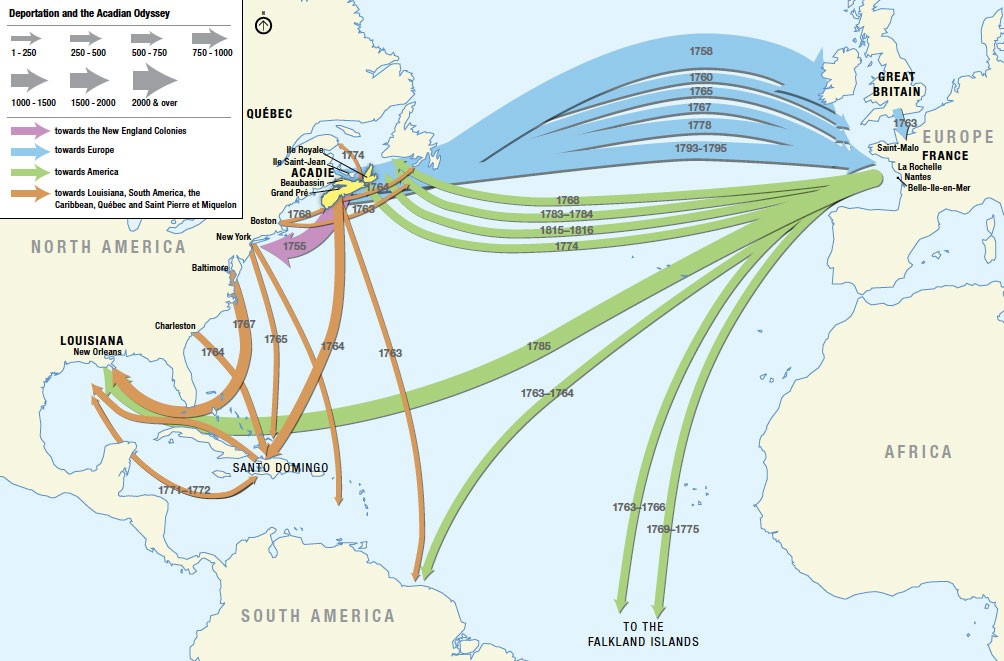
The Acadians – settlers, pioneers in a new land allied with and intermarried into the Native population of seaboard Nova Scotia beginning in 1603. They lived in harmony, developing their farms and then, roughly 150 years or 6 generations later, in 1755, they found themselves evicted, ruthlessly and forcibly deported, losing absolutely everything. They became landless refugees, living off of the benevolence of strangers…or dying. The Acadian diaspora was born. You can view a timeline here.

Marie Rundquist, Acadian and Native descendant, genetic genealogist, researcher and founder of the original AmerIndian project visited the Acadian homeland this past summer and is graciously sharing her experience through some of her photography and narrative.

Courtesy Marie Rundquist

Marie Rundquist:

This cross, located on the beach near Grand Pre where the Acadians were herded onto ships, is a priceless icon of our Acadian ancestry and represents all of our ancestors who were forcibly removed from their lands – marched on to the awaiting boats at gunpoint – and who left their footprints on this beach. Their last footprints in the land into which their effort and blood had been poured for 150 years.  This cross is very symbolic and meaningful to all who look at it.

Courtesy Marie Rundquist

This photo was taken at Waterfront Park in the town of Wolfville which borders the Minas Basin and the historic Acadian dykelands our ancestors once farmed. The area is known for the spectacular tides that rush into the basin bordering the park, totally changing its landscape.

Courtesy Marie Rundquist

Sabots, the wooden shoes pictured above were worn by Acadian ancestors who farmed the wet, marshy dykelands and were also worn on boats.  Wolfville is within a short distance of the Grand Pre UNESCO Historic Site where my husband and I stayed while attending the 2017 Acadian Mi’kmaq Celebration of Peace and Reconciliation this past August.

If you have Acadian ancestors, these pictures probably caused you to catch your breath.  Your ancestors walked here, stood here and the blood in their veins ran thick with fear, here, as they boarded the ships that would disrupt their lives forever, destroying what they had built over a century and a half.

Focus on the Homeland

Marie has recently begun a new chapter in her life which allows her to focus more directly on the Acadian and AmerIndian homelands and communities. She has been preparing for this transition for years, and all Acadian and AmerIndian researchers will be beneficiaries.

Marie initially founded the AmerIndian out of Acadia project in 2006 to sort out the relationships between the various Acadian and Native families both in Nova Scotia, and wherever their descendants have dispersed since “Le Grand Derangement,” their forced removal in 1755. The story of the Acadians didn’t end in 1755, it began anew in different locations throughout the world, the Acadian diaspora.

Through traditional genealogy research paired with genetic genealogy, we are breathing life into those ancestors once again, honoring their memory and sacrifices, and along the way, getting to know them better and finding unexpected surprises as well.

This is an exciting time in genetic genealogy for descendants of Acadians and those with American Indian roots in eastern Canada and the northeastern portion of the US.

The Acadian homeland is located in the easternmost portion of Canada, Nova Scotia.

By Mikmaq – Own work, CC BY-SA 3.0, https://commons.wikimedia.org/w/index.php?curid=1351882

Many, if not most, Acadians were admixed with the Native population in the 150 years that the French colonists lived in harmony with the Native Mi’kmaq (also referenced as Micmac) people on the Atlantic coastline of Nova Scotia. It’s impossible to study one without studying the other. Their fates, genealogies and DNA are inextricably interwoven.

Having Acadian and Native ancestors as well, and after several years of working together on other projects, I joined Marie as a co-administrator of this project in early 2017.

Today, Marie and I have several exciting announcements to make, the first of which is the renaming of the project to more accurately reflect a new, expanded, focus.

The Acadian AmerIndian Ancestry Project

You might have noticed that the AmerIndian project was renamed a few months ago as the Acadian AmerIndian Ancestry Project to reflect our expanded goals. Specifically, our goal is to create a one-stop location in which to discover Acadian genetic roots. While the Acadia – Metis Mothers and Mothers of Acadian DNA projects have existed for several years to document proven matrilineal Acadian lines, nothing of the same nature existed for Y DNA for paternal surname lineages, or for those who want to connect with their Acadian roots through autosomal DNA.

After weighing various options, Marie and I, in conjunction with Family Tree DNA, decided that the best option was to expand the existing AmerIndian project to include Y, mitochondrial and autosomal DNA of the entire Acadian population into our existing project which already has over 1000 members.

In a word, our new project focus is FAMILY!

In Marie’s words:

Primary project goal: Through genetic genealogy research techniques combined with advanced Y DNA testing, it is our goal to add to and develop Y DNA signatures for male descendants of our legacy Acadian ancestors that may be referenced by others in verifying genealogies.

We want to assure that in our surname studies we are informed by Y DNA results primarily but take into account the mtDNA Full Mitochondrial Sequence results when considering the spouse, and Family Finder (autosomal) DNA results when researching all who may share ancestry.

Surname variants and dit names are of particular interest and factor into our development of a database of surname signatures as related to Acadian genealogies.

We encourage all who have tested and have the surname lineages listed in our project profile to join our project as their combined DNA results help us see through the genealogy brick walls and help us find answers to our genealogy questions.

We want to let new and existing members know how their results have contributed to our ability to develop and verify Acadian genealogies – and for the men in particular, the attainment of Y DNA “signatures” for surname lineages against which all may compare their own Y DNA results – and reference in genealogy research. Adoptees with matching Y DNA results for Acadian surnames (as we already have a number of these) are welcome to join and participate. Our team is expert in the areas of Y DNA testing and analysis, including the latest Big Y DNA tests only through years of practical experience with geographical and haplogroup-related DNA projects.  Both Marie and Roberta have extensive project administration experience and both are affiliate researchers with The Genographic Project.

Introducing Deadre Doucet Bourke

Marie and I realized that we needed assistance, so we are very pleased to welcome our new co-administrator, Deadre Doucet Bourke. Many Acadian researchers already know Deadre, a long-time genealogist and contributor from within the project, so adding her expertise as a project administrator is a natural progression. Deadre will be focused on communicating with people regarding their genealogy and utilizing social media.

You can read the bios of our administrators here.

Welcome Deadre!!!

The DNA Focus

The Acadian AmerIndian Ancestry Project is primarily focused on Y DNA and autosomal DNA. While we aren’t competing with the two mitochondrial DNA projects, we certainly welcome those with direct mitochondrial lineages to join this project as well. We encourage researchers to combine all of the DNA that makes us family to confirm our Acadian heritage and connect to our ancestors.

Acadian researchers struggle with the inability to find their Acadian ancestor’s Y DNA signatures gathered together in one place. Marie and I decided to fix that problem, hence, the redesign of the project.

The Acadian AmerIndian Ancestry Project welcomes everyone with Acadian heritage!

If you descend from a particular line, but aren’t male or don’t carry the surname today, you’ll be able to discover information about your ancestors from the Y DNA, mitochondrial and autosomal DNA carried by other project members. Genetic genealogy is all about collaboration and sharing and finding all types of results in one project location makes that search much easier!

Who Should Join the Acadian AmerIndian Ancestry Project?

  • If you have an ACADIAN SURNAME in your family lines, as listed in the project profile or on the surname list later in this article, and you’ve had the Y DNA, mtDNA or Family Finder test, you are qualified to join this project.
  • If you are a MALE with an ACADIAN SURNAME, please join the Acadian AmerIndian Ancestry Project by ordering (minimally) a Y Chromosome 37 marker test.
  • If you are either male or female and have Acadian MATRILINEAL ANCESTRY (your mother’s mother’s mother’s line) that leads to a Native and/or an Acadian grandmother through all females, please join the Acadian AmerIndian Ancestry Project by ordering the mtFull Sequence mitochondrial DNA test.
  • If you have Acadian or Native American ancestors from the Acadian region of Canada or diaspora regions where Acadian families settled after the 1755 deportation, and would like to discover new leads for ancestry research and close, immediate and distant cousins, please join the project by ordering a Family Finder test.
  • If you have Acadian ancestry and have already taken the Y or mitochondrial DNA test at Family Tree DNA, please click here to sign in to your account and order a Family Finder test by clicking on the “Upgrade” button on the top right of your personal page.
  • If you have already tested and have Y DNA, mtDNA, or Family Finder matches with members of the Acadian Amerindian Ancestry project and are researching your ancestry, you are welcome to join this project.
  • If you have already tested your DNA at Family Tree DNA, but are not yet a project member, please click on the Project tab at the top left of your personal page to select a project to join. If the Acadian AmerIndian Ancestors project is not showing on your list, just type “Acadian” into the search box and click on the “Acadian AmerIndian Ancestry” link to join the project.
  • If you have tested your autosomal DNA at either Ancestry or 23andMe, but not at Family Tree DNA, you can download your autosomal results into the Family Tree DNA data base and use many tools for free – including the ability to join projects. You can read more about this here.

Not sure which kinds of DNA you can test for, and the difference between the different tests, please read 4 Kinds of DNA for Genetic Genealogy.

Questions? Just ask!

Saving Money by Joining the Acadian AmerIndian Project

Please note that DNA testing discounts are available through our project site for people who have never ordered a test from Family Tree DNA previously.

First, click here to go to the Family Tree DNA webpage. Scroll down, then, type the word Acadian into the search box, as shown below. This search process works for surnames as well.

Then, when the results are returned, select the Acadian AmerIndian Ancestry Project and click that link, shown below, to see DNA testing prices available to project members, example shown below.
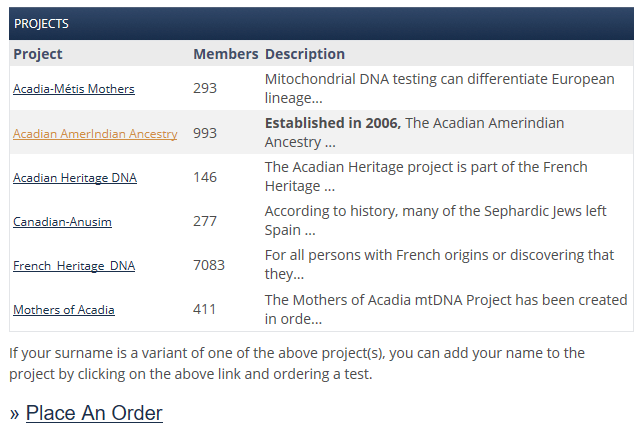
You’ll need to scroll down to see test prices. The screen shot below only shows a portion of what is available.
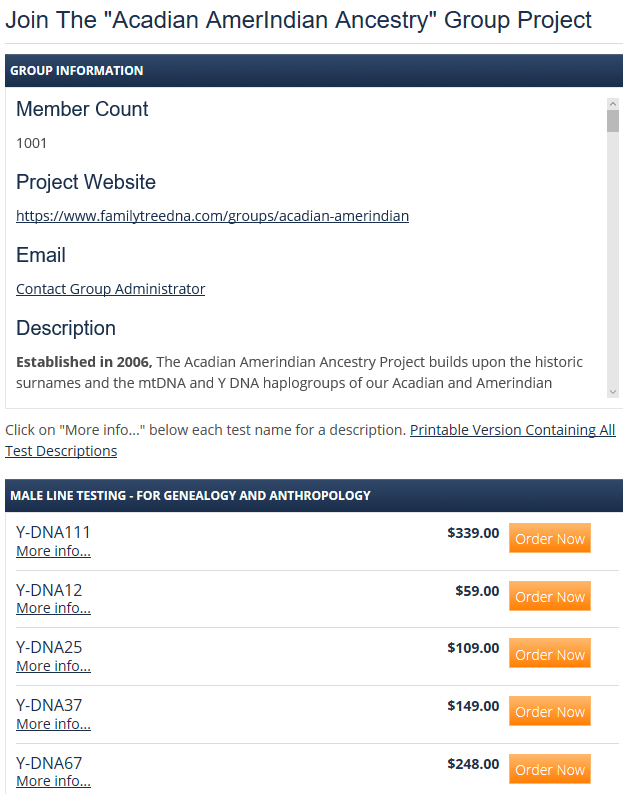
DNA testing prices through the project are less than ordering the same test without joining a project.

As A Project Member

Of course, the point of DNA testing and projects is to share.  Family Tree DNA has provided several tools to help genealogists do just that.  We would ask that project members complete the following four easy steps, unless for some reason, you can’t.  For example, adoptees may not have this information.  Just do the best you can.

First, please upload a tree of at least your direct line ancestors at Family Tree DNA.

Just sign in to your personal page and click on “My Family Tree” to get started.

DNA and family trees are extremely powerful tools together – the genetic and genealogy parts of genetic genealogy.

Second, please complete the name and location of your earliest known direct matrilineal ancestor (your mother’s mother’s mother’s line) and your direct patrilineal line (your father’s father’s father’s line) by clicking on the orange “Manage Personal Information” link below your profile photo on the left side of your personal page.

Then, click on the Genealogy Tab, and then click on Earliest Known Ancestors. Please note that you can click on any image to enlarge.

You’ll need to complete:

  • Both Earliest Known Ancestor fields on the left side of the page.
  • Both Ancestral Locations by clicking on the orange “update location” for the patrilineal AND matrilineal ancestor on the right side.

Be sure to click “Save” at the bottom of the page when you’re finished.

Third, under the Privacy and Sharing tab, please consider allowing your Y and mitochondrial DNA results to show on the public page of the project.

When Acadian descendants are searching for projects to join, or information about their ancestral lines, the public project display is often what they find and how they decide if participation or DNA testing is worth their time.

Here is what our public Y DNA project page displays and here is what our mtDNA project page displays.  There is also an option for administrators to display the participants surname, but we do not have this field enabled at this time.  Other projects that you may have joined probably do have this field enabled, and your selection affects all projects of which you are a member.
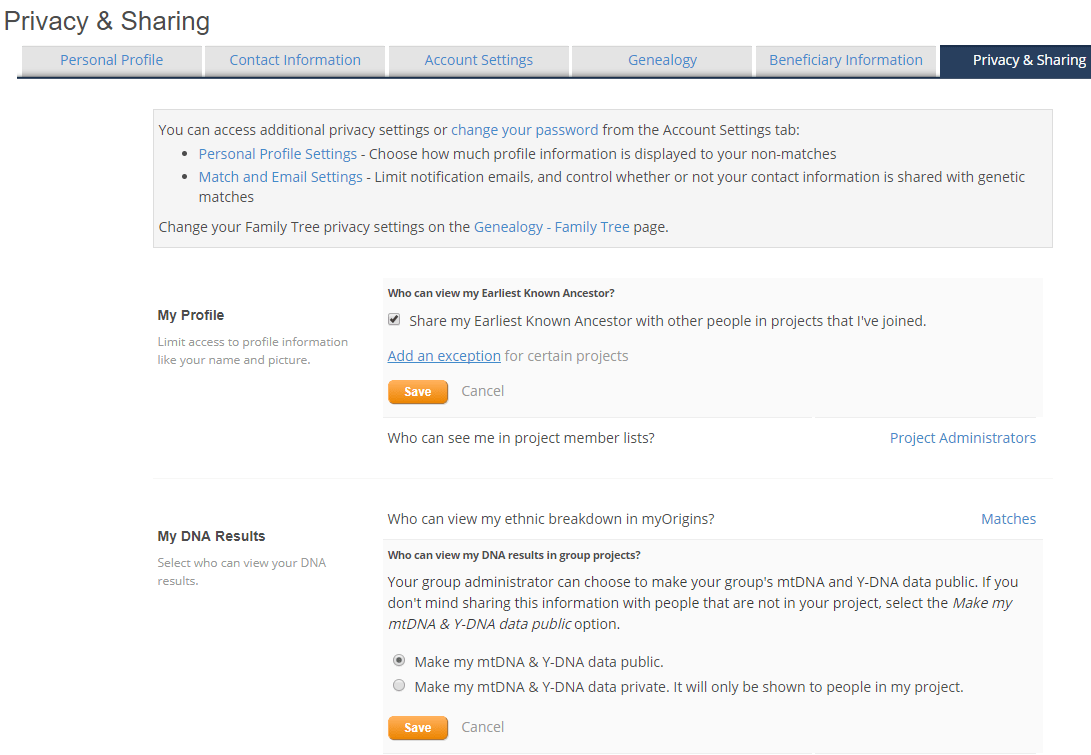
Under “My Profile,” you’ll see an option to “Share my Earliest Known Ancestor with other people in the projects I’ve joined.”  If you don’t have this option enabled, only a blank space will appear, which doesn’t help anyone determine if you share a common ancestor.

A second option on this page under “My DNA Results is “Make my mtDNA and Y DNA public” which allows your results to show on the public project page.  If you select “project only” then only project members will be able to see your results when logged in to their account. Your results will no show on the public project page unless you select the public option.

Remember to click “save.”

Fourth, if your mitochondrial line (mother’s mother’s mother’s line) is Acadian or Native, you’ll need to provide the project administrators with the ability to see the coding region of your mitochondrial DNA so that your mitochondrial DNA can be properly grouped within the project.  If your direct matrilineal line does NOT pertain to Acadian or Native ancestry, then you’re done.

If your matrilineal line is Native or Acadian, on the Privacy and Sharing page, under “Account Access,” please click on the “Only You” answer to “Who can view my mtDNA Coding Region mutations.”
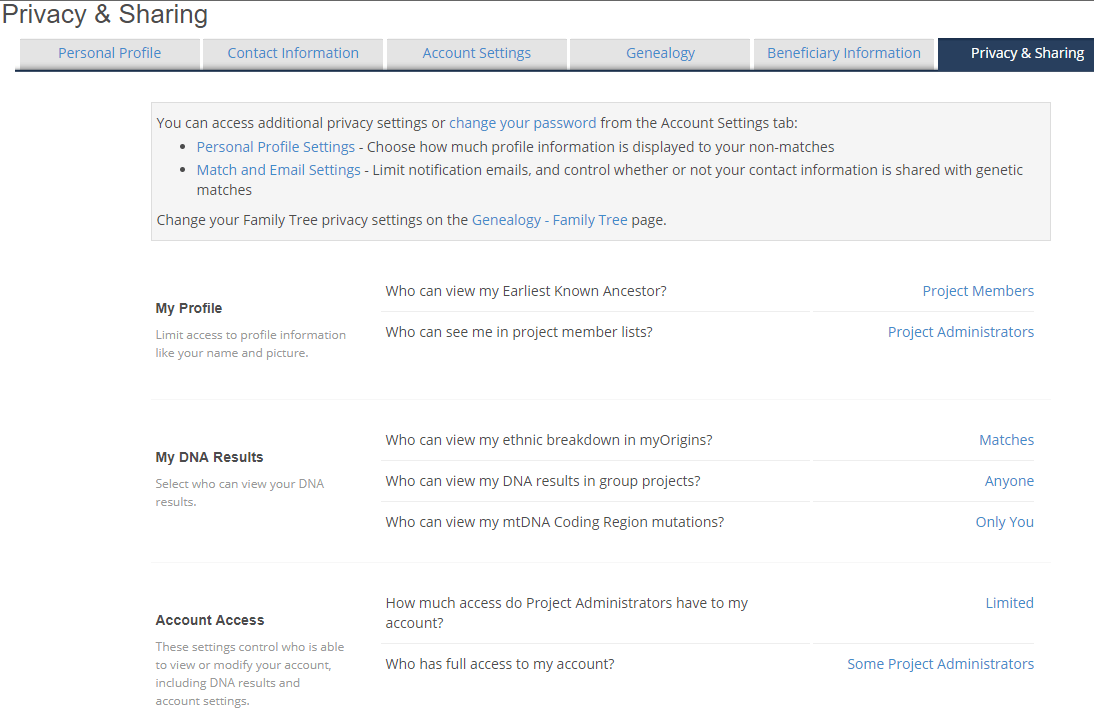
You will then see a drop down list of the projects you have joined.  You can select any of the projects by clicking the box beside the project.  Only the administrators of the projects you’ve selected can see your coding region results, and you can change this at any time. In my personal account, I’ve selected all of the projects that my mtDNA is relevant to.

Your coding region results are NEVER displayed publicly and no one other than project administrators can see those results.  Family Tree DNA does not offer the option of displaying coding regions in any project.
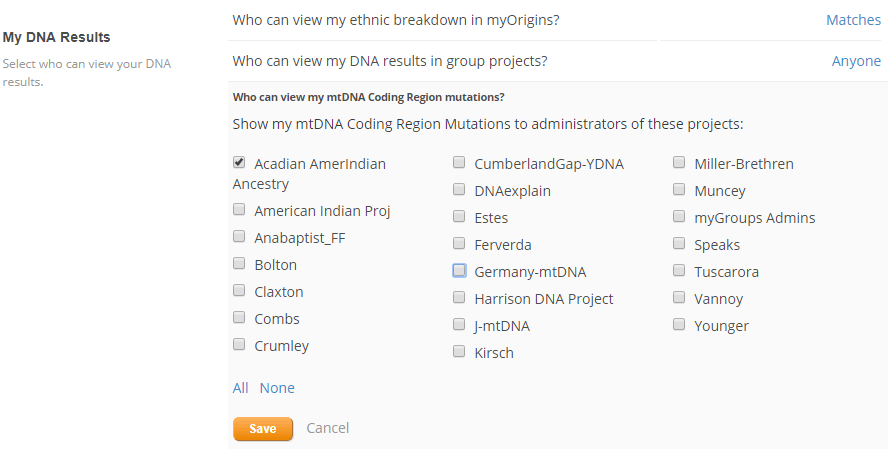
Again, don’t forget to click “save,” or you haven’t.

Need Help?

Need help? Just ask. We’re here to help.

Project administrators can help you by completing some fields, like most distant ancestor, with your permission, but Privacy and Sharing fields can’t be changed or edited by administrators for everyone’s security.  However, we’d be glad to step you through the process, as would Family Tree DNA customer support.  You can call or contact customer support by scrolling down to the very bottom of your personal page.

Acadian Surnames

Courtesy Marie Rundquist

I compiled the following list of Acadian surnames along with dit names (surname nicknames) from the following Acadian website where you can view which ancestral families were recorded in various census documents including 1671, 1686, 1714 and a deportation list from 1755.

Brenda Dunn’s list was prepared for the Canadian National Parks Service for the Grand Pre National Historic site.

Variant spellings were retrieved from this site and may not be inclusive.

Surname Various Spellings Source
Abbadie, de Saint-Castin d’ Brenda Dunn
Allain Alain, Alin, Allain, Halain, Halin Brenda Dunn
Allard Alard, Allard, Allart, Halard, Hallard Acadian-Cajun.com
Amirault dit Tourangeau Amireau, Amireault, Mero, Miraud, Mirau, Miraux, Mireau, Mireault, Moreau Brenda Dunn
Angou dit Choisy Brenda Dunn
Apart Brenda Dunn
Arcement Brenda Dunn
Arnaud Arnaud, Arnault Brenda Dunn
Arosteguy Brenda Dunn
Arseneau Brenda Dunn
Aubin Aubain, Aubin, Obin Acadian-Cajun.com
Aubois Brenda Dunn
Aucoin Aucoin, Coin, Ocoin Brenda Dunn
Ayor Brenda Dunn
Babin Babain, Babin Brenda Dunn
Babineau dit Deslauriers Babinau, Babineau, Babineaux, Babino, Babinot Brenda Dunn
Barillot Brenda Dunn
Barnabe Acadian-Cajun.com
Barriault Bariau, Bariault, Barieau, Barillault, Barrillaut, Barillon, Barillot, Bario, Barrio Acadian-Cajun.com
Bastarache dit (Le) Basque Brenda Dunn
Bastien Baptien, Basquien, Bastien, Vasquais Brenda Dunn
Beaulieu Baulieu, Baulieux, Beaulieu, Beaulieux Acadian-Cajun.com
Beaumont Beaumon, Beaumont Acadian-Cajun.com
Belisle Belisle, Bellisle, de Bellisle Acadian-Cajun.com
Bellefontaine Bellefontaine, Bellefontenne Acadian-Cajun.com
Belleville Beliveau Brenda Dunn
Belliveau dit Bideau Beliveau Brenda Dunn
Belliveau dit Blondin Brenda Dunn
Belou Brenda Dunn
Benoit dit Labriere Benois, Benoist, Benoit Brenda Dunn
Bergereau Brenda Dunn
Bergeron d’Amboise Brenda Dunn
Bergeron dit Nantes Bargeron, Bergeon, Bergeron, Berjeron Brenda Dunn
Bernard Bernar, Bernard Brenda Dunn
Berrier dit Machefer Brenda Dunn
Bertaud dit Montaury Brenda Dunn
Bertrand Bartrand, Berterand, Bertran, Bertrand, Bertrant Brenda Dunn
Bezier dit Lariviere Brenda Dunn
Bezier dit Touin Brenda Dunn
Bideau Acadian-Cajun.com
Blanchard dit Gentilhomme Blanchar, Blanchard, Blanchart Brenda Dunn
Blondin Blondain, Blondin Acadian-Cajun.com
Blou Acadian-Cajun.com
Bodard Brenda Dunn
Boisseau dit Blondin Boissau, Boisseau, Boisseaux Brenda Dunn
Bonnevie dit Beaumont Brenda Dunn
Borel Brenda Dunn
Boucher dit Desroches Bouché, Boucher, Bouchez Brenda Dunn
Boudreau Boudrau, Boudraut, Boudreau, Boudro, Boudrot Acadian-Cajun.com
Boudrot Brenda Dunn
Bourg Bourc, Bourg, Bourgue, Bourk, Bourque Brenda Dunn
Bourgeois Bourgeois, Bourgois, Bourjois Brenda Dunn
Boutin Boudin, Boutain, Boutin, Bouttain, Bouttin Brenda Dunn
Brassaud Brenda Dunn
Brasseur dit Mathieu Brasseur, Brasseux Brenda Dunn
Breau Brenda Dunn
Breton Berton, Breton, Lebreton Acadian-Cajun.com
Brossard Brosard, Brossar, Brossard, Brossart, Broussard Brenda Dunn
Brun Brun, Lebrun Brenda Dunn
Bugaret Brenda Dunn
Bugeaud Brenda Dunn
Buisson Buisson, Busson, Dubuisson Brenda Dunn
Buote Brenda Dunn
Buteau Butau, Butaud, Buteau, Buteux, Buto, Butteau Brenda Dunn
Cadet Caddé, Cadet, Cadette Acadian-Cajun.com
Caissy dit Roger Brenda Dunn
Calve dit Laforge Brenda Dunn
Carre Caray, Caré, Caret, Carr, Carré, Carret Brenda Dunn
Cassy dit Roger Brenda Dunn
Celestin dit Bellemere Brenda Dunn
Cellier dit Normand Brenda Dunn
Champagne Champagne, Champaigne Acadian-Cajun.com
Chauvert Acadian-Cajun.com
Chauvet Chauvet, Chauvette, Chovet Brenda Dunn
Chenet dit Dubreuil Chenay, Chenet, Chenette, Chesnay Brenda Dunn
Chesnay dit Lagarene Brenda Dunn
Chiasson dit La Vallee Chiasson, Giasson Brenda Dunn
Chouteau dit Manseau Brenda Dunn
Clemenceau Brenda Dunn
Cloustre Brenda Dunn
Cochu Cochu, Cochus Acadian-Cajun.com
Cognac Cognac, Coignac Brenda Dunn
Comeau Brenda Dunn
Cormier dit Bossigaol Cormié, Cormier, Cornier Brenda Dunn
Cormier dit Thierry Brenda Dunn
Cornelier Brenda Dunn
Corporon Brenda Dunn
Cosse Acadian-Cajun.com
Cosset Cosset, Cossette Brenda Dunn
Coste Brenda Dunn
Cottard Brenda Dunn
Cousineau Brenda Dunn
Crepeau Crepau, Crepaux, Crepeau, Crepeaux, Crepos, Crespau, Crespeau, Crespel Brenda Dunn
Creysac dit Toulouse Brenda Dunn
Cyr Cir, Cire, Cyr, Cyre, Sir, Sire, Siree, Syr, Syre Brenda Dunn
Daigle Daigle. Daigles, Dehegue Acadian-Cajun.com
Daigre Brenda Dunn
Damboue Acadian-Cajun.com
D’Amours de Chauffours Brenda Dunn
D’Amours de Clignancour Brenda Dunn
D’Amours de Freneuse Brenda Dunn
D’Amours de Louviere Brenda Dunn
D’Amours de Plaine Brenda Dunn
Daniel Daniel, Daniele, Danielle, Deniel Brenda Dunn
Darois Brenda Dunn
David dit Pontif Davi, David, Davit, Davy Brenda Dunn
Debreuil Acadian-Cajun.com
Delatour Delatour, Latour Acadian-Cajun.com
Delisle Delile, Delille, Delisle, Delisles, Brenda Dunn
Denis Deni, Denis, Dennis, Denys Brenda Dunn
D’Entremont Acadian-Cajun.com
Denys de Fronsac Brenda Dunn
Depeux Acadian-Cajun.com
Derayer Brenda Dunn
Desaulniers Desaulnier, Desaulniers, Desaunié, Desaunier, Desauniers Acadian-Cajun.com
Deschamps dit Cloche Dechamp, Dechamps, Dechant, Deschamps Brenda Dunn
Desgoutins Brenda Dunn
Desmoulins Demoulin, Desmoulin, Desmoulins, Dumoulin Brenda Dunn
Desorcis Acadian-Cajun.com
Després Depre, Depres, Despre, Despres, Desprez Brenda Dunn
Devaux Acadian-Cajun.com
Deveau dit Dauphine Devau, Devaux, Deveau, Deveaux, Devot, Devots Brenda Dunn
Dingle Brenda Dunn
Doiron Doiron, Douairon, Doueron Brenda Dunn
Domine dit Saint-Sauveur Brenda Dunn
Donat Acadian-Cajun.com
Douaron Acadian-Cajun.com
Doucet dit Laverdure Doucet, Doucette Brenda Dunn
Doucet dit Lirlandois Brenda Dunn
Doucet dit Mayard Brenda Dunn
Druce Brenda Dunn
Dubois dit Dumont Debois, Desbois, Dubois, Duboy Brenda Dunn
Dufault Dufau, Dufault, Dufaut, Dufaux, Duffault, Duffaut, Duffaux, Dufo, Dufos, Duphaut Brenda Dunn
Dugas Duga, Dugas, Dugast, Dugat Brenda Dunn
Duguay Dugai, Dugaie, Dugay, Duguay, Dugué Brenda Dunn
Dumont Dumon, Dumond, Dumont Acadian-Cajun.com
Duon dit Lyonnais Brenda Dunn
Dupeux Acadian-Cajun.com
Duplessis Duplaissy, Duplassis, Duplassy, Duplecy, Duplesis, Duplessis, Duplessy, Placy Brenda Dunn
Dupuis Dupui, Dupuis, Dupuit, Dupuits, Dupuy, Dupuys Brenda Dunn
Egan Brenda Dunn
Emmanuel Acadian-Cajun.com
Esperance Lespérance, Lesperence Acadian-Cajun.com
Fardel Acadian-Cajun.com
Flan Brenda Dunn
Fontaine dit Beaulieu Delafontaine, Fonteine, Lafontaine, Lafonteine, Lafonteinne Brenda Dunn
Forest Fores, Forêt, Laforêt, Laforest Brenda Dunn
Foret Forest Acadian-Cajun.com
Forton Brenda Dunn
Fougere Brenda Dunn
Fournier Fournié, Lefournier Brenda Dunn
Froiquingont Brenda Dunn
Gadrau Brenda Dunn
Galerne Brenda Dunn
Galle Brenda Dunn
Garceau dit Boutin Garco, Garso, Garsot Brenda Dunn
Garceau dit Richard Brenda Dunn
Garceau dit Tranchemontagne Brenda Dunn
Gardet Gardai, Garday, Gardé Brenda Dunn
Gareau Garau, Garaud Brenda Dunn
Gaudet Gaudais, Gaudé, Gaudette, Godé, Godet, Godete, Godette Acadian-Cajun.com
Gauterot Brenda Dunn
Gauthier Gaultier, Gautier, Gotier Brenda Dunn
Gentil Brenda Dunn
Giboire Duverge dit Lamotte Brenda Dunn
Girouard Geroir, Gerroir, Giouard, Giroir, Girroir, Jirouard Brenda Dunn
Gise Brenda Dunn
Godin Boisjoli Brenda Dunn
Godin dit Beausejour Gaudain, Gauden, Gaudin, Godain, Goddin, Godin Brenda Dunn
Godin dit Bellefeuille Brenda Dunn
Godin dit Bellefontaine Brenda Dunn
Godin dit Catalogne Brenda Dunn
Godin dit Chatillon Brenda Dunn
Godin dit Lincour Brenda Dunn
Godin dit Preville Brenda Dunn
Godin dit Valcour Brenda Dunn
Godon Gandon, Gaudon, Godon Brenda Dunn
Gosselin Gaucelin, Gauscelin, Gausselin, Goscelin, Gosselain Brenda Dunn
Goudreau Gaudrau, Gaudrault, Gaudreau, Gaudreault, Gaudro, Godereau, Godrault, Godreault, Godro, Godrot, Goodrow Brenda Dunn
Gougeon Gougeon, Gougon, Goujon, Goujou Acadian-Cajun.com
Gourdeau Acadian-Cajun.com
Gousille Acadian-Cajun.com
Gousman Brenda Dunn
Gouzille Brenda Dunn
Grandmaison Degrandmaison Brenda Dunn
Granger Brenda Dunn
Gravois Brenda Dunn
Grosvalet Brenda Dunn
Guedry dit Labine Brenda Dunn
Guedry dit Labrador Brenda Dunn
Guedry dit Laverdure Brenda Dunn
Guedry Grivois Guidry, Guildry Brenda Dunn
Gueguen Brenda Dunn
Guenard Brenda Dunn
Guerin dit LaForge Guerrin Brenda Dunn
Guilbault Guibau, Guibaut, Guibeau, Guibo, Guilbau, Guilbaud, Guilbaux, Guilbeau, Guillebault, Guillbeau, Guilbaut Acadian-Cajun.com
Guilbeau Brenda Dunn
Guillot Brenda Dunn
Guy dit Tintamarre Degui, Deguy, Gui Brenda Dunn
Guyon Dion, Dionne, Gion, Guillon, Guion, Gyon, Yon Brenda Dunn
Hache dit Gallant Brenda Dunn
Hamel Amel, Amell, Emmel, Hamell, Hamelle, Hornel Brenda Dunn
Hamet Brenda Dunn
Hamon Brenda Dunn
Hébert dit Manuel Abaire, Abare, Abbot, Ebart, Éber, Ébert, Heber, Heberd, Hébere, Herber, Herbert, Hesbert, Hibbart, Hubert Brenda Dunn
Helys dit Nouvelle Brenda Dunn
Henry dit Robert Henri Brenda Dunn
Hensaule Brenda Dunn
Heon Brenda Dunn
Herpin Arpin, Guertin, Harpin, Hertin Acadian-Cajun.com
Heuse Brenda Dunn
Hugon Brenda Dunn
Jasmin Jassemin Acadian-Cajun.com
Jeanson Jeansonne Brenda Dunn
Joseph Brenda Dunn
Kimine Brenda Dunn
Labarre Delabarre, Labar, Labard Brenda Dunn
Labat, dit Le Marguis, de Labatte Brenda Dunn
LaBauve Brenda Dunn
Lachaume Delachaume Brenda Dunn
Lacroix Delacroix Brenda Dunn
Lafond Lafon, Lafont Acadian-Cajun.com
Lafont Acadian-Cajun.com
Lagasse Lagace, Lagacee, Lagassee, Lagassees, Lagasset Acadian-Cajun.com
Lalande dit Bonnappetit Delalande, Lalande Brenda Dunn
Laliberte Laliberte, Liberte Acadian-Cajun.com
Lambert Lamber, Lembert Brenda Dunn
Lambourt Brenda Dunn
Lamontagne Delamontagne, Montagne Acadian-Cajun.com
Landrom Brenda Dunn
Landry Landri, Landrie, Landril, Landrille, Lendry Brenda Dunn
Langlois Anglais, Anglois, Langlais, Langloi, Langlouois Brenda Dunn
Lanoue Brenda Dunn
Lapierre dit LaRoche Delapierre, Lapeer, Pierre Brenda Dunn
Latour Acadian-Cajun.com
Laurier Lauriere,Lorier Acadian-Cajun.com
LaVache Brenda Dunn
Lavallée Lavale, Lavalee, Vale, Valee, Valle, Vallee Acadian-Cajun.com
Lavergne Laverne Brenda Dunn
Lavigne Delavigne Brenda Dunn
Lebasque Acadian-Cajun.com
Lebert dit Jolycoeur Abare, Hébert, Labare, LeBear, Leber, Leberre, Libest Brenda Dunn
Leblanc dit Jasmin Blanc, Leblan, Lebland, Leblant Brenda Dunn
LeBorgne dit Belisle Brenda Dunn
Lebreton Berton, Beurton Acadian-Cajun.com
Leclerc dit Laverdure Clair, Claire, Clerc, Leclair, Leclaire, Lecler, Leclerq Brenda Dunn
Lecul Brenda Dunn
Lefebvre Febur, Febvre, Lefaivre, Lefebre, Lefebur, Lefeuvre, Lefevre Acadian-Cajun.com
Leger dit La Rozette Legere, Legey, St-Leger Brenda Dunn
Lejeune dit Briard Jeune, Lejeunne Brenda Dunn
LeJuge Brenda Dunn
Lemaistre Acadian-Cajun.com
LeMarquis dit Clermont Brenda Dunn
Lemire Lemir, Lemirre, Lemyre, Lemyrre, Mire Brenda Dunn
LeNeuf de Beaubassin Lenef, Leneuf Brenda Dunn
LeNeuf de Boisneuf Brenda Dunn
LeNeuf de LaValliere Brenda Dunn
L’Enfant Brenda Dunn
LePoupet de Saint-Aubin Brenda Dunn
LePrieur dit Dubois Brenda Dunn
LePrince Brenda Dunn
Leroy Leroi, Roi, Roy Brenda Dunn
L’Eschevin dit Billy Brenda Dunn
Lespérance Delesperance, Lesperence Acadian-Cajun.com
Lessoile Acadian-Cajun.com
LeVanier dit Langevin Brenda Dunn
LeVasseur dit Chamberlange Brenda Dunn
Leveille Leveiller, Leveillez, Leveillie, Leveillier Brenda Dunn
Levron dit Nantois Leveron Brenda Dunn
Loiseau Laiseau, Laizeau, Loisau, Loisseau, Loizeau, Loseau, Loyseau, Lozeau Brenda Dunn
Long Brenda Dunn
Longuepee Brenda Dunn
Loppinot Brenda Dunn
Lord dit Montagne Lore Brenda Dunn
Lort Acadian-Cajun.com
Lucas Luca Brenda Dunn
Lyonnais Acadian-Cajun.com
Maffier Brenda Dunn
Maillard Acadian-Cajun.com
Maillet Brenda Dunn
Maisonnat dit Baptiste Brenda Dunn
Malboeuf Malbeuf Brenda Dunn
Mangeant dit Saint Germain Brenda Dunn
Manseau Manceau, Mansau Acadian-Cajun.com
Marcadet Brenda Dunn
Marchand dit Poitiers Marchan, Marchant Brenda Dunn
Marres dit LaSonde Brenda Dunn
Martel Martelle Brenda Dunn
Martil Acadian-Cajun.com
Martin dit Barnabe Martain Brenda Dunn
Massé Macé, Macés, Masset, Massey Brenda Dunn
Massie Brenda Dunn
Mathieu Mathieux, Matthieux Brenda Dunn
Maucaire Brenda Dunn
Mazerolle dit Saint Louis Brenda Dunn
Melanson dit LaRamee
Melanson dit Laverdure Melanson, Melençon, Melenson, Menançon Brenda Dunn
Mercier dit Caudebec Lemercier, Mersier Brenda Dunn
Messaguay Brenda Dunn
Meunier Megné, Menié, Mesnier, Meusnier, Munier, Musnier Brenda Dunn
Michaud Michau, Michault, Michaut, Michaux, Micheau Acadian-Cajun.com
Michel dit LaRuine Bichel, Miché, Michelle, Micher Brenda Dunn
Migneau dit Aubin Mignau, Mignaud, Mignault, Mignaux, Migneaux, Mignot, Migneau Brenda Dunn
Mignier dit Lagasse Brenda Dunn
Mignot Mignau, Mignaud, Mignault, Mignaux, Migneaux, Mignot Brenda Dunn
Mirande Brenda Dunn
Mius d’Azit Miusse, Mousse Brenda Dunn
Mius de Entremont de Plemarais Miusse, Mousse Brenda Dunn
Monmellian dit Saint Germain Brenda Dunn
Mordant Brenda Dunn
Morin dit Boucher Maurain, Maurin, Morrin Brenda Dunn
Morpain Brenda Dunn
Moulaison dit Recontre Brenda Dunn
Mouton Brenda Dunn
Moyse dit Latreille Brenda Dunn
Muis de Entremont de Pobomcoup Miusse, Mousse Brenda Dunn
NaQuin dit L’Etoile Brenda Dunn
Nogues Brenda Dunn
Nuirat Brenda Dunn
Olivier Oliver, Olivie, Ollivier Brenda Dunn
Ondy Acadian-Cajun.com
Onel O’Neale Brenda Dunn
Orillon dit Champagne Aurillon, Aurion, Orion, Oriont Brenda Dunn
Oudy Brenda Dunn
Ozelet Brenda Dunn
Paris Deparis, Parisis, Parisse, Pary Acadian-Cajun.com
Parisien Leparisien, Parisiens, Parizien Acadian-Cajun.com
Part Brenda Dunn
Pellerin Pelerin, Pelrin Brenda Dunn
Pesseley Acadian-Cajun.com
Petitot dit Saint Sceine Brenda Dunn
Petitpas Brenda Dunn
Pichot Brenda Dunn
Picot Brenda Dunn
Pincer Brenda Dunn
Pinet Brenda Dunn
Pitre dit Marc Lepitre, Pistre, Piter, Pittre Brenda Dunn
Poirier Poerier, Poirie, Poiriers, Poirrier, Porier, Poyrie, Poyrier Brenda Dunn
Poitevin dit Cadieux Lapoitevin, Paudevin, Poidevin, Poitvin, Potdevin, Potevin, Potvin Brenda Dunn
Poitevin dit Parisien Lapoitevin, Paudevin, Poidevin, Poitvin, Potdevin, Potevin, Potvin Brenda Dunn
Poitier Brenda Dunn
Porlier Brenda Dunn
Pothier Pauthier, Pautier, Poitié, Poitier, Poitiers, Potier, Potiers, Pottier Acadian-Cajun.com
Poujet dit Lapierre Brenda Dunn
Poulet Acadian-Cajun.com
Poupard Poupar, Poupare, Poupart Brenda Dunn
Prejean dit LeBreton Pregeant, Pregent, Prejan Brenda Dunn
Pretieux Brenda Dunn
Pugnant dit Destouches Brenda Dunn
Racois dit Desrosiers Brenda Dunn
Raymond Raimon, Raimond, Raymont, Raymon, Remond, Remont Brenda Dunn
Renaud dit Provencal Rainaud, Raynaud, Raynalt, Regnault, Regneault, Renau, Renauld, Renault, Renaut, Renaux, Reneau, Reneault, Renaux, Renod Brenda Dunn
Richard dit Beaupri Richar, Richart Brenda Dunn
Richard dit Boutin Richar, Richart Brenda Dunn
Richard dit Lafont Richar, Richart Brenda Dunn
Richard dit Sancoucy Richar, Richart Brenda Dunn
Rimbeau Rimbaut Brenda Dunn
Rivet Rivais, Rive, Rivest, Rivette, Rivez Brenda Dunn
Robichaud dit Cades Robichau Brenda Dunn
Robichaud dit Niganne Robichau Brenda Dunn
Robichaud dit Prudent Robichau Brenda Dunn
Rodoham Brenda Dunn
Rodrigue dit DeFonds Rodrigues, Rodriguez Brenda Dunn
Rossette Roucet, Roucette, Rouset, Rousette Acadian-Cajun.com
Rousse dit Languedoc Leroux, Rousse, Roux Brenda Dunn
Roy dit Laliberte Leroi, Roi, Roy Brenda Dunn
Rullier Brenda Dunn
Saindon Brenda Dunn
Saint Etienne de La Tour, de Brenda Dunn
Saint Julien de La Chaussee, de Brenda Dunn
Saint Scene Acadian-Cajun.com
Samson Sanson Brenda Dunn
Saulnier Saunier Brenda Dunn
Sauvage dit Chrystophe Sauvages, Sauvagesse, Sauvaget, Savage Brenda Dunn
Sauvage dit Forgeron Sauvages, Sauvagesse, Sauvaget, Savage Brenda Dunn
Savary Brenda Dunn
Savoie Brenda Dunn
Semer Brenda Dunn
Sereau Serot, Serreau Brenda Dunn
Serreau de Saint-Aubin Brenda Dunn
Simon dit Boucher Cimon Acadian-Cajun.com
Simoneau Simonau,   Simonaud, Simoneaux, Simonneau, Simono, Acadian-Cajun.com
Soulard Soular, Soulard, Soulart, Soullard Brenda Dunn
Soulevent Brenda Dunn
Surette Brenda Dunn
Tandau Brenda Dunn
Teriot Teriau, Teriaut, Teriot, Terriau, Terriaux, Terriau, Terriaux, Terriot, Theriault, Theriaux, Therieau Brenda Dunn
Testard dit Parish Testar, Testard, Tetard, Tetart Brenda Dunn
Thebeau Brenda Dunn
Thibault Brenda Dunn
Thibeau Acadian-Cajun.com
Thibodeau Brenda Dunn
Tillard Brenda Dunn
Tourangeau Tourangeau, Tourangeaux Acadian-Cajun.com
Tourneur Brenda Dunn
Toussaint dit Lajeunesse Tousain, Toussain, Toussaint, Toussin, Touzin Brenda Dunn
Trahan Brenda Dunn
Triel dit LaPerriere Brenda Dunn
Turcot Brenda Dunn
Turpin dit LaGiroflee Brenda Dunn
Vallois Brenda Dunn
Veco Acadian-Cajun.com
Vescot Brenda Dunn
Viger Brenda Dunn
Vigneau dit Maurice Vignau, Vignault, Vignaux, Vigneau, Vigneaux Brenda Dunn
Villatte Vilatte Brenda Dunn
Vincent dit Clement Vincant, Vincent Brenda Dunn
Voyer Brenda Dunn
Yvon Acadian-Cajun.com

 Additional Resources

In addition to the resources utilized to compile the Acadian surnames listed above, we recommend the following resources for genealogical research:

  • View the Acadian family tree contributed and maintained by genealogist Karen Theriot Reader at this link.
  • The Acadian Rootsweb list hosted by Paul LeBlanc provides an invaluable resource for sharing information.  To subscribe to the list, please send an email to ACADIAN-request@rootsweb.com with the word ‘subscribe’ without the quotes in the subject and the body of the message.  If you are not already a member, you can browse the archives here or you can search the Acadian list archives for keywords like surnames by utilizing the search engine here.
  • Please visit the Family Heritage Research Community to read exciting articles about how real people like you discovered their roots by way of DNA testing.

Additional projects administered by Roberta Estes and Marie Rundquist that may be relevant to Acadian descendants include:

Thank You

We want to extend a big thank you to the incredible members of the Acadian AmerIndian Ancestry Project for recruiting new members, for their individual research, and for sharing so willingly. A project is only as strong as the members!

We hope you’ll be joining us soon!

Photography Credit

The location photos used in this article were taken this summer at the Annapolis Royal Historic Site, Annapolis Royal Historic Gardens and the Grand Pre UNESCO World Heritage Site by Marie Rundquist. Thanks to Marie for being our project ambassador, for permission to use her photography here and on the Acadian AmerIndian Ancestry Project page as well.

______________________________________________________________

Disclosure

I receive a small contribution when you click on some of the links to vendors in my articles. This does NOT increase the price you pay but helps me to keep the lights on and this informational blog free for everyone. Please click on the links in the articles or to the vendors below if you are purchasing products or DNA testing.

Thank you so much.

DNA Purchases and Free Transfers

Genealogy Services

Genealogy Research

Genealogy, Identity Theft and Equifax Update

Yesterday, I wrote about the Equifax breach and how genealogy can be tied to that breach in the article, Equifax Data Breach, Genealogy and You.

It appears that some folks may not realize how the combination of the Equifax breach AND your genealogy info can be tied together to compromise your online and financial security. I should have given a specific example. This is really, really important, so I’m writing an update today.

This situation is WAY MORE IMPORTANT than your genealogy itself.

I cannot believe those words just came out of my mouth.

It has also come to my attention that banks and other institutions may not use the same types of security smeasures around the world, so people outside of the US may not be familiar with how we do business here.  However, in the past day, this breach has extended beyond the US, so please, read on no matter where you live, even if you read yesterday’s article carefully.  There’s more you need to know today.

This breach doesn’t just relate to existing credit card accounts and establishing new accounts, but relates to your bank accounts, tax refunds and government services that you might apply for in the future, including Social Security and Medicare benefits. You don’t want some crook stealing your identity, filing for your taxes and applying for benefits, which means you can’t.

The Perfect Storm

Here’s an example of how this breach creates the “perfect storm,” for the crooks anyway, which is your worse nightmare come true.

In just three steps, made much easier by Equifax (thanks), your money can be gone.

Step 1 – In the Equifax breach, your social security number and address (along with other personal information like account numbers) was part of the information that was stolen.

Step 2 – Let’s say that at your bank, you use your social security number or your old street address as your password. Through the Equifax breach, the crooks now have that info, so they try both of those and voila, now they have progressed to your security questions, because the bank was smart enough to realize that the sign-in request was not coming from your home computer.

Step 3 – Let’s say you have established two security questions at the bank. Your questions are your mother’s maiden name, which is freely available in your family tree, and your grandmother’s birth location, which is also available in the same source.

Poof – the crook is in and your money is gone.

Yesterday, when setting up a credit freeze at one of the three credit reporting sites, six of the 8 security questions I could select from were genealogy related and readily available in online trees – surnames, middle names and birth locations.  Obviously, they don’t know about online trees and how easy it is to obtain that information – and they need to fix that security loophole. Even if you don’t have an online tree, you may well be in someone else’s.

Security Questions

In some cases, security questions can be selected by you. Don’t just pick the easy ones you can remember. Pick something that absolutely CANNOT be found online in any way associated with you. Your first pet’s name, for example.

However, if your first pet was a goldfish named Goldie that you accidentally flushed down the toilet and you published a blog article about that traumatic event – that’s not a good choice either.

Your first boyfriend’s name? Did you marry him or someone with the same first name? Then not that either.

So, what to do if you don’t get to select your security question and it’s something like your mother’s maiden name?

Lie.

Yep, tell a lie. It’s OK. Your children will thank you when you don’t have to live with them when you’re old and impoverished because your money was all stolen and your social security benefits too.

Make something up – but remember your lie or write it down someplace safe (i.e. not on a yellow sticky postit in the bottom of your keyboard at work) – because your access to your own account is tied to that information.

Passwords

There’s all kinds of advice on password selection. Strong passwords require a lengthy string including upper and lower case of both alpha and numeric characters.

Of course, you can’t possibly remember these passwords, so you will write them down and that too can be stolen. But, chances are that password in your house is less likely to be compromised than information associated with you available online – at least in my house.

Password cracker software runs through thousands of possibilities in the blink of an eye. That’s why most sites today lock your account after some number of erroneous tries. Bummer if you’ve just made a mistake.

Don’t use the same password for multiple sites either. If a crook compromises one location, the first thing they are going to try is a second location.

Storing your password list in your cell phone probably isn’t such a good idea either. Someone asked about password “safes” offered by some vendors. I’ve never used them. Think about how attractive those would be for hackers. Use at your own risk.

Worse yet, personally identifying information, like what was obtained from the Equifax breach, is used to reset passwords, so you can easily see how a crook could use info they have obtained from Equifax to reset your passwords.

If your bank and brokerage accounts offer something called two factor authentication, that might be a good option. Two factor authentication requires information plus something you physically have, generally meaning your phone. Access to your account then requires both the password and pin or token issued from something physically in your possession. Yes, I know this is a huge pain. But having your identity stolen is a bigger pain that never ends and thanks to Equifax, more than half of the country is now at a much higher risk than ever before.

Back to the Equifax Breach

In addition to what I wrote in yesterday’s article, you need to know the following things:

  • Even if the Equifax site tells you that your data has “probably” not been breached, don’t believe them.  It has been discovered and reported by multiple news agencies (along with my personal experience) that if you enter the same data, exactly the same way, multiple times, the Equifax story changes relative to whether or not your data was breached. Do not take comfort if the site tells you that your data has not been breached. I don’t think they actually have a clue. Assume that it has been breached and take appropriate measures.
  • Even if your credit has supposedly not been breached but your spouses has, much of your account information is the same, so consider your account breached too.
  • Equifax says that this breach now extends to some people in the UK and Canada, but no further information has been provided. For safety’s sake, assume you are one of these people whose accounts have been breached.
  • Equifax originally required you to waive your rights to join a class action suit in order to take advantage of their free credit monitoring for a year if they tell you your data has been breached. They have now recanted that position and their website now says the following as of noon today:

Options for Protecting Yourself

Because the Equifax breach has such long-term and permanent ramifications, meaning that while you can change things like your e-mail address and close a credit card account, you can’t easily change things like your name, address and social security number. Those are much more difficult and together, readily identify you as you – or the crook as you.

So, you need to accomplish multiple goals:

  • Know if fraudulent activity has taken place
  • Monitor to know if fraudulent activity is taking place
  • Prevent crooks from obtaining credit in your name by using the credit reporting services
  • Prevent bank accounts and other financial accounts from being compromised
  • Protect your assets like tax returns, social security and other benefits for which you may today or someday be eligible

The bad news – there is no one single way to do all of this, so you’re going to have to make some decisions and take multiple steps.

I’ve compiled information in the following chart. Please keep in mind, I’m not a lawyer nor a CPA – so please educate yourself and only use this as a guideline – not gospel. Plus, things change and right now, Equifax is changing their story daily – and it takes days to sign up for their credit monitoring service. I was able to freeze my account yesterday.

In the article, Equifax Data Breach, Genealogy and You, I discussed Credit Monitoring Services, Credit Reports, Fraud Alerts and Credit freezes, sometimes called security freezes. The chart below represents my understanding of how these services work together to protect consumers.

Safety Goals Credit Report Credit Monitoring Service Fraud Alert Credit Freeze Comment
Has fraudulent activity already taken place? Free once yearly for all 3 services, Equifax, Experian and Transunion Typically a paid service that provides credit reports to you periodically. Sometimes provided for free when your data is known to have been involved in a breach. Does not report past events Does not report past events
Monitor to know if fraudulent activity is taking place No, only deals with events that have already taken place No, only deals with events that have already taken place Free service for 90 days that requires a lender to contact you to verify your identity before issuing credit in your name.   You must renew every 90 days. Allows consumers to freeze their credit.   Consumer must unfreeze when they are applying for new credit, then refreeze. You must freeze at all 3 agencies for this to be effective.
Prevent crooks from obtaining credit in your name through credit reporting services No, only deals with events that have already taken place No, only deals with events that have already taken place Yes, but expires and consumer must renew every 90 days Yes, doesn’t expire but you have to remove freeze when you want new credit.  Must freeze at all 3 agencies to be effective.
Prevent bank accounts and other financial accounts from being compromised Not related to bank accounts Not related to bank accounts Not related to bank accounts Not related to bank accounts Use strong passwords, change passwords often, do not use  security questions where answers can be found publicly or in credit reports, read the links below to know what to look for
Protect your assets like tax returns, social security, etc. Not related to this type of protection Not related to this type of protection Not related to this type of protection Not related to this type of protection Stay hyper-vigilant, file as soon as possible, read the links below to know what to look for

Additional Resources

You can read what the IRS says about identity protection at this link:

https://www.irs.gov/identity-theft-fraud-scams/identity-protection

Here’s what the Social Security Administrations says about identity theft:

https://www.ssa.gov/pubs/EN-05-10064.pdf

God forbid you ever really do need to change your social security number:

https://www.consumer.ftc.gov/articles/0248-do-you-need-new-social-security-number

Here’s the FTC’s document about identity theft, what to do, how to report identity theft and a recovery plan.

https://identitytheft.gov/

From the FTC, signs and signals of identity theft.

https://www.consumer.ftc.gov/topics/identity-theft

Again from the FTC, a scam alerts site.

https://www.consumer.ftc.gov/scam-alerts

Please note that this situation is fluid. Educate yourself and follow this in a credible news source for developments that may change your remediation plans.

Thank you to people commenting on the original article and providing additional, useful information.

Grandma’s Legacy

I apologize to my readers for this diversion these past few days with identity theft combined with genealogy. Unfortunately, because genealogists do share and as humans, we are inclined to use information we readily know, that means we’re vulnerable to the crooks – because our genealogy information is near and dear to us, and we remember it easily.

Fortunately, this is easy to fix by not utilizing our genealogy information that we so readily know.

I do love genealogy, particularly genetic genealogy, and I have absolutely no intention of giving it up. I am, however, now more vigilant. I’ve changed my personal security questions, or the answers, so that my family tree and blog articles don’t give me away.

I will be making sure that information from the past hundred years is marked as private. It not only puts me at risk, it puts anyone else in that same line of descent at risk too.

Keep in mind, there’s nothing you can do about someone else’s tree online that may include your grandmother’s birth location. This means that my preventative measure of making the last hundred years private in my tree may amount to closing the barn door after the cow has left.

I’ve frozen my credit, meaning I’ll have to unfreeze it when I apply for a loan someday for a new car. Maybe that means because of the inconvenience I’ll spend less. Hey, there has to be a silver lining someplace.

Here’s what I don’t want, for either you or me. I don’t want my legacy to be the grandma who had everything stolen and had to go and sleep on the park bench….you get the drift.

I hope you’ve found this helpful, and I sincerely hope I never feel compelled to write about something this serious again.

Let’s do everything we can to prevent that so we can get back to genetic genealogy. All of this bother is interrupting my research time!

Caveat

Again, I’m not a lawyer or a CPA. I have no ties to the financial industry except for being a consumer. Use at your own discretion. Educate yourself. Consider this a resource, not gospel.  Follow this developing story and make course corrections as needed. Changes are occurring rapidly. Presume the worst. It’s better than presuming the best and being wrong.

______________________________________________________________

Disclosure

I receive a small contribution when you click on some of the links to vendors in my articles. This does NOT increase the price you pay but helps me to keep the lights on and this informational blog free for everyone. Please click on the links in the articles or to the vendors below if you are purchasing products or DNA testing.

Thank you so much.

DNA Purchases and Free Transfers

Genealogy Services

Genealogy Research

Equifax Data Breach, Genealogy and You

What, you may be asking, does the Equifax data breach this week have to do with genealogy?

The answer is actually twofold.

  1. Everyone who works with genealogy now lives in a technology world – or you wouldn’t be reading this.
  2. People tend to use pieces of information to secure accounts – like their mother’s maiden name, their address, birth location and other pieces of data that they can remember. Don’t. Just Don’t. I’m begging you!

And please, please read this article, even though it’s not specifically about genealogy. I spent 30 years in the technology industry, and believe me, if your identity is stolen or your finances compromised, it WILL interfere with your genealogy research, big time.

The Breach

I don’t normally discuss news items, but this security issue is mammoth, the largest breach ever, and could potentially destroy your credit and compromise your identity, either or both.

What’s worse yet, the breach itself occurred mid-May through July, Equifax discovered it on July 29th, but consumers weren’t notified until September 7th, 5 weeks and 5 days later, and then only in the news, not personally. That means that the crooks have had between 6 weeks and 4 months to use or to sell, or just hold your information to sell later.

You can read more about the breach here and here as well as a New York Times article with an update and additional instructions this morning, here.

Please do read those articles to understand the magnitude of this issue. The breach affects more than 143 million people, mostly Americans, with an additional 209,000 credit card numbers stolen as well, along with 182,000 “dispute documents” with additional information.

The US has about 260 million adults, so roughly 55% of the adult population has been affected by this breach. In other words, there is more than a 50% chance that your personal information, enough to file a tax return on your behalf and claim your return, among other things, is among thieves right now, on the black market.

And no, I’m not exaggerating.

Not. One. Bit!

AND, that’s just how many account records are known to be compromised. Equifax may not know the full extent of the breach.

If your spouse’s records are compromised, and yours aren’t, you may think one of you is safe.  But guess again – because your life, credit and resulting misery is inextricably linked together.

If one is breached, both are breached. Period. So the actual breach numbers may actually be closer to 100%, based on “breach by marriage.”

My husband and I have been working on this issue all day today (and no, we didn’t have anything better to do, thank you for asking) and discovered that our shared account numbers are listed, with both names, of course.  My accounts are his, and vice versa. Initially, only one of our Equifax accounts was reported as breached, which would have provided a false sense of security for one of us, until we looked closely.

However, later today, both accounts were reported as breached.

What Was Taken?

Equifax and other credit reporting agencies routinely track your credit history, including account numbers, as well as identifying personal information.

Information about consumers stolen from Equifax includes or may include:

  • Name and Addresses (current and old)
  • Credit History including balances and balance available
  • Account Numbers
  • Social security numbers (the hottest most desirable piece of your information for crooks)
  • Birth dates
  • Driver’s license numbers

The aspect that make this breach so serious is that it includes multiple pieces of information that should be unique to identifying you – such as your birthdate and social security number.  You can’t change those or get new ones to protect yourself – and the crooks know that.

Additional information in your file that Equifax has not said was or was not compromised includes:

  • Employer and position (current and former)
  • Employment dates
  • Phone numbers
  • Spouses name

I would presume that this too was compromised.

If you think your information isn’t at Equifax, you’re wrong, because Equifax, as well as the other credit reporting services, routinely gather identifying and financial information about everyone.

How Do I Find Out About My Information?

Equifax has set up both a telephone hotline (that is, *surprise*, entirely jammed) and a website for you to enter a partial social security number along with your surname to determine if your account was compromised.

https://www.equifaxsecurity2017.com/

Click on the tab at the top of the page that says “Potential Impact.”

If your data is not known to be part of the breach, you see a notice to that affect, but note that the wording is not definitive. It says:

“Based on the information provided, we believe that your personal information was not impacted by this incident.”

However, and this is a HUGE HOWEVER, when I tried this a second time, to be sure of the wording for this article, I got the opposite result for the same person, which said,

“Based on the information provided, we believe that your personal information may have been impacted by this incident.”

Bottom line, I don’t think Equifax knows for sure and their system appears to be flawed, so ASSUME YOUR DATA HAS BEEN BREACHED.

If your information is known to be part of the breach, you are given the option for free credit monitoring, BUT, you must remember to return to the site on a specific date to begin credit monitoring. Personally, I think they should be required to provide this service AT A MINIMUM for everyone, but they are not. Neither are they making it easy.

Equifax provides you with a date that you must return to their website to set up credit monitoring service. Mine was September 11th. You have to remember. They aren’t going to remind you. This credit monitoring service is initially free, but becomes a chargeable service at some point in the future AND you have to relinquish your right to sue in order to obtain this free service. So yes, strings are attached.

Furthermore, a free year of monitoring won’t help you in the future, beyond year 1, when the crooks still have your data. The crooks know this and may simply wait for a year to begin using the information. You must assume your data base been breached permanently and act accordingly.

Worse yet, a free year of monitoring at Equifax, or even permanent monitoring at Equifax won’t help you at the other reporting agencies.  The crooks can and will take your valuable information and simply use it elsewhere.

What Is Credit Reporting and Monitoring?

Credit reporting companies like Equifax gather information about you and your credit, including open and closed accounts, so that when you apply for a loan, the loan originator (the bank for example) only has to call one of three credit reporting services to obtain your information and verify that you are a good credit risk – instead of calling each of your current and past creditors individually.

Equifax is one of those services, along with Experian and Transunion.

A credit monitoring service, offered by a credit reporting company life Equifax, reports activity to you when it occurs on your account. That means if someone applies for a new credit card in your name, you are notified. That does NOT mean that the transaction is prevented. This also does nothing to stop other fraudulent activities, such as filing for your tax refund, running up medical bills in your name or charging items on an existing credit card.

Or, worse yet, using your information in your stolen Equifax account information to attempt to hack your passwords at banks, Paypal, etc.

There are other options for consumers, in addition to or instead of a credit monitoring service, such as a credit freeze or a fraud alert, which we’ll discuss just as soon as we talk about passwords and security questions.

Don’t Use Familiar Records as Part of Your Password or Security

Using information about you that is publicly available, or available in your credit report allows the crooks to crack your passwords much easier. And yes I’m referring here to passwords for financial accounts like bank accounts, retirement and investment accounts and Paypal.

DO NOT USE:

• Your mother’s maiden name
• Your address
• Your previous address
• A pet’s or child’s name or any name that can be found publicly, on any service like Intellus or social media platform like Facebook
• A hobby that is discussed publicly in any way (so genealogy, DNA, genetic genealogy, quilting and gardening words are all out for me)
• The name of a school that you attended
• Your, your parents’ or grandparents’ birth locations
• A date such as a birthday or an anniversary
• Pretty much anything you can remember easily

Let’s look at steps you need to take to protect yourself.

Twelve Fourteen Steps to Protect Yourself Right NOW!!!

Yes, I added two more steps because it’s critical to protect yourself and your family, now. Please complete ALL of these steps to secure yourself.

First, check the Equifax site to see if your information is known to be breached. Regardless of their answer, assume that it has been.

https://www.equifaxsecurity2017.com/

Click on the Potential Impact tab.

Second, order a free credit report, which you can do once yearly, from Annual Credit Report at the link below. Do NOT fall for scam sites that offer free reporting or your credit score.

https://www.annualcreditreport.com/index.action

Order a report from all 3 credit reporting companies to be sure that no fraudulent activity has taken place to date and that your report is accurate.

Unfortunately, and somewhat maddeningly, when we attempted to order our free credit report online for Equifax, the process has changed and we now have to fill out a form.  Yes, I know their system is probably overwhelmed by this, BUT, making receiving a free credit report to which the consumer is entitled at a time like this difficult is reprehensible.  Do whatever you have to do to obtain your reports, because this breach is incredibly serious.  Do not be deterred.

Third, while credit monitoring only tells you what has already taken place, placing a fraud alert on your account means that a lender must contact you to verify your identity before issuing credit in your name. However, this can only be done for 90 days when it expires. You must renew it every 90 days at Equifax, Transunion and Experian, all three. Again, the results of this breach will be very real for years, so 90 days isn’t going to help you if you forget to call and put the alert on your account every 90 days.

Fourth, put a credit freeze on your account. A credit freeze actually freezes your account at the credit reporting agencies, meaning that if you are going to apply for credit, you have to go into your credit account and unlock your account with your pin to unfreeze the account, then refreeze it when you are done applying for new credit. The credit freeze service isn’t free in every state, but typically costs under $10, if anything, and is a whole lot less than the headaches you could have otherwise. Be sure to freeze your credit at all 3 credit reporting companies. This is what I’m doing. You can read more about this process here.

Fifth, many credit cards have an option to notify you when charges are made on your account through text messaging before the end of the month when your bill is sent. Visit your credit card provider to see if this option is available, enabling you to catch fraudulent credit card activity immediately instead of later when your bill arrives.

Sixth, monitor your credit card bills closely. Look back over your accounts since April. You might want to close any accounts you don’t need or use anymore.

Seventh, change your passwords on existing accounts, everyplace, just in case, especially any that include any piece of information that even MIGHT be held in a credit report or public location.

DO NOT use any type of identifying information such as your place of birth, mother or grandmother’s maiden name, or anything else that is in any way publicly available on a social media site, your tree at a genealogy site or anything else that can in any way be associated with you.

Eighth, at tax time, file your return immediately, as soon as possible. Guaranteed, if the crooks target you, they’ll file as soon as they can and you won’t find out you’ve been scammed until the IRS tells you that they already processed your refund and it’s long gone.

Ninth, be sure, absolutely positive, that your spouse takes these steps too, because if they are exposed, so are you!

Tenth, help family members that are not technologically savvy to be sure they are protected. The elderly are often targets.

Eleventh, this could not have happened at a worse time with hurricane Harvey in Houston and Irma positioned to strike Florida. Be sure family members in those locations who are distracted presently are aware that this security issue occurred, that their data may well have been breached, and that they need to take action – sooner rather than later.

Twelfth, take action NOW. Delay may well mean money – yours – gone – in someone else’s hands.

• Thirteenth, check your children’s names and social security numbers at the credit agencies.  Social security numbers of children are considered high value items, because they last so much longer. Young children shouldn’t be in the system, but teenagers, you never know and much better safe than sorry.

Fourtheenth, never ignore what seems like a “mistake” on a credit report, such as a misspelled name or an extraneous address.  On my husband’s report, his name was misspelled, only slightly, in one “odd” entry and it turns out that someone had run up bills in his name in another state.  When the creditor attempted to collect by contacting my husband, that’s when my husband discovered the issue. This also pertains to reported unpaid medical bills on your credit report.  I know of someone who supposedly had a baby and was billed by the hospital for an exorbitant amount after her identity was stolen.

You can visit the Federal Trade Commission site to learn more about identity theft and how to protect yourself.

https://www.consumer.ftc.gov/features/feature-0014-identity-theft

Ok, when you’re done with all that, feel free to resume genealogy research!

However, from here forward, you can never be complacent or really rest easy, because your identity truly is in jeopardy, forever.

Please note that these actions may not be the only actions you’ll need to take to keep yourself safe, now, or over time.  This story and the ramifications are still developing.  Please educate yourself and follow credible news sources.

______________________________________________________________

Disclosure

I receive a small contribution when you click on some of the links to vendors in my articles. This does NOT increase the price you pay but helps me to keep the lights on and this informational blog free for everyone. Please click on the links in the articles or to the vendors below if you are purchasing products or DNA testing.

Thank you so much.

DNA Purchases and Free Transfers

Genealogy Services

Genealogy Research

Concepts – Imputation

Until recently, the word imputation wasn’t a part of the vocabulary of genetic genealogy, but earlier this year, it became a factor and will become even more important in coming months.

Illumina, the company that provides chips to companies that test autosomal DNA for genetic genealogy has obsoleted their OmniExpress chip previously in use, forcing companies to utilize their new Global Screening Array (GSA) chip when their current chip supply runs out.

Only about 20% of the DNA locations previously tested by genetic genealogy companies are tested on this new platform. Illumina has encouraged vendors to utilize the process called imputation to infer DNA results for their customers that are common in populations, but has not been directly tested in customer’s DNA, in order for vendors to achieve backwards compatibility with people previously tested on the OmniExpress chip. You can read the technical details of imputation in a document produced by Illumina here.

LivingDNA, who was developing and launching a new product during the transition time between chips was the first vendor out the gate with a GSA product. Illumina represented imputation to be “very accurate” to LivingDNA, which is consequently how they represented the results to a group of genetic genealogists on a conference call in early 2017. LivingDNA was the lucky company to have the opportunity to “work the bugs out” with Illumina – said with tongue firmly in cheek. LivingDNA provides a list of papers describing their methods here.

Another company, MyHeritage also uses imputation, for an entirely different reason. My Heritage uses imputation to “add” to the DNA results of people who upload results from different vendors. They are the first company to attempt DNA matching between people using imputation, and they initially had and continue to have matching issues. In their initial release blog in September 2016, they state that imputation matching “is accomplished with very high accuracy.” In their Q&A blog in November 2016, they state that “imputation may introduce errors so we are in the process of fine-tuning it.” They have made changes since matching was originally introduced, but they still struggle with matching accuracy, most recently discussed by Leah Larkin in her article, MyHeritage Matching.

DNA.LAND does not perform testing, but is a nonprofit in the health care industry who  utilizes imputation for health-related research – imputing approximately 38.3 million locations in addition to the 700,000 locations in customers’ uploaded files. In order to encourage people to upload their test results, DNA.LAND performs matching and ethnicity reporting. Like MyHeritage, their matching results are problematic. DNA.LAND explains about imputation and summarizes by stating that “any reported value should never be taken as-is without further careful analysis.” I will be publishing an article shortly about DNA.LAND.

23andMe, on August 9, 2017, released their V5 product utilizing the new GSA chip. They have not said how they are addressing the imputation challenge and backward compatibility. Several issues have been reported.

As you can see, the genetic genealogy landscape is changing and like it or not, imputation is a part of the new scenery.

What, Exactly, is Imputation?

Imputation is the process whereby your DNA is tested and then the results “expanded” by inferring results for additional locations, meaning locations that haven’t been tested, by using information from results you do have. In other words, the DNA is adjacent locations is predicted, or imputed, by their association with their traveling companions.  In DNA, traveling companions are often known to travel together, but not always.

Imputation is built upon two premises:

1 – that DNA locations are usually inherited together in groups in a process known as linkage disequilibrium.

2 – that people from common populations share a significant amount of the same DNA

An example that DNA.LAND provides is the following sentence.

I saw a blue ca_ on your head.

There are several letters that are more likely that others to be found in the blank and some words would be more likely to be found in this sentence than others.

A less intuitive sentence might be:

I saw a blue ca_ yesterday.

DNA.LAND also says very clearly that imputed values can be incorrect. They also state that the values inferred are the common values, not rare mutations, and imputed results are most accurate in Caucasian populations and least accurate in African populations whose DNA is the most variant of any continental group. They caution against using these results for medical diagnosis.

SNPedia (Promethease) cautions against using imputed results as well and suggests that files utilizing only tested results, without imputed results, are more accurate.

Why Imputation?

Looking at this Autosomal SNP Comparison Chart, provided by the ISOGG Wiki, you can see the difference in the number of actual common locations tested by the various vendors.

This means that companies that allow uploads from different vendors utilizing widely divergent chip results have to do something in order to successfully compare the disparate files against each other for matching. Using  23andMe as an example, even though they don’t allow uploads from other companies, they have to do something to accommodate matching between the new GSA V5 chip and their earlier V3 and V4 chips.

Imputation Example

Let’s take a look at how imputation is used to “equalize” files uploaded from various vendors that only contain marginal amounts of overlap.

I’m using MyHeritage as an example. Imputation, in this case, is utilized in an attempt to make marginally compatible files more compatible.

The files from the Ancestry V2 kit and the Family Tree DNA kit have only about 382,000 locations in common, meaning about 300,000 locations are not in common. In order to attempt to equalize these and other kits, MyHeritage attempts to use imputation to deduce the DNA that a tester would/should/might have in the missing segments, based on various statistical factors that include the tester’s population and existing DNA.

Please note that for purposes of concept illustration, I have shown all of the common locations, in blue, as contiguous. The common locations are not contiguous, but are scattered across the entire range that each vendor tests.

You can see that the number of imputed locations for matching between two people, shown in tan, is larger than the number of actual matching locations shown in blue. The amount of actual common data being compared is roughly 382,000 of 1,100,000 total locations, or 35%.

Stay tuned for an upcoming series of articles about imputation and results in various scenarios.

______________________________________________________________

Disclosure

I receive a small contribution when you click on some of the links to vendors in my articles. This does NOT increase the price you pay but helps me to keep the lights on and this informational blog free for everyone. Please click on the links in the articles or to the vendors below if you are purchasing products or DNA testing.

Thank you so much.

DNA Purchases and Free Transfers

Genealogy Services

Genealogy Research

Durham DNA – 10 Things I Learned Despite No Y DNA Matches, 52 Ancestors #167

First and foremost, I want to thank my Durham cousin for stepping up and taking both the Y DNA and Family Finder tests to represent the Thomas Durham Sr. line of Richmond County, Virginia.

My cousin descends from Thomas Durham Jr., son of Thomas Durham Sr. and wife, Dorothy. Thomas Durham Sr.’s parents are unknown, which is part of why we needed a Durham male to take the Y DNA test.

What Might a Y DNA Test Tell Us?

A Y DNA test would tell us if our Durham line matches any other male Durham who had tested. In addition, if we were be lucky enough to find a match to a Durham who knew their ancestor’s location in the UK, where we presume our Durham family originated, we would have significant clues as to where to look for early records of our line.

What Did the Y DNA Test Tell Us?

The Y DNA test told us that our Durham cousin matches exactly no one, at any level, on his Y DNA test.

What, you might be asking? Is that even possible?

Yes, it is. I write the Personalized DNA Reports for customers, and I do still see people with absolutely no matches from time to time. When I drop their DNA results into a frequency chart and look at the percentage of people with their values in their haplogroup at each location, it’s usually immediately obvious why they have no matches. They have several mutations that are quite rare and those, cumulatively, keep them from matching others. In order to be considered at match, you must match other individuals at a minimum number of markers at each panel level, meaning 23, 15, 37, 67 and 111.

Now, this isn’t all bad news. It’s actually good news – because with rare markers, it’s very unlikely that you’re going to match a group of men by chance or just because your ancestor hundreds or thousands of years ago was very successfully prolific. I see some men in haplogroup R that have hundreds and thousands of matches, especially at 12 and 25 markers, so while no match is frustrating, it’s not a disaster because one day, our Durham line WILL have a match and it will be relevant.

The Durham Project

Being a curious skeptic, I visited the Durham DNA project and checked to be sure that my cousin’s DNA really didn’t match anyone, even distantly. I wanted to be sure that my cousins’ results weren’t “just one” marker difference in terms of allowable genetic distance to be considered a match.

Please note that you can click on any graphic to enlarge.

My Durham cousin’s haplogroup is I-M223.

There are no other people in the I-M223 Durham group. Checking my cousin’s markers, they are quite distant as well, so no Durham matches, even at a distance.

Now, here’s some good news.

Looking at the project’s Patriarch’s page, we can see which lines we don’t match.

We don’t match any of these lines, including the two that are from England. Two lines down, several to go.

Autosomal DNA

About this time, I began to have this nagging thought. What if my cousin’s Durham line isn’t really the right Durham line? What if the genealogy was wrong? What if the genealogy was right, but there was an adoption someplace in the 9 generations between Thomas Durham Sr. and my cousin? Those “what-ifs” will kill you, being a genetic genealogist.

So, I decided to see if my cousin’s autosomal results matched any of those known to be descended from the Durham-Dodson line. Thomas Durham Sr.’s daughter, Mary Durham, married Thomas Dodson. This line was prolific, having many children, so surely, if my Durham cousin descends from Thomas Durham’s son, Thomas Jr., some of the Dodson/Durham descendants from Thomas Durham Sr.’s other child, Mary, will match him, hopefully on a common segment.

Perusing my Durham cousin’s Family Finder DNA matches, and searching by Dodson, I found 27 matches.

I checked the Ancestry Surnames of those matches, and yes, 5 included both Dodson and Durham.

Checking pedigree charts, I verified that indeed, these people descended from the same Dodson/Durham lineage.

Thankfully, 4 of 5 matches had pedigree charts uploaded.

I selected those 5 people and viewed their results in a chromosome browser, compared to my Durham cousin.

As you can see, there are two sets of results where more than one person matches my Durham cousin on the same segment.

On chromosome 9, the green and orange person match the Durham cousin on segments of 12.36 cM

On chromosome 21, the pink and yellow person match my Durham cousin with a segment of 8.83 cM.

Now, as we know, just because two people match someone on the same segment does NOT automatically means that they match each other. They could be matching you on different sides of your DNA – one on your mother’s side and one on your father’s side

Next, I utilized the matrix tool to see if these individuals also match each other.

This matrix shows exactly what we would expect.

The bottom person, Gwen, matches the Durham cousin on chromosome 1 and doesn’t match any of the other cousins on that segment. The matrix tells us that Gwen doesn’t match either of these other two cousins either.

The matrix tells us that both kits managed by Ted match each other. This could be one person who uploaded two kits, but the photos are different. These two kits are the chromosome 9 match.

Then, the matrix tells us that Odis and Diana match each other, and sure enough, those are our chromosome 21 matches.

While this alone does not prove triangulation, because we can’t confirm that indeed, Gwen and Odis do match each other on this segment, at least not without asking them, my experience suggests that it would be a rare occasion indeed if this was not a triangulated match – indicating a common ancestor.

Triangulated matches minimally require:

  • Three people or more who are not close relatives
  • All matching each other on a common reasonably sized segment
  • Common ancestors

We Can Do More

We aren’t done yet. Next we can look to see which of these matches might ALSO match someone else in common with our Durham cousin.

Take each match, one at a time, and do an In Common With (ICW) search with them. You can read about the various options for in common with searching in the article, Increasing “In Common With” (ICW) Functionality at Family Tree DNA.

First, I just searched in common with the Durham surname, and none of these folks matched anyone else on the Durham surname match list.

To do this, search for Durham, select a match, then click on ICW, leaving Durham in the search box.

Second, I searched by selecting the match by checking the little checkbox by their name, but removed Durham from the search box so that I could see if my Durham cousin matched this person in common with anyone else on his match list, regardless of their ancestral surname.

As you would expect, many of the people returned on the ICW match list don’t have ancestral surnames listed.

When you have a few people to compare, the chromosome browser is wonderful, but for a lot of comparisons, there’s an easier way.

If I were my Durham cousin, I’d download my full list of matches with chromosome segments and see who matches me on those Durham/Dodson segments on chromosomes 9 and 21.  I would then look to see if they have pedigree charts uploaded, or contact them asking about genealogy.

You can download all of your match results at the top of your chromosome browser by clicking “download all matches.”

This enables you to sort the resulting spreadsheet by segment number and chromosome. You can read more about that in the article, Concepts – Sorting Spreadsheets for Autosomal DNA.

Of course, that’s how genetic genealogy addicts are born. You’re never really done.

What Did We Learn?

What did we learn, even though we had no Y matches, and are understandably disappointed.

  • We learned that the Durham Y DNA is quite rare.
  • We learned that the Y haplogroup is I-M223, found in the following locations, according to the SNP map tool at Family Tree DNA.

  • We can, if we wish, order additional SNP testing or the Big Y test to learn more about the ancestral origins of this line – even though we don’t have any STR matches today. We will very likely have Big Y matches because the Big Y test reaches further back in time, generally before the advent of surnames. Generally, the further down the SNP tree, the smaller the geographic range of where the SNP is found – because it’s closer in time.
  • We eliminated 18 different Durham groups, based on the Durham DNA project, that we now know aren’t our ancestors, including several in the US and some in Europe.
  • We confirmed that this Durham line is the Durham line that also married into the Dodson line- so the Durham Y DNA has not undergone an NPE or undocumented adoption between my cousin and our common ancestor. If there was an NPE or misattributed parentage in this line, then my Durham cousin would NOT match people from Thomas Durham’s daughter’s line – unless they all shared a different common line with my Durham cousin AND on the same segments.
  • We have confirmed some Durham DNA autosomal segments – passed all the way down from Thomas Durham to his descendants today.
  • We can tell our Durham/Dodson lineage cousins that certain segments of their Dodson DNA are actually Durham DNA. How cool is that?
  • Our Durham cousin now knows that those same segments are Durham DNA and not introduced in generations since by other lines.
  • Our Durham cousin can continue to identify the DNA of his various lineages by utilizing matching, trees, the matrix and the spreadsheet.
  • We’re not dead in the water in terms of Durham Y matches. We just have to be patient and wait.

Not All is Lost

I know it’s initially very discouraging to see that someone has no Y matches, but truly, all is not lost.

Not only is all not lost, we’ve learned a great deal. Y DNA testing in conjunction with autosomal is an extremely powerful tool.

Not to mention that our Durham cousin’s Y DNA results are now out their fishing, 24X7, 365 days per year, just waiting for that Durham man from some small village in the UK to test – and match. Yep, that’s my dream and I know, I just know, it will happen one day.

Thank you again, to my Durham cousin. When men Y DNA test, they not only serve their own interests, but those of others who descend from the same ancestral surname line.

______________________________________________________________

Disclosure

I receive a small contribution when you click on some of the links to vendors in my articles. This does NOT increase the price you pay but helps me to keep the lights on and this informational blog free for everyone. Please click on the links in the articles or to the vendors below if you are purchasing products or DNA testing.

Thank you so much.

DNA Purchases and Free Transfers

Genealogy Services

Genealogy Research

Family Tree DNA Steps Up to the Plate in the Aftermath of Hurricane Harvey

The good news is that Family Tree DNA is back up and running following the devastation wrought by hurricane Harvey.

The office has reopened. The power has been restored. The building was not flooded, but had a few leaks. The lab and DNA is fine.

However, all is not sunshine and happiness just yet. Most employees are what I would term damp and inconvenienced, and considering themselves lucky, but not everyone is so fortunate.

Some have been flooded out of their homes or have significant damage. Some people’s homes weren’t entirely destroyed, but they can’t stay because you can’t live in 2 feet of water, without power, for a month waiting for evaporation to occur.

This is a photo from one of the homes of a Family Tree DNA employee whose residence was flooded.

Of those who can get to the office, some employees are reporting hours-long efforts in trying to get back and forth to work. And I mean 4, 5 and 6 hours one way for what should be a half-hour drive.

Flooding in low-lying areas has not subsided and may not for weeks to come, causing hellatious traffic jams.

People for the most part aren’t complaining. In fact, I’ve heard incredible gratitude, such as “I’m just glad I have a car to drive.” Many don’t, as cars didn’t fare very well in the floods either.

Max and Bennett Step Up

As most of you know, Max Blankfeld and Bennett Greenspan are the founders and owners of Family Tree DNA. Both men are very low key, seldom if ever stepping into the spotlight, but both are extraordinary human beings. I’ve seen this over and over again in my 17 years in this field.

Having said this, I’m posting this from Max Blankfeld’s Facebook feed from yesterday evening, with minor edits:

Deisi and I as well as our friends and partners Robin and Bennett Greenspan are very fortunate to have been unscathed through Hurricane Harvey. While on the personal level we are involved in a few initiatives to bring some relief to those affected by this terrible devastation, additionally, we are doing two things:

• As a few of our company employees had their homes flooded, our company started a fundraiser and we will be matching dollar for dollar any contribution coming from their colleagues that went unaffected. We are also reaching out to our suppliers and business partners to contribute.
• We will donate part of the proceeds from our September revenues to the Houston relief efforts. Starting next week, a banner at our home page will display the cumulative amount raised.

Jewish law commands that we respond wherever there is need, and all the better if we can do so in the company of others.

From the Ethics of our Sages: “do not separate yourself from the community”.

Given the many requests from friends and customers to share the donation page, here it is: https://www.youcaring.com/FamilyTreeDNA_Employees_Relief

MarketInsider published an interview about the Family Tree DNA giving program today, as well.

Sure enough, today, the banner at the top of the Family Tree DNA webpage today reads:

So, if you need more DNA kits (who doesn’t) or you got distracted and didn’t get a kit ordered that you will use during the upcoming holidays, now is a great time to order when part of the proceeds for the month of September will be used to help others. You can also upgrade a kit which also counts towards sales revenue.

Donating to disaster relief in this way won’t cost you any more that your purchase. What a great way to be benevolent.

In summary, there are two ways you can participate:

• If you can give and are inclined, you can donate to the YouCaring page for Family Tree DNA employees who have endured flood damage or been flooded out of their homes. Donations will be matched dollar for dollar by Family Tree DNA.
• Purchase a kit, upgrade results, yours or a family member’s. Buy something. Part of all Family Tree DNA proceeds for the month of September will be donated for disaster relief in the Houston area. Click here to make a purchase.

Please share this article to help spread the word.  You can share by clicking on the Facebook or Twitter links at the bottom of the article, sharing through e-mail or posting the links on various Facebook or social media sites.

______________________________________________________________

Disclosure

I receive a small contribution when you click on some of the links to vendors in my articles. This does NOT increase the price you pay but helps me to keep the lights on and this informational blog free for everyone. Please click on the links in the articles or to the vendors below if you are purchasing products or DNA testing.

Thank you so much.

DNA Purchases and Free Transfers

Genealogy Services

Genealogy Research

Hurricane Harvey Update and Helping Houston

I had another DNA article ready for my normal mid-week technical DNA publication, but given the suffering taking place in Texas right now, I just can’t.

The rains continue. The hurricane is now partially out to sea in the Gulf and may make landfall again. God help these people.

If Harvey isn’t yet, it may well be the most devastating natural disaster to ever strike in the continental US. Harvey has already dumped 9 trillion gallons of water on southeast Texas, and Harvey isn’t done yet. Yes, 9 TRILLION.

A Washington Post article says if Houston hits the 60 inches of rain mark, and they are close now, it will be a once in a million year event.

Sixty inches is 5 feet of rain, within a few days time. There just isn’t anyplace for the water to go. Two levies were breached today and a dam overflowed. And it’s still raining.

Estimates are that more than one fourth of the land in Harris County is flooded right now, with many of the 6.6 million residents needing to be rescued by boat. For details, this article provides bullet points.

Helping Houston

Personally, I simply can’t sit by and NOT help, but I’m not there. Thankfully, I think.

However, those of us who live at a distance can still help… and the need is great.

Many of you know that I’m a quilter. I quilt with two close friends, sisters of heart, and we make quilt tops that are then quilted by a fourth friend. We call ourselves the Quilt Sisters and the quilts we make are often donated to those in need. We call them “Care Quilts.”

One of the items sorely needed in Houston now is blankets according to CNN News and other sources.

Tomorrow morning I will be sending 5 items, 4 quilts (1 child, 3 adult) and one baby sized crocheted afghan to Austin, Texas for the people there who have been evacuated from Houston and southeast Texas in the wake of hurricane Harvey. I will put a note of encouragement with each one as well.

I am not posting photos of the quilts because I don’t want the quilts to overshadow the story or distract from the need.

I am contributing the quilts through The Linus Project. While the Linus Project normally provides quilts for children in need, they are providing what they can for everyone of any age at this time. Austin has thousands of people in shelters who have been evacuated from the Houston area and more evacuees are still flooding in. These people have lost everything and arrive, wet and cold, with literally nothing except their lives.

Anyone who has an extra quilt or a blanket, please send it to:

The Linus Connection
P.O Box 29491
Austin, Texas 78755

The Linus Project can receive boxes at their PO box, so long as they are shipped by the post office.

For more info contact jennifer@thelinusconnection.org

Not a quilter? You can still help.

Here’s an article in the New York Times about how to donate to help flood victims to a variety of organizations and how to avoid hurricane Harvey related scams. Yes, there are already scams.

Note:  Please feel free to share any part of this article, in any fashion.  You can share on Facebook or Twitter by clicking those links at the bottom of the article, for your convenience.

Family Tree DNA Update

Now, for an update on Family Tree DNA, most employees are safe and at least marginally dry. Some have evacuated. Many don’t have power. Communications is dicey. Everyone is affected one way or another and they all need your thoughts and prayers, not to mention patience, right now.

The office was closed on Monday and today, Tuesday as well. Amazingly enough, even though they have turned off their e-mail servers, their website is still up and functional. They still have power and the building is not flooded. Houston learned a lot when hurricane Ike struck a few years ago. Little did they know Ike was just a practice drill.

Family Tree DNA posted the following information on their Facebook page.

We are extremely thankful for your patience and concern for our employees. The Family Tree DNA building has remained fairly unharmed by the floods but our first concern is for our employees. Therefore, we have closed the office until it is safe for them to commute. We expect the office to open up later this week and will keep you updated.

In the mean time, we want to address many of the questions we are getting from our extended family at Family Tree DNA.

  • Is my DNA safe?

Yes, your DNA is safe. Our building has remained fairly unharmed and the lab is located on one of the top floors of the building. We’ve had people monitoring everything and can tell you that your DNA is safe and protected. We were well prepared for this at the building.

  • If I’ve bought a test recently is it okay to ship back or should I wait?

Yes, it is okay to ship back. The post office will hold it until they are able to deliver.

  • Can I still order a test, add-on, or upgrade?

Yes, you can still place orders online. Some customer service members are working from home but they are stretched thin. Therefore, we ask that you place all orders online.

  • Order fulfillment and shipping:

NEW KIT ORDERS: As soon as it is safe for our employees to commute we will hit the ground running to get any new test kits shipped out. We hope to be back in the office by the middle or end of this week. Therefore, shipping may be delayed by a few days.

EXISTING KIT ORDERS: If you have ordered an add-on test or upgrade we do not expect your results to be delayed by more than one or two days from the average fulfillment time. This is due to the fact that we already have your DNA at the lab.

  • I ordered a kit but have not received a confirmation email:

Our servers are currently turned off in the building. If you did not receive a confirmation email, expect to have one in your inbox in the next day or so. We apologize.

Again, we appreciate your patience and will continue to update you.

Sincerely,

Family Tree DNA

______________________________________________________________

Disclosure

I receive a small contribution when you click on some of the links to vendors in my articles. This does NOT increase the price you pay but helps me to keep the lights on and this informational blog free for everyone. Please click on the links in the articles or to the vendors below if you are purchasing products or DNA testing.

Thank you so much.

DNA Purchases and Free Transfers

Genealogy Services

Genealogy Research

Houston, We Have a Problem…Named Harvey

In case you’ve been living under a rock, not only did we have an eclipse this past week, but we’re also having a hurricane. At least Texas is.

The eclipse was over in a flash, but unfortunately, hurricane Harvey is the gift that just keeps on giving.

Houston, the home of Family Tree DNA, is getting hammered. The strength of the hurricane itself has dissipated, but the rains….

Oh, the rains!

Today is day two of an expected 4 or 5 day “event.” Harvey is centered on top of Houston and is stalled, not moving, and it’s dumping feet of rain on the city. Yes, I said feet, as in multiple.

It’s bad folks.

The streets are rivers. Expressways are impassible.

You can watch the CNN coverage here, or pretty much anyplace.

Genetic genealogists are wondering about how Family Tree DNA is doing.

First, let me say that I’m NOT speaking for Family Tree DNA. I’m only speaking as a project administrator who has visited the facility multiple times after the annual conferences.

I also spent years in the technology consulting world, so I fully understand disaster planning, but this disaster is turning out to be far worse, in terms of flooding, than anyone anticipated or has seen before in Houston.

The good news is that Houstonians, and Family Tree DNA in particular, are not novices. For those who don’t know, the building that houses Family Tree DNA was damaged by hurricane Ike in 2008, including the lab. They were fine then, and they’ll be fine this time too – which doesn’t mean they might not have some challenges.

Family Tree DNA, along with their lab including DNA samples is located on the 8th floor of an office building on the Loop Road, on the Northwest side of Houston.

Looking out from their windows, you can see the freeway BELOW grade. Let me translate this for you. The expressway will fill up before the roads around the expressway flood. And then it would take 8 more floors of water to touch FTDNA.

If it gets that bad, the only saving grace would be some guy named Noah.

And no, for those wondering about leakage, they are NOT located on the top floor of the building.

There is automatic generator power for the entire building. Family Tree DNA also has offsite backup out of harm’s way.

However, neither FTDNA, nor any company, can control the communications lines from their carrier – nor the weather for that matter.

Not only has part of the infrastructure in Southeast Texas been damaged by the actual hurricane itself, but the resulting floodwater will be affecting the carrier’s facilities in Harris County.

The biggest problem, right now, is the safety of the residents, including, of course, Family Tree DNA employees. Flooding is nearly universal and is expected to worsen. Some homes are badly flooded, with residents being evacuated by boat, but others are “only” seeing flooding in their yards. Those homes may yet see more extensive flooding in the coming days.

Needless to say, if your street is a river, you’re not driving to go anyplace.

The mayor of Houston has asked (ordered?) residents to stay off the roads. If their street isn’t underwater, people have been deciding to venture out and then they get themselves into trouble, because most streets are impassible. There’s just no place for the water to go.

So, if the FTDNA site is slow, it could well be due to the fact that their communications lines are affected.

If the site goes down for some reason, don’t panic. That too may be a result of communications lines and does NOT indicate a problem at FTDNA itself.

Hopefully, the site will simply continue like normal, and no one will even realize that they are located in the midst of a disaster area.

Given that the rains are predicted to continue for the next two days, it’s unlikely that FTDNA will be open for business on Monday, or Tuesday, and maybe somewhat longer, depending on the magnitude of the disaster. Even if they are open, with a skeleton crew, please, please do NOT call. Whatever problem we have can wait until they finish dealing with this catastrophe of whatever magnitude it turns out to be.

My prayers and positive thoughts go out to people of Houston and Southeast Texas and especially the fine folks at Family Tree DNA.

______________________________________________________________

Disclosure

I receive a small contribution when you click on some of the links to vendors in my articles. This does NOT increase the price you pay but helps me to keep the lights on and this informational blog free for everyone. Please click on the links in the articles or to the vendors below if you are purchasing products or DNA testing.

Thank you so much.

DNA Purchases and Free Transfers

Genealogy Services

Genealogy Research

James Lee Claxton/Clarkson (c1775-1815), Died at Fort Decatur, Alabama, 52 Ancestors #166

James Lee Claxton or Clarkson was born about 1775, but our first hint of him is found in Russell County, Virginia in the court records that begin in 1799.

The surname, Claxton, has become Clarkson in several subsequent generations – but even today, in Claiborne and Hancock Counties when people refer to this family who spells their last name Clarkson, it’s pronounced like Claxton or Claxon.

I’m transcribing the names as they are spelled in the records, but I’m referring to James as Claxton. His earliest records are found spelled that way, as are most of his DNA matches.

Russell County, VA

In the Russell Co., VA Court Minute Book 3, 1799-1808:

February 25, 1800, Page 47 – James Claxton, Surveyor of the road in place of James LeMarr and that John Tate furnish a list of tithables.

June 13, 1800, Page 62 – John Tate assigned to furnished Thomas Johnson and James Claxton, surveyors of the road with a list of tithables.

August 26, 1800, Page 80 – Commonwealth vs James Claxton, dismissed.

I’d love to know what that was about.to

February 24, 1801, Page 109 – William Tate, Jr. be surveyor of the road in place of James Claxton and that Thomas Johnson furnish him a list of tithables

March 24, 1801, Page 118 – Commonwealth vs James Claxton, dismissed.

Again? Maybe this has something to do with why his position as surveyor of the road was assigned to William Tate.

February 23, 1802, Page 177 – Zachariah Fugate, Peter Counts, Richard Davis, James Claxton, to view a road from the forks of the road where it takes off Davises until it intersects the road the side of John’s cabins.

James couldn’t have been in too much trouble, since he is still given a position of responsibility.

June 22, 1802, Page 195 – Commonwealth vs Nathan Hobbs, presentment, Jury: Littleberry Robinson, Edward Monahon, Jacob Castle, Peter Starns, Thomas Stapleton, William Hall, John Williams, Robert Lawson, James Claxton, Henry Goodman, John Hall and Peter Alley, def found not guilty

The fact that James Claxton is on a jury list strongly suggests that he is a landowner, but no land records for James have ever been found in Russell County.

Tax lists exist for 1787-1800, 1802 and legislative petitions exist for 1785 and 1810. Some are only partial lists.

The first year that we find James Claxton mentioned is in 1800 in the lower district of Russell County. The upper district is missing.

This timetable is reasonable, because that’s about the time he married Sarah Cook, whose father, Joel Cook also lived in Russell County.

In 1801, we again find James in the lower district and Clayton, John and Joel Cook in the upper district.

In 1802, we find James Claxton in the Upper District of Russell County, along with Joel Clayton, George John Cook.  The tax list is in alpha order, so we don’t know the proximity to each other.

However, there were no other Claxtons by any spelling of the name. Where did James Lee Claxton come from, and why?

Don’t I wish I knew!

Not long after they are married, James Claxton and his bride, Sarah Cook, migrate south across the border of Virginia into Tennessee.

In Russell County, Sarah’s father lived near present day Honaker, Virginia. The wagon trip to Claiborne County would have taken between 6 and 11 days and covered about 110 miles. A 2 or 3 hour drive today, through the mountains, but then it would likely have meant that Sarah seldom, maybe never, saw her parents again.

James and Sarah weren’t the only people from Russell County moving south. The Riley family and likely other Cook family members as well accompanied them and are found as their neighbors in their new location on Powell River.

Claiborne County, Tennessee

Claiborne County at that time encompassed the current Claiborne and Hancock Counties. Hancock was split from Claiborne in the 1840s, so the entire time that James Lee Claxton lived there, it was Claiborne.

The northern part of the county, now Hancock County, where James lived, is quite mountainous and the mountain ranges form the border with Lee County, Virginia.

The Powell River, where James Lee Claxton settled snakes between those mountains, having cut its way through granite – undulating back and forth and back and forth. You can see those bends in the river, below.

The location below, with the red arrow, is Claxton’s Bend where James Lee Claxton lived.

We don’t know exactly when James moved to Claiborne County, but we do know that he is not found on Russell County, VA tax lists after 1800. His eldest son, Fairwick, reports that he was born in 1799 and that he was born in Virginia, so that too is a clue.

Mahala, the next oldest child born in 1803 claims that she too was born in Virginia.

We first find James in a Claiborne County record in 1805.

It would be safe to say they moved between 1803 and 1805, although birth locations gleaned from census records have been known to be wrong before.

Claiborne County, TN Court Notes

June 16, 1805 –  page146 – William Bales overseer of the road from Williamson Trent’s to the Bald Hill near Martin’s Creek intersecting the Virginia line – hands Nathan Morgan, William Morgan, Mark Morgan, Zacharish Stephens, James Claxton, William Allen, Charles Rite, George Spencer, Elijah Smith, Joseph Mourning, William Hatfield, Henry Smith, Jacob Smith, William Evans, John Allen, James Allen, John Riley and John Parrot.

Sept 1805 – page 164 – James Claxton appointed constable, took oaths and gave securities John Husk and Isaac Southern

Sept 1805 – Henry Fugate allowed the following hands to work on road on the North side of Wallen’s ridge in Charles Baker’s company:

  • Nathan Watson
  • David Watson
  • James Poe
  • James Hist or Hust
  • James Morgan
  • John Colter
  • Isac Armstrong?
  • John Jones
  • Thomas Jones
  • Elisha Jones
  • John Rash
  • Zach Stephenson
  • William Pice
  • Isaac Southern
  • Charles Baker
  • William Crosedale
  • William Parton
  • Shelton Parton
  • Drury Lawson
  • James Claxton
  • Goen Morgan
  • William Morgan
  • Obediah Martin’s hand
  • William Martin
  • Johnston Hanbleton
  • Gainford Grimes
  • William Rutherford
  • Jacob Smith
  • Elijah Smith
  • Henry Smith
  • Mark Foster
  • Aleander Richie
  • William Dohely?
  • Thomas Harrison
  • Isac Fauster

Road lists are wonderful resources, because they give you in essence a list of the neighbors who live along that road. Everyone was expected to help. Later, we’ll recognize John Riley as a close friend, swearing he had attended James’ wedding, and he’s on both of the above lists.

The Martins are the Martin’s who lived at Martin’s Branch, quite close to the Claxton’s on the Powell River.

Sept. 1806 – page 71 – John Ryla admin of estate of William Ryla decd and for that purpose entered into bond of $1500 for the lawful discharge of his duty – Isaac Southern and James Claxton securities.

Note, that’s really John Riley.

May 1808 –  page 184 – Deed from John Cage to Henley Fugate and John Riley 640 ac – witness James Claxton and William Bails

May 12, 1817 – page 342 – Sarah Claxton to administer the goods and chattels, rights and credits of James Claxton decd – bond Josiah Ramsey

Sarah Claxton be allowed $15 out of estate of James Claxton decd for her serviced rendered in the administration of estate.

August 11, 1817 – Sarah Claxton administrator of the estate of James Claxton decd returned inventory of personal estate – order of sale granted to sell personal estate of deceased.

Is that not sad? It’s bad enough that she lost her husband with a houseful of children, and now she has to lose everything else as well. Men were presumed to own everything and the widow was provided only one third of the value of the estate.

Unfortunately, there is no estate inventory in any of the surviving books.

Feb. 11, 1818 – page 41 – On motion William Graham and Mercurious Cook appointed commissioners to settle with Sarah Claxton administrator of James Claxton decd and make report to the next court.

The great irony is that this was exactly three years to the day after James’s death.

I had always wondered if Mercurious Cook was a relative of Sarah’s, but if he were, he would not have been appointed to settle with her on James’s estate.

James married in 1799, but he was dead by 1817, less than 18 years later. Early deaths always make me incredibly sad, because I know full well what that means to the widow and children.

How did James die? We’ll find out shortly.

Land

By 1810, James owned land in Claiborne County.

1810 – John Hall to James Claxton, 1810, book C-58 (looked up in later Hancock County book for description – 100 acres on the North side of Powell River, Hobbs line, granted in grant 2051 to John Hall from the state of Tn.) – this is the power of attorney to Walter Evans to sell his land entry “after it ripens into a grant” to James Claxton – dated October 29, 1810, registered April 1811

1811 – John Hall to James Claxton, 1811, D-94 for $10 – original states Dec. 4, 1811, John Hall of Sumner County and James Claxton of Claiborne, $300, 100 acres adjacent the land of Thomas Hobbs on the North side of the Powell river, bank of Powell river, up said river, land originally contained in grant 2051 granted to said Hall by the state of Tn. Oct 27 1811. Signed John Hall by Walter Evans his attorney.

By piecing deeds and surveys together over time, we know that the Claxton family all lived adjacent.

Fairwick Claxton, James’s son, was granted land in 1833 which abutted his brother Henry’s and his mother Sarah’s land.

The Claxton’s lived on the Powell River, at a place still known as Claxton’s bend.

We are quite fortunate for an 1834 deed that lists the children of James Claxton and Sarah.

1834 – Fairview Claxton to Sarah Claxton, 1834, Book O-233 for $70.00 – original reads March 27th, 1834, between Farwick Clarkson, Andrew Hurst and wife Mahala, John Plank and wife Elizabeth, Levi Parks and wife Susannah, John Collinsworth and wife Rebecca, Jacob Parks and wife Patsy, heirs at law of James Clarkson deceast of the one part and Sarah Clarkson widow of the aforesaid James Clarkson decd of the other part, all of Claiborne Co. Tn. In consideration of:

  • Farwick Clarkson, $70 (signs with a signature – but all of the rest make marks. Fairwick’s wife is not included for some reason.)
  • Andrew Hurst and wife Mahala – $70
  • John Plank and wife Elizabeth – $70 or 20 (Debra’s note marked through)
  • Levi Parks and wife Susannah – $70
  • John Collensworth and wife Rebecca – $20
  • Jacob Parks and wife Patsy “Polly” – $20

To Sarah Clarkson, widow aforesaid, 100 acres, Claiborne on the North side of Powell river where Sarah lives and land that was conveyed to James Clarkson from John Hall of Sumner Co. Tn. – beginning at Hobbs line, bank of Powell river. Witnessed by John Riley and Johiel Fugate. Registered Jan. 1, 1841

Yep, that’s James original land from 1810 and now Sarah owns it free and clear, in fee simple.

And again, we find John Riley involved with the family.

Visiting the Claxton Land

 In 2005, with the help of a local woman who was able to find the “ford” crossing the Powell River, I was able to visit the Clarkson land. Actually, this was rather happenstance, because I was actually looking for the McDowell Cemetery. What I didn’t realize at the time, is the wonderful vista it would provide of the adjacent lands on the Powell River.

It was also before the days of Google maps, and before my visit to the Clarkson/Claxton cemetery in which I was trapped in the cemetery with a cousin by a lovelorn bull. So, at the time I first visited and forded the Powell River, I didn’t know exactly where the Claxton land was, but I knew that is was nearby because of the hand-drawn surveyor’s map that so helpfully labeled Claxton’s bend.

The McDowell land is within sight of the Claxton land and because the McDowell land is high, appropriately known as “Slanting Misery,” even yet today, you can climb to the top of Misery Hill and view the surrounding lands. And trust me, having done it, not once, but twice, in the dead of summer, it’s very aptly named.

On the map above, the Claxton family cemetery, where I’m sure that Sarah is buried, along with her son Fairwick and many other family members is shown with the left red arrow.

The middle arrow is where I waded, yes, waded, across the Powell River and the right arrow is the location at the top of the hill on Slanting Misery where I climbed to survey the area.

Here’s a closeup on the Claxton Family Cemetery, now called the Cavin Cemetery, named after the current owners. It’s fenced and located in a field at the intersection of Owen Road and River Road, shown above. You can see the square fenced area.

Do you want to come along on my little River adventure?

Actually, I had to go twice, because I was unable to find the McDowell Cemetery the first time. I’ll spare you the story about the bull chasing us away the second time. It seems that every farmer in Hancock County has their own bull. In Indiana, where I grew up, farmers shared one bull – but he was always an extremely happy bull.

The first visit was much more serene, probably because I didn’t realize the level of bull-related danger, so come along.

To begin this chapter of our story, let’s look at the Powell River as seen from Cumberland Gap.

If you wonder why I love this country, one look at this picture and you don’t have to wonder anymore.

Deep breath.

The Powell River cuts a deep swath through the mountains in both Claiborne and Hancock County, Tennessee. This picture is looking east towards Hancock County from the summit and overlook at Cumberland Gap.

The Powell River is certainly not a small river, and it can vary from lazily running along to a raging torrent, depending on the water level and the rain.

It’s pretty daunting to look across this river and not to know how deep it is. However, the only other option was to attempt to drive, and I can swim a lot better than my Jeep.

And yes, for the record, I DO know how difficult it is to get yourself removed from being stuck offroad in Hancock County. Let’s not talk about that right now. I’m still embarrassed.

This is a really bad photo of me screwing up my courage and wading the river. I was half way across when I realized my partner in crime, or supposed partner in wading, was still standing on the riverbank. Her excuse was that she was going to take my picture. I really think she was waiting to see if I was going to have to swim for shore. For the record, it wasn’t deeper than about 3 feet which is why we had to look for the “ford” which is notoriously shallow. The locals told me that the alternative was a 25-mile drive – through the mountains, on two track roads. I’ll wade, thank you.

If you’re wondering what I had in the bag, it was a camera and notes about how previous searchers found the cemetery years before, with a hand drawn map. It didn’t help.

It started out with “cross the river.”

So far, so good.

Then “follow the road…”

What road? Where?

…to the well.”

What well?

“…near the barn.”

Ok, I should be able to see something as big as a barn.

What barn? Where?

You get the idea.

Standing in the middle of the river, looking towards McDowell Shoals. The local folks said there used to be a swinging rope bridge across the river above that island, until it got washed away in a flood. Now THAT made me feel a LOT better. They said it was some hellatious flood.

I don’t know which flood swept this bridge away, but the floods in the region are legendary. The rivers drain the mountains and then empty into each other.

This photo is of the 1977 flood in Sneedville, the county seat of Hancock County where the Clinch River did a great deal of damage. The Powell River empties into the Clinch. Sneedville saw about 15 feet of water and the river was about 33 feet above normal and believed to have been about 10 feet higher than in the previous all time high recorded in 1826.

Here’s a picture of the Powell River somewhat upstream, near the Cumberland Gap, during the 1977 flood. It would have been worse downstream.

So, maybe Slanting Misery wasn’t so miserable after all and provided a safe retreat in a flood.

I do wonder how the Claxton land fared in the floods. It was quite a bit lower.

A report prepared by the US Department of the Interior after the 1977 flood, from which these flood photos were extracted, reported that the 1977 flood resulted from 3 days of rain that saturated the ground, followed by another 4 days of rain a couple days later that caused most of the water to reach the streams as surface runoff. The second rain event dumped more than 15 inches of water on the area.

The 1977 flood levels were the greatest since 1826 on the Powell River. The Claxtons would have been living on their land in 1826, although James.had already died, so Sarah and her children would have had to deal with whatever happened.

In any case, the Powell river can be quite powerful, especially when upstream creeks and rivers receive rainfall. Had I known that, I might have been watchful of the weather – but ignorance is bliss.

I climbed to the top of the hill on Slanting Misery and recorded the vista for posterity.  And am I ever glad that I did, because this is the land of not only the McDowell family, but the Claxtons and (not pictured) the Herrell’s, all of whom intermarried.

The land beyond the barn (yes, THAT barn) is the Claxton land, laying across the river that you can’t see, of course, because it’s in the “dip” between the trees. And yes, you CAN see the barn from on top of the hill, but not from the river level. They probably built the barn where it wasn’t subject to the annual spring floods.

This land is as beautiful as it is remote.

There is nothing like looking at the land of your ancestors to make your heart skip a beat.

Three families that lived here, the Claxtons, the McDowells and the Harrells would intermarry to create my grandmother, Ollie Bolton.

Five generations of ancestors lived on this land as neighbors. The blood of my kinfolk waters this land and has for more than 200 years.

James Claxton’s Death

I was invited to Alabama in July of 2006 to give a DNA presentation. I wasn’t too cracked up about that – Alabama in the dog days of summer – but I decided to go anyway. DNA evangelists, in those early days, took every opportunity to spread the word.

My one and only visit to Alabama would prove to be quite interesting, in a very unexpected way, having nothing to do with the speaking engagement.

I realized after I accepted that invitation that my ancestor, James Lee Clarxton, had died at Fort Decatur, Alabama on February 11, 1815, a casualty of the War of 1812, albeit through disease and not direct warfare. Still, he died in the line of duty, a place he would never have been if he were not serving his country, far from home, in the middle of winter, with little or no food.

More than two years later, on August 11, 1817, Sarah Cook Claxton, his wife, was appointed administrator of the estate of James and the estate was settled May 11, 1818.

I wonder if that means that Sarah wasn’t informed of his death until two and a half years later. Surely not, but why the delay in probating his estate? Typically estates were probated within 30 days – generally at the next court session. But not James’s.

In 1815, Sarah would have only been married for about 15 or 16 years. She and James had 8 children, although some of their birthdates are uncertain and conflict, unless there were twins.

  • Fairwick (or Fairwix) was born 1799/1800, died Feb 11, 1874 and married Agnes Muncy sometime around 1819.
  • Mahala was born in 1801, died in March 1892 and married Andrew Hurst.
  • Elizabeth was born about 1803, died in 1847 and married John Plank.
  • Mary Polly was born about 1803, died in 1887 and married Tandy Welch
  • Susannah was born about 1808, died in 1895 in Iowa and married Levi Parks.
  • Rebecca was born in 1808, died in 1880 in Union Co., TN and married John Collingsworth.
  • Martha Patsy was born in 1811, died in 1898 and married Jacob “Tennessee” Parks.
  • James born 1810/1815 in the 1840 census with a wife and 2 daughters, but by the time Sarah die in 1863, neither he nor his daughters are mentioned as heirs
  • Henry was born 1813/1815, died August 1838 and married Martha Patsy Gillus Walker.

Sarah, James’s widow, seemed to be quite independent. She never remarried, even though she had small children. She lived 48 years as a widow, not passing away until December 21, 1863, and did things that most women didn’t do during that timeframe. For example, she obtained not one, but multiple land grants.

In 1834, Sarah purchased 100 acres from the “heirs at law” of James Clarkson i.e. their children: Fairwix, Mahala, Elizabeth, Susanna, Rebecca, and Martha. Children Mary (Polly) and Henry are not mentioned in the deed. Henry probably was still living at home but Mary (Polly) had been married to Tandy Welch for fourteen years. Perhaps she received her inheritance when she married.

James’s Pension Record

Most of what is known about James Lee Clarkson/Claxton and his family is taken from the service and pension files of the National Archives. The pension file is voluminous, containing thirty-nine pages. It’s always a good day when you receive a thick envelope from the archives!

In the 1850’s, Congress passed several acts benefiting military survivors and widows. It was during that period that Sarah Clarkson applied for both his pension and bounty land. We know about his death because Sarah applied for both.

According to the Treasury Department letter dated Dec. 30, 1853, James Claxton enlisted on November 8, 1814 and died on February 11, 1815. His widow, Sarah, had received a half-pay pension of $4 per month under the Act of April 16, 1816.

Hancock Co, State of Tennessee – On this 8th day of March 1851 personally appeared before me a JP John Riley of Hancock Co., Tn. and John Taylor of Lee Co., Va. who being duly sworn according to law declare that Sarah Clarkson is the widow of James Clarkson decd who was a private in the company commanded by Capt. John Brockman in the 4th regiment of East Tennessee militia commanded by Col. Baylis – in the War with Great Britain declared by the United States of the 18th day of June 1812. That said Sarah Clarkson was married to James Clarkson decd in Russell Co. in the St. of Va on the 10th of October 1805 by one John Tate a JP in their presence, that the name of the said Sarah Clarkson before her marriage aforesaid was Sarah Cook, that her husband the said James Clarkson died at Fort Decature on the 20th of Feb. AD 1815 and that she is still a widow, and they swear that they are disinterested witnesses.   Signed by both John Riley and John Taylor and witnessed by AM Fletcher. Sworn before William T. Overton JP

John Riley again. A disinterested witness means that they don’t stand to benefit from the statement.

A second sworn statement is given below:

On March 8th, 1851 personally appeared before me Sarah Clarkson aged 76 years a resident of Hancock Co. Tn. who being duly sworn according to law declares that she is the widow of James Clarkson decd who was a private in the company commanded by Capt. Brock (number of regiment not recollected) regiment of E. Tennessee militia commanded by Colonel (too light to read) in the war with Great Britain declared June 18th, 1812. That her said husband was drafted at Knoxville Tn. on or about the 13th of November AD 1814 for the term of 6 months and continued in actual service as she is informed and believes in said War for the term of 3 months and 7 days and died at Fort Decatur or near there on or about the 20th of February 1815 as will appear on the muster rolls of his company on account of sickness. She further states that she was married to the said James Clarkson in Russell Co. VA on October 10th 1805 by one John Tate JP and that her name before her marriage was Sarah Cook and that her said husband died at Fort Decatur as aforesaid on the 20th of February AD 1815 and that she is still a widow. She makes this declaration for the purpose of obtaining the bounty land to which she may be entitled under the act passed September 25th, 1850. Witness Fairwick Clarkson (possibly others as the bottom of page is cut off) and she makes her mark.

James Lee Claxton’s death date is given variously as February 11 and February 20, by different sources.

In another statement, Sarah gave her marriage date to James Lee Claxton as October 10, 1799 which meshes better with the births of their children. By 1805, James and Sarah were living on the Powell River in what is now Hancock County, Tennessee, raising a family. Their oldest son, Fairwick (Fairwix, Farwick, Farwix), also my ancestor, was born in 1799 or 1800.

A third document tells us a little more about the circumstances of James death.

State of Tennessee, County of Hancock, on the 29th day of August in the year of our Lord 1853, personally appeared before me a JP within and for the county and state aforesaid. Foster Jones and Tandy Welch citizens of said state and county who being duly sworn according to law declare that they were personally acquainted with James Clarkson decd (sometimes called and written Claxton) who was a private in the company commanded by Capt. Brock in the 4th regiment as well as recollected of E. Tennessee militia commanded by Col. Bales in the War with Great Britain declared June 18 1812 and that the said James Clarkson (or Claxton) sickened and died before the expiration of the time for which he engaged to serve in the said war and he belonged to the said company and regiment to which we did and that we each of us have applied under the act of Sept. 28 1850 and obtained land warrants for our service in said war. Tandy Welch and Foster Jones both make their marks, AM Fletcher a witness and Stephen Thompson a witness.

Another statement indicates that both Tandy Welch and Foster Jones witnessed the death of James Claxton.

Tandy Welch, the man who was at James’ side when he died, five years later, on June 22, 1820, married James’ daughter, Mary.

On November 29, 1853, personally appeared before me Mrs. Sarah Clarkston, a resident of Hancock County aged 79 years…widow of James Clarkson…married about 1799…drew 5 years half pay in 1816…obtained 40 acres of land bounty dated Sept. 22, 1853 number 92928.

The War of 1812 is a rather neglected war, as they go. We don’t know a lot about where these men were on a daily, weekly or monthly basis. What follows is a little information about his regiment from The Regimental Histories of Tennessee Units During the War of 1812.

The 4th Regiment, along with Colonel William Johnson’s Third Regiment and Colonel Edwin Booth’s Fifth Regiment, defended the lower section of the Mississippi Territory, particularly the vicinity of Mobile. They protected the region from possible Indian incursions and any British invasion. These regiments were under the command of Major General William Carroll. They manned the various forts that were located throughout the territory: Fort Claiborne, Fort Decatur, and Fort Montgomery, for example. Sickness was rampant in this regiment and the desertion rate was high. The regiment mustered in at Knoxville and was dismissed at Mobile.

And then this from one of the soldiers, Thomas David, at Camp Montgomery who kept a diary:

I now volunteered again and under Capt Henry Lane subsequently attached to Gen McIntosh. [Jones’ Regiment] I think it was the latter part of October 1814 that we were mustered into service at Fort Hawkins, and went soon (well supplied) to Fort Decatur, on the Tallapoosa river. We built boats to carry provisions down the river. We started overland to Fort Claiborne [Louisiana]. We got there eight days before the boats arrived with the food, and there was none at the Fort. We had bad times, some suffered extremely, some died. Before our supplies came reports came that the British had taken Fort Bowyer at Mobile point, and an attack upon the town fort was expected. What were we to do?

Sarah initially had problems collecting James’ pension and bounty land due to the difference in the spelling of his last name, Clarkson, under which she applied, vs Claxton. I fully understand that, because I have issues with James’s records today for the same reason.

Sarah did collect a widow’s benefit of half pay, $3.85 a month, for five years, although exactly when is unclear. During the 1850’s she also received a land grant of forty acres. However, she filed a deposition in March of 1854, claiming she was entitled to 80 acres. The 40 acre grant was cancelled (a copy of the cancelled certificate is in the pension file) and the 80 acre grant approved. In the for-what-it’s-worth category, the scanned version of his pension file at Fold3 is significantly incomplete.  More than half is missing, so I’m glad I ordered it from the National Archives years ago.

Sarah’s monthly pension ceased when the Civil War began. After the war, her son, Fairwick, filed an oath of loyalty in order to apply for restoration as administrator of her estate since Sarah had died. He also vouched for Sarah’s loyalty and testified about Sarah’s “heirs to wit”. Sukey Parks, wife of Lewis Parks, is said to have moved to Iowa some 20 years ago, Farwix and Polly are residents of Hancock County, Patsy and Mahala are in Claiborne County, and Rebecca is listed as living in Union County. Rebecca is reported as “disloyal”, meaning Confederate, but that “cannot be proven from personal knowledge.”

We know from James’s records that he was buried at Fort Decatur, on a hill not far from the fort. He never came home.  I wonder if Tandy Welch and Foster Jones, two of the local men in his unit, bore the responsibility of telling her about his death after they were discharged later in 1815. The war of 1812 ended just a month after James died – on March 23, 1815.

I decided that since I was going to Alabama anyway that I’d like to go and find James’ grave at Fort Decatur and pay my respects to him where he is actually buried.

That sounded much easier than it was to prove to be.

First, I had to find Fort Decatur.

Finding James

I began by trying to find the location of Fort Decatur. After many frustrated attempts, I finally discovered that the Fort was not preserved, but neither was it destroyed. It was simply abandoned and allowed to decay.

In subsequent years, the site had been purchased with a significant piece of other property by Auburn University for their Experimental Agricultural Farm. So one can get to the fort, if one can find the fort, which is another matter altogether. But then again, I thought, how difficult can a fort be to find?

I would discover that the answer to that question is not what it appeared.

I was fortunate to locate two local men who knew the area well and were raised there. Unfortunately, neither was able to accompany me during my visit. I arrived on a Sunday morning in one of the most remote places I’ve ever been. I pulled into the parking lot of a very rural church to ask directions, and the children were actually frightened of me. They literally ran inside to hide. I was both confused and felt terrible.

Then I realized I was literally right down the road from where the Tuskeegee Sylphilis Study infamously took place. Some things cast a very long shadow.

The local people didn’t even know there WAS a fort. Actually, I think they thought I was crazy. And the Experimental Agricultural Farm was completely deserted.

Fortunately, my friend had sent me an old drawing of the fort made shortly after its construction. It is located between the railroad tracks, which were not there when the fort was built, obviously, and the bend in the river.

I would wager that James is buried on that hill behind the fort. The documentation said it was near the spring.

My friend also sent me a photograph of the monument at Fort Decatur.  It was placed there in 1931 by the Alabama Anthropological Society (which ceased to exist long ago).  The inscription on the plaque reads:

FORT DECATUR

1814

Built by the 3d U. S. Inf.

You can see that it is illegible, but illegible or not, monument itself should at least be visible as it’s pretty good size, and fenced – right?

Fort Decatur was built by a contingent of NC militiamen in 1812/1813 as a fortification in the War of 1812 when our country was fighting with the English.

The Indians were backing the British because the British told them that if they won, they would return all of their lands. The Creek Indians were a particular stronghold, and these forts along the Alabama Rivers, plus some in Mississippi and Louisiana and Northern Florida provided protection for the then sparse residents and also for locations from which to fight.

Fort Decatur was relatively small, as forts go, and was only a militia stronghold, not a hospital or supply fort. Many of the soldiers from Fort Decatur traveled between Fort Montgomery and Fort Claiborne in Louisiana. Other contingents built other now defunct forts at the convergence of the Coosa and Talapaloose rivers – Fort Williams and Fort Strothers, also nearby, a large supply fort. Davis’s journal said that his regiment was dispatched, on foot, to Fort Claiborne but they beat the supply boat by almost 2 weeks and had nothing to eat. Getting troops someplace was one thing. Feeding them was quite another.

The regiments that were at Fort Decatur were devastated by famine, starvation and associated diseases. They probably also had typhoid, given the descriptions of what was going on. One soldier said that they lost 50% of their men, which according to the roster, is accurate. Most of the deaths were due to disease and starvation, not fighting the Creeks. All of this was incredibly sad, especially when I think of my ancestor’s last days.

I hate to think his death was for naught, but given that the war ended a month later, and that he wasn’t killed defending his country, but died a miserable death instead – I do feel that his life was wasted in the sense that his death was premature and pointless. I have to wonder what prompted him to join.

Most of these men didn’t even have horses, as soldiers had to supply their own, and they marched from Knoxville to Alabama, on foot, in the winter. Those who survived were discharged in May and then walked home again. In addition to James, there was a drummer and a fifer, typically boys between 12 and 15, as only 16 and over were allowed to fight. One of those young boys was possibly the brother of James’s wife, Henry Cook – so Sarah lost her husband and possibly her little brother or a nephew as well.

Very interesting indeed, and a devastating chapter in a War whose soldiers probably didn’t even understand why they were fighting. They were “drafted” or volunteered in the militia because they had no other choice. Both the Revolutionary War and the Civil War were passionate wars with a purpose, regardless of your perspective. This one was just something that had to be done.

Ironically, the Fort was built across from a very large Indian village that spanned 4 miles on the bends of the river. In 1815, the Indians came to the fort to ask for peace. Eventually, they were removed to Oklahoma along with the Cherokees. Some left and joined the Seminole in Florida.

One of the reasons I was able to find information about the fort is because the Governor of Tennessee, John Sevier, also died at the fort just a couple of weeks before James Claxton. Sevier was buried outside the fort on a hillside. The fort itself was built on the top of an Indian mound. Some years later, a contingent of men returned to Fort Decatur and exhumed Sevier, bringing him back to Tennessee and reburying him in Nashville. The location of Sevier’s body was marked at the time with a marble marker. Other graves were either entirely unmarked, or with wooden crosses. Given that half the men were dead, the other half likely sick, most of the graves were probably unmarked.

During a stop in the Tennessee archives in Nashville on my way to Alabama, I was able to unearth a great deal of information about the trip to exhume Sevier, but nothing that would definitively locate the cemetery or burial location today. Some think Sevier may not have been buried with the rest of the men, but I bet he was.

On the map below, the fort is marked, along with Sevier’s gravesite. Reports of the cemetery said it was near a spring, which is shown on the original drawing.

The roads have changed from the time that the “old Federal Road’ ran alongside the original Fort. The map below shows the current configuration.

A current topo map insert is shown below as well. Armed with all of this information, how could I fail to find the fort? The men who had grown up locally played on and in the fort as a child.

I gave this personal version of a scavenger hunt my best effort.

I found Milstead, which was located right on Highway 40. I found the University of Auburn farms, and the 4 brick houses where I’d guess the students stay. Not a soul was anyplace on the land. I went behind the big yellow building to the brick house back there too, and saw the road going on back. I followed the road, thinking either I’d find someone to ask or I’d find the fort. The road (2 track) went back and then along the railroad for maybe 1/8th mile, then crossed over the railroad track. From the maps I had found, it looked like the fort was between the railroad and the river, and that it was where the river bent to the west leaving the tracks. I have a GPS unit in my car, and I was at that location, and there is a hill, but the kudzu was so thick that I couldn’t see anything. I followed that road on for a ways and it shortly turned towards the river and there were “no trespassing” signs, which I ignored (against my better judgment) and followed the road down to the river. I thought maybe I could see the fort from that road down by the river, but I couldn’t.

I took a photo, which I now can’t find, and I left before someone started shooting at me. The area looked like it was privately owned after crossing the railroad track. In retrospect, I think I probably went too far. With kudzu covering everything, and I mean literally everything, it was impossible to tell.

I returned home very disappointed. It was a relatively miserable and disheartening trip. I seldom fail at finding something – especially a something that large.

I don’t mind tramping through the woods in 100 degree heat to find an ancestor – but not finding something as large as a fort, being miserable and having driven for more than 900 miles for the privilege was hard to bear.

My cousin, Daryl, and I were planning to return the following year, but life interfered and we have been unable to return to find the fort.

Fortunately, an unlikely source, YouTube has come to my rescue. Someone took a video “tour” of Fort Decatur, so we can all enjoy the visit.

Apparently nothing, or not much, is left of the original fort itself, just the earthworks. In part, this explains why I was unable to find a “fort.” Knowing that James died there while watching this video was a very moving moment. I couldn’t be more grateful for this man’s kindhearted posting of this video.

Above is a clip from the video within the “fort” itself, and below, the ditch that surrounded the fort.

And look, there’s that marker in the video! It does still exist.  I guess this is the closest thing to a grave marker that James Lee Claxton will ever have.

I found the location on Google maps, but try as I might, I can’t see the marker or the remains of the fort. However, the bend in the River is distinctive and we know that the fort is located right beside the river, about where the T is in Tallapoosa.

The tiny village of Milstead is in the lower left corner.  The Auburn farm is the circle driveway and the farm to the left of the circle driveway.  I believe they own the area from 40 to the river.

The fort would have been located in the forested area below, between the hill and the river, and the gravesite wouldn’t have been far. Looking at this area today, compared with the map that shows John Sevier’s grave, it certainly looks like the gravesites were near the railroad.

Utilizing the various maps and hints, I think that the fort is right about where the tip of the red arrow is located, below. The green area below the fort would be the hill, as draw on the original map and current day topo. The two blue arrows to the left would be the old road that fords the river, and the road approach on the far bank. The two blue arrows on the right side are the spring and the stream. This leave, of course, the hill in the middle between the fort, the railroad tracks,and the various blue arrows. If James was buried on the hill, near the spring, he could have been buried on the right side of the hill area, probably not far from the road cut today, which you can see between the right blue bottom arrow and the railroad tracks..

Additional research and working with the University revealed that during the time when the railroad tracks were laid that human bones were unearthed and pretty much ignored. I have to wonder if those bones were the bones of the men who died during the War of 1812. We know that several soldiers died at this location, roughly half of the men stationed here were reported as deceased during their enlistment, although only about 6 were noted on the roster as having died in January and February.

However, given that the fort location was near the Indian village and mound, the bones uncovered could also have been Native bones. None were salvaged. They were quickly “reburied” by recovering them with dirt.

I know that the chances of me going back to Alabama AND finding Fort Decatur are slim to none, but I have certainly gotten closer to the gravesite of James Clarkson than any other family member ever has. I paid my respects, such as they were.

I suspect James’ widow, Sarah, always wanted to visit his grave. She never really got to say goodbye. His youngest children never knew him.

Tandy Welch, James’s future son-in-law was with James when he died and was probably one of the men who buried James. Sarah and his children would have had to be content to know that at least James had two old friends with him, Tandy Welch and Foster Jones. James too would have taken comfort knowing that Tandy would help look after his young family. That’s probably how Tandy came to marry James’ daughter.

Sarah never remarried.

James Claxton’s Y DNA

We had two burning questions when we began DNA testing on the Claxton line.

First, were the various groups of Claxton, Clarkson, Clarkston and similar surnames one group, or many?

To some extent, we’ve answered that question.

There are several unrelated groups of men, as you can see when looking at the Claxton Y DNA project. By the way, we welcome all Claxton and Clarkson descendants, so please test at Family Tree DNA and join the project. If you are a male Claxton or Clarkson, take the Y DNA test at 37 markers or above, in addition to the Family Finder test. For everyone else descended from any of these lines, take the Family Finder test and please, join the Claxton project.

What is surprising is that some men found in or near the same geographic locations do not have matching Y DNA, meaning they don’t share a common direct paternal line.

In some cases, based on their genealogy, we know these men who don’t match are truly descended from different lines. In other cases, we may have encountered some new lines, meaning those through uncertain parentage or adoption whose surname has remained Claxton, but their Y chromosome is reflective of a different ancestor.  We consider those “new” Claxton lines, because they are clearly Claxton from here forward.

Our second question was the geographic origins of our Claxton line. Where did our ancestors live before they immigrated? Of course, the best way to tell would be for a Claxton male from that location to take the Y DNA test, and match our line, but so far, that hasn’t happened.

One of our Claxton men took the Big Y test. Thank you immensely!

The Big Y test scans virtually the entire Y chromosome for mutations called SNPs that point to deep ancestry on the paternal line. In our case, the Claxton’s terminal SNP, meaning the one furthest down the tree, is haplogroup R-FGC29371. This by itself doesn’t mean a lot, but in context, it does.

This Claxton cousin’s closest matches on the Big Y test are men with the following last names:

  • Parker
  • Joyce
  • Grigsby
  • Gray
  • Daniel

This suggests that he doesn’t necessarily match these men in a genealogical timeframe, and in fact, he doesn’t match them on the regular STR marker test panel at Family Tree DNA – but it means that those families and his are probably from the same place at some time before the advent of surnames.

Utilizing the SNP utility at Family Tree DNA, we see that there are only three locations of clusters where this SNP is found, so far, and all 3 are in the UK.

Of course, as luck would have it, one is in Ireland, one in Scotland and one near the Scotland/England border.

The Unresolved Mystery

We still haven’t identified the parents of James Lee Claxton. I’m firmly convinced that his middle name, Lee, given in 1775 when middle names were only purposefully given, is a clue. Middle names at that time in the colonies were generally only bestowed when they were family surnames. Everyone having surnames came in vogue not long thereafter, but I strongly suspect Lee is a family name.

Unfortunately, Lee is also a rather common name, but I have been on the lookout for decades now for any Lee or Lea connection. So far, that has been another blind alley wild goose chase…but hey…you never know which of these goose chases might actually net something!  One thing, none ever will if we don’t pursue those geese.

In a future article about James’ potential father’s, I’ll step through what we’ve done and who we’ve ruled out.

In the mean time, nearly 13 years after founding the Claxton/Clarkson surname project, I’m still waiting for that person to test someplace in the UK that will match our Claxton line.

While waiting for that person to test, I’d settle for a definitive line out of Virginia, perhaps!

If you are a Claxton male, please consider both Y DNA and autosomal testing (the Family Finder test) at Family Tree DNA and joining the Claxton project.

______________________________________________________________

Disclosure

I receive a small contribution when you click on some of the links to vendors in my articles. This does NOT increase the price you pay but helps me to keep the lights on and this informational blog free for everyone. Please click on the links in the articles or to the vendors below if you are purchasing products or DNA testing.

Thank you so much.

DNA Purchases and Free Transfers

Genealogy Services

Genealogy Research

Quick Tip – Making Your DNA Results More Clickable

There are many motivations for DNA testing. Some people want to connect with relatives to share information. Just think, your match may have photos of your family that you’ve never seen!

If contacting and connecting with your relatives is your motivation, you’ll want your user profile to be the most click-friendly and attractive possible.

How do people decide which profiles to click on and which to bypass, especially now that so many people are testing and one can’t possibly contact them all?

I’m including several click-friendly factors here, but probably the number one decision criteria is your profile photo, or lack of one.

Use a Profile Photo

You want your photo to be inviting and friendly. Lack of a photo means a missed opportunity.

Have someone take a smiling photo of you, without anything distracting or polarizing in the photo, and post to your profile. Look friendly! Your photo needs to say, “Talk to me.  I won’t bite your head off.”

People like to look at photos and are more likely to spend time on results that have photos attached. Do you pause, look at photos of your matches to see if they look like you?  I do.

Don’t like any of your current photos?  Have someone take a new one.  My husband took the one above in the yard last month with his cell phone.

Still don’t like your picture? That’s OK, post a baby photo or something cute.

Grow a Tree

Not every vendor has the ability to upload trees. 23and me does not, but Family Tree DNA, Ancestry and MyHeritage do today.

The purpose of genetic genealogy is genealogy – and trees are inherent to the success of finding those common lines – regardless of whether or not you’ve tested for autosomal DNA, Y line DNA or mitochondrial DNA. Your matches are going to want to see your ancestor in the line relevant to them.

Furthermore, once you’ve created a tree, you can upload the same tree to any of the vendors where you have tested, except for 23andMe who has no tree capacity.

At Family Tree DNA, you can upload a GEDCOM file or create a tree from scratch.

Be sure to link your relatives who have tested to your tree too, so that your results show your phased Family Finder matches indicating which side of your tree certain matches come from. You can see the red, blue and purple icons indicating whether the matches are related maternally, paternally, or both, below. I have over 1000 matches assigned to parental sides simply by connecting my DNA matches to their proper place in my tree.

(You can click to enlarge any image.)

After you upload a GEDCOM file, Family Tree DNA then extracts your tree surnames and populates the surname feature so that when you have matches, you can see common surnames in your trees.

In the example above, the common surnames in our trees are bolded, at right, and float to the top of the list so they are easily viewable.

You can enter the surnames by hand, but if you don’t have a tree, or hand entered surnames, you don’t receive the bolded surname matches.

At Ancestry, your tree is compared to all of your matches’ trees and if you have a common ancestor in the tree within the past 9 generations, Ancestry flags your result with a green leaf signifying that there is a DNA tree hint.

Clicking on “View Match” shows you your match’s tree and yours side by side.

If you don’t upload or create a tree, you won’t be able to take advantage of this feature. Once you upload or create your tree, be SURE to link your DNA to you in your tree, or it’s the same as having no tree in terms of DNA benefits.

To link your DNA test to your tree at Ancestry, click on the DNA tab, then on Settings and scroll down about half way.

Share, Share, Share

Nothing turns matches off quite as fast as discovering that your tree is not public. It’s akin to saying that I want to see yours, but I’m not showing you mine.

I’m not referring here to keeping living people private, or even the first generation or two. That’s understandable. I’m referring to trees that are entirely private as evidenced by the little lock by the green leaf below.

I used to contact my private matches and ask, nicely, which ancestor we share in common. They can see my tree, and benefit from seeing my tree by knowing who the common ancestor is, and the path to that ancestor, but I can’t. Truthfully, I’ve stopped asking. I received very few replies.

I simply bypass these locked trees after looking to see who I match in common, to see if I can surmise who the common ancestor is by virtue of comparison to our matches in common.

Yes, I know many people feel strongly about private trees, but if you’re looking for contacts, private trees have a very chilling effect out the gate.

In order to benefit from having a tree, but not giving away the store either, I only have a direct line tree at Ancestry – meaning only my ancestors.  In some cases, I do have siblings for my ancestors, but not extended family lines.

Use Real Names

People have a more positive reaction to real names rather than names like RJEcatlover or RJE33724306219.

Your real name option may be gone if someone else has the same name, especially at Ancestry, but in that case, use something approaching your real name. Mine is RobertaEstes13 at Ancestry because there were obviously 12 subscribers by that name in front of me. So far, none are DNA matches.

At other places, I tend to use a middle initial to differentiate myself.

Females need to consider using their birth name and not a married name.  Not only is this in keeping with their names in the tree, it’s more relevant to the genealogy at hand.

Always record your ancestors in your tree by their birth name, not their married name.  I Many of my matches to the male only of a couple are a result of the fact that John Doe’s wife was records as Jane Doe, not Jane Smith, her birth name.

Contact Information

Different vendors handle contacts between testers in different ways. Regardless of the vendor’s methodology, you need to make yourself accessible if you want contacts, and respond to requests.

Family Tree DNA provides e-mail addresses to matches. This is the most direct method of contact,and my preference because there are less steps that can go wrong.  It does mean that you have to keep your e-mail address current.

Ancestry, 23andMe and MyHeritage require you to utilize their internal message system for communications. This adds a layer of communication that can go awry. For instance, if the e-mail sent by the vendor hits the spam filter, or never gets sent, or bounces, you, as the originator, have no way of knowing. Of course, you still need to keep your e-mail address current with the vendor, regardless.

Both 23andMe and Ancestry retain the messages sent and received, so you can check on their system to see if you have new or unread communications.

Having said that, both systems have had recent, ongoing or intermittent glitches – lost messages when 23andMe transitioned to the New Experience and reports of DNA messages not being recorded in your Ancestry mailbox, meaning messages initiated through the green as opposed to the tan button.

Additionally, Ancestry’s e-mail notification system is well known for not reliably delivering messages, especially through the DNA message links, so check your messages often. That’s the little grey envelope icon at the top right of your Ancestry signon page.

I keep track of my contacts through any vendor separately, so if there is a hiccup, it’s not the end of my documentation.

Oh, and if you’re sending a contact request, use proper English and punctuation (not text-eze), along with providing your name and the name of the person you match. Many people manage multiple kits, not that we’re DNA addicts or anything like that!

Summary

I hope these quick tips have helped you “decorate” and refine your profile in a useful way that encourages your matches to click and make contact. Those contacts may be the first step in breaking down those pesky brick walls. You just never know who has that piece of information that you need – or the photo of great-grandma!

______________________________________________________________

Disclosure

I receive a small contribution when you click on some of the links to vendors in my articles. This does NOT increase the price you pay but helps me to keep the lights on and this informational blog free for everyone. Please click on the links in the articles or to the vendors below if you are purchasing products or DNA testing.

Thank you so much.

DNA Purchases and Free Transfers

Genealogy Services

Genealogy Research