Ancestry Autosomal Results are Back

My cousin, Harold, e-mailed me and asked me to check my Ancesry results to see if I matched a certain nickname (user).  I told him I’d be glad to when my results come in, sometime in October.  He replied that my results are in and have been for a couple days, as I’ve been showing as a match to him.  Hmmm….would have been nice if Ancestry had notified me.  We’ll chalk this up to the internet troll eating the e-mail notification message.  Thank you cousin Harold.

When Ancestry received my kit on August 21st, they said to expect my results in 6-8 weeks.  They beat their own mark by at least 50%.  It took about 3 weeks instead of 6-8.  Everyone is always happy receiving something early.  It’s all about setting expectations correctly, and they did.

I was excited to take a look.  Sure enough, there was cousin Harold, right up at the top of the match list.  Harold and I have been working on a particulary elusive genealogy problem for some time now, so both of us test everyplace we can in the hopes of cracking this tough nut.  In a future blogs, we’ll talk about using genetic genealogy to do focused testing and solve very specific problems.

I only have just a few minutes this morning, so it’s a good thing that Ancestry’s user interface is easy and intuitive.

I was disappointed to see that Scandinavian show up.  I know beyond any doubt that I’m not 12% Scandinavian.  That’s equivalent to one great-grandparent.  I did a pedigree analysis as part of a paper titled Revealing American Indian and Minority Heritage Using Y-line, Mitochondrial, Autosomal and X Chromosomal Testing Data Combined with Pedigree Analysisthat was published in the Journal of Genetic GenealogyCeCe Moore has already reported on this false Scandinavian problem at Ancestry.

Given my time constraints this morning, I had to limit myself to a quick test drive.  I have one 3rd cousin match, Harold, nineteen 4th cousins and 90 distant matches.  In total 122 matches and of those, only 14 don’t have pedigree charts, although I’ve noticed that some charts are very skeletal, with only parents and maybe grandparents listed.

I couldn’t resist scrolling down the list and clicking on “review match” links for the 4th cousins.  I find the “nicknames” frustrating.  Some are marginally recognizable.  I use my full name in mine, but others are entirely obfuscated.

I had no idea who Alyssa2309 was, but she is listed third on my 4th cousin list, so I clicked on Review Match.  Much to my surprise, she is truly a cousin.  My great-grandfather is her great-great-great-grandfather.  I was very glad at this moment that I had taken the time to manually enter my pedigree chart information for 10 generations.  Without that information, Ancestry could not have connected our common ancestors on our trees.

Ok, that’s very cool.  This isn’t a brick wall line for me, but it’s still fun to find a new cousin.  Maybe she has some photos that I don’t, or vice versa.  Alyssa2309, I’ll be in touch, count on it!  Here’s a picture of our common ancestors, Lazarus Estes (1845-1919) and Elizabeth Vannoy (1846-1918).

I continued clicking.  It has now taken on an addictive quality and I’m only through about 5.  Oops, I’ve hit my first “private” tree.  How disappointing.  I wish Ancestry had done the common surname analysis so I know whether or not to bother attempting to contact this person.

You can see, above, that Ancestry compares the charts of the two people who match and shows you the shared surnames, in this case, the very common Miller and Moore.  You can then click and go to that surname on the person’s pedigree chart, or you can simply scan down the chart, displayed to the right through 10 generations.  This is a very nice feature.

I finished a quick look at my nineteen 4th cousins.  Of those nineteen, there are three where I can clearly identify our common ancestor, and there are two or three more that with some genealogy digging, we might well be able to connect the dots.  One of those is a dead end brick wall line for me, so I’m hopeful.  More than half show no common surnames.

More than ever, now I really desperately need more information and the raw data to continue with my ancestor matching project.  While the Ancestry match information is a tantalizing teaser, that’s all it is.  They don’t show how or where you match, how much, segment size or number of SNPs, the chromosome(s), start and stop locations, nor the raw data, of course.  No chromosome matching or mapping like at both Family Tree DNA and at 23andMe.  How frustrating. It’s like showing you the tip of the iceberg and refusing to provide you with the rest, although you know full well it’s there and available, because other testing companies using the same test platform provide this information.  This is SO FRUSTRATING!

In essence, we have the shiny user interface (complete with erroneous population data), and the surface matching information, but no substance.  Nothing under the hood.  Knowing there is information there that I need and can’t have is worse than not knowing at all.

______________________________________________________________

Disclosure

I receive a small contribution when you click on some of the links to vendors in my articles. This does NOT increase the price you pay but helps me to keep the lights on and this informational blog free for everyone. Please click on the links in the articles or to the vendors below if you are purchasing products or DNA testing.

Thank you so much.

DNA Purchases and Free Transfers

Genealogy Services

Genealogy Research

Doug McDonald on Biogeograpical Analysis

Dr. Doug McDonald developed what is known at BGA software, meaning Biogeographical Analysis, before either 23andMe or Family Tree DNA offered their products.  In fact, Doug contracted with Family Tree DNA to write the underlying code for their Population Finder ethnicity software.

I have worked with Doug for years on several projects.  He has always been very gracious with his time and resources in the genetic genealogy community, for which I am always grateful.

There has been a lot of discussion about the meaning of various descriptions of ethnicity, specifically, Orkney and Middle Eastern, in the Family Finder results. I asked Doug about this and his reply is below.

“The  Family Tree DNA population database was generated before an English comparison panel became available. Hence, Orcadian had to be used. Irish is quite different from English or Orcadian.

So, to fit typical English, something more southern and eastern has to be mixed in. However, the proportion is usually fairly small, unless French fits well, which it frequently does not. Thus the program chooses some place in Eastern Europe or the Mideast, or, rarely, Pakistan or India. There is nothing “wrong” with this genetically. There is, however, something “wrong” genealogically on a genealogical time scale. Pop Finder was designed to do as well as possible on a recent time scale. That it does, but this leads to seeing, sometimes, these “strange” results.

The problem is that the people using these results from FTDNA and Ancestry are genetic genealogists and not population geneticists and at the genealogical level it seems that many people are taking their results far too literally so I was really trying to caution against this approach. If people see that they have this Middle Eastern percentage they are sometimes trying to find explanations in their recent ancestry. They think that the Middle Eastern component might represent Jewish ancestry, Native American ancestry, Moorish ancestry, etc, whereas in reality this is mostly not the case at all, if the rest is Orcadian/Irish.

Mideast won’t represent American! But it does mean something! There are several possibilities.

1)    If a person is shown as mostly Orcadian and just a few percent Mideast, the Mideast probably means that they are, as mentioned above, on average from a few percent of the way from the Orknies to the Mideast.  If the Mideast percentage is getting up to 15% or more then one must start considering that the Mideast is real and recent.

2)    If a person is listed as mostly from somewhere in France or Spain, then the first thought for Mideast is that it is real. Small bits of African listed make it likely that there is North African.

3)    People from far southern Italy (Calabria), Sicily, Malta, Greece, etc. should expect large amounts of Mideast listed along with Spanish/Italian/Tuscan. Part or all of the Mideast in these cases is usually listed as Jewish, for two reasons: these people derive from the same ancestral populations as the Jews, and large numbers of Jews moved to Sicily after the Inquisition.

Also …

4)    Native American is listed as just that. It is quite uncommon for it to be listed in error … except for genuine people from Siberia and Saami. FTDNA does not mistakenly show American as Asian.  “Mayan” is the usual listing for any Native American north of Panama, through all of Mexico, and east of the Rockies in the USA and Canada.

5)    South Asian also sometimes appears in otherwise near-pure Europeans for the same reason as Mideastern.

6)    People who are highly mixed on a continental level are generally fairly accurately represented. However, FTDNA does have a fairly high threshold for listing small components, like Native American in Europeans or Afro-(European)Americans.

For the genetic genealogist, a single “canned” report like provided by FTDNA can provide valuable clues on a continental level.  For a clearer picture on a detailed level, people need more analysis from third party tests on their raw files. There are several ones out there, of varying nature.

The best place to start other than my own reports are those from Dienekes Pontikos, such as “DIYDodecad” and “Dodecad Oracle” which “cover the field” and are very accurate. Some of these are somewhat user unfriendly, however, because they require you to load programs on your computer and run them.

People often suggest that data on more populations will help with the “Mideast in Europe” problem. It would, but only for people who are of one, unadmixed, present-day European population. Otherwise it will just muddy the waters.”

I want to thank Doug for his explanation.  Doug’s analysis is complementary, but you’ll need to contact him at  mcdonald@scs.uiuc.edu and send your raw autosomal data files.

I noticed that at www.gedmatch.com, John Olson offers an admix page where he has included several different software tools to evaluate admixture, including five versions of Dodecad.  This eliminates the need to install software on your computer.  However, you do need to upload your raw autosomal data files to GedMatch in order to be able use his utilities.  You can see instructions for uploading your file from either Family Tree DNA or 23andMe on the home page.

GedMatch is free, but donations are always welcome and needed.  GedMatch really is a very useful tool in many ways.  You can see by the commentary on their main page that they are experiencing significant issues to to high usage and desperately need a new server.  You can scroll to the bottom of the main GedMatch page to donate.  I just did!

______________________________________________________________

Disclosure

I receive a small contribution when you click on some of the links to vendors in my articles. This does NOT increase the price you pay but helps me to keep the lights on and this informational blog free for everyone. Please click on the links in the articles or to the vendors below if you are purchasing products or DNA testing.

Thank you so much.

DNA Purchases and Free Transfers

Genealogy Services

Genealogy Research

It’s Not Junk Afterall!

You know, I hate it when people label things they don’t understand.  In this case, the pieces of our genetic code that weren’t understood were labeled “junk DNA” or were referred to as “dark matter.”  I’ve always disliked this immensely, because I did not for one minute believe it was junk, just because we didn’t yet understand what it did.

I personally always thought part of that junk DNA had been created especially for genealogists, and that all we had to do was to figure out how to unravel it:)  At least that’s what I tell people in my presentations.

Finally, today, validation.  Scientists have discovered more about our DNA, and our junk DNA isn’t junk.  Eighty percent of it has a purpose as gene switches.  How about that!  Us genealogists knew all along that it wasn’t junk.

Take look at this very interesting article in the New York Times.

Here are the first six papers from the ENCODE project.  In addition, 24 more papers are being published in Genome Research and Genome Biology.  Six review articles are on the way in The Journal of Biological Chemistry and Science is publishing an article as well.

______________________________________________________________

Disclosure

I receive a small contribution when you click on some of the links to vendors in my articles. This does NOT increase the price you pay but helps me to keep the lights on and this informational blog free for everyone. Please click on the links in the articles or to the vendors below if you are purchasing products or DNA testing.

Thank you so much.

DNA Purchases and Free Transfers

Genealogy Services

Genealogy Research

Matches – Family (IBD) vs Population (IBS)

Recently, I received the following query from one of our blog followers.

Family Finder matches are based on autosomal DNA inherited from both male and female sides of the family. The FAQ indicates that we may share some autosomal DNA with cousins beyond genealogical times “as remote as 20th cousins.”    Population Finder ethnic admixture percentages are also based on autosomal DNA, but cover a range of 100 to 2000 years (up to 80 generations), according to the Population Finder FAQ.  Why does the ethnic admixture calculation extend over a longer period than the Family Finder matches, since both are based on (the same?) autosomal DNA?”

This is a great question.  Let’s look at autosomal DNA and how DNA works, and we’ll soon see why genealogical and anthropological (ethnic admixture) DNA overlap.  And by the way, kudos for reading the FAQ!

In each generation, the child receives half of their DNA from Mom and half from Dad.  As you look back in time, you can see the inheritance percentages, approximately, in the table below.  Why do I say approximate?  Because when the DNA of Grandma and Grandpa that Mom (or Dad) carries is being selected to be passed on to the child, there may be a little more or less of Grandma or Grandpa’s so while the child does receive exactly 50% from Mom and Dad, they don’t receive exactly 25% from each grandparent.  It could be 60-40 or even just 49-51.  It’s here that things begin to get complicated.

Generation Percent of DNA carried by the current Generation
Parents 50%
Grandparents Approximately 25%
Great-grandparents Approximately 12.5%
GG-grandparents Approximately 6.25%
GGG-Grandparents Approximately 3.125%
GGGG-Grandparents Approximately 1.5625%
GGGG-Grandparents Approximately 0.7813%

You can see that in just 7 generations, we are below the threshold of 1%.  This is why Family Tree DNA says that their ethnicity prediction is reliable through about the 5th or 6th generation.  Beyond that, you’re at less than 1% of any one GGGG-grandparent.

Over time, the DNA from any specific ancestor, especially one from 20 generations ago is likely to “wash out”, meaning that in the next generation, the child is less and less likely to receive anything from that ancestor, and what they do receive would be in increasingly small pieces.  However, that’s not always true, because we clearly do inherit our DNA from someone.

So let’s look at an example using the Family Finder Chromosome Browser from Family Tree DNA which allows you to compare the inherited pieces of DNA of multiple people.

The graphic above shows the comparison of my mother to me, shown in orange, and then to a Miller cousin, shown in blue.  My mother and I share half of all of our DNA, so my orange matches her on every chromosome.

My mother and the Miller cousin, shown in blue, share a great grandparent, John David Miller.  So both the Miller cousin and my mother could expect to inherit approximately 12.5% of their DNA from that Miller great-grandparent.  While they wouldn’t inherit exactly the same DNA from that Miller grandparent, they would very likely inherit some of the same DNA from John David Miller.  In fact, they could expect to inherit approximately 3.12% of the same DNA from him.

Looking at chromosome 5, for example, you can see that Mom and her Miller cousin share a total length of 62.18 cM (centimorgans, a unit for measuring genetic linkage, the distance between chromosome positions).

If you look at my comparison, below, with Mom and the Miller cousin, again, shown in blue, you can see that I inherited 33.13 cM of the same DNA, slightly more than half (53%) of the Miller DNA that Mom shares with her cousin.

You can also choose to view this data in a table.

Mom’s table, above, shows that the length of 62.18 cM is comprised of 14,024 individuals SNPs.  For me, the same table, below, shows that my inheritance on chromosome 5 is really in 2 separate segments.  The 33.13 segment contains 8100 SNPs, so more than half of the number (57%) my Mom’s carries.  A second segment of 2.14 cM carries 500 SNPs for total Miller inheritage on chromosome 5 of 8600 SNPs (61%) .  Why didn’t the second segment show up on the Chromosome Browser?  Because I have the threshold set at 5cM, the default.  In the card shuffle between Mom and Dad that decided which SNPs I received, a little segment of Mom’s other parent’s DNA got inserted in the Miller segment, so the Miller segment was no longer intact, but pieces of it are still there and one piece is large.

You can change the cM threshold, but for people who are not known to be family, 5cM is a reasonable threshold to differentiate between identical by state, IBS which means happenstance or a common root population, and identical by descent, IBD, because you share a common ancestor in a genealogical timeframe.

This Miller comparison is a good example of how SNPs are inherited and shows that while approximately 50% of the DNA from each of your ancestors gets inherited in every generation, it’s never really exactly 50%, either in length or in the number of SNPs inherited.  It also shows how larger blocks of DNA are broken into smaller segments in each generation and how chunks move from being IBD to IBS over time and mutiple inheritances.

SNPs, or single nucleotide polymorphisms, are the basic unit of inheritance.  We look at 4 nucleotides to determine the condition, or state of that SNP.  Sometimes SNPs repeat, are in essence strung together, and these are the STRs, short tandem repeats, we are so familiar with in the Y chromosome in genetic genealogy.  These are our markers and the marker values are the number of repeats at marker location 390, for example.

Most of the time, we’re just looking at one SNP location and the nucleotide held at that location.  The magic of course, is when there are many of these nucleotides that are found in common as a group.  A large grouping indicates a common ancestor, like we’ve seen above.

However, for population genetics, the individual nucleotides and groupings of smaller segments are very important, because just like large blocks indicate families and common genealogical ancestry, smaller blocks indicate common populations.  This is how population geneticists identify populations, and how tools like Population Finder identify specific populations from which we descend.  Populations, however, blend, so this is rarely cut and dried, but occasionally, it is.

The Duffy-Null allele is a great example.  The Duffy Null allele is found only in African populations, and is therefore an important informative marker to determine African heritage.  Currently this marker is found in about 68% of American blacks and in 88-100% of African blacks.  If you have the Duffy Null allele, you have African heritage.  Of course, you don’t know which line or which ancestor it came from, but it assures you that you do in fact have African Heritage  This is one of the factors considered when determining percentage of ethnicity.

The relevance of the Duffy Null allele is determined by the number of other “African” markers that appear in high quantity.  If there are few other African markers, then African ancestry was likely further back in time.  If there are many, then African ancestry was likely more recent.  These statistical calculations are how the importance of autosomal markers is determined and how percentages or estimates of ethnicity are calculated.

Most of the time, SNPs and clusters of SNPs aren’t this specific and are found in many populations in varying frequencies. It’s learning how to put this puzzle together, or rather, tease it apart, that keeps population geneticists busy.

What all of this really means is that genealogical relatedness and population relatedness aren’t really two different things, but two different ends of a continuum where genealogical relatedness is evident by a high number of cMs and contiguous SNPs that match.  We saw that in the Miller example.

We know that if two people only show matches if you adjust the threshold to 1cM, for example, they are likely IBS, or only related via a population or region of the world.

However, it’s the grey area inbetween that becomes confusing.  For example, trying to determine whether someone who might be a cousin really is, or not, based on very small matching DNA segments.  For situations such as these, the best answer is to test more cousins to see if they may have inherited differently.  I guess that’s both the bad news and the good news in autosomal genetic genealogy, there’s always hope (and clarity) if you just test more people!!!

______________________________________________________________

Disclosure

I receive a small contribution when you click on some of the links to vendors in my articles. This does NOT increase the price you pay but helps me to keep the lights on and this informational blog free for everyone. Please click on the links in the articles or to the vendors below if you are purchasing products or DNA testing.

Thank you so much.

DNA Purchases and Free Transfers

Genealogy Services

Genealogy Research

23andMe – 16 Days Door to Results

On August 16th, I put kits for both Ancestry and 23andMe in the mail.

On August 21st, I received an e-mail from Ancestry telling me that my sample had arrived in their lab and that I could expect results in 6 to 8 weeks.  That’s mid to late October.

On August 24th, I received an e-mail from 23andMe telling me that my sample had arrived in their lab and that I could expect results in 2-3 weeks.  Only 7 days later, I received another e-mail that my results were ready.  In total, 16 days door to computer, and only 7 days in the lab.  That’s pretty amazing.

This kit was an upgrade from the first kits they had issued.  This new kit was required for their new platform and one test in particular that I was interested in – the Alzheimer’s genetic susceptibility.

I’m very happy to report that I’m less than half as likely to develop Alzheimer’s than the general population. I’m sure my kids will be relieved to hear that too.  Now if I could just remember where I put  the phone, I’d call them and tell them:)

There are a couple of things I do think 23andMe could do a little differently.

1.  I would like to have known what, other than the Alzheimer’s risk, was available to me on the new platform that wasn’t previously.  There was no notification and had I not specifically known to look for the Alzheimer’s risk, I would have had no idea what I had received for my money.

2.  Every time I sign in, they default to my daughter’s account which I manage.  Now I love my daughter, but I want my account to default to, well, my account.

3.  Finding the genealogy pieces of their offering is not at all straightforward.  For example, where is the link to download raw results located?  Just try to find it.  Go ahead.  And I know that the reason I can’t ever find it has nothing to do with Alzheimer’s.  Actually, I have the link saved because wherever they’ve hidden it, they did a fine job.

4.  I would surely love to see a “genealogy dashboard” for those of us who are so inclined.  I think that would help with finding things and general friendliness of their site.  I thought I saw something at one time in this vein, but if it’s there, well, I can’t find it.

One thing I noticed that I really like is the section under “23andMe” and then “Research Discoveries.”  As customers, we take surveys and based on those surveys, they look for genetic similarities between those who do and don’t have the trait or conditions in question.  On this page, they list their discoveries and tell you whether one of the surveys you took was involved.  It made me feel good to know that I had contributed in a meaningful way.

And just for the record, in case you were wondering, no, I do not have back hair:)

______________________________________________________________

Disclosure

I receive a small contribution when you click on some of the links to vendors in my articles. This does NOT increase the price you pay but helps me to keep the lights on and this informational blog free for everyone. Please click on the links in the articles or to the vendors below if you are purchasing products or DNA testing.

Thank you so much.

DNA Purchases and Free Transfers

Genealogy Services

Genealogy Research

Denisovan DNA Tells a Story

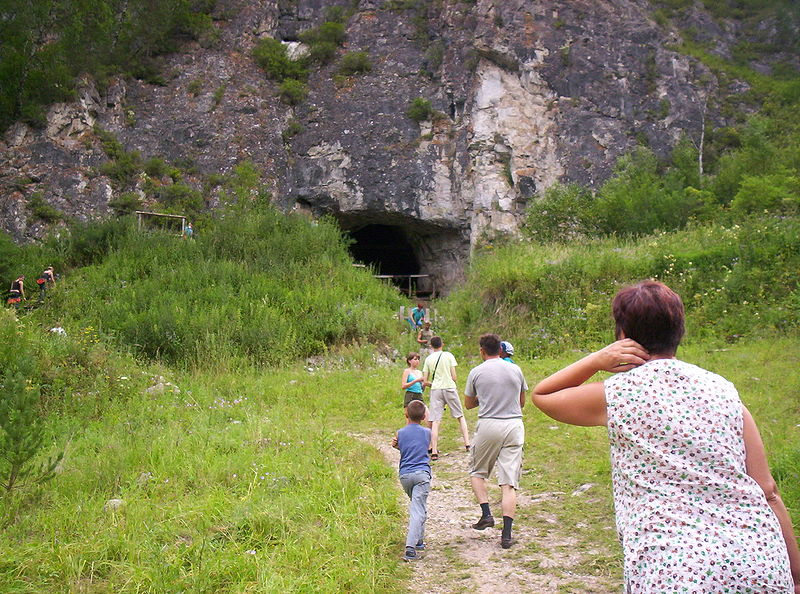
The Denisovan are an extinct human species that once lived in the Altai Mountains in Siberia.  Remains were found in the Denisova Cave (shown above with tourists approaching the entrance) and scientists have managed to extract DNA from a bone fragment that is at least 30,000 years old.  What did that DNA tell us?  The bone belonged to a little girl who had brown eyes, brown hair and dark skin.  Gosh, sounds a lot like me.

Her remains were discovered along with microblades (small stone blades used as tools), body ornaments of polished stone, and a molar shaped very differently from that of Neanderthals and modern humans.  The finger bone from the girl and the tooth were from different people.

Body ornaments – I guess jewelry has been forever popular. Maybe not so different from us as we might think.

The Denisovans lived at the same time as the Neanderthals and both Denisovans and Neanderthals interbred with each other and with homo sapiens, the species we now know as modern humans.  Yes indeed, if you are European, then approximately 5% of your genetic material is Neanderthal and part of it may well be Denisovan too.

You can read more about this exciting discovery here and here.

______________________________________________________________

Disclosure

I receive a small contribution when you click on some of the links to vendors in my articles. This does NOT increase the price you pay but helps me to keep the lights on and this informational blog free for everyone. Please click on the links in the articles or to the vendors below if you are purchasing products or DNA testing.

Thank you so much.

DNA Purchases and Free Transfers

Genealogy Services

Genealogy Research

Is History Repeating Itself at Ancestry?

Is history repeating itself at Ancestry?

I’ve been thinking about whether or not I should publish this posting.  As I write and rewrite it, I still haven’t made up my mind.  It’s one of those sticky wickets, as they are called.  One of the reasons I hesitate is that I have far more questions than answers.

One of the reasons I feel like I should publish it is because we, as a community, have far more questions than answers.  I’m concerned that we’re being exploited, manipulated and deceived. I feel like we’re already on the way down a slippery slope, and I fear a flush is at the bottom.  If that is true, we’re entirely powerless if we don’t know about it.

Since you are reading this, I obviously decided to publish it, so I’ll let you decide for yourself.

Over the past few weeks, I’ve been getting this sinking feeling in the pit of my stomach as Ancestry’s most recent DNA testing mess has unfolded like the leaves on the beautifully deceptive skunk plant.  Yes, the skunk plant is named that for the reason you think…things just aren’t what they seem at first glance…and they smell….really smell.  And by the time you figure out that you’ve made an error in judgment, you’re in the middle of a smelly mess.

This isn’t the first time that Ancestry has had some really significant problems with DNA testing and quality.  However, this second time is more complex and includes ethics issues.  I’m not sure where the problem lies, and maybe the answer isn’t in just one place, but multiple problems in multiple places.

Those who fail to learn from history are doomed to repeat it.  Let’s take a look.

Ancestry and Sorenson

In 2002 Ancestry introduced DNA testing for their customers by partnering with Relative Genetics, an arm of Sorenson, which had just been formed.  Of course, this was not autosomal testing, but Yline and mitochondrial DNA.   To say this was unsuccessful is an understatement and being kind.  Ancestry lost kits, having to eventually give refunds, “predicted” haplogroups dramatically incorrectly (paternal cousins in haplogroups R and G, respectively), and generally made a  mess of DNA testing.  Thankfully, they didn’t last long and one day – poof….gone.  No more Ancestry.com DNA testing.  The lab?  Sorenson.  What or where was the problem or problems?  I have no idea.  Just like the young girl who went away to live with “Auntie” and had a baby, it was never publicly discussed.

Let’s take a look at Sorenson.

Sorenson and GeneTree

Sorenson, www.smgf.org, was founded as a nonprofit research organization in 1999 by Mormon philanthropist, James Sorenson (deceased in 2008) in order to study the relationship between DNA and genealogy.  Unlike other testing companies, initially there was no charge to submit your DNA, but you were required to include a 4 generation pedigree chart.  You did not receive personal results.  Your results were, in time, added with your pedigree to their data base.  Their project to acquire DNA samples and pedigree charts came to an end in June 2009, and free testing was no longer available.  They began selling DNA testing services through GeneTree.

In 2007, in a somewhat controversial move, since Sorenson was supposed to be nonprofit and research only, they reconfigured and “launched” GeneTree, a DNA paternity testing company that they had acquired in 2001.

In 2009, they began to offer a resource for people to be able to obtain their Sorenson results and matches for a fee.  I was excited about being able to “unlock” my Sorenson matches as they advertised.  I ordered this “unlock” for $39 the very first day it was available, and sure enough, I had several matches, BUT, none of them were unlocked, so I couldn’t “see” them. I was encouraged to contact my matches through an internal message system and ask them to also pay the $39 to unlock their results so we could “see each other.”  I clearly didn’t understand the nature of ‘unlock”, or really, half-unlocked, when I spent my $39.  However, I figured if I just waited, eventually, others would unlock theirs too.  After all, it was the first day.

I didn’t have a good feeling about how this unfolded.  I felt like they were just using their customers to recruit other customers AFTER they had paid their unlock fee.  Kind of a mini dna pyramid scheme.

I checked back periodically, and one day, I could no longer access my results.  I contacted GeneTree and was told I had never ordered the “unlock.”  I sent them screen shots of my matches, which I had taken on the first day, but to no avail.  I could either try to find my original receipt and use that as my next form of argument, or simply give up.  I decided that since very few people were unlocking results, and none, of course, were full sequence, it was pretty much futile anyway and I didn’t spend any more time fighting with them.  They obviously had no motivation to find my records and make it right.  I went from feeling somewhat used by Sorenson/GeneTree to disgusted.

Ancestry’s ComeBack with Relative Genetics

After Ancestry’s first entrance and exit from the genetic genealogy playing field, they linked search-result surnames to Family Tree DNA’s projects.  One day in 2006, we noticed the link was gone and suspected that they were preparing to reenter the DNA testing space, and indeed they did in 2007 by purchasing Relative Genetics, their earlier partner.

I never tested at Relative Genetics, but I do understand that their clients were notified and there was an opportunity to opt out of that transfer.  Many people felt this should have been handled the other way – that you should have had to “opt-in” instead of opting out.

The Relative Genetics results were transferred into an Ancestry data base.  Ancestry simultaneously began their own testing program, and allowed people who tested at other labs to manually enter their data as well.  This increased Ancestry’s data base so that people who tested through Ancestry had results to compare to.

Ancestry still has issues with haplogroups because they don’t test SNPS.  Until they do, they will never be able to correctly assign haplogroups.

Their mitochondrial DNA matching is chronically wrong.  I have no idea how they do that, but anyone could do better with a simple spreadsheet, or even visually looking at the list.  Quality controls are apparently absent, in this, the most simple of tasks, and it surely calls into question the level of quality control in place for more complex tasks and matching where we can’t see all of the data.  This continual problem engenders no confidence at all, and the worst part is that it has been like this now for years and they have never fixed the issues.  Either their quality control is sorely lacking, or they simply don’t care.

As far as I was concerned, I was thoroughly disgusted by this point.  It had become apparent that adding people to their data base, in spite of clerically introduced mutations (typos), and generating revenue was a much higher priority than providing correct data on the back end.  But then again, Ancestry, in their other businesses, has never been known for accuracy or quality – only for barely-acceptable levels of mediocrity.

Of course, Ancestry has been on a shopping spree – buying up anything that smells like competition.

Ancestry Buys Sorenson and Genetree

In May of 2012, Ancestry purchased GeneTree and the genealogical and anthropological  assets of Sorenson, including their DNA data base.  Those of us who had contributed our DNA to Sorenson for research purposes felt betrayed and exploited.  Never did we imagine, in our wildest dreams, that our DNA would wind up with a commercial entity that would use our data, that was never “released” to us, to profit.  Nor were we notified.  If you managed to hear about this through the genealogy grapevine, there is apparently an “opt out” option if you contact Ancestry.com.  I could not find a link, but calling their support number should do it.  It’s unclear whether Ancestry actually bought the Sorenson lab.  Sorenson still does Forensic work and the management team at Sorenson Forensics is different than the Ancestry team.

Ancestry and Autosomal DNA Testing

In 2012, concurrent with the Sorenson/GeneTree purchase, Ancestry began to offer autosomal DNA testing, presumably using Sorenson’s lab, although I have been unable to verify that and Ancestry themselves are very tight lipped about the topic.  Given the history of quality and confidence issues, many old-timers in this field were skeptical.  We had hoped that perhaps Ancestry had spent enough time and investment up front that they would “get it right” this time.  CeCe Moore’s first posting was exciting, and we hoped that once again, one of the companies would set a new standard for everyone to leapfrog to.  It didn’t take long to discover that wasn’t the case.

If you haven’t already seen the series of blogs about Ancestry’s quality issues with autosomal testing, take a look at CeCe Moore’s blog postings about Scandinavian admixture and more recently, the horribly discouraging adoption sibling match mixup.

To me, the worst part of this mixup issue isn’t that a mistake was made.  It has happened before at other labs, but the difference is that in the other case, the company, 23andMe, stepped right up to the plate, took responsibility, and fixed the issue along with the underlying problem.  They didn’t try to make it someone else’s issue or pass the buck…and they were truthful.

In this case, when Ancestry was notified by the customer that an issue existed, apparently Ancestry did not take significant notice of the situation.  If there is a link or escalation procedure between the support department and the lab, it apparently wasn’t initiated or didn’t work.  After the customers persisted, Ancestry said they would send them a new kit, but it would be about 2 months or so before they got results.  Clearly, Ancestry wasn’t concerned that they had an issue within their system someplace…or that 2 months would have shrunk into overnighting kits and an immediate lab run.

Because Ancestry does not allow people to access or download their actual raw data, as does Family Tree DNA and 23andMe, the participants were unable to verify or dispute the findings and had to rely solely on Ancestry’s fatally flawed comparison.

Out of sheer frustration, and a sense of ethics since she had initially encouraged autosomal testing through Ancestry, CeCe Moore then reported what happened on her blog.  It took Ancestry another 3 full days to “discover” her post, call her and finally offer an explanation that was, in fact, significantly different than that given to the actual client whom CeCe is working with.  Had Ancestry paid attention, it would never have gotten to this point.  Had they listened to the customer, it would never have gotten to this point. If they allowed people access to their own data, we would have tools to help these people and it would probably never have gotten to this point.  Looks like we don’t have to wonder anymore about Ancestry’s quality controls.

However, we’re not done yet.  To add insult to injury, Ancestry then claimed that they discovered this error themselves, through their “quality control procedures.”  Really?  When did CeCe’s blog become part of Ancestry’s quality control procedure?

Here is their reply on CeCe’s blog.

“AncestryDNA, and the laboratories we work with, take the quality and accuracy of our DNA test very seriously.  Through our quality control procedures, we recently discovered that a small number of customers had a problem with their DNA results due to a laboratory error. In the rare case where there is an error, we work directly with our members to correct the results, which in some cases requires a new DNA sample. We have contacted all the individuals affected by this error and are in the process of correcting it. We sincerely apologize for any inconvenience and confusion that can be a result of an error and are working hard to make this right for our members in a timely manner. We appreciate everyone’s patience as we continue to fine-tune this exciting new product.”

Compare the above statement about how important quality is to Ancestry to the following section from their mandatory release that everyone has to sign when they activate the AncestryDNA autosomal DNA kit.

“In addition, we do not make any representations as to the accuracy, comprehensiveness, completeness, quality, currency, error-free nature, compatibility, security or fitness for purpose of the AncestryDNA Website, Content or Service.”

Instead of stepping up to the plate, thanking CeCe for discovering THEIR problem, apologizing and accepting responsibility, Ancestry tried to make this uncomfortable situation CeCe’s fault, saying CeCe should have called them personally instead of blogging, and then misrepresented what happened to cover the ugly truth.

CeCe discusses this phone call in a second blog about this topic.  Be sure to read the comments.  She is obviously not making any friends at Ancestry, but bless her for being our advocate!  David staring up into the face of Goliath.

Consent and Release

In the midst of all of this, we also discovered that, according to Ancestry’s release and consent forms for autosomal DNA testing, that they can aggregate and sell our data.  So they can sell our data, including our medical data, but they won’t provide the same raw data to us so we can provide at least a minimal check on their “quality control.”  All of a sudden, the low price for the kit and their focus on amassing large amounts of data start to make a little more sense.  Who are the customers for purchasing our data?  What do they want to do with it?

Ancestry obtains consent by what could be construed as a “shady” practice of positioning the research consent and testing release agreements adjacent, not stating that the research consent is optional and inferring by industry standards that one must click to proceed.  The release to sell our data is not optional. And none of this consenting happens when ordering, or prior to ordering, the kit. It happens later, after you’ve paid and received your kit, and there is a $25 charge at that point to cancel the order.  Ah yes, the slippery slope.

If you’d like to hear what Dr. Ken Chahine has to say, you can see him testify before the Presidents Commission for the Study of BioEthical Issues.  A transcript is here.  Dr. Chahine is the senior vice president of Ancestry.com and general manager for Ancestry DNA where he leads the development and commercialization of population genetics.   He is also professor of law at the University of Utah and has held various positions in the biotechnology industry including president and CEO of Avigen.  He holds a PhD in Biochemistry along with a law degree.  In this testimony, he says that Ancestry’s customers own their own data, but then he says the following:

“My thing — what’s interesting from a commercial standpoint is we — a lot of customers get data from either us or from other services.  And what I see that’s a little disturbing sometimes is that they upload their data to sites that quite frankly I can’t even have — I try to research who these individuals are that are doing additional research on people’s data.  And I’m not even sure who they are or how they’re qualified and if the data that they’re getting back are even, you know, valid, right?  So the point is that I think that we are moving in a direction where consumers feel comfortable, rightly or through ignorance, uploading their data to other sites.  So I do think that restricting sort of the end I think is important just to be able to take care of that issue.”

Ironic, given Ancestry’s current adoption sibling mixup, that Ken is concerned about “the data they’re getting back are even, you know, valid, right” from other resources, when the information from Ancestry itself isn’t.  So apparently Ancestry is being the benevolent parent to all of us, restricting us from having access to our own data, that they say we own, while they retain the right to sell it to others.  Hmmm….I smell a rat…or maybe it’s that skunk plant. Ancestry is afraid we might do something “bad” with our data, like, for example, catch their errors.

The True Cost Isn’t $99

And there is more too.  It also appears that if your Ancestry subscription expires, that you no longer receive matches that you can contact.  If in fact this is accurate, and there is really no way for any of us to test this right now, that was never made apparent when purchasing the kit.  Apparently, you will receive the match, but you cannot contact your match unless you subscribe minimally to “Ancestry Connections” which allows limited access to family trees, photos and DNA results for $4.95 per month which equates to $59.40 per year.

So the real cost of the AncestryDNA test isn’t $99, but $99 plus either an Ancestry subscription for $155 per year for the US or $299 for the world or alternately, the cost of Ancestry Connections, $59.40 per year.  It’s unclear whether or not if you only subscribe to the US Ancestry package if you only get US matches.

In any event, this subscription requirement was not made apparent up front and it dramatically changes the landscape of the cheap $99 test.  It adds strings that weren’t evident up front and if you no longer maintain your subscription in some way, you lose the benefit of your DNA test and any other DNA tests you’ve paid for and are associated with your account.  Ouch.  How many people would have tested if they knew their results would be held hostage for the price of a subscription?  And what happens to those results when you can no longer maintain your subscription?  Are they just gone to you forever, but still available for Ancestry to sell and for others to see?  Can someone else “adopt” them under their subscription so they can still be available for family members?

In my opinion, this is very ugly and the only benefit to anyone is to Ancestry to be able to extort subscriptions from people who want to maintain access to their DNA results, something they didn’t know they had to do when they purchased the autosomal DNA kits initially.  After all, that’s not the way the Yline and mitochondrial results worked, and there was no reason to suspect that autosomal testing would work any differently.  This amounts to genetic entrapment.

This is a very different model than at Family Tree DNA where results are available forever with no additional cost, and in perpetuity for the family through either private arrangements (account number and password sharing) or the Beneficiary Assignment on your personal page.

As we unearth the truth, morsel my morsel, I’m sure more information will be forthcoming as people discover what does and does not work, and under what circumstances.  But isn’t it sad that we have to do this at all.  Whatever happened to being forthright and upfront?  I think that is called integrity isn’t it??

How Many Strikes Til You’re OUT???

By now, I’ve lost count of how many strikes Ancestry has.  Where is the umpire?

Everyone and every company makes mistakes.  But the difference is in how (and if) they handle those errors when they do occur.

Given that Sorenson and Ancestry had the original debacle that ended Ancestry’s early DNA testing foray, and they, together, are having another very similar-feeling debacle in 2012, I have to wonder if history is repeating itself.  This difference is that this time, Ancestry is now publicly held and has invested so much money, just considering their initial give-away of 10,000 autosomal kits (about $250-300 market price each, a total of 2.5 to 3 million dollars) to build their database, that they are unlikely to exit.  The DNA testing marketplace has too much potential and they have a captive audience of about 2 million subscribers.  If every subscriber orders just one test of some type for about $100, that equals 200 million dollars.  And corporate profit is about expending as little as possible for as much revenue as possible.  Better yet, for Ancestry, DNA is a permanent hook to keep people from letting their subscriptions lapse.  The percentage of people who abandon their subscriptions has declined in the past year from from 4 to 3.4%.  Perhaps that is part of the reason why they are willing to sell their AncestryDNA product for $99, less than their cost of processing this test, that their two competitors sell for $289 (www.familytreedna.com) and $299 (www.23andme.com), respectively.  The other reason, of course, could be that they plan to sell aggregated DNA data.

The thing I find interesting is that at least one individual was at Relative Genetics, at Sorenson/Genetree and is also now at Ancestry.  Initially I thought this was a good thing, bringing Ancestry some much needed experience.  Now, I’m not so sure.  Like I said initially, I don’t really know where there problems lie….I just know they exist and have at some level chronically.  On top of this, it seems that things are just never exactly what they seem.

The part of this that I find the most distressing is the positioning – Ancestry experienced a lab error which “they discovered and notified the people”.  Not true, at least not in the adoptee’s case.  Ancestry couldn’t be bothered to pay attention until CeCe blogged and embarrassed them, and then they distorted the facts.  And then they had the audacity to be upset with CeCe.  What is wrong with this picture?

Ancestry has positioned themselves to absorb as many DNA results as possible by purchasing other companies and nonprofits, and from the general public entering results into their data base, with little focus on accuracy, and a lot of focus on building their data base and selling kits.  They are presuming that most of their customers, being DNA novices, won’t know the difference.

Ancestry has also positioned themselves to sell our results, aggregated, including those we contributed to Sorenson, a nonprofit at that time, but will not release those results to us.  I’m referring here to both the Sorenson results and autosomal raw data from the AncestryDNA test.

And whatever happened to all those Genetree people who paid the $39 unlock fee?  What about the records they paid to unlock and see?  Maybe they just lost all the records and it’s no longer a problem.

This behavior has gone from disheartening to discouraging to disgusting to shady to reprehensible.  This is the kind of behavior that eventually will cause this industry to be federally regulated, which will literally drive it out of business.  Who would visit a physician to obtain a prescription for genetic genealogy testing?  In order to avoid this, it’s important to self-regulate ourselves by bringing pressure for unacceptable behavior to stop.

Call to Action

So, what can we do?

  1. Communicate with Ancestry that their behavior regarding these issues is not acceptable. Neither is their paternalistic attitude on one hand while exploiting their customers on the other.  It’s one thing, and bad enough, when dealing with submitted genealogy trees and substandard offshore records translations, but DNA testing must be held to the highest of standards.  It is the sacred gift of our ancestors, the ultimate truth.  As you are probably aware, Ancestry is encouraging everyone to connect their genealogy trees to their DNA results so they can be populated up the trees.  It’s only a matter of time, on the present course, until they have a mess that can’t be unraveled.
  2. If you have taken the AncestryDNA autosomal test, request your raw data results from Ancestry.  They think CeCe is a lone renegade voice.  She is not.  We’re a community.  Call them at 800-262-3787 (regular support) 800-958-9124 (DNA support) or click on the “Beta Send Feedback” button at the top right of your DNA page.  They have stated that feedback through these avenues, especially the Beta Feedback button, is how they are prioritizing their next steps for DNA.  This data is yours and you have a right to have it. Furthermore, you can never verify the accuracy of what they report without it.
  3. Vote with your money and buy either at Family Tree DNA or 23andMe.  While both have their advantages and disadvantage, neither the ethics or quality of either of those companies is being called into question.  Neither requires a subscription.  Family Tree DNA never has.
  4. Tell your friends, family and project members to do the same.  Those 2 million subscribers that will potentially order DNA tests are all related to someone.

If Ancestry can’t get it right, then they shouldn’t pollute this industry for the rest of us.  I hope they get it right and recover their credibility.  I hope I’m wrong about the slippery slope and the flush.  But I know I’m not wrong about the skunk-plant.

In the mean-time, I leave you with the saying that’s been on the wall for years at  Baskin-Robbins:

“There is hardly anything in the world that someone cannot make a little worse and sell a little cheaper, and the people who consider price alone are that person’s lawful prey.”

______________________________________________________________

Disclosure

I receive a small contribution when you click on some of the links to vendors in my articles. This does NOT increase the price you pay but helps me to keep the lights on and this informational blog free for everyone. Please click on the links in the articles or to the vendors below if you are purchasing products or DNA testing.

Thank you so much.

DNA Purchases and Free Transfers

Genealogy Services

Genealogy Research

Family Tree DNA New YouTube Channel

Family Tree DNA has introduced a new YouTube channel.  Take a look at this video – Discover the Journey of You.

If you are active in the Genetic Genealogy community, you’ll see people and names you’ll probably recognize, including yours truly.  This was filmed, in part, at the Family Tree DNA sponsored International Conference for Genetic Genealogy in November of 2011.

I want to say congratulations to Lenny Trujillo, one of the people featured in this video.  Lenny is one of my clients and made wonderful discoveries beginning with his DNA test.  His discoveries have continued as a result of the doors opened by his DNA.

Eventually, Lenny also took the WTY test, and it was through Lenny that we discovered a new, critical, SNP for Native Americans which further identified the Native American haplogroup, Q1a3a.

See what can happen as a result of swabbing…..you can make history for yourself and your family, discover your ancestors and contribute to science that will help others as well.

______________________________________________________________

Disclosure

I receive a small contribution when you click on some of the links to vendors in my articles. This does NOT increase the price you pay but helps me to keep the lights on and this informational blog free for everyone. Please click on the links in the articles or to the vendors below if you are purchasing products or DNA testing.

Thank you so much.

DNA Purchases and Free Transfers

Genealogy Services

Genealogy Research

Dutch Genealogy – Maybe Not So Hopeless Afterall…

When we blog, we think about helping others.  I never thought that it might help me….but it has and in a most unexpected way.

One of the blog subscribers, a lovely lady named Yvette Hoitink, posted the following comment in response to my DNA Pedigree Chart blog where I mentioned that my Dutch line was pretty much hopeless:

“I’m sorry that you’re having such a hard time finding your Dutch ancestors. BTW, it’s not true that Dutch people didn’t have surnames until 1811. When surnames became hereditary differs greatly from province to province. In Friesland, most people used patronymics like you described until 1811.  In provinces like Zuid-Holland and Noord-Brabant, most people had hereditary surnames by the end of the medieval period.

What are your Dutch brick walls? Perhaps I can help you break through them.”

We began an e-mail exchange at that point.  Never being one to turn away a possible ancestor lead, I answered Yvette:

“Thank you very much for your offer of help.  I am obviously ignorant of Dutch resources and I appreciate your kindness.

I have primarily three Dutch lines.  One is rather recent and that is the one I’d love to break through the most.

Bauke Hendrick Ferverda was born, probably in Leeuwarden, where his father lived and was a school teacher, on Jan. 26, 1830.  He married Geertje Harmens de Jong probably in 1853 as their first of 3 children was born in Sept. of 1854.  She died on October 3rd, 1860.  Their daughter, Lysbertus, was born on Nov. 21 1859 and died on July 23, 1860.  I would guess that the mother and daughter are buried someplace together.

Bauke remarried in 1863 in the Netherlands.  He and his new wife immigrated to the states in 1868.

Back in the 1970s, one of the Ferverda family members went back to Holland, to Leeuwarden and discovered quite a bit about the Ferverda family side, but they neglected her side of the family.

I don’t even know where to begin to look for information in the Netherlands, or where the records might be.  Do you have any online research tools?

Thank you in advance for any enlightenment.”

Yvette’s answer gave me hope like I haven’t had in years.

“Boy do we have online resources:)  I think the Netherlands has a great combination of very reliable records, many of which are available online for free.”

Ok, Yvette, now you have my attention.

“Ferverda sounds like an Americanization of Ferwerda. That’s a typical Frisian name, which they probably took in 1811 to denote that they came from the municipality of Ferwerderadeel. In Friesland, most people had patronymics only until 1811.”

She’s right, it did used to be Ferwerda.  I’m impressed.

“Some Frisian resources: http://www.tresoar.nl (Friesland provincial archives) and http://www.allefriezen.nl (genealogical database + images, all free!).

On the Alle Friezen website, which is also available in English by clicking the British flag, you can find a lot of the birth, marriages and death records of the period of the civil registration (1811 onwards). You can use the Advanced search option to search for first person – family name: Ferwerda and first name: Bauke and second person – family name: Jong (careful: don’t include “de” because that is a prefix and not considered to be a part of the family name). This will yield 3 results. The first is their marriage, with the option to click through to a scan.”

You know, I’m sure, that I never read the next paragraph for several hours.  When I discovered that my ancestor’s marriage record was on that site…I slipped into some type of genealogical stupor from which I only regained consciousness after I had tried every single family member’s name in that website’s search engine.  I then discovered it was the middle of the night.  It was afternoon when I started.

“Both the index and the scan provide you with her parents’ names: Harmen Gerrits de Jong and Angenietje Wytses Houtsma. You can now repeat the same process by searching for the first person: Jong and second person: Houtsma to find their marriage certificate which shows their parents names.  Their marriage would have been prior to 1811, so you can’t find that on AlleFriezen but you may have more luck on the Tresoar site (see below). You can try to find their death records as chances are that they died after 1811.”

Oh no, a new brick wall….

“Go to http://asksam.tresoar.nl/ (no English version) and select Dopen voor 1811 (baptisms before 1811), Trouwen voor 1811 (Marriage before 1811) and Begraven voor 1811 (Burials before 1811) and then type in the names you’re searching for in the ‘Zoeken naar’ (Search for) textbox and then click “Zoek” (Search). You can first try to search for their family name but it’s very probably that they only started using this name since 1811 so search for the first name and patronymic as well.”

Ok, now this is getting tough.  That “no English version” put a bit of a damper on things….but then again, Yvette obviously speaks and reads Dutch.  Hmmmm……

“You can also consult the records of who took which name by going to http://www.tresoar.nl/mmtresoar/main/content_pagina_volledig.jsp?lang=nl&pagina=famnaam&stylesheet=onderzoek.css%20target= and type in the family name in the “Zoek op” (search for) textbox and then press “Zoek” (Search).”

These are the actual naming records.  I think I’ve died and gone to Heaven.  They tell you who was in the family in 1811 when they adopted their surnames.

“Another good site is http://www.archiefleeuwardercourant.nl/, which is a newspaper archive of the most popular provincial newspaper. Just type in a last name to see what pops up.”

Well, the only thing that popped up was Dutch.  Of course.

“By using these sources, you should be able to go back to at least the middle of the 18th century. If you’re lucky, the family will have some unusual first names and you’ll be able to go back further. Feel free to ask me again once you’ve hit your new brick walls:)”

Why yes, I’ve already hit new ones already.  That didn’t take long at all.

“You might also be interested in the slides of a presentation I gave earlier this year. The slides are available at http://www.dutchgenealogy.nl/index.php?option=com_content&task=view&id=159&Itemid=1 and give an overview of the most important records for Dutch research. The focus is mainly on records that are available online.”

Am I really drooling on myself???

“Another favorite website of mine is http://www.geneaknowhow.net/digi/resources.html. That’s a portal website with links to all online sources, transcriptions, scans and databases. Just click the ‘internet’ link below Friesland and you’ll find more than enough to get you through the winter.”

Wow, Yvette, Wow!  I haven’t slept in 3 days.  I love those words, online and free.  And on many of these sites are the actual images.  I saw my ancestor’s actual SIGNATURE!  An incredible find for a genealogy junkie.  I just love bureaucracy because it taxed people, kept records of them and made them sign things.  YES!!!

I mined and dug and browsed and it all worked well, until I ran out of dates.  Since I can’t read Dutch, I couldn’t read the various documents to determine if the Jan Ferwerda in question was mine.  And while Ferwerda (Ferverda) is an extremely unique name here, believe me, it’s like Smith in the village where they lived in Holland.

Now what?

Yvette to the rescue again.  Turns out, Yvette is also a professional genealogist.  Who-hoooo….my lucky day.  But it gets better.  She works at the National Archives.  I’ve died and gone to Dutch ancestor Heaven.  Be still my beating heart!

Here’s the website about her services….but only on one condition….you folks can’t have her until I’m done:)

http://www.dutchgenealogy.nl/index.php?option=com_content&task=view&id=160&Itemid=77

Yvette sent me a wonderful research plan based on what I have (not a lot) and what I want (well, duh….everything) and we get started tomorrow.  She of course had to tell me what was reasonable given the extant records….and there is actually an amazing amount.  And just think, I thought this line was hopeless.  Apparently not!

And maybe, just maybe, I can add to my number of ancestors found, including wonderful details of their lives.  Maybe eventually, I can also to the list of those whose DNA I have as well.  I can hardly wait as I embark on this unexpected genealogical journey through Friesland in Holland, the land of my ancestors with Yvette!  Let’s go!

______________________________________________________________

Disclosure

I receive a small contribution when you click on some of the links to vendors in my articles. This does NOT increase the price you pay but helps me to keep the lights on and this informational blog free for everyone. Please click on the links in the articles or to the vendors below if you are purchasing products or DNA testing.

Thank you so much.

DNA Purchases and Free Transfers

Genealogy Services

Genealogy Research

Surprise Y Matches – What do they Mean?

One of our blog followers, Tom, encountered the following situation, which, really isn’t so uncommon.

“I started up a Y-DNA surname project and recruited my only three living male 1st cousins who carry that name.

The first set of 67 results have recently been posted and within a day an exact match appeared with an individual who had only tested to 37 markers back in 2008.  Apparently the individual has had very few close matches and never a perfect match like my cousin’s.  But the individual has a different surname.

Is it possible to have an identical match as a random event?  How common are such occurrences?  What possible explanations could there be?”

Let’s look at Tom’s situation from different perspectives and see what we can find.

When I do DNA Reports for people, I still find people who don’t have any matches.  It’s not as unusual as people think.  In a way, it’s a blessing as compared to people who have so many matches that they can’t even begin to sort through them.  But to the person who doesn’t have any matches, it surely doesn’t seem like there’s a positive side to the situation.

First of all, remember that mutations can happen at any time in any generation….or not.  In the Estes line, Abraham Estes, one of two Estes immigrants to colonial America was born in 1647.  He had 8 sons.  We had DNA from the descendants of all 8 sons.  We reconstructed Abraham’s DNA using triangulation, so we know what his original genetic “signature” looked like.  One of those sons’ lines has 4 mutations in 8 generations, and one line has none.  The rest fall in the middle someplace.

I only mention this to illustrate that mutations are truly random events.  We use statistics to look at the “most likely” scenario, based on averages, but mutations are personal events and while they, as a whole, fall nicely into statistical models, individually, they happen when they happen.  You can see that the mutation rate can vary quite a bit, even within families.  Keep that in mind during the rest of this discussion.

Family Tree DNA gives us some tools to work with these kinds of situations.  The TIP calculator, available for every match by clicking on the little orange TIP button, tells us, statistically, how likely people are to match at which generational level.  This is called the time to the most recent common ancestor, or MRCA.  I did an earlier blog about this.

Comparing two exact 37 marker matches, below, we see that, statistically speaking, on the average, these two people are most likely to share a common ancestor about the second generation, meaning grandparents.  Again, word of caution, these are averages, which is why you have a range shown here.  DO NOT TAKE THEM LITERALLY.  I can’t tell you how many people obsess over these numbers and think that these numbers are telling them exactly when they share a common ancestor.  They don’t.

So let’s answer the questions that Tom asked.

Is it possible to have an identical match as a random event?

No, it’s not.  These men share a common ancestor at some point.  The question is, when and where.  However, it is possible to match on many markers, and then not on others.  I would suggest that these men upgrade to 111 markers and see how closely they match at that level.  I have seen at least one instance where 2 men matched at 37 and then had 5 or 6 mutations at the 67/111 marker level.  Unusual?  Yes.  Impossible?  No.

How common are such occurrences?

This isn’t as unusual as you would think.  I see this fairly often.  I always tell people to do four things.

First, upgrade the people you have to 111 markers.  If they continue to match at 111 markers, exactly, you probably have a very close match genealogically.

Second, find a second person to test from each line, as far back as possible.  In other words, if you’re testing the Abraham Estes line, you would want to find another son from Abraham to test to see if the DNA of the two sons match.  If they do match, then you know you have the lines proven back to 1647.  If not, then you know you have a non-paternal event (NPE) of some type, otherwise known as an undocumented adoption.  I call them undocumented adoptions because everyone knows what that means, and regardless of how it happened, it’s “undocumented” because we didn’t know about it.  In Tom’s case, he already has his 3 cousins, so his line is proven back to the common ancestor of those men.  Hopefully the person with the other surname can also find someone else from his line to test.

Third, enter the results into Sorenson at www.smgf.org and also into www.Ancestry.com for Y-line results to see if you come up with any other people who also match with that surname.  This is especially useful if you are having difficulty finding people to test.

Note: Neither SMGF nor Ancestry’s Y data base are available.

Fourth, look around the neighborhood – genealogically.  Are there reports of the two families in question being allied or intermarried in some location?  Were they neighbors in the same county?  In many cases, once you figure out that an undocumented adoption occurred – you can figure out in which generation through selective DNA testing, and often, which families were involved through DNA combined with historical and genealogical records.

In essence, to solve this type of puzzle, you need to become somewhat of a genealogical detective.

Tom’s last question was what kinds of situations could explain these results.

In some cases, especially where there are some mutations involved (meaning not exact matches), suggesting some time distance between common ancestors, matches between surnames occur because the families involved simply adopted different surnames.  When surnames were adopted varies dramatically by the location of the families and the circumstances involved.  For example, in the US, some Native American families were still using Native names in the 1880s.  Freed slaves adopted surnames upon obtaining their freedom in the late 1860s and early 1870s, and sometimes changed that surname at will.  In the Netherlands, some families didn’t take names until in 1811 when Napoleon mandated that they do so.  In England, some wealthy families had surnames by 1066, but peasants didn’t adopt surnames, for the most part, until in the 1200s and 1300s.  Jewish families in some parts of Europe didn’t adopt surnames until in the early 1800s.

Sometimes surname changes that look to us like undocumented adoptions occurred not at birth, but later in life.  Some people simply changed their names for a variety of reasons.

In one case, a man named John though he killed a man in Tennessee, ran off to the frontier which was at that time in Texas and changed his name, only to discover years later that not only had the man he shot not died, but that man had then married John’s wife he abandoned when he left.  Hmmm….karma at work.

One of the most common reasons for ‘undocumented adoptions’ is that a step-father raised the children and the kids simply used his name….forever.  So maybe John’s kids, above, took the surname of the man John shot.  Now this is getting interesting!!!  No wonder we have trouble figuring these things out retrospectively.

Another reason, of course, is that illegitimate children took the mother’s surname, but carry the father’s DNA signature.  In Native American cultures, matrilineal naming was very common, as is it in the African American culture, especially immediately after the end of slavery.  Children took whatever surname their mother adopted at that time.

Of course, the one thing we haven’t mentioned is the obvious….where someone was unfaithful.  Generally, that’s the first thing people think of…but it’s really not the most common reason.  But sometimes, indeed, it appears that Granny might have been a “loose woman.”  Don’t judge Granny too hardly though, because you really never know what happened in Granny’s life.  She could have had no choice in the matter, or her husband could have been abusive. We often see these conceptions during periods of war, especially the Civil War.  In one case, we know that a woman exchanged sexual favors for food for her children.  It’s really hard to be critical of that woman.

So the real answer for Tom is that there is no cut and dried answer, but lots of possibilities to explore.  You’re going to have to get out your Columbo tools and sleuth away….

______________________________________________________________

Disclosure

I receive a small contribution when you click on some of the links to vendors in my articles. This does NOT increase the price you pay but helps me to keep the lights on and this informational blog free for everyone. Please click on the links in the articles or to the vendors below if you are purchasing products or DNA testing.

Thank you so much.

DNA Purchases and Free Transfers

Genealogy Services

Genealogy Research