Geno 2.0 Results – Kicking the Tires

Update: Please note that the Genographic Project discontinued public sales of kits in 2019. I am leaving this article for historical context.

Yesterday, my husband’s Geno 2.0 results arrived.  I bought his kit for him for Christmas initially, but couldn’t wait that long so had him swab the very day it arrived.  So much for Santa’s surprise.  But wait, maybe his results will hold a surprise – and isn’t this the first day of Christmas?  Oh, it’s not?  Well, I’ve decided to establish a new tradition this year, that it is the first day of Christmas and this year we will simply have 15 days of Christmas.  The extra three days will be dedicated to Y-line SNPs, a mitochondrial haplogroup and ethnicity results.  Who wants a bird in a pear tree anyway?

Geno Kick JimMeet Jim.  Since you’re going to be looking as his “innards,” so to speak, I think you should formally meet him.  Pretty soon you’re going to be wondering what a Neanderthal, Denisovan, German, Greek, Mediterranean Hun looks like.  I wanted to use the photo of him kissing the dolphin in the Carribbean, but he wouldn’t let me.  Harumph.  I guess Huns have no sense of humor.

There’s a lot of information included on the new Genographic results webpage with some very cool features.  We’re not going to look at everything in-depth today, but we’ll do a flyover so you can see everything.  Right now, because everyone is checking the status of their results, the Genographic webpage is experiencing difficulties.  So if you click and wait, well, go get a cup of coffee.  It will eventually respond and multiple clicks only cause buffer problems when it does respond.  I know this from experience.  How many times have I said that patience is not a virtue attributed to me!

Oh yes, and I had much better luck with the webpage using Chrome as opposed to Internet Explorer 7.

The first screen you see is “Your Story.”  It’s large so I’ll break it into three parts for review.  Notice the 5 tabs at the top of the page.  You’ll be using those.  Actually, if you follow the story line, the story walks you through them all.

Geno kick story

The middle portion of this page shows your mitochondrial DNA, autosomal in the center, followed by your Y-line, if you’re a male.  Your haplogroup is displayed as well for mitochondrial, and your terminal SNP for males, which is the SNP that ultimately defines the deepest level of your haplogroup.  Well, at least until a new terminal SNP is discovered.

geno kick story 2

There are a couple of items of note here.

The tab titled “Your Map” simply won’t load, using either browser.  I’ve sent a note to National Geographic.  I know this is loading for other folks though.  I wonder if it has anything to do with Jim’s haplogroup.

Second, for Jim’s paternal line, CTS11962 is a new SNP not previously tested at Family Tree DNA.  CTS stands for Chris Tyler-Smith, a researcher in the UK at the Sanger Institute who discovered this particular SNP, and named it.

We knew in advance that the new standard for both the Geno 2.0 and also Family Tree DNA will be to only provide the terminal SNP and no longer rename the haplogroups in the way they used to be, such as R1a or R1b1a2.  However, the problem with this approach is that someone looking at this terminal SNP has no reference whatsoever at this point.  There isn’t even a “main” haplogroup branch given, nor a link to any explanation, or at least not that I can find.

After transferring Jim’s results to Family Tree DNA, I noticed that he is now labelled R1a1a1g on his Family Tree DNA haplogroup page.  It looked like his mitochondrial results didn’t transfer initially, but this morning after the Family Tree DNA webpage update, he does have results on his mtDNA Haplogroup Origins page, which is about all you can do with haplogroup only information.  Nat Geo, of course, does not test beyond haplogroup designation for mitochondrial.  However, it looks like his autosomal results didn’t transfer anyplace.  Hmmm….maybe a bug.  I’ll have to contact the helpdesk who is probably swamped this morning.

geno kick ftdna snp

Looking at his Family Tree DNA Haplogroup and SNPs page, all of the SNPs Jim was tested for at Nat Geo appear to be listed, but CTS11962, his terminal SNP, seems to be missing, so others may be as well.  Family Tree DNA updated the data base and web page today, but this didn’t seem to be resolved with the update this morning.  It also looks like it might be a page real estate issue in that this section of his page is quite full.

The bottom portion of the introductory Geno 2.0 page provides an interesting tidbit.

geno kick story 3

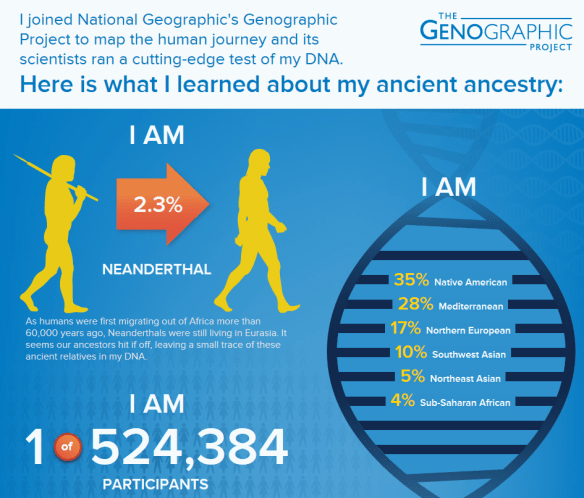
Yesterday, when one of my blog followers sent me his initial results, the “you are 1 of” number was 524,384, and that number had been used for some time, so it’s not dynamic.  This new number appeared a few hours later, so I’m thinking that the answer to the number of Geno 2.0 kits sold might be someplace in the ballpark of 35,131.  Just speculation on my part.

Let’s go back now and look at each section.

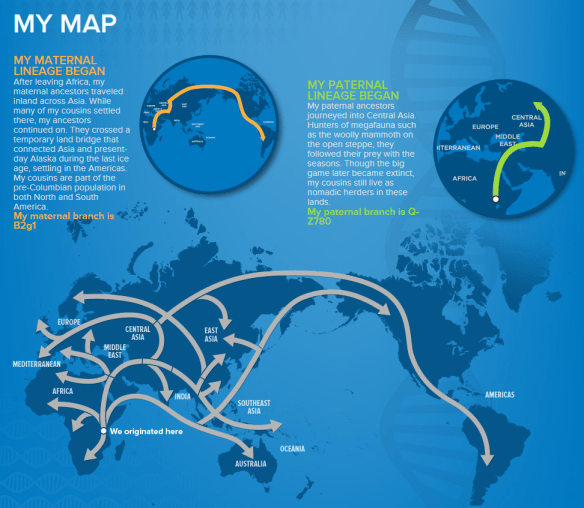
The mitochondrial DNA area provides a basic description of the haplogroup’s journey, then you can click to see the map.

Since his map won’t load, taking a look at another account I have access to, we see the following map information.

geno kick mito map

See the “share” button on the top right hand side of the next page?  This allows you to send e-mails or a number of other types of messages to friends with a nice summary page of your results.  Be sure to type a message in the message box with your full name because otherwise the recipient will have no idea whose info they are viewing.

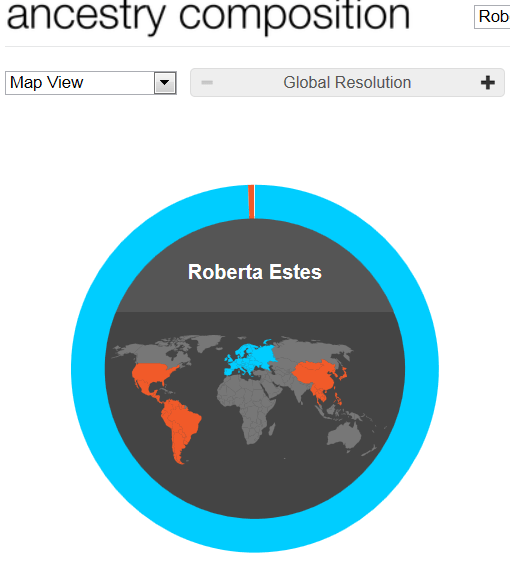
Moving to the autosomal section, we see that they have divided the world into 9 regions, plus Neanderthal and Denisovan.
Geno kick auto 1

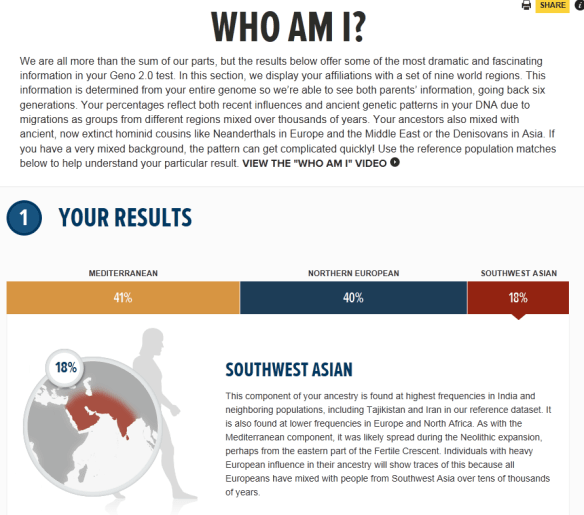
Jim is Mediterranean, Northern European and Southwest Asian.  His genealogy is entirely German and Hungarian.   He’s a second generation immigrant, so none of his genealogy is lost here in the US.  Of course, the term Hungarian should translate into “churning people” because the devastation of multiple wars spanning centuries has disrupted this population significantly.  The same holds true for Germany.  I would suggest that Germanic and Slavic would perhaps be a better description of his heritage.

In any case, the Mediterranean and Southwest Asian were somewhat of a surprise, but when you look at migration patterns, maybe not so much.  After all, we all came through the Middle East on our way out of African and if your ancestors migrated to Germany, they probably went through the Mediterranean unless they went over the Caucus Mountains instead. And that would give you Southwest Asian heritage most likely.

The only problem is, now Jim wants to go on another Mediterranean cruise to commune with his ancestral homeland.  DNA cruises anyone???

The next section explains what the results mean.  This is actually quite interesting because it compares you to the actual reference population.  In his case, in Germany.

geno kick auto 2

His second reference population was somewhat of a surprise.  It’s Greek.  Perhaps it’s the best reference population they have for “Mediterranean” as the Greeks are truly a mixture of just about everyone in the Mediterranean basin.

geno kick auto 3

They do provide links here to more information.  By clicking on the overview of all reference populations, they provide information about how these populations as a whole are made up today.

geno kick ref

I counted and there are 43 populations.  Another option is to click to review the 9 world regions.

geno kick world 1geno kick world 2

The Neanderthal and Denisovan ancestry is particularly interesting since it has been only recently, in the past couple of years, that humans were believed to have interbred with either group.  Neanderthals have been found throughout most of Europe and western Asia, and Denisovans lived in the Altai Mountains of Siberia.  If you click on the little links imbedded in many place on your page, you’ll see that there is more information about almost every topic.  For example, they tell us that everyone outside of Africa carries some Neanderthal and Denisovan.

geno kick hominid

On Jim’s Genographic page, the terminal SNP shown is M458, shown below the map.  Referring now to the ISOGG Y tree, we see that this equates to haplogroup R1a1a1b1a1.  I didn’t expect CTS11962 to be on the ISOGG tree just yet, and it isn’t, but neither is it anyplace else, so we basically have our hands tied relative to where this falls on the R tree until someone places it someplace.  I know that there is what is affectionately referred to as the “Big Paper” in the works that reworks the haplotree, and I surely hope it’s published sooner than later.  Yes, I know, that patience thing again…..sigh.

geno kick y map

You can also view this haplogroup information as a heatmap.

geno kick heat map

Under the “future” button, they ask you to complete your profile and contribute your story.  You may have noticed that these options are stepping you across the tabs at the top of the introductory page.

geno kick next

Under the “Our Story” tab, which is where the “Contribute Your Story” link takes you, they explain about the community and social networking aspects of Geno 2.0.

geno kick our story

Most interesting is the relationship circle, which looks like either a 45RPM record, a CD/DVD or the front of an i-pod, depending on your age.  The stars and planets are the people who are “related” to you and the larger planets are those with stories attached.  You just click on a planet to see their “story.”  The closer they are to the center, the more closely related they are to you, but I’m unsure how “related” is gauged.  For example if you click on the CTS11962 link, does this mean that everyone carries that mutation, or that it’s the terminal SNP for everyone listed?  If it’s the terminal SNP for everyone listed, wouldn’t they all be equally as closely related?  Jim’s V link doesn’t work, but the same questions apply.

geno kick circle

And at the bottom of this page, you can add your own story.

geno kick your story

I understand in the future that one will be able to contact these “related” people.  If so, and if they haven’t tested their STR markers or their mitochondrial DNA at Family Tree DNA, we can encourage them, or invite them, to do so.

And speaking of which, the one thing I really DON’T like is what they’ve done with the download to Family Tree DNA option.  In Geno 1.0, the transfer option said something like “to learn more,” but was tiny and obscure, at the bottom of a page where you had to scroll multiple times.  I’m sure the reason that only 20% of the people ever transferred to Family Tree DNA was because only 20% of the people stumbled across the link and followed it.  Actually, the fact that 20% actually found it is pretty amazing and speaks highly of how interested people actually are in the Genographic project and their results.  This function and where it’s located is even worse in this version.

To initiate a transfer to Family Tree DNA, first, you have to know that you want to do this. There is no enticing “advertising” or education like there is for other information.  This would be a wonderful opportunity for a nice video or at least a writeup and a link that at least says “to learn more” encourages people to investigate.  Now, you need to go to your Profile link, and under the profile link, click on the Advanced Options.

Nope, I don’t think even 20% of the people will find this.  I’ve very disappointed and hope they will reconsider and rework this option.

I am very hopeful that with some constructive and pleasant feedback that perhaps Nat Geo will reconsider and bring this transfer option into line with the otherwise wonderfully designed and world-class project pages.  Their e-mail address is genographic@ngs.org.

Genographic has so much to offer and Family Tree DNA’s customers and project administrators have played a huge role in recruiting for both Geno 1.0 and 2.0.  I’d really like to be sure that all Geno 2.0 participants receive everything they can out of the total genetic genealogy and anthropology experience.  After all, this is the story of all of us, the human population, and we’re all connected.  The only question is how closely we’re related, and when we get close enough in that tree, can we put names and faces on our ancestors, preferably with a few dates and locations as well?  Hence, it’s a continuum from anthropology to genealogy.  It needs to be a continuum from Nat Geo to FTDNA too.

One thing is for sure, we’re getting closer and closer as we learn more and more.  The tools keep improving and one by one, those brick walls are falling.

Well, we’ve kicked the tires a bit and I think this one is a keeper.  I think National Geographic has done a wonderful job of making a topic that has become increasingly complex over the past few years understandable to the average citizen who will take this test and look at their results with a sense of adventure and curiosity.  The website is beautifully designed.  Don’t shortchange yourself by hurrying through and not taking time to look at all of the photos, stories and videos, and be sure to click on the little “i” icon which means more information.  There’s a lot here to savor, slowly, like a connoisseur of fine food or a wonderfully spellbinding book.

I think what I’ve decided though, relative to autosomal DNA testing and ethnicity is that there is no one answer, there is really only a matter of degrees.  Today, with the different testing companies using different population data references, we receive differing results. I don’t worry too much unless they are significantly different, then I have to scratch my head a bit.

When my own results come back I’ll be doing some comparisons on how minority admixture stacks up using the different autosomal tests and analysis tools available.  We kicked the tires today, but soon, we’ll be taking a test drive to see what we can actually do with all of this. So, stay tuned and in the mean time, savor those results!  After all, on the first day of Christmas, my true love gave to me, a new SNP on my own family tree.

______________________________________________________________

Disclosure

I receive a small contribution when you click on some of the links to vendors in my articles. This does NOT increase the price you pay but helps me to keep the lights on and this informational blog free for everyone. Please click on the links in the articles or to the vendors below if you are purchasing products or DNA testing.

Thank you so much.

DNA Purchases and Free Transfers

Genealogy Services

Genealogy Research

Geno 2.0 Results – First Peek

The results for males just started coming in yesterday.  One of our blog subscribers was kind enough to allow me to use his results.  You’ll notice that there is no identifying information about you on this page, so if you forward this to someone, and that is something you can do, you’ll need to be sure to sign it with your name.  It comes as a “no-reply” type of e-mail from National Geographic, not from you.

try 1

There’s lots of info provided here.  First, you can see how much Neanderthal you carry.  Ok, so no more Neanderthal jokes about your brother-in-law.

You can also see the division of your ethnicity.  Compared to this person’s Family Finder results, this test seems to be more sensitive, picking up admixture not found in Family Finder.  Their Family Finder results were 43% Europe, 5% East Asian (Siberian), 38% Native American and 13% Middle Eastern, rounded to the nearest percent.  It looks like the Native American is about the same, the Middle Eastern may be absorbed by Mediterranean or Southwest Asia, and the Sub-Saharan African is new, but accurate according to this person’s genealogy.

The second half of his display shows both the y-line and mitochondrial DNA map along with the migration path for the haplogroup.  His mitochondrial DNA is B2g1.  This is different from his B2 assigned at Family Tree DNA as a result of the full sequence test.  His Y-line is haplogroup Q with a terminal SNP of Z780.  He had tested for this SNP at Family Tree DNA also (as well as many others), and was classified as Q1a3.

try 2

It’s really exciting to see these results.  Of course, now the questions begin, and there are already a lot of them.  One of the first is about the ability to upload results to Family Tree DNA.  Apparently you cannot do that if you have already SNP tested, have a mitochondrial DNA haplogroup assigned or have taken the Family Finder test.  I sincerely hope this is simply a delay in development and that this will be addressed shortly.  We need this information on our home pages.

Other questions are about the Y-line SNPs, which SNPs are included, and which aren’t, how to reference a new tree to see where you fit, and how has the tree, either the YCC tree at Family Tree DNA or the ISOGG tree, been shuffled.  It’s obvious from seeing results for someone whose terminal SNP has not changed, but whose haplogroup has changed significantly that there has been major surgery to the tree.  It’s difficult to figure out quite what you’re seeing at a deeper level.

And for autosomal of course, there are lots of questions about reference populations.  Dave Dowell has already pointed out that there is a big discrepancy between his Geno 2.0 autosomal results and the ones returned by 23andMe last week.  But 23andMe references 500 years and the Geno 2.0 test is billed as more of an anthropological test, so maybe they are measuring differently.  Plus, there are all those new SNPs Nat Geo discovered and is using.  I’m sure those are making a big difference too.

It’s been a great week or so for genetic genealogy, but yes, lots more questions than answers, so stay tuned.

______________________________________________________________

Disclosure

I receive a small contribution when you click on some of the links to vendors in my articles. This does NOT increase the price you pay but helps me to keep the lights on and this informational blog free for everyone. Please click on the links in the articles or to the vendors below if you are purchasing products or DNA testing.

Thank you so much.

DNA Purchases and Free Transfers

Genealogy Services

Genealogy Research

Last Call to Download GeneTree Results

I received this e-mail from GeneTree today.  If anyone tested there, and wants their results, now is the time.  In fact, it’s now, or until January 1, 2013, when the GeneTree website will be discontinued, or never.

Given their purchase by Ancestry, they are encouraging people to upload their results and Gedcom files to Ancestry.com of course.  Not everyone is thrilled about that prospect.  If you’re not, then it appears that you can simply download your results for yourself.

Here’s the text of the notification I received today.  I find it ironic that they managed to lose my records, saying I never paid the unlock fee to liberate my Sorenson results and connect with others, but they managed to have not one, but two copies of my e-mail address someplace.

Dear GeneTree user,

Time is running out. As you may have heard, GeneTree.com is being discontinued
as of January 1, 2013. Following this date, the GeneTree website will no longer
be functional. So please take a moment to download your DNA results and
pedigree data during the month of December, if you have not already done so.
Once your data has been downloaded, you will be able to import your family tree
GEDCOM files and your DNA results into an Ancestry.com account at no cost. We
hope that you take this opportunity to continue with your family history search
and take your discoveries even further. Please visit the home page of
GeneTree.com for detailed instructions on how to export your data. You can also
find information available at http://www.genetree.com/faq

Thank you,

GeneTree Customer Support

______________________________________________________________

Disclosure

I receive a small contribution when you click on some of the links to vendors in my articles. This does NOT increase the price you pay but helps me to keep the lights on and this informational blog free for everyone. Please click on the links in the articles or to the vendors below if you are purchasing products or DNA testing.

Thank you so much.

DNA Purchases and Free Transfers

Genealogy Services

Genealogy Research

New Worldview at 23andMe

23andMe released a new version of their Ancestry Composition – and guess what – my Native Ancestry is shown for the first time.  Yahoo!  It was previously shown at 23andMe as Asian, and the chromosomal locations have changed somewhat as well.

23andMe has greatly improved their product offering, moving from a significantly outdated 3 step ethnicity approach, European, African and Asian, to a multi-tiered, regional platform.

Let’s take a look at what we have today.

Here’s me in my new worldview at 23andMe under the Ancestry Composition tab.  The regions where I have ancestry are brightly colored.

rje world 23andme

Looking at my ethnic breakdown, shown on the right on my page, but shown below here, you can see that I’m 99.4% European, 0.5% Native American and 0.1% unassigned.

rje world 23andme 2

The worldwide breakdown into regions is quite interesting as well.

rjeregion23andme

By highlighting any region item, above, it shows you the corresponding region on your worldview, below.  Pretty cool.

rjeregion23andme2

They’ve updated the Chromosome View as well.  Previously, my Chromosome View looked like this:

rjechromosome view old 23andme

Now, it looks like this, reflecting the new regional ethnicity information.

rjechromosome view 23andme new

Another setting that you can manipulate is found in the drop down box in the upper right corner. It has 3 options, standard estimate, conservative estimate and speculative.  In my case, this changes the results very little, the Native moving around a bit, but the regions within Europe do change.  Be sure to take a look at all of these.  The drop down box is easy to miss.

One thing I do really like about this new rollout is that the X chromosome is included.  You can see it at the bottom of the list.  This is new and has been promised for a long time.

One feature that I would very much like to see is the ability to determine which, if any, of my matches actually match me on the segments determined to be Native American.  I realize that not everyone at 23andMe is interested in genealogy, but if you could contact them and say, “Hey, we match on my Native segment – let’s see if we can find some common ancestry,” it might generate enough interest to garner a response.  I would like to find a way to use these results more effectively.  I think there is a lot of unrecognized potential just waiting to be harvested.

All in all, a significant step forward for 23andMe.  For me, not a lot of new information.  I discovered that I have some Native genes on chromosome 2 in addition to chromosome 1.  My African ancestry picked up elsewhere is missing here.  Fortunately, my Native American heritage is now classified as such, and not Asian.  However, on the speculative view, I still have a smidgen of Asian, likely from the Native American heritage.  I really like the 3 choices in how to display results, conservative, standard and speculative.

As soon as the National Geographic Geno 2.0 ethnicity information is available, I’ll be comparing all the results from the various companies against my known genealogical heritage and taking a look at all of those results combined.  Stay tuned….things are really getting interesting!

______________________________________________________________

Disclosure

I receive a small contribution when you click on some of the links to vendors in my articles. This does NOT increase the price you pay but helps me to keep the lights on and this informational blog free for everyone. Please click on the links in the articles or to the vendors below if you are purchasing products or DNA testing.

Thank you so much.

DNA Purchases and Free Transfers

Genealogy Services

Genealogy Research

News From National Geographic

AA010638

National Geographic released some additional information today about both Version 1.0 and the new Version 2.0 of its tests and the program as a whole.

Phase 1 – Geno 1.0

“Our first phase drew participation from more than a half-million participants from over 130 countries. It is evidence of enormous interest in deep ancestry among the global public — tracing the paths their ancestors took as they migrated around the world over the past 60,000 years,” said Project Director Dr. Spencer Wells, a population geneticist and National Geographic Explorer-in-Residence.  “Now, the Genographic Project’s second phase creates an even greater citizen science opportunity — and the more people who participate, the more our scientific knowledge will grow.”

spread6_1Final

During Genographic’s first phase, Wells and project scientists traveled the globe to collaborate with tens of thousands of indigenous people, whose genetics are particularly significant in determining human migratory routes. Wells and Pierre Zalloua, principal investigator in the Middle East, for example, collaborated with the Toubou people of northern Chad, whose DNA has revealed insights into ancient migrations across the Sahara. Genographic’s principal investigator in the Oceana region, Lisa Matisoo-Smith, worked intensively with people on the remote south Pacific island of Emirau, collecting DNA samples and sharing the results with them.

geno_2_Spencer Wells watches as men from the town of Gouro pray to commemorate the end of Ramadan_Photo by David Evans_Gouro, Chad

The Genographic Project team worked with individuals, institutions and organizations all over the world to find and tell their genetic stories, including the prime minister of Kazakhstan, who invited Wells and his colleagues to collect DNA samples in his country after becoming fascinated with his family story as revealed by his Genographic kit results; the people of Barbados, who requested a study on the pattern of diversity in the country using the public participation kits; and members of the public in South Africa, who learned that they carry links to the region’s earliest inhabitants, the San people, in addition to genetic lineages from elsewhere in Africa, India and Europe.

geno_2_The bright head turbins worn by Chadean men are for more than just show, a valuable adaptation to the harsh Saharan Desert they helps to keep valuable water in and annoying sand out_Photo by David Evans

The project also tested 200 random people on a single day on a block of Queens, New York, to demonstrate the area’s diversity. In a collaboration with cellist Yo-Yo Ma’s multidisciplinary education foundation The Silk Road Project, more than 400 students at four New York City public schools swabbed their cheeks and traced their ancient ancestry.

geno_2_A student looks at the Genographic Project map_Photo by Lindsay Maiorana

Geno 2.0 – New Interface

National Geographic says that participants will receive their results through a newly designed, multi-platform Web experience. In addition to full visualizations of their migratory path and regional affiliations, participants can share information on their genealogy to inform scientists about recent migratory events. These stories also can be shared with the broader Genographic Project community; as the number of contributions grows, the experience will become richer, as participants learn more about themselves and their shared ancestry. Results also can be shared as an infographic for social platforms.

Scientific Papers Published

Seven years into this project, benefits are being reaped at unprecedented levels.  Already, project results have led to the publication of 35 scientific papers, reporting results such as the origin of Caucasian languages, the early routes of migrations out of Africa, the footprint of the Phoenicians in the Mediterranean, the genetic impact of the Crusades and the genetic origins of the Romanian royal dynasty that included Vlad the Impaler. The project’s DNA results and analysis are stored in a database that is the largest collection of human anthropological genetic information ever assembled.

NGS Picture ID:1049085

“The Genographic Project truly represents another facet of a new age of exploration. The newest Genographic technology will push the limits of our research, inspiring us to learn more about ourselves and leveraging the insights gleaned so far to take citizen science and genetic testing to a whole new level,” said Terry Garcia, executive vice president of Mission Programs at National Geographic.

New Grants Available

New to the second phase of Genographic, the project will invite applications for grants from researchers around the world for projects studying the history of the human species.  Sample research topics could include the origin and spread of the Indo-European languages, genetic insights into regions of high linguistic diversity such as Papua New Guinea, the number and routes of migrations out of Africa, the origin of the Inca or the genetic impact of the spread of maize agriculture in the Americas.

geno_2_Two women in Khorong, Tajikistan_Photo by David Evans

While this press release does not mention it specifically, my understanding from previous discussions with Spencer Wells suggested that this would not be limited solely to academic researchers and that project administrators and citizen scientists’ applications would be considered as well.

Legacy Fund

Geno 2.0 continues the tradition of the Legacy Fund, established 7 years ago with the first tests.  A portion of the proceeds from the sale of Genographic Participation Kits funds project research and the Genographic Legacy Fund, which awards grants to support community-led cultural conservation and revitalization initiatives among indigenous and traditional communities around the world. So far, the Genographic Project has provided 62 Legacy Fund grants worth $1.7 million. Efforts supported by the grants include the creation of teaching materials on the ancient wisdom of the Chuj in a Maya community in Guatemala and the revitalization of indigenous languages in Nepal, India, Taiwan, French Polynesia, Mexico and Bolivia.

geno_2_A man looks into the sunset in the Sahara Desert_Photo by David Evans

New Education Initiative – GenoThreads

A new education program called GenoThreads enables science, culture and geography to be naturally woven into a shared educational experience. GenoThreads connects students and teachers around the world who are using Genographic participation kits; this allows a cross-cultural exchange between students via email and videoconference for a truly global experience. In the first GenoThreads project, high school students in Switzerland are sharing their results with those halfway across the world in Singapore.

geno_2_Spencer Wells speaks to an audience

New Website

Members of the public are encouraged to visit the Genographic Project’s newly created website at www.genographic.com.  Featuring National Geographic photography, as does this blog today, the website gives Genographic participants the opportunity to learn more about their own ancestry and find ancestral connections. The Genographic Project remains nonmedical and nonprofit, and all analysis results are placed in the public domain following scientific publication. The Genographic Project serves as an unprecedented resource for geneticists, historians, anthropologists and citizen scientists.

Excitement Surrounding Geno 2.0 Tests

There is a lot of excitement about the new Geno 2.0 tests in the genetic genealogy community, and more than a little restless shuffling of feet.  Genetic genealogists are not a patient lot, albeit from the best of motives.

We want to see our results, sooner than later, and we want to play with them.  We want to upload them to Family Tree DNA and have them integrated with the rest of our DNA tests and information, available to use – one stop shopping.  We want to download them to our computers and use them in a myriad of ways. We want to see if we gained branches, or twigs, on our haplotrees.

We want to see who we connect to, and how closely.  We want to ping our anthropological neighbors on the new website and invite them to download their information to Family Tree DNA as well.  We want more project members.  We want matches where we have none and more where we have some.

We want to know if we are Neanderthal or Denisovian, and how much.  We wonder if our minority admixture, whatever it is, will be revealed or if it’s too far back in time.  And on a research level, we want to know which populations were used, which new autosomal SNPs were discovered, and the frequencies they are found worldwide.  I know, we want, we want, we want.

Exciting tidbits arrive periodically, whetting our appetite.  We already knew that the Y-tree had to be rebuilt during vetting of the Geno 2.0 chip, but more recently, it appears that perhaps the tree is being reorganized, again, already, with the first run of data.  Such conflicted feelings.  So glad such wonderful discoveries are being made, but so impatient to see what they are.  And that’s the whole lot of us, not just a few:)

Good thing it’s December…looks like Santa has a big wish list from us to fulfill and National Geographic, indeed, is going to be one of Santa’s biggest helpers!  Now if they could just HURRY:)  Maybe we should add a dose of patience to the things we want……Nah.  I just hope lots and lots of other people want this too!!!

geno_2_A local guide signals to a lost vehicle in the Sahara Desert_Photo by David Evans

All photos are copyright protected by the National Geographic Society and used with their permission.

______________________________________________________________

Disclosure

I receive a small contribution when you click on some of the links to vendors in my articles. This does NOT increase the price you pay but helps me to keep the lights on and this informational blog free for everyone. Please click on the links in the articles or to the vendors below if you are purchasing products or DNA testing.

Thank you so much.

DNA Purchases and Free Transfers

Genealogy Services

Genealogy Research


little a, BIG A, Mitochondrial DNA

During my webinars this week for APG, someone asked a question about mitochondrial DNA and I told them I would follow up on my blog.  I thought I knew the answer, but I needed to be sure.

When I displayed the slide of my full sequence in the RSRS format, they noticed some of the letters were lower case.  Truthfully, since client comparisons are still in the CRS format, I hadn’t paid a lot of attention to my RSRS values except for an initial look-see when the corresponding paper came out (“A ‘Copernican’ Reassessment of the Human Mitochondrial DNA Tree from its Root”)  and the RSRS results were added to our personal page information.  I know, my bad.

In my blogs titled Citizen Science, the CRS and the RSRS and What Happened to My Mitochondrial DNA?, I explained about the CRS and the RSRS.  In a nutshell, the RSRS, the Reconstructed Sapiens Reference Sequence is the new way of interpreting mitochondrial results, comparing them to a “reconstructed” Eve instead of someone who tested in Cambridge in 1981.  That 1981 person set the standard for the CRS, or Cambridge Reference Sequence.

But soon, we will be using the RSRS.  My understanding is that the Geno 2.0 results, although only providing the haplogroup defining mutations, will be given in RSRS format.

So let’s take a look at what this person saw that caused a question.

RJE RSRS

In the last mutation in the coding region, all the way at the end, you see that a mutation is noted as C15452a.

Now let’s take a look at the CRS version.

RJE CRS

You see the same mutation, but it’s noted differently, as 15452A.

What is the difference, or maybe better asked, why the difference?

On the CRS page, the mutations are shown, as above, but there is also a second part of that page, shown below.

rje crs2

On this second part of the results, the normal value in the CRS, and the value carried by the person with the mutation in 1981, is shown.  So this is a translation table for your results.  You can see that it shows that the CRS value for location 15452 is normally C and my value is an A.

What are those Cs and As? Or for that matter the other two letters, T and G?  Well, referring to Tuesday’s introduction class, these are the 4 base nucleotides that make up the “rungs” in the DNA double helix ladder.

T,A,C,G

T, A, C and G are short for Adenine, Cytosine, Thymine and Guanine.  You can see these nucleotides as they each make up half of the connection between opposite sides of the double helix as it uncoils.  Normally, a T is paired with a C and the A is paired with the G.  However, not always.  When a mutation happens, sometimes the pairing is inverted and a C gets paired with an A or a T gets paired with a G.

When a typical mutation happens, meaning T/C and A/G, it’s called a transition.  When a more unusual mutation happens, meaning C/A, A/C, G/T and T/G, it’s called a transversion.  I think this is what I said the other night, but given how often I use these terms, which is almost never, it would have been easy to get them switched.

I know, by now you’re VERY sorry you asked aren’t you:)

But we’re not quite to the answer yet, so please, bear with me and read on.  Remember, this could qualify you to win the new Genetic Genealogy Trivial Pursuit game whenever that version emerges.  We are almost to the punch line….

In order to make life easier and to eliminate the need for a translation table, the new RSRS refers to mutations a little differently.  You’ve guessed by now, haven’t you.  Yep, you’re right, my mutation shown as C15452a has its own translation table built right in.  The mutation location is 15452.  The normal value, meaning the one Eve had (RSRS), as well as the CRS, was a C.  However, my value is an A, but since it’s a little a, we know that this is a transversion, not a transition.  You can see another transversion at my location 825.

Why is this important in genetic genealogy?  It’s not, really, because it’s already taken care of for you.  If someone else has a value there of C15452T, they simply won’t be shown as a match to me with my value of C15424a.  So you don’t have to figure this out, it’s taken care of for you in the matching routine.  But hey, you wanted to know, and now you do.  Good eye for the catch!

You can read more about the RSRS in the paper by Dr. Behar et al, “A ‘Copernican’ Reassessment of the Human Mitochondrial DNA Tree from its Root” or by visiting the website mtDNA Community launched in conjunction with the paper.  And if you’re really a glutton for punishment, check page 677 in the paper for more about different notations and what they mean for mitochondrial DNA.  There is more than just T, A, C and G for inquiring minds that want to know!

______________________________________________________________

Disclosure

I receive a small contribution when you click on some of the links to vendors in my articles. This does NOT increase the price you pay but helps me to keep the lights on and this informational blog free for everyone. Please click on the links in the articles or to the vendors below if you are purchasing products or DNA testing.

Thank you so much.

DNA Purchases and Free Transfers

Genealogy Services

Genealogy Research

Gene by Gene Announces Landmark DNA DTC Full Genome Sequence

Gene by Gene, the parent company of Family Tree DNA, formally announced it’s direct to consumer (DTC) offering of full sequence human genome testing.

Testing will be performed in their state of the art research center, shown above, in Houston, Texas.  You can read more about Gene by Gene and their 4 divisions, DNA DTC, Family Tree DNA, DNA Traits and DNA Findings at www.genebygene.com.

Family Tree DNA was established 12 years ago to service the Genetic Genealogy market space, which didn’t yet exist at that time.  Family Tree DNA was an innovator in that field, and has brought the same innovative and entrepreneurial spirit to their other companies established since.

This new offering, the first of it’s kind, reaches out to researchers and others in need of “research only” next generation full genomic sequencing.

“Given the explosive demand for accurate, timely, and large-scale next
generation sequencing, we’re pleased to make our Genomics Research Center
available to investigators exploring the cutting edge of research to pioneer and
enhance treatment of disease, enhance quality of life, break new ground in
genealogical inquiry and otherwise advance the science of genomics,” Gene By
Gene President Bennett Greenspan said. “The launch of DNA DTC is the perfect
complement to our other divisions, through which we make genetic testing
advances every day in the fields of ancestry, health and relationship testing.”

Using the Illumina platform, DNA DTC will offer both full genomic sequence and full exome testing, adding these two items to their menu of over 200 types of DNA tests performed.  Gene by Gene’s lab has already processed more than 5 million discrete DNA tests for more than 700,000 individual clients.  Their institutional clients include the National Geographic Society’s Genographic project and other clients such as France’s Institut Pasteur, Israel’s Rabin Medical Center and the University of Utah.

By bringing full genomic sequencing to the public, they have broken the sound barrier in personal genetics, the veritable X-factor.  The full humane genome was first sequenced in 2003 at a cost of about 3 billion dollars.

A full genome sequence still cost about 3 million in 2007, but DNA DTC is offering it today for an amazing $5495.

While consumers will be able to order the full genome (or exome) test, if they want, it comes with no tools, as it is focused at the research community who would be expected to have their own analytical tools.  However, genetic genealogists being who and what they are, I don’t expect the research market will outweigh the consumer market for long, especially when the price threshold reaches about $1000.  For years the “$1000 genome” has been bantered about, and I expect with the next generation of technology, we may see it sooner than later.  The fact that it has dropped from 3 million to $5495 in 5 years is astounding.

Aside from DNA DTC and Family Tree DNA, the other two  Gene by Gene divisions are DNA Traits (www.dnatraits.com)  which provides CLIA Regulated Diagnostic tests for genetic diseases and DNA Findings (www.dnafindings.com)  which provides AABB certified paternity and relationship testing.

Way to go Max and Bennett and everyone at Gene by Gene!  Congratulations!

So, who is going to be the first in the genetic genealogy community to order this test???

______________________________________________________________

Disclosure

I receive a small contribution when you click on some of the links to vendors in my articles. This does NOT increase the price you pay but helps me to keep the lights on and this informational blog free for everyone. Please click on the links in the articles or to the vendors below if you are purchasing products or DNA testing.

Thank you so much.

DNA Purchases and Free Transfers

Genealogy Services

Genealogy Research

Averages, TIP Calculator and One Size Fits All

Averages.  We all know what that means, conceptually.  You add a group of numbers together and divide by the total of the numbers you added together.  For example, 9 number locations that have a value of 10 each totals 90.  If you divide 90 by the number of number locations, 9, you get 10 as the average.  Of course, that’s a very simple example, but the concept applies no matter how many number locations or how big or small the numbers.

Often, we don’t grasp a good working knowledge of how to apply that math concept as it relates to our DNA results.

What I’m referring to here is the TIP calculator provided by Family Tree DNA, but this concept applies equally as well to any TMRCA (Time to Most Recent Common Ancestor) calculation, regardless of who is calculating it.  The underpinnings, are, by necessity, the same.

At Family Tree DNA, the TIP calculator, the little orange button above, is available to you to compare Y-line results to matches and it will give you a rough idea of how long ago you can expect to have a common ancestor.

One of the most common questions I receive reads something like this:

“The TIP calculator says that we should be related at 99% within 12 generations, but my genealogy shows that it should be 8 generations.  What is wrong?”

Or something like this:  “The TIP calculator says we are related, but I have no idea how to interpret any of these numbers.”

The answer is that nothing is wrong and these are ranges of possibilities, based on average mutation rates of individual markers.  Having said that, we know absolutely that mutations are random events.  You can see this demonstrated in the Estes project where Abraham Estes (born 1647) who had 12 sons produced one line who has several people with no mutations as compared to Abraham, and another descendant whose line from another son has 8 mutations in the same  timeframe.  Now it’s obvious that both of these are on the outer bands of the spectrum, and the average is 4, which really is not reflective of either of these lines, but is dead center accurate for two of Abraham’s other sons’ lines.

Recently, I was working with the Nemaha Half-Breed Allottee, a list of names of mixed European/Native American individuals who received individual land allotments in 1860 in Nebraska from the government as a result of an 1830 treaty.  When analyzing the 365 people who had European names, I realized that this is the perfect example of averages and how they do, and don’t, work.  So let’s visit the Nemaha for a minute.

There are 122 different surnames represented, and the average then is that 2.99 people should carry each surname.  365 divided by 122=2.99.  So let’s say 3 people, as it’s very close.

In reality, here’s how the surname distribution breaks down.

Number of People Carrying Surname Number of Surnames
1 54
2 18
3 10
4 12
5 8
6 6
7 4
8 3
9 2
10 0
11 1
12 0
13 0
14 0
15 1
16 0
17 0
18 1

You can see that only 10 surnames actually have 3 people who carry them, for a total of 30 people, or about 12%.  For the remainder, 90 surnames have fewer than 3 people, for a total of 25%, and 63% of the surnames have more than 3 people who carry that surname.

Stated a little differently, this average is accurate for 12% of the people, and inaccurate for 88%. It is close for many.  About 23% fall directly on either side, meaning 2 people or 4 people carry that surname.

So what is the message here?  Averaging tools, TIP included, do the best with what they have, which includes results at both ends of the spectrum.  In this case, it includes the 54 surnames with only one person each, and the 3 surnames who each have over 10 people each, 11, 15 and 18, totaling 44 people.  If these people were trying to make sense of these averages, 3 people per surname, these numbers would be totally irrelevant to them.

So the lesson here is to use these tools as a guideline, and nothing more. You could be in the middle and these tools could apply to your family exactly, or you could be in the family who has 18 people carrying one surname instead of the “average” of 3.

This reminds me very much of the ‘one size fits all” nightshirt that got passed around for some years at home when I was a kid.  “One size fits all” really meant “fits no one” and translated into “no one was happy.”  Of course, if you don’t understand the meaning of “one size fits all” and averages, you might be happy and think you have an answer that you don’t.

______________________________________________________________

Disclosure

I receive a small contribution when you click on some of the links to vendors in my articles. This does NOT increase the price you pay but helps me to keep the lights on and this informational blog free for everyone. Please click on the links in the articles or to the vendors below if you are purchasing products or DNA testing.

Thank you so much.

DNA Purchases and Free Transfers

Genealogy Services

Genealogy Research

Bigfoot is Real???

If a new paper yet to be published and currently undergoing peer review is valid, it appears that Bigfoot, also known as Sasquatch, is indeed, real and a hominid mix, meaning that Sasquatch is a human relative that arose approximately 15,000 years ago as a hybrid cross of modern Homo sapiens with an unknown primate species.

Following five years of research, a team of scientists has sequenced several Sasquatch genomes.  Results show that Bigfoot is a mixture between a human female, about 15,000 years ago, and a male, a previously unknown hominin related to Homo sapiens and other primate species.  Wow.  What a discovery!

This begs several questions.  Is all of the mitochondrial DNA the same, inferring a single maternal ancestor?  They have sequenced 20 different mitochondrial samples.  Given that the mitochondrial DNA is reportedly identical to that of modern humans, we can presume, one would think, that the mitochondrial DNA is Native American, so a member of haplogroup A, B, C, D or X.  Hopefully the forthcoming paper will be more specific.

The scientists fully sequenced three Bigfoot nuclear DNA samples and the results are stunning.  The male is not a contemporary human and they have eliminated both Neanderthal and Denisovian males as possible founders.

Dr. Melba Ketchum, one of the paper’s authors, states that, “The male progenitor that contributed the unknown sequence to this hybrid is unique as its DNA is more distantly removed from humans than other recently discovered hominins like the Denisovan individual. Sasquatch nuclear DNA is incredibly novel and not at all what we had expected. While it has human nuclear DNA within its genome, there are also distinctly non-human, non-archaic hominin, and non-ape sequences. We describe it as a mosaic of human and novel non-human sequence. Further study is needed and is ongoing to better characterize and understand Sasquatch nuclear DNA. Genetically, the Sasquatch are a human hybrid with unambiguously modern human maternal ancestry.”

There are subtle and not so subtle messages buried here as well.  Obviously, for the team to acquire 20 samples to process, there has to be a population of these creatures living in North America.  Of course, everyone has heard of Sasquatch and seen photos and videos, but until this, nothing has been terribly convincing.  There has been no smoking gun.  If this research is valid and passes peer review, it not only confirms that Sasquatch is real, it vindicates many of the people who have had “sightings” over the years.  It becomes the smoking gun.  But as with much science, it raises more  questions than it answers.

For example, are there any non-admixed Sasquatch progenitors left, meaning the males that founded the Sasquatch line with the human female?  How would we tell the difference?  This of course implies that some sort of pre-hominid species existed on this continent before Native Americans arrived from Asia and had existed separate from hominids for a long time.  Is there other evidence of this creature in North America?

Where were these samples collected?  Are the Sasquatch samples studied from across North America or from one region only?  Are all of the Sasquatch related to each other, and how closely?  In other words, were there multiple founder events?  Was the Y-line DNA sequenced and what does it tell us? Were there multiple male founders or did the Sasquatch line arise from a “one time” event?  Do any of the Native tribes in these regions have oral history regarding either Sasquatch or interbreeding with Sasquatch type creatures?

Are there “Sasquatch” in other parts of the world as well?  The Yeti or Abominal Snowman of Nepal seems to be similar, and a scalp purportedly exists from that creature.  If DNA samples outside of North American have been sequenced, are they related to the North American Sasquatch or did they arise separately, assuming they too exist?

And finally, do these creatures have “rights” and are they the same “rights” as humans?  Given that they carry human mitochondrial DNA, and many Native tribes are maternally based, would they be considered “Native American?”  How do we, as humans, deal with this?  Are we learning that humanity is really a continuum?

Indeed, I look forward to seeing this published paper and I hope it is legitimate and not pseudo-science of some sort.  The mere fact that the scientiests have opted for academic publication versus a book or TV documentary certainly alludes to the fact that it is legitimate research.  You can read more about this announcment at these links.  I’ll let you know when the paper becomes available.

http://www.prweb.com/releases/prweb2012/11/prweb10166775.htm

______________________________________________________________

Disclosure

I receive a small contribution when you click on some of the links to vendors in my articles. This does NOT increase the price you pay but helps me to keep the lights on and this informational blog free for everyone. Please click on the links in the articles or to the vendors below if you are purchasing products or DNA testing.

Thank you so much.

DNA Purchases and Free Transfers

Genealogy Services

Genealogy Research

Facebook Link

We’re on Facebook now at www.facebook.com/DNAexplain.

I’m hopeful that reaching out through Facebook will attract some new people to genealogy.

You can also visit the Native Heritage Project Facebook page at www.facebook.com/NativeHeritageProject.

Facebook requires 25 “likes” before they will issue a direct link, so thank to everyone who “liked” these pages.

______________________________________________________________

Disclosure

I receive a small contribution when you click on some of the links to vendors in my articles. This does NOT increase the price you pay but helps me to keep the lights on and this informational blog free for everyone. Please click on the links in the articles or to the vendors below if you are purchasing products or DNA testing.

Thank you so much.

DNA Purchases and Free Transfers

Genealogy Services

Genealogy Research