Autosomal DNA Matching Confidence Spectrum

Are you confused about DNA matches and what they mean…different kinds of matches…from different vendors and combined results between vendors.  Do you feel like lions and tigers and bears…oh my?  You’re not alone.

As the vendors add more tools, I’ve noticed recently that along with those tools has come a significant amount of confusion surrounding matches and what they mean.  Add to this issue confusion about the terminology being used within the industry to describe various kinds of matches.  Combined, we now have a verbiage or terminology issue and we have confusion regarding the actual matches and what they mean.  So, as people talk, what they mean, what they are trying to communicate and what they do say can be interpreted quite widely.  Is it any wonder so many people are confused?

I reached out within the community to others who I know are working with autosomal results on a daily basis and often engaged in pioneering research to see how they are categorizing these results and how they are referring to them.

I want to thank Jim Bartlett, Blaine Bettinger, Tim Janzen and David Pike (in surname alphabetical order) for their input and discussion about these topics.  I hope that this article goes a long way towards sorting through the various kinds of matches and what they can and do mean to genetic genealogists – and what they are being called.  To be clear, the article is mine and I have quoted them specifically when applicable.

But first, let’s talk about goals.

Goals

One thing that has become apparent over the past few months is that your goals may well affect how you interpret data.  For example, if you are an adoptee, you’re going to be looking first at your closest matches and your largest segments.  Distant matches and small segments are irrelevant at least until you work with the big pieces.  The theory of low hanging fruit, of course.

If your goal is to verify and generally validate your existing genealogy, you may be perfectly happy with Ancestry’s Circles.  Ancestry Circles aren’t proof, as many people think, but if you’re looking for low hanging fruit and “probably” versus “positively,” Ancestry Circles may be the answer for you.

If you didn’t stop reading after the last sentence, then I’m guessing that “probably” isn’t your style.

If your goal is to prove each ancestor and/or map their segments to your DNA, you’re not going to be at all happy with Ancestry’s lack of segment data – so your confidence and happiness level is going to be greatly different than someone who is just looking to find themselves in circles with other descendants of the same ancestor and go merrily on their way.

If you have already connected the dots on most of your ancestry for the past 4 or 5 generations, and you’re working primarily with colonial ancestors and those born before 1700, you may be profoundly interested in small segment data, while someone else decides to eliminate that same data on their spreadsheet to eliminate clutter.  One person’s clutter is another’s goldmine.

While, technically, the different types of tests and matches carry a different technical confidence level, your personal confidence ranking will be influenced by your own goals and by some secondary factors like how many other people match on a particular segment.

Let’s start by talking about the different kinds of matching.  I’ve been working with my Crumley line, so I’ll be utilizing examples from that project.

Individual Matching, Group Matching and Triangulation

There is a difference between individual matching, group matching and triangulation.  In fact, there is a whole spectrum of matching to be considered.

Individual Matching

Individual matching is when someone matches you.

confidence individual match

That’s great, but one match out of context generally isn’t worth much.  There’s that word, generally, because if there is one thing that is almost always true, it’s that there is an exception to every rule and that exception often has to do with context.  For example, if you’re looking for parents and siblings, then one match is all you need.

If this match happens to be to my first cousin, that alone confirms several things for me, assuming there is not a secondary relationship.  First, it confirms my relationship with my parent and my parent’s descent from their parents, since I couldn’t be matching my first cousin (at first cousin level) if all of the lines between me and the cousin weren’t intact.

confidence cousins

However, if the match is to someone I don’t know, and it’s not a close relative, like the 2nd to 4th cousins shown in the match above, then it’s meaningless without additional information.  Most of your matches will be more distant.  Let’s face it, you have a lot more distant cousins than close cousins.  Many ancestors, especially before about 1900, were indeed, prolific, at least by today’s standards.

So, at this point, your match list looks like this:

confidence match list

Bridget looks pretty lonely.  Let’s see what we can do about that.

Matching Additional People

The first question is “do you share a common ancestor with that individual?”  If yes, then that is a really big hint – but it’s not proof of anything – unless they are a close relative match like we discussed above.

Why isn’t a single match enough for proof?

You could be related to this person through more than one ancestral line – and that happens far more than I initially thought.  I did an analysis some time back and discovered that about 15% of the time, I can confirm a secondary genealogical line that is not related to the first line in my tree.  There were another 7% that were probable – meaning that I can’t identify a second common ancestor with certainty, but the surname and location is the same and a connection is likely.  Another 8% were from endogamous lines, like Acadians, so I’m sure there are multiple lines involved.  And of those matches (minus the Acadians), about 10% look to have 3 genealogical lines, not just two.  The message here – never assume.

When you find one match and identify one common genealogical line, you can’t assume that is how you are genetically related on the segment in question.

Ideally, at this point, you will find a third person who shares the common ancestor and their DNA matches, or triangulates, between you and your original match to prove the connection.  But, circumstances are not always ideal.

What is Triangualtion?

Triangulation on the continuum of confidence is the highest confidence level achievable, outside of close relative matching which is evident by itself without triangulation.

Triangulation is when you match two people who share a common ancestor and all three of you match each other on that same segment.  This means that segment descended to all three of you from that common ancestor.

This is what a match group would look like if Jerry matches both John and Bridget.

confidence example 1 match group

Example 1 – Match Group

The classic definition of triangulation is when three people, A, B and C all match each other on the same segment and share a known, identifiable common ancestor.  Above, we only have two.  We don’t know yet if John matches Bridget.

A matches B
A matches C
B matches C

This is what an exact triangulation group would look like between Jerry, John and Bridget.  Most triangulation matches aren’t exact, meaning the start and/or end segment might be different, but some are exact.

confidence example 2 triangulation group

Example 2 – Triangulation Group

It’s not always possible to prove all three.  Sometimes you can see that Jerry matches Bridget and Jerry matches John, but you have no access to John or Bridget’s kits to verify that they also match each other.  If you are at Family Tree DNA, you can run the ICW (in common with) tool to see if John and Bridget do match each other – but that tool does not confirm that they match on the same segment.

If the individuals involved have uploaded their kits to GedMatch, you have the ability to triangulate because you can see the kit numbers of your matches and you can then run them against each other to verify that they do indeed match each other as well.  Not everyone uploads their kits to GedMatch, so you may wind up with a hybrid combination of triangulated groups (like example 2, above) and matching groups (like example 1, above) on your own personal spreadsheet.

Matching groups (that are not triangulated) are referred to by different names within the community.  Tim Janzen refers to them as clusters of cousins, Blaine as pseudo triangulation and I have called them triangulation groups in the past if any three within the group are proven to be triangulated. Be careful when you’re discussing this, because matching groups are often misstated as triangulated groups.  You’ll want to clarify.

Creating a Match List

Sometimes triangulation options aren’t available to us.  For example, at Family Tree DNA, we can see who matches us, and we can see if they match each other utilizing the ICW tool, but we can’t see specifically where they match each other.  This is considered a match group.  This type of matching is also where a great deal of confusion is introduced because these people do match each other, but they are NOT (yet) triangulated.

What we know is that all of these people are on YOUR match list, but we don’t know that they are on each other’s match lists.  They could be matching you on different sides of your DNA or, if smaller segments, they might be IBC (identical by chance.)

You can run the ICW (in common with) tool at Family Tree DNA for every match you have.  The ICW tool is a good way to see who matches both people in question.  Hopefully, some of your matches will have uploaded trees and you can peruse for common ancestors.

The ICW tool is the little crossed arrows and it shows you who you and that person also match in common.

confidence match list ftdna

You can run the ICW tool in conjunction with the ancestral surname in question, showing only individuals who you have matches in common with who have the Crumley surname (for example) in their ancestral surname list.  This is a huge timesaver and narrows your scope of search immediately.  By clicking on the ICW tool for Ms. Bridget,  you see the list, below of those who match both the person whose account we are signed into and Ms. Bridget, below.

confidence icw ftdna

Another way to find common matches to any individual is to search by either the current surname or ancestral surnames.  The ancestral surname search checks the surnames entered by other participants and shows them in the results box.

In the example above, all of these individuals have Crumley listed in their surnames.  You can see that I’ve sorted by ancestral surname – as Crumley is in that search box.

Now, your match lists looks like this relative to the Crumley line.  Some people included trees and you can find your common ancestor on their tree, or through communications with them directly.  In other cases, no tree but the common surname appears in the surname match list.  You may want to note those results on your match list as well.

confidence match list 2

Of course, the next step is to compare these individuals in a matrix to see who matches who and the chromosome browser to see where they match you, which we’ll discuss momentarily.

Group Matching

The next type of matching is when you have a group of people who match each other, but not necessarily on the same segment of DNA.  These matching groups are very important, especially when you know there is a shared ancestor involved – but they don’t indicate that the people share the same segment, nor that all (or any) of their shared segments are from this particular ancestor.  Triangulation is the only thing that accomplishes proof positive.

This ICW matrix shows some of the Crumley participants who have tested and who matches whom.

confidence icw grid

You can display this grid by matching total cM or by known relationship (assuming the individuals have entered this information) or by predicted relationship range.  The total cMs shared is more important for me in evaluating how closely this person might be related to the other individual.

The Chromosome Browser

The chromosome browser at Family Tree DNA shows matches from the perspective of any one individual.  This means that the background display of the 22 Chromosomes (plus X) is the person all of the matches are comparing against. If you’re signed in to your account, then you are the black background chromosomes, and everyone is being compared against your DNA.  I’m only showing the first 6 chromosomes below.

confidence chromosome browser

You can see where up to 5 individuals match the person you’re comparing them to.  In this case, it looks like they may share a common segment on chromosome 2 among several descendants.  Of course, you’d need to check each of these individuals to insure that they match each other on this same segment to confirm that indeed, it did come from a common ancestor.  That’s triangulation.

When you see a grouping of matches of individuals known to descend from a common ancestor on the same chromosome, it’s very likely that you have a match group (cluster of cousins, pseudo triangulation group) and they will all match each other on that same segment if you have the opportunity to triangulate them, but it’s not absolute.

For example, below we have a reconstructed chromosome 8 of James Crumley, the common ancestor of a large group of people shown based on matches.  In other words, each colored segment represents a match between two people.  I have a lot more confidence in the matches shown with the arrows than the single or less frequent matches.

confidence chromosome 8 match group'

This pseudo triangulation is really very important, because it’s not just a match, and it’s not triangulation.  The more people you have that match you on this segment and that have the same ancestor, the more likely that this segment will triangulate.  This is also where much of the confusion is coming from, because matching groups of multiple descendants on the same segments almost always do triangulate so they have been being called triangulation groups, even when they have not all been triangulated to each other.  Very occasionally, you will find a group of several people with a common ancestor who triangulate to each other on this common segment, except one of a group doesn’t triangulate to one other, but otherwise, they all triangulate to others.

confidence triangulation issue

This situation has to be an error of some sort, because if all of these people match each other, including B, then B really must match D.  Our group discussed this, and Jim Bartlett pointed out that these problem matches are often near the vendor matching threshold (or your threshold if you’re using GedMatch) and if the threshold is lowered a bit, they continue to match.  They may also be a marginal match on the edge, so to speak or they may have a read error at a critical location in their kit.

What “in common with” matching does is to increase your confidence that these are indeed ancestral matches, a cousin cluster, but it’s not yet triangulation.

Ancestry Matches

Ancestry has added another level of matching into the mix.  The difference is, of course, that you can’t see any segment data at all, at Ancestry, so you don’t have anything other than the fact that you do match the other person and if you have a shakey leaf hint, you also share a common ancestor in your trees.

confidence ancestry matches

When three people match each other on any segment (meaning this does not infer a common segment match) and also share a common ancestor in a tree, they qualify to be a DNA Circle.  However, there is other criteria that is weighted and not every group of 3 individuals who match and share an ancestor becomes a DNA Circle.  However, many do and many Circles have significantly more than three individuals.

confidence Phoebe Crumley circle

This DNA Circle is for Phebe Crumley, one of my Crumley ancestors.  In this grouping, I match one close family group of 5 people, and one individual, Alyssa, all of whom share Phebe Crumley in their trees.  As luck would have it, the family group has also tested at Family Tree DNA and has downloaded their results to GedMatch, but as it stands here at Ancestry, with DNA Circle data only…the only thing I can do is to add them to my match list.

confidence match list 3

In case you’re wondering, the reason I only added three of the 5 family members of the Abija group to my match list is because two are children of one of the members and their Crumley DNA is represented through their parent.

While a small DNA Circle like Phebe Crumley’s can be incorrect, because the individuals can indeed be sharing the DNA of a different ancestor, a larger group gives you more confidence that the relationship to that group of people is actually through the common ancestor whose circle you are a member of.  In the example Circle shown below, I match 6 individuals out of a total of 21 individuals who are all interrelated and share Henry Bolton in their tree.

Confidence Henry Bolton circle

New Ancestor Discoveries

Ancestry introduced New Ancestor Discoveries (NADs) a few months ago.  This tool is, unfortunately, misnamed – and although this is a good concept for finding people whose DNA you share, but whose tree you don’t – it’s not mature yet.

The name causes people to misinterpret the “ancestors” given to them as genuinely theirs.  So far, I’ve had a total of 11 NADS and most have been easily proven false.

Here’s how NADs work.  Let’s say there is a DNA Circle, John Doe, of 3 people and you match two of them.  The assumption is that John Doe is also your ancestor because you share the DNA of his descendants.  This is a critically flawed assumption.  For example, in one case, my ancestors sister’s husband is shown as my “new ancestor discovery” because I share DNA with his descendants (through his wife, my ancestor’s sister.)  Like I said, not mature yet.

I have discussed this repeatedly, so let’s just suffice it to say for this discussion, that there is absolutely no confidence in NADs and they aren’t relevant.

Shared Matches

Ancestry recently added a Shared Matches function.

For each person that you match at Ancestry, that is a 4th cousin or closer and who has a high confidence match ranking, you can click on shared matches to see who you and they both match in common.

confidence ancestry shared matches

This does NOT mean you match these people through the same ancestor.  This does NOT mean you match them on the same segment.  I wrote about how I’ve used this tool, but without additional data, like segment data, you can’t do much more with this.

What I have done is to build a grid similar to the Family Tree DNA matrix where I’ve attempted to see who matches whom and if there is someone(s) within that group that I can identify as specifically descending from the same ancestor.  This is, unfortunately, extremely high maintenance for a very low return.  I might add someone to my match list if they matched a group (or circle) or people that match me, whose common ancestor I can clearly identify.

Shared Matches are the lowest item on the confidence chart – which is not to say they are useless.  They can provide hints that you can follow up on with more precise tools.

Let’s move to the highest confidence tool, triangulation groups.

Triangulation Groups

Of course, the next step, either at 23andMe, Family Tree DNA, through GedMatch, or some combination of each, is to compare the actual segments of the individuals involved.  This means, especially at Ancestry where you have no tools, that you need to develop a successful begging technique to convince your matches to download their data to GedMatch or Family Tree DNA, or both.  Most people don’t, but some will and that may be the someone you need.

You have three triangulation options:

  1. If you are working with the Family Inheritance Advanced at 23andMe, you can compare each of your matches with each other. I would still invite my matches to download to GedMatch so you can compare them with people who did not test at 23andMe.
  2. If you are working with a group of people at Family Tree DNA, you can ask them to run themselves against each other to see if they also match on the same segment that they both match you on. If you are a project administrator on a project where they are all members, you can do this cross-check matching yourself. You can also ask them to download their results to GedMatch.
  3. If your matches will download their results to GedMatch, you can run each individual against any other individual to confirm their common segment matches with you and with each other.

In reality, you will likely wind up with a mixture of matches on your match list and not everyone will upload to GedMatch.

Confirming that segments create a three way match when you share a common ancestor constitutes proof that you share that common ancestor and that particular DNA has been passed down from that ancestor to you.

confidence match list 4

I’ve built this confidence table relative to matches first found at Family Tree DNA, adding matches from Ancestry and following them to GedMatch.  Fortunately, the Abija group has tested at all 3 companies and also uploaded their results to GedMatch.  Some of my favorite cousins!

Spectrum of Confidence

Blaine Bettinger built this slide that sums up the tools and where they fall on the confidence range alone, without considerations of your goals and technical factors such as segment size.  Thanks Blaine for allowing me to share it here.

confidence level Blaine

These tools and techniques fall onto a spectrum of confidence, which I’ve tried to put into perspective, below.

confidence level highest to lowest

I really debated how to best show these.  Unfortunately, there is almost always some level of judgment involved. In some cases, like triangulation at the 3 vendors, the highest level is equivalent, but in other cases, like the medium range, it really is a spectrum from lowest to highest within that grouping.

Now, let’s take a look at our matches that we’ve added to our match list in confidence order.

confidence match list 5

As you would expect, those who triangulated with each other using some chromosome browser and share a common ancestor are the highest confidence matches – those 5 with a red Y.  These are followed by matches who match me and each other but not on the same segment (or at least we don’t know that), so they don’t triangulate, at least not yet.

I didn’t include any low confidence matches in this table, but of the lowest ones that are included, the shakey leaf matches at Ancestry that won’t answer inquiries and the matches at FTDNA who do share a common surname but didn’t download their information to be triangulated are the least confident of the group.  However, even those lower confidence matches on this chart are medium, meaning at Ancestry they are in a Circle and at FTDNA, they do match and share a common surname.  At Family Tree DNA, they may eventually fall into a triangulation group of other descendants who triangulate.

Caveats

As always, there are some gotchas.  As someone said in something I read recently, “autosomal DNA is messy.”

Endogamy

Endogamous populations are just a mess.  The problem is that literally, everyone is related to everyone, because the founder population DNA has just been passed around and around for generations with little or no new DNA being introduced.

Therefore, people who descend from endogamous populations often show to be much more closely related than they are in a genealogical timeframe.

Secondly, we have the issue pointed out by David Pike, and that is when you really don’t know where a particular segment came from, because the segment matches both the parents, or in some cases, multiple grandparents.  So, which grandparent did that actual segment that descended to the grandchild descend from?

For people who are from the same core population on both parent’s side, close matches are often your only “sure thing” and beyond that, hopefully you have your parents (at least one parent) available to match against, because that’s the only way of even beginning to sort into family groups.  This is known as phasing against your parents and while it’s a great tool for everyone to use – it’s essential to people who descend from endogamous groups. Endogamy makes genetic genealogy difficult.

In other cases, where you do have endogamy in your line, but only in one of your lines, endogamy can actually help you, because you will immediately know based on who those people match in addition to you (preferably on the same segment) which group they descend from.  I can’t tell you how many rows I have on my spreadsheet that are labeled with the word “Acadian,” “Brethren” and “Mennonite.”  I note the common ancestor we can find, but in reality, who knows which upstream ancestor in the endogamous population the DNA originated with.

Now, the bad news is that Ancestry runs a routine that removes DNA that they feel is too matchy in your results, and most of my Acadian matches disappeared when Ancestry implemented their form of population based phasing.

Identical by Population

There is sometimes a fine line between a match that’s from an ancestor one generation further back than you can go, and a match from generations ago via DNA found at a comparatively high percentage in a particular population.  You can’t tell the difference.  All you know is that you can’t assign that segment to an ancestor, and you may know it does phase against a parent, so it’s valid, meaning not IBC or identical by chance.

Yes, identical by population segment matching is a distinct problem with endogamy, but it can also be problematic with people from the same region of the world but not members of endogamous populations.  Endogamy is a term for the timeframe we’re familiar with.  We don’t know what happened before we know what happened.

From time to time, you’ll begin to see something “odd” happened where a group of segments that you already have triangulated to one ancestor will then begin to triangulate to a second ancestor.  I’m not talking about the normal two groups for every address – one from your Mom’s side and one from your Dad’s.  I’m talking, for example, when my Mom’s DNA in a particular area begins to triangulate to one ancestral group from Germany and one from France.  These clearly aren’t the same ancestors, and we know that one particular “spot” or segment range that I received from her DNA can only come from one ancestor.  But these segment matches look to be breaking that rule.

I created the example below to illustrate this phenomenon.  Notice that the top and bottom 3 all match nicely to me and to each other and share a common ancestor, although not the same common ancestor for the two groups.  However, the range significantly overlaps.  And then there is the match to Mary Ann in the middle whose common ancestor to me is unknown.

confidence IBP example

Generally, we see these on smaller segment groups, and this is indicative that you may be seeing an identical by population group.  Many people lump these IBP (identical by population) groups in with IBC, identical by chance, but they aren’t.  The difference is that the DNA in an IBP group truly is coming from your ancestors – it’s just that two distinct groups of ancestors have the same DNA because at some point, they shared a common ancestor.  This is the issue that “academic phasing” (as opposed to parental phasing) is trying to address.  This is what Ancestry calls “pileup areas” and attempts to weed out of your results.  It’s difficult to determine where the legitimate mathematical line is relative to genealogically useful matches versus ones that aren’t.  And as far as I’m concerned, knowing that my match is “European” or “Native” or “African” even if I can’t go any further is still useful.

Think about this, if every European has between 1 and 4% Neanderthal DNA from just a few Neanderthal individuals that lived more than 20,000 years ago in Europe – why wouldn’t we occasionally trip over some common DNA from long ago that found its way into two different family lines.

When I find these multiple groupings, which is actually relatively rare, I note them and just keep on matching and triangulating, although I don’t use these segments to draw any conclusions until a much larger triangulated segment match with an identified ancestor comes into play.  Confidence increases with larger segments.

This multiple grouping phenomenon is a hint of a story I don’t know – and may never know.  Just because I don’t quite know how to interpret it today doesn’t mean it isn’t valid.  In time, maybe its full story will be revealed.

ROH – Runs of Homozygosity

Autosomal DNA tests test someplace over 500,000 locations, depending on the vendor you select.  At each of those locations, you find a value of either T, A, C or G, representing a specific nucleotide.  Sometimes, you find runs of the same nucleotide, so you will find an entire group of all T, for example.  If either of your parents have all Ts in the same location, then you will match anyone with any combination of T and anything else.

confidence homozygosity example

In the example above, you can see that you inherited T from both your Mom and Dad.  Endogamy maybe?

Sally, although she will technically show as a match, doesn’t really “match” you.  It’s just a fluke that her DNA matches your DNA by hopping back and forth between her Mom’s and Dad’s DNA.  This is not a match my descent, but by chance, or IBC (identical by chance.)  There is no way for you to know this, except by also comparing your results to Sally’s parents – another example of parental phasing.  You won’t match Sally’s parents on this segment, so the segment is IBC.

Now let’s look at Joe.  Joe matches you legitimately, but you can’t tell by just looking at this whether Joe matches you on your Mom’s or Dad’s side.  Unfortunately, because no one’s DNA comes with a zipper or two sides of the street labeled Mom and Dad – the only way to determine how Joe matches you is to either phase against Joe’s parents or see who else Joe matches that you match, preferable on the same segment – in other words – create either a match or ICW group, or triangulation.

Segment Size

Everyone is in agreement about one thing.  Large segments are never IBC, identical by chance.  And I hate to use words like never, so today, interpret never to mean “not yet found.”  I’ve seen that large segment number be defined both 13cM and 15cM and “almost never” over 10cM.  There is currently discussion surrounding the X chromosome and false positives at about this threshold, but the jury is still out on this one.

Most medium segments hold true too.  Medium segment matches to multiple people with the same ancestors almost always hold true.  In fact, I don’t personally know of one that didn’t, but that isn’t to say it hasn’t happened.

By medium segments, most people say 7cM and above.  Some say 5cM and above with multiple matching individuals.

As the segment size decreases, the confidence level decreases too, but can be increased by either multiple matches on that segment from a common proven ancestor or, of course, triangulation.  Phasing against your parent also assures that the match is not IBD.  As you can see, there are tools and techniques to increase your confidence when dealing with small segments, and to eliminate IBC segments.

The issue of small segments, how and when they can be utilized is still unresolved.  Some people simply delete them.  I feel that is throwing the baby away with the bathwater and small segments that triangulate from a common ancestor and that don’t find themselves in the middle of a pileup region that is identical by population or that is known to be overly matchy (near the center of chromosome 6, for example) can be utilized.  In some cases, these segments are proven because that same small segment section is also proven against matches that are much larger in a few descendants.

Tim Janzen says that he is more inclined to look at the number of SNPs instead of the segment size, and his comfort number is 500 SNPs or above.

The flip side of this is, as David Pike mentioned, that the fewer locations you have in a row, the greater the chance that you can randomly match, or that you can have runs of heterozygosity.

No one in our discussion group felt that all small segments were useless, although the jury is still out in terms of consensus about what exactly defines a small segment and when they are legitimate and/or useful.  Everyone of us wants to work towards answers, because for those of us who are dealing with colonial ancestors and have already picked the available low hanging fruit, those tantalizing small segments may be all that is left of the ancestor we so desperately need to identify.

For example, I put together this chart detailing my matching DNA by generation. Interesting, I did a similar chart originally almost exactly three years ago and although it has seemed slow day by day, I made a lot of progress when a couple of brick walls fell, in particular, my Dutch wall thanks to Yvette Hoitink.

If you look at the green group of numbers, that is the amount of shared DNA to be expected at each level.  The number of shared cMs drops dramatically between the 5th and 6th generation from 13 cM which would be considered a reasonable matching level (according to the above discussion) at the 5th generation, and 3.32 cM at the 6th generation level, which is a small segment by anyone’s definition.

confidence segment size vs generation

The 6th generation was born roughly in 1760, and if you look to the white grouping to the right of the green group, you can see that my percentage of known ancestors is 84% in the 5th generation, 80% in the 6th generation, but drops quickly after that to 39, 22 and 3%, respectively.  So, the exact place where I need the most help is also the exact place where the expected amount of DNA drops from 13 to 3.32 cM.  This means, that if anyone ever wants to solve those genealogical puzzles in that timeframe utilizing genetic genealogy, we had better figure out how to utilize those small segments effectively – because it may well be all we have except for the occasional larger sticky segment that is passed intact from an ancestor many generations past.

From my perspective, it’s a crying shame that Ancestry gives us no segment data and it’s sad that 23andMe only gives us 5cM and above.  It’s a blessing that we can select our own threshold at GedMatch.  I’m extremely grateful that FTDNA shows us the small segment matches to 1cM and 500 SNPs if we also match on 20cM total and at least one segment over 7cM.  That’s a good compromise, because small segments are more likely to be legitimate if we have a legitimate match on a larger segment and a known ancestor.  We already discussed that the larger the matching segment, the more likely it is to be valid. I would like to see Family Tree DNA lower the matching threshold within projects.  Surname projects imply that a group of people will be expected to match, so I’d really like to be able to see those lower threshold matches.

I’m hopeful that Family Tree DNA will continue to provide small segment information to us.  People who don’t want to learn how to use or be bothered with small segments don’t have to.  Delete is perfectly legitimate option, but without the data, those of us who are interested in researching how to best utilize these segments, can’t.  And when we don’t have data to use, we all lose.  So, thank you Family Tree DNA.

Coming Full Circle

This discussion brings us full circle once again to goals.

Goals change over time.

My initial reason for testing, the first day an autosomal test could be ordered, was to see if my half-brother was my half-brother.  Obviously for that, I didn’t need matching to other people or triangulation.  The answer was either yes or no, we do match at the half-sibling level, or we don’t.

He wasn’t.  But by then, he was terminally ill, and I never told him.  It certainly explained why I wasn’t a transplant match for him.

My next goal, almost immediately, was to determine which if either my brother or I were the child of my father.  For that, we did need matching to other people, and preferably close cousins – the closer the better.  Autosomal DNA testing was new at that time, and I had to recruit cousins.  Bless those who took pity on me and tested, because I was truly desperate to know.

Suffice it to say that the wait was a roller coaster ride of emotion.

If I was not my father’s child, I had just done 30+ years of someone else’s genealogy – not a revelation I relished, at all.

I was my father’s child.  My brother wasn’t.  I was glad I never told him the first part, because I didn’t have to tell him this part either.

My goal at that point changed to more of a general interest nature as more cousins tested and we matched, verifying different lineages that has been unable to be verified by Y or mtDNA testing.

Then one day, something magical happened.

One of my Y lines, Marcus Younger, whose Y line is a result of a NPE, nonparental event, or said differently, an undocumented adoption, received amazing information.  The paternal Younger family line we believed Marcus descended from, he didn’t.  However, autosomal DNA confirmed that even though he is not the paternal child of that line, he is still autosomally related to that line, sharing a common ancestor – suggesting that he may have been born of a Younger female and given that surname, while carrying the Y DNA of his biological father, who remains unidentified.

Amazingly, the next day, a match popped up that matched me and another Younger relative.  This match descended not from the Younger line, but from Marcus Younger’s wife’s alleged surname family.  I suddenly realized that not only was autosomal DNA interesting for confirming your tree – it could also be used to break down long-standing brick walls.  That’s where I’ve been focused ever since.

That’s a very different goal from where I began, and my current goal utilizes the tools in a very different way than my earlier goals.  Confidence levels matter now, a great deal, where that first day, all I wanted was a yes or no.

Today, my goal, other than breaking down brick walls, is for genetic genealogy to become automated and much easier but without taking away our options or keeping us so “safe” that we have no tools (Ancestry).

The process that will allow us to refine genetic genealogy and group individuals and matches utilizing trees on our desktops will ultimately be the key to unraveling those distant connections.  The data is there, we just have to learn how to use it most effectively, and the key, other than software, is collaboration with many cousins.

Aside from science and technology, the other wonderful aspect of autosomal DNA testing is that is has the potential to unite and often, reunite families who didn’t even know they were families.  I’ve seen this over and over now and I still marvel at this miracle given to us by our ancestors – their DNA.

So, regardless of where you fall on the goals and matching confidence spectrum in terms of genetic genealogy, keep encouraging others to test and keep reaching out and sharing – because it takes a village to recreate an ancestor!  No one can do it alone, and the more people who test and share, the better all of our chances become to achieve whatever genetic genealogy goals we have.

______________________________________________________________

Disclosure

I receive a small contribution when you click on some of the links to vendors in my articles. This does NOT increase the price you pay but helps me to keep the lights on and this informational blog free for everyone. Please click on the links in the articles or to the vendors below if you are purchasing products or DNA testing.

Thank you so much.

DNA Purchases and Free Transfers

Genealogy Services

Genealogy Research

The Logic and Birth of a Bad NAD (New Ancestor Discovery)

Ancestry gave me another bad NAD today, or a New Ancestor Discovery, who is absolutely, positively, unquestionably, not my ancestor.  But this time, they did me the huge favor of assigning someone that was immediately familiar to me, and I can share with you the “logic” of how this erroneous connection happened.  You can then use this same process to work on unraveling your own New Ancestor Discoveries – now that you know what to look for.

Let me first say that genetic genealogy based on inferences has the ability to give you hints you would not otherwise have, like with DNA Circles and NADs, but these inferences that Ancestry arrives at by a process they call “network theory” can also lead you badly astray – like the logic that says your ancestor’s sister’s husband is your ancestor.  Of course, I am assuming here that you are not double descended – and I know positively that I’m not.  I went through the proof process with the first bad NAD that Ancestry gave me, although I never figured out the logic of how I was assigned that original Bad NAD couple, who is now gone.

Blaine Bettinger recently explained Ancestry’s network theory quite well in his blog, “Creating DNA Circles – Exploring the Use of Genetic Networks in Genetic Genealogy”.

Ancestry has consistently refused to provide us with the triangulation tools we need, via a chromosome browser, and we are left to do the best we can with genetic networks and other inference methods.  Triangulation confirms descent from a common ancestor, while network theory connects people who are related to each other, suggesting common ancestors – like my new bad NAD.

My new bad NAD is Robert Shiflet, the husband of Sarah Clarkson/Claxton, the sister of my ancestor Samuel Claxton.  Both Samuel and Sarah share parents, Fairwick Claxton and Agnes Muncy.  However, Robert Shiflet is not related to me by blood, but of course, his children are – through his wife.

This chart, below, shows how all of the people we’ll be discussing in the bad NAD group descend from common ancestors, Fairwick Claxton/Clarkson and Agnes Muncy.  You can see that three groups descend from Sarah Clarkson and Robert Shiflet through son Fairwick Shiflet and daughters Elizabeth and Rhoda.  I descend through Samuel Clarkson, brother to Sarah.

Shiflet NAD chart

Here’s Robert Shiflet, my newly arrived bad NAD, at Ancestry.

Robert Shiflet NAD

By clicking on the New Ancestor, you can see how I connect to the people that Ancestry has used to determine that Robert Shiflet may be my ancestor.

NAD Circle

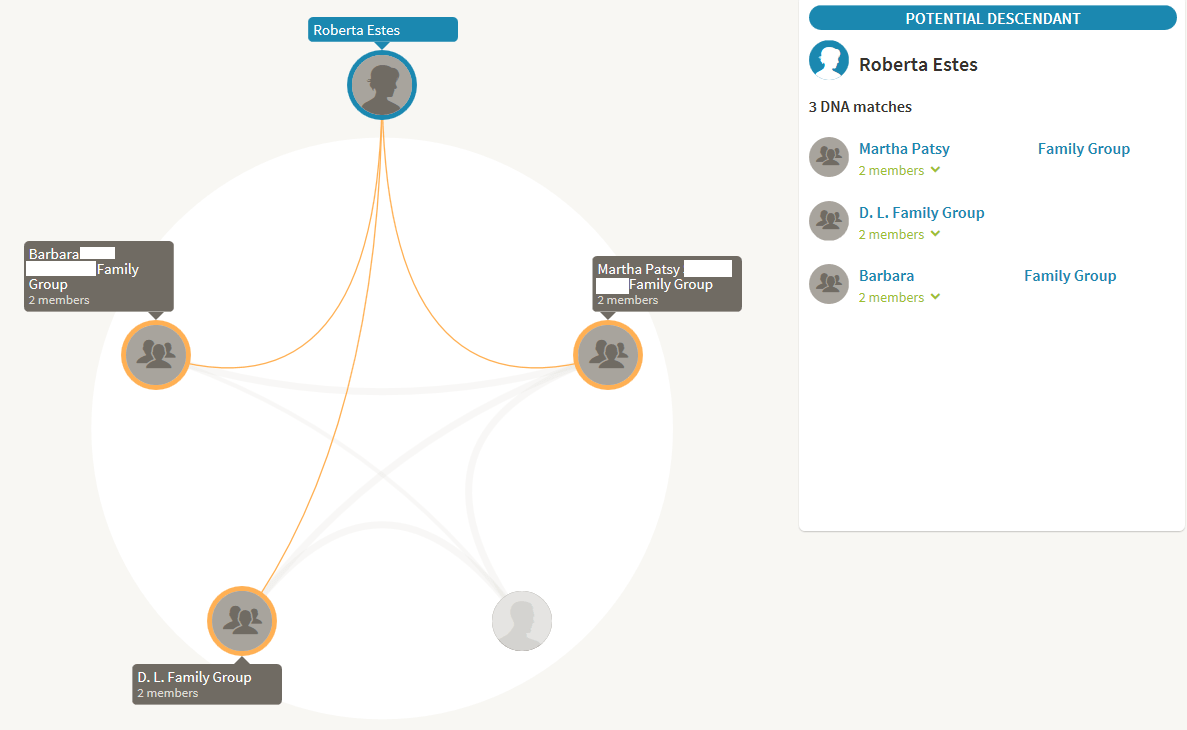
The NAD circle is made up of three family groups, where several closely related individuals have tested, so they are counted as “one” and not as separate matches.

There are two individuals in each of the three family groups.

All of these people descend from Sarah Clarkson/Claxton and Robert Shiflet.  Ironically, Sarah, who is not listed as a NAD, is the daughter of my ancestor.

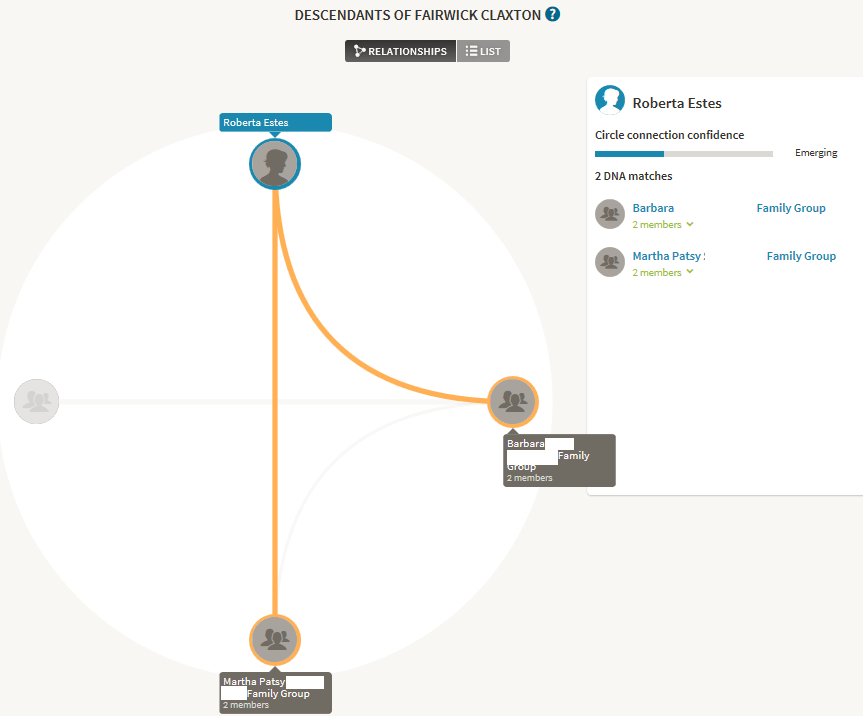
In fact, as irony would have it, two of these same groups ARE in the Fairwick Clarkson/Claxton DNA Circle and along with me, these are the only two other members of that circle that I match.

Fairwick circle

So, if you’re judging from the number of connections only, the NAD circle, with 3 groups totaling six people looks stronger than my Fairwick Clarkson Circle with only 2 groups totaling 4 people.  I checked each tree of each individual within the Shiflet Circle and have summarized the results below.

Participant Family Group Sarah Listed? Fairwick Listed Fairwick Circle
CT Martha Patsy Yes, as Sarah “Sallie” Clarkson Yes, Fairwick Claxton Group is in circle
Charlene Martha Patsy Yes, as Sarha Clarkson Shiflet No Group is in circle
DL DL Yes, as Sarah A. Claxton No No
JL DL Yes, as Sarah A. Claxton No No
DB Barbara Yes, as Sarah “Sallie” Clarkson Yes, as Fairwick Claxton Group is in circle
DJ Barbara Yes, Sarah H. Clarkson Yes, as Fairwick Clarkson Group is in circle

Please note that in this case, the spelling of Sarah’s name was quite different.  It was spelled Clarkson, Claxton and in one tree, she was listed as Sarah Clarkson Shiflet, with Shiflet as her surname.  Her first name was misspelled in one tree.  This could be why Sarah was not listed as a NAD along with Robert, whose name was consistently spelled the same way.

Still, because two of these family groups are members of the Fairwick Claxton/Clarkson Circle, one would think that it would be immediately evident that since we DO share an upstream ancestor, when utilizing our trees, that the husband of my ancestor’s sister is not my ancestor – but I am related to his descendants by virtue of his wife’s parents – so of course I match the DNA of his descendants.  That does NOT mean I descend from him.

The linchpin that may have triggered Ancestry to create a NAD may have been that I match one set (family group) of Robert Shiflet’s descendants that aren’t in the Fairwick group.  The reason the DL group is not in Fairwick’s circle, if you look at the trees, is because the DL group does not list any parent for Sarah – so they can’t be in Fairwick’s circle because Fairwick isn’t listed in their tree.  It would make a lot more sense for Ancestry to give the DL group Fairwick as a NAD than to give me Robert Shiflet as a NAD.

So, take all NADs with an extremely large grain of salt – in fact – the whole shaker would be appropriate here or maybe something the size of rock salt.

Keeping Score

So far, the NAD score, out of 5 that have been assigned to me, 3 are proven to be incorrect.  Two, the Larimers, the jury is still out – well, sortof.

Larimer NAD

The jury isn’t entirely out on the Larimer’s actually, because when I look at the group of people in the Larimer NAD circle, I discovered all 5 people who I match on my Andrew McKee line. Hmmm….

These people ALSO connect to John and Jane Larimer – on a completely separate line from Andrew McKee.  In another group, I find another ancestral surname where I connect with the entire group.  So, I’m guessing that it’s circumstantial that all of these people descend from John and Jane Larimer – and that John and Jane have nothing to do with me just because I match their descendants through two of my other known lines.  I don’t actually match anyone else in that group – although a lot of them match each other.  As it turns out, all of this “network theory” matching is a red herring this time – because of intermixed multiple family lines.

Can I prove positively that I don’t share any ancestor upstream with John and Jean Larimer?  Nope, I can’t, but given the trend that I do see, it looks like the NAD was based on other family connections that circumstantially are connected to the Larimers as well.  And I can tell you, from what I do know about my genealogy, that I don’t descend from Jean and John Larimer.  There is no vacancy in my tree that fits their ages, so they are not my ancestors.

So, I guess that really makes the score:

  • Ancestry – 0
  • Bad NADs – 5

The sad part is that it also makes my score 0 – and leaves me begging for the chromosome browser that we so desperately need and would eliminate all of this tail-chasing.  A chromosome browser wouldn’t leave us guessing about whether the Larimer segments were the same segments as the McKee segments.  We would know positively whether they were or not – no guessing, tail chasing or network theory needed.

dog chasing tail

______________________________________________________________

Disclosure

I receive a small contribution when you click on some of the links to vendors in my articles. This does NOT increase the price you pay but helps me to keep the lights on and this informational blog free for everyone. Please click on the links in the articles or to the vendors below if you are purchasing products or DNA testing.

Thank you so much.

DNA Purchases and Free Transfers

Genealogy Services

Genealogy Research

Mother’s Day – Tracking the Mitochondrial DNA Line

Just for fun, for Mother’s Day, here is the visual history of my mitochondrial DNA line.  It’s fun, quick to do and a great way to share DNA information with your family!

daughter

My daughter.

son

My son.

me at 5

Me

mom toddler

My mother – Barbara Jean Ferverda (1922-2006)

Edith as a child cropped

My grandmother – Edith Barbara Lore (1888-1960) married John Whitney Ferverda

Nora Kirsch wedding

My great-grandmother – Ellenore “Nora” Kirsch (1866-1949) married Curtis Benjamin Lore

barbara drechsel cropped

Barbara Drechsel – German immigrant – (1848-1930) married Jacob Kirsch

I wish we had photos of Barbara’s mother, Barbara Mehlheimer (1823-1906) who married George Drechsel and immigrated to Aurora, Indiana.  Her mother was Elisabetha Mehlheimer.

Thank you to all of the mothers who came before and contributed their mitochondrial DNA, along with everything else, to their children…and ultimately to my children!

______________________________________________________________

Disclosure

I receive a small contribution when you click on some of the links to vendors in my articles. This does NOT increase the price you pay but helps me to keep the lights on and this informational blog free for everyone. Please click on the links in the articles or to the vendors below if you are purchasing products or DNA testing.

Thank you so much.

DNA Purchases and Free Transfers

Genealogy Services

Genealogy Research

Proving Your Tree

With all the recent discussion about Ancestry’s new “New Ancestor Discovery” feature rollout, and some wrong individuals being assigned as my ancestors, some people have been asking the question, “How do you know your tree is right?”  In other words, how do I know those ancestors are not my genetic ancestors?  As they correctly pointed out, NPEs and adoptions do occur.

And they are right, absolutely right.  It’s a legitimate question, one that every one of us needs to answer for our own trees.

I answered their question briefly by saying that I have a combination of both paper genealogy and DNA for all ancestors through the 6th generation, which is true, but I want to share more than that.  Plus, I wanted to take the time to really evaluate every single line individually to be absolutely positive of what I was saying, and to weigh the evidence.  All too often, it’s not a handy-dandy yes or no, it’s shades of grey.

It’s important for all of us to treat this, the study of our ancestors, like a big mystery with clues for us to find and decipher.

In some cases, there isn’t much mystery.  For example, unless you’re an adoptee, you probably know your grandparents and their birth and death information is relatively easy to obtain.  First, you’re a family member, and second, relatively complete records exist in the past century.  There are lots of sources – birth and death certificates, obituaries, tombstones still remain, hopefully houses with Bibles haven’t all burned, etc.

But as you move back in time, there are fewer sources available, fewer records, if any, exist and eventually, you’re so far back that there is no “institutional memory” in the form of Aunt Marybelle’s or Uncle Jehosiphat’s stories.

Before DNA, we spent a lot of time compiling information about our families, fitting the pieces together, assembling old wills and estate distributions to figure out who the children were, and so forth.  But we had no avenue to verify for example, that William Jr. was really the biological son of William Sr.  Nor did we have the tools to figure out that William Sr. and his wife had taken a child to raise on a wagon train whose parents had died, and that child really wasn’t the biological child of either William or his wife.  None of that existed before, but does now, at least in certain circumstances.

One of the things people, for some reason, believe is that they are going to take a DNA test and somehow, with the wave of a magic wand, or maybe the click of a leaf, their ancestry is going to be revealed to them.  Needless to say, that’s not how it works.

What we do is continue to use a variety of types of DNA testing to prove various lines of our ancestry – and sometimes disprove them – in conjunction with other types of traditional records.  By now, you’ve probably all heard the story of my brother, who I searched for, for years, only to discover he was not my biological brother.  For me, there is peace in knowing and I love my brother regardless.  I’m so glad I found him before he passed away – regardless of the DNA results.  But before DNA, we would never have been able to know, for sure.  What we believed with all of our hearts was not the truth.  The DNA results were undeniable.

When I started working with DNA for genealogy, I was simply curious.  I did not set forth a goal to “prove my lines,” nor, for a long time, did I really think about that.  I was always just excited when someone from one of my ancestral lines would test, because their mitochondrial or Y results were relevant to my ancestors too – assuming we connected in the correct fashion.  I cherished the ability to discover that my ancestors in that line were from the British Isles, Africa, Scandinavia or were Native American, for example.  Mitochondrial and Y results allow us to extend what we know about that ancestral line back in time, beyond the time of surnames.  These tests help us to answer the question, for each ancestral line, “where did I come from?”  Because, after all, “I” am the combination of all of my ancestors.

In my article, The DNA Pedigree Chart – Mining for Ancestors, I talk about how to create pedigree charts that include Y and mtDNA for each ancestral line.  Obviously, I can’t test for all of these myself.

DNA Pedigree

This is part of the answer to how I know that some parts of my tree are correct.

For example, let’s say my Estes cousin, Buster, tests to represent my Estes Y line, and he matches many Estes men, all the way back to Abraham Estes, the immigrant into Virginia.  That unquestionably proves the Estes line he carries is the ancestral Estes line.  However, since I don’t carry the Estes Y chromosome, I have to utilize autosomal DNA to prove that I am related to Buster and other Estes descendants on the Estes side.  Those two pieces of information combined prove that my Estes line is confirmed back beyond the 6th generation – even though I don’t carry the Estes Y chromosome and I have no one  in my immediate family to “sit proxy” for me.

Why am I focused on the 6th generation?

When Ancestry rolled their new feature that gives people “New Ancestors,” they graciously gave me two that were not only wrong – I can’t figure out any connection at all.

I wrote about this in the article, “Ancestry DNA Gave Me A New DNA Ancestor – And It’s Wrong.”

In order for Diedamia Lyon and John Curnutte, spouses, to be my ancestors, they would have been born in about the 6th generation, given their birth dates, and reproduced in the 5th generation.  The problem is that I have my tree documented solidly back through both of those generations, and John and Diedamia are not my ancestors.

This caused someone to ask how I knew that an NPE hadn’t happened and that one of my ancestral couples, who I believe are my ancestors, aren’t really – and Diedamia Lyon and John Curnutte are instead – or at least John.  Like, perhaps a baby swap, or a wagon train parental death/child adoption or some other form of NPE (nonparental event.)

Good questions.  I want to know the answer too, for my own benefit.

In order to begin to address this, I looked at the years John and Diedamia were born and the locations where they are found.  Diedamia Lyon was born in Wilkes County in 1804 and she and John Curnutte married in 1822 in Lawrence County, KY, according to the Ancestry story attached to this couple, and she died there in 1866.  I can’t vouch for any of this, because it’s taken from Ancestry’s compiled trees.  What I can tell you is that I have no family at all in or near Lawrence County Kentucky, not in this or any other timeframe.

I do have family in Wilkes County, however, which is where I began the comparative search.  Both John Curnutte and Diedamia’s parents came from Virginia and I have lots of ancestry there, including several unknown lines – but not in any generation where John and Diedamia could be my ancestors.  However, these common locations would be the most likely places for an adoption, in whatever form, to have occurred – if one did.

So, let’s take this one parent’s side at a time and look at the proofs I have and how I know, beyond a doubt, that these two people are not my ancestors.

new ancestor mother tree

I’ve divided my ancestors into my mother’s side and my father’s side and created a proof table for each one in the 6th generation.  The Proof column, in this case, means proof that Diedamia Lyon and John Curnutte cannot replace these ancestors in my tree, confirming that these are my ancestors and John and Diedamia are not.

Let’s look at my mother’s side first.  It’s easy.  Hendrick Jans Ferverda, born in the Netherlands about 1806, so about the same time as John and Diedamia, was not in this country at that time.  We have documentary proof from the Netherlands.  We have further evidence of when his son did immigrate in the 1860s.  So, Diedamia and John cannot be clandestine ancestors, replacing Hendrick Jans Ferverda and his wife, Lijsbert Baukes Camstra in my tree.  They weren’t even on the same continent when the begetting would have occurred.

As we assemble the proof for each ancestor, we consider birth and death years and locations, whatever documentation we have, and DNA evidence.

Ancestor Birth/Death Location Facts Proof
Hendrick Jans Ferverda 1806-1874 Born and died in the Netherlands Proof from documents in Leeuwarden and Blija, Netherlands Not in the US at the time
Lijsbert Baukes Camstra 1806-1856 Born and died in the Netherlands Proof from documents in Leeuwarden and Blija, Netherlands Not in the US at the time
Harmen Gerrits de Jong 1803-1866 Born and died in the Netherlands Proof from documents from Oosterlittens and Leeuwarden, Netherlands Not in the US at the time
Angenietje Houtsma 1802-1866 Born and died in the Netherlands Proof from documents from Leeuwarden, Netherlands Not in the US at this time
David Miller 1781-1851 Born Washington Co., MD, died Elkhart Co., Indiana Marriage documents in Warren Co., Ohio, estate in  Elkhart Co., Indiana Miller Y DNA from this line matches to other sons’ descendants of Johann Michael Miller b 1692, autosomal matches to several Miller descendants including mother’s first and second cousins.
Catharina Schaeffer Circa 1775 – 1826 Born Berks Co, PA, died Montgomery Co., PA Marriage document 1799 Berks Co., Marriage document 1805 Warren Co., Ohio Schaeffer males have tested Y and autosomal.  They match the Schaeffer Y upstream of Catharina’s father and match cousins autosomally.
Jacob Lentz 1783-1870 Born in Germany, died in Montgomery Co., Ohio Citizenship papers and census show birth, tombstone and estate papers show death Multiple males have tested Y DNA and they match each other.  They also match other Lentz men, but we can’t figure the common ancestor in Germany.  The Y testers and other cousins match mother autosomally.  Ancestry DNA Circle.
Frederica Moselman 1788-1863 Born in Wurttemburg, Germany, died Montgomery Co., Indiana Was married before immigration Born in Germany, not in US at the time.  Ancestry DNA Circle.
Honore Lore 1766 – 1834 Born in New England during Acadian removal, died Quebec, Canada in Acadian community Church records Y DNA of descendant matches Y DNA of other Lore males upstream of Honore, autosomal DNA matches mother.
Marie Lafaille 1767-1836 Born in New England during Acadian removal, died in Quebec Canada in Acadian community Church records including marriage to Honore Lore in 1789 in Canada Not in right place, married to Honore, autosomal DNA of descendants matches both Lafaille and Lore family members.
Joseph Hill 1790-1871 Born Barrington, NH, died 1871, Lake Co., Ill Hill family from NH and Vermont where he is first found in records, death records in Illinois Autosomal DNA matches with other descendant of Joseph and his parents.  His father is Ancestry DNA Circle.
Nabby Hall 1792-1874 Birth record in Mansfield City, CT town records, death record in Lake Co., Illinois Family moved to Addison Co., VT where children were born and where they are in the records, ancestor daughter’s birth Autosomal DNA matches with other descendants of Nabby and her parents, Gershom Hall and Dorcas Richardson.
Phillip Jacob Kirsch 1806-1880 Born Fussgoenheim, Germany died Ripley Co., Indiana Church birth records, death recorded in cemetery records Not in US at the time
Katharina Lemmert 1807-1889 Born Mutterstadt, Germany, died Aurora, Indiana Church birth records and death recorded in cemetery records Not in US at the time
George Drechsel 1823-1908 Born Speichersdorf, Germany, died Aurora, Indiana German church birth records, death recorded in cemetery records Not in US at the time
Barbara Mehlheimer 1823-1906 Born Goppmansbuhl, Germany, died Aurora, Indiana Germany church birth records, death recorded in cemetery records Not in US at the time

I don’t think there is any doubt whatsoever in any of my mother’s lines that Diedamia Lyons and John Curnutte whose families were from from VA, NC and KY can possibly be substituted for any of these ancestors.

Now let’s move to my father’s side of the family, who were indeed from VA and NC.

new ancestor father tree

In the chart below, I’ve starred the ancestors who I feel have a weak or unknown parental connection, meaning with their parents, based on the facts.  In many cases, this is an unknown mother or unknown mother’s surname or lack of solid DNA proof.  My goal for each ancestor is to have both the genealogical and the DNA proof, supporting each other.

For example, let’s look at Nancy Ann Moore.  Nancy is starred because her mother’s surname is unknown.  This means I can’t prove or disprove any ancestral line through her mother, Lucy.  In other words, while it’s clear that John and Diedamia cannot replace John R. Estes and Nancy Ann Moore as ancestors, one of them might be related to Nancy’s mother.  Therefore, based on the evidence, we do have proof that John and Diedamia are not clandestine ancestors in place of John and Nancy, but what we can’t know is if they are related upstream to Nancy’s mother.

Ancestor Birth/Death Location Facts Proof
John R. Estes 1787-1885 Born Halifax Co., Va, died Claiborne Co., TN Birth and death from War of 1812 pension app Estes Y DNA proven beyond John R. Estes, autosomal DNA from descendants and other Estes descendants triangulate.  Ancestry DNA Circle.
Nancy Ann Moore* Circs 1785-1860/1870 Born Halifax Co., VA, died Claiborne Co. TN Marriage doc in Halifax Co in 1811, husband’s War of 1812 pension app Moore DNA tested to Nancy’s grandfather’s generation, descendants match other Moore testers autosomally, Nancy’s mother’s surname unknown.  Ancestry DNA Circle.
Lazarus Dodson* 1795-1861 Parents living in Hawkins Co in 1795, Pulaski Co., KY death records Father-in-law John Campbell estate records for marriage to Elizabeth Dodson Y DNA beyond Lazarus, many Dodson autosomal matches, Lazarus’s mother’s surname unknown.
Elizabeth Campbell C1802-1827/1830 Parents living in Claiborne County TN per tax and court records, death in Claiborne per her children’s guardian records Her father, John Campbell’s estate records regarding her children, guardianship settlement Campbell DNA from this line matches Campbell clan DNA, autosomal matches to many Campbell cousins.  Her parents are Ancestry DNA Circles.
Elijah Vannoy 1784-c1850 Parents lives Wilkes Co at that time, death from Hancock Co. TN census Elijah found in Wilkes Co deed records in 1807, in Claiborne court records by 1812 Vannoy Y DNA from his line matches lines earlier than Elijah, autosomal DNA matches cousins.  Son is Ancestry DNA Circle.
Lois McNiel c1786-c1839 Parents living in Wilkes at time of her birth per tax and deed records, died before census in Claiborne Co., TN Parents also moved to Claiborne Co., TN, family history records Elijah’s wife as Lois McNiel Y DNA matches back to Rev. George, 2 generations beyond Lois, autosomal matches Lois’ descendants as well.  Son is Ancestry DNA Circle.
William Crumley III* 1785/1789 – 1852/1860 Born where parents lived Frederick Co., VA proven by 1789 tax list, death in Appanoose Co., Iowa by census Was in Lee Co by 1820 census, marriage documents in 1807 in Greene Co., TN Crumley DNA from this line proves back to James, 3 gen earlier, autosomal matches to cousins, William’s mother unknown.  Daughter is Ancestry DNA Circle.
Lydia Brown* 1787/1790-1830/1849 Born where parents lived in Montgomery Co., VA, death by census in Lee Co., VA and husband’s remarriage Married in 1807 in Greene Co., TN, in Lee Co. Va by 1820, in 1830 census, 1850 census shows husband has been married within the year to new wife Brown Y DNA confirms Jotham and matches other Browns without common ancestor identified, autosomal DNA matches to cousins, Lydia’s mother surname unknown.
Henry Bolton* 1759-1846 Born England, died Giles Co., VA Birth location unproven except by family stories, marriage records, death by local documents and census Bolton DNA confirms Henry and there are other matches but common ancestor unproven.  No Y matches to Curnutte or Lyons. Many descendants autosomal match but cannot go beyond Henry with proofs.  Ancestry DNA Circle.
Nancy Mann* c 1780/1783 – 1841 Born where family lived, Botetourt Co., VA, died Giles Co, VA Birth from census and inferred from marriage document 1799, death from family Bible Parents are unconfirmed but believed to be James Mann and Mary Cantrell.  Not Y DNA confirmed to Mann line.  No known Manns from this direct line have tested.  Autosomal matches to James Mann’s brother Moses.  Ancestry DNA Circle.
William Herrell* 1789/1790 – 1859 Born in NC, probably Wilkes Co, died in Hancock Co., TN Birth from War of 1812 pension and bounty land apps, death from his wife on pension app Herrell confirmed back to John, William’s father on Y, match Y cousins autosomally, mother’s surname unknown.
Mary McDowell* 1785- after 1872 Born where in Wilkes Co., NC where parents lived at the time per tax records, died Hancock Co., TN Marriage in 1809 in Wilkes Co., lived in Claiborne & Hancock, death per pension docs and census McDowell Y DNA proven to Michael, her father, via multiple lines, autosomal matches to cousins, mother’s surname unknown.
Fairwick Claxton 1799/1800 – 1874 Birth in Russell Co., VA by census in location where parents lived, death Hancock Co., TN according to his mother’s War of 1812 pension app after his father’s death, death by chancery suit Born in Russell Co., VA, lived in Claiborne which became Hancock Co., TN entire life, chancery suit provides significant info, plus census. Claxton/Clarkson DNA proven to James via Y with additional matches from NC with earlier unidentified common ancestor, autosomal matches between entire group of cousins.  Ancestry DNA Circle.
Agnes Muncy* 1803 – after 1880 Born where Lee Co., VA parents lived according to tax and deed records, dead via census Hancock Co., TN Census and chancery suit show family in Hancock Co., TN Muncy Y DNA confirmed beyond Agnes, cousins matching autosomally.  Would like additional triangulated matches.  Ancestry DNA Circle.
Charles Speak 1804 – 1840/1850 Born Washington Co., VA where parents lived according to tax and deed records, death by census Lee Co., VA Marriage in 1823 in Washington Co., VA, later records in Lee Co., VA having to do with Speaks church Speak Y DNA confirmed back to Gisburn, England, many autosomal matches in this line.  Parents are Ancestry DNA Circles.
Ann McKee* 1804/1805 – 1840/1850 Birth in Washington Co., VA where parents lived according to father’s will, death from census Lee Co., VA Married in 1823 Montgomery Co., VA, moved to Lee Co., VA, her father’s will names her as daughter Have not found McKee Y to test, but match several McKee descendants on autosomal.  Ann’s mother’s surname is unknown.  Father Andrew was Ancestry DNA Circle, but disappeared.

As you can clearly see, there is no question that Diedamia Lyon and John Curnutte aren’t my ancestors.  There is no place for them to be born in 1801/1804, replacing two people here.  Plus there is no Canutte Y DNA matching downstream anyplace, nor any Lyon or Canutte matching at all that I can discover at Family Tree DNA where I can search for ancestral surnames among my matches.  At Ancestry, the only Curnutte surname DNA matches I have are the two individuals that are in the Curnutte “New Ancestor” circle.  Lyon is a more common surname, but nothing connecting matching people, the Lyon surname and any common ancestor or location – other than the two people who also match Curnutte.

I am 100% positive, bet on it and take it to the bank positive, that Diedamia Lyon and John Curnutte are not my ancestors.  And anyone who knows me knows that I never, ever, bet unless I know it’s a sure thing.  So, if I ever say to you, “wanna bet,” think twice.  I wound up with a nice piece of jewelry because my husband hadn’t learned that yet.  Not once, but twice.  Unfortunately, he has learned now:)

However, that doesn’t mean that I don’t share DNA with the descendants of Diedamia Lyon and John Curnutte.  One of two scenarios can be happening.

1. I do share DNA with two of the Lyon/Canutte descendants, but that DNA could be from two different, unidentified, lines, neither of which are John Curnutte and Diedamia Lyon. It just so happens that the two people I share DNA with happen to share the Lyon/Curnutte line between them. Therefore, the leap of faith has been made that I too share those ancestors. A triangulation tool would answer this question, because if I don’t match my two matches on the same segment, there is no proof of the same ancestor.  Lack of a triangulated match doesn’t mean that I don’t share those ancestors either. In other words, it’s not negative proof.  Lack of a triangulated match wouldn’t mean I don’t want to see this information.  I do. I just want to know how strong the evidence is, or isn’t. Without analysis tools, we’re left to flop around in the dark.

2. I share DNA with two of the Lyon/Canutte descendants because there is a common ancestor upstream of EITHER John Canutte or Diedamia Lyon whose DNA comes through that couple to their children who match me. If this is the case, then the common ancestor is most likely in one of the lines that are starred above where the parents are unknown.  If Ancestry provided chromosome matching and triangulation tools, I could see who else I match on that segment and perhaps find some common genealogy between others who match me (and my matches) on that same segment.

Summary

So, the answer to the question, “How do you know your tree is right?” is threefold.

First, genealogically, I’m a terribly anal, er, I mean thorough, researcher.  If you have any doubt, please feel free to read my 52 ancestor series and you can see for yourself the kind of in-depth research I do.

This isn’t to say everything is perfect or that I can’t make mistakes.  I clearly can, do and have.  But for the most part, my trees are solid and I know when they aren’t, where and why.  Plus, I’ve been doing this now for 37 years.  Experience is a wonderful teacher, so long as you learn and don’t just make the same mistakes over and over again.

And, yes, thank you, I did start when I was quite young – barely of age.

Secondly, I have been triangulating my autosomal DNA for several years now, proving segments through both known and previously unknown cousins to specific ancestral lines, and specific common ancestors.  But, I have to be able to see where we match to utilize those tools, and we can’t do that at Ancestry where it’s genetic genealogy wearing blinders.  I’m very thankful for GedMatch so I can compare DNA with the Ancestry cousins who will download their results.  If my two matches who descend from John and Diedamia downloaded their results to GedMatch, then I could see WHERE I match them and I might have that segment already mapped to a specific family line.  That would help immensely tracking backwards and finding the common link with my matches.

Third, I have been utilizing Y and mtDNA where possible and appropriate to learn about, prove and confirm various lines for nearly 15 years.

Often, I use combinations of these tools, like in my Buster example where Buster proved the Estes Y in my line, and I proved my relationship to Buster through autosomal DNA.

These combinations are powerful tools to prove, or disprove, family lines.

And now that you know how to do this, you can prove each one of your ancestral lines too!

______________________________________________________________

Disclosure

I receive a small contribution when you click on some of the links to vendors in my articles. This does NOT increase the price you pay but helps me to keep the lights on and this informational blog free for everyone. Please click on the links in the articles or to the vendors below if you are purchasing products or DNA testing.

Thank you so much.

DNA Purchases and Free Transfers

Genealogy Services

Genealogy Research

Help System at Family Tree DNA Updated Today

family tree dna logoGroup Administrators received this e-mail on April 1st. Presuming it’s not an April Fools Joke (it’s not), the new system is being implemented today, April 2, 2015 and it looks like it should help a lot with timely responses.

Family Tree DNA writes:

After reviewing several options to speed up e-mail response times and improve overall Customer Support efficiency, we are are putting a new system in place as of 10 am Central Time tomorrow, 2 April, 2015.

You’ll want to pay close attention because this is radically different from what you’re used to doing, but it’s for a good reason.

Until now, many of the emails would come to the general email boxes info@ familytreedna.com or helpdesk@familytreedna.com, uncategorized, adding the extra step of having to sort and triage emails, which takes a lot of time since they can vary from something as simple as changing a SNP order to more detailed analysis. Long emails with no kit number and an uninformative subject line complicate the process and require time to determine what the real question is.

With the new system, the above email addresses will be deactivated. Incoming emails will receive an automated, but politely worded reply directing the customer – or you – to the re-vamped Contact Us form. This form will require a kit number, unless you’re a new customer, and will require the submitter to choose a subject category.

All questions will be directed through a “Contact Us” form so that they are already categorized and can be routed to the appropriate customer service representatives.

ftdna support page

Again, please note: info@familytreedna.com and helpdesk@familytreedna.com will no longer be monitored. Emails sent to either of those addresses will get an auto-response directing the sender to the “Contact Us” form here: https://www.familytreedna.com/contact.aspx#contactForm

For future reference, a link to the Contact Us form is conveniently located at the bottom of the www.familytreedna.com home page under the “About” column.

ftdna support page 2

There will still be a “Group Projects” category, and for administrators, the email address groups@familytreedna.com will still be active, so if you’re writing with questions or situations regarding your project, or if you’re writing on behalf of project members, please use either of those options. The groups@familytreedna.com address is a priority category and is monitored regularly.

Please reserve messages to groups@ftdna.com for those that are time-sensitive, urgent, or simply cannot be answered by a CSR. Over the past few months so many routine – though still important – emails have been going to that email address that your Group Project Manager/Liaison cannot answer them all and still perform other duties such as advocating for you with management on important issues regarding group administration.

Important information for you to know and to share with your group members:

  • It’s important to choose the category closest to the topic of your email.
  • Kit numbers are mandatory.There will be an “I don’t have a kit number yet” box to click for new customers. Existing customers can recover their kit number from the “Lost Your Password” link on the login page.
  • Submitting multiple tickets from the same email address about the same issue before having received a reply groups those issues together and puts them at the bottom of the queue. (That will not be the case with groups@familytreedna.com, since admins write about different projects and discrete issues from the same email address. Still, please keep in mind our service hours and use your best judgement when submitting a second email about the same issue.)
  • Contact form submissions do not generate a confirmation email at this time. Your submission will be acknowledged on the page and you’ll be given a request ID number.

Thank you for your support and understanding as we work to bring you and your project members better service.

______________________________________________________________

Disclosure

I receive a small contribution when you click on some of the links to vendors in my articles. This does NOT increase the price you pay but helps me to keep the lights on and this informational blog free for everyone. Please click on the links in the articles or to the vendors below if you are purchasing products or DNA testing.

Thank you so much.

DNA Purchases and Free Transfers

Genealogy Services

Genealogy Research

Finding Your American Indian Tribe Using DNA

If I had a dollar for every time I get asked a flavor of this question, I’d be on a cruise someplace warm instead of writing this in the still-blustery cold winter weather of the northlands!

So, I’m going to write the recipe of how to do this.  The process is basically the same whether you’re utilizing Y DNA or mitochondrial DNA, but the details differ just a bit.

So, to answer the first question.  Can you find your Indian tribe utilizing DNA?  Yes, it can sometimes be done – but not for everyone, not all the time and not even for most people.  And it takes work on your part.  Furthermore, you may wind up disproving the Indian heritage in a particular line, not proving it.  If you’re still in, keep reading.

I want you to think of this as a scavenger hunt.  No one is going to give you the prize.  You have to hunt and search for it, but I’m going to give you the treasure map.

Treasure mapI’m going to tell you, up front, I’m cheating and using an example case that I know works.  Most people aren’t this lucky.  Just so you know.  I don’t want to misset your expectations.  But you’ll never know if you don’t do the footwork to find out, so you’ve got nothing to lose and knowledge to gain, one way or another.  If you aren’t interested in the truth, regardless of what it is, then just stop reading here.

DNA testing isn’t the be-all and end-all.  I know, you’re shocked to hear me say this.  But, it’s not.  In fact, it’s generally just a beginning.  Your DNA test is not a surefire answer to much of anything.  It’s more like a door opening or closing.  If you’re looking for tribal membership or benefits of any kind, it’s extremely unlikely that DNA testing is going to help you.  All tribes have different rules, including blood quantum and often other insurmountable rules to join, so you’ll need to contact the tribe in question. Furthermore, you’ll need to utilize other types of records in addition to any DNA test results.

You’re going to have some homework from time to time in this article, and to understand the next portion, it’s really critical that you read the link to an article that explains about the 4 kinds of DNA that can be utilized in DNA testing for genealogy and how they work for Native testing.  It’s essential that you understand the difference between Y DNA, mitochondrial and autosomal DNA testing, who can take each kind of test, and why.

Proving Native American Ancestry Using DNA

For this article, I’m utilizing a mitochondrial DNA example, mostly because everyone has mitochondrial DNA and secondly, because it’s often more difficult to use genealogically, because the surnames change.  Plus, I have a great case study to use.  For those who think mito DNA is useless, well all I can say is keep reading.

Y and mito

You’ll know from the article you just read that mitochondrial DNA is contributed to you, intact, from your direct line maternal ancestors, ONLY.  In other words, from your mother’s mother’s mother’s mother and on up that line.

In the above chart, you can see that this test only provides information about that one red line, and nothing at all about any of your other 15 great-great grandparents, or anyone else on that pedigree chart other than the red circles.  But oh what a story it can tell about the ancestors of those people in the red circles.

If this example was using Y DNA, then the process would be the same, but only for males – the blue squares.  If you’re a male, the Y DNA is passed unrecombined from your direct paternal, or surname, ancestor, only and does not tell you anything at all about any of your other ancestors except the line represented by the little blue squares.  Females don’t have a Y chromosome, which is what makes males male, so this doesn’t apply to females.

First, you’ll need to test your DNA at Family Tree DNA.  This is the only testing company that offers either the Y (blue line) marker panel tests (37, 67 or 111), or the (red line) mitochondrial DNA full sequence tests.

For Y DNA testing, order minimally the 37 marker test, but more is always better, so 67 or 111 is best.  For mitochondrial DNA, order the full sequence.  You’ll need your full mitochondrial haplogroup designation and this is the only way to obtain it.

I’m also going to be talking about how to incorporate your autosomal results into your search.  If you remember from the article, autosomal results give you a list of cousins that you are related to, and they can be from any and all of your ancestral lines.  In addition, you will receive your ethnicity result estimate expressed as a percentage.  It’s important to know that you are 25% Native, for example.  So, you also need to order the Family Finder test while you’re ordering.

You can click here to order your tests.

After you order, you’ll receive a kit number and password and you’ll have your own user page to display your results.

Fast forward a month or so now…and you have your results back.

A GEDCOM File

I hope you’ve been using that time to document as much about your ancestors as you can in a software program of some sort.  If so, upload your GEDCOM file to your personal page.  The program at Family Tree DNA utilizes your ancestral surnames to assist you in identifying matches to people in Family Finder.

It’s easy to upload, just click on the Family Tree icon in the middle of your personal page.

Family Tree icon

Don’t have a Gedcom file?  You can build your tree online. Just click on the myFamilyTree to start.

Having a file online is an important tool for you and others for ancestor matching.

Your Personal Page

Take a little bit of time to familiarize yourself with how your personal page works.  For example, all of your options we’re going to be discussing are found under the “My DNA” link at the top left hand side of the page.

My dna tab

If you want to join projects, click on “My Projects,” to the right of “My DNA” on the top left bar, then click on “join.”  If you want to familiarize yourself with your security or other options, click on the orange “Manage Personal Information” on the left side of the page to the right of your image.

Personal info

Preparing Your Account

You need to be sure your account is prepared to give you the best return on your research efforts and investment.  You are going to be utilizing three tabs, Ancestral Origins, Haplogroup Origins and various projects, and you need to be sure your results are displayed accurately.  You need to do two things.

The first thing you need to do is to update your most distant ancestor information on your Matches Map page.  You’ll find this page under either the mtDNA or the Y DNA tabs and if you’ve tested for both, you need to update both.

matches map

Here’s my page, for example. At the bottom, click on “Update Ancestor’s Location” and follow the prompts to the end.  When you are finished, your page should like mine – except of course, your balloon will be where your last know matrilineal ancestor lived – and that means for mitochondrial DNA, your mother’s mother’s mother’s line, on up the tree until you run out of mothers.  I can’t tell you how many men’s names I see in this field…and I know immediately someone is confused.  Remember, men can’t contribute mtDNA.

For men, if this is for your paternal Y line, this is your paternal surname line – because the Y DNA is passed in the same way that surnames are typically passed in the US – father to son.

It’s important to have your balloon in the correct location, because you’re going to see where your matches ancestors are found in relationship to your ancestor.  Your most distant ancestor’s location is represented by the white balloon.  However, you will only see your matches balloons that have entered the geographic information for their most distant ancestor. Now do you see why entering this information is important?  The more balloons, the more informative for everyone.

The second thing is that you need to make sure that the information about the location of your most distant ancestor is accurate.  Most Distant Ancestor information is NOT taken from the matches map page, but from the Most Distant Ancestors tab in your orange “Manage Personal Information” link on your main page.  Then click on to the Genealogy tab and then Most Distant Ancestors, shown below.

genealogy tab

If your ancestral brick wall in in the US, you can select 2 options, “United States” and “United States (Native American).”  Please Note – Please do not, let me repeat, DO NOT, enter the Native American option unless you have documented proof that your ancestor in this specific line is positively Native American.  Why?  Because people who match you will ASSUME you have proof and will then deduce they are Native because you are.

This is particularly problematic when someone sees they are a member of a haplogroup that includes a Native subgroup.  Haplogroup X1, which is not Native, is a prime example.  Haplogroup X2 is Native, but people in X1 see that X is Native, don’t look further or don’t understand that ALL of X is not Native – so they list their ancestry as United States (Native American) based on an erroneous assumption.  Then when other people see they match people who are X1 who are Native, they assume they are Native as well.  It’s like those horrible copied and copied again incorrect Ancestry trees.

distant ancestor US optionsIt’s important to update both the location and your most distant ancestors name. This is the information that will show in the various projects that you might join in both the “Ancestor Name” and the “Country” field.  As an example, the Estes Y project page is shown below.  You can see for yourself how useless those blank fields are under “Paternal Ancestor Name” and “Unknown Origin” under Country when no one has entered their information.

estes project tab

While you are working on these housekeeping tasks, this would be a good time to enter your ancestral surnames as well.  You can find this, also under the Genealogy Tab, under Surnames.  Surnames are used to show you other people who have taken the Family Finder test and who share the same surname, so this is really quite important.  These are surnames from both sides of your tree, from all of your direct ancestors.

surnames tab

Working With Results

Working with mitochondrial DNA genetic results is much easier than Y DNA.  To begin with, the full sequence test reads all of your mitochondrial DNA, and your haplogroup is fully determined by this test.  So once you receive those results, that’s all you need to purchase.

When working with Y DNA, there are the normal STR panels of 12, 25, 37, 67 and 111 markers which is where everyone interested in genealogy begins.  Then there are individual SNP tests you can take to confirm a specific haplogroup, panels of SNPs you can purchase and the Big Y test that reads the entire relevant portion of the Y chromosome.  You receive a haplogroup estimate that tends to be quite accurate with STR panel tests, but to confirm your actual haplogroup, or delve deeper, which is often necessary, you’ll need to work with project administrators to figure out which of the additional tests to purchase.  Your haplogroup estimate will reflect your main haplogroup of Q or C, if you are Native on that line, but to refine Q or C enough to confirm whether it is Native, European or Asian will require additional SNP testing  unless you can tell based on close or exact STR panel matches to others who are proven Native or who have taken those SNP tests.. 

Y Native DNA

In the Y DNA lines, both haplogroups Q and C have specific SNP mutations that confirm Native heritage.  SNPs are the special mutations that define haplogroups and their branches.   With the new in-depth SNP testing available with the introduction of the Big Y test in 2013, new discoveries abound, but suffice it to say that by joining the appropriate haplogroup project, and the American Indian project, which I co-administer, you can work with the project administrators to determine whether your version of Q or C is Native or not.

Haplogroups Q and C are not evenly distributed.  For example, we often see haplogroup C in the Algonquian people of Eastern Canada and seldom in South America, where we see Q throughout the Americas.  This wiki page does a relatively good job of breaking this down by tribe.  Please note that haplogroup R1 has NEVER been proven to be Native – meaning that it has never been found in a pre-contact burial – and is not considered Native, although speculation abounds.

This page discusses haplogroup Q and this page, haplogroup C.

Haplogroup C in the Native population is defined by SNP C-P39 and now C-M217 as well.

Haplogroup Q is not as straightforward.  It was believed for some time that SNP Q-M3 defined the Native American population, but advanced testing has shown that is not entirely correct.  Not all Native Q men carry M3.  Some do not.  Therefore, Native people include those with SNPs M3, M346, L54, Z780 and one ancient burial with MEH2.  Recently, a newly defined SNP, Y4273 has been identified in haplogroup Q as possibly defining a group of Algonquian speakers.  Little by little, we are beginning to more clearly define the Native American genetic landscape although there is a very long way to go.

With or without the SNP tests, you can still tell a great deal based on who you match.

For Y DNA and mitochondrial DNA (not autosomal), at the highest levels of testing, if you are matching only or primarily Jewish individuals, you’re not Native.  If you’re matching people in Scandinavia, or Asia, or Russia, nope, not Native.  If you’re matching individuals with known (proven) Native heritage in Oklahoma or New Mexico, then yep….you’re probably Native

We’ll look at tools to do this in just a few minutes.                              

Mitochondrial Native DNA

There are several Native founder mitochondrial DNA lineages meaning those that are believed to have developed during the time about 15,000 years ago (plus or minus) that the Native people spent living on Beringia, after leaving continental Asia and before dispersing in the Americas.

Those haplogroups (along with the Native Y haplogroups) are shown in this graphic from a paper by Tamm, et al, 2007, titled “Beringian Standstill and the Spread of Native American Founders.”

beringia map

The founder mitochondrial haplogroups and latecomers, based on this paper, are:

  • A2
  • B2
  • C1b
  • C1c
  • C1d
  • C4c
  • C1
  • D2
  • D2a
  • D4h3
  • X2a

Subsequent subgroups have been found, and another haplogroup, M, may also be Native.  I compiled a comprehensive list of all suspects.  This list is meant as a research tool, which is why it gives links to where you can find additional information and the source of each reference.  In some cases, you’ll discover that the haplogroup is found in both Asia and the Americas.  Oh boy, fun fun….just like the Y.

Be aware that because of the desire to “be Native” that some individuals have “identified” European haplogroups as Native.  I’ll be writing about this soon, but for now, suffice it to say that if you “self-identify” yourself as Native (like my family did) and then you turn up with a European haplogroup – that does NOT make that European haplogroup Native.  So, when the next person in that haplogroup tests, and you tell them they match “Native” people with European haplogroups – it’s misleading to say the least.

When working to identify your Native heritage, some of your best tools will be the offerings of Family Tree DNA on your personal page.  The same tools exist for both Y DNA and mitochondrial DNA results, so let’s take a look.

Your Results

If your ancestor was Native on your direct matrilineal line, then her haplogroup will fall within one of 5 or 6 haplogroups.  The confirmed Native American mitochondrial haplogroups fall into major haplogroups A, B, C, D and X, with haplogroup M a possibility, but extremely rare and as yet, unconfirmed.  Known Y DNA haplogroups are C and Q with O as an additional possibility.

Now, just because you find yourself with one of these haplogroups doesn’t mean automatically that it’s Native, or that your ancestors in this line were Native.  If your haplogroup isn’t one of these, then you aren’t Native on this line.  For example, we find male haplogroup C around the world, including in Europe.

Here is the list of known and possible Native mitochondrial DNA haplogroups and subgroups.

If your results don’t fall into these haplogroups, then your matrilineal ancestor was not Native on this particular line.  If your ancestor does fall into these base groups, then you need to look at the subgroup to confirm that they are indeed Native and not in one of the non-Native sister clades.  Does this happen often?  Yes, it does, and there are a whole lot of people who see Q or C for the Y DNA and immediately assume they are Native, as they do when they see A, B, C, D or X for mitochondrial.  Just remember about assume.

Scenario 1: 

Oh No! My Haplogroup is NOT Native???

Let’s say your mitochondrial ancestor is not in haplogroup A, B, C, D, X or M.

About now, many people choke, because they are just sure that their matrilineal ancestor was Native, for a variety of reasons, so let’s talk about that.

  1. Family history says so. Mine did too. It was wrong. Or more precisely, wrong about which line.  Test other contributing lineages to the ancestor who was identified as Native.
  2. The Native ancestor is on the maternal line, but not in the direct matrilineal line. There’s a difference. Remember, mitochondrial DNA only tests the direct matrilineal line. What this means is that, for example, if your grandmother’s father was Native, your grandmother is still Native, or half Native, but not through her mother’s side so IT WON’T SHOW ON A MITOCHONDRIAL DNA TEST. In times past, stories like “grandma was Indian” was what was passed down. Not, grandmother’s father’s father’s mother was Waccamaw. Any Indian heritage got conveyed in the message about that ancestor, without giving the source, which leads to a lot of incorrect assumptions – and a lot of DNA tests that don’t produce the expected results. This is exactly what happened in my family line.
  3. Your ancestor is “Native” but her genetic ancestor was not – meaning she may have been adopted into the tribe, or kidnapped or was for some other reason a tribal member, but not originally genetically Native on the direct matrilineal line.  Mary Jemison is the perfect example.
  4. My ancestor’s picture looks Native. Great! That could have come from any of her other ancestors on her pedigree chart. Let’s see what other eividence we can find.

At this point, you’re disappointed, but you are not dead in the water and there are ways to move forward to search for your Native heritage on other lines.  What I would suggest are the following three action items.

1. Look at your family pedigree chart and see who else can be tested to determine a haplogroup for other lineages. For example, let’s say, your grandmother’s father. He would not have passed on any of his mother’s mitochondrial DNA, but his sisters would have passed their mother’s mitochondrial DNA to their children, and their daughters would pass it on as well. So dig your pedigree chart out. and see who is alive today that can test to represent other contributing ancestral lines.

2. Take a look at your Family Finder ethnicity chart under myOrigins and see how much Native DNA you have.

FF no Native

If your ethnicity chart looks like this one, with no New World showing, it means that if you have Native heritage, it’s probably more than 5 or 6 generations back in time and the current technology can’t measurably read those small amounts.  However, this is only measuring admixed or recombined DNA, meaning the DNA you received from both your mother and father.  Recombination in essence halves the DNA of each of your ancestors in each generation, so it’s not long until it’s so small that it’s unmeasurable today.

You can also download your raw autosomal data file to http://www.gedmatch.com and utilize their admixture tools to look for small amounts of Native heritage.  However, beware that small amounts of Native admixture can also be found in people with Asian ancestors, like Slavic Europeans.

The person whose results are shown above does have proven Native Ancestry, both via paper documentation and mitochondrial DNA results – but her Native ancestor is back in French Canada in the 1600s.  Too much admixture has occurred between then and now for the Native to be found on the autosomal test, but mtDNA is forever.

If your Y or mtDNA haplogroup is Native, there is no division in each generation, so nothing washes out. If Y or mtDNA is Native, it stays fully Native forever, even if the rest of your autosomal Native DNA has washed out with succeeding generations.  That is the blessing of both Y and mtDNA testing!

FF native

If your myOrigins ethnicity chart looks like this one, which shows a significant amount of New World and other areas that typically, in conjunction with New World, are interpreted as additional Native contribution, such as the Asian groups, and your Y and/or mtDNA is not Native, then you’re looking at the wrong ancestor in your tree.  Your mtDNA or Y DNA test has just eliminated this specific line – but none of the lines that “married in.”

You can do a couple of things – find more people to test for Y and mtDNA in other lines.  In this case, 18% Native is significant.  In this person’s case, she could eliminate her father’s line, because he was known not to be Native.  Her mother was Hispanic – a prime candidate for Native ancestry.  The next thing for this person to do is to test her mother’s brother’s Y DNA to determine her mother’s father’s Y haplogroup.  He could be the source of the Native heritage in her family.

3. The third thing to do is to utilize Family Finder matching to see who you match that also carries Native heritage. In the chart below, you can see which of your Family Finder matches also carry a percentage of Native ancestry. This only shows their Native match percent if you have Native. In other words, it doesn’t’ show a category for your matches that you don’t also have.

ff native matches

Please note – just because you match someone who also carries Native American heritage does NOT mean that your Native line is how you match.

For example, in one person’s case, their Native heritage is on their mother’s side.  They also match their father’s cousin, who also carries Native heritage but he got his Native heritage from his mother’s line.  So they both carry Native heritage, but their matching DNA and ancestry are on their non-Native lines.

Lots of people send me e-mails that say things like this, “I match many people with Cherokee heritage.”  But what they don’t realize is that unless you share common proven ancestors, that doesn’t matter.  It’s circumstantial.  Think about it this way.

When measuring back 6 generations, which is generally (but not always) the last generation at which autosomal can reliably find matches between people, you have 64 ancestors.  So does the other person.  You match on at least one of those ancestors (or ancestral lines), and maybe more.  If one of your ancestors and one of your match’s ancestors are both Native, then the chances of you randomly matching that ancestor is 1 in 64.  So you’re actually much more likely to share a different ancestor.  Occasionally, you will actually match the same Native ancestor.  Just don’t assume, because you know what assume does – and you’ll be wrong 63 out of 64 times.

Sharing Native ancestry with one or several of your matches is a possible clue, but nothing more.

Scenario 2:

Yippee!!  My Haplogroup IS Native!!!

Ok, take a few minutes to do the happy dance – because when you’re done – we still have work to do!!!

happy dance frog

Many people actually find out about their Native American heritage by a surprise Native American haplogroup result.  But now, it’s time to figure out if your haplogroup really IS Native.

As I mentioned before, many of the major haplogroups have some members who are from Europe, Asia and the America.  Fortunately, the New World lines have been separated from the Old World lines long enough to develop specific and separate mutations, that enable us to tell the difference – most of the time.  If you’re interested, I recently wrote a paper about the various European, Jewish, Asian and Native American groups within subgroups of haplogroup A4.  If you’re curious about how haplogroups can have subgroups on different continents, then read this article about Haplogroups and The Three Brothers.  This is also an article that is helpful when trying to understand what your matches do, and don’t, mean.

So, before going any further, check your haplogroup subgroup and make sure your results really do fall into the Native subgroups.  If they don’t, then go back to the “Not Native” section.  If you aren’t sure, which typically means you’re a male with an estimated haplogroup of C or Q, then keep reading because we have some tools available that may help clarify the situation.

Utilizing Personal Page Y and Mito Tools to Find Your Tribe

Much of Y DNA and mitochondrial DNA genetic genealogy matching is “guilt by genetic association,” to quote Bennett Greenspan.  In other words we can tell a great deal about your heritage by who you match – and who you don’t match.

Let’s say you are haplogroup B2a2 – that’s a really nice Native American haplogroup, a subgroup of B2a, a known Beringian founder.  B2a2 developed in the Americas and has never been found outside of the Native population in the Americas.  In other words, there is no controversy or drama surrounding this haplogroup.

It just so happens that our “finding your tribe” example is a haplogroup B2a2 individual, Cindy, so let’s take a look at how we work through this process.

Taking a look at Cindy’s Matches Map tab, which shows the location of Cindy’s matches most distant ancestor on their matrilineal line (hopefully that’s what they entered.)  Only one of Cindy’s full sequence matches has entered their ancestor’s geographic information.  However, it’s not far from Cindy’s ancestor which is shown by the white balloon.

Cindy full seq match

Please note that Cindy, who is haplogroup B2a2, has NO European matching individuals.  In fact, no matches outside of North and South America.  Being Native, we would not expect her to have matches elsewhere, but since the match location field is self-entered and depends on the understanding of the person entering the information, sometimes information provided seems confusing.  Occasionally information found here has to be taken with a grain of salt, or confirmed with the individual who entered the information.

For example, I have one instance of someone with all Native matches having one Spanish match.  When asked about this, the person entering the information said, “Oh, our family was Spanish.”  And of course, if you see a male name entered in the most distant ancestor field for mtDNA, or a female for Y DNA, you know there is a problem.

While the full sequence test is by far the best, don’t neglect to look at the HVR1 and HVR2 results, because not everyone tests at higher levels and there may be hints waiting there for you.  There certainly was for Cindy.

Cindy HVR1 match

Look at Cindy’s cluster of HVR1 matches.  Let’s look at the New Mexico group more closely.

Cindy HVR1 NM matches

Look how tightly these are clustered.  One is so close to Cindy’s ancestor that the red balloon almost obscures her white balloon.  By clicking on the red balloons, that person’s information pops up.

You will also want to utilize the Haplogroup and Ancestral Origins tabs.  The Haplogroup Origins provides you with academic and research data with some participant data included.  The Ancestral Origins tab provides you with the locations where your matches say their most distant ancestor is from.

Cindy’s Haplogroup Origins page looks like this.

Cindy haplogroup origins

Keep  in mind that your closest matches are generally the most precise – for mitochondrial DNA meaning the group at the bottom titled “HVR1, HVR2 and Coding Region Matches.”  In Cindy’s case, above, at both the HVR1 and HVR2 levels, she also matches individuals in haplogroup B4’5, but at the highest level, she will only match her own haplogroup.

Next Cindy’s Ancestral Origins tab shows us the locations where her matches indicate their most distant ancestor is found.

Cindy ancestral origins

These people, at least some of them, identified themselves as Native American and their DNA along with genealogy research confirmed their accuracy.

Now, it’s time to look at your matches.

Cindy fs matches

If you’re lucky, now that you know positively that your results are Native (because you carry an exclusive Native haplogroup), and so do your matches, one of them will not only list their most distant ancestor, they will also put a nice little heartwarming note like (Apache) or (Navajo) or (Pueblo).  Now that one word would just make your day.

Another word of caution.  Even though that would make your day, that’s not always YOUR answer.  Why not?  Because Native people intermarried with other tribes, sometimes willingly, and sometimes not by choice.  Willingly or not, their DNA went along with them and sometimes you will find someone among the Apache that is really a Plains Indian, for example.  So you can get excited, but don’t get too excited until you find a few matches who know positively what tribe their ancestor was from.

Proof

So let’s talk about what positive means.  When someone tells me they are a member of the Cherokee Tribe for example, I ask which Cherokee tribe, because there are many that are not the federally recognized tribes and accept a wide variety of people based on their family stories and little more except an enrollment fee.  I’m not saying that’s bad, I’m saying you don’t want to base the identity of your ancestor’s tribe, unwittingly, on a situation like that.

If the answer is the official Cherokee Nation in Oklahoma, for example, whose enrollment criteria I understand, then I ask them based on which ancestral line.  It could well be that they are a tribal member based on one relative and their mitochondrial DNA goes to an entirely different tribe.  In fact, I had this exact situation recently.  Their mitochondrial DNA was Seminole and they were a member of a different tribe based on a different lineage.

If the match is not a tribal member or descended from a tribal member, then I try, tactfully, to ask what proof they have that they are descended from that particular tribe.  It’s important to ask this in a nonconfrontional way, but you do need to know because if their claim to Native heritage is based on a family story, that’s entirely different than if it is based on the fact that their direct mitochondrial ancestor was listed on one of the government rolls on which tribal citizenship was predicated.

So, in essence, by your matches proving their mitochondrial lineage as Native and affiliated with a particular tribe, they are, in part, proving yours, or at least giving you a really big hint, because at some point you do share a common matrilineal ancestor.

You may find that two of your matches track their lineage to different tribes.  At that point, fall back to languages.  Are the tribes from the same language group?  If so, then your ancestor may be further back in time.  If not, then most likely someone married, was kidnapped, adopted or sold into slavery from one tribe to the other.  Take a look at the history and geography of the two tribes involved

Advanced Matching

It’s difficult to tell with any reasonable accuracy how long ago you share a common ancestor with someone that you match on either Y or mtDNA.  Family Tree DNA does provide guidelines, but those are based on statistical probabilities, and while they are certainly better than nothing, one size does not fit all and doesn’t tend to fit anyone very well.  I don’t mean this to be a criticism of Family Tree DNA – it’s just the nature of the beast.

For Y DNA, you can utilize the TIP tool, shown as the orange icon on your match bar, and the learning center provides information about mitochondrial time estimates to a common ancestor.  Let me say that I find the 5 generation estimate at the 50th percentile for a full sequence match extremely optimistic.  This version is a bit older but more detailed.

mtdna mrca chart

However, you can utilize another tool to see if you match anyone autosomally that you also match on your mitochondrial or Y DNA.  Before you do this, take a look at your closest matches and make note of whether they took the Family Finder test.  That will be listed by their name on the match table, by the FF, at right, below.

mtdna matches plus ff

If they didn’t take the Family Finder test, then you obviously won’t match them on that test.

On your mtDNA or Y DNA options panel, select Advanced Matching.

advanced matching

You’ll see the following screen.  Select both Family Finder and ONE Of the mtDNA selections  Why just one?  Because you’re going to select “show only people I match on selected tests” which means all the tests that you select.  Not everyone takes all the tests or matches on all three levels, so search one level of mtDNA plus Family Finder, at a time.  This means if you have matches on all 3 mitochondrial levels, you’ll run this query 3 times.  If you’re working with Y DNA, then you’ll do the same thing, selecting the 12-111 panels one at a time in combination with Family Finder.

The results show you who matches you on BOTH the Family Finder and the mtDNA test, one level at a time.  Here are the results for Cindy comparing her B2a2 HVR1 region mitochondrial DNA (where she had the most matches) and Family Finder.

advanced matches results

Remember those clusters of people that we saw near Cindy’s oldest ancestor on the map?  It’s Cindy’s lucky day.  She is extremely lucky to match three of her HVR1 matches on Family Finder.  And yes, that red balloon overlapping her own balloon is one of the matches here as well.  Cindy just won the Native American “find my tribe” lottery!!!!  Before testing, Cindy had no idea and now she has 3 new autosomal cousins AND she know that her ancestor was Native and has a very good idea of which tribe.  Several of the people Cindy matches knew their ancestor’s tribal affiliation.

So, now we know that not only does Cindy share a direct matrilineal ancestor with these people, but that ancestor is likely to be within 5 or 6 generations, which is the typical reach for the Family Finder matching, with one caveat…and that’s endogamous populations.  And yes, Native American people are an endogamous group.  They didn’t have anyone else to marry except for other Native people for thousands of years.  In recent times, and especially east of the Mississippi, significant admixture has occurred, but not so much in New Mexico at least not across the board.  The message here is that with endogamous populations, autosomal relationships can look closer than they really are because there is so much common DNA within the population as a whole.  That said, Cindy did find a common ancestor with some of her matches – and because they matched on their mitochondrial DNA, they knew exactly where in their trees to look.

Identifying your Tribe

Being able to utilize DNA to find your tribe is much like a puzzle.  It’s a little bit science, meaning the DNA testing itself, a dose of elbow grease, meaning the genealogy and research work, and a dash of luck mixed with some magic to match someone (or ones) who actually know their tribal affiliation.  And if you’re really REALLY lucky, you’ll find your common ancestor while you’re at it!  Cindy did!

In essence, all of these pieces of information are evidence in your story.  In the end, you have to evaluate all of the cumulative pieces of evidence as to quality, accuracy and relevance.  These pieces of evidence are also breadcrumbs and clues for you to follow – to find your own personal answer.  After all, your story and that of your ancestors isn’t exactly like anyone else’s.  Yes, it’s work, but it’s possible and it happens.

In case you think Cindy’s case is a one time occurrence, it’s not.  Lenny Trujillo did the same thing and wrote about his experience.  Here’s hoping you’re the next person to make the same kind of breakthrough.

______________________________________________________________

Disclosure

I receive a small contribution when you click on some of the links to vendors in my articles. This does NOT increase the price you pay but helps me to keep the lights on and this informational blog free for everyone. Please click on the links in the articles or to the vendors below if you are purchasing products or DNA testing.

Thank you so much.

DNA Purchases and Free Transfers

Genealogy Services

Genealogy Research

Haplogroups and The Three Brothers

3 brothers group

Do you remember when you first started working with genealogy and you encountered your first “three brothers” story?

For those of you who don’t have one, it goes like this:

There were three brothers who came to <fill in the location.>  They had an argument about <a woman, religion, where to settle, other> and they all three went in different directions, never to see each other or speak again.

Well, of course, that might have happened and it probably did from time to time, but not nearly as often as the story would have you believe.

In my case, I had several “three brother” stories and even a “seven brother” story.  Even as a novice genealogist, I began to get suspicious when I heard the third or fourth story and they all seemed eerily similar.  Too similar.  Too convenient.

Enter the age of DNA testing.  Many of the three brothers stories seem to stem from three men with the same surname found in different or sometimes not-so-distant locations whose ancestries could not be tied nearly together, so surely someone said, “well they must have been three brothers who went different ways” and from that the “three brothers “ myth was born, to take on an entire life of its own.

But then, there are the stories that are real.  In some cases, the DNA testing does prove that those men descended from a common ancestor.  Of course, we can’t ever prove that they were brothers by their descendants DNA testing today.  We can only prove that they weren’t, if their Y DNA doesn’t match.

Recently, someone asked me a very basic DNA question, and the answer that came to mind was, “well, there were three brothers, you see…..”

The question was: “How can one haplogroup have descendants on different continents?

For example, how can a specific haplogroup include people who are Asian, European and Native American.

Let’s take a look at how that works.  It’s a lot like a pedigree chart.  In fact, it’s exactly the same.

There isn’t a haplogroup Z Y-DNA haplogroup, so let’s use that as a hypothetical example.  This example is equally applicable to mitochondrial DNA as well.

3 brothers

In our example, haplogroup Z was born a very long time ago, let’s say 30,000 or 40,000 years ago in Eurasia – we don’t know where and it doesn’t matter.

Haplogroup Z had two sons, and each one had a mutation different from the father, haplogroup Z, so the sons were named haplogroups Z1 and Z2.  One liked the hill to the west and one liked the river to the east, so they settled in opposite directions from their father.

Over time, the families and descendants of these two sons expanded until they had to move to new ground in order to have enough game to hunt.

Haplogroup Z1’s descendants had had two mutations as well.  One group, Z1a, went to Siberia and one group, Z1b went to China – or what is today China.

On the other hand, haplogroup Z2’s descendants also had two mutations that set their lines apart from each other.  One of these, Z2c went to what is now Europe and one, Z2d, went north to Scandinavia.

You can see as you look on out to the fourth generation that haplogroup Z1a, in Siberia had two sons with mutations.  Z1a1 went to Russia and Z1a2 crossed into Beringia, following game, and eventually would settle in North America.

Z1a2 then had two sons as well, both with mutations.  One of those, Z1a2a, traveled across the north and today his descendants are found primarily in eastern Canada and the US.

Now here’s the important part.  Z1a2a is known ONLY as Native American, because that mutation happened here, in the New World, and is not found in either Europe or Asia.  Z1a2b is also only Native American, found primarily in South America because that son followed the western coastline instead of traveling east cross country.

On the other hand, haplogroup Z1a2 might be found in BOTH Asia and the New World if it was born in Siberia but then migrated to the New World.  Some carriers might be found in both places, so if found in the New World, it likely indicates Native American, and yet it is also found in Siberia.  It is not found in other parts of the world though.

You can see that while the base haplogroup Z is today found worldwide, as defined by its subgroups, the subgroups themselves tend to be localized to specific regions.  You can also begin to see why determining locations of the birth of haplogroups is so difficult.  Europe is one big melting pot, and so is the UK, the US, Canada, Australia and New Zealand.

We, as the genetic genealogy community, are still trying to sort through this, which is why you see new haplogroup subgroup designations on nearly a daily basis.  The Y tree changes almost hourly (thanks to advanced tests like the Big Y at Family Tree DNA) and the mitochondrial tree has had many additions in the past months and years, with more yet to come shortly as a result of ongoing research.

In the mitochondrial DNA world, haplogroups are still named in the pedigree type fashion.  For example, I’m J1c2f.  However, in the Y tree, the names became so unwieldy, some up to about 20 characters long, that the pedigree type name has been replaced by the defining mutation (SNP) for that haplogroup.  So, R1b1a2, the most common male haplogroup in Europe, is now referred to as R-M269.  Not as easy to tell the pedigree by looking, but much more meaningful, especially as branches are added and rearranged.  The SNP name assigned to the branch will never change, no matter where the branch is moved on the tree as more discoveries are made.

If a DNA participant only tests to the most basic of levels, they are only going to receive a rather basic haplogroup designation.  Let’s say, in our example, Z or Z1 or Z2.  Clearly, additional testing would be in order to figure out whether that individual is Native American or from Scandinavia.  And yes, we have exactly this situation in many of the Native American haplogroups – because all the Native American base haplogroups for Y DNA: C and Q, and for mitochondrial DNA: A, B, C, D, X and possibly M, were founded and born in Asia, thousands of years ago.

And yes, it seems they all had three siblings…..

______________________________________________________________

Disclosure

I receive a small contribution when you click on some of the links to vendors in my articles. This does NOT increase the price you pay but helps me to keep the lights on and this informational blog free for everyone. Please click on the links in the articles or to the vendors below if you are purchasing products or DNA testing.

Thank you so much.

DNA Purchases and Free Transfers

Genealogy Services

Genealogy Research

Why Autosomal Response Rate REALLY DOES Matter

In my recent article “Autosomal DNA 2015 – Which Test is the Best?,” one of the comparison items between vendors I mentioned is response rate.  Specifically, I said, in reference to 23andMe, “Very low match response rate to inquiries.  Positive response is required to see matching DNA segments.”

This has generated some commentary, but based on the nature of the comments, both in terms of blog comments and private e-mails, I can tell that many people don’t understand why response rate matters at 23andMe.  On the other hand, some regular users of all 3 vendors felt I didn’t go far enough in explaining the difference and why response rate at 23andMe matters so much.

I’m going to see if I can make this issue a bit more clear.  Response rate really does matter and it’s not just whining!

apples oranges

At 23andMe YOU CAN’T SEE MATCH INFORMATION OR DO ANY DNA COMPARISON WITHOUT A POSITIVE RESPONSE FROM THOSE YOU MATCH.  In other words, they must reply in the affirmative – that they want to communicate with you AND that they want to share DNA results.  Otherwise, you can do nothing.

This is a process not required by either Family Tree DNA or Ancestry.  So, out the door, there is a very big difference.

At Family Tree DNA, you can see everything available WITHOUT additional correspondence, so while a response from a match would be nice, it’s not essential to being able to compare their DNA, see who you match in common, see their tree, if posted, find your common surnames, or perform any other function provided by the vendor.

At Ancestry.com, WITH a subscription, you can see your matches, their trees (if not private) and DNA Circles with no additional correspondence.  The only time you need to correspond with someone is if their tree is private or they don’t post a tree.

The operative words here are want and need.  At 23andMe, you absolutely positively NEED a positive response from each and every match (both authorization to communicate AND authorization to share DNA results) BEFORE you can DO anything.

So, comparatively speaking, a low response rate at 23andMe means that you’re only going to see a small fraction of your matches that are showing, while a low response rate at the other vendors is an irritant and comes after you’ve utilized the vendor’s tools and then asked your match for additional information.  In other words, no response at Family Tree DNA or Ancestry is not a barrier to playing.  At 23andMe, you’re dead in the water if your matches don’t respond.

In essence, 23andMe requires three authorizations to be able to see your matches DNA information: the original authorization to test, authorization to communicate and authorization to “share” DNA results.

With both Family Tree DNA and Ancestry, one authorization, when you initially test, is all you need – although the tools and approach of these two vendors are very different as pointed out in the original article.

So, as you can see, the response rate at Family Tree DNA and Ancestry really isn’t essential to utilizing the tools, but it’s another matter entirely at 23andMe – so we’re not comparing apples to apples.

So, let’s look at the real effects of 23andMe’s authorization policy.

At 23andMe

At 23andMe, this is what you get, out of the box.  The person’s account I’m using for this first graphic tested for two purposes and is not interested in genealogical contact, so this is an “untouched” account, except that I’ve redacted the names, if showing, in blue to the left.  Looks good – all those matches, until you realize you can’t DO anything without contacting each and every single match.

23andme untouched

What isn’t obvious is that you can’t COMPARE your DNA or information with any of these people WITHOUT sending an introduction request.  In addition, they ALSO must authorizing DNA sharing.  And by the way, an introduction request and DNA sharing are NOT one and the same thing.  You can see the names of public matches, who have pre-authorized communications, but you cannot compare DNA with them.  You can’t even see the names of other (nonpublic) matches until you send an introduction request to them and they reply in the affirmative.  Those are the accounts above that just say “male” with no blue partially redacted name above them.

If you click on “Send an introduction,” here are your options.

23andMe intro request

You can request an intro and genome sharing in one message, but that doesn’t mean they’ll accept both nor does it mean that someone will send you a request for both.

This is what an introduction request looks like to the receiver.

23andMe contact request

Now, an introduction request only allows you to talk to your match.  If they do not ask for, or authorize genome sharing, next, you have to request to share your DNA results – and they also have to reply in the affirmative to that request too.

Not intuitively obvious you say?  Right!

Here’s the process to request to share genomes.

23andme dna share request

And here’s the reply step to authorize genome sharing.

23andme dna share authorization crop

Is it any wonder the response rate is low?

So, as you can see, just being able to see that you have a match is not the same thing as being able to utilize the information.  With Family Tree DNA and Ancestry, you can immediately utilize the information from all of your matches to the full extent of that vendor’s offerings.

At Family Tree DNA

At Family Tree DNA, here is what you see out the gate (full names redacted.)

Family Tree DNA out the gate

No contact request needed, no separate authorization to share DNA and no subscription required to see your matches, to compare DNA, to see who you match in common, to see their trees (if provided) or to see your matching surnames.  The little dropdown box under each person provides additional options.

You don’t NEED to contact your matches for anything.  You may WANT to contact them for genealogy information, especially if they have not uploaded or created trees.

At Ancestry – WITH Subscription

At Ancestry.com, to see all three available DNA related features, your matches, their trees (if provided and if public) and DNA Circles, you must have a subscription.  Ancestry offers a minimal subscription for $49, per year, for this purpose or a standard subscription covers DNA functionality as well.  You must have a subscription to see your matches trees and your DNA Circles.

Here is what your Ancestry match page looks like.

Ancestry with subscription

You don’t NEED to contact your matches to view results.  You may WANT to contact those you match and if their tree is private, you will have to contact them to request to see the tree or for the identity of your common ancestor if you have a shakey leaf.

Comparative Numbers

So, let’s look at this comparatively, for my accounts at the three vendors.

23andMe Family Tree DNA Ancestry (with subscription)
Total Number of Matches 1373 2100 3950
Number of Matches I can see without special approvals (meaning a match response required) 0 (0%) 2100 (100%) 3950 (100%)
At 10% response rate, number of effective matches 137 (10%) 2100 (100%) 3950 (100%)
At 10% response rate, DNA accounts available to compare DNA 10% or 137  accounts 100% or 2100 accounts 0% (no chromosome browser)

This shows, in black and white, why a low response rate at 23andMe is so devastating.  The percent of people whose DNA you can see equals the response rate at 23andMe.  So if you have 1000 matches at 23andMe, but you only have a 10% response rate, it’s the same as having only 100 functional matches – because the rest are entirely unavailable to you – well except for the fact that they sit there and stare at you mockingly.

If one has a 10% response rate at 23andMe, and all of those responses are positive, and all authorize BOTH communication and DNA sharing, you are still only seeing 10% of the matches listed.  So, 1000 matches at 23andMe is not at all the same as 1000 matches at Family Tree DNA or Ancestry.

At Family Tree DNA, all of your match accounts are immediately available to you for viewing, communicating and comparison.

At Ancestry, you can see all of your matches (with a subscription), but you can’t compare the matching DNA because Ancestry offers no chromosome browser.

The Meat

The meat of genetic genealogy is comparing your actual segments to your matches.  So, let’s look at some real numbers.

I send a custom request to each of my matches at 23andMe and have been doing so since the product was introduced.

Looking at my top 100 matches, let’s see how many authorized sharing.

In a way, this is skewing the results, just so you know, because many of these matches are relatives who I recruited to test initially.  Plus I’ve worked on my closest matches at 23andMe much harder than my more distant matches, so this is an absolute BEST CASE scenario for the 23andMe numbers.  My actual response rate is about 10% for all matches.

At 23andMe, of my closest 100 matches, several of which are close family, 22 of my matches are sharing, one has declined and the rest are in limbo where I’ve sent an invitation and they have not responded. It’s interesting to note that of those 100, 23 are “public” which means that the intro step can be skipped, but they still have to be invited to share genomes.

Number of my 100 closest matches I can see:

23andMe Family Tree DNA Ancestry
Number of 100 closest matches I can see 22 (22%) 100 (100%) 100 (100%)
Extrapolated by % to entire match total 302 of 1373 2100 of 2100 3950 of 3950

23andMe said that existing trees would be available until May 1, 2015, but I can find no trees attached to any of my matching 23andMe accounts now, although there never were many.

Number of trees I can see:

23andMe Family Tree DNA Ancestry
Number of trees I can see 0 (0%) 33 (33%) 66 (66%)*
Extrapolated by % to match total 0 of 1373 693 of 2100 2607 of 3950

*The balance of Ancestry trees are 20 matches that have no trees and 14 that have private trees.  Twenty of the 66 have common ancestors, but of those, 6 are private trees.

Number of people with whom I can compare DNA segments in chromosome browser:

23andMe Family Tree DNA Ancestry
Number of people I can compare DNA 22 (22%) 100 (100%) 0 (0%) (no chromosome browser tool)
Extrapolated by % to match total 302 of 1373 2100 of 2100 0 of 3950

I hope these examples help make it clear why response rate really is an important factor – unfortunately – and why a response rate discussion about Family Tree DNA and Ancestry does not have the same meaning as a response rate discussion about 23andMe.

One of the best things 23andMe could do would be to get rid of the convoluted DNA authorization courtship Macarena dance.  There is no dance instructor, people don’t discover that they need to do it until after they test, and many people simply don’t understand, don’t bother or give up.  If 23andMe isn’t going to get rid of it, the LEAST they could do is to make it easy and step you through the process.  I don’t know who benefits from this, but I guarantee you, it’s not the genealogy consumer.

macarena

______________________________________________________________

Disclosure

I receive a small contribution when you click on some of the links to vendors in my articles. This does NOT increase the price you pay but helps me to keep the lights on and this informational blog free for everyone. Please click on the links in the articles or to the vendors below if you are purchasing products or DNA testing.

Thank you so much.

DNA Purchases and Free Transfers

Genealogy Services

Genealogy Research

MyGroups is Here

Family Tree DNA rolled the new MyGroups format yesterday.  Project administrators have the option of converting now or waiting until April 16th when all projects will automatically be converted.  Family Tree DNA is trying to sweeten the pie by offering coupons that the admin needs to sign in daily to the project to post to the group.

The purpose of the new format is to engage project members, facilitate discussion and sharing, which is, after all, what genealogy is all about.  Think of MyGroups as a new skin on the old projects we all know and love.  All of the old features of the projects are still there – and they function just like they always have.

Because it’s new and unknown, there has been a lot of anxiety this past 24 hours or so about converting and how the new features will work.

I was part of the beta with one of my projects with over 800 members.  I did not sign in daily to check on things.  People did discuss genealogy and share information, including pictures.  No, I did not create photo albums.

People have been enjoying the new format – so it has been working.  And the really good news is that other people within the project have been answering questions for others, so it has provided additional resources for the project.  I think this will be a great way to engage people and hopefully keep them engaged.

I will tell you straight out that there are a couple of drawbacks that I hope will be resolved in upcoming versions.

  1. There is no search capability – so if I remember a discussion about XYZ I can’t search for it. This is unfortunately much more like Facebook than the rootsweb system which has active and useful archives.
  2. There is no e-mail notification for either admins or participants. Yesterday someone asked me a question about yesterday’s coupon, but I didn’t see it until today. Most administrators do NOT sign on to their projects daily, nor do they want to. Participants either, but if you want to be a part of the project discussion, today, that’s the only way to keep current.

Like with all new products, there are also some bugs but those are being worked out.

Let’s step through the conversion process so admins know what to expect.  It’s actually VERY easy and there is really only one thing you need to know that isn’t obvious.

When you sign on as a project administrator, this is what you’ll see.

gap

By clicking on the little blue box at right, “convert” you’ll see the following prompt.

gap1

Click OK.  You will then see this page.

gap2

First, you’ll want to click on the “project profile” in the green lock box.

gap2.5

This takes you to your regular project profile page, which looks like this.

gap3

There are two new things.

The one VERY IMPORTANT thing you’ll need to do is to make your feed private.  The default is public – meaning that the news feed, messages and photos are viewable to everyone.

In my projects, I want the discussions to be viewable by project members only, so you WILL NEED TO check the box by the first arrow, below, that says “Only members can view posts…”  The default value is unchecked – meaning viewable to the public.

gap4

The second thing you can do is to change your project banner.  Family Tree DNA has provided some nice standard options, or you can roll your own.

gap5

At the bottom of the list of stock photos is an option to upload a custom banner for your project.

Be sure to Save Profile at the bottom of the page, or it won’t.

That’s really all you need to do in terms of setup, because as best I can tell, that’s really all that has changed from an administrative setup perspective, but lets take a look at the rest.

Gap6

In the green lock box, if you click on the project website link, you will be taken to your, public project setup site.  Nothing has changed and you should already be familiar with this, as an admin.

gap7

In the first box, click on “click here to go to activity feed.” you will see this.

gap8

This takes you to your new default public project page.  This new look is probably the biggest change and will take a minute to get used to.

The first thing you’ll see on your main project message page is a prompt to post the daily coupon.  This is posted as a message to the group.

gap9

I posted the coupon to the group, in case anyone wants to use it.  This is what postings look like.

gap10

As you can see, the regular project items, like DNA results are shown to the left, along with the “about” page.  These links take you to the pages we’re all familiar with.

gap11

All the features and functions that have always been in projects are still there, plus new social media functions designed to engage people.

Family Tree DNA provides MyGroups basics instructions in the Learning Center as well.

______________________________________________________________

Disclosure

I receive a small contribution when you click on some of the links to vendors in my articles. This does NOT increase the price you pay but helps me to keep the lights on and this informational blog free for everyone. Please click on the links in the articles or to the vendors below if you are purchasing products or DNA testing.

Thank you so much.

DNA Purchases and Free Transfers

Genealogy Services

Genealogy Research

Getting the Most Out of AncestryDNA

If you’re going to swim in the pool, then by all means, get the most out of the experience!

In the genetic genealogy community, we have beaten Ancestry to death about what they don’t do (chromosome browser), and what they have and haven’t done (deleted the Y and mtDNA data bases), but there are some things that Ancestry does really well.  Records, for example, are one of those things, and I love those.  And hints.  Shakey leaves.

If I’m going to be an Ancestry customer, I want to get the most out of the combination of those tools as possible, so I’m going to walk through some tricks I learned for how to do that with AncestryDNA

Before I even start, let me say I’m fully aware of the shortcomings, some caused by Ancestry themselves, and some by the actions of their customers – meaning faulty trees, no trees and locked trees.  I’m not happy about those as a consumer, but the sheer size and magnitude of the Ancestry data base overcomes part of those shortcomings.  In other cases, we’re just going to work around the situation as best we can.  One thing is for sure, throwing the baby out with the bath water doesn’t benefit us one bit.  And I’ve already spent the money for the DNA test, and my subscription, so I want as much as I can possibly squeeze out of the experience.

Trees Matter… and So Does Size

Before Ancestry DNA, I was a no-tree person. Yep, I’m coming out of the closet.  The reason doesn’t really matter, because different people have different reasons and the bottom line is that they get to make their own decision regardless of whether the rest of us like it or not.

In my case, my reluctance to put a tree on Ancestry was because I did not want to upload the tree I have.  My tree has been “under construction” for, literally, decades now and I know there are things that are incorrect.  I would like to go in and work on every branch and “fix it”, but let’s face it, that’s just not going to happen.

However, DNA testing at Ancestry without having a tree is analogous to flying blind.  The best thing about the Ancestry DNA and tree matching is that they do the heavy lifting for you by showing you which people match your DNA AND have a common ancestor showing in a tree.  Those are the shakey leaf DNA hints.  Of course, that doesn’t automatically mean that your shared DNA comes from that ancestor, but it’s a great research starting point.

shakey leaf

Of my 3800 DNA matches at Ancestry, today I have 112 shakey leaf matches, or about 3%.

Of course, this dual DNA match and pedigree match suggests a line that may be a genetic match, but as we saw in the article, Secondary Genealogical and Genetic Lines, there may be a second line contributing to the DNA match or even entirely responsible for the match.  So, while this is a great “shakey leaf” hint, as Ancestry says, that’s all it is – a hint.

However, that’s really not so terribly different than the rest of Ancestry’s tools.  They show you shakey leafs for possible matching documents and trees and it’s up to you to use common sense and your knowledge of your family to figure out which hints are relevant to your situation, and which are not.

With no tree at Ancestry, I obviously had no shakey leafs, because Ancestry had nothing to compare too.

I wasn’t about to upload my entire file, so instead, I decided to create a bare bones tree at Ancestry, just for the DNA data base.  That’s actually not a bad idea, because it allows you to “touch” and fine tune each entry and utilize Ancestry’s matching strengths and avoid any problem areas.

So, I clicked on “Family Trees” on the toolbar and started a new tree with me, the tester, I added 4 generations.  That’s only 30 people.  Not too much to type and I only added the birth and death dates and locations.

Ancestry most tree

That is the total number of ancestors shown on Ancestry’s first page when your tree is displayed pedigree style, and I figured it would “catch” most of the DNA matches which I figured would be in the first few generations, especially since Ancestry’s rather harsh tree pruning.

Just so you know, I was wrong.

When I completed this tree, I waited until the next day and I checked my shakey leaves.  Ancestry told us when we visited in October 2014 that they run a data base update every 4 hours, but waiting until the next day assured that I had given them ample time.

I had a total of 41 shakey leaves.  I was pretty happy.  For awhile.  Until I started thinking, “what if?”

Ancestry provides matching shakey leaves up to 10 generations, with you counted as generation one, so I began to wonder what adding another few generations would provide.

I didn’t expect much, actually, since I figured that I had gathered the majority of what was to be gleaned already.

Again, I was wrong.  This is beginning to sound like a chorus from a Country song isn’t it!

I added another 4 generations, or at least as much as I could.

ancestry most tree 2

My shakey leaves jumped to 48 immediately, so they had increased by 7.  I was happy and that’s about what I expected, so imagine my surprise when the next morning I checked and noticed that I had 95 shakey leaf matches.

95 – Wow!

That’s double what I had before.

At first that didn’t make sense, because I thought surely most of those matches would be caught in earlier generations, until I actually looked at one of the “older” matches.

For example, Moses Estes – my match with Moses descends from Moses through a different child than my line – so there was no “common ancestor” in our trees before Moses.  And the further back you go in time, the longer they have had to have more descendants to test – so while the DNA segments become smaller as they are divided in each generation – there are also more people testing, so the odds of finding someone whom you match increases, up to a point.

So….you know what I did then….right???

I added two more generations where I had the information, and sure enough, the next day, I had 112 shakey leaves.

So, by going from 4 generations (plus me) to 10 generations (plus me) I also went from 41 shakey leaf matches to 112.  Granted, some of these are private trees and one has no tree, but 99 of the matches are visible to me.

Tree Hints

When creating your bare bones DNA tree, don’t overdo the bare bones part.  In order to actually help Ancestry help you, which is the goal here – you have to give them something to work with.

Ancestry uses a combination of matching factors, but here are a few dos and don’ts based on my experience and some experimenting.  Remember, this is not your life work….this is about making the tree most likely to catch fish – so don’t be terribly fussy.

Don’t

  • Don’t use words in names other than names. Don’t say John “the Miller” Jones. The extraneous characters don’t allow matching. Same for parenthesis. In this case, just say John Jones. Ancestry will use other criteria to determine if it’s a match, like location, dates, spouse, etc.
  • Don’t add a string of pseudo names like “Sarah Sally Sary” Jones. That tends to confuse the software too, as do commas and other punctuation.
  • Don’t add two surname spellings like “Muncey or Munsey” or anything with a slash like “Muncey/Munsey”.
  • Don’t be too wordy with locations, like “Estes Holler, Claiborne County, TN” as a birth location. Stick with just “Claiborne County, TN.”

Do

  • Provide locations, even if they are general, like a state. That helps in terms of matching and also helping people see if an alternate lineage might also match.
  • Provide dates as estimates, even if you’re not exactly sure. In cases where you have a date range, like 1840-1850, you can either enter that as a range or you can just use a date like 1845. The absolute date won’t disqualify the match, but I know Ancestry uses a variety of factors to see if it’s a viable match. In other words, you won’t be matched with Sarah Jones married to Jeff Smith born in the 1900s if yours was born in the 1600s.
  • Use the most common surname spelling. You can easily do a quick edit and change this from time to time to see if it makes a difference in who you “catch” in the net.

If you already have a tree at Ancestry that you are using, you might want to take a look at the first few generations with DNA matching in mind and perhaps groom it a bit.

DNA Circles

Ironically, nothing I did affected my circles or the number of circles I have.  DNA Circles and how they come and go mystifies me.  I have some circles that have been added since circles began, but I also have some circles that were present that are now gone.  Of course, it takes a minimum of 3 people to create a circle, and if one person in the group of 3 makes their tree private – poof – the entire Circle is gone.  The hint here is to check your Ancestry DNA page daily for new circles and new matches – because they may not be there tomorrow!

Ancestry creates DNA Circles back to 7 generations (with you counted as generation one1), not the 10 generations of tree matching, which may be why the addition of common ancestors, in my case, did not cause new circles to be created.  Ancestry does plan to expand the circles to 10 generation in the future.

Today, I have 13 circles.  Circles are a combination of people who match you on DNA and share an ancestor, and people who match each other, but not your DNA, and share that same ancestor creating a sort of human/pedigree/DNA chain to that ancestor, at least theoretically.

Even though DNA Circles aren’t proof of a genetic connection to that ancestor in question, they certainly provide some amount of evidence of common DNA and ancestry, especially if you and the other Circle members descend from different children from the same ancestor.

My circles have from 3 to 12 members, only some of which are shown below.

ancestry most circles

However, how I do or don’t match to people within the circles is vastly different.

ancestry most circle membersFor example, in the Jacob Lentz circle, I match the DNA of two individuals.  I do not match the DNA of the other two individuals, but they match the DNA of other circle members. Of course, we all share the same ancestor in our pedigree chart.

Again, without a chromosome browser this does not constitute proof, but it does constitute evidence.

When I look at the trees of my DNA matches, I noticed that we also descend through three different children of Jacob Lentz.  This is an important piece of evidence, because it means that we aren’t all three working from the same bad tree.

What I mean by this is that if one person published a bad tree that included my ancestral link to Jacob Lentz, and everyone copied it, then all of our trees would be “bad” in the same way and it could well appear like the DNA match confirms a “bad tree.”  Garbage in, garbage out.

So, descent from different children of a common ancestor is one of the things I look for in matches trees and DNA Circles to suggest that it might be a valid piece of evidence.

In one of my trees, Joel Vannoy, I am a DNA and tree match to every individual in the circle. In a different tree, Nicholas Speaks, I am only a DNA match directly to one person.  So, hopefully that one person doesn’t make their tree private or my link to that circle will be gone.

Ok, now that we’ve reviewed trees, matches and circles, let’s look at strategies to make Ancestry work harder for us.

Experimental Branches

I have to tell you, I’m just sure lightning is going to strike me for this one.  But darn, it works.

One of the main reasons I didn’t want to publish a tree on Ancestry originally was that I was concerned about the quality and accuracy of what was in my tree, especially since cut and paste seems to be a favorite mode of operation which makes wrong information “forever information” after it’s cut and pasted from the source tree.

So what I’m about to suggest runs against every fiber of my being.  And if it didn’t work so well, I wouldn’t even be telling you about it….but it does.  So the purist in me is just having to get over herself because the curious genealogist is winning out over the purist.

I have several situations where I’m just not positive about something in my tree, so let me tell you what I’ve done to help solve the mystery.

Sarah Hickerson

Let’s start with Sarah Hickerson.  I’ve written about this several times in various ways, but to summarize, we didn’t know the identity of the parents of Elijah Vannoy, born in 1786.  We did know they were one of 4 men in Wilkes County, all 4 the sons of one John Vannoy.  We also knew who all 4 sons married.

I decided to try an experiment and enter the most likely parents of Elijah Vannoy and see what happened.  I knew that the key to this mystery would be to prove the wife’s DNA, because the 4 Vannoy men were brothers.

Elijah’s most likely parents were Daniel Vannoy and Sarah Hickerson.  Furthermore, I knew the parents of Sarah Hickerson to be Charles Hickerson and Mary Lytle (Little.)   I entered this information, not expecting much, when to my surprise, a DNA Circle appeared linking me with descendants of Charles Hickerson and Mary Lytle.  There was no DNA circle for Francis Vannoy and Sarah Hickerson.

I made contact with the people I matched at Ancestry and then found additional Hickerson matches at Family Tree DNA.  The rest, as they say, is history, but we proved the connection through triangulation techniques.

Without having entered the experimental couple of Daniel Vannoy and Sarah Hickerson, plus Sarah’s parents, we would never have been able to do this.  It wasn’t Sarah herself in the tree that made the difference, but the addition of her parents.

Nabby Hall

After that success, I noticed another “maybe” on my tree where I had the names of the potential ancestor’s parents as well.

I had Joseph Hill and his wife Nabby, with Nabby’s parents probably being Gershom Hall and Dorcas Richardson.  I entered Hall as Nabby’s surname, then entered her parents, and voila, next day, I had two matches to descendants of Gershom Hall and Dorcas Richardson through two different siblings.  So, between the three of us, we have matches through their 2 proven siblings and my suspected sibling.

There is no DNA Circle, so these are direct matches.  Unfortunately, my two matches have not downloaded their information to either GedMatch or Family Tree DNA.  I looked in the trees at Family Tree DNA, but I have been unable to find descendants of Gershom Hall and Dorcas Richardson, so I can’t prove this genetic connection just yet.

However, I know that it’s just a matter of time now until enough people test that someone will match and download their results to GedMatch or people from that family line will test at Family Tree DNA.

So, if you descend from this Hall line out of Tolland County, CT, please test at Family Tree DNA (where we have chromosome browser tools) or if you have tested at Ancestry, please transfer your results!!!  But mostly, please contact me!

Nancy Mann

I’ve been working with a cousin, Pam, for several months now to solve the mystery of the parents of Nancy Mann.  Our common ancestor is Henry Bolton and Nancy Mann, through different sons.

Through paper genealogy and mitochondrial DNA, we had narrowed Nancy’s line of descent to the Irish Mann family instead of the German Mann family in Botetourt County, VA.  However, the paper trail ran out for us, and I thought we were done.

Between Pam and I, we have more than 20 cousins who have tested.  Pam, noticed repeated matches in the cousins to specific surnames and she set about using those repeated names to reconstruct a tree.

She did, amazingly, and sent me an e-mail suggesting that I enter the tree as an experiment and see what happens.  Here is the experimental tree that Pam reconstructed which connects to Nancy Mann.

ancestry most experimental tree

I entered this tree as Nancy’s ancestors, feeling very guilty as it was unproven, and was utterly amazed at the results.

I have 9 shakey leaf matches within the group of potential ancestors: 1 to John Cantrell, 4 to John Cantrell and Hannah Brittain, 1 to Joseph Cantrell and Catherine Heath and 3 to Joseph Carpenter and Frances Dames.  You’ll notice that these are Nancy’s mother’s and father’s lines, both.  All but 2 are through different children.

I don’t match my cousin Pam, nor many of our other cousins, especially in her line, but when she looked at my matches compared to theirs, every match was in both of our lists except one.  Why don’t we have DNA Circles?  I have no idea.  We should have at least one even with the 7 generation limit.  Like I said, Circles and how they are created mystify me.

We are still in the process of confirming this at Family Tree DNA and/or Gedmatch.  Convincing this many people to download results is no trivial matter.

This possible tree growth spurt also needs to be worked backwards genealogically, via old-fashioned paper, if possible, to prove that Nancy Mann did in fact descend from James Mann and Mary Cantrell.  Sometimes if you know where to work “from to current” it’s much easier than trying to work backwards blindly.

Have I mentioned that my cousin is an amazing genealogist with an incredible eye for detail???

The Campbells

Encouraged by this apparent success, I decided to try another possible couple.  This one didn’t work nearly so well.

Based on deeds, we believe John and George Campbell of Claiborne County, TN to be the sons of Charles Campbell who died in 1825 in Hawkins County, TN.  Unfortunately, the Hawkins County records are incomplete and the proof documents we need are nonexistent or missing.  Oh, and there are no other known children so there is no one out there to match that knows they connect to Charles.

Family lore tells us a different story, that John and George are the sons of James Campbell, son of Robert Campbell and Letitia Crocket that also lived and died in Hawkins County, TN, albeit on the other end of the county in a different mountain range.  I have found no records to support that story, but also none to outright refute it.

I noticed that a couple of my matches on other surnames also had matches to this line, so I decided to remove Charles and enter James and his wife and parents.  No luck at all, not one match.  Now, I don’t know if this means that not enough people have tested or if I’m barking up the wrong tree.  We are not beyond the 10 generation matching limit.

It’s not like we can see how many other people have this individual in their tree AND have DNA tested that we don’t match.

Success Strategy

First, create a tree with the idea of making it useful for catching DNA matches.  This is not a masterpiece, but a tool for you.  You don’t need siblings or collateral lines.  The only thing Ancestry is going to look for are direct ancestors.

Think differently about experimenting with your tree than you did in the past. Allow yourself to experiment with different surname spellings, possible parents, reconstructing segments of trees based on multiple matches and anything else that might lead to a breakthrough.  Think outside the box.  Actually, throw the box away.

Keep in mind the 10 generation matching limit and the (current) 7 generation DNA Circles limit.  In both cases, you count as the first generation.

If you find information you think is useful to pursue genetically, then move, in whatever way you can, to a platform that has tools for you to use to triangulate your match, either at Family Tree DNA or at Gedmatch, or preferably both.

This “new tree strategy” is about finding evidence that you can use to further your paper genealogy or prove a genetic match.  It’s about utilizing Ancestry’s system to gather information in a bit of a different way to build an evidential case.  You may not be able to do everything at Ancestry, but utilize their strong points combined with your tree to increase the odds of finding your ancestors.

Those shakey leaves really are useful!  Make them dance for you.

Happy Hunting!!!

______________________________________________________________

Disclosure

I receive a small contribution when you click on some of the links to vendors in my articles. This does NOT increase the price you pay but helps me to keep the lights on and this informational blog free for everyone. Please click on the links in the articles or to the vendors below if you are purchasing products or DNA testing.

Thank you so much.

DNA Purchases and Free Transfers

Genealogy Services

Genealogy Research