Secondary Genealogical and Genetic Lines

When we find an autosomal match in genetic genealogy, and we then discover that person shares a common ancestral line with us, we do our happy dance and  tend to forget that they might actually share a second line as well.

It’s easy to discount in the excitement of the moment, especially if you’re working in a situation where your match to that ancestral line on that segment has not been proven by triangulation.

But let’s face it, all genetic genealogy success stories, whether just one to one matches or triangulation begin with individual matches.

So, I was curious, just how many of our matches really do share a secondary genealogy line.

Now, let’s be very clear here about what a secondary line is, and is not.

This is my father’s pedigree chart.

father's pedigreeLet’s say that I find a match who shares the bottom center couple – Samuel Claxton and Elizabeth Speaks.

They automatically share the lines to the right of those ancestors in the pedigree chart – those who contribute to the DNA of Samuel and Elizabeth.  In this case, that would be Fairwick Claxton, Agnes Muncy, Charles Speak and Ann McKee.

As we move the pedigree chart out further in time – that list of common ancestors that we do share would include everyone on this chart including and beneath the blue cell, James Lee Claxton.  These are NOT secondary lines, just ancestors of the people in the original match that we would also expect to have received some amount of DNA contribution from.

father's pedigree 2

Now, let’s say we start looking at the tree of the person we match and we discover that they also share the top center ancestors, Henry Bolton and Nancy Mann.

father's pedigree 3

That is a secondary line, not connected genetically to the first line.

Obviously, if the person we match has ancestors living in the same geography as our ancestors, there’s a possibility that they will share a second (or even third) ancestral line.

How often does that actually happen?

I’ve been working with my shakey leaf matches at Ancestry.com.  Shakey leaf DNA matches are those with whom Ancestry has identified that you have a DNA match and a common ancestor in a tree.  I love shakey leaves!!!!  They save me so much work.

shakey leaf

Now, the easy assumption to make is that your DNA match is through the ancestor noted on the tree.  That’s certainly possible, and if that is your only common ancestor, it’s even probable – but without a chromosome browser and triangulation there is NO PROOF.

There is no way at Ancestry to prove a genetic relationship.  But that doesn’t mean you shouldn’t gather evidence.

I’ve been keeping a spreadsheet of matches at Ancestry, our common ancestor, which child they descend from and any other known common lines.

ancestry match spreadsheet

I have a total of 137 rows, each representing a shakey leaf match at Ancestry.com.

Of those, 16 disappeared with Ancestry’s new phasing rollout in November.  No, I am not “over that”…nor do I think it’s accurate because I match some of those same people elsewhere and triangulate with common ancestors.  Nuff said about that – no point in beating a dead horse.

Recently, Ancestry has added a feature that allows a hint to additional shared ancestors.  However, on mine, which is all I can really address, all of my multiple hints were to people in the same line where Ancestry appears to have been confused, perhaps by people’s trees.

For example, the three hints on the match below includes one, as shown, one to only the mother (Suzanna Berchtol) and one to their grandson’s wife’s mother (but not her father.)  But there was no match to the son and his wife.  These are not inaccurate, just confusing.

multiple hints

None of my multiple hints were actually to different lineages – although several matches’ trees do exist that include unquestionable matching to multiple lines.

Ancestry includes a great comparison feature.

If you view your shakey leaf match, they show you the common ancestor of both individuals in a tree, as show below with cousin Harold.

common surnames

If you scroll down, you will see the list of common surnames we share – in the green box on the left.

Because I know my own tree quite well, along with cousin Harold’s, I know by just looking at this list that all of these except one are from the same line as Joel Vannoy and Phoebe Crumley, our common ancestors.

But, for purposes of example, let’s say that I discover one that isn’t.

Let’s say Mercer isn’t a name from our known common line.

common surname compare

By clicking on Mercer, you can see that yes, indeed, we do share a common ancestor.  Hannah Mercer appears recognizably the same in both trees.

Looks like cousin Harold has more Mercers than I do, so I need to visit with cousin Harold about this.

Now let’s look at Webb, our name that is not from this common line.

common surname compare 2

Webb doesn’t match.  Furthermore, I haven’t entered anything about this person that even remotely identifies them, so I need to address that.  Even approximations are useful, and no information at all is not useful.

I went through this process for every single common surname for each tree that I match.  Of interest, there were only a few trees that didn’t have any surnames that I needed to check.

On top of the matches I lost through phasing, we need to subtract another 21 for private trees and one more because their tree won’t load due to a technical issue of some sort.  Of the 21 private trees, I have written to all 21, and 4 of the individuals answered me by telling me the name of our common ancestor.  However, that still does not provide me with the ability to see this page that shows our common matching surnames.

That leaves me with 99 shakey leaf matches whose trees I can see.

Of those, 52 do not have a common ancestor or a common line that makes me think we might have a common ancestor.  What the heck does that mean?

It means that roughly half of my matches either do or might have a secondary matching line.

Let me give you a couple of examples that make it difficult to decide.

Campbell – those darned Campbells.  First, I’m at a dead end with mine in Hawkins County, TN around 1800.  We do have a Y DNA representative from my line though, and we know that our Campbell line matches the Campbell clan line.  So, anyone where I see Campbell in their surname list, regardless of how far back in time that Campbell link goes – I categorize as “possibly Campbell.”  Because, frankly, we not only don’t know for sure how long that sticky DNA can stick together and I don’t know which line my Campbells descend from in 1700s Virginia, assuming that is where they came from.

Secondly, Hall.  My Hall family was from Tolland County, CT.  When I see someone else’s tree that shows a Hall ancestor from Tolland County, CT, even though they don’t connect with mine – I know darned good and well there is a very high likelihood that this is the same Hall family as mine.  So, I categorize that as “probably Hall.”

When I find a dead hit in terms of a common ancestor, I just enter their name in that column

I have 4 that I’ve categorized as “not recognizable” which means to me that it looks quite suspicious in terms of surname/geography, but no smoking gun like Hall in Tolland County.  I’m combining these with the “no” group for now, understanding that a “no” could turn into a “yes” with a breakthrough for anyone at any minute.

I have 13 labeled “possible.”

I have 7 labeled “probable” but ironically, two of those have two lines each that are not connected to each other.

I have 8 that are Acadian, meaning they descend from a large group of common surnames from the Acadian community.  This is a highly endogamous community and it’s nearly impossible to tell which DNA comes from where and originally belonged to whom.  This means that lines on my chart that appear to be disconnected probably are not.  I view these as all “yes” in terms of multiple lines.

I have 15 matches with positively confirmed secondary lines, and of those, another 5 possible third lines.

So how does this stack up:

No Possibly Probably Acadian Yes-Confirmed >2 lines
% Matches 56 13 7 8 15 10 + 8 Acadians

Truthfully, this is far more than I expected.  I thought it would be the rare match where I would have two disconnected genealogical lines.  In reality, it appears that it could be about half the time.  This certainly causes me to take a moment to pause and reflect – and makes triangulation even more important.

What this really means is that we cannot assume that DNA/Tree matches are connecting the dots between the right genetic lines and the right pedigree lines in a tree – because about half of the time, it could be the wrong line in our and their tree.  And this little experiment, by the way, cannot take into account the dead ends on either my tree or theirs that can’t be accounted for.

Let’s be very clear about this.  You DO share DNA with this person from a common genealogical line.  You MAY share DNA with this person from multiple lines.  The DNA may NOT have come down to you from both (or multiple) lines. From tools we have at Ancestry, we can’t tell which line or lines contributed the DNA.

The only way to prove a match is to a specific ancestral line is to triangulate the match, meaning that the same segment of DNA matches between a minimum of three people who share the same ancestor.  To do this, you need a chromosome browser, which Ancestry does not and says they won’t provide.

More and more Ancestry customers are transferring their results to Family Tree DNA and to GedMatch to take advantage multiple pools and tools.  So, you can’t prove a relationship at Ancestry, but there is still a lot of useful work that you can do based on your matches trees…so long as you don’t need proof.  In the next few days, we’ll be talking about how to maximize your AncestryDNA experience.

______________________________________________________________

Disclosure

I receive a small contribution when you click on some of the links to vendors in my articles. This does NOT increase the price you pay but helps me to keep the lights on and this informational blog free for everyone. Please click on the links in the articles or to the vendors below if you are purchasing products or DNA testing.

Thank you so much.

DNA Purchases and Free Transfers

Genealogy Services

Genealogy Research

Mitochondrial DNA Mutation Rates and Common Ancestors

One of the most common questions I receive about mitochondrial DNA is what matches with 1 or 2 differences, meaning mutations, mean relative to how long ago the two people are related.

And the answer, is, of course, “it depends.”  Don’t you just hate that.

First, it depends on whether you are referring to just the mutations in the HVR1 or HVR1+HVR2 regions, or the entire full sequence.  Clearly, the full sequence test provides the most refinement, because it tests the entire mitochondria, all 16569 locations, and compares them with others who take the full sequence test.

Family Tree DNA has this to say.

    • Matching on HVR1 means that you have a 50% chance of sharing a common maternal ancestor within the last fifty-two generations. That is about 1,300 years.
    • Matching on HVR1 and HVR2 means that you have a 50% chance of sharing a common maternal ancestor within the last twenty-eight generations. That is about 700 years.
    • Matching exactly on the Mitochondrial DNA Full Sequence test brings your matches into more recent times. It means that you have a 50% chance of sharing a common maternal ancestor within the last 5 generations. That is about 125 years.

Because of the constantly changing surnames of the females as they marry, it’s very difficult to track the mitochondrial line back very many generations.

Recently, a paper was published, titled “Identification of the remains of King Richard III” by Turi King et al, that focused on identifying the skeletal remains found in 2012 in Leicester as those of King Richard III.  Interestingly enough, one of the ways that they confirmed the identity of the remains is through mitochondrial DNA matching.

In order to do this, the researchers had to find at least one individual who descended directly from a matrilineal line in common with Richard.  The mitochondrial DNA is passed from the mother to all of her offspring, but only females pass it on.  Richard’s sister, Anne of York, had two descendants who fit the bill, and both of them were willing to DNA test.

The results compared the full mitochondrial sequence, and it was determined that in one case, Richard and the participant were an exact match, and in the second case, only one mutation difference.

This is really quite interesting because we can see a real life example of mutations that do, and don’t occur.  In this case, the timeframe involved was over 500, almost 600, years since the births of Richard and Anne from their common ancestor, their mother, Cecily Neville.

King Richard mtDNA Chart

As this chart of descent from the supplementary materials from the paper shows, there were 18 generations in the case of Michael and 20 generations in the case of Wendy.  We know that there was no mutation in this line from Anne of York through Catherine Manners, because Catherine would have passed any mutation she carried to both of her children, so the one single mutation in one of the descendants’ results happened someplace between Catherine and the present day testers.

So while you may have a common ancestor with someone you match exactly at the full sequence level in the last few generations, you may also share an ancestor a long way back on your common tree – much further back than most of us will ever be able to reach genealogically – unless, of course, you’re lucky enough to be descended from King Richard III’s mother.

______________________________________________________________

Disclosure

I receive a small contribution when you click on some of the links to vendors in my articles. This does NOT increase the price you pay but helps me to keep the lights on and this informational blog free for everyone. Please click on the links in the articles or to the vendors below if you are purchasing products or DNA testing.

Thank you so much.

DNA Purchases and Free Transfers

Genealogy Services

Genealogy Research

Ancestry’s Better Mousetrap – DNA Circles

This is it…the big day.

Ancestry’s better mousetrap is called DNA Circles and it launched today.

DNA Circles is a result of three things.

  1. Phased data
  2. Improved genetic Matching
  3. Pairing DNA matches with submitted trees

Yesterday I wrote about my matches in the old version.  So, let’s take a look at the new version, available now.

All three of the autosomal DNA genetic genealogy testing companies have the same issue and that’s how to provide us with quality matches, eliminate false IBS matches while preserving real ones, and making the consumer experience both productive and easy to use. All three of the companies approach this challenge in different ways.

23andMe has an arbitrary cutoff on the number of matches you can have, at 1000, unless you’re in contact with your matches and then you are allowed more. Family Tree DNA has both a cumulative match threshold of about 20cM and then an individual segment threshold of about 7.7cM.  The word “about” appears in that last sentence because the matching algorithm contains some situational variables.  Until today, Ancestry really didn’t have a good tool to eliminate low confidence, spurious or IBS (identical by state) matches.

At 23andMe, I have just over 1000 matches, which is to be expected based on their 1000 cutoff. At Family Tree DNA, I have about 1875 matches and at Ancestry, until today, I had over 13,000 matches.  Clearly, Ancestry needed to refine their matching process, and they have.

Ancestry has implemented population based phasing to help reduce false positive matches. Blaine Bettinger wrote an excellent article about how Ancestry is accomplishing this task, why it works, and how, in his article, Finding Genetic Cousins – Separating Fact From Fiction.

As I described in my article, DNA Day with Ancestry, Ancestry has discovered that we all have what they describe as pileup areas where many people from the same population will match.  This means that those matches, while they do come from specific ancestors, aren’t actually genealogical in the way we might think.

genome pileups

Here’s an example of my own genome and my pileup areas, as provided by Ancestry.

You can see that in one region I have almost 800 matches – and clearly that’s not from one ancestor, especially given that most of my match numbers are under 200, and most are significantly under 200.

genome pileups2

Here’s my same chart AFTER they ran the phasing algorithm on my matches and removed those pileup areas. Please note that the scale is different.  Now my highest number of matches is about 25.

Are some of those phased regions probably valid matches? Sure.  Are some of them occurring in people whom I match in other regions too?  Of course.  And those people will remain as matches, where people I only match on pileup regions will be removed.  In other words, any match to me in a pileup region won’t be considered a match, regardless of how many other places we match.

Ancestry did not provide us with a list of regions by chromosome that were removed in the experiment above. I wish they had, because I have a couple of chromosomal areas that I’ve been finding confusing because I have multiple matches with proven connections to specific different families from the same parental line that match me on the same segments.  Let me say that again, another way.  On Mom’s side, two different families match me on the same chromosomal segment region.

Now, unless those separate families are interrelated, that is impossible.  Those families being interrelated certainly isn’t impossible, but given one line is French (Acadian) pre-1600 and one is Swiss Brethren from the mid-1600s, an interrelationship between these families had to have occurred before 1600 which is more than 12 generations ago – and probably many more generations before that, given their strong religious leanings and lack of geographic proximity.

So, I’m presuming here that these confusing segments are an example of pileups and that explains why the multiple family lines match to the same segments.

Ancestry’s Updated Product

So how has this new technology changed your Ancestry results?

  • New Home Page
  • Updated Match List
  • DNA Circles
  • Updated Help Page and White Papers

circles

Your home page now has a new category, DNA Circles.

But first, before we look at the circles, let’s look the matches.

Matches

Yesterday, I reported on my matches and how they were distributed. I had 262 pages of matches, or about 13,100.  Today, I have 67 pages, or about 3,350 matches.  My matches were reduced by about 75%.

Yesterday Today Shakey Leaves Yesterday Shakey Leaves Today
Total Matches 13,100 3,350
 
2nd Cousins 1 – 99% confidence 0 – shifted to third cousin 0 0
3rd Cousins 10 8 – shifted to fourth cousins 2 1 (shifted to 4th cousin)
4th Cousins 243 161 10 14
Distant Cousins 12,846 3,181 36 18

Of the fourth cousin shakey leaf people, three that were distant cousins are now shifted up into the fourth cousin range, my third cousin is shifted down to fourth cousin range, and one prior fourth cousin shakey leaf match is gone entirely.

However, the numbers aren’t the entire story. I compared my list of shakey leaf people from yesterday to today, and I discovered that some were missing, but I also have 6 new shakey leaf matches in the distant cousin category that I didn’t have yesterday.

And one of those shakey leaf matches, if it is correct – meaning that if the DNA does point to the genealogy – would shatter a very long-standing brick wall.

Now, before I share this with you, I want to be very, VERY clear – just because we share DNA and a common genealogy line does NOT MEAN that we are genetically connected via this genealogy path. However, having said that, it’s a very good hint and a wonderful place to start.

In my case, Elijah Vannoy was born in1784 to one of 4 Vannoy men in Wilkes County, NC. The question is, which one?  Based on census, tax, Bible and other records, I’ve positively eliminated one candidate and probably eliminated a second.  But that leaves two and possibly a third.  I decided a long time ago that this quandry would and could only be solved via a DNA connection to the wife’s line of the men involved.

  • Nathaniel Vannoy married Elizabeth Ray (Rey) – Eliminated as Elijah’s possible father via Nathaniel’s Bible record
  • Andrew Vannoy married Susannah Sheppard (I am related to Susannah’s father through a different family line.)
  • Francis Vannoy married Millicent Henderson
  • Daniel Vannoy married Sarah Hickerson.  Her parents were Charles Hickerson and Mary Lytle.

Based on tax lists that include males of specific ages, my “best choice” is Daniel Vannoy and Sarah Hickerson. That’s who I have in my tree at Ancestry, even though I strongly debated entering that couple since it was so tentative.  Am I EVER glad that I did.

Here’s my new match.

circles2

I can tell you, when I saw this, it took my breath away!  Lordy, lordy, I’ve caught a mouse.  But now what do I do with it???

Now, for the frustrating-makes-me-screaming-insane part – I have NO WAY TO VERIFY THIS without a chromosome browser. So, what am I going to do?  I’m going to contact this person, and pray, PRAY, that they reply to me.  I’ll be glad to pay for them to transfer to Family Tree DNA where I have a chromosome browser to work with and can prove that this individual indeed does match other descendants of Elijah Vannoy and not just me.

If this is just true….

But wait, maybe there is more evidence at Ancestry. Let’s look at their new DNA Circles.

DNA Circles

DNA Circles is a composite tool that links people who are genetically connected with people who have the same ancestors in their trees, and puts them together in a circle.

In other words, all of these people genetically match at least one other person in the circle, but they don’t all match each other. The only matches you can see are people that match you.  The common link, is, of course, that in addition to genetically matching someone in the circle, they all share a common ancestor in their tree.  Now, yes, it does go without saying that if everyone has the same wrong ancestor – the circle will show that ancestor. Conversely, if you are the only one with the right ancestor’s name, and everyone else has the wrong name, then you won’t be shown in that circle.

Now, for the caveats.

You must be an Ancestry subscriber to see Circles.

If you have a private tree, Ancestry is respecting your request to remain private and you will not be included in Circles.  If you make your tree public, you may or may not have circles.  Not everyone does.  Ancestry updates their data base every 3-4 hours, so if you make your tree public, it won’t take effect immediately.

Of course, if you have no tree, there is no way to include you in any circles.  Ancestry is looking back 7 generations for circles, so if you’re entering a tree, enter at least 7 generations.

Having said that, both private trees and no tree matches are still included in match lists, if they pass the new matching criteria, but they won’t be included in the new Circles feature.

So, let’s take a look. Please note that the new Circles feature is in Beta.

Here are my 12 DNA Circles.  I was actually surprised that there weren’t more.  However, one person in our blogger group had no circles.  How disappointing.

circles3

Sadly, the Hickerson ancestor I was hoping to see is not identified as a circle. Maybe someday.

Let’s look at my smallest circle, Jacob Lentz.

circles4

Ancestry refers to this as an emerging circle. I match one individual genetically, but not the second individual, which I would presume (how I hate that word) means that H.C. and pawruby match each other genetically.  How I would love to see the three of us in a chromosome browser.

I can click on “View Details” to see how they both connect to Jacob.

circles5

The tree above is from my DNA match. The tree below is from the other member of the circle who I don’t match genetically, but who presumably matches H.C.

circles6-2

Jacob Lentz’s wife is Frederica Moselman or Musselman. The spelling of the name varies in documents.  I was curious as to why there is no circle for Frederica, so I looked to see if perhaps her name is absent from the trees.  As it turns out, two trees show her as Moselman and one as Musselman, so the disparate spelling has defeated the creation of her circle.  During the discussions with Ancestry about this product, I specifically asked about situations like this and they indicated that they have soundex and other matching tools and they felt that this would not be a problem.  Obviously, in this case, and others, those tools didn’t work.

If you want to learn more about how DNA Circles works, and you are a member of a DNA Circle, click on the “Learn More” button at the bottom of the DNA Circles information box.

circles7

Learn more takes you to this page where you can read about how the circles are created, grouped and the white paper which describes the technology behind the circles.

circles8

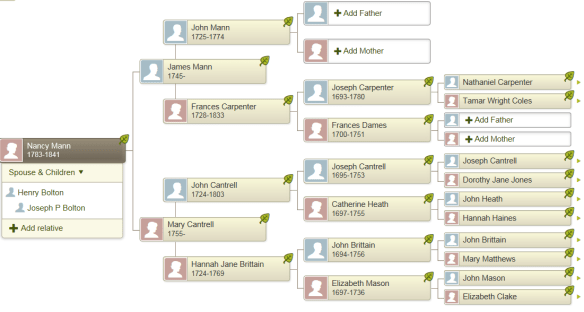
My larger Nancy Mann circle shows that I have 12 members in this circle, of which I match 4 by DNA and the rest have a DNA connection with other member(s) of the group. We all have a common ancestor in our trees – Nancy Mann.

To clear up any misconceptions here, ancestry has very specifically stated that they are NOT using trees to do DNA matches, but only after DNA matching is completed, they are searching for common ancestors in trees of matches.

circles9

Of the Nancy Mann circle members, I match 4 people utilizing DNA. Three of those show on my match list, but one, C.M. doesn’t show on my match list today nor on my old list.  This is a strong match, so I find this confusing.

One of my non-DNA tree matches used to be a DNA match, but isn’t anymore. This would be one example of where a legitimate match was removed by the new matching routines, but I can still see that there is a circle connection to a common ancestor.  While Circles don’t confirm a genetic connection, they are another tool that is certainly suggestive that the DNA connections between these individuals lead to a common ancestor.

Nancy Mann’s husband was Henry Bolton. She was his second wife, so there will be people who connect to Henry, via his first wife, but not to Nancy Mann.  What this means is that everyone in Nancy’s circle should also be in Henry’s circle, but some people in Henry’s circle won’t be in Nancy’s circle.

When looking at why someone in my Nancy Mann circle wasn’t in my Henry Bolton circle, I noticed that Williamlowe94 does list Henry Bolton, but has spelled his name “Henry Bolton (Boulton)” and apparently the parenthesis name was considered a non-match. C. M. has spelled Henry’s name Boulton, so that’s why C.M. is in the Nancy Mann group, but not the Henry Bolton group.

Another circle, Joseph Preston Bolton, was Henry Bolton’s son. There are 4 members of that circle, one of which I match via DNA.  There is one new member of this group that is not in the Henry Bolton group, and who is not on my DNA match list.  I wondered why they aren’t on Henry’s list, so I looked at their pedigree chart and their chart stops at Joseph Preston Bolton.  This would seem to be a good opportunity for Ancestry to utilize the power of their software to see if she actually DOES fit into the Henry Bolton and Nancy Mann circles and suggest to her that in fact, she does.  For her, this might indeed tear down a brick wall.  Most people aren’t looking for confirmation of what they have, they are looking for that next step – that elusive ancestor who isn’t identified.

That is why we do DNA, and genealogy.

The John Campbell tree only has 3 members and both of the other Circle members are a DNA match to me. Of course, that doesn’t mean they are a DNA match to each other.  All 3 of us show John’s wife to be exactly the same person, spelled exactly the same way Jane “Jenny” Dobkins, but there is no circle for her.  I wonder if somehow the quotes interfered with the circle creation.  Given that all 3 of us form a circle for John, we should also form that exact same circle for Jane.

Fairwick Claxton and Agnes Muncy hold another odd match. One charlenecarlson0126 shows to be both a DNA match and a tree match, but she does not appear on my DNA match list, nor does her tree include any Claxton or Clarkson at all.  This has to be a bug of some sort, but it seems odd that it would pass both criteria, DNA matching and the tree.

circles10

Match above, tree below.

circles11

What I was actually searching for is why Fairwick’s father, James Lee Clarkson/Clarkston/Claxton is not listed as a circle. My suspicion is that the name is not spelled consistently.  Of the 5 Circle members, one is spelled, Claxton, 2 Clarkson and 2 Clarkston.  This looks like another miss that could be a hit.

My John Hill circle is actually quite interesting. There are only 3 people and I match one via DNA.  I’ve been working with my non-DNA match on this genealogy line.  It’s nice to see him in the Circle, even though our DNA doesn’t match directly.

The John Hill group, again, begs the question of why there is no wife’s group. She was Catherine Mitchell and all 3 of us list her as such.

In Summary

Ancestry has certainly improved their methodology and utilized their new tools to add the DNA Circles feature.

Certainly, we had too many matches to deal with before and now we have a much more reasonable number. Ancestry’s shakey leaf remains one of the best tools they have ever implemented and their user interface remains clean, crisp and easy to use.  There are a few bugs, but this is a beta version and with feedback, I’m sure they will resolve those in short order.

In order to get a handle on what was really occurring, I created a spreadsheet of my pre-Circles shakey-leaf matches as compared with my matches in the new Circles version. The individuals in bold are the ones that appear in both versions, the pre and post Circles.  Non-bolded were in one or the other versions, but not both.  In some cases, like with the first 4 matches in this group, I wonder why they don’t form a James Lee Claxton group.  Me plus two more would be enough for an emerging group, and we have that for sure.

Shakey Leaf Matches and Ancestor Previous Current Circle Members
Rodneybranch1 – James Lee Claxton and Sarah “Sary” Cook distant gone
urbadntx – James Lee Claxton and Sary Cook absent distant
Ctkatherine – Fairwick Claxton and Agnes Muncy 4 4 Fairwick Claxton, Agnes Muncy
Dbreeding63 – Fairwix Claxton and Agnes Muncy 4 4 Fairwick Claxton, Agnes Muncy
charlenecarlson0126 Fairwick Claxton, Agnes Muncy
Petwin73 – John Hill and Catherine Mitchell distant gone John Hill
Greatpyr616 – Henry Bolton and Nancy Mann distant distant Nancy Mann, Henry Bolton
Marsha Bolton – Henry Bolton and Nancy Mann distant gone Nancy Mann
Ctlynch01 – Henry Bolton and Nancy Mann distant gone
C.L.M. – Henry Bolton and Nancy Mann distant distant
Tjfhorn1 – Henry Bolton and Nancy Mann distant gone
johnryder42 – Nancy Mann absent distant Nancy Mann, Henry Bolton
Dblrich – Honore Lore and Marie Lafaille distant distant
Rkoelpin – Francois Lafaille distant gone
William Lowe94 – Joseph Preston Bolton distant distant Nancy Mann, Joseph Bolton
E.J.H. – John Francis Vannoy and Susannah Anderson distant gone
Rheainhatton – Francis Vannoy and Catherine Anderson distant gone
Viero111777 – John Francis Vannoy and Susannah Anderson distant gone
Maggiejames113 – John Francis Vannoy and Susannah Anderson distant gone
J.M. – John Vanoy distant gone
annelynnward1 – Jothan Brown absent distant
RWECIII – Jotham Brown distant gone
Raymond Brown – Jotham Brown distant distant
Tgbils917 – Jotham Brown distant gone
Skyrider3277 – Jotham Brown distant gone
Browndavid239 – Jotham Brown distant distant
R.G. – John R. Estes and Nancy Ann Moore distant gone
Chuck2810 – John R. Estes and Nancy Ann Moore distant distant
Lodikid – Andrew McKee distant distant
C.A.W. – Daniel Miller and Elizabeth Ulrich distant distant
Ostate4454 – John Campbell and Jane “Jenny” Dobkins distant distant John Campbell
melby01 – John Campbell and Jane Dobkins absent distant John Campbell
A.F.B. – Nicholas Speaks and Sarah Faires distant gone
nellf_1 – Nicholas Speaks and Sarah Faires absent distant Nicholas Speaks, Sarah Faires
Razzanozoo1 – Lois McNiel distant gone
EHVannoy – Joel Vannoy and Phoebe Crumley 3 3 Joel Vannoy, Phoebe Crumley
D.V. – Joel Vannoy and Phoebe Crumley 3 4 Joel Vannoy, Phoebe Crumley
Spklegirl- Francois LaFaille 4 gone
H.C. – Jacob Lentz and Frederica Moselman 4 distant Jacob Lentz
Alyssa- Lazarus Estes and Elizabeth Vannoy 4 4 Joel Vannoy, Phoebe Crumley
J.L.B. – Daniel Miller and Elizabeth Ulrich 3 4
drjcox51 – Charles Hickerson and Mary Lytle absent distant
M.S. – private tree distant gone Not in circles
Christine414 – private tree distant gone Not in circles
DDicksson – private tree (Jane Dobkins and John Campbell) distant distant Not in circles
FruitofVine – private tree distant gone Not in circles
Lisa36ang – private tree distant distant Not in circles
J.M.F. – private tree distant gone Not in circles
1_perry22 – private tree distant gone Not in circles
Jcarolynbh – private tree distant gone Not in circles
Nanbowjack – private tree 4 4 Not in circles
L.W. – private tree (John R. Estes) 4 4 Not in circles
P.B. – private tree 4 4 Not in circles
1_cmarse – private tree 4 4 Not in circles
MDgenealogy20 – private tree 4 4 Not in circles
Susanharmon – private tree 4 4 Not in circles

Obviously, several people are in multiple circles.  There are a total of 15 DNA matches distributed between 12 circles.  That leaves 3,335 matches that aren’t helping me or correlated in any way.  While I do like the circles, I’m disappointed that so few of my matches sync up with pedigree charts.  It looks like there would be a lot more if Ancestry would review the matching routine, and perhaps more yet if they would reach beyond 7 generations.  But first steps first.

Some circles contain only DNA matches.  Others have more non-DNA matches (to me) but have a pedigree match to everyone in the DNA Circle. That’s really what these are, DNA circles that happen to have a common ancestor in their family tree.

Does a circle confirm that the connection to that ancestor is via DNA? Nope.  Does it confirm that your DNA connection to your match is from that ancestor?  Nope.  You still need a chromosome browser to do that – but this certainly helps.  It’s a step in the right direction.  It gives us another tool.  And, in some cases, like my Elijah Vannoy, changing the suspected parents periodically from one possibility to the other might be viewed as a new method of fishing.  So might changing the surname spelling.

And regarding that chromosome browser from Ancestry, well, all I can say is don’t hold your breath…

Truthfully, I’ll tell you exactly when we’ll get a chromosome browser.

Tim Sullivan, Ancestry’s CEO, is a genealogist, just like the rest of us. The day he has to transfer his autosomal file to a competitor to use their chromosome browser to confirm an ancestral match…well…I’m betting that’s the day a chromosome browser will become a priority for Ancestry.

So Tim, my friend, I wish for you a lot of new circles – including one just like my Hickerson match – one that you have been desperately seeking for say, about 30 years. Wouldn’t that be a great Christmas gift?  But, you see, I know that having a hint but not knowing, i.e., no proof, is going to just about kill you.  It will break your genealogist’s heart.  It will make you beat-your-head-against-the-wall insane.  Screaming yellow zonkers nuts.  I don’t want that to happen to you, or anyone else, for that matter.

So, while you’re waiting for Ancestry’s chromosome browser to be developed, here’s the link to Family Tree DNA so you can confirm your genetic ancestral match…assuming of course that you can also convince the other people to download their results from Ancestry to Family Tree DNA as well:)

______________________________________________________________

Disclosure

I receive a small contribution when you click on some of the links to vendors in my articles. This does NOT increase the price you pay but helps me to keep the lights on and this informational blog free for everyone. Please click on the links in the articles or to the vendors below if you are purchasing products or DNA testing.

Thank you so much.

DNA Purchases and Free Transfers

Genealogy Services

Genealogy Research
One Match, Two Ancestors – Never Assume

Woman with HeadacheA few days ago, I received a note from someone who descends from my Miller line. Specifically, from our common ancestor, Philip Jacob Miller (1726-1799) and his wife, Magdalena (1727-1808).

Many records give Magdalena’s surname as Rochette, but I have found not one shred of evidence as to that or any other surname, nor can I find where the information about the Rochette surname originated.  So call me stubborn, but until there is some sort of proof, I’m not using it.  I will say one thing though.  Philip Jacob Miller was Brethren, as were his parents, and it’s very likely that his wife was also from the Brethren community – and there was no Rochette in the Brethren community or even in the same county.  And yes, I’ve personally checked the records.

Philip Jacob Miller and wife Magdalena had two sons, David, who my newly found cousin descends from, born in 1757, and Daniel, who I descend from, born in 1755. My cousin and I had “met” on 23and Me a year or so ago, but since she was not at Family Tree DNA, she could not join the Miller-Brethren surname project and I couldn’t compare her results to those of other known Miller descendants.  The Miller-Brethren DNA project focuses on the Miller families who were members of the Brethren (or similar) religions – and yes – there was more than one genetic Miller family – even in the same county and congregation.  They even moved cross-country together, yet they were not all from the same Miller ancestral line.  Y DNA busted that assumption years ago, but it was not at all what we expected to find!

When I received a note from my cousin that she had taken advantage of Family Tree DNA’s (almost) free transfer opportunity, I was thrilled, because we could then compare her to the rest of the clan.

In the Miller-Brethren project, we have three other cousins, all of whom descend from Daniel Miller in one way or another, that my cousin matches. Her best match is to my mother with 82 shared centimorgans and next, with me at 64.

You can see the comparison on the chromosome browser, below, at the default thresholds. Green is my mother, orange is me and blue is cousin Herbie who descends from another son of Daniel Miller.  You can see that there is a very large chunk of DNA on chromosome 14 where we all match.  A fourth cousin, shown in pink, also descended from Daniel, does not carry this segment of DNA on chromosome 14.

miller match

Dropping the threshold to 1cM produced more matching segments, but still no pink on chromosome 14, so clearly our pink cousin did not receive any Miller DNA on chromosome 14. However, we can attribute a huge chunk of chromosome 14 to Philip Jacob Miller and wife, Magdalena.  This segment is quite large, a total of 48cM and 12,894 SNPs.

miller match2

A second very interesting match is on the X chromosome. It’s fairly large too, a total of 11.84cM broken into three segments.  You can see that both mother and I match my cousin on the same X segments – obviously from Philip Jacob Miller and Magdalena.  Right?  Wrong.  Wrong.  Very wrong.

If you’re scratching your head about now, you’re not alone.  Keep reading…

Do you ever just get a sense that something isn’t right? A second sense that you need to check again?  Well, in genetic genealogy, never assume.  After I thought for just a second, I decided to grab my X chromosome map, because something just didn’t seem right.  So glad I did, because Philip Jacob Miller and Magdalena are NOT on the X inheritance path of my mother (and therefore not me either) so the X match CANNOT come from them.

miller match3

Using Charting Companion software, I can easily see, in pink and blue, who my mother’s X chromosome comes from in her lineage.  You can also see that Philip Jacob Miller isn’t on the X path, and neither are his descendants for two downstream generations – not until David Miller’s wife, Catharine Schaeffer, brings her X to the game.  So, the X match cannot be through this Miller line.

So, where did it come from?

In addition to this chart, I also sent an X chromosome pedigree chart to my cousin. She looked it over, and made a discovery.

Moving to my grandmother’s X chart, because the print is too small to read if I add another generation on my mother’s chart, you can now see Maria Magdalena Weber.

miller match4

Maria Magdalena Weber was born in 1724 in Mutterstadt, Germany to Johann Martin Weber and Maria Magdalena Schunck.

As it turns out, my cousin has another ancestor Eva Maria Weber, born in 1709, someplace in the Phalz portion of Germany, first found in Oley, PA. Now, it turns out, that Oley, PA is also where some of my other ancestors lived.  The DeTurks, Hochs and Deharcourts married into the Schaeffer family who migrated to Montgomery County, Ohio and married into the Miller family.  And yes, for those who are wondering, the Schaeffer line IS in my X path and yes, there are brick walls there that need to fall.

miller match5

Looking back at the first fan chart, Catharina Schaeffer is the wife of David Miller, son of Daniel Miller, son of Philip Jacob Miller and Magdalena. Yep, it’s a small world.  And truth is stranger, sometimes, than fiction.

So, is our common ancestor a Weber? And if it is a Weber, is it from the Mutterstadt Weber line, or is it a mystery person from Oley, PA – a brick wall that hasn’t fallen yet?

We don’t know.

Yet.

We’re still working on it.

Now all I need is a tool to find every other person who matches me and my cousin on that same X segment and see who their ancestors are.

Webers or Oley, PA people, or both????

Or are they one and the same?

Webers who are from Mutterstadt and who went to Oley, PA and…

would it be…

could it be…

possible that I descend through that line twice????

Oh, my head hurts.

The genealogy Gods certainly have a perverse and twisted sense of humor.

The lesson here is never assume. Just because you have positively identified your common ancestor with a match, and proven it with triangulation, doesn’t necessarily mean that is your ONLY ancestor that you share with that match.  You know what assume does.

Among other things, it gives you a headache.

Just saying….

______________________________________________________________

Disclosure

I receive a small contribution when you click on some of the links to vendors in my articles. This does NOT increase the price you pay but helps me to keep the lights on and this informational blog free for everyone. Please click on the links in the articles or to the vendors below if you are purchasing products or DNA testing.

Thank you so much.

DNA Purchases and Free Transfers

Genealogy Services

Genealogy Research
What Does and Doesn’t a Y DNA Match Mean?

It’s easy to forget how foreign this landscape looks to a newbie, but the newbies are our next generation genealogists and genetic genealogists.

This week, someone e-mailed me who had tested at Family Tree DNA and asked how to contact their Y DNA match they had found in a project that I manage.  I thought that was a very strange request, since your matches are on your personal page along with their e-mail addresses, so I asked for the name on their kit and their kit number so I could take a look.

As it turns out, they had no Y DNA matches on their personal page, so they were hunting for matches elsewhere.  They had joined the haplogroup E1b1a-M2 project and it’s there that they found their “matches” that they were asking about.  I commend their tenacity in hunting for matches and finding them in a project, even though they weren’t exactly what they thought.

The kit number here is 343629, Lewis.  You can see in the screen shot from the haplogroup E-M2 project page that they don’t match anyone exactly at 12 markers, and their closest match is to Harris above their entry, and they have 3 mismatches at 12 markers.

y match 1

As it turns out, Lewis and Harris didn’t qualify as matches, which is why they weren’t displayed on their personal match page.  This explains why kit 343629 was asking me how to contact their “matches.”

Family Tree DNA has set up match thresholds.  For someone to be listed as your match, they need to have no more than the following total number of mutations difference from your results.

Markers in Panel Tested Maximum Number of Mutations Allowed
12 0 unless in a common project, then 1
25 2
37 4
67 7
111 10

The reason for these thresholds is that DNA mutates at an “average” rate and for someone to have more than this number of mutations in that marker range means, generally, that the match is too far back in time to be genealogically relevant.  For people who do have matches, you can utilize Family Tree DNA’s TIP calculator to obtain an estimate of how distant the most recent common ancestor (MRCA) might be from you and your match.  I wrote about the TIP calculator and the MRCA both, so refer to those articles for more into on those tools.

The next question this person asked is, “How do you tell which markers indicate someone as a close cousin?”

The answer really involves several aspects or DNA testing, and I’m going to answer their question here, in pieces, so that everyone can benefit.

  1. In general, finding family via the Y markers is not about “which markers” as much as it is about the number of matching markers. If you share a common ancestor, the DNA of that man’s descendants will accrue mutations over time. If the common ancestor is before the advent of surnames in the culture in which they resided, then the surnames may not match, but the common ancestor still existed.
  2. In general, 12 markers is not sufficient to determine a common ancestor, although you can rule out common ancestors in a genealogical timeframe, generally accepted to be 500-800 years, by high numbers of mismatches caused by mutations. I would suggest this person test at higher markers because sometimes people do pick up matches at higher levels where more mutations are allowed, especially if the mutations happened, for some reason, in the lower panels but few happened in the higher panels. I do see this when writing the Personalized DNA Reports for people, not often, but it does occur, especially at 111 markers.
  3. You cannot necessarily identify a “close cousin” or any specific relationship utilizing Y DNA testing alone, especially at low marker levels, such as 12 and 25.  Although if someone matches you on all 111 markers, there is a very good chance that you share a common ancestors in just a few generations. What the traditional Y test (meaning not the Big Y test) does confirm is whether or not you share a common paternal ancestor and then it’s up to genealogy and autosomal testing to determine how close that relationship might be. The number of matching Y markers can provide hints and generalities through the TIP tool, but nothing more.
  4. For this individual, in addition to upgrading beyond 12 markers, I would recommend that they take the Family Finder autosomal test because that will provide them with a list of cousins on all of their lines, not just their Y line. Based on their earlier commentary, they are looking for all family, not just their paternal line. If you have Y matches and autosomal matches, through the Advanced Matching tool on your Personal Page you can see who, if anyone, is a match to you on both.
  5. However, all of this said, the combined pattern of Y markers, not individual markers, determine the match or non-match, and it is your personal DNA signature. Think of it as a song and the markers as notes in your own personal DNA song. Given that mutations arise in each person’s line, sometimes the various DNA mutations are rare, and those rare markers together can be utilized to determine how closely one might match someone else, especially if the surnames don’t match. I see this often in African American descendants of slaves because surnames weren’t adopted until after the Civil War ended in 1865. Often the 1870 census is our first opportunity to find these families with a surname, and sometimes they subsequently changed their surname.

One of the things I do for my customers as part of a Personalized DNA Report is to complete a profile for them of the relative rarity of their DNA by marker.  Please note that I don’t do DNA reports for people who haven’t tested at least 37 markers because I don’t have enough information to work with.

In the case of this individual, I compared their 12 markers in my database of haplogroup marker frequency with the following results.

y match 2

Values under 25% are bolded, as they are rarer values and the combination of these rarer values are likely to be your own personal family line rare marker DNA signature.  Said differently, you are more likely to be more closely related to those who carry this rare marker signature than those who don’t.

This person has 6 out of 12 markers that are relatively rare.  Normally, one would expect no more than 3, so this is likely why they have no matches.  This is a good news, bad news thing.  The bad news – no matches today.  The good news is that these rare markers value, combined, are a wonderful personal filter that eliminates matches by convergence.  So, someday, when they do have a solid match, it will be relevant and not just because they have all common markers.

And now for the next question.  How can you obtain your own list of marker frequencies?  Obviously, you can order the DNA Report for $349, or if all you want is the marker frequencies, you can order a Quick Consult for $100 and can obtain all 111 of the Y marker frequencies for any one kit.

Guarantees

Most people just want an answer.  I fully understand that.  Me too, but often, that’s not how DNA testing and genetic genealogy as a whole works.  So the question, “What test can I take to give me the answer?” really doesn’t have a solid, works every time, answer.  There is no absolute, no guarantee.  Sometimes, depending on the question at hand, a regular Y DNA test will do exactly what you want.  Other times, like in this case, not so much.  But you won’t know until you test and there is no way to predict an outcome.  Testing may provide the answer in spades, immediately, and it diggingdoes sometimes.  Other times, you get a puzzle piece with a fortune cookie note that says ”you will undergo more DNA testing.” The answers are tied to DNA testing, yours and other peoples, traditional genealogy research and sometimes, luck.  But it has been my experience that those who work the hardest, test most thoroughly and dig the deepest are most often the ones who experience more occurrences of “luck.”  Keep digging.

As Louis Pasteur said, “Fortune favors the prepared mind.”  Not nearly as eloquent as Dr. Pasteur, my old Hoosier farmer Dad would have said, “apply a little more elbow grease.”

I hope this has helped to clarify what a Y DNA match actually does and doesn’t mean, and how to take the next step in finding your family.

______________________________________________________________

Disclosure

I receive a small contribution when you click on some of the links to vendors in my articles. This does NOT increase the price you pay but helps me to keep the lights on and this informational blog free for everyone. Please click on the links in the articles or to the vendors below if you are purchasing products or DNA testing.

Thank you so much.

DNA Purchases and Free Transfers

Genealogy Services

Genealogy Research

Autosomal DNA Matching within Projects

Family Tree DNA was gracious enough to establish projects for genealogists – in fact – that’s one of the first things they did.  However, when they established projects, some 14 or 15 years ago, the first projects that existed were Y DNA projects.  The Y DNA, of course, is passed from father to son, along with the surname, so the projects were called “surname projects.”

Women, of course, are genealogically jinxed because their surnames have historically changed in every generation, with marriage, and sometimes multiple times, with multiple marriages – so which surname project would they join?  The answer is, it varies, and more often than not, the answer is none.  They roam around like homeless nomads.  Mitochondrial DNA tools and data bases lag far behind those of Y or autosomal DNA.

There are four types of projects at Family Tree DNA.

  1. Surname projects
  2. Haplogroup projects
  3. Geographic projects
  4. Mitochondrial DNA lineage projects

Mitochondrial DNA lineage projects have never really caught on, probably because there is no good way to find them, but the other three types of projects are very common and widely used.

In upcoming articles, we’re going to look at each type of project, what it provides, to whom, and any special challenges it might have.

However, there is one universal challenge with projects and that’s how to find and handle autosomal matches.  Autosomal testing didn’t exist when projects were first defined, and now we don’t quite know how to handle autosomal testing and people who descend from specific lines but not through the Y chromosome.  In other words, my paternal grandmother was a Bolton, but it’s not my surname – should I and could I join the Bolton project?  In the past, assuredly, the answer would have been “no,” because the Bolton project is a Y DNA project – but is the answer still no?  That depends on the project and the administrators, and we’ll discuss these types of issues in the upcoming Surname Projects article.

However, regardless of the type of project, there is one question that gets asked a lot, and the answer is always the same.

Can I compare my autosomal DNA to other project members?

And the answer is…..drum roll please….yes.  However, not in the way you might expect.

All projects and types of projects, and all tests, except Big Y, SNP and factoids are included in the advanced matching features available on every participants home page at Family Tree DNA.  This means that you can see who you match, within each project you have joined, on each kind of and combination of kinds of tests.

Sign on to your personal page, and under “My DNA,” under either Y DNA, mtDNA or Family Finder, you have an “Advanced Matching” option.

y dna options

Selecting the Advanced Matching Option will show the following options.

advanced matches

Selecting Family Finder and then the project where you’d like to see who you match, in this case, “Speaks,” and then clicking on “Run Report” gives you the following.

speaks ff match

Within the project, you can see who you match, if they have had their Y or mtDNA tested, and if so, the haplogroup, and their estimated relationship range (to you) utilizing Family Finder.

Now, let me tell you what this DOESN’T mean.

It doesn’t automatically mean that you match these people on this same family line.

I want to say that again, and louder, because this is one of the most common erroneous assumptions I see.

autosomal does not

You have to do more work, chromosome matching and triangulation to determine how you match these people, and on which lines.

And it does not, DOES NOT, mean that if you are both members of a geographic project, like the American Indian project, for example, that you are American Indian because you match someone in the American Indian project.  You might match them on a completely different non-Indian line.

It also DOES NOT mean that these people who match you, match each other.  You can determine that, but you’ll need to utilize the matrix tool to see who matches whom.  In fact, in the example above, Stacy and Lola-Margaret do not match each other.

You simply cannot assume.  You know what assume does….

No jumping to conclusions either, no matter how excited you are or how promising a match within that project looks to be.  Conclusion jumping works functionally the same as assume.

If this seems a bit confusing to you, let me explain.

Autosomal DNA tests test and include your DNA that you received from all of your ancestral lines.  It reaches back in time reliably 5 or 6 generations, and often further, in terms of matching to your genetic cousins.

DNA Pedigree

At 5 generations, you have 32 separate ancestral lines, and at 6 generations, you have 64 different ancestral lines.

Y surname projects typically focus on one line, the blue Estes line above.  Mitochondrial DNA is the same, focusing on the red circle matrilineal line above  But your autosomal DNA match within the Estes project could reflect an Estes line match, or any of your 31 genealogical other lines at 5 generations.  People who join projects typically do so because of their relationship with one particular line, like the Estes line – but autosomal has the capability to and does reach across all lines – so just because you match someone in the same DNA project does not mean that’s where your genetic match comes from.  Of course, it’s a wonderful hint, especially if you’re an Estes and it’s the Estes project, and a great place to start looking – but it’s NOT a given.  And of course, in haplogroup and geographic projects, the connection is even less apparent.  The Y DNA and mtDNA haplogroup fields are also another great hint and can quickly eliminate, or suggest, those possible lines.

Are you curious to see who you match in different projects?  Take a look.  You never know what kind of surprise might be waiting.

______________________________________________________________

Disclosure

I receive a small contribution when you click on some of the links to vendors in my articles. This does NOT increase the price you pay but helps me to keep the lights on and this informational blog free for everyone. Please click on the links in the articles or to the vendors below if you are purchasing products or DNA testing.

Thank you so much.

DNA Purchases and Free Transfers

Genealogy Services

Genealogy Research
Identifying Possible Common Ancestors Utilizing Multiple Tests

There is a significant amount of confusion about DNA matching and which ancestors and ancestral lines can match in which way.

To review, there are 4 different kinds of DNA that we can utilize for genealogy, the Y DNA for males, mitochondrial, X chromosome and autosomal DNA for both males and females.  You can read an intro article about how these different types of DNA are utilized here.

Clearly, the mitochondrial DNA addresses only one line – your mother’s matrilineal line, shown in red below – and the mitochondrial DNA is never divided or mixed with that of the father.  So you share the mitochondrial DNA with thousands of generations of your matrilineal ancestors.  You’ve accumulated a few mutations over those generations, which serve to show us who you are most closely related to.

Y and mito

The Y chromosome is passed only from father to son, shown in blue above.

If you haven’t read this article I wrote about X matching, please do.  Males and females have a different inheritance path for the X chromosome because males don’t inherit an X from their father’s, but females do.

Even better, if you utilize software that can interface with Progeny Software’s Charting Companion, by all means, purchase this add-on program because it shows you on your own tree which of your ancestors X chromosome you have the potential of carrying.  I wrote about how to utilize this great tool here.

x fan

The X chromosome acts like autosomal DNA, the DNA we receive from all of our ancestral lines, including red and blue lines above, and all of the blank ones in-between, meaning that the X chromosome is a candidate to be recombined and divided in each generation.  I say a candidate, because sometimes the X is passed in very large pieces. Not quite what or how we might expect.  I wrote about that here.

But we can’t and don’t know whose X we carry, or which pieces of which ancestors’ Xs we carry – but we do know, based on how DNA is passed generation to generation, whose X DNA we MIGHT carry – and whose we cannot carry.

Because women inherit an X from both parents, and men only inherit the X from their mother, the inheritance pattern through the generations is different for males and females, so each person needs to plot out their potential X ancestors.

A female could carry some part of the X chromosome of any of the ancestors whose names would fall into the pink or blue boxes of this fan chart.  You can NOT inherit any X from someone whose box is blank (no color).

female x chart

These blank charts are courtesy of Blaine Bettinger.  He originally published them on his blog, The Genetic Genealogist, in December 2008 and January 2009 in his articles about how to use the X chromosome for genealogy.

A male’s fan chart for the X chromosome looks a bit different because the male doesn’t inherit an X from his father.  Instead, he inherits the Y chromosome which makes him a male.

x chart male

So let’s see if we can approach this combination of information and DNA test types in a bit of a different way.  A female can inherit the following kinds of DNA from the ancestors listed at the left in the chart below.  This chart compiles information from all of the 4 different types of DNA that we can use for genealogical purposes. Generation number is in parenthesis.

Female’s Ancestor Inheritance Chart

Here’s how to read this chart.

Does a female inherit Y DNA from her mother?  No

Does a female inherit mtDNA from her mother?  Yes

Does a female inherit the X chromosome from her mother?  Yes

Does a female inherit autosomal DNA from her mother?  Yes

­Ancestor Y DNA mtDNA X Chr Autosomal
Mother (1) No – she doesn’t have one Yes Yes Yes
Father (1) No – you’re a female No – only passed from mother Yes Yes
Mother’s mother (2) No Yes Yes Yes
Mother’s father (2) No No Yes Yes
Father’s father (2) No No No – your father didn’t get an X from his father Yes
Father’s mother (2) No No – father’s don’t contribute mtDNA to children Yes Yes
Mother’s mother’s mother (3) No Yes Yes Yes
Mother’s mother’s father (3) No No Yes Yes
Mother’ father’s mother (3) No No Yes Yes
Mother’s father’sFather (3) No No No Yes
Father’s father’s father (3) No No No Yes
Father’s father’s mother (3) No No No Yes
Father’s mother’s mother (3) No No Yes Yes
Father’s mother’s father (3) No No Yes Yes

You can personalize this chart by inserting your own ancestor’s names and complete additional generations by:

  • First following the Y chromosome, which women don’t have to be concerned with, but men certainly do
  • Second, following the mitochondrial DNA inheritance path through the matrilineal line
  • Third, charting your X chromosome potential ancestor into the X Chr column
  • Fourth, simply put yes in the column for everyone for autosomal

This same chart for a male would look somewhat different, but only in the X and Y columns.

Males’ Ancestor Inheritance Chart

Ancestor Y DNA mtDNA X Chr Autosomal
Mother (1) No – she doesn’t have one Yes Yes Yes
Father (1) Yes, you received your father’s No – only passed from mother No – You received the Y instead Yes
Mother’s mother (2) No Yes Yes Yes
Mother’s father (2) No No Yes Yes
Father’s father (2) Yes, your father received his Y No No – your father didn’t get an X from his father Yes
Father’s mother (2) No No – father’s don’t contribute mtDNA to children No – you received no X from your father Yes
Mother’s mother’s mother (3) No Yes Yes Yes
Mother’s mother’s father (3) No No Yes Yes
Mother’ father’s mother (3) No No Yes Yes
Mother’s father’sFather (3) No No No Yes
Father’s father’s father (3) Yes No No Yes
Father’s father’s mother (3) No No No Yes
Father’s mother’s mother (3) No No No Yes
Father’s mother’s father (3) No No No Yes

So, how could this help you with your genealogy?  Let’s say that you match someone on the X chromosome, but you know that you are not a mitochondrial match.  You can look on this chart and eliminate any line that includes a mtDNA match.  You know your X match is not from that line.  You can also eliminate any ancestral line that does not include a potential X match.  The ancestors you are left with are your possible match ancestors.

Let’s use the female chart below as an example.  The greyed out ancestors are those removed by virtue of no mitochondrial DNA match, so anyone with a Yes in that box.  It also eliminates anyone who could not contribute an X chromosome, so with a No in that box.  Any greyed out box eliminated that specific ancestor from consideration.

Please note that by eliminating your mother, it does not eliminate her entire line.  It only means, in this case, that if your mitochondrial DNA doesn’t match, then you and your match don’t share a common mother.  Your mother’s father is still a possibility.  And you can still match on just the X but not through the dual mito line.

Female Example of X Match Ancestor Elimination

female X match ancestor elimination crop

Therefore, only the ancestors left unshaded are candidates for matches.

Male Example of Ancestor Elimination

Of course, on a male’s chart, the X becomes much more restricted due to the fact that men inherit the Y chromosome and not the X from their fathers.  You’ll notice that if a specific ancestor carries a matching Y chromosome, they cannot carry the matching X – they are mutually exclusive.

male x match ancestor elimination2

As you can see, by the time we’re done eliminating possibilities, there are only three possible ancestral lines to pursue for the X match who doesn’t match on the Y or the mitochondrial DNA.

Conversely, if you have someone who matches on the X AND on a mitochondrial line, that is a huge hint and that line would be the first one I would pursue.

You can expand this chart to any number of generations.  I stopped at 3 for illustration purposes.

While this methodology doesn’t exactly tell you who your common X matching ancestor is, it certainly narrows the playing field substantially.  Finding an X chromosome match can be a real bonus, especially when combined with other types of DNA testing.

______________________________________________________________

Disclosure

I receive a small contribution when you click on some of the links to vendors in my articles. This does NOT increase the price you pay but helps me to keep the lights on and this informational blog free for everyone. Please click on the links in the articles or to the vendors below if you are purchasing products or DNA testing.

Thank you so much.

DNA Purchases and Free Transfers

Genealogy Services

Genealogy Research
Haplogroups, SNPs and Family Group Confusion

The transition at Family Tree DNA from the old haplogroup naming convention to the new SNP-only naming convention has generated a great deal of confusion.  It’s like surgery – had to be done – but it has been painful.

I’ve received several questions, many that are similar, so I’d like to attempt to resolve some of the confusing points here.

First, just a little background.

Ancient History

Remember, in 2008, when Michael Hammer et al rewrote the Y tree?  If you do, then count yourself as an old-timer.  Names such as R1b1c became R1b1a2.  E3a became E1b1a and E3b became E1b1b1.  We thought we were all going to die.  But we didn’t – and now, if I hadn’t just told you, you wouldn’t even be able to remember the previous name of R1b1a2.

Why did this happen?  Because when you have a step-wise tree where each step is given a number and letter, like this, you have no room for expansion.

R

R1

R1a

R1a1

Each of these haplogroup names is assigned a SNP, and when a new SNP is discovered between R and R1, for example, the name R1 gets assigned to the new SNP and everyone downstream gets renamed and/or a new SNP assigned.  If you think this is confusing, it is and was – terribly so.  In fact, as testimony to this, the last version of the FTDNA tree, the ISOGG tree and the tree used by 23andMe are entirely out of sync with each other.

With the shift from about 800 SNPs to 12,000 SNPs with the Geno2.0 chip, it was definitely time to redo and rethink how haplogroup names are assigned.  What seemed initially like a great idea turned out not to be when the magnitude of the number of SNPs that actually exist was realized.  In reality, they needed to be obsoleted, but the familiar cadence of the letter number path will forever be gone – with the exception of the fact that the SNP is prefaced with the haplogroup name.  We will no longer have our signposts, sadly, but our signposts were becoming overwhelmingly long.  Here’s one example I copied from the ISOGG tree.  R1b1a2a1a1c2b2a1a1b2a1a – seriously – I can’t remember that.

So, today, and forever more, R1b1a2 will be R-M269.  It will not be shifted or “become” anything else.  Moving a SNP to a new location becomes painless, because it will not affect anything upstream or downstream.

However, as you get use to this new beast, you’re going to want to refer to “what something was” before.  You’ll find that articles, papers and who knows what else will refer to the haplogroup name – and you’ll need a conversion reference.

Here’s a link to that reference.  I don’t know about you, but I copied this and created a .pdf file in case this reference disappears – not that that ever happens in the electronic world.

Why the Confusion?

Within projects, men with the same surname now have different haplogroups assigned, and the SNP names look entirely different.  Before, if most of the surname group was R1b1a2, and one person had SNP tested at a deeper level and showed R1b1a2a1a1b4, it was easy to tell by looking that R1b1a2a1a1b4 fell underneath R1b1a2, and was a subclade.  Today, with the new tree, everyone that was R1b1a2 is now shown as R-M269 and the lone R1b1a2a1a1b4 person is shown as R-L21.  You can’t tell by looking if R-L21 is a subclade of R-M269 or the other way around.  And another few SNP tests at different levels into the mix, and you have one confused administrator.

One thing hasn’t changed.  Notice the haplogroup I-M253 individual in the purple group below.  There is a note that their parentage is uncertain.  Given the completely different haplogroup – this individual does not fit into any groups of Estes males biologically.  So completely different haplogroups are still exclusive, meaning you can tell at a glance that these folks do not share a common ancestor, even though their genealogy says that they should.

estes project cropped

Ok, got that now?  Good, because it gets more confusing.

Family Tree DNA did not do a one to one conversion, meaning they did not create a conversion table where R1b1a2=R-M269.  They did an entirely new prediction routine.  This makes sense, because they don’t hard code the haplogroup – it’s fluid and based on either a hard and fast SNP test or a prediction routine. This also allows for easy future improvements, and they utilize 37 markers for haplogroup predictions now instead of just 12, in most cases.

Unfortunately, or fortunately, the prediction routine produces different results for people within the same family group, based on STR marker results and how many STRs are tested.

What this means is that different people in the same family line will have different haplogroup predictions, as you can see in the groups above of individuals all descended from one male, Abraham Estes.

This isn’t wrong, as in incorrect, but it is confusing, especially when you’re used to seeing everyone who has not been SNP tested have a matching haplogroup within families.

Enter the Terminal SNP

The terminal SNP is your SNP that is furthest down the tree based on the SNPs that you have tested.  That second part is really important – based on the SNPs that you have tested.

When you’re looking at your matches, you can see their terminal SNP in the column below to the right, but what you can’t tell is if they have tested for any downstream SNPs and were found negative.

Estes match cropped

For example, if you are tested positive for R-M269 (formerly R1b1a2) and someone else that you match is R-L21, which is downstream of R-M269 – this does not exclude them as valid matches, UNLESS the first R-M269+ gentleman has actually tested for R-L21 and is negative.  You, of course, have no way of knowing this without asking the other participant.

Also, testing “negative” is a bit subjective, because there are known no-calls in the Geno 2.0 results – so if the Geno 2.0 result did not include the terminal haplogroup you expected, and the outcome is truly important to you, meaning family defining – have that defining SNP, if it’s absent in the Geno 2.0 raw data results, tested individually through regular Sanger sequencing – meaning purchase it separately through Family Tree DNA.  A non-positive result in the Geno 2.0 results is typically interpreted to mean negative, but that is not always the case.  In most situations, if everything else matches, meaning surname, STRs and other SNPs, it’s not necessary to test the SNP separately – but it is available if you need to know, positively.

Secondly, the terminal SNP on the new Family Tree DNA haplotree and in your results, if you have taken the Big Y, the Walk Through the Y or purchased individuals SNPs, may be different.  Why, and how would you know?

The why is because Family Tree DNA has synced to the Geno 2.0 tree at this point, and there have been many new SNPs discovered since the Geno 2.0 tree was developed in 2012.  The ISOGG tree is more current, but keep in mind that it is a provisional tree.  However, you still need to have a way to determine your terminal SNP beyond the Geno 2.0 criteria if you have had advanced testing.

There were originally some tools created by individuals to help with this dilemma, but both tools appear to no longer work.  Kitty Cooper blogged about this, and was apparently recently successful, but I was not.  I downloaded the updated version of the Big Y Chromosome extension that I wrote about and was using the Morley tree but that no longer functions either.  Let’s just say that the word frustrated doesn’t even begin to apply….

My suggestion is to work closely with your haplogroup and surname project administrator(s).  Many of the administrators have put together provisional charts and the haplogroup project pages are grouped by SNP groupings with suggestions for additional relevant testing.

The U106 project is a great example of proactive administrators.  Individual participants are clearly categorized and the categories suggest an appropriate “next step.”  Looking at their home page, the administrators make themselves readily available to project members for consulting about how to proceed.

u106 project

Yes, all of this change is a bit fuzzy right now, but give it a bit of time and the fog will clear.  It did in 2008 and we all survived.

Tree Updates

Family Tree DNA has committed to at least one more tree update this year, and let’s hope that it includes all of the SNPs in the reference data base they are using for the Big Y.

I’ll be talking about Big Y comparisons in a future article.

______________________________________________________________

Disclosure

I receive a small contribution when you click on some of the links to vendors in my articles. This does NOT increase the price you pay but helps me to keep the lights on and this informational blog free for everyone. Please click on the links in the articles or to the vendors below if you are purchasing products or DNA testing.

Thank you so much.

DNA Purchases and Free Transfers

Genealogy Services

Genealogy Research
Finding Native American Ethnic Results in Germanic People

I’m often asked about the significance of small percentages of autosomal DNA in results.  Specifically, the small percentages are often of Native American or results that would suggest Native admixture.  One of the first questions I always ask is whether or not the individual has Germanic or eastern European admixture.

Why?

Take a look at this map of the Invasion of the Roman Empire.  See the Huns and their path?

Hun map

It’s no wonder we’re so admixed.

Here’s a map of the Hunnic empire at its peak under Attila between the years 420-469.

Hun emplire

But that wasn’t the end of the Asian invasions.  The Magyars, who settled in Hungary arrived from Asia as well, in the 800s and 900s, as shown on this map from LaSalle University.

magyar map

Since both the Hungarians and some Germanic people descend from Asian populations, as do Native Americans, albeit thousands of years apart, it’s not unrealistic to expect that, as populations, they share a genetic connection.

Therefore, when people who carry heritage from this region of the world show small amounts of Native or Asian origin, I’m not surprised.  However, for Americans, trying to sort out their Native ethnic heritage, this is most unhelpful.

Let’s take a look at the perfect example candidate.  This man is exactly half Hungarian and half German.  Let’s see what his DNA results say, relative to any Asian or Native heritage, utilizing the testing companies and the free admixture tools at www.gedmatch.com.

He has not tested at Ancestry, but at Family Tree DNA, his myOrigins report 96% European, 4% Middle Eastern.  At 23andMe in speculative view, he shows 99.7 European and .2 sub-saharan African.

Moving to the admixture tools at GedMatch, MDLP is not recommended for Asian or Native ancestry, so I have excluded that tool.

Eurogenes K13 is the most recently updated admixture tool, so let’s take a look at that one first.

Eurogenes K13

 JK Eurogenes K13 v2

Eurogenes K13 showed 7% West Asian, which makes perfect sense considering his heritage, but it might be counted as “Native” in other circumstances, although I would certainly be very skeptical about counting it as such.

However, East Asian, Siberian and Amerindian would all be amalgamated into the Native American category, for a combined percentage of 1.31.

jk eurogenes k13 chart

However, selecting the “admixture proportions by chromosome” view shows something a bit different.  The cumulative percentages, by chromosome equate to 10.10%.  Some researchers mistakenly add this amount and use that as their percentage of Native ancestry.  This is not the case, because those are the portions of 100% of each individual chromosome, and the total would need to be divided by 22 to obtain the average value across all chromosomes.  The total is irrelevant, and the average may not reflect how the developer determines the amount of admixture because chromosomes are not the same size nor carry the same number of SNPs.  Questions relative to the functional underpinnings of each tool should be addressed to the developers.

Dodecad

I understand that there is a newer version of Dodecad, but that it has not been submitted to GedMatch for inclusion, per a discussion with GedMatch.  I can’t tell which of the Dodecad versions on GedMatch is the most current, so I ran the results utilizing both v3 and 12b.

jk dodecad v3

jk dodecad v3 chart

I hope v3 is not the most current, because it does not include any Native American category or pseudocategory – although there is a smattering of Northeast Asian at .27% and Southwest Asian at 1%.

Dodecad 12b below

jk dodecad 12b

The 12b version does show .52% Siberian and 2.6% Southwest Asian, although I’m not at all sure the Southwest Asian should be included.

HarappaWorld

jk harappaworld

jk harappaworld chart

Harappaworld shows .09 Siberian, .27% American (Native American), .23% Beringian and 1.8% Southwest Asian, although I would not include Southwest Asian in the Native calculation.

In Summary

Neither Family Tree DNA nor 23andMe find Native ancestry in our German/Hungarian tester, but all 3 of the admixture tools at Gedmatch find either small amounts of Native or Asian ancestry that could certainly be interpreted as Native, such as Siberian or Beringian.

Does this mean this German/Hungarian man has Native American ancestry?  Of course not, but it does probably mean that the Native population and his ancestral populations did share some genes from the same gene pool thousands of years ago.

While you might think this is improbable, or impossible, consider for a minute that every person outside of Africa today carries some percentage of Neanderthal DNA, and all Europeans also carry Denisovan DNA.  Our DNA does indeed have staying power over the millennia, especially once an entire population or group of people is involved.  We’ve recently seen this same type of scenarios in the full genome sequencing of a 24,000 year old Siberian male skeleton.

Our German/Hungarian man carries 2.4% Neanderthal DNA according to 23andMe and 2.7% according to the Genographic Project, which also reports that he carries 3.9% Denisovan.  The European average is about 2% for Neanderthal.

The net-net of this is that minority admixture is not always what it seems to be, especially when utilizing autosomal DNA to detect small amounts of Native American admixture.  The big picture needs to be taken into consideration.  Caution is advised.

When searching for Native admixture, when possible, both Y DNA and mitochondrial DNA give specific answers for specific pedigree lines relative to ancestry.  Of course, to utilize Y or mtDNA, the tester must descend from the Native ancestor either directly paternally to test the male Y chromosome, or directly matrilineally to test the mitochondrial line.  You can read about this type of testing, and how it works, in my article, Proving Native American Ancestry Using DNA.  You can also read about other ways to prove Native ancestry using autosomal DNA, including how to unravel which pedigree line the Native ancestry descends from, utilizing admixture tools, in the article, “The Autosomal Me.”

______________________________________________________________

Disclosure

I receive a small contribution when you click on some of the links to vendors in my articles. This does NOT increase the price you pay but helps me to keep the lights on and this informational blog free for everyone. Please click on the links in the articles or to the vendors below if you are purchasing products or DNA testing.

Thank you so much.

DNA Purchases and Free Transfers

Genealogy Services

Genealogy Research

Ethnicity Percentages – Second Generation Report Card

Recently, Family Tree DNA introduced their new ethnicity tool, myOrigins as part of their autosomal Family Finder product.  This means that all of the major players in this arena using chip based technology (except for the Genographic project) have now updated their tools.  Both 23andMe and Ancestry introduced updated versions of their tools in the fall of 2013.  In essence, this is the second generation of these biogeographical or ethnicity products.  So lets take a look and see how the vendors are doing.

In a recent article, I discussed the process for determining ethnicity percentages using biogeographical ancestry, or BGA, tools.  The process is pretty much the same, regardless of which vendor’s results you are looking at.  The variant is, of course, the underlying population data base, it’s quality and quantity, and the way the vendors choose to construct and name their regions.

I’ve been comparing my own known and proven genealogy pedigree breakdown to the vendors results for some time now.  Let’s see how the new versions stack up to a known pedigree.

The paper, Revealing American Indian and Minority Heritage Using Y-line, Mitochondrial, Autosomal and X Chromosomal Testing Data Combined with Pedigree Analysis was published in the Fall 2010 issue of JoGG, Vol. 6 issue 1.

The pedigree analysis portion of this document begins about page 8.  My ancestral breakdown is as follows:

Geography Pedigree Percent
Germany 23.8041
British Isles 22.6104
Holland 14.5511
European by DNA 6.8362
France 6.6113
Switzerland 0.7813
Native American 0.2933
Turkish 0.0031

This leaves about 25% unknown.

Let’s look at each vendor’s results one by one.

23andMe

23andme v2

My results using the speculative comparison mode at 23andMe are shown in a chart, below.

23andMe Category 23andMe Percentage
British and Irish 39.2
French/German 15.6
Scandinavian 7.9
Nonspecific North European 27.9
Italian 0.5
Nonspecific South European 1.6
Eastern European 1.8
Nonspecific European 4.9
Native American 0.3
Nonspecific East Asian/Native American 0.1
Middle East/North Africa 0.1

At 23andMe, if you have questions about what exact population makes up each category, just click on the arrow beside the category when you hover over it.

For example, I wasn’t sure exactly what comprises Eastern European, so I clicked.

23andme eastern europe

The first thing I see is sample size and where the samples come from, public data bases or the 23andMe data base.  Their samples, across all categories, are most prevalently from their own data base.  A rough add shows about 14,000 samples in total.

Clicking on “show details” provides me with the following information about the specific locations of included populations.

23andme pop

Using this information, and reorganizing my results a bit, the chart below shows the comparison between my pedigree chart and the 23andMe results.  In cases where the vendor’s categories spanned several of mine, I have added mine together to match the vendor category.  A perfect example is shown in row 1, below, where I added France, Holland, Germany and Switzerland together to equal the 23andMe French and German category.  Checking their reference populations shows that all 4 of these countries are included in their French and German group.

Geography Pedigree Percent 23andMe %
Germany, Holland, Switzerland & France 45.7451 15.6
France 6.6113 (above) Combined
Germany 23.8014 (above) Combined
Holland 14.5511 (above) Combined
Switzerland 0.7813 (above) Combined
British Isles 22.6104 39.2
Native American 0.2933 0.4 (Native/East Asian)
Turkish 0.0031 0.1 (Middle East/North Africa)
Scandinavian 7.9
Italian 0.5
South European 1.6
East European 1.8
European by DNA 6.8362 4.9 (nonspecific European)
Unknown 25 27.9 (North European)

I can also change to the Chromosome view to see the results mapped onto my chromosomes.

23andme chromosome view

The 23andMe Reference Population

According to the 23andMe customer care pages, “Ancestry Composition uses 31 reference populations, based on public reference datasets as well as a significant number of 23andMe members with known ancestry. The public reference datasets we’ve drawn from include the Human Genome Diversity ProjectHapMap, and the 1000 Genomes project. For these datasets as well as the data from 23andMe, we perform filtering to ensure accuracy.

Populations are selected for Ancestry Composition by studying the cluster plots of the reference individuals, choosing candidate populations that appear to cluster together, and then evaluating whether we can distinguish the groups in practice. The population labels refer to genetically similar groups, rather than nationalities.”

Additional detailed information about Ancestry Composition is available here.

Ancestry.com

ancestry v2

Ancestry is a bit more difficult to categorize, because their map regions are vastly overlapping.  For example, the west Europe category is shown above, and the Scandinavian is shown below.

ancestry scandinavia

Both categories cover the Netherlands, Germany and part of the UK.

My Ancestry percentages are:

Ancestry Category Ancestry Percentage
North Africa 1
America <1
East Asia <1
West Europe 79
Scandinavia 10
Great Britain 4
Ireland 2
Italy/Greece 2

Below, my pedigree percentages as compared to Ancestry’s categories, with category adjustments.

Geography Pedigree Percent Ancestry %
West European 52.584 (combined from below) 79
Germany 23.8041 Combined
Holland 14.5511 Combined
European by DNA 6.8362 Combined
France 6.6113 Combined
Switzerland 0.7813 Combined
British Isles 22.6104 6
Native American 0.2933 ~1 incl East Asian
Turkish 0.0031 1 (North Africa)
Unknown 25
Italy/Greece 2
Scandinavian 10

Ancestry’s European populations and regions are so broadly overlapping that almost any interpretation is possible.  For example, the Netherlands could be included in several categories – and based up on the history of the country, that’s probably legitimate.

At Ancestry, clicking on a region, then scrolling down will provide additional information about that region of the world, both their population and history.

The Ancestry Reference Population

Just below your ethnicity map is a section titled “Get the Most Out of Your Ethnicity Estimate.”  It’s worth clicking, reading and watching the video.  Ancestry states that they utilized about 3000 reference samples, pared from 4245 samples taken from people whose ethnicity seems to be entirely from that specific location in the world.

ancestry populations

You can read more in their white paper about ethnicity prediction.

Family Tree DNA’s myOrigins

I wrote about the release of my Origins recently, so I won’t repeat the information about reference populations and such found in that article.

myorigins v2

Family Tree DNA shows matches by region.  Clicking on the major regions, European and Middle Eastern, shown above, display the clusters within regions.  In addition, your Family Finder matches that match your ethnicity are shown in highest match order in the bottom left corner of your match page.

Clicking on a particular cluster, such as Trans-Ural Peneplain, highlights that cluster on the map and then shows a description in the lower left hand corner of the page.

myorigins trans-ural

Family Tree DNA shows my ethnicity results as follows.

Family Tree DNA Category Family Tree DNA Percentage
European Coastal Plain 68
European Northlands 12
Trans-Ural Peneplain 11
European Coastal Islands 7
Anatolia and Caucus 3

Below, my pedigree results reorganized a bit and compared to Family Tree DNA’s categories.

Geography Pedigree Percent Family Tree DNA %
European Coastal Plain 45.7478 68
Germany 23.8041 Combined above
Holland 14.5511 Combined above
France 6.6113 Combined above
Switzerland 0.7813 Combined above
British Isles 22.6104 7 (Coastal Islands)
Turkish 0.0031 3 (Anatolia and Caucus)
European by DNA 6.8362
Native American 0.2933
Unknown 25
Trans-Ural Peneplain 11
European Northlands 12

Third Party Admixture Tools

www.GedMatch.com is kind enough to include 4 different admixture utilities, contributed by different developers, in their toolbox.  Remember, GedMatch is a free, meaning a contribution site – so if you utilize and enjoy their tools – please contribute.

On their main page, after signing in and transferring your raw data files from either 23andMe, Family Tree DNA or Ancestry, you will see your list of options.  Among them is “admixture.”  Click there.

gedmatch admixture

Of the 4 tools shown, MDLP is not recommended for populations outside of Europe, such as Asian, African or Native American, so I’ve skipped that one entirely.

gedmatch admix utilities

I selected Admixture Proportions for the part of this exercise that includes the pie chart.

The next option is Eurogenes K13 Admixture Proportions.  My results are shown below.

Eurogenes K13

Eurogenes K13

Of course, there is no guide in terms of label definition, so we’re guessing a bit.

Geography Pedigree Percent Eurogenes K13%
North Atlantic 75.19 44.16
Germany 23.8041 Combined above
British Isles 22.6104 Combined above
Holland 14.5511 Combined above
European by DNA 6.8362 Combined above
France 6.6113 Combined above
Switzerland 0.7813 Combined above
Native American 0.2933 2.74 combined East Asian, Siberian, Amerindian and South Asian
Turkish 0.0031 1.78 Red Sea
Unknown 25
Baltic 24.36
West Med 14.78
West Asian 6.85
Oceanian 0.86

Dodecad K12b

Next is Dodecad K12b

According to John at GedMatch, there is a more current version of Dodecad, but the developer has opted not to contribute the current or future versions.

Dodecad K12b

By the way, in case you’re wondering, Gedrosia is an area along the Indian Ocean – I had to look it up!

Geography Pedigree Percent Dodecad K12b
North European 75.19 43.50
Germany 23.8041 Combined above
British Isles 22.6104 Combined above
Holland 14.5511 Combined above
European by DNA 6.8362 Combined above
France 6.6113 Combined above
Switzerland 0.7813 Combined above
Native American 0.2933 3.02 Siberian, South Asia, SW Asia, East Asia
Turkish 0.0031 10.93 Caucus
Gedrosia 7.75
Northwest African 1.22
Atlantic Med 33.56
Unknown 25

Third is Harappaworld.

Harappaworld

harappaworld

Baloch is an area in the Iranian plateau.

Geography Pedigree Percent Harappaworld %
Northeast Euro 75.19 46.58
Germany 23.8041 Combined above
British Isles 22.6104 Combined above
Holland 14.5511 Combined above
European by DNA 6.8362 Combined above
France 6.6113 Combined above
Switzerland 0.7813 Combined above
Native American 0.2933 2.81 SE Asia, Siberia, NE Asian, American, Beringian
Turkish 0.0031 10.27
Unknown 25
S Indian 0.21
Baloch 9.05
Papuan 0.38
Mediterranean 28.71

The wide variety found in these results makes me curious about how my European results would be categorized using the MDLP tool, understanding that it will not pick up Native, Asian or African.

MDLP K12

mdlp k12

The Celto-Germanic category is very close to my mainland European total – but of course, many Germanic people settled in the British Isles.

Second Generation Report Card

Many of these tools picked up my Native American heritage, along with the African.  Yes, these are very small amounts, but I do have several proven lines.  By proven, I mean both by paper trail (Acadian church and other records) and genetics, meaning Yline and mtDNA.  There is no arguing with that combination.  I also have other Native lines that are less well proven.  So I’m very glad to see the improvements in that area.

Recent developments in historical research and my mitochondrial DNA matches show that my most distant maternal ancestral line in Germany have some type of a Scandinavian connection.  How did this happen, and when?  I just don’t know yet – but looking at the map below, which are my mtDNA full sequence matches, the pattern is clear.

mitomatches

Could the gene flow have potentially gone the other direction – from Germany to Scandinavia?  Yes, it’s possible.  But my relatively consistent Scandinavian ethnicity at around 10% seems unlikely if that were the case.

Actually, there is a second possibility for additional Scandinavian heritage and that’s my heavy Frisian heritage.  In fact, most of my Dutch ancestors in Frisia were either on or very near the coast on the northernmost part of Holland and many were merchants.

I also have additional autosomal matches with people from Scandinavia – not huge matches – but matches just the same – all unexplained.  The most notable of which, and the first I might add, is with my friend, Marja.

It’s extremely difficult to determine how distant the ancestry is that these tests are picking up.  It could be anyplace from a generation ago to hundreds of generations ago.  It all depends on how the DNA was passed, how isolated the population was, who tested today and which data bases are being utilized for comparison purposes along with their size and accuracy.  In most cases, even though the vendors are being quite transparent, we still don’t know exactly who the population is that we match, or how representative it is of the entire population of that region.  In some cases, when contributed data is being used, like testers at 23andMe, we don’t know if they understood or answered the questions about their ancestry correctly – and 23andMe is basing ethnicity results on their cumulative answers.  In other words, we can’t see beneath the blanket – and even if we could – I don’t know that we’d understand how to interpret the components.

So Where Am I With This?

I knew already, through confirmed paper sources that most of my ancestry is in the European heartland – Germany, Holland, France as well as in the British Isles.  Most of the companies and tools confirm this one way or another.  That’s not a surprise.  My 35 years of genealogical research has given me an extremely strong pedigree baseline that is invaluable for comparing vendor ethnicity results.

The Scandinavian results were somewhat of a surprise – especially at the level in which they are found.  If this is accurate, and I tend to believe it is present at some level, then it must be a combined effect of many ancestors, because I have no missing or unknown ancestors in the first 5 generations and only 11 of 64 missing or without a surname in generation 6.  Those missing ancestors in generation 6 only contribute about 1.5% of my DNA each, assuming they contribute an average of 50% of their DNA to offspring in each subsequent generation.

Clearly, to reach 10%, nearly all of my missing ancestors, in the US and Germany, England and the Netherlands would have to be 100% Scandinavian – or, alternately, I have quite a bit scattered around in many ancestors, which is a more likely scenario.  Still, I’m having a difficult time with that 10% number in any scenario, but I will accept that there is some Scandinavian heritage one way or another.  Finding it, however, genealogically is quite another matter.

However, I’m at a total loss as to the genesis of the South European and Mediterranean.  This must be quite ancient.  There are only two known possible ancestors from these regions and they are many generations back in time – and both are only inferred with clearly enough room to be disproven.  One is a possible Jewish family who went to France from Spain in 1492 and the other is possibly a Roman soldier whose descendants are found within a few miles of a Roman fort site today in Lancashire.  Neither of these ancestors could have contributed enough DNA to influence the outcome to the levels shown, so the South European/Mediterranean is either incorrect, or very deep ancestry.

The Eastern European makes more sense, given my amount of German heritage.  The Germans are well known to be admixed with the Magyars and Huns, so while I can’t track it or prove it, it also doesn’t surprise me one bit given the history of the people and regions where my ancestors are found.

What’s the Net-Net of This?

This is interesting, very interesting.  There are tips and clues buried here, especially when all of the various tools, including autosomal matching, Y and mtDNA, are utilized together for a larger picture.  Alone, none of these tools are as powerful as they are combined.

I look forward to the day when the reference populations are in the tens of thousands, not hundreds.  All of the tools will be far more accurate as the data base is built, refined and utilized.

Until then, I’ll continue to follow each release and watch for more tips and clues – and will compare the various tools.  For example, I’m very pleased to see Family Tree DNA’s new ethnicity matching tool incorporated into myOrigins.

I’ve taken the basic approach that my proven pedigree chart is the most accurate, by far, followed by the general consensus of the combined results of all of the vendors.  It’s particularly relevant when vendors who don’t use the same reference populations arrive at the same or similar results.  For example, 23andMe uses primarily their own clients and Nat Geo of course, although I did not include them above because they haven’t released a new tool recently, uses their own population sample results.

National Geographic’s Geno2

Nat Geo took a bit of a different approach and it’s more difficult to compare to the others.  They showed my ethnicity as 43% North European, 36% Mediterranean and 18% Southwest Asian.

nat geo results

While this initially looks very skewed, they then compared me to my two closest populations, genetically, which were the British and the Germans, which is absolutely correct, according to my pedigree chart.  Both of these populations are within a few percent of my exact same ethnicity profile, shown below.

Nat geo british 2

The description makes a lot of sense too.  “The dominant 49% European component likely reflects the earliest settlers in Europe, hunter-gatherers who arrived there more than 35,000 years ago.  The 44% Mediterranean and the 17% Southwest Asian percentages arrived later, with the spread of agriculture from the Fertile Crescent in the middle East, over the past 10,000 years.  As these early farmers moved into Europe, they spread their genetic patterns as well.”

nat geo german

So while individually, and compared to my pedigree chart, these results appear questionable, especially the Mediterranean and Southwest Asian portions, in the context of the populations I know I descend from and most resemble, the results make perfect sense when compared to my closest matching populations.  Those populations themselves include a significant amount of both Mediterranean and Southwest Asian.  Looking at this, I feel a lot better about the accuracy of my results.  Sometimes, perspective makes a world of difference.

It’s A Wrap

Just because we can’t exactly map the ethnicity results to our pedigree charts today doesn’t mean the results are entirely incorrect.  It doesn’t mean they are entirely correct, either.  The results may, in some cases, be showing where population groups descend from, not where our specific ancestors are found more recently.  The more ancestors we have from a particular region, the more that region’s profile will show up in our own personal results.  This explains why Mediterranean shows up, for example, from long ago but our one Native ancestor from 7 or 8 generations ago doesn’t.  In my case, it would be because I have many British/German/Dutch lines that combine to show the ancient Mediterranean ancestry of these groups – where I have many fewer Native ancestors.

Vendors may be picking up deep ancestry that we can’t possible know about today – population migration.  It’s not like our ancestors left a guidebook of their travels for us – at least – not outside of our DNA – and we, as a community, are still learning exactly how to read that!  We are, after all, participants on the pioneering, leading edge of science.

Having said that, I’ll personally feel a lot better about these kinds of results when the underlying technology, data bases and different vendors’ tools mature to the point where there the differences between their results are minor.

For today, these are extremely interesting tools, just don’t try to overanalyze the results, especially if you’re looking for minority admixture.  And if you don’t like your results, try a different vendor or tool, you’ll get an entirely new set to ponder!

______________________________________________________________

Disclosure

I receive a small contribution when you click on some of the links to vendors in my articles. This does NOT increase the price you pay but helps me to keep the lights on and this informational blog free for everyone. Please click on the links in the articles or to the vendors below if you are purchasing products or DNA testing.

Thank you so much.

DNA Purchases and Free Transfers

Genealogy Services

Genealogy Research