Concepts – How Your Autosomal DNA Identifies Your Ancestors

Welcome to the concepts articles. This series presents the concepts of genetic genealogy, not the details.  I have written a lot of detailed articles, and I’ve linked to them for those of you who want more.  My suggestion would be to read this article once, entirely, all the way through to understand the concepts with continuity of thought, then go back and reread and click through to other articles if you are interested.

All of autosomal genetic genealogy is based on these concepts of inheritance and matching, so if you don’t understand these, you won’t understand your matches, how they work, why, or how to interpret what they do or don’t tell you.

The Question 

Someone sent me this question about autosomal DNA matching.

“I do not quite understand how the profiles can be identified to an ancestor since that person is not among us to provide DNA material for “testing” and “comparison.”

That’s a really good question, so let’s take a shot at answering this question conceptually.

Do you have a cat or dog?

Chica Pixie Quilt

I bet I could tell if I could see your clothes, your house, your car or your quilt. Why or how?  Because pets shed, and try as you might, it’s almost impossible to get rid of the evidence.  I went to the dentist once and he looked at my sweatshirt and said, “German Shepherd?” I laughed.

When your ancestor had children, he or she shed their DNA, half of it, and it’s still being passed down to their descendants today, at least for the next several generations. Let’s look, conceptually, at how and why this works.

In the following diagram, on the left you can see the generations and the relationships of the people both to the ancestor and to each other.

Our ancestor, John Doe, married a wife, J, and had 2 children. Gender of the children, in this example, does not matter.

Everyone receives one strand of DNA from their mother and one from their father. If you’re interested in more detail about how this works, click here.

In our example below, I’ve divided this portion of John’s DNA into 10 buckets. Think of each of these buckets as having maybe 100 units of John’s DNA.  You can think of pebbles in the bucket if you’d like.  Our DNA is passed, often, in buckets where the group of pebbles sticks together, at least for a while.  Since this is conceptual, our buckets are being passed intact from generation to generation.

John’s mother’s strand of DNA has her buckets labeled MATERNALAB and I’ve colored them pink to make them easy to identify. John’s father’s strand of DNA has his buckets labeled FATHERSIDE and is blue.  Important note – buckets don’t come colored coded pink or blue in nature – you have no idea which side your DNA comes from.  Yes, I know, that’s a cruel joke of Nature.

John married J, call her Jean. Jean also has 2 strands of DNA, one from her mother and one from her father, but in order to simplify things, rather than have two colors for the wives, I’d rather you think of this generationally, so the wives in each generation only have one color. That way you can see the wives’ DNA mixing with the husbands by just looking at the colors. Jean’s color is lavender.

DNA “Shedding” to Descendants

So, now let’s look at how John “sheds” his DNA to his two children and their descendants – and why that matters to us several generations later.

Concept ancestor inheritance

Please note that you can click on any of the graphics to make them larger.

In the examples above, the DNA that is descended in each generational line from John is bolded within the colored square. I also intentionally put it at the beginning and ends of the segments for each child so it’s easy to see.

In the first generation, John’s children each receive one strand of DNA from their mother, J, and one from John. John’s DNA that his children receive is mixed between John’s father’s DNA and John’s mother’s DNA – roughly 50-50 – but not exactly.

At every position, or bucket, during recombination, John’s child will receive either the value in John’s Mom’s bucket or the value at that location in John’s Dad’s bucket.  In other words, the two strands of John’s parent’s DNA, in John, combine to make one strand to give to one of John’s children.  Each time this happens, for each child conceived, the recombination happens differently.

Concept Ancestor inheritance John

In this case, John’s children will receive either the M or the F in bucket one.  In buckets 2 and 3, the values are the same.  This happens in DNA.  The child’s bucket 4 will receive either an E or H.  Bucket 5 an R or E.  Bucket 6 an N or R.  And so forth.  This is how recombination works, and it’s called “random recombination” meaning that we have not been able to discern why or how the values for each location are chosen.

Is recombination really random, like a coin flip?  No, it’s not.  How do we know?  Because clumps of neighboring DNA stick often together, in buckets – in fact we call them “sticky segments.”  Groups of buckets stick together too, sometimes for many generations.  So it’s not entirely random, but we don’t know why.

What we do know for absolutely positively sure is that every person get’s exactly half of their parents’ DNA on chromosomes 1-22.  We are not talking about the X chromosome (meaning chromosome 23) or mitochondrial DNA or Y DNA.  Different topics entirely relative to inheritance.

You can see which buckets received which of John’s parents’ DNA based on the pink and blue color coding and the letters in the buckets.  Jean’s contribution to Child 1 and Child 2 would be mixed between her parents’ DNA too.

Concept Ancestor inheritance child

In the first generation, Child 1 received 6 pink buckets (segments) from John’s mother and 4 blue buckets from John’s father – MATHERSLAB.  Child 2 received 6 blue buckets from John’s father and 4 pink buckets from John’s mother – FATHERALAB.  On the average, each child received half of their grandparents’ DNA, but in reality, neither child received exactly half.

Note that Child 1 and 2 did not necessarily receive the SAME buckets, or segments, from John’s parents, although Child 1 and 2 did receive some buckets with the same letters in them – ATHERLAB.

If you’re thinking, “lies, damned lies and statistics” right about now, and chuckling, or maybe crying, join the club!

Looking at the next generation, John’s Child 1 married K and John’s Child 2 married O.

Child 1

Let’s follow John’s pink and blue DNA in Child 1’s descendants.  Child 1 marries K and had one child.

Concept Ancestor inheritance grandchild child 1 c

John’s grandchild by Child 1 has one strand of DNA from Child 1’s spouse K and one strand from Child 1 which reads MATJJJJLAB. You can see this by K’s entire strand and the grandchild’s other strand, contributed by Child 1, being a mixture of John’s DNA along with his wife J’s DNA.  In this case, for these buckets, John’s mother’s pink DNA is only being passed on.  John’s father’s buckets 4-7 were “washed out” in this generation and the grandchild received grandmother J’s DNA instead.

Concept Ancestor inheritance gen 4 c

In the next generation, 3, John’s grandchild married P and had generation 4, the great-grandchild. Generation 4 of course carries a strand from wife P, but the Doe strand now carries less of John’s original DNA – just MA and LAB at the beginning and end of the grouping.

Concept Ancestor inheritance gen 5 c

In the next generation, 5, the great-great-grandchild, you can see that now John Doe’s inherited DNA is reduced to only the AB at the right end.

Concept Ancestor inheritance gen 6

In the next generation, 6, the great-great-great-grandchild carries only the A, and in the final generation, below, the great-great-great-great-grandchild, none of John Doe’s DNA is carried by that descendant in those particular buckets.

Concept Ancestor inheritance gen 7 c1

Can there be exceptions? Yes.  Buckets are sometimes split and the X chromosome functions differently in male and female inheritance.  But this example is conceptual, remember.

You always receive exactly half of your parents’ DNA, but after that, how much you receive of an ancestor’s DNA isn’t 50% in each generation. You saw that in our examples where both Child 1 and Child 2 inherited a little more or a little less than 50% of each of John’s parents’ DNA.

Sometimes groups of DNA buckets are passed together and sometimes, the entire bucket or group of buckets are replaced by DNA from “the next generation.”

To summarize for Child 1, from John Doe to generation 7, each generation inherited the following buckets from John, with the final generation, 7, having none of John’s DNA at all – at least not in these buckets.

concept child 1

Now, let’s see how the DNA of Child 2 stacks up.

Child 2

You can follow the same sequence with Child 2. In the first generation, Child 2 has one strand of John’s DNA and one of their mother’s, J.

Child 2 marries O, Olive, and their child has one strand from O, and one from Child 2.

Concept Ancestor inheritance gen 3 c 2

Child 2’s contributed strand is comprised of DNA from John Doe and mother J.  You can see that the grandchild has FA and ALAB from John, but the rest is from mother J.

Concept Ancestor inheritance gen 4 c 2

The grandchild (above) married Q and their child generation 4, inherits most of John’s DNA, but did drop the A .

Concept Ancestor inheritance gen 5 c 2

Sometimes the DNA between generations is passed on without recombining or dividing.  That’s what happened in generation 5, above, and 6 below, with John’s DNA.

Concept Ancestor inheritance gen 6 c 2

Generations, 5 (great-great-grandchild) and 6 (great-great-great-grandchild) both receive John’s F and AB, above.

Concept Ancestor inheritance gen 7 c 2

However, in the 7th generation, the great-great-great-great-grandchild only inherits John’s bucket with B.  The F and A were both lost in this generation.

concept child 2

This summary of the inheritance of John’s DNA in Child 2’s descendants shows that in the 7th generation, that individual carries only one of John’s DNA buckets, the rest having been replaced by the DNA of other ancestors during the inheritance recombination process in each generation.

Half the Equation

To answer the question of how we can identify the profile of a person long dead is not answered by this inheritance diagram, at least not directly – because we don’t KNOW how much of John’s DNA we inherited, or which parts.  In fact, that’s what we’re trying to figure out – but first, we had to understand how we inherited DNA from John (or not).

Matching with known family members is what actually identifies John’s DNA and tells us which parts of our DNA, if any, come from John.

Generational Matching

Let’s say I’m in the first cousin generation and I’m comparing my autosomal DNA against my first cousin from this line.  First cousins share common grandparents.

Assuming that they are genetically my first cousin (meaning no adoptions or misattributed parentage,) they are close enough that we can both be expected to carry some of our common ancestor’s DNA. I wrote an in-depth article about first cousin matching here, but for our purposes, we know genetically that first cousins are going to match each other virtually 100% of the time.

Here’s a nice table from the Family Tree DNA Learning Center that tells us what to expect in terms of matching at different relationship levels.

concept generational match

The reason our autosomal DNA matches with our reasonably close relatives is because we share a common ancestor and have inherited at least a bucket, if not more than one bucket, of the same DNA from that ancestor.

That’s the ONLY WAY our DNA could match at the bucket level, given what we know about inheritance. The only way to get our DNA is through our parents who got their DNA through their parents and ancestors.  Now, could we share more than one common ancestral line?  Yes – but that’s beyond conceptual, for now.  And yes, there is identical by chance (IBC), which doesn’t apply to close relatives and in general, nor to larger buckets. If you want to read more about this complex subject, which is far beyond conceptual, click here.

Now, let’s see how we identify our ancestor’s DNA!

Concept ancestor matching

Let’s look at people of the same generation of descendants and see how they match each other.  In other words, now we’re going to read left to right across rows, to compare the descendants of child 1 and 2.  Previously, we were reading up and down columns where we tracked how DNA was inherited.

Bolded letters in buckets indicate buckets inherited from John, just like before, but buckets with black borders indicate buckets shared with a cousin from John’s other child.  In other words, a black border means the DNA of those two people match at that location.  Let’s look at the grandchildren of John compared to each other.  John’s grandchildren are first cousins to each other.

Concept ancestor matching 1c

Our first cousins match on 4 different buckets of John’s DNA: A, L, A and B.  In this case, you can see that both individuals inherited some DNA from John that they don’t share with each other, such as their first letters, M for Child 1 and F for child 2.  Because they inherited different pieces from John, because he inherited those pieces from different ancestors, the first cousins don’t match each other on that particular bucket because the letters in their individual buckets are different.

Yes, the first cousins also match on wife J’s DNA, but we’re just talking about John’s DNA here.  Now, let’s look at the next generation.

Concept ancestor matching 2c

Our second cousins, above, match on four buckets of John’s DNA.  Yes, the A bucket was inherited from John’s Mom in one case, and John’s Dad in the other case, but because the letter in the bucket is the same, when matching, we can’t tell them apart.  We only “know” which side they came from, in this case, because I told you and colored the buckets pink and blue to illustrate inheritance.  All the actual software matching comparison has to go by is the letter in the bucket.  Software doesn’t have the luxury of “knowing” because in nature there is no pink and blue color coding.

concept ancestor matching 3c

Our third cousins, above, match, but share only A and B, half as much of John’s DNA as the second cousins shared with each other.

Concept ancestor matching 4c

Our 4th cousins, above, are lucky and do match, although they share only one bucket, A, of John’s DNA, which happens to have come from John’s mother.

Concept ancestor matching 5c

By the time you get down to the 5th cousins, meaning the 7th generation, the cousins’ luck has run out, because these two 5th cousins don’t match on any of John’s DNA.

Most 5th cousins don’t match and few 6th cousins match, at least not at the default thresholds used by the testing companies – but some do.  Remember, we’re dealing with matching predictions based on averages, and actual individual DNA inheritance varies quite a bit.  Lies, damned lies and statistics again!

You can adjust your own thresholds at GedMatch, in essence making the buckets smaller, so increasing the odds that the contents of the buckets will match each other, but also increasing the chances that the matches will be by chance.  Again, beyond conceptual.

concept buckets inherited

While this is how matching worked for these comparisons of descendants, it will work differently for every pair of people who are compared against each other, because they will have, or not have, inherited different (or the same) buckets of DNA from their common ancestor.  That’s a long way of saying, “your mileage will vary.”  These are concepts and guidelines, not gospel.

Now, let’s put these guidelines to work.

Matching People at Testing Companies

Ok, so now let’s say that I match Sarah Doe. I don’t know Sarah, but we are predicted to be in the 2nd or 3rd cousin range, based on the amount of our DNA that we share.

As we know, based on our inheritance example, amounts of shared DNA can vary, but we may well be able to discern a common ancestor by looking at our pedigree charts.

Sure enough, given her surname as a hint, we determined that John Doe is our common ancestor.

That’s great evidence that this DNA was passed from John to both of us, but to prove it takes a third person matching us on the same segment, also with proven descent from John Doe. Why?  Because Sarah and I might also have a second common genealogical line, maybe even one we don’t know about, that’s isn’t on our pedigree chart. And yes, that happens far more than you’d think. To prove that Sarah Doe and my shared DNA is actually from John Doe or his wife, we need a third confirmed pedigree and DNA match on that same bucket.

A Circle is Not a Bucket

If you just said to yourself, “but Ancestry doesn’t show me buckets,” you’re right – and a Circle is not a bucketA Circle means you match someone’s DNA and have a common tree ancestor.  It doesn’t mean that you or any Circle members match each other on the same buckets. A bucket, or segment information, tells you if you match on common buckets, which buckets, and exactly where.  You could match all those people in a Circle on different buckets, from completely different ancestors, and there is no way to know without bucket information.  If you want to read more about the effects of lack of tools at Ancestry, click here and here.

Proof

Matching multiple people on the same buckets who descend from the same ancestor through different children is proof – and it’s the only proof except for very close relatives, like siblings, grandparents, first cousins, etc.  Circles are hints, good hints, but far, far from proof.  For buckets, you’ll need to transfer your Ancestry results to Family Tree DNA or to GedMatch, or preferably, both.

I’m most comfortable if at least two of the individuals of a minimum of three who match on the same buckets and share an ancestor, which is called a triangulation group, descend from at least two different children of John.  In other words, the first common ancestor of the matches is John and his wife, not their children.

Cross generational matches 2

The reason I like the different children aspect is because it removes the possibility that people are really matching on the downstream wives DNA, and not John’s.  In other words, if you have two people who match on the same buckets, A and B above, who both descend from John’s Child 1 who married K, they also will share K’s DNA in addition to John’s.  So their match to each other on a given bucket might be though K’s side and not through John’s line at all.

Let’s say A and B have a match to unknown person D who is adopted and doesn’t know their pedigree chart.  We can’t make the presumption that D’s match to A and B is through John Doe and Jean, because it might be through K.

However, a match on the same buckets to a third person, C, who descends through John’s other child, Child 2, assuming that Child 2 did not also marry into K’s (or any other common) line, assures that the shared DNA of A and B (and C) in that bucket is through John or his wife – and therefore D’s match to A, B and C on that bucket is also through the same common ancestor.

If you want to read more about triangulation, click here.

In Summary

The beauty of autosomal DNA is that we carry some readily measurable portion of each of our ancestors, at least the ones in the past several generations, in us. The way we identify that DNA and assign it to that ancestor is through matching to other people on the same segments (buckets) that also descend from the same ancestor or ancestral line, preferably through different children.  In many cases, after time, you’ll have a lot more than 3 people descended from that ancestral line matching on that same bucket.  Your triangulation group will grow to many – all connected by the umbilical lifethread of your common ancestors’ DNA.

As you can see, the concepts, taken one step at a time are pretty simple, but the layers of things that you need to think about can get complex quickly.

I’ll tell you though, this is the most interesting puzzle you’ll ever work on!  It’s just that there’s no picture on the box lid.  Instead, it’s incredible real-life journey to the frontiers inside of you to discover your ancestors and their history:)  Your ancestors are waiting for you, although my ancestors have a perverse sense of humor and we play hide and seek from time to time!

______________________________________________________________

Disclosure

I receive a small contribution when you click on some of the links to vendors in my articles. This does NOT increase the price you pay but helps me to keep the lights on and this informational blog free for everyone. Please click on the links in the articles or to the vendors below if you are purchasing products or DNA testing.

Thank you so much.

DNA Purchases and Free Transfers

Genealogy Services

Genealogy Research

The Concepts Series

clock

Sometimes we get caught up in the details of how DNA testing for genetic genealogy works and what it means. Then someone asks a simple conceptual question, and I have to step back and figure out how to not tell them how to build a clock, but simply answer the question of what time it is.

pocketwatch

Someone sent me this query about autosomal DNA matching.

“I do not quite understand how the profiles can be identified specially to an ancestor since that person is not among us to provide DNA material for “testing” and comparison.”

That used to be a common question, but less so now, or so I thought. But maybe it’s just because people aren’t asking anymore, or I’m talking to a different audience.

So, I’m introducing a “Concepts” series of articles. These articles won’t explain the specifics of “how to,” but will explain the concepts of genetic genealogy – just the concepts.  For details, how to and exceptions – and you know there are always exceptions, you can dig deeper.

If you have a basic concept question about genetic genealogy or know of one you’d like to see addressed, drop me a note or attach it as a comment to this article. I’ve discovered that many times concepts questions begin with a phrase like, “Maybe I’ve missed something, but…..”

I’ll be adding the Concepts articles here as I publish them.  And yes, the first article will be “How Your Autosomal DNA Identifies Your Ancestors.”

Concepts Articles

______________________________________________________________

Disclosure

I receive a small contribution when you click on some of the links to vendors in my articles. This does NOT increase the price you pay but helps me to keep the lights on and this informational blog free for everyone. Please click on the links in the articles or to the vendors below if you are purchasing products or DNA testing.

Thank you so much.

DNA Purchases and Free Transfers

Genealogy Services

Genealogy Research

SMGF Animations Reborn

SMGF Animations

For those of you who used to refer people to the Sorenson animations about how DNA works, before Ancestry “discontinued” the data base, the data base loss was a double whammy because the animations were gone, as well as the data.

These animations have resurfaced at the University of Utah Health Sciences page. I don’t know how they got there, but thank you and hurray!!!

Click here and take a tour!!!

______________________________________________________________

Disclosure

I receive a small contribution when you click on some of the links to vendors in my articles. This does NOT increase the price you pay but helps me to keep the lights on and this informational blog free for everyone. Please click on the links in the articles or to the vendors below if you are purchasing products or DNA testing.

Thank you so much.

DNA Purchases and Free Transfers

Genealogy Services

Genealogy Research

How to Join a DNA Project

Family Tree DNA provides three types of projects for people to join. Projects are free to join and are run by volunteer project administrators, people who have a specific interest in the topic at hand and are generally quite glad to be of assistance.  Projects are great ways to find people you match and others interested in a common topic.

There are three kinds of DNA projects:

  • Surname projects – like Estes
  • Haplogroup Projects – like R1b, M269 or J1c2f, for both Y and mitochondrial DNA haplogroups and subgroups
  • Geographic projects – really anything else that isn’t a surname or a haplogroup, like Cumberland Gap or Cherokee or Scottish DNA

You can join unlimited multiple projects, but you want to make sure projects you join are relevant to your genealogy, your research and/or your haplogroup.

I covered haplogroup projects in depth here and surname projects in depth here, but today, I just want to do a simple “how to” instruction on how to find and join any project of your choosing.

Joining projects is easy.

First, of course, you must have tested at or transferred your results to Family Tree DNA and you must have taken the type of test relevant to the project at hand.

For example, if you have taken the Family Finder Autosomal test and not taken any other tests, you can’t join a Y DNA project because you have not tested your Y chromosome. Ladies, sorry, you can’t join Y DNA projects either because you don’t have a Y chromosome.

If you haven’t yet tested, then you can join a project and get a discount on your test at the same time. If you already have results at Family Tree DNA, skip to the next section, “Joining Up.”

Discounts When Ordering Through Projects

You can order tests through projects at a discount if you’ve never tested before. To do that, just click on this link, then type your surname of interest into the search field by the green text box.

join 13

Hint – if you’re an adoptee, just type adoptee and you’ll see the adoptee project. If you type a surname, you’ll see surname related projects.

Join 14

Click on the project you’re interested in joining to see discounted project based pricing, example shown below.

Join 15

Not sure what to order? You can read about the different kinds of DNA testing and how they apply to various ancestors on your tree in this “basic” DNA article.

Joining Up

If you’re already a customer at Family Tree DNA, it’s easy to join projects. First, sign on to your account.

Join 1

You’ll see your home page that looks something like this at the top.

In the upper left hand tool bar you’ll see the projects tab, with 3 drop down selections, shown below.

Join 2

“Learn About Projects” is basic information which you should, of course, read.

The “Manage My Projects” selection shows you which projects you are a member of and provides you with a convenient click list to visit any of your projects.

Join 3

But before you can manage projects, you have to join some first.

Click on “Join Projects.”

The first thing you will see is a list, based on your surname, of projects where the administrators have entered your surname as a surname of interest to their projects. This may or may not be useful to you.  If your surname is the surname of your spouse – not useful at all.  In my case, however, Estes is my maiden name so these projects might be useful to me.

Join 4

Let’s take a quick look.

  • The Cumberland Gap mtDNA project isn’t relevant, because my Estes line is my paternal line and my mitochondrial DNA is my matrilineal line – so no cigar on this one.
  • The Cumberland Gap Y DNA project isn’t relevant for me, because I’m a female and don’t have a Y chromosome, although my family is from the Cumberland Gap area. Hmmm…I need to find a related Estes male to test so he can join that project.
  • The Estes surname project. I have it on good authority that I can join this project whether or not I’m related via the Y, mitochondrial or autosomal connection. Hint – I founded this project and yes, we welcome anyone who is Estes descended.
  • Estis Jewish Ukraine – Nope doesn’t pertain to me and neither do the surnames Jester or Maestas, although clearly Estes could be derivative spellings of those surnames.
  • The I-L161 project is a Y DNA haplogroup project, so I’m not sure why a surname would be listed here, but this does not apply to me as I have no Y chromosome.
  • The administrators of the North Carolina Early project have obviously found the Estes surname in early records, but my line came through Virginia and Tennessee, so this doesn’t pertain to me either.

So, I can join one of these projects. Please, please take the time to read the project descriptions to see if the projects listed are a good fit for your family and for the stated project goals.

Some people think that this list is Family Tree DNA recommending certain projects, or suggesting that they join these projects. It isn’t.  The only way these projects appear is for the administrator to list your surname as one that their project is interested in – and it’s likely not universal meaning not relevant to everyone who carries the surname.  For example, Early North Carolina is confined to a specific geography and timeframe.

Obviously, there are probably other projects of interest that can’t be sensed by your surname.

Join 5

At the bottom of the project list, there is a search field, followed by a list of projects that are divided into types.

First, type into the search box the surname (or word) you are trying to find. Let’s use Ferverda for example.

Join 6

Yes, there is one project with 3 members for Ferverda. You can click on the project name to see additional information.  In fact, please do read the entire project description, because that’s the only way you’ll know if you qualify to join and the project is a good fit.  For example, what is the word Ferverda, or worse yet, Ireland?  Is it a surname or a place?  If it’s the place, can you join only if you are proven to descend from Ireland or can you join if might have Irish heritage?  Mitochondrial or Y DNA, or both?  What about autosomal DNA?  Read the project description to find out.

Join 7

Once you’ve determined that this project is for you, click the orange join button to join. Don’t worry, you can unjoin easily if you make a mistake.  Some projects have a “request to join” feature to be sure the pairing is a good fit.

Can’t find your surname? Try an alternate spelling or scroll down and see if you can find a different kind of project that fits the bill.  (Hint – you can double click on this image to make it larger.)

Join 8

For example, let’s see what’s available under the letter B under Y-DNA Geographical projects:

Join 9

Hmm, I can’t join those because they are Y DNA projects, so lets look under mtDNA Haplogroup projects. I’m haplogroup J.

Look, here’s the perfect project for me!

Join 10

Now all I have to do is click on the project link and then on the orange Join button to become a member.

Privacy Settings and Sharing

You will want to be sure your privacy settings are set such that your results will show in the projects you choose to join. I wrote about that here with specific instructions, so be sure to check, especially if you tested in 2015 or later, because the default is set to not publicly sharing.  This means if you don’t change your settings, your results will not be visible on the public project page.  An example of my haplogroup J project results on the public project page is shown below.

Join 11

The great thing about projects is that they ultimately benefit everyone through sharing, but sharing is the key word.

For example, this map of where the J1c2f ancestors are found in Europe and Asia, generated within the haplogroup J project, would not be available if people didn’t:

  1. Join projects
  2. Share publicly
  3. Enter the location of their most distant ancestor for that line

Join 12These maps allow us to take a look at the migration and settlement story behind this haplogroup. There are there hints based cumulatively on where our most distant ancestors are found.  We’ll never unravel the ancestral story without these hints and these hints are the results of shared information.  So, please share.  You’ll benefit from others sharing and others will benefit from you sharing.  Sort of a scratch my back and I’ll scratch yours scenario.

Have fun and find some great projects to join. You never know where your DNA will take you or the discoveries you’ll make!  What is your DNA waiting to tell you?

______________________________________________________________

Disclosure

I receive a small contribution when you click on some of the links to vendors in my articles. This does NOT increase the price you pay but helps me to keep the lights on and this informational blog free for everyone. Please click on the links in the articles or to the vendors below if you are purchasing products or DNA testing.

Thank you so much.

DNA Purchases and Free Transfers

Genealogy Services

Genealogy Research

Saying Hello in the DNA World

Hey Baby, what’s your sign?  Remember that?  I surely do.  It was the worst introductory, aka “pickup line” ever!

If someone asked me that today, after rolling my eyes of course, I’d just have to show them a double helix on my Kerchner R1b piniphone or maybe just look at them deadpan and say “R1b,” M269” or “J1c2f.” If they know what means, well, there might be hope…

Ok, so what DO you say to someone with whom you match on your DNA?  How do you appropriately say “hello?”

When you receive a match from a vendor or via tools like GedMatch, what do you say to that new match that will elicit a response that might be useful and not make you look either like an idiot or predatory in the process? In part, that has to do with what kind of DNA match it is, meaning Y, mitochondrial or autosomal, and in part, how you ask for information.

So, first, let’s talk about some basics of how to obtain good responses and secondly, let’s look at each type of match.

The Basics

I know some of these basics sounds, well, really basic, but I wouldn’t have included them if I didn’t receive a lot of e-mails from people who obviously don’t understand these basic communications “good manners.”

  1. Do use capitals and punctuation. If you don’t you’re conveying the message to the recipient that they don’t matter enough to bother constructing a complete sentence. E-mails like this are apt to be immediately deleted.
  2. Don’t put the entire question in the subject line. These get deleted too.
  3. Include the person’s name who you match. Don’t assume that the person whose e-mail is on the kit is the person who tested.  Many people manage multiple (as in many) kits.
  4. Don’t write “dear match” e-mails and copy several people at once.
  5. Title the e-mail with something relevant like “DNA Match to Robert Doe at Family Tree DNA.”  You don’t want your e-mail to wind up in their spam filter.
  6. Include the basics of the match including the match’s name on the kit (or kit number) and the company (or service like GedMatch) where the match occurred.  I always add the test type as well, and if the match is particularly close.
  7. Don’t say, “Can you tell me how we’re related?” without giving any other information. That comes across as sounding a bit “entitled” and the response it gets from the receiver generally isn’t positive.
  8. Do not tell your life story. They won’t read it and they’ll delete it.
  9. Include friendly, short, concise basic information, depending on the kind of test.
  10. I always end my communications with a question for them to answer and a short, positive comment.

Y-DNA

Y-DNA tests are between males, so if you’re a female, you might want to mention that you’re the custodian for the kit for your brother, or father, John Doe. Give basic surname and lineage information for the Doe line.

Here’s an example of a contact e-mail for Y DNA:

Dear Robert Doe,

I’m the custodian for the DNA kit at Family Tree DNA of John Doe, my father. I noticed that he matches Robert Doe, which I presume is you, on the Y DNA test at 67 markers with only one mutation.  In addition, these two men carry the same surname which suggest a common ancestor.  I’ve also checked and you two don’t seem to match on the Family Finder test, so perhaps the common ancestor between you and my father is a few generations back in time.

Here is my father’s direct Doe lineage:

y pedigree

As you can see, I’m stuck with Martin Doe in Virginia. I’m hoping that our match might be helpful in getting beyond this brick wall.

Who is your oldest Doe ancestor and where were they located?

Thank you for your time. Here’s hoping we can find our common ancestor or at least some hints!

Jane Doe

Mitochondrial DNA

Mitochondrial DNA is a little more challenging genealogically, because the surnames change with every generation. Therefore, locations become very important clues in terms of finding a common ancestor.

Here’s an example of a mitochondrial DNA contact e-mail:

Dear Susie Smith,

I’m the custodian for the DNA kit at Family Tree DNA for my mother, Barbara Jones. I noticed that mother and Susie Smith, which I presume is you, share mitochondrial DNA at the full sequence level with no mutations difference.  This means that our common relative could be in recent generations, or maybe further back in time.  Since you’ve both also taken the Family Finder test, I noticed that you also match in the 2nd to 4th cousin range, meaning you and mother could potentially share great-grandparents to great-great-great-grand-parents. That could possibly be from Barbara Brown, Ellen Green or Mary on my pedigree chart below.

Here is my mother’s matrilineal line as far back as I have information:

mtDNA pedigree

Of course, it’s possible that our common ancestor is further back in time, but I’m hopeful that some of these names or locations might look familiar or be where your matrilineal family members are from too.

Do you see anything here that looks promising in terms of a common ancestor or location?  Where is your most distant maternal ancestor from?

I look forward to hearing from you. Maybe we can solve this puzzle together.

Jane Jones

Autosomal DNA

Autosomal DNA is, of course, genealogically more complex than either Y or mitochondrial DNA in that your matches can be from any of your family lines. That also means this test is full of potential as well, but it’s more difficult to provide your matches with enough information to obtain a useful response without overwhelming them.  With three different vendors plus GedMatch, a one-size-fits-all introductory letter doesn’t work

The first thing I do is to see if I can tell how this person may match me.

For example, my mother has taken the Family Finder test at Family Tree DNA as well, so the first thing I check on any match is to see if that person matches both me and my mother. If so, then that match is through my mother’s side of the tree.

This is easy to do with the ICW (in common with) button at Family Tree DNA.  The ICW button looks like crossed arrows and is blue, below.

Joy compare

The list of matches returned will either show my mother or it won’t.

If the person doesn’t match my mother, and Joy doesn’t, I see who else they do match in addition to me.  For example, let’s see who Joy matches that I match as well.

Joy ICW

I can tell based on the ICW cousins that Joy and I both match that indeed, this match is on my father’s side and that it’s in the Vannoy line. That’s actually very helpful, because it helps me provide my match with some direction and gives us someplace to go.  This also illustrates the benefit of testing every cousin you can find!

Here’s an example of a Family Finder contact e-mail:

Dear Joy,

I notice that I have a match to Joy Smith, which I presume is you, at Family Tree DNA on the Family Finder test.  Our connection is estimated to be at the 2nd to 4th cousin level. This is exciting because it means we may be able to find our common ancestor.

Based on the fact that you match several of my cousins, including Stacy, Charlene, Christopher, Debbie and 3 Vannoy cousins, our common ancestor seems to be either in the Vannoy line, from which we all descend, or a common ancestral line to all of these cousins.

I’m attaching a copy of my father’s pedigree chart in pdf format so that it’s easily readable. Please note that his grandmother was Elizabeth Vannoy and take a look at her lineage. There is an index in the back of the document so you can easily scan to see if anyone looks familiar.

Are any of her ancestors your ancestors too?

I’m excited to see if we can make a family connection. I look forward to hearing from you,

Roberta Estes

Of course, if you’re sending a message to someone you match at either 23andMe or Ancestry.com, it would read a little bit differently because their tools are different from those provided at Family Tree DNA. For those vendors, my contact verbiage reads somewhat differently, in part, because my mother’s DNA is not at either of those vendors and I have much less flexibility in terms of tools and usage.

For example, at 23andMe the contact request is “blind” and you can’t see anything about matches until the contact and DNA sharing requests are accepted. This is changing shortly at 23andMe, but exactly how all of this will work is uncertain.  Also, not all 23andMe kits can be transferred to Family Tree DNA.

At Ancestry, they have no chromosome browser, so you can’t look at any comparative chromosome information. You can see who else you match in common though, in addition to the Circles.

The message is also different because both Ancestry and 23andMe contacts must be made through their internal message system where you cannot attach files and you are limited in terms of message size. Also, remember to sign your full real name.  Your screen name may not be the same and that’s all the recipient will see in the message they receive through the vendor.  I also include an e-mail address.

Here’s an example of a 23andMe or Ancestry contact message.

I notice that we are a DNA match. That’s great news.  I believe that we may match through the Estes line, but I’m not positive.  I have a number of Estes cousins who have tested from this line at Family Tree DNA that you might match as well.  You can upload your results to Family Tree DNA and see your matches for $39 instead of retesting, which is a real value.  You can also join the Estes project at Family Tree DNA.  Many of my cousins have uploaded their results to GedMatch too.  Have you uploaded your DNA results to http://www.GedMatch.com yet?  It’s a free service provided by genealogists for genealogists and allows people who have tested at different companies to compare their kits for matching.  I’d love to send you my pedigree chart, my GedMatch kit number, provide instructions for transferring your kit to Family Tree DNA and GedMatch, or answer questions.  You can e-mail me at xxxxxx@att.net.  I look forward to seeing if we can find our common ancestor.  Do you have any Estes ancestors in your tree?  Genealogy sure has gotten exciting since DNA has been added as a tool.

Roberta Estes

If I can make this contact more personal, I do. For example, if we share a common ancestor in a tree or a Circle at Ancestry, I always include that information.  I tend, in general to get more responses where I can tell the recipient at least something about how we do or might match, even if it’s nonspecific.

If you want to read more about autosomal DNA contacts tips for success, you can read this more extensive contact article here and one for adoptees here.

Making the contact takes very little effort. Not all contact requests work, of course, but I’ve found some real gems in those that do.

Let me know in the comments what contact techniques work well for you.

Have fun!!!

______________________________________________________________

Disclosure

I receive a small contribution when you click on some of the links to vendors in my articles. This does NOT increase the price you pay but helps me to keep the lights on and this informational blog free for everyone. Please click on the links in the articles or to the vendors below if you are purchasing products or DNA testing.

Thank you so much.

DNA Purchases and Free Transfers

Genealogy Services

Genealogy Research

We Match…But Are We Related?

Last week, I received this question from a reader, we’ll call him Jim:

“I match Susie on the HVR1 and HVR2 regions of our mitochondrial DNA….but I was just wondering….are we related?’

Well, the answer is yes…and maybe.

You see, the answer hinges on the definition of the word “related.”

If Jim means related at any point in time, the answer is yes.  If Jim and Susie share the same haplogroup, at any level, then they did indeed share an ancestor at some point in the past. The question is – how long ago?  And that part of the answer isn’t easy.

Now, if what Jim means is related in the sense of “in a genealogically meaningful timeframe,” which is generally anytime from the present back in time roughly 500 or maybe as long as 800 years….the answer is a resounding maybe.

And of course, the answer differs a bit, depending on whether you’re talking about mitochondrial DNA, Y DNA or autosomal DNA.

Let’s look at all 3 types of DNA tests.

Mitochondrial DNA

First, Jim doesn’t have enough information to make that “genealogically meaningful” determination. To do that, he and his match both need to test at the full sequence level for mitochondrial DNA.  The full sequence test tests all 16,569 locations of the mitochondria, where the HVR1+HVR2 tests only 1135 locations.  Family Tree DNA is the only testing company to provide this level of testing.

Jim needs more information.

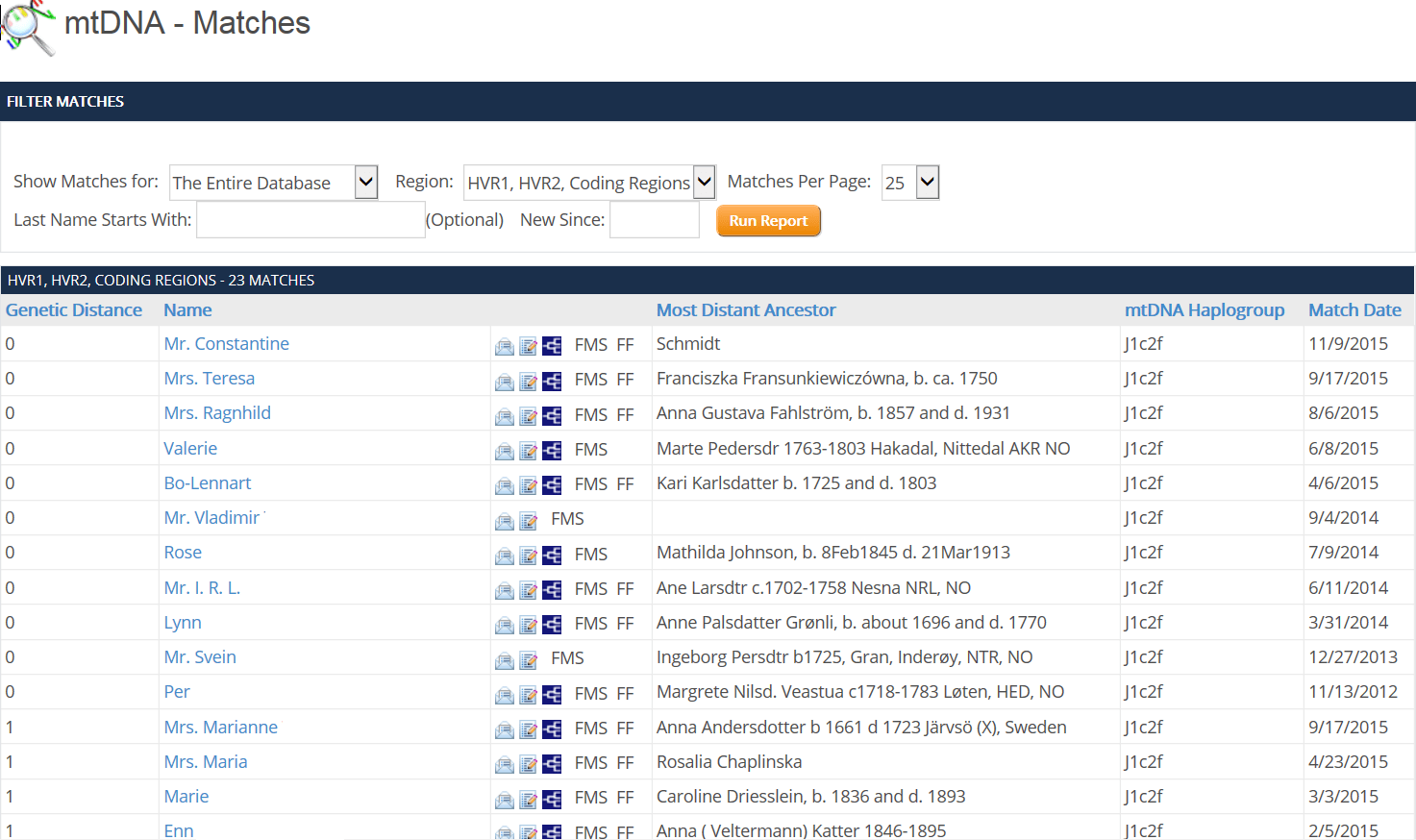
If Jim and Susie match at the full sequence level too, then the genealogical timeframe becomes possible. If they match with no mutations, meaning a genetic distance of zero, it becomes even more likely, but it’s certainly not a given – nor is figuring out who the common ancestor might be.  For example, below are my closest full sequence matches and my most distant matrilineal ancestor was from Germany.  Most of these matches are Scandinavian.

match mito

However, exact full sequence matches are where you start to look for a common ancestor. No common ancestor found?  Then at least look for common geography.

One of the easiest ways to do that, for both mitochondrial DNA and Y DNA, at Family Tree DNA, is by utilizing the Matches Map, available on your toolbar.

match matches map'

Assuming your matches have completed their most distant ancestor’s location (which is not always the case,) it’s easy to look for match groups and clusters on the map. Your most distant ancestor’s balloon will be white, with your matches color coded.  You can click on any of the balloons to see the match, their ancestor and location.  These are my full sequence matches.  Surprisingly, my closest matches aren’t in Germany at all!!!  Hmmm….time to start looking at what happened in history that might account for this population movement.

In many cases, people will match at the HVR1 and HVR2 levels, but not match at higher levels. In fact, they may both be haplogroup H (for example) at the HVR1 and HVR2 levels, but the full sequence testing refines their haplogroups and their extended haplogroups may no longer match each other.  For example Jim’s refined haplogroup could be H2 and Susie’s ’s H6.  Both are subgroups of H, who was born roughly 12,800 years ago, according to “A ‘Copernican’ Reassessment of the Human Mitochondrial DNA Tree from its Root” by Behar et al, published in The American Journal of Human Genetics 90, 675–684, April 6, 2012.

So, yes, Jim and Susie are definitely related in the past 12,000 years – but I’m not thinking this is what Jim was really asking. I refer to this as “haplogroup cousins.”

However, a lot has happened in 12,000 years. As in, mutations happened, and subgroups emerged.  So while Jim and Susie might both be members of haplogroup H, they are not both members of the same subgroup, so their ancestors both developed mutations which classify them into subgroups H2, born not long after H was born, and H6, born about 11,000 years ago.

So, the bottom line is if you don’t match at the full sequence level, you’re not related in a genealogically meaningful time frame. If you do match at the full sequence level, you might be related in a genealogically meaningful timeframe.

A couple years ago, I set about looking at mitochondrial DNA mutation rates and discovered that the only academic paper published that addressed this in the HVR1, HVR2 and coding regions was written about penguins. Not exactly what I was looking for, but it does explain why there is no TIP type calculator for mitochondrial DNA.

Family Tree DNA does provide some guidelines in their learning center.

    • Matching at the HVR1 level means that you have a 50% chance of sharing a common maternal ancestor within the last fifty-two generations. That is about 1,300 years.
    • Matching on HVR1 and HVR2 means that you have a 50% chance of sharing a common maternal ancestor within the last twenty-eight generations. That is about 700 years.
    • Matching exactly on the Mitochondrial DNA Full Sequence test brings your matches into more recent times. It means that you have a 50% chance of sharing a common maternal ancestor within the last 5 generations. That is about 125 years.

I personally think that the 5 generation estimate of a 100% match for the full sequence is overly optimistic. In fact, a lot overly optimistic.  I do find people who do share common ancestors at the full sequence level, but it’s the exception and not the rule – although part of that may be because the surname changes every generation so it’s genealogically difficult to track.  However, genealogical matches would be much more common if more people tested their mitochondrial DNA.

You can see a good example in this article of how mitochondrial DNA told me a story I didn’t know about my matrilineal line – and would never have known without full sequence testing.

What I didn’t include in this article is that many of my mitochondrial DNA matches shared their mutation information with me, and I created a “tree” that showed exactly where each mutation happened and who shared a common ancestor with whom.

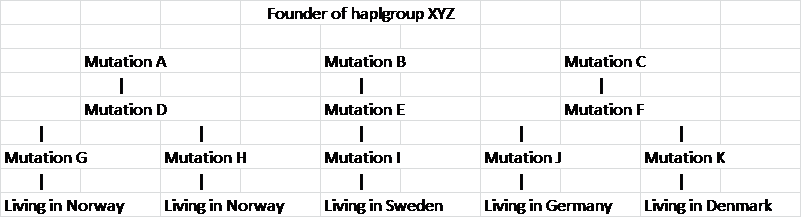
I obviously can’t share that chart publicly, but the chart below conveys the methodology. The oldest known ancestors of these matches lived in the locations listed at the bottom of the chart.

match 1

In the above case, you can clearly see that it’s very likely that the founder lived in Scandinavia because at least some of the descendants of all three unique mutation groups, A, B and C live in Scandinavia today. However, Mutation J is found in Germany.  This suggests that sometime after the common mutation, F, an individual migrated from Scandinavia to Germany.  Mutation K, who also shares mutation F, is still in Scandinavia today.

Y DNA

It’s a bit easier to answer the “are we related” question for Y DNA because the surnames are often the same. So yes, if you match on STR markers (those are panels for 12, 25, 37, 67 and 111 markers) and you carry the same surname, you’re likely related in a genealogically relevant timeframe.  Don’t you hate it when you see those weasel words like “likely?”

However, if your surname is Smith, or something else very common, and you only match at 12 markers, and you don’t match at higher levels, then again, you’re probably a haplogroup cousin. Names like Smith and Miller are occupation names and every village across continental Europe had at least one at all times.  So, there are lots of Smiths and Millers that have the same base haplogroup and aren’t related in a genealogically meaningful timeframe.

You can see an example of this in my Miller-Brethren project. These are Miller families, German in origin, who belonged to the small German Brethren religious group.

Match Miller 1

Match Miller 2

I thought this would be a relatively small, easy project, but not so much. There were a lot more genetically different Miller surname groups even within the small Brethren church than I expected.

As you can see, many of these groups share haplogroups, especially major haplogroups like R-M269.

In some groups, some individuals have tested additional SNPs by taking either individual SNP tests, the Big Y or SNP panel tests, offered on their individual pages.

So, for example, you may see the haplogroup designations of R-M269 and R-CTS7822 in the same family grouping where the STR markers match exactly or nearly. Confusing?  Yes, but that means that one individual had taken additional testing.  If you look at the haplogroup trees, you would see that CTS7822 is downstream of M269 in haplogroup R.

The important thing for finding genealogically relevant matches is matching high numbers of STR markers. I encourage everyone to test at 67 markers, and I like to see 111 if the budget allows.

If you match someone at 67 markers, exactly, there’s a very good chance you’re very closely related.

For example, cousin Rex matches cousin Richard at 67 markers with only 3 differences. I happen to have their genealogy, and I know when these two men’s lines diverge.  They descend from two different sons of Michael Miller (Mueller) who was born in 1692.  Three cumulative Y STR mutations have happened since that time in these men’s two lines.

Match Miller 3

Rex’s haplogroup is R-M269, but Richard took the Big Y test, so his haplogroup is shown as R-CTS7822 and he now sits as proxy for the rest of the Michael Miller descendant group.

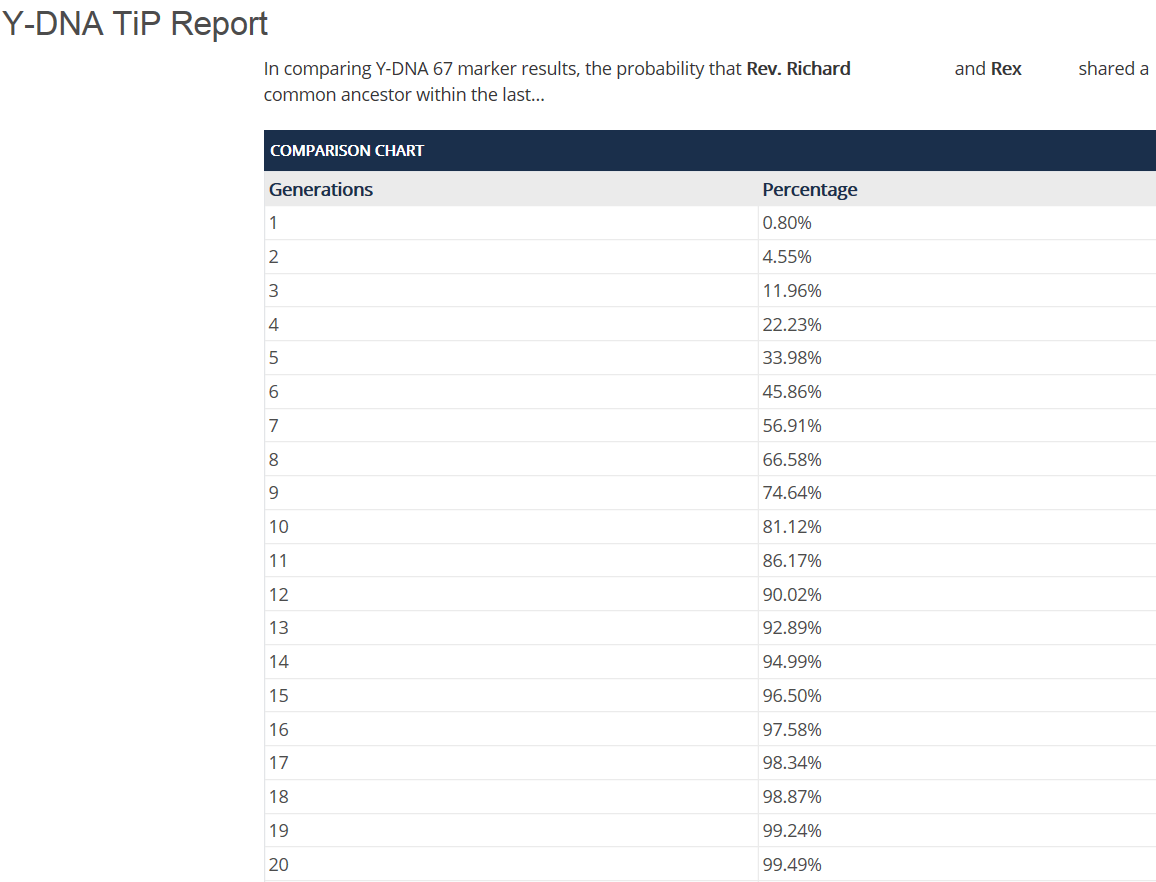
Y matches have access to the TIP calculator, that little orange box shown on the match page above to the right of each matches name.  The TIP calculator provides generational estimates to a common ancestor, weighted by haplogroup marker mutation frequency.

The TIP calculator shows us that, based on their mutations at 67 markers, these two men are most likely to be related between 6 and 7 generations. At the 50th percentile, they are as likely to be related sooner as later, so the 50th percentile is the number I tend to use for an estimate of the distance to the most recent common ancestor.

Match tip

In fact, their common ancestor is 7 generations ago, counting their parents as generation 1.

The more markers tested, the more data you, and the TIP calculator, have to work with. I’ve found the TIP calculator to be quite accurate at 67 and 111 markers when using the 50th percentile as a predictor.

What? You say you don’t match anyone with your surname?

That’s more common than you think.

One of two things could have happened.

First, your paternal surname line may simply have not tested yet.

You may be able to search in the appropriate surname project and find a group of people who descend from “your” ancestor with different DNA. That’s a pretty big hint too, assuming the genealogy is accurate.  If the genealogy is accurate, and your line is the “odd man out,” the next question is always “when did the genetic break occur,” and why.  That leads us to the second scenario.

Second, there could be an undocumented adoption in your line. I’m using undocumented adoption in the most general sense here, meaning anything from a child taking a step father’s name to a true adoption.  The surname does not match the biological line and we don’t know why – so some “adoption” of some sort took place someplace.

The question is, one or two?

I first ask people if they really want to know the answer, because once you pursue this avenue, you can’t close Pandora’s box.

If the answer is yes, they are sure, then I suggest they find a male with their surname that they know should be related and test him.

The answer will become obvious at that point, and the test plan from there forward should reflect the discovery from that test.

Autosomal

The question of “are we related” can be more obtuse when discussing autosomal DNA.

On the other hand, like with Y DNA, the answer can be very evident.

In fact, there is an entire spectrum of autosomal DNA matches and I wrote about how much confidence you should put in each type.

But let’s get down to the very basic brass tacks.

There are only two ways you can match someone’s autosomal DNA.

Either you share a common ancestor or you are matching by chance.

When you receive DNA from your parents, that DNA came from their ancestors as well. All of the DNA you receive from your parents came from some ancestor.

Then, how can you match someone by chance?

You have two strands of autosomal DNA. Think of two lanes of a street.  However, the houses on both sides of that street have the same address.  Your Mom’s DNA value goes in front of one house, in one lane, and your Dad’s goes in front of the house with the same address in the other lane, but we don’t know whose DNA is whose and there is no consistency in whose DNA goes in which lane.

So, it looks like this.

match autosomal strands

You can see in this example that you received As in all positions from Mom and Cs in all positions from Dad. However, these alleles can be positioned in either your strand 1 or 2, so the entire roughly 700,000+ locations typically tested for genealogy is mixed between Mom and Dad.  So, there is no way to tell, just by looking at your DNA, which DNA in any position (strand 1 or 2 at any address) came from whom.

You can also see, looking at the chart above, that if someone matches you on all As, they match you on your Mom’s side, and if they match you on all Cs, they match you on your Dad’s side. This is called identical by descent.  This means, yes, you are related.

But what happens if someone has ACA? They match you too, by zigzagging back and forth between your Mom and Dad’s DNA.  That’s called identical by chance, and it’s not a valid genealogical match. This means, no, you’re not related, at least not on this segment.

I wrote more about this phenomenon and tools to work with your DNA in “One Chromosome, Two Sides, No Zipper.”

How can you tell the difference between identical by descent (related) and identical by chance (not related)? Therein lies the big question.

If you match someone who also matches one of your parents, then you match them through that side of your family – identical by descent from a common ancestor.

Don’t have parents to test?  Then how about your parents siblings, aunts, uncles, first cousins….etc.  Often the best way to tell if a match is a legitimate match is by who else they match that also matches you.  This is why we encourage people to test all of their relatives!

And that, of course, leads to identifying the common ancestor. For example, if you match someone who also matches your first cousin on the same segment, your common ancestor has to be in that same genealogical line shared by you and your first cousin.  This technique is called triangulation.

I wrote more about cousin matching too, in “Just One Cousin.”

You can read more on this general topic here and here, as well.

I wrote a primer for folks just getting autosomal results back called “Autosomal DNA Testing 101 – Now What?”

Combination Tools

There are several ways to match people. Sometimes looking at combinations of tools is quite helpful as well.

One of my favorite and little known methodologies is to combine two tools together.  This is only available at Family Tree DNA, because they are the only vendor who also performs the mitochondrial and Y DNA tests in addition to the autosomal testing.

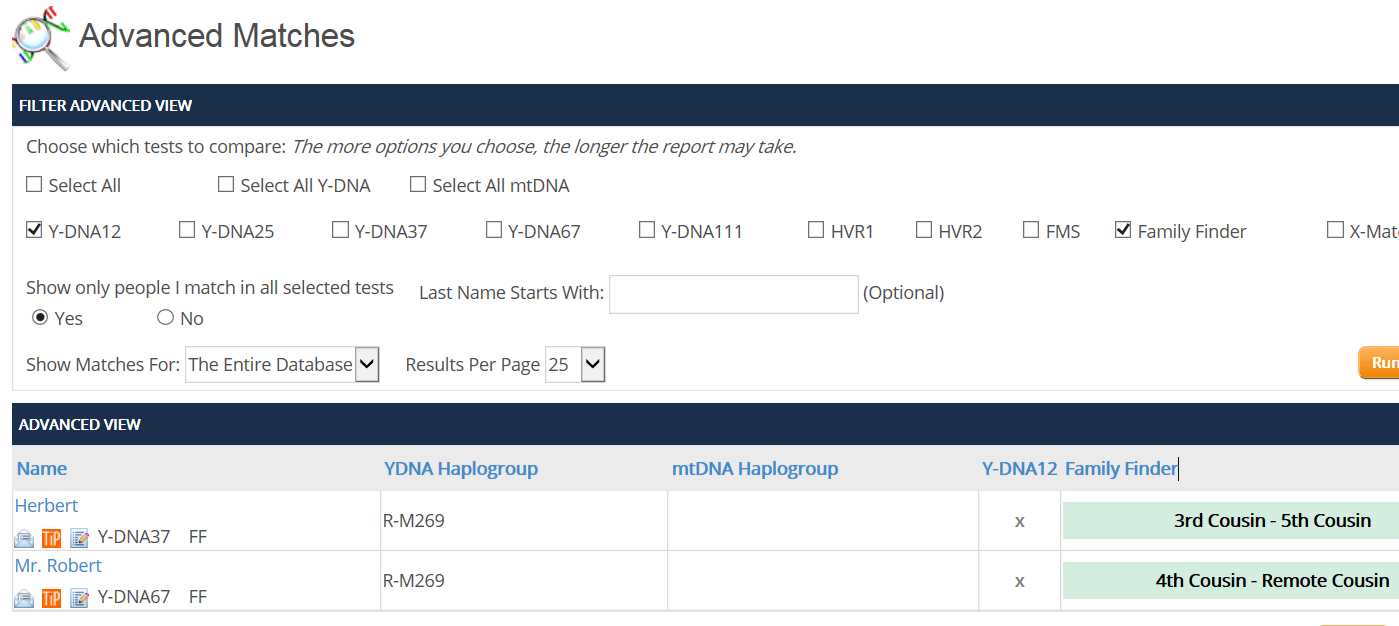
For example, if you match someone on the Y or mitochondrial DNA, notice if they have taken the Family Finder test as well. If they have, the little icon by their name on your match list will say “FF.”

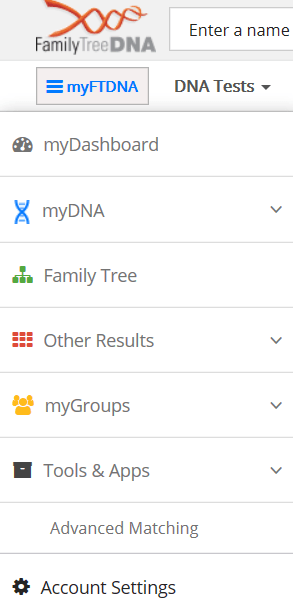
If so, by using the Advanced Matching tool, available under “Tools and Apps” on your personal page Toolbar at Family Tree DNA, you can query to see who matches you utilizing multiple tools.

match toolbar

For example, for cousin Rex, I wanted to know who he matched on BOTH his Y 12 marker test and the Family Finder test. Sure enough, two individuals match him on both.

match combo

Please note that I could also have performed this same search within any project by utilizing the “show matches for” drop down box.

Summary

I hope this quick broad-brush survey of the various DNA testing tools and what your matches mean for each type has helped you to take some of those matches from the “maybe” to the “yes” or “no” category.

After all, the fun in all of this is to discover as much as we can about our ancestors by who we are related to. Guilt by genetic association.  There is something to be learned from every match or group of matches if we’re listening…even if it is that your German 4Xgreat-grandmother’s lineage was likely originally Scandinavian.  I don’t know about you, but that tidbit of knowledge and the doors it opens was well worth the price of admission, all by itself.

And just think, you’ll never have the opportunity to find out if you’re related if you don’t test and work with your results!  There is so much waiting to be discovered.

______________________________________________________________

Disclosure

I receive a small contribution when you click on some of the links to vendors in my articles. This does NOT increase the price you pay but helps me to keep the lights on and this informational blog free for everyone. Please click on the links in the articles or to the vendors below if you are purchasing products or DNA testing.

Thank you so much.

DNA Purchases and Free Transfers

Genealogy Services

Genealogy Research

Looking for and Contacting Birth Family Members

When I ran the article title DNA Testing Strategy for Adoptees and People with Uncertain Parentage, one commenter asked how one goes about putting together the pieces of the puzzle, and then how does one go about making contact?  What do you do, or say, to increase your likelihood of being successful?

I am probably the all-time worst person to answer this question, because I intensely dislike telephone conversations and especially in awkward situations.  My family has had a few of those awkward parentage situations, mostly having to do with my father and grandfather, both “ladies men,” and I’ve been both rejected and hung up on more than once – so you don’t want advice from me on this topic.

I turned to someone with a track record of success – not only in terms of putting together the convincing evidence about the missing parent – but in terms of preparation for contact, approach and actually making the contact.

Diane Harman-Hoog, with www.dnaadoption.com was kind enough to write this article.

DNAadoption page

Diane works with adoptees and others seeking their biological parents every day.  She is a retired technology professional, so transitioning her skills to a genetic genealogy puzzle was the perfect fit for Diane.  In addition to working with a team who has developed the specific search techniques, sometimes in spite of some of the vendors we have to work with, Diane has created an educational venue and teaches others the techniques and how to help themselves.

Diane is summing up a significant process here, in just a few paragraphs.  If you’d like to know more about these techniques, please visit http://www.dnaadoption.com and take a look at their class offerings.

Many people call Diane and the people at DNAAdoption search angels – that’s because they truly are.  Not only are they reuniting families, when the family wants to be reunited – but Diane and her team are providing the adoptee with a history, something they have never had.  Thank you so much Diane – for this article and for everything that you and the folks at DNAadoption do.

From Diane Harman-Hoog

We at DNAadoption are having a great deal of success with reuniting birth family members with adoptees and with others who have lost track of a father, for example.

One of the first things an adoptee should do is try to get their non-identifying birth information, if available, through their adoption agency.  Many times this alone can be used in a traditional search even without DNA.  If they have non-id that is older than 5 years, we recommend they apply for an update. We at www.DNAAdoption.com can help if they don’t know how to go about this process.

The DNA Search Process

The world was a lot easier before Ancestry decided to ignore what we all felt were hard and fast principles of the search – meaning providing the tester with chromosome match information – the chromosome number and start and stop locations of matching DNA. We collected chromosome data and “In Common With” genealogy data, ran them through our programs with resulting spreadsheets that group overlapping DNA into sets and then noted which people in that set were ICW with others in the set.

A definition or two is in order here. I prefer to tell students that ICW means blood related. Overlapping means any part of the chromosome segments that overlap, they do not have to be the same length.

Identification by Triangulation

We can have two people with starting and ending addresses on a particular chromosome which makes us think that they received the segment from the same ancestor. However, nature plays a little joke with us on that part, because there are two sides to the chromosome and each side has the same address sequence. On one side, the addresses increase going one way and on the other side, they increase going the other way.

When we identify people who look like they have overlapping chromosomes then if they are blood related with each other, then the segments came from the same ancestor. The very small segments are probably not indicative of family heredity but are environmentally caused genetic strings.

I use this example of blood related. You are blood related (ICW) with all your matches as you are the very bottom of the relationships and related to both sides. You maternal grandmother is probably not blood related or ICW with your paternal grandfather. In most cases, they come from different families.

In general, the longer the segment the closer the relationship, but when the prediction is closer than second cousins, we start to look at the total of all the segments over about 6 cM (centimorgans) that overlap.

Then we look for common ancestors using the trees of those two individuals. Next is triangulation where three people match on the same segment. That is because every one of your matches overlaps with your DNA segments and is always ICW with you. So two plus one gives us the three to triangulate.

In order to look for common ancestors on the trees, you need 3 things:

    • Overlapping DNA segments
    • ICW status between the same individuals
    • And some tree information from each party.

Expanding trees

We get as much of the tree that we can for each person and then we have to go to work expanding the existing tree. First the tree must go up in the traditional genealogical manner, you, your parents, your grandparents etc. You also treat any matching person the same way so you get a normal looking genealogical tree. If this is a 2nd cousin match, take the tree back to at least 3 generations past the great grandparents.

Then comes the really tedious part. You come back down the tree identifying all the offspring and all of their offspring down to the years where you would expect the grandparent or other unidentified person to be living. As you go down the tree (towards the present), you must also add each spouse for each of the offspring and go up their ancestry a ways to see if they might also be related. By the time you get down to the actual candidate of the father, you would hope to find that both his mother and father are related to DNA matches of yours.

The difficulty often comes from two directions, incomplete trees that you just cannot fill in and completing the most recent generations. At that point we have to rely on Google searches and obituaries to make the final identifications.

In essence, the DNA identifies who you are related to, triangulation identifies groups of people who share a common ancestor, and their trees will lead you to the identification of both that common ancestor and hopefully, your parent.

If this is a little sketchy, the full course takes 4 weeks and I am trying to summarize it here. Some searches only take a tree or two but I have also done ones that took 200 trees (and five years).

Ancestry

Then Ancestry came along and is refusing to give us the chromosome numbers. This is particularly bad for adoptees who rely upon those numbers to confirm or deny the relationships.

So we deal with it in this manner. We have a DNA software Client for ancestry called DNAGedcom from the DNAGedcom site. It reads your Ancestry DNA account and generates a match list of all your matches and an ancestors list of all the ancestors of those matches. A more recent addition is also an ICW list to show us which matches are ICW with which other matches.

Gedmatch

Whenever possible do everything you can to encourage these matches to download onto Gedmatch.

Another trick, after you transfer the kits to Gedmatch, is to use the report on Gedmatch, named “People who match one or both of 2 kits”. This report takes the gedmatch # of two individuals and measures them against each other. If I run it against my brother, Ken, and my maternal cousin, Jon, I will get three different lists. The first list is of kits that both Jon and Ken match. Since our mother and Jon’s mother are sisters, then we can assume that these are maternal matches for both Jon and Ken. The second list shows kits that only Jon matches, that would be from his father’s side of the family and the third list shows only kits that Ken matches so that would be cousins that Ken matches who are not maternal but from our father’s side.

It must be understood that using DNA analysis is not an exact science but a learned art as DNA inheritance can be capricious. We are working with probabilities and averages here. We cannot say that there are 169 cM of DNA shared, so the match is a second cousin, but rather, the match might be a second cousin.

Now we play the odds. We match ancestors from the ancestors list and as a start call them Common Ancestors.  So if both Ancestry trees have Pierre LeBlanc born in 1769  in Louisiana and both Pierre’s have the same parents we call them common ancestors until proven otherwise. The odds are actually fairly high if the two families are ICW with each other.

We cannot just say that a child of Pierre LeBlanc is absolutely in Jon’s direct line but we will expand the trees and trace individuals down. If they eventually start lining up with other DNA match descendants we will accept that it is direct line. However, of course NPEs are always a concern and there is no way to completely protect from that eventuality.

phone

Contact Time

As you continue the search now, with live people, do not use the word “adoption” until you are certain of the relationship with the person you are speaking to. This includes people like a librarian, as well as possible relatives. Some people feel strongly about not assisting adoptees in finding a birth family. One of my clients let it slip to a first cousin. That was the end of the relationship. We really needed information that cousin had.

So now we have built trees down and have three males who were in the correct vicinity at the correct time for conception. Each of these males has one line descending from a DNA match, but only one has the other parent also descending from a DNA match!

Our tree has developed to include possible common ancestors from all three tests and gedmatch.

We try to obtain up-to-date contact information which in these days of cell phones is harder to get than it used to be.

The only person we encourage to make contact is the adoptee or another birth family member who is looking. None of us will do it for them. If contact is refused then at least they have talked to the person once.

Whether we are down to the exact level or perhaps only to a cousin or aunt or uncle, we advise proceeding with caution. We advise the contact to be made on the basis of DNA information and asking for help with a family tree. A lot of detective work goes on before a phone call is made to confirm the suspicions – at least as much as possible. We check where people were at that time, or did a woman have a child born at a time that would mean that this child could not have been hers. What was their life like?  Do most facts line up with the non-ID information? It is possible that the non-ID is fictional but we assume that most of it is right until we prove otherwise.

Making the Call

If a man is calling the person we are pretty sure is his birth mother, the conversation will go something like this. ”I am looking to fill in some members of my family tree and DNA testing shows that we might be related. I am quite sure I am related to the Woolworth line from talking to other matches. I want to be sure you have my contact information in case you think of something that might help me after we talk, email is –, my phone number is –. I was born on October 1, 1963 in Syracuse NY. Does that mean anything to you?  (Hoping for a positive indication.) Yes I was adopted, My adoption papers are hard to read, but my birth name might have been Dennis. The state has given me a little information about my birth mother, she was 26 and in secretarial school. Her mother was 56 and her father deceased. She had a sister and two brothers.”

Hopefully by then she is in tears.  Most birth mothers have been praying to be found. If she is unhappy then he should give her some time. He has provided contact information for himself. Also he should send her a little card afterward, thanking her for her time and provide a picture of himself and his family, along with his contact information.

Good luck to you all.

Diane Harman-Hoog

You can contact Diane at harmanhoog@gmail.com

______________________________________________________________

Disclosure

I receive a small contribution when you click on some of the links to vendors in my articles. This does NOT increase the price you pay but helps me to keep the lights on and this informational blog free for everyone. Please click on the links in the articles or to the vendors below if you are purchasing products or DNA testing.

Thank you so much.

DNA Purchases and Free Transfers

Genealogy Services

Genealogy Research

DNA Data Organization, Tools and Who’s on First?

organization

Someone wrote to me with the following question/commentary about autosomal DNA and data organization on my blog. Her request is below:

“My overwhelming need is organization and I suspect others are in the same boat. I have only a rudimentary knowledge of spreadsheets which makes directions on setting them up for triangulation intimidating. What I am asking of you is that you do a blog about third party utilities which could be useful, perhaps doing a comparison of those available, i.e. ADSA, Genome Mate etc. I was also wondering if you could set up a hierarchy of which should come first and so on.”

I took this question to the ISOGG Facebook list, as I don’t use GenomeMate and was looking for input from people who do.  I also have known how to use Excel virtually “forever” so I have never looked at newbie resources for Excel either.

My Comment on FB:  I am hoping that someone has already done this, or at least compiled a list with some commentary, as I don’t use all of the tools extensively. For example, I use spreadsheets, not GenomeMate – although that implies nothing negative about GenomeMate.  Anyway, does anyone have any pointers for this gal? Does anyone know if there has been an “intro to excel for genetic genealogy” done? Thanks.

First, I’d like to thank everyone who contributed to the conversation on the ISOGG Facebook list.  I have distilled the commentary to what I perceived to be the most relevant responses, below:

Genome Mate

I would highly recommend that she skip the spreadsheet phase and go straight to Genome Mate, since she’s not really experienced with either. (Nothing against spreadsheets – I love ’em – but GM will give her more bang for the learning curve buck. Also, those using spreadsheets all do them differently, so it’s harder to draw on a community for help.) The GM user group here on FB is extremely friendly, and IIRC the quick-start guide for the new and improved GM is either now out or imminent.

GenomeMate vs GenomeMate Pro, the new version.  There was very positive commentary about the Pro version.

There is a GenomeMate Pro FB group at https://www.facebook.com/groups/816785941743656/

There is a GenomeMate User Group FB group at https://www.facebook.com/groups/1487955884768702/

Blog article about using GenomeMate

https://iowadnaproject.wordpress.com/2015/01/23/must-have-tools-for-ftdna-users-genome-mate/

Some reports of problems with GenomeMate on the Apple platform, others say it works fine, especially the new Pro version.  Commentary says that if you’re just starting on GenomeMate now, begin with the newer Pro version.

There will be a quick-start guide for Mac users of Genome Mate Pro soon. There is currently one for the PC.

Dan Stone writes a blog that has featured using Genome Mate; and Jim Sipe has written a how-to-guide for it. I’m helping to beta test Genome Mate Pro; and I love it! It organizes your matches by each position on your chromosomes; points out overlapping segments and possible triangulations; allows you to segment map your most recent common ancestors, etc. I gave up spreadsheets for Genome Mate and am thrilled–it essentially “automates” what I used to do in organizing matches across the Big 3 and Gedmatch.

Tools

http://www.isogg.org/wiki/Autosomal_DNA_tools

This is a list and most people are probably already aware of these tools, but take a look just in case.

Roberta’s comment:  I use many of the available tools, but am particularly fond of the tools at http://www.dnagedcom.com, http://www.gedmatch.com and the tools on Kitty Cooper’s blog.  These are for the most part created for all levels of genetic genealogy users.  Some of the other tools are for more advanced users.  Most all of these tools are designed to be used in addition to a spreadsheet or some form of organization – which is where this conversation has focused. None of them, with the possible exception of ADSA (Autosomal DNA Segment Analyzer available at http://www.dnagedcom.com), could replace an organizational spreadsheet or GenomeMate, although ADSA does not work with 23andMe data.

Excel

A couple of people referred to some training videos for Excel including “Twenty with Tessa, Tips and Suggestions for Spreadsheets” which is focused on using spreadsheets with one name studies and genetic genealogy, but the principles are the same.  https://www.youtube.com/watch?v=Ll_cfhOZTl0&feature=youtu.be

In addition, one person mentioned that they joined www.lynda.com and took the basic Excel class which she found very useful.

Kitty Cooper has instructions on her blog for how to make a matches spreadsheet.  The good news is that you can download your matches into a spreadsheet format from either 23andMe or Family Tree DNA, but you do need to understand something about the basics of sorting and how to stay out of spreadsheet trouble.

www.DNAadoption.com has some good courses their DNA for beginners covers using spreadsheets, not just for adoptees!

Roberta’s Summary

I heartily agree that the www.dnaadoption.com tools and classes are not just for adoptees.

DNAAdoption reportedly does not utilize GenomeMate for their purposes because GenomeMate focuses on the direct line trees, while in order to put families together for adoptees, who don’t know their direct line tree, they must use the combination of other people’s trees to determine where they fit in which line.  So GenomeMate does not work well for adoptees who are searching.

This discussion about GenomeMate Pro has almost convinced me to give it a shot.  I must admit, much of what is done manually in a spreadsheet could certainly be automated.  The issue holding me back before, aside from the fact that I already have so much done in my spreadsheet, was that the original version of GenomeMate required Silverlite be installed.  The new version does not.

Here’s a link to the GenomeMate page if you want to take a look.  I may take a test spin.  I think reading the user guide would go a long way in helping me decide if this tool might be for me.

Let me know if you install this product and how you like it.

http://genomemate.org/

______________________________________________________________

Disclosure

I receive a small contribution when you click on some of the links to vendors in my articles. This does NOT increase the price you pay but helps me to keep the lights on and this informational blog free for everyone. Please click on the links in the articles or to the vendors below if you are purchasing products or DNA testing.

Thank you so much.

DNA Purchases and Free Transfers

Genealogy Services

Genealogy Research

Ethnicity Testing and Results

I have written repeatedly about ethnicity results as part of the autosomal test offerings of the major DNA testing companies, but I still receive lots of questions about which ethnicity test is best, which is the most accurate, etc.  Take a look at “Ethnicity Percentages – Second Generation Report Card” for a detailed analysis and comparison.

First, let’s clarify which testing companies we are talking about.  They are:

Let’s make this answer unmistakable.

  1. Some of the companies are somewhat better than others relative to ethnicity – but not a lot.
  2. These tests are reasonably reliable when it comes to a continent level test – meaning African, European, Asian and sometimes, Native American.
  3. These tests are great at detecting ancestry over 25% – but if you know who your grandparents are – you already have that information.
  4. The usefulness of these tests for accurately providing ethnicity information diminishes as the percentage of that minority admixture declines.  Said another way – as your percentage of a particular ethnicity decreases, so does the testing companies’ ability to find it.
  5. Intra-continental results, meaning within Europe, for example, are speculative, at best.  Do not expect them to align with your known genealogy.  They likely won’t – and if they do at one vendor – they won’t at others.  Which one is “right”?  Who knows – maybe all of them when you consider population movement, migration and assimilation.
  6. As the vendors add to and improve their data bases, reference populations and analysis tools, your results change. I discussed how vendors determine your ethnicity percentages in the article, “Determining Ethnicity Percentages.”
  7. Sometimes unexpected results, especially continent level results, are a factor of ancient population mixing and migrations, not recent admixture – and it’s impossible to tell the difference. For example, the Celts, from the Germanic area of Europe also settled in the British Isles. Attila the Hun and his army, from Asia, invaded and settled in what is today, Germany, as well as other parts of Eastern Europe.
  8. Ethnicity tests are unreliable in consistently detecting minority admixture. Minority in this context means a small amount, generally less than 5%.  It does not refer to any specific ethnicity. Having said that, there are very few reference data base entries for Native American populations.  Most are from from Canada and South America.

In the context of ethnicity, what does unreliable mean?

Unreliable means that the results are not consistent and often not reproducible across platforms, especially in terms of minority admixture.  For example, a German/Hungarian family member shows Native American admixture at low percentages, around 3%, at some, but not all, vendors.  His European family history does not reflect Native heritage and in fact, precludes it.  However, his results likely reflect Native American from a common underlying ancestral population, the Yamnaya, between the Asian people who settled Hungary and parts of Germany and also contributed to the Native American population.

Unreliable can also mean that different vendors, measuring different parts of your DNA, can assign results to different regions.  For example, if you carry Celtic ancestry, would you be surprised to see Germanic results and think they are “wrong?”  Speaking of Celts, they didn’t just stay put in one region within Europe either.  And who were the Celts and where did they ‘come from’ before they were Celts.  All of this current and ancient admixture is carried in your DNA.  Teasing it out and the meaning it carries is the challenge.

Unreliable may also mean that the tests often do not reflect what is “known” in terms of family history.  I put the word “known” in quotes here, because oral history does not constitute “known” and it’s certainly not proof.  For the most part, documented genealogy does constitute “known” but you can never “know” about an undocumented adoption, also referred to as a “nonparental event” or NPE.  Yes, that’s when one or both parents are not who you think they are based on traditional information.  With the advent of DNA testing, NPEs can, in some instances, be discovered.

So, the end result is that you receive very interesting information about your genetic history that often does not correlate with what you expected – and you are left scratching your head.

However, in some cases, if you’re looking for something specific – like a small amount of Native American or African ancestry, you, indeed, can confirm it through your DNA – and can confirm your family history.  One thing is for sure, if you don’t test, you will never know.

Minority Admixture

Let’s take a look at how ethnicity estimates work relative to minority admixture.

In terms of minority admixture, I’m referring to admixture that is several generations back in your tree.  It’s often revealed in oral history, but unproven, and people turn to genetic genealogy to prove those stories.

In my case, I have several documented Native American lines and a few that are not documented.  All of these results are too far back in time, the 1600s and 1700s, to realistically be “found” in autosomal admixture tests consistently.  I also have a small amount of African admixture.  I know which line this comes from, but I don’t know which ancestor, exactly.  I have worked through these small percentages systematically and documented the process in the series titled, “The Autosomal Me.”  This is not an easy or quick process – and if quick and easy is the type of answer you’re seeking – then working further, beyond what the testing companies give you, with small amounts of admixture, is probably not for you.

Let’s look at what you can expect in terms of inheritance admixture.  You receive 50% of your DNA from each parent, and so forth, until eventually you receive very little DNA (or none) from your ancestors from many generations back in your tree.

Ethnicity DNA table

Let’s put this in perspective.  The first US census was taken in 1790, so your ancestors born in 1770 should be included in the 1790 census, probably as a child, and in following censuses as an adult.  You carry less than 1% of this ancestor’s DNA.

The first detailed census listing all family members was taken in 1850, so most of your ancestors that contributed more than 1% of your DNA would be found on that or subsequent detailed census forms.

These are often not the “mysterious” ancestors that we seek.  These ancestors, whose DNA we receive in amounts over 1%, are the ones we can more easily track through traditional means.

The reason the column of DNA percentages is labeled “approximate” is because, other than your parents, you don’t receive exactly half of your ancestor’s DNA.  DNA is not divided exactly in half and passed on to subsequence generations, except for what you receive from your parents.  Therefore, you can have more or less of any one ancestor’s individual DNA that would be predicted by the chart, above.  Eventually, as you continue to move further out in your tree, you may carry none of a specific ancestor’s DNA or it is in such small pieces that it is not detected by autosomal DNA testing.

The Vendors

At least two of the three major vendors have made changes of some sort this year in their calculations or underlying data bases.  Generally, they don’t tell us, and we discover the change by noticing a difference when we look at our results.

Historically, Ancestry has been the worst, with widely diverging estimates, especially within continents.  However, their current version is picking up both my Native and African.  However, with their history of inconsistency and wildly inaccurate results, it’s hard to have much confidence, even when the current results seem more reasonable and in line with other vendors.  I’ve adopted a reserved “wait and see” position with Ancestry relative to ethnicity.

Family Tree DNA’s Family Finder product is in the middle with consistent results, but they don’t report less than 1% admixture which is often where those distant ancestors’ minority ethnicity would be found, if at all.  However, Family Tree DNA does provide Y and mitochondrial mapping comparisons, and ethnicity comparisons to your matches that are not provided by other vendors.

Ethnicity DNA matches

In this view, you can see the matching ethnicity percentages for those whom you match autosomally.

23andMe is currently best in terms of minority ethnicity detection, in part, because they report amounts less than 1%, have a speculative view, which is preferred by most genetic genealogists and because they paint your ethnicity on your chromosomes, shown below.  You can see that both chromosome 1 and 2 show Native segments.

Ethnicity 23andMe chromosome

So, looking at minority admixture only – let’s take a look at today’s vendor results as compared to the same vendors in May 2014.

Ethnicity 2014-2015 compare

The Rest of the Story

Keep in mind, we’re only discussing ethnicity here – and there is a lot more to autosomal DNA testing than ethnicity – for example – matching to cousins, tools, such as a chromosome browser (or lack thereof), trees, ease of use and ability to contact your matches.  Please see “Autosomal DNA 2015 – Which Test is the Best?”  Unless ethnicity is absolutely the ONLY reason you are DNA testing, then you need to consider the rest of the story.

And speaking of the rest of the story, National Geographic has been pretty much omitted from this discussion because they have just announced a new upgrade, “Geno 2.0: Next Generation,” to their offering, which promises to be a better biogeographical tool.  I hope so – as National Geographic is in a unique position to evaluate populations with their focus on sample collection from what is left of unique and sometimes isolated populations.  We don’t have much information on the new product yet, and of course, no results because the new test won’t be released until in September, 2015.  So the jury is out on this one.  Stay tuned.

GedMatch – Not A Vendor, But a Great Toolbox

Finally, most people who are interested in ethnicity test at one (or all) of the companies, utilize the rest of the tools offered by that company, then download their results to www.gedmatch.com, a donation based site, and make use of the numerous contributed admixture tools there.

Ethnicity GedMatch

GedMatch offers lots of options and several tools that provide a wide range of focus.  For example, some tools are specifically written for European, African, Asian or even comparison against ancient DNA results.

Ethnicity ancient admixture

Conclusion

So what is the net-net of this discussion?

  1. There is a lot more to autosomal DNA testing than just ethnicity – so take everything into consideration.
  2. Ethnicity determination is still an infant and emerging field – with all vendors making relatively regular updates and changes. You cannot take minority results to the bank without additional and confirming research, often outside of genetic genealogy. However, mitochondrial or Y DNA testing, available only through Family Tree DNA, can positively confirm Native or minority ancestry in the lines available for testing. You can create a DNA Pedigree Chart to help identify or eliminate Native lines.
  3. If the ancestors you seek are more than a few generations removed, you may not carry enough of their ethnic DNA to be identified.
  4. Your “100% Cherokee” ancestor was likely already admixed – and so their descendants may carry even less Native DNA than anticipated.
  5. You cannot prove a negative using autosomal DNA (but you can with both Y and mitochondrial DNA). In other words, a negative autosomal ethnicity result alone, meaning no Native heritage, does NOT mean your ancestors were not Native. It MIGHT mean they weren’t Native. It also might mean that they were either very admixed or the Native ancestry is too far back in your tree to be found with today’s technology. Again, mitochondrial and Y DNA testing provide confirmed ancestry identification for the lines they represent. Y is the male paternal (surname) line and mitochondrial is the matrilineal line of both males and females – the mother’s, mother’s, mother’s line, on up the tree until you run out of mothers.
  6. It is very unlikely that you will be able to find your tribe, although it is occasionally possible. If a company says they can do this, take that claim with a very big grain of salt. Your internal neon warning sign should be flashing about now.
  7. If you’re considering purchasing an ethnicity test from a company other than the four I mentioned – well, just don’t.  Many use very obsolete technology and oversell what they can reliably provide.  They don’t have any better reference populations available to them than the major companies and Nat Geo, and let’s just say there are ways to “suggest” people are Native when they aren’t. Here are two examples of accidental ways people think they are Native or related – so just imagine what kind of damage could be done by a company that was intentionally providing “marginal” or misleading information to people who don’t have the experience to know that because they “match” someone who has a Native ancestor doesn’t mean they share that same Native ancestor – or any connection to that tribe. So, stay with the known companies if you’re going to engage in ethnicity testing. We may not like everything about the products offered by these companies, but we know and understand them.

My Recommendation

By all means, test.

Test with all three companies, 23andMe, Family Tree DNA and Ancestry – then download your results from either Family Tree DNA or Ancestry (who test more markers than 23andMe) to GedMatch and utilize their ethnicity tools.  When I’m looking for minority admixture, I tend to look for consistent trends – not just at results from any one vendor or source.

If you have already tested at Ancestry, or you tested at 23andMe on the V3 chip, prior to December 2013, you can download your raw data file to Family Tree DNA and pay just $39.  Family Tree DNA will process your raw data within a couple days and you will then see your myOrigins ethnicity results as interpreted by their software.  Of course, that’s in addition to having access to Family Tree DNA‘s other autosomal features, functions and tools.  The transfer price of $39 is significantly less expensive than retesting.

Just understand that what you receive from these companies in terms of ethnicity is reflective of both contemporary and ancient admixture – from all of your ancestral lines.  This field is in its infancy – your results will change from time to time as we learn – and the only part of ethnicity that is cast in concrete is probably your majority ancestry which you can likely discern by looking in the mirror.  The rest – well – it’s a mystery and an adventure.  Welcome aboard to the miraculous mysterious journey of you, as viewed through the DNA of your ancestors!

______________________________________________________________

Disclosure

I receive a small contribution when you click on some of the links to vendors in my articles. This does NOT increase the price you pay but helps me to keep the lights on and this informational blog free for everyone. Please click on the links in the articles or to the vendors below if you are purchasing products or DNA testing.

Thank you so much.

DNA Purchases and Free Transfers

Genealogy Services

Genealogy Research

Autosomal DNA Testing 101 – Tips and Tricks for Contact Success

contact

In the first part of this two part series, Autosomal DNA Testing 101 – What Now?, we talked about the different kinds of things you can do when you receive your autosomal DNA test results from either Family Tree DNA, Ancestry or 23andMe.  There are, in general, 4 types of goals that people have when they test their autosomal DNA – if they have any specific goals:

  1. I want to meet people I’m related to.
  2. I want to confirm my genealogy is correct.
  3. I want to find new ancestors.
  4. I want to map my chromosomes to my ancestors.

Regardless of which of these goals you had when you tested, or have since developed, now that you know what is possible – most of the options are going to require you to do something – often contacting your matches.

One thing that doesn’t happen is that your new genealogy is not delivered to you gift wrapped and all you have to do is open the box, untie the bow around the scroll, and roll it down the hallway.  That only happens on the genealogy TV shows:)

Because of the different ways the various vendors have implemented their DNA matching software, there are different reasons why you might want to contact your matches.

23andMe

At 23andMe, you cannot send messages to your matches or share your matching DNA segments unless you obtain permission from each match to first communicate with them and then to share matching DNA segments, which can be one or two separate permissions.  23andMe has an internal messaging system that facilitates you sending a permission request to your matches.  Personalized messages work best.  If permission is granted, you can then begin a dialogue about common ancestors and how you might match that person.

Family Tree DNA

At Family Tree DNA, you are provided with the e-mail address of everyone that you match within each person’s privacy selections.  Participants can upload their GEDCOM files, create family trees and enter a list of ancestral surnames.  You can search by current or ancestral surname.  The most common reason to contact someone you match at Family Tree DNA is if you are a match to them and they have not uploaded or created a family tree.

Ancestry

Ancestry also uses an internal messaging system.  The most common reason to contact a DNA match at Ancestry is if you match someone, and especially if you share a shakey leaf hint with them, meaning you have a common ancestor in your trees – but your match’s tree is private and you can’t see who that common ancestor might be.

GedMatch

If you upload your results to www.gedmatch.com, a free (donation based) site, you can then match your results to people who tested at all 3 companies – if they also have uploaded their results.  People provide their e-mails when uploading and configuring their accounts at GedMatch.  People who use GedMatch are often the most excited and “into” autosomal DNA matching and therefore, the most likely to contact matches.

Regardless of where you are matching, it’s important to make that first communication attempt count.  At 23andMe, if your match declines contact, you can’t communicate with them.  If they don’t reply, you can delete that first contact attempt and try again, but your attempts are limited – so you really do have to make them count.

Here are some helpful hints and approaches that do and don’t work well.  Your goal is to obtain a helpful response, so you want to position yourself in the best possible light to get that response.

A faux pas may kill your chances, so let’s start out with what not to do, and why, then we’ll look at how to make your communications a winner!

Don’t!

  • Don’t send group e-mails to everyone you match saying, “Hi, we all match. Can you tell me how?” Guess what? You won’t get many or any replies and you’ll have irritated all of your matches in one fell swoop. This is considered DNA spamming. Think about what you are writing before you press that send button.
  • Don’t say things like this to people: “Hi, I’m guessing (or hoping) that you’ve mapped your (or your cousin’s) chromosomes and you can just tell me how we are related.” When I told this person I have not mapped my cousin’s chromosomes – they had the bad judgment to ask me when I might get around to it.
  • Don’t provide just a few surnames and ask if they are related. Most of your matches will be more than 2 or 3 generations back in the tree, so the answer is likely going to be “no,” or no answer at all.
  • Don’t offer to send them an ancestry invite. That means they have to sort through your entire tree to find a match, AND Ancestry will attach your tree to their list forever. Give the e-mail recipient something to work with in the e-mail itself. Don’t make your problem their problem or they won’t reply. The more work they have to do to reply, the less chance they will.
  • Don’t send multiple e-mails with dribs and drabs of information in each one. If you have something to share, put it together logically and concisely in an e-mail and send one.
  • Don’t assume that someone of a different ethnicity isn’t related to you.
  • Don’t assume a particular surname is indicative of a person’s entire genealogical background.
  • Don’t convey an entitlement attitude. Remember, you are asking them to take a few minutes of their time to help you.
  • Don’t assume that all of your matches are from the US, or that English is their primary language – so use full state names and locations. The good news is that more and more people are testing from around the world.
  • Don’t send messages in all caps.
  • Don’t send messages with misspellings, incorrect grammar or abbreviated texting language. Translated, this means your phone or i-pad with autocorrect is probably not a good idea.
  • Don’t send the entire request in the title of the message. Yes, people do this.
  • Don’t send a message with a title like “hi there.”  It’s likely to go to the spam folder or be over looked or ignored.  Instead, title each message with the name of the test, the testing company and whose DNA you are writing about.  In other words, something like this: “Autosomal DNA Match at Family Tree DNA to John Doe”
  • Don’t just send the “canned” request message at 23andMe. Send a personal note. If you have an online tree, include that link. If you notice you have ancestors from the same part of the world, or country, tell them. If you match their DNA, tell them. Some people send match requests because they notice a common surname. In other words, try to find some common ground to start a conversation.
  • Don’t dash off a hurried, half-baked, partially complete message.  It shows and will be reflected in the responses you do, and don’t, receive.
  • Don’t expect others to do your work for you.  Recently, I received a match contact and when I asked the sender for the name of the person they matched, they told me they couldn’t remember, they had sent out a “mass mailing,” and asked me to check my kits and see if there were matches to them.  Seriously?  They also didn’t tell me the testing company name, nor the test type.  Three e-mails later, I still don’t know the name of the person they matched.  Guess what.  Delete!  Make it easy for your matches to help you and don’t waste their time by only providing partial information.

Do!

  • Read your matches profiles if they have provided one. It shows you took the time to read what they provided, and may give you some common ground out the door. “I see we both have ancestors from the Netherlands,” is a good icebreaker, for example.
  • Address the e-mail to the person using their name if it’s available. In other words, begin, “Hi Joe” not just “Hi.” Do not assume a gender. Names can be deceiving. My name is not deceiving, Roberta, but I can’t tell you how many e-mails I receive to Robert or “Mr. Estes.” This tells me they didn’t pay attention.
  • Do use capital letters and punctuation.  Otherwise, you’re telling the person on the receiving end they aren’t important enough to bother with – and they will likely treat your request in kind.
  • Enter information about yourself in your profile at the vendors, including your country of origin.
  • Upload a photo of yourself into your profile at the vendor so that people can see you. This makes you seem more like a real person and they may look at you for family resemblance. Probably shouldn’t upload a photo that might be controversial or off-putting if your goal is to maximize response.
  • Link your tree to your DNA results (Ancestry) or upload a Gedcom file (Family Tree DNA.) 23andMe is more challenging since their collaboration with My Heritage which is a subscription service. Most people simply put a link to their public tree someplace in their profile information at 23andMe.
  • Provide your name and kit number or other identifying information in all correspondence – including the first e-mail.
  • Include kit numbers (GedMatch) and/or names (Family Tree DNA) that you’re matching. Many people manage multiple kits for family members and if they have to go and look for you in their kits’ matches, they won’t.  Don’t make the recipient have to guess at any part of the equation.  Say something like this, “Hi, I match John Smith’s autosomal DNA test at Family Tree DNA and you are his e-mail contact…”
  • Tell them where you tested and where you are matching them. “Hi, I tested at Ancestry and downloaded by kit to GedMatch where I’m kit number A100007. I’m matching kit F9141, Jane Doe, where you are listed as the contact.”  Be sure to get the name of the testing company right.  Today, someone told me the test was through “Family Search,” who, of course, does not do DNA testing.
  • If you are matching on a Y or mitochondrial DNA test, tell them at what level you’re matching.  Otherwise, they have to search through each level to find you.  On mitochondrial DNA, if you and they both tested to the full sequence level, but you’re only matching on the HVR1 level, it’s not nearly as compelling or interesting as if you match at the full sequence level with no mutations difference.  So, tell them, “I’m a match to John Doe at Family Tree DNA at the full mitochondrial level, with no mutations difference.  Maybe we can find our common ancestor.  My direct mitochondrial line is….”
  • If you are matching at GedMatch and you lowered the match threshold from the default, tell them. Better yet, don’t lower the threshold, at least not for initial comparisons.
  • Make replying to your query as easy as possible. You stand a much better chance of getting a reply. The more work you make them do, the less chance you’ll get a reply.
  • Include your full name and e-mail address if you are using Ancestry’s or 23andMe’s message systems.
  • Get your facts straight. I recently received an e-mail from someone who told me that we matched on 21% of our DNA and one segment. I knew that was impossible because 21% is in the half sibling range and if you’re a half sibling – you will match on a whole lot more than one segment. If you don’t pay attention and get your facts straight, it’s less likely that the person you are contacting will take you seriously.
  • Accept contact requests if you tested at 23andMe and receive a contact or sharing request, and be sure to share genomes so that you can see how you match and use their comparison tools like their Family Inheritance: Advanced.
  • Include a very brief, maybe two sentence summary about yourself in contact requests. Something like. “It appears we may match on my father’s side which is primarily from Appalachia, which means they were Scotch-Irish and British before that” or “My maternal heritage is from Scandinavia, so the names may not look familiar to you. My mother’s family is from the area near Stockholm.” Do not tell them your life story or ramble. You’ll lose them.
  • Send a pedigree chart (preferably with an index) in pdf format if you’re using e-mail or a link to a tree. I have a pedigree chart for my mother’s side and my father’s side. I can tell which side they match because my mother has tested as well. One of the best tools I have ever received with a query is shown below. It was sent as a spreadsheet, which made it incredibly easy for me to sort, but wouldn’t work for everyone. It could be sent as a pdf file as well, and is very easy to scan for surnames and locations. I immediately liked this person and absolutely knew they were serious and we stood a chance of making a genealogy connection.  (Click on the image to make larger in a separate window.)

ancestor spreadsheet

  • Take the time to learn about autosomal DNA, matching and what it means. Aside from the many articles on this blog which you can find by using the key search word “autosomal,” here are four additional resources for you:

Genetic Genealogy: The Basics and Beyond by Emily Aulicino
NextGen Genealogy: The DNA Connection by David Dowell
DNA Adoption’s classes
Beginners Guide to Genetic Genealogy by Kelly Wheaton

  • If you’re adopted or searching for an unknown parents or grandparent, visit www.dnaadoption.com.
  • If you have a blog or genealogy webpage, include that information, maybe below your signature.
  • If you’re serious about maximizing your opportunities for success with genetic genealogy, you’ll want to test at all 3 companies, Family Tree DNA (Y, mtDNA and autosomal), Ancestry and 23andMe. Family Tree DNA facilitates reduced cost file transfers from Ancestry and from 23andMe if you tested before Dec. 2013 (when 23andMe changed their chip.) They all have their strong and weak points – but the bottom line is that you’ll want to fish in all three ponds. You’ll also want to download your results from one of those companies, preferably Family Tree DNA or Ancestry, to www.gedmatch.com, a site that facilitates comparison of data from the various companies and provides some great tools. GedMatch is a contribution site, so don’t forget to donate. Some of their Tier 1 tools require a minimal subscription of $10 a month, which is well worth it if you are serious. Ask your matches if they have downloaded their data to GedMatch and provide your kit number there.
  • Be courteous and gracious. Say please and thank you. You’d be amazed how many people say neither.
  • Share this article with eager newbies who need a little direction. Most newbies aren’t going to find this article before shooting off that e-mail in their initial excitement to an entire group of matches. By helping them to better focus their efforts, you’ll be helping yourself too. Most newbies have no idea what they’ve just gotten themselves into!

Acknowledgements:  Thanks to contributors in the ISOGG Facebook group for helping to flesh out these tips for success.

______________________________________________________________

Disclosure

I receive a small contribution when you click on some of the links to vendors in my articles. This does NOT increase the price you pay but helps me to keep the lights on and this informational blog free for everyone. Please click on the links in the articles or to the vendors below if you are purchasing products or DNA testing.

Thank you so much.

DNA Purchases and Free Transfers

Genealogy Services

Genealogy Research