RootsTech 2019 in Salt Lake City

Last year, Rootstech 2018 was an unholy mess. I wrote about that experience here, making several positive suggestions for improvements. I’m sure the Rootstech staff was quite unhappy with me, but that’s OK, because it looks like they’ve implemented several changes that may, just may, make for an improved experience in 2019. Fingers firmly crossed!

I wasn’t planning to attend Rootstech 2019, but I’ve changed my mind, in large part because I really enjoyed meeting the people and vendors – and if you’re a technology person, Rootstech really is the conference to attend.

Plus, well, you know, that library just a block down the street has a powerful addictive draw for genealogists. Genealogy crack.

In essence, I’m attending so that I can report back to you on the latest innovations, products and features you might not otherwise know about. If you can’t attend, you can get the skinny from me – and if you can and do attend, I really hope to meet you.

Hint – I’ll be wearing genealogy and DNA garb. I’m in the process of creating new things right now, but no unveiling in advance.

I may be making cameo appearances from time to time and I’ll write closer to the conference about a possible meetup again this year.

Hopeful

I’m hopeful for an improved conference experience, but I’m still not convinced that Rootstech can handle thousands of people wanting to attend sessions in rooms that can’t handle thousands of people. They may plan better or have spillover or livestream rooms. I may actually choose to watch some sessions electronically.

Changes Rootstech has made include:

  • Mailing conference badges, so no hours-long registration lines (glory halleluiah)
  • Badge scanning at the session doors has been either reduced or removed – that part is unclear – we’ll see

For those who can’t or don’t choose to attend, you have more options:

Livestreams of Keynotes

Rootstech 2019 keynotes.png

Free Streaming of Many Sessions

Rootstech 2019 Livestream schedule

Several DNA sessions are included, and some sessions not livestreamed are being recorded for later playback.

You can view the schedule here.

Virtual Pass

If you want to see additional sessions not included in the free offering above, you can purchase a virtual pass for another 18 sessions.

Rootstech 2019 Virtual Pass

If you aren’t attending, you can purchase a virtual pass for $129, or if you are attending, you can add it for $79 and free yourself up to attend sessions not offered either free or virtually. Here’s a list of what’s included with the Virtual Pass.

You can purchase a virtual pass here.

Attending

It’s not too late. You can still register, but it’s too late to receive your pass in the mail – so you will need to stand in line. The good news is that the lines will be much shorter because many people will be receiving their passes in the mail.

The conference hotels and accommodations close by are full. However, there are still many hotels that are reasonably priced a little further out. I’m staying half a mile away, got a great rate, and will walk if it’s warm or Uber for less than $5 (including tip) if it’s not. A $10 Uber bill is still far less than staying at one of the more expensive hotels.

Really, all I care about is a clean room, reasonable bed, WIFI (really important,) a fridge in my room and hopefully, breakfast. I’m not going to be in my room much anyway.

Clarification

To be clear, I am not recommending Rootstech – I’m giving it another shot. I enjoy the social interaction with other genealogists, met some awesome people last year, and I look forward to being your embedded reporter.

Just so you know, I didn’t apply to be, nor am I a Rootstech Ambassador, so no free ticket, no access to the media center, no access to celebs for interviews or any other Ambassador perks. I’ll be walking around just like everyone else. I’m therefore also not beholden to promote or write positive articles about RootsTech and the promoters.

I’m sure there will be no shortage of fun things to do, old friends to see again and new people to meet. I can’t wait to find out what’s in store this year. Adventures await!

______________________________________________________________

Disclosure

I receive a small contribution when you click on some (but not all) of the links to vendors in my articles. This does NOT increase the price you pay but helps me to keep the lights on and this informational blog free for everyone. Please click on the links in the articles or to the vendors below if you are purchasing products or DNA testing.

Thank you so much.

DNA Purchases and Free Transfers

Genealogy Services

Genealogy Research

Elias Kirsch (1733-1804) and the Fall of the Holy Roman Empire – 52 Ancestors #227

Elias Kirsch and his family lived in Fussgoenheim – that much we know for sure. Unfortunately, the Fussgoenheim records are in sorry shape.

Fussgoenheim records include the following:

  • Baptisms: 1726-1798 and 1816-1839
  • Marriages: 1727-1768 and 1816-1839
  • Deaths: 1733-1775 and 1816-1839

Those books are not complete, with pages missing and significant water damage. In the words of Tom, my trusty cousin and retired German genealogist, “these are some of the worst German records content-wise I’ve ever perused,” followed by, “your gang is never easy.”

Isn’t that the truth!

Given the situation, we’ll just have to piece Elias’s life together as best we can from what records do exist.

Keep in mind that my collaborators, Chris and Tom, did not transcribe every single church record. They have looked at most of the Kirsch records, and Thomas graciously completed a spreadsheet of what he found.

However, if the records are ever entirely transcribed, we may find significant missing information in the baptisms and other notes in records not found under the Kirsch surname. Godparent notes sometimes describe the relationships between various people, including the godparents and the child being baptized, or the godparents and the child’s parents, or even the godparents’ relationship to each other – any of which might serve as either outright confirmation or breadcrumbs.

So, hopefully, over time, we will discover more than we know today. We’ve been able to piece quite an interesting story together from the breadcrumbs we do have.

Elias Kirsch was Born in 1733

Elias Kirsch baptism 1733

Elias Kirsch May 6 1733 baptism Taufen 1726-1798

“6ten May Ist Joh. Michael Kirsch und seiner Haußfrau Anna Margaretha Ein Söhnlein getauft worden noie [abbreviation for Latin “nomine”] Elias Nicolaus … gett [? cannot read this, but it must mean: witnesses] waren Elias Nicolaus Schnell und seine Haußfrau von Dürckheim”

Translation:

“On 6 May was baptized a son of Johann Michael Kirsch and his wife Anna Margaretha by the name of Elias Nicolaus. Witnesses have been Elias Nicolaus Schnell and his wife from Dürckheim.”

From this record, we know that Elias Nicholas was named after Elias Nicholaus Schnell who lived in Durckheim, now Bad Dürkheim.

It’s likely, but not a given, that Elias Nicolaus Schnell or his wife are related to either Johann Michael Kirsch or his wife, Anna Margaretha, whose last name we don’t know. Otherwise, there’s no reason for them to know each other or travel from Dürkheim to Fussgoenheim for a baptism. I was not able to find any records for Elias Nicholaus Schnell, unfortunately.

Bad Durkheim to Mutterstadt map

On the map above, we see that Bad Dürkheim is about 11 km or 6.7 miles from Fussgoenheim. Other locations relevant to this family are Ellerstadt and Mutterstadt where the Kirsch and Koehler families would both live when they migrated to America in the mid-1800s. Mutterstadt is about 5 miles via road from Fussgoenheim. In essence, this is all one big community.

Rhine valley map

All of these villages are located in the Rhine Valley plain, but Bad Dürkheim borders the beginning of the low-mountain region known as the Palatinate Forest, shown in green at left on the map above and in the photo below.

Palatinate Forest

By Dr. Manfred Holz (Diskussion) – Self-photographed, CC BY-SA 3.0, https://commons.wikimedia.org/w/index.php?curid=28600004

Elias Marries

We don’t know exactly when Elias married, but it was sometime before his first child was born in 1763. The available marriage records list dates from 1727-1768, but clearly Elias’s marriage record is missing. What we do know, though, through the subsequent baptism records of his children, is that Elias married Susanna Elisabetha Koob.

Children of Elias Kirsch

Tom found the baptism records for four children of Elias Kirsch and Susanna Elisabeth Koob born in 1763, 1766, 1772 and 1774.

The records go strangely mute after that.

Are there any other clues?

Multiple Men Named Andreas

Andreas seems to be a popular name in the Kirsch family.

Chris says:

For your information: There are burial entries for an Andreas Kirsch in 1762 (“Andreas Kirsch, the Elder”) and 1774 as well. So there have been several Andreas Kirschs in Fußgönheim at the same time.

This is potentially relevant because Elias named a son Andreas Kirsch in 1774.

There is a gap in the burial entries from January 1743 to 1762. (The burial in January 1743 for Johann Michael Kirsch the elder is the last one for a long time!). There is another gap from 1776 up to 1816. I found no burial entry for Elias Kirsch or his wife in the years from 1762-1775.

In summary, I am afraid there is not much more I can search for.

So, the entire family disappeared from the records? However, given the evidence that I’m alive and descended from Andreas, they clearly didn’t disappear in fact. It’s just that I can’t find them.

Did Elias Die in 1804?

I frustrate myself incredibly when it comes to the Kirsch family, in part because I began this research 40+ years ago which I simply wrote down what people told me and gave no though to recording sources, or asking them how they knew a given piece of information. It seemed rude to ask, like I was questioning their truthfulness when they were trying to do me a favor. Besides, it never occurred to me that I wouldn’t remember.

I was very young and very naïve. I know, right?!!

And I’m paying the price now. At least I was bright enough to WRITE THINGS DOWN!

In my genealogy software, I showed a death date for Elias Kirsch of May 2, 1804. A date that specific is too detailed not to have been found someplace. It’s not an approximation based on a child’s birth or marriage record, for example. But where did I come up with that date, and how?

I began searching relentlessly. Finally, I found a note from a German cousin decades ago where Elias’  death date was shown and the location was noted as Fussgoenheim, the village where Elias and my cousin both lived. This led me, of course, to presume (cousin word to assume) that the cousin had access to local records.

I had no idea at that point in time that the local Fussgoenheim records had been destroyed or were otherwise absent. Besides, absent at the local Family History Center might only have meant that the records weren’t (yet) filmed, not that they didn’t exist. I had already copied the Fussgoenheim church record images. I later copied the Fussgoenheim Civil Records as well, trying to fill in blanks, but all for naught.

Where did this death date come from? Not the church records and not the Civil Records. Not a family Bible because there wasn’t one. Believe me, I asked about a Bible AND I would have remembered that for sure.

Found It!

I had searched (again) some time ago when I started this article, but I searched one more time – this time with different search criteria. That old adage, “cast the net wider,” might work. I searched for any Kirsch who died in 1804 in Germany, with no first name or location.

What popped up was a shock.

Kirsch French church

A death record alright, but a FRENCH death record.

Kirsch French Elias death

That’s not possible. Elias was very clearly German. Besides, he lived and died in Fussgoenheim, not Ludwigshafen, right?

Kirsch French Elias

These Ludwigshafen records show a death date of February 4, 1804 in Ruchheim for Elias Kirsch, but is this the same Elias Kirsch? The cousin’s original note said May 2nd, 1804 in Fussgoenheim.

Ruchheim is approximately 2.2 miles from Fussgoenheim, so it’s certainly possible.  As we know, there were several Kirsch men in this area, so I was very cautious.

Tom originally translated the death record thus:

Elias KIRSCH

Date of the Act: 16 Pluviose in 12th year of the French Republic or 6 February 1804.

Death Act No. 36

The 16th day of the month of Pluviose in the year 12 of the Republic, the Death Act of Elias KIRSCH…..the 15th Pluviose in the morning between 4 a.m. and 5 a.m. at the age of 71 years son of the late Michael KIRSCH and Margaretha his rightful? wife from the declaration made by Andreas KIRSCH, ? and farmer here……and Kristoph Braun…farmer …..

Klingenburger, mayor and civil registrar. Mayor’s signature as well as signatures of Christoph Braun and Andreas Kirsch.

We asked Chris, a native German speaker to help fill in some of the blanks, and he very kindly did so, in the midst a whirlwind time in his life. (Thanks so much Chris!)

Death Act No. 36

The 16th day of the month of Pluviose in the year 12 of the Republic, the Death Act of Elias KIRSCH died [verschieden] the 15th Pluviose in the morning between 4 a.m. and 5 a.m. at the age of 71 years, son of the late Michael KIRSCH and Margaretha his rightful [yes! recht=mäßige] wife from the declaration made by Andreas KIRSCH, citizen [Br. = short for: Bürger] and farmer here, who declared that he had been a son of the deceased [als welcher gesagt hat er seie ein Sohn des Verstorbenen] and Kristoph Braun, citizen and farmer here, who declared that he had been a neighbour of the deceased and who signed this document. [Br. und Ackersmann allda [?] als welcher gesagt hat er seie ein Nachbar des Verstorbenen, und haben unterschrieben.]

Klingenburger, mayor and civil registrar. Mayor’s signature as well as signatures of Christoph Braun and Andreas Kirsch.

The parents’ names match Elias’s church birth record and the birth year too. Not only that, but Andreas is confirmed in this death record as the son of Elias. Everything aligns – same family. The discrepancy in the death month and year, in part, might be explained by a difference in date conventions in the US and in Europe.  In the US, the abbreviation 2-4-1804 would be February 4, 1804 and in Germany, it would be April 2, 1804.

This sure make me wonder how many of my ancestors’ dates are incorrectly interpreted by me.
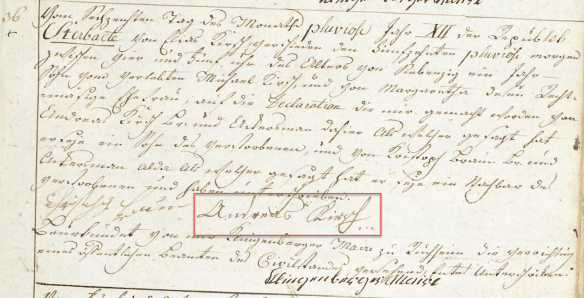
Kirsch French Andreas signature

The death record is signed by Andreas Kirsch, and Andreas was Elias’s youngest child and one of three sons.

It looks like we found Elias’s death record alright, but how did Elias suddenly become French?

French Occupation!

The answer lies in the French occupation of the German left bank, the area between the Rhine River and France.

In the 1700s, Germany was still ruled by the Holy Roman Empire and was divided into sections ruled by Princes and royal families. The map below shows the Holy Roman Empire in 1789.

Holy Roman Empire 1789

Wikimedia commons map by Robert Alfers

You can see the Pfalz region in the closeup, below.

Holy Roman Empire Pfalz

The Rhine had for centuries been the road into the heartland of Germanic Europe facilitating transportation and trade. Of course, along that road marched and floated armies and invaders as well.

Wars in this part of Europe had been occurring regularly for hundreds of years by this time, and probably as long as humanity occupied this part of the earth.

The German people were weary. They had been displaced over and over again since before the 30 Years War which laid waste to and depopulated this part of Germany.

By the late 1700s, the German princes feared a Revolution, while the intellectuals hoped that the French would defeat royal absolutism. The common people, my families, were caught in the middle and could only deal with the outcome – whatever that happened to be.

When the French Revolution began in 1789, it was just one more in a succession of conflicts that dragged on until France officially occupied the German lands west of the Rhine.

In 1792, a conflict broke out, initially over the rights of German Princes with holdings in France, but it quickly expanded. The hostilities revealed that the civic ideals and French military were more than a match for the Germanic princes, vestiges of the Holy Roman Empire with no coordination among their fiefdoms, concerned about their own turf and not any consolidated whole.

The German lands saw armies marching back and forth, bringing devastation (albeit on a far lower scale than the Thirty Years’ War, almost two centuries before), but also ushering in new ideas of liberty and civil rights for the people.

According to Wikipedia:

Europe was racked by two decades of war revolving around France’s efforts to spread its revolutionary ideals, as well as to annex Belgium and the Rhine’s Left Bank to France and establish puppet regimes in the Netherlands, Germany and Italy. The French revolutionaries’ open and strident republicanism led to the conclusion of a defensive alliance between Austria and Prussia on February 7, 1792. The alliance also declared that any violation of the borders of the Empire by France would be a cause for war.

Prussia and Austria ended their failed wars with France but (with Russia) partitioned Poland among themselves in 1793 and 1795. The French took control of the Rhineland, imposed French-style reforms, abolished feudalism, established constitutions, promoted freedom of religion, emancipated Jews, opened the bureaucracy to ordinary citizens of talent, and forced the nobility to share power with the rising middle class.

Feudalism was a social system wherein the nobility held land from the crown in exchange for military service. Vassals were in turn tenants of the nobles and peasants, villeins or serfs were obligated to live on their lord’s land and give him homage, labor and a share of the produce in exchange for military protection.

In other words, no one other than the crown or nobility actually owned land. Freedom was restricted and military duty was mandatory. It wasn’t quite slavery, but it certainly restricted freedoms in many ways. In essence, it was economic slavery with no way to free oneself. Even emigration required permission.

The French-imposed reforms beginning in 1793 proved largely permanent and modernized the western parts of Germany. However, despite these welcome reforms, when the French tried to impose the French language, German opposition grew in intensity. The French had crossed an emotional line in the sand.

A Second Coalition of Britain, Russia, and Austria then attacked France but failed. Napoleon established direct or indirect control over most of western Europe, including the German states.

Clearly, based upon these civil records, the mandate of the French language was implemented and upheld, at least officially. Knowing the tenacious nature of the German people, I’m sure not one word of French was spoken when they had any choice.

The Encyclopedia Britannica adds:

After 1793 French revolutionary troops occupied the German lands on the left bank of the Rhine known as the Palatine Region, and for the next 20 years their inhabitants were governed from Paris. Yet there is no evidence that the Germans were dissatisfied with French rule or at least no evidence that they strongly opposed it. Devoid of a sense of national identity and accustomed to submission to authority, they accepted their new status with the same equanimity with which they had regarded a succession to the throne or a change in the dynasty.

Wikipedia tell us that:

Following the Peace of Basel in 1795 with Prussia, the west bank of the Rhine was ceded to France.

Napoleon I of France relaunched the war against the Empire. In 1803 he abolished almost all the ecclesiastical and the smaller secular states and most of the imperial free cities. New medium-sized states were established in south-western Germany.

The Holy Roman Empire was formally dissolved on 6 August 1806 when the last Holy Roman Emperor Francis II (from 1804, Emperor Francis I of Austria) resigned.

In 1806, the Confederation of the Rhine was established under Napoleon’s protection.

Confederation of the Rhine 1806

By ziegelbrenner – own drawing/Source of Information: Putzger – Historischer Weltatlas, 89. Auflage, 1965; Westermanns Großer Atlas zur Weltgeschichte, 1969; Haacks geographischer Atlas. VEB Hermann Haack Geographisch-Kartographische Anstalt, Gotha/Leipzig, 1. Auflage, 1979., CC BY 2.5, https://commons.wikimedia.org/w/index.php?curid=9024294

The Confederation of the Rhine, a confederation of client states of the First French Empire, existed from 1806 to 1813.

With the defeat of Napoleon’s France in 1814, Bavaria was compensated for some of its losses, and received new territories such as the Grand Duchy of Würzburg, the Archbishopric of Mainz (Aschaffenburg) and parts of the Grand Duchy of Hesse. Finally in 1816, the Rhenish Palatinate was taken from France in exchange for most of Salzburg which was then ceded to Austria in the Treaty of Munich (1816).

It’s no coincidence that we see the church records recording births, deaths, and marriages resume, in German, in Fussgoenheim in 1816.

The French rule was over. The official language returned to German, although I’m willing to bet that while the upper-class society spoke French, the peasants and farmers in the villages never did.

They simply waited.

Some, of course, like Elias, died waiting – but his grandson Philip Jacob Kirsch, born in 1806, two years after Elias’ death, tired of constant turmoil in the Palatinate, would take his German-speaking family to Indiana in 1848 where they still spoke primarily or at least occasional German for another 100+ years.

Some of that strong German bloodline is discernible in his descendants today.

Kirsch Autosomal DNA

Because the Kirsch family didn’t immigrate until the mid-1800s, we don’t have as many descendants in the US today to DNA test as lines that have been in the states since colonial times.

Thankfully, another Kirsch descendant and his family are also interested in the Kirsch genealogy and agreed to DNA test.

It’s particularly interesting, because while Mr. Kirsch’s daughter and I don’t have an autosomal DNA match, he and my mother have a significant match, on six substantial segments, shown in red below. In fact, other than immediate family, my Mom is his closest match.

Kirsch Autosomal DNA

On the chromosomes above, Mr. Kirsch is the background person with mother being the red segments matching Mr. Kirsch. For purposes of comparison, I’m the light blue that matches with Mr. Kirsch and my mother on chromosomes 8 and 11. Notice the huge red piece of DNA that I didn’t receive from Mom on chromosomes 3 and 14, the first half of chromosome 11 and the smaller segment on chromosome 4. In these locations, I received my mother’s father’s DNA, because I certainly didn’t receive her DNA from her mother’s Kirsch lineage.

The largest segment that Mr Kirsch and mother share is 42.67 cM and the smallest segment larger than 5 cM is 10.27 cM. Four other people also match both Mr. Kirsch and mother, above, as well. Two matches don’t have trees, one lives in Germany and one in the Netherlands.

Of course, Mom and Mr. Kirsch share both the Kirsch and Drechsel DNA, given that Elias’s great-grandson, Jacob Kirsch, married Barbara Drechsel in Aurora, Indiana. We could be seeing a combination of segments descended from both Barbara and Jacob.

I inherited very little of this specific Kirsch/Drechsel DNA, and my children inherited even less. Obviously, Mr. Kirsch’s daughter didn’t inherit the segments from her father that I share with him, given that she and I don’t match. It’s amazing just how quickly descendants can go from 163 cM of shared DNA in one generation between two people on 6 segments greater than 10 cM, to no match between their children. Genetic roll of the dice.

I do wonder if any of these segments descended from Elias or if they were introduced by a wife’s line in the 4 generations (inclusive) between Elias Kirsch/Susanna Elisabetha Koob and Jacob Kirsch/Barbara Drechsel where the line splits into sibling lines in the late 1800s.

Kirsch Autosomal DNA pedigree

Of course, every segment has its own unique history, so these segments could descend from multiple ancestors in the pedigree chart, above – Kirsch, Koob, Koehler, Lemmert and/or Drechsel.

We won’t know unless some Kirsch and Drechsel descendants who descend from ancestors upstream of Jacob and Barbara test and match some of these segments. One thing is for sure, one way or another, this DNA originated with our ancestors someplace in modern day Germany, a place then known as the Holy Roman Empire.

______________________________________________________________

Disclosure

I receive a small contribution when you click on some (but not all) of the links to vendors in my articles. This does NOT increase the price you pay but helps me to keep the lights on and this informational blog free for everyone. Please click on the links in the articles or to the vendors below if you are purchasing products or DNA testing.

Thank you so much.

DNA Purchases and Free Transfers

Genealogy Services

Genealogy Research

The Big Y Test Increases Again to Big Y-700

In Japan, at the Tanabata or Star Festival, attendees write their wishes on tanzaku, or small ribbon-like colorful pieces of paper and hang them on the tanzaku bamboo tree. For a very long time, Y DNA project administrators pestered Bennett Greenspan at Family Tree DNA to add more STR markers, useful in determining relationships between and within family lines.

We’ve been getting our wishes granted at breakneck speed in this past year, with the addition of the Big Y-500 (that’s 500 free STR markers) in April 2018. Now, our wishes have been granted again as Family Tree DNA expands the Big Y to 700 included STR markers.

Big Y-700 Tanzaku tree.png

Family Tree DNA just announced the Big Y-700 which replaces the Big Y-500.

The Big Y test itself provides a scan of the majority of the Y chromosome, providing results to testers including:

  • All SNPs found, both ancestral (original value) and derived (mutated state)
  • New mutations never discovered before known as Private Variants. It’s exciting to be a part of scientific discovery AND these are useful genealogically as well. I wrote about using the Estes Big Y results here.
  • Reports for named SNPs and private variants, both
  • Matching for SNPs
  • SNP tree placement
  • The new Block Tree
  • First 500, now 700 STR values included for free. You can read about how these markers work, here.
  • Matching to other testers for both SNPs and STRs above 111 (STRs below 111 are handled separately). I wrote about how the new matching above 111 markers works here. You can read about the difference between STRs and SNPs here.

According to this announcement, testers whose Big Y-500 results are now pending will automatically receive the new Big Y-700 instead of the Big Y-500 that they ordered. Family Tree DNA added another 200 STR markers. No need to do anything on your part.

This is great news for everyone who ordered on or after November 1, 2018 or anyone who has not yet received Big Y results. For the first time in history, no one will bemoan delayed results!

Family Tree DNA provided the following schedule of when Big Y-700 results can be expected – some very soon!

Order Placed Results Expected By
Before November 1, 2018 February 8, 2019
November 2018 February 20, 2019
December 1, 2018 to present March 6, 2019

It looks like another benefit of the new genetic testing technology will be quicker delivery dates now and into the future. Family Tree DNA hopes to reduce their delivery time on the Big Y-700 after the current backlog is released to 2-4 weeks.

How Did They Squeeze Another 200 Markers Out?

New chemistry used in processing the Big Y-700 test results in more uniform coverage of the Y chromosome and includes a much broader target region. This combination does three things:

  • Allows quality reads of regions previously unavailable
  • Provides more consistent results
  • Provides better coverage, meaning fewer no-reads
  • Allows for more STRs to be accessed and reliably read, hence the Big Y-500 is replaced by the Big Y-700

Price

The Big Y-700 prices, according to the Family Tree DNA e-mail to group administrators:

Big Y-700 pricing.png

Upgrades

Since the new Big Y-700 test provides an additional 200 markers above and beyond the Big Y-500, many people will want to know if upgrades are available. The answer is yes, they will be but not just yet and the upgrade price has not been announced. Expect an e-mail with this information around mid-March if you have already taken a Big Y or Big Y-500 test.

Because the new chemistry is needed to obtain the Big Y-700 results, this isn’t just reprocessing the existing data. Therefore, a new test actually has to be run in the lab on the sample to facilitate the Big Y-700 upgrade from the Big Y-500.

Obviously, if not enough of the original sample remains, this could be a problematic situation. I would suggest thinking conservatively about upgrading a Big Y-500 test where the tester can’t provide a new sample for testing. Every situation will be different.

Will My Big Y-500 Markers Change?

If you upgrade to the Big Y-700, your STR markers values above 111 may change due to the improved quality of the technology involved.

This means three things:

  • You may not match people you did before, or vice versa, on some markers
  • You may have results for markers you did not have results for before
  • Your matches to people who have also taken the Big Y-700 test will likely be more accurate than to people who took a Big Y-500 test. Apples to apples, so to speak.

What If My Results Change and I Want to Keep the Old Results?

You won’t be able to mix and match at will between the results of the Big Y-500 and Big Y-700 tests. No merging or combining results of the two tests allowed!

I asked about the situation where a tester has results for a specific marker in the Big Y-500, but that location is a no-call using the new Big Y-700 technology. Family Tree DNA replied that they did not anticipate this being an issue. I hope they are right.

I also asked about the situation where a marker value changes to NOT match men who have taken the Big Y-500 of the same surname. Would the person who took the Big Y-700 be able to “revert” to the older value (in other words, merge values for the two tests) for that conflicting marker? The answer is no, that the Big Y-700 technology is superior and more accurate. Remember that matching, meaning who is on your match list, is actually determined by the first 111 STR markers, not the additional STR markers provided by the Big Y-500 or Big Y-700, so markers above 111 will not affect who you do and don’t see on your match list.

The long-term answer is of course to upgrade the other men to Big Y-700 as well. In cases where that isn’t possible, project administrators and family members comparing these results for ancestral line marker mutations will simply have to make a note of any discrepancy.

If you do upgrade once the Big Y-700 upgrade becomes available, I would recommend printing or otherwise storing a copy of your Big Y-500 results for reference.

New Match Comparison Tools Planned

While the Big Y-500 (and soon 700) results are compared on an individual tester’s results page, there is currently no tool to allow administrators to compare groups of men, which is often how surname project grouping is achieved. This also means that results above 111 markers aren’t available on the pubic project pages.

While you may not have noticed if you’re just looking at your own results, project administrators need grouping tools in order to discern line marker mutations for specific lineages. The usefulness of Y DNA testing is, after all, in the comparison of the results to other men and forming clusters of men who match into genetic families. Every family group who is participating in Y DNA testing wants to discover markers that delineate between various male lines descending from a specific progenitor.

Let me give you a quick example. In my Campbell line, we’re still trying to discover the identity of the father of Charles Campbell, born about 1750. We know that he’s from the Campbell Clan line (Duke of Argyll) of Scotland based on his descendants’ Y DNA tests, but we can’t figure out which Campbell male he descends from (probably in Virginia) before he moved to Hawkins County, Tennessee about 1780. Hopefully, these new Y DNA STR markers may provide enough granularity, if a sufficient number of men upgrade, to help us track our line back in time. We need markers that are found only in Charles’s descendants and his father’s other descendants, whoever they might be, to connect us with the correct lineage. Hey, I’m a desperate genealogist – I’ll take every hint I can find! Fingers crossed.

Family Tree DNA indicates that new grouping tools for project administrators, and I presume that means project displays as well, are coming soon. I realize that scrolling to the right forever to see beyond 111 markers would be a pain, but I can’t think of a better way to facilitate comparisons of many men. If you have an idea, give me a shout. If you’d like to see a surname project example, here’s a link to the Estes project.

I look forward to the new FREE and included Big Y markers and upcoming tools. Thanks again Family Tree DNA!

______________________________________________________________

Disclosure

I receive a small contribution when you click on some (but not all) of the links to vendors in my articles. This does NOT increase the price you pay but helps me to keep the lights on and this informational blog free for everyone. Please click on the links in the articles or to the vendors below if you are purchasing products or DNA testing.

Thank you so much.

DNA Purchases and Free Transfers

Genealogy Services

Genealogy Research

Philip Jacob Kirsch (1806-1880) aka Philippe Jacques: Masquerading as…French??? – 52 Ancestors #226

The Kirsch family is German. My mother knew they spoke German. She heard them. They stopped speaking German during WWI and WWII when speaking German meant inviting trouble. The Kirsch family had never been anything but German.

So now, they’re suddenly…French???

My head is spinning.

This causes me to close my eyes and shake my head slowly to see if when I open my eyes, this dream has dissipated yet.

Nope, they’re still there, with records in French.

At least that key word is there, record! But French?

Is this really my Kirsch family?

How did this happen?

The Baguette Trail

I thought those were rye breadcrumbs I was following, but these turned out to be baguette crusts.

I’ve already written two articles about Andreas Kirsch of Fussgoenheim, Germany – and not intentionally, mind you. I wrote the first article, thinking I had sorted the Kirsch family correctly, only to discover that I hadn’t, so in the second article Andreas acquired a new set of parents.

Andreas’s correct father was Elias Kirsch who I’m trying desperately to write an article about. He’s resisting. Like, you know, this French thing.

Why is this family so unruly?

Elias’s birth record has already been documented. I had a date for his death from a German cousin decades ago, but I could not find Elias’s actual death record anyplace. It clearly existed someplace, because no one remembers an exact date more than 200 years later. But where was that missing record?

Andreas’s son, Philip Jacob Kirsch, was born on August 8, 1806 based on calculations from his death date inscribed on his tombstone in Indiana, here in the US. Many different pieces of evidence during his lifetime point to his Germanness.

When I wrote Philip Jacob’s article, I had hoped to find a birth/baptism record in Germany, given that I knew he had been born in the little village of Fussgoenheim, but that record was not found.

About the Fussgoenheim Church Records

Unfortunately, the Fussgoenheim church records are in sorry shape, fragmentary at best.

Fussgoenheim records include the following:

  • Baptisms: 1726-1798 and 1816-1839
  • Marriages: 1727-1768 and 1816-1839
  • Deaths: 1733-1775 and 1816-1839

Those books are not complete, with pages missing and significant water damage. In the words of Tom, my cousin and trusty German retired genealogist, “these are some of the worst German records content-wise I’ve ever perused,” followed by, “your gang is never easy.”

Isn’t that the truth! Tom is always so elegantly understated:)

Fortunately, we were able to find at least some records for each person, so we haven’t skipped a generation completely.

Here’s what I have for these three generations of Kirsch men along with what’s missing.

Gen # Name Birth Record Marriage Record Death Record Comment
#1 Elias Kirsch Yes – 1733 Fussgoenheim No – married to Susanna Elisabetha Koob No – date of May 2, 1804 provided by German relative He was married before the birth of his first child recorded in 1763
#2 Andreas Kirsch Yes – 1774 Fussgoenheim No – married to Margaretha Elisabetha Koehler 1819 – yes, Fussgoenheim Would have been married about 1795 before birth of child in 1796
#3 Philip Jacob Kirsch No, but born in 1806 Yes, Mutterstadt, to Katharina Barbara Lemmert Yes, died in US Birth date calculated from death date on tombstone

1819

We know Andreas Kirsch was married to Margaretha Elisabeth Koehler from their children’s birth and baptismal records, the same way we know the identity of Andreas’s mother.

Sure enough, we find Andreas’s death record in 1819, in Fussgoenheim, in German, just like we expect. He was born and died there, so surely his son, Philip Jacob was born there as well.

Kirsch French

Kirsch French 2

It’s nice that we have 1819 taken care of, but what about that missing 1804 death record for his father, Elias Kirsch? If Andreas was born and died in Fussgoenheim, it’s likely that his father died there too.

The Source of the 1804 Record?

Since the Fussgoenheim records are absent for 1804, I couldn’t help but wonder where my German cousin who still lived in the region found that 1804 date. It wasn’t just an approximation, but an actual day, month and year. Those detailed dates, even if wrong, generally came from a specific source.

I searched in my records and filing cabinets and found nothing. And I mean I deep searched, like deep cleaning your house. Still, nothing.

Driving Me Batty

That missing 1804 source was driving me batty. I KNEW I had seen something, but what, where and when. I didn’t just make that death date up and it did not magically appear in my computer from the death-date-fairy one night while I slept.

Two days later, I found notes attached to a letter sent from that German cousin, Marliese in 2002 indicating that she had obtained at least some information from a retired cousin, Walter Schnebel in Fussgoenheim who was working on some related surnames. Walter, according to Marliese was a neighbor boy when she grew up in Fussgoenheim and his grandmother was a Koob. Hmmm, I wonder if Walter is still living…

Additionally, Marliese mentioned that a man named Friedrich Kirsch was writing a book but that he couldn’t help her. Another cousin, Hazel, mentioned in another letter in passing that she thought that Friedrich lived in California. I’d surely love to know who Friedrich is and if he finished that book.

Finally, my curiosity was satisfied – I knew why I recorded that date, but I still didn’t know the source, meaning where Marliese found it. I was trying to decide what to do with that date when I decided to search one more time online. New records do become available occasionally.

I searched at Ancestry for any Kirsch who died in 1804 and found a record not in Fussgoenheim, but in the Ludwigshafen records for Ruchheim. That’s odd.

Kirsch French Elias

I decided to take a look.

Kirsch French church

What? This can’t be right. These are French records. My French is rusty, but this definitely French.

Kirsch French Elias death

Here’s the record. Tom wasn’t able to translate every word, but the gist is as follows:

Elias KIRSCH

Date of the Act: 16 Pluviose in 12th year of the French Republic or 6 February 1804.

Death Act No. 36

The 16th day of the month of Pluviose in the year 12 of the Republic, the Death Act of Elias KIRSCH…..the 15th Pluviose in the morning between 4 a.m. and 5 a.m. at the age of 71 years son of the late Michael KIRSCH and Margaretha his rightful? wife from the declaration made by Andreas KIRSCH, ? and farmer here……and Kristoph Braun…farmer …..

Klingenburger, mayor and civil registrar.  Mayor’s signature as well as signatures of Christoph Braun and Andreas Kirsch.

I can’t believe that Tom can read this at all, especially in a third foreign language. He’s amazing! Even after he translated the contents, I had to ask him which signature was Andreas Kirsch’s.

Kirsch French Andreas signature.png

How cool is this! What was surely a sad day for Andreas as he signed his father, Elias’s death record is a boon for me today because I now have Andreas’ signature. Something very personal left by him 215 years ago at a turning point in his life.

But French? How is a death record for a German man in Germany written in French? Can this be right?

Is this the correct Elias and Andreas Kirsch?

French?

Finding this record triggered a very vague memory from about 30 years ago.

When Elke, my translator at that time, was translating records from this family group – we found a page of script in the Lutheran Reformed church book, I believe from Mutterstadt, a neighboring village.

Kirsch French map

That cover page didn’t resemble the format of any of the other pages, and it may have been in the front of the book.

At that time, I was copying the pages from the Family History Center and sending them snail mail to Elke, about 20 pages at a time or so.

She would then read and translate any records with my family surnames in them, generally printing the translation by hand and attaching her translated page to the copied page I had sent her. Then she would return the entire packet with a letter which was like a Christmas gift with every arrival.

I don’t remember if Elke actually translated that cover page, or if she told me what it said when we were talking on the phone, but I remember that she thought it was interesting. The essence of what I remember about that church-book entry was jaw dropping at the time.

The old handwritten letter, in German script of course, addressed to no one in particular and everyone in the future said that the people (residents, parishioners) had crossed over the Rhine “once again” and were scattered. The few people left behind had been admonished to seek comfort where they could and to have their children baptized and their dead buried, even by the Catholics, if they could find any, because that was better in the eyes of God than nothing. Then, the letter said that, God willing, they would one day return to their village and farms and take their church book home with them to rebuild – not knowing if there would be anything left at all.

From this, I understood that the church book went with the minister, in his possession, and was not left behind in the church. Clearly, that book was significant to the minister as well as the church members – probably representing one thing preserved from the past and hope for the future. It may have been the only item from their village that survived. Invading armies were brutal and burned almost everything, leveling the landscape.

The words “once again” peaked my curiosity. Looking at the history of this region, the Rhine River acted as a road, bringing trade, but also foreign armies. Warfare was a fact of life.

In other records that Elke translated, I did notice some German, then French, then German again – but at that time, it didn’t really affect me, or at least I didn’t think it did.

I figured it was like any people living close to a border. Many people are multi-lingual. All of Europe is close to a border, so I didn’t think much more about it.

The real reason was much more alarming.

War

In essence, the left (west) bank of the Rhine was controlled by France from 1792 to 1815. During this time, the French introduced the concept of Civil Registration, as opposed to the church records being defacto civil records.

Given that Elias died in 1804, he had been caught up in the middle of the French/German drama and occupation in his elder years. Clearly, he hadn’t left, because he died on the French side of the Rhine, which is why his death record is in French.

This also explains why so many church records from the late 1700s to 1816 are missing as well. Not to mention that any church books taken across the Rhine may have never found their way back home.

French Names

The French record keepers did us the “favor” of translating the names from German names to French names. For example, Philip Jacob became Philippe Jacques. Johannes became Joan in French and other similar changes.

In other words, those records could have been hiding right there in plain sight – but I never paid any attention because the name and associated record was French, not German and the location wasn’t Fussgoenheim. I had no idea that the French had imposed a different type of civil registration and redistricted governmental administration in a more typical French manner. Ludwigshafen’s administrative district included Ruchheim which includes Fussgoenheim records.

Understanding the history of the region where our ancestors lived is so important to understanding the lives of our ancestors – and their records.

Hmmm, if Elias’ death record was in these “misplaced” records, which other missing records might we find here as well?

Philip Jacob Was Born Philipp(e) Jacques

Once I began searching differently and thinking in French, I found a treasure trove of records.

Kirsch French Ruchheim

As you can see, there are lots of Kirsch records in Ruchheim.

Kirsch French Philip birth

On August 8, 1806, we find Philip Jacob masquerading as Philipp Jacques Kirsch born to Andre, which is really Andreas and Marguerithe Elisabethe who is really Margaretha Elisabetha. It seems odd to see those German names under the influence of the French – like kids playing dressup.

Of course, the Germans were probably very displeased by this turn of events and their new French names just rubbed salt in the wound. I’m sure they couldn’t wait until they could shed their new Frenchness like so many dirty clothes.

The Ruchheim records do include Fussgoenheim, so this Philipp Jacques in Ludwigshafen/Ruchheim is actually Philip Jacob from Fussgoenheim.

Kirsch French Philip birth 2

In his birth record, Fussgoenheim is even underlined in red in the original book.

Here’s the translation, again, courtesy of Tom:

No. 96

The year 1806, the 8th of August at 10 A.m. came before me the mayor and civil registrar of the community of Fussgonheim, mayor of Sougheim? and declared: Andre KIRSCH, laborer, age 35 years, resident of the said Fussgonheim and presented an infant of the male sex born today at 3 a.m. of the said Marguerithe Elisabethe KOEHLER, his wife and given the names of Philippe Jacques (Philip Jacob). The declaration was made in the presence of Francois Joel, laborer, age 26 and Andre Stein, Jr., 28, both residents of Fussgonheim, who signed the document below and it was read alound.

Klingeberger, Mayor

Franz Jehl

Andreas Stein, Junger

Glory be, Philip Jacob Kirsch was actually born as Philippe Jacques. That’s one secret he never told!

I love the detail included in this record. We don’t have godparents listed like we did in church records, but we know that Philippe Jacques was born at 3AM. The ages of other people involved are provided too, which may help other genealogists, although Andreas’s age is only approximate. He was actually 32 at that time.

The missing marriage records weren’t found. The mother’s birth surnames were provided through the children’s baptisms, so we filled in those blanks another way.

However, discovering two of four missing records is wonderful.

Surprise

Just when I thought I’d already been surprised by every trick move possible! I don’t quite know how to prepare for unexpected events like when your rye bread crumbs transform into baguettes. One thing is for sure, my ancestors never fail to disappoint.

I sometimes wonder if the ancestors are having a boring day, sitting on some clouds together in the hereafter, and plotting.

“Hmmm, what curve ball haven’t we thrown her yet?”

“I’ve got it – let’s just change languages to something different, for no apparent reason.”

“Yeah, that’s it. Great idea!”

“Watch this…hold my beer!”

Me:

“Don’t make me come up there…”

______________________________________________________________

Disclosure

I receive a small contribution when you click on some (but not all) of the links to vendors in my articles. This does NOT increase the price you pay but helps me to keep the lights on and this informational blog free for everyone. Please click on the links in the articles or to the vendors below if you are purchasing products or DNA testing.

Thank you so much.

DNA Purchases and Free Transfers

Genealogy Services

Genealogy Research

Family Tree DNA’s New Big Y Block Tree

Family Tree DNA just released their new very cool new Block Tree for people who have taken the Big Y DNA test. Furthermore, Family Tree DNA is working hand-in-hand with citizen scientists. At the bottom of their new tree you’ll see the credit, “Layout based on the Big Tree by Alexander R. Williamson.”

I love collaboration because it benefits everyone.

If you have taken the Big Y test, sign on to your account and follow along. If you haven’t and you’re a male, you can always upgrade and if you’re a female, you can sponsor a male with a surname of interest.

Let’s step through the new Block Tree and see what it can tell us about our ancestors and their history. There’s so much here.

After signing on to your account, look under the Big Y-500 section on your personal pge and you’ll see the new Block Tree icon. If you’ve taken this test, you receive the new Block Tree automatically.

Block Tree icon

Click on the Block Tree icon and you’ll see an introduction.

Block Tree Tutorial

block tree tutorial.png

Cool! Trees, SNPs and branches combined with countries AND myOrigins results.

By clicking on “Show Me Around” you can see the various features. Watch for is the little pink blob that expands and contracts, kind of like a heartbeat.

block tree tutorial 1.png

Full screen makes a BIG difference. Pardon the pun.

block tree tutorial 2.png

Display options controls which features you see.

block tree display options.png

You can disable some of these cool functions, but why would anyone want to do that?

Block tree tutorial 3.png

Reset, the ultimate bread crumb trail. Back to the trailhead.

Block tree tutorial 4.png

We’ll try each of these features after the tutorial.

block tree tutorial 5.png

Note that the equivalent SNPs for each branch are included too. In the future, it’s possible that branches maybe divided into two smaller branches between equivalent SNPs. At that point, they won’t be equivalent anymore, because a difference will have been found.

BLock tree tutorial 6.png

Note, at the top of the display are the parent branches of the tree above the SNP boxes shown.

BLock tree parent branches

Click to enlarge.

You can step yourself all the way back up the tree if you wish to do so. In this view, you can see R-M207, the root of haplogroup R at the upper left. Wow, look at all of those branches that are children beneath R-Z39589, the navy blue block.

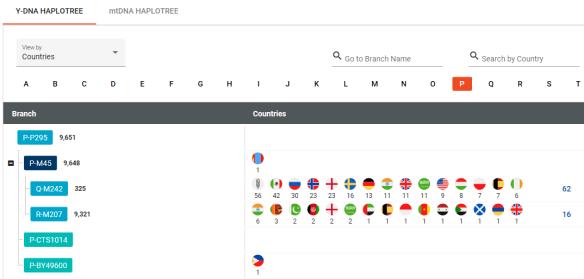
If you click on R-M207, you’ll see R-M207 and then, upstream, haplogroup P-M45 which gave birth to R-M207 and brother brother branch, Q-M242.

BLock tree SNP path.png

If you get lost on this block tree trying to see major branches and how they relate, remember you can reference the main branching haplotree in pedigree format here.

By clicking on any haplogroup, you can quickly see how they relate to others. For example, here’s P showing Q-M242 and M207 underneath on the pedigree tree.

Block tree to pedigree tree.png

I wrote about how to use this tree in the article, Family Tree DNA’s PUBLIC Y DNA Haplotree.

The block tree is private, meaning not available publicly, because it’s designed to show the names of your matches who have given permission for matching and sharing.

Ok, let’s get down to the nitty gritty.

You and Your Matches on the Block Tree

After you review the tutorial, you’ll see the block tree as it relates to you and your test results.

block tree main view.png

I’m using the test of a man as compared to a group of men whose tests I manage as examples. They have all granted sharing permission, but it’s just easier to blur identities for privacy than to explain repeatedly why I didn’t.

Your own branch is shown to the far left and is labeled as such. To the right, you’ll see all of the neighbor branches. Some will be brother branches, descended from the same parent SNP, like BY482 and R-ZP276, above. Others will be more distantly related.

block tree origins legend.png

Below your branch, a legend referring to the colors in the circle rings in the Origins section is provided.

Family Tree DNA has given us a lot of information  to unpack.

block tree your branch.png

What are we actually looking at?

Your SNP branch block is the one with a white background and a black border, in this case, R-ZS3700.

The teal box underneath includes the average number of private variants, meaning SNP mutations not yet named and located on the tree. Multiple occurrences of private variant mutations must be documented in different men in a reliable genome location before the SNP can be named and placed in its correct position on a branch of the haplotree.

If you hover over the teal box below your “terminal” or currently end-of-line SNP, you’ll see a pop-up box describing the variants. Different men will have different numbers of private variants based on any number of factors, including de novo (one off) mutations and read errors. Therefore, an average is used.

If you click on R-ZS3700, or any SNP, you’ll see just that branch in the display, without neighbor branches.

block tree individual branch.png

There are two people in this branch – you and your match. You have a total of 8 combined origins.

Distance, Years and SNPs

One of the questions all genealogists seek to answer is when. We want to know when and how closely we’re related to these men we match, either closely or distantly.

Unfortunately, that question, without genealogy, is very difficult to answer. Many researchers have spent approaching two decades now attempting to reliably answer that question. The key word here is reliably.

The general consensus is that a SNP generation is someplace, on average, between 80 and roughly 140 years. The topic is hotly debated, and many factors can play into SNP age calculations.

Family Tree DNA has approached this a little differently. They have provided a scale of number of SNPs on the left hand side. Each SNP represents one grey block.

block tree SNP generations.png

Here’s what I can tell you positively about the men in this example. SNP R-BY490 was born about 1600. The father who is confirmed through testing of multiple sons was positive for BY482 but not BY490 and was born in 1555.

There are a total of 5 SNPs plus Private Variants between the current tester whose account we are viewing and the birth of R-BY490.

Ancestor birth Tester birth Difference SNPs Years per SNP
1600 1928 328 5 65.6
1711 1928 217 4 54.25

A second example is equally as relevant. ZS3700 was born in 1711, proven through testing of multiple sons’ lines.

You can see that the average can vary quite a bit. Trying to calculate many generations back in time, with many branches having gone extinct along the way, with no proven genealogical lineages to help the process is fraught with landmines.

Countries

I love the view that incorporates countries and geography which shows in a very visual way where different branches of the genetic family line migrated to and settled. At least, where their descendants are clustered today.

block tree countries.png

In the wide view, above, we can see the history and birth of various SNPs in the blue box portion of the chart.

For example, the first split shown, beneath the large dark blue block including BY347 at the bottom occurred 33 SNP generations ago. If a SNP generation is 100 years, on average, then that’s 3300 years ago.

As new private variants are placed in different locations on the tree, this number of SNP generations may increase over time.

There are only two branches shown as descending from the navy blue SNP box; the largest medium blue block showing R-BY336 at the top and the turquoise Private Variant block with 27 variants, at far right.

block tree SNPS and clusters.png

The medium blue block box that includes SNP R-BY336 at the top and Y93760 at the bottom spans 16-33 SNP generations. Each SNP listed represents a SNP generation which is why each SNP is shown on a separate row equating to one grey bar at left.

Looking at the bottom of your display, you see the country of the location of the earliest known ancestor as listed by testers.

block tree flag icon.png

By hovering over the flag, you can identify the country, and by clicking on the flag, you see the detailed view of myOrigins of the testers for the SNP that flag is associated with – in this case, BY390.

block tree SNP plus origins detail view.png

Family Tree DNA has incorporated the highest combined regional myOrigins results for the testers into the display for the Big Y as a ring, plus the location of the testers’ Earliest Known Ancestor as completed in their personal information, found under their profile picture, under the genealogy tab.

Of course, as more people test, this information is subject to change, so check periodically.

block tree countries plus origins.png

The red boxes above indicate the pieces of information that are relevant for SNP R-BY490.

By hovering your mouse over the Origins box, you’ll see that the people in the group who are positive for BY490 have a total of 12 origins of which the highest two are British Isles and West and Central Europe. It just so happens that the earliest known proven ancestor of these men is found in England in the 1400s.

The US flag means that testers are stuck here. A feather indicates that the individuals identified their earliest known ancestor as Native American. I always take that with a grain of salt barring other evidence, such as a cluster (not based on oral history alone) or a known Native haplogroup.

Hint – Please note that if you have “0 Origins” showing, in order for your Origins to be included, you must enable “Origins Sharing” as well as “Project Sharing” for this information to appear on the branch. These options can be found under “Manage Personal Information” below your photo on your personal page, under Account Settings, then “Privacy and Sharing” and “Project Preferences” tabs, respectively.

My Matches

Your matches are shown below the blocks that represent the various SNPs. When you exceed the match threshold of 30 SNPs, you are no longer shown as a match to individuals, and their names will no longer show on the block tree – but the block tree SNP information will remain without their names.

If you want to find out the surnames, locations and ancestors of those people who have tested but aren’t shown as matches, you have a couple of options.

  • If testers have granted permission in their privacy setting to allow their information to be shown in projects, you can visit the appropriate haplogroup project to view their surname and earliest known ancestor information, if they have provided such. Fingers crossed that they did.
  • A google search with the following text string will likely be productive:

<snp ID> haplogroup family tree dna projects

For those people who you do match, by clicking on the matches option in the upper left-hand corner of the block tree page, you will see the following display:

block tree my matches.png

Your matches are shown at left. You can see in this case that all 8 of this man’s matches are shown at BY482 or below, shown in the first three SNP blocks counting from the left on the block tree. The ancestor who produced BY482 was born approximately 16 SNP generations ago. If we use 100 years as an average, that’s 1600 years ago, or about the year 400. So far, all of the men who have tested and are positive for BY482 have a known ancestor in the British Isles.

You can see your matches on the block tree by:

  • viewing this list beside the block tree
  • viewing your matches in their respective haplogroup blocks
  • by clicking on their name to view their individual profile cards

block tree match profile.png

Of course, you can always go back to your account to view the matches on the Big Y-500 matches tab.

block tree Big Y options.png

You can learn more about the Big Y-500 Block Tree here.

In Summary

For me the real power in the Block Tree isn’t just the new visual view. I love that, but I can also use the Block Tree to “see through time” a bit.

I’m clicking back (up arrow on the tree) to view the base of haplogroup Q. As you may know, subgroups of haplogroup Q are found in many locations around the world.

BLock tree hap Q.png

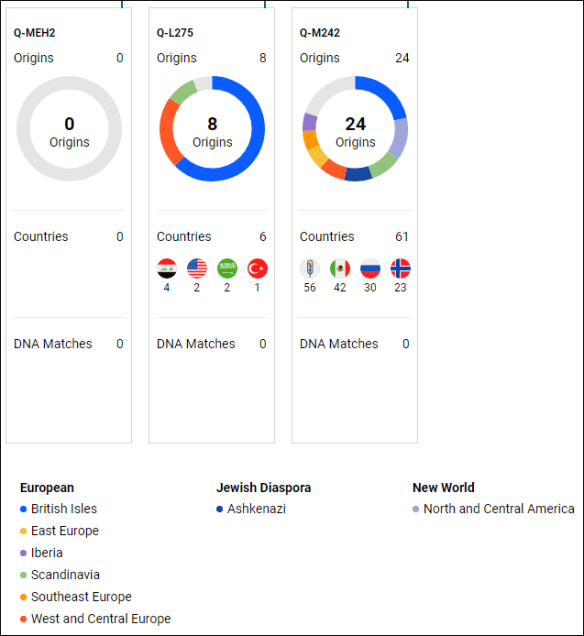
If there was ever a graphic to show, using science, that we are truly all related, this is it. Haplogroup Q is divided into 3 primary blocks.

People of primarily Ashkenazi Jewish origin scattered throughout the world. People of European origins, and people of Native American, Mexican, Russian and Norwegian origins.

Of course, when you look deeper at these three parent SNPs, you’ll see further breakdowns that represent migrations in time and geography.

That is, after all, how we learn about our ancestors before surnames and before genealogical records.

That history is written in our DNA and the DNA of the people to whom we are related, whether we know it or not.

If you are a male and haven’t taken the Big Y-500, please order or upgrade today. Who is waiting on you?

______________________________________________________________

Disclosure

I receive a small contribution when you click on some (but not all) of the links to vendors in my articles. This does NOT increase the price you pay but helps me to keep the lights on and this informational blog free for everyone. Please click on the links in the articles or to the vendors below if you are purchasing products or DNA testing.

Thank you so much.

DNA Purchases and Free Transfers

Genealogy Services

Genealogy Research

Caution: Invisible Fathers and Autosomal Matching – Who’s Hiding in Your DNA?

caution Y

Using autosomal DNA matching alone, NPEs (nonparental events,) also known as misattributed paternity or parentage (MPEs,) undocumented adoptions, and sometimes other terms, often goes completely undetected, especially a few generations back in time.

Generally, this phenomenon occurs when the believed father is not the biological father – for a variety of reasons. Using autosomal DNA alone, especially more than a couple of generations back in time, these situations often go undetected because we are lulled into complacency thinking we have proof via DNA matching, but we don’t.

Let’s look at a real life example of how I discovered and unraveled one of these mysteries. Continue reading

Hendrik Ferverda (1857-1898) and the Secret That Killed Him, 52 Ancestors #225

Sometimes, when you’re researching your family, you discover something that just doesn’t seem right.

Just doesn’t make sense.

Over time, things begin to feel odd.

Pieces that don’t fit.

heart missing piece

Or pieces that are missing…that shouldn’t be missing

That’s what happened with Hendrik Ferwerda, born to Bauke Hendrick Ferwerda and Geertje Harmens de Jong on October 5, 1857 in Eernewoude,Tietjerksteradeel, Friesland, Netherlands. Continue reading

Karma Finally Bites James Watson

I was initially excited to watch the PBS Documentary, American Masters: Decoding Watson. That excitement quickly transformed into something else.

The Skinny and the Scandal Continue reading

Andreas Kirsch (1774-1819) Gets New and Improved Parents – 52 Ancestors #224

Steps up to microphone at the podium, alone, on stage (in this case, a blog article.)

The press corps is gathered (readers) and the lights are bright, white hot and glaring.  (Who turned the heat up anyway?)

Shuffles nervously.

“Ahem.” <clears throat>

From offstage someplace, “We’re live in 4, 3, 2, 1…”

“I’d like to take this opportunity to update the birth announcement of Andreas Kirsch with new and improved parents.”

Cough. Choke. Sputter.

Andreas Kirsch revised birth

Every genealogists nightmare, right?

Who is Andreas Kirsch?

As new records become available, of course genealogists want copies, and that sometimes means that we have to revisit previous conclusions based on earlier information. All genealogists know that a new piece of information can turn a previous conclusion up-side-down – or at least complicate things or cast serious doubt.

No one wants to be wrong, but I’m oh so grateful when someone finds something new or that was previously unknown or missed and points it out to me. I do admit, I always have a “well, drat” moment, but I really think these are teachable events for myself and others as well. At least, that’s my story and I’m sticking to it!

I wrote about Andreas Kirsch of Fussgoenheim, Germany and in that article, I had stated that I could not find his actual baptismal record, but we did have his purported birth date from other indexed records.

Church records in Fussgoenheim, such as marriage records of Andreas’ children showed that Andreas was indeed the father of our immigrant, Philip Jacob Kirsch and his sister, Anna Margaretha Kirsch who married Johann Martin Koehler who immigrated as well. In Anna Magaretha’s 1821 marriage record, it states that she is the daughter of “the deceased Andreas Kirsch and his surviving wife Elisabeth Koehler, present and consenting.” Of course, this not only tells us who her parents are, but that her father has died and her mother is still living.

Later, Philip Jacob Kirsch’s own marriage record provided his parents’ names:

Philip Jacob Kirsch, the legitimate unmarried son of the deceased couple, Andreas Kirsch and Margaretha Koehler and Katharina Barbara Lemerth, the legitimate unmarried daughter of the deceased local citizen Jacob Lemmerth and his surviving wife Gertrude Steiger, both of protestant religion.

We’re home free, right? Yes, as far as who the parents of Philip Jacob Kirsch are, but maybe not relative to the identity of Andreas’s parents. We really do need that missing baptismal record.

New Information

My introduction to my German friend Chris was when he pointed out that additional records had become available and there was more than one Andreas Kirsch in Fussgoenheim. Not only that, but the Andreas born in 1772 might not actually be an Andreas at all!

Who was this Chris guy I’d never heard of before anyway? Was he right? Were there really two Kirsch men whose records were intermingled? I didn’t want to believe that. I didn’t even want to consider that. Do you know how many ancestors I’d have to chop off my tree if the wrong man was attached?

And yes, you’ve guessed it, I had identified the “wrong” Kirsch birth record back in the 1980s when my translator was reading and translating these records page by page. Many Fussgoenheim records are missing, and not all remaining records had been microfilmed at that time. Many had been terribly water damaged or torn and the microfilm image quality itself was poor. These factors combined prove very challenging and cause errors to occur.

Chris discovered the mistake and had the misfortune of getting to tell me. I took it pretty well, all things considered. Chris is such a nice person, but I was upset because I’d fallen in love with those families that I fully believed were mine over the past 30 years. But Chris’s information was compelling, and there was simply no ignoring his research – no consigning it to the sidelines. It was in-your-face front and center and had to be dealt with.

I was very unhappy – but not with Chris. With myself. With the genealogical “condition” in general which of course periodically includes discoveries of errors past, and with the bad fortune of the combination of missing/damaged and confusing records.

It’s like I had written my ancestors obituary some 198 years after his death with the wrong parents and now, I had to somehow straighten it out and correct the error.

Crumb! Crumb! Crumb!

Chris Unravels the Mess

I’m providing Chris’s commentary here to illustrate his meticulous (successful) search methodology. Please note that Chris was working from much better record copies obtained from Archion.de, but Archion doesn’t allow their images to be published. The one image I’ve included is from the original Fussgoenheim church book obtained many years ago from the Family History Center.

From Chris (edited slightly for readability and clarity):

For some reason today, I thought back about your post on the Kirsch family from Fussgoenheim. So, being the curious person I am, I went back to the records, with some surprise to wait for me. I think you will like it!

First, I went back to your post:

https://dna-explained.com/2017/02/19/andreas-kirsch-1772-1819-of-fussgoenheim-bayern-germany-52-ancestors-148/

I planned to have a look at the baptism record of your Andreas Kirsch on 10 August 1772. I found a baptism record for a Kirsch relative at the right date, but it was not an Andreas, but a Johannes that was baptized this day! The parents of this Johannes, however, were the ones you have listed in your article as the parents of Andreas; Johann Valentin Kirsch and Anna Margaretha Kirsch.

I was a bit puzzled, why a child named “Johann Andreas” or even only “Andreas” later on should not be written as such in the baptism entry. As you point out yourself in your article, Johann was such a common name at this time, that I thought they definitely would have written the second name “Andreas” as well. So I went on.

Further down in your article you mentioned that “your” Andreas Kirsch was buried in 1819. So I checked the burial entry.

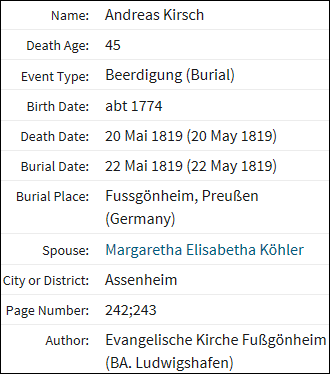
“Am 20. May starb und am 22. ejusdem ward begraben der hiesige Bürger Andreas Kirsch, Ehemann von Margaretha Elisabetha Köhler, in einem Alter von 45 J., 3 Mon. und 14 Tag.”

My translation: “On the 20th of May died and on the 22nd of the same month was buried the local citizen Andreas Kirsch, husband of Margaretha Elisabetha Köhler, at age 45 years, 3 months and 14 days.”

Again, the listed wife of this Andreas Kirsch is the one you note in your post as well, but if you calculate back from the death date 20 May 1819 with the age at death, you do not end up in 1772, but rather on 6 February 1774.

So, again I went back to the baptism records and find one on this very day for an Andreas Kirsch. Please note that the parents (in the first column) are not the ones you have in your post, but an Elias Kirsch and his wife and Anna Elisabetha. The second column notes the child`s name Andreas, the third column the witnesses Andreas Kirsch and Maria Katharina, third column: birth date 6 February 1774, fourth column date of baptism 8 February.

Andreas Kirsch birth 1774.jpg

In summary, I think that your cousin Walter was right to link the Johannes Kirsch born in 1772 with a wife Maria Catharina Koob, while you were right linking the Andreas Kirsch born in 1774 with the wife Margaretha Elisabetha Köhler.

However, these men, Johannes and Andreas, were not one and the same. I had selected the wrong one as my ancestor, mistaking Johannes for Andreas. No, I really don’t know how, but it happened.

Andreas’ wife is confirmed as Margaretha Elisabetha Koehler but his father, based on Andreas’ death record, followed by Chris finding Andreas’ actual baptismal record, shown above, was Elias Kirsch, wife Anna Elisabetha who had no birth surname listed.

Who was Andreas’ mother?

Identifying Andreas’ Mother

My friend and cousin Tom discovered more about Andreas’ mother. Her name wasn’t exactly Anna Elisabetha.

As translated by Tom:

Taufen__Trauungen__Bestattungen__Sonstiges_1726-1798_Bild14(1)

Baptism: 17 June 1731

Parents: Joh. Theobald KOOB and his wife, Maria Catharina, a daughter was baptized and named:

Susanna Elisabeth

Godparents: Johann Andreas Kirsch & Anna Elisabeth, widow of the late mayor (village elder), Koob.

Fussgönheim Evangelical Church Records

Susanna Elisabetha had been shortened to Anna Elisabetha during her lifetime.

Now I’m paranoid. Are we sure this is the right person?

Tom found more records that suggest strongly that yes, indeed, it was. The records of Elias Kirsch and his wife baptizing their children hold clues in terms of who the godparents were, especially the record where Emanual Koob is noted as the mother’s brother.

Translated by Tom:

Taufen_Trauungen_Bestattungen_Sonstiges_1726-1798_Bild381763

Elias KIRSCH and wife, Anna Elisabetha

A son was born, baptized and named: Emanuel

The Godparents: the mother’s brother, Emanuel Koob and wife, Maria Elisabetha

Born: 23rd of April 1763 Baptized: the 26th of the same – Entry No. 50

Taufen_Trauungen_Bestattungen_Sonstiges_1726-1798_Bild40

1766 Elias KIRSCH and wife, Susanna Elisabetha

A son was baptized and named: Georg Henrich

Godparents: Georg Henrich Koob, the juror and wife, Anna Margaretha

Born: 12th of March 1766  Baptized: the 16th of the same – Entry 73

Taufen_Trauungen_Bestattungen_Sonstiges_1726-1798_Bild48

1772 Elias KIRSCH and wife, Anna Elisabetha

A daughter was baptized and named: Maria Catharina

Godparents: Johann Theobald Koob, the juror and wife, Maria Catharina

Born: the 30th of September 1772 Baptized: the 30th of the same

Clearly, Elias and Anna Elisabetha were very close to the Koob family members.

Sawed Off Branch

It was painful, but I did it – sawed that rotten branch right off the tree and grafted the correct information. The grafting felt therapeutic after the removal.

Andreas Kirsch was born on February 6, 1774 and baptized two days later in Fussgoenheim to Elias Kirsch (1733-1804) and Susanna Elisabetha Koob (born June 1731). It feels good (now) to know I have the right ancestor. Andreas died on May 20, 1819, also in Fussgoenheim, but I don’t have a death date for Susanna.

I removed the erroneous conclusions from the first Andreas Kirsch article and will post a link to this article there as well.

A huge thank you and debt of gratitude to both Chris and Tom. I’m sure Andreas’ is resting easier now that he’s connected to the right parents.

______________________________________________________________

Disclosure

I receive a small contribution when you click on some (but not all) of the links to vendors in my articles. This does NOT increase the price you pay but helps me to keep the lights on and this informational blog free for everyone. Please click on the links in the articles or to the vendors below if you are purchasing products or DNA testing.

Thank you so much.

DNA Purchases and Free Transfers

Genealogy Services

Genealogy Research

Mitochondrial DNA Bulldozes Brick Wall

I’m doing that happy dance today – leaping for joy – and am I EVER glad I’ve sponsored so many mitochondrial DNA tests. Today, I’m incredibly thankful for one particular DNA test.

Think mitochondrial DNA doesn’t work or isn’t effective for genealogy?

Think again.

Often, when people ask on social media if they should test mitochondrial DNA, there is a chorus of Negative Nellie’s chanting, “No, don’t bother with that test, mitochondrial DNA is useless.” That’s terribly discouraging, depriving people of knowledge they can’t obtain any other way.

When people heed that advice, it becomes a self-fulfilling prophecy. When people don’t test and don’t provide genealogical information that would go along with a mitochondrial DNA test, mitochondrial DNA is much less useful than it could be if people actually tested their full sequence mitochondrial DNA at Family Tree DNA, not just for their haplogroup at 23andMe or Living DNA. There’s a huge difference.

Family Tree DNA tests the full mitochondria and provides matching to other testers which is critical for genealogical purposes. In fact, Elizabeth Shown Mills wrote about using this exact same technique here.

mtDNA not useless

And by the way, this is not an isolated outlier case either. In fact, mitochondrial DNA from this same line was used previously to prove who Phoebe Crumley’s mother was.

If people hadn’t tested, then these walls would not have fallen. Every person who doesn’t take a mitochondrial DNA test is depriving themselves, and others, of critical historical information and clues.

It’s all about CLUES and sometimes that big brick-wall-breaking boulder falls into your lap out of the blue one day.

Today was that day!

Phoebe’s Family Found

I’ll be writing a more detailed article about my ancestor, Phoebe, shortly, but for now, I’d like to share exactly how mitochondrial DNA broke through this brick wall that I truly believed was permanent. I’ll walk you through the various steps so you can follow the same path. Do you have female ancestors without families in your tree? Start thinking about the possibilities!

DNA Pedigree Chart

Let’s start with my DNA Pedigree Chart.

I know many people look at my DNA Pedigree Chart and think it’s a bit over the edge, but identifying the family of Jotham Brown’s wife, Phoebe, would absolutely NOT have been possible without this valuable tool and the fact that I’ve been “collecting” my ancestors’ DNA.

As you can see, any time I find the opportunity to test either the Y DNA line, or the mitochondrial line of any of my ancestors, I do. I’ve been quite successful in that quest over the years thanks to many cousins.

The brick wall that fell is an ancestor of Elizabeth Vannoy and her mother, Phoebe Crumley, shown on my DNA Pedigree Chart, boxed in red, with their haplogroup, J1c2c.

A Proxy Tester

Elizabeth Vannoy, being my great-grandmother on my father’s side, doesn’t’ share her mitochondrial DNA with me, so I had to find a proxy tester.

My cousin Debbie knew another cousin, David, whose mother was Lucy, granddaughter of Elizabeth Vannoy. David agreed to test, back in…are you ready for this…2006. Yes, almost 13 years ago. Sometimes DNA is a waiting game.

Cherokee?

At that time, the family rumor was that Elizabeth Vannoy was “Cherokee.” Yea, I know, everyone with ancestors who lived east of the Mississippi has that same rumor – but the best way to actually find out if this is true is to test the relevant family line members’ Y and mitochondrial DNA. Native American haplogroups are definitive and haplogroup J1c2c is unquestionably not Native, so that myth was immediately put to death. (You can read about Native American haplogroups here.)

However, Elizabeth’ Vannoy’s mitochondrial DNA has patiently remained in the Family Tree DNA database, accumulating matches. Truthfully, I’ve been focused elsewhere, and since we had a brick wall with Jotham Brown’s wife, Phoebe (c1750-c1803), which had not yielded to traditional genealogy research, I had moved on and checked cousin David’s matches from time to time to see if anything interesting had turned up.

I thought there was nothing new…but there was! However, it would take my cousins to serve as a catalyst.

Cousin Rita

On New Year’s Eve of 2016, I received an e-mail from a previously unknown cousin, Rita, who was also descended from Jotham Brown and Phoebe. Rita was born a Brown and over the next two years, not only tested her Brown line’s Y DNA which matched Jotham Brown’s line, but also connected her family via paper trail once she knew where to look. She’s a wonderful researcher.

Cousin Stevie

Another researcher who lives in Greene County, Tennessee has doggedly researched the Brown, Crumley, Cooper and associated Johnson lines. It was rumored and pretty much believed for years, because of the very close family associations and migration routes that Phoebe was Zopher Johnson’s daughter. I worked through this mountain of information in late 2015, reaching the conclusion that I really didn’t think Phoebe was Zopher’s daughter, but since there were no known daughters and Zopher’s wife’s surname was unknown, there was no way of finding matrilineal descendants to test. That door was slammed shut. I thought permanently.

However, Stevie had previously recruited two men from the proven Jotham Brown line to Y DNA test who matched a third Brown man whose line descended from the Long Island, Sylvanus Brown family.  Wow, Long Island is a long way from Greene County, TN. Adding to the evidence, our Jotham Brown named one of his sons Sylvanus, a rather unusual name.

This revelation allowed us to track the Brown line forward in time from the Sylvanus on Long Island, providing significant pieces of evidence that Jotham indeed descended from this line.

At that point, we all congratulated ourselves on at least finding an earlier location to work with and went on about solving other mysteries.

Rita’s Theory

I think Rita must be on vacation between Christmas and New Years every year, because I heard from her again on December 28th this year. It took me a few days to reply, due to the Holiday Crud being gifted to me, but am I EVER glad that I did.

Rita, it seems, has spent the last several months sifting through records and looking for migration patterns of families from Long Island. Can you say “desperate genealogist.” I’m not going to steal her thunder, because this part of the journey is hers and hers alone, but suffice it to say she wrote me with a theory.

Joseph Cole was found in Botetourt County, VA along with many of the families that eventually settled in Frederick County, VA and then migrated on together to Greene County, TN. In other words, she’s using the Elizabeth Shown Mills FAN (friends and neighbors) concept to spread the net wider and look for people that might be somehow connected. I took this same approach in Halifax County, VA several years ago with my Estes line very successfully.

Rita discovered that Joseph’s father John Cole also migrated from Long Island through New Jersey into Virginia and settled with this same group. Hmmm, Long Island, same place as Sylvanus Brown. Interesting…

John Cole, it turns out, had a daughter Phebe, who married a Jotham Bart, according to a Presbyterian church book in New Jersey where they settled for a short time in their migration journey. The church records referenced are transcribed, not original.

Jotham Brown, who is known to connect to the Brown family found on Long Island, is found migrating with this same group, and Rita wondered if indeed, Jotham Bart was really Jotham Brown and Phoebe was actually the daughter of John Cole and wife, Mary Mercy Kent.

Still being in the grips of the Holiday Crud, I asked Rita if John Cole and his wife had any proven daughters who would be candidates to have descendants mitochondrial DNA test.

Lydia Cole

While Rita was searching for daughters of Mary Mercy Kent and John Cole, I had sufficiently escaped the grim reaper to check cousin David’s mitochondrial DNA matches, just on the off chance that some useful gem of information was buried there.

David has 16 full sequence matches, of which 7 are exact matches, meaning a genetic distance of 0, a perfect match. Keep in mind that a perfect match can still be hundreds of years in the past, but it can also be much closer in time. Just because it can be further in the past doesn’t mean that it is. You match your mother, her sisters and their children, and that’s clearly very recent.

What was waiting was shocking. Holy chimloda!

Phoebe's sister, Lydia Cole

The Earliest Known Ancestor of one of David’s exact matches is Lydia Cole, born in 1781 in Virginia and died in 1864 in Ohio. The tester, Pete (not his real name,) had a tree. Thank you, thank you!!

Pete was stuck at Lydia Cole, obviously, but his tree provided me with Lydia’s husband’s name.

Oh, and by the way, guess what our Phoebe, born about 1750, named her daughter? Yep, Lydia.

Should I have noticed this hint sooner and dug deeper. Yes, I surely should have – Pete’s test was taken in 2012 so this information was there waiting for 6 years.

Is Lydia Cole too good to be true? Perhaps. Is she related? Of course the first thing good genealogists do is try to poke holes in the story. Better me than someone else. Let’s see what we can find.

Ancestry

Desperate to find out more about Lydia Cole, I checked Ancestry’s trees, understanding just how flakey these can be. Regardless, they are great clues and some are well sourced. Other people’s trees are at least a place to start looking.

Phoebe's sister, Lydia Cole at ancestry

There was Lydia with her father, John Cole and Mary Mercy Kent, the exact same couple Rita had hypothesized as Phoebe’s parents!

Lydia’s marriage was sourced and sure enough she married William Powell Simmons in Frederick County, VA in 1801, where Jotham Brown and Phoebe, his wife lived. It appears, according to Rita, that John Cole and his entire family settled there.

What a nice little bow on this package – at least for now. Am I done? Heck no…this journey is just beginning. You know how genealogy works – when you solve one mystery, you just add two more! Plus, there’s that little issue of verification, finding the relevant documents, etc. I know, details, right?

Is it possible that Lydia Cole isn’t really Phoebe’s sister? Yes, it’s possible. There is a roughly 30 year birth difference – although we all know how fluid these early dates can be.

DNA alone this far in the past can’t prove anything without additional evidence. It’s theoretically possible that Lydia’s mother was another close relative of Phoebe’s mother, somehow – explaining why Lydia and Phoebe would match so closely on such rare mitochondrial DNA. It’s possible, but not terribly likely.

Preliminary autosomal research also shows connections to the Cole family through other descendants of John Cole – so the evidence is mounting.

There’s a lot more research to do – verifying records, discovering more about Phoebe and John Cole and Mary Mercy Kent. I think Rita is already in the car on the way to Virginia😊

We can now follow Phoebe’s family’s migration from Long Island through New Jersey to Virginia. We now know the identity, pending confirmation, of both of Phoebe’s parents and can track those lines back in time. We know roughly when and where Phoebe was born. We can put the Brown and Cole families in the same place and time on Long Island.

All, thanks to mitochondrial DNA tests at Family Tree DNA confirming Rita’s hypothesis.

What a glorious day!!!

What Can Mitochondrial DNA Do For You?

Mitochondrial DNA is anything but useless. If you’re thinking, “yes, but David only had 16 matches total, and the only possible useful ones were the 7 exact matches because the rest are too far back,” – you’d be mistaken.

One of David’s matches is a distance of 2, meaning two mutations, and that’s the match that confirmed that Clarissa Marinda Crumley was the sister of our Phoebe Crumley, proving that Lydia Brown was indeed Phoebe’s mother, NOT Elizabeth Johnson who apparently married a different William Crumley just a few months before Phoebe’s birth. I wrote about unraveling that mystery here.

If you haven’t mitochondrial DNA tested, what critical information are you missing? You don’t know what you don’t know. If everyone would test, just think how many brick walls would fall.

If you haven’t tested, please do so today. Here’s a summary of what you can learn – as if you needed any more encouragement after Phoebe’s story.

  • Matching to other testers – you can’t solve genealogical puzzles like this without matching – which is the primary and incredibly important difference between “haplogroup only” tests elsewhere and Family Tree DNA’s full sequence test.
  • Lineage identification – Native American, African, European, Asian through haplogroup assignment and matching
  • Haplogroup Origins – countries where other people’s ancestors with your haplogroup are found, much more granular than the haplogroup lineage identification
  • Migration Path – in deeper history, where your ancestor came from
  • Settlement Path – more recent history by looking at where your matches ancestors were from
  • Ancestral Matches Map – your matches Earliest Known Ancestor’s locations
  • Ancestral Origins – locations of your matches earliest known matrilineal ancestor, which is how I discovered my own matrilineal ancestors are Scandinavian even though my earliest known ancestor is found in Germany
  • Combined matching with autosomal test results through Advanced Matching

I want to thank my cousins and wonderful collaborators, Debbie, Rita, Stevie and in particular, David for testing – along with Pete, Lydia Cole’s descendant.

Sometimes it does take a village! Test those cousins.

______________________________________________________________

Disclosure

I receive a small contribution when you click on some (but not all) of the links to vendors in my articles. This does NOT increase the price you pay but helps me to keep the lights on and this informational blog free for everyone. Please click on the links in the articles or to the vendors below if you are purchasing products or DNA testing.

Thank you so much.

DNA Purchases and Free Transfers

Genealogy Services

Genealogy Research