With the introduction of Ancestry’s new ThruLines, after signing on and clicking on DNA Results Summary, Ancestry asks if you still want to use Circles. The answer is a very definitive yes, although I don’t think my circles have expanded in some time.
One of my accounts does not have Thrulines, and that account sees the placard below.
Regarding people who don’t have ThruLines on your account yet, ThruLines are free for everyone for now, so currently no subscription is required. However, to receive ThruLines, you must assure the following:
Your tree is connected to your DNA.
Your tree is either public or a private searchable tree. Unsearchable trees won’t have ThruLines.
Your tree is at least 3 or 4 generations deep.
You only have one kit for any individual person connected to that person in the same tree. If you have multiple kits for the same person connected to one tree, only one kit will have ThruLines. If this is your situation, you can create a “twin” to yourself in your tree and attach the second kit to that person and both kits should get ThruLines. There aren’t many people like me who have tested twice with AncestryDNA, so this shouldn’t be a problem for most people.You can have multiple kits attached to the same tree, but each kit must be connected to a different person in the tree.
Or, the placard below for those who do have ThruLines.
This question suggests (but I can’t confirm) that Ancestry is no longer adding to Circles.
Why Archive Circles?
What Circles provides that ThruLines doesn’t is a nice neat concise place where you can view the descendants of an ancestor, those that match you and those that don’t match you but do match each other. In other words, a genetic network.
Using ThruLines, you won’t see the ones that don’t match you any longer. In the graphic below of the Nancy Mann Circle, I match the gold lines and the grey lines match other people in the Circle including people that I match, but don’t match me.
I have no idea if Ancestry plans to obsolete and remove either Circles or their New Ancestor Discoveries (NADs), but if so, I’d rather be prepared.
I would suggest that you copy your circles and the information to the right that lists the Circle members.
Each Circle includes links to the trees and information of the people in the circle.
Click on that link and then copy/paste the url.
You might want to do this in a spreadsheet for ease of use where you record the Circle name, a screen shot of the Circle, along with the name of each member and the associated url.
Yea, I know it’s a pain, but better safe than sorry.
Archive New Ancestor Discoveries Too
New Ancestor Discoveries NADs (which weren’t ancestor discoveries at all, but hints) were rolled out years ago, and haven’t been updated in many months, pending the new ThruLines.
NADs were hints that many people mistook for actual ancestors based on the name. They were comprised of people in trees based on matching DNA. For example, one of the NADs I received was the sister of my ancestor and another entirely separate NAD was the husband of an ancestor’s sister. Clearly the reason was that the descendants of the ancestor’s sister and the ancestor’s sister’s husband carried some of the same DNA as me and therefore my ancestor.
Eventually, I solved for nearly all of the NADs.
NADs are similar to Circles and may prove useful in the future.
Take everything in NADs with the entire lick of salt, but archive them, because you never know if the grain you need is held there.
The difference between a NAD and a Circle is that you are inside a Circle, because you and all of the people in the Circle share the same identified ancestor but may not all DNA match to each other. You are outside of a NAD circle.
A NAD circle, shown above means that you don’t have that ancestor, Mary Polly McKee, in your tree, but you do share DNA with several people in the circle who do have her in their trees. That could be a really important hint!
Archive Now
Better safe than sorry. I would recommend archiving both Circles and NAD information now, just in case.
I’ll be writing about Ancestry’s new ThruLines and other new features very shortly.
I receive a small contribution when you click on some (but not all) of the links to vendors in my articles. This does NOT increase the price you pay but helps me to keep the lights on and this informational blog free for everyone. Please click on the links in the articles or to the vendors below if you are purchasing products or DNA testing.
I hope you’ll come along with me as we experience RootsTech 2019 together.
I’ll be writing a companion piece to this about the vendor’s announcements and new tools, but this article is meant to allow you to virtually enjoy a bit of the ambience of the conference itself.
Night and Day
I have to start out by saying that I was extremely skeptical that the RootsTech powers-that-be would truly listen and take the attendees suggestions from 2018 to heart – and I’m very, very glad to say that my skepticism was unwarranted. The 2019 RootsTech conference was amazing. Night and day difference from last year – with this year being the day😊
And no, in case you’re wondering, I am not and was not a RootsTech Ambassador. Ambassadors receive free passes in exchange for promoting the conference in a positive light. By now, you know that I say what needs to be said, so I’m not (ahem) Ambassador material.
RootsTech is unlike any other conference I’ve ever attended. My expectation last year was that I’d go from session to session and visit with people in-between, at meals and in the evenings. That’s what other conferences are like. Understandably, I was extremely upset when the venue was too big to get from session to session, the sessions were too full, etc. etc. No need to rehash that now.
The reality of RootsTech is that there are many, many sessions to choose from at any one time, yet many people actually don’t attend sessions and instead choose to visit or walk the massive expo hall engaging with the various vendors.
Any vendor who is anyone in the genealogy world is here. I actually wasn’t able to visit with many. Too many people and booths and just not enough hours in the day. Plus, everytime I go anyplace I wind up talking to someone – so I almost never get to where I was going! I think my ancestors immigrated haphazardly in the same manner😊
“Yes, I know we declared that we were going to Minnesota, but let’s stop in Indiana for a break.” 100 years later…
For me, the very best part of RootsTech was catching up with friends, meeting new people, hearing their stories and receiving suggestions about help on my own brick walls.
This year I purchased the Ultimate Pass, which assured me of getting into the sessions I wanted. I must admit, that was a relief for me, but the long lines of yesteryear were gone for everyone, not just Ultimate Pass holders. The only badge scanning that occurred was for the paid labs so they could verify that the attendees were registered and that took only a second.
My evaluation of RootsTech 2019 is that is was a smashing success.
Thank you RootsTech, Steve Rockwood and the amazing RootsTech crew for listening, resolving to and making the needed changes, and for a job well done! I mean that sincerely.
I also want to say an especially big thank you to the amazing RootsTech team – both paid and volunteer. The “ASK” folks in the turquoise shirts were extremely friendly, helpful and were everyplace. You didn’t even need to ask. Just look a mite bewildered and they were right there.
One big difference is that RootsTech this year expanded to take over the entire Salt Palace Convention Center. The rooms for each session were much larger, overflow rooms existed, and the crowds weren’t packed into small spaces. Even with a large number of attendees, the experience was never uncomfortable. Badges were mailed, check-in for goody bags provided by MyHeritage was a breeze and conference life was good.
DNA Clothes
I didn’t really mean to start this tradition, but most traditions aren’t begun intentionally. I made DNA clothing, wearing something different every day.
Wednesday’s vest is our “genetic family tree.”
Wednesday
Sessions began on Wednesday during the day, but the vendor expo hall didn’t open until Wednesday evening at 6.
I attended Amy Johnson Crow’s class, “Social Media Tools for Your Genealogy Business.”
For those of you who might not know, Amy Johnson Crow initiated the “52 Weeks of Ancestors” series several years ago which is why my (nearly) weekly article about my ancestors includes the words, “52 Ancestors #xxx.” The fact that my 52 Ancestors stories will number 230 with the next article speaks to how inspirational I find Amy.
It was wonderful to meet Amy in person.
RootsTech Selfie Culture
I need to take a minute to explain about the selfie culture at RootsTech. There is almost always someone to take a photo for you, but the act of taking selfies together is part of the RootsTech culture. It’s fun, marks experiences together and creates memories. In other words, it’s not just the picture but the act of taking the selfie.
Strolling
I took a stroll to see what was going on.
The vendors were still setting up in the hall, and I noticed this lovely family.
Genealogy, even conferences, is truly a family affair.
The belong-connect board is beginning to look like a spider web.
The labs are very popular. Daniel Horowitz with MyHeritage is teaching about how to verify your MyHeritage DNA matches.
Keynote by Steve Rockwood
The opening keynote was given by Steve Rockwood, CEO of FamilySearch.
This venue is absolutely huge. I took this about half way inside.
Throughout the evening, the a capella group, Edge Effect performed, and they were amazing!!!
2019 edge effect video
Each of the group members was given DNA tests sponsored by one of the vendors at the conference and their ethnicity results were revealed on videos.
Steve Rockwood followed. Most CEO’s strong suites aren’t public speaking, but Steve is engaging and entertaining.
Of course, the theme of the conference is “connect belong,” so as you might expect, so was his speech.
Michael B. Moore with the International African American Museum Center for Family History traced his family via DNA and returned to Africa. Upon his return, the chief’s wife asked him, “are you my son,” to which he answered, “yes.” The chief and his wife adopted Michael into their family, thereby welcoming him home.
I don’t think there was a dry eye in the house. Why can’t everyone be that inclusive?
This emotional story of discovery and homecoming was followed by the announcement of a 2-million-dollar donation to the International African American Museum Center for Family History by Elder David Bednar with The Church of Jesus Christ of Latter-day Saints.
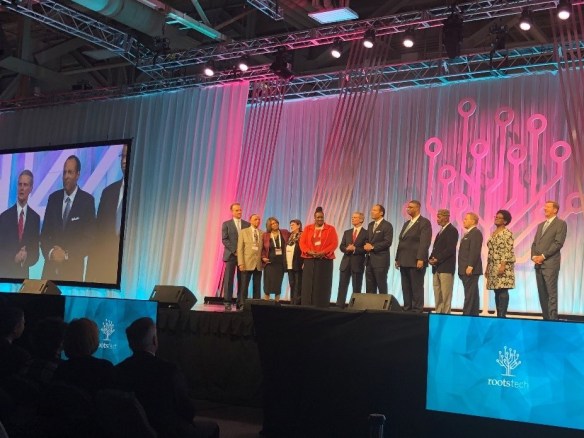
The Museum representatives on stage with David Bednar.
I’m extremely pleased to see the focus on reunification of families. It was also stated that the Church would be involved with other museums in the same way, to encourage that family history be incorporated into history. As I mentioned to Steve Rockwood later, I hope they include DNA, and not just autosomal DNA, but Y and mitochondrial as well. All three types of DNA are critically important to genealogy and finding family no matter who you are.
Martin Luther King III then addressed the audience about his father’s dream…the end of racism and discrimination.
I fervently hope that bringing people and families together will help heal the wounds of slavery, Jim Crow America and perhaps even the divisions we see today.
I was thrilled to hear Mr. King speak and only wish history had been kinder. Dr. King’s life was cut much too short and we are left to wonder what he might have achieved had it not been for racial intolerance that led to cold-blooded murder.
The Edge Effect returned again with a particularly appropriate rendition of a beautiful song.
The Expo Hall
After the opening session, FamilyTreeDNA was kind enough to host the DNAexplain blog meetup in their new presentation center.
I gave two short presentations, one titled, “Taking Sides – Family Finder Maternal and Paternal Bucketing” and the second, “Family Finder Search Tips.”
I wasn’t able to grab any photos since I was presenting, but fortunately, Marie Cappart did and shared. Thanks Marie!
FamilyTreeDNA hosted several sessions throughout the conference, given by staff and other guest speakers as well.
Meeting With Steve Rockwood and Crew
The long day wasn’t over quite yet. Steve Rockwood had been meeting with a focus group to which I was invited from 7-8. I respectfully declined, stating that I was already committed in the FamilyTreeDNA booth with the DNAexplain meetup.
Steve graciously agreed to wait along with much of his staff that had been up since 4 AM. That’s commitment!
I arrived just as the focus group was finishing, but Steve and the RootsTech team had indeed graciously been waiting and were quite welcoming.
Given my criticism after last year’s RootsTech, my reception was surprisingly warm. I expected something entirely different.
About 15 people from the RootsTech team were present.
I was extremely impressed with the professionalism and the fact that they acknowledged that they missed the mark last year and make a commitment at that time to make a course correction.
They remediated every single point.
They also asked for suggestions and feedback and made changes during the conference this year to accommodate those suggestions immediately when possible.
For example, they originally ended the livestreamed sessions when the presenter finished the presentation, but after complains that the people watching wanted to see the Q&A, they extended those sessions to include Q&A.
I must say, kudos to the team and thank you Steve!
I’m not saying that I’ll be back next year, but I’m saying that I’d certainly consider returning.
Thursday
One of the wonderful aspects of the conference is seeing old friends.
Blaine Bettinger and I have been passing like ships in the night for the past couple of years. We go way, way back to his first FTDNA conference – before either of us were blogging – before he had a family – when he was still in college.
It was so good to see Blaine and to actually have some time to talk, albeit not enough, of course. Genealogists could talk forever.
The RootsTech volunteers were wearing the turquoise “ASK” shirts. This gentleman sews. He noticed my vest and twice we had a chance to compare notes. I’m always so pleased to meet men that sew or quilt.
Ran Snir presenting in the MyHeritage booth. Many of the larger vendors have a presentation center.
Hey look, I found King Henry in the WikiTree booth! If you want to see if you’re related to King Henry, you can make that happen at WikiTree, assuming accurate trees of course.
Peter Roberts, my good friend and WikiTree angel for taking me under his wing long ago and getting my tree set up!
Peter provided me with a wonderful tip which I’ll be sharing with you in a blog article soon!
While I was in the WikiTree booth, I asked Mags Gaulden, who writes at Grandmas Genes to take a photo of today’s DNA vest.
This one’s a little different – a rather op art helix.
I really struggled with this vest and wasn’t nearly as happy as with Wednesday’s genetic family tree vest.
Here, Mags and I are sporting our matching helix necklaces! We always have so much fun together and I’m looking forward to seeing Mags again at the FamilyTreeDNA conference at the end of March in Houston.
I had intended to attend the Ancestry lunch, but what I expected and what happened were two different things. I discovered that the Ancestry lunch wasn’t the CEO or product managers with insights or even new product announcements, but that the Ancestry speaker was Henry Louis Gates. I’ve seen Dr. Gates before and my intention was to see what Ancestry had planned for the future. At least I made this discovery before the lunch and not after I had arrived when it would have been awkward to leave.
Instead, I had lunch with a friend and spent the time catching up.
By the end of the day, my every single body part ached, and I was extremely grateful that the hotel I was staying in was across the street and for the heating pad in my suitcase.
Unfortunately, I missed the Living DNA Roundtable dinner, but the thought of walking another few blocks and back was just more than my back could handle. Plus, Friday was the tough day and I HAD to be able to function.
Friday
Friday was the long hard day, beginning at 7AM with the MyHeritage breakfast for MyHeritage Friends, a group of influencers who MyHeritage interfaces with, providing product announcements and such.
One of the benefits of MyHeritage is their international reach, meaning not only Israel, but Europe and Scandinavia. They are doing amazing things in multiple languages, including closed captioning and ASL at their conferences.
Walk tall, test your DNA at FamilyTreeDNA and carry a big stick.
I had been looking forward to the “Google for Genealogists: Maps, Satellite and Earth” class with Lianne Kruger.
I have to tell you, Lianne has the patience of a saint. Lab classes are difficult to teach, even with room assistants.
I learned a great deal and I can’t wait to apply what I learned, mapping for my blog and also planning trips from ancestor location to ancestor location.
The next thing on the agenda was a tech check of my computer equipment in the room where I would be presenting at 3.
Everything went well and fingers crossed that it would in the afternoon as well.
Saroo Brierley
Each day at RootsTech includes a General Session or keynote that is sponsored by one of the vendors.
MyHeritage sponsored Saroo Brierley and Geoff Rasmussen began with announcing their new Genetic Affairs integration.
That quickly moved to how Saroo Brierley had lost his way as a young child in a train station in India and had eventually been adopted by an Australian couple. Saroo always wondered what happened to his family in India and set out to find them, using the few memories he had from childhood.
Not only did Saroo locate his family, they were reunited and in his words, he now has two families.
Saroo wrote a book about his moving miracle story.
MyHeritage then announced the continuation of the DNAQuest project by adding another 5000 free kits for adoptees, in particular those who might not be able to otherwise afford testing.
If you know someone who could benefit, applications will be accepted at www.dnaquest.org until April 30, 2019.
MyHeritage Lunch
Of the lunches I attended, the MyHeritage lunch was by far the most beneficial.
Gilad Japhet, the CEO and founder of MyHeritage spoke and shared another recovered piece of his own fascinating family history. Gilad recently discovered a missing family photo that he remembered from his childhood.
Gilad’s grandfather immigrated to Israel from Poland in 1920. A year later, the family in Poland took a photo of family members gathered to send to Gilad’s grandfather. He surely must have been feeling at least somewhat homesick by that time.
Gilad’s grandfather kept this photo on the wall of his home, and when he passed away, the photo got packed up and disappeared. Just a few weeks ago, Gilad found the photo safe and sound with an unsuspecting relative.
This is the only photo in existence of many of these people today. The individuals circled in orange perished two decades later in the holocaust.
Can you see that the little boy is holding a photo?
That photo is Gilad’s grandfather, taken before he immigrated. The little boy is holding the photo to show that even though Gilad’s grandfather was physically gone, to Israel, he is still with them. If Gilad’s grandfather hadn’t gone to Israel, Gilad would not be here today.
No wonder Gilad’s grandfather cherished this photo his entire life.
Gilad shared other details as well, such as:
MyHeritage has now photographed, transcribed and translated all of the cemeteries in Israel, a 5-year project including over 2 million photos of 1.5 million stones in 638 cemeteries. These records are now available on MyHeritage and BillionGraves. Israel is the first country to reach this monumental achievement. I don’t know of any similar initiative in any other country.
Of course, my ancestors didn’t originate in Israel, except perhaps for one that we are still researching in the Netherlands – so I’m very pleased about the fact that MyHeritage has reached out successfully to the European community for DNA testing. Gilad noted that most of their DNA sales today are in Europe, with their data base size being approximately 2.5 million, with 2 million of those being original tests and half a million being transfers. If you haven’t yet transferred, please do by clicking here.
Gilad mentioned that he had hoped to announce the completion of the stamp and envelope DNA extraction project, but it’s still in process.
Gilad said that soon MyHeritage will provide a feature to reconstruct the DNA of family members based on the DNA of other family members tested. I can hardly wait. I’ve dreamed of this feature for years and I have a list, believe me.
Gilad then shared with the attendees the details of the new feature announcements at RootsTech.
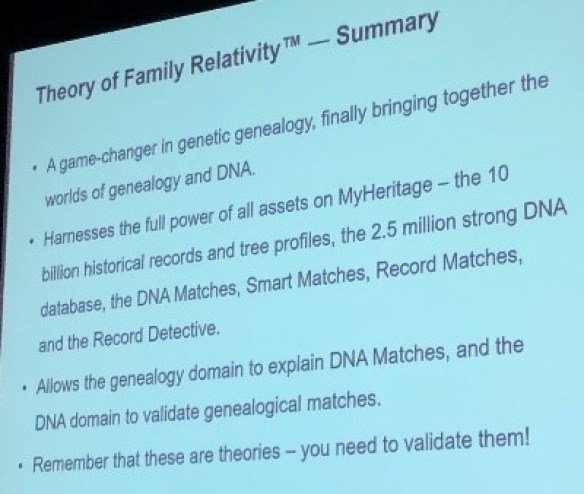
Theory of Family Relativity
The Theory of Family Relativity is explaining DNA matches using family trees and historical records. This super new feature was rolled out during RootsTech. I’m not going to provide examples and details here, because I’ll be writing separately shortly. I want to emphasize, as did Gilad, that these theories are just that, theories and NEED TO BE VERIFIED!
In fact, you may have more than one theory for any connection based on DNA matching, trees and records, and you can verify or dismiss the theories. This is an incredible tool. The first three I quickly reviewed were all accurate. One person had three separate theories, and of course, only one of those three could be accurate under the circumstances, but I immediately knew which one was the right path based on my already proven genealogy.
Gilad spent some time explaining the Big Tree. The most important aspect to realize is that the “Big Tree” is not constructed and stored indefinitely. The Big Tree is created “as needed” so it’s never stale. It’s not an old tree, and every branch and logical step is documented so you can view the logic for the theory path selected.
I can’t even begin to explain how critical this is for researchers.
There is no “trust me” or actually, “trust other people’s trees” at MyHeritage.
Here’s one last example building upon various relationships and records!
If you want to try this for yourself (please do) you can filter your matches by those that have Theories.
Warning – you may not do anything else for days, including sleep! I looked around in the presentation and you could see people signing on and trying this while Gilad was speaking. If I hadn’t been sitting right in front, I would probably have been doing the same thing.
If you’re wondering how Theories of Family Relativity differs from Ancestry’s ThruLines, here are some of Gilad’s observations.
Genetic Affairs Integrated Autoclustering
Gilad announced Autoclusters – an integrated version of Evert-Jan Blom’s Genetic Affairs clustering software for MyHeritage users, used within and integrated into the MyHeritage product.
The great news is that the science team has improved the clustering software to cluster Jewish people successfully.
The graphic on the left is a Jewish autocluster at Genetic Affairs, and at right, the same person clustered at MyHeritage. Big difference.
Autoclustering can be accessed from the new Tools page. The resulting autocluster file will be sent to you via e-mail. In the days since this announcement, there has been a substantial backlog so expect to wait for several hours or even a day. This tool is exceptionally popular because of the power of clustering matches.
In essence, if you can recognize the known relationships of some cluster members, then you pretty much know that the rest of the group is related through the same ancestral path.
However, in your tree pedigree “above” the ancestral couple identified, the people in a cluster may well diverge. For example, I have a cluster that I can track to my great-grandparents, but I know that some of those people descend from her ancestors and some from his ancestors. Clusters represent the MRCA or most recent common ancestor, not the most distant common ancestor of the cluster members
Gilad described the various cost options. In essence if you tested at MyHeritage, uploaded before December 16, 2018 or if you are a subscriber, these tools are free for you. Initially, I was skeptical about how useful a MyHeritage subscription would be for me, but this past year, my subscription has proven indispensable – and now even more so with the fact that Theories of Family Relativity combines actual records with DNA and trees!
DNA Everyplace
After lunch, I couldn’t sit any longer, so I walked part of the expo hall. One booth that attracted me like a moth to a flame was CelebrateDNA.
Yes, I ordered 3 t-shirts.
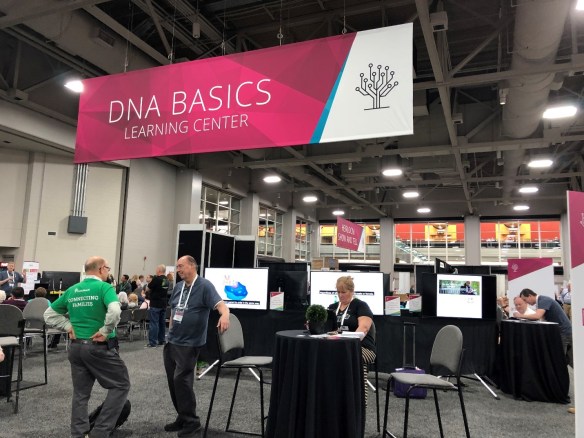
New at RootsTech this year is the DNA Basics Learning Center – not sponsored by a vendor but by RootsTech itself. They had a presentation area and various DNA presenters rotated in and out throughout the day. Furthermore, the Learning Center was staffed with knowledgeable volunteers.
I remember the days when every single genealogy society wanted a basic DNA lecture! Today, most societies have people to mentor others in DNA.
Kenyatta Berry in the FamilyTreeDNA Booth
I spent the early afternoon, before my own presentation with Kenyatta Berry in the FamilyTreeDNA booth. One of the FamilyTreeDNA giveaways was an individual session with Kenyatta for 3 lucky winners. I served as honorary photographer as well as DNA consultant.
It was fun listening to the brick walls that these lucky winners brought to Kenyatta.
This gentleman is Native American and his family history is sooo interesting.
Kenyatta’s book, The Family Tree Toolkit: A Comprehensive Guide to Uncovering Your Ancestry and Researching Genealogy, was recently released and I can’t wait to actually have a chance to take a look.
After Kenyatta’s meetups, it was time for my own session.
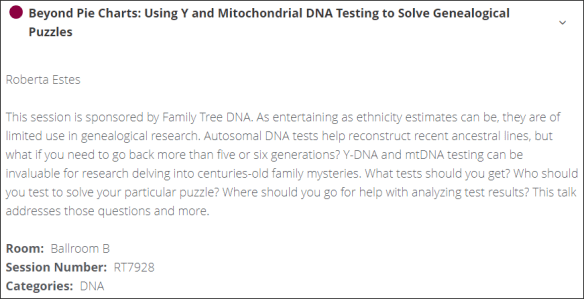
My Session – Beyond Pie Charts: Using Y and Mitochondrial DNA to Solve Genealogical Puzzles
I have a confession to make. I had a terrible case of nerves about my session. I’m used to speaking in general – it wasn’t that.
My jitters arose from a combination of the fact that I had to create not one, not two, but three sessions with about a week’s notice. If these sessions had been “intro to DNA,” I could have done them blindfolded and from memory – but the topic had been selected by the original presenter – and I had to work around that.
I needed case studies, and I didn’t have time to remember and then obtain permission for other people’s stories – so they had to come from my own family. Thankfully, I have done a lot of work, so I had fodder to work with. I was SOOOO grateful for those 52 Ancestor stories!
On top of that, the session had to fit exactly into the time slot, and this was the first time presenting this particular presentation. Getting the timing down pat means lots of practice and tweaking.
RootsTech encourages their speakers to dress professionally, of course, so I took a business suit along with me. However, every person I spoke with in the days before my session encouraged me to ditch the suit and wear my DNA clothes which have become somewhat of a signature item. Who knew that I had a “personal brand?”😊
I dressed in the morning in my black DNA vest and red leggings. But wow, is this bright!
Perhaps I should have opted for a black shirt and leggings, but that seemed too dull. Maybe the suit after all??? I went back and forth and back and forth.
Needless to say, this was the first time I’ve presented in something this bright and unconventional at a national conference.
I made my last tweak to my presentation about half an hour before the session, AND, I hoped fervently that the humor I planned went off as planned. Some of my jokes were a bit subtle and others, less so.
Humor is particularly difficult and requires impeccable timing.
Nerves, timing and humor sometimes don’t work well together. That made me even more nervous!
In case you wonder what these rooms look like empty. They sort of run from sea to sea. The lights are so bright on the speaker that they generally can’t see much of the audience after the house lights are dimmed in these types of venues, except for the first row or two directly in front of the stage.
I should have given my cell to someone to snap some candid photos, but since I had a professional photographer, I didn’t see the need to do that. The professional photos won’t be ready for a few days.
I included my brother Dave’s story as an example of integrating Y and autosomal DNA results, thinking I could get through it dry-eyed. I did in practice, but not so much in the session. My voice cracked and let’s say that there is no graceful way to hide that – and if you try to sneak a little nose wipe the mic picks it up as something that sounds entirely different. I’ll just claim that was part of the planned humor – right?
The attendees are asked to provide feedback on the sessions, so I’ll be interested to see what worked and what didn’t. Since I was a last-minute speaker covering for someone else, I wasn’t able to provide a handout in time to be included for attendees, so I’ll make up for that by writing blog articles in the weeks to come. I hope everyone subscribed! To help make up for no handout, I gave everyone who attended a DNAexplain ribbon!
After my session, I was pleased to meet people back in the FamilyTreeDNA booth to answer any remaining questions. The ballrooms are too large to take questions from the floor.
By the end of the day, everyone was exhausted,
Saturday
Friday was my very long super-tough day, so by Saturday, for me, the conference had begun to wind down. That wasn’t true for everyone though, because Saturday is the busiest day.
RootsTech opens the doors for free for members of the LDS Church and specifically encourages children with the hope of infecting them with the genealogy bug early. Roughly 30,000 people attend.
In that vein, there are lots of interesting family-friendly activities for everyone.
For example, Jason Hewlett who had been emceeing all week told a story about his young daughter who shocked him by announcing that her favorite artist was Lady Gaga. Jason says that sometimes he “rewrites” songs in a more child-appropriate way for his daughters and proceeded to demonstrate.
Respite in the Speaker’s Lounge
I had originally planned to attend a couple of classes, but I was physically and emotionally drained. I escaped to the speaker’s lounge for a respite.
RootsTech provides a speaker’s lounge so those of us who are speaking, and therefore generally available for questions throughout the conference can find for some peace and quiet, to prepare for sessions or sometimes for interviews. The background noise makes recording interviews difficult elsewhere.
Yes, the black DNA vest is reversible to this white one. Trust me, I’ll never do that again. Reversible=engineering challenge!
Jake Shimabukuro – Ukulele Master
Saturday’s main event was sponsored by 23andMe who opened by encouraging everyone to test and told the story of a woman who discovered that she, her mother and sister have the BRCA1 gene that may signal a propensity to breast cancer, especially in Ashkenazi Jewish women. Please note that there are multiple genetic factors and genes that contribute to some types of breast cancer, so if you DON’T have this mutation, that does NOT mean you should rest easy if breast cancer is a particular concern. 23andMe only tests for a limited number of breast cancer genetic indicators. Talk to your physician who may order medical genetic testing.
Jake Shimabukuro, a very talented young ukulele player, was up next.
Here’s a very short clip just to give you an idea.
After Saturday’s general session, I discovered hula dancers in the main hallway that I enjoyed immensely.
I know you can’t see their clothing very well in the video, so here’s a cropped photo. It was snowing outside. I’d think they were freezing to death.
While I was watching the dancers, I noticed a gentleman filming over my shoulder. I turned around to see if I was in his way. The dancers ended about that time, and the man filming, Jarrett Ross and I began chatting. That’s the RootsTech way.
Jarrett is a videographer who can be seen at his GeneaVlogger YouTube channel here.
As luck would have it, I was on my way to find the face painting, and Jarrett wanted to video face-painting. Voila! Match made in Heaven.
Here’s Denise Cole who owns Painted Party, the artist who created my wonderful double helix face painting last year. She hit a home run this year too.
You can count on the fact that I’ll be looking for her if I attend next year!
Jarrett and I with the finished product in our obligatory RootsTech selfie!
Instead of going to the 23andMe lunch, Jarrett and I hung out in the hallway where he interviewed me and we ate snacks. I’m actually glad I spent the time getting to know Jarrett and learning about Jewish genealogy in the Netherlands. 23andMe didn’t make any product announcements or provide insights, so the only thing I missed was mediocre food.
Jarrett will be posting the videos of several RootsTech interviews, including mine, on his YouTube channel soon.
I did eventually have to try a Sushi Burrito though and it was pretty good, consisting or all of the typical sushi fixings inside a nori wrapper wrapped like a burrito.
Back to the entrance on the last day, the yarn on the connect-belong board is almost solid.
The conference ended mid-afternoon, but my flight wasn’t scheduled until Sunday mid-day.
My last evening in Salt Lake City was spent having a nice leisurely dinner decompressing with Blaine Bettinger and Angie Bush (left). In the lobby, we found Michelle Patient from Australia who I had never met before in person.
Often at conferences, people are unable to connect for more than a few minutes. I hadn’t seen Blaine and Angie in years, let alone long enough to sit down and actually visit. The perfect ending to a wonderful conference.
In Summary
I know this article has been long, but I hope for those who weren’t able to attend RootsTech in person that this conveys a bit of the feel of the actual experience. I hope everyone took advantage of viewing the livestreamed sessions. The general sessions and the dozen or so free livestreamed sessions will be available here.
RootsTech has the ambiance of a very large family reunion. My goal in sharing the photos and in essence “taking you along” is to provide the RootsTech experience through the eyes of an attendee.
RootsTech has made a concerted effort to remediate the issues present in 2018 and they have done an excellent job. I have a few suggestions, but no complaints.
It’s not an inexpensive trip between the airfare, hotel and food, so I don’t know if I will return, but I certainly wouldn’t hesitate to sign up for RootsTech 2020.
My take away was something we discussed on Saturday evening at dinner. At one time not so long ago in history, we had “internet” classes, but now the internet is ubiquitous. DNA and genealogy is becoming the same way. It’s no longer separate and different, but part of an integrated genealogical whole.
Please join me in the next couple days when I’ll be reviewing the new DNA feature announcements by both Ancestry and MyHeritage.
I hope you’ve enjoyed this little mini-tour of RootsTech 2019.
I receive a small contribution when you click on some (but not all) of the links to vendors in my articles. This does NOT increase the price you pay but helps me to keep the lights on and this informational blog free for everyone. Please click on the links in the articles or to the vendors below if you are purchasing products or DNA testing.
Every genealogist knows about the legendary Family History Library in Salt Lake City. It’s genealogy Mecca.
You know, the place with the “key.”
What key, you ask? That key – the one that means this:
How to break a genealogist’s heart.
Create the Plan
Thankfully, my friend Jen told me how to make a research plan for the Family History Library (FHL) by using the Search Catalog feature.
By selecting the desired location, you can then view all of the library holdings. I divide my list into books and online work, because to view those films, you simply so and sign on to a computer in the FHL or an affiliate library near you. Unfortunately, I have no affiliate library near me.
I went prepared with a list of locations, book numbers and films.
Here’s the obligatory “arrival selfie.”
Bright Shiny Beads
I was behaving, truly I was when someone noticed me sitting at a table researching. After introductions, I discovered that the group of ill-behaved people clustered around a glass room was a bunch of bloggers.
Of course, I knew immediately I had found my peeps, so I immediately went over and introduced myself to the rest of the group.
My friend, Daniel Horowitz from MyHeritage arrived about the same time and about this time, Mr. Myrt asked us if we’d like to be interviewed on Mondays with Myrt.
Of COURSE we would.
Except, I was wearing a grey t-shirt. Never fear though, because I had my ever-present DNA-bling.
Monday’s With Myrt was being produced inside the room with those mountains in the distance again, and the waiting room was effectively outside where excited bloggers had to be reminded more than once to hush. I don’t want to say the best part was waiting, but it was amazing to meet these wonderful people in person after seeing their online presence for, in some cases, years.
Sprinkled in were new bloggers too, so everyone was helping everyone else and it was kind of a blogger love-in.
The Ribbons
I suddenly realized that this was the PERFECT opportunity to break out my new ribbons.
Last year, I had no idea about conference ribbons, but at RootsTech, and I understand at other conferences as well, attended collect ribbons on their badges. Ribbons are a hot item. When I discovered that I was presenting, I wanted to have something for the attendees.
I discovered that you can indeed order and receive ribbons in 7 days.
So…..drum roll….the unveiling of my new DNAexplain ribbons!
I proceeded to give a ribbon to everyone in close proximity that couldn’t escape, and Daniel Horowitz took a selfie to commemorate the event. Thanks so much Daniel for posting on Twitter and giving me permission to use!
Daniel Tweeted: Some of my #geneafriends @RobertaJEstes giving her first ribbons to @CarolPetranek @histfamilles @ancestorfinder1 #genealogy #Rootstech
That’s the amazing Mr. Myrt in the black hat.
Mondays With Myrt
A few minutes later, I was seated with Myrt.
Now, I have a confession to make, but don’t tell Myrt, OK?
I’m not a “conference person,” nor do I follow a lot of genealogy blogs. (It’s OK to hiss at me.)
I knew about Mondays with Myrt, and I knew the person online named Pat-Richley Erickson, but not well. I knew she was a genealogist and a quilter, but I did not know she was Myrt. Her name isn’t Myrt, or Myrtle, so I never connected the dots. I’m sure there’s a good story in here someplace, but Myrt, or Pat, will have to tell you herself. Actually, she tells you a bit about herself here on her YouTube Channel.
So, imagine my surprise when I looked inside the production booth to see Pat. Where was Myrt. I figured Pat must be being interviewed too.
Myrt livestreams her Monday interview sessions through her blog. You can view them here. She has an amazing following. One follower, Tierra Cotton-Kellow even managed to tune in on a plane on her way to Salt Lake.
If you can’t watch the entire video, I’m at 2:15 in Monday’s session. Here’s the session on YouTube.
Lunch
When you receive a lunch invitation to join a group of bloggers, you quickly abandon your research plans and head out to eat at the LDS Office Building a couple blocks away.
The most direct path is through Temple Square, so I was excited to see the sights.
The blogger group ate at the cafeteria in the LDS business building.
To include Cheryl, Roger took a picture of Cheryl taking a picture.
Note Cheryl’s GeneaBlogger beads given by Myrt. I’m now a proud bead-wearing member of the tribe too.
While sitting at lunch, Lisa Moffit (white sweater at right) and I discovered that she and I are actually cousins through our Acadian lines. How much fun is that!!!
I was so grateful to be included in the impromptu blogger lunch.
On the way back, I snagged a few more photos.
Not that the Mormon Church here is influential, but the road goes UNDER Temple square.
I did manage to go back to the library and research for most of the afternoon, but it was digging in a dry well.
No matter where I looked, no ancestors. I know a whole lot of records that they aren’t in, and I suppose that’s negative evidence. However, I know the Lentz family, and probably the Reuhl (Ruhle) family were in the Shippenberg area of Cumberland County, PA which borders on Franklin County. I perused all records for both counties today, in the hopes of discovering who they were indentured to, or anything about their missing 14 years or so.
I’m presuming that the by-then-elderly Ruhle couple, Fredericka Ruhle Lentz’s parents died either in route or in Pennsylvania. There is no sign of them in Ohio in the 1830s. Unfortunately, there’s also no sign of them in Pennsylvania either.
Frustrated with them, I moved to another brick wall line with no luck there either.
Fortunately, I had made dinner arrangements with another genetic genealogist and his wife and enjoyed spending the evening with them immensely.
Tuesday Has to Be Better
Tuesday was a great people day, but an awful research day.
I had a difficult time getting motivated to research on Tuesday, so instead I decided to walk over to the conference center and pick up my badge.
Early badge pickup is available today and now the Salt Shaker says RootsTech.
Conference Coming to Life
The conference theme, just guessing now, is “Connect Belong.”
This interesting display greeted me.
Another genealogist, Carol Whitaker from Oregon, also picking up a badge was stringing yard between the pegs, so of course I had to ask her what she was doing.
Attendees will be connected their traits and locations and of course, belonging. What a great idea. I’ll take another photo or two of the board later in the week.
Of course, you know that I immediately noticed all of the genetic traits.
Does anyone know what’s on the dress I’m wearing?
I was very pleased to meet Danielle too. Those with the Ultimate Passes are assigned to a hostess who has already proven to be a Godsend.
Danielle is amazing, but I don’t know what she did to deserve being saddled with me😊
The RootsTech halls are empty now, but they won’t be for long.
She took me to see the room where I’m speaking and let’s just say it’s cavernous! I hope I have enough ribbons!
This amazing piece of art made from carpet scraps adorns the conference center just inside the door. Looks like a quilt to me, of course.
By this time, I had managed to usurp most of the morning, and ran into someone who invited me for lunch again. You’re going to think the only thing I did was eat!
That’s not at all true – I also drank coffee at Starbucks and admired the beautiful art that graces many open spaces in Salt Lake City.
Art
Yes, DNA is everyplace, including free standing art that is reminiscent of a room divider.
Slices of petrified wood.
Amethyst flowers.
Good thing these aren’t for sale.
Seagull statue outside of Nordstroms.
The Chocolate Factory. What, you think the Chocolate Factory isn’t art?
Pshaw. You obviously haven’t gone inside yet!
More Research
When it became evident that I absolutely could NOT kill anymore time, I went back to the FHL with the intention of reviewing at least most of the images records that I can’t access without being in the library.
However, I immediately say Tierra Cotton-Kellow who writes at Pressing My Way and is also a professional photographer. Why knew? The great news – she’s my photographer for this event and still has some slots open for a few fortunate others.
Right after I found Tierra, Nathan Murphy found me.
Nathan did me a huge, huge favor some years ago and discovered one of my ancestors in England. Bless his heart, Nathan shared! I could never have found this record otherwise, because Nathan stumbled across it.
Never mind that he was a convict being deported😊
No, no, not Nathan, my ancestor!
I did eventually return to research, but apparently this is not the trip for me to make any headway whatsoever. It’s a good thing that I enjoyed meeting new friends and reuniting with old, because the research was entirely nonproductive.
There’s so much to look forward to for the rest of the week, starting tomorrow.
Wednesday is the DNAexplain Blog Meetup
I’m excited to greet everyone in the FamilyTreeDNA booth for the DNAexplain meetup tomorrow after the opening keynote. The vendor expo hall opens at 6 PM and stays open until 8. The first free mini-session begins in the booth at 6:15.
Wednesday, February 27 – 6:15 – Family Tree DNA booth #1107 – Family Finder Search Tips – Quick tips for how to perform surname and ancestral searches successfully!
Wednesday, February 27 – 6:45 – Family Tree DNA giveaway drawing
Wednesday, February 27 – 6:45 – DNAexplain Blog meetup in the Family Tree DNA booth presentation center
Wednesday, February 27 – 7:15 – Family Tree DNA booth – Family Finder Bucketing – Connecting your matches to your tree so that Family Tree DNA can assign your matches to your maternal or paternal side – even without having your parents tested!
Wednesday, February 27 – 7:45 – Family Tree DNA giveaway drawing
Come see me, say hello, get a brand spanking new DNAexplain ribbon and enjoy the free sessions! Gotta run! See you there!
I receive a small contribution when you click on some (but not all) of the links to vendors in my articles. This does NOT increase the price you pay but helps me to keep the lights on and this informational blog free for everyone. Please click on the links in the articles or to the vendors below if you are purchasing products or DNA testing.
The week before RootsTech was a series of unplanned disasters. But then again, who plans a disaster.
The good news is that I got through them. I now have a new car, because the old one decided to go belly up at the most inopportune time. My laptop decided to boot after all and the rest of the issues got taken care of too.
I didn’t have the full-fledged meltdown, but I was close.
A last minute presentation combined with last minutes changes and of course, a winter storm.
Hey, it’s Michigan – of COURSE we had a storm.
Now that’s all just a memory to smile about. All I can say is thank goodness for my husband who does in fact know how to do laundry as well as work on computers!
Why RootsTech?
For all the years I didn’t go to RootsTech, I always looked at the venue, Salt Lake City, and wondered why anyone in their right mind would go there in February – unless you were a ski buff.
The answer is three-fold:
You’re going to be inside most of the time, so who cares what’s going on outside. (Assuming you can actually get to SLC.)
The Family History Library (FHL) which is open until 11 PM the Monday and Tuesday before RootsTech. If I come next year (do not laugh at me), I’m coming a week early to research. Right now, the library is packed and I’m a bit overwhelmed. However, I’ve never been in a friendlier, more helpful library anyplace!
The energy. I can’t even begin to explain this – but it’s a real phenomenon. Meeting people you know online and distantly. Things like discovering a new cousin sitting across the table from you at lunch. Excitement’s in the air and it’s palpable!
Everyone here treats you like family. You’re included at tables and in conversations. Yesterday, someone noticed me sitting at a table in the FHL library and asked me if I’d like to join the blogger group for Mondays With Mert. Needless to say, I wasn’t dressed for the occasion, but sometimes you just have to go with the flow!
I’ll share those photos tomorrow!
The Heartland from the Air
You’re coming along with me this week, so let’s start with the flight.
Well, actually, the gift shop before the flight. Here’s to chocolate carrots! I knew someday, someone would convince me to like carrots!
Seeing America from the air is amazing. This time, there were varying amounts of snow cover, which I found both interesting and beautiful. These photos are east to west, Detroit to Salt Lake.
We had light snow cover in Michigan. Some places had less, and some more. This was right after takeoff.
The clouds look like puffs of cotton. Most of the Midwest seemed to have about the same amount of snow cover. I wonder what river I’m looking at. It’s not small, that’s for sure. Could be the Mississippi.
These irrigation circles remind me of mud pies. Hmmm, can I work these into my presentation “Beyond Pie Charts?”
By now, we’re certainly west of the Mississippi. The snow highlights the terrain features when you can see some earth beneath.
The beginning of the mountainous area and lots more snow.
You can see the tectonic plate uplift here. Flat on one side, then the mountains raise up majestically.
Lots of snow in the mountains. I wonder how much snow is actually on the ground here. Of course, I don’t know where “here” actually is.
The tiny dots are houses and that river has many twists and turns.
Not far from Salt Lake City now. Beautiful lake reflecting the blue sky.
Just popped out beneath the clouds, beginning landing approach.
Wow, approaching Utah and Salt Lake City was just stunning!
The salt flats are under about an inch and a half of water right now, which made for an incredible view.
I had a terrible time selecting photos for this article. So much beauty. You can see the salt flats better in this and the next photo.
Final approach.
There’s the city.
At the airport, obviously.
In Salt Lake City, there are mountains everyplace you look. That’s Salt Lake City in the distance on the left. You can see it if you squint. The size of those buildings contrasted to the mountains reminds us of the insignificance of humans.
After I checked into my hotel, I decided to take a walk. It’s chilly, but not cold by Michigan standards.
RootsTech will be at the Salt Palace Convention Center in just another day. The locals call this structure “the salt shaker.” Seems appropriate. I doubt the designers had that in mind.
Downtown is deserted right now, but it will be bustling soon.
On Monday, I walked to the Family History Library. I’m not Mormon, but I find the beauty of churches inspiring. Temple Square is behind the walls. The Mormon Office building (with a nice cafeteria) is the white tall structure in the distance.
Another beautiful view of the Temple. Can you spot the gold Angel Moroni statue?
The entrance to Temple Square across from the Family History Library. Free tours are offered.
I flew from Michigan to Utah in three and a half hours. Even with the time getting to and from the airports, the trip was still less than a day. This same journey took our ancestors months traveling in covered wagons and they had to build housing once they arrived. This small, typical log cabin is preserved outside the Family History Library to remind everyone of their ancestor’s humble beginnings.
As luck would have it, a man arrived to open the building just as I was taking photos outside. I stood just inside the door with enough space to turn around to take these pictures.
Apparently, I’m not the only one who loves quilts.
Every inch of space was utilized. Just think of the parents and all the children living in this very small one room cabin. You can see half of the dresser between the two beds – so the entire cabin is the width of those two beds and the dresser. The length of the cabin is about 2 beds, roughly,
Spinning was an important part of making clothes. Of course, those pioneers had to make everything from scratch.
Later cabins had stoves for warmth and cooking. Earlier ones had simple fireplaces.
Somehow my ghostly appearance is fitting, peering into the lives of our ancestors from another time and place, so far away.
I’m going to go inside the Family History Library now and search for those ancestors, so join me in a day or so for the next step in our Journey to RootsTech 2019.
I receive a small contribution when you click on some (but not all) of the links to vendors in my articles. This does NOT increase the price you pay but helps me to keep the lights on and this informational blog free for everyone. Please click on the links in the articles or to the vendors below if you are purchasing products or DNA testing.
That Chinese proverb that no one is sure whether is a blessing or a curse.
I’m pleased to announce that I’m speaking at RootsTech, quite by accident😊
Fate, synchronicity, call it what you will.
If you’re chuckling, so am I.
I’ll be presenting a total of 3 sessions – one regular RootsTech session and 2 minis plus a DNAexplain blog follower (that’s YOU) meetup.
Schedule at a Glance
Here’s a quick overview schedule, including 2 giveaways, with details following below:
Wednesday, February 27 – 6:15 – Family Tree DNA booth #1107 – Family Finder Search Tips – Quick tips for how to perform surname and ancestral searches successfully!
Wednesday, February 27 – 6:45 – Family Tree DNA giveaway drawing
Wednesday, February 27 – 6:45 – DNAexplain Blog meetup in the Family Tree DNA booth presentation center
Wednesday, February 27 – 7:15 – Family Tree DNA booth – Family Finder Bucketing – Connecting your matches to your tree so that Family Tree DNA can assign your matches to your maternal or paternal side – even without having your parents tested!
Wednesday, February 27 – 7:45 – Family Tree DNA giveaway drawing
Friday, March 1, Ballroom B – 3 PM – Beyond Pie Charts: Using Y and Mitochondrial DNA Testing to Solve Genealogical Puzzles
DNAexplain Blog Follower Meetup – Wednesday Evening – 6:15
The DNAexplain blog follower meetup which includes 2 free mini-sessions (and two giveaways) will be Wednesday evening from 6:15-7:45, right after the expo hall opens, in the Family Tree DNA booth, #1017, boxed in red on the map below. It looks like if you walk between LivingDNA and 23andMe, you’ll run smack dab into the Family Tree DNA booth.
Family Tree DNA has a new booth this year with a presentation center right in the booth, so we will be the first to use the new facility.
I’ll be in the booth from 6-8 PM and have prepared special two mini-sessions for my blog followers and anyone else who would like to attend.
You don’t have to stay for the whole time of course!
Please stop by and say hello. I’d love to see you.
Thank you to Family Tree DNA for graciously allowing us to meet in their new presentation center.
Beyond Pie Charts: Using Y and Mitochondrial DNA Testing to Solve Genealogical Puzzles – Friday – 3 PM – Ballroom B
Jim Brewster was originally presenting the session, “Beyond Pie Charts: Using Y and Mitochondrial DNA Testing to Solve Genealogical Puzzles” at 3 PM on Friday.
Unfortunately, Jim is unable to attend and late last week – yes – as in 4 or 5 days ago, I agreed to present this session.
Now, the good news is that I’ve been working with Y and mitochondrial DNA 19 years, long enough to have some really good examples to include. You’ll laugh, I promise, and maybe even shed a tear or two. DNA and families are anything but boring!
Please, come and see the presentation at 3 on Friday afternoon in Ballroom B, on the map below.
I promise you’ll be entertained and learn something too!
For those who can’t attend, several sessions are going to be LiveStreamed, 12 recorded and available later for free, and 18 more will be available with the purchase of a Virtual Pass. My session is not being recorded, so you’ll have to come and see it live!
LiveStream Schedule
Several people have asked about the LiveStream schedule, which you can find here. I believe this is also the link to view the LiveStreamed sessions.
An additional 12 sessions will be recorded and available for free viewing later.
Blending Family History and Technology with the Art of Storytelling
Descendancy Research: Another Pathway to Genealogy
Making Memories of You
New York Research Essentials
You Can Do DNA
How to Write Your Life Story in Five Pages or Less
Heirloom, Documentation or Junk: What to Keep or Toss
S.O.S. (Save Our Stuff): Stories and Heirlooms
Families Discovering Family History Together
Writing and Publishing a Family History: Ten Steps
Artificial Intelligence in Photo Management (and How It Can Boost Metadata)
Breaking through Brick Walls in Scottish Research
Virtual Pass Classes
A Virtual Pass is available for $129 (or $79 if you have already registered for RootsTech) which entitles you to the following recorded sessions as well.
Chromosome Mapping for Absolute Beginners—Jonny Perl
Must-Use U.S. Records at Ancestry.com, FamilySearch, findmypast, and MyHeritage—Sunny Morton
A Deep Dive into Understanding Your DNA Results—Blaine Bettinger, Angie Bush, Jonny Perl
The Surname Is Key: History of Surnames and Conducting Surname Research in Germany—Dirk Weissleder
One Touch Genealogy Research: Handle a Record Once—Thomas MacEntee
You Need Both! Uniting DNA and Traditional Research—Angie Bush and D. Joshua Taylor
Chromosome Mapping Tips and Techniques—Blaine Bettinger
Deeper Analysis: Techniques for Successful Problem-Solving—Elissa Scalise Powell
The Magic of German Church Records—Katherine Schober
My Ancestors Are from Germany, and I Don’t Speak German—Tamra Stansfield
When Details Disagree: 8 Ways to Resolve Conflicts—D. Joshua Taylor
20 Hacks for Interviewing Almost Anyone, and Getting a Good Story—Joanna Liddell and Karen Morgan
Going Dutch: Finding Families in Online Records of the Netherlands—Daniel Jones
Beyond the Mists of Time: Sources for British Medieval and Early Modern Genealogy—Nick Barratt
The Combined Power of DNA, Records, and Family Trees—Jen Baldwin, David Nicholson, Diahan Southard
The Genealogist’s Google Search Methodology—Lisa Louise Cooke
Jewish Genealogy: How to Start, Where to Look, What’s Available—Lara Diamond
Slave Traders, Speculators, and the Domestic Slave Trade—Kenyatta Berry
Your Imbedded Reporter😊
I bought an Ultimate Pass this year, which means I’ll be able to have up-front seating which facilitates good photos for blog articles. I have also arranged to attend many of the vendor lunches and several of the vendor sessions so that I’ll be able to report back to you about new announcements and what’s coming, of course with a focus on DNA.
I hope to publish articles daily while I’m there, although I’m not promising given the hectic nature of my ever-evolving schedule. Rest assured I’ll let be writing as soon as I can. My ability to publish is sometimes constrained by poor Wi-Fi which makes it impossible to upload photos and articles.
My regular article publication schedule will be disrupted while I’m gone, so those ancestors will just have to wait!
For me, the best part of RootsTech last year was meeting people in person. I look forward to seeing you there, so please come to the meetup Wednesday evening or my regular session Friday at 3 and be sure to say hi.
I’m easy to recognize – l’ll be wearing something “DNA.”
I receive a small contribution when you click on some (but not all) of the links to vendors in my articles. This does NOT increase the price you pay but helps me to keep the lights on and this informational blog free for everyone. Please click on the links in the articles or to the vendors below if you are purchasing products or DNA testing.
In the past, customers waited with bated breath for ethnicity updates which were labeled with version numbers. Not anymore.
That old weather saying applies – “if you don’t like the weather in <insert location here,> wait 5 minutes.”
Today, there are a lot more vendors today offering ethnicity (who doesn’t?) and the updates often don’t come in a sweeping change, but gradually with smaller partial updates – so it seems like some vendor is always updating something. That’s a good thing and keeps us checking back, which means we can check on new matches too.
Recently, 23andMe made ethnicity changes and today, it’s Ancestry’s turn.
Ancestry now divides their ethnicity results into 500 regions which combined with your matches and where your ancestors were found comprise Genetic Communities.
Genetic Communities
Obviously, Genetic Communities are most accurate if you know where your ancestors were from and lived at any given point in time – but even if you don’t, Genetic Communities are useful, nonetheless, providing hints.
My overview is shown at right, with the regions and communities shown on the map. A timeline shows below.
Clicking on 1750 shows the migration pattern from Europe to the US and the communities in the US where the people from Germany settled, for example.
At right, you can see the region stories, but of more interest is the list of my ancestors who were alive in those locations at that time.
Enlarging the map continues to show my ancestors more granularly. Clicking on a pin shows that or those ancestors in the pane at right.
Probably not useful for breaking down brick walls, but quite interesting.
Increased African American and Afro-Caribbean Communities
I receive a small contribution when you click on some (but not all) of the links to vendors in my articles. This does NOT increase the price you pay but helps me to keep the lights on and this informational blog free for everyone. Please click on the links in the articles or to the vendors below if you are purchasing products or DNA testing.
Just when I thought I was done with the Muller story, as in end-of-the-line done, another wonderful gift arrived for the Miller descendants in the form of a chapter from a book written by Peter Mosimann and his wife, Berti Mosimann-Bhend whose family owned the Muller home in Schwarzenmatt, Switzerland for generations, and still does.
Peter Mosiman very kindly sent this chapter of his out-of-print book to Chris, who sent it to me. I did my best translating it using www.DeepL.com/Translator.
An automated translator can only do so much, even a good one, so I sent the translated text back to Chris, who very patiently reviewed and retranslated over 260 places in this document over the holidays, in spite of having a young family. I feel like I need to apologize to Chris, because this isn’t even his family – although I wish it was.
This may not be your family either, but if you have Swiss or “Alpine” family from Europe, this is probably the story of your family. The goats, the cheese, their hand tools, carvings about God in their barns and…well…just come along. There are amazing photos and it’s never going to get any more “real” than this unless you have a time machine.
Thank You
My humble thanks to Chris and to Peter Mosiman for his permission to use his chapter and his photos to document the beautiful home of our Heinsmann Muller, the grandfather of Johann Michael Muller (Miller) the second who was born in 1692 in Steinwenden, Germany. At least, it’s very likely Heinsmann’s home. We know it was in the Muller family a generation later.
This historic home was built in 1556, according to the date carved into the wall, 100 years before Johann Michael Muller was born, but half a century after we know that a Muller man was living in Schwarzenmatt.
Johann Michael Muller the second, whose father was born in Schwarzenmatt, along with his half-brother, Jacob Stutzman whose family was also from this region and possibly from this village, immigrated to Philadelphia, Pennsylvania in 1727, founding both the Stutzman and Miller lineages in the US. Our roots run deep in this valley.
I also want to take this opportunity to thank Peter and his wife, Berti Mosimann-Bhend for preserving and restoring this wonderful historical home for future generations. You can read in the text the extent of their frustrations but were it not for their perseverance, there would be nothing left today.
Before we read Berti’s chapter, lets take a look at the earliest history of Schwarzenmatt, the quaint Swiss alpine village where Johann Michael Muller was born to Heinsmann Muller in 1655.
Come along…
Prehistory of Schwarzenmatt
As we travel further back in time in the human occupation of our planet earth, records become increasingly scarce. Eventually, of course, the only records are archaeological sites found in caves and shelters where our very distant ancestors lived. Pathways faintly threaded through the mountains and forests connecting one location with the next, or shelters with hunting grounds.
During the Middle Ages forts and castles were built along these routes to protect access, although all are in ruins today. Villages were established as waypoints, probably accidentally, beginning with a single hut, and grew slowly over time.
The villages and farms in this region came under Bernese control in 1386 and at that time, several villages were listed, including Boltigen, first mentioned in 1286, and Schwarzenmatt. The Boltigen church, St. Mauritius is first mentioned in 1288, so enough people were living there at that time to warrant the erection of a (then Catholic) church in the community.
Traditionally, villages in this valley imported grain from Bern and raised cattle on the valley floor and in seasonal alpine herding camps. Some trade occurred over the Juan Pass, shown below, crossing the Alps to France as well.
Our Muller family is first found in the records of Schwarzenmatt in the early 1500s, at least by name, but humans inhabited the alpine valley and mountains long before. Who knows, these early settlers could have been our ancestors, or they could have moved on or eventually their lineage might have been wiped out.
The first trace of human habitation is found about a mile and a half as the crow flies, above Schwarzenmatt in the mountains towering over the village.
The Ranggliloch Mesolithic shelter from about 15,000 years ago is a cave above what eventually became a mule path known as the Juan Pass (1509 meters) that connects Boltigen in Switzerland with Jaun in France and passed directly through the tiny village of Schwarzenmatt.
The Letter
Now that we know a bit about the earliest history of the area, let’s turn to Chris who tells us that a letter arrived from Peter Mosimann which included the chapter on the house on the Kreuzgasse in Schwarzenmatt, from the Boltigen book. This chapter was written by Peter’s wife Berti Mosimann-Bhend whose family owned the Muller home.
From Chris:
The second-last paragraph in the letter by Peter Mosimann may be a good summary:
“Heintzman Müller certainly lived in Schwarzenmatt in 1653, but whether he lived in our house hasn’t been proven yet. In former times, young families often spent some time at home, but when there were several children, then they moved out and often lived nearby. It should also be remembered that in some larger houses there were two fireplaces, so that we cannot deduce the exact number of houses from this directory.”
Let me add that there is indeed a Wolfgang Müller on the 1653 house list, so it is hard to tell, if there may in fact have been two Müller families in Schwarzenmatt. Personally, I do not think so, but it remains a possibility.
On the bottom of the letter there is a note that in 1653 (year of Schwarzenmatt house list) a peasant war was taking place in Switzerland. I was not aware of this, you can read about it in English here.
The book chapter itself gives no new genealogical information for you, Roberta, except one notion on page 289 that a Benedikt Müller is on record as a Schwarzenmatt resident as early as 1502. Besides that, I am sure you will like the photos!
On the pages 293 and 294, there is a colored floor plan of the house, “black” being the remains of the original building from 1556 and all further parts added from 1705 onwards That means that if Heintzmann Müller and son Michael indeed lived in this very house, then it was about one third of the size it is today – rather small!
Also, please note that from page 308 onwards additional houses are described, not the house on Kreuzgasse.
I was excited to see that one Benedikt Muller was living in Schwarzenmatt in 1502, 153 years before Johann Michael Muller was born in Schwarzenmatt in 1655 to Heinsmann or Heinzmann Muller, however his name was actually spelled.
If we use the 30-year generation as an average, we can presume that Heinsmann was born in about 1625.
Heinsmann’s father – born about 1595
Heinsmann’s grandfather – born about 1565
Heinsmann’s great-grandfather – born about 1535
Heinsmann’s great-great-grandfather – born about 1500
Benedikt Muller – born about 1470.
Did we just reach back another 5 generations in the Muller family in Schwarzenmatt? It’s certainly possible, but very unlikely that we will ever be able to connect those dots.
The Muller House on Kreuzgasse in Schwarzenmatt
This next section is the chapter itself, translated with www.DeepL.com/Translator and improved by Chris. I have left the translation largely intact, even when it’s stilted, in order not to inadvertently change the meaning.
Page 1 of the pdf that Peter sent, page 289 of the original book, on the bottom right of the page.
In the gable triangle, the year 1556 is at the upper left corner; the house is therefore one of the earliest dated rural residential buildings of the municipality Boltigen and perhaps even of the entire Bernese Oberland; today it forms a rare example of the small rural house type of the 16th century. So that one can imagine the time, in which this house is built, can visualize something better.
I would like to remind you of some important events of that time:
1492 Christopher Columbus discovers America.
1509 Nikolaus Kopernikus explains that the sun is the center of our planetary system.
1515 Battle of Marignano. End of the Swiss great power politics.
1517 Start of the Reformation in Germany by Martin Luther.
1519 Magellanes is the first to sail around the world.
1528 Reformation in the state of Bern.
1531 Kappeier wars. Death of Ulrich Zwingli.
1536 Bern conquers Vaud.
1556 Emperor Charles V of Habsburg abdicates. “In my kingdom the sun never sets.”
In Boltigen the entries in the first church book (Eherodel) begin.
1564 The Geneva reformer Johannes Calvin dies.
1572 Persecutions of Huguenots in France. Bartholomew’s night.
1588 England destroys the Spanish Armada.
1608 Invention of the telescope.
It was the time of the masters, the patricians, Schultheisse and Landvögte, but also the time of the muleteers and rice runners, religious wars, plague trains, witches and Anabaptist persecutions, the Renaissance and the Baroque.
Probably the house on the Kreuzgasse was built on the Allmend built. It stands in a striking, sunny location of the settlement, directly on the old alpine and mule track (IVS: BE 25.1) from Boltigen via Reidigen to Jaun and more into the Gruyère region.
Before 1615 there were in Schwarzenmatt only a few courtyards, only four prove themselves with certainty, which also included our house; next to it there were some individual farmsteads (Tuor 1974: 64).
The house may have always been our ancestors. Documents of the State Archives and archival material the community of Boltigen and the Säuert Schwarzenmatt as well as private purchase contracts suggest this. In Schwarzenmatt are already 1425 Agnes Spilman (BU: 271), 1502 Benedikt Mueller (U 2) and 1558 Peter and Paulj Spylman (K 1: 4) detectable. The Spielmann Families and Mullers have been at least since the 15th century and 16th century settled here. Barbara owned in 1720 Spyllman in the Säuert Schwarzenmatt a “Hauß and Spycherblatz” [house and granary] (SSB: 54). 1741 lent Hans Spillmann Saltigen 179 Kr 6 bz 1 X and gave as a deposit the so called “Lehngut” [feud ?] and the house in Schwarzenmatt including beunden [a piece of land with a fence] and garden (AG: 25).
Andreas Müller married Johanna Horner (died 1768) in 1731.
Barthlome Müller (born 1731) her son, took Anna Zimmermann from Wattenwil (died 1775) as his wife. Since Barthlome had fled for unknown reasons around 1770, Anna and her children had to be supported by the community as in the poor calculations (MA 1:1773 f.). Single mothers were I’m afraid it was very badly placed back then. Jakob, Barthlomes and Anna’s son, married her already in the house on the Margaretha Spielmann living in Kreuzgasse (1742-1819); unfortunately, Jakob died very early (1758-1785). In his widow Margaretha lived with her two children two children Anna (1779-1837) and David (1782-1817) and her sister Magdalena Spielmann (1747-1812). Both women were sentenced in 1786 by the choir court for unauthorized serving of wine without permission, each penalty of 1 lb (C VIII: 31 0). Already their father, the mule skinner Hans Spielmann (died 1784) had to appear before the choir court several times because of unauthorized sale of wine and unauthorized [“Wirtschaft” is an inn, so “Winkelwirtschaft” could be an inn at a street corner, but I am guessing. Alternatively, it could as well be a specific juristic term for unauthorized sale.] at the Schafscheid [a place, where sheep are separated in different groups and directed on different roads] in Schwarzenmatt (C VI: 404, 409, 412). In 1805 Margaretha was (owed?) the Moneylender Johannes Zabli at Brunnehus 33 Kr 1 0 X accrued interest owed (EA: 12).
Kreuzgassen: Magdalena and Margritha Spielmann have all the house rules. 1808. AGM: 18.
Page 2 of pdf, page 290 of document.
The Kauf-Beyle of 1819/1825 states that “the lower half of the house (on Kreuzgasse) belongs to David Müller (1782-1817). Children of thought Schwarzenmatt “I belong to.” These five children were siblings of the seller Anna Spielmann, Johannes’ daughter from Weissenbach. She had inherited from her grandmother Margaretha Müller, née Spielmann, widow of the late Jakob …, half of the house. According to above Purchase and sale of orphans of Boltigen Municipality in Anna’s name her part of the house to old Gerichtsäss Jakob Gobeli zu Weissenbach (1746-1839), husband of Anna Müller (1779-1837).
Anna Müller’s brother David (1782-1817), Jakob’s son, married (Eherodel burned) Magdalena Karlen (1775-1827). He died as a soldier in a hospital in Holland. Their children were David (1803-1878), Magdalena (born 1805), Anna (born 1811), Christian (born 1814, teacher) and Margaretha (1816-1862). Later, Jakob Gobeli must have passed on his half of the house to these five children.
David Müller (1803-1878), known as “the hunter”, married in 1825 with Barbara Reidenbach (1798-1853). Her children were Barbara (born 1825, died in the USA). Caroline (1833-1903). Susanna (born 1834), David (1840-1897 died in Ohio) and Friedrich Wilhelm (born 1842, died in the USA).
In 1837 David acquired his four siblings’ shares in house and real estate, so that he is the sole owner of the in the house on Kreuzgasse. Caroline was my great-grandmother, she took (married) in 1868 in Spiez, Friedrich Bhend (1836-1904), of Jacob blessed, to man; he was cheese maker and Salzer and came from the small town Unterseen, his hometown. In 1872 David Müller sold the whole property for 6’700 Fr. to his daughter Friedrich Bhendin. His children were Louise (1872-1884) and Frederick (1873-1943). He married Susanna in 1903.
Katharina von Allmen (1877-1950); both were my Grandparents. They had three boys: Friedrich (1904-1984), Johannes (1906-2005) and Karl (1909-1973).
Johannes Bhend and Elise Stalder (1911-2008), my parents [the parents of Berti Mosimann-Bhend] held their wedding in 1935 and were gifted with five daughters: Rasmarie (born 1935), Hulda (born 1937), Elise Bertha (born 1940), Therese (born 1943) and Verena (born 1946).
If this chart is accurate, Berti and I are 9th cousins, once removed, or 9C1R. The three people in red immigrated to the US, and we’ll meet David, highlighted in red, later. Back to Berti:
After the move of my parents to the old age center “Bergsonne “the house in Zweisimmen was uninhabited since 2002. In February 2009 I bought it from the community of heirs.
With the “Ferien im Baudenkmal” Foundation FIB”, a sub-organization of the Swiss Heritage Protection, in 2010 an agreement was signed for 30 years completed. For the gentle reconstruction and the conversion into a holiday home was the subject of an architectural competition, won by the architects Bühler AG in Thun.
The house was built on top of it, after a six-month delay due to a neighbor’s building objection, from May to Christmas 2011 by the Foundation; in cooperation with the cantonal authorities. preservation of historical monuments, but mostly disregarding my wishes as owner and financier.
Unfortunately, the work was not done at all gently, as promised before, and without feeling for the historically valuable, interesting house! Thereby especially local craftsmen. On 21 December 2011 took place the inauguration, and on 25 December the first holiday guests moved in.
Image on page 290
The house on the Kreuzgasse in Schwarzenmatt from 1556. Susanna Katharina and Friedrich Bhend-von Allmen [his family name] stand in front of the ring fence.
With their children Friedrich, Karl and Johannes. Little boys used to wear skirts. The rings of the fence were made of green, slender twigs of dance. In front of the house stands a “Scheielizaun”. Photo from 1912, owned by B. Mosimann.
The house property bordered 1872 “above (N) at the Magdalena Eschler Soil, outside (E) and below (S) an the alley and inside 0NJ at Susanne Stocker Erben Bäunde.” To the house belonged a house pasture or five feet right on the Hausweidreidigberg and the ground serving summation or right of pasture to the of summed up Schwarzenmatt grounds. It was the impetus after with the alley maintenance complained [I am guessing again: “Kaufbeile” is probably the archival folder for house purchases] in 1872.
The house possesses an old house right (HV: 18), which the residents are entitled each year to take one of the following forest ranger marked fir tree, called lot wood, for his own use to fell. An old house belonging to the house winter right of way allows them to use the logs in winter with the horn sledge to the western neighboring property to lead it there to firewood, and next door to it in the woodcut. In spring, all the traces of logging on neighboring land removed be. The current owner refuses to know anything about any old rights.
All over the world, people used to use the material which nature has offered on the spot; thereby are the characteristic houses of a region of the country which fit in perfectly with their surroundings. The most important building materials in the Bernese Oberland were wood and stone well into the 20th century; both stood in the immediate vicinity in sufficient quantity and reasonably priced, so also for our house. The walls of the basement, the west wall, the wall between cook and stable as well as the pedestal of the east wall between the house door and the stable door consist of unhewn quarry stones, from boulders and brook debris in all sizes; they all originate from the near environment or even from the pit itself. The stones are made with only little lime mortar connected, plastered and white limed over. The art of masonry was here in the valley at that time still little developed and stands in contrast to the to the remarkable carpentry of this house.
In 2011, we invited the archaeologists of the Service (ADB) for a tour of the old building but unfortunately the offer was not used.
The house underwent various structural changes. 9.11.2009.
The roofs of the residential part and the stable were 1951 only with shingles, later then partly above the shingles covered with bricks, such as those around the new fireplace. Around 1960 the whole western part of the wall above the dwelling covered with bricks. 1977 one laid over the shingles of the apartment – in place the brick – Eternit plates and over the shingles of the stable brick.
(Page 4 of pdf, 292 of original)
During the reconstruction of 2011 the whole, well preserved cement asbestos roof together with the existing shingle roof again for no reason through heavy tiles is replaced. A good shingle roof insulates against summer heat and winter coldness; therefore it was in the Gaden [The “Gaden” must be a specific Swiss German term of a room. I never heard it before and cannot find information about it online.] never unpleasant even in the worst summer heat warm. Since the air here in the mountains in the evening always cooled, we girls in the Gaden could always sleep well. At the part of the stable the wooden roof bricks of the shingle roof, held by wooden hangers, unfortunately unnecessarily discarded. In addition the good roof bricks that had been stored in the hayloft disappeared without a trace.
West wall of the kitchen during reconstruction. 10.07.2011.
Above: Large eaves with typical 16th century ridge console.
Above: Year 1556. 9.11.2009.
Above: Strange holes in the beam above the room door. In the square hole on the upper right was the joist of the former.
“Welbi” (hallway) from 1951. Right: Holes to snap in the rod of the fireplace lid [I cannot offer a better translation than this. Fitting places for a rod used to open/close the fireplace.]. 26.2.20
Page 5 of pdf, page 293 of original.
Construction phases: Plan photographs autumn 2009 by architect Hans-Ruedi Roth. Spiez:.
Black – 1556 Original building. One room wide, two room deep with open smoke house. Later the installation took place of a wooden fireplace. The stove firing with stove plate and boiling stove were located at the western exterior wall of the kitchen.
Blue – 1705 Extension of a barn on the north side. Independent ridge, staggered opposite the main building.
Red – 1903 Widening of the Stuben floor to include the eaves arcade. Two new parlours with three are built on the ground floor, resp. two single windows. The three symmetrically arranged gaden windows were only changed in 1952.
Yellow – Modifications and installations after 1952.
Above: Facade west and east. Below: Front and back of the house.
Page 6 of pdf, page 294 of original
Ground floor plan.
Cuts.
Page 8 of pdf, page 296 of original
The ground floor originally only possessed one single room. Around 1900 the story was renovated and east, so that a small adjoining sleeping room was established. During the renovation of the front of the room, unfortunately only narrow walls were inserted between the windows; but before that, the opened window shutters were in place during the day. This “improvement” was fashion at that time.
Between the parlor and the stable there was originally an open smoke kitchen, where the rising smoke is through the cracks of the roof; and in the process the soot adheres to beams and walls, that’s why the one upstairs is black today. Later the open western half of the kitchen is a large, pyramid-shaped wooden fireplace. After a post-butcher feast, from the middle of the winter onwards, ham, bacon sides and sausages were stored and smoked on wooden rods in the upper half of the upwards tapered room, safe from mice. Through the open chimney also light fell in the kitchen. Today’s small roof window shows about the where once the former fireplace led out into the open air.
In the kitchen, on the right parlor door post old drill holes arranged vertically on top of each other are visible; in it one could see the long rod for adjusting the fireplace lid. On the left side you can see a lot of weird ones all over the beam above the door, 1-2 cm deep square smaller and larger holes. However, they cannot, as is was assumed, be marks caused by halberds that were smashed in there a long time ago, the holes are too small and their cross section would have to be rhombus-shaped, the specialist of the archaeological (A: Wulf; 4.3.2013). Also nail holes are hardly an option, they are too little for that deep. Since the holes end sharply, they could perhaps be marks of flails [“Morgenstern” in German can mean both “morning star” as well as “flail” – I know, that sounds strange…].
Rescued remainder of the original debris from the rubble dump.
Substructure. It is 21.5 cm high, 15.2 cm wide, with a scratch plow pattern characteristic of the time and bore the ceiling up to the wooden fireplace until 1951. It is another confirmation the year 1556 (Rubi 1972: 57). The incisions for this beam is still visible on both kitchen walls.
To the right of the room door stood the wood-burning stove, which was also used to heat the tiled stove in the living room. In front of the cooker and the “Buuchchessi” [I have no idea, again Swiss German specific…] the kitchen floor without any basement below it consisted until 1951 made of large natural stone slabs; otherwise wooden shutters formed the floor the kitchen. With these stone slabs was later below the little garden door. The large, whitewashed wall framed by a small “Buuchchessi” was for cooking laundry. There was no “Schüttelstein” [must be a specific kind of stone for dish washing] yet; we washed the dishes in a basin on the kitchen table and simply poured the dishwater out to the Hostettli [Swiss German…]. We drew hot water with an oval water cup the “Water Ship”, a tin ship, with a copper rectangular container with lid on the side at the wood-burning stove. When in the stove was fired, we also have hot water.
The other households in Schwarzenmatt had to obtain their water at the different wells of the village until their houses built around the middle of the last century got a water connection. But in front of our house entrance has always been a well of our own with water rights for it (purchase records 1819/1825); there the water rights are we fetched the drinking water with a kettle. This kettle stood to the right of the woodcop door [I do not know the term, it describes a specific kind of door] and hung in it a “watergätzi” (ladle). Not until 1951 did the kitchen a connection with cold water and a back then usual [“Schüttelstein” again must be the place for dishwashing, but I do not know the exact meaning of the word] made of white stoneware. At this opportunity, a hole was broken through the west wall and a large window with sash bars, double glazing and shutters was built in. At the same time, the wooden fireplace was torn out as well, a floor was built in at the entire length of the kitchen and the steep, turned-in staircase to the upper floor turning 180 degrees [was built in]. The beautiful old two-part front door with knocker was sold and replaced by a one-piece the upper half of which consists of a window that can be opened. The kitchen has been equipped with the two the new windows is now much brighter. The electric light reached the village of Schwarzenmatt in 1928 (PBS:254), the telephone came into the house in 1956.
In the upper floor the large Gaden served on the east side for the storage of supplies and the small Gaden (with stove hole) as bedroom. Both rooms received early light through three small windows, all with one sliding window vision. During the reconstruction of 1951 these windows were replaced by four larger ones, and it was two rooms of the same size, but now brighter.
An antique dealer from Grubenwald convinced our mother to sell the old windows to him for little money and he built them in at his rustic “Restaurant Schlössli”.
The original Gadenwand [“Wand” means “wall”, but since I do not know what a “Gaden” is, I cannot further describe its meaning] would be on the arcade side very well preserved. In the wall, on the outside at different heights thumb thickness, good hand-long wooden nails for hanging tools and clothes, because cupboards were hardly used here until the 18th century known. It is possible that these nails were (page 9 of pdf, page 297 of original) even so-called corn nails and thus relics of the former granary. On one wall-length, arm-thick wooden pole, hanging on ropes at shoulder height, Papa lined up all kinds of agricultural objects like Treicheln, bells, calf and goat bells, chains and ropes. A 150 x 40 cm long and safe from mice needed wooden board mother, to put on tea and aromatic herbs, dried fruit and keep scrawny beans in linen bags. The pergola [arbor] also served as a screed [“floor screed” is the term my dictionary gives me, it is a kind of wooden floor]. During the conversion of our resistance – the wooden nails sawn off short way and the beautiful old wall behind an isolation layer hidden. Due to the excessively thick insulation of the floor, the room lost so much height that you could no longer stand erect.
The window sill with grooved bevels is typical of the 16th century and well preserved in the area of the corner combs. 9.11.2009
Above 9.5.2012.
Above: The grooved bevels in the living room are a feature of the 16th century. 11.4.2011.
Above: Door fitting of the living room door. Around 1760. 15.3.2011.
The typical gaden windowsill of the 16th century with grooved chamfers in the area of the Gwätte harrows (corner combs) still preserved; other embellishments when different grooves didn’t exist back then. It will can hardly be explained unequivocally, why the carpenters of the Oberland around 1600 as on order of the grooved trains cultivated over a century on the cornices and other parts of the building and from then on, for a while, only the Cube as a decorative element. “In the history of the Bernese carpentry, there was never a single change that occurred as quickly as the one around 1600 in the Oberland” (Rubi 1975: 34; Rubi 1980: 27) The still Gothic grooved bevel on the outer wall, above the sitting stove of the living room as well as at the lintel of the door of the house door and the room door confirm the notched year 1556.
The custom of using the year of construction on the building as a jewelry form has only very hesitantly spread in the Alpine region in the course of the 16th century. Before 1550 only isolated numbers; the oldest preserved one comes from 1516 at a house in Hasli near Oey, parish Diemtigen (Fiückiger R.: 129).
Page 10 in pdf, page 298 in original
The parlor used to have a large tread stove from sandstone; it was heated from the stove in the kitchen. The stove stood directly above a walled-in rock in the basement. Above the oven hung the “Ofestängeli”, a finger-thick wooden pole; it was used for hanging up and drying of wet clothes, small clothes, diapers, dads calf bandage etc. ln the corner above the stove can be in the hallway is a wooden lid which can be closed with an oven lid or “gaden” lid can be opened, so that the hot air can ascend into the cold “gaden”. Sometimes we girls slipped up through the hole when we went to sleep. Often we would take a rest on the oven warmed cherry stone baglet with us to bed.
Candle holder made of brass sheet; tallow light, so called “Meijulämpli “with drinking glass insert and suspended tallow bowl, 19. 2 tallow bowls made of brass turned, end of 18th century. House on the Kreuzgasse. 2010.
Wick or light cleaning scissors made of iron. Candles were up to beginning of the 19th century made of animal fat (tallow). The longer the wick, the more sooty and dripping they became. The burned tip of the wick therefore had to be regularly shortened (snuffed) with the wick scissors. To prevent the cut-off wick from falling off, the scissors [had] a box to hold the hot wick. Length: 15 cm. House on the Kreuzgasse. 2010.
The furnace had a “Ofeguggeli”, a niche in which the Mother kept food warm for a late coming home family member. In the autumn we dried in it plums, pear and apple slices. Around the oven ran a low “Ofestüeli”, a small wooden stove bench; Papa liked to sit on it when he tied the shoes or wrapped the calf pads in winter.
In 1972 the old, cozy sandstone stove needed repair and had to give way to a tiled stove; its “Ofeguggeli” now had a metal door. Unfortunately this cozy sitting stove was also torn out during the conversion.
In winter the living room was the only warm one until 1951, well-lit room throughout the house. Here we all ate meals. After we finished dinner Papa sat at the big table in the parlour, writing, mother sewed, knitted or mended dresses, socks and lingerie, we girls did our homework or played. In the cold kitchen was only cooked, washed up and I got the laundry.
The windows and doors are protected against rain and breeze. The pergola on the east side was a kind of winter garden; the morning sun warmed them even on cool days so that my old parents could stay there on their bedside. Such arbours (I do not have a good translation for “hilbe” – again, probably Swiss German) belong to many old Simmentaler houses. The door and some of the windows were unfortunately removed during the conversion, instead of renewed, so that it is now on the pergola with the coziness is over, because it rains in, often an uncomfortable draught prevails and you also feel exposed.
The tiled stove from 1972. 9.11.2009.
Under the pergola was the small chicken yard, in front of the fox protected by wire mesh. This pergola was supported with five poles. Why with the conversion three have been removed, we don’t understand; now the gate to the chicken coop is jammed because of this. When I was a child, my mother owned a dozen chickens, but no rooster. She bought from the chicken dealer Peduzzi, who is on a motorbike with side-mounted (page 11 of pdf, page 299 of original) the so-called “one-day chicks”. We held these until they were bigger, on the always warm room oven in a box with interspersed sawdust; then we brought them for a while in a small Hostettli (Swiss German again…) enclosure. The money from the egg sale was a welcome addition to the household budget for the mother.
Of course cats always lived with us because of the mice, too.
Above: Stove hole closed. 11.4.2011.
Above: stove hole open. 25.11 .2012.
The cellar and wooden doors, the stable door, the door on the upper pergola and the former front door are typical doors of the 16th century. They consist of two wide, up to 6 cm thick boards. Groove and comb connect them at the contact surfaces, and two entirely slightly wedge-shaped burr strips with dovetail profile keep them together. Since these boards can move in damp conditions weather laterally expand, but in drought it will the doors seldom fit exactly in the door frame. Folds of the posts (Rubi 1980: 112).
In 1705, in the extension of the ridge, an economic section on the day. Various holes, grooves, rectangular recesses and other characters on the bars prove that the timber has already been used in another building was used, which at that time was quite customary. Such re-utilization can be seen in our house at other places as well. For example, two former parlor joists with planed profiles serve as posts of the outer wooden door, another beam with profile was used as rafter on the roof of the upper and a former pergola cornice with a 17th century diamond pattern was used as a support for the cellar ceiling.
The part of the barn had a hay stage, a scattered pergola and three small stables for four to six goats and two pigs. Through the two coverable feeding holes in the floor boards, left and right of the gate door, daddy threw hay from the stage directly into the feeding troughs.
(page 12 of pdf, 300 of original)
Above: House before the reconstruction. 24.7.2008.
Above: under the pergola supported by five posts was the chicken yard, behind the Wall of the chicken coop. 27.5.2011.
The stables underneath the economic section shows various interesting details, e.g. over the ridge purlin a stapled rate pair (I have no idea even in German, what “verklammertes Rafenpaar” is supposed to mean, it must be a specific term in carpentry – not my subject…) or the gate door at the north wall with its ingenious wooden lock and the inscription “DMD 1844”; it is to be opened with a wooden key. DM is David Müller (1803-1878), D probably means David’s. On the stable wall of the on the east side is a wooden jug, from which the goats licked their salt – today also a rare object.
The small board, which the wall underneath before the salt was unfortunately thrown away during the conversion.
Above: Door to the wooden mop of wood.
Above: Strip with dovetail profile on the upper half of the barn door. 3.7.2011.
The eaves-side of the building is supported by two posts. The scattering pergola was covered from the hayloft by a small door; this opening existed, as the beam construction and Roth’s plans clearly show, already since 1705 the addition of the economic section of the building took place.
Flax, cereal cows, or also litter (dry leaves, fern, niche) stored, therefore evenly, the scattering hood. It is not comprehensible for us that the monument care this completely intact pergola, which is formerly an important function in everyday farming life as the first action at the beginning of the I’m afraid the reconstruction was cancelled. Double incomprehensible, because it robs the big canopy of its supports. The carpenter warned, if much snow the protruding roof could break.
Such scattered foliage belonged in former times practically to all stable barns. Some of them are used as threshing floors. (Tuor 1974n5: 169) and can still be seen in the valley today (page 13 of pdf, 301 of original) and can be observed at numerous houses. Probably found the many old, tanned boards of our Scatterbugs and others, on stage for decades stored boards with planing profiles on any noble building in Gstaad use. A few windows of our house front we discovered in summer 2012 by chance at a chalet converted into a holiday home in the community Oberwil, the others found elsewhere can be used again.
The stone slabs between the house and stable entrance come from the surrounding area and the reddish plates from the Roteflue Alp.
Directly behind the stable part supports the upper neighboring garden a 1 to 1.5 m high, today cement grouted quarry stone wall. They already existed in 1611, because at that time a “Hanns Spillman vff der mur’ (K 1: 191). This one lived in the neighboring upper house, which will later be my grandsons and my cousin today. Martin Bhend.
Economical part of 1705 with step-down cottage 0/VC). Stables, scattering arbour and hayloft, in front the upper Hostettli. 9.11 .2009.
Above: Wooden castle at the gate of the hayloft. 11.4.2011.
Above: Detail of the corner combing (Gwätt) with Ratennagel (large hardwood nail) for stabilizing the Beam. 3.7.2011.
Above: Salt can for goats. 9.3.2011.
I love this goat salt lick. I can see them standing there yet today!
Above: Between house entrance and stable. Above the spreading hood. 24. 7.2008.
Next to the barn door stood the wooden cottage (outhouse); at whose back wall served as a horizontal board with two round holes for dismounting. The septic tank had to be occasionally with a “Bschüttigoon” (small, wooden scoop on long wooden handle) exhausted will be. With the liquid manure the vegetables in the garden were or she was fertilized with a lockable liquid manure cart on the Maadli flood and distributed it there.
This still completely intact little cottage, which nobody stood in the way, would have stood nevertheless with the change can stay! This would have given the holiday guests the former simple states and to show it as a ski and sledge room or playhouse that kids could use. The house was supposed to be an architectural monument. Give the holidaymakers a little idea how the lives of the former inhabitants of this area could have played!
Old. original kitchen window with sliding window.
Page 14 pdf, 302 of original
The saying “Fear God and keep his commandments” is carved in Gothic script above the stable door. 20.4.2011.
Gothic script dates from the 1500s and 1600s.
Stone slab floor in front of the stable. If the stones are wet, their red color is more visible. 9.3.20 11.
Above 2, cellar wall made of found stones with a ventilation formed by four stone slabs. 10. 7. / 25.9. 2011.
Scattered pergola, two-part barn door and little exit cottage on the covered cesspit. (outhouse) 9.3.2011 .
Right: Departure. 9.9.2011.
Page 15 of pdf, page 303 of original
Wooden mop with exterior wall of “Müselen” (wood chips) and door; brick kitchen wall. 9.11.2009.
Above: Cellar door with bar grille. 9.3.2011.
Above: Cheese tower with rinds and cheese boards. 15.3.2011.
I love this cheese tower! I can see the Muller family making, and then checking the cheese.
On the west side of the farm building is the woodcut; it can be entered directly from the kitchen. A wooden door leads out of the mop of hair. The doorposts consist of old beams, which have planing profiles. Above the lintel donated a window the room brightness. Before the reconstruction wood splinters stacked up to under the roof and branches the outer walls, so that a closed hilber where daddy spent hours and hours in the winter wood sawed and split.
The cellar is half deepened in the ground and possesses a stamped ground. Attention deserves the wooden bar grids of the outer cellar door; with this you can the enclosed room can still be ventilated. In always cool cellar we supplied buckets, tubs, pickling barrels for fruit and the garden tools; but we stored especially potatoes and vegetables, milk and milk products.
Butter. Daddy took care of our alp cheese on the cheese tower. Not only the cheese tower in the cellar, but also others objects stored in the house show that in former times whose inhabitants were alpine shepherds who made cheese:
Cheese vat: 60 cm copper belly cauldron diameter, capacity about 80 litres. In it during cheese making, by heating the milk, the cheese mass won.
Järbe: Wooden ripening for shaping the cheese mass (in cheese cloths), outside around with adjustable pull cord to tighten. They were used for larger hard cheese. Cheese boards: while pressing on the table was the fresh cheese mass between two round boards in the first place.
Cheese tower: three round, staggered trays, through the center of which is a ground level in a large stone and ceiling joists rotatable axis guides. Then the cheese from the alp Reidigen (Rieneschli), where we our cattle summered, salted by their parents, well-groomed and, protected from mice, for personal use and kept it in a safe place. A rarity!
Alp Reidigen is about 2 miles as the crow flies.
Gebsen: cooped, round, low vessels from wood, in which the milk is stored overnight in the cool Milchgadeo or cellar was kept, so that on the surface, the cream was eliminated. This could be skimmed off in the morning with the shallow Nidelkelle and processed into butter.
Vätterli: round, turned or coopered wooden moulds with grooves and little holes in the bottom, through which drained the cheese milk. For the production of Cheese and goat cheese.
Tools stored in the house for various activities and repairs testify to the fact that the former residents knew how to help themselves in everyday life. So shortly before 1950, father Hans and uncle Karl covered the whole roof with shingles. We found when clearing out the house before the conversion of all kinds of tools and equipment for:
Cheese drill to take a cheese sample; wooden ladle.
Carpenters and carpenters carving tools
Chisels, all kinds of saws (e.g. clamping or frame saws), burr saws, large and small drills, various axes and planes, hammers and pliers
Wooden angle and scale (EIIstock), whetstone
Cooper: pulling chair, pulling knife, plane with slightly bent up sole
Roofer: black bucket with string, hammers
Nails, wedge.
Masons: trowels, spatulas, hammers
Wooden rubbing board
Forestry worker: Zappi, sweeper hook, crowbar, iron for debarking, axes, crop!, Guntel. Iron and wooden crossroads, big forest saws, foxtail, iron chains etc.
Shoemaker: Special hammers, shoe last, iron fitting foot, shoe nails
Veterinarian: Trocar (french trocart). Metal instrument for stinging bloated cows (rumen).
Above: Vätterli (cheese mold)
Above: Cheese vat
Page 17 of pdf, 305 of original
Above: All kinds of hand-forged nails with square cross section found in the house.
Above: Hand carved spoon; wooden clothes pegs (“Gäbeli”); milking grease box made of cow horn and inserted wooden floor, which is attached to the milking chair strap with a cord.
Above: 2 artificial chairs and an artificial stick. When spinning, the flax is tied to the top of the stick and put it in the tube of the chair.
Above: Chipboard holder for resinous woods for the lighting.
The house was once used for spinning and weaving, because on stage we found corresponding objects such as breaking, weaving shuttle, spinning wheel, bobbins, three-legged artificial chair with artificial sticks, reel, peg. etc. From former own production are today 200-year-old pillow- and bedding suits still available. You carry partly embroidered monograms, e.g. “DM 1 0”. (David Müller 1 0 pieces). These suits were then in the Simmentalertruhe, which is being restored today in the living room. 1747 learned the daughter of Andreas Müller with her mother Johanna Horner the weaving craft (C VI: 419).
Other items kept in the farm building bear witness to the once arduous life of the mountain farmers:
Horn sledges were used to transport wood,
Branches, straw or hay, wooden bowls for discharge of liquid manure and other substances for the carriage of water, huts for carrying dung, rope cloths for scratching hay and lischnen (sedge grass), hay ropes with truffles to bind the Burdines from hay and Emd; these so-called “Fertli” were on his back from the meadow to the hayloft.
I wonder if this is what is being carried in the photo below.
Also, a wooden dustpan, dung forks, hay forks and wooden hay rakes with long stems are available. A flail points to former threshing (page 18 of pdf, 306 of original) treidebau. The wooden equipment and tools the respective owners and occupants of the house burned well their monograms in order to protect them from confusion. To protect the world.
V.l.t.r.: Water briquette,
Hut with “Brätschel”
Melchter and KalberkübeL
Beautifully woven huts with wooden carrying straps, “called “Brätschel”, were used for entering smaller quantities of hay or grass, but also for transport and food to our agricultural and food processing businesses plots of land or on the mountain; occasionally they even took a toddler with them. On the Räf was carried all sorts of loads, especially wood and cheese; they leaned on the long, decorated puzzles with an iron tip at the bottom. We can today, we can hardly imagine the long distances that are possible and height differences the people in former times had to cover every day and what heavy loads and on their backs in huts and on rafts that we have carried with us.
All sorts of small tools, the use of which today is hardly known anymore, came to light in the house: a ring pliers and open, different large copper and brass rings with pointed ends for pig wrestling. A ringed trunk (nose) hindered the animals to stir up the soil or to damage the edge of the (fence or) to gnaw away at a wooden feeding trough. Since 2008 the Animal Welfare Act prohibits the marking of pigs. (I love that translation, though it is utterly wrong – “pig wrestling”! Indeed what is meant here is a tool to mark pigs with metal rings. “ring” in German is “Ring”, “wrestling” is “Ringen”…)
With a pair of ball pliers you could use lead balls yourself for cast muzzle-loading rifles. Maybe this pliers for making balls with a caliber of 17 mm belonged to my great-great-grandfather David Müller, called “the hunter” who lived in the house. Such pliers were in use until the end of the 19th century.
Above: Ball tongs. Length 14 cm. Right:
Ring pliers with rings. Length 17 cm.
On the ground, directly in front of the whitewashed southern house wall, formed long, thick wooden boards a 1.30 m wide, slightly elevated floor, which can be used for all sorts of ???. Thanks to the large canopy, it rained it seldom on, so we here in summer grass from the “ribbons” (grass ribbons on both sides of the alleyways) and we could have dried it. In autumn we spread out on these boards the harvested onions and dug up (page 19 of pdf, 307 or original) DahIienknoiien to dry out. Also boxes with red Geraniums stood here in late autumn until the first frost. Papa “Baumgretzen” stratified directly at the wall. (lumber) Between the boards and the fence was a small garden. In spring winter follies, snow and March bells blossomed there, crocuses, April bells and daffodils, in summer all kinds of meadow flowers and low along the fence roses. Even medicinal plants like warts grew here and cheese herb. Also an apple tree and in the corner a stick of gooseberries were present. At an old red climbing rose climbed up the edge of the house.
Carved chair back from 1739. House on Kreuzgasse.
In the course of the rebuilding of the house – without us to ask – one day the whole good soil of this garden with all the bulbs, trees and boards was simply lifted up and taken away. As a replacement a boring, splintered one was created, in summer hot forecourt, as it is in the Simmental otherwise is barely visible.
On the small meadow of the upper Hostettli, in spring snowdrops, marchdrops, aprildrops and daffodils; in summer, forget-me-nots followed, mat nails, Küherkäppli, red clover, more meadow flowers and all kinds of grasses. Also, this earth has been taken away; now there is a splintered parking for two cars. This bare house environment hurts us; it must be changed urgently!
The triangular garden in front of the house, “Haltenboden” “called ” (plot with summation to be served on the Schwarzenmatt area), was founded by David Müller in two halves acquired the first 1839 and the second in 1853. The purchase of this plant blossom enabled the inhabitants to grow flax close to the at home and better self-sufficiency with vegetables, potatoes and berries. Remarkable is still that the second half salesgirl, Elisabeth Tänzer. on the Eschiegg, who needed the proceeds to “give birth to her daughter Elisabeth to pay the apprenticeship fee, which the weaving craft learned.” (production certificate 1839; axes of purchase and letter 1853)
Above: Snowdrops and winterlings in Mätteli in front of the house. 14.3.2009.
Above: Kitchen and living room wall with eternit protection and climbing rose. The stone embankment had to give way to the new water pipe. 27.5.2011
Page 20 of pdf, 308 of original
The vegetable garden was protected against the cold Bise by a board wall provided with deck loading, as it is protected by a here in the valley belongs to almost every old garden. The inner wall along grew a rhubarb stick, productive currants and raspberries, also a gooseberry bush. In flower gangs on the upper side fence and next to the garden paths winterlinge, schneeund March bells, tulips, April bells, daffodils, irises, larkspur, lupines, flake flowers, roses, buschelfriesli, big daisies, pansies, asters, flox and fire lilies. They are being converted to buried to a large extent by excavated material or else disappeared.
The “Maadli” also belonged to the operation of my parents, a mat (mat=food, does this mean garden) situated above the Dachebüel. David Müller had the one part 1849 from the Burgergemeinde for the price of 250 Kr and the other part 1864 of the Stocker brothers for 2070.50 Fr. in increases (PG: 133; axes of purchase 1864).
Note, this is where discussion of the other buildings in the village begins, according to Chris, but I am retaining this section because it paints such a vivid picture of the life and times of the people who lived here. Our ancestors saw and were in these buildings too. For all we know, these buildings were built and owned by additional ancestors. Heinsmann had to marry someone and the family surely lived nearby!
On an artificial small terrace on a slope in a very beautiful location the oldest stable barn of the municipality Saltigen stands there, dating from 1688. It is preserved by the monument preservation as worthy of preservation. It is built entirely as a block building, on the upper floor, however, as a loose block construction, so that the hay stick can pass through the “gime” (spaces) is ventilated. Access to the barn is from the valley side, that to the hayloft on the mountain side. The stable floor is in the back deepened in the slope and secured by quarry stone walls. The longitudinal stable contains one store each for grass and small cattle and a feeding walk. On the east side there is the cromes for the litter (foliage, niche, straw).
Above the stable floor, a beam shows the following Inscription (antiqua. notched, unfortunately only partially legible):
The small barn is still used today as a storage room. The building is in a bad condition and should urgently be redeveloped; but the preservation of historical monuments is on our request has not yet occurred. Below the mother moved the old barn on her big planzbiätz beans and autumn vegetables such as cabbage, cabbage and cabbage and palatine turnips.
In 1927, a new and larger plant was built on Maadli land. Barn built, still today called “Nöji Schüür”. They has the following inscription on the top bar: “BI. Fritz Bhend + Katha. v. Allmen. Built in 1927 Z.mstr. SI. Stryffeler.” To the building wood of the broken off old Eggscheune use. It was the Ueltschi brothers, cattle breeders, Boltigen, bought for 800 Fr. (Receipt). To it was agreement of the acid meeting necessary (PBS: 229).
Garden with traditional shop wall as protection against the iron and fence with wire mesh against the street. 30.5.2009.
Page 21 of pdf, 309 of original
The former vegetable garden, bordered at the top by a local “Scheielizaun”, was a flower meadow before the restoration.
18.5.2011.
Under which “Maadli” ran past, uphill of the old path and ending up far behind the new barn, a beautiful, about 300 m long, up to 1 m high dry stone wall. It was mostly covered with hazel herbaceous perennials, hedge roses and Maples stocked and offered small birds and lizards shelter. Directly below the new barn the wall contained a small niche; inside there was an old iron stove. The mother prepared and then we’ll have lunch each time our family in the “Maadli” on the mucky tedding, cherry picking, haying or Emden was.
The old Maadli barn from 1688 with two plum trees; the snow pushed the lower tree down in February 2012. 5.4.2011.
Page 22 of pdf, page 310 of original
Above: Back side with gate to the hayloft.
Above: wooden door hinge of the gate. 5.4.2011.
In 1977 the wall was completely demolished, because they corrected the old way, extended it, asphalted it. and as a rhinestone vision with three loops up to the willow. Our own small spring because of the large earthworks and excavations above the old barn. The old way could possibly a part of the medieval mule track.from Adlemsried to Tubetal and Schwarzenmatt.to Eschi.
The medieval mule track.
New Maadli barn from 1927. 5.4.20 11 .
Also the food south of the “Maadli” with barn, called “Lehn”, 1915 by Friedrich Bhendvon Allmen, and the “Grimattli” belonged until the inheritance from 1951 of the Bhend family, also in Ruere a third of the “war moss” (Lischenland with Heufimmel and forest), the “Untere Stierenweid” (lower bull pasture) (residential house with economy part, 16th or 17th century and 1735th inscription: IM ESM ZM ZM HST HR 1735, antiqua notched) with a freestanding barn, and the “Grabenmatte”; then a third of the Grabenheimwesen” (country and barn); further behind Ruere, below at the old Waldweidgasse, indoors to the “forest pasture”, the “Waldweidli” with a hay house, a bovine pasture, Wiesland and forest; in addition the third part of the Sennhütte on the “forest pasture” (four cow rights, pasture, with and complaints, with forest share). The whole property was taken over by the three Bhend families and jointly farmed.
The “Grimattli” or “Grünmattli”, underneath the “Maadlis”. came on the 3rd Hornung in 1837 in the possession of my ancestors. The barn standing on it was fire insured for 2′ 100 Fr. (Certificate of Inheritance 1951); unfortunately it was torn down in autumn 2011. In of a shopping hatchet reads: “Know and know be thither: That the respectable old court apostle Jacob Gobeli, from and to to Weißenbach, for himself and his heirs: to his beloved cousin, the honourable David Müller, David’s son, from and to Schwarzenmatt, and eat inherit the two property effects listed below
A home being to said Weißenbach, called Schußeli, containing a residential house together with attached barn and stabling.
A piece of land called the Grimmenmatte, in the Bäuert Reidenbach, with a coating standing on it.
The purchase price was 1,000 Kr Berner- or 2,500 f Swiss currency (axes of purchase 1837). Jakob Gobeli’s wife died on 18 Hornung 1837. Anna née Müller; she was the sister of David Müller. Jakob, at that time 91 years old and childless, donated then on 17 June 1837 to his “beloved godchild David Müller” 500 Kr or 1 ‘250 f to the remaining. Purchase remainder (donation 1837). On the vegetable blossom at the “Grimattli” my parents built potatoes every year until the distribution of the inheritance in 1951. The land was planted on this parcel every few years. Shifted.
Maadli. Drawing P. Mosimann.
My great-grandfather Peter von Allmen (1843-1918) and his wife Magdalena (born Boden, 1848-1924) possessed in Ruere many real estates; 1876 Peter was also (page 23 of PDF, page 311 of original) owner of the house on the Unteren Stierenweid and 1878 of the Grabenhaus (LB II: 38, 17). After Magdalenas death, the whole property was taken over the same year. The three heirs Peter (born 1910), son of Peter. (1871-1913), and the daughters Magdalena (born 1872) and Susanna Katharina (1877-1950). Since Susanna Katharina 1903 Friedrich Bhend (1873-1943) had married, came now about a third of the former large Ruere-owned property in his family.
On November 4, 1939, Friedrich Bhend, my grandfather sold to the private docent and medical doctor Max Müller, then director of the of the Psychiatric Clinic Münsingen, the beautiful, large, residential building in Ruere, built around 1700, which is today a protected monument. After the war began, rented also other rich lowlands in the Oberland houses or flats as possible escape accommodation-for their families. The purchase price for the building including 781 m2 of land was exceptionally low. The longer uninhabited house was located in a house with a in quite bad condition and had to be renovated. The unique house sale inspired Werner Juker in 1952 to his novella “The House in Ruhren” (or “Horen”). The house was built by the three current Müller heirs fortunately largely in the original, almost museum-like condition the kitchen furniture, for example, with the the Buuchchessi, the wood fireplace, the windows partly with the bull’s-eye slices, the shingle roof. In the house there are neither Electricity nor water (A: M. Müller, 17.8.2011). In the barn connected with the residential building the current owner Ernst Gobeli still livestock. Already 1734 is from “the sloppy house in the ditch” to read, because there had often been operated Winkelwirtschaft (C VI :32, 116, 173, 176, 180).
Above: The Grimtlischeuer shortly before the dismantling. Photo: Ueli Stryffeler.
Above: Remains of the barn, on the horizon the old Maadli barn. 24.3.2012.
Page 24 of pdf, 312 of original
When Susanna Katharina had died, in 1951 the still considerable possessions among the three Bhend brothers divided.
They received:
– Fritz: The whole “Untere Stierenweid” with farmhouse, the “Grabenmatte”, a third of the “Grabenheimwesens “, a third of the “war moss” and the “Waldweidli”.
– Hans: In Schwarzenmatt the lower, smaller house, called “Auf der Kreuzgasse”; the “Maadli” (as the compensation, because of the relatively new barn); from the “Lehn” the external (front) part, two cow rights on the “forest pasture” and one sixth of the Sennhütte.
– Karl: In Schwarzenmatt the upper, bigger house, bought 1924 (certificate of inheritance 1951). called “Uf the Mur”; the “Grimattli”, from the “Lehn” the inner (rear) part, two cow rights on the “Waldweid” (forest pasture) and one sixth of the hut there (Erbgangsangs- Das Grabenhaus in Ruere. 13.9.2011 . Below: 1 0.8.2011. document 1924). Karl’s son Martin sold the “Grimattli” the farmer Ueli from Schwarzenmatt Stryffeler, who will break off the barn in 2011.
I didn’t.
The Grabenhaus in Ruere. 13.9.2011 .
Above: 1 0.8.2011.
Buuchchessi (covered), fireplace, wooden door in the ditch house. The kitchen in the “Haus auf der Kreuzgasse” was quite similar until 1951. ” looked like. 16.10.2011.
Page 25 in pdf, 313 in original
The house on Unteren Stierenweid dates from the 16th/17th century and was extended in 1735. Recordings around 1970 and 2010. Photo: Preservation of monuments in the Canton of Berne.
A beam above the residential part of the Sennhütte on the “Waldweid” bears the following inscription: “BL PVA 1\ MB. ZM HK 1896”. BL means builders, PVA Peter von Allmen (1843-1918), MB Magdalena Floor (1848-1924), ZM Master carpenter HK(?). The house has on the ground floor stables for young cattle and goats, above a living room, a kitchen and a Milchgaden, behind it a cowshed and a hay stage under the roof.
The “forest pasture” is a Vorsass. The flat stones from the nearby streambed belong to the flysch of the Simmendecke; they were bricked up unprocessed.
After the distribution of the inheritance in 1951 Hans, my father, was compelled, as a supplement to his own business, from Karl Stocker, teacher in Boltigen at that time to rent the steep, arduous “Büelacher” and the even more stubborn “Farnerenrain “. Also, he farmed the northeastern of the Büelachers situated property with name “Schmidsweg, which belonged to Altred Wüest. We were a simple family of mountain farmers, and the parents during the Second World War, always easy to take care of her five girls every day. I had little spare time, because in all the families I had to the children, in keeping with their powers, the parents.help in the operation. Nevertheless or perhaps just because of that I lived in the old house on Kreuzgasse. Happy childhood.
Berti Mosimann-Bhend
Cooperation: Peter Mosimann
Above: The mountain hut on the Waldweid. 7.10.201 0.
Right: The walls consist of unhewn stones from the nearby stream bed.
13.9.20 11.
Page 26 of pdf, 314 or original
The house on Kreuzgasse. Dächenbühl in the background. February 1968.
The house on the Kreuzgasse. Behind the economic part is the upper house, called “Uf der Mur>>. 23.11.2008.
This ends the above translation of the wonderful chapter by Peter Mosimann and his wife, Berti Mosimann-Bhend.
Life in Schwarzenmatt
Some of these translations were a bit rough, but translating their life then for us to understand today is rough, regardless of the language. It truly is another world away, in both geography and the lives these mountain farmers and their families lived.
I found it interesting to note the discussion about the well. It seems this location was the only property to have its own water source, which tells you EXACTLY why this home was build where it was. I’d wager that this was the very first house or hut, at the time, to be built in Schwartzenmatt. Clean water equates to life. Contaminated water means illness and death. The first settler got their choice of where to build their camp and that prime real estate location was clearly adjacent the water source.
I was surprised that they received both electricity and phones as early as they did, considering the terrain. However, the poles for power lines which also carried phone lines would have snaked up the valley right alongside the stream.
The artifacts found and the carvings speak in whispers about the lives of Heinsmann Muller, and probably long before. The earliest people who lived in this half house/half barn hut environment would have guarded their livestock, goats and pigs, closely. Cheese and meat meant life. The growing season was short and the elevation high, which further reduced the time for crops to ripen.
When I lived in the Swiss Alps in 1970, just about 30 miles away and across a few mountains, in July and August, much snow remained on the ground in the ski resorts. In other locations, alpine meadows above the tree line were snow free and literally carpeted in Edelweiss and meadow flowers, exactly as described by Berti.
A wild Alpine garden stretching as far as the eye could see, without end.
Perhaps now I understand my breathless enchantment with this landscape so foreign to my young American eyes, yet so hauntingly familiar. Indeed, I felt that I had returned home and have longed to return since the day I left.
I was surprised to read that three different children of David Miller, “the hunter,” immigrated to and died in America. How would they have even known about America in this remote location? Why would they leave?
It’s also ironic that my own Miller ancestor, great-grandson of Johann Michael Muller/Miller, the immigrant, was named David Miller and his son, John David. David has been a Miller name for generations and I can’t help but wonder if its genesis was in Schwarzenmatt.
David Miller, “the hunter” who lived in Schwarzenmatt had a son, David, who was reported by Berti to have died in Ohio.
As fate would have it, my own Miller ancestor, Daniel, whose brother was David, and who both had sons named David, also lived in Ohio.
I told you the name was popular. Carrying the same names also makes it difficult to sort through the various men.
Could I possibly find the David Muller who was born in 1840 in Schwarzenmatt and died in Ohio?
He probably had absolutely no idea that he was related to any Miller already living in the States. After all, by 1680, Johann Michael Muller had left Schwarzenmatt and his son immigrated in 1727, 160 years before David would be born in Schwarzenmatt.
By the time David immigrated, 150 years more or less would have passed since Johann Michael Muller Jr. would have immigrated.
No, surely David had no idea at all.
The question is, could I find him?
David Muller (1840-1897) Who Died in Ohio
The family members who migrated to America obviously kept in touch, because the family who stayed in Schwarzenmatt had knowledge of the death year of David who moved to Ohio. He probably had no idea whatsoever that his Miller cousins, a few generations removed were also living in Ohio about 200 miles away and in nearby Indiana.
It’s clear that my Ohio clan had lost the oral history of where, in Germany they had originated, and Switzerland was lost entirely to history.
Finding David in Ohio was more difficult than I expected.
David Miller died on January 30, 1897 and was married to Mena Strubel in 1878 according to a later census and the marriage record of one of his children.
According to the 1880 census, they had:
Barbara 4 (born 1876)
Mary C, 2 (born 1878)
David born in May of 1880
In 1900, I find Mena, born Oct 1854, with:
Unnamed child probably born 1880-1882
Carrie (female) (born in April 1884)
Charles (born August 1887)
Obviously I’m missing a child according to the 1900 census that shows Mena with 6 children living. That child was probably born after 1880 but before 1882 so they would be old enough to be gone from the household by 1900. David and Mena also had one child that died.
One very pleasant turn of events is that in 1880, David Miller actually says he was born in Switzerland. He is the only David Miller in the 1880 census anyplace that says he was born in Switzerland, so, I’m pretty confident we found the right David Miller.
Sadly, in 1897, David Miller of Navarre, Stark County, Ohio met his demise in a train accident according to this brief article in the Stark County, Democrat published on February 4, 1897.
Is This the Same Family?
I suspect so, but there is no absolutely proof. We are missing a definitive link between Heinsmann and Berti’s family line that begins in the documentation with Andreas who was born in 1710 or earlier, given that he had a child in 1731. We know that Heinsmann had a son, Johann Michael Muller, in 1655 who could have been his first or last child, or in-between.
Heinsmann could have been Andreas’ father, uncle, grandfather, related more distantly or not related at all. I must say, in a tiny village with only a few farms, that’s probably unlikely, but given the common name of Muller it could certainly happen. I learned long ago to never assume anything.
We’re also missing a definitive link between the David that died in Ohio in 1897 and the Schwarzenmatt line, although that connection seems firmer.
To prove definitively that Berti Mosimann-Bhend’s Muller line is one and the same with the Johann Michael Muller line, a Y DNA test needs to be taken by one of the male children descendants of David Miller who died in Stark County, Ohio in 1897 and a male Muller who is known to descend from the Schwarzenmatt line. The Y DNA, passed from father to son ad infinitum would match, or closely enough to establish the ancestral relationship between:
Johann Michael Muller who immigrated to the US in 1727
Muller family from Schwarzenmatt
David Muller who died in 1897 in Ohio
Maybe someday one of the Schwarzenmatt descendants or David Miller’s descendants will find this article and reach out. I am offering a DNA testing scholarship for a male Miller descendant of both lines. If this is you, just leave a message in the comments.
I sure hope the genealogy bug bites someone in the Miller family!
Last in the Series
This is the last in the long series of Muller/Miller articles. I hear you laughing now, because I know I’ve said that before – but I really think this one is it. We’re now back beyond the reach of records and before even Chris can excavate anything more.
Perhaps one day the next generation will add to this story when, if we’re lucky, new records are found, transcribed, indexed and translated.
It’s been a long journey from Schwarzenmatt in the 1600s to Indiana in the 1900s when Eva Miller married Hiram Ferverda and had my grandfather. The Muller lineage may reach back even further in time, to Benedikt Muller who lived in our quaint alpine village in 1502, more than 500 years and 15 generations ago.
Clearly, the red generations between Heinsmann and Benedikt are speculative, and I don’t want to portray them otherwise. Miller is such a common name.
Berti is probably a 9th cousin once removed, give or take a generation. That’s an amazingly long time – roughly 23 generations counting both lineages.
I would love for Berti to take an autosomal DNA test. There’s a small chance that she would match my mother, especially considering that it’s very likely that Heinsmann Muller’s wife, the mother of Johann Michael Muller was a young lady from the same village, or at least the neighboring farms. There were only a limited number of families living in that area in the early 1600s and every family intermarried into the mix.
Fingers crossed that somehow, someplace, DNA tests or new records surface to prove me wrong once again about this being the “last article!”
In the mean time, a deeply heartfelt thank you to the many people, in particular Chris, Tom and now, Peter and Berti, who have helped compile and reconstruct the stories of the Muller men of Germany and Switzerland, their wives and many descendants who have scattered like alpine meadow seeds on the winds of time throughout the world.
I receive a small contribution when you click on some (but not all) of the links to vendors in my articles. This does NOT increase the price you pay but helps me to keep the lights on and this informational blog free for everyone. Please click on the links in the articles or to the vendors below if you are purchasing products or DNA testing.
In this Upload-Download series, we’ll cover each major vendor:
How to download raw data files from the vendor
How to upload raw data files to the vendor, if possible
Other mainstream vendors where you can upload this vendor’s files
Please note that downloading your DNA file from any vendor does not affect your matching results at that vendor. You are only downloading a copy of your raw DNA file.
Uploading TO 23andMe
This part is easy with 23andMe, because 23andMe doesn’t accept any other vendor’s files. There is no ability to upload TO 23andMe. You have to test with 23andMe if you want DNA results from 23andMe.
Downloading FROM 23andMe
In order to upload your autosomal DNA file to another testing vendor, or GedMatch, for either matching or ethnicity, you’ll need to first download the DNA file from 23andMe.
Download Step 1
Sign on to your account at 23andMe.
Under your name at the upper right-hand corner of your page, by clicking on the little circle with your initials, you’ll see “Resources.” Click there.
Download Step 2
Then, select Browse Raw Data.
Download Step 3
Next, click on Browse Raw data at the top of the page.
Complete the information.
Download Step 4
Don’t think you’re done, because you’re not.
Scroll down and accept the terms and conditions, at the bottom.
You’ll see the following message saying an e-mail will be sent to you.
Download Step 5
A few minutes later, an e-mail will arrive that says this:
Click on the green button in the e-mail which will take you back to 23andMe to sign in.
Download Step 6
After you sign in, you’ll see that your download file is ready. Click on “Download Raw Data” and you will see the following.
Your raw data file will be downloaded to your computer where you’ll need to store it in a location and by a name that you can find.
The file name will be something like “genome_Roberta_Estes_v2_v3_Full_xxxxxxxx” where the xs is a long number. I would suggest adding the word 23andMe to the front when you save the file on your system.
Most vendors want an unopened zip file, so if you want to open your file, first copy it to another name. Otherwise, you’ll have to download again.
23andMe DNA File Uploads to Other Vendors
23andMe files can be in one any one of four formats:
V2 – the earliest tests taken at 23andMe. V2 test takers were offered an upgrade to V3.
V3 – V3 files beginning December 2010 through December 2013
V4 – V4 files beginning December 2013 through August 2017
V5 – V5 files beginning August 2017 through present, August 2021
The changes in the files due to chip differences sometimes cause issues with uploads to other vendors who utilize other testing chips.
* The upload to Family Tree DNA and matching is free, but advanced tools including the chromosome browser and ethnicity require a one-time $19 unlock fee.
** At MyHeritage, the upload and matching is free, but advanced tools require a one-time $29 unlock fee unless you are a MyHeritage subscriber. You can upload here and try a free subscription here.
*** At GedMatch, matching is free, but the more advanced features require a Tier 1 subscription for $10 per month.
**** LivingDNA accepts files, but they use a different chip and their matching is still a work-in-process.
23andMe Testing and DNA File Upload Strategy
My recommendation, if you’ve tested at 23andMe, depending on your test version, is as follows:
V2 – Upgrade, which means retest at 23andMe to a newer test version, or simply test at another vendor
I receive a small contribution when you click on some of the links to vendors in my articles. This does NOT increase the price you pay but helps me to keep the lights on and this informational blog free for everyone. Please click on the links in the articles or to the vendors below if you are purchasing products or DNA testing.
Thank you so much.
DNA Purchases and Free Transfers
FamilyTreeDNA – Y, mitochondrial and autosomal DNA testing
I’ve been keeping this secret and I’ve been about to burst!
Today MyHeritage announced their second MyHeritage LIVE Conference, to be held this year in Amsterdam, September 6-8.
Last year’s conference in Oslo was amazing, and this year’s will be too – plus – Amsterdam is a super cool and fun city. Canals, history, genealogy, museums, jewelry (the diamond capital of the world,) amazing food and did I mention…genealogy. It’s impossible to NOT have fun in Amsterdam so plan to stay a few extra days!
I love Amsterdam, but then again, I have Dutch ancestry on both sides of my family. So, yes, I’ll be there. I can’t miss this one! I hear my ancestors calling.
Brass Tacks
Ok, down to brass tacks.
Conference tickets include:
Lectures
Workshops
Lunches on Saturday and Sunday
Friday night drink reception
MyHeritage party on Saturday night
Editorial comment – MyHeritage knows how to throw a party. Seriously!
The list of speakers other than Gilad Japhet, MyHeritage Founder and CEO, who is an amazing, inspirational speaker, hasn’t been announced yet. In Oslo the speakers included MyHeritage staff and industry recognized experts on both genealogy and DNA.
One of the features many people enjoyed was the hands-on workshops.
From my perspective, one of the best things about the conference was getting to meet, talk to and exchange information with other people from around the world.
Registration
Early-bird ticket pricing at 150 Euro or about $170 US is in effect until July 31st, but seats are limited and they may sell out. Amsterdam is a major European airline hub, so very easy to reach.
You can register for MyHeritage LIVE now at this link.
Many of the DNA sessions and workshops feature or include genetic genealogy information and if you have DNA test results at MyHeritage, it’s much easier to understand what the speakers or workshop leaders are discussing.
I receive a small contribution when you click on some (but not all) of the links to vendors in my articles. This does NOT increase the price you pay but helps me to keep the lights on and this informational blog free for everyone. Please click on the links in the articles or to the vendors below if you are purchasing products or DNA testing.
The family in Fussgoenheim, Germany said that Margaretha was supposed to have been a twin. Her birth year was given as 1774 by a cousin who lived there.
Her twin was reported to be Anna Elisabeth Koehler who married Johann Matthias Koob. The problem is that I was unable to find a second child, a twin, born in October 1781 when Anna Elisabetha was born. Plus, the years of 1774 and 1781 aren’t exactly twin material.
Furthermore, I could find no record of any twins at all in this family. Twins, especially twins that survived, were extremely rare due to the propensity for twins to be born prematurely.
Of course, every Koehler family in this entire region named their daughters the exact same names, so sometimes it’s very difficult to assemble these records into families unless the records are very precise or you can retrofit using multiple records.
As it turned out, I spent years spinning my wheels about twins when it didn’t matter.
The German relatives were insistent though, and I thought surely, surely, they knew what they were talking about. Marliese, the mother of my corresponding cousin was a pen pal with Kirsch/Koehler family members in the US during the bombings in WWII – not all THAT far removed from when Anna Margaretha died. A little over 100 years. Marliese, then a teenager, lived in the same village and her family knew the family history. Her grandparents were still living, reaching back generationally into the mid-1800s. Who was I, a Johnny-come-lately, to question?
By the time I started asking questions, another half century+ had passed and the cousin’s daughter in Germany was NOT pleased about me asking “Do you know where your Mom found that piece of information?” over and over again. Eventually, I stopped asking for fear of receiving NO information. Not long after, she stopped writing. I think she was experiencing heath issues. I was extremely grateful for what she did provide, because photos and other items she sent would have been impossible for me to discover any other way.
Thankfully the family in Indiana, so grateful for those WWII letters, had saved them and shared them with me. God bless those cousins, in particular Irene Bultman, all now gone to dwell with the ancestors.
I’ve now killed the twin rumor, but what do we have left?
Margaretha Elisabetha’s Son’s Marriage Record
One reason this family was so difficult to unravel was because Margaretha Elisabetha’s name was recorded more than one way. In her son, Philip Jacob Kirsch’s marriage record, her name is given simply as Margaretha.
Typically, using German naming conventions, the first name is never used except formally, with the middle name used as the common name. Given the German naming convention, Margaretha would have applied had she been named Elisabetha Margaretha or Anna Margaretha. In fact, any first name plus Margaretha for a middle name – since German children were called by their middle names.
Except…except…she wasn’t named Elisabetha Margaretha but Margaretha Elisabetha. It also turns out she wasn’t Anna Margaretha, another candidate, either. But getting to this conclusion was a twisty turny mud path with potholes thrown in for good measure.
Sigh.
I was only called by my middle name, in addition to my first name, when I was in one heap of trouble. I wonder if that came from Mom’s German side.
Difficult Puzzle
These records were so difficult to sort through back in the 1980s when I realized I really needed to sort through them and not just take family information as gospel. You might laugh today, but truly, that was quite a surprise revelation to me, and I didn’t come to that realization until I received conflicting information from 3 different cousins, all of whom “should know.”
I still remember that day, realizing that EVERY piece of information I had might be in error, because some of it unquestionably had to be wrong. Three different people for a mother simply could not be accurate.
I had to start from scratch.
I was not happy. I think that was the day I went from a genealogical gatherer to a hunter. Something I never intended to be.
But I had to sort that one question out.
Just that one question….
Yea, right. The moon is made of cheese and the earth is flat too.
Research in the 1980s
Research in the 1980s was challenging in and of itself – the genealogical equivalent of walking uphill in the snow, both ways.
First, I had to visit the local Family History Center and search through the indexes for names of people who might be the person of interest. Some indexes were computerized, some were on fiche and some indexes had to be ordered on microfilm.
After finding the index entry I was interested in, I had to order the photo image of each record from the church at the Family History Center and wait for its arrival. Many of these images are available online today.
I would go back to the FHC (20 miles each way) to retrieve the record when it arrived from Salt Lake City. Then I packaged up the image, along with the church index record that I had ordered from and sent everything to Elke, my German translator.
Elke translated each record by hand and sent the entire document set back, stapled together, thankfully. From these individual records, I assembled families, first on group sheets and then in PAF, Personal Ancestral File, a now-defunct genealogy program that ran on a computer that was physically huge, but much less powerful than our phones today.
Hard to believe we ever accomplished anything, but we did – just V-E-R-Y slowly!
Internet searches are truly a Godsend.
Bread Crumb Trail Builds Family Records
Along the way, as Elke translated each record, I assembled a series of hints. For example, from Margaretha Elisabetha’s children’s marriage records, we discovered that Margaretha Elisabetha was alive in 1821 but dead by 1829. Those records bracketed her death year, but her death record itself was stubbornly elusive.
Andreas Dies
In 1819, Margaretha Elisabetha’s husband, Andreas Kirsch died at the young age of 45, leaving a 47 year old widow with children to raise. I’m suspecting that Margaretha Elisabetha and her surviving children worked in the fields together outside the village of Fussgoenheim. What choice did she have except to do the work of her deceased husband in addition to her own?
In 1819 when Andreas died, Margaretha Elisabetha’s family consisted of at least 3 if not 4 living children.
Child
Birth Date
Age in 1819
Comment
Andreas Kirsch
August 17, 1896
23, if alive
Catharine Barbara Kirsch
Sept. 13, 1798
Died in 1817
☹
Johann Adam Kirsch
Dec. 5, 1798 (clearly there is a year or parent issue – two children cannot be born 3 months apart)
21, died in 1863
May not be her child. No birth record found. Married Maria Katharina Koob.
Three or four children ranging between the ages of 23, if Andreas (Jr.) was alive, and 13 were living when Andreas (Sr.) died. Philip Jacob Kirsch continued his father’s name by naming his youngest son Andreas, or Andrew in the US, but that son died at 4 years of age.
I’m guessing that the family remained together, with everyone living in the same house or with the eldest son as the family morphed. As her family matured, Margaretha Elisabetha gradually changed from being the head-of-household to the matriarch and then, perhaps, to being cared for by others until she passed.
Unfortunately, Margaretha Elisabetha died in 1823, just two weeks shy of her 51st birthday and just prior to the 4th anniversary of Andreas death. Philip Jacob, her youngest child and my ancestor was only 17 at the time.
Daughter Anna Margaretha Kirsch had already married in 1821, so Philip Jacob likely lived with his sister and her husband, Martin Koehler. That probably explains the bond between these two families, because in 1848, both families would immigrate to the US together, settling in Ripley County.
Records Confuse the Issue
OMG, I have no hair left! And I was doing this to relax.
Let’s just say that finding a death record for the person who DID turn out to be Margaretha Elisabetha Koehler under the name of Anna Margaretha Koehler Kirsch really threw me for a loop.
Everything was right – the parents, the husband, AND, there was indeed one Anna Margaretha Koehler born to those parents. But was Anna Margaretha who died in 1823 really the daughter of Peter Koehler and Anna Elisabetha Scherin named Anna Margaretha or was that daughter Margaretha Elisabeth?
“Anna Margaretha” Dies
Sadly, Margaretha Elisabetha or Anna Margaretha, the wife of Andreas Kirsch, whatever her name really was, didn’t have a lengthy life – at least not by today’s standards. She passed away at 50. I always wonder about my ancestors’ causes of death.
Furthermore, her death record, which in essence the only “tombstone” she has today is recorded under the wrong name.
Andreas had already died in 1819. Margaretha died only 4 years later. Tom was kind enough to translate Anna Margaretha’s actual death record from the Fussgönheim, Bavaria Evangelical Church records.
On the 21st of April 1823 died and on the 23rd was buried, Anna Margaretha KIRSCH, widow of the late Andreas KIRSCH, aged 49y11m22d. Her parents: Peter KÖHLER from Ellerstadt and Anna Elisabetha SCHERR.
Dang! Now what?
WHAT IS HER DOGGONE NAME???
I thought, based on that death record, that I had incorrectly identified Anna Margaretha Koehler as Margaretha Elisabetha Koehler, her sister. Documents had been recorded both ways, so I eventually had to make a chart.
First, I checked her children’s birth records.
Name
Birth Date
Death Date
Mother’s Name in Record
Andreas Kirsch
Aug 17, 1796
unknown
Margaretha Elisabetha in birth record
Catharina Barbara Kirsch
Sept. 13, 1798
May 28, 1817
Margaretha Elisabetha in death record. Name not recorded in birth record.
Johann Adam Kirsch
No record translated, may not be her son
Johannes Kirsch
Aug. 6, 1811, age 10 years 1 month
Margaretha Elisabetha in death record
Anna Margaretha Kirsch
Feb 16, 1804
Indiana in the US
Her 1821 marriage record says she is the daughter of deceased Andreas Kirsch and Elisabetha Koehler, present and consenting.
Philip Jacob Kirsch
August 8, 1806
Indiana in the US
1829 Marriage record says he is the son of Andreas Kirsch and Margaretha Koehler. Birth record says Margaretha Elisabetha Koehler
Ok, can we find Margaretha’s own birth record? Maybe THAT will shed some light on the situation.
Birth Date
The birth date of April 30, 1773 was calculated from the death date in the civil death record of Anna Margaretha Koehler Kirsch. We’re fortunate that the death record included her exact age and the names of her parents, including her mother’s birth surname.
Years ago, Elke translated the birth records of the children of Peter Koehler and Anna Elisabetha Scherin who lived in Ellerstadt. Peter was the proprietor of the inn called “The Lion” and they had several children, all born in Ellerstadt.
The problem is that they had other children that preclude Anna Margaretha from having been born in 1773, the death record year, or 1774, the year provided by the German cousin.
In 1772, Margaretha Elisabetha Koehler was born on April 30th.
In 1774, Maria Eva Koehler was born on February 23rd.
Clearly, neither of these daughters are named Anna Margaretha nor are they born in 1773.
However, the fact that the actual month and date of the Margaretha Elisabetha maps correctly to April 30th in the civil death record suggests that the death date year calculation used in the death record was off by a year.
Furthermore, Anna Margaretha in the death record is actually Margaretha Elisabetha who was 50 when she died, not 49, based on two pieces of evidence; the day/month match and the consistent use of the name Margaretha and often Margaretha Elisabetha in additional records.
It’s also helpful to know that when deaths were recorded in church records, generally the minister would go back and look up the birth record if the person was born in the same location. However, civil registrations had to take the word for the birth date/year from the people reporting the death who were clearly upset. Registrars recorded the name as they heard it, possibly not knowing the deceased as the local minister would.
Whew!
That was a lot of heavy lifting.
Margaretha Elisabetha’s Birth Record
Margaretha Elisabetha was born in the village of Ellerstadt, not far from Fussgoenheim where she would live with Andreas Kirsch. Ellerstadt was literally the next village over, 2.6 km or a mile and a half, and the fields tended by the residents of the two villages would have intersected.
I wonder if the young people flirted while tending the fields, or if they met at church, or if the families had simply known each other for generations. Perhaps they “met” as toddlers playing while their parents worked and perhaps tended grape vines in the vineyards.
Today this region is wine country, probably much as it was when Margaretha Elisabetha was born there in the spring of 1772.
The page in the church book recording Margaretha Elisabetha’s birth was titled in Latin, a remnant of Catholicism and the Holy Roman Empire. This made me wonder if the church was Catholic, but it was Protestant.
Translation:
On the 30th of April, at noon, about 11 or 12 o’clock, was born here a little daughter and due to weakness, as baptized the 1st of May. The father is Peter Koehler, proprietor of “The Lion,” from here and the mother was Anna Elisabetha. Godparents were Johann Jacob Muller, master miller from Heuchelheim and his wife, Anna Margaretha who have her in Holy Baptism the name Margaretha Elisabetha.
Aha, so maybe they met at The Lion as the families intermingled.
Heuchelheim could be another hint as to family members. If they weren’t related, why would a couple from 10 miles away travel to Fussgoenheim to stand up as godparents, especially on quick notice, for a weak child, who they would be obligated to raise if something happened to her parents?
It’s humbling to realize that Margaretha Elisabetha almost didn’t live. This may be the first record I’ve ever seen where a child was baptized “quickly” because the child was felt to be at risk of death actually survived.
Lucky for me that she did.
But this record also served to add to the confusion because I originally suspected that this child had, in fact, perished and perhaps there really had been another child born in 1773, a year later, perhaps with the same name. Reusing a name after a child had died was a typical German custom, although I’ve always wondered how they knew which child they were referencing.
What evidence could I accumulate as to the name and identity of the wife of Andreas Kirsch? Is she really Margaretha Elisabetha born in 1772, an unrecorded child by the same name born in 1773, or Anna Margaretha born in 1765 to the same parents?
Why do these people have to name multiple children with the same names? Were Margaretha Elisabetha and Anna Elisabetha both called Margaretha? No wonder someone thought there were twins. Maybe German Mom’s just named everyone the same thing so when they yelled out the back door and called their kids, they just had to shout one name for each gender and everyone showed up!
“Margaretha, Johann, time to eat!” and poof, all 10 kids plus the husband ran inside! Of course in a German village, using that logic, half the town would have arrived.
How sure am I that my ancestor, Andreas’ wife, really is this weak child? Or is she the older sister, Anna Margaretha, as stated in the death record, 9 years older than Andreas who was born in 1774?
Something is wrong, but which something and how, exactly, is it wrong?
Is this question really settled?
Evidence
In date order, I created a summary of the pieces of evidence that we have for both names.
Type of Evidence
Date
Anna Margaretha
Margaretha Elisabetha
Anna Margaretha Koehler
March 10, 1765
X
Birth of Margaretha Elisabetha Koehler
April 30, 1772
X
Birth of Andreas
Aug 17, 1796
X
Birth of Catharina Barbara
Sept 13, 1798
X
Birth of Johann Adam (may not be their child)
Dec. 5, 1798
?
?
Birth of Johannes
Aug 11, 1801 (1811 death record might show more)
X
Birth of Anna Margaretha
Feb. 16, 1804
?
?
Birth of Philip Jacob
August 8, 1806
X
Death of Catharina Barbara
May 28, 1817
X
Death of Andreas Kirsch
May 20, 1819
X
Death of Anna Margaretha Koehler, wife of Andreas Kirsch
April 23, 1823
Calculated birth date as April 30, 1773
Marriage of Anna Margaretha
Sept 30, 1821
Margaretha
Elisabetha and Margaretha, separately
Marriage of Philip Jacob
Dec. 22, 1829
Margaretha
Margaretha
Margaretha alone, without any other name, could be either person.
However, the correlation between the calculated birth month/day and Margaretha Elisabetha’s birth, plus the fact that the only record in which the name Anna Margaretha appears is her death record, except for the 1765 birth record with a different month/day, pretty much confirms that Andreas’s wife’s true name was indeed Margaretha Elisabetha and that she was the daughter born in 1772.
In other words, it’s her death record that has the wrong name. Kind of like putting the wrong name on the tombstone, for eternity.
And that, I surely hope, is the final (and correct) answer!
The Kirsch and Koehler Houses
I am incredibly grateful to Marliese, my cousin who was raised in Fussgoenheim. She and her daughter blessed me with some photos that are nothing short of amazing.
Marliese labeled this first photo as the “Old Kirsch home in Fussgoenheim” where she grew up. The man at left looks like he’s wearing a long white butcher’s apron.
The entrance door appears to be in the black portion of the house which I took to be either a barn or garden area. That may be incorrect. I wonder the purpose of the architecture of the black area with the small door. In the photos below, some other houses seem to have similar structures.
The second photo, above, is labeled by Marliese as the Koehler house with an X and the Kirsch house with an O, although according to the first photo above, the houses would have been switched. Which house is which doesn’t really matter, because we descend from both families.
Update – the house to the left, with the X is unquestionably the Kirsch home, as determined by the return address on Marliese’s letters and a visit in 2019.
The close proximity of the houses surely explains the generations of intermarriage, although the early Kirsch records are in Fussgoenheim and the early Koehler records are in Ellerstadt. Based on this photo, at some point both the Kirsch and Koehler families lived in Fussgoenheim as neighbors.
This last photo is of a Fussgoenheim street, and I’m presuming the X marks the same location, just viewed from further away. You can see that other homes have a similar “barn door” like structure, with an embedded house type door.
Could this photo be of some sort of parade?
I don’t know enough about vintage automobiles to determine the model of the black vehicle. VW Beetles all look the same.
The Volkswagen was invented in 1938, but not put into significant production until in 1945, after WWII. This photo was probably taken after that but note the horse-drawn wagons as well.
One final photo shows people on the street in front of these homes, probably family members.
I surely want to know if these buildings still exist – and where they were. Unfortunately, Google Street View that provides actual “driving experiences” isn’t available in Europe.
I discovered that if you move sideway on Google maps, even though you can’t actually drive up and down the streets with Street View, you can still see and view the structure of the homes at least somewhat.
The building at left above is unique because it has the house, then the large black area which looks to enclose a garden or barn area, then another piece of the house on the other side before the next house with the 2 upper and 3 lower windows.
There’s no way to verify, at least not that I know of, that this was the original Kirsch/Koehler home. It’s a very good possibility due to the small, what appears to be flat roofed building, to the right that seems to match the style of the Kirsch home.
The house directly to the right of the truck which would have been the other Kirsch/Koehler house has clearly been torn down and replaced with a modern building.
Yes, I really did “drive” up and down the streets as best I could looking for a similarly shaped structure. It’s interesting how actually long and skinny these homes were with the fields to the rear. In one of Marliese’s letters, she stated that in the early 1900s, a field of 8-12 acres was sufficient to support a family.
Marliese, the German cousin, is related through both the Kirsch and Koehler families as well. The families intermarried significantly. Looking at the proximity of the houses, you can certainly see why.
People married their neighbors. Young people courted the people they knew.
The Oldest Known Photo
One last photo was passed down years ago through Joyce Heiss, another cousin, providing enough information that I could determine how this woman fits into the family tree and how I’m related to her.
I initially thought, based on the comment that she came to America with her children after her husband’s death that this was Anna Margaretha Kirsch, the daughter of Andreas Kirsch and Margaretha Elisabetha Koehler, born in 1821 who married Johann Martin Koehler. Anna Margaretha Kirsch immigrated to the US after her husband died, so this seemed to be a perfect descriptive fit – well, except for the name. We already know how confusing names can be.
However, this photo is of a different woman entirely. I had no idea this woman, the daughter-in-law of our Margaretha Elisabetha Koehler, immigrated too.
This photo is of Anna Elisabetha Kirsch born Dec 14, 1828 in Fussgoenheim to Johannes Kirsch and Maria Catharina Koob, probably in the Kirsch house in Fussgoenheim shown in the house photos. She married Philipp Jacob Koehler (1821-1873), the grandson of Andreas Kirsch and Margaretha Elisabetha Koehler through daughter Anna Margaretha who married Johann Martin Koehler.
Confused? Me too.
This is like extracting tentacles of an invasive vine wrapped around a tree – MY family tree in this case.
It’s Complicated
Yes, it’s complex – and complicated further by the fact that her husband, Philip Jacob Koehler, died in Indiana in 1873, not in Germany as reported on the photo.
In the pedigree chart above of Anna Elisabeth’s husband, Philip Jacob Koehler, the people with the upper-case names are my direct line ancestors. I’m related to Anna Elisabetha Kirsch and Philip Jacob Koehler, individually, several times over.
Anna Elisabetha Kirsch and Philip Jacob Koehler had 5 children, one of whom died for sure as a child in Germany, one who probably died in Germany and three who immigrated and settled in Lawrenceburg, Indiana.
Martin Koehler born July 16, 1848 in Germany died on January 3, 1913 in Lawrenceburg, Indiana and married Henrietta Doerner.
Margaretha Koehler born October 14, 1849 in Germany died on June 19, 1903 in Lawrenceburg, Indiana and married Johann Freidrich Stuber (1847-1934). They had 7 children, 4 of whom lived to adulthood.
Jacob Koehler born May 28, 1859 in Germany, married Wilhelmina Heckhauser.
This family settled close to my Kirsch family who lived in both Ripley County and Aurora in neighboring Dearborn County, just downriver from Lawrenceburg.
Anna Elisabetha Kirsch died in 1876 of tuberculosis in Dearborn County and is buried in the Riverview Cemetery just outside Aurora. The two Kirsch families knew they were related, although, to the best of my knowledge they weren’t sure exactly how. Or, perhaps they knew exactly and that knowledge was lost over the next hundred years.
Anna Elisabetha Kirsch is related to me on several lines on her maternal side. If I could reconstruct the Johannes Kirsch and Anna Margaretha Koob line, I’m sure I’d share even more ancestors with Anna Elisabetha.
Anna Elisabetha Kirsch shared several ancestors with her husband too. I’m betting they lived in the Kirsch and Koehler homes in Fussgoenheim and grew up as children, neighbors, playing outside together. This pedigree is what endogamy looks like. Some great-great-grandparents appear three times, and probably more if I had information on the missing generations.
Given that Anna Elisabetha is the oldest known photo of any Kirsch/Koehler/Koob ancestor, and I’m related to her through so many lines, I’m betting that my ancestors bore some physical resemblance to her. I look at her photo and wonder which of her features my ancestors shared and passed on down. Are some of her features my mother’s and mine as well?
DNA Anyone?
I’m betting that I would share a LOT of DNA with Anna Elizabeth and perhaps with her descendants if they were to DNA test as well. There’s a lot of common DNA between Elizabeth’s children and the children of my ancestor, Philip Jacob Kirsch. Anna was Philip Jacob’s first cousin, once removed on her mother’s side and also related to him on her father’s side as well. Perhaps it’s a good thing they immigrated to a location where there were unrelated people to choose from as spouses.
Anna’s husband was Philip Jacob Kirsch’s nephew on his mother’s side and his first cousin once removed on his father’s side.
Anna was Philip Jacob Kirsch’s 1st cousin once removed on his mother’s side, and his second cousin once removed, as well as his first cousin once removed and second cousin, both, on his father’s side.
If you’re thinking that this isn’t a family tree, but a vine, you’re right.
Even though Anna Elisabetha Kirsch Koehler is not my ancestor, given how many ancestral lines we share in common, her descendants may match genetically as closely as if she was a direct ancestor. We share that many ancestors and there is only so much DNA in an ancestral population to pass around!
This is the perfect example of why endogamy can be confusing, both in the records, pedigree charts and when looking at DNA results where endogamous relations appear to be closer in time based on how much DNA is shared than they actually are.
Perhaps one day another Kirsch or Koehler cousin from the Lawrenceburg lines will DNA test and we’ll know how much ancestral Kirsch/Koehler/Koob DNA we share. Fingers crossed!
I receive a small contribution when you click on some (but not all) of the links to vendors in my articles. This does NOT increase the price you pay but helps me to keep the lights on and this informational blog free for everyone. Please click on the links in the articles or to the vendors below if you are purchasing products or DNA testing.