The New Root – Haplogroup A00

Now that things have calmed down a bit from the whirlwind of the Family Tree DNA Conference, I’d like to write in a little more comprehensive and sane manner about the revelation that we have a new root on the human tree.

I’m referring to the session given by Bonnie Schrack, Thomas Krahn and Michael Hammer titled “In Search of the Root: Discovery of a Highly Divergent Y Chromosome Lineage.”

Bonnie has posted her slides from the presentation as well as her speaking notes on her new haplogroup A webpage.  She contacted me with some corrections to my original Blog posting about that session at the conference as well as provided additional information.  Thank you Bonnie, not just for this info, but for your work with haplogroup A that has been such a key part of this momentous discovery.  This isn’t just a once-in-a-lifetime event, it’s a once-in-the-history-of-mankind event.  Watch the haplogroup A website for more information from Bonnie about this exciting discovery and project.

Understandably, Bonnie, Thomas and Michael are somewhat restricted in what they can say until such time as the resulting academic paper in the works is published.

We all know that male humans arise from a person we call Y-line Adam, just like we call the first woman Mitochondrial Eve.  Before a 2011 paper, it was believed that shortly after Adam, haplogroup A and B were formed about the same time and were brother haplogroups.  Fulvio Cruciani’s 2011 paper, “A Revised Root for the Human Y Chromosomal Phylogenetic Tree: The Origin of Patrilineal Diversity in Africa” reorganized that tree and showed that indeed, haplogroup A formed from the root of all humanity with B forming from haplogroup A.

Cruciani showed his newly organized tree with haplogroup A1b, A1a and then A2, A3 and BT as brother haplogroups.  Cruciani did not use STR data, only SNP data in his study.

A second recent study, also in 2011, “Signatures of the pre-agricultural peopling processes in sub-Saharan Africa as revealed by the phylogeography of early Y chromosome lineages” by Chiara Batini et al, did include some STR marker that matched some of the haplogroup A samples.  Batini did not use SNP testing, so did not realize the potential of these STR samples.  These did not match the new A00 root, but other rare haplogroup A samples in subgroups.

The 7 marker STR samples that did match the new A00 sample were from a private database at the Center for Genetic Anthropology who very graciously worked with Michael Hammer and provided small amounts of those samples for further analysis.

In my conference blog posting, I asked how this discovery was previously missed, and Bonnie Schrack responded as follows:

“The reasons we had never heard about A00 before would be:

  • Very scanty research and sample collection in Africa, in proportion to the size and diversity of the population, compared to Europe and other more developed countries
  • Only recently has large-scale Y sequencing become practical and affordable; Cruciani’s 2011 paper was a breakthrough precisely because for the first time they were able to sequence a few samples on the scale of a WTY, resulting in a lot of new SNPs, and we’ve been able to make even more progress because we had a larger pool of (customer) samples from which I could cherry-pick the most divergent samples, and then our genetic genealogy/anthropology community made it possible to raise enough funds for us to sequence the most important three of them (after that point, Hammer and FTDNA found the other samples and funds).”

Before the WTY program, this type of analysis simply wasn’t being done.  This monumental discovery was a combination of citizen science, the haplogroup A project, an innovative scientific program, the WTY at Family Tree DNA, academic partnership, Michael Hammer’s lab at the University of Arizona and other institutions, along with that crucial public participation.  Without the public participation aspect, the rest would be a moot point.

Haplogroup A research at Family Tree DNA discovered not only one, but two new branches of haplogroup A, one of which was actually a new base root that needed to be inserted before, upstream of, the current root.  The locations where these new branches/roots needed to be inserted required the renaming of the current branches, hence, the newly discovered branch A00 and Cruciani’s branch, formerly A1b, is now A0.

Thomas Krahn’s A00 discovery presentation slides are also available online.  You can tell he’s a scientist from the nature of his presentation.  You can see the actual process of discovery, in essence, what he saw as this new root was unearthed.  It’s fun to walk along with him, even if you don’t understand everything you see.

As part of this process, Thomas also sequenced the DNA of a chimp and a gorilla.  You can see the results at www.ysearch.org for the chimp at 6RCUU, the gorilla at 9ED3A and the new root, A00, at 6M5JA.  You can breathe easy, humans are far distant from chimps and gorillas, but maybe closer to Neanderthals or other archaic humans than we thought.

Update: As of 2019, Ysearch is no longer available.

At the end of Thomas’s presentation, he included the image of a tree with a new root and lots of interesting branches.

Zooming in on the branches, you can see all of the DNA sequencing paraphernalia, microplates, readouts and results.  Maybe there is a little artist buried someplace in Thomas amid those scientific genes!

This work was no small feat, and the significance is mind-boggling.  This new discovery pushed the date of Y-Adam back a whopping 67% in one fell swoop.  Cruciani’s birth age for haplogroup A1b was 140,000 years ago and A00, compared to Cruciani’s sample, falls at 237,000 years ago.

Dr. Michael Hammer at the University of Arizona reanalyzed the haplogroup A tree and root with the new information available, and his new ages are even more amazing.  Cruciani’s A1b/A0 sample is now at 200,000 years old and A00 is at 338,000, with a 98% confidence level.

These dates pre-date all human fossils, although there are some archaic fossils that have been found and dated after this time in neighboring Nigeria.  This new information provides us with glimpses through the keyhole of time into ancient human origins, and begs even more questions that will be answered in time, with more genetic and anthropology research.  We all descend from this common root, and we may all be more closely related to archaic man that we knew.

The A00 participant descends from a former slave family in South Carolina.  The closest matches are found in western Cameroon near the Gulf of Guinea, a prime location in the slave trade.

There appears to be about 500 years between the participant and the samples from Cameroon, an age that speaks to the beginning of the slave trade.

Having worked closely with Lenny Trujillo, the man whose WTY sample provided us with haplogroup-changing and defining information for haplogroup Q, and understanding what a moving experience this journey has been for Lenny, I wondered about how the family involved with this revolutionary discovery must feel.

As luck would have it, I have worked with this family in one of my projects as well, and they contacted me after seeing my blog about the conference.

I asked how they felt, how they were reacting to this history-changing event in which their family was the keystone.  I have extracted pieces from e-mails back and forth, and with the families permission, am sharing what they had to say.  Clearly, without them and their active and supportive participation, this discovery would not have been made.  We all owe them a debt of gratitude.

“I have a B.S. in Mathematics. I love science and learning. I recently retired, but I spent a lot of that time working with research scientists on cutting edge technology and methods so it is very exciting to me to be a part of such a scientific discovery. My family would say I was the right one chosen.  This is the family line I know the most about so I am glad it was this part of my family.

I don’t yet have the formal results from Family Tree DNA concerning the Y-DNA sample they tested in the Walk Through the Y, I did know that the discovery was monumental from some preliminary results from Thomas.

I wanted to see the tie back to Africa, looks like GOD did exceedingly, abundantly more than I could ever ask or think. Just think of how long HE has preserved this Y-lineage just for such a time as this.”

______________________________________________________________

Disclosure

I receive a small contribution when you click on some of the links to vendors in my articles. This does NOT increase the price you pay but helps me to keep the lights on and this informational blog free for everyone. Please click on the links in the articles or to the vendors below if you are purchasing products or DNA testing.

Thank you so much.

DNA Purchases and Free Transfers

Genealogy Services

Genealogy Research

Family Tree DNA Conference 2012 – Nits and Grits

First things first!  I want to thank Max and Bennett for graciously hosting the 8th Annual Genetic Genealogy Conference in Houston, Texas!  This is actually the 9th year, but a pesky hurricane interfered one year.  Max and Bennett are very generous with their time and resources and heavily subsidize this conference for us.  We’re registering in the photo above.

Georgia Kinney Bopp said it best.  At some point during this amazing conference, someone tweeted an earlier quote from a conversation between Ann Turner and Georgia:

“it’s hard to realize you’re living history while it happens…”

This was ever so true this weekend.  Even my husband (who is not genetic genealogy crazy) realized this.  I’m not sure everyone at the conference did, or realized the magnitude of what they were hearing, as we did have a lot of newbies.  Newbies are a good thing.  It means our obsessive hobby and this industry have staying power and there will be people to pass the torch to someday.

I’ve already covered the Native American focus meeting in an earlier blog.

For those of you who want the nitty gritty play by play as it happened at the conference, go to www.twitter.com and search for hashtag #ftdna2012.  If you want some help with Twitter, I blogged about that too.  Twitter is far from perfect, but it is near-realtime as things are happening.

As always, Family Tree DNA hosts a reception on Friday evening.  This helps break the ice and allows people to put faces with names.  So many of us “know” each other by our e-mail name and online presence alone.

We had a special guest this year too, Nina, a little puppy who was rescued by Rebekah Canada just a few days before the conference.  Nina behaved amazingly well and many of us enjoyed her company. 

Bennett opened the conference this year, and in the Clint Eastwood political tradition, spoke to his companion, the chair named Max.  The real Max, it turns out, was losing his voice, but that didn’t prevent him from chatting with us and answering questions from time to time.

While Bennett was very low key with this announcement, it was monumental.  He indicated that the parent company of Family Tree DNA has reorganized a bit.  It has changed its name to Gene by Gene and now has 4 divisions.  You can check this out at www.genebygene.com.  This isn’t the monumental part.

The new division, DNADTC’s new products are the amazing parts.  Through this new division, they are the first commercial company to offer a full genome sequence test.  The price, only $5495.  For somewhat less, $695, they are offering the exome, which are your 20,000 genes.  Whoever though it would be a genetic genealogy company who would bring this to the public.  Keep in mind that the human genome was only fully sequenced in 2003 at a cost of 3 billion dollars.
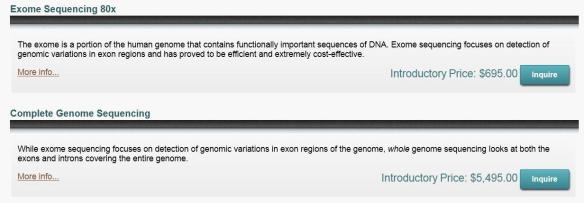
The amazing part is that a full genome sequence cost about 3 million in 2007 and the price will continue to fall.  While consumers will be able to order this, if they want, it comes with no tools, as it is focused at the research community who would be expected to have their own analytical tools.  However, genetic genealogists being who and what they are, I don’t expect the research market will outweigh the consumer market for long, especially when the price threshold reaches about $1000.

Bennett also said that he expects that National Geographic will, in 2013 sometime, decide to allow upgrades from Family Tree DNA clients for the Geno 2.0 product.  This will allow those people who cannot obtain a new sample to participate as well.  However, an unopened vial will be required.  No promises as to when, and the decision is not his to make.
The first session was Spencer Wells via Skype from Italy.  Spencer has just presented at two conferences within the week, one in San Francisco and one in Florence, Italy.  Fortunately, he was able to work us into his schedule and he didn’t even sound tired.

Of course, his topic was the Geno 2.0 test which is, of course, run on the new GenoChip.  The first results are in the final stages of testing, so we should see them shortly.  Sometime between the 19th and the end of the month.

This product comes with all new migration maps.  He showed one briefly, and I noticed that one of the two Native Y-lines are now showing different routes than before.  One across Siberia, which hasn’t changed, and one up the pacific rim.  Hmmm, can’t wait for that paper.

The new maps all include heat maps which show frequency by color.  The map below is a haplogroup Q heat map, but it is NOT from the Geno project.  I’m only using it as an example.

Spencer indicated that the sales of the 2.0 product rival those of the 1.0 product and that they have sold substantially more than 10K and substantially less than 100K kits so far.  In total, they have sold more than 470,000 kits in over 130 countries.  And that’s just the public participation part, not the indigenous samples.  They have collected over 75,000 indigenous samples from more than 100 populations resulting in 36 publications to date with another half dozen submitted but not yet accepted.  Academic publication is a very long process.

Nat Geo has given 62 legacy grants to indigenous communities that have participated totaling more than 1.7 million dollars.  That money comes in part from the public participation kits, meaning Geno 1.0 and now 2.0.

Geno 2.0 continues to be a partnership between National Geographic and Family Tree DNAFamily Tree DNA is running all of their samples in the expanded Houston lab.  Also added to the team is Dr. Eran Elhaik at Johns Hopkins University who has developed a new tool, AIMSFINDER, that locates never before identified Ancestral Informative Markers to identify population specific markers.  This is extremely important because it allows us to read our DNA and determine if we carry the markers reflective of any specific population.  Well, we don’t do the reading, they do with their sophisticated software.  But we are the recipients with the new deep ancestral ethnicity results which are more focused on anthropology than genealogy.  Spencer says that if you have 2% or more Native American, they can see it.  They have used results from both public and private repositories in developing these tools.

This type of processing power combined with a new protocol that tests all SNPS in a sequence, not just selected ones, promises to expand the tree exponentially and soon. It has already been expanded 7 fold from 863 branches of the Y tree to 6153 and more have already been discovered that are not on the GenoChip, but will be in the next version.

The National Geographic project will also be reaching out to administrators and groups who may have access to populations of interest.  For example, an ex-pat group in an American city.  Keep this in mind as you think of projects.

Another piece of this pie is a new educational initiative in schools called Threads.

This isn’t all, by any means, on this topic, I really do encourage you to go and use Twitter hashtag #ftdna2012.  Several of us were tweeting and the info was coming so fast and furious that no one could possibly get it all.

The future with Nat Geo looks exceedingly bright.  We have gone from the Barney Rubble age to the modern era and now there is promise for a rosy and as yet undiscovered future.

Judy Russell was next.  I have to tell you, when I saw where they positioned her, I was NOT envious.  I mean, who wants to follow Spencer Wells, even if he’s not there in person.  Well, if anyone was up to this, it certainly was Judy.  For those who don’t know, she blogs as The Legal Genealogist.

Judy is one of us.  That means she actually understands our industry, what drives genealogists and why.  In addition to being a lawyer, she is a certified genealogist and a genetic genealogy crazy too.  Maybe I shouldn’t call a lawyer crazy….well…it was meant as a compliment:)

Judy has the perspective to help us, not just criticize us remotely.  She reviewed several areas where we might make mistakes.  After all, we’re all volunteers coming from quite varied backgrounds.  She suggests that we all put some form of disclosure on our projects explaining what participants can expect in terms of use.  She used the Core Melungeon project as a good example, along with the Fox project.

“The goal of this project is to use DNA to better understand the origins of the Melungeon people, and this will be done by comparing the DNA with other project members, those outside of projects, and will incorporate relevant genealogical and historical research. All participants will be included in the ongoing studies and by joining the project, you are giving consent for your information to be anonymously included in ongoing genetic genealogy research. Your personal identity will not be revealed, but your results will be used to better understand the Melungeons as a people and their ancestors.”

From the Fox project:

“The exact function of these STR markers is not yet known and they have no known medical function but recent research shows they have some sort of regulatory function on the genes. While there is no medical information in these numbers, the absence of a certain few markers near a fertility gene could indicate sterility – something that would certainly already be known.

The results do provide a partial means of personal identification and, for this reason, our haplotype tables list only the FTDNA kit number and the most distant known male line ancestor. Within the project, however, the administrators feel free to disclose identities, particularly when a close match occurs.”

Judy’s stressed that we not tell people that there is no medical information revealed.  Partially, because we’ve discovered in rare cases that’s not true, and partially because we can’t see into the future.

Judy talked about regulation and that while we fear what it might intentionally or inadvertently do to genetic genealogy, it’s important to have regulations to get rid of the snake oil salesman, and yes, there are a couple in genetic genealogy.  They give us all a black eye and a bad name when people discover they’ve been hoodwinked. However, without regulation of some sort, we have no legal tools to deal with them.

Regulation certainly seems to be a double-edged sword.

I hope that Judy writes in her blog about what she covered in her session, because I think her message is important to all administrators and participants alike.  And just to be clear, the sky is not falling and Judy is not Chicken Little.  In fact, Judy is the most interesting attorney I have ever heard speak, and amazingly reasonable too.  She actually makes you WANT to listen, so if you ever get the chance to see one of her webcasts or attend one of her sessions, take the opportunity.

Following the break, breakout sessions began.  CeCe Moore ran one about “Family Finder,” Elise Friedman about “Group Administration” and Thomas Krahn provided the “Walk the Y Update.”  Bennett called this the propeller head session.  Harumph Bennett.  Guess you know which one I attended.  All sessions were offered a second time on Sunday.

Thomas said that they have once again upgraded their equipment, doubling their capacity again.  This gives 4 times the coverage of the original Walk the Y, covering more than 5 million bases.  To date, they have run 494 pre-qualified participants and of those, 198 did not find a new SNP.

There are changes coming in how the palindromic region is scored which will change the matches shown.  Palindromic mismatches will now be scored as one mutation event, not multiples.  Microalleles will able be reported in the next rollout version, expected probably in January.  The problem with microalleles is not the display, but the matching routine.

Of importance, there has not been an individual WTY tested from haplogroups B, M, D or S, and we need one.  So if you know of anyone, please contact Thomas.

Thomas has put his Powerpoint presentation online at  http://www.dna-fingerprint.com/static/FTDNA-Conference-2012-WalkThroughY.pdf

The next session by Dr. Tyrone Bowes was “Pinpointing a Geographical Location Using Reoccurring Surnames Matches.”  For those of us without a genetic homeland, this is powerful medicine.  Dr. Bowes has done us the huge favor of creating a website to tell us exactly how to do this.  http://www.irishorigenes.com/

He uses surnames, clan maps, matches, history and census records to reveal surname clusters.  One tidbit he mentioned is that if you don’t know the family ethnicity, look at the 1911 census records and their religion will often tell you.  Hmm, never thought of that, especially since our American ancestors left the homeland long ago.  But those remaining in the homeland are very unlikely to change, at least not in masse.  I’m glad he gave this presentation, or I would never have found his webpage and I can’t wait to apply these tools to some of my sticky-wickets.

This ended Saturday’s sessions, but at the end of every day, written questions are submitted for that day’s presenters or for Family Tree DNA.

Bennett indicated that another 3000 or 4000 SNPs will be added to the Family Finder calculations and a new version based on reference samples from multiple sources will be released in January.

Bennett also said that if and when Ancestry does provide the raw downloadable data to their clients, they will provide a tool to upload so that you can compare 23andMe and Ancestry both with your Family Finder matches.

Saturday evening is the ISOGG reception, also called the ISOGG party.  Everyone contributes for the room and food, and a jolly good time is had by all.  There is just nothing to compare with face to face communications.

For me, and for a newly found cousin, this was an amazing event.  A person named Z. B. Stroud left me a message that she was looking for me.  When I found her, along with her friend and cousin Revis, she tells me that she matches me autosomally, at 23andMe, and that she had sent me a sharing request that I had ignored.  I am very bad about that, because unless someone says they are related, I presume they aren’t and I don’t like to clutter up my list with non-related people.  It makes comparisons difficult.  My bad.  In fact, I’m going right now to approve that sharing request!!!

I will blog about this in the future, but without spilling too many beans….we had a wonderful impromptu family reunion.  We think our common ancestor is from the Halifax and Pittsylvania County region of Virginia, but of course, it will take some work to figure this out.

I’m also cousins with Revis Leonard (second from left).  We’ve known that for a long time, but Z.B. whose first name is Brisjon (second from right) is new to genealogy, DNA and cousin matching. I’m on the right above.  The Stroud project administrator, Susan Milligan, also related to Brisjon is on the left end.  In the center are Brisjon’s two cousins who came to pick her up for dinner and whom she was meeting for the first time.

But that’s not all all, cousin Brisjon also matches Catherine Borges.  Let me tell you, I know who got the tall genes in this family, and I’m not normally considered short.  Brisjon’s genealogical journey is incredibly amazing and she will be sharing it with us in an upcoming book.  Suffice it to say, things are not always what you think they are and Brisjon is living proof.  She also met her biological father for the first time this weekend!  I’m sure Houston and her 2012 visit where she met so many family members is a watershed event in her lifetime!  She is very much a lovely lady and I am so happy to have met her.  Cousins Rule!

ISOGG traditionally has its meeting on Sunday morning before the first session.  Lots of sleepy people because everyone has so much fun at the ISOGG party and stays up way too late.
Alice Fairhurst, who has done a remarkable job with the ISOGG Y SNP tree (Thank you Alice!) knows an avalanche is about to descend on her with the new Geno 2.0 chip.  They are also going to discontinue the haplogroup names, because they pretty much have to, but will maintain an indented tree so you can at least see where you are.  The names are becoming obsolete because everytime there is an insertion upstream, everything downstream gets renamed and it makes us crazy.  It was bad enough before, but going from 860+ branches to  6150+ in one fell swoop and knowing it’s probably just the beginning confirms the logic in abandoning the names.  However, we have to develop or implement some sort of map so you can find your relative location (no pun intended) and understand what it means.

Alice also mentioned that they need people to be responsible for specific haplogroups or subhaplogroups and they have lost people that have not been replaced, so if anyone is willing or knows of anyone….please contact Alice.

Alice also makes wonderful beaded double helix necklaces.

Brian Swann (sorry, no picture) is visiting from England this year and he spoke just a bit about British records.  He said it’s imperative to learn how they work and to use some of the British sites where they have been indexed.  He also reminded us to check GOONS (Guild of One Name Studies) for our surnames and that can help us localize family groups for recruiting.  He said that you may have to do family reconstructions because to get a Brit to test you have to offer them something.  That’s not terribly different from over here.  He also mentioned that today about half of the British people having children don’t marry, so in the next generation, family reconstruction will be much more difficult.  That too isn’t so terribly different than here, although I’m not sure about the percentages.  It’s certainly a trend, as are varying surname practices even within marriage.

Dr. Doron Behar began the official Sunday agenda with a presentation about the mtCommunity and a discussion of his recently published paper “A ‘Copernican’ Reassesement of the Human Mitochondrial DNA Tree from its Root.”  This paper has absolutely revolutionized the mitochondrial DNA community.  I blogged about this when the paper was first released and our home pages were updated.    One point he made is that it is important to remember is that your mutations don’t change.  The only thing that changes between the CRS (Cambridge Reference Sequence) and the RSRS (Reconstructed Sapiens Reference Sequence)  model is what your mutations are being compared to.  Instead of being compared to someone from Europe who live in 1981 (the CRS) we are now comparing to the root of the tree, Mitochondrial Eve (RSRS) as best we can reconstruct what her mitochondrial DNA looked like.

He also said that when people join the mtCommunity, their results are not automatically being added to GenBank at NCBI.  That is a separate authorization check box.

A survey was distributed to question participants as to whether they want results, when they select the GenBank option, to be submitted with their kit number.  Now, they are not, and they are under Bennett’s name, so any researcher with a question asks Bennett who has no “track back” to the person involved.  About 6000 of the 16,000 submissions today at GenBank are from Family Tree DNA customers.  Dr. Behar said that by this time next year, he would expect it to be over half.  Once again, genetic genealogy pioneers are leading the way!

At these conferences, there is always one session that would be considered the keynote.  Normally, it’s Spencer Wells when he is on the agenda, and indeed, his session was wonderful.  But at the 2012 conference, this next session absolutely stole the show.  Less public by far, and much less flashy, but at the core root of all humanity.

You can’t really tell from the title of this session what is coming.  Michael Hammer with Thomas Krahn and Bonnie Schrack, one of our own citizen scientists, presented something called “A Highly Divergent Y Chromosome Lineage.”  Yawn.  But the content was anything but yawn-material.  We literally watched scientific discovery unfold in front of our eyes.

Bonnie Schrack is the haplogroup A project administrator.  Haplogroup A is African and is at the root of the entire haplotree.  One of Bonnie’s participants, an African American man from South Carolina agreed to participate in WTY testing.  In a nutshell, when Thomas and Astrid began scoring his results, they continued and continued and continued, and wound up literally taking all night.  At dawn’s first light, Thomas told Astrid that he thought they had found an entirely new haplogroup that preceded any known today.  But he was too sleep deprived to be sure. Astrid, equally as sleep deprived, replied with “Huh?” in disbelief.  It’s certainly not a statement you expect to hear, even once in your lifetime.  This is a once in the history of mankind event.

Dr. Michael Hammer confirmed that indeed, they had discovered the new root of the human Y tree.  And not by a little either, but by a lot.  For those who want to take a look for yourself, Ysearch ID 6M5JA.  Hammer’s lab did the age projection on this sample, and it pushed the age of hominid men back by about 100,000 years, from 140,000 years ago to 237,000 years ago.  They then reevaluated the aging on all of the tree and have moved the prior date to about 200,000 years ago and the new one to about 338,000 years ago with a 98% confidence level.  This is before the oldest fossils that have been found, and also before the earliest mitochondrial DNA estimate, which previously had been twice as old as the Yline ancestor.

The previous root, A1b has been renamed A0 and the new root, just discovered is now A00.  Any other new roots discovered will simply get another zero appended.

How is it that we’ve never seen this before?  Well, it turns out that this line nearly went extinct.  Cruciani published a paper in 2012 that included some STR values that matched this sample, but fortunately, Michael Hammer’s lab held the actual samples.  A search of academic data bases reveals only a very few close matches, all in western Cameroon near the Gulf of Guinea.  Interestingly, next door, in Nigeria, fossils have been found younger than this with archaic features.  This is going to cause us to have to reevaluate the source of this lineage and with it the lineage of all mankind.  We must now ask the question about whether perhaps we really have stumbled upon a Neanderthal or other archaic lineage that of course “became” human.  Like many scientific discoveries, this answer only begs more questions.  My husband says this is like Russian tea dolls where ever smaller ones are nested in larger ones.

This discovery changes the textbooks, upsets the proverbial apple cart in a good way, and will keep scientists’ thinking caps on for years.  And to think, this was a result of one of our projects, an astute project administrator (Bonnie) and a single project member.  I wonder what the man who tested thinks of all of this. He is making science and all he thought he was doing was testing for genealogy.  You just never know where the next scientific breakthrough will come from.  Congrats to all involved, Bonnie, Thomas, Michael and to Bennett and Max for having this evolution revolution happen right in their lab!

If I felt sorry for Judy following Spencer, I really felt sorry for the breakout sessions following Thomas, Michael and Bonnie’s session.  Thankfully at least we had a break in-between, but most people were wandering around with some degree of stunned disbelief on their faces.  We all found it hard to fathom that we had been among the first to know of this momentous breakthrough.

I had a hard time deciding which session to attend, CeCe’s “Family Finder” session or Elise’s.  I decided to attend Elise’s “Advanced Admin Techniques” because I work with autosomal DNA with my clients and I tend to keep more current there.  Elise’s session was great for newer admins and held tips and hints for us old-timers too.  I realized I really need to just sit down and play with all of the options.

There are some great new features built in that I’ve never noticed.  For example, did you know that you can group people directly from the Y results chart without going to the subgrouping page?  It’s much easier too because it’s one step.  However, the bad news is that you still can’t invite someone who has already tested to join your project.  Hopefully that feature will be added soon.

The next session was “A Tale of Two Families” given by Rory Van Tuyl detailing how he used various techniques to discern whether individuals who did not show up as matches, meaning they were beyond the match threshold, were actually from the same ancient family or not.  Rory is a retired engineer and it shows in his attention to detail and affinity for math.

We always tell people that mutations can and do happen at any time, but Rory proved this.  He ran a monte-carlo simulation and showed that in one case, it was 50 generations between mutations, but in others, there was one mutation for three generations in a row.  Mutations by no means happen at a constant rate.  Of course, this means that our TIP calculator which has no choice but to use means and averages is by definition “not calibrated” for any particular family.

He also mentioned that his simulation shows that by about 150 generations, there are a couple of back mutations taking place.

The final session before the ending Q&A was Elliott speaking about IT, which really translates into new features and functions.  Let’s face it, today everything involves IT.

Again, I was having trouble typing fast enough, so you might want to check the Twitter feed.

They added the SNP maps (admins, please turn them on) and the interactive tour this year.  The tour isn’t used as much as it should be, so everyone, encourage your newbies to do this.

They have also added advanced matching, which I use a lot for clients, but many people didn’t realize it.  So maybe a quick tour through the website options might be in order for most of us.

They are handling 50 times more data now that a year ago.  Just think what next year will bring.  Wow.

They are going to update the landing page again with more color and more visible options for people to do things.  I hope they prompt people through things, like oldest ancestor mapping, for example.  Otherwise, if it isn’t easy, most don’t.

They are upgrading Population Finder and the Gedcom viewer.  They are adding a search feature.  Thank you!!  Older Gedcome will still be there but not searchable.

But the best news is that they are adding phasing (parent child) and an advanced capability to “reconstruct” an ancestor using more distant relatives, then the ability to search using that ancestral profile against Family Finder.  Glory be!  We are finally getting there.  Maybe my dreaming big wasn’t as far away as I thought.

They will also remove the 5 person autosomal download restriction and the “in common with” requirement to see additional information.  All good news.  They are also upgrading the Chromosome browser to add more filtering options.

They are also going to offer a developer “sandbox” area for applications.

The final Q&A session began with Bennett saying that their other priorities preclude upgrading Y search to 111 markers.

They are not planning to drop the entry level tests, 12 or 25 markers or the HVR1. If they do, lots of people will never take that plunge.  I was very glad to hear this.

And by way of trivia, Family Tree DNA has run more than 5 million individual tests.  Wow, not bad for a company that didn’t exist, in an industry that didn’t exist, 12 years ago!

It’s an incredible time to be alive and to be a genetic genealogist!  Thank you Family Tree DNA for making all of this possible.

______________________________________________________________

Disclosure

I receive a small contribution when you click on some of the links to vendors in my articles. This does NOT increase the price you pay but helps me to keep the lights on and this informational blog free for everyone. Please click on the links in the articles or to the vendors below if you are purchasing products or DNA testing.

Thank you so much.

DNA Purchases and Free Transfers

Genealogy Services

Genealogy Research

Family Tree DNA Conference 2012 – Native American Focus Meeting

Wow.  Talk about drinking from a firehose.  From the minute we arrived in the lobby Friday afternoon until we got back to the airport Sunday evening, we barely had time to breathe.

This was an amazing conference in many ways.  I’ll try to hit the high points in a separate blog, but in this posting, I want to cover the Native American Focus meeting and talk a little bit about the interests of the different attendees.

The first event, at 4 on Friday afternoon, was a small meeting of people who are admins or have a specific interest in Native American heritage.   Rebekah Canada, haplogroup Q project administrator, coordinated this meeting and a hearty thank you goes to her for her efforts.  We have never attempted this type of event before, and we all agreed, we need to do it again.

Unfortunately, many projects that are focused on or include Native results did not have a project administrator here and were not represented.

Peter Roberts is the administrator of the Bahamas project.  The Bahamas are rich with Native history, but evidence they existed in the DNA record is slim.  The Lucayan Indians were removed from the Island by the Spanish.  While we know they existed, their results, surprisingly, are not showing up directly in the yline or mtdna results.  We also know that some Seminoles arrived later from Florida and others came from the mainland as well.  Low levels of Native heritage are showing up in autosomal testing.

David Pike discovered his Native heritage quite by accident.  His father turned out to be 3.4% Native.  He believes it is probably MicMac (Mi’kmaq) or perhaps Beothuk, a now extinct tribe, in Newfoundland, but is still researching.  Dave mentioned an opportunity for tribal membership in Canada for those who can prove Micmac heritage and will be providing that information.  I will blog it when that arrives.

Marie Rundquist is the administrator of the AmerIndian Ancestors out of Acadia project which began in 2006.  I love this project, somewhat from a selfish perspective, since I’ve connected so many of my Acadian ancestors, and Native ancestors, through this project.  This is also one the most successful mitochondrial DNA projects, if not the most successful, there is.  Marie’s project has served to prove or disprove several Native rumors, and has found other Native people quite by accident.  She wrote a book, titled Revisiting Anne Marie and I’ve blogged about her success with the Doucet results.  This project is not just for Acadians in Canada, but reaches to Louisiana, and families with Acadian heritage outside of the primary relocation areas.

Kathy Johnson’s cousin came back with a haplogroup Q results.  Subsequent testing revealed 4 new SNPS in her sample.  This Pembrook family is believed to be from the Mohawk River area in New York.

Georgia and Tom Bopp, administrators of the Hawaii project, from Hawaii, attended.  Frankly, I had never thought about them and Native ancestry, but certainly Hawaii did have a Native population.  They had a very interesting situation where one of their early tester’s mitochondrial results came back as haplogroup B.  They were told they were Native American, then they were told they were Polynesian.  Native was reasonable, but Polynesian somewhat confounding given that their ancestor was a slave in Maryland.  Eventually, it was discovered their maternal ancestor was from Matagascar.  Georgia will send the information and we’ll do a blog about this in the future.  How very interesting.

Rob and Dyann Noles administer the Lumbee Tribe and Wiregrass Georgia projects.  Rob maintains a data base of over 250,000 individuals related to these projects.  While the Lumbee project is named as such, it is not endorsed by the Lumbee tribe itself.  However, numerous individuals descended from those who are early tribal founders have tested.

As haplogroup Q project administrator, Rebekah has been instrumental in the ongoing testing of haplogroup Q individuals.  Many members have been SNP tested and more than a few have participated in the WTY (Walk the Y)) which has resulted in many new haplogroup subgroups being discovered.  We’ve made more progress in the past two years than in the previous 10 in haplogroup Q.  Someday, I hope we’ll be able to identify at least members of different Native language groups by results.  Maybe I’m dreaming here, but goals are good!

I shared my work with the Native Heritage project and my ongoing transcriptions into the Native Names data base.  We now have over 8,000 different surnames and well over 30,000 people, and I’m no place near “done.”  Of course, it’s always a great day when I find a proven Native surname of someone who has tested Native in our haplogroup Q project.

We discussed the reluctance of recognized tribes to test and their concerns.  We all respect their decisions, although from a genetic genealogy perspective, we are glad when descendants test.

I suspect that many of the Native genetic lines have become extinct.  The Native people, aside from having to survive in a harsh, cold climate upon arriving from Asia, have had to endure multiple genocidal attempts (Native as well as European) in addition to many epidemics.  Some epidemics wiped out entire tribes.  In 1838, a smallpox epidemic took half of the powerful Cherokee.  No one was immune.  That combined with intermarriage, assimilation, and adoption through either traditional cultural means or kidnapping have caused the “Native” DNA results to not always be what we expect.

We are hopeful that ancient DNA will shed a light on extinct lines as well as answer the ever-present question about whether European or perhaps African DNA was present in the Native population before the traditional dates of European contact

I want to thank everyone who attended for their participation and sharing, and encourage anyone else who is interested to let either Rebekah or I know.

______________________________________________________________

Disclosure

I receive a small contribution when you click on some of the links to vendors in my articles. This does NOT increase the price you pay but helps me to keep the lights on and this informational blog free for everyone. Please click on the links in the articles or to the vendors below if you are purchasing products or DNA testing.

Thank you so much.

DNA Purchases and Free Transfers

Genealogy Services

Genealogy Research

Semper Fi, Dave

It’s Veteran’s Day today.  My brother, David Estes, was a Marine, a veteran and he gave his life earlier this year as a result of his tour of duty in Vietnam.

A tail gunner, Dave was shot down in Vietnam, taking a bullet from below through the abdomen and delicately put, “private area.”  Amazingly, he lived, and subsequently received blood transfusions in the hospital in Saigon.  The blood was tainted and David learned in 2010, some 27 years later, that he had contracted hepatitis C.  For those who don’t know, hep C is generally asymptomatic, right up until about 18 months before it kills you, 25 to 30 years after contracting the disease.

David was an amazing man.  I didn’t know him long.  Just under 8 years.  I didn’t know him as a child and I didn’t get to grow up with him. You see, it was genealogy and DNA that brought us together.  He is my half-brother on my father’s side.  Our story has enough drama and unexpected twists to make any soap opera jealous.  Let me share a bit of our journey and something of Dave’s life with you.  After all, it’s Veteran’s Day.

Our father, William Sterling Estes, above, also a veteran of both WWI and WWII, was a bit of a playboy.  That’s somewhat of an understatement, kind of like calling an iceberg a large ice cube.  In fact, Hugh Hefner’s got nothing on him.  Our father managed to maintain two separate families, at the same time.  And no, he was not Mormon.  He was however, an alcoholic, the son of a bootlegger from the hills of Tennessee and Kentucky, but a very intelligent, functional alcoholic.  And handsome to boot.  Sadly, David’s mother was also an alcoholic.  Mine was not.  David grew up mostly under his Irish grandmother’s tutelage.  David never knew who his father was.  He knew our father, but as the husband of another family member.  If you’re confused, it’s OK, so were we.  Let’s just say that the words “Peyton Place” come to mind.  Below, Dad and David.

In any event, I knew, or had heard rumors, through the family grapevine that I had a sibling.  This subject was totally taboo and I knew nothing more until I received a box of letters from my step-mother’s daughter after my step-mother died.  In the box of letters were letters from my father’s sister and other family members to my father who died when I was 7, and to his father as well.  I read the letters and in them, I discovered that my sibling had been born the same year I was.  That was very confusing to me.  My mother, horribly embarrassed about the entire situation, refused to talk.  Eventually, she told me enough that I was able to determine that the child was a boy, about when he was born, and more importantly, the names of his mother and grandmother.  I didn’t even know his name.  Mother couldn’t remember, but she clearly remembered the name of the “other woman.”  Eventually, in 2002, after many years of searching, with the help of librarians, city directories, obituaries, marriage and divorce records, and ultimately, a private investigator, I located David.  The road was not easy or straight and was fraught with false leads and land mines.

After serving in Vietnam, David became a long-haul truck driver and lived in various places throughout the US before settling eventually in Ohio.  His path was very difficult to track.  The saving grace was a little brush with the law that gave him a police record.  I have never been so grateful for a police record in all my life.

However, when I found him, or at least where he lived, I hesitated a bit before contacting him.  Actually, for nearly 2 years.  A man with a police record.  Did I really want to open Pandora’s box?  I didn’t know.  To put it mildly, David seemed very different than me.  Once opened, you can’t close Pandora’s box.

Finally, I knew I had to make the move.  I couldn’t NOT contact him, regardless of the outcome.  On July 14, 2004, I wrote David a letter.  I had tried calling the phone number given to me two years previously by the private investigator, only to discover the number was no longer Dave’s.  I will never forget mailing that letter.  That letter was returned to me this past year.  His wife, my sister-in-law, gave it back to me after Dave’s death.  It was well worn and had been read over and over again, probably in many truckstops around the country.

A week later, my phone rang, and a very deep voice asked for me.  When I confirmed I was speaking, there was a pause, and then the voice said, “I’m David Estes, your brother.”  I could barely talk.  It was as if I had waited a lifetime to hear his voice and it was a rich melody to me.  We visited for hours, comparing information.  It turns out that he never knew about me, and while I assumed he knew who his father was, he didn’t.  In fact, he had spent years trying to uncover that missing piece of information.  His mother had died without divulging that tidbit to him.  There was a reason for that, as she was related (by marriage) to our father and the relationship was ‘improper’ to say the least.  This is a perfect example of why these family secrets are so tightly held sometimes.

For David, my envelope full of photos and information was a gift from Heaven, as was the fact that he had a sister.  Other than his 2 children, David had no living blood relatives.  At one time he had a step-sister, but when she protested against Vietnam and criticized his service, he walked away from her and never looked back.  David was exceptionally proud of his military service and sacrificed a great deal for his country, including ultimately, his life.

Dave was what, in Indiana, we used to call a “Billy bad-ass.”  He didn’t look for a fight, but he certainly wasn’t afraid of one either.  He had been in more than his share, being fiercely protective of family members and taking up for anyone he perceived to be an underdog.

David grew up angry and joined the military instead of finishing high school.  The Marines gave his anger and “bad-ass” tendencies focus.  He was extremely proud to serve his country.  His military records are sealed because of where he served and his unit’s role in the war.  In the end, when we desperately needed some of those records, we were unable to obtain them even with the assistance of Ohio’s Senators and Congressional representatives.

When Dave returned from the Marines, he began his long-haul truck driving career.  He drove millions of miles accident-free.  He was once trapped in riots in some city, and he climbed on top of his (employer’s) truck with a shotgun and defended his turf.  He was determined to die fighting for his perception of what was right.

David was never afraid to express his opinion. In fact, he did that often and sometimes loudly.  But when it came to his own bravery, he was always entirely silent.  I found out most of what I know through others.  David was both fearless and humble.  Pain meant nothing to him, even in the end.  Once, he pulled his own tooth with a pliers while on the road.

After he was diagnosed with hepatitis C, I wanted to test as a transplant donor, and he would not allow it, nor would he allow his children to be tested.  Eventually, over Dave’s objections, I did test…only to discover I was not a candidate.  I suspected why, but the medical team would not confirm my suspicions.  David died for lack of a donor, but he would not consider allowing his family to suffer in any capacity, even to save his life, which any of us would have welcomed the opportunity to do.  Had I matched, I doubt very seriously if he would have accepted part of my liver.

In 2004, I drove to Ohio to meet for the first time the long-haired, tattooed, truck-driving, swearing, hard-scrabble cowboy that was my brother.  I discovered that under that very hard veneer was a man with a heart of gold.  His dog, who rode with him for years, he had rescued from a man in a truck stop who was beating him as a pup.  When the man refused to stop, David gave the man some of his own medicine and then took the dog.  It’s amazing David didn’t have more than one police record.  And yes, his original record that allowed me to find him was for a bar fight over some man’s unwelcome advances towards a woman.

After David’s hep C was diagnosed, he went on disability for a few months.  However, he couldn’t stand it and went back on the road, long-haul driving again.  Someplace during those last couple months that he drove, he rescued another dog in need who had been dumped someplace.  When he developed cancer in the liver, a common result of hep C, his wife had to call him in California to tell him.  He finished his run before he would come home.  He pulled into the truck terminal about 12 hours before his appointment with the oncologist where they told him there was nothing they could do.  A day later he was in hospice.  Ten days later, he was dead.  The man was absolutely amazing.

When I met Dave, we looked for physical similarities.  We ran into the bathroom together and crowded around a little mirror above the sink looking to see if we looked alike.  Were we really siblings?  The photo below was taken that day.

Dave told me that he never used the “L word.”  His wife confirmed that.  The man who feared nothing did not want to be vulnerable.  As time went on, he whispered in my ear as I hugged him goodbye “I love you Sis.”  He had never had a sibling.  From that day on, “I love you Sis” was always his goodbye to me, in person or on the phone.  Being a truck driver, we never really knew if it might be our last conversation.  It was also the last thing he said to me, in a barely audible whisper.

A few years after we met, I had a cancer scare.  I was going to tell him when the time was right, but one day a semi pulled up in front of my house.  Yep, Dave was visiting unexpectedly.  Often only for an hour or so, but something was better than nothing.  My medical paperwork was laying on the kitchen counter.  He saw it and held it up, demanding to know “what is this?”  It told him that we didn’t know yet, I was still undergoing testing.  He looked at me dead in the eye and said “If you have cancer and need someone to take care of you, I’ll sell the house and quit my job and come and take care of you.”  I told him he couldn’t.  He told me I didn’t get to tell him what he could and could not do, and he would.  That discussion was over.  I knew beyond a doubt how much he loved me.  And I loved him all the more for it, my long haired, tattooed, truck-driving brother who loved me enough to give up everything.

When we met in 2004, Dave wanted to take a Y-line DNA test.  We knew what the Estes line looked like, back some generations, but we didn’t have anyone from my father or my father’s father to test.  So David would represent our line.  He swabbed.  Weeks went by, and finally his results arrived in an e-mail from Family Tree DNA.  I clicked to open, and to my utter horror, he didn’t match the Estes line.  I didn’t know what to think, but I was sure that we had discovered an undocumented adoption someplace up the line, meaning I had just spent 35 years doing someone else’s genealogy.  I was dumbstruck.  I did not for one minute believe that David was not my father’s child.  Everyone, including my father, believed that he was, based on the letters and such, even though it would have been much “better” in the family if Dave were not my father’s child.

I then found the only remaining male descendant of my Estes grandfather who agreed to test, and he matched neither the Estes line, nor Dave.  We had gone from bad to worse. That was a dark day.

This was before the days of the wide spectrum chip based autosomal testing we have today that so easily answers these kinds of relationship questions.  David and I next submitted our DNA to a lab to have an old-style CODIS test for siblingship done.  It came back inconclusive, as did the same test in a second lab.  I shudder to think how much I had spent by this time.

The day that 23andMe first offered their test, I ordered one for Dave and I both.  The results came back.  I held my breath and said a little prayer.  I clicked.

No match.  David and I were not siblings.  At least, we weren’t biological siblings.  Let me assure you, David was and is my brother in my heart.  But my heart sank.

And then I had a terrifying thought.  Maybe David was my father’s child, and I wasn’t.  I remembered a chat with my mother some years before when I asked her fundamentally that question, and suffice it to say that suggestion went over like a lead balloon.  But when she told me that she would give anything to be able to tell me that was the case, I knew she was telling me the truth.  She never forgave my father for that little “other family” indiscretion.  Neither did his “other family.”

By this time, I had spent so much money and had so much emotional investment, I had to know.  I have many Estes cousins, so we did selective autosomal testing of several who were related on the Estes side and not through other lines so that we could determine if Dave or I either one were descended from the Estes family.  By this time, there was so much confusion that all bets were off.  The outcome was that, indeed, I am descended from the Estes line and am the child of my father, and David is not.  Our father is not his biological father, after all these years of searching and then believing the answer was finally at hand.

I tried to tell Dave, to introduce the topic gently, but he did not want to hear me.  I decided at that point to leave things as they were.  Dave was my brother and I loved him and nothing in our DNA made any difference.

Thank you David for your service, your bravery in the face of adversity, your dedication, your tenacity, your loyalty, your compassion for those creatures who were helpless or victims, your “bad-ass” attitude, for loving me, for DNA testing in spite of the possible answers, and for your final sacrifice.

The words “thank you” seem so inadequate for someone who made the ultimate sacrifice and gave their life, but they’re the only words I have.  Dave has given beyond his own life in so many ways, not the least of which is the legacy of his DNA which continues to give to his children and others.   And yes, his DNA continues to fish every day for that elusive answer he never received in his lifetime.

Semper Fidelis, Dave.  Semper Fi.

______________________________________________________________

Disclosure

I receive a small contribution when you click on some of the links to vendors in my articles. This does NOT increase the price you pay but helps me to keep the lights on and this informational blog free for everyone. Please click on the links in the articles or to the vendors below if you are purchasing products or DNA testing.

Thank you so much.

DNA Purchases and Free Transfers

Genealogy Services

Genealogy Research


Native American DNA News

It’s a good DNA day for Native American DNA research.

Yesterday, I was talking to Bennett Greenspan at Family Tree DNA.  He knows of my interest in Native heritage.  Our conversation turned to the new Geno 2.0 chip, now called the GenoChip, and the expected ethnicity results relative to Native heritage.

It turns out that Bennett and Spencer Wells had just been talking about the same thing.  Spencer said that the GenoChip is exceptionally good at picking up Native American ancestry and that it’s one of the key features built into the autosomal SNPs they chose and the resulting admixture analyses.  Spencer says that as long as the admixture is above 2%, we’ll see it.

Two percent equates to between 5 and 6 generations.

I can’t wait to compare Geno 2.0 results of people who previously tested at 23andMe and with Family Tree DNA’s Family Finder, and especially those who showed the Middle Eastern percentage with the Family Finder test.

This information dovetails nicely with a new paper to be published in the American Journal of Human Genetics, the February 10th edition.

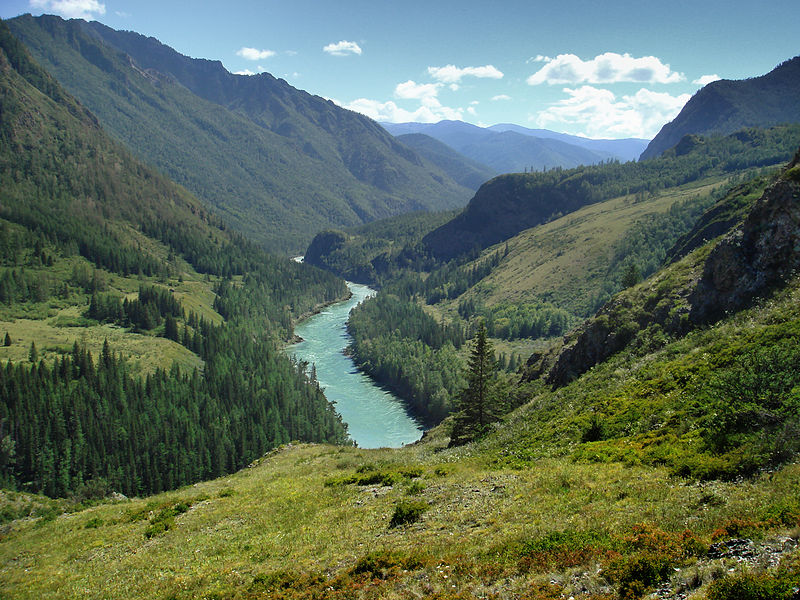
In this new paper, Dr. Theodore Schurr has used Y and mitochondrial DNA evidence collected from 500 Siberian people living in remote villages and more than 2500 Native Americans from Canada, the US and Mexico.  The paper confirms the homeland of the Native people in the Americans was originally the Altay Mountains in Siberia (photo above).  This isn’t new news, but it’s nice to have confirmation and it will be interesting to see the details in the paper.

In an article published this week by the National Geographic Society titled “Is this Russian Landscape the Birthplace of Native Americans?”, they mention that there is one marker in a male Y-line that mutated about 18,000 years ago and is still carried by Native men today.

http://news.nationalgeographic.com/news/2012/01/120203-native-americans-siberia-genes-dna-science/

I know that many recently discovered Y-line SNPs were included for haplogroup Q on the new GenoChip.  I’m very hopeful that the DNA of the Siberian people was vetted for new autosomal SNPs and included as well.  It’s likely, as Dr. Schurr, in addition to his work at the University of Pennsylvania is also the North American Director for the Genographic Project.

______________________________________________________________

Disclosure

I receive a small contribution when you click on some of the links to vendors in my articles. This does NOT increase the price you pay but helps me to keep the lights on and this informational blog free for everyone. Please click on the links in the articles or to the vendors below if you are purchasing products or DNA testing.

Thank you so much.

DNA Purchases and Free Transfers

Genealogy Services

Genealogy Research

Genetic Genealogy Blogs

Lots of people are interested in genetic genealogy.  Terry Barton, also a blogger and one of the founders of WorldFamilies.net put together this nice list of genetic genealogy bloggers.

______________________________________________________________

Disclosure

I receive a small contribution when you click on some of the links to vendors in my articles. This does NOT increase the price you pay but helps me to keep the lights on and this informational blog free for everyone. Please click on the links in the articles or to the vendors below if you are purchasing products or DNA testing.

Thank you so much.

DNA Purchases and Free Transfers

Genealogy Services

Genealogy Research


Mitochondrial DNA – Birthing Haplogroup Subclades

How is a new mitochondrial DNA haplogroup defined?  What is the criteria and who decides?

My cousin posed this question and it’s something I’ve wondered about myself.

Before when I asked this question, I was told that the answer was three different sequences with the same mutation.  But that can’t be the whole story, because when I work on the DNA Reports for people, I see this all the time and they clearly aren’t being grouped into subclades.  Furthermore, if that was the case, there would be as many subclades as people – well not quite – but there would certainly be an overwhelming number.

So, what is the decision criteria for a new haplogroup subgroup definition for mtdna?

I asked Bill Hurst.  Bill is a long time project administrator and worked closely with Doron Behar on the RSRS (Reconstructed Sapiens Reference Sequence) project.  I knew he would be very familiar with the inner workings of this process, and he’s not entirely covered up by other projects.  Bill is in the middle of his annual cross-country trek that always winds up in Houston the first week in November.  Odd coincidence, that’s when the Family Tree DNA Conference takes place:)

I want to thank Bill for taking his time to answer this, especially while on the road.  Here’s what Bill had to say.  The brackets and footnote are mine for clarification.

“First, we are talking about we usually call mtDNA subclades, not haplogroups. The basic haplogroups have been set in stone for years now. Of course, it can be confusing. If U is a macrohaplogroup or superhaplogroup, then U8 is considered a haplogroup and U8b a subclade. However, it is now known that K is part of U8b; so you have haplogroup below a subclade on the mtDNA tree. Everything below K is again a subclade. (As usual, pardon me for using K examples; it’s what I know.)

Traditionally, subclades were introduced only in peer-reviewed scientific papers. Each author made up his or her own rules. When I wanted to introduce two new subclades – K1a10 and K1a11 – in 2007, I wrote an article for the Journal of Genetic Genealogy. That method still works, but increasingly new subclades are first named on the PhyloTree at http://www.phylotree.org/ . Most mtDNA scientists support and use the PhyloTree.

The original paper introducing the PhyloTree in 2008 – http://onlinelibrary.wiley.com/doi/10.1002/humu.20921/pdf – said: “a relatively stable (set of) mutation(s) must be shared by at least three complete sequences before assigning it the haplogroup status.” (Oops! Even they use “haplogroups” here.)  But then it lists exceptions. Some one-sequence subclades were “grandfathered” in. They also discussed subclades with “preliminary status,” but I don’t see that being used recently.

Most importantly, I’ve found that the PhyloTree will accept a subclade with only two sequences if the defining mutation is in the coding-region and both sequences include additional coding-region mutations. The sequences to support the subclade must not be identical. Heteroplasmies [mutations in process-more about these in a future posting] are not sufficient to define or support a subclade, even if they are in the coding region. Rare or non-recurrent HVR [Hyper Variable Region[1]] mutations may be acceptable as definers or supporters. For example, 497T in HVR2 is the sole defining mutation for subclade K1a, which includes about 60% of K. But if the HVR mutations are used as supporters, three sequences would probably be required.

Examples of even recurrent mutations being used as sole subclade definers include 16270T and 16222T for subclades K2b1a and K2b1a1. But in those cases, many examples had to be found before they were allowed to be definers.  I’ve proposed 16223T as a definer for a K1a1b1a”1”, but have been unsuccessful so far. That mutation is not recurrent in K, but in mtDNA in general it is.

Some very recurrent mutations are used to head unlabeled branches on the tree; 195C heads a major branch that includes several subclades under K1a.

However, I’ve seen many branches, even with good defining mutations, where a large number of individual sequences only differ on recurrent HVR mutations such as the 523 insertions and deletions, 16093C, 146C, 152C, 195C, etc.; those don’t qualify for subclade labels and don’t show up on the PhyloTree.

Subclades may in some cases be defined or supported by insertions, deletions, and back mutations. My own K1c2a is defined solely by 15944d.  [The letter d after the location number means a deletion has occurred at that location.]

It is very important that the sequences – full sequences only – used to define a subclade have to be published, usually in the GenBank database. FTDNA customers have used direct submissions, usually Ian Logan’s program, or have agreed to have their results transmitted with a scientific paper – so far that has been the Behar et al. (2012b) RSRS paper from last April. Almost one third of the mtDNA sequences on GenBank are now from FTDNA customers.

Some recent exceptions to direct GenBank publication are sequences from the 1000 Genomes Project, but even for those the underlying complete genomes are in GenBank. A group of Chinese scientists have now published two papers (Zheng et al. 2011 and Zheng et al. 2012) extracting the mtDNA results. The PhyloTree has used the first set of Chinese and Japanese sequences and will almost certainly use the second set that has European and other examples.

The moral of the story is that everyone with mtDNA FMS results should make sure their results get to GenBank one way or another. Don’t be deterred if you have exact matches there; the number of sequences and the geographical origins are of interest to some – including me. However, please don’t submit identical sequences of siblings or mothers and children.”

Bill Hurst

Administrator, mtDNA Haplogroup K and U8 Projects


[1] Mitochondrial DNA is made up of three hypervariable regions, where, like the name implies, mutations happen much more often than in the balance of the mitochondria, known as the coding region.  There are three HVR regions, 1, 2 and 3.  HVR1 is tested in Family Tree DNA’s mtDNA test, HVR2 and 3 are tested in the mtDNAPlus test and the coding region in the FMS (Full Mitochondrial Sequence) test.  Other commercial labs generally only test some combination of the HVR regions, 1, 1+2 or 1-3.  If medical conditions connected with the mitochondria are present, they are normally found in the coding region, which is why coding region records connected with testers are not found in a public database.

______________________________________________________________

Disclosure

I receive a small contribution when you click on some of the links to vendors in my articles. This does NOT increase the price you pay but helps me to keep the lights on and this informational blog free for everyone. Please click on the links in the articles or to the vendors below if you are purchasing products or DNA testing.

Thank you so much.

DNA Purchases and Free Transfers

Genealogy Services

Genealogy Research

The Future of Genetic Genealogy – Dream Big

I spent many years working with clients in the technology space and when I did needs assessments for them, I used to tell them, “Dream Big, the sky is the limit.  Do not edit yourself by using the word “but.”  Let me do the editing.”  That freed them of all the reasons why they couldn’t and allowed them to look at everything as potentially possible.

One of our blog followers asked me what I saw as the future of genetic genealogy and what my wish list would be.  That was a few weeks ago.  I’ve been thinking.  And dreaming big.

As many of you know, I have been on a many-years (OK, multiple decades) quest to prove or disprove my Native American heritage based on tidbits and whispered secrets.  Ironically, the line where it was supposed to have existed came up quite barren, although there are still some females without surnames.  However, other lines have shown both Native and African ancestors.  So I have been duly rewarded for my years of persistence, some would say obsessiveness.

Many years ago, back in the genetic genealogy dark ages, in 2003, a company that no longer exists introduced a test that provided customers with percentages of ethnicity based on about 150 autosomal markers.  My test results were returned as 10% Native American and 15% East Asian, which was interpreted to be another flavor of Native American, for a total of 25%.

You can read about this test and others to detect minority admixture, meaning minority in the sense of not your primary ethnicity, in the paper titled Revealing American Indian and Minority Heritage Using Y-line, Mitochondrial, Autosomal and X Chromosomal Testing Data Combined with Pedigree Analysis.  This paper was published in the Journal of Genetic Genealogy, Vol. 6 #1 in 2010.

As excited as I was about these 2003 results, I knew the percentages had to be wrong, because I had done enough genealogy that I knew that 25% equaled one grandparent, and I didn’t have that much Native ancestry.  However, it did confirm that I was not hunting for a needle in the proverbial haystack that did not exist.  And yes, I eventually found more than one needle along with a few slivers along the way.

However, obtaining that confirmation that I had Native ancestry did not satisfy me.  That would be like saying that finding a new ancestor satisfies the genealogist, and we ALL KNOW that finding a new ancestor simply whets your appetite and stokes the fires for more.  That’s why genealogy is never done.  Each discovery, each question answered, leads to at least two more.

So I began to mercilessly hound those whom I could corner and asked about using autosomal DNA for ancestor identification. I asked Bennett Greenspan about this, several times, in several different ways.  I remember him groaning and simply saying it wasn’t going to happen.  He had a million reasons why.  I didn’t care.  I knew that those were only temporary constraints.  I asked Michael Hammer, Max Blankfeld, Matt Kaplan, Bruce Walsh and I think I even asked Spencer Wells.  All of them said no, in a number of different and very innovative ways.  Well, I’m a mother, and I can say no with the best of them, and no matter how nicely or covered in techno-speak it is, no is still no.

They told me it would be too expensive, there were not enough reference models, it had never been done before, and the technology wasn’t there.  I knew they were right at that time, but logically, I knew it could be done and I hoped, would be someday. I think it was Bruce that said “never” when I pushed him a little.  He was very gracious about eating those words a few years later and kind of chuckled, shrugged his shoulders, smiled and said, “Science is science.”  It’s so true, what couldn’t be done yesterday and was barely imaginable is now routine.  Bennett’s infamous story of how Michael Hammer finally agreed to test his Y chromosome back in 2000 (if Bennett would just go away and stop hounding him) is living proof of that.  So is Michael’s “throw away line” of “You know, someone should start a business doing that.”  Never says that to an entrepreneur.  Of course, the result is Family Tree DNA.  I love living in an age of innovation and being able to work with wonderful and innovative scientists and businessmen.

My autosomal questions that met with repeated rejection were in 2003-2004 timeframe.  In 2007, just a mere 3 or 4 years later, 23andMe introduced their wide spectrum testing product.  This product tested hundreds of thousands of locations, not a few, and was really focused towards health.  However, they offered “cousin matching” and percentages of ethnicity. So, now we know how long “never” is in this industry – between 3 and 4 years.

Bennett groaned the next time I talked to him.  I’m amazed that the man still speaks to me at all.  Yes, we hounded Bennett and Max relentlessly, but being the savvy businessmen that they are, they realized that the future of genetics and therefore genetic genealogy was founded in more information, more data, and he (or she) who would be king of that mountain would not only offer the testing, but user friendly tools to use the data and results effectively and integrate them into a larger whole.

So here we are today, with the Geno 2.0 product having been just released – sporting new autosomal SNPs and thousands of Yline SNPS, more than 10,000 of them – all chip based of course using newly written coding techniques to achieve accuracy never before available.  These are all innovations that we could have only dreamed about 5 years ago, before the current technology was available, or maybe we couldn’t even dream that big back then.  After all, that was before “never.”

So here is my wish list, where I think we can and should go – and why.  And yes, I know there will be people who tell me why we can’t or how difficult it will be.  But I have learned some modicum of patience and now that I know how long never is, I’m prepared to wait…

Mitochondrial DNA Data Base

As an industry, we are really missing the boat on this one.  Do you want to find out if anyone has tested who descends from your ancestor, Ann McKee born in 1805 in Washington County, Virginia?  You simply can’t do that.  Can’t be done today.

If you want to check on a male ancestor, her husband, Charles Speak, for example, or her father, Andrew McKee, you can go to the Speak or McKee projects and see if either line has been tested or you can go to Ysearch.

But you can’t do that for women.  Between Anne Mckee and me are 4 surnames (generations), Speak, Claxton, Bolton and of course, Estes.  Descending through females means dealing with multiple surnames, because every female in each family married someone with a different surname and began that domino effect of surname changes.  Anne McKee had 7 sisters and between all of them, they have literally hundreds of descendants today, some of whom carry her mitochondrial DNA.  I find it hard to believe that none of them have tested their mitochondrial DNA, but there is no way to find them if they have.

We need a centralized Mitochondrial DNA Data base where you can upload a Gedcom file or you can enter the direct mitochondrial DNA line via prompts.  Why prompts?  Because I can’t tell you how many people complete the oldest mitochondrial ancestor field with some man’s name.  If you prompt them with words like “her mother” at each step of the way, we won’t wind up with the wrong ancestral line attached to the mtDNA.

Recently someone sent me a request having to do with a particular family line and whether or not their ancestor was Jewish.  If I had been able to look in any data base, anyplace, I would have perhaps been able to see if anyone from that maternal line has tested, and the results, similar to projects and Ysearch.  In Ysearch, you can search by surname and it will also show you other pedigree charts in which the name is found, but Mitosearch has no such capability.

Unfortunately, this is a vicious circle.  People tell me that there isn’t the interest in mitochondrial DNA testing that there is in Y DNA.  While that’s true, it’s not an absolute and the lack of these tools and data base is decreasing the interest and fostering a sense of hopelessness.  Adding this tool and encouraging people to use it, and prompting them through the steps, would not only increase interest, but would provide a huge service to the genetic genealogy community as a whole.

How many of your mitochondrial lines have been tested but you don’t know it because you have no tools to find them???

Personal Genome Mapping Projects

Today, those on the bleeding edge of autosomal technology are mapping their chromosomes – but we have to do this the hard way today.  There are no tools.

The first step is phasing if you are fortunate enough to have parents or someone you can positively identify from either side or both sides of your family.

This nicely divides your genome in half – your Mom’s side and your Dad’s side.  This allows you to determine, when you receive a match, based on whom else they match, mother or father’s line, which side the match is from.  This immediately narrows the match possibilities to half of your ancestors which is a huge benefit.

As this phasing and matching of people continues, it means that we can color in parts of our personal genetic map with certain ancestors.  For example, I know that I match 3 Vannoy cousins on chromosome 15, so the part of chromosome 15 that I received from my Dad is “Vannoy” and I can “color in” that part as confirmed Vannoy.

The first company to provide us with a tool to allow us to “color” our chromosomes by ancestral family and keep track of who is connected to which location will be a big winner overall.  Today, we do it manually on a spreadsheet.

This could be done much easier with automated tools and the information is available to do it.  Obviously some type of data base and Gedcom type tools would be required for this as well but perhaps some of the effort invested in the mitochondrial DNA data base could be leveraged here as well, especially if both were designed as an integral part of a large system encompassing and combining the genealogy with the genetic tools we need.

Ancestor Reconstruction Mapping Projects

The next logical step in this progression is the reconstruction of our ancestors (on paper, not literally) using genetic mapping.  If we can map our own genome, then we can take the parts of all of the descendants and map the ancestor.

For example, if I know that my common ancestor with all of these Vannoy cousins is John Francis Vannoy, born in 1719, through his various sons, then I can “create” a chromosome model of John Francis Vannoy and begin to reassemble him, sort of a genetic reconstitution.  Over time, as more cousins match and prove their genesis to John, then we can color in more parts of John or his ancestors that I don’t carry, but others do.

Maybe someday we can also further divide John into his ancestors.  His father was Francis Vannoy and his mother was an Anderson.  John Francis Vannoy carries parts of those and other ancestors as well.  His grandmother was an Opdyke and his other grandmother was possibly a Cornwall.

I’d love to have a chromosomal GIS map in the future.  For those who don’t know what a GIS map is, GIS stands for Geographic Information Systems and these maps can be peeled away in layers.  For example, we could start with ourselves and then “assemble” the Vannoy parts of us and also the Vannoy parts of other cousins into a “Vannoy” ancestor whose various parts, like Anderson, Cornwall, Opdyke and of course earlier Vannoys could then be layered onto their own maps so what we could virtually “see” what our ancestors looked like genetically.  Other layers of ourselves, like a Miller layer, an Estes layer, etc. could also be peeled away to become part of Johann Michael Miller and Abraham Estes, the progenitors of those lines as well.  Of course, this requires collaboration.  We could call these our Wiki-Ancestor maps.

Ancestor Matching

If we can map ancestors then we can also match those ancestors.  Let’s say I’m brick walled for example on my Moore line.  I have the Y DNA, but I’m stumped beyond that with no matches that can take me beyond my brick wall in Halifax Co., Va.  My William Moore born about 1750 was the son of James, born about 1720 and wife Mary Rice, but William’s wife only has a first name, Lucy.  We have always suspected that she might be a Henderson.

Let’s say we can genetically map some of William and James.  In this process, we discover that parts of William’s children in that Moore line also match a Henderson ancestor who is being reconstructed by the Henderson project administrator.  If Henderson matches are only present for the children of William, not his siblings descendants, this would strongly suggest that his wife was a Henderson or at least closely related to them.

Taking this a step further, we have very few matches with Moores on the Y line and all that we do match are brick walled as well, often later in time than we are.  If we can genetically map some of our Moore line, we can then potentially match another Moore line that is also being mapped, but that who doesn’t have any people who have tested the Y-line.  In some cases, one could still be related to the Moore line, but not through the Y-line, but through a son born illegitimately to a Moore daughter, hence carrying the Moore surname, but not the ancestral Moore Y chromosome.  That would explain why the Y DNA doesn’t match, but would connect to the correct Moore family in spite of that little difficulty.

Ancestor matching would increase our opportunities of knocking down those pesky long-standing brick walls that have failed to fall with Y DNA testing and genealogy alone.

Full Genome Testing

All of what I’ve described above is just the tip of the iceberg.  When full genome testing becomes available, it will be the power of the matching tools that make a difference.  Full genome testing without associated tools will be worthless.  I hope that we as a community take the opportunity now to lay the foundation for the wonderful future that lies in front of us, beckoning and begging us to pave the road to get there.  Our ancestors are waiting to be discovered.  I can see them just beyond the horizon, waiting to be plucked from obscurity.  Can you?

______________________________________________________________

Disclosure

I receive a small contribution when you click on some of the links to vendors in my articles. This does NOT increase the price you pay but helps me to keep the lights on and this informational blog free for everyone. Please click on the links in the articles or to the vendors below if you are purchasing products or DNA testing.

Thank you so much.

DNA Purchases and Free Transfers

Genealogy Services

Genealogy Research


Ancestry’s Mythical Admixture Percentages

“The Emperor’s New Clothes” is a tale by Hans Christian Andersen about two weavers who promise an Emperor a new suit of clothes that is invisible to those unfit for their positions, stupid, or incompetent.  When the Emperor parades before his subjects in his “new clothes,” no one wants to admit that they can’t see the kings clothes but a child cries out, “But he isn’t wearing anything at all!”

Ok, Ancestry’s emperor has no clothes, not a stitch.  I’m saying it outright – he is BUCK NAKED!!!

I’ve been exercising restraint, I’ve been trying not to say anything negative, then I was trying not to be overtly negative.  But you know, my patience has run out.  If you think this posting is harsh, well all I can say is that you should have seen the first few versions before I softened it substantially.

I grew up on a farm with a wonderfully eloquent step-Dad of very few and very simple words.  When he said anything, you listened.  According to Dad, if it looks like a duck, walks like a duck and quacks like a duck, it’s probably a duck….or in this case, it’s a naked emperor.

And I’m not done yet, in fact, I’ve only just begun.  Here, let me put it in a way that cannot be misunderstood…

Dearest Ancestry – We are NOT STUPID!  Make no mistake.  Nor are we lemmings.  Yes, I’m shouting, so Ancestry, sit down and listen up.

A day or so ago, someone posted this link showing a video where Ancestry provides some education on how to use their AncestryDNA results.  I applaud Ancestry (yes, I did say that) for providing this educational tool, but some of the content simply infuriated me.  It insults the intelligence of all genealogists.

http://www.youtube.com/watch?v=KiClHKiWcGI&feature=youtu.be

I spent decades in the technology industry and I understand beta code.  I understand pre-release and release and tweaking.  I understand making a mistake, and fixing it.  And I understand being the “last kid” on the block to play the game. If you want to compete, being last and late with a less than stellar reputation, you have to offer something to attract people, or have a captive audience, or both.  Enter Ancestry’s AncestryDNA $99 autosomal test.

The problem is that their admixture percentages are simply WRONG.  Period.  Not a “tiny error”, not “needs tweeking,” utterly, entirely wrong.  Throw it out and start over wrong.  There are no secret Scandinavians hiding in the bushes, or in everyone’s family tree, and the fact that they are embracing their error and trying to turn a dime by telling people that they DO have a huge amount of mythical Scandinavian blood and they just need to use Ancestry’s tools to search longer and harder is not only infuriating, it’s unethical and self-serving.

Several bloggers and others have pointed out that after taking many of these types of tests, Ancestry’s results are the only ones showing large amounts of Scandinavian heritage.  So every other company and population geneticist is wrong and Ancestry has made a monumental discovery?

Ancestry has been put on notice by many individuals.  The gal, Crista, in this video who has the unfortunate job of telling this whopper publicly and attempting to convince you of this newly found “truth” even said that people have been challenging those results and are “confused.”  No doubt, they should be.

But instead of looking at the reference population data validity (that Ancestry refuses to share), or the math, for possible issues, Ancestry is lauding this inherent error as a discovery, as stated by their executives at recent conferences and elsewhere in the press, and using is it as a marketing ploy.  Well, it is the season for politics and “spin” but this is reprehensible.

Christa Cowan, on this video, uses her own father’s results and genealogy as an example.  He has 47% Scandinavian ethnic percentage according to Ancestry, yet his pedigree chart showed line after line of Scotland, England and Wales as his ancestral origins, with holes, of course, representing brick walls, like we all have.  Crista was trying to convince us, and probably herself too, that in spite of all that British Isles ancestry, and no discernible Scandinavian pedigree heritage, that in fact this was ALL attributed to Scandinavian ancestors – because her father had NO British Isles heritage, according to Ancestry.

Here’s a screen shot of his results, from the video.  The video resolution was poor, so this is too, but you can still see that Scandinavia is colored blue and the British Isles have no coloration.

Crista said “We’re discovering that there is a lot of Scandinavian blood out there.”  No, Crista, you’re discovering that you have been offered up as a sacrificial lamb by a naked emperor.

Let’s look at this another way.  Crista said that she knows 365 of the 1022 people who are her 7th generation ancestors.  If that is true, then she knows 36% of them.  That means, since there seem to be no Scandinavian ancestors in that 36% (isn’t that amazing), that the balance of the 47% of that ancestry, or another 480 ancestors are Scandinavian, and she has managed to somehow in her genealogy miss every single one of those 480 and find 365 others who weren’t Scandinavian.

Do you really believe that half of her ancestry is Scandinavian and she managed to miss all of them in the one third she has discovered?  Unlikely.  Crista, if you’re really that unlucky, don’t even bother to buy a lottery ticket.

Crista said that none of her Scotland, Wales and England ancestors showed up as British Isles because this test is picking up deep ancestry.  Really?  So all of those people married other people of Scandinavian heritage in the British Isles and none, not one, married Angles, Saxon, Jutes, Celts or Picts from the British Isles for the hundreds or thousands of years they lived there?  Now that is absolutely amazing.  How do you propose that happened?  Were there records to keep that all straight in secret guilds someplace?  For a conspiracy of that magnitude to work, there must have been records.  Where are they and where is the history of that conspiracy?  Or are those ethnic groups supposed to show up as Germanic?  That would mean that no one shows up as British Isles because everyone was continental before migrating to the British Isles.  So we’re supposed to believe that Ancestry is picking up ancient ancestry but nothing contemporary, nothing from the British Isles in hundreds or thousands of years?  And how does that happen, exactly?

Now we know that mutations have happened in the British Isles in the thousands of years they have been inhabited and those mutations are measureable.  Anyone with any doubts, just refer of the Niall of the 9 Hostages Y-line mutation (R-M222) in haplogroup R, among others.  So what we’re supposed to believe is that pretty much everyone came from Scandinavia and they had some very effective secret club that kept them from ever marrying anyone from the British Isles?  Does this sound ridiculous to you?  Well, it does to me too.

Ok, so if Ancestry has made such a monumental discovery, why then has this not been documented and academically published?  Other companies do this in conjunction with academia.  Perhaps because this is based on flawed science?  It looks to me like it’s worse than guessing.  Could it be intentional?

I know that some of Ancestry’s AncestryDNA customers have British Isles ethnicity percentages, because I do.  Here is a screen shot of my results at Ancestry.

You’ll notice that I have 80% British Isles, 12% Scandinavian and 8% uncertain.

Some years back, I did a pedigree analysis of my genealogy in an attempt to make sense of autosomal results from other companies.

The paper, Revealing American Indian and Minority Heritage Using Y-line, Mitochondrial, Autosomal and X Chromosomal Testing Data Combined with Pedigree Analysis was published in the Fall 2010 issue of JoGG, Vol. 6 issue 1.

The pedigree analysis portion of this document begins about page 8.  My ancestral breakdown is as follows:

Geography Percent
Germany 23.8041
British    Isles 22.6104
Holland 14.5511
European by   DNA 6.8362
France 6.6113
Switzerland .7813
Native   American .2933
Turkish .0031

This leaves about 25% unknown.  However, this looks nothing like the 80% British Isles and the 12% Scandinavian shown by Ancestry.  Where are my heavily German lines?  I have the German church records for generations on many families.  Where are my Dutch lines?  I have those records too.  And France, I have records there too?  Where are they and how are they represented at Ancestry?

They aren’t just incorrect, they are entirely absent, and in their stead, more British Isles and Scandinavian.  And no, I’m not buying the concept that half of my unknown 25% is really Scandinavian.  Sorry.  Try again.

So, here we are.  Ancestry is wrong, blatantly, unquestionably wrong, and arrogantly so.  Instead of testing and comparing against known and proven genealogies and pedigree charts before release, they have plowed new ground and invented Scandinavian ancestry where it doesn’t exist.  They have ignored hundreds, probably thousands of people who have documentation, and have complained, instead trying to convince the Crista’s of the world, along with the rest of us, that despite their well-documented ancestry in the British Isles, that they have none and instead they are Scandinavian.  Ditto my German, Dutch, etc.

Everyone makes mistakes.  People and companies with integrity step up as soon as a problem is identified, take responsibility, apologize (that goes a long way) and then they fix the problem.  But Ancestry not only didn’t test adequately, they won’t even consider that there might be a problem, they are arrogantly claiming “discovery” when in fact, they are a buck naked emperor extolling their own virtues because certainly no one else will.  They are insulting our intelligence and demeaning our ancestry.  With it they are sacrificing their own integrity.  Indeed, as my old farmer Dad used to say, integrity is like virginity, you only get to lose it once.  Yea, Dad, you’re right.  Ancestry’s is long gone.

It’s a shame that our own genealogy is being exploited, used as a tool by Ancestry to manipulate us by virtue of their flawed science and results to “stay subscribed” and to search for ancestors we can never find because they don’t exist.  That’s a pretty good marketing ploy, right up until someone exposes the truth.  According to Ancestry, it’s not that they have bad science, but that we have bad genealogy.  Really?  All of us?

Shame on you Ancestry.  I don’t believe this is an error or a mistake anymore.  Companies fix mistakes, not exploit them.  I would hate to think this was an intentional marketing or promotional ploy.  I wonder how the people responsible for this can look at themselves in the mirror every morning, knowing what they are doing with and to our genealogy, exploiting their customers, defiling our ancestry, which genealogists consider to be sacrosanct.

I encourage everyone to do a basic pedigree analysis and send your results to Ancestry.  Let them know if your ethnic percentages are substantially wrong.  They need to hear your voice and apparently, many voices, before they are willing to take notice.  Even if they don’t answer, they can apparently count, judging from their recent decision to release the raw autosomal data in 2013 after input from customers.

So let me say this again.  We are NOT STUPID and we are NOT SILENT.  Ancestry, you need to step up, fess up and FIX this problem, now.  It’s time to do the right thing.

______________________________________________________________

Disclosure

I receive a small contribution when you click on some of the links to vendors in my articles. This does NOT increase the price you pay but helps me to keep the lights on and this informational blog free for everyone. Please click on the links in the articles or to the vendors below if you are purchasing products or DNA testing.

Thank you so much.

DNA Purchases and Free Transfers

Genealogy Services

Genealogy Research

Ancestry to Release Array Data in 2013

Good job everyone…..looks like we did it.  We knew that Ancestry was going to do “something” in 2013.  From this it looks like they are going to release our raw data, hopefully in a format that we can use for tools like GedMatch.

Genomeweb quotes an Ancestry representative in an article titled “Ancestry.com, Amid Criticism, Will Make Array Data Available to AncestryDNA Customers” published today, October 23, 2012:

“Few customers care; I’m sure their market research showed that,” Khan said. “The problem is that a small minority of very motivated and vocal customers, who are influencers, do care.”

http://www.genomeweb.com/arrays/ancestrycom-amid-criticism-will-make-array-data-available-ancestrydna-customers

One down, one to go.  Join me tomorrow to discuss the “other” Ancestry problem.

Thanks to everyone who indeed was vocal and who cares!!!!  You made a difference!

______________________________________________________________

Disclosure

I receive a small contribution when you click on some of the links to vendors in my articles. This does NOT increase the price you pay but helps me to keep the lights on and this informational blog free for everyone. Please click on the links in the articles or to the vendors below if you are purchasing products or DNA testing.

Thank you so much.

DNA Purchases and Free Transfers

Genealogy Services

Genealogy Research