Melungeon DNA Paper Honored by the North Carolina Society of Historians

The Melungeon DNA paper, Melungeons, A Multi-Ethnic Population, was honored on October 20th by the North Carolina Society of Historians at an awards ceremony in Mooresville, NC.

The North Carolina Society of Historians is a nonprofit organization founded in 1941 whose goal is to preserve and share the history of North Carolina.  One of the ways they do this is by encouraging the preservation of history and research into historical topics by conferring awards annually on worthy projects and their authors.  Awards are granted to organizations and individuals in 14 different categories and the awards are presented at the annual meeting, which is a luncheon, in October.

This year’s banquet was held on Saturday, October 20th in Mooresville, NC.

The Melungeon DNA paper titled Melungeons, A Multi-Ethnic Population was granted the prestigious Paul Green Multimedia Award.  Jack Goins, the founder of the Melungeon DNA projects and one of the authors of the paper accepted the award in Mooresville on behalf of all four authors.

In addition to Jack, the authors are Janet Crain, Roberta Estes and Penny Ferguson.  Each author received an individual award recognizing their contribution.

Jack said that Elizabeth Sherrill, the Society President, had many complimentary things to say about the paper, and that she showed an impressive pile of papers and projects that represented the other entries that were rejected.  Apparently, the competition was stiff.  I know they have hundreds of entries every year.

Each project or paper that receives an award also receives the judges collective comments.  Here’s what they had to say about Melungeons, A Multi-Ethnic Population:

“This paper is definitely not for the “faint of heart,’ nor can it be considered ‘light reading.’  It is an in-depth study of the Melungeons in the Carolinas and surrounding states that is geared toward those persons with a serious interest in tracing these people by taking a DNA approach. It is an academic paper that is the result of a monumental study that took in many different avenues of research. We found this work to be absolutely brilliant and data pertaining to North Carolina was exciting.  We understand that this study is still a work-in-progress, and we look forward, with great anticipation, to future papers chronicling additional information discovered/uncovered regarding this fascinating race of people.”

The authors would like to collectively thank the North Carolina Society of Historians, not only for the award, but for their dedication to the preservation of history and fostering an environment that rewards people for doing so.

______________________________________________________________

Disclosure

I receive a small contribution when you click on some of the links to vendors in my articles. This does NOT increase the price you pay but helps me to keep the lights on and this informational blog free for everyone. Please click on the links in the articles or to the vendors below if you are purchasing products or DNA testing.

Thank you so much.

DNA Purchases and Free Transfers

Genealogy Services

Genealogy Research

CRS Extended Haplogroup

This posting will assuredly come under the category of “things you never really wanted to know.”  The only time this will really come in useful is if Trivial Pursuit adds a genetic genealogy category, which, by the way, I think would be a wonderful idea!

Did you ever wonder about the person who took the original mitochondrial DNA test and became the Cambridge Reference Sequence?  That was in 1981, so that person may well still be alive today.  The Cambridge Reference Sequence, or CRS, is the standard to which the rest of us are compared.  Our results for mitochondrial DNA testing are the differences between us and that mystery person, so while we probably don’t realize it, the CRS and that person are important to all of us.

Simply by the luck of the draw, given that haplogroup H comprises about 50% of the population of Europe, they are likely to be from haplogroup H.  But are they?

Does anyone know?  Ok, Rebekah Canada can’t play, because, well, I know that she knows.  She helped me unravel this.  That should tell you something right there if you’re familiar with some of the genetic genealogy players.  Rebekah is one of the admins for the massive haplogroup H project and the sole admin for many of the subgroups.  So like Bill Hurst is Mr. MtDNA and Jim Logan is Mr. Hap J, Rebekah is Ms. H.  So that should confirm for you right there that indeed the CRS is haplogroup H.  And it is, but which subgroup?

Every haplogroup has a defining list of mutations that must be present (or back mutated) in order to assign that haplogroup level.  This week, I had a client who had a long list of those haplogroup mutations attributed to their haplogroup by definition, but none of the haplogroup defining mutations were listed on their CRS mutation list.  Confused?  There’s a reason for that.  Keep reading.

Care to guess why their list of haplogroup defining mutations was not on their personal page list of mutations?  Someone out there is pretty sharp….indeed….you’re right….it’s because they matched the CRS at all of those haplogroup defining levels.  This means that this person IS the same haplogroup as the CRS.

Does anyone know what haplogroup the CRS falls into at the full sequence level?

Drum roll…….

H2a2a.

Here are the required mutations for the different subclades of H that lead us to H2a2a.  This is the list of mutations that this client “should have” on their personal page.

Haplogroup Required Mutations
H 2706A,   7028C
H2 14384A
H2a 4769A
H2a2 750A
H2a2a 263A, 8860A, 15326A

However, someone who falls into haplogroup H2a2a won’t show any of these mutations on their list of mutations on their personal page that differs from the CRS, because the CRS is defined as “normal” and everything else is a mutation.

These results, shown above, with the exception of two mutations in the HVR2 region, are equivalent to the Cambridge Reference Sequence.  That means that whatever mutations that anonymous CRS individual had when they were sequenced in 1981 became “the norm” and everyone else is compared against them.  So if they HAVE a mutation, it’s not listed as such because it’s now “normal.”  Does this seem somehow backwards?  It is.  But it’s because that’s all we had in the beginning and we had to start with what we had and where we were in 1981.

This backwardness is particularly evident at location 16519.  You’ll notice that this person doesn’t show a difference at this location.  Most of the people in Europe show this location as a mutation.  What this really means is that the CRS has a mutation at that location, but since it’s considered the norm, the rest of the people, well over 50%, show this as a mutation.

But since these haplogroup defining mutations are the “norm” and since they define the CRS, they don’t show up on the list of mutations that differ from the CRS.  The only two mutations that this person has that differs from the CRS are the insertions at locations 309 and 315, shown above.  So in reality, this means that this person has all of those mutations in the haplogroup defining chart above, which are for comparison purposes, “normal,” plus the two below that differ from the CRS.

I realize this is a bit confusing.  Instead of comparing mitochondrial DNA to someone buried on a branch of haplogroup H who was alive in 1981, we should really be comparing everyone to Mitochondrial Eve.  That is exactly why the scientific world is moving to the RSRS model, the Reconstructed Sapiens Reference Sequence.  The RSRS mutations for this person are shown below, as compared to mitochondrial Eve, and you’ll notice all of the mutations shown in the chart above that define haplogroup H2a2a are present, plus the two at location 309 and 315.

If you’d like to test your mitochondrial DNA test, click here and order the full sequence test!

______________________________________________________________

Disclosure

I receive a small contribution when you click on some of the links to vendors in my articles. This does NOT increase the price you pay but helps me to keep the lights on and this informational blog free for everyone. Please click on the links in the articles or to the vendors below if you are purchasing products or DNA testing.

Thank you so much.

DNA Purchases and Free Transfers

Genealogy Services

Genealogy Research

The Speak Family – 3 Continents and a Dash of Luck

Recently someone on one of the DNA lists asked about success stories outside of the US.  In the Speak(e)(s) family, we hit the proverbial gold mine – and it took people on three continents and a bit of luck.  The surname is spelled a variety of ways, so I’m going to use Speak for consistency.

Most of the Speak descendants in the US today descend from Thomas Speak, the original immigrant, who was in St. Mary’s County, Maryland by 1661 when he was summoned to court.  We know that he was born in England, but beyond that, we have little other information.  One important hint was that Maryland was at that time a Catholic enclave and England was very anti-Catholic.  Thomas’s son, Bowling, was definitely Catholic, so we suspected we were looking for a Catholic family in Protestant England.

We have identified through DNA testing that most of the original Speak(e)(s) family lines came from Thomas Speak’s two sons, John, known as John the Innkeeper, and Bowling.  Thomas Speak had married Elizabeth Bowling.

However, we still didn’t know where in England our Speak line was from.  Our “cousin” John David Speake who lives in Cambridge, England had DNA tested and proven that his line was not our line.  That was a disappointing day.

John has been an avid researcher for the Speak family, accessing records in England that we simply don’t have access to in the US.  John made contact with a man with the Speak surname from New Zealand and encouraged him to DNA test.  The New Zealand gentleman’s ancestor hailed from Gisburn(e), Lancashire, England – one John Speak who was born in Gisburn, Lancashire, about 1700.  The New Zealand descendant of that John Speak matched our Speak family DNA, that of Thomas, the immigrant.

Bingo – with this DNA match, we now had identified the family location and could focus our research efforts.  And yes, Gisburn was heavily Catholic.

We now know that our Speak family indeed is from the Gisburn area, a region long suspected by John David Speake.  In fact, John long ago had found a Thomas Speak there, born in 1734, but unfortunately, he also later found his burial record.

The Gisburn Catholic Church, St. Mary’s, was established in the 1100s and has miraculously survived intact.

Their burial records begin in the early 1600s, and it’s obvious from translating those records (from Latin) that they served a number of other locations, villages and farms, in the area.  We find the earliest Speak burials beginning with Anna, daughter of William, in 1602.  Not all burial records give the location of the deceased, but those that do are all Gisburne through 1653 when a series of other locations are given.  Of course, these locations may not be new, they may simply have been among those without a location given earlier.

Locations include:  Gisburne, Howgill, Rimington, Paythorn, Twiston, Miley, Horton, Varleyfield, Pasture House, Waitley, Todber, Watthouse, Yarside, Bracewell, Martintop and Newby.  This list takes us through 1828, when the Speak burials cease until in the mid 1900s.  The records may not be complete.

On the map below, you can see that all of these locations that have corresponding locations today are within 2 or 3 miles of Gisburn(e).  Those locations that do not exist on the map today may well have been farm or manor names that disappeared instead of becoming hamlets.  The location just below Gisburn with no name is Todber.  A caravan park is located there today, but otherwise, it has disappeared.

Many, many unmarked burials exist in this ancient churchyard that entirely surrounds the church.

The dashes on the cemetery map above are unmarked graves.  Fifty-one Speak burials exist in the records, and most of them are quite early.  I spent some time “reassembling” families and many family units are evident, although there is a pronounced repetition of names.

A bit of English history may be somewhat enlightening.  John feels that this group of Speaks families was not landowning.  In other words, they were not royalty, were not wealthy, did not have coats of arms, etc.  In medieval England, if you were not a land owner, then you were a tenant farmer, either free or bond.  Bond did not mean slavery, but it did mean you had little freedom to leave.  However, the freedmen had little opportunity to leave either, required the manor owner’s permission, and there was no place within the British Isles to go anyway.

Given that we are now back to the end of written records, and that is within 300 years or so of when all families took surnames, and that is within 200 years of when the first families took surnames – we may be to a time period when we will not be able to find any specific records of our Thomas or his family.  John now tells us that he has found a Speak family record in Downham, about 5 miles away, dating to 1305.  The Speak family is indeed ancient in that region and it would be a wonderful experience to walk where they trod, where our DNA still exists today, and from whence we sprang.

Thanks to DNA testing, if we never find any more information at all, we know the area and the family line that our Speak family is from.  That indeed, is a wonderful gift, and one that our ancestors gave us through their DNA.

So what comes next?  A trip to Gisburn of course!  Indeed, in 2013, several members of the Speak(e)(s) Family Association will hold our annual convention in Gisburn.  Indeed, we are going to walk in the cemetery and stand inside the church that our ancestors assuredly visited.  What would Thomas think?  His descendants, nearly 400 years after his birth, come home to find his family and the land he left.

This would not have been possible without the combined research efforts of several people in the US documenting the life of Thomas Speak, without John David Speake in England and his blood-hound research, without the Speak family members in the US who have DNA tested, or without our New Zealand cousin.  He was the lynchpin, the missing puzzle piece, the keystone.  We hope that he can join us in England in 2013 for a homecoming in the beautiful village of Gisburn.

If you’re a Speak family member, of any spelling or any line, click here to order a DNA test and join the Speak project.

______________________________________________________________

Disclosure

I receive a small contribution when you click on some of the links to vendors in my articles. This does NOT increase the price you pay but helps me to keep the lights on and this informational blog free for everyone. Please click on the links in the articles or to the vendors below if you are purchasing products or DNA testing.

Thank you so much.

DNA Purchases and Free Transfers

Genealogy Services

Genealogy Research

Geno 2.0 – The Kit Arrives

I feel like a kid at Christmas.  The box arrived from National Geographic today.  It was just a plain brown box, but I knew what excitement it held.

I removed the shipping container, and out popped my nice black Geno 2.0 box.  Here it is, with me in my “home office” garb.

My husband, who also works “home office,” was excited too, so he got the camera and we recorded the process.

The kit contains a nice color booklet titled “Geno 2.0 – Your Story.  Our Story.  The Human Story.  The Greatest Journey every told.”  Indeed, it is.  And there’s a picture of Spencer at Machu Pichu.  Now I don’t think there was any DNA on top of that mountain, but it’s a great shot and represents the lengths that this project has gone to in order to collect indigenous samples.  My personal favorite story though was the year that Spencer couldn’t join us at the conference as planned because he had gotten “detained” by a Civil War in Chad.  I bet he had some tense moments there.  By comparison, Machu Pichu is probably a Sunday walk in the park.

The box arrived just before lunch, so it was a good time to swab.  The instructions are clearly written, with pictures, and the consent form is “built in” to the back page.  You need to complete both sides, tear it off, and insert it into the envelope with the vials.

I’ve swabbed before, so I knew there had to be vials.  Aha, there they are, in a special holder at the bottom of the swab paper.  I nearly missed them.

Well, since you’ve already seen me in my “home office” garb, you might as well see me swab too.  There is just no way to do this attractively.  It’s much better if you either do this alone or have a swab party so everyone looks equally weird.  It’s also hard to laugh and swab too, so if I have to reswab, that’s probably why.

Now, just insert the end of the swab into the vials, give a little push on the end with your thumb, screw on the cap, and you’re done!  Quick and painless, except maybe for that having my picture taken part.

When finished, don’t forget to include the consent form which is the bottom half of the back page, put it in your envelope, along with the vials in the little plastic baggie, and put postage on the envelope – 5 stamps worth – before sending it off.

But wait…you’re not done yet.

You have to register your kit.  Well, you don’t have to, only if you want to be able to see your results AND if you want to be able to recover your code/results if you lose your code. That, of course, would NEVER happen to me.  Yeah, right.

So here are the options at www.genographic.com under the results tab.

  • If you participated in version 1, and you registered, it’s easy to sign in using your user ID and just add this kit to your account.
  • If you participated in version 1, and you did not register, but you still have your ID, you can register now, then you can go back and add the 2.0 kit to your account.
  • If you participated in version 1, and registered your kit, obtaining a user ID and password, and you lost it, you can easily recover it.
  • If you participated in version 1, and you did NOT register your kit, and you do NOT have your original kit number, you are toast relative to your version 1 results.  They don’t have any breadcrumbs to you if you didn’t register your kit.
  • If you did not participate in version 1.0, then this is your first National Geographic kit, so just register it.

During this process you’ll be asked if your sample can be included in the project for study purposes.  It’s a personal decision, but without people like you and I giving permission to utilize our results, the progress we have seen today would never have happened.  So please consider checking the “include me” box!

Now that you’re registered, you can check the status of your kit and eventually, your results.  Of course the status of my kit is that it’s laying on my desk right now, waiting to be taken to the mailbox in the morning to begin its journey.

As the back of the brochure says “You are adding your own chapter…YOU to the Human Story.”

And yes, the story continues.  I’ll let you know when the results come back.  The kit says 6 to 8 weeks from the time the lab receives the DNA vials AND the consent form.  Let’s see, that would be roughly sometime between the first of December and the 15th, maybe slightly longer since it hasn’t left yet.  Ah, an early Christmas present. That works for me.  The hardest part of DNA testing is always the wait!

______________________________________________________________

Disclosure

I receive a small contribution when you click on some of the links to vendors in my articles. This does NOT increase the price you pay but helps me to keep the lights on and this informational blog free for everyone. Please click on the links in the articles or to the vendors below if you are purchasing products or DNA testing.

Thank you so much.

DNA Purchases and Free Transfers

Genealogy Services

Genealogy Research

Ancestry’s DNA Survey

I received an e-mail asking me to take a survery for Ancestry.com about my experience with their autosomal AncestryDNA product.  Glory be – did they realize what they were asking???

Always anxious to improve our experience, and somewhat curious, I took the survey.  Most of the questions had “buttons” ranging from strongly agree to strongly disagree.  Many questions were very general in nature and asked if you had discovered something new about yourself or your family, if you had made a connection with someone new, etc.  I can just see the resulting marketing now: “More than 90% of our customers found a new relative as a result of DNA testing.  You can too!”

In one case, I indicated that I “strongly disagreed” and the next question was a text box and a question about why I disagreed, but not all “strongly disagree” answers produced text boxes.  I took that opportunity to say that I was unhappy about not having chromosome mapping or raw data to download.  As the questions continued, it became clear why these tools are not a priority to Ancestry.

The clincher, and the real driving factor behind these tests was revealed with this question:  “How likely are you to continue subscribing to Ancestry.com as a result of your AncestryDNA experience?”  Of course, they didn’t preface the question by telling people that if they don’t continue subscribing, they won’t have access to their matches.  And at Ancestry, the are no “results” as we think if them at other companies – so your matches ARE your result, aside from percentages of ethnicity.

The phrasing of the questions and the focus was clearly on the “social” aspect of connecting with people.  The Ancestry experience is not about science, and those of us who want to use it as such are simply frustrated and unhappy, and unfortunately, probably in the minority.

However, the Ancestry interface is easy to use, cleanly written and for those whom the science frustrates and who don’t understand how to use chromosome mapping tools, or why one would want to, the Ancestry experience is “easier” and “more fulfilling” to quote someone from a list earlier in the week.

I am hopeful that as Ancestry matures this product, they will also provide the value and tools for their more scientifically inclined customers.  This is not new technology and these tools are clearly available, because Family Tree DNA and 23andMe provide them, but Ancestry does not.

If Ancestry did that, well, then I MIGHT be inclined to remain subscribed BECAUSE of my AncestryDNA results.  And I might be inclined to REFER people, especially adoptees who need to fish in every pool available.  Did you hear that Ancestry?

Today, all those match results do is to frustrate me because I so desperately need the chromosome data that Ancestry holds hostage.

We may be a minority, but we must continue to be a vocal minority, that squeeky wheel.  If you have the opportunity to take this survey, please use the opportunity to ask for the features and functions we so badly need.  Speak to them in terms they understand – Ancestry.com subscriptions.

______________________________________________________________

Disclosure

I receive a small contribution when you click on some of the links to vendors in my articles. This does NOT increase the price you pay but helps me to keep the lights on and this informational blog free for everyone. Please click on the links in the articles or to the vendors below if you are purchasing products or DNA testing.

Thank you so much.

DNA Purchases and Free Transfers

Genealogy Services

Genealogy Research

What to Order? – Geno 2.0 vs Family Tree DNA Products

Update: Please note that the Genographic kits are no longer available, but the Family Tree DNA products are. You can click here to order.

There have been a lot of questions lately about what to order from whom and why relative to the Geno 2.0 kit and the Family Tree DNA products.  I’ve but together the following table as a “cheat sheet” that includes the basic reasons that people order one versus the other, or both.

In a nutshell, if it’s genealogy you’re interested in, then you want to order the Family Tree DNA products because they provide you with specific mutation locations, the mutation values and a list of matches to other people based on those mutations.  The Geno 2.0 tests are more anthropological (deep ancestry) in nature.  In some cases, specifically the Y-line testing, these tests go hand in hand.

Product Desired Family Tree DNA Geno 2.0
Y-Line
Markers for genealogy, matches with other people in a genealogical timeframe 12, 25, 37, 67 and 111 markers and values, includes matches and other tools No
Haplogroup assignment Included with purchase of above markers at a general level.  Can then order additional SNP tests or Geno 2.0 to obtain deeper results. Extensive – deepest available within industry and inclusive of SNPs discovered through November 2011
Ethnicity of that specific line based on haplogroup assignment Yes Yes
Maps, haplogroup origins Yes Yes
Mitochondrial DNA
Mutations for genealogy, matches with other people in a genealogical timeframe mtDNA (HVR1), mtDNAPlus (HVR1+HVR2) and full sequence mutations, includes matches and other tools. No
Haplogroup assignment Included with purchase at general level.  Full assignment at deepest level with the full sequence. Yes, deepest level.
Ethnicity of that specific line based on haplogroup assignment Yes Yes
Maps, haplogroup origins Yes Yes
Autosomal Family Finder
Ethnicity percentages for all ancestral lines combined* Yes Yes
Cousin matches Yes, list of matches provided with common surnames if information provided by tester No
Download of data Yes Yes
Transfer to Family Tree DNA N/A Yes – must be manually initiated
Social Networking Tools No Yes – not at initial release

*Note that the ethnicity percentages will be calculated using different base populations and the results will likely be somewhat different.  The National Geographic product is using new SNP data gathered through their field work within the Genographic Project.  So while this information is provided in both tests, I would not presume it will be the same nor that it is duplicative.

This table isn’t meant to be a description or comparison of every feature in the various tests, but the decision criteria to purchase one type of test versus the other.

______________________________________________________________

Disclosure

I receive a small contribution when you click on some of the links to vendors in my articles. This does NOT increase the price you pay but helps me to keep the lights on and this informational blog free for everyone. Please click on the links in the articles or to the vendors below if you are purchasing products or DNA testing.

Thank you so much.

DNA Purchases and Free Transfers

Genealogy Services

Genealogy Research

Is The Y Pool Too Shallow?

Update: This article is no longer current, but I am leaving it for historical context.

On one of the lists I follow, there was some discussion recently about why some people have no matches.  Someone expressed the rather unpleasant opinion that this was “just a way to rip people off.”  I explained that when I do the Personalized DNA Reports for people, I see this regularly, even in haplogroup R1b, because of rare marker values. 

Someone else then said that “it is because the pool at present is too narrow and unfortunately for many people it is still very early yet to find any matches. . .not that it is a rip off, but you do have a marketing strategy and it is rather robust and full of promises which may not be met for another five to ten years depending on how many more people test.”

Hmmmm…..really?  I don’t think so, but let’s take a look.

First, let’s take a look at the size of the pool.  Family Tree DNA alone, not counting records from other testing companies, or the Genographic participants who did not transfer to Family Tree DNA, which I estimate is about 400,000 in total (mtdna and yline), as of October 5th, 2012, has 243,921 Y records.  Of those, 156,396 tested at 25 markers, 136,335 at 37 markers and 63,265 at 67 markers.  Not a terribly shallow pool, it would seem.

Let’s look at this another way.  The population of the US is about 311,000,000.  If you divide the quarter million people who have Y line tests at Family Tree DNA, alone, into that total, you come up with 1,244, meaning one of every 1,244 people has had their Y-line DNA tested.  If you take into consideration that approximately half of that population doesn’t have a Y chromosome that means that one of every 622 men has had their Y-line DNA tested. Of course, all of the participants aren’t from the US, but hopefully the math puts it into perspective.  Not bad for a brand new industry 12 years ago!!!

I decided to do a little scientific survey for myself.  When I do Y-line DNA reports for people, one of the things I do for them is to explain why they have the number of matches they do at each level.  This invariably has to do with both the haplogroup, subgroup and the rarity of the individual markers.  I have built a very large chart of marker frequencies for each haplogroup over the years I’ve been doing the Personalized DNA Reports.

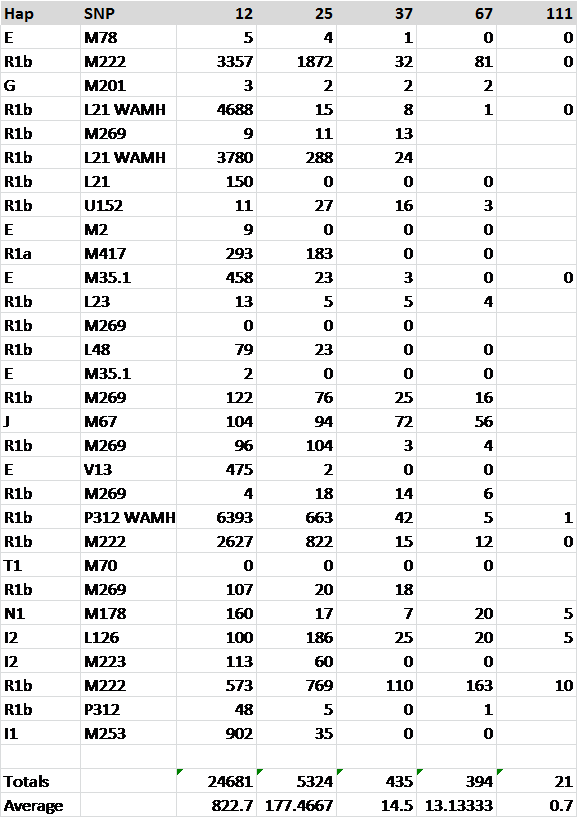
So, let’s look at 30 people, selected at random, in no particular order.  The only selection criteria I used is that they must have tested at 37 markers or more.

In the table below, the numbers in the marker columns are the number of matches.  Blank means that the individual did not test at that level.  Zero means they did test and have no matches. 

So let’s see what we have here.

Lots of 12 marker matches.  The most for one person was 6393.  This person was fortunate though, because they had rare markers to whittle that down to 663 at 25 markers, then 42, 5 and 1, respectively on the higher panels. 

Being a WAMH (Western Atlantic Modal Haplotype), the most common 12 marker value grouping in Europe (allowing for one mutation to still be considered WAMH) means a lot of matches in the first panel, but has little influence past that.

Two people had no matches, one R1b and one T1.  When I first started doing these reports, I was surprised to see R1bs with no matches, but I probably have as many of those as all other haplogroups combined.  We think of R1b being extremely common, and it is as a whole, but there are obviously lots of pockets of rare lines out there just waiting to be discovered.

The average person has about eight hundred 12 marker matches, just under 200 25 marker matches, fourteen 37, thirteen 67 and not quite one 111 marker match.  There still aren’t a lot of folks who have tested at the 111 marker level. The good news is that if you have a 111 marker match, it’s generally a very solid genealogical match.  Most people use the 111 marker test to resolve 67 marker matches or to find line marker mutations within a family to identify specific ancestral lines.

But back to the original question.  Is this pool too shallow to produce results?  It think all of those 24,000+ people who have matches at 12 markers don’t think so.  I think the 28 of the 30 people who have matches at any level don’t think so.  The “average” guy who has matches at every level doesn’t think so.  The 2 who don’t have any matches might wonder.  I don’t think so, but I’ll let you wade in for yourself.   Does this look like a shallow pool to you or a way to rip people off?

______________________________________________________________

Disclosure

I receive a small contribution when you click on some of the links to vendors in my articles. This does NOT increase the price you pay but helps me to keep the lights on and this informational blog free for everyone. Please click on the links in the articles or to the vendors below if you are purchasing products or DNA testing.

Thank you so much.

DNA Purchases and Free Transfers

Genealogy Services

Genealogy Research

Autosomal Matching – Is Great-Grandma’s Brother Really Her Brother???

Do you remember story problems from grade school?  You either loved them or hated them.  There was no in-between.  Here’s a modern-day story problem, and love them or hate them, if you participate in autosomal DNA testing, you’ll need to know how to work this story problem.  The good news is, I’ll show you how.  Yep, I was one of those “loved them” people.

I received the following query about how to determine relationships between distant relatives, and what should be expected.  It’s hard to know how interpret results if you don’t know what they “should” look like.

“I have conducted traditional genealogical research on my father’s maternal side.  I have researched back to my great, great grandmother.  Her parents were enslaved yet it appears that her parents cohabitated since 1864 according to a document that was produce well after that actual time.  My genealogical concern is because the date of 1864 is well after the oldest child (my great, great grandmother) and two other children were born.  This lead me to believe that the three oldest children within this family were perhaps the father’s from a previous relationship.  The lady who appears as his wife since 1864 would have been 13 when my great, great Grandmother was born.

Though my great, great grandmother married and remained in North Carolina, her parents and the remaining siblings migrated west.  I am presently researching the siblings to present day descendants.  One such person I have contacted, I believe is the grandson of my great, great grandmother’s brother.  I have been talking with him and his family.  Unfortunately, they know very little to nothing regarding his grandfather.  I have just conducted an autosomal DNA test on this grandson of the person I believe is my great, great Grandmother’s brother.  I have a total of four participates within my father’s side to compare him against.  The comparison is against myself, my 1st cousin and my uncle and my aunt.  Yet, none of us are showing an autosomal match to this grandson.  The only thing that I notice is that I as well as my uncle match another person who in turn also matches this grandson.

My question is since I don’t have a match with any of my participates against this person (grandson), should I conclude that there is not common ancestor with him?  Or….since there is another person, of whom I know nothing about, which matches myself and my uncle and also this person(grandson, should I conclude that is still likely a common ancestor? My match as well as my uncles match to this third person is not located on the same chromosomal area as this third person and the (grandson).”

When I receive queries like this, the first thing I have to do is to make a chart of the relationships.  The people who have taken autosomal tests are shown below in bold.

Now that we can see who is related to whom, or who we hypothesize is related to whom, now we can do some useful math.

First we need to look at how far down the path the participants are from the original ancestors.  We know that autosomal tests are fairly reliable until you get to about the 1% range, then it becomes sporadic and more the roll of the dice in terms of how DNA was inherited.

In this scenario, we have 5 generations in total, so the percentage of DNA that the descendants carry of the ancestors is shown in the following chart.  You can count generations in either direction, but for purposes of showing percentages I’m counting beginning with Mom and Dad.

Generation

People

% of DNA of Oldest Ancestor

1

Great grandmother and her brother

50

2

Grandma and child of ggm brother

25

3

Father, Aunt, Uncle and grandson of ggm brother

12.5

4

1st cousin and participant

6.25

Ok, so if indeed these people are all descended from Mom and Dad who were together in 1864, we are well above the 1% threshold.

Now let’s look at how much DNA each of the people who participated can expect to share with each of the other participants.  For this, I’m using the ISOGG DNA Statistics page and the chart that shows percentages of DNA in common between various relatives.

To use this tool, the numbers relate to “self”, so you need to figure out who is the “self” relationship you are calculating.

So let’s build another chart – a relationship chart.  In our chart, we’re going to have two math columns, one that shows percentages of DNA shared if both great-grandma and her brother are descended from both parents, and one if they only share one parent, so are half siblings.  Bolded people below are those who have taken the autosomal test.

Person One Person Two Relationship If Full Siblings If Half Sibling
Great grandmother Great grandmother’s brother Siblings or half-siblings 50 25
Grandma Child of brother First cousins 12.5 6.25
Grandms’s son (Father) or Uncle or Aunt Grandson of   great-grandmother’s brother Second cousins 3.125 1.563
Participant or   first cousin Grandson of   great-grandmother’s brother Second cousins once removed 1.563 0.781

So here we have a quandary.  We are very close to that 1% mark, so let’s look at the various scenarios.  The best chance of a meaningful match are at the third level where the aunt and uncle have both tested to see if they match great-grandma’s brother’s son.  The next generation, the participant and his first cousin are both another generation removed, so less likely to match than the aunt and uncle who are closer genealogically.

  1. Great grandma and her brother are full siblings.  If this were the case, we would expect for the Aunt or Uncle to match the grandson of great-grandmother’s brother at about 3.125%.  Neither do.  It’s not likely, but not impossible that they are full siblings.
  2. Great grandma and her brother are half siblings.  If this were the case, we would expect to see about a 1.5% match.  This is perilously near that magic 1% number.  They don’t match, but because of how close they are to the threshold, I would not call this conclusive.

How to solve this mystery.

The participant states that while they don’t match each other, there is one person (called the stranger, below) who matches himself, the uncle and great-grandma’s brother’s grandson.  This may or may not be relevant to the question at hand.  However, it is worth pursuing. If the match were on overlapping portions of the same chromosome, then it’s a good bet that indeed, it is from the same ancestor, but it’s not.

At this point, there are only three things to do.

1. Test more people.  If the grandson of great-grandma’s brother has siblings, test them.  Better yet, if he has an aunt or uncle, that gets us one generation closer.  If there are more people in the generation of the aunt and uncle who could test, from any descendants of great-grandma, test them.  If another descendant of this family could be found from another line to test, that would be great. Given that DNA is divided in each generation, and is passed in clumps, each person inherits differently.  Therefore, the more people you test in a line, the better your chances of finding a definitive answer.

2. Use GedMatch.  All 4 family members, plus the stranger who matches the participant, the uncle and the grandson of great-grandma’s brother download their results to GedMatch, drop the comparison thresholds, and see if you have matching segments on identical chromosomes between the stranger and the three family members.

3. Have Tim Janzen phase these people and obtain his opinion on the relationship after his phasing.  Phasing is where in essence Tim attempts to genetically “recreate” (on paper) the common relative between the uncle, aunt, participant and first cousin, and then compares that “composite person” to the grandson of great-grandma’s brother.  Tim has written specialized tools to do the phasing and provides the consulting services to compare the results.

There are also some other possibilities that need to be considered, based on the history of this family and America during that time.

  1. It is extremely unusual for children to be with a father during or after slavery.  Children belonged to the mother and the owner of the mother.  The father may or may not have been on the same plantation.  Slavery was an enforced matrilineal society.
  2. 1864, the date given that this couple began to be “married” is likely the date of emancipation. In other words, it could have been that they had children together but were forced to live apart before this, or that they decided when they were freed to become a couple.  If their children had death certificates, that might provide the answer.
  3. The children could have belonged to either the man or the woman of the couple, or the children before 1864 could have all had different “other” parents.  Slaves often formed loving relationships when they could, but they were not allowed to “marry” nor were their family ties always respected when financial decisions came to be made regarding the slaves.  Slave women were not always in charge of their own bodies in terms of the ability to choose with whom they would and would not have children.
  4. The children may not all necessarily belong biologically to the man and woman.  The end of slavery was a difficult time and if there were orphan children, they could have wound up with any family who would take them.  They could also be related, but not as children.  Perhaps nieces, nephews, cousins, etc.

We don’t have a definitive answer today for this particular story problem, but now that we understand how to use the tools and what to expect, I’m confident that this family will find their answer.

______________________________________________________________

Disclosure

I receive a small contribution when you click on some of the links to vendors in my articles. This does NOT increase the price you pay but helps me to keep the lights on and this informational blog free for everyone. Please click on the links in the articles or to the vendors below if you are purchasing products or DNA testing.

Thank you so much.

DNA Purchases and Free Transfers

Genealogy Services

Genealogy Research

Family Tree DNA Conferences

It’s hard to believe, but the 8th Annual International Genetic Genealogy Conference for project administrators is upcoming Nov. 9-10 in Houston.  And wow, where did the last 8 years go?  I remember how excited we were when the first conference was announced.  I think the spaces filled for that one the very first day registration was open.  Now there are more spaces available, but it does fill, and there is a cutoff, so if you want to sign up, don’t wait too long. You sign up from your GAP administrator page or you could also call Family Tree DNA.

There aren’t too many of us who have been to all of the conferences.  Probably a handful of diehards!  And yes, I am one of them, along with several others.

Family Tree DNA often doesn’t publish the actual agenda until fairly close to the conference date.  I’ve received e-mails asking about what former conferences have been like from people who are trying to decide whether to sign up or not.

So this blog posting is really a chat and a run down memory lane.  I’ll be introducing you to some of the folks you can expect to see at the conference too.

I’m going to work from last year’s agenda.  Yes, I’m so geeky that I have every one of the notebooks we’ve been given, and I can even put my hands on them.  If you knew how much paper is in my office, you’d know just how remarkable that is!

We normally fly in on Friday in the day.  There are some “events” that aren’t on the Family Tree DNA schedule.  Some special interest groups meet at one time or another, and Friday later afternoon or early evening is a favorite time. Its about the only time.

Friday evening, at about 7 or 8, is a reception.  Now I can’t remember which evening is the ISOGG reception and which one is the FTDNA reception.  One is Friday and one is Saturday.  You don’t really need to remember which is which, just where to show up and what time.  We all pitch in for the ISOGG reception too.  Some kind of munchies or something to drink (alcoholic or not.)  There is a cash bar at the FTDNA reception.

Our group sort of takes over the lobby and the lobby bar and restaurant as well.  We all have nametags so we just all walk up and introduce ourselves.  After 8 years for us who have been before, it’s much like a homecoming.  I can’t wait to see all my friends again and a few of my cousins that I didn’t know were cousins before DNA testing came along.

Newbies or oldtimers, it’s a wonderful opportunity to meet people, talk over challenges or successes, and just enjoy the company of those with like interests.  It’s also great to put a face with a name.  Of course, I can remember the face forever, but the names get a bit skewed.  Oh well, that’s what nametags are for.

The actual conference and registration begins on Saturday morning, fairly early.  They have a full day of sessions both Saturday and Sunday.  The hotel does not have a complimentary breakfast and let’s just say it’s not inexpensive, or quick, in the restaurant.

I do know who a few of the speakers will be this year, but it’s not my place to steal that thunder, so I won’t. I’m looking forward to the ones I know about though, I assure you.

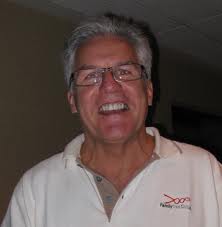
Max (below) and Bennett (above) always provide a warm welcome to everyone.

Last year, Spencer Wells, the Scientist in Residence for the Genographic project opened the conference with an update called “News from the Field.”  Spencer (below) is always interesting.  And that’s the understatement of the year.  I live vicariously through Spencer’s adventures!
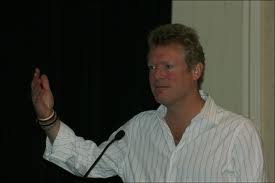
Bruce Walsh, a mathematician from the University of Arizona, who we all know and love, followed Spencer.  Not an enviable slot.  These men are as different as night and day.  But if you have a math question, or even if you don’t, Bruce will answer it for you….then he will explain to you in terms you can’t possibly understand the theory of relativity:)

I remember the first session I attended the first year with Bruce.  I walked out of that session with my eyes glazed over like donut holes.  I remember him saying “It’s simple……then writing an impossibly long string of numbers.”  Keep in mind that I’m a computer science graduate….back when computer science was in the engineering school….so I understand math and science….but not at the PhD level, no matter how easy that PhD level is to a PhD!  I talked to Catherine Borges later who said “I think I understood a few words.”  Yep Katherine, we’re on the same page.

Suffice it to say that we’ve all learned a lot since then, but we all need something to stretch the limits of our understanding and Bruce always does.  Well, except the one year he really toned it down to undergrad level and we told him it was too simple that year.  We always look forward to Bruce’s sessions.  I understand full sentences now, most years!  Dr. Walsh has a little tradition too.  I won’t tell you what it is, but the photo above holds a hint.

Mid morning there were breakout sessions.  Max and Bennett always try to have a wide variety of topics and levels of sessions.  These were “Phasing and Other Analysis of Family Finder Results” by David Pike, who has written a phasing utility, and “Walk Through the Y” with Thomas Krahn (below) who runs the lab at Family Tree DNA.

My husband always goes with me and we split up between these breakouts because I can never decide which one I wasn’t going to go to and try as I might, I can’t clone myself so I can go to both.

Lunch, the most popular session of the day.  Lunch is provided, and is generally a buffet type of event.  Lots of visiting and socializing going on.  The ice is well broken by now.

After lunch, Dr. Michael Hammer spoke about “Neanderthals in our Midst: Just How Modern is our Genome” which was a fascinating session.  Michael, Family Tree DNA’s Chief Scientist, runs the Hammer Lab (yes, named after him) at the University of Arizona who has partnered with Family Tree DNA all these years.  I don’t know what he was saying in the photo below, but it must have been pretty good because I seem to be hanging on every word.

Next on the agenda was Stephen Morse with his “One Step Web Pages.”  No this wasn’t exactly DNA, but it wasn’t terribly separate either and by this time, our minds needed something that we didn’t have to think too hard about.  Steve has great tools and is wonderfully entertaining, especially for genealogists.

The favorite conference sessions seem to be the Q&A panel and sessions.  The official agenda closes each day with Q&A where attendees get to ask questions and the speakers of the day answer them.  This is one of the best parts of the conference.  Each of the speakers, below, have thier questions and Matt Kaplan is answering his.  Matt, by the way….has been “finishing” his PhD for nearly all 8 years.  I have to go this year to see if he finished!!!

Dinner is on your own, but don’t be late back for the evening reception.  Lots of other fraternizing goes on in the lobby, which has couches and conversation areas, in the lobby bar and restaurant.

Sunday’s agenda starts even earlier than Saturdays because the ISOGG (International Society of Genetic Genealogy) meeting is generally at 8 AM.  Katherine Borges, below, the Director, keeps everyone current with what is going on in the genetic genealogy areana and needs our attention.  Last year the big topic was the FDA and their attempts to regulate DTC testing.

The first official Sunday session was with Elliott Greenspan.  If the surname looks familiar, yes, Elliott is Bennett’s son, but Elliott is perfectly well qualified, even without the Greenspan name.  Elliott is in charge of the IT department and he did a session about the year in review and the year ahead. He does something like this every year and I expect this year will be no exception.

That was followed by Peter Hrechdakian’s “Armenian DNA Project.”  I wasn’t terribly excited about this, but was I ever glad that I didn’t skip out on this one and read my e-mail or something.  It was wonderful, inspirational and enlightening, and had implications far beyond Armenia.

That session was followed by Peter Biggins and Thomas Roderick with the “DNA of the Three Collas.”  I did have to step out and didn’t see that session.  I think that’s when Cece Moore (above, notice her necklace) was filming my segment for the FTDNA infomercial (below).  See, I told you all kinds of things were going on.

Steve Morse followed with a second presentation called “One Step Web Pages, Part II.”  I learned things that I still use regularly.

Lunch is provided again on Sunday.  The food is always good there.  But warning, get dessert early if you want it.

The afternoon session was led off by Jessica Roberts, a lawyer, who talked about “DNA Tests and the Law and the Potential Use of Ancestry Tests for Immigration.”  Ok, it wasn’t the most exciting session of the conference.

However, the final speaker, Dick Hill, was just wonderful and had us all spellbound as he gave his session “An Adoptees Journey to His Ancestral Surname.”  As you know, Dick has gone on to publish his story as a book, “Finding Family”.

On the last day, the closing panel is very popular, and you’ll be very disappointed if you decide to leave early to catch your plane.  Been there, done that.  Don’t expect the sessions to end until 5.  The final panel is the same format as the day before, with attendees writing their questions and the panelists answering them.

And after that, it’s goodbyes and a mad dash for the airport, which isn’t far because the hotel is one of the airport hotels.  Still, you have to have enough time to ride the hotel bus, which may be full, and get there in time for all of the security checks.

So now that you’ve had a whirlwind tour of last year’s conference, you have some idea of what to expect.

If I had to describe it in one sentence, I would say that it is something like drinking from a firehose fueled by the best educators in the genetic genealogy and population genetics world.  Some are from the academic world, some from the business and genealogy environments, and some of them, folks, are us.  If you’re not really serious about genetic genealogy, this conference would likely be overwhelming. If you want to come and learn, you’ll have every opportunity.  Every single one of us had a first conference and a first day in genetic genealogy.  We all start at the same level.  These conferences are one way to grow from there!

If you can’t attend, several bloggers do cover it, although not immediately.  We barely have time to go to the “loo” while we are there.  Several people do tweet as well and a few e-mail to the lists….but I guarantee you, it’s not the same as being there in person.

Katherine Borges, Bennett Greenspan and Emily Aulicino enjoying a relaxing minute.  Actually, I think Katherine is begging Bennett for some new feature!!!  A lot of that goes on that the conference too:)  We all hope to see you there!

______________________________________________________________

Disclosure

I receive a small contribution when you click on some of the links to vendors in my articles. This does NOT increase the price you pay but helps me to keep the lights on and this informational blog free for everyone. Please click on the links in the articles or to the vendors below if you are purchasing products or DNA testing.

Thank you so much.

DNA Purchases and Free Transfers

Genealogy Services

Genealogy Research

Working with Mitochondrial DNA Results

I recently received this query.  It made me smile.  I receive a lot of e-mails similar to this.

“I always thought I was an intelligent woman but I am absolutely stymied on how to proceed with the DNA results from Family Tree DNA.

My mtDNA has 65 pages of HVR1 and HVR2 matches.  What does this mean?  Is there somewhere I can find a step by step procedural on how to proceed after getting DNA testing and how to apply it to genealogical research?  What should I do first?”

These are all good questions.  Unfortunately, mitochondrial DNA is more difficult to use genealogically because of the name changes in every generation.  What we really need is a big centralized data base someplace where we an enter our mitochondrial line names to see if anyone in that line has tested, but that data base doesn’t exist.  That data base would provide the same type of function for mitochondrial DNA that surname projects do for paternal lines.  If you want to know if your Johnson Y-line has tested, you just go and look in the Johnson project.  You can’t do that with mitochondrial DNA, so it’s everyone for themselves.  This means we need to be sure we do everything we can to help ourselves which gives us the best odds for success.  My Dad used to say that luck was 99% elbow grease!

What this lady didn’t say was whether or not she had tested to the full sequence level or just to the HVR1+HVR2 level.  From what she did say, I’m betting that she is haplogroup H, the most common haplogroup in Europe, carried by about 50% of the people, and that she did not get her full sequence tested.  If you are haplogroup H, and you have any HVR2 matches at all, the only reasonable way to sort out who is related in a genealogical timeframe is to take the full sequence test.  Otherwise, trying to work with 65 pages of matches is kind of like swatting at flies.

However, not everyone is reasonable, and maybe few of the people you match have taken the full sequence test.  Even if you have taken the full sequence test, there is nothing you can do about those who haven’t and you’d like to be able to use the results you have to see if anyone is a genealogical match to you.

In my experience, a short, less than one page, e-mail sent to your matches with some very specific information is the best way to garner a response.  No one wants to have to sort through a rambling e-mail, so organize it concisely so that the person receiving the e-mail can immediately see the relevant information.  What you’re hoping is that they will take a look and say “Hey, I know that ancestor,” or maybe “My ancestor is from that location too.”

In my case, I have 222 HVR1+HVR2 matches, but no full sequence matches.  Many of my HVR1+HVR2 matches have taken the full sequence test, and I know they are NOT matches to me at the full sequence level, so I don’t need to send them the e-mail.  They’ve been eliminated.

On the list above, there are only 4 people are showing as matches who did not take the full sequence (FMS) test, so they will receive the following e-mail message with relevant information about each generational ancestor, including name, birth and death years and locations, spouses name and where they lived if it wasn’t where they were born or died:

Hello <their name>,

At Family Tree DNA, you and I show as mitochondrial DNA matches at the HVR1+HVR2 level.  This means that someplace back in time, we shared a common ancestor.  I have tested at the full sequence level as well, so if you were to upgrade we could confirm that we continue to match, and in a genealogically relevant timeframe, or we would know that we don’t, and we can discontinue our search because our common ancestor was hundreds to thousands of years ago. 

I’m hopeful that perhaps we can identify our common ancestor, or perhaps just a common location. 

My ancestors on my maternal, mitochondrial line, are as follows: 

  • Me
  • My mother
  • My mother’s mother – Edith Barbara Lore born 1888 Indianapolis, Indiana, died 1960 Rochester, Indiana, married to John Ferverda, lived in Silver Lake, Indiana
  • Edith’s mother – Nora Kirsch born 1866 Dearborn County, Indiana died 1949 Lockport, NY, married Curtis Benjamin Lore, lived in Rushville and Wabash, Indiana
  • Nora’s mother – Barbara Drechsel (also spelled Drexler) born 1848 Goppmannsbuhl, Bayern, Germany, died 1930 Wabash, Indiana, married Jacob Kirsch, lived in Aurora, Indiana
  • Barbara’s mother – Barbara Mehlheimer born 1823 Goppsmannbuhl, Bayern, Germany, died 1906 Aurora, Dearborn County, Indiana, married George Drechsel
  • Barbara’s mother – Elisabetha Mehlheimer, born about 1800 probably in Goppmannsbuhl, Germany, died before 1851

Goppmannsbuhl is a small village outside Speichersdorf, close to Bayreuth and the Czech border, not too far from Nuremburg in Germany.  You can see the location on the Google map below.

https://maps.google.com/maps?f=q&source=s_q&hl=en&geocode=&q=G%C3%B6ppmannsb%C3%BChl,+Speichersdorf,+Germany&aq=1&oq=goppmann&sll=37.0625,-95.677068&sspn=43.25835,101.513672&vpsrc=0&t=h&ie=UTF8&split=0&hq=&hnear=G%C3%B6ppmannsb%C3%BChl,+95469+Speichersdorf,+Oberfranken,+Bayern,+Germany&z=16&iwloc=A

Do any of these families or locations look familiar to you?  Sometimes even if we can’t find a common ancestor, we discover that our ancestors were from the same general area.  Where does your mitochondrial DNA line come from?

Roberta Estes

You’ll note that I did three things here.  I mentioned major landmarks nearby that might be familiar to people, including the Czech border.  At least one of my matches is from Czech Republic and if I don’t mention how close my ancestors lived to that border, people from there will see Germany and dismiss any possible match.  I also included a map that people can click on.  Sometimes that helps.  Lastly, I clearly show the mitochondrial path so that if they don’t understand how that works, they can use my example – me to mother to her mother, etc.  You’d be amazed at how many people are unclear about this.

Oh, and one last thing, I don’t include the information about my mother.  She is deceased, but they just don’t need that.

While we are waiting for replies, we can upload our  information to Mitosearch and continue our search there.  You can do that by clicking on the “upload to Mitosearch” link on the bottom of your Matches page at Family Tree DNA, or you can enter your results manually if you tested elsewhere.  We can also upload our GEDCOM files to both locations.  That makes it easier for potential matches to see if there is anything relevant.

For the most part, you’ll find the same people at Mitosearch that you’ll find at Family Tree DNA.  There are a few exceptions, but generally, people who test elsewhere either don’t know about Mitosearch or aren’t motivated to add their information there.  In some cases, I think people get discouraged and don’t do what they can to find out about their matches.  Case in point is that I seldom receive query e-mails about potential matches, and no, it’s not because I send them an e-mail immediately.  You know, the cobblers kids and no shoes:)

The great thing about Mitosearch is that you can click on the User ID to see information provided by your matches when they were uploading or entering their information.  There are various search criteria. I always select the option to compare me only to those who have tested both the HVR1 and HVR2 regions, and only show me people who match in both.

Here’s my entry.

Unfortunately, in Y-search, Mitosearch’s companion data base, you can search by surname, but Mitosearch doesn’t contain that feature.  Not only does YSearch give you matches, but it also provides you with a list of pedigree charts that the name appears in.  For names like Smith, this probably isn’t terribly useful, but for Mehlheimer, one match would be a goldmine.

I click through the User Ids of all my exact matches.  An exact match is when both “differences” columns equal zero.

If you want to know more about your mitochondrial DNA and the secrets it holds for you, you can purchase a Personalized DNA Report.

______________________________________________________________

Disclosure

I receive a small contribution when you click on some of the links to vendors in my articles. This does NOT increase the price you pay but helps me to keep the lights on and this informational blog free for everyone. Please click on the links in the articles or to the vendors below if you are purchasing products or DNA testing.

Thank you so much.

DNA Purchases and Free Transfers

Genealogy Services

Genealogy Research